The cover image was created by the transcriber and is placed in the public domain.
THE HISTORY OF
THE STANDARD OIL COMPANY
Copyright, 1904, by Ames
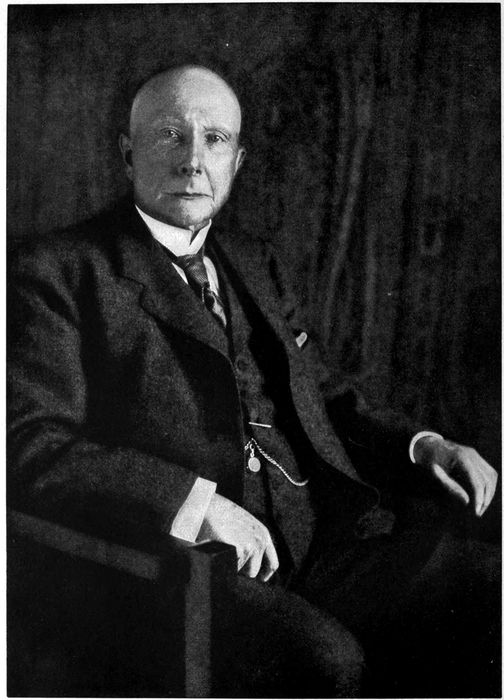
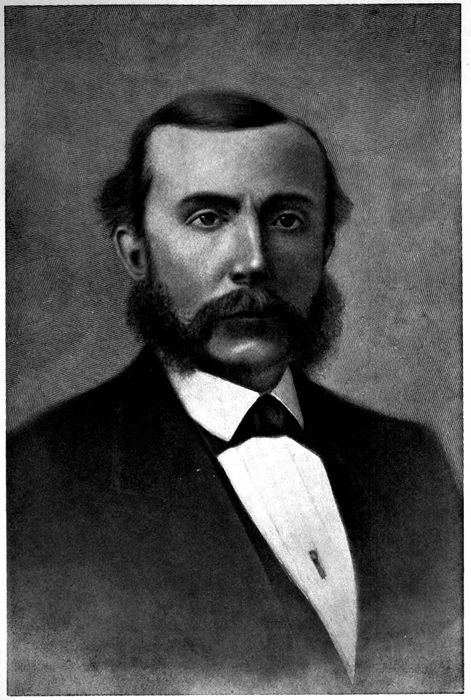
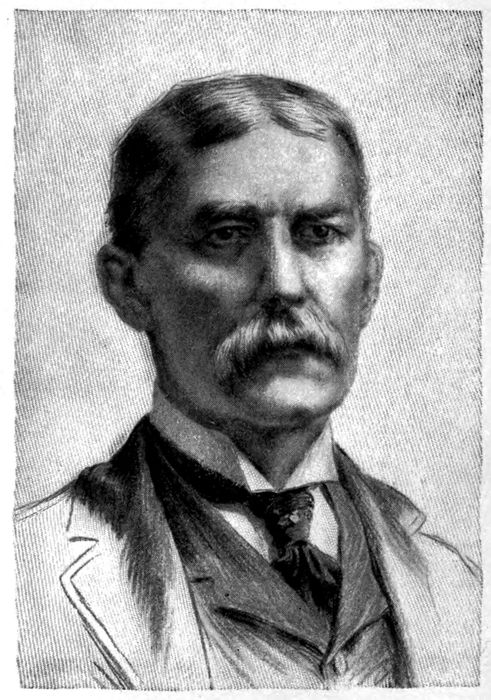
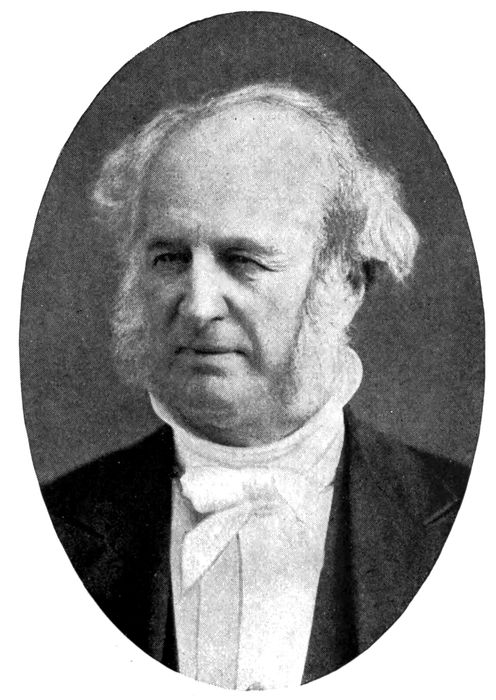
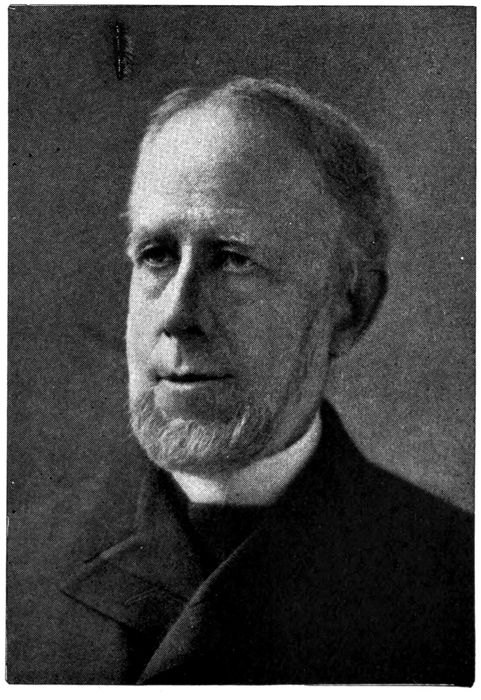
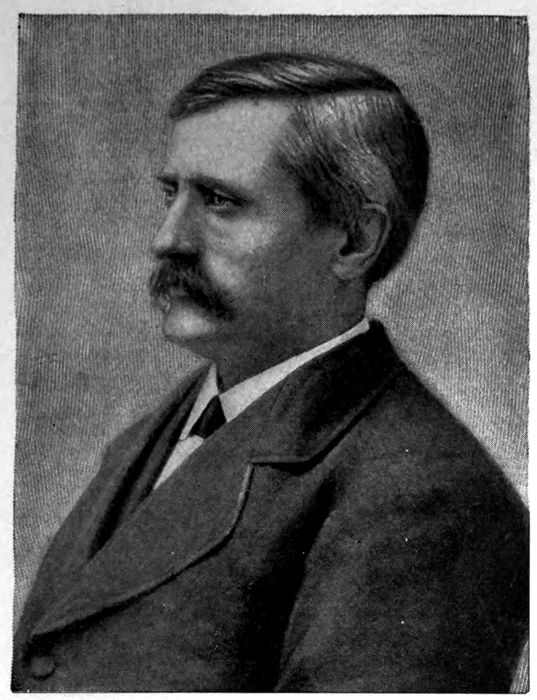
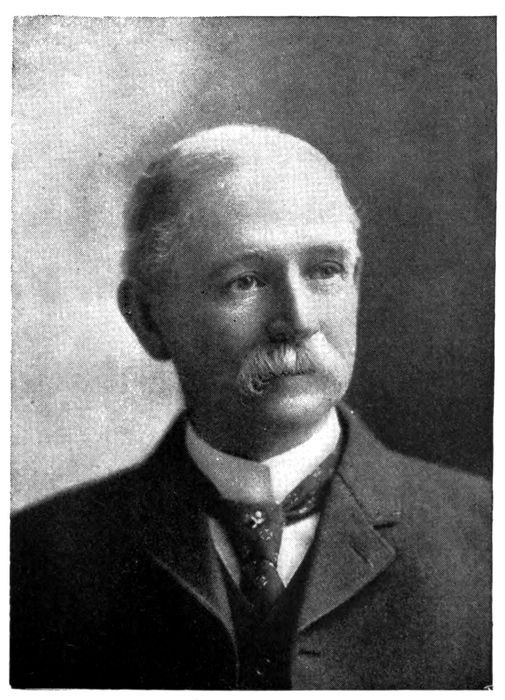
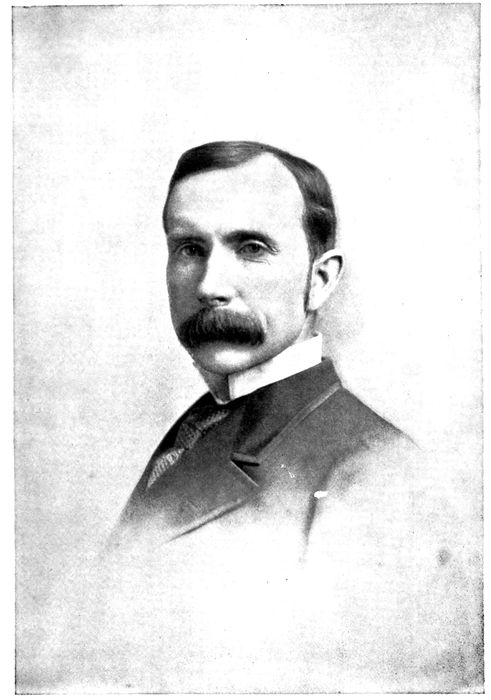
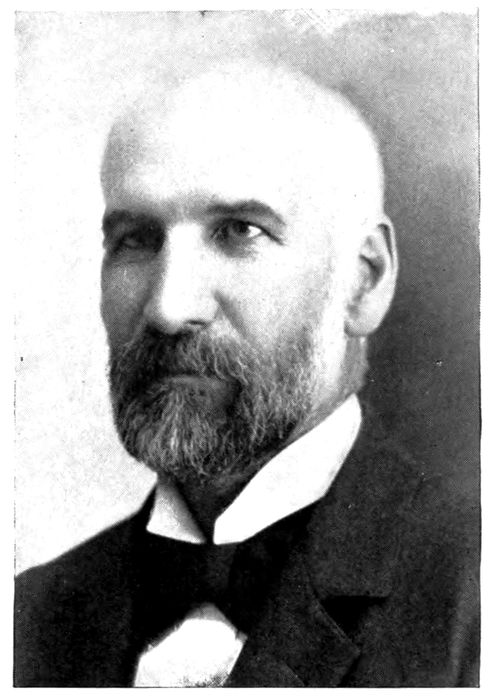
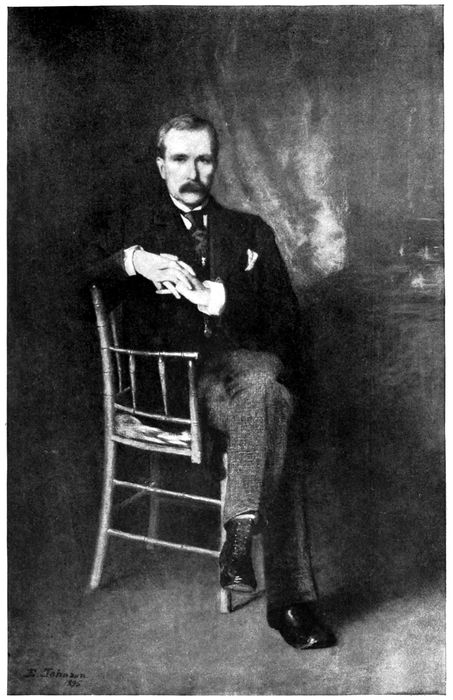
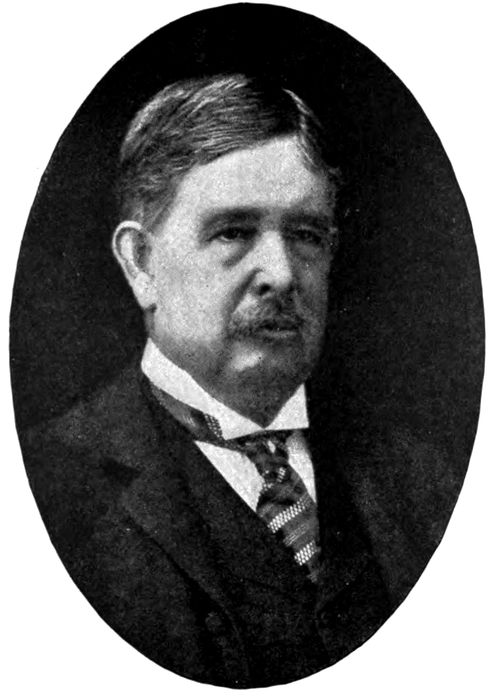
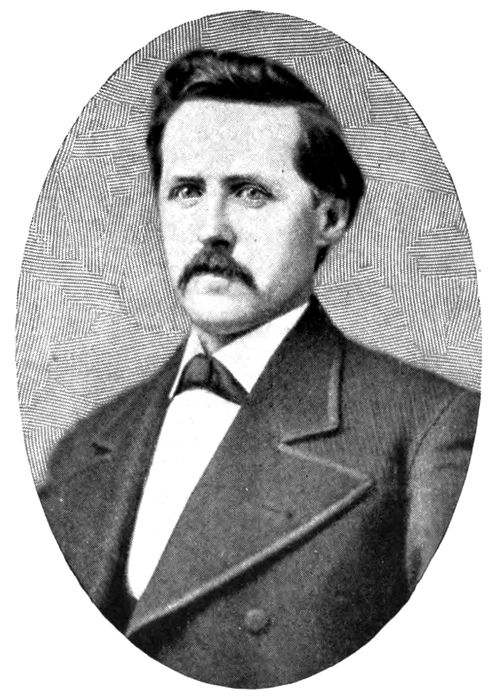
JOHN DAVISON ROCKEFELLER IN 1904
Born July 8, 1839
BY
IDA M. TARBELL
AUTHOR OF THE LIFE OF ABRAHAM LINCOLN, THE LIFE OF NAPOLEON BONAPARTE, AND MADAME ROLAND: A BIOGRAPHICAL STUDY
ILLUSTRATED WITH PORTRAITS, PICTURES AND DIAGRAMS
VOLUME ONE
NEW YORK
McCLURE, PHILLIPS & CO.
MCMV
Copyright, 1904, by
McCLURE, PHILLIPS & CO.
Published, November, 1904
Second Impression
Copyright, 1902, 1903, 1904, by The S. S. McClure Co.
“An Institution is the lengthened shadow of one man.”
EMERSON, IN ESSAY ON “SELF-RELIANCE.”
“The American Beauty Rose can be produced in its splendor
and fragrance only by sacrificing the early buds which
grow up around it.”
J. D. ROCKEFELLER, JR., IN AN ADDRESS ON TRUSTS,
TO THE STUDENTS OF BROWN UNIVERSITY.
PREFACE
vii
This work is the outgrowth of an effort on the part
of the editors of McClure’s Magazine to deal concretely
in their pages with the trust question. In
order that their readers might have a clear and
succinct notion of the processes by which a particular industry
passes from the control of the many to that of the
few, they decided a few years ago to publish a detailed narrative
of the history of the growth of a particular trust. The
Standard Oil Trust was chosen for obvious reasons. It was
the first in the field, and it has furnished the methods, the
charter, and the traditions for its followers. It is the most
perfectly developed trust in existence; that is, it satisfies most
nearly the trust ideal of entire control of the commodity in
which it deals. Its vast profits have led its officers into various
allied interests, such as railroads, shipping, gas, copper,
iron, steel, as well as into banks and trust companies, and
to the acquiring and solidifying of these interests it has
applied the methods used in building up the Oil Trust. It
has led in the struggle against legislation directed against
combinations. Its power in state and Federal government,
in the press, in the college, in the pulpit, is generally recognised.
The perfection of the organisation of the Standard,
the ability and daring with which it has carried out its
projects, make it the pre-eminent trust of the world—the one
whose story is best fitted to illuminate the subject of combinations
of capital.
Another important consideration with the editors in deciding
that the Standard Oil Trust was the best adapted to illustrate
viiitheir meaning, was the fact that it is one of the very few
business organisations of the country whose growth could be
traced in trustworthy documents. There is in existence just
such documentary material for a history of the Standard Oil
Company as there is for a history of the Civil War or the
French Revolution, or any other national episode which has
divided men’s minds. This has come about largely from the
fact that almost constantly since its organisation in 1870 the
Standard Oil Company has been under investigation by the
Congress of the United States and by the Legislatures of various
states in which it has operated, on the suspicion that it
was receiving rebates from the railroads and was practising
methods in restraint of free trade. In 1872 and again in 1876
it was before Congressional committees, in 1879 it was before
examiners of the Commonwealth of Pennsylvania and before
committees appointed by the Legislatures of New York and
of Ohio for investigating railroads. Its operations figured
constantly in the debate which led up to the creation of the
Interstate Commerce Commission in 1887, and again and
again since that time the Commission has been called upon
to examine directly or indirectly into its relation with the
railroads.
In 1888, in the Investigation of Trusts conducted by Congress
and by the state of New York, the Standard Oil Company
was the chief subject for examination. In the state of
Ohio, between 1882 and 1892, a constant warfare was waged
against the Standard in the courts and Legislature, resulting
in several volumes of testimony. The Legislatures of many
other states concerned themselves with it. This hostile legislation
compelled the trust to separate into its component parts
in 1892, but investigation did not cease; indeed, in the last
great industrial inquiry, conducted by the Commission appointed
by President McKinley, the Standard Oil Company
was constantly under discussion, and hundreds of pages of
ixtestimony on it appear in the nineteen volumes of reports
which the Commission has submitted.
This mass of testimony, all of it submitted under oath it
should be remembered, contains the different charters and
agreements under which the Standard Oil Trust has operated,
many contracts and agreements with railroads, with refineries,
with pipe-lines, and it contains the experiences in business
from 1872 up to 1900 of multitudes of individuals. These
experiences have exactly the quality of the personal reminiscences
of actors in great events, with the additional value that
they were given on the witness stand, and it is fair, therefore,
to suppose that they are more cautious and exact in statements
than many writers of memoirs are. These investigations, covering
as they do all of the important steps in the development
of the trust, include full accounts of the point of view
of its officers in regard to that development, as well as their
explanations of many of the operations over which controversy
has arisen. Hundreds of pages of sworn testimony are found
in these volumes from John D. Rockefeller, William Rockefeller,
Henry M. Flagler, H. H. Rogers, John D. Archbold,
Daniel O’Day and other members of the concern.
Aside from the great mass of sworn testimony accessible to
the student there is a large pamphlet literature dealing with
different phases of the subject, and there are files of the numerous
daily newspapers and monthly reviews, supported by the
Oil Regions, in the columns of which are to be found not
only statistics but full reports of all controversies between
oil men. No complete collection of this voluminous printed
material has ever been made, but several small collections
exist, and in one or another of these I have been able to find
practically all of the important documents relating to the
subject. Mrs. Roger Sherman of Titusville, Pennsylvania,
owns the largest of these collections, and in it are to be
found copies of the rarest pamphlets. Lewis Emery, Jr., of
xBradford, the late E. G. Patterson of Titusville, the late
Henry D. Lloyd, author of “Wealth vs. Commonwealth,”
William Hasson of Oil City, and P. C. Boyle, the editor of
the Oil City Derrick, have collections of value, and they have
all been most generous in giving me access to their books.
But the documentary sources of this work are by no means
all printed. The Standard Oil Trust and its constituent companies
have figured in many civil suits, the testimony of which
is still in manuscript in the files of the courts where the suits
were tried. These manuscripts have been examined on the
ground, and in numerous instances full copies of affidavits
and of important testimony have been made for permanent
reference and study. I have also had access to many files of
private correspondence and papers, the most important being
that of the officers and counsel of the Petroleum Producers’
Union from 1878 to 1880, that covering the organisation
from 1887 to 1895 of the various independent companies
which resulted in the Pure Oil Company, and that containing
the material prepared by Roger Sherman for the suit brought
in 1897 by the United States Pipe Line against certain of the
Standard companies under the Sherman anti-trust law.
As many of the persons who have been active in the development
of the oil industry are still living, their help has been
freely sought. Scores of persons in each of the great oil centres
have been interviewed, and the comprehension and interpretation
of the documents on which the work is based have
been materially aided by the explanations which the actors
in the events under consideration were able to give.
When the work was first announced in the fall of 1901, the
Standard Oil Company, or perhaps I should say officers of
the company, courteously offered to give me all the assistance
in their power, an offer of which I have freely taken advantage.
In accepting assistance from Standard men as from independents
I distinctly stated that I wanted facts, and that I
xireserved the right to use them according to my own judgment
of their meaning, that my object was to learn more perfectly
what was actually done—not to learn what my informants
thought of what had been done. It is perhaps not too much
to say that there is not a single important episode in the
history of the Standard Oil Company, so far as I know it,
or a notable step in its growth, which I have not discussed
more or less fully with officers of the company.
It is needless to add that the conclusions expressed in this
work are my own.
PETROLEUM FIRST A CURIOSITY AND THEN A MEDICINE—DISCOVERY OF ITS REAL VALUE—THE STORY OF HOW IT CAME TO BE PRODUCED IN LARGE QUANTITIES—GREAT FLOW OF OIL—SWARM OF PROBLEMS TO SOLVE—STORAGE AND TRANSPORTATION—REFINING AND MARKETING—RAPID EXTENSION OF THE FIELD OF OPERATION—WORKERS IN GREAT NUMBERS WITH PLENTY OF CAPITAL—COSTLY BLUNDERS FREQUENTLY MADE—BUT EVERY DIFFICULTY BEING MET AND OVERCOME—THE NORMAL UNFOLDING OF A NEW AND WONDERFUL OPPORTUNITY FOR INDIVIDUAL ENDEAVOUR.
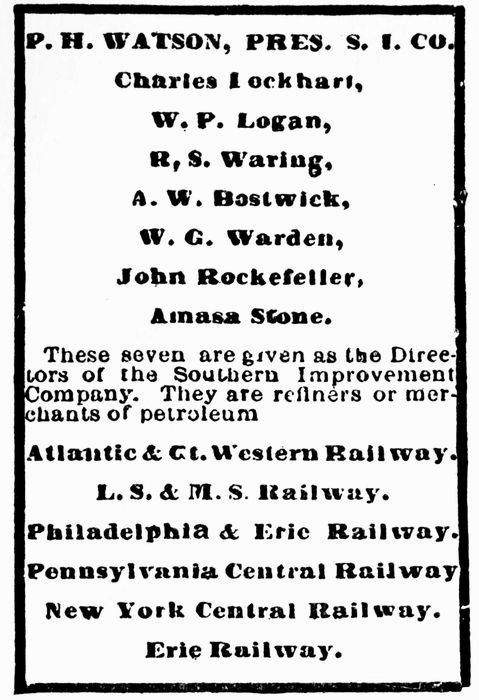
JOHN D. ROCKEFELLER’S FIRST CONNECTION WITH THE OIL BUSINESS—STORIES OF HIS EARLY LIFE IN CLEVELAND—HIS FIRST PARTNERS—ORGANISATION OF THE STANDARD OIL COMPANY IN JUNE, 1870—ROCKEFELLER’S ABLE ASSOCIATES—FIRST EVIDENCE OF RAILWAY DISCRIMINATIONS IN THE OIL BUSINESS—REBATES FOUND TO BE GENERALLY GIVEN TO LARGE SHIPPERS—FIRST PLAN FOR A SECRET COMBINATION—THE SOUTH IMPROVEMENT COMPANY—SECRET CONTRACTS MADE WITH THE RAILROADS PROVIDING REBATES AND DRAWBACKS—ROCKEFELLER AND ASSOCIATES FORCE CLEVELAND REFINERS TO JOIN THE NEW COMBINATION OR SELL—RUMOUR OF THE PLAN REACHES THE OIL REGIONS.
RISING IN THE OIL REGIONS AGAINST THE SOUTH IMPROVEMENT COMPANY—PETROLEUM PRODUCERS’ UNION ORGANISED—OIL BLOCKADE AGAINST MEMBERS OF SOUTH IMPROVEMENT COMPANY AND AGAINST RAILROADS IMPLICATED—CONGRESSIONAL INVESTIGATION OF 1872 AND THE DOCUMENTS IT REVEALED—PUBLIC DISCUSSION AND GENERAL CONDEMNATION OF THE SOUTH IMPROVEMENT COMPANY—RAILROAD OFFICIALS CONFER WITH COMMITTEE FROM PETROLEUM PRODUCERS’ UNION—WATSON AND ROCKEFELLER REFUSED ADMITTANCE TO CONFERENCE—RAILROADS REVOKE CONTRACTS WITH SOUTH IMPROVEMENT COMPANY AND MAKE CONTRACT WITH PETROLEUM PRODUCERS’ UNION—BLOCKADE AGAINST SOUTH IMPROVEMENT COMPANY LIFTED—OIL WAR OFFICIALLY ENDED—ROCKEFELLER CONTINUES TO GET REBATES—HIS GREAT PLAN STILL A LIVING PURPOSE.
ROCKEFELLER AND HIS PARTY NOW PROPOSE AN OPEN INSTEAD OF A SECRET COMBINATION—“THE PITTSBURG PLAN”—THE SCHEME IS NOT APPROVED BY THE OIL REGIONS BECAUSE ITS CHIEF STRENGTH IS THE REBATE—ROCKEFELLER NOT DISCOURAGED—THREE MONTHS LATER BECOMES PRESIDENT OF NATIONAL REFINERS’ ASSOCIATION—FOUR-FIFTHS OF REFINING INTEREST OF UNITED STATES WITH HIM—OIL REGIONS AROUSED—PRODUCERS’ UNION ORDER DRILLING STOPPED AND A THIRTY DAY SHUT-DOWN TO COUNTERACT FALLING PRICE OF CRUDE—PETROLEUM PRODUCERS’ AGENCY FORMED TO ENABLE PRODUCERS TO CONTROL THEIR OWN OIL—ROCKEFELLER OUTGENERALS HIS OPPONENTS AND FORCES A COMBINATION OF REFINERS AND PRODUCERS—PRODUCERS’ ASSOCIATION AND PRODUCERS’ AGENCY SNUFFED OUT—NATIONAL REFINERS’ ASSOCIATION DISBANDS—ROCKEFELLER STEADILY GAINING GROUND.
EVIDENCE OF REAPPEARANCE OF REBATES SOON AFTER AGREEMENT OF MARCH 25 IS SIGNED—PRINCIPLE THOROUGHLY ESTABLISHED THAT LARGE SHIPPERS SHALL HAVE ADVANTAGES OVER SMALL SHIPPERS IN SPITE OF RAILROADS’ DUTY AS COMMON CARRIERS—AGREEMENT WORKED OUT BY WHICH THREE ROADS ARE TO HAVE FIXED PERCENTAGE OF EASTERN SHIPMENTS—OIL REGIONS ROBBED OF THEIR GEOGRAPHICAL ADVANTAGE—THE RUTTER CIRCULAR—ROCKEFELLER NOW SECRETLY PLANS REALISATION OF HIS DREAM OF PERSONAL CONTROL OF THE REFINING OF OIL—ORGANISATION OF THE CENTRAL ASSOCIATION—H. H. ROGERS’ DEFENCE OF THE PLAN—ROCKEFELLER’S QUIET AND SUCCESSFUL CANVASS FOR ALLIANCES WITH REFINERS—THE REBATE HIS WEAPON—CONSOLIDATION BY PERSUASION OR FORCE—MORE TALK OF A UNITED EFFORT TO COUNTERACT THE MOVEMENT.
FIRST INTERSTATE COMMERCE BILL—THE BILL PIGEON-HOLED THROUGH EFFORTS OF STANDARD’S FRIENDS—INDEPENDENTS SEEK RELIEF BY PROPOSED CONSTRUCTION OF PIPE-LINES—PLANS FOR THE FIRST SEABOARD PIPE-LINE—SCHEME FAILS ON ACCOUNT OF MISMANAGEMENT AND STANDARD AND RAILROAD OPPOSITION—DEVELOPMENT OF THE EMPIRE TRANSPORTATION COMPANY AND ITS PROPOSED CONNECTION WITH THE REFINING BUSINESS—STANDARD, ERIE AND CENTRAL FIGHT THE EMPIRE TRANSPORTATION COMPANY AND ITS BACKER, THE PENNSYLVANIA RAILROAD—THE PENNSYLVANIA FINALLY QUITS AFTER A BITTER AND COSTLY WAR—EMPIRE LINE SOLD TO THE STANDARD—ENTIRE PIPE-LINE SYSTEM OF OIL REGIONS NOW IN ROCKEFELLER’S HANDS—NEW RAILROAD POOL BETWEEN FOUR ROADS—ROCKEFELLER PUTS INTO OPERATION SYSTEM OF DRAWBACKS ON OTHER PEOPLE’S SHIPMENTS—HE PROCEEDS RAPIDLY WITH THE WORK OF ABSORBING RIVALS.
A RISE IN OIL—A BLOCKADE IN EXPORTS—PRODUCERS DO NOT GET THEIR SHARE OF THE PROFITS—THEY SECRETLY ORGANISE THE PETROLEUM PRODUCERS’ UNION AND PROMISE TO SUPPORT PROPOSED INDEPENDENT PIPE-LINES—ANOTHER INTERSTATE COMMERCE BILL DEFEATED AT WASHINGTON—“IMMEDIATE SHIPMENT”—INDEPENDENTS HAVE TROUBLE GETTING CARS—RIOTS THREATENED—APPEAL TO GOVERNOR HARTRANFT—SUITS BROUGHT AGAINST UNITED PIPE-LINES, PENNSYLVANIA RAILROAD AND OTHERS—INVESTIGATIONS PRECIPITATED IN OTHER STATES—THE HEPBURN COMMISSION AND THE OHIO INVESTIGATION—EVIDENCE THAT THE STANDARD IS A CONTINUATION OF THE SOUTH IMPROVEMENT COMPANY—PRODUCERS FINALLY DECIDE TO PROCEED AGAINST STANDARD OFFICIALS—ROCKEFELLER AND EIGHT OF HIS ASSOCIATES INDICTED FOR CONSPIRACY.
THE PRODUCERS’ SUIT AGAINST ROCKEFELLER AND HIS ASSOCIATES USED BY THE STANDARD TO PROTECT ITSELF—SUITS AGAINST THE TRANSPORTATION COMPANIES ARE DELAYED—TRIAL OF ROCKEFELLER AND HIS ASSOCIATES FOR CONSPIRACY POSTPONED—ALL OF THE SUITS WITHDRAWN IN RETURN FOR AGREEMENTS OF THE STANDARD AND THE PENNSYLVANIA TO CEASE THEIR PRACTICES AGAINST THE PRODUCERS—WITH THIS COMPROMISE THE SECOND PETROLEUM PRODUCERS’ UNION COMES TO AN END—PRODUCERS THEMSELVES TO BLAME FOR NOT STANDING BEHIND THEIR LEADERS—STANDARD AGAIN ENFORCES ORDERS OBJECTIONABLE TO PRODUCERS—MORE OUTBREAKS IN THE OIL REGIONS—ROCKEFELLER HAVING SILENCED ORGANISED OPPOSITION PROCEEDS TO SILENCE INDIVIDUAL COMPLAINT.
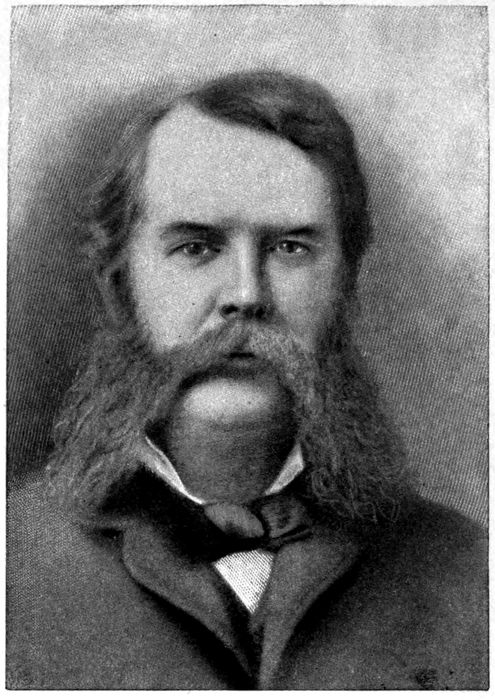
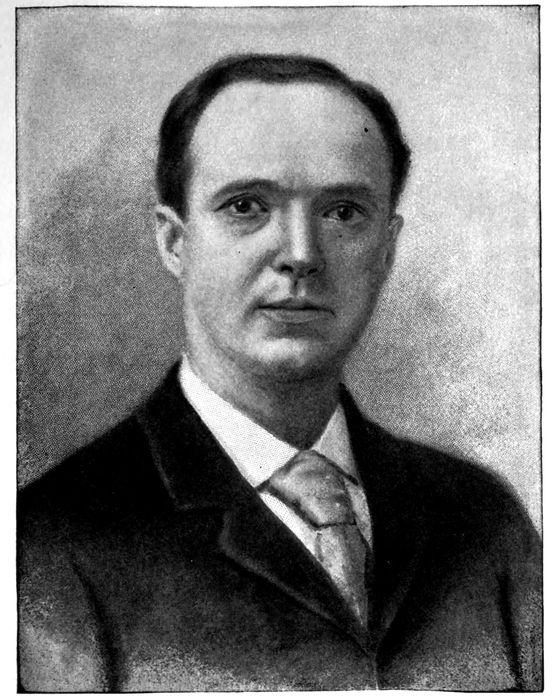
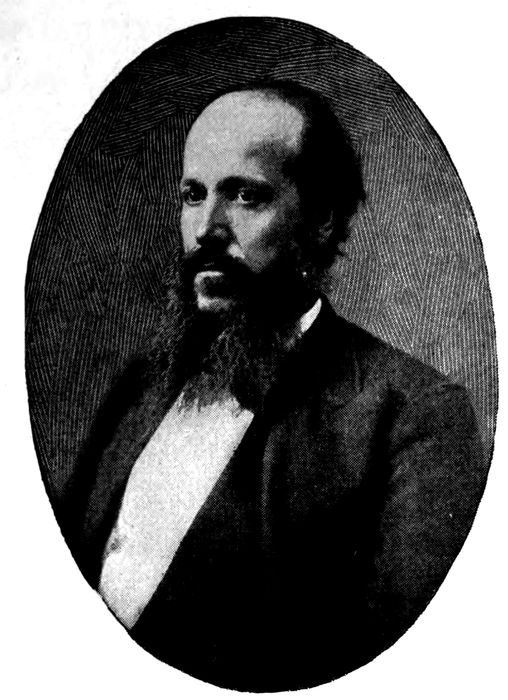
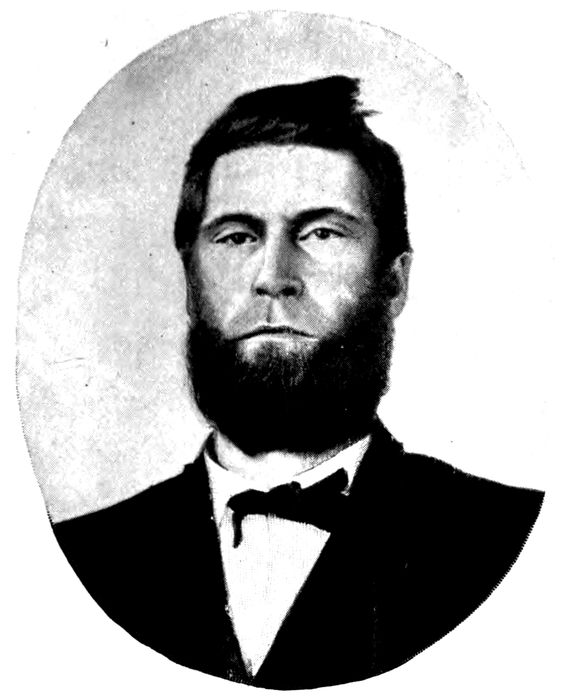
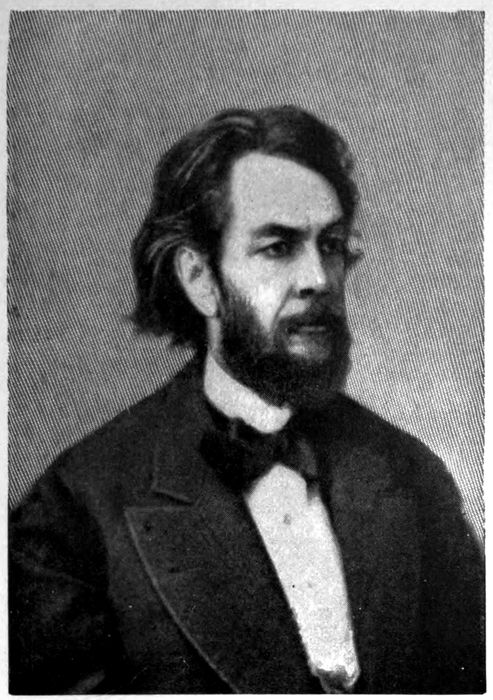
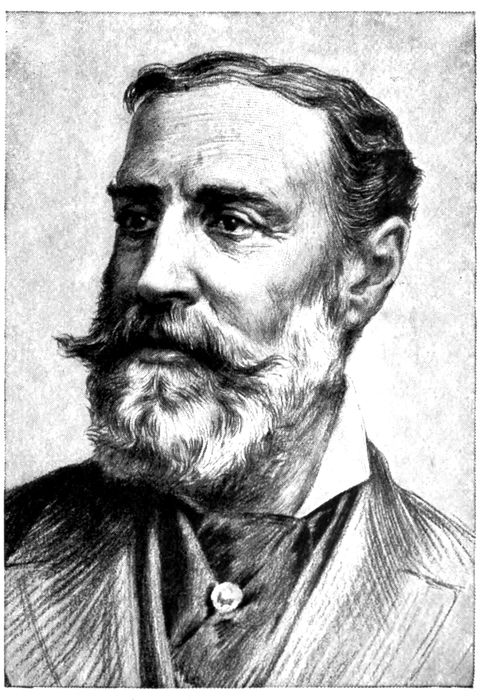
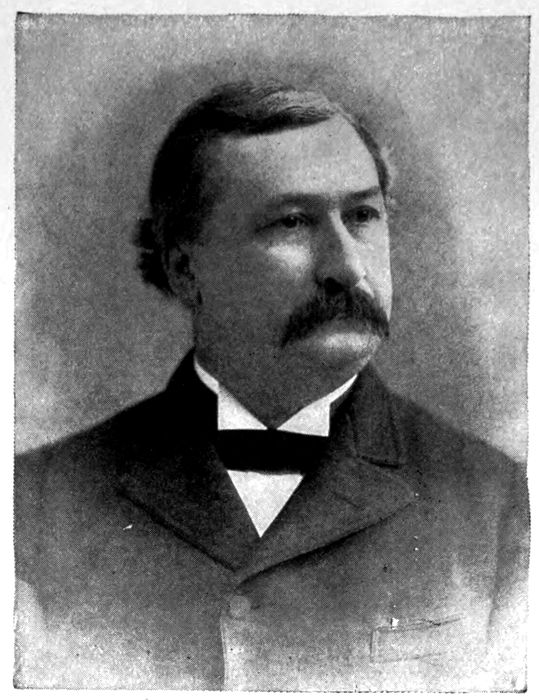
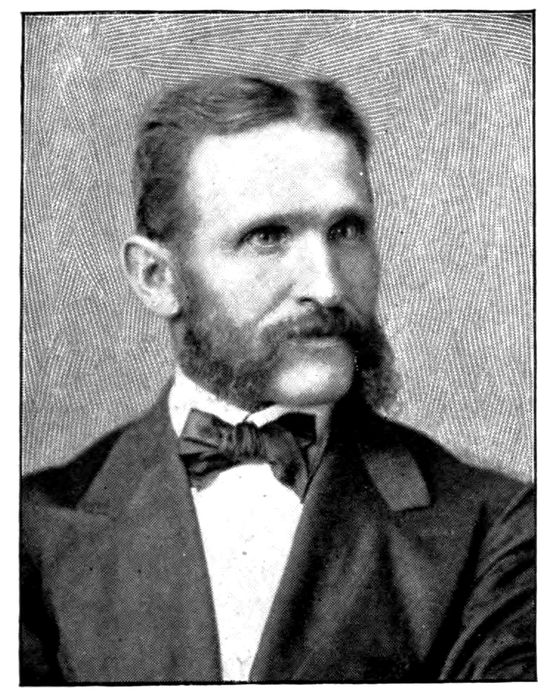
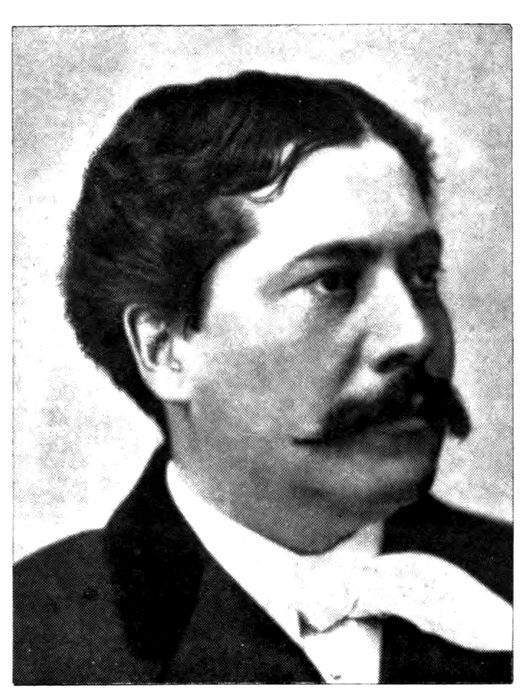
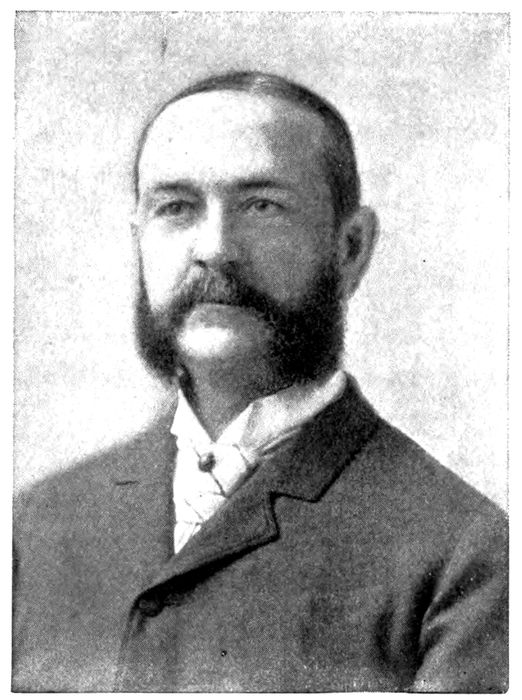
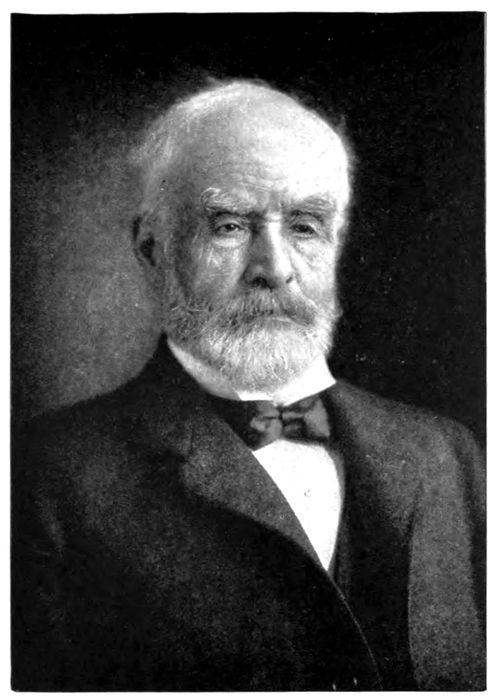
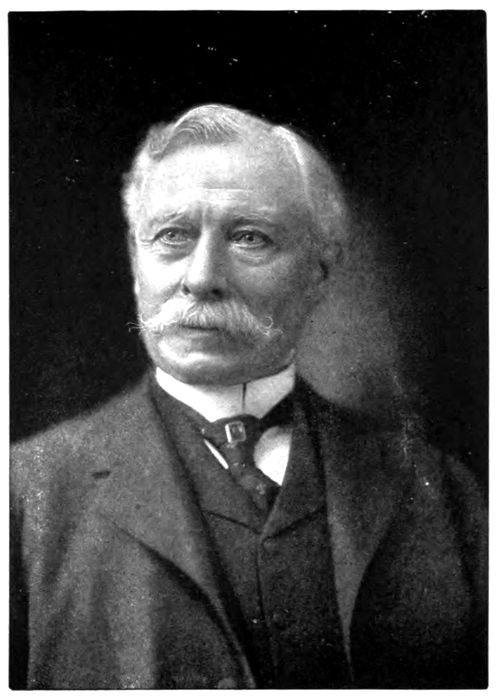
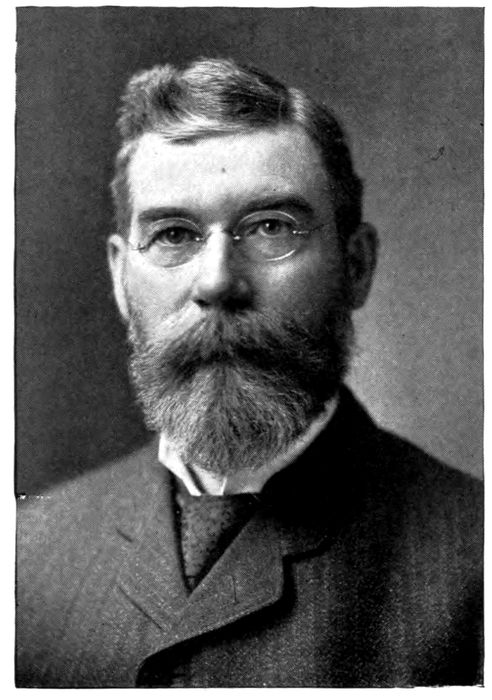
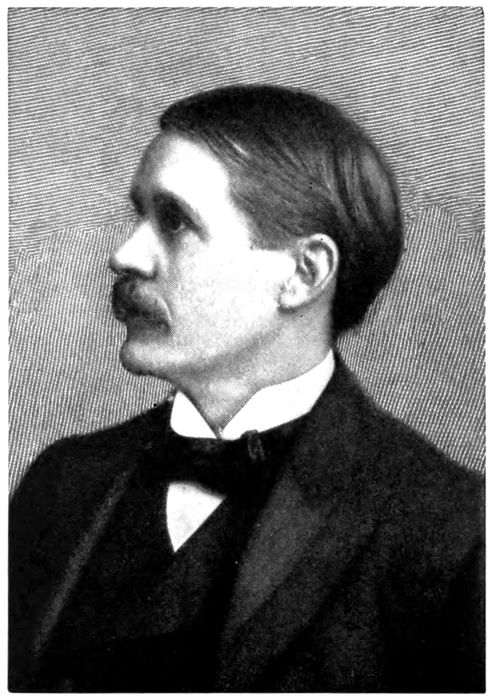
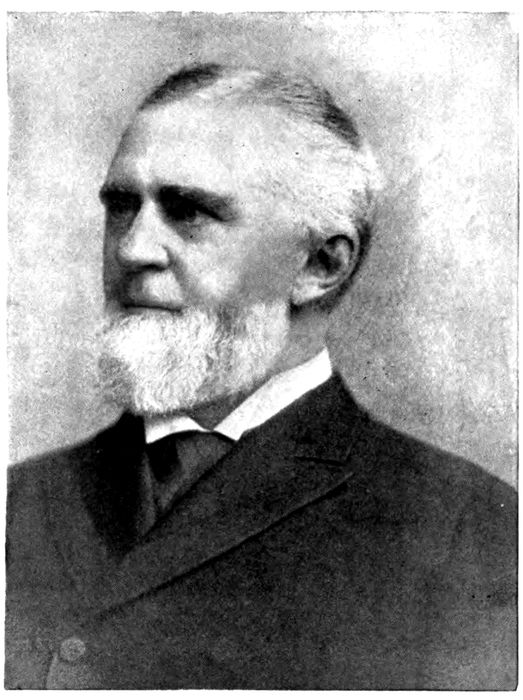
Now vice-president of the Standard Oil Company. Mr. Archbold, whose home, in 1872, was in Titusville, Pennsylvania, although one of the youngest refiners of the Creek, was one of the most active and efficient in breaking up the South Improvement Company.
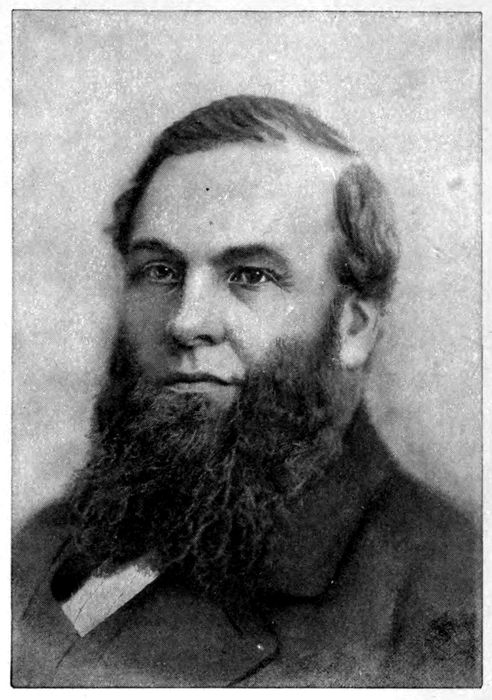
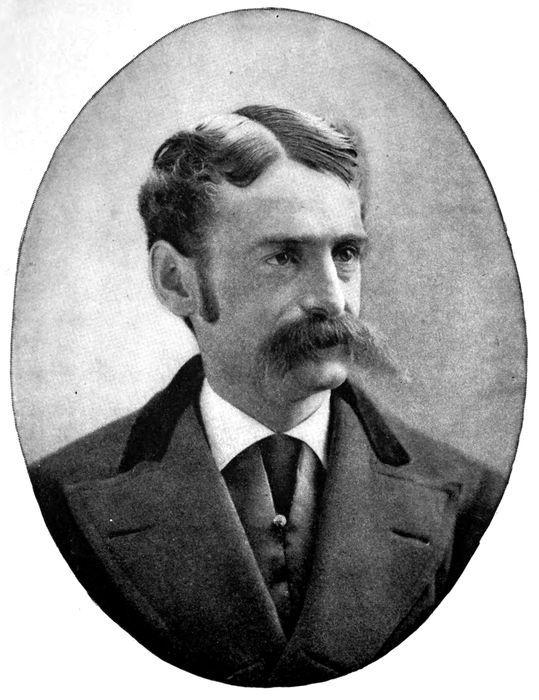
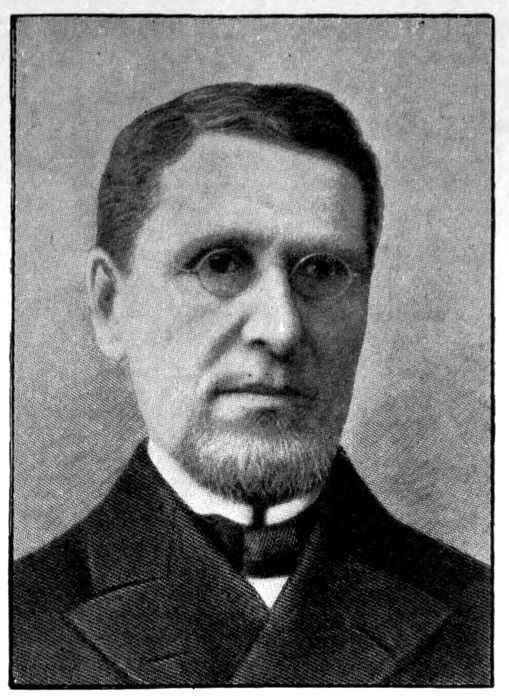
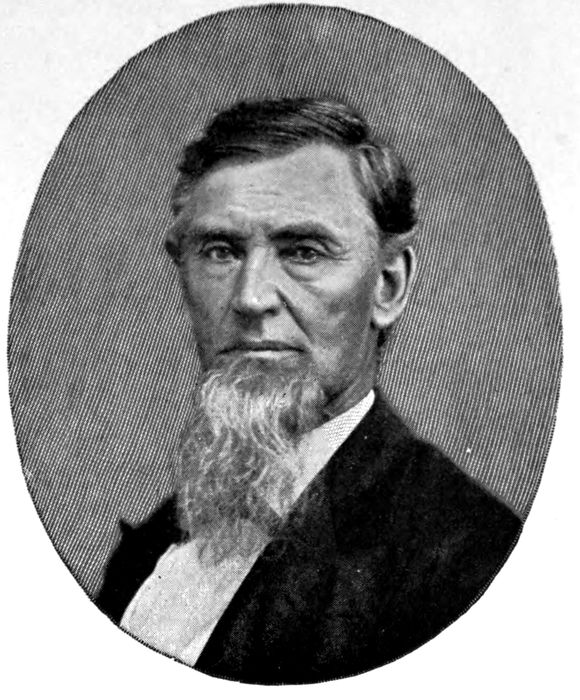
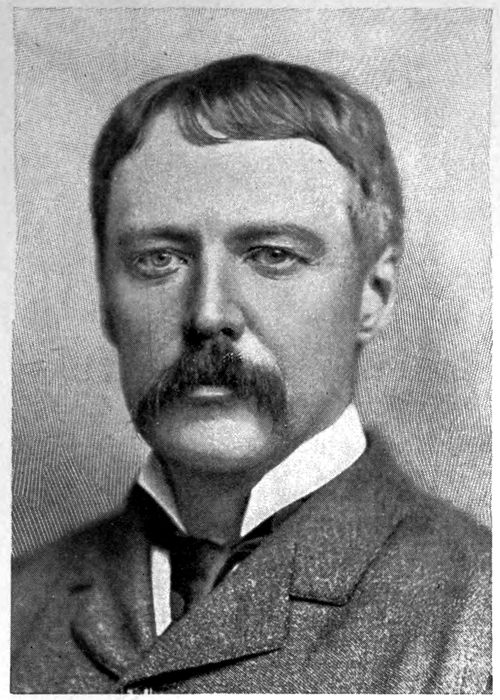
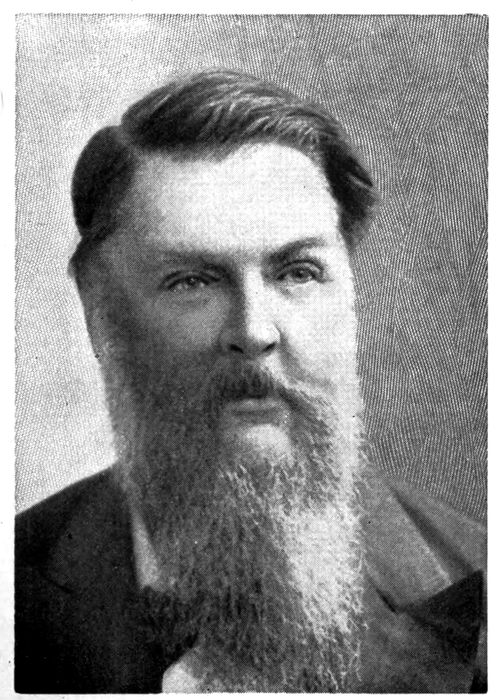
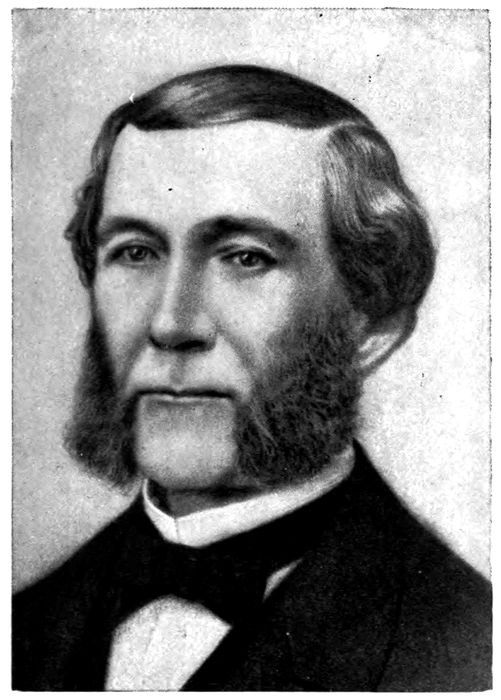
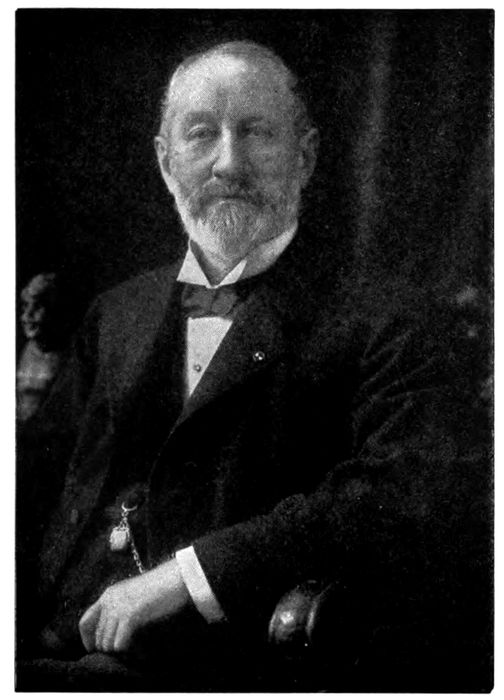
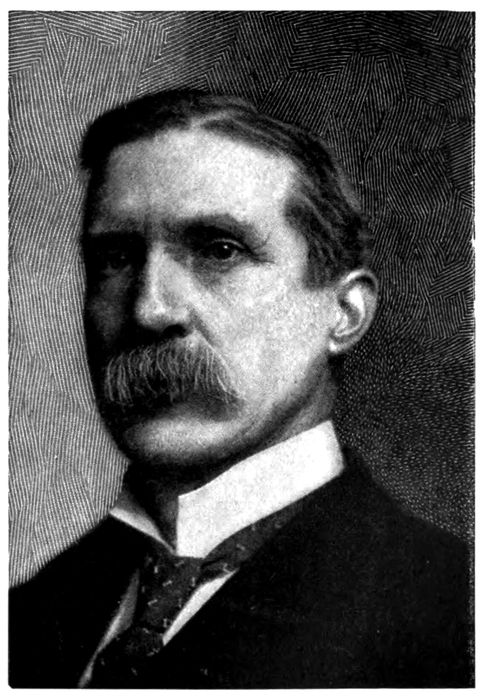
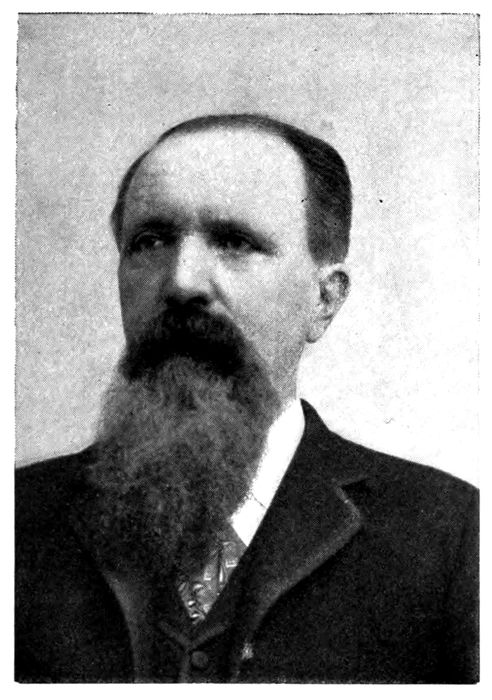
Now president of the National Transit Company and a director of the Standard Oil Company. The opposition to the South Improvement Company among the New York refiners was led by Mr. Rogers.
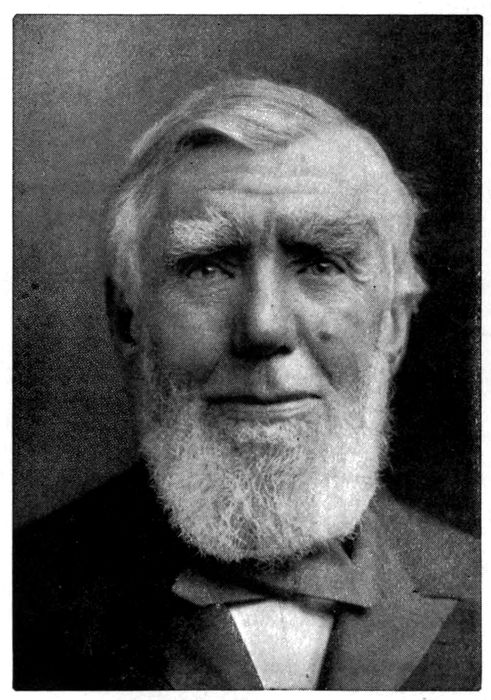
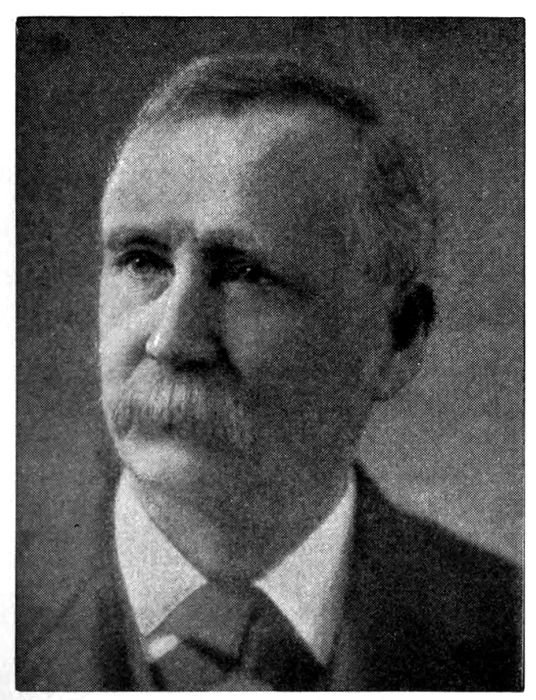
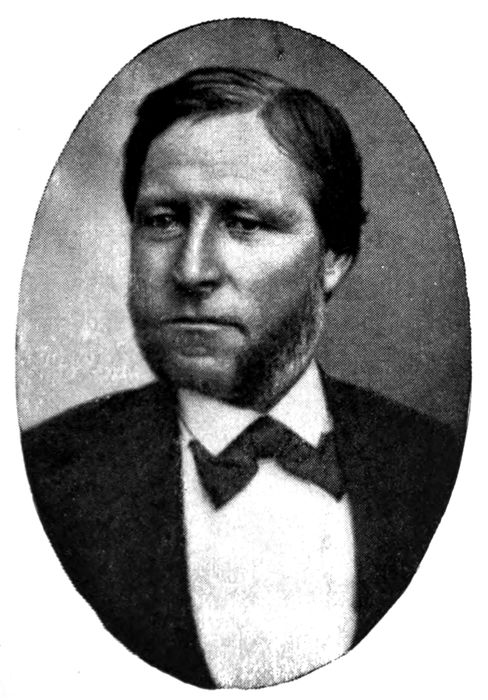
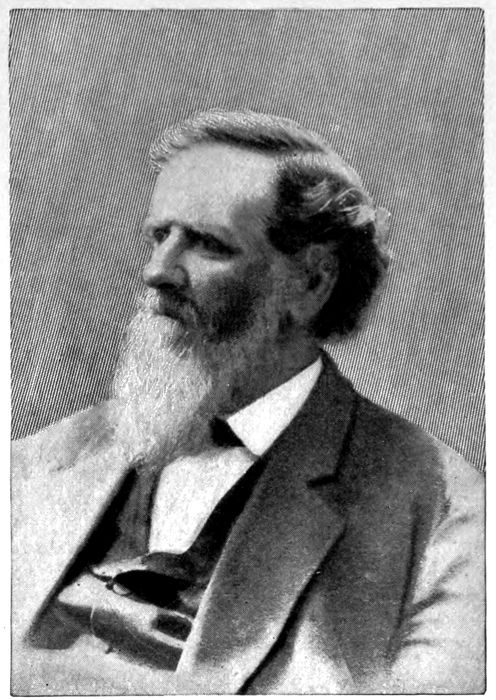
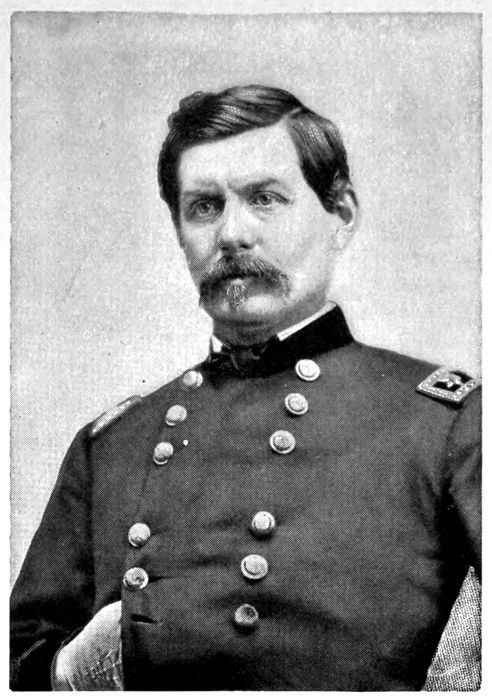
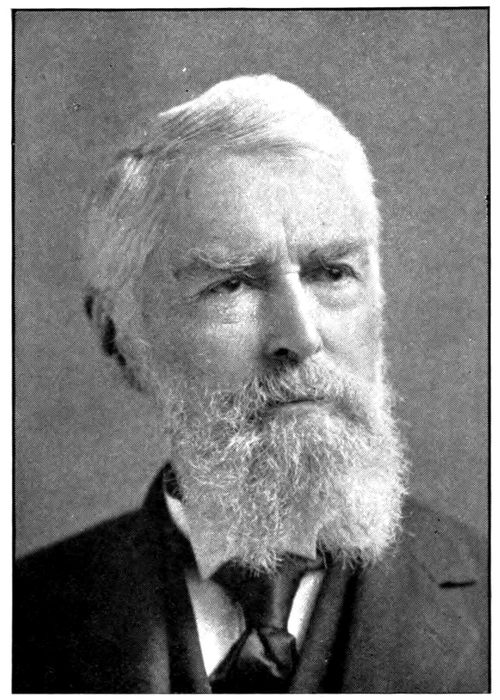
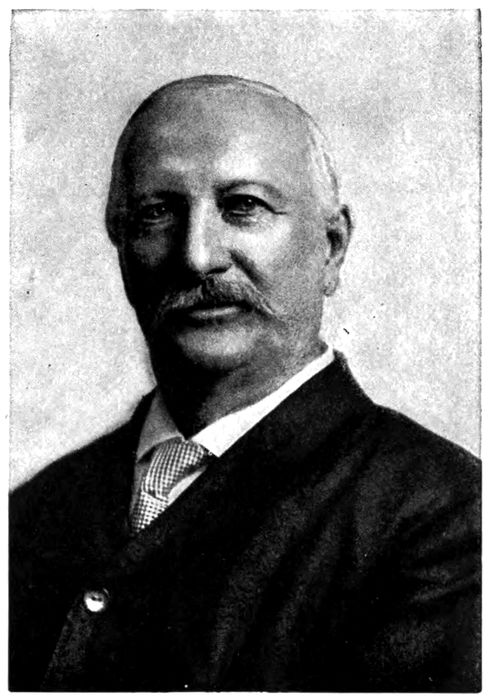
From 1872 to 1880 the chief advocate in the Oil Region of an interstate commerce law. Assisted in drafting the bills of 1876 and 1880. Abandoned the independent interests at the time of the compromise of 1880.
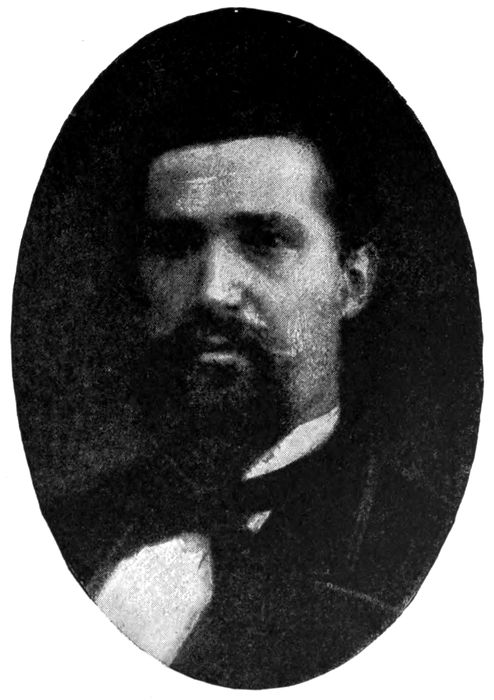
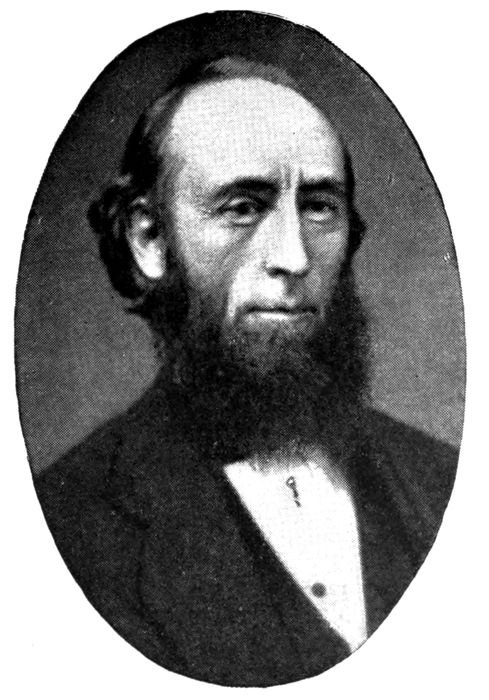
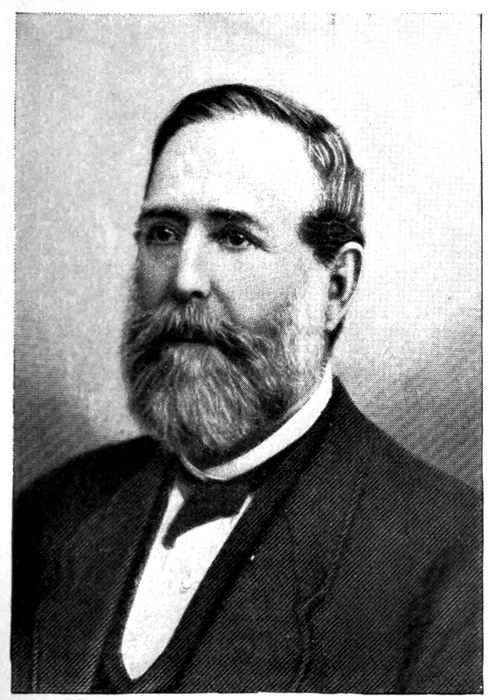
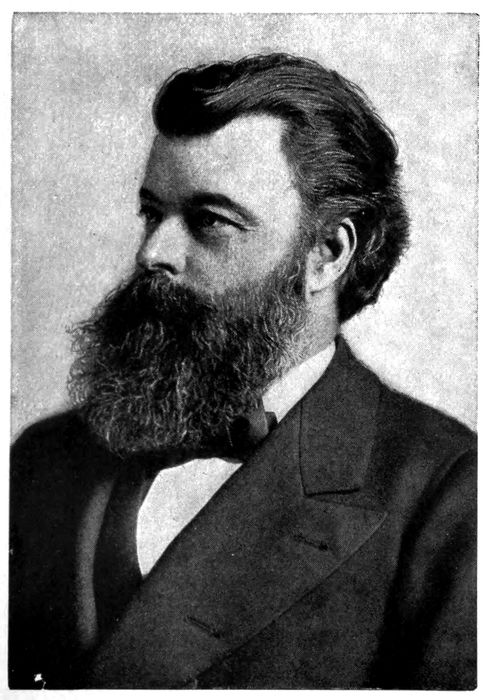
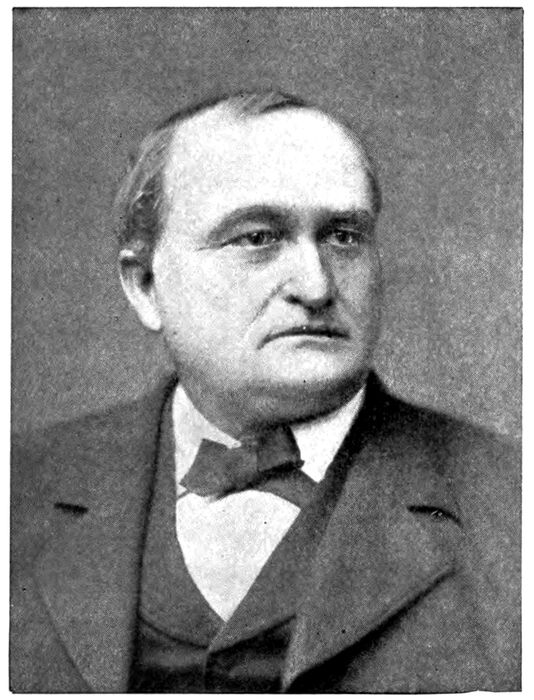
Chief counsel of the Petroleum Producers’ Union from 1878 to 1880. From 1880 to 1885 counsel for the Standard Oil Company. From 1885 to his death in 1893 counsel of the allied independents.
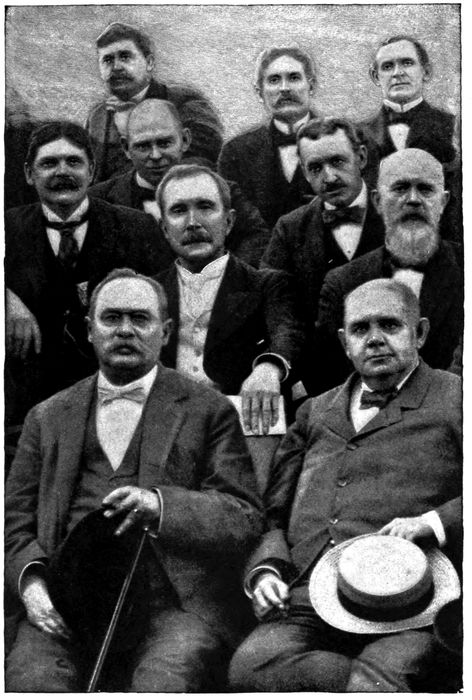
Prominent independent refiner of N. Y. City, whose firm was the only one to keep its contract with the Tidewater Pipe Line Company in 1880.
THE HISTORY OF
THE STANDARD OIL COMPANY
CHAPTER ONE THE BIRTH OF AN INDUSTRY
1003
PETROLEUM FIRST A CURIOSITY AND THEN A MEDICINE—DISCOVERY OF
ITS REAL VALUE—THE STORY OF HOW IT CAME TO BE PRODUCED IN
LARGE QUANTITIES—GREAT FLOW OF OIL—SWARM OF PROBLEMS TO
SOLVE—STORAGE AND TRANSPORTATION—REFINING AND MARKETING—RAPID
EXTENSION OF THE FIELD OF OPERATION—WORKERS IN GREAT
NUMBERS WITH PLENTY OF CAPITAL—COSTLY BLUNDERS FREQUENTLY
MADE—BUT EVERY DIFFICULTY BEING MET AND OVERCOME—THE NORMAL
UNFOLDING OF A NEW AND WONDERFUL OPPORTUNITY FOR INDIVIDUAL
ENDEAVOUR.
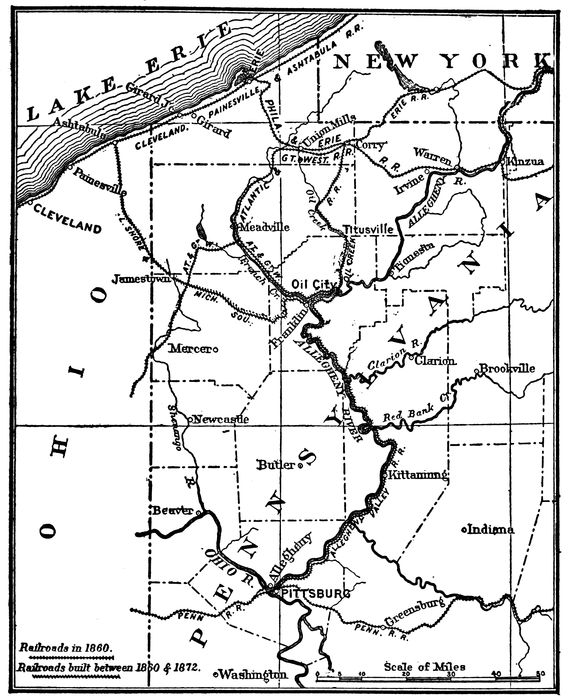
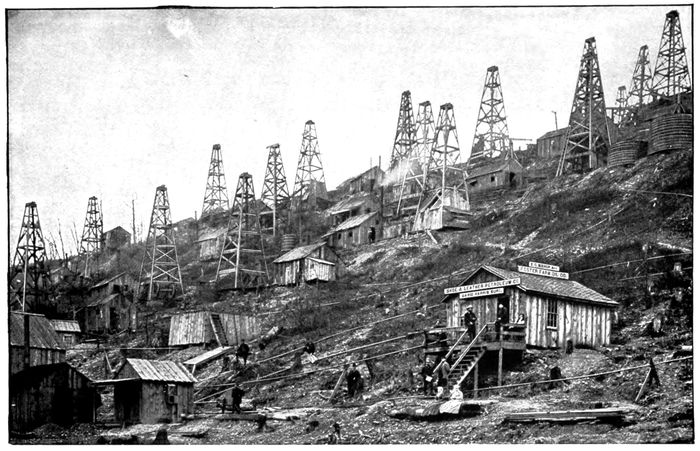
One of the busiest corners of the globe at the opening
of the year 1872 was a strip of Northwestern
Pennsylvania, not over fifty miles long, known the
world over as the Oil Regions. Twelve years before
this strip of land had been but little better than a wilderness;
its chief inhabitants the lumbermen, who every season cut
great swaths of primeval pine and hemlock from its hills,
and in the spring floated them down the Allegheny River
to Pittsburg. The great tides of Western emigration had
shunned the spot for years as too rugged and unfriendly for
settlement, and yet in twelve years this region avoided by
men had been transformed into a bustling trade centre, where
towns elbowed each other for place, into which three great
trunk railroads had built branches, and every foot of whose
soil was fought for by capitalists. It was the discovery and
development of a new raw product, petroleum, which had
made this change from wilderness to market-place. This
product in twelve years had not only peopled a waste place
of the earth, it had revolutionised the world’s methods of
1004illumination and added millions upon millions of dollars to
the wealth of the United States.
Petroleum as a curiosity, and indeed in a small way as an
article of commerce, was no new thing when its discovery in
quantities called the attention of the world to this corner of
Northwestern Pennsylvania. The journals of many an early
explorer of the valleys of the Allegheny and its tributaries tell
of springs and streams the surfaces of which were found covered
with a thick oily substance which burned fiercely when
ignited and which the Indians believed to have curative properties.
As the country was opened, more and more was heard of
these oil springs. Certain streams came to be named from the
quantities of the substance found on the surface of the water,
as “Oil Creek” in Northwestern Pennsylvania, “Old Greasy”
or Kanawha in West Virginia. The belief in the substance
as a cure-all increased as time went on and in various parts
of the country it was regularly skimmed from the surface
of the water as cream from a pan, or soaked up by woollen
blankets, bottled, and peddled as a medicine for man and
beast.
Up to the beginning of the 19th century no oil seems to
have been obtained except from the surfaces of springs and
streams. That it was to be found far below the surface of
the earth was discovered independently at various points in
Kentucky, West Virginia, Ohio and Pennsylvania by persons
drilling for salt-water to be used in manufacturing salt.
Not infrequently the water they found was mixed with a
dark-green, evil-smelling substance which was recognised as
identical with the well-known “rock-oil.” It was necessary
to rid the water of this before it could be used for salt, and
in many places cisterns were devised in which the brine was
allowed to stand until the oil had risen to the surface. It was
then run into the streams or on the ground. This practice was
soon discovered to be dangerous, so easily did the oil ignite.
1005In several places, particularly in Kentucky, so much oil was
obtained with the salt-water that the wells had to be abandoned.
Certain of these deserted salt wells were opened years
after, when it was found that the troublesome substance which
had made them useless was far more valuable than the brine
the original drillers sought.
Naturally the first use made of the oil obtained in quantities
from the salt wells was medicinal. By the middle of the
century it was without doubt the great American medicine.
“Seneca Oil” seems to have been the earliest name under
which petroleum appeared in the East. It was followed by
a large output of Kentucky petroleum sold under the name
“American Medicinal Oil.” Several hundred thousand bottles
of this oil are said to have been put up in Burkesville,
Kentucky, and to have been shipped to the East and to
Europe. The point at which the business of bottling petroleum
for medicine was carried on most systematically and
extensively was Pittsburg. Near that town, at Tarentum in
Alleghany County, were located salt wells owned and operated
in the forties by Samuel M. Kier. The oil which came
up with the salt-water was sufficient to be a nuisance, and Mr.
Kier sought a way to use it. Believing it had curative qualities
he began to bottle it. By 1850 he had worked up this
business until “Kier’s Petroleum, or Rock-Oil” was sold all
over the United States. The crude petroleum was put up in
eight-ounce bottles wrapped in a circular setting forth in
good patent-medicine style its virtues as a cure-all, and giving
directions about its use. While it was admitted to be
chiefly a liniment it was recommended for cholera morbus,
liver complaint, bronchitis and consumption, and the dose
prescribed was three teaspoonfuls three times a day! Mr.
Kier’s circulars are crowded with testimonials of the efficacy
of rock-oil, dated anywhere between 1848 and 1853.
Although his trade in this oil was so extensive he was not
1006satisfied that petroleum was useful only as a medicine. He
was interested in it as a lubricator and a luminant. That
petroleum had the qualities of both had been discovered at
more than one point before 1850. More than one mill-owner
in the districts where petroleum had been found was using
it in a crude way for oiling his machines or lighting his
works, but though the qualities of both lubricator and luminant
were present, the impurities of the natural oil were too
great to make its use general. Mr. Kier seems to have been
the first man to have attempted to secure an expert opinion
as to the possibility of refining it. In 1849 he sent a bottle of
oil to a chemist in Philadelphia, who advised him to try distilling
it and burning it in a lamp. Mr. Kier followed the
advice, and a five-barrel still which he used in the fifties
for refining petroleum is still to be seen in Pittsburg. His
trade in the oil he produced at his little refinery was not
entirely local, for in 1858 we find him agreeing to sell to
Joseph Coffin of New York at 62½ cents a gallon 100
barrels of “carbon oil that will burn in the ordinary coal-oil
lamp.”
Although Mr. Kier seems to have done a good business
in rock-oil, neither he nor any one else up to this point had
thought it worth while to seek petroleum for its own sake.
They had all simply sought to utilise what rose before their
eyes on springs and streams or came to them mixed with the
salt-water for which they drilled. In 1854, however, a man
was found who took rock-oil more seriously. This man was
George H. Bissell, a graduate of Dartmouth College, who,
worn out by an experience of ten years in the South as a
journalist and teacher, had come North for a change. At his
old college the latest curiosity of the laboratory was shown
him—the bottle of rock-oil—and the professor contended that
it was as good, or better, than coal for making illuminating
oil. Bissell inquired into its origin, and was told that it came
1007from oil springs located in Northwestern Pennsylvania on
the farm of a lumber firm, Brewer, Watson and Company.
These springs had long yielded a supply of oil which was regularly
collected and sold for medicine, and was used locally by
mill-owners for lighting and lubricating purposes.
Bissell seems to have been impressed with the commercial
possibilities of the oil, for he at once organised a company,
the Pennsylvania Rock-Oil Company, the first in the United
States, and leased the lands on which these oil springs were
located. He then sent a quantity of the oil to Professor Silliman
of Yale College, and paid him for analysing it. The
professor’s report was published and received general attention.
From the rock-oil might be made as good an illuminant
as any the world knew. It also yielded gas, paraffine, lubricating
oil. “In short,” declared Professor Silliman, “your
company have in their possession a raw material from which,
by simple and not expensive process, they may manufacture
very valuable products. It is worthy of note that my experiments
prove that nearly the whole of the raw product may
be manufactured without waste, and this solely by a well-directed
process which is in practice in one of the most simple
of all chemical processes.”[1]
The oil was valuable, but could it be obtained in quantities
great enough to make the development of so remote a
locality worth while? The only method of obtaining it known
to Mr. Bissell and his associates in the new company was
from the surface of oil springs. Could it be obtained in
any other way? There has long been a story current in the
Oil Regions that the Pennsylvania Rock-Oil Company received
its first notion of drilling for oil from one of those
trivial incidents which so often turn the course of human
affairs. As the story goes, Mr. Bissell was one day walking
down Broadway when he halted to rest in the shade of an
1008awning before a drug store. In the window he saw on a
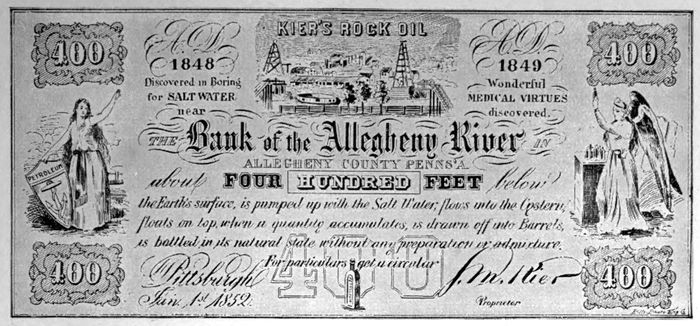
bottle a curious label, “Kier’s Petroleum, or Rock-Oil,” it
read, “Celebrated for its wonderful curative powers. A
natural Remedy; Produced from a well in Allegheny Co.,
Pa., four hundred feet below the earth’s surface,” etc. On
the label was the picture of an artesian well. It was from
this well that Mr. Kier got his “Natural Remedy.” Hundreds
of men had seen the label before, for it went out on
every one of Mr. Kier’s circulars, but this was the first to
look at it with a “seeing eye.” As quickly as the bottle of
rock-oil in the Dartmouth laboratory had awakened in Mr.
Bissell’s mind the determination to find out the real value of
the strange substance, the label gave him the solution of the
problem of getting oil in quantities—it was to bore down
into the earth where it was stored, and pump it up.
Professor Silliman made his report to the Pennsylvania
Rock-Oil Company in 1855, but it was not until the spring
of 1858 that a representative of the organisation, which by
this time had changed hands and was known as the Seneca
Oil Company, was on the ground with orders to find oil.
The man sent out was a small stockholder in the company,
Edwin L. Drake, “Colonel” Drake as he was called. Drake
had had no experience to fit him for his task. A man forty
years of age, he had spent his life as a clerk, an express agent,
and a railway conductor. His only qualifications were a dash
of pioneer blood and a great persistency in undertakings
which interested him. Whether Drake came to Titusville
ordered to put down an artesian well or not is a mooted
point. His latter-day admirers claim that the idea was entirely
his own. It seems hardly credible that men as intelligent as
Professor Silliman, Mr. Bissell, and others interested in the
Pennsylvania Rock-Oil Company, should not have taken
means of finding out how the familiar “Kier’s Rock-Oil”
was obtained. Professor Silliman at least must have known
of the quantities of oil which had been obtained in different
states in drilling salt wells; indeed, in his report (see Appendix,
Number 1) he speaks of “wells sunk for the purpose of
accumulating the product.” In the “American Journal of Science”
for 1840—of which he was one of the editors—is an account
of a famous oil well struck near Burkesville, Kentucky,
about 1830, when drilling for salt. It seems probable that the
idea of seeking oil on the lands leased by the Petroleum Rock-Oil
Company by drilling artesian wells had been long discussed
by the gentlemen interested in the venture, and that
Drake came to Titusville with instructions to put down a
well. It is certain, at all events, that he was soon explaining
to his superiors at home the difficulty of getting a driller, an
engine-house and tools, and that he was employing the interval
in trying to open new oil springs and make the old ones
more profitable.
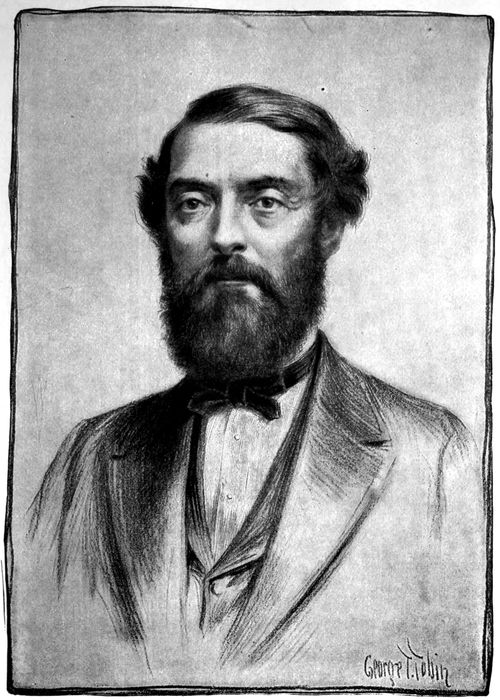
E. L. DRAKE
In 1859 Drake drilled near Titusville, Pennsylvania, the first artesian well put down for petroleum. He is popularly said to have “discovered oil.”
1009The task before Drake was no light one. The spot to which
he had been sent was Titusville, a lumberman’s hamlet on
Oil Creek, fourteen miles from where that stream joins the
Allegheny River. Its chief connection with the outside world
was by a stage to Erie, forty miles away. This remoteness
from civilisation and Drake’s own ignorance of artesian
wells, added to the general scepticism of the community
concerning the enterprise, caused great difficulty and long
delays. It was months before Drake succeeded in getting
together the tools, engine and rigging necessary to bore his
well, and before he could get a driller who knew how to
manipulate them, winter had come, and he had to suspend
operations. People called him crazy for sticking to the enterprise,
but that had no effect on him. As soon as spring opened
he borrowed a horse and wagon and drove over a hundred
miles to Tarentum, where Mr. Kier was still pumping his
salt wells, and was either bottling or refining the oil which
came up with the brine. Here Drake hoped to find a driller.
1010He brought back a man, and after a few months more of
experiments and accidents the drill was started. One day late
in August, 1859, Titusville was electrified by the news that
Drake’s Folly, as many of the onlookers had come to consider
it, had justified itself. The well was full of oil. The
next day a pump was started, and twenty-five barrels of oil
were gathered.
There was no doubt of the meaning of the Drake well
in the minds of the people of the vicinity. They had long
ago accepted all Professor Silliman had said of the possibilities
of petroleum, and now that they knew how it could be
obtained in quantity, the whole countryside rushed out to
obtain leases. The second well in the immediate region was
drilled by a Titusville tanner, William Barnsdall—an Englishman
who at his majority had come to America to make
his fortune. He had fought his way westward, watching
always for his chance. The day the Drake well was struck he
knew it had come. Quickly forming a company he began to
drill a well. He did not wait for an engine, but worked his
drill through the rock by a spring pole.[2] It took three months,
and cost $3,000 to do it, but he had his reward. On February
1, 1860, he struck oil—twenty-five barrels a day—and oil was
selling at eighteen dollars a barrel. In five months the English
tanner had sold over $16,000 worth of oil.
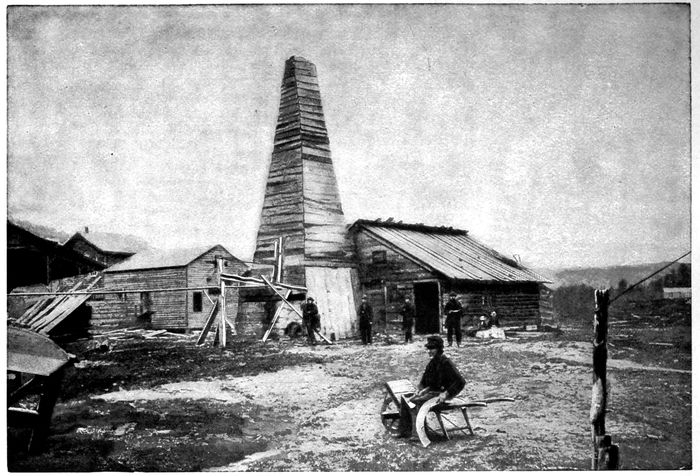
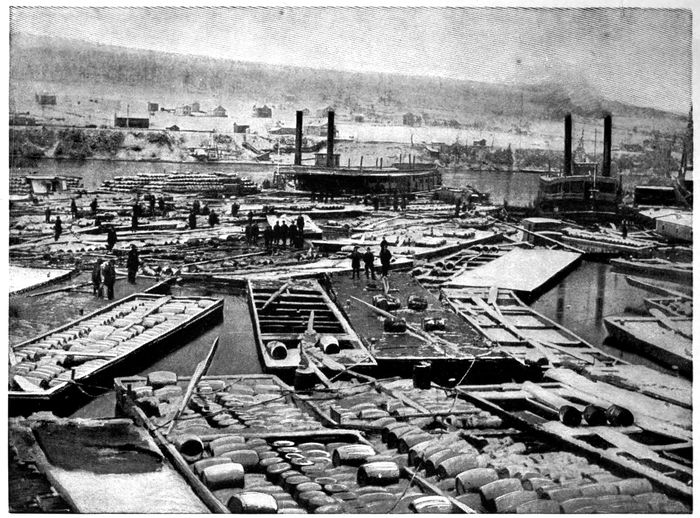
THE DRAKE WELL IN 1859. THE FIRST OIL WELL.
1011A lumberman and merchant of the village, who long had
had faith in petroleum if it could be had in quantity, Jonathan
Watson, one of the firm of Brewer, Watson and Company,
whose land the Pennsylvania Rock-Oil Company had leased,
mounted his horse as soon as he heard of the Drake well, and,
riding down the valley of Oil Creek, spent the day in leasing
farms. He soon had the third well of the region going down,
this too by a spring pole. This well started off in March at
sixty gallons a minute, and oil was selling at sixty cents a
gallon. In two years the farm where this third well was
struck had produced 165,000 barrels of oil.
Working an unfriendly piece of land a few miles below
the Drake well lived a man of thirty-five. Setting out for
himself at twenty-two, he had won his farm by the most
dogged efforts, working in sawmills, saving his earnings,
buying a team, working it for others until he could take up
a piece of land, hoarding his savings here. For what? How
could he know? He knew well enough when Drake struck
oil, and hastened out to buy a share in a two-acre farm. He
sold it at a profit, and with the money put down a well, from
which he realised $70,000. A few years later the farm he
had slaved to win came into the field. In 1871 he refused a
million dollars for it, and at one time he had stored there
200,000 barrels of oil.
A young doctor who had buried himself in the wilderness
saw his chance. For a song he bought thirty-eight acres on
the creek, six miles below the Drake well, and sold half of
it for the price he had paid to a country storekeeper and
lumberman of the vicinity, one Charles Hyde. Out of this
thirty-eight acres millions of dollars came; one well alone—the
Mapleshade—cleared one and one-half millions.
On every rocky farm, in every poor settlement of the
1012region, was some man whose ear was attuned to Fortune’s
call, and who had the daring and the energy to risk everything
he possessed in an oil lease. It was well that he acted
at once; for, as the news of the discovery of oil reached the
open, the farms and towns of Ohio, New York, and Pennsylvania
poured out a stream of ambitious and vigorous
youths, eager to seize what might be there for them, while
from the East came men with money and business experience,
who formed great stock companies, took up lands in parcels
of thousands of acres, and put down wells along every rocky
run and creek, as well as over the steep hills. In answer to
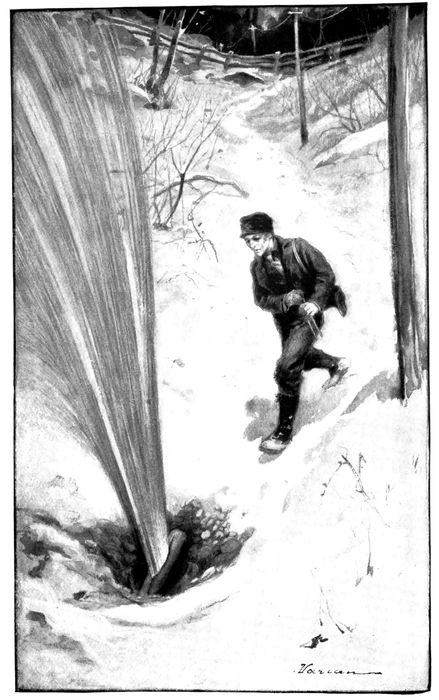
their drill, oil poured forth in floods. In many places pumping
was out of the question; the wells flowed 2,000, 3,000,
4,000 barrels a day—such quantities of it that at the close
of 1861 oil which in January of 1860 was twenty dollars a
barrel had fallen to ten cents.
Here was the oil, and in unheard-of quantities, and with
it came all the swarm of problems which a discovery brings.
The methods Drake had used were crude and must be improved.
The processes of refining were those of the laboratory
and must be developed. Communication with the outside
world must be secured. Markets must be built up. Indeed,
a whole new commercial machine had to be created to meet
the discovery. These problems were not realised before the
region teemed with men to wrestle with them—men “alive
to the instant need of things.” They had to begin with so
simple and elementary a matter as devising something to
hold the oil. There were not barrels enough to be bought
in America, although turpentine barrels, molasses barrels,
whiskey barrels—every sort of barrel and cask—were added
to new ones made especially for oil. Reservoirs excavated in
the earth and faced with logs and cement, and box-like
structures of planks or logs were tried at first but were not
satisfactory. A young Iowa school teacher and farmer, visiting
1013at his home in Erie County, went to the region. Immediately
he saw his chance. It was to invent a receptacle which
would hold oil in quantities. Certain large producers listened
to his scheme and furnished money to make a trial tank. It
was a success, and before many months the school teacher
was buying thousands of feet of lumber, employing scores
of men, and working them and himself—day and night. For
nearly ten years he built these wooden tanks. Then seeing
that iron tanks—huge receptacles holding thousands of barrels
where his held hundreds—were bound to supersede him,
he turned, with the ready adaptability which characterised
the men of the region, to producing oil for others to tank.
After the storing problem came that of transportation.
There was one waterway leading out—Oil Creek, as it had
been called for more than a hundred years,—an uncertain
stream running the length of the narrow valley in which the
oil was found, and uniting with the Allegheny River at what
is now known as Oil City. From this junction it was 132
miles to Pittsburg and a railroad. Besides this waterway were
rough country roads leading to the railroads at Union City,
Corry, Erie and Meadville. There was but one way to get
the oil to the bank of Oil Creek or to the railroads, and that
was by putting it into barrels and hauling it. Teamsters
equipped for this service seemed to fall from the sky. The
farms for a hundred miles around gave up their boys and
horses and wagons to supply the need. It paid. There were
times when three and even four dollars a barrel were paid
for hauling five or ten miles. It was not too much for the
work. The best roads over which they travelled were narrow,
rough, unmade highways, mere openings to the outer world,
while the roads to the wells they themselves had to break
across fields and through forests. These roads were made
almost impassable by the great number of heavily freighted
wagons travelling over them. From the big wells a constant
1014procession of teams ran, and it was no uncommon thing for
a visitor to the Oil Regions to meet oil caravans of a hundred
or more wagons. Often these caravans were held up for
hours by a dangerous mud-hole into which a wheel had sunk
or a horse fallen. If there was a possible way to be made
around the obstruction it was taken, even if it led through a
farmer’s field. Indeed, a sort of guerilla warfare went on
constantly between the farmers and the teamsters. Often the
roads became impassable, so that new ones had to be broken,
and not even a shot-gun could keep the driver from going
where the passage was least difficult. The teamster, in fact,
carried a weapon which few farmers cared to face, his terrible
“black snake,” as his long, heavy black whip was called.
The man who had once felt the cruel lash of a “black snake”
around his legs did not often oppose the owner.
With the wages paid him the teamster could easily become
a kind of plutocrat. One old producer tells of having a
teamster in his employ who for nine weeks drew only enough
of his earnings to feed himself and horses. He slept in his
wagon and tethered the team. At the end of the time he
“thought he’d go home for a clean shirt” and asked for a
settlement. It was found that he had $1,900 to his credit. The
story is a fair illustration both of the habits and the earnings
of the Oil Creek teamsters. Indispensable to the business they
became the tyrants of the region—working and brawling as
suited them, a genius not unlike the flatboat-men who once
gave colour to life on the Mississippi, or the cowboys who
make the plains picturesque to-day. Bad as their reputation
was, many a man found in their ranks the start which led later
to wealth and influence in the oil business. One of the shrewdest,
kindest, oddest men the Oil Regions ever knew, Wesley
Chambers, came to the top from the teamster class. He had
found his way to the creek after eight years of unsuccessful
gold-hunting in California. “There’s my chance,” he said,
1015when he saw the lack of teams and boats, and he set about
organising a service for transporting oil to Pittsburg. In a
short time he was buying horses of his own and building
boats. Wide-awake to actualities, he saw a few years later that
the teamster and the boat were to be replaced by the pipe-line
and the railroad, and forestalled the change by becoming
a producer.
In this problem of transportation the most important element
after the team was Oil Creek and the flatboat. A more
uncertain stream never ran in a bed. In the summer it was
low, in the winter frozen; now it was gorged with ice, now
running mad over the flats. The best service was gotten out
of it in time of low water through artificial freshets. Milldams,
controlled by private parties, were frequent along the
creek and its tributaries. By arrangement these dams were
cut on a certain day or days of the week, usually Friday, and
on the flood or freshet the flatboats loaded with barrels of
oil were floated down stream. The freshet was always exciting
and perilous and frequently disastrous. From the points
where they were tied up the boatmen watched the coming
flood and cut themselves loose the moment after its head had
passed them. As one fleet after another swung into the roaring
flood the danger of collision and jams increased. Rare
indeed was the freshet when a few wrecks did not lie somewhere
along the creek, and often scores lay piled high on
the bank—a hopeless jam of broken boats and barrels, the
whole soaked in petroleum and reeking with gas and profanity.
If the boats rode safely through to the river, there was
little further danger.
The Allegheny River traffic grew to great proportions—fully
1,000 boats and some thirty steamers were in the fleet,
and at least 4,000 men. This traffic was developed by men
who saw here their opportunity of fortune, as others had
seen it in drilling or teaming. The foremost of these men
1016was an Ohio River captain, driven northward by the war,
one J. J. Vandergrift. Captain Vandergrift had run the full
gamut of river experiences from cabin-boy to owner and
commander of his own steamers. The war stopped his Mississippi
River trade. Fitting up one of his steamers as a
gun-boat, he turned it over to Commodore Foote and looked
for a new stream to navigate. From the Oil Region at that
moment the loudest cry was for barrels. He towed 4,000
empty casks up the river, saw at once the need of some kind
of bulk transportation, took his hint from a bulk-boat which
an ingenious experimenter was trying, ordered a dozen of
them built, towed his fleet to the creek, bought oil to fill
them, and then returned to Pittsburg to sell his cargo. On
one alone he made $70,000.
But the railroad soon pressed the river hard. At the time
of the discovery of oil three lines, the Philadelphia and Erie,
the Buffalo and Erie (now the Lake Shore), connecting with
the Central, and the Atlantic and Great Western, connecting
with the Erie, were within teaming distance of the region.
The points at which the Philadelphia and Erie road could
be reached were Erie, forty miles from Titusville, Union
City, twenty-two miles, and Corry, sixteen miles. The Buffalo
and Erie was reached at Erie. The Atlantic and Great
Western was reached at Meadville, Union City and Corry,
and the distances were twenty-eight, twenty-two and sixteen
miles, respectively. Erie was the favourite shipping point at
first, as the wagon road in that direction was the best. The
amount of freight the railroads carried the first year of the
business was enormous. Of course connecting lines were built
as rapidly as men could work. By the beginning of 1863 the
Oil Creek road, as it was known, had reached Titusville from
Corry. This gave an eastern connection by both the Philadelphia
and Erie and the Atlantic and Great Western, but
as the latter was constructing a branch from Meadville to
1017Franklin, the Oil Creek road became the feeder of the former
principally. Both of these roads were completed to Oil
City by 1865.
The railroads built, the vexatious, time-taking, and costly
problem of getting the oil from the well to the shipping
point still remained. The teamster was still the tyrant of the
business. His day was almost over. He was to fall before the
pipe-line. The feasibility of carrying oil in pipes was discussed
almost from the beginning of the oil business. Very
soon after the Drake well was struck oil men began to say
that the natural way to get this oil from the wells to the railroads
was through pipes. In many places gravity would
carry it; where it could not, pumps would force it. The belief
that this could be done was so strong that as early as February,
1862, a company was incorporated in Pennsylvania for
carrying oil in pipes or tubes from any point on Oil Creek
to its mouth or to any station on the Philadelphia and Erie
Railroad. This company seems never to have done more than
get a charter. In 1863 at least three short pipe-lines were put
into operation. The first of these was a two–inch pipe, through
which distillate was pumped a distance of three miles from
the Warren refinery at Plumer to Warren’s Landing on the
Allegheny River. The one which attracted the most attention
was a line two and one-half miles in length carrying crude
oil from the Tarr farm to the Humboldt refinery at Plumer.
Various other experiments were made, both gravity and
pumps being trusted for propelling the oil, but there was
always something wrong; the pipes leaked or burst, the
pumps were too weak; shifting oil centres interrupted experiments
which might have been successful. Then suddenly the
man for the need appeared, Samuel Van Syckel. He came
to the creek in 1864 with some money, hoping to make more.
He handled quantities of oil produced at Pithole, several
miles from a shipping point, and saw his profits eaten up
1018by teamsters. Their tyranny aroused his ire and his wits and
he determined to build a pipe-line from the wells to the railroad.
He was greeted with jeers, but he went doggedly ahead,
laid a two–inch pipe, put in three relay pumps, and turned
in his oil. From the start the line was a success, carrying
eighty barrels of oil an hour. The day that the Van Syckel
pipe-line began to run oil a revolution began in the business.
After the Drake well it is the most important event in the
history of the Oil Regions.
The teamsters saw its meaning first and turned out in fury,
dragging the pipe, which was for the most part buried, to the
surface, and cutting it so that the oil would be lost. It was
only by stationing an armed guard that they were held in
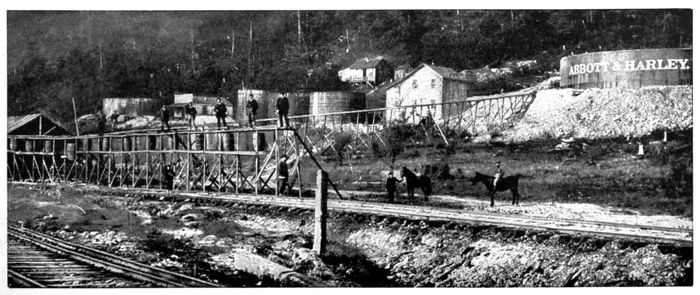
check. A second line of importance, that of Abbott and
Harley, suffered even more than that of Van Syckel. The
teamsters did more than cut the pipe; they burned the tanks
in which oil was stored, laid in wait for employees, threatened
with destruction the wells which furnished the oil, and so
generally terrorised the country that the governor of the
state was called upon in April, 1866, to protect the property
and men of the lines. The day of the teamster was over,
however, and the more philosophical of them accepted the
situation; scores disappeared from the region, and scores more
took to drilling. They died hard, and the cutting and plugging
of pipe-lines was for years a pastime of the remnant of
their race.
If the uses to which oil might be put and the methods for
manufacturing it had not been well understood when the
Drake well was struck, there would have been no such imperious
demand as came for the immediate opening of new
territory and developing methods of handling and carrying
it on a large scale. But men knew already what the oil
was good for, and, in a crude way, how to distil it.
The process of distillation also was free to all. The essential
1019apparatus was very simple—a cast-iron still, usually surrounded
by brickwork, a copper worm, and two tin- or zinc-lined
tanks. The still was filled with crude oil, which was
subjected to a high enough heat to vapourise it. The vapour
passed through a cast-iron goose-neck fitted to the top of the
still into the copper worm, which was immersed in water.
Here the vapour was condensed and passed into the zinc-lined
tank. This product, called a distillate, was treated with
chemicals, washed with water, and run off into the tin-lined
tank, where it was allowed to settle. Anybody who could get
the apparatus could “make oil,” and many men did—badly,
of course, to begin with, and with an alarming proportion of
waste and explosions and fires, but with experience they
learned, and some of the great refineries of the country grew
out of these rude beginnings.
Luckily not all the men who undertook the manufacturing
of petroleum in these first days were inexperienced. The
chemists to whom are due chiefly the processes now used—Atwood,
Gessner, and Merrill—had for years been busy making
oils from coal. They knew something of petroleum, and
when it came in quantities began at once to adapt their
processes to it. Merrill at the time was connected with Samuel
Downer, of Boston, in manufacturing oil from Trinidad pitch
and from coal bought in Newfoundland. The year oil was discovered
Mr. Downer distilled 7,500 tons of this coal, clearing
on it at least $100,000. As soon as petroleum appeared
he and Mr. Merrill saw that here was a product which was
bound to displace their coal, and with courage and promptness
they prepared to adapt their works. In order to be near
the supply they came to Corry, fourteen miles from the Drake
well, and in 1862 put up a refinery which cost $250,000. Here
were refined thousands of barrels of oil, most of which was
sent to New York for export. To the Boston works the firm
sent crude, which was manufactured for the home trade and
1020for shipping to California and Australia. The processes used
in the Downer works at this early day were in all essentials
the same as are used to-day.
In 1865 William Wright, after a careful study of
“Petrolia,” as the Oil Regions were then often called, published
with Harper and Brothers an interesting volume in
which he devotes a chapter to “Oil Refining and Refiners.”
Mr. Wright describes there not only the Downer works at
Corry, but a factory which if much less important in the
development of the Oil Regions held a much larger place
in its imagination. This was the Humboldt works at Plumer.
In 1862 two Germans, brothers, the Messrs. Ludovici,
came to the oil country and, choosing a spot distant from
oil wells, main roads, or water courses, erected an oil refinery
which was reported to have cost a half million dollars.
The works were built in a way unheard of then and uncommon
now. The foundations were all of cut stone. The boiler
and engines were of the most expensive character. A house
erected in connection with the refinery was said to have
been finished in hard wood with marble mantels, and furnished
with rich carpets, mirrors, and elaborate furniture.
The lavishness of the Humboldt refinery and the formality
with which its business was conducted were long a tradition in
the Oil Regions. Of more practical moment are the features of
the refinery which Mr. Wright mentions: one is that the
works had been so planned as to take advantage of the natural
descent of the ground so that the oil would pass from one
set of vessels to another without using artificial power, and the
other that the supply of crude oil was obtained from the
Tarr farm three miles away, being forced by pumps, through
pipes, over the hills.
Mr. Wright found some twenty refineries between Titusville
and Oil City the year of his visit, 1865. In several factories
that he visited they were making naphtha, gasoline, and
1021benzine for export. Three grades of illuminating oils—“prime
white,” “standard white,” and “straw colour”—were made
everywhere; paraffine, refined to a pure white article like
that of to-day, was manufactured in quantities by the Downer
works; and lubricating oils were beginning to be made.
As men and means were found to put down wells, to devise
and build tanks and boats and pipes and railroads for handling
the oil, to adapt and improve processes for manufacturing,
so men were found from the beginning of the oil business
to wrestle with every problem raised. They came in shoals,
young, vigorous, resourceful, indifferent to difficulties, greedy
for a chance, and with each year they forced more light and
wealth from the new product. By the opening of 1872 they
had produced nearly 40,000,000 barrels of oil, and had raised
their product to the fourth place among the exports of the
United States, over 152,000,000 gallons going abroad in 1871,
a percentage of the production which compares well with
what goes to-day.[3] As for the market, they had developed
it until it included almost every country of the earth—China,
the East and West Indies, South America and Africa. Over
forty different European ports received refined oil from the
United States in 1871. Nearly a million gallons were sent
to Syria, about a half million to Egypt, about as much to the
British West Indies, and a quarter of a million to the Dutch
East Indies. Not only were illuminating oils being exported.
In 1871 nearly seven million gallons of naphtha, benzine, and
gasoline were sent abroad, and it became evident now for
the first time that a valuable trade in lubricants made from
petroleum was possible. A discovery by Joshua Merrill of the
Downer works opened this new source of wealth to the industry.
Until 1869 the impossibility of deodorising petroleum
had prevented its use largely as a lubricant, but in that year
1022Mr. Merrill discovered a process by which a deodorised
lubricating oil could be made. He had both the apparatus
for producing the oil and the oil itself patented. The oil was
so favourably received that the market sale by the Downer
works was several hundred per cent. greater in a single year
than the firm had ever sold before.
The oil field had been extended from the valley of Oil
Creek and its tributaries down the Allegheny River for fifty
miles and probably covered 2,000 square miles. The early
theory that oil followed the streams had been exploded, and
wells were now drilled on the hills. It was known, too, that if
oil was found in the first sand struck in the drilling, it
might be found still lower in a second or third sand. The
Drake well had struck oil at 69½ feet, but wells were now
drilled as deep as 1,600 feet. The extension of the field, the
discovery that oil was under the hills as well as under streams,
and to be found in various sands, had cost enormously. It had
been done by “wild-catting,” as putting down experimental
wells was called, by following superstitions in locating wells,
such as the witch-hazel stick, or the spiritualistic medium,
quite as much as by studying the position of wells in existence
and calculating how oil belts probably ran. As the cost of a
well was from $3,000 to $8,000,[4] according to its location, and
as 4,374 of the 5,560 wells drilled in the first ten years of the
business (1859 to 1869) were “dry-holes,” or were abandoned
as unprofitable, something of the daring it took to operate on
small means, as most producers did in the beginning, is evident.
But they loved the game, and every man of them would
stake his last dollar on the chance of striking oil.
With the extension of the field rapid strides had been made
in tools, in rigs, in all of the various essentials of drilling a
well. They had learned to use torpedoes to open up hard rocks,
1023naphtha to cut the paraffine which coated the sand and stopped
the flow of oil, seed bags to stop the inrush of a stream of
water. They lost their tools less often, and knew better how
to fish for them when they did. In short, they had learned
how to put down and care for oil wells.
Equal advances had been made in other departments, fewer
cars were loaded with barrels, tank cars for carrying in bulk
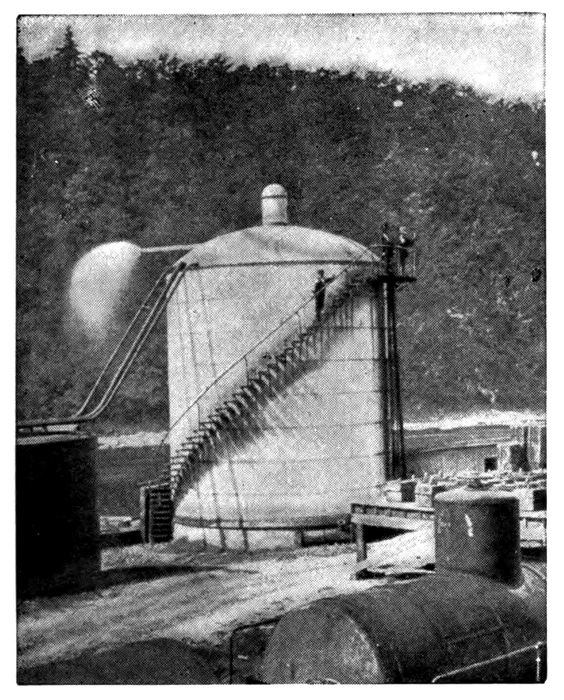
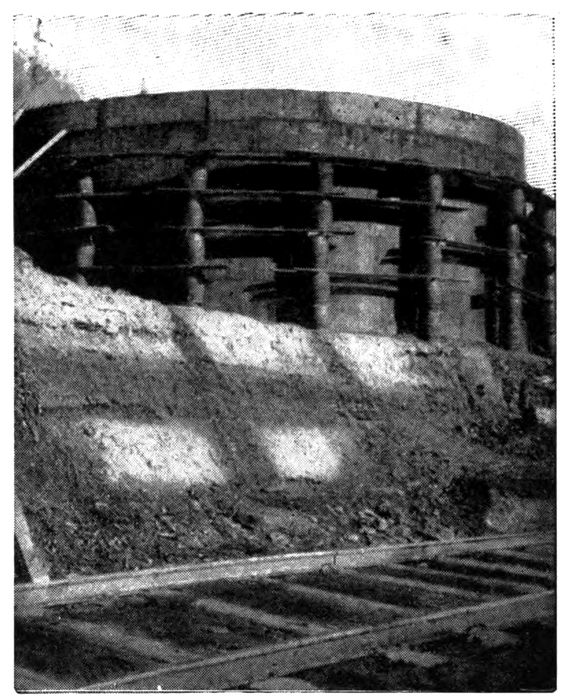
had been invented. The wooden tank holding 200 to 1,200
barrels had been rapidly replaced by the great iron tank
holding 20,000 or 30,000 barrels. The pipe-lines had begun
to go directly to the wells instead of pumping from a general
receiving station, or “dump,” as it was called, thus saving
the tedious and expensive operation of hauling. From beginning
to end the business had been developed, systematised,
simplified.
Most important was the simplification of the transportation
problem by the development of pipe-lines. By 1872 they
were the one oil gatherer. Several companies were carrying
on the pipe-line business, and two of them had acquired great
power in the Oil Regions because of their connection with
trunk lines. These were the Empire Transportation Company
and the Pennsylvania Transportation Company. The former,
which had been the first business organisation to go into the
pipe-line business on a large scale, was a concern which had
appeared in the Oil Regions not over six months before Van
Syckel began to pump oil. The Empire Transportation Company
had been organised in 1865 to build up an east and
west freight traffic via the Philadelphia and Erie Railroad,
a new line which had just been leased by the Pennsylvania.
Some ten railroads connected in one way or another with
the Philadelphia and Erie, forming direct routes east and
west. In spite of their evident community of interest these
various roads were kept apart by their jealous fears of one
another. Each insisted on its own time-table, its own rates,
1024its own way of doing things. The shipper via this route must
make a separate bargain with each road and often submit to
having his freight changed at terminals from one car to another
because of the difference of gauge. The Empire Transportation
Company undertook to act as a mediator between the
roads and the shipper, to make the route cheap, fast, and reliable.
It proposed to solicit freight, furnish its own cars and
terminal facilities, and collect money due. It did not make
rates, however; it only harmonised those made by the various
branches in the system. It was to receive a commission on the
business secured, and a rental for the cars and other facilities
it furnished.
It was a difficult task the new company undertook, but
it had at its head a remarkable man to cope with difficulties.
This man, Joseph D. Potts, was in 1865 thirty-six years old.
He had come of a long and honourable line of iron-masters of
the Schuylkill region of Pennsylvania, but had left the great
forge towns with which his ancestors had been associated—Pottstown,
Glasgow Forge, Valley Forge—to become a civil
engineer. His profession had led him to the service of the
Pennsylvania Railroad, where he had held important positions
in connection with which he now undertook the organisation
of the Empire Transportation Company. Colonel Potts—the
title came from his service in the Civil War—possessed
a clear and vigorous mind; he was far-seeing, forceful in
execution, fair in his dealings. To marked ability and integrity
he joined a gentle and courteous nature.
The first freight which the Empire Transportation Company
attacked after its organisation was oil. The year was
a great one for the Oil Regions, the year of Pithole. In January
there had suddenly been struck on Pithole Creek in a wilderness
six miles from the Allegheny River a well, located with
a witch-hazel twig, which produced 250 barrels a day—and
oil was selling at eight dollars a barrel! Wells followed in
1025rapid succession. In less than ten months the field was doing
over 10,000 barrels a day. This sudden flood of oil caused a
tremendous excitement. Crowds of speculators and investors
rushed to Pithole from all over the country. The Civil War
had just closed, soldiers were disbanding, and hundreds of
them found their way to the new oil field. In six weeks after
the first well was struck Pithole was a town of 6,000 inhabitants.
In less than a year it had fifty hotels and boardinghouses;
five of these hotels cost $50,000 or more each. In six
months after the first well the post-office of Pithole was receiving
upwards of 10,000 letters per day and was counted third
in size in the state—Philadelphia, Pittsburg, and Pithole being
the order of rank. It had a daily paper, churches, all the appliances
of a town.
The handling of the great output of oil from the Pithole
field was a serious question. There seemed not enough cars
in the country to carry it and shippers resorted to every imaginable
trick to get accommodations. When the agent of the
Empire Transportation Company opened his office in June,
1865, and demonstrated his ability to furnish cars regularly
and in large numbers, trade rapidly flowed to him. Now the
Empire agency had hardly been established when the Van
Syckel pipe-line began to carry oil from Pithole to the railroad.
Lines began to multiply. The railroads saw at once
that they were destined speedily to do all the gathering and
hastened to secure control of them. Colonel Potts’s first pipe-line
purchase was a line running from Pithole to Titusville,
which as yet had not been wet.
When the Empire Transportation Company took over this
line nothing had been demonstrated but that oil could be
driven, by relay pumps, five miles through a two–inch pipe.
The Empire’s first effort was to get a longer run by fewer
pumps. The agent in charge, C. P. Hatch, believed that oil
could be brought the entire ten and one-half miles from Pithole
1026to Titusville by one pump. He met with ridicule, but he
insisted on trying it in the new line his company had acquired.
The experiment was entirely successful. Improvements followed
as rapidly as hands could carry out the suggestions of
ingenuity and energy. One of the most important made the
first year of the business was connecting wells by pipe directly
with the tanks at the pumping stations, thus doing away with
the expensive hauling in barrels to the “dump.” A new device
for accounting to the producer for his oil was made necessary
by this change, and the practice of taking the gauge or measure
of the oil in the producer’s tank before and after the run
and issuing duplicate “run tickets” was devised by Mr.
Hatch. The producers, however, were not all “square”; it
sometimes happened that they sold oil by a transfer order on
the pipe-line, which they did not have in the line! To prevent
these the Empire Transportation Company in 1868 began to
issue certificates for credit balances of oil; these soon became
the general mediums of trade in oil, and remain so to-day.
One of the cleverest of the pipe-line devices of the Empire
Company was its assessment for waste and fire. In running
oil through pipes there is more or less lost by leaking and
evaporation. In September, 1868, Mr. Hatch announced that
thereafter he would deduct two per cent. from oil runs for
wastage. The assessment raised almost a riot in the region,
meetings were held, the Empire Transportation Company was
denounced as a highway robber, and threats of violence were
made if the order was enforced. While this excitement was in
progress there came a big fire on the line. Now the company’s
officials had been studying the question of fire insurance from
the start. Fires in the Oil Regions were as regular a feature of
the business as explosions used to be on the Mississippi steamboats,
and no regular fire insurance company would take the
risk. It had been decided that at the first fire there should be
announced what was called a “general average assessment,”
1027that is, a fire tax, and to be ready, blanks had been prepared.
Now in the thick of the resistance to the wastage assessment
came a fire and the line announced that the producers having
oil in the line must pay the insurance. The controversy at once
waxed hotter than ever, but was finally compromised by the
withdrawal in this case of the fire insurance if the producers
would consent to the tax for waste. They did consent, and
later when fires occurred the general average assessment was
applied without serious opposition. Both of these practices
prevail to-day. By the end of 1871 the Empire Transportation
Company was one of the most efficient and respected business
organisations in the oil country.
Its chief rival was the Pennsylvania Transportation Company,
an organisation which had its origin in the second pipe-line
laid in the Oil Regions. This line was built by Henry
Harley, a man who for fully ten years was one of the most
brilliant figures in the oil country. Harley was a civil engineer
by profession, a graduate of the Troy Polytechnic Institute,
and had held a responsible position for some time as an assistant
of General Herman Haupt in the Hoosac Tunnel. He
became interested in the oil business in 1862, first as a buyer
of petroleum, then as an operator in West Virginia. In 1865
he laid a pipe-line from one of the rich oil farms of the creek
to the railroad. It was a success, and from this venture Harley
and his partner, W. H. Abbott, one of the wealthiest and
most active men in the country, developed an important transportation
system. In 1868 Jay Gould, who as president of the
Erie road was eager to increase his oil freight, bought a
controlling interest in the Abbott and Harley lines, and made
Harley “General Oil Agent” of the Erie system. Harley now
became closely associated with Fisk and Gould, and the three
carried on a series of bold and piratical speculations in oil
which greatly enraged the oil country. They built a refinery
near Jersey City, extended their pipe-line system, and in 1871,
1028when they reorganised under the name of the Pennsylvania
Transportation Company, they controlled probably the greatest
number of miles of pipe of any company in the region,
and then were fighting the Empire bitterly for freight.
There is no part of this rapid development of the business
more interesting than the commercial machine the oil men
had devised by 1872 for marketing oil. A man with a
thousand-barrel well on his hands in 1862 was in a plight. He
had got to sell his oil at once for lack of storage room or
let it run on the ground, and there was no exchange, no
market, no telegraph, not even a post-office within his reach
where he could arrange a sale. He had to depend on buyers
who came to him. These buyers were the agents of the refineries
in different cities, or of the exporters of crude in New
York. They went from well to well on horseback, if the
roads were not too bad, on foot if they were, and at each
place made a special bargain varying with the quantity bought
and the difficulty in getting it away, for the buyer was the
transporter, and, as a rule, furnished the barrels or boats in
which he carried off his oil. It was not long before the speculative
character of the oil trade due to the great fluctuations
in quantity added a crowd of brokers to the regular buyers
who tramped up and down the creek. When the railroads
came in the trains became the headquarters for both buyers
and sellers. This was the more easily managed as the trains on
the creek stopped at almost every oil farm. These trains
became, in fact, a sort of travelling oil exchange, and on them
a large percentage of all the bargaining of the business was
done.
The brokers and buyers first organised and established
headquarters in Oil City in 1869, but there was an oil exchange
in New York City as early as 1866. Titusville did not have
an exchange until 1871. By this time the pipe-lines had begun
to issue certificates for the oil they received, and the trading
1029was done to a degree in these. The method was simple, and
much more convenient than the old one. The producer ran
his oil into a pipe-line, and for it received a certificate showing
that the line held so much to his credit; this certificate
was transferred when the sale was made and presented when
the oil was wanted.
One achievement of which the oil men were particularly
proud was increasing the refining capacity of the region. At
the start the difficulty of getting the apparatus for a refinery
to the creek had been so enormous that the bulk of the crude
had been driven to the nearest manufacturing cities—Erie,
Pittsburg, Cleveland. Much had gone to the seaboard, too,
and Boston, New York, Philadelphia and Baltimore were
all doing considerable refining. There was always a strong
feeling in the Oil Regions that the refining should be done at
home. Before the railroads came the most heroic efforts were
made again and again to get in the necessary machinery.
Brought from Pittsburg by water, as a rule, the apparatus
had to be hauled from Oil City, where it had been dumped on
the muddy bank of the river—there were no wharfs—over
the indescribable roads to the site chosen. It took weeks—months
sometimes—to get in the apparatus. The chemicals
used in the making of the oil, the barrels in which to store
it—all had to be brought from outside. The wonder is that
under these conditions anybody tried to refine on the creek.
But refineries persisted in coming, and after the railroads
came, increased; by 1872 the daily capacity had grown to
nearly 10,000 barrels, and there were no more complete or
profitable plants in existence than two or three of those on the
creek. The only points having larger daily capacity were
Cleveland and New York City. Several of the refineries had
added barrel works. Acids were made on the ground. Iron
works at Oil City and Titusville promised soon to supply
the needs of both drillers and refiners. The exultation was
1030great, and the press and people boasted that the day would
soon come when they would refine for the world. There in
their own narrow valleys should be made everything which
petroleum would yield. Cleveland, Pittsburg—the seaboard—must
give up refining. The business belonged to the Oil
Regions, and the oil men meant to take it.
A significant development in the region was the tendency
among many of the oil men to combine different branches of
the business. Several large producers conducted shipping
agencies for handling their own and other people’s oil. The
firm of Pierce and Neyhart was a prominent one carrying on
this double business in the sixties and early seventies. J. J.
Vandergrift, who has been mentioned already as one of the
first men to take hold of the transportation problem, early
became interested in production. As soon as the pipe-line was
demonstrated to be a success he began building lines. He also
added to his interests a large refinery, the Imperial of Oil
City. Captain Vandergrift by 1870 produced, transported
and refined his own oil as well as transported and refined much
of other people’s. It was a common practice for a refinery in
the Oil Regions to pipe oil directly to its works by its own
line, and in 1872 one refinery in Titusville, the Octave, carried
its refined oil a mile or more by pipe to the railroad. Although
most of the refineries at this period sold their products to
dealers and exporters, the building up of markets by direct
contact with new territory was beginning to be a consideration
with all large manufacturers. The Octave of Titusville, for
instance, chartered a ship in 1872 to load with oil and send
in charge of its own agent into South American ports.
The odds against the oil men in developing the business
had not been merely physical ones. There had been more
than the wilderness to conquer, more than the possibilities of
a new product to learn. Over all the early years of their
struggle and hardships hovered the dark cloud of the Civil
1031War. They were so cut off from men that they did not hear
of the fall of Sumter for four days after it happened, and the
news for the time blotted out interest even in flowing wells.
Twice at least when Lee invaded Pennsylvania the whole
business came to a stand-still, men abandoning the drill, the
pump, the refinery to make ready to repel the invader. They
were taxed for the war—taxes rising to ten dollars per barrel
in 1865—one dollar on crude and twenty cents a gallon on
refined (the oil barrel is usually estimated at forty-two
gallons). They gave up their quota of men again and again
at the call for recruits, and when the end came and a million
men were cast on the country, this little corner of Pennsylvania
absorbed a larger portion of men probably than any
other spot in the United States. The soldier was given the
first chance everywhere at work, he was welcomed into oil
companies, stock being given him for the value of his war
record. There were lieutenants and captains and majors—even
generals—scattered all over the field, and the field felt
itself honoured, and bragged, as it did of all things, of the
number of privates and officers who immediately on disbandment
had turned to it for employment.
It was not only the Civil War from which the Oil Regions
had suffered; in 1870 the Franco-Prussian War broke the
foreign market to pieces and caused great loss to the whole
industry. And there had been other troubles. From the first,
oil men had to contend with wild fluctuations in the price of
oil. In 1859 it was twenty dollars a barrel, and in 1861 it had
averaged fifty-two cents. Two years later, in 1863, it averaged
$8.15, and in 1867 but $2.40. In all these first twelve years
nothing like a steady price could be depended on, for just as
the supply seemed to have approached a fixed amount, a
“wildcat” well would come in and “knock the bottom out of
the market.” Such fluctuations were the natural element of
the speculator, and he came early, buying in quantities and
1032holding in storage tanks for higher prices. If enough oil
was held, or if the production fell off, up went the price, only
to be knocked down by the throwing of great quantities of
stocks on the market. The producers themselves often held
their oil, though not always to their own profit. A historic
case of obstinate holding occurred in 1871 on the “McCray
farm,” the most productive field in the region at that time.
Prices were hovering around three dollars, and McCray swore
he would not sell under five dollars. He bought, hired and
built iron tankage until he had upward of 200,000 barrels.
There was great loss from leakage and from evaporation and
there were taxes, but McCray held on, refusing four dollars,
$4.50, and even five dollars. Evil times came in the Oil Regions
soon after and with them “dollar oil.” McCray finally was
obliged to sell his stocks at about $1.20 per barrel. To develop
a business in face of such fluctuations and speculation in the
raw product took not only courage—it took a dash of the
gambler. It never could have been done, of course, had it
not been for the streams of money which flowed unceasingly
and apparently from choice into the regions. In 1865 Mr.
Wright calculated that the oil country was using a capital of
$100,000,000. In 1872 the oil men claimed the capital in
operation was $200,000,000. It has been estimated that in the
first decade of the industry nearly $350,000,000 was put into it.
Speculation in oil stock companies was another great evil.
It reached its height in 1864 and 1865—the “flush times” of
the business. Stocks in companies whose holdings were hardly
worth the stamps on the certificates were sold all over the land.
In March, 1865, the aggregate capital of the oil companies
whose charters were on file in Albany, New York, was $350,000,000,
and in Philadelphia alone in 1864 and 1865 1,000
oil companies, mostly bogus, are said to have been formed.
These swindles were dignified by the names of officers of
distinction in the United States army, for the war was coming
1033to an end and the name of a general was the most popular
and persuasive argument in the country. Of course there came
a collapse. The “oil bubble” burst in 1866, and it was nothing
but the irrepressible energy of the region which kept the
business going in the panic which followed.
Then there was the disturbing effect of foreign competition.
What would become of them if oil was found in quantities in
other countries? A decided depression of the market occurred
in 1866 when the government sent out reports of developments
of foreign oil fields. If there was oil in Japan, China, Burmah,
Persia, Russia, Bavaria, in the quantities the government
reports said, why, there was trouble in store for Pennsylvania,
the oil men argued, and for a day the market fell—it was only
for a day. Men forgot easily in the Oil Regions in the sixties.
An evil in their business which they were only beginning
to grasp fully in 1871 was the unholy system of freight discrimination
which the railroads were practising. Three trunk
lines competed for the business by 1872—the Pennsylvania,
which had leased the Philadelphia and Erie, the Erie and
the Central. (The latter road reached the Oil Regions by a
branch from Ashtabula on the Lake Shore and Michigan
Southern division to Oil City; this branch was completed in
1868.) The Pennsylvania claimed the oil traffic as a natural
right; for the Oil Regions were in Pennsylvania, and did not
Tom Scott own that state? The Erie road for about five years
had been in the hands of those splendid pirates, Jay Gould and
“Jim” Fisk. Naturally they took all they could get of the
oil traffic and took it by freebooting methods. “Corners” and
“rings” were their favourite devices for securing trade, and
more than once their aid had carried through daring and
unscrupulous speculations in oil. The Central in this period
was waging its famous desperate war on the Erie, Commodore
Vanderbilt having marked that highway for his own along
with most other things in New York State. All three of the
1034roads began as early as 1868 to use secret rebates on the
published freight rates in oil as a means of securing traffic.
This practice had gone on until in 1871 any big producer,
refiner, or buyer could bully a freight agent into a special
rate. Those “on the inside,” those who had “pulls,” also
secured special rates. The result was that the open rate was
enforced only on the innocent and the weak.
Serious as all these problems were, there was no discouragement
or shrinking from them. The oil men had rid themselves
of bunco men and burst the “oil bubbles.” They had harnessed
the brokers in exchanges and made strict rules to govern them.
They had learned not to fear the foreigners, and to take with
equal sang froid the “dry-hole” which made them poor, or
the “gusher” which made them rich. For every evil they had
a remedy. They were not afraid even of the railroads, and
loudly declared that if the discriminations were not stopped
they would build a railroad of their own. Indeed, the evils
in the oil business in 1871, far from being a discouragement,
rather added to the interest. They had never known anything
but struggle—with conquest—and twelve years of it was far
from cooling their ardour for a fair fight.
More had been done in the Oil Regions in the first dozen
years than the development of a new industry. From the first
there had gone with the oil men’s ambition to make oil to
light the whole earth a desire to bring civilisation to the
wilderness from which they were drawing wealth, to create
an orderly society from the mass of humanity which poured
pell-mell into the region. A hatred of indecency first drew
together the better element of each of the rough communities
which sprang up. Whiskey-sellers and women flocked to the
region at the breaking out of the excitement. Their first
shelters were shanties built on flatboats which were towed
from place to place: They came to Rouseville—a collection of
pine shanties and oil derricks, built on a muddy flat—as forlorn
and disreputable a town in appearance as the earth ever
saw. They tied up for trade, and the next morning woke up
from their brawl to find themselves twenty miles away, floating
down the Allegheny River. Rouseville meant to be decent.
She had cut them loose, and by such summary vigilance she
kept herself decent. Other towns adopted the same policy.
By common consent vice was corralled largely in one town.
Here a whole street was given up to dance-houses and saloons,
and those who must have a “spree” were expected to go to
Petroleum Centre to take it.
FAC-SIMILE OF A LABEL USED BY S. M. KIER IN ADVERTISING ROCK-OIL OBTAINED IN DRILLING SALT WELLS NEAR TARENTUM, PENNSYLVANIA
FAGUNDUS—A TYPICAL OIL TOWN
1035Decency and schools! Vice cut adrift, they looked for a
school teacher. Children were sadly out of place, but there
they were, and these men, fighting for a chance, saw to it that
a shanty, with a school teacher in it, was in every settlement.
It was not long, too, before there was a church, a union
church. To worship God was their primal instinct; to defend
a creed a later development. In the beginning every social
contrivance was wanting. There were no policemen, and each
individual looked after evil-doers. There were no firemen,
and every man turned out with a bucket at a fire. There were
no bankers, and each man had to put his wealth away as best he
could until a peripatetic banker from Pittsburg relieved him.
At one time Dr. Egbert, a rich operator, is said to have had
$1,800,000 in currency in his house. There were no hospitals,
and in 1861, when the horrible possibilities of the oil fire were
first demonstrated by the burning of the Rouse well, a fire
at which nineteen persons lost their lives, the many injured
found welcome and care for long weeks in the little shanties
of women already overburdened by the difficulties of caring
for families in the rough community.
Out of this poverty and disorder they had developed in
ten years a social organisation as good as their commercial.
Titusville, the hamlet on whose outskirts Drake had drilled
his well, was now a city of 10,000 inhabitants. It had an opera
1036house, where in 1871 Clara Louise Kellogg and Christine
Nilsson sang, Joe Jefferson and Janauschek played, and Wendell
Phillips and Bishop Simpson spoke. It had two prosperous
and fearless newspapers. Its schools prepared for college.
Oil City was not behind, and between them was a string of
lively towns. Many of the oil farms had a decent community
life. The Columbia farm kept up a library and reading-room
for its employees; there was a good schoolhouse used on Sunday
for services, and there was a Columbia farm band of no
mean reputation in the Oil Regions.
Indeed, by the opening of 1872, life in the Oil Regions had
ceased to be a mere make-shift. Comforts and orderliness and
decency, even opportunities for education and for social life,
were within reach. It was a conquest to be proud of, quite as
proud of as they were of the fact that their business had been
developed until it had never before, on the whole, been in so
satisfactory a condition.
Nobody realised more fully what had been accomplished
in the Oil Regions than the oil men themselves. Nobody
rehearsed their achievements so loudly. “In ten years,” they
were fond of saying, “we have built this business up from
nothing to a net product of six millions of barrels per annum.
We have invented and devised all the apparatus, the appliances,
the forms needed for a new industry. We use a capital
of $200,000,000, and support a population of 60,000 people.
To keep up our supply we drill 100 new wells per month,
at an average cost of $6,000 each. We are fourth in the exports
of the United States. We have developed a foreign market,
including every civilised country on the globe.”
But what had been done was, in their judgment, only a
beginning. Life ran swift and ruddy and joyous in these men.
They were still young, most of them under forty, and they
looked forward with all the eagerness of the young who have
just learned their powers, to years of struggle and development.
1037They would solve all these perplexing problems of over-production,
of railroad discrimination, of speculation. They
would meet their own needs. They would bring the oil refining
to the region where it belonged. They would make their
towns the most beautiful in the world. There was nothing too
good for them, nothing they did not hope and dare. But suddenly,
at the very heyday of this confidence, a big hand
reached out from nobody knew where, to steal their conquest
and throttle their future. The suddenness and the blackness
of the assault on their business stirred to the bottom their
manhood and their sense of fair play, and the whole region
arose in a revolt which is scarcely paralleled in the commercial
history of the United States.
CHAPTER TWO THE RISE OF THE STANDARD OIL COMPANY
1038
JOHN D. ROCKEFELLER’S FIRST CONNECTION WITH THE OIL BUSINESS—STORIES
OF HIS EARLY LIFE IN CLEVELAND—HIS FIRST PARTNERS—ORGANISATION
OF THE STANDARD OIL COMPANY IN JUNE, 1870—ROCKEFELLER’S
ABLE ASSOCIATES—FIRST EVIDENCE OF RAILWAY DISCRIMINATIONS
IN THE OIL BUSINESS—REBATES FOUND TO BE GENERALLY GIVEN
TO LARGE SHIPPERS—FIRST PLAN FOR A SECRET COMBINATION—THE
SOUTH IMPROVEMENT COMPANY—SECRET CONTRACTS MADE WITH THE
RAILROADS PROVIDING REBATES AND DRAWBACKS—ROCKEFELLER AND
ASSOCIATES FORCE CLEVELAND REFINERS TO JOIN THE NEW COMBINATION
OR SELL—RUMOUR OF THE PLAN REACHES THE OIL REGIONS.
The chief refining competitor of Oil Creek in 1872
was Cleveland, Ohio. Since 1869 that city had done
annually more refining than any other place in the
country. Strung along the banks of Walworth and
Kingsbury Runs, the creeks to which the city frequently banishes
her heavy and evil-smelling burdens, there had been
since the early sixties from twenty to thirty oil refineries. Why
they were there, more than 200 miles from the spot where
the oil was taken from the earth, a glance at a map of the
railroads of the time will show: By rail and water Cleveland
commanded the entire Western market. It had two trunk lines
running to New York, both eager for oil traffic, and by Lake
Erie and the canal it had for a large part of the year a
splendid cheap waterway. Thus, at the opening of the oil
business, Cleveland was destined by geographical position to
be a refining center.
Men saw it, and hastened to take advantage of the opportunity.
There was grave risk. The oil supply might not hold
1039out. As yet there was no certain market for refined oil. But
a sure result was not what drew people into the oil business
in the early sixties. Fortune was running fleet-footed across
the country, and at her garment men clutched. They loved
the chase almost as they did success, and so many a man in
Cleveland tried his luck in an oil refinery, as hundreds on
Oil Creek were trying it in an oil lease. By 1865 there were
thirty refineries in the town, with a capital of about a million
and a half dollars and a daily capacity of some 2,000 barrels.
The works multiplied rapidly. The report of the Cleveland
Board of Trade for 1866 gives the number of plants at the
end of that year as fifty, and it dilates eloquently on the
advantages of Cleveland as a refining point over even Pittsburg,
to that time supposed to be the natural centre for the
business. If the railroad and lake transportation men would
but adopt as liberal a policy toward the oil freights of Cleveland
as the Pennsylvania Railroad was adopting toward that of
Pittsburg, aided by her natural advantages the town was bound
to become the greatest oil refining centre in the United States.
By 1868 the Board of Trade reported joyfully that Cleveland
was receiving within 300,000 barrels as much oil as Pittsburg.
In 1869 she surpassed all competitors. “Cleveland now
claims the leading position among the manufacturers of petroleum
with a very reasonable prospect of holding that rank
for some time to come,” commented the Board of Trade
report. “Each year has seen greater consolidation of capital,
greater energy and success in prosecuting the business, and,
notwithstanding some disastrous fires, a stronger determination
to establish an immovable reputation for the quantity and
quality of this most important product. The total capital
invested in this business is not less than four millions of
dollars and the total product of the year would not fall short
of fifteen millions.”
Among the many young men of Cleveland who, from the
1040start, had an eye on the oil-refining business and had begun
to take an active part in its development as soon as it was
demonstrated that there was a reasonable hope of its being
permanent, was a young firm of produce commission merchants.
Both members of this firm were keen business men,
and one of them had remarkable commercial vision—a genius
for seeing the possibilities in material things. This man’s
name was Rockefeller—John D. Rockefeller. He was but
twenty-three years old when he first went into the oil business,
but he had already got his feet firmly on the business ladder,
and had got them there by his own efforts. The habit of driving
good bargains and of saving money had started him. He
himself once told how he learned these lessons so useful in
money-making, in one of his frequent Sunday-school talks to
young men on success in business. The value of a good bargain
he learned in buying cord-wood for his father: “I knew
what a cord of good solid beech and maple wood was. My
father told me to select only the solid wood and the straight
wood and not to put any limbs in it or any punky wood. That
was a good training for me. I did not need any father to tell
me or anybody else how many feet it took to make a cord
of wood.”
And here is how he learned the value of investing money:
“Among the early experiences that were helpful to me that
I recollect with pleasure was one in working a few days for
a neighbour in digging potatoes—a very enterprising, thrifty
farmer, who could dig a great many potatoes. I was a boy of
perhaps thirteen or fourteen years of age, and it kept me very
busy from morning until night. It was a ten-hour day. And
as I was saving these little sums I soon learned that I could
get as much interest for fifty dollars loaned at seven per cent.—the
legal rate in the state of New York at that time for a
year—as I could earn by digging potatoes for 100 days.
The impression was gaining ground with me that it was a
good thing to let the money be my slave and not make myself
a slave to money.” Here we have the foundation principles of
a great financial career.
JOHN D. ROCKEFELLER IN 1872
1041When young Rockefeller was thirteen years old, his father
moved from the farm in Central New York, where the boy
had been born (July 8, 1839), to a farm near Cleveland, Ohio.
He went to school in Cleveland for three years. In 1855 it
became necessary for him to earn his own living. It was a hard
year in the West and the boy walked the streets for days looking
for work. He was about to give it up and go to the country
when, to quote the story as Mr. Rockefeller once told it to his
Cleveland Sunday-school, “As good fortune would have it I
went down to the dock and made one more application, and I
was told that if I would come in after dinner—our noon-day
meal was dinner in those days—they would see if I could come
to work for them. I went down after dinner and I got the position,
and I was permitted to remain in the city.” The position,
that of a clerk and bookkeeper, was not lucrative. According
to a small ledger which has figured frequently in Mr.
Rockefeller’s religious instructions, he earned from September
26, 1855, to January, 1856, fifty dollars. “Out of that,” Mr.
Rockefeller told the young men of his Sunday-school class, “I
paid my washerwoman and the lady I boarded with, and I
saved a little money to put away.”
1042
Fragment of a page in the city directory of Cleveland, Ohio, for 1857. This is the first year in which the name John D. Rockefeller appears in the directory. The same entry is made in 1858. The next year, 1859, Mr. Rockefeller is entered as a member of the firm of Clark and Rockefeller.
He proved an admirable accountant—one of the early-and-late
sort, who saw everything, forgot nothing and never
talked. In 1856 his salary was raised to twenty-five dollars a
month, and he went on always “saving a little money to put
away.” In 1858 came a chance to invest his savings. Among his
acquaintances was a young Englishman, M. B. Clark. Older
by twelve years than Rockefeller he had left a hard life in
England when he was twenty to seek fortune in America.
He had landed in Boston in 1847, without a penny or a friend,
and it had taken three months for him to earn money to get
to Ohio. Here he had taken the first job at hand, as man-of-all-work,
wood-chopper, teamster. He had found his way to
Cleveland, had become a valuable man in the houses where
he was employed, had gone to school at nights, had saved
money. They were two of a kind, Clark and Rockefeller, and
in 1858 they pooled their earnings and started a produce commission
business on the Cleveland docks. The venture succeeded.
Local historians credit Clark and Rockefeller with
doing a business of $450,000 the first year. The war came on,
and as neither partner went to the front, they had full chance
to take advantage of the opportunity for produce business a
great army gives. A greater chance than furnishing army
supplies, lucrative as most people found that, was in the oil
business (so Clark and Rockefeller began to think), and in
1862, when an Englishman of ability and energy, one Samuel
Andrews, asked them to back him in starting a refinery, they
put in $4,000 and promised to give more if necessary. Now
Andrews was a mechanical genius. He devised new processes,
made a better and better quality of oil, got larger and larger
percentages of refined from his crude. The little refinery grew
big, and Clark and Rockefeller soon had $100,000 or more in
it. In the meantime Cleveland was growing as a refining
1043centre. The business which in 1860 had been a gamble was
by 1865 one most promising industries of the town.
It was but the beginning—so Mr. Rockefeller thought—and
in that year he sold out his share of the commission
business and put his money into the oil firm of Rockefeller
and Andrews.
In the new firm Andrews attended to the manufacturing.
The pushing of the business, the buying and the selling, fell
to Rockefeller. From the start his effect was tremendous.
He had the frugal man’s hatred of waste and disorder, of
middlemen and unnecessary manipulation, and he began a
vigorous elimination of these from his business. The residuum
that other refineries let run into the ground, he sold. Old iron
found its way to the junk shop. He bought his oil directly
from the wells. He made his own barrels. He watched and
saved and contrived. The ability with which he made the
smallest bargain furnishes topics to Cleveland story-tellers
to-day. Low-voiced, soft-footed, humble, knowing every point
in every man’s business, he never tired until he got his wares
at the lowest possible figure. “John always got the best of the
bargain,” old men tell you in Cleveland to-day, and they wince
though they laugh in telling it. “Smooth,” “a savy fellow,” is
their description of him. To drive a good bargain was the
joy of his life. “The only time I ever saw John Rockefeller
enthusiastic,” a man told the writer once, “was when a report
came in from the creek that his buyer had secured a cargo
of oil at a figure much below the market price. He bounded
from his chair with a shout of joy, danced up and down,
hugged me, threw up his hat, acted so like a madman that I
have never forgotten it.”
He could borrow as well as bargain. The firm’s capital was
limited; growing as they were, they often needed money, and
had none. Borrow they must. Rarely if ever did Mr. Rockefeller
fail. There is a story handed down in Cleveland from
1044the days of Clark and Rockefeller, produce merchants, which
is illustrative of his methods. One day a well-known and rich
business man stepped into the office and asked for Mr. Rockefeller.
He was out, and Clark met the visitor. “Mr. Clark,”
he said, “you may tell Mr. Rockefeller, when he comes in,
that I think I can use the $10,000 he wants to invest with me
for your firm. I have thought it all over.”
“Good God!” cried Clark, “we don’t want to invest $10,000.
John is out right now trying to borrow $5,000 for us.”
It turned out that to prepare him for a proposition to borrow
$5,000 Mr. Rockefeller had told the gentleman that he
and Clark wanted to invest $10,000!
“And the joke of it is,” said Clark, who used to tell the
story, “John got the $5,000 even after I had let the cat out of
the bag. Oh, he was the greatest borrower you ever saw!”
These qualities told. The firm grew as rapidly as the oil
business of the town, and started a second refinery—William
A. Rockefeller and Company. They took in a partner, H. M.
Flagler, and opened a house in New York for selling oil. Of
all these concerns John D. Rockefeller was the head. Finally,
in June, 1870, five years after he became an active partner
in the refining business, Mr. Rockefeller combined all his
companies into one—the Standard Oil Company. The capital
of the new concern was $1,000,000. The parties interested
in it were John D. Rockefeller, Henry M. Flagler,
Samuel Andrews, Stephen V. Harkness, and William
Rockefeller.[5]
1045
Map of Northwestern Pennsylvania, showing the relation of the Oil Regions to the railroads in 1859, when oil was “discovered.”
The strides the firm of Rockefeller and Andrews made after
the former went into it were attributed for three or four years
mainly to his extraordinary capacity for bargaining and borrowing.
Then its chief competitors began to suspect something.
John Rockefeller might get his oil cheaper now and
then, they said, but he could not do it often. He might make
close contracts for which they had neither the patience nor
the stomach. He might have an unusual mechanical and
practical genius in his partner. But these things could not
explain all. They believed they bought, on the whole, almost
as cheaply as he, and they knew they made as good oil and
with as great, or nearly as great, economy. He could sell at
1046no better price than they. Where was his advantage? There
was but one place where it could be, and that was in transportation.
He must be getting better rates from the railroads
than they were. In 1868 or 1869 a member of a rival firm long
in the business, which had been prosperous from the start,
and which prided itself on its methods, its economy and its
energy, Alexander, Scofield and Company, went to the Atlantic
and Great Western road, then under the Erie management,
and complained. “You are giving others better rates than you
are us,” said Mr. Alexander, the representative of the firm.
“We cannot compete if you do that.” The railroad agent did
not attempt to deny it—he simply agreed to give Mr. Alexander
a rebate also. The arrangement was interesting. Mr.
Alexander was to pay the open, or regular, rate on oil from
the Oil Regions to Cleveland, which was then forty cents
a barrel. At the end of each month he was to send to the railroad
vouchers for the amount of oil shipped and paid for
at forty cents, and was to get back from the railroad, in money,
fifteen cents on each barrel. This concession applied only to oil
brought from the wells. He was never able to get a rebate
on oil shipped eastward.[6] According to Mr. Alexander, the
Atlantic and Great Western gave the rebates on oil from the
Oil Regions to Cleveland up to 1871 and the system was then
discontinued. Late in 1871, however, the firm for the first time
got a rebate on the Lake Shore road on oil brought from the
field.
Another Cleveland man, W. H. Doane, engaged in shipping
crude oil, began to suspect about the same time as Mr.
Alexander that the Standard was receiving rebates. Now Mr.
Doane had always been opposed to the “drawback business,”
but it was impossible for him to supply his customers with
crude oil at as low a rate as the Standard paid if it received a
1047rebate and he did not, and when it was first generally rumoured
in Cleveland that the railroads were favouring Mr. Rockefeller
he went to see the agent of the road. “I told him I did not
want any drawback, unless others were getting it; I wanted
it if they were getting it, and he gave me at that time ten cents
drawback.” This arrangement Mr. Doane said had lasted
but a short time. At the date he was speaking—the spring of
1872—he had had no drawback for two years.
A still more important bit of testimony as to the time when
rebates first began to be given to the Cleveland refiners and as
to who first got them and why, is contained in an affidavit
made in 1880 by the very man who made the discrimination.[7]
This man was General J. H. Devereux, who in 1868 succeeded
Amasa Stone as vice-president of the Lake Shore Railroad.
General Devereux said that his experience with the oil
traffic had begun with his connection with the Lake Shore;
that the only written memoranda concerning oil which he
found in his office on entering his new position was a book in
which it was stated that the representatives of the twenty-five
oil-refining firms in Cleveland had agreed to pay a cent a gallon
on crude oil removed from the Oil Regions. General Devereux
says that he soon found there was a deal of trouble in
store for him over oil freight. The competition between the
twenty-five firms was close, the Pennsylvania was “claiming
a patent right” on the transportation of oil and was putting
forth every effort to make Pittsburg and Philadelphia the
chief refining centres. Oil Creek was boasting that it was
going to be the future refining point for the world. All of
this looked bad for what General Devereux speaks of as the
“then very limited refining capacity of Cleveland.” This
remark shows how new he was to the business, for, as we have
1048already seen, Cleveland in 1868 had anything but a limited
refining capacity. Between three and four million dollars were
invested in oil refineries, and the town was receiving within
35,000 barrels of as much oil as New York City, and within
300,000 as much as Pittsburg, and it was boasting that the
next year it would outstrip these competitors, which, as a
matter of fact, it did.
The natural point for General Devereux to consider, of
course, was whether he could meet the rates the Pennsylvania
were giving and increase the oil freight for the Lake
Shore. The road had a branch running to Franklin, Pennsylvania,
within a few miles of Oil City. This he completed, and
then, as he says in his affidavit, “a sharper contest than ever was
produced growing out of the opposition of the Pennsylvania
Railroad in competition. Such rates and arrangements were
made by the Pennsylvania Railroad that it was publicly proclaimed
in the public print in Oil City, Titusville and other
places that Cleveland was to be wiped out as a refining centre
as with a sponge.” General Devereux goes on to say that all
the refiners of the town, without exception, came to him in
alarm, and expressed their fears that they would have either
to abandon their business there or move to Titusville or other
points in the Oil Regions; that the only exception to this
decision was that offered by Rockefeller, Andrews and Flagler,
who, on his assurance that the Lake Shore Railroad could and
would handle oil as cheaply as the Pennsylvania Company,
proposed to stand their ground at Cleveland and fight it out
on that line. And so General Devereux gave the Standard the
rebate on the rate which Amasa Stone had made with all the
refiners. Why he should not have quieted the fears of the
twenty-four or twenty-five other refiners by lowering their
rate, too, does not appear in the affidavit. At all events the
rebate had come, and, as we have seen, it soon was suspected
and others went after it, and in some cases got it. But the
1049rebate seems to have been granted generally only on oil
brought from the Oil Regions. Mr. Alexander claims he was
never able to get his rate lowered on his Eastern shipments.
The railroad took the position with him that if he could ship
as much oil as the Standard he could have as low a rate, but
not otherwise. Now in 1870 the Standard Oil Company had a
daily capacity of about 1,500 barrels of crude. The refinery
was the largest in the town, though it had some close competitors.
Nevertheless on the strength of its large capacity it received
the special favour. It was a plausible way to get around
the theory generally held then, as now, though not so definitely
crystallised into law, that the railroad being a common carrier
had no right to discriminate between its patrons. It
remained to be seen whether the practice would be accepted
by Mr. Rockefeller’s competitors without a contest, or, if
contested, would be supported by the law.
What the Standard’s rebate on Eastern shipments was in
1870 it is impossible to say. Mr. Alexander says he was never
able to get a rate lower than $1.33 a barrel by rail, and that
it was commonly believed in Cleveland that the Standard had
a rate of ninety cents. Mr. Flagler, however, the only member
of the firm who has been examined under oath on that point,
showed, by presenting the contract of the Standard Oil Company
with the Lake Shore road in 1870, that the rates varied
during the year from $1.40 to $1.20 and $1.60, according to
the season. When Mr. Flagler was asked if there was no
drawback or rebate on this rate he answered, “None whatever.”
It would seem from the above as if the one man in the
Cleveland oil trade in 1870 who ought to have been satisfied
was Mr. Rockefeller. His was the largest firm in the largest
refining centre of the country; that is, of the 10,000 to 12,000
daily capacity divided among the twenty-five or twenty-six
refiners of Cleveland he controlled 1,500 barrels. Not only was
1050Cleveland the largest refining centre in the country, it was
gaining rapidly, for where in 1868 it shipped 776,356 barrels
of refined oil, in 1869 it shipped 923,933, in 1870 1,459,500,
and in 1871 1,640,499.[8] Not only did Mr. Rockefeller control
the largest firm in this most prosperous centre of a prosperous
business, he controlled one of amazing efficiency. The combination,
in 1870, of the various companies with which he
was connected had brought together a group of remarkable
men. Samuel Andrews, by all accounts, was the ablest mechanical
superintendent in Cleveland. William Rockefeller, the
brother of John D. Rockefeller, was not only an energetic
and intelligent business man, he was a man whom people
liked. He was open-hearted, jolly, a good story-teller, a man
who knew and liked a good horse—not too pious, as some
of John’s business associates thought him, not a man to
suspect or fear, as many a man did John. Old oil men will
tell you on the creek to-day how much they liked him in
the days when he used to come to Oil City buying oil for
the Cleveland firm. The personal quality of William Rockefeller
was, and always has been, a strong asset of the Standard
Oil Company. Probably the strongest man in the firm
after John D. Rockefeller was Henry M. Flagler. He was,
like the others, a young man, and one who, like the head
of the firm, had the passion for money, and in a hard self-supporting
experience, begun when but a boy, had learned,
as well as his chief, some of the principles of making it. He
was untiring in his efforts to increase the business, quick to
see an advantage, as quick to take it. He had no scruples to
make him hesitate over the ethical quality of a contract which
was advantageous. Success, that is, making money, was its own
justification. He was not a secretive man, like John D. Rockefeller,
not a dreamer, but he could keep his mouth shut when
necessary and he knew the worth of a financial dream when
1051it was laid before him. It must have been evident to every
business man who came in contact with the young Standard
Oil Company that it would go far. The firm itself must have
known it would go far. Indeed nothing could have stopped
the Standard Oil Company in 1870—the oil business being
what it was—but an entire change in the nature of the members
of the firm, and they were not the kind of material which
changes.
With such a set of associates, with his organisation complete
from his buyers on the creek to his exporting agent in
New York, with the transportation advantages which none
of his competitors had had the daring or the persuasive power
to get, certainly Mr. Rockefeller should have been satisfied
in 1870. But Mr. Rockefeller was far from satisfied. He was
a brooding, cautious, secretive man, seeing all the possible
dangers as well as all the possible opportunities in things, and
he studied, as a player at chess, all the possible combinations
which might imperil his supremacy. These twenty-five Cleveland
rivals of his—how could he at once and forever put them
out of the game? He and his partners had somehow conceived
a great idea—the advantages of combination. What might
they not do if they could buy out and absorb the big refineries
now competing with them in Cleveland? The possibilities
of the idea grew as they discussed it. Finally they
began tentatively to sound some of their rivals. But there were
other rivals than these at home. There were the creek refiners!
They were there at the mouth of the wells. What might not
this geographical advantage do in time? Refining was going
on there on an increasing scale; the capacity of the Oil
Regions had indeed risen to nearly 10,000 barrels a day—equal
to that of New York, exceeding that of Pittsburg by
nearly 4,000 barrels, and almost equalling that of Cleveland.
The men of the oil country loudly declared that they meant to
refine for the world. They boasted of an oil kingdom which
1052eventually should handle the entire business and compel
Cleveland and Pittsburg either to abandon their works or
bring them to the oil country. In this boastful ambition they
were encouraged particularly by the Pennsylvania Railroad,
which naturally handled the largest percentage of the oil.
How long could the Standard Oil Company stand against
this competition?
There was another interest as deeply concerned as Mr.
Rockefeller in preserving Cleveland’s supremacy as a refining
centre, and this was the Lake Shore and New York Central
Railroads. Let the bulk of refining be done in the Oil
Regions and these roads were in danger of losing a profitable
branch of business. This situation in regard to the oil traffic
was really more serious now than in 1868 when General
Devereux had first given the Standard a rebate. Then it was
that the Pennsylvania, through its lusty ally the Empire
Transportation Company, was making the chief fight to
secure a “patent right on oil transportation.” The Erie was
now becoming as aggressive a competitor. Gould and Fisk
had gone into the fight with the vigour and the utter unscrupulousness
which characterised all their dealings. They were
allying themselves with the Pennsylvania Transportation
Company, the only large rival pipe-line system which the
Empire had. They were putting up a refinery near Jersey City,
and they were taking advantage shrewdly of all the speculative
features of the new business.
As competition grew between the roads, they grew more
reckless in granting rebates, the refiners more insistent in
demanding them. By 1871 things had come to such a pass in
the business that every refiner suspected his neighbour to be
getting better rates than he. The result was that the freight
agents were constantly beset for rebates, and that the large
shippers were generally getting them on the ground of the
quantity of oil they controlled. Indeed it was evident that the
rebate being admitted, the only way in which it could be adjusted
with a show of fairness was to grade it according to the
size of the shipment.
W. G. WARDEN
Secretary of the South Improvement Company.
PETER H. WATSON
President of the South Improvement Company.
CHARLES LOCKHART
A member of the South Improvement Company, and later of the Standard Oil Company. At his death in 1904 the oldest living oil operator.
HENRY M. FLAGLER IN 1882
Active partner of John D. Rockefeller in the oil business since 1867. Officer of the Standard Oil Company since its organization in 1870.
1053Under these conditions of competition it was certain that
the New York Central system must work if it was to keep
its great oil freight, and the general freight agent of the
Lake Shore road began to give the question special attention.
This man was Peter H. Watson. Mr. Watson was an able
patent lawyer who served under the strenuous Stanton as
an Assistant-Secretary of War, and served well. After the war
he had been made general freight agent of the Lake Shore
and Michigan Southern Railroad, and later president of the
branch of that road which ran into the Oil Regions. He had
oil interests principally at Franklin, Pennsylvania, and was
well known to all oil men. He was a business intimate of Mr.
Rockefeller and a warm friend of Horace F. Clark, the son-in-law
of W. H. Vanderbilt, at that time president of the Lake
Shore and Michigan Southern Railroad. As the Standard Oil
Company was the largest shipper in Cleveland and had
already received the special favour from the Lake Shore which
General Devereux describes, it was natural that Mr. Watson
should consult frequently with Mr. Rockefeller on the question
of holding and increasing his oil freight. It was equally
natural, too, that Mr. Rockefeller should use his influence with
Mr. Watson to strengthen the theory so important to his rapid
growth—the theory that the biggest shipper should have the
best rate.
Two other towns shared Cleveland’s fear of the rise of the
Oil Regions as a refining centre, and they were Pittsburg and
Philadelphia, and Mr. Rockefeller and Mr. Watson found
in certain refiners of these places a strong sympathy with any
plan which looked to holding the region in check. But while
the menace in their geographical positions was the first ground
of sympathy between these gentlemen, something more than
1054local troubles occupied them. This was the condition of the
refining business as a whole. It was unsatisfactory in many
particulars. First, it was overdone. The great profits on
refined oil and the growing demand for it had naturally caused
a great number to rush into its manufacture. There was at
this time a refining capacity of three barrels to every one
produced. To be sure, few if any of these plants expected to
run the year around. Then, as to-day, there were nearly always
some stills in even the most prosperous works shut down. But
after making a fair allowance for this fact there was still a
much larger amount of refining actually done than the market
demanded. The result was that the price of refined oil was
steadily falling. Where Mr. Rockefeller had received on an
average 58¾ cents a gallon for the oil he exported in 1865,
the year he went into business, in 1870 he received but 26⅜
cents. In 1865 he had a margin of forty-three cents, out of
which to pay for transportation, manufacturing, barrelling
and marketing and to make his profits. In 1870 he had but
17⅛ cents with which to do all this. To be sure his expenses
had fallen enormously between 1865 and 1870, but so had his
profits. The multiplication of refiners with the intense competition
threatened to cut them down still lower. Naturally
Mr. Rockefeller and his friends looked with dismay on this
lowering of profits through gaining competition.
Another anxiety of the American refiners was the condition
of the export trade. Oil had risen to fourth place in the
exports of the United States in the twelve years since its discovery,
and every year larger quantities were consumed
abroad, but it was crude oil, not refined, which the foreigners
were beginning to demand; that is, they had found they could
import crude, refine it at home, and sell it cheaper than they
could buy American refined. France, to encourage her home
refineries, had even put a tax on American refined.
In the fall of 1871, while Mr. Rockefeller and his friends
1055were occupied with all these questions, certain Pennsylvania
refiners, it is not too certain who, brought to them a remarkable
scheme, the gist of which was to bring together secretly
a large enough body of refiners and shippers to persuade all
the railroads handling oil to give to the company formed
special rebates on its oil, and drawbacks on that of other
people. If they could get such rates it was evident that those
outside of their combination could not compete with them
long and that they would become eventually the only refiners.
They could then limit their output to actual demand, and so
keep up prices. This done, they could easily persuade the
railroads to transport no crude for exportation, so that the
foreigners would be forced to buy American refined. They
believed that the price of oil thus exported could easily be
advanced fifty per cent. The control of the refining interests
would also enable them to fix their own price on crude. As
they would be the only buyers and sellers, the speculative
character of the business would be done away with. In short,
the scheme they worked out put the entire oil business in
their hands. It looked as simple to put into operation as it was
dazzling in its results. Mr. Flagler has sworn that neither
he nor Mr. Rockefeller believed in this scheme.[9] But when
they found that their friend Peter H. Watson, and various
Philadelphia and Pittsburg parties who felt as they did about
the oil business, believed in it, they went in and began at
once to work up a company—secretly. It was evident that
a scheme which aimed at concentrating in the hands of one
company the business now operated by scores, and which
proposed to effect this consolidation through a practice of the
railroads which was contrary to the spirit of their charters,
although freely indulged in, must be worked with fine discretion
if it ever were to be effective.
1056The first thing was to get a charter—quietly. At a meeting
held in Philadelphia late in the fall of 1871 a friend of one
of the gentlemen interested mentioned to him that a certain
estate then in liquidation had a charter for sale which gave
its owners the right to carry on any kind of business in any
country and in any way; that it could be bought for what it
would cost to get a charter under the general laws of the
state, and that it would be a favour to the heirs to buy it. The
opportunity was promptly taken. The name of the charter
bought was the “South (often written Southern) Improvement
Company.” For a beginning it was as good a name as
another, since it said nothing.
With this charter in hand Mr. Rockefeller and Mr. Watson
and their associates began to seek converts. In order that their
great scheme might not be injured by premature public discussion
they asked of each person whom they approached a
pledge of secrecy. Two forms of the pledges required before
anything was revealed were published later. The first of these,
which appeared in the New York Tribune, read as follows:
I, A. B., do faithfully promise upon my honour and faith as a gentleman that I will
keep secret all transactions which I may have with the corporation known as the
South Improvement Company; that, should I fail to complete any bargains with the
said company, all the preliminary conversations shall be kept strictly private; and,
finally, that I will not disclose the price for which I dispose of my product, or any
other facts which may in any way bring to light the internal workings or organisation
of the company. All this I do freely promise.
Signed..............................
Witnessed by..............................
A second, published in a history of the “Southern Improvement
Company,” ran:
The undersigned pledge their solemn words of honour that they will not communicate
to any one without permission of Z (name of director of Southern Improvement Company)
any information that he may convey to them, or any of them, in relation to the
Southern Improvement Company.
Witness..............................
1057That the promoters met with encouragement is evident from
the fact that, when the corporators came together on January
2, 1872, in Philadelphia, for the first time under their charter,
and transferred the company to the stockholders, they
claimed to represent in one way or another a large part of
the refining interest of the country. At this meeting 1,100
shares of the stock of the company, which was divided into
2,000 $100 shares, were subscribed for, and twenty per cent.
of their value was paid in. Just who took stock at this meeting
the writer has not been able to discover. At the same time
a discussion came up as to what refiners were to be allowed
to go into the new company. Each of the men represented had
friends whom he wanted taken care of, and after considerable
discussion it was decided to take in every refinery they could
get hold of. This decision was largely due to the railroad men.
Mr. Watson had seen them as soon as the plans for the company
were formed, and they had all agreed that if they gave
the rebates and drawbacks all refineries then existing must
be taken in upon the same level. That is, while the incorporators
had intended to kill off all but themselves and their
friends, the railroads refused to go into a scheme which was
going to put anybody out of business—the plan if they went
into it must cover the refining trade as it stood. It was enough
that it could prevent any one in the future going into the
business.
Very soon after this meeting of January 2 the rest of the
stock of the South Improvement Company was taken. The
complete list of stockholders, with their holdings, was as
follows:
Mr. Watson was elected president and W. G. Warden
of Philadelphia secretary of the new association. It will be
noticed that the largest individual holdings in the company
were those of W. G. Warden and O. F. Waring, each of whom
had 475 shares. The company most heavily interested in the
South Improvement Company was the Standard Oil of
Cleveland, J. D. Rockefeller, William Rockefeller and
H. M. Flagler, all stockholders of that company, each having
180 shares—540 in the company. O. H. Payne and J. A. Bostwick,
who soon after became stockholders in the Standard Oil
Company, also had each 180 shares, giving Mr. Rockefeller
and his associates 900 shares in all.
It has frequently been stated that the South Improvement
Company represented the bulk of the oil-refining interests in
the country. The incorporators of the company in approaching
the railroads assured them that this was so. As a matter of
fact, however, the thirteen gentlemen above named, who were
the only ones ever holding stock in the concern, did not control
over one-tenth of the refining business of the United
States in 1872. That business in the aggregate amounted to a
daily capacity of about 45,000 barrels—from 45,000 to 50,000,
Mr. Warden put it—and the stockholders of the South Improvement
1059Company owned a combined capacity of not over
4,600 barrels. In assuring the railroads that they controlled the
business, they were dealing with their hopes rather than with
facts.
The organisation complete, there remained contracts to be
made with the railroads. Three systems were to be interested:
The Central, which, by its connection with the Lake Shore
and Michigan Southern, ran directly into the Oil Regions;
the Erie, allied with the Atlantic and Great Western, with a
short line likewise tapping the heart of the region; and the
Pennsylvania, with the connections known as the Allegheny
Valley and Oil Creek Railroad. The persons to be won over
were: W. H. Vanderbilt, of the Central; H. F. Clark, president
of the Lake Shore and Michigan Southern; Jay Gould,
of the Erie; General G. B. McClellan, president of the
Atlantic and Great Western; and Tom Scott, of the Pennsylvania.
There seems to have been little difficulty in persuading
any of these persons to go into the scheme after they
had been assured by the leaders that all of the refiners were
to be taken in. This was a verbal condition, however, not
found in the contracts they signed. This important fact Mr.
Warden himself made clear when three months later he was
on the witness stand before a committee of Congress appointed
to look into the great scheme. “We had considerable discussion
with the railroads,” Mr. Warden said, “in regard to
the matter of rebate on their charges for freight; they did
not want to give us a rebate unless it was with the understanding
that all the refineries should be brought into the arrangement
and placed upon the same level.”
Q. You say you made propositions to railroad companies, which they agreed to
accept upon the condition that you could include all the refineries?
A. No, sir; I did not say that; I said that was the understanding when we discussed
this matter with them; it was no proposition on our part; they discussed it, not in
the form of a proposition that the refineries should be all taken in, but it was the
1060intention and resolution of the company from the first that that should be the result;
we never had any other purpose in the matter.
Q. In case you could take the refineries all in, the railroads proposed to give you
a rebate upon their freight charges?
A. No, sir; it was not put in that form; we were to put the refineries all in upon the
same terms; it was the understanding with the railroad companies that we were to have
a rebate; there was no rebate given in consideration of our putting the companies
all in, but we told them we would do it; the contract with the railroad companies was
with us.
Q. But if you did form a company composed of the proprietors of all these refineries,
you were to have a rebate upon your freight charges?
A. No; we were to have a rebate anyhow, but were to give all the refineries the
privilege of coming in.
Q. You were to have the rebate whether they came in or not?
A. Yes, sir.
* * *
“What effect were these arrangements to have upon those who did not come into
the combination...?” asked the chairman.
“I do not think we ever took that question up,” answered Mr. Warden.
A second objection to making a contract with the company
came from Mr. Scott of the Pennsylvania road and Mr.
Potts of the Empire Transportation Company. The substance
of this objection was that the plan took no account of the oil
producer—the man to whom the world owed the business.
Mr. Scott was strong in his assertion that they could never
succeed unless they took care of the producers. Mr. Warden
objected strongly to forming a combination with them. “The
interests of the producers were in one sense antagonistic to
ours: one as the seller and the other as the buyer. We held in
argument that the producers were abundantly able to take
care of their own branch of the business if they took care of
the quantity produced.” So strongly did Mr. Scott argue,
however, that finally the members of the South Improvement
Company yielded, and a draft of an agreement, to be proposed
to the producers, was drawn up in lead pencil; it was
never presented. It seems to have been used principally to
quiet Mr. Scott.
THOMAS A. SCOTT
The contract of the South Improvement Company with the Pennsylvania Railroad was signed by Mr. Scott, then vice-president of the road.
JAY GOULD
President of the Erie Railroad in 1872. Signer of the contract with the South Improvement Company.
WILLIAM H. VANDERBILT
The contract of the South Improvement Company with the New York Central was signed by Mr. Vanderbilt, then vice-president of the road.
COMMODORE CORNELIUS VANDERBILT
President of the New York Central Railroad when the contract with the South Improvement Company was signed.
1061The work of persuasion went on swiftly. By the 18th of
January the president of the Pennsylvania road, J. Edgar
Thompson, had put his signature to the contract, and soon
after Mr. Vanderbilt and Mr. Clark signed for the Central
system, and Jay Gould and General McClellan for the Erie.
The contracts to which these gentlemen put their names fixed
gross rates of freight from all common points, as the leading
shipping points within the Oil Regions were called, to all
the great refining and shipping centres—New York, Philadelphia,
Baltimore, Pittsburg and Cleveland. For example,
the open rate on crude to New York was put at $2.56. On
this price the South Improvement Company was allowed a
rebate of $1.06 for its shipments; but it got not only this
rebate, it was given in cash a like amount on each barrel of
crude shipped by parties outside the combination.
The open rate from Cleveland to New York was two dollars,
and fifty cents of this was turned over to the South Improvement
Company, which at the same time received a rebate
enabling it to ship for $1.50. Again, an independent refiner
in Cleveland paid eighty cents a barrel to get his crude from
the Oil Regions to his works, and the railroad sent forty cents
of this money to the South Improvement Company. At the
same time it cost the Cleveland refiner in the combination but
forty cents to get his crude oil. Like drawbacks and rebates
were given for all points—Pittsburg, Philadelphia, Boston
and Baltimore.
An interesting provision in the contracts was that full way-bills
of all petroleum shipped over the roads should each day
be sent to the South Improvement Company. This, of course,
gave them knowledge of just who was doing business outside
of their company—of how much business he was doing, and
with whom he was doing it. Not only were they to have full
1062knowledge of the business of all shippers—they were to have
access to all books of the railroads.
The parties to the contracts agreed that if anybody appeared
in the business offering an equal amount of transportation,
and having equal facilities for doing business with the South
Improvement Company, the railroads might give them equal
advantages in drawbacks and rebates, but to make such a
miscarriage of the scheme doubly improbable each railroad
was bound to co-operate as “far as it legally might to maintain
the business of the South Improvement Company against
injury by competition, and lower or raise the gross rates of
transportation for such times and to such extent as might be
necessary to overcome the competition. The rebates and drawbacks
to be varied pari passu with the gross rates.”[11]
The reason given by the railroads in the contract for granting
these extraordinary privileges was that the “magnitude
and extent of the business and operations” purposed to be carried
on by the South Improvement Company would greatly
promote the interest of the railroads and make it desirable for
them to encourage their undertaking. The evident advantages
received by the railroad were a regular amount of freight,—the
Pennsylvania was to have forty-five per cent. of the East-bound
shipments, the Erie and Central each 27½ per cent.,
while West-bound freight was to be divided equally between
them—fixed rates, and freedom from the system of cutting
which they had all found so harassing and disastrous. That is,
the South Improvement Company, which was to include the
entire refining capacity of the company, was to act as the
evener of the oil business.[12]
It was on the second of January, 1872, that the organisation
1063of the South Improvement Company was completed. The
day before the Standard Oil Company of Cleveland increased
its capital from $1,000,000 to $2,500,000, “all the
stockholders of the company being present and voting therefor.”[13]
These stockholders were greater by five than in 1870,
the names of O. B. Jennings, Benjamin Brewster, Truman P.
Handy, Amasa Stone, and Stillman Witt having been added.
The last three were officers and stockholders in one or more
of the railroads centring in Cleveland. Three weeks after
this increase of capital Mr. Rockefeller had the charter and
contracts of the South Improvement Company in hand, and
was ready to see what they would do in helping him carry out
his idea of wholesale combination in Cleveland. There were
at that time some twenty-six refineries in the town—some of
them very large plants. All of them were feeling more or less
the discouraging effects of the last three or four years of railroad
discriminations in favour of the Standard Oil Company.
To the owners of these refineries Mr. Rockefeller now went
one by one, and explained the South Improvement Company.
“You see,” he told them, “this scheme is bound to work. It
means an absolute control by us of the oil business. There is
no chance for anyone outside. But we are going to give everybody
a chance to come in. You are to turn over your refinery
to my appraisers, and I will give you Standard Oil Company
stock or cash, as you prefer, for the value we put upon it. I
advise you to take the stock. It will be for your good.” Certain
refiners objected. They did not want to sell. They did
want to keep and manage their business. Mr. Rockefeller was
regretful, but firm. It was useless to resist, he told the hesitating;
they would certainly be crushed if they did not accept
his offer, and he pointed out in detail, and with gentleness,
how beneficent the scheme really was—preventing the creek
1064refiners from destroying Cleveland, ending competition,
keeping up the price of refined oil, and eliminating speculation.
Really a wonderful contrivance for the good of the
oil business.
That such was Mr. Rockefeller’s argument is proved by
abundant testimony from different individuals who succumbed
to the pressure. Mr. Rockefeller’s own brother, Frank
Rockefeller, gave most definite evidence on this point in 1876
when he and others were trying to interest Congress in a
law regulating interstate commerce.
“We had in Cleveland at one time about thirty establishments,
but the South Improvement Company was formed,
and the Cleveland companies were told that if they didn’t
sell their property to them it would be valueless, that there
was a combination of railroad and oil men, that they would
buy all they could, and that all they didn’t buy would be
totally valueless, because they would be unable to compete
with the South Improvement Company, and the result was
that out of thirty there were only four or five that didn’t
sell.”
“From whom was that information received?” asked the
examiner.
“From the officers of the Standard Oil Company. They
made no bones about it at all. They said: ‘If you don’t sell
your property to us it will be valueless, because we have got
advantages with the railroads.’”
“Have you heard those gentlemen say what you have
stated?” Frank Rockefeller was asked.
“I have heard Rockefeller and Flagler say so,” he
answered.
W. H. Doane, whose evidence on the first rebates granted
to the Cleveland trade we have already quoted, told the Congressional
committee which a few months after Mr. Rockefeller’s
great coup tried to find out what had happened in
1065Cleveland: “The refineries are all bought up by the Standard
Oil works; they were forced to sell; the railroads had put
up the rates and it scared them. Men came to me and told me
they could not continue their business; they became frightened
and disposed of their property.” Mr. Doane’s own
business, that of a crude oil shipper, was entirely ruined, all
of his customers but one having sold.
To this same committee Mr. Alexander, of Alexander, Scofield
and Company, gave his reason for selling:
“There was a pressure brought to bear upon my mind, and upon almost all citizens
of Cleveland engaged in the oil business, to the effect that unless we went into the
South Improvement Company we were virtually killed as refiners; that if we did not
sell out we should be crushed out. My partner, Mr. Hewitt, had some negotiations
with parties connected with the South Improvement Company, and they gave us
to understand, at least my partner so represented to me, that we should be crushed
out if we did not go into that arrangement. He wanted me to see the parties myself;
but I said to him that I would not have any dealings with certain parties who were
in that company for any purpose, and I never did. We sold at a sacrifice, and we
were obliged to. There was only one buyer in the market, and we had to sell on their
terms or be crushed out, as it was represented to us. It was stated that they had a contract
with railroads by which they could run us into the ground if they pleased. After
learning what the arrangements were I felt as if, rather than fight such a monopoly,
I would withdraw from the business, even at a sacrifice. I think we received about
forty or forty-five cents on the dollar on the valuation which we placed upon our
refinery. We had spent over $50,000 on our works during the past year, which was
nearly all that we received. We had paid out $60,000 or $70,000 before that; we considered
our works at their cash value worth seventy-five per cent. of their cost. According
to our valuation our establishment was worth $150,000, and we sold it for
about $65,000, which was about forty or forty-five per cent. of its value. We sold
to one of the members, as I suppose, of the South Improvement Company, Mr. Rockefeller;
he is a director in that company; it was sold in name to the Standard Oil Company,
of Cleveland, but the arrangements were, as I understand it, that they were
to put it into the South Improvement Company. I am stating what my partner told me;
he did all the business; his statement was that all these works were to be merged into
the South Improvement Company. I never talked with any members of the South
Improvement Company myself on the subject; I declined to have anything to do
with them.”
1066Mr. Hewitt, the partner who Mr. Alexander says carried
on the negotiations for the sale of the business, appeared
before an investigating committee of the New York State
Senate in 1879 and gave his recollections of what happened.
According to his story the entire oil trade in Cleveland became
paralysed when it became known that the South Improvement
Company had “grappled the entire transportation of
oil from the West to the seaboard.” Mr. Hewitt went to see
the freight agents of the various roads; he called on W. H.
Vanderbilt, but from no one did he get any encouragement.
Then he saw Peter H. Watson of the Lake Shore Railroad,
the president of the company which was frightening the trade.
“Watson was non-committal,” said Mr. Hewitt. “I got no
satisfaction except, ‘You better sell—you better get clear—better
sell out—no help for it.’” After a little time Mr. Hewitt
concluded with his partners that there was indeed “no help
for it,” and he went to see Mr. Rockefeller, who offered him
fifty cents on the dollar on the constructive account. The offer
was accepted. There was nothing else to do, the firm seems to
have concluded. When they came to transfer the property Mr.
Rockefeller urged Mr. Hewitt to take stock in the new concern.
“He told me,” said Mr. Hewitt, “that it would be sufficient
to take care of my family for all time, what I represented
there, and asking for a reason, he made this expression, I
remember: ‘I have ways of making money that you know
nothing of.’”
A few of the refiners contested before surrendering. Among
these was Robert Hanna, an uncle of Mark Hanna, of the
firm of Hanna, Baslington and Company. Mr. Hanna had been
refining since July, 1869. According to his own sworn statement
he had made money, fully sixty per cent. on his investment
the first year, and after that thirty per cent. Some
time in February, 1872, the Standard Oil Company asked an
interview with him and his associates. They wanted to buy
1067his works, they said. “But we don’t want to sell,” objected Mr.
Hanna. “You can never make any more money, in my judgment,”
said Mr. Rockefeller. “You can’t compete with the
Standard. We have all the large refineries now. If you refuse
to sell, it will end in your being crushed.” Hanna and Baslington
were not satisfied. They went to see Mr. Watson, president
of the South Improvement Company and an officer of the
Lake Shore, and General Devereux, manager of the Lake
Shore road. They were told that the Standard had special
rates; that it was useless to try to compete with them. General
Devereux explained to the gentlemen that the privileges
granted the Standard were the legitimate and necessary
advantage of the larger shipper over the smaller, and that if
Hanna, Baslington and Company could give the road as large
a quantity of oil as the Standard did, with the same regularity,
they could have the same rate. General Devereux says they
“recognised the propriety” of his excuse. They certainly recognised
its authority. They say that they were satisfied they
could no longer get rates to and from Cleveland which would
enable them to live, and “reluctantly” sold out. It must have
been reluctantly, for they had paid $75,000 for their works,
and had made thirty per cent. a year on an average on their
investment, and the Standard appraiser allowed them $45,000.
“Truly and really less than one-half of what they were absolutely
worth, with a fair and honest competition in the lines
of transportation,” said Mr. Hanna, eight years later, in an
affidavit.[14]
Under the combined threat and persuasion of the Standard,
armed with the South Improvement Company scheme, almost
the entire independent oil interest of Cleveland collapsed
in three months’ time. Of the twenty-six refineries, at least
twenty-one sold out. From a capacity of probably not over
1,500 barrels of crude a day, the Standard Oil Company rose
1068in three months’ time to one of 10,000 barrels. By this
manœuvre it became master of over one-fifth of the refining
capacity of the United States.[15] Its next individual competitor
was Sone and Fleming, of New York, whose capacity was 1,700
barrels. The Standard had a greater capacity than the entire
Oil Creek Regions, greater than the combined New York
refiners. The transaction by which it acquired this power was
so stealthy that not even the best informed newspaper men
of Cleveland knew what went on. It had all been accomplished
in accordance with one of Mr. Rockefeller’s chief
business principles—“Silence is golden.”
While Mr. Rockefeller was working out the “good of the
oil business” in Cleveland, his associates were busy at other
points. Charles Lockhart in Pittsburg and W. G. Warden in
Philadelphia were particularly active, though neither of them
accomplished any such sweeping benefaction as Mr. Rockefeller
had. It was now evident what the stockholders of the
South Improvement Company meant when they assured the
railroads that all the refiners were to go into the scheme, that,
as Mr. Warden said, they “never had any other purpose in the
matter!” A little more time and the great scheme would be
an accomplished fact. And then there fell in its path two of
1069those never-to-be-foreseen human elements which so often
block great manœuvres. The first was born of a man’s anger.
The man had learned of the scheme. He wanted to go into
it, but the directors were suspicious of him. He had been
concerned in speculative enterprises and in dealings with the
Erie road which had injured these directors in other ways.
They didn’t want him to have any of the advantages of their
great enterprise. When convinced that he could not share in
the deal, he took his revenge by telling people in the Oil Regions
what was going on. At first the Oil Regions refused to
believe, but in a few days another slip born of human weakness
came in to prove the rumour true. The schedule of rates agreed
upon by the South Improvement Company and the railroads
had been sent to the freight agent of the Lake Shore Railroad,
but no order had been given to put them in force. The
freight agent had a son on his death-bed. Distracted by his
sorrow, he left his office in charge of subordinates, but neglected
to tell them that the new schedules on his desk were
a secret compact, whose effectiveness depended upon their
being held until all was complete. On February 26, the subordinates,
ignorant of the nature of the rates, put them into
effect. The independent oil men heard with amazement
that freight rates had been put up nearly 100 per cent.
They needed no other proof of the truth of the rumours of
conspiracy which were circulating. It now remained to be
seen whether the Oil Regions would submit to the South
Improvement Company as Cleveland had to the Standard Oil
Company.
CHAPTER THREE THE OIL WAR OF 1872
1070
RISING IN THE OIL REGIONS AGAINST THE SOUTH IMPROVEMENT COMPANY—PETROLEUM
PRODUCERS’ UNION ORGANISED—OIL BLOCKADE AGAINST
MEMBERS OF SOUTH IMPROVEMENT COMPANY AND AGAINST RAILROADS
IMPLICATED—CONGRESSIONAL INVESTIGATION OF 1872 AND THE DOCUMENTS
IT REVEALED—PUBLIC DISCUSSION AND GENERAL CONDEMNATION
OF THE SOUTH IMPROVEMENT COMPANY—RAILROAD OFFICIALS CONFER
WITH COMMITTEE FROM PETROLEUM PRODUCERS’ UNION—WATSON
AND ROCKEFELLER REFUSED ADMITTANCE TO CONFERENCE—RAILROADS
REVOKE CONTRACTS WITH SOUTH IMPROVEMENT COMPANY AND MAKE
CONTRACT WITH PETROLEUM PRODUCERS’ UNION—BLOCKADE AGAINST
SOUTH IMPROVEMENT COMPANY LIFTED—OIL WAR OFFICIALLY ENDED—ROCKEFELLER
CONTINUES TO GET REBATES—HIS GREAT PLAN STILL A
LIVING PURPOSE.
It was not until after the middle of February, 1872, that the
people of the Oil Regions heard anything of the plan which
was being worked out for their “good.” Then an uneasy
rumour began running up and down the creek. Freight rates
were going up. Now an advance in a man’s freight bill may
ruin his business; more, it may mean the ruin of a region. Rumour
said that the new rate meant just this; that is, that it more
than covered the margin of profit in any branch of the oil
business. The railroads were not going to apply the proposed
tariffs to everybody. They had agreed to give to a
company unheard of until now—the South Improvement
Company—a special rate considerably lower than the new
open rate. It was only a rumour and many people discredited
it. Why should the railroads ruin the Oil Regions to build
up a company of outsiders?
But facts began to be reported. Mr. Doane, the Cleveland
1071shipper already quoted, told how suddenly on the 22d of February,
without notice, his rate from the Oil Regions to Cleveland
was put up from thirty-five cents a barrel to sixty-five
cents, an advance of twenty-four dollars on a carload.[16] Mr.
Josiah Lombard of the New York refining firm of Ayres,
Lombard and Company was buying oil for his company at
Oil City. Their refinery was running about 12,000 barrels a
month. On the 19th of February the rate from Oil City to
Buffalo, which had been forty cents a barrel, was raised to
sixty-five cents, and a few days later the rate from Warren
to New York was raised from eighty-seven cents to $2.14. Mr.
Lombard was not aware of this change until his house in New
York reported to him that the bills for freight were so heavy
that they could not afford to ship and wanted to know what
was the matter.[17]
On the morning of February 26, 1872, the oil men read in
their morning papers that the rise which had been threatening
had come; moreover, that all members of the South Improvement
Company were exempt from the advance. At the news
all oildom rushed into the streets. Nobody waited to find out
his neighbour’s opinion. On every lip there was but one word,
and that was “conspiracy.” In the vernacular of the region,
it was evident that “a torpedo was filling for that scheme.”
In twenty-four hours after the announcement of the increase
in freight rates a mass-meeting of 3,000 excited, gesticulating
oil men was gathered in the opera house at Titusville.
Producers, brokers, refiners, drillers, pumpers were in the
crowd. Their temper was shown by the mottoes on the banners
which they carried: “Down with the conspirators”—“No
compromise”—“Don’t give up the ship!” Three days
1072later as large a meeting was held at Oil City, its temper more
warlike if possible; and so it went. They organised a Petroleum
Producers’ Union,[18] pledged themselves to reduce their
production by starting no new wells for sixty days and by
shutting down on Sundays, to sell no oil to any person known
to be in the South Improvement Company, but to support the
creek refiners and those elsewhere who had refused to go into
the combination, to boycott the offending railroads, and to
build lines which they would own and control themselves.
They sent a committee to the Legislature asking that the charter
of the South Improvement Company be repealed, and
another to Congress demanding an investigation of the whole
business on the ground that it was an interference with trade.
They ordered that a history of the conspiracy, giving the
names of the conspirators and the designs of the company,
should be prepared, and 30,000 copies sent to “judges of all
courts, senators of the United States, members of Congress and
of State Legislatures, and to all railroad men and prominent
business men of the country, to the end that enemies of the
freedom of trade may be known and shunned by all honest
men.”
They prepared a petition ninety-three feet long praying for
a free pipe-line bill, something which they had long wanted,
but which, so far, the Pennsylvania Railroad had prevented
their getting, and sent it by a committee to the Legislature;
and for days they kept 1,000 men ready to march on
Harrisburg at a moment’s notice if the Legislature showed
signs of refusing their demands. In short, for weeks the whole
body of oil men abandoned regular business and surged from
town to town intent on destroying the “Monster,” the “Forty
Thieves,” the “Great Anaconda,” as they called the mysterious
South Improvement Company. Curiously enough, it
1073was chiefly against the combination which had secured the
discrimination from the railroads—not the railroads which
had granted it—that their fury was directed. They expected
nothing but robbery from the railroads, they said. They were
used to that; but they would not endure it from men in their
own business.
When they began the fight the mass of the oil men knew
nothing more of the South Improvement Company than its
name and the fact that it had secured from the railroads
advantages in rates which were bound to ruin all independent
refiners of oil and to put all producers at its mercy. Their
tempers were not improved by the discovery that it was a
secret organisation, and that it had been at work under their
very eyes for some weeks without their knowing it. At the first
public meeting this fact came out, leading refiners of the
region relating their experience with the “Anaconda.”
According to one of these gentlemen, J. D. Archbold—the
same who afterward became vice-president of the Standard
Oil Company, which office he now holds—he and his
partners had heard of the scheme some months before.
Alarmed by the rumour, a committee of independent refiners
had attempted to investigate, but could learn nothing until
they had given a promise not to reveal what was told them.
When convinced that a company had been formed actually
strong enough to force or persuade the railroads to give it
special rates and refuse them to all persons outside, Mr.
Archbold said that he and his colleagues had gone to the railway
kings to remonstrate, but all to no effect. The South
Improvement Company by some means had convinced the railroads
that they owned the Oil Regions, producers and refiners
both, and that hereafter no oil of any account would
be shipped except as they shipped it. Mr. Archbold and
his partners had been asked to join the company, but had
refused, declaring that the whole business was iniquitous,
1074that they would fight it to the end, and that in their fight
they would have the backing of the oil men as a whole.
They excused their silence up to this time by citing the
pledge[19] exacted from them before they were informed of
the extent and nature of the South Improvement Company.
Naturally the burning question throughout the Oil Regions,
convinced as it was of the iniquity of the scheme, was, Who
are the conspirators? Whether the gentlemen concerned
regarded themselves in the light of “conspirators” or not,
they seem from the first to have realised that it would be
discreet not to be identified publicly with the scheme, and
to have allowed one name alone to appear in all signed negotiations.
This was the name of the president, Peter H. Watson.
However anxious the members of the South Improvement
Company were that Mr. Watson should combine the
honours of president with the trials of scapegoat, it was impossible
to keep their names concealed. The Oil City Derrick,
at that time one of the most vigorous, witty, and daring newspapers
in the country, began a black list at the head of its
editorial columns the day after the raise in freight was
announced, and it kept it there until it was believed complete.
It stood finally as it appears on the opposite page.
This list was not exact, but it was enough to go on, and
the oil blockade, to which the Petroleum Producers’ Union
had pledged itself, was now enforced against the firms listed,
and as far as possible against the railroads. All of these
refineries had their buyers on the creek, and although several
of them were young men generally liked for their personal
and business qualities, no mercy was shown them. They
were refused oil by everybody, though they offered from
seventy-five cents to a dollar more than the market price.
They were ordered at one meeting “to desist from their
nefarious business or leave the Oil Region,” and when they
declined they were invited to resign from the oil exchanges
of which they were members. So strictly, indeed, was the
blockade enforced that in Cleveland the refineries were
closed and meetings for the relief of the workmen were held.
In spite of the excitement there was little vandalism, the
only violence at the opening of the war being at Franklin,
where a quantity of the oil belonging to Mr. Watson was
run on the ground.
JOHN D. ARCHBOLD IN 1872
Now vice-president of the Standard Oil Company. Mr. Archbold, whose home, in 1872, was in Titusville, Pennsylvania, although one of the youngest refiners of the Creek, was one of the most active and efficient in breaking up the South Improvement Company.
1075THE BLACK LIST.
Behold “The Anaconda” in all his hideous deformity!
The sudden uprising of the Oil Regions against the South
Improvement Company did not alarm its members at first.
The excitement would die out, they told one another. All
that they needed to do was to keep quiet and stay out of the
oil country. But the excitement did not die out. Indeed, with
every day it became more intense and more wide-spread.
When Mr. Watson’s tanks were tapped he began to protest
1076in letters to a friend, F. W. Mitchell, a prominent banker
and oil man of Franklin. The company was misunderstood,
he complained. “Have a committee of leading producers
appointed,” he wrote, “and we will show that the contracts
with the railroads are as favourable to the producing as to
other interests; that the much-denounced rebate will enhance
the price of oil at the wells, and that our entire plan in
operation and effect will promote every legitimate American
interest in the oil trade.” Mr. Mitchell urged Mr. Watson
to come openly to the Oil Regions and meet the producers
as a body. A mass-meeting was never a “deliberative body,”
Mr. Watson replied, but if a few of the leading oil men
would go to Albany or New York, or any place favourable
to calm investigation and deliberation, and therefore outside
of the atmosphere of excitement which enveloped the oil
country, he would see them. These letters were read to the
producers, and a motion to appoint a committee was made.
It was received with protests and jeers. Mr. Watson was
afraid to come to the Oil Regions, they said. The letters were
not addressed to the association, they were private—an insult
to the body. “We are lowering our dignity to treat with this
man Watson,” declared one man. “He is free to come to these
meetings if he wants to.” “What is there to negotiate about?”
asked another. “To open a negotiation is to concede that we
are wrong. Can we go halves with these middlemen in their
swindle?” “He has set a trap for us,” declared another. “We
cannot treat with him without guilt,” and the motion was
voted down.
The stopping of the oil supply finally forced the South
Improvement Company to recognise the Producers’ Union
officially by asking that a committee of the body be appointed
to confer with them on a compromise. The producers sent
back a pertinent answer. They believed the South Improvement
Company meant to monopolise the oil business. If that
1077was so they could not consider a compromise with it. If they
were wrong, they would be glad to be enlightened, and they
asked for information. First: the charter under which the
South Improvement Company was organised. Second: the
articles of association. Third: the officers’ names. Fourth:
the contracts with the railroads which signed them. Fifth: the
general plan of management. Until we know these things,
the oil men declared, we can no more negotiate with you
than we could sit down to negotiate with a burglar as to his
privileges in our house.
The Producers’ Union did not get the information they
asked from the company at that time, but it was not long
before they had it, and much more. The committee which
they had appointed to write a history of the South Improvement
Company reported on March 20, and in April the
Congressional Committee appointed at the insistence of the
oil men made its investigation. The former report was published
broadcast, and is readily accessible to-day. The Congressional
Investigation was not published officially, and no
trace of its work can now be found in Washington, but while
it was going on reports were made in the newspapers of the
Oil Regions, and at its close the Producers’ Union published
in Lancaster, Pennsylvania, a pamphlet called “A History of
the Rise and Fall of the South Improvement Company,” which
contains the full testimony taken by the committee. This pamphlet
is rare, the writer never having been able to find a copy
save in three or four private collections. The most important
part of it is the testimony of Peter H. Watson, the president,
and W. G. Warden, the secretary of the South Improvement
Company. It was in these documents that the oil men found
full justification for the war they were carrying on and
for the losses they had caused themselves and others. Nothing,
indeed, could have been more damaging to a corporation
than the publication of the charter of the South Improvement
1078Company. As its president told the Congressional
Investigating Committee, when he was under examination,
“this charter was a sort of clothes-horse to hang a scheme
upon.” As a matter of fact it was a clothes-horse big enough
to hang the earth upon. It granted powers practically unlimited.
There really was no exaggeration in the summary of
its powers made and scattered broadcast by the irate oil men
in their “History of the Rise and Fall of the South Improvement
Company”:[20]
The South Improvement Company can own, contract, or operate any work, business,
or traffic (save only banking); may hold and transfer any kind of property, real or
personal; hold and operate on any leased property (oil territory, for instance); make
any kind of contract; deal in stock, securities, and funds; loan its credit, guarantee
any one’s paper; manipulate any industry; may seize upon the lands of other parties
for railroading or any other purpose; may absorb the improvements, property or
franchises of any other company, ad infinitum; may fix the fares, tolls, or freights to
be charged on lines of transit operated by it, or on any business it gives to any other
company or line, without limit.
Its capital stock can be expanded or “watered” at liberty; it can change its name
and location at pleasure; can go anywhere and do almost anything. It is not a Pennsylvania
corporation only; it can, so far as these enactments are valid, or are confirmed
by other Legislatures, operate in any state or territory; its directors must be only
citizens of the United States—not necessarily of Pennsylvania. It is responsible to no
one; its stockholders are only liable to the amount of their stock in it; its directors,
when wielding all the princely powers of the corporation, are also responsible only
to the amount of their stock in it; it may control the business of the continent and
hold and transfer millions of property, and yet be rotten to the core. It is responsible
to no one; makes no reports of its acts or financial condition; its records and deliberations
are secret; its capital illimitable; its object unknown. It can be here to-day,
to-morrow away. Its domain is the whole country; its business everything. Now
it is petroleum it grasps and monopolises; next year it may be iron, coal, cotton, or
breadstuffs. They are landsmen granted perpetual letters of marque to prey upon all
commerce everywhere.
When the course of this charter through the Pennsylvania
Legislature came to be traced, it was found to be devious
1079and uncertain. The company had been incorporated in 1871,
and vested with all the “powers, privileges, duties and obligations”
of an earlier company—incorporated in April, 1870—the
Pennsylvania Company; both of them were children
of that interesting body known as the “Tom Scott Legislature.”
The act incorporating the company was not published
until after the oil war; its sponsor was never known, and
no votes on it are recorded. The origin of the South Improvement
Company has always remained in darkness. It was one
of several “improvement” companies chartered in Pennsylvania
at about the same time, and enjoying the same commercial
carte blanche.
Bad as the charter was in appearance, the oil men found
that the contracts which the new company had made with
the railroads were worse. These contracts advanced the rates
of freight from the Oil Regions over 100 per cent.—an
advance which more than covered the margin of profit on
their business—but it was not the railroad that got the greater
part of this advance; it was the South Improvement Company.
Not only did it ship its own oil at fully a dollar a
barrel cheaper on an average than anybody else could, but
it received fully a dollar a barrel “rake-off” on every barrel
its competitors shipped. It was computed and admitted by
the members of the company who appeared before the investigating
committee of Congress that this discrimination would
have turned over to them fully $6,000,000 annually on the
carrying trade. The railroads expected to receive about one
and a half millions more than from the existing rates. That
is, an additional cost of about $1.25 a barrel was added to
crude oil, and it was computed that this would enable the
refiners to advance their wholesale price at least four cents
a gallon. It is hardly to be wondered at that when the oil
men had before them the full text of these contracts they
refused absolutely to accept the repeated assertions of the
1080members of the South Improvement Company that their
scheme was intended only for “the good of the oil business.”
The committee of Congress could not be persuaded to
believe it either. “Your success meant the destruction of
every refiner who refused for any reason to join your company,
or whom you did not care to have in, and it put the
producers entirely in your power. It would make a monopoly
such as no set of men are fit to handle,” the chairman of the
committee declared. Of course Mr. Warden, the secretary
of the company, protested again and again that they meant
to take in all the refiners, but when he had to admit that the
contracts with the railroads were not made on this condition,
his protestations met with little credence. Besides, there was
the damning fact that no refiners had come in except those
in Cleveland, and that they with one accord testified that
they had yielded to force. Not a single factory in either New
York or the Oil Regions was in the combination. The fact
that the producers had never been approached in any way
looked very bad for the company, too. Mr. Watson affirmed
and reaffirmed before the committee that it was the intention
of the company to take care of the producers. “It was an
essential part of this contract that the producers should join
it,” he declared. But no such condition was embodied in the
contract. It was verbal only, and, besides, it had never been
submitted to the producers themselves in any form until after
the trouble in the Oil Regions began. The committee, like
the oil men, insisted that under the circumstances no such
verbal understanding was to be trusted.[21]
No part of the testimony before the committee made a
worse impression than that showing that the chief object of
the combination was to put up the price of refined oil to
1081the consumer, though nobody had denied from the first that
this was the purpose. In a circular, intended for private circulation,
which appeared in the newspapers about this time
explaining the objects of the South Improvement Company,
this was made clear:
“The object of this combination of interests,” ran the circular,
“is understood to be twofold: firstly, to do away, at
least in a great measure, with the excessive and undue competition
now existing between the refining interest, by reason
of there being a far greater refining capacity than is called
for or justified by the existing petroleum-consuming requirements
of the world; secondly, to avoid the heretofore undue
competition between the various railroad companies transporting
oil to the seaboard, by fixing a uniform rate of
freight, which it is thought can be adhered to by some such
arrangement as guaranteeing to each road some such percentages
of the profit of the aggregate amount of oil transported,
whether the particular line carries it or not. It is also
asserted that a prominent feature of the combination will be
to limit the production of refined petroleum to such amounts
as may serve, in a great measure, to do away with the serious
periodical depressions in the article. Is it also to be expected
that, desiring to curtail the production of refined petroleum
in this country, the railroads will not offer any additional
facilities for exportation of the crude article.”
A writer in the Oil City Derrick, quoted in the Cleveland
Herald, March 2, 1872, said: “The ring pretend that they
will make their margin out of the consumers. That is, that
they will put refined up to a figure that will enable them to
pay well for crude.... The consumers are the avowed
victims, since they must pay a price which will warrant the
ring in going on with their operations. And the producers’
security for the price is a mere matter of discretion.”
Wherever the members of the company discussed the subject
1082they put forward this object as one sufficient to justify
the combination. If refined oil was put up everybody in the
trade would make more money. To this end the public ought
to be willing to pay more.
When Mr. Warden was under examination by the committee
the chairman said to him: “Under your arrangement,
the public would have been put to an additional expense of
$7,500,000 a year.” “What public?” said Mr. Warden. “They
would have had to pay it in Europe.” “But to keep up the
price abroad you would have to keep up the price at home,”
said the chairman. Mr. Warden conceded the point: “You
could not get a better price for that exported without having
a better price here,” he said.[22]
Mr. Watson contended that the price could be put up with
benefit to the consumer. And when he was asked how, he
replied: “By steadying the trade. You will notice what all
those familiar with this trade know, that there are very rapid
and excessive fluctuations in the oil market; that when these
fluctuations take place the retail dealers are always quick to
note a rise in price, but very slow to note a fall. Even if
two dollars a barrel had been added to the price of oil under a
steady trade, I think the price of the retail purchaser would
not have been increased. That increased price would only
amount to one cent a quart (four cents a gallon), and I think
the price would not have been increased to the retail dealer
because the fluctuations would have been avoided. That was
one object to be accomplished.”[23]
The committee were not convinced, however, that a scheme
which began by adding four cents to the price of a gallon
of oil could be to the good of the consumer. Nor did anything
appear in the contracts which showed how the fluctuations
in the price of oil were to be avoided. These fluctuations
1083were due to the rise and fall in the crude market, and that
depended on the amount of crude coming from the ground.
The South Improvement Company might assert that they
meant to bring the producers into their scheme and persuade
them to keep down the amount of production in the same
way they meant to keep down refined, so that the price could
be kept steadily high, but they had nothing to prove that they
were sincere in the intention, nothing to prove that they had
thought of the producer seriously until the trouble in the Oil
Regions began. It looked very much to the committee as if
the real intention of the company was to keep up the price of
refined to a certain figure by limiting the output, and that
there was nothing to show that it would not go up with crude
though it might not go down with it! Under these circumstances
it seemed as if a fluctuating market which gave a
moderate average was better for the consumer than the steady
high price which Mr. Watson thought so good for the public.
Thirty-two cents a gallon was the ideal price they had
in view, though refined had not sold for that since 1869, the
average price in 1870 being 26⅜ and in 1871 24¼. The
refiner who in 1871 sold his oil at 24¼ cents a gallon cleared
easily fifty-two cents a barrel—a large profit on his investment,—but
the refiners in the early stages of this new industry had
made much larger profits. It was to perpetuate these early
profits that they had gone into the South Improvement
Company.
It did not take the full exposition of the objects of the
South Improvement Company, brought out by the Congressional
Investigating Committee, with the publication of
charters and contracts, to convince the country at large that
the Oil Regions were right in their opposition. From the
first the sympathy of the press and the people were with the
oil men. It was evident to everybody that if the railroads had
made the contracts as charged (and it daily became more
1084evident they had done so), nothing but an absolute monopoly
of the whole oil business by this combination could result.
It was robbery, cried the newspapers all over the land.
“Under the thin guise of assisting in the development of oil-refining
in Pittsburg and Cleveland,” said the New York
Tribune, “this corporation has simply laid its hand upon
the throat of the oil traffic with a demand to ‘stand and
deliver.’” And if this could be done in the oil business, what
was to prevent its being done in any other industry? Why
should not a company be formed to control wheat or beef
or iron or steel, as well as oil? If the railroads would do this
for one company, why not for another? The South Improvement
Company, men agreed, was a menace to the free trade
of the country. If the oil men yielded now, all industries
must suffer from their weakness. The railroads must be
taught a lesson as well as would-be monopolists.
The oil men had no thought of yielding. With every day
of the war their backbone grew stiffer. The men were calmer,
too, for their resistance had found a ground which seemed
impregnable to them, and arguments against the South Improvement
Company now took the place of denunciations.
On all sides men said, This is a transportation question, and
now is the time to put an end once and forever to the rebates.
The sentiment against discrimination on account of amount
of freight or for any other reason had been strong in the
country since its beginning, and it now crystallised immediately.
The country so buzzed with discussion on the duties
of the railroads that reporters sent from the Eastern newspapers
commented on it. Nothing was commoner, indeed, on
the trains which ran the length of the region and were its
real forums, than to hear a man explaining that the railways
derived their existence and power from the people, that their
charters were contracts with the people, that a fundamental
provision of these contracts was that there should be no discriminating
1085in favour of one person or one town, that such a
discrimination was a violation of charter, that therefore the
South Improvement Company was founded on fraud, and the
courts must dissolve it if the railways did not abandon it. The
Petroleum Producers’ Union which had been formed to
grapple with the “Monster” actually demanded interstate
regulation, for in a circular sent out to newspapers and
boards of trade asking their aid against the conspiracy they
included this paragraph: “We urge you to exert all your
influence with your representatives in Congress to support
such measures offered there as will prohibit for all future
time any monopoly of railroads or other transportation companies
from laying embargoes upon the trade between states
by a system of excessive freights or unjust discrimination
against buyers or shippers in any trade by the allowance of
rebates or drawbacks to any persons whatever. This is a matter
of national importance, and only the most decided action
can protect you and us from the scheming strength of these
monopolies.”
How the whole question appeared to an intelligent oil
man, one, too, who had had the courage to resist in the attack
on the trade in Cleveland, and who still was master of his
own refinery, is shown by the following letter to the Cleveland
Herald:
Eds. Herald: As I understand, the financial success of this South Improvement
Company is based upon contracts made with the officers (either individually or otherwise)
of all the railroads leading out of the Oil Region, by which they (the South Improvement
Company) receive as a drawback certain excess of freights, not only on
every barrel of oil shipped out of the Oil Regions by or to themselves, but also on every
barrel of oil shipped out of the Oil Regions by or to other refiners, or dealers, or consumers.
The first advance in freights to Cleveland has already been made, viz.: on crude
oil, from forty cents to sixty-five cents per barrel. This seemingly slight advance has
already caused one party that I know of to pay an excess of over $2,000. Other firms
have paid larger or smaller sums, according to the quantity of oil they were compelled
1086to have. This excess, we suppose, goes directly to swell the profits of the South Improvement
Company.
This is only the beginning. The whole extent of the evil that may be done to producers,
refiners, dealers and consumers, and to the public generally, if this corporation—or
rather combination of corporations—is successful, is so deep and varied
and far reaching, that it cannot be fully comprehended and I will not attempt it in
detail, but only suggest a few inquiries.
Where will be their limits?
How high will they advance freights?
How low will they force the price of crude?
How high refined?
Will they adopt a liberal policy for producers, or will they destroy their interests
and crush out the oil production entirely? Will they be liberal with dealers and consumers
and adopt uniform rules with steady prices, or will they take advantage of
times and circumstances and force ruinous corners upon the trade?
These and many other questions are pertinent, for clearly if they can control the
shipment they can control the price of oil, and if they can control the price to the
extent of twenty-five cents per barrel, they can control it entirely. If they can control
it entirely, where will be their limit? Who will dictate a line of policy to them? And
may not one of the greatest and most important industries of this country be destroyed
and hundreds of thousands of business men be made bankrupt if this combination is
successful and has the disposition to work ruin? I do not say that I think they will
work ruin. They undoubtedly will attempt to make all the money they can and will
pursue such a policy as in their judgment will bring them the utmost amount of
profits, regardless of consequences, but what that policy will be, of course, we can
not judge.
It is understood that the parties to this combination excuse themselves and their
action before the public by reciting the undoubted facts in the case. They are these:
that the refining of oil as a business has been of late and is now overdone; that the
capacity for refining petroleum in this country exceeds the production in the ratio
of three barrels to one; that the railroads have reduced freights to the lowest extreme,
and were even losing money; that refiners, in spite of all their efforts, could not earn
their running expenses; that the special interests of Cleveland as a refining point were
in danger of being lost; and that this great business might go to other points, and
the millions of dollars in refining property here be sacrificed, and thousands of men
thrown out of employment; that real estate would depreciate, and that many other
collateral troubles connected with the loss of this business would follow; and that
now, by the consummation of the plans of this monopoly, all these evils will be
avoided.
In answer to this—assuming that the refining interest of Cleveland is a unit in
1087this corporation, that of Pittsburg another, that of New York another, and that of
Philadelphia another—it follows that it is immaterial to the stockholders of the “South
Improvement Company” whether the oil produced at the Oil Regions is refined by them
at their works in Cleveland, or at Pittsburg, or in New York, or in Philadelphia. It
would not affect their dividends at all, provided they refined the oil at the cheapest
point for them to do so. That place might be Cleveland; it might be Pittsburg, or it
might not be either of them; but it might be New York or Philadelphia. Therefore,
so long as it is for the pecuniary advantage of this combination to refine at Cleveland
they may do so, but no longer, and should it be for the interest of the combination
to discontinue their works at Cleveland, what would become of the oil-refining interest
at this point? That question everyone can answer. Therefore I see little weight to
the argument used that this monopoly is for the benefit of Cleveland. Hence, I do
not consider the special danger to Cleveland by any means as averted.
But without discussing this position, its advantages or disadvantages, as an oil-refining
center—for it has both in a marked degree—on general principles I will
assert that the laws of business and manufacturing interests, like the laws of supply
and demand, are unchangeable, and that a prosperity such as this monopoly would
bring us is a forced prosperity, consequently not permanent, but temporary and
fictitious in character, and damaging in its ultimate results; and more than all this,
if the refining prosperity of Cleveland could be re-established permanently by means
of the success of this monopoly, we could not afford to accept it at the cost proposed,
viz., that of enriching ourselves at the expense of those who are weaker, but are in
power.
We have just refused to build an opera house because we should, by using the
only means we could command to do so, compromise our morality. How much more
emphatically should we refuse to accept any benefits to our city which have their
origin in unmitigated fraud! In the opera house instance just cited the managers
use no compulsion, no unwilling man was to be forced by them to buy a ticket and take
his chances; but the South Improvement Company force every producer to take a
less price for his oil without rendering him an equivalent.
They force every refiner who is in their way to prosecute his business against them
as competitors at fearful odds, and perhaps at the expense of a royalty on every barrel;
or to sell his works and abandon his business to the South Improvement Company
at any paltry price they may dictate.
They also force every consumer of oil on this broad continent, after paying all
the legitimate cost of producing, refining, and transportation on oil, to pay them also
an additional tribute—for what? Absolutely nothing.
The railroad companies derive their existence and power to act under charters
granted them by the citizens (through their Legislatures) of the several states in which
they exist. This charter is a contract made by and between the citizens of the one
1088part and the railroad company on the other, and both parties bind themselves alike
to the faithful performance of the conditions of the contract. One of the fundamental
provisions of this contract is that there shall be no discrimination shown to
any individuals, or body of individuals, as to facilities or privileges of doing business
with such railroad company; on the contrary, the railroad company is expressly required
in all cases to charge uniform rates for the transportation of freight and passengers.
They must, if desired, carry the freight for A that they do for B, AND ALWAYS
AT THE SAME PRICE. Any deviation from this stipulated condition is a wilful and
fraudulent violation of their contract. If it is by means of such violations of contracts
on the part of the several railroad companies connected with them that the South
Improvement Company expects success, then the whole gigantic STRUCTURE IS
ESTABLISHED UPON FRAUD AS A BASIS, AND IT OUGHT TO COME
DOWN.
Very respectfully,
F. M. Backus.
Cleveland, Ohio, March 5, 1872.
The oil men now met the very plausible reasons given by
the members of the company for their combination more
intelligently than at first. There were grave abuses in the
business, they admitted; there was too great refining capacity;
but this they argued was a natural development in a new
business whose growth had been extraordinary and whose
limits were by no means defined. Time and experience would
regulate it. Give the refiners open and regular freights, with
no favours to any one, and the stronger and better equipped
would live, the others die—but give all a chance. In fact,
time and energy would regulate all the evils of which they
complained if there were fair play.
HENRY H. ROGERS IN 1872
Now President of the National Transit Company and a director of the Standard Oil Company. The opposition to the South Improvement Company among the New York refiners was led by Mr. Rogers.
1089The oil men were not only encouraged by public opinion
and by getting their minds clear on the merits of their case;
they were upheld by repeated proofs of aid from all sides;
even the women of the region were asking what they could
do, and were offering to wear their “black velvet bonnets” all
summer if necessary. Solid support came from the independent
refiners and shippers in other parts of the country
who were offering to stand in with them in their contest.
New York was already one of the chief refining centres of
the country, and the South Improvement Company had left
it entirely out of its combination. As incensed as the creek
itself, the New York interests formed an association, and
about the middle of March sent a committee of three, with
H. H. Rogers, of Charles Pratt and Company, at its head, to
Oil City, to consult with the Producers’ Union. Their arrival
in the Oil Regions was a matter of great satisfaction. What
made the oil men most exultant, however, was their growing
belief that the railroads—the crux of the whole scheme—were
weakening.
However fair the great scheme may have appeared to the
railroad kings in the privacy of the council chamber, it began
to look dark as soon as it was dragged into the open, and signs
of a scuttle soon appeared. General G. B. McClellan, president
of the Atlantic and Great Western, sent to the very first
mass-meeting this telegram:
New York, February 27, 1872.
Neither the Atlantic and Great Western, nor any of its officers, are interested in the
South Improvement Company. Of course the policy of the road is to accommodate
the petroleum interest.
G. B. McClellan.
A great applause was started, only to be stopped by the
hisses of a group whose spokesman read the following:
Contract with South Improvement Company signed by George B. McClellan, president
for the Atlantic and Great Western Railroad. I only signed it after it was
signed by all the other parties.
Jay Gould.
The railroads tried in various ways to appease the oil men.
They did not enforce the new rates. They had signed the contracts,
they declared, only after the South Improvement Company
had assured them that all the refineries and producers
were to be taken in. Indeed, they seem to have realised within
a fortnight that the scheme was doomed, and to have been
quite ready to meet cordially a committee of oil men which
1090went East to demand that the railroads revoke their contracts
with the South Improvement Company. This committee,
which was composed of twelve persons, three of them being
the New York representatives already mentioned, began its
work by an interview with Colonel Scott at the Colonial
Hotel in Philadelphia. With evident pride the committee
wrote back to the Producers’ Union: “Mr. Scott, differing
in this respect from the railroad representatives whom we
afterwards met, notified us that he would call upon us at our
hotel.” An interesting account of their interview was given
to the Hepburn Committee in 1879 by W. T. Scheide, one
of the number:
We saw Mr. Scott on the 18th of March, 1872, in Philadelphia, and he said to us
that he was very much surprised to hear of this agitation in the Oil Regions; that the
object of the railroads in making this contract with the South Improvement Company
was to obtain an evener to pool the freight—pool the oil freights among the different
roads; that they had been cutting each other on oil freights for a number of years, and
had not made any money out of it, although it was a freight they should have made
money from; that they had endeavoured to make an arrangement among themselves,
but had always failed; he said that they supposed that the gentlemen representing
the South Improvement Company represented the petroleum trade, but as he was
now convinced they did not, he would be very glad to make an arrangement with this
committee, who undoubtedly did represent the petroleum trade; the committee told
him that they could not make any such contract; that they had no legal authority
to do so; he said that could be easily fixed, because the Legislature was then in session,
and by going to Harrisburg a charter could be obtained in a very few days; the committee
still said that they would not agree to any such arrangement, that they did
not think the South Improvement Company’s contract was a good one, and they were
instructed to have it broken, and so they did not feel that they could accept a similar
one, even if they had the power.
Leaving Colonel Scott the committee went on to New
York, where they stayed for about a week, closely watched by
the newspapers, all of which treated the “Oil War” as a
national affair. Their first interview of importance in New
1091York was with Commodore Vanderbilt, who said to them
very frankly at the beginning of their talk: “I told Billy
(W. H. Vanderbilt) not to have anything to do with that
scheme.” The committee in its report said that the Commodore
fully agreed with them upon the justice of their claims,
and frequently asserted his objections to any combination seeking
a monopoly of other men’s property and interests. He
told them that if what they asked was that the railroads should
fix a tariff which, while giving them a paying rate, would
secure the oil men against drawbacks, rebates, or variations in
the tariff, he would willingly co-operate. The Commodore
ended his amiable concessions by reading the committee a letter
just received from the South Improvement Company offering
to co-operate with the producers and refiners or to compromise
existing differences. The oil men told the Commodore
emphatically that they would not treat with the South
Improvement Company or with anyone interested in it nor
would they recognise its existence. And this stand they kept
throughout their negotiations though repeated efforts were
made by the railroad men, particularly those of the Central
system, to persuade them to a compromise.
At the meeting with the officials of the Erie and the
Atlantic and Great Western the committee was incensed by
being offered a contract similar to that of the South Improvement
Company—on consideration that the original be allowed
to stand. It seemed impossible to the railroad men that the oil
men really meant what they said and would make no terms
save on the basis of no discriminations of any kind to anybody.
They evidently believed that if the committee had a chance
to sign a contract as profitable as that of the South Improvement
Company, all their fair talk of “fair play”—“the duty
of the common carrier”—“equal chance to all in transportation”—would
at once evaporate. They failed utterly at first
to comprehend that the Oil War of 1872 was an uprising
1092against an injustice, and that the moral wrong of the thing
had taken so deep a hold of the oil country that the people
as a whole had combined to restore right. General McClellan
of the Atlantic and Great Western and Mr. Diven, one of the
Erie’s directors, were the only ones who gave the committee
any support in their position.
The final all-important conference with the railroad men
was held on March 25, at the Erie offices. Horace Clark,
president of the Lake Shore and Michigan Southern Railroad,
was chairman of this meeting, and, according to H. H.
Rogers’ testimony before the Hepburn Committee, in 1879,
there were present, besides the oil men, Colonel Scott, General
McClellan, Director Diven, William H. Vanderbilt, Mr.
Stebbins, and George Hall. The meeting had not been long in
session before Mr. Watson, president of the South Improvement
Company, and John D. Rockefeller presented themselves
for admission. Up to this time Mr. Rockefeller had
kept well out of sight in the affair. He had given no interviews,
offered no explanations. He had allowed the president
of the company to wrestle with the excitement in his own way,
but things were now in such critical shape that he came forward
in a last attempt to save the organisation by which he had
been able to concentrate in his own hands the refining interests
of Cleveland. With Mr. Watson he knocked for admission
to the council going on in the Erie offices. The oil men
flatly refused to let them in. A dramatic scene followed, Mr.
Clark, the chairman, protesting in agitated tones against shutting
out his “lifelong friend, Watson.” The oil men were
obdurate. They would have nothing to do with anybody concerned
with the South Improvement Company. So determined
were they that although Mr. Watson came in he was obliged
at once to withdraw. A Times reporter who witnessed the
little scene between the two supporters of the tottering company
after its president was turned out of the meeting
1093remarked sympathetically that Mr. Rockefeller soon went
away, “looking pretty blue.”
The acquiescence of the “railroad kings” in the refusal of
the oil men to recognise representatives of the South Improvement
Company was followed by an unwilling promise to break
the contracts with the company. Another strong effort was
made to persuade the independents to make the same contracts
on condition that they shipped as much oil, but they
would not hear of it. They demanded open rates, with no
rebates to anyone. Horace Clark and W. H. Vanderbilt particularly
stuck for this arrangement. Their opposition to the oil
men’s position was so strong that the latter in reporting it to
the Union said: “We feel it proper to say that we are in no
wise indebted to these gentlemen for any courtesy or consideration
received at their hands.” So well did the committee
fight its battle and so strongly were they supported by the
New York refiners that the railroads were finally obliged to
consent to revoke the contracts and to make a new one embodying
the views of the Oil Regions. The contract finally signed
at this meeting by H. F. Clark for the Lake Shore road,
O. H. P. Archer for the Erie, W. H. Vanderbilt for the
Central, George B. McClellan for the Atlantic and Great
Western, and Thomas A. Scott for the Pennsylvania, agreed
that all shipping of oil should be made on “a basis of perfect
equality to all shippers, producers, and refiners, and that no
rebates, drawbacks, or other arrangements of any character
shall be made or allowed that will give any party the slightest
difference in rates or discriminations of any character whatever.”[24]
It was also agreed that the rates should not be liable
to change either for increase or decrease without first giving
William Hasson, president of the Producers’ Union, at least
ninety days’ notice.
The same rate was put on refined oil from Cleveland, Pittsburg
1094and the creek, to Eastern shipping points; that is, Mr.
Rockefeller could send his oil from Cleveland to New York
at $1.50 per barrel; so could his associates in Pittsburg; and
this was what it cost the refiner on the creek; but the latter
had this advantage: he was at the wells. Mr. Rockefeller and
his Pittsburg allies were miles away, and it cost them, by the
new contract, fifty cents to get a barrel of crude to their
works. The Oil Regions meant that geographical position
should count, that the advantages Mr. Rockefeller had by his
command of the Western market and by his access to a cheap
Eastward waterway should be considered as well as their own
position beside the raw product.
This contract was the first effective thrust into the great
bubble. Others followed in quick succession. On the 28th the
railroads officially annulled their contracts with the company.
About the same time the Pennsylvania Legislature repealed
the charter. On March 30 the committee of oil men sent to
Washington to be present during the Congressional Investigation,
now about to begin, spent an hour with President Grant.
They wired home that on their departure he said: “Gentlemen,
I have noticed the progress of monopolies, and have long
been convinced that the national government would have
to interfere and protect the people against them.” The President
and the members of Congress of both parties continued
to show interest in the investigation, and there was little or
no dissent from the final judgment of the committee, given
early in May, that the South Improvement Company was the
“most gigantic and daring conspiracy” a free country had
ever seen. This decision finished the work. The “Monster”
was slain, the Oil Regions proclaimed exultantly.
And now came the question, What should they do about the
blockade established against the members of the South
Improvement Company? The railroads they had forgiven;
should they forgive the members of the South Improvement
1095Company? This question came up immediately on the repeal
of the charter. The first severe test to which their temper was
put was early in April, when the Fisher Brothers, a firm of Oil
City brokers, sold some 20,000 barrels of oil to the Standard
Oil Company. The moment the sale was noised a perfect
uproar burst forth. Indignant telegrams came from every
direction condemning the brokers. “Betrayal,” “infamy,”
“mercenary achievement,” “the most unkindest cut of all,”
was the gist of them. From New York, Porter and Archbold
telegraphed annulling all their contracts with the guilty
brokers. The Oil Exchange passed votes of censure, and the
Producers’ Union turned them out. A few days later it was
learned that a dealer on the creek was preparing to ship 5,000
barrels to the same firm. A mob gathered about the cars and
refused to let them leave. It was only by stationing a strong
guard that the destruction of the oil was prevented.
But something had to be done. The cooler heads argued
that the blockade, which had lasted now forty days, and from
which the region had of course suffered enormous loss, should
be entirely lifted. The objects for which it had been established
had been accomplished—that is, the South Improvement
Company had been destroyed—now let free trade be established.
If anybody wanted to sell to “conspirators,” it was his
lookout. A long and excited meeting of men from the entire
oil country was held at Oil City to discuss the question.
The president of the Petroleum Producers’ Union, Captain
William Hasson, in anticipation of the meeting, had sent to
the officers of all the railroads which had been parties to the
South Improvement Company, the following telegram:
Office Petroleum Producers’ Union,
Oil City, Pennsylvania, April 4, 1872.
We are informed by parties known as members of the South Improvement Company,
now representing the Standard Oil Company, who are in the market overbidding
other shippers, that all contracts between the railroad companies and South
1096Improvement and Standard Companies are cancelled. Will you please give us official
notice whether such contracts are cancelled or not? The people in mass-meeting
assembled have instructed the executive committee not to sell or ship any oil to these
parties until we receive such notice. Please answer at once, as we fear violence and
destruction of property.
Signed William Hasson, President.
General McClellan, Horace F. Clark, Thomas A. Scott, and
W. H. Vanderbilt all sent emphatic telegrams in reply, asserting
that the South Improvement contracts had been cancelled
and that their roads had no understanding of any nature in
regard to freights with the Standard Oil Company. “The
only existing arrangement is with you,” telegraphed General
McClellan. W. H. Vanderbilt reminded Mr. Hasson that the
agreement of March 25, between the railroad companies and
the joint committee of producers and refiners, was on a basis of
perfect equality for all, and the inference was, how could Mr.
Vanderbilt possibly make a special arrangement with the
Standard? From the Standard Oil Company the following
was received:
Cleveland, Ohio, April 8, 1872.
To Captain William Hasson: In answer to your telegram, this company holds no
contract with the railroad companies or any of them, or with the South Improvement
Company. The contracts between the South Improvement Company and the railroads
have been cancelled, and I am informed you have been so advised by telegram.
I state unqualifiedly that reports circulated in the Oil Region and elsewhere, that
this company, or any member of it, threatened to depress oil, are false.
John D. Rockefeller, President.
After reading all the telegrams the committee submitted its
report. The gist of it was that since they had official assurance
that the hated contracts were cancelled, and that since they
had secured from all the trunk lines a “fair rate of freight,
equal to all shippers and producers, great or small, with an
abolition of the system of rebates and drawbacks,” the time
had arrived “to open the channels of trade to all parties desiring
to purchase or deal in oil on terms of equality.” The
1097report was received with “approbation and delight” and put
an official end to the “Oil War.”
But no number of resolutions could wipe out the memory
of the forty days of terrible excitement and loss which the
region had suffered. No triumph could stifle the suspicion and
the bitterness which had been sown broadcast through the
region. Every particle of independent manhood in these men
whose very life was independent action had been outraged.
Their sense of fair play, the saving force of the region in the
days before law and order had been established, had been
violated. These were things which could not be forgotten.
There henceforth could be no trust in those who had devised
a scheme which, the producers believed, was intended to rob
them of their property.
It was inevitable that under the pressure of their indignation
and resentment some person or persons should be fixed
upon as responsible, and should be hated accordingly. Before
the lifting of the embargo this responsibility had been fixed.
It was the Standard Oil Company of Cleveland, so the Oil
Regions decided, which was at the bottom of the business, and
the “Mephistopheles of the Cleveland company,” as they put
it, was John D. Rockefeller. Even the Cleveland Herald
acknowledged this popular judgment. “Whether justly or
unjustly,” the editor wrote, “Cleveland has the odium of having
originated the scheme.” This opinion gained ground as
the days passed. The activity of the president of the Standard
in New York, in trying to save the contracts with the railroads,
and his constant appearance with Mr. Watson, and the
fact brought out by the Congressional Investigation that a
larger block of the South Improvement Company’s stock was
owned in the Standard than in any other firm, strengthened
the belief. But what did more than anything else to fix the
conviction was what they had learned of the career of the
Standard Oil Company in Cleveland. Before the Oil War the
1098company had been known simply as one of several successful
firms in that city. It drove close bargains, but it paid
promptly, and was considered a desirable customer. Now the
Oil Regions learned for the first time of the sudden and
phenomenal expansion of the company. Where there had been
at the beginning of 1872 twenty-six refining firms in Cleveland,
there were but six left. In three months before and
during the Oil War the Standard had absorbed twenty plants.
It was generally charged by the Cleveland refiners that Mr.
Rockefeller had used the South Improvement scheme to persuade
or compel his rivals to sell to him. “Why,” cried the
oil men, “the Standard Oil Company has done already in
Cleveland what the South Improvement Company set out to
do for the whole country, and it has done it by the same
means.”
By the time the blockade was raised, another unhappy
conviction was fixed on the Oil Regions—the Standard Oil
Company meant to carry out the plans of the exploded South
Improvement Company. The promoters of the scheme were
partly responsible for the report. Under the smart of their
defeat they talked rather more freely than their policy of
silence justified, and their remarks were quoted widely. Mr.
Rockefeller was reported in the Derrick to have said to a
prominent oil man of Oil City that the South Improvement
Company could work under the charter of the Standard Oil
Company, and to have predicted that in less than two months
the gentlemen would be glad to join him. The newspapers
made much of the following similar story reported by a New
York correspondent:
A prominent Cleveland member of what was the South Improvement Company had
said within two days: “The business now will be done by the Standard Oil Company.
We have a rate of freight by water from Cleveland to New York at seventy cents.
No man in the trade shall make a dollar this year. We purpose to manipulating the
market as to run the price of crude on the creek as low as two and a half. We mean
1099to show the world that the South Improvement Company was organised for business
and means business in spite of opposition. The same thing has been said in substance
by the leading Philadelphia member.”
“The trade here regards the Standard Oil Company as simply
taking the place of the South Improvement Company and
as being ready at any moment to make the same attempt to
control the trade as its progenitors did,” said the New York
Bulletin about the middle of April. And the Cleveland
Herald discussed the situation under the heading, “South
Improvement Company alias Standard Oil Company.” The
effect of these reports in the Oil Regions was most disastrous.
Their open war became a kind of guerilla opposition. Those
who sold oil to the Standard were ostracised, and its president
was openly scorned.
If Mr. Rockefeller had been an ordinary man the outburst
of popular contempt and suspicion which suddenly poured on
his head would have thwarted and crushed him. But he was no
ordinary man. He had the powerful imagination to see what
might be done with the oil business if it could be centered
in his hands—the intelligence to analyse the problem into its
elements and to find the key to control. He had the essential
element of all great achievement, a steadfastness to a purpose
once conceived which nothing can crush. The Oil Regions
might rage, call him a conspirator, and all those who sold him
oil, traitors; the railroads might withdraw their contracts and
the Legislature annul his charter; undisturbed and unresting
he kept at his great purpose. Even if his nature had not
been such as to forbid him to abandon an enterprise in which
he saw promise of vast profits, even if he had not had a
mind which, stopped by a wall, burrows under or creeps
around, he would nevertheless have been forced to desperate
efforts to keep up his business. He had increased his refining
capacity in Cleveland to 10,000 barrels on the strength of the
South Improvement Company contracts. These contracts were
1100annulled, and in their place was one signed by officials of all
the oil-shipping roads refusing rebates to everybody. His geographical
position was such that it cost him under these new
contracts fifty cents more to get oil from the wells to New
York than it did his rivals on the creek. True, he had many
counterbalancing advantages—a growing Western market
almost entirely in his hands, lake traffic, close proximity to all
sorts of accessories to his manufacturing, but this contract put
him on a level with his rivals. By his size he should have better
terms than they. What did he do?
He got a rebate. Seven years later Mr. Rockefeller’s partner,
H. M. Flagler, was called before a commission of the
Ohio State Legislature appointed to investigate railroads.
He was asked for the former contracts between his company
and the railroads, and among others he presented one showing
that from “the first of April until the middle of November,
1872,” their East-bound rate was $1.25, twenty-five cents less
than that set by the agreement of March 25th, between the oil
men and the railroads.[25] The discrepancy between the date
Mr. Flagler gives for this contract and that of Mr. Vanderbilt’s
telegram to Mr. Hasson stating that his road had no
contract with the Standard Oil Company, April 6, and of Mr.
Rockefeller’s own telegram stating he had no contracts with
the railroads, April 8, the writer is unable to explain. How
had Mr. Rockefeller been able to get this rebate? Simply as
he had always done—by virtue of the quantity he shipped. He
was able to say to Mr. Vanderbilt, I can make a contract to
ship sixty car-loads of oil a day over your road—nearly 4,800
barrels; I cannot give this to you regularly unless you will
make me a concession; and Mr. Vanderbilt made the concession
while he was signing the contract with the oil men. Of
course the rate was secret, and Mr. Rockefeller probably
understood now, as he had not two months before, how essential
1101it was that he keep it secret. His task was more difficult
now, for he had an enemy active, clamorous, contemptuous,
whose suspicions had reached that acute point where they
could believe nothing but evil of him—the producers and
independent refiners of the Oil Regions. It was utterly impossible
that he should ever silence this enemy, for their points
of view were diametrically opposed.
They believed in independent effort—every man for himself
and fair play for all. They wanted competition, loved
open fight. They considered that all business should be done
openly; that the railways were bound as public carriers to
give equal rates; that any combination which favoured one
firm or one locality at the expense of another was unjust and
illegal. This belief long held by many of the oil men had
been crystallised by the uprising into a common sentiment.
It had become the moral code of the region.
Mr. Rockefeller’s point of view was different. He believed
that the “good of all” was in a combination which would
control the business as the South Improvement Company proposed
to control it. Such a combination would end at once all
the abuses the business suffered. As rebates and special rates
were essential to this control, he favoured them. Of course
Mr. Rockefeller must have known that the railroad was a
common carrier, and that the common law forbade discrimination.
But he knew that the railroads had not obeyed the laws
governing them, that they had regularly granted special rates
and rebates to those who had large amounts of freight. That
is, you were able to bargain with the railroads as you did
with a man carrying on a strictly private business depending
in no way on a public franchise. Moreover, Mr. Rockefeller
probably believed that, in spite of the agreements, if he did not
get rebates somebody else would; that they were for the wariest,
the shrewdest, the most persistent. If somebody was to
get rebates, why not he? This point of view was no uncommon
1102one. Many men held it and felt a sort of scorn, as practical
men always do for theorists, when it was contended that the
shipper was as wrong in taking rates as the railroads in
granting them.
Thus, on one hand there was an exaggerated sense of personal
independence, on the other a firm belief in combination;
on one hand a determination to root out the vicious system of
rebates practised by the railway, on the other a determination
to keep it alive and profit by it. Those theories which the body
of oil men held as vital and fundamental Mr. Rockefeller
and his associates either did not comprehend or were deaf
to. This lack of comprehension by many men of what seems
to other men to be the most obvious principles of justice is
not rare. Many men who are widely known as good, share it.
Mr. Rockefeller was “good.” There was no more faithful
Baptist in Cleveland than he. Every enterprise of that church
he had supported liberally from his youth. He gave to its
poor. He visited its sick. He wept with its suffering. Moreover,
he gave unostentatiously to many outside charities of
whose worthiness he was satisfied. He was simple and frugal
in his habits. He never went to the theatre, never drank wine.
He gave much time to the training of his children, seeking
to develop in them his own habits of economy and of charity.
Yet he was willing to strain every nerve to obtain for himself
special and unjust privileges from the railroads which were
bound to ruin every man in the oil business not sharing them
with him. He was willing to array himself against the combined
better sentiment of a whole industry, to oppose a popular
movement aimed at righting an injustice, so revolting to
one’s sense of fair play as that of railroad discriminations.
Religious emotion and sentiments of charity, propriety and
self-denial seem to have taken the place in him of notions of
justice and regard for the rights of others.
Unhampered, then, by any ethical consideration, undismayed
1103by the clamour of the Oil Regions, believing firmly
as ever that relief for the disorders in the oil business lay in
combining and controlling the entire refining interest, this
man of vast patience and foresight took up his work. That
work now was to carry out some kind of a scheme which
would limit the output of refined oil. He had put his competitors
in Cleveland out of the way. He had secured special privileges
in transportation, but there were still too many refineries
at work to make it possible to put up the price of oil four
cents a gallon. It was certain, too, that no scheme could be
worked to do that unless the Oil Regions could be mollified.
That now was Mr. Rockefeller’s most important business. Just
how he began is not known. It is only certain that the day
after the newspapers of the Oil Regions printed the report
of the Congressional Committee on Commerce denouncing the
South Improvement Company as “one of the most gigantic
and dangerous conspiracies ever attempted,” and declaring
that if it had not been checked in time it “would have resulted
in the absorption and arbitrary control of trade in all the great
interests of the country.”[26] Mr. Rockefeller and several other
members of the South Improvement Company appeared in the
Oil Regions. They had come, they explained, to present a new
plan of co-operation, and to show the oil men that it was to
their interest to go into it. Whether they would be able to
obtain by persuasion what they had failed to obtain by assault
was now an interesting uncertainty.
CHAPTER FOUR “AN UNHOLY ALLIANCE”
1104
ROCKEFELLER AND HIS PARTY NOW PROPOSE AN OPEN INSTEAD OF A
SECRET COMBINATION—“THE PITTSBURG PLAN”—THE SCHEME IS NOT
APPROVED BY THE OIL REGIONS BECAUSE ITS CHIEF STRENGTH IS THE
REBATE—ROCKEFELLER NOT DISCOURAGED—THREE MONTHS LATER
BECOMES PRESIDENT OF NATIONAL REFINERS’ ASSOCIATION—FOUR-FIFTHS
OF REFINING INTEREST OF UNITED STATES WITH HIM—OIL REGIONS
AROUSED—PRODUCERS’ UNION ORDER DRILLING STOPPED AND A THIRTY
DAY SHUT-DOWN TO COUNTERACT FALLING PRICE OF CRUDE—PETROLEUM
PRODUCERS’ AGENCY FORMED TO ENABLE PRODUCERS TO CONTROL
THEIR OWN OIL—ROCKEFELLER OUTGENERALS HIS OPPONENTS AND
FORCES A COMBINATION OF REFINERS AND PRODUCERS—PRODUCERS’
ASSOCIATION AND PRODUCERS’ AGENCY SNUFFED OUT—NATIONAL REFINERS’
ASSOCIATION DISBANDS—ROCKEFELLER STEADILY GAINING GROUND.
The feeling of outrage and resentment against the
Standard Oil Company, general in the Oil Regions
at the close of the Oil War because of the belief that
it intended to carry on the South Improvement
Company in some new way, was intensified in the weeks
immediately following the outbreak by the knowledge that
Mr. Rockefeller had been so enormously benefited by the
short-lived concern. Here he was shipping Eastward over
one road between 4,000 and 5,000 barrels of refined oil a
day—oil wrung from his neighbours by an outrageous conspiracy,
men said bitterly. This feeling was still keen when
Mr. Rockefeller and several of his colleagues in the South
Improvement scheme suddenly, in May, 1873, appeared
on the streets of Titusville. The men who had fought him
so desperately now stared in amazement at the smiling,
1105unruffled countenance with which he greeted them. Did
not the man know when he was beaten? Did he not realise
the opinion the Oil Regions held of him? His placid demeanour
in the very teeth of their violence was disconcerting.
Not less of a shock was given the country by the knowledge
that Mr. Rockefeller, Mr. Flagler, Mr. Waring and the
other gentlemen in their party were pressing a new alliance,
and that they claimed that their new scheme had none of the
obnoxious features of the defunct South Improvement Company,
though it was equally well adapted to work out the
“good of the oil business.”
For several days the visiting gentlemen slipped around,
bland and smiling, from street corner to street corner, from
office to office, explaining, expostulating, mollifying. “You
misunderstand our intention,” they told the refiners. “It is to
save the business, not to destroy it, that we are come. You
see the disorders competition has wrought in the oil industry.
Let us see what combination will do. Let us make an experiment—that
is all. If it does not work, then we can go back to
the old method.”
Although Mr. Rockefeller was everywhere, and heard
everything in these days, he rarely talked. “I remember well
how little he said,” one of the most aggressively independent
of the Titusville refiners told the writer. “One day several of
us met at the office of one of the refiners, who, I felt pretty
sure, was being persuaded to go into the scheme which they
were talking up. Everybody talked except Mr. Rockefeller.
He sat in a rocking-chair, softly swinging back and forth, his
hands over his face. I got pretty excited when I saw how
those South Improvement men were pulling the wool over
our men’s eyes, and making them believe we were all going
to the dogs if there wasn’t an immediate combination to put
up the price of refined and prevent new people coming into
1106the business, and I made a speech which, I guess, was pretty
warlike. Well, right in the middle of it John Rockefeller
stopped rocking and took down his hands and looked at
me. You never saw such eyes. He took me all in, saw just how
much fight he could expect from me, and I knew it, and then
up went his hands and back and forth went his chair.”
For fully a week this quiet circulation among the oil men
went on, and then, on May 15 and 16, public meetings
were held in Titusville, at which the new scheme which
they had been advocating was presented publicly. This new
plan, called the “Pittsburg Plan”[27] from the place of its birth,
had been worked out by the visiting gentlemen before they
came to the Oil Regions. It was a most intelligent and comprehensive
proposition.
As in the case of the South Improvement scheme, a company
was to be formed to run the refining business of the whole
country, but this company was to be an open instead of a
secret organisation, and all refiners were to be allowed to
become stockholders in it. The owners of the refineries who
went into the combination were then to run them in certain
particulars according to the direction of the board of the
parent company; that is, they were to refine only such an
amount of oil as the board allowed, and they were to keep
up the price for their output as the board indicated. The
buying of crude oil and the arrangements for transportation
were also to remain with the directors. Each stockholder was
to receive dividends whether his plant operated or not. The
“Pittsburg Plan” was presented tentatively. If anything better
could be suggested they would gladly accept it, its advocates
said. “All we want is a practical combination. We are wed
to no particular form.”
The first revelation of the public meetings at which the
“Pittsburg Plan” was presented was that in the days Mr.
1107Rockefeller and his friends had been so diligently shaking
hands with the oil men from Titusville to Oil City they had
made converts—that they had not entered these open meetings
until they had secured the assurance of co-operation in any
plan of consolidation which might be effected from some of
the ablest refiners and business men of the creek, notably
from J. J. Vandergrift of Oil City, and from certain firms of
Titusville with which John D. Archbold was connected. All
of these persons had fought the South Improvement Company,
and they all now declared that if the proposed organisation
copied that piratical scheme they would have nothing
to do with it, that their allegiance to the plan was based
on their conviction that it was fair to all—who went in!—and
that it was made necessary by over-refining, underselling, and
by the certainty that the railroads could not be trusted to keep
their contracts. It was evident that the possible profits and
power to be gained by a successful combination had wiped out
their resentment against the leaders of the South Improvement
Company, and that if they had the assurance, as they
must have had, that rebates were a part of the game, they
justified themselves by the reflection that somebody was sure
to get them, and that it might as well be they as anybody.
The knowledge that a considerable body of the creek
refiners had gone over to Mr. Rockefeller awakened a general
bitterness among those who remained independent. “Deserters,”
“ringsters,” “monopolists,” were the terms applied
to them, and the temper of the public meetings, as is evident
from the full reports the newspapers of the Oil Region published,
became at once uncertain. There were long pauses in
the proceedings, everybody fearing to speak. Mr. Rockefeller
is not reported as having spoken at all, the brunt of
defense and explanation having fallen on Mr. Flagler, Mr.
Frew and Mr. Waring. Two or three times the convention
wrangled to the point of explosion, and one important refiner,
1108M. N. Allen, who was also the editor of the Titusville
Courier, one of the best papers in the region, took his hat
and left. Before the end of the convention the supporters of
combination ought to have felt, if they did not, that they
had been a little too eager in pressing an alliance on the Oil
Regions so soon after outraging its moral sentiment.
The press and people were making it plain enough, indeed,
that they did not trust the persuasive advocates of reform.
On every street corner and on every railroad train men reckoned
the percentage of interest the stockholders of the South
Improvement Company would have in the new combination.
It was too great. But what stirred the Oil Region most deeply
was its conviction that the rebate system was regarded as the
keystone of the new plan. “What are you going to do with the
men who prefer to run their own business?” asked a representative
of the Oil City Derrick of one of the advocates
of the plan. “Go through them,” was reported to be his
laconic reply. “But how?” “By the co-operation of transportation”—that
is, by rebates. Now the Oil Region had been too
recently convicted of the sin of the rebate, and had taken too
firm a determination to uproot the iniquitous practice to be
willing to ally itself with any combination which it suspected
of accepting privileges which its neighbours could not get or
would not take.
At the very time the association of refiners was under consideration
an attempt was made to win over the producers by
offering, through their union, to buy all their oil at five dollars
a barrel for five years. Oil was four dollars at the time. The producers
refused. Such an agreement could only be kept, they said,
by an association which was an absolute monopoly, fixing prices
of refined to satisfy its own greed. All they wanted of the producer
was to be a party to their conspiracy. When they had
destroyed his moral force and completed their monopoly they
would pay him what they pleased for oil, and the price would
1109not be five dollars! What could he do then? He would be
their slave, there would be no other buyer—could be none,
since they would control the entire transportation system.
The upshot of the negotiations was that again the advocates
of combination had to retire from the Oil Regions defeated.
“Sic semper tyrannis, sic transit gloria South Improvement
Company,” sneered the Oil City Derrick, which was given
to sprinkling Latin phrases into its forceful and picturesque
English. But the Derrick underrated both the man and the
principle at which it sneered. A great idea was at work in the
commercial world. It had come to them saddled with crime.
They now saw nothing in it but the crime. The man who had
brought it to them was not only endowed with far vision, he
was endowed with an indomitable purpose. He meant to control
the oil business. By one manœuvre, and that a discredited
one, he had obtained control of one-fifth of the entire refining
output of the United States. He meant to secure the other
four-fifths. He might retire now, but the Oil Region would
hear of him again. It did. Three months later, in August, 1872,
it was learned that the scheme of consolidation which had
been presented in vain at Titusville in May had been quietly
carried out, that four-fifths of the refining interest of the
United States, including many of the creek refiners, had
gone into a National Refiners’ Association, of which Mr.
Rockefeller was president, and one of their own men, J. J.
Vandergrift, was vice-president. The news aroused much
resentment in the Oil Regions. The region was no longer solid
in its free-trade sentiment, no longer undividedly true to its
vow that the rebate system as applied to the oil trade must
end. There was an enemy at home. The hard words which
for months men had heaped on the distant heads of Cleveland
and Pittsburg refiners, they began to pour out, more discreetly
to be sure, on the heads of their neighbours. It boded
ill for the interior peace of the Oil Regions.
1110The news that the refiners had actually consolidated aroused
something more than resentment. The producers generally
were alarmed. If the aggregation succeeded they would have
one buyer only for their product, and there was not a man
of them who believed that this buyer would ever pay them a
cent more than necessary for their oil. Their alarm aroused
them to energy. The association which had scattered the South
Improvement Company was revived, and began at once to
consider what it could do to prevent the consolidated refiners
getting the upper hand in the business.
The association which now prepared to contest the mastery
of the oil business with Mr. Rockefeller and those who had
joined him was a curious and a remarkable body. Its membership,
drawn from the length and breadth of the Oil Regions,
included men whose production was thousands of barrels a
day and men who were pumping scarcely ten barrels; it
included college-bred men who had come from the East with
comfortable sums to invest, and men who signed their names
with an effort, had never read a book in their lives, and whose
first wells they had themselves “kicked down.” There were
producers in it who had made and lost a half-dozen fortunes,
and who were, apparently, just as buoyant and hopeful as
when they began. There were those who had never put down
a dry well, and were still unsatisfied. However diverse their
fortunes, their breeding, and their luck, there was no difference
in the spirit which animated them now.
M. N. ALLEN
Independent refiner of Titusville. Editor of the Courier, an able opponent of the South Improvement Company.
JOHN FERTIG
Prominent oil operator. Until 1893 active in Producers’ and Refiners’ Company (independent).
CAPT. WILLIAM HASSON
President of the Petroleum Producers’ Association of 1872.
JOHN L. MC KINNEY
Prominent oil operator. Until 1889 an independent. Now member of the Standard Oil Company.
1111The president of the association was Captain William Hasson,
a young man both by his knowledge of the Oil Regions
and the oil business well fitted for the position. Captain Hasson
was one of the few men in the association who had been
in the country before the discovery of oil. His father had
bought, in the fifties, part of the grant of land at the mouth
of Oil Creek, made in 1796 to the Indian chief Cornplanter,
and had moved on it with his family. Four years after the
discovery of oil he and his partner disposed of 300 acres
of the tract they owned for $750,000. Young Hasson had seen
Cornplanter, as the site of his father’s farm was called, become
Oil City; he had seen the mill, blacksmith shop and country
tavern give way to a thriving town of several thousand inhabitants.
All of his interests and his pride were wrapped up
in the industry which had grown up about him. Independent
in spirit, vigorous in speech, generous and just in character,
William Hasson had been thoroughly aroused by the assault
of the South Improvement Company, and under his presidency
the producers had conducted their successful campaign.
The knowledge that the same man who had been active in
that scheme had now organised a national association had convinced
Captain Hasson of the necessity of a counter move,
and he threw himself energetically into an effort to persuade
the oil producers to devise an intelligent and practical plan
for controlling their end of the business, and then stand by
what they decided on.
Captain Hasson and those who were working with him
would have had a much more difficult task in arousing the
producers to action if it had not been for the general dissatisfaction
over the price of oil. The average price of crude in
the month of August, 1872, was $3.47½. The year before it
had been $4.42½, and that was considered a poverty price.
It was pretty certain that prices would fall still lower, that
“three-dollar oil” was near at hand. Everybody declared three
dollars was not a “living price” for oil, that it cost more than
that to produce it. The average yield of the wells in the Oil
Region in 1872 was five barrels a day. Now a well cost at
that time from $2,500 to $8,000, exclusive of the price of the
lease. It cost eight to ten dollars a day to pump a well, exclusive
of the royalty interest—that is, the proportion of the production
turned over to the land-owner, usually one-fourth.[28] If
1112a man had big wells, and many of them, he made big profits on
“three-dollar oil,” but there were comparatively few “big
producers.” The majority of those in the business had but few
wells, and these yielded only small amounts.
If he had been contented to economise and to accept small
gains, even the small producer could live on a much lower
price than three dollars; but nobody in the Oil Regions in 1872
looked with favour on economy, and everybody despised small
things. The oil men as a class had been brought up to enormous
profits, and held an entirely false standard of values. As the
Derrick told them once in a sensible editorial, “their business
was born in a balloon going up, and spent all its early
years in the sky.” They had seen nothing but the extreme of
fortune. One hundred per cent. per annum on an investment
was in their judgment only a fair profit. If their oil property
had not paid for itself entirely in six months, and begun to
yield a good percentage, they were inclined to think it a failure.
Now nothing but five-dollar oil would do this, so great
were the risks in business; and so it was for five-dollar oil, regardless
of the laws of supply and demand, that they struggled.
They were notoriously extravagant in the management of their
business. Rarely did an oil man write a letter if he could help
it. He used the telegraph instead. Whole sets of drilling tools
were sometimes sent by express. It was no uncommon thing
to see near a derrick broken tools which could easily have
been mended, but which the owner had replaced by new ones.
It was anything to save bother with him. Frequently wells
were abandoned which might have been pumped on a small
but sure profit. In those days there were men who looked on
a ten-barrel (net) well as hardly worth taking care of. And
yet even at fifty cents a barrel such a well would have paid the
owner $1,800 a year. The simple fact was that the profits
which men in trades all over the country were glad enough to
get, the oil producer despised. The one great thing which
1113the Oil Regions did not understand in 1872 was economy.
As a matter of fact the oil-producing business was going
through a stage in its natural development similar to oil refining.
Both, under the stimulus of the enormous profits in the
years immediately following the discovery of oil, had been
pushed until they had outstripped consumption. The competition
resulting from the inrush of producers and refiners and
the economies which had been worked out were bringing
down profits. The combinations attempted by both refiners
and producers in these years were really efforts to keep up
prices to the extravagant point of the early speculative years.
Now the drop in the price of oil everybody recognised to
be due to a natural cause. Where a year before the production
had been 12,000 barrels a day, it was now 16,000. The demand
for refined had not increased in proportion to this production
of crude, and oil stocks had accumulated until the tanks of the
region were threatening to overflow. And there was no sign
of falling off. Under these circumstances it needed little argument
to convince the oil men that if they were to get a better
price they must produce no more than the world would use.
There was but one way to effect this—to put down no new
wells until the stocks on hand were reduced and the daily
production was brought down to a marketable amount.
Under the direction of the Producers’ Association an agitation
at once began in favour of stopping the drill for six
months. It was a drastic measure. There was hardly an oil
operator in the entire region who had not on hand some piece
of territory on which he was planning to drill, or on which
he had not wells under way. Stopping the drill meant that
all of the aggressive work of his business should cease for
six months. It meant that his production, unreplenished, would
gradually fall off, until at the end of the period he would have
probably not over half of what he had now; that then he
must begin over again to build up. It meant, too, that he was
1114at the mercy of neighbours who might refuse to join the
movement, and who by continuing to drill would drain his
territory. It seemed to him the only way of obtaining a
manageable output of crude, however, and accordingly, when
late in the month of August the following pledge to stop the
drill was circulated, the great majority of the producers
signed it:
Whereas, The extreme low price of oil requires of producers that operations therefor
shall cease for the present: Now we, the producers, land-owners and others, residents
of the Pennsylvania Oil Region, do hereby bind ourselves to each other not to commence
the drilling of any more wells for the period of six months from the first day
of September next, not to lease any lands owned or controlled by us for the purpose
of operations during the same period, and we also agree to use all honourable means
to prevent others from boring. This we agree to, and bind ourselves to each other
under a forfeiture of $2,000 for each well commenced by either of us within the period
above limited—the same to be collected as any other debt. It is, however, understood
by the undersigned that this forfeiture is not to apply to any wells where the
erection of rigs is completed or under way, or that may be commenced before the
first day of September aforesaid.
The chief objection to this pledge came from land-owners
in Clarion County. They were the “original settlers,” plodding
Dutch farmers, whose lives had always been poor and hard
and shut-in. The finding of oil had made them rich and
greedy. They were so ignorant that it was difficult to transact
business of any nature with them. It was not unusual for a
Clarion County farmer, if offered an eighth royalty, to refuse
it on the ground that it was too little, and to ask a tenth. A
story used to be current in the Oil Regions of a producer who,
returning from an unsuccessful land hunt in Clarion County
was asked why he had not secured a certain lease. “Well,” he
said, “farmers wanted seven-eighths of the oil as a royalty,
wanted me to furnish barrels and to paint both heads. I agreed
to everything but the last. I could afford to paint but one
head, and so he wouldn’t sign the lease.” When the proposition
1115to stop the drill for six months was brought to these men,
who at the time owned the richest territory in the oil field, no
amount of explanation could make them understand it. They
regarded it simply as a scheme to rob them, and would not
sign. Outside of this district, however, the drill stopped over
nearly all the field on the first of September.
There was nothing but public opinion to hold the producers
to their pledge. But public opinion in those days in the Oil
Regions was fearless and active and asserted itself in the daily
newspapers and in every meeting of the association. The whole
body of oil men became a vigilance committee intent on keeping
one another loyal to the pledge. Men who appeared at
church on Sunday in silk hats, carrying gold-headed canes—there
were such in the Oil Region in 1872—now stole out at
night to remote localities to hunt down rumours of drilling
wells. If they found them true, their dignity did not prevent
their cutting the tools loose or carrying off a band wheel.
Stopping the drill afforded no immediate relief to the producers.
It was for the future. And as soon as the Petroleum
Producers’ Association had the movement well under way,
it proposed another drastic measure—a thirty days’ shut-down—by
which it was meant that all wells should cease pumping
for a month. Nothing shows better the compact organisation
and the determination of the oil producers at this time than
the immediate response they gave to this suggestion. In ten
days scarcely a barrel of oil was being pumped from end to
end of the Oil Regions. “That a business producing three
million dollars a month, employing 10,000 labouring men
and fifty million dollars of capital, should be entirely suspended,
dried up, stopped still as death by a mutual voluntary
agreement, made and perfected by all parties interested,
within a space of ten days—this is a statement that staggers
belief—a spectacle that takes one’s breath away,” cried the
Derrick, which was using all its wits to persuade the producers
1116to limit their production. It was certainly a spectacle
which saddened the heart, however much one might applaud
the grim resolution of the men who were carrying it out. The
crowded oil farms where creaking walking-beams sawed the
air from morning until night, where engines puffed, whistles
screamed, great gas jets flared, teams came and went, and men
hurried to and fro, became suddenly silent and desolate, and
this desolation had an ugliness all its own—something unparalleled
in any other industry of this country. The awkward
derricks, staring cheap shanties, big tanks with miles and miles
of pipe running hither and thither, the oil-soaked ground,
blackened and ruined trees, terrible roads—all of the common
features of the oil farm to which activity gave meaning and
dignity—now became hideous in inactivity. Oil seemed a curse
to many a man in those days as he stood by his silent wells
and wondered what was to become of his business, of his
family, in this clash of interests.
While the producers were inaugurating these movements,
Captain Hasson and a committee were busy making out the
plan of the permanent association which was to control the
business of oil-producing and prevent its becoming the slave
of the refining interest. The knowledge that such an organisation
was being worked out kept the oil country in a ferment.
In every district suggestions, practical and impractical, wise
and foolish, occupied every producers’ meeting and kept the
idle oil men discussing from morning until night. At one
mass-meeting the following resolution was actually passed
by a body of revengeful producers:
Resolved, that to give a wider market throughout the world to petroleum, to enhance
its price and to protect producers from unjust combinations of home refiners, a committee
be appointed to ask the representatives of foreign governments at Washington
to request their respective governments to put a proper tariff on refined oil and to
admit crude oil free into the ports of their respective governments.
Toward the end of October Captain Hasson presented the
1117scheme which he and the committee had prepared. It proposed
that there should be established what was called a
Petroleum Producers’ Agency.[29] This agency was really an
incorporated company with a capital of one million dollars,
the stock of which was to be subscribed to only by the producers
or their friends. This agency was to purchase all the
oil of the members of the association at at least five dollars a
barrel. If stocks could be kept down so that the market took all
of the oil at once, the full price was to be paid at once in cash;
if not, the agency was to store the oil in tanks it was to build,
and a portion of the price was to be paid in tank certificates.
By thus controlling all the oil, the agency expected to protect
the weakest as well as the strongest producer, to equalise the
interest of different localities, to prevent refiners and exporters
from accumulating stocks, and to prevent gambling in oil. The
agency was to take active means to collect reliable information
about the oil business—the number of wells drilling, the
actual production, the stocks on hand—things which had never
been done to anybody’s satisfaction. Indeed, one of the standing
causes for quarrels between the various newspapers of the
region was their conflicting statistics about production and
stocks. It was to make a study of the market and see what
could be done to increase consumption. It was to oppose
monopolies and encourage competition, and, if necessary, it
was to provide co-operative refineries which the producers
should own and control.
The spirit of the agency, as explained by Captain Hasson,
was most liberal, considering the interests of even the drillers
and pumpers. “Advise every employee to take at least one
share of stock for himself,” he said in his address, “and one
for his wife and each of his children, and encourage him
to pay for it out of his saved earnings or out of his monthly
pay. If he is not able to keep up his instalments, assure him
1118that you will help him, and then take care to do it. You
will thus do him a double kindness, and benefit his family by
encouraging habits of thrift and economy. You owe this much
to him who so nobly seconded your efforts to gain control of
the market by stopping work. You had all to gain, and he
had nothing to hope for but your benefit. Now show your
appreciation of his acts by this evidence of your regard for
his welfare.”
The plan was received with general enthusiasm, and when
it came up for adoption it went through with a veritable
whoop. Indeed, within a few moments after its official
acceptance, which took place in Oil City on October 24,
$200,000 worth of stock was taken, and less than two weeks
later it was announced that more than the desired million
dollars had been subscribed, that the trustees and officers
had been elected, and that the agency was ready for work.
For the first time in the history of the oil business the producers
were united in an organisation, which, if carried out,
would regulate the production of oil to something like the
demand for it, would prevent stocks from falling into the
hands of speculators, and would provide a strong front to any
combination with monopolistic tendencies. Only one thing
was necessary now to make the producer a fitting opponent to
his natural enemy, the refiner. That thing was loyalty to the
agency he had established. The future of the producer at that
moment was in his own hand. Would he stick? By every sign
he would. He thought so himself. He had acted so resolutely
and intelligently up to this point that even Mr. Rockefeller
seems to have thought so.
During the entire three months that the producers had been
organising, the refiners had been making divers overtures to
them. In August several of the refiners sought certain of the
big producers and privately proposed a two-headed combination
which should handle the whole business, from drilling to
1119exportation. The proposition they made was most alluring to
men suffering from low prices. “Carry out your plans to limit
your production and guarantee to sell only to us,” said Mr.
Rockefeller’s representative, “and we will give you four dollars
a barrel for your oil. We will also establish a sliding scale,
and for every cent a gallon that refined oil advances we will
give you twenty-five cents more on your barrel of crude.” The
market price of crude oil, when this offer was made, was hovering
around three dollars. “How,” asked the producer, “can you
do this?” “We expect, by means of our combination, to get a
rebate of seventy-five cents a barrel,” was the answer. “But the
railroads have signed an agreement to give no rebates,” objected
the producers.
“As if the railroads ever kept an agreement,” answered the
worldly-wise refiners. “Somebody will get the rebates. It is
the way the railroads do business. If it is to be anybody, we
propose it shall be our combination.” Now it was clear enough
to the men approached that the great body of their association
would never go into any scheme based on rebates, and
they said so. The refiners saw no disadvantage in that fact.
“We don’t want all the producers. We only want the big ones.
The small producer under our arrangement must die, as the
small refiner must.” The proposition never got beyond the
conference chamber. It was too cynical. Several conferences
of the same nature took place later between representatives
of the two interests, but nothing came of them. The two associations
were kept apart by the natural antagonism of their
ideals and their policy. Captain Hasson and his followers were
working on an organisation which aimed to protect the weakest
as well as the strongest; which welcomed everybody who
cared to come into the business; which encouraged competition
and discountenanced any sort of special privilege. Mr. Rockefeller
and his associates proposed to save the strong and eliminate
the weak, to limit the membership to those who came in
1120now, to prevent competition by securing exclusive privileges.
Their program was cold-blooded, but it must be confessed that
it showed a much firmer grasp on the commercial practices of
the day, and a much deeper knowledge of human nature as
it operates in business, than that of the producers.
The formation of the Producers’ Agency brought the refiners
back to the Oil Regions in greater earnest than ever. The
success of that organisation gave them an active antagonist,
one which, as it held the raw material, could at any time
actually shut up their refineries by withholding oil. The
vigour, the ability, the determination the new organisation
had displayed made it a serious threat to the domination Mr.
Rockefeller and his associates had dreamed. It must be placated.
On November 8, immediately after it was announced
that the entire million dollars’ worth of stock was taken, an
agent of the Standard Oil Company in Oil City was ordered to
buy oil from the agency—6,000 barrels of oil at $4.75 a barrel—and
the order was followed by this telegram from Mr.
Rockefeller:
“It has been represented to us that if we would buy of the producers’ agent at
Oil City and pay $4.75 per barrel, they would maintain the price. We are willing
to go farther and buy only of the producers’ agent, hence the order we have given
you. See Hasson and others and let there be a fair understanding on this point. We
will do all in our power to maintain prices, and continue to buy, provided our position
is fully understood. We do this to convince producers of our sincerity, and to assist
in establishing the market.”
A more adroit move could not have been made at this
moment. This purchase was a demonstration that the Refiners’
Association could and would pay the price the producers
asked; that they asked nothing better, in fact, than to ally
themselves with the agency. The events of the next three
weeks, on the contrary, showed the agency that it would be
some time before anybody else would pay them any such
1121price as that Mr. Rockefeller promised. The reason was evident
enough. In spite of the stopping of the drill, in spite of
the thirty days’ shut-down, production was increasing. Indeed,
the runs[30] for November were greater than they had ever
been in any single month since the beginning of the oil business.
A large number of wells under way when the drill was
stopped had “come in big.” New territory had been opened
up by unexpected wildcats. The shut-down had done less than
was expected to decrease stocks. It was evident that the Producers’
Association had a long and severe task before it to
bring the crude output down to anything like the demand.
Could the great body of producers be depended upon to take
still further measures to lessen their production, and at the
same time would they hold their oil until the agency had the
mastery of the situation? Their tanks were overflowing. Many
of them were in debt and depending on their sales to meet
their obligations—even to meet their daily personal expenses.
It was little wonder that they grew restive as they began to
realise that the agency in which they had seen immediate
salvation from all their ills could only be made effective by
months more of self-sacrifice, of agitation, of persistent effort
from every man of them. With every day they became more
impatient of the bonds the agency had set for them, and the
leaders soon realised that some immediate tangible results must
be given the mass of oil men, or there was danger of a
stampede.
A strong feature of the genius of John D. Rockefeller has
always been his recognition of the critical moment for action
in complicated situations. He saw it now, and his representatives
again came to the creek seeking an alliance. Their arguments,
as they found their way from the private meetings into
1122the press and the street, ran something like this: “Our combination
is the only big buyer. We are in the thing to stay,
and shall remain the only big buyer. You might erect refineries
and oppose us, but it would take months, and while you
are waiting how are you going to hold the producers? You
cannot do it. We can easily get all the oil we want to-day at
our own price from the men who sell from necessity, and yet
your agency is in the first flush of enthusiasm. Sell only to us
and we will buy 15,000 barrels a day from you. Refuse an
alliance with us and you will fail.”
Overwhelmed by the length and severity of the struggle
before them if they insisted on independence, fearful lest the
scattered and restless producers could not be held much
longer, convinced by their confident arguments that the refiners
could keep their promise, the council finally agreed to
a plan of union which the Derrick dubbed the “Treaty of
Titusville.” A terrible hubbub followed the announcement
that a treaty was proposed and would probably be adopted
by the association. The same old arguments which had greeted
each overture from the refiners were gone over again. It
would be a monopoly. The price they offered for crude
depended upon their getting an unnaturally high price for
refined. The markets of the world would refuse to pay this
price when it was discovered that it was kept up by an agreement
which was contrary to the laws of supply and demand.
And, besides, the parties could not trust each other. “Timeo
Danaos et dona ferentes.” Liberal translation—“Mind your eye
when the Cleveland refiners get generous,” cautioned the
Derrick. As always, the ghost of the South Improvement
Company was between them. On the other hand, it was argued
that it was Hobson’s choice, “combine or bust,” there is no
other market. We cannot wait for one. We have a million
barrels of oil on hand—the refiners will take 15,000 barrels
a day for “spot cash.” And after all, concluded the
“philosophical,” if you can’t do as well as you want to, do the
best you can.
JAMES S. TARR
Owner of the “Tarr Farm,” one of the richest oil territories on Oil Creek.
WILLIAM BARNSDALL
The second oil well on Oil Creek was put down by Mr. Barnsdall.
JAMES S. MCCRAY
Owner of the McCray Farm near Petroleum Centre.
WILLIAM A. ABBOTT
One of the most prominent of the early oil producers, refiners and pipe-line operators.
1123On December 12 the proposed treaty was laid before
the producers at Oil City. It aroused a debate so acrimonious
that even the Derrick suppressed it. Captain Hasson led the
opposition. In his judgment there was but one course for the
producers—to keep themselves free from all entanglements
and give themselves time to build up solidly the structure they
had planned. If they had followed his advice the whole history
of the Oil Regions would have been different. But they
did not follow it. The treaty was ratified by a vote of twenty-seven
to seven. The excitement and the personalities the association
indulged in at their meeting augured ill for its future,
but when a week later a committee sent to see the refiners came
back from New York with a contract signed by Mr. Rockefeller,[31]
the president, and bearing with them an order for
200,000 barrels of oil at $3.25, there was a general feeling
that, after all, an alliance might not be so bad a thing.
200,000 barrels was a big order and would do much to
relieve their distress. Their formal sense was quieted, too,
by the assurance that the producers before signing the contract
had insisted that the Refiners’ Combination enter into
an agreement to take no rebates as long as the alliance
lasted. The main points of the agreement decided upon were
that the Refiners’ Association should admit all existing refiners
to its society, and the Producers’ Association all producers
present and to come—that the former company should buy
only of the latter, the latter sell only to the former, and that
the agency should bind all producers enjoying its privileges
to handle their oil through it. The refiners were to buy such
daily quantities as the markets of the world would take and
at a price governed by the price of refined, five dollars per barrel
1124when refined was selling at twenty-six cents a gallon.
Either association could discontinue the agreement on ten
days’ notice. The producers, before signing the contract, insisted
that the Refiners’ Combination sign an agreement to take
no rebates as long as the alliance lasted. This agreement in
regard to rebates read as follows:
“Whereas, it is deemed desirable to execute a contract of even date herewith
between the Petroleum Producers’ Association and the Petroleum Refiners’ Association
for the purpose of securing a co-operation for mutual protection, it is agreed by the
Refiners’ Association that sections one and three of a contract made the 25th of
March, 1872, between certain trunk lines of railroads and a committee of producers
and refiners shall be and remain in full force.
“Petroleum Refiners’ Association,
“John D. Rockefeller, President.”
The sections of the contract of the 25th of March referred
to agreed that no rebates or contracts or other arrangements
should be made which would give any party the slightest
difference in rates, and that the rates should not be changed
either for increase or decrease without first giving Mr. Hasson,
the president of the Producers’ Union, at least ninety days’
notice in writing. As we now know, Mr. Rockefeller himself
was receiving rebates when he signed this agreement.
And now, at last, after five months of incessant work, the
agency was ready to begin disposing of oil. They set to work
diligently at once to apportion the 200,000 barrels the refiners
had bought among the different districts. It was a
slow and irritating task, for a method of apportionment and of
gathering had to be devised, and, as was to be expected, it
aroused more or less dissatisfaction and many charges of
favouritism. The agency had the work well under way, however,
and had shipped about 50,000 barrels when, on January
14, it was suddenly announced that the refiners had refused
to take any more of the contract oil!
There was a hurried call of the Producers’ Council and a
1125demand for an explanation. A plausible one was ready from
Mr. Rockefeller. “You have not kept your part of the contract—you
have not limited the supply of oil[32]—there is more
being pumped to-day than ever before in the history of the region.
We can buy all we want at $2.50, and oil has sold within
the week at two dollars. If you will not, or cannot, stop over-production,
can you expect us to pay your price? We keep
down the output of refined, and so keep up the price. If you
will not do the same, you must not expect high prices.”
What could the producers reply? In spite of their heroic
measures, they had not been able to curtail their output. It
seemed as if Nature, outraged that her generosity should be
so manipulated as to benefit only the few, had opened her
veins to flood the earth with oil, so that all men might know
that here was a light cheap enough for the poorest of them.
Her lavish outpouring now swept away all of the artificial
restraints the producers and refiners had been trying to build.
The Producers’ Association seemed suddenly to comprehend
their folly in supposing that when 5,000 barrels more of
oil was produced each day than the market demanded any
combination could long keep the contract the refiners had
made with them; and their unhappy session, made more
unhappy by the reading of bitter and accusing letters from all
over the discontented region, ended in a complete stampede
from the refiners, the vote for dissolving the alliance having
but one dissenting voice.
There were few tears shed in the Oil Regions over the rupture
of the contract. The greater part of the oil men had
called it from the beginning an “unholy alliance,” and
rejoiced that it was a fiasco. If the alliance had been all that
came to an end, the case would not have been so serious, but it
1126was not. The breaking of the alliance proved the death of the
agency and the association. The leaders who had disapproved
of the treaty withdrew from active work; the supporters of the
alliance, demoralised by its failure, were glad to keep quiet.
A few spasmodic efforts to stop the drill, to inaugurate another
shut-down, were made, but failed. Most of the producers felt
that, as oil was so low, their only safety was in getting as
large a production as they could, and a perfect fever of
development followed. The Producers’ Association, after ten
months of as exciting and strenuous effort as an organisation
has ever put in, was snuffed out almost in a day. It was to
be five years before the oil men recovered sufficiently from the
shock of this collapse to make another united effort. If Mr.
Rockefeller felt in the fall of 1872 that the “good of the
oil business” required the dissolution of the Producers’
Agency, he could not have acted with more acumen than he
did in leading them into an alliance, and at the psychological
moment throwing up his contract.
Humiliated as the producers were by their failure, they
soon found consolation in the knowledge that the Refiners’
Association was in trouble. A serious thing, in fact, had happened.
When the official report of the year’s exports and
imports came out, it was shown that the exports of refined oil
had fallen off for the first time in the history of the business.
In 1871, 132,178,843 gallons had been exported. In 1872, only
118,259,832 were exported. Just as alarming was the proof
that the shale and coal-oil refineries of Europe had taken a
fresh start—that they were selling their products more cheaply
than kerosene could be imported and sold. There was a general
outcry from all over the country that Mr. Rockefeller
and his associates were running the oil business by keeping
up the price of refined oil beyond what the price of crude
justified. The producers, eager for a scapegoat, argued that
the low price of crude was due to decreased consumption as
1127well as over-production, and their ill-will against Mr. Rockefeller
flared up anew. In the meantime the Refiners’ Association
was having troubles of its own. The members were not
limiting their output as they had agreed—that is, it was discovered
every now and then that a refinery was making more
oil than Mr. Rockefeller had directed. Again, what was more
fatal to the success of the association, members sometimes sold
at a lower price than that set by Mr. Rockefeller. These
restrictions were fundamental to the success of the combination,
and the members were called together at Saratoga in
June, 1873, and after a long session the association was
dissolved.
There was loud exultation in the unthinking part of the
Oil Regions over the dissolution of the refiners. The “Junior
Anaconda” was dead. The wiser part of the region did not
exult. They knew that though the combination might dissolve,
the Standard Oil Company of Cleveland still controlled
its one-fifth of the capacity of the country; that not only had
Mr. Rockefeller been able to hold the twenty refineries he
had bolted so summarily at the opening of 1872, but he had
assimilated them so thoroughly that he was making enormous
profits. Mr. Rockefeller’s contracts with the Central Railroad
alone in 1873 and 1874 obliged him for seven months
of the year to ship at least 100,000 barrels of refined oil a
month to the seaboard. As a matter of fact he never shipped
less than 108,000 barrels, and in one month of the period it
rose to 180,000.[33] Now in 1873 he made, at the very lowest
figure, three cents a gallon on his oil. Estimating his shipments
simply at 700,000 barrels a year—and they were much
more—his profits for that year were $1,050,000, and this accounts
for no profits on about thirty-five per cent. of the Standard
output, which was sold locally or shipped Westward.
1128Little wonder that the Cleveland refiners who had been snuffed
out the year before, and who saw their plants run at such
advantage, grew bitter, or that gossip said the daily mail of
the president of the Standard Oil Company was enlivened by
so many threats of revenge that he took extraordinary precautions
about appearing unguarded in public.
It is worth noticing that these great profits were not being
used for private purposes. In 1872 the Standard Oil Company
paid a dividend of thirty-seven per cent., but in 1873 they cut
it to fifteen per cent. The profits were going almost solidly
into the extension and solidification of the business. Mr.
Rockefeller was building great barrel factories, thus cutting
down to the minimum one of a refiner’s heaviest expenses. He
was buying tank cars that he might be independent of the
vagaries of the railroads in allotting cars. He was gaining
control of terminal facilities in New York. He was putting his
plants into the most perfect condition, introducing every
improved process which would cheapen his manufacturing
by the smallest fraction of a cent. He was diligently hunting
methods to get a larger percentage of profit from crude oil.
There was, perhaps, ten per cent. of waste at that period in
crude oil. It hurt him to see it unused, and no man had a
heartier welcome from the president of the Standard Oil
Company than he who would show him how to utilise any
proportion of his residuum. In short, Mr. Rockefeller was
strengthening his line at every point, and to no part of it was
he giving closer attention than to transportation.
CHAPTER FIVE LAYING THE FOUNDATIONS OF A TRUST
1129
EVIDENCE OF REAPPEARANCE OF REBATES SOON AFTER AGREEMENT OF
MARCH 25 IS SIGNED—PRINCIPLE THOROUGHLY ESTABLISHED THAT
LARGE SHIPPERS SHALL HAVE ADVANTAGES OVER SMALL SHIPPERS
IN SPITE OF RAILROADS’ DUTY AS COMMON CARRIERS—AGREEMENT
WORKED OUT BY WHICH THREE ROADS ARE TO HAVE FIXED PERCENTAGE
OF EASTERN SHIPMENTS—OIL REGIONS ROBBED OF THEIR GEOGRAPHICAL
ADVANTAGE—THE RUTTER CIRCULAR—ROCKEFELLER NOW
SECRETLY PLANS REALISATION OF HIS DREAM OF PERSONAL CONTROL
OF THE REFINING OF OIL—ORGANISATION OF THE CENTRAL ASSOCIATION—H.
H. ROGERS’ DEFENCE OF THE PLAN—ROCKEFELLER’S QUIET
AND SUCCESSFUL CANVASS FOR ALLIANCES WITH REFINERS—THE REBATE
HIS WEAPON—CONSOLIDATION BY PERSUASION OR FORCE—MORE TALK
OF A UNITED EFFORT TO COUNTERACT THE MOVEMENT.
Throughout 1872, while the producers and
refiners were working out associations and alliances
to regulate the output of crude and refined oil,
the freight rates over the three great oil-carrying
roads were publicly supposed to be those settled by the
agreement of March 25. Except by the sophisticated it was
believed that the railroads were keeping their contracts.
The Lake Shore and Michigan Southern and the New York
Central had never kept them, as we have seen. Mr. Flagler’s
statement that the Standard received a rebate of twenty-five
cents a barrel from April 1 to November 15, 1872, would
seem to show that while with one hand Mr. Clark and Mr.
Vanderbilt signed the agreement with the oil men that henceforth
freights should be “on a basis of perfect equality to all
1130shippers, producers and refiners, and that no rebates, drawbacks,
or other arrangements of any character should be made
or allowed that would give any party the slightest difference
in rates or discriminations of any character whatever,” with
the other they had signed an arrangement to give a twenty-five-cent
rebate to Mr. Rockefeller! They certainly had a strong
incentive for ignoring their pledge. Consider what Mr. Rockefeller
could offer the road—sixty car-loads of oil a day, over
4,000 barrels. General Devereux points out in the affidavit
already mentioned[34] what this meant. It permitted them to
make up a solid oil train and run it out every day. By running
nothing else they reduced the average time of a freight car
from Cleveland to New York and return from thirty days to
ten days. The investment for cars to handle their freight
was reduced by this arrangement to about one-third what it
would have been if several different persons were shipping
the same amount every day. Promptness was insured in forwarding
and returning (a drawback of from fifty dollars to
$150 a day accrued if it was late, so that the Standard was
bound to ship promptly), and all the inconvenience of dealing
with many shippers each with his peculiar whim or demand
was avoided. It was certainly worth a rebate to the Central,
and the Central not having any prejudices in favour of keeping
agreements because they were agreements naturally conceded
what Mr. Rockefeller wanted. There was another point.
If the Central did not concede to Mr. Rockefeller’s terms
it undoubtedly would lose the freight. There was the lake and
the canal and there was the Erie!
Now it is not supposable that such an arrangement would
go on long without leaking out in the upper oil circles. We
have evidence that it did not. Indeed, there was among certain
intelligent oil men a conviction when the agreement was
signed that the New York roads would not regard it—that
1131if they did it would ruin the refining business of Cleveland.
W. T. Scheide, a member of the oil men’s committee making
this contract, the agent of one of the largest oil shippers in
the country, Adnah Neyhart, in some frank and suggestive
testimony given to the Hepburn Committee in 1879, said that
at the time the arrangement was made he did not think anybody
connected with the business expected it would last. “My
reason for that was that it was an impossible agreement,” said
Mr. Scheide. “The immediate effect of it would have been
to have utterly destroyed fifty-five per cent. of the refining
interest of the country; that is to say, Cleveland and Pittsburg,
which during the previous four years had shipped fifty-five
per cent. of all the oil out of the Oil Regions—they, in
addition to paying the rates of freights which all other refiners
would have had to pay, were required to pay fifty cents a
barrel on their crude oil to their works.” The refiners in
Cleveland and Pittsburg had of course always paid to get
crude oil to their works, even the South Improvement Company
tariffs provided for that, and under that arrangement
Cleveland had come to be in 1871 the chief refining centre
of the country. The chairman of the committee examining
Mr. Scheide suggested it was a “temporary impossibility
which would have adjusted itself,” which Mr. Scheide
admitted. “Yes, sir, naturally, it would have adjusted itself
I suppose, but the effect was very marked at the
time.”
So strong was Mr. Scheide’s conviction that the New York
roads would not stand the new rates that on the 10th of April
he went to the Pennsylvania railroad and asked for a rebate
on Mr. Neyhart’s crude shipments—and got it. What the
rebate was he does not state, but Mr. Flagler tells us in his
testimony[35] that in December he discovered that the Pennsylvania
was shipping for as low as $1.05 a barrel. And for
1132one month he got from Mr. Vanderbilt a rate of $1.05 on his
4,000 barrels a day.
Mr. Scheide was also shipping refined oil over the Erie.
George R. Blanchard, who in October, 1872, became the
general freight agent of the Erie, told the Hepburn Committee
in 1879 that he found on entering his position that
$7,000 in rebates had been paid Mr. Scheide for Mr. Neyhart
in the month of September, 1872, on this refined. He
does not say how long this had been going on. Mr. Blanchard
found at the same time the March 25 agreement. He asked
why it was not observed, and the reply convinced him that
it had not been kept more than two weeks by the Pennsylvania
and Central systems. “The representations made to me,” says
Mr. Blanchard, “also convinced the Atlantic and Great Western
as to what our rivals were doing, and that railway company
and our own decided to continue to pay the twenty-four
cents per barrel drawback then being paid on the rate of
$1.35, provided by their producers’ agreement of March 25,
1872.”
But Mr. Blanchard was shipping only Mr. Neyhart’s refined,
and naturally he looked for more business and was willing
to give a rebate to get it. He soon had some from another
of the oil men who had signed the agreement of March
25. This was Mr. Bennett, of Titusville, who with J. D.
Archbold and his other partners entered into a contract with
Mr. Blanchard to ship their entire product for a year at a rate
considerably below the one agreed upon on March 25.[36] The
contract was a short-lived one, for in November Mr. Bennett
and his partners turned their shipments over to the Pennsylvania.
The Erie had some compensation, however, in the fact
that in July, 1873, Mr. Neyhart’s crude shipments had all
come to them. Mr. Scheide, Mr. Neyhart’s agent, explained
1133to the Hepburn Commission that he left the Pennsylvania
because of what he considered “very bad treatment—a discrimination
against us in furnishing us cars.” The Pennsylvania
had indeed undertaken to carry out the clause in the
agreement of March 25 which stipulated that there should be
no discrimination in furnishing cars. Mr. Scheide, considering
himself “their shipper,” that is, shipping larger quantities
more regularly than anybody else, and as a consequence having
better rates, thought it unfair that the cars should be
pro rated,[37] and left the road, giving his business to the Erie,
where presumably he got assurances that cars would be furnished
to shippers according to the quantity and regularity
of shipments. Mr. Scheide’s excellent testimony is good
evidence of how deep a hold the principle that the large
shippers are to have all the advantages had taken hold of some
of the best men in the oil country, although the oil country
as a whole utterly repudiated the “rebate business.” These
details, all drawn from sworn testimony, show how, before a
year had passed after the end of the Oil War, all the roads
were practising discrimination, how a few shippers were again
engaged in a scramble for advantages, and how the big shippers
were bent on re-establishing the principle supposed to
have been overthrown by the Oil War that one shipper is more
convenient and profitable for a road than many, and this being
so, the matter of a road’s duty as a common carrier has nothing
to do with the question.[38]
This was the situation when in June, 1873, General Devereux,
whom we have met on the Lake Shore road, became
president of the Atlantic and Great Western. Now at this
time Peter H. Watson, the president of the South Improvement
1134Company, was president of the Erie. The two at once
looked into the condition of their joint oil traffic. They found
the rebate system abolished a year before again well
intrenched. Nevertheless the Erie was not doing much business.
The entire shipments of oil over the Erie for 1873 were
but 762,000 barrels out of a total of 4,963,000. Naturally they
went to work to build up a trade, and their relations being
what they had been with the Standard, the company controlling
a third of the country’s refining capacity, they went
to them to see if they could not get a percentage of their
seaboard shipments from Cleveland. Mr. Rockefeller was
willing to give them shipments if they would make the rates
as low as were given to any of his competitors on any of
the roads, and if they would deliver his oil at Hunter’s Point,
Brooklyn, where he had oil yards, and where the Central
delivered, or if they would not do that if they would lease their
own oil yards to him. There was an excellent business reason
for making that latter demand, which Mr. Blanchard explained
to the Hepburn Commission:
“The Standard,” said Mr. Blanchard, “had a force of men,
real estate, houses, tanks and other facilities at Hunter’s Point
for receiving and coopering the oil; and they had their cooperage
materials delivered over there. The arrangement prior
to that time was that the Erie Company performed this service
for its outside refiners at Weehawken, for which the Erie
Company made specific charges and added them to their rates
for freight. The Standard Company said to us: ‘We do the
business at low cost at Hunter’s Point because we are expert
oil men and know how to handle it; we pay nobody a profit,
and cannot and ought not to pay you a profit for a service that
is not transportation any more than inspecting flour or cotton;
and the New York Central delivers our oil at that point. Now
if you will deliver our oil at Hunter’s Point and permit us to
do this business, you may do so; we want to do that business,
1135and we cannot pay to the Erie Railway Company at Weehawken
a profit on all of those staves, heads, cooperage, filling,
refilling and inspection, for we have our own forces of
men and our own yards necessary for this work in another
part of the harbour of New York; and it is not a part of your
business as a carrier, anyway.’
“In lieu thereof and for the profits that we could have
made from the aggregate of these charges, we said to them:
‘If you will pay us a fixed profit upon each one of these barrels
of oil arriving here, you may take the yards and run them
subject to certain limitations as to what you shall do for other
people who continue to ship oil to the same yards.’ They were
only able to make this arrangement with us because of their
controlling such a large percentage of shipment, and because
of permanent facilities in Brooklyn; if the larger percentage
of shipments had belonged to outside parties, and they had
had no yards of their own, we would probably have retained
the yards ourselves.”
A contract was signed on April 17, 1874. By it the Standard
agreed to ship fifty per cent. of the products of its refineries
by the Erie at rates “no higher than is paid by the competitors
of the Standard Oil Company from competing Western refineries
to New York by all rail lines,” and to give all oil patrons
of the Erie system a uniform price and fair and equal facilities
at the Weehawken yards.[39] It was a very wise business deal
for both parties. It made Mr. Rockefeller the favoured shipper
of a second trunk line (the Central system was already his)
and it gave him the control of that road’s oil terminal so that
he could know exactly what other oil patrons of the road were
doing—one of the advantages the South Improvement contract
looked out for, it will be remembered. As for the Erie, it tied
up to them an important trade and again put them into a
1136position to have something to say about the division of the
oil traffic, the bulk of which outside of the Standard Oil
Company the Pennsylvania was handling. In connection with
the Central the Erie now said to the Pennsylvania that henceforth
they proposed to maintain their position as oil shippers.
The natural result of the determination of the Central and
Erie to get from the Pennsylvania a percentage of its freight
was, of course, increased cutting, and it looked as if a rate
war was inevitable. At this juncture Colonel Potts of the Empire
Transportation Company, handling all of the Pennsylvania
freight, suggested to his rivals that it would be a
favourable time for the three trunk lines to pool their seaboard
oil freight. In the discussions of this proposition, which,
of course, involved a new schedule of rates, there being now
practically none, it was suggested that henceforth freights be
so adjusted that they would be equal to all refiners, on crude
and refined from all points. Such an equalisation seems at first
glance an unsolvable puzzle. The agents found it intricate
enough. Throughout the summer of 1874 they worked on it,
holding meetings at Long Branch and Saratoga and calling
into their counsels a few of the leading refiners, pipe-line men
and producers whom they could trust to keep quiet about
the project.
By the first of September they had an agreement worked
out by which each of the three roads was to have a fixed percentage
of Eastern shipments. The rates to the seaboard were
to amount to the same for all refiners wherever located. That
is, to use one of the illustrations employed by Mr. Blanchard
in explaining the scheme to the Hepburn Commission: “Suppose
100 barrels of refined oil to have been sent from Cleveland
to New York by rail; the consignee was required to first pay
freight therefor at New York upon delivery $1.90; to make
this quantity of refined oil at that time, he had already paid
freight on say 133½ barrels of crude oil from the pipes to
Cleveland at thirty-five cents per barrel or say $46.67; he
had therefore paid out from the pipes to the refinery and
thence to New York by transportation only, on 100 barrels
refined and the quantity of crude oil required to make it,
$236.67 or $2.37 per barrel; therefore, at the end of the month
we refunded the $46.67 already paid on the crude oil. So that
the rate paid net was $1.90 to him and all other refiners.”
FLEET OF OIL BOATS AT OIL CITY IN 1864
1137In case of the refineries situated at the seaboard the cost
of carrying from the Oil Regions the 133½ barrels of crude
oil required to make 100 barrels of refined was made exactly
the same as carrying the 100 barrels of refined made in
the West and transported East. This really amounted to charging
nothing for getting the crude oil to a refinery wherever
it was situated, as the following clause in the agreement
shows: “The roads transporting the refined oil shall refund
to the refiners as a drawback the charges paid by them upon
the crude oil reaching their refineries by rail.” This paragraph
provided for this crude rebate contained a second
clause, which read: “And the roads transporting through
crude oil to the Eastern seaboard shall refund to the shippers
twenty-two cents per barrel; both of said drawbacks
to be paid only on oil reaching the initial points of rail
shipment, through pipes, the owners of which maintain
agreed rates of pipage.” The paragraph announced two new
and startling intentions on the part of the oil-carrying roads:
first, that they intended to strip the Oil Regions of the advantage
of geographical position at the wells by sending oil free
to Cleveland and Pittsburg, New York and Philadelphia, at
the same time leaving these cities the advantages accruing
from their position as manufacturing centres and close to
domestic markets; second, that they had entered into a combination
with certain pipe-lines to drive certain others out
of existence.
Mr. Blanchard gave the reasons of these two revolutionary
1138moves to the Hepburn Committee. It was “urgently represented
to the trunk lines,” he said, “by some refiners at the
West as well as by others at the seaboard, and also by crude
shippers and receivers and by owners of pipe-lines, that it
was in every way desirable that the refiners of Cleveland and
Pittsburg, and those at the seaboard be put upon a basis of
equalisation in the gross rates of transportation to and from
the refineries.” Now to do this the element of distance had
to be disregarded. Cleveland was 150 miles west of the Oil
Regions, but she must be treated as if she were at the same
distance from the seaboard. As soon as the proposition was
made, certain of the refiners and producers objected unless the
railroads went further and equalised rates on coal, acids,
cooperage, etc. This, however, the roads declined to do.
As for the second clause—the rebate on all oil coming from
pipes which kept up a fixed pipage—it came about in this
way. While the railroad men were in conference at Long
Branch, Henry Harley, the president of the Pennsylvania
Transportation Company, came to them and said that he
believed the scheme of equalisation could not be carried out
unless some kind of an alliance was made with the pipe-lines.
There had been a large increase in the number of pipes in
the four or five years preceding, and a situation had arisen
not unlike that in every other branch of the oil business. There
was perhaps twice the pipe capacity needed for gathering all
the oil produced, and as the pipes were under at least a dozen
different managements, each fighting for business, the result
was, of course, just what it had been on the railroads and
in the markets—severe cutting of prices, rebates, special secret
arrangements, confusion and loss. It had been only nine
years since the first pipe-line had been a success, and considering
the phenomenal growth of the business and the important
part the pipe played in it, it was of course a situation natural
enough. Like the overgrowth of refining and of production, it
1139was something only time and solidification of business could
remedy.
Mr. Harley laid the situation before the railroad men and
said to them: “We want you to help us keep up an even and
equal pipage rate. Here we are representatives of the nine
most important lines in the Oil Regions. We want to put
a stop to cutting and keep up a rate of thirty cents. Can’t
you help us?” Now up to this time the railroad had had
nothing to do with pipe-line charges. It was, and still is,
the custom for the buyer of the oil to pay the pipage, that
is, the oil producer on running the oil into the pipe-line
received a credit certificate for the oil. If he held it in the
line long he paid a storage charge. When he sold the oil,
the line ran it, and the buyer paid the charge for running.
Now the United Pipe Lines proposed to the railroads a
through rate from the wells to the seaboard as low as they
currently made from the receiving points on the railway, the
pipes to get twenty per cent. of this through rate. The railroads
were to agree not to receive oil from buyers except at
as high a rate as the pipes charged; and to allow no pipe-line
outside of the alliance a through rate from the wells. The
memorandum said squarely that the intent and purpose of this
was to make the United Pipes the sole feeders of the railroads.
It was a plan not unlike the South Improvement Company
in design—to put everybody but yourself out of business, and
it had the merit of stating its intent and purpose with perfect
candour.[40]
The railroad men seem not to have objected to the purpose,
only to the terms of the proposed arrangement. Mr. Blanchard
told the pipe committee that he regarded it as the most violent
attempt on the part of the tail to wag the dog that he had
ever seen, and the representatives of the other roads agreed.
1140They saw at once, however, how much more solid their own
position would be if they could be sure that no pipe-line delivering
to them would cut its rate, if there could be in effect a
through rate from the wells, and after some discussion they
proposed to the pipe-lines to add twenty-two cents a barrel
to the rail charges; that is, if the rate to the seaboard was $1.25,
to collect from the shipper $1.47, and in case he could show
that he had taken his oil from one of the United Pipes to give
him a rebate of twenty-two cents. Mr. Blanchard said that
they proposed to do this until proof was had that the associated
pipe-lines were acting in good faith. Of course this
arrangement did not change the pipe-lines’ methods of collecting
in the least. It simply forced a uniform charge, and this
charge was to be, it should be noticed, regardless of distance.
The charge for collecting and delivering oil was to be thirty
cents a barrel whether it was carried one or ten miles—a
practice which prevails to-day.
While these negotiations were going on, the Oil Regions
as a whole was troubled by a vague rumour that freight rates
were to be advanced. In the two years since the Oil War the
region, as a whole, had adjusted itself to the tariff schedule
of March 25, 1872, and was doing very well though working
on a very much smaller margin of profits than ever before.
The margin was sufficient, however, to keep the refineries in
the valley running most of the time, and several of the large
ones were increasing their plants. Detailed accounts of the
condition of the works are to be had in the newspapers of the
day. Thus, in the summer of 1874 an editor of the Oil City
Derrick made a tour of the creek refineries and reported
all of the larger ones in Titusville and Oil City as prosperous
and growing, and the small ones in the little towns between
these two points as “jogging along pleasantly.” The keen competition
between the different refining points made it necessary
to do business with economy, and a rumour of a raise of
1141freight rates naturally was looked on with dread. It was not
until September 12, however, that the new arrangements
were made known, and this was some time earlier than was
intended. The slip came about in this way. The general
freight agent of the New York Central road, James H.
Rutter, sent out on September 9 a private circular announcing
the new arrangement,[41] an advance of fifty cents a barrel
on refined oil shipped to the seaboard, no corresponding
advance for Cleveland and Pittsburg, a rebate of the cost of
getting oil to the refineries and a rebate of twenty-two cents to
those who patronised certain pipe-lines. And to this new
schedule was appended this consoling paragraph: “You will
observe that under this system the rate is even and fair to all
parties, preventing one locality taking advantage of its neighbour
by reason of some alleged or real facility it may possess.
Oil refiners and shippers have asked the roads from time to
time to make all rates even and they would be satisfied. This
scheme does it and we trust will work satisfactorily to all.”
Among the refiners to whom the circular went was M. N.
Allen of Titusville. Now Mr. Allen was the editor of an
aggressive and lively newspaper—the Courier. He had fought
rings and deals from the beginning of his career as a refiner
and as an editor. He had been one of the strong opponents
of the South Improvement Company and of the Refiners’
Association which followed, and he saw at once the cloven
foot in the Rutter circular and hastened to denounce it in a
strong editorial:
If by an agreement of the New York Central, the Erie, and the Pennsylvania
Railway Companies, crude oil—delivered from the Titusville pipe—should be hauled
from Titusville to Chicago, and there refined, and the refined product then hauled to
New York, all at two dollars a barrel, for the refined thus carried, it would be placing,
by the railway companies, Chicago refiners upon the same level with the Titusville
refiners who, on and after October 1, shall ship to New York refined made from
1142crude oil taken from the Titusville pipe. The new freight arrangement does not make
such provision for refiners at Chicago. But a Cleveland refiner may come to Titusville
and buy oil for delivery from the Titusville, the Pennsylvania, the Church Run, or the
Octave pipes, at this point, take it to Cleveland, and, after refining, carry the product
to the seaboard at the same expense of freight, all told, that a refiner here, taking his
crude oil directly from the above pipes, would have in placing his refined oil at the
seaboard. This is stating the matter exactly, and we see no necessity for comment
hereupon.
Again, 1,000 barrels of crude oil are to be carried to the seaboard for the same amount
of money that will be required for carrying there 715 barrels of refined, notwithstanding
that crude oil is a much more hazardous article of freight, from fire, than refined. If
this is not a very large discrimination in favour of seaboard refiners, for which there
is no compensation given to refiners in the Oil Region, our perceptions are utterly weak.
Now, before putting into effect this new freight arrangement, it may be well for the
railway officials having the matter in charge to take into consideration a certain
little article of agreement, which the people of Pennsylvania, on the 16th day of
December last, entered into among themselves, respecting railroads in this state. In
Article 17, Section 7, of our new constitution is the following decree of the sovereign
people of this commonwealth: “No discrimination in charges or facilities for transportation
shall be made between transportation companies and individuals, or in
favour of either, by abatement, drawback or otherwise.”
Petroleum is a product of this state, and transportation companies in taking it
away must respect the fundamental law of the state. And, while we ask for no favours,
always supporting free trade from principle, speaking in behalf of the refining interests
of the Oil Region, we do not propose quietly to submit to any discrimination by transportation
companies, doing business in the state, against our interests. If by reason
of our position we possess advantages for refining oil here, over refiners outside, we
have strong objections against the action of the railway companies in taking from us
such advantages, by requiring us to pay for hauling a given quantity of oil as much
as they require of Cleveland refiners for hauling the same amount of oil 300
miles greater distance; or for requiring us to pay as much for hauling 715 barrels of
refined oil as they require for hauling 1,000 barrels of crude oil the same distance.
If the railroad companies will make all expenses of refining oil equal to all points,
we shall be satisfied. If they will make the price of sulphuric acid 1½ cents a pound,
the same as it is in New York, instead of 2½ cents; if they will deliver caustic soda
here free of freight from New York; if they will put paints and glues here at the same
prices as those articles sell for in New York; if they will put staves and heading and
hoops for barrels here at the same figures those articles cost in Cleveland, whether
they do all these by giving us rebates sufficient to cover all differences now against us,
or in any other way that will bring the same results, we will accept the new arrangement
1143without complaint. Until this shall be done we shall ask the railway companies
in hauling oil to confine themselves to legitimate business, and to obey the new constitution,
in letter and spirit. It will behoove our citizens to see that their new constitution
is carefully respected.
We are opposed to the new arrangement for the large advance in the price of freight
upon oil. If the railroad companies have lost money in carrying oil for the Cleveland
refineries during several years past, let not the whole petroleum interest, in its depressed
condition, be required to sustain the penalty. We submit to the railway managers
whether it is not right to charge for hauling goods in proportion to the distance hauled,
allowing a small discount, perhaps, upon the rate per mile for the greater distance.
Our remarks upon this subject may have the colour of assurance, but, from the
large majority given last winter in favour of the new constitution of this state, we have
great confidence that the people will not part with their sovereign rights, nor allow
themselves to be ruled by King Pool.
At first the Oil Region was puzzled by the Rutter circular.
It certainly was plausible. Was it not true that every man
shared equally under it? As the days passed, the dazed mental
condition into which it had thrown the oil men cleared up.
Mr. Allen’s editorials began to take effect. The pipe-lines left
out of the pool began to ask how it could be legal that the
railroads should enter into an arrangement which obviously
would drive them out of business. The creek refiners began
to ask by what right the advantage of geographical position at
the wells should be taken from them, and Cleveland be
allowed to retain the advantages of her proximity to the
Western market; Pittsburg her position on the Ohio River
and the market it commanded; all of the cities the advantage
of their proximity to great local markets and to such necessary
supplies as barrels and acids. Besides, was it constitutional
for the railroads thus to regulate interstate commerce?
Was not the arrangement, as far as the Pennsylvania was
concerned, plainly prohibited by the new constitution of the
state of Pennsylvania? The producers slowly began to realise,
too, that the Rutter circular, like the South Improvement
charter and contracts, did not recognise them as a body. The
1144contract of March 25, 1872, provided that the rates fixed
should not be “liable to any change either for increase or
decrease without first giving to William Hasson, president of
the Producers’ Union, at Oil City, at least ninety days’ notice
in writing of such contemplated change.” This agreement
was totally ignored. It was an “insolent equalisation,” the oil
men concluded, and the sum total of their dissatisfaction
finally found expression at a mass-meeting at Parker’s Landing,
on October 2. Directly after this meeting a committee appointed
sent to Messrs. Scott, Vanderbilt and Jewett, the new
president of the Erie, letters calling their attention to the Rutter
circular, and stating the objections of the producers to it.
These letters sent on October 6 received no attention from
any of the railroad presidents addressed for over three weeks,
when the following was received from the Pennsylvania:
Gentlemen:—Your communication of the 6th inst., to Thomas A. Scott, president,
was received, and has been referred to me.
In establishing the recent rates and arrangements for the transportation of oil, the
object which was at all times kept in view was to place all interests on an equality,
giving to no one an undue advantage over any other.
We believe that this object has been accomplished, and that by adhering to our
present rates the interests both of the producers, refiners and transporters will be
promoted.
Very truly yours,
A. J. Cassatt.
“Brief, tardy and unsatisfactory,” was the Derrick’s characterisation
of Mr. Cassatt’s letter. It was evidence to the
oil men that if anything was to be done to break the new
tariff it would have to be done in court, for the railroads
meant to stand by their creation.
In this discussion of the Rutter circular Mr. Rockefeller’s
name scarcely appeared. It was known that he had been
admitted to the conferences at which the tariff was arranged.
This was taken as a matter of course. There was nothing
1145which concerned the oil business which John Rockefeller was
not on the inside of. Mr. Blanchard later stated that the
“crude equivalent” scheme was suggested by certain Western
refiners. The tremendous advantage Cleveland secured by
the new arrangement, practically 300 miles of free transportation,
seemed to prove, too, that Mr. Rockefeller had not been
inactive during the conference. Whether he had or had not
suggested the points in the “Rutter circular” so advantageous
to his interests, he used them now to aid him in accomplishing
one of the shrewdest and most far-reaching moves of his life—the
move which was to lead at last to the realisation of his
Great Purpose—the concentration of the oil business in his
own hands. For Mr. Rockefeller, quiet as he had been since
the breaking up of the Refiners’ Association in the summer of
1873, had by no means given up the idea of doing for the
refining interest of the whole country what he had done for
that of Cleveland through the South Improvement Company.
Mr. Rockefeller has shown repeatedly in his conquering
business career remarkable ability to learn from experience.
The breaking up of the Refiners’ Association may have seemed
a disaster to him. He did not allow it to be a profitless disaster.
He extracted useful lessons from the experience, and, armed
with this new wisdom, bent his whole mind to working out
a third plan of campaign. He now knew that he could not
hope to make again so rich a haul as he had made through the
defunct South Improvement scheme. The experience of the
past year with the refiners convinced him that it would take
time to educate them to his idea of combination; but he had
learned who of them were capable of this education. As for
the producers, the alliance attempted with them was enough
to demonstrate that they would never endure long the restraints
of any association. Besides, the bulk of them still held
the, to him, unpractical belief that rebates were wrong. Mr.
Rockefeller had also re-learned in these eighteen months
1146what he knew pretty well before, that the promise to give or
take away a heavy freight traffic was enough to persuade any
railroad king of the day to break the most solemn compact.
With all these reflections fresh in mind, Mr. Rockefeller
again bent over a map of the refining interests of the United
States. Here was the world he sighed to conquer. If we may
suppose him to have begun his campaign as a great general
with whom he has many traits in common—the First Napoleon—used
to begin his, by studding a map with red-headed
pegs marking the points he must capture, Mr. Rockefeller’s
chart would have shown in and around Boston perhaps three
pegs, representing a crude capacity of 3,500 barrels; in and
around New York fifteen pegs, a capacity of 9,790 barrels;
in and around Philadelphia twelve pegs, a capacity of 2,061
barrels; in Pittsburg twenty-two pegs, a capacity of 6,090
barrels; on the creek twenty-seven pegs, a capacity of 9,231
barrels.[42] His work was to get control of this multitude of
red pegs and to fly above them the flag of what the irreverent
call the “holy blue barrel.”[43]
Some time in the summer of 1874, after it had become certain
that Colonel Potts’s plan for an equalisation of oil freights
would be carried out, Mr. Rockefeller wrote to his former
colleague in the South Improvement Company, W. G. Warden,
of Philadelphia, telling him he wanted to talk over
the condition of the oil business with him, and inviting him
to bring Charles Lockhart, of Pittsburg, to that Mecca of
American schemers, Saratoga, for a conference with him and
Mr. Flagler. Mr. Warden hesitated. He had been much
abused for his relation with the South Improvement Company.
He had seen the National Refiners’ Association fail.
He had begun to feel a distaste for combination. Besides, he
was doing very well in Philadelphia. However, after some
hesitation, he and Mr. Lockhart went to Saratoga. The four
gentlemen breakfasted together and later strolled out to a
pavilion. Here they discussed again, as they had nearly three
years before, when they prepared the South Improvement
assault, the condition of the oil business.
GEORGE H. BISSELL
Founder of the first oil company in the United States.
JONATHAN WATSON
One of the owners of the land on which the first successful well was drilled for oil.
SAMUEL KIER
The first petroleum refined and sold for lighting purpose was made by Mr. Kier in the ’50s in Pittsburg.
JOSHUA MERRILL
The chemist and refiner to whom many of the most important processes now in use in making illuminating and lubricating oils are due.
1147Mr. Rockefeller now had something besides a theory to
present to the gentlemen he wished to go into his third scheme.
He had the most persuasive of all arguments—an actual
achievement. “Three years ago,” he could tell them, “I took
over the Cleveland refineries. I have managed them so that
to-day I pay a profit to nobody. I do my own buying, I make
my own acid and barrels, I control the New York terminals
of both the Erie and Central roads, and ship such quantities
that the railroads give me better rates than they do any other
shipper. In 1873 I shipped over 700,000 barrels by the Central,
and my profit on my capitalisation, $2,500,000, was over
$1,000,000. This is the result of combination in one city. The
railroads now have arranged a new tariff, by which they mean
to put us all on an equal footing. They say they will give
no rebates to anyone, but if we can join with Cleveland the
strongest forces in other great shipping points, and apply to
them the same tactics I have employed, we shall become the
largest shipper, and can demand a rebate in return for an
equal division of our freight. We proved in 1872–1873 that
we could not do anything by an open association. Let us
who see what a combination strictly carried out will effect
unite secretly to accomplish it. Let us become the nucleus of
a private company which gradually shall acquire control of
all refineries everywhere, become the only shippers, and consequently
the master of the railroads in the matter of freight
rates.” It was six hours before the gentlemen in conference
left the pavilion, and when they came out Mr. Warden
and Mr. Lockhart had agreed to transfer their refineries
1148in Philadelphia and Pittsburg to the Standard Oil Company,
of Cleveland, taking stock in exchange. They had also agreed
to absorb, as rapidly as persuasion or other means could bring
it about, the refineries in their neighbourhood. Their union
with the Standard was to remain an absolute secret—the concerns
operating under their respective names.[44]
On October 15, 1874, Mr. Rockefeller consummated another
purchase of as great importance. He bought the works
of Charles Pratt and Company, of New York city. As before,
the purchase was secret. The strategic importance of these
purchases for one holding Mr. Rockefeller’s vast ambition
was enormous. It gave him as allies men who were among
the most successful refiners, without doubt, in each of the
three greatest refining centres of the country outside of Cleveland,
where he ruled, and of the creek, where he had learned
that neither he nor any member of the South Improvement
Company could do business with facility. To meet these purchases
the stock of the Standard Oil Company was increased,
on March 10, 1875, to $3,500,000.[45] The value of the concern
as a money-earner at this early date, 1874, is shown by the fact
that Pratt and Company paid not less than $265 for the Standard
stock they received in exchange for their works.[46]
The first intimation that the Oil Region had that Mr.
Rockefeller was pushing another combination was in March
of 1875, when it was announced that an organisation of refiners,
called the Central Association, of which he was president,
had been formed. Its main points were that if a refiner would
lease to the association his plant for a term of months he would
1149be allowed to subscribe for stock of the new company. The
lease allowed the owner to do his own manufacturing, but
gave Mr. Rockefeller’s company “irrevocable authority” to
make all purchases of crude oil and sales of refined, to decide
how much each refinery should manufacture, and to negotiate
for all freight and pipe-line expenses. The Central Association
was a most clever device. It furnished the secret partners
of Mr. Rockefeller a plausible proposition with which to
approach the firms of which they wished to obtain control.
Little as the Oil Regions knew of the real meaning of the
Central Association, the news of its organisation raised a cry
of monopoly, and the advocates of the new scheme felt called
upon to defend it. The defense took the line that the conditions
of the trade made such a combination of refineries
necessary. Altogether the ablest explanation was that of
H. H. Rogers, of Charles Pratt and Company, to a reporter
of the New York Tribune:
“There are five refining points in the country,” said Mr. Rogers, “Pittsburg, Philadelphia,
Cleveland, the Oil Regions and New York city. Each of these has certain
local advantages which may be briefly stated as follows: Pittsburg, cheap oil; Philadelphia,
the seaboard; Cleveland, cheap barrels, and canal as well as railroad transportation;
the Oil Regions, crude oil at the lowest figure; and all the products of
petroleum have the best market in New York city. The supply of oil is three or four
times greater than the demand.[47] If the oil refineries were run to their full capacity,
the market would be overstocked. The business is not regular, but spasmodic. When
the market is brisk and oil is in demand, all the oil interests are busy and enjoy a fair
share of prosperity. At other times, the whole trade is affected by the dullness. It has
been estimated that not less than twenty millions of dollars are invested in the oil
business. It is therefore to the interest of every man who has put a dollar in it to have
the trade protected and established on a permanent footing. Speculators have ruined
the market. The brokers heretofore have been speculating upon the market with
disastrous effects upon the trade, and this new order of things will force them to pursue
1150their legitimate calling, and realise their profits from their industry and perseverance.
Two years ago an attempt was made to organise an oil refiners’ association, but it
was subsequently abandoned. There was no cohesion of interests, and agreements were
not kept. The movement at the present time is a revival of the former idea, and, it
is believed, has already secured fully nine-tenths of the oil refiners in the country
in its favour. I do not believe there is any intention among the oil men to ‘bull’ the
market. The endeavour is to equalise all around and protect the capital invested.
If by common consent, in good faith, the refiners agree to reduce the quantities to an
allotment for each, made in view of the supply and demand, and the capacity for
production, the market can be regulated with a reasonable profit for all. The price
of oil to-day is fifteen cents per gallon. The proposed allotment of business would
probably advance the price to twenty cents. To make an artificial increase, with immense
profits, would be recognised as speculative instead of legitimate, and the oil
interests would suffer accordingly. Temporary capital would compete with permanent
investment and ruin everything. The oil producers to-day are bankrupt. There have
been more failures during the last five months than in five years previously. An organisation
to protect the oil capital is imperatively needed. Oil to yield a fair profit should
be sold for twenty-five cents per gallon. That price would protect every interest and
cover every outlay for getting out the crude petroleum, transporting by railroad, refining
and the incidental charges of handling, etc. The foreign markets will regulate the
price to a great extent, because they are the greatest consumers. The people of China,
Germany, and other foreign countries cannot afford to pay high prices. Kerosene oil
is a luxury to them, and they do not receive sufficient compensation for their labour
to enable them to use this oil at an extravagant price. The price, therefore, must be
kept within reasonable limits.”
The Oil Regions refused flatly to accept this view of the
situation. The world would not buy refined at twenty-five
cents, they argued. “You injured the foreign market in 1872
by putting up the price. Our only hope is in increasing consumption.
The world is buying more oil to-day than ever
before, because it is cheap. We must learn to accept small
profits, as other industries do.” “The formation of the Refiners’
Association has thrust upon the trade an element of uncertainty
that has unsettled all sound views as to the general outlook,”
said the Derrick. “The scope of the Association,”
wrote a Pittsburg critic, “is an attempt to control the refining
of oil, with the ultimate purpose of advancing its price and
1151reaping a rich harvest in profits. This can only be done by
reducing the production of refined oil, and this will in turn
act on crude oil, making the stock so far in excess of the
demand as to send it down to a lower figure than it has yet
touched.”
“The most important feature of this contract,” said a “veteran
refiner,” “is perhaps that part which provides that the
Executive Committee of the Central Association are to have
the exclusive power to arrange with the railroads for the
carrying of the crude and refined oil. It is intended by this
provision to enable the Executive Committee to speak for the
whole trade in securing special rates of freight, whereby independent
shippers of crude oil, and such refiners as refuse to
join the combination, and any new refining interest that may
be started, may be driven out of the trade. The whole general
purpose of the combination is to reap a large margin by
depressing crude and raising the price of refined oil, and
the chief means employed is the system of discrimination in
railroad freights to the seaboard.”
“The veteran refiner” was right in his supposition that Mr.
Rockefeller intended to use the enormous power his combination
gave him to get a special rate. As a matter of fact he had
seen to that before the “veteran refiner” expressed his mind.
It will be remembered that in April, 1874, Mr. Rockefeller
had made a contract with the Erie by which he was to ship
fifty per cent. of his refined oil over that road at a rate as low
as any competing line gave any shipper and he was to have a
lease of the Weehawken oil terminal. Now this contract
remained in force until the first of March, 1875, when a new
one was made with the Erie guaranteeing the road the same
percentage of freight and giving the Standard a ten per cent.
rebate on whatever open tariff should be fixed. This rebate
Mr. Blanchard says was quite independent of what the Central
might be giving the Standard. He says that one reason the
1152Standard was given the rebate was that it was suspected the
Pennsylvania was allowing the Empire Transportation Company
an even larger one. If true, this would not affect any
refiner necessarily as the Empire was not a refiner in March,
1875. The real reason, of course, was what Mr. Blanchard
gives later—that by this rebate they kept the Standard trade,
now greatly increased by the purchase of the outside works
already mentioned, although it should be noticed the Erie
officials knew nothing of the Standard having control of any
other refinery than that of Charles Pratt and Company.
The announcement of the Central Association put an altogether
new feature on oil transportation. If this organisation
succeeded, and the refiners in it claimed nine-tenths of the
capacity of the country—it gave Mr. Rockefeller “irrevocable
authority” to negotiate freights. The Pennsylvania road
immediately felt the pressure. The oil they had carried for
big firms like those of Charles Lockhart in Pittsburg and
of Warden, Frew and Company in Philadelphia was in the
hands of the Standard Oil Company, and Mr. Rockefeller
asked a rebate of ten per cent. on open rates. The road demurred.
Colonel Potts objected strenuously. Three years
later in a paper discussing this rebate and its consequences
he said:
“The rebate was a modest one, as was its recipient. Yet the railway Cassandras
prophesied from it a multitude of evils—a gradual destruction of all other refiners
and a gradual absorption of their property by the favourite, who, with this additional
armament, would rapidly progress towards a control of all cars, all pipes, all production,
and finally of the roads themselves. Their prophecies met but little faith
or consideration. The Standard leaders themselves were especially active in discouraging
any such radical purpose. Their little rebate was enough for them. Everybody
else should prosper, as would be shortly seen. They needed no more refineries; they
had already more than they could employ—why should they hunger after greater
burdens? It was the railroads they chiefly cared for, and next in their affections stood
the 100 rival refineries. Such beneficent longings as still remained (and their bosoms
overflowed with them) spread out their steady waves toward the poor producers
1153whom, not to be impious, they had always been ready to gather under their wings,
yet they would not.
“This unselfish language soothed all alarm into quiet slumbering. It resembles
the gentle fanning of the vampire’s wings, and it had the same end in view—the undisturbed
abstraction of the victim’s blood.”
Colonel Potts’s argument against the rebate—doubtless
clothed in much less picturesque language in 1875 than his
feelings stirred him to in 1878, for a good enough reason, too,
as we shall see—failed to convince the Pennsylvania officials.
They decided to yield to the Standard. Mr. Cassatt, then third
vice-president of the road, in charge of transportation, said
in 1879 that the rebate was given because they found the
Standard was getting very strong, that they had the backing
of the other roads, and that if the Pennsylvania wanted to
retain its full share of business and at fair rates they must
make arrangements to protect themselves.
No one of the roads knew certainly what the others were
doing for the Standard until October 1, 1875. The freight
agents then met to discuss again the freight pool they had
formed in 1874. It had not been working with perfect satisfaction.
The clause granting the rebate of twenty-two cents to
the pipe-lines which sustained an agreed rate of pipage had
been abandoned after about five months’ experiment. It was
thought to stimulate new pipes. The roads in making a new
adjustment made no effort to regulate pipe-line tariffs. The
“crude rebate” as it was called—carrying oil to a refinery
for nothing—was left in force. At this meeting Mr. Blanchard
found that both of the Erie’s big rivals were granting
the Standard a ten per cent. rebate. He also found that
he was not getting fifty per cent. of the Standard’s business as
the contract called for—that the Standard controlled not only
the Cleveland and New York works of which he knew, but
large works in Pittsburg and Philadelphia.[48]
1154Mr. Rockefeller was certainly now in an excellent condition
to work out his plan of bringing under his own control all the
refineries of the country. The Standard Oil Company owned
in each of the great refining centres, New York, Pittsburg and
Philadelphia, a large and aggressive plant run by the men
who had built it up. These works were, so far as the public
knew, still independent and their only relation that of the
“Central Association.” As a matter of fact they were the
“Central Association.” Not only had Mr. Rockefeller brought
these powerful interests into his concern; he had secured for
them a rebate of ten per cent. on a rate which should always
be as low as any one of the roads gave any of his competitors.
He had done away with middlemen, that is, he was “paying
nobody a profit.” He had undeniably a force wonderfully
constructed for what he wanted to do and one made practically
impregnable as things were in the oil business then, by
virtue of its special transportation rate.
As soon as his new line was complete the work of acquiring
all outside refineries began at each of the oil centres. Unquestionably
the acquisitions were made through persuasion when
this was possible. If the party approached refused to lease or
sell, he was told firmly what Mr. Rockefeller had told the
Cleveland refiners when he went to them in 1872 with the
South Improvement contracts, that there was no hope for
him; that a combination was in progress which was bound to
work; and that those who stayed out would inevitably go to
the wall. Naturally the first fruits to fall into the hands of the
new alliance were those refineries which were embarrassed
or discouraged by the conditions which Mr. Rogers explains
above. Take as an example the case of the Citizens’ Oil Refining
Company of Pittsburg, as it was explained in 1888 to the
House Committee on Manufactures in its trust investigation.
A. H. Tack, a partner in the company, told the story:[49]
1155
“We began in 1869 with a capacity of 1,000 barrels a day. At the start everything
was couleur de rose, so much so that we put our works in splendid shape. We manufactured
all the products. We even got it down to making wax, and using the very last
residuum in the boilers. We got the works in magnificent order and used up everything.
We began to feel the squeeze in 1872. We did not know what was the matter. Of course
we were all affected the same way in Pennsylvania, and of course we commenced
shifting about, and meeting together, and forming delegations, and going down to
Philadelphia to see the Pennsylvania Railroad, meeting after meeting and delegation
after delegation. We suspected there was something wrong, and told those men there
was something wrong somewhere; that we felt, so far as position was concerned, we had
the cheapest barrels, the cheapest labour, and the cheapest coal, and the route from
the crude district was altogether in our favour. We had a railroad and a river to bring
us our raw material. We had made our investment based on the seaboard routes, and
we wanted the Pennsylvania Railroad to protect us. But none of our meetings or
delegations ever amounted to anything. They were always repulsed in some way, put
off, and we never got any satisfaction. The consequence was that in two or three years
there was no margin or profit. In order to overcome that we commenced speculating,
in the hope that there would be a change some time or other for the better. We did
not like the idea of giving up the ship. Now, during these times the Standard Oil
Company increased so perceptibly and so strong that we at once recognised it as the
element. Instead of looking to the railroad I always looked to the Standard Oil Company.
In 1874 I went to see Rockefeller to find if we could make arrangements with
him by which we could run a portion of our works. It was a very brief interview. He
said there was no hope for us at all. He remarked this—I cannot give the exact quotation—‘There
is no hope for us,’ and probably he said, ‘There is no hope for any of us’;
but he says, ‘The weakest must go first.’ And we went.”
All over the country the refineries in the same condition as
Mr. Tack’s firm sold or leased. Those who felt the hard times
and had any hope of weathering them resisted at first. With
many of them the resistance was due simply to their love for
their business and their unwillingness to share its control with
outsiders. The thing which a man has begun, cared for, led
to a healthy life, from which he has begun to gather fruit,
which he knows he can make greater and richer, he loves as
he does his life. It is one of the fruits of his life. He is jealous
of it—wishes the honour of it, will not divide it with another.
He can suffer heavily his own mistakes, learn from them, correct
1156them. He can fight opposition, bear all—so long as the
work is his. There were refiners in 1875 who loved their business
in this way. Why one should love an oil refinery the
outsider may not see; but to the man who had begun with
one still and had seen it grow by his own energy and intelligence
to ten, who now sold 500 barrels a day where he once
sold five, the refinery was the dearest spot on earth save his
home. He walked with pride among its evil-smelling places,
watched the processes with eagerness, experimented with joy
and recounted triumphantly every improvement. To ask such
a man to give up his refinery was to ask him to give up the
thing which, after his family, meant most in life to him.
To Mr. Rockefeller this feeling was a weak sentiment. To
place love of independent work above love of profits was as
incomprehensible to him as a refusal to accept a rebate because
it was wrong! Where persuasion failed then, it was necessary,
in his judgment, that pressure be applied—simply a pressure
sufficient to demonstrate to these blind or recalcitrant individuals
the impossibility of their long being able to do business
independently. It was a pressure varied according to locality.
Usually it took the form of cutting their market. The system
of “predatory competition” was no invention of the Standard
Oil Company. It had prevailed in the oil business from the
start. Indeed, it was one of the evils Mr. Rockefeller claimed
his combination would cure, but until now it had been used
spasmodically. Mr. Rockefeller never did anything spasmodically.
He applied underselling for destroying his rivals’ market
with the same deliberation and persistency that characterised
all his efforts, and in the long run he always won. There
were other forms of pressure. Sometimes the independents
found it impossible to get oil; again, they were obliged to
wait days for cars to ship in; there seemed to be no end to the
ways of making it hard for men to do business, of discouraging
them until they would sell or lease, and always at the
1157psychological moment a purchaser was at their side. Take as
an example the case of the Harkness refinery in Philadelphia,
a story told to the same committee as that of Mr. Tack:
“I was the originator of the enterprise,” said William W. Harkness, “believing
that there was no better place than Philadelphia to refine oil, particularly for export.
We commenced then, as near as I can now recollect, about 1870, and we made money
up to probably 1874. We managed our business very close and did not speculate in
oil. We bought and we sold, and we paid a great deal of attention to the statistical
part of our business so as to save waste, and we did a nice business. But we found
in some years that probably five months out of a year we could not sell our oil unless
it would be at a positive loss, and then we stopped. Then when we could sell our oil,
we found a difficulty about getting cars. My brother would complain of it, but I
believed that the time would come when that would be equalised. I had no idea of
the iniquity that was going on; I could not conceive it. I went on in good faith until
about 1874, and then the trouble commenced. We could not get our oil and were
compelled to sell at a loss. Then Warden, Frew and Company formed some kind of
running arrangement where they supplied the crude, and we seemed to get along
a little better. After a while the business got complicated, and I got tired and handed
it over to my brother; I backed out. That was about 1875. I was dissatisfied and wanted
to do an independent business, or else I wanted to give it up. In 1876—I recollect
that very well, because it was the year of the Centennial Exposition—we were at the
Centennial Exposition. I was sitting in front of the great Corliss engine, admiring
it, and he told me there was a good opportunity to get out. Warden, Frew and Company,
he said, were prepared to buy us out, and I asked him whether he considered that
as the best thing to do; whether we had not better hold on and fight it through, for
I believed that these difficulties would not continue; that we would get our oil. I
knew he was a competent refiner, and I wanted to continue business, but he said he
thought he had better make this arrangement, and I consented, and we sold out;
we got our investment back.”[50]
Here we have a refiner discouraged by the conditions which
Mr. Rockefeller claims his aggregation will cure. Under the
Rutter circular and the discrimination in freight to the Standard
which followed, his difficulty in getting oil increases, and
he consents to a running arrangement with Mr. Rockefeller’s
partner in Philadelphia, but he wants to do an “independent
1158business.” Impossible. As he sits watching the smooth and
terrible power of that famous Corliss engine of 1876, an
engine which showed to thousands for the first time what
great power properly directed means, he realised that something
very like it was at work in the oil business—something
resistless, silent, perfect in its might—and he sold out to that
something. Everywhere men did the same. The history of oil
refining on Oil Creek from 1875 to 1879 is almost uncanny.
There were at the beginning of that period twenty-seven plants
in the region, most of which were in a fair condition, considering
the difficulties in the business. During 1873 the demand
for refined oil had greatly increased, the exports nearly
doubling over those of 1872. The average profit on refined
that year in a well-managed refinery was not less than three
cents a gallon. During the first half of 1874 the oil business
had been depressed, but the oil refiners were looking for better
times when the Rutter circular completely demoralised
them by putting fifty cents extra freight charges on their
shipments without an equivalent raise on competitive points.
It was not only this extra charge, enough to cut off their
profits, as business then stood, but it was that the same set
of men who had thrown their business into confusion in
1872 was again at work. The announcement of the Central
Association with Mr. Rockefeller’s name at its head confirmed
their fears. Nevertheless at first none of the small refiners
would listen to the proposition to sell or lease made them
in the spring of 1875 by the representative first sent out by the
Central Association. They would have nothing to do, they
said bluntly, with any combination engineered by John D.
Rockefeller. The representative withdrew and the case was
considered. In the mean time conditions on the creek grew
harder. All sorts of difficulties began to be strewn in their
way—cars were hard to get, the markets they had built up
were cut under them—a demoralising conviction was abroad
1159in the trade that this new and mysterious combination was
going to succeed; that it was doing rapidly what its members
were reported to be saying daily: “We mean to secure
the entire refining business of the world.” Such was the state
of things on the creek when in the early fall of 1875 an
energetic young refiner and oil buyer well known in the Oil
Regions, J. D. Archbold, appeared in Titusville as the
representative of a new company, the Acme Oil Company,
a concern which everybody believed to be an offshoot of the
Standard Oil Company of Cleveland, though nobody could
prove it. As a matter of fact the Acme was capitalised and
controlled entirely by Standard men, its stockholders being,
in addition to Mr. Archbold, William Rockefeller, William
G. Warden, Frank Q. Barstow, and Charles Pratt. It was
evident at once that the Acme Oil Company had come into
the Oil Regions for the purpose of absorbing the independent
interests as Mr. Rockefeller and his colleagues were absorbing
them elsewhere. The work was done with a promptness
and despatch which do great credit to the energy and
resourcefulness of the engineer of the enterprise. In three
years, by 1878, all but two of the refineries of Titusville had
“retired from the business gloriously,” as Mr. Archbold,
flushed with victory, told the counsel of the Commonwealth
of Pennsylvania in 1879, when the state authorities were trying
to find what was at work in the oil interests to cause such
a general collapse. Most of the concerns were bought outright,
the owners being convinced that it was impossible for
them to do an independent business, and being unwilling to
try combination. All down the creek the little refineries which
for years had faced every difficulty with stout hearts collapsed.
“Sold out,” “dismantled,” “shut down,” is the melancholy
record of the industry during these four years. At the
end practically nothing was left in the Oil Regions but the
Acme of Titusville and the Imperial of Oil City, both of
1160them now under Standard management. To the oil men this
sudden wiping out of the score of plants with which they
had been familiar for years seemed a crime which nothing
could justify. Their bitterness of heart was only intensified
by the sight of the idle refiners thrown out of business by
the sale of their factories. These men had, many of them,
handsome sums to invest, but what were they to put them in?
They were refiners, and they carried a pledge in their pockets
not to go into that business for a period of ten years. Some
of them tried the discouraged oil man’s fatal resource, the
market, and as a rule left their money there. One refiner who
had, according to popular report, received $200,000 for his
business, speculated the entire sum away in less than a year.
Others tried new enterprises, but men of forty learn new
trades with difficulty, and failure followed many of them.
The scars left in the Oil Regions by the Standard Combination
of 1875–1879 are too deep and ugly for men and women of
this generation to forget them.
In Pittsburg the same thing was happening. At the beginning
of the work of absorption—1874—there were between
twenty-two and thirty refineries in the town.[51] As we have
seen, Lockhart and Frew sold to the Standard Oil Company
of Cleveland some time in 1874. In the fall of that year a
new company was formed in Pittsburg, called the Standard
Oil Company of Pittsburg. Its president was Charles Lockhart;
its directors William Frew, David Bushnell, H. M.
Flagler, and W. G. Warden—all members of the Standard
Oil Company and four of them stockholders in the South Improvement
Company. This company at once began to lease or
buy refineries. Many of the Pittsburg refiners made a valiant
fight to get rates on their oil which would enable them to run
1161independently. To save expense they tried to bring oil from
the oil fields by barge; the pipe-lines in the pool refused to
run oil to barges, the railroad to accept oil brought down by
barge. An independent pipe-line attempted to bring it to
Pittsburg, but to reach the works the pipe-line must run under
a branch of the Pennsylvania railroad. It refused to permit
this, and for months the oil from the line was hauled in wagons
from the point where it had been held up, over the railroad
track, and there repiped and carried to Pittsburg. At every
point they met interference until finally one by one they
gave in. According to Mr. Frew, who in 1879 was examined
as to the condition of things in Pittsburg, the company began
to “acquire refiners” in 1875. In 1877 they bought their last
one; and at the time Mr. Frew was under examination he
could not remember but one refinery in operation in Pittsburg
not controlled by his company.
Nor was it refiners only who sold out. All departments
of the trade began to yield to the pressure. There was in the
oil business a class of men known as shippers. They bought
crude oil, sent it East, and sold it to refineries there. Among
the largest of these was Adnah Neyhart, whose active representative
was W. T. Scheide. Now to Mr. Rockefeller the
independent shipper was an incubus; he did a business which,
in his judgment, a firm ought to do for itself, and reaped a
profit which might go direct into the business. Besides, so
long as there were shippers to supply crude to the Eastern
refineries at living prices, so long these concerns might resist
offers to sell or lease.
Some time in the fall of 1872 Mr. Scheide began to lose
his customers in New York. He found that they were making
some kind of a working arrangement with the Standard Oil
Company, just what he did not know. But at all events they
no longer bought from him but from the Standard buyer,
J. A. Bostwick and Company. At the same time he became convinced
1162that Mr. Rockefeller was after his business. “I knew
that they were making some strenuous efforts to get our business,”
he told the Hepburn Commission in 1879, “because I
used to meet Mr. Rockefeller in the Erie office.” At the same
time that he was facing the loss of customers and the demoralising
conviction that the Standard Oil Company wanted his
business, he was experiencing more or less disgust over business
conditions in New York. “I did not like the character of
my customers there,” Mr. Scheide told the committee. “I did
not think they were treating us fairly and squarely. There was
a strong competition in handling oil. The competition had
got to be so strong that ‘outside refiners,’ as they called themselves
then, used to go around bidding up the price of their
works on the Standard Oil Company, and they were using
me to sell their refineries to the Standard. They would say
to refiners: ‘Neyhart will do so and so, and we are going to
continue running.’ And they would say to us that the Standard
was offering lower prices. I recollect one instance in which
they, after having made a contract to buy oil from me if
I would bring it over the Erie Railway, broke that contract
for the 1–128th part of a cent a gallon. I sold out the
next week.” When Mr. Scheide went to the freight agent of
the Erie road, Mr. Blanchard, and told him of his decision to
sell, Mr. Blanchard tried to dissuade him. During the conversation
he let out a fact which must have convinced Mr.
Scheide more fully than ever that he had been wise in determining
to give up his business. Mr. Blanchard told him as a
reason for his staying and trusting to the Erie road to keep
its contracts with him that the Standard Oil Company had
been offering him five cents more a barrel than Mr. Scheide
was paying them, and would take all their cars, and load them
all regularly if they would throw him over and give them
the business. It is interesting to note that when Mr. Scheide
sold in the spring of 1875, it was, as he supposed, to Charles
1163Pratt and Company. Well informed as he was in all the intricacies
of the business—and there were few abler or more
energetic men in trade at the time—he did not know that
Charles Pratt and Company had been part and parcel of the
Standard Oil Company since October, 1874.
Of course securing a large crude shipping business like Mr.
Neyhart’s was a valuable point for the Standard. It threw all
of the refiners whom he had supplied out of crude oil and
forced several of them to come to the Standard buyer—a first
step, of course, toward a lease or sale. At every point, indeed,
making it difficult for the refiner to get his raw product was
one of the favourite manœuvres of the combination. It was not
only to crude oil it was applied. Factories which worked up
the residuum or tar into lubricating oil and depended on
Standard plants for their supply were cut off. There was one
such in Cleveland—the firm of Morehouse and Freeman. Mr.
Morehouse had begun to experiment with lubricating oils in
1861, and in 1871 the report of the Cleveland Board of Trade
devoted several of its pages to a description of his business.
According to this account he was then making oils adapted
to lubricating all kinds of machinery—he held patents for
several brands and trade marks, and had produced that year
over 25,000 barrels of different lubricants besides 120,000
boxes of axle grease. At this time he was buying his stock or
residuum from one or another of the twenty-five Cleveland
refiners. Then came the South Improvement Company and
the concentration of the town’s refining interest in Mr. Rockefeller’s
hands. Mr. Morehouse, according to the testimony he
gave the Hepburn Commission in 1879, went to Mr. Rockefeller,
after the consolidation, to arrange for supplies. He was
welcomed—the Standard Oil Company had not at that time
begun to deal in lubricating oils—and encouraged to build a
new plant. This was done at a cost of $41,000, and a contract
was made with the Standard Oil Company for a daily supply
1164of eighty-five barrels of residuum. Some time in 1874 this
supply was cut down to twelve barrels. The price was put up
too, and contracts for several months were demanded so that
Mr. Morehouse got no advantage from the variation in crude
prices. Then the freights went up on the railroads. He paid
$1.50 and two dollars for what he says he felt sure his big
neighbour was paying but seventy or seventy-five cents (there is
no evidence of any such low rate to the Standard from Cleveland
to New York by rail). Now it was impossible for Mr.
Morehouse to supply his trade on twelve barrels of stock. He
begged Mr. Rockefeller for more. It was there in the Standard
Oil works. Why could he not have it? He could pay for it. He
and his partner offered to buy 5,000 barrels and store it, but
Mr. Rockefeller was firm. All he could give Mr. Morehouse
was twelve barrels a day. “I saw readily what that meant,”
said Mr. Morehouse, “that meant squeeze you out—buy your
works. They have got the works and are running them; I
am without anything. They paid about $15,000 for what cost
me $41,000. He said that he had facilities for freighting and
that the coal-oil business belonged to them; and any concern
that would start in that business, they had sufficient money to
lay aside a fund to wipe them out—these are the words.”[52]
At every refining centre in the country this process of consolidation
through persuasion, intimidation, or force, went on.
As fast as a refinery was brought in line its work was assigned
to it. If it was an old and poorly equipped plant it was usually
dismantled or shut down. If it was badly placed, that is, if it
was not economically placed in regard to a pipe-line and railroad,
it was dismantled even though in excellent condition.
If it was a large and well-equipped plant advantageously
located it was assigned a certain quota to manufacture, and it
did nothing but manufacture. The buying of crude, the making
1165of freight rates, the selling of the output remained with
Mr. Rockefeller. The contracts under which all the refineries
brought into line were run were of the most detailed and
rigid description, and they were executed as a rule with a
secrecy which baffles description. Take, for example, a running
arrangement made by Rockefeller in 1876, with a Cleveland
refinery, that of Scofield, Shurmer and Teagle. The members
of this concern had all been in the refining business in
Cleveland in 1872 and had all handed over their works to
Mr. Rockefeller, when he notified them of the South Improvement
Company’s contracts. Mr. Shurmer declared once in an
affidavit that he alone lost $20,000 by that manœuvre. The
members of the firm had not stayed out of business, however.
Recovering from the panic caused by the South Improvement
Company, they had united in 1875, building a refinery worth
$65,000, with a yearly capacity of 180,000 barrels of crude.
On the first year’s business they made $40,000. Although
this was doing well, they were convinced they might do better
if they could get as good freight rates as the Standard Oil
Company, and in the spring of 1876 they brought suit against
the Lake Shore and Michigan Southern and the New York
Central and Hudson River Railroads for “unlawful and unjust
discrimination, partialities and preferences made and practised ... in favour of the Standard Oil Company, enabling
the said Standard Oil Company to obtain to a great extent
the monopoly of the oil and naphtha trade of Cleveland.”
The suit was not carried through at the time. Mr. Rockefeller
seems to have suggested a surer way to the firm of getting the
rates they wanted. This was to make a running arrangement
with him. He seems to have demonstrated to them that they
could make more money under his plan than outside, and they
signed a contract for a remarkable “joint adventure.” According
to this document Scofield, Shurmer and Teagle put into
the business a plant worth at that time about $73,000 and
1166their entire time. Mr. Rockefeller put in $10,000 and his
rebates! That is, he secured for the firm the same preferential
rates on their shipments that the Standard Oil Company
enjoyed. The firm bound itself not to refine over 85,000 barrels
a year and neither jointly nor separately to engage in any
other form of oil business for ten years—the life of the contract.
Scofield, Shurmer and Teagle were guaranteed a profit
of $35,000 a year. Profits over $35,000 went to Mr. Rockefeller
up to $70,000; any further profits were divided.
The making of this contract and its execution were attended
by all the secret rites peculiar to Mr. Rockefeller’s business
ventures. According to the testimony of one of the firm
given a few years later on the witness stand in Cleveland the
contract was signed at night at Mr. Rockefeller’s house on
Euclid Avenue in Cleveland, where he told the gentlemen
that they must not tell even their wives about the new arrangement,
that if they made money they must conceal it—they
were not to drive fast horses, “put on style,” or do anything
to let people suspect there were unusual profits in oil refining.
That would invite competition. They were told that all
accounts were to be kept secret. Fictitious names were to be
used in corresponding, and a special box at the post-office was
employed for these fictitious characters. In fact, smugglers
and house-breakers never surrounded their operations with
more mystery.
But make his operations as thickly as he might in secrecy,
the effect of Mr. Rockefeller’s steady and united attack on the
refining business was daily becoming more apparent. Before
the end of 1876 the alarm among oil producers, the few independent
refineries still in business, and even in certain railroad
circles was serious. On all sides talk of a united effort to meet
the consolidation was heard.
CHAPTER SIX STRENGTHENING THE FOUNDATIONS
1167
FIRST INTERSTATE COMMERCE BILL—THE BILL PIGEON-HOLED THROUGH
EFFORTS OF STANDARD’S FRIENDS—INDEPENDENTS SEEK RELIEF BY PROPOSED
CONSTRUCTION OF PIPE-LINES—PLANS FOR THE FIRST SEABOARD
PIPE-LINE—SCHEME FAILS ON ACCOUNT OF MISMANAGEMENT AND STANDARD
AND RAILROAD OPPOSITION—DEVELOPMENT OF THE EMPIRE TRANSPORTATION
COMPANY AND ITS PROPOSED CONNECTION WITH THE REFINING
BUSINESS—STANDARD, ERIE AND CENTRAL FIGHT THE EMPIRE TRANSPORTATION
COMPANY AND ITS BACKER, THE PENNSYLVANIA RAILROAD—THE
PENNSYLVANIA FINALLY QUITS AFTER A BITTER AND COSTLY WAR—EMPIRE
LINE SOLD TO THE STANDARD—ENTIRE PIPE-LINE SYSTEM OF OIL REGIONS
NOW IN ROCKEFELLER’S HANDS—NEW RAILROAD POOL BETWEEN FOUR
ROADS—ROCKEFELLER PUTS INTO OPERATION SYSTEM OF DRAWBACKS
ON OTHER PEOPLE’S SHIPMENTS—HE PROCEEDS RAPIDLY WITH THE WORK
OF ABSORBING RIVALS.
From the time the Central Association announced
itself, independent refiners and the producers as a
body watched developments with suspicion. They
had little to go on. They had no means of proving
what was actually the fact that the Central Association
was the Standard Oil Company working secretly to bring
its competitors under control or drive them out of business.
They had no way of knowing what was actually the fact
that the Standard had contracts with the Central, Erie
and the Pennsylvania which gave them rebates on the lowest
tariff which others paid. That this must be the case,
however, they were convinced, and they determined early in
1876 to call on Congress for another investigation. A hearing
1168was practically insured, for Congress since 1872 had given
serious attention to the transportation troubles. The Windom
Committee of 1874 had made a report, the sweeping recommendations
of which gave much encouragement to those who
suffered from the practices of the railroads. Among other
things this committee recommended that all rates, drawbacks,
etc., be published at every point and no changes allowed in
them without proper notification. It recommended the Bureau
of Commerce which, in 1902, twenty-eight years later, was
created. So serious did the Windom Committee consider the
situation in 1874, that it made the following radical recommendations:
The only means of securing and maintaining reliable and effective competition
between railways is through national or state ownership, or control of one or more
lines which, being unable to enter into combinations, will serve as a regulation of
other lines.
One or more double-track freight-railways honestly and thoroughly constructed,
owned or controlled by the government, and operated at a low rate of speed, would
doubtless be able to carry at a much less cost than can be done under the present
system of operating fast and slow trains on the same road; and, being incapable of
entering into combinations, would no doubt serve as a very valuable regulator of
existing railroads within the range of their influence.
With Congress in such a temper the oil men felt that there
might be some hope of securing the regulation of interstate
commerce they had asked for in 1872. The agitation resulted
in the presentation in the House of Representatives, in April,
of the first Interstate Commerce Bill which promised to be
effective. The bill was presented by James H. Hopkins of
Pittsburg. Mr. Hopkins had before his eyes the uncanny fate
of the independent oil interests of Pittsburg, some twenty-five
factories in that town having been reduced to two or three
in three and one-half years. He had seen the oil-refining business
of the state steadily reduced, and he thought it high
time that something was done. In aid of his bill a House
1169investigation was asked. It was soon evident that the Standard
was an enemy of this investigation. Through the efforts of
a good friend of the organisation—Congressman H. B. Payne,
of Cleveland—the matter was referred to the Committee on
Commerce, where a member of the house, J. N. Camden,
whose refinery, the Camden Consolidated Oil Company, if
it had not already gone, soon after went into the Standard Oil
Alliance, appeared as adviser of the chairman! Now what
Mr. Hopkins wanted was to compel the railroads to present
their contracts with the Standard Oil Company. The Committee
summoned the proper railroad officers, Messrs. Cassatt,
Devereux and Rutter, and O. H. Payne, treasurer of the
Standard Oil Company. Of the railroad men, only Mr. Cassatt
appeared, and he refused to answer the questions asked or
to furnish the documents demanded. Mr. Payne refused also
to furnish the committee with information. The two principal
witnesses of the oil men were E. G. Patterson of Titusville,
to whose energy the investigation was largely due, and
Frank Rockefeller of Cleveland, a brother of John D.
Rockefeller. Mr. Patterson sketched the history of the oil
business since the South Improvement Company identified the
Standard Oil Company with that organisation, and framed
the specific complaint of the oil men, as follows: “The railroad
companies have combined with an organisation of individuals
known as the Standard Ring; they give to that party
the sole and entire control of all the petroleum refining interest
and petroleum shipping interest in the United States, and
consequently place the whole producing interest entirely at
their mercy. If they succeed they place the price of refined oil
as high as they please. It is simply optional with them how
much to give us for what we produce.”
Frank Rockefeller gave a pretty complete story of the
trials of an independent refiner in Cleveland during the preceding
four years. His testimony in regard to the South
1170Improvement Company has already been quoted. He declared
that at the moment, his concern, the Pioneer Oil Company,
was unable to get the same rates as the Standard; the freight
agent frankly told him that unless he could give the road
the same amount of oil to transport that the Standard did
he could not give the rate the Standard enjoyed. Mr. Rockefeller
said that in his belief there was a pooling arrangement
between the railroads and the Standard and that the rebate
given was “divided up between the Standard Oil Company
and the railroad officials.” He repeatedly declared to the committee
that he did not know this to be a positive fact, that
he had no proof, but that he believed such was the truth.
Among the railroad officials whom he mentioned as in his
opinion enjoying spoils were W. H. Vanderbilt, Thomas
Scott and General Devereux. Of course the newspapers had
it that he had sworn that such was the fact. Colonel Scott
promptly wired the following denial:
“The papers of this morning publish that a man named Rockefeller stated before
your committee that myself and other officers of this company were participants in
rebates made to the Standard Oil Company. So far as the statement relates to myself
and the officers of this company it is unqualifiedly false, and I have to ask that you will
summon the officers of the Standard Oil Company, or any other parties that may
have any knowledge of that subject, in order that such villainous and unwarranted
statements may be corrected.”
General Devereux published in the Cleveland press an
equally emphatic denial. Although Mr. Rockefeller promptly
declared that he had stated to the committee that he had no
personal knowledge that there was such a pool as he had
intimated between the railroad men and the Standard, that he
had only given his suspicions, there were plenty of people to
overlook his explanation and assert that he had given proof of
such a division of spoils. The belief spread and is met even
to-day in oil circles. Now the only basis for any such assertion
1171was the fact that W. H. Vanderbilt, Peter H. Watson and
Amasa Stone were at that time, 1876, stockholders in the
Standard Oil Company. There is no evidence of which the
writer knows that General Devereux or Colonel Scott ever
held any stock in the concern. Indeed, in 1879, when A. J.
Cassatt was under examination as to the relations of the Pennsylvania
Railroad and the Standard Oil Company, his own
lawyer took pains to question him on this point—an effort,
no doubt, to silence the accusation which at that date was
constantly repeated.
“Mr. Cassatt,” Mr. MacVeagh said, “I want to direct your attention to a personal
matter which was asked you to a certain extent. You were asked whether you had
any knowledge that Mr. Vanderbilt, representing the New York Central, or Mr. Jewett,
representing the Erie, had any interest whatever in the Standard Oil Company or
any of its affiliated companies. I wish to extend that question to the other trunk
lines. I wish you would state whether or not to your knowledge Mr. Garrett, or anybody
representing the Baltimore and Ohio, had any such interest?”
“They have not to my knowledge.”
“Then I wish you would state whether Mr. Scott or yourself, or any other officers
of the Pennsylvania Railroad Company, had any such interest?”
“Never to my knowledge. I speak of absolute knowledge as to myself, but as to
Mr. Scott to the best of my knowledge and belief.”
Of course after this controversy the railroads were more
obdurate than ever. Mr. Payne and Mr. Camden were active,
too, in securing the suppression of the investigations and they
soon succeeded not only in doing that but in pigeon-holing
for the time Mr. Hopkins’s Interstate Commerce Bill.
But the oil men had not been trusting entirely to Congressional
relief. From the time that they became convinced
that the railroads meant to stand by the terms of the “Rutter
Circular” they began to seek an independent outlet to the
sea. The first project to attract attention was the Columbia
Conduit Pipe Line. This line was begun by one of the picturesque
1172characters of Western Pennsylvania, “Dr.” David Hostetter,
the maker of the famous Hostetter’s Bitters. Dr. Hostetter’s
Bitters’ headquarters were in Pittsburg. He had become
interested in oil there, and had made investments in Butler
County. In 1874 he found himself hampered in disposing
of his oil and conceived the idea of piping it to Pittsburg,
where he could make a connection with the Baltimore and
Ohio road, which up to this time had refused to go into the oil
pool. Now at that time the right of eminent domain for
pipes had been granted in but eight counties of Western
Pennsylvania. Allegheny County, in which Pittsburg is
located, was not included in the eight, a restriction which the
oil men attributed rightly, no doubt, to the influence of the
Pennsylvania Railroad in the State Legislature. That road
could hardly have been expected to allow the pipes to go to
Pittsburg and connect with a rival road if it could help it. Dr.
Hostetter succeeded in buying a right of way through the
county, however, and laid his pipes within a few miles of the
city to a point where he had to pass under a branch of the
Pennsylvania Railroad. The spot chosen was the bed of a
stream over which the railroad passed by a bridge. Dr. Hostetter
claimed he had bought the bed of the run and that the
railroad owned simply the right to span the run. He put down
his pipes, and the railroad sent a force of armed men to the
spot, tore up the pipes, fortified their position and prepared to
hold the fort. The oil men came down in a body, and, seizing
an opportune moment, got possession of the disputed point.
The railroad had thirty of them arrested for riot, but was not
able to get them committed; it did succeed, however, in preventing
the relaying of the pipes and a long litigation over Dr.
Hostetter’s right to pass under the road ensued. Disgusted with
this turn of affairs Dr. Hostetter leased the line to three
young independent oil men of whom we are to hear more
later. They were B. D. Benson, David McKelvy and Major
1173Robert E. Hopkins, all of Titusville. Resourceful and determined
they built tank wagons into which the oil from the pipe
was run and was carted across the tracks on the public highway,
turned into storage tanks and again repiped and pumped
to Pittsburg. They were soon doing a good business. The
fight to get the Columbia Conduit Line into Pittsburg aroused
again the agitation in favour of a free pipe-line bill, and early
in 1875 bills were presented in both the Senate and House of
the state and bitter and long fights over them followed. It
was charged that the bills were in the interest of Dr. Hostetter.
He wants to transport his blood bitters cheaply, sneered
one opponent! Many petitions for the bill were circulated, but
there were even stronger remonstrances and the source of
some of them was suspicious enough; for instance, that of
the “Pittsburg refiners representing about one-third of the
refining capacity of the Pennsylvania district and nearly one-third
of the entire capacity now in business.” As the Pittsburg
refiners were nearly all either owned or leased by the
Standard concern, and the few independents had no hope save
in a free pipe-line, there seems to be no doubt about the origin
of that remonstrance. Although the bills were strongly supported,
they were defeated, and the Columbia Conduit Line
continued to “break bulk” and cart its oil over the railroad
track.
Another route was arranged which for a time promised success.
This was to bring crude oil by barges to Pittsburg, then
to carry the refined down the Ohio River to Huntington and
thence by the Richmond and Chesapeake road to Richmond.
This scheme, started in February, was well under way by
May, and “On to Richmond!” was the cry of the independents.
Everything possible was done to make this attempt
fail. An effort was even made to prevent the barges which
came down the Allegheny River from unloading, and this
actually succeeded for some time. There seemed to be always
1174some hitch in each one of the channels which the independents
tried, some point at which they could be so harassed that the
chance of a living freight rate which they had seen was
destroyed.
Some time in April, 1876, the most ambitious project of
all was announced. This was a seaboard pipe-line to be run
from the Oil Regions to Baltimore. Up to this time the pipe-lines
had been used merely to gather the oil from the wells
and carry it to the railroads. The longest single line in operation
was the Columbia Conduit, and it was built thirty miles
long. The idea of pumping oil over the mountains to the
sea was regarded generally as chimerical. To a trained civil
engineer it did not, however, present any insuperable obstacles,
and in the winter of 1875 and 1876 Henry Harley,
whose connection with the Pennsylvania Transportation Company
has already been noted, went to his old chief in the Hoosac
Tunnel, General Herman Haupt, and laid the scheme
before him. If it was a feasible idea would General Haupt
take charge of the engineering for the Pennsylvania Transportation
Company? At the same time Mr. Harley employed
General Benjamin Butler to look after the legal side of such
an undertaking. Both General Haupt and General Butler
were enthusiastic over the idea and took hold of the work
with a will. It was not long before the scheme began to
attract serious attention. The Eastern papers in particular took
it up. The references to it were, as a whole, favourable. It
was regarded everywhere as a remarkable undertaking:
“Worthy,” the New York Graphic said, “to be coupled with
the Brooklyn Bridge, the blowing up of Hell Gate, and the
tunnelling of the Hudson River.” As General Haupt’s plans
show, it was a tremendous undertaking, for the line would be,
when finished, at least 500 miles long, and it would be
worked by thirty or more tremendous pumps. On July 25 a
meeting was held at Parker’s Landing, presenting publicly
1175the reports of General Haupt and General Butler. The
authority and seriousness of the scheme as set forth at this
meeting alarmed the railroads. If this seaboard line went
through it was farewell to the railroad-Standard combination.
Oil could be shipped to the seaboard by it at a cost of 16⅔
cents a barrel, General Haupt estimated. All of the interests,
little and big, which believed that they would be injured by
the success of the line, began an attack.
Curiously enough one of the first points of hostility was
General Haupt himself. An effort was made to discredit his
estimate in order to scare people from taking stock. They
recalled the Hoosac Tunnel scandal and the fact that the
General once built a bridge which had tumbled down, ridiculed
his estimate of the cost, etc., etc. The “card” in which
General Haupt answered his chief critic, one who signed
himself “Vidi,” was admirable:
A CARD FROM GENERAL HAUPT
What are the charges that I am requested to “smash”?
They are, as I understand them from others, for some I have not seen:
1. That I once built a bridge that tumbled down.
2. That I was connected with the Hoosac Tunnel that cost seventeen millions of
dollars.
3. That my estimates of cost of transportation are ridiculously low and unreliable.
1. I did design a bridge some twenty years ago, and constructed a span near Greenfield,
in Massachusetts, which gave way, owing to a defective casting, while being
tested. The bridge was not finished; had not been opened to the public; had not been
accepted from the contractor, who repaired the damage in such a manner that a recurrence
of a break would have been impossible. I have built spans of bridges and
tested them until they broke, to ascertain their ultimate strength, but I supposed
that this was a matter that concerned myself and not the public. If the bridge had
been thrown open for public use, and an accident had then occurred from defective
design or material, the engineer might have been censurable, but not otherwise. In
an experience of nearly forty years I have never had a bridge to fail, after being opened
for travel, or a piece of masonry to give way. No accident occurred even upon the
temporary military bridges constructed during the war, which President Lincoln used
to say were built of bean poles and corn stalks.
11762. How about the Hoosac Tunnel?
In 1856 I undertook to build the Hoosac Tunnel, at that time ridiculed as visionary
and utterly impracticable. I carried it on until 1862, when its practicability was so
fully demonstrated that it was considered some discredit to Massachusetts to allow
the work to proceed under engineers from another state, and honourable members
of the Legislature declared that Massachusetts had engineers as competent as any
that could be found in Pennsylvania. The work in my hands, as was proved by reports
of investigating committees, was costing less than $2,000,000, and the trouble then
was that the margin was considered too large, and that I was making too much money
on the $2,000,000, which the state had agreed to advance. In 1862 the state took
the work out of my hands and put it under control of state commissioners and engineers.
The result was that instead of getting the Hoosac Tunnel completed for $2,000,000,
which was amply sufficient in the hands of H. Haupt and Company, it has now
cost, under state management, nearly $17,000,000.
I hope this explanation will be considered sufficient to “smash” Number 2.
3. As to Number 3, the insufficiency of my estimate.
The items which enter into such an estimate are pure and simple. There has been
but one omission, and that is malicious mischief or deviltry, and this item is so uncertain
that, without a more intimate acquaintance with “Vidi” and his supporters, I could
not undertake to estimate it.
I have put coal at five dollars per ton or eighteen cents per bushel, now worth five
cents at Brady’s and eight at Pittsburg. Is not this enough? I have allowed fifty per
cent. greater consumption at each station than has been estimated by others. I have
allowed $1,000 a year for each of two engine men at each station. Will anyone say
this is not sufficient? And I have, to be safe, estimated the work down below the results
given by any of the ordinary hydraulic formula. It would be absurd to tell experienced
pipe men that oil cannot be pumped fifteen miles under 900 pounds pressure through
a four–inch pipe with a discharge of 5,000 barrels per day, which is all that the estimate
is based upon, and it allows sixty-five days’ stoppage besides.
Please, gentlemen, let me alone. I have had enough of newspaper controversy in
former years. I am sick of it.
H. Haupt.
At the same time that General Haupt was attacked the
Pennsylvania Transportation Company was criticised for bad
management. A long letter to the Derrick August 14, 1876,
claimed that the company in the past had been mismanaged;
that the credit it asked could not be given safely; that its
management had been such that it had scarcely any business
1177left. Indeed this critic claimed that the last pipe-line organised,
a small line known as the Keystone, had during the last
six months done almost double the business of the Pennsylvania.
Under the direction of the Pennsylvania Railroad, it
was believed, the Philadelphia papers began to attack the plan.
Their claim was that the charters under which the Pennsylvania
Transportation Company expected to operate would not
allow them to lay such a pipe-line. The opposition became such
that the New York papers began to take notice of it. The
Derrick on September 16, 1876, copies an article from the
New York Bulletin in which it is said that the railroads
and the Standard Oil Company, “now stand in gladiatorial
array, with shields poised and sword ready to deal the cut.”
An opposition began to arise, too, from farmers through whose
property an attempt was being made to obtain right of way.
In Indiana and Armstrong counties the farmers complained
to the secretary of internal affairs, saying that the company
had no business to take their property for a pipe-line. One of
the common complaints of the farmers’ newspapers was that
leakage from the pipes would spoil the springs of water,
curdle milk, and burn down barns. The matter assumed such
proportions that the secretary referred it to the attorney-general
for a hearing. In the meantime the Pennsylvania
Transportation Company made the most strenuous efforts to
secure the right of way. A large number of men were sent out
to talk over the farmers into signing the leases. Hand bills
were distributed with an appeal to be generous and to free
the oil business from a monopoly that was crushing it. These
same circulars told the farmers that a monopoly had hired
agents all along the route misrepresenting the facts about their
intentions. Mr. Harley, under the excitement of the enterprise
and the opposition it aroused, became a public figure,
and in October the New York Graphic gave a long interview
with him. In this interview Mr. Harley claimed that the
1178pipe-line scheme was gotten up to escape the Standard Oil
monopoly. Litigation, he declared, was all his scheme had
to fear. “John D. Rockefeller, president of the Standard
monopoly,” he said, “is working against us in the country
newspapers, prejudicing the farmers and raising issues in the
courts, and seeking also to embroil us with other carrying
lines.”
It was not long, however, before something more serious
than the farmers and their complaints got in the way of the
Pennsylvania Transportation Company. This was a rumour
that the company was financially embarrassed. Their certificates
were refused on the market, and in November a receiver
was appointed. Different members of the company were
arrested for fraud, among them two or three of the best
known men in the Oil Regions. The rumours proved only
too true. The company had been grossly mismanaged, and
the verification of the charges against it put an end to this
first scheme for a seaboard pipe-line.
While all these efforts doomed to failure or to but temporary
success were making, a larger attempt to meet Mr.
Rockefeller’s consolidation was quietly under way. Among
those interested in the oil business who had watched the growing
power of the Standard with most concern was the head of
the Empire Transportation Company, Colonel Joseph D.
Potts. In connection with the Pennsylvania Railroad Colonel
Potts had built up this concern, founded in 1865, until it was
the most perfectly developed oil transporter in the country.
It operated 500 miles of pipe, owned a thousand oil-tank
cars, controlled large oil yards at Communipaw, New Jersey,
was in every respect indeed a model business organisation,
and it had the satisfaction of knowing that what it was
it had made itself from raw material, that its methods were
its own, and that the practices it had developed were those
followed by other pipe-line companies. While the Empire
1179had far outstripped all its early competitors, there had grown
up in the last year a rival concern which Colonel Potts must
have watched with anxiety. This concern, known as the United
Pipe Line, was really a Standard organisation, for Mr. Rockefeller,
in carrying out his plan of controlling all the oil refineries
of the country, had been forced gradually into the pipe-line
business.
His first venture seems to have been in 1873. In that year the
oil-shipping firm of J. A. Bostwick and Company laid a short
pipe in the Lower Field, as the oil country along the Allegheny
River was called. Now J. A. Bostwick was one of the charter
members of the South Improvement Company, and when
Mr. Rockefeller enlarged his business in 1872 because of the
power that enterprise gave him, he took Mr. Bostwick into
the Standard. This alliance, like all the operations of that venture,
was secret. The bitterness of the Oil Regions against
the members of the South Improvement Company was so great
for many months after the Oil War that Mr. Bostwick and
Mr. Rockefeller seem to have concluded in 1873 that it would
be a wise precautionary measure for them to lay a pipe-line
upon which they could rely for a supply of oil in case the oil
men attempted again to cut them off from crude, as they had
succeeded in doing in 1872. Accordingly, a line was built and
put in the charge of a man who has since become known as one
of the “strong men” of the Standard Oil Company. This
man, Daniel O’Day, was a young Irishman who had first
appeared in the oil country in 1867, and had at once made so
good a record for himself as transporting agent, that in 1869,
when the oil-shipping firm of J. A. Bostwick needed a man
to look after its shipments, he was employed. The record
he made in the next two years was such that it reached the
ear of Jay Gould himself, the president of the Erie, over
which Mr. Bostwick was doing most of his shipping. Now the
Erie at this time was making a hard fight to meet the growth
1180of the Empire Transportation Company. So important did
Jay Gould think this struggle that in 1871 he himself came to
the Oil Regions to look after it. One of the first men summoned
to his private car as it lay in Titusville was the young
Irishman, O’Day. He came as he was, begrimed with the
oil of the yards, but Mr. Gould was looking for men who
could do things, and was big enough to see through the grime.
When the interview was concluded, Daniel O’Day had convinced
Jay Gould that he was the man to divert the oil traffic
from the Pennsylvania to the Erie road, and he walked out
with an order in his pocket which lifted him over the head
of everybody on the road so far as that particular freight was
concerned, for it gave him the right to seize cars wherever he
found them. For weeks after this he practically lived on the
road, turning from the Pennsylvania in this time a large volume
of freight, and making it certain that it would have to
look to its laurels as it never had before.
The next year after this episode came the Oil War. The
anger of the oil men was poured out on everyone connected
in any way with the stockholders of the South Improvement
Company, and among others on Mr. O’Day. He knew no
more of the South Improvement Company at the start than
the rest of the region, but he did know that it was his business
to take care of certain property intrusted to him. Resolutions
calling on him to resign were passed by oil exchanges and
producers’ unions. Mobs threatened his cars, his stations, his
person, but with the grit of his race he hung to his post. There
was, perhaps, but one other man in the employ of members of
the South Improvement Company who showed the same courage,
and that was Joseph Seep of Titusville. Almost every
other employee fled, the principals in the miserable business
took care to stay out of the country, but Mr. O’Day and Mr.
Seep polished their shillalahs and stood over their property
night and day until the war was over. Their courage did not go
1181unrewarded. They were made the chief executive representatives,
in the region, of the consolidated Standard interests
which followed the war, though neither of them knew at the
time that they were in the Standard employ. They supposed
that the shipper Bostwick was an independent concern. It was
a man of grit and force and energy then who took hold of the
Standard’s pipe-line in 1873. Rapid growth went on. The
little line with which they started became the American Transfer
Company, gradually extending its pipes to seventy or
eighty miles in Clarion County, and in 1875 building lines
in the Bradford Field.
The American Transfer Company was soon working in
harmony with the United Pipe Lines, of which Captain J. J.
Vandergrift was the president. This system had its nucleus,
like all the others of the country, in a short private line, built
in 1869 by Captain Vandergrift. It had grown until in 1874 it
handled thirty per cent. of the oil of the region. Now in
1872, after the Oil War, Captain Vandergrift had become a
convert to Mr. Rockefeller’s theory of the “good of the oil
business,” and as we have seen, had gone into the National
Refiners’ Association as vice-president. Later he became a
director in the Standard Oil Company. In 1874 he sold a one-third
interest of his great pipe-line system to Standard men,
and the line was reorganised in the interests of that company.
That is, the Standard Oil Combination in 1876 was a large
transporter of oil, for the directors and leading stockholders
owned and operated fully forty per cent. of the pipe-lines of
the Oil Regions, owned all but a very few of the tank cars on
both the Central and Erie roads, and controlled under leases
two great oil terminals, those of the Erie and Central roads.
It was little wonder that Colonel Potts watched this rapid
concentration of transportation and refining interests with
dread. It was more dangerous than the single shipper, and
he had always fought that idea on the ground of policy. “In
1182the first place, it concentrates great power in the hands of one
party over the trade of the road,” he told an investigating
committee of Congress in 1888. “They can remove it at pleasure.
In the second place I think a large number of parties
engaged in the same trade are very apt to divide themselves
into two different classes as to the way of viewing markets;
one class will be hopeful, and the other the reverse. The
result will be there will be always one or the other class
engaged in shipping some of the traffic.... The whole
question seems to me to resolve itself into determining what
policy will bring the largest volume in the most regular way
to the carrier; and it is my opinion, based upon such experience
as I have had, that a hundred shippers of a carload a day
would be sure to give to a carrier a more regular volume of
business, and I think, probably, a larger total volume of business
in a year’s time than one shipper of a hundred cars a
day.”[53]
Holding this theory, Colonel Potts had opposed the rebate
to the Standard granted by the Pennsylvania in 1875. Three
years later he described in a communication, published anonymously,
the effect of the rebates granted at that time:
“The final agreement with the railways was scarcely blotter-dried ere stealthy movements
toward the whole line of outside refiners were evident, although rather felt
than seen. As long as practicable, they were denied as mere rumours, but as they
gradually became accomplished victories, as one refiner after another, through terror,
through lack of skill in ventures, through financial weakness, fell shivering with dislike
into the embrace of this commercial octopus, a sense of dread grew rapidly among
those independent interests which yet lived, and notably among a portion of the railroad
transporters.”
The chief “railroad transporter” who shared with the independents
the sense of dread which Mr. Rockefeller’s absorption
of refineries awakened was Mr. Potts himself. As he saw
1183the independents of Pittsburg, Philadelphia, New York and
the creek, shutting down, selling out, going into bankruptcy,
while the Standard and its allies grew bigger day by day, as
he saw the Standard interest developing a system of transportation
greater than his own, he concluded to prevent, if
possible, the one shipper in the oil business. “We reached
the conclusion,” said Colonel Potts in 1888, “that there were
three great divisions in the petroleum business—the production,
the carriage of it, and the preparation of it for market.
If any one party controlled absolutely any one of those
three divisions, it practically would have a very fair show
of controlling the others. We were particularly solicitous
about the transportation, and we were a little afraid that
the refiners might combine in a single institution, and some
of them expressed a strong desire to associate themselves
permanently with us. We therefore suggested to the Pennsylvania
road that we should do what we did not wish
to do—associate ourselves. That is, our business was transportation
and nothing else; but, in order that we might
reserve a nucleus of refining capacity to our lines, we suggested
we should become interested in one or more refineries, and
we became interested in two, one in Philadelphia and one in
New York. It was incidental merely to our transportation.
The extreme limit was 4,000 barrels a day only.”
It was in the spring of 1876 that the Empire began to
interest itself in refineries. No sooner did Mr. Rockefeller
discover this than he sought Mr. Scott and Mr. Cassatt, then
the third vice-president of the Pennsylvania, in charge of
transportation. It was not fair! Mr. Rockefeller urged. The
Empire was a transportation company. If it went into the
refining business it was not to be expected that it would deal
as generously with rivals as with its own factories; besides, it
would disturb the one shipper who, they all had agreed, was
such a benefit to the railroads. Mr. Scott and Mr. Cassatt
1184might have reminded Mr. Rockefeller that he was as truly
a transporter as the Empire, but if they did they were met
with a prompt denial of this now well-known fact. He was
an oil refiner—only that and nothing more. “They tell us that
they do not control the United Pipe Lines,” Mr. Cassatt
said in his testimony in 1879. Besides, urged Mr. Rockefeller,
if they have refineries of course they will give them better
terms than they do us. Mr. Flagler told the Congressional
Committee of 1888 that the Standard was unable to obtain
rates through the Empire Transportation Company over the
Pennsylvania Railroad for the Pittsburg or Philadelphia refineries
as low as were given by competing roads, and, added
he, “from the fact that the business during those years was
so very close as to leave scarcely any margin of profit under
the most advantageous circumstances. And we, finding ourselves
undersold in the markets by competitors whom we knew
had not the same facilities in the way of mechanical appliances
for doing the business, knew that there was but one conclusion
to be reached, and that was that the Empire Transportation
Company favoured certain other shippers, I would say
favoured its own refineries to our injury.”
As the Standard Oil Company paid a dividend of about
fourteen per cent. in both 1875 and 1876, besides spending
large sums in increasing its plants and facilities, the margin of
profit cannot have been so low as it seemed to Mr. Flagler
in 1888 to have been; naturally enough, for he saw dividends
of from fifty to nearly 100 per cent. later.
A. J. CASSATT IN 1877
Third vice-president of the Pennsylvania Railroad in charge of transportation when first contract was made by that road with the Standard Oil Company.
GENERAL GEORGE B. MCCLELLAN
President of the Atlantic and Great Western Railroad at the time of the South Improvement Company. General McClellan did not sign the contract.
GENERAL JAMES H. DEVEREUX
Who in 1868 as vice-president of the Lake Shore and Michigan Southern Railroad first granted rebates to Mr. Rockefeller’s firm.
JOSEPH D. POTTS
President of the Empire Transportation Company. Leader in the struggle between the Pennsylvania Railroad and the Standard Oil Company in 1877.
1185Mr. Vanderbilt and Mr. Jewett soon joined their protests
to Mr. Rockefeller’s. “The steps it (the Empire) was then
taking,” said Mr. Jewett, “unless checked would result in a
diversion largely of the transportation of oil from our roads;
the New York Central road and our own determined that
we ought not to stand by and permit those improvements and
arrangements to be made which, when completed, would be
beyond our control.”[54] These protests increased in vehemence,
until finally the Pennsylvania officials remonstrated with Mr.
Potts. “We endeavoured,” says Mr. Cassatt, “to try to get
those difficulties harmonised, talked of getting the Empire
Transportation Company to lease its refineries to the Standard
Oil Company, or put them into other hands, but we did
not succeed in doing that.” “Rather than do that,” Colonel
Potts told Mr. Cassatt, when he proposed that the Empire
sell its refineries, “we had rather you would buy us out and
close our contract with you.”
When the Standard Oil Company and its allies, the Erie
and Central, found that the Pennsylvania would not or could
not drive the Empire from its position, they determined on
war. Mr. Jewett, the Erie president, in his testimony of 1879
before the Hepburn Commission, takes the burden of starting
the fight. “Whether the Standard Oil Company was afraid
of the Empire Line as a refiner,” he said, “I have no means
of knowing. I never propounded the question. We were
opposed to permitting the Empire Line, a creature of the
Pennsylvania Railroad, to be building refineries, to become
the owners of pipe-lines leading into the oil field and leading
to the coast, without a contest, and we made it without regard
to the Standard Oil Company or anybody else; but when we
did determine to make it, I have no doubt we demanded of
the Standard Oil Company during the contest to withdraw its
shipments from the Pennsylvania.” Mr. Flagler gave the
following version of the affair to the Congressional Committee
of 1888:—
We made an agreement with the Empire Transportation Company for shipments
over the Pennsylvania Railroad on behalf of the Pennsylvania interests, which were
then owned by the Standard Oil Company, simply because there was no alternative.
It was the only vehicle by which these Pittsburg refineries and the Philadelphia refineries
carried their crude oil over the Pennsylvania Railroad. There was no other
1186medium by which business could be done over the Pennsylvania Railroad, except
through the Empire Transportation Company, a subsidiary company of the Pennsylvania
Railroad Company. The Empire Transportation Company was not only the
owner of pipe-lines in the Oil Regions, and tank-cars on the Pennsylvania Railroad,
but also of refineries at Philadelphia and New York, and to that extent were our
competitors. We, having no interest whatever in transportation,[55] naturally felt
jealous of the Empire Transportation Company, and drew the attention of the northern
lines. By that I mean the New York Central and the Erie railroads. With the
peculiar position of the oil business on the Pennsylvania Railroad, their attention
was called to this very soon after the Empire Transportation Company began the
business of refining. The position taken by the two Northern trunk lines in their
intercourse with the Pennsylvania Railroad, as was admitted by Mr. Cassatt in his
testimony, and stated to me by the representatives of the two Northern roads, Mr.
Vanderbilt and Mr. Jewett, was that it was unfair to them that the Pennsylvania
Railroad did not divest itself of the manufacturing business.
Backed by the Erie and Central, Mr. Rockefeller, in the
spring of 1877, finally told Mr. Cassatt that he would no
longer send any of his freight over the Pennsylvania unless
the Empire gave up its refineries. The Pennsylvania refused
to compel the Empire to this course. According to Mr. Potts’s
own story, the road was partially goaded to its decision by a
demand for more rebates, which came from Mr. Rockefeller
at about the time he pronounced his ultimatum on the Empire.
“They swooped upon the railways,” says Colonel Potts,
“with a demand for a vast increase in their rebate. They
threatened, they pleaded, it has been said they purchased—however
that may be, they conquered. Minor officials intrusted
with the vast power of according secret rates conceded
all they were asked to do, even to concealing from their superiors
for months the real nature of their illegal agreements.”
Probably it was at this time that there took place the little
scene between Mr. Vanderbilt and Mr. Rockefeller and his
colleagues, of which the former told the Hepburn Commission
1187in 1879. The Standard people were after more rebates.
They affirmed other roads were giving larger rebates than
Mr. Vanderbilt, and that their contract with him obliged
him to give as much as anybody else did.
“Gentlemen,” he told them, “you cannot walk into this
office and say we are bound by any contract to do business
with you at any price that any other road does that is in competition
with us; it is only on a fair competitive basis, a fair
competition for business at a price that I consider will pay
the company to do it.”
Soon after this interview, so rumour says, Mr. Vanderbilt
sold the Standard stock he had acquired as a result of the
deals made through the South Improvement Company. “I
think they are smarter fellows than I am, a good deal,” he
told the commission, somewhat ruefully. “And if you come
in contact with them I guess you will come to the same
conclusion.”
Spurred on then by resentment at the demands for new
rebates, as well as by the injustice of Mr. Rockefeller’s
demand that the Empire give up its refineries, the Pennsylvania
accepted the Standard’s challenge, resolved to stand
by the Empire, and henceforth to treat all its shippers alike.
No sooner was its resolution announced in March, 1877, than
all the freight of the Standard, amounting to fully sixty-five
per cent. of the road’s oil traffic, was taken away. An exciting
situation, one of out-and-out war, developed, for the Empire
at once entered on an energetic campaign to make good its
loss by developing its own refineries, and by forming a loyal
support among the independent oil men. Day and night the
officers worked on their problem, and with growing success.
When Mr. Rockefeller saw this he summoned his backers to
action. The Erie and Central began to cut rates to entice away
the independents. It is a sad reflection on both the honour and
the foresight of the body of oil men who had been crying so
1188loudly for help, that as soon as the rates were cut on the Standard
lines many of them began to attempt to force the Pennsylvania
to follow. “They found the opportunity for immediate
profits by playing one belligerent against the other too tempting
to resist,” says Colonel Potts. “We paid them large
rebates,” said Mr. Cassatt; “in fact, we took anything we
could get for transporting their oil. In some cases we paid
out in rebates more than the whole freight. I recollect one
instance where we carried oil to New York for Mr. Ohlen,
or someone he represented, I think at eight cents less than
nothing. I do not say any large quantities, but oil was carried
at that rate.”
While the railroads were waging this costly war the Standard
was carrying the fight into the refined market. The
Empire had gone systematically to work to develop markets
for the output of its own and of the independent refineries.
Mr. Rockefeller’s business was to prevent any such development.
He was well equipped for the task by his system of
“predatory competition,” for in spite of the fact that Mr.
Rockefeller claimed that underselling to drive a rival from
a market was one of the evils he was called to cure, he did
not hesitate to employ it himself. Indeed, he had long used
his freedom to sell at any price he wished for the sake of
driving a competitor out of the market with calculation and
infinite patience. Other refiners burst into the market and
undersold for a day; but when Mr. Rockefeller began to
undersell, he kept it up day in and day out, week in and week
out, month in and month out, until there was literally nothing
left of his competitor. A former official of the Empire
Transportation Company, who in 1877 took an active part
in the war his company was waging against the Standard,
once told the writer that in every town, North or South, East
or West, in which they already had a market for their refined
oil, or attempted to make one, they found a Standard agent
1189on hand ready to undersell. The Empire was not slow in
underselling. It is very probable that in many cases it began
it, for, as Mr. Cassatt says, “They endeavoured to injure us
and our shippers all they could in that fight, and we did the
same thing.”
In spite of the growing bitterness and cost of the contest,
the Empire had no thought of yielding. Mr. Potts’s hope was
in a firm alliance with the independent oil men, many of the
strongest of whom were rallying to his side. At the beginning
of the fight he had very shrewdly enlisted in his plan
one of the largest independent producers of the day, B. B.
Campbell, of Butler. “Being a pleasure and a duty to me,”
says Mr. Campbell, “I entered into the service with all the
zeal and power that I have. I made a contract with the
Empire Line wherein I bound myself to give all my business
to this line.” At the same time Mr. Potts sought the help of
the man who was generally accepted as the coolest, most
intelligent, and trustworthy adviser in matters of transportation
the Oil Regions had, E. G. Patterson, of Titusville.
Mr. Patterson was a practical railroad man, and an able and
logical opponent of the rebate and “one shipper” systems.
He had been prominent in the fight against the South
Improvement Company, and since that time he had persistently
urged the independents to wage war only on the practice
of rebates—to refuse them themselves and to hold the railroads
strictly to their duty in the matter. Several conferences
were held, and finally, in the early summer, Mr. Potts read
the two gentlemen a paper he had drawn up as a contract
between the producers and the Empire. It speaks well for
the fair-mindedness of Mr. Potts that when he read this document
to Mr. Campbell and Mr. Patterson, both of whom
were skilled in the ways of the transporter, they “accepted it
in a moment.”
“It was made the duty of Mr. Patterson and myself to get
1190signatures of producers to this agreement,” says Mr. Campbell,
“in a sufficient amount to warrant the Pennsylvania road
entering into a permanent agreement. The contract, I think,
was for three years.” The attempt to enlist a solid body of oil
men in the scheme was at once set on foot, but hardly was it
under way before troubles of most serious import came upon
the Pennsylvania road. A great and general strike on all its
branches tied up its traffic for weeks. In Pittsburg hundreds
of thousands of dollars’ worth of property were destroyed
by a mob of railroad employees. It is not too much to say that
in these troubles the Pennsylvania lost millions of dollars;
it is certain that as a result of them the company that fall
and the coming spring had to pass its dividends for the first
time since it commenced paying them, and that its stock fell
to twenty-seven dollars a share (par being fifty dollars).
Overwhelmed by the disasters, Mr. Scott and Mr. Cassatt felt
that they could not afford any longer to sustain the Empire in
its fight for the right to refine as well as transport oil.
While the coffers of the Pennsylvania were empty, those
of the Standard were literally bursting with profits; for the
Standard, the winter before this fight came on, had carried
to completion for the first time the work which it had been
organised to accomplish, that is, it had put up the price of
refined oil, in defiance of all laws of supply and demand, and
held it up for nearly six months. The story of this dramatic
commercial hold-up is told in the next chapter; it is enough
for present purposes to say that in the winter of 1876–1877
millions of gallons of oil were sold by Mr. Rockefeller and
his partners at a profit of from fifteen to twenty-five cents a
gallon. The curious can compute the profits; they certainly ran
into the multi-millions. A dividend of fifty per cent. was
paid for the year following the scoop, and “there was plenty
of money made to throw that dividend out twice over and
make a profit,” Samuel Andrews, one of the Standard’s leading
1191men, told an Ohio investigating committee in 1879. The
Standard then had a war budget big enough for any opposition,
and it is not to be wondered at that the Pennsylvania,
knowing this and finding its own treasury depleted, was ready
to quit.
It was August when Mr. Scott and Mr. Cassatt decided
to give up the fight. Peace negotiations were at once instituted,
Mr. Cassatt going to Cleveland to see Messrs. Rockefeller
and Flagler, and Mr. Warden, who was visiting them there.
Later, the same gentlemen met Mr. Scott and Mr. Cassatt at
the St. George Hotel, in Philadelphia. “The subject of discussion
at these meetings,” said Mr. Cassatt in 1879, when
under examination, “was whether we could not make some
contract or agreement with the Standard Oil Company by
which this contest would cease. They insisted that the first
condition of their coming back on our line to ship over our
road must be that the Empire Transportation Company,
which company represented us in the oil business, must cease
the refining of oil in competition with them. The Empire
Transportation Company objected to going out of the refining
business.” The result of this objection Colonel Potts stated
in 1888: “Our contract with the Pennsylvania road gave to
them the option, at any time they saw proper, upon reasonable
notice, of buying our entire plant; they exercised that
option.” “Was that at your request or desire?” the chairman
asked the Colonel. “No, sir. It was at the request of the
Pennsylvania road through their officials.” The question then
came up as to who should buy the plant of the Empire
Transportation Company. “The Standard wanted us to do
so,” says Mr. Cassatt. “They wanted us to buy the pipe-lines
and cars; we objected to buying the pipe-lines, and it resulted
in their buying them and the refining plants. The negotiations
were carried on in Philadelphia, Mr. Rockefeller and
Mr. Flagler mainly representing the Standard. A substantial
1192agreement was reached about the last of October. The agreement
would have been probably perfected about that time
except that the counsel for the Empire Line thought it was
necessary that they should advertise the fact that they were
going to sell their property, and have a meeting of their
stockholders, and get their assent to the sale before the papers
were finally signed.”
This meeting of which Mr. Cassatt speaks was held on
October 17. Colonel Potts made a statement to the stockholders,
which he began by a brief review of the growth of the
company from the point when twelve years before it had
started as a new route charged with the duty of meeting
formidable competitors. He pointed out that at the close of
the twelfth year the company was the owner of a large fleet
of lake vessels, of elevators and docks at the City of Erie, of
improved piers in New York City, of nearly 5,000 cars,
of over 500 miles of pipe-lines, of valuable interests in
refineries, of all the appliances of a great business. In these
twelve years, Colonel Potts told his stockholders, the organisation
had collected more than one hundred million dollars,
and in the last year their cars had moved over 30,000
miles of railway. He explained to the stockholders the condition
of the oil business which had made it necessary, in his
judgment, for the Empire Transportation Company to go
into the refining business. It was done with the greatest reluctance,
Colonel Potts declared, but it was done because he and
his colleagues believed that there was no other way for them
to save to the Pennsylvania road permanently the proportion
of the oil traffic which they had acquired in the twelve years
in which they had been in business. He reviewed, dispassionately,
the circumstances which had led the Pennsylvania road
to ask the company to give up its refineries. He stated his
reasons for deciding that it was wiser for the Empire to
resign its contracts with the Pennsylvania and go into liquidation
1193than to submit to the demands of the Standard interests.
Colonel Potts followed his statement by an abstract of the
agreements which had been made between the Standard people
and the Empire. By these agreements the Standard Oil Company
bought of the Empire Transportation Company their
pipe-line interest for the sum of $1,094,805.56, their refining
interests in New York and Philadelphia for the sum of $501,652.78,
$900,000 worth of Oil Tank Car Trust, and they also
settled with outside refiners and paid for personal property
to the extent of $900,000 more, making a total cash payment
of $3,400,000. Two millions and a half of this money, Colonel
Potts told the stockholders, would be paid that evening by
certified checks if the agreements were ratified. “Not knowing
what your action might be at this meeting,” he concluded, “we
are still in active business. We could not venture to do anything
that would check our trade, that would repel customers,
that would drive any of them away from us. We must be
prepared if you said no to go right along with our full
machinery under our contract, or under such modification of
that as we could fight through. We could not stop moving
a barrel of oil. We must be ready to take any offered to us;
we must supply parties taking oil. There was nothing we could
do but what was done; nothing was stopped, nothing is
stopped, everything is going on just as vigorously at this
moment through as wide an extent of country as ever it did,
and it will continue to do so until after you take action, until
after we get these securities or the money. That, we suppose,
will be about six o’clock to-day, if you act favourably, and at
that time we shall, if everything goes through, telegraph to
every man in our service, and to the heads of departments
what has been done, and at twelve o’clock to-night we shall
cease to operate anything in the Empire Transportation
Company.”
The stockholders accepted the proposition, and that night
1194at Colonel Potts’s office on Girard Street, Philadelphia, Mr.
Scott and Mr. Cassatt, of the Pennsylvania Railroad, Colonel
Potts and two of his colleagues in the Empire, and two of the
refiners with whom he was affiliated, met William Rockefeller,
Mr. Flagler, Mr. Warden, Mr. Lockhart, Charles
Pratt, Jabez A. Bostwick, Daniel O’Day, and J. J. Vandergrift,
and their counsel, and the papers and checks
were signed and passed, wiping out of existence a great business
to which a body of the best transportation men the state
of Pennsylvania has produced had given twelve years of their
lives. After the meeting was over, there were sent out from
Philadelphia to scores of employees of the Empire Transportation
Company scattered throughout the state, telegrams
stating that at twelve o’clock that night the company
would cease to exist. For twelve years the organisation had
been doing a growing business. On the date of this telegram
its operations were more extensive, its opportunities more
promising, under fair play, than they had ever been before
in its history. The band of men who had built it up to such
healthy success were not giving it up because they had lost
faith in it, or because they believed there were larger opportunities
for them in some other business; they were giving it
up because they were compelled to, and probably men never
went out of business in this country with a deeper feeling of
injustice than that of the officials of the Empire Transportation
Company on October 17, 1877, when they sent out the
telegrams which put their great creation into liquidation.
The pipe-lines thus acquired were at once consolidated with
the other Standard lines. Only a few independent lines, and
only one of these of importance—the Columbia Conduit—now
remained in the Oil Regions. This company had been
doing business, since 1875, under the difficulties already described.
Dr. Hostetter, the chief stockholder, had become
heartily sick of the oil business and wanted to sell. He had
1195approached the Empire Line, and there had been some negotiations.
Then came the fall of the Empire and Dr. Hostetter
sought the United Pipe Line. Intent on stopping every outlet
of oil not under their control the Standard people bought
the Columbia Conduit. By the end of the year the entire pipe-line
system of the Oil Regions was in Mr. Rockefeller’s
hands. He was the only oil gatherer. Practically not a barrel
of oil could get to a railroad without his consent. He had
set out to be simply the only oil refiner in the country, but
to achieve that purpose he had been obliged to make himself
an oil transporter. In such unforeseen paths do great ambitions
lead men!
The first effect of the downfall of the Empire was a new
railroad pool. Indeed when it became evident that the Pennsylvania
would yield, the Erie, Central and the Standard had
begun preparing a new adjustment, and the papers for
this were ready to be signed on October 17, with those transferring
the pipe-line property. Never had there been an
arrangement which gathered up so completely the oil outlets,
for now the Baltimore and Ohio road came into a pool for the
first time. Mr. Garrett had always refused the advances of
the other roads, but when he saw that the Columbia Conduit
Line, his chief feeder, was sure to fall into Standard
hands; when he began to suspect the Baltimore refiners were
going into the combination, he realised that if he expected
to keep an oil traffic he must join the other roads. The new
pool, therefore, was between four roads. Sixty-three per cent.
of the oil traffic was conceded to New York, and of the sixty-three
per cent. going there the Pennsylvania road was to have
twenty-one per cent. Thirty-seven per cent. of the traffic was
to go to Philadelphia and Baltimore, and of this thirty-seven
per cent. the Pennsylvania had twenty-six per cent. The Standard
guaranteed the road not less than 2,000,000 barrels a year,
and if it failed to send that much over the road it was to pay
1196it a sum equal to the profits it would have realised upon the
quantity in deficit. In return for this guarantee of quantity
the Standard was to pay such rates as might be fixed from time
to time by the four trunk lines (which rates it was understood
should be so fixed by the trunk lines as to place
them on a parity as to cost of transportation by competing
lines), and it was to receive weekly a commission of ten
per cent. on its shipments it controlled.[56] No commission
was to be allowed any other shipper unless he should
guarantee and furnish such a quantity of oil that after deducting
any commission allowed, the road realised from
it the same amount of profits as it did from the Standard
trade. The points in the agreement were embodied in a letter
from William Rockefeller to Mr. Scott. This letter and
the answer declaring the arrangement to be satisfactory to the
company are both dated October 17.[57]
Four months later Mr. Rockefeller was able to take another
step of great advantage. He was able to put into operation the
system of drawbacks on other people’s shipments which the
South Improvement Company contracts had provided for, and
which up to this point he seems not to have been securely
enough placed to demand. There were no bones about the
request now. Mr. O’Day, the general manager of the American
Transfer Company, a pipe-line principally in Clarion
County, Pennsylvania, which, including its branches, was
from eighty to 100 miles in length, a company now one
of the constituents of the United Pipe Line, wrote to Mr.
Cassatt:
“I here repeat what I once stated to you, and which I wish you to receive and treat
as strictly confidential, that we have been for many months receiving from the New
1197York Central and Erie Railroads certain sums of money, in no instance less than twenty
cents per barrel on every barrel of crude oil carried by each of these roads.” Continuing,
Mr. O’Day says: “Co-operating as we are doing with the Standard Oil Company and
the trunk lines in every effort to secure for the railroads paying rates of freight on
the oil they carry, I am constrained to say to you that in justice to the interests I
represent we should receive from your company at least twenty cents on each barrel
of crude oil you transport.... In submitting this proposition I find that I should
ask you to let this date from November 1, 1877, but I am willing to accept as a
compromise (which is to be regarded as strictly a private one between your company
and ours) the payment by you of twenty cents per barrel on all crude oil shipments
commencing with February 1, 1878.”[58]
Mr. Cassatt complied with Mr. O’Day’s request. In a letter
to the comptroller of the road he said that he had agreed to
allow this commission after having seen the receipted bills,
showing that the New York Central allowed them a commission
of thirty-five cents a barrel, and the Erie Railroad a
commission of twenty cents a barrel on Bradford oil and thirty
cents on all other oils. Thus the Standard Oil Company,
through the American Transfer Company, received, in addition
to rebates on its own shipments, from twenty to thirty-five
cents drawback a barrel on all crude oil which was sent
over the trunk lines by other people as well as by itself.[59]
The effect of this new concentration of power was immediate
in all the refining centres of the country. Most of the
Baltimore refiners, some eight in number, which up to this
time had remained independent, seeing themselves in danger
of losing their oil supply, were united at the end of 1877 into
the Baltimore United Oil Company, with J. N. Camden at
their head. Mr. Camden was president of the Camden Consolidated
Company of Parkersburg, West Virginia, a concern
already in the Standard alliance, and he and his partners
held the majority stock in the Baltimore concern. The method
1198of reaching the Baltimore independents who looked with dislike
or fear on the Standard was a familiar one: An officer
of one of the concerns owned by the Standard Oil Company
would approach the outsider who was feeling the pressure
and propose a sale or a lease to himself personally. It was
an escape, and it usually ended in the complete absorption of
the plant by the Standard. A few of the Baltimore interests
refused to go into the Baltimore United Oil Company. Among
them was a woman, a widow, Mrs. Sylvia C. Hunt, who had
conducted a successful refinery there for several years, and
whose business ability and energy had been the admiration of
all those with whom she had come in contact. Her interests
had been particularly cherished by the Empire Line, “Mrs.
Hunt’s cars” being given precedence many a time by agents
at Titusville or other shipping points who knew her story.
In the summer of 1877 her works burned out. With a courage
which was generally commented on at the time Mrs.
Hunt at once rebuilt and in less than six months had her
plant in running order. Then came the fall of the Empire
Transportation Company, the sale of the Columbia Conduit
Company, and the entrance of the Baltimore and Ohio into the
Oil Pool. Every refiner in Baltimore knew what that meant,
and the wise sold when Mr. Camden proposed it. Mrs. Hunt,
however, did not want to sell. She distrusted the new company.
Finally with many misgivings she leased for five years at
$5,000 a year. It was less than half she had been making, so she
claimed, and among her old friends there was much indignation.
Colonel Potts, indeed, in telling her story in his “Brief
History of the Standard Oil Company,” said: “It could fairly
have been expected that something of chivalrous feeling would
be inspired by the sight of this indomitable spirit who had
wrought so noble a work against such great odds. But though
fine sentiments and generous words find frequent exodus from
the lips of the Standard managers, they are never seconded
1199by generous deeds. They crushed her business and her spirit
as remorselessly as they would have killed a dog.” These are
bitter words written when Colonel Potts was still smarting
from his defeat. They were written, too, without reflection
that Mrs. Hunt, if allowed to have all the oil she wanted,
allowed equal rates, allowed to use her ability and experience,
allowed freedom to sell in the markets she had built up,
would undoubtedly have increased her business. She would
have profited by the high prices of refined oil which Mr.
Rockefeller was taking all this trouble to secure. She might
have grown a formidable competitor even, and disturbed the
steadiness of the working of the great machine. Colonel Potts
forgot that if the Great Purpose was realised nobody must
do business except under Mr. Rockefeller’s control.
In New York City the new tariff and pooling arrangements
caused the greatest uneasiness, for here was the largest
group of prosperous independent refiners. They had all allied
themselves with the Empire Transportation Company in
the spring of 1877 when its fight with the Standard had begun,
but they had been dropped immediately when peace negotiations
were begun, and a letter of remonstrance they sent Mr.
Scott at the time was never answered.[60] The experiences of
several of these independents have been recorded in court
testimony. One or two will suffice here. For instance, among
the Eastern refiners was the firm of Denslow and Bush; their
works were located in South Brooklyn. They had begun in
a very small way in 1870, and by 1879 were doing a business
of nearly 1,000 barrels of crude a day. They had transported
nearly all their oil by the Empire Line. After that
line went out of business in October, 1877, the contract with
Denslow and Bush was transferred to the Pennsylvania Railroad
Company. This contract terminated on the first day of
1200May, 1878. Some time in March they received formal notice
of its expiration, and solicited an interview with the officers
of the Pennsylvania Railroad in order to make some arrangements
for the further transportation of their oil. Mr. Cassatt
named New York. The meeting was held at Mr. Denslow’s
office, 123 Pearl Street. Besides Mr. Bush, there were present
to meet Mr. Cassatt, Messrs. Lombard, Gregory, King, H. C.
Ohlen, and C. C. Burke, all independents. When Mr. Bush
was under examination in the suit against the Pennsylvania
Railroad in 1879 he gave an account of what happened at this
interview:
“We asked Mr. Cassatt what rate of freight we should have after the expiration of
these contracts, whether we should have as low a rate of freight as the Standard Oil
Company or any other shipper? He said, ‘No,’ We asked why. ‘Well, in the first
place, you can’t ship as much oil as the Standard Oil Company,’ ‘Well, if we could
ship as much oil’—I think Mr. Lombard put this question—‘would we then have
the same rate?’ He said, ‘No,’ ‘Why?’ ‘Why, you could not keep the road satisfied;
it would make trouble.’ And he remarked in connection with that, that the
Standard Oil Company was the only party that could keep the roads harmonised or
satisfied. He intimated, I believe, that each road had a certain percentage of the
oil business, and they could divide that up and give each road its proportion, and
in that way keep harmony, which we could not do. Right after that he made the
remark that he thought that we ought to fix it up with the Standard; we ought to do
something so as to all go on and make some money, and I think we gave him very
distinctly to understand that we didn’t propose to enter into any ‘fix up’ where
we would lose our identity, or sell out, or be under anybody else’s thumb. I believe
that he went so far as to say that he would see the Standard, and do everything he
could to bring that thing about. We told him very clearly that we didn’t want any
interference in that direction, and if there was anything to be done, we thought we
were quite capable of doing it. The interview perhaps lasted an hour. There was
a great deal of talk of one kind and another, but this is, I think, the substance. This
interview was in March, 1878, I think.
“Another interview at which I was present was either in June or July. Mr. Scott
was present. This interview was brought about because we had been deprived, as we
believed, of getting a sufficient number of cars we were entitled to. We had telegraphed
or written to Mr. Cassatt—at least, Mr. Ohlen, our agent, had, on several occasions,
and tried to get an interview, and finally this one was appointed, at which Mr. Scott
1201would be present. When we arrived there we found Mr. Brundred, from Oil City;
and Mr. Scott went on to state that he thought that we were receiving our fair proportion
of cars. They tried to make us believe and feel, I suppose, that we were getting
our due proportion, when for some considerable time previous to this we had not been
able to do any business in advance; we could only do business from hand to mouth.
We could not sell any refined oil unless we absolutely had the crude oil in our possession
in New York, and Mr. Lombard, one of our number, had sold a cargo of crude
oil, I think, of 9,000 barrels, and Denslow and Bush absolutely stopped their refinery
for three weeks consequently, in order to let their oil go to Ayres and Lombard to finish
their vessel, because they would only get three or four cars a day; and we stopped our
place for three weeks to give them our crude oil, all we could give—our proportion—in
order to lift them out and get their vessel cleared. After trying to impress upon us
that we were getting our proportion of cars, we asked Mr. Scott substantially the
same question we asked Mr. Cassatt in New York, whether we could have, if there
was any means by which we could have, the same rate of freight as other shippers
got, and he said flatly, ‘No’; and we asked him then if we shipped the same amount
of oil as the Standard, and he said, ‘No,’ and gave the same reasons Mr. Cassatt
had in New York, that the Standard Oil Company were the only parties that could
keep peace among the roads. We stated to Mr. Scott that we would like to know
to what extent we would be discriminated against, because we wanted to know what
disadvantage we would have to work under. And we went away very much dissatisfied.
All the information we got on that point was from Mr. Cassatt in New York, when
he stated that the discrimination would be larger on a high rate of freight than on a
low rate of freight, which led us to infer that it was a percentage discrimination. That
is all the point that I recollect we ever got as to the amount of the commission. We
told Mr. Scott that if they hadn’t sufficient cars on their road we would like to put some
on, and he told us flatly that they had just bought out one line and they would not
allow another one to be put on; that if they hadn’t cars enough they would build them.
He seemed to show considerable feeling that afternoon, and he said: ‘Well, you have
cost us in fighting for you now a million dollars’ (or a million and a half, something
like that—a very large sum), ‘and we don’t propose to go into another fight.’”[61]
Strange as it may seem there were not only men in the refining
business who were willing to fight under these conditions,
there were men among the very ones who had succumbed at
the opening of the Standard’s onslaught who were ready to
try the business again. Among these was William Harkness,
1202whose experience up to 1876 was related in the preceding
chapter. Mr. Harkness’s next experience in the oil business
was related to the same committee as that already mentioned:
“When I was compelled to succumb,” he said, “I thought it was only temporarily;
that the time would come when I could go into the business I was devoted to.
We systematised all our accounts and knew where the weak points were. I was in
love with the business. I selected a site near three railroads and the river. I took
a run across the water—I was tired and discouraged and used up in 1876, and was
gone three or four months. I came back refreshed and ready for work, and had the
plans and specifications and estimates made for a refinery that would handle 10,000
barrels of oil a day, right on this hundred acres of land. I believed the time had
arrived when the Pennsylvania Railroad would see their true interest as common
carriers, and the interest of their stockholders and the business interest of the city
of Philadelphia, and I took those plans, specifications, and estimates, and I called
on Mr. Roberts, president of the Pennsylvania Railroad Company. I had consulted
one or two other gentlemen, whose advice was worth having, whether it would be
worth my while to go to see President Roberts. I went there and laid the plans before
him, and told him I wanted to build a refinery of 10,000 barrels capacity a day. I
was almost on my knees begging him to allow me to do that. He said; ‘What is it
you want?’ I said; ‘I simply ask to be put upon an equality with everybody else,
and especially the Standard Oil Company.’ I said; ‘I want you to agree with me
that you will give me transportation of crude oil as low as you give it to the Standard
Oil Company or anybody else for ten years, and then I will give you a written assurance
that I will do this refining of 10,000 barrels of oil a day for ten years.’ I asked him
if that was not an honest position for us to be in; I, as a manufacturer, and he, the
president of a railroad. Mr. Roberts said there was a great deal of force in what I
said, but he could not go into any written assurance. He said he would not go into any
such agreement, and I saw Mr. Cassatt. He said in his frank way; ‘That is not practicable,
and you know the reason why.’”
As this work of absorption went on steadily, persistently,
the superstitious fear of resistance to proposals to lease or
sell which came from parties known or suspected to be working
in harmony with the Standard Oil Company, which had
been strong in 1875, grew almost insuperable. In Cleveland
this was particularly true. A proposal from Mr. Rockefeller
was certainly regarded popularly as little better than a command
to “stand and deliver.” “The coal-oil business belongs
1203to us,” Mr. Rockefeller had told Mr. Morehouse. “We have
facilities; we must have it. Any concern that starts in business
we have sufficient money laid aside to wipe out”[62]—and people
believed him! The feeling is admirably shown in a remarkable
case still quoted in Cleveland—and which belongs to
the same period as the foregoing cases, 1878—a case which
took the deeper hold on the public sympathy because the
contestant was a woman, the widow of one of the first refiners
of the town, a Mr. B——, who had begun refining in Cleveland
in 1860. Mr. B——’s principal business was the manufacture
of lubricating oil. Now at the start the Standard
Oil Company handled only illuminating oil, and accordingly
a contract was made between the two parties that Mr. B——
should sell to Mr. Rockefeller his refined oil, and that the
Standard Oil Company should let the lubricating business
in Cleveland alone. This was the status when in 1874 Mr.
B—— died. What happened afterwards has been told in full
in affidavits made in 1880,[63] and they shall tell the story; the
only change made in the documents being to transfer them
for the sake of clarity from the legal third person to the
first, and to condense them on account of space.
Mrs. B——’s story as told in her affidavit is as follows:
“My husband having contracted a debt not long prior to his death for the first time
in his life, I, for the interest of my fatherless children, as well as myself, thought it
my duty to endeavour to continue the business, and accordingly took $92,000 of the
stock of the B—— Oil Company and afterwards reduced it to $72,000 or $75,000,
the whole stock of the company being $100,000, and continued business from that
time until November, 1878, making handsome profits out of the business during
perhaps the hardest years of the time since Mr. B—— had commenced. Some time
in November, 1878, the Standard Oil Company sent a man to me by the name of
Peter S. Jennings, who had been engaged in the refining business and had sold out
1204to the Standard Oil Company. I told Mr. Jennings that I would carry on no negotiations
with him whatever, but that if the Standard Oil Company desired to buy my
stock I must transact the business with its principal officer, Mr. Rockefeller. Mr.
Jennings, as representing the Standard Oil Company, told me that the president of the
company, Mr. Rockefeller, said that said company would control the refining business,
and that he hoped it could be done in one or two years; but if not, it would be done,
anyway, if it took ten years to do it.
“After two or three days’ delay Mr. Rockefeller called upon me at my residence
to talk over the negotiation with regard to the purchase of my stock. I told Mr.
Rockefeller that I realised the fact that the B—— Oil Company was entirely in the
power of the Standard Oil Company, and that all I could do would be to appeal to
his honour as a gentleman and to his sympathy to do with me the best that he could;
and I begged of him to consider his wife in my position—that I had been left with
this business and with my fatherless children, and with a large indebtedness that Mr.
B—— had just contracted for the first time in his life; that I felt that I could not do
without the income arising from this business, and that I had taken it up and gone on
and been successful, and I was left with it in the hardest years since my husband
commenced the business. He said he was aware of what I had done, and that his wife
could never have accomplished so much. I called his attention to the contract that
my husband had made with him in relation to carbon oil, whereby the Standard Oil
Company agreed not to touch the lubricating branch of the trade carried on by my
husband, and reminded him that I had held to that contract rigidly, at a great loss
to the B—— Oil Company, but did so because I regarded it a matter of honour to
live up to it. I told him that I had become alarmed because the Standard Oil Company
was getting control of all the refineries in the country, and that I feared that the said
Standard Oil Company would go into the lubricating trade, and reminded him that
he had sent me word that the Standard Oil Company would not interfere with that
branch of the trade. He promised, with tears in his eyes, that he would stand by me
in this transaction, and that I should not be wronged; and he told me that, in case the
sale was made, I might retain whatever amount of the stock of the B—— Oil Company
I desired, his object appearing to be only to get the controlling stock of the company.
He said that while the negotiations were pending he would come and see me,
and I thought that his feelings were such on the subject that I could trust him and
that he would deal honourably by me.
“Seeing that I was compelled to sell out, I wanted the Standard Oil Company to
make me a proposition, and endeavoured to get them to do so, but they would not
make a proposition. I then made a proposition that the whole stock of the B—— Oil
Company with accrued dividends should be sold to said Standard Oil Company for
$200,000, which was, in fact, much below what the stock ought to have been sold for;
but they ridiculed the amount, and at last offered me only $79,000, not including
1205accounts, and required that each stockholder in the B—— Oil Company should
enter into a bond that within the period of ten years he or she would not directly or
indirectly engage in or in any way be concerned in the refining, manufacturing, producing,
piping, or dealing in petroleum or in any of its products within the county
of Cuyahoga and state of Ohio, nor at any other place whatever.
“Seeing that the property had to go, I asked that I might, according to the understanding
with the president of the company, retain $15,000 of my stock, but the reply
to this request was; ‘No outsiders can have any interest in this concern; the Standard
Oil Company has “dallied” as long as it will over this matter; it must be settled up
to-day or go,’ and they insisted upon my signing the bond above referred to.
“The promises made by Mr. Rockefeller, president of the Standard Oil Company,
were none of them fulfilled; he neither allowed me to retain any portion of my stock,
nor did he in any way assist me in my negotiations for the sale of my stock; but, on
the contrary, was largely instrumental in my being obliged to sell the property much
below its true value, and requiring me to enter into the oppressive bond above
referred to.
“After the arrangements for the sale of the refinery and of my stock were fully completed
and the property had been sold by myself and the other stockholders, and
after I had made arrangements for the disposition of my money, I received a note
from Mr. Rockefeller, in reply to one that I had written to him threatening to make
the transaction public, saying that he would give me back the business as it stood,
or that I might retain stock if I wished to, but this was after the entire transaction
was closed, and such arrangements had been made for my money that I could not
then conveniently enter into it; and I was so indignant over the offer being made at
that late day, after my request for the stock having been made at the proper time,
that I threw the letter into the fire and paid no further attention to it.”[64]
The letter which Mrs. B—— destroyed was included in
the affidavit in which Mr. Rockefeller answered Mrs. B——’s
statement. It reads:
“November 13, 1878. Dear Madam: I have held your note of 11th inst., received
yesterday, until to-day, as I wished to thoroughly review every point connected with
the negotiations for the purchase of the stock of the B—— Oil Company, to satisfy
myself as to whether I had unwittingly done anything whereby you could have any
1206right to feel injured. It is true that in the interview I had with you I suggested that
if you desired to do so, you could retain an interest in the business of the B—— Oil
Company, by keeping some number of its shares, and then I understood you to say
that if you sold out you wished to go entirely out of the business. That being my
understanding, our arrangements were made in case you concluded to make the sale that
precluded any other interests being represented, and therefore, when you did make
the inquiry as to your taking some of the stock, our answer was given in accordance
with the facts noted above, but not at all in the spirit in which you refer to the refusal
in your note. In regard to the reference that you make as to my permitting the business
of the B—— Oil Company to be taken from you, I say that in this, as all else that you
have written in your letter of 11th inst., you do me most grievous wrong. It was of
but little moment to the interests represented by me whether the business of the B——
Oil Company was purchased or not. I believe that it was for your interest to make the
sale, and am entirely candid in this statement, and beg to call your attention to the time,
some two years ago, when you consulted Mr. Flagler and myself as to selling out
your interests to Mr. Rose, at which time you were desirous of selling at considerably
less price, and upon time, than you have now received in cash, and which sale you
would have been glad to have closed if you could have obtained satisfactory security
for the deferred payments. As to the price paid for the property, it is certainly three
times greater than the cost at which we could construct equal or better facilities; but
wishing to take a liberal view of it, I urged the proposal of paying the $60,000, which
was thought much too high by some of our parties. I believe that if you would reconsider
what you have written in your letter, to which this is a reply, you must admit
having done me great injustice, and I am satisfied to await upon innate sense of right
for such admission. However, in view of what seems your present feelings, I now offer
to restore to you the purchase made by us, you simply returning the amount of money
which we have invested and leaving us as though no purchase had been made. Should
you not desire to accept this proposal, I offer to you one hundred, two hundred, or
three hundred shares of the stock at the same price that we paid for the same, with
this addition, that we keep the property we are under engagement to pay into the
treasury of the B—— Oil Company, an amount which, added to the amount already
paid, would make a total of $100,000, and thereby make the shares $100 each.
“That you may not be compelled to hastily come to conclusion, I will leave open
for three days these propositions for your acceptance or declination, and in the meantime
believe me,
Yours very truly,
“John D. Rockefeller.”
Mr. Rockefeller says further in the affidavit from which
this letter is drawn: “It is not true that I made any promises
that I did not keep in the letter and spirit, and it is not true
1207that I was instrumental to any degree in her being obliged to
sell the property much below its true value, and I aver that
she was not obliged to sell out, and that such was a voluntary
one upon her part and for a sum far in excess of its value;
and that the construction which was purchased of her could
be replaced for a sum not exceeding $20,000.”[65]
It is probably true, as Mr. Rockefeller states, that he could
have reproduced Mrs. B——’s plant for $20,000; but the
plant was but a small part of her assets. She owned one of the
oldest lubricating oil refineries in the country, one with an
enviable reputation for good work and fair dealing, and with
a trade that had been paying an annual net income of from
$30,000 to $40,000. It was this income for which Mr. Rockefeller
paid $79,000; this income with the old and honourable
name of the B—— Oil Company, with not a few stills and
tanks and agitators.
It is undoubtedly true, as Mr. Rockefeller avers, that Mrs.
B—— was not obliged to sell out, but the fate of those who
in this period of absorption refused to sell was before her
eyes. She had seen the twenty Cleveland refineries fall into
Mr. Rockefeller’s hands in 1872. She had watched the steady
collapse of the independents in all the refining centres. She
had seen every effort to preserve an individual business
thwarted. Rightly or wrongly she had come to believe that a
refusal to sell meant a fight with Mr. Rockefeller, that a fight
meant ultimately defeat, and she gave up her business to
avoid ruin.
CHAPTER SEVEN THE CRISIS OF 1878
1208
A RISE IN OIL—A BLOCKADE IN EXPORTS—PRODUCERS DO NOT GET THEIR
SHARE OF THE PROFITS—THEY SECRETLY ORGANISE THE PETROLEUM PRODUCERS’
UNION AND PROMISE TO SUPPORT PROPOSED INDEPENDENT PIPE-LINES—ANOTHER
INTERSTATE COMMERCE BILL DEFEATED AT WASHINGTON—“IMMEDIATE
SHIPMENT”—INDEPENDENTS HAVE TROUBLE GETTING
CARS—RIOTS THREATENED—APPEAL TO GOVERNOR HARTRANFT—SUITS
BROUGHT AGAINST UNITED PIPE-LINES, PENNSYLVANIA RAILROAD AND
OTHERS—INVESTIGATIONS PRECIPITATED IN OTHER STATES—THE HEPBURN
COMMISSION AND THE OHIO INVESTIGATION—EVIDENCE THAT THE
STANDARD IS A CONTINUATION OF THE SOUTH IMPROVEMENT COMPANY—PRODUCERS
FINALLY DECIDE TO PROCEED AGAINST STANDARD OFFICIALS—ROCKEFELLER
AND EIGHT OF HIS ASSOCIATES INDICTED FOR CONSPIRACY.
It was clear enough by the opening of 1878 that Mr. Rockefeller
need no longer fear any serious trouble from the refining
element. To be sure there were scattered concerns still
holding out and some of them doing very well; but his latest
move had put him in a position to cut off or at least seriously
to interfere with the very raw material in which they worked.
It was hardly to be expected after the defeat of the Pennsylvania
that any railroad would be rash enough to combine
with even a strong group of refiners. As for independent pipe-lines,
there were so many ways of “discouraging” their building
that it did not seem probable that any one would ever go
far. It was only a matter of time, then, when all remaining
outside refiners must come into his fold or die. Mr. Rockefeller’s
path would now have been smooth had it not been
for the oil producers. But the oil producers, naturally his
1209enemy, he being the buyer and they the seller, had become
in the six years before Mr. Rockefeller had made himself the
only gatherer of their oil, irreconcilable opponents of whatever
he might do. The South Improvement Company they
regarded rightly enough as devised to control the price of
their product, and that scheme they wrongfully laid entirely
at Mr. Rockefeller’s door. Mr. Rockefeller had been only
one of the originators of the South Improvement Company,
but the fact that he had become later practically its only
supporter, that he was the only one who had profited by it,
and that he had turned his Cleveland plant into a machine
for carrying out its provisions, had caused the oil country
to fix on him the entire responsibility. Then the oil men’s
experience with Mr. Rockefeller in 1873 had been unfortunate.
They charged the failure of their alliance to his
duplicity. There is no doubt that Mr. Rockefeller played a
shrewd and false game with the oil men in 1873, but the
failure of their alliance was their own fault. They did not
hold together—they failed to limit their production as they
agreed, they suspected one another, and at a moment, when,
if they had been as patient and wise as their great opponent
they would have had the game in their own hands, and him at
their feet, as he had been in 1872, for the sake of immediate
returns, they abandoned some of the best features of their
organisation, and allied themselves with a man they distrusted.
When that alliance failed they threw on Mr. Rockefeller’s
shoulders a blame which they should have taken on
their own.
Another very real cause for their anxiety and dislike was
that as the refiners’ alliance progressed the refiners made a
much larger share of the profits than the producers thought fair.
The abandoning of their alliance in 1873 had of course put
an end to their measures for limiting production and for holding
over-production until it could be sold at the prices they
1210thought profitable. The drill had gone on merrily through
1873, 1874, and 1875, regardless of consumption or prices.
By the end of 1874 there were over three and a half million
barrels of oil in stock, more than twice what there had ever
been before. Production was well to a million barrels a month
and prices that year averaged but $1.15 a barrel. For men
who considered three dollars a starvation price this was indeed
hard luck. Things looked better by the end of 1875, for production
was falling off. By March, 1876, stocks had been so
reduced that there was strong confidence that the price of
crude oil must advance. By June the Oil City Derrick began
to prophesy “three-dollar oil” and to advise oil men to hold
crude for that price. In August three dollars was reached in
the Oil City exchange. It had been nearly four years since that
price had been paid for oil, and the day the point was
reached (August 25) the brokers fairly went mad. They
jumped on their chairs, threw up their hats, beat one another
on the back, while the spectators in the crowded galleries,
most of them speculators, yelled in sympathy. Before
six o’clock that day oil reached $3.11¼. Nobody thought
of stopping because it was supper time. The exchange was
open until nearly midnight, prices booming on to $3.17½.
It seemed like old times in the Oil Region—the good old
flush times when people made a fortune one day and threw it
away the next!
Of course refined oil went up steadily with crude. Refined
reached 21⅜ cents in New York the day of this boom at Oil
City. The day following the rise was one of the most exciting
the oil exchange had ever seen. “Never before,” declared the
Derrick in its report, “was so much business done.” From
early in the morning until ten o’clock at night the exchange
was crowded by frantic speculators. Their awful excitement
was clear from their blanched faces and wild voices. Fully
800,000 barrels of oil exchanged hands that day, the advance
1211between the time the exchange opened and its close was over
fifty-five cents. Refined in New York advanced in accordance
with the market on the creek, closing at twenty-four cents.
This went on for several days, when a new element in the
situation began to force itself on the oil men’s attention. One
of the chief reasons on which they based their confidence in
high prices for crude oil was the fact that the foreigners were
short of refined oil. It was the custom then, as now, for exporters
to buy their oil for the winter European trade in the late
summer and early fall. When the boom began the harbour at
New York was beginning to fill up with ships for cargoes.
But to the consternation of the oil men intent on keeping up
the boom, the exporters were refusing to buy. They were
declaring the price to which refined had risen to be out of
proportion to the price of crude. More, they declared the
latter a speculative price—only once, they argued, had it
touched four dollars, and the refiners were not buying at
that price for manufacture. They were holding refined too
high. It was early in September when the realisation came
upon the Oil Regions that a new element was in the problem—a
veritable blockade in exports. As the days went on they
saw that this was no temporary affair. They saw that Mr.
Rockefeller’s combination was at last carrying out just what
it had been organised to do—forcing the price it wanted for
refined. Day after day refined was held at twenty-six cents.
Day after day the exporters refused to buy. It was not until
the end of September, in fact, that they began to yield—as it
was inevitable they should do, for the game was certainly
in the hands of the refiners, and Europe had to have its light.
The exporters began to see too that if they held off longer they
might have to pay higher prices, for it was rumoured that
the Standard Combination was shutting down its factories,
literally making refined scarce, while crude oil was piling
up in Pennsylvania!
1212With the yielding of the exporter exactly what they feared
occurred, the price was raised! The exporters balked again.
The matter began to attract public attention. The New York
Herald was particularly active in airing the situation and
did not hesitate to denounce it as a “Petroleum Plot.” The
leaders were interviewed, among them Mr. Rockefeller. Mr.
Rockefeller still held to his theory that to make oil dear was
worthy of public approval. They had aimed to control the
price of oil in a perfectly legitimate way, he told the Herald
reporter, and the exporters would have to yield to their prices.
By the end of October New York harbour was full of vessels—a
mute protest against the corner—and it was not until
November that the exporters fully gave in and began to take
all the oil they could get at prices asked, which ranged from
twenty-six to thirty-five cents. And these prices were held
all through the winter of 1876–77, up to February 22. They
were held regardless of the price of crude, for, do their utmost,
the producers could not keep their oil up to the corresponding
price of refined. According to the scale of relative
prices then accepted, twenty-six cents a gallon for refined
meant five dollars a barrel for crude, yet there was not a month
in the entire period of this hold-up that crude averaged that
price. In December, when the average price of refined was
29⅜ cents, crude was but $3.78⅛ a barrel. The producers
held meetings and passed resolutions, cursed the refiners and
talked of building independent refineries, filled the columns
of the Derrick with open letters advocating a shut-down, an
alliance of their own, restrictive legislation, an oil men’s
railway, and what was more to the point some of them supported,
with more or less fidelity, the efforts to build up
counter movements noted in the last chapter: the Columbia
Conduit Line, the seaboard pipe-line, and especially the
alliance with the Empire Transportation Company, attempted
in the spring of 1877. There seemed more hope in this last
combination than in any other movement, for they had faith in
Colonel Potts, and besides they were accustomed to seeing the
Pennsylvania Railroad get what it wanted. The defeat of the
Pennsylvania was therefore the heavier blow. Indeed, the
news of the sale of the Empire pipe-lines to the Standard was
like the sounding of the tocsin in the angry and baffled Oil
Regions. It revived the spirit of 1872. But it was the spirit
of 1872 with new dignity and a discretion such as had never
been before seen in the blatant region. In every town from
McKean County southwest to Butler the oil towns hastened
to organise themselves into a secret society. Little by little
it came out that a Producers’ Union had been organised. From
all that could be learned it looked very much as if the Petroleum
Producers’ Union had come into existence to do business.
On November 21, 1877, the first meeting of the new organisation
was held, “the Petroleum Parliament” or “Congress” it
was called. This Congress, which met in Titusville, was composed
of 172 delegates. It was claimed that it represented at
least 2,000 oil producers, and not less than seventy-five
millions in money. It is certain it included the representative
men of the Oil Regions, those to whose daring, hard work,
and energy the discovery and development of the oil fields,
as they were known at that time, were entirely due.
WOODEN CAR TANKS
BOILER TANK CARS
WOODEN TANKS FOR STORING OIL
RAILROAD TERMINAL OF AN EARLY PIPE LINE
1213For four days the Congress was in session, and it is a
remarkable comment on the seriousness with which it had
undertaken its work that, although reporters from all parts
of the country interested in oil were present, nothing leaked
out. In December a second session of four days was held in
Titusville, but no announcement of what was doing was made
to the press. Indeed, it was only as lines of action developed
that the public became familiar with what the producers had
resolved on in the days of secret session which they had held.
Their resolutions had been eminently wise and they undertook
their support vigorously and intelligently. First and
1214foremost they resolved to stand by all efforts to secure an outlet
to the seaboard independent of the Standard and the allied
railroads. Two enterprises were put before them at once. The
first was what was known as the Equitable Petroleum Company,
an organisation started by one of the most resourceful
and active independent men in the oil country, one of whom
we are to hear more, Lewis Emery, Jr. This company, in
which some 200 oil producers in the Bradford field had
taken stock, proposed to lay a pipe-line to Buffalo and to
ship their oil thence by the Erie Canal. They had acquired a
right of way to Buffalo and had capital pledged to carry out
the project. The second enterprise to come before the newly
formed union was much more ambitious. It was nothing less
than a revival of Mr. Harley’s enterprise which had attracted
so much attention in 1876. It was revived now by the three
men who had been operating the Columbia Conduit Line
under a lease—Messrs. Benson, McKelvy and Hopkins, who
had been set free by the sale of that property to the Standard.
Their experience with the pipe-line business had convinced
them it was one of the most lucrative departments of the oil
industry. They believed too that oil could be pumped over
the mountains, and no sooner were they free than they took
up Mr. Harley’s old idea and engaged the same engineer
he had brought into the enterprise, General Herman Haupt,
to survey a route from Brady’s Bend on the Allegheny
River to Baltimore, Maryland—a distance of 235 miles. To
both of these projects the General Council of the Union gave
promise of support.
The demand for interstate commerce legislation was renewed
at once by the Union, and in December E. G. Patterson,
the head of the committee having the matter in hand, prepared
the first draft of an act which was put in formal shape
by George B. Hibbard, of Buffalo, counsel employed by the
Union for this purpose. Mr. Hibbard also prepared a memorandum
1215of the law on the subject. The bill prepared by Mr.
Patterson and Mr. Hibbard was introduced into the House
of Representatives in May, 1878, by Lewis F. Watson, whose
home was in Warren County, Pennsylvania. It was called
into committee and came out as the Regan bill and as such
was passed at the end of the year by the House, but only to
be smothered later in the Senate. At the same time that the
effort was going in Washington for relief the Legislature of
Pennsylvania was being besieged again for a free pipe-line
bill and an anti-discrimination bill. Both of these projects
failed, and the committee having them in charge said bitterly
in its report to the Union: “How well we have succeeded
at Harrisburg you all know. It would be in vain for your
committee to describe the efforts of the Council in this direction.
It has been simply a history of failure and disgrace. If
it has taught us anything, it is that our present law-makers,
as a body, are ignorant, corrupt and unprincipled; that the
majority of them are, directly or indirectly, under the control
of the very monopolies against whose acts we have been seeking
relief.... There has been invented by the Standard Oil
Company no argument or assertion, however false or ridiculous,
which has not found a man in the Pennsylvania Legislature
mean enough to become its champion.”
On every side indeed the producers hastened to protect
themselves against the Lord of the Oil Regions, as Mr. Rockefeller,
not inaptly, was called, on the completion of his pipe-line
monopoly. That they were not merely alarmists in thinking
that they must do something to protect their interests was
demonstrated sooner than was anticipated. The demonstration
was hurried by an unforeseen and difficult situation—a
great outpouring of oil in a new field—the Bradford or
Northern Field in McKean County, Pennsylvania. About the
time that Mr. Rockefeller’s lordship was realised it became
certain that a deposit of oil had been discovered which was
1216going to lead soon to a production vastly in excess of the consumption,
as well as in excess of the then existing facilities
for gathering and storing oil. If Mr. Rockefeller wished to
keep his monopoly he must, it was evident, enter upon a campaign
of expansion calling for an immense expenditure of
energy and money. He must lay pipes in a hundred directions
to get the output of new wells; he must build tanks holding
thousands of barrels to receive the oil. And all of this must
be done quickly if rivals were to be kept out of the way.
There was no hesitation on the part of the United Pipe Lines.
One of the greatest construction feats the country has ever
seen was put through in the years 1878, 1879 and 1880 in the
Bradford oil field by the Standard interests. It was a wonderful
illustration of the surpassing intelligence, energy and
courage with which the Standard Oil Company attacks its
problems. But while it was putting through this feat it instituted
a policy toward the producers which was regarded by
them as tyrannical and unjustifiable. The first manœuvre in
this new policy hit the producer in a very tender spot, for it
concerned the price he was to receive for oil.
The method which prevailed at the time in handling and
buying and selling oil was this: At the request of the well
owner connected with a pipe-line his oil was run and credited
to him in the pipe-line office. Here he could hold it as long
as he wished by paying a storage charge. If he wished to sell
his “credit balance,” as oil to his account was called, he simply
gave the buyer an order on the line for the oil, and it was
transferred to the account of the new buyer. The pipe-lines
frequently had hundreds of thousands of barrels of oil in
hand, and they traded with this oil as banks do with their
deposits—that is, they issued certificates for each 1,000 barrels
of oil on hand, and these certificates were negotiable like any
other paper. Now the United Pipe Lines acknowledged itself
a common carrier, and so was obliged to discharge the duty
1217of collecting oil on demand, or at least within a reasonable
time after the demand of its patrons.
But in December, 1877, after the monopoly was completed,
they refused to discharge their obligations in the customary
way. On the plea that they had not sufficient tankage to carry
oil in the Bradford field, they issued an order that no oil
would be run in that district for any one unless it was sold for
“immediate shipment”—that is, no oil would be taken to
hold for storage; it would be taken for shipping only. At the
same time the Standard buyer, J. A. Bostwick, decreed that
henceforth no Bradford oil would be bought for immediate
shipment unless it was offered at less than the market price.
No fixed discount was set. The seller was asked what he would
take; his offer was, of course, according to his necessities.
Even then an answer was not always immediately given. The
seller was told to come back in five or ten days and he would
be told if his oil would be taken. A feature of the new
order, particularly galling to the oil men, was the manner in
which it was enforced. Formerly the buyer and seller had met
freely in the oil exchanges and their business offices, and
transactions had been carried on as among equals. Now the
producers were obliged to form in line before the United
Pipe Lines’ offices and to enter one at a time to consult the
buyer. A line of a hundred men or more often stood during
the hours set before the office, waiting their turn to dispose of
their oil. It should be said in justice to Mr. Bostwick that he
was not the first buyer to take oil at a discount. The producers
themselves frequently offered oil at less than the market
price when in need of money, but Mr. Bostwick was the
first buyer in a situation to force them to make the discount
regularly. When these orders came, few of the producers had
sufficient private tankage to take care of any amount of oil.
Here was the situation then: to keep oil from running on
the ground the producer must sell it; but if he sold it he must
1218take a price from two to twenty-five cents or more below
the market.
The immediate shipment order was not an invention of the
United Pipe Lines. It had been enforced more than once for
brief periods by various lines when they found their capacity
overcrowded by some unexpected situation. In 1872 epizootic
among the horses so upset things in the Oil Regions that for
a short time an immediate shipment order was enforced. In
1874, when the pipe-lines were overtaxed by a great outpouring
of oil in the Lower Field, immediate shipment had been
attempted, but at that time there were still so many independent
pipes struggling for business that the movement met
no success. Now, however, the United Pipe Lines had things
its own way. That they were not ready to meet the growing
Bradford production is plain from a study of the figures.
There were in the Oil Regions at the close of 1877, according
to the Oil City Derrick, 4,000,000 barrels of tankage. There
was on hand at this time 3,127,837 barrels of oil, but the
empty tankage was in the wrong place. In the Bradford field,
where the daily production had suddenly increased from 2,000
barrels in January to 8,451 barrels in December, there was
only a little over 200,000 barrels of tankage.[66] In order to take
care of the oil the pipe-lines began to make nearly all their
shipments from that field, and oil piled up in the Lower
Region to the great dissatisfaction of the producers there.
As soon as the situation of the Bradford field was realised
both the United Pipes and the producers began a furious campaign
of tank building. By the beginning of April, 1878, the
tankage there had been increased to 1,152,028 barrels.[67] Between
April 1 and November 1 seventy tanks of from 10,000
to 25,000 barrels capacity were built in McKean County. The
greater number of these belonged to the producers. According
to the United Pipe Lines’ statement, there was under their control
1219in the entire Oil Regions in October 5,200,000 barrels of
tankage, two-thirds of which belonged to producers, but was
held by them under a lease.[68] But oil poured from the ground
faster than tanks could be built. In six months—that is, by July,
1878,—the daily output of Bradford had become over 18,000
barrels, an increase of 10,000 barrels a day over that of the
previous December. That it was a most difficult situation for
everybody is evident. There was but one way to prevent loss—shut
down the wells and stop the drill; but this the producers
refused to consider. Of course the price of oil went down
rapidly, so far did the production exceed consumption. But
why, cried the producer, when oil is already so low, take
advantage of our necessity and force us into competition with
each other; why enforce this immediate shipment? They
answered their question themselves, and began then to make
a charge against the Standard, which they continue to make
to-day; that is, that it habitually meets the extraordinary expenses
to which it is put by depressing the price of crude oil—“taking
it out of the producer.” The Bradford region
demanded great investments, therefore immediate shipment.
“The producer pays.” The writer has no documentary proof
that this is Mr. Rockefeller’s policy, but there is no question
that the Oil Region believes it is, and this belief must be taken
into account if one attempts to explain the long warfare of the
oil country on him and his company. It is a common enough
thing to-day, indeed, to hear oil producers in Northwestern
Pennsylvania remark facetiously when a new endowment to
Chicago University is reported: “Yes, I contributed so much
on such a day. Don’t you remember how the market slumped
without a cause? The university needed the money, and so Mr.
Rockefeller called on us to stand and deliver.”
1220A few months after “immediate shipment” was begun a new
cause for dissatisfaction arose. More or less private tankage
leased to the lines had always been in existence. It enabled
a producer to carry his oil without paying storage, and, of
course, it was the business of the company to empty this storage
within a reasonable time after the owner demanded it.
But in the spring the lines, under the same plea of under
capacity, refused to carry out this duty to the tank owner;
that is, they refused to give him his tankage, although he had
sold his oil. Thus A owns 5,000 barrels of tankage. It is full.
He sells a portion of it to Mr. Bostwick and asks the United
Pipe Lines to run the oil accumulated at his wells. But the
United Pipe Lines refuses on the ground that the line is full.
The loss to producers incident upon these orders was terrible.
All over the Bradford field men saw their oil running on the
ground, though they offered to sell it at ruinous prices, and
though they might have thousands of barrels of tankage leased
to the United Lines. Yet they did not riot; conscious that their
own reckless drilling had brought on the trouble, they cursed
the Standard, and put down more wells!
But in the spring of 1878 Mr. Rockefeller and his colleagues
instituted a series of manœuvres which shattered the
last remnant of confidence the oil men had in the sincerity
of their claim that they were doing their utmost to relieve the
distressed Oil Regions, and that their measures were necessary
to hold the producers in check. The pipe-lines began to refuse
to load cars for the shippers who supplied the few independent
refiners with oil. The experiences of many of these
independent oil men have been told before the courts. For
instance, W. H. Nicholson, the representative of Mr. Ohlen,
of New York, a shipper of petroleum, testified[69] that in
May, 1878, he began to have difficulty in getting cars. At
1221Olean, one day, Mr. Ohlen telegraphed to the officials
of the Erie road to know if he could get 100 cars to run
East. The reply came back, Yes. About noon, Mr. Nicholson
says, he saw Mr. O’Day, the manager of the United Pipe Lines,
in which his oil was stored, and told him that he was waiting
to have his cars loaded. Mr. O’Day at once said he could not
load the cars. “But I have an order from the Erie officials, giving
me the cars,” Mr. Nicholson objected. “That makes no
difference,” O’Day replied; “I cannot load cars except upon an
order from Pratt.” Nor would he do it. The cars were not
loaded for Mr. Nicholson, although at that time he had ten
thousand barrels of oil in the United Pipe Lines, and an
order for 100 cars from the officials of the Erie road in his
hand.
B. B. Campbell, at that time president of the Producers’
Union, gave his experience at this time in the suit of the
Commonwealth against the Pennsylvania Railroad:
I never heard of a scarcity of cars until the early part of June, 1878; I came to
Parker about five o’clock in the evening, and found the citizens in a state of terrible
excitement; the Pipe-Lines would not run oil unless it was sold; the only shippers we
had in Parker of any amount, viz., the agents of the Standard Oil Company, would
not buy oil, stating that they could not get cars; hundreds of wells were stopped to
their great injury; thousands more, whose owners were afraid to stop them for fear
of damage by salt-water, were pumping the oil on the ground. I used all the influence
I had to prevent an outbreak and destruction of railroad and pipe-lines; I at once
went over to the Allegheny Valley Railroad office and telegraphed to John Scott,
president of the Allegheny Valley Railroad Company:
“‘The refusal of the United to run oil unless sold upon immediate shipment, and
of the railroad to furnish cars, has created such a degree of excitement here that the
more conservative part of the citizens will not be able to control the peace, and I fear
that the scenes of last July will be repeated on an aggravated scale.’ That message I
left in the office about seven o’clock in the evening. I got up the next morning before
seven and received an answer:
“‘What do you advise should be done? John Scott.’ I answered: ‘Will meet you
to-morrow morning,’ which would be Saturday.
“On Saturday morning I came in on an early train and met at the depot Mr. Shinn,
1222then, I believe, vice-president of the Allegheny Valley Railroad Company, David A.
Stewart, one of the directors of the road, and Thomas M. King, assistant superintendent.
I spoke very plainly to Mr. Shinn, telling him that the idea of a scarcity
of cars on daily shipments of less than 30,000 barrels a day was such an
absurd, barefaced pretence that he could not expect men of ordinary intelligence to
accept it, as the preceding fall, when business required, the railroads could carry
day after day from 50,000 to 60,000 barrels of oil. Mr. Shinn stated clearly that
I knew that the Allegheny Valley Railroad Company did not control the oil business
over its line, but was governed entirely and exclusively by orders received from the
Pennsylvania Railroad Company. I then requested him to be the vehicle of communicating
to the Pennsylvania Railroad officials my views on the subject, telling
him that I was convinced that unless immediate relief was furnished and cars afforded
there would be an outbreak in the Oil Regions. After further conversation we parted.
My interview with them was not as officials of the Allegheny Valley Railroad Company,
but as representatives of the oil traffic carried and controlled by the Pennsylvania
road. On the next Monday I returned to Parker. After passing Redbank, where the
low-grade road, the connecting link between the Valley Road and the Philadelphia
and Erie Road, meets the Valley Road—between that point and Parker—the express
train was delayed for over half an hour in passing through hundreds of empty oil cars.”[70]
In June another exasperating episode occurred, growing
out of the attempts of the oil men to secure independent routes
to the seaboard. As we have seen, two enterprises had been
launched late in 1877 under the patronage of the Petroleum
Producers’ Union. As soon as the Equitable had acquired its
right of way to Buffalo, Mr. Emery, the head of the company,
his papers in hand, sought an interview with representatives
of the Buffalo and McKean road, and told them if
they did not consent that the Equitable lay a pipe-line to their
road, and did not contract to carry the oil from that connection
to Buffalo, the pipe-line to Buffalo would be laid. After
considerable negotiation a contract was made with the railroad,
and by June the new company was ready with pipe-line,
cars and barges to carry oil to New York. But no sooner
did they attempt to begin operations than the railroad, under
pressure from the Pennsylvania Railroad it was claimed, refused
1223to carry out its contracts. The cars the Equitable ordered
sent to the loading track were refused, a side track it had
laid was torn up, the frog torn out; everything, indeed, was
done to prevent the Equitable doing business, though finally
a vigorous appeal to the law brought the road to terms, and
in July oil began to flow Eastward by this indirect route. No
sooner did the Standard find that the Equitable people were
really doing business than they appealed to the railroads. A
meeting of the representatives of the trunk lines was held at
Saratoga in July, and the rates on crude Eastward were
dropped to eighty cents to meet the new competition.
While this fight was going on against the Equitable all
sorts of interference were being put in the way of the seaboard
line between Brady’s Bend and Baltimore. It was ridiculed
as chimerical to attempt to pump oil over the mountains, and
General Haupt was declared to be a visionary engineer with
a record of failures. All the old stories retailed in 1876 were
dragged out again. The farmers were told that the leakage
from the pipe-line would ruin their fields and endanger their
buildings, and an active campaign to excite prejudice was carried
on again in the farmers’ papers. Philadelphia and Pittsburg
both fought the plan, the press and chambers of commerce
opposing the free pipe bill at that time before the Legislature,
and the project generally. In Pittsburg the opposition
created almost a riot, for the oil producers of the Lower Field,
who had long bought their supplies there, now threatened to
boycott the city if the pipe-line was fought. So strong was the
opposition that capital took fright and the company found
it most difficult to secure funds. This opposition to the pipe-line
was, of course, charged against the Standard and the
Pennsylvania Railroad.
Now, while the railroads were refusing cars to independent
shippers,—or if they gave an order for them, the United Pipe
Lines were refusing to load them,—while the Standard and the
1224railroads were doing their utmost to prevent the Equitable
Line doing business, and were discouraging in every way the
seaboard pipe-line—new routes which would take care of a
proportion, at least, of the oil which they claimed they could
not handle—thousands of barrels of oil were running on the
ground in Bradford, and two of the independent refineries of
New York shut down entirely in order that a third of their
number might get oil enough to fill an order.
This interference with the outside interests, thus preventing
the small degree of relief which they would have afforded, and
a growing conviction that the Standard meant to keep up the
“immediate shipment” order, at least until it had built the
pipes and tanks needed in the Bradford field, finally aroused
the region to a point where riot was imminent. The long line
of producers who filed into the United Pipe Lines’ office day
after day to sell their oil at whatever prices they could get
for it, and who, having put in an offer which varied according
to their necessities, were usually told to come back in ten
days, and the buyer would see whether he wanted it or not—this
long line of men began to talk of revolution. Crowds gathered
about the offices of the Standard threatening and jeering.
Mysterious things, cross-bones and death-heads, were found
plentifully sprinkled on the buildings owned by the Standard
interests. More than once the slumber of the oil towns was
disturbed by marching bodies of men. It was certain that a
species of Kuklux had hold of the Bradford region, and that
a very little spark was needed to touch off the United Pipe
Lines. In the meantime things were scarcely less exciting in
the Lower Fields. The “immediate shipment” order was
looked upon there as particularly outrageous, because there
was no lack of lines or tanks in that field, and when, in the
summer of 1878, there was added to this cause an unjustifiable
scarcity of cars, excitement rose to fever heat.
The only thing which prevented a riot at this time and
1225great destruction of property, if not of life, was the strong
hand the Petroleum Producers’ Union had on the country.
Fearing that if violence did occur the different movements
they had under way would be prejudiced, they sent a committee
of twenty-five men to Harrisburg to see Governor Hartranft.
They laid before him and the attorney-general of the state
the grievance of the oil producers in an “appeal” reviewing
the history of the industry.[71] They demanded that the United
Pipe Lines be made to perform its duty as a public carrier,
and the railroads be made to cease their discrimination against
shippers both in the matter of rebates and in furnishing cars.
They called the Governor’s attention to the fact that there
were already existing laws touching these matters which, in
their judgment, met the case, and if the existing laws did not
give them relief, that it was the plain duty of the executive
to call a meeting of the Legislature and pass such acts as
would do so. Governor Hartranft was much stirred by the
story of the producers. He went himself to the Oil Regions to
see the situation, and in August directed the producers to put
their demands into the form of an appeal. This was done, and
it was decided to bring proceedings by writ of quo warranto
against the United Pipe Lines, and by separate bills in equity
against the Pennsylvania Railroad and the other lines doing
business in the state. It was September before the state authorities
began their investigation of the United Pipe Lines, the
hearings being held in Titusville. Many witnesses summoned
failed to appear, but enough testimony was brought out in
this investigation to show that the railroads had refused to
furnish cars for independents when they had them empty, and
that the United Pipe Lines had clearly violated its duty as
a common carrier. In his report on this investigation the
secretary of internal affairs, William McCandless, rendered
1226a verdict that the charges of the oil producers had not been
substantiated in any way that demanded action.
The indignation which followed this report was intense.
It found a vent in the hanging in effigy of McCandless, who
was universally known in the state as “Buck.” In the oil
exchange at Parker, on the morning of October 19, the figure
of a man was found hanged by the neck to a gallows, and the
producers left it hanging there all day, so that they might
jeer and curse it. Across the forehead of the effigy in large
blood-red letters were the words:
PENNSYLVANIA RAILROAD
Pinned to the gallows there was a card bearing a quotation
from Secretary McCandless’s report:
The charges of the oil producers have not been
substantiated in any way that demands action.
In Bradford a huge effigy hung in the streets all day, and
in the village of Tarport, near by, another swayed on the gallows.
They pulled down the effigy at Bradford, and drew
from a pocket what purported to be a check signed by
John D. Rockefeller, president of the Standard Oil Company,
in favour of “Buck” McCandless, for $20,000, and
endorsed by the Pennsylvania Railroad Company. That represented
the price, they said, that McCandless got for signing
the report. Throughout the oil country there was hardly an
oil producer to be found not associated with the Standard Oil
Company who did not believe that McCandless had sold himself
and his office to the Standard Oil Combination for $20,000,
and used the money to help in his Congressional canvass.
The excitement in the Oil Regions spread all over the
1227country. Something of the importance the press attached
to it may be judged from the way the New York Sun
handled the question. For six weeks it kept one of the ablest
members of its staff in the Oil Regions. Six columns of the
first page of the issue for November 13 was taken up with the
story of the excitement, coupled with the full account of the
South Improvement Company, and the development of the
Standard Oil Company out of that concern. On November
23 the first page contained four columns more under blazing
headings.
Early in 1879 the hearing in the suits in equity brought
by the commonwealth against the various transportation
companies of which the producers had been complaining were
begun. The witnesses subpœnaed failed at first to appear, and
when on the stand they frequently refused to reply; but it
soon became apparent to them that the state authorities were
in earnest, and that they must “answer or go to Europe.” By
March, 1879, an important array of testimony had been
brought out. Among the Standard men who had appeared
had been John D. Archbold, William Frew, Charles Lockhart
and J. J. Vandergrift. A score or more of producers also
appeared. The most important witness from the railroad circles,
and, indeed, the most important witness who appeared,
was A. J. Cassatt. Mr. Cassatt’s testimony was startling in
its candour and its completeness, and substantiated in every
particular what the oil men had been claiming: that the
Pennsylvania Railroad had become the creature of the Standard
Oil Company; that it was not only giving that company
rates much lower than to any other organisation, but that it
was using its facilities with a direct view of preventing any
outside refiner or dealer in oil from carrying on an independent
business.[72]
1228The same or similar conditions, not only in oil, but in other
products, which led to these suits, led to investigations in other
states. Toward the end of 1878 the Chamber of Commerce
of New York City demanded from the Legislature of the
state an investigation of the New York railroads. This investigation
was carried on from the beginning of 1879. The revelations
were amazing. Before the Hepburn Commission, as
it was called from the name of the chairman, was through
with its work there had appeared before it to give testimony
in regard to the conduct of the Standard Oil Company and of
the relation of the Erie and the Central roads to it, H. H.
Rogers, J. D. Archbold, Jabez A. Bostwick and W. T.
Sheide. A large number of independent oil men had also
appeared. William H. Vanderbilt had been examined, and
G. H. Blanchard, the freight agent of the Erie road, had
given a full account of the relation of the Erie to the Standard,
perhaps the most useful piece of testimony, after that of
Mr. Cassatt, belonging to this period of the Standard’s history.[73]
At the same time that the Pennsylvania suits were going
on, and the Hepburn Commission was doing its work, the
Legislature of Ohio instituted an investigation. It was commonly
charged that this investigation was smothered, but it
was not smothered until H. M. Flagler had appeared before
it and given some most interesting facts concerning rebates. A
number of gentlemen who were finding it hard to do oil business
also appeared before the Ohio committee and told their
stories.[74] By April, 1879, there had been brought out in these
1229various investigations a mass of testimony sufficient in the
judgment of certain of the producers to establish the truth of
a charge which they had long been making, and that was that
the Standard was simply a revival of the South Improvement
Company. Now the verdict of the Congressional Committee
had been that the South Improvement Company was a conspiracy.
Therefore, said the producers, the Standard Oil Company
is a conspiracy. Their hope had been, from the first, to
obtain proof to establish this charge. Having this they believed
they could obtain judgment from the courts against
the officials of the company, and either break it up or put
its members in the penitentiary. The more hotheaded of the
producers believed that they now had this evidence.
If one will examine the testimony which had been given
thus far in the course of the various examinations one will
see that there was reason for their belief. In the first place,
it had been established that all the stockholders of the South
Improvement Company, excepting four, were now members
of the Standard Oil Combination. Indeed, the only persons
holding high positions in the new combination at this date
who were not South Improvement Company men were,
Charles Pratt, J. J. Vandergrift, H. H. Rogers and John D.
Archbold.
The South Improvement Company had been a secret
organisation. So was the new Standard alliance; that is, the
most strenuous efforts had been made to keep it secret; for
instance, the sale of the works of Lockhart, Warden and Pratt
to the Standard was kept from the public. Indeed, it was a
year after these sales before even the Erie Railroad knew that
Mr. Rockefeller had any affiliations besides those with Pratt
and Company, and it made its contracts with him on this assumption.
When purchases of refineries were made it was the
custom to continue the business under the name of the original
concern; thus, when Mrs. B., of Cleveland, sold in 1878, as
1230recounted in the last chapter, the persons selling were obliged
to keep the sale secret even from the employees of the concern.
“The understanding was with regard to the sale of the
property to the Standard Oil Company,” said the shipping
clerk in his affidavit, “that it should not be known outside of
their own parties, that it was to be kept a profound secret,
and that the business was to be carried on as if the B——
Oil Company was still a competitor.” The secret rites with
which the contract was made in 1876 between Mr. Rockefeller
and Scofield, Shurmer and Teagle have already been
described.
To keep the relations of the various Standard concerns secret
Mr. Rockefeller went so far, in 1880, as to make an affidavit
like the following: “It is not true, as stated by Mr.
Teagle in his affidavit, that the Standard Oil Company,
directly or indirectly through its officers or agents, owns or
controls the works of Warden, Frew and Company, Lockhart,
Frew and Company, J. A. Bostwick and Company, C. Pratt
and Company, Acme Refining Company, Imperial Refining
Company, Camden Consolidated Company, and the Devoe
Manufacturing Company; nor is it true that the Standard Oil
Company, directly or indirectly through its officers or agents,
owns or controls the refinery at Hunter’s Point, New York.
It is not true that the Standard Oil Company, directly or indirectly
through its officers or agents, purchased or acquired the
Empire Transportation Company, or furnished the money
therefor; nor is it true that the Standard Oil Company inaugurated
or began or induced any other person or corporation
to inaugurate or begin a war upon the Pennsylvania Railroad
Company or the Empire Transportation Company, as stated
in the affidavit of Mr. Teagle.”[75]
There may be a technical explanation of this affidavit,
1231although the writer knows of none. There is certainly abundant
testimony in existence that the works of Messrs. Pratt,
Lockhart and Warden, at least, had been bought long before
this affidavit was made, and paid for in Standard Oil Company
stock, and that they were working in alliance with that
company. It was shown in the last chapter that on October
17, 1877, the Standard Oil Company paid $2,500,000 in certified
checks on the purchasing price of the plant of the Empire
Transportation Company.
While none of the other members of the Standard Oil
Company examined in 1879 was quite so sweeping in his
denials, all of them evaded direct answers. The reason they
gave for this evasion was that the investigations were an interference
with their rights as private citizens, and that the
government had no business to inquire into their methods.
Consequently when asked questions they refused to answer
“by advice of counsel.” Ultimately the gentlemen did answer
a great many questions. But taking the testimony all in all
through these years it certainly is a mild characterisation to
say that it totally lacks in frankness. The testimony of the
Standard officials before the Hepburn Commission was so
evasive that the committee in making its report spoke bitterly
of the company as “a mysterious organisation whose business
and transactions are of such a character that its members
decline giving a history or description of it lest this testimony
be used to convict them of a crime.” The producers certainly
were right in claiming that secrecy was a characteristic
of the Standard as it had been of the South Improvement
Company.
The new Standard Combination, like the South Improvement
Company, aimed at controlling the entire refining interest.
“The coal-oil business belongs to us,” Mr. Rockefeller
once told a recalcitrant refiner. His associates were saying the
same on all sides; “the object of the Standard Oil Company
1232is to secure the entire refining business of the world,” a member
of the concern told B. F. Nye, an Ohio producer.[76]
The method the Standard depended upon to secure this
control was the same as the method of the South Improvement
Company—special privileges in transportation. We
have seen how intelligently and persistently Mr. Rockefeller
worked to secure these special privileges until, in 1877, he
had made with all the trunk lines contracts which in every
particular paralleled the contracts which in January, 1872,
Messrs. Scott, Gould, Vanderbilt and McClellan made with
the South Improvement Company. He now had a rebate on
every barrel of oil he shipped, and this was given with the
understanding that the railroad should allow no rebate to
any other shipper unless that shipper could guarantee and
furnish a quantity of oil for shipment which would, after
deduction of his commission, realise to the road the same
amount of profit realised from the Standard trade. He also
had a drawback on every barrel his rivals shipped. No clause
in the South Improvement Company’s contract with railroads
had given more offence to the oil world than that which called
for a drawback to the company on the oil shipped by outsiders.
It will be remembered that the beneficiaries of this contract
were to receive drawbacks of $1.06 a barrel on all crude oil
that outside parties shipped from the Oil Regions to New
York, and a proportionate drawback on that shipped from
other points. The rebate system was considered illegal and
unjust, but men were more or less accustomed to it. The drawback
on other people’s shipment was a new device, and it
threw the Oil Region into a frenzy of rage. It did not seem
possible that the Standard would attempt to revive this practice
again, and yet when it had got its hand strongly on the
four trunk lines it made a demand for the drawback. It has
already been recounted how, on February 15, 1878, four
1233months after the Pennsylvania succumbed to the Standard’s
demand, Mr. O’Day wrote to Mr. Cassatt: “I here repeat
what I once stated to you, and which I wish you to receive
and treat as strictly confidential, that we have been for many
months receiving from the New York Central and Erie Railroads
certain sums of money, in no instance less than twenty
cents per barrel on every barrel of crude oil carried by each
of these roads.... Co-operating as we are doing with
the Standard Oil Company and the trunk lines in every effort
to secure for the railroads paying rates of freight on the oil
they carry, I am constrained to say to you that in justice to
the interests I represent we should receive from your company
at least twenty cents on each barrel of crude oil you
transport.” And Mr. Cassatt after seeing the freight bills
showing that both the Central and Erie allowed a drawback
gave orders that the Pennsylvania pay one of 22½ cents. When
Mr. Cassatt was under examination in 1874 the examiner
remarked:
“I understand, Mr. Cassatt, that this 22½ cents paid to the
American Transfer Company is not restricted to all oil that
passed through their lines.”
“No, sir; it is paid on all oil received and transferred
by us.”
Among the interesting documents presented at this inquiry
was a statement of the crude oil shipments over the Pennsylvania
road for February and March, 1878.[77] They footed up
to a total of 343,767½ barrels. On this amount a discount of
twenty cents a barrel was allowed to the Standard Oil Company
through its agent, the American Transfer Company.
Among other independents who shipped this oil was H. C.
Ohlen. In all, Mr. Ohlen shipped 29,876 barrels, and on this
1234the Standard Oil Company received twenty cents a barrel!
That is, after Mr. Ohlen had paid for his oil, paid for having
it carried by the pipe-line to the railroad, and paid the railroad
the full rate of freight without the commission the Standard
received, the Pennsylvania was obliged to turn over to
the Standard Oil Company twenty cents of the amount he had
paid on each barrel!
The examiner tried very hard to find out if there was a
legitimate reason why such an allowance should have been
made to the American Transfer Company on oil it did not
handle. “We pay that,” Mr. Cassatt said, “as a commission to
them to aid in securing us our share of trade.” “We pay it,”
said the comptroller, “for procuring oil to go over the lines
in which the Pennsylvania Railroad Company is interested
as against the New York lines and the New York
Central.”
“Do you understand,” the examiner questioned of one of
the auditors, “that the American Transfer Company secured
to the Pennsylvania road the traffic of the outside refiners of
New York (mentioned in the statement quoted above)?” “I
never raised a question of that kind in my mind,” answered
the adroit auditor.
But the answer was evident. The American Transfer Company
had nothing whatever to do with the oil shipped by Mr.
Ohlen or Ayres, Lombard and Company or J. Rousseaux or
any one of the other independents mentioned in the statement,
unless perchance that oil had come originally from the lines of
the American Transfer Company. In that case the shipper
had paid the line for the service rendered, at the time he
bought the oil—the custom then and now. The tax was paid
by the Pennsylvania solely because the Standard Oil Company
had the power to demand it. The demand was made in
the name of the American Transfer Company as a blind.
Naturally the proof that the Standard had revived the most
1235obnoxious feature of the South Improvement Company
aroused intense bitterness and disgust among the oil men.
Another offensive clause of the 1872 contracts was that
pledging the railroads to lower or raise the gross rates of
transportation for such times and to such extent as might be
necessary to overcome competition. Now, the new contracts of
the Standard provided the same arrangement; that is, they
stipulated that the rates were to be lowered if necessary so as
to place the Standard on a parity with shippers by competing
lines. The workings of the clause were illustrated when the
producers got the Equitable Line through in 1878, the railroads
dropping their charge to eighty cents a barrel, and in
some cases even less. The producers certainly had evidence
enough for their claim that the contracts of the South Improvement
Company and the Standard Oil Company with
the railroads were similar in every particular as far as principles
were concerned—that they differed alone in the amounts
of the rebates and drawbacks.
There was plenty of evidence brought out, also, to show
that the object of the Standard operations was like that of
the South Improvement Company—keeping up the price of
refined oil. Both combinations were formed to keep the refined
article scarce on the market by controlling all the refineries
and by refusing to sell under competition. The officials of the
South Improvement Company stated under oath that they
hoped to raise the price fifty per cent. The Central Organisation
hoped to put up the price of refined from fifteen to
twenty-five cents. As a matter of fact that organisation when
it finally got control of the market put up the price considerably
more. The spectacular demonstration in the winter of
1876 and 1877 of what could be done in keeping up the price
of refined was still rankling in the minds of the oil men. They
saw that it was by that coup that the Standard had gotten
the ready money to pay for the plant of the Empire Transportation
1236Company—the money to buy in whatever it wanted—the
money to pay the fifty per cent. dividend to which one
of its members testified in the Ohio Investigation. They
remembered that while the refiners had been selling refined
around thirty cents a gallon they had sold crude at less than
four dollars a barrel. Little wonder then that they felt they
had evidence that the Standard had actually done what they
had always claimed it would do if it got hold of the refining
interests as it planned. Even in the case where certain large
producers had entered into a partnership with the Standard
on condition that they pay them prices for crude commensurate
with the price of refined, these producers claimed the
agreement had not been kept. One of these cases came to light
in a suit instituted in 1878. It seems that some time in December,
1874, the large oil company of H. L. Taylor and Company
sold one-half interest in its property to the Standard Oil Company.
The reason for the sale the plaintiffs stated in their
complaint to be as follows:
The extent of their (the Standard’s) business and control over pipe-lines and refineries
had enabled them to procure, and they had procured from the railways, more favourable
terms for transportation than others could obtain. These advantages and facilities
placed it within their power to obtain, and they did obtain, far better and more uniform
prices for petroleum than could be obtained by the plaintiffs. The said organisation
and firms, by virtue of their monopoly of the business of refining and transportation
of oil, had been at times almost the only buyers in the market, and at such times had
been enabled to dictate and establish a price for crude oil far below its actual value,
as determined by prices of refined oil at same dates, and they thus obtained a large
share of the profits which should have fallen to the plaintiffs and other purchasers.
The sale was made, and in consideration of the foregoing premises, and upon the
promise and agreement on the part of the defendants that the partnership thus formed
should have the benefit of the advantage and facilities of the said defendants, and the
organisations and firms managed and controlled by defendants, in marketing its oil;
that the firm should have to the extent of its production the advantage of the sales
of refined by the defendants or said Standard Oil Company, either for present or future
delivery, so that there should be at no time any margin or difference between the
ruling price of refined oil, and the price which defendants would pay the partnership
1237for the crude by it produced, beyond the necessary cost of refining. This thing formed
the inducement and the larger part of the consideration for the sale of said property
to defendants. The amount actually received for said interest was far beneath its
actual value, and without the agreement on the part of the defendants to pay to the
partnership for its product prices at all times commensurate with the prices of refined
oil, they would not have sold the said interest nor entered into said partnership.
The defendants, although requested to do so, have not only failed, neglected, and
refused to comply with this agreement, but have, by false and erroneous statements,
misled the plaintiffs, and induced them to consent to the sale to them and to the
Standard Oil Company of large quantities of crude petroleum, produced by the partnership
at prices far below its actual value, to the great loss and damage of the orators.
That on or about December 16, 1876, refined was selling at a price equivalent to
seven dollars for crude oil, at which time plaintiffs called upon defendants for a compliance
with their agreement, and asked that they take or purchase 210,000 barrels
of the production of the partnership at a price commensurate with the price of refined
at the time. This, defendants neglected and refused to do, and the partnership was
forced to sell the same at prices varying from three to four dollars, making a loss to the
partnership upon this one transaction of from $600,000 to $1,000,000, for which said
defendants neglect and refuse to account.
That the said defendants for themselves, and for the said Standard Oil Company,
and other organisations and firms aforesaid, have since the formation of the partnership
received from the railways a rebate or drawback in the shape of wheelage, or otherwise,
at times as high as one dollar per barrel upon all oil shipped by them to the seaboard.
That instead of using these advantages which they possess for the benefit and profit of
the partnership, as they covenanted to do, they have used them against its interest by
restraining trade, preventing competition, and forcing plaintiffs to accept any price
which defendants, the said Standard Oil Company, or the other organisations aforesaid,
might offer for their production. That the amount of oil produced and sold by
the partnership for the three years beginning with the date of its formation, and ending
December 1, 1877, was 2,657,830 barrels. That the profits of defendants upon oil
refined by them during said period, taking into consideration the rebates and drawbacks
received from the railways, have averaged at least one dollar per barrel over and
above the cost of refining, and at times as high as four and five dollars. That these
profits, under the partnership agreement that no margin should exist between crude
and refined prices, should to the extent of the production of the partnership have been
paid by defendants to the partnership. That the amount lost by the partnership and
realised by the defendants, by reason of the failure and refusal of said defendants to
1238comply with their agreement, is not less than $2,500,000, for one-half of which defendants
should account to your orators, but which they neglect and refuse to do.
Naturally enough the producers now pointed out that the
case of the H. L. Taylor Company was a demonstration of
what they had claimed in 1872, when the South Improvement
Company, alarmed at the uprising, offered them a contract,
and what they had always claimed since when the Standard
offered contracts for oil on a sliding scale, viz., that such
contracts were never meant to be kept; that they were a blind
to enable the Standard to make scoops such as they had made
in the winter of 1876 and 1877.
Taking all these points into consideration—
First—That the Standard Oil Company, like the South
Improvement Company, was a secret organisation;
Second—That both companies were composed in the main
of the same parties;
Third—That it aimed, like its predecessors, at getting entire
control of the refining interest;
Fourth—That it used the power the combination gave it to
get rebates on its own oil shipments and drawbacks on the
shipments of other people;
Fifth—That it arranged contracts which compelled the
railroads to run out all competition by lowering their
rates.
Sixth—That it aimed to put up the price of refined without
allowing the producer a share of the profits—
Taking all these points into consideration, many of the producers,
including the president of the Petroleum Producers’
Union, B. B. Campbell, and certain members of his Council,
came to the conclusion that as they had sufficient evidence
against the members of the Standard Combination
to insure conviction for criminal conspiracy, they should proceed
against them. Strenuous opposition to the proceedings, as
hasty and ill-advised, developed in the Council and the Legal
1239Committee, but the majority decided that the prosecution
should be instituted. Mr. Scott and Mr. Cassatt were omitted
from the proposed indictment on the ground that they were
already weary of the Standard, and would cease their illegal
practices gladly if they could.
On the 29th day of April, 1879, the Grand Jury of the
County of Clarion found an indictment against John D.
Rockefeller, William Rockefeller, Jabez A. Bostwick, Daniel
O’Day, William G. Warden, Charles Lockhart, Henry M.
Flagler, Jacob J. Vandergrift and George W. Girty. (Girty
was the cashier of the Standard Oil Company.) There were
eight counts in the indictment, and charged, in brief, a conspiracy
for the purpose of securing a monopoly of the business of
buying and selling crude petroleum, and to prevent others than
themselves from buying and selling and making a legitimate
profit thereby; a combination to oppress and injure those engaged
in producing petroleum; a conspiracy to prevent others
than themselves from engaging in the business of refining
petroleum, and to secure a monopoly of that business for themselves;
a combination to injure the carrying trade of the
Allegheny Valley and Pennsylvania Railroad Companies by
preventing them from receiving the natural petroleum traffic;
to divert the traffic naturally belonging to the Pennsylvania
carriers to those of other states by unlawful means; and to
extort from railroad companies unreasonable rebates and commissions,
and by fraudulent means and devices to control the
market prices of crude and refined petroleum and acquire
unlawful gains thereby.[78]
Four of the persons mentioned in the indictment—Messrs.
O’Day, Warden, Lockhart and Vandergrift—all citizens of
Pennsylvania, gave bail, and early in June application was
made to Governor Hoyt of Pennsylvania to issue a requisition
1240before the Governor of New York for the extradition of the
other five gentlemen.
With damaging testimony piling up day by day in three
states, and with an indictment for conspiracy hanging over
the heads of himself and eight of his associates, matters looked
gloomy for John D. Rockefeller in the spring of 1879. “The
good of the oil business” certainly seemed in danger.
CHAPTER EIGHT THE COMPROMISE OF 1880
1241
THE PRODUCERS’ SUIT AGAINST ROCKEFELLER AND HIS ASSOCIATES USED
BY THE STANDARD TO PROTECT ITSELF—SUITS AGAINST THE TRANSPORTATION
COMPANIES ARE DELAYED—TRIAL OF ROCKEFELLER AND HIS
ASSOCIATES FOR CONSPIRACY POSTPONED—ALL OF THE SUITS WITHDRAWN
IN RETURN FOR AGREEMENTS OF THE STANDARD AND THE
PENNSYLVANIA TO CEASE THEIR PRACTICES AGAINST THE PRODUCERS—WITH
THIS COMPROMISE THE SECOND PETROLEUM PRODUCERS’ UNION
COMES TO AN END—PRODUCERS THEMSELVES TO BLAME FOR NOT STANDING
BEHIND THEIR LEADERS—STANDARD AGAIN ENFORCES ORDERS OBJECTIONABLE
TO PRODUCERS—MORE OUTBREAKS IN THE OIL REGIONS—ROCKEFELLER
HAVING SILENCED ORGANISED OPPOSITION PROCEEDS TO
SILENCE INDIVIDUAL COMPLAINT.
No doubt the indictment of Mr. Rockefeller in
the spring of 1879 seemed to him the work of
malice and spite. By seven years of persistent effort
he had worked out a well-conceived plan for controlling
the oil business of the United States. Another year
and he had reason to believe that the remnant of refiners
who still rebelled against his intentions would either be convinced
or dead and he could rule unimpeded. But here at the
very threshold of empire a certain group of people—“people
with a private grievance,” “mossbacks naturally left in the
lurch by the progress of this rapidly developing trade,” his colleagues
described them to the Hepburn Commission—stood
in his way. “You have taken deliberate advantage of the
iniquitous practices of the railroads to build up a monopoly,”
they told him. “We combined to overthrow those practices so
1242far as the oil business was concerned. You not only refused
to support us in this contention, you persuaded or forced
the railroads to make you the only recipient of their illegal
favours; more than that, you developed the unjust practices,
forcing them into forms unheard of before. Not only have
you secured rebates of extraordinary value on all your own
shipments, you have persuaded the railroads to give you
a commission on the oil that other people ship. You are
guilty of plotting against the prosperity of an industry.”
And they indicted him with eight of his colleagues for conspiracy.
The evidence on which the oil men based this serious
charge has already been analysed. At the moment they brought
their suit for conspiracy what was their situation? They had
several months before driven the commonwealth of Pennsylvania
to bring suits against four railroads operating within
its borders and against the Standard pipe-lines for infringing
their duties as common carriers. Partial testimony had been
taken in the case against the Pennsylvania road and in that
against the United Pipe Lines. These suits, though far from
finished, had given the Producers’ Union the bulk of the
proof on which they had secured the indictment of the Standard
officials for conspiracy. Now, since the railroads and
the pipe-lines were the guilty ones—that is, as it was they
who had granted the illegal favours, and as they were the
only ones that could surely be convicted, it seems clear that
the only wise course for the producers would have been to
prosecute energetically and exclusively these first suits. But
evident as the necessity for such persistency was, and just after
Mr. Cassatt had startled the public and given the Union
material with which it certainly in time could have compelled
the commonwealth to a complete investigation, the producers
interrupted their work by bringing their spectacular suit for
conspiracy—a suit which perhaps might have been properly
1243instituted after the others had been completed, but which,
introduced now, completely changed the situation, for it gave
the witnesses from whom they were most anxious to hear a
loophole for escape.
For instance, the officials of the Standard pipe-lines had
been instructed to appear on the 14th of May, 1879, to
answer questions which earlier in the trial they had refused
to answer “on advice of counsel.” Now the president of the
United Pipe Lines, J. J. Vandergrift, and the general manager,
Daniel O’Day, were both included in the indictment
for conspiracy. The evening before the interrogatory the
producers’ counsel received a telegram from the attorney-general
of the state, announcing that the pipe-line people
were complaining that the testimony which they would be
called on to give on the morrow would be used against them
in the conspiracy trial—as it undoubtedly would have been—and
that he thought it only fair that their hearing be postponed
until after that suit. And so the defendants gained time—the
chief desideratum of defendants who do not wish to
fight.
Soon after, the conspiracy case was again used to excellent
advantage by the Standard people in the investigation which
was being conducted in New York before the Hepburn Commission.
Mr. Bostwick, the Standard Oil buyer, whose order
to buy immediate shipment oil only at a discount had been
one of the oil men’s chief grievances for a year and a half,
was summoned as a witness; but Mr. Bostwick too was under
indictment for conspiracy, and when the examiners began
to put questions to him which the producers were eager to
have answered, he asked: “How can I, a man soon to be tried
for conspiracy, be expected to answer these questions? I shall
incriminate myself.” He was sustained in his plea, and about
all the Hepburn Commission got out of him was, “I refuse to
answer, lest I incriminate myself.” This, then, was the first
1244fruit of the producers’ hasty and vindictive suit. It had shut
the mouths of the important Standard witnesses.
Discouraging as this discovery was, however, there was no
reason why the suits against the railroads should not have
been pushed through, and the testimony the officials unquestionably
could be made to give, now that Mr. Cassatt had
set the pace, have been obtained. But the Producers’ Union
had lost sight for the moment of the fact that the fundamental
difficulty in the trouble was the illegal discrimination of the
common carriers. The Union was so much more eager to
punish Mr. Rockefeller than it was to punish the railroads,
that in bringing the suit for conspiracy it was even guilty
of leniency toward the officials of the Pennsylvania. Certainly,
if there was to be an indictment for conspiracy, all the supposed
conspirators should have been included. It was by discriminations
clearly contrary to the constitution of the state
that the Pennsylvania Railroad had made it possible for Mr.
Rockefeller to achieve his monopoly in Pennsylvania. The
Union had proof of these rebates, but they let off Mr. Scott
and Mr. Cassatt because “they professed the greatest desire
to get rid of Standard domination, and were loudly asserting
that they had been victimised and compelled at times to carry
oil freights at less than cost.”[79] Evidently the fate of the settlement
the oil men had made seven years before with Mr.
Scott and the presidents of the other oil-bearing roads had
been forgotten. Naturally enough the railroads took advantage
of these signs of leniency on the part of the producers,
and brought all their enormous influence to bear on the state
authorities to delay hearings and bring about a settlement.
The Pennsylvania secured delays up to December, 1879, and
then the Governor ordered the attorney-general to stop proceedings
against the road until the testimony had been taken
1245in the other four cases; that is, in the cases against (1) the
United Pipe Lines; (2) the Lake Shore and Michigan Southern;
(3) the Dunkirk, Allegheny and Pittsburg, and (4) the
Atlantic and Great Western. It was a heavy blow to the
Union, for at the moment its hands were tied by the conspiracy
case, as far as the United Pipe Lines were concerned, and
the three railroads were foreign corporations, only having
branches in Pennsylvania, and accordingly very difficult to
reach. The testimony could have been obtained, however, if the
Union had been undivided in its interests. It would have been
done, of course, if the state authorities had been willing to do
what was their obvious duty. But the state authorities really
asked nothing better than to escape further prosecution of
the railroads. The administration was Republican, the Governor
being Henry M. Hoyt. Mr. Hoyt had been elected in
the fall of 1878 and so had inherited the suits from Governor
Hartranft. He was pledged, however, to see them through,
for before the election the Producers’ Union had sent him the
following letter:
“Titusville, October 23, 1878.
“Henry M. Hoyt:
Sir—During the past few months, the Association of Producers of Petroleum,
long oppressed in their immediate business and kindred industries by the persistent
disregard of law by certain great corporations exercising their powers within the state
of Pennsylvania, and daily subjected to incalculable loss by a powerful and corrupt
combination of these corporations and individuals, have appealed to the executive,
legislative and judiciary branches of the government for relief and protection.
The questions which they raise for the consideration of the authorities and the people
affect not only themselves but the whole public, not only the particular calling in
which they are engaged, but nearly all kinds of business in the commonwealth and
the nation.
The Legislature has not responded to the demands made that the provisions of the
constitution shall be speedily enforced by appropriate legislation.
The present executive has caused proceedings to be instituted in the courts looking
to relief, if it can be had by process of law, and these are still pending, while others
may be begun.
In view of the grave duties which will devolve upon you, should you be chosen to
1246the high office to which you aspire, on behalf of the Petroleum Producers’ Association
I ask from you a definite expression of your views upon the following subjects:
First—Will you, if elected, recommend to the Legislature the passage of laws to
carry into effect the third and twelfth sections of the sixteenth, and the third, seventh
and twelfth sections of the seventeenth articles of the constitution of Pennsylvania?
Second—If such laws should be passed as referred to in the preceding question,
will you, as Governor, approve them, if constitutional?
Third—Will you, as Governor, recommend and approve such other remedial legislation
as may be required to cure the evils set forth in a memorial to Governor Hartranft
of August 15, 1878?
Fourth—In the selection of the law officer of the state, will you, if elected, secure
the services of one who will prosecute with vigour all proceedings already commenced
or that may be instituted, having in view the subjection of corporations to the laws
of the land?
Very respectfully,
A. N. Perrin,
Chairman Committee.”
Governor Hoyt’s answers were eminently satisfactory:
“There were provisions in the constitution,” he wrote, “intended to compel the railroads
and canal companies of the state to the performance of their duties as common
carriers with fairness and equality, without discrimination, to all persons doing business
over their lines. This policy is just and right.
“If called to a position requiring official action, I would recommend and approve
any legislation necessary and appropriate to carry into effect the sections of the constitution
referred to.
“It would be my duty, if elected, to see that no citizen, or class of citizens even, were
subjected to hardship or injustice in their business, by illegal acts of corporations or
others, where relief lay within executive control. Any proper measures or legislation
which would effectually remedy the grievances set forth in the memorial addressed
to Governor Hartranft would receive my recommendation and approval.
“It would be my duty, if elected, to select only such officers as would enforce obedience
to the constitution and laws, both by corporations and individuals, without
fear or favour, and all such officers would be held by me to strict accountability for
the full and prompt discharge of all their official duties.”
Governor Hoyt had indeed begun the suits, all of the testimony
in regard to the Pennsylvania having been taken in his
administration. This testimony must have proved to him that
the transgressions of the road had been far more flagrant than
1247anyone dreamed of—that they had amounted simply to driving
certain men out of business in order to build up the business
of certain other men. His evident duty, as his letter to
the producers shows clearly enough that he realised, was to
push the suits against the railroads even if the oil men entirely
withdrew, but instead of that it became evident in the spring
that he was using every opportunity to delay. Indeed, one
reason the producers gave for bringing the conspiracy suit
was that it would give the state authorities a scapegoat; that
they would gladly act vigorously against the Standard if they
were let off from prosecuting the Pennsylvania. Governor
Hoyt now availed himself fully of the vacillation of the Union
toward the railroads, using it as an excuse for not prosecuting
the railroad cases.
But if the producers were half-hearted toward the railroads
they were whole-hearted enough toward the Standard.
In spite of the fact that they had gotten in their own way,
so to speak, by bringing their conspiracy suit, they felt convinced
that they had material enough to win it on, and they
sought the extradition of the non-residents who had been
indicted.
Early in June Governor Hoyt was called upon to issue a
requisition for the extradition of John D. Rockefeller, William
Rockefeller, H. M. Flagler, J. A. Bostwick, Daniel
O’Day, Charles Pratt and G. W. Girty. A full agreement
was made before the state officials, but a decision was deferred
repeatedly. Finally, worn out with waiting, Mr. Campbell,
in a telegram to the Governor on July 29, threatened, if
there was longer delay, to make his request for extradition
through the public press. The answer from Harrisburg was
that the attorney-general was sick and could not attend to
the matter. Mr. Campbell wired back that he was tired of
“addition, division, and silence,” and he sent out the following
letter:
1248
“Fairfield, July 31, 1879.
“To His Excellency Henry M. Hoyt,
Governor of the Commonwealth of Pennsylvania.
Sir—On behalf of the producers of oil, whom I represent as president of their
General Council, I most respectfully ask a decision at your hands, of the requisition
on the Governor of the state of New York, for the surrender of the officers of the Standard
Oil Company, indicted by the Grand Jury of Clarion County, and now believed
to be within the limits of the state of New York.
The case was exhaustively argued before you, more than four weeks ago, and the
great oil interest which I have the honour to represent has a right to a prompt decision
on this vital question. If these parties—who for their own profit and its ruin control
Pennsylvania’s most valuable product, and compel its greatest carrier to undertake
their warfare and to do their bidding at the sacrifice of its innocent stockholders—can,
under the plea of being ‘aliens,’ defy the law of Pennsylvania and laugh at our impotent
attempts to reach them, the sooner it is known the better. It is possible that
if we are denied protection within the limits of our commonwealth, we may obtain justice
by appealing to the courts of a sister state, where at least the defendants will be
obliged to admit that they are residents.
Your obedient servant,
B. B. Campbell,
President of Producers’ Council.”
The Governor remained obdurate, nor was the request ever
granted. In a message sent out in January, 1881, Governor
Hoyt gave a review of the case—as he was compelled to do,
so great was the popular criticism of his course in not pushing
the suits and in refusing the request for extradition—in
which he attributed his refusal to the negotiations begun
between the railroads and the Producers’ Union.
“The details of these negotiations, of course, need not, and did not, reach the office
of the executive department,” he said. “As a part of them, however, requests were
presented in the interest of the petitioners (the Producers’ Union) to the Governor, not
to issue the requisition, followed again by requests that they be allowed to go out.
Finding that the highest process of the commonwealth was being used simply as leverage
for and against the parties to these negotiations between contending litigants, and
that, however entire and perfect might have been the good faith in which the criminal
proceedings in Clarion County had been commenced, they were being regarded and
treated as a mere make-weight in the stages of private diplomacy, I deemed it my
duty, in the exercise of a sound discretion, to suspend action on the requisitions.”
E. G. PATTERSON
From 1872 to 1880 the chief advocate in the Oil Region of an interstate commerce law. Assisted in drafting the bills of 1876 and 1880. Abandoned the independent interests at the time of the compromise of 1880.
ROGER SHERMAN
Chief counsel of the Petroleum Producers’ Union from 1878 to 1880. From 1880 to 1885 counsel for the Standard Oil Company. From 1885 to his death in 1893 counsel of the allied independents.
BENJ. B. CAMPBELL
President of the Petroleum Producers’ Union from 1878 to 1880. Independent refiner and operator until his death.
JOSIAH LOMBARD
Prominent independent refiner of N. Y. City, whose firm was the only one to keep its contract with the Tidewater Pipe Line Company in 1880.
1249The writer has examined all the private correspondence
which passed at this time between the litigants, but finds no
proof of Governor Hoyt’s statement that the Union at one time
ceased its demands for Mr. Rockefeller’s extradition.
The conspiracy suit had been set for the August session
of the Clarion County court. When August came the Standard
sought a continuance, and it was granted. The delay
did not in any way discourage the producers, and when Mr.
Rockefeller became convinced of this he tried conciliation.
“Come, let us reason together,” has always been a favourite
proposition of Mr. Rockefeller. He would rather persuade
than coerce, rather silence than fight. He had been making
peace overtures ever since the suits began. The first had been
in the fall of 1878, soon after they were instituted, when he sent
the following letter to Captain Vandergrift:
“Captain J. J. Vandergrift:
My dear Sir—We are now prepared to enter into a contract to refine all the petroleum
that can be sold in the markets of the world at a low price for refining. Prices of refined
oil to be made by a joint committee of producers and refiners, and the profits to be determined
by these; profits to be divided equitably between both parties. This joint
interest to have the lowest net rates obtainable from railroads. If your judgment approves,
you may consult some of the producers upon this question. This would probably
require the United Pipe Lines to make contracts and act as a clearing house for
both parties.
Very respectfully yours,
J. D. Rockefeller.”
Captain Vandergrift handed the letter to the executive
committee of the Producers’ Union. It was returned to him
without a reply. The producers had tried an arrangement of
this kind with Mr. Rockefeller’s National Refiners’ Association
in the winter of 1872 and 1873, and it had failed. The
refiners had thrown up their contract when they found they
could get all the oil they wanted at a lower price than they
had contracted to pay the Producers’ Union, from men who
1250had not gone into that organisation. The oil country was
familiar, too, with the case of the H. L. Taylor Company,
whose complaint against the Standard was referred to in the
last chapter. Contracts of that sort were never meant to be
kept, they declared. They were meant as “sops, opiates.” In
November, 1878, after the testimony which had been brought
out by the suit against the United Pipe Lines had been pretty
well aired in the New York Sun and other papers, and one
or two private suits against the railroads were creating a
good deal of public discussion, an effort to secure a conference
between the representatives of the Union and the Standard
officials was made. The Union refused to go into it officially.
A meeting was held, however, in New York on November
29, at which several well-known oil men were present. It
was announced to the press in advance that it was to be an
important but secret meeting between the oil producers, refiners
and Standard men; that its object was to settle all grievances,
and to secure a withdrawal of the impending suits. As
soon as the news of this proposed meeting reached the Oil
Regions, the officials of the Union promptly denied their
connection with it.
Although these early efforts to get a wedge into the Producers’
Union and thus secure a staying of the suits had no
results, the Standard was not discouraged—it never is: there
is no evidence in its history that it knows what the word means.
Not being able to handle the Union as a whole, the Standard
began working on individuals. By March, 1879, the idea of a
compromise had become particularly strong in Oil City.
Indeed, one of the several reasons advanced for bringing the
conspiracy suits was that such a proceeding would defeat the
efforts the Oil City branch were making to bring about a settlement
with Mr. Rockefeller. Accordingly, when it became
apparent to Mr. Rockefeller in the fall of 1879 that the producers
meant to fight through the conspiracy suit, though
1251they might dally over the others, he notified Roger Sherman,
counsel for the Union, that he wished to lay before him a
proposition looking to a settlement. The president, Mr. Campbell,
was in favour of receiving the proposition. “I have no
idea they will present anything we can accept,” he wrote Mr.
Sherman. “Still it will furnish a first-rate gauge to test how
badly they are scared.” And the Standard was told that the
Union would consider what they had to offer. “But it is a
serious question—this of settlement,” replied Mr. Rockefeller.
“Our trial is set for October 28. We cannot get ready for
that and prepare a proposition too. Why not postpone the
trial?” This was done—December 15 being set. But no proposition
was made to the producers for over six weeks—then
they were asked to meet the Standard men on November 29
in New York City. Piqued at the delay, the producers informed
the Standard that they could no longer consider
their proposition and that the trial would be pushed.
But again the Standard secured delay—this time by petitioning
that the case be argued before the Supreme Court
of the state. They declared that such was the state of public
feeling in Clarion County that they could not obtain justice
there. They charged the judges with bias and prejudice,
declared secret societies were working against them, and
called attention to the civil suits which were still hanging fire.
Over this petition serious trouble arose in court—there was a
wrangle between the judge and the Standard’s counsel. The
newspapers took it up—the whole state divided itself into
camps, and the case was again postponed, this time until the
first of the year. Postponement obtained, compromise was
again proposed upon the basis of abandonment of all those
methods of doing business which the producers claimed injured
them, and as a mark of their sincerity the United Pipe
Lines on December 24, 1879, issued an order announcing the
abandonment of immediate shipment throughout the region.
1252A meeting between the legal advisers of the two parties to
discuss the proposed terms was arranged for January 7, 1880,
at the Fifth Avenue Hotel in New York City—the very time
to which the trial of the case for conspiracy had been postponed.
It was hardly to be expected that when such negotiations
were going on in New York the trial in Clarion County
would be pushed very briskly. It was not. There was a hitch
again, and for the fourth time proceedings were stayed. The
conferences, however, went on.
These negotiations with the Standard continued for a
month, and then, early in February, Mr. Campbell, the president
of the Union, called a meeting of the Grand Council
for February 19, 1880, in Titusville, Pennsylvania. For several
weeks the Oil Regions had known that President Campbell
and Roger Sherman, the leading lawyer of the Union, were
in conference with the Standard officials. It was rumoured
that they were arranging a compromise, and it was suspected
that the meeting now called was to consider the terms. Naturally
the proposition to be made was looked for with suspicion
and curiosity. The meeting was the largest the Grand Council
had held for many months. It was supposed to be secret, like
all gatherings of the Union, but before the first session was
over, the word spread over the Oil Regions that Mr. Campbell
had brought to the meeting contracts with both Mr. Rockefeller
and Mr. Scott, and that they were receiving harsh criticism
from the Grand Council. The very meagre accounts
which exist of this gathering, historic in oil annals, show that
it was one of the most exciting which was ever held in the
country, and one can well believe this when one considers the
bitter pill the council was asked to swallow that day. Mr.
Campbell began the session by reporting that all the suits at
which they had been labouring for nearly two years had been
withdrawn, and that in return for their withdrawal the Standard
and the Pennsylvania Railroad officials had signed contracts
1253to cease certain of the practices of which the producers
complained.
The Standard contract, which Mr. Campbell then presented,
pledged Mr. Rockefeller, and some sixteen associates, whose
names were attached to the document, to the following policy:
1. They would hereafter make no opposition to an entire
abrogation of the system of rebates, drawbacks and secret rates
of freight in the transportation of petroleum on the railroads.
2. They withdrew their opposition to secrecy in rate making—that
is, they promised that they would not hereafter
receive any rebate or drawback that the railroad company
was not at liberty to make known and to give to other shippers
of petroleum.
3. They abandoned entirely the policy which they had been
pursuing in the management of the United Pipe Lines—that
is, they promised that there should be no discrimination whatever
hereafter between their patrons; that the rates should
be reasonable and not advanced except on thirty days’ notice;
that they would make no difference between the price of crude
in different districts excepting such as might be properly based
upon the difference in the quality of the oil; that they would
receive, transport, store and deliver all oil tendered to them,
up to a production of 65,000 barrels a day. And if the production
should exceed that amount they agreed that they would
not purchase any so-called “immediate shipment” oil at a
discount on the price of certificate oil.
4. They promised hereafter that when certificates had been
given for oil taken into the custody of the pipe-lines, the
transfer of these certificates should be considered as a delivery
of the oil, and the tankage of the seller would be treated as
free.[80]
Mr. Rockefeller also agreed in making this contract to pay
1254the Producers’ Union $40,000 to cover the expense of their
litigation. In return for this money and for the abandonment of
secret rebates and of the pipe-line policy to which he had held
so strenuously, what was he to receive? He was not to be
tried for conspiracy. And that day, after the contract had
been presented to the Grand Council, Mr. Campbell sent the
following telegram:
“Titusville, February 19, 1880.
“To His Excellency Henry M. Hoyt,
Governor of the Commonwealth of Pennsylvania.
Sir—As prosecutor in the case of the Commonwealth vs. J. D. Rockefeller, Number
25, April Sessions of Clarion County, I consent to the withdrawal of the requisition
asked of you for extradition of J. D. Rockefeller et al., the same having been in your
hands undecided since July last and a nolle prosequi having been entered by leave
of Court of Clarion County in the case, and I will request William L. Hindman, the
prosecuting attorney, to forward a formal withdrawal.
Your obedient servant,
B. B. Campbell.”
The contract with the Pennsylvania which was signed by
Mr. Scott agreed, in consideration of the withdrawal of the suit
against the road, to the following policy:
1. That it would make known to all shippers all rates of
freight charged upon petroleum. [This was an abolition of
secret rates.]
2. If any rates of freight were allowed one shipper as
against another, on demand that rate was to be made known.
3. There should be no longer any discrimination in the
allotment and distribution of cars to shippers of petroleum.
4. Any rebate allowed to a large shipper was to be reasonable.[81]
There were both humiliation and bitterness in the Council
when the report was read—humiliation and bitterness that
1255after two years of such strenuous fighting all that was achieved
was a contract which sacrificed what everybody knew to be
the fundamental principle, the principle which up to this
point the producers had always insisted must be recognised
in any negotiation—that the rebate system was wrong and
must not be compromised with. Hard speeches were made,
and Mr. Campbell’s head was bowed more than once while
big tears ran down his cheeks. He had worked long and hard.
Probably most of the members of the Grand Council who
were present had a consciousness that no one of them had
done anywhere near what Mr. Campbell had done toward
prosecuting their cause, and though they might object to the
compromise, they could not blame him, knowing all the difficulties
which had been put in the way. So they accepted the
report, thanking him for his fidelity and energy, but not failing
to express their disapproval of the reservation in regard
to the rebate system. They ended their meeting by a resolution
bitterly condemning the courts, the state administration
at Harrisburg, and corporations in general:
“We declare that by the inefficiency and weakness of the secretary of internal affairs
in the year 1878; by the interposition on more than one occasion of the attorney-general
in 1879, by which the taking of testimony was prevented; by the failure of the present
government for many months, either to grant or deny the requisition for criminals
indicted for crime, within the commonwealth of Pennsylvania, fugitives to other
states; and by the interference of some of the judges of the Supreme Court, by an
extraordinary and, according to the best legal judgment of the land, unlawful proceeding,
by which the trial of an indictment for misdemeanour pending in a local court was
delayed and prevented, the alarming and most dangerous influence of powerful corporations
has been demonstrated. While we accept the inevitable result forced upon us
by these influences, we aver that the contest is not over and our objects not attained,
but we all continue to advocate and maintain the subordination of all corporations to
the laws, the constitution, and the will of the people, however and whenever expressed;
that the system of freight discrimination by common carriers is absolutely wrong in
principle, and tends to the fostering of dangerous monopolies; and that it is the duty
of the government, by legislation and executive action, to protect the people from
their growing and dangerous power.”
1256And with this resolution the second Petroleum Producers’
Union formed to fight Mr. Rockefeller came to an end.
By the morning of February 20 the Oil Regions knew
of the compromise. The news was received in sullen anger.
It was due to the cowardice of the state officials, the corrupting
influence of corporations, the oil men said. They blamed
everybody but themselves, and yet if they had done their
duty the suits would never have been compromised. The simple
fact is that the mass of oil men had not stood by their
leaders in the hard fight they had been making. These leaders,
Mr. Campbell the president, Mr. Sherman the chief counsel,
and Mr. Patterson the head of the legislative committee, had
given almost their entire time for two years to the work of the
Union. The offices of Mr. Campbell and Mr. Patterson were
both honorary, and they had both often used their private
funds in prosecuting their work. Mr. Sherman gave his services
for months at a time without pay. No one outside of
the Council of the Union knew the stress that came upon these
three men. Up to the decision to institute the conspiracy suit
they had worked in harmony. But when that was decided upon
Mr. Patterson withdrew. He saw how fatal such a move must
be, how completely it interfered with the real work of the
Union, forcing common carriers to do their duty. He saw
that the substantial steps gained were given up and that the
work would all have to be done over again if their suit went
on. Mr. Campbell believed in it, however, and Mr. Sherman,
whether he believed in it or not, saw no way but to follow
his chief. The nine months of disappointment and disillusion
which followed were terrible for both men. They soon saw
that the forces against them were too strong, that they would
never in all probability be able to get the conspiracy suit tried,
and that so long as it was on the docket the proper witnesses
could not be secured for the suits against the railroads. Finally
it came to be a question with them what out of the wreck of
1257their plans and hopes could they save? And they saved what
the compromise granted. If the oil producers they represented,
a body of some 2,000 men, had stood behind them
throughout 1879 as they did in 1878 the results would
have been different. Their power, their means, were derived
from this body, and this body for many months had been giving
them feeble support. Scattered as they were over a great
stretch of country, interested in nothing but their own oil
farms, the producers could only be brought into an alliance
by hope of overturning disastrous business conditions. They
all felt that the monopoly the Standard had achieved was a
menace to their interests, and they went willingly into the
Union at the start, and supported it generously, but they were
an impatient people, demanding quick results, and when they
saw that the relief the Union promised could only come
through lawsuits and legislation which it would take perhaps
years to finish, they lost interest and refused money. At the
first meeting of the Grand Council of the Union in November,
1878, there were nearly 200 delegates present—at the
last one in February, 1880, scarcely forty. Many of the local
lodges were entirely dead. Not even the revival in the summer
of 1879 of the hated immediate shipment order, which
had caused so much excitement the year before, but which had
not been enforced long because of the uprising, brought them
back to the Union. In July the order had been put in operation
again in a fashion most offensive to the oil men, it being announced
by the United Pipe Lines that thereafter oil would
be bought by a system of sealed bids. Blanks were to be furnished
the producers, the formula of which ran:
Bradford, Pennsylvania,........ 187..
I hereby offer to sell J. A. Bostwick .... barrels crude oil, of forty-two gallons
per barrel, at .... cents, at the wells, for shipment from the United Pipe Lines, within
the next five (5) days, provided that any portion of the oil not delivered to you within
the specified time shall be considered cancelled.
1258There was a frightful uproar in consequence. The morning
after this announcement several hundred men gathered in
front of the United Pipe Line’s office in Bradford, and held
an open-air meeting. They had a band on the ground which
played “Hold the Fort”; and the following resolutions were
adopted:
“Resolved, That the oil producers of the Northern District in meeting assembled
do maintain and declare that the present shipment order is infamous in principle and
disreputable in practice, and we hereby declare that we will not sell one barrel of oil
in conformity with the requirements of the said order. And we pledge our lives, our
fortunes and our sacred honour to resort to every legal means, to use every influence
in our power to prevent any sales under the said order. And we also declare that the
United Pipe Lines shall hereafter perform their duty as common carriers under the
law.”
That night a battalion of some 300 masked men in robes
of white marched through the streets of Bradford, groaning
those that they suspected of being in sympathy with the
Standard methods, and cheering their friends. Again there
appeared there, that night, all over the upper oil country,
cabalistic signs, which had been seen there often the year
before. The feeling was so intense, and the danger of riot
so great, that twenty-four hours after the order for sealed
bids was given, it was withdrawn. The outbreak aroused Mr.
Campbell’s hope that it might be possible at this moment to
arouse the lodges, and he wrote a prominent oil man of Bradford
asking his opinion. In reply he received the following
letter. It shows very well what the leaders had to contend
against. It shows, too, the point of view of a very frank and
intelligent oil producer:
“Bradford, Pennsylvania, July 30, 1879.
“B. B. Campbell,
Parnassus, Pennsylvania.
Dear Sir—Your despatch of yesterday from O. C. has only just reached me. As
I cannot say what I want to over the wires I reply by mail.
1259You ask if the high-sounding wording of the declaration of rights of the producers
made at their mass-meeting, held here on Monday, in which they pledged their lives,
fortunes and sacred honours, means liberal subscriptions to the Council funds. I reply
with sorrow and humiliation—I fear not. All this high-flown talk is buncombe of
the worst kind. The producers are willing to meet in a mass-meeting held out of doors
where it costs nothing even for rent of a hall, and pass any kind of a resolution that is
offered. It costs nothing to do this, but when asked to contribute a dollar to the legal
prosecution of these plunderers, robbers, and fugitives from justice, whom they are
denouncing in their resolution, they either positively refuse, say that the Council is
doing nothing, that the suits are interminable and will never end, that there is no
justice to be obtained in the courts of Pennsylvania, etc., etc., or else plead poverty
and say they have contributed all that they are able to.
True, the producers are poor and the suits and legal proceedings are slow, and
there is much to discourage them, but I tell you, my honoured chief, that the true
inwardness of this state of affairs is, that the people of the Oil Regions have by slow
degrees and easy stages been brought into a condition of bondage and serfdom by
the monopoly, until now, when they have been aroused to a realisation of their condition,
they have not the courage and manhood left to enable them to strike a blow
for liberty. And these are the people for whom you and your few faithful followers
in the Council are labouring, spending (I fear wasting) your substance—neglecting
your own interest to advance theirs, and all for what good—“cui bono”?
I fear you will say that I am discouraged. No, not discouraged, but disgusted with
the poor, spiritless, and faint-hearted people whom you are labouring so hard to
liberate from bondage. As to the prospects of raising funds for the prosecution of the
suits by subscription or assessments on the Unions, I am sorry to say that I fear it is
impossible—at least it is impossible for me to make any collections—and right here
let me make a suggestion. I often feel that the fault may not be with the people, but
with the writer. I would therefore suggest that you select from among the members
of the Council any good man whom you think has the power of convincing these people
that their only hope of relief lies in sustaining you in the prosecution of the suits, and
therefore they must contribute to the fund. If you will do this, I will promise you
that he will be hospitably received and favourably introduced by the writer. But as
for depending on the unaided efforts of myself to raise funds, I fear it would be useless.
I do not write this, my friend, with a view of throwing any discouragement in your
path, which, God knows, is rugged and thorny enough, but I must give vent to my
righteous indignation in some way, and ask you are the producers as a class (nothing
but a d—d cowardly, disorganised mob as they are) worth the efforts you are putting
forth to save them?
As for myself, a single individual (and I can speak for no others), I am determined
to stand with you until the end, with my best strength and my last dollar.”
1260Now, what was this loose and easily discouraged organisation
opposing? A compact body of a few able, cold-blooded
men—men to whom anything was right that they could get,
men knowing exactly what they wanted, men who loved the
game they played because of the reward at the goal, and,
above all, men who knew how to hold their tongues and wait.
“To Mr. Rockefeller,” they say in the Oil Regions, “a day
is as a year and a year as a day. He can wait, but he never
gives up.” Mr. Rockefeller knew the producers, knew how
feeble their staying qualities in anything but the putting down
of oil wells, and he may have said confidently, at the beginning
of their suits against him, as it was reported he did say,
that they would never be finished. They had not been finished
from any lack of material. If the suits had been pushed but
one result was possible, and that was the conviction of both
the Standard and the railroads; they had been left unfinished
because of the impatience and instability of the prosecuting
body and the compactness, resolution and watchfulness of
the defendants.
The withdrawal of the suits was a great victory for Mr.
Rockefeller. There was no longer any doubt of his power in
defensive operations. Having won a victory, he quickly went
to work to make it secure. The Union had surrendered, but
the men who had made the Union remained; the evidence
against him was piled up in indestructible records. In time
the same elements which had united to form the serious opposition
just overthrown might come together, and if they should
it was possible that they would not a second time make the
mistake of vacillation. The press of the Oil Regions was
largely independent. It had lost, to be sure, the audacity, the
wit, the irrepressible spirit of eight years before when it
fought the South Improvement Company. Its discretion had
outstripped its courage, but there were still signs of intelligent
1261independence in the newspapers. Mr. Rockefeller now
entered on a campaign of reconciliation which aimed to placate,
or silence, every opposing force.
Many of the great human tragedies of the Oil Regions lie
in the individual compromises which followed the public
settlement of 1880; for then it was that man after man, from
hopelessness, from disgust, from ambition, from love of money,
gave up the fight for principle which he had waged for seven
years. “The Union has surrendered,” they said; “why fight
on?” This man took a position with the Standard and became
henceforth active in its business; that man took a salary and
dropped out of sight; this one went his independent way, but
with closed lips; that one shook the dust of the Oil Regions
from his feet and went out to seek “God’s country,” asking
only that he should never again hear the word “oil.” The
newspapers bowed to the victor. A sudden hush came over
the region, the hush of defeat, of cowardice, of hopelessness.
Only the “poor producer” grumbled. “You can’t satisfy the
producer,” Mr. Rockefeller often has had occasion to remark
benignantly and pitifully. The producer alone was not “convinced.”
He still rehearsed the series of dramatic attacks and
sieges which had wiped out independent effort. He taught
his children that the cause had been sold, and he stigmatised
the men who had gone over to the Standard as traitors. Scores
of boys and girls grew up in the Oil Regions in those days
with the same feeling of terrified curiosity toward those who
had “sold to the Standard” that they had toward those who
had “been in jail.” The Oil Regions as a whole was at heart
as irreconcilable in 1880 as it had been after the South Improvement
Company fight, and now it had added to its sense
of outrage the humiliation of defeat. Its only immediate hope
now was in the success of one of the transportation enterprises
which had come into existence with the uprising of 1878 and
1262to which it had been for two years giving what support it
could. This enterprise was the seaboard pipe-line which, as
we have seen, Messrs. Benson, McKelvy and Hopkins had
undertaken.
APPENDIX — NUMBER 1 (See page 1007 ) PROFESSOR SILLIMAN’S REPORT ON PETROLEUM — GENERAL CHARACTER OF THE CRUDE PRODUCT — EXAMINATION OF THE OIL — PROPERTIES OF THE DISTILLED OILS — USE FOR GAS-MAKING — DISTILLATION AT A HIGHER TEMPERATURE — DISTILLATION BY HIGH STEAM — USE OF THE NAPHTHA FOR ILLUMINATION — PHOTOMETRIC EXPERIMENTS — USE OF THE ROCK-OIL AS A LUBRICATOR FOR MACHINERY — CONCLUSION — NUMBER 2 (See page 1044 ) FIRST ACT OF INCORPORATION OF THE STANDARD OIL COMPANY — NUMBER 3 (See page 1047 ) AFFIDAVIT OF JAMES H. DEVEREUX — NUMBER 4 (See page 1055 ) TESTIMONY OF HENRY M. FLAGLER ON THE SOUTH IMPROVEMENT COMPANY — NUMBER 5 (See page 1062 ) CONTRACT BETWEEN THE SOUTH IMPROVEMENT COMPANY AND THE PENNSYLVANIA RAILROAD COMPANY, DATED JANUARY 18, 1872 — ARTICLE FIRST — ARTICLE SECOND — ARTICLE THIRD — ARTICLE FOURTH — ARTICLE FIFTH — ARTICLE SIXTH — ARTICLE SEVENTH — ARTICLE EIGHTH — NUMBER 6 (See page 1063 ) STANDARD OIL COMPANY’S APPLICATION FOR INCREASE OF CAPITAL STOCK TO $2,500,000 IN 1872 — NUMBER 7 (See page 1067 ) AFFIDAVITS OF GEORGE O. BASLINGTON — NUMBER 8 (See page 1072 ) ORGANISATION OF THE PETROLEUM PRODUCERS’ UNION OF 1872 — PLEDGE — NUMBER 9 (See page 1078 ) CHARTER OF THE SOUTH IMPROVEMENT COMPANY — NUMBER 10 (See page 1080 ) DRAFT OF CONTRACT BETWEEN THE SOUTH IMPROVEMENT COMPANY AND PRODUCERS OF PETROLEUM IN THE VALLEY OF THE ALLEGHENY AND ITS TRIBUTARIES. DATED JANUARY, 1872 [84] — NUMBER 11 (See page 1082 ) EXTRACTS FROM THE TESTIMONY OF W. G. WARDEN — NUMBER 12 (See page 1082 ) EXTRACTS FROM THE TESTIMONY OF PETER H. WATSON — NUMBER 13 (See page 1093 ) CONTRACT OF MARCH 25, 1872 — NUMBER 14 (See page 1100 ) TESTIMONY OF HENRY M. FLAGLER — NUMBER 15 (See page 1106 ) THE PITTSBURG PLAN — NUMBER 16 (See page 1117 ) “THE AGENCY” — NUMBER 17 (See page 1123 ) CONTRACT BETWEEN PETROLEUM PRODUCERS’ ASSOCIATION AND PETROLEUM REFINERS’ ASSOCIATION — NUMBER 18 (See page 1132 ) TESTIMONY OF GEORGE R. BLANCHARD ON REBATES GRANTED BY THE ERIE RAILROAD — NUMBER 19 (See page 1133 ) TESTIMONY OF W. T. SCHEIDE — NUMBER 20 (See page 1133 ) STATEMENT OF AMOUNTS PAID FOR OVERCHARGES AND REBATES ON OIL DURING THE YEAR 1873 BY THE NEW YORK, LAKE ERIE AND WESTERN RAILROAD — NUMBER 21 (See page 1135 ) AGREEMENT OF 1874 BETWEEN THE ERIE RAILROAD SYSTEM AND THE STANDARD OIL COMPANY — NUMBER 22 (See page 1139 ) AGREEMENT OF 1874 BETWEEN THE RAILROADS AND PIPE-LINES — NUMBER 23 (See page 1141 ) THE RUTTER CIRCULAR — The New York Central and Hudson River Railway Company, General Freight Agent’s Office, Grand Central Depot. — NUMBER 24 (See page 1148 ) STANDARD OIL COMPANY’S APPLICATION FOR INCREASE OF CAPITAL STOCK TO $3,500,000 IN 1875 — NUMBER 25 (See page 1148 ) HENRY M. FLAGLER’S TESTIMONY ON THE UNION OF THE STANDARD OIL COMPANY WITH OUTSIDE REFINERS IN 1874 — NUMBER 26 (See page 1153 ) GEORGE H. BLANCHARD’S TESTIMONY ON THE BREAKING UP OF THE PIPE POOL OF 1874 — NUMBER 27 (See page 1196 ) MR. FLAGLER’S EXPLANATION OF THE COMMISSION OF 10 PER CENT. ALLOWED THE STANDARD OIL COMPANY IN 1877 — NUMBER 28 (See page 1196 ) CORRESPONDENCE BETWEEN WILLIAM ROCKEFELLER AND MR. SCOTT IN OCTOBER, 1877 — NUMBER 29 (See page 1197 ) CORRESPONDENCE BETWEEN MR. O’DAY AND MR. CASSATT — NUMBER 30 (See page 1197 ) HENRY M. FLAGLER’S TESTIMONY ON THE REBATE PAID TO THE AMERICAN TRANSFER COMPANY — NUMBER 31 (See page 1199 ) LETTER TO PRESIDENT SCOTT OF THE PENNSYLVANIA RAILROAD FROM B. B. CAMPBELL AND E. G. PATTERSON — NUMBER 32 (See page 1225 ) PRODUCERS’ APPEAL OF 1878 TO GOVERNOR JOHN F. HARTRANFT, OF PENNSYLVANIA — CONDITION OF THE TRADE IN 1871 — CONDITION OF THE TRADE IN 1877–1878 — THE FIRST ATTEMPT TO MONOPOLISE THE TRADE — “THE SOUTH IMPROVEMENT COMPANY,” — PIPE-LINES — CONGRESSIONAL LEGISLATION — RECENT STATE LEGISLATION — THE ANTI-DISCRIMINATION ACT, — RESULTS AND EFFECT OF THE SUCCESS OF THE CONSPIRACY — NUMBER 33 (See page 1233 ) STATEMENT OF CRUDE OIL SHIPMENTS BY GREEN LINE DURING THE MONTHS OF FEBRUARY AND MARCH, 1878, TO NEW YORK, PHILADELPHIA, AND BALTIMORE; SHOWING DRAWBACKS ALLOWED TO AMERICAN TRANSFER COMPANY — NUMBER 34 (See page 1239 ) BILL OF PARTICULARS OF EVIDENCE TO BE OFFERED BY THE COMMONWEALTH — NUMBER 35 (See page 1253 ) CONTRACT OF PETROLEUM PRODUCERS’ UNION WITH STANDARD COMBINATION — NUMBER 36 (See page 1254 ) AGREEMENT BETWEEN B. B. CAMPBELL AND THE PENNSYLVANIA RAILROAD COMPANY
1263
1265
[From “The Early and Later History of Petroleum,” by J. T. Henry, pages 38–54.]
Messrs. Eveleth, Bissell and Reed.
Gentlemen:—I herewith offer you the results of my somewhat extended researches
upon the rock-oil, or petroleum, from Venango County, Pennsylvania, which you
have requested me to examine with reference to its value for economical purposes.
Numerous localities, well known in different parts of the world, furnish an oily fluid
exuding from the surface of the earth, sometimes alone in “tar springs,” as they are
called in the Western United States; frequently it is found floating upon the surface
of water in a thin film, with rainbow colours, or in dark globules, that may, by mechanical
means, be separated from the fluid on which it swims.
In some places wells are sunk for the purpose of accumulating the product in a
situation convenient for collection by pumping the water out. The oil exudes on the
shores of lakes and lagoons, or rises from springs beneath the beds of rivers. Such are
the springs of Baku, in Persia, and the wells of Amiano, in the duchy of Parma, in
Italy. The usual geological position of the rocks furnishing this natural product
is in the coal measures—but it is by no means confined to this group of rocks, since
it has been found in deposits much more recent, and also in those that are older—but
in whatever deposits it may occur, it is uniformly regarded as a product of vegetable
decomposition. Whether this decomposition has been effected by fermentation only,
or by the aid of an elevated temperature, and distilled by heated vapour, is perhaps
hardly settled.
It is interesting, however, in this connection to remember that the distillation, at
an elevated temperature, of certain black, bituminous shales in England and France
has furnished large quantities of an oil having many points of resemblance with naphtha,
the name given to this colourless oil, which is the usual product of distilling petroleum.
The very high boiling point of most of the products of the distillation of the rockoil
from Venango County, Pennsylvania, would seem to indicate that it was a pyrogenic
(fire-produced) product.
1266Bitumen, asphaltum, mineral pitch, chapapote, etc., etc., are names variously given
to the more or less hard, black, resinous substance which is produced usually from
the exposure of petroleum to the air, and is found either with or without the fluid
naphtha or petroleum. The most remarkable examples of the occurrence of these
substances, so intimately connected with the history of rock-oil, are the Lake Asphaltites
of the Dead Sea, so memorable in history, the well-known Bitumen Lake of
Trinidad, and the deposits of mineral pitch or chapapote in Cuba. In one of the
provinces of India, vast quantities of petroleum are annually produced, the chief consumption
being local, for fuel and lights, but a portion is also exported to Europe
for the production of naphtha. In the United States, many points on the Ohio and
its tributaries are noted as producing this oil; nearly all of them within the coal measures.
A detailed history of these various localities can be found recorded in books of
science, and their repetition here would be out of place.
The crude oil, as it is gathered on your lands, has a dark brown colour, which, by
reflected light, is greenish or bluish. It is thick even in warm weather—about as
thick as thin molasses. In very cold weather it is somewhat more stiff, but can always
be poured from a bottle even at 15° below zero. Its odour is strong and peculiar, and
recalls to those who are familiar with it the smell of bitumen and naphtha. Exposed
for a long time to the air, it does not thicken or form a skin on its surface, and in
no sense can it be called a drying oil. The density of the crude oil is .882, water being
1.000. It boils only at a very high temperature, and yet it begins to give off a vapour
at a temperature not greatly above that of boiling water. It takes fire with some
difficulty and burns with an abundant smoky flame. It stains paper with the appearance
of ordinary fat oils, and feels smooth and greasy between the fingers. It is frequently
used in its crude state to lubricate coarse machinery. In chemical characters, it is
entirely unlike the fat oils. Most of these characters are common to petroleum from
various places. In one important respect, however, the product of your lands differs
from that obtained in other situations, that is, it does not, by continued exposure
to the air, become hard and resinous like mineral pitch or bitumen. I have been
informed by those who have visited the locality, that on the surface of the earth above
the springs which furnish your oil there is no crust or deposit of this sort such as I
have seen in other situations where petroleum or mineral tar is flowing. This difference
will be seen to be of considerable importance, as it is understood and represented
that this product exists in great abundance upon your property, that it can be gathered
wherever a well is sunk in the soil, over a great number of acres, and that it is unfailing
in its yield from year to year. The question naturally arises, Of what value is it in the
arts, and for what uses can it be employed? These researches answer these inquiries.
1267
To determine what products might be obtained in the oil, a portion of it was submitted
to fractional distillation.[82] The temperature of the fluid was constantly regulated
by a thermometer, the heat being applied first by a water bath, and then by a bath
of linseed oil. This experiment was founded upon the belief that the crude product
contained several distinct oils, having different boiling points. The quantity of material
used in this experiment was 304 grammes. The thermometer indicated the degrees
of the Centigrade scale, but, for convenience, the corresponding degrees of Fahrenheit’s
scale are added. The water bath failed to distil any portion of the oil at 100°
C. (= 212° F.), only a small quantity of acid water came over. An oil bath, linseed
oil, was then substituted, and the temperature was regularly raised by slow degrees
until distillation commenced. From that point the heat was successively raised by
stages of ten degrees, allowing full time at each stage for complete distillation of all
that would rise at that temperature before advancing to the next stage. The results
of this tedious process are given in the annexed table—304 grammes of crude oil,
submitted to fractional distillation, gave
TEMPERATURE
QUANTITY
1st Prod. at 100° C. = 213° F.(acid water)
5 gms.
2nd Prod. at 140° C. to 150° C.= 284° to 302° F.
26 gms.
3rd Prod. at 150° C. to 160° C.= 302° to 320° F.
29 gms.
4th Prod. at 160° C. to 170° C.= 320° to 388° F.
38 gms.
5th Prod. at 170° C. to 180° C.= 338° to 367° F.
17 gms.
6th Prod. at 180° C. to 200° C.= 356° to 392° F.
16 gms.
7th Prod. at 200° C. to 220° C.= 392° to 428° F.
17 gms.
8th Prod. at 220° C. to 270° C.= 428° to 518° F.
12 gms.
Whole quantity distilled by this method
160 gms.
Leaving residue in the retort
144 gms.
Original quantity
304 gms.
Product No. 1, as above remarked, was almost entirely water, with a few drops of
colourless oil, having an odour similar to the original fluid, but less intense.
Product No. 2 was an oil perfectly colourless, very thin and limpid, and having
an exceedingly persistent odour, similar to the crude oil, but less intense.
Product No. 3 was tinged slightly yellow, perfectly transparent, and apparently
as limpid as the second product, with the same odour.
1268
Product No. 4 was more decidedly yellowish than the last, but was in no other
respect distinguishable from it.
Product No. 5 was more highly coloured, thicker in consistence, and had a decided
empyreumatic odour.
Product No. 6. This and the two subsequent products were each more highly
coloured and denser than the preceding. The last product had the colour and consistency
of honey, and the odour was less penetrating than that of the preceding oils.
The mass of crude product remaining in the retort (equal 47.4 per cent.) was a dark,
thick, resinous-looking varnish, which was so stiff when cold that it could be inverted
without spilling. This showed no disposition to harden or skin over by exposure
to the air. The distillation was arrested at this point in glass, by our having reached
the limit of temperature for a bath of linseed oil. The density of the several products
of this distillation shows a progressive increase, thus:
DENSITY
No. 2
733
No. 3
752
No. 4
766
No. 5
776
No. 6
800
No. 7
848
No. 8
854
To form an idea of the comparative density of these several products, it may be
well to state that sulphuric ether, which is one of the lightest fluids known, has a
density of .736, and alcohol, when absolutely pure, .800.
The boiling points of these several fluids present some anomalies, but are usually
progressive, thus, No. 2 gave signs of boiling at 115° C. (= 239° F.), and boiled vigorously
and remained constant at 225° C. to 228° C. (= 437° to 442° F.). No. 3 began
to boil 120° (= 248° F.), rose to 270° (= 518° F.), where it remained constant. No.
4 began to vapourise at 140° (= 284° F.), rose to 290° (= 554° F.), where it remained
constant. On a second heating the temperature continued to rise, and passed 305°
(= 581° F.). No. 5 gave appearance of boiling at 160° (= 320° F.), boiling more
vigorously as the heat was raised, and was still rising at 308° (= 581° F.). No. 6 commenced
boiling at 135° (= 275° F.), boiled violently at 160° (= 320° F.), and continued
rising above the range of the mercurial thermometer. No. 7 commenced ebullition
at the same temperature as No. 6, and rose to 305° (= 581° F.), where the ebullition
was not very active. Much time was consumed in obtaining these results. We infer
from them that the rock-oil is a mixture of numerous compounds, all having essentially
the same chemical constitution, but differing in density and boiling points, and capable
of separation from each other, by a well-regulated heat.
The uncertainty of the boiling points indicates that the products obtained at the
temperatures named above were still mixtures of others, and the question forces
itself upon us, whether these several oils are to be regarded as educts (i. e., bodies
1269previously existing, and simply separated in the process of distillation), or whether
they are not rather produced by the heat and chemical change in the process of distillation.
The continued application of an elevated temperature alone is sufficient
to effect changes in the constitution of many organic products, evolving new bodies
not before existing in the original substance.
Exposed to the severest cold of the past winter, all the oils obtained in this distillation
remained fluid. Only the last two or three appeared at all stiffened by a
cold of 15° below zero, while the first three or four products of distillation retained a
perfect degree of fluidity. Exposed to air, as I have said, they suffer no change. The
chemical examination of these oils showed that they were all composed of carbon and
hydrogen, and probably have these elements in the same numerical relation. When
first distilled they all had an acid reaction, due to the presence of a small quantity
of free sulphuric acid, derived from the crude oil. This was entirely removed by a weak
alkaline water, and even by boiling on pure water. Clean copper remained untarnished
in the oil which had thus been prepared, showing its fitness for lubrication, so far as
absence of corrosive quality is concerned. The oils contain no oxygen, as is clearly
shown by the fact that clean potassium remains bright in them. Strong sulphuric
acid decomposes and destroys the oil entirely. Nitric acid changes it to a yellow, oily
fluid, similar to the changes produced by nitric acid on other oils. Hydrochloric,
chromic, and acetic acids do not affect it. Litharge and other metallic oxyds do not
change it, or convert it in any degree to a drying oil. Potassium remains in it unaffected,
even at a high temperature. Hydrates of potash, soda, and lime are also
without action upon it. Chloride of calcium and many other salts manifest an equal
indifference to it. Distilled with bleaching powders (chloride of lime) and water in
the manner of producing chloroform, the oil is changed into a product having an odour
and taste resembling chloroform. Exposed for many days in an open vessel, at a
regulated heat below 212°, the oil gradually rises in vapour, as may be seen by its
staining the paper used to cover the vessel from dust, and also by its sensible diminution.
Six or eight fluid ounces, exposed in this manner in a metallic vessel for six weeks
or more, the heat never exceeding 200°, gradually and slowly diminished, grew yellow,
and finally left a small residue of dark brown, lustrous-looking resin, or pitchy substance,
which in the cold was hard and brittle. The samples of oil employed were very nearly
colourless. This is remarkable when we remember that the temperature of the distillation
was above 500° F. The oil is nearly insoluble in pure alcohol, not more than
4 or 5 per cent. being dissolved by this agent. In ether the oil dissolves completely,
and on gentle heating is left unchanged by the evaporisation of the ether. India-rubber
is dissolved by the distilled oil to a pasty mass, forming a thick, black fluid which,
1270after a short time, deposits the India-rubber. It dissolved a little amber, but only
sufficient to colour the oil red. It also dissolves a small portion of copal in its natural
state, but after roasting, the copal dissolves in it as it does in other oils.
The crude oil was tried as a means of illumination. For this purpose, a weighed
quantity was decomposed, by passing it through a wrought-iron retort filled with
carbon, and ignited to full redness. The products of this decomposition were received
in a suitable apparatus. It produced nearly pure carburetted hydrogen gas, the most
highly illuminating of all the carbon gases. In fact, the oil may be regarded as chemically
identical with illuminating gas in a liquid form. The gas produced equalled
ten cubic feet to the pound of oil. It burned with an intense flame, smoking in the
ordinary gas jet, but furnishing the most perfect flame with the Argand burner.
These experiments were not prosecuted further, because it was assumed that other
products, now known and in use, for gas-making, might be employed at less expense
for this purpose, than your oil. Nevertheless, this branch of inquiry may be worthy
of further attention.
The results of the distillation at a regulated temperature in glass led us to believe
that in a metallic vessel, capable of enduring a high degree of heat, we might obtain
a much larger proportion of valuable products. A copper still, holding five or six
gallons, was therefore provided, and furnished with an opening, through which a
thermometer could be introduced into the interior of the vessel. Fourteen imperial
quarts (or, by weight, 560 ounces) of the crude product were placed in this vessel,
and the heat raised rapidly to about 280° C. (= 536° F.), somewhat higher than the
last temperature reached in the first distillation. At this high temperature the distillation
was somewhat rapid, and the product was easily condensed without a worm.
The product of the first stage was 130 ounces (or over 28 per cent.), of a very light-coloured
thin oil, having a density of .792. This product was also acid, and as before,
the acid was easily removed by boiling with fresh water. The temperature was now
raised to somewhat above 300° C. (= 572° F.), and 123 ounces more distilled, of a
more viscid and yellowish oil, having a density of .865. This accounts for over 43
per cent. of the whole quantity taken. The temperature being raised now above the
boiling point of mercury, was continued at that until 170 ounces, or over 31 per cent.,
of a dark brown oil had been distilled, having a strong empyreumatic odor. Upon
standing still for some time, a dark blackish sediment was seen to settle from this
1271portion, and on boiling it with water the unpleasant odour was in a great degree removed,
and the fluid became more light-coloured and perfectly bright. (It was on a
sample of this that the photometric experiments were made.) The next portion,
distilled at about 700° F., gave but about 17 ounces, and this product was both lighter
in colour and more fluid than the last. It now became necessary to employ dry hickory
wood as a fuel, to obtain flame and sufficient heat to drive over any further portions
of the residue remaining in the alembic.
It will be seen that we have already accounted for over 75 per cent. of the whole
quantity taken. There was a loss on the whole process of about 10 per cent. made up,
in part, of a coaly residue that remained in the alembic, and partly of the unavoidable
loss resulting from the necessity of removing the oil twice from the alembic, during
the process of distillation, in order to change the arrangements of the thermometer,
and provide means of measuring a heat higher than that originally contemplated.
About 15 per cent. of a very thick, dark oil completed this experiment. This last
product, which came off slowly at about 750° F., is thicker and darker than the original
oil, and when cold, is filled with a dense mass of pearly crystals. These are paraffine, a
peculiar product of the destructive distillation of many bodies in the organic kingdom.
This substance may be separated, and obtained as a white body, resembling fine
spermaceti, and from it beautiful candles have been made. The oil in which the crystals
float is of a very dark colour, and by reflected light is blackish green, like the original
crude product. Although it distills at so high a temperature, it boils at a point not
very different from the denser products of the first distillation. The paraffine, with
which this portion of the oil abounds, does not exist ready-formed in the original
crude product; but it is a result of the high temperature employed in the process of
distillation, by which the elements are newly arranged.
I am not prepared to say, without further investigation, that it would be desirable
for the company to manufacture this product in a pure state, fit for producing candles
(a somewhat elaborate chemical process); but I may add that, should it be desirable
to do so, the quantity of this substance produced may probably be very largely increased
by means which it is now unnecessary to mention.
Paraffine derives its name from the unalterable nature of the substance, under
the most powerful chemical agents. It is white, in brilliant scales of a greasy lustre;
it melts at about 116°, and boils at over 700° F.; it dissolves in boiling alcohol and
ether, and burns in the air with a brilliant flame. Associated with paraffine are portions
of a very volatile oil, eupione, which boils at a lower temperature, and by its presence
renders the boiling point of the mixture difficult to determine. I consider this point
worthy of further examination than I have been able at present to give it, i.e., whether
the last third, and possibly the last half, of the petroleum, may not be advantageously
so treated as to produce from it the largest amount of paraffine which it is able to
produce.
1272The result of this graduated distillation, at a high temperature, is that we have
obtained over 90 per cent. of the whole crude product in a series of oils, having
valuable properties, although not all equally fitted for illumination and lubrication.
A second distillation of a portion of the product which came over in the later stages
of the process (a portion distilled at about 650° F., and having a high colour), gave
us a thin oil of density about .750, of light yellow colour and faint odour.
It is safe to add that, by the original distillation, about 50 per cent. of the crude oil
is obtained in a state fit for use as an illuminator without further preparation than
simple clarification by boiling a short time with water.
Bearing in mind that by aid of high steam, at an elevated temperature, many distillations
in the arts are affected which cannot be so well accomplished by dry heat,
I thought to apply this method in case of the present research. Instances of this mode
of distillation are in the new process for Stearine candles, and in the preparation of
rosin oil. I accordingly arranged my retort in such a manner that I could admit a
jet of high steam into the boiler, and almost at the bottom of the contained petroleum.
I was, however, unable to command a jet of steam above 275° to 290° F., and although
this produced abundant distillation, it did not effect a separation of the several products,
and the fluid distilled had much the same appearance as the petroleum itself, thick and
turbid. As this trial was made late in the investigation, I have been unable to give
it a satisfactory issue, chiefly for want of steam of a proper temperature. But I suggest,
for the consideration of the company, the propriety of availing themselves of the
experience already existing on this subject, and particularly among those who are
concerned in the distillation of rosin oil—a product having many analogies with
petroleum in respect to its manufacture.
Many fruitless experiments have been made in the course of this investigation
which it is needless to recount. I will, therefore, only state those results which are
of value.
1. I have found that the only lamp in which this oil can be successfully burned is
the camphene lamp, or one having a button to form the flame, and an external cone
to direct the current of air, as is now usual in all lamps designed to burn either camphene,
rosin oil, sylvic oil, or any other similar product.
2. As the distilled products of petroleum are nearly or quite insoluble in alcohol,
burning fluid (i. e., a solution of the oil in alcohol) cannot be manufactured from it.
12733. As a consequence, the oil cannot be burned in a hand lamp, since, with an unprotected
wick, it smokes badly. Neither can it be burned in a Carcel’s mechanical lamp,
because a portion of the oil being more volatile than the rest, rises in vapour on the
elevated wick required in that lamp, and so causes it to smoke.
I have found all the products of distillation from the copper still capable of burning
well in the camphene lamp, except the last third or fourth part (i.e., that portion
which came off at 700° F. and rising, and which was thick with the crystals of paraffine).
Freed from acidity by boiling on water, the oils of this distillation burned for twelve
hours without injuriously coating the wick, and without smoke. The wick may be
elevated considerably above the level required for camphene, without any danger
of smoking, and the oil shows no signs of crusting the wick tubes with a coating of
rosin, such as happens in the case of camphene, and occasions so much inconvenience.
The light from the rectified naphtha is pure and white, without odour. The rate of
consumption is less than half that of camphene, or rosin oil. The Imperial pint, of
20 fluid ounces, was the one employed—a gallon contains 160 such ounces. A camphene
lamp, with a wick one inch thick, consumed of rectified naphtha in one hour, 1¾ ounces
of fluid. A Carcel’s mechanical lamp of ⅞–inch wick, consumed of best sperm oil,
per hour, 2 ounces. A “Diamond Light” lamp, with “sylvic oil,” and a wick 1½–inch
diameter, consumed, per hour, 4 ounces.
I have submitted the lamp burning petroleum to the inspection of the most experienced
lampists who were accessible to me, and their testimony was, that the lamp
burning this fluid gave as much light as any which they had seen, that the oil spent
more economically, and the uniformity of the light was greater than in camphene,
burning for twelve hours without a sensible diminution, and without smoke. I was,
however, anxious to test the amount of light given, more accurately than could be
done by a comparison of opinions. With your approbation I proceeded therefore to
have constructed a photometer, or apparatus for the measurement of light, upon an
improved plan. Messrs. Grunow, scientific artists of this city, undertook to construct
this apparatus, and have done so to my entire satisfaction. This apparatus I shall
describe elsewhere—its results only are interesting here. By its means I have brought
the petroleum light into rigid comparison with the most important means of artificial
illumination. Let us briefly recapitulate the results of these
The unit adopted for comparison of intensities of illumination is Judd’s Patent
Sixes Sperm Candle.
The sperm oil used was from Edward Mott Robinson, of New Bedford—the best
winter sperm remaining fluid at 32° F. The colza oil and Carcel’s lamps were furnished
1274by Dardonville, lampist, Broadway, New York. The gas used was that of the New
Haven Gas Light Co., made from best Newcastle coal, and of fair average quality.
The distance between the standard candle, and the illuminator sought to be determined,
was constantly 150 inches—the photometer traversed the graduated bar in
such a manner as to read, at any point where equality of illumination was produced,
the ratio between the two lights. I quote only single examples of the average results,
and with as little detail as possible, but I should state that the operation of the photometer
was so satisfactory that we obtained constantly the same figures when operating
in the same way, evening after evening, and the sensitiveness of the instrument was
such that a difference of one-half inch in its position was immediately detected in the
comparative illumination of the two equal discs of light in the dark chamber. This
is, I believe, a degree of accuracy not before obtained by a photometer.
Table of Illuminating Power of Various Artificial Lights Compared with Judd’s Patent Candles as a Unit
SOURCE OF LIGHT
RATIO TO CANDLE—1
Gas burning in Scotch fish-tail tips, 4 feet to the hour
1 : 5.4
Gas burning in Scotch fish-tail tips, 6 feet to the hour
1 : 7.55
Gas burning in Cornelius fish-tail tips, 6 feet to the hour
1 : 6.3
Gas burning in English Argand burner, 10 feet to the hour
1 : 16
Rock-oil, burning in 1–inch wick camphene lamp, consuming 1¾ ounces of fluid to the hour
1 : 8.1
Carcel’s mechanical lamp, burning best sperm oil, 2 ounces of fluid to the hour, wick ⅞ of an inch
1 : 7.5
Carcel’s mechanical lamp, burning best sperm oil, 2 ounces of colza oil to the hour, wick of ⅞ an inch
1 : 7.5
Camphene lamp (same size as rock-oil above) burning best camphene, 4 fluid ounces per hour
1 : 11
“Diamond Light” by “sylvic oil,” in 1½–inch wick, 4 ounces per hour
1 : 8.1
From this table it will be seen that the rock-oil lamp was somewhat superior in
illuminating power to Carcel’s lamp of the same size, burning the most costly of all
oils. It was also equal to the “Diamond Light” from a lamp of one-half greater power,
and consequently is superior to it in the same ratio in lamps of equal power. The
camphene lamp appears to be about one-fifth superior to it, but, on the other hand,
the rock-oil surpasses the camphene by more than one-half in economy of consumption
(i.e., it does not consume one-half so much fluid by measure), and it burns more constantly.
Compared with the sylvic oil and the sperm, the rock-oil gave on the ground
glass diaphragm the whitest disc of illumination, while in turn the camphene was
whiter than the rock-oil light. By the use of screens of different coloured glass, all
inequalities of colour were compensated in the use of the photometer, so that the
intensity of light could be more accurately compared. Compared with gas, the rock-oil
1275gave more light than any burner used except the costly Argand consuming ten
feet of gas per hour. To compare the cost of these several fluids with each other, we
know the price of the several articles, and this varies very much in different places.
Thus, gas in New Haven costs $4 per 1,000 feet, and in New York $3.50 per 1,000,
in Philadelphia $2.00 per 1,000, and in Boston about the same amount.
Such sperm oil as was used costs $2.50 per gallon, the colza about $2, the sylvic oil
50 cents, and the camphene 68 cents; no price has been fixed upon for the rectified
rock-oil.
I cannot refrain from expressing my satisfaction at the results of these photometric
experiments, since they have given the oil of your company a much higher value as
an illuminator than I had dared to hope.
A portion of the rectified oil was sent to Boston to be tested upon a trial apparatus
there, but I regret to say that the results have not been communicated to me yet. As this
oil does not gum or become acid or rancid by exposure, it possesses in that, as well as
in its wonderful resistance to extreme cold, important qualities for a lubricator.
In conclusion, gentlemen, it appears to me that there is much ground for encouragement
in the belief that your company have in their possession a raw material from
which, by simple and not expensive process, they may manufacture very valuable
products.
It is worthy of note that my experiments prove that nearly the whole of the raw
product may be manufactured without waste, and this solely by a well-directed process
which is in practice one of the most simple of all chemical processes.
There are suggestions of a practical nature, as to the economy of your manufacture,
when you are ready to begin operations, which I shall be happy to make, should the
company require it; meanwhile, I remain, gentlemen,
Your obedient servant,
B. Silliman, Jr.,
Professor of Chemistry in Yale College.
New Haven, April 16, 1855.
1276
KNOW ALL MEN BY THESE PRESENTS: That we, John D. Rockefeller,
Henry M. Flagler, Samuel Andrews, and Stephen V. Harkness, of Cleveland, Cuyahoga
County, Ohio, and William Rockefeller, of the City, County, and State of New York,
have associated ourselves together under the provisions of the Act of the Legislature
of the State of Ohio, entitled An Act to provide for the creation and regulation of
incorporated companies in the State of Ohio, passed May 1, 1852, and the Acts supplementary
thereto passed April 8, 1856, and the Act to amend the last-named Act,
passed February 14, 1861, and other laws of the State of Ohio applicable thereto,
for the purpose of forming a body corporate for manufacturing petroleum and dealing
in petroleum, and its products under the corporate name of THE STANDARD
OIL COMPANY.
And we do certify that the purpose for which said body corporate is formed is the
manufacture of petroleum and to deal in petroleum and its products.
That the capital stock necessary for said company, and the amount agreed on
as composing the capital stock, is the sum of One Million Dollars.
That the amount of each share of capital stock is One Hundred Dollars.
That the name of the place where said manufacturing establishment shall be
located for doing business is Cleveland City, Cuyahoga County, State of Ohio.
That the name and style by which said manufacturing establishment shall be known
is THE STANDARD OIL COMPANY.
John D. Rockefeller,
Henry M. Flagler,
Samuel Andrews,
Stephen V. Harkness,
William Rockefeller.
Cleveland, Ohio, January 10, 1870.
1277
[In the case of the Standard Oil Company vs. William C. Scofield et al. in the Court
of Common Pleas, Cuyahoga County, Ohio.]
J. H. Devereux, being first duly sworn, says that he is forty-eight years of age, and
is president of the New York, Pennsylvania and Ohio Railroad; that in 1868 he
became vice-president of the Lake Shore Railroad, and remained in that position
as well as president and general manager till 1873. That he has heard read the statements
of Robert Hanna and George O. Baslington, in their affidavits filed herein
in respect to transportation of oil, and in regard thereto he has to say that his experience
with the oil traffic began in 1868 when he went upon the Lake Shore Railroad as
vice-president, succeeding Mr. Stone who retired from ill health; that the only written
memoranda connected with the business of the company with which he was furnished
was a book in which it was stated—probably in Mr. Stone’s handwriting—that the
representatives of the various oil interests of Cleveland would agree to pay a rate of 1
cent. per gallon on crude oil moved from the regions to Cleveland; that in addition
to the inevitable friction arising from the competition of these refiners of Cleveland—probably
aggregating twenty-five in number, was the further difficulty of the patent
right which the Pennsylvania Railroad claimed to the transportation of oil, and the
peculiar differences made by them in the rates given to refiners at Titusville, Pittsburg,
and other places all thoroughly in competition with the then very limited refining
capacity of Cleveland; that he took up the subject as to whether the Lake Shore Railroad
could hope to compete for the transportation of oil, and the end of the matter
was that the Jamestown and Franklin Railroad was extended from Franklin to Oil
City, the then centre of the producing district, and a sharper contest than ever
was produced, growing out of the opposition of the Pennsylvania Railroad in competition;
that such rates and arrangements were made by the Pennsylvania Railroad,
that it was publicly proclaimed in the public print in Oil City, Titusville, and other
places that Cleveland was to be wiped out as a refining centre as with a sponge, and
without exception the oil refiners of Cleveland came to affiant as a representative of
transportation, and with a single exception expressed their fears that they would have
either to abandon their business here or move to Titusville or other points in the Oil
Regions; that the only exception to this decision was that offered by Rockefeller, Andrews
1278and Flagler, who on its assurance that the Lake Shore Railroad could and would handle
oil as cheaply as the Pennsylvania Company, proposed to stand their ground at Cleveland
and fight it out on that line. That later, about 1870, the first move was made to
transport refined oil by rail regularly and throughout the entire year from Cleveland
to New York. That prior to that time the export business from Cleveland was comparatively
limited and was confined to the summer months, most of that portion of
the traffic refined at Cleveland in competition with Pittsburg, Titusville, and other
places being shipped by lake and canal, and as affiant remembers at a rate of about
one dollar per barrel, and with a certainty of its being reduced to ninety cents. That the
rail rate was nominally two dollars on refined oil from Cleveland to New York. That
Mr. Flagler, at this time representing Rockefeller, Andrews and Flagler, proposed to
make regular monthly shipments by rail throughout the year provided a proper rate
could be made for the business then offered, this rate to cover transportation of crude
from the region to Cleveland, and when refined from Cleveland to New York. Rockefeller,
Andrews and Flagler being the only refiners here who proposed to compete for
the export business or offered oil for the entire haul from the regions to Cleveland
and thence to New York; that Mr. Flagler’s proposition was to assure to the Lake
Shore Railroad sixty carloads of refined oil per day[83] from Cleveland to New York
at a rate of $1.75 per barrel from the regions to New York, being thirty-five cents
per barrel for crude from the regions to Cleveland and $1.30 per barrel for refined
from Cleveland to New York; and Rockefeller, Andrews and Flagler were to assume
all risk and losses from fire or other accidents. That affiant took this proposition
into consideration and made careful computation of the cost of this transportation
to the railroad, which cost is the proper basis in fixing the rate to be charged; that
affiant found that the then average time for a round trip from Cleveland to New York
for a freight car was thirty days; to carry sixty cars per day would require 1,800 cars
at an average cost of $500 each, making an investment of $900,000 necessary to do
this business, as the ordinary freight business had to be done; but affiant found that
if sixty carloads could be assured with absolute regularity each and every day, the time
for a round trip from Cleveland to New York and return could be reduced to ten days,
by moving these cars in solid trains instead of mixing oil cars in other trains, as would
be necessary when transported in small quantities and by moving the oil trains steadily
without regard to other cars; that by thus reducing the time to ten days for a round trip,
only six hundred cars would be necessary to do this business with an investment
therefore of only $300,000. That the regularity of the traffic would insure promptness
in the unloading and return of the cars; that upon these considerations affiant concluded
that Mr. Flagler’s proposition offered to the railroad company a larger measure
of profit than would or could ensue from any business to be carried under the old
1279arrangements, and such proved to be pre-eminently the case; that the proposition of
Mr. Flagler was therefore accepted, and in affiant’s judgment this was the turning-point
which secured to Cleveland a considerable portion of the export traffic. That this
arrangement was at all times open to any and all parties who would secure or guarantee
a like amount of traffic or an amount sufficient to be treated and handled in the same
speedy and economical way, the charges for transportation being always necessarily
based upon the actual cost of the service to the railroad, and whenever any shipper
or shippers will unite to reduce the cost of transportation to the railroad, to refuse to
give them the benefit of such reduction would be to the detriment of the public, the
consumers, who in the end pay the transportation charges. Affiant says that this
legitimate and necessary advantage of the large shipper over the smaller he explained
to Mr. Hanna and Mr. Baslington, and they recognised its propriety, and affiant offered
them the same terms if by themselves or with others they would assure him like
quantities with like regularity, thus securing like speed and economy in transportation.
And further affiant saith not.
J. H. Devereux.
Subscribed in my presence and sworn to before me this thirteenth day of November,
1880.
J. C. Cannon,
Notary Public in and for Said County.
1280
[Proceedings in Relation to Trusts, House of Representatives, 1888. Report Number
3112, pages 289–290.]
A. ... Neither of the Messrs. Rockefeller, Colonel Payne, nor myself, nor any
one connected with the Standard Oil Company, ever had any confidence in or regard
for the scheme known as the South Improvement Company. We did not believe in
it, but the view presented by other gentlemen was pressed upon us to such an extent
that we acquiesced in it to the extent of subscribing our names to a certain amount
of the stock, which was never paid for. The company never did a dollar’s worth of
business, and never had any existence other than its corporative existence, which it
obtained through its charter. Through its president it negotiated certain railroad
contracts, which, as I remember now, were signed by the company and by the officers
of the railroad. Those contracts were held in escrow a few weeks and were destroyed
or cancelled by mutual consent.
Q. Who presented these views to you gentlemen? Who was the person that had
charge of this South Improvement Company’s scheme?
A. I think Mr. Warden and the Messrs. Logan were the great leaders in the South
Improvement Company policy.
1281
[Proceedings in Relation to Trusts, House of Representatives, 1888. Report Number
3112, pages 357–361.]
Agreement made and entered into this eighteenth day of January, in the
year eighteen hundred and seventy-two, by and between the South Improvement
Company, a corporation organised and existing under the laws of the State of Pennsylvania,
party hereto of the first part, and the Pennsylvania Railroad Company,
on its own behalf and on behalf of all other railroad companies, whose roads are controlled,
owned, or leased by it, or with which it has sufficient running arrangements,
which other roads are herein described as the connections of the said Pennsylvania
Railroad Company, party hereto of the second part.
Witnesseth:
Whereas, the party hereto of the first part has been organized for the purpose, among
other things, of increasing, facilitating, and developing the trade in and the conveyance
and transportation of petroleum and its products, and for that purpose proposes,
among other things, to expend large sums of money in the purchase, erection, and
construction of, and maintaining and conducting works for storage, distillation, and
refining, warehousing and transportation, and in various other ways, upon the inducement,
among other things, of this contract.
And Whereas, the magnitude and extent of the business and operations proposed
to be carried on by the party hereto of the first part will greatly promote the interest
of the party hereto of the second part, and make it desirable for it, by fixing certain
rates of freight, drawbacks, and rebates, and by the other provisions of this agreement,
to encourage the outlay proposed by the party hereto of the first part, and to facilitate
and increase the transportation to be received from it.
And Whereas, it has been agreed by and between the party hereto of the second
part, for itself and its connections, the Erie Railroad Company, for itself and its connections,
and the New York Central Railroad Company, for itself and its connections,
that the business of transporting, by railroad, crude petroleum and its products,
1282toward the Atlantic coast, from the points of production and refining, on their lines of
road, shall be allotted by the party hereto of the first part, to the said three companies,
in the proposition of forty-five (45) per cent. of the whole to the Pennsylvania Railroad
Company, for itself and its connections, including the Philadelphia and Erie Railway,
the Northern Central Railway, the Alleghany Valley Railroad, Camden and Amboy
Railway, the Pennsylvania Company, and all other railroads which are, or may be,
controlled, owned, and leased by it, or with which it has, or may have, sufficient running
arrangements; twenty-seven and a half (27½) per cent. of the whole to the Erie Railway
Company, for itself and its connections, and twenty-seven and a half (27½) per cent.
of the whole to the New York Central Railroad Company for itself and its connections,
and that the transportation beyond Cleveland and Pittsburg over the railroads of
the said companies and their connections, in other directions than toward the Atlantic
coast, west from said points of production and refining, shall be allotted by the party
hereto of the first part, in the proportion of one-third thereof, to the party hereto of the
second part, for itself and its western connections, and the remainder to other railroads.
Now, therefore, this agreement witnesseth: That the parties hereto for themselves
and their successors, in consideration of the promises, of the mutual execution hereof,
and of the mutual advantages hereby conferred, have covenanted and agreed, and
hereby do covenant and agree each with the other, as follows:
The party hereto of the first part covenants and agrees:
1. To furnish to the party hereto of the second part for transportation, such a
proportion of the crude petroleum and its products, owned or controlled by the party
hereto of the first part, as shall give to the party hereto of the second part forty-five (45)
per cent. of all the crude petroleum and its products, sent from the points of production
and refining toward the Atlantic coast, by the said Pennsylvania, the Erie, and the
New York Central railroads and their connections, and thirty-three and one-third
(33⅓) per cent. that which is sent west of Pittsburg and Cleveland by those railroads
and their connections.
2. To provide suitable tankage at the points where petroleum is produced, on the
railroads of the party hereto of the second part and its connections in which to receive
crude petroleum preparatory to shipment, with the necessary pipes, pumps, racks,
and other appliances for its convenient transfer in bulk into railroad cars.
3. To deliver to the railroads of the party hereto of the second part, and its connections,
at the places of shipment, and to receive from them, at the places of destination,
all crude petroleum and its products transported over their roads for the party
of the first part.
4. To provide at the places of destination on the seaboard, necessary and suitable
1283yards, wharves, warehouses, sheds, tanks, pipes, pumps, and motive power, for the
reception of petroleum and its products, and loading vessels therewith.
5. To provide, maintain, and operate the works necessary to refine crude petroleum
upon the largest scale practicable, and with such skill, and on such a system of organisation
and division of labour, as will secure both efficiency and economy; and for that
purpose and for the purpose of developing and increasing the petroleum trade of the
country, to provide and maintain all suitable and necessary means and facilities.
6. To keep records of the transportation over the railroads of the party hereto of
the second part, and its connections, and so far as it can obtain the same, over the
Erie and the New York Central railroads and their connections, of all petroleum
and its products, showing the number of barrels of forty-five gallons each in bulk,
and the number of barrels of forty-seven gallons each in barrels, carried by each road
with the points of receiving and delivery, and the amount of freight received by each
road for such transportation, which records shall at all reasonable times be open to
the inspection of the duly constituted representatives of the party hereto of the second
part.
Monthly abstracts of all such records shall be regularly sent to the party of the
second part.
7. To pay the party of the second part weekly for all transportation over its roads
and its connections, of petroleum and its products, such gross rates and half-rates
of freight as are hereinafter specified, less the rebates and drawbacks hereinafter
provided to be retained by the party hereto of the first part for its own use.
The party hereto of the second part covenants and agrees:
1. That the party hereto of the second part will pay and allow to the party hereto
of the first part, for its own use, in all petroleum and its products, transported over
the railroads of the party hereto of the second part and its connections, for the party
hereto of the first part, rebates, and on all transported for others, drawbacks, at the rates
hereinafter provided, except in the case specified in Article Third.
2. To deliver to the party hereto of the first part all petroleum and its products
in packages, transportation over the railroads, of the party hereto of the second part,
and its connections, by whomsoever shipped, and consigned to the party of the first
part, at the warehouses of the party of the first part, at the seaboard, and inland,
at the depots of the party of the second part, at the places of destination, and to deliver
all petroleum and its products, in bulk, owned by or consigned to the said party of
the first part, at any point required on the line of the railroads, of the party of the
second part and its connections.
3. To transport and deliver petroleum and its products over the railroads of the
1284party of the second part and its connections, at gross rates, which shall at no time
exceed the following, without the consent of both parties hereto.
From any point on the Oil Creek and Allegheny River Railroad to Oil City, Union,
Corry or Irvineton, which are herein designated as common points, on each barrel
of forty-five gallons in bulk, and on each barrel of forty-seven gallons in barrels, thirty
cents.
ON CRUDE PETROLEUM
From any common point to Cleveland, for each barrel of 45 gallons
$0.80
From any common point to Pittsburg, for each barrel of 45 gallons
.80
From any common point to New York, for each barrel of 45 gallons
2.56
From any common point to Philadelphia, for each barrel of 45 gallons
2.41
From any common point to Baltimore, for each barrel of 45 gallons
2.41
From any common point to Boston, for each barrel of 45 gallons
2.71
All other points, except those on the Oil Creek and Allegheny River Railway, to
the places of destination last named, the same rates as from the common points.
ON REFINED OIL, BENZINE, AND OTHER PRODUCTS OF THE MANUFACTURE OF PETROLEUM
From Pittsburg to New York, for each barrel
$2.00
From Pittsburg to Philadelphia, for each barrel
1.85
From Pittsburg to Baltimore, for each barrel
1.85
From Cleveland to Boston, for each barrel
2.15
From Cleveland to New York, for each barrel
2.00
From Cleveland to Philadelphia, for each barrel
1.85
From Cleveland to Baltimore, for each barrel
1.85
From any common point to New York, for each barrel
2.92
From any common point to Philadelphia, for each barrel
2.77
From any common point to Baltimore, for each barrel
2.77
From any common point to Boston, for each barrel
3.07
From and to all points intermediate between the points aforesaid, such reasonable
rates as the party of the second part shall from time to time establish, on both crude
and refined.
From Pittsburg, Cleveland, and other points, to places west of Pittsburg and Cleveland,
such reasonable rates as the party of the second part may deem it expedient
from time to time to establish.
4. To pay and allow to the party hereto of the first part, on all petroleum and its
products, transportation for it over the railroads of the party of the second part and
its connections, the following rebates, and on all transported for other parties, drawbacks
of like amounts, as the rebates from the gross rates, the same to be deducted
and retained by the party hereto of the first part, for its own use from the amounts
of freights, payable to the party of the second part.
1285
ON THE TRANSPORTATION OF CRUDE PETROLEUM
From the gross rate from any common point to Cleveland, a rebate per barrel of
$0.40
From the gross rate from any common point to Pittsburg, a rebate per barrel of
.40
From the gross rate from any common point to New York, a rebate per barrel of
1.06
From the gross rate from any common point to Philadelphia, a rebate per barrel of
1.06
From the gross rate from any common point to Baltimore, a rebate per barrel of
1.06
From the gross rate from any common point to Boston, a rebate per barrel of
1.06
From the gross rate from all other points, and the six places of destination last named
rebates the same as on the rates from the common points.
ON THE TRANSPORTATION OF REFINED OIL, BENZINE, AND OTHER PRODUCTS OF THE MANUFACTURE OF PETROLEUM
From the gross rates from Pittsburg to New York, a rebate per barrel of
$0.50
From the gross rates from Pittsburg to Philadelphia, a rebate per barrel of
.50
From the gross rates from Pittsburg to Baltimore, a rebate per barrel of
.50
From the gross rates from Cleveland to Boston, a rebate per barrel of
.50
From the gross rates from Cleveland to New York, a rebate per barrel of
.50
From the gross rates from Cleveland to Philadelphia, a rebate per barrel of
.50
From the gross rates from Cleveland to Baltimore, a rebate per barrel of
.50
From the gross rates from any common point to New York, a rebate per barrel of
1.32
From the gross rates from any common point to Philadelphia, a rebate per barrel of
1.32
From the gross rates from any common point to Baltimore, a rebate per barrel of
1.32
From the gross rates from any common point to Boston, a rebate per barrel of
1.32
From the gross rates to and from all points, intermediate between the above points,
a rebate or drawback of one-third of the gross rate, shall be paid.
From the gross rates from Pittsburg, Cleveland, and other points, to places west
of the meridians of Pittsburg and Cleveland, a rebate or drawback of one-third of
the gross rate shall be paid.
5. To charge to all other parties (excepting such as are referred to in Article 3d)
for the transportation of petroleum and its products, rates which shall not be less
than the gross rates above specified, and should at any time any less rate be charged,
directly or indirectly, either by way of rebate, commission, allowances, or upon any
pretext whatsoever, the same reduction per barrel shall be made to the party hereto
of the first part, from the net rates provided for them, on all transportation for them
during the period for which such reduction shall be made to others.
6. To permit the party hereto of the first part, if, in its judgment, the currents of
trade should so require, temporarily to increase or diminish the proportion, as herein
provided to the party hereto of the second part, for itself and its connections, as the
whole business of transporting petroleum and its products, as between the party hereto
of the second part, the Erie Railway Company and the New York Central Railroad
Company. The party of the second part in such case, to receive from the party hereto
1286of the first part, in full payment or indemnity, for the excess or deficiency, one-half
the net schedule rates on such excess or deficiency; the other half to be paid pro rata
to the said other companies, whose apportioned quantity of transportation shall thus
be varied; but such diversion of business shall not, at any time, exceed one week, nor
be repeated without an interval of at least sixty days, unless with the consent of the
party hereto of the second part. Also, that whenever from time to time, as aforesaid,
a temporary diversion of a part of the apportioned transportation of the party of the
second part, to the other railroads aforesaid, or to either of them, shall become necessary,
cars of the party of the second part may be loaded by the party of the first part, and
sent away over such other railroads, or either of them, but the cars so sent away shall
be returned without unnecessary delay, and in as good order as when taken to the
railroads of the party of the second part, and mileage at the usual rates paid for their
use while absent.
7. To furnish with as much regularity as possible, at all times, good and sufficient
cars, and other means suitable and necessary for the safe and prompt transportation
of all crude petroleum and its products, either in bulk or in barrels, which the party
hereto of the first part shall desire to send from one point to another (and which
shall be supplied with as much regularity as possible), on or over the railroads of the
party of the second part and its connections.
8. To make manifests or way-bills of all petroleum or its products, transported
over any portion of the railroads of the party of the second part or its connections,
which manifests shall state the name of the consignor, the place of shipment, the kind
and actual quantity of the article shipped, the name of the consignee, and the place
of destination, with the rate and gross amount of freight and charges, and to send
daily to the principal office of the party of the first part, duplicates of all such manifests
or way-bills.
And it is hereby further covenanted and agreed by and between the parties hereto,
that the rebates hereinbefore provided for the party hereto of the first part, may be
made to any other party who shall furnish an equal amount of transportation, and
who shall possess and use works, means, and facilities for carrying on and promoting
the petroleum trade equal to those possessed and used by the party hereto of the first
part.
And it is hereby further covenanted and agreed by and between the parties hereto,
that the party hereto of the second part shall at all times co-operate, as far as it legally
may, with the party hereto of the first part, to maintain the business of the party hereto
of the first part, against loss or injury by competition, to the end that the party hereto
of the first part may keep up a remunerative, and so a full and regular business, and
1287to that end shall lower or raise the gross rates of transportation over its railroads
and connections, as far as it legally may, for such times, and to such extent as may
be necessary to overcome such competition. The rebates and drawbacks to the party
of the first part to be varied pari passu with the gross rates.
It is hereby mutually agreed by and between the parties hereto that for the purpose
of meeting such exigencies as may from time to time require change of the rates of
transportation herein provided, each party, on ten days’ written notice from the other,
shall appoint a person on behalf of such party, and the two persons thus appointed,
shall have power to change and adjust the rates, which shall go into effect on being
approved by the said parties hereto.
It is further mutually agreed by and between the parties hereto that the gross rates
of freight to the party hereto of the first part shall at all times be kept as near to the
net rates as is consistent with the interests of the party hereto of the first part, and that
whenever in the judgment of the party hereto of the first part it is expedient to lower
the rebate below the rate above specified, it may do so, and from time to time raise
the same again, not, however, above the rate hereinbefore specified. The party hereto
of the first part, from time to time shall notify the party of the second part in writing
of the change required, whereupon the party hereto of the second part shall forthwith
make a corresponding change of such gross rates.
It is further mutually agreed by and between the parties hereto, that this agreement
shall continue and remain in force for the period of not less than five years, and shall
not then, nor thereafter terminate, until one of the parties shall have given twelve
months’ written notice to terminate it.
It is further mutually agreed by and between the parties hereto, that if any doubt,
question, difference, cause, or suit shall at any time or times, hereafter, arise or happen
between the said parties to these presents, touching the construction of these presents,
or any clause, matter, or thing herein contained, or any other matters, cause, or thing
whatsoever, in any wise relating to or concerning this agreement, and such doubt,
question, difference, or dispute, shall not be fully settled by the parties to these presents
within one calendar month after the same shall arise, then, in every such case, upon
1288the request in writing of either of the said parties hereto, specifying such doubt, question,
difference, or dispute, it shall be committed and referred to the hearing and
arbitration of three disinterested persons; one of them to be chosen by the party of
the first part, another of them to be chosen by the party of the second part, and each
party on ten days’ notice in writing from the other, shall make such choice, and appoint
a disinterested person in behalf of such party, but, if either party on such notice
shall within such ten days fail to make an appointment, the person appointed by the
other party shall choose the second disinterested person, and the third disinterested
person shall be chosen within one calendar month next after such request; and the
award, order, or determination of the said three persons, to be chosen as aforesaid, or
any two of them, shall be binding and conclusive on the parties hereto, and shall
be performed and kept by them, without any further suit or trouble whatsoever;
provided such award, order, or determination, be made in writing, under the hands
of the said three persons, or of any two of them, within the space of sixty days after
all the persons shall be so selected, as aforesaid. And for the further and better enforcing
the performance of the award, so to be made, as aforesaid, the reference or
submission for or in respect of the same, may, at the option of any of the parties to
these presents, from time to time be made as a matter of course, a rule of court in
any court of record.
In witness whereof, the said South Improvement Company and Pennsylvania
Railroad Company have caused their respective corporate seals to be hereto affixed,
and these presents to be subscribed by their respective presidents, the day and year
first above written.
[SEAL]
South Improvement Company.
By P. H. Watson,
President.
[SEAL]
Pennsylvania Railroad Company.
By J. Edgar Thompson,
President.
Attest: Joseph Lesley, Secretary.
1289
To the Secretary of the State of Ohio:
The undersigned, being a majority of the Board of Directors of THE
STANDARD OIL COMPANY OF CLEVELAND, OHIO, do hereby certify
that on the first day of January, A.D. 1872, at the annual meeting of the stockholders
of said company held at its office in Cleveland, Cuyahoga County, Ohio, by a vote
then and there taken, all the stockholders of said company being present and voting
therefor, it was resolved and agreed by each and all of them, that the capital stock
of said company be increased the sum of One Million Five Hundred Thousand
Dollars, thereby making the capital stock of said company Two Millions Five
Hundred Thousand Dollars, which action of the stockholders was as follows, to wit:
Resolved, and it is hereby agreed by each and all of us, that the capital stock of
this company, namely, The Standard Oil Company of Cleveland, Ohio, be increased
to the sum of Two Millions Five Hundred Thousand Dollars, and it is also agreed,
and the proper officers of the company are hereby instructed to take the requisite
steps to so increase said capital stock.
John D. Rockefeller, O. B. Jennings, B. Brewster, William Rockefeller,
S. V. Harkness, H. M. Flagler, T. P. Handy, S. Andrews, A. Stone, Jr.,
S. Witt, Stockholders.
Cleveland, O., January 1st, A.D.1872.
And afterward said meeting was adjourned.Henry M. Flagler, Secretary.
And we further certify that the whole amount of such increase of capital stock
has been paid to said company, in money, that no note, bill, bond, or other security
has been taken for the same, or any part thereof, and that the credit of the company
has not been used directly or indirectly to raise funds to pay the same or any part
thereof.
IN WITNESS WHEREOF, We hereunto set our names at Cleveland, Ohio,
this ninth day of February, A.D. 1872.
John D. Rockefeller, Henry M. Flagler, Samuel Andrews, Stephen V.
Harkness, Directors.
1290
[In the case of the Standard Oil Company vs. William C. Scofield, et al., in the
Court of Common Pleas, Cuyahoga County, Ohio.]
In the spring of 1869, they (Hanna, Baslington & Company) began the construction
of refining works just above the Atlantic depot on the west side of the Cleveland
and Columbus Railroad track, and invested in the construction of the works about
$67,000, which works were completed so as to commence the refining business about
the first of June, 1869, and from that time up to about the first of July, 1870, the works
had netted a profit of $40,000 over all expenses of running said works, being about
60 per cent. on the capital invested per annum, and from that time on up to the first
of April, 1872, said firm cleared $21,000, being about 30 per cent. per annum on the
investment from the time that said firm commenced business.
Some time in February, 1872, the firm received a message from the Standard Oil
Company requesting said firm to have an interview as to the disposal of the refining
works of said firm; that they were indisposed to enter into any arrangement for the
disposition of said works because the investment of capital in said works had proved
abundantly profitable to their satisfaction and they had no disposition whatever to
part with the works; but upon investigation they were somewhat surprised to find
that the Standard Oil Company had already obtained the substantial control of the
different refineries in the City of Cleveland; that it had obtained such rates of transportation
of crude and refined oil from the different railroads that it was impossible
for them to compete with it, and upon an interview which was had by Mr. Hanna
and affiant with Mr. Rockefeller who was at the time president of the Standard Oil
Company. Mr. Flagler, the secretary of the company, being present, Mr. Rockefeller
in substance declared or said that the Standard Oil Company had such control of
the refining business already in the City of Cleveland that he thought said firm of
Hanna, Baslington & Company could not make any money; that there was no use
for them to attempt to do business in competition with the Standard Oil Company.
Affiant further says that after having had an interview both with Mr. Watson,
who was the president of a company called “The South Improvement Company,”
and Mr. Devereux, who was the general manager of the Lake Shore Road, he became
1291satisfied that no arrangement whatever could be effected through which transportation
could at least be obtained on the Lake Shore Road that would enable their firm to
compete with the Standard Oil Company, the works of said Hanna, Baslington &
Company, being so situated that they could only obtain their crude oil through the
line of the Lake Shore Road. And finding that the Standard Oil Company had such
special rates of transportation that unless the firm of Hanna, Baslington & Company
were enabled to bring as much oil as the Standard Oil Company, that it was impossible
for said firm of Hanna, Baslington & Company to obtain a fair competing rate with
the Standard Oil Company. They at least came to the conclusion that it was better
for them to take what they could get from the Standard Oil Company and let their
works go.
And affiant further says that under these circumstances they sold their works to
the Standard Oil Company, which were on the day of the sale worth at least $100,000,
for $45,000 because that was all they could obtain from them, and works too which
in cash cost them not less than $76,000, and which with a fair competition would have
paid them an income of not less than 30 per cent. per annum on the investment.
Affiant further says that at the interviews which he had with Mr. Rockefeller, Mr.
Rockefeller told him that the Standard Oil Company already had control of all the
large refineries in the City of Cleveland and there was no use for them to undertake
to compete against the Standard Oil Company, for it would only ultimate in their
being wiped out, or language to that effect.—(November 1, 1880.)
George O. Baslington being duly sworn (November 12, 1880) says: That the firm
of Hanna, Baslington & Company, the first year they were in business, made profit
amounting to a little less than $40,000 and from the end of the first year up to the
time of the sale to the Standard Oil Company they made no profit at all. At the time
of the sale the firm reserved the privilege of running the works to close up and run
them up to about April 1, 1872, and during that time they made profit to the amount
of about $21,000. At the time my former affidavit was drawn by Mr. Tyler, I stated
these facts to him.
In the sale of the works to the Standard Oil Company we were given the option
to take cash or to take stock in the Standard Oil Company at par. We decided to
and did take cash, and one reason that influenced us to take cash was that we were
fearful that refining oil at Cleveland might not be successful, and if so, the cash was
better than the stock, and affiant wanted the cash to enable him to embark in other
pursuits.
1292
[From “A History of the Rise and Fall of the South Improvement Company,”
pages 8–10.]
1. The territory forming the Pennsylvania petroleum field shall be divided into
sixteen districts....
2. The producers in each district shall meet at some convenient place and choose
one or more (not to exceed five) men, from their own number, through whose hands
they shall pledge themselves to sell all their crude oil.
3. It shall be the duty of these committeemen to sell the crude oil coming into their
hands: First, to the local refiners; second, to the agents of the refiners located in distant
cities, as may be designated by the executive committee; and third, to such shippers,
dealers, and exporters as may be named by the executive committee, and it shall be
the further duty of said local committeemen to keep the executive committee fully
posted as to what is being done in their respective districts with reference to the sale
and removal of all crude oil.
4. There shall be an executive committee composed of members of the Petroleum
Producers’ Union, to consist of one from each of the sixteen districts, to be chosen by
the local committee, whose duty it shall be to meet from time to time, and take all
necessary measures to fully carry out this plan in all its details.
5. That for the purpose of paying the expenses of this committee, one cent a barrel
on all the crude oil shall be levied, collected, and paid over by the local committeemen
to the executive committee, of which the executive committee shall keep an account
to be rendered to the producers at a future meeting.
6. It shall be the especial duty of the executive committee to take such measures
as they may find necessary to secure uniform mileage rates of freights on all oil
and merchandise of every kind, to and from the Oil Region, and employ all lawful
measures for the abolition of the railway system of rebates or drawbacks.
“I do hereby agree to sell all my production of oil through, or with the consent
of, the committee of the Petroleum Producers’ Union.”
1293First.—That an organisation shall be immediately formed for the exclusive purpose
of advancing money to producers upon their depositing proper Tank or Pipe Company
receipts therefor with the organisation or its agency.
Second.—That the name of the organisation shall be the “Producers’ Protective
Association.”
Third.—That its capital shall be one million dollars, with power in the directors
to increase it to such an amount as in their judgment shall be necessary to accomplish
the objects of the organisation.
Fourth.—That its headquarters shall be in Oil City, and its co-operative agencies
shall be located at all principal producing points.
Fifth.—That its stock shall be divided into shares of $100 each, which stock
shall be transferable only upon the books of the company at its headquarters, with
the consent of the board of directors.
Sixth.—That the chairman of the general committee be requested to appoint one
person in each of the sixteen producing districts, who shall open books to receive,
and every producer, manufacturer, or other party, directly or indirectly interested
in our home industries be invited to subscribe to the capital stock of this organisation
not exceeding fifty shares, or such part thereof as he shall elect, and no person shall,
at any time hold more than said number of shares.
Seventh.—That when the sum of one million dollars shall have been subscribed
and ten per cent. thereof paid to five trustees to be appointed by the chairman of the
general committee, the said chairman shall give notice of an election of officers, who
shall be elected by the votes of the subscribers, each share being entitled to a vote.
Eighth.—That said officers shall consist of a president, vice-president, and such
a number of directors as shall give each district a fair presentation.
Ninth.—That the board of directors shall appoint some bank or banker in each
district its co-operative agency; or in the absence of a bank or bankers such agencies
be established as shall be most convenient for the producer, which bank or agency
shall, as necessity requires, by draft or otherwise, obtain its funds from the headquarters
of the company, and be held strictly accountable therefor.
Tenth.—That every producer shall be entitled to go to his most convenient agency,
and deposit his certificate or receipt for oil, which shall be passed to his credit, and
he shall receive such an advance thereof as the board of directors in their discretion
shall deem prudent to make.
Eleventh.—That the association shall from time to time sell the oil belonging to it,
or held as security for advances overdue in such quantities and at such prices as legitimate
demand will justify said prices to be daily telegraphed from headquarters to the
several agencies.
Twelfth.—That every producer depositing oil in the hands of the association on
which no advance is made, may, if he so elect, have his oil held until such time as
1294he shall direct its sale, and that the appropriation of oils sold from day to day shall
be as follows: First, all oils ordered sold by its owner, and the balance pro rata on
oils on which advances have been made and shall then be overdue.
Thirteenth.—The association shall charge a reasonable rate of interest on all advances
made, such interest to be used in defraying the expenses of the association
and the surplus, if any, shall be declared as dividends upon the full paid stock. That
any surplus stock remaining in the hands of the association shall be the property of
the association until taken and paid for by some party entitled thereto under the
foregoing provisions, but always at par.
Fourteenth.—When the producers of each district shall have appointed their committees,
as provided in the second section of the Producers’ Union, and have elected
their chairman, he is requested to send to the chairman of the general committee
the names thereof.
Fifteenth.—And it shall be the duty of the person appointed by the general committee,
as provided in section five, to use due diligence in the circulation thereof, for
subscriptions, and within one week from the receipt thereof, he shall collect the ten
per cent. of each subscription, as provided by section seventh, and report the same
to the chairman of the general committee, together with a list of the subscribers and
the amount subscribed.
1295
[From The Laws of Pennsylvania for 1872.]
An Act to incorporate the South Improvement Company:
Section 1.Be it enacted by the Senate and House of Representatives of the Commonwealth
of Pennsylvania in General Assembly met, and it is hereby enacted by the authority
of the same, That S. S. Moon, R. D. Barcley, John A. Fowler, or a majority of them,
their associates, successors, and assigns, be and they are hereby authorised and empowered
to form and be a body corporate, to be known as the South Improvement
Company, which shall be and is hereby vested with all the powers, privileges, duties,
and obligations conferred upon the act to incorporate the Pennsylvania Company
by the Act of the Legislature of Pennsylvania, approved the seventh day of April,
A.D. one thousand eight hundred and seventy, and the supplements thereto.
Sec. 2. That the stockholders of said company, by and with the consent of the
holders of not less than two-thirds of the shares of stock, be and they are hereby
authorised to change the name and title of the said company and designate the location
of its general office, which changes shall be valid after the filing of a certificate in the
office of the secretary of the Commonwealth, signed by the president, and attested by
the seal of the said company.
Approved the sixth day of May, 1871.
The Act incorporating the Pennsylvania Company, referred to above, is the one
that details the powers conferred on the incorporators.
An Act to incorporate the Pennsylvania Company:
Section 1.Be it enacted by the Senate and House of Representatives of the Commonwealth
of Pennsylvania in General Assembly met, and it is hereby enacted by the authority
of the same, That Andrew Howard, J. S. Swartz, G. B. Edwards, J. D. Welsto,
and J. P. Malin, their associates, successors, and assigns, or a majority of them, be
and they are hereby authorised to form and be a body corporate, to be known as
the Pennsylvania Company, and by that name, style, and title shall have perpetual
succession, and all the privileges, franchises and immunities incident to a corporation;
may sue and be sued, implead and be impleaded, complain and defend in all courts
of law and equity, of record and otherwise; may purchase, receive, hold, and enjoy,
to them, their successors, and assigns, all such lands, tenements, leasehold estates
and hereditaments, goods and chattels, securities and estates, real, personal and mixed,
of what kind and quality soever, as may be necessary to erect depots, engine houses,
1296tracks, shops, and other purposes of the said corporation, as hereafter defined by
the second section of this act, and the same from time to time may sell, convey, mortgage,
encumber, charge, pledge, grant, lease, sub-lease, alien, and dispose of, and
also make and have a common seal, and the same to alter and renew at pleasure, and
ordain, establish, and put in execution such by-laws or ordinances, rules, and regulations
as may be necessary or convenient for the government of the said corporation, not
being contrary to the constitution and laws of this commonwealth, and generally
may do all and singular the matters and things which to them shall appertain to do
for the well-being of the said corporation, and the management and ordering of the
affairs and business of the same:
Provided, That nothing herein contained shall be so construed as to give to the said
corporation any banking privileges or franchises, or the privilege of issuing their
obligations as money.
Sec. 2. That the corporation hereby created shall have power to contract with
any person or persons, firms, corporations or any other party, howsoever formed,
existing or that may hereafter exist, in any way that said parties or any of them may
have authority to do, to build, construct, maintain or manage any work or works, public
or private, which may tend or be designed to improve, increase, facilitate, or develop
trade, travel, or the transportation and conveyance of freight, live stock, passengers,
and any other traffic, by land or water, from or to any part of the United States or the
territories thereof; and the said company shall also have power and authority to
supply or furnish all needful material, labour, implements, instruments, and fixtures
of any and every kind whatsoever, on such terms and conditions as may be agreed
upon between the parties respectively; and also to purchase, erect, construct, maintain,
or conduct, in its own name and for its own benefit, or otherwise, any such work, public
or private, as they may by law be authorised to do (including also herein lines for
telegraphic communication), and to aid, co-operate, and unite with any other company,
person or firm in so doing.
Sec. 3. The company hereby created shall also have the power to make purchases
and sales of or investments in the bonds and securities of other companies, and to
make advances of money and of credit to other companies, and to aid in like manner
contractors and manufacturers; and to receive and hold, on deposit or as collateral,
or otherwise, any estate or property, real or personal, including the notes, obligations,
and accounts of individuals and companies, and the same to purchase, collect, adjust,
and settle, and also to pledge, sell, and dispose thereof, on such terms as may be agreed
on between them and the parties contracting with them; and also to indorse and guarantee
the payment of the bonds and the performance of the obligations of the other
corporations, firms, and individuals, and to assume, become responsible for, execute,
and carry out any contracts, leases, or sub-leases made by any company to or with
any other company or companies, individuals or firms whatsoever.
1297Sec. 4. The company hereby created shall also have power to enter upon and
occupy the lands of individuals or of companies, on making payment therefor or giving
security according to law, for the purpose of erecting, constructing, maintaining,
or managing any public work, such as is provided for or mentioned in the second
section of this act, and to construct and erect such works thereon, and also such buildings,
improvements, structures, roads, or fixtures as may be necessary or convenient
for the purposes of the said company, under the powers herein granted; and to purchase,
make, use, and maintain any works or improvements connecting or intended to
be connected with the works of the said company; and to merge or consolidate, or unite
with the said company the improvements, property, and franchises of any other company
or companies, on such terms and conditions as the said company may agree
upon; and to fix and regulate the tolls or charges to be charged or demanded for any
freight, property, or passengers travelling or passing over any improvement erected,
managed, or owned by the said company, or on any merchandise or property transported
over any road whatever by the said company, and to make, from time to time
dividends from the profits made by said company; the several railroads managed by said
company shall continue taxable, as heretofore, in proportion to their length within
this state respectively; and the said Pennsylvania Company shall be taxable only on
the proportion of dividends on its capital stock and upon net earnings or income,
only in proportion to the amount actually carried by it within the state of Pennsylvania,
and all its earnings or income derived from its business beyond the limits of this Commonwealth
shall not be liable for taxation.
Sec. 5. The capital stock of said company shall consist of 2,000 shares, of the
value of fifty dollars each, being $100,000, and with the privilege of increasing the
same by a vote of the holders of the majority of the stock present at any annual or
special meeting, to such an amount as they may from time to time deem needful;
and the corporators, or a majority of them, named in the first section of this act,
shall have power to open books for subscriptions at such times and places as they
may deem expedient; and when not less than 1,000 shares shall have been subscribed,
and twenty per cent. thereon shall have been paid in, the shareholders may
elect not less than three nor more than nine directors to serve until the next annual
election, or until their successors shall be duly elected and qualified; and the directors
so elected may, and they are hereby authorised and empowered to have and to exercise,
in the name and in behalf of the company, all the rights and privileges
which are intended to be hereby given, subject only to such liabilities as other
shareholders are subject to, which liabilities are no more than for the payment to
the company of the sums due or to become due on the shares held by them; and
should the capital stock at any time be increased, the stockholders, at the time of such
increase, shall be entitled to a pro rata share of such increase, upon the payment of the
instalments thereon duly called for; and whenever an increase of capital stock is made,
1298a certificate thereof, duly executed under the corporate seal of the company, and
signed by the president and secretary, shall be filed with the auditor-general before
the same shall be deemed to be valid.
Sec. 6. The principal office of the said company shall be in the City of Pittsburg,
but the directors, under such rules and regulations as they may prescribe, may establish
branches or agencies in other parts of the state, or elsewhere; all of the directors of
said company shall be citizens of the United States, and reside therein.
Sec. 7. The directors shall be elected annually by the stockholders, on the first
Tuesday of June of each year; and they shall elect from their number, at the first
meeting of the board after their election, a president, and shall also have power to
elect from their number, or otherwise, a vice-president, a treasurer, and secretary,
and such other officers, clerks, and agents as the business of the company may require;
all elections for directors shall be by ballot, and every stockholder shall be entitled
to one vote for each share of stock held by him; but no person shall be eligible as
director who is not a stockholder to the amount of ten shares; at the annual or special
meetings a quorum shall consist of stockholders owning at least one-half of the capital
stock.
Sec. 8. Ten days’ notice shall be given, by publication, in two newspapers published
in the City of Pittsburg, of the time and place of the annual election; which election
shall be conducted by three stockholders, one of whom shall act as judge, and the
other two as inspectors.
Sec. 9. The board of directors shall make all by-laws necessary for conducting
the business of the company; which by-laws shall at all times be accessible to persons
transacting business with them; the said directors shall have power, by a vote of a
majority of their number at any meeting of the board, to change the name of the
said corporation; and by any new name, thus adopted, upon filing with the secretary
of the Commonwealth and the auditor-general a truly certified certificate, the said
company shall have, hold, and enjoy all the rights, powers, privileges, and immunities
hereby granted; the directors shall have power to require payment of the amount
remaining unpaid on the stock of said company, at such times and in such proportions
as they shall think proper; the said assessment to be made as the by-laws of said company
shall direct.
Elisha W. Davis,
Speaker of the House of Representatives.
Charles H. Stinson,
Speaker of the Senate.
Approved—The seventh day of April, Anno Domini, one thousand eight hundred
and seventy.
John W. Geary.
1299
[From “A History of the Rise and Fall of the South Improvement Company,”
pages 121–122.]
Agreement made and entered into this day of January, A.D. 1872, by and
between the South Improvement Company, a corporation under the laws of Pennsylvania,
and embracing among its stockholders more than two-thirds (reckoned by
their refining capacity) of the refineries of petroleum in the United States, parties
hereto of the first part; and the Associated Producers of Petroleum, a corporation
also organised under the laws of Pennsylvania, and embracing among its stockholders
more than two-thirds (reckoned by the actual production of the crude petroleum at
their wells) of the producers of petroleum in the Valley of the Allegheny and its tributaries,
party hereto of the second part. Witnesseth.
That whereas, The party of the first part has entered into certain contracts, viz.:
The first with the Pennsylvania Railroad Company; the second with the Erie Railway
Company; the third with the Atlantic and Great Western Railway Company; and
the fourth with the New York Central and Hudson River Railroad, and the Lake
Shore and Michigan Southern Railway Company, which contracts secure certain
advantages in relation to the transportation of petroleum and its products, which it is
the purpose of the contracting parties to use for the promotion of the common interests
of the producers, refiners, and transporters of petroleum.
To the end that the said object may be more fully attained the said parties hereto
have covenanted and agreed, each with the other, as follows, viz.:
I. The party of the first part, that it will appoint five of its members to form, with
a like number of the party of the second part, a joint executive committee, who shall
choose some competent and discreet person not of their number who shall serve as
the chairman and the eleventh member of the joint committee.
1300
II. The party of the first part, that it will submit all questions, arising under said
railroad contracts, which affect the interests of both producers and refiners, to the
decision of the joint committee provided for in Article I of the agreement.
III. The party of the second part, that it will appoint five of its members to constitute,
with the five members of the party of the first part, the joint executive committee
provided for in Article I of this agreement; and will submit to said committee
all the questions mentioned in Article II.
IV. The said parties mutually, that the decisions of said joint committee on all
questions, affecting the joint interests of producers and refiners, which shall be submitted
to them, shall be final and conclusive upon both the parties hereto. That upon
the questions which shall at all times be held to affect the joint interests of both producers
and refiners are the following, viz.:
1st. The rates of transportation of both crude and refined oil.
2nd. The price of crude oil at the wells and in the market.
3rd. The price of refined oil in the market.
4th. The amount of rebate and drawback which from time to time it may be
necessary for the interests of the trade to ask from the railroads.
V. The said parties mutually, that the joint committee shall meet once a month,
and at any intermediate time, or times, at which a meeting shall be called by the
chairman, or by any four of its members, to consider such questions as shall affect
the joint interests of the parties hereto.
VI. The party of the second part that it will agree to increase and lessen the aggregate
production of crude petroleum, as the said joint committee shall direct, to adapt
as nearly as practicable the supply of the same to the capacity of the markets of the
world to absorb at a price remunerative to the producer, the refiner and the transporter.
VII. The parties hereto mutually, that the said joint committee shall, at the beginning
of each year, fix the minimum average price at which crude petroleum can be
produced and delivered on board railway cars, which price shall be called the minimum
cost of production—that at the same periods the said committee shall also fix the
minimum average price at which crude oil can be refined, put up in packages and sold,
which price shall be called the minimum cost of manufacture.
VIII. The parties hereto mutually, that after paying the minimum cost of production
of crude petroleum, the minimum cost of its manufacture, and the cost of transportation
and storage, and shipping also, in the case of exported oil, the profits shall
be apportioned between the producers and refiners, in the ratio of ... per cent. to
the former, and ... per cent. to the latter.
IX. The said parties, that in case of a temporary over-production of crude petroleum,
the excess shall as far as practicable be taken and withheld from market, and an advance
of three-fourths of the minimum cost of production advanced thereon by the party of
1301the first part at eight per cent., intrust the party of the second part keeping the tanked
petroleum insured in good and responsible companies to the full amount of the advance,
one year’s interest added.
X. The said parties mutually, that the party of the first part shall only be bound
to pay the prices and make the advances aforesaid, in case the producers shall in good
faith obey the instructions of the joint committee, to limit production by stopping
the drilling of new wells.
XI. The party of the second part that it will keep a register of the date of the commencement
of all new wells, the date at which the same shall be finished, the character
of the well and the monthly production, and the date at which it may be abandoned,
and that it will make it a condition, precedent to the holding of stock in its company,
that the date aforesaid shall be finished by its stockholders.
XII. Both parties, that it is the especial object of this agreement to bring the producers
and refiners of petroleum into harmony and co-operation, by reciprocal, fair,
and just dealing, for the promotion of their mutual interests, and everything in this
agreement is to be construed liberally for the carrying into effect of this object.
1302
[From “A History of the Rise and Fall of the South Improvement Company,”
pages 30–41.]
Washington, D. C., March 30, 1872.
William G. Warden affirmed and examined.
By Mr. C. Heydrick (Counsel).
Q. Are you an officer of the South Improvement Company?
A. Yes, sir; or rather, I was.
Q. What office did you hold?
A. I held the office of secretary during all the previous meetings, and was a director
of the company.
Q. When was the company organised?
A. Our minutes will show that, if you will allow me to refer to them, and I desire
to put them in as evidence. On referring to the minutes I find that the corporators’
meeting was held January 2, 1872. As I understand that these minutes are to go in
as a part of the evidence, they will furnish you all the information you desire in
regard to the organisation and proceedings of the company.
[The chairman stated that the witness could refer to the minutes as memoranda,
and that the committee would determine hereafter as to whether they should be received
as evidence.]
By Mr. Heydrick.
Q. For what object or business was the company organised?
A. For refining oil.
Q. That meeting was under the charter which has been presented?
A. That was the first meeting held after we got the charter.
Q. The gentlemen who attended that meeting on the second of January were those
named in the act of the incorporation?
A. Yes, sir; they met and transferred the company under the charter over to the
stockholders.
Q. Did the incorporators named in the act transfer their interest to the stockholders,
as you have stated on that occasion?
A. Yes, sir.
1303Q. What refining capacity does this company possess? State the amount of capital
and stock subscribed and put in?
A. At that time 1,100 shares, at $100 per share, was subscribed, and twenty per
cent. thereon paid into the treasury.
Q. Where did that company intend to refine oil?
A. Their calculation was to get all the refineries in the country into the company.
Q. Was it the design of the stockholders to include all the oil refineries in this
country?
A. Yes, sir; every one of them.
Q. Can you give us a list of the stockholders?
A. I can give you them from the minutes. They are as follows:
William Frew
10
shares
W. P. Logan
10
〃
John P. Logan
10
〃
Charles Lockhart
10
〃
Richard S. Waring
10
〃
W. G. Warden
475
〃
O. F. Waring
475
〃
P. H. Watson
100
〃
H. M. Flagler
180
〃
O. H. Payne
180
〃
William Rockefeller
180
〃
J. A. Bostwick
180
〃
John D. Rockefeller
180
〃
2,000
By Mr. Sheldon.
Q. What was the idea of getting all the refineries of the country into one organisation?
A. The idea when the company started was this: There is a large number of
refineries in the country—a great deal larger than is required for the manufacture
of the oil produced in the country, or for the want of the consumers in Europe and
America; the capacity of the oil refineries in the country is, I think, 45,000 or 50,000
barrels a day; we completed our organisation, and when we met together it was discovered
that the parties present represented, in one way or another, a large portion
of the refining interest in the country; of course all of us had our friends in the matter,
who must be taken care of if any arrangement at all was made; and after discussing
the matter at considerable length, it was decided to include within our company every
refinery we could possibly get into it. We also had considerable discussion with
1304the railroads in regard to the matter of rebate on their charges for freight; they
did not want to give us a rebate unless it was with the understanding that all the refineries
should be brought into the arrangement and placed upon the same level;
there was no difference made as far as we were concerned, in favour of or against
any refinery; they were all to come in alike; that was the understanding from the first
to the last.
Q. Where are the refineries situated?
A. Situated in New York, Philadelphia, Baltimore, Boston, on the seaboard,
and in the Oil Region, Pittsburg, and Cleveland.
Q. You say you made propositions to railroad companies, which they agreed to
accept upon the condition that you could include all the refineries?
A. No, sir; I did not say that; I said that was the understanding when we discussed
this matter with them; it was no proposition on our part; they discussed it not in the
form of a proposition that the refineries should be all taken in, but it was the intention
and resolution of the company from the first that that should be the result; we never
had any other purpose in the matter.
Q. In case you could take the refineries all in, the railroads proposed to give you
a rebate upon their freight charges?
A. No, sir; it was not put in that form; we were to put the refineries all in, upon
the same terms; it was the understanding with the railroad companies that we were
to have a rebate; there was no rebate given in consideration of our putting the companies
all in, but we told them we would do it; the contract with the railroad companies
was with us.
Q. But if you did form a company composed of the proprietors of all these refineries,
you were to have a rebate upon your freight charges?
A. No; we were to have the rebate anyhow; but were to give all the refineries the
privilege of coming in.
Q. You were to have the rebate whether they came in or not?
A. Yes, sir.
Q. Were you to have a rebate upon the same freight charges that had been in existence
before?
A. No; the whole object of the railroad authorities was to get better freight prices.
Q. What effect was this arrangement to have upon the producer or upon the refineries
that did not go into your combination?
A. According to our opinion of it that is the way we have got into this trouble;
we have been misconstrued and misrepresented as to our purposes all over the country;
the whole object was, and our whole talk was, as far as any of my friends came into
the matter, or as far as I myself was concerned, that the producers should receive a
better price for their oil; we calculated to get five or six dollars a barrel for crude oil;
1305that was from the beginning of our talk until the end of it; we had not our company
organised, or at least the organisation was not completed, nor the contract signed,
until all these disturbances commenced to be gotten up; we thought the matter would
quiet down and we would get a chance to explain our position and put ourselves right;
we asked for the opportunity to do so; we have evidence of that in the telegrams we
sent, and I can say, under oath, that they were sent in good faith; there was never an
idea in my mind that they were not.... I will state further that this matter was discussed
with Mr. Scott by myself, personally, and in very great length, and also with Mr.
Potts, who never has had any interest and never any part in this contract, and who
spoke of this very matter from the start, expressing the opinion that it could not succeed
unless the producers were taken care of. That was understood by us all from the start
in every discussion we had, and by the railroad people as far as I heard from them.
I can only answer for the railroad people from the conversation I had personally
with Mr. Scott and Mr. Potts, in which it was perfectly understood that we could
not succeed in carrying out these measures for our own benefit and the benefit of the
railroads without the co-operation of the producers, and the only point we discussed
was whether it should be a combination or co-operation. I took the ground personally
against forming a combination inasmuch as the interests of the producers were in
one sense antagonistic to ours, one as the seller and the other as the buyer. We held
in argument that the producers were abundantly able to take care of their own branch
of the business if they took care of the quantity produced. They were only liable to
depression from our production, therefore they had in their own hands directly the
power of holding the market at six or eight dollars a barrel.
Q. You did not take into consideration the good of the consumers of the country,
which is by far the larger part of the population of the country?
A. Yes, we did.
Q. You wanted to put up the price of oil?
A. In answer to that I will state that the producers and refiners were both suffering
under the depression that existed. The refiners were not getting enough to pay their
expenses. All we asked was a fair refiner’s profit.
Q. What effect were these arrangements to have upon those who did not come
into the combination or co-operation, as you have termed it, as to the price to be
charged for transporting their oil, both refiners and producers?
A. I do not think we ever took that question up.
Q. Were the railroad companies to charge the same increase of freights to those
who did not come into the combination that they did to you without giving them a
rebate?
A. Yes, sir.
Q. Now in case you could control the oil produced by these people in any combination
that you made, were you not to have a rebate upon the oil?
1306A. We were not to have a rebate, we were to have a drawback.
Q. What is the difference between a rebate and a drawback?
A. There is not much difference in one sense. A rebate is made at the time we
pay our freight; a drawback is made afterward.
Q. That is a technical, rather than a real, difference, is it not?
A. I want to state it as you will find it in the contract.
Q. The effect was that those who did not go into the combination could not get
their oil as cheaply as you could?
A. No, sir; they could not; I want to explain in what relation that occurred and
why this arrangement was made. I may say that it never entered into my head that
the refineries would not all be brought in; a fair manufacturer’s profit was all we
wanted. They were all to be brought in on equal terms, and the object of the drawback
was not to cover all the oil to be refined in this country, but only the oil that was to
be exported.
Q. If all had gone into the combination, then the result would not have been to
injure the producers and refiners, but to injure the consumers of the country?
A. No, sir; the purpose was not to injure them.
Q. Would it not have been to increase the price of oil, if you had increased the
cost of freight?
A. Yes, sir.
Q. You say the railroad companies were going to increase the rate of freight anyhow;
they had the right to do that if they were carrying too low, but would that justify
them in increasing the rates of freight to such an extent that they could afford to give
you a sum of money for it?
A. I will tell you how that was done. The men in our trade are a very hard kind
of men to hold. Those of us who deal in oil know that when we have purchased a
lot, they would deliver it in New York for less than anybody could afford to deliver
it. That has been the fact almost continuously ever since 1869. Oil has been delivered
in the East for less money than was apparent from any rates known to the market;
less than even we who refined it could deliver it for. The railroads were kept constantly
besieged by one or another, and they were continually cutting under other
routes for New York or for Cleveland, so that nobody knew what the rates were. They
have been paying rebates, more or less, for the last two years.
Q. And you contemplated an increase of rates for the simple purpose of having
the railroads divide with you?
A. There was no divide.
Q. A rebate is a divide to a certain extent, is it not? The proposition was that
there should be taken out of the producers and consumers of this country a certain
percentage of the freight for you?
1307A. It was done to prevent this cutting of roads one under another, and to prevent
speculation.
Q. Was it not done for the purpose of oppressing the producers and consumers of
this country?
A. I can only deny that such was the object, or that such would have been the
effect.
Q. Has it been the practice of both the producer and refiner to make combinations
from time to time by storing oils, and by large shipments abroad to affect the general
price in the market?
A. The producers have made such combinations on the creek, and a few of the
refiners and merchants made two combinations in 1868, which was known as the
Deboe combination, and in 1869 and 1870 the Bull Ring, as they called it; but there
was no combination that I knew of on the part of the producers, except among themselves;
they have several times combined among themselves.
Q. Have there not been combinations of producers, refiners, and merchants to
affect the price of oil?
A. There have been all kinds of combinations.
Q. Is there not at this time, if not invalidated by a change of directors of the Erie
Railroad Company, a combination between officers of that road and certain parties
in New York by which they control the price of coal?
A. If I were allowed to say what I think, I should reply in the affirmative and to
say that one great reason why we went into this arrangement was to stop that Erie
combination, which was a great source of difficulty; we could not get hold of the matter;
we would ship a cargo of oil at a fair price to-day, and would be compelled to sell it
to-morrow at a much less price; this arrangement did break up that combination
entirely, so that there is no combination of that sort to-day.
By the Chairman.
Q. I understand that your larger combinations swallowed up the Erie combination.
A. It destroyed it at the time.
Q. Yours was somewhat in the direction of the Erie combination, but larger?
A. No, sir; it was not; the Erie was with some merchants, ours embraces the whole
refining interest in the country; that was different; I will state that since I came into
this Capitol I have been told that the very men engaged in prosecuting this investigation
have a combination by which they intend to run up the price of their oil; I hope
they will; I do not care what means are used, so that we can carry on our business,
and pay just what others have to pay.
Q. I understand you to say that under your arrangement the cost of crude oil might
be increased $1.25 a barrel, and that there is produced about 18,000 barrels daily
1308in the Oil Regions of Pennsylvania, but not that on an average; can you state from
memory about the amount of annual production?
A. I have a circular here which gives the statement as 5,775,000 barrels.
Q. So that the production in round numbers for last year was 6,000,000 barrels;
now, of this $1.25, how much were you to get as your drawback if you had carried
out your arrangement?
A. The maximum we would have been entitled to receive is one dollar a barrel.
Q. Then on this production you would have received $6,000,000 a year, and the railroad
companies an additional sum of $1,500,000; in other words, under your arrangement
the public would have been put to an additional expense of $7,500,000 a year.
A. What public do you refer to? They would have had to pay it in Europe.
By Mr. Negley.
Q. Were there not at the same time combinations upon the part of producers to
affect the price of oil in the market?
A. There were not at the time we started this matter; I do not know of any just at
that moment; there have been over and over again. I want to state that a large portion
of our oil product goes to Europe—of this very crude oil which Mr. Sheldon talks
about; I have here a circular to which I call the attention of the committee, which
bears out our position in this matter; I desire to put it in evidence because it gives
the general opinion of merchants connected with the exportation of crude oil. It has
been the impression of everybody in the trade that the oil exported should pay us
an additional amount in this country, to be divided between those interested in the
handling of it and the producing of it, to the extent of eight or ten millions a year;
I have had that figured out three, or four, or five successive years. We have shown
over and over again that that amount ought to be retained in this country. I have been
engaged for several years in the oil business, and I have yet to sell one barrel to bear
the market. I have always been upon the bull side of the market; I believe there
ought to be in this country a better price for oil to every one engaged in it. In 1868,
1869, and 1870, there were movements in oil which brought to this country millions
of dollars; and if the producers had refrained from sending forward their oil beyond
the requirements of the market, the price would have been sustained. That has been
the trouble always in making movements for a higher price. There is no man in this
country who would not quietly and calmly say that we ought to have a better price
for these goods.
By the Chairman.
Q. Do you mean a better price here, or a better price for that exported?
A. You could not get a better price for that exported without having a better price
here.
Q. That is what the committee wants to know, whether it is necessary, in order
to keep up the price abroad, to keep up the price at home?
1309
[From “A History of the Rise and Fall of the South Improvement Company,”
pages 76–96.]
Washington, D. C., April 5, 1872.
By Mr. Townsend.
Q. From such testimony as you have given this morning, am I correct in understanding
that this whole arrangement was suspended before its completion and before
anything was done under it?
A. Yes, sir.
Q. That no completion of contracts was consummated?
A. No, sir; the conditions of the original understanding about the contracts, on
which alone they were to go into effect, had not been complied with.
Q. And a further arrangement was necessary to make it a complete contract?
A. Yes, sir, the South Improvement Company had to enter into a contract, such
substantially as I have furnished a draft of here, to give the producers the full benefit
of everything connected with the contract before the contract itself could go into effect.
Q. There are three principal interests connected with the oil trade?
A. There are, the producers, refiners and transporters; no injustice could be done
to either interest without affecting, injuriously, the others. The object of the railroads
in this matter was to promote the interests of the trade in order to promote their own
interests.
By the Chairman.
Q. You say there were three interests, producers, refiners and shippers?
A. Yes, sir, connected with the trade.
Q. And that the object of all these arrangements was to protect these three interests?
A. To protect these three interests and incidentally, of course, protecting the general
interest in doing that, for this is peculiarly an American traffic.
Q. It was in the direction of increasing to each of these parties, respectively the
benefits and profits of the business?
A. Yes, sir, that each might receive a fair profit. The railroad companies had not
been receiving cost for transportation, and it was to save them from loss, for they
had been transporting at a loss during the whole of the year 1871.
1310Q. Well, that is to increase profits, is it not?
A. Yes, to save from loss.
Q. Did it look to increasing in any way the benefits of cheapness to the consumer?
A. Yes, sir.
Q. How?
A. By steadying the trade. You will notice what all those familiar with this trade
know, that there are very rapid and excessive fluctuations in the oil market; that when
these fluctuations take place the retail dealers are always quick to note a rise in price,
but very slow to note a fall. Even if two dollars a barrel had been added to the price
of oil, under a steady trade, I think the price of the retail purchaser would not have
been increased. That increased price would only amount to one cent a quart, and I
think the price would not have been increased to the retail dealer because the fluctuation
would have been avoided. That was one object to be accomplished. Moreover,
there is only one-sixth of the oil produced here consumed in this country—a very
small proportion of the product. In discussing what compensating advantage would
arise from an increase of price, the railroad companies considered, in the first place,
that there was a very great compensation afforded by a steady trade.
Q. Will you state to the committee how, with your mode of arriving at these conclusions,
that cheapness to the consumer is promoted by stability in trade—how that
arrangement which gave $1.50 a barrel to the South Improvement Company benefited
either the railroad company or the producer?
A. Well, sir, in the agreement you will observe that the maximum rebates and
maximum rates are stated. These maximum rebates were exceptions to the rule, which
is a cardinal principle in the contract. The actual rates were to be kept as near to
net rates as possible. Moreover, this was a contract which, before it was to go into
effect, would have been a contract with the producer as well as the refiner.
Q. Does this contract show that?
A. The draft of a contract which I have presented to the committee, and which
was to have been entered into with the producers before the contracts with the railroad
companies went into operation, shows that.
Q. Does this contract say that anything was to be done in behalf of the producer
before it was to go into operation?
A. Not on the face of the contract; it was only a condition on which it was delivered
to me.
Q. A written condition so that it would become a part of the contract?
A. It was a part of the contract.
Q. I asked you whether there was anything in writing?
A. I said there was nothing in writing on the face of the contract, but nevertheless
it was an essential part of it.
Q. It seems to be essential now that it should be a part of the contract?
1311A. It was all the time so considered from the beginning.
By Mr. Hambleton.
Q. Was this draft of a contract with the producers drawn prior to the execution of
the railroad contracts?
A. Yes, sir, the draft was drawn prior to that.
By the Chairman.
Q. What is the date of that pencilled draft of a contract?
A. I could not give you the date of it; it was written in the office of the Lake Shore
Railroad Company.
Q. At what place?
A. New York.
Q. State as near as you can the date?
A. I should say it was probably in December; either late in December or in the
beginning of January, probably in December; indeed, I am very confident it was before
I went home at Christmas.
Q. Has any copy of this ever been printed?
A. No, sir.
Q. This is all there was of it?
A. Yes, except discussion; we discussed the matter.
Q. I mean all there was committed to writing?
A. Yes, sir, all there was then committed to writing.
Q. Is it all there was as far as making out a contract is concerned?
A. Yes, sir.
Q. Was this submitted to the producers as a body or individually?
A. We were very anxious to submit it to the producers, and I asked them to appoint
a committee that we might do it, but they had got up such an excitement at the time
that nothing was practicable.
Q. When was that?
A. Before the last of these contracts was signed.
Q. Can you give the dates at all?
A. I cannot give the dates, but the contract with the Lake Shore road had not been
signed at the time.
Q. What producers did you ask to call a meeting?
A. Among others I addressed a communication to be delivered to a gentleman who
was understood to be the chairman of a meeting about to be held.
Q. What was his name?
A. Foster W. Mitchell, of Franklin.
Q. You addressed a communication to him, of what purport?
A. Asking him to appoint a committee to meet a committee of the South Improvement
Company, that they might know what the objects of the South Improvement
1312Company were. I proposed to submit these contracts with the railroad companies
to that committee and also the form of contract which the railroad companies required
the South Improvement Company to enter into with the producers, before
these contracts went into effect.
Q. Have you a copy of that communication or letter?
A. It was a telegram.
Q. Have you a copy of it here?
A. I have not at present.
Q. Have you it in your possession, anywhere, and can you lay it before the committee?
A. I may have it; am not sure.
Q. Did you receive a reply to that communication?
A. Yes, sir.
Q. Was it stated in your communication that you proposed to lay before the committee
the form of contract to be entered into with the producers?
A. No, sir. I proposed to lay that before the committee if it should be appointed.
Q. If you are not able to furnish a copy of that communication I will ask you to
state orally its contents.
A. I could not give you the words of it; it was in general terms asking that they
appoint a committee to confer with a committee of the South Improvement Company.
Q. To confer in reference to what?
A. I do not know that I should be safe in undertaking to say; I know what my
object was in writing it.
Q. That you have stated. If you received a reply from Mr. Mitchell, state whether
it was by letter or telegram.
A. I received a reply by telegraph from Mr. Mitchell, stating that the meeting of
the producers received the communication with scorn—as of course they would if
read to them, as a mass-meeting is always called for a specific object.
Q. That was not in his reply?
A. No, sir, it was not. I replied to him that I had intended the communication
to him to be for the purpose of laying it before a few of the principal producers; that
to lay the proposition before the meeting was of course to insure its defeat, because
the meeting had convened for a predetermined purpose, which was to denounce and
treat with scorn the South Improvement Company, because the South Improvement
Company had been represented to them as hostile to their interests. This last perhaps
was not in the communication.
By Mr. Hambleton.
Q. Have you a copy of that paper which you addressed to Mr. Mitchell?
A. I am not sure whether I have or not. It was a telegram.
Q. Did that substantially close the written communications between you and the
producers upon that subject?
1313A. No, sir. I had a great many communications with individual producers; I
think with more than half the producers, estimating them by the quality of oil produced.
Q. State what occurred.
A. I have corresponded with them and in that correspondence they have expressed
their belief that the proposed plan of the South Improvement Company would work
greatly for the benefit of the producing interest; that there was something greatly needed
for the producing interest, and that it could not thrive without something of this kind,
because it could not pay fair, living rates, for transportation to the railroad companies
at the price oil was bringing, and that there was no likelihood of oil increasing in
price under the existing condition of things; that the railroad could not always, of
course, continue carrying at a loss.
Q. Will you give the names of the producers who proposed to join the South Improvement
Company, or who expressed themselves favourable to the plan of that
company, in addition to the name of Mr. Mitchell?
A. I could give you the names of several of them, but I do not think their lives
and property would be safe. They requested me not to mention their names because
they thought it would be an imprudent thing to do.
Q. You refuse, then, to give the names which you say you could state?
A. I refuse to give the names for the reason I have stated.
Q. Are there any of them you are willing to mention?
A. I will look over the letters and see whether there are any of them not marked
confidential. If there are any not so marked, I will give you the names.
Q. Why do you state to this committee that you are not willing to give the names
of the parties to whom you refer, when you state that a great many producers were
in favour of this plan, and were consulted in regard to it?
A. I stated it because it was a fact.
By Mr. Sheldon.
Q. Did the danger to the lives of these parties arise from the excitement in the
Oil Regions in consequence of these proceedings?
A. Yes, sir, one of the presidents of one of the committees representing the producers
was in New York, a Mr. Patterson. He stated, as I understood, to one of
the railroad officers, that he did not think my life would be safe if I were to go into
the Oil Region, although he himself would not take it. I had received a number of
threatening letters, but I did not attach any importance to them until Mr. Patterson
made that statement.
By the Chairman.
Q. What was the reason given why your life would not be safe?
A. I do not know that the reason given, I think by Mr. Patterson, that there was
such an unreasonable excitement among the people as to the nature and object of the
1314South Improvement Company, which was represented to them to be a measure
altogether hostile to them.
Q. Do you know what these misrepresentations were?
A. I only know by what I have seen stated in the papers and what persons have
mentioned to me.
Q. Did you make an effort to correct the false impressions?
A. I did; the papers called for the other day by the committee, and which I have
here to-day to produce, will show that.
Q. Were your efforts to correct these misrepresentations successful?
A. No, sir, they were not. I will read the despatches which I sent for the purpose of
endeavouring to do that, and you will see from them the nature of the efforts I made.
Q. Sent to whom?
A. I sent a despatch to F. W. Mitchell through S. P. McCalmont of Franklin,
which I have here.
The Chairman.—We will not stop to read them.
Witness.—It will answer your question in a great deal shorter period than I could
answer it verbally.
The Chairman.—We will put the answers themselves in as testimony.
Witness.—Then I will read this as my answer, if you please, because it expresses
as fully as I could express the facts you desire to know.
The Chairman.—Very well, you may hand the despatches to the reporter, and
they will go in as a part of your testimony, and save the committee the time of reading
them.
Witness.—You can hardly comprehend the answer without hearing the despatches.
There were three despatches, showing the efforts I made to have the producers understand
that the whole arrangement was one which looked as much to their interest
as to any other.
The Chairman.—Very well, you may furnish them to the committee; we will not
stop to read them now.
Witness.—I then offer you first my despatch to S. P. McCalmont, dated New York,
March 4, 1872. I next offer another despatch from myself to F. W. Mitchell, dated
New York, March 5, 1872, and also a despatch from myself to the same party, dated
New York, March 6, 1872.
The despatches referred to are as follows:
New York, March 4, 1872.
S. P. McCalmont,
Franklin, Pennsylvania.
Your telegram received. Please deliver the following communication to F. W.
Mitchell, or, in his absence, to somebody else who will make its contents known to
the principal producers attending the meeting to be held to-morrow at Franklin:
1315To F. W. Mitchell:
Yesterday I received by mail from you or some other friend in Franklin several
newspaper slips, one of which threatened the destruction of my oil at Franklin. At
the same time I received an anonymous letter threatening injury to the Jamestown
and Franklin Railroad. Disapproval of my connection with the South Improvement
Company is alleged as the reason of both threats. This morning the telegraph informs
me that the threat to destroy my oil has been executed by tapping the tank and letting
it run to waste. While there may be some excuse for working up the present excitement
to induce people to subscribe their money to new railroad schemes, there can
be nothing but reprobation for the lawless destruction of property. You have sufficient
character and influence, and sufficient information of the purposes of the company,
to quell this excitement by a word, and I think it your duty to say that word. It seems
to me that a great responsibility rests with somebody among you for stimulating the
present causeless excitement, and the lawless destruction of property. On meeting
you here on your return from the South, I explained to you, very briefly, that the
whole plan of the South Improvement Company was founded upon the expectation
of co-operation with the oil producers to maintain a good price for crude oil, as the
only means of securing a fair remuneration to either the transporter, the refiner, or the
merchant.
Unless the producers will co-operate with us, first, by limiting the production or
the capacity of the markets of the world to absorb petroleum at a good price; and,
secondly, by tanking a large part of the production for the next two or three months,
that it may be withheld from the market until the present glut is exhausted and production
reduced, it will be impossible, I am convinced from recent advices of the
state of supply and demand in the principal markets of the world, to keep the price
of crude oil up to $3.50, and of refined oil up to twenty-two cents, during the coming
summer.
I stated to you in the strongest terms the desire of the South Improvement Company
to enter into an arrangement for a series of years with the producers, whereby good
prices for crude oil at the wells and fair and reasonable rates of transportation would
at all times be assured. The desire still exists. You expressed to me your concurrence
in these views, as others among the leading producers whom I have more recently
seen have also done.
I then explained to you certain important business which I had postponed to await
the organisation of the South Improvement Company. That business I have been
engaged upon for the last ten days. As soon as I get through with it, which I hope
will be in a few days, I should like to meet a committee of the principal producers to
arrange the details of the plan of co-operation of which we spoke. I therefore request
you to have such a committee appointed by the meeting noticed for to-morrow on
the newspaper slip sent to me, and if possible have a plan prepared by which, among
1316other things, we could extend to you large facilities of tankage and capital to take
care of the surplus oil until the present production can be checked.
P. H. Watson.
New York, March 5, 1872.
To F. W. Mitchell,
Franklin, Pennsylvania.
Just received another batch of newspaper slips giving proceedings of Oil City
meeting.
The meeting acted in ignorance and under a radical misconception of the actual
facts, and with far more earnestness and zeal than judgment.
If you will take the trouble to appoint a committee of producers to investigate, we
will show that the contracts with the railroads are as favourable to the producing
as to any other interests; that the much-denounced rebate will enhance the price of
oil at the wells, and that our entire plan in operation and effect will promote every
legitimate American interest in the oil trade.
You patiently test a well before deciding upon its merits, like rational men. You
examine other subjects before acting upon them. Is not this a subject of sufficient
importance to be worthy of rational investigation?
P. H. Watson.
New York, March 6, 1872.
To F. W. Mitchell,
Franklin, Pennsylvania.
Your telegrams received.
My telegrams were not addressed to the mass-meeting, but to you as a friend, as
is also this, to be read at your discretion to some of the principal producers attending
the meeting, simply to induce them to investigate the subject about which they are
excited before acting upon it.
A mass-meeting is not a deliberative body; it always acts under the feeling of impulse
or passions, and meets for predetermined purposes, one of which in this case, as appears
in the articles of the newspapers calling the meeting, was to denounce and show its
scorn for anything and everything connected with the South Improvement Company.
Hence it required no prophet to tell beforehand in what spirit my telegrams to you
would be listened to. You ask me to go to Franklin to consult my true friends. I
will most gladly meet you and your friends at any place favourable to calm investigation
and deliberation, and therefore outside of the atmosphere of excitement by which
you are surrounded, say at Albany or New York.
I can well understand that, however, the excited people of your region may misjudge,
they have no other purpose than to promote the public interest, and knowing that you
deservedly enjoy their confidence, I am strongly convinced that a free and frank
interchange of views at the conference suggested would result in satisfying you and
1317the people that there exists no cause for regarding us as enemies. I therefore hope you
will name an early day for the meeting.
P. H. Watson.
Mr. Gilfillan.
I would like to suggest a question that would throw a little light upon this subject,
and which I know Mr. Watson will be entirely satisfied to answer. I wish the chairman
would ask if the objects of the South Improvement Company, in connection with
railroads, were presented to the public through any statement in writing or by telegraph
to the public, explaining the objects.
The Chairman.—I am coming to that, but first I want to know of the witness,
whether he received any replies to these despatches?
A. Yes, sir, to one of them.
Q. Have you a copy of that?
A. I have not, but I have stated the purport of the answer. To the first I did not
receive any answer; there was not time to receive any, and I did not expect it. I
sent the second shortly after, and the answer was to the first and second together.
To the third I received no telegraphic answer.
Q. You say you have no copy of these answers you received?
A. I have not. I gave the purport of the answer I received at the last meeting.
Q. Were there any other letters or statements published by your authority to
the public or to parties in interest among the producers?
A. These were not published by my authority.
Q. Was there any other matter published by your authority, giving explanation to
the people?
A. I made similar statements to a great many of the producers.
Q. I mean documentary evidence; was there anything published over your signature?
A. Oh, I did not publish any document at all; I did not publish this.
Q. Did you authorise it?
A. I neither published it nor authorised it, because I considered it useless; the
people were so excited that they could not be reasoned with at all. Every one who
informed me about it said so.
Q. Did you offer to any of the producers, or any parties in interest to show them
these contracts?
A. Yes, I wanted that committee appointed for that purpose; I told them so substantially
in my despatch.
Q. Did you make the offer otherwise?
A. I told them that I would, if that can be considered as an offer. I said I would,
and I should have done it if they had come to meet us; but they were afraid.
1318Q. Would you have published it, do you mean?
A. I should have been perfectly willing to publish the contract; I should have been
glad to have published everything in connection with the matter.
Q. If you would have been glad to have published it, why did you not? You had
the power.
A. I would have been very glad to have done it, with the assent of these men.
Q. With the assent of what men?
A. The producers. I said to some of the producers that if they would go and examine
the whole plan, and after they had examined into it they were not satisfied that it
was for their interest, I would be perfectly willing to abandon the whole thing. That
was the feeling we had in regard to the matter.
Q. What producers did you say that to?
A. Several of them.
Q. Mention their names.
A. Men with whom I had been in correspondence with on this subject, and whose
lives and property I believe would not be safe if I were to mention their names, because
they have told me so. I have promised not to expose them, and I feel in honour bound
not to give their names.
Q. You have so promised in regard to all of them?
A. Most of those with whom I have had correspondence.
Q. Was there any opportunity offered to explain this matter, to show the contracts
and let them know what were the objects of your company? Are there no names you
can mention in that connection?
A. I shall have to look over the letters in order to see if there are any not marked
confidential. I should like to give you the names if I am at liberty to do so.
Mr. Gilfillan.
I should like to make a suggestion which would throw a little light on this subject.
If the chairman will allow me, I will ask the witness if he saw the proceedings
of the meeting at Franklin, to which he refers, and if so, whether a resolution was not
passed at that meeting asking for the production of these contracts that the public
might know what the objects of this company were?
A. I have seen no such resolution; I do not think I have seen the published proceedings
of that meeting; I only saw such parts as were sent to me in slips. There
was certainly no such resolution as that which came to me. Mr. Mitchell telegraphed
to me that my telegrams were received with scorn; that they did not want to know
anything about the matter.
Q. Do you remember whether, about the first of March, the railroad companies,
with which you made these contracts, or some of them, raised their rates of transportation?
1319A. I think about that time they did.
Q. Was it for a short time raised to that amount, and a printed schedule published?
A. I never saw the published schedule; I understood that through a mistake between
William Vanderbilt, vice-president of the New York Central Railroad Company and
freight agent of the Lake Shore road, it was supposed by the freight agent of the Lake
Shore road that the rate had been raised by an agreement among the railroads to
the maximum rates mentioned in their contracts with the South Improvement Company.
A day or two after that mistake, being in Mr. Vanderbilt’s office, a telegram
came in respect to it, and Mr. Vanderbilt at once directed the correction to be made.
Mr. Devereux, the general manager of the Lake Shore Railroad, happened to come
in at the time, and he also gave directions to the officers of his road to have the
correction promptly made.
Q. Were you present?
A. Yes, sir, I was present. When I said “being in Mr. Vanderbilt’s office,” I meant
that I myself was present.
Q. Was the correction made at your instance, or request, or suggestion?
A. It was not.
By Mr. Hambleton.
Q. Why was it made?
A. Because it was a mistake, a misapprehension, a misunderstanding, as I understood.
I had not heard anything of it before that moment, and it was accidental, as
I said, that I heard it.
By the Chairman.
Q. Then the rates were raised by the freight agents of the roads to correspond
with the rates mentioned in these contracts?
A. I do not know the facts any further than having heard it as I have stated.
Q. And you think they were raised to correspond with these contracts by mistake?
A. I stated I so understood at the time.
Q. You stated the circumstances so minutely as to its being a mistake between
Mr. Vanderbilt and the Lake Shore agent, that I inferred you knew the facts?
A. I only know it was so represented at the time.
Q. Did you take any part in that conversation by which the error you speak of
was corrected?
A. Only in this sense: Mr. Vanderbilt mentioned the fact to me that a mistake of
that kind had been made, that he had just received a despatch in relation to it, and
he was about to correct it, and he asked me, I think, if I knew whether Mr. Devereux
had given any orders respecting the matter. I told him I did not know anything
about it.
1320Q. If I understand you, the time had not come for raising the freights under these
contracts then?
A. I do not know anything about the time; I did not intend to make any such
statement.
By Mr. Hambleton.
Q. At that time, as president of the South Improvement Company, was it not the
understanding, and was it not your expectation, that the rates would go up at that
time as they did go up to the maximum rates named in these contracts?
A. I do not know that as president I had any knowledge of the matter; and as
an individual I took no part in the transaction.
Q. The president is an officer supposed to know more about such details than any
of the directors or members of the company; and as president of that company I ask
you if it was not the general understanding that the rates would go up about that time?
A. I answer distinctly that it was not, and that as president of that company I
had nothing to do with the rates then, because the South Improvement Company’s
contracts had not gone into operation, and neither the South Improvement Company
nor any of its officers had any control of the question in any way.
Q. Had not the contracts at that time been signed?
A. The contracts had been signed, but they were held by me personally in escrow
and they had not gone into effect.
Q. They had been signed?
A. Yes, but had not gone into effect.
Q. Were not these contracts so signed and held by you as president of the South
Improvement Company, and did you not expect that the rates would advance to the
maximum named therein at that time?
A. Certainly I did not; and in regard to the premises stated in the first part of
your question I do not want to admit the statements you made. I do not suppose the
object was to entrap me into an admission of a statement that is not true.
Mr. Hambleton.—I do not wish to entrap you into anything.
Witness.—I say that when you remark that I hold these contracts as president of
the South Improvement Company, you mistake; they were not in my hands as president.
Q. I supposed that as president they passed into your hands?
A. They were passed into my hands as a person, and as such, in execution of the
trust, I should hold them as much against the South Improvement Company as against
anybody else.
Q. You answer my question then that you did not expect them to raise these rates?
A. Certainly I did not; I had no such idea at all.
Q. State how that mistake, or misunderstanding, or error, happened to occur,
and what was the cause of it?
1321A. I really do not know; it was suggested at the time by Mr. Devereux that Mr.
Hills, the freight agent of the Lake Shore Railroad, had a son on his death-bed, that
he had to leave the office in charge of subordinates, and that he had not his wits about
him as usual, because his mind was so pre-occupied with the sickness of his son, who
was a favourite son.
Q. If he had not his wits about him, had he the contracts?
A. I do not wish to use that expression in any offensive sense; I mean he had not
the full use of his mind. I do not know whether he had the contracts or not. I think
it is probable from the conversation there that all the freight agents had the rates
mentioned in these contracts; I have no doubt that the officers of the roads had consulted
him; indeed some of them stated that they had been consulted, and that the
freight agents knew what rates were provided for in these contracts.
Q. I want an answer to my question. By your contracts with the railroad companies
you were to purchase all the refineries in the main cities of this country. You
had it in your power to furnish more transportation than anybody else?
A. The refineries were not purchased; they have not been purchased.
Q. Was not that contemplated?
A. The company contemplated purchasing if it had gone into operation.
Q. I am getting at the point now; if your scheme had been successful do you suppose
anybody in the world could have furnished an equal amount of transportation
with your company?
A. If our plan had been carried out it included everybody; there would have been
nobody left, and no hostile interest.
Q. You would have had the matter perfectly under your control?
A. Yes, because there would have been nobody left.
Q. Then I am correct in saying that nobody else could have shipped oil under any
circumstances, because you were to have an additional rebate in case any rebate
was allowed to any other person?
A. But if all interest was drawn into the plan, there would have been no hostile
party and no injustice done to anybody.
Q. That is a different matter; now we agree that your advantages of rebate from
the leading roads gave you the power of paying larger prices to the oil producers than
anybody else?
A. It was expected that these rebates would enable the refiners and producers to
maintain a fair price for crude oil at the wells.
Q. Will you answer my question? Could you not have purchased oil and shipped
it with these rebates, on terms that nobody else could compete with?
A. If everything had been successful, if the South Improvement Company had
1322gone into successful operation, combining all these various interests, of course we
could have paid a higher price than anybody else.
Q. Do you not see then that you had the producers of the Oil Regions absolutely
in your control?
A. No, sir.
Mr. Sheldon.—I do.
Witness.—I do not, and will tell you why; you asked me a question that is a good
deal like attempting to make the Bible prove that it says itself “that there is no God.”
The Chairman.—All our time is being expended in this way. Will you answer
the direct question put to you?
Witness.—I want to answer it truly. It is an essential part of this contract that the
producers should be joined in it; therefore it was not hostile to the producers in any
of its intents or purposes; it never would have gone into effect unless the producers
had joined.
By Mr. Sheldon.
Q. That may be the fact, but if the producers had refused to join, could you not
have forced them into the arrangement on your own terms?
A. No, sir; because the South Improvement Company had no contract.
Q. You have a contract?
A. No, sir; it has no contract.
Q. Did it never have?
A. No, sir; they are placed in escrow with me. It has never had any, that is, there
is not to-day and has not at any time been a contract in existence, in activity, or in
force between the railroads and the South Improvement Company.
By Mr. Hambleton.
Q. Is not that entirely due to the excitement produced in consequence of the contracts
having been entered into?
A. If the purchasers had entered into the contract which was contemplated by the
South Improvement Company, it would have been entirely satisfactory to all parties,
and both contracts would have gone into operation.
Q. And if a party of the producers had joined, you could have forced the balance
to have gone into the arrangement?
A. Two-thirds were required.
Q. You could have forced the balance to have gone in?
A. The majority rules in most kinds of business; unless two-thirds had joined, no
arrangement would have been made.
Q. Let us see whether you have not power to force the producers; by your contract
with the railroads you had the advantage of forty cents a barrel to Cleveland and Pittsburg,
and $1.06 to New York, Philadelphia, Baltimore or Boston on crude petroleum;
while on refined petroleum you had the advantage to these cities of fifty cents a barrel,
1323and from any other point to New York, Philadelphia, Baltimore and Boston of
thirty-two cents a barrel; it seems to me at that advantage you could have compelled
the producers to do exactly what you wanted them to do?
A. The South Improvement Company never could have had that advantage, because
the condition on which the main contract with the railroads was to be enforced was
that the producers should join with them and participate in the benefits.
Q. Is that embodied in the different contracts?
A. The condition is not embodied upon the face of the contract; it is a condition
upon which I held the contracts.
Q. Now Mr. Watson, as a lawyer, if you are such, are verbal conditions made with
a third party to change the terms of a written contract executed in all respects?
A. Let me give you an illustration within my experience that is exactly parallel
to this: I had a note executed, sealed, and complete in every way, put into my possession
to be delivered upon the production of a deed.
The Chairman.—Wait a moment, there must be some kind of order in this proceeding.
I wish you to answer the question which has been asked you, whether as
a lawyer the conditions stated would change the terms of a written contract. If you
are able to give an answer to that legal question you may do so.
Witness.—Let me hear the question and I will endeavour to answer it fully, if you
will allow me to answer it in my own way.
By Mr. Sheldon.
Q. The question is, whether a verbal understanding to be performed by other
parties not embraced in the written contract can be made effective to modify the
terms of that contract as between the parties to it.
A. An agreement between the parties to a contract, whether verbal or written,
fixing the terms upon which the contract shall go into effect, is perfectly competent
and would be binding.
Q. That is your opinion as a lawyer?
A. That is my opinion.
Q. Now, sir, these contracts contemplated a considerable increase in the freight
charges, both upon crude and refined petroleum?
A. They contemplate an increase almost up to the price for coal and lumber, as
they are ordinarily carried, amounting to about 1½ cents a pound.
Q. Did it contemplate an increase upon both crude petroleum and refined oil?
A. Certainly; the railroads had been carrying these articles at a loss of nearly a
million dollars; they carried for less than cost, and one object of these contracts was
to increase the price of freight to the railroads.
The Chairman.—Let me suggest the propriety of first answering the question and
then giving your explanation. That is the regular course, and I am sorry to say that
during your whole examination there has not been a direct answer given to a question.
1324Witness.—Well, sir, where a question is such that it would give a false impression
unless answered fully and fairly, I do not want to convey that false impression by
my testimony.
Mr. Sheldon.
Q. Very well, I am satisfied with your explanation; now could not these railroad
companies have raised the price of freight without the intervention of the South Improvement
Company?
A. There were a good many difficulties in the way.
Q. Could they not have done it, and had they not the power to do it?
A. The laws of the State of New York forbid the Erie and New York Central
Railroads from combining to raise the rates of freight; whether they could have done
it I do not know. They tried very hard to agree to raise the freights but did not succeed.
Q. If that is the law of New York, is there an exception to that law so that they
could combine with the South Improvement Company?
A. I think it was the opinion of lawyers that this arrangement was perfectly legal
and proper; they could not combine, but they could make an independent agreement.
Q. They could raise the rates in your behalf, but they could not in the behalf of
anybody else?
A. Not in behalf of anybody, but they could make this transaction. For two or
three years they had been cutting under for the purpose of drawing the business away
from each other.
Q. What effect would this increase of freight have upon the consumers of oil?
A. I think it would not be to the prejudice of the consumers in this country at all.
Q. Would it not have increased the price?
A. I think it would not have increased the price to the retail consumers in this
country. If there had been no countervailing advantage to the retail consumers, of
course it would have increased the price.
Q. You mean to say that there was such a margin upon the traffic of oil that to
increase the freight charges fifty or 100 per cent. would not affect the retail price?
A. No, sir; I do not mean to say that is the reason.
Q. Is that not the effect of your answer?
A. No, sir, I think not. My explanation of it is this: that the oil trade, unless it
is steadied by some artificial process, is subject to violent and rapid fluctuation.
The retailers are very quick to note a rise in price, as I explained the other day, but
very slow to notice a fall, so that the average price of a retail purchaser is very much
above the average wholesale price. Now it was expected that the price under this arrangement
would be a steady price, and that with a steady, regular price it would
not cause the retailer to raise the price at which he sold at all.
Q. Do you know what profit is made on a barrel of oil sold by retailers to consumers
in Northern Ohio?
1325A. It varies.
Q. Does it ever reach over $1.75 a barrel?
A. I can answer your question with a little calculation. (After computation.) I
have known it to be sold at as low a profit as forty cents a barrel. About six or eight
cents a gallon is a fair profit.
Q. We gentlemen are supposed to be acting for the public good; will you tell us
what public interest you are advancing, or thought you were advancing in making
the arrangements that are foreshadowed in these contracts?
A. We were advancing the interests of the railroads, the transporting interest, the
interest of the producers, those who mine oil, the interest of the refiners, those who
manufacture it, and the interests of the American trade and business generally, for
five-sixths of the oil produced is exported, and an increase in the price of crude oil
at the mines is essential to the payment of a fair business profit to the refiners; it is
essential to the payment of a fair rate of transportation, because without a higher
price of transportation more profit to the refiners could not be paid long and allow
the producer pay for his labour at the average price of oil last year.
Q. Do you not think the interests of trade in this country are better promoted by
leaving everybody to attend to their own matters and protect their own rights rather
than by forming a combination as you did?
A. It is essential in many cases beyond individual means to form combinations.
Railroads cannot be built without the co-operation of a great many individuals. There
are a great many other operations that cannot be managed successfully without co-operation,
and this is one of them.
Q. Did the producers ask you to go into this operation?
A. The most intelligent producers did, and to-day, my judgment is, that they are
all satisfied that something of that kind is necessary for the protection of American
industry.
Q. Did the consumers ask you to go into it?
A. Not any considerable number of consumers; we ourselves are all consumers.
The body of them did not.
Q. How much money would the railroad companies have made under these contracts
if they had shipped oil at these advanced rates?
A. They would have made about the same profits on that business that they do
on coal and lumber, even if the maximum rates had been paid without any rebate;
not so much if the net rates only had been charged.
By the Chairman.
Q. State whether in your judgment it was necessary, in order to make provision
for these people for the South Improvement Company to receive this million dollars
a year for the benefit of American interest, as you have suggested.
A. There was no such provision made, as I understand it.
1326Q. The testimony is that about six million barrels a year are shipped; the provisions
of this contract are that a rebate to that company, supposing the maximum
to have been charged, should be over a dollar a barrel.
A. No such thing as charging maximum rates was ever contemplated. The contract
on its face says it is a cardinal principle that the gross rates shall be kept as near the
net rates as possible.
Q. Suppose it had been kept at the gross rates, your company would then have
received over six million?
A. That would be altogether different from the principles on which the contract
was based.
Q. If the gross rates which the contract allows had been paid, however, the South
Improvement Company would have received a rebate of over six million dollars?
A. Certainly, supposing such an absurdity.
Q. Why did you put such an absurdity in the contract?
A. It is not in the contract, as I stated.
By Mr. Hambleton.
Q. It is in the contract as a maximum?
A. But it is also expressly stated that the rates shall be kept as near to net rates as
possible.
1327
[From “A History of the Rise and Fall of the South Improvement Company,”
pages 27–28.]
I. That all arrangements for the transportation of oil after this date shall be upon
a basis of perfect equality to all shippers, producers and refiners, and that no rebates,
drawbacks, or other arrangements of any character, shall be made or allowed that
will give any party the slightest difference in rates or discrimination of any character
whatever.
II. That the present rates from Oil City, Union, Corry, Irvineton, Pittsburg, Cleveland
and other competing points, shall be and remain in full force at following rates:
ON REFINED OIL, BENZINE, ETC.
Per barrel
From Oil City, Union, Corry and Irvineton to Boston
$1.65
From Oil City, Union, Corry and Irvineton to New York
1.50
From Oil City, Union, Corry and Irvineton to Philadelphia
1.35
From Oil City, Union, Corry and Irvineton to Baltimore
1.35
From Cleveland to Boston
1.65
From Cleveland to New York
1.50
From Cleveland to Philadelphia
1.35
From Cleveland to Baltimore
1.35
From Pittsburg to New York
1.50
From Pittsburg to Philadelphia
1.35
From Pittsburg to Baltimore
1.35
ON CRUDE OIL
From Oil City, Union, Corry and Irvineton to Boston
$1.50
From Oil City, Union, Corry and Irvineton to New York
1.35
From Oil City, Union, Corry and Irvineton to Philadelphia
1.20
From Oil City, Union, Corry and Irvineton to Baltimore
1.20
From Oil City, Union, Corry and Irvineton to Cleveland
.50
From Oil City, Union, Corry and Irvineton to Pittsburg
.50
And said rates shall not be liable to any change either for increase or decrease without
first giving to William Hasson, president of the Producers’ Union at Oil City, at least
ninety days’ notice in writing of such contemplated change.
1328III. In the distribution of cars for shipments, it shall be done without discrimination.
IV. On the basis as hereinbefore stated, the parties respectively agree to carry out
the arrangements in good faith and work for the mutual interests of each other.
In witness whereof the parties have hereunto affixed their signatures, this twenty-fifth
day of March, A.D. 1872:
For the Lake Shore and Michigan Southern Railroad Company: H. F. Clark,
President.
For the Erie Railway Company: O. H. P. Archer, Vice-President.
For the New York Central and Hudson River Railroad Company: William H.
Vanderbilt, Vice-President.
For the Atlantic and Great Western Railroad Company: George B. McClellan,
President.
For the Pennsylvania Railroad Company: Thomas A. Scott, Vice-President.
On behalf of the Producers and Refiners: G. Shamburg, E. G. Patterson,
William Hasson, Henry Byrom, William Parker, John J. Fisher, Oil Creek
Producers and Refiners.
J. J. Vandergrift, A. P. Bennett, William M. Irish, William T. Scheide,
Oil City Producers and Refiners.
Henry H. Rogers, F. C. Fleming, Josiah Lombard, Jr., New York Refiners.
B. Vaughan, Boston Refiners.
1329
[Before a committee appointed by the Legislature of Ohio, March, 1879.]
Henry M. Flagler; residence, Cleveland, Ohio; occupation, secretary Standard Oil
Company; sworn and examined.
By Mr. Norton.
Q. Mr. Flagler, I suppose you understand that this investigation is brought under
what is known as House Resolution Number 162?
A. I understand that it is.
Q. How long have you been secretary of the Standard Oil Company?
A. Since its organisation, some time in January, 1870.
Q. Are the articles manufactured or the oil refined by your company shipped over
the line of any railroad in the State of Ohio, and if so, state whether or not any rate
of freight is contracted for by you or whether your company pays the freight?
A. To the first question, yes, sir; more or less of the product of our refineries is
shipped over the railroads of the state. As a rule all of the freight contracts have been
made by me.
Q. Please state as near as you can what proportion of your product is shipped
out of the state?
A. Well, I should say from sixty-five to seventy per cent.
Q. Now, has your corporation any contracts, written or verbal, with any of the
railroads of the State of Ohio for carrying your freight?
A. Yes, sir.
Q. You may state whether these contracts are written or verbal.
A. They are written.
Q. Have you heretofore, prior to this time, any contracts written or verbal?
A. We have.
Q. You may state, Mr. Flagler, whether by virtue of these contracts it has been
agreed or allowed by the railroad companies to pay you any drawbacks or rebates
on freights.
A. No, sir, it has not.
Q. You may state whether or not you are allowed special rates, or what is known
as special privileges.
1330A. I can’t answer that question from the fact that I do not know what other people
get, so I do not know whether they are special rates or general.
Q. I believe, Mr. Flagler, that in your subpœna it was requested of you that if
any such contracts were in existence relative to freight matters, you would bring
them before the committee. Did you do so?
A. I have never seen the subpœna, so I do not know what the demand was. I
have, however, contracts made with our company as far back as the first one ever made.
Q. Can you produce these contracts before this committee?
A. Yes, sir, I can; I am willing to do so, provided they may be used by the committee—if
it is proper to ask, to be used in the nature of a confidential communication.
None of these contracts provides for any discrimination whatever, but they may contain
some business secret of the Standard Oil Company, whose interests I am bound to
protect. I do not see how the submission of those contracts as evidence in this case
will do other than bear out the statement I have made under oath. I do not see how
they will do anything more than sustain the statements I have made. I would be very
glad to have our company set right before the public in these matters, but I do not
care enough about it, however, to have our business contracts made public. I should
be very glad to submit them to you under such circumstances.
Q. Mr. Flagler, do you know anything about the rates of freight from the Southern
portions of the state, well, say from Marietta and from Wheeling to the City of
Columbus?
A. I do not.
Q. Did you have anything to do, or has the Standard Oil Company anything to
do with the making of the rates of freight for the company known as the Camden
Consolidated?
A. None whatever.
Q. Have you anything to do with the making of the rate, or the arranging of
the freights for the company known as the Marietta Oil Refining Company?
A. None whatever.
Q. Testimony introduced here shows, I think, Mr. Flagler, that about one year
ago the rates of freight were raised nearly one-half from the points I have mentioned
and from Parkersburg and other places to points in this direction. Had the Standard
Oil Company any understanding by and between the railroad companies in regard
to this rise in the rates of freight?
A. I should say, to my own knowledge, positively no; I never heard of it before.
I do not know what the rates were and I did not know that the raise had been made.
Q. Do you in your capacity, or does the Standard Oil Company through its agents,
control the rates of freight or make the rates of any of the oil companies in Cleveland,
outside of your own corporation?
A. No, sir.
1331Q. Mr. Flagler, what is your rate of freight from the seaboard, or to the seaboard
from Cleveland?
A. At the present time?
Q. Yes, sir, at the present time.
A. Do you mean per carload or by the barrel?
Q. Well, we’ll put it by the barrel, as there is some testimony before the committee
relating to that.
A. I do not know that I could answer the question and I do not know but that I
would be betraying the business interests of other people. The custom for several years,
in fact, for more than five years, has been that the rates of freight on shipments to
the seaboard and export oil have been made by what is called trunk lines, the New
York Central, the Erie, now New York, Lake Erie and Western, the Pennsylvania,
and Baltimore and Ohio. The general freight agents are the officers who make those
rates, and their Western connections share in them. I do not know how the freight
which is paid for services rendered is divided between their Western connections,
having no means of knowing that at all. We do not make any contracts with the Lake
Shore for the rates of freight, and the same is equally true of the Atlantic and Great
Western. These are the only two roads we ever ship by—I may be wrong; we ship
some by way of Pittsburg, over the Cleveland and Pittsburg or over the Baltimore
and Ohio.
Q. Do you know what the open rate, the published rate is to the seaboard by the
barrel?
A. To Boston and New York, $1.54½; to Philadelphia and Baltimore, $1.29½.
Q. Now, Mr. Flagler, you have used your pencil to arrive at that conclusion, why
was it necessary to figure out that matter if there is a published rate?
A. Simply because I do not keep that thing in my mind and had to call upon my
memory for the way the thing is got at. I got at that by deducting what is called the
crude rebate. Nobody pays the crude rebate which is 45½ cents. Whether that form is
kept up by the railroad companies I do not know, but my impression is it is not.
Q. It is a fact, isn’t it, that you do get a lower rate and pay less freight than the
published rate? I believe it is in evidence that the open rate of freight to the seaboard
will average about $1.65.
A. I have never seen the freight tariff, if you mean that which is known as the
schedule rate published for the public. I have not seen anything of the kind and do
not know anything about it.
Q. What inducement does your company offer to the railroads or what propositions
are made by the railroads to your company? Now, I refer to the testimony given by
Mr. Hills in regard to the carrying of oils, etc., what inducements do the railroad
companies give whereby they lower your rate of freight?
A. They do not give us lower rates of freight for any consideration of that kind.
1332They pay us for the use of our property, if we furnish them with terminal facilities,
cars in which to haul the goods, they pay us a compensation for the use of the property.
Perhaps I can give it so you can understand it; we keep a separate account with each
refinery and if we spend $50,000, or $100,000 to create what we term terminal facilities,
warehouses, loading places, etc., we make an arrangement whereby they pay us a
fair compensation for the property that is created by our money. That consideration
is credited to that investment and has nothing whatever to do with the freight. The
refinery making the oil is charged with the rate of freight just as anybody else pays,
and the compensation for the use of tank cars and terminal facilities at the shipping
and receiving ends of the line is given for the use of these ends. I will say that in the
contracts we have made, the railroad companies have expressly reserved the right
to give to other parties the same privileges if they furnish the same conveniences.
Q. Does the Standard Oil Company own and control the Camden Consolidated
Company at Parkersburg?
A. Well, I would like to ask a question in reply, and that is, whether that question
and answer comes within the scope of this resolution?
Q. I will give you my reason for asking the question. It has been charged here by
witnesses that there is a collusion by and between the railroads in the Southern part
of the state and the Camden Consolidated Oil Company or the Standard Oil Company,
as they term it, for discriminations in the rates of freight. Now, to find out whether
or not there is anything for which to blame the Standard Oil Company, I ask this
question.
A. Well, it is a business secret of our company, but considering the circumstance,
I will answer the question. The Standard Oil Company doesn’t own or control the
Camden Oil Company, and I would say to every man explicitly and fully that the
Standard Oil Company doesn’t own a share of stock in the Camden Consolidated
Company. I say this so I may be understood and I hope I have done so. I do not
own a share in it myself.
Q. Coming back to this question of the contracts, have you any of the written
contracts that have been or are now in force, that you can give this committee; contracts
between the railroad companies traversing this state and your company?
A. Yes, sir. (Contracts produced.) The price for the shipment of oil per barrel as
given in the first contract for the year 1870 was as follows: From the first of February
to the first of June, 1870, $1.40; from the first of June to the first of November, 1870,
$1.20; this was during the season of navigation. From the first of November until
the expiration of the contract, April 1, $1.60.
Q. Is there a line or clause in that contract whereby there is an agreement for rebates
or drawbacks?
A. None whatever.
Second contract read: In this contract the rates were as follows: From the first
1333of April until the middle of November, 1872, about seven months, $1.25. For the
remainder of November, December, January, February and March of 1873, $1.40.
These were rates per barrel.
Q. Were there no rebates, drawbacks, or special privileges given outside of what
is written in the contract?
A. None whatever. (Third contract introduced.)
Mr. Flagler: I want to say something of this matter and I want to tell the whole
truth. Our business was at the time about 4,000 barrels a day and we had contracted
this oil for delivery at once, and we had to pay from $50 to $150 gold per day if we
kept it an hour longer than the time specified in the contract, so it was very important
for us that the railroads put these on board as rapidly as possible.
Q. Mr. Flagler, from the reading of that contract I see that you might, instead
of being benefited, sustain damages by the failure on the part of the railroad company
to get your oil in there. Did you ever have to pay any demurrage to them?
A. Yes, sir, we had to pay some years as high as $30,000.
Q. Have you ever received any benefits by reason of these contracts that any other
shipper might not have received?
A. No, sir. Not in the slightest. All the way through these contracts you will observe
that we have undertaken those risks which the law imposes on the common carrier
and which no railroad can divest itself of except by written agreement. The handling
of these quantities of oil was a very serious matter; there was a constant tendency
on the part of the railroad companies to put cars used in this trade to some other
purpose, whenever it would pay them better. They used a rack car, such as they
could carry cattle in and we have had a great deal of trouble with these roads in the use
of those cars, because if they could get cattle to haul from Chicago to St. Louis for
something more than they were getting from us they would do it. I want to say what
the facts are under the contract just read. You will remember that during seven
months of the year we were to give them 4,000 barrels of oil per day or 100,000 barrels
a month, and the smallest of the shipments in those months was 108,000. We gave
them during the rest of the time more oil and paid them the contract on it when we
could have shipped by canal for forty cents less. On the first day of December, a
competing line of railway lowered the rate to $1.05 per barrel. I went to Mr. Vanderbilt
and told him that the rate should be maintained at the agreed price or else we
would not have made the contract with him. I said to Mr. Vanderbilt that if he insisted
in the fulfillment of the contract basis and exacted the payment of the contract price,
it would result in our being compelled to close our refineries, for we could not afford
to pay $1.25, when other people were only paying $1.05. I called his attention to
the fact that during the season of canal navigation we had given the maximum shipments
of oil, 180,000 barrels a month, and some in excess of it, and paid $1.25. I
said, if you will reduce these rates to the rate made by the Pennsylvania Company,
1334in my judgment thirty days will not elapse before they will be willing to restore their
rates, and all we ask is to be put on a parity with other shippers. After a moment’s
hesitation he asked if I thought he ought to stand all of this twenty cents. I told him
if he should stand any part of it he should stand it all. I said, it is a transportation
fight and not a fight of the manufacturers. When it comes to competition of the manufacturers
we would take care of ourselves. I said that we would not have made this
contract except on their assurance that the contract price of $1.25 was to be maintained.
He said: “I will make your rate $1.05,” and this was after we had done more
than we had agreed to do under the contract. The next day we sold between 50,000
and 60,000 on the basis of $1.05 per barrel. Mr. Vanderbilt allowed that rate of payment
for one month and then said he would exact the contract price, $1.25. I said
all right, and we shall ship just the amount of oil we are compelled to ship to fulfill
our contract and then we shall stop. We paid him $1.25 for all over the month
and then we did not run a barrel of oil from the City of Cleveland more than that
until the expiration of this contract for three months. That is the good that the contract
worked on us. You might consider it a baby act to plead the equities of the case, but
we could not place our oil on the market and compete with other refineries.
(Fourth contract introduced.)
Q. This is the only contract you have now in existence whereby you carry your
freight?
A. Yes, sir.
Q. Do you know anything of the suits brought by Teagle and Company against
the Lake Shore road for discriminations in freight?
A. Nothing whatever.
Q. Have you had since the organisation of your company any understanding outside
of these contracts whereby discriminations are made in favour of your company as
against any of the smaller refineries of the state?
A. No, sir.
Q. Has your company or corporation in conjunction with the railroads ever operated
so to “squeeze out” as they term it, or injure any other refining company of the state,
outside of the Standard Oil Company?
A. No, sir, never. I would like to enlarge upon that question. I suppose it would
be fair to the mind of every member of this committee present. A very large business
with other mechanical contrivances and an experience which grows up with and comes
along with business and always doing a very large business, in the nature and order
of things should make its presence felt by the parties doing a comparatively small
business. In 1873 and 1874, when we stipulated for those 4,000 per day, if anybody
has followed the progress of the Standard Oil Company they would know and I feel
justified in saying that we have done a very large business, and aimed to do it with
1335economy and give the purchaser the very best oil manufactured, consistent with a
good and safe kind of oil—to manufacture at one point under the eye of one man.
With an aggregation of capital and a business experience, and hold upon the channels
of trade such as we have, it is idle to say that the small manufacturer can compete
with us, and, although it is an offensive term, “squeezing out,” yet it has never been
done by the conjunction of any railroads with us or by the carrying out of freights.
1336
[From the Oil City Derrick, May 17, 1872.]
1. Refiners to lease to the company for five years their superstructure with sufficient
real estate to carry on the business of the works.
2. That the rental be eight per cent. per annum on the appraised value of the superstructure,
and the company to assume all risks and pay all ordinary taxes.
3. Lessors to pay into the treasury of the company for a working capital one-half
of the appraised value of the superstructure in cash or the equivalent in refiner’s stock.
4. Said lessors to receive for money paid in as above the bonds of the company,
in amount equal to cash paid in, and stocks of the company for an equal amount;
said bonds payable in five years or at the option of the company after one year, said
bonds to be denominational coupon bonds to bear interest at the rate of eight per
cent. per annum, payable semi-annually.
5. The company shall not pay annually more than ten per cent. on the stock as
dividends until the said bonds are redeemed.
6. After the bonds are paid, then the company shall have the right and shall be
obliged to purchase all said superstructure at the full appraised value first made, and
shall give in exchange for the same stock of the company for the full amount.
7. Each district shall appoint a local committee of three persons to make appraisals,
and when any appraisements are being made, the chairman of each local committee
shall be required to be present to take part in the appraisement.
There shall be a board of appeal which shall be composed of the chairman of each
local committee. All presidents of the company shall be presidents ex officio of the
board.
The committee shall place a cash valuation on the superstructure and shall be
instructed as to the manner in which the valuation shall be obtained.
1337
[From the Oil City Derrick.]
I. There shall be established, under the auspices of the Council of the Petroleum
Producers’ Association of Pennsylvania, an organisation under sanction of the laws
of Pennsylvania, which shall be known as “THE PETROLEUM PRODUCERS’
AGENCY.”
II. The capital stock shall be not less than one million dollars, and shall be divided
into shares of one hundred dollars each, which shall be subscribed only by members
of the Petroleum Producers’ Association, or by such other persons as may be approved
by the Council.
III. No transfers of the shares of the capital stock shall be made on the books
of the Agency, except upon such conditions as the directors may prescribe, subject
to the approval of the Council.
IV. The business of the Agency shall be managed by a board of thirteen directors,
who shall be elected annually by the stockholders.
V. There shall be an advisory board to consist of one member elected by each local
association and approved by the Council. The members of the advisory board shall
be admitted to the meetings of the board of directors and shall be entitled to all the
privileges of directors, except that of voting. Any member of the advisory board may
be removed for any abuse of his trust, or for official misconduct, by a vote of three-fourths
of the Council at a regular meeting.
VI. The local associations may appoint committees to solicit and receive subscriptions
to the capital stock; they may also appoint responsible trustees to receive payments
on account of such subscriptions, to whom the subscribers shall pay at least ten per
cent. upon their subscriptions at the time of subscribing. The committees of the local
associations shall advise the president of the Council, from day to day, of the amount
of subscriptions received by them, and whenever the sum of at least one million dollars
shall have been subscribed in good faith, and approved by the Council, and the organisation
of the Agency legally completed, subscribers shall be notified to hold an election
of directors. The directors shall, as soon as practicable after their election, proceed
to elect a president, secretary and treasurer. The trustees, appointed by the local
1338associations to receive subscriptions, shall thereupon be required to pay over to the
Agency the amounts received by them on account of subscriptions to the capital stock.
The Agency shall not be responsible for any subscriptions paid to the trustees appointed
by the local associations until the same shall have been paid over to the Agency
or its authorised representatives.
Subscriptions to the capital stock may be received, payable in oil at five dollars
per barrel, delivered on the cars or in the tanks of the Agency at any sub-agency on
the line of the railways; provided, however, that no certificate of stock shall be issued
in any case in which payment is made in pipe-line receipts until the oil shall have
actually been received upon the order by the Agency or its agents. But a special
guaranty of the order shall be required from the subscriber with an agreement that
the stock shall be retained as security for the delivery of the oil on demand, and the
demand shall be made within thirty days after the order for the oil is received by the
Agency.
VII. Members of the Petroleum Producers’ Association shall sell their oil only to
the Agency. The Agency shall purchase all the oil offered by members of the Association
and shall pay therefor at least five dollars per barrel for oil of standard grade,
and for the heavy oil of the fifth district. Payment for oil purchased shall be made
as follows: If the market will take the entire supply as fast as offered, the full market
price shall be paid in cash on delivery; but if the board of directors, or the Council, shall
determine that the oil daily offered to the Agency is in excess of the demand, the Agency
shall pay three dollars in cash and give the seller a certificate entitling him to the net
proceeds of the oil when sold, less the amount advanced thereon.
VIII. The Agency shall sell no oil for a less price than five dollars in cash, on delivery
per barrel without the consent of the Council of the Petroleum Producers’ Association.
IX. To the redemption of the certificates, on and after the tenth of the month
succeeding that in which they were issued, shall be applied the proceeds of all the
oil sold and delivered during that month, less the amount advanced and the amount
required to tank the surplus oil. For the unpaid balance of the certificate the holder
shall, upon the surrender of the same, be entitled to a tank receipt representing
his interest in the amount of surplus oil in store and tankage.
X. The Agency shall be entitled to receive for buying and selling the oil such commissions
per barrel as the Council may allow, applicable first to the payment of
expenses, second to the payment of dividends on the capital stock, which shall be
six per cent. semi-annually, free of taxes.
XI. All the net proceeds of surplus oil sold shall be applied specifically to the
redemption of the tank receipts at their value, the surrender of which shall be at the
option of the holder.
XII. The Agency shall establish sub-agencies at such points within the oil-producing
district for the receipt, storage, and shipment of oil as may be necessary to facilitate
1339the convenient and economical transaction of the business of the region, subject to
the approval of the Council.
XIII. The Agency shall provide all storage necessary to hold the oil on sale and
the surplus oil in store.
XIV. The price on the cars of oil of the standard grade shall be uniform at all
the sub-agencies on the line of the railways within the oil-producing district, provided
it be practicable to so arrange with the railroads.
XV. A barrel shall be uniformly forty-two gallons.
XVI. Whenever the production of petroleum shall be permanently in excess of the
demand the Council of the Petroleum Producers’ Association shall determine at
what time the production shall be restrained and shall take such measures as may
be practicable, necessary, and lawful to prevent the drilling of oil wells, but it shall
confine its orders, so far as practicable to preventing the starting of new wells, allowing
those already in process of drilling to be completed.
XVII. Whenever in the opinion of the board of directors it may be advisable they
may, subject to the approval of the Council, provide such refining capacity as may
be required to maintain the highest price for crude petroleum consistent with the
consumptive demand.
XVIII. The Agency shall not at any time sell to, or contract with, or make any
arrangement whatever, with any individual, organisation, combination, or association,
by which they may have a monopoly, inside rate, advantage or preference over, or to
the prejudice of, any present or future competitor for the purchase of the crude oil
coming into, or passing through its hands; provided, that nothing in this section shall
be so construed as to prevent the Agency, with the sanction of the Council, from
making such temporary discrimination as may be necessary for the purpose of protecting
or promoting the interests of producers by securing higher prices for crude
oil, increased consumption of refined oil, or decreased margins between the price of
crude and refined oil.
XIX. The Agency, with the approval of the Council, may take such measures
as may be expedient to increase the consumption of petroleum by securing its application
to new uses.
XX. The Agency shall publish daily a correct statement showing the amount of
oil purchased, the oil sold, and oil placed in store during the day; also showing the
points at which the same was done and the amounts at the time in store at the various
sub-agencies; also the destination of the oil sold.
XXI. The Agency shall publish tri-monthly, full and complete reports of all its
transactions and showing its condition at the date of the report; the correctness of
the report shall be verified in such manner as may be prescribed by the Council.
XXII. A committee may be appointed by the board of directors, or by the Council
of the Petroleum Producers’ Association, at any meeting, for the purpose of investigating
1340the condition and management of the affairs of the Agency; and it shall be the right
and duty of such committee, duly appointed, to thoroughly investigate everything
affecting the interest of the Agency, to examine its books, accounts and vouchers;
its safes, vaults and tanks; and to make a true and faithful report of the condition and
management of the affairs of the Agency as they may be found, which report shall
be published at the expense of the organisation which appointed the committee. It
shall be the duty of the Council to see that such committee is appointed and such
examination and report made and published at least once in every year.
XXIII. The Agency shall establish a bureau of statistics and information, which
shall carefully collect and publish facts, relating to the business of producing, refining,
marketing and the consumption of oil. The rooms of the bureau shall at all times
be open to the members of the Petroleum Producers’ Association, and the Agency
shall hold itself open for daily communications by telegraph with local associations.
1341
[From the Oil City Derrick.]
The contract between the producers and refiners read as follows:
Whereas, The necessities of trade call for co-operation between the producers and
refiners of oil, for purposes of mutual protection:
Therefore, We, the undersigned, representing the Petroleum Producers’ Association
and the Petroleum Refiners’ Association, hereby enter into the following articles
of agreement, which stipulate as follows:
First.—Each of the two associations hereby agrees to appoint a representative committee,
which committee shall meet together weekly, or as often as may be necessary,
and at such places as they may determine.
It shall be the duty of these committees (so far as in their power lies) to see that
the provisions of this agreement are executed in good faith, and to discharge such
duties as are devolved upon them by this agreement, and in general (within the limitation
of their authority) to act for the mutual advantage of the trade, whose interests
it is the purpose of this agreement to secure.
Second.—The Producers’ Association shall appoint a comptroller, who shall have
the right to examine the books of the Refiners’ Association, and its daily reports so
far as they relate to the purchase, sale, and shipments of crude and refined oil, and
who, together with the auditor of the Refiners’ Association, shall make joint reports
daily to both associations.
The Refiners’ Association shall appoint a comptroller, who shall have the right
to examine the books of the Producers’ Association and its agencies, and their daily
reports, so far as they relate to the purchase, sale, and shipments of crude and refined
oil, and who, together with the secretary of the Producers’ Association, shall make
joint reports daily to both associations of all sales and shipments.
Third.—Each association agrees that it will keep accurate books of account, which
shall show all purchases, sales, and shipments of crude and refined oil, which shall
also be open at all reasonable hours to the inspection and examination of the authorised
agents of each association, as hereinbefore provided.
1342Fourth.—The Refiners’ Association agrees to admit all existing refiners to membership,
and to a participation in the future benefits of the association on equal terms
with present members, and the Producers’ Association agrees to allow all producers
to join its association on the same terms with the present members.
Fifth.—The Producers’ Association agrees to sell (through its regular appointed
agencies) crude oil exclusively to the Refiners’ Association and its members, and the
Refiners’ Association and its members agree to purchase crude oil exclusively of the
Producers’ Association or its appointed agents.
Sixth.—The Producers’ Association agrees that all producers enjoying the benefits
of this contract shall be required to bind themselves to sell their oil exclusively through
the Producers’ Association.
Seventh.—The Refiners’ Association and its members agree that they will not until
after sixty (60) days from the date of this contract sell any portion of the crude or
refined oil now held by them, except so far as they shall have previously purchased
the equivalent of crude oil to take the place of the oil so sold.
They further agree to buy from the Producers’ Association daily such quantities of
crude oil as the markets of the world may take of them, the same to be determined
from time to time by the representative committees herein provided for.
Eighth.—The price of crude oil so purchased and sold to be conditionally five
dollars per barrel of forty-two gallons each, at “common points,” payment to be
made as follows:
When refined oil is sold in New York at twenty-six cents per gallon, no additional
amount is to be paid; but for every one cent per gallon of advance in the average
price of sales of refined oil in New York, twenty-five cents per barrel shall be added
to the price of so much crude oil as shall be the equivalent of refined oil sold at such
advance until the price reaches five dollars per barrel. A proportionate addition to the
average price of crude oil shall be paid for each fraction of one cent per gallon
increase in the average price of sales of refined oil at New York, by members of
the Refiners’ Association.
The price of refined oil in New York and of crude oil at common points to be
adjusted by the representative committee herein provided to be appointed.
Ninth.—The representative committees may at any time, when it may be necessary
to do so, reduce the prices of crude and refined oils below the minimum or advance
them above the maximum prices above named, the increase and reduction in price
and the cash payments on crude oil to be determined by said committees.
Tenth.—Settlements to be made to the end of each calendar month and balances
to be paid not later than the fifth of the succeeding month.
Eleventh.—The profits on all crude oil sold for export by members of the Refiners’
Association shall be credited to the Producers’ Association in the next succeeding
regular monthly settlement after delivery of said oil.
1343Twelfth.—Either association may discontinue this agreement at any time by giving
to the president of the other association ten (10) days’ notice in writing of its purpose
to do so.
Thirteenth.—This agreement to remain in full force and effect for and during the
term of five years from this date, unless sooner terminated in the manner provided
in section twelve (12) of this agreement.
Fourteenth.—Amendments and alterations may be made at any time by the representative
committees, subject to the approval of the respective associations.
In testimony whereof, the Petroleum Producers’ Association, by its executive committee,
and the Petroleum Refiners’ Association, by its president and secretary, have
hereunto set their hands this nineteenth day of December, A.D. 1872, in the City
of New York.
Petroleum Producers’ Association, by C. V. Culver, A. H. Bronson, Samuel
Q. Brown, William Parker, B. B. Campbell, Executive Committee.
Petroleum Refiners’ Association, by John D. Rockefeller, President.
1344
[Report of the Special Committee on Railroads, New York Assembly, 1879. Volume
III, pages 3393–3395.]
October 1, 1872, when I first became general freight agent of the Erie Railroad,
no oil was produced in the Bradford District, and all petroleum then transported
by the Erie Railway eastward came from the Atlantic and Great Western Railroad.
At that time, Adnah Neyhart, of Tidioute, Pennsylvania, represented by
W. T. Scheide, afterwards by H. C. Ohlen at New York, shipped small quantities
of refined oil, for which he received a rebate of over $7,000 on his shipments
for the prior month, to wit, September, 1872.... I looked for the reasons, and
found the agreement next prior to that time as to shipments and rates was the
one already in evidence between producers, shippers, refiners and railroad companies,
dated March 25, 1872; I asked why that contract was not observed, and was then
convinced in reply that the agreement of March 25 lasted less than two weeks, and
that at that early date the Empire Line was receiving a large drawback or commission
from the Pennsylvania Railroad, which was either being shared with its shippers or
an additional amount was being allowed to them, besides that which the Empire Line
itself received from the Pennsylvania system; and as the Empire Line also owned the
Union Pipe Line, its shippers had advantages which our company and its shippers did
not even jointly possess. At the close of that calendar year (1872), the entire petroleum
traffic for the five months of the administration of President Watson, the former president
of the South Improvement Company, to January 1, 1873, was but 265,853
barrels, or but about 53,000 barrels per month; while the Pennsylvania Railroad
was carrying about six times as much, or 300,000 barrels per month, and the New
York Central was carrying the entire refined oil sent from Cleveland to New York.
The representations then made to me also convinced the Atlantic and Great Western
Company as to what our rivals were doing, and that railway company and our own
decided to continue to pay the twenty-four cents per barrel drawback then being
paid on the rate of $1.35 provided by this producers’ agreement of March 25, 1872.
It is therefore clear that one of the largest of the shippers, who signed that March
agreement, did not feel that it bound him to pay the rates he had agreed to pay, and
1345he gave convincing reasons to believe that others, signers and parties to that agreement,
did not pay them, and possessed equal or greater advantages by way of rival routes.
Early in 1873 Mr. Scheide came to our line with Mr. Neyhart’s crude business, under
the circumstances Mr. Scheide has stated, but being yet without any shippers of
refined oil, and believing that the Empire Line would pay a rebate on refined, as I
now know from Mr. Scheide’s testimony, they had paid Mr. Scheide on crude, I opened
negotiations to increase our traffic, which resulted in an agreement, with the concurrence
of the Atlantic and Great Western, as follows:
Erie Railway Company,
Office of Second Vice-president.
New York, March 29, 1873.
MEMORANDUM
Between John D. Archbold, Mr. Bennett, and Mr. Porter, and Mr. Osborn, and
self. Rate for March, 1873, to be 132½ from Union. Rate thereafter to be 125 from
same point as the maximum for 1873. If the common point rate is made from
Titusville at any time in 1873, on bona fide shipments, Erie and Atlantic and Great
Western will make same rate from same date. With this rate the refiners agree to give
us their entire product to New York for the year, and the preference always at same
rate as actual shipment by other lines.
(Signed) John D. Archbold.
G. R. Blanchard.
This Mr. Bennett was also one of the signers to the agreement of March 25, as a
refiner, and from these gentlemen I also learned at that time that this producers’ agreement
was exploded by the action of the Producers’ Union before that time.
Notwithstanding this agreement of March 29, 1873, with its reduced rates, its
signers left us in November, 1873, and gave the Empire Line their entire shipments;
and we were then left with but one small shipper of refined oil, Mr. G. Heye, whose
consignments were small, and to retain even this small business, against similar solicitations
by our rivals we were compelled to make his rate $1.10 in November, 1873,
instead of $1.50, as provided by this producers’ agreement.
These facts effectually refute the testimony of Mr. Patterson that the agreement
of March 25 continued for two years, or any other period beyond three weeks, at
the rates it stipulated, and show that at least two of its signers did not feel bound
to pay the rates it named, and that they and others by other lines endeavoured immediately
after it was signed to obtain, and did secure reduced rates, as usual before its
execution and peddled their oil among different railroads wherever they could secure
an advantage, however small, over each other or the railroads.
1346
[Report of the Special Committee on Railroads, New York Assembly, 1879. Volume
III, pages 2774–2777.]
Q. Why were you shipping over the Pennsylvania road and not over the Erie?
A. For the reason that the Pennsylvania was most eligibly situated for our purposes.
Q. How did you come, then, to ship over the Erie at all?
A. We came to ship over the Erie because of what we considered very bad treatment
on the part of the Pennsylvania Railroad.
Q. What was that bad treatment that you received at the hands of the Pennsylvania
road?
A. It consisted, principally, in a discrimination against us in furnishing us with
cars.
Q. They refused you transportation?
A. Yes, sir.
Q. Were they refusing you transportation in the interest of the combination?
A. In the interest of a peculiar idea that they had, that all shippers should be placed
upon the same basis.
Q. And in consequence of that peculiar idea, they gave to other shippers transportation
and did not give it to you?
A. Yes, sir.
Q. And that was the practical way in which that corporation carried out that idea?
A. Yes, sir; you will allow me to explain, please?
Q. Yes; go on.
A. The oil business differs from other business in this, that it is a daily crop; there
is a certain amount of oil produced that has to be shipped every day; the consumption,
however, is not equal to the daily production of our trade; the consumption varies
and the demand varies; the consequence is that there are seasons of the year when a
man engaged in shipping oil ships oil really at a loss because there is no demand for it,
and there are other seasons when there is a large profit; now the Pennsylvania Railroad
always insisted upon having a large number of shippers; this large number of shippers
1347would ship only when there was profit, and when there was no profit somebody else
had to ship; we had been their shipper for a number of years.
Q. When you speak of their shipper—their leading shipper, do you mean?
A. Yes, sir; we did their business between Philadelphia and Baltimore and New
York.
Q. Were you their evener, so to speak?
A. We did not have any eveners in those days.
Q. Did you practically stand in the position of an evener?
A. No, sir; we were simply their shipper of crude oil.
Q. When you speak of their “shipper,” in the singular, do you mean that you were
their sole shipper, as you subsequently became on the Erie?
A. I mean we had better rates of freight than anybody else could have obtained
over the Pennsylvania Railroad at that time.
Q. And therefore monopolised the business; go on?
A. And the consequence is that in consequence of this change in the demand that
when there comes a season that there is a little money in it, the Pennsylvania Railroad
would encourage these numerous small shippers who would come in and they would
pro-rate cars with them; they would only allow us to put in a requisition for a certain
number of cars and they would allow anybody else, an entire stranger, a man who
never shipped any before, to put in an equal requisition, and they would pro-rate with
him, and the consequence was in the paying business we were out and in the unpaying
business we were in.
Q. And you left it?
A. Yes, sir.
Q. Because you could not get rates better than other people?
A. No, sir; because we could not stand it; because we were losing money.
Q. On the same basis that other people were?
A. No, sir; other people were not shipping except when there was a profit.
Q. Why did you ship when there was not a profit?
A. Because that was our business; we were shippers of petroleum.
By the Chairman.
Q. I don’t understand why you were obliged to ship at a loss?
A. That is the reason why we left the Pennsylvania Railroad.
Q. I don’t understand why you were obliged to ship at a loss?
A. We were in the petroleum business and shippers of petroleum, and we had
contracts; in order to keep the cars running it was necessary for us to make a contract
for one, two, three, five, or six months ahead.
By Mr. Sterne.
Q. Isn’t it true that upon the basis of your having better rates than anybody else,
you proceeded to make contracts to extend your business?
1348A. Yes, sir.
Q. With the Pennsylvania road?
A. Yes, sir.
Q. And that the moment that you were placed in the position of having——
A. No transportation.
Q. No transportation equal to your expectations, with your special rates?
A. I had to buy oil in New York.
Q. That was the real fact?
A. Yes, sir.
Q. The business was based upon the rate of transportation?
By the Chairman.
Q. Why did you have to buy oil in New York?
A. To fill my contract.
Mr. Sterne.—He had made his contract upon the basis of his special rate.
The Witness.—And there was a certain supply of transportation which was given
to me.
By Mr. Sterne.
Q. Practically an exclusive supply of transportation you had at one time over the
Pennsylvania road, hadn’t you?
A. Yes, sir.
Q. And when they changed their policy in that respect and gave other people transportation,
you could not fill the orders upon the basis of which you had made your
contracts?
A. You will excuse me; this would seem as though this was a sudden arrangement;
it was not; it lasted three or four years.
Q. You had reason to suppose that it would last, had you not?
A. This policy of theirs.
Q. This policy.
A. Yes, sir.
Q. That drove you on the Erie?
A. Yes, sir.
1349
[Report of the Special Committee on Railroads, New York Assembly, 1879. Volume
V, page 275 of Exhibits.]
Name.
Erie pro.
A. Neyhart
$188,127.78
Gust. Heye
7,235.31
J. J. Vandergrift
929.11
Durant and Company
145.95
Dutilk and Company
815.95
S. D. Karns
7,089.69
Standard Oil Company
469.11
H. B. Everest
6.66
Lyman and Williams
13.44
J. H. Willever
32.98
L. Van Duzer
3.50
H. Roach and Son
.29
L. Y. Wiggins and Brother
24.11
P. A. Stebbins, Jr.
4.53
C. P. Prince and Company
2.69
E. L. Houghton and Company
45.24
McKirgan and Company
2.70
Marks and Bean
45.82
McManagle and Rogers
18.27
Theodore Merritt
4.56
W. F. Smith
3.86
Vacuum Oil Company
8.80
Vandusen Brothers
38.88
Woodbury, Morse and Company
5.40
Ward, Leonard and Company
88.06
Young and Borden
7.97
Total
$205,170.66
1350
[Report of the Special Committee on Railroads, New York Assembly, 1879. Volume
III, pages 3398–3402.]
Agreement concluded this seventeenth day of April, A.D. 1874, by and between
the Erie Railway Company and the Atlantic and Great Western Railroad Company,
parties of the first part, and the Standard Oil Company, of Cleveland, Ohio, party of
the second part, witnesseth:
First.—The parties of the first part (Erie Railway Company and the Atlantic and
Great Western Railroad Company) agree to furnish a sufficient number of good and
suitable cars for the purpose of transporting petroleum and its products from the
refineries now owned by the party of the second part (Standard Oil Company), at
Cleveland, Ohio, and Oil City, Pennsylvania, and any others they may hereafter control
or own, to Weehawken Oil Yards, in New Jersey.
Second.—The parties of the first part agree to transport said products of said refineries,
and deliver the same in cars (if destined for the New York market) at and
upon the side tracks connected with said Weehawken Oil Yards, in good order and
condition, except as provided for in Article Four (4), and do all switching of cars at
said oil yards necessary to the prompt and rapid discharge and handling of cars employed
in said business. They also agree to haul said cars (whenever practicable) in
full trains over their respective roads, with promptness and uniformity of movement,
and accept compensation therefor as hereinafter provided.
Third.—Rates of freight on all said products to be made from time to time between
J. H. Devereux, president of the Atlantic and Great Western Railroad Company,
and the Standard Oil Company; the same to be to the satisfaction of the said J. H.
Devereux, president; to be, however, no higher than is paid by the competitors of
the said Standard Oil Company, from competing Western refineries to New York
by all rail lines—each of said railway companies accepting its pro rata proportion
of the through rate thus made.
Fourth.—The party of the second part agrees not to ship more than fifty (50) per
cent. of the product of its said refineries by any other line or lines Eastward, to be
1351shown by monthly statements verified by its president and secretary. It also agrees
to assume all risks and losses of its property by fire when in the charge or custody
of the parties of the first part, whether said property is being moved in trains or stored,
or lying at any station between place of shipment and destination (both included).
It further agrees to assume all losses from natural leakage or breakage, except the
same is caused by collisions or the wrecking of cars by unavoidable accidents. It
also agrees, at its own cost, to safely load at places of shipment all of said products,
and unload the same when delivered at the said Weehawken Oil Yards, and furnish
said products for shipment with as great regularity as possible.
Fifth.—In the event of unavoidable detention, occasioned by the elements, or by
strikes of employees of the parties of the first part, or either of them, whereby said
first parties are unable (for the time being) to fulfill their covenants under this agreement,
then it shall be the duty of said first parties to immediately notify the second
party of such casualty or strikes, and such casualty or strike shall be considered good
and sufficient cause for delay in the execution (for the time being) of the provisions
of this agreement. And said first parties, and each of them, shall be saved from all
obligation for the fulfillment of this agreement during the period of such detention,
anything in this contract to the contrary notwithstanding. It shall be the duty of said
first parties to proceed forthwith to put themselves in position to resume their obligations
under this agreement, giving notice at the earliest possible moment to the second
party of their ability to resume.
Sixth.—The Erie Railway Company for itself hereby stipulates and agrees to and
with the second party, that on or before the first day of May, A.D. 1874, it will give
full and complete possession of the property known as the Weehawken Oil Yards, in
New Jersey, together with all buildings, erections, docks and appurtenances thereunto,
belonging unto the second party to have and to hold, with all revenues derived therefrom,
from and after the said first day of May, A.D. 1874, or until the expiration of
this agreement, as otherwise herein provided. The Erie Railway Company further
agrees, at its own cost, on or before the first day of May, A.D. 1874, to put said buildings,
erections and appurtenances in good repair; after which said second party shall
maintain the same in like good order, and to do all dredging required to provide and
preserve the requisite depth of water.
Seventh.—In consideration of the possession of said Weehawken Oil Yards, the
second party hereby agrees to and with the Erie Railway Company as follows: to wit:
To pay weekly to said Erie Railway Company the sum of five (5) cents on each and
every barrel (of 45 gallons) of crude oil, and the same sum on each and every barrel
(not to exceed 46 to 48 gallons) of the products of petroleum passing through or
into the aforesaid yards; the rate of five (5) cents to be absolute on all said refined
products, but subject to rateable reductions on crude oil, in case the terminal charges
on crude oil are reduced, taking present schedule of rates thereon (adopted November,
13521872), a copy whereof is hereto annexed, as the standard; the Erie Railway
Company retaining the right to reduce said schedule of rates on crude, to meet competition;
the second party further agrees to conduct said warehouse business in the
name of the Erie Railway Company, at its own cost and expense, to assume such risks
on the oil, while in its possession, as the Erie Railway Company, or the Atlantic and
Great Western Railroad Company would be responsible for to forwarders, consignees,
or owners after its arrival and delivery in cars at yards; to make the charges uniform
to all parties who use the yards, or for whom services are performed therein, and always
as low as any other oil yard affording proper facilities for the transfer, storage preparation
and shipment of the oil at the terminus of any railway, or other line competing
with the Erie Railway, at or adjacent to the port of New York, and generally so to
manage the premises as to give all patrons of the road fair and equal facilities for their
oil business at uniform cost, to retain and pay the present superintendent and other
officers and employees of the yard, so long as their duties are satisfactorily performed,
and from time to time to appoint such other officers as shall not be objected to by
the Erie Railway Company, to maintain the buildings, erections, and mechanical
appliances of the premises in as good order as when possession is given, natural wear
and unavoidable (by due diligence) damages from the elements excepted, to make
no rules or regulations discriminating against any other shipper or shippers, or receivers.
It is understood and agreed that the consent of the Erie Railway Company is to be
obtained before any refined or crude oil shall be received at the Weehawken Oil Yards,
which arrives from the west via any transportation line competing with the Erie Railway.
Eighth.—It is further agreed that the second party shall assume the charge and
collection of freights and charges—accounts to be rendered and adjusted, and paid
weekly—Erie way-bills to govern quantities received, except when the same are shown
to be incorrect, or loss in transit (except from natural leakage) has occurred through
fault or neglect of said railway companies, or either of them. Any new fixtures which
the party of the second part may add to the property shall be and remain its property,
and they may remove the same at their cost, at the expiration of this agreement, unless
mutually satisfactory terms of purchase and sale can be agreed to.
Ninth.—This agreement to take effect and be binding upon the parties hereto, on
the first day of May, A.D. 1874, and to continue until the first day of May, A.D. 1877,
provided, however, that either party may terminate the same upon giving notice in
writing to the other party six (6) months in advance of its intention so to terminate;
and provided further, that within thirty days after the election of a new board of
directors, of either the Erie or Atlantic and Great Western Railway Companies, the
second party shall have the right to terminate this agreement, by giving notice in
writing to the other party one month in advance of its intention so to terminate, and
upon the expiration of either of said periods, this agreement shall be then at an end.
1353Tenth.—In consideration of the premises, the party of the second part agrees to
pay to the Erie Railway Company, weekly, the sums which such weekly settlement
shall show to be due to the said first parties, as freight on its property delivered at
the Weehawken Oil Yards.
Eleventh.—It is hereby expressly understood and agreed that neither of the said
parties of the first part shall be liable for the acts or defaults of the other; and that
each shall only be liable for its own acts and defaults, on and over its own line and
premises.
In Witness Whereof, the parties hereto have affixed their hands, this twentieth
day of April, 1874.
(Signed) The Erie Railway Company,
By G. R. Blanchard, Second Vice-President.
(Signed) The Atlantic and Great Western Railroad Company,
By J. H. Devereux, President.
(Signed) Standard Oil Company,
By William Rockefeller, Vice-President.
1354
[Report of the Special Committee on Railroads, New York Assembly, 1879. Volume
III, pages 3431–3437.]
Memorandum of agreement entered into this fourth day of September A.D. 1874,
by and between the following parties, viz.:
First.—J. J. Vandergrift, G. V. Forman, and John Pitcairn, Jr., partners themselves,
and agreeing that they have authority to represent all other partners in the
association trading under the name of the United Pipe Lines, and holding themselves
individually responsible to the other parties hereto that they have such authority.
Second.—The Union Pipe Company by Charles P. Hatch, manager.
Third.—The Antwerp Pipe Company and the Oil City Pipe Company, each being
corporations under the laws of the State of Pennsylvania.
Fourth.—The American Transfer Company, a corporation under the laws of the
State of Pennsylvania.
Fifth.—The Grant Pipe Company, a corporation under the laws of the State of
Pennsylvania.
Sixth.—The Karns Pipe Line Company, a corporation under the laws of the State
of Pennsylvania.
Seventh.—The Relief Pipe Line Company, a corporation under the laws of the State
of Pennsylvania.
Eighth.—The Pennsylvania Transportation Company, a corporation under the
laws of the State of Pennsylvania.
Ninth.—J. J. Vandergrift, G. V. Forman, and John Pitcairn, Jr., trading under
the name of Vandergrift, Forman and Company, and owning and representing the
Milton and Sandy Pipe Lines.
Whereas, The pipe lines owned and controlled by the parties hereto have a joint
capacity for transportation more than twice as great as the total volume of petroleum
produced in the district traversed by said lines; and whereas, the separate and discordant
relations now prevailing among the parties hereto, lead to a needless multiplication
of extensions, branches, and other matters involving heavy cost, which
1355ultimately becomes in some shape a charge upon the business transported, and
also leads to the offering of open or secret inducements of an illegitimate nature,
such as rebates, special rates, selling oil for less than its cost and full pipage rates,
and in other ways hereby to attract an under share of traffic to the respective lines
represented herein; and
Whereas, it is believed to be desirable both for the interests of the parties hereto
and those of the public whom they serve, that all needless expenditure and all illegitimate
inducements should cease; now,
Therefore, for those purposes and for other valuable considerations mutually moving
the parties hereto, they do each respectively agree with each other, as follows:
First.—The parties hereto do not by these presents create in any respect a partnership
with each other, but each party is to be wholly and solely responsible for all of
its own acts in the conduct of its business for its certificates, receipts, and collection
of its charges, its expenses, shortages, maintenance, and management of its property,
and of its engagements and obligations of every sort.
Second.—The pipe-lines which are covered by this agreement are those which are
or may be owned by any of the parties hereto, and which are situated south of Oil
City, and which terminate at any of the following points, viz. points on the Franklin
branch of the Atlantic and Great Western Railway, points on the Jamestown and
Franklin branch of the Lake Shore and Michigan Southern Railway, points on the
Alleghany Valley, between or at Oil City and Pittsburg, points on the Schenango
and Alleghany Railroad and points on the Butler branch railroad, excepting two
small pipe lines, one owned by F. Prentice and Company, running from Mount
Hope to Foster, and one owned by Vandergrift, Forman and Company, called the
Franklin Pipe Line, running from the heavy oil district to Franklin, Pennsylvania.
Third.—Each party hereto shall retain eight (8) cents per each forty-two (42)
gallons remaining after deduction of allowances for shortage and sediment, on all
of the oil it actually pumps; also, all allowances made it on such oil to meet shrinkage
and sediment, and also all of its other receipts of every description, except as stated
in the next article.
Fourth.—Each party shall account monthly to the executive committee hereinafter
provided for, at the rate of twenty-two (22) cents for each forty-two (42) gallons
of petroleum (after deducting shrinkage allowances) received by it for transportation
during such months; which twenty-two (22) cents shall be considered by said committee
as a common fund to be cleared and divided on the basis hereinafter designated.
Fifth.—The executive committee shall consist of one representative from each
of the parties hereto.
Each representative to be appointed by the party he represents to be changeable
from time to time by such party, at its pleasure; the said committee shall faithfully
execute such provisions of this agreement as are by its terms confided to them.
1356Their action must, in all cases, be unanimous before it shall be binding upon any
party hereto.
They shall keep a record of their proceedings, to which each of the members shall
have free access, and whenever desired by any, a full transcript, or any part thereof.
The members of said committee shall, until changed, as hereinbefore provided,
be as follows: Charles P. Hatch, representing the Union Pipe Company; A. M. Hughes,
representing the Antwerp Pipe Company and the Oil City Pipe Company; D. O’Day,
representing the American Transfer Company; R. B. Allen, representing the Grant
Pipe Company; S. D. Karns, representing the Karns Pipe Line Company; F. Prentice,
representing the Relief Pipe Line Company; H. Harley, representing the Pennsylvania
Transportation Company; E. Hopkins, representing the United Pipe Lines, Milton
Pipe Line, and the Sandy Pipe Lines.
Sixth.—Each party hereto shall furnish to the executive committee, on or before
the fifth of each month, a report of its business for the month next preceding, duly
verified by the affidavit of its proper officer or agent; and the amounts found due by
the executive committee from any of the parties hereto shall be paid by them through
the executive committee to the parties to whom they may be due, on or before the
tenth of the month in which the report is made.
Seventh.—The committee shall prescribe the form of said return, and shall act
as a clearing house thereof. They shall have power to verify the same by inspection
of books and records, and shall make to each party hereto, on or before the tenth day
of each month, a full exhibit of the results of the returns and clearings for the next
preceding month.
Eighth.—The committee shall prescribe and enforce uniform rates and conditions
for the reception, storage, and transportation of oil, including substantially uniform
wordings of certificates and gaugers’ tickets; uniform conditions for the accepting
of tanks owned by other parties; uniform conditions as to responsibility for losses
through unavoidable causes, such as lightning; and uniform rates of allowances for
shrinkages. Until changed by said committee, the rates for transportation shall be as
follows:
For each forty-two gallons remaining after deducting allowance for shrinkage
and sediment, viz., from all points which, by any pipe-lines represented herein, which
terminate at Oil City or on the various railways as hereinbefore described, thirty
(30) cents; excepting, First, on oil reached by pipes terminating on the Alleghany
Valley Railroad south of Oil City, and north of Parker City. Second, on oil from
the west side of the Alleghany River, not pumped from north of Bear Creek. Third,
on oil pumped from Sheakley to Monterey by the United Lines, and from south of
Bear Creek, and north of Sheakley district by the Union and Karns lines, all of which
shall be twenty-five (25) cents. But the rates on oil covered by the third exception
shall be made thirty (30) cents on or before January 1, 1875. The only remaining
1357exceptions to these rates on such private contracts at different figures, as each party
may now have, a list of which together with any special conditions appertaining thereto
shall be filed with the executive committee on or before September 1, 1874; no new
contracts for transportation or storage or tankage shall be made by any party whatever,
except at the regular rates as herein fixed, or as shall be, from time to time, fixed by
the executive committee. All rates less than thirty (30) cents may be at any time
advanced to thirty (30) cents by the party subject thereto.
Ninth.—The committee shall adopt all proper and practicable measures to secure
the transportation by each line of a share of the total oil pumped each month by all
the lines, equal in percentage to the share of the common fund allotted to each herein,
having reference to the facilities of each party for doing the work; they shall assign
to each party, and as early in each case as possible, such share of the duty of making
extensions and connections with wells as most legitimately appertains to it, or as may
be required by the well owner, or by the contracts of each party; but constant reference
shall be had to maintaining for each party its share as heretofore described of the
total oil to be transported, and to distributing the total cost involved as nearly as
practicable in the proportion of the common fund assigned to each, and no other party
shall make such improvements except by consent of said committee. The committee
shall arrange with a chief gauger and the needful assistants (all of whom shall be
under oath to act honestly and impartially), to gauge from time to time all tanks
with which the lines of the parties hereto are or may be connected, or car tanks which
they may load; and may collect the expense thereof from the parties hereto in proportion
to their respective shares in the common fund; and may also assess upon
the trade such reasonable charge for car gauging, or may wholly waive such charge
as they may deem judicious. The committee shall have general power to inaugurate
and carry into effect any other features than those especially named herein which
will not be inconsistent with and which will in their judgment more effectually accomplish
the purposes and spirit of the agreement.
Tenth.—The division of the common fund shall be as follows:
The United Pipe Lines, twenty-nine and one-half (29½) per cent.
The Union Pipe Company, twenty-five and one-half (25½) per cent.
The Antwerp Pipe Company and Oil City Pipe Company, seven (7) per cent.
The American Transfer Company, seven (7) per cent.
The Grant Pipe Company, seven (7) per cent.
The Karns Pipe Line Company, seven (7) per cent.
The Relief Pipe Line Company, seven (7) per cent.
The Pennsylvania Transportation Company, seven (7) per cent.
The Sandy Pipe Line and Milton Pipe Line, three (3) per cent.
Eleventh.—All parties hereto agree to faithfully carry out the spirit and purposes
of this agreement, and to do nothing between the date of its execution and the date
1358of its taking effect, inconsistent therewith, and it is mutually agreed that from the
date of its taking effect until it is terminated, any violation thereof by any party will
work an injury to the whole interest of not less than ten thousand ($10,000) dollars;
and if any such violation shall not be fully rectified by the offending party within thirty
(30) days after written notice shall have been given to the said offending party by the
executive committee, through its secretary, upon a vote of all of said committee except
the representative of the offending party, it is agreed that ten thousand ($10,000)
dollars shall be the stipulated and liquidated damages for each and every such violation
so unrectified, which damages shall be collected by the executive committee, and
shall be divided among the other parties hereto in the same relative proportion as the
common fund is divided. This contract shall take effect on the first day of October,
A.D. 1874, and shall continue for two (2) years, and shall continue after the expiration
of said two (2) years until after three (3) months’ written notice shall have
been given by either of the parties hereto, to the executive committee, through its
secretary, of a wish to have it terminate, at the expiration of which notice it shall cease
and determine.
In Witness Whereof, the parties hereto, by their representatives, have affixed their
signatures this fourth day of September, A.D. 1874.
The United Pipe Lines: J. J. Vandergrift, George V. Forman, John Pitcairn,
Jr., by George V. Forman, Attorney for themselves and others.
The Sandy and Milton Lines: J. J. Vandergrift, George V. Forman, John
Pitcairn, Jr., by George V. Forman, Attorney.
For the Relief Pipe Line Company: F. Prentice, President.
For the American Transfer Company: Daniel O’Day, Superintendent.
For the Union Pipe Line Company: Charles P. Hatch, Manager.
For the Grant Pipe Company: R. B. Allen, President.
For the Karns Pipe Line Company: S. D. Karns, President.
For the Antwerp Pipe Company and the Oil City Pipe Company: E. C. Bradley,
President.
For the Pennsylvania Transportation Company: Henry Harley, President.
1359
[Proceedings in Relation to Trusts, House of Representatives, 1888. Report Number
3112, page 363.]
New York, September 9, 1874.
Dear Sir: Commencing October 1, 1874, the following rates on refined and crude
oil shall govern all lines:
The rates on refined oil from all refineries at Cleveland, Titusville and elsewhere
in and adjacent to the Oil Region shall be as follows:
Per Barrel.
To
Boston
$2.10
Philadelphia
1.85
Baltimore
1.85
New York
2.00
Net rate on Albany fifteen per cent. less, from which shall be refunded the amount
paid for the transportation of crude oil by rail from the mouth of the pipes to the
said refineries, upon the basis of fourteen barrels of crude oil to the refineries for every
ten barrels of refined oil forwarded by rail from them (the refineries) to the Eastern
points named.
Settlements of this drawback to be made on the refined oil forwarded during each
month.
No rebate on these rates will be paid on oil reaching refineries direct by pipes.
On crude oil the rates from all initial points of rail shipments in the Oil Region
shall be as follows:
Per Barrel.
To
Boston
$1.75
Philadelphia
1.50
Baltimore
1.50
New York
1.50
Net rate on Albany fifteen per cent. less, from which shall be refunded twenty-two
cents per barrel only on oil coming from pipes which maintain the agreed rates
of pipage.
1360A barrel shall in all cases be computed at forty-five gallons.
You will observe that under this system the rate is even and fair to all parties, preventing
one locality taking advantage of its neighbour by reason of some alleged or
real facility it may possess.
Oil refiners and shippers have asked the roads from time to time to make all rates
even, and they would be satisfied. This scheme does it, and we trust will work satisfactorily
to all.
Respectfully yours,
J. H. Rutter,
General Freight Agent.
1361
To the Secretary of the State of Ohio:
The undersigned, being a majority of the board of directors of THE STANDARD
OIL COMPANY OF CLEVELAND, OHIO, do hereby certify that on the tenth
day of March, A.D. 1875, at a special meeting of the stockholders of said company
held at its office in Cleveland, Cuyahoga County, Ohio, by a vote then and there taken,
all the stockholders of said company being present and voting therefor, it was resolved
and agreed by each and all of them, that the capital stock of said company be increased
the sum of One Million Dollars, thereby making the capital stock of said company
Three Million Five Hundred Thousand Dollars, which action of the stockholders
was as follows, to wit:
Resolved, and it is agreed by each and all of us that the capital stock of this company,
viz.: THE STANDARD OIL COMPANY OF CLEVELAND, OHIO,
be increased to the sum of Three Million Five Hundred Thousand Dollars, and it
is also agreed and the proper officers of this company are hereby instructed to take
the requisite steps to so increase said capital stock.
John D. Rockefeller; S. V. Harkness; H. M. Flagler, Trustee; S. Andrews;
J. D. Rockefeller, Agent; J. D. Rockefeller, Trustee; O. H. Payne; B. Brewster,
by J. D. Rockefeller, his Attorney; T. P. Handy, by J. D. Rockefeller, his
Attorney; O. B. Jennings, by J. D. Rockefeller, his Attorney; Wm. Rockefeller,
by J. D. Rockefeller, his Attorney; Jas. Stanley, by O. H. Payne, his Attorney;
A. M. McGregor, by J. D. Rockefeller, his Attorney; W. C. Andrews; A. J.
Pouch, by J. D. Rockefeller, his Attorney; F. A. Arter, by J. D. Rockefeller,
his Attorney; P. H. Watson, by H. M. Flagler, his Attorney; J. A. Bostwick, by
J. D. Rockefeller, his Attorney; J. Huntington, by O. H. Payne, his Attorney;
D. M. Harkness, by H. M. Flagler, his Attorney; Josiah Macy, by J. D. Rockefeller,
his Attorney; W. H. Macy, by J. D. Rockefeller, his Attorney; W. G.
Wardwell, by H. M. Flagler, his Attorney; D. P. Eells, by J. D. Rockefeller,
his Attorney; S. F. Barger, by J. D. Rockefeller, his Attorney; W. H. Vanderbilt,
by J. D. Rockefeller, his Attorney; H. W. Payne, by O. H. Payne, his Attorney;
1362J. J. Vandergrift, by O. H. Payne, his Attorney; John Pitcairn, Jr., by O. H.
Payne, his Attorney; L. G. Harkness, by H. M. Flagler, his Attorney.
And afterwards said meeting was duly adjourned.
H. M. Flagler,
Secretary.
Cleveland, March 10, 1875.
And we further certify that the whole amount of such increase of capital stock has
been paid to said company in money, that no note, bill, bond, or other security has
been taken for the same or any part thereof, and that the credit of the company has
not been used directly or indirectly to raise funds to pay the same or any part thereof.
In Witness Whereof, we hereunto set our names at Cleveland, this tenth day
of March, A.D. 1875.
John D. Rockefeller,
Henry M. Flagler,
Samuel Andrews,
Oliver H. Payne,
Stephen V. Harkness.
1363
[Proceedings in Relation to Trusts, House of Representatives, 1888. Report Number
3112, page 291 and page 770.]
A. ... The original Standard Oil Company was organised in the early part
of 1870. The increased capacity and the acquisition of the Cleveland refineries was,
as I remember it, in 1872. It remained at that until 1875 or 1876,[85] according to the
best of my recollection. Then was consummated a negotiation which had been pending
for some two years, perhaps, with certain parties in Pittsburg, Philadelphia and New
York, by which a value was agreed upon, and their refinery property was purchased
and the capital of the company was increased a still further sum of a million, and
they were paid for these properties, and money which they contributed, in the stock
of the Standard Oil Company of Ohio.
By Mr. Gowen.
Q. When did the Standard Oil Company of Ohio first enter into an alliance with
other refineries?
A. If you mean, (by) an alliance, Mr. Gowen, I should say never.
Q. I am only endeavouring to aid your friends in getting at what they want. Here,
I notice, they propose to prove by you—I will give it in this way—that on account of
the disastrous condition of the refining business, the Standard, on October 15, 1874,
entered into an alliance with a number of Pittsburg refineries?
A. That is more correctly stated by saying that the Standard Oil Company purchased
the refineries owned by the parties in Pittsburg.
Q. Who were they?
A. Lockhart, Frew and Company, I think was the company. Wait a moment. It
was the Standard Oil Company of Pittsburg, it being a corporation, and Warden,
Frew and Company, of Philadelphia, and, I should say, Charles Pratt and Company,
of New York.
Q. Any others?
A. That is all.
1364
Q. All those gentlemen, Warden, Frew and Company, and the Standard Oil Company
of Pittsburg, Charles Pratt and Company of New York, are now associated
with you as parties interested in the present Oil Trust?
A. They are stockholders. The property formerly owned by them was at that
time purchased by the Standard Oil Company.
Q. When you speak of purchasing their interest, you do not exclude them from
their interest? They united with you and remained as your associates in the business?
A. If it was not from the fact that ours was a corporation, we might call it a co-partnership.
Q. They becoming interested in yours, and you in theirs?
A. Yes, sir.
Q. And you simply used your name to represent the joint ownership, as it was
a corporation?
A. Yes, sir.
1365
[Report of the Special Committee on Railroads, New York Assembly, 1879. Volume
III, pages 3445–3447 and 3449–3451.]
The contract with the Standard Company of April 17, 1874, as I have said, contained
nothing inconsistent with our obligations to the Pennsylvania and New York
Central Railroads, and the New York Central, under their later contract, and our
company, convinced the Pennsylvania Railroad of that fact during the discussions
both as to rates and each and every other detail agreed to, but President Jewett thought
it better to rely upon the arrangements between the railway companies alone, and
decided to avail himself of the ninth clause of the agreement with the Standard Oil
Company of April 17, 1874, which provided that either party might terminate it by
six months’ written notice, but that notice might be given by the Standard Company
within thirty days after the election of a new board of directors of the Erie or Atlantic
and Great Western Company. This trunk line oil pool of October 1 being in operation,
President Jewett gave notice of the termination of the Standard agreement of April
1, 1874, on October 31, 1874, which would have terminated in six months. It was
the thirty-first of the following May, but an election having in the meantime taken
place upon the Atlantic and Great Western Railroad, the Standard Oil Company gave
the thirty days’ notice it had the right to do on January 13, 1875, which, therefore,
terminated the agreement upon February 13, 1875, about three months and a half
before President Jewett’s notice could, under the contract, take effect.
The trunk line agreement of October 1, 1874, continued in force, and pool settlements
were made thereunder for but five months, namely, until the close of February,
1875, during which time the Erie Company paid $31,019.05 and received $6,570.55.
Notice of the abandonment of that contract was given by the Erie Company, April
1, 1875, although no statements or moneys were exchanged for March, and dissatisfaction
with its operations had been expressed by us prior to that time, the reasons
therefor being as follows:
The higher rates of the pipe pool had stimulated new pipe-lines, and the Hunter
and Cummings Line and other small pipes had been completed, or did not maintain
1366the agreed rates of pipage. The Columbia Conduit Company had also been completed
to Pittsburg, in the interest of the Baltimore and Ohio Company, and either
acting upon the then policy or advice of that company, or with a desire to be bought
out, declined to charge equal rates of pipage or agree to any fixed rates, a fact which
threatened the diversion of oil largely to Baltimore, the Baltimore and Ohio Railroad
not being in the trunk line oil pool of October 1, 1874, and publicly and frequently
announcing its endeavour to divert the oil trade to Baltimore.
We also believed that large drawbacks or commissions were paid by the Pennsylvania
Railroad to the Empire Line in addition to those provided in our joint pool
contract; and our belief has since been confirmed by later knowledge of the fact that
the Pennsylvania Railroad paid to the Empire Line about 30 per cent., including
the use of cars; and the mileage, being about ten (10) per cent. at current rates of
car service, left the commission equal to about 20 per cent., an advantage not possessed
by any other shipper or company over any of the northern lines.
It was clear that, as the Empire Line added to its already large resources, not only
this commission upon the oil business excepting Pittsburg, but the added profits upon
its pipe-lines, that its combined operation and profit united to control an increasing
share of the entire trade and put it in strong financial shape for a control which it
subsequently entered upon to absorb also a large refining interest.
As the northern trunk lines made no similar arrangements, allowances or commissions
to any forwarder or receiver, and derived no profit from any pipe-lines, it was
clearly unfair to concede them to the Empire Line, and the agreement which gave it
these growing advantages was very properly annulled.
We also desired the actual transportation of the oil rather than to receive money
from others, as we had done during the pool, as their increased business might finally
result in a demand for larger percentages if the pool continued.
I directed careful examination of our records up to date of the abandonment of this
oil pool contract; and upon the authority of General Freight Agent Vilas, state that
the net rates charged to the Standard Company during this period to through points
were uniform with the rates charged by our lines to other shippers, taking into account,
as before stated, the transportation of the crude equivalent to their refineries....
The preliminary discussions and general conclusions relating to those (new) contracts
were all with President Jewett, although many of their details were subsequently
discussed and suggested by me; and the reasons influencing him to make them have
been stated by him in his testimony; I was directed to carry them out, and have from
time to time attended meetings at which the rates thereunder were advanced or reduced.
I believe those contracts were not concluded until the latter part of April or early in
May, and were then dated back to the disruption of the trunk line oil pool, in order
to secure our guaranteed proportion of oil shipments from that earlier date and without
interruption. The transportation contract continued to guarantee us 50 per cent.
1367of the business of the Standard Oil Company, which 50 per cent. should not be less
than the percentage we had received in the year 1874 of the total arrivals at the seaboard;
and at this time, for that reason, the Standard Oil Company had no transportation
arrangements with the Pennsylvania Railroad, and this fact and guaranty induced
us to disregard the question as to whether or not the Standard Company had similar
or other contracts with the New York Central or its connections, our only interest
in the question being as to whether rates were equal and if we received our guaranteed
share of the oil.
There was no understanding or agreement by the Erie Company to my knowledge
that the New York Central Company or Pennsylvania Railroad, or either of them,
had or had not similar or other contracts with the Standard Oil Company.
They were shipping by the New York Central route, and we assumed from their
large business, terminal arrangements, etc., that some defined understanding probably
regulated such large interests, but we were not consulted as to the terms or conditions
of its contracts with other companies if it had any, because we relied upon their responsible
guaranty to give us our proportion of the total arrivals of oil at the seaboard and
at rates equal to those of other companies, as ample protection to our interests.
At the time this transportation contract was made by the Erie Company, other
considerations than relief from risks and the equalisation of the arrivals at the seaboard
bore upon the contracts for an allowance of 10 per cent. It continued to be our
belief, since fully confirmed by Mr. Cassatt’s testimony, that other shippers via the
Empire Line over the Pennsylvania Railroad had at least similar rates and arrangements,
to which, on the part of the Erie Company, no objection was offered; it also
continued to be the fact that the Empire Line continued to receive in addition to its
probable pipe profits, the same or about the same, large commission as before, from
the Pennsylvania Railroad, and it was believed by the officers of the Erie in making
this contract with the Standard Company that the allowance to it of 10 per cent. was
not much more than one-half the allowance then being made by the Pennsylvania
Railroad to the Empire Line.
In addition thereto, we secured the actual transportation of our full share of the
oil, at the agreed rates, without delays or disputes in adjustments, or the preparation
or exchange of the pool statements.
It maintained the business to New York and provided against any increase to our
rival railways or ports, no matter how the territory of oil production might shift or
vary, and while under the trunk line pool we could not influence the various shippers
to send them oil over our railway or to this city, unless their varying and dissimilar
interests all agreed (as they did not), and no matter how much one company might
be in deficit, the Standard Company is compelled to send it over our line. The loading
and unloading, and taking the risks, were also important items to us as has before
been detailed, and relieved us from a class of claims we had paid prior to that time.
1368It was also important to us that by this contract we were explicitly released from
large losses when the great fire consumed the Weehawken docks in July, 1874.
The ninth section of the contract has also been of much value to us. In the delivery
of oil to vessels or exporters, the Standard Company assumes all the risks and expenses
of delays to ships, and their demurrage, even if it be the fault of the railway by nondelivery,
and I have known of cases where this amounted to a large sum.
In 1877 when the general and extended railway strikes occurred, this clause also
released us beyond doubt from large claims that might otherwise have been urged.
The freight rates provided by the railway pool of October 1, 1874, were not changed
until October 1, 1875; and my recollection is that it was not until the discussion upon
that change that anything was definitely known by any of the trunk lines of the arrangements
of the others with the Standard Oil Company. At that meeting the 10 per cent.
reduction to be allowed the Standard was distinctly understood as due upon its shipments
via all the trunk lines in consideration of the facts stated, and it then first came
to my knowledge that Warden, Frew and Company, of Philadelphia, represented the
Standard Oil Company, as Charles Pratt and Company represented their crude interests
at New York via our line.
1369
[Proceedings in Relation to Trusts, House of Representatives, 1888. Report Number
3112, pages 774–775.]
I would like the privilege of explaining about that 10 per cent. commission. The
railroad companies, as perhaps Mr. Gowen will remember, he at that time having
been head of the Reading Railroad, tried and did agree among themselves for divisions
of the oil business. I know that they agreed among themselves that a certain percentage
of it the New York Central should take; a certain other percentage the Erie
should take; a certain other percentage the Pennsylvania Railroad should take; and a
certain other percentage the Baltimore and Ohio should take. We were only anxious
that uniform rates should be maintained by these roads. All these roads, and each
one of the roads, found it impossible to secure the divisions of the business as they
had agreed upon. Notwithstanding, we co-operated with them, for we were heartily in
favour of its being done and were only seeking for a uniformity of rates by the different
roads. But as any gentleman connected with railroad interests well knows there
always is that desire to get more than belongs to the line. That desire kept cropping
out in the practical shape of cutting under rates for the sake of getting a little more,
each road feeling that it was not getting enough to insure it its percentage. The
Standard Oil Company at that time owned a very large percentage of the entire oil
traffic. It was possible for it to do a service for the roads that the roads were unable
to do for themselves. That service, however, involved a good many hardships.
The practical working of it was this, that at the end of each month after the arrangement
had been made, each of these railroad companies, they first having agreed how
they would divide among themselves and not seek to go beyond that certain percentage—at
the end of each month each railroad company sent to us a statement of the number
of barrels of oil they had transported during the month. It was incumbent upon us
during the succeeding month to ship over the road or roads which had received less
than its percentage an amount during that following month sufficient to bring up
the deficit of the previous month. Undertaking to do that meant, as I well knew at
the time, a responsibility imposed upon us, and an obligation to run refineries at certain
1370localities which perhaps at the time it was unprofitable for us to run. It meant a steady
continuance of a large volume of business at periods of time when it might not be
profitable to run them; and if the gentlemen of the committee will bear with me just
a moment you will see the difficulties. It was not only the three trunk lines—the New
York Central, terminating at Buffalo, the Pennsylvania, terminating at Pittsburg, and
the Baltimore and Ohio, I don’t know where—but there came in their Western connections.
I remember well the New York Central had two; the Lake Shore was its connection
west of Buffalo to Cleveland, and the Dunkirk and Allegheny Valley was its western
division to the Oil Region. It was not an easy matter, for we had not only to regard
the percentage delivered at the seaboard, but we had to try to keep the Lake Shore
satisfied with its proportion, the New York Central’s proportion, and the Dunkirk
and Allegheny Valley’s proportion. As I say, it was no light task, and realising that,
I said to these gentlemen, “We will undertake to do this business for you, to secure
to each one of you the percentage which we may have agreed upon, upon condition
that we are paid for that service a sum which shall be equal to 10 per cent. of the rate
you receive for doing the business.” There were, however, to be added to what I
have already stated as an inducement for the railroad companies to pay that commission,
other agreements, one of which was that we assumed the risk of loss by fire
in transportation. That may seem to be to the gentlemen of the committee a cheap
thing to do, but Mr. Gowen understands, as well as I do, that a railroad company
cannot divest itself of the obligations by the common law imposed upon it as a common
carrier without a special agreement to that effect. We took that risk, and did not collect
from the railroad companies, any of them, any losses sustained by fire in transit. We
furnished terminal facilities at the seaboard free of charge to the railroad companies,
and for all this service the Pennsylvania Railroad agreed to pay us a commission of
10 per cent. We carried out our part of the contract faithfully, and secured to the
roads such a division of the traffic as kept them in a state of accord and peace, so far
as quantity was concerned, and yet the Pennsylvania Railroad paid to other shippers
than ourselves a rebate or a drawback, or whatever you choose to call it, on their shipments,
which were exactly equal to the 10 per cent. they agreed to pay us. So that in
that respect we were not favoured at all.
1371
[Commonwealth of Pennsylvania vs. Pennsylvania Railroad Company, United
Pipe Lines, etc., Testimony. Appendix, pages 734–736.]
Philadelphia, October 17, 1877.
Thomas A. Scott,
President Pennsylvania Railroad Company.
Dear Sir: In consideration of the covenants by your company to be performed
as hereinafter mentioned, we will agree as follows:
First.—It having been agreed by the trunk lines that of all the oil shipped by the
trunk lines to the cities of New York, Philadelphia, and Baltimore, 63 per cent. shall
be considered as the proportion which would naturally go to the City of New York,
and it having been further agreed that of this percentage one-third shall be transported
over each of the trunk lines having termini in New York, viz.: The New York Central,
Erie, and Pennsylvania, we agree, unless the aforesaid division shall be changed by
mutual consent of said trunk lines, to ship such quantities of oil over your lines, from
time to time, as will, when added to the quantities shipped by parties other than
ourselves, give your line one-third of the shipments to New York by the said trunk
lines, or 21 per cent. of the whole amount shipped to the three cities above named
by the said trunk lines; it being understood that in stating the number of barrels for
the purpose of making this division or for carrying out any of the other stipulations
herein contained, the barrel of forty-five gallons of crude shall be the unit, and that
each barrel of the usual size of refined oil shall be counted as equal to one and
three-tenths barrels of crude.
Second.—It having been agreed, as we are informed, between your company and
the Baltimore and Ohio Railroad Company, that of the remaining 37 per cent. of the
total shipments aforesaid you should be entitled to transport by lines owned and controlled
by your company to Philadelphia and Baltimore, 26 per cent., and the Baltimore
and Ohio Railroad Company to Baltimore by its lines 11 per cent., we agree,
until these proportions are changed by mutual consent, to ship such quantities to
Philadelphia and Baltimore by lines owned and controlled by your company as will,
1372when added to shipments of parties other than ourselves, give for transportation by
your lines to Philadelphia and Baltimore, 26 per cent. of the total shipments by the
four trunk lines to the three seaboard cities above named.
Third.—We further agree that the quantity of oil which we will ourselves ship
over your line shall not in any calendar year be less than two million barrels, based
upon an average production of not less than thirty thousand barrels per day. If
we should fail to give you traffic herein named, we will pay to you a sum equal to the
profits which you would have realised upon the quantity in deficit—provided, however,
that you will at all times furnish us with transportation, as we may reasonably require it.
Fourth.—We will, of the proportion of oil going to Philadelphia, refine as much
as is practicable in Philadelphia, as we understand that you desire to see the refining
capacity of Philadelphia fully employed, and, if needful, increased. And in shipping
by your lines, whether to Philadelphia, Baltimore, or New York, we will endeavour
to deliver the oil to you at points from which you will have short hauls; and to the
extent that we can, we will make the proportion of crude shipped as large as possible,
as we understand its transportation to be more profitable to you than that of
refined oil.
Fifth.—We ask, in consideration of the above named guarantee of business, upon
which it is understood we shall pay such rates as may be fixed from time to time by
the four trunk lines (which rates it is understood shall be so fixed by the trunk lines
as to place us on a parity as to cost of transportation with shippers by competing lines),
that you shall furnish us promptly all the transportation we may reasonably require;
and that you shall allow to, and pay us, weekly, such commission on our own shipments
and the shipments which we may control, as may be agreed to by your company
and the other trunk lines from time to time; this commission, it is understood,
has for the present been fixed at 10 per cent. upon the rate, and shall not be fixed
at a less percentage, except by mutual agreement of your company and ours—provided,
that no other shipper of oil by your line shall pay less than the rate fixed
for us before such commission is deducted; and no commission shall be allowed any
other shipper unless he shall guarantee and furnish you such quantity of oil for
shipment as will, after deduction of commission allowed him, realise to you the same
amount of profit you realise from our trade; that is, you will not allow any other
shipper of oil any part of such commission, unless after such allowance you realise
from the total of his business the same total amount of profit you realise from the
total of our business, except so far as your company may be compelled to fill certain
contracts for transportation made by the Empire Line with refiners and producers,
which contracts terminate on or before May 1, 1878, a statement of which shall
accompany your reply to this letter—such contracts to be fulfilled. We agree that
all the stipulations herein contained shall be carried out by us for the period of five
years from the date hereof, unless sooner changed or terminated by mutual consent,
1373provided that you advise us in writing within ten days that your company accept,
and will carry out, its part of the arrangement for the like term. In entering into this
agreement we desire to put ourselves on record as expressing our wish and intention
of making our business relations with your company such that not only your main
lines but the connecting lines controlled by you, especially the Allegheny Valley Railroad,
shall secure the best possible results from the oil traffic consistent with our existing
obligations to other transportation interests. We feel that the location of our
refineries—all of which can be reached by your lines—should naturally create a close
alliance between your company and ours, and that the best results from this important
traffic can only be secured to yourselves and ourselves, and, we might add,
to the entire petroleum interests of the country, by the establishment of friendly and
mutually satisfactory arrangements between us.
Yours truly,
Standard Oil Company,
By William Rockefeller,
Vice-President.
Office of the Pennsylvania Railroad Company,
Philadelphia, October 17, 1877.
William Rockefeller,
Vice-President Standard Oil Company.
My Dear Sir: I am in receipt of your letter of this date, reciting the understanding
and agreement to exist between the Pennsylvania Railroad Company and your company
for a period of five years.
I beg leave to say that the same covers the whole basis of the arrangements,
and is satisfactory to this company—the provisions of which will be duly carried out
by it.
Very respectfully yours,
Thomas A. Scott,
President.
1374
[Commonwealth of Pennsylvania vs. Pennsylvania Railroad Company, United
Pipe Lines, etc., Testimony. Appendix, pages 732–733.]
Office of the American Transfer Company,
Oil City, Pennsylvania, February 15, 1878.
A. J. Cassatt,
Third Vice-President, Philadelphia.
Dear Sir: Referring to the conversation I had with you in January, I wish to submit
the following facts: That our company has at large expense (involving the payment
of several hundred thousand dollars), purchased and created certain pipe-lines to
Pittsburg, through which we are able not only to protect the Allegheny Valley road
in a paying rate of freight for the oil it carries, but also to secure to that company
(by agreement with it) its full proportion of the oil traffic going to Pittsburg.
You are acquainted with the efforts we have put forth in other directions during
the last months in which we have acted in thorough accord with the trunk line interests,
and I believe I may say without egotism, we have, to the extent of our ability, effectually
protected their interests in such action. I here repeat what I once stated to
you and which I asked you to receive and treat as strictly confidential, that we have,
been for many months receiving from the New York Central and Erie Railroads certain
sums of money, in no instance less than twenty cents per barrel on every barrel of crude
oil carried by each of those roads.
Co-operating, as we are doing, with the Standard Oil Company and the trunk lines
in every effort to secure for the railroads paying rates of freight on the oil they carry,
I am constrained to say to you that, in justice to the interest I represent, we should
receive from your company at least twenty cents on each barrel of crude oil you transport.
The fruit of co-operation referred to has been fully evidenced in the fact that since
last fall your company has received fifty to sixty cents per barrel more freight than
was obtained by it prior to our co-operation.
In submitting this proposition I feel I should ask you to let this date from the first
of November, 1877, but I am willing to accept as a compromise (which is to be regarded
1375as strictly a private one between your company and ours) the payment by
you of twenty cents per barrel on all crude oil shipments commencing with February
1, 1878.
I make this proposition with the full expectation that it will be acceptable to your
company, but with the understanding on my part that in so doing, I am not asking
as much of the Pennsylvania road and its connections as I have been and am receiving
from the other trunk lines.
You are doubtless aware that during the last two years a large amount of oil has been
shipped to Richmond via the Chesapeake and Ohio road, and that since the purchase
of the Pittsburg lines by us not one barrel has been permitted to go in that direction.
During the season of 1877, and so long as the Columbia Conduit Company afforded
the Baltimore and Ohio road access to the Oil Regions, that company, I understood,
refused to accept from the other trunk lines (for its proportion of the oil traffic) less
than 20 per cent., but after the purchase by us of the Columbia Conduit you succeeded
in arranging with the Baltimore and Ohio for about half as much as they previously
claimed.
I may add that the Baltimore and Ohio road are wholly dependent upon us for any
oil they may carry.
Yours truly,
(Signed) Daniel O’Day,
General Manager.
Philadelphia, May 15, 1878.
R. W. Downing, Comptroller.
Dear Sir: I enclose herewith copy of letter from Daniel O’Day, general manager
of the American Transfer Company, which refers to a conversation I had with him
in January last in reference to allowing the American Transfer Company a commission
of twenty cents per barrel on all crude oil transported over this company’s
lines to New York, Philadelphia and Baltimore.
I agreed to allow this commission from and after February 1, until further notice,
after having seen receipted bills showing that the New York Central Railroad allowed
them a commission of thirty-five cents per barrel and that the Erie Railway allowed
them a commission of twenty cents per barrel on Bradford oil, and thirty cents per
barrel on all other oil, and that they had been doing so continuously since the 17th
of October last.
Of this, however, you saw the evidence yourself in the bills which I submitted to
you last week. Please, therefore, prepare vouchers in favour of the American Transfer
Company per Daniel O’Day, for this commission of twenty cents on shipments during
February, March and April, and hereafter make settlements with that company
monthly.
Yours truly,
(Signed) A. J. Cassatt,
Third Vice-President.
1376
[Proceedings in Relation to Trusts, House of Representatives, 1888. Report Number
3112, pages 777–778.]
Q. Mr. Cassatt testified and offered in evidence the correspondence which showed
that his company agreed to the payment of that 22½ cents to the American Transfer
Company on every barrel of crude oil passing over their line in consequence of the
fact that the writer of the first letter on behalf of the American Transfer Company
had asserted that the New York Central and the New York and Lake Erie roads
paid the same amount. You know that to be a fact, do you not?
A. May I explain that now?
Q. You are entitled to make any explanation you wish.
A. The American Transfer Company was built originally for, really, the New York
Central road. The New York Central had no means of getting south of Titusville
with its cars. The American Transfer Company’s lines were built really in the interest
of the New York Central road. In those days the pipe-lines purchased the oil and
oftentimes sold it at just what they paid for it, and sometimes less. They got more
when they could. The New York Central, as I said, paid the American Transfer
Company a price, which I presume was the figures named in Mr. Cassatt’s testimony,
for collecting oil in the lower country and delivering it to the Dunkirk and Allegheny
Valley, which is the New York Central’s connection. As that pipe-line increased its
business the Erie road did the same thing. Later the Pennsylvania Railroad wanted
the service of that pipe-line in collecting oil. Mr. O’Day did what I suppose any
manager would do. He said to Mr. Cassatt, if you do the same thing for me that
the other roads are doing, I have no objection to making the same arrangement with
you. The payment made by the Pennsylvania, the Erie, and the New York Central
roads constituted the gross income of the American Transfer Company, out of which
it paid its expenses of doing its business and its losses, if it made any, in the purchase
and sale of oil. It acted as a factor for those northern roads, and, as I said, was originally
built in order that oils might be reached by the New York Central.
Q. But in addition to the sum of 22½ cents, or whatever it may have been, which
1377these trunk lines paid to the American Transfer Company, that company as a transporter
of oil through its own pipe got this pipage charge besides?
A. I never so understood it. As I remember the facts in the case, while there was
a nominal pipage—there might have been; I do not say there was; I do not remember.
Q. You do not say there was?
A. I do not remember. But while there might have been a nominal pipage, that
nominal pipage might have been absorbed in the crude oil. In other words, it threw
away its nominal pipage and relied——
Q. I am speaking now solely of the relations of the American Transfer Company
to the railroads. The former received 22½ cents on every barrel of oil passing over
the Pennsylvania road and the other roads. But the American Transfer Company
was a transporter of oil itself, and to the extent it transported oil through its pipes
it made charge for that service also?
A. That is a point where I say I want to correct you. While it may have made
a nominal charge, about which my memory fails me, I say it threw away that nominal
charge by paying to the owner or the producer of the oil the value of the oil at the
wells, plus what that pipage might have been, and that twenty odd cents paid by the
Pennsylvania constituted its gross revenue.
1378
[Proceedings in Relation to Trusts, House of Representatives, 1888. Report Number
3112, pages 363–365.]
To the President and Directors Pennsylvania Railroad Company.
Gentlemen: About July 1 last the undersigned were of a delegation from the Oil
Region of our state, asking of your road an assurance that its course during the preceding
two months, in giving to all producers and shippers of petroleum equal facilities
and impartial rates, might be formally made its permanent policy.
In an interview with your president at that time, that assurance was given, coupled
with the requisition that such support should be given it by the producers and shippers
as would repay it for the exertion it must make in defending that policy, and guaranteeing
that such support should be continuous and permanent.
The people of the Oil Region were only too glad to enter into such an agreement,
and steps were immediately taken of a practical nature to carry it out.
It was understood that it could not be immediately done.
After the formal abandonment by the trunk lines of the South Improvement Company
in 1872, your road for some months faithfully adhered, as we believe, to the
pledge then given by all the trunk lines, that no discrimination should thenceforth
be permitted. We believe also that it stood alone among the roads in adhering to it,
for gradually the persons constituting the South Improvement Company were placed
by the roads in as favourable a position as to rates and facilities as had been stipulated
in the original contract with that company. At this time the line of your road in Western
Pennsylvania, including that under your influence and control, was dotted with refineries
capable of producing a large proportion of the refined oil needed by the world.
The policy of the Standard Oil Company, the successor in everything but name of
the South Improvement Company, has resulted in the dismantling and abandonment
of every one of those refineries (as soon as they fell into their possession) which could
not be reached by some other and a rival road to yours, and now there are in the Oil
Region proper but few refineries and those universally owned by the Standard Oil
Company, those in Pittsburg being owned or controlled by that combination or by
1379the Conduit or Empire lines. The use and export of crude oil is but a small proportion
of the consumption, and time and money were required to re-establish this great
product upon its former basis, and these people were glad to furnish all needed means
to accomplish this end, as are also capitalists at other points not strictly within the
Oil Region, yet upon your lines.
We are met in the midst of this preparation by assertion of agents of the combination,
and as accepted news by the press, that such a combination is entered into, or under
consideration by your road and the Empire Transportation Company, the Erie,
Central, Lake Shore, and Baltimore roads of the one part, and the Standard Oil
Company of the other, as would preclude your road from carrying out the policy
announced by your president at the interview heretofore referred to.
We believe there is danger that such a result may be reached, and we in behalf of
these whom we represent, in making our efforts to prevent its accomplishment, or
if accomplished to defeat it, as the first step, address this communication to you,
desiring to present its aspect as affecting your road from our stand-point.
So far as we, and the general public are affected, you will not question that the
present scheme is but the repetition of the South Improvement scheme, never abandoned
by its authors, and seeking the sole and absolute control of all petroleum produced,
purchased, refined, and shipped within the states of Pennsylvania, New York,
Ohio, or West Virginia.
The over-production of 1873, 1874, 1875, and the consequent almost entire destruction
of petroleum values, gave the Standard Oil Company, with its organisation
and capital, almost the desired monopoly. The equalisation of consumption and
production of 1876–1877 brought that combination to the same point that they were
in 1872—utterly unable by reason of geographical position, if for no other, to monopolise
this product without the co-operation of all the transportation, and then
only under a contract similar to that of the South Improvement Company, and including
all of its dangerous and extraordinary features. None other can serve them,
and so they stand to-day, and we believe that your road can enter into no compromise,
treaty, or arrangement which will serve the ends of the monopoly, under any less
stringent stipulations and devoid of the liabilities thereof.
Under such an arrangement it is probable that the Central and Erie have transported
its oil, during nearly all of this year. It is now an open secret in the producing
region, that no charges follow the shipments over at least one of these roads, and
crude oil is delivered in New York, on shipping order, at prices which barely repay
the cost of packages and contents, with little or no remainder for transportation charges.
This aid to the scheme of the combination is possibly given in view of the high tariff
and consequent large revenue promised to be derived hereafter, when the scheme
has been made a success, and all opposition in trade and transportation extinguished.
Suppose your opposition to be withdrawn, and you join the alliance, when does
1380your profit come in? We are entitled to impartiality. As we are advised, the law,
common and statute, provides for it; it pronounces those participating in such a scheme
conspirators against the public weal, and there is no court upon your line but what
will enforce by mandamus and injunction the impartiality that we ask. The combination
will promise you an immediate increase of revenue. If we are well advised,
will you realise upon that promise? Can you make a contract with them that if we
do not succeed in destroying, it will be their interest to keep? You will not have a
refinery left; and they are now completing pipe-lines from Pittsburg to Oil City, and
can deliver the oil received by all their pipe-lines, independent of your road and its
branches. In case of a contract with them executed but afterwards broken, from what
source will you derive your oil traffic and what court will enforce the broken contract
in your favour? We urge that you cannot enter into any arrangement with the monopoly
that can be permanently useful to it and to you, and doubt if it can be made temporarily
so.
Suppose that you decline to enter into such a treaty, or any such scheme, but announce
and adhere to the opposite policy? There is no law, not even that of necessity,
to compel you to serve the ends of the Standard Oil Company.
If Messrs. Vanderbilt and Jewett believe that their aid alone is insufficient to the
establishment of the monopoly, for how long will they carry its oil as at present for
nothing, when they could have full rates, by uniting the railroad interest, and leaving
the Standard Oil Company to do its business in common with all others?
If the Pennsylvania Railroad, having the geographical position in its favour, will
announce and adhere to the policy of impartial and competitive rates, in three or
six months, it can have all the facilities and extent of business which the Standard
Oil Company can give the competitive roads, and by men who have all to gain by
so doing.
We ask consideration of our views and of our assurance of good results from their
favourable consideration.
If you choose to place the matter in the light of an experiment, its trial can cost
you nothing but the failure to realise upon the immediate fulfillment of the promises
of the common enemy, and that realisation we believe will not be permitted.
Very respectfully,
B. B. Campbell, of Pittsburg,
E. G. Patterson, of Titusville.
Philadelphia, September 11, 1877.
1381
[Proceedings in Relation to Trusts, House of Representatives, 1888. Report Number
3112, pages 351–356.]
Sir: The undersigned, members of a committee appointed by the General Council
of the Petroleum Producers’ Union for that purpose, address to you, as the official
head of the Commonwealth, a plain statement of facts, to a great extent known to
be true from personal knowledge, and all material parts of which are susceptible of
proof by competent evidence.
We address you, not only as individuals whose personal interests have been affected,
whose property has been rendered comparatively valueless, and whose capital and
labour are bound against their consent, to increasing the gains of grasping corporations,
but as citizens of the great Commonwealth of Pennsylvania, apparently prostrate and
powerless to control one of its greatest products, and the immense business that
annually flows from it.
The petroleum production of Pennsylvania is confined geographically to the Northwestern
portion of the state, extending from its border upon New York State nearly
to Pittsburg, and is the chief interest in the counties of McKean, Warren, Forest,
Crawford, Venango, Clarion, Butler and Armstrong.
The amount of money invested in well property, constantly to be renewed and
kept good, represents at least twenty millions of dollars, and while the value of the
lands upon which the wells are located is not easily determined, it represents many
times the value of the well property.
Petroleum should yield at the wells, with its transportation and sale unfettered,
twenty-five to thirty-five million dollars annually, while as an article of export, it
ranks third among the products of the nation, and as first among its manufactured
exports.
For transportation outlets, it has the Pennsylvania Railroad to the seaboard at
an average distance therefrom of less than 400 miles. The New York Central and
Lake Shore Railroads reach Oil City by way of Cleveland, Ohio, 764 miles from
the seaboard, and Titusville, by way of Dunkirk, New York, 571 miles to the seaboard,
1382and the New York, Lake Erie and Western, and Atlantic and Great Western
Railways reach Oil City by way of Meadville, 550 miles to the seaboard.
At that time the lines of the Pennsylvania Railroad in the Oil Region were dotted
with refineries located at Tidioute, Henry’s Bend, Oleopolis, Oil City, Corry, Titusville,
Miller Farm, Rouseville, and other points on the Oil Creek Railroad, at various
points on the Philadelphia and Erie Railroad, and on the Allegheny Valley Railroad,
these roads being tributaries of and controlled by the Pennsylvania Railroad, while
upon its main line extensive refineries were located at Pittsburg and Philadelphia. The
refineries at Cleveland, Ohio, confined themselves in a measure to the Western domestic
trade, and those of Portland, Boston and New York had generally specialties in
the trade.
The markets were filled with buyers of crude and refined; information as to stocks,
production and consumption was open and obtainable, and values were regulated
by the law of supply and demand.
In its relation to this trade, Western Pennsylvania almost exclusively possessing
this product, with ample refineries in its midst, with its great state railroad penetrating
the producing region, and by it, having the shortest route to the seaboard, with the
Allegheny River as an additional means of transportation to Pittsburg, the Western
terminus of the Pennsylvania Railroad, and with Philadelphia, its Eastern terminus
as an exporting point, Pennsylvania had, and was entitled to, the control of the refining
and transportation of its own product.
Now, this is all changed! The refineries on the lines of the Pennsylvania Railroad
have been demolished, excepting where reached by rival railroads, and this business
has been transferred to Cleveland and New York, the refineries remaining in this
state having passed into the ownership and control of a foreign organisation, as has
also the local transportation from the wells, by means of pipe-lines to the lines of the
railways.
The transportation of every nature is subject to its dictation; it possesses every
avenue of information; it affixes its own value to the crude product when purchasing
and the refined products when selling; it establishes its own rates of compensation
to be paid the railways, and the laws of commerce which govern values in other products
are in this a part of the history of the past. So far as the petroleum trade is concerned
an enterprise or investment therein is only a wager as to what step the Standard
Oil combination will next take. With the world consuming double the amount of
1383our petroleum that it did in 1871, the thirty millions which should be received from
the crude product has dwindled to its half; the fifteen millions which should be the
profit of Pennsylvania refineries has been transferred to Ohio and New York, and
the twenty millions which should have swelled the earnings of the railways have
gone—no one dare say where—but the colossal fortunes acquired since 1872 by
every member (so far as its members are known) of this now world-renowned organisation,
are proofs of the success attendant upon a scheme, no less unlawful than
gigantic, and which has all the outward and visible signs of inward and spiritual
corruption. To-day a foreign corporation is the absolute master of the production
and its value, of transportation by pipe-lines, transportation by railroad and the
compensation therefor, of storage and refining, and the profit thereof, and dictates
prices through the world of the first, or among the first, of the products of Pennsylvania,
and of the United States, and this to the impoverishment of thousands of citizens,
and the destruction of each of these interests within the state. That this has been
accomplished through and by means of the co-operation of the Pennsylvania Railroad,
its management and influence, is matter of record.
was initiated by the conveyance, by R. D. Barclay, Thomas A. Scott’s private secretary,
and S. S. Moon, the legislative agent of the Pennsylvania Railroad, to a party composed
principally of Cleveland and New York men, headed by an agent of the New York
Central and Erie Railways, of a charter granted by the Legislature of Pennsylvania
for a different purpose, under which they organised for the seizure of the petroleum
trade, retaining the charter title of
the then managers thereof being the managers of the organisation now known as the
Standard Oil Company.
With the South Improvement Company, not a member of which lived in the Oil
Region, or was an owner of oil wells or oil lands, the Pennsylvania Railroad hastened
to execute a contract (January 18, 1872), giving it the sole and exclusive control of
all petroleum shipments thereon, regardless of ownership, and securing this by the
payment by the railroad of a rebate or drawback to the South Improvement Company
of such a sum as would have inevitably driven all others out of the trade, and lest
there might be doubt as to the intent to so do, it was expressly stipulated in the fourth
article thereof that that was the result aimed at, and the Pennsylvania Railroad
therein bound itself, so far as it legally might, to aid in accomplishing it.
The action of the Legislature and of Congress, and the uprising of the people against
1384this unparalleled iniquity, destroyed the combination for the time being, the railroads
having pledged themselves to never attempt a similar outrage.
The local transportation of crude petroleum had been gradually changing from
movement by barrels to carriage in
from the wells to tankage located on the lines of railway, the principal of which pipe-lines,
at this time known as the Pennsylvania Transportation Company (formerly
Allegheny Transportation Company), was under special charters of the Legislature
and owned and controlled by Messrs. Scott, of the Pennsylvania, and Fisk and Gould,
of the Erie Railways. The Legislature had been petitioned at various times since
1866 to pass a Free Pipe Law, but the various bills introduced for that purpose could
never overcome the opposition of the Pennsylvania Railroad in the Legislature. During
the excitement attendant upon the rise and fall of the South Improvement Company
scheme, the effort was renewed, and the Legislature enacted a law, restricted to the
eight oil-producing counties, but the Pennsylvania Railroad influence was strong
enough to exclude Allegheny County from the operation of the Act, thus shutting out
Western Pennsylvania from Pittsburg, the terminus of the Pennsylvania Railroad,
the natural outlet of the Oil Region, and the natural refining point of the United States.
The succeeding efforts to pass a Free Pipe Law, either general in its nature or to
permit construction of pipe-lines to lines of railway within the state, or to include
Allegheny County in the law of 1872, have been defeated invariably by the opposition
of the Pennsylvania Railroad, and the law of 1874, known as the Wallace Act, was so
framed and enacted as to leave it doubtful whether it had not succeeded in withdrawing
from the eight counties referred to all the rights conceded to them by the Act
of 1872, a wrong which no subsequent Legislature has been able to redress.
Under the law of 1872, pipe-lines owned by citizens in the Oil Region had been organised
and were in operation, giving free access to the railways, but after the passage
of the Wallace Act (April 29, 1874), the Standard Combination, which had never
really abandoned the South Improvement scheme, systematically undertook their
destruction by forcing them into insolvency and then absorbing them. This required
railway co-operation, and various means were employed therein, notably among
which is the scheme adopted by the ring and promulgated by the railroads October 1,
1874. An explanation is necessary to understand why the railroads should unite: First,
to carry oil received by them through pipe-lines that had combined to maintain a given
rate for pipage twenty-two cents per barrel cheaper than on oil received from pipe-lines
not so combining, and Second, to further weaken the refineries remaining in Western
Pennsylvania by depriving them of their geographical advantage of proximity to the
crude product, to the coal used as fuel, and to the exporting ports by free transportation
of crude petroleum to the ring refineries in other states. Various pipe-lines had already
1385been forced out of existence, had been bought up and united under the name of “The
United Pipe Lines,” which was owned, one-third by the Standard Oil Company,
one-third by the Lake Shore and New York Central Railroads, and one-third by
individuals who were members of and directors in the Standard Oil Company. The
Pennsylvania Railroad had as its particular feeder a similar organisation, known
as the “Empire Pipe Line.” This explains the first point referred to above. The
second, so far as the Pennsylvania Railroad is concerned, is inexplicable upon any
ordinary hypothesis or under any known theory in railroad politics. The scheme was
a success, pipe-lines one after another succumbed, and refiner after refiner was bankrupted
and his works absorbed.
This effected, the monopoly, backed by the New York railroads, in one of which it
exercised unlimited power, felt strong enough to demand of the railroads that it
should be given the future sole conduct of the trade under the old South Improvement
plan. Upon this the Pennsylvania Railroad apparently awoke to its danger, resisted
the demand, and in July, 1877, President Scott announced as the policy of the Pennsylvania
Railroad open and free trade to all shippers of petroleum. It was then conducting
its oil traffic through its ally, the Empire Transportation Company, which
possessed a system of pipe-lines (before referred to) extending over the Oil Region,
controlling a large portion of the production, with ample tankage, with a large rolling
stock upon the Pennsylvania Railroad, and owning or controlling a refining capacity
nearly equal to one-half the consumption of the world. In the following month
(August, 1877), immediately after the riots at Pittsburg, which were in their extent
the natural outgrowth of railroad freight discrimination against that city, the monopolists
succeeded in convincing the officials of the Pennsylvania Railroad that it was
to their or its interests to force the Empire Company, its cars, its pipe-lines, its
tankage and its refineries into their hands. The people of Western Pennsylvania protested
in a communication to the president and directors of the Pennsylvania Railroad
in September, before the extent of the proposed iniquity had become fully known
to the public, which communication seems never to have reached the board of
directors. The outrage was finally consummated October 17, 1877, and the Pennsylvania
Railroad was left without the control of a foot of pipe-line together, a
tank to receive, or a still to refine a barrel of petroleum and without the ability to
secure the transportation of one except at the will of men who live and whose interests
lie in Ohio and New York.
Into those hands had now passed the last refineries of Pennsylvania, the last means
of transportation from the wells to the railroads, and the last means of carriage to the
markets of this country and of the world. The South Improvement scheme (less
its chartered organisation as in 1872) was at last an accomplished fact, and in the
successful designing, prosecution, consummation and operation of which it is impossible
not to believe that railroad officials were personally interested.
1386
As the conspiracy was evidently gaining strength, the people of Pennsylvania united
in an effort to induce Congress to again interfere as in 1872, and in 1876 it directed
an investigation, which was conducted in a dilatory manner by a committee, a prominent
member of the Standard Oil Company, and not a member of Congress, presiding
behind the seat of the chairman. Vice-President Cassatt, of the Pennsylvania Railroad,
was the only prominent railway official who appeared in obedience to the subpœnas
of the Speaker of the House of Representatives, and he refused to give the committee
any information as to the matter under investigation, and the counsel of the Pennsylvania
Railroad, ex-Senator Scott, appeared before the committee in justification of
his so doing. The financial officer of the Standard Oil Company appeared before
the committee, accompanied by a member of Congress—also a member of that Company,
and promptly refused to give the committee any information as to the organisation,
or the names of its members, or its relations with the railroads. The influence
and power of the combination was apparent; the committee never reported, never
complained of the contempt of its witnesses, and all the evidence and record of its
proceedings effectively disappeared. In 1877–78, a bill was introduced by Representative
Watson, of Western Pennsylvania, seeking to prevent discrimination in interstate
commerce, which has been reported by a committee, but which can hardly
overcome the covert opposition which it meets.
All efforts to obtain a Free Pipe Law in this state having through a series of years
proved unavailing, although New York, in its efforts to control the trade in Pennsylvania
petroleum, had enacted such a law, a bill was prepared enforcing in this state
the Third and Seventh Sections of the Seventeenth Article of its Constitution. This
bill, known as
provided that shippers of property by car-load from any point on a railroad within
the state to any other point within the state, should be charged equal rates and given
equal facilities. Copies of the proposed law were sent to the prominent railroad officials
in the state, but its provisions were so fair and protective to every citizen of the state,
and to every legitimate railroad interest, that neither before the Judiciary Committee
of the Senate, which reported it favourably by an unanimous vote, nor in the Senate,
which passed it with but one dissenting voice, nor before the Judiciary Committee
of the House, which reported it unanimously, did any railroad stockholder, official,
or legislative agent appear to offer an objection to its becoming a law. Yet it was
1387killed in the House by the familiar means employed by legislative agents in disposing
of measures objectionable, but not debatable. Had the bill become a law, it would
have rebuilt the refineries of the state, with Philadelphia (whose petroleum trade
under the monopoly has gradually dwindled to a fraction of its former magnitude)
as the exporting point, with the Pennsylvania Railroad as the transporter thereto, and
the people of Western Pennsylvania might have arisen from a community of miners,
working for the benefit, and under the rule, of a foreign corporation, to their former
conditions as citizens of a prosperous mining and manufacturing section of the state.
Upon or with the New York railroads no appeal or representation of the people of
this section would have any weight or influence. Their managers reside in Cleveland
and New York, and are subject to the daily manipulations of the monopoly managers,
while in our own state, to all efforts for emancipation or toward the restoration of
trade to its natural channels the Pennsylvania Railroad and its power is as a Chinese
wall. Its president and vice-president admit the preferences in rates given to the
monopoly, and boldly announce their intent to continue in so doing; they claim the
legal right to so do, and challenge resistance; they obstruct all efforts of producers,
shippers and refiners by delaying or restricting facilities; by threatening other railroads
with severance of connections and deprivation of general traffic if they transport petroleum
for parties outside the monopoly; they refer applicants for rates and facilities
over the Pennsylvania Railroad to the Standard Oil Company, and offering their
personal service as negotiators for such rates and facilities, assure all that there is
no hope of success in the trade unless by a coalition with the Standard.
We have thus far given not more than an outlined sketch of this enormous monopoly,
its plan, its growth, and its results. We have not burdened your Excellency with details
of individual oppression and outrage, but we should fail to discharge our duties to
ourselves and as citizens if we neglect to recite some of the means by which the most
deplorable results are produced to our state and section. Wrong is constantly perpetuated
and right driven from us. True it is that in many things the monopoly
has been unwittingly aided in its schemes by unwary concessions as to the management
of its business, by producers of petroleum themselves, but they had a right,
as men pursuing an honest calling, to believe that they were dealing with honest
men, and not with a gang of public plunderers, leagued together by no better tie
than the sordid desire of gain, to be acquired by methods of corruption and lawlessness.
By the theory of the law, corporations derive their powers from the people of the
Commonwealth in General Assembly convened; they have no powers not delegated
to them by the people; they take nothing by implication; they are public servants,
1388invested for the public benefit with extraordinary privileges, and their charters may
be taken from them when they cease to properly perform the duties of their creation.
The railroad and pipe-line companies are common carriers of freight for all persons,
are bound to receive it when offered at convenient and usual places, and to transport
it for all, for reasonable compensation, without unreasonable discrimination in favour
of any. These are but simple statements of well established legal principles, never
doubted in any court, but affirmed by every tribunal that has ever considered them.
Yet the people who granted these special privileges are now upon the defensive,
their rights denied by these corporations, and they are challenged to enter the courts
to establish them, while in the meantime they are inoperative to the irreparable injury
of their business. They have yielded to the railways that they have created a part
of their sovereignty, and given them the right to take private property for public use,
but restricting such taking, strictly to such use. Yet where the narrow strip of land
used as a railway roadbed runs through valuable oil lands, this combination is strong
enough to demand from the railways its transfer to them, that they may and do thereon
sink their own oil wells, and thereby drain the oil from the adjoining lands whose
owners gave the strip for public use by a railroad.
The owners of lands along the line of the Allegheny Valley Railroad, producing
petroleum from those lands, with their own pipe-line running to their own shipping
racks by the side tracks of that railroad, are unable to obtain cars in which to load
their product for transportation, at any rate of freight, while their tanks overflow.
Shippers of petroleum are refused cars, or are promised them, only to find the promises
broken, and their contracts rendered impossible of fulfillment, while the monopoly
demands and is given all the cars belonging to the railroads, it permitting its own
private cars to meantime stand idle, so that the railroads may assert its inability to
accommodate all.
Owners of tanks connected with the monopoly pipe-lines, with ample storage therein
for their own product, are refused transportation from their own wells upon the ground
that “their tanks are full,” a barefaced and daily demonstrated falsehood. Other
producers of petroleum are refused transportation by the pipe-lines, on the plea of
want of capacity to carry, and at the same time are informed that their oil will be
carried if they will sell it to the ring, “immediate shipment.”
If the applicant’s tanks are overflowing, or if he needs money and complies with
their terms, he is offered a price from two and a half to twenty-five cents below the
market value. If he accepts and sells a fixed amount of his oil, the pipe-line removes
all but five or ten barrels, delays for days and weeks to take the remainder, and refuses
to pay for any until all is taken. This is known as the “immediate shipment swindle.”
By their use of the petroleum of others stored in their tanks and lines; by the overissue
of Pipe Line Certificates; by refusal to perform their public duties; by open defiance
of the law and impudent evasions of its provisions, the pipe-line and railroad companies
1389leave to the people, whose creatures they are, but two remedies—an appeal for
protection, first to the law of the land, next to the higher law of nature!
These corporations have made themselves the interested tools of a monopoly that
has become the buyer, the carrier, the manufacturer, and the seller of this product
of immense value. It needs no argument or illustration to convince that in such a
position this foreign corporation is in direct antagonism to the producer, the labourer
and the consumer.
The South Improvement conspiracy embraced in its scheme the ownership of the
oil-producing territory, wells and machinery. If the present course of its successor
cannot be stayed, it is merely a question of time when the ownership of the entire
oil production will fall into its hands through the impoverishment of thousands of
our citizens and their inability to contend longer.
That monopolies are dangerous to free institutions is a political maxim so old as
to have lost its force by irrelevant repetition, but if anything were needed to awaken
the public sense to its truth, the immediate effect of this giant combination is before
us. Throughout the Oil Region, as wherever it does business, it now has its own acid
works, glue factories, hardware stores and barrel works. We have seen that it is
master of the railroads, and owns and controls all the refineries, all the pipe-lines. All
these enumerated industries controlled by them employ large numbers of labourers
dependent for the support of themselves and their families upon the daily labour given
or withheld by this powerful conspirator. At the flash of the telegraphic message from
Cleveland, Ohio, hundreds of men have been thrown out of employment on a few
hours’ notice and kept for weeks in a state of semi-starvation and justifiable discontent,
deceived meanwhile with delusive promises of work, until the autocrat of a foreign
corporation, maintained and upheld by the chief among Pennsylvania corporations,
gives leave from within the borders of a foreign state for the Pennsylvania labourer
to earn his bread.
Along the valley of Oil Creek and the Allegheny Valley, where a few years since
the smoke of busy refineries and their attendant industries darkened the air, piles
of rusted iron and heaps of demolished brick work mark the results of the conspiracy;
where a few years since busy men crowded to and fro in the pursuit of lawful
trade in a great staple, there is now silence and emptiness. The producer, once surrounded
with competitive buyers of his product, now goes with crowds of his fellow
victims to wait his turn for leave to sell it at a dictated price to a single agent of a
single purchaser.
To permit to stand unattacked the foul principles of such an organisation, to permit
them to be fastened as lawful or right upon the policy of the Commonwealth or the
nation, is to lay the foundation for the exile of capital, endless injury to the public
interests, endless oppression of the labourer, riots, tumults, and the decay of the state.
So far as this public wrong is within the scope of Executive interference, we ask
1390that immediate steps be taken to enforce by legislative enactment the wise provisions
of our State Constitution, and by such legal processes as are necessary, compel obedience
to law and the performance by chartered companies of their public duties.
B. B. Campbell, of Pittsburg,
E. W. Codington, of Bradford, McKean County,
Lewis Emery, Jr., of Bradford, McKean County,
George H. Graham, of Petrolia, Butler County,
J. A. Vera, of St. Petersburg, Clarion County,
H. O. Robbins, of Turkey City, Clarion County,
L. H. Smith, Petrolia,
R. B. Brown, Clarion,
D. S. Criswell, Oil City,
A. J. Salisbury, Karns City,
A. N. Perrin, Titusville, Crawford County,
W. B. Benedict, Enterprise, Warren County,
H. W. Bumpus, Monroe, Clarion County,
Samuel Q. Brown, Pleasantville, Venango County.
1391
[Commonwealth of Pennsylvania vs. Pennsylvania Railroad Company, United
Pipe Lines, etc. Testimony. Appendix, page 737.]
Shipper.
Consignee.
Destination.
No. of Barrels.
Total. Barrels.
Feb.
March.
H. C. Ohlen
H. H. Ohlen
Com’paw
18,320
11,556
29,876
W. H. Nicholson
〃
〃
16,983
31,169½
48,152½
E. N. Hallock
〃
〃
1,160½
1,160½
S. Craig
〃
〃
2,384½
2,384½
H. L. Taylor & Co.
〃
〃
1,439½
1,439½
Ayres, Lombard & Co.
〃
〃
2,688½
2,688½
J. Rousseaux
J. Rousseaux
〃
6,377½
6,932½
13,310
W. L. Fox
〃
〃
3,150½
3,150½
W. H. Nicholson
Ayres, Lombard & Co.
〃
979½
979½
J. A. Bostwick & Co.
J. A. Bostwick & Co.
〃
43,074
45,915½
88,989½
D. Grimm
Jno. Ellis & Co.
〃
722½
1,185½
1,908
87,617
106,422
194,039
J. Bushnell
Warden, Frew & Co.
Phila.
1,725½
22,105½
23,831
J. A. Bostwick & Co.
〃
〃
12,994
12,994
J. Bushnell
care Atlantic Ref. Co.
〃
10,137
31,917
42,054
J. Bushnell
W. L. Elkins & Co.
〃
14,684
7,793
22,477
G. M. Robinson
〃
〃
761½
1,382
2,143½
E. N. Hallock
Greenwich Refining Co.
〃
3,413½
3,414½
Mary R. Fox
〃
〃
1,308
1,308
S. Craig
〃
〃
1,241½
1,241½
Fox & Fink
〃
〃
2,541
2,541
Fox Estate
〃
〃
501
501
M. Lloyd
M. Lloyd
〃
3,803
2,690
6,493
S. Craig
〃
〃
2,426
2,426
W. L. Fox
〃
〃
1,960½
1,960½
G. M. Robinson
F. Farnsworth
〃
362½
80
442½
1392W. G. Laird, agent
W. G. Laird, agent
〃
302
302
Paine, Abbott & Co.
Paine, Abbott & Co.
〃
403
403
J. S. Davis
J. S. Davis
〃
501
501
A. & G. W. R. R
A. & B. Cooley & Co.
〃
25
25
51,135½
73,922
125,057½
J. Bushnell
Balto. United Oil Co.
Balto.
7,435
16,692½
24,127½
G. M. Robinson
〃
〃
261½
261½
E. J. Waring & Co.
E. J. Waring & Co., care of S. E. Poultney
〃
282
282
7,717
16,954
24,671
========
========
========
Grand Total
146,469½
197,298
343,767½
Total, 343,767½ barrels at 20 cents per barrel, $68,753.50.
This amount, $68,753.50 to be paid to American Transfer Company, per Daniel
O’Day, general manager.
Audited May 29, 1878.
G. H. D.
Approved,
A. J. Cassatt,
Third Vice-President.
1393
[In the case of Commonwealth of Pennsylvania vs. John D. Rockefeller, William
Rockefeller, Jabez A. Bostwick, Daniel O’Day, William G. Warden, Charles Lockhart,
Henry M. Flagler, Jacob J. Vandergrift, Charles Pratt and George W. Girty, in the
Court of Quarter Sessions of the Peace for the County of Clarion, Pennsylvania, 1879.]
First Count.First.—That each one of the defendants is associated with each
and all others, in business, by means of stock, issued to each, of several corporations,
to-wit: The Standard Oil Company of Cleveland, Ohio. The Standard Oil Company
of Pittsburg, Pennsylvania. The Acme Oil Company of Titusville, Pennsylvania.
The Imperial Refining Company of Oil City, Pennsylvania. The Camden Consolidated
Oil Company of West Virginia. The Devoe Manufacturing Company of
New York.
Second.—That Charles Pratt is associated in business with others, under the name
of Charles Pratt and Company; that William G. Warden and Charles Lockhart are
associated in business with others under the firm name of Lockhart and Frew, and
Warden, Frew and Company; that J. A. Bostwick is associated with others in business
under the name of J. A. Bostwick and Company.
Third.—That the several defendants and others now unknown are associated
together by means of the corporate and co-partnership organisations stated in paragraphs
one and two for the purpose of carrying on the business of refining crude
petroleum and selling the refined product. That each of the said defendants is interested
in each of the several corporations and firms in refining and selling refined
petroleum, and, in refining and selling, the said defendants, each and all, act in concert
and harmony with each other, and as against all other persons not associated with
them, and share in the profits of the business.
Fourth.—That the said several defendants, and all of them, and the said several
firms and corporations of which they and each of them are members, by stock ownership
or otherwise, are engaged in the business of buying crude petroleum, in the county
of Clarion, in the state of Pennsylvania, and also in the counties of Armstrong, Butler,
Crawford, Forest, McKean, Venango, and Warren, in the state of Pennsylvania, also
1394in the counties of Allegheny and Philadelphia in said state, and in the counties of
Cattaraugus and New York, in the state of New York, also in the city of Cleveland
in the state of Ohio, and in counties in the state of West Virginia.
Fifth.—That in the said several states and counties, and in divers localities in
said several states and counties, to-wit: at Pittsburg, Philadelphia, Butler, Carbon
Centre, Millerstown, Petrolia, Parker’s Landing, Foxburg, Turkey City, Edenburg,
Shippensville, Pickwick, Elk City, Monterey, Emlenton, Bullion, Scrubgrass, Forster’s
Station, Oil City, Franklin, Reno, Rouseville, Titusville, Warren, Tidioute, Hickory,
Bradford, Degolia, Derrick City, Gilmore, Forster Brook, and Tarport, in the State
of Pennsylvania; Knap Creek, Rock City, Four Mile, Two Mile, Olean, Carrollton,
Salamanca, and in the city of New York, in the state of New York, the said defendants,
and the several firms and corporations with which they are associated and in which
they were interested, carried on the business of buying crude petroleum from producers
and owners thereof, and the business of refining said crude petroleum, and
selling the refined product, and in so doing acted in concert.
Sixth.—That the said business thereinbefore referred to was so carried on at the
several counties, cities, localities, and in the several states aforesaid, by the said defendants
in concert, in person, and through agents acting under the instructions of
the said defendants, and pursuant to their directions.
Seventh.—That the said defendants were engaged, and are engaged, in the business
of transporting crude petroleum through iron pipes, in the counties of Allegheny,
Armstrong, Butler, Clarion, Crawford, Forest, McKean, Warren, and Venango, in
the state of Pennsylvania; and the county of Cattaraugus, in the state of New York.
That they are so engaged by being associated together in the ownership of several pipe-lines,
such association being accomplished by the said defendants being owners of
shares of stock in incorporated companies, to-wit: the United Pipe Line and American
Transfer Company, and interest in capital in limited partnerships, to-wit: the Tidioute
and Titusville Pipe Companies, Limited, and others, which said companies, the said
defendants, at the time of the conspiracy and combination charged in the indictment,
controlled, and thereby controlled the transportation of crude petroleum from wells
and points of storage in said several counties and at the said several localities.
Eighth.—That the said defendants, and each of them, and the said several corporations,
firms, and limited partnerships, were and are engaged by means of the
ownership and control of said several firms, limited partnerships, and corporations,
and by means of ownership of stock and interests therein, were and are engaged in
the business of storing crude petroleum in the said several localities, cities, counties and
states, by means of storage tanks, and said business was carried on in said counties,
each and all of them, by themselves, personally, and also through agents acting by
their directions.
Ninth.—That each one of the said defendants and all of them in concert were
1395engaged in the several kinds of business hereinbefore referred to, by themselves and
their agents in the county of Clarion, and in the other places mentioned hereinbefore,
during the whole period of two years prior to the day upon which the indictment was
found against them in this case, and during that time by themselves and their agents
acting under their directions in the said county of Clarion, combined, confederated
and conspired together to cheat and defraud numerous citizens of the county of Clarion,
to-wit: J. A. Vera, William L. Fox, and M. L. Lockwood, and divers others, and to
cheat and defraud the public by securing to themselves a monopoly of the business and
occupation of buying and selling crude petroleum in the county of Clarion, and to
prevent all other persons engaged in said business, from making, receiving and obtaining
the fair value, profit, price and return from such business, by fraudulent devices,
practices and secret contrivances, and among others the following:
A.—Falsely pretending during the times aforesaid and at all times that the storage
tanks owned and controlled by them, and of which they had the possession, measurement
and accounts, were full of crude petroleum to the extent of the capacity of said
tanks, and that the said defendants could not receive and store crude petroleum from
and for citizens of Clarion County and the other counties and localities named, when
in truth such representations and statements were false, and thereby divers citizens
lost oil and were compelled to sell petroleum at less than the value thereof.
B.—By representing to divers citizens of the county of Clarion engaged in the business
of producing, buying and selling petroleum, and to divers other persons engaged
in said business in the other counties and localities named, that the said defendants
were enabled to receive and transport for said well owners, citizens and producers of
such petroleum, by reason of lack of capacity and transportation facilities, when in
fact said representations were false, and thereby divers producers dealers and well
owners were compelled to sell petroleum at less than the value thereof.
C.—That said defendants by themselves and their agents within the county of
Clarion, in the state of Pennsylvania, and at the other counties, cities and localities,
hereinbefore named, had the control of the entire transportation of crude petroleum
from the producing wells and districts, and the control of storing of crude petroleum
produced, that they and the several firms and corporations of which they were members,
and their agents and the agents of said firms and corporations acting under the direction
of the said defendants corruptly and oppressively used the power and control they
so as aforesaid held, to compel producers and owners of petroleum to sell the same
to them, the said defendants, their agents and the several firms and corporations
aforesaid and their agents, and to sell the said crude petroleum at less than its value,
and less than the market price thereof.
D.—That the said defendants and each of them, through the several firms and
corporations of which they were members, and by their agents acting under their
directions and the agents of the said firms and corporations, corruptly and oppressively
1396used the power so acquired by them to enable them to become the sole buyers and
refiners of crude petroleum.
E.—That among the means used to obtain control of the business of transporting
crude petroleum were the following:
First.—The said defendants and the several firms and corporations of which they
were members laid iron pipes in the county of Clarion, and the other counties and
states named, under charters and pretended charters from the state of Pennsylvania,
pretending that they so did for the purpose of transporting for the public petroleum
from the oil wells and producing districts, to the railroads, for shipment to the seaboard,
when in fact the said pipe-lines were not laid for that purpose, but for the purpose
of transporting oil for the said defendants, and the said several firms and corporations
of which they were the members, and not for the public, and to enable the said defendants
and the said firms and corporations to dictate the rate of freight to be charged
to them by the railroad companies engaged in the business of carrying petroleum as
common carriers, and to force the said railroad companies to charge a greater and
unreasonably high rate of freight to all others, and that this was for the purpose of
preventing citizens of Clarion County and the public from engaging in the business
of buying, selling and shipping crude petroleum.
Second.—The said defendants, and their agents acting under their directions, and
the several firms and corporations of which they were members also so acting, pretended
and represented to the several railroad companies engaged in the transportation of
petroleum, and to the agents and officers of said companies, that they, the said defendants
and the several firms and corporations of which they were members, and in
which they were interested, controlled the shipments of said crude and refined
petroleum, by deliveries thereof to the said railroad companies, and that the said defendants
were enabled to withhold, and drive said traffic and business from them.
Said representations were false, but by means thereof, they, the said defendants, procured
and obtained from said several railroad companies enormous and unjust rebates,
commissions and deductions from the rates of freight charged to citizens of Clarion
County and the public. The Citizens of Clarion County and the public were thereby
prevented from engaging in the business of producing and shipping crude petroleum.
Third.—That on or about the thirtieth day of August, 1877, and again on or about
the seventeenth day of October, 1877, the said defendants met together in the city
of Philadelphia and then and there agreed together that they would represent to the
officers of the Pennsylvania Railroad Company that they, the said defendants, and
the several firms and corporations of which they were members, could and would
control and guarantee to the said railroad company a certain proportion of the carrying
traffic of crude petroleum over said railroad.
And on or about the same dates the said defendants further agreed together and
1397did represent to the officers of the New York, Lake Erie and Western Railroad Company,
and to the officers of the Erie Railroad Company, and to Mr. Jewett, receiver of
the Erie Railroad Company, and to the officers of the New York Central and Hudson
River Railroad Company, and to the officers of the Atlantic and Great Western Railroad
Company, and to V. H. Devereux, receiver thereof, and to the officers of the
Michigan Southern and Lake Shore Railroad Company, and to the officers of the
Baltimore and Ohio Railroad Company, that they the said defendants and the several
firms and corporations of which they were members, could and would control and
guarantee to each of them a certain proportion of the carrying traffic of the crude
petroleum over said railroads respectively. But by reason thereof the said Pennsylvania
Railroad Company and the Empire Transportation Company were induced to, and
did sell, transfer, mortgage and dispose of, to said defendants and to the several
corporations and firms of which they were members, all of the pipe-lines, crude oil
cars and transportation equipment of which they had control or ownership in the
Oil Regions of Pennsylvania, including the county of Clarion, and all the refineries,
for refining crude petroleum, of which they had ownership or control.
Fourth.—The objects and purposes of said representations and said transfer were
to enable the said defendants to control the business of buying and selling crude and
refined petroleum, and the transportation and storage thereof.
Fifth.—That, as stated in the foregoing paragraphs, during the greater part of the
year of 1877, and for some time previously, the Pennsylvania Railroad Company
owned or controlled through its shipping agents, the Empire Line, a full and complete
system of pipe-lines throughout the counties of Clarion, Armstrong and Butler, known
as the Empire Line, numerous and well appointed tank oil cars, the shortest and best
route to the seaboard over its own lines and the Allegheny Valley Railroad, and other
connecting lines, also controlled large and complete refineries, situated in Pittsburg,
Philadelphia and New York, and was by these means a competitor with the defendants
and the several corporations owned by them, in the business of piping, transporting,
buying and refining crude oil, enabling producers, citizens of Clarion County and
elsewhere, without difficulty, to have their oil piped and transported, and to sell the
same at enhanced prices, owing to competition. That the defendants, combining
and conspiring to monopolise the entire and sole business of buying, selling and
refining oil in Clarion County and elsewhere, did demand of the Empire Line and the
Pennsylvania Railroad Company that they and each of them should abandon and
desist from the said business of buying, selling and refining oil, and that the said
railroad company and Empire Line should grant to them exclusively large rebates
and low or cheap rates of transportation of oil, and by means of withdrawing and
procuring others to withdraw the transportation of crude and refined oil over and
along said Pennsylvania Railroad, and by means of the procuring from other railroads
exclusive rebates and low rates of freight for transportation below a fair and just
1398compensation for such transportation did compel the said Pennsylvania Railroad
Company and the Empire Line to sell to said defendants, or to some of the corporations
controlled and owned by them, said pipe-line, tank cars and refineries, to the injury
of the producers of oil of Clarion County and elsewhere, by depriving them of the
benefit of competition in buying, piping, storing or refining this crude oil.
Sixth.—That the defendants and others combined and confederated with them did
conspire to monopolise the entire and exclusive business of refining crude petroleum
in Clarion County and elsewhere by means of throwing quantities of refined oil on
the market and selling the same at less price than the fair market value of the same
in the vicinity of independent refiners in Clarion County and elsewhere, and by means
of such sales did compel such refineries to sell out to companies with which defendants
were connected, or to abandon or quit the business of refining.
Seventh.—That the said defendants did with others conspire together to purchase
all the pipe-lines for the transportation of oil within the producing oil region and all
the refineries for the refining of oil, for the purpose of controlling the price of oil and
compelling the oil producers of Clarion County and elsewhere to sell their oil to the
said defendants at ruinous low rates far below the value thereof and the price that
could have been obtained for the same in a competitive market.
Eighth.—Although the said representations were false, the said defendants and
the several firms and corporations of which they were members procured the control
of the business of producing, buying and selling crude petroleum, and of about ninety
per cent. thereof by following acts done in furtherance of the agreements aforesaid:
A.—To buy only petroleum for immediate shipment from the wells of producers.
And when so bought they refused to remove it. It was so bought at less than its value
and market price, and the producers of petroleum were compelled to sell the same
by reason of the false representations as to capacity, storage and transportation hereinbefore
fully set forth.
B.—By giving themselves and procuring for themselves exorbitant and unreasonable
rebates, commissions and allowances from the railroads and pipe-lines owned and
controlled by them, which rebates, commissions and allowance could not be procured
by any other than the said defendants and the several firms and corporations of which
they were members.
C.—By impeding transportation by railroads, procuring them to refuse and delay
cars for shipment of petroleum, procuring the breaking connections with connecting
railroad lines, refusing and procuring the refusal of railroad companies and pipe-lines
to receive and transport petroleum, by refusals and procuring refusals to store petroleum,
by refusing and procuring the refusal of railroad companies to furnish side
tracks, cars and transportation facilities to pipe-line companies other than those of
the defendants and to individuals, by selling refined petroleum at less than the cost
of manufacture, by carrying and storing oil at less than the cost of transportation
1399and storage, by thereby forcing competing lines to sell to them at a loss, by issuing
certificates or accepted orders of pipe-line companies in violation of law not representing
the petroleum in the custody of said corporations of the said defendants, and placing
such certificates upon the market, thereby causing an apparent increase in the quantity
of oil in the market for sale and depressing the price of crude petroleum by making
false and fictitious reports of stock of petroleum in the custody of the United Pipe
Lines, a corporation of which the defendants are the owners and which they control,
by violating the laws relative to making reports of business of the said pipe-line company;
by neglecting and refusing to make the required oath thereto, by destroying
refineries purchased by them at less than their value, of those they had compelled
to sell to them by the fraudulent acts aforesaid, by hiring and paying salaries to men
to remain out of business for a term of years, and to act as spies for the said defendants
and the corporations and firms of which they are members; by selling crude and refined
petroleum at less than its cost to them; by increasing the production by entering into
agreements relative to the price the said defendants and the corporations and firms
of which they were members; by threatening common carriers with destruction of
the business of carrying oil, if they carried for others than themselves, and those
associated with them, or permitted other pipe-line companies to deliver petroleum
to them, or railroads to carry to them; by means of said threats to prevent the building
or operation of competing lines of pipe or railroad for transportation of petroleum;
by refusing to store petroleum in tanks owned by individuals for them, and by filling
such tanks with their own oil, thereby causing a waste and loss both of petroleum
and in the price obtained; by refusals to the citizens of Clarion County and elsewhere,
at the several localities named, to transport or store crude petroleum.
Second Count. All of the evidence hereinbefore offered in support of the first
count.
Third Count. All of the evidence hereinbefore stated to be offered in support
of the first and second counts, and, in addition thereto, evidence of purchase of refineries
under false representations; that refiners were forced to sell by reasons of
enormous rebates, fraudulently obtained from railroad companies, as hereinbefore
stated, the business being thereby, and not otherwise, rendered unprofitable to such
refineries as could not obtain said rebates, commissions and allowances, they being
all in the said business, except the said defendants, and the firms and corporations
of which they were members.
Fourth Count. All the evidence hereinbefore stated to be offered in support of
the first, second and the third counts, and, in addition thereto, that the said defendants
and their agents diverted traffic from the Allegheny Valley Railroad Company by
threatening the said company and those who were delivering petroleum to it for transportation,
with loss and injury to their business, and by shipping themselves over other
railroads, unless the said Allegheny Valley Railroad Company would allow them
1400exorbitant rebates, commissions and allowances upon petroleum carried, that other
dealers and shippers could not obtain.
Fifth Count. All the evidence hereinbefore stated to be offered in support of
the first, second, third and fourth counts, and, in addition thereto, that the traffic
was diverted from the Pennsylvania Railroad Company, a common carrier, by the
same means, devices and threats as hereinbefore stated.
Sixth, Seventh and Eighth Counts. All the evidence hereinbefore stated to
be offered as the first, second, third, fourth and fifth counts.
1401
[From “A History of the Organisation, Purposes and Transactions of the General
Council of the Petroleum Producers’ Unions, and of the Suits and Prosecutions
instituted by it from 1878 to 1880,” pages 41–44.]
Articles of agreement made the 29th day of January, 1880, by and between the
Standard Oil Company, a corporation of the state of Ohio; the Standard Oil Company
of Pittsburg, a corporation of the state of Pennsylvania; the Imperial Refining Company
(limited) of Oil City, Pennsylvania; the Acme Oil Company of New York and
Pennsylvania; the Atlantic Refining Company of Philadelphia; the American Transfer
Company; the United Pipe Lines, a corporation of Pennsylvania; the Devoe Manufacturing
Company of New York; the Eclipse Lubricating Oil Company (limited) of
Franklin, Pennsylvania; J. D. Rockefeller, William Rockefeller, H. M. Flagler, William
G. Warden, Charles Lockhart, William Frew, Charles Pratt, Henry H. Rogers, Jabez
A. Bostwick, Jacob J. Vandergrift, O. H. Payne, John D. Archbold, respectively,
buyers, refiners and carriers of petroleum, parties of the first part, each, however,
contracting severally for himself, themselves or itself, and not one for the others, and
Benjamin B. Campbell, for himself and as president of the General Council of Petroleum
Producers’ Union, and for the members thereof as shall signify their assent
hereto by signing this agreement within sixty days from the date thereof, the parties
of the second part, each contracting severally and in the manner aforesaid, Witnesseth,
Whereas, The several parties above named have been and are now engaged in some
one or all of the branches of business connected with the petroleum trade, in buying,
selling, shipping, storing, refining, transporting and producing petroleum, and controversies
have arisen between the said parties of the first and second part hereinbefore
named, out of which have grown certain suits hereinafter named, and it is desirable
to amicably adjust said controversies and settle said suits and proceedings, therefore,
it is hereby agreed between the said parties of the first and second parts:
I. That the said parties of the first part shall and will make no opposition to an
entire abrogation of the system of rebates, drawbacks and secret rates of freight in
the transportation of petroleum on the railroads.
1402II. That said parties of the first part further agree that the railroad companies
may make known to the other shippers of petroleum on their several roads all the rates
of freight, and that said parties of the first part or any of them will not receive any rebate
or drawback that the railroad companies are not at liberty to give to other shippers
of petroleum.
III. The said parties of the first part further agree that so far as the said pipe-lines
are concerned there shall be no discrimination used or permitted by the said pipe-line
companies between or against their patrons; that the rates of pipage and storage
shall be reasonable, uniform, and equal to all parties, and shall not be advanced except
on thirty days’ notice; that to the extent of their influence the United Pipe Lines and
the other companies parties hereto do agree that there shall be no difference in the
price of crude oil between one district and another, excepting such as may be based
upon a difference in quality, to be determined by tests; that the said pipe-lines will
make every reasonable effort to receive, transport, store and deliver all oil tendered
them, and will receive, transport, store and deliver all oil so tendered so long as the
production does not exceed an average of sixty-five thousand barrels per day during
fifteen (15) consecutive days, unforeseen emergencies and unavoidable accidents excepted,
and if the production shall exceed the amount stated, and also the storage
capacity of the pipe-lines, the parties of the first part, buyers of oil, agree that they
will not purchase any so-called immediate shipment oil, at a lower price than the price
of certificate oil, provided that the owners of immediate shipment oil in the Oil Region
do not sell to any other party or parties at a lower price.
IV. And all the parties of the first part further agree that until the production of
oil reaches the daily maximum of sixty-five thousand barrels as aforesaid, certificates
or other vouchers will be given for all oil taken into the custody of the pipe-lines and
the transfer of such certificates or other vouchers in the usual manner shall be considered
as a delivery of the oil mentioned therein as between the pipe-lines and the
seller, subject to the provisions of such certificate or other vouchers.
In consideration of the agreement hereinbefore set forth, and of the execution
thereof by the first parties, the said second parties do hereby agree as follows:
That the Governor and Attorney-General of the Commonwealth of Pennsylvania
shall be requested by them within ten days of the execution hereof, to enter a motion
to dismiss the bill filed by the Commonwealth of Pennsylvania against the United
Pipe Lines and others at Number 309, October and November term, 1878, in the
Supreme Court of Pennsylvania, and the proceedings by quo warranto Number 12,
November term, 1878, in Venango County, and will do all that may be lawfully done
to have the same dismissed of record. That upon written motion and agreement the
Supreme Court of Pennsylvania may make of record by consent of both parties, an
order discharging the rules to show cause in the case of the Commonwealth vs. Rockefeller
et al., granted by E. M. Paxson on the 11th day of December, 1879, and
1403made returnable January 5, 1880, and annulling the order staying proceedings made
by the Supreme Court on the 8th day of January, 1880.
It is further agreed that this agreement shall, upon execution thereof by the parties,
be a full release and satisfaction between the parties of all causes of action of any and
every kind whatsoever, arising out of the past transactions involved in the said
several suits, controversies, or prosecutions, or incident thereto, so far as the parties
hereto or any of them are in any manner interested or have any cause or rights of
action for or against each other. And it is hereby further agreed that the Court of
Quarter Sessions of Clarion County be, and they are hereby respectfully requested
to give their consent to the entering of a nolle prosequi in the case of the Commonwealth
of Pennsylvania vs. John D. Rockefeller et al., of April sessions, 1879, Number 25,
in which the defendants named in said case are charged with conspiracy, and the
district-attorney of said county is hereby requested, on receiving the consent of the
said court, to enter in said case a nolle prosequi, and the same to be entered of record
in said court, with the intent that the same be a judgment of said court disposing
of and ending all proceedings under indictment hereinbefore referred to, forever.
In Witness Whereof the aforesaid parties to these presents have hereunto set
their hands and seals, the said corporations having caused their seals to be affixed
this fifth day of February, A.D. 1880.
Standard Oil Company, by
(Seal)
John D. Rockefeller, President,
[L.S.]
Attest:
H. M. Flagler,
[L.S.]
John D. Rockefeller,
[L.S.]
O. H. Payne.
[L.S.]
United Pipe Lines, by
(Seal)
J. J. Vandergrift, President,
[L.S.]
Attest:
H. M. Hughes, Secretary,
[L.S.]
Henry M. Flagler,
[L.S.]
J. J. Vandergrift,
[L.S.]
William Rockefeller.
[L.S.]
Imperial Refining Company, Limited, by
(Seal)
J. J. Vandergrift, Chairman,
[L.S.]
Attest:
D. McIntosh, Secretary.
[L.S.]
Eclipse Lubricating Oil Company, Limited, by
Thomas Brown, Chairman,
[L.S.]
F. Q. Barstow, Secretary.
[L.S.]
Standard Oil Company, by
(Seal)
Charles Lockhart, President,
[L.S.]
A. F. Brooks, Secretary,
[L.S.]
1404
W. G. Warden,
[L.S.]
Charles Lockhart.
[L.S.]
The Atlantic Refining Company, by
Charles Lockhart, President,
[L.S.]
Charles Pratt,
[L.S.]
Henry H. Rogers.
[L.S.]
Acme Oil Company, by
John D. Archbold, President,
[L.S.]
Attest:
George F. Chester, Secretary,
[L.S.]
John D. Archbold.
[L.S.]
American Transfer Company, by
George H. Vilas, President,
[L.S.]
Attest:
George F. Chester, Secretary,
[L.S.]
J. A. Bostwick,
[L.S.]
B. B. Campbell.
[L.S.]
Witness,
John V. Keef.
Witness as to signature of
B. B. Campbell,
W. Bakewell.
1405
[From “A History of the Organisation, Purposes and Transactions of the General
Council of the Petroleum Producers’ Unions, and of the Suits and Prosecutions
instituted by it from 1878 to 1880,” pages 45–46.]
This agreement, made on the twenty-seventh day of April, A.D. 1880, between
B. B. Campbell and the Pennsylvania Railroad Company.
Whereas, It having been alleged by persons engaged in the production and shipping
of petroleum and the products of petroleum, that discrimination had been practised
in the rates of freight and in the distribution of cars by the Pennsylvania Railroad
Company, in such manner as to be injurious to the business of such producers, and
bills in equity having been filed in the name of the Commonwealth in the Western
District of the Supreme Court of the state of Pennsylvania, for the purpose of restraining
such discrimination; and
Whereas, In pursuance of an agreement signed on the twelfth of February, 1880,
by the said B. B. Campbell, representing the oil producers, at whose instance such
bills were filed, and Thomas A. Scott as president of the Pennsylvania Railroad Company,
the said bills were withdrawn; and
Whereas, In said agreement the Pennsylvania Railroad Company agreed, upon
the withdrawal of said bills, that it would enter into written contracts with the said
B. B. Campbell, representing said producers, and all such producers as should within
sixty days after the date of said agreement signify their assent to said agreement by
signature to the same or duplicate thereof, which contracts should stipulate as therein
mentioned, and as hereinafter provided; and
Whereas, On the twenty-fifth of February, 1880, the board of directors of the Pennsylvania
Railroad Company approved the action of the president in signing said
agreement, and authorised the president or one of the vice-presidents to execute such
further and formal agreements as might be deemed necessary to carry out the terms
of said agreement,
Now therefore, this agreement witnesseth, That in consideration of the premises,
and other good and valuable considerations to them thereunto moving, it is covenanted
and agreed between the parties hereto as follows, to wit:
1406First, That the Pennsylvania Railroad Company shall and will make known to
all shippers of petroleum and its products all the rates of freight intended to be charged
to all shippers upon such petroleum and its products.
Second, That the said Pennsylvania Railroad Company shall not and will not pay
or allow any shipper of petroleum or its products any rebate, drawback or commission
upon the shipments of such petroleum or products different from or greater than that
which shall be paid to any other person shipping or offering to ship like quantity; and
that any discrimination that may be made in favour of shippers of the large quantities
shall be reasonable, and shall, upon demand made, be communicated to all persons
shipping, or who are now or may be hereafter engaged in the business and desire to
ship petroleum and its products.
Third, That the said Pennsylvania Railroad Company further agrees that upon
its own road, and upon any other road or roads upon which it shall furnish cars and
engage in the business of a common carrier of petroleum and its products, it will not
practise any discrimination in the distribution of its cars, but will make fair apportionment
in such distribution among all applicants for cars having actually in their custody
and ready for shipment at the time of their application the petroleum or products
for the shipment of which they ask facilities.
In Witness Whereof, the individuals parties hereto have hereunto set their hands
and seals, and the said Pennsylvania Railroad Company has caused its corporate seal
to be hereunto affixed, duly attested, the day and year first above written.
The Pennsylvania Railroad Company, by
Thomas A. Scott,
President.
Attest John C. Sims,
Assistant Secretary.
B. B. Campbell.
(Seal)
THE HISTORY OF
THE STANDARD OIL COMPANY
JOHN D. ROCKEFELLER
A sketch from life by George Varian, made in Cleveland, October, 1903
THE HISTORY OF
THE STANDARD OIL COMPANY
BY
IDA M. TARBELL
AUTHOR OF THE LIFE OF ABRAHAM LINCOLN, THE LIFE OF NAPOLEON BONAPARTE, AND MADAME ROLAND: A BIOGRAPHICAL STUDY
ILLUSTRATED WITH PORTRAITS PICTURES AND DIAGRAMS
VOLUME TWO
NEW YORK
McCLURE, PHILLIPS & CO.
MCMV
Copyright, 1904, by
McCLURE, PHILLIPS & CO.
Published, November, 1904, N
Second Impression
Copyright, 1902, 1903, 1904, by The S. S. McClure Co.
CONTENTS
mmv
CHAPTER NINE
THE FIGHT FOR THE SEABOARD PIPE-LINE
PROJECT FOR SEABOARD PIPE-LINE PUSHED BY INDEPENDENTS—TIDEWATER PIPE COMPANY FORMED—OIL PUMPED OVER MOUNTAINS FOR THE FIRST TIME—INDEPENDENT REFINERS READY TO UNITE WITH TIDEWATER BECAUSE IT PROMISES TO FREE THEM FROM RAILROADS—THE STANDARD FACE TO FACE WITH A NEW PROBLEM—DAY OF THE RAILROADS OVER AS LONG-DISTANCE TRANSPORTERS OF OIL—NATIONAL TRANSIT COMPANY FORMED—WAR ON THE TIDEWATER BEGUN—PLAN TO WRECK ITS CREDIT AND BUY IT IN—ROCKEFELLER BUYS A THIRD OF THE TIDEWATER’S STOCK—THE STANDARD AND TIDEWATER BECOME ALLIES—NATIONAL TRANSIT COMPANY NOW CONTROLS ALL PIPE-LINES—AGREEMENT ENTERED INTO WITH PENNSYLVANIA RAILROAD TO DIVIDE THE BUSINESS OF TRANSPORTING OIL
ROCKEFELLER NOW PLANS TO ORGANISE OIL MARKETING AS HE HAD ALREADY ORGANISED OIL TRANSPORTING AND REFINING—WONDERFULLY EFFICIENT AND ECONOMICAL SYSTEM INSTALLED—CURIOUS PRACTICES INTRODUCED—REPORTS OF COMPETITORS’ BUSINESS SECURED FROM RAILWAY AGENTS—COMPETITORS’ CLERKS SOMETIMES SECURED AS ALLIES—IN MANY INSTANCES FULL RECORDS OF ALL OIL SHIPPED ARE GIVEN STANDARD BY RAILWAY AND STEAMSHIP COMPANIES—THIS INFORMATION IS USED BY STANDARD TO FIGHT COMPETITORS—COMPETITORS DRIVEN OUT BY UNDERSELLING—EVIDENCE FROM ALL OVER THE COUNTRY—PRETENDED INDEPENDENT OIL COMPANIES STARTED BY THE STANDARD—STANDARD’S EXPLANATION OF THESE PRACTICES IS NOT SATISFACTORY—PUBLIC DERIVES NO BENEFIT FROM TEMPORARY LOWERING OF PRICES—PRICES MADE ABNORMALLY HIGH WHEN COMPETITION IS DESTROYED
ROCKEFELLER’S SILENCE—BELIEF IN THE OIL REGIONS THAT COMBINED OPPOSITION TO HIM WAS USELESS—INDIVIDUAL OPPOSITION STILL CONSPICUOUS—THE STANDARD’S SUIT AGAINST SCOFIELD, SHURMER AND TEAGLE—SEEKS TO ENFORCE AN AGREEMENT WITH THAT FIRM TO LIMIT OUTPUT OF REFINED OIL—SCOFIELD, SHURMER AND TEAGLE ATTEMPT TO DO BUSINESS INDEPENDENTLY OF THE STANDARD AND ITS REBATES—FIND THEIR LOT HARD—THEY SUE THE LAKE SHORE AND MICHIGAN SOUTHERN RAILWAY FOR DISCRIMINATING AGAINST THEM—A FAMOUS CASE AND ONE THE RAILWAY LOSES—ANOTHER CASE IN THIS WAR OF INDIVIDUALS ON THE REBATE SHOWS THE STANDARD STILL TO BE TAKING DRAWBACKS—THE CASE OF GEORGE RICE AGAINST THE RECEIVER OF THE CINCINNATI AND MARIETTA RAILROAD
THE STANDARD BUYS THREE-FOURTHS OF THE VACUUM OIL WORKS OF ROCHESTER—TWO VACUUM EMPLOYEES ESTABLISH BUFFALO LUBRICATING OIL COMPANY AND TAKE WITH THEM AN EXPERIENCED STILLMAN FROM THE VACUUM—THE BUFFALO LUBRICATING OIL COMPANY HAS AN EXPLOSION AND THE STILLMAN SUDDENLY LEAVES—THE BUFFALO LUBRICATING OIL COMPANY IS SUED BY VACUUM FOR INFRINGEMENT OF PATENTS—MATTHEWS SUES THE EVERESTS OF THE VACUUM FOR DELIBERATELY TRYING TO RUIN HIS BUSINESS—MATTHEWS WINS HIS FIRST CIVIL SUIT—HE FILES A SECOND SUIT FOR DAMAGES, AND SECURES THE INDICTMENT OF SEVERAL STANDARD OFFICIALS FOR CRIMINAL CONSPIRACY—ROGERS, ARCHBOLD AND McGREGOR ACQUITTED—THE EVERESTS FINED
OIL MEN CHARGE STANDARD WITH INTRENCHING ITSELF IN STATE AND NATIONAL POLITICS—ELECTION OF PAYNE TO SENATE IN OHIO IN 1884 CLAIMED TO ESTABLISH CHARGE OF BRIBERY—FULL INVESTIGATION OF PAYNE’S ELECTION DENIED BY UNITED STATES SENATE COMMITTEE ON ELECTIONS—PAYNE HIMSELF DOES NOT DEMAND INVESTIGATION—POPULAR FEELING AGAINST STANDARD IS AGGRAVATED—THE BILLINGSLEY BILL IN THE PENNSYLVANIA LEGISLATURE—A FORCE BILL DIRECTED AGAINST THE STANDARD—OIL MEN FIGHT HARD FOR IT—THE BILL IS DEFEATED—STANDARD CHARGED WITH USING MONEY AGAINST IT—A GROWING DEMAND FOR FULL KNOWLEDGE OF THE STANDARD A RESULT OF THESE SPECIFIC CASES
EPIDEMIC OF TRUST INVESTIGATION IN 1888—STANDARD INVESTIGATED BY NEW YORK STATE SENATE—ROCKEFELLER’S REMARKABLE TESTIMONY—INQUIRY INTO THE NATURE OF THE MYSTERIOUS STANDARD OIL TRUST—ORIGINAL STANDARD OIL TRUST AGREEMENT REVEALED—INVESTIGATION OF THE STANDARD BY CONGRESS IN 1888—AS A RESULT OF THE UNCOVERING OF THE STANDARD OIL TRUST AGREEMENT ATTORNEY-GENERAL WATSON OF OHIO BEGINS AN ACTION IN QUO WARRANTO AGAINST THE TRUST—MARCUS A. HANNA AND OTHERS TRY TO PERSUADE WATSON NOT TO PRESS THE SUIT—WATSON PERSISTS—COURT FINALLY DECIDES AGAINST STANDARD AND TRUST IS FORCED TO MAKE AN APPARENT DISSOLUTION
PRODUCERS’ PROTECTIVE ASSOCIATION FORMED—A SECRET INDEPENDENT ORGANIZATION INTENDED TO HANDLE ITS OWN OIL—AGREEMENT MADE WITH STANDARD TO CUT DOWN PRODUCTION—RESULTS OF AGREEMENT NOT AS BENEFICIAL TO PRODUCERS AS EXPECTED—PRODUCERS PROCEED TO ORGANISE PRODUCERS’ OIL COMPANY, LIMITED—INDEPENDENT REFINERS AGREE TO SUPPORT MOVEMENT—PRODUCERS AND REFINERS’ COMPANY FORMED—LEWIS EMERY, JR.’S, FIGHT FOR SEABOARD PIPE-LINE—THE UNITED STATES PIPE LINE—STANDARD’S DESPERATE OPPOSITION—INDEPENDENT REFINERS ALMOST WORN OUT—THEY ARE RELIEVED BY FORMATION OF PURE OIL COMPANY—PURE OIL COMPANY FINALLY BECOMES HEAD OF INDEPENDENT CONSOLIDATION—INDEPENDENCE POSSIBLE, BUT COMPETITION NOT RESTORED
EARLIEST DESIGNS FOR CONSOLIDATION INCLUDE PLANS TO HOLD UP THE PRICE OF OIL—SOUTH IMPROVEMENT COMPANY SO INTENDS—COMBINATION OF 1872–1873 MAKES OIL DEAR—SCHEME FAILS AND PRICES DROP—THE STANDARD’S GREAT PROFITS IN 1876–1877 THROUGH ITS SECOND SUCCESSFUL CONSOLIDATION—RETURN OF COMPETITION AND LOWER PRICES—STANDARD’S FUTILE ATTEMPT IN 1880 TO REPEAT RAID OF 1876–1877—STANDARD IS CONVINCED THAT MAKING OIL TOO DEAR WEAKENS MARKETS AND STIMULATES COMPETITION—GREAT PROFITS OF 1879–1889—LOWERING OF THE MARGIN ON EXPORT SINCE 1889 BY REASON OF COMPETITION—MANIPULATION OF DOMESTIC PRICES EVEN MORE MARKED—HOME CONSUMERS PAY COST OF STANDARD’S FIGHTS IN FOREIGN LANDS—STANDARD’S VARIOUS PRICES FOR THE SAME GOODS AT HOME—HIGH PRICES WHERE THERE IS NO COMPETITION AND LOW PRICES WHERE THERE IS COMPETITION
THE LEGITIMATE GREATNESS OF THE STANDARD OIL COMPANY
CENTRALISATION OF AUTHORITY—ROCKEFELLER AND EIGHT OTHER TRUSTEES MANAGING THINGS LIKE PARTNERS IN A BUSINESS—NEWS-GATHERING ORGANIZATION FOR COLLECTING ALL INFORMATION OF VALUE TO THE TRUSTEES—ROCKEFELLER GETS PICKED MEN FOR EVERY POST AND CONTRIVES TO MAKE THEM COMPETE WITH EACH OTHER—PLANTS WISELY LOCATED—THE SMALLEST DETAILS IN EXPENSE LOOKED OUT FOR—QUICK ADAPTABILITY TO NEW CONDITIONS AS THEY ARISE—ECONOMY INTRODUCED BY THE MANUFACTURE OF SUPPLIES—A PROFIT PAID TO NOBODY—PROFITABLE EXTENSION OF PRODUCTS AND BY-PRODUCTS—A GENERAL CAPACITY FOR SEEING BIG THINGS AND ENOUGH DARING TO LAY HOLD OF THEM
CONTEMPT PROCEEDINGS BEGUN AGAINST THE STANDARD IN OHIO IN 1897 FOR NOT OBEYING THE COURT’S ORDER OF 1892 TO DISSOLVE THE TRUST—SUITS BEGUN TO OUST FOUR OF THE STANDARD’S CONSTITUENT COMPANIES FOR VIOLATION OF OHIO ANTI-TRUST LAWS—ALL SUITS DROPPED BECAUSE OF EXPIRATION OF ATTORNEY-GENERAL MONNETT’S TERM—STANDARD PERSUADED THAT ITS ONLY CORPORATE REFUGE IS NEW JERSEY—CAPITAL OF THE STANDARD OIL COMPANY OF NEW JERSEY INCREASED, AND ALL STANDARD OIL BUSINESS TAKEN INTO NEW ORGANISATION—RESTRICTION OF NEW JERSEY LAW SMALL—PROFITS ARE GREAT AND STANDARD’S CONTROL OF OIL BUSINESS IS ALMOST ABSOLUTE—STANDARD OIL COMPANY ESSENTIALLY A REALISATION OF THE SOUTH IMPROVEMENT COMPANY’S PLANS—THE CRUCIAL QUESTION NOW, AS ALWAYS, IS A TRANSPORTATION QUESTION—THE TRUST QUESTION WILL GO UNSOLVED SO LONG AS THE TRANSPORTATION QUESTION GOES UNSOLVED—THE ETHICAL QUESTIONS INVOLVED
Senior member of the firm of Scofield, Schurmer and Teagle, of Cleveland. Plaintiff in important suits against Lake Shore Railroad for freight discriminations.
Who called on John D. Rockefeller at his residence, “Forest Hill,” on July 25, 1896, to thank him for his gift of park lands to the city. Mr. Rockefeller is in the centre of the group, the late Senator Marcus A. Hanna in the right lower corner, and Governor Myron T. Herrick in the centre of the top row.
PROJECT FOR SEABOARD PIPE-LINE PUSHED BY INDEPENDENTS—TIDEWATER
PIPE COMPANY FORMED—OIL PUMPED OVER MOUNTAINS FOR THE FIRST
TIME—INDEPENDENT REFINERS READY TO UNITE WITH TIDEWATER BECAUSE
IT PROMISES TO FREE THEM FROM RAILROADS—THE STANDARD
FACE TO FACE WITH A NEW PROBLEM—DAY OF THE RAILROADS OVER
AS LONG DISTANCE TRANSPORTERS OF OIL—NATIONAL TRANSIT COMPANY
FORMED—WAR ON THE TIDEWATER BEGUN—PLAN TO WRECK
ITS CREDIT AND BUY IT IN—ROCKEFELLER BUYS A THIRD OF THE
TIDEWATER’S STOCK—THE STANDARD AND TIDEWATER BECOME ALLIES—NATIONAL
TRANSIT COMPANY NOW CONTROLS ALL PIPE-LINES—AGREEMENT
ENTERED INTO WITH PENNSYLVANIA RAILROAD TO DIVIDE THE
BUSINESS OF TRANSPORTING OIL.
The project for a seaboard pipe-line to be built by
the producers and to be kept independent of Standard
capital and direction had been pushed with
amazing energy. Early in the fall of 1878 General
Haupt reported that his right of way was complete from the
Allegheny River to Baltimore; contracts were let for the telegraph
line and preparation begun to lay the pipe. Before much
actual work had been done it became clear to the company
that it was not from the Butler oil field but from that of
Bradford that a seaboard pipe-line should run; that the former
field was showing signs of exhaustion, while the latter
was evidently going to yield abundantly. With a promptness
which would have done credit to Mr. Rockefeller himself,
Messrs. Benson, Hopkins and McKelvy changed their plan.
2004The new idea was to lay a six–inch line from Rixford, in the
Bradford field, to Williamsport, on the Reading Railroad,
a distance of 109 miles. The Reading, not having had so far
any oil freight, was happy to enter into a contract with them
to run oil to both Philadelphia and New York until they
could get through to the seaboard themselves. In November,
1878, a limited partnership, called the Tidewater Pipe Company,
was organised with a capital of $625,000 to carry out
the scheme. Many of the best known producers of the Oil
Regions took stock in the company, the largest stockholders
being A. A. Sumner and B. D. Benson.[86]
The first work was to get a right of way. The company went
at the work with secrecy and despatch. Its first move was to
buy from the Equitable Pipe Line, the second independent
effort to which, as we have seen, the Producers’ Union lent
its support in 1878, a short line it had built, and a portion
of a right of way eastward which Colonel Potts had been
quietly trying to secure. This was a good start, and the chief
engineer, B. F. Warren, pushed his way forward to Williamsport
near the line which Colonel Potts had projected.
The Standard, intent on stopping them, and indeed on putting
an end to all future ventures of this sort, set out at once to get
what was called a “dead line” across the state. This was an exclusive
right for pipe-line purposes from the northern to the
southern boundary of Pennsylvania. As there was no free pipe-line
bill in those days, this “dead line,” if it had been complete,
would have been an effectual barrier to the Tidewater. Much
money was spent in this sordid business, but they never succeeded
in completing a line. The Tidewater, after a little
delay, found a gap not far from where it wanted to cross, and
soon had pushed itself through to Williamsport. With the
actual laying of the pipe there was no interference which
proved serious, though the railroads frequently held back
shipments of supplies. At Williamsport, where the pipe
crossed under the railroad, it was torn out once. The Tidewater
had no trouble in this case in getting an injunction
which prevented further lawlessness.
ALANSON A. SUMNER
Prominent supporter of the Tidewater Pipe Company, still active in its counsels.
HENRY HARLEY
President of the Pennsylvania Transportation Company. Projector of the first seaboard pipe line.
SAMUEL VAN SYCKEL
The first successful pipe line for gathering and transporting oil was completed by Mr. Van Syckel in 1865.
GENERAL HERMAN HAUPT
Civil Engineer for the first and second pipe lines projected to the seaboard.
2005By the end of May the company was ready for operation.
The plant which they had constructed proposed to transport
10,000 barrels of oil a day over a distance of 109 miles. The
apparatus for doing this consisted simply of tanks, pumps
and pipes. At Coryville, on the edge of the Bradford field,
two iron tanks, each holding 25,000 barrels of oil, were connected
with an enormous pump of a new pattern devised by
the Holly Company especially for this work. This pump,
which was driven by an engine of seventy horse-power, was
expected to force the oil through a six–inch pipe to a second
station twenty-eight miles away and about 700 feet higher.
Here a second pump took up the oil again, driving it to the
summit of the Alleghanies, a few miles east. From this point
the oil ran by gravitation to Williamsport.
It was announced that the pumps would be started on the
morning of May 28. The experiment was watched with
keenest interest. Up to that time oil had never been pumped
over thirty miles, and no great elevation had been overcome.
Here was a line 109 miles long, running over a mountain
nearly 2,600 feet high. It was freely bet in the Oil Regions
that the Tidewater would get nothing but a drizzle for its
pains. However, oil men, Standard men, representatives of
the Pennsylvania Railroad, newspaper men and natives gathered
in numbers at the stations, and indeed all along the route,
to watch the result.
The pump at station one was started by B. D. Benson,
the president of the company. There were present with him
several members of the concern, and to-day these men speak
with emotion of the moment when Mr. Benson opened the
valve to admit the oil to the pump. Would the great venture,
2006on which they had staked all, be a success? Without a hitch
the oil flowed in a full stream into the pipe and began its
long journey over the mountains. It travelled about as fast as
a man could walk and, as the pipe lay on the ground, the
head of the stream could be located by the sound. Patrolmen
followed the pipe the entire length watching for leaks. There
was now and then a delay from the stopping of the pumps;
but the cause was trivial enough, never anything worse than
chips under the valves or clogging in the pipe by stones and
bits of wood which the workmen had carelessly left in when
joining the pipe. When the oil reached the second station there
was general rejoicing; nevertheless, the steepest incline, the
summit of the Alleghanies, had yet to be overcome. The oil
went up to the top of the mountain without difficulty, and on
June 4, the seventh day after Mr. Benson opened the valve
at Station One, oil flowed into the big receiving tank beyond
Williamsport. A new era had come in the oil business. Oil
could be pumped over the mountains. It was only a matter
of time when the Tidewater would pump to New York.
Once at the seaboard, the Tidewater had a large and sure
outlet for its oil in the group of independent refiners left at
the mercy of the Standard in the fall of 1877 by the downfall
of the Empire Line. These refiners had most of them run the
entire gamut of experiences forced on the trade by the railroads
and the Standard. Take, for instance, the experience of Ayres,
Lombard and Company, related by Josiah Lombard in 1879
in the Pennsylvania suits. They had gone into the business
in 1869 in West Sixty-sixth street. At the beginning they had
shipped principally over the Erie, sometimes as high as 50,000
barrels a month; but when that road came into the hands of
Fisk and Gould those gentlemen began to try to build up a
refining business in New York for their own friends. Edward
Stokes was at that time hand in glove with Fisk; he had in
the Oil Regions an able friend, Henry Harley. Harley bought
2007and shipped the oil over the Erie; special rates were given
him, and the Stokes refinery soon began to flourish at the expense
of the former shippers of the Erie. Mr. Lombard finding,
as he says, that there was no possibility of doing business
with that road under the Fisk and Gould management, went
over to the New York Central. Here he furnished his own cars.
Ayres, Lombard and Company owned 100 cars on the Central
in 1872, worth about $35,000, and in these they shipped the
bulk of their oil. The South Improvement Company manœuvres
in the spring of 1872 completely stopped their shipping
over that road and in 1872 they sold their cars. Mr. Lombard
said in his testimony: “We sold them (the cars) because the
Standard Oil Company were getting the ascendency so much
over the New York roads that we could not get a rate of freight
from the lower districts and the Parker district, where the
bulk of the oil was produced at that time, that would enable
us to compete with them in the New York market, so there
was no use in owning the cars.”
Driven off the Erie and Central, the firm made a running
arrangement with Mr. Rockefeller for a year; the Standard
bought the cars and agreed to furnish Ayres, Lombard and
Company crude oil for a certain price at a certain time, and
take the refined oil from them at a fixed price. This contract
was made probably under the Refiners’ Association which Mr.
Rockefeller succeeded in effecting in August, 1872, after the
failure of the South Improvement Company, which association,
as we have already seen, took in fully four-fifths of the
refining interests of the country. The contract continued, Mr.
Lombard said in testimony, for a year or more, and was then
terminated by notice from the Standard Oil Company. Soon
after the termination of the contract with the Standard, which
was either late in 1873 or early in 1874 (Mr. Lombard was
not able to decide this when he was under examination), the
firm began shipping over the Pennsylvania road. They bought
2008part of their oil at this time from Adnah Neyhart. Now, sometime
in 1875, as we have seen, Mr. Neyhart began to feel the
Standard pressure and his business was sold to the Standard.
Again Ayres, Lombard and Company found a large part
of their supply of oil cut off. For about a year they shipped
over the Pennsylvania. It was not long, however, before
the concern found that even on the Pennsylvania they were
under a disadvantage, that road having made in 1875 discriminating
contracts with the Standard. Again the firm
changed, buying its oil from J. A. Bostwick and Company
of New York. Now Bostwick was the Standard Oil
buyer, one of the original South Improvement Company, and
a stockholder in the Standard Oil Company. Mr. Lombard
swore that he had not been taking oil of Bostwick for more
than a year before the Standard began to draw its lines
around him, as he put it, and again the question arose how
were they to get oil for their refinery. There seemed no way
but to try to make a contract with the Pennsylvania Company.
On the 18th of May, 1877, he went to Philadelphia and saw
Colonel Potts, who told him he would be glad to have his shipments
on the Pennsylvania. Accordingly a contract was made
for a year, the company guaranteeing them as low a rate as
anybody else had. But this contract of Mr. Lombard was
destined to end as speedily and as disastrously as all of those he
had been making for over five years, for in the fall of the year
the Empire Line was sold to the Standard, and in the spring
of 1878, when Mr. Lombard’s contract ran out, the Pennsylvania
refused to renew it on the terms they gave the Standard.
Mr. Lombard gave a very interesting account of the interview
he and his fellow refiners of New York had with Mr.
Cassatt in reference to this matter:
“In March, 1878, I think it was by appointment, we had an interview with Mr.
Cassatt, third vice-president of the Pennsylvania Railroad. There were present Mr.
Bush, Mr. Gregory, Mr. Burke, Mr. Ohlen, and myself, besides Mr. Cassatt. It
2009was held in Mr. Bush’s office, 123 Pearl street, New York. We sought that interview
for the purpose of finding out what our position would be on the Pennsylvania Railroad
after the termination of our contract with the Empire Line, which they had
assumed. We had quite a plain talk on the subject. We began by telling Mr.
Cassatt something that he already knew—that we for the past year had been
probably the largest shippers over the Pennsylvania Railroad that they had had;
largest shippers of petroleum. He acknowledged it, and we asked him if we should,
after the first of May, be on the same footing and have as low a rate of freight as anybody
else, which was guaranteed by contract up to that time. He said no, we would not.
We asked him why not. Well, he said, it would not be satisfactory to the Standard
Oil Company. I then put the question to him what difference it made to the Pennsylvania
Railroad Company whether it was satisfactory to the Standard Oil Company
or not. He said that the Standard Oil Company was the only party which could keep
peace between the trunk lines. I said, It seems to me you have the matter very much
in your own hands; there are but four of you; if you agree upon a certain rate of freight
the oil is to come forward at, I see no use of the intervention of a third party or a fifth
party in this case. He said, I cannot trust—or rather, he said, They are the only people
that can keep harmony. Then we had a little discussion about the rates. He said
that they had been bringing oil for the past year at a very low rate. I told him I understood
it was a little over seventy cents an average on crude petroleum. He denied it,
and said it was not. Then when we were talking about the subject of rates, he said
of course the rates on petroleum were very profitable, and said we could find out
the rate at which they could bring petroleum, if they were compelled to, by looking
up their annual report, and seeing the cost a ton per mile, which was something like
five or six mills per ton per mile, and which if we figured that it would be a very profitable
business. We told him we did not object to him making a good profit at any
time; all we wished was to have as low a rate of freight as anybody else had, which we
could not get.
“He said we had better make an arrangement with the Standard and we would
all of us make money, and that they had a very large business and proposed to make
money, and the discrimination would be so light against us that we would hardly
notice it, and we formed the idea from what he said. We asked him whether the discrimination
against us would be larger if the rate of freight were high than it would if
the rate of freight were low. He said, yes, it would be, but he said the discrimination
would be very small. We tried to find out by asking what it would be, but did not succeed.
He then said if we would unite with the Standard we would do better and
everything would be peaceable and harmonious, and he would use his efforts to promote
such a union if we wished it. We told him we did not wish to unite with the
Standard; we dealt on freight matters with the Pennsylvania Railroad, not with the
Standard Oil Company.
2010“There was another interview at which Mr. Bush, Mr. Ohlen, Mr. Cassatt, and
myself were the only parties as I remember it; it was held in Pennsylvania, at the office
of the Pennsylvania Railroad Company, in the last part of May or early part of June;
it was at the time of what we called the squeeze in cars. Previous to that time we had
had all the cars we wanted without any difficulty; at that time and when we were
wanting just about the same kind of cars we had previously been wanting, and business
was running on very easily, we found we were unable to get anything like the amounts
we had before; instead of getting for the firm I represented from twelve to fifteen
cars a day, we were getting only one or two—utterly insufficient for the business.
We came over to see Mr. Cassatt about it—Mr. Bush, Mr. Ohlen, and myself. He
said he knew there was trouble; that the other side, the Standard Oil Company, had
some five hundred cars full here at Philadelphia and Baltimore; that he had not discovered
it until recently, but that he would have it remedied. They had been holding
them here full. I asked him why, if he knew of the cars being detained, he kept giving
them cars. He said he did not know exactly how that was. I told him if these cars
were shipped here and held, it seemed to me they ought to stop giving cars to parties
holding them. He said the matter would be remedied soon. We asked him how soon.
He could not tell exactly. I said, ‘Can’t you stop giving them cars?’ He said he
would remedy the matter, we should have all the cars we needed; and it was at that
time that he made the remark to which Mr. Bush testified, when we had some little
general conversation, that if we built a pipe-line he would buy it up for old iron in
sixty days. I think I remarked that the Conduit Pipe brought a good price for old
iron, in a laughing way. The interview was pleasant enough. Then early in July—I
think it was the last part of June or early part of July—Mr. Ohlen, Mr. Bush, Mr.
Wilson, Mr. King, Mr. Gregory, and myself came to Philadelphia and met Colonel
Scott, president of the Pennsylvania Railroad, Mr. Cassatt and Mr. Brundred at
the office of the Pennsylvania road, with the same trouble, the same two troubles as
of old, a scarcity of cars and a discrimination in freight. As to scarcity of cars, they
claimed that we were getting our allotment. We told them we knew nothing about
an allotment, that previous to the first of May we had sufficient cars for our business;
since that time we got scarcely any; that if they had not sufficient cars to do the business
with we would put on cars. Mr. Scott said they would not allow that, they had bought
out one line and did not propose to have another; we then demanded cars for the business,
making again the offer to put on cars if they could not furnish them, with the
same result. He said they had already fought one fight in our behalf which cost them a
million and a half of dollars. We told them not at all in our behalf, we had nothing
to do with it; we were simply shippers over the road and did not participate in the
matter at all; it was a matter of their own. He seemed to be a little sore about that.
When he made the remark which has been given in evidence before, he said there
would be no peace or profit in the business until we made some arrangement with the
2011Standard Oil Company; he would be very glad to have such an arrangement made,
and would do all in his power to accomplish it. We told him we did not wish any
arrangement with the Standard Oil Company; we had been dealing for years with the
Pennsylvania Railroad Company, and we wished to deal with them now on all transportation
and freight matters. I think there was nothing further in that interview.
“He asked why we did not apply to the other roads for transportation. We told
him we had. He said, with what results? That the Central Road had no cars of their
own. He said that was a very flimsy pretext. I said that the Erie road cars were
controlled by the Standard Oil Company, and the Central cars were controlled by
the Standard Oil Company. That in fact the whole transportation of the oil country
seemed to be controlled by the Standard Oil Company, and the New York Central, and
the Erie, and the Pennsylvania Central, and the Baltimore and Ohio, they controlled
the whole thing, and there was no chance, and in addition to that we had been shippers
and customers of the Pennsylvania road for years.”
Naturally enough, men who had been through such experiences
as these of Mr. Lombard were glad to unite with the
Tidewater, which promised to free them from the railroads
and their chief competition, and they promised to take all
their supply from the line.
The success of the Tidewater experiment brought Mr.
Rockefeller face to face with a new situation. Just how serious
this situation was is shown by the difference in the cost
of transporting a barrel of oil to the seaboard by rail and
transporting it by pipe. According to the calculation of Mr.
Gowen, the president of the Reading Railroad, the cost by
rail was at that time from thirty-five to forty-five cents. The
open rate was from $1.25 to $1.40, and the Standard Oil Company
probably paid about eighty-five cents, when the roads
were not protecting it from “injury by competition.” Now,
according to General Haupt’s calculation in 1876, oil could
be carried in pipes from the Oil Regions to the seaboard for
16⅔ cents a barrel. General Haupt calculated the average
difference in cost of the two systems to be twenty-three cents,
enough to pay twenty-eight per cent. dividends on the cost
of a line even if the railway put their freights down to cost.
2012This little calculation is enough to show that the day of the
railroads as long-distance transporters of crude oil was over;
that the pipe-lines were bound to replace them. Now, Mr.
Rockefeller had by ten years of effort made the roads his
servant; would he be able to control the new carrier? A man
of lesser intellect might not have foreseen the inevitableness
of the new situation; a man of lesser courage would not have
sprung to meet it. Mr. Rockefeller, however, is like all great
generals: he never fails to foresee where the battle is to be
fought; he never fails to get the choice of positions. He
wasted no time now in deciding what should be done. He
proposed not merely to control future long-distance oil transportation;
he proposed to own it outright.
Hardly had the news of the success of the Tidewater’s
experiment reached the Standard before this truly Napoleonic
decision was being carried out. Mr. Rockefeller had secured
a right of way from the Bradford field to Bayonne, New Jersey,
and was laying a seaboard pipe-line of his own. At the
same time he set out to acquire a right of way to Philadelphia,
and soon a line to that point was under construction. Even
before these seaboard lines were ready, pipes had been laid
from the Oil Regions to the Standard’s inland refining points—Cleveland,
Buffalo and Pittsburg. With the completion of
this system Mr. Rockefeller would be independent of the railroads
as far as the transportation of crude oil was concerned.
It was, of course, a new department in his business, and, to
manage it, a new company was organised in April, 1881—the
National Transit Company—with a capital of five million
dollars, and a charter of historical interest, for it was a mate
of the charter of the ill-fated South Improvement Company,
granted by the same Legislature and giving the same omnibus
privileges—the right in fact to do any kind of business, except
banking, in any part of the world. The South Improvement
Company charter, as we have seen, was repealed. The charter
which the National Transit Company now bought seems to
have gone into hiding when the character of its mate was disclosed
and so had been forgotten. How it came to be unearthed
by the Standard or what they paid for it, the writer does not
know. However, as H. H. Rogers aptly told the Industrial
Commission in 1899, when he was asked if a considerable sum
was not given for it: “I should suppose every good thing
had to be paid for; I should say a man owning a charter of
that kind would sell it at the best price he could get.”
BYRON D. BENSON
The first president of the Tidewater Pipe Company.
DAVID K. MCKELVY
The successor of Mr. Benson as president of the Tidewater.
MAJOR ROBERT E. HOPKINS
Treasurer of the Tidewater from its organization until his death in 1901.
SAMUEL Q. BROWN
The present president of the Tidewater, successor to Mr. McKelvy.
2013And while Mr. Rockefeller was making this lavish expenditure
of money and energy to meet the situation created
by the bold development of the Tidewater, what was his attitude
toward that company? One would suppose that Mr.
Rockefeller, of all men, would be the first to acknowledge
the service the Tidewater had rendered the oil business; that
in this case he would have felt an obligation to make an exception
to his claim that the oil business was his; that he would
have allowed the new company to live. But Mr. Rockefeller’s
commercial vision is too keen for that; that would not be
business. The Tidewater had been built to feed a few independent
refineries in New York. If these refineries operated
outside of him, they might disturb his system; that is, they
might increase the output of refined and so lower its price.
The Tidewater must not be allowed to live, then. But how
could it be put out of commission? It had money to operate.
There were plenty of oil producers glad to give it their product,
because it was independent. The Reading Railroad had
gone heart and soul into its fight—it had refiners pledged to
take its oil, and these refiners had markets of their own at
home and abroad. What was he going to do about it? There
were several ways to accomplish his end; in two of them, at
least, Mr. Rockefeller excelled from long practice. The first
was to get out of the way the refineries which the Tidewater
expected to feed, and this was undertaken at once. The refiners
2014were approached usually by members of the Standard Oil
Company as private individuals, and terms of purchase or
lease so generous made to them that they could not afford to
decline. At the same time they were assured confidentially that
the Tidewater scheme was a pure chimera, that they understood
the pipe-line business better than anybody else and they
knew oil could not be pumped over the mountains. All but
one firm yielded to the pressure. Ayres and Lombard stood by
the Tidewater, but soon after their refusal to sell they were
condemned as a public nuisance and obliged to move their
works! The Tidewater met the situation by beginning to
build refineries of its own—one at Bayonne, New Jersey, and
another near Philadelphia—in the meantime storing the oil
it had expected to sell.
Having done his best to cut off his rival’s outlet, Mr. Rockefeller
called upon the railroads to carry out that article of
their contract with him which bound them to protect him
from “injury by competition.” What was done was told a
few months later to the Committee on Commerce in the House
of Representatives by Franklin B. Gowen, the president of
the Reading Railroad. According to Mr. Gowen the Tidewater
and Reading were no sooner ready to run oil than a
meeting of the trunk lines was held at Saratoga, at which the
representatives of the Standard Oil Company were present,
and on that day the through rate on oil was reduced to twenty
cents per barrel to the Standard Oil Company. “It was subsequently
reduced to fifteen cents,” Mr. Gowen told the Committee,
“and I believe, though I do not certainly know, to
ten cents per barrel in cars of the Standard Oil Company; ... and I am told that at the meeting at Saratoga a time
was fixed by the Standard Oil Company within which they
promised to secure the control of the pipe-line—provided the
trunk lines would make the rate for carrying oil so low that
all concerned in transportation would lose money.
2015“I know this, that only three or four months ago we were
told—I do not mean myself, but the gentlemen who directly
represented the pipe-line which leads to our road—that if
they would agree to give all their oil to the Standard Oil
Company to be refined, we could carry 10,000 barrels a day,
and the rates would be advanced by the trunk lines. But, to
use the language of those making the offer, ‘we’ (meaning
the Standard Oil Company) ‘will never permit the trunk lines
to advance the rate on oil until your pipe-line gives us all its
product to refine,’ and the prophesy of four months ago has
become the history of to-day.” Mr. Flagler differs with Mr.
Gowen in his explanation of this cut in rates. Mr. Flagler contends
that the Standard Oil Company really opposed it, but
that the railroads insisted on it. Mr. Flagler’s testimony is
interesting reading in connection with all that we know about
the Tidewater Company. It will be found in the appendix.[87]
This was the Tidewater’s first year’s experience. The second
and third were not unlike it. But the company lived and expanded.
It bought and built refineries, it sent its president
to Europe to open markets, it extended its pipe-line still nearer
to the seaboard, and it did this by a series of amazingly plucky
and adroit financial moves—borrowing money, speculating
in oil, exchanging credit, chasing checks from bank to bank,
“hustling,” in short, as few men ever did to keep a business
alive. And every move had to be made with caution, for the
Standard’s eye was always on them, its hand always outstretched.
Samuel Q. Brown, the present president of the
organisation, when on the witness stand in December, 1882,
said that so much did the Tidewater fear espionage that they
were accustomed to keep their oil transactions as a private and
not a general account, in order that they might not be reported
to the Standard; that even matters which they believed they
2016were keeping in an absolutely private way frequently leaked
out, to the injury of the business.
Scale—3 miles to each division. CONDENSED PROFILE OF TIDEWATER PIPE LINE BETWEEN RIXFORD AND TAMANEND, PENNSYLVANIA
The pipe followed the jagged line representing surface of the ground. The numbers above the surface line show the location of the pumping stations from which the oil was forced. The pump at Station 1 lifted the oil over 600 feet. From here it flowed by gravitation until the gradient line—the sloping straight line above the surface line—touched the ground. A new station, No. 2, then lifted the oil to the next high point, the crest of the Alleghanies. As the gradient line shows, the oil now would flow to Station 4, making many steep ascents without further pumping. Station 3 was added to increase the speed of the flow.
By January, 1882, the Tidewater was in such a satisfactory
condition that it decided to negotiate a loan of $2,000,000 to
carry out plans for enlargement. The First National Bank
of New York, after a thorough examination of the business,
agreed to take the bonds at ninety cents on the dollar, but
trouble began as soon as the probable success of the bond issue
was known. The officials of the First National Bank were
called upon by stockholders of the Tidewater, men holding
nearly a third of the company’s stock, and assured that the
company was insolvent, and that it would be unsafe for the
bank to take the loan. The First National declined to be influenced
by the information, on the ground that the disgruntled
stockholders had sold themselves to the Standard Oil Company,
and were trying to discredit the Tidewater, so that the
Standard might buy it in. It had been planned to place some
of these bonds in Europe, and Franklin B. Gowen was
sent over for that purpose. Mr. Brown said on the witness
stand, a few months later, that as soon as Mr. Gowen started
from this side it was cabled to Europe that he was going over
to place bonds which were not sound; that the stockholders
2017were all of them wealthy men, and if the bonds had been good
property they would have taken them themselves. Mr. Brown
declared this report was spread so generally on the other side
that it interfered seriously with Mr. Gowen’s attempt to place
the loan.
These manœuvres failing to ruin the Tidewater’s credit,
a more serious attack was made in the fall of 1882, by the
filing of a long bill of complaint against the management of
the company, followed by an appeal that a receiver be appointed
and the business wound up. The appeal came from
E. G. Patterson, a stockholder of the Tidewater, and a man
who, up to this time, had been one of the most intelligent
opponents of the Standard in the Oil Regions. Mr. Patterson
was one of the few who had realised, from the first development
of Mr. Rockefeller’s pretensions, that it was a question
of transportation, and that, if the railroads could be forced
by courts and legislatures to do their duty, the coal-oil business
would not belong to Mr. Rockefeller. He had been one of the
strongest factors in the great suits compromised in 1880, and
his disgust at the outcome had been so great that he had washed
his hands of the Producers’ Union. Later he had been engaged
by the state of Pennsylvania to collect evidence on which
2018to support a claim against the Standard Oil Company for
some $3,000,000 of back taxes. The Standard had made Mr.
Patterson’s services unnecessary by coming forward and giving
the attorney-general all the information as to its financial
condition which he desired. Exasperated at the result of
all his efforts, and feeling that he had been deserted by the
public he had tried to serve, Mr. Patterson sent word to the
Standard that he proposed still further to attack them (just
how he never explained) unless they would give him, not to
attack, as much as there was in the contract from the state.[88]
They seem to have thought it worth while to buy peace, and
agreed to give Mr. Patterson some $20,000 in all, and secure
him a position for a term of years. The first payment was made
at the end of April, 1882, and $5,000 of the money received
Mr. Patterson paid to the Tidewater for stock he had taken
at its organisation. No sooner was the stock in his hands than
he began the preparation of the bill of complaint above referred
to, and in December the case was heard.
The Oil Regions watched it with keenest interest. That
Mr. Patterson had made some settlement with the Standard
was generally known, and the charge was freely circulated
that they had bribed him to bring this suit in hopes of blasting
the credit of the Tidewater and getting its stock for a
song. The testimony brought out in the trial did not bear out
this popular notion. The case was rather more complicated.
That the suit was backed by the Standard, one would have
to be very naïve to doubt, but they were using other and
stronger parties than Mr. Patterson, and that was a faction
of the company known as the “Taylor-Satterfield crowd.”
These men, controlling some $200,000 worth of Tidewater
stock, had been professing themselves dissatisfied with the
management of the business for some months, though always
2019refusing to sell their holdings at an advanced price. It was
generally believed in the Oil Regions that their “dissatisfaction”
was fictitious, that they were in reality in league with
the Standard in an attempt to create a panic in Tidewater
stock, a belief which was strengthened when it was learned
that a big oil company, which the gentlemen controlled, the
Union, had been sold about that time to the Standard Oil
Trust for something like $500,000 in its stock. The first
manœuvre of the Taylor-Satterfield faction had been the
attempt to dissuade the First National Bank from taking the
Tidewater loan referred to above. Failing in this, they seem
to have imbued Mr. Patterson thoroughly with their pretended
dissatisfaction and to have persuaded him to bring
the suit. For some reason which is not clear they failed properly
to support him in the suit, and when it came off they practically
deserted him. The Tidewater had no trouble in proving
that the complaints of insolvency and mismanagement
were without foundation, and Judge Pierson Church, of
Meadville, before whom the case was argued, refused to appoint
the receiver, intimating strongly that, in his judgment,
the case was an attempt to levy a species of blackmail, in
which it must not be expected that his court would co-operate.
Judge Church’s decision was given on January 15. Two
days later a sensation came in Tidewater affairs, which quite
knocked the Patterson suit out of the public mind; it was
nothing less than a bold attempt by the Taylor party, or, as
it was now known, “the Standard party,” to seize the reins
of government. It was a very cleverly planned coup.
The yearly meeting for the election of officers in the company
was fixed for a certain Wednesday in January. By verbal
agreement it had been postponed, in 1882, to some time in
February, the controller, D. B. Stewart, a member of the
Taylor faction, representing that he could not have his statement
ready earlier. No notices were sent out to this effect,
2020although this should have been done. Taylor and his party,
taking advantage of this fact perfectly well known to them,
appeared at the Tidewater offices on January 17, and although
one of the Benson faction, as the majority was known
from the name of the company’s president, was present with
sufficient proxies to vote nearly two-thirds of the stock, they
overruled him and elected themselves to the control. They
also elected to the Board of Managers, Franklin B. Gowen,
the president of the Reading, and James R. Keene, the famous
speculator, both large holders of Tidewater bonds. They followed
their election immediately by sending out notices to
the banks with which the company did business not to honour
checks drawn by the Benson party, and to the post-office to
deliver mail to no one but themselves.
The announcement caused a terrible commotion in oil
circles. Both Mr. Keene and Mr. Gowen refused to recognise
the new board, Mr. Gowen telegraphing in answer to the notification
of his election:
John Satterfield,
Titusville.
At quarter of three o’clock to-day I received a despatch signed with your name
as manager and chairman, stating that a meeting of the Board of Managers would
be held at noon to-day. While the notice itself is sufficient to render invalid any action
you may have attempted at such meeting as has been held, even if you had power to act
at all, I deny your right to call any meeting or act in any manner as an officer of the
company, and will hold you and all your associates responsible at law for the occurrences
of yesterday, and for your subsequent action thereunder.
(Signed) F. B. Gowen.
The Benson party took immediate action, applying for an
injunction restraining the new board from taking possession
of the books and offices. This was granted and a date for a
hearing appointed. Up to the hearing the old board did business
behind barricaded doors! The case was heard in Meadville
before Judge Pierson Church—the same who had heard
2021the Patterson case. As it was a case to be decided on purely
technical matters—the rules governing elections—no sensation
was looked for, but one came immediately. It was a long
affidavit from James R. Keene, even more notorious then than
now—there were fewer of his kind—for deals and corners
and devious stock tricks, declaring that both the Patterson
case and this attempt to obtain control were dictated by the
“malicious ingenuity” of the Standard for the purpose of
destroying the Tidewater and getting hold of its property:
“From my first connection with the company,” said Mr. Keene, “it has been hampered
and embarrassed in its business by the unscrupulous competition of the Standard
Oil Company. When it first began to transport and deliver oil at tidewater, the refineries
which purchased and refined oil were one after another bought up by the Standard
Oil Company or driven out of business by vexatious and oppressive annoyances. The
most private details of our business have been communicated to the officers of the
Standard Oil Company, and they have, by every means in their power, interfered with
our affairs. By the arrangement which they were able to make with the railroads
leading from the Oil Regions, other than the Philadelphia and Reading Railroad
Company and the Central Railroad of New Jersey, the Standard Oil Company have
been able to obtain a control of the business of transporting and refining oil, with
the exception of that part of the business which has been carried on by the Tidewater
Pipe Company and their refineries, to which it had made deliveries. Repeated efforts
have been made by parties in their interest to secure the control of the Tidewater
Pipe Company, and if they could succeed, the monopoly thereby secured would add
many million dollars a year to their profit.”
Mr. Keene’s putting of the case was undoubtedly correct,
but pious horror of commercial brigandage, coming from
“Jim” Keene, was useful only to give joy to a cynical world,
unencumbered by the possession of stock in either concern.
The Keene sensation was followed by a second, an affidavit
from John D. Archbold, of the Standard Oil Company, denying
that his company had any interest in the present suit, but
adding that for some time the officers of the Tidewater had
been seeking an alliance with the Standard:
“Byron D. Benson and David McKelvy have at various times for the past years
met me at their own instance, and have proposed to combine the business of the Tidewater
2022Pipe Company with that of the Standard Oil Company, desiring the Standard
Oil Company to agree on a division of the business of transporting and refining oil,
and to agree with the Tidewater Pipe Company in fixing the rate of transporting oil
and the price of refined oils. These proposals were renewed to me by B. D. Benson
during the summer of 1882, he coming to my office at his own instance and urging, by
various arguments, such an arrangement. These proposals, in whatever shape made,
have always been declined. This deponent has also had many interviews with James
R. Keene, and always at his request, upon the same subject, in which interviews said
Keene has earnestly urged such a combination and has used many arguments in favour
of the advantage which would result from such a combination. These proposals have
always been declined.”
Naturally they were declined—the Standard was not seeking
an alliance, it was seeking ownership of the Tidewater;
and it expected so to discredit the company that it could buy
in its stock for a song. Mr. Archbold’s affidavit cooled popular
sympathy for the hunted concern no little, however. A suggestion
of any kind of a compromise with the Standard was
looked upon as rank disloyalty by the Oil Regions, free competition
in rates and in prices being, they contended, the only
hope of the country. Mr. Archbold’s affidavit must have something
in it, everybody thought, though it might be, as Mr.
Benson immediately swore, “grossly inaccurate.”
Such was the character of the charges and countercharges
in this purely technical case. The judge took little notice of
them in his decision, but, after an exhaustive discussion of
the points involved in the election, decided it was illegal and
continued the injunction he had granted against the new
board. Judge Church’s decision aroused general exultation
in the Oil Regions—as any failure of the Standard to get what
it wanted was bound to do, and with good reason. The Tidewater’s
growth in the face of the Standard’s constant interference
with its business was proof that independent pipe-lines
and independent refineries could be built up if men had
sufficient brains and courage and patience. What one set of
men had done, another could do. Their hope of restoring freedom
2023of competition to the oil business was still further
brightened in June by the news that the Legislature of Pennsylvania
had passed a free pipe-line bill—the measure that
they had been urging for twelve years without avail. With a
sturdy example of independence, like the Tidewater, before
them, and the right of eminent domain for pipes, the future
of competition in oil seemed to be up to the oil men themselves.
But the Oil Regions have always been prone to jump at
conclusions. They were forgetting Mr. Rockefeller’s record
when they concluded that he was through with the Tidewater.
Because he had failed in his old South Improvement
Company trick, that is, failed to create a panic among Tidewater
stockholders, and so get their property at panic prices,
was no reason at all to suppose he had abandoned the chase.
There still remained a legitimate method of getting into the
company, and, as a last resort, Mr. Rockefeller accepted it.
He bought the minority stock of the concern, held by the
Taylor party. Up to this time Mr. Rockefeller had appeared
in Tidewater affairs as a destroyer. He now appeared in a
rôle in which he is quite as able—as a pacifier, and his extraordinary
persuasiveness was never exercised to better effect.
“We own $200,000 worth of your stock,” he could tell the
people he had been fighting. “If you will consent to confine
yourselves to a fixed percentage of our joint business, and will
sustain pipage rates and the price of refined oil, we will let
you alone. Let us dwell together in peace.”
The Tidewater, tired of the fight, accepted. And so these
men—to whom the oil business owes one of its most remarkable
developments, who, in face of the most powerful and
unscrupulous opposition, had in four years built up a business
worth five and one-half millions of dollars—signed contracts
in October, 1883, fixing the relative amount of business they
were henceforth to do as 11½ per cent. of the aggregate, the
Standard having 88½ per cent. The two simply became allies.
2024The agreement between them was the same in effect as all
Mr. Rockefeller’s running agreements—it limited and kept
up prices.[89] Any benefit the oil business might have reaped
from natural and decent competition between the two was
of course ended by the alliance. For all practical purposes
the two were one. In the phrase of the region, the Tidewater
had “gone over to the Standard,” and there it has always
remained. The contract was made for fifteen years, but since
its expiration it has been lived up to honourably by both parties
without other than a verbal understanding. For, note this:
Mr. Rockefeller always keeps his word. Indeed, in studying
his career, one is frequently reminded of Tom Sawyer’s great
resolution—never to sully piracy by dishonesty!
The Tidewater has prospered within the boundary Mr.
Rockefeller drew for it, as those who have accepted submissively
his boundaries have never failed to do. Mr. Rockefeller
is right when he says, as he does so often, that all who
come with him prosper. That the company would have succeeded
in becoming eventually a formidable rival of the Standard,
and in controlling much more than eleven per cent. of
the business, no one can doubt who knew Mr. Benson, Major
Hopkins, Mr. McKelvy, and their colleagues. They were business
men of the first order, as their tremendous work from
1878 to 1883 shows.
Once more the good of the oil business was secure, and Mr.
Rockefeller at once proceeded to arrange his great house in
the new order made necessary by the introduction of the seaboard
pipe-line. The entire transportation department of the
business had to be reorganised. When the seaboard pipe-line
became a factor in the oil business, in 1879, the Standard Oil
2025Company owned practically the entire system of oil-gathering
pipe-lines—that is, the lines carrying oil from the wells to the
storing or shipping points. These lines were organised under
the name of the United Pipe Lines, and the organisation was
magnificent in both extent and in character of service rendered.
Never, indeed, has the ability of the men Mr. Rockefeller
gathered into his machine shone to better advantage
than in the building up and management of the pipe-line
business. At the end of 1883, when the alliance was made with
the Tidewater, the United Pipe Lines were taking from the
wells of Pennsylvania fully a million and a half barrels of
oil a month. Their pipes, of an aggregate length of 3,000
miles, connected with thousands of wells scattered all over
the wide Oil Regions.
Whenever the oil men opened a new field, no matter how
remote from those already developed, the United Pipe Lines
immediately went there to care for the oil. In more than one
case, in these years of rapid and excessive development of oil
territory, the pipe-line company invested great sums in preparing
to take care of oil fields whose yield never paid the
cost of the pipe laid. Thus, in 1882, there was a tremendous
excitement over the opening of the Cherry Grove field. The
Standard spent $2,000,000 getting ready to take care of a great
outpouring of oil—which came, but did not stay. In 1882
Cherry Grove produced 2,345,400 barrels; in 1883, 755,512!
It cost the company forty-six cents a barrel to take care of the
production of one short-lived group of wells in this field, on
which they never realised more than twenty cents pipage.
The Standard not only gathered this oil; it stored it, to wait
its owner’s demand. At this date it controlled 40,000,000 barrels
of iron tankage, in which it stored the enormous stocks,
over 35,000,000 barrels, which had accumulated in the five previous
years. When the oil passed to the pipe-line, the owner
received his money for it at once, if he wished, or the line
2026“carried” it. When a producer had 1,000 barrels in the line,
he received a pipe-line certificate for it. In December of
1883 the United Pipe Lines had issued certificates for nearly
all of the 35,000,000 barrels of stocks above ground. The
oil men thus had a bank for their oil, a bank recognised generally
as sound as any in the United States.
Such were the returns from the pipe-line for its services
that no business ever justified more fully the extraordinary
outlays of money and energy which it had taken to perfect it.
For each barrel of oil the United Pipe Lines gathered, they
received, when it was taken from the lines, twenty cents. The
service cost them perhaps two cents after installation, though
in these years, when they were obliged to carry some 30,000,000
barrels, they had constantly $6,000,000 on their books on which
they did not at once realise. They could afford to let this sum
stand because of the storage charge. For every 1,000 barrels
carried in their tanks they received $6.25 each fifteen days—$152
a year. Now, tankage did not cost over $250 per 1,000
barrels, so that the storage more than paid its cost in two years.
There were often great losses by fire, but these were paid
by the owners of the oil—a pro rata assessment being made.
There was a deterioration in quantity and quality of oil from
holding, but this again was paid by the owners in a shrinkage
charge of three per cent., deducted from the quantity of oil
when run. Thus on every side the pipe-line business was
guarded. So long as it could keep out competition and hold
up its prices, there was no better paying business in the United
States than piping oil.
As we have seen, Mr. Rockefeller began to add long-distance
pipe-lines to his business as soon as the Tidewater
demonstrated their feasibility, and before the time the Tidewater
was brought into harmony he had a complete system to
the seaboard and to his inland refinery points, organised under
the name of the National Transit Company. The United Pipe
2027Lines and the National Transit Company were really one
business, the former consisting of local lines and the other
of trunk lines, and to make the organisation more compact
the former was transferred to the latter on April 1, 1884. The
paid-up capital of the concern at this date was $31,000,000.
Just as Mr. Rockefeller claimed, in 1878, that he was “prepared
to enter into a contract to refine all the petroleum that
could be sold in the markets of the world,” so now he could
announce that he was prepared to gather, store and transport
all the crude petroleum not only that the markets of the world
demanded, but that the producers took from the ground. As
things now stood the only remaining point where he could
possibly be affected by competition was the railroads. A new
relation to the railroads was created by the new development.
Mr. Rockefeller was not only independent of them, he was
their competitor, for, like them, he was a common carrier
obliged to transport what was offered. His open rate to New
York was forty-five cents, to Philadelphia forty, though the
actual service probably did not cost over ten cents. By the
alliance with the Tidewater any danger of competition from
a pipe-line, which could of course afford to cut the price, was
shut off. The railroads might possibly, however, lower the
prices a little and still make a profit. It was very necessary
that the price be kept up in order that too much encouragement
should not be given to outside refiners. The only group
which threatened to grow to large proportions, at this time,
was in the Oil Regions, a group which was the direct outgrowth
of the compromise of 1880. As will be remembered,
the agreement with the Pennsylvania Railroad made then
stipulated that all rates should be open, and that if a rebate
was given to one shipper another could have it on demand.
After the compromise the Pennsylvania had undertaken again
to stimulate the growth of independent refineries, and several
plants had been built in Titusville and Oil City. Having
2028removed the New York group from competition by the alliance
with the Tidewater it was Mr. Rockefeller’s business
to make it as hard as possible for the independents in the Oil
Regions to do business, and to do this he must make a contract
with the Pennsylvania.
Moreover, when Mr. Rockefeller entered New Jersey with
his seaboard pipe-line, he had been obliged to cross the Pennsylvania
Railroad. He could not do so without the consent of
the company, there being no free pipe-line in the country.
He accordingly had been obliged to make a traffic arrangement
with them to get his pipe through. A new arrangement
was now necessary in order to prevent competition, and in
August, 1884, a contract was signed, for “considerations mutually
interchanged,” by which the National Transit Company
agreed to give to the Pennsylvania Railroad twenty-six per
cent. of “all petroleum brought to the Atlantic seaboard by
all existing carriers, whether rail or pipe, now engaged in
transporting such property, or which may hereafter engage
in such transportation in conjunction with the Transit Company’s
pipes.” At the same time that the Transit Company
agreed to give the railroad this amount of oil, it also signed
an agreement to carry this oil for the railroad on a sliding
scale. When the open rate of the pipe-line was forty cents
to Philadelphia the railroad was to pay the company eight
cents—with each five cents difference, up or down, in the open
rate, there was to be one cent difference to the railroad, the
Transit never to receive less than six or more than ten cents.[90]
Suppose, for example, that the entire seaboard shipment of
oil in the month ending December 20, 1884, had been 1,000,000
barrels. 260,000 barrels belonged to the Pennsylvania. If
the Transit Company ran all the railroad’s percentage it
would get eight cents a barrel for the service, $20,800,
2029and it would pay the railroad $104,000 less $20,800, or
$83,200. The pipe-line probably never ran the whole amount.
More or less refined oil—naphtha, benzine, and other petroleum
products—would necessarily go by rail. Large sums
were paid monthly by the National Transit, however, to the
railroad. Mr. Rockefeller seems to have been paying the
Pennsylvania Railroad this money not to compete with him
as an oil carrier. It would be difficult to find in our variegated
commercial history a more beautiful example of the beneficence
of combination—to those in the deal!
With the removal of danger of any competition by the
Pennsylvania Railroad, the transportation department of the
Standard Oil Trust seems to have been as nearly a perfect
machine, both in efficiency and in its monopolistic power, as
ever has been devised. It was more perfect, indeed, than the
refining end of the trust, for independent refiners did exist,
and since 1880 they had been showing increasing vigour,
whereas there seemed now no opportunity for an independent
pipe-line ever again to develop. Who, with the Tidewater’s
story in mind, would be bold enough to attempt to reach the
sea? For the time being, then, the Standard Oil Company
had things all its own way. It collected with its ally, the Tidewater,
practically the entire output of a great raw product.
It manufactured fully ninety per cent. of this product, and
aimed to manufacture 100 per cent. It was a common carrier,
and so obliged to deliver oil to rival refineries if they called
for it, but these refineries paid forty or forty-five cents for a
service which cost the Standard Oil Trust not over one-fourth
of the sum.
Mr. Rockefeller had every reason to be satisfied with oil
transportation in 1884, but there was a part of the oil business
which was not so completely in his grasp. The markets of
the country were still open. There the few independent refiners
who had escaped strangulation were free to barter as they
2030could. But the right to make all the oil in the world, which
Mr. Rockefeller claimed, carried with it the right to sell all
the oil the world consumed. The independent was therefore a
poacher in the market and must be driven out.
CHAPTER TEN CUTTING TO KILL
2031
ROCKEFELLER NOW PLANS TO ORGANISE OIL MARKETING AS HE HAD ALREADY
ORGANISED OIL TRANSPORTING AND REFINING—WONDERFULLY
EFFICIENT AND ECONOMICAL SYSTEM INSTALLED—CURIOUS PRACTICES
INTRODUCED—REPORTS OF COMPETITORS’ BUSINESS SECURED FROM RAILWAY
AGENTS—COMPETITORS’ CLERKS SOMETIMES SECURED AS ALLIES—IN
MANY INSTANCES FULL RECORDS OF ALL OIL SHIPPED ARE GIVEN
STANDARD BY RAILWAY AND STEAMSHIP COMPANIES—THIS INFORMATION
IS USED BY STANDARD TO FIGHT COMPETITORS—COMPETITORS
DRIVEN OUT BY UNDERSELLING—EVIDENCE FROM ALL OVER THE
COUNTRY—PRETENDED INDEPENDENT OIL COMPANIES STARTED BY THE
STANDARD—STANDARD’S EXPLANATION OF THESE PRACTICES IS NOT
SATISFACTORY—PUBLIC DERIVES NO BENEFIT FROM TEMPORARY LOWERING
OF PRICES—PRICES MADE ABNORMALLY HIGH WHEN COMPETITION
IS DESTROYED.
To know every detail of the oil trade, to be able to
reach at any moment its remotest point, to control
even its weakest factor—this was John D. Rockefeller’s
ideal of doing business. It seemed to be
an intellectual necessity for him to be able to direct the
course of any particular gallon of oil from the moment
it gushed from the earth until it went into the lamp of a
housewife. There must be nothing—nothing in his great
machine he did not know to be working right. It was to
complete this ideal, to satisfy this necessity, that he undertook,
late in the seventies, to organise the oil markets of
2032the world, as he had already organised oil refining and oil
transporting. Mr. Rockefeller was driven to this new task
of organisation not only by his own curious intellect; he was
driven to it by that thing so abhorrent to his mind—competition.
If, as he claimed, the oil business belonged to him, and
if, as he had announced, he was prepared to refine all the oil
that men would consume, it followed as a corollary that the
markets of the world belonged to him. In spite of his bold
pretensions and his perfect organisation, a few obstinate oil
refiners still lived and persisted in doing business. They were
a fly in his ointment—a stick in his wonderful wheel. He must
get them out; otherwise the Great Purpose would be unrealised.
And so, while engaged in organising the world’s markets,
he incidentally carried on a campaign against those who
dared intrude there.
When Mr. Rockefeller began to gather the oil markets into
his hands he had a task whose field was literally the world,
for already, in 1871, the year before he first appeared as an
important factor in the oil trade, refined oil was going into
every civilised country of the globe. Of the five and a half
million barrels of crude oil produced that year, the world
used five millions, over three and a half of which went to
foreign lands. This was the market which had been built up
in the first ten years of business by the men who had developed
the oil territory and invented the processes of refining and
transporting, and this was the market, still further developed,
of course, that Mr. Rockefeller inherited when he succeeded
in corralling the refining and transporting of oil. It was this
market he proceeded to organise.
JOHN D. ROCKEFELLER IN 1880
FROM A PHOTOGRAPH BY SARONY
2033The process of organisation seems to have been natural and
highly intelligent. The entire country was buying refined oil
for illumination. Many refiners had their own agents out looking
for markets; others sold to wholesale dealers, or jobbers,
who placed trade with local dealers, usually grocers. Mr.
Rockefeller’s business was to replace independent agents and
jobbers by his own employees. The United States was mapped
out and agents appointed over these great divisions. Thus,
a certain portion of the Southwest—including Kansas, Missouri,
Arkansas and Texas—the Waters-Pierce Oil Company,
of St. Louis, Missouri, had charge of; a portion of the South—including
Kentucky, Tennessee and Mississippi—Chess,
Carley and Company, of Louisville, Kentucky, had charge of.
These companies in turn divided their territory into sections,
and put the subdivisions in the charge of local agents. These
local agents had stations where oil was received and stored, and
from which they and their salesmen carried on their campaigns.
This system, inaugurated in the seventies, has been
developed until now the Standard Oil Company of each state
has its own marketing department, whose territory is divided
and watched over in the above fashion. The entire oil-buying
territory of the country is thus covered by local agents reporting
to division headquarters. These report in turn to the head
of the state marketing department, and his reports go to the
general marketing headquarters in New York.
To those who know anything of the way in which Mr.
Rockefeller does business, it will go without saying that this
marketing department was conducted from the start with the
greatest efficiency and economy. Its aim was to make every
local station as nearly perfect in its service as it could be.
The buyer must receive his oil promptly, in good condition,
and of the grade he desired. If a customer complained, the
case received prompt attention and the cause was found and
corrected. He did not only receive oil; he could have proper
lamps and wicks and burners, and directions about using them.
The local stations from which the dealer is served to-day
are models of their kind, and one can easily believe they
have always been so. Oil, even refined, is a difficult thing to
handle without much disagreeable odour and stain, but the
2034local stations of the Standard Oil Company, like its refineries,
are kept orderly and clean by a rigid system of inspection.
Every two or three months an inspector goes through each
station and reports to headquarters on a multitude of details—whether
barrels are properly bunged, filled, stencilled,
painted, glued; whether tank wagons, buckets, faucets, pipes,
are leaking; whether the glue trough is clean, the ground
around the tanks dry, the locks in good condition; the horses
properly cared for; the weeds cut in the yard. The time the
agent gets around in the morning and the time he takes for
lunch are reported. The prices he pays for feed for his horses,
for coal, for repairs, are noted. In fact, the condition of every
local station, at any given period, can be accurately known
at marketing headquarters, if desired. All of this tends, of
course, to the greatest economy and efficiency in the local
agents.
But the Standard Oil agents were not sent into a territory
back in the seventies simply to sell all the oil they could
by efficient service and aggressive pushing; they were sent
there to sell all the oil that was bought. “The coal-oil business
belongs to us,” was Mr. Rockefeller’s motto, and from the
beginning of his campaign in the markets his agents accepted
and acted on that principle. If a dealer bought but a barrel
of oil a year, it must be from Mr. Rockefeller. This ambition
made it necessary that the agents have accurate knowledge
of all outside transactions in oil, however small, made in their
field. How was this possible? The South Improvement scheme
provided perfectly for this, for it bound the railroad to send
daily to the principal office of the company reports of all oil
shipped, the name of shipper, the quantity and kind of oil,
the name of consignee, with the destination and the cost of
freight.[91] Having such knowledge as this, an agent could
2035immediately locate each shipment of the independent refiner,
and take the proper steps to secure the trade. But the South
Improvement scheme never went into operation. It remained
only as a beautiful ideal, to be worked out as time and opportunity
permitted. The exact process by which this was done
it is impossible to trace. The work was delicate and involved
operations of which it was wise for the operator to say nothing.
It is only certain that little by little a secret bureau for
securing information was built up until it is a fact that information
concerning the business of his competitors, almost
as full as that which Mr. Rockefeller hoped to get when he
signed the South Improvement Company contracts, is his
to-day. Probably the best way to get an idea of how Mr.
Rockefeller built up this department, as well as others of his
marketing bureau, is to examine it as it stands to-day. First,
then, as to the methods of securing information which are
in operation.
Naturally and properly the local agents of the Standard
Oil Company are watchful of the condition of competition
in their districts, and naturally and properly they report what
they learn. “We ask our salesmen and our agents to keep their
eyes open and keep us informed of the situation in their respective
fields,” a Standard agent told the Industrial Commission
in 1898. “We ask our agents, as they visit the trade, to make
reports to us of whom the different parties are buying; principally
to know whether our agents are attending to their business
or not. If they are letting too much business get away
from them, it looks as if they were not attending to their
2036business. They get it from what they see as they go around
selling goods.” But there is no such generality about this part
of the agent’s or salesman’s business as this statement would
lead one to believe. As a matter of fact it is a thoroughly scientific
operation. The gentleman who made the above statement,
for instance, sends his local agents a blank like the
following to be made out each month:
The local agent gets the information to fill out such a report
in various ways. He questions the dealers closely. He
watches the railway freight stations. He interviews everybody
in any way connected with the handling of oil in his territory.
All of which may be proper enough. When, in the early
eighties, Howard Page, of the Standard Oil Company, was
in charge of the Standard shipping department in Kentucky,
his agents visited the depots once a day to see what oil
2037arrived there from independent shippers. A record of these
shipments was made and reported monthly to Mr. Page. He
was able to tell the Interstate Commerce Commission, in
1887, almost exactly what his rivals had been shipping by rail
and by river. Mr. Page claimed that his agents had no special
privileges; that anybody’s agents would have been allowed to
examine the incoming cars, note the consignor, contents and
consignee. It did not appear in the examination, however, that
anybody but Mr. Page had sent agents to do such a thing. The
Waters-Pierce Oil Company, of St. Louis, once paid one of
its Texas agents this unique compliment: “We are glad to
know you are on such good terms with the railroad people that
Mr. Clem (an agent handling independent oil) gains nothing
by marking his shipments by numbers instead of names.” In
the same letter the writer said: “Would be glad to have you
advise us when Clem’s first two tanks have been emptied and
returned, also the second two to which you refer as having
been in the yard nine and sixteen days, that we may know
how long they have been held in Dallas. The movement of
tank cars enters into the cost of oil, so it is necessary to have
this information that we may know what we are competing
with.”[93]
The superior receiving the filled blanks carefully follows
them by letters of instructions and inquiries, himself keeping
track of each dealer, however insignificant, in the local agent’s
territory, and when one out of line has been brought in, never
failing to compliment his subordinate. But however diligent
the agent may be in keeping his eyes open, however he may
be stirred to activity by the prodding and compliments of
his superiors, it is of course out of the question that he get
anything like the full information the South Improvement
scheme insured. What he is able to do is supplemented by
a system which compares very favourably with that famous
2038scheme and which undoubtedly was suggested by it. For many
years independent refiners have declared that the details of
their shipments were leaking regularly from their own employees
or from clerks in freight offices. At every investigation
made these declarations have been repeated and occasional
proof has been offered; for instance, a Cleveland refiner,
John Teagle, testified in 1888 to the Congressional Committee
that one day in 1883 his bookkeeper came to him and told
him that he had been approached by a brother of the secretary
of the Standard Oil Company at Cleveland, who had asked
him if he did not wish to make some money. The bookkeeper
asked how, and after some talk he was informed that it would
be by his giving information concerning the business of his
firm to the Standard. The bookkeeper seems to have been a
wary fellow, for he dismissed his interlocutor without arousing
suspicion and then took the case to Mr. Teagle, who asked
him to make some kind of an arrangement in order to find
out just what information the Standard wanted. The man did
this. For twenty-five dollars down and a small sum per year he
was to make a transcript of Mr. Teagle’s daily shipments with
net price received for the same; he was to tell what the cost of
manufacturing in the refinery was; the amount of gasoline and
naphtha made and the net price received for them; what was
done with the tar; and what percentage of different grades
of oil was made; also how much oil was exported. This information
was to be mailed regularly to Box 164 of the Cleveland
post-office. Mr. Teagle, who at that moment was hot on the
tracks of the Standard in the courts, got an affidavit from the
bookkeeper. This he took with the money which the clerk
had received to the secretary of the Standard Oil Company and
charged him with bribery. At first the gentleman denied having
any knowledge of the matter, but he finally confessed and
even took back the money. Mr. Teagle then gave the whole
story to the newspapers, where it of course made much noise.
2039Several gentlemen testified before the recent Industrial
Commission to the belief that their business was under the
constant espionage of the Standard Oil Company. Theodore
Westgate, an oil refiner of Titusville, told the Commission
that all of his shipments were watched. The inference
from his testimony was that the Standard Oil Company received
reports direct from the freight houses. Lewis Emery,
Jr., of Bradford, a lifelong contestant of the Standard,
declared that he knew his business was followed now in the
same way as it was in 1872 under the South Improvement
Company contract. He gave one or two instances from his
own business experience to justify his statements, and he added
that he could give many others if necessary. Mr. Gall, of
Montreal, Canada, declared that these same methods were in
operation in Canada. “When our tank-cars come in,” Mr.
Gall told the Commission, “the Standard Oil Company have
a habit of sending their men, opening a tank-car, and taking
a sample out to see what it contains.” Mr. Gall declared that
he knew this a long time before he was able to get proof of it.
He declared that they knew the number of cars that he
shipped and the place to which they went, and that it was
their habit to send salesmen after every shipment. Mrs. G. C.
Butts, a daughter of George Rice, an independent refiner
of Marietta, Ohio, told the Ohio Senate Committee which investigated
trusts in 1898 that a railroad agent of their town
had notified them that he had been approached by a Standard
representative who asked him for a full report of all independent
shipments, to whom and where going. The agent refused,
but, said Mrs. Butts: “We found out later that someone
was giving them this information and that it was being
given right from our own works.... A party writing us from
the Waters-Pierce office wrote that we had no idea of the
network of detectives, generally railroad agents, that his
company kept, and that everything that we or our agents said
2040or did was reported back to the managers through a regular
network of detectives who were agents of the railroads and
oil company as well.”
But while the proofs the independents have offered of their
charges show that such leaks have occurred at intervals all
over the country, they do not show anything like a regular
system of collecting information through this channel. From
the evidence one would be justified in believing that the cases
were rare, occurring only when a not over-nice Standard
manager got into hot competition with a rival and prevailed
upon a freight agent to give him information to help in his
fight. In 1903, however, the writer came into possession of a
large mass of documents of unquestionable authenticity, bearing
out all and more than the independents charge. They
show that the Standard Oil Company receives regularly
to-day, at least from the railroads and steamship lines represented
in these papers, information of all oil shipped. A study
of these papers shows beyond question that somebody having
access to the books of the freight offices records regularly each
oil shipment passing the office—the names of consignor and
consignee, the addresses of each, and the quantity and kind of
oil are given in each case. This record is made out usually on
a sheet of blank paper, though occasionally the recorder has
been indiscreet enough to use the railroad company’s stationery.
The reports are evidently intended not to be signed,
though there are cases in the documents where the name of
the sender has been signed and erased; in one case a printed
head bearing the name of the freight agent had been used.
The name had been cut out, but so carelessly that it was easy
to identify him. These reports had evidently been sent to the
office of the Standard Oil Company, where they had received
a careful examination, and the information they contained
had been classified. Wherever the shipment entered was from
one of the distributing stations of the Standard Oil Company,
2041a line was drawn through it, or it was checked off in some
way. In every other case in the mass of reports there was
written, opposite the name of the consignee, the name of a
person known to be a Standard agent or salesman in the territory
where the shipment had gone.
Now what is this for? Copies of letters and telegrams accompanying
the reports show that as soon as a particular
report had reached Standard headquarters and it was known
that a carload, or even a barrel, of independent oil was on its
way to a dealer, the Standard agent whose name was written
after the shipment on the record had been notified. “If you
can stop car going to X, authorise rebate to Z (name of dealer)
of three-quarters cent per gallon,” one of the telegrams reads.
There is plenty of evidence to show how an agent receiving
such information “stops” the oil. He persuades the dealer to
countermand the order. George Rice, when before the House
Committee on Manufactures in 1888, presented a number
of telegrams as samples of his experience in having orders
countermanded in Texas. Four of these were sent on the same
day from different dealers in the same town, San Angelo.
Mr. Rice investigated the cause, and, by letters from the various
firms, learned that the Standard agent had been around
“threatening the trade that if they bought of me they would
not sell them any more,” as he put it.
Mrs. Butts in her testimony in 1898 said that her firm had a
customer in New Orleans to whom they had been selling from
500 to 1,000 barrels a month, and that the Standard representative
made a contract with him to pay him $10,000 a year for
five years to stop handling the independent oil and take Standard
oil! Mrs. Butts offered as evidence of a similar transaction
in Texas the following letter:
“Lockhart, Texas, November 30, 1894.
“Mr. Keenan, who is with the Waters-Pierce people at Galveston, has made us several
visits and made us propositions of all kinds to get us out of the business. Among
2042others, he offered to pay us a monthly salary if we would quit selling oil and let them
have full control of the trade, and insisted that we name a figure that we would take
and get out of the business, and also threatened that if we did not accept his proposition
they would cut prices below what oil cost us and force us out of business. We asked
him the question, should we accept his proposition, would they continue to sell oil as
cheap as we were then selling it, and he stated most positively that they would advance
the price at once should they succeed in destroying competition.
“J. S. Lewis and Company.”
In the Ohio Investigation of 1898 John Teagle, of Cleveland,
being upon his oath, said that his firm had had
great difficulty in getting goods accepted because the Standard
agents would persuade the dealers to cancel the orders.
“They would have their local man, or some other man, call
upon the trade and use their influence and talk lower prices,
or make a lower retail price, or something to convince them
that they’d better not take our oil, and, I suppose, to buy
theirs.” Mr. Teagle presented the following letter, signed by
a Standard representative, explaining such a countermand:
“Des Moines, Iowa, January 14, 1891.
“John Fowler,
Hampton, Iowa.
“Dear Sir:—Our Marshalltown manager, Mr. Ruth, has explained the circumstances
regarding the purchase and subsequent countermand of a car of oil from our
competitors. He desires to have us express to you our promise that we will stand all
expense provided there should be any trouble growing out of the countermand of this
car. We cheerfully promise to do this; we have the best legal advice which can be
obtained in Iowa, bearing on the points in this case. An order can be countermanded
either before or after the goods have been shipped, and, in fact, can be countermanded
even if the goods have already arrived and are at the depot. A firm is absolutely obliged
to accept a countermand. The fact that the order has been signed does not make any
difference. We want you to absolutely refuse, under any circumstances, to accept the
car of oil. We are standing back of you in this matter, and will protect you in every
way, and would kindly ask you to keep this letter strictly confidential....
“Yours truly, E. P. Pratt.”
Peter Shull, of the Independent Oil Company of Mansfield,
Ohio, testified before the same committee to experiences
similar to those of Mr. Teagle.
2043“If I put a man on the road to sell goods for me,” said
Mr. Shull, “and he takes orders to the amount of 200
to 300 barrels a week, before I am able to ship these goods
possibly, the Standard Oil Company has gone there and compelled
those people to countermand those orders under a threat
that, if they don’t countermand them, they will put the price
of oil down to such a price that they cannot afford to handle
the goods.”
In support of his assertion Mr. Shull offered letters from
firms he has been dealing with. The following citations show
the character of them:
“Tiffin, Ohio, February 1, 1898.
“Independent Oil Company,
Mansfield, Ohio.
“Dear Sirs:—The Standard Oil Company, after your man was here, had the cheek
to come in and ask how many barrels of oil we bought and so forth, then asked us to
countermand the order, saying it would be for our best; we understand they have put
their oil in our next door and offer it at six cents per gallon, at retail. Shall we turn
tail or show them fight? If so, will you help us out any?...
“Yours truly,
“Talbott and Son.”
“Tiffin, Ohio, January 24, 1898.
“Independent Oil Company.
“Dear Sirs: ... I am sorry to say that a Standard Oil man from your city
followed that oil car and oil to my place, and told me that he would not let me make
a dollar on that oil, and was dogging me around for two days to buy that oil, and made
all kinds of threats and talked to my people of the house while I was out, and persuaded
me to sell, and I was in a stew what I should do, but I yielded and I have been
very sorry for it since. I thought I would hate to see the bottom knocked out of
the prices, but that is why I did it—the only reason. The oil was all right. I now see
the mistake, and that is of getting a carload—two carloads coming in here inside of
a week is more than the other company will stand....
“Yours truly,
“H. A. Eirick.”
In case the agent cannot persuade the dealer to countermand
his order, more strenuous measures are applied. The
2044letters quoted above hint at what they will be. Many letters
have been presented by witnesses under oath in various investigations
showing that Standard Oil agents in all parts of the
country have found it necessary for the last twenty-five years
to act at times as these letters threaten. One of the most aggressive
of these campaigns waged at the beginning of this war of
exterminating independent dealers was by the Standard marketing
agent at Louisville, Kentucky—Chess, Carley and Company.
This concern claimed a large section of the South as its
territory. George Rice, of Marietta, Ohio, had been in this
field for eight or ten years, having many regular customers.
It became Chess, Carley and Company’s business to secure
these customers and to prevent his getting others. Mr. Rice
was handicapped to begin with by railroad discrimination.
He was never able to secure the rates of his big rival on any
of the Southern roads. In 1888 the Interstate Commerce Commission
examined his complaints against eight different Southern
and Western roads, and found that no one of them treated
him with “relative justice.” Railroad discriminations were not
sufficient to drive him out of the Southwest, however, and
a war of prices was begun. According to the letters Mr. Rice
himself has presented he certainly in some cases began the
cutting, as he could well afford to do. For instance, Chess,
Carley and Company were selling water-white oil in September,
1880, in Clarksville, Tennessee, at twenty-one cents a gallon
delivered in carloads—export oil was selling in barrels in
New York at that date at 10⅝ cents a gallon. Rice’s agent
offered at eighteen cents. The dealer to whom he made the
offer, Armstrong by name, wished to accept, but as he had been
buying of Chess, Carley and Company, went first to see them
about the matter. He came back “scared almost out of his
boots,” wrote the agent to Rice.
“Carley told him he would break him up if he bought oil of anyone else; that the
Standard Company had authorised him to spend $10,000 to break up any concern
2045that bought oil from anyone else; that he (Carley) would put all his drummers in
the field to hunt up Armstrong’s customers and sell his customers groceries at five per
cent. below Armstrong’s prices, and turn all Armstrong’s trade over to Moore, Bremaker
and Company, and settle with Moore, Bremaker and Company for their
losses in helping to break Armstrong up, every thirty days.
“That if Armstrong sent any other oil to Clarksville, Tennessee, he (Carley) would
put the price of oil so low in Clarksville as to make the party lose heavily, and that they
(the Standard) would break up anyone that would sell him (Armstrong) oil, and that
he (Carley) had told Stege and Reiling the same thing. Did you ever? What do you
think of that?”
Very soon after this, Chess, Carley and Company took in
hand a Nashville firm, Wilkinson and Company, which was
buying of Rice. “It is with great reluctance,” they wrote, “that
we undertake serious competition with any one, and certainly
2046this competition will not be confined to coal-oil or any one
article, and will not be limited to any one year. We always
stand ready to make reasonable arrangements with any one
who chooses to appear in our line of business, and it will be
unlike anything we have done heretofore if we permit any one
to force us into an arrangement which is not reasonable. Any
loss, however great, is better to us than a record of this kind.”
And four days later they wrote: “If you continue to bring on
the oil, it will simply force us to cut down our price, and no
other course is left to us but the one we have intimated.”
Wilkinson and Company seem to have stuck to Rice’s oil, for
sixteen months later, we find Chess, Carley and Company calling
on the agent of a railroad, which already was giving the
Standard discriminating rates, to help in the fight.
The screw was turned, Mr. Rice affirms, his rate being raised
fifty per cent. in five days.
Rice carried on his fight for a market in the most aggressive
way, and everywhere he met disastrous competition. In 1892
he published a large pamphlet of documents illustrating
Standard methods, in which he included citations from some
seventy letters from dealers in Texas, received by him between
1881 and 1889, showing the kind of competition his oil met
there from the Waters-Pierce Oil Company, the Standard’s
Texas agents. A dozen sentences, from as many different
towns, will show the character of them all:
“I have had wonderful competition on this car. As soon as my car arrived the
Waters-Pierce Oil Company, who has an agent here, slapped the price down to $1.80
per case 110.”
“... Oil was selling at this point for $2.50 per case, and as soon as your car
arrived it was put down to $1.50, which it is selling at to-day.”
“The Waters-Pierce Oil Company reduced their prices on Brilliant oil from $2.60
to $1.50 per case and is waging a fierce war.”
2047“Waters-Pierce Oil Company has our state by the throat and we would like to
be extricated.”
“I would like to handle your oil if I could be protected against the Waters-Pierce
Oil Company. I am afraid if I would buy a car of oil from you this company would put
the oil way below what I pay and make me lose big money. I can handle your oil in
large quantities if you would protect me against them.”
“The Waters-Pierce Oil Company has cut the stuffing out of coal-oil and have
been ever since I got in my last car. They put the price to the merchants at $1.80
per case.”
“We have your quotations on oil. While they are much lower than what we pay,
yet unless a carload could be engaged it would pay no firm to try and handle, as Waters-Pierce
Oil Company would cut below cost on same.”
“The day your oil arrived here, their agent went to all my customers and offered
their Eupion oil at ten cents per gallon in barrels and $1.50 per case, and lower grades
in proportion, and told them if they did not refuse to take the oil he would not sell
them any more at any price, and that he was going to run me out of the business,
and then they would be at his mercy.”
“Now we think Waters-Pierce Oil Company have been getting too high a price
for their oil. They are able and do furnish almost this entire state with oil. They cut
prices to such an extent when any other oil is offered in this state that they force the
parties handling the oil to abandon the trade.”
“Trace and hurry up car of oil shipped by you. We learn it is possible that your
oil is side-tracked on the line, that Waters-Pierce might get in their work.”
“If we were to buy a car or more, the Waters-Pierce Oil Company would manage
to sell a little cheaper than we could, and continue doing so until they busted
me up.”
“In regard to oil, we are about out now, and Waters-Pierce have put their oil up
again and quote us at the old price.”
2048“Jobbers say when they take hold of another oil they are at once boycotted by
Waters-Pierce Oil Company, who not only refuse to sell them, but put oil below what
they pay for it, and thus knock them out of the oil trade, unless they sell at a loss.”
“If I find that I can handle your oil in Texas without being run out and losing
money by this infernal corporation, the Waters-Pierce Oil Company, I want to arrange
with you to handle it extensively. I received verbal notice this morning from their
agent that they would make it hot for me when my oil got here.”
Mr. Rice claims, in his preface to the collection of letters
here quoted from, that he has hundreds of similar ones from
different states in the Union, and the writer asked to examine
them. The package of documents submitted in reply to this
request was made up literally of hundreds of letters. They
came from twelve different states, and show everywhere the
same competitive method—cutting to kill. One thing very
noticeable in these letters is the indignation of the dealers at
the Standard methods of securing trade. They resent threats.
They complain that the Standard agents “nose” about their
premises, that they ask impudent questions, and that they
generally make the trade disgusting and humiliating. In Mississippi,
in the eighties, the indignation of the small dealers
against Chess, Carley and Company was so strong that they
formed associations binding themselves not to deal with them.
These same tactics have been kept up in the Southwest
ever since. A letter, dated April 28, 1891, from the vice-president
of the Waters-Pierce Oil Company, A. M. Finlay,
to his agent at Dallas, Texas, says bluntly: “We want to make
the prices at Dallas and in the neighbourhood on Brilliant
and water-white oil, that will prevent Clem (an independent
dealer) from doing any business.” And Mr. Finlay adds:
“Hope you will make it a point to be present at the next meeting
of the city council, to-morrow night, and do everything
possible to prevent granting a permit to build within the city
limits, unless building similar to ours is constructed, for it
would not be fair to us to allow someone else to put up constructions
2049for the storage of oil, when they had compelled us
to put up such an expensive building as we have.”[94]
Mr. Rice is not the only independent oil dealer who has
produced similar testimony. Mr. Teagle and Mr. Shull, in
Ohio, have furnished considerable. “The reason we quit taking
your oil is this,” wrote a Kansas dealer to Scofield, Shurmer
and Teagle, in 1896: “The Standard Oil Company notified
us that if we continued handling your oil they would cut
the oil to ten cents retail, and that we could not afford to do,
and for that reason we are forced to take their oil or do business
for nothing or at a loss.” “The Standard agent has repeatedly
told me that if I continued buying oil and gasoline
from your wagon,” wrote an Ohio dealer to the same firm
in 1897, “they would have it retailed here for less than I could
buy. I paid no attention to him, but yesterday their agent was
here and asked me decidedly if I would continue buying oil
and gasoline from your wagon. I told him I would do so;
then he went and made arrangements with the dealers that
handle their oil and gasoline to retail it for seven cents.”
Mr. Shull summed up his testimony before the same committee
to which Mr. Teagle gave the above, by declaring:
“You take $10,000 and go into the business and I will guarantee
you won’t be in business ninety days. Their motto is that
anybody going into the oil business in opposition to them
they will make life a burden to him. That is about as near
as you can get to it.”
Considerable testimony of the same sort of practices was
offered in the recent “hearing before the Industrial Commission,”
most of it general in character. The most significant
special case was offered by Mr. Westgate, the treasurer of
the American Oil Works, an independent refinery of Titusville,
Pennsylvania.
The American Oil Works, it seems, were in 1894 shipping
oil called “Sunlight” in barrels to South Bend, Washington.
2050This was in the territory of the Standard agents at Portland,
Oregon, one of whom wrote to a South Bend dealer when
he heard of the intrusion: “We will state for your information
that never a drop of oil has reached South Bend of better
quality than what we have always shipped into that territory.
They can name it ‘Sunlight,’ ‘Moonlight,’ or ‘Starlight,’ it
makes no difference. You can rest assured if another carload of
‘Sunlight’ arrives at your place, it will be sold very cheap.
We do not purpose to allow another carload to come into
that territory unless it comes and is put on the market at one-half
its actual cost. You can convey this idea to the young man
who imported the carload of ‘Sunlight’ oil.”
When John D. Archbold, of the Standard Oil Company,
had his attention called to this letter by Professor Jenks,
of the Industrial Commission, Mr. Archbold characterised
the letter as “a foolish statement by a foolish and unwise man”
and promised to investigate it. Later he presented the commission
with an explanation from the superior of the agent,
who declared that the writer of the letter did not have any
authority to say that oil would be sold on the basis mentioned.
“The letter,” he continued, “was intended to be written in
a jocular manner to deny a claim that he was selling oil inferior
in quality to that sold by others.” It is hard for the mere
outsider to catch the jocularity of the letter, and it must have
been much more difficult for the dealer who received it to
appreciate it.
Independent oil dealers of the present day complain bitterly
of a rather novel way employed by the Standard for bringing
into line dealers whose prejudices against buying from them
are too strong to be overcome by the above methods. This is
through what are called “bogus” oil companies. The obdurate
dealer is approached by the agent of a new independent concern,
call it the A B C Oil Company, for illustration. The
agent seeks trade on the ground that he represents an independent
2051concern and that he can sell at lower prices than the
firm from which the dealer is buying. Gradually he works
his way into the independent’s trade. As a matter of fact,
the new company is merely a Standard jobbing house which
makes no oil, and which conceals its real identity under a
misleading name. The mass of reports from railroad freight
offices quoted from in this article corroborate this claim of the
independents. The A B C Oil Company is mentioned again
and again as shipping oil, and in the audited reports it is
always checked off in the same fashion as the known Standard
companies, and none of its shipments is referred to Standard
agents. Independents all over the country tell of loss of markets
through underselling by these “bogus” companies. The
lower price which a supposedly independent concern gives
to a dealer who will not, under any condition, buy of the
Standard, need not demoralise the Standard trade in the
vicinity if the concession is made with caution. After the
trade is secure, that is, after the genuine independent is ousted,
the masquerading concern always finds itself obliged to advance
prices. When the true identity of such a company
becomes known its usefulness naturally is impaired, and it
withdraws from the field and a new one takes its place.
There is never a dealer in oil too small to have applied the
above methods of competition. In recent years they have frequently
been applied even to oil peddlers. In a good many
towns of the country oil is sold from door to door by men
whose whole stock in trade is their peddling wagons. Many
of these oil peddlers build up a good trade. As a rule they
sell Standard oil. Let one take independent oil, however, and
the case is at once reported. His customers are located and
at once approached by a Standard tank-wagon man, who frequently,
it is said, not only sells at a lower price than they
have been paying, but even goes so far as to clean and fill the
lamps! In these raids on peddlers of independent oil, refined
2052oil has been sold in different cities at the doors of consumers
at less than crude oil was bringing at the wells, and several
cents per gallon less than it was selling to wholesale dealers
in refined. It is claimed by independents that at the present
time the “bogus” companies generally manage this matter
of driving out peddlers, thus saving the Standard the unpopularity
of the act and the dissatisfaction of the rise in price
which, of course, follows as soon as the trade is secured.
The general explanation of these competitive methods which
the Standard officials have offered, is that they originate with
“over-zealous” employees and are disapproved of promptly
if brought to the attention of the heads of the house. The
cases seem rather too universal for such an explanation to be
entirely satisfactory. Certainly the system of collecting information
concerning competitive business is not practised by
the exceptional “over-zealous” employee, but is a recognised
department of the Standard Oil Company’s business. In the
mass of documents from which the reports of oil shipments
referred to above were drawn, are certain papers showing
that the system is nearly enough universal to call for elaborate
and expensive bookkeeping at the headquarters of each
Standard marketing division. For instance, on the next page
is a fragment illustrating the page of a book kept at such a
headquarters.
What does this show? Simply that every day the reports
received from railroad freight agents are entered in records
kept for the purpose; that there is on file at the Standard Oil
headquarters a detailed list of the daily shipments which each
independent refiner sends out, even to the initials and number
on the car in which the shipment goes. From this remarkable
record the same set of documents shows that at least two
sets of reports are made up. One is a report of the annual
volume of business being done by each particular independent
refiner or wholesale jobber, the other of the business of each
2053individual local dealer, so far as the detectives of the Standard
have been able to locate it. For instance, among the documents
is the report on a well-known oil jobbing house in one
of the big cities of the country—reproduced on the next page.
The figures, dates, consignees and destination on the above are fictitious. The names of shippers were copied from the original in possession of the writer.
A comparison of this report with the firm’s own accounts
shows that the Standard came within a small per cent. of an
accurate estimate of the X Y Z’s business.
2054
The above is similar to the form compiled by the Standard Oil Company.
Another curious use made of these reports from the freight
offices is forming a card catalogue of local dealers. (See form
on page 55.) Oil is usually sold at retail by grocers. It is
with them that the local agents deal. Now the daily reports
from the freight offices show the oil they receive. The competition
reports from local agents also give more or less information
concerning their business. A card is made out for each
of them, tabulating the date on which he received oil, the
name and location of the dealer he got it from, the quality,
and the price he sells at. In a space left for remarks on the
card there is written in red ink any general information about
the dealer the agent may have picked up. Often there is an
explanation of why the man does not buy Standard oil—not
2055infrequently this explanation reads: “Is opposed to monopolies.”
It is impossible to say from documentary evidence how
long such a card catalogue has been kept by the Standard;
that it has been a practice for at least twenty-five years the
following quotation from a letter written in 1903 by a prominent
Standard official in the Southwest to one of his agents
shows: “Where competition exists,” says the official, “it has
been our custom to keep a record of each merchant’s daily
purchase of bulk oil; and I know of one town at least in the
Southern Texas Division where that record has been kept,
whether there was competition or not, for the past fifteen
years.”[95]
The names, figures, and locations on the above form are fictitious. The remarks are copied from cards in possession of the writer.
The inference from this system of “keeping the eyes open”
is that the Standard Oil Company knows practically where
2056every barrel shipped by every independent dealer goes; and
where every barrel bought by every corner-grocer from Maine
to California comes from. The documents from which the
writer draws the inference do not, to be sure, cover the entire
country, but they do cover in detail many different states, and
enough is known of the Standard’s competitive methods in
states outside this territory to justify one in believing that the
system of gathering information is in use everywhere. That it
is a perfect system is improbable. Bribery is not as dangerous
business in this country as it deserves to be—of course nothing
but a bribe would induce a clerk to give up such information
as these daily reports contain—but, happily, such is the
force of tradition that even those who have practised it for
a long time shrink from discovery. It is one of those political
and business practices which are only respectable when concealed.
Naturally, then, the above system of gathering information
must be handled with care, and can never have the
same perfection as that Mr. Rockefeller expected when he
signed the South Improvement Company charter.
The moral effect of this system on employees is even a
more serious feature of the case than the injustice it works to
competition. For a “consideration” railroad freight clerks
give confidential information concerning freight going
through their hands. It would certainly be quite as legitimate
for post-office clerks to allow Mr. Rockefeller to read the
private letters of his competitors, as it is that the clerks of a
railroad give him data concerning their shipments. Everybody
through whose hands such information passes is contaminated
by the knowledge. To be a factor, though even so small a
one, in such a transaction, blunts one’s sense of right and
fairness. The effect on the local Standard agent cannot but
be demoralising. Prodded constantly by letters and telegrams
from superiors to secure the countermand of independent oil,
confronted by statements of the amount of sales which have
2057gotten away from him, information he knows only too well
to have been secured by underhand means, obliged to explain
why he cannot get this or that trade away from a
rival salesman, he sinks into habits of bullying and wheedling
utterly inconsistent with self-respect. “Is there nothing you
independents can do to prevent our people finding out who
you sell to?” an independent dealer reports a hunted Standard
agent asking him. “My life is made miserable by the
pressure brought on to chase up your sales. I don’t like such
business. It isn’t right, but what can I do?”
The system results every now and then, naturally enough,
in flagrant cases of bribing employees of the independents
themselves. Where the freight office does not yield the information,
the rival’s own office may, and certainly if it is legitimate
to get it from one place it is from the other. It is not
an unusual thing for independent refiners to discharge a man
whom they have reason to believe gives confidential information
to the Standard. An outrageous case of this, which occurred
some ten years ago, is contained in an affidavit which
has been recently put at the writer’s disposition. It seems that
in 1892 the Lewis Emery Oil Company, an independent selling
concern in Philadelphia, employed a man by the name
of Buckley. This man was discharged, and in September of
that year he went into the employ of the leading Standard
refinery of Philadelphia, a concern known as the Atlantic
Refining Company. According to the affidavit made by this
man Buckley, the managers of the Standard concern, some
time in February, 1893, engaged him in conversation about
affairs of his late employer. They said that if they could only
find out the names of the persons to whom their rival sold,
and for what prices, they could soon run him out of business!
And they asked Buckley if he could not get the information
for them. After some discussion, one of the Standard managers
said: “What’s the matter with the nigger?” alluding to
2058a coloured boy in the employment of the Lewis Emery concern.
Buckley told them that he would try him. “You can tell
the nigger,” said one of the men, “that he needn’t be afraid,
because if he loses his position there’s a position here for
him.”
Buckley saw the negro and made a proposition to him.
The boy agreed to furnish the information for a price. “Starting
from February, 1893,” says Mr. Buckley, “and lasting up
to about August of the same year, this boy furnished me periodically
with the daily shipments of the Lewis Emery concern,
which I took and handed personally, sometimes to one
and sometimes to the other manager. They took copies of them,
and usually returned the originals.” The negro also brought
what is known as the price-book to Buckley, and a complete
copy of this was made by the Standard managers. “In short,”
says Mr. Buckley in his affidavit, “I obtained from the negro
all the inside facts concerning the Lewis Emery Oil Company’s
business, and I furnished them all to the Standard
managers.” In return for this information the negro lad was
paid various sums, amounting in all to about ninety dollars.
Buckley says that they were charged upon the Standard
books to “Special Expenses.” The transaction was ended by
the discharge of the coloured boy by the Lewis Emery
concern.
The dénouement of this case is tragic enough. The concern
was finally driven out of business by these and similar tactics,
so Mr. Emery and his partner both affirm. The negro was
never taken into the Atlantic Refinery, and Buckley soon after
lost his position, as he of course richly deserved to. A man
who shows himself traitorous, lying, thieving, even for the
“good of the oil business,” is never kept long in the employment
of the Standard Oil Company. It is notorious in
the Oil Regions that the people who “sell” to the Standard
are never given responsible positions. They may be shifted
2059around to do “dirty work,” as the Oil Regions phrase goes,
but they are pariahs in the concern. Mr. Rockefeller knows
as well as any man ever did the vital necessity of honesty in
an organisation, and the Buckleys and negroes who bring
him secret intelligence never get anything but money and
contempt for their pains.
For the general public, absorbed chiefly in the question,
“How does all this affect what we are paying for oil?” the
chief point of interest in the marketing contests is that, after
they were over, the price of oil has always gone back with a
jerk to the point where it was when the cutting began, and
not infrequently it has gone higher—the public pays. Several
of the letters already quoted in this chapter show the
immediate recoil of the market to higher prices with the
removal of competition. A table was prepared in 1892 to show
the effect of competition on the price of oil in various states
of the Union. The results were startling. In California, oil
which sold at non-competitive points at 26½ cents a gallon,
at competitive points brought 17½ cents. In Denver, Colorado,
there was an “Oil War” on in the spring of 1892, and
the same oil which was selling at Montrose and Garrison at
twenty-five cents a gallon, in Denver sold at seven cents. This
competition finally killed opposition and Denver thereafter
paid twenty-five cents. The profits on this price were certainly
great enough to call for competition. The same oil
which was sold in Colorado in the spring of 1892 at twenty-five
cents, sold in New York for exportation at 6.10 cents. Of
course the freight rates to Colorado were high, the open rate
was said to be nine cents a gallon, but that it cost the Standard
Oil Company nine cents a gallon to get its oil there, one
would have to have documentary proof to believe, and, even
if it did, there was still some ten cents profit on a gallon—five
dollars on a barrel. In Kansas, at this time, the difference
between the price at competitive and non-competitive points
2060was seven cents; in Indiana six cents; in South Carolina four
and one-half cents.[96]
In 1897 Scofield, Shurmer and Teagle, of Cleveland, prepared
a circular showing the difference between prices at competitive
and non-competitive points in Ohio, and sent it out
to the trade. According to this circular the public paid from
25 to 33⅓ per cent. more where there was no competition.
The fact that oil is cheaper where there is competition, and
also that the public has to pay the cost of the expensive “Oil
Wars” which have been carried on so constantly for the last
twenty-five years all over the country, is coming to be recognised,
especially in the Middle West of this country, by
both dealers and communities. There is no question that the
attempts of Standard agents to persuade or bully dealers into
countermanding orders, or giving up an independent with
whose oil they are satisfied, meet with much less general success
than they once did. It even happens now and then that
communities who have had experience with “Oil Wars” will
stand by an independent dealer for months at a time, resisting
even the temptation to have their lamps cleaned and filled
at next to nothing.
Briefly put, then, the conclusion, from a careful examination
of the testimony on Standard competitive methods, is this:
The marketing department of the Standard Oil Company
is organised to cover the entire country, and aims to sell all
the oil sold in each of its divisions. To forestall or meet competition
it has organised an elaborate secret service for locating
the quantity, quality, and selling price of independent shipments.
Having located an order for independent oil with a
dealer, it persuades him, if possible, to countermand the order.
If this is impossible, it threatens “predatory competition,”
that is, to sell at cost or less, until the rival is worn out. If
the dealer still is obstinate, it institutes an “Oil War.” In late
2061years the cutting and the “Oil Wars” are often intrusted to
so-called “bogus” companies, who retire when the real independent
is put out of the way. In later years the Standard has
been more cautious about beginning underselling than formerly,
though if a rival offered oil at a less price than it had
been getting—and generally even small refineries can contrive
to sell below the non-competitive prices of the Standard—it
does not hesitate to consider the lower price a declaration of
war and to drop its prices and keep them down until the rival
is out of the way. The price then goes back to the former
figure or higher. John D. Archbold’s testimony before
the Industrial Commission in 1898 practically confirms the
above conclusion. Mr. Archbold said that the Standard was
in the habit of fighting vigorously to hold and advance its
trade—even to the extent of holding prices down to cost until
the rival gives way—though he declared it to be his opinion
that the history of the company’s transactions would show that
the competitor forces the fight. Mr. Archbold told the commission
that he personally believed it was not advisable to
sell below cost for the sake of freezing out a smaller rival,
save in “greatly aggravated cases,” though he admitted the
Standard sometimes did it. The trouble is that, accepting Mr.
Rockefeller’s foundation principle that the oil business belongs
to him, any competition is “an aggravated case.” All
that is reassuring in the situation has come from the obstinate
stand of individuals—the refiners who insisted on doing an
independent business, on the theory that “this is a free country”;
the grocers who resented the prying and bullying of
Standard agents, and asserted their right to buy of whom they
would; the rare, very rare, community that grasped the fact
that oil sold below cost temporarily, meant later paying for
the fight. These features of the business belong to the last
decade and a half. At the period we have reached in this history—that
is, the completion of the monopoly of the pipe-lines
in 1884 and the end of competition in transporting oil—there
2062seemed to the independents no escape from Mr. Rockefeller
in the market.
The sureness and promptness with which he located their
shipments seemed uncanny to them. The ruthlessness and
persistency with which he cut and continued to cut their
prices drove them to despair. The character of the competition
Mr. Rockefeller carried on in the markets, particularly of
the South and Middle West of this country, at this time,
aggravated daily the feeble refining element, and bred contempt
far and wide among people who saw the cutting, and
perhaps profited temporarily by it, but who had neither the
power nor the courage to interfere. The knowledge of it fed
greatly the bitterness in the Oil Regions. Part of the stock
in conversation of every dissatisfied oil producer or ruined
refiner became tales of disastrous conflicts in markets. They
told of crippled men selling independent oil from a hand
cart, whose trade had been wiped out by a Standard cart which
followed him day by day, practically giving away oil. They
told of grocers driven out of business by an attempt to stand
by a refiner. They told endless tales, probably all exaggerated,
perhaps some of them false, yet all of them believed, because
of such facts as have been rehearsed above. There came to be
a popular conviction that the “Standard would do anything.”
It was a condition which promised endless annoyance to Mr.
Rockefeller and his colleagues. It meant popular mistrust,
petty hostilities, misinterpretations, contempt, abuse. There
were plenty of people even willing to deny Mr. Rockefeller
ability. That the Standard was in a venture was enough in those
people’s minds to damn it. Anything the Standard wanted
was wrong, anything they contested was right. A verdict for
them demonstrated the corruption of the judge and jury;
against them their righteousness. Mr. Rockefeller, indeed,
was each year having more reason to realise monopoly building
had its trials as wells as its profits.
CHAPTER ELEVEN THE WAR ON THE REBATE
2063
ROCKEFELLER’S SILENCE—BELIEF IN THE OIL REGIONS THAT COMBINED
OPPOSITION TO HIM WAS USELESS—INDIVIDUAL OPPOSITION STILL CONSPICUOUS—THE
STANDARD’S SUIT AGAINST SCOFIELD, SHURMER AND
TEAGLE—SEEKS TO ENFORCE AN AGREEMENT WITH THAT FIRM TO LIMIT
OUTPUT OF REFINED OIL—SCOFIELD, SHURMER AND TEAGLE ATTEMPT
TO DO BUSINESS INDEPENDENTLY OF THE STANDARD AND ITS REBATES—FIND
THEIR LOT HARD—THEY SUE THE LAKE SHORE AND MICHIGAN
SOUTHERN RAILWAY FOR DISCRIMINATING AGAINST THEM—A FAMOUS
CASE AND ONE THE RAILWAY LOSES—ANOTHER CASE IN THIS WAR OF
INDIVIDUALS ON THE REBATE SHOWS THE STANDARD STILL TO BE TAKING
DRAWBACKS—THE CASE OF GEORGE RICE AGAINST THE RECEIVER OF THE
CINCINNATI AND MARIETTA RAILROAD.
The apathy and inaction which naturally flow from
a great defeat lay over the Oil Regions of Northwestern
Pennsylvania long after the compromise
with John D. Rockefeller in 1880, followed, as it
was, by the combination with the Standard of the great
independent seaboard pipe-line which had grown up under
the oil men’s encouragement and patronage. Years of war
with a humiliating outcome had inspired the producers with
the conviction that fighting was useless, that they were dealing
with a power verging on the superhuman—a power carrying
concealed weapons, fighting in the dark, and endowed
with an altogether diabolic cleverness. Strange as the statement
may appear, there is no disputing that by 1884 the Oil
Regions as a whole looked on Mr. Rockefeller with superstitious
awe. Their notion of him was very like that which
2064the English common people had for Napoleon in the first
part of the 19th century, which the peasants of Brittany have
even to-day for the English—a dread power, cruel, omniscient,
always ready to spring.
This attitude of mind, altogether abnormal in daring, impetuous,
and self-confident men, as those of the Oil Regions
were, was based on something more than the series of bold
and admirably executed attacks which had made Mr. Rockefeller
master of the oil business. The first reason for it was
the atmosphere of mystery in which Mr. Rockefeller had
succeeded in enveloping himself. He seems by nature to
dislike the public eye. In his early years his home, his office,
and the Baptist church were practically the only places which
saw him. He did not frequent clubs, theatres, public meetings.
When his manœuvres began to bring public criticism
upon him, his dislike of the public eye seems to have increased.
He took a residence in New York, but he was
unknown there save to those who did business with him or
were interested in his church and charities. His was perhaps
the least familiar face in the Standard Oil Company.
He never went to the Oil Regions, and the Oil Regions said
he was afraid to come, which might or might not have been
true. Certainly the Oil Regions never hesitated to express
opinions about him calculated to make a discreet man keep
his distance.
Even in Cleveland, his home for twenty-five years, Mr.
Rockefeller was believed to conceal himself from his townsmen.
It is certain that the operations of his great business
were guarded with the most jealous care. The New York
Sun sent an “experienced observer” to Cleveland in 1882 to
write up the Standard concern. He speaks with amazement
in his letters of the atmosphere of secrecy and mystery which
he found enveloping everything connected with Mr. Rockefeller.
You could not get an interview with him, the observer
2065complained; even his home papers had ceased to go to the
Standard offices to inquire about the truth of rumours which
reached them from the outside. The hundreds of employees
of the trust in the town were as silent as their master in all
that concerned the business, and if one talked—well, he was
not long an employee of Mr. Rockefeller. There was between
the Standard Oil Company and the town and press of Cleveland
none of the camaraderie, the mutual good-will and
pride and confidence which usually characterise the relations
between great businesses and their environment.
In Cleveland, as in the Oil Regions, Mr. Rockefeller’s careful
effort to cover up his intentions and his tracks had been
at first met with jeers and blunt rebuffs, but he had finally
succeeded in silencing and awing the people. It is worth
noting that while all of the members of the Standard Oil
Company followed Mr. Rockefeller’s policy of saying nothing,
there was no such popular dread of any other one of
them. In the Oil Regions, for instance, there was a bitter
hatred of the Standard Oil Company as an organisation, but
for the most part the people liked the men who served it,
and certainly had no awe of them, for these men circulated
freely among their fellow-townsmen; they were active in all
the pleasures and enterprises of the communities in which
they lived; they were generous, able, cordial, and whatever
the people said of the concern they served, they generally
qualified it by expressing their personal likings for the men
themselves.
A second reason for the popular dread of Mr. Rockefeller
was that this man, whom nobody saw and who never talked,
knew everything—even unexpected and trivial things—and
those who saw the effect of this knowledge and did not see
how he could obtain it, regarded him as little short of an
omniscient being. There was really nothing in the least occult
about Mr. Rockefeller’s omniscience. He obtained part of
2066his knowledge of other people’s affairs by a most extensive
and thoroughly organised system of news-gathering, such as
any bright business man of wide sweep might properly employ.
But he combined with this perfectly legitimate work
the sordid methods of securing confidential information described
in the last chapter. Certainly there is nothing of the
transcendental in this kind of omniscience, and the feeling
of supernaturalism which Mr. Rockefeller had inspired by
1884 has entirely evaporated since, as evidence of his methods
has been circulated. The source was, however, long secret,
and when again and again men who could hardly suppose
their existence known to Mr. Rockefeller saw movements
anticipated which they believed known only to themselves
and their confidential agents, they began to dread him and
to invest him with mysterious qualities. If Mr. Rockefeller
had been as great a psychologist as he is business manipulator
he would have realised that he was awakening a terrible
popular dread, and he would have foreseen that one
day, with the inevitable coming to light of his methods, there
would spring up about his name a crop of scorn which would
choke any crop of dollars and donations which the wealth of
the earth could produce.
The effect of this dread was deplorable, for it intensified
the feeling, now wide-spread in the Oil Regions, that it was
useless to make further effort at a combined resistance. And
yet these men, who were now lying too supine in Mr. Rockefeller’s
steel glove even to squirm, had laid the foundation of
freedom in the oil business. It has taken thirty years to
demonstrate the inestimable value of the efforts which in
1884 they regarded as futile—thirty years to build even a
small structure on the foundation they had laid, though that
much has been done.
The situation was saved at this critical time by individuals
scattered through the oil world who were resolved to test the
2067validity of Mr. Rockefeller’s claim that the coal-oil business
belonged to him. “We have a right to do an independent
business,” they said, “and we propose to do it.” They began
this effort by an attack on the weak spot in Mr. Rockefeller’s
armour. The twelve years just passed had taught them that
the realisation of Mr. Rockefeller’s great purpose had been
made possible by his remarkable manipulation of the railroads.
It was the rebate which had made the Standard Oil
Trust, the rebate, amplified, systematised, glorified into a
power never equalled before or since by any business of the
country. The rebate had made the trust, and the rebate, in
spite of ten years of combination, Petroleum Associations,
Producers’ Unions, resolutions, suits in equity, suits in quo
warranto, appeals to Congress, legislative investigations—the
rebate still was Mr. Rockefeller’s most effective weapon.
If they could wrest it from his hand they could do business.
They had learned something else in this period—that the
whole force of public opinion and the spirit of the law were
against the rebate, and that the railroads, knowing this, feared
exposure of discrimination, and could be made to settle rather
than have their practices made public. Therefore, said these
individuals, we propose to sue for rebates and collect charges
until we make it so harassing and dangerous for the railroads
that they will shut down on Mr. Rockefeller.
The most interesting and certainly the most influential of
these private cases was that of Scofield, Shurmer and Teagle,
of Cleveland, one of the firms which, in 1876, entered into
a “joint adventure” with Mr. Rockefeller for limiting the
output and so holding up prices.[97] The adventure had been
most successful. The profits were enormous. Scofield, Shurmer
and Teagle had made thirty-four cents a barrel out of
their refinery the year before the “adventure.” With the same
methods of manufacture, and enjoying simply Mr. Rockefeller’s
2068control of transportation rates and the enhanced prices
caused by limiting output, they made $2.52 a barrel the first
year after. This was the year of the Standard’s first great
coup in refined oil. The dividends on 88,000 barrels this year
were $222,047, against $41,000 the year before. In four years
Scofield, Shurmer and Teagle paid Mr. Rockefeller $315,345
on his investment of $10,000—and rebates.
After four years the Standard began to complain that their
partners in the adventure were refining too much oil—the
first year the books showed they had exceeded their 85,000–barrel
limitation by nearly 3,000, the second year by 2,000,
the third by 15,000, the fourth by 5,000. Dissatisfied, the
Standard demanded that the firm pay them the entire profit
upon the excess refined; for, claimed Mr. Rockefeller, our
monopoly is so perfect that we would have sold the excess
if you had not broken the contract, consequently the profits
belong to us. Scofield, Shurmer and Teagle paid half the
profit on the excess, but refused more, and they persisted in
exceeding their quota; then Mr. Rockefeller, controlling by
this time the crude supply in Cleveland through ownership
of the pipe-lines, shut down on their crude supply. If they
would not obey the contract of their own will they could not
do business. The firm seems not to have been frightened.
“We are sorry that you refuse to furnish us crude oil as
agreed,” they wrote Mr. Rockefeller; “we do not regard the
limitation of 85,000 barrels as binding upon us, and as we
have a large number of orders for refined oil we must fill
them, and if you refuse to furnish us crude oil on the same
favourable terms as yourselves, we shall get it elsewhere as
best we can and hold you responsible for its difference in
cost.”
WILLIAM C. SCOFIELD
Senior member of the firm of Scofield, Schurmer and Teagle, of Cleveland. Plaintiff in important suits against Lake Shore Railroad for freight discriminations.
DANIEL SCHURMER
Associate of Mr. Scofield and Mr. Teagle in the war on railroad rebates which the firm waged for nearly twenty years.
JOHN TEAGLE
Independent refiner of Cleveland, Ohio, prominent in struggle against freight discriminations by the railroads.
CHARLES B. MATTHEWS
Independent refiner of Buffalo. Plaintiff in “Buffalo case,” where members of the Standard Oil Company were indicted for conspiracy.
2069Mr. Rockefeller’s reply was a prayer for an injunction
against the members of the firm, restraining them individually
and collectively “from distilling at their said works at
Cleveland, Ohio, more than 85,000 barrels of crude petroleum
of forty-two gallons each in every year, and also from
distilling any more than 42,500 barrels of crude petroleum
of forty-two gallons each, each and every six months, and
also from distilling any more crude petroleum until the expiration
of six months from and after July 20, 1880, and also
from directly and indirectly engaging in or being concerned
in any business connected with petroleum or any of its products
except in connection with the plaintiff under their said
agreement, and that on the final hearing of this case the said
defendants may in like manner be restrained and enjoined
from doing any of said acts until the expiration of said agreement,
and for such other and further relief in the premises
as equity can give.” In this petition, really remarkable for
its unconsciousness of what seems obvious—that the agreement
was preposterous and void because confessedly in restraint
of trade—the terms of the joint adventure are renewed
in a way to illustrate admirably the sort of tactics with
refiners which, at this time, was giving Mr. Rockefeller his
extraordinary power over the price of oil.[98]
Scofield, Shurmer and Teagle did not hesitate to take up
the gauntlet, and a remarkable defence they made. In their
answer they declared the so-called agreement had at all times
been “utterly void and of no effect as being by its terms in
restraint of trade and against public policy.” They declared
that the Standard Oil Company had never kept the terms of
the agreement, that it had intentionally withheld the benefits
of the advantages it enjoyed in freight contracts, and that it
now was pumping crude oil from the Oil Regions to Cleveland
at a cost of about twelve cents a barrel and charging
them (Scofield, Shurmer and Teagle) twenty cents. They
denied that the Standard had sustained any damage through
2070them, but claimed that their business had been carried on at
a large profit. “There is such a large margin between the
price of crude oil and refined,” declared the defendants,
“that the manufacture and sale of refined oil is attended with
large profit; it is impossible to supply the demand of the
public for oil if the business and refineries of both plaintiff
and defendant are carried on and run to their full capacities,
and if the business of the defendants were stopped, as prayed
for by the plaintiff, it would result in a still higher price for
refined oil and the establishment of more perfect monopoly
in the manufacture and sale of the same by plaintiff.” To
establish such a monopoly, the defendants went on to declare,
had been the sole object of the Standard Oil Company in
making this contract with them, and similar ones with other
firms, to establish a monopoly and so maintain unnaturally
high prices,[99] and certainly Scofield, Shurmer and Teagle
knew whereof they swore, for they had shared in the spoils
of the winter of 1876 and 1877, and at this very period, October,
1880, they were witnessing an attempt to repeat the coup.
The charge of monopoly Scofield, Shurmer and Teagle
sustained by a remarkable array of affidavits—the most damaging
set for the Standard Oil Company which had ever been
brought together. It contained the affidavits of various individuals
who had been in the refining business in Cleveland
at the time of the South Improvement Company and who
had sold out in the panic caused by it. It contained a review
of the havoc which that scheme and the manipulation of the
railroads by the Standard which followed it had caused in
the refining trade in Pennsylvania, and it gave the affidavits
of Mrs. B—— and of her secretary and others concerning
the circumstances of her sale in 1878 (see Chapter VI). The
affidavits filed by John D. Rockefeller, Oliver H. Payne
and Henry M. Flagler in reply to the set presented by Scofield,
2071Shurmer and Teagle are curious reading. From the
point of view of our present knowledge they deny a number
of things now known to be true.[100]
It was not necessary, however, for the defendants to have
presented their elaborate array of evidence to support the
charge of intended monopoly. The character of the agreement
itself was sufficient to prevent any judge from attempting
to enforce it. The amazement was that the Standard Oil
Company ever had the hardihood to ask for its enforcement.
“That it should venture to ask the assistance of a court of
equity to enforce a contract to limit the production and raise
the price of an article of so universal use as kerosene oil,”
said the Chicago Tribune, “shows that the Standard Oil
Company believed itself to have reached a height of power
and wealth that made it safe to defy public opinion.” This
case is not the only one belonging to the period which goes
to support the opinion of the Tribune.
Scofield, Shurmer and Teagle were now obliged to stand
on their own feet. They could refine all the oil they wished,
but they must make their own freight contracts, and they
found rates when you worked with Mr. Rockefeller were
vastly different from rates when you competed with him.
The agent of the Lake Shore Railroad, by which most of
their shipments went, told them frankly that they could not
have the rates of the Standard unless they gave the same volume
of business. The discrimination against them was serious.
For instance, in 1880, when the Standard paid sixty-five
cents a barrel from Cleveland to Chicago, Scofield, Shurmer
and Teagle paid eighty. From April 1 to July 1, 1881, the
Standard paid fifty-five cents and their rival eighty cents;
from July 1 to November 1, 1881, the rates were thirty-five
and seventy cents respectively, and so it went on for three
years, when the firm, despairing of any change, took the case
2072into court. This case, fought through all the courts of Ohio,
and in 1886 taken to the Supreme Court of the United States,
is one of the clearest and cleanest in existence for studying
all the factors in the rebate problem—the argument and
pressure by which the big shipper secures and keeps his
advantage, the theory and defence of the railroad in granting
the discrimination, the theory on which the suffering
small shipper protests, and finally the law’s point of view.
The first trial of the case was in the Court of Common Pleas,
and the refiners won. The railroad then appealed to the District
Court (the present Circuit Court), where it was argued.
So “important and difficult” did the judges of the District
Court find the questions involved to be, that on the plea of
the railroad they sent their findings of the facts in the case
to the Supreme Court of the state for decision—a privilege
they had under the law in force at that time.
These findings are elaborate, including some twenty-three
propositions.[101] They have been confused by certain writers
with the opinion on them given later by the Supreme Court;
for instance, in an economic study recently published—“The
Rise and Progress of the Standard Oil Company,”—the
twelfth and thirteenth and part of the fourteenth proposition
which the District Court sent up to the Supreme Court in its
“findings of facts” are quoted separately, and the inference
from the context is that the writer supposed he was citing part
of the court’s opinion. As the reader will see from what follows,
the paragraphs in question are important, for, taken as
quoted, they seem to show that the rebate the Standard received,
and which Scofield, Shurmer and Teagle wanted, was
on account of facilities it gave which the other refiners could
not give:
“The court further find that prior to 1875 it was a question whether the Standard
Oil Company would remain in Cleveland or remove its works to the oil-producing
2073country, and such question depended mainly upon rates of transportation from Cleveland
to market; that prior thereto said Standard Company did ship large quantities
of its products by water to Chicago and other lake points, and from thence distributed
the same by rail to inland markets; that it then represented to defendant the probability
of such removal; that water transportation was very low during the season of
navigation; that unless some arrangement was made for rates at which it could ship
the year round as an inducement, it would ship by water and store for winter
distribution; that it owned its tank-cars and had tank stations and switches,
or would have, at Chicago, Toledo, Detroit and Grand Rapids, on and into
which the cars and oil in bulk could be delivered and unloaded without expense
and annoyance to defendant; that it had switches at Cleveland leading to its works
at which to load cars, and would load and unload all cars; that the quantity of oil
to be shipped by the company was very large, and amounted to ninety per cent. or
more of all the oil manufactured or shipped from Cleveland, and that if satisfactory
rates could be agreed upon it would ship over defendant’s road all its oil products
for territory and markets west and northwest of Cleveland, and agree that the quantity
for each year should be equal to the amount shipped the preceding year; that upon
the faith of these representations the defendant did enter into the contract and arrangement
substantially as set forth in defendant’s answer; that the rates were not fixed
rates, but depended upon the general card tariff rates as charged from time to time,
but substantially to be carried from time to time for about ten cents per barrel less
than tariff rates, and, in consideration of such reduced rates as to bulk oil, the Standard
Company agreed to furnish its own cars and tanks, load them on switches at distributing
points, and unload them into distributing tanks, and was also to load and
unload oil shipped in barrels, and without expense to defendant, and with, by reason
thereof, less risk to defendant, which entered into the consideration, and was also to
ship all its freight to points west and northwest of Cleveland, except small quantities
to lake ports not reached by rail, and to so manage the shipments, as to cars and times,
as would be most favourable to defendant; that defendant then agreed to said terms;
that said agreement so made in 1875 has remained in force ever since.
“That, at a cost exceeding $100,000, said Standard Company had and constructed
the terminal facilities promised and herein found; that, in fact, the risk of danger
from fire to defendant, the expense of handling, in loading and unloading, and in the
use of the Standard tank-cars is less (but how much the testimony does not show)
than upon oil shipped without the use of such or similar terminal facilities; that said
Standard Company commenced by shipping about 450,000 barrels a year over defendant’s
road, which increased from year to year until, in 1882, the year before filing
the petition in this action, the quantity so shipped on defendant’s road amounted to
742,000 barrels, equal to 2,000 barrels or one full train-load per day.
“That said arrangement was not exclusive, but was at all times open to others
2074shipping a like quantity and furnishing like service and facilities; that it was not made
or continued with any intention on the part of the defendant to injure the plaintiffs
in any manner.”
Now, as a matter of fact, other propositions in this same
set from which the above are quoted, find that Scofield,
Shurmer and Teagle offered the railroad exactly the same
facilities as the Standard, a switch, loading racks, exemption
from loss by fire or accident.[102] “The manner of making shipments
for plaintiffs and for the Standard Oil Company was
precisely the same, and the only thing to distinguish the
business of the one from the other was the aggregate yearly
amounts of freight shipped,” said Judge Atherton, of the
Supreme Court, who gave the decision on the findings of
fact, and he held in common with his predecessors that a
rebate on account of volume of business only was “a discrimination
in favour of capital,” and contrary to a sound
public policy, violation of that equality of rights guaranteed
to every citizen, and a wrong to the disfavoured person. “We
hold, ...” he said, “that a discrimination in the rate of
freights resting extensively on such a basis ought not to be
sustained. The principle is opposed to sound public policy.
It would build up and foster monopolies, add largely to the
accumulated power of capital and money, and drive out all
enterprise not backed by overshadowing wealth. With the
doctrine, as contended for by the defendants, recognised and
enforced by the courts, what will prevent the great grain
interest of the Northwest, or the coal and iron interests of
Pennsylvania, or any of the great commercial interests of
the country bound together by the power and influence of
aggregated wealth and in league with the railroads of the
land, driving to the wall all private enterprises struggling for
existence, and with an iron hand thrusting back all but themselves?”
Judge Atherton was scathing enough in his opinion
2075of the contract between the Lake Shore and the Standard.
Look at it, he said, and see just what is shown. In consideration
of the company giving to the railroad its entire
freight business in oil, they transport this freight about ten
cents a barrel cheaper than for any other customer. “The
understanding was to keep the price down for the favoured
customer, but up for all others, and the inevitable tendency
and effect of this contract was to enable the Standard Oil
Company to establish and maintain an overshadowing monopoly,
to ruin all other operators and drive them out of
business in all the region supplied by the defendant’s road,
its branches and connecting lines.”
Judge Atherton was particularly hard on the portion of
the contract[103] which pledged the Standard to give the Lake
Shore all its freight in return for the rebates, and for this
reason: In 1883 a new road Westward was opened from
Cleveland, the New York, Cincinnati and St. Louis. It might
become an active competitor in transporting petroleum for
customers other than the Standard Oil Company. It might
establish such a tariff of rates that other operators in oil
might successfully compete with the Standard Oil Company.
To prevent this, the Lake Shore road, on the completion of
the new road, entered into a tariff arrangement giving to it
a portion of the Westward shipments of the Standard Oil
Company, on condition of its uniting in carrying out the
understanding in regard to rebates to the Standard Oil Company.
“How peculiar!” exclaimed Judge Atherton. “The
defendant, by a contract made in 1875, was entitled to all
the freights of the Standard Oil Company, and yet, say the
District Court, ‘for the purpose of securing the greater part
of said trade,’ they entered into a contract to divide with
the new railroad, if the latter would only help to keep the
rates down for the Standard and up for everybody else.”
2076Such a contract so carried out was, in the opinion of the
court, “not only contrary to a sound public policy, but to
the lax demands of the commercial honesty and ordinary
methods of business.”
Another fact found by the District Court incensed Judge
Atherton. This was that the contract “was not made or continued
with any intention on the part of the defendant to
injure the plaintiffs in any manner.” It does not “make any
difference in the case,” he declared. “The plaintiffs were not
doing business in 1875, when the contract was entered into,
and, of course, it was not made to injure them in particular.
If a man rides a dangerous horse into a crowd of people, or
discharges loaded firearms among them, he might, with the
same propriety, select the man he injures and say he had no
intention of wounding him. And yet the law holds him to
have intended the probable consequences of his unlawful act
as fully as if purposely directed against the innocent victim,
and punishes him accordingly. And this contract, made to
build up a monopoly for the Standard Oil Company and to
drive its competitors from the field, is just as unlawful as if
its provisions had been aimed directly against the interests
of the plaintiffs.”[104]
Having lost their case in the Supreme Court of the state,
the Lake Shore now appealed to the Supreme Court of the
United States, and the record was filed in November, 1886.
It was never heard; the railroad evidently concluded it was
useless, and finally withdrew its petition, thereby accepting
the decision of the Supreme Court of Ohio restraining it
from further discrimination against Scofield, Shurmer and
Teagle.
BURST IN A PIPE LINE
2077This case, which was before the public constantly during
the six or seven years following the breaking up of the Producers’
Union, in which the Oil Regions presented no united
front to Mr. Rockefeller, served to keep public attention on
the ruinous effect of the rebate and to strengthen the feeling
that drastic legislation must be taken if Mr. Rockefeller’s
exploit was to be prevented in other industries.
One other case came out in this war of individuals on the
rebate system which heightened the popular indignation
against the Standard. It was a case showing that the Standard
Oil Company had not yet abandoned that unique feature of
its railroad contracts by which a portion of the money which
other people paid for their freight was handed over to them!
This peculiar development of the rebate system seems to have
belonged exclusively to Mr. Rockefeller. Indeed, a careful
search of all the tremendous mass of materials which the
various investigations of railroads produced shows no other
case—so far as the writer knows—of this practice. It was
the clause of the South Improvement contracts which provoked
the greatest outcry. It was the feature of Mr. Cassatt’s
revelations in 1877 which dumfounded the public and
which no one would believe until they saw the actual agreements
Mr. Cassatt presented. The Oil Regions as a whole
did not hesitate to say that they believed this practice was
still in operation, but, naturally, proof was most difficult to
secure. The demonstration came in 1885, through one of the
most aggressive and violent independents which the war in
oil has produced, George Rice, of Marietta, Ohio. Mr.
Rice, an oil producer, had built a refinery at Marietta in
1873. He sold his oil in the state, the West, and South. Six
years later his business was practically stopped by a sudden
raise in rates on the Ohio roads—an advance of fully 100
per cent. being made on freights from Marietta, where there
were several independent refineries, although no similar
advance was made from Wheeling and Cleveland, where
the Standard refineries were located. These discriminations
were fully shown in an investigation by the Ohio State Legislature
2078in 1879. From that time on Mr. Rice was in constant
difficulty about rates. He seems to have taken rebates when
he could get them, but he could never get anything like what
his big competitors got.
In 1883 Mr. Rice began to draw the crude supply for his
refinery from his own production in the Macksburg field of
Southeastern Ohio, not far from Marietta. The Standard had
not at that time taken its pipe-lines into the Macksburg
field; the oil was gathered by a line owned by A. J. Brundred,
and carried to the Cincinnati and Marietta Railroad.
Now, Mr. Brundred had made a contract with this railroad
by which his oil was to be carried for fifteen cents a barrel,
and all other shippers were to pay thirty cents. Rice, who
conveyed his oil to the railroad by his own pipe-line, got a
rate of twenty-five cents by using his own tank-car. Later he
succeeded in getting a rate of 17½ cents a barrel. Thus
the rebate system was established on this road from the
opening of the Macksburg field. In 1883 the Standard Oil
Company took their line into the field, and soon after Brundred
retired from the pipe-line business there. When he went
out he tried to sell the Standard people his contract with the
railroad, but they refused it. They describe this contract as
the worst they ever saw, but they seem to have gone Mr.
Brundred one better, for they immediately contracted with
the road for a rate of ten cents on their own oil, instead of
the fifteen cents he was getting, and a rate of thirty-five on
independent oil. And in addition they asked that the extra
twenty-five cents the independents paid be turned over to
them! If this was not done the Standard would be under the
painful necessity of taking away its shipments and building
pipe-lines to Marietta. The Cincinnati and Marietta Railroad
at that time was in the hands of a receiver, one Phineas
Pease—described as a “fussy old gentleman, proud of his
position and fond of riding up and down the road in his
2079private car.” It is probably a good description. Certainly it
is evident from what follows that the receiver was much
“fussed up” ethically. Anxious to keep up the income of his
road, Mr. Pease finally consented to the arrangement the
Standard demanded. But he was worried lest his immoral
arrangement be dragged into court, and wrote to his counsel,
Edward S. Rapallo, of New York City, asking if there was
any way of evading conviction in case of discovery.
“Upon my taking possession of this road,” the receiver wrote, “the question came
up as to whether I would agree to carry the Standard Company’s oil to Marietta for
ten cents per barrel, in lieu of their laying a pipe-line and piping their oil. I, of course,
assented to this, as the matter had been fully talked over with the Western and Lake
Erie Railroad Company before my taking possession of the road, and I wanted all
the revenue that could be had in this trade.
“Mr. O’Day, manager of the Standard Oil Company, met the general freight agent
of the Western and Lake Erie Railroad and our Mr. Terry, at Toledo, about February
12, and made an agreement (verbal) to carry their oil at ten cents per barrel. But
Mr. O’Day compelled Mr. Terry to make a thirty-five cent rate on all other oil going
to Marietta, and that we should make the rebate of twenty-five cents per barrel on all
oil shipped by other parties, and that the rebate should be paid over to them (the
Standard Oil Company), thus giving us ten cents per barrel for all oil shipped to
Marietta, and the rebate of twenty-five cents per barrel going to the Standard Oil
Company, making that company say twenty-five dollars per day clear money on
George Rice’s oil alone.
“In order to save the oil trade along our line, and especially to save the Standard
Oil trade, which would amount to seven times as much as Mr. Rice’s, Mr. Terry
verbally agreed to the arrangement, which, upon his report to me, I reluctantly
acquiesced in, feeling that I could not afford to lose the shipment of 700 barrels
of oil per day from the Standard Oil Company. But when Mr. Terry issued instructions
that on and after February 23 the rate of oil would be thirty-five cents per
barrel to Marietta, George Rice, who has a refinery in Marietta, very naturally
called on me yesterday and notified me that he would not submit to the advance,
because the business would not justify it, and that the move was made by the Standard
Oil Company to crush him out. (Too true.) Mr. Rice said: ‘I am willing to continue
the 17½ cent rate which I have been paying from December to this date.’
“Now, the question naturally presents itself to my mind, if George Rice should see
fit to prosecute the case on the ground of unjust discrimination, would the receiver be
held, as the manager of this property, for violation of the law? While I am determined
2080to use all honourable means to secure traffic for the company, I am not willing to do
an illegal act (if this can be called illegal), and lay this company liable for damages.
Mr. Terry is able to explain all minor questions relative to this matter.”[105]
Mr. Rapallo, after consulting his partner and “representative
bondholders,” “fixed it” for the receiver in the following
amazing decision:
“You may, with propriety, allow the Standard Oil Company to charge twenty-five
cents per barrel for all oil transported through their pipes to your road; and I understand
from Mr. Terry that it is practicable to so arrange the details that the company
can, in effect, collect this direct without its passing through your hands. You may
agree to carry all such oil of the Standard Oil Company, or of others, delivered to
your road through their pipes, at ten cents per barrel. You may also charge all other
shippers thirty-five cents per barrel freight, even though they deliver oil to your road
through their own pipes; and this, I gather from your letter and from Mr. Terry, would
include Mr. Rice.”[106]
Now, how was this to be done “with propriety”? Simply
enough. The Standard Oil Company was to be charged ten
cents per barrel, less an amount equivalent to twenty-five
cents per barrel upon all oil shipped by Rice. “Provided your
accounts, bills, vouchers, etc., are consistent with the real
arrangement actually made, you will incur no personal responsibility
by carrying out such an arrangement as I suggest.”
Even in case the receiver was discovered nothing
would happen to him, so decided the counsel. “It is possible
that, by a proper application to the court, some person may
prevent you, in future, from permitting any discrimination.
Even if Mr. Rice should compel you, subsequently, to refund
to him the excess charge over the Standard Oil Company,
the result would not be a loss to your road, taking into consideration
the receipts from the Standard Oil Company.”
2081Fortified by his counsel, Receiver Pease put the arrangement
into force, and beginning with March 20, 1885, a joint
agent of the Standard pipe-line and of the Cincinnati and
Marietta road collected thirty-five cents per barrel on the oil
of all independent shippers from Macksburg to Marietta.
Ten cents of this sum he turned over to the receiver and
twenty-five cents to the pipe-line. When Mr. Rice found that
the rate was certainly to be enforced he began to build a pipe
of his own to the Muskingum River, whence he was to ship by
barge to Marietta. By April 26 he was able to discontinue
his shipments over the Cincinnati and Marietta road. This
was not done until a rebate of twenty-five cents a barrel had
been paid to the Standard Oil Company on 1,360 barrels of
his oil—$340 in all.
Mr. Rice, outraged as he was by the discrimination, was
looking for evidence to bring suit against the receiver, but it
was not until October that he was ready to take the matter
into court. On the 13th of that month he applied to Judge
Baxter of the United States Circuit Court for an order that
Phineas Pease, receiver of the Cleveland and Marietta Railroad,
report to the court touching his freight rates and other
matters complained of in the application. The order was
granted on the same day the application was made. It was
specific. Mr. Pease was to report his rates, drawbacks, methods
of accounting for discrimination, terms of contracts, and all
other details connected with his shipment of oil. No sooner
was this order of the court to Receiver Pease known than
the general freight agent, Mr. Terry, hurried to Cleveland,
Ohio, to meet Mr. O’Day of the Standard Oil Company,
with whom he had made the contract. The upshot of that
interview was that on October 29, twelve days after the
judge had ordered the contracts produced, a check for $340,
signed by J. R. Campbell, Treasurer (a Standard pipe-line
official), was received from Oil City, headquarters of the
2082Standard pipe-line, by the agent who had been collecting
and dividing the freight money. This check for $340 was the
amount the pipe-line had received on Mr. Rice’s shipments
between March 20 and April 25. The agent was instructed
to send the money to the receiver, and later, by order of the
court, the money was refunded to Mr. Rice. But the Standard
was not out of the scrape so easily.
Receiver Pease filed his report on November 2, but the
judge found it “evasive and unsatisfactory,” and further
information was asked for. Finally the judge succeeded in
securing the correspondence between Mr. Pease and Mr.
Rapallo, quoted above, and enough other facts to show the
nature of the discrimination. He lost no time in pronouncing
a judgment, and he did not mince his words in doing it:
“But why should Rice be required to pay 250 per cent. more for the carriage of his
oil than was exacted from his competitor? The answer is that thereby the receiver could
increase his earnings. This pretence is not true; but suppose it was, would that fact
justify, or even mitigate, the injustice done to Rice? May a receiver of a court, in the
management of a railroad, thus discriminate between parties having equal claim
upon him, because thereby he can accumulate money for the litigants? It has been
repeatedly adjudged that he cannot legally do so. Railroads are constructed for the
common and equal benefit of all persons wishing to avail themselves of the facilities
which they afford. While the legal title thereof is in the corporation of individuals
owning them, and to that extent private property, they are by the law and consent of
the owners dedicated to the public use. By its charter and the general contemporaneous
laws of the state which constitute the contract between the public and the railroad
company—the state, in consideration of the undertaking of the corporators to build,
equip, keep in repair and operate said road for the public accommodation, authorised
it to demand reasonable compensation from everyone availing himself of its facilities,
for the service rendered. But this franchise carried with it other and correlative obligations.
“Among these is the obligation to carry for every person offering business under
like circumstances, at the same rate. All unjust discriminations are in violation of the
sound public policy, and are forbidden by law. We have had frequent occasions to
enunciate and enforce this doctrine in the past few years. If it were not so, the managers
of railways in collusion with others in command of large capital could control the
business of the country, at least to the extent that the business was dependent on
2083railroad transportation for its success, and make and unmake the fortunes of men at
will.
“The idea is justly abhorrent to all fair minds. No such dangerous power can be
tolerated. Except in the modes of using them, every citizen has the same right to demand
the service of railroads on equal terms that they have to the use of a public highway
or the government mails. And hence when, in the vicissitudes of business, a railroad
corporation becomes insolvent and is seized by the court and placed in the hands
of a receiver to be by him operated pending the litigation, and until the rights of the
litigants can be judicially ascertained and declared, the court is as much bound to
protect the public interests therein as it is to protect and enforce the rights of the
mortgagers and mortgagees. But after the receiver has performed all obligations due
the public and every member of it—that is to say, after carrying passengers and
freight offered, for a reasonable compensation not exceeding the maximum authorised
by law, if such maximum rates shall have been prescribed, upon equal terms
to all, he may make for the litigants as much money as the road thus managed is
capable of earning.
“But all attempts to accumulate money for the benefit of corporators or their creditors,
by making one shipper pay tribute to his rival in business at the rate of twenty-five
dollars per day, or any greater or less sum, thereby enriching one and impoverishing
another, is a gross, illegal, inexcusable abuse of a public trust that calls for the severest
reprehension. The discrimination complained of in this case is so wanton and oppressive
it could hardly have been accepted by an honest man having due regard for the
rights of others, or conceded by a just and competent receiver who comprehended the
nature and responsibility of his office; and a judge who would tolerate such a wrong
or retain a receiver capable of perpetrating it ought to be impeached and degraded
from his position.
“A good deal more might be said in condemnation of the unparalleled wrong complained
of, but we forbear. The receiver will be removed. The matter will be referred
to a master to ascertain and report the amount that has been as aforesaid unlawfully
exacted by the receiver from Rice, which sum, when ascertained, will be repaid to
him. The master will also inquire and report whether any part of the money collected
by the receiver from Rice has been paid to the Standard Oil Company, and if so—how
much, to the end that, if any such payments have been made, suit may be instituted
for its recovery.”[107]
On December 18 George K. Nash, a former governor of
Ohio, was appointed master commissioner to take testimony
2084and clear up the point doubtful in the judge’s mind—to whom
had the extra money paid by Rice been paid; the receiver
declared that he never paid the Standard Oil Company any
part of Rice’s money. Mr. Nash summoned a large number
of witnesses and gradually untangled the story told above. Mr.
Pease spoke truly, he had never paid the Standard Oil Company
any part of Mr. Rice’s money. A joint agent of the railroad
and the pipe-line had been appointed, at a salary of
eighty-five dollars a month, sixty dollars paid by Pease and
twenty-five dollars by the Standard, who collected the freight
on independent shipments and divided the money between
the two parties. It was from this agent that it was learned
that, twelve days after Judge Baxter ordered Receiver
Pease to bring his contracts into court, the money paid on
Mr. Rice’s oil had been returned by the Standard Oil
Company.[108] While the investigation in regard to Mr. Rice’s
oil was going on, complaints came to Commissioner Nash
from two other oil works at Marietta that they had been
suffering a like discrimination for a much longer time.
The commissioner investigated the cases and found the complaints
justified. The Standard Oil Company had received
$649.15 out of the money paid by one concern to the railroad
for carrying its oil, and $639.75 out of the sum paid by
another concern! Both of these sums were returned by the
Standard.[109]
Of course the case aroused violent comment. In 1888 it
came before the Congressional Committee which was investigating
trusts, and an effort was made to explain the twenty-five
cents extra as a charge of the pipe-line for carrying oil
to the railway. Now, the practice in vogue in the Oil Regions
2085then and now is that the purchaser of the oil pays the pipe-line
charge. The railroad has nothing to do with it. Even if
the Standard Oil Company puts a tax on railroads for allowing
them to take oil carried by its pipe-lines—thus collecting
double pay—the tax would not apply in Mr. Rice’s case, for
the oil came to the Cincinnati and Marietta road not through
Standard pipes but through Mr. Rice’s own pipes. This much
Mr. O’Day was obliged to admit in 1888:
Q. But did that other oil which was in competition with you pass through your
pipe?
A. No, sir.
Q. Did not they, therefore, on that oil which only passed over their railroad and
not through your pipe-line, pay to you the same allowance or rebate that they did on
your oil which did pass?
A. They did, but we returned it through the advice of our counsel, Mr. Dodd.
Q. Now, out of that sum how much did you get from the railroad out of what they
had received from Mr. Rice?
A. We did not get any; that is, we did not retain any. The railroad company agreed
to account to us for the oil that went over its lines, and they did make an accounting,
to my recollection, of about $200, or something like that, on oil other than that which
passed through the lines. Our counsel, Mr. Dodd, advised me that we could not do
that business, and we refunded the money.
Soon after the report of the Congressional Committee
was published John D. Rockefeller himself explained the
case in an interview published in the New York World for
March 29, 1890: “When the arrangement was reported to
the officers of the company at New York,” Mr. Rockefeller
told the interviewer, “it was not agreed to because our counsel
pronounced it illegal in so far as it embraced oil carried
by the pipe-line. Some $250 had been paid to the pipe-line
under this contract on oil which the line had not transported.
This was refunded. We repudiated the contract before it was
passed upon by the courts and made full recompense. In a
business as large as ours, conducted by so many agents, some
2086things are likely to be done which we cannot approve. We
correct them as soon as they come to our knowledge. The
public hears of the wrong—it never hears of the correction.”
In the Digest of Evidence made by the Industrial Commission
in its report published in 1900 (page 158), it is stated that
the money collected was refunded before suit was brought.
The facts show that the statement in the report of the Industrial
Commission that the money was refunded before suit
was brought is wrong, and that, while Mr. Rockefeller is
technically correct in stating that the Standard repudiated
the contract before it was passed on by the courts, he should
have added they did not repudiate the contract until eight
months after it was made, and did not refund the money until
twelve days after it became certain that the contract would
be produced in court. He also does not explain why the
Standard Oil Company did not return the money unjustly
paid to them on the shipments of the other independent oil
concerns of Marietta until exposure by Commissioner Nash’s
investigation made it inevitable.[110]
But it was not only manipulation of the railroads by the
Standard Oil Company of which the public was complaining
at this time. The policy of making it impossible for even
small independent concerns to do business was attracting
more and more attention. Indeed, there was going on in
Buffalo, New York, simultaneously with these two cases, a
most sensational trial, growing out of an indictment for the
crime of conspiracy, by the Grand Jury of Erie County,
New York, of three prominent members of the Standard Oil
Company—H. H. Rogers, John D. Archbold and Ambrose
McGregor—with two refiners with whom they were associated—H.
B. Everest and C. M. Everest. The case is reported
2087in the next chapter at some length, because of the importance
it has assumed in the popular controversy which has been
going on for the last twenty years over “Standard methods,”
it being the case on which is based the often-repeated charge
that Mr. Rockefeller, to win his point, has been known to
burn refineries.
CHAPTER TWELVE THE BUFFALO CASE
2088
THE STANDARD BUYS THREE-FOURTHS OF THE VACUUM OIL WORKS OF
ROCHESTER—TWO VACUUM EMPLOYEES ESTABLISH BUFFALO LUBRICATING
OIL COMPANY AND TAKE WITH THEM AN EXPERIENCED STILLMAN
FROM THE VACUUM—THE BUFFALO LUBRICATING OIL COMPANY HAS
AN EXPLOSION AND THE STILLMAN SUDDENLY LEAVES—THE BUFFALO
LUBRICATING OIL COMPANY IS SUED BY VACUUM FOR INFRINGEMENT
OF PATENTS—MATTHEWS SUES THE EVERESTS OF THE VACUUM FOR
DELIBERATELY TRYING TO RUIN HIS BUSINESS—MATTHEWS WINS HIS
FIRST CIVIL SUIT—HE FILES A SECOND SUIT FOR DAMAGES, AND SECURES
THE INDICTMENT OF SEVERAL STANDARD OFFICIALS FOR CRIMINAL
CONSPIRACY—ROGERS, ARCHBOLD AND McGREGOR ACQUITTED—THE
EVERESTS FINED.
Very soon after Mr. Rockefeller began to “acquire”
independent refineries, whose owners were loath
to sell or go out of business, unpleasant stories began
to be circulated in the oil world of the methods
used in getting the offending plants out of the way. When
freight discriminations, cutting off of crude supply, and price
wars in the market failed, other means were tried, and these
means included sometimes, it was whispered, the actual destruction
of the plants. The only case in which this charge
was made which ever came to trial was that of the Buffalo
Lubricating Oil Company, Limited. For sake of clearness, a
narrative of the case has been drawn from the testimony offered,
no statements being admitted which were not brought
out in the trials.
It seems that some time in 1879 the owners of the Vacuum
2089Oil Works, of Rochester, New York—H. B. and C. M.
Everest, father and son—sold to H. H. Rogers, J. D. Archbold
and Ambrose McGregor of the Standard Oil Company,
for $200,000, a three-fourths interest in that concern. The
purchase was not made for the gentlemen in whose names
it appeared, but for the Standard. Thus, when on the witness-stand
J. D. Archbold was questioned as to the real ownership
of the stock which had been bought in his name, the
examiner wanted to know whether the purchasers represented
themselves or somebody else.
“Mr. Archbold,” he asked, “you made the contract, did you not, with reference
to the transfer of the seventy-five shares of the Vacuum Oil Company’s stock by the
Messrs. Everest?”
A. I bought the seventy-five shares, yes, sir.
Q. Whom did you represent in that transaction?
A. I represented the shareholders of the Standard Oil Company.
Q. After this purchase was made did you continue to represent the purchasers
in the management of the affairs of the Vacuum Oil Company?
A. I did.
Q. By virtue of power delegated to you, or by virtue of being a member of the board
of directors or trustees of the Vacuum?
A. By the virtue of power delegated to me.
Q. By the purchasers?
A. By the purchasers.
The Vacuum manufactured principally lubricating oils
used on harness and car wheels. It controlled several valuable
patents and had been doing a prosperous business for a number
of years. By the terms of the sale in 1879 the Everests
remained as managers of the refinery, on a salary of $10,000
a year. They also contracted to enter into no outside oil business
for ten years. The business policy of the Vacuum, including
the fixing of salaries, was dictated by a board of directors made
up of Messrs. Rogers, Archbold, McGregor and the two Everests.
The meetings of this board were held at the office of the
2090Standard Oil Company, in New York or in Rochester, as
convenient.
So far as can be inferred from the testimony, the works
were well managed, the dividends large, and the employees
well treated. In 1880 the salesman of the concern, J. Scott
Wilson, decided to leave the Vacuum and go into business
for himself. The decision seems natural, for until 1878 Mr.
Wilson had carried on an independent oil business of one kind
or another. He had been a partner in a refinery and understood
making oils. He had been a jobber on his own account
before going with the Everests, and as such had had a considerable
clientele. Wilson told one of his fellow employees,
Charles B. Matthews, of his decision, and asked him to go
with him. Matthews had been with the Everests about the
same length of time as Wilson—some two years. Previous to
this engagement he had been a farmer, and his acquaintance
with the Vacuum people had come about by his drilling on
his farm for oil. Matthews was worth some $20,000, but he
had had no experience in oil refining, for his duties at the
Vacuum had been mainly looking after outside business—for
instance, he had several times gone to New York to consult
J. D. Archbold and H. H. Rogers concerning business matters,
and particularly concerning patents owned by the
Vacuum, of whose validity there was some doubt. For some
time Matthews had been dissatisfied with his salary—he had
asked for a raise, but had not got it—a fact which probably
made him more favourable to Wilson’s suggestion.
The two men decided finally to form a company and to
build an oil refinery at Buffalo. Wilson said on the witness-stand
that he did not want to handle the Vacuum processes
in the new works, but to make only the oils with which he
was familiar. Matthews, however, had convinced himself that
the patents which covered certain of the Vacuum processes
and apparatus were invalid, and insisted that they build at
2091least one Vacuum still. The question of what steps the Vacuum
might take to stop them was discussed, and according to Wilson’s
testimony Matthews remarked that he expected they
would pay $100,000 or $150,000 to prevent their going into
business. Matthews’s remark was natural enough, considering
the conditions under which outside refiners were forced to
do business. It is probable that no man undertook any kind of
independent oil business at that time, particularly oil refining,
without considering the possibility of being driven to sell.
The new firm needed an experienced stillman accustomed
to the Vacuum processes, and early in 1881 they asked one
Albert Miller, a stillman in the Vacuum works, to join them.
“If we have Miller,” they told each other, “we can go to the
customers of the Vacuum Oil Company and say to them: ‘We
have the same process and the same apparatus and the same oils
as the Vacuum Oil Company, and we have their former superintendent,
Mr. Miller, to manufacture the oils.’” Miller had
been with the Everests for several years, having worked his way
up from a labourer at two dollars a day to a position where,
as stillman, he was paid by the hour, and earned from $1,200
to $1,400 a year. He and his wife had been thrifty, and had
several thousand dollars in property. Miller thought there
was money in the new venture, and consented to join Wilson
and Matthews. The three set about carrying out their plans
before they notified their employers of their intention to leave—Miller
going so far as to order certain iron castings needed
in the construction of their works, made after patterns owned
by the Everests. He had these made at the foundry patronised
by the Everests. He paid for them himself, and carried them
away, presumably giving the impression that they were for
his employers.
Early in March Matthews and Miller notified C. M. Everest,
who was in charge, his father being in California, that
they were going to leave and establish at Buffalo an independent
2092oil refinery. Mr. Everest, surprised out of discretion
by the news, told them plainly that although he had nothing
against them personally, he should do all in his power to
injure the proposed concern. He asked them where they expected
to get oil, and they replied that they would get it
from the Atlas Refining Company, an independent concern
in Buffalo, which had its own pipe-line. “You will wake up
some morning and find it is in the Standard,” replied Mr.
Everest. Apparently Mr. Everest’s threat had little influence
on the men, for they pushed the building of the works in
Buffalo as rapidly as possible. On March 15 they signed an
agreement to carry on the proposed business for five years,
each man to put in $2,000. A month later the three men, with
two relatives of Matthews, organised a stock company—the
Buffalo Lubricating Oil Company, Limited—with a capital
of $40,000.
Although Miller had gone to Buffalo the first of March
with Matthews and Wilson, he returned frequently to Rochester
to see his family. On several of these visits he saw C. M.
Everest, who never failed to ask about the progress of the new
concern, and to warn him that the Vacuum Company would
never allow it to do business. “Don’t you think, Miller,” Everest
said to him once, “that it would be better for you to leave
those men and have $20,000 deposited to your wife’s credit
than to go to these parties?” Miller affirms that he answered
that he had gone with the new firm in good faith, and thought
he ought not to leave them.
BLEACHING TANK
CONSTRUCTING AN IRON TANK FOR STORING OIL
OIL AGITATORS
FIVE-BARREL STILL USED IN THE FIFTIES IN DISTILLING CRUDE OIL AS A LUMINANT
2093About two months after the new firm began building, the
elder Everest, who had been in California, returned to Rochester,
and soon after had several interviews with Miller. He
impressed on the man, as his son had done, that the Buffalo
Lubricating Works would never succeed. He told him that
the Vacuum meant to bring suit against them for infringing
their patents, and would get an injunction and stop the works;
that Miller would lose all the money he had put in. To save
himself, Everest advised Miller to come back to the Vacuum.
“But that would leave them in a pretty bad fix,” Miller said.
“That is exactly what I want to do,” replied Everest. The fear
that the new concern might be ruined through the hostility of
the Vacuum, and he lose his savings, seems to have preyed
on Miller’s mind. He took his wife into his confidence, and
she, too, became alarmed. He began to neglect his work in
Buffalo. He was often away at nights. Matthews began to
be worried by Miller’s neglect and absence, and to watch the
stations to find, if possible, where he went. Miller’s question
now became, how could he get away from the Buffalo firm?
He had signed for the company a note for $5,000. He was
under contract for a term of years. He discussed the question
with the Everests, and they advised him to see his lawyer.
On the seventh of June, according to H. B. Everest,[111]
who went with him to help present the case, Miller did consult
George Truesdale, a lawyer of Rochester, who had always
handled his business. Mr. Truesdale afterwards told in court
what occurred:
“Mr. Everest stated that Miller had left his employ, and got engaged with another
oil concern in the City of Buffalo; that he desired to get back again; he wanted him to
come back; and he said he supposed Miller had explained to me his situation, and
the obligations he was under to the Buffalo company. I told him that he had made
some statements to me about his contract with the parties in Buffalo; that he had spoken
about being an endorser or party to the note made by, I think he said, Matthews and
Wilson and himself, and I think another party—four or five of them had made, endorsed
a note to raise money, done to start the Buffalo business, and that he had a contract
or an arrangement with them to go into a company at Buffalo to manufacture oil,
and that he wanted to know how he could get out of that arrangement. I stated what
I had said to Miller, that he would, of course, be liable on the note, if he was charged
properly when it became due, and that if he wanted to get out of that arrangement
my advice to him had been to see if he couldn’t get released; if they wouldn’t release him
2094or buy out his interest; then, if he couldn’t do that, the only other way I saw was
for him to leave them and take the consequences. I told him that I did not know
the exact terms of his contract, but, if he had entered into a contract and violated it,
I presumed there would be a liability for damages, as well as a liability for the debts
of the Buffalo party. Mr. Miller and Everest both talked on the subject, and Mr.
Everest says, ‘I think there is other ways for Miller to get out of it.’ I told him I saw
no way except either to back out or to sell out; no other honourable way. Mr. Everest
says, substantially, I think, in these words: ‘Suppose he should arrange the machinery
so it would bust up, or smash up, what would the consequences be?’—something to
that effect. ‘Well,’ I says, ‘in my opinion, if it is negligently, carelessly done, not
purposely done, he would be only civilly liable for damages caused by his negligence;
but if it was wilfully done, there would be a further criminal liability for malicious
injury to the property of the parties, the company.’ Mr. Everest said he thought
there wouldn’t be anything only civil liability, and said that would—he referred to
the fact that I had been police justice, had some experience in criminal law—and he
said that he would like to have me look up the law carefully on that point, and that
they would see me again.”
Miller’s version of this interview is similar:
“I think Mr. Truesdale or myself, I am not positive which, asked the question
what means I could take to get out of the company. H. B. says, ‘There is a good many
ways he could get out.’ Either Mr. Truesdale or myself asked him how. ‘Well,’
he says, ‘he can cut up something or do something to injure them; something of that
kind, to get out’; H. B. said this. Mr. Truesdale spoke up and said, ‘You must be
very careful what you do or you will lay yourself criminally liable.’ Mr. Everest says
to me, ‘There is ways that you can get out.’ I says to him, ‘You wouldn’t want me
to do anything, would you, to lay myself liable?’ I think Mr. Truesdale spoke up
and says, ‘You must be very careful or you will end in state’s prison,’—that is, I.
There was considerable conversation I cannot just exactly remember; I have told all
I recollect at present. Mr. Truesdale asked me if I had a contract with the Buffalo
parties; I told him I had; ‘Well,’ he says, ‘the best thing you can do is to stay there,
then,’ or something of that kind. I cannot say those were his exact words. H. B.
Everest says, ‘If he comes back with us, why, we will look after him.’ I think Mr.
Truesdale said that these men would be after me for leaving them. I think I told him
the terms of the contract.... Mr. Everest says, ‘They will have to catch Miller
before they can do anything to him; we will take care of him.’”[112]
2095In a talk with Miller a little while after this, C. M. Everest
said to him: “You go back to Buffalo and construct the pipes
so that they cannot make a good oil, and then, I think, if you
would give them a little scare. You might scare them a little,
they not knowing anything about the business, and you know
how to do it.” On account of Miller’s neglect, the first still
in the new refinery was not ready to be fired until June 15—it
was an ordinary still, as was the second one built—the third
only was built for the Vacuum process. As soon as the still
was ready it was filled with some 175 barrels of crude oil
and a very hot fire—“inordinary hot” was the droll description
of the fireman—built under it. Miller, who superintended
the operations, swore at the fireman once or twice because the
fire was not hot enough, and then disappeared. While he was
gone the brickwork around the still began to crack. The safety
valve finally blew off, and a yellow gas or vapour escaped in
such quantities that the superintendent of a neighbouring refinery
came out and warned the fireman that he was endangering
property. Miller was hunted up. He had the safety valve
readjusted—it was thought by certain witnesses that he had
it too heavily weighted—and ordered the fires to be rebuilt,
hot as before. He again disappeared. In his absence the safety
valve again blew off. The run of oil was found to be a failure.
It was not a pleasant augury, but oil refiners are more or less
hardened to explosions and no one seems to have thought much
of the accident. Nobody was injured; nothing was burned,
nothing but 175 barrels of oil spoiled; that, in an oil refinery,
is getting off easy.
On the 23d of June Miller made the transfer of property advised
by the Everests, talked over things with Truesdale, and a
week later left the Buffalo Works suddenly on receipt of
a telegram, and joined H. B. Everest at the Union Square
Hotel in New York. Here Everest advised him to telegraph
his wife to move at once to Rochester lest Matthews attach
2096their household goods, and then proposed the two go to Boston.
The only event of interest at the Union Square Hotel was
an entirely casual meeting with H. H. Rogers, one of the
directors of the Vacuum Oil Company. Mr. Rogers seems
to have had no conversation with Miller other than to remark,
in leaving, that he would see him the next day if he did not go
to Boston. The men did, however, go to Boston, where they
registered as “H. B. Everest and friend,” and where several
times, at least, Everest introduced Miller under an assumed
name. They junketed about for some days on what Everest
tried, with indifferent success, to persuade Miller was a pleasure
excursion! While they were amusing themselves, Everest
hired Miller at $1,500 a year to “do any fair job we put him
at, either at Rochester or some other place.” The job turned
out to be a rambling one—a few weeks of semi-idleness in
Boston—then nothing until September, when he undertook
to supervise the drilling of a salt well in Leroy, New York.
This lasted until February, 1882; then nothing until May,
when, on the advice of H. B. Everest, who had returned to
California, Miller went there: “Pack up, sell your property
there and come on. Come right to my house and I will help
you to get a place and show you how to raise fruit and be an
independent man.” Miller went, the Vacuum Oil Company
paying his expenses. On his arrival he was put to work in a
cannery. The Everests explained that they made this arrangement
because they thought it would put Miller where he could
not be brought back to trouble them any more.
In the meantime things were going badly with the Buffalo
Lubricating Works. Miller’s loss was a severe one. The men
were all novices in making oil, save Wilson, and he was on the
road, and they seem to have been unable to find a competent
manager. The Everests soon succeeded, too, in getting Wilson
out of the new firm by bringing a suit against him for damaging
its business by unlawfully leaving it. The suit was withdrawn
2097and the costs paid, when Wilson consented, in December,
1881, to leave the Buffalo Works. Wilson’s loss was
particularly serious, as he was a salesman of experience.
The suits for infringing the Vacuum patents and processes,
which Everest at the start had warned Matthews would be
brought, were begun in September, 1881—four separate suits
within a year. Matthews, as has been said, had convinced himself
that the patents were not valid, and some time in the spring
of 1882 he saw H. H. Rogers in New York concerning the
suits. “I told him I had come in to talk with him about the
patent litigation, or suits that were begun by the Vacuum Oil
Company against my company,” Matthews said in his testimony.
“‘Well,’ he said, ‘well, what about it?’—something like
that. I told him that the product patent, that I well knew, was
without merit, and that he knew it was without merit, and I
could not see what object or good they could get out of it by
bringing suit on that patent. And also the steam patent I
considered was without value, and that he knew it was without
value. He said that if one court did not sustain the patents
they would carry along up until we got enough of it—that
was the substance of that talk.”
Matthews was evidently discouraged by the result of his
talk with Mr. Rogers, for, meeting Benjamin Brewster, of the
Standard Oil Company, he offered to sell the Buffalo Lubricating
Works for $100,000. The offer was refused, and the
suits against which Mr. Matthews protested were pushed. On
the 21st of February, 1882, the Vacuum Oil Company filed
a complaint in the United States Circuit Court of the Northern
District of New York, asking that the Buffalo company be
prevented from manufacturing lubricating oils, on the ground
that the Vacuum Oil Company had a patent covering the process
of manufacturing lubricating oils. The action was regarded
as unfounded by the court, and was dismissed on
July 16, 1884, “the ground being that the letters sued on in this
2098cause are void.” April 25, 1882, another action was commenced
by the Vacuum Oil Company against the Buffalo company
to obtain an injunction and an accounting for damages
upon the ground that the Buffalo company was using an
apparatus covered by a patent belonging to the Vacuum Oil
Company, but this action also was dismissed March 17, 1885,
upon the ground that the letters patent sued upon were “null
and void.” On February 23, 1883, the Vacuum Oil Company
commenced still another action against the Buffalo company
asking for an injunction to prevent the Buffalo company from
using a label advertising “The Acme Harness Oil made by
the Vacuum Process,” because the Vacuum Company had
long used a somewhat similar label advertising “The Vacuum
Harness Oil manufactured by Vacuum Oil Company,” but the
judge in the case decided that the Vacuum Company had no
more right to use labels than the Buffalo company. This decision
has since been affirmed by the General Term of the Supreme
Court. Still another action was brought against the Buffalo
company April 25, 1882, for infringing a patent on a steam
process, also a patent upon a fire test. This action resulted in
a decree sustaining the fire-test patent, but declaring the steam
patent void. The case was then referred to James Breck Perkins,
of the Rochester bar, to decide the amount which
the Buffalo company had infringed on this patent. Mr. Perkins
on a number of different occasions took a large amount
of proof there in behalf of the Vacuum Company upon which
its counsel claimed that it was entitled to $12,000 damages
upon the accounting. The Buffalo company submitted no
proof in contradiction, but insisted that the whole proof showed
nothing more than a purely technical infringement of the patent,
and this view was sustained by Mr. Perkins in his report
which awarded six cents damages against the Buffalo company.
The disappearance of Miller, the man on whom the firm
2099had depended for superintending building and refining, the
withdrawal of Wilson, with whom the enterprise had originated
and on which it had staked its hopes of finding a ready
market, and the series of suits for infringement of patents,
suits which cost Matthews thousands of dollars as well as
much embarrassment and delay, were troubles brought on
him, so he believed, as the result of a deliberate attempt on
the part of the Vacuum Oil Company to make good C. M.
Everest’s threat to do all in his power to ruin the Buffalo
Lubricating Works, and, in the spring of 1883, he brought
a civil suit against the Everests for $100,000. While Matthews
was working up his case he learned that Miller had returned
from California, that he had left the Everests because he
claimed they had “not treated him right,” and that he was
idle in Rochester. Miller seems to have left California chiefly
because he had gotten it into his head that the information
he had about the measures the Vacuum had taken to prevent
the Buffalo Works carrying on their business was valuable.
H. B. Everest testified that Miller once said to him after he
was settled in California: “Mr. Everest, you have always been
kind to me, and I shall do nothing to injure you, but I am
going to bust the Standard.” I said: “Al, how will you go to
work to do that?” “More ways than one,” he said; “they can’t
afford to let me loose,” he said. “Sha’n’t be bought off, either,
unless I get something for it. It will cost them more than twenty-five
or fifty thousand dollars before they get through with
me.” I said: “Al, I think you can make more money raising
fruit in California than you can fighting the Standard.” This
conversation was held immediately after the Vacuum had paid
Miller $1,000, in addition to the salary of $1,500 they gave
him, and for no apparent purpose except to keep him quiet.
When Matthews learned of Miller’s return he asked him
to come to Buffalo, and evidently got from him then, for the
first time, the story of the pressure the Everests had brought
2100to bear on him to leave the Buffalo Lubricating Works, the
“fixing” of the still at their advice so that something would
“smash,” the transfer of his property, his two years of semi-idleness
on $1,500 a year and a bonus of $1,000, paid for a
reason which can only be surmised, and his final breaking in
California, because, as he claimed, he saw no settled employment
in view and no prospect of the Everests doing more for
him than they were, and, as they claimed, because he believed
he could get a big sum from the Standard to keep silent. To all
of this Miller made deposition in July, 1884.
The first civil suit was brought to trial early in March,
1885, and it resulted in the jury giving a verdict of $20,000
to Matthews for damages. The court set the sum aside, claiming
that they had proved only $4,000 in damages and that he
would not sustain an award of punitive damages. Matthews’s
counsel now obtained a stay of proceedings and finally a
new trial. Now about this time Matthews secured evidence
which emboldened him to give his suit a much wider
range than he had at first intended. This was the testimony
of the lawyer Truesdale, quoted above, that in his office
Everest had suggested that Miller “arrange the machinery
so that it would bust up or smash up.” The explosion
of June 15 was immediately construed as the result of
this counsel. On the strength of this evidence Matthews instituted
a second civil suit for damages of $250,000 caused by
conspiracy to blow up the works of the Buffalo company, to
entice away its employees, to bring unfounded suits against
it, and to slander the company’s product, and he added
to the original defendants the three other directors of the
Vacuum Works—H. H. Rogers, J. D. Archbold and
Ambrose McGregor—and the Standard Oil Company of
New York, the Acme Oil Company of New York and
the Vacuum Oil Company. Matthews seems to have argued
that, as Rogers, Archbold and McGregor were directors with
2101the Everests in the Vacuum Oil Company, they had probably
been consulted by the Everests concerning Miller, and could be
included in the conspiracy, and, as the Vacuum, Standard Oil
Company and Acme Oil Company were all concerns in the
Standard Oil Trust, they, too, could be included. He also went
before the Grand Jury of Erie County in opposition to the
advice of his counsel and secured there an indictment of
H. H. Rogers, J. D. Archbold, Ambrose McGregor and
the two Everests for criminal conspiracy. The defendants
succeeded in getting the indictment set aside the first time,
but Matthews represented the case, and a second indictment
was found of the same persons. It should be noted that Mr.
McGregor was indicted only because he was a director of
the Vacuum Works, his name not being mentioned in the
evidence presented to the Grand Jury.
An indictment for conspiracy of three men of such prominence
as Mr. Rogers, Mr. Archbold and Mr. McGregor
riveted the attention of the whole country on the coming trial.
It was apparent from the first that the Standard meant to put
up a big fight to have the indictment quashed. They had,
indeed, set a strong machinery at work immediately to get
evidence on which to bring a counter charge of conspiracy;
that is, that Matthews’s intention in starting the Buffalo Lubricating
Works was never to do business, but to force the Standard
to buy him out at a big price. They at once set a detective
to work on the case, one item of his instructions reading: “We
have reason to believe that the suit is brought for the purpose
of forcing the Standard to purchase the works of the Buffalo
Lubricating Company, and Matthews has made certain statements
to that effect; would like reports of any statements or
admissions by him in relation to his objects in these suits.”
Under the direction of this detective, a man employed in
Matthews’s works for some months made daily reports of what
he saw and heard there, copies of which were forwarded to
2102the Standard office in New York. A detective was also put
on Miller’s track. Miller was now employed in a refinery in
Corry, Pennsylvania, and here he was for a long time under
espionage. The chief expression obtained from him was by
luring him into a saloon one Sunday afternoon and getting
him half drunk. While in this condition, the saloon-keeper
testified, he said the Buffalo suit was a —— humbug, but there
was money in it and that they (he and the persons who were
drinking with him) might as well make it as anybody.
It was on May 2, 1886, that the trial began. The array of
wealth and legal learning in the Buffalo court-room during
the fourteen days’ case set not only the town, but the country
agape. There were not only the Standard men indicted for
conspiracy—H. H. Rogers, J. D. Archbold, Ambrose McGregor—but
Mr. Rockefeller himself was there, quiet,
steady, watchful. The hostile said the accused and their counsel
were disdainful of the proceedings—nobody charged Mr.
Rockefeller with disdain. With him were other strong men
of the concern, William Rockefeller, Daniel O’Day, J. P.
Dudley. There was a great array of legal learning—five eminent
lawyers—Wilson S. Bissell, a former law partner of ex-President
Cleveland; W. F. Cogswell, of Rochester, counted
then one of the ablest lawyers of the state; Theodore Bacon
and F. G. Outerbridge, both of Rochester; Daniel Lockwood,
famous in politics as well as law; and, of course, S. C. T.
Dodd. This for the accused. For the people was the district-attorney
of Erie County, George T. Quinby, with one assistant.
For fourteen days witnesses were examined, and the above
story was dragged from them by dint of questioning and cross-questioning.
On May 10 the testimony for the prosecution
ended, and the “people rested.” The Standard lawyers immediately
applied for the acquittal of Mr. Rogers, Mr. Archbold
and Mr. McGregor, on the ground that no fact or circumstance
had been proved that connected them in the slightest
2103degree with the charge of conspiracy to lure Miller away
or to destroy the Buffalo Works. The district-attorney combated
the proposition vigorously. These gentlemen, he contended,
owned three-fourths of the Vacuum Works; they were
always present at directors’ meetings; it was a fair presumption
that they knew what was done to persuade Miller to leave
the Buffalo Works; they must have known the moneys paid
him while he was doing little work. Mr. Rogers had certainly
threatened Matthews that he would carry up the patent suits
until the Buffalo Works got enough of it. Judge Haight, however,
advised the jury to acquit Mr. Rogers, Mr. Archbold
and Mr. McGregor. “The indictment charges a conspiracy,”
the judge said. “It also charges certain overt acts. One of
the acts charged in the indictment is the enticing away from
the Buffalo company of a servant. Another of the acts alleged
is an attempt to blow up or destroy the Buffalo Works, and
another act that of bringing false suits against the corporation.
So far as the agreement or combination to entice
away a servant from the Buffalo company is concerned,
I have not been able to recall any evidence which shows
that either of these three defendants ever knew of it, ever
heard of it, or ever took any part in it at all. So far as
the charge of an attempt to blow up the Buffalo Works is
concerned, I have been unable to recall any evidence that
has been given in which either of these three defendants ever
knew of it, ever heard of it, ever advised it, or ever took any
part in it whatever. The only thing about which I have had
any doubt was in reference to the maintaining of actions which
have been brought upon patent rights which were formerly
owned by the Everests, and by the Everests transferred to the
Vacuum Oil Company, and it appears that two suits were
brought upon patents, and that there was another suit, a third
one, in reference to a trade-mark. It appears from the evidence
that upon one occasion Mr. Matthews went to New York and
2104had a talk with Mr. Rogers, and that his conversation has
already been discussed and related in your hearing. The query
in my mind was as to whether or not the inference could not
be drawn, from this conversation, that Rogers did know of
the bringing of these actions, acquiesced in their being
brought, and in that way became a party to them; but, even
conceding that the actions were brought with his knowledge
and consent, I am inclined still to think that the evidence is
hardly sufficient to warrant his conviction, for the reason that
it does not appear that the actions were brought without probable
cause; in other words, the bringing of an action and being
defeated in the action is not of itself sufficient to authorise a
jury to say that it was a false action. That standing alone is
not sufficient to authorise a jury to say that it is a false action,
but there must be shown in addition to that that there was a
want of probable cause; in other words, that the party bringing
the action knew and understood beforehand that he had
no good cause of action.... I am inclined to the opinion
that the evidence would not warrant his conviction upon that
ground.”
The acquittal of the three Standard gentlemen was followed
by an application for the acquittal of the Everests, but the
case with them was different. It had been proved conclusively
that they threatened at the start to ruin the new concern, and
that they had counselled Miller “to arrange the machinery
so it would bust up or smash up”; there was a strong presumption
that Miller, acting on this advice, had arranged for the
explosion of June 15, though, as he claimed, he meant only
to “give them a scare.” The judge denied the application in
their case, therefore, and the trial went on. The whole force
of the defence was now thrown to proving that Matthews had
gone into the Buffalo Lubricating Company merely to sell
out. His offer to Mr. Brewster in 1882, his talk of making the
Standard settle, were rehearsed. Two witnesses were produced
2105also who told of seeking Matthews in 1885, after the
criminal suit was brought, and of offering, on the ground that
they knew the Standard defendants, to attempt to settle the
affair. Matthews had told these men that if the Standard would
give him $250,000 for his refinery, he would withdraw the civil
suit, but that he could not touch the criminal suit, as it was in
the hands of the district-attorney. The jury was not greatly
influenced by the evidence produced to show that Matthews
was a blackmailer. Evidently they concluded that, granting
that the Everests had cause of complaint against the men for
using their processes—they certainly had no just cause in the
fact of the three men setting up in business for themselves—granting
that the enterprise was started for blackmailing purposes—and
there was no proof offered that it was—the Everests
should have taken their case into the courts—not plotted the
destruction of the refinery by any such underhand methods as
they employed. Whatever the jury’s process of reasoning, however,
it is certain that on May 16 they brought in a verdict of
“guilty as charged by the indictment.”
The most strenuous efforts were made to set the verdict
aside. The judge granted a stay, and an attempt to get a new
trial was made, but unsuccessfully. The sentence was stayed
until May, 1888. The statute provided a penalty of one year’s
imprisonment or $250 fine, or both. Efforts were at once made
to soften the sentence. A petition signed by over forty “leading
citizens” of Rochester, New York, the home of the Everests,
was sent to Judge Haight, praying him, on account of
the “untarnished fidelity and integrity” of the convicted men,
to make the penalty as light as the court was authorised by
law to fix. Six of the jurors were induced by Standard agents
to sign a paper claiming that in their belief the jury in rendering
its verdict of guilty did not mean to pronounce the Everests
guilty of an attempt to blow up or burn the works of the
Buffalo company, but guilty only of enticing Miller away, and
2106they recommended that the sentence, therefore, be a fine and
not imprisonment. District-Attorney Quinby offered to prove
on a hearing for a new trial that the Standard’s representatives
used money in getting these affidavits. The result was that the
two Everests were each fined $250. This sentence was made
light, the judge explained, because of the civil suits brought
to recover damages for the very same acts—a person could
not be punished twice for the same offence.
The first civil suit referred to above resulted in an award
by the jury of $20,000 to Matthews. The second civil suit was
for $250,000, but before it was tried Matthews’s business had
become so involved by all this trouble that in January, 1888,
it was put into the hands of a receiver. The defendants finally
offered to settle the civil suits for $85,000. The judge ordered
the receiver to accept the offer, on the ground that the Everests
had already been declared guilty of criminal conspiracy and
had been fined, and that a person could not be punished twice
for the same offence!
It was not until June, 1889, that the receiver filed his account
of the settlement of the affairs of the Buffalo Works. Of the
$85,000 paid by the Standard, Matthews seems not to have
gotten a cent. The entire sum went to settle the debts of the
concern and pay the lawyers. The leading claimants among
the lawyers were Thomas Corlett, Edward W. Hatch and
Adelbert Moot, all of Buffalo. Their claims aggregated
nearly $35,000. The receiver thought these fees exorbitant,
and a referee was appointed by the court to take the testimony
of the claimant as to their services. The testimony was voluminous,
and the upshot was that the referee cut these claims to
about $22,000. The final account filed by the receiver shows
that the three gentlemen finally were paid about $15,000.
The large claims made by the lawyers and certain circumstances
of the settlement have led the Standard, in later years,
to advance a counter charge of conspiracy of much more serious
2107nature than that which they depended on in the trial.
This new charge makes Matthews’s counsel his fellow conspirators,
and alleges that at least two of them used important
official positions to influence the verdict. In the present year
(1904) the Standard’s official organ, the Oil City Derrick,
published a supplement containing the evidence on which
this counter charge is based, and editorially accused the writer
of bias in not using this material in the story of the Buffalo
case which was published practically as it stands here in
McClure’s Magazine for March, 1904. It is true, as the
Derrick claims, that through the courtesy of the Standard Oil
Company this material was placed in the writer’s hands before
the article was published. It was not used because it was
not thought it established the charge.
The points brought out in the evidence published by the
Derrick which are held by the Standard to establish the charge
of a conspiracy between Matthews and his counsel are the following:
In the first place, they declare it a conspiracy because
Corlett, who was called to the bench in January, 1884, and
Hatch, who was called to the bench in January, 1886, were
both in consultation with their successors after they became
judges. That this is true there is no doubt whatever. Mr. Moot
in his full statement of his services made to the referee refers
again and again to consultations with Corlett and Hatch after
they had given up the case. Hatch speaks freely in his statement
to the referee of counselling with Quinby and Moot.[113]
If there was an impropriety in what he did, he certainly
made no effort to conceal it, nor did the referee, the court,
or the receiver, to whom this statement was submitted, raise
any question of impropriety. The counsel which both Judge
Corlett and Judge Hatch gave Quinby and Moot they
2108owed Matthews. They had been his counsel for years. They
were obliged to give up his cases because of their election
to the bench. They were debarred by their relation to the
case, of course, from hearing it, but there was no reason
why their knowledge and experience should not be drawn
upon to a reasonable degree by the new attorneys. Certainly
this is a universal practice in law courts. It is difficult to see
how it could be otherwise. If either judge had used his position
to influence his fellow judge who heard the case there
would be a just criticism, but no such intimation has ever
been made, to the writer’s knowledge.
The second proof of conspiracy drawn from this testimony
to the referee is the statements of both Hatch and Moot that
they had no contracts for compensation and that they knew
they would receive nothing if they lost. For instance, when
Moot was examined by the referee he was asked:
Q. Did you have any contract or agreement as to how you should be compensated?
A. Not the slightest. I never had such a contract in my life, except that I should
be liberally paid if I succeeded. If I did not succeed, the party being poor, my work
would be without compensation....
Q. Did you ever have any conversation with Matthews or with any officer of the
company with reference to that?
A. No, sir. I feel very clear that I never had a conversation with a single member
of this company about what we should receive for our services, except to this extent:
Mr. Matthews once said, in referring to or commenting on these litigations, that they
were like any other independent company, as I very well knew; that if the lawyers could
not keep them alive with litigation, the Standard would beat them—we would not
get anything.
Judge Hatch in his statement said: “Matthews and I or
any one for his company never had any talk with respect to
compensation for services at the time of their commencement
or during their rendition. I knew, however, that the payment
for services was largely contingent upon the success of the
litigation, and the company was not able to pay much more
2109than the actual expenses in the event they failed to succeed,
and that we would get a very meagre compensation unless
we succeeded in the actions. I think no conversation was ever
had except Mr. Matthews stating that if we should succeed
we should be well paid. I think he mentioned that once or
twice.”
It is not an unusual thing for lawyers to take cases they
believe just, knowing that their compensation depends on their
winning. Many clients with just cases would be deprived of
counsel if they had to insure a fixed compensation, for not infrequently
all that a client has is involved in a suit. The practice
is so common among reputable lawyers that it certainly
cannot be regarded as a proof of a conspiracy, unless there is a
reason to suppose that they have taken a case of whose merits
they themselves are suspicious. There is absolutely no evidence
that Matthews’s counsel were not convinced from the first that
they had a strong case. Quinby, the district-attorney who tried
the criminal case, certainly conducted it with a fire and a logic
which nothing but conviction could have inspired. Moreover,
it must be remembered that these attorneys never failed to convince
the juries before whom they appeared of the merits of
their case. Four juries, two grand juries and two petit juries
gave unanimous verdicts of conspiracy against the defendants
in the course of the litigation. A case backed by evidence which
would convince such diversified bodies of men could hardly
be called a speculation. Their claims were large, but lawyers
are not proverbial for the modesty of their charges, and in the
cases of Hatch and Moot, the two making the largest claims,
the labour had been very great and had extended over long
periods, as one can see who will examine the testimony published
by the Derrick; and besides, exorbitant charges can
hardly be construed as a proof of conspiracy.
This, then, in outline, is the history of the case on which
are based all charges, so far as the writer knows, that the
2110Standard Oil Company has deliberately destroyed property
to get rid of rivals. The case is of importance not only as
showing to what abuses the Standard policy of making it
hard for a rival to do business will lead men like the Everests,
but it shows to what lengths a hostile public will go in interpreting
the acts of men whom it has come to believe are lawless
and relentless in pursuing their own ends. The public,
particularly the oil public, has always been willing to believe
the worst of the Standard Oil Company. It read into the
Buffalo case deliberate arson, and charged not only the Everests,
but the three co-directors, with the overt acts. They refused
to recognise that no evidence of the connection of Mr.
Rogers, Mr. Archbold and Mr. McGregor with the overt
acts was offered, but demanded that they be convicted on
presumption, and when the judge refused to do this they cursed
him as a traitor. To-day, in spite of the full airing this case
has had in the courts and investigations, Judge Haight is
still accused of selling himself to a corporation, and Mr.
Rogers is accused daily in Montana of having burned a refinery
in Buffalo. As a matter of fact, no refinery was burned
in Buffalo, nor was it ever proved that Mr. Rogers knew anything
of the attempts the Everests made to destroy Matthews’s
business.
CHAPTER THIRTEEN THE STANDARD OIL COMPANY AND POLITICS
2111
OIL MEN CHARGE STANDARD WITH INTRENCHING ITSELF IN STATE AND
NATIONAL POLITICS—ELECTION OF PAYNE TO SENATE IN OHIO IN 1884
CLAIMED TO ESTABLISH CHARGE OF BRIBERY—FULL INVESTIGATION OF
PAYNE’S ELECTION DENIED BY UNITED STATES SENATE COMMITTEE ON
ELECTIONS—PAYNE HIMSELF DOES NOT DEMAND INVESTIGATION—POPULAR
FEELING AGAINST STANDARD IS AGGRAVATED—THE BILLINGSLEY
BILL IN THE PENNSYLVANIA LEGISLATURE—A FORCE BILL DIRECTED
AGAINST THE STANDARD—OIL MEN FIGHT HARD FOR IT—THE BILL IS
DEFEATED—STANDARD CHARGED WITH USING MONEY AGAINST IT—A
GROWING DEMAND FOR FULL KNOWLEDGE OF THE STANDARD A RESULT
OF THESE SPECIFIC CASES.
The cases described in the last two chapters naturally
aroused intense interest in the Oil Regions. The two
in Ohio demonstrated afresh the chief grievances
which the oil men had against the Standard Oil
Company since 1872—that they were securing rebates on their
own shipments and drawbacks on those of their competitors.
The Buffalo case demonstrated that when their ordinary
advantages failed to get a rival out of the way they winked
at methods which a jury called criminal. It was fresh proof
of what the oil men had always claimed, that the Standard
Oil Company was a conspiracy! At the same time that these
cases were arousing their indignation anew there occurred
in Ohio an affair which gave them new evidence of their
old charge that the Standard was steadily intrenching itself
2112in state and national politics in order to direct the course of
legislation to suit itself. There had been many evidences of
this, satisfactory enough to the initiated. There was no doubt
that the investigation of 1876 and the first bill to regulate interstate
commerce introduced at that time had been squelched
largely through the efforts of two members of Congress, one
of them directly and the other indirectly interested in the
Standard—these were J. N. Camden of West Virginia, head
of the Camden Consolidated Oil Company, now one of the
constituent companies of the Standard Oil Trust, and H. B.
Payne of Ohio, the father of the treasurer of the Standard,
Oliver H. Payne. It had certainly used its influence to oppose
the free pipe-line bill which the independent oil men had
been fighting for since the early days of the industry. In
1878 and 1879, during the prosecution of the suits against
the railroads and the Standard by the Petroleum Producers’
Union, there had been incessant charge of the use of political
influence to secure delay. It was a matter of constant comment
in Ohio, New York and Pennsylvania that the Standard
was active in all elections, and that it “stood in” with
every ambitious young politician, that rarely did an able
young lawyer get into office who was not retained by the
Standard. The company seems to have taken a hand in politics
even before the days of the South Improvement Company,
for Mr. Payne once said in the United States Senate
that when he was a candidate for the House of Representatives
in 1871, “no association, no combination” in his district
did more to bring about his defeat or spent so much money
to accomplish it as the Standard Oil Company![114]
But all of the examples they quoted were more or less poor
in evidence. Of no one of them perhaps could they have
produced satisfactory proof. Now, however, simultaneously
with the three cases outlined in the last two chapters there
2113came a case of bribery in an election which they held established
their charge. The case was the familiar one of the
election of H. B. Payne of Ohio to the United States Senate in
January, 1884. Mr. Payne was at the time of his election the
aristocrat par excellence of Cleveland, Ohio. He had birth
and education, distinction of manner and mind. His fine old
mansion still remains one of the most distinguished houses
in a city of beautiful homes. He had been active in Democratic
politics for many years—a member of the state Senate
and a member of Congress, and he had been mentioned as the
Democratic candidate for the presidency in 1880, receiving
eighty-one votes on the first ballot. At the time of his election
to the Senate he was a man seventy-four years old. Now Mr.
Payne’s son, Oliver H. Payne, was one of the thirteen original
members of the South Improvement Company, and one
of the rare Cleveland refiners who had a strong enough
stomach to go into the Standard Oil Company when it swept
up the oil trade of Cleveland in 1872, and he had gathered
in his share of the spoils of that raid. Oliver Payne was
proud of his father, and it was well known that he wanted
to see him in the Senate of the United States, but there had
been no movement to nominate him, and in 1883 he seems to
have made up his mind to see what he could do.
A United States Senator was to be elected in Ohio in
November. In October a new State Legislature was chosen,
and the Democratic members were instructed for one of two
candidates for the Senate, George H. Pendleton or General
Durbin Ward, both men of prominence and long service in
the public life of the state. Mr. Payne’s name was not mentioned
in the canvass. Nevertheless, hardly had the Legislature
convened when there sprang up at the Neil House in
Columbus an extraordinary Payne boom. Its backers were
Senator Payne’s own son, Oliver H. Payne, at that time treasurer
of the Standard Oil Company, and Colonel Thompson,
2114a prominent personage in the same concern. Their lieutenants
were also members of the company in one capacity or
another. Large sums of money were alleged to have been circulated.
There was a rumour that Oliver Payne said the
election cost him $100,000. It was claimed that it could be
proved that a check for $65,000 had been cashed in Cleveland
by one of the men most prominent in the Payne boom,
and that the whole sum had been spent in Columbus.
A perfect uproar of indignation followed the announcement
of Mr. Payne’s choice. All over the state the Standard
Oil Company was charged with the election. The Democratic
press was particularly bitter:
Said the Butler County Democrat: “It was simply a question whether Pendleton,
Ward, Thurman, Converse, Follett, Geddes, or any other capable and honest Democrat,
should receive the compliments of a seat in the Senate, or that the Standard Oil
Company should buy the place for Henry B. Payne. It was an honest and divided
Democracy against a hydra-headed dictatorship of rich men on whose banner was
inscribed ‘Money Talks.’”
The Carroll County Chronicle in commenting on the election said: “It is a great
mistake to suppose Standard Oil has captured the Democratic party of Ohio. It
may have captured a score or two of men elected to the Legislature, but they are not
the Democracy of Ohio by a long shot. When the British got General Benedict Arnold
they imagined they had captured the United States army, but it was a mistake.”
“The monopoly of the Standard Oil Company must be destroyed,” declared the
Columbus Times. “Its intrusion into political circles must be prevented. There
must be no later acceptance of this outrage. Political purity and perpetuity permit no
complacency. These pernicious foreign elements must be eradicated, and until they
are no Democrat will enter the capitol of Ohio or of the nation. The rottenness that
uncovered itself last night has not its confines in Ohio.”
The comments were not confined to papers of the state.
The New York Sun, under the head “Was Payne’s Election
Bought?” said:
“The subjoined communication from a source which we always respect is worthy
of more attention than is usually bestowed upon the animated expressions of those
whose preferences have not been realised:
“‘It is now believed, and I believe, that the Standard Oil Company recently bought
2115with money Ohio’s seat in the Senate of the United States for Mr. Payne. Now, can
the social respectability of a man make such a crime respectable? Or is there to be
one standard of political morality for Republicans and another for Democrats? Or
are Democrats expected to condemn corruption only when practised by Republicans,
and to condone, defend, and cover it up when practised by Democrats, or when it
is found only in the Democratic party? In my opinion there is no danger so threatening
to free institutions as the sale and purchase of political power, and nothing more to
be condemned.’”
Although these charges were kept up for two years neither
the Standard Oil Company, Mr. Payne, nor the Legislature
which had elected him noticed them. The scandal became
one of the issues of the next campaign and was instrumental
in making the next Legislature of Ohio Republican. As soon
as the new Legislature convened at the opening of 1886 an
investigation of the Payne case was ordered. Some fifty-five
witnesses were examined, and the resulting testimony turned
over to the Senate of the United States for its examination.
The testimony did not prove the charge of bribery, the Ohio
Legislature said, but it was of such a nature as to require the
Senate’s attention. The matter went to the Senate Committee
on Elections, and in July, 1886, a majority reported against
the further investigation asked by the state of Ohio.[115] Against
this decision two members of the committee, Senators Hoar
and Frye, protested:
“Is the Senate to deny to the people of a great state, speaking through their Legislature
and their representative citizens, the only opportunity for a hearing of this momentous
case which can exist under the constitution? We have not prejudged the case, nor
do we mean to prejudge it. We sincerely trust that the investigation, which is as much
demanded for the honour of the sitting members as for that of the Senate or the state
of Ohio, may result in vindicating his title to his seat and the good name of the Legislature
that elected him.
2116
“How can a question of bribery ever be raised or ever be investigated if the arguments
against this investigation prevail? You do not suppose that the men who bribe
or the men who are bribed will volunteer to furnish evidence against themselves?
You do not expect that impartial and unimpeachable witnesses will be present at the
transaction? Ordinarily, of course, if a claim like this be brought to the attention of
the Senate from a respectable quarter that a title to a seat here was obtained by
corrupt means, the Senator concerned will hasten to demand an investigation. But
that is wholly within his own discretion and does not affect the due mode of procedure
by the Senate. From the nature of the case, the process of the Senate must compel
the persons who conducted the canvass and the persons who made the election to
appear and disclose what they know; and until that process issue, you must act
upon such information only as is enough to cause inquiry in the ordinary affairs
of life.
“The question now is not whether the case is proved; it is only whether it shall be
inquired into. That has never yet been done. It cannot be done until the Senate
issues its process. No unwilling witness has ever yet been compelled to testify; no
process has gone out which could cross state lines. The Senate is now to determine,
as the law of the present case and as the precedent for all future cases, as to the great
crime of bribery—a crime which poisons the waters of republican liberty in the fountain—that
the circumstances which here appear are not enough to demand its attention.”
For three oppressive July days the Senate gave almost all
of its time to a bitter debate on the report. The name of the
Standard was freely used. “The Senate of the United States,”
said Senator Frye, “when the question comes before it as this
has been presented, whether or not the great Standard Oil
Company, the greatest monopoly to-day in the United States
of America, a power which makes itself felt in every inch
of territory in this whole republic, a power which controls
business, railroads, men and things, shall also control here;
whether that great body has put its hands upon a legislative
body and undertaken to control, has controlled, and has
elected a member of the United States Senate, that Senate,
I say, cannot afford to sit silent and let not its voice be heard
in an inquiry as to the truth of the allegation.” The majority
report was adopted, however, by a vote of forty-four to seventeen.
2117“The most unfortunate fact in the history of the Senate,”
said Senator Hoar.[116]
For the time the matter rested, but only for the time. The
failure to investigate rather intensified the convictions that
Payne’s seat was bought by the Standard Oil Company. In
1887 Mr. Payne voted against the Interstate Commerce Bill.
“That is why he was put in the Senate,” people said bitterly.
The feeling became still more intense in 1888. The question
of trusts was before Congress. The Republicans had come
out with an anti-trust plank in their platform; the Democrats,
in response to Mr. Cleveland’s message, were declaring
the tariff the greatest trust-builder in existence, and calling
on their opponents for reform there if they were sincere
in their anti-trust attitude. In this agitation the Standard Oil
Company undoubtedly exerted its influence against all trust
investigation and legislation. The charge became general that
they were helping the Democrats. This is why they wanted
a Democratic Senate. In September, 1888, when a phase of
the question was before the Senate, Mr. Hoar, with his
genius for asking far-reaching questions, said one day: “Is
there a Standard Oil Trust in this country or not?... If
there be such a trust, is it represented in the Cabinet at
this moment? Is it represented in the Senate? Is it represented
in the councils of any important political party in the
country?”
It was the first time that Mr. Payne had been sufficiently
aroused to reply. “There is nothing whatever to sustain the
insinuation which the honourable Senator conveys. I make
the declaration now for the first time, and it will be the last
time I shall ever take notice of it. The Standard Oil Company
is a very remarkable and wonderful institution. It has
accomplished within the last twenty years of commercial enterprise
what no other company or association of modern times
2118has accomplished, but, Mr. President, I never had a dollar’s
interest in that company. I never owned a dollar of its stock;
I never rendered it any service, and that company never rendered
me any service. On the contrary, when a candidate
for the other House in 1871, no institution, no association, no
combination in my district did more to bring about my defeat
and went to so large an expense in money to accomplish it
as the Standard Oil Company....
“As a matter of fact, nine-tenths of the stockholders of
the Standard Oil Company are now and always have been
Republicans. Within my knowledge there are but two Democrats
who have ever been stockholders in that company.”
Farther on Mr. Payne interpolated this irrelevant remark:
“Not only are the majority Republicans, but they are very
liberal in their philanthropic contributions to charities and
benevolent works, and I venture the assertion that two gentlemen
in that company have donated more money for philanthropic
and for benevolent purposes than all the Republican
members of the Senate put together.”
Mr. Payne’s denial was not sufficient to silence Senator
Hoar. He returned to the attack. It was a “general public
belief,” he declared, that the Standard Oil Company was
represented in the Cabinet and Senate. He called attention
to the newspapers’ charge to that effect, and declared that he
had received many personal letters charging that the Standard
was helping the Democrats. He asked for information
when he asked his question; he made no charges. Mr. Whitney
was the member of Mr. Cleveland’s Cabinet to whom
Senator Hoar referred, and he promptly, in a public letter,
disclaimed all connection with the Standard Oil Company.
Mr. Hoar said he “cheerfully accepted” the denial. As for
Mr. Payne, he was not satisfied, and when Mr. Payne in
heat replied to him, Senator Hoar closed his lips forever in
a burst of biting sarcasm:
2119
“A Senator who, when the Governor of his state, when both branches of the Legislature
of his state complained to us that a seat in the United States Senate had been
bought, when the other Senator from the state rose and told us that that was the
belief of a very large majority of the people of Ohio without distinction of party, failed
to rise in his place and ask for the investigation which would have put an end to those
charges if they had been unfounded, sheltering himself behind the technicalities which
were found by some gentlemen on both sides of this chamber, that the investigation
ought not to be made, but who could have had it by the slightest request on his own
part and then remained dumb, I think should forever after hold his peace.... I
think few men ever sat in the Senate who would refrain from demanding an investigation
under such circumstances, even if it were not required by the Senate itself....
There were Senators who thought that the admission of that Senator, the
continuance of that Senator in his seat without investigation, indicated the low-water
mark of the Senate of the United States itself.”[117]
And there the Payne case rested. It was never proved that
the Standard Oil Company had contributed a cent to his
election. It was never proved that his seat was bought, but
the fact that, in the face of such serious charges, rehearsed
constantly for four years, neither Mr. Payne nor the Standard
Oil Company had done aught but keep quiet, convinced a
large part of the country that the suspicion under which they
rested was less damaging than the truth would be. In the
minds of great numbers this silence was a confession of guilt.
The Payne case certainly aggravated greatly the popular
feeling that the Standard Oil Company was using the legislative
bodies of the country in its own interest.
This feeling was intensified in 1887 by a terrific battle
between the oil producers and Standard forces in the Legislature
of the state of Pennsylvania. Since the compromise
of 1880 the body of the oil producers had been taking no
concerted action against the Standard. But their inaction was
not due to reconciliation to Standard domination. As a matter
of fact they were almost as bitter in 1886 as they had been
in 1878, when they formed the Union which for two years
2120fought so good a fight. The specific complaint of the oil
producers at this time was that they were being “robbed” by
the National Transit Company—the big Standard pipe-line
consolidation, which had secured by the series of manœuvres
already outlined the monopoly of handling and transporting
crude oil. If the oil producers had been making money at
this time it is quite possible that they would have paid little
attention to the profits of the National Transit Company.
The service they got was about as perfect as any human
machine could render, and they would probably have recognised
this and been willing to pay high if they too had been
prosperous. But the condition of the oil producer in these
days was in glaring contrast to that of Mr. Rockefeller.
They had piled up oil until there were in 1886 over 33,000,000
barrels on hand. Naturally this had driven prices
down. The average price for the last years had been under
a dollar a barrel. In 1886 it fell down to 71⅜, and everyone
said it must go lower. Embittered and discouraged, the producers
fell to comparing what they were getting out of the
business with what Mr. Rockefeller was getting. It was not
a consoling showing. The Standard Oil Trust had from its
organisation in 1882 paid dividends on its $70,000,000 capital.
In spite of the extraordinary outlay for tank building and
seaboard pipe-lines made from 1881 to 1884—$30,000,000 it
is computed to have been—the trust paid 10½ per cent. in
1885, ten per cent. in 1886, and Standard Oil stock stood
near 200! In contrast, the oil producer, in 1886, is estimated
to have lost about six per cent. on his expenditures, and oil
property depreciated one-third in value.[118]
JOHN D. ROCKEFELLER
By Eastman Johnson
2121Something was wrong. They could not charge the Standard
with the price of oil. As long as over 33,000,000 barrels
in stock lay on the market it could not rise. But they could
and did complain of what it cost them to handle this oil, of
storage and carrying charges, of the deductions for shrinkage
and for loss by fire. If the Standard had not forced out
every competing line, there would have been sufficient competition
to have lowered these items—which at the present
prices soon ate up the value of oil. And they fell to rehearsing
the raids by which the various transporting companies
which had fought themselves into independent positions had
been forced into combination, their chief grievances being
naturally the affair of the Tidewater. In this state of mind,
and incited by the Buffalo, the Payne, and the Rice cases, it
was natural enough that when suddenly, at the opening of
1887, a bill evidently intended to strike a blow at the Standard
was introduced into the Legislature of Pennsylvania, the oil
producers rushed pell-mell to support it. The opening sentence
was enough for them. It was “An act to punish corporations.”[119]
This was what they had always sought, some
way to punish Mr. Rockefeller for what they believed to
be a conspiracy against their interests. The way in which the
Billingsley Bill, as it was called from the name of its father,
proposed to punish the Standard was to make it a criminal
offence to charge in excess of certain rates it fixed—ten cents
a barrel for gathering and delivering oil to storing points
(the current rate was twenty cents); one-sixtieth of one per
cent. per barrel a day for storage, with no storage charge for
the first thirty days (one-half of one per cent. was the current
rate); one-half of one per cent. shrinkage, instead of three
per cent. Besides, the bill required the Standard to go to any
well on application of the owner, it made the company liable
for damage, and it required it to deliver oil of like kind and
quality as that received.
The enthusiasm with which the bill was greeted was
cooled a little by the announcement that as it stood it was
2122unconstitutional—acts to punish being forbidden by the constitution
of the state—as well as by an immediate realisation
that the prices fixed for services were in nearly every case
less than cost. The bill was immediately amended. When it
came back it was at once apparent that, in spite of this preliminary
hitch, a tremendous fight to carry it was being
organised by the oil men. Then determination to push it
grew in proportion to the Standard opposition. The Standard,
indeed, realised immediately that unless a hard fight
was made the bill would go through by popular clamour,
and they turned their big lawyer, Mr. Dodd, against it, set
their newspapers—the Oil City Derrick, Titusville Herald
and Bradford Era, all of them by this time subsidised organs—to
argue against it, and sent Mr. Scheide, one of the ablest
of their pipe-line managers, to present their side at Harrisburg.
They also secured the services of a well-known young
Republican member of the Legislature, Wallace Delemater,
of Crawford County, one of the counties in the Oil Regions,
to organise an opposition to the bill in the Legislature.
In February a hearing was given the bill, Mr. Dodd presenting
the Standard side. It is rare that so able a lawyer
has to fight so weak a measure, and Mr. Dodd riddled it
easily. As a matter of fact the Billingsley Bill was as bad
as it could be. It was characterised by all sorts of constitutional,
legal and practical difficulties. The pipe-line business
was an interstate business, and this bill attempted to regulate
it—which evidently it could not do. It could, of course,
regulate Pennsylvania oil, but, by so doing, it created two
classes of oil in the lines, a situation which would have been
confusing and undesirable. It was evidently intended that the
prices it fixed should apply to the 30,000,000 barrels of stocks
on hand, but these were held under contract, and could not
be touched. There were many other objections to the bill.
Even Judge Heydrick, the able lawyer whom the oil men
2123had engaged to defend it, was obliged to apologise for it at
every point, and its most valiant supporter, Senator Lewis
Emery, Jr., said frankly that the framer of the bill knew
too little of the oil men’s needs to be able to make a bill,
and that this would have to be thoroughly revised.
In spite of all the reasonable, indeed overwhelming, objections
to the Billingsley Bill, the oil men clung to it. Mass-meetings
were held nightly from one end of the region to
the other, petitions flooded the Legislature, a big delegation
was kept constantly in Harrisburg lobbying for it. The support
was intemperate, bitter, unreasonable. In March it was
intensified by the knowledge that a self-constituted committee
of leading oil men were in New York treating with the
Standard in regard to certain of the abuses the bill aimed
to cure. These men felt that the Standard was unjust in its
dealings with the oil men, excessive in its charges, and
arbitrary in its service, but they felt that the confusion the
Billingsley Bill would bring into the business more than offset
the grievances it righted, and they had gone to Mr.
Rockefeller to see if matters could not be compromised.
Now nothing could have more effectually added to the warlike
spirit abroad in the Oil Regions at that moment than
the suggestion of a compromise. Their cause was being
“sold.” It was “compounding with felony,” and when, after
a three days’ sitting in New York, the committee came home
with an agreement from the National Transit Company,
making certain concessions—as two per cent. instead of three
for shrinkage, twenty-five cents a day per 1,000 barrels, instead
of forty, for storage, and with a promise that certain
other points should be settled by joint committees—two of
the leading members were hung in effigy in Titusville!
In April the final vote on the Billingsley Bill came. Harrisburg
was alive with oil men determined that the bill
should go through. The Standard was present, and if it had
2124less of a claque, it had more of the “sinews of war.” Indeed,
it was charged later by Senator Lewis Emery that the leader
of the Standard forces in the Senate received $65,000 for his
services—a charge which, so far as the writer knows, has never
been either proved or disproved. The bill came to a vote after
a passionate wrangle. It was defeated eighteen to twenty-five.
A storm of violent protest from the oil men’s representatives
followed the defeat, and the lobbies, the hotels,
and even the streets of Harrisburg were scenes in the next
hours of bitter quarrels and excited gatherings. When finally
the oil men withdrew from the town it was with the understanding
that they were to meet two weeks later in Oil City
to organise a new protective association. The protests and
resolutions passed at their final gatherings foreshadowed no
intention of reviving the Billingsley Bill. Indeed, the bill
itself had received scant attention from them in the violent
campaign over its passage which they had carried on for
three months. All their passion had been expended on the
Standard. This was a question of whether the Standard Oil
Company ruled the Legislature of Pennsylvania or whether
the people ruled it—so declared the oil men; and when their
bill was defeated they charged it was by bribery, and henceforth
quoted the defeat of the Billingsley Bill along with
the Payne case as proof of the corrupt power of the Standard
Oil Company in politics. Their outbreak, for it was nothing
else, was the culmination of their indignation and resentment
at fifteen years of unfair play on the part of the Standard
Oil Company, of resentment at the South Improvement
Company, at forced combination of refineries and pipe-lines,
at railroad rebates and drawbacks, at the immediate shipment
outrages, at the Tidewater defeat. It was revolt against
the incessant pressure of Mr. Rockefeller’s pitiless steel grip.
It was bitterness at the idea that it was he who was reaping
all the profit of a business in which they were taking the
2125chief risks, and if things went on as they were that it was he
who always would. Out of their burst of passion was to grow
a solid determined effort, but for the moment they were defeated,
and the defeat, which really was merited, was another
added to their series of just and unjust complaints against Mr.
Rockefeller.
All of these bitter and spectacular struggles aroused intense
public interest. The debate on the Interstate Commerce Bill
was contemporaneous with them—the bill was passed in
1887, and had its effect. The feeling grew all over the country
that whatever the merits of these specific cases, there was
danger in the mysterious organisation by which such immense
fortunes and such excessive power could be built up on one
side of an industry, while another side steadily lost money
and power. A new trial was coming to Mr. Rockefeller, one
much more serious than any trial for overt acts, for the very
nature of his great creation was to be in question. It was
a hard trial, for all John D. Rockefeller asked of the
world by the year 1887 was to be let alone. He had completed
one of the most perfect business organisations the
world has ever seen, an organisation which handled practically
all of a great natural product. His factories were the
most perfect and were managed with the strictest economy.
He owned outright the pipe-lines which transported the
crude oil. His knowledge of the consuming power of the
world was accurate, and he kept his output strictly within
its limit. At the same time the great marketing machinery
he had put in operation carried on an aggressive campaign
for new markets. In China, Africa, South America, as well
as in remote parts of Europe and the United States, Standard
agents carried refined oil. The Standard Oil Company had
been organised to do business, and if ever a company did
business it was this one. From Mr. Rockefeller himself, sitting
all day in his den, hidden from everybody but the
2126remarkable body of directors and heads of departments
which he had “acquired” as he wiped up one refinery and
one pipe-line after another, to the humblest clerk in the office
of the most remote marketing agency, everybody worked.
There was not a lazy bone in the organisation, nor an incompetent
hand, nor a stupid head. It was a machine where
everybody was kept on his mettle by an extraordinary system
of competition, where success met immediate recognition,
where opportunity was wide as the world’s craving for a
good light to cheer its hours of darkness. The machine was
pervaded and stimulated by the consciousness of its own
power and prosperity. It was a great thing to belong to an
organisation which always got what it wanted, and which
was making money as no business in the country had ever
made it.
What more, indeed, could Mr. Rockefeller ask than to be
let alone? And why not let him alone? He had the ability
to keep together the wide-spread interests he had acquired—not
only to keep them together, but to unify and develop them;
why not let him alone? Many people even in the Oil Regions
were inclined to do so, some because they feared him—rumour
said Mr. Rockefeller was vindictive and never forgot
opposition; others because they were canny and foresaw
that they might want his help one day; still others because
criticism of success is an ungracious business and arouses a
suspicion that the critic may be envious or bitter. But there
were a few people, as there always are, whom no cowardice,
no self-interest, no fear of public opinion could keep quiet,
and these people insistently urged that the Standard Oil
Company was a menace to the commerce of the country. We
have been and are being wronged, they repeated. We have
a right to do an independent business. Interference to drive
us out is conspiracy. Let Mr. Rockefeller succeed in the oil
business and he will attack other industries; he will have
2127imitators. In fifty years a handful of men will own the
country.
Mr. Rockefeller handled his critics with a skill bordering
on genius. He ignored them. To see them, to answer them,
called attention to them. He was too busy to answer them.
“We do not talk much—we saw wood.” This attitude of
serene indifference is supremely wise. It belittles the critic
and it gives the outsider who watches the game a feeling that
a serenity so high must come from an impregnable position.
There is no question but many a mouth opened to testify
against the Standard Oil Company has been closed by Mr.
Rockefeller’s policy of silence. Only the few irreconcilables
withstood his sphinx-like attitude, and yearly, from the compromising
of 1880, these warnings and accusations were
louder and more fierce. Probably the greatest trial Mr.
Rockefeller has ever had has come from the persistency with
which the few malcontents kept him before the public. They
interfered with two of his great principles—“hide the profits”
and “say nothing.” It was they who had ruined the South
Improvement Company; it was they who had indicted him
for conspiracy and compelled him to compromise in 1880.
It was they who now, after the splendid pipe-line organisation
was completed and his market machinery was in order,
kept up their agitation and their cursing. Their work
began to tell. The feeling grew that the Standard Oil Company,
or Trust, as it was by this time generally called, must be
looked into. Even those who, dazzled by Mr. Rockefeller’s
achievement, were inclined to overlook its ethical side and to
refuse to consider to what aggregation of power and abuse
it might lead, began to feel that it would be quite as well
to have the matter thrashed out, to have it settled once for
all, whether the thing had been so bad in its making and
was so dangerous in its tendencies as the “oil-shriekers” pretended.
In the House of Representatives, when the question of
2128ordering an investigation of trusts by the Committee on Manufactures
was up in 1887, the liveliest concern was shown as
to whether the Standard Oil Company, “the most important
case” of all, would escape. More than one member asked to
be assured before consenting to the investigation that the
Standard would be put on the rack. The same interest was
shown in the Senate of New York State, where an investigation
was ordered for February, 1888. It was certain indeed
now that Mr. Rockefeller would not be allowed much longer
to work in the dark. He was to be dragged into the open,
much as he might deplore it, to explain what his trust really
was, to prove to a suspicious and hostile public that he had
a right to exist.
CHAPTER FOURTEEN THE BREAKING UP OF THE TRUST
2129
EPIDEMIC OF TRUST INVESTIGATION IN 1888—STANDARD INVESTIGATED BY
NEW YORK STATE SENATE—ROCKEFELLER’S REMARKABLE TESTIMONY—INQUIRY
INTO THE NATURE OF THE MYSTERIOUS STANDARD OIL TRUST—ORIGINAL
STANDARD OIL TRUST AGREEMENT REVEALED—INVESTIGATION
OF THE STANDARD BY CONGRESS IN 1888—AS A RESULT OF THE
UNCOVERING OF THE STANDARD OIL TRUST AGREEMENT ATTORNEY-GENERAL
WATSON OF OHIO BEGINS AN ACTION IN QUO WARRANTO
AGAINST THE TRUST—MARCUS A. HANNA AND OTHERS TRY TO PERSUADE
WATSON NOT TO PRESS THE SUIT—WATSON PERSISTS—COURT
FINALLY DECIDES AGAINST STANDARD AND TRUST IS FORCED TO MAKE
AN APPARENT DISSOLUTION.
There was no characteristic of Mr. Rockefeller and
his great corporation which from the beginning had
been more exasperating to the oil world than the secrecy
with which operations were conducted. The
plan of the South Improvement Company had only been revealed
to those who signed an agreement to keep secret all
transactions they might have with it. The purchase in 1874 and
1875 by the Standard Oil Company of Lockhart, Frew and
Company of Pittsburg, of Warden, Frew and Company of
Philadelphia, and of Charles Pratt and Company of New York
was so thoroughly concealed that Mr. Rockefeller, five years
after it occurred, dared make an affidavit that it had never
occurred![120] Men who entered into running arrangements with
Mr. Rockefeller were cautioned “not to tell their wives,” and
correspondence between them and the Standard Oil Company
2130was carried on under assumed names! Whenever the subject
of the relations between the various companies came up in
a lawsuit or an investigation, a candid and straightforward
answer was always avoided by both Mr. Rockefeller and the
men known to be associated with him in some way. For
instance, in 1879, when H. H. Rogers was before the Hepburn
Committee, an effort was made to find out what relation
the firm of Charles Pratt and Company, of which he
was a member, sustained to the Standard Oil Company. Mr.
Rogers’s testimony was a masterpiece of good-natured evasion,[121]
and all that the examiners could get, though they returned
again and again to the inquiry, was that Charles Pratt
and Company worked in “harmony” with the Standard Oil
Company.
When ex-Governor Nash of Ohio was investigating the
relations of the Cleveland and Marietta Railroad and the
National Transit Company, try his best he could not find out
anything definite. In his report Mr. Nash said: “I have purposely
referred to the parties who entered into this arrangement
with Receiver Pease and his freight agent, J. E. Terry,
as the parties represented by O’Day and Scheide, for the reason
that I have not been able to ascertain who or what the
parties are.” That they were officers of the National Transit
Company he had evidence, but what relation had the National
Transit Company to the Standard Oil Company? Was it a
part of it? Mr. Nash was unable to find from Mr. O’Day,
closely as he might question him.[122]
In the Buffalo case, when John D. Rockefeller was on the
stand, he was put through a questioning in regard to the relations
of the persons concerned in the suit to the Standard Oil
Trust, whose existence he admitted. Mr. Rockefeller answered
all the questions his lawyers would allow, but at the end the
2131plaintiffs had gained little or nothing, and there was a strong
impression, from the attitude of his lawyers rather than from
that of Mr. Rockefeller, that an effort was making to conceal
the nature of the agreement or charter or whatever it was
under which the companies involved were working. Naturally
enough this attitude inspired resentment and aggravated the
feeling that this secrecy meant evil-doing. When the epidemic
of trust investigation broke out in 1888, and the Standard Oil
Trust was brought up for examination, there was a general
public demand to have the matter cleared up. The first investigation
of importance took place in February, 1888, in New
York City, and by the direction of the Senate of New York
State. A list of more than a score of trusts was in the hands of
the committee, and, with the limited time at their disposal, it
was certain that they could not look into more than half a
dozen. There seems to have been no hesitation about including
the Standard Oil Trust. “This is the original trust,” wrote the
committee. “Its success has been the incentive to the formation
of all other trusts or combinations. It is the type of a system
which has spread like a disease through the commercial system
of this country.”
There were several things the committee wanted to know
about the Standard Oil Trust, and its president was summoned
for examination. (1) What was it? Was it an organisation
recognised by any law of the land? Long ago men had decided
that partnerships, corporations, companies, in which men
united to do business, must be regulated by law and subjected
to a certain amount of publicity, if the public good was to be
protected. Was the Standard Oil Trust within or without the
law? (2) By the testimony of its own members, in other years
the Standard Combination controlled from eighty to ninety
per cent. of the oil business of the country. Was this supremacy
due in any measure to special privileges, such as discrimination
in railroad rates? (3) Was its power used to manipulate
2132production and prices, and to prevent men outside entering
the oil business?
It was to learn these things that the commission summoned
Mr. Rockefeller. Flanked by Joseph H. Choate, present
Ambassador to the Court of King Edward and the most eminent
lawyer of the day, and S. C. T. Dodd, a no less able
if a less well-known lawyer, Mr. Rockefeller submitted himself
to his questioners. In no case where he has appeared on
the stand can his skill as a witness be studied to better advantage.
With a wealth of polite phrases—“You are very good,”
“I beg with all respect”—Mr. Rockefeller bowed himself to
the will of the committee. With an air of eager frankness
he told them nothing he did not wish them to know. The committee
had a desire to begin at the beginning. It evidently had
heard that a short-lived organisation, called the South Improvement
Company, had given Mr. Rockefeller his whip-hand
in the oil business as far back as 1872, enabling him in
three months’ time to raise his daily capacity as a refiner from
1,500 to 10,000 barrels, and so they asked Mr. Rockefeller:
It is a perfectly well-known fact that Mr. Rockefeller owned
180 shares in the South Improvement Company, of which he
was a director; that, when a public uprising caused the destruction
of the company, he was one of the two men who
tried to save it; also that the Standard Oil Company of Ohio
was the only concern which profited by the short-lived conspiracy.
Another staggering bit of testimony concerned railroad
rates. Asked if there had been any arrangements by which
2133the trust or the companies controlled by it got transportation
at any cheaper rates than was allowed to the general public,
Mr. Rockefeller answered: “No, sir.” As a matter of fact,
the three great oil-carrying systems of the country—the Central,
Erie and Pennsylvania—had all of them, for much of
the period between 1872 and 1888, granted to Mr. Rockefeller
rebates calculated to keep freight rates down for the
Standard Oil Company and up for its competitors. Contracts
and agreements to this effect are easily accessible to
any one caring to investigate the quality of Mr. Rockefeller’s
“no.” “No,” said Mr. Rockefeller, “we have had no better
rates than our neighbours,” and then, with that lack of the
sense of humour which, ethical qualities aside, is his chief
limitation, he hastened to add: “But, if I may be allowed,
we have found repeated instances where other parties had
secured lower rates than we had.”
Later in the day the committee, which seems to have known
something of Mr. Rockefeller’s former contracts with the
railroads, returned to the subject, and the following colloquy,
worthy of the study of all witnesses interested in how not
to tell what you know, took place:
Q. Has not some company or companies embraced within this trust enjoyed from
railroads more favourable freight rates than those rates accorded to refineries not in
the trust?
A. I do not recall anything of that kind.
Q. You have heard of such things?
A. I have heard much in the papers about it.
Q. Was there not such an allegation as that in the litigation or controversy recently
disposed of by the Interstate Commerce Commission, Mr. Rice’s suit; was not there
a charge in Mr. Rice’s petition that companies embraced within your trust enjoyed
from railroad companies more favourable freight rates?
A. I think Mr. Rice made such a claim; yes, sir.
Q. Did not the commission find that claim true?
A. I think the return of the commission is a matter of record; I could not give it.
Q. You don’t know it; you haven’t seen that they did so find?
2134A. It is a matter of record.
Q. Haven’t you read that the Interstate Commerce Commission did find that
charge to be true?
A. No, sir; I don’t think I could say that. I read that they made a decision, but I
am really unable to say what that decision was.
Q. You did not feel interested enough in the litigation to see what the decision
was?
A. I felt an interest in the litigation; I don’t mean to say that I did not feel an interest
in it.
Q. Do you mean to say that you don’t know what the decision was? that you did
not read to see what the decision was?
A. I don’t say that; I know that the Interstate Commerce Commission had made
a decision; the decision is quite a comprehensive one, but it is questionable whether
it could be said that that decision in all its features results as I understand you to
claim.
Q. You don’t so understand it? Will you say, as a matter of fact, that none of the
companies embraced within this trust have enjoyed more favourable freight rates
than the companies outside of your trust? Will you say, as a matter of fact, that it is
not so?
A. I stated in my testimony this morning that I had known of instances where
companies altogether outside of the trust had enjoyed more favourable freights than
companies in this trust; and I am not able to state that there may not have been arrangements
for freight on the part of companies within this trust as favourable as, or more
favourable than, other freight arrangements; but, in reply to that, nothing peculiar
in respect to the companies in this association; I suppose they make the best freight
arrangements they can.[124]
The committee had a vague idea that refineries outside of
the Standard Combination had had a hard time to live, and
asked if the trust had sought in any way to make the operations
of outsiders so unprofitable that they would either have
to come in or go out of the business.
“They have not; no, sir, they have not,” replied Mr. Rockefeller.
“And they have lived on good terms with their competitors?”
2135“They have, and have to-day very pleasant relations with
those gentlemen.”
It would have been interesting to have heard the comments
of a number of gentlemen trying to carry on an independent
business in 1888 on that answer: of the refiners in
Oil City and Titusville, at that time preparing to carry their
troubles to the Interstate Commerce Commission; of George
Rice and others at Marietta, Ohio; of H. H. Campbell, of
the Bear Creek Refining Company at Pittsburg; of Scofield,
Shurmer and Teagle at Cleveland.
If all of Mr. Rockefeller’s testimony had been of the nature
of the above, the investigation would have been worth little
to the people who demanded it. But when it came to the
questions which, after all, it was most essential to have answered
at that moment, Mr. Rockefeller, after some skirmishing,
gave the committee as frank testimony as is on record
from him. The information wanted was in regard to the
organisation of the Standard Oil Trust. As pointed out in a
previous chapter, there had been some kind of an agreement
adopted in 1882, binding together the varied interests which
controlled the oil business. But what it was, where it was
kept, by what authority it lived, nobody knew. For six years
it had succeeded in hiding itself. What was the understanding
which had made a trust of a company? The committee
asked to know. Mr. Rockefeller and his counsel were the
soul of amiability under the demand. They had only one
request, and Mr. Choate made it persuasively:
“If the committee please,” he said, “I do not arise to make an objection to a request
of the committee; we think that it is very proper that the committee should be made
acquainted with this document and everything pertaining to it in order to advise
them as to the nature and operation of this trust; at the same time, there are private
interests and controversies involved which might be seriously prejudiced by a public
exposition of its details, and therefore, in producing it, we, without asking the committee
to make any promise or to commit themselves at all, request that while they make whatever
use of it they please, it shall not be in all its details made a matter of public record
2136or exhibition unless in their final judgment, after consideration of the matter, they
shall consider it necessary. There are very important private interests involved that
ought not, under the guise of a public investigation, to be interfered with.”
The committee examined the document and concluded to
include it in its report.[125] Like all great things, it was simplicity
itself—an agreement which anybody could understand, by
which some fifty persons holding controlling interests in
corporations, joint stock associations, and partnerships of different
states, placed all their stock in the hands of nine trustees,
receiving in return trust certificates. These nine trustees
themselves owned a majority of the stock and had complete
control of all the property. Mr. Rockefeller, when questioned,
stated that one of the trustees was a responsible officer in
almost every refinery or organisation in the trust; that the
trustees, as a body, knew by reports and correspondence, and
by frequent consultation in New York with active promoters
of each concern, just how the business was going on. “We
all know how the business goes,” said Mr. Rockefeller; “we
get reports once in thirty days showing what it has cost for
everything.”
The trustees evidently ran the entire great combination under
the agreement. But consider the anomaly of the situation.
Thirty-nine corporations, each of them having a legal existence,
obliged by the laws of the state creating it to limit its
operations to certain lines and to make certain reports, had
turned over their affairs to an organisation having no legal
existence, independent of all authority, able to do anything
it wanted anywhere; and to this point working in absolute
darkness. Under their agreement, which was unrecognised by
the state, a few men had united to do things which no incorporated
company could do. It was a situation as puzzling as
it was new. The committee in reporting on what it discovered
did nothing to solve the puzzle. It simply sounded a warning:
2137
“The actual value of property in the trust control at the present time is not less
than one hundred and forty-eight millions of dollars, according to the testimony of
the trust’s president before your committee. This sum in the hands of nine men,
energetic, intelligent, and aggressive—and the trustees themselves, as has been said,
own a majority of the stock of the trust which absolutely controls the one hundred
and forty-eight millions of dollars—is one of the most active and possibly the most
formidable moneyed power on this continent. Its influence reaches into every state
and is felt in remote villages, and the products of its refineries seek a market in almost
every seaport on the globe. When it is remembered that all this vast wealth is the
growth of about twenty years, that this property has more than doubled in value
in six years, and that with this increase the trust has made aggregate dividends during
that period of over fifty millions of dollars, the people may well look with apprehension
at such rapid development and centralisation of wealth wholly independent of legal
control, and anxiously seek out means to modify, if not to prevent, the natural
consequence of the device producing it, a device of late invention, namely, the aggregation
of great corporations into partnerships with unbounded resources and a field
of operations quite as extended as its resources. So much for the nature of the Standard
Oil Trust. The committee regret that they are not able to make a more complete
and satisfactory report as to the method of its operations and its effect upon public
interests.
“The brevity of the time within which the investigation was required to be made
rendered it impossible for your committee to do more than examine the persons most
prominent in the management of its affairs. Its cause was thus presented to the most
favourable light possible, and it is only fair to conclude that nothing was left unsaid
by them that could be said in its favour. No witness came forward to accuse it of the
great offences commonly laid to its charge. No proofs were made of its rapacity or
of the greed with which it lays hold of every competitive industry, except such as might
be drawn from the fact that it is the almost sole occupant of the field of oil operations,
from which it has driven nearly every competitor. No witness appeared to prove its
power over railroad and transportation companies and to wring from already impoverished
lines better terms than other shippers, except such as might be drawn
from the admission of its officers, made with hesitation, that this wealth and the amount
of its business enabled it to obtain better terms than its poorer competitors.”[126]
The New York Senate made its investigation of trusts in
February, 1888. In March the Committee on Manufactures
of the House of Representatives began a similar inquiry. This
committee, like the earlier one, made the Standard its principal
2138subject. Fully 1,000 pages of a report of 1,500 pages are
devoted to Mr. Rockefeller’s creation—five times the space
given to the Sugar Trust, ten times that given to the Whiskey
Trust. The testimony was wide in range. Indeed, from the
volume alone, a pretty complete history of the Standard Oil
Company up to 1888 could be written. Here are found the
South Improvement Company charter and contracts in full.
Here is Mr. Cassatt’s testimony, taken in the case of the
Commonwealth of Pennsylvania vs. the Pennsylvania Railroad,
showing the character of the rebates the Standard Combination
was able to secure from the railroads at that time.
Here is a partial history of the growth of the Standard pipe-lines.
Many personal histories of refiners driven out of business
by the conditions brought about by railroad discriminations;
full accounts of the war of the producing element on
the Standard; all of the testimony in the Buffalo case, where
two refiners were found guilty of conspiring to ruin an independent
refining concern; the reports of the Interstate Commerce
Commission in the cases of George Rice; and much
interesting explanation of various matters by leading Standard
Oil officials appear in the report.
Mr. Rockefeller was on the stand, and one item of his testimony
affords a curious comparison. On the 28th of February,
when before the New York Senate committee, Mr. Rockefeller
was asked if he was not a member of the South Improvement
Company.
“I was not,” he replied.
On the 30th of the April following, when before the House
Committee, the following colloquy took place:
Q. I want the names particularly of gentlemen who either now or in the past have
been interested with you gentlemen who were in the South Improvement Company?
A. I think they were O. T. Waring, W. P. Logan, John Logan, W. G. Warden, O.
H. Payne, H. M. Flagler, William Rockefeller, J. A. Bostwick, and—myself.
It was in this investigation that Henry M. Flagler gave
2139explanations of various operations of the Standard, which
have been quoted in the course of this narrative, notably explanations
of the South Improvement Company, of the ten-cent
rebate secured from all the railroads in 1875, of the purchase
of the Empire Transportation Company, of the rebate
on other people’s shipments enjoyed in 1878 by the American
Transfer Company. Some of Mr. Flagler’s testimony in this
investigation compares as curiously with affidavits of his made
in 1880 as does that of his great chief. For instance, in 1880
Mr. Flagler swore that “the Standard Oil Company owns
and operates its refineries at Cleveland, Ohio, and also a refinery
at Bayonne in the state of New Jersey. That at no other
place in the United States does the said Standard Oil Company
own, operate, or control any refinery or refineries.”[127]
But in this investigation the following colloquy took place:
Q. When did the Standard Company of Ohio first enter into an alliance with other
refineries?
A. If you mean (by) an alliance, Mr. Gowen, I should say never.
Q. I am only endeavouring to aid your friends in getting at what they want. Here,
I notice, they propose to prove by you—I will give it in this way—that on account of
the disastrous condition of the refining business, the Standard, on October 15, 1874,
entered into an alliance with a number of Pittsburg refineries.
A. That is more correctly stated by saying that the Standard Oil Company purchased
the refineries owned by the parties in Pittsburg.
Q. Who were they?
A. Lockhart, Frew and Company, I think, was the company. Wait a moment.
It was the Standard Oil Company of Pittsburg, it being a corporation, and Warden,
Frew and Company, of Philadelphia, and, I should say, Charles Pratt and Company,
of New York.
Q. Any others?
A. That is all.
Q. All those gentlemen, Warden, Frew and Company, and the Standard Oil Company
of Pittsburg, Charles Pratt and Company, of New York, are now associated
with you as parties interested in the present Oil Trust?
2140
A. They are stockholders. The property formerly owned by them was at that time
purchased by the Standard Oil Company.
Q. When you speak of purchasing their interest, you do not exclude them from
their interest? They united with you and remained as your associates in the business?
A. If it was not from the fact that ours was a corporation, we might call it a
co-partnership.
Q. They becoming interested in yours, and you in theirs?
A. Yes, sir.
Q. And you simply used your name to represent the joint ownership, as it was a
corporation?
Full as the testimony on the Standard Oil Trust gathered
by the Federal committee of 1888 is, its report touched but
one point, and that was its organisation. To the committee
it seemed that the agreement under which the trust operated
was such as to make it exempt from the anti-trust legislation
which was then contemplated by Congress. The legislation
proposed was directed against “combinations to fix the price
or regulate the production of merchandise or commerce.” Now
a mass of testimony had been presented showing that, from
the starting-point of the Standard’s history with the South
Improvement Company, its aim has been to regulate the output
of refined oil so as to fix the price, but this testimony, the
committee saw clearly enough, did not apply to the trust which
it was investigating. For—so swore the trustees—they had
nothing to do with the business operations of the separate concerns.
They simply held the stock of the various corporations,
exercised their right as stockholders, received and distributed
the dividends. Each company did its own business in its own
way. The trustees were not responsible for it. There was something
humorous to those familiar with the oil world, in the
idea of J. D. Rockefeller, William Rockefeller, J. D. Archbold,
Henry H. Rogers, Charles Pratt, H. M. Flagler, Benjamin
2141Brewster, W. H. Tilford and O. B. Jennings, having
nothing to do, as trustees of the Standard Oil Trust, but to
receive and divide dividends, engrossing and interesting a task
as that undoubtedly was. But, as a matter of fact, nothing else
could be settled on them by anything in the testimony. For
instance, in 1887 there was an alliance formed between the Oil
Producers’ Protective Association and the Standard for limiting
the production of crude oil (a movement of which we
shall hear more later). This certainly was in restraint of trade.
But, on examination, the committee found the contract had
been signed by the Standard Oil Company of New York. The
trustees had nothing to do with it! Taking up, point by point,
the conditions of which the oil producers complained, not one
of them could be fixed on the trust. It had made no agreements,
signed no contracts, kept no books. It had no legal
existence. It was a force powerful as gravitation and as intangible.
You could argue its existence from its effects, but
you could never prove it. You could no more grasp it than
you could an eel. Certainly the Committee on Manufactures
was justified in confining its report to pointing out the fact
that the Standard Oil Trust agreement was a shrewd and
slippery device for evading responsibility.
And there the investigations of 1888 ended. There had been
much noise over them, and for what good? So asked the discontented
oil public. It simply had secured the form of an
agreement which could no more be touched by legislation
than human greed. It was characteristic that the oil public,
intent on immediate remedies, should be discouraged. If they
had applied to their cause the same patience and foresight
Mr. Rockefeller did to his, they would have realised that,
as a matter of fact, a respectable first step had been taken
toward their real goal, a goal which has not by any means
been reached—that is, a legal form of organisation for corporations
doing interstate business which would enable the public
2142to know promptly if they were securing special privileges
or were restricting trade. This first step was in securing the
famous trust agreement. That was now in the hands of people
given to thinking about things, and something came of it, even
more quickly than the philosophical observer of public events
might expect, and in this wise:
In 1887 there was elected to the attorney-generalship of
Ohio a lawyer, something under forty years of age, named
David K. Watson. Two years later Mr. Watson was a candidate
for re-election. One day, while busy with his campaign,
he came out of his office in the state-house on the public square
in Columbus, and, crossing the street, stopped, as he often did,
at a book-shop to look over new publications. He happened
there on a small yellow leatherette volume entitled “Trusts.”
It was written by William W. Cook, of the New York bar,
and cost fifty cents. Mr. Watson bought the book and spent
the evening reading it. At the end he found the Standard Oil
Trust agreement. It was the first time he had ever seen it.
He read it carefully and saw at once that, if it was a bona fide
agreement, the Standard Oil Company of Ohio was and had
been for seven years violating the laws of the state of Ohio
by taking the affairs of the company from the directors and
placing them in the hands of trustees, nearly all of whom were
non-residents of the state. Mr. Watson knew on the instant
that, if this were a bona fide agreement and he were re-elected
attorney-general of Ohio, it would be his duty to bring an
action against the Standard Oil Company of the state. He laid
the little book away until he knew the result of the election.
DAVID K. WATSON
Attorney-General of Ohio from 1887 to 1891. Mr. Watson brought suit against the Standard Oil Company in May, 1890, in the Supreme Court of Ohio.
FRANK S. MONNETT
Attorney-General of Ohio from 1895 to 1899. Mr. Monnett brought suit against the Standard Oil Company in 1897 in the Supreme Court of Ohio.
LEWIS EMERY, JR.
Independent oil operator and refiner. Leader in movement for free pipe-line bill and anti-discrimination laws. Founder of the United States Pipe Line.
GEORGE RICE
Plaintiff in numerous cases brought against the Standard Oil Company. Prominent independent witness in various State and congressional investigations.
2143A few weeks later Mr. Watson was re-elected attorney-general.
He at once began a search into the authenticity of
the documents in Mr. Cook’s little volume. He sent for the
reports of the investigations by the committees of the New
York Senate and of Congress. He read the testimony word for
word. But he still doubted the correctness of the document,
fearing that, even if it were in the main correct, there might
be some loophole by which the Standard Oil Company could
escape. Now, in reading the report of the House investigations,
Mr. Watson had been particularly impressed with the
clearness and directness of the questions put by one of the members
of the investigating committee, Mr. Buchanan, of New
Jersey. He accordingly went to Washington, inquired from a
friend if Mr. Buchanan could be relied upon, and, receiving
the assurance of his high character, sought an interview with
him. “Was the Standard trust agreement as published in the
committee’s report bona fide?” was the inquiry. “Yes,” said
Mr. Buchanan. “But why do you ask?” “Because if it is,”
replied Mr. Watson, “I believe the Standard Oil Company of
Ohio has violated the laws of the state, and on my return to
Columbus I shall file an action in quo warranto against it in
the Supreme Court of the state.”
“You would not dare do that, would you?” exclaimed Mr.
Buchanan.
“I was young then,” Mr. Watson told the writer in describing
this interview, “and I supposed it was expected of a public
officer to perform his duty. So I explained to Mr.
Buchanan that there was a statute in Ohio which required an
attorney-general to bring suit against any corporation which
he had reason to believe was violating the laws of the state;
that I had no personal feeling against the Standard Oil Company,
but I meant to enforce the law against it as I would
against any other company which I believed to be violating
the law.”
“I admire your courage,” said Mr. Buchanan, “but I would
not do it.”
On May 8, 1890, Mr. Watson filed his petition in the
Supreme Court of Ohio.[129] The petition averred that, in violation
2144of the law of Ohio, the Standard Oil Company had entered
into an agreement by which it had transferred 34,993
shares out of 35,000 to the trustees of the Standard Oil Trust,
most of whom were non-residents of the state; that it was these
trustees who chose the board of directors of the Standard Oil
Company of Ohio, and directed its policy, and prayed that,
on account of this violation of law, the company should be
“adjudged to have forfeited and surrendered its corporate
rights, privileges, powers and franchises, and that it be ousted
and excluded therefrom, and that it be dissolved.”
The petition came on the trust like a thunderbolt. There
had been already more or less erratic and ill-advised anti-trust
legislation in various states, but it had been framed in ignorance
of the actual organisation of the trust, and carried out
with a crude notion that the trust, in spite of the fact that it
was already thoroughly intrenched in the business life of the
country, could be destroyed by a hostile act of a Legislature.
Mr. Watson’s suit was something very different. It was an
application of recognised laws to admitted facts. It brought
the Standard Oil Company face to face with several legal
propositions it did not like to meet. After a long delay an
answer was filed by the Standard. To Mr. Watson’s joy, the
one thing he feared—the denial of the correctness of the agreement—made
no part of this answer. It admitted the agreement,
but it denied that the Standard Oil Company of Ohio
was a party to it. The agreement was signed by the individual
stockholders of the Standard Oil Company, not by the company
in its corporate capacity. The Standard Oil Company of
Ohio had nothing to do with the Standard Oil Trust. True,
certain of its stockholders had turned over their stock to the
nine trustees, but the company did its business as before, discharging
all its duties as its charter required. This was the
essential point of the defendant’s answer. This, and the claim
that if the court should hold that the action of the stockholders
2145in becoming parties to the agreement in their individual
capacity was a corporate act of the Standard Oil Company,
even then the charter should not be forfeited, since the law
barred an act committed more than five years before a petition
was filed.
Anticipating that the trust would get together a strong array
of counsel to defend its attacked member, Mr. Watson retained
his personal and professional friend, John W. Warrington,
an eminent lawyer of Cincinnati, to assist him. They
were opposed by Joseph H. Choate, S. C. T. Dodd and Virgil
P. Kline of Cleveland.
But, while the preparation for the argument of the case
was going on, the courageous young attorney-general was
beset on all sides for an explanation. Why had he brought the
suit? What was the influence which had controlled him? Men
in power took him aside to question him, incapable, evidently,
of believing that an attorney-general could be produced in
Ohio who would bring a suit solely because he believed it was
his duty. Some suggested that some big interest, hostile to the
Standard, was behind him; others said the suit was suggested
by Senator Sherman, then interested in his anti-trust bill.
Along with this speculation came the strong and subtle restraining
pressure a great corporation is sure to exert when
its ambitions are interfered with. From all sides came powerful
persuasion that the suit be dropped. Mr. Watson has never
made public the details of this influence in any documentary
way, but the accounts he at the time gave different friends of
it led to so much gossip in Ohio that in 1899 the attorney-general
of the state, F. S. Monnett, made detailed charges
of six deliberate attempts to bribe Mr. Watson to withdraw
the suits.[130] But one bit of documentary proof of the efforts
to reach the attorney-general ever reached the public—that
2146came out without his knowledge or consent, Mr. Watson
claims, seven years after the suit was brought. It is interesting
enough as evidence of the character of the pressure Mr.
Rockefeller can set in motion when he will. Among Mr.
Rockefeller’s Ohio friends was the late Marcus A. Hanna,
who was even then a strong factor in the Republican party of
the state. A few months after the suit was brought he wrote
Mr. Watson a letter of remonstrance. Many of Mr. Watson’s
friends saw this letter at the time and felt deep indignation
over its contents. In 1897, when Mr. Hanna was a candidate
for the United States Senate, an enterprising newspaper man
of Ohio recalled that during 1890 it was common gossip in
Ohio that Mr. Hanna had written the attorney-general a
letter asking him to withdraw his suit against the Standard
Oil Company. The correspondent sought Mr. Watson, who, so
he avers, let him read the letter through, although he refused
to allow him to copy it for publication. “No one could read
it and ever forget it,” said the correspondent; but to reinforce
himself he sought persons who were associated with Mr. Watson
at the time—yes, they remembered the letter perfectly.
Certain of them said that they could never forget some of
its expressions. Between them they pieced up the following
portions of the letter which they declared correct and which
the correspondent published in the New York World for
August 11, 1897:
“I noticed some time ago that you had brought suit to take away the charter of
the Standard Oil Company. I intended at the time to write you about it, but it slipped
my memory. A few days ago while in New York I met a friend, John D. Rockefeller,
and he called my attention to the fact that you had brought the suit, but did not ask
me to influence you in any way.”
“I have always considered you in the line of political promotion,” said Hanna,
and then went on to intimate that unless the suit against the Standard was withdrawn,
Watson would be the object of vengeance by the corporation and its friends forever
after. As if to clinch his threat and argument, Hanna wrote: “You have been in politics
long enough to know that no man in public office owes the public anything.”
GROUP OF CLEVELAND CITIZENS
Who called on John D. Rockefeller at his residence, “Forest Hill,” on July 25, 1896, to thank him for his gift of park lands to the city. Mr. Rockefeller is in the centre of the group, the late Senator Marcus A. Hanna in the right lower corner, and Governor Myron T. Herrick in the centre of the top row.
2147The letter concluded with a reference to the present Secretary of State, John
Sherman. Hanna wrote: “I understood that Senator Sherman inspired and instigated
this suit. If this is so I will take occasion to talk to him sharply when I see him.”
The letter was written on the typewriter and letter-heads of Hanna’s business
office in Cleveland.
Having secured this much, the correspondent, thinking it
possible Mr. Watson might have answered Mr. Hanna’s letter,
undertook a bit of original investigation. He sought the
files of the attorney-general’s official correspondence for 1890,
and the following is what he found. This letter certainly is
evidence enough of the sort of letter Mr. Hanna had written
even if the above restoration is not absolutely accurate:
December 13, 1890.
Hon. Mark Hanna,
Cleveland, Ohio.
My dear Sir:—Your communication of the 21st ult. came to hand. The delay in
answering it has been caused largely by my being ill for several days. I did not intend
that bringing the action to which you refer in your letter should be an attack on my
part on “organised capital,” for I am aware that great business transactions require
the union and concentration of moneyed interests, and fully appreciate what has
been done in that direction, yet I cannot but feel that I am justified in bringing the suit
against the Standard Oil Company, and believe that there are many things relating
to the case which, if you understood, would cause you to entertain different views
concerning it and my relation to it. Let me impress one thing on you with special
particularity, and you may depend absolutely on its truthfulness. Senator Sherman
never suggested or encouraged this suit, either directly or indirectly. This must be
understood in its broadest sense. The report probably arose from the fact that the
action was brought shortly after the Senator made his great speech in support
of his anti-trust bill. You will hardly receive my statement with favour, I fear, but
I am alone responsible for the action. No one encouraged me to bring it or knew that it
would be brought until I determined to do so, and it is unfair to other persons to charge
them with suggesting it or encouraging it. With the highest appreciation of your
personal friendship, I am, with great respect,
Truly yours,
David K. Watson.
2148The part which the terse phrase attributed to Mr. Hanna,
“NO MAN IN PUBLIC OFFICE OWES THE PUBLIC ANYTHING,”
played in the Senatorial campaign of 1897 is familiar to those
who follow politics. It was kept standing for days in black-faced
capitals at the head of the opposition newspapers in
Ohio, and remained a potent weapon in the hands of Mr.
Hanna’s enemies to the time of his death.
Whatever the pressure Mr. Watson encountered, it had no
effect on his purpose. He quietly went ahead, presented his
brief, and, when the time came, he and Mr. Warrington
argued the case. The following proposition from the brief
presented by Mr. Watson and Mr. Warrington show tersely
the line of their argument:
“Where the manifest object of an agreement is to unite corporations, partnerships
and individuals into, or include them in a common enterprise, and control them through
an agency unknown to the law of their creation, and all the officers, directors and
stockholders of such corporations sign the agreement, and, in furtherance of its provisions,
transfer their stock to such agency, permit the corporate executive agencies to
make such transfers on the corporate books, submit without objection to the domination
of the agency to which the stock is so transferred in the selection of directors and
officers, and in the management of the corporate affairs and business suffer the corporate
earnings to go to such agency and be placed and mingled with the earnings
of the other parties in the combination so created, and, after deductions for uses of
the combination, be divided as part of such common earnings among the persons
interested, in such case the corporations become and are—or at least will be treated
by the courts as—parties to such agreement and actors in its performance, although
their corporate names are withheld therefrom. Such proceedings constitute actual
corporate conduct, if not formal corporate action, on the part of each corporation.
“An agreement is in violation of law and void which in effect creates a partnership
between corporations, or where its probable operation and effect—much more where
its inevitable tendency—is to create a substantial monopoly, or is in restraint of trade
or otherwise injurious to the public.
“Where a corporation, either directly or indirectly, submits to the domination of
an agency unknown to the statute, or identifies itself with and unites in carrying out
an agreement whose performance is injurious to the public, it thereby offends against
2149the law of its creation and forfeits all rights to its franchises, and judgment of ouster
should be entered against it.
“Even if the statute which prescribes a time within which an action against a corporation
for forfeiture of its charter shall be commenced, be applicable to a case of
this kind, yet, where the offences or acts committed or omitted by a corporation
for which forfeiture of its charter is sought at the suit of the state, are concealed, or
are of such character as to conceal themselves, such offences and acts as against the
state are frauds, and such statute does not begin to run until the frauds are discovered.”
Joseph H. Choate appeared for the defence. The most
eminent lawyer in the country, his argument must have been
anxiously awaited by Mr. Watson. Curiously enough, as it
seems to the non-legal mind, Mr. Choate began his plea by a
prayer for mercy. Whatever the sins of the Standard Oil
Company of Ohio, pleaded Mr. Choate, do not take away its
charter. Mr. Choate then proceeded with a strong argument
in which he claimed “absolute innocence and absolute merit
for everything we have done within the scope of the matters
brought before the court by these pleadings.”
The argument did not convince the court of the innocence
of the Standard in the questions at issue. The court showed,
out of the mouth of the trust agreement itself, that the Standard
Oil Company of Ohio was “managed in the interest of the
Standard Oil Trust—irrespective of what might be its duties
to the people of the state from which it derives its corporate
life.” The court gave as its opinion that an act of a majority
of the stockholders of a corporation affects the property of
a company in the same way that a resolution by the board of
directors affects it. “By this agreement,” said the court, “indirectly,
it is true, but none the less effectually, the defendant
is controlled and managed by the Standard Oil Trust, an
association with its principal place of business in New York
City, and organised for a purpose contrary to the policy of
our laws. Its object was to establish a virtual monopoly of
the business of producing petroleum, and of manufacturing,
refining and dealing in it and all its products, throughout
2150the entire country, and by which it might not merely control
the production, but the price, at its pleasure. All such associations
are contrary to the policy of our state and void.
“Much has been said in favour of the objects of the Standard
Oil Trust and what it has accomplished. It may be true
that it has improved the quality and cheapened the cost of
petroleum and its products to the consumer. But such is not
one of the usual or general results of a monopoly; and it is
the policy of the law to regard, not what may, but what usually
happens. Experience shows that it is not wise to trust
human cupidity where it has the opportunity to aggrandise
itself at the expense of others. The claim of having cheapened
the price to the consumer is the usual pretext on which
monopolies of this kind are defended.”[131]
From all this the court decided the Standard Oil Company
deserved punishment. The charter was not taken away—the
statute of limitations being advanced as a reason for this leniency,
although, as Mr. Watson and Mr. Warrington showed,
the statute of limitations could hardly be pleaded in this case,
when the state had been kept in ignorance by the concealment
of the agreement. The company was allowed to live, but it
was ousted from the privilege of entering into the trust agreement,
from the power of recognising the transfer of the stock,
and from the power of permitting the trustees to control its
affairs. It was also ordered to pay the costs of the action.
The judgment of the court was not rendered until March
2, 1892, almost two years after the filing of the petition. As
soon as it was received Virgil P. Kline, the chief counsel of
the Standard Oil Company of Ohio, went to New York for
consultation with the trustees. Five days later he wrote to
2151Judge Spear, the chief justice of the Ohio Supreme Court,
saying: “Decisive steps will be taken at once not only to release
the Standard Oil Company from any relations to the
trust, but to terminate the entire trust.” But there were “practical
difficulties” in the task. The company pleaded for a
“temporary recognition,” and he asked an interview where
he could explain the situation. This was granted, and on the
16th of March Mr. Kline explained to the judges in chambers,
to Mr. Watson, and to his successor in office, the situation
of the company. The trustees had all but seven shares of its
stock. Trust certificates had been issued for these ten years
before. The Standard Oil Company did not know who held
these certificates, and could only know through the trustees,
therefore the trust certificates must be transferred back, the
owners hunted up, and each one induced to make an exchange.
A system must be devised for doing this. Anybody could see
this would take time. The court was friendly in the matter,
and Chief Justice Spear gave to Mr. Kline an informal note
granting an extension. “The court is not disposed to change its
order at this time,” the chief justice wrote, “but, so long as
those in control appear to be engaged, as now, in an honest
effort to dissever the relations of the company with the trust,
and liquidate and wind up the affairs of the trust, the court
will not be disposed to interfere.” Thus time was gained.
While Mr. Kline was securing time, the trustees were pushing
a liquidation scheme. On March 11 the following notice
was mailed to all holders of Standard Oil Trust certificates,
and was published in a newspaper in each state where a Standard
Oil Company had been organised:
NOTICE
A special meeting of the holders of Standard Oil Trust certificates will be held
at the office of the trust, Number 26 Broadway, in the City of New York, on Monday,
March 21, 1892, at eleven o’clock A.M., for the purpose of voting upon a resolution
2152to terminate the trust agreement, in accordance with the terms of said agreement,
and to take such further action as may be thereby rendered necessary.
H. M. Flagler, Secretary.
The meeting was held as called. Mr. Rockefeller was in
the chair, and Mr. Dodd, who had drawn the trust agreement,
now presented the resolution which was to dissolve it. The remarks
with which Mr. Dodd introduced his resolution denied
every point which the courts had charged against the combination:
“Something over ten years ago,” said Mr. Dodd, “a few individuals owning stocks
in a number of corporations engaged in transporting and refining oil, entered into
an agreement by which their stocks were placed in the hands of trustees, and certificates
were issued by said trustees showing the amount of each owner’s equitable interest
in the stocks so held in trust. This was not done in order to vest the voting power in
the hands of a few persons, because the persons chosen as trustees then held, and always
have held, the voting power by virtue of their absolute ownership of a majority of
the stocks. It was not done to reduce competition, because the companies whose
stocks were placed in trust were not competing companies, and could not be so long
as their stocks were owned by these few persons. It was not done to limit production
or to increase prices, but, on the contrary, was done to increase production, cheapen
cost of manufacture, and to lower prices, and it has been successful in that object
far beyond the anticipations of those who originated the plan. It was called a trust,
because it was a trust in the sense in which the word was then understood. It vested
a fiduciary obligation in a few for the benefit of many, and the trustees thus created
have faithfully observed the trust confided in them.
“Other persons, however, found this trust plan a convenient one, and it is alleged
that it has been adopted for and adapted to purposes quite different from those which
actuated the framers of this trust. Whether these allegations be true or false, it is true
that a trust is now defined to be a combination to suppress competition and to reduce
production, and to increase prices. Public opinion has not unwisely been aroused against
combinations for such purposes, and legislation of more or less severity, and rather
more or less peculiarity, has been directed against them in seventeen or eighteen states
of the Union. All such arrangements are now miscalled trusts, and all trusts are
popularly supposed to partake of the same nature. For this reason, if for no other,
it should be seriously considered whether this trust should not be terminated. So
long as it exists, misconception of its purposes will exist.
“But another reason exists which seems to make it desirable to dissolve this trust.
2153Some two years ago a quo warranto issued in the name of the state of Ohio against
the Standard Oil Company, a corporation of the state of Ohio, setting forth this trust
agreement and alleging that that corporation, by becoming a party thereto, had done
an act beyond its power, and thereby had forfeited its charter. The defendant corporation
denied that it was a party to the agreement, and alleged that the agreement
was on its face, and plainly, an agreement only between individuals, owners of corporate
stocks, relating to their personal property, and was neither made by the corporation
nor for the corporation. The court, however, held that the agreement was a corporate
agreement, and decreed, among other things, that the corporation must cease to permit
trustees to vote upon stocks held in trust.
“As this agreement was not entered into as a corporate agreement, and as this
decision gives it an effect quite different from the intent of the parties who entered
into it, it seems better to end it.”[132]
It is probable that Mr. Dodd had foreseen from the first
just such an attack on his agreement as had come, for he had
put into that instrument a paragraph providing for a dissolution,
and it was in accordance with that article that the trust
was now dissolved. The trustees were to continue to exist—under
a new name: “Liquidating trustees.” The property they
had to take care of was vastly in excess of what it had been
ten years before. Then the capital of the thirty-nine constituent
companies was $70,000,000. These companies had been
combined until they had been reduced to twenty, and their
combined capital was now $102,233,700.[133] Property of about
$20,000,000 in excess of the capital was held by the trustees.
Mr. Dodd’s resolution provided for the division of this property,
and for the transfer of the trust certificates back to the
corporations to which they belonged. The individual holders
of the trust certificates were to get in exchange a proportionate
share in each of the twenty companies. “A will not get stock
in one corporation and B in another; each will get his due
2154proportion in the stocks of all,” said Mr. Dodd. All of this
change would make no difference with the management of
affairs. Mr. Dodd assured the stockholders: “Your interests
will be the same as now. The various corporations will continue
to do the same business as heretofore, and your proportion
of the earnings will not be changed.”
The trustees went about liquidating at once, but it was not
until the following November that the immense number of
certificates held by them personally were exchanged. The process
followed can be easily illustrated by Mr. Rockefeller’s
case. When the trust was ordered dissolved Mr. Rockefeller
held 256,854 of the 972,500 shares of Standard Oil Trust
which were out. He turned over to an attorney an assignment
of this amount, with instructions to secure from each of twenty
companies in the trust stock certificates for the portion belonging
to him. The corporate stocks were turned over to Mr.
Rockefeller, and the assignment of certificate, a properly
framed and numbered document, was turned over to the liquidating
trustees. This assignment of legal title, for all practical
purposes, was the same thing as the trust certificate. It enabled
the trustees to collect dividends from the various companies
and pay them just as they had before. The documents
showing the formal procedure in the case of Mr. Rockefeller’s
stocks are printed in the Appendix.[134]
At the end of the first year, after the dissolution of the trust,
477,881 shares were uncancelled. At the end of the second year
it was the same; at the end of the third, 477,881 were still
out. At the end of the fourth, 477,881. The dissolution of the
trust seemed to have come to a stand-still. Mr. Dodd was right;
things were going on as they did before; dividends were issued
exactly as before. Nor was there any indication of an intention
2155on the part of the liquidating trustees to change this state
of things. If the monopolistic power of the Standard Oil
Trust was to be broken, it was evidently not to be by any order
of dissolution by the courts. Something more powerful than
the courts was at work, however. The spirit of individualism
was beginning to reassert itself in the oil industry—a new
war for independence had been begun, was indeed well under
way even before the state of Ohio made the dissolution
of the trust necessary.
CHAPTER FIFTEEN A MODERN WAR FOR INDEPENDENCE
2156
PRODUCERS’ PROTECTIVE ASSOCIATION FORMED—A SECRET INDEPENDENT
ORGANIZATION INTENDED TO HANDLE ITS OWN OIL—AGREEMENT MADE
WITH STANDARD TO CUT DOWN PRODUCTION—RESULTS OF AGREEMENT
NOT AS BENEFICIAL TO PRODUCERS AS EXPECTED—PRODUCERS PROCEED
TO ORGANISE PRODUCERS’ OIL COMPANY, LIMITED—INDEPENDENT REFINERS
AGREE TO SUPPORT MOVEMENT—PRODUCERS AND REFINERS’
COMPANY FORMED—LEWIS EMERY, JR.’S, FIGHT FOR SEABOARD PIPE-LINE—THE
UNITED STATES PIPE LINE—STANDARD’S DESPERATE OPPOSITION—INDEPENDENT
REFINERS ALMOST WORN OUT—THEY ARE RELIEVED BY
FORMATION OF PURE OIL COMPANY—PURE OIL COMPANY FINALLY BECOMES
HEAD OF INDEPENDENT CONSOLIDATION—INDEPENDENCE POSSIBLE,
BUT COMPETITION NOT RESTORED.
John D. Rockefeller’s one irreconcilable enemy
in the oil business has always been the oil producer. There
is no doubt that Mr. Rockefeller has sincerely deplored
this. And well he might, for he learned in his first great
raid on the industry in 1872 that the producers aroused and
united made a powerful and dangerous foe.
No doubt, if it had been practical, Mr. Rockefeller would
have begun at the start to take over oil production as he did
oil refineries and pipe-lines, and thus would have gotten his
enemy out of the way; but during the first fifteen years of
his work it was not practical. The oil fields were too vast
and undefined. It not being practical to own the oil fields,
and yet essential that those who did own them, and of whose
oil he aspired to be the only buyer, should be kept sufficiently
satisfied not to interfere with his domination or to attempt to
2157handle the oil for themselves, Mr. Rockefeller, whenever he
had the chance, sought to persuade the producers to do what
he would have done had he owned the oil fields—that was,
to keep the supply of crude oil short.
“The dear people,” he said once when asked by an investigating
committee if his monopoly of oil refining and oil
transportation had not prevented the producer from getting
his full share of the profits—“the dear people,” he said, “if
they had produced less oil than they wanted, would have got
their full price; no combination in the world could have prevented
that, if they had produced less oil than the world
required.”[135]
It is quite possible that if Mr. Rockefeller had been able
to convert the majority of the producing body to this theory,
and the supply of crude oil had been kept scarce and prices
consequently high, the oil producers would have forgotten
their resentment at his early raids and would have relapsed
into indifference toward his control. Material prosperity is
usually benumbing in its effects. There always has been a
factor in the great game playing in the Oil Regions, however,
which not even Mr. Rockefeller could match. Nature
has been in the oil game, and she has taken pains to prevent
the only situation which would have enabled Mr. Rockefeller
to reconcile the oil producers. Again and again when
it seemed as if the limits of oil production were set, and when
Mr. Rockefeller and his colleagues must have believed that
they would soon have the industry sufficiently well in hand
to pay the producers a satisfactory price for crude oil, their
calculations have been upset by the discovery of a great deposit
of oil which flooded the market and put down the prices.
This happened so often between Mr. Rockefeller’s first public
appearance in the business and the time when he completed
his control of transportation, refineries and markets,
2158that the yearly production of crude oil had risen from five
and a half million barrels to thirty million barrels, and
instead of a half million barrels above ground in stocks there
were in 1883 over thirty-five million barrels, in 1884 nearly
thirty-seven million, in 1885 thirty-three and a half million.
The low price for crude which these vast stocks caused, the
high charges for gathering, transporting and storing, all
services out of which the Standard was making big profits,
the fact that the profit on refined oil steadily increased in
these years—the result of the overthrow of independent
refiners and pipe-lines—while the profit on crude steadily
diminished, were facts which the oil producers brooded over
incessantly, and the more bitterly because they felt they could
do nothing to help themselves. Every enterprise looking to
relief which they had undertaken had, for one reason or
another, failed. They had no faith that relief was possible.
The Standard would never allow any outside interest to get
a foothold. It was the bitterness which this conviction caused
which was at the bottom of the outburst over the Billingsley
Bill described in Chapter XIII. The Billingsley Bill was
defeated, as it deserved to be, but the work done was by no
means lost. For the first time since 1880 the Oil Regions were
aroused to concerted action. The support of the Billingsley
Bill had been a spontaneous movement, a passionate, unorganised
revolt against the tyranny of the Standard, but it
served to bring into action men who for six long years had
been saying it was no use to resist, that Mr. Rockefeller’s grip
was too strong to be loosened. It revived their confidence in
united action and steeled them to a determination to take hold
of the industry and force into it again a fair competition in
handling oil.
On the very night after the defeat of the bill (April 28,
1887) the oil men who had gathered in Harrisburg to support
the measure, angry and sore as they were, arranged to call an
2159early meeting in Oil City and organise. The meeting was
held. It was large, and it was followed by others. In a very
short time 2,000 oil men were enrolled in a Producers’ Protective
Association, and thirty-six local assemblies were holding
regular meetings throughout the region. There were several
important points about the new association, aside from
the enthusiasm and determination which animated it:
(1) It was a secret order.
(2) Its membership was composed entirely of persons outside
of and opposed to the Standard Oil Trust, one of its
by-laws reading: “No person connected with the Standard
Oil Company or any of its allies, as partners, stockholders,
or employees, and friendly thereto, shall be elected to membership;
and members becoming such shall be liable to
expulsion.”
(3) It proposed “to defend the industry against the aggregations
of monopolistic transporters, refiners, buyers and
sellers” by handling its own oil.
Hardly had the Producers’ Protective Association been
organised before Mr. Rockefeller had an opportunity to try
his plan for conciliation. An independent movement had
been started in the summer of 1887 by certain large producers
in favour of a general “shut-down,” its object, of course,
being to decrease the oil stocks. The president of the Producers’
Association, Thomas W. Phillips, who at that time
was the largest individual producer in the oil country, his
production averaging not less than 6,000 barrels a day, was
called into consultation with the leaders of the “shut-down”
movement. Mr. Phillips promptly told the gentlemen interested
that he would not join in such an undertaking unless
the Standard went into it. He pointed out that the Standard
owned a large proportion of the 30,000,000 barrels of oil
above ground. They had bought it at low prices. If the production
was shut down prices would go up and the Standard
2160would reap largely on the oil they owned. The producers
would, as usual, be standing all the loss.
The upshot of the council was that the Producers’ Protective
Association took hold of the shut-down movement, its
representative seeking an interview with the Standard officials
as to their willingness to share in the cost of reducing
the production. Here was a chance for Mr. Rockefeller to
apply his theory of handling the oil producers—conciliate
them when possible—encourage them in limiting their production.
The oil men’s representatives were met half-way,
and an interesting and curious plan was worked out; the
producers were to agree to limit their production by 17,500
barrels a day. They were to do this by shutting down their
producing wells a part or all of the time and by doing no
fresh drilling for a year. If they would do this the Standard
agreed to sell the association 5,000,000 barrels of oil at sixty-two
cents, and let them carry it at the usual rates as long as
they wanted to. Whatever advance in price came from the
shut-in movement the producers were to have on their oil,
and it was to be shared by them according to the amount
each shut in his production. Mr. Phillips, before agreeing
to this arrangement, demanded that provision be made for
the workingmen who would be thrown out of employment
by the shut-down, and he proposed that the association set
aside for their benefit 1,000,000 barrels of the oil bought
from the Standard, and that the Standard set aside another
million; all the profits above sixty-two cents and the carrying
charges on the 2,000,000 barrels were to go to the workingmen.
A memorandum covering the above points of the
agreement was drawn up, and it was accepted by the two
interests represented.[136]
Mr. Rockefeller’s reason for signing the contract he gave
2161to the New York State Trust Investigating Committee four
months later:
Q. ... What was the inducement for the Standard Oil Trust to enter into such
an agreement as that?
A. The inducement was for the purpose of accomplishing a harmonious feeling
as between the interests of the Standard Oil Trust and the producers of petroleum;
there was great distress throughout the oil-producing region; as an instance of that
distress there was an outcry that our interest was getting a return, that theirs was not
in the business, and we did not know, as a matter of fact, that the oil-producing interest
was abnormally depressed, and we felt it to be to the interests of the American oil
industry that a reasonable price should be had by the producer for the crude material,
and we wanted to co-operate to that end.
Q. By advancing the price of the crude material you necessarily advance the price
of the refined?
The shut-down went into effect the first of November,
1887. The effect on stocks and the market was immediate—stocks
fell off at the rate of a million barrels a month, and
prices rose by January, 1888, some twenty cents. But at the
end of the year, though oil was higher and stocks considerably
less, the benefits of the shut-down had not been conspicuous
enough to produce that “harmonious feeling” Mr.
Rockefeller so much desired; not sufficient to distract the
minds of the producers from the idea they had in forming
their association, and that was a co-operative enterprise for
taking care of their own oil. Throughout 1888 and 1889 two
schemes, known as the Co-operative Oil Company, Limited,
and the United Oil Company, Limited, were under consideration.
By the end of the latter year it looked as if something
could be done with the second, and it was turned over
by the executive board of the association to a special committee,
of which H. L. Taylor, of the Union Oil Company,
one of the largest and oldest producing concerns of the Oil
Regions, was chairman. How Mr. Taylor had succeeded in
2162getting into the Producers’ Protective Association it is hard
to say, for it was he and his partner, Mr. Satterfield, who
in 1883 had tried to throw the Tidewater Pipe Line into the
hands of the Standard Oil Company, and who, when that
unworthy scheme failed, had sold their stock to the Standard,
thus giving that company its first holdings in the Tidewater.[138]
The independents had forgotten or overlooked this fact, for
Taylor was a member of the Producers’ Protective Association
and prominent in its councils.
The special committee, of which Mr. Taylor was chairman,
went actively to work. Lawyers were employed to consider
the safest form of organisation for a company doing
an interstate pipe-line business and carrying on refineries.
Certain German capitalists, owners of tank steamers and interested
in foreign marketing agencies, were brought into
the scheme. Things were going well, when suddenly the committee
found the chairman cooling toward the enterprise.
Then came the rumour that Mr. Taylor and his partners—Mr.
Satterfield and J. L. and J. C. McKinney—had sold
the Union Oil Company to the Standard. A meeting of the
executive board was at once called, Messrs. Taylor and J. L.
McKinney both being present. They acknowledged the truth
of the report and were promptly informed their resignations
would be accepted.
The rumour of the secret desertion of strong members of
the Producers’ Protective Association, while holding positions
of trust, soon spread through the Oil Regions. It was
a staggering blow. It took from them one of the largest single
interests represented. It deprived them of men of ability on
whom they had depended. It introduced a fear of treachery
from others. It brought them face to face with a new and
serious element in the oil problem—the Standard as an oil
producer. Up to 1887, the year of the organisation of the
2163Producers’ Protective Association, Mr. Rockefeller had not
taken his great combination into oil production to any extent,
and wisely enough from his point of view. It was a
business in which there were great risks, and as long as he
could control the output by being its only buyer, why should
he take them? Now, however, the situation was changing.
A number of sure fields had been developed—Bradford,
Ohio, West Virginia. Their value was depressed by over-production.
Mr. Rockefeller had money to invest. The producers
were threatening to disturb his control by a co-operative
scheme. It was certain that he had not yet produced a
“harmonious feeling.” It was not sure he would. If he failed
in that they might one day even shut off his supply of oil,
as they had done in 1872, and Mr. Rockefeller, with great
foresight, determined to become a producer. In 1887 he went
into Ohio fields. Soon after he began quietly to buy into
West Virginia. When he learned, in 1890, from Mr. Taylor
and his partners, that a co-operative company of producers
was on foot, he naturally enough concluded that the best way
to dismember it was to buy out the largest interest in it. The
Union Oil Company saw the advantage of being a member
of the Standard Oil Trust, and sold. In this one year, 1890,
over 40,000 shares of Standard Oil Trust certificates were
issued to oil-producing companies,[139] as follows:
For stock of Union Oil Company
18,249
shares
For stock of Forest Oil Company
17,378
〃
For stock of North Pennsylvania Oil Company
2,647
〃
For stock of Midland Oil Company
2,000
〃
40,274
〃
There was general consternation in producing circles, and
if there had not been a number of men in the organisation
who realised that the life of the independent effort was at
2164stake, and who turned all their strength to saving it, the
association would undoubtedly have gone to pieces. Chief
among these men were Lewis Emery, Jr., and C. P. Collins,
of Bradford, Pennsylvania; J. W. Lee and David Kirk, of
Pittsburg; A. D. Wood, of Warren; Michael Murphy, of
Philadelphia; Rufus Scott, of Wellsville; J. B. Aiken, of
Washington; R. J. Straight, of Bradford; Roger Sherman
and M. W. Quick, of Titusville. They urged an immediate
meeting of the General Assembly, at which a plan for co-operative
action should be adopted and at once put into force.
On January 28, 1891, the General Assembly convened at
Warren, Pennsylvania. The whole miserable story of the
co-operative plan which the executive board had worked out,
and its destruction by the desertion of the Union Oil Company,
came out. It was at once evident that, instead of disheartening
the Assembly, it was going to harden their determination
and spur them to action; that they would not leave
Warren until they had something to work on. The session
lasted three days, and before finally adjourning it had
adopted a drastic plan, framed by a committee of nine, of
which Mr. Quick was chairman. This plan aimed, so the
resolution adopted by the Assembly stated, to cut off the
supplies of the producers’ oil from the Standard Trust! This
was to be accomplished by forming a limited partnership,
whose subscribers should all be trusted members of the Producers’
Protective Association (only persons having no affiliation
with the Standard Oil Company were members of the
Producers’ Protective Association, it will be remembered),
and which should aim to take care of the crude oil from the
wells of the producers who went into the movement, furnish
it local transportation, and find a market for it either by
building independent refineries or by alliance with those
already in existence.
MICHAEL MURPHY
The present President of the Pure Oil Company.
JAMES W. LEE
The chief counsel of the Pure Oil Company. President of the company from 1897 to 1901.
DAVID KIRK
The first President of the Pure Oil Company.
THOMAS W. PHILLIPS
A leader in the independent movement, which resulted in the Pure Oil Company.
2165From Warren the delegates went home to work for the
new scheme. J. W. Lee and J. R. Goldsborough, the secretary
of the association, at once made a tour of the Oil
Regions to explain the project and solicit subscriptions. The
response was immediate. In a few weeks over 1,000 producers
had subscribed to the new company, which was at
once organised as the Producers’ Oil Company, Limited, its
capital being $600,000.
But it is one thing to organise a company, and another to
do business. Where were they to begin? Where to set foot?
The only thing of which they were sure was a supply of
crude oil, and in order to take care of that they began operations
by putting up four iron tanks at Coraopolis, Pennsylvania,
near the rich McDonald oil field. But they must have
a market for it, and their first effort was to ship it abroad.
At Bayonne, New Jersey, on the border of the territory
occupied by the Standard’s great plant, stands an independent
oil refinery, the Columbia Oil Company. The Columbia has
“terminal privileges,” that is, a place on the water-front
from which it can ship oil—an almost impossible privilege
to secure around New York harbour. The Producers’ Oil
Company now obtained from Hugh King, the president of
the Columbia, the use of his terminal. They at once had fifty
tank-cars built, and prepared to ship their crude oil, but the
market was against them, stocks were increasing, prices
dropping. The railroad charged a price so high for running
their cars that there was no profit, and the fifty tank-cars
were never used in that trade. A futile effort to use their
crude oil as fuel in Pittsburg occupied their attention for a
time, but it amounted to nothing. It was becoming clearer
daily that they must refine their oil. The way opened to this
toward the end of their first year.
In and around Oil City and Titusville there had grown
up since 1881 a number of independent oil refineries. They
had come into being as a direct result of the compromise
2166made in 1880 between the producers and the Pennsylvania
Railroad, a clause of which stipulated that thereafter railroad
rates should be open and equal to all shippers. The
Pennsylvania seems to have intended at first to live up to
this agreement, and it encouraged refiners in both the Oil
Regions and Philadelphia to establish works. At first things
had gone very well. There were economies in refining near
the point where the oil was produced, and so long as the
young independents had a low rate to seaboard for their
export oil they prospered. But in 1884 things began to
change. In that year the Standard Pipe Line made a pooling
arrangement with the Pennsylvania Railroad, by which
rates from the Oil Regions were raised to fifty-two cents a
barrel, an advance of seventeen cents a barrel over what they
had been getting, and in return for this raise the Standard
agreed to give the railroad twenty-six per cent. of all the
oil shipped Eastward, or pay them for what they did not get.
This advance put the independents at a great disadvantage.
In September, 1888, another advance came. Rates on oil in
barrels were raised to sixty-six cents, while rates on oil in
tanks were not raised. The explanation was evident. The railroad
owned no tank-cars, but rented them from the Standard
Oil Company. It refused to furnish these tank-cars to the
independents, but forced them to ship in barrels, and now
advanced the price on oil in barrels. This second advance
was more than the refiners could live under, and they combined
and took their case to the Interstate Commerce Commission,
a hearing being given them in Titusville in May,
1889. No decision had as yet been rendered, and they in the
meantime were having a more and more trying struggle for
life, and their exasperation against the Standard was increasing
with each week. When, therefore, the representatives of
the Producers’ Oil Company proposed a league with the
independent refiners they were cordially welcomed.
2167We have oil in tanks at Coraopolis, said the producers,
plenty of it, but we have no market. If we build a pipe-line
from our tanks to Oil City and Titusville and give you pipage
at fifteen cents a barrel, five cents less than the Standard
charges, will you enter into an agreement with us to take
our oil for five years? The refiners saw at once the possible
future in such an arrangement, and in a short time they had
gone individually into a company to be called the Producers’
and Refiners’ Company, with a capital of $250,000, of which
the Producers’ Oil Company held $160,000, and whose object
was the laying of a pipe-line from the fields in which
the producers were interested to the refineries at Oil City
and Titusville. The new plan was carried out with the greatest
secrecy and promptness. Before the Standard men in the
region realised what was going on, a right of way was secured
and the pipe was going down. On January 8, 1893, the first
oil was run. Here, then, was the first link in a practical co-operative
enterprise—independent producers and refiners of
oil joined by a pipe-line of which they were the owners.
While this enterprise was being carried out in Western
Pennsylvania, in the northern part of the state a still more
ambitious, independent project was under way, nothing less
than a double pipe-line, one for refined and the other for
crude oil, from the Oil Regions to the sea. This plan had
originated with Lewis Emery, Jr., one of the most implacable
and intelligent opponents Mr. Rockefeller’s pretensions
have ever met. Mr. Emery sympathised with the
idea that there was no way for the producer to get his share
of the profits in the oil business except by handling the
product entirely himself. In his judgment a pipe-line to the
seaboard was the first important link in such an attempt, and
in 1891, on his own responsibility, he set out to see what
hopes there were of securing a right of way. The Columbia
Oil Company, through whom the Producers and Refiners
2168were exporting, favoured such a scheme. It was certain many
producers would go into it; but on all sides there was much
scepticism about the Standard allowing a line to go through.
Mr. Emery’s first idea was a line from Bradford to Williamsport,
on the Reading road. He consulted the railroad officials.
They would be glad of the freight, they told him, and
a preliminary contract was drawn up. The contract was
never completed. Mr. Emery returned to find out why. “If
we give you this contract,” the Reading officials told Mr.
Emery, “we shall disturb our relations with the Standard Oil
Trust. We cannot do it.”
Turning from the Reading, he projected a new route, a
pipe-line from Bradford to the New York, Ontario and
Western Railway near Hancock, New York, thence by rail
to the Hudson River, and from there by water to New York
harbour. The New York, Ontario and Western officials welcomed
the proposal. It gave them a new and valuable freight.
But the pipes must cross the Erie road near both its terminals.
Mr. Emery saw the president of the road. “Yes,”
the president told him, “we are disposed to assist all progress.
Go ahead.” Thus encouraged, he sent his men into the
field to get the right of way. They had made a good beginning
before the project was known, but as soon as it was
rumoured there appeared promptly on the route surveyed
a number of men known to be Standard employees. They,
too, wanted a right of way, the same as Mr. Emery wanted.
They bought strips of land across his route, they bought up
mortgages on farms where rights had already been acquired,
and, mortgage in hand, compelled farmers to give them
rights. It was an incessant harassing by men who never used
the rights acquired—who did not want them save to hinder
the independent project. This sort of hindrance by the
Standard was certain, whatever route was taken, and Mr.
Emery went ahead undismayed, and in September, 1892,
2169organised his company—the United States Pipe Line Company—with
a capital of $600,000. Among the incorporators
were representatives of the independents’ interests, both in
New York and in the Oil Regions, and much of the stock
was soon placed in the hands of the men who were interested
in the independent concerns described above.
It looked very much as if the United States Pipe Line
were to be laid. Now, the strength of the Standard Oil Trust
had always been due to its control of transportation. An
independent pipe-line, especially to the seaboard, was considered
rightly as a much more serious menace to its power
than an independent refinery. The United States Pipe Line
could not be allowed, and prompt and drastic measures were
taken to hinder its work. There is no space here for an
account of the wearisome obstructive litigation which confronted
the company, for the constant interference, even by
force, which followed them for months. It culminated when
an attempt was made to join the pipes laid to each side of
the Erie tracks near Hancock, New York, the Eastern terminal
of the pipe-line. Mr. Emery, relying on the promise
of the Erie’s president to allow a crossing, sent his men to
the railway to connect the pipes. Hardly had they arrived
before there descended on them a force of seventy-five railroad
men armed for war. These men took possession of the
territory at the end of the pipes and intrenched themselves
for attack. The pipe-line men camped near by for three
months, but they never attempted to join the pipes. Mr.
Emery had concluded, on investigation, that the Erie officials,
like the Reading, had found that it would be unwise to disturb
their relations with the Standard, and while his men
were keeping attention fixed on that point he was executing
a flank movement, securing a right of way from a point
seventy miles back to Wilkesbarre, on the Jersey Central.
This new movement was executed with such celerity that by
2170June, 1893, the United States Pipe Line had a crude line
180 miles long connecting the Bradford oil fields with a
friendly railway, and a refined line 250 miles long connecting
the independent refiners of Oil City, Titusville, Warren
and Bradford with the same railway.
With the completion of the refined line a question of vital
importance was to be settled: Could refined oil be pumped
that distance without deteriorating? The Standard had insisted
loudly that it could not. When the day came to make
the experiment an anxious set of men gathered at the Wilkesbarre
terminal. They feared particularly that the oil would
lose colour, but, to their amazement, not only was the colour
kept, but it was found on experiment that the fire test was
actually raised by the extra agitation the oil had undergone
in the long churning through the pipes. A new advance had
been made in the oil industry—the most substantial and revolutionary
since the day the Tidewater demonstrated that
crude oil could be pumped over the mountains. This new
discovery, it is well to note, was not the work of the Standard
Oil Trust, but it was accomplished in the face of their ridicule
and opposition by men driven to find some way to escape
from their hard dealings.
The success of the United States refined line aroused the
greatest enthusiasm among the independent interests. It gave
them access to the seaboard, and there was immediate talk
of a closer union between them. Why should the Producers’
and Refiners’ Pipe Lines not be sold to the United States
Line and completed to Bradford? By the spring of 1894 the
project seemed certain of realisation.
The new movement was serious. Let this consolidation take
place, and the producers had exactly what they had set out
in 1887 to build up—a complete machine for handling the
oil they produced. As the undertaking grew in solidity and
completeness, the war upon it grew more systematic and
2171determined. It took two main lines—discrediting the enterprise
in the eyes of stockholders so that they would sell the
stock to Standard buyers, the object being, of course, to get
control of the companies; cutting the refined market until
the refiners in the alliance should fail, or, becoming discouraged,
sell. The work of discrediting the enterprise was turned
over to the Standard organs in the Oil Regions, chief among
which is the Oil City Derrick. Since 1885 the editor of this
interesting sheet has been a picturesque Irishman, Patrick
C. Boyle by name. Mr. Boyle’s position as editor and proprietor
of the Derrick is due to the generosity of the Standard
Oil Trust, and he has discharged his allegiance to his
benefactor with a zeal which, if it has not always contributed
to the enlightenment of the Oil Regions, has, materially, to
its gaiety. Mr. Boyle now turned all his extraordinary power
of vituperation on three of the independents whose activity
was particularly offensive to him—Mr. Emery, Mr. Wood
and Mr. Lee—and he went so far that each of the three
gentlemen finally sued him for libel. They all got judgments.
In Mr. Emery’s case, Mr. Boyle, after signing a bond of
$5,000 to keep the peace—which bond he was obliged later
to pay, with half as much more in costs—published the
following retraction:
TO THE PUBLIC
For many years past there have appeared in the editorial and news columns of
the Oil City Derrick various articles reflecting on the business, social and political
character and integrity of Lewis Emery, Jr.
P. C. Boyle, the editor of the Derrick, was indicted and convicted for the publication
of certain of such articles, and civil suit for damages was instituted by Mr. Emery
against P. C. Boyle for damages for such publications.
The litigation has now been adjusted, and Mr. Boyle voluntarily retracts in toto
all matters and things which he has said derogatory to the character, standing, or
responsibility of Lewis Emery, Jr., published by him or under his direction in the past.
Mr. Boyle is fully satisfied that such articles have been published under a misapprehension
2172of the facts, and is satisfied that Mr. Emery has been wronged, and
should be vindicated, and this retraction is freely made as such.
Many of the articles have been republished in various papers in this country and
Europe, and it is the desire of Mr. Boyle that this retraction shall be as freely and
fully printed and published as were the original articles reflecting on Mr. Emery.
(Signed) P. C. Boyle.
It is a satisfaction to the writer to be able to help gratify
Mr. Boyle’s laudable desire to have this document well circulated!
Although the greater part of the Oil Regions never took
Mr. Boyle himself seriously, the conviction that his attacks
were inspired, that this was the Standard’s way of saying to
the producers that their enterprise would not be allowed to
live, gave a sinister look to what he said. More damaging
still was the quiet confidence with which the solid men of
the Standard smiled at the independent effort. What were
their puny hundreds compared to the millions of the trust?
What was a band of scattered “oil-shriekers” against the
cold-blooded deliberation of Mr. Rockefeller’s solid phalanx?
The oil men were conscious enough of the inadequacy
of their capital and their organisation, but they hung on,
many of them because their blood was up, and they preferred
spending their last cent to yielding; others on the principle
which Mr. Phillips confesses held him, “that God sometimes
chooses the weak things of the world to confound the
mighty”; or that “one might chase a thousand, and two put
ten thousand to flight.”
The efforts which the Standard made to discredit the independent
companies and their leaders were accompanied
by a persistent, though quiet, attempt of Standard agents to
buy in all the stock in the Producers’ Oil Company and the
United States Pipe Lines which timid, indifferent, or financially
embarrassed stockholders could be induced to give up.
The movement began to be rumoured and caused no little
2173uneasiness in independent circles. How much would the
Standard get? What would they do with it? They were
soon to find out.
Before the use to be made of the stock developed, however,
the Standard turned against the independents the most
powerful and cruel weapon it wields—its control of the
markets. The refiners were to be driven from the combination.
The extent to which cutting was carried on for two
years, beginning with the fall of 1893, is clear from a comparison
of prices. In January of 1893 crude oil was selling
at 53½ cents a barrel and refined oil for export at 5.33 cents
a gallon. Throughout the year the price of crude advanced
until in December it was 78⅜ cents. Refined, on the contrary,
fell, and it was actually eighteen points lower in December
than it had been twelve months before. Throughout 1894
the Standard kept refined oil down; the average price of
the year was 5.19 cents a gallon, in face of the average crude
market of 83¾ cents[140]—lower than in January, 1893, with
crude at 53½ cents a barrel!
This much for the New York end of the export business.
In Germany, where the export oil of the independents all
went, it being handled there by one dealer, Herr Poth, whose
depot was Mannheim, on the Rhine, prices were cut at every
point which the independent oil reached. It was a matter of
life and death to keep the foreign market they had developed,
2174and for twenty months the independent refiners met
the demand of their export agents and foreign dealers for
lower prices with cut cargoes. For twenty months they lost
money on every barrel they sold. Oil was sold by the Titusville
refiners as low as 1.98 cents a gallon. The Lewis Emery
works at Bradford sold one cargo at 1.07 cents net, and
many at or below two cents. Had it not been for the union
with pipe-lines such prices would have been impossible, but
all through the struggle in the market the United States
Pipe Line and the Producers’ and Refiners’ lines carried oil
at cost or below. The pipe-lines were heavily in debt to the
Reading Iron Works, but that company stood by them valiantly,
extending their notes until the struggle was over and
the pipe-lines able to meet them.
Such a situation could not go on forever, evidently. It
had come apparently to be a question of how long the refiner
had money to lose, and, as month after month the independents
saw their bank accounts diminishing, and no relief
in sight, the courage of a few began to ooze. Finally, late
in 1894, a committee of the Western refiners, consisting of
John Fertig of Titusville, H. P. Burwald of Titusville and
S. W. Ramage of Oil City, went to New York to consult
the Standard. Is there no hope of a better market? Is there
any chance for us? None whatever, they were told, except
to sell. We will buy the refineries and the stock of the independent
concerns, but that is all we can do. The committee
came home to report. The situation was hopeless,
they said, and, as for them, they should sell. As they represented
three of the largest concerns in the Union, and all carried
stock in the allied enterprises, their withdrawal seemed
at the moment a death-blow. It was a glum and beaten body
of men which listened to the report, surrender written in
every line of their faces.
Now Mr. Lee and Mr. Wood, two active men of the Producers
2175Oil Company, had been invited to the meeting of the
refiners. They realised fully that if the refiners pulled out
of the Union now, the independent effort would in all probability
go to pieces, and before a vote to sell could be taken
Mr. Lee was on his feet. In an impassioned speech he pleaded
for one more effort. He pointed out the fact that the abnormal
condition of the oil market could not remain, that crude
oil was steadily rising, and that no monopoly could permanently
hold down a manufactured product in the face of the
rising raw product. The Standard had done this for nearly
two years—but it was contrary to the laws of nature that
they do it for two years more. He told them that already
conditions were better in Germany; that Mr. Emery had
recently gone with Herr Poth, their foreign buyer, to several
members of the German government, and presented to
them the discrimination in prices of oil practised in the empire,
oil from one and a half to three cents higher on the
Elbe than on the Rhine, at points where freights were the
same. He told the refiners of the interest that had been taken
by the government in their case, and how they said, “Go home,
gentlemen, and this shall stop,” and that it had stopped.
If criminal underselling can be checked in Germany, Mr.
Lee argued, we can keep our market. He reminded the refiners
that it was not merely a business they were establishing;
it was a cause they were defending—the right of men
to work in their own way without unlawful interference.
The honour not only of themselves but of the Oil Regions
was at stake. They were struggling for great principles.
They were demonstrating that pluck, patience, and energy
and brains can conquer any combination that ability and
unscrupulousness can devise. “Do not give in,” pleaded Mr.
Lee. “Hold on, and we will go to the producers, lay your
plight before them, and raise money to keep up the fight.”
Aroused by his plea, all of the refiners, excepting Messrs.
2176Fertig, Burwald and Ramage, who had seen the Standard,
decided to make another effort if the producers would help
them out. In the next few days the leading men of the independent
alliance worked with fury to call the Oil Regions
into a mass-meeting. They travelled from assembly to assembly
exhorting to action; they circulated dodgers announcing
the gathering, and finally, in January, 1895, ran special
trains to Butler, the rallying place. There was no lack of
enthusiasm and blunt talk at the Butler mass-meeting. All
the bitterness and determination of the region poured forth
against the Standard, and when a resolution was offered by
David Kirk, one of the most active and forceful of the independents,
to raise money to form a new company, to be called
the Pure Oil Company, its immediate object being to take
care of the refiners in the tight place where they were, it
went through with a whoop, and in a few moments $75,000
had been subscribed. A few days later this sum was raised
to $200,000.
The objects of the company, as set forth in its prospectus
issued at this time, were:
To maintain and uphold the inherent right to do business, the right to transport
and market the producer’s own product, and his right to the just reward of his labour
and capital invested.
Another clause of the prospectus is interesting:
To prevent any interference of that monopoly which has obtained control of the
oil business, the voting power of one-half of the stock of the Pure Oil Company is
placed by the owners in the hands of five champions of this right of independence,
who are bound by the terms of a permanent trust bond to vote only for such men
and measures as shall forever make this company INDEPENDENT, so that no sales
of interest will carry with them any power to jeopardise the policy or existence of the
company, or the investments of its remaining members.
The Pure Oil Company had been organised none too soon.
It was but a few months after it was well under way before
2177a hurried meeting of the independents was called in New
York. With scared faces the members learned that the German
dealer, who for four years had been handling ninety
per cent. of their export oil, had sold to the Standard marketing
concern, the Deutsche-Amerikanische Company. Consternation
was great. The independents had depended on the
loyalty of Herr Poth as they did on that of each other. He
had been enlisted in their cause by Mr. Emery, who, with
the tragic earnestness which had characterised his entire
struggle for independence, had asked him for an oath of
loyalty, and, hand on his heart, Herr Poth had pledged his
faith. In every respect he had served them loyally. His desertion
was inexplicable and disheartening. Later they learned
the truth, that Herr Poth had been informed, by what he
supposed to be reliable authority, that the American independent
interests had sold to the Standard. Believing that
this would cut off his supply, he had turned over his concern
to the Deutsche-Amerikanische. A few weeks later Herr
Poth died suddenly. The story goes in independent circles
that when he learned the truth he literally died of grief,
believing he had perjured himself.
Herr Poth’s sale left the independents in serious shape.
They had cargoes of oil ready for Europe and no tankage
in Europe to take it—nobody there to sell it. A meeting was
at once called in Pittsburg to raise money, and in a few days
Mr. Emery and Mr. Murphy went abroad, and, as quickly
as such work could be done, they secured privileges in Hamburg
and Rotterdam to erect tanks and establish marketing
stations. The Pure Oil Company was in Europe. Once more
the independents had been driven to depend on themselves,
and once more they had proved sufficient to the emergency.
But war was by no means over. With the establishment of the
Pure Oil Company came the foreshadowing of a still closer
union of the companies. At all hazards this was to be prevented.
2178The Standard determined to play the stock of the
Producers’ Oil Company, Limited, and the United States Pipe
Line, which it had been picking up quietly.
Already one attempt had been made to get into the former
concern through one of the most conspicuous and successful
producers of the oil country—Colonel John J. Carter, of
Titusville, the president of the Carter Oil Company. Colonel
Carter owned 300 shares of the stock of the Producers’ Oil
Company, Limited, and had been elected a member on it;
according to the rules governing limited partnership in
Pennsylvania, a stockholder must be elected to membership
before he can vote his stock. In February, 1894, when a
union of the pipe-lines had first been voted, he suddenly
appeared in court and got an injunction against the sale. In
the hearings on the injunction there came out a fact in regard
to Colonel Carter which aroused a storm of wrath
against him among the independents. The Standard Oil
Company owned sixty per cent. of the Carter Oil Company!
A harder fact was to be digested. On April 11, 1894, the
company met in Warren, Pennsylvania. Colonel Carter was
present and voted not only his 300 shares, but 13,013 more!
Where had he got them? There was but one conclusion, and
it proved to be true—the 13,013 belonged to the Standard
Oil Company. They had been loaned to Mr. Carter; there
was a form of transfer, but no sale, not even a price having
been decided on—evidently in the hope that he, with a few
other stockholders who were disaffected, would control the
meeting and prevent the union of the pipe-lines. The attempt
failed, for the Carter-Standard faction succeeded in getting
together only 21,848 shares, while the independents held
30,560. The bitterness over this attack aroused terrible excitement.
More than one member of the Warren meeting
shouted “traitor” at Colonel Carter, and when the news of
what happened reached the Producers’ Protective Association
2179there was a general demand that he be expelled from
the Titusville assembly. It was done promptly, Mr. Carter
not being given even a hearing.
The Standard took back its 13,013 shares and patiently
went on picking up more. By January, 1896, they held
29,764 shares, enough, with Colonel Carter’s 300, to give
them a clean majority. Colonel Carter appeared at 26 Broadway
at this opportune moment and offered to buy the stock
at 100. Mr. Archbold and his colleagues thought it worth
150. (They are said to have paid as high as 220 for some of
it.) Mr. Carter, in his frank colloquial testimony when on
the witness-stand, described the conversation over the price:
“Mr. Archbold says, ‘I don’t know, John, but what you are asking us to sell that
stock too cheap. Don’t you think it is worth more money?’ I says, ‘Not to me, it is
not.’ I says, ‘I am willing to start in on this thing and put it on a paying basis and
pay par for it.’ ‘Well,’ he says, ‘I guess that we will have to think that thing over,’
and it dropped right there.”
There were several interviews between Mr. Archbold,
Mr. Rogers and Mr. Carter. They wanted to know how he
proposed to run the Producers’ Oil Company if he obtained
a majority of the stock. “If I run that pipe-line,” Mr. Carter
reports himself as saying, “I am going to run it according
to law and business principles. Any man that wants oil
of me, and has the money to pay for it, shall have it.”
“Will you let Mr. Emery have some oil if he wants it?”
asked Mr. Rogers. “Yes, I will.” “And all the outside refiners?”
“Yes, I will. I shall make no discrimination against
the outside refiner and in favour of the Standard Oil Company,
or vice versa.”
The Standard Oil seems to have been convinced that
Colonel Carter was their friend—they probably never had
any doubt of their ability to manage him, and it is evident
from the Colonel’s testimony that he never had any doubt
about his own ability to manage both independents and
2180Standard—and the sale was made at 100, Colonel Carter
giving his check for $297,640 on the Seaboard Bank.
Stock in hand, Colonel Carter went back to the Oil Regions
to take possession. It was not so easy as he anticipated. The
secretary refused to transfer the stock. He sought the president,
Mr. Lee. What took place Colonel Carter himself told
later on the witness-stand:
“Senator Lee and myself retired to my room in the hotel and we had quite a preliminary
conversation on the situation and in regard to the Producers’ Pipe Line.
Then I stated to him my ownership of the majority of the stock of the Producers’
Oil Company, Limited, and stated furthermore that I purchased it from the National
Transit Company; that my desire was to stop all contention on the part of the producers
and myself, to run the business on a business principle, so that the stock belonging to the
various members and myself might pay something, instead of dragging its slow length
along as it had been for the past six years. I told him, furthermore, that I was perfectly
willing that he should elect what portion of the directors that his stock would warrant
him, and I would elect those that I could. The Senator replied then: ‘You propose
to take charge of the association?’ ‘Yes,’ I said; ‘I did.’ The Senator then stated
emphatically that I could not do it; he would not permit it; if he had to spend the whole
capital of the company he would resist it.... He gave me to understand emphatically
that there was not anything except the management of the company by
himself and his associates that would be tolerated, and I told him then I was sorry
that I would have to go into court and determine my rights in court. That was about
all, but it is only fair, furthermore, to say that at the time the Senator was rather warm,
and I presume I was warm in the collar myself. I stated to him plainly that if there
was any attempt to eject me from a legally constituted meeting in which I was there,
I would resist it if I killed the man that attempted to put me out.”
Mr. Carter’s cool announcement that he meant to run the
company “from a business stand-point, and not from the stand-point
of a gadfly”—there seems to be a doubt about its being
the producers who had played the part of the gadfly—exasperated
the independents to the last degree, and in June,
1896, they met the colonel in court. His ownership of a
majority of the company’s stock was admitted, but it was
urged by the independents that the Producers’ Oil Company
was a limited partnership, and that under the Pennsylvania
2181law no one owning stock can become a member without
being elected by a majority in number and value of the interests.
Colonel Carter had been elected member on only 300
shares. Both the lower and supreme courts sustained the
independents, and Colonel Carter found himself an owner
of a majority of the concern’s stock without the right of control.
Under those circumstances neither he nor the Standard
wanted the stock, and the company bought it below par.
The winning of the Carter case gave encouragement that
a similar suit brought by the Standard pipe-lines against the
United States Pipe Line might fail. As already noted, the
Standard began to buy into that company as soon as it was
under way, and by the summer of 1895 they had collected
2,613 shares. In August of that year the annual meeting of
the company was held, and the agent of the Standard Oil
Company who had been buying the stock, J. C. McDowell,
presented himself prepared to vote. He was stopped at the
door by Michael Murphy, the present president of the Pure
Oil Company, and told emphatically that they considered
that he was sent there by the Standard Oil Company to spy
on their actions; that, legal or illegal, they would throw him
out if he crossed the threshold. Mr. Murphy is well known
to be a man of his word, and as he was backed by young and
athletic independent stockholders, Mr. McDowell discreetly
withdrew. Naturally a suit followed, but this time the independents
lost. The United States Pipe Line, being a corporation,
was obliged to recognise the Standard interest in the
concern and eventually to allow them a director on its board.
The humiliation and disgust over this result shook the
independents’ interests to their foundation. There perhaps
was never a period of more heart-breaking discouragement
for many of the men than when they saw their dearest hopes
frustrated, and a Standard representative in their councils.
This defeat came, too, when they were smarting under a continued
2182and intolerable interference by the Standard with the
extension of their pipe-lines to the seaboard. That both the
crude and refined lines should ultimately reach the sea had,
of course, been the intention from the first. But it was not
until 1895 that the company felt firm enough in its finances
to push the extension. The route laid out was from Wilkesbarre
to Bayonne, New Jersey, by way of Hampton Junction,
on the Jersey Central Railroad. By this course two
railroads were to be crossed, the Pennsylvania and the Delaware,
Lackawanna and Western. Under both of them ran
the pipe-lines of the Standard and the Tidewater, and the
United States Pipe Line officials believed they had an equal
right to go under, but they took it for granted they would
be opposed, and prepared for it. Looking over the titles of
the land along the Pennsylvania, Mr. Emery, the president
of the company, who was personally directing the extension,
found one for an acre; the owner did not know of his possession
and was glad to sell it. This gave the United States
people a crossing, but even then they were obliged to carry
on a long litigation in the courts before they were free to
use their right.
Coming to the Delaware, Lackawanna and Western, they
decided to test their position by laying a pipe. It was
promptly torn out. A farm over which the railroad passed
was then purchased and preparations made to lay the pipe
in a roadway under the tracks. As this road was some seventeen
feet below the rails, any claim that there was possible
danger from the oil seemed feeble. Knowing that the point
was watched, Mr. Emery tried strategy. Taking fifty men
with him he went in the night to the culvert under which
he meant to cross, laid his pipes four feet under ground,
fastened them down with heavy timbers, piled rocks on them,
anchored them with chains, established a camp on each side
of the track, and prepared for war. They soon had it. First,
with a body of railroad men armed with picks and bars,
who invaded the camp. “I told the boys,” said Mr. Emery
in describing the incident to the Industrial Commission in
1899, “to take the men by the shoulders and the seat of the
pants, and take them out and lay them down carefully, which
they did.” The next day two wrecking-cars, with 250 men,
came down the road and charged the camp, but again they
were routed. The matter was taken by mutual agreement
into court, and while Mr. Emery was before the justice of
the peace, two locomotives were run down and the camp
attacked with hot water and coals!
LAYING A SIX-INCH PIPE LINE, CAIRO, WEST VIRGINIA
2183By this time the whole countryside was aroused. The unfairness
of the thing was so patent that even the railroad
employees engaged in it did not hesitate to say, in excuse of
their employers, that it was the Standard Oil Company which
was at the bottom of the opposition! As for the inhabitants,
they offered any aid they could give. The local G. A. R. sent
forty-eight muskets to the scene of war. Mr. Emery bought
eighteen Springfield rifles, the camp was barricaded, and for
seven months the pipes were guarded while the courts were
deciding the legal title to the crossing.
This interim was employed by the pipe-line people in an
attempt to get a free pipe-line bill through the New Jersey
Legislature. If this could be done they could go under the
Delaware, Lackawanna and Western without its consent.
The bill was introduced in February, 1896, J. W. Lee, Hugh
King and Lewis Emery, Jr., all appearing before the committee
to argue for it. At first there seemed to be no opposition
to it. Everybody agreed it was a just and proper measure.
Then, suddenly, within a few days of the end of the
session, a violent opposition sprang up. Trenton became alive
with lobbyists—men well enough known to politicians. The
newspapers came out boldly with the charge that the railroads
and Standard were going to defeat the bill. Its friends
could not believe it, nor did they until they found, the morning
it was to be presented, that the Senator having it in
charge had disappeared, taking with him the bill and everything
concerning it. Four days later the Legislature adjourned,
and the precious Senator, when next heard from, was in the
far West!
2184
TRUNK AND LOCAL PIPE LINES OF THE PURE OIL COMPANY.
There are two lines from Oil City to Marcus Hook, near Philadelphia, one for crude and one for refined oil.
2186Deprived of this hope, and condemned to a litigation
which was certain to be made as long, as vexatious, and as
costly as lawyers could make it, the chief counsel of the
United States Pipe Line, Roger Sherman, advised a bold
move—to bring suit against the Standard Trust under the
Sherman anti-trust law. The summons was issued in July,
1897, by John Cunneen, of Buffalo. A very pretty list of
wrongs it was of which the plaintiff complained: the instigation
of lawsuits and the causing of injunctions without
cause, and solely for the purpose of preventing the independent
line from doing business; the publishing of libellous
matter concerning the company and its officers in newspapers
controlled by the trust; engaging bodies of men to tear up
parts of pipe-line already laid; enticing away from the enterprise
officers, agents and employees; chartering or purchasing
any vessels carrying independent oil, solely for the
purpose of interfering with the independent market; intimidating
merchants by threats of underselling until they refused
to buy the oil contracted for; criminal underselling solely
for destroying the plaintiff’s markets.
It was a serious case Mr. Sherman made out, and the
evidence he collected was elaborate and detailed. But, for a
sad reason, it was never to come to trial. Less than two
months after the summons was issued Mr. Sherman died
suddenly in New York City. The shock of his death was
such that the independent companies had no heart for the
suit, but allowed it to lapse.
There was nothing now but the slow course of Jersey justice
2187for the United States Pipe Line, and for four long years
it dragged itself through the courts. Twice it won, but at
last, in 1899, decisions of the lower courts were reversed
and the pipe-line had to come up. Ordered out of New Jersey,
the independents had to turn back to Pennsylvania. In
that state there is a free pipe-line bill. Philadelphia is a
shipping point. Luckily for the company, Mr. Murphy had,
some time before this, and in anticipation of a defeat in New
Jersey, bought on his own responsibility the land for a terminal
at Marcus Hook, on the Delaware. This terminal he
now sold to the company at the nominal price he had paid
for it, and the United States Pipe Line was started again
from Wilkesbarre to the sea. Finally, on May 2, 1901, after
nine years of struggle in the face of an interference intolerable
and unjust, after a quarter of a million dollars spent in
litigation, in useless surveys, in laying and pulling up pipes,
in loss of business, the first refined oil ever piped from the
Oil Regions to the seaboard reached Philadelphia.
Mr. Emery, in telling his story of the difficulties of the
United Pipe Line to the Industrial Commission in 1899, did
not hesitate to attribute them to the Standard Oil Trust.
John D. Archbold made a “general denial”: “We have not
at any time had any different relations with reference to any
obstruction or effort at obstruction of their line than would
attach to any competitor in a line of business engaging against
another.”[141] “We asked our friends on the railroad and in
the New Jersey Legislature to look after our interests, of
course,” a Standard official told the writer in discussing this
case. “That was our right.” Mr. Boyle, the editor of the
Derrick, took the stand before the Industrial Commission
that the Standard Oil Trust’s opposition to the United States
2188Pipe Line was merely fair competition, as justifiable as
offering a higher price for land which your competitor is
after.
From the Standard point of view it is evident that all this
is legitimate business. They do not wish the United States
Pipe Line to reach New York. They say to their friends of
the Delaware, Lackawanna and Western, and in the Legislature
of New Jersey: “These people are our competitors.”
Apparently neither the Delaware, Lackawanna and Western
nor the New Jersey Legislature can afford to forget who are
the competitors of the Standard Oil Trust. When the case
becomes public and clamour is raised against such methods,
the Standard disclaims all responsibility. It was the railroad
who fought the pipe-line!
It was not only from without that trouble came upon these
men. There were the inevitable internal struggles. They saw
their stockholders diminish from discontent and timidity.
One of their staunchest members withdrew because of his
disbelief in the wisdom of a majority action, and twice they
were robbed by death of their most valued members. In
December, 1895, A. D. Wood, of Warren, died. Mr. Wood
had been one of the most inspiring members in the independent
work, and there was nobody left who could do what
he had been doing there. In 1897 the chief counsel, Roger
Sherman, died. He had conducted the enormous and vexatious
litigation of the various concerns with consummate
skill, and there was nobody to take his place. Mr. Emery,
overwhelmed by the death of Roger Sherman and worn out
by his six years of work and worry over the United States
Pipe Line, fell ill and was obliged to resign. On every side
it was fight and loss and despair, and yet these men hardened
under it. Not only hardened, they expanded. Ten years after
the unorganised uprising which brought them together in
1887 and forced from them the resolution to take care of
their own product, what had they? A company of nearly
2189600 individual oil producers organised on a business basis,
and connected by pipe-lines with some dozen individual
oil refineries. For transporting this oil they had pipe-lines
carrying both crude and refined from the Oil Regions to
within fifty miles of the sea, and for markets they had those
they had themselves worked up in the United States and
Europe. They had something more. In spite of the continued
hostility of the Standard they had the conviction that there
was a future for their venture; but they saw clearly that to
realise it they must get themselves into still more compact
form—that their holdings must be put into the hands of
trustees in a single company if they were to be free from the
danger of the eventual dominance of the Standard. Now, in
November, 1895, as we have seen, the independents had incorporated
in New Jersey a marketing concern called the
Pure Oil Company. After months of discussion it was decided
to enlarge the capital of this company to $10,000,000,
$2,000,000 in preferred and $8,000,000 in common stock, and
put into this concern all their interests. There was opposition
to the consolidation from some of the strongest interests concerned,
but finally the idea prevailed, and in 1900 a majority
of the stock of the Producers’ Oil Company, the Producers’
and Refiners’ Company, and the United States Pipe Line
was turned over to the Pure Oil Company.
The purpose of the combination was frankly stated to be
the maintenance of the independence of the company. This
was to be effected in the following way: the holders of
16,000 shares of stock—more than a majority—vested the
voting power of these shares in fifteen persons for twenty
years, and it was agreed that one-half of all shares thereafter
subscribed should be transferred to those same trustees.
Shares can be sold and transferred, but this transfer does not
give the purchaser any right other than provided in the trust
agreement. Any trustee may be summarily removed by three-fifths
of the trustees, together with three-fifths of the shareholders
2190in trust. It certainly looks as if the Pure Oil Company
has devised an organisation which will effectually
preserve its independence so long as its shareholders desire
that independence. Mr. Archbold, in describing this voting
trust of the Pure Oil Company to the Industrial Commission,
called it “iniquitous.” It is difficult to understand just how
it is iniquitous, unless it is because of its success so far in
keeping the Standard out of its councils. It is not a secret
arrangement. It aims at no monopoly, at no restraint of trade.
It claims only to be a device for protecting its obvious right
to handle its own product. Of course, if we admit that the
oil business belongs to the Standard, as Mr. Rockefeller
claims, then the Pure Oil Company is certainly in the wrong!
As it stands to-day, the independents have a good showing
for their fight. They have fully 900 stockholders, most of
them producers. They handle a daily production of 8,000
barrels of crude oil; operate 1,500 miles of crude pipe-line
and 400 miles of refined; are allied with some fourteen
refineries, in some of which all the by-products of oil, as well
as naphtha and illuminating oils, are produced; own one
tank-steamer, the Pennoil, with a capacity of 42,000 fifty-gallon
barrels, and charter several others; own oil barges on
the Rhine, the Elbe and the Baltic; have fully equipped
stations in Europe at Hamburg, Mannheim, Riesa, Stettin
and Dusseldorf, in Germany; Rotterdam and Amsterdam,
Holland; London and Manchester, England; and, in the
United States, New York and Philadelphia. With conservative
and loyal management, there seems to be no reason that
the Pure Oil Company should not become a permanent independent
factor in the oil business. Such a thing is worth the
best efforts of the men who have made it. Their courageous
and persistent struggle no doubt seems to most of them as of
purely personal and local meaning. All they asked was to
get a fair share of the profits in their business. They knew
2191they did not get it, and they believed it was because there
was not fair play on the part of the railroads and the
Standard Oil Company. Aroused, they each fought for the
particular thing which would give them relief. They only
combined because driven to. They have become a strong
organisation almost solely because of the persistent opposition
of the Standard Oil Trust. The Standard’s efforts to
break up the Producers’ Protective Association by buying
out the biggest producers precipitated a co-operative company
for handling oil. Its efforts to drive out the independent
refineries by the manipulation of the railroads drove the
producers and refiners to combine. The heavy charges for
handling oil by the Standard pipe-line and by the railways
drove these independents to build a seaboard pipe-line for
both refined and crude, and to demonstrate that refined as
well as crude could be pumped to the sea in pipes. The buying
out of their foreign agents forced them to develop their
own market in Europe. The secret buying in of their stock,
and the combined effort to force the Standard directors on
them, compelled them into their present close trust organisation.
It looks very much as if in trying to make way with
several small scattered bodies Mr. Rockefeller had made one
strong, united one.
But while the experience of the Pure Oil Company demonstrates
that it is possible to-day to build up an independent
oil business if men have the requisite patience and fighting
quality, it by no means follows that the success of the Pure
Oil Company has restored competition in the oil business or
that by its success the public is getting any marked reduction
in the price of oil. That the control of that price—within
limits—is now and has been almost constantly since 1876 in
the hands of the Standard Oil Company is demonstrated, the
writer believes, by the figures and diagrams of the next
chapter.
CHAPTER SIXTEEN THE PRICE OF OIL
2192
EARLIEST DESIGNS FOR CONSOLIDATION INCLUDE PLANS TO HOLD UP THE
PRICE OF OIL—SOUTH IMPROVEMENT COMPANY SO INTENDS—COMBINATION
OF 1872–1873 MAKES OIL DEAR—SCHEME FAILS AND PRICES
DROP—THE STANDARD’S GREAT PROFITS IN 1876–1877 THROUGH ITS
SECOND SUCCESSFUL CONSOLIDATION—RETURN OF COMPETITION AND
LOWER PRICES—STANDARD’S FUTILE ATTEMPT IN 1880 TO REPEAT RAID
OF 1876–1877—STANDARD IS CONVINCED THAT MAKING OIL TOO DEAR
WEAKENS MARKETS AND STIMULATES COMPETITION—GREAT PROFITS OF
1879–1889—LOWERING OF THE MARGIN ON EXPORT SINCE 1889 BY REASON
OF COMPETITION—MANIPULATION OF DOMESTIC PRICES EVEN MORE
MARKED—HOME CONSUMERS PAY COST OF STANDARD’S FIGHTS IN FOREIGN
LANDS—STANDARD’S VARIOUS PRICES FOR THE SAME GOODS AT
HOME—HIGH PRICES WHERE THERE IS NO COMPETITION AND LOW
PRICES WHERE THERE IS COMPETITION.
It is quite possible that in keeping the attention fixed
so long on Mr. Rockefeller’s oil campaign the reader
has forgotten the reason why it was undertaken. The
reason was made clear enough at the start by Mr. Rockefeller
himself. He and his colleagues went into their first
venture, the South Improvement Company, not simply because
it was a quick and effective way of putting everybody
but themselves out of the refining business, but because, everybody
but themselves being put out, they could control the
output of oil and put up its price. “There is no man in this
country who would not quietly and calmly say that we ought
to have a better price for these goods,” the secretary of the
South Improvement Company told the Congressional Committee
2193which examined him when it objected to a combination
for raising prices.
Four years after the failure of the first great scheme, a
similar one went into effect. What was its object? J. J.
Vandergrift, one of the directors of the Standard Oil Company
at that time, questioned once under oath as to what
they meant to do, said: “Simply to hold up the price of oil—to
get all we can for it.” Nobody pretended anything
else at the time. “The refiners and shippers who are in
the association intend there shall be no competition.” “It
is a struggle for a margin.” “The scope of the association
is an attempt to control the refining of oil, with the ultimate
purpose of advancing its price and reaping a rich
harvest in profits.” These are some of the comments of the
contemporary press. The published interviews with the leaders
confirm these opinions. Mr. Rockefeller, always discreet
in his remarks, denied that the scheme was to make a “corner”
in oil; it was “to protect the oil capital against speculation
and to regulate prices.” H. H. Rogers was more
explicit: “The price of oil to-day is fifteen cents per gallon”
(March, 1875). “The proposed allotment of business would
probably advance the price to twenty cents.... Oil to yield
a fair profit should be sold for twenty-five cents per gallon.”
What was the exact status of this refining business out of
which it was necessary to make more in the year 1871, when
the first scheme to control it was hatched? The simplest and
safest way to study this question is by means of the chart of
prices on pages 194 and 195.[142] On this chart the line A
shows the variation in the average monthly price, per gallon,
of export oil in barrels in New York from 1866 to June 1,
1904. The line B shows the average monthly price, per gallon,
of crude oil in bulk at the wells. A glance at the chart
2194will show the difference or margin between the two prices.
It is out of this difference that the refiner must pay the cost
of transporting, manufacturing, barrelling and marketing
his product, and get his profits. Now in 1866, the year after
Mr. Rockefeller first went into business, he had, as this
chart shows, an average annual difference of 35 cents a gallon
between what he paid for his oil and what he sold it for.
In 1867 he had from 26½ to 20 cents; in 1868, from 20 to
22½; in 1869, from 21 to 18; in 1870, from 20 to 15.[143]
CHART SHOWING PRICE OF OIL FROM 1866 TO 1904.
The above chart is adapted from one published in the Report of the Industrial Commission, Volume 1, 1900, and is brought up to date. The figures at the right and left stand for the price per gallon in cents. The dates are placed at the top. The figures on which the export and crude lines are based are those taken from the “Oil City Derrick Hand-Book.” Those on which the water-white line is based are from the Oil, Paint and Drug Reporter.
A shows the variations in the price per gallon of refined oil for export in barrels in New York. The price of barrels varies slightly, but is usually estimated at 2½ cents per gallon.
B shows the variations in the price per gallon of crude oil in bulk at the wells.
C shows the variations in the price per gallon of water-white oil (150° test) in barrels in New York. This is the usual domestic oil.
The margin or difference between the price of crude and refined is easily calculated. Thus at the end of 1876 the crude line shows the price of crude to be about nine cents—the price of refined about twenty-nine; the margin was therefore twenty cents.
There were many reasons why this margin fell so enormously
in these years. All of the refiners’ expenses had rapidly
decreased. In 1866 but two railroads came into the oil country;
2195by 1872 there were four connections, and freights fell
in consequence. In 1866 carrying oil from the wells by pipe-lines
was first practised with success, by 1872 all oil was gathered
by pipes, thus saving the tedious and expensive operations
of teaming. Tank-cars for carrying crude oil in bulk
had replaced barrels and rack cars. The iron tank, holding
20,000 barrels, was used instead of the wooden tank holding
1,000 barrels. On every side there had been economies, and
because of them the margin had fallen. But not only were
the expenses coming down; so were the profits. The money
which had been made in refining oil had led to a rapid multiplication
of refineries at all the centres. In 1872 there was a
daily refining capacity of about 46,000 barrels in the country,
2196and the daily consumption of that year had been but
15,000 barrels. This large capacity produced the liveliest
competition in selling, and every year the margin of profit
grew smaller.
Now it is natural that men should struggle to keep up a
profit. The refiners had become accustomed to making from
twenty-five per cent. to fifty per cent., and even more, on
every gallon of oil they put out. They had the same extravagant
notion of what they should make as the oil producers
of those early days had. No oil producer thought in the sixties
that he was succeeding if his wells did not pay for themselves
in six months! And as their new industry slowly but
surely came under the laws of trade, increased its production,
was subjected to severe competition, as they saw themselves,
in order to sustain their business, forced to practise
economies and to accept smaller profits, they loudly complained.
There was never a set of men who found it harder
to accept the limitations of economic laws than the oil producers
of Pennsylvania. The oil refiners showed the same
dislike of the harness, and in 1871, as we have seen, Mr.
Rockefeller and a few of his friends combined to throw it
off. What they proposed to do was simply to get all the
refineries of the country under their control, and thereafter
make only so much oil as they could sell at their own interpretation
of a paying price.
There was not enough profit in the margin of 1871. Now
what was the profit? According to the best figures accessible
of the cost of oil refining at that day, the man who sold a
gallon of oil at 24¼ cents (the average official price for that
year) made a profit of not less than 1¼ cents—52½ cents a
barrel.[144] Josiah Lombard, a large independent refiner of
New York City, when questioned by the Congressional
2197Committee which, in 1872, looked into Mr. Rockefeller’s
scheme for making oil dearer, said that his concern was
making money on this margin. “We could ship oil and do
very well.” A. H. Tack told the Congressional Committee
of 1888, which was trying to find out why he had been
obliged to go out of the refining business in 1873, that he
could have made twelve per cent. on his capital with a profit
of ten cents a barrel. Scofield, Shurmer and Teagle, of Cleveland,
made a profit of thirty-four cents a barrel in 1875, and
cleared $40,000 on an investment of $65,000. Fifty-two cents
a barrel profit then was certainly not to be despised. The
South Improvement Company gentlemen were not modest in
the matter of profits, however, and they launched the scheme
whose basic principles have figured so largely in the development
of the Standard Oil Trust.
The success which Mr. Rockefeller had in getting the
refiners of the country under his control, and the methods he
took to do it, we have traced. It will be remembered that for
a brief period in 1872 and 1873 he held together an association
pledged to curtail the output of oil, but that in July,
1873, it went to pieces.[145] It will be recalled that three years
after, in 1875, he put a second association into operation,
which in a year claimed a control of ninety per cent. of the
refining power of the country, and in less than four years
controlled ninety-five per cent.[146] This large percentage Mr.
Rockefeller has not been able to keep, but from 1879 to the
present day there has not been a time when he has not controlled
over eighty per cent. of the oil manufacturing of the
country. To-day he controls about eighty-three per cent.
Now it is generally conceded that the man or men who
control over seventy per cent. of a commodity control its
price—within limits, very strict limits, too, such is the force
of economic laws. In the case of the Standard Oil Company
2198the control is so complete that the price of oil, both crude
and refined, is actually issued from its headquarters.
Now, with the help of the chart, let us see what Mr.
Rockefeller and his colleagues have been able to do from
1872 to 1904 with their power over the price of oil. The first
association which worked was brought about late in 1872.
What happened? Prices for refined oil were run up from
23 cents a gallon in June to 27 cents a gallon in November,
and the margin increased from 13.6 cents to 17.7 cents. From
a profit of about 1½ cents a gallon they rose to one of over
4 cents. Unfortunately, however, the refiners of that period
were not educated to the self-restraint necessary to carry out
this scheme. They very soon failed to keep down their output
of oil and overstocked the market, and the whole machine
went to pieces. Mr. Rockefeller had been able to make oil
dear for a short time, but only for a short time. Worse than
that, what he had been able to do brought severe public condemnation.
It had, indeed, produced exactly the result the
economists tell us too high prices must produce—limitation
of the market and stimulation of competition in rival goods.
Mr. Rockefeller’s second scheme to work out the good of the
oil business by making oil dear resulted in decreasing oil
exports for the first time since the discovery of oil.[147] It also
increased one of the chief grievances of the American refinery—that
was, the exporting of the crude oil to be refined
in Europe. Where the exports of crude had been something
over eleven million gallons in 1871, they were now over sixteen
millions. And it set the shale-oil factories of Scotland
to work merrily. It was cheaper for Great Britain to use oil
from Scottish shales than to buy oil sold under Mr. Rockefeller’s
great plan for benefiting the oil business. So for the
time the scheme fell down.
2199As the diagram shows, the margin dropped rapidly back
after this brief success from eighteen to thirteen cents, nor
did it stay there. With the return of competition, in the fall
of 1873, it continued to drop rapidly. By the end of the year
it was down to eleven cents; by the end of 1874 to nine. What
had done it? A decline in expenses, coming from the multiplication
of pipe-lines, reduction in freight charges, and free
competition in the markets. Nothing else.
1866 TO 1872.
Fragment of oil chart, showing decline of margin between crude and refined oil in the first seven years after the pipe-line was proved practical. Notice sudden rise in refined oil in 1872 caused by the first Refiners’ Association.
1872 TO 1877.
Fragment of oil chart, showing decline in margin after the failure of the Refiners’ Association in 1872, and the abnormal increase in the margin in 1876, when the next combination was perfected.
In spite of the obvious economic effects of his scheme in
1872 Mr. Rockefeller did not give up his theory that to make
oil dear was for the good of the business. He went steadily
ahead, developing quietly his plan of a union of all refiners,
pledged to limit their output of oil to an allotment he should
assign, to accept the freight rates he should arrange for, to
2200buy and sell at the prices he set. It was a year before the
alliance was nearly enough complete to make its power felt.
By the summer of 1876 it claimed to have nine-tenths of the
refiners in the country in line. At that time a situation rose
in the crude oil market well calculated to help it in its
intention to raise prices. This was a falling off in the production
of crude oil. An advance in its price had come in
the summer of 1876. Refined had, of course, responded to
the rise. But as the fall came on and the exporters prepared
to load their cargoes, the syndicate demanded a price for
refined much above that for which the market price of
crude called. The embargo which followed has already been
described in Chapter VII of this narrative. It was as straight
a hold-up as our commercial history offers, rich as it is in
that sort of operations. From October to February refined
oil was held at a price purely arbitrary. It was the first fruits
of the Great Scheme.
The winter’s work was a great one for the Standard Combination.
It not only demonstrated that Mr. Rockefeller was
correct in his theory that the way to make oil dear was to
refuse to sell it cheap, but not since the coup of 1872, with
the South Improvement Company, had Mr. Rockefeller
reaped such rewards. The profits were staggering. One of the
leading gentlemen in this pretty affair told the writer once
that he had sold one cargo at thirty-five cents a gallon, oil
which cost him on board the ship a trifle under ten cents.
To-day one-fourth of a cent profit a gallon is considered
large on export oil. The Standard Oil Company of Ohio had
always paid a good dividend,[148] but the year of this raid,
22011877, it surpassed all bounds. On a capitalisation of $3,500,000
it paid $3,248,650.01, only a fraction less than 100 per
cent. One of its stockholders, the late Samuel Andrews, when
on the witness-stand in 1879, said they might have paid the
dividend twice over and had money to spare.
The profits were great, but notice the forces set in motion
by this coup. The exporters were angry. The buyers in
Europe were angry. If the Americans are going to force up
prices in this way, they said, we will not buy their refined
oil. We will import their crude and refine it ourselves. We
will go back to shale oil. A first result, then, of this attempt
to hold prices up to a point conspicuously out of proportion
to the raw product was that the exports of illuminating oil
fell off—they were less by a million gallons in 1878 than in
1877. In the United States the market was threatened in the
same way. There had been much trouble in the years just
preceding these events with extortionate prices for gas—particularly
in New York and Brooklyn. Illuminating oil
was so much cheaper that it had been largely substituted, but
this artificial forcing of the oil market in 1876–1877 caused
a threat to return the next year to gas.
The effect on the refiners who were operating with Mr.
Rockefeller in running arrangements was decidedly bad.
Each refiner was under bonds to use only a certain percentage
of his capacity, and to shut down entirely if Mr. Rockefeller
said so. Scofield, Shurmer and Teagle, independents
of Cleveland, who had yielded to the attractiveness of Mr.
Rockefeller’s scheme, and had gone into a running arrangement
with him to limit their output, made $2.52 a barrel
on their oil from July, 1876, to July, 1877! They had been
satisfied with thirty-four cents profit a barrel the year before.
Since making oil paid so well, why not make more? Why
keep their allotment down to exactly 85,000 barrels, as they
had agreed, when they were prepared to make 180,000?
2202They did not. They put out a few extra thousand barrels
each year. Others did the same. It was, of course, fatal to
the “good of the oil business.” Not only did these profits
tempt many refiners to overrun their allotment; the few
independents left profited by the prices and increased their
plants; the great Empire Transportation Company combined
refineries with its pipe-lines as Mr. Rockefeller was adding
pipe-lines to his refineries. Thus competition was stimulated.
The effect on the men who produced oil was, of course,
bad. They had found it impossible at any time, while the
refined was kept so high, to force crude up to a corresponding
point, though every effort was made. The producers
threatened to combine and refine their own oil. When the
Empire Transportation Company went into refining the producers
heartily favoured the movement, and throughout the
next year a severe competition kept prices down. The Empire
was finally wiped out; the producers, aroused by this
failure, combined against the Standard in one of the greatest
associations they ever had. From 1878 to 1880 they fought
continuously to restore competition. They secured the introduction
into Congress of a bill to regulate interstate commerce;
they fought for more drastic laws against railroad
discrimination in the state of Pennsylvania; they persuaded
the state to prosecute the Pennsylvania Railroad for discrimination;
they indicted Mr. Rockefeller and eight of his
colleagues for criminal conspiracy; and they supported by
money and influence a scheme for a seaboard pipe-line connected
with the independent refineries.[149]
If one will look at the chart he will see graphically the
effect on Mr. Rockefeller’s ambition of this fundamentally
sound independent movement. The margin between crude
and refined, thrust up to over twenty cents by the combination
of 1878, fell rapidly under the combined efforts of the
2203independents through 1877, 1878 and 1879. In the latter
year it touched five cents for the first time in the history of
the business. Competition resulting in economies, in a revolutionising
transportation invention—the seaboard pipe-line—in
a greatly extended foreign market, brought down this
margin in 1879. Nothing else.
1876 TO 1880.
Fragment of chart, showing decline in margin after the coup of 1876–1877, caused by alliance of independent oil men and the success of the first seaboard pipe-line.
Those who have read this history know what became of
the competitive movement of these years of 1878–1879. They
remember how the Producers’ Union compromised its suits
and abandoned its efforts for interstate commerce regulation.
They remember, too, how, just before the great seaboard
pipe-line project was proved to be a success, all but one of
the independent refineries were, by one means or another,
persuaded to sell or to combine with the Standard, leaving
the Tidewater without an outlet for its oil. Before the end
2204of 1879 the Standard claimed ninety-five per cent. of the
refining business. Now examine the chart for the effect on
the price of oil in 1880, of this doing away with competition—another
sudden uplift of the price of refined, this time
without the excuse of a rise or probable rise in crude. For
three years oil had not been sold so high as it was in 1880,
when the exporters began to take on their winter’s supply.
An interesting contemporary account of this coup of 1880,
and the way in which it was managed, is found in the excellent
monthly Petroleum Trade Report, published by John
C. Welch. It is dated November, 1880, and headed “Very
Sharp Practice”:
“There is made each day in New York what is known as an official quotation
for refined oil, this official quotation being made as a matter of convenience in cabling
the price of refined oil throughout the world. Refined oil not being sold at an open
board, it is sometimes difficult to quote it accurately, but by having an ‘official quotation’
this can be quoted, and the difficulty is supposed to be, in a measure at least, remedied.
The ‘official quotation’ is made by three petroleum brokers appointed by the Produce
Exchange for that purpose, who meet each day after exchange hours for the purpose
of establishing it. There is one party, and one party only, that have very large lots
to sell, and so important a position do they hold in the business that their prices are
ordinarily the market. Of course, to make transactions, their prices and buyers’ prices
have to come together, and transactions establish a market much better than prices
offered to buy or sell at, but without transactions. At many times, if the Standard
do not sell, there are no transactions, and, consequently, the Standard’s asking price
is leaned upon to establish an official quotation. During September, the official quotation
went up from 9⅜ cents to 11⅞ cents, with comparatively little demand, as the
foreign stocks were large, and very little oil was required to supply the world’s wants.
The upward movement was, consequently, purely arbitrary. Arbitrary prices are,
however, a part of the Standard’s every-day life, and I am not taking at this time any
exception to them. All through October and up to November 13, the official quotation
was 12 cents, or sometimes a little over and sometimes a little under, and as this price
did not meet the views of buyers to but slight extent, the Standard were supposed to be
exercising a Roman virtue in not selling. Twelve cents continued as the official quotation
to November 13, without any wavering, but from the 13th to the 18th, while ‘12
cents asked by refiners’ continued in the quotation, such sentences as these were
included at different dates: ‘Other lots obtainable at 11 cents.’ ‘Sales at 10½ cents,
2205offered at that.’ ‘Other lots obtainable at irregular prices, from 10 to 10½ cents.’
On November 18, the quotation was ‘10 to 12 cents.’ I give the following quotation
of the New York refined market as published in my Oil City daily report of November
11: ‘The New York market yesterday closed, secretly offered and unsalable at 11½
cents, and probably at 11¼ cents by resales and outside refiners, and likely by Standard,
though they openly ask 12.’
“The point that seems apparent is that the official quotation of 12 cents ceased
to be an honest quotation a considerable time before it was abandoned. The committee
making the quotation can probably justify their position by the custom of the trade
of regarding the prices the Standard openly ask as the market, nevertheless they,
and the Produce Exchange whom they represent, were the bulwark from behind
which the Standard were able to get off their hot shot against the consuming trade
in the United States and the consuming trade in Europe, who all this time were buying
Standard oil on the basis of 12 cents at New York, the supplies at the time being
drawn from their stock in Europe and from their various depots in the United States.”
But the performance of 1876 and 1877 was not forgotten
in Europe. In 1879 the exporters and buyers from all the
great foreign markets had met in Bremen in an indignation
meeting over the way the Standard was handling the oil
business. Remonstrances came from the consuls at Antwerp
and Bremen to our State Department concerning even the
quality of oil which had been sent to Europe by the Standard.
John C. Welch, who was abroad in 1879, was told by
a prominent Antwerp merchant: “I am of the opinion that
if the petroleum business continues to be conducted as it
has been in the past in Europe, it will go to smash.”[150] The
attempt to repeat in 1880 what had been done in 1876 failed.
The exports of illuminating oil that year fell much below
what they had been the year before. In 1879, 365,000,000 gallons
of refined oil were exported; in 1880, only 286,000,000
gallons. Exports of crude, on the contrary, rose from about
28,000,000 gallons to nearly 37,000,000 gallons. The foreigners
could export and refine their own oil cheaper than they
could buy from Mr. Rockefeller. Competition was after him,
2206too, for the Tidewater, whose refineries he had cut off, had
stored their oil, built new plants, and were again ready to
compete in the market.
This third corner of the oil market seems to have convinced
Mr. Rockefeller and his colleagues at last that, however
great the fun and profits of making oil very dear, in
the long run it does not pay; that it weakens markets and
stimulates competition. They learned a lesson in these years
they have never forgotten—that when you make a scoop it
must not be so big that you will never have a chance to make
another one; that if you want to keep your power to manipulate
the market you must use that power so modestly that
the public in general will not realise you have it. Again and
again the effect of the experiences of 1872, 1876 and 1880
crops out in the testimony of Standard officials. Benjamin
Brewster once said to a Federal Investigating Committee,
which had asked if the Standard could not fix the price of
oil as it wished: “At the moment many things may be done,
but the reaction is like a relapse of typhoid fever. The
Standard Oil Company can never afford to sell goods dear.
The people would go to dipping tallow candles in the old-fashioned
way if we got the price too high.” The after-effects
of the first great raids, then, were salutary. The Standard
learned the limitations set on monopolies by certain great
economic laws.
2207
1879 TO 1889.
Fragment of chart, showing how margin reached in 1879 by competition was raised and sustained for ten years under the monopoly achieved by the Standard Oil Company in 1880. The sudden rise in refined in the fall of 1880 was a purely arbitrary price. Notice that crude was stationary at the time.
But if the Standard Oil Company learned in its first attempts
to raise the price of oil that they could not in
the long run afford to make from 100 to 350 per cent.,
they by no means gave up their attempt to keep their control,
and to hold up profits as high as they could without
injuring the market or inviting too strong competition. If
one will look at the chart showing the fluctuations from
1879, when control was achieved, to the beginning of 1889,
one will find that for ten years the margin between refined
oil and crude never fell below the point reached by competitive
influences in the former year, though frequently it
rose considerably above. Yet it is in this period that the
Standard did all its great work in extending markets, in
developing by-products, and in introducing the small and
varied economies on which it rests its claim to be a great
public benefactor. The first eight years of its existence had
been spent in bold and relentless warfare on its competitors.
Competition practically out of the way, it set all its great
energies to developing what it had secured. In this period it
brought into line the foreign markets and aided in increasing
the exports of illuminating oil from 365,000,000 gallons
in 1879 to 455,000,000 in 1888; of lubricating, from 3,000,000
to 24,000,000, and yet this great extension of the volume of
2208business profited the consumer nothing. In this period it
laid hands on the idea of the Tidewater, the long-distance
pipe-lines for transporting crude oil, and so rid itself practically
of the railroads, and yet this immense economy profited
the public nothing. In spite of the immense development
of this system and the enormous economies it brought
about—a system so important that Mr. Rockefeller himself
has said: “The entire oil business is dependent upon this
pipe-line system. Without it every well would shut down,
and every foreign market would be closed to us”—the margins
never fell the fraction of a cent from 1879 to 1889, though
it frequently rose. In this period, too, the by-products of oil
were enormously increased. The waste, formerly as much as
ten per cent. of the crude product, was reduced until practically
all of the oil is worked up by the Standard people, and
yet, in spite of the extension of by-products between 1879 and
1889, the margin never went below the point competition had
forced it to in 1879.
The enormous profits which came to the Standard in these
ten years by keeping out competition are evident if we
consider for a moment the amount of business done. The
exports of illuminating oil in this period were nearly
5,000,000,000 gallons; of this the Standard handled well
toward ninety per cent. Consider what sums lay in the ability
to hold up the price on such an amount even an eighth
of a cent a gallon. Combine this control of the price of refined
oil with the control over the crude product, the ability
to depress the market for purchasing, an ability used most
carefully, but most constantly; add to this the economies and
development Mr. Rockefeller’s able and energetic machine
was making, and the great profits of the Standard Oil Trust
between 1879 and 1889 are easily explained. In 1879, on a
capital of $3,500,000, the Standard Oil Company paid
$3,150,000 dividends; in 1880 it paid $1,050,000. In 1882 it
2209capitalised itself at $70,000,000. In 1885, three years later,
its net earnings were over $8,000,000; in 1886, over $15,000,000;
in 1888, over $16,000,000; in 1889, nearly $15,000,000.
In the meantime the net value of its holdings had
increased from $72,000,000; in 1883, to over $101,000,000.
While the Standard was making these great sums, the men
who produced the oil saw their property depreciating, and the
value of their oil actually eaten up every two years by the
prices the Standard charged for gathering and storing it.
But to return to the chart. With the beginning of 1889
the margin begins to fall. This is so in spite of a rising crude
line. It would look as if the Standard Oil Company had suddenly
had a change of heart. In the report of that year’s
business made to the trustees of the Standard Oil Trust, the
following elaborate and interesting calculation was presented:
“The quantity of crude oil consumed by the Standard manufacturing interests in
1889 was 896,250,325 gallons, or 20,339,293 barrels, an increase over the previous year
of 119,073,589 gallons, or 2,835,085 barrels, an increase of 15.3 percent.
“The sales of crude oil by our interests for purposes other than their own manufacture
were 135,788,959 gallons, or 3,232,832 barrels, an increase of 43¼ per cent.
over the previous year, making the total consumption of crude oil through our
interests 1,032,029,284 gallons, or 24,572,126 barrels, an increase over 1888 of 3,809,917
barrels, or 18.35 per cent., and exceeding the consumption of 1887, which was
the largest of any previous year, by 12.7 per cent.
“The quantity of refined oil produced was 666,742,547 gallons, or 13,334,851 barrels
of 50 gallons each; of lubricating paraffine and compounded oils 43,862,795 gallons,
or 877,256 barrels, and of other products 160,712,183 gallons, or 3,214,243 barrels,
making a total of all products of 871,371,525 gallons, or 17,426,350 barrels, valued at
over $46,000,000.
“The average cost of the crude consumed in refining was .211 of a cent more than
in 1888, while the average price realised per gallon of crude was .090 of a cent less,
showing a decrease in the margin between the crude and finished product of .301
of a cent. This represents a saving to the consumer over what the finished products
would have cost him if the same margin had been maintained on the increased price
of crude of $2,697,000. This has been done without a corresponding loss to our interests
by a decrease in cost of manufacturing and marketing, and by the increased quantity
2210handled .204 of a cent, effecting a saving of $1,860,000, and the difference has been
more than made up by further reductions of cost of marketing by our distributing
interests, as well as in the increased quantity handled. Although the average price
of crude has been the highest this year of any of the last five years, the increase over
the price of 1887 (when the price on both crude and refined was the lowest for that
period) being about 22¼ per cent., the average price of products has increased but
12¼ per cent., showing a saving to the consumer of 10 per cent. We have therefore
continued to make good the claim that the Standard has heretofore maintained of
cheapening the cost of the products to the consumers by giving them the benefits
of the saving in costs effected by consolidation of interests.”[151]
This certainly sounds just—even philanthropic. It is exactly
what the consumer claims is his due—to have a share
of the economies which undoubtedly may be effected by
such complete and intelligent consolidation as Mr. Rockefeller
has effected. But was it combination that caused this
falling of the margin? As a matter of fact this lowering of
the margin was the direct result of competition. In 1888 a
German firm, located in New York City, erected large oil
plants in Rotterdam and Bremerhaven. They put up storage
tanks at each place of 90,000 barrels’ capacity. They also
established a storage depot of 30,000 barrels at Mannheim,
and took steps to extend their supply stations in Germany
and Switzerland. They built tank steamers in order to ship
their oil in bulk. These oil importers allied themselves with
certain independent refiners, and interested themselves also in
the co-operative movement which the producers of Pennsylvania
were striving to get into operation at this time. The
extent of the undertaking threatened serious competition. In
the same year imports of Russian oil into the markets of Western
Europe began for the first time to assume serious proportions.
Russian oil had, from the beginning, been a possible
menace to American petroleum, for the wonderful fields on
the Caspian were known long before oil was “struck” in
2211Pennsylvania. They did not begin to be exploited in a way
to threaten competition until late in the eighties. In 1885
consuls at European ports began to report its appearance—fifty
barrels were landed at Bremen that year as against
180,855 of American oil. In this year, too, the first Russian
oil went to Asia Minor, where “Pratt” oil had long held sway.
The first cargo reported at Antwerp was in March, 1886. In
April, 1890, the consul at Rotterdam, in calling attention to
the independent American competition, said of Russian oil:
“It is no longer a serious competitor for the petroleum trade
of Western Continental Europe.” The consul said that while
the American oil shipments to the five principal continental
ports were fully 4,000,000 barrels per year, those of Russian
were less than a tenth of that number. However, a growth
of 400,000 barrels in five years was something, and the
Standard Oil Trust was the last to underestimate such a
growth. Prices of export oil immediately fell. There was
nothing in the world that gave oil consumers the benefit of
the Standard’s savings by economies in 1889 but the competition
threatened by Russia and the American and German
independent alliance. The Standard, to offset it, not only
lowered its price, but it followed the German company to
Rotterdam in order to put up an oil plant similar to the one
which had been erected by those independents. They also
purchased at this time the great oil establishments at Bremen
and Hamburg which had hitherto been owned and operated
by Germans. A full account of this new development in the
oil trade was reported by the American consul at Rotterdam
in April of 1890, and is to be found in the consular reports
of that year.
2212
1890 TO 1904.
Fragment of chart, showing relation between crude and refined oil in the last fourteen years. Notice effect on margin from 1890 to 1894 of rise of strong competitive forces. Notice also how margin between price of crude and of domestic oil increased in the winter of 1903–1904, during the coal famine.
Follow the lines a little farther. Notice how, in 1892, the
price of refined oil begins to fall, although crude is stationary.
Notice how the refined line remains steady throughout
1893 and 1894, although the crude line steadily rises. This
went on for nearly three years, until there was a margin of
only three cents between crude and refined oil. The barrel,
which is always reckoned in the official quotations of export
refined oil, costs two and a half cents per gallon, and the price
of manufacturing is usually put at one-half a cent. The cost
of transporting the oil was not covered by the margin the
greater part of the year 1894. Now, the Standard Oil Company
were not selling oil at a loss at this time out of love for
the consumers, although they made enough money in 1894
on by-products and domestic oil to have done so—their net
earnings were over $15,000,000 in 1894, and they reckoned
an increase in net value of property of over $4,000,000—they
were fighting Russian oil and the independent combination
started in 1889. By 1892 this combination was in active operation.
The extent of this movement was described in the last
chapter of this narrative. At the same time certain large producers
2213in the McDonald oil field built a pipe-line from Pittsburg
to Baltimore, the Crescent Line, and began to ship crude
oil to France in great quantities. It looked as if both combinations
meant to do business, and the Standard set out to
get them out of the way. One method they took was to prevent
the refiners in the combination making any money on export
oil.
The extent to which cutting was carried on for two years,
beginning with the fall of 1892, has been referred to in the
last chapter, but is perhaps worth repeating in this connection.
In January of 1892 crude oil was selling at 53½ cents
a barrel at the wells, and refined oil for export at 5.33 cents
a gallon in barrels. Throughout the year the price of crude
advanced, until in December it was 78⅜ cents. Refined, on
the contrary, fell, and it was actually 18 points lower in
December than it had been twelve months before. Throughout
1894 Standard kept refined oil down; the average
price of the year was 5.19 cents a gallon, in face of an average
crude market of 83¾ cents, lower than in January, 1893,
with crude at 53½ cents a barrel.
After two years they gave it up. It was too expensive. The
Crescent Line sold to them, but the other independents were
too plucky. They had lost money for two years, but they were
still hanging on like grim death, and the Standard concluded
to concentrate their attacks on other points of the combination
rather than on this export market where it was costing
them so much.
About the end of 1894 the depression of export oil was
abandoned, as the chart shows. Notice that from 1895 to
1898 the margin remained at about four cents, that in 1900
it rose to six cents, and from that time until June, 1904,
it swung between four and a half and five. The increasing
competition in Western Europe of independent American
oils, and the rapid rise since 1895, particularly of Russian
2214oil, are what has kept this margin down. It is doubtful,
such is the growing strength of these various competitive
forces, if the Standard Oil Trust will ever be able to put up
the margin on export oils. If there were only the American
independents to reckon with, a compromise might be possible,
but Russia, Burmah and Sumatra are all in the game. By
1896 Russia was exporting 210,000,000 gallons of petroleum
products (America in that year exported over 931,000,000
gallons), and these products were going to nearly every part
of Europe and Asia. They began to cut heavily into the trade
of the Standard in China, India, Great Britain and France.
By 1899 the exports of Russian oil were over 347,000,000
gallons; in 1901, over 428,000,000 gallons. In China, India,
and Great Britain particularly, has the Russian competition
increased. While at one time the Standard Oil Company had
almost the entire oil trade at the port of Calcutta, last year,
1903, out of 91,500,000 gallons imported, only about 6,500,000
gallons were of American oil. In China, Sumatra oil is
now ahead of American, the report for 1903 being: American,
31,060,527 gallons; Sumatra, 39,859,508.
For the Standard there is good profit in this margin of
four and a half cents for export oil. The expenses the margin
must cover are the transportation of the crude from the wells
to New York, the cost of manufacture, the barrel and the
loading. For twenty-five years the published charge of the
Standard Oil Company for gathering oil from the wells has
been twenty cents a barrel. The charge for bringing it to
New York has been forty cents, a little less than one and a
half cents a gallon. It costs, by rough calculation, one-half a
cent to make the oil and load it. The barrel is usually reckoned
at two and a half cents. Here are four and a half cents
for expenses—the entire margin. Where the Standard has
the advantage is in its ownership of oil transportation. A
common carrier gathering and transporting in 1902 all but
2215perhaps 10,000 barrels of the 150,000 barrels’ daily production
of Eastern oil, the service for which the outsider pays
sixty cents, costs it from ten to twelve cents at the most liberal
estimate. Here is over a cent saved on a gallon, and a
cent saved, where millions of gallons are in question, makes
not only great profits, but keeps down competition. The refiner
who to-day must pay the Standard rates for transportation
cannot compete in export oil with them. In January
of 1904, when the chart shows the margin to have been
about four and three-quarter cents, an independent refiner
in the state of Ohio, dependent on the Standard for oil,
gave the writer a detailed statement of costs and selling
prices of products in his refinery. According to his statement
he lost one and three-fifth cents on his export oil. He was
forced, of course, to pay Standard transportation prices for
crude and railroad charges for refined from Ohio to New
York harbour.[152]
That there would have been such a transportation situation
to-day had it not been for the discrimination by the railways,
which threw the pipes into the Standard’s hands in the first
place, and the long story of aggression by which the Standard
has kept out rival pipes, and so been able for twenty-five
years to sustain the price for transportation, is of course evident.
To-day, as thirty years ago, it is transportation advantages,
unfairly won, which give the Standard Oil Company
its hold. It is not only on transportation that the Standard
to-day has great advantages over the independent refiner in
the export market. As said at the beginning of this chapter,
the Standard Oil Company “makes the price of refined oil”—within
strict limits. Of course, making the market, it has
all the advantages of the “inside track.” Its transactions can
2216be carried on in anticipation of the rise or fall. For instance,
in January of 1904, when there were strong fluctuations
in the water-white (150 degrees test) prices, the
agent of an independent refiner, who was in Wall Street trying
to keep track of markets for out-of-town competitors,
reported the price as 9.20 cents a gallon. The refiners’ goods
were refused on the ground that this was above the market.
The Standard Oil export man and a broker who worked with
the company were consulted. The market was 9.20. Further
investigation, however, showed that at headquarters the figure
given out privately was 8.70 cents. The disadvantage
of the outsider in disposing of his goods is obvious. The
Standard makes the official market, and undersells it. The
situation seems to be the same in practice as that described
by Mr. Welch, in 1880, though now the fiction of a committee
of brokers has been done away with. Of course there is nothing
else to be expected when one body of men control a
market.
Thus far the illustrations of Mr. Rockefeller’s use of his
power over the oil market have been drawn from export oil.
It is the only market for which “official” figures can be obtained
for the entire period, and it is the market usually
quoted in studying the movement of prices. It is of this grade
of oil that the largest percentage of product is obtained in
distilling petroleum. For instance, in distilling Pennsylvania
crude, fifty-two per cent. is standard-white or export oil,
twenty-two per cent. water-white—the higher grade commonly
used in this country—thirteen per cent. naphtha, ten
per cent. tar, three per cent. loss. The runs vary with different
oils, and different refiners turn out different products.
The water-white oils, while they cost the same to produce,
sell from two to three cents higher. The naphtha costs the
same to make as export oil, but sells at a higher price, and
many refiners have pet brands, for which, through some
marketing trick, they get a fancy price. The Standard Oil
Company has a great number of fancy brands of both illuminating
and lubricating oils, for which they get large prices—although
often the oil itself comes from the same barrels
as the ordinary grade. Now it is from the extra price obtained
from naphtha, water-white, fancy brands, and by-products
that the independent refiner makes up for his loss
on export oil, and the Standard Oil Trust raises its dividends
to forty-eight per cent. The independent refiner quoted above,
who in January of 1904 lost 1⅜ cents on export oil, made
enough on other products to clear 8.3 cents a barrel on his
output—eighty-three dollars a day clear on a refinery of 1,000
barrels capacity, which represents an investment of $150,000.
A TYPICAL OIL FARM OF THE EARLY DAYS
2217Turn now to the price of domestic oil, and examine the
chart to see if we have fared as well as the exporters. The
line C on the chart represents the price per gallon in New
York City of 150° water-white oil in barrels from the
beginning of 1881 to June, 1904.[153] The figures used are those
of the Oil, Paint and Drug Reporter. A glance at the chart
is enough to show that the home market has suffered more
violent, if less frequent, fluctuations than the export market.
A suggestive observation for the consumer is the effect of a
rise in crude on the price of domestic oil. The refined line
usually rises two or three points to every one of the crude
line. It is interesting to note, too, how frequently high domestic
prices are made to offset low export prices; thus, in
1889, when the Standard was holding export oil low to
fight competition in Europe, it kept up domestic oil. The
same thing is happening to-day. We are helping pay for the
Standard’s fight with Russian, Roumanian and Asiatic oils.
But this line, while it shows what the New York trade has
paid, is a poor guide for the country as a whole. Domestic
oil, indeed, has no regular price. Go back as far as anything
2218like trustworthy documents exist, and we find the most astonishing
vagaries, even in the same state. For instance, in a
table presented to a Congressional Committee in 1888, and
compiled from answers to letters sent out by George Rice,
the price of 110° oil in barrels in Texas ranged from 10
to 20 cents; in Arkansas, of 150° oil in barrels, from 8 to
18; in Tennessee, the same oil, from 8 to 16; in Mississippi,
the same, from 11 to 17. In the eighties, prime white oil
sold in barrels, wholesale, in Arkansas, all the way from 8
to 14 cents; in Illinois, from 7½ to 10; in Mississippi, from
7¼ to 13½; in Nebraska, 7½ to 18; in South Carolina, 8
to 12½; and in Utah, 13 to 23. Freight and handling might,
of course, account for one to two cents of the difference, but
not more.
A table of the wide variation in the price of oil, compiled
in 1892, showed the range of price of prime white oil in
the United States to be as follows:
In barrels
6 to 25 cents
In cases
14 to 34½ cents
In bulk
3½ to 25 cents
The same wide range was found in water-white oil:
In barrels
6½ to 30 cents per gallon
In cases
16 to 35 cents per gallon
In bulk
3½ to 29 cents per gallon
In 1896 an investigation of prices of oil sold from tank-wagons
in the different towns of Ohio, in the same week,
was made, and was afterward offered as sworn testimony in
a trust investigation in that state. The price per gallon
ranged from 4¾ cents to 8¾ cents.
The most elaborate investigation of oil prices ever made
was that instigated by the recent Industrial Commission. In
February, 1901, the commission sent out inquiries to 5,000
retail dealers, scattered from the Atlantic to the Pacific and
2219from the Lakes to the Gulf, asking the prices of certain commodities,
among them illuminating oils; 1,578 replies were
received. The tables prepared offered striking examples of
the variability of prices—thus:
In Colorado the wholesale price of illuminating oil (150°
test) varied from 13 to 20 cents; in Delaware, 8 to 10; in
Illinois, 6 to 10; in Alabama, 10.50 to 16; in Michigan, 5.50
to 12.25; in Missouri, 7.50 to 12.50; in Kentucky, 7 to 11.50;
in Ohio, 5.50 to 9.75; in California, 12.50 to 20; in Utah,
20 to 22; in Maine, 8.25 to 12.75 (freight included in all
these prices).
The difference between the highest and the lowest wholesale
prices in the same states varies from 8 cents in Oregon
(12.50 to 20.50) to 1.50 in Rhode Island (8.50 to 10). Of
course, in the former case, two or even three cents of the
difference may be due to freight, but hardly more. Take
adjoining states, for instance. In Vermont there is a difference
of 4.50 cents between the highest and lowest price of
oil; in New Hampshire, only 1.75. In Delaware there is a
difference of 2 cents; in Virginia, of 6.
Compare, now, the lowest price in different states. In Ohio
and Pennsylvania oil was sold as low as 5.50; 6.50 is the
lowest in New York State, 8.50 the lowest in Rhode Island,
and 7 the lowest in New Jersey. In Indiana oil sells as low
as 5.50, but in Kansas nothing below 8.50 is reported (the
freight rate to Atchison, Kansas, from Whiting, Indiana,
which supplies both of these states, is 1.7 per gallon. The
freight rate from Whiting to Indianapolis is .5 per gallon).
Not long ago there fell into the writer’s hands a sheet from
one of the ledgers forming a part of the Standard Oil Company’s
remarkable system of bookkeeping. This sheet gave
the cost and selling price per gallon of different grades of
refined oil at over a dozen stations in the same state in
October, 1901. In the account of cost of oil were included
2220net cost, freight, inspection, cost of barrels and cost of marketing.
The selling price was given and the margin of profit
computed. The selling price of water-white from tank-wagons
(it is customary for Standard tank-wagons to deliver oil from
their stations to local dealers) ranged from 8½ to 11½ cents,
and the profit on the oil sold from the wagons varied from
about one-half cent to over three cents.
Now, in considering these differences, liberal allowance
for freight rates must be made. Something of what these
allowances should be can be judged from the table of oil
freights which the Industrial Commission published with its
schedule of prices. From this table many interesting comparisons
can be made. For instance, it cost the Standard Oil
Company (if they paid the open rate their rivals did) 1.5
cents to send a gallon of oil from Whiting, Indiana, their
supply station, to Mobile, Alabama. They sold their oil in
Alabama at wholesale from 11½ to 16 cents. The net cost of
this oil was under five cents in February, 1901. It cost them
the same 1.5 cents to send a gallon of oil to Des Moines,
Iowa (if they paid the open rate), but in Iowa they sold it
from 7 to 11. The freight from Whiting to New Orleans
was the same 1.5 cents, but prices in Louisiana ranged from
9 to 14 cents. According to the investigation the average
wholesale price of oil, including freight, ranged from 8.27
in Pennsylvania to 25.78 in Nevada.
Freights and handling considered, there is, it is evident,
nothing like a settled price or profit for illuminating oil in
the United States. Now, there is no one who will not admit
that it is for the good of the consumer that the normal market
price of any commodity should be such as will give a
fair and even profit all over the country. That is, that freights
and expense of handling being considered, oil should sell at
the same profit in Texas as in Ohio. That such must be the
case where there is free and general competition is evident.
2221But from the beginning of its power over the market the
Standard Oil Company has sold domestic oil at prices varying
from less than the cost of the crude oil it took to make
it up to a profit of 100 per cent. or more. Wherever there
has been a loss, or merely what is called a reasonable profit
of, say, ten per cent., an examination of the tables quoted
above shows conclusively it has been due to competition. The
competition is not, and has not been since 1879, very great.
In that year the Standard Oil Company claimed ninety-five
per cent. of the refining interests of the country. In 1888 they
claimed about eighty per cent.; in 1898, eighty-three per
cent. This five to seventeen per cent. of independent interest
is too small to come into active competition, of course, at all
points. So long as one interest handles eighty-three per cent.
of a product it is clear that it has the trade as a whole in its
hands. The competition it encounters will be local only. But
it is this local competition, unquestionably, that has brought
down the price of oil at various points and caused the striking
variation in prices recorded in the charts of the Industrial
Commission and other investigations. The writer has
before her a pile of a hundred or more letters written in the
eighties by dealers in twelve different states. These letters
tell the effect on the prices of the introduction of an independent
oil into a territory formerly occupied exclusively
by the Standard:
Calvert, Tenn.—The Waters-Pierce Oil Company (Standard) so reduced the price
of their oil here when mine arrived that I will have some trouble to dispose of mine.
Chattanooga, Tenn.— ... Cut the price of oil that had been selling at 21
cents to 17 cents.
Pine Bluff, Ark.—While the merchants here would like to buy from some other
than the Standard they cannot afford to take the risks of loss. We have just had an
example of one hundred barrels opposition oil which was brought here, which had
the effect of bringing Waters-Pierce Oil Company’s oil down from 18 to 13 cents—one
cent less than cost of opposition, with refusal on their part to sell to anyone that
bought from other than their company.
2222Vicksburg, Miss.—The Chess Carley Company (Standard) is now offering 110°
oil at nine cents to any and every one. Shall we meet their prices? All they want is
to get us out of the market, then they would at once advance price of oil.
These are but illustrations of the entire set of letters;
prices dropped at once by Standard agents on the introduction
of an independent oil. A table offered to Congress in
1888, giving the extent of their cutting in the Southwest,
shows that it ranged from 14 to 220 per cent.
Every investigation made since shows that it is the touch
of the competitor which brings down the price. For instance,
in the cost and profit sheet from a Standard ledger
referred to above, there was one station on the list at which
oil was selling at a loss. On investigation the writer found
it to be a point at which an independent jobber had been
trying to get a market. If one examines the tables of prices
in the recent report of the Industrial Commission, he finds
that wherever there is a low price there is competition. Thus,
at Indianapolis, the only town in the state of Indiana reporting
competition, the wholesale price of oil was 5½ cents,
although forty out of the fifty-three Indiana towns reporting
gave from 8 cents to 10½ cents as the wholesale price per
gallon. (These prices included freight. Taking Indianapolis
as a centre, the local freight on oil to any point in Indiana
is in no case over a cent.) In April, 1904, inquiry showed
the same striking difference between prices in Indianapolis,
where six independent companies are now established, and
neighbouring towns to which competition has not as yet
reached.
The advent of an independent concern in Morristown,
New Jersey, brought down the price to grocers to 7½ cents
and to housewives to 10, but in the neighbouring towns of
Elizabeth and Plainfield, where only the Standard is reported,
the grocers pay 9 cents and the housewives 12 and
11, respectively. In Akron, Ohio, where an independent company
2223was operating at the time the investigation was made,
oil was sold at wholesale at 5¾ cents; at Painesville, nearer
Cleveland, the shipping point, at 9¼ cents. In Richmond,
Virginia, one dealer reported to the commission a wholesale
price of 5 cents, and added: “A cut rate between oil companies;
has been selling at 9 and 10 cents.”
In the month of April of 1904 150° oil was selling from
tank-wagons in Baltimore, where there is competition, at 9
cents. In Washington, where there is no competition, it sold
at 10½ cents, and in Annapolis (no competition) at 11 cents.
In Seaford, Delaware, the same oil sold at 8 cents under
competition. The freight rates are practically the same to all
these points. And so one might go on indefinitely, showing
how the introduction of an independent oil has always reduced
the price. As a rule, the appearance of the oil has led
to a sharp contest or “Oil War,” at which, not infrequently,
both sides have sold at a loss. The Standard, being able to
stand a loss indefinitely, usually won out.
An interesting local “Oil War,” which occurred in 1896
and 1897 in New York and Philadelphia, figured in the reports
of the Industrial Commission, and illustrates very well
the usual influence on Standard prices of the incoming of
competition. On March 20, 1896, the Pure Oil Company
put three tank-wagons into New York City. The Standard’s
price of water-white oil from tank-wagons that day was
9½ cents, and the Pure Oil Company followed it. In less
than a week the Standard had cut to 8 cents[154]along the route
of the Pure Oil Company wagons. In April the price was
cut to 7 cents. By December, 1896, it had fallen to 6 cents;
by December, 1897, to 5.4. It is true that crude oil was falling
at this time, but the fall in water-white was out of all
proportion. For, while between the price of refined on March
20 and the average price of refined in April along the Pure
2224Oil Company route, there was a fall of 2½ cents, in crude
there was a fall of but four-tenths of a cent. Refined fell
from 7 cents in April to 6 cents in May, and crude fell
one-tenth of a cent. John D. Archbold, in answering the
figures given by the Pure Oil Company to the Industrial
Commission, accused them of “carelessness,” and gave the
average monthly price of crude and refined to show that
no such glaring discrepancy had taken place. Mr. Archbold
gives the average price in March, for instance, as 7.98 and
in April as 7.31 cents. However, his price is the average
to “all the trade of Greater New York and its vicinity,”
whereas the prices of the Pure Oil Company are those they
met in their limited competition. As Professor Jenks remarked
at the examination: “It might easily be, therefore,
that your” (Standard) “average price would be what you
had given, and that to a good many special customers with
whom the Pure Oil Company was trying to deal it could
be five and a half cents.” That this was the fact seems to
be proved by the quotations for water-white oil from tank-wagons,
which were published from week to week in trade
journals like the Oil, Paint and Drug Reporter. These prices
show 9⅞ cents for water-white on March 21, and an average
of 9.4 cents in April. Evidently only a part of the trade
of “all Greater New York and vicinity” got the benefit
of averages quoted to the Industrial Commission by Mr.
Archbold.
If competition persists the result usually has been permanently
lower prices than in territory where competition has
been run out or has never entered. For instance, why should
oil be sold to a dealer at nearly four cents more on an average
in Kansas than in Kentucky, when the freight from
Whiting to Kansas is only a cent more? For no reason except
that in Kentucky there has been persistent competition for
twenty-five years, and in Kansas none has ever secured a solid
2225foothold. Why should Colorado pay an average of 16.90
cents for oil per gallon and California 14.60 cents, when the
freight from Whiting differs but one-tenth of one cent? For
no reason except that a few years ago competition was driven
from Colorado, and in California it still exists.
Indeed, any consecutive study of the Standard Oil Company’s
use of its power over the price of either export or
domestic oil must lead to the conclusion that it has always
been used to the fullest extent possible without jeopardising
it; that we have always paid more for our refined oil than
we would have done if there had been free competition. But
why should we expect anything else? This is the chief object
of combinations. Certainly the candid members of the Standard
Oil Company would be the last men to argue that they
give the public any more of the profits they may get by combination
than they can help. One of the ablest and frankest
of them, H. H. Rogers, when before the Industrial Commission
in 1899, was asked how it happened that in twenty
years the Standard Oil Company had never cheapened the
cost of gathering and transporting oil in pipe-lines by the
least fraction of a cent; that it cost the oil producer just as
much now as it did twenty years ago to get his oil taken
away from the wells and to transport it to New York. And
Mr. Rogers answered, with delightful candour: “We are
not in business for our health, but are out for the dollars.”
John D. Archbold was asked at the same time if it were
not true that, by virtue of its great power, the Standard Oil
Company was enabled to secure prices that, on the whole,
were above those under competition, and Mr. Archbold said:
“Well, I hope so.”[155]
But these are frank answers, perhaps surprised out of the
gentlemen. The able and wary president of the great concern,
2226John D. Rockefeller, is more cautious in his admissions.
On the witness-stand in 1888 he was forced to admit,
after some skilful evasion, that the control the Standard
Oil Company had of prices was such that they could raise
or lower them at will. “But,” added Mr. Rockefeller, “we
would not do it.” The whole colloquy between the examiner
and Mr. Rockefeller is interesting:
Q. Isn’t it a fact that the nine trustees controlling the large amount of capital which
the Standard Oil Trust does could very easily advance or depress the market price
of oil if they saw fit?...
A. I don’t think they would.
Q. I don’t ask whether they would; could they do it?
A. I suppose it would be possible for these gentlemen; if they should buy enough
oil, it would make the price go up.
There was considerable sparring, Mr. Rockefeller trying
to explain away his answer.
Q. I can’t get you down to my question ... that is a very great power to wield.
A. Certainly; an individual or a combination of men can advance the price or
more or less depress the price of any commodity.
Q. But if you desire to increase—to put up the price of the refined oil, or to put
down the price of the crude oil, is it within your power to do it, in the way I have
indicated, by staying out of the market or going into the market to purchase, controlling
75 per cent. of the demand for the crude oil?
A. It would be a temporary effect, but that is all....
Q. By stopping the manufacture of refined oil your refineries representing so large
a proportion would tend to raise the price?
A. That is something we never do; our business is to increase all the time, not to
decrease.
Q. Really your notion is that the Standard Oil Trust is a beneficial organisation
to the public?
A. I beg with all respect to present the record which shows that it is.[156]
For many of the world it is a matter of little moment, no
doubt, whether oil sells for eight or twelve cents a gallon.
2227It becomes a tragic matter sometimes, however, as in 1902–1903
when, in the coal famine, the poor, deprived of coal,
depended on oil for heat. In January, 1903, oil was sold to
dealers from tank-wagons in New York City at eleven cents
a gallon. That oil cost the independent refiner, who paid full
transportation charges and marketed at the cost of a cent a
gallon, not over 6.4 cents. It cost the Standard Oil Company
probably a cent less. That such a price could prevail under
free competition is, of course, impossible. Throughout the
hard winter of 1902–1903 the price of refined oil advanced.
It was claimed that this was due to the advance in crude,
but in every case it was considerably more than that of crude.
Indeed, a careful comparative study of oil prices shows that
the Standard almost always advances the refined market a
good many more points than it does the crude market. The
chart shows this. While this has been the rule, there are exceptions,
of course, as when a rate war is on. Thus, in the
spring of 1904, the severe competition in England of the Shell
Transportation Company and of Russian oil caused the Standard
to drop export refined considerably more than crude. But,
as the chart shows, domestic oil has been kept up.
As a result of the Standard’s power over prices, not only
does the consumer pay more for oil where competition has
not reached or has been killed, but this power is used steadily
and with consummate skill to make it hard for men to compete
in any branch of the oil business. This history has been
but a rehearsal of the operations practised by the Standard
Oil Company to get rid of competition. It was to get rid
of competition that the South Improvement Company was
formed. It was to get rid of competition that the oil-carrying
railroads were bullied or persuaded or bribed into unjust
discriminations. It was to get rid of competition that the
Empire Transportation Company, one of the finest transportation
companies ever built up in this country, was wrested
2228from the hands of the men who had developed it. It was to
get rid of competition that war was made on the Tidewater
Pipe Line, the Crescent Pipe Line, the United States Pipe
Line, not to mention a number of similar smaller enterprises.
It was to get rid of competition that the Standard’s spy
system was built up, its oil wars instituted, all its perfect
methods for making it hard for rivals to do business
developed.
The most curious feature perhaps of this question of the
Standard Oil Company and the price of oil is that there are
still people who believe that the Standard has made oil
cheap! Men look at this chart and recall that back in the
late sixties and seventies they paid fifty and sixty cents a gallon
for oil, which now they pay twelve and fifteen cents for.
This, then, they say, is the result of the combination. Mr.
Rockefeller himself pointed out this great difference in
prices. “In 1861,” he told the New York Senate Committee,
“oil sold for sixty-four cents a gallon, and now it is six and
a quarter cents.” The comparison is as misleading as it was
meant to be. In 1861 there was not a railway into the Oil
Regions. It cost from three to ten dollars to get a barrel of
oil to a shipping point. None of the appliances of transportation
or storage had been devised. The process of refining
was still crude, and there was great waste in the oil. Besides,
the markets were undeveloped. Mr. Rockefeller should have
noted that oil fell from 61½ in 1861 to 25⅝ in the year he
first took hold of it, and that by his first successful manipulation
it went up to 30! He should point out what the successive
declines in prices since that day are due to—to the
seaboard pipe-lines, to the development of by-products, to
bulk instead of barrel transportation, to innumerable small
economies. People who point to the differences in price, and
call it combination, have never studied the price-line history
in hand. They do not know the meaning of the variation of
2229the line; that it was forced down from 1866 to 1876, when
Mr. Rockefeller’s first effective combination was secured by
competition, and driven up in 1876 and 1877 by the stopping
of competition; that it was driven down from 1877 to 1879
by the union of all sorts of competitive forces—producers,
independent refiners, the developing of an independent seaboard
pipe-line—to a point lower than it had ever been before.
They forget that when these opposing forces were overcome,
and the Standard Oil Company was at last supreme,
for ten years oil never fell a point below the margin reached
by competition in 1879, though frequently it rose above that
margin. They forget that in 1889, when for the first time in
ten years the margin between crude and refined oil began to
fall, it was the competition coming from the rise of American
independent interests and the development of foreign oil fields
that did it.
To believe that the Standard Oil Combination, or any
other similar aggregation, would lower prices except under
the pressure of the competition they were trying to kill,
argues an amazing gullibility. Human experience long ago
taught us that if we allowed a man or a group of men autocratic
powers in government or church, they used that power
to oppress and defraud the public. For centuries the struggle
of the nations has been to obtain stable government, with fair
play to the masses. To obtain this we have hedged our kings
and emperors and presidents about with a thousand constitutional
restrictions. It has not been possible for us to allow
even the church, inspired by religious ideals, to have the
full power it has demanded in society. And yet we have
here in the United States allowed men practically autocratic
powers in commerce. We have allowed them special privileges
in transportation, bound in no great length of time to
kill their competitors, though the spirit of our laws and of the
charters of the transportation lines forbade these privileges.
2230We have allowed them to combine in great interstate aggregations,
for which we have provided no form of charter or
of publicity, although human experience long ago decided
that men united in partnerships, companies, or corporations
for business purposes must have their powers defined and be
subject to a reasonable inspection and publicity. As a natural
result of these extraordinary powers, we see, as in the case
of the Standard Oil Company, the price of a necessity of life
within the control of a group of nine men, as able, as energetic,
and as ruthless in business operations as any nine men
the world has ever seen combined. They have exercised their
power over prices with almost preternatural skill. It has
been their most cruel weapon in stifling competition, a sure
means of reaping usurious dividends, and, at the same time,
a most persuasive argument in hoodwinking the public.
CHAPTER SEVENTEEN THE LEGITIMATE GREATNESS OF THE STANDARD OIL COMPANY
2231
CENTRALISATION OF AUTHORITY—ROCKEFELLER AND EIGHT OTHER TRUSTEES
MANAGING THINGS LIKE PARTNERS IN A BUSINESS—NEWS-GATHERING
ORGANIZATION FOR COLLECTING ALL INFORMATION OF VALUE TO
THE TRUSTEES—ROCKEFELLER GETS PICKED MEN FOR EVERY POST AND
CONTRIVES TO MAKE THEM COMPETE WITH EACH OTHER—PLANTS
WISELY LOCATED—THE SMALLEST DETAILS IN EXPENSE LOOKED OUT FOR—QUICK
ADAPTABILITY TO NEW CONDITIONS AS THEY ARISE—ECONOMY
INTRODUCED BY THE MANUFACTURE OF SUPPLIES—A PROFIT PAID TO
NOBODY—PROFITABLE EXTENSION OF PRODUCTS AND BY-PRODUCTS—A
GENERAL CAPACITY FOR SEEING BIG THINGS AND ENOUGH DARING TO
LAY HOLD OF THEM.
While there can be no doubt that the determining
factor in the success of the Standard Oil Company
in securing a practical monopoly of the oil industry
has been the special privileges it has enjoyed
since the beginning of its career, it is equally true that those
privileges alone will not account for its success. Something
besides illegal advantages has gone into the making of the
Standard Oil Trust. Had it possessed only the qualities which
the general public has always attributed to it, its overthrow
would have come before this. But this huge bulk, blackened
by commercial sin, has always been strong in all great business
qualities—in energy, in intelligence, in dauntlessness. It
has always been rich in youth as well as greed, in brains as
well as unscrupulousness. If it has played its great game with
contemptuous indifference to fair play, and to nice legal points
of view, it has played it with consummate ability, daring and
2232address. The silent, patient, all-seeing man who has led it in
its transportation raids has led it no less successfully in what
may be called its legitimate work. Nobody has appreciated
more fully than he those qualities which alone make for permanent
stability and growth in commercial ventures. He has
insisted on these qualities, and it is because of this insistence
that the Standard Oil Trust has always been something besides
a fine piece of brigandage, with the fate of brigandage
before it, that it has been a thing with life and future.
If one attempts to analyse what may be called the legitimate
greatness of Mr. Rockefeller’s creation in distinction to its
illegitimate greatness, he will find at the foundation the fact
that it is as perfectly centralised as the Catholic church or
the Napoleonic government. As was pointed out in a former
chapter, the entire business was placed in 1882 in the hands of
nine trustees, of whom Mr. Rockefeller was president. These
trustees have always acted exactly as if they were nine partners
in a business, and the only persons concerned in it. They met
daily, giving their whole time to the management and development
of the concern, as the partners in a dry-goods house
would. Anything in the oil world might come under their
ken, from a smoking wick in Oshkosh to the competition of
Russian oil in China. Everything; but nothing came unless
it was necessary; for below them, and sifting things for their
eyes, were committees which dealt with the various departments
of the business. There was a Crude Committee which
considered the subject of crude oil, the world over; a Manufacturing
Committee which studied the making of refined,
the utilisation of waste, the development of new products; a
Marketing Committee which considered the markets. Before
each of these committees was laid daily all the information
to be found on earth concerning its particular field; not only
were there reports made to it of what was doing in its line
in the Standard Oil Trust, but information came of everything
connected with such work everywhere by everybody. These
committees not only knew all about their own business, they
knew all about everybody else’s. The Manufacturing Committee
knew just what each of the feeble independent refiners
still existing was doing—what its resources and advantages
were; the Transportation Committee knew what rates it got;
the Marketing Committee knew its market. Thus the fullest
information about new developments of crude, new openings
for refined, new processes of manufacture, was always at the
command of the nine trustees of the trust.
S. C. T. DODD
Chief counsel of the Standard Oil Company. Framer of the Trust agreement of 1882.
JABEZ A. BOSTWICK
From 1872 to 1892 the chief oil buyer of the Standard Oil Company.
JOSEPH SEEP
Head of the “Seep Agency,” through which all oil transported by the Standard Oil Company goes.
DANIEL O’DAY IN 1872
Vice-president of the National Transit Company, the pipe-line company owned by the Standard Oil Company.
2233How did they get this information? As the press does—by
a wide-spreading system of reporters. In 1882 the Standard
had correspondents in every town in the oil fields, and to-day
it has them not only there but in every capital of the globe.
It is a common enough thing, indeed, in European capitals
to run across high-class newspaper correspondents, consuls,
or business men who add to their incomes by private reporting
to the Standard Oil Company. The people in their employ
naturally report all they learn. There are also outsiders who
report what they pick up—“occasional contributions.” There
is more than one man in the Oil Regions who has made his
livelihood for years by picking up information for the Standard.
“Spies,” they are called there. They may deserve the
name sometimes, but the service may be perfectly legitimate.
These trustees then “know everything” about the oil business
and they have used their information. Nobody ever used
information more profitably. What was learned was applied,
and affected the whole great structure, for by a marvellous
genius in organisation Mr. Rockefeller had devised a machine
with a head whose thinking was felt from the seat of power
in New York City to the humblest pipe-line patrol on Oil
Creek. This head controlled each one of the scattered plants
with absolute precision. Take the refineries; they were individual
plants, having a manager and a board of directors like
2234any outside plant, but these plants were not free agents. According
to J. J. Vandergrift’s testimony in 1879, the Imperial
Refinery, of which he was president, had no control of its oil
after it was made. The Standard Oil Company of Cleveland
took charge of it at Oil City, and arranged for transportation
and for marketing. The managers of the Central Association,
into which the allied refiners went in 1875 under Mr. Rockefeller’s
presidency, had “irrevocable authority to make all
purchases of crude oil and sales of refined oil,” as well as to
“negotiate for all railroad and pipe-line freights and transportation
expenses” for each of the refineries. Each plant, of
course, was limited as to the amount of oil it could make.
Thus, in 1876, when the Cleveland firm of Scofield, Shurmer
and Teagle went into a running arrangement with Mr. Rockefeller
on condition that he get for them the same rebates he
enjoyed, it was agreed that the firm should manufacture only
85,000 barrels a year, though they had a capacity of 180,000
barrels.
One of Mr. Rockefeller’s greatest achievements has been
to bring men who had built up their own factories and managed
them to suit themselves to work harmoniously under
such limitations. As this history has shown, the first attempt
to harness the refiners failed because they would not obey the
rules. No doubt the chief reason why they finally consented
to them was that only by so doing could they get transportation
rates equally advantageous to those of the Standard Oil
Company; but, having consented and finding it profitable,
they were kept in line by an ingenious system of competition
which must have done much to satisfy their need of individual
effort and their pride in independent work. In the
investigation of 1879, when the producers were trying to find
out the real nature of the Standard alliance, they were much
puzzled by the sworn testimony of certain Standard men that
the factories they controlled were competing, and competing
2235hard, with the Standard Oil Company of Cleveland. How
could this be? Being bitter in heart and reckless in tongue, the
oil men denounced the statements as perjury, but they were
the literal truth. Each refinery in the alliance was required
to make to Mr. Rockefeller each month a detailed statement
of its operations. These statements were compared and the
results made known. If the Acme at Titusville had refined
cheaper that month than any other member of the alliance,
the fact was made known. If this cheapness continued to show,
the others were sent to study the Acme methods. Whenever
an improvement showed, that improvement received credit,
and the others were sent to find the secret. The keenest rivalry
resulted—every factory was on its mettle.
This supervision took account of the least detail. There is
a story often told in the Oil Regions to illustrate the minuteness
of the supervision. In commenting as usual on the monthly
“competitive statements,” as they are called, Mr. Rockefeller
called the attention of a certain refiner to a discrepancy in
his reports. It referred to bungs—articles worth about as much
in a refinery as pins are in a household. “Last month,” the
comment ran, “you reported on hand 1,119 bungs. Ten thousand
were sent you at the beginning of this month. You have
used 9,527 this month. You report 1,012 on hand. What has
become of the other five hundred and eighty?” The writer
has it on high authority that the current version of this story
is not true, but it reflects very well the impression the Oil Regions
have of the thoroughness of Mr. Rockefeller’s supervision.
The Oil Regions, which were notoriously extravagant
in their business methods, resented this care and called it meanness,
but the Oil Regions were wrong and Mr. Rockefeller
was right. Take care of the bungs and the barrels will take
care of themselves, is as good a policy in a refinery as the old
saw it paraphrases is in financiering.
There were other features of this revolutionary management
2236which caused deep resentment in the oil world. Chief among
them was the dismantling or abandoning of plants which the
Standard had “acquired,” and which it claimed were so badly
placed or so equipped that it did not pay to run them. There
was reason enough in many cases for dissatisfaction with the
process of acquisition, but having acquired the refineries, the
Standard showed its wisdom in abandoning many of them.
Take Pittsburg, for instance. When Mr. Lockhart began to
absorb his neighbours, in 1874, there were some twenty-five
plants in and around the town. They were of varying capacity,
from little ten-barrel stills of antiquated design and out-of-the-way
location, to complete plants like the Citizens’, which
Mr. Tack described in Chapter V. But how could Mr.
Lockhart manage these as they stood to good advantage? It
might pay the owner of the little refinery to run it, for he was
his own stillman, his own pipe-fitter, his own foreman, and
did not expect large returns; but it would have been absurd
for Mr. Lockhart to try to run it. He simply carted away any
available machinery, sold what he could for junk, and left
the débris. Now, one of the most melancholy sights on earth
is an abandoned oil refinery; and it was the desolation of the
picture, combined, as it always was in the Oil Regions, with
the history of the former owners, that caused much of the outcry.
It was a thing that the oil men could not get over, largely
because it was a sight always before their eyes.
Bitter as this policy was for those who had suffered by the
Standard’s campaigns, it was, of course, the only thing for the
trust to do—indeed, that was what it had been waging war on
the independents for: that it might shut them down and dismantle
them, that there might be less oil made and higher
prices for what it made. This wisdom in locating factories has
continued to characterise the Standard operations. It works
only plants which pay, and it places its plants where they can
be operated to the best advantage. Many fine examples of the
2237relation of location in manufacturing to crude supply and to
markets are to be seen in the Standard Oil Company plants
to-day. For example, refined for foreign shipments is made
at the seaboard, and the vessels which carry it are loaded at
docks, as at the works at Bayonne, New Jersey. The cost of
transportation from factory to ship, a large item in the old
days, is eliminated entirely. The Middle West market is now
supplied almost entirely from the Standard factories at Whiting,
Indiana, a town built by the Standard Oil Company for
refining Ohio oil. Here 25,000 barrels of oil are refined daily,
and from this central point distributed to the Mississippi
Valley.
All of the industries which have been grafted on to the refineries
have always been run with the same exact regard to
minute economies. These industries were numerous because of
Mr. Rockefeller’s great principle, “pay a profit to nobody.”
From his earliest ventures in combination he had applied this
principle. Mr. Blanchard’s explanation to the Hepburn Commission
in 1879 of why the Standard had controlled the Erie’s
yards at Weehawken since 1874, shows exactly Mr. Rockefeller’s
point of view.[157] This policy of paying nobody a profit
took Mr. Rockefeller into the barrel business. In 1872, when
Mr. Rockefeller became master of the Cleveland oil business,
the purchase of barrels was one of a refiner’s heaviest expenses.
In an estimate of the cost of producing a gallon of refined oil
in 1873, made in the Oil City Derrick and accepted as correct
by that paper, the cost of the barrel is put at four cents a
gallon, which was more than the crude oil cost at that date.
Even at four cents a gallon barrels were hard to get, so great
was the demand. If a refiner could get his barrels back, of
course there was a saving (a returned barrel was estimated to
be worth 2¾ cents), but the return could not be counted on;
empty barrels coming from Europe particularly, and consigned
2238to Western shippers, were frequently seized in New
York by Eastern refiners. The need was held to justify the
deed, like thieving in famine time. Fortunes were made in
barrels, and dealers hearing of a big supply in Europe have
been known to charter a vessel and go for them, and reap rich
profits. In fact, a whole volume of commercial tragedy and
comedy hangs around the oil barrel. Now it was to the barrel—the
“holy blue barrel”—that Mr. Rockefeller gave early
attention. He determined to make it himself. One of the earliest
outside ventures of the Standard Oil Company in Cleveland
was barrel works, and Mr. Rockefeller was soon getting
for two and a half cents what his rivals paid four for, though
he was by no means the only refiner who manufactured barrels
in the early days—each factory aimed to add barrel works as
soon as able. The amount the Standard Oil Company saved
on this one item is evident when the extent of its business
is considered. The year before the trust was formed (1881)
they manufactured 4,500,000 barrels, an average of about
15,000 a day. Since that time the barrel has been gradually
going out of the oil business, bulk transportation taking its
place very largely. Nevertheless, in 1901 the Standard Oil
Company manufactured about 3,000,000 new barrels. In the
period since they began the manufacture of barrels their factories
have introduced some small savings which in the aggregate
amount to large sums. For instance, they have improved
the lap of the hoop—a small thing, but one which amounted
in 1901 to something like $15,000. Some $50,000 a year was
saved by a slight increase in the size of the tankage. The
Standard claims that these economies are so small in themselves
that it only pays to practise them where there is a
large aggregate business.
More important than the barrel to-day, however, is the tin
can—for it is in tin cans that all the enormous quantities of
refined sent to tropical and Oriental countries must go to
2239prevent deterioration—and nowhere does the policy of economy
which Mr. Rockefeller has worked out show better than
in one of the Standard canning works. In 1902 the writer visited
the largest of the Standard can factories, the Devoe, on
the East River, Long Island City. It has a capacity of 70,000
five-gallon cans a day, and is probably the largest can factory in
the world. At the entrance of the place a man was sweeping up
carefully the dirt on the floor and wheeling it away—not to
be dumped in the river, however. The dirt was to be sifted
for tin filings and solder dust. At every step something was
saved. The Standard buys the tin for its cans in Wales, because
it is cheaper. It would not be cheaper if it were not for a
vagary in administering the tariff by which the duty on tin
plate is refunded if the tin is made into receptacles to be exported.
This clause was probably made for the benefit of the
Standard, it being the largest single consumer of tin plate in
the United States. In 1901 the Standard Oil Company imported
over 60,000 tons of tin with a value of over $1,000,000.
This tin comes in sheets packed in flat boxes, which are opened
by throwing—it is quicker than opening by a hammer, and
time is considered as valuable as tin filings. The empty boxes
are sold by the hundred to the Long Island gardens for growing
plants in, and the broken covers are sold for kindling.
The trimmings which result from shaping the tin sheets for
a can are gathered into bundles and sold to chemical works
or foundries. There is the same care taken with solder as
with tin, the amount each workman uses being carefully
gauged. The canning plants, like the refineries, compare
their results monthly, and the laurels go to the manager who
has saved the most ounces of solder, the most hours, the most
footsteps.
The five-gallon can turned out at the Devoe is a marvel
of evolution. The present methods of manufacture are almost
entirely the work of Herman Miller, known in Standard
2240circles as the “father of the five-gallon can”; and a fine
type of the German inventor he is. The machinery for making
the can has been so developed that while, in 1865, when
Mr. Miller began his work under Charles Pratt, one man
and a boy soldered 850 cans in a day, in 1880 three men made
8,000, and since 1893 three men have made 24,000. It is an
actual fact that a tin can is made by Miller in just about the
time it takes to walk from the point in the factory where the
sheets of tin are unloaded to the point where the finished
article is filled with oil.
And here is a nice point in combination. Not far away
from the canning works, on Newtown Creek, is an oil refinery.
This oil runs to the canning works, and, as the new-made
cans come down by a chute from the works above,
where they have just been finished, they are filled, twelve at
a time, with the oil made a few miles away. The filling
apparatus is admirable. As the new-made cans come down
the chute they are distributed, twelve in a row, along one
side of a turn-table. The turn-table is revolved, and the cans
come directly under twelve measures, each holding five gallons
of oil—a turn of a valve, and the cans are full. The
table is turned a quarter, and while twelve more cans are filled
and twelve fresh ones are distributed, four men with soldering
coppers put the caps on the first set. Another quarter turn,
and men stand ready to take the cans from the filler, and
while they do this, twelve more are having caps put on,
twelve are filling, and twelve are coming to their place from
the chute. The cans are placed at once in wooden boxes
standing ready, and, after a twenty-four-hour wait for discovering
leaks, are nailed up and carted to a near-by door.
This door opens on the river, and there at anchor by the
side of the factory is a vessel chartered for South America
or China or where not—waiting to receive the cans which
a little more than twenty-four hours before were tin sheets
2241lying in flat boxes. It is a marvellous example of economy
not only in materials, but in time and in footsteps.
With Mr. Rockefeller’s genius for detail, there went a
sense of the big and vital factors in the oil business, and a
daring in laying hold of them which was very like military
genius. He saw strategic points like a Napoleon, and he
swooped on them with the suddenness of a Napoleon. This
master ability has been fully illustrated already in this work.
Mr. Rockefeller’s capture of the Cleveland refineries in
1872 was as dazzling an achievement as it was a hateful one.
The campaign by which the Empire Transportation Company
was wrested from the Pennsylvania Railroad, viewed
simply as a piece of brigandage, was admirable. The man
saw what was necessary to his purpose, and he never hesitated
before it. His courage was steady—and his faith in his
ideas unwavering. He simply knew that was the thing to do,
and he went ahead with the serenity of the man who knows.
After the formation of the trust the demand for these
qualities was constant. For instance, the contract which the
Standard signed with the producers in February, 1880,
pledged them to take care of a production of 65,000 barrels
a day. When they signed this agreement there was above
ground nearly nine and one-half million barrels of oil. The
production increased at a frightful rate for four years. At
the end of 1880 there were stocks of over 17,000,000 above
ground; in 1881, over 25,000,000; 1882, over 34,000,000;
1883, over 35,000,000; and 1884, over 36,000,000, and the
United Pipe Lines took care of this production—with the
aid of the producers, who built tanks neck and neck with
them. In 1880 the Standard people averaged over one iron
tank a day, the tanks holding from 25,000 to 35,000 barrels.
There were not tank-builders enough in the United States
to do the work, and crews were brought from Canada and
England. This, of course, called for an enormous expenditure
2242of money, for tanks cost from $7,000 to $10,000 apiece.
Rich as the United Pipe Lines were they were forced to borrow
money in these years of excessive production, for they
had to lay lines as well as build tanks. There were nearly
4,000 miles of pipe-line laid in the Bradford region alone
from 1878 to 1884, and these lines connected with upward
of 20,000 wells.
From the time it completed its pipe-line monopoly the
Standard has followed oil wherever found. It has had to do
it to keep its hold on the business, and its courage never yet
has faltered, though it has demanded some extraordinary
efforts. In 1891 a great deposit of oil was tapped in the McDonald
field of Southwestern Pennsylvania. The monthly
production increased from 50,000 barrels in June to 1,600,000
in December. It is an actual fact that in the McDonald field
the United Pipe Lines increased the daily capacity of 3,500
barrels, which they had at the beginning of July, to one of
26,000 barrels by the first of September, and by the first of
December they could handle 90,000 barrels a day. If one considers
what this means one sees that it compares favourably
with the great ordnance and mobilising feats of the Civil
War. To accomplish it, rolling mills and boiler shops in various
cities worked night and day to turn out the pipe, the
pumps, the engines, the boilers which were needed. Transportation
had to be arranged, crews of men obtained, a wild
country prepared, sawmills to cut the quantities of timber
needed built, and this vast amount of material placed and
set to work.
The same audacity and effectiveness are shown by the
Standard in attacking situations created by new developments
in handling business. The seaboard pipe-line is a notable example.
When the Standard completed its pipe-line monopoly
at the end of 1877, the pipe-line was still regarded as the
feeder of the railroad. Naturally the railroads were seriously
2243opposed to its becoming anything more. In Pennsylvania
particularly the laws had been so manipulated by the Pennsylvania
Railroad as to prevent the pipe-line carrying oil even
for short distances in competition with them. Now, for many
years it had been believed that the pipe-line could carry oil
long distances—many claimed to the seaboard—and as soon
as the independents found that the oil-bearing roads were
acting solely in the interest of the Standard they began an
agitation for a seaboard line which finally terminated in the
Tidewater Line, one hundred and four miles long, carrying
oil from the Bradford field to Williamsport on the Reading
Railroad, and it was certain that the Tidewater eventually
would get to the seaboard. That the day of the railroad as a
carrier of crude oil was over when the Tidewater began to
pump oil was obvious both to Mr. Rockefeller and to the
railroad presidents, and without hesitation he seized the idea.
By 1883 the Standard was pumping oil to New York, and the
railroads that had served so effectively in building up the
trust were practically out of the crude business. It was this
audacious and splendid stroke, practically freeing him from
the railroads which had made him, which made the passage
of the Interstate Commerce Bill a matter of comparatively
small importance to Mr. Rockefeller. To be sure, he still
needed the railroads for refined, but he could so place his
refineries that this service would be greatly minimised. The
legislation which the Oil Regions of Pennsylvania demanded
for fifteen years in hope of securing an equal chance in
transportation came too late. By the time the bill was passed
the pipe had replaced the rail as the great oil carrier, and
the pipes were not merely under Mr. Rockefeller’s control,
as the rails had been; they belonged to him. It was little
wonder, then, that the passage of the great bill did not ruffle
his serenity. Little wonder that the Oil Regions, realising
the situation, so tragic in its irony, as fully as Mr. Rockefeller
2244did, felt an exasperation almost uncontrolled over it.
Yet the seaboard pipe-line was no development of the Standard
Oil Company. The idea had been conceived and the
practicability demonstrated by others, but it was seized by
the Standard as soon as it proved possible. This quick sense
of the real value of new developments, and this alertness in
seizing them, have been among the strongest elements in the
Standard’s success.
And every new line of action was developed to its utmost.
Take the work the Standard began in 1879 on the foreign
market. Before the Standard Oil Company was known, save
as one of several prosperous Cleveland refineries, the foreign
trade had been developed until petroleum was fourth in our
list of exports, and it went literally to every civilised country
on the globe. In 1874 Colonel Forney made a trip through
the Orient, and he wrote in one of his letters that he found
both Babylon and Nineveh to be lighted with American
petroleum, and that while he was in Damascus a census was
taken to ascertain how much petroleum was needed for each
house in the place, and a proposition was made for its entire
use. “At present,” said the Derrick, in commenting on this
letter, “petroleum is the chief commercial representative of
the United States in the Levant and the Orient.”
The same dithyrambic paragraphs were written by oil men
then, as by the Standard now, concerning foreign trade. For
instance, compare the two paragraphs below—the one found
in 1874 in the Derrick, the second in a defence of the Oil Trust
published in 1900:
1874—“It lights the dwellings, the temples, and the mosques amid the ruins of
ancient Babylon and Nineveh; it is the light of Bagdad, the city of the Thousand
and One Nights; of Orfa, birthplace of Abraham; of Mardeen, the ancient Macius
of the Romans, and of Damascus, gem of the Orient. It burns in the grotto of the
Nativity at Bethlehem; in the Church of the Holy Sepulchre in Jerusalem; amidst
the Pyramids of Egypt; on the Acropolis of Athens; on the plains of Troy; and in
cottage and palace on the banks of the Bosporus and the Golden Horn.”
22451900—“Petroleum to-day is the light of the world. It is carried wherever a wheel
can roll or a camel’s hoof be planted. The caravans on the desert of Sahara go laden
with Pratt’s Astral, and elephants in India carry cases of ‘Standard-white,’ while
ships are constantly loading at our wharves for Japan, Java and the most distant
isles of the sea.”
Exports grew rapidly through the same machinery which
had created the foreign market. In 1870 there were something
over one hundred and forty million gallons of petroleum
products going abroad, in 1873 nearly two and one-half hundred
million, in 1878 three and one-half hundred million. In
1870 the Standard began its work on the foreign trade by
sending a representative abroad. Country after country seems
to have been taken up, the idea being that the daily Standard
Oil meeting should have the same full information before
it concerning every place of foreign trade as it had of the
American trade, and that gradually the company should control
the foreign trade as it did the American industry, doing
away with middlemen, “paying nobody a profit.” This work,
begun in 1879, has been carried on steadily ever since. Through
it the Standard soon became largely its own exporter. It
established stations of its own in one port after another of
Europe, Asia, South America, and has built up a large oil
fleet. It carried on an aggressive campaign for developing
markets; it looked after hostile legislation; it studied the possible
competition of native oils; it met every difficulty—prejudice,
ignorance, poverty. Little by little it has done in foreign
countries what it has done in the United States. To-day it
even carts oil from door to door in Germany and Portugal
and other countries, as it does in America, thus realising Mr.
Rockefeller’s vision of controlling the petroleum of America
from the time it leaves the ground until it is put into the lamp
of the consumer.
The same economy and alertness were applied to the matter
of making oils. In laying hands on the refineries of the country,
2246Rockefeller had acquired by 1882 about all the processes
of manufacturing known, both patented and free. These
processes, including all the essential ones of to-day, had been
developed entirely outside of the Standard Oil Company. As
early as 1865, the year Mr. Rockefeller went into the business,
William Wright wrote an exhaustive book on the Oil Regions
of Pennsylvania. Among other things, he reported
quite fully what was being done in the refining of petroleum.
He found that in several factories they were making naphtha,
gasoline and benzine; that three grades of illuminating oils—“prime
white,” “standard white” and “straw colour”—were
made everywhere; that paraffine, refined to a pure white
article like that of to-day, was manufactured in quantities by
the Downer works; and that lubricating oils were beginning
to be made.
PRODUCTS OBTAINED FROM THE DISTILLATION OF CRUDE OIL IN A REFINERY.
In 1872, the year that Mr. Rockefeller took things in hand,
all of these original products had been greatly extended, as
2247we have seen. Joshua Merrill had succeeded in deodorising
lubricating oil, making it possible to put the petroleum
lubricants on the foreign market, and in 1871 Mr. Merrill’s
factory sold 50,000 gallons in England alone. By 1872 paraffine
wax was being made in many factories, and one maker
of chewing gum in Maine used 70,000 pounds that year. The
foreign trade in all the products of petroleum outside of
illuminating oil was already considerable.[158] Many of the
factories in making their oils gave them names; thus, Pratt’s
Astral was a name for a water-white oil made by the Pratt
works of Brooklyn. It was a high-grade oil, made exactly
as the oil made by many other refineries, but it had a name—a
valuable one.
PRODUCTS OBTAINED FROM THE DISTILLATION OF CRUDE OIL IN LUBRICATING WORKS.
2248The tables (pages 246–247) analysing the products of crude
oil obtained to-day at the Standard factories show the results
tabulated. Now all of the products in these groups could be
made in 1872, but certainly there were not forty-six distinct
products under the naphthas as the table shows—nor were
there 174 refined distillates. In fact, these are not really products;
they are rather brands. Thus, though the table shows
twenty-nine different kinds of odorised or deodorised naphthas,
the main difference between them is their name. The 174
refined distillates are really the different grades of illuminating
oil which any factory can get, given the proper crude base,
with a multitude of different names applied to catch the trade.
Thus among these 174 “products” are thirty-three kinds of
“Standard-white”[159] oil and forty-one kinds of “water-white”[160]—the
2249principal difference between them being the different
fire tests at which they are put out. The real service of the
Standard has been not this multiplication of so-called products,
but in finding processes by which a poor oil like the
famous Lima oil could be refined. In the case of the Lima oil
the Standard claims it spent millions of dollars before it
solved the problem of its usefulness. The amount of sulphur
in the Lima or Ohio oil prevented its use as an illuminating
oil, for the odour was intolerable, there was a disagreeable
smoke, and the wick charred rapidly. The problem of deodorising
it was attacked by many experimenters, and was finally
practically solved by the Frasch process, which the Standard
acquired after spending a large amount of money in testing
its efficacy. Probably sixty per cent. of the illuminating oil
used in the United States now is manufactured from an Ohio
oil base.
This multiplication of varieties is, of course, a perfectly
legitimate merchandising device, but it is not a development
of products, properly speaking. Nor indeed was it for discoveries
and inventions that the Standard Oil Trust was great
in 1882, or that it is now—it is in the way it adapts and handles
the discoveries and inventions it acquires. Take the matter of
lubricating oils. After a long struggle it gathered to itself
2250the factories and the patents of lubricating oils, and it has
developed the trade amazingly; for, while in 1872 less than
a half million gallons of petroleum lubricants were going
abroad, in 1897 over 50,000,000 gallons went. The extension
of the lubricating trade was made possible largely by the discovery
of Mr. Merrill referred to above. In 1869 Mr. Merrill
discovered a process by which a deodorised lubricating oil
could be made. He had both the apparatus for producing the
oil and for the oil itself patented. The oil was so favourably
received that the market sale was several hundred per cent.
greater in a single year than the firm had ever sold before.
Naturally, an attempt was made by other lubricating works
to imitate Mr. Merrill’s new product. The most successful
imitation was made by Dr. S. D. Tweedle of Pittsburg. The
oil he put upon the market was considered an infringement by
Mr. Merrill, who commenced suit against the agents handling
it. The case was before the courts for some six years, and Mr.
Merrill spent over $100,000 in maintaining the patent. The
case was finally decided in his favour by the Supreme
Court in Washington. During this suit the Standard Oil
Company stood behind Dr. Tweedle, furnishing the money
to defend the suit. When finally they were defeated they
took a license under the new patent which Mr. Merrill was
obliged to get out, and paid him a royalty on the oil until
within about a year and a half before the end of the life of
the patent, when they bought it outright for a large sum, Mr.
Merrill reserving the right to manufacture and sell the oil
without a royalty. Most lubricating oils from petroleum are
now made after Mr. Merrill’s process.
Having obtained control of the lubricating oils, the Standard
showed the greatest intelligence in studying the markets
and in developing the products. It makes lubricants for every
machine that works. It offers scores of cylinder oils, scores of
spindle lubricants, of valve lubricants, of gas-engine lubricants,
2251special brands for sewing machines, for looms, for sole
leather, for dynamos, for marine engines, for everything that
runs and works by steam power, by air, by electricity, by
gas, by man, or by beast power. Now any lubricating factory
can produce the six or eight primary lubricants. Given these,
the varieties to be produced by skilful compounding are infinite.
They can be made more or less viscous, flowing, heavy,
light, according to the needs of the machines and the idiosyncrasies
of individuals who run them. The man who runs a
machine soon knows what oil suits him, and if his trade is big
enough an oil is put up especially for him with a name to
tickle his vanity. It may be exactly like a dozen other oils
on the market, but having its own name it is reckoned a new
product. Skilful compounders insist that they can duplicate
any of the 833 lubricating oils of the Standard if they can
have samples. Of course this close study of the needs of a
market, and this adaptation of one’s goods to the requirements,
are the highest sort of merchandising.
Unquestionably the great strength of the Standard Trust
in 1882, when it was founded as it is to-day, was the men who
formed it. However sweeping Mr. Rockefeller’s commercial
vision, however steady his purpose, however remarkable his
insight into what was essential to the realisation of his ambition,
he would have never gone far had he not drawn men into
his concern who understood what he was after and knew how
to work for it. His principle concerning men was laid down
early. “We want only the big ones, those who have already
proved they can do a big business. As for the others, unfortunately
they will have to die.” The scheme had no provision
for mediocrity—nor for those who could not stomach his
methods. The men who in 1882 formed the Standard alliance
were all from the foremost rank in the petroleum trade, men
who without question would be among those at the top to-day
if there had never been a Standard Oil Company. In Pittsburg
2252it was Charles Lockhart, a man interested in petroleum
before the Drake well was struck, who had begun oil operations
on Oil Creek in March, 1860, who had carried samples
of crude and refined to Europe as early as May, 1860, who
had built one of the first refineries in Pittsburg, and who was
easily the largest refiner there in 1874 when Mr. Rockefeller
bought him up. In Philadelphia, the largest refiner in 1874
was W. G. Warden of the Atlantic Refining Company, and
it was he whom Mr. Rockefeller wanted. In New York it
was the concern of Charles Pratt and Company, one of the
three largest concerns around Manhattan—the concern to
which H. H. Rogers belonged. Charles Pratt had been in
the oil and paint business since 1850, and he had become a
refiner of petroleum at Greenpoint, Long Island, in 1867.
Before Standard Oil was known outside of New York the
fame of Pratt’s Astral Oil had gone around the world. Mr.
Pratt’s concern was rated at the same daily capacity as Mr.
Rockefeller’s (1,500 barrels) in the spring of 1872, when the
latter wiped up the Cleveland refineries and grew in a night
to 10,000 barrels. Mr. Vandergrift, who united his interests
with Mr. Rockefeller’s in 1874 and 1875, had been a
far better known man in the oil business and controlled
much greater and more varied interests up to South Improvement
times. When he went into the Standard he controlled
the largest refinery on Oil Creek, the Imperial, of about 1,400
barrels. He was president of a large system of pipe-lines, and
he was a member of one of the largest oil-producing concerns
of the time—the H. L. Taylor Company.
There is no doubt but that Mr. Rockefeller had plenty of
brains in his great trust. It was those who had done business
with him who were the first to point this out when critics
declared that the concern could not—or must not—live. “There
is no question about it,” W. H. Vanderbilt told the Hepburn
Commission in 1879, “but these men are smarter than I am
2253a great deal. They are very enterprising and smart men. I
never came in contact with any class of men as smart and
able as they are in their business. They would never have got
into the position they now are without a great deal of ability—and
one man would hardly have been able to do it; it is
a combination of men.”
It was not only that first-rate ability was demanded at the
top; it was required throughout the organisation. The very
day-labourers were picked men. It was the custom to offer
a little better day wages for labourers than was current and
then to choose from these the most promising specimens; those
men were advanced as they showed ability. To-day the very
errand boys at 26 Broadway are chosen for the promise of
development they show, and if they do not develop they are
discharged. No dead wood is taken into the concern unless
it is through the supposed necessities of family or business
relations, as probably occurs to a degree in every human
organisation.
The efficiency of the working force of the Standard was
greatly increased when the trust was formed by the opportunity
given to the employees of taking stock. They were urged
to do it, and where they had no savings money was lent them
on easy terms by the company. The result is that a great number
of the employees of the Standard Oil Company are owners
of stock which they bought at eighty, and on which for several
years they have received from thirty to forty-eight per cent.
dividends. It is only natural that under such circumstances
the company has always a remarkably loyal and interested
working force.
Mr. Rockefeller’s great creation has really been strong, then,
in many admirable qualities. The force of the combination
has been greater because of the business habits of the independent
body which has opposed it. To the Standard’s caution
the Oil Regions opposed recklessness; to its economy, extravagance;
2254to its secretiveness, almost blatant frankness; to its
far-sightedness, little thought of the morrow; to its close-fistedness,
a spendthrift generosity; to its selfish unscrupulousness,
an almost quixotic love of fair play. The Oil Regions
had, besides, one fatal weakness—its passion for speculation.
Now, Mr. Rockefeller never speculates. He deals only in those
things which other people have proved sure!
It is when one examines the inside of the Standard Oil
Trust that one sees how much reason there is for the opinion
of those people who declare that Mr. Rockefeller can always
sustain the monopoly of the oil business he has achieved. One
begins to see what Mr. Vanderbilt meant in 1879 when he
said: “I don’t believe that by any legislative enactment or
anything else, through any of the states or all of the states,
you can keep such men down. You can’t do it! They will be
on top all the time, you see if they are not.”[161] It is not surprising
that those who realise the compactness and harmony
of the Standard organisation, the ability of its members, the
solidity of the qualities governing its operations, are willing
to forget its history. Such is the blinding quality of success!
“It has achieved this,” they say; “no matter what helped to
rear this structure, it is here, it is admirably managed. We
might as well accept it. We must do business.” They are weary
of contention, too—who so unwelcome as an agitator?—and
they began to accept the Standard’s explanation that the critics
are indeed “people with a private grievance,” “mossbacks
left behind in the march of progress.” Again and again in
the history of the oil business it has looked to the outsider
as if henceforth Mr. Rockefeller would have to have things
his own way, for who was there to interfere with him, to dispute
his position? No one, save that back in Northwestern
Pennsylvania, in scrubby little oil towns, around greasy derricks,
2255in dingy shanties, by rusty, deserted oil stills, men have
always talked of the iniquity of the railroad rebate, the injustice
of restraint of trade, the dangers of monopoly, the right to
do an independent business; have always rehearsed with tiresome
persistency the evidence by which it has been proved that
the Standard Oil Company is a revival of the South Improvement
Company. It has all seemed futile enough with the public
listening in wonder and awe to the splendid rehearsal of
figures, and the unctuous logic of the Mother of Trusts, and
yet one can never tell. It was the squawking of geese that
saved the Capitol.
Certain it is that many and great as are his business qualities,
John D. Rockefeller has never been allowed to enjoy
the fruits of his victory in that atmosphere of leisure and
adulation which the victor naturally craves. Certain it is that
the incessant agitation of men with a “private grievance” has
ruined some of his fairest schemes, has hauled him again and
again before investigating committees, and has contributed
greatly to securing a federal law authorising so fundamental
and obvious a right as equal rates on common carriers. Certain
it is that the incessant efforts of those who believed they had
a right to do an independent business have resulted in the
most important advances made in the oil business since the
beginning of Mr. Rockefeller’s combination, namely, the seaboard
pipe-line, for transporting crude oil, due to the Tidewater
Pipe Line, and later the use of the seaboard pipe-line
for transporting refined oil, due to the United States Pipe
Line. Certain it is, too, that all of competition which we have,
with its consequent lowering of prices, is due to independent
efforts.
CHAPTER EIGHTEEN CONCLUSION
2256
CONTEMPT PROCEEDINGS BEGUN AGAINST THE STANDARD IN OHIO IN 1897
FOR NOT OBEYING THE COURT’S ORDER OF 1892 TO DISSOLVE THE TRUST—SUITS
BEGUN TO OUST FOUR OF THE STANDARD’S CONSTITUENT COMPANIES
FOR VIOLATION OF OHIO ANTI-TRUST LAWS—ALL SUITS DROPPED
BECAUSE OF EXPIRATION OF ATTORNEY-GENERAL MONNETT’S TERM—STANDARD
PERSUADED THAT ITS ONLY CORPORATE REFUGE IS NEW
JERSEY—CAPITAL OF THE STANDARD OIL COMPANY OF NEW JERSEY INCREASED,
AND ALL STANDARD OIL BUSINESS TAKEN INTO NEW ORGANISATION—RESTRICTION
OF NEW JERSEY LAW SMALL—PROFITS ARE GREAT
AND STANDARD’S CONTROL OF OIL BUSINESS IS ALMOST ABSOLUTE—STANDARD
OIL COMPANY ESSENTIALLY A REALISATION OF THE SOUTH
IMPROVEMENT COMPANY’S PLANS—THE CRUCIAL QUESTION NOW, AS
ALWAYS, IS A TRANSPORTATION QUESTION—THE TRUST QUESTION WILL
GO UNSOLVED SO LONG AS THE TRANSPORTATION QUESTION GOES UNSOLVED—THE
ETHICAL QUESTIONS INVOLVED.
Few men in either the political or industrial life of
this country can point to an achievement carried out
in more exact accord with its first conception than
John D. Rockefeller, for both in purpose and methods
the Standard Oil Company is and always has been a form of
the South Improvement Company, by which Mr. Rockefeller
first attracted general attention in the oil industry. The original
scheme has suffered many modifications. Its most offensive
feature, the drawback on other people’s shipments, has been
cut off. Nevertheless, to-day, as at the start, the purpose of
the Standard Oil Company is the purpose of the South Improvement
Company—the regulation of the price of crude
and refined oil by the control of the output; and the chief
means for sustaining this purpose is still that of the original
scheme—a control of oil transportation giving special privileges
in rates.
JOHN D. ROCKEFELLER
From a photograph by Allen Ayrault Green, taken about 1892.
2257It is now thirty-two years since Mr. Rockefeller applied
the fruitful idea of the South Improvement Company to the
Standard Oil Company of Ohio, a prosperous oil refinery of
Cleveland, with a capital of $1,000,000 and a daily capacity
for handling 1,500 barrels of crude oil. And what have we as
a result? What is the Standard Oil Company to-day? First,
what is its organisation? It is no longer a trust. As we have
seen, the trust was obliged to liquidate in 1892. It became a
“trust in liquidation,” and there it remained for some five years.
It seemed to have come into a state of stationary liquidation,
for at the end of 1892 477,881 shares were uncancelled; at the
end of 1896 the same number were out. The situation of the
great corporation was indeed curious. There began to be comments
on it, for complications arose—one over taxes. In 1893
an auditor in Ohio tried to collect taxes on 225 shares of the
Standard Oil Trust. The owner refused to pay and took the
case into court. He won it. The Standard Oil Trust is an
unlawful organisation, said the court. Its certificates have no
validity. It would seem strange that a certificate which was
void to all purpose would still be valid as to taxable purposes.[162]
Here was an anomaly indeed. The certificates were
drawing big quarterly dividends, had a big market value, but
were illegal. Owners of small certificates naturally refused
to exchange. In 1897 it took 194½ shares in the Standard Oil
Trust to bring back one share in each of the twenty companies.
Thus one share in the Standard Oil Company of Ohio
was worth twenty-seven shares in the Standard Oil Trust.
If a man owned twenty-five shares he got only fractional
parts of a share in each company. On these fractional parts
he received no dividends, it not being considered practical
2258to consider such small sums. To raise his twenty-five shares
to 194, and so secure dividends, took a good sum of money,
since Standard Oil Trust shares were worth at least 340 then.
But why should he trouble? He received his quarterly dividends
promptly, and they were large! He paid no taxes, for his
stock was illegal! The trustees were not pushing him to
liquidate. Besides, it was doubtful if they could do anything.
Joseph Choate said they could not. On May 3, 1894, before
the attorney-general of New York, in an application for the
forfeiture of the charter of the Standard Oil Company of
New York, Mr. Choate said:
“I happen to own 100 shares in the Standard Oil Trust,
and I have never gone forward and claimed my aliquot share.
Why not? Because I would get ten in one company, and ten
in another company, and two and three-fifths in another
company.
“There is no power that this company can exercise to compel
me and other indifferent certificate holders, if you please,
to come forward and convert our trust certificates.”
If there was a way, the trustees were indifferent to it. They
evidently were contented to let things alone. It is quite possible
that they would have been holding to-day 477,881 uncancelled
shares of Standard Oil Trust if it had not been for the
irrepressible George Rice. Since October, 1892, Mr. Rice had
held a Standard Oil Trust certificate for six shares. He had
never cancelled it. He had received no invitation to do so.
He received his dividends regularly on it. Later, he purchased
one share, called “assignment of legal title”—the new form
given the trust certificate—and on this he received dividends,
exactly as on the original trust certificate. Finally Mr. Rice
made up his mind, without knowing any of the facts of the
liquidation outlined above, that there was no intention to carry
out the dissolution, that some means of evasion had been devised,
and he proposed to find out what it was.
2259To do this he transferred his assignment of legal title to
an agent with the order to liquidate it. A long correspondence
followed between Mr. Kemper, Mr. Rice’s agent, and Mr.
Dodd, who objected to making the transfer on the ground that
it cut the share into a “multitude of almost infinitesimal fractions
of corporate shares.” They were obviating this difficulty,
Mr. Dodd said, by purchasing certificates calling for one or
a few shares and uniting them until sufficient were had by
one party to call for the issue of full corporate shares. Mr.
Kemper insisted, however, and finally received scrip for his
share. “Infinitesimal” it was, indeed, 5,000 972,500 of one share in one
company, 10,000 972,500 of one share in another, and so on through
nineteen constituent companies.[163]
Arguing from these experiences and what else he could
gather, Mr. Rice decided that the trust was not dissolved and
had no intention of doing so. Furthermore, he argued that
the scheme was one to entice the small shareholders to sell
their shares and thus enable the trustees to increase their
holdings! And he sought legal counsel in Ohio as to the possibility
of bringing suit against the Standard Oil Company of
Ohio for failing to obey the court’s orders in March, 1892.
The attorneys, one of whom was Mr. Watson, advised Mr.
Rice to lay his facts before the attorney-general of the state,
Frank S. Monnett. Like Mr. Watson, when he brought his
suit, Mr. Monnett was young and held firmly to the belief
that the business of an attorney-general is to enforce the laws.
The facts Mr. Rice and his counsel laid before him seemed to
him to indicate that the Standard Oil Company of Ohio had
taken advantage of the leniency of the court in allowing it
time to disentangle itself from the trust, and had devised a
skilful plan to evade the judgment pronounced against it five
years before. He asked Mr. Rice and his attorneys to go with
him and lay the case before the judges of the Supreme Court
2260in chambers, and ask if it did not justify proceedings against
the company. The judges agreed with the attorney-general
and ordered him to bring the company before the court for
contempt. Information was filed in November, 1897. The suit
which followed proved one of the most sensational ever instituted
against the Standard Oil Combination.
The first substantial point gained by the attorney-general
in the proceedings was securing answers to a long series of
questions concerning the history of the operations of the Standard
Oil Company of Ohio, both within and without the trust.
These answers were made by the president of that company,
who was at the same time the president of the trust, John D.
Rockefeller. They furnish a mass of facts of value and interest,
and they include the minutes of the meeting at which the trust
was dissolved on March 11, 1892, as well as the minutes of
all the quarterly meetings the liquidating trustees held from
1892 to October, 1897. It was from the information obtained
from this set of questions that Mr. Monnett secured proof
that the liquidation scheme had been held up, as Mr. Rice
claimed. The minutes showed, as related in Chapter XIV, that
from November, 1892, to March, 1896, 477,881 shares were
reported every three months to the trustees as uncancelled.
In July, 1896, the number fell suddenly to 477,880. George
Rice had succeeded in having his assignment of legal title
liquidated! Mr. Monnett learned from the result of this
inquiry another suggestive fact, that while only one share
was cancelled in the five years before the contempt proceedings
were brought, in the first three months after, 100,583
shares were cancelled![164]
It took Mr. Monnett some six months to secure the answers
from Mr. Rockefeller, but his information was still incomplete,
and he asked the court to appoint a master commissioner,
2261with power to examine the officers, affairs and books
of the Standard, to take testimony within or without the state,
and to report. This was done, the commissioner holding his
first court at the New Amsterdam Hotel, in New York, on
October 11 and 12, 1898. Mr. Rockefeller was the only witness
examined at the sessions, and his deliberation and self-control,
his almost detached attitude as a witness, were the subject of
remark by more than one observer. He answered no question
promptly. He had the air of reflecting always before he spoke.
He consulted frequently with his counsel. His counsel, his colleagues
who were present, the counsel of the prosecution, were
sometimes irate, never Mr. Rockefeller. From beginning to
end he was the soul of self-possession. His only sign of impatience—if
it was impatience—was an incessant slight tapping
of the arm of his chair with his white fingers.
The outcome of this examination of Mr. Rockefeller was
that Mr. Monnett and his colleagues called for those books
of the trust which would show exactly how the original trust
certificates had been liquidated. It was then that the copies
of the transfers of Mr. Rockefeller’s trust certificates and of
his assignments of legal title printed in the Appendix, Number
54, were obtained. Although Mr. Monnett had added
to his knowledge of the Standard’s operations between 1892
and 1898, he was not yet convinced that the Standard Oil
Company of Ohio was conducting its own business. He had
found that, in spite of the order of the court in 1892, 13,593
shares of that company’s stock were still outstanding in trust
certificates. He knew these certificates drew dividends. Was
the company paying money directly or indirectly to the liquidating
trustees? They said no, that they had been paying no
dividends since 1892, that the money paid the holders of trust
certificates came from the other nineteen companies, that all
their earnings had been used in improving their plant, or were
invested in government bonds. Besides, said they, we are not
2262the thrifty concern we used to be. Mr. Monnett demanded
proof from their books. The secretary of the company, on
advice of his counsel, Virgil P. Kline, refused to produce
the books asked for, on the ground that they would incriminate
the company. The court supported Mr. Monnett, and ordered
the company to produce those of their records showing the
gross earnings since 1892, and what had been done with them.
The order met with a second refusal.
Such was the status of the proceedings when Mr. Monnett
received an anonymous communication stating that, about the
time the company was ordered by the court to produce its
records, a great quantity of books had been taken from the
Standard’s office in Cleveland and burned. An investigation
was at once made by the attorney-general, and a number of
witnesses examined. The fact of the burning of sixteen boxes
of books from the Standard offices in Cleveland was established,
but these books, the officers of the company contended,
were not the ones wanted by Mr. Monnett. “Then produce the
ones we want,” ordered the court. But, on the ground that
such records might incriminate them, the officers still refused.
The fact was, the Standard Oil Company of Ohio was in
a very tight place, and it is difficult to see how an examination
of their books could have failed to incriminate not only it,
but three other of the constituent companies of the trust which
held charters from the same state. These three companies were
the Ohio Oil Company, which produced oil; the Buckeye Pipe
Line, which transported it; and the Solar Refining Company,
which refined it. Mr. Monnett had learned enough about these
organisations in the course of his investigations since November,
1897, to convince him that these companies—all of them
enormously profitable—were, for all practical purposes, one
and the same combination, and that they were all working
with the Standard Oil Company of Ohio, and that their operations
were in direct violation of a state anti-trust law recently
2263passed. As soon as he had sufficient evidence he had filed petitions
against all four of them. Now, these petitions were filed
about the time he demanded the books showing the earnings
of the Standard Oil Company of Ohio, for use in his contempt
case. It was the old story of one suit being used as a shield in
another. A witness cannot be made to incriminate himself.
The reasons F. B. Squire, the secretary of the Standard Oil
Company of Ohio, gave for refusing to produce the books
as ordered by the court were as follows:
1st. Because they are demanded in an action instituted against the Standard Oil
Company for contempt of court, and for the purpose of proving said company guilty
of contempt in order that the penalties for contempt may be inflicted upon it and its
officers; and I am informed that, to enforce their production in such a case and for
such a purpose, is an unreasonable search and seizure.
2nd. Because the books disclose facts and circumstances which may be used against
the Standard Oil Company, tending to prove it guilty of offences made criminal by
an act of the Legislature of Ohio, passed April 19, 1898, entitled “An Act to define
trusts and to provide for criminal penalties, civil damages, and the punishment of
corporations,” etc.
3rd. Because they disclose facts and circumstances which may be used against
myself personally as an officer of said company, tending to prove me guilty of offences
made criminal by the act aforesaid.[165]
All through the winter of 1898 and 1899, up to the end of
March, when the commission declared the taking of testimony
closed, the wrangle over the production of the books went
on. Depositions had begun to be taken at the same time in the
cases against the constituent companies for violation of the
anti-trust laws, and by the time the contempt case was closed
in March, 1899, the exasperation of both sides had reached
fever pitch. Nor did the judgment of the court quiet it, for
three judges voted for finding the company guilty of contempt,
and three for clearing it.
Unsatisfactory as this was, Mr. Monnett still had his anti-trust
2264suits, through which he expected and through which he
did secure much further evidence that the four Standard companies
in Ohio were practically one concern so shrewdly and
secretly handled that they were evading not only the laws of
the state, but that policy of all states which decrees that it is
unsafe to allow men to work together in industrial combinations
without charters defining their privileges, and subjecting
them to reasonable examinations and publicity. Mr. Monnett’s
work on these suits came to an end with the expiration of his
term in January, 1900, and the suits were suppressed by his
successor, John M. Sheets! Unfinished as they were, they
were of the greatest value in dragging into the light information
concerning the methods and operations of the Standard
Oil Combination to which the public has the right, and
which it must digest if it is to succeed in working out a
legal harness for combinations which, like the Standard, demand
freedom to do what they like and do it secretly.
The only refuge offered in the United States for the
Standard Oil Trust in 1898, when the possibility arose by
these suits of the state of Ohio taking away the charters of
four of its important constituent companies for contempt of
court and violation of the anti-trust laws of the state, lay in the
corporation law of the state of New Jersey, which had just
been amended, and here it settled. Among the twenty companies
which formed the trust was the Standard Oil Company
of New Jersey, a corporation for manufacturing and marketing
petroleum products. Its capital was $10,000,000. In June,
1899, this capital of $10,000,000 was increased to one of $110,000,000,
and into this new organisation was dumped the entire
Standard aggregation. The old trust certificates outstanding
and the assignments of legal title which had succeeded them
were called in, and for them were given common stock of the
new Standard Oil Company. The amount of this stock which
had been issued, in January, 1904, when the last report was
2265made, was $97,448,800. Its market value at that date was
$643,162,080. How it is divided is of course a matter of private
concern. The number of stockholders in 1899 was about 3,500,
according to Mr. Archbold’s testimony to the Interstate Commerce
Commission, but over one-half of the stock was owned
by the directors, and probably nearly one-third was owned by
Mr. Rockefeller himself.
The companies which this new Standard Oil Company has
bought up with its stock are numerous and scattered. They
consist of oil-producing companies like the South Penn Oil
Company, the Ohio Oil Company, and the Forest Oil Company;
of transporting companies like the National Transit
Company, the Buckeye Pipe Line Company, the Indiana Pipe
Line Company, and the Eureka Pipe Line Company; of
manufacturing and marketing companies like the Atlantic Refining
Company of Pennsylvania, and the Standard Oil Companies
of many states—New York, Indiana, Kentucky, Ohio,
Iowa; of foreign marketing concerns like the Anglo-American
Company. In 1892 there were twenty of these constituent companies.
There have been many added since, in whole or part,
like gas companies; new producing concerns, made necessary
by developments in California, Kansas and Texas; new marketing
concerns for handling oil directly in Germany, Italy,
Scandinavia and Portugal. What the total value of the companies
owned by the present Standard Oil Company is it is
impossible to say. In 1892, when the trust was on trial in Ohio,
it reported the aggregate capital of its twenty companies as
$102,233,700, and the appraised value was given as $121,631,312.63;
that is, there was an excess of about $19,000,000.
In 1898, when Attorney-General Monnett of Ohio had the
Standard Oil Company of the state on trial for contempt of
court, he tried to find out from Mr. Rockefeller what the
surplus of each of the various companies in the trust was at
that date. Mr. Rockefeller answered: “I have not in my possession
2266or power data showing ... the amount of such surplus
money in their hands after the payment of the last dividends.”
Then Mr. Rockefeller proceeded to repeat as the last
he knew of the value of the holdings of the trust the list of
values given six years before.[166] This list has continued to be
cited ever since as authoritative. There is a later one, whether
Mr. Rockefeller had it in his “possession or power,” or not,
in 1898. It is the last trustworthy valuation of which the writer
knows, and is found in testimony taken in 1899, in a private
suit to which Mr. Rockefeller was party. It is for the year
1896. This shows the “total capital and surplus” of the twenty
companies to have been, on December 31 of that year, something
over one hundred and forty-seven million dollars, nearly
forty-nine millions of which was scheduled as “undivided
profits.”[167] Of course there has been a constant increase in
value since 1896.
The new Standard Oil Company is managed by a board
of fourteen directors.[168] They probably collect the dividends
of the constituent companies and divide them among stockholders
in exactly the same way the trustees of 1882 and the
liquidating trustees of 1892 did. As for the charter under
which they are operating, never since the days of the South
Improvement Company has Mr. Rockefeller held privileges
so in harmony with his ambition. By it he can do all kinds
of mining, manufacturing, and trading business; transport
goods and merchandise by land and water in any manner;
buy, sell, lease, and improve lands; build houses, structures,
2267vessels, cars, wharves, docks, and piers; lay and operate pipe-lines;
erect and operate telegraph and telephone lines, and
lines for conducting electricity; enter into and carry out contracts
of every kind pertaining to his business; acquire, use,
sell, and grant licenses under patent rights; purchase, or otherwise
acquire, hold, sell, assign, and transfer shares of capital
stock and bonds or other evidences of indebtedness of corporations,
and exercise all the privileges of ownership, including
voting upon the stocks so held; carry on its business and have
offices and agencies therefor in all parts of the world, and
hold, purchase, mortgage, and convey real estate and personal
property outside the state of New Jersey. These privileges
are, of course, subject to the laws of the state or country in
which the company operates. If it is contrary to the laws of a
state for a foreign corporation to hold real estate in its boundaries,
a company must be chartered in the state. Its stock,
of course, is sold to the New Jersey corporation, so that it
amounts to the same thing as far as the ability to do business
is concerned. It will be seen that this really amounts to a
special charter allowing the holder not only to do all that is
specified, but to create whatever other power it desires, except
banking.[169] A comparison of this summary of powers with
those granted by the South Improvement Company shows
that in sweep of charter, at least, the Standard Oil Company
of to-day has as great power as its famous progenitor.[170]
The profits of the present Standard Oil Company are enormous.
For five years the dividends have been averaging about
forty-five million dollars a year, or nearly fifty per cent. on
its capitalisation, a sum which capitalised at five per cent.
would give $900,000,000. Of course this is not all that the
combination makes in a year. It allows an annual average of
22685.77 per cent. for deficit, and it carries always an ample
reserve fund. When we remember that probably one-third
of this immense annual revenue goes into the hands of John
D. Rockefeller, that probably ninety per cent. of it goes to
the few men who make up the “Standard Oil family,” and
that it must every year be invested, the Standard Oil Company
becomes a much more serious public matter than it was in
1872, when it stamped itself as willing to enter into a conspiracy
to raid the oil business—as a much more serious concern
than in the years when it openly made warfare of business,
and drove from the oil industry by any means it could invent
all who had the hardihood to enter it. For, consider what
must be done with the greater part of this $45,000,000. It
must be invested. The oil business does not demand it. There
is plenty of reserve for all of its ventures. It must go into
other industries. Naturally, the interests sought will be allied
to oil. They will be gas, and we have the Standard Oil crowd
steadily acquiring the gas interests of the country. They will
be railroads, for on transportation all industries depend, and,
besides, railroads are one of the great consumers of oil products
and must be kept in line as buyers. And we have the directors
of the Standard Oil Company acting as directors on nearly
all of the great railways of the country, the New York Central,
New York, New Haven and Hartford, Chicago, Milwaukee
and St. Paul, Union Pacific, Northern Pacific, Delaware,
Lackawanna and Western, Missouri Pacific, Missouri,
Kansas and Texas, Boston and Maine, and other lesser roads.
They will go into copper, and we have the Amalgamated
scheme. They will go into steel, and we have Mr. Rockefeller’s
enormous holdings in the Steel Trust. They will go into
banking, and we have the National City Bank and its allied
institutions in New York City and Boston, as well as a long
chain running over the country. No one who has followed
this history can expect these holdings will be acquired on a
2269rising market. Buy cheap and sell high is a rule of business,
and when you control enough money and enough banks you
can always manage that a stock you want shall be temporarily
cheap. No value is destroyed for you—only for the original
owner. This has been one of Mr. Rockefeller’s most successful
manœuvres in doing business from the day he scared his
twenty Cleveland competitors until they sold to him at half
price. You can also sell high, if you have a reputation of a
great financier, and control of money and banks. Amalgamated
Copper is an excellent example. The names of certain
Standard Oil officials would float the most worthless property
on earth a few years ago. It might be a little difficult for
them to do so to-day with Amalgamated so fresh in mind.
Indeed, Amalgamated seems to-day to be the worst “break,”
as it certainly was one of the most outrageous performances
of the Standard Oil crowd. But that will soon be forgotten!
The result is that the Standard Oil Company is probably
in the strongest financial position of any aggregation in the
world. And every year its position grows stronger, for every
year there is pouring in another $45,000,000 to be used in
wiping up the property most essential to preserving and
broadening its power.
And now what does the law of New Jersey require the concern
which it has chartered, and which is so rapidly adding to
its control of oil the control of iron, steel, copper, banks, and
railroads, to make known of itself? It must each year report its
name, the location of its registration office, with name of agent,
the character of its business, the amount of capital stock issued,
and the names and addresses of its officers and directors!
So much for present organisation, and now as to how far
through this organisation the Standard Oil Company is able
to realise the purpose for which it was organised—the control
of the output, and, through that, the price, of refined oil.
That is, what per cent. of the whole oil business does Mr.
2270Rockefeller’s concern control. First as to oil production. In
1898 the Standard Oil Company reported to the Industrial
Commission that it produced 35.58 per cent. of Eastern crude—the
production that year was about 52,000,000 barrels.[171]
(It should be remembered that it is always to the Eastern oil
fields—Pennsylvania, Ohio, Indiana, West Virginia—that this
narrative refers. Texas, Kansas, Colorado and California are
newer developments. These fields have not as yet been determining
factors in the business, though Texas particularly has
been a distributing factor.) But while Mr. Rockefeller produces
only about a third of the entire production, he controls
all but about ten per cent. of it; that is, all but about ten per
cent. goes immediately into his custody on coming from the
wells. It passes entirely out of the hands of the producers when
the Standard pipe-line takes it. The oil is in Mr. Rockefeller’s
hands, and he, not the producer, can decide who is to have it.
The greater portion of it he takes himself, of course, for he
is the chief refiner of the country. In 1898 there were about
twenty-four million barrels of petroleum products made in
this country.[172] Of this amount about twenty million were made
by the Standard Oil Company; fully a third of the balance
was produced by the Tidewater Company, of which the Standard
holds a large minority stock, and which for twenty years
has had a running arrangement with the Standard. Reckoning
out the Tidewater’s probable output, and we have an independent
output of about 2,500,000 in twenty-four million. It
is obvious that this great percentage of the business gives the
Standard the control of prices. This control can be kept in
the domestic markets so long as the Standard can keep under
competition as successfully as it has in the past. It can be kept
2271in the foreign market as long as American oils can be made
and sold in quantity cheaper than foreign oils. Until a decade
ago the foreign market of American oils was not seriously
threatened. Since 1895, however, Russia, whose annual output
of petroleum had been for a number of years about equal
in volume to the American output, learned to make a fairly
decent product; more dangerous, she had learned to market.
She first appeared in Europe in 1885. It took ten years to
make her a formidable rival, but she is so to-day, and, in
spite of temporary alliances and combinations, it is very doubtful
whether the Standard will ever permanently control Russian
oil.
In 1899 Mr. Archbold presented to the Industrial Commission
a most interesting list of foreign corporations and individuals
doing an oil business in various countries. According
to this there were more than a score of large concerns in
Russia, and many small ones. The aggregate capitalisation
shown by Mr. Archbold’s list was over forty-six and a half
millions, and the capitalisation of a number of the concerns
named was not given. In Galicia, four companies, with an
aggregate capital of $3,775,100, and in Roumania six large
companies, with an aggregate capital of $12,500,000, were
reported. Borneo was shown to have nearly three millions invested
in the oil fields; Sumatra and Java each over twelve
millions. Since this report was made these companies have
grown, particularly in marketing ability. In the East the oil
market belonged practically to the Standard Oil Company
until recently. Last year (1903), however, Sumatra imported
more oil into China than America, and Russia imported nearly
half as much.[173] About 91,500,000 gallons of kerosene went
2272into Calcutta last year, and of this only about six million
gallons came from America. In Singapore representatives of
Sumatra oil claim that they have two-thirds of the trade.
Combinations for offensive and defensive trade campaigns
have also gone on energetically among these various companies
in the last few years. One of the largest and most powerful
of these aggregations now at work is in connection with an
English shipping concern, the Shell Transport and Trading
Company, the head of which is Sir Marcus Samuel, formerly
Lord Mayor of London. This company, which formerly traded
almost entirely in Russian oil, undertook a few years ago to
develop the oil fields in Borneo, and they built up a large
Oriental trade. They soon came into hot competition with the
Royal Dutch Company, handling Sumatra oil, and a war of
prices ensued which lasted nearly two years. In 1903, however,
the two competitors, in connection with four other strong
Sumatra and European companies, drew up an agreement
in regard to markets which has put an end to their war. The
“Shell” people have not only these allies, but they have a
contract with the Guffey Petroleum Company, the largest
Texas producing concern, to handle its output, and they have
gone into a German oil company, the Petroleum Produkten
Aktien Gesellschaft. Having thus provided themselves with
a supply they have begun developing a European trade on
the same lines as their Oriental trade, and they are making
serious inroads on the Standard’s market.
The naphthas made from the Borneo oil have largely taken
the place of American naphtha in many parts of Europe. One
load of Borneo benzine even made its appearance in the
American market in 1904. It is a sign of what well may
happen in the future with an intelligent development of
these Russian and Oriental oils—the Standard’s domestic
market invaded. It will be interesting to see to what further
extent the American government will protect the Standard
2273Oil Company by tariff on foreign oils if such a time does
come. It has done very well already. The aggressive marketing
of the “Shell” and its allies in Europe has led to a recent
Oil War of great magnitude. For several months in 1904
American export oil was sold at a lower price in New York
than the crude oil it takes to make it costs there. For instance,
on August 13, 1904, the New York export price was 4.80
cents per gallon for Standard-white in bulk. Crude sold at
the well for $1.50 a barrel of forty-two gallons, and it costs
sixty cents to get it to seaboard by pipe-line; that is, forty-two
gallons of crude oil costs $2.10, or five cents a gallon in
New York—twenty points loss on a gallon of the raw material!
But this low price for export affects the local market little
or none. The tank-wagon price keeps up to ten and eleven
cents in New York. Of course crude is depressed as much as
possible to help carry this competition. For many months
now there has been the abnormal situation of a declining
crude price in face of declining stocks. The truth is the Standard
Oil Company is trying to meet the competition of the low-grade
Oriental and Russian oils with high-grade American
oil—the crude being kept as low as possible, and the domestic
market being made to pay for the foreign cutting. It seems
a lack of foresight surprising in the Standard to have allowed
itself to be found in such a dilemma. Certainly, for over two
years the company has been making every effort to escape
by getting hold of a supply of low-grade oil which would enable
it to meet the competition of the foreigner. There have
been more or less short-lived arrangements in Russia. An oil
territory in Galicia was secured not long ago by them, and an
expert refiner with a full refining plant was sent over. Various
hindrances have been met in the undertaking, and the works
are not yet in operation. Two years ago the Standard attempted
to get hold of the rich Burma oil fields. The press of India
fought them out of the country, and their weapon was the
2274Standard Oil Company’s own record for hard dealings! The
Burma fields are in the hands of a monopoly of the closest
sort which has never properly developed the territory, but the
people and government prefer their own monopoly to one
of the American type!
Altogether the most important question concerning the
Standard Oil Company to-day is how far it is sustaining its
power by the employment of the peculiar methods of the
South Improvement Company. It should never be forgotten
that Mr. Rockefeller never depended on these methods alone
for securing power in the oil trade. From the beginning the
Standard Oil Company has studied thoroughly everything
connected with the oil business. It has known, not guessed at
conditions. It has had a keen authoritative sight. It has applied
itself to its tasks with indefatigable zeal. It has been as courageous
as it has been cautious. Nothing has been too big to
undertake, as nothing has been too small to neglect. These facts
have been repeatedly pointed out in this narrative. But these
are the American industrial qualities. They are common
enough in all sorts of business. They have made our railroads,
built up our great department stores, opened our
mines. The Standard Oil Company has no monopoly in
business ability. It is the thing for which American men are
distinguished to-day in the world.
These qualities alone would have made a great business,
and unquestionably it would have been along the line of combination,
for when Mr. Rockefeller undertook to work out
the good of the oil business the tendency to combination was
marked throughout the industry, but it would not have been
the combination whose history we have traced. To the help
of these qualities Mr. Rockefeller proposed to bring the peculiar
aids of the South Improvement Company. He secured
an alliance with the railroads to drive out rivals. For fifteen
years he received rebates of varying amounts on at least the
2275greater part of his shipments, and for at least a portion of that
time he collected drawbacks of the oil other people shipped;
at the same time he worked with the railroads to prevent
other people getting oil to manufacture, or if they got it he
worked with the railroads to prevent the shipment of the product.
If it reached a dealer, he did his utmost to bully or wheedle
him to countermand his order. If he failed in that, he undersold
until the dealer, losing on his purchase, was glad enough
to buy thereafter of Mr. Rockefeller. How much of this system
remains in force to-day? The spying on independent shipments,
the effort to have orders countermanded, the predatory
competition prevailing, are well enough known. Contemporaneous
documents, showing how these practices have been
worked into a very perfect and practically universal system,
have already been printed in this work.[174] As for the rebates
and drawbacks, if they do not exist in the forms practised up
to 1887, as the Standard officials have repeatedly declared, it is
not saying that the Standard enjoys no special transportation
privileges. As has been pointed out, it controls the great pipe-line
handling all but perhaps ten per cent. of the oil produced
in the Eastern fields. This system is fully 35,000 miles long.
It goes to the wells of every producer, gathers his oil into its
storage tanks, and from there transports it to Philadelphia,
Baltimore, New York, Chicago, Buffalo, Cleveland, or any
other refining point where it is needed. This pipe-line is a
common carrier by virtue of its use of the right of eminent
domain, and, as a common carrier, is theoretically obliged
to carry and deliver the oil of all comers, but in practice this
does not always work. It has happened more than once in the
history of the Standard pipes that they have refused to gather
or deliver oil. Pipes have been taken up from wells belonging
to individuals running or working with independent refiners.
Oil has been refused delivery at points practical for independent
2276refiners. For many years the supply of oil has been so
great that the Standard could not refuse oil to the independent
refiner on the ground of scarcity. However, a shortage in Pennsylvania
oil occurred in 1903. A very interesting situation arose
as a result. There are in Ohio and Pennsylvania several independent
refiners who, for a number of years, have depended on
the Standard lines (the National Transit Company) for their
supply of crude. In the fall of 1903 these refiners were informed
that thereafter the Standard could furnish them with
only fifty per cent. of their refining capacity. It was a serious
matter to the independents, who had their own markets, and
some of whom were increasing their plants. Supposing we
buy oil directly from the producers, they asked one another,
must not the Standard as a common carrier gather and deliver
it? The experienced in the business said: “Yes. But what will
happen? The producer rash enough to sell you oil may be
cut off by the National Transit Company. Of course, if he
wants to fight in the courts he may eventually force the Standard
to reconnect, but they could delay the suit until he was
ruined. Also, if you go over Mr. Seep’s head”—Mr. Seep is
the Standard Oil buyer, and all oil going into the National
Transit system goes through his hands—“you will antagonise
him.” Now, “antagonize” in Standard circles may mean a
variety of things. The independent refiners decided to compromise,
and an agreement terminable by either party at short
notice was made between them and the Standard, by which
the members of the former were each to have eighty per cent.
of their capacity of crude oil, and were to give to the Standard
all of their export oil to market. As a matter of fact, the Standard’s
ability to cut off crude supplies from the outside refiners
is much greater than in the days before the Interstate Commerce
Bill, when it depended on its alliance with the railroads
to prevent its rival getting oil. It goes without saying that
this is an absurd power to allow in the hands of any manufacturer
2277of a great necessity of life. It is exactly as if one corporation
aiming at manufacturing all the flour of the country
owned all but ten per cent. of the entire railroad system
collecting and transporting wheat. They could, of course, in
time of shortage, prevent any would-be competitor from getting
grain to grind, and they could and would make it difficult
and expensive at all times for him to get it.
It is not only in the power of the Standard to cut off outsiders
from it, it is able to keep up transportation prices. Mr.
Rockefeller owns the pipe system—a common carrier—and
the refineries of the Standard Oil Company pay in the final
accounting cost for transporting their oil, while outsiders pay
just what they paid twenty-five years ago. There are lawyers
who believe that if this condition were tested in the courts, the
National Transit Company would be obliged to give the same
rates to others as the Standard refineries ultimately pay. It
would be interesting to see the attempt made.
Not only are outside refiners at just as great disadvantage
in securing crude supply to-day as before the Interstate Commerce
Commission was formed; they still suffer severe discrimination
on the railroads in marketing their product.
There are many ways of doing things. What but discrimination
is the situation which exists in the comparative rates
for oil freight between Chicago and New Orleans, and
Cleveland and New Orleans? All, or nearly all, of the
refined oil sold by the Standard Oil Company through the
Mississippi Valley and the West is manufactured at Whiting,
Indiana, close to Chicago, and is shipped on Chicago
rates. There are no important independent oil works at
Chicago. Now at Cleveland, Ohio, there are independent
refiners and jobbers contending for the market of the Mississippi
Valley. See how prettily it is managed. The rates
between the two Northern cities and New Orleans in the
case of nearly all commodities is about two cents per hundred
2278pounds in favour of Chicago. For example, the rate on
flour from Chicago is 23 cents per 100 pounds; from Cleveland,
25 cents per 100 pounds; on canned goods the rates are
33 and 35; on lumber, 31 and 33; on meats, 51 and 54; on all
sorts of iron and steel, 26 and 29; but on petroleum and its
products they are 23 and 33!
In the case of Atlanta, Georgia, a similar vagary of rates exists.
Thus Cleveland has, as a rule, about two cents advantage
per 100 pounds over Chicago. Flour is shipped from Chicago
to Atlanta at 34 cents, and from Cleveland at 32½; lumber at
32 and 28½; but Cleveland refiners actually pay 48 cents to
Atlanta, while the Standard only pays 45 from Whiting.
There is a curious rule in the Boston and Maine Railroad
in regard to petroleum shipments. On all commodities except
petroleum, what is known as the Boston rate applies, but oil
does not get this. For instance, the Boston rate applies to
Salem, Massachusetts, on all traffic except petroleum, and that
pays four cents more per 100 pounds to Salem than to Boston.
The New York, New Haven and Hartford Railroad gives
no through rates on petroleum from Western points, although
it gives them on every other commodity. It does not refuse
to take oil, but it charges the Boston rate plus the local rates.
Thus, to use an illustration given by Mr. Prouty, of the Interstate
Commerce Commission, in a recent article, if a Cleveland
refiner sends into the New Haven territory, say to New
Haven, a car-load of oil, he pays 24 cents per 100 pounds to
Boston and the local rate of 12 cents from Boston to New
Haven. On any other commodity he would pay the Boston
rate. Besides, the rates on petroleum have been materially
advanced over what they were when the Interstate Commerce
Bill was passed in 1887, although on other commodities they
have fallen. In 1887 grain was shipped from Cleveland to
Boston for 22 cents, iron for 22, petroleum for 22. In 1889
the rate on grain was 15 cents, on iron 20 cents, and on petroleum
227924. Of course it may be merely a coincidence that the
New Haven territory can be supplied by the Standard Oil
Company from its New York refineries by barge, and that
William Rockefeller is a director of the New York, New
Haven and Hartford Railroad.
An independent refiner of Titusville, Pennsylvania, T. B.
Westgate, told the Industrial Commission in 1898 that his
concern was barred from shipping their products to nearly
all New England and Canadian points by the refusal of the
roads to give the same advantages in tariff which other freight
was allowed. Mr. Westgate made the suggestive comment
that very few railroads ever solicited oil trade. He pointed
out that when the United States Pipe Line was building, agents
of various roads were after the oil men soliciting shipments
of the pipe, etc., to be used. “We could ship iron, but the oil—we
must not handle. That is probably the password that
goes over.”
Examples of this manipulation might be multiplied. There
is no independent refiner or jobber who tries to ship oil freight
that does not meet incessant discouragement and discrimination.
Not only are rates made to favour the Standard refining
points and to protect their markets, but switching charges and
dock charges are multiplied. Loading and unloading facilities
are refused, payment of freights on small quantities are
demanded in advance, a score of different ways are found to
make hard the way of the outsider. “If I get a barrel of oil
out of Buffalo,” an independent dealer told the writer not long
ago, “I have to sneak it out. There are no public docks; the
railroads control most of them, and they won’t let me out if
they can help it. If I want to ship a car-load they won’t take
it if they can help it. They are all afraid of offending the
Standard Oil Company.”
This may be a rather sweeping statement, but there is
too much truth in it. There is no doubt that to-day, as before
2280the Interstate Commerce Commission, a community of interests
exists between railroads and the Standard Oil Company sufficiently
strong for the latter to get any help it wants in making
it hard for rivals to do business. The Standard owns stock in
most of the great systems. It is represented on the board of
directors of nearly all the great systems, and it has an immense
freight not only in oil products, but in timber, iron, acids, and
all of the necessities of its factories. It is allied with many
other industries, iron, steel, and copper, and can swing freight
away from a road which does not oblige it. It has great influence
in the money market and can help or hinder a road in
securing money. It has great influence in the stock market
and can depress or inflate a stock if it sets about it. Little
wonder that the railroads, being what they are, are afraid to
“disturb their relations with the Standard Oil Company,” or
that they keep alive a system of discriminations the same in
effect as those which existed before 1887.
Of course such cases as those cited above are fit for the
Interstate Commerce Commission, but the oil men as a body
have no faith in the effectiveness of an appeal to the Commission,
and in this feeling they do not reflect on the Commission,
but rather on the ignorance and timidity of the Congress
which, after creating a body which the people demanded,
made it helpless. The case on which the Oil Regions rests
its reason for its opinion has already been referred to in the
chapter on the co-operative independent movement which
finally resulted in the Pure Oil Company. The case first came
before the Commission in 1888. At that time there was a
small group of independent refiners in Oil City and Titusville,
who were the direct outgrowth of the compromise of
1880 between the Producers’ Protective Association and the
Pennsylvania Railroad. The railroad, having promised open
rates to all, urged the men to go into business. Soon after came
the great fight between the railroads and the seaboard pipe-line,
with the consequent low rates. This warfare finally ended
in 1884, after the Standard had brought the Tidewater into
line, in a pooling arrangement between the Standard, now controlling
all seaboard pipe-lines, and the Pennsylvania Railroad,
by which the latter was guaranteed twenty-six per cent.
of all Eastern oil shipments on condition that they keep up
the rate to the seaboard to fifty-two cents a barrel.
A 25,000–BARREL TANK OF OIL IN FLAMES
2281Now, most of the independents shipped by barrels loaded
on rack cars. The Standard shipped almost entirely by tank-cars.
The custom had always been in the Oil Regions to charge
the same for shipments whether by tank or barrel. Suddenly,
in 1888, the rate of fifty-two cents on oil in barrels was raised
to one of sixty-six cents. The independents believed that the
raise was a manipulation of the Standard intended to kill
their export trade, and they appealed to the Commission. They
pointed out that the railroads and the pipe-lines had been
keeping up rates for a long time by a pooling arrangement, and
that now the roads made an unreasonable tariff on oil in barrels,
at the same time refusing them tank cars. The hearing
took place in Titusville in May, 1889. The railroads argued
that they had advanced the rate on barrelled oil because of a
decision of the Commission itself—a case of very evident discrimination
in favour of barrels. The Commission, however,
argued that each case brought before it must stand on its own
merits, so different were conditions and practices, and in
December, 1892, it gave its decision. The pooling arrangement
it did not touch, on the ground that the Commission had
authority only over railroads in competition, not over railroads
and pipe-lines in competition. The chief complaint, that
the new rate of sixty-six cents on oil in barrels and not on oil in
tanks was an injurious discrimination, the Commission found
justified. It ordered that the railroads make the rates the same
on oil in both tanks and barrels, and that they furnish shippers
tanks whenever reasonable notice was given. As the amounts
2282wrongfully collected by the railroads from the refiners could
not be ascertained from the evidence already taken, the Commission
decided to hold another hearing and fix the amounts.
This was not done until May, 1894, five years after the first
hearing. Reparation was ordered to at least eleven different
firms, some of the sums amounting to several thousand dollars;
the entire award ordered amounted to nearly $100,000.
In case the railroads failed to adjust the claims the refiners
were ordered to proceed to enforce them in the courts. The
Commission found at this hearing that none of their orders
of 1892 had been followed by the roads and they were all
repeated. As was to be expected, the roads refused to recognise
the claims allowed by the Commission, and the case was taken
by the refiners into court. It has been heard three times. Twice
they have won, but each time an appeal of the roads has
forced them to appear again. The case was last heard at
Philadelphia in February, 1904, in the United States Circuit
Court of Appeals. No decision had been rendered at this
writing.
It would be impossible to offer direct and conclusive proof
that the Standard Oil Company persuaded or forced the roads
to the change of policy complained of in this case, but the
presence of their leading officials and counsel at the hearings,
the number of witnesses furnished from their employ, the
statement of President Roberts of the Pennsylvania Railroad
that the raise on barrelled oil was insisted on by the seaboard
refiners (the Standard was then practically the only seaboard
refiner), as well as the perfectly well-known relations of the
railroad and the Standard, left no doubt in the minds of those
who knew the situation that the order originated with them,
and that its sole purpose was harassing their competitors. The
Commission seems to have had no doubt of this. But see the
helplessness of the Commission. It takes full testimony in 1889,
digests it carefully, gives its orders in 1892, and they are not
2283obeyed. More hearings follow, and in 1895 the orders are
repeated and reparation is allowed to the injured refiners.
From that time to this the case passes from court to court,
the railroad seeking to escape the Commission’s orders. The
Interstate Commerce Commission was instituted to facilitate
justice in this matter of transportation, and yet here we have
still unsettled a case on which they gave their judgment twelve
years ago. The lawyer who took the first appeal to the Commission,
that of Rice, Robinson and Winthrop, of Titusville,
M. J. Heywang, of Titusville, has been continually engaged
in the case for sixteen years!
In spite of the Interstate Commerce Commission, the crucial
question is still a transportation question. Until the people
of the United States have solved the question of free and equal
transportation it is idle to suppose that they will not have a
trust question. So long as it is possible for a company to own
the exclusive carrier on which a great natural product depends
for transportation, and to use this carrier to limit a
competitor’s supply or to cut off that supply entirely if the
rival is offensive, and always to make him pay a higher rate
than it costs the owner, it is ignorance and folly to talk about
constitutional amendments limiting trusts. So long as the great
manufacturing centres of a monopolistic trust can get better
rates than the centres of independent effort, it is idle to talk
about laws making it a crime to undersell for the purpose
of driving a competitor from a market. You must get into
markets before you can compete. So long as railroads can be
persuaded to interfere with independent pipe-lines, to refuse
oil freight, to refuse loading facilities, lest they disturb their
relations with the Standard Oil Company, it is idle to talk
about investigations or anti-trust legislation or application of
the Sherman law. So long as the Standard Oil Company can
control transportation as it does to-day, it will remain master
of the oil industry, and the people of the United States will
2284pay for their indifference and folly in regard to transportation
a good sound tax on oil, and they will yearly see an increasing
concentration of natural resources and transportation systems
in the Standard Oil crowd.
If all the country had suffered from these raids on competition,
had been the limiting of the business opportunity of a
few hundred men and a constant higher price for refined oil,
the case would be serious enough, but there is a more serious
side to it. The ethical cost of all this is the deep concern. We
are a commercial people. We cannot boast of our arts, our
crafts, our cultivation; our boast is in the wealth we produce.
As a consequence business success is sanctified, and, practically,
any methods which achieve it are justified by a larger and
larger class. All sorts of subterfuges and sophistries and slurring
over of facts are employed to explain aggregations of
capital whose determining factor has been like that of the
Standard Oil Company, special privileges obtained by persistent
secret effort in opposition to the spirit of the law, the
efforts of legislators, and the most outspoken public opinion.
How often does one hear it argued, the Standard Oil Company
is simply an inevitable result of economic conditions;
that is, given the practices of the oil-bearing railroads in 1872
and the elements of speculation and the over-refining in the
oil business, there was nothing for Mr. Rockefeller to do but
secure special privileges if he wished to save his business.
Now in 1872 Mr. Rockefeller owned a successful refinery
in Cleveland. He had the advantage of water transportation
a part of the year, access to two great trunk lines the year
around. Under such able management as he could give it his
concern was bound to go on, given the demand for refined
oil. It was bound to draw other firms to it. When he went
into the South Improvement Company it was not to save
his own business, but to destroy others. When he worked so
persistently to secure rebates after the breaking up of the
2285South Improvement Company, it was in the face of an industry
united against them. It was not to save his business that he
compelled the Empire Transportation Company to go out
of the oil business in 1877. Nothing but grave mismanagement
could have destroyed his business at that moment;
it was to get every refinery in the country but his own
out of the way. It was not the necessity to save his business
which compelled Mr. Rockefeller to make war on the Tidewater.
He and the Tidewater could both have lived. It
was to prevent prices of transportation and of refined oil
going down under competition. What necessity was there
for Mr. Rockefeller trying to prevent the United States Pipe
Line doing business?—only the greed of power and money.
Every great campaign against rival interests which the Standard
Oil Company has carried on has been inaugurated, not
to save its life, but to build up and sustain a monopoly in the
oil industry. These are not mere affirmations of a hostile critic;
they are facts proved by documents and figures.
Certain defenders go further and say that if some such combination
had not been formed the oil industry would have
failed for lack of brains and capital. Such a statement is
puerile. Here was an industry for whose output the whole
world was crying. Petroleum came at the moment when the
value and necessity of a new, cheap light was recognised
everywhere. Before Mr. Rockefeller had ventured outside
of Cleveland kerosene was going in quantities to every civilised
country. Nothing could stop it, nothing check it, but the
discovery of some cheaper light or the putting up of its price.
The real “good of the oil business” in 1872 lay in making
oil cheaper. It would flow all over the world on its own merit
if cheap enough.
The claim that only by some such aggregation as Mr. Rockefeller
formed could enough capital have been obtained to
develop the business falls utterly in face of fact. Look at the
2286enormous amounts of capital, a large amount of it speculative,
to be sure, which the oil men claim went into their business
in the first ten years. It was estimated that Philadelphia alone
put over $168,000,000 into the development of the Oil Regions,
and New York $134,000,000, in their first decade of
the business. How this estimate was reached the authority
for it does not say.[175] It may have been the total capitalisation
of the various oil companies launched in the two cities in
that period. It shows very well, however, in what sort of
figures the oil men were dealing. When the South Improvement
Company trouble came in 1872, the producers launched
a statement in regard to the condition of their business in
which they claimed that they were using a capital of
$200,000,000. Figures based on the number of oil wells in
operation or drilling at that time of course represent only
a portion of the capital in use. Wild-catting and speculation
have always demanded a large amount of the money that the
oil men handled. The almost conservative figures in regard
to the capital invested in the Oil Regions in the early years
were those of H. E. Wrigley, of the Geological Survey of
Pennsylvania. Mr. Wrigley estimates that in the first twelve
years of the business $235,000,000 was received from wells.
This includes the cost of the land, of putting down and operating
the well, also the profit on the product. This estimate,
however, makes no allowance for the sums used in speculation—an
estimate, indeed, which it was impossible for one to
make with any accuracy. The figures, unsatisfactory as they
are, are ample proof, however, that there was plenty of money
in the early days to carry on the oil business. Indeed, there
has always been plenty of money for oil investment. It did not
require Mr. Rockefeller’s capital to develop the Bradford oil
fields, build the first seaboard pipe-line, open West Virginia,
Texas, or Kansas. The oil business would no more have suffered
2287for lack of capital without the Standard combination
than the iron or wheat or railroad or cotton business. The
claim is idle, given the wealth and energy of the country in
the forty-five years since the discovery of oil.
Equally well does both the history and the present condition
of the oil business show that it has not needed any such
aggregation to give us cheap oil. The margin between crude
and refined was made low by competition. It has rarely been
as low as it would have been had there been free competition.
For five years even the small independent refineries outside
of the Pure Oil Company have been able to make a profit
on the prices set by the Standard, and this in spite of the higher
transportation they have paid on both crude and refined, and
the wall of seclusion the railroads build around domestic
markets.
Very often people who admit the facts, who are willing to
see that Mr. Rockefeller has employed force and fraud to
secure his ends, justify him by declaring, “It’s business.” That
is, “it’s business” has to come to be a legitimate excuse for
hard dealing, sly tricks, special privileges. It is a common
enough thing to hear men arguing that the ordinary laws of
morality do not apply in business. Now, if the Standard Oil
Company were the only concern in the country guilty of the
practices which have given it monopolistic power, this story
never would have been written. Were it alone in these
methods, public scorn would long ago have made short work
of the Standard Oil Company. But it is simply the most conspicuous
type of what can be done by these practices. The
methods it employs with such acumen, persistency, and secrecy
are employed by all sorts of business men, from corner
grocers up to bankers. If exposed, they are excused on the
ground that this is business. If the point is pushed, frequently
the defender of the practice falls back on the Christian doctrine
of charity, and points that we are erring mortals and
2288must allow for each other’s weaknesses!—an excuse which,
if carried to its legitimate conclusion, would leave our business
men weeping on one another’s shoulders over human
frailty, while they picked one another’s pockets.
One of the most depressing features of the ethical side of
the matter is that instead of such methods arousing contempt
they are more or less openly admired. And this is logical.
Canonise “business success,” and men who make a success like
that of the Standard Oil Trust become national heroes! The
history of its organisation is studied as a practical lesson in
money-making. It is the most startling feature of the case
to one who would like to feel that it is possible to be a commercial
people and yet a race of gentlemen. Of course such
practices exclude men by all the codes from the rank of gentlemen,
just as such practices would exclude men from the sporting
world or athletic field. There is no gaming table in the
world where loaded dice are tolerated, no athletic field where
men must not start fair. Yet Mr. Rockefeller has systematically
played with loaded dice, and it is doubtful if there has
ever been a time since 1872 when he has run a race with a
competitor and started fair. Business played in this way loses
all its sportsmanlike qualities. It is fit only for tricksters.
The effects on the very men who fight these methods on the
ground that they are ethically wrong are deplorable. Brought
into competition with the trust, badgered, foiled, spied upon,
they come to feel as if anything is fair when the Standard is
the opponent. The bitterness against the Standard Oil Company
in many parts of Pennsylvania and Ohio is such that
a verdict from a jury on the merits of the evidence is almost
impossible! A case in point occurred a few years ago in the
Bradford field. An oil producer was discovered stealing oil
from the National Transit Company. He had tapped the main
line and for at least two years had run a small but steady stream
of Standard oil into his private tank. Finally the thieving
2289pipe was discovered, and the owner of it, after acknowledging
his guilt, was brought to trial. The jury gave a verdict of Not
guilty! They seemed to feel that though the guilt was acknowledged,
there probably was a Standard trick concealed somewhere.
Anyway it was the Standard Oil Company and it deserved
to be stolen from! The writer has frequently heard
men, whose own business was conducted with scrupulous fairness,
say in cases of similar stealing that they would never
condemn a man who stole from the Standard! Of course such
a state of feeling undermines the whole moral nature of a
community.
The blackmailing cases of which the Standard Oil Company
complain are a natural result of its own practices. Men
going into an independent refining business have for years
been accustomed to say: “Well, if they won’t let us alone, we’ll
make them pay a good price.” The Standard complains that
such men build simply to sell out. There may be cases of this.
Probably there are, though the writer has no absolute proof
of any such. Certainly there is no satisfactory proof that
the refinery in the famous Buffalo case was built to sell,
though that it was offered for sale when the opposition of the
Everests, the managers of the Standard concern, had become
so serious as later to be stamped as criminal by judge and jury,
there is no doubt. Certainly nothing was shown to have been
done or said by Mr. Matthews, the owner of the concern which
the Standard was fighting, which might not have been expected
from a man who had met the kind of opposition he
had from the time he went into business.
The truth is, blackmail and every other business vice is the
natural result of the peculiar business practices of the Standard.
If business is to be treated as warfare and not as a peaceful
pursuit, as they have persisted in treating it, they cannot
expect the men they are fighting to lie down and die without
a struggle. If they get special privileges they must expect their
2290competitors to struggle to get them. If they will find it more
profitable to buy out a refinery than to let it live, they must
expect the owner to get an extortionate price if he can. And
when they complain of these practices and call them blackmail,
they show thin sporting blood. They must not expect
to monopolise hard dealings, if they do oil.
These are considerations of the ethical effect of such business
practices on those outside and in competition. As for
those within the organisation there is one obvious effect worth
noting. The Standard men as a body have nothing to do with
public affairs, except as it is necessary to manipulate them
for the “good of the oil business.” The notion that the business
man must not appear in politics and religion save as a
“stand-patter”—not even as a thinking, aggressive force—is
demoralising, intellectually and morally. Ever since 1872 the
organisation has appeared in politics only to oppose legislation
obviously for the public good. At that time the oil industry
was young, only twelve years old, and it was suffering from
too rapid growth, from speculation, from rapacity of railroads,
but it was struggling manfully with all these questions.
The question of railroad discriminations and extortions was
one of the “live questions” of the country. The oil men as a
mass were allied against it. The theory that the railroad was
a public servant bound by the spirit of its charter to treat all
shippers alike, that fair play demanded open equal rates to all,
was generally held in the oil country at the time Mr. Rockefeller
and his friends sprung the South Improvement Company.
One has only to read the oil journals at the time of the Oil
War of 1872 to see how seriously all phases of the transportation
question were considered. The country was a unit against
the rebate system. Agreements were signed with the railroads
that all rates henceforth should be equal. The signatures were
not on before Mr. Rockefeller had a rebate, and gradually
others got them until the Standard had won the advantages
2291it expected the South Improvement Company to give it. From
that time to this Mr. Rockefeller has had to fight the best
sentiment of the oil country and of the country at large as to
what is for the public good. He and his colleagues kept a
strong alliance in Washington fighting the Interstate Commerce
Bill from the time the first one was introduced in 1876
until the final passage in 1887. Every measure looking to the
freedom and equalisation of transportation has met his opposition,
as have bills for giving greater publicity to the operations
of corporations. In many of the great state Legislatures
one of the first persons to be pointed out to a visitor is the
Standard Oil lobbyist. Now, no one can dispute the right of
the Standard Oil Company to express its opinions on proposed
legislation. It has the same right to do this as all the
rest of the world. It is only the character of its opposition
which is open to criticism, the fact that it is always fighting
measures which equalise privileges and which make it
more necessary for men to start fair and play fair in doing
business.
Of course the effect of directly practising many of their
methods is obvious. For example, take the whole system of
keeping track of independent business. There are practices
required which corrupt every man who has a hand in them.
One of the most deplorable things about it is that most of
the work is done by youngsters. The freight clerk who reports
the independent oil shipments for a fee of five or ten dollars
a month is probably a young man, learning his first lessons in
corporate morality. If he happens to sit in Mr. Rockefeller’s
church on Sundays, through what sort of a haze will he receive
the teachings? There is something alarming to those
who believe that commerce should be a peaceful pursuit, and
who believe that the moral law holds good throughout the
entire range of human relations, in knowing that so large a
body of young men in this country are consciously or unconsciously
2292growing up with the idea that business is war and that
morals have nothing to do with its practice.
And what are we going to do about it? for it is our business.
We, the people of the United States, and nobody else,
must cure whatever is wrong in the industrial situation, typified
by this narrative of the growth of the Standard Oil Company.
That our first task is to secure free and equal transportation
privileges by rail, pipe and waterway is evident. It is
not an easy matter. It is one which may require operations
which will seem severe; but the whole system of discrimination
has been nothing but violence, and those who have profited
by it cannot complain if the curing of the evils they have
wrought bring hardship in turn on them. At all events, until
the transportation matter is settled, and settled right, the
monopolistic trust will be with us, a leech on our pockets, a
barrier to our free efforts.
As for the ethical side, there is no cure but in an increasing
scorn of unfair play—an increasing sense that a thing won by
breaking the rules of the game is not worth the winning. When
the business man who fights to secure special privileges, to
crowd his competitor off the track by other than fair competitive
methods, receives the same summary disdainful ostracism
by his fellows that the doctor or lawyer who is “unprofessional,”
the athlete who abuses the rules, receives, we shall
have gone a long way toward making commerce a fit pursuit
for our young men.
THE END
APPENDIX — NUMBER 37 (See page 2004 ) ARTICLES OF INCORPORATION OF THE TIDEWATER PIPE LINE — NUMBER 38 (See page 2015 ) TESTIMONY OF HENRY M. FLAGLER IN REGARD TO THE TIDEWATER CONTEST — NUMBER 39A (See page 2024 ) AGREEMENT BETWEEN STANDARD AND TIDEWATER REFINERIES — NUMBER 39B (See page 2024 ) AGREEMENT BETWEEN STANDARD AND TIDEWATER PIPE LINES — SCHEDULE OF REFINERIES REFERRED TO IN THE ATTACHED AGREEMENT — NUMBER 40 (See page 2028 ) TWO AGREEMENTS OF EVEN DATE, AUGUST 22, 1884, BETWEEN THE PENNSYLVANIA RAILROAD COMPANY AND THE NATIONAL TRANSIT COMPANY — NUMBER 41 (See page 2060 ) TABLE SHOWING PRICES OF OIL AT COMPETITIVE AND NON-COMPETITIVE POINTS IN 1892 — PRIME WHITE OIL — WATER-WHITE OIL — NUMBER 42 (See page 2069 ) STANDARD OIL COMPANY’S PETITION FOR RELIEF AND INJUNCTION — NUMBER 43 (See page 2070 ) ANSWER OF WILLIAM C. SCOFIELD ET AL. — NUMBER 44 (See page 2071 ) AFFIDAVIT OF JOHN D. ROCKEFELLER — NUMBER 45 (See page 2072 ) FINDINGS OF FACT — NUMBER 46 (See page 2080 ) LETTER OF EDWARD S. RAPALLO TO GENERAL PHINEAS PEASE, RECEIVER CLEVELAND AND MARIETTA RAILROAD COMPANY — NUMBER 47 (See page 2084 ) TESTIMONY OF F. G. CARREL, FREIGHT AGENT OF THE CLEVELAND AND MARIETTA RAILROAD COMPANY — NUMBER 48 (See page 2084 ) REPORT OF THE SPECIAL MASTER COMMISSIONER GEORGE K. NASH TO THE CIRCUIT COURT — NUMBER 49 (See page 2120 ) A STATEMENT FROM AN OIL-PRODUCER’S STAND-POINT FOR 1886 — NUMBER 50 (See page 2121 ) THE BILLINGSLEY BILL — NUMBER 51 (See page 2130 ) EXTRACTS FROM TESTIMONY OF H. H. ROGERS — NUMBER 52 (See page 2136 ) THE TRUST AGREEMENT OF 1882 — NUMBER 53 (See page 2153 ) LIST OF CONSTITUENT COMPANIES OF THE STANDARD OIL TRUST, WITH ASSETS AND CAPITALISATION IN 1892 — NUMBER 54 (See page 2154 ) FORMS OF MR. ROCKEFELLER’S CERTIFICATE OF HOLDINGS IN THE STANDARD OIL TRUST, WITH ASSIGNMENT OF LEGAL TITLE WHICH TOOK ITS PLACE IN 1892 — KNOW ALL MEN BY THESE PRESENTS — NUMBER 55 (See page 2160 ) AGREEMENT OF 1887 BETWEEN THE STANDARD OIL COMPANY AND PRODUCERS — NUMBER 56 (See page 2187 ) JOHN D. ARCHBOLD’S STATEMENT TO THE INDUSTRIAL COMMISSION CONCERNING THE STANDARD’S OPPOSITION TO THE BUILDING OF THE UNITED STATES PIPE LINE — NUMBER 57 (See page 2194 ) TABLES OF YEARLY AVERAGE PRICES OF CRUDE AND REFINED — TABLE OF YEARLY AVERAGE PRICE OF CRUDE — TABLE OF YEARLY AND MONTHLY AVERAGE PRICE OF REFINED — APPENDIX, NUMBER LVII — NUMBER 58 (See page 2225 ) JOHN D. ARCHBOLD’S STATEMENT ON THE PRICES THE STANDARD RECEIVES FOR REFINED OIL — NUMBER 59 (See page 2254 ) W. H. VANDERBILT’S CHARACTERISATION OF STANDARD OIL MEN — NUMBER 60 (See page 2259 ) FAC-SIMILE OF ONE OF MR. KEMPER’S SHARES — NUMBER 61 GENERAL BALANCE SHEET, STANDARD OIL INTERESTS, DECEMBER 31, 1896 — NUMBER 62 (See page 2267 ) AMENDED CERTIFICATE OF INCORPORATION OF THE STANDARD OIL COMPANY OF NEW JERSEY — NUMBER 63 (See page 2270 ) PRODUCTION OF PENNSYLVANIA AND LIMA CRUDE OIL BY STANDARD OIL COMPANY 1890–1898 (Expressed in barrels of forty-two gallons.) — NUMBER 64 (See page 2270 ) BUSINESS OF STANDARD OIL COMPANY AND OTHER REFINERS 1894–1898
2293
2295
Incorporation Tidewater Pipe Company, Limited, of Titusville, Pennsylvania.
Recorded November 22, 1878. William F. Dickson, Recorder.
The undersigned persons, to wit: Byron David Benson, Robert Emmet Hopkins,
Andrew Worton Perrin, Alanson Ashford Sumner, David Boyd Stewart, David
McKelvy, Samuel Queen Brown, Adam Clark Hawkins, Willis Booth Benedict, Marcus
Brownson, William Henry Nicholson, Calvin Nathaniel Payne, John Hahn Dilks,
Hascal Ledger Taylor, William Henry Conley, Thomas Benton Riter, Clark Isaac
Hayes, Gershom Hyde, James Henry Caldwell, George Lawrence Benton, George
Hill Graham, Elisha Gilbert Patterson, Benjamin Bakewell Campbell, Delos Olcott
Wickham, Joseph Henry Simmonds, Lewis Henry Smith, desire to form a partnership
association, pursuant to the provisions of an act of the General Assembly of the
Commonwealth of Pennsylvania, entitled, “An Act, authorising the formation of partnership
association in which the capital subscribed shall alone be responsible for the
debts of the association except under certain circumstances,” approved the second
day of June, A.D. 1874, and the several supplements thereto for the purpose of conducting
a legal business or occupation, within the United States or elsewhere, whose
principal office or place of business shall be established and maintained within the
state of Pennsylvania, by subscribing and contributing capital thereto, which capital
shall alone be liable for the debts of such association, and to that end sign and acknowledge
the following statement:
Full names of the persons desiring to form such association are: Byron David Benson,
Robert Emmet Hopkins, Andrew Worton Perrin, Alanson Ashford Sumner, David
Boyd Stewart, David McKelvy, Samuel Queen Brown, Adam Clark Hawkins, Willis
Booth Benedict, Marcus Brownson, William Henry Nicholson, Calvin Nathaniel
Payne, John Hahn Dilks, Hascal Ledger Taylor, William Henry Conley, Thomas
Benton Riter, Clark Isaac Hayes, Gershom Clark Hyde, James Henry Caldwell,
George Lawrence Benton, George Hill Graham, Elisha Gilbert Patterson, Benjamin
Bakewell Campbell, Delos Olcott Wickham, Joseph Henry Simmonds, Lewis Henry
Smith.
The amount of capital of said association subscribed for by each is as follows, to
wit:
2296Said Byron David Benson has subscribed for $100,300 of the capital of said association;
the said Robert Emmet Hopkins has subscribed for $72,400 of the capital of
said association; said Andrew Worton Perrin has subscribed for $24,700 of the capital
of said association; said David Boyd Stewart has subscribed for $16,800 of the capital
of said association; said David McKelvy has subscribed for $72,500 of the capital of
said association; said Samuel Queen Brown has subscribed for $25,000 of the capital
of said association; said Adam Clark Hawkins has subscribed for $6,000 of the
capital of said association; said Willis Booth Benedict has subscribed for $5,000 of
the capital of said association; said Marcus Brownson has subscribed for $10,000
of the capital of said association; said William Henry Nicholson has subscribed
for $5,000 of the capital of said association; said Calvin Nathaniel Payne has subscribed
for $5,000 of the capital of said association; said John Hahn Dilks has subscribed
$82,300 of the capital of said association; said Hascal Ledger Taylor has
subscribed for $50,000 of the capital of said association; said William Henry Conley
has subscribed for $2,500 of the capital of said association; said Thomas Benton Riter
has subscribed for $2,500 of the capital of said association; said Clark Isaac Hayes
has subscribed for $10,000 of the capital of said association; said Gershom Clark
Hyde has subscribed for $1,000 of the capital of said association; said James Henry
Caldwell has subscribed for $2,500 of the capital of said association; said George
Lawrence Benton has subscribed for $1,000 of the capital of said association; said
George Hill Graham has subscribed for $1,000 of the capital of said association; said
Elisha Gilbert Patterson has subscribed for $5,000 of the capital of said association;
said Benjamin Bakewell Campbell has subscribed for $10,000 of the capital of said
association; said Delos Olcott Wickham has subscribed for $2,500 of the capital of
said association; said Joseph Henry Simmonds has subscribed for $1,000 of the capital
of said association; said Lewis Henry Smith has subscribed for $1,000 of the capital
of said association.
Second.—The total amount of the capital of the said association is $625,000, and
said capital shall be paid at the times and in the manner following, to wit: Twenty-five
per cent. thereof on the second day of December, A.D. 1878; twenty-five per cent.
thereof on the second day of January, A.D. 1879; twenty-five per cent. thereof on the
first day of February, A.D. 1879, and the balance of twenty-five per cent. thereof the
third day of March, A.D. 1879. The whole of said capital shall be paid in lawful money
to the treasurer of said association at the principal office or place of business of said
association at Titusville, Pennsylvania.
Third.—The character of the business to be conducted by said association is the
production, shipping, refining, storing, insuring, buying and selling of petroleum and
its products, and the acquisitions, manufacture and management of such property,
real, personal and mixed, as may be deemed necessary or advisable to use in such
business or in connection therewith. The location of the business to be conducted
2297by said association is at the city of Titusville, in the county of Crawford, and state
of Pennsylvania, where the principal office or place of business of said association
is established and shall be maintained.
Fourth.—The name of the said association is the Tidewater Pipe Company
(Limited).
Fifth.—The contemplated duration of said association is twenty years from the
date of this statement.
Sixth.—The names of the officers of said association selected in conformity with the
provisions of said act are as follows:
The managers of said association so elected are: Byron David Benson, Hascal
Ledger Taylor, Alanson Ashford Sumner, Robert Emmet Hopkins, and John Hahn
Dilks, of whom said Byron David Benson is so selected chairman of said association;
said Robert Emmet Hopkins is so selected treasurer of said association; and said
Alanson Ashford Sumner is so selected secretary of said association.
In Witness Whereof, the persons named in this statement have hereunto severally
signed their names, this thirteenth day of November, Anno Domini one thousand
eight hundred and seventy-eight:
Elisha Gilbert Patterson, Byron David Benson, Marcus Brownson,
Hascal Ledger Taylor, George Lawrence Benton, Alanson Ashford Sumner,
Delos Olcott Wickham, David Mckelvy, Adam Clark Hawkins, David Boyd
Stewart, John Hahn Dilks, George Hill Graham, William Henry Nicholson,
Joseph Henry Simmonds, Gershom Clark Hyde, Lewis Henry Smith, Willis
Booth Benedict, Benjamin Bakewell Campbell, William Henry Conley,
Calvin Nathaniel Payne, Thomas Benton Riter, James Henry Caldwell,
Clark Isaac Hayes, Andrew Norton Perrin, Samuel Queen Brown, Robert
Emmet Hopkins.
2298
[Proceedings in Relation to Trusts, House of Representatives, 1888. Report Number
3,112, page 783.]
Q. Now you can make your statement.
A. I want to say this: The Tidewater Pipe Line was the first line built to the seaboard,
and it had a connection with the Reading Railroad, by which the railroad and
the line jointly undertook to do business. We had several discussions of pipe-lines of
the future with the representatives of the Tidewater Pipe Line, and would have had
no difficulty whatever in making satisfactory arrangements with them, which would
have removed all unnecessary competition, but the New York Central, the Erie road,
and the Pennsylvania Central said to us: “Gentlemen, we don’t want you to make
any alliance of any formal nature with the Tidewater Pipe Line.” They added: “We
will protect you in the matter of rates as against any competition furnished by the
Reading and Tidewater Pipe Line.” I replied to that: “I have never seen a contest
begun of this kind but what there was an end to it. Now, we can make a satisfactory
arrangement with the Tidewater Pipe Line and avoid all this contest. It is not necessary
for you to throw away any money. We are not seekers after low rates. We have
done our business by you, and are willing to continue, but only upon one single, solitary
condition: we would prefer not to have this contest; it is better that the Tidewater
and Reading Railroad should be recognised.” The reply was: “We never will recognise
them as carriers of oil.”
Q. That was the reply of these three trunk lines?
A. Yes, sir. I said: “Gentlemen, the other thing is of a great deal more importance
than the rates. The rates are short-lived affairs.” Now, I will make this explanation
in justice to ourselves, in reply to the remark you made of our contest with the
Tidewater Line. We had no contest. It was simply a contest of the transportation
lines, and we, like fools, allowed ourselves, instead of making arrangements with the
Tidewater Line, to say to the trunk lines: “Very well, then, we will stick to you
and leave you to fight out this battle.” They fought it for a year or two, and you
know how it ended.
2299Q. Three or four years, was it not?
A. I thought it was two years.
Q. Then I understand you to say that all that struggle, and the low rate that the
trunk line charged at the time the competition with the Tidewater and Reading
came into existence, was brought about by the trunk lines themselves?
A. It was a struggle on the part of the trunk lines to hold the entire oil business,
and they avowed it to me not once, but many times, that it was their firm intention
never to recognise the Tidewater to the seaboard.
Q. And during that struggle they actually carried it at fifteen cents a barrel?
A. I should have said twenty or twenty-five cents. I knew it was a ridiculously
low rate.
2300
[From manuscript presented to the Industrial Commission by Lewis Emery, Jr.]
This agreement, made and entered into the ninth day of October, A.D. 1883, by
and between the Standard Oil Company, a corporation of Ohio, the Standard Oil
Company of New York, a corporation of New York, and the Standard Oil Company
of New Jersey, a corporation of New Jersey, who collectively constitute the party
of the first part, and the Ocean Oil Company, a corporation of New Jersey, the Chester
Oil Company, a corporation of Pennsylvania, and Ayres, Lombard and Company,
a corporation of New York, who collectively constitute the party of the second part.
Witnesseth: That in consideration of the mutual covenants and agreements hereby
made and entered into, the said parties do hereby covenant and agree to and with each
other as follows:
First.—That for the purpose of this contract the business of refining petroleum
is defined to mean the distillation of crude petroleum within the United States, without
regard to where the crude is obtained; the quantity of crude petroleum received at
each refinery, except for export in its crude state, shall be regarded as the quantity
refined by it.
Second.—That in said business the refineries named in schedule “A” and schedule
“B” (which schedules are hereto attached and made a part of this agreement) shall
respectively be entitled to have and do the following percentage or proportionate part
of the aggregate business of all refineries named in both schedules, viz.: The refineries
named in Schedule “A,” eighty-eight and one-half (88½) per cent. thereof, and the
refineries named in Schedule “B” eleven and one-half (11½) per cent. thereof.
Third.—The refineries named in Schedule “A” and the refineries named in Schedule
“B” shall respectively do as nearly as practicable their said proportion or percentage
of said business; and is agreed that,
A.—If in any calendar month the refineries named in Schedule “A” shall receive
more than their said percentage of the said aggregate of crude petroleum received
except for export in its crude state, the party of the first part hereto will pay to the
party of the second part hereto, twenty (20) cents per barrel on the quantity so received
in excess of their said percentage.
B.—If in any calendar month the refineries named in Schedule “B” shall receive
2301more than their said percentage of the said aggregate of crude petroleum received
except for export in its crude state, the party of the second part hereto will pay to
the party of the first part hereto twenty (20) cents per barrel on the quantity so received
in excess of this said percentage.
C.—If in any year the refineries named in Schedule “A” shall neglect or refuse to
do eighty (80) per cent. of their said percentage of said business, then the party of
the first part shall return and repay the party of the second part the sums received
under the provisions of this paragraph in excess of the sums paid under the same
provisions during the same year.
D.—If in any year the refineries named in Schedule “B” shall neglect or refuse
to do eighty (80) per cent. of their said percentage of said business, then the party
of the second part shall return and repay to the party of the first part the sums received
under the provisions of this paragraph in excess of the sums paid under the same
provisions during the same year.
Fourth.—Each party hereto shall make to the other daily reports showing all crude
petroleum received at the refineries named in said schedule, and when, where and from
whom received, and all crude petroleum exported therefrom, and when, where and
to whom delivered. The reports of the party of the first part shall show the crude
received at and exported from refineries named in Schedule “A,” and the reports of
the party of the second part shall show the crude received at and exported from
refineries named in Schedule “B.” The correctness of such reports shall, if required
of either party, be verified by the party making them.
Fifth.—A settlement shall be made, on or before the fifteenth day of each month,
of all business done under this agreement during the preceding month, and payments
shall then be made of all such sums as under the terms hereof shall be found payable
by either party to the other.
Sixth.—All refineries now owned or controlled by those owning or controlling a
majority of the refineries embraced in Schedule “A” are or shall be included in Schedule
“A,” and all refineries which may hereafter be acquired or controlled in the same
interest shall, as acquired or controlled, be added to said Schedule “A,” and by such
addition be included in the terms of this agreement. All refineries now owned or
controlled by those owning or controlling a majority of the refineries embraced in
Schedule “B,” and all refineries which may hereafter be acquired or controlled in
the same interest shall, as acquired or controlled, be added to said Schedule “B,”
and by such addition be included in the terms of the agreement.
Seventh.—It is understood that forty-two gallons constitute a barrel.
Eighth.—A year, whenever used in this contract, is understood to mean a calendar
year.
Ninth.—This agreement shall take effect on the first day of October, 1883, and
remain in force for fifteen (15) years from said date.
2302Provided, however, and it is agreed that it shall not remain in force longer than a
certain other agreement of even date herewith between the National Transit Company
and the United Pipe Lines of the first part, and the Tidewater Pipe Company, Limited,
of the second part, shall remain in force, and that a termination of said other agreements
shall at the same time terminate this one.
In Witness Whereof, the said parties have caused their common and corporate
seals to be hereto attached and to be attested by the signature of their proper officers
the day and year first aforesaid.
Standard Oil Company, by
O. H. Payne, Vice-President.
[S. O. C., Cleveland] Attest:
W. P. Thompson, Secretary.
Standard Oil Company of New York, by
William Rockefeller, President.
[S. O. C., New York] Attest:
George H. Vilas, Secretary.
Standard Oil Company of New Jersey, by
J. A. McGee, President.
[S. O. C., New Jersey] Attest:
Geo. H. Vilas, Secretary.
2303
[From manuscript presented to the Industrial Commission by Lewis Emery, Jr.]
This agreement, entered into the ninth day of October, A.D. 1883, by and between
the National Transit Company and the United Pipe Lines, each being a corporation
of the state of Pennsylvania, parties of the first part, and the Tidewater Pipe Company,
Limited, a limited partnership association formed under the laws of the state
of Pennsylvania, party of the second part.
Witnesseth: That in consideration of the mutual covenants and agreements hereby
made and entered into, the said parties do hereby covenant and agree to and with each
other as follows:
First.—That for the purposes of this contract the business hereinafter referred
to is divided into departments, one known as the “Gathering Department,” one known
as the “Transporting Department,” one known as the “Interior Export Department,”
and one known as the “Seaboard Export Department.”
All crude petroleum received directly or indirectly from wells located in the state
of New York or state of Pennsylvania, and into the system of pipes and tanks now
owned or controlled, or which may hereafter be owned or controlled by any party
hereto, either directly or indirectly, shall constitute gathering, and the business of
so receiving crude petroleum is the business of said gathering department. All deliveries
from local lines of pipe of crude petroleum gathered as aforesaid, to or for any of the
refineries then embraced in Schedule “A” or Schedule “B” (which schedules are
hereto attached and made part of this agreement), and also all deliveries of crude
petroleum from any of the trunk lines of pipe now owned or controlled, or which may
hereafter be owned or controlled, by any party hereto, either directly or indirectly,
and the getting of such crude petroleum to the point of delivery shall constitute transporting,
and the business of so getting and delivering crude petroleum is the business
of said transporting department, except, and it is agreed, that whatever petroleum
gathered as aforesaid shall be delivered to or for any party hereto, or to or for any
refinery or refining company then embraced in either of said schedules, for export in
its crude state, whether the same shall be delivered from a local line of pipe or a trunk
2304line of pipe, shall not be included in transporting, nor in the business of said transporting
department.
All petroleum gathered as aforesaid and delivered from local lines of pipe for export
in its crude state (other than deliveries to trunk lines of pipe of such petroleum for
export in its crude state) by or for any party hereto or by or for any refinery or refining
company then embraced in either of said schedules, shall constitute interior exporting
and the business of receiving and exporting such petroleum in its crude state shall
be the business of said interior export department.
All petroleum gathered as aforesaid and delivered from trunk lines of pipe for export
in its crude state by or for any party hereto or by or for any refinery or refining company
then embraced in either of said schedules shall constitute seaboard exporting,
and the business of receiving and exporting such petroleum in its crude state shall
be the business of said seaboard export department.
All pipes used for gathering and delivering at points in the oil-producing regions
are herein called local lines.
All lines of pipe used for transporting beyond the oil-producing regions are herein
called trunk lines.
Second.—That in each said department of the business the respective parties hereto
shall be entitled to do the following percentage or proportionate part of the aggregate
business done by all parties hereto then in said department, viz.: The said parties
of the first part eighty-eight and one-half (88½) per centum thereof, and the said party
of the second part eleven and one-half (11½) per centum thereof.
Third.—Each party hereto shall do as nearly as practicable its said proportion
or percentage of said business. And it is agreed that:
A.—If in any calendar month either party shall gather more than its said percentage
of said aggregate of crude petroleum gathered, as gathering is herein defined, it shall
pay to the other party on the quantity gathered in excess of its said percentage an
amount per barrel equal to three-fourths of the then current full rate per barrel charged
for collecting and delivering crude petroleum in the oil-producing regions—commonly
called local pipage;
Provided, however, and it is hereby agreed that this clause shall not be applicable
to crude petroleum gathered as aforesaid prior to September 1, 1884.
And provided, further, That the excess over its said percentage gathered prior to
September 1, 1884, by either party shall on demand of the other be delivered to the other
party at some point or points in the oil-producing regions convenient to both the party
receiving and the party delivering (the means and places to be mutually agreed upon)
when and as often as the said excess amounts to ten thousand (10,000) barrels, upon
legal orders or certificates with storage and assessments thereon paid to date of delivery
being presented therefor, or upon the payment of the then market price of United
Pipe Line certificates for a like quantity. The party receiving shall pay the party
2305delivering the same a gathering charge of ten (10) cents per barrel upon all petroleum
so delivered.
B.—If in any calendar month either the parties of the first part or the party of the
second part shall transport and deliver more than their or its said percentage of the
said aggregate of crude petroleum transported, as transporting is herein defined,
they or it shall pay to the other party twenty-five (25) cents per barrel upon the quantity
transported and delivered in excess of their or its said percentage.
Provided, That the amount payable under this clause shall not exceed the amount
it would cost to bring said excess from the mouth of a local pipe in the oil-producing
regions to either the port of New York or the port of Philadelphia at the then current
rate of transportation by any route or method not owned or controlled directly or
indirectly by any party hereto.
C.—If in any calendar month either party shall do more than its said percentage
of business in either the exterior export department or the seaboard export department,
it shall pay to the other party twenty-five (25) cents per barrel upon the quantity
so exported in excess of its said percentage.
Provided, however, That the amount per barrel payable under this clause shall
not exceed the amount per barrel which would be payable under Clause B and
its proviso at the same time for excess in the transporting department.
D.—If in any year either party shall neglect or refuse to do eighty (80) per centum
of its said proportion or percentage in any department of said business, then the party
so doing less than eighty (80) per centum of its said proportion shall return or repay
to the other party the sums received in that department under the provisions of this
paragraph in excess of the sums paid in the same department under the same provisions
during the same year.
Fourth.—Each party shall make to the other daily reports showing:
1st. All crude petroleum gathered, as gathering is herein defined.
2nd. All crude petroleum delivered from local lines other than deliveries to trunk
lines, stating when, where and to whom delivered.
3rd. All crude petroleum delivered from local lines to trunk lines, stating when,
where and to which line delivered.
4th. All crude petroleum delivered from trunk lines, stating when, where and to
whom delivered.
5th. All crude petroleum exported in the crude state, stating when, where and from
whom received, so as to distinguish between receipts from local lines and receipts
from trunk lines, and when, where and to whom delivered for export. The correctness
of such reports shall, if required by either party, be verified by the party making
them.
Fifth.—On all deliveries of crude petroleum from local lines made by said parties
of the first part or either of them, other than such deliveries as constitute transporting,
2306as transporting is hereinbefore defined, the parties of the first part will account for
and pay to the party of the second part eleven and one-half (11½) per centum of the
then current full rate of local pipage, first deducting from such full rate ten (10) cents
per barrel for the work of gathering and delivering such petroleum.
On all deliveries of crude petroleum from local lines made by said party of the second
part other than such deliveries as constitute transporting as hereinbefore defined,
the party of the second part will account for and pay to the parties of the first part
eighty-eight and one-half (88½) per centum of the then current full rate of local
pipage, first deducting from such full rate ten (10) cents per barrel for the work of gathering
and delivering such petroleum.
Sixth.—It is agreed that in case of excess of deliveries over the quantity gathered, as
gathering is herein before defined, by all the parties hereto, the stocks in custody of the
respective parties shall to the extent of such excess be diminished in the ratio of eighty-eight
and one-half (88½) per centum thereof from the stocks in custody of said parties
of the first part, and eleven and one-half (11½) per centum thereof from the stocks in
custody of said party of the second part; and to this end it is agreed that whenever
and as often as under the working of this agreement the depletion of the stocks in the
custody of either of the respective parties shall amount to ten thousand (10,000) barrels
in excess of such party’s percentage of depletion, then the other party shall and will on
demand deliver, and the party whose stocks are so depleted will when tendered receive,
said ten thousand (10,000) barrels at some point or points in the oil-producing regions
convenient to both the party receiving and the party delivering (the means and place
to be mutually agreed upon), upon legal orders or certificates with storage and assessments
thereon paid to date of delivery being presented therefor, or upon the payment
of the then market price of United Pipe Line certificates for a like quantity. The
party receiving shall pay to the party delivering a gathering charge of ten (10) cents
per barrel upon all petroleum gathered.
Seventh.—A settlement shall be made on or before the fifteenth day of each month
of all business done under this agreement during the preceding month, and payment
shall then be made of all such sums as under the terms hereof shall be found
payable by either party to the other.
Eighth.—If in any year the profits of the party of the second part added to the profits
of the several refineries then embraced in Schedule “B” shall in the aggregate amount
to less than five hundred thousand (500,000) dollars (excluding from the calculations all
profits realised and losses sustained from speculation and the value of property destroyed
by fire), then the said party of the second part shall have the right within three months
from the time the profits of such year shall have been ascertained to cancel this agreement.
Provided, however, That the said right shall not exist or shall not be exercised under
the following circumstances, to wit:
23071st. If the average of such profits during the said year and all previous years from
the beginning of this agreement shall equal five hundred thousand (500,000) dollars
per year.
2nd. If the said parties of the first part or either of them shall contribute to the said
party of the second part such sums of money as together with the said profits for the
said year will make the average profit five hundred thousand (500,000) dollars per year.
And provided, further, That in exercising the right of cancellation the said party
of the second part must give to one or both of said parties of the first part three (3)
months’ written notice of said cancellation, which notice must be accompanied by a
statement of the said profits of the party of the second part, and of said refineries
then embraced in Schedule “B,” and any contributions made as aforesaid must be
made within the said three (3) months.
The party receiving said notice shall have the right to verify the statement by an
examination of the books of said party of the second part, and books of said refineries.
Ninth.—All refineries now owned or controlled by those owning or controlling
a majority of the refineries embraced in Schedule “A” are or shall be included in
Schedule “A”; and all refineries which may hereafter be acquired or controlled in the
same interest shall, as acquired or controlled, be added to said Schedule “A,” and
by such addition be included in the terms of this agreement.
All refineries now owned or controlled by those owning or controlling a majority
of the refineries embraced in Schedule “B” are or shall be included in Schedule “B”;
and all refineries which may hereafter be acquired or controlled in the same interest
shall, as acquired or controlled, be added to said Schedule “B,” and by such addition
be included in the terms of this agreement.
Tenth.—It is agreed that any business done in either the interior export department
or the seaboard export department by any of the refineries or refining companies then
embraced in Schedule “A” shall be treated for the purpose of this agreement as if
done by the parties of the first part; and that any business done in either of said export
departments by any of the refineries or refining companies then embraced in Schedule
“B” shall be treated for the purposes of this agreement as if done by the party of the
second part.
Eleventh.—It is understood that forty-two (42) gallons constitute a barrel.
Twelfth.—A year, whenever used in this contract, is understood to mean a calendar
year.
Thirteenth.—This agreement shall take effect as of the first day of October, 1883,
and unless sooner cancelled, as provided in the eighth paragraph, shall remain in force
for fifteen (15) years from said first day of October, 1883.
In Witness Whereof, the said parties of the first part have caused their common
and corporate seals to be hereto attached and to be attested by the signatures of
their proper officers; and the said party of the second part has caused the same to be
2308signed in its name and on its behalf by two of its managers, the day and year first
aforesaid.
National Transit Company,
[Nat. Tran. Co. Seal.] (Signed by)
Benjamin Brewster, Vice-President.
Attest:
John Bushnell, Secretary.
United Pipe Lines,
[U. P. L. Seal.] (Signed by)
J. J. Vandergrift, President.
Attest:
H. D. Hancock, Secretary.
SCHEDULE “A”
Atlas Refining Co.
Works at Buffalo, N. Y.
Acme Oil Co. of Pennsylvania
Works at Titusville, Pa.
Acme Oil Co. of New York
Works at Olean, N. Y.
Atlantic Refining Co.
Works at Philadelphia, Pa.
American Lubricating Oil Co.
Works at Cleveland, Ohio.
Baltimore United Oil Co.
Works at Canton, Md.
Bush Denslow Mfg. Co.
Works at South Brooklyn, N. Y.
Camden Consolidated Oil Co.
Works at Parkersburg, W. Va.
Camden Consolidated Oil Co.
Works at Canton, Md.
Central Refining Co., Limited
Works on Newtown Creek, L. I.
Empire Refining Co., Limited
Works on Newtown Creek, L. I.
Eclipse Lubricating Co., Limited
Works at Franklin, Pa.
Eclipse Lubricating Co., Limited
Works at Olean, N. Y.
Eagle Oil Co.
Works at Communipaw, N. J.
Galena Oil Works, Limited
Works at Franklin, Pa.
Imperial Refining Co.
Works at Oil City, Pa.
Pratt Mfg. Co.
Works at Bushwick Creek, L. I.
Jenny & Son, S.
Works at Wallabout Land.
Donald & Co., James
Works at Newtown Creek, L. I.
Portland Kerosene Co.
Works at Portland, Me.
Paine, Ablett & Co., Limited
Works at Smith’s Ferry.
Paine, Ablett & Co., Limited
Works at Freedom, Pa.
Sone Fleming Mfg. Co., Limited
Works at Newtown Creek, L. I.
Standard Oil Co. of New York
Works at Newtown Creek, L. I.
Standard Oil Co. of New York
Works at Hunter’s Point, L. I.
Standard Oil Co. of New Jersey
Works at Bayonne, N. J.
Standard Oil Co. of Pennsylvania
Works at Pittsburg, Pa.
Standard Oil Co. of Ohio
Works at Cleveland, Ohio.
Union Refining Co., Limited
Works at Oil City, Pa.
Vacuum Oil Co.
Works at Rochester, N. Y.
SCHEDULE “B”
Chester Oil Co.
Works at Chester, Pa.
Ocean Oil Co.
Works at Bayonne, N. J.
Seaboard Oil Co.
Works at Bayonne, N. J.
Solar Oil Co.
Works at Buffalo, N. Y.
2309
[Report of the Industrial Commission, 1900. Volume I, pages 663–666.]
Memorandum of a traffic agreement, made this twenty-second day of August,
1884, between the Pennsylvania Railroad Company, hereinafter designated the railroad
company, and the National Transit Company, hereinafter designated the transit
company, Witnesseth:
That for consideration mutually interchanged, the parties hereto agree, each with
the other, as follows:
First.—The transit company owns an extended system of local pipes in the Oil
Regions of Pennsylvania and New York, which are grouped into a separate division,
known as the United Pipe Lines Division of the National Transit Company. This
division will be hereinafter designated as the Transit Company’s Local Division.
The business of this division is to collect oil from producer, store it in tanks, and
deliver it, as may be desired, to any through carrier of petroleum, which will transport
the same to where it is to be refined or otherwise disposed of.
The transit company also own certain through or trunk line pipes, extending
from several points of connection with the aforesaid local pipe division to various
refining and terminal points.
With these latter pipes, which will be hereinafter entitled the Transit Company’s
Trunk Line Division, it competes in the through carriage of petroleum with all other
through carriers, whether pipe or rail.
The business of its local division is therefore entirely distinct from the business
of its through trunk line division.
It undertakes and agrees that its local division will deliver into cars furnished by
the railroad company at any of its regular delivery points and under its regular delivery
rules whatever petroleum the owners thereof may desire to have so delivered, and as
the railroad may furnish cars to transport, and will make no discrimination in its
local charges for carriage, storage, and other services, or in the use of any of its local
facilities, against such oil, but will at all times treat it in the said respects as favourably
2310as it at the same time treats any other petroleum which may be delivered to its
own trunk line division or to any other through carriers.
Second.—The transit company agrees that all petroleum brought to the Atlantic
seaboard by all existing carriers, whether rail or pipe, now engaged in transporting
such property, or which may hereafter engage in such transportation in conjunction
with the transit company’s pipe-lines, shall be ascertained monthly, and so much of
it as shall have been shipped in the refined state shall be reduced to its equivalent
in crude oil by considering that one and three-tenths (13 10) gallons of crude are required
to make one (1) gallon of refined oil. It further undertakes and agrees that
if of the total so transported the railroad company shall not have moved in its cars
twenty-six (26) per centum thereof, the transit company shall cause to be delivered
to cars furnished by the railroad company at Milton, Pa., such quantity of crude
petroleum as shall, when added to the amount which has been actually transported
by the railroad company to the seaboard in said month, make the total
transported by the railroad company in said month equal to said twenty-six (26)
per centum.
The railroad company agrees to furnish the needful cars and facilities, and promptly
transport the oil which the transit company agrees in this contract to deliver to it at
Milton:
Provided, That if during any month the railroad company is not able to assign
from its oil equipments a sufficient number of cars to the traffic of the transit company
to move the proportion of oil herein provided to be delivered at Milton, then during
that month the transit company shall only be required to so deliver to the railroad
company such quantity of oil as the railroad company shall be able to transport,
and shall not be required to make up any deficiency that may occur during said
month.
Efforts shall be made by the transit company to deliver so much during each month
as will probably be necessary to make the total carried by the railroad company equal
to said percentage.
Shortages, if not due to short supply of cars, and such excesses as may be found
to have occurred in any month, shall be adjusted in the following month, or as soon
afterwards as shall be possible.
Third.—It is agreed that the proportion of petroleum which the transit company
is to deliver under the second section of this agreement shall be considered as petroleum
transported from Coalgrove, Pa., via Milton, Pa., to the Atlantic seaboard, and that
the railroad company shall be entitled to one-half of the current through rates thereon.
It is agreed that whenever the through rates shall be so low that the railroad company
shall suspend the movement of oil by its cars, at other points than Milton, the
transit company shall during such suspension not be bound to deliver to the railroad
company any oil at Milton.
2311Fourth.—All joint rates for the joint transportation of oil from any delivery point
of the local pipe division aforesaid to any refining or terminal point shall be fixed
by the railroad company, subject to the advice and concurrence of the transit
company.
It is agreed that said joint through rates shall be uniform to all parties. The railroad
company stipulates that it will make no discrimination whatever, either in rates or
facilities, against the transit company or against the oil which the said transit company
herein covenants to deliver to it.
It is agreed that the joint through rates to Philadelphia shall always be five cents
less per barrel on crude oil, or its refined equivalent, than shall be currently charged
to New York harbour.
It is agreed that the joint through rates, which shall be so fixed from time to time,
shall be as low as shall be currently made between same and similar points by rival
carriers of petroleum, and shall not be higher than an approximate mileage proportion
of rates current on petroleum produced south of Oil City, nor than rates from Olean
and similar points.
It is also agreed that rates on refined oil and other products of crude oil shall be
fixed by the railroad company upon the following basis, viz.:
From railroad stations in the Oil Regions to which oil is delivered by local pipes the
rate to any point east thereof on a barrel of refined oil or other products shall be one
and three-tenths (13 10) times the current rate on a barrel of crude oil to the same
point.
From Pittsburg the rate to any point east thereof on a barrel of refined oil or other
products shall be one and three-tenths (13 10) the rate currently charged on crude
oil to any such eastern point from rail points south of Oil City:
Provided, That one and three-tenths times the charges for moving a barrel of crude
oil by rail or through pipe from the local pipe to Pittsburg shall first be deducted
therefrom.
From Cleveland and Buffalo the net rate on a barrel of refined oil or other products
to any point east thereof shall be not less than is currently charged to the same point
from Pittsburg.
Fifth.—Whenever the term barrel is used herein, unless otherwise specified, it
means forty-five gallons of crude petroleum; and whenever the term oil is used herein,
unless otherwise specified, it means crude petroleum.
Sixth.—The transit company hereby agrees that it will not make any more favourable
terms with any other rail line connecting with any of its pipes than the terms which
under this agreement are given to the railroad company; or if for any reason it should
desire to do so, it hereby agrees to modify this contract so as to give the said “more
favourable terms” to the railroad company.
Seventh.—All existing contracts between the parties hereto shall be deemed to have
2312been accomplished, and shall become void and of no effect upon the day this contract
goes into operation.
Eighth.—This contract shall take effect as of the first day of August, 1884, and shall
continue until terminated under the provisions hereof. It may be terminated after
August 1, 1889, by either party hereto giving ninety days’ written notice to the other
of a desire that it shall end, at the expiration of which notice it shall cease and determine.
In Witness Whereof, the parties hereto have executed this agreement under their
corporate seals the day and date above written.
The Pennsylvania Railroad Company,
[L.S.]
By Frank Thomson, Second Vice-President.
Attest:
John C. Sims, Jr., Secretary.
The National Transit Company,
[L.S.]
By C. A. Griscom, President.
Attest:
John Bushnell, Secretary.
Memorandum of agreement, made this twenty-second day of August, 1884, between
the Pennsylvania Railroad Company, hereinafter designated the railroad company,
and the National Transit Company, hereinafter designated the transit company.
Witnesseth: That for considerations mutually interchanged the parties hereto hereby
agree with each other as follows:
Whereas, The parties hereto have made an agreement of even date herewith, in
which, among other things, it is stipulated that under certain circumstances the transit
company shall deliver certain crude petroleum into cars furnished by the railroad
company at Milton, Pa.; and
Whereas, It has been proposed that the railroad company shall contract with the
transit company to the effect that the transit company shall transport through its
pipe-lines the aforesaid crude oil, which, under the other contract aforesaid, it has
undertaken to deliver into the cars of the railroad company at Milton.
Now, therefore, this agreement witnesseth:
First.—The railroad company agrees that instead of delivering said crude oil to
said cars at Milton, the transit company shall transport the same through its pipes
to destination, and the transit company undertakes and agrees to do such transportation.
It is mutually agreed that the compensation to the transit company for doing said
work shall be as follows:
Whenever the through rate for transporting a barrel of crude petroleum from Olean
2313to Philadelphia shall be forty cents, the transit company shall receive eight cents per
barrel as such compensation for so much of said oil as under the provisions hereof
shall be considered as Philadelphia oil.
For each five cents of increase or diminution in said rates from Olean to Philadelphia
the said compensation on Philadelphia oil shall be increased or diminished one cent
per barrel.
Provided, however, That the transit company shall not be obliged to accept less
than six cents per barrel, and shall not receive more than ten cents per barrel on such
Philadelphia oil.
It is agreed that the said compensation on the oil, which under the provisions hereof
is to be deemed New York oil, shall be one cent per barrel greater than it currently
shall be on Philadelphia oil.
Whenever, and from time to time, as the said joint through rates shall be so low
that the said minimum compensation to the transit company of six cents per barrel
shall be as much or more than the railroad company’s share of said joint through rates,
this contract may, at the option of either party hereto, be suspended during all or any
part of the time such low rates shall prevail. During such suspension the aforesaid
other contract shall alone remain in force; but whenever, and from time to time, as
said joint through rates shall again be high enough to make the said minimum compensation,
under said sliding scale, less than the said share of said joint through rates,
this contract shall again resume its force and effect.
Second.—The transit company agrees to account for, and pay to the railroad company,
on or before the twentieth of each month, the latter’s share of the joint rates
on joint business via Milton (as provided in said other contract) during the next preceding
month, first retaining, however, the proportion of such share which it is hereinbefore
agreed the transit company is to have for its services in pumping said oil to
the seaboard.
It is agreed that all such joint business shall be considered as having transported
from Coalgrove via Milton, Pa., to the Atlantic seaboard, and that it shall be considered
as having gone either to Baltimore, Philadelphia, or New York, or partly to each.
The proportion thereof which has constructively gone to New York shall be determined
upon the following basis:
The total amount of oil transported in any month by the railroad company to New
York shall be compared with fifty (50) per centum of the total oil which the railroad
company is entitled to carry in said month under the aforesaid other agreement. If
the amount which has been in such month carried by cars to New York shall be less
than fifty (50) per centum, then the difference shall be considered as having been
moved by the pipe to New York, at New York rates, and shall be accounted for
accordingly. The remainder of the oil via Milton shall be accounted for at Philadelphia
rates.
2314This contract shall commence and terminate simultaneously with said other contract.
Witness the corporate seals of said parties duly attested the day and date above
written.
The Pennsylvania Railroad Company,
[L.S.]
By Frank Thomson, President.
Attest:
John C. Sims, Secretary.
The National Transit Company,
[L.S.]
By C. A. Griscom, President.
Attest:
John Bushnell, Secretary.
2315
[Trust Investigation of Ohio Senate, 1898. Appendix, pages 43–44.]
Territories and States.
Prime White Oil.
Water-White Oil.
Per Gallon.
Non-competitive per gallon.
Competitive per gallon.
Non-competitive per gallon.
Competitive prices per gallon.
Barrels.
Case.
Bulk.
Barrels.
Case.
Bulk.
Barrels.
Case.
Bulk.
Barrels.
Case.
Bulk.
Highest.
Lowest.
Difference.
Difference per tank car 6,000 gallons.
Arizona
31
31
Arkansas
14
13
8
7½
16
17
17
7½
9½
$570
Alabama
13
8½
8¼
6½
17
12
10¾
17
6½
10½
630
California
16
13
12½
26½
13
17½
11½
26½
11½
15
900
Colorado
26
21
10
15
7
31
25
31
7
24
1,440
Florida
13½
16
12
17
18½
18½
12
6½
390
Georgia
14
9½
9½
6½
17
14
17
6½
10½
630
Idaho
22½
29
22½
30
17
30
17
13
780
Illinois
10
8
7½
5½
15
7¾
3½
15
5½
9½
570
Indiana
6¼
5
12½
6½
12½
5
7½
450
Iowa
9½
8
7
12
10½
8
12
7
5
300
Kansas
10½
9½
8½
16½
9½
16½
8½
8
480
Kentucky
9½
8¾
7
6½
12
8½
12
6½
5½
330
Louisiana
12
10
7¼
7
16
14
7¾
7½
16
7
9
540
Michigan
8½
6¾
6¾
3½
8½
7
7½
3⅖
8½
3½
5
300
Minnesota
9
7½
5
13
11
8
5½
13
5
8
480
Mississippi
13½
7¼
15½
9½
15½
7¼
8¼
435
Missouri
12
6
5½
17
7¾
5½
17
5½
11½
690
Montana
20
13
21
33
25
33
13
20
1,200
Nebraska
18
7½
27
8½
27
7½
19½
1,170
Nevada
37½
37½
New Mexico
31
26
32
28
32
26
6
360
North Dakota
15½
12½
18
14
12¼
11¼
18
11¼
6¾
405
Oregon
21
14
19
13
24
23
24
13
11
660
Oklahoma
15
9½
17
17
9½
7½
450
South Carolina
12½
8
13½
9
13½
8
5½
330
South Dakota
11½
8
12
8
12
8
4
240
Tennessee
11½
8½
7¾
6
17
8½
17
6
11
660
Texas
25
27½
19
8
14
9
30
33½
24
12
16½
8
33½
8
25½
1,530
Utah
23
28
25
13
28
13
15
900
Washington
16
20½
15
25½
25½
15
10½
630
Wisconsin
9
7½
6
15¼
7½
6
15¼
6
9¼
555
Wyoming
20
25
15
21
35
29
8
16
15
35
8
27
1,620
The table shows that this grade of oil ranges in price as follows:
In barrels
6
to 25
cents per gallon
In cases
14
to 37½
cents per gallon
In bulk
3½
to 25
cents per gallon
2316
This table also shows that this grade of oil ranges in price as follows:
In barrels
6½
to 30 cents per gallon
In cases
16
to 35 cents per gallon
In bulk
3½
to 29 cents per gallon
A comparison of these two grades of oil shows:
A difference of 24
cents per gallon on barrelled oil
A difference of 21
cents per gallon on case oil
A difference of 25½
cents per gallon on bulk oil
2317
[In the case of the Standard Oil Company vs. William C. Scofield et al., in the
Court of Common Pleas, Cuyahoga County, Ohio, 1880.]
The said plaintiff, the Standard Oil Company, now comes and says that on the
twentieth day of July, A.D. 1876, it was and still is a corporation organised and existing
under and by virtue of the laws of the state of Ohio, and that at the same time the
said defendants, William C. Scofield, Charles W. Scofield, Daniel Shurmer and John
Teagle, were and still are partners doing business in the firm name of Scofield, Shurmer
and Teagle, and the said plaintiff complains of the said defendants, and says: That
on the said twentieth day of July, A.D. 1876, the said plaintiff and the said defendants
as such partners were each separately engaged in the business of refining and dealing
in crude petroleum and its products, said plaintiff having a number of refining establishments
at Cleveland, Ohio, and the said defendants owning and operating one
refinery only, also located at Cleveland, Ohio, on the line of the Atlantic and Great
Western Railroad, and while so engaged and on the said twentieth day of July, A.D.
1876, the said plaintiff and the said defendants as such partners entered into a joint
arrangement in writing in and by which it was, amongst other things, agreed between
the said plaintiff and the said defendants individually and as such partners that the
said defendants would continue their then business in the firm name of Scofield,
Shurmer and Teagle of buying, refining and selling crude petroleum and its products
as theretofore carried on by them, for a period of ten years from July 20, A.D. 1876,
and furnish for the conducting of said business their refinery aforesaid with all tanks,
fixtures, buildings, erections, tools, and all mechanical appliances then or theretofore
used by them in their said business, together with the land on which the same are
situated, and also within five days from the date of said agreement furnish for the use
of said joint business adventure the sum of ten thousand dollars in cash to be used
continuously in said business until July 20, A.D. 1886. That the said William C. Scofield,
Charles W. Scofield, Daniel Shurmer and John Teagle, in and by said agreement for
conducting said joint adventure, further covenanted and agreed with the plaintiff to
devote all their time and personal attention necessary to conduct the said business
for the period aforesaid, and that during the existence of said adventure they would
2318not nor would either of them as a firm or as individuals directly or indirectly engage
or be concerned in any business connected with petroleum or any of its products in
Cuyahoga County or elsewhere, except in connection with the parties of the first part
under this agreement, nor would they or either of them enter into any new business
which would interfere with the time necessary to be devoted to the full and faithful
conduct of the business of said adventure.
That the said William C. Scofield, Charles W. Scofield, Daniel Shurmer and John
Teagle, in and by said agreement for conducting said joint adventure, further covenanted
and agreed with said plaintiff that the amount of crude petroleum to be distilled by
them in the business of said adventure should not exceed annually eighty-five thousand
barrels of forty-two gallons each in any year, but the same should be distributed as
nearly as practicable in equal quantities of 42,500 barrels of forty-two gallons each,
each and every six months from the twentieth day of July, A.D. 1876, but the said
42,500 barrels might be run in a less period than six months.
That in and by said agreement for conducting the business of said joint adventure
it was stipulated and agreed by both parties, amongst other things, that from the net
profits of the business of said joint adventure the said defendants should first be
entitled to retain and be paid the sum of $35,000 per annum while the said agreement
was in force and operation, and in the case the net profits should not amount to $35,000
for any year that said agreement for conducting said joint adventure was in force and
operation, then at the expiration of any such year the plaintiff should on demand
pay to the said defendants a sum of money sufficient to make that amount, viz., $35,000
for any year that said agreement should be in force and operation. That all net profits
over the amount of $35,000 so stipulated to belong to said defendants annually should
belong and be paid to said plaintiff until the plaintiff should receive therefrom as
much as said defendants had received from the net profits under the provisions of said
agreement, and all net profits in excess of $70,000 annually should be divided equally
between the parties thereto.
That in consideration thereof and in and by said agreement for conducting said
joint adventure, the said plaintiff stipulated and agreed with the said defendants,
amongst other things, that on or before the twenty-fifth day of July, A.D. 1876, it
would furnish to the said defendants for them to use in the business of said joint adventure
the sum of $10,000 in cash, which sum was so paid in as agreed and still
remains in the business.
That the said plaintiff would receive, dock, and sell in the city of New York all
oil and the products of petroleum consigned to it for sale at New York by said firm
of Scofield, Shurmer and Teagle at actual cost of brokerage and handling without
commissions.
That the said plaintiff would and did in said agreement guarantee to the said defendants
that their share of the net profits arising from the business of said joint adventure
2319should for ten years from July 20, A.D. 1876, to July 20, A.D. 1886, amount to the sum
of $35,000 annually, during the operation of this contract, as hereinbefore stated.
The plaintiff further says that between July 20, 1876, and the present time, the said
defendants have repeatedly violated their said agreement in this, to wit: that every
year since the making of said agreement the said defendants have distilled over 85,000
barrels of crude petroleum; that during the year from July 20, 1876, to July 20, 1877, they
distilled 89,983.34–42 barrels; that during the year from July 20, 1877, to July 20, 1878,
they distilled 87,754.4–42 barrels; that during the year from July 20, 1878, to July
20, 1879, they distilled 100,246.25–42 barrels, and from July 20, 1879, to July 20, 1880,
they distilled 90,082.34–42 barrels.
That up to the present time the defendants have distilled more than by the terms of
their said agreement they have a right to distil up to January 20, 1881, and have
purchased large quantities of crude petroleum and are distilling portions thereof, and
threaten to distil the balance without regarding their said contract. That the crude
petroleum so as aforesaid distilled by the defendants has not by them been distributed
as nearly as practicable in equal quantities of 42,500 barrels of forty-two gallons each,
each and every six months as they agreed to do, but in violation of their said agreement
they distilled from July 20, 1876, to January, 1, 1877, 43,509.36–42 barrels;
from January 1, 1877, to July 20, 1877, 46,473.40–42 barrels; from July 20, 1877, to
January 1, 1878, 50,416.12–42 barrels; from January 1, 1878, to July 20, 1878,
37,337.34–42 barrels; from July 20, 1878, to January 1, 1879, 56,974.15–42 barrels;
from January 1, 1879, to July 20, 1879, 43,272.10–42 barrels; from July 20, 1879,
to January 1, 1880, 57,499.35–42 barrels; that on or about the twentieth day of July,
1879, the plaintiff having discovered that the said defendants had in violation of said
agreement distilled about 22,984 barrels of oil more than they were entitled to by
the terms of said agreement, the plaintiff objected and complained to the defendants
in regard thereto, and thereupon the defendants admitted the violation of the contract
in that respect, and it was agreed between the parties that the defendants would and
should during the then coming year diminish their manufacture sufficiently to bring
the entire amount of manufacture under said contract within the terms of said
agreement.
That during the then coming year from July 20, 1879, to July 20, 1880, the said
defendants did not diminish their distillation below the 85,000 barrels as they had
agreed to do, but from July 20, 1879, to January 1, 1880, they distilled 57,499.35–42
barrels, and from January 1, 1880, to July 20, 1880, they distilled 32,582.41–42 barrels,
making a total of 90,082.34–42 barrels for the year, thus increasing their distillation
over the 85,000 barrels 5,082 barrels, instead of diminishing it as they had agreed to do.
That the defendants threaten to and have informed the plaintiff that they will
hereafter wholly disregard said contract and continue to distil crude petroleum
without regard to quantity.
2320The plaintiff further says that since the making of said agreement and within the
past year the said Daniel Shurmer and John Teagle have in violation of their said
contract engaged and been connected in constructing a refinery at Buffalo, New
York, for the purpose of distilling crude petroleum with others than the plaintiff
under said agreement and are now so engaged.
That within the past year the said Daniel Shurmer and John Teagle and each of
them have invested money to the amount of $10,000, and are now engaged and connected
in constructing refineries for the purpose of distilling crude petroleum and
its products with others in no way connected with the plaintiff or under said agreement,
but intending thereby to establish and prosecute with others the same business as
that contemplated and conducted under said agreement, and thereby establishing
and conducting a rival business to the business of said adventure and tending to involve
the plaintiff in loss by reason of its guarantee that the profits of said adventure should
amount to the sum of $35,000 annually to defendants, and have during the past year
been at said Buffalo and other places giving the said business their time and personal
attention, and have done so at times when their time and personal attention was needed
and was requisite to properly conduct the business of said adventure under said agreement
at Cleveland.
The plaintiff further says that because of the said failures and refusals of the defendants
to carry out their said agreement it has already sustained great damage and
will sustain further damage if the said defendants are permitted to continue their
said violation of said agreement. That the said plaintiff has no adequate remedy
therefor at law for the reason that the damages arising therefrom are so remote and
difficult of ascertainment, and constantly recurring would necessitate a multiplicity
of suits and would involve the plaintiff in the increased hazards of losses arising
from such increased manufacture and deprive it of all the benefits of said
contract.
The plaintiff therefore prays that the said William C. Scofield, Charles W. Scofield,
Daniel Shurmer and John Teagle may by proper process be made defendants herein
and compelled to answer this petition; that a preliminary injunction and restraining
order be granted restraining the said William C. Scofield, Charles W. Scofield, Daniel
Shurmer and John Teagle, and each of them individually and as partners in the name
of Scofield, Shurmer and Teagle, until the further order of the court, from distilling at
their said works at Cleveland, Ohio, more than 85,000 barrels of crude petroleum
of forty-two gallons each in every year, and also from distilling more than 42,500
barrels of crude petroleum of forty-two gallons each, each and every six months, and
also from distilling any more crude petroleum until the expiration of six months from
and after July 20, 1880, and also from directly or indirectly engaging in or being concerned
in any business connected with petroleum or any of its products, except in
connection with the plaintiff under their said agreement, and that on the final hearing
2321of this case the said defendants may in like manner be restrained and enjoined from
doing any of said acts until the expiration of said agreement, and for such other and
further relief in the premises as equity can give.
M. R. Keith,
R. P. Ranney,
Attorneys for Plaintiff.
2322
[In the case of the Standard Oil Company vs. William C. Scofield et al., in the Court
of Common Pleas, Cuyahoga County, Ohio, 1880.]
That the so-called agreement is and at all times has been utterly void and of no
effect, as being by its terms in restraint of trade and against public policy.
These defendants further say that they deny that through any action of theirs said
plaintiff has sustained or will sustain any damage whatever, but these defendants
say that their business of distilling oil has been carried on at a large profit, and that
the same is now attended with large profits, and the price of refined oil is now so high,
and there is such a large margin between the price of crude oil and refined, that the
manufacture and sale of refined oil is attended with large profit; that it is impossible
to supply the demand of the public for oil if the business and refineries of both plaintiff
and defendant are carried on and run to their full capacity, and if the business of
defendants were stopped as prayed for by plaintiff it would result in a still higher
price for refined oil and the establishment of more perfect monopoly in the manufacture
and sale of the same by plaintiff.
These defendants further say that said plaintiff has constantly and persistently
violated the terms of said so-called written agreement in that it has intentionally
failed to give and has withheld from the defendants the benefits of the advantages
therein agreed to be given, and that it has not given to defendants the benefits of its
contracts relating to freight on crude and refined oil, but these defendants have been
constantly required to pay more and larger freights than said plaintiff, and that said
plaintiff has not allowed to defendants the same rebate that it has received with different
carriers; and, further, that said plaintiff has recently constructed a pipe-line to the
Oil Regions of Pennsylvania through which its oil has been pumped to Cleveland
at an expense of about twelve cents a barrel, but has charged defendants for pumping
their oil through the same pipe twenty cents per barrel.
The defendants further say that at the time when said writing was signed said
plaintiff was endeavouring by contracts with divers persons to establish a monopoly
in the manufacture of refined oil in the state of Ohio and in the United States, and
that, for the purpose of monopolising the trade in refined oil and enhancing the price
2323thereof, and maintaining an unnaturally high price, said plaintiff entered into said
so-called agreement under the form of a joint arrangement or adventure, and for no
other purpose, and contributed to the capital of said so-called adventure the sum of
$10,000, whereas those defendants contributed thereto the sum of $73,000 and their
time and attention, and their refinery had the capacity for refining 180,000 barrels
of crude oil per year, as plaintiff well knew, and said plaintiff thereby, and by said other
contracts made with the same design, succeeded in creating a substantial monopoly
and averting competition and maintaining an unnaturally high price for refined oil,
and that said so-called agreement is therefore in restraint of trade and against public
policy, and void.
These defendants further say that defendants have from time to time paid to plaintiff
their full share of the profits of said so-called adventure, and at no time has plaintiff
been required to pay any sum whatever to defendants, but has realised large profits
from said business, and on the fourth day of March, 1880, with full knowledge of how
much oil in excess of 85,000 barrels per year had been manufactured by defendants,
demanded of said defendants that they should pay to plaintiff the entire profits upon
said excess, and claimed that its monopoly was so perfect that it would have sold said
excess if defendants had not, and defendants did pay to plaintiff the one-half of the
profits on said excess.
2324
[In the case of the Standard Oil Company vs. William C. Scofield et al., in the Court
of Common Pleas, Cuyahoga County, Ohio, 1880.]
John D. Rockefeller being duly sworn, says that for about eighteen years past he
has been engaged in the business of refining crude petroleum; that from about the
year 1863 to 1870 he was engaged as a member of firms in such refining, and from
January, 1870, he has been and still is engaged in such refining business as president
of said plaintiff, the Standard Oil Company; that during said time he has given the
business personal attention and has thereby become familiar with the general business
of refining crude petroleum, with the amount of crude petroleum produced, with the
amount of crude petroleum refined, so far as the same can be ascertained, and especially
with the business of the Standard Oil Company.
Affiant says the said Standard Oil Company owns and operates its refineries at
Cleveland, Ohio, and its refinery at Bayonne, New Jersey; that it has no other refineries
nor any interest in any other refineries, nor does the Standard Oil Company operate
or control in the United States any other refineries of crude petroleum; that there
are in Ohio, West Virginia, Pennsylvania, New York, and New Jersey a large number
of refineries of crude petroleum that are not owned or controlled by said Standard
Oil Company, and in which the said Standard Oil Company has no interest whatever,
directly or indirectly, which are now and for years past have been refining crude petroleum
and selling it in the open market; that the amount of crude petroleum refined
by the said Standard Oil Company does not exceed thirty-three per cent. of the total
amount refined in the United States.
Affiant further says that the capacity of all the refineries in the United States is
more than sufficient to supply the markets of the world, and in the judgment of affiant
if all the refineries were run to their full capacity they would refine at least twice as
much oil as the markets of the world require; that this difference between the capacity
of refineries and the demands of the market has existed for at least seven years past,
and during that period the refineries of the Standard Oil Company have not been run
to their full capacity, and in the judgment of affiant not to exceed one-half of their
capacity.
Affiant further says that during all the period of time that he has been engaged
2325in the business of refining oil he has been familiar with the price of crude oil and with
the price of refined oil and with the profits to be derived therefrom, and from such
experience he states that the average price of refined oil and the average profits to
the manufacturer per gallon on same since 1876 have been much less than the average
profit for several years previous to 1876; that said Standard Oil Company has no
means now and never has had any of influencing the price of refined oil, save by the
sale of its product in the open market.
Affiant further says that the Standard Oil Company has not nor did it ever have
any interest in any oil property or any control over the production of crude petroleum;
that it does not own any oil wells or land producing oil, and never did; nor has it
any control over the price of crude petroleum, but relies upon obtaining its supplies,
as all others do, by purchase in the open market and at the prices paid by others at
the same time; that the said Standard Oil Company is not now nor has it ever been
a stockholder in any railroad, pipe-line, or other common carrier for the transportation
of oil, but within the year past it has for its own convenience constructed, and owns
and is now operating, a pipe-line from Cleveland to the western line of the state of
Pennsylvania for the purpose of bringing oil to its refineries at Cleveland; that said
pipe-line is now insufficient to supply the demands of the Standard Oil Company for
crude oil for its own refineries, and for that reason it has been and is now compelled
to bring crude oil to Cleveland in cars to supply its wants.
That from the deponent’s experience in business he knows it to be true that a large
manufacturer always has an advantage in cheapness of manufacture over a small
manufacturer; that all the advantages derived by the Standard Oil Company are
legitimate business advantages, due to the very large volume of supplies which it
purchases, its long continuance in the business, the experience it has thereby acquired,
the knowledge of all the avenues of trade, the skill of experienced employees, the
possession and use of all the latest and most valuable mechanical improvements,
appliances and processes for the distillation of crude oil, and in the manufacture of
its own barrels, glue, etc., etc., by reason of which it is enabled to put the oil on the
market at a cost of manufacture much less than by others not having equal advantages.
These advantages, by reason of which the Standard Oil Company is enabled to refine
oil cheaper than smaller manufacturers, are not exclusive to the Standard Oil Company,
but are open to every person doing business under similar circumstances. That this
state of facts has been detrimental to smaller refineries and has prevented them from
making as much profit as they desired, and in some cases compelled them to suspend
refining, and this constitutes the only foundation for the oft-repeated expressions
“crushed out,” “squeezed out,” and “bulldozing.”
Affiant says he has examined the answer of the defendants, Shurmer and Teagle, and
his attention has been called to various statements contained in it. In regard to the
statement made therein that “if the business of the defendants were stopped as prayed
2326for by plaintiff, it would result in a still higher price for refined oil and the establishment
of a more perfect monopoly in the manufacture and sale of the same by plaintiff.”
The same is untrue, as there is not, never has been, and never can be a monopoly in
the manufacture of refined oil, nor has the limitation in said agreement as to quantity
to be manufactured affected, nor will the stoppage by the defendants of their manufacture,
as prayed for in plaintiff’s petition, in the least affect the price of refined oil,
for the reason that leaving out the entire capacity of the refinery of defendants there
would still remain a large excess of capacity for supplying all the demands of the public,
and hence there would be no opportunity for advancing the price, nor would it tend
to create a monopoly of the business by the plaintiff.
Affiant further says that it is not true that the said plaintiff has at any time or in
any manner violated the terms of said agreement as alleged in said answer or in any
other manner. That it is not true that plaintiff has intentionally or otherwise withheld
from the defendants the benefit of the advantages agreed upon in said contract to
be given them, nor is it true that the plaintiff has not given to defendants the benefit
of its contracts relating to freight on crude and refined oil, but the plaintiff has given
to the defendants privileges not required by the agreement. That it is not true that
the defendants have ever been required to pay larger rates of freight than were paid
by the plaintiff when the defendants made any shipments of oil in accordance with
the terms of the contract; nor is it true that the plaintiff has not allowed to defendants
the same rebates that it has received from different carriers upon any shipments of
oil made in accordance with the terms of the contract.
That it is true that the plaintiff has recently constructed a pipe-line from Cleveland
to the western line of the state of Pennsylvania, through which its oil has been pumped
to Cleveland since the spring of 1880, but it is not true that it is the owner of the said
pipe-line from the western line of the state of Pennsylvania to the Oil Regions. That
it is true that to promote the interest of the defendants, the plaintiff has furnished to
defendants crude oil through said pipe-line and charged them twenty cents per barrel
for the transportation of same; but it is not true that said pipe-line was constructed
for the purpose of transporting oil for others than the plaintiff, nor is it true that under
the terms of said agreement the defendants are entitled to the transportation of oil
through said pipe-line, nor is it true that the charge of twenty cents per barrel is an
unreasonable price for transporting oil through said pipe-line from the Oil Regions to
Cleveland; but affiant avers it to be true that during the time it so furnished the oil
through the pipe-line at twenty cents per barrel, of forty-two gallons each, the railroads
were charging freight at the rate of from thirty-five to fifty cents per barrel, of forty-five
gallons each.
Plaintiff continued to deliver defendants through the pipe-line, and at twenty cents
per barrel, until they had received all they were entitled to manufacture under the
contract dated July 20, 1876.
2327Affiant says that it is not true that “at the time when said agreement was signed,
said plaintiff was endeavouring by contracts with divers persons to establish a monopoly
in the manufacture of refined oil in the state of Ohio and in the United States.” Affiant
avers that it has made but one other contract with other persons like the one made
with defendants, and that was a contract made at the same date, viz., July 20, 1876,
with the Pioneer Oil Company of the City of Cleveland, of which the defendants had
full knowledge. Affiant further says that he was present and participated in the negotiations
which resulted in the formation of the contract with these defendants, and that
it is not true that said contract was entered into for the purpose of monopolising the
trade in refined oil or for the purpose of enhancing the price thereof and maintaining
an unnaturally high price for the same; and affiant says that it is not true that plaintiff
by said contract, and by the said other contract made with the same design, succeeded
in creating a substantial monopoly and averting competition, and maintaining an unnaturally
high price for refined oil; but said contract was made, as is therein stated,
for the purpose of equalising the business of manufacturing oil and giving to each of
said contracting parties their due proportion thereof, and that the amount of 85,000
barrels per annum to which the distillation of defendants is by said contract limited
is, as agreed, a relative proportion to their full capacity, as is the amount distilled by
plaintiff per annum since said contract was entered into to its total capacity for refining
oil; and it is not true that said agreement is in restraint of trade and against
public policy, as alleged in the said answer of defendants, Shurmer and Teagle. Affiant
says that on or about the first day of October, 1879, it came to his knowledge that
the defendants had, in violation of said agreement, distilled about 22,984 barrels of
oil more than they were entitled to by the terms of said agreement, and thereupon
he had an interview with defendants, W. C. Scofield and John Teagle, who admitted
the defendants had distilled in excess of the quantity stipulated in the contract, and
agreed to reduce the quantity distilled during the year following, July 20, 1879, by
the amount they had already distilled in excess up to that date, but requested they
might be allowed to distribute said reduction equally over each six months of the
year instead of wholly in either the first or last six months of the year following July
20, 1879, to which request affiant assented.
Affiant says that it is not true that “the plaintiff, on the fourth day of March, 1880,
with full knowledge of how much oil in excess of 85,000 barrels per year had been
manufactured by defendants and plaintiff, demanded of said defendants that they
should pay to plaintiff the entire profits upon said excess,” other than as is hereinafter
stated; and it is not true that plaintiff, at the time it demanded said profits, claimed
that it had any monopoly, or that its monopoly was so perfect that it would have sold
said excess if defendants had not, or that it was entitled to said profits in consequence
of any monopoly; but affiant says that it did claim the profits upon the oil sold in
excess of said 85,000 barrels, because defendants had broken their agreement with said
2328plaintiff, and the profits on such excess the plaintiff at that time was willing to accept
as compensation for such breach of said contract.
Affiant says that he does not know what contracts for the sale of oil defendants may
have made, or what contracts for the manufacture or for the construction of barrels
they may have entered into, or what obligations they may be under to their customers;
but he says that for a long time past the defendants have had notice that plaintiff
would insist upon the performance by them of their obligations under their said contract,
and that if they have entered into contracts for the sale of oil as alleged by them
and entered into other obligations, they have done so with the full knowledge that they
were thereby violating and continuing the violation of said agreement of July 20, 1876.
I have read the affidavit of H. L. Taylor, filed in this case October 18, 1880, in which
he says “that he has been for some six or eight years last past acquainted with Mr.
Rockefeller, Mr. Flagler, Mr. Payne, and others; that he has had conversations with
some of these parties with regard to the control by the Standard Oil Company of the
distilling and refining business in the state of Ohio and in the United States, and that
he has heard them say in substance that the Standard Oil Company intended to wipe
out all the refineries in the country except theirs, and to control the entire refining
business in the United States.” Affiant says that he has been acquainted with H. L.
Taylor for several years past, that all the foregoing statements so far as they relate
to him are false, and that he never made to said Taylor or to any person in his hearing
any such statement, nor statements in substance to that effect. Affiant further says
that he never in company with said Taylor visited any of the cities or places mentioned
in his affidavit for the purpose of inspecting or examining refineries, though he may
have met said Taylor incidentally at various places, but that he never showed him refineries
that were formerly under the control of others and running independently
and stated that the same had passed under the control of the Standard Oil Company,
nor did anybody else make such statements to Taylor in his hearing.
Affiant says that it has not come to pass, as sworn to by said Taylor, that said Standard
Oil Company has “wiped out” the refining business of the United States or that it
to-day controls it, but affiant believes that at the time said Taylor made his affidavit
he knew there were very many refineries running independently of and in no way
connected with the Standard Oil Company, and that said Taylor was himself then
interested in the profits of a large refining business represented by a number of refiners
who were large competitors of the Standard Oil Company.
With respect to the assertion of said Taylor that “in many instances to his knowledge
the Standard Oil Company has bought refineries and taken them down,” affiant says
that several years ago when the business was very much scattered, in several instances
and for greater economy in manufacturing, the Standard Oil Company dismantled
refineries unfavourably located and utilised the construction, machinery, and appliances
of the same to increase its manufactory at Cleveland.
2329It is true that in many cases persons who had been unsuccessfully engaged in refining,
but had experience, were to some extent employed by the Standard Oil Company
in its business of refining, but that with respect to the averment in said Taylor’s affidavit
that “in other cases said company employed men who had refineries, at large salaries
and at the same time gave them no absolute employment,” the same is untrue. But
it is true that it has restricted its employees from entering the business of refining and
distilling oil except under said company’s direction.
But none of these things were done by the plaintiff for the purpose of creating and
maintaining a monopoly of the business of refining, but were done for the purpose
of conducting its business more efficiently.
And affiant says that it is not true, as sworn to by said Taylor, that the Standard
Oil Company during a large portion of the time that he refers to, to wit, six or eight
years past, or for any length of time, has substantially controlled the transportation
of oil; that it is not true that said Standard Oil Company ever had, or that it now has,
any contract with any lines of transportation in which it was stipulated that it should
have a lower rate of freight than other shippers undertaking the same obligations
and furnishing equal terminal facilities; that in all the contracts ever had with the
railroads, the railroad companies have reserved the right to charge others the same
rate of freight as that paid by the Standard Oil Company; and affiant further says
that even those contracts with the railroad companies which gave the Standard Oil
Company a commission for facilities furnished have long been abrogated and abandoned.
Affiant says that with respect to the statement in said Taylor’s affidavit that “other
language has been used to him—said Taylor—by the officers of said Standard Oil
Company to the effect that the said company intended to have all the refineries and
aimed at having entire control of the oil market,” the same, so far as it related to him,
is wholly untrue.
Affiant says that it is not true that the plaintiff got control of the refineries of the
firm of Logan Brothers of Philadelphia, Octave Oil Company, Easterly and Davis, and
Bennett, Warner and Company of Titusville, Pennsylvania; R. S. Waring and Citizens’
Oil Works of Pittsburg, or of either of them. The statement of H. L. Taylor that “the
principal way by which these independent refineries came under the control of the Standard
Oil Company was from the fact that said company had such rates of transportation
that the small companies could not compete with it, and when said company had such in
its power it would make such arrangements with parties engaged in these refineries
as would prevent them from thereafter competing with the Standard Oil Company,”
is false in its facts and its inferences. Affiant has already correctly stated the facts
as to the purchase of refineries by the Standard Oil Company of Cleveland, what led
to such purchases, and that persons engaged in such refineries were in some cases
employed by said company; and any statement or inference to the effect that by illegal
2330means or unfair influences the plaintiff “squeezed out” or “crushed out” small refiners
and prevented them from again entering into the business of refining, is untrue.
Affiant further responding to the affidavit of said Taylor, says that with reference to
the statement therein contained that “the effect of the control of the refining business
by the Standard Oil Company upon the oil market is to largely increase the price to
consumers beyond what they ought to pay,” the same is untrue, and he avers again
that since the date of the contract with defendants the average price to consumers of
refined oil has been lower than for years previous.
As to the allegation of said Taylor that “if the business was distributed among the
independent refineries it would furnish employment to a much larger number of persons
than at present, and the interests of the country would be decidedly promoted by having
the refining business in the hands of competent parties,” in so far as the same implies
that there are not independent competing refineries outside of the works of said plaintiff,
the same is untrue, and that it is a fact that a larger number of persons are now
employed in connection with the business of refining oil than ever before.
Affiant says that with reference to the language used by the said Heisel in his affidavit
that he, Heisel, was not afraid, to which Mr. Rockefeller replied, “You may not be
afraid to have your head cut off, but your body will suffer,” “and that this was said
by affiant prior to the time that he sold his interest in the refining business to Bishop
and was said for the purpose of inducing affiant to sell out to the Standard Oil Company,”
that affiant has no recollection of ever using any such language to said Heisel,
and so far as said statement implies threats or inducements held out to said Heisel
to procure the control of the works of Bishop and Heisel by the Standard Oil Company,
the same is wholly false in spirit and effect.
Affiant says respecting the statement in said Heisel’s affidavit, that “the effect
resulting from the control by this one company—the Standard Oil Company—of the
entire refining business in Cleveland has been to largely increase the price of refined
oil to consumers, to lessen its production, to reduce the number of hands employed
in the refining business, and to reduce the price paid labourers for their work, and
thereby to largely injure the public,” the same, so far as it alleges that there is a control
by the Standard Oil Company of the entire refining business, is false; and that so far
as it undertakes to state consequences of said alleged control by the Standard Oil
Company, it is also false.
I have read the affidavit of Mrs. B. filed in this case on October 18, 1880. Said affidavit
is incorrect, erroneous and in many respects false.
The first interview that I ever had with Mrs. B. was at her house, when she sent
for Mr. Flagler and myself to consult with her in reference to selling out her establishment
to one of her employees. This occurred during the year 1876. She stated to us
the terms of an offer that she had received from the said employee, and expressed
an earnest desire to dispose of the business and to be free from its perplexities and
2331annoyances, and evinced a disposition to accept the offer, and we advised her to accept
providing the payments were made secure. I did not see her again until the fall of
1878, more than two years later. Then at her urgent request I met her at her house,
at which time she made reference to the conversation she had had with Mr. Jennings,
and desired me to pursue negotiations with her with reference to the sale of her property,
which I positively declined, stating to her that I knew nothing about her business
or the mechanical appliances used in the same, and that I could not pursue any negotiations
with her with reference to the same, but that if, after reflection, she yet desired
to do so, some of our people familiar with the lubricating oil business would take up
the question with her. She was very desirous to begin negotiations, but I declined to
negotiate and advised her not to take any hasty action, as from her own statements
there was no such change in the condition of the business as to discourage the expectation
that she could do as well in the future as she had in the past. When she responded
expressing her fears about the future of the business, stating that she could not get
cars to transport sufficient oil, and other similar remarks, I stated to her that though
we were using our cars and required them in our own business, yet we would loan her
any number she required or do anything else in reason to assist her, and I saw no
reason why she could not prosecute her business just as successfully in the future as
in the past. This is the last interview I had with her.
Affiant thinks it is true that Mrs. B. stated in the course of the conversation in
substance that “the B. Oil Company was entirely in the power of the Standard Oil
Company, and that all she could do would be to appeal to affiant’s honour as a gentleman
and to his sympathy to do with her the best that he could do.” To the statement
that she was in the power of the Standard Oil Company, affiant made a positive denial,
and stated to her there was no foundation for the fears she expressed, and in this connection
made the offer to her to furnish her with cars. He cannot remember what was
said by Mrs. B. at this interview in relation to an agreement upon the part of the
Standard Oil Company not to touch the lubricating branch of the trade. It is true that
the Standard Oil Company had a contract with the B. Oil Company, made early in
1873, terminable on sixty days’ notice by either party, in reference to carbon oil only—which
contract had been voluntarily assumed by the B. Oil Company—and it was
entirely optional with the said B. Oil Company to discontinue said contract upon a
notice of sixty days and thereby relieve itself from its obligations if it so desired; but
said contract was continued in full force and effect up to the time of the sale by Mrs.
B. of her interest in said B. Oil Company; but the Standard Oil Company had no
contract with B. Oil Company by which it “agreed not to touch the lubricating branch
of the trade,” nor did it have any contract with the said B. Oil Company having reference
in any particular to the lubricating oil business, nor did affiant have any such contract.
While affiant declined to enter into a negotiation with the said Mrs. B., it may be
true that during the interview alluded to he said to her that in case a sale were made
2332she could retain whatever stock in the B. Oil Company she desired. As a result of
the negotiations, in which affiant took no part, the construction and good-will of the
B. Oil Company was purchased for sixty thousand dollars, which was at least twenty
thousand dollars in excess of its value, and largely in excess of the value placed upon
it by Mrs. B. in the interview above referred to between Mr. Flagler and affiant with
her in 1876. In addition to the construction and good-will which was purchased for
the sum of sixty thousand dollars, there was purchased of the B. Oil Company its
entire stock of oils on hand at the full market value, and the sum paid for same amounted
to $19,144.49, making an aggregate of $79,144.49, and did not include any other
assets of the company, such as cash, accounts receivable and accrued dividends.
With respect to the allegation in said affidavit that “Mrs. B., seeing that the property
had to go, asked that she might, according to the understanding with the president
of the company, retain fifteen thousand dollars of her stock,” so far as said statement
implies that she was parting with her property under any duress, restraint, or undue
influence, or was forced thereto by any acts of the Standard Oil Company, the same
is absolutely false; and it is also false that she ever had any understanding with the
president of the Standard Oil Company that she should retain fifteen thousand dollars
of the stock of the B. Oil Company, nor was there any reference to that subject save
as is hereinbefore stated; and if the said Mrs. B. refers to this affiant in that connection
wherein she says that “to this request the reply was, ‘No outsider can have any
interest in this concern’ and ‘that said Standard Oil Company had dallied as long
as it would over this matter, that it must be settled up that day or go, and insisted
upon her signing the bond above referred to,’” the same is also false; nor has he any
knowledge that during said negotiation any such language was ever used, or that the
negotiations were ever carried on or closed in any such spirit.
Affiant says that it is not true that he made any promises that he did not keep in
the letter and spirit; and it is not true that he was instrumental to any degree in her being
obliged to sell the property much below its true value; and he avers that she was not
obliged to sell out, and that such sale was a voluntary one upon her part and for a sum
far in excess of its value, and that the construction which was purchased of her could
be replaced for a sum not exceeding twenty thousand dollars.
On Saturday, the ninth day of November, 1878, the negotiations were closed and
payments made to Mrs. B. Affiant had no knowledge of dissatisfaction upon her part
until the receipt of a letter dated Monday, November 11, which reached him on the
12th, and on November 13 the reply thereto was made, copy of which is as follows:
November 13, 1878.
Dear Madam: I have held your note of 11th inst., received yesterday, until to-day,
as I wished to thoroughly review every point connected with the negotiation for the
purchase of the stock of the B. Oil Company, to satisfy myself as to whether I had
2333unwittingly done anything whereby you would have any right to feel injured. It is
true that in the interview I had with you I suggested that if you desired to do so you
could retain an interest in the business of the B. Oil Company by keeping some number
of its shares, and I then understood you to say that if you sold out you wished to go
entirely out of the business. That being my understanding, our arrangements were
made in case you concluded to make the sale, that precluded any other interests being
represented, and therefore when you did make the inquiry as to your taking some
of the stock our answer was given in accordance with the facts noted above, but not
at all in the spirit in which you refer to the refusal in your note. In regard to the reference
that you make as to my permitting the business of the B. Oil Company to be taken
from you, I say that in this, as in all else that you have written in your letter of 11th
inst., you do me most grievous wrong. It was of but little moment to the interests
represented by me whether the business of the B. Oil Company was purchased or not.
I believe that it was for your interest to make the sale, and am entirely candid in this
statement, and beg to call your attention to the time, some two years ago, when you
consulted Mr. Flagler and myself as to selling out your interests to Mr. Rose, at which
time you were desirous of selling at considerably less price, and upon time, than you
have now received in cash, and which sale you would have been glad to have closed
if you could have obtained satisfactory security for the deferred payments. As to the
price paid for the property, it is certainly three times greater than the cost at which
we could now construct equal or better facilities; but wishing to take a liberal view
of it, I urged the proposal of paying the sixty thousand dollars, which was thought
much too high by some of our parties. I believe that if you would reconsider what
you have written in your letter, to which this is a reply, you must admit having done me
great injustice, and I am satisfied to await upon your innate sense of right for such admission.
However, in view of what seems your present feelings, I now offer to restore
to you the purchase made by us, you simply returning the amount of money which
we have invested and leaving us as though no purchase had been made. Should you
not desire to accept this proposal, I offer to you one hundred, two hundred, or three
hundred shares of the stock at the same price that we paid for the same with, this addition
that if we keep the property we are under engagement to pay into the treasury
of the B. Oil Company an amount which, added to the amount already paid, would
make a total of $100,000, and thereby make the shares one hundred dollars each.
That you may not be compelled to hastily come to conclusion, I will leave open for
three days these propositions for your acceptance or declination, and in the meantime,
believe me,
Yours very truly,
John D. Rockefeller.
To which letter no reply was ever received, and since which time affiant has had no
communication with Mrs. B. upon any subject.
2334Affiant says that he has had his attention called to the affidavit of Daniel Shurmer,
filed in this case October 18, 1880, and to the language as follows: “That the Standard
Oil Company had already squeezed out one refining concern with which he was connected,
whereby he had lost over twenty thousand dollars.” Affiant says that the same
is false, as nothing of the kind ever occurred.
Affiant says that he conducted most of the negotiations which led to the making
of the contract with defendants, and that at no time previous or during the same were
any threats made by him or any officer of the Standard Oil Company or agent to his
knowledge to the effect that the firm of Scofield, Shurmer and Teagle would be ruined
if they did not make such a contract, and no promises were made by him nor anybody
else in behalf of said Standard Oil Company to said Shurmer or any of the defendants,
that if said contract was signed the Standard Oil Company and defendants would control
and monopolise the whole refining business in Cleveland; nor is it true, as alleged
by said Shurmer, that he was reluctant to enter into said agreement, but, so far as affiant
knows, the said Shurmer was anxious to make the arrangement, believing it to be a
profitable one for the defendants. That some time in the year 1872, when the refining
business of the City of Cleveland was in the hands of a number of small refineries and
was unproductive of profit, it was deemed advisable by many of the persons engaged
therein, for the sake of economy, to concentrate the business and associate their joint
capital therein. The state of the business was such at that time that it could not be
retained profitably at the City of Cleveland by reason of the fact that points nearer
the Oil Regions were enjoying privileges not shared by refiners at Cleveland, and could
produce refined oil at a much less rate than could be made at this point. That it was
a well-understood fact at that time among refiners that some arrangement would have
to be made to economise and concentrate the business or ruinous losses would not
only occur to the refiners themselves, but ultimately Cleveland as a point of refining
oil would have to be abandoned. At that time those most prominently engaged in the
business here consulted together, and as a result thereof several of the refiners conveyed
to the plaintiff their refineries and had the option in pay therefor to take stock in the
Standard Oil Company at par or to take cash. That at this time the Standard Oil
Company, by reason of its facilities and large cash capital, was agreed upon as the one
best adapted to concentrate the business, and for no other reason whatsoever. That
said Standard Oil Company had no agency in creating this state of things which made
that change in the refining business necessary at that time, but the same was the natural
result of the trade; nor did it in the negotiations which followed use any undue or unfair
means, but in all cases, to the general satisfaction of those whose refineries were acquired,
the full value thereof either in stock or cash was paid, as the parties preferred.
Since that time the Standard Oil Company, by diligent and faithful attention to its
business, by the exercise of the most rigid economy, by promptly taking advantage
of all legitimate business opportunities, has acquired large and valuable property
2335at Cleveland with a capacity to refine oil largely in excess of any local refinery, but
he denies that from 1872 to the present time, by any conclusion, conspiracy, or undue
means from first to last, the present standing and capacity of the Standard Oil Company
has been acquired, or that it seeks to maintain its hold upon business through
any purpose to create or maintain a monopoly.
John D. Rockefeller.
2336
[Transcript of record, Supreme Court of the United States, October term, 1886.
Number 1,290. The Lake Shore and Michigan Southern Railway Company, plaintiff
in error, vs. Scofield, Shurmer and Teagle, in error to the Supreme Court of the state
of Ohio, pages 14–21.]
This cause came on to be heard upon the pleadings, exhibits, and testimony, and
was argued by counsel; in consideration whereof the plaintiffs, having moved for a
reservation to the Supreme Court, the judges are unanimously of opinion that important
and difficult questions exist in the case, making it proper that the same should be
reserved to the Supreme Court for decision, which questions embrace the following
propositions:
1st. Is this a case upon the face of the petition and under the laws of the state in
which the court ought to interfere by injunction?
2nd. Whether such remedy by injunction will apply as well to the case of shipments
over the defendants’ road alone, as to cases of through shipments over such road and
connecting roads?
3rd. What are the duties and obligations of common carriers at common law as
distinguished from the statutory provisions of this and other states and countries?
4th. Are the defendants at common law obliged to carry freight at the same price
for all parties or members of the public, without regard to quantity or circumstances
connected with the transportation?
5th. May the defendant, as a common carrier and a corporation organised for that
purpose, contract with a party controlling 90 100 or more of all the freight of a particular
class, at a given city or point, to carry the same for less than general tariff rates,
in consideration that it shall receive all the freight thus controlled by such party?
6th. May the defendant, as a common carrier, in consideration of receiving all the
freight of such party, that the quantity shall not be diminished, and that terminal
facilities as to loading, unloading, and delivering the freight shall be furnished different
from regular or usual freight and with less expense and risk to the carrier, contract
to carry such freight, with such convenience and benefits, for less than general tariff
rates to the public?
7th. May the defendant, as common carrier, transport over its road large quantities
2337of oil, amounting to many full car-loads per day, for a less price per car-load than it
charges the public generally per barrel or for single car-loads or less, provided all
persons are charged like prices for like quantities?
8th. May defendant, as common carrier, make any distinction in prices for carrying
like freight on the ground of quantity and covenants to continue the same if thereby
it can make a greater profit than to charge the same prices for quantities small and
great? Is defendant, under all circumstances, obliged to charge the same prices per
ton or other quantity, for the same distance, to all persons tendering freight of the same
class, or may it, in good faith and without intention to injure other producers or patrons,
contract to carry for one party at a less price than general rates if thereby it can secure
a large and profitable business which would otherwise be diverted from it, in whole
or part?
8½. Should decree be rendered for plaintiffs; and, if so, to what extent should it be
enforced—only within the bounds of the state or to all parts of the country within or
without the state, to all points reached by defendant and connecting lines?
9th. Was section 3373 of the Revised Statutes intended to apply to cases like the
present, and under it is there any authority for the injunction relief prayed for in this
action?
10th. Whether upon such shipments so made by the defendant’s cars by the barrel,
either in car-load lots or in less amounts, the plaintiffs are, either by common law or
by the Ohio statutes on the subjects, entitled to have their said products carried at
the same rate of charge between like points of shipment as are allowed to said Standard
Oil Company or other shippers, either to points on its line or branches of said road
beyond?
11th. Whether the defendant, as a common carrier, may exact from the plaintiffs
upon such shipments in barrels any amount greater than the amount charged to said
Standard Oil Company upon shipment of like amounts by such tank-cars so long as
the plaintiffs offer to ship by their own tank-cars on substantially like terms?
12th. Whether, if such defendant can be required to give to said plaintiffs equal
rates of freight upon its shipments with those allowed said Standard Oil Company
to points upon its line and branches, it can be required to give as low a rate to terminal
points as the rate it receives for its proportion of the service to such points, on shipments
to points beyond, and on its connecting lines on a through rate fixed by it, and
such connecting line or lines for the through shipment?
13th. Whether the fact of the existence of such arrangement, and the fact of the said
Standard Oil Company being a shipper in amounts larger than the plaintiffs, is any
justification for the making of such charges to the plaintiffs in excess of such charges
made to said Standard Oil Company? And in order that the same may be legally
presented to said Supreme Court, the District Court do find the facts as follows:
1st. The court find the plaintiffs are, and since 1875 have been, partners, carrying on,
2338in a large way, at Cleveland, Ohio, where this refinery is situated, the business of
refining petroleum and selling the refined product mainly throughout the territory
west and northwest of Cleveland, and extending throughout the Western and Northwestern
states, this business being one in which they have invested a large amount
of capital, and in which they have established a large and profitable trade throughout
such territory, which constitutes the natural market for the sale of such products
manufactured at Cleveland, the cost of plaintiffs’ refining being about $70,000, with
a refining capacity of about 150,000 barrels per year.
2nd. That the defendant is a consolidated railroad company, owning and operating
a railroad extending from Buffalo, in the state of New York, to Chicago, in the state
of Illinois, and passing through parts of the states of New York, Pennsylvania, Ohio,
Indiana, Michigan, and Illinois, and also owning and operating branches from Toledo,
in the state of Ohio, to Detroit, in the state of Michigan, and also from White Pigeon,
in the state of Michigan, to Grand Rapids, in the state of Michigan.
3rd. That said railroad, so far as the same is constructed and operated in the state
of Ohio, extends from the Easterly line of Ashtabula County to the Westerly line of
Williams County; that it is a corporation engaged as common carrier in the business
of transporting persons and property for hire and reward over its said line of road and
branches.
4th. That it crosses and connects with other lines of railroads at Toledo, Coldwater,
and Chicago, over which it can and does forward passengers and freight to their destination
and consignment points as requested and directed; that it holds itself out as
ready to make and does make the rates to points reached by connecting roads; that
defendant, as such common carrier, has been accustomed to receive for transportation
property over its line and branches to points beyond the termini of the same by delivering
the same at such termini to connecting roads for carriage to the points of consignment.
5th. That the rates for such through freights are fixed by agreement between the
different companies owning the lines over which such freights are carried, and not by
the defendant alone, and are charged by like agreement, from time to time.
6th. That what are termed local rates, being for property received and delivered
at points on the line of defendant’s road, are fixed exclusively by the defendant.
7th. That some of the towns and cities on the main line and branches of the defendant’s
road can only be reached by shippers from Cleveland over its said road and
branches; and all of them, as well as the towns on most of its connecting branches,
can be most directly reached by means of its line from Cleveland.
8th. That the defendant is sufficiently supplied with cars and engines and appliances
for transportation necessary to enable it, in the ordinary course of its business, to receive
and carry for the plaintiffs such products from Cleveland to such markets.
9th. That for a period of time extending back beyond the time when plaintiffs commenced
2339the manufacture of oil in the City of Cleveland, the defendant has published
for the benefit of the public, tariff rates for local and through freights, which have
been frequently changed, and including rates for the carriage of oil in barrels.
10th. The plaintiffs commenced and established their present business in Cleveland
in the spring or summer of 1875, and subsequently, in July, 1876, became engaged
in the same by arrangement with the Standard Oil Company to the partial extent of their
own manufacturing establishment.
10½. That during the time in the petition named the Standard Oil Company, the
plaintiffs’ principal competitor in business, has also been and still is engaged in a like
business with them, it having at Cleveland a large refinery from which it sells like
products in same markets; that the refineries of both are situate on the line of
railroads other than that of the defendant, but having like connection with it; that
each has switch tracks extending to their refineries from the main lines of its roads
on which they are situate, by means of which shipments from them are made, the
course of business in making shipments by defendant’s road by the car-load (which
is the manner in which nearly all the business is done) being for the defendant, on
request of either, to furnish its cars, which are switched from its connecting track by
the road on which the refineries are situate to the refineries, then loaded by the shippers,
and by said road drawn out and placed on the defendant’s tracks for shipment by its
road. By some traffic arrangement between the roads a switching charge per car for
such service is charged by the local road against the defendant, which is by it at its
discretion charged against the shippers with its general freight charge. Upon shipments
in less than car-load lots delivery is made to the defendant’s freight depot.
11th. That the Standard Oil Company was then, and ever since has been, engaged
in the same business at Cleveland and elsewhere, and did then and ever since has
manufactured and shipped more than ninety one-hundredths of all the illuminating
oil and products of petroleum manufactured and shipped at and from the City of Cleveland.
12th. The court further find that prior to 1875 it was a question whether the Standard
Oil Company would remain in Cleveland or remove its works to the oil-producing
country, and such question depended mainly upon rates of transportation from
Cleveland to market; that prior thereto said Standard Company did ship large quantities
of its products by water to Chicago and other lake points, and from thence
distributed the same by rail to inland markets; that it then represented to defendant
the probability of such removal; that water transportation was very low during the
season of navigation; that unless some arrangement was made for rates at which it
could ship the year round as an inducement, it would ship by water and store for winter
distribution; that it owned its tank-cars and had tank-stations and switches or would
have at Chicago, Toledo, Detroit, and Grand Rapids, on and into which the cars and
oil in bulk could be delivered and unloaded without expense and annoyance to defendant;
2340that it had switches at Cleveland leading to its works at which to load cars, and
would load and unload all cars; that the quantity of oil to be shipped by the company
was very large, and amounted to 90 per cent. or more of all the oil manufactured or
shipped from Cleveland, and that if satisfactory rates could be agreed upon it would
ship over defendant’s road all its oil products for territory and markets west and northwest
of Cleveland, and agree that the quantity for each year should be equal to the
amount shipped the preceding year; that upon the faith of these representations the
defendant did enter into the contract and arrangement substantially as set forth in
defendant’s answer; that the rates were not fixed rates, but depended upon the general
card tariff rates as charged from time to time, but substantially to be carried from
time to time for about ten cents per barrel less than tariff rates, and, in consideration
of such reduced rates as to bulk oil, the Standard Company agreed to furnish its own
cars and tanks, load them on switches at distributing points, and unload them into
distributing tanks, and was also to load and unload oil shipped in barrels, and without
expense to defendant, and with, by reason thereof, less risk to defendant, which entered
into the consideration, and was also to ship all its freight to points west and northwest
of Cleveland, except small quantities, to lake ports not reached by rail, and to so
manage the shipments, as to cars and times, as would be most favourable to defendant;
that defendant then agreed to said terms; that said agreement so made in 1875 has
remained in force ever since.
13th. That at a cost exceeding $100,000 said Standard Company had and constructed
the terminal facilities promised and herein found; that, in fact, the risk of
danger from fire to defendant, the expense of handling, in loading and unloading,
and in the use of the standard tank-cars is less (but how much the testimony does not
show) than upon oil shipped without the use of such or similar terminal facilities;
that said Standard Company commenced by shipping about 450,000 barrels a year
over defendant’s road, which increased from year to year until, in 1882, the year
before the filing the petition in this action, the quantity so shipped on defendant’s
road amounted to 742,000 barrels, equal to 2,000 barrels or one full train-load
per day.
14th. That said arrangement was not exclusive, but was at all times open to others
shipping a like quantity and furnishing like service and facilities; that it was not made
or continued with any intention on the part of the defendant to injure the plaintiffs
in any manner; that plaintiffs knew of an arrangement between defendant and Standard
Oil Company years before January 1, 1880, and on or about July 20, 1876, contracted
with the Standard Company to give it the control of the shipments of plaintiffs’ oil and
the plaintiffs the benefit, if any, of any arrangements then existing or that might
thereafter exist with the Standard Oil Company upon shipment of oil, and which
plaintiffs received until about January 1, 1880, when they ceased operating with the
Standard Oil Company, and thereafter were charged and paid the regular tariff rates
2341published by defendant and by it charged and collected from all the public except the
Standard Oil Company under the arrangement aforesaid.
15th. That the testimony on behalf of the plaintiffs fails to show the quantity manufactured
or shipped by them, and how much they could or would ship by defendant’s road
if the Standard Company were charged tariff rates, does not appear in the testimony,
although the testimony does show that plaintiffs shipped many car-loads, but the court
find that the Standard Company have shipped and do ship over defendant’s road more
than 90 100 of all the oil manufactured at and shipped from Cleveland.
16th. The court further find that at the time of filing the petition, and at all times
after November 29, 1882, the prices charged the Standard Company from Cleveland
to Chicago was fifty cents per barrel on oil in barrels, and forty dollars for each tank-car;
that at the time of filing the petition, and from and after May 19, 1883, the tariff
rate between the points aforesaid was sixty cents per barrel, while from November
20, 1882, to May 19, 1883, the tariff was seventy cents per barrel; that prior to the dates
aforesaid the tariff rates and rates to the Standard frequently changed, and the difference
was frequently greater than after said dates; that sixty-one barrels constitute a car-load
and eighty barrels are estimated to the tank, but that some tanks hold one hundred
and some one hundred and twenty barrels, and that at no time were tariff rates made
or published for tank-cars carried by defendant with refined oil except when furnished
by said Standard Company.
17th. That after said May 19th, 1883, about the same difference of ten cents per barrel
existed between tariff rates and the prices charged to the Standard Oil Company to
the different points along the line and consignment points beyond the termini of
defendant’s road; that five barrels of oil make a ton, and that the prices charged the
Standard after November, 1882, from Cleveland to Chicago, amounted to 70 100 of
one cent per ton, per mile, and tariff rates to 83 100 of one cent per ton per mile; that the
contract of arrangement made with defendant has been largely profitable to defendant;
that during the season of water navigation the Standard Company could have shipped
to said distributing points on vessels by the lakes and river barreled oil for a less sum
than the rates charged to it by defendant—to plaintiffs and the public were reasonable
rates in themselves.
18th. That the defendant from time to time published and still does publish and
hold forth to the public a certain printed tariff of rates of charge for the shipment and
delivery of all classes of freight, including the products of the plaintiffs’ refinery, between
Cleveland aforesaid and the various towns and cities upon its said line, branches,
and connecting lines, and has refused and still does refuse to ship such products for
the plaintiffs to any of such points named in its tariff or schedule except for the prices
therein named; and that such schedule fixes the prices for oil shipment at so much
per barrel to the public, irrespective of their being shipped in barrels by ordinary freight
cars or in bulk by means of tank-cars.
234219th. That the plaintiffs have since December, 1879, frequently applied to the defendant
both for reduced rates upon such tariff rates and for like rates with those
made to such Standard Oil Company, both upon their general shipments by the ordinary
freight cars of the defendant and also upon shipments to be by them made in bulk
by means of tank-cars owned by them, they proposing to load and unload the same
at terminal points, and to assume all risks by fire or leakage; but that the defendant
has and still does refuse to allow them by either course of shipment rates less than
such tariff rates, the tariff charged and demanded upon such shipments in bulk being
on the basis of eighty barrels allowed to be shipped by each tank-car.
20th. The defendant has received ever since the first day of December, 1879, and
still does receive from said Standard Oil Company at Cleveland and ship for him,
like products to those of the plaintiffs at rates much less than such schedule rates,
and receives and ships for said Standard Oil Company oil for shipment in bulk to
such points by means of tank-cars of said Standard Company at rates much less than
said schedule rates and much less than the rates allowed to said company for the
shipment of oil by barrels in ordinary freight cars, and that such reduced rates to said
Standard Oil Company by means of such tank-cars are allowed both by the making
to it a lower rate upon its shipments by the defendant’s cars in barrels, and also by
means of its being allowed to ship by means of its said tank-cars to their full capacity,
running from 80 to 120 barrels each, and averaging over 100 barrels each, and the
reduced rate being charged on a basis of 80 barrels per car. The defendant charged
the plaintiffs the switching charge, and omitted to charge the same to the Standard
Oil Company; that it was a further part of such understanding, that should the defendant
give to other shippers like rates, said Standard Oil Company would as far as
possible withdraw from it its shipments; and that for the purpose of effectually securing
at least the greater part of said trade, the defendant, on the completion of the New York,
Cleveland and St. Louis Railway, a competing line from Cleveland to the West, in the
year 1883 entered into a traffic arrangement with it, giving to it a portion of the shipments
of said Standard Oil Company west, on a condition of its uniting with it in the
carrying out of such understanding as to reduced rates to said Standard Company,
which arrangements still exist.
21st. That upon the shipment made by the defendant for said Standard Oil Company
of such products the rates paid for shipment to points of delivery upon the defendant’s
connecting lines and beyond its line have been and are less for the rateable amount of
carriage charged for the distance transported over its own line, than said schedule
rates or than the lower rates charged to said Standard Oil Company for shipments to
the terminal points at which said shipments went from said road to its connecting
line; how much less the defendant has refused to state.
22nd. That the reduced rates charged to said Standard Oil Company upon its
shipments are arrived at by charging upon such shipments full tariff rates, and afterward,
2343in accordance with some prearranged method agreed on with said Standard
Oil Company, refunding to it a portion of the freight so charged and collected, the
amount refunded being known as a “drawback” or “rebate.”
23rd. That the evidence does not establish the fact whether or not all the various
advantages claimed as secured to defendant by its contract with the Standard Oil
Company are the equivalent for the discrimination made to it in freights.
2344
[Proceedings in Relation to Trusts, House of Representatives, 1888. Report Number
3,112, pages 576–577.]
32 Nassau Street, New York, March 2, 1885.
General Phineas Pease,
Receiver Cleveland and Marietta Railroad Company.
Dear Sir: My opinion is asked as to the legality of your making such an arrangement
with the Standard Oil Company as set forth below.
The facts, as I understand them, are as follows:
The Standard Oil Company proposes to ship or control the shipping of a large
amount of oil over your road, say a quantity sufficient to yield to you $3,000 freight per
month. That company also owns the pipes through which oil is conveyed from the wells
owned by individuals to your railroad, except those pipes leading from the wells of
George Rice, which pipes are his own. The company has, or can acquire, facilities
for storing all its oil until such time as it can lay pipes to Marietta, and thus deprive
your company of the carriage of all its oil.
The amount of oil shipped by Mr. Rice is comparatively small, say a quantity sufficient
to yield $300 per month for freight.
The Standard Oil Company threatens to store, and afterward pipe all oil under
its control unless you make the following arrangements, viz.: You shall make a uniform
rate of thirty-five cents per barrel for all persons excepting the Standard Oil Company;
you shall charge them ten cents per barrel for oil and also pay them twenty-five cents
per barrel out of the thirty-five cents collected from other shippers.
It may render the subject less difficult of consideration to determine, first, those acts
which you cannot with propriety do as receiver.
You are by the decree vested with all the powers of receiver, according to the rules
and practice of the court; are directed to continue the operations of the railroad and
can safely make disbursements from such moneys as come into your hands for such
purposes only as the decree directs, viz.: wages, interest, taxes, rents, freights, mileage
on rolling stock, traffic balances and certain debts for supplies.
In my opinion this would not protect you in collecting freight from one shipper and
paying it over to another.
All moneys received, therefore, from any person for freight over your road, must
pass into your hands and there remain to be disbursed by proper authority. After an
examination of your statute, however, I find no prohibition against your allowing
2345a discount, or charging a rate less than a schedule rate to a shipper on account of
the large amount shipped by him.
As you are acting, therefore, in the interest of the company, and endeavouring to
increase its legitimate earnings as much as possible, I find nothing in the statutes to
prevent your making a discrimination, especially where the circumstances are such
that a large shipper declines to give your road his freight unless you allow him to ship
at less than the schedule rates. Therefore, there is no legal objection to the making of
an arrangement which in practical effect may be the same as that proposed, provided
the objections pointed out above are obviated.
You may with propriety allow the Standard Oil Company to charge twenty-five
cents per barrel for all oil transported through their pipes to your road, and I understand
from Mr. Terry that it is practicable to so arrange the details that the company can,
in effect, collect this direct, without its passing through your hands. You may agree
to carry all such oil of the Standard Oil Company or of others delivered to your road
through their pipes, at ten cents per barrel. You may also charge all other shippers
thirty-five cents per barrel freight, even though they delivered oil to your road through
their own pipes, and this I gather from your letter and from Mr. Terry would include
Mr. Rice.
You are at liberty, also, to arrange for the payment of a freight by the Standard Oil
Company calculated upon the following basis, viz.:
Such company to be charged an amount equal to ten cents per barrel, less an
amount equivalent to twenty-five cents per barrel upon all oil shipped by Rice, the
agreement between you and the company thus being that the charge to be paid by
them is a certain sum ascertained by such a calculation. If it is impracticable so
to arrange the business that the Standard Oil Company shall, in effect, collect the
twenty-five cents per barrel from those persons using the company’s pipes from the wells
to the railroad without its passing into your hands, you may properly also deduct
from the price to be paid by this company an amount equal to twenty-five cents per
barrel upon the oil shipped by such persons provided your accounts, bills, vouchers,
etc., are consistent with the real arrangement actually made, you will incur no personal
responsibility by carrying out such an arrangement as I suggest. It is possible
that by a proper application to the court, some person may prevent you in the future
from permitting any discrimination. Even if Mr. Rice should compel you, subsequently,
to refund to him the excess charged over the Standard Oil Company, the result would
not be a loss to your road, taking into consideration the receipts from the Standard
Oil Company, if I understand correctly the figures. There is no theory, however,
in my opinion under the decisions of the courts, relating to this subject, upon which,
for the purpose, an action could be successfully maintained in this instance.
Yours truly,
Edward S. Rapallo.
2346
[In the case of Parker Handy and John Paton, Trustees, vs. The Cleveland and
Marietta Railroad Company et al., Circuit Court of the United States, Southern
District of Ohio, Eastern Division.]
Q. The auditor reports it (the $340) remitted on October 29, 1885. Please state
by whom it was held from the first of May to that time.
A. We might as well go back of that, and I will make a clean sweep, so far as I
am concerned. This overcharge of twenty-five cents was held by the Macksburg Pipe
Line Company. Whether this was my fault or the fault of the general agent I am
not able to say. I know no difference between Mr. Rice’s oil and the Pipe Line Company’s.
Q. The books of the company show from the 26th of March, 1885, until April 28,
1885, Mr. Rice shipped from Macksburg to Marietta 1,360 barrels; that upon these
shipments $340, or twenty-five cents per barrel, were reported to the auditor of the
Cleveland and Marietta Railway upon the 29th of October. Who sent the money—$340—to
the railroad company, and who reported the amount of money to the
auditor?
A. If I understand correctly, if it is the amount I think it is, that is the amount for
overcharge. It came through my office.
Q. In whose hands had the $340 been from the time paid by Mr. Rice until it was
sent by you to the bank at Cambridge?
A. I received check from Pipe Line.
Q. How soon did you send money to Cambridge after receiving check?
A. I think the next day.
Q. How did you come to get that check?
A. I don’t understand.
Q. Did you go after it?
A. No, sir; it was sent to me by mail.
Q. Where was it mailed?
A. Oil City, I think.
2347Q. By whom was the check signed?
A. By the treasurer, J. R. Campbell, I think.
Q. If I understand the arrangement during the month of April, 1885, you collected
thirty-five cents per barrel for all oil shipped by George Rice, and paid ten cents to the
receiver of the railroad company and twenty-five cents to the Macksburg Pipe Line?
A. Yes, sir; as long as Mr. Rice shipped.
Q. Afterwards the Macksburg Pipe Line Company sent the money thus paid to
it to you, and you paid the money into the depository of the railroad company on
the 29th of October, 1885?
A. Yes, sir.
2348
[In the case of Parker Handy and John Paton, Trustees, vs. The Cleveland and
Marietta Railroad Company et al., Circuit Court of the United States, Southern
District of Ohio, Eastern Division.]
To the Honoured the Circuit Court of the United States,
Southern District of Ohio, Eastern Division.
By an order of your court made on the 18th day of December, 1885, in the
case of Parker Handy and John Paton, Trustees, vs. The Cleveland and Marietta
Railroad Company et al., I was appointed a special master commissioner to investigate
and report to the court for its action what discriminations have been made in
freights by Receiver Pease, or during his administration by those under him, and
to this end I was authorised to summon and examine witnesses and to cause their testimony
to be reduced to writing so far as in my discretion it might be necessary. I
was also required to inquire fully and particularly into the facts and report to the court
what discriminations had been made, under what arrangements and to what extent,
and to report fully all the facts and show to what extent and under what circumstances
discriminations have been made against shippers as well as in favour of shippers,
and by whom such discriminations were authorised and by whom made. In compliance
with this order I proceeded to examine the matters therein referred to, and in the course
of such examination called the following-named persons as witnesses:
T. D. Dale, C. C. Pickering (auditor of the Cleveland and Marietta Railroad Company
under Receiver Pease), F. G. Carrel, J. E. Terry, Daniel O’Day, George Rice,
H. L. Wilgus, W. H. Slack, W. J. Cramm, George Best, Jr., and J. C. McCarty,
whose evidence I caused to be reduced to writing by A. C. Armstrong, a stenographer,
and is herewith submitted.
I find from the evidence that soon after General Pease was appointed receiver of the
Cleveland and Marietta Railroad, an arrangement was entered into with Daniel
O’Day and W. T. Scheide, by which it was agreed that the rate to be charged by
Receiver Pease and his subordinates upon all crude oil shipped from Macksburg
and vicinity upon the line of the Cleveland and Marietta Railroad Company to Marietta
2349should be thirty-five cents per barrel; that the agent of the receiver at Marietta should
also pay the agent of the parties represented by O’Day and Scheide; that his compensation
was to be $85 per month, $60 of which was to be paid by Receiver Pease and
$25 by the parties represented by O’Day and Scheide; that it was the duty of this joint
agent (one F. G. Carrel) to collect from all shippers the sum of thirty-five cents per
barrel, and to account to Receiver Pease for ten cents of this sum, and to the parties
represented by O’Day and Scheide for the balance. This arrangement went into force
on the 20th day of March, 1885, and continued in force until September, 1885, at
which time one George Rice made complaint to your court that discriminations
were being made by the receiver against oil shippers.
Negotiations for this arrangement were opened in the City of Toledo on the 8th
day of February, 1885, at a meeting which was attended by Daniel O’Day, W. T.
Scheide, A. G. Blair (acting general freight and passenger agent of the receiver of
the Wheeling and Lake Erie Railroad Company), and J. E. Terry (general freight
and passenger agent of Pease, the receiver of the Cleveland and Marietta Railroad
Company). The agreement above referred to was substantially reached at this meeting.
Mr. Terry reported the same to General Pease, receiver of the Cleveland and Marietta
Railroad Company, who thereupon wrote a letter to his general counsel in New York,
asking advice in regard thereto, which letter was transmitted to said counsel by
J. E. Terry in person. E. S. Rapallo, an attorney in New York City, replied to
the letter of General Pease, and a copy of his letter is now on file in your court and
is a part of a report filed by General Pease in November, 1885. This arrangement seems
to have been entered into with full knowledge of General Pease, the receiver, and
after consultation with his counsel, and with the full knowledge of his general freight
and passenger agent, J. E. Terry.
George Rice was the owner of certain oil wells in the Macksburg Oil Region and
he also purchased some oil from the owners of certain other wells in the same district.
The oil which he produced and also the oil which he purchased he was in the habit of
transporting to his refinery at Marietta, Ohio, by means of the Cleveland and Marietta
Railroad. Before the arrangements to which I have referred went into effect he had
been charged upon the shipment made by him the sum of seventeen and one-half
cents per barrel. After the 20th of March, 1885, he was charged thirty-five cents per
barrel upon all oil shipped by him. Between the 20th of March and the 30th of
April following, Mr. Rice shipped from Macksburg to Marietta over the Cleveland
and Marietta Railroad, 1,360 barrels of oil. Upon this oil he was charged thirty-five
cents per barrel, or the sum of $476. This money was collected by F. G. Carrel,
the agent of the receiver and also the agent of the parties represented at Toledo by
O’Day and Scheide. This money was divided according to the agreement, and $136
was sent by Carrel to the bank of the receiver at Cambridge, Ohio, and the remaining
$340, or twenty-five cents for each barrel of oil shipped by Rice, was sent by Carrel to
2350the oil parties who had their headquarters at Oil City, Pennsylvania. On or about the
29th of October, 1885, this $340 was returned to Mr. Carrel at Marietta, by a check
from Oil City, which check was signed by one J. R. Campbell, treasurer. This
money was sent by Carrel to the bank in Cambridge in which the receiver made his deposits.
It will be observed that this money was returned from Oil City some ten or twelve
days after Judge Baxter made his order directing the receiver to make a report showing
what discriminations, if any, had been made by him in the shipments of oil, which
order had been obtained upon the complaint of George Rice. It was also returned
after a consultation had by J. E. Terry with Daniel O’Day in the City of Cleveland.
Mr. Terry states that the receiver was made acquainted with the steps taken by
him in connection with this transaction. The receiver did not submit himself to an examination
in regard to this matter, but filed an affidavit with me which I attach to this
report, in which he states in substance that he did not know at the time he filed his
reports with your court that that part of the agreement between himself and the oil
parties which required that twenty-five cents per barrel of the moneys collected by him
should be paid to the oil parties had been carried out, or that the money thus paid
by Rice, and by Carrel paid over to the oil parties, had been returned. The reason
given by Receiver Pease and by Mr. Terry for entering into this agreement was
that the parties represented by O’Day and Scheide were threatening to put down
a pipe-line from Macksburg to Parkersburg, through which to transport the oil produced
by them in this region to the latter city, and that if this threat was carried out,
the Railroad Company would be prevented from carrying oil produced by them to
Marietta. They further stated that in consideration of the arrangement to which I
have referred, the parties represented by O’Day and Scheide agreed not to put down a
pipe-line, but to ship their oil over the Cleveland and Marietta Railroad.
As soon as George Rice found that the rates on oil had been raised from seventeen
and one-half to thirty-five cents per barrel, and that he could not get any better
terms for his shipment from the railroad, he commenced to lay a pipe-line from his wells
in the Macksburg field to Lowell, on the Muskingum River. This line was completed
about the first of May, 1885, and from that time he transported all his oil through this
pipe to Lowell, and thence shipped it to Marietta by boat on the Muskingum River.
As soon as the parties represented by O’Day and Scheide ascertained that Rice was
putting down a pipe-line, they proceeded also to lay a pipe-line from the Macksburg oil
field to Parkersburg, in West Virginia. Since the completion of their pipe-line all the oil
sent to Parkersburg and Marietta has been sent through this pipe-line. For several
months they continued to ship some of their oil North over the Cleveland and Marietta
Railroad to Cleveland, but during the last two months these shipments have ceased,
and all the oils now produced by the parties represented by O’Day and Scheide are
sent by them through their pipe-line to Parkersburg.
Mr. Rice, since the completion of his pipe-line, has shipped through it to Marietta
2351more than forty-five thousand barrels of oil. The shipments by Mr. Rice might have
been retained for the benefit of the railroad had the rate of seventeen and one-half
cents per barrel been continued. It is probable that had not the arrangement which
we have been considering been entered into, a line would have been put down by the
parties represented by O’Day and Scheide, but without the arrangement the patronage
of Mr. Rice could have been retained. The result of the arrangement seems to be
that the railroad has lost the patronage not only of the parties represented by O’Day
and Scheide, but also of Mr. Rice, and it is not to-day carrying a barrel of oil.
The Argand Oil Works and the Argand Refining Company, two corporations located
at Marietta, Ohio, have made complaint that from the eighteenth day of February
until the fourteenth day of October, 1885, they were shippers of oil from the Macksburg
Oil Region, over the Cleveland and Marietta Railroad, and that they were discriminated
against by the receiver and his agents. I conceived that the order of your court referring
this subject to me was broad enough to cover the complaint made by these corporations
and I accordingly called W. H. Slack, W. J. Cramm, C. C. Pickering, and F. G.
Carrel as witnesses in regard to this complaint, and their testimony is herewith submitted,
together with the account presented by these two corporations and the receipted
bills taken by them in payment of freight. From the evidence of these witnesses it appears
that these corporations, during the time covered by the complaint, were engaged
in refining oil at Marietta, Ohio. They purchased their crude oil of the parties represented
by O’Day and Scheide at Macksburg. Their purchases were made by ordering
their oil when needed by telegraph from a man by the name of Seep, located at
Oil City, Pennsylvania, and they were charged therefor the market price of oil at Oil
City on the day when the telegraphic order was given. The oil was then shipped to
them over the Cleveland and Marietta Railroad and a bill for freight presented to
them in the form following: “The Argand Oil Works, Marietta, Ohio, To the
Cleveland and Marietta Railroad Company, Dr.”
In these bills they were charged for all oil shipped at the rate of thirty-five cents per
barrel. This amount was paid by them to Carrel, the agent of the receiver, at Marietta,
Ohio. Of this amount Carrel paid to the receiver ten cents, and to the parties represented
by O’Day and Scheide, twenty-five cents. I am of the opinion that these parties
were in the same position as George Rice, with the exception that Mr. Rice produced
his oil from the ground and shipped it over the Cleveland and Marietta Railroad,
and these parties bought their oil instead of producing it from the ground. I cannot
see as this difference modifies in any way the discrimination made against them. They
claim that from February 18, 1885, until October 14, 1885, they shipped 3,6796 10
barrels of oil, for which they were charged $1,232.06 as freight, and that the discriminations
against them amounted to $888.70. From their bill certain reduction should
be made. All shipments made prior to March 20, 1885, should be excluded for the
reason that the discriminating arrangement entered into between the receiver and the
2352parties represented by O’Day and Scheide did not go into effect until the 20th of
March, 1885. Two shipments, one made on the 7th of August, and the other made
on the 21st of September, from Dexter City, should also be excluded for the reason
that all oils shipped from Dexter City were charged for at the same rates as these complainants
were taxed. After making these deductions, I find that under the contract
complained of, the Argand Oil Works and the Argand Refining Company shipped from
the 20th of March until the 14th of October, 2,695 barrels of oil; that they were required
to pay upon these shipments the sum of $894.59, and that of this sum Carrel,
the agent of the receiver at Marietta, paid to the receiver the sum of $245.44, and to
the parties in Pennsylvania represented by O’Day and Scheide the sum of $649.15.
A complaint of a similar character is made by the Marietta Oil Works, a partnership
engaged in the business of refining oils at Marietta, Ohio. Upon their complaint,
I examined George C. Best, Jr., J. C. McCarty, W. H. Slack, C. C. Pickering,
and F. G. Carrel as witnesses, and their evidence is submitted herewith in full, together
with the account presented by this partnership and the receipted bills presented by
the Cleveland and Marietta Railroad and paid by them. Their case in all respects
seems to be precisely like that of the Argand Oil Works and the Argand Refining
Company. They claim that from the 1st day of April until the 31st day of August,
1885, inclusive, they shipped 2,717 barrels of oil, for which they were charged as freight
$950.95, and that they were discriminated against to the extent of $679.25. From
their bill I think that there should be excluded two shipments from Dexter City, one
made on the 12th day of June, and the other on the 18th day of June, for the reason
that no discriminations were made in freights, by the receiver, of oils shipped from
Dexter City. After taking into account these two shipments, I find that the Marietta
Oil Works shipped from Macksburg and Elba on their account 2,547 barrels of oil;
that the freights paid by them upon these shipments amounted to the sum of $891.45,
and that out of this sum Carrel, the agent at Marietta, paid to the receiver the sum
of $251.70, and to the parties represented by O’Day and Scheide the sum of $639.75.
I find that during the receivership of General Pease, no oils were shipped from
Macksburg North over the Cleveland and Marietta Railroad except such as were
shipped by the parties represented by Messrs. O’Day and Scheide.
I have purposely referred to the parties who entered into this arrangement with
Receiver Pease and his freight agent, J. E. Terry, as “the parties represented
by O’Day and Scheide,” for the reason that I have not been able to ascertain who or
what the parties are. It appears from the evidence that during the time that M. D.
Woodford had control as manager of the Cleveland and Marietta Railroad, one W.
J. Brundred and T. D. Dale conceived the idea of running pipes to all the wells in
the Macksburg Oil Regions, and then by concentrating them together convey all the oils
thus gathered through the main line to the Cleveland and Marietta Railroad and deposit
it in tanks, and with this end in view entered into a contract in writing with said
2353Woodford, a copy of which contract is attached to the report of Receiver Pease, filed
in your court in November, 1885. After this contract was entered into, they organised
a corporation known as the Ohio Transit Company, with T. D. Dale as president and
W. J. Brundred as vice-president, to which corporation this contract was assigned.
This company continued in the business until January, 1885. Mr. Dale, the president,
states that “We said we could not compete with the Standard Oil Company, and
for that reason we sold out at a fair price.” When asked to whom his company sold
their property, Mr. Dale answered, “I don’t know what company, but my recollection
is that it might have been the National Transit Company.” “It was done in their
office. I don’t know whether the bill of sale was made to Mr. O’Day or to Mr. Scheide.”
Mr. Dale further states that “Mr. O’Day was vice-president of the National Transit
Company, and that Mr. Scheide was its general manager; it, however, is conjecture
on my part.” In another place Mr. Dale states that the gentleman managing the
National Transit Company bought the property of the Ohio Transit Company, and
gives as their names Daniel O’Day, W. T. Scheide, and J. R. Campbell. The corporation
or partnership, or whatever it is which now manages the pipe-line system in
Macksburg oil fields, and extending from there to Parkersburg, is known as the Macksburg
Pipe Line. One Daniel O’Day, now having his headquarters at Macksburg, is the
manager of this pipe-line. When O’Day was asked, “To whom does the Macksburg
Pipe Line belong?” he answered, “I do not believe I can answer that; I do not know.”
When asked, “Who has general control of it?” he answered, “Mr. Scheide, Mr.
O’Day, and J. R. Campbell.” He stated that “Mr. Scheide lives in Titusville,
Mr. Campbell at Oil City, and Mr. O’Day at Buffalo.” He also stated that these
gentlemen were officers of the National Transit Company and the United Pipe
Line, a division of the National Transit Company; that Mr. O’Day is general manager
of the National Transit Company, and when asked whether the Macksburg Pipe
Line is also a branch of the same system, he answered, “Really, I am not well enough
posted to know, but I presume it is.” Daniel O’Day also stated that the National
Transit Company is a corporation organised under the laws of New York, and that
its principal office is located in New York City. He also stated that “its property is
located throughout the state of New York and the state of Pennsylvania, and some
in Ohio.” The line located in Ohio he described as running from Parker’s Landing,
in Pennsylvania, to Cleveland. He also stated that the United Pipe Line is a division
of the National Transit Company which runs from wells to railroad points or pumping
stations, and that the wells to which he referred are located in Alleghany County,
New York, and throughout a large portion of Pennsylvania. He also stated that the
Macksburg Pipe Line controls, by lease and deed, sixty or seventy acres of land in
this state of the line of the Cleveland and Marietta Railroad Company, and that the
lease and deeds for this land are in the name of one Benjamin Brewster, of New York
City, and that said Brewster is the vice-president of the National Transit Company.
2354When Mr. O’Day was asked, “What relation does the National Transit Company
and the United Pipe Line Company sustain to the Standard Oil Company?” he
answered, “I believe that people having stock in the National Transit Company or
the United Pipe Line can hold stock, and do hold stock, in the Standard Oil Company,
but I do not know what further relations they have.”
I have attempted to summarise in a very brief manner the evidence which has been
taken by me under the order of your court, but in order to obtain a full understanding
of the situation, it will perhaps be necessary to read all the evidence which is herewith
submitted in full, in connection with the reports and exhibits filed by General Pease,
in November, 1885.
Respectfully submitted,
(Signed) George K. Nash,
Special Master Commissioner.
2355
[Circular used in the campaign against the Billingsley Bill.]
Total production for the year, 25,145,088 barrels.
Average price per barrel, .71½.
The gross income from the entire Oil Regions, based on these figures, $17,978,237.
The cost of producing the above amount of oil was as follows:
Wells drilled, 3,525—at an average cost of $3,000 each
$10,575,000
Cost of pumping and raising the oil to the surface and keeping rigs and wells in repair, estimated at .25 per barrel of production
6,286,272
Add estimated cost of royalty, one-eighth
2,247,342
Total expenditures
$19,108,614
Deduct total income of the entire Oil Regions
17,978,737
Net loss to oil producers during the year
$1,129,877
If the estimated value of the one-eighth royalty be not added, then the value of five
acres of land should be added to the cost of each well and the result would be practically
the same.
The daily production January 1, 1886, was 59,603 barrels, valued at $750 per barrel
$44,702,250
The daily production January 1, 1887, was 66,383 barrels, valued at $500 per barrel
33,191,500
Showing a shrinkage in value of the producing territory for the year 1886 to be
$11,510,750
Note.—To make it more clear to the uninitiated, the foregoing means that producing
territory was bought and sold in 1885 on the basis of $750 to each barrel of production,
and in 1886 on the basis of $500. It is on this basis that the value of oil-producing
territory is estimated. A well producing one barrel a day at the present time is valued
at $500; one year ago it was worth $750.
2356The valuation of the stock of the Standard Oil Company at the present time is
$150,000,000, or nearly five times as great as the entire Oil Region country valuation.
The profits of the Standard Oil Company for the year 1886 were over $26,000,000.
Strangers may ask, Why is there no competition in pipage and storage of oil
if the profits are so great? We answer, that with rebates, drawbacks, discrimination,
and conspiracies the Standard Oil Company has been able to freeze out and suppress
nearly every attempt at competition.
Does not the foregoing array of figures, showing as it does the terrible shrinkage
which the property of the oil producers has sustained, amounting to nearly twenty-five
per cent. in one year, demand such relief in pipage, storage, and shrinkage, as is
contemplated by the Billingsley Bill, now before the Senate of Pennsylvania?
2357
[Legislature of Pennsylvania. File of the House of Representatives. Number 104,
session of 1887.]
An act to punish corporations, companies, firms, associations and persons and each
of them engaged in business of transporting by pipe-lines or lines or storing petroleum
in tank or tanks, under certain restrictions and penalties from charging in excess
of certain fixed rates for receiving, transporting, storing, and delivering petroleum,
and to regulate deductions for losses caused to petroleum in pipe-lines and storage
tanks by lightning, fire, storm, or other unavoidable causes.
Sec. 1. Be it enacted by the Senate and House of Representatives of the Commonwealth
of Pennsylvania in general assembly met, and it is hereby enacted by
authority of the same: That no corporation, company, firm, association, person or
persons who are now, or shall hereafter engage in the business of transporting or
storing crude or refined petroleum by means of pipe-line or pipe-lines, or storage by
tank or tanks, shall demand or receive any rate of charge in excess of ten cents per
barrel, reckoning forty-two gallons for each barrel, for all services performed within
this commonwealth in receiving petroleum from tank or tanks or other receptacle on
the lease or farm at the place of its production and transporting and delivering the
same, or petroleum of like kind and quantity in every essential particular in the division
of such pipe-line within which the same shall have been received at any shipping point
in said division which may be designated by the holder, owner, or purchaser of said
petroleum, whether said petroleum is held by certificate, voucher, receipt, credit
balance, accepted order or otherwise. And such corporation, company, firm, association,
person or persons, and each of them are hereby required immediately upon this act
becoming a law to erect and establish, if not already established, and maintain thereafter
at least one shipping point within each pipe-line division within this commonwealth
of sufficient dimensions, capacity and equipment to accommodate the entire
trade within each such pipe-line division.
Sec. 2. No such corporation, company, firm, association, person or persons shall
demand or receive from any person or persons, firms, association, company or corporation
owning or holding a credit balance for petroleum in line or tank within this commonwealth,
any rate of charge whatever for the tankage or storage of petroleum owned
2358or so held by credit balance for the first thirty days from the date of said credit balance.
And no corporation, company, firm, association, person or persons who are now
engaged or shall hereafter engage in the business of transporting or storing crude
or refined petroleum by means of pipe-line or pipe-lines, or storage tank or tanks,
shall demand or receive, from any source whatever, for the tankage of crude or refined
petroleum within this commonwealth any rate of charge in excess of one-sixtieth of
one cent per barrel of forty-two gallons a day or fractional part thereof so long as
said petroleum shall thereafter be held and stored in tank.
Sec. 3. Such corporation, company, firm, association, person or persons are hereby
obliged and required, and it is hereby made the duty of such corporation, company,
firm, association, person or persons, and each of them, to hold and store in tank any
and all petroleum offered for storage or transportation, or any and all petroleum
received and transported by them or either of them for the owner thereof; or for the
person or persons holding certificate, voucher, receipt, credit balance or accepted
order thereof, for a period of one year or for any shorter period than one year from
the time when said petroleum was first received by such corporation, company, firm,
association, person or persons for storage, if requested so to do by the owner thereof,
or by the person or persons holding certificate, voucher, receipt, credit balance or
accepted order therefor, at and for the rate of charge of one-sixtieth of one cent per
barrel of forty-two gallons for each day, or fractional part thereof thereafter. Except
that when said petroleum is held by credit balance, no rate of charge whatever shall
be made or charged on said credit balance for the first thirty days from the date of said
credit balance.
Sec. 4. Such corporation, company, firm, association, person or persons shall be
allowed to make a deduction from the crude petroleum received, transported or stored,
not to exceed one-half of one per cent. of said petroleum so received, transported or
stored, on account of water, sediment, evaporation, waste, and the like. The deduction
mentioned in this section shall be made when the petroleum is first run or transported
by such corporation, company, firm, association, person or persons, from the tank
or receptacle on the lease or farm where produced, and it is hereby declared to be
unlawful for such corporation, company, firm, association, person or persons to
make the reduction in this section provided for at any other time or place than as
above provided.
Sec. 5. Any corporation, company, firm, association, officer or officers, agent or
agents, person or persons, engaged in the business of transporting or storing crude or
refined petroleum within this commonwealth by means of pipe-line or pipe-lines or
storage tank or tanks shall, upon application of the owner of any well or wells, lay
pipe or pipes to any well or wells on any lease or leases in any locality where there is
any oil on any farm or farms in this commonwealth, and receive the oil therefrom
and transport the same through their pipe-line or pipe-lines and store the same in
2359their storage tank or tanks, in any division or in any place in any division designated
by the owner or purchaser of said petroleum, and hold the same subject to the owner
or purchaser at the rate or charge prescribed in the preceding sections.
Sec. 6. Such corporation, company, firm, association, person or persons shall be
liable for all loss caused by lightning, fire, storm, or other unavoidable cause to the
petroleum received, transported or stored by them, and in the event of any such loss
the same shall be charged by said corporation, company, firm, association, person or
persons, pro rata, upon and deducted from all petroleum in the custody of such corporation,
company, firm, association, person or persons, at the date of such loss.
Sec. 7. Any corporation, company, firm, association, officer or officers, agent or
agents thereof, person or persons engaged in the business of transporting or storing
crude or refined petroleum within this commonwealth by means of pipe-line or pipe-lines
or storage tank or tanks, who shall demand or receive any rate of charge in excess
of ten cents per barrel, reckoning forty-two gallons for each barrel, for all services
performed within this commonwealth for receiving petroleum from tank or tanks
or other receptacle on the lease or farm at the place of its production and transporting
and delivering the same or petroleum of like kind and quality in every essential particular
in the division of the pipe-line within which the same shall have been received
at the shipping points designated by the holder, owner or purchaser of said petroleum,
or who shall fail or neglect to erect and establish immediately upon this act becoming
a law—if not already established—and maintain thereafter at least one shipping point
within each pipe-line division within this commonwealth of sufficient dimensions and
capacity and properly equip the same to accommodate the entire trade within each
such district, or who shall demand or receive for the storage of petroleum within this
commonwealth any rate of charge in excess of one-sixtieth of one cent a barrel of
forty-two gallons a day or a fractional part thereof so long as said petroleum shall
thereafter be held and stored in tank, or who shall demand or receive from any person
or persons, firm, association, company, or corporation owning or holding a credit balance
for petroleum in line or tank within this commonwealth, any rate of charge whatsoever
for the tankage or storage of petroleum so owned or held by credit balance for the
first thirty days commencing from the date of said credit balance, or who shall refuse
to hold and store in tank any and all petroleum received and transported by them or
either of them for the owner thereof, or for the person or persons holding certificate,
voucher, receipt, credit balance or accepted order therefor for the period of one year,
or for any shorter period than one year from the time when said petroleum was first
received, by such corporation, company, firm, association, person or persons for storage
if requested so to do by the owner thereof, or by the person or persons holding certificate,
voucher, receipt, credit balance or accepted order therefor, at and for the rate of charge
of one-sixtieth of one cent per barrel of forty-two gallons for each day or fractional
part thereof thereafter—but no rate of charge whatever shall be had or made for the
2360first thirty days from date of credit balance when oil is held by credit balance—or who
shall make any deduction on account of water, sediment, evaporation, waste, or the
like, in excess of one-half of one per cent. of the petroleum received, transported, and
stored, or who shall violate any or either of the provisions or requirements of any or
either of the first sections of this act, shall be deemed guilty of a misdemeanour, and
on conviction thereof shall be sentenced to pay a fine of not less than one thousand
dollars nor more than two thousand dollars for the first offense, and for the second
and any subsequent offenses to pay a fine of not less than two thousand dollars nor
more than five thousand dollars, and to undergo an imprisonment of not less than
sixty days and not exceeding one year, one-half of any such fine or fines to be paid
to the prosecutor and the other one-half to be for the use of the county in which such
offence or offences shall have been committed, and in addition to the penalties hereinbefore
provided shall be liable in any action of debt to any person or persons, firm, company,
association, or corporation thereby aggrieved for double the amount of the
damage sustained by reason of the violation of any of the provisions of this act.
Sec. 8. No contract heretofore made or now existing for receiving, transporting,
or storing petroleum within this commonwealth shall be in any manner impaired or
affected by the provisions of this act.
Sec. 9. All acts and parts of acts inconsistent herewith are hereby repealed.
Sec. 10. This act shall take effect immediately upon its becoming a law.
2361
[Report of Special Committee on Railroads, New York Assembly, 1879. Volume
III, pages 2613–2618.]
Q. Was your firm’s business sold out to the Standard Oil Company?
A. I would like to have the question explained.
Q. Was there a sale or transfer made of your business to the Standard Oil Company,
by which practically the Standard Oil Company really controlled your business?
A. I will answer this much of the question, by saying that the Standard Oil Company
does not practically control our business.
Q. Do they control the rates at which your business gets the transportation of oil?
A. That I don’t know anything about; I don’t know anything about the rates of
transportation.
By the Chairman.
Q. Was not your firm taken in with the Standard Oil Company upon some agreed
basis or arrangement, whether you regard it as a purchase or transfer or not?
A. We worked in harmony with the Standard Oil Company for a number of years.
Q. Upon an agreed basis of general business?
A. Our interest was in common, to a certain extent.
Q. Has your firm any contract with the Standard Oil Company?
A. That I cannot answer.
Q. What member of your firm would be able to answer that?
A. I think Mr. Pratt would, if he were here.
Q. When was it that your firm began to work in harmony with the Standard Oil
Company?
A. I cannot say exactly how long ago; seven or eight years ago we got up a refining
association here; that was the first, and then we got up another, and we got up another,
and we have always been trying to get into some relations with all the refiners, so
that we might make some money out of the business.
Q. Had you difficulty before you entered into relations with the Standard Oil Company
to make money out of the business?
2362A. The competition was always very sharp, and there was always some one that
was willing to sell goods for less than they cost, and that made the market price for
everything; we got up an association, and took in all the refiners until some of them
went back on us, and that would break up the association; we tried that two or three
times.
Q. Then finally you entered the Standard Oil arrangement?
A. Then we made an alliance or association with some of the refiners about here,
and it was more successful.
Q. What are the refiners about here with whom that alliance was made, and are
they or are they not all of them covered by the Standard Oil arrangement?
A. They would come in and then they would go out; there is no refiner that I know
of, with one exception, about New York but what has been in the association.
Q. What are the refiners that are now in association of the Standard Oil?
A. The people that are working in harmony with us comprise about, I should think,
90 or 95 per cent. of the refiners.
Q. Now tell us their names, the leading ones.
A. Some of the leading ones? The Standard Oil Company; Charles Pratt and Company;
the Sone and Fleming Manufacturing Company; Warden, Frew and Company of
Philadelphia; the Standard Oil Company of Pittsburg; the Acme Oil Refining Company
of Titusville; the Imperial Refining Company of Oil City; the Baltimore United Oil
Company of Baltimore.
Q. You said that substantially 95 per cent. of the refiners were in the Standard
arrangement?
A. I said 90 to 95 per cent. I thought were in harmony.
Q. When you speak of their being in harmony with the Standard, what do you mean
by that?
A. I mean just what harmony implies.
Q. Do you mean that they have an arrangement with the Standard?
A. If I am in harmony with my wife, I presume I am at peace with her, and am
working with her.
Q. You are married to her, and you have a contract with her?
A. Yes, sir.
Q. Is that what you mean?
A. Well, some people live in harmony without being married.
Q. Without having a contract?
A. Yes; I have heard so.
Q. Now, which do you mean? Do you mean the people who are in the Standard
arrangement, and are in harmony with it, are married to the Standard or in a state of
freedom—celibacy?
2363A. Not necessarily, so long as they are happy.
Q. Is it the harmony that arises from a marriage contract?
A. Not necessarily, so long as they are happy.
Q. When you speak of their harmony, is it a relation of contract?
A. I mean by harmony that if you and I agree to go on Wall Street and buy a hundred
shares of Erie at 33, and we agree to sell it out together at 40, that is harmony.
I mean just the same that way—if I go into the Standard Oil office and conclude to buy
some oil of them and agree on a fair price to sell it out at, that is harmony.
Q. Is that the harmony that you mean—that you gentlemen have agreed between
each other the rate at which you will buy and the rate at which you will sell?
A. Well, not going too far into detail, I would say that the relations are very pleasant.
Q. But we want the detail; we want precisely what that harmony is, what it consists
of, and what produces it.
A. Well, is it a railroad abuse, or is it an abuse to be in harmony with people?
Q. No; it is not abuse to be in harmony; there are some kinds of harmony that the
law considers conspiracy.
A. Well, I have heard so.
By the Chairman.
Q. What we want to know is this: This Standard Oil Company in itself is, as we
understand it, a large organisation, not very extensive, but is made so by contracts
with various other organisations, that are not a part of it, by their written contract
or verbal contract or understanding, or whatever you term it; we want to know whether
that is not the fact, and if that is not what you refer to when you speak about working
in harmony.
A. Mr. Chairman, I want to give you all the information that is necessary in this
matter for your purposes, but it is a question in my mind whether it is a proper thing
for me, even if there is no harm done by it, to divulge my business secrets.
Q. We do not ask you for your secrets; we simply ask you the general nature of
this organisation.
A. I have explained it, I think, to you quite as fully as I can.
2364
[Proceedings in Relation to Trusts, House of Representatives, 1888. Report Number
3,112, pages 307–313.]
This agreement, made and entered upon this second day of January, A.D. 1882,
by and between all the persons who shall now or may hereafter execute the same
as parties thereto:
Witnesseth: I. It is intended that the parties to this agreement shall embrace three
classes, to wit:
1st. All the stockholders and members of the following corporations and limited
partnerships, to wit:
Acme Oil Company, New York; Acme Oil Company, Pennsylvania; Atlantic
Refining Company of Philadelphia; Bush and Company (limited); Camden Consolidated
Oil Company; Elizabethport Acid Works; Imperial Refining Company (limited);
Charles Pratt and Company; Paine, Abbett and Company; Standard Oil Company,
Ohio; Standard Oil Company, Pittsburg; Smith’s Ferry Oil Transportation Company;
Solar Oil Company (limited); Sone and Fleming Manufacturing Company
(limited).
Also, all the stockholders and members of such other corporations and limited
partnerships as may hereafter join in this agreement, at the request of the trustees
herein provided for.
2d. The following individuals, to wit:
W. C. Andrews, John D. Archbold, Lide K. Arter, J. A. Bostwick, Benjamin Brewster,
D. Bushnell, Thomas C. Bushnell, J. N. Camden, Henry L. Davis, H. M. Flagler,
Mrs. H. M. Flagler, John Huntington, H. A. Hutchins, Charles F. G. Heye, A. B.
Jennings, Charles Lockhart, A. M. McGregor, William H. Macy, William H. Macy,
Jr., estate of Josiah Macy, William H. Macy, Jr., executor, O. H. Payne, A. J. Pouch,
John D. Rockefeller, William Rockefeller, Henry H. Rogers, W. P. Thompson, J.
J. Vandergrift, William T. Wardwell, W. G. Warden, Joseph L. Warden, Warden,
Frew and Company, Louise C. Wheaton, H. M. Hanna and George W. Chapin, D.
M. Harkness, D. M. Harkness, trustee, S. V. Harkness, O. H. Payne, trustee; Charles
2365Pratt, Horace A. Pratt, C. M. Pratt, Julia H. York, George H. Vilas, M. R. Keith,
trustees, George F. Chester.
Also, all such individuals as may hereafter join in the agreement at the request of
the trustees herein provided for.
3d. A portion of the stockholders and members of the following corporations and
limited partnerships, to wit:
American Lubricating Oil Company; Baltimore United Oil Company; Beacon
Oil Company; Bush and Denslow Manufacturing Company; Central Refining Company
of Pittsburg; Cheesborough Manufacturing Company; Chess, Carley Company;
Consolidated Tank Line Company; Inland Oil Company; Keystone Refining Company;
Maverick Oil Company; National Transit Company; Portland Kerosene
Oil Company; Producers’ Consolidated Land and Petroleum Company; Signal Oil
Works (limited); Thompson and Bedford Company (limited); Devoe Manufacturing
Company; Eclipse Lubricating Oil Company (limited); Empire Refining Company
(limited); Franklin Pipe Company (limited); Galena Oil Works (limited); Galena
Farm Oil Company (limited); Germania Mining Company; Vacuum Oil Company;
H. C. Van Tine and Company (limited); Waters-Pierce Oil Company.
Also, stockholders and members (not being all thereof) of other corporations and
limited partnerships who may hereafter join in this agreement at the request of the
trustees herein provided for.
II. The parties hereto do covenant and agree to and with each other, each in consideration
of the mutual covenants and agreements of the others, as follows:
1st. As soon as practicable a corporation shall be formed in each of the following
states, under the laws thereof, to wit, Ohio, New York, Pennsylvania, New Jersey;
provided, however, that instead of organising a new corporation any existing charter
and organisation may be used for the purpose when it can advantageously be done.
2d. The purposes and powers of said corporations shall be to mine for, produce,
manufacture, refine, and deal in petroleum and all its products, and all the materials
used in such businesses, and transact other business collateral thereto. But other purposes
and powers shall be embraced in the several charters such as shall seem expedient
to the parties procuring the charter, or, if necessary to comply with the law, the powers
aforesaid may be restricted and reduced.
3d. At any time hereafter, when it may seem advisable to the trustees herein provided
for, similar corporations may be formed in other states and territories.
4th. Each of said corporations shall be known as the Standard Oil Company of
(and here shall follow the name of the state or territory by virtue of the laws of which
said corporation is organised).
5th. The capital stock of each of said corporations shall be fixed at such an amount
as may seem necessary and advisable to the parties organising the same, in view of
the purpose to be accomplished.
23666th. The shares of stock of each of said corporations shall be issued only for money,
property, or assets equal at a fair valuation to the par value of the stock delivered
therefor.
7th. All of the property, real and personal, assets and business of each and all of
the corporations and limited partnerships mentioned or embraced in class first, shall
be transferred to and vested in the said several Standard Oil companies. All of the
property, assets, and business in or of each particular state shall be transferred to
and vested in the Standard Oil Company of that particular state, and in order to
accomplish such purpose the directors and managers of each and all of the several
corporations and limited partnerships mentioned in class first are hereby authorised
and directed by the stockholders and members thereof (all of them being parties to
this agreement) to sell, assign, transfer, convey, and make over, for the consideration
hereinafter mentioned, to the Standard Oil Company or companies of the proper
state or states, as soon as said corporations are organised and ready to receive the
same, all the property, real and personal, assets and business of said corporations
and limited partnerships. Correct schedules of such property, assets, and business
shall accompany each transfer.
8th. The individuals embraced in class second of this agreement do, each for himself,
agree for the consideration hereinafter mentioned to sell, assign, transfer, convey,
and set over all the property, real and personal, assets and business mentioned and
embraced in schedules accompanying such sale, and transfer to the Standard Oil
Company or companies of the proper state or states, as soon as the said corporations
are organised and ready to receive the same.
9th. The parties embraced in class third of this agreement do covenant and agree
to assign and transfer all of the stock held by them in the corporations or limited partnerships
herein named, to the trustees herein provided for, for the consideration and upon
the terms hereinafter set forth. It is understood and agreed that the said trustees
and their successors may hereafter take the assignment of stocks in the same or similar
companies upon the terms herein provided, and that whenever and as often as all
the stocks of any corporations or limited partnerships are vested in said trustees, the
proper steps may then be taken to have all the moneys, property, real and personal,
of such corporation or partnership assigned or conveyed to the Standard Oil Company,
of the proper state, on the terms and in the mode herein set forth, in which event the
trustees shall receive stocks of the Standard Oil companies, equal to the value of the
money, property, and business assigned, to be held in place of the stocks of the company
or companies assigning such property.
10th. The consideration for the transfer and conveyance of the money, property,
and business aforesaid to each or any of the Standard Oil companies shall be stock
of the respective Standard Oil Company to which said transfer or conveyance is made,
2367equal at par value to the appraised value of the money, property, and business so
transferred. Said stock shall be delivered to the trustees hereinafter provided for,
and their successors, and no stock of any of said companies shall ever be issued except
for money, property, or business, equal, at least, to the par value of the stock so issued,
nor shall any stock be issued by any of said companies for any purpose, except to the
trustees herein provided for, to be held subject to the trusts hereinafter specified. It
is understood, however, that this provision is not intended to restrict the purchase,
sale, and exchange of property by said Standard Oil companies as fully as they may
be authorised to do by their respective charters; provided only that no stock be issued
therefor except to said trustees.
11th. The consideration for any stocks delivered to said trustees, as above provided
for, as well as for stocks delivered to said trustees by persons mentioned or included
in class third of this agreement, shall be the delivery by said trustees, to the persons
entitled thereto, of trust certificates hereinafter provided for, equal at par value to the
par value of the stocks of the said several Standard Oil companies so received by
said trustees and equal to the appraised value of the stocks of other companies or
partnerships delivered to said trustees.
The said appraised value shall be determined in a manner agreed upon by the
parties in interest and said trustees.
It is understood and agreed, however, that the said trustees may, with any trust
funds in their hands, in addition to the mode above provided, purchase the bonds
and stocks of other companies engaged in business similar or collateral to the business
of said Standard Oil companies on such terms and in such mode as they may deem
advisable, and shall hold the same for the benefit of the owners of said trust certificates,
and may sell, assign, transfer, and pledge such bonds and stocks whenever they may
deem it advantageous to said trust so to do.
III. The trusts upon which said stock shall be held, and the number, powers, and
duties of said trustees shall be as follows:
1st. The number of trustees shall be nine.
2d. J. D. Rockefeller, O. H. Payne and William Rockefeller are hereby appointed
trustees, to hold their office until the first Wednesday of April, A.D. 1885.
3d. J. A. Bostwick, H. M. Flagler and W. G. Warden are hereby appointed
trustees, to hold their office until the first Wednesday of April, A.D. 1884.
4th. Charles Pratt, Benjamin Brewster and John Archbold are hereby appointed
trustees, to hold their office until the first Wednesday of April, A.D. 1883.
5th. Elections for trustees to succeed those herein appointed shall be held annually,
at which election a sufficient number of trustees shall be elected to fill all vacancies
occurring either from expiration of the term of the office of trustee or from any other
cause. All trustees shall be elected to hold their office for three years, except those
2368elected to fill a vacancy arising from any cause except expiration of term, who shall
be elected for the balance of the term of the trustee whose place they are elected to fill.
Every trustee shall hold his office until his successor is elected.
6th. Trustees shall be elected by ballot by the owners of trust certificates or their
proxies. At all meetings the owners of trust certificates, who may be registered as
such on the books of the trustees, may vote in person or by proxy, and shall have one
vote for each and every share of trust certificates standing in their names, but no such
owner shall be entitled to vote upon any share which has not stood in his name thirty
days prior to the day appointed for the election. The transfer books may be closed
for thirty days immediately preceding the annual election. A majority of the shares
represented at such election shall elect.
7th. The annual meeting of the owners of said trust certificates for the election of
trustees, and for other business, shall be held at the office of the trustees in the City
of New York, on the first Wednesday of April of each year, unless the place of meeting
be changed by the trustees, and said meeting may be adjourned from day to day until
its business is completed. Special meetings of the owners of said trust certificates
may be called by a majority of the trustees, at such times and places as they may appoint.
It shall also be the duty of the trustees to call a special meeting of holders of trust
certificates whenever requested to do so by a petition signed by the holders of ten per
cent. in value of such certificates. The business of such special meetings shall be
confined to the object specified in the notice given therefor. Notice of the time and
place of all meetings of the owners of trust certificates shall be given by personal notice
so far as possible, and by public notice in one of the principal newspapers of each
state in which a Standard Oil Company exists, at least ten days before such meeting.
At any meeting, a majority in value of the holders of trust certificates represented
consenting thereto, by-laws may be made, amended, and repealed relative to the mode
of the election of trustees, and other business of the holders of trust certificates; provided,
however, that said by-laws shall be in conformity with this agreement. By-laws
may also be made, amended, and repealed at any meeting, by and with the consent
of a majority in value of the holders of trust certificates, which alter this agreement
relative to the number, powers, and duties of the trustees, and to other matters tending
to the more efficient accomplishment of the objects for which the trust is created;
provided only, that the essential intents and purposes of this agreement be not thereby
changed.
8th. Whenever a vacancy occurs in the board of trustees, more than sixty days prior
to the annual meeting for the election of trustees, it shall be the duty of the remaining
trustees to call a meeting of the owners of Standard Oil Trust certificates for the
purpose of electing a trustee or trustees to fill the vacancy or vacancies. If any vacancy
occurs in the board of trustees, from any cause, within sixty days of the date of the
annual meeting for the election of trustees, the vacancy may be filled by a majority
2369of the remaining trustees, or, at their option, may remain vacant until the annual
election.
9th. If for any reason at any time a trustee or trustees shall be appointed by any
court to fill any vacancy or vacancies in said board of trustees, the trustee or trustees
so appointed shall hold his or their respective office or offices only until a successor or
successors shall be elected in the manner above provided for.
10th. Whenever any change shall occur in the board of trustees, the legal title to
the stock and other property held in trust shall pass to and vest in the successors of
said trustees without any formal transfer thereof. But if at any such time formal
transfer shall be deemed necessary or advisable, it shall be the duty of the board of
trustees to obtain the same, and it shall be the duty of any retiring trustee, or the
administrator or executor of any deceased trustee, to make said transfer.
11th. The trustees shall prepare certificates which shall show the interest of each
beneficiary in said trust and deliver them to the persons properly entitled thereto.
They shall be divided into shares of the par value of $100 each, and shall be known
as the Standard Oil Trust certificates, and shall be issued subject to all the terms
and conditions of this agreement. The trustees shall have power to agree upon and
direct the form and contents of said certificates and the mode in which they shall be
signed, attested, and transferred. The certificates shall contain an express stipulation
that the holders thereof shall be bound by the terms of this agreement and by
the by-laws herein provided for.
12th. No certificates shall be issued except for stocks and bonds held in trust as
herein provided for, and the par value of certificates issued by said trustees shall be
equal to the par value of the stocks of said Standard Oil Company and the appraised
value of other bonds and stocks held in trust. The various bonds, stocks, and moneys
held under said trust shall be held for all parties in interest jointly, and the trust certificates
so issued shall be the evidence of the interest held by the several parties in
this trust. No duplicate certificates shall be issued by the trustees, except upon surrender
of the original certificate or certificates for cancellation, or upon satisfactory
proof of the loss thereof, and in the latter case they shall require a sufficient bond of
indemnity.
13th. The stocks of the various Standard Oil companies, held in trust by said
trustees, shall not be sold, assigned, or transferred by said trustees, or by the beneficiaries,
or by both combined, so long as this trust endures. The stocks and bonds
of other corporations held by said trustees may be by them exchanged or sold and the
proceeds thereof distributed pro rata to the holders of trust certificates, or said proceeds
may be held and reinvested by said trustees for the purposes and uses of the trust;
provided, however, that said trustees may, from time to time, assign such shares of stock
of said Standard Oil Company as may be necessary to qualify any person or persons
chosen or to be chosen as directors and officers of any of said Standard Oil companies.
237014th. It shall be the duty of said trustees to receive and safely to keep all interest
and dividends declared and paid upon any of the said bonds, stocks, and moneys
held by them in trust, and to distribute all moneys received from such sources or from
sales of trust property or otherwise by declaring and paying dividends upon the Standard
Trust certificates as funds accumulate which in their judgment are not needed for
the use and expenses of said trust. The trustees shall, however, keep separate accounts
of receipts from interest and dividends, and of receipts from sales or transfers of trust
property, and in making any distribution of trust funds, in which moneys derived
from sales or transfers shall be included, shall render the holders of trust certificates
a statement showing what amount of the fund distributed has been derived from such
sales or transfers. The said trustees may be also authorised and empowered by a
vote of a majority in value of holders of trust certificates, whenever stocks or bonds
have accumulated in their hands from moneys purchases thereof, or the stocks or bonds
held by them have increased in value, or stock dividends shall have been declared
by any of the companies whose stocks are held by said trustees, or whenever, from
any such cause, it is deemed advisable so to do, to increase the amount of trust certificates
to the extent of such increase or accumulation of values and to divide the
same among the persons then owning trust certificates pro rata.
15th. It shall be the duty of said trustees to exercise general supervision over the
affairs of said several Standard Oil companies, and, as far as practicable, over the
other companies or partnerships, any portion of whose stock is held in said trust.
It shall be their duty, as stockholders of said companies, to elect as directors and
officers thereof faithful and competent men. They may elect themselves to such
positions when they see fit so to do, and shall endeavour to have the affairs of all of
said companies managed and directed in the manner they may deem most conducive
to the best interests of the holders of said trust certificates.
16th. All the powers of the trustees may be exercised by a majority of their number.
They may appoint from their own number an executive and other committees. A
majority of each committee shall exercise all the powers which the trustees may confer
upon such committee.
17th. The trustees may employ and pay all such agents and attorneys as they deem
necessary in the management of said trust.
18th. Each trustee shall be entitled to a salary for his services not exceeding $25,000
per annum, except the president of the board, who may be voted a salary not exceeding
$30,000 per annum, which salaries shall be fixed by said board of trustees. All salaries
and expenses connected with or growing out of the trust shall be paid by the trustees
from the trust fund.
19th. The board of trustees shall have its principal office in the City of New York,
unless changed by a vote of the trustees, at which office, or in some place of safe deposit
in said city, the bonds and stocks shall be kept. The trustees shall have power to
2371adopt rules and regulations pertaining to the meetings of the board, the election of
officers, and the management of the trust.
20th. The trustees shall render at each annual meeting a statement of the affairs
of the trust. If a termination of the trust be agreed upon, as hereinafter provided, or
within a reasonable time prior to its termination by a lapse of time, the trustees shall
furnish to the holders of trust certificates a true and perfect inventory and appraisement
of all stocks and other property held in trust, and a statement of the financial
affairs of the various companies whose stocks are held in trust.
21st. This trust shall continue during the lives of the survivors and survivor of
the trustees in this agreement named, and for twenty-one years thereafter: provided,
however, that if, at anytime after the expiration of ten years, two-thirds of all the holders
in value, or if, after the expiration of one year, ninety per cent. of all the holders in
value of trust certificates, shall, at a meeting of holders of trust certificates called for
that purpose, vote to terminate this trust at some time to be by them then and there
fixed, the said trust shall terminate at the date so fixed. If the holders of trust certificates
shall vote to terminate the trust as aforesaid, they may, at the same meeting, or at a
subsequent meeting called for that purpose, decide by a vote of two-thirds in value
of their number the mode in which the affairs of the trust shall be wound up, and
whether the trust property shall be distributed, or whether it shall be sold and the
values thereof distributed; or whether part, and, if so, what part, shall be divided and
what part shall be sold, and whether such sales shall be public or private.
The trustees, who shall continue to hold their offices for that purpose, shall make
the distribution in the mode directed; or, if no mode be agreed upon by two-thirds
in value, as aforesaid, the trustees shall make distribution of the trust property according
to law. But said distribution, however made, and whether it be of property or
values, or of both, shall be just and equitable, and such as to insure to each owner of
a trust certificate his due proportion of the trust property, or the value thereof.
22d. If the trust shall be terminated by expiration of the time for which it is created,
the distribution of the trust property shall be directed and made in the mode above
provided.
23d. This agreement, together with the registry of certificates, books of accounts,
and other books and papers connected with the business of said trust, shall be safely
kept at the principal office of said trustees.
Benj. Brewster; Jno. D. Archbold; J. A. Bostwick; Chas. Pratt; Henry
H. Rogers; H. A. Pratt; C. M. Pratt; D. M. Harkness, Trustee, by H.
M. Flagler, Attorney; Thomas C. Bushnell; W. C. Andrews; Chas. F.
G. Heye; William T. Wardwell; Wm. H. Macy; Estate of Josiah Macy,
Jr., Wm. H. Macy, Jr., Executor; Wm. H. Macy, Jr.; A. M. McGregor; J.
N. Camden, by H. M. Flagler, Attorney; O. H. Payne, by H. M. Flagler,
2372Attorney; Geo. F. Chester, Trustee; Geo. H. Vilas, Trustee; W. G. Warden;
H. M. Flagler; John D. Rockefeller; Wm. Rockefeller; J. J. Vandergrift;
Mrs. H. M. Flagler, by H. M. Flagler; A. J. Pouch; O. B. Jennings;
D. M. Harkness, by H. M. Flagler, Attorney; W. P. Thompson, by
H. M. Flagler, Attorney; S. V. Harkness, by H. M. Flagler, Attorney;
John Huntington, by H. M. Flagler, Attorney; Lide K. Arter, by H. M.
Flagler, Attorney; H. M. Hanna and Geo. W. Chapin, by H. M. Flagler,
Attorney; Louise C. Wheaton, by H. M. Flagler, Attorney; O. H. Payne,
Trustee, by H. M. Flagler, Attorney; Chas. Lockhart; Jos. L. Warden, by
Henry L. Davis, Attorney; Julia H. York, by H. M. Flagler, Attorney; H.
A. Hutchins, by H. M. Flagler, Attorney; M. R. Keith, Trustee; D.
Bushnell; Warden, Frew and Company; Henry L. Davis.
Whereas, in and by an agreement dated January 2, 1882, and known as the Standard
Trust agreement, the parties thereto did mutually covenant and agree inter alia as
follows, to wit: That corporations to be known as Standard Oil companies of various
states should be formed, and that all of the property, real and personal, assets,
and business of each and all of the corporations and limited partnerships mentioned
or embraced in class first of said agreement should be transferred to and vested in
the said several Standard Oil companies; that all of the property, assets, and business
in or of each particular state should be transferred to and vested in the Standard Oil
company of that particular state, and the directors and managers of each and all of
the several corporations and associations mentioned in class first were authorised
and directed to sell, assign, transfer, and convey, and make over to the Standard Oil
Company or companies of the proper state or states, as soon as said corporations
were organised and ready to receive the same, all the property, real and personal,
assets, and business of said corporations or associations; and
Whereas, it is not deemed expedient that all of the companies and associations
mentioned should transfer their property to the said Standard Oil companies at the
present time, and in case of some companies and associations it may never be deemed
expedient that the said transfers should be made and said companies and associations
go out of existence; and
Whereas, it is deemed advisable that a discretionary power should be vested in
the trustees as to when such transfer or transfers should take place, if at all. Now,
it is hereby mutually agreed between the parties to the said trust agreement, and as
supplementary thereto, that the trustees named in the said agreement and their successors
shall have the power and authority to decide what companies shall convey their
said property as in said agreement contemplated, and when the said sales and transfers
shall take place, if at all; and until said trustees shall so decide, each of said companies
shall remain in existence and retain its property and business, and the trustees shall
2373hold the stocks thereof in trust as in said agreement provided. In the exercise of said
discretion, the trustees shall act by a majority of their number as provided in said
trust agreement. All portions of said trust agreement relating to this subject shall
be considered so changed as to be in harmony with this supplemental agreement.
In Witness Whereof, the said parties have subscribed this agreement, this fourth
day of January, 1882.
Benjamin Brewster; John D. Archbold; J. A. Bostwick; Charles Pratt;
Henry H. Rogers; H. A. Pratt; C. M. Pratt; D. M. Harkness, Trustee;
D. M. Harkness; T. C. Bushnell; W. C. Andrews; Charles F. G. Heye;
William T. Wardwell; William H. Macy; Estate of Josiah Macy, Jr.,
William H. Macy, Jr., Executor; William H. Macy, Jr.; A. M. McGregor;
J. N. Camden; Julia H. York, by B. H. Y.; O. H. Payne; George F.
Chester, Trustee; M. R. Keith, Trustee; H. M. Flagler; John D. Rockefeller;
William Rockefeller; J. J. Vandergrift; Mrs. H. M. Flagler,
by H. M. Flagler; A. J. Pouch; O. B. Jennings; W. O. Thompson; S. V.
Harkness; John Huntington; Lide K. Arter; H. M. Hanna; George W.
Chapin, H. M. Hanna, Attorney in Fact; Louise C. Wheaton, by H. M. Flagler;
O. H. Payne, Trustee; Charles Lockhart; Joseph L. Warden; Henry L.
Davis; W. G. Warden; Warden, Frew and Company; D. Bushnell; H. A.
Hutchins; George H. Vilas, Trustee.
2374
[From History of Standard Oil Case in the Supreme Court of Ohio, 1897–1898.
Part I, page 112.]
ASSETS
CAPITALISATION
Anglo-American Oil Co., Limited
$6,913,639.49
$5,000,000
Atlantic Refining Co.
8,631,376.67
5,000,000
Buckeye Pipe Line Co.
7,941,038.15
10,000,000
Eureka Pipe Line Co.
1,547,055.16
5,000,000
Forest Oil Co.
3,528,813.11
5,500,000
Indiana Pipe Line Co.
2,014,053.91
1,000,000
National Transit Co.
25,796,712.97
25,455,200
New York Transit Co.
4,999,300.00
5,000,000
Northern Pipe Line Co.
707,067.00
1,000,000
Northwestern Ohio Natural Gas Co.
1,396,760.00
3,278,500
Ohio Oil Co.
8,260,378.04
2,000,000
Solar Refining Co.
711,793.87
500,000
Southern Pipe Line Co.
3,279,018.28
5,000,000
South Penn. Oil Co.
3,021,654.87
2,500,000
Standard Oil Co., Indiana
1,038,518.61
1,000,000
Standard Oil Co., Kentucky
3,604,800.78
1,000,000
Standard Oil Co., New Jersey
14,983,943.30
10,000,000
Standard Oil Co., New York
16,772,186.29
7,000,000
Standard Oil Co., Ohio
3,426,014.72
3,500,000
Union Tank Line Co.
3,057,187.41
3,500,000
$121,631,312.63
Capitalisation twenty corporations
102,233,700.00
Excess of assets over capitalisation
$19,397,612.63
2375
[From History of Standard Oil Case in the Supreme Court of Ohio, 1897–1898.
Part II, pages 53–56.]
That we, John D. Rockefeller, Henry M. Flagler, William Rockefeller, John D.
Archbold, Benjamin Brewster, Henry H. Rogers, Wesley H. Tilford, and O. B. Jennings,
Trustees, for winding up the Standard Oil Trust, by W. H. Tilford, our Attorney
in Fact, and John D. Rockefeller, of ...., do hereby constitute and
appoint John Bensinger, of New York City, our true and lawful attorney for the
purposes following, to wit:
Whereas, John D. Rockefeller has placed in the hands of said attorney assignment
Number A 365 for 256,854 972,500 of the amount of corporate shares held by said trustees
on the first day of July, 1892, in each of the companies whose stocks were so held.
Now the said attorney is hereby authorised to secure from each of said companies
transfer upon their corporate books of said stock and stock certificates for whole shares,
and scrip for fractional shares thereof, and when the said certificates and scrip are
received from all the companies referred to, the said attorney shall deliver the same to
John D. Rockefeller, and the said assignment Number A 365 shall at the same time
be delivered to the said trustees.
And the said attorney hereby agrees to obtain the said certificates and scrip and
to deliver the same and the said assignment as above specified.
(Signed in print)
John D. Rockefeller,
Henry M. Flagler,
William Rockefeller,
John D. Archbold,
Benjamin Brewster,
Henry H. Rogers,
O. B. Jennings,
Wesley H. Tilford.
(Signed in ink)
W. H. Tilford, Attorney in Fact,
John D. Rockefeller, perGeo. D. Rogers,
John Bensinger.
2376Received from John Bensinger, Attorney aforesaid, stock certificates and scrip as
follows, being in full satisfaction of Assignment Certificate No. A 365 aforesaid:
NAMES OF COMPANIES
SHARES
SCRIP
Anglo-American Oil Co., Limited
6867
465–9725
The Atlantic Refining Co.
13205
8375–9725
The Buckeye Pipe Line Co.
52823
4325–9725
The Eureka Pipe Line Co.
13205
8375–9725
Forest Oil Co.
14526
4350–9725
Indiana Pipe Line Co.
5282
3350–9725
National Transit Co.
134463
131316–9725
New York Transit Co.
13205
8375–9725
Northern Pipe Line Co.
2641
1675–9725
Northwestern Ohio Natural Gas Co.
8659
80890–9725
The Ohio Oil Co.
21129
3675–9725
The Solar Refining Co.
1320
5700–9725
Southern Pipe Line Co.
13205
8375–9725
South Penn. Oil Co.
6602
9056–9725
Standard Oil Co., Indiana
2641
1675–9725
Standard Oil Co., Kentucky
2641
1675–9725
Standard Oil Co., New Jersey
26411
7025–9725
Standard Oil Co., New York
18488
2000–9725
Standard Oil Co., Ohio
9244
1000–9725
Union Tank Line Co.
9244
1000–9725
(Signed in ink)
John D. Rockefeller,
PerGeo. D. Rogers.
Received of John Bensinger, Attorney, Assignment Certificate, Number....
(Signed in ink)
John D. Rockefeller,
William Rockefeller,
Benjamin Brewster,
Wesley H. Tilford,
Henry M. Flagler,
John D. Archbold,
Henry H. Rogers,
O. B. Jennings.
By ..., Attorney in Fact.
11–3–92.
Number A 365.
John D. Rockefeller.
Received from trustees to liquidate the Standard Oil Trust assignment of legal
title to 256,854 972,500 of the amount of corporate stocks held by them in each of the corporations
whose stocks were so held on July 1, 1892, and I do hereby authorise and
direct the said trustees, or the survivor or survivors of them, to receive from the respective
companies and to pay over to me or my assigns the dividends upon the stocks
2377so assigned, and actual transfer thereof is recorded upon the books of the respective
corporations.
(Signed) John D. Rockefeller,
PerGeo. D. Rogers.
There is pasted to this stub the original assignment of legal title for the transfer of
Mr. Rockefeller’s trust certificates into corporate stock of the respective companies.
This has been returned and marked “cancelled” and attached to the original stub,
and is as follows:
Number A 365.
STANDARD OIL TRUST COMPANY
Assignment of Legal Title to Stocks Heretofore Represented by 256,854 shares.
Whereas, John D. Rockefeller is the owner of the equitable title to 256,854 972,500 of
the amount of corporate stocks held by the trustees of the Standard Oil Trust in each
of the several corporations whose stocks were held by said trust on the first day of
July, A.D. 1892, which equitable ownership was represented by 256,854 shares of
Standard Oil Trust surrendered for cancellation. Now, we, the trustees in whose
names the legal title to said stock stands, do hereby assign and transfer to John D.
Rockefeller and his assigns the legal title to the aforesaid amount of the said stocks
and authorise the proper officers of the several corporations to transfer upon their
books and to issue corporate certificates for the required amount of their respective
capital stocks upon presentation and cancellation of this assignment. The several
corporations will issue stock certificates for whole shares and scrip for fractions of
shares and upon presentation of fractional share scrip sufficient for the purpose, certificates
for whole shares will be issued. When transfer of stock upon the corporate
books is desired by virtue of this assignment, it must be placed in the hands of an
attorney in fact, both for the assignee and the undersigned trustees, and said attorney
shall first obtain the proper certificates and scrip from all the several companies, and
thereupon shall deliver the certificates to the trustees and the stock certificates and
scrip to the party or parties entitled thereto.
(Signed in print)
John D. Rockefeller,
William Rockefeller,
Henry M. Flagler,
John D. Archbold,
Benjamin Brewster,
Henry H. Rogers,
Wesley H. Tilford,
O. B. Jennings, Trustees.
(Signed in writing)
H. M. Flagler, Secretary.
W. H. Tilford, Attorney in Fact.
2378On the left-hand corner of this same certificate this indorsement appears:
Cancelled November 7, 1892. Transfer Number 4833. Certificate issued.
There appears on the back of this assignment of legal title the following:
For value received, I hereby assign the corporate stocks mentioned or referred
to in the within assignment, and authorise their transfer upon the respective corporate
books to myself or my heirs.
(Signed in writing) John D. Rockefeller.
2379
[Proceedings in Relation to Trusts, House of Representatives, 1888. Report Number
3,112, pages 69–70.]
Memorandum of agreement, made this first day of November, 1887, between the
Standard Oil Company of New York and the following-named persons, partnerships,
and corporations, producers of crude petroleum, Thomas W. Phillips and others,
whose names will be found in the schedule hereto attached and made part of this
agreement, as follows:
Whereas, there has accumulated in past years an excessive stock of crude petroleum,
which is deteriorating in quality, and a portion of which each year becomes sediment,
valueless for any purpose, and the carrying of which excessive stock requires the
expenditure of vast sums annually; and
Whereas, in consequence of the existence of said stock the price of crude petroleum
has for the past year been largely below the cost at which the same was produced; now,
in order as far as possible to preserve the said stock from further waste, and to conserve
the public interest and our own, this agreement witnesseth:
That the Standard Oil Company of New York will set apart at sixty-two cents per
barrel, and hold for the use of the above-named producers and those who shall hereafter
become parties to this agreement, as hereinafter provided, 5,000,000 barrels of
merchantable crude petroleum, of forty-two gallons each, to be sold and disposed of
in the manner hereinafter provided. The said 5,000,000 barrels of petroleum to be
subject, until sold by the said producers, to the usual assessments, storage charges,
and interest upon the same, as also interest on the price of said petroleum, at sixty-two
cents per barrel; said assessments, charges, and interest to be added to the price
aforesaid.
In consideration of which the above-named producers agree to limit their production
of petroleum, that for the year next ensuing from this date, they or any number of
them shall, for said year, collectively produce at least 17,500 barrels of crude petroleum
less per day than they or any number of them collectively produced per day for the
months of July and August, 1887, and that they will use every reasonable endeavour
to control their production so that the same shall be in the aggregate 30,000 barrels
less per day than it was during the said period of July and August, 1887.
2380If at the end of three months from the date hereof the said reduction of 17,500
barrels per day shall be attained, to be measured by taking the average production
of the above-named producers for the months of December and January next, and
comparing the same with their average production for the months of July and August,
1887, a statement of the same being hereto attached and made part of this agreement,
then the said 5,000,000 barrels of petroleum shall be delivered as fast as the same
shall be sold by, upon the order, and for the account of said producers through their
executive committee appointed by agreement between themselves, and hereinafter
named, to be paid for with interest and storage as delivered; that the profits aforesaid
upon said 5,000,000 barrels of petroleum as sold, in accordance with the provisions
of this agreement, shall, by said Standard Oil Company and said producers’ executive
committee, be deposited with the United States Trust Company in New York City,
until the expiration of one year from the date hereof, in trust, in accordance
with and subject to the provisions of this agreement; and in case the above-named
producers or any number of them shall not have lessened their production
17,500 barrels per day for said year as aforesaid, then all of said profits upon
said 5,000,000 barrels of petroleum shall belong and be paid to the Standard Oil
Company of New York; and in case the said above-named producers or any number
of them collectively shall have lessened their production 17,500 barrels per day for
the said year as aforesaid, then the entire profits aforesaid upon the 5,000,000 barrels
of petroleum shall be paid to said producers’ executive committee, to be by it distributed
in accordance with agreements between themselves to such of said producers as have
fulfilled the terms of this agreement, and all agreements between themselves relating
to such distributions.
The said producers are guaranteed by said Standard Oil Company of New York
against loss within said year upon said 5,000,000 barrels of petroleum. The lessening
of 17,500 barrels per day above provided shall embrace and include any reduction
or lessening of production by producers who shall sign contracts not to use means
to increase their production by drilling or otherwise.
Producers may become parties to this agreement within the year the contract is to
operate by signing the agreement between producers authorising the executive
committee to sign this contract on their behalf, and having their names added hereto
as parties by said executive committee.
The following-named persons constitute the executive committee above referred
to, to wit:
(Names omitted by consent of the chairman.)
2381
[Report of the Industrial Commission, 1900. Volume I, page 529.]
Mr. Lee makes a statement regarding the difficulty of his pipe-line, the United
States Pipe Line, in crossing railroads and securing right of way to the seaboard,
and makes a general statement implying that we have instituted and carried out great
obstruction to their progress. I want to make general denial of this statement. We
have not at any time had any different relations with reference to any obstruction
or effort at obstruction of their line than would attach to any competitor in a line of
business engaging against another. With reference to the special features referred
to by Mr. Lee, and which he attempts, by implication at any rate, to connect us with,
in the crossing of the Delaware and Lackawanna Railroad in New Jersey, I want to
say that the contention in that respect was entirely at the hands of the railroad, and
not at our hands in any possible respect. They went there surreptitiously and endeavoured
to force their way, on a Sunday, over a line where they had no right, either
by private purchase or by public franchise. Having accomplished the crossing of the
road in that surreptitious way, they stationed there an armed force to prevent the
railroad company from asserting its rights and taking out their lines, and kept that
force there for a long period. The railroad went about it in a peaceful way, in the
courts, and the final result is that the decision is against the line, after the case has
been carried up finally to the supreme court of the state, and they must, of course,
remove their line. But any statement on Mr. Lee’s part, or any other witness, that
we had anything to do with that matter, or with reference to any of the difficulties
interposed in their progress to the seaboard, is absolutely false.
By Mr. Phillips.
Q. Did your company own in fee simple the tract of ground, and was a roadway
reserved by the landholder? Was that purchased by them?
A. It was not my case, and I am not conversant with the details regarding it. The
fact that, after having been fought in the newspapers and in the courts for a term of
years, seeking the sympathy of the judges as well as the public, the supreme court of
the state has ruled against them, is the best evidence, I think, that the right was against
2382them. I want to say with reference to our pipe lines, that we never endeavoured to
cross any man’s right of way without first seeing him about it.
Q. Still, did they not go through the railroad on their own ground, and was not this
the final decision, that they had not the right to lay a pipe line where a man had reserved
a right of way under the ground?
A. It was not only decided that they had no right there, but they were ordered to
remove.
2383
[All quotations up to 1899 are from the Oil City Derrick; all quotations for 1900–1903
are from the New York Commercial.]
In the following table is presented the highest and lowest price of oil, the months
in which these quotations occurred, and the general average for each year. The
“average” as estimated is usually the mean price between the highest and lowest
quotation of a given time. It is sufficiently accurate for general purposes of comparison.
It would be an almost impossible task to determine a “true average” from the
reports of the daily sales that are now on record. Previous to 1875 the quotations are
given for points along Oil Creek, and they hardly represent what the producer actually
realised for oil at the wells. From 1875 onward the trading in oil was placed on a more
satisfactory basis by the general adoption of pipe-line certificates, and the exchange
quotations show very closely the value of the oil at the wells. When the certificate
was finally purchased by the refiner, it was subject to a uniform charge for pipage
of the oil from the wells to the nearest shipping point.
YEAR
Highest Month
Price
Lowest Month
Price
Average
1859
Sept.
$20.00
Dec.
$20.00
$20.00
1860
Jan.
20.00
Dec.
2.00
9.60
1861
Jan.
1.75
Dec.
.10
.52
1862
Dec.
2.50
Jan.
.10
1.05
1863
Dec.
4.00
Jan.
2.00
3.15
1864
July
14.00
Feb.
3.75
8.15
1865
Jan.
10.00
Aug.
4.00
6.59
1866
Jan.
5.50
Dec.
1.35
3.75
1867
Oct.
4.00
June
1.50
2.40
1868
July
5.75
Jan.
1.70
3.62½
1869
Jan.
7.00
Dec.
4.25
5.60
1870
Jan.
4.90
Aug.
2.75
3.90
1871
June
5.25
Jan.
3.25
4.40
1872
Oct.
4.55
Dec.
2.67½
3.75
1873
Jan.
2.75
Nov.
.82½
1.80
1874
Feb.
2.25
Nov.
.62½
1.15
1875
Feb.
1.82½
Jan.
.75
1.24¾
1876
Dec.
4.23¾
Jan.
1.47½
2.57⅝
1877
Jan.
3.69⅜
June
1.53¾
2.39⅜
1878
Feb.
1.87½
Sept.
.78¾
1.17⅛
1879
Dec.
1.28¾
June
.63⅛
.85⅝
1880
June
1.24¾
April
.71¼
.94⅛
1881
Sept.
1.01¼
July
.72½
.85¾
1882
Nov.
1.37
July
0.49¼
0.78½
1883
June
1.24¾
Jan.
.83¼
1.05⅞
1884
Jan.
1.15⅝
June
.51¼
.83⅝
1885
Oct.
1.12⅝
Jan.
.68
.88⅜
1886
Jan.
.92¼
Aug.
.59¾
.71⅜
1887
Dec.
.90
July
.54
.66⅝
1888
Mar.
1.00
June
.71⅜
.87
1889
Nov.
1.12½
April
.79½
.94⅛
1890
Jan.
1.07⅝
Dec.
.60¾
.86⅝
1891
Feb.
.81⅜
Aug.
.50
.66⅞
1892
Jan.
.64⅛
Oct.
.50
.55½
1893
Dec.
.80
Jan.
.52⅞
.64
1894
Dec.
.95¾
Jan.
.78½
.83¾
1895
April
2.60
Jan.
.95¼
1.35¼
1896
Jan.
1.50
Dec.
.90
1.19
1897
Mar.
.96
Oct.
.65
.78⅜
1898
Dec.
1.19
Jan.
.65
.91⅛
1899
Dec.
1.66
Feb.
1.13
1.29⅜
1900
Mar.
1.68
Nov.
1.07
1.35¼
1901
Nov.
1.30
June
1.05
1.21½
1902
Dec.
1.44½
Mar.
1.15
1.23
1903
Dec.
1.88
Mar.
1.50
1.58¾
2384
In the following table is given the average monthly and yearly prices of refined oil
per gallon, in barrels, in New York, from January, 1863, to December, 1903. During
the years when a tax was levied on this article of domestic production the quotations
do not include the tax:
1863
1864
1865
1866
1867
1868
1869
1870
1871
1872
Jan.
.40
.46⅝
.70
.57⅞
.31
.24¾
.34⅛
.31⅜
.24⅝
.22⅝
Feb.
.38¼
.47⅛
.67¼
.48⅝
.28¼
.25
.36⅜
.29⅞
.25⅛
.21¾
March
.34¾
.49⅛
.58¾
.41⅞
.27½
.25¾
.32⅛
.27
.24⅛
.22⅝
April
.33¼
.54⅛
.52⅞
.40⅛
.27
.26¼
.32¼
.26½
.23¼
.21¾
May
.39½
.59½
.51⅛
.43
.26¾
.29⅝
.31½
.27½
.24⅝
.23⅜
June
.44½
.72
.51½
.41⅞
.24¾
.31⅜
.31
.27
.25¾
.23
July
.49
.86⅛
.52⅛
.39½
.30⅞
.34¼
.32¼
.26
.25¾
.22⅜
Aug.
.53½
.84⅞
.52
.44⅜
.29¼
.33
.32½
.25
.24⅜
.22⅜
Sept.
.58
.75
.58¼
.44⅝
.31¾
.31
.32¼
.26⅛
.24⅛
.24⅛
Oct.
.52½
.63¾
.61¾
.40⅝
.34½
.30
.32⅞
.24⅝
.23¾
.26
Nov.
.41½
.70
.62⅝
.35¾
.27½
.30⅞
.34
.23
.22⅜
.27
Dec.
.46½
.72¾
.65¼
.31¼
.24¾
.32¼
.31⅛
.23
.23
.26
Yearly average
.44¾
.64¾
.58¾
.42½
.28⅜
.29⅛
.32¾
.26⅜
.24¼
.23⅝
1873
1874
1875
1876
1877
1878
1879
1880
1881
1882
Jan.
.22⅛
.13½
.12⅜
.14⅛
.24
.12⅛
9
7⅞
9¼
7
Feb.
.19⅝
.15
.14
.14¼
.18⅝
12¼
9⅜
7⅞
9¼
7⅜
March
.19
.14⅞
.15
.14½
.16
.11⅝
9¼
7¾
8½
7⅜
April
.20
.15⅝
.13⅞
.14
.15¾
.11⅜
9⅛
7⅝
7¾
7⅜
May
.19¾
.13⅞
.12¾
.14⅞
.14½
.11¼
8½
7⅝
8
7½
June
.19
.12⅞
.12⅝
.14¾
.13¾
.11¼
7½
9⅝
8⅛
7½
July
.18⅛
.12⅛
.11½
.16⅞
.13⅜
.10¾
6¾
9⅞
7⅞
6¾
Aug.
.16½
.11¾
.11¼
.19⅞
.13⅝
.10⅞
6⅝
9
7¾
6⅞
Sept.
.16½
.12⅛
.12¾
.26
.14½
.10¼
6⅞
10⅝
8
7½
Oct.
.16¼
.11⅞
.14⅛
.26
.14⅝
9⅝
7½
12
7¾
8
Nov.
.14⅛
.10¾
.13
.26¼
.13¼
9⅛
8
10½
7½
8¼
Dec.
.13½
.11¼
.12¾
.29⅜
.13⅛
8⅝
8⅝
9½
7⅛
7⅝
Yearly average
.18¼
.13
.13
.19⅛
.15¾
.10¾
8⅛
9⅛
8
7⅜
2385
1883
1884
1885
1886
1887
1888
1889
1890
1891
1892
Jan.
7¾
9⅜
7¾
7¾
6¾
7¾
7
7½
7.42
6.45
Feb.
7⅞
9⅛
7¾
7⅝
6⅝
7¾
7⅛
7½
7.48
6.42
March
8
8½
8
7⅜
6⅝
7¾
7
7¼
7.31
6.32
April
8¼
8⅝
7⅞
7⅜
6⅝
7⅜
6⅞
7⅛
7.18
6.10
May
7⅞
8½
7¾
7¼
6¾
7½
6⅞
7¼
7.20
6.06
June
8
8⅛
8
7⅛
6⅝
7⅛
6⅞
7⅛
7.13
6.00
July
7⅝
7⅞
8¼
7
6½
7¼
7¼
7⅛
7.02
6.00
Aug.
7⅞
8
8⅜
6¾
6½
7⅝
7¼
7¼
6.70
6.08
Sept.
8⅛
7⅞
8⅜
6⅝
6¾
7¾
7⅛
7⅜
6.42
6.10
Oct.
8⅜
7⅞
8½
6¾
6¾
7⅝
7⅛
7½
6.45
6.03
Nov.
8¾
7⅞
8½
6⅞
7
7¼
7½
7½
6.40
5.80
Dec.
9⅛
7¾
8
6⅞
7¼
7¼
7½
7¼
6.44
5.45
Yearly average
8⅛
8¼
8⅛
7⅛
6¾
7½
7⅛
7⅜
6.93
6.07
1893
1894
1895
1896
1897
1898
1899
1900
1901
1902
1903
Jan.
5.33
5.15
5.87
7.85
6.13
5.40
7.43
9.90
7.58
7.20
8.27
Feb.
5.30
5.15
6.00
7.35
6.26
5.48
7.40
9.90
7.81
7.20
8.20
March
5.34
5.15
6.75
7.40
6.36
5.82
7.33
9.90
8.00
7.20
8.21
April
5.52
5.15
9.12
7.00
6.13
5.67
7.05
9.51
7.68
7.30
8.35
May
5.20
5.15
8.20
6.75
6.23
6.00
7.01
8.98
7.04
7.40
8.47
June
5.21
5.15
7.83
6.85
6.14
6.16
7.20
7.88
6.90
7.40
8.55
July
5.15
5.15
7.65
6.55
5.87
6.27
7.61
7.90
7.15
7.40
8.55
Aug.
5.18
5.15
7.10
6.65
5.75
6.44
7.82
8.05
7.50
7.21
8.55
Sept.
5.15
5.15
7.10
6.85
5.74
6.60
8.63
7.98
7.50
7.20
8.55
Oct.
5.15
5.15
7.10
6.90
5.55
7.21
9.00
7.48
7.65
7.26
9.01
Nov.
5.15
5.15
7.88
7.15
5.40
7.35
9.40
7.33
7.65
7.71
9.36
Dec.
5.15
5.61
7.77
6.35
5.40
7.40
9.85
7.28
7.43
8.12
9.45
Yearly average
5.24
5.19
7.36
6.98
5.91
6.32
7.98
8.50
7.49
7.38
8.62
Note.—In the above tables the quotations down to 1890, inclusive, are noted
in cents and fractional parts of a cent; from 1891 to 1903 the prices are given in cents
and decimal parts of a cent, i.e., 7.42 signifies seven and forty-two hundredths cents,
and 9⅜ means nine and three eighths cents per gallon. The above are New York quotations
in barrels; bulk oil is generally 2.50c. below these prices. Philadelphia and
Baltimore quotations are five points below New York; for instance, if New York
price was 5.75c., the Philadelphia and Baltimore price would be 5.70c.
2386
[Report of the Industrial Commission, 1900. Volume I, pages 569–570.]
Q. Now, the general result then is this: By virtue of your greater power you are
enabled to secure prices that on the whole could be considered steadily somewhat
above competitive rates?
A. Well, I hope so. I think we have better merchandising facilities, better marketing
facilities, better distributing facilities, and better talent than a competitor can have.
Q. I am not asking with reference to your power of making profits, but it is with
reference to getting the prices from the consumer.
A. Prices are what make the profit. If we had a better average price, we could
get a better profit.
Q. You think, generally speaking, that you get prices for oil slightly above competitive
prices?
A. Well, I should think so; I could not answer—that is a very general question, and
very difficult to answer. I could not answer that specifically. I hope that we do.
Q. Of course, in this investigation, we are seeing if we can get some general principles
on which legislation might be based, and these questions are to bring out, if
we can, the power that so great an organisation has in fixing prices. Would you say,
then, that in the case of an organisation that controls perhaps eighty per cent. of the
markets of the country, there is a monopolistic element that enters in which enables
them to hold prices above the regular rate? Is there a monopolistic power that comes
merely from the power of capital itself?
A. Undoubtedly, there is an ability, and when that ability, as I have said, is unwisely
used, it is sure to bring its own defeat.
Q. If that ability goes to get an exorbitant price, of course it will invite competition,
but when that ability is kept within modest limits, would you still say that it was in
the power of such an organisation to get the benefit of the monopolistic power that
comes merely from the power of capital itself?
A. Well, I should say that that would be a very restricted power, a very restricted
limit. The competitors in this country are very active.
2387Q. What?
A. The competitors are very active; they are alert at all points with their small
offerings in the hope to find just such a condition as you describe.
Q. Certainly.
A. But as I say, as business is and as it has been for many years, we could not have
that ability to any considerable extent as merchants.
Q. If the ability were operative only to a slight extent, would it still be enough, do
you think, to make a difference between what we may call a moderate dividend, say
6 or 7 per cent., and a pretty high dividend of between 15 and 20 per cent.?
A. Well, that involves so nice a question that I could hardly undertake to answer
it; but generally as to the effect on the community, I should say——
Q. Generally on the prices in the United States?
A. I should say that the lessened cost incident to doing business in a large volume
would more than compensate the consumer for any ability in getting higher prices.
Q. Then that leads to this point, whether the large capital does itself give an organisation
the power to get a somewhat higher price than it could in the market provided the
competitors were substantially equal in power?
A. Oh, it may be so, but that is a difficult question to answer.
2388
[Report of the Special Committee on Railroads, New York Assembly, 1879. Volume
II, pages 1668–1669.]
Q. Can you attribute, or do you attribute, in your own mind, the fact of there
being one refiner instead of fifty, now, to any other cause except the larger capital of
the Standard Oil Company?
A. There are a great many causes; it is not from their capital alone that they have
built up this business; there is no question about it but that these men—and if you
come in contact with them I guess you will come to the same conclusion I have long
ago—I think they are smarter fellows than I am, a good deal; they are very enterprising
and smart men; never came in contact with any class of men as smart and able as
they are in their business, and I think a great deal is to be attributed to that.
Q. Would that alone monopolise a business of that sort?
A. It would go a great way toward building it up; they never could have got in
the position they are in now without a great deal of ability, and one man would hardly
have been able to do it; it is a combination of men.
Q. Wasn’t it a combination that embraced the smart men in the railways, as well
as the smart men in the Standard Company?
A. I think these gentlemen from their shrewdness have been able to take advantage
of the competition that existed between the railroads for their business, as it grew, and
that they have availed themselves of that there is not a question of doubt.
Q. Don’t you think they have also been able to make their affiliations with railroad
companies and railroad officers?
A. I have not heard it charged that any railway official has any interest in any of
their companies, only what I used to see in the papers some years ago, that I had an
interest in it.
Q. Your interest in your railway is so large a one that nobody would conceive, as
a matter of personal interest, that you would have an interest antagonistic to your road?
A. When they came to do business with us in any magnitude; that is the reason I
disposed of my interest.
Q. And that is the only way you can account for the enormous monopoly that has
thus grown up?
A. Yes; they are very shrewd men; I don’t believe that by any legislative enactment
or anything else through any of the states or all of the states, you can keep such men
as them down; you can’t do it; they will be on top all the time; you see if they are not.
Q. You think they get on top of the railways?
A. Yes; and on top of everybody that comes in contact with them; too smart for me.
2389
[From History of Standard Oil Case in Supreme Court of Ohio, 1897–1898.
Part II, page 271.]
No. S. 11
509,104 972,500 of one share.
Incorporated under the laws of the State of Pennsylvania.
Whole Shares $50 each.
NATIONAL TRANSIT COMPANY
This certifies that J. L. Kemper is the owner of Five Hundred Nine Thousand
One Hundred and Four 972,500ths of one share of stock in the National Transit
Company. The holder or assignee of this Scrip will be entitled to a Certificate of
Stock, and to have his name entered on the corporate books as a stockholder, on
presentation of sufficient fractional Scrip to entitle him to one full share.
Witness the corporate seal of said Company, attested by the signatures of its
President and Treasurer at Philadelphia, Pa., this 20th day of February, 1896.
H. H. Rogers,
President.
Geo. W. Colton
Treasurer.
[Seal]
[On the reverse side.]
For value received .... hereby sell, assign, and transfer unto ....
972,500ths of one share of the Capital Stock represented by the within Certificate
of Scrip, and do hereby irrevocably constitute and appoint .... Attorney to
transfer the said Scrip on the books of the within named company, with full power
of substitution in the premises.
Dated, ......
J. L. Kemper.
In the presence of Harwood R. Pool.
Notice.—The signatures to this assignment must correspond with the name as written
upon the face of the certificate in every particular, without alteration or enlargement
or any change whatever.
2390
[In the case of James Corrigan vs. John D. Rockefeller in the Court of Common Pleas, Cuyahoga County, Ohio, 1897.]
ASSETS
NOMINAL LIABILITIES
Plant
Other Assets
Total
Liabilities
Net Value
Capital Stock
Surplus or Impairment.
Net Value
Anglo-American Oil Co., Lim.
$6,111,436.75
$10,877,942.53
$16,989,379.28
$8,997,759.61
$7,991,619.67
$2,530,666.66
$5,460,953.01
Atlantic Refining Co.
4,879,636.08
6,637,750.39
11,517,386.47
357,691.56
11,159,694.91
5,000,000.00
6,159,694.91
Buckeye Pipe Line Co.
4,559,213.27
8,593,413.44
13,152,626.71
302,998.58
12,849,628.13
10,000,000.00
2,849,628.13
Eureka Pipe Line Co.
1,489,533.37
5,050,615.30
6,540,148.67
352,320.90
6,187,827.77
5,000,000.00
1,187,827.77
Forest Oil Company
4,236,370.10
800,482.59
5,036,852.69
198,645.38
4,838,207.31
5,500,000.00
661,792.69
Indiana Pipe Line Co.
992,426.01
2,222,381.90
3,214,807.91
7,821.80
3,206,986.11
1,000,000.00
2,206,986.11
National Transit Co.
6,800,056.66
42,529,353.39
49,329,410.05
23,296,866.66
26,032,543.39
25,455,200.00
577,343.39
New York Transit Co.
1,860,334.55
5,171,303.80
7,031,638.35
202,139.33
6,829,499.02
5,000,000.00
1,829,499.02
Northern Pipe Line Co.
639,001.65
583,766.46
1,222,768.11
44,161.69
1,178,606.42
1,000,000.00
178,606.42
N. W. Ohio Nat. Gas. Co.
118,679.71
204,480.33
323,160.04
11,384.76
311,775.28
1,967,100.00
1,655,324.72
Ohio Oil Co., The
4,832,307.19
310,705.42
5,143,012.61
326,923.43
4,816,089.18
2,000,000.00
2,816,089.18
Solar Refining Co., The
537,797.54
1,323,374.92
1,861,172.46
298,137.91
1,563,034.55
500,000.00
1,063,034.55
Southern Pipe Line Co.
1,527,175.80
2,074,374.05
3,601,549.85
66,929.31
3,534,620.54
5,000,000.00
1,465,379.46
South Penn Oil Co.
11,300,603.72
1,735,979.54
13,036,583.26
1,278,580.96
11,758,002.30
2,500,000.00
9,258,002.30
Standard Oil Co., Indiana
3,105,001.95
4,918,025.18
8,023,027.13
3,372,518.91
4,650,508.22
1,000,000.00
3,650,508.22
Standard Oil Co., Kentucky
474,352.83
4,236,638.24
4,710,991.07
49,835.90
4,661,155.17
1,000,000.00
3,661,155.17
Standard Oil Co., New Jersey
5,469,277.44
13,864,446.39
19,333,723.83
2,396,607.81
16,937,116.02
10,000,000.00
6,937,116.02
Standard Oil Co., New York
4,957,545.26
56,822,284.95
61,779,830.21
48,919,899.34
12,859,930.87
7,000,000.00
5,859,930.87
Standard Oil Co., Ohio
1,166,013.90
2,752,274.01
3,918,287.91
1,013,373.13
2,904,914.78
3,500,000.00
595,085.22
Union Tank Line Co.
2,615,594.64
340,563.75
2,956,158.39
11,653.38
2,944,505.01
3,500,000.00
555,494.99
Total Plant
$67,672,358.42
Other Assets
$171,050,156.58
Total Assets
$238,722,515.00
Less Actual Liabilities
$91,506,250.35
Total Net Value
$147,216,264.65
Capital Stock
$98,452,966.66
Total Undivided Profits
$48,763,297.99
Total Capital and Surplus
$147,216,264.65
Other Assets S. O. Trust
4,135.25
$147,220,399.90
2392
Resolved, That it is advisable to alter the charter of this company to read as below
stated, and that a meeting of the stockholders be called to meet at the principal office
of the company in Bayonne, N. J., on the fourteenth day of June, 1899, at 11 A.M.,
to take action hereon, notice of such meeting to be signed by the president and secretary
and given to each stockholder in person or mailed to his proper post-office address
at least ten days previous to the time of meeting as provided by the by-law.
First.—The name of the corporation is STANDARD OIL COMPANY.
Second.—The location of the principal office in the State of New Jersey is at the
company’s refinery, in the City of Bayonne, County of Hudson. The name of the
agent therein and in charge thereof, and upon whom process against this company
may be served, is J. H. Alexander.
Third.—The objects for which this company is formed are: To do all kinds of
mining, manufacturing, and trading business; transporting goods and merchandise
by land or water in any manner; to buy, sell, lease, and improve lands; build houses,
structures, vessels, cars, wharves, docks, and piers; to lay and operate pipe-lines; to
erect and operate telegraph and telephone lines and lines for conducting electricity;
to enter into and carry out contracts of every kind pertaining to its business; to acquire,
use, sell, and grant licenses under patent rights; to purchase or otherwise acquire,
hold, sell, assign and transfer shares of capital stock and bonds or other evidences of
indebtedness of corporations, and to exercise all the privileges of ownership including
voting upon the stocks so held; to carry on its business and have offices and agencies
therefor in all parts of the world, and to hold, purchase, mortgage, and convey real
estate and personal property outside the State of New Jersey.
Fourth.—The total authorised stock of the corporation is One Hundred and Ten
Million Dollars, divided into One Million and One Hundred Thousand shares of
the par value of One Hundred Dollars each. Of said stock the One Hundred Thousand
shares now issued and existing shall be preferred stock, and the increase of
One Million shares shall be common stock. Said preferred stock shall entitle the
holder thereof to receive out of the net earnings a dividend of and not exceeding one
and one-half per cent. quarterly before any dividend shall be paid on the common
2393stock. Common stock may at the discretion of the company be issued in exchange
for preferred stock, and all preferred stock so received by the company shall be cancelled.
Common stock may also be issued in payment for such property as the
company has authority to purchase. Holders of preferred and of common stocks
shall have like voting power.
Fifth.—The names and post-office addresses of the incorporators and the number
of shares subscribed for by each shall remain as set forth in the original certificate
of incorporation.
Sixth.—The duration of the corporation shall be unlimited.
Seventh.—The corporation may use and apply its surplus earnings, or accumulated
profits authorised by law to be reserved, to the purchase or acquisition of property,
and to the purchase or acquisition of its own capital stock from time to time, to such
extent and in such manner and upon such terms as its Board of Directors shall determine;
and neither the property nor the capital stock so purchased or acquired, nor any
of its capital stock taken in payment or satisfaction of any debt due to the corporation,
shall be regarded as profits for the purpose of declaration or payment of dividends,
unless otherwise determined by a majority of the Board of Directors, or a
majority of the stockholders.
The corporation, in its by-laws, may prescribe the number necessary to constitute
a quorum of the Board of Directors which may be less than a majority of the whole
number.
The number of directors at any time may be increased or diminished by vote of
the Board of Directors, and in case of any such increase the Board of Directors shall
have power to elect such additional directors, to hold office until the next meeting
of stockholders, or until their successors shall be elected.
The Board of Directors shall have power to make, alter, amend, and rescind the
by-laws of the corporation, to fix the amount to be reserved as working capital, to
authorise and to cause to be executed mortgages and liens upon the real and personal
property of the corporation, and from time to time to sell, assign, transfer or otherwise
dispose of any or all of the property of the corporation; but no such sale of all of the
property shall be made except pursuant to the votes of at least two-thirds of the Board
of Directors.
The Board of Directors, by resolution passed by a majority of the whole Board, may
designate three or more directors to constitute an executive committee, which committee,
to the extent provided in said resolution or in the by-laws of the corporation,
shall have, and may exercise, the power of the Board of Directors in the management
of the business and affairs of the corporation, and shall have power to authorise the
seal of the corporation to be affixed to all papers which may require it.
The Board of Directors from time to time shall determine whether and to what extent,
and at what times and places, and under what conditions and regulations, the accounts
2394and books of the corporation, or any of them, shall be open to the inspection of the
stockholders; and no stockholder shall have any right of inspecting any account or
book or document of the corporation, except as conferred by statute or authorised
by the Board of Directors, or by a resolution of the stockholders.
The Board of Directors shall have power to hold its meetings, to have one or more
offices, and to keep the books of the corporation (except the stock and transfer books)
outside of the state, at such places as may be from time to time designated by them.
I certify that the above resolution was adopted by the Board of Directors of the
STANDARD OIL COMPANY, at a meeting held on the twenty-sixth day of May,
A.D. 1899, a majority of directors being present and voting in favour thereof. Witness
the seal of said corporation.
L. D. Clarke,
Secretary.
2395
[Report of Industrial Commission, 1900. Volume I, page 561.]
YEAR
PENNSYLVANIA OIL
LIMA OIL
GRAND TOTAL
Total production
Standard Oil Co. production
Standard Oil per cent. of total
Total production
Standard Oil Co. production
Standard Oil per cent. of total
Pennsylvania and Lima production
Standard Oil Co. production
Standard Oil per cent. of total
1890
30,065,867
2,618,637
8.71
15,014,882
8,400,568
55.95
45,080,749
11,019,205
24.44
1891
35,742,127
4,913,775
13.74
17,381,923
9,319,156
53.61
53,124,050
14,232,931
26.79
1892
33,332,306
4,338,822
13.02
16,685,193
7,843,324
47.01
50,017,499
12,182,146
24.36
1893
31,256,283
6,705,276
21.45
17,823,255
7,260,899
40.74
49,079,538
13,966,175
28.46
1894
30,696,716
7,210,345
23.49
18,575,603
6,690,951
36.02
49,272,319
13,901,296
28.21
1895
30,891,868
9,119,920
29.52
21,719,250
6,808,876
31.35
52,611,118
15,928,796
30.28
1896
33,908,041
9,380,654
27.66
25,222,091
8,031,793
31.84
59,130,132
17,412,447
29.45
1897
35,170,367
9,787,353
27.83
22,793,033
7,497,349
32.89
57,963,400
17,284,702
29.82
1898
31,645,151
11,248,443
35.55
20,266,328
7,220,606
35.63
51,911,479
18,469,049
35.58
Total
92,708,726
65,323,225
22.32
175,481,558
69,073,522
39.36
468,190,284
134,396,747
28.70
2396
(Barrels of fifty gallons. All products, domestic trade.)
[Report of Industrial Commission, 1900. Volume 1, page 560.]
1. See Appendix, Number 1. Professor Silliman’s report on petroleum.
2. An elastic pole of ash or hickory, twelve to twenty feet long, was fastened at
one end to work over a fulcrum. To the other end stirrups were attached, or a tilting
platform was secured, by which two or three men produced a jerking motion
that drew down the pole, its elasticity pulling it back with sufficient force, when the
men slackened their hold, to raise the tools a few inches. The principle resembled
that of the treadle-board of a sewing machine, operating which moves the needle up
and down. The tools were swung in the driving pipe, or the “conductor”—a
wooden tube eight or ten inches square, placed endwise in a hole dug to the rock—and
fixed by a rope to the spring pole, two or three feet from the workmen. The
strokes were rapid, and a sand pump—a spout three inches in diameter, with a hinged
bottom opening inward and a valve working on a sliding rod, somewhat in the
manner of a syringe—removed the borings mainly by sucking them into the spout as
it was drawn out quickly. McLaurin’s “History of Petroleum.”
3. In 1871 the petroleum exports were 152,195,167 gallons. The production was
5,795,000 barrels, or 243,390,000 gallons.
4. Estimate of J. T. Henry in his “Early and Later History of Petroleum,” 1873.
The “Petroleum Monthly” in 1873 estimated the cost to be from $2,725 to $4,416.
5. See Appendix, Number 2. First act of incorporation of the Standard Oil
Company.
6. Testimony of Mr. Alexander before the Committee of Commerce of the United
States House of Representatives, April, 1872.
7. See Appendix, Number 3. Affidavit of James H. Devereux. At the time
General Devereux made this affidavit, 1880, he was president of the New York,
Pennsylvania and Ohio Railroad.
8. Report for 1871 of the Cleveland Board of Trade.
9. See Appendix, Number 4. Testimony of Henry M. Flagler on the South Improvement
Company.
10. List of stockholders given by W. G. Warden, secretary of the South Improvement
Company, to a Congressional Investigating Committee which examined Mr. Warden
and Mr. Watson in March and April, 1872.
11. Article Fourth: Contract between the South Improvement Company and the
Pennsylvania Railroad Company, January 18, 1872.
12. See Appendix, Number 5. Contract between the South Improvement Company
and the Pennsylvania Railroad Company. Dated January 18, 1872.
13. See Appendix, Number 6. Standard Oil Company’s application for increase of
capital stock to $2,500,000 in 1872.
14. See Appendix, Number 7. Affidavits of George O. Baslington.
15. In 1872 the refining capacity of the United States was as follows, according to
Henry’s “Early and Later History of Petroleum”:
Barrels
Oil Regions
9,231
New York
9,790
Cleveland
12,732
Pittsburg
6,090
Philadelphia
2,061
Baltimore
1,098
Boston
3,500
Erie
1,168
Other Points
901
Total
46,571
16. A History of the Rise and Fall of the South Improvement Company. Testimony
of W. H. Doane, page 45.
17. A History of the Rise and Fall of the South Improvement Company. Testimony
of Josiah Lombard, page 57.
18. See Appendix, Number 8. Organisation of the Petroleum Producers’ Union of
1872.
20. See Appendix, Number 9. Charter of the South Improvement Company.
21. See Appendix, Number 10. Draft of contract between the South Improvement
Company and producers of petroleum in the valley of the Allegheny and its tributaries.
Dated January, 1872.
22. See Appendix, Number 11. Extracts from the testimony of W. G. Warden.
23. See Appendix, Number 12. Extracts from the testimony of Peter H. Watson.
24. See Appendix, Number 13. Contract of March 25, 1872.
25. See Appendix, Number 14. Testimony of Henry M. Flagler.
26. The report of the committee of Congress which investigated the South Improvement
Company was not made until May 7, over a month after the organisation was
destroyed by the cancelling of the contracts with the railroads.
30. The amount of production was computed from the oil run through the pipe-lines,
all of which had their gaugers and were supposed to report their runs at regular intervals.
31. See Appendix, Number 17. Contract between Petroleum Producers’ Association
and Petroleum Refiners’ Association.
32. The agency was pledged by its constitution to limit the supply of crude, but this
stipulation did not appear in the contract signed by the two associations. It was
a verbal understanding.
33. Testimony of H. M. Flagler before the Ohio State Commission for investigating
railroad freight discrimination, March, 1879. See Appendix, Number 14.
36. See Appendix, Number 18. Testimony of George R. Blanchard on rebates
granted by the Erie Railroad.
37. See Appendix, Number 19. Testimony of W. T. Scheide.
38. See Appendix, Number 20. Statements of amounts paid for overcharges and
rebates on oil during the year 1873 by the New York, Lake Erie and Western
Railroad.
39. See Appendix, Number 21. Agreement of 1874 between the Erie Railroad system
and the Standard Oil Company.
40. See Appendix, Number 22. Agreement of 1874 between the railroads and pipe-lines.
42. These figures are from Henry’s “Early and Later History of Petroleum,” published
in 1873.
43. The barrels of the Standard Oil Company are painted blue.
44. This account of the meeting at Saratoga was given to the writer by Charles
Lockhart, of Pittsburg.
45. See Appendix, Number 24. Standard Oil Company’s application for increase of
capital stock to $3,500,000 in 1875.
46. See Appendix, Number 25. Henry M. Flagler’s testimony on the union of the
Standard Oil Company with outside refiners in 1874.
47. Mr. Rogers is mistaken here. The production in 1874 was 10,926,945 barrels,
the shipments 8,821,500, the stocks at the end of the year 3,705,639. In 1875, the
year in which he is speaking, more oil was consumed than produced.
48. See Appendix, Number 26. George R. Blanchard’s testimony on the breaking
up of the Pipe Pool of 1874.
51. J. T. Henry, in his “Early and Later History of Petroleum,” gives twenty-two;
E. G. Patterson, in a list presented in court in 1880, gives the number at the
beginning of this combination as thirty.
52. Condensed from testimony of Mr. Morehouse before the special committee on
railroads, New York Assembly, 1879.
53. Proceedings in Relation to Trusts, House of Representatives, 1888. Report
Number 3112.
54. Report of the Special Committee on Railroads, New York Assembly, 1879.
55. The Standard Oil Company were extensive oil transporters at that time, as has
been shown.
56. See Appendix, Number 27. Mr. Flagler’s explanation of the commission of ten
per cent. allowed the Standard Oil Company in 1877.
57. See Appendix, Number 28. Correspondence between William Rockefeller and
Mr. Scott in October, 1877.
58. See Appendix, Number 29. Correspondence between Mr. O’Day and Mr. Cassatt.
59. See Appendix, Number 30. Henry M. Flagler’s testimony on the rebate paid to
American Transfer Company.
60. See Appendix, Number 31. Letter to President Scott of the Pennsylvania Railroad
from B. B. Campbell and E. G. Patterson.
61. Commonwealth of Pennsylvania vs. Pennsylvania Railroad, United Pipe Lines,
etc.
62. Testimony of Charles T. Morehouse before the Special Committee on Railroads,
New York Assembly, 1879.
63. In the case of the Standard Oil Company vs. William C. Scofield, et al., in the
Court of Common Pleas, Cuyahoga County, Ohio.
64. Coupled with Mrs. B——’s affidavit was one of the company’s bookkeeper’s
testifying that the business had been paying an annual net income of $30,000 to $40,000
when the sale to the Standard was made for $79,000, and another from the cashier,
who had been present at most of the interviews between Mrs. B—— and the Standard
agents, and who corroborates her statements in every particular.
65. Mr. Rockefeller’s statements are supported by affidavits from several members
of the firm.
68. The stocks on hand at the end of this month were 4,221,769 barrels. On November
25, 1878, the Derrick published tables showing 4,576,500 barrels of tankage up and
building in the Bradford field. Connected with the United Lines were 1,774,500 barrels
already in use and 1,347,000 building.
69. Investigation ordered by the secretary of internal affairs of the Commonwealth of
Pennsylvania, 1878.
71. See Appendix, Number 32. Producers’ Appeal of 1878 to Governor John F.
Hartranft of Pennsylvania.
72. The story of the Empire Transportation Company, told in the last chapter, was
brought out in this testimony of Mr. Cassatt’s.
73. The testimony taken before the Hepburn Committee has never been printed in
the series of Assembly documents. An edition of 100 copies was printed during
the session for the use of the committee. It is usually bound in five volumes, and is,
of course, very rare.
74. 300 copies of the report of the testimony taken were printed. No copy is to be
found in any library of the state of Ohio. The writer has never seen but one copy of
this report.
75. In the case of the Standard Oil Company vs. William C. Scofield et al., in the
Court of Common Pleas, Cuyahoga County, Ohio, 1880.
76. Ohio State Investigation of freight discrimination, 1879.
77. See Appendix, Number 33. Statement of crude oil shipments by Green Line
during the months of February and March, 1878, to New York, Philadelphia and
Baltimore: showing drawbacks allowed to American Transfer Company.
78. See Appendix, Number 34. Bill of particulars of evidence to be offered by the
commonwealth.
79. “A History of the Organisation, Purposes and Transactions of the General Council
of the Petroleum Producers’ Unions,” 1880.
80. See Appendix, Number 35. Contract of Petroleum Producers’ Union with Standard
Combination.
81. See Appendix, Number 36. Agreement between B. B. Campbell and the Pennsylvania
Railroad Company.
82. Fractional distillation is a process intended to separate various products in mixture, and having unlike
boiling points, by keeping the mixture contained in an alembic at regulated successive stages of temperature
as long as there is any distillate at a given point, and then raising the heat to another degree, etc.
83. This must have been in 1872, not 1870. Up to 1872 the capacity of the Standard was but 1,500
barrels of crude a day.
84. This draft was presented to the committee in lead pencil. It was never presented to the producers.
See P. H. Watson’s testimony, Appendix, Number 12.
86. See Appendix, Number 37. Articles of incorporation of the Tidewater Pipe Line.
87. See Appendix, Number 38. Testimony of Henry M. Flagler in regard to the
Tidewater contest.
88. Court of Common Pleas, Crawford County, Pennsylvania. Patterson vs. Tidewater
Pipe Company, Limited. Testimony of E. G. Patterson, December, 1882.
89. See Appendix, Number 39 A. Agreement between Standard and Tidewater
refineries.
See Appendix, Number 39 B. Agreement between Standard and Tidewater Pipe
Lines.
90. See Appendix, Number 40. Two agreements of even date, August 22, 1884, between
the Pennsylvania Railroad Company and the National Transit Company.
91. The Eighth Section of Article Second of this contract, defining the duties of the
railroads reads: “To make manifests or way-bills of all petroleum or its products
transported over any portion of the railroads of the party of the second part or its
connections, which manifests shall state the name of the consignor, the place of shipment,
the kind and actual quantity of the article shipped, the name of the consignee,
and the place of destination, with the rate and gross amount of freight and charges,
and to send daily to the principal office of the party of the first part duplicates of all
such manifests or way-bills.”—Proceedings in Relation to Trusts, House of Representatives,
1888. Report Number 3,112, page 360.
92. Record of pleadings and testimony in Standard Oil Trust quo warranto cases in
the Supreme Court of Ohio, 1899, page 681.
93. Trust Investigation of Ohio Senate, 1898, page 370.
94. Trust Investigation of Ohio Senate, 1898, page 370.
95. Trust Investigation of Ohio Senate, 1898, page 371.
96. See Appendix, Number 41. Table showing prices of oil at competitive and non-competitive
points in 1892.
105. Proceedings in Relation to Trusts, House of Representatives, 1888. Report Number
3,112, pages 575–576.
106. See Appendix, Number 46. Letter of Edward S. Rapallo to General Phineas
Pease, receiver Cleveland and Marietta Railroad Company.
107. Proceedings in Relation to Trusts, House of Representatives, 1880. Report
Number 3,112, pages 577–578.
108. See Appendix, Number 47. Testimony of F. G. Carrel, freight agent of the
Cleveland and Marietta Railroad Company.
109. See Appendix, Number 48. Report of the Special Master Commissioner George
K. Nash to the Circuit Court.
110. The documents from which the statements are drawn are all on file in the office
of the Clerk of the United States Circuit Court for the Southern District of Ohio,
Eastern Division.
111. Proceedings in Relation to Trusts, House of Representatives, 1888. Report
Number 3,112, page 864.
112. Proceedings in Relation to Trusts, House of Representatives, 1888. Report
Number 3,112, page 864.
113. The Derrick published in a four-page supplement to the issue of April 23,
1904, the full text of both statements under the title “More of Tarbell’s Tergiversations.”
114. Congressional Globe, September 12, 1888, pages 8520–8604.
115. Report Number 1490, United States Senate, Forty-ninth Congress. This report,
and Miscellaneous Documents Number 106, United States Senate, Forty-ninth Congress,
1886, contain the evidence of bribery collected by the Ohio Legislature and
the majority and minority reports of the committee.
123. Report on Investigation Relative to Trusts, New York Senate, 1888 pages
419–420.
124. Report on Investigation Relative to Trusts, New York Senate, 1888, pages
420–421.
125. See Appendix, Number 52. The Trust Agreement of 1882.
126. Report on Investigation Relative to Trusts, New York Senate, 1888, pages 9–10.
127. Affidavit of Henry M. Flagler in the case of the Standard Oil Company vs. William
C. Scofield et al., in the Court of Common Pleas, Cuyahoga County, Ohio, 1880.
128. Proceedings in Relation to Trusts, House of Representatives, 1888. Report
Number 3,112, page 770.
129. The full style of the case was: The State of Ohio on the Relation of David K.
Watson, Attorney-general, Plaintiff, against the Standard Oil Company, Defendant.
130. See annual report of the attorney-general to the governor of the state of Ohio,
1899.
131. History of Standard Oil Case in the Supreme Court of Ohio, 1897–1898. Part I,
pages 27–28. Original opinion of the court.
132. Proceedings of meeting dissolving trust. History of Standard Oil Case in the
Supreme Court of Ohio, 1897–1898. Part 1, pages 80–81.
133. See Appendix, Number 53. List of constituent companies of the Standard Oil
Trust, with assets and capitalisation in 1892.
134. See Appendix, Number 54. Forms of Mr. Rockefeller’s certificate of holdings
in the Standard Oil Trust, with assignment of legal title which took its place in
1892.
135. Report on Investigation Relative to Trusts, New York Senate, 1888, page 445.
136. See Appendix, Number 55. Agreement of 1887 between the Standard Oil Company
and producers.
137. Report on Investigation Relative to Trusts, New York Senate, 1888, page 449.
139. Plaintiff’s Exhibit Number 52 in the case of James Corrigan vs. John D. Rockefeller
in the Court of Common Pleas, Cuyahoga County, Ohio, 1897.
140. The following table shows the variation from 1890 to 1897 in price of crude oil
per barrel of 42 gallons, and the price of refined oil per gallon in barrels in New York:
Crude
Refined
1890
Jan
1.05⅛
7½
Dec
67½
7¼
1891
Jan
74⅛
7.42
Dec
59¼
6.44
1892
Jan
62½
6.45
Dec
53¼
5.45
1893
Jan
53½
5.33
Dec
78⅜
5.15
1894
Jan
80
5.15
Dec
91⅜
5.61
1895
Jan
98⅝
5.87
Dec
1.43⅝
7.77
1896
Jan
1.45¾
7.85
Dec
97⅞
6.35
1897
Jan
88⅛
6.13
Dec
65
5.40
141. See Appendix, Number 56. John D. Archbold’s statement to the Industrial Commission
concerning the Standard’s opposition to the building of the United States
Pipe Line.
142. Adapted from chart printed in Volume I of Report of Industrial Commission,
and brought up to date.
143. See Appendix, Number 57. Tables of yearly average prices of crude and refined.
144. Figures used in computing this profit are from the Oil City Derrick of the
period, and from practical oil refiners of that day.
147. In 1871 there was something over 132,000,000 gallons of illuminating oil exported.
In 1872 it fell to about 118,000,000 gallons.
148. According to the statement of the Standard Oil Company, made in a suit for
taxes brought by the state of Pennsylvania in 1881, it declared dividends as follows:
In 1873, year ending the first Monday in November, $347,610; in 1874, $358,605;
in 1875 (the capital stock was raised from $2,500,000 to $3,500,000 in 1875), $514,230;
in 1876, $501,285; in 1877, $3,248,650.01; in 1878, $875,000; in 1879, $3,150,000;
in 1880, $1,050,000.
150. Report of the Special Committee on Railroads, New York Assembly, 1879. Volume
IV, page 3680.
151. Plaintiff’s Exhibit, Number 51, in the case of James Corrigan vs. John D. Rockefeller
in the Court of Common Pleas, Cuyahoga County, Ohio, 1897.
152. It costs the Cleveland refiner .64 of a cent a gallon to bring oil in bulk from the
Oil Regions to his refinery, and 1.44 cents per gallon to send it refined in bulk to
New York.
153. Trustworthy and regular quotations are not to be obtained earlier than 1881.
154. Report of the Industrial Commission, 1900. Volume 1, page 365.
155. See Appendix, Number 58. John D. Archbold’s statement on the prices the
Standard receives for refined oil.
156. Report on Investigation Relative to Trusts, New York Senate, 1888, pages 434–435
and 396–398.
167. See Appendix, Number 61. General balance sheet, Standard Oil interests,
December 31, 1896.
168. The present directors are John D. Rockefeller, William Rockefeller, Henry M.
Flagler, John D. Archbold, Henry H. Rogers, W. H. Tilford, Frank Q. Barstow,
Charles M. Pratt, E. T. Bedford, Walter Jennings, James A. Moffett, C. W. Harkness,
John D. Rockefeller, Jr., Oliver H. Payne.
169. See Appendix, Number 62. Amended certificate of incorporation of the Standard
Oil Company of New Jersey.