Sir: In 1892, when I was serving in your Department, by
direction of Secretary James G. Blaine I prepared an historical
sketch of the seal of the United States, entitled “The Seal of
the United States: How It was Developed and Adopted,” which
the Department printed. It was prepared in a given time and
was meager; and since it appeared I have gathered additional
information concerning the history of the seal, which I
now have the honor to offer the Department, the edition of the
monograph of 1892 being exhausted.
In 1897 Mr. Charles A. L. Totten published his two-volume
work in New Haven, “Our Inheritance in the Great Seal of
Manasseh, the United States of America: Its History and
Heraldry; and Its Signification unto the ‘Great People’ thus
Sealed;” and I take pleasure in acknowledging my indebtedness
to Mr. Totten’s book for much valuable information concerning
the seal.
I have the honor to be, Sir,
Your obedient servant,
Gaillard Hunt,
Chief, Division of Manuscripts.
Library of Congress,
April 30, 1909.
7
THE SEAL OF THE UNITED STATES
Late in the afternoon of July 4, 1776, the Continental
Congress “Resolved, That Dr. Franklin,
Mr. J. Adams and Mr. Jefferson be a committee
to prepare a device for a Seal of the United States
of America,”[1] this being the same committee, except
for the omission from it of Robert R. Livingston
and Roger Sherman, which had drawn up the
Declaration of Independence. The Declaration had
been signed about 2 o’clock in the afternoon, and
the members of the Congress assembling after dinner[2]
desired to complete the evidences of the independence
of the United States by formally adopting
an official sign of sovereignty and a national coat of
arms. It was intended that the device for the seal
should be the device for the national arms, and the
first and each succeeding committee having the business
in charge construed its duty to be to devise
the arms by devising the seal. In making the two
identical the prevailing custom was observed, for
seals are deemed proof of the coats of arms of the
states or individuals using them. The great seal
8of France at the time the Declaration of Independence
was signed contained as the obverse the
arms of France, and upon the silver box containing
the great seal of England when it was attached
to a treaty was engraved the arms of England.[3]
The great seal of England was itself, however, an
exception to the general rule, as it did not at that
time, nor for many years later, contain the arms of
the Kingdom; but on the obverse the figure of the
King on horseback and on the reverse of the King
seated on the throne.[4]
The committee to design the arms of the new
nation had no national precedent to follow, for the
arms of a kingdom are nearly always those of the
sovereign or his family, and the new Republic
could accept no individual’s arms. The several
colonies, however, each had a seal, and these, as
they were generally significant and simple, would
have been a fair guide to the exigencies of a
national seal. The members of the committee,
however, had an idea that an allegorical picture
significant of the fortunes and destiny of the
United States would be more appropriate; but as
none of them could draw they called into consultation
Eugène Pierre Du Simitière, a West Indian
Frenchman who lived in Philadelphia and had a
reputation as an artist and author. John Adams,
9in a letter to his wife, August 14, 1776, told the
story of the committee’s efforts to make the seal:
[Du Simitière is] a painter by profession, whose designs
are very ingenious, and his drawings well executed.
He has been applied to for his advice. I waited on him
yesterday, and saw his sketches. * * * For the seal
he proposes the arms of the several nations from whence
America has been peopled, as English, Scotch, Irish,
Dutch, German, etc., each in a shield. On one side of
them, Liberty with her pileus, on the other, a rifler in
his uniform, with his rifle-gun in one hand and his tomahawk
in the other; this dress and these troops with this
kind of armor being peculiar to America, unless the dress
was known to the Romans. * * * Dr. F. proposes a
device for a seal: Moses lifting up his wand and dividing
the Red Sea, and Pharaoh in his chariot overwhelmed
with the waters. This motto, “Rebellion to tyrants is
obedience to God.”
Mr. Jefferson proposed the children of Israel in the
wilderness, led by a cloud by day and a pillar of fire by
night; on the other side, Hengist and Horsa, the Saxon
chiefs from whom we claim the honor of being descended,
and whose political principles and form of government
we have assumed. I proposed the choice of Hercules, as
engraved by Gribelin, in some editions of Lord Shaftesbury’s
works. The hero resting on his club. Virtue
pointing to her rugged mountain on one hand, and persuading
him to ascend. Sloth, glancing at her flowery
paths of pleasure, wantonly reclining on the ground, displaying
the charms both of her eloquence and person,
to seduce him into vice. But this is too complicated a
group for a seal or a medal, and it is not original.[5]
10Adams’s statement is corroborated by the notes
preserved by Jefferson and now among his papers
in the Library of Congress. Franklin’s note reads:
Moses standing on the Shore, and extending his Hand
over the Sea, thereby causing the same to overwhelm
Pharoah who is sitting in an open Chariot, a Crown on
his Head and a Sword in his Hand. Rays from a Pillar
of Fire in the Clouds reaching to Moses to express that
he acts by Command of the Deity.
Motto, Rebellion to Tyrants is Obedience to God.
Jefferson’s note says:
Pharoah sitting in an open chariot, a crown on his
head and a sword in his hand passing thro’ the divided
waters of the Red Sea in pursuit of the Israelites: rays
from a pillar of fire in the cloud, expressive of the divine
presence and command, reaching to Moses who stands
on the shore and, extending his hand over the sea, causes
it to over whelm Pharoah.
Adams’s own design was, as he says, that of the
engraving by Gribelin, Paulo de Mathæis, artist,
which appeared as frontispiece to the Earl of
Shaftesbury’s Treatise VII, Vol. III, edition of
1773, on the Characteristics of Men, Manners,
Opinions, and Times.[7] It is a fine allegorical
picture and Adams gives a good description of it
in his letter, but it is wholly unsuited to a coat
of arms. In this respect, however, the pictures
11suggested by Franklin and Jefferson were no better.
In Du Simitière’s final design, which was the best
of the four, the Goddess of Justice was substituted
for the American rifleman as the sinister supporter,
and Franklin’s suggestion was accepted for the
reverse.
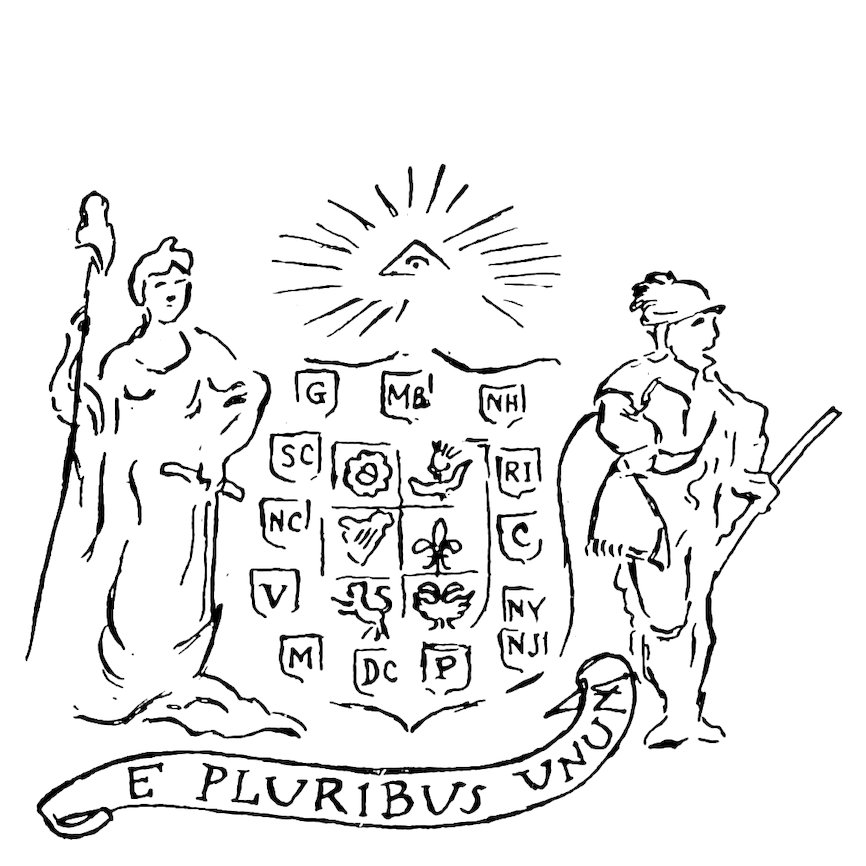
The great Seal should on one side have the Arms of
the United States of America which arms should be as
follows: The Shield has six Quarters,[9] parti one, coupé
two. The 1st. Or, a Rose enamelled gules & argent for
England: the 2d. Argent, a Thistle proper for Scotland: the
3d. Verd, a Harp Or, for Ireland: the 4th. Azure a Flower
de Luce Or for France: the 5th. Or the Imperial Eagle
Sable for Germany: and the 6th. Or the Belgic Lion
Gules for Holland, pointing out the Countries from
which these States have been peopled. The Shield within
a Border Gules entoire of thirteen Scutcheons Argent
linked together by a Chain Or, each charged with initial
Letters Sable as follows: 1st. N. H. 2d. M. B. 3d. R. I. 4th. C.
5th. N. Y. 6th. N. J. 7th. P. 8th. D. C.[10] 9th. M. 10th. V. 11th. N. C.
12th. S. C. 13th. G. for each of the thirteen independent
States of America.
Supporters, dexter the Goddess Liberty in a corselet
of armour alluding to the present Times, holding in
her right Hand the Spear and Cap and with her left
supporting the Shield of the States; sinister, the Goddess
Justice bearing a Sword in her right hand, and in her
left a Balance.
12Crest The Eye of Providence in a radiant Triangle
whose Glory extends over the Shield and beyond the
Figures.
Motto E Pluribus Unum.
Legend, round the whole atchievement. Seal of the
United States of America MDCCLXXVI.
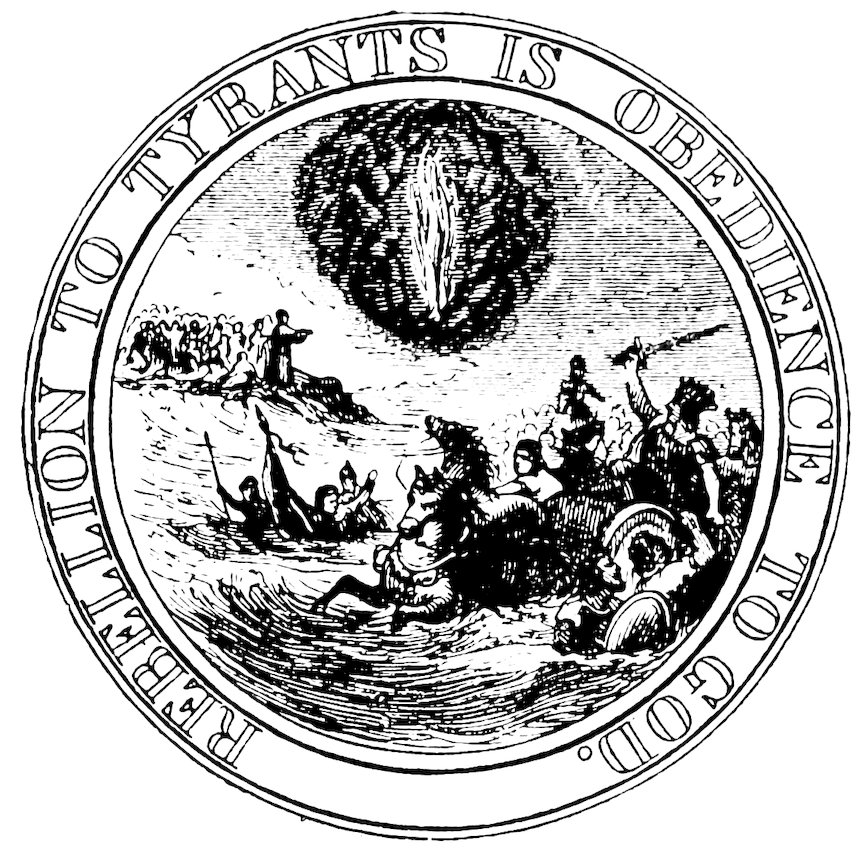
On the other side of the said Great Seal should be the
following Device. Pharaoh sitting in an open Chariot,
a Crown on his head and a Sword in his hand passing
through the divided Waters of the Red Sea in pursuit of
the Israelites; Rays from a pillar of Fire in the Cloud,
expressive of the divine Presence and Command, beaming
on Moses who stands on the Shore and extending his
hand over the Sea causes it to overwhelm Pharaoh.
Motto Rebellion to Tyrants is Obedience to God.[11]
This is endorsed, “Copy of a Report made Aug.
10, 1776,” and is in the handwriting of no member
of the committee, but of James Lovell.
The description of the arms by Du Simitière
is among the Jefferson Papers in the Library of
Congress, and shows a design identical with that
approved by the committee, except as to the
supporters, Du Simitière’s description being:
Supporters, dexter, the Goddess Liberty, in a corslet
of armour, (alluding to the present times) holding in her
right hand the Spear and Cap, resting with her left on an
anchor, emblem of Hope. Senester, an american Soldier,
compleatly accoutred in his hunting shirt and trousers,
with his tomahawk, powder horn, pouch &c. holding with
his left hand his rifle gun rested, and the Shield of the
States with his right.
Reverse
[Drawing by Benson J. Lossing from the description]
Obverse
[The pencil sketch by Du Simitière, found in the Jefferson Papers]
13A note following the report says: “The figure
of Liberty standing on a Column, on which are
the emblems of commerce, agriculture and arms.”
Two features alone of the designs of this committee
were preserved in the final seal, the eye of
Providence, which figured in the final reverse, and
the motto “E pluribus unum,” which appeared in
the final obverse. The eye was an adoption of a
very ancient symbol of the overseeing God. It
was probably suggested by Du Simitière himself,
since Adams does not mention it as having been
proposed by any member of the committee.
The motto formed a part of Du Simitière’s
design, but has been generally attributed to Jefferson.[12]
Adams’s letter shows nothing to suggest
the possibility that he himself chose the motto; on
the contrary, his mind was full of a moral rather
than a political allegory for the arms. Jefferson’s
mind had, on the other hand, already been engaged
on the subject of a suitable device for a seal to
express the idea of weakness in separation of the
States and power in their combination. In 1774
he made this note in his almanac:
A proper device (instead of arms) for the American
states united would be the Father presenting the bundle
of rods to his sons.
The motto “Insuperabiles si inseperabiles” an answer
given in parl[iament] to the H[ouse] of Lds, & comm[ons].[13]
14Jefferson’s preference for a “device” rather than
a coat of arms was due to the fact that he thought
more allegorical meaning could be obtained by
using the former. The idea he wished to convey
was from one of Æsop’s fables. A father called
his family of discordant sons about him, and taking
a bundle of rods bound compactly together bade
each one try to break it, which none could do. He
then gave each one a single rod from the bundle
and they were broken easily.
The motto “E pluribus unum”[14] was in familiar
use in the United States and naturally suggested
itself as a fitting description of the union of the
States depicted in Du Simitière’s design.
Franklin suggested the motto “Rebellion to
tyrants is obedience to God,” which, as we have
seen, was incorporated in the proposed reverse of
the seal. It so much pleased Jefferson that he
took it as his own motto, and had it cut upon his
private seal. It was current in the colonies as part
of a fictitious epitaph over the body of John Bradshaw,
president of the court which condemned
Charles I to death.
Thomas Hollis, of England, born in London
in 1720, and one of the early patrons of Harvard
College, in his memoirs, states:[15]
15The following Epitaph is often seen pasted up in the
houses in North America. It throws some light upon
the principles of the people, and may in some measure
account for the asperity of the war carrying on against
them. The original is engraved upon a cannon at the
summit of a steep hill near Martha Bray [Bay] in Jamaica:
STRANGER
Ere thou pass, contemplate this cannon,
Nor regardless be told
That near its base lies deposited the dust
Of John Bradshaw;
Who, nobly superior to selfish regards,
Despising alike the pageantry of courtly splendor,
The blast of calumny,
And the terrors of royal vengeance,
Presided in the illustrious band of Heroes and Patriots,
Who fairly and openly adjudged
CHARLES STUARD
Tyrant of England
To a public and exemplary death;
Thereby presenting to the amazed world,
And transmitting down through applauding ages,
The most glorious example
Of unshaken virtue,
Love of Freedom,
And impartial justice,
Ever exhibited on the blood-stained theater
Of human actions.
Oh, Reader,
Pass not on, till thou hast blest his memory!
And never, never forget,
That REBELLION TO TYRANTS
IS OBEDIENCE TO GOD.
A copy of this supposititious epitaph, in Jefferson’s
handwriting, was given to his young friend,
De Lyon, one of the Frenchmen who was with
16Lafayette on his tour of America in 1824. The
manuscript was dated 1776, and stated that the
inscription had been found three years earlier on
the cannon at Martha Bay, Jamaica. A note, evidently
by Mr. Jefferson himself, his biographer
states, says:
From many circumstances there is reason to believe
there does not exist any such inscription as the above,
and that it was written by Dr. Franklin, in whose hands
it was first seen.[16]
17Although Du Simitière, as it would appear from
John Adams’s letter, drew his designs for the committee,
they were not preserved among the papers
of Congress, a very slight pencil sketch of his proposed
obverse found among Jefferson’s papers being
all that remains. The committee’s report was laid
upon the table, and for nearly four years the
United States existed without a coat of arms and
Congress did business without an official seal.
II THE LOVELL COMMITTEE
18
On June 14, 1777, Congress adopted the national
flag of thirteen stripes, alternate red and
white, with a union of thirteen white stars upon a
blue field, “representing,” as the law said, “a new
constellation.” The flag had actually come into
use in the army some months before it received
legal sanction, its chief features probably suggested
by the Dutch standard. The red denoted daring,
the white purity, and the stars the States in
union.[17]
19The American minister to France, Silas Deane,
complained of the informality and impropriety of
the representatives of the sovereignty of a nation
being without a seal with which to authenticate
their official acts, but the subject was treated with
indifference. On January 23, 1777, a committee
appointed to examine the files of Congress, William
Ellery of Rhode Island, chairman, selected certain
papers which it thought required the consideration
of Congress—among them the “Report on a Device
for a public seal”[18]—but it was not until March 25,
1780, that the report was taken up again, when
James Lovell of Massachusetts, John Morin Scott
of Virginia, and William Churchill Houston of
New Jersey were appointed a committee to report
a design for a great seal, and to them was referred
the report of the first committee. The chairman of
the committee and the most important member
was Lovell. He was a Boston school-teacher and
a graduate of Harvard College. Being imprisoned
by the British after the battle of Bunker Hill, he
was later exchanged and entered Congress in December,
1776, where he served till 1782, being
for a long time on the Committee of Foreign
Affairs. While serving on this committee he must
have received Deane’s complaint that Congress
had no seal. Lovell was regarded as a man of
great learning, but was extremely eccentric in his
manners and speech.[19] The committee reported
May 10:
The Com̃ittee to whom was referred on the 25th of
March last the report of a former Com̃ittee on the Device
of a Great Seal for the United States in Congress assembled,
beg Leave to report the following Description.
The Seal to be 3 Inches in Diametre
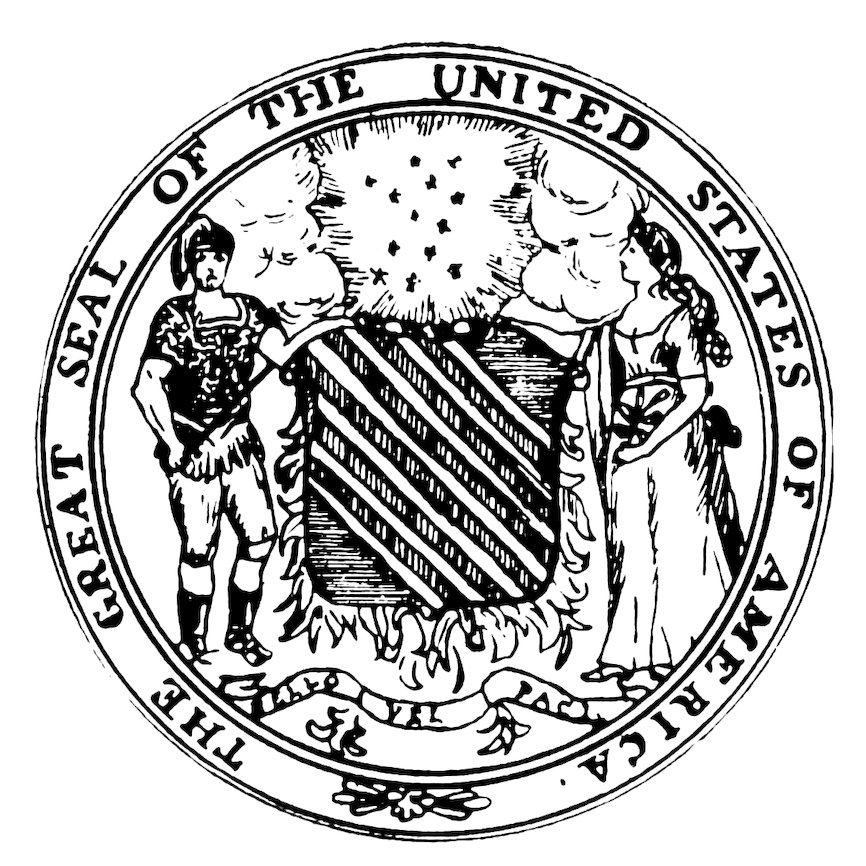
On one Side the Arms of the United States, as follows;
The Shield charged on the Field Azure with 13
diagonal Stripes alternate rouge and argent—Supporters;
dexter, a warriour holding a Sword; sinister, a
Figure, representing Peace bearing an Olive Branch—The
20Crest—a radiant constellation of 13 Stars—The motto
Bello vel Paci; The Legend round the Atchievement—The
great Seal of the United States of America
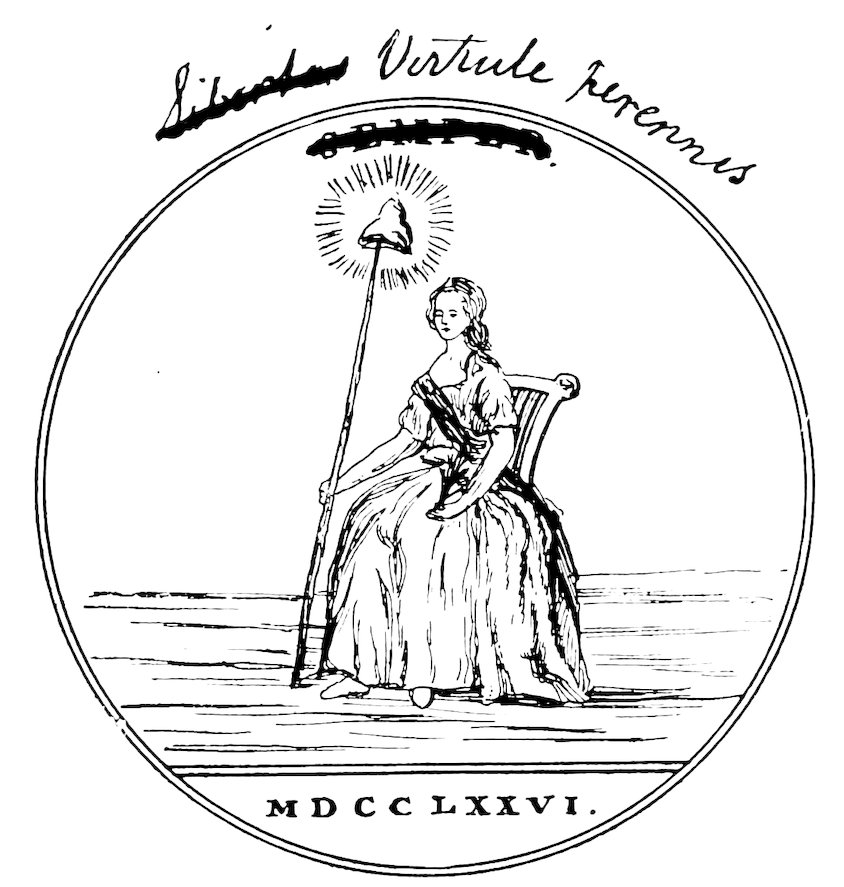
On the reverse, The Figure of Liberty seated in a
Chair holding the Staff and Cap—The motto virtute perennis—underneath,
MDCCLXXVI.
A Drawing of the Seal is annexed—
May 10th 1780—
A Miniature of the Face of the great Seal to be prepared
of Half the Diametre, to be affixed as the less Seal
of the United States.
The report is endorsed, “Report of the Comeee.
on the device of a great Seal—Delivered May 10,
1780 read—May 17, 1780 Recommitted. N. B.
The within report has been altered since the Recommitment
of May 17, 1780,” the endorsement
being in the handwriting of Charles Thomson, the
Secretary of Congress, except the note, which is in
the same hand as the report, apparently,[20] that of
21Houston; but the motto virtute perennis in the
report is in Thomson’s hand. The committee
submitted designs of both obverse and reverse.
The more finished of those for an obverse has
the stripes alternate white and red, whereas the
report called for red and white. A second and
rougher design shows a slightly different arrangement
of the constellation, a helmet as a crest, which
is struck out as unsatisfactory, and a shield with
alternate red and white stripes. For dexter supporter
there is a naked Indian carrying in his right
hand a bow and arrow.
Two drawings were made for the reverse, the
differences between them not being great. In one
the figure carries in her left hand a sword instead
of an olive branch, and at the bottom is the date
MDCCLXXX, while at the top the motto, “Aut
haec aut nullus,” has a line drawn through it;
another has over the top outside the circle the
words “Libertas virtute perennis,” a line having
22been drawn through the word “Libertas;” within
the circle is the word Semper struck out and the
date is MDCCLXXVI. Underneath is this fragment
of a note: “a rough Sketch of the Design &
Decorations by the ——.”
The report of this committee is important, because
it shows for the first time the use of the
constellation of thirteen stars, the shield, and the
white and red and red and white stripes. The
stripes and stars had undoubtedly been adopted
from the flag. In these designs appears for the
first time the olive branch as an emblem of peace.
III WILLIAM BARTON’S DESIGNS — Arms. — Crest. — Supporters — Arms. — Crest. — Supporters. — Remarks.
23
The report of the Lovell committee met with
the same fate as the report of the first committee.
It was recommitted, and nothing further was done
until May, 1782, when Arthur Middleton of South
Carolina, Elias Boudinot of New Jersey, and Edward
Rutledge of South Carolina were appointed
a committee to design a seal. The two South
Carolinians were men of foreign education, and a
cultivated gentleman in those days usually had
some knowledge of heraldry. Boudinot had an
interest in coins and medals, it is presumed, as he
was appointed Director of the Mint at Philadelphia
in 1795. This committee did no independent
labor of a serious character, but called into consultation
William Barton, A. M., a private citizen of
Philadelphia. He was the son of Rev. Thomas
Barton, rector of St. James Episcopal Church, his
mother being a sister of the famous David Rittenhouse,[21]
and in 1813 he published a memoir of Rittenhouse.
He was also the author of a monograph
on the nature and use of Paper Credit, etc.
(Philadelphia, 1781). The reasons which prompted
24the committee to go to him are not known. It is
evident, however, that he had studied heraldry, and
his drawings show that he was ingenious in the use
of his pencil. From the time he first appears in
connection with the seal he is the central figure,
until he divides the honors with the Secretary of
Congress, Charles Thomson.
Rutledge’s connection with the committee was
never active, and Arthur Lee, who had recently
returned from France, acted with it, although never
formally assigned as a member.
Barton’s first design for the seal was as follows:
A Device for an Armorial Atchievement, for the Great
Seal of the United States of America, in Congress assembled;
agreeable to the Rules of Heraldry:—proposed
by William Barton, A. M.
Barry of thirteen pieces, Argent & Gules; on a Canton,
Azure, as many Stars disposed in a Circle, of the first: a
Pale, Or, surmounted of another, of the third; charged,
in Chief, with an Eye surrounded with a Glory, proper;
and, in the Fess-point, an Eagle displayed, on the Summit
of a Doric Column which rests on the Base of the
Escutcheon, both as the Stars.
On an Helmet of burnished Gold damasked, grated
with six Bars, and surmounted of a Cap of Dignity, Gules,
turned up Ermine, a Cock armed with Gaffs, proper:
25
On the dexter Side: the Genius of America (represented
by a Maiden with loose Auburn Tresses, having on
her Head a radiated Crown, of Gold, encircled with a Sky-blue
Fillet Spangled with Silver Stars; and clothed in a
long, loose, white garment, bordered with Green: from
her right Shoulder to her left Side, a Scarf semé of Stars,
the Tinctures thereof the same as in the Canton; and
round her Waist a purple Girdle fringed or; embroidered,
Argent, with the Word “Virtue”:)—resting her
interior Hand on the Escutcheon; and holding in the
other the proper Standard of the United States, having a
Dove, argent, perched on the Top of it.
On the sinister side: a Man in complete Armour; his
Sword-belt, Azure, fringed with Gold; his Helmet encircled
with a Wreath of Laurel, and crested with one
white & two blue Plumes: supporting with his dexter
Hand the Escutcheon, and holding, in the exterior, a
Lance with the point sanguinated; and upon it a Banner
displayed, Vert,—in the Fess-point an Harp, or, stringed
with Silver, between a Star in Chief, two Fleurs-de-lis in
Fess, and a pair of Swords in Saltier, in Base, all Argent.
The Tenants of the Escutcheon stand on a Scroll, on
which the following Motto—
“Deo favente”—
which alludes to the Eye in the Arms, meant for the Eye
of Providence.
Over the Crest, in a Scroll, this Motto—
“Virtus sola invicta”—
which requires no comment.
26The thirteen pieces, barways, which fill up the Field
of the Arms, may represent the several States; and the
same Number of Stars upon a blue Canton, disposed in a
Circle, represent a new Constellation, which alludes to
the new Empire, formed in the World by the Confœderation
of those States—Their Disposition, in the form of
a circle, denotes the Perpetuity of its Continuance, the
Ring being the Symbol of Eternity. The Eagle displayed
is the Symbol of Supreme Power & Authority, and signifies
the Congress; the Pillar, upon which it rests, is used
as the Hieroglyphic of Fortitude & Constancy; and, it’s
being of the Doric Order, (which is the best proportioned
& most agreeable to Nature,) & composed of several Members
or parts, all, taken together, forming a beautiful
Composition of Strength, Congruity & Usefulness, it may
with great propriety signify a well planned Government.
The Eagle, being placed on the Summit of the Column,
is emblematical of the Sovereignty of the Government of
the United States; and, as further expressive of that
Idea, those two Charges or Figures are borne on a Pale,
which extends across the thirteen pieces into which the
Escutcheon is divided. The Signification of the Eye has
been already explained.
The Helmet is such as appertains to Sovereignty; and
the Cap is used as the Token of Freedom & Excellency:
It was formerly worn by Dukes “because,” says Guillim,
“they Had a more worthy Government than other Subjects.”—The
Cock is distinguished for two most excellent Qualities,
Necessary in a free Country, viz. Vigilance &
Fortitude.
The Genius of the American confœderated Republic is
denoted by her blue Scarf & Fillet, glittering with Stars,
27and by the Flag of Congress which she displays. Her
Dress is white edged with green; Colours emblematical
of Innocence and Youth. Her purple Girdle & radiated
Crown indicate her Sovereignty: the Word “Virtue” on
the former is to show, that that should be her principal
Ornament; and the radiated Crown, that no Earthly Crown
shall rule her. The Dove on the Top of the American
Standard denotes the Mildness & Lenity of her Government.
The Knight in Armour with his bloody Lance represents
the Military Genius of the American Empire, armed
in Defence of its just Rights. His blue Belt & blue Feathers
indicate his Country, & the white Plume is in Compliment
to our gallant Ally. The Wreath of Laurel round
his Helmet is expressive of his Success. The Green Field
of the Banner denotes Youth and Vigor; the Harp is
emblematical of the several States acting in Harmony &
Concert; the Star, in Chief, has reference to America, as
principal in the Contest; the two Fleurs-de-lis are borne
as a grateful[22] Testimonial of the Support given to her by
France; and the two Swords, crossing each other, signify
a State of War. This Tenant & his Flag relate, totally,
to America at the Time of her Revolution.
William Barton.
This, the first device of Barton, was not illustrated,
and his second device, of which he offered a
colored drawing, differed from it in that he transferred
the eye to the reverse and the eagle from the
28summit of the column to the crest, thereby eliminating
the cock. He put at the summit of the column
a phœnix rising from the flames, left out the
American flag from the dexter supporter’s hand,
and changed the sinister supporter from a warrior
in armor to one in continental uniform, holding in
his hand a baton instead of a lance. He also left
out the harp and the fleur-de-lis and transferred the
motto to the reverse. The fleur-de-lis was proposed
to commemorate the alliance with France,
this being the only report in which the alliance
figured. The design is important, because it establishes
the fact that the idea had become fixed of
having in the seal the thirteen stars, the blue field,
and thirteen stripes of red and white or white and
red. In this design appears for the first time the
eagle.
Barton’s second design was addressed to “The
Honble. Elias Boudinot, Esqr. & Arthur Lee Esq. In
Congress.”
Device for an Armorial Atchievement & Reverse of a
Great Seal, for the United States of North America: proposed
by William Barton, Esqr. A. M.—
Blazoned according to the Laws of Heraldry—
Barry of thirteen pieces, Argent & Gules; on a pale,
Or, a Pillar of the Doric Order, Vert, reaching from the
Base of the Escutcheon to the Honor point; and from
the Summit thereof, a Phœnix in Flames with Wings expanded,
proper; the whole within a Border, Azure, charged
with as many Stars as pieces barways, of the first.
On a Helmet of Burnished Gold, damasked, grated
with six Bars, a Cap of Liberty, Vert; with an Eagle displayed,
Argent, thereon: holding in his dexter Talon a
Sword, Or, having a Wreath of Laurel suspended from
the point; and, in the sinister, the Ensign of the United
States, proper.
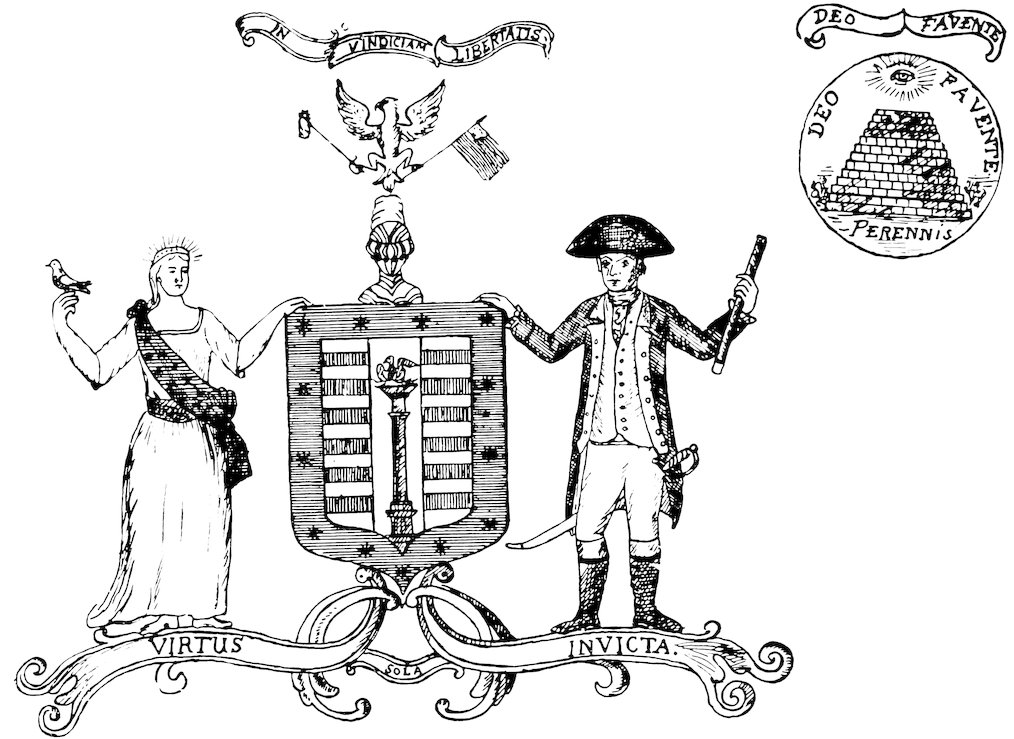
On the dexter side, the Genius of the American Confederated
Republic: represented by a Maiden, with flowing
Auburn Tresses; clad in a long, loose, white Garment,
bordered with Green; having a Sky-blue Scarf, charged
with Stars as in the Arms, reaching across her Waist
from her right Shoulder to her left Side; and, on her
Head, a radiated Crown of Gold, encircled with an Azure
Fillet spangled with Silver Stars; round her Waist a
purple Girdle, embroidered with the Word “Virtus”, in
Silver:—a Dove, proper, perched on her dexter Hand.
On the sinister side, an American Warrior; clad in an
uniform Coat, of blue faced with Buff, and in his Hat
a Cockade of black & white Ribbons; in his left Hand, a
Baton Azure, semé of Stars Argent.
Motto, over the Crest—
“In Vindiciam Libertatis”
Motto, under the Arms—
“Virtus sola invicta”
30Reverse of the Seal.
A Pyramid of thirteen Strata, (or Steps) Or. In the
Zenith; an Eye, surrounded with a Glory, proper.
In a Scroll, above—or in the Margin
“Deo favente”
The Exergue
“Perennis”
The Imperial Eagle of Germany (which is sable, and
with two Heads) is represented with a Sword in one
Talon, and a Sceptre in the other.
The Phœnix is emblematical of the expiring Liberty
of Britain, revived by her Descendants in America.
The Dove (perched on the right Hand of the Genius
of America) is Emblematical of Innocence and Virtue.
The Sword (held by the Eagle) is the Symbol of
Courage, Authority & Power. The Flag or Ensign denotes
the United States of America, of the sovereignty of
which the Eagle is expressive.
The Pillar is the Hieroglyphic of Constancy & Fortitude;
and is likewise emblematical of Beauty, Strength
& Order.
The Pyramid signifies Strength & Duration.
The other parts have been explained.
The Armorial Atchievements of Sovereign Princes &
States are usually blazoned by the planets, to represent
the Colours; but that mode is purposely deviated from,
being condemned by the best Heralds.
The committee adopted this complicated design
and reported it to Congress May 9, 1782, but Congress
was not satisfied with it, and on June 13 it was
referred to the Secretary of Congress.
31The endorsement on Barton’s design is in Thomson’s
hand, except the last sentence, “Passed,” etc.:
No. 26—Report of Mr. Middleton Mr. Boudinot Mr. Rutledge.
Device of a Seal Entd. May 9, 1782 June 13–1782
Referred to the Secy of the United States in Congress
Assembled to take order. Passed June 20 1782.
The number on the report had reference to the
arrangement of papers in the Secretary’s office.
The words “Passed June 20 1782,” had reference
to the later design.
It should be noticed that Barton termed the
description of his device a “blazon”—that is, a verbal
description so precise that a person understanding
heraldry would be able to draw and color the
arms correctly. All of the other reports on the
seal were blazons also, thus showing the purpose of
making an illuminated arms.
Barton’s design for the obverse, as he drew it
for the committee, was 9½ inches by 8 inches
large, and the reverse 2½ inches in diameter, and
both were in colors, the coloring following the description
correctly, and the lettering and scroll
work being in black and white. The circumstances
under which Barton was called upon to
submit his final design were noted by him in a
memorandum which he left among his papers:
In June, 1782 [he says] when Congress was about to
form an armorial device for a Great Seal for the United
States, Charles Thomson, Esq., then Secretary of Congress,
32with Hon. Arthur Lee and Elias Boudinot, member
of Congress, called on me and consulted me on the
occasion. The Great Seal, for which I furnished these
gentlemen with devices (as certified by Charles Thomson,
Esq.), was adopted by Congress on the 20th of June,
1782. Mr. Thomson informed me, four days after, that
they met with general approbation.
IV THE SECRETARY’S DEVICE — Arms. — Arms. — For the Crest. — Remarks.
33
Barton’s elaborate design fixed the reverse, but
that part of the seal does not appear to have caused
much discussion. For the obverse it produced the
displayed eagle, but Barton’s eagle was crested and
not the American or bald-headed eagle.
The whole matter now having by order of Congress
come into the hands of Charles Thomson, he
took a radical departure from all previous designs.
Putting the eagle as the central figure of his design,
he specified that it be an American eagle,
rising, not displayed. As emblematic of the war
power he put in the sinister talon a bundle of
arrows, where Barton had put the American flag,
introducing the arrows into the seal for the first
time. To picture peace he put in the eagle’s
dexter talon an olive branch which had figured
in the device of the second committee, instead of
Barton’s sword and wreath of laurel. For the crest
he used the constellation of thirteen stars surrounded
by clouds, as in the second committee’s
report, and arranged the red and white stripes,
which the second committee had made diagonal
and Barton horizontal, in chevrons, one side of red
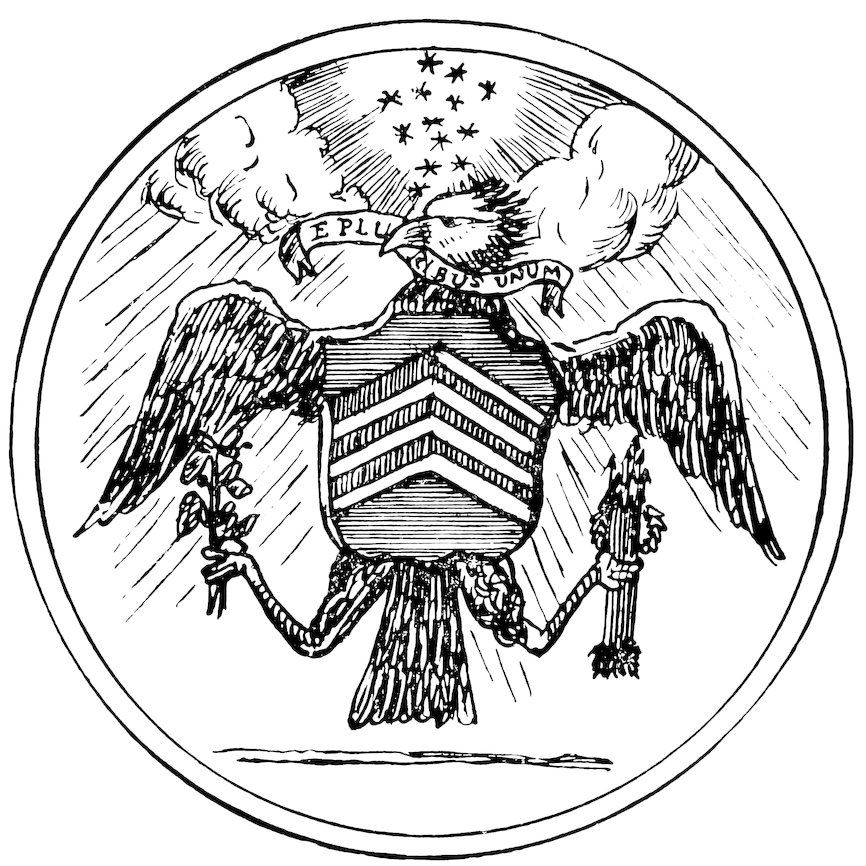
34and white, the other of white and red. From the
report of the first committee he took the motto “E
pluribus unum.” He made or had made a rough
drawing of his device, which was colored. It was
almost 4 inches in diameter. For the reverse he
adopted Barton’s device, changing only the mottoes.
These were from Virgil, “Audacibus annue cœptis”
(favor my daring undertaking), being found in the
Æneid, book 9, verse 625 (also in the Georgics, 1,
40), and “Magnus ab integro seclorum nascitur
ordo” (the great series of ages begins anew), coming
from the fourth eclogue, fifth verse. Although
the form “seclorum” was adopted, the more approved
spelling is “sæclorum.”[24]
The report which follows is entirely in Thomson’s
handwriting and is endorsed by him “The
Secretary’s device:”
Device for an Armorial Atchievement and Reverse of
a great Seal for the United States in Congress Assembled.
On a field Chevrons composed of seven pieces on one
side & six on the other, joined together at the top in
such wise that each of the six bears against or is supported
by & supports two of the opposite side the pieces
of the chevrons on each side alternate red & white. The
shield born on the breast of an American Eagle on the
Wing & rising proper. In the dexter talon of the Eagle
an Olive branch & in the sinister a bundle of arrows.
Over the head of the Eagle a constellation of Stars surrounded
with bright rays and at a little distance clouds.
35In the bill of the Eagle a scroll with the words
E pluribus unum.—
Reverse
A pyramid unfinished
In the Zenith an Eye in a triangle surrounded with a
glory, proper.
Over the eye these words
Annuit cœptis
On the base of the pyramid the numerical letters
MDCCLXXVI
and underneath these words
Novus ordo seclorum.
N. B. the Head & tail of the American bald Eagle are
white the body & wings of a lead or dove colour.
This design of Thomson’s was returned to Barton,
who changed it by inserting pales for the chevrons,
the colors alternating white and red, with a
blue chief. He restored the displayed eagle as in
his own design and specified that the bundle of
arrows should contain thirteen. He also recommended
that in the exergue should be the date of
American independence and in the margin a Latin
legend, “Sigul. Mag. Reipub. Confœd.,” but in the
final design this was left out. The report was written
by Barton and is endorsed by Thomson, “Mr.
Barton’s improvement on the Secretary’s device.”
36Device for an Armorial Atchievement for the United
States of North America, blazoned agreeably to the Laws
of Heraldry—proposed by Wm. Barton, A. M.
Paleways of [25]thirteen pieces, Argent & Gules; a
Chief Azure:—The Escutcheon placed on the Breast of
an American (the bald-headed) Eagle, displayed, proper;
holding in his Beak a Scroll, inscribed with this Motto,
viz.
“E pluribus Unum”—
And in his dexter Talon a Palm or an Olive Branch—in
the other a Bundle of 13 Arrows; all proper.
Over the Head of the Eagle, which appears above
the Escutcheon, a Glory, Or; breaking through a Cloud,
proper, and surrounding thirteen Stars forming a Constellation,
Argent, on an Azure Field.
In the Exergue of the Great Seal—
“Jul. iv. MDCCLXXVI”—
In the Margin of the same—
“Sigil. Mag. Reipub.
“Confœd. Americ.”
The Escutcheon is composed of the Chief & Pale, the
two most honorable ordinaries: the latter represent the
several States; all joined in one solid, compact Entire,
37supporting a Chief, which unites the whole & represents
Congress—The Motto alludes to this Union.—The
Colours or Tinctures of the Pales are those used in the
Flag of the United States—White signifies Purity & Innocence;
Red, Hardiness & Valour. The Chief denotes
Congress—Blue is the Ground of the American uniform,
and this Colour signifies Vigilance, Perseverance &
Justice.
The Meaning of the Crest is obvious, as is likewise
that of the Olive Branch & Arrows.
The Escutcheon being placed on the Breast of the
Eagle displayed is a very antient Mode of bearing, & is
truly imperial. The Eagle displayed is an Heraldical Figure;
and, being borne in the Manner here described, supplies
the Place of Supporters & Crest. The American
States need no Supporters but their own Virtue, and the
Preservation of their Union through Congress.—The
Pales in the Arms are kept closely united by the Chief,
which last likewise depends on that Union & the Strength
resulting from it, for its own Support—the Inference is
plain.
W. B.
June 19th. 1782
This report originated from two sources, Thomson
and Barton, and the agency of each is clearly
defined. The distinction of producing the arms
of the United States can not justly be accorded
wholly to either, but belongs wholly to both, with
the larger share of distinction to the Secretary,
Charles Thomson.
On June 24, four days after the seal had been
adopted, Thomson wrote to Barton:
38I enclose you a copy of the device by which you have
displayed your skill in heraldic science, and which meets
with general approbation.
The chief change made by Barton in Thomson’s
design was in the substitution for the chevrons
of thirteen pales, alternate white and red, with a
blue chief, and this has been often attributed, without
adequate warrant, to an outside source, which
deserves to be noticed.
Sir John Prestwich was a distinguished English
antiquary and a friend of the American Revolution.
He enjoyed an acquaintance with John
Adams when the latter was on his foreign mission
in 1779, and they conversed on the subject of the
seal, in which Adams, of course, took an interest,
as he had been on the first committee to design it.
It appears that Sir John made certain suggestions
for a design which were afterwards enlarged into a
claim by others that he had made the design of the
arms which was finally adopted. Sifting from the
question the conjecture and inference surrounding
it one fact is important. It is set forth by the historian
Benson J. Lossing in the Field Book of the
American Revolution and War of 1812:[26]
In the manuscript letter before me [he says], written
in 1818 by Thomas Barritt, Esq., an eminent antiquary
of Manchester, England, addressed to his son in this
country, is the following statement: “My friend, Sir
39John Prestwich, Bart., told me he was the person who
suggested the idea of a coat of arms for the American
States to an embassador [John Adams] from thence,
which they have seen fit to put on their moneys. It is
this, he told me—party per pale of thirteen stripes, white
and red, the chief of the escutcheon, blue, signifying the
protection of Heaven over the States.—He says it was
soon after adopted, as the arms of the States, and to
give it more prominence was placed upon the breast of
a displayed eagle.”
There is no claim here that Sir John Prestwich
suggested the eagle as an emblem, or the placing
of the shield upon the eagle’s breast, but simply
the pales and the chief. The theory is that Adams
communicated this suggestion to Charles Thomson,
who engrafted it upon his own and Barton’s designs.
But it must be remembered that two shields
were already on the files of Congress, with alternate
red and white, or white and red, stripes, and Barton’s
first design had bars of the same colors. Prestwich’s
suggestion was, therefore, no more than that
they be perpendicular instead of diagonal or parallel,
and that the chief be blue; but in the device
submitted by the committee of 1780 the diagonal
stripes were charged upon a field azure. Sir John
Prestwich, of course, knew nothing of these designs,
and his statement after the seal was adopted was
made in ignorance of the fact that the essentials of
his suggestion were already before Congress.[27] That
40his suggestion influenced the final result even in
the slight degree possible, seems improbable. Why
did Thomson, with the Prestwich suggestion before
him, make his first shield of chevrons, which Barton,
it appears, changed to pales? Thomson may
have told Barton of the Prestwich design, but what
is more natural than that Barton should try of his
own initiative the only new arrangement of the
stripes that was left to try? Diagonal stripes, bars,
chevrons, had all figured in designs and had not
given satisfaction. Pales were then drawn and
proved acceptable.
V THE ARMS ADOPTED — REMARKS AND EXPLANATION
41
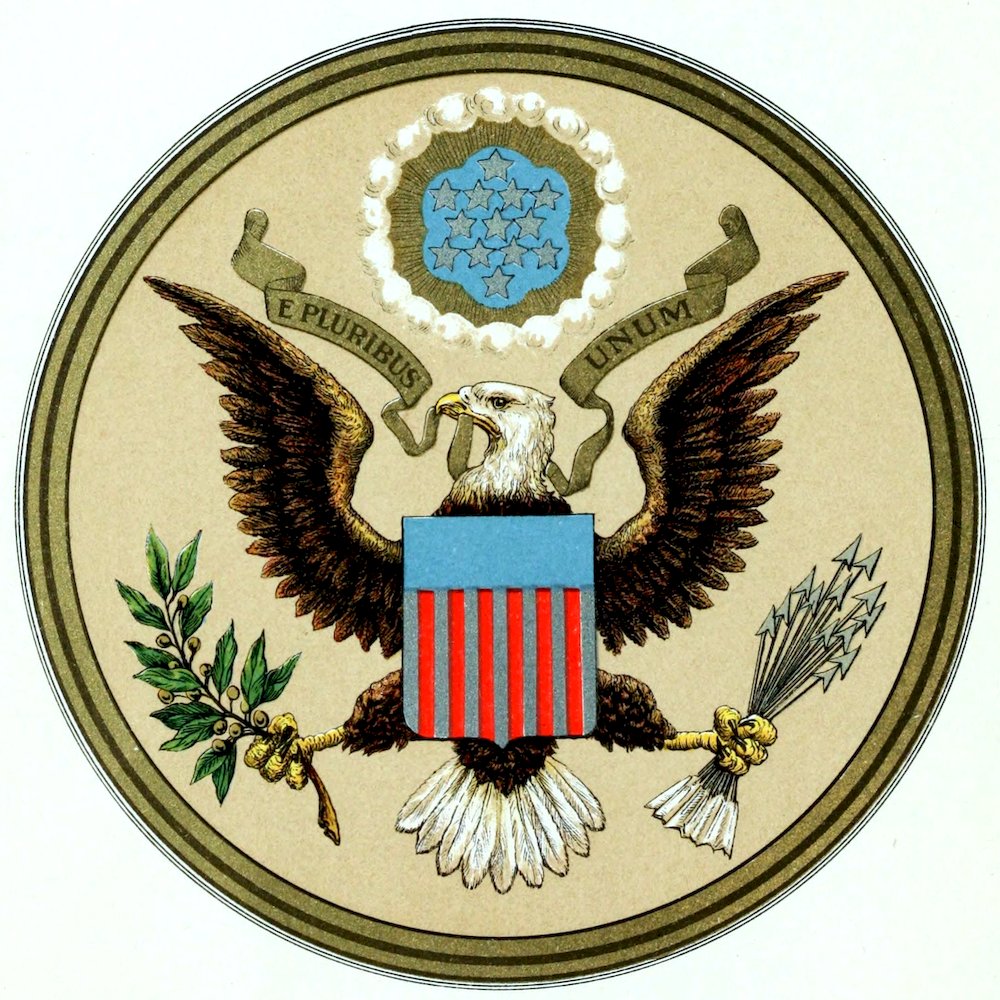
On June 20, 1782, the seal was finally decided
upon.
On report of the secretary, to whom were referred
the several reports on the device for a great seal, to take
order:
The device for an armorial achievement and reverse of
the great seal for the United States in Congress assembled,
is as follows:
ARMS. Paleways of thirteen pieces, argent and gules;
a chief, azure; the escutcheon on the breast of the American
eagle displayed proper, holding in his dexter talon
an olive branch, and in his sinister a bundle of thirteen
arrows, all proper, and in his beak a scroll, inscribed with
this motto, “E pluribus Unum.”
For the CREST. Over the head of the eagle, which
appears above the escutcheon, a glory, or, breaking
through a cloud, proper, and surrounding thirteen stars,
forming a constellation, argent, on an azure field.
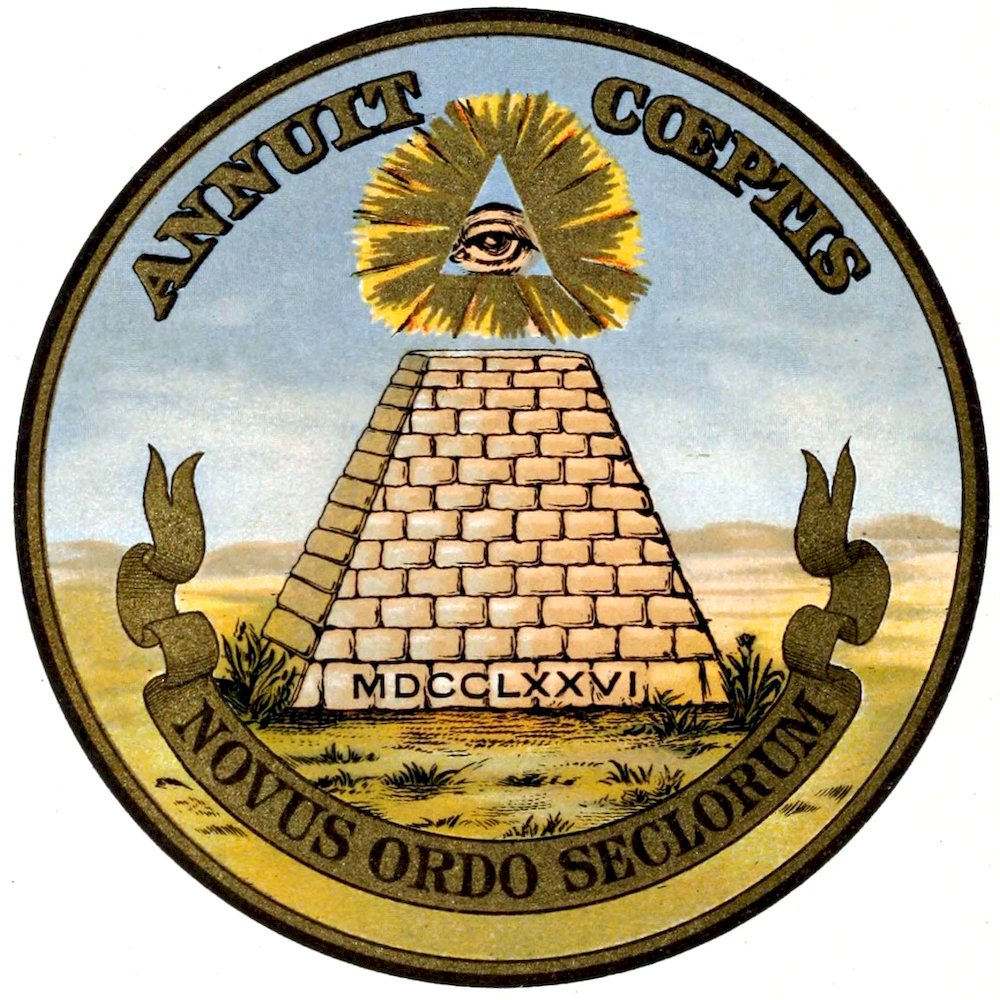
REVERSE. A pyramid unfinished. In the zenith,
an eye in a triangle, surrounded with a glory proper.
Over the eye these words, “Annuit Cœptis.” On the base
of the pyramid the numerical letters MDCCLXXVI. And
underneath the following motto, “Novus Ordo Seclorum.”[28]
42
The Escutcheon is composed of the chief & pale, the
two most honorable ordinaries. The pieces, paly, represent
the Several States all joined in one solid compact
entire, supporting a Chief, which unites the whole &
represents Congress. The Motto alludes to this union.
The pales in the arms are kept closely united by the
chief and the chief depends on that Union & the strength
resulting from it for its support, to denote the Confederacy
of the United States of America & the preservation
of their Union through Congress. The colours of the
pales are those used in the flag of the United States of
America; White signifies purity and innocence, Red,
hardiness & valour, and Blue, the colour of the Chief
signifies vigilance perseverance & justice. The Olive
branch and arrows denote the power of peace & war
which is exclusively vested in Congress. The Constellation
denotes a new State taking its place and rank
among other sovereign powers. The Escutcheon is born
on the breast of an American Eagle without any other
supporters, to denote that the United States of America
ought to rely on their own Virtue.
Reverse. The pyramid signifies Strength and Duration:
The Eye over it & the Motto allude to the many
signal interpositions of providence in favour of the
American cause. The date underneath is that of the
Declaration of Independence and the words under it
signify the beginning of the new American Æra, which
commences from that date.
43This entire report is in Thomson’s handwriting
and is endorsed by him: “Device for a Great Seal
for the United States in Congress Assembled.
Passed June 20, 1782.” In the journals of Congress
the “Remarks and explanation” are left out,
but they constitute an essential part of the fundamental
law as Congress adopted it.
The different features of the seal had all been
in common use in America. In the North Carolina
paper currency of 1775 appears a bundle of
thirteen arrows; in the Maryland currency of the
same year a hand grasping an olive branch with
thirteen leaves; on a fifty-dollar bill issued in 1778
is an unfinished pyramid, with the motto “Perennis;”
in the Massachusetts copper penny of 1776
are thirteen stars, surrounding an eagle; the flag
had the thirteen stripes, and so had the seal of the
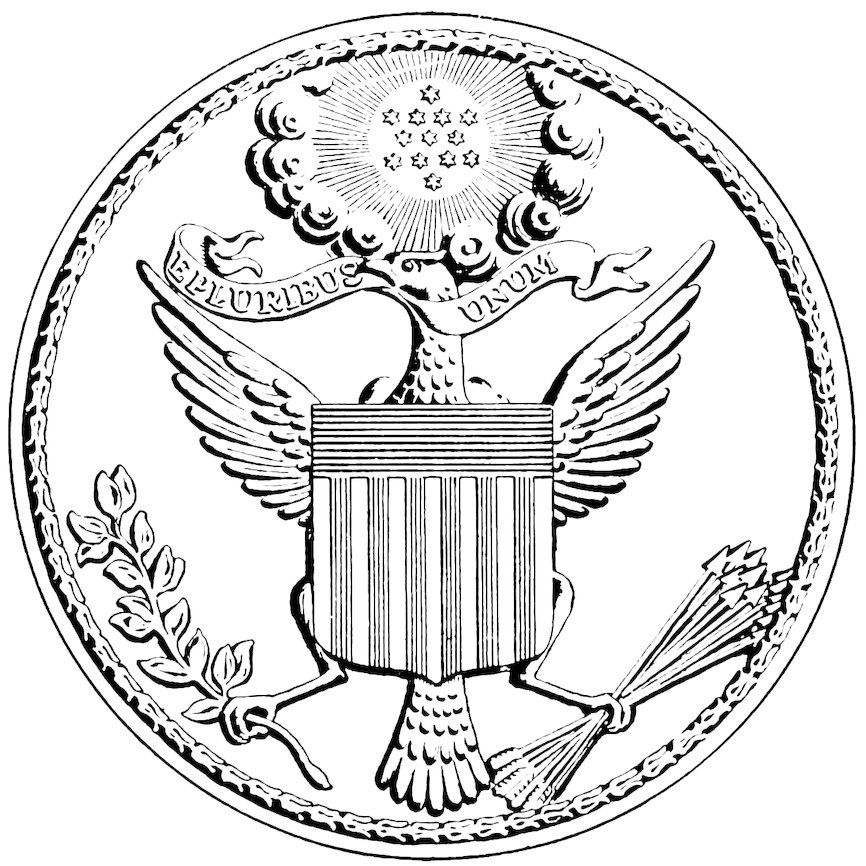
Board of Admiralty, adopted May 4, 1780.
Soon after the seal was adopted the obverse was
cut in brass; but the identity of the engraver is unknown.
It was intended to be impressed in wax
over a paper wafer, and is found on a commission
dated September 16, 1782, granting full power and
authority to General Washington to arrange with
the British for exchange of prisoners of war. The
commission is signed by John Hanson, President
of Congress, and countersigned by Charles Thomson,
Secretary, the seal being affixed in the upper
left-hand corner, instead of the lower left-hand corner
as is now the custom. This, the first great
seal to be made, continued in use for fifty-nine
44years, and having been cut almost as soon as the
design was adopted may fairly be assumed to represent
correctly the intentions of the makers of the
seal.
The second or Lovell committee recommended
a “less seal of the United States” of the same design
as the great seal but of smaller diameter, but
no other committee took cognizance of the custom
which still prevails in many countries of having two
principal seals of state. The idea had not, however,
wholly disappeared when the Constitution was
adopted, for in the first Congress John Vining of
Delaware proposed (June, 1789) that a Home Department
be provided for and that the Secretary be
required to “keep the great seal, and affix the same
to all public papers, when it is necessary; to keep
the lesser seal, and affix it to commissions &c.”
In the debate which preceded the defeat of the
bill, Alexander White of Virginia said the great
seal might be kept by the Secretary of Foreign
Affairs, and the lesser seal also.[29] No direct proposition
was made, however, to create a lesser seal.
When the Congress under the Articles of Confederation
ceased to exist and the new Government
went into operation Charles Thomson continued in
charge of the great seal and of the records of the
old Government, until provision for their custody
45should be made. On July 24, 1789, Washington
as President wrote to him:
You will be pleased, Sir, to deliver the Books, Records
and Papers of the late Congress—the Great Seal of
the federal Union—and the Seal of the Admiralty, to Mr.
Roger Alden, the late Deputy Secretary of Congress,
who is requested to take charge of them until further
directions shall be given.
Thus terminated Thomson’s connection with
the seal which he had done so much to design and
have adopted. Alden afterwards described his own
appointment as that of keeper of the seals and
papers of the old Congress.
On June 27 the bill creating the Department of
Foreign Affairs became a law, this being the first
executive department provided for under the Constitution,
but the Secretary was not made the
keeper of the seal and it remained in Alden’s hands
until the Department of State was created. The
act creating this Department was entitled, “An act
to provide for the safe keeping of the acts, records,
and seal of the United States and for other purposes.”
It enlarged the Department of Foreign
Affairs into the Department of State, and named as
the principal officer the Secretary of State. The
third section of the act read:
And be it further enacted, That the seal heretofore used
by the United States in Congress assembled, shall be,
and hereby is declared to be, the Seal of the United
States.
46The fourth section read:
That the said secretary shall keep the said seal, and
shall make out and record, and shall affix the said seal to
all civil commissions to officers of the United States to
be appointed by the president, by and with the advice
and consent of the senate, or by the president alone.
Provided, That the said seal shall not be affixed to any
commission, before the same shall have been signed by
the president of the United States, nor to any other
instrument or act, without the special warrant of the
president therefor.
It will be observed that the act described the
“Seal of the United States” and not the “Great
Seal of the United States,” although in all the
preliminary reports and in the adopting act the
term “Great Seal” was used. As no lesser seal of
state was contemplated there was really no object
in designating the only seal as the “Great Seal,”
although for ordinary purposes it has never ceased
to be called the “Great Seal,” and is so denominated
in the decision of the Supreme Court where
its uses are set forth. Before the seal was adopted
the commissions of Congress read simply “By order
of Congress,” being signed by the President. The
countersigning was, “Attest Charles Thomson,
Secretary.” When the seal came into use the form
was, as it appears on Washington’s commission to
exchange prisoners: “In testimony whereof we
have caused these Letters to be made patent and the
47Great Seal of the United States of America to be
thereunto affixed. Witness His Excellency John
Hanson President of the United States in Congress
assembled the Sixteenth day of September
and in the year of our Lord one thousand seven
hundred and eighty two, and of our Sovereignty &
Independence the seventh.” After the adoption
of the Constitution and before any custodian of the
seal was provided by Congress, the wording ran:
“In testimony whereof I have caused these letters
to be made patent and the Seal of the United
States to be hereunto affixed. Given under my
hand the —— day of —— in the year of our Lord
one thousand seven hundred and eighty nine,” this
being signed by the President and not countersigned.
This form continued in use after the Secretary
of State became by law the keeper of the
seal, and was not changed till August 3, 1790, when
the recital was made to include the year of independence
and was countersigned by Thomas Jefferson
as Secretary of State. Thus, singularly
enough, the abandonment of the term “Great Seal
of the United States” began with the Executive
some months before it received legal sanction.
VI THE ILLEGAL SEAL
48
In ancient times a seal to authenticate a document
was always impressed upon wax, or metal, or
even upon clay; but this gave place to the more
convenient method of impressing the seal directly
upon the paper by the use of two faces of a die.
It was, presumably, a desire to introduce this improvement
which prompted the Department of State
in 1841 to discard the seal of 1782 and have a new
die cut. The work was ordered without any specific
appropriation being made for the purpose by Congress,
and was entrusted to Edward Stabler, of Sandy
Spring, Md., where he was postmaster from 1828 to
1883, who cut many government seals, and had a
reputation as a seal engraver. He was doubtless
permitted to design the seal in his own way, and
it was accepted without notice being taken of its
palpable deficiencies from an artistic and heraldic
point of view and its failure to satisfy the plain
requirements of the law in the important particular
of the number of arrows in the eagle’s sinister
talon.
In reply to a letter from John D. Champlin, jr.,
in 1877, the Department of State said of the seal:
49This change [from the design of the seal of 1782]
does not appear to have been authorized by law, and the
cause of it is unknown.[30]
The inaccuracies of the design of the arms on
this seal were the subject of grave criticism from
time to time. In the Galaxy Magazine for May,
1877, Mr. Champlin pointed out the improper arrangement
of the pales, the red being twice as wide
as the white, and the fatal disregard of the law requiring
thirteen arrows in the eagle’s sinister talon.
“Is it possible,” he said, “that an arbitrary alteration
can be made in the great seal of the United
States by the officials temporarily in charge of it?
And if so, what is to prevent some future Secretary
of State, with notions of his own in regard to
heraldic bearings, from discarding the old seal altogether,
in favor of some creation of his own?”
This seal was cut when Daniel Webster was
Secretary of State, and a fair explanation of its
deficiencies is that he knew nothing about the details
of the prescribed design, and entrusted the
business of securing a new seal to his subordinates,
who were equally ignorant; and they in turn entrusted
it to the engraver. Unquestionably, the
Secretary of State has no authority to change the
device of the arms, as it is prescribed by law, in
the slightest degree, nor could the President himself
properly authorize such a change. As the seal
50was created by Congress it would require an act of
Congress to alter it. In this respect it is different
from the arms of a monarchy. The arms of Great
Britain, for example, being formed from those of
different monarchs, have, in fact, undergone three
changes since American independence—in 1801,
when the arms of France were excluded and the
arms of Hanover placed “over all on an escutcheon
of pretense,” “ensigned with the electoral bonnet;”
in 1816, when the bonnet was changed for the
Hanoverian crown; and upon the death of William
IV, when the present arrangement was made.
How far the Secretary of State, as the custodian of
the seal, may deviate from the original design in
having a new one cut, provided he adheres to the
terms of the creating law, is another question,
which, as we shall see presently, was finally decided
in favor of the conservative side.
The centennial anniversary of the adoption of
the seal was marked by a revival in interest concerning
it, and C. A. L. Totten, then a first lieutenant
in the Army, called the attention of the
Treasury Department to the fact that the reverse
had never been cut, suggesting that the time was
appropriate for placing it upon a medal or coin.
This met with the approval of the Department, so
far as a medal was concerned, and under the supervision
of Hon. A. Louden Snowden, then Director
of the Mint at Philadelphia, a medal was struck in
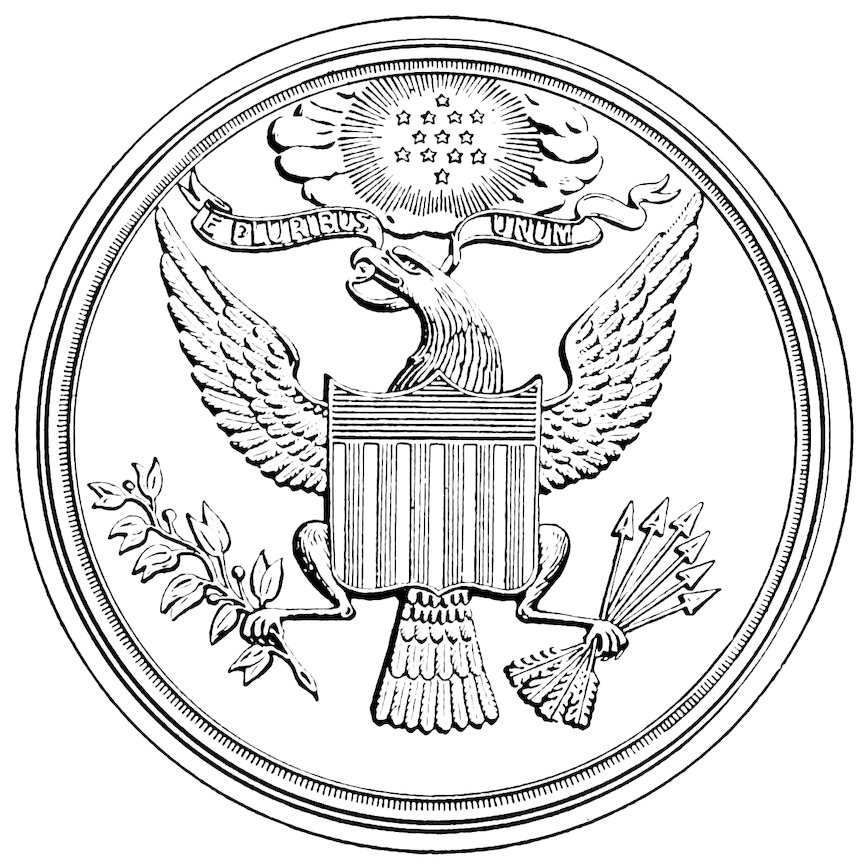
51commemoration of the centennial anniversary of
the adoption of the seal. The obverse closely
resembled the first important illustration of the seal
made after its adoption. This appeared in the
Columbian Magazine for September, 1786, and
was a spirited engraving. It differed from the official
interpretation in the distribution of the stars,
which were put about the eagle’s neck and head,
instead of in a circle above the head. The olive
branch had sixteen leaves and no fruits, and the
rays of the sun extended through the clouds. The
reverse of the medal contained the dates 1782 and
1882, to indicate its purpose, beside the mottoes.[31]
Notice has already been taken of Mr. Champlin’s
article in which he criticised the seal of 1841,
which the Department had been using for so many
years, notwithstanding its glaring errors. His criticism,
Mr. Totten’s agitation of the question of
cutting the reverse, and the striking of the great
seal medal were the moving causes of the important
action of the Secretary of State, Theodore F. Frelinghuysen,
in 1883.
The first committee on the seal recommended
a reverse, and so did succeeding committees, and a
reverse was provided for in the creating act. From
this it would appear certain that the original idea
was to use a pendant seal of wax with an impression
on either side of it. Pendant seals were then
52common and are still used in many cases. In
affixing such a seal to a treaty it is so large that
the wax would inevitably break if it were unprotected,
so it is enclosed in a metal box, usually
of gold or silver, highly ornamented. After the
United States secured a great seal it affixed the
same one to all its acts, and did not have a separate
pendant treaty seal until about 1856, when one was
made at the State Department’s instance, or upon
an understanding with the Department, by Samuel
Lewis, a jeweler in Washington. It was cut in
iron, weighing about 20 pounds, and was 6 to 8
inches in diameter. The design followed the law
accurately, but the treatment was realistic rather
than heraldic. This seal was kept by Mr. Lewis,
being, as it appears, his property, and whenever a
seal for a treaty was required he furnished an imprint
in wax with the silver or gold box in which
it was to be placed, the box having upon the cover
the arms stamped in relief. The cords or ribbons
passing through the treaty were adjusted through
the wax at the Department of State. The seal as
thus attached to the treaties made by this Government
with foreign powers for thirteen years compared
favorably with the treaty seals used by other
governments. In 1869 the use of the separate
seal for treaties was abandoned, and the practice
of fixing the regular seal to the paper itself was
reverted to, and now maintains.
VII THE THIRD SEAL
53
January 10, 1883, the Secretary of State, Theodore
F. Frelinghuysen, addressed the Chairman of
the Committee on Appropriations of the House
of Representatives, Samuel J. Randall, asking for
an appropriation of $1,000 to pay for having a
new seal of the United States made. “Since the
year 1782,” his letter said, “when the device was
adopted, there have been, it is believed, but two
dies of the obverse of the seal, the only side which
has been employed up to this time for sealing documents.
The reverse of the seal has never been engraved
by the Government. The original die of
the obverse, after being in use for about sixty
years, was replaced by the present die, which has
become very much worn and no longer gives clear
impressions. It is also to be observed with respect
to the latter that it does not strictly conform to the
device established by law. It seems to me, therefore,
to be eminently important that a new and correct
die be made without delay.” He also advised
that the reverse be cut as a compliance with the
law and “a proper respect to pay to the founders
of this Government, at this time, to carry out the
54purpose so clearly expressed by them in Congress,
June 20, 1782.”
Falling in with this recommendation Congress
appropriated, July 7, 1884 (23 Stat., 394), $1,000
“to enable the Secretary of State to obtain dies of
the obverse and reverse of the seal of the United
States, and appliances necessary for making impressions
of the same.”
Mr. Theodore F. Dwight, Chief of the Bureau
of Rolls and Library of the Department of State,
supervised the work of designing the new seal.
He called into consultation the eminent historical
scholar, Justin Winsor, and Prof. Charles Eliot
Norton, of Harvard; William H. Whitmore, the
genealogist, author of Elements of Heraldry (New
York, 1866), at that time the only work on heraldry
by an American; John Denison Chaplin, jr.,
an authority on engraving, associate editor of the
American Cyclopædia and later of Scribner’s art
cyclopædias; and James Horton Whitehouse, chief
designer of Messrs. Tiffany & Co., New York.
The subject was thus considered from the three
points of view of history, heraldry, and art. Professor
Norton wrote:
A. It is greatly to be regretted that the device adopted
by congress in 1782 is of so elaborate and allegorical a
character. The most skilful treatment of it could hardly
make it satisfactory as the design for the seal of a great
nation. * * *
55B. But as this is now the established device, the best
way, I believe, to deal with it, would be to treat it as
conventionally as possible,—giving it a strictly heraldic
character. * * *
As to the reverse, the device adopted by Congress
is practically incapable of effective treatment; it can
hardly (however artistically treated by the designer)
look otherwise than as a dull emblem of a masonic
fraternity. * * *
Mr. Winsor commented upon Professor Norton’s
notes. He agreed that the seal was not a
good coat of arms. He thought, however, that it
had not been the purpose of Congress “to show an
heraldic bird”—that “the American eagle displayed
proper” could not be an heraldic eagle. “Whether
present authorities,” he continued, “can venture to
correct their [the Congress’] bad taste, may be a
question.” Of the reverse, he declared it was
“both unintelligent and commonplace. If it can
be kept in the dark as it seems to have been kept,
why not keep it so?” On January 2, 1884, he
wrote to Mr. Dwight:
When you say “It might be best to reproduce the
original die,”—you suggest what is really my opinion.
There is a certain naïvely Archaic look about it which is
honest and covers a multitude of artistic sins, in a way
that will not be easy to do by a modernization of it. I
like to preserve such original devices.
Mr. Whitmore did not agree with Mr. Winsor.
He wrote December 30, 1884:
56I feel assured that the treatment should be heraldic.
An eagle displayed must be an heraldic one. The term
American eagle, I infer, means a bald-headed eagle, not
the European type which shows in heraldry a tuft or
crest on his head. This is allowable, just as a double-headed
eagle is.
The best examples give the wings raised to the
shoulder and then dropping, which is more graceful and
natural.
As to the reverse he said: “It is a thankless
task to arrange it, as Prof. Norton says; use it as
little as possible.” Mr. Whitmore submitted designs
which were intended to be an improvement
heraldically on those under consideration, which he
criticised, especially with reference to the arrows,
the form of which had been changed under Mr.
Dwight’s direction so as to represent a distinctively
American Indian arrow. Mr. Dwight conformed
to Mr. Whitmore’s suggestion, and “the technical
form of barb” arrow was restored. Of the die of
1782 Mr. Dwight wrote to Mr. Whitmore January
6, 1885: “Is not that die to be regarded as in some
sense sanctioned by long use, in view of its origin,
as entitled to the same authority as a law?” In
regard to the crest Mr. Dwight said: “On referring
to the order of 1782 on this point, it seems that we
have no liberty to depart from that form, as it
reads: ‘A glory, or, breaking through a cloud
proper, and surrounding thirteen stars.’ It has
57been advised that an appearance of more splendor
would be gained by allowing the rays of the glory
to extend beyond the clouds, as though piercing
them; but to that advice I do not feel warranted
in agreeing, as the old die gave no authority therefor.”
Of the reverse he said: “For the present
purposes we shall not order the reverse; as Mr.
Winsor remarks, it has been so long kept in the
dark, a few months more of shade will do it no
harm. I would like to have your opinion if adverse
to the cutting of that side. The law distinctly
specifies it and it was not cut presumably at
the same time as the obverse, because the latter
was urgently needed, even as to day. The subject
was probably lost sight of at that time, when all the
thoughts of the fathers were engaged in the foundation
of the Republic. I do not expect that the
reverse can be conveniently used for the purpose
of sealing documents, but it is not in my opinion
improper that the device should be determined
and cut.”
December 13, 1884, Messrs. Tiffany & Co. submitted
the designs.
After having studied carefully the description of the
devices as adopted by Congress in 1782, and considered
also the suggestions and remarks that we have of late seen
and received regarding the same, we have carried them
out strictly according to the rules of heraldry. * * *
58The eagle is the American bald eagle and has been
drawn after careful studies and made as natural as the
rules of heraldry will permit. We have decided that the
third feather shall be the one extending to the end of
the wing. The escutcheon on the eagle’s breast is drawn
as described, the direction of the lines indicating the
colors. As no stars are mentioned in the chief, they have
not been introduced here. The suggestion to suspend
the shield from the neck of the eagle by a ribbon or cord,
we have not carried out, as it would not be proper and
would rob the whole arms of its dignity.
The rays are purposely not extended beyond the
clouds. All that is desirable in that direction has been
done, but to allow them to project in the manner spoken
of and as we often see them cut, would be to convey a
wrong and very weak idea of the original intention. We
have used the classical olive and have decided not to
introduce the flowers; the fruit (13) and the 13 leaves
speak for themselves in a very clear and positive manner,
but the flowers, while they suggest a growing and fruitful
future, would as no special number could be used, give
an uncertainty not desirable, as it would always be supposed
that the particular number of flowers used must
have a meaning while that meaning is not there.
Indications of color should not be given in the olive
branch, fruit, arrows, scroll, etc.; they should be represented
as termed in heraldry ‘proper’.
Regarding the reverse the pyramid is drawn to the
scale of the great pyramid; the side seen in perspective
to the right means East, this view being desired. The
eye and the date on the foot of the pyramid should not
be incised; on ancient monumental work and work of
59that character the die is sunk, or the impression it of
course would be in relief.
The letters used in the Latin are the simple and particular
Roman letters used, and in fact is the best letter
used for the purpose.
Regarding the scroll containing the “E pluribus unum”
we consider the present form altogether the best to use as
the sheet scroll mentioned would interfere with the eagle,
while the old form of scroll falls in well with the general
design. The dies will be cut in steel.
This letter may be said to be the argument for
the Whitehouse designs. They were submitted to
Mr. Champlin, who wrote, January 7, 1885:
It seems to me useless to regret that Congress did
not adopt in 1782 a different device for the great seal
of the United States. The present device was legally
adopted and all we can do is to follow the provisions of
the act, having an eye, of course, to general heraldic
propriety; but even if the laws of heraldry are transgressed
in some minor particulars, I think we still are
bound to follow the letter of the law, despite the rules of
heraldry. If we must have a strictly heraldic seal, let us
go to work ab initio and change the law.
If this be, as I believe it to be, the true way of dealing
with the question, let us see whether the designs
furnished by Tiffany & Co. fulfill the provisions of the
law.
1. The law reads “Paleways of thirteen pieces, argent
and gules, a chief, azure”. The drawing marked A is
correct in this particular. This differs from the order of
60the stripes on the national ensign. * * * The pales
should all be of the same width.
2. “The escutcheon on the breast of the American
eagle displayed proper.” In Mr. Barton’s device of
June 13, 1782, of which that adopted by the committee is
a modification, the American Eagle is expressly called
“the bald-headed eagle”, so there can be no question on
that point. The eagle must be an American eagle and not
the ordinary heraldic eagle. It must be displayed, not
with wings displayed (in which case it would be represented
perched), but displayed—that is, with both wings
and talons extended. In my opinion the drawing is correct,
though I would suggest that the treatment, especially
the wings, might be a little less realistic, and still comply
with the law.
3. “Holding in his dexter talon an olive branch, and
in his sinister a bundle of thirteen arrows, all proper,
and in his beak” etc. The olive branch and arrows
should, of course, be of the conventional form as no other
is specified.
4. Crest—“A glory, or, breaking through a cloud,
proper, and surrounding thirteen stars forming a constellation,
argent, on an azure field.” This is bad, very
bad, heraldically, but I see no way out but to reproduce
the original, which I think is done in the drawing.
Reverse. “A pyramid unfinished.” The law does not
call for a pyramid of thirteen courses of stone. * * *
Mr. Champlin did not give an opinion on the
propriety of cutting the reverse, but so general was
the criticism of it, and so palpable were its shortcomings,
that it was determined not to cut it, and
61Mr. Whitehouse’s design of it was not accepted.
Its fate has been singular. It was prescribed as
part of the seal by the act of 1782, but went unnoticed.
The act of September 15, 1789, continued
the seal as prescribed in 1782, but no effort was
then made to design or cut the reverse. When the
seal of 1841 was made it was still ignored, and in
1883 it was definitely determined, after designs had
been drawn, to abandon it.
The act of July 7, 1884, made appropriation “to
obtain dies of the obverse and reverse” of the seal,
the act following the State Department’s request,
and it had undoubtedly been the intention of the
Department, when the appropriation was asked for,
to cut the reverse; but its purpose was changed
after fuller consideration, and it felt at liberty to
leave this part of the new law unexecuted, as the
law of 1782 had remained in part unexecuted for a
hundred years. It may be added that when the
exhibit of the State Department was prepared for
the Chicago Exposition in 1892, large emblazonments
of the obverse and reverse of the seal were
painted, but the appearance presented by the reverse
was so spiritless, prosaic, heavy, and inappropriate
that it was never hung.
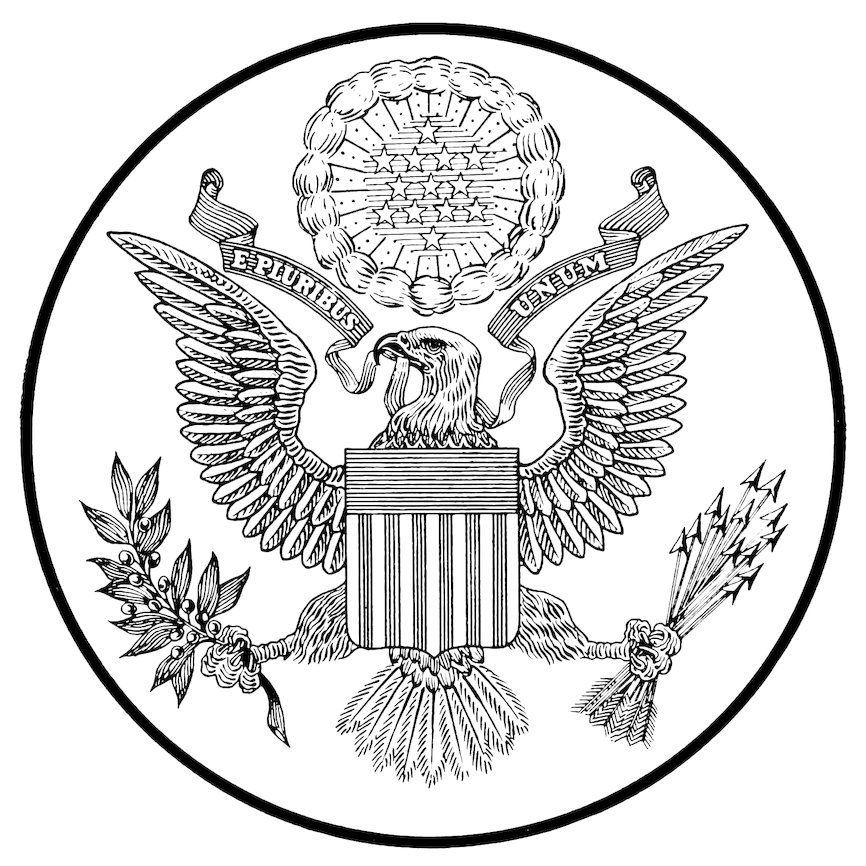
The design of the obverse of the seal of 1884
was determined upon, as we have seen, with great
care. It was an enlargement with some modifications
62of the seal of 1782, the modifications being in
the direction of a closer adherence to the law creating
the seal. For example, the eagle’s head bears
no crest, as in the European type and as advised
against by Mr. Whitmore for the American eagle
specified by the law.
In 1902, John Hay being the Secretary of State,
it was determined that the seal, which had been in
constant use for eighteen years, required recutting,
and that the press and stand which held it could be
improved upon. An act was, accordingly, passed
by Congress (July 1, 1902) appropriating $1,250
“To enable the Secretary of State to have the
Great Seal of the United States recut.” Some discussion
arose among the officers of the Department
as to whether the design then in use must be adhered
to strictly or could be improved upon, and,
after examination of the question, it was determined
that the careful investigation which had
preceded the acceptance of the design of 1884 rendered
a reconsideration of the decision then arrived
at unwise, and that the design should be preserved
with absolute accuracy. The work of recutting
not having been done before the appropriation had
expired, it was renewed the following year (act of
March 3, 1903) and the act settled definitely any
remaining doubts about the design, besides making
the appropriation cover the necessary accessories
for the seal. It read:
64To enable the Secretary of State to have the Great
Seal of the United States recut from the original model,
and to purchase a suitable press for its use and a cover
to protect the same from dust, the sum of one thousand
two hundred and fifty dollars, appropriated by the deficiency
act approved July first, nineteen hundred and two,
“To enable the Secretary of State to have the Great Seal
of the United States recut,” is hereby reappropriated for
the purposes above mentioned.
The words “original model” in the law precluded
any change in the device, and the new seal
was accordingly cut as a precise copy of the seal then
in use, the work being done by Messrs. Bailey,
Banks & Biddle, of Philadelphia.
IX USES OF THE SEAL
65
When the Continental Congress made the obverse
of the great seal the national arms it intended
that the device should pass into common use among
the people, as the flag has done, and like the flag the
arms at first met with general approval, which soon
gave place to an acceptance of it as an emblem of
the power and sovereignty of the United States,
which placed it above criticism.
Not all of the fathers of the Republic, however,
were pleased with the selection of the eagle as the
national emblem. When the badge of the Order
of the Society of the Cincinnati was made in
France in 1784 it was objected to by some because
the displayed eagle resembled a turkey.
For my part [wrote Benjamin Franklin January 26,
1784, to his daughter], I wish the bald eagle had not been
chosen as the representative of our country; he is a bird
of bad moral character; he does not get his living honestly;
you may have seen him perched on some dead
tree, where, too lazy to fish for himself, he watches the
labor of the fishing-hawk; and, when that diligent bird
has at length taken a fish, and is bearing it to his nest
for the support of his mate and young ones, the bald
eagle pursues him, and takes it from him. With all this
66injustice he is never in good case; but, like those among
men who live by sharping and robbing, he is generally
poor, and often very lousy. Besides, he is a rank coward;
the little kingbird, not bigger than a sparrow, attacks him
boldly and drives him out of the district. He is therefore
by no means a proper emblem for the brave and
honest Cincinnati of America, who have driven all the
kingbirds from our country; though exactly fit for that
order of knights, which the French call Chevaliers d’Industrie.
I am, on this account, not displeased that the figure is
not known as a bald eagle, but looks more like a turkey.
For in truth, the turkey is in comparison a much more
respectable bird, and withal a true original native of
America. Eagles have been found in all countries, but
the turkey was peculiar to ours; the first of the species
seen in Europe, being brought to France by the Jesuits
from Canada, and served up at the wedding table of
Charles the Ninth. He is, besides, (though a little vain
and silly, it is true, but not the worse emblem for that,)
a bird of courage, and would not hesitate to attack a
grenadier of the British guards, who should presume to
invade his farmyard with a red coat on.[32]
The seal itself has, of course, a very limited use,
which is strictly guarded by law. The Secretary of
State is its custodian, but even he has no authority
to affix it to any paper that does not bear the President’s
signature.
In 1803 Chief Justice Marshall, in delivering an
opinion of the Supreme Court, used the following
67language relative to the seal. It may be considered
applicable to all instruments to which the seal is
affixed.
The signature [of the President] is a warrant for
affixing the great seal to the commission, and the great
seal is only to be affixed to an instrument which is complete.
It attests, by an act supposed to be of public
notoriety, the verity of the presidential signature.
It is never to be affixed till the commission is signed,
because the signature which gives force and effect to the
commission, is conclusive evidence that the appointment
is made.
The commission being signed, the subsequent duty of
the Secretary of State is prescribed by law, and not to be
guided by the will of the President. He is to affix the
seal of the United States to the Commission, and is to
record it. (1 U. S. Reports, 374.)
As the duties of the Government have expanded,
the impracticability of having the seal of
the United States attached by the Department of
State to the commissions of officers who are under
some other Department has been recognized by
Congress. By the act of March 18, 1874,[33] the commissions
of postmasters were directed to be made
out under the seal of the Post-Office Department;
the act of March 3, 1875,[34] placed the commissions
of officers of the Interior Department under that
Department; by act of August 8, 1888,[35] all judicial
68officers, marshals, and United States attorneys were
ordered to be appointed under the seal of the Department
of Justice; and by an Executive order of
June 16, 1893, President Cleveland directed that all
warrants of pardon and commutations of sentence
granted to offenders convicted in the courts of the
United States should thereafter be made out under
the seal of the Department of Justice.
At the present time the seal of the United
States is affixed to the commissions of all Cabinet
officers and diplomatic and consular officers who
are nominated by the President and confirmed by
the Senate; all ceremonious communications from
the President to the heads of foreign governments;
all treaties, conventions, and formal agreements of
the President with foreign powers; all proclamations
by the President; all exequaturs to foreign
consular officers in the United States who are appointed
by the heads of the governments which they
represent; to warrants by the President to receive
persons surrendered by foreign governments under
extradition treaties; and to all miscellaneous commissions
of civil officers appointed by the President,
by and with the advice and consent of the
Senate, whose appointments are not now especially
directed by law to be signed under a different seal.
GLOSSARY OF HERALDIC TERMS.
69
Argent—silver, represented in engraving by plain surface.
Atchievement or achievement—a complete heraldic composition.
Azure—blue, represented in engraving by horizontal lines.
Barways or barwise—horizontally.
Barry—divided into bars.
Bearing—a charge on a coat of arms.
Blazonment or blazon—a correct heraldic description.
Canton—a part of the chief cut off on the left or right
hand corner.
Charged—bearing a charge or figure upon the escutcheon.
Chevrons—bars, as the rafters of a roof, leaning against
one another.
Chief—upper part of escutcheon.
Counter flory—flowers divided and separated by the
whole width of the bearing.
Coupé—cut off evenly.
Crest—the part of the achievement outside of and above
the escutcheon.
Damasked—decorated with an ornamental pattern.
Dignity, cap of dignity—a symbol of dignity.
Displayed—with expanded wings.
Emblazon. See Blazon.
Ensigned—distinguished by mark or ornament.
Entoire—charged with bearings not living creatures.
Ermine—fur represented by black spots on a white
ground.
70Escutcheon—the shield.
Exergue—the part of the reverse of a medal below the
main device.
Fess-point—the central point of the escutcheon.
Flory or fleury—decorated with fleur-de-lis.
Gules—red, represented in engraving by close vertical
lines.
Or—gold or yellow, represented in engraving by dots on
a white ground.
Ordinary—a common bearing bounded by straight lines.
Pale—a perpendicular stripe on the escutcheon.
Paleways, palewise, or paly—divided into equal parts by
perpendicular lines.
Parti (party)—divided into parts.
Proper—of natural color or colors.
Quarters—the various smaller escutcheons within the
larger escutcheon.
Sable—black, represented in engraving by a network of
vertical and perpendicular lines.
Saltier—in the shape of a St. Andrew’s cross.
Sanguinated—blood stained, or blood color.
Scutcheon—escutcheon.
Semé—covered with small bearings.
Tenants—supporters.
Tinctures—the metals or colors.
Tressure—a double border within the escutcheon, and not
reaching the edge.
Vert—green, represented in engraving by diagonal lines.
This would seem to be conclusive, but since the writer prepared his brochure on
the great seal in 1892 several people whose opinions are entitled to consideration
have expressed a doubt whether the inscription does not, or at any rate did not, exist.
Bradshaw died during the closing years of the Commonwealth and was buried in
Westminster Abbey. Upon the Restoration his body was disinterred and hanged,
when several other regicides were executed, after which the trunk was thrown into a
hole at the foot of the gallows and the head publicly displayed, as the custom was in
those times. Some members of the court of which he was president are said to have
gone to Jamaica, and it was declared by some that Bradshaw spread the report of his
death and retired secretly to that island. There is even a surviving rumor that he
and his colleagues were in this country, and a well-known landmark near New
Haven is the “Regicides’ Cave.” In all of this we see merely an example of one of
those myths which so often surround the death of one whose life was peculiarly conspicuous.
In Bradshaw’s case his double burial in England would still not render
impossible a third burial in Jamaica, and even if he was not buried there an inscription
upon a cannon in his commemoration might possibly have once existed. But the
whole story was investigated in the beginning of the last century by Bryan Edwards,
the historian of the West Indies, whose work is an authority. In the fifth edition
(London, 1819) of his History of the West Indies (vol. 1, p. 213) he says:
“Some of these men who sat as judges at the trial of Charles I are said to have
become peaceable settlers here, and to have remained after the restoration. * * *
It is reported also, that the remains of President Bradshaw were interred in Jamaica;
and I observe in a splendid book, entitled ‘Memoirs of Thomas Hollis,’ an epitaph
which is said to have been inscribed on the president’s grave; but it is to my own
knowledge a modern production.”
It may be added that the author made inquiry of Louis A. Dent, esq., lately Register
of Wills of the District of Columbia, when he was United States consul at
Kingston, concerning traditions of this epitaph, and he declared he knew of none.
As his knowledge of Jamaica was thorough such traditions would hardly have escaped
him if existent.
That anyone should seize upon the rumors surrounding Bradshaw’s death and
make them the basis of a fictitious epitaph is a cause of wonder, until we remember
that the author was Benjamin Franklin, whose unique imagination was amused by
constructing epitaphs and kindred compositions. His object in this case may easily
have been the very effect of inflaming public opinion which Hollis noticed had
resulted. The statement that the epitaph was on a cannon at Martha Bay was
presumably attached to the copies Hollis saw and accepted by him in good faith.
18. Journals of Congress (W. C. Ford, editor), 1907, VII, 59.
19. Austin’s Life of Elbridge Gerry, vol. 1, p. 336.
20. When the committee was appointed from which emanated in 1782 the seal finally
accepted, a memorandum, endorsed “proceedings respectg. a seal of the United
States Mr. Middleton Mr. Boudinot Mr. Lee,” was made by Lovell for the committee’s
use, showing from the papers in the office of the Secretary of Congress what
had already been done in the matter of the seal. After setting forth the action of
1776 it states that the Lovell committee was appointed March 25, 1779, and the report
is given as follows:
“Original Report of May 10 1779
the Seal to be 4 inches Diametre On one Side The arms of the United States as follows
The Shield charged on the Field with 13 diagonal Stripes alternate red &
white—Supporters, dexter, a Warriour holding a Sword; Sinister a Figure representing
Peace bearing an Olive Branch—The Crest a radiant Constellation of 13
Stars—The motto Bello vel Paci—The legend round the Atchievement Seal of the
United States
“On the Reverse—The Figure of Liberty seated in a Chair holding the Staff &
cap. The motto Semper—Underneath MDCCLXXVI”
The memorandum also says that on May 17 “The Report of the Comtee. on the
Device of a great Seal was taken into Consideration and after Debate Ordered,
That it be recommitted.”
Evidently an error was made in the dates by Lovell when he transcribed the memorandum.
A committee appointed in 1779, if its report had been submitted May 10,
1779, and recommitted May 17, 1779, could hardly have made a second report May
10, 1780, to have it recommitted May 17, 1780. The MS. journal for March 25, 1780,
says:
“Ordered, That the report of the committee on the device of a great Seal for the
United States in Congress assembled, be referred to a committee of three:
“The members chosen, Mr. Lovell, Mr. Scott and Mr. Houston.”
The MS. journal for May 17, 1780, says:
“The report of the committee on the device of a seal was taken into consideration;
and after debate,
22. Note by Barton: “In the Arms of Scotland, as marshalled in the Royal Atchievement,
the double Tressure which surrounds the Lion is borne flory and counter flory
(with Fleurs-de-lis); which is in Consequence of a Treaty that was entered into, between
Charlemagne, then Emperor & King of France, and Achaius King of Scotland;
to denote that the French Lillies should guard & defend the Scottish Lion.”
23. Totten, I, 104, 108; Mass. Hist. Soc. Proceedings, 1866–1867, p. 351.
24. Note by Henry Livingston Thomas, late Translator, Department of State.
25. Note by Barton: “As the Pales or Pallets consist of an uneven Number, they
ought, in strictness, to be blazoned—Argt. 6 Pallets gules: but as the 13 pieces allude
to the thirteen States, they are blazoned according to the Number of pieces paleways.”