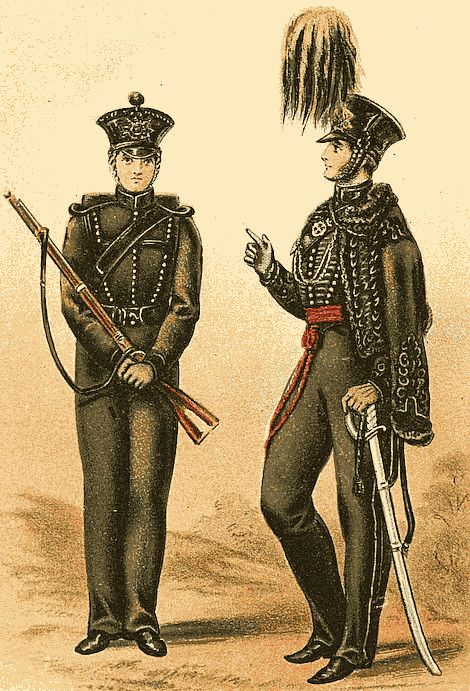
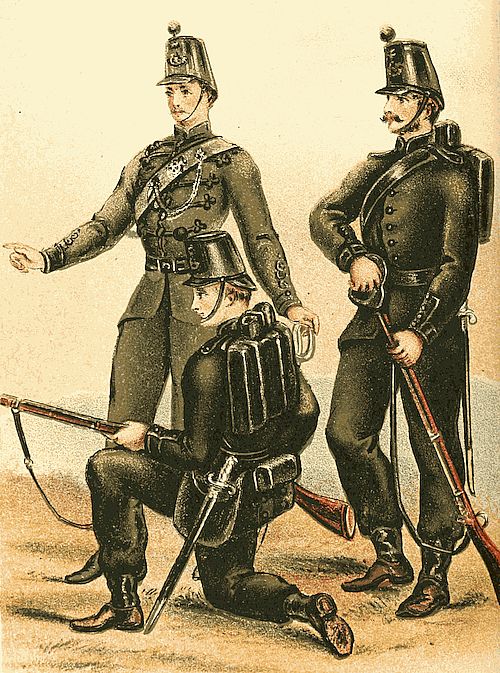
The Sepoy Mutiny having broken out, and troops being
despatched with all haste to quell it, the 2nd and 3rd Battalions
received orders to embark immediately for India.
The 2nd Battalion embarked in three divisions:
The first under Brevet Lieutenant-Colonel Woodford,
consisting of 3 captains, 5 subalterns, 21 sergeants, 7 buglers
and 322 rank and file, proceeded by rail from Dublin to Cork
on August 3, and embarked on board the ‘Lady Jocelyn’
screw steamer. The second under Brevet Lieutenant-Colonel
Fyers, consisting of 2 captains, 2 subalterns, 9 sergeants, 3
buglers and 146 rank and file, proceeded by railway to Kingstown
and embarked on board the ‘United Kingdom’ on
August 4.
The Head-quarters with four companies under Lieutenant-Colonel
Hill, consisting of 3 captains, 8 subalterns, 5 staff, 30
sergeants, 14 buglers and 292 rank and file, proceeded by
railway to Kingstown on August 6, and embarking on board
the ‘Sussex,’ hired transport, started for India on the next day.
The first of these detachments (Woodford’s) arrived at
Calcutta on November 3, and disembarked.
On the 7th they paraded at 3.30 to cross the Ganges,
which they did in a steamer, and at 9.30 in the evening
started by railroad for Raneegunge, where they arrived at 6.30
on the following morning.
From thence they proceeded on the 10th in carriages at
three P.M. and arrived at Doomrhee at 7.30 on the next day;
whence starting at 10.30 and passing through Brohal, the
Dowah pass, and Bawa, reached Sherghotty at 8.45 A.M. on the
morning of the 12th.
After a short halt there they started again at one P.M. for
Barroon. Soon after which they crossed the river Sone, a
most tedious process; the river here being about two miles
broad and reached by a long plain of sand. The carriages
had to be placed in boats; and having got over one bend of
the river, another long sandy plain had to be traversed and
then a still wider stream of water to be crossed. This
occupied a very long time; from midnight to 5.30 in the
morning; but having accomplished it they arrived at Sasseram
at 8.45 A.M. on the 13th. At five o’clock they started again,
and travelling through the night, were about ten P.M. startled
by an alarm that they were about to be attacked. The
‘alarm’ was sounded; rifles and revolvers were got into readiness,
and some confusion occurred; but after a few minutes
it was ascertained that the alarm, from wheresoever originating,
was a false one. And on the 14th, about 10.20 in the morning,
they reached Annabad, where they halted till five, when
after passing Kurumnasa they reached the bank of the
Ganges, and crossing it in boats arrived at the Mint at
Benares about 4.45 on the morning of the 15th, where they
halted till the 18th; this being the first occasion on which they
had taken any of their things off since they left Raneegunge.
On the 18th they started again at 4.15 P.M. and reached
Gopeegunge at 1.45 P.M. on the 19th, and after halting till
5.50 started again. Here Colonel Woodford was informed that
a rebel force of 300 or 400 cavalry, 6,000 or 7,000 infantry
and ten or twelve guns was encamped on his right, about
twenty miles from Gopeegunge. The march, or rather the
journey in bullock-carts, in the night was therefore made with
great caution and with every preparation to resist an attack.
But none was made, and on the 20th they reached the
Ganges at Allahabad about twelve P.M., and after great
difficulty in finding the camping-ground got into camp. On
that night they again had a false alarm.
They halted at Allahabad till the 23rd, the intervening
time being employed in getting clothing for the men.
Here the detachment under Lieutenant-Colonel Fyers,
which had sailed in the ‘United Kingdom,’ joined them; and
the whole started by rail at 8.30 on the 23rd and arrived at
Lohunga at 12.30. Here they again divided; Colonel Woodford’s
detachment proceeding by bullock-carts and Colonel
Fyers’ by route march. Woodford’s detachment started
about five, and after delays by break-down of waggons and
restive oxen, arrived at Futtehpore at 4.45 on the 24th.
Starting again at eight they met a Sikh on the 25th bearing
a message from General Windham urging them to push on,
as they would be wanted. Making all speed therefore they
reached Cawnpore at 6.45 P.M. and took up their quarters in
the Theatre for the night, being warned to go to camp at
four A.M. on the following morning.
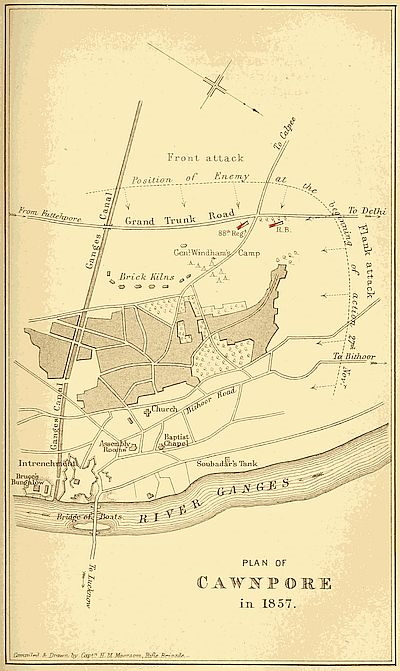
On that morning (the 26th) they paraded at 2.30, and
shortly afterwards marched to General Windham’s camp,
which was formed near the bridge, on the road from Cawnpore
to Calpee, over the Ganges canal.
They reached it about seven; and no breakfast being
provided, they received a dry biscuit and a ration of rum.
Hence they moved out to attack the Gwalior contingent,
which was posted in great force on the Pandoo Nuddee river.
They advanced, the three companies[268] of Riflemen in front.
On approaching the enemy’s position the mutineers at once
opened fire about 9.30. ‘The battle on the part of the
British began with the companies of the Rifle Brigade.
These admirable troops at once advanced in skirmishing
order on the right of the road. The country was a good deal
encumbered with high standing corn, topes of trees, walls,
&c.’[269] Some of the Riflemen got into ruined houses, and
having got the range picked off the enemy’s gunners. The
Gwalior contingent however held their position—a strong one,
on the right bank of the Pandoo Nuddee—for some time.
But at last the men advanced with a rush, and crossing the
almost dry bed of the river drove them back. The Riflemen
pursued them for some miles. One man only (Wolfe) was
killed in this day’s fight: he was shot through the head. At
a little before twelve the fight was over, and the Riflemen
returned towards their camp. After they had retired some
distance the mutineers pursued; and they were halted and
deployed. During this halt a ration of rum was served out
to the men. Resuming their march the Riflemen returned
to Cawnpore, and pitched their camp near the city across the
Calpee road and close to some brick-kilns. They arrived in
this camp about four P.M.
On the 27th there was a false alarm at six in the morning;
but later it was found that the Gwalior contingent, with
a strength of about 25,000 men and forty guns, had commenced
a most determined attack on General Windham’s position,
both in front and on his right flank. The three companies of
Riflemen, Nixon’s, Dillon’s and Earle’s, were moved out about
noon, and posted on the right of the road to Calpee at its
junction with the Grand Trunk road to Delhi, and were immediately
under fire. ‘The heavy fighting in front, at the point of
junction of the Calpee and Delhi roads, fell more especially upon
the Rifle Brigade, ably commanded by Colonel Walpole.’[270]
However the enemy were too strong for them, and they
were obliged to retire. Some officers and men occupied a
small tope of trees, but they were soon out of ammunition,
and Lieutenants George Curzon and Dugdale went back across
the open, exposed to the fire of two guns which plied them
with grape. However they succeeded in bringing up a camel
with a supply. A second, third and fourth time Curzon passed
the same ordeal in search of further ammunition or caps;
and after some unsuccessful ventures obtained a supply from
Captain Atherley of the 3rd Battalion, who with his company
after a forced march from Futtehpore (to be presently more
particularly mentioned) had arrived at Cawnpore.
This retreat was covered in a most masterly manner by
the three companies under Woodford, who were extended in
a line of skirmishers over a space of nearly a mile, and for a
long time held back an enormous force of the enemy of all
arms. And had it not been for the stand made by this
detachment, it was generally supposed that the two guns of the
Naval Brigade, which had been left unprotected, would have
fallen into the enemy’s hands.[271]
It was first observed by Corporal Suddlers of the 2nd
Battalion that these guns were deserted; and they were with
difficulty brought back by some Riflemen of Captain Nixon’s
company, under Lieutenant-Colonel Woodford, who took the
slings off their rifles for that purpose.[272]
Compiled & Drawn by Captn H. M. Moorsom, Rifle Brigade.
E. Weller, Litho.
London, Chatto & Windus.
PLAN OF
CAWNPORE
in 1857.
I have now to trace the march of Fyers’ detachment of three
companies, Captains the Hon. B. R. Pellew’s (commanded
by Lieutenant Grey[273]), Warren’s, and the Hon. L. W. Milles’,[274]
whom we saw were together with Woodford’s detachment
at Allahabad. They marched from Lohunga at midnight on
the 23rd-24th in charge of Commissariat stores; rum, rice,
sugar and ammunition on donkeys. They marched about
sixteen miles, and halted under a tope of trees till about two
the next morning; when they proceeded to Futtehpore, about
sixteen miles further, the stores in their charge being a great
impediment to their progress. They left Futtehpore again on
the 26th, and marched about seventeen miles. As the men
were pitching their tents, a messenger on a camel (the same
who had met Woodford) came in with a pencil note from
General Windham, addressed to the officer commanding the
detachment, urging him to make all speed, as troops were
wanted. The few tents already pitched were immediately
struck. Fyers placed the stores he was escorting in charge of
the police, and directed the men to carry only what was
absolutely necessary. After a halt of three hours in making
these arrangements, he started again, placing the most footsore
and the sick on elephants, and marched the men, weary as they
already were, about nineteen miles further, allowing them short
halts at intervals. Many of the men were so fatigued that
when a ‘halt’ was sounded, they fell asleep almost as soon as
they lay down on the ground. After a halt about midnight
for one hour, during which a ration of rum was issued, falling
in again, they marched forward till the morning, when Fyers
gave them another halt of an hour to prepare some breakfast.
Having had some tea and biscuit, they started again very
weary and footsore; but now the sound of heavy guns and the
rattle of musketry quickened the men. They pushed forward
with increased vigour, and arrived at Cawnpore when the
troops were retiring. They found the force engaged there in
full retreat; a mixed multitude of soldiers and civilians, these
last carrying property of various kinds, and endeavouring to
make their way to the intrenchment.
The distance from Futtehpore to Cawnpore is forty-eight
miles and three-quarters. It was marched in about twenty-six
hours, the first stage with all the impediment of the
convoy of stores. The men were wearing the European dress:
cloth clothes and shakos. The march of this detachment
has never been exceeded in endurance and rapidity; and Dr.
Reade, who accompanied it, states that ‘all were well able for
any service when the march was over.’ It strikingly resembles
in more points than one the march of the 1st Battalion (with
the Light Division) from Calzada to Talavera in 1809. It
differs from it in this, that Fyers’ detachment came up in time
to take part in the fight of which the sounds had quickened
their advance.
For on reaching Cawnpore Windham met them, on his
way from the front to the intrenchment, whither all were
retreating; and putting himself at their head, he led them
through the streets, ordering Fyers to fix swords, and prepare
to defend the intrenchment. This they did well, gaining the
high praise of General Windham, who then and long afterwards
expressed in strong terms how important the arrival
and the action of these companies had been to him. Footsore
and weary as they were on their march, their fatigue was
forgotten as soon as the sounds of fight told them that work
was to be done; and they fought in Cawnpore and in defence
of the intrenchment as if they were fresh from their camp.
When they got to the intrenchment they were refreshed with an
issue of grog, biscuits and tea, after which they were despatched
on outpost duty: another parallel to the march to Talavera.
On this day Ensign Travers was wounded by a bullet in
the shoulder, 2 sergeants and 4 men were also wounded.[275]
The companies took up their position for the night in a
ruined house.
Captain Atherley’s company of the 3rd Battalion also
arrived at Cawnpore on the 27th. They had landed at Calcutta
on the 8th, and on the next day started by rail for
Raneegunge, and thence proceeded by bullock-cart up the
country. On nearing Cawnpore a messenger met them with
instructions that Atherley was not to advance, as the force at
Cawnpore was in retreat, and he might be cut off. A second
messenger informed him that he was to push on, as every
man was wanted. A third soon followed with a repetition of
the first message. All this time for many hours, and while
marching many miles, the sound of heavy firing was heard.
About six in the evening a youth (a cadet), mounted on a
pony, met them, saying that the road was clear, and that
they were to hasten on and reach the town if possible. He
added that General Windham’s force was getting the worst of
it. Accordingly Atherley pushed on as fast as possible. The
firing seemed to become heavier and more furious. As the
company approached the bank of the canal, a mounted
officer, extremely agitated, rode up and said, ‘Leave all your
carts, except the ammunition; fix your bayonets, and I will
show you the way.’ Atherley, with great sang-froid, said,
‘We have not got any bayonets; we have swords.’ ‘Well,’
said the other, ‘fix what you have got.’ Saying which he
galloped off and they saw him no more. Neither as they
advanced did they see any enemy; but they met some of the
2nd Battalion retiring in good order. Captain Atherley
found General Windham in or near the intrenchment, and
reported his arrival. Windham, expressing himself much
pleased at being reinforced with a hundred ‘fresh’ Riflemen
(they had just come off a fatiguing march), told him to patrol
during the night, and guard the house in which he was living.
He then asked if Atherley had had anything to eat; and being
answered in the negative, he gave him a bone with some meat
on it, which he and his two subalterns devoured in the verandah
of Windham’s quarters, cutting it off with their clasp knives.
They patrolled all night in front of the intrenchment, and
guarded Major Bruce’s house, which General Windham occupied.
But the night passed without any attack from the
Sepoys or any alarm.
On the 28th the Riflemen were ordered, about six in the
morning, to come into an outwork of the intrenchment; where,
having been supplied with some biscuit and tea, they were
ordered out to resist the enemy, who were expected to make
another attack. The Rifle companies, with part of the 82nd
Regiment and Captain Greene’s battery of Artillery, were
posted on the left of the canal looking from the intrenchments.
In moving to this position they were exposed to a
heavy fire of musketry and grape. The action itself began
about noon; and after hard fighting these troops repulsed
the enemy. When they arrived at their position it was discovered
that an ammunition waggon was missing, and Lieutenant
Curzon had to go back (as on the previous day) a
considerable distance in search of it, exposed to a heavy fire.
It could not be found; but he succeeded in bringing up a
camel loaded with ammunition. In the course of the fight,
Colonel Woodford, Lieutenants Playne[276] and Nicholl, with three
Riflemen, were in a dip in the ground, in front of the enemy’s
guns, and were making good practice in picking off the gunners;
when Woodford, who was in the act of taking a shot with a
rifle at a Sepoy, was shot through the head, and, uttering an
exclamation, expired. A bugler, Bourne, carried him to a
tope[277] of trees. Captain Dillon entered a house in which there
were some Sepoys, and his revolver missing fire, he was
bayonetted in the chest.
The Riflemen took two long eighteen-pounder guns, and
the men having tackled to with ropes, drew them into the
intrenchment, a distance of more than three miles. On their
arrival they were greeted with a round of cheers for the guns,
and another for the Rifles, and, amidst great excitement,
civilians and soldiers pressed forward to offer congratulations
and refreshment to the gallant captors.
Captain Atherley’s company was ordered to patrol the
native town and to clear it of any Sepoys who might be lurking
there. About four o’clock Atherley, having heard of the death
of Colonel Woodford, took his men to the front, leaving the
native town in charge of the 82nd Regiment. General Windham
ordered him to line the bank of the canal. Three guns
were brought to bear on these Riflemen, and several round
shot came amongst them, but without doing any hurt. Atherley
made his men take shelter along the bank; and selecting
two whom he knew to be excellent shots, he told them to pick
off the gunners of these guns, which were annoying the troops
from the bridges over the canal; and he desired some of their
comrades to load for them, and to hand them up rifles as fast as
they could. Thus aided, these Riflemen, creeping up near the
bridges, picked off the gunners, and effectually silenced the guns.
As another instance of their excellence in shooting, I may
add that Atherley, in the course of this day’s fight, asked one of
his men, named Robertson, how far he estimated the distance
of the brick-kilns to be. The Rifleman replied that he did
not know; but calling Atherley’s attention to a man standing
on the top of the kiln, he put up his sight for 600 yards, fired,
and the man fell. His body was examined the next day by
Atherley, and the ball was found to have hit him in the
stomach.
General Windham thus writes in his despatch of the conduct
of the Riflemen:
‘On the left advance Colonel Walpole,[278] with the Rifles,
supported by Captain Greene’s battery and part of the 82nd
Regiment, achieved a complete victory, and captured two
eighteen-pounder guns.
‘The glory of this well-contested fight belongs entirely to
the above-mentioned companies and artillery. It was owing
to the gallantry of the men and officers, under the able leading
of Colonel Walpole and of my lamented relative Lieutenant-Colonel
Woodford, of the Rifle Brigade (who I deeply
regret to say was killed), and of Lieutenant-Colonel Watson,
82nd, and of Captain Greene, R.A., that this hard-contested
fight was won and brought to so profitable an end. I had
nothing to do with it beyond sending them supports, and at
the end of bringing some up myself.
‘I repeat that the credit is entirely due to the above-mentioned
officers and men.’[279]
The loss of the Riflemen on this day was Lieutenant-Colonel
Woodford and five men killed, and Captain Dillon
(severely), Lieutenant Lawton, 1 bugler, and 18 men wounded,
and 1 man missing.
During the night of the 28th the enemy took entire possession
of the town, and on the 29th began a heavy fire
against the intrenchment; hitting the bridge of boats over
the Ganges several times, damaging the Hospital and destroying
stores. The Riflemen, who had during the night and
morning occupied the principal outwork of the intrenchment,
were ordered out by Sir Colin Campbell (who had arrived
from Lucknow on the previous evening), to endeavour to take
some guns which were doing much damage. Accordingly at
three P.M. two companies of the 2nd Battalion and Atherley’s
company of the 3rd, under Lieutenant-Colonel Fyers, who
had succeeded to the command on Woodford’s death, made a
sortie. Running out over some very uneven ground, they
attacked some Sepoys who were in the Residency, and were
for some time exposed to a very severe fire. However, after
awhile they drove the enemy out of these buildings; and as
these were escaping by the back of the compound, some
Riflemen of Atherley’s company crept round stealthily under
the wall, and succeeded in catching the retreating rebels on
their swords as they leapt over it. They thus slew a large
number.
However, as they did not receive reinforcements, they
were unable to take the guns, and returned to the intrenchment.
On this occasion Captain the Hon. Lewis Milles
was severely wounded, 1 man was killed, 1 sergeant and 6
privates were wounded, of whom 1 died on December 1, and 1
on December 7, and 1 was missing.[280]
The Riflemen, or some of them at least, had not had their
clothes off since they left Allahabad; had been scantily fed,
often being for twenty-four hours with only one meal, and
sometimes that only of biscuit and tea or rum; exposed to
heat by day and great cold by night, and suffering from sore
feet. Yet they kept their spirits up, and did their work on
these four hard-fought days in a manner to elicit General
Windham’s marked approval repeatedly expressed to them.
At this time the ladies and others rescued from Lucknow
were crossing the bridge of boats, an operation which occupied
about thirty hours, and Sir Colin with these and their escort
encamped near the Old Dragoon lines.
From December 1 to 5 the Riflemen continued to occupy
the outwork of the intrenchment; the enemy keeping up an
occasional fire from guns planted about 450 yards from them.
On the evening of the 1st Captain Warren and Lieutenants
Eccles and Grey went out with some men to recover
the body of Colonel Woodford, which they succeeded in
doing, though fired at by the Sepoys; and he was buried on
the morning of the 2nd in the intrenchment, where a tombstone
was subsequently placed over his remains by his
brother officers.
On the 5th the women and children having started, the
Riflemen were ordered to move up to Sir Colin Campbell’s
camp. They started at four P.M., and did not reach their
camping-ground till after dark. Having got their tents
pitched they lay by their arms all night.
Before I describe the events of December 6, it is necessary
that I should trace the movements of the 3rd Battalion which
took part in them.
A detachment of that Battalion commanded by Lieutenant-Colonel
Julius Glyn, consisting of Captain Alexander’s[281]
company and part of Captain Bourchier’s company, proceeded
from Aldershot and embarked on board the ‘Barham’ on
July 1, and after experiencing very bad weather on September
30 when south of the Cape, and a hurricane from
October 28 to 30 (during which seven of the crew were
struck by lightning), arrived at Calcutta on November 8.
They did not disembark till the 13th, and on the next day
proceeded by railway to Raneegunge, where they arrived on
the 15th at six A.M.
On the 16th they started at 3.30 A.M., part of the detachment
being carried in bullock-carts, and part marching. They
arrived at Gyra at nine in the morning of the 17th, after a
march of thirty-eight miles. Leaving it again at three P.M.
they made another march of thirty-eight miles, and reached
Doomrhee at half-past ten in the morning of the 18th. Halting
there till four P.M. they arrived at Burkutta at 6.30 the next
morning, after a march of twenty-eight miles. Starting in
the afternoon at 3.30 P.M. they reached Churparun at four in
the morning of the 20th. At Churparun rifles were ordered
to be loaded; and from thence they proceeded by daily
marches through Sherghotty, Norunagabad, Sasseram, Annabad,
Benares, Gopeegunge, to Allahabad, which they reached
on the 27th. On the 30th, thence proceeding by rail, they
encamped at Cheenee, the end of the railway then in course of
construction. Proceeding thenceforward by route march, they
left Cheenee on December 1, and encamped on the 2nd
about six miles from Futtehpore. Starting from that in
the evening they arrived on the evening of the 3rd at a
bridge over the Pandoo Nuddee. Here they were to encamp;
and the men were set to work to pitch their tents, which they
were almost too tired to do, but which they had just accomplished,
and turned in, when the bugle sounded for ‘orders.’
A message had been received from Sir Colin Campbell,
directing the detachment to make all speed to the front, as he
was about to engage the Gwalior contingent.
The word was given to strike tents and to ‘fall in.’ This
the men did without a murmur, and resumed their march
cheerfully, weary as they were, when they knew that active
work was before them. Marching (of course with occasional
halts) the remainder of that night and the whole of the day
and night of the 4th, they arrived at Cawnpore at seven on
the morning of the 5th.
This was a march of about seventy-five miles, accomplished
in a very short time; and considering that this detachment
consisted mostly of young soldiers, the Battalion having only
been formed two years before; that these men had disembarked
hardly three weeks, after being cooped up on board
ship during a four months’ voyage; that they had already
made long and fatiguing marches up the country; this
march, considering these circumstances of it, is perhaps
hardly paralleled in military history.
The day of the 4th was very hot, and the men wore their
cloth European clothing. They did not however carry their
packs.
The Head-quarters of the 3rd Battalion, consisting of four
companies, under Colonel Horsford, left Aldershot on July 22
by rail-road for Portsmouth, and embarking on board the
‘Sutlej’ sailing ship, sailed that afternoon and arrived at
Calcutta on November 8. From thence they were forwarded
to Raneegunge by rail-road, and thence proceeded in detachments,
some by bullock-train, some by horse-dâk, and some
by bearer-dâk, up the country by way of Benares and Allahabad.
Thence, as we have seen, there was rail-road communication
as far as Cheenee. I will trace from thence the
progress of the Head-quarter division, consisting of 137 men
with the Staff, under Major Ross, which left Allahabad on
the 26th.
After leaving Cheenee by bullock-train, some delay took
place on account of the badness of the road from this terminus
of the railway to the Great Trunk road, but they reached
Futtehpore at eight in the morning of the 27th. Major Ross
had been directed by Brigadier Campbell before leaving
Allahabad, in case the enemy were likely to interrupt him,
not to proceed beyond Futtehpore, but, in this event, to fall
back and reinforce a party of the 88th Regiment, which was
escorting the guns of Major Smith’s battery. These, however,
he had passed in the night, and in reply to inquiries
whether his escort was required, was informed by the Officer
Commanding of Windham’s engagement the day before,
and assured that there was no reason why he should not
move on.
Accordingly he proceeded at three in the afternoon, and
they had advanced some twenty miles, when at about two in
the morning a camel messenger met them, with orders that
all troops moving up were to push on as fast as possible.
This opened their eyes and quickened their pulse, for it
meant that an enemy was in front. So Major Ross pushed
on as fast as he could to the next bullock-changing station,
got fresh bullocks, and gave his men some tea. Following
the Brigadier’s instructions, he awaited the artillery and 88th,
which various native travellers assured him were only five or
six miles behind him. Then he learned his first lesson of the
falsehood of native reports. For he waited in some suspense,
occupying a gravel pit, expecting every moment the appearance
of the artillery; but he waited in vain, for they had never
moved beyond Futtehpore. He had reduced at this place his
impedimenta from thirty-four waggons to twenty-three by re-packing;
but of these ten were filled with ammunition; rather an
onerous charge had the enemy attacked, for of his small party
about thirty were band and buglers without arms. While
waiting here, and longing for the appearance of the guns, a
messenger arrived about noon from the front, with peremptory
orders from General Windham, superseding all others, to fall
back on Futtehpore and to hold it to the last extremity
before retiring further; and with intelligence that Windham
was so hard pressed by the fire of the enemy’s guns, that he
could not meet them in the open till reinforced from Lucknow.
Of course there was no alternative. Major Ross was
obliged to march his detachment back the twenty-four miles
they had come, to the no small disgust of the officers and
men, who had been within hearing of the guns at Cawnpore
(and in the night within sight of their flashes), and yet were
not to take part in the fight. However, the soldier must
obey, and they sorrowfully retraced their steps, keeping a
sharp look-out, and reached Futtehpore at about two in the
morning. They found that an attack was not unlooked for
there; for Colonel Maxwell of the 88th ordered them to
move their camp, which had been pitched about a mile and a
half from the Great Trunk road, to a position in the open
plain, where there had been a tank, now dry, the high banks
of which formed an excellent intrenchment.
On December 1 came the joyful intelligence that they
were to proceed at once to the front. Accordingly, at three
in the morning of the 2nd they advanced (with the Head-quarters
of the 88th and Smith’s battery), and marching the
greater part of that day and the whole of the night (except a
two hours’ halt) arrived in camp at Cawnpore at three o’clock
next day; having done the distance in thirty-six hours. But
during the last fifteen miles of the march the officers and
men were very weary and footsore, and as they were overcome
with drowsiness from fatigue and want of sleep, the
scene was somewhat ludicrous; the men now and then lurching
from side to side till brought up by their neighbour’s
shoulder, or missing that prop, occasionally falling forward in
the road. The band, however, were wakeful enough to play
for the last quarter of a mile, and the inspiriting strains of
‘Ninety-five’ carried them cheerfully into camp, which was
pitched close to General Wheeler’s intrenchment. Once in
their tents the Riflemen were soon fast asleep. On the
morning of the 5th Colonel Horsford came up with the
remainder of the Battalion, 120 men. And that afternoon
the 2nd Battalion moved from their intrenched camp and
joined them.
On the 6th tents were struck at seven in the morning, and
the troops were formed in contiguous close columns, beyond
the canal, near the Old Dragoon lines. Here they were
halted till it was ascertained that Sir Colin Campbell was
engaged with the enemy at the bridge on their left. Then
about ten o’clock the two Battalions of Riflemen were ordered
to cross the canal by a bridge near their position. This they
did at the double with a ringing cheer, Captain Nixon’s
company of the 2nd Battalion leading in gallant style, and
forcing back the Sepoys. The 3rd Battalion were in quarter
distance column; and the first round shot fired at them
passed between the companies, doing no harm to them, but
wounding some native camp followers who were on the reverse
flank. However, the rebels had opened fire on them while
halting in a walled enclosure near the bridge, and on their
rushing out of the gate they were exposed to a sharp fire,
which brought down only one man as they were crossing the
bridge. Once over that the 3rd Battalion wheeled to the
right, both Battalions deployed into line, and fixing swords
advanced, and soon extended and cleared the woods and
houses between the canal and the body of the town. As they
advanced the enemy plied them with shot and shell, without
however doing much mischief; but Colonel Horsford, who was
leading his Battalion, was wounded by a fragment of a shell.
He continued however to lead his Battalion. In about ten
minutes the Riflemen had cleared the ground in their front,
and not a rebel was to be seen there. They then moved
towards their left to connect with the force which had crossed
by the other bridge, and where the enemy had some guns
and a body of infantry in open ground. As they approached
the Riflemen saw the rebels flying towards their camp,
pursued by Highlanders and other troops. So continuing
their advance in skirmishing order, the two Battalions swept
the ground between the town and the Great Trunk road,
passing the brick-field, and through suburbs and trees, till
they came in view of the enemy’s camp. They then closed
to their left, in order to hold possession of the camp which
the rebels had deserted, while other troops pushed on in
pursuit.
However, later in the day, handing over the charge of the
captured camp to some other troops, three companies of the
3rd Battalion and some of the 2nd Battalion started again,
and bringing their left shoulders forward and extending,
advanced to the Subahdar’s tank, a position in rear of the
enemy’s left, and about a mile and a half in a direct line from
the intrenchments through the old cantonments. In front of
the tank the enemy had some heavy guns; some distance on
the right of the Riflemen was another gun; and two more a
little to their left. These were well protected by earthworks
or walls; a considerable body of rebels kept up a musketry
fire from topes of trees and enclosures; and the Riflemen
were exposed to showers of grape, canister and round shot.
They advanced, extended, about 300 yards on each side
of the road, slightly in advance of some heavy guns, while
the 93rd were kept in reserve. The fire of these guns soon
began to tell on the enemy. This, and the approach of the
long line of extended Riflemen, soon disheartened the enemy,
who began to give way immediately on the Riflemen passing
through the enclosures to the right and broken ground to the
left of the road. On reaching the entrance of the village,
called the Soldiers’ Burial Ground, the guns of Captain
Middleton’s battery were pushed through as rapidly as
possible, the Riflemen running up to support them. They
got very near the gun on their right and the two on their left,
and were in hopes of capturing them; but they were so much
delayed by having to climb over mud walls and pass through
enclosures to get at them, that the rebels succeeded in removing
them by the right and left, and took them among
some houses which the Riflemen had orders not to pass.[282]
When it was getting late the Rifle Battalions, who were
still in pursuit of the enemy, now completely routed, were
ordered to halt, and got into some houses about five o’clock.
The night was extremely cold, and the men had nothing
but their usual clothing to cover them, not even their
great-coats. The 3rd Battalion suffered from hunger too,
as well as cold, being long without food. At last a lean cow
was discovered, and immediately killed and cut up; and the
men, roasting the tough morsels on the points of their swords,
ate them half-raw. The 2nd Battalion were in this respect
more fortunate. For they got hold of a good many sheep,
and in fact regaled themselves so well on them, that they named
the house where they passed the night Mutton Bungalow.
The casualties were: in the 2nd Battalion, 1 sergeant, 1
corporal and 6 Riflemen wounded, and 1 man was killed
during the night in the town of Cawnpore, it was never known
how; in the 3rd Battalion Colonel Horsford was slightly
wounded, and 11 rank and file were wounded.
At night Captain Henry R. L. Newdigate’s company, with
Major Ross, was on picquet in a Bazaar on the Bithoor road,
not far from the Subahdar’s tank. They were suddenly
startled by a noise in a large enclosure where some of the
Riflemen were posted. It turned out that some of the rebels,
mistaking their way, brought a string of camels laden with
ammunition right up to the Riflemen. The sentry challenged
rather too soon, and the mutineers fled and escaped;
but they left their camels and 20,000 rounds of ammunition
in the hands of the Riflemen. The next night the cartridges
having been broken up on the ground, a grand illumination
was produced by setting fire to the heap.
On the 7th the Riflemen continued in the houses they
occupied: but some portion of the baggage of the 2nd
Battalion companies having come up, they were rather more
comfortable. The 3rd Battalion, however, were still without
food, except what the men found in native houses, till towards
evening when some rations were served out. The men were
allowed to go out to loot; and found much, and took many
arms and some prisoners. The night was again extremely
cold; and men and officers, not on duty, slept under a heap
of chopped straw in the hope of getting some warmth.
On the 8th the companies of the 2nd Battalion were
ordered in the morning to come in and pitch camp, which
they did about half a mile from the town. But they had
hardly done so when they were ordered to move and to join
Sir Colin Campbell’s camp, some four miles in advance.
They arrived there and pitched camp shortly before dark.
The 3rd Battalion also left the houses they had occupied
since the action of the 6th, and joined Sir Colin Campbell’s
camp.
Before I describe the further operations of this force, I
must trace the movements of the Head-quarters of the 2nd
Battalion. They had embarked at Kingstown on August 6
in the ‘Sussex,’ hired ship, consisting of 4 companies—17
officers and 336 of other ranks, under Colonel Percy Hill.
Sailing the next day they arrived at Point de Galle, Ceylon,
on October 29; and were transhipped to the ‘Adventure’
troop-ship, which started on November 1. The engines of
this ship were in a very faulty condition. They were frequently
stopped; and the services of a Rifleman named
Adwick were constantly called into operation to repair them.
This man had been bred an engine-maker or some such
trade, and ‘Pass the word for Adwick!’ became a well-known
signal that the engines were stopped and out of order.
In consequence of these defects of her engines, the
‘Adventure’ did not reach Calcutta till November 17. On
disembarking the Riflemen went into quarters; and on the 20th
they proceeded by railway to Raneegunge, where they encamped
about a mile from the village and were detained for
some days, and whence they moved up in detachments by
bullock-carts to Benares. Here they were again detained. After
which they moved on to Allahabad, whence there were some
miles of railway towards Cawnpore, terminating at Cheenee.
The Head-quarters marched, as the other detachments
had, from this point. Leaving Cheenee at two in the morning
of the 11th December they arrived at Arrapore, a distance of
fourteen miles. Leaving it next day at four in the morning,
they reached Futtehpore at nine: from this they proceeded to
Kutteanpore, where they arrived at nine in the morning of
the 13th, after a march of seventeen miles and a half. On
the next day they made another march of seventeen to
Sirsour, and on the 15th arrived at Cawnpore, when they
marched in and encamped about half-past nine in the morning.
The whole of the Battalion were now reassembled; and
great was the cheering with which the detached companies
welcomed the new-comers; and with which these saluted their
comrades, who had since their separation seen so much fighting.
On the 18th both Battalions, forming part of a force
under Brigadier Walpole, marched from camp at Cawnpore
and proceeded about twelve miles along the Calpee road to
Churbiere, where they arrived at four in the afternoon, and
halted in a capital camping-ground shaded by trees. Resuming
the march next morning about half-past six, they had in the
course of the day to cross the Pandoo Nuddee, the bridge
over which was broken. The Engineers, with great want
of forethought, had here placed two boats with one connecting
plank, so that the men were obliged to cross in single file.
There was ammunition in carts, and these, of course, had
to be unloaded, and the ammunition carried over by the men,
barrel by barrel. The consequence of this delay was that
the baggage did not reach the camp till five in the evening.
The march was about sixteen miles to Ukburpore, and the
Riflemen encamped near a large tank and close to some
trees. Here they halted till the 23rd. But on the 25th
the 3rd Battalion under Colonel Julius Glyn, with Captain
Thynne’s company of the 2nd Battalion, and some of the 9th
Lancers, went out on an expedition against the rebels, and
attacked two armed villages about eight miles distant. At
Putarah they were fired at, but captured five principal men.
They started at four in the morning, and did not return till
dark, having marched about eighteen miles, and taken eighteen
prisoners; and on the 22nd Captain Wilmot’s company,
with some of the 9th Lancers, went out on a similar expedition,
but returned to camp by ten o’clock. Among the
prisoners made on the first of these occasions were a brigadier
of the Gwalior contingent and his son, a man who had letters
about him addressed to Nana Sahib, and the Nana’s money-changer.
The first of these was said to have taken an active
part in the Cawnpore massacres. He was living in fancied
security in this village some miles off the road from Cawnpore
to Calpee, and must have been not a little disconcerted when
he found his hiding-place surrounded by Lancers and Riflemen.
He and the other prisoners were executed by order of
the Commissioner who accompanied the force.
On the 23rd, starting soon after six, the Riflemen marched
eleven miles to Derapore, having in the way forded a branch
of the river Jumna, and encamped near some jungle. The
next day they made another march of about the same distance
to Secundra, where they encamped on some excellent and
well-wooded ground.
They halted on Christmas day, but Nixon’s, Milles’
and Earle’s companies went out at nine in the morning
against the Rajah of Secundra, who was reported to be encamped
near the Jumna with 2,000 men. The Riflemen
started under the command of Colonel Fyers, but were joined
about four miles on their road by Colonel Hill, who had gone
out shooting, but who, on finding that an expedition was to
be made, changed clothes with one of the subalterns, and
assumed the command. Some cavalry accompanied them, the
whole being under Brigadier Walpole.
However, the enemy fled at their approach, the last boat-load
crossing as the cavalry galloped up to the bank of the
river; and the Riflemen returned to camp at five o’clock. A
mess tent for their Christmas dinner was extemporised by
joining two, and the men were regaled with an extra ration.
On the 26th, having struck tents at the usual hour, they
marched eleven miles to Ooryah, which they reached at ten
A.M. And on the next day made a march of fourteen miles
to Serai Adjeet Mull, and encamped in a grain field.
On the 28th they made a further march of twelve miles to
Buckbey Khanpore, where they encamped among some trees.
On this march Lieutenant Buckley, with some men of the 3rd
Battalion, found three armed rebels, who loaded to fire at
them. They were taken and executed.
About midnight they received a sudden order to march
immediately; and, falling in, started in a very cold morning
for Etawah, where they arrived about half-past eight. It was
expected that they would find a body of about 1,500 rebels
with seventeen guns here; but they had heard of the approach
of the force, and had disappeared, except a few who had shut
themselves up in a fort. This was a quadrangular work, with
a kind of tower-bastion at each corner, standing on a sand-hill
on the bank of the Jumna. Two companies of the 2nd Battalion,
under the command of Colonel Hill, were ordered to
take the fort. The gate was blown open by the blank fire of
a gun which accompanied the force, and the Riflemen rushed
in. It was then found that the rebels occupied one of the
tower-bastions. Grey and Fryer with some men entered it.
A long dark passage led to a small court in the centre of the
bastion, which had dwellings round it. As they threaded
their way along this passage they received a fire of slugs,
which whistled past, and they halted where a bend in the
passage afforded some cover. Colour-Sergeant Andrews and
some men climbed up on the flat roof of the dwelling; and as
he was looking over into the court, he was severely wounded
in the head, and also lost three fingers. Two other men were
also severely wounded. Eventually the bastion was blown up,
and its defenders made a rush out, but were all killed. It
was then found that two or three of them were women.
The Riflemen halted at Etawah during the two following
days in a very good camping-ground, the people of Etawah
being friendly and well disposed. The force which had
escaped, and the remnant of which had defended the fort,
was part of the Nana’s army, and had come into the district
to levy tribute.
On January 1, 1858, the two Battalions marched from
Etawah to Kurhul, a distance of eighteen miles, which they
accomplished in little more than five hours, starting at five,
and reaching their camping-ground soon after ten. On the
next day they made a march of the same distance in the
same time to Mynpooree. And though they got in by half-past
ten, the men were not encamped after their long march till
one o’clock, the Quartermaster-General having at first selected
wrong camping-ground, from which he moved them.
On the 3rd they started before six, and reached Bewur, a
distance of fourteen miles, at ten, and passing through the
town, encamped near a shady tope of trees.
On the 4th they started from Bewur soon after three in
the morning, and, having crossed the Kallee Nuddee by a
bridge of boats about two miles from their camp, halted for
breakfast at the end of ten miles. After a halt of an hour
and a half they resumed their march, and went on to Futtehgurh,
which they reached between four and five in the afternoon.
The distance was twenty-six miles, and the day was
extremely hot; yet very few men fell out. On their arrival
here they joined the army under Sir Colin Campbell; and were
pleasantly encamped in the pleasure-grounds and gardens of
a Rajah’s palace on the banks of the Ganges. The Riflemen
had marched seventy-six miles from Etawah to Futtehgurh in
four days, or in about twenty-seven hours’ marching.
They halted here till the 13th; but during that time a
detachment of the 3rd Battalion at Allahabad had been taken
out (with some other troops) by Colonel Campbell of the
Bays against some 300 Sepoys who were assembled in that
neighbourhood, and whom they defeated, inflicting very heavy
loss.
And on the 11th Captain Hill’s company of the 3rd Battalion
went out with some sappers on an expedition.
On the 13th the two Battalions, forming part of a force
under Brigadier Walpole, left Futtehgurh at nine in the morning,
and crossed the Ganges by a bridge of boats, which the
enemy had fortunately left uninjured. After a very fatiguing
march of nine miles, part of it through the deep sand adjacent
to the river, which in the rainy season it overflows, they
reached Allygurh on the right bank of the Ramgunga at two
in the afternoon, and found the enemy in force on the other
side. The march of the two companies on rear guard was
most fatiguing. They could not start till an hour and a half
after the Battalions had marched, as the elephants which were
to carry the tents had not arrived. Then with very slow progress
they arrived at the Ganges, which the native-carts took
a long time to cross; and the elephants obstinately refused to
enter the river, or to trust their ponderous weight to the
planks connecting the boats of the bridge. The tents had
therefore to be unloaded, and passed over in boats. However,
the recreant elephants subsequently rejoined. The rear-guard
had only made their way through the deep sand when
night came upon them, and they halted at half-past six.
Fortunately they found an old door near their halting-place,
which furnished a camp-fire; for the night was exceedingly
cold, and there was a high wind. Resuming their toilsome
march at half-past six on the 14th, they reached the camp at
Allygurh about noon, not having tasted food since early in
the morning before.
At Allygurh the enemy had destroyed, a few days before
the Rifle Battalions arrived there, the bridge of boats by which
the road to Bareilly crossed the Ramgunga. Materials were
therefore to be obtained in order to throw it across again.
Accordingly on the 15th Colonel Hill was ordered to proceed
down the river with a party of the 2nd Battalion, in order to
collect flat-bottomed boats for this purpose. Captains Warren
and Thynne, Lieutenant Grey, and others, proceeded on that
duty. They collected a number of boats, and brought them
up to within about two miles of Allygurh, when the enemy,
who, as I have said, occupied the opposite bank, opened fire
with such effect that a party under Grey, who were completely
exposed to it, were obliged to retire from the bank until the
enemy was driven back. This was no easy task, as the left
bank which he held was high, and the right bank a level
plain. Colonel Hill had received positive orders from the
Brigadier not to cross the river, or the enemy might have been
effectually repulsed; for the river was shallow, so much so, indeed,
that the boats frequently ran aground.
Night coming on, the boats were secured, it not being
possible to move them farther up in the dark, and the party
bivouacked on the spot. At day-break the enemy brought
up some guns, and opened fire upon them; and as the ground
afforded no cover unless they had retired from the bank and
left the boats, the Riflemen formed shelter-trenches in the
sand. While making these they were exposed to fire, but
none were hit. And as the enemy did not venture within
range of their rifles, they were unable to return it. The fire
was heard in camp, and a battery of Field Artillery was sent
to the aid of the Riflemen. These guns soon silenced those of
the rebels. Colonel Hill received orders not to attempt to
take the boats farther up the river. And having passed a
second night in bivouack, this party marched back to camp.
From this till the end of the month the two Rifle Battalions
furnished picquets at the boats (occasionally relieved
by the Line regiment which was in the brigade), some of the
men occupying the rifle-pits or shelter-trenches, and exchanging
shots with the Sepoys, who plied them with shot and shell
as well as with musketry.
On February 1, Sir Colin Campbell having renounced his
intention of crossing the Ramgunga into Rohilcund, the two
Battalions returned to Futtehgurh, leaving Allygurh at 4.30,
and arriving at their camping-ground at 7.30. Four companies
of the 3rd Battalion, under Colonel Macdonell, were at
this time detached to Oonao, on the road from Cawnpore to
Lucknow, to keep open the communication. The 2nd Battalion
and remaining companies of the 3rd halted at Futtehgurh
till the 4th; on which day, marching at six, they reached
Khodagunge, a distance of thirteen miles and a half, at ten.
On the day following they reached Jellalabad, nine miles and
a quarter, after crossing the Kallee Nuddee by the iron suspension
bridge of Urhow. And on the 6th marched ten miles and
a half to Meeranke Serai, a painful and tedious march; as the
baggage which had started before the troops got mixed up
with them on the road; and a halt of an hour and a half had
to be made. When they proceeded, the dust was so thick
that it was impossible to see many yards in front. So that,
though they started at 4.30, they did not reach their camping-ground
till nearly eleven.
On the 7th they started at six and marched nine miles
and a half to Urroul, which they reached at nine. For the
night had been extremely cold, and the morning was cool
and fine, and the men got over the ground rapidly.
On the 8th they proceeded to Poorah, ten miles and a
half; and on the day following to Chobeepore, thirteen miles
and a half; and passing the town encamped about two miles
beyond it. On the next day they marched to Kullianpore,
nine miles. This was near Bithoor, the palace of the Nana;
which however had been destroyed before the Riflemen visited
it on this march.
On the 11th, starting at 5.45, they marched seven miles
to Cawnpore, which they reached before nine; passing over
the battle-fields of November 26, 27 and 28, and encamping
on the ground where they had fought on the 27th. At this
time the Oude force was formed, probably in number and
efficiency the most formidable army that had ever assembled
in British India. It consisted of one division (two brigades)
of Cavalry, and of three divisions (six brigades) of Infantry,
besides Artillery, etc.
It is sufficient for my purpose to record that the two Rifle
Battalions (with a Punjaub native regiment) formed a brigade
under Colonel Horsford in the division commanded by
Brigadier Walpole; the Divisional General and the Brigadier
being thus both Riflemen.
On February 13 the 2nd Battalion received a sudden order
at six in the morning to march, with the object of intercepting
or catching the Nana, who, it was supposed, was about to
cross the Ganges. They started at 9.30, and retracing their
steps made the march to Chobeepore, sixteen miles, in one
day, arriving at 2.30. One man had a sunstroke on the
road.
On the next day they marched at three in the morning,
and arriving at Sheorajpore, halted for two hours before it
was decided whether to continue the march or to remain
there. Eventually, however, they encamped and halted there
during the following day, it being reported that the Nana or
his brother had crossed the river and got away.
On the 16th they resumed their march, and proceeding
six miles encamped at Poorah on the ground they had
occupied on the 8th.
On the day following they received a sudden order to
march to Urroul. They started at 8.30, and passing by their
old camping-ground they pitched tents about three miles
beyond it, making the distance about thirteen miles. They
arrived about two after a fatiguing march, the day being
extremely hot.
They halted here till the 21st. On the 20th the women
and children from Agra arrived, and passed through during
the night; and on the next day the Battalion returned
towards Cawnpore, halting that day at Poorah, on the next
at Chobeepore; and reaching Cawnpore at nine o’clock
on the morning of the 23rd, encamped on their former
ground.
The 3rd Battalion during this expedition had remained at
Cawnpore; but on the departure of the 2nd Battalion on the
13th, they had shifted their camp nearer to Head-quarters.
They left Cawnpore on the 21st and marched to Oonao in
Oude; and on the 22nd to Nawabgunge,[283] where they halted
for some days.
Here they were reunited to their left wing, which they had
not seen since before their embarkation in the July preceding.
During their stay here numerous escorts were furnished by
this Battalion, which was mainly employed in keeping open
the road by which quantities of ammunition and stores were
daily passing towards Lucknow. On the 28th, two companies
of this Battalion, with some Horse Artillery, proceeded to a
village about six miles distant, and brought in some of the
principal men; the villagers having attacked and beaten the
camel-drivers.
The 2nd Battalion remaining at Cawnpore, Captain Fremantle’s
company, made up to 100 men with Lieutenants
Baillie[284] and Scriven, was sent as an escort with the ladies from
Agra; and starting with them at four o’clock on the morning
of the 25th, he marched to Maharajpore, ten miles, where he
encamped that night; and on the next day made a further
march of thirteen miles and a half, when he handed over his
charge to an escort of the Madras Fusiliers, and encamped.
On the next day he returned to Maharajpore, and on the 28th
arrived at Cawnpore, which the Battalion had left; but
Captains Thynne’s and R. Glyn’s[285] companies had remained
there to await his arrival.
Sir Colin Campbell having decided to undertake the siege
of Lucknow, the 2nd Battalion marched at five in the
morning of February 27 to Oonao, a distance of thirteen
miles, and on the following day to Nawabgunge, where they
rejoined the 3rd Battalion.
The two Battalions marched on March 1 to Bunteerah,
twelve miles, and encamped in a broad plain. About midday
they were disturbed by an alarm that their enemy was close
upon them; but it turned out to be a false alarm, no enemy
appearing.
Here the three companies from Cawnpore came up with
the Battalion. They had marched on the same day from
Cawnpore at three in the morning to Nawabgunge, doing the
twenty-three miles in one march, without the intermediate
halt at Oonao. Rain had fallen in the night, and the morning
was cool, and they reached Nawabgunge at 11.30. On March
2 they came on to Bunteerah, where, as I have said, they
rejoined their Battalion.
On the 3rd the two Battalions received orders to march
towards Lucknow. Four companies of the 3rd Battalion,
under Major Bourchier, formed the advance, and starting at
six o’clock in the evening reached the Dilkoosha at two
o’clock the next morning, a distance of twelve miles.
The Head-quarters of the two Battalions marched at 10.30
P.M., and reached their bivouack about three on the morning
of the 4th. Four companies of the 2nd Battalion, Nixon’s,
Pellew’s, Earle’s, and Fremantle’s, with two companies of the
3rd Battalion, formed the rear-guard: a most arduous duty.
For the quantity of carts, laden with shot, shell, ammunition
and provisions, was innumerable, and extended many miles.
Though this rear-guard paraded with the Battalions it did
not start until half-past three on the morning of the 4th, nor
did they reach their destination till three o’clock on the
following afternoon. This twelve miles’ march was most
harassing, and the dust was intolerable.
During this march, while the 2nd Battalion was halted
in a tope, a curious circumstance took place. There were a
number of skulls lying about, and bodies of rebels, killed,
no doubt, in a former encounter; some were skeletons, some
sun-dried and shrunk almost into mummies. A bugler gave
one of them a kick, and hearing a rattle, stooped down and
found in the body nine gold mohurs, wrapped in a rag.
It was supposed that the man had carried them, as natives
often do, in his cummerbund; and that this having perished,
the coins and their envelope had fallen on or into the remains
of the body. Sir Hope Grant, who mentions the circumstance,[286]
supposes that the man had swallowed them in some
panic or alarm, rag and all; which seems incredible.
The Battalions bivouacked near the Alumbagh from three
till six A.M., when they were moved to near the Dilkoosha,
where they encamped. But the ground was not good, and
very dusty. They were exposed, too, to the enemy’s fire
from a battery about 700 yards off, near the Martinière.
On the 5th the Battalions furnished outlying picquets;
and four companies of the 2nd Battalion marched back to
Jellalabad (a small fort about three miles from the Dilkoosha),
in order to look after some carts that had strayed away from
the rear-guard the night before. They received there some
of the horses, and returned to camp at three o’clock, where
the 3rd Battalion had been under arms nearly all day.
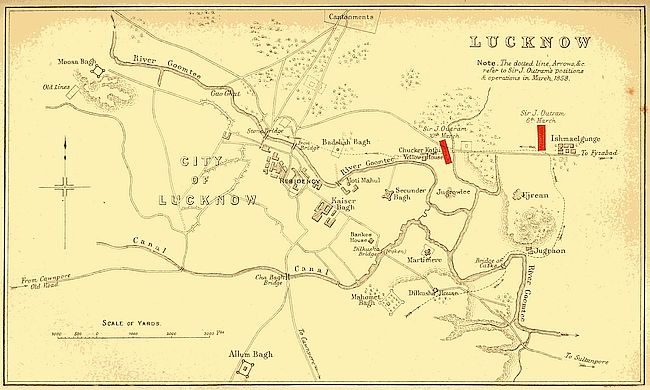
On the 6th the two Battalions struck tents at 1.30 in the
morning, and marched an hour afterwards. They formed
part of Sir James Outram’s force, and crossed the Goomtee by
a bridge of boats which Sir Colin Campbell had ordered to
be thrown across, a little below the Dilkoosha. By some
error on the part of the Engineers, it was exposed to the fire
of the guns in the Martinière, yet the enemy did not attempt
to molest their passage. On reaching the left bank they
moved along the river, which curves here, for some distance.
Then four companies of the 2nd Battalion were sent to join
the force under Brigadier Hope Grant. The two Rifle
Battalions advanced extended in skirmishing order across a
plain, the line regiments following in quarter-distance column.
The appearance of this force was magnificent in the extreme.
The men had their European clothing, and the helmets of the
Bays shone, and the pennons of the 9th Lancers fluttered in
the morning sun. They made a circuit of about five miles,
keeping as near as possible to the river and the city. The
Riflemen skirmished through some dâl[287] as high as their
heads, but they saw no enemy. They then halted for breakfast
and for the animals carrying ammunition to come up.
They then advanced, circling more to the left, across a plain,
till they came near the Fyzabad road.
Here they found the enemy in some number, who came out
of the woods and villages on their left. The cavalry charged
them, and in the pursuit Major Percy Smith of the Bays was
killed. The Riflemen proceeding came upon some Sepoys,
who fired at them with a gun, but without doing any mischief.
About half-past eleven they fell back and bivouacked in a
tope, with a pond or tank in the middle of it, on the Fyzabad
road, on the left bank of the Kookrail, a fordable tributary of
the Goomtee, at Ishmaelgunge, about half a mile in advance
of the village of Chinhut. But their baggage did not come
up till long after dark. They formed outlying picquets and
a guard or escort for the guns. On the left of their bivouack
was a wood, and an occasional shot at the picquet sentries
showed that it was occupied by the enemy.
Compiled. &. Drawn by Captn H. M. Moorsom, Rifle Brigade.
E Weller, Litho.
London, Chatto & Windus.
LUCKNOW
Note. The dotted line, Arrows, &c.
refer to Sir J. Outram’s positions
& operations in March, 1858.
Captains R. Glyn’s and Dillon’s companies of the 2nd
Battalion and Captain Atherley’s company of the 3rd Battalion
were on picquet. In the course of the night Lieutenant
Eyre, who was with this picquet, while out patrolling
came upon the body of Major Smith, beheaded and mutilated.
And in the morning of the 7th with a party of ten men, accompanied
by Captain Dillon, he went out, found the body,
and brought it in. They were fired at by the Sepoys, but did
not suffer any damage. During the night there were several
alarms, but without result; but about nine o’clock the enemy
attacked this picquet in great force. They were said to be
about 10,000 in number. They advanced, covered by the fire
of three guns placed in a tope of trees. The picquet at once
fell in, extended, and advanced, with two guns of the Royal
Horse Artillery, and drove the enemy back into the town,
capturing one ammunition waggon. The fire was very severe,
but the casualties were only one man of the 3rd Battalion
wounded. But there were some hair-breadth escapes. Lieutenant
Baillie’s sword was struck, and a Sergeant (Kemp) of
the 2nd Battalion had his trousers torn, but without being
wounded. The picquet continued to occupy the advanced
position to which they had moved until the evening, when they
were relieved about six o’clock.
The two Rifle Battalions had been moved up about 150
yards in front of their camp, into which the enemy pitched
round shot; but they halted there in reserve, and were not
actually engaged, the companies on picquet having repulsed
the attack and disposed of their assailants. On the morning
of the 7th they pitched the tents which had come up the night
before; and they continued in this camp during that day and
the 8th.
On the morning of the 9th the two Battalions paraded at
five at their alarm-posts. The object of the day’s work was
to drive the rebels out of the Yellow Bungalow, the key of
their position, and from its neighbourhood. From the
Kookrail to the Yellow Bungalow is a sandy plain, while the
ground from the Bungalow to the Iron bridge is occupied by
suburban villages and enclosed gardens. On the other side
of the Fyzabad road the ground is wooded. The two Battalions
advanced in skirmishing order, while other troops
followed in contiguous columns, three companies of the 3rd
Battalion under Colonel Macdonell, Lindsay’s being extended,
pivoting on their left, and an equal number of the 2nd Battalion
prolonging the line. Moving forward, they forded the
Kookrail river (about knee-deep), and soon after found the
enemy. The Riflemen advanced to a small village in broken
ground and well wooded, a very strong position if the enemy
had availed himself of it; but the Sepoys retired without
firing a shot. Colonel Fyers took his company to attack
this village. The Riflemen then passed through this wooded
ground at the double, and came out into the open. The
skirmishers then brought their right shoulders forward, and
advanced, the enemy retiring before them until the right of
the line had moved up to the neighbourhood of the river.
They then came to the Yellow Bungalow, and the Riflemen
went at it with a rush. Lieutenant Cooper and Corporal
Bradshaw, V.C., were the first over the wall of the compound
surrounding it. There was a lane, with the Bungalow on one
side, and some outhouses on the other. Some of the 2nd
Battalion passed along the lane and came out in the open
country beyond, where was a village on the right. Captain
Nixon with part of his company passed through a lane which
ran along the village, while the remainder, under G. Curzon,
went forward. The Riflemen were here exposed to a smart
fire, but not of Artillery. There was a bungalow on the right,
which a company of the 3rd Battalion under Captain Deedes
occupied. Captain Fremantle, collecting as many men of
his company as were near him, kept away to the right, clearing
the houses in front of the guns, which were following him.
This was disagreeable work, as it was impossible to tell how
many of the Sepoys were in these houses; but the men backed
him up, and the houses were cleared. The guns then opened
at the gate of the Badshahbagh. Some additional guns moving
to the right, Fremantle with his company covered their
advance and lined a wall. They were here ordered to take a
house in their front, which they did with a rush, and held it
for an hour and a half, exposed to a heavy fire of musketry;
till they were ordered by General Walpole to set fire to some
villages, which they did under heavy fire, and then returned
to and lined the former wall.
The enemy now gave way; and, though they showed some
cavalry (Lancers with a green flag), on a battery being brought
up and opening fire, they moved off in confusion along the
bank of the river. Unfortunately, there was some space
between the right of the line and the river, and some enclosures,
and they got away. But they were pursued by some
Horse Artillery; and Colonel Macdonell, carried away by the
ardour of the moment, charged with them. Captain Nicholl
killed one man with his revolver.
The Battalions halted from 8.30 till two in the afternoon,
when they went under the shade of a tope; and they encamped
for the night on the ground they had so gallantly
won, in the open à cheval on the Fyzabad road, with their left
200 yards from the Goomtee.
The casualties of the 2nd Battalion were 5 men wounded.
On the 10th the Riflemen shifted their camp to near the
Yellow Bungalow. A party under Lieutenants Grey and
Dugdale, on escort to bring up the mortars, were engaged,
when 1 sergeant (Richards) and 1 private were wounded.
The two Battalions furnished outlying picquets, some of which
were not relieved for forty-eight hours.
On the 11th the two Battalions paraded on the Fyzabad
road a little before six, in order to make a reconnaissance in
force to ascertain the possibility of crossing by a bridge to
Lucknow. The Riflemen, leading in skirmishing order, were
distributed among orchards, buildings of various kinds, and
narrow streets. They skirmished through these as well as
they could, each captain acting in a measure independently,
and handling his company as he thought best. The streets
were so intricate and the continuity of the Battalions so
broken that no other system was possible. The Riflemen
worked their way through these obstructions, and reached the
mosque on the Old Cantonment road, which commands the
approach to the Iron bridge. This bridge they were ordered
not to cross. But, leaving the mosque in charge of other troops,
they proceeded to fight their way to the Iron and Stone
bridges. At one place the skirmishers came to a high wall,
and dividing, passed some to the right and some to the left.
And coming to the other side, they found themselves in a
perfect labyrinth of streets, lanes and gardens. The enemy
retreated before them, hiding among the buildings and
enclosures, and were driven across the bridges. Major
Bourchier’s company of the 3rd Battalion succeeded in getting
a commanding position, and killed some fifty of the enemy.
The camp of the rebel 15th Irregular Horse was surprised,
and two guns and the standard of that regiment were captured
by the Riflemen. As the 3rd Battalion were passing through
the narrow street of a village which had been set on fire,
they were blocked by one of the captured guns in their
front sticking fast or being overturned, and had some difficulty
in escaping the flames.
On approaching the Iron bridge Captain Wilmot, 2nd Battalion,
found himself with only four men of his company at the
end of a street opposed to a large force of the enemy. One
of the men was shot through both legs, and was quite helpless.
Corporal Nash and Private David Hawkes took him up and
carried him to the rear; and though Hawkes was himself
severely wounded, he continued to carry him under fire from
the enemy, Captain Wilmot with his revolver keeping back
the enemy and covering their retreat.[288] Eventually the Riflemen
cleared the whole of the suburbs near the Old Cantonment
road as far as the Iron bridge.
The casualties of the 2nd Battalion were considerable.
Captain Thynne, while in a house drinking some water, was
struck by a round shot, which shattered his arm and leg. The
latter was at once amputated, but he died about two hours
after. He was buried that evening in a tope of trees close to
the camp of the Riflemen.
His loss was much regretted by his brother-officers, by
whom he was much esteemed. ‘No one in the whole regiment,’
writes one of them, ‘was more liked or could be more
regretted. He was always a cheerful and agreeable companion,
and a right good soldier besides.’
Lieutenant Cooper was also severely wounded in the neck;
the ball passed out of his shoulder through the lung. He died
on the 19th, and was buried at the Dilkoosha. Five privates
were also wounded, of whom two died of their wounds.
In his despatch Major-General Sir James Outram thus reports:
‘The enemy held the ground in great strength in front
of the Rifle skirmishers, commanded by Brevet-Major Warren,
Captains Wilmot and Thynne, and Lieutenant Grey, who all
behaved most gallantly.... The spirit and dash of the men
during this critical operation was most remarkable, and merits
my highest commendation.’ He also mentions with especial
commendation Brigadier-General Walpole, Brigadier Horsford,
Lieutenant-Colonel Hill, commanding 2nd Battalion, and
Lieutenant-Colonel Macdonell, commanding 3rd Battalion
Rifle Brigade. Major Ross, Captain Nixon, and Lieutenant
Eccles were also favourably mentioned in despatches.
On the 12th there was an attack, or a threatened attack, on
the mortar batteries, and three companies of the 3rd Battalion
were sent down to protect them. There was still, too, some
fighting about the bridges. With this exception, the Rifle
Battalions were not engaged on this or the following day;
but furnished picquets and covering parties for guns.
The picquet duty at this time and till the end of the
operations at Lucknow was very severe and harassing, the
picquets being sometimes on for forty-eight hours; one, indeed,
was not relieved for three days and nights. The weather
too was very hot; and swarms of flies by day and of mosquitos
by night made these duties anything but agreeable.
On the 14th (the day Sir Colin Campbell took the
Imaumbarah and the Kaiserbagh), the two Battalions were
suddenly turned out at three in the afternoon, and marched
towards the Iron bridge, in order to prevent the Sepoys crossing
it; but no enemy appearing, they returned to their camp
at half-past five.
On the 16th some Sepoys who remained in the town attacked
a picquet of the 3rd Battalion near the Iron bridge,
but were driven back.
On the 18th the Riflemen moved their camp to near the
Badshahbagh.
On the 19th the two Battalions were ordered, the 2nd to
hold the Iron bridge, the 3rd the Stone bridge, while the force
on the right bank cleared the town of Lucknow of the remaining
rebels. They took up their position at 7.30 in the
morning, and remained till 5.30 in the afternoon, when they
returned to their camp, much exhausted by the great heat,
but not having been actively engaged.
The casualties during the operations at Lucknow were:
of the 2nd Battalion, Captain Thynne killed, and 13 men
wounded; of the 3rd, 6 men wounded.[289]
On the 22nd the two Battalions were ordered to march on
a secret expedition; and parading at half-past ten at night,
moved to the Old Cantonment, about five miles from their
camp, which was left standing. Here they joined the cavalry
which was to act with them. Thence they proceeded in a
very dark night for a considerable time, but were at last
halted, and ordered to lie down in a dusty road ankle-deep in
sand. The night was excessively cold. At five in the morning
(March 23) the men having breakfasted, they marched on till
eleven, when they were halted for three hours under the shade
of a tope; and afterwards proceeded to the village of Koorsee,
about sixteen miles from Lucknow, a strong position. But the
enemy had for the most part evacuated it, and encamped about
six miles farther on. However, the force had a brush, killed
about 150 of the rebels, and took 15 guns, 70 camels, and 2
elephants, besides some carts loaded with ammunition, which
was exploded during the night. The active part of this affair
fell principally on the cavalry, but the Riflemen were drawn
up in line, ready to support them if they had been wanted. In
his despatch on this occasion Sir Hope Grant mentions
Brigadier Horsford, commanding the infantry, Lieutenant-Colonel
Hill, commanding the 2nd Battalion, and Lieutenant-Colonel
Macdonell, commanding the 3rd Battalion. And on
the 24th, the objects of the expedition having been accomplished,
they started for their camp at seven, and halting as before
during the hottest part of the day, returned to their camp
at seven in the evening. Though the weather was very sultry,
the men were not wearied; marching cheerfully and singing
all the return march. This elicited the marked approval of
General Grant, who was in command.
On the 30th the two Battalions moved camp to the Old
Cantonment.
On April 5 the Camel Corps was formed by a draft of 4
officers and 100 men from each of the Battalions, and 200
Sikhs. The officers who were attached to it were Captain
Nixon, Lieutenants Scriven, Eyre, and G. Curzon of the 2nd
Battalion, and Major Ross, Captain H. Newdigate, Lieutenants
Austin, Buckley, and Jeames of the 3rd Battalion.
On April 9 the 3rd Battalion moved camp to the Badshahbagh,
and on the 15th, taking three days’ provisions, six
companies started on an expedition. They marched out
beyond the Dilkoosha, and encamped. I cannot ascertain
whether they engaged the enemy during the time they were
in the field, but on the 24th these companies returned to the
camp at the Badshahbagh. And the Battalion soon afterwards
went into quarters at Lucknow.
During the fighting from Cawnpore to Lucknow this young
Battalion had borne their part in action and in marching with
great determination, valour and endurance. But now that
excitement had passed away, and no amusement or interest
took its place, sickness assailed these young soldiers. Many,
both men and officers, fell ill, and numbers of the men died.
They were, therefore, left for some weeks in quarters at
Lucknow, to recruit their health.
About this time the Riflemen gave up their European
clothing, and received instead of it dust-coloured linen, with
black facings.
On April 11 the 2nd Battalion (forming part of a field
force under Sir Hope Grant) marched from Lucknow to Briesha
Talow. They started at half-past four in the morning, and
though the distance was but six miles, did not reach their
camping-ground till eight, the road being bad, and the progress
of the heavy guns consequently slow.
On the next day they continued their march to Utterah,
thirteen miles, over a sandy track and through thick jungle,
and did not encamp till noon. The day was exceedingly hot,
with the thermometer at 110°.
On the 13th they started early, and as it was getting light,
near Baree came on a force of the enemy with three guns,
occupying a ridge at the end of a level plain. Three companies
were immediately extended and advanced across it.
The rebels opened fire of matchlocks at about 800 yards, and
though it continued without intermission, no harm was done.
Colonel Hill had intended to go in without returning this fire,
but when the line of skirmishers was about 400 yards from
the enemy, a hare started up, and one of the Riflemen, unable
to resist his sporting propensities, fired at it. Nothing
then remained but to go in with a rush, and the enemy at once
broke and fled. The Riflemen pursued them till ten o’clock,
when they encamped near the scene of the combat. There was
a cavalry skirmish; but the ground was broken and unfavourable
for them, and the rebels looted some of the baggage.
On the 14th they marched to Burassie, eight miles; on
the 15th to Mamdabad, ten; on the 16th to Bilhir, also ten,
where they halted one day; resuming their march on the 18th
to Filwy, eight miles, they proceeded on the 19th to Ramnagurh,
eight miles, where there was another halt of a day. On
the 21st they moved to Massoulee, eight miles; and on the
day following to Nawabgunge, six miles, where they halted.
On the 23rd, 200 Riflemen, under the command of Colonel
Fyers (with other troops) went with Brigadier Horsford to
Jungerabad, about six miles from Nawabgunge, and took
and destroyed the fort at that place.
Starting again on the 26th they marched thirteen miles to
Chinhut; on the 27th to the Dilkoosha; and on the 28th to
the Alumbagh; having in this expedition swept round that
portion of Oude north of Lucknow.
But no rest was given the Battalion. On the day after
they marched into Lucknow they marched out of it; now to
the south, and halted at Bunnee bridge. On the next day
they proceeded seven miles to Kantha; and after one
day’s halt there, on May 2 marched ten miles to Poorwah.
Sir Hope Grant was anxious to come up with the force
under the rebel general Beni Madhoo. So starting again
on the 4th the Battalion marched seven miles to Moorawon.
On the 5th they halted, but a reconnoitring party was sent
out which took five hackeries laden with matchlocks and
ammunition. On the 6th they marched seven miles to
Dirgpalgunge, and on the 7th five miles to Parthan. Here
they halted on the 8th. During this march the men had
suffered much from the heat, many having died of sunstroke.
The duties, picquets, &c., fell hard too on the officers; for
three had been killed since their arrival in India, two had
been sent home wounded, and one sick; two were on
General Walpole’s Staff, two left sick at Lucknow, and
one was sick in camp; so that there were only, besides
the Lieutenant-Colonel, five captains and ten subalterns
effective with the Battalion.
They marched on the 9th from Parthan to Nuggur, eight
miles, and on the 10th to Doondia Khera, seven miles, where
they encamped in a shady tope of mango trees.
From this place Sir Hope Grant thought that he could by
a night march of some twenty miles, come upon the rebels
under Beni Madhoo. Accordingly, at six in the evening the
Battalion received orders to march at half-past eleven. But
in the darkness of the night the various portions of the column
missed each other, and not being able to make out the track,
found themselves at daybreak near Nuggur, where they had
encamped on the 9th. Here, accordingly, they halted and
did not encamp till eight o’clock. They made a short halt
there, striking tents at two, and parading in a grove of mango
trees, marched at three in the afternoon. It was then fearfully
hot, the thermometer marking 118° in the tent. The
men were struck down by the sun every moment. ‘Shortly
after we marched,’ writes General Hill, ‘the Surgeon, Fraser,
rode up to me with the report, “There are fifteen men down;
all the doolies[290] are full; what are we to do with the next?”
It was a puzzling question, but I suggested elephants; and
meanwhile sent to ask permission to make a sick depôt at the
first convenient spot, and to leave one company to protect it.
However, as the sun got lower the casualties were fewer, and
we were enabled to keep on till the enemy were in sight and
a halt was made.’
This was after a march of five miles. The Battalion
advanced in skirmishing order; guns accompanying the skirmishers,
galloping forward and firing two or three rounds
until the Riflemen came up. Thus they went on to the bank
of a large nullah, where they had orders to halt. Sir Hope
Grant went off with the cavalry; and soon the sound of the
enemy’s baggage carts was so distinct that Colonel Hill asked
permission to take on his Battalion to capture them. But it
was too late, for the daylight only sufficed for a smart skirmish
across the open. Meanwhile Colonel Fyers, with two companies,
Earle’s under Lieutenant Baillie, and R. Glyn’s, had
captured a gun. It was getting dark, the ‘retire’ had sounded,
and all had joined the main body except these two companies.
The gun was heavy; the ground bad; and the men worn out
by heat and fatigue. They made little way with their gun,
and it became quite dark. Then some horsemen appeared
on the left. A question arose what they were. The general
opinion was that they were Sikhs. At last they came near,
and Colonel Fyers challenged; the reply was not satisfactory,
and he fired his revolver. The Riflemen at once poured a
volley into them at thirty yards which emptied half the
saddles, and then fixed swords. But the horsemen fled,
their leaders were seen through the darkness endeavouring
to re-form them, but without success. The Riflemen, not
without difficulty in the pitchy darkness, rejoined the Battalion.
In the course of this fight the enemy got in amongst our
sick. A smart young Sergeant (Pitt) was being carried in a
dooly insensible from sunstroke, when some of the enemy’s
troopers came upon it. The bearers fled, and this poor fellow
was beheaded; the rebels carrying off the head as a trophy.
The mess baggage had also a narrow escape, the Sergeant
in charge of it (Sergeant Cann) being obliged to run for
his life.
I have said that the men were utterly exhausted by the
heat, by their march, and by the fight. They bivouacked on
the ground they occupied. But not to sleep the sleep of the
weary; for in the night an extraordinary panic arose. Men
cried out that the enemy were upon them. Some fired their
rifles; some clubbed them and struck out at everyone near
them. At last it wore itself out or was allayed; and except
some broken heads no injuries were inflicted, at least in the
Rifle Battalion. The origin of this panic remains a mystery;
the most probable solution is that either some grass-cutters’
ponies or some cavalry horses had got loose and knocked
down the piled arms, and so caused an alarm. The loss of
the Battalion on this day was three men by sunstroke.
On the 13th they returned to their old camping-ground
at Nuggur, where they halted two days. Here Sir Hope
Grant received intelligence of a large force of rebels being to
the north of Lucknow; he therefore retraced his steps, and
the Battalion marched on the 15th to Parthan and encamped
under a tope of trees. They had not pitched their tents more
than a couple of hours when they were ordered to turn out,
the enemy having shown themselves and driven in the camels,
which were out feeding. However, the rebels disappeared.
On the next day the Battalion marched to Poorwah, seven
miles; on the 17th they halted, but on a false alarm they were
turned out under arms. On the 18th they moved to Mirree,
seven miles; on the 19th to Bunnee, ten miles; thence on the
20th to the Alumbagh; and on the 21st to the Dilkoosha,
where they pitched camp on the bank of the Goomtee. On
their arrival at Lucknow they sent fifty-three men to hospital;
among them the Sergeant-Major and the Quartermaster
Sergeant.
They remained at Lucknow only three days, marching
again on the 24th to Jellalabad, and on the 25th to Bunnee.
In these marches, though the heat was very great, the Battalion
did not lose a man, while the regiment with them (53rd)
suffered much.
They halted for a week at Bunnee, a respite much needed
after almost incessant marches for two months.
On May 11, an attack on Lucknow being apparently
anticipated, a force took the field, in order to be ready to
move on any point to repel it. Three companies of the 3rd
Battalion, under Major Oxenden, therefore moved out of
Lucknow and encamped on the Chinhut road. The heat was
overpowering, and many men died every day during their
stay here, which was but short. For on the 15th they broke
up camp and returned to the Badshahbagh.
Early in June, in consequence of repeated alarms of
attacks from the rebels, a camp was formed at Chinhut,
about seven miles from Lucknow, and four companies of the
3rd Battalion were moved to this camp. On June 8, an
attack being expected, they were under arms, but were not
engaged, no enemy appearing.
The remainder of the Battalion, marching at about three
on the morning of the 12th from Lucknow, were joined at
Chinhut by these four companies, by the 2nd Battalion, and
the other troops enumerated p. 386, and proceeding about
two miles further on, encamped at Utterdowna. This march,
for it was the hottest season of the year, was most fatiguing.
Leaving the sick at Lucknow, this Battalion had started 702
strong. And yet about 100 men out of that number were
more or less disabled in this one march.
On June 1 the 2nd Battalion marched again at four in the
morning to Meemteker, six miles, but on their arrival found
that the enemy, whom it was expected to find there, had disappeared.
They therefore halted in a tope. On the 2nd
they proceeded five miles to Chumrowlee, a very hot and
dusty march, and encamped in the open. On the 3rd, starting
at three, they made a march of eleven miles to Poorwah,
where they halted for three days; on one of which they were
paraded for the inspection of the Rajah of Kuppurthullah,
who had arrived in camp with a force of his followers.
Sir Hope Grant having received intelligence about this
time that a large rebel force was assembling to the north of
Lucknow, he resolved to leave the pursuit of Beni Madhoo,
and the Riflemen began to retrace their steps towards
Lucknow.
Starting again on the 7th early in the morning they
marched to Mirzee, twelve miles, and on the 8th to Bunnee,
five miles. These marches were by a different route from
that by which they had marched through these places on
former occasions. On the 9th they marched to Bunteerah in
a very hot wind; on the 10th to Jellalabad; and on the 11th
to the Dilkoosha. On this occasion Brigadier Horsford had
procured for the Battalion the permission to halt in Lucknow
itself, and not merely to march through it as on some previous
occasions; which gave them the opportunity of obtaining
some much-needed supplies, which they had not had since
landing in the country. But the time even for this was short;
for on the afternoon of the 12th they marched at three o’clock
to Utterdowna, about two miles beyond Chinhut. Here
they were rejoined by the 3rd Battalion; and the force now
consisted of these two Battalions, and a regiment of Punjaub
rifles, part of the Bays, the 7th Hussars, and some Irregular
(Hodson’s) Horse.
They started again, after a very short halt of the 2nd
Battalion, at about eleven at night. They took with them
one day’s rations, cooked, some rum, and all their ammunition.
This march was one of the most fatiguing ever made.
The men had been without rest the night before, and the heat
of the tents by day was so intolerable that sleep was impossible.
The road was bad, cut up, and damaged; there was no
moon; and the dust was suffocating. So weary were the men
that whenever a halt occurred, by a block from a gun sticking
fast or turning over, they sank down on the road, many inches
deep with dust, and slept. Soon the water carried with the
column was exhausted; no wells were near or could be found;
and the cries of the men for water were pitiable in the extreme.
Numbers of doolies accompanied the column (the
3rd Battalion had sixty); but these were soon filled, and the
fainting soldiers were left on the road on the chance of
being picked up by the Hospital staff of other regiments, or
of rejoining when strength returned.
At last daylight appeared, and they found that by dint of
marching all night they had arrived exactly where their
chief, Sir Hope Grant, wished them to be, close to Nawabgunge.[291]
In this march and in the subsequent advance on the
enemy’s position, the 3rd Battalion led the column, not without
some murmurs from their fellow-Riflemen of the 2nd,
who held that as so much of the previous hard work had
fallen to them, the post of honour ought to have been theirs.
Nevertheless, honour and hard work were theirs before the
day was over.
Having marched thus in darkness and suffering some nine
miles, they turned off the road near Nawabgunge, for the
enemy had seven guns in position, and halted.
They sat down, and water having been procured by some
camels having come up, the men were given a dram of grog
each.
Day having now fully broken, they fell in and advanced
to a large square plain broken up with nullahs and uneven
ground, and surrounded in the distance with topes of trees
and villages. The cavalry and guns crossed a small river to
the left, and were followed by the 3rd Battalion. This
advanced guard was soon engaged, and forced the bridge.
On crossing the river they came upon the enemy’s position.
They were formed in a kind of crescent, two regiments bearing
green flags being drawn up in the centre. The Riflemen
advanced in column, preceded by Major Bourchier’s company
extended in skirmishing order. As they approached the
enemy Colonel Glyn, who was in command of the Battalion,
directed the two rear companies to wheel to the right.
These were Major Atherley’s and one commanded by Lieutenant
Cragg. As they got near the enemy, Atherley found
himself facing one of the regiments with the green standard.
He extended the companies, and after advancing some
way ordered Cragg’s company to lie down, sheltered by
some rising ground, and directed Cragg if he saw him
retiring, to pass through his files, and charge the enemy.
Then forming up his own company in line, he fixed swords
and charged the regiment in his front. These were drawn
up in all the ‘pomp and circumstance’ of regular troops.
They planted their green standard, shouted ‘Deen, deen!’
and stood their ground. The Riflemen engaged in a hand-to-hand
conflict, killing many with their swords. It is said
that 150 were thus disposed of. One Rifleman having
driven his sword fixed on his rifle through the shield of his
opponent, was unable to draw it back, and the man making
a cut at his hands, he was compelled to let it go, and it was
never recovered. Some terrible drawing cuts were inflicted.
One Rifleman’s hand was cut off at a blow, the next cut
severed the thumb and forefinger of the other hand, the
third cut him across the stomach, and killed him. Meanwhile
the enemy did not yield. Cragg’s company had come
up, and the Riflemen were nearly exhausted. Five of the
enemy surrounded Atherley; four of them were shot by
Percival with his revolver; the other was trampled on and
disposed of by the pony on which Atherley was mounted,
which was very vicious. Percival having fired all six barrels
of his revolver drew his sword, and resting it against his
thigh, began to reload. At that instant, looking round,
he saw a native aiming a lance at his side; he evaded it
and the man was killed. This sort of thing could not last for
ever. The Riflemen, whom the excitement of the fight had
animated and borne up after their fatiguing night march,
were becoming exhausted. Yet their courage and steadiness
were not without their results, for their opponents began to
break off and retire. Then Quartermaster Harvey,[292] who had
accompanied these companies on his pony, galloped to some
of Hodson’s Horse who were near, and urged them to come
and charge the regiment opposed to his comrades. He
urged in vain. In vain did their officers give the word to
advance. Not a man moved. It was well perhaps for him
that they did not understand the epithets with which Harvey
assailed them. But just then he saw some squadrons of
the 7th Hussars approaching. He galloped to them, and
told their commanding officer, Sir William Russell, who was
leading, that the Riflemen could maintain the unequal fight
no longer, and must be overpowered unless help was at hand.
‘We’ll soon clear them,’ was the answer. And in an instant
the Hussars were thundering along at the charge.[293] An instant
more they were on the green-bannered regiment, cutting them
up as they fled at their approach.
Meanwhile, in other parts of the field and against the
other body with the green colours, the Riflemen of this
Battalion waged an unequal conflict. For they were far
outnumbered, and so weary from their night march and the
fierce blaze of an Indian sun, that they were scarce able to
load, and when loaded could fire only with a desultory aim.
Many were struck down by the sun in the fight; and it was
impossible to distinguish when a man fell, whether sunstroke
or a wound brought him to the ground.
Sir Hope Grant, who commanded in this action, says:
‘I have seen many battles in India, and many brave fellows
fighting with a determination to conquer or die, but I never
witnessed anything more magnificent than the conduct of
these Zemindarees.’[294]
So far we have seen the part borne by the 3rd Battalion,
which, as I have said, led the column. We must return to
the opening of the battle, and to the 2nd Battalion. In front
of it, as they drew near the field, were some large guns, and
the delay of getting them over the nullah allowed the other
and leading Battalion to get a quarter or half a mile to the
front. Before the 2nd Battalion had crossed, and while they
were still expecting orders to advance, an alarm was given in
the rear. A considerable force of the enemy had found their
way to the rear round the right flank, and were cutting up the
camp followers. The number of these was large, as the Bays
had brought on their camp-equipage; and there was no rear-guard,
so that the defence of all this baggage devolved on
the 2nd Battalion. At this time, too, Lieutenant Ames,
who was coming up with spare ammunition, was attacked.
Colonel Hill immediately gave the word, ‘Right-about turn,’
and extended three companies in his now front, sending one
under Lieutenant Baillie to protect his right flank, which was
threatened. The camp followers were running in in a confused
mass, to escape from their pursuers. As soon as these
stragglers had passed the line of skirmishers and cleared the
front, the skirmishers opened fire, and advancing to the
nearest cover halted, awaiting the Artillery which Colonel
Hill had sent to ask from the Brigadier. Meanwhile, the
now left was enfiladed by two of the enemy’s guns, and
Captain Dillon was sent with two companies to take or to
silence them.
The skirmishers were keeping up an incessant fire, which
the enemy briskly returned, at a distance of about 400 yards,
but as the Riflemen were well covered they did not much
suffer. As no Artillery made its appearance, Colonel Hill
ordered the men to make a rush on the enemy. They did
so, and the rebels retired through a village; when the Riflemen
were ordered to halt. Having waited there till the
enemy had disappeared, the Battalion moved to a tope of
mango trees not far from the river, and there awaited further
orders.
Some time after, a large body of cavalry appeared in
their rear (the proper rear of the column). These were at
first taken for Hodson’s Horse; but infantry soon appeared,
and it was ascertained that they were enemies. Two companies
of Riflemen moved down into a hollow which afforded
good cover; and as the cavalry passed, gave them a volley
at about 500 yards. This the infantry returned with a
straggling fire and then turned and fled. The Battalion
remained in the tope during the day and till about six in the
evening, when they were ordered to join the rest of the
column, then two or three miles in advance. They reached
their camping-ground about seven, and pitched their tents.
I may here note some of the incidents of this fight. As
some of the 3rd Battalion were advancing on the enemy, who
were receiving them with a sharp fire, some hares were started
between the opposing ranks. More than one Rifleman
aimed and fired at the hares, not at the foe.[295]
One man, a Ghazee,[296] being cut off from his companions,
seemed determined to make a desperate fight for it. Setting
his back to a tree, he stood, sword in hand, glaring fiercely
on his pursuers, for some officers and men had followed him
into the tope. Some shots were taken at him, which he tried
to avoid by dodging round the tree, but he was wounded and
made more desperate. At last a Pioneer of the 3rd Battalion,
Samuel Shaw, rushed at him and closed with him. The
Ghazee wounded him on the head with his tulwar, but Shaw,
drawing his Pioneer’s sword, sawed at him with the serrated
back and despatched him. Shaw rose from the ground
covered with blood, but his opponent was slain. Many who
witnessed it declared that this combat with a fanatic determined
to sell his life to slay his foe, was the greatest instance
of cool courage they ever saw. For this act Shaw received
the Victoria Cross.
Quartermaster Harvey, on going into a tope of trees where
the Battalion were about to encamp, came upon a man who
seemed inclined to make off. On Harvey stopping him, he
fell at his feet and offered, if his life were spared, to show
him where a quantity of powder was concealed. Accordingly,
Harvey and Percival followed him, and he brought them to a
place where there was a bullock-cart laden with seven casks
of powder. This was exploded and the bullocks taken possession
of.
The casualties of the Regiment on this day were: of the
2nd Battalion, Lieutenant Lawton severely wounded, and 1
corporal and 2 privates wounded; in the 3rd Battalion, 1
corporal and 11 privates wounded, and 1 Rifleman missing.
But far worse than the injuries done by the enemy’s fire,
were the sufferings of the men from exposure to the sun. The
3rd Battalion lost 14 men from sunstroke; in the 2nd Battalion
1 man died of sunstroke, and many others suffered
from it, of whom 2 died on the next day, and another on the
15th.[297] Fortunately, the supply of water was plentiful, and the
bheesties[298] assiduous in administering it. Some of the men
were raving; some lying on their backs as if dead, while the
bheesties sprinkled them with water. So great was the exhaustion,
that on Sir Hope Grant’s giving an order that tents
were to be pitched, Quartermaster Harvey went to Brigadier
Horsford to say that in the 3rd Battalion the men were so
utterly exhausted that they could not do it, and begged him
to allow the men to lie down in the shade. The Brigadier
replied that the General’s order must be obeyed, but consented
to take him to Sir Hope Grant, to make his report in
person to him. Sir Hope insisted, and said ‘the tents must
and shall be pitched.’ On Harvey’s return to his Battalion
the men turned to, and set about pitching the tents; but
many fell down through sheer fatigue, and slept on the tents
they were ordered to pitch. Yet they afterwards had reason
to see the wisdom of General Grant’s determination; for the
shelter of the tents perhaps saved many lives; and as the
enemy were still hovering about, and might again attack, it was
essential that the regiments should be in some formation.
Thus at about six in the evening the two Battalions encamped
on the field of Nawabgunge.
Sir Hope Grant, in his despatch dated June 17, 1858,
speaks most favourably of the Rifle Battalions.
‘Brigadier Horsford,’ he writes, ‘I am much indebted to
for the very excellent way he led on the infantry, and for the
support he gives me upon all occasions.’
He also mentions
‘Lieutenant-Colonel Hill, who with his Battalion so
gallantly and successfully protected our rear: a most important
service.
‘Lieutenant-Colonel Glyn, a most excellent officer, and
whose Battalion, the 3rd, behaved so well, being actively employed
during the whole day.’
He also favourably notices ‘200 infantry under Major
Oxenden,’ and repeatedly mentions the ‘two companies of the
Rifles under Captain Atherley.’
Yet in his published work ‘The Sepoy War,’ Sir Hope
Grant, or his editor, Captain Knollys, R.A., gives all the credit
of these gallant deeds to the 60th, which was not near
Nawabgunge at the time.
CHAPTER XII. — FOOTNOTES:
The rains having come on, the 2nd Battalion was ordered
to remain at Nawabgunge, and proceeded to build huts for
shelter on raised platforms; but this was done but slowly, the
supply of Coolies for the work being scanty, the Government
having engaged them for other work; and before the huts
were completed the Battalion was moved, as will be presently
narrated.
The 3rd Battalion marched from Nawabgunge on the 21st
at three in the morning, and proceeded to Chinhut, where they
encamped. Here they had left their sick on the 12th, and it
appeared that a fearful panic had occurred on the next day.
For some irregular cavalry and camp followers had fled from
the field while the battle was raging, and, passing through
Chinhut to Lucknow, had spread a report that we had been
cut up, and that the enemy were advancing. Some of the
sick, terrified by this intelligence, left their beds or their
doolies, and madly rushed about with scarce any clothing in
the sun. This was attended in some cases with fatal results.
However, these alarmists had better have faced the hostile fire
on the field of Nawabgunge than the face of the General at
Lucknow, who, knowing their reports to be false, ordered them
to be soundly flogged.
On this march the Battalion brought with them five of the
six guns taken at Nawabgunge; and as their carriages were
old, and the road very bad, they much retarded their progress.
However, they succeeded in pitching their tents before
the sun was powerful.
On the 22nd they marched again at three A.M., and
arrived at the Cantonments at Lucknow at nine, where they
encamped. Soon after this the rains set in, with a violent
thunderstorm which flooded the tents on July 8; and the
men were employed to build huts, partly out of the remains of
ruined bungalows which had been destroyed by the rebels, in
order to shelter them during the rainy season. But no such
provision was made for the officers, who continued in tents.
Here the Battalion remained for more than three months,
during which time the men suffered much from cholera and
from their recent exposure to the weather.
On July 22 the 2nd Battalion left Nawabgunge for Fyzabad
in order to assist Maun Singh, who was besieged by
the rebels. They struck tents and marched eight miles to
Dundirah, many men falling out from fatigue. On the next
day they proceeded to Turkani, six miles, and on the 24th,
intelligence having been received that Maun Singh could not
hold out four days longer, they pushed forward to Derriabad,
thirteen miles, instead of halting at the end of eight miles, as
was intended. This was a most distressing march; the
weather was very hot, the thermometer being at 105° in the
tents; and numbers of men were taken ill on the way. They
halted on the 25th, it having rained all night, but started again
at four on the 26th, and encamped at Burehke Serai. On the
next day they proceeded to Begumgunge, and on the 28th
tents were struck at four in the morning; but in consequence
of the heavy rain they did not start till half-past-six. They
marched seven miles, and encamped at Samao, on the banks
of the Gogra. On the 29th they reached Fyzabad after a
march of thirteen miles, only to find that the rebels had left
it that morning, and crossed the Gogra; however, the Horse
Artillery got up to the bank in time to get a couple of shots
at the last boat-loads. The Battalion halted at Fyzabad for
a fortnight, during which time, on August 6, the camp was
shifted to platforms on account of the rain; but while this
was being done a violent storm came on, and the men were
drenched before the tents could be pitched.
On the 9th Brigadier Horsford, with a portion of the 7th
Hussars, the Madras Fusiliers, a troop of Horse Artillery, and
some native troops, proceeded to Sultanpore; and the 2nd
Battalion, being ordered to reinforce him, started soon after
three on the morning of the 16th. It was a dreadful march.
Soon after starting, they lost their way in the dark. The
country being flooded from the rains, it was some time before
they could find a track; and even on this the water was
ankle-deep. Having marched about four miles, they halted
for a rest. It came on to pour, and the rest of the way the
men were up to their knees, sometimes to their middle, in
water. The mud, too, on which they walked was slippery
and fetid. Under these circumstances they did not reach
their camping-ground at Butturpore, a distance of twelve
miles, till one o’clock in the afternoon. Even then their sufferings
were not at an end. The Commissariat carts were not
up, and it was three o’clock before the drenched Riflemen got
their tents pitched and broke their fast. On the 17th they
marched to Perownee, nine miles, a repetition of the discomforts
of the preceding day, save only that no rain fell. The
men frequently fell into holes that had been made for planting
trees; a source of merriment to his comrades, but of misery to
the unfortunate diver himself. On arrival at Perownee there
was considerable difficulty and delay in finding a spot dry
enough to pitch a camp. At last some rocky eminences were
fixed on, which cropped up above the plain and stood up above
the flooded ground. Here the tents were pitched without
order; for the men were obliged to place them wherever the
scanty ground afforded room.
On the next day they marched to Burtenpore, six miles,
with less discomfort, the day being fine and the road tolerably
good. Here they halted on the 19th, to allow the Commissariat
hackeries, which had fallen two marches behind, to come
up. And on the 20th moved on to Sultanpore on the
Goomtee, by a very good road. They found the enemy, with
a force of about 10,000 men, occupying the opposite bank of
the river, here not more than a hundred yards broad. They
therefore halted, observing the enemy, and exchanging occasional
shots with them, until General Grant came up on the
23rd with reinforcements. On the 25th the Madras Fusiliers
began to cross the river without opposition. This occupied
some days. And on the 25th the 2nd Battalion was paraded at
three o’clock to cross; but the Madras Fusiliers not having
completed their passage, the Riflemen were ordered into bungalows
for shelter. Later in the evening, however, Sir Hope
Grant having received intelligence that the Madras Fusiliers
were hard pressed, ordered the Battalion to cross immediately.
They were accordingly turned out at eight, and about two
hours after began to cross the river, much swollen by the rains,
on rafts. Of these there were only two, formed of old rum
barrels, each calculated to convey twenty-four or thirty men.
However, Colonel Hill got over as quickly as possible with two
companies, who reached the opposite bank about midnight;
and after a march of about two miles, reached the ridge occupied
by the Madras Fusiliers. But it appeared to have been
a false alarm, for there was no appearance of danger. The
men, therefore, piled arms and bivouacked; and the night
passed quietly, except that the rebels kept up a constant fire
on the picquets. On the next morning a couple of tents were
got over for the companies on the right bank, and the remainder
of the Battalion crossed and encamped on the plain.
On the 27th at sunset the enemy, who were about two miles
or more distant, turned out as if for an attack; but they did
not venture within 1,200 yards.
On the 28th the rebels, by giving a gun great elevation,
and probably half burying it, contrived to throw a few shot
into the Riflemen’s camp; doing no damage to them, however,
though they killed an old woman, and knocked over an
elephant, by hitting him on the pad, but, except rolling him
over, doing him no hurt.
On the 29th they paraded at two in the morning, and
marched at three to the cantonments, making a circuit to
get well round the enemy; but to their great disappointment
the enemy had gone off during the night. The Riflemen
waited under topes till the baggage came up, when
they pitched their tents, heavy rain coming on just as they
did so.
The Battalion halted at Sultanpore for some weeks with
little change, such as, for instance, a company (under
Lieutenant Sotheby) recrossing the Goomtee to protect the
heavy guns.
On October 4 six companies of the 3rd Battalion, under
Colonel Glyn, moved into Lucknow. And on the 5th Captain
Alexander’s company marched at nine in the evening to join
an expedition to Sundeelah (about forty miles from Lucknow),
commanded by Brigadier Barker.
This party, consisting of 100 men, was in charge of
Lieutenant Andrew Green,[299] and accompanied by Ensign
Richards; for Captain Alexander had been ordered to take a
detachment up the country.
On arrival at Sundeelah on the 7th, information was received
that a large force of rebels were about four miles off at
a place called Jamo.
At daybreak on the 8th, therefore, the column marched to
Jamo. On approaching the enemy’s position, which was a
strong one, a village on high ground and surrounded with
dense jungle, fire was opened on them from guns posted in
the village and from matchlocks in the jungle. The Riflemen
were extended in skirmishing order on the right, and entered
the jungle. Lieutenant Green had warned the men not to
lose communication with their files; but in the thickness of
the jungle three men got separated, and were surrounded and
wounded by the enemy. Hearing firing, Lieutenant Green at
once made for the place, and was immediately surrounded by
six rebels. He shot two with his revolver. As he was in the
act of dismounting to attack the others, he was cut down and
hacked at while on the ground. Springing to his feet, however,
he managed to knock down two more of his assailants
with the butt of his revolver, and drawing his sword, he kept the
others at bay. While he was about to fall back in search of
some of his men, he was attacked by three more of the enemy
and a second time cut down. Again getting to his feet, he
contrived with his wounded right hand to shoot another man,
who was in the act of cutting at him with his tulwar, and whose
blow, descending as he fell dead, inflicted a deep wound on
Green’s head. Colour-Sergeant Mansel,[300] meantime, had heard
the firing, and was making his way to the part of the jungle
the sounds seemed to proceed from, when he came on a Rifleman
wounded and retiring, who informed him that Lieutenant
Green had come to his assistance, and was then hard pressed
by several Sepoys. Hurrying on in the direction the man had
pointed out, the Sergeant soon was attacked by a rebel, whom
he succeeded in shooting; but before he could reload his rifle he
was set upon by another man, who cut at him with his tulwar.
After a severe struggle Sergeant Mansel knocked him over by
a blow with the butt of his rifle, and soon after he came upon
Green lying bathed in blood outside the jungle, and with the
help of two Riflemen carried him fainting to the rear.
Green received fourteen sabre cuts and one gunshot wound.
Four of these wounds were obliged to be sewn up on the
ground, and as soon as he was brought back to camp his left
arm was amputated below the elbow, and his right thumb
was taken off. Faint from loss of blood and from excessive
fatigue (for the Riflemen had been under arms from four in the
morning till three in the afternoon), it was not thought that he
could rally, and for some days his life was despaired of. He
was, however, moved to Lucknow on the 21st.
Few men, probably, have ever survived so many and such
severe wounds.
Besides Lieutenant Green, three Riflemen were (as I have
said) wounded on this day.
It will be anticipated that Brigadier Barker speaks highly
of this gallant deed in his despatch of October 9.
‘The party of the Rifle Brigade, under Lieutenant Green’
he says, ‘gallantly rushed up the high position in front of the
village, and captured a six-pounder gun.’ ... ‘Among the
wounded (and I am sorry to say he is dangerously so) is
Lieutenant Green, Rifle Brigade.... This officer had behaved
so gallantly all through the day that I most deeply
lament this misfortune.’ Ensign Richards also was favourably
mentioned in this despatch.
The Adjutant-General of the Army in India, also, in forwarding
this despatch to the Secretary of the Government,
by the direction of the Commander-in-Chief adds, ‘I am also
to request marked attention to the gallantry of Lieutenant
Green of the Rifle Brigade, who has been dangerously
wounded.’ And the Governor-General in his General Order
publishing these despatches, states his ‘great satisfaction’ at
the conduct of Lieutenant Green.[301]
On the 12th Captain Alexander, who had returned to
Lucknow on the previous day, proceeded to take command of
his company, and arrived at Sundeelah on the 13th.
On the 13th this company were engaged in a daur[302]
to the fort of Mandaula, which was blown up, and three guns
were taken. And on the 18th three more companies, Atherley’s,
Stephens’, and H. Newdigate’s, under command of Major
Oxenden, marched from Lucknow and joined it at Sandeelah.
On the 21st the Brigade under Brigadier Barker proceeded
to attack the fort of Birwah, which was held by Gholab Singh
and about 700 rebels. The four companies of the 3rd
Battalion, commanded by Captains Alexander and Stephens,
and Lieutenants Percival and Cragg, and led by Major
Oxenden, accompanied this force. They paraded at two A.M.,
and soon after marched in the direction of Birwah, and
arrived before it about seven in the morning. Brigadier
Barker had resolved to attack the west front. A few hundred
yards from the fort was a village on a mound, which was
intrenched and occupied by the enemy’s picquets. It was
surmised that, as in so many previous instances, the rebels
would not have awaited the approach of the column. But the
assailants were soon undeceived; for a puff of smoke issued
from a large circular bamboo jungle on the right, and a round
shot flew over the column. The Riflemen were then hurried
to the front; and with some native police and an eighteen-pounder
and mortars, gradually inclined to the right till they
came to the village, from which they drove in the enemy’s
picquets, and it and the intrenchments were at once abandoned.
They were then halted and ordered to lie down in
a wood beyond the village. In front was an impenetrable
bamboo jungle, out of which shots came now and then to
show where the fort was, but so thick was the mass of bush
and thorns that they could not see the walls; though from
the reports of the guns they did not seem to be more than
100 yards off.
The mortars were placed in the village, and the gunners
were directed to pitch their shells over the Riflemen, and to
let them fall near a flag-staff which was supposed to mark
the centre of the fort; but the enemy foreseeing this had
moved the flag-staff to the further side, so that the shells
went over the fort altogether. The fire of the mortars appearing
thus to produce no effect, the eighteen-pounder was
brought to where the Riflemen were lying down among the
trees, in order to endeavour to make a breach in the wall.
Lieutenant Percival was sent with twenty men of the company
in his charge into the jungle, with orders to move along the
ditch, to mount the breastwork of the outer defences, and to
clear it of the enemy. This was rapidly effected. They
drove the enemy before them, who abandoned the outer
works, leaving a gun in their hands, and escaping through
the jungle, retired to the fort. In this service two Riflemen
were killed.
At this time a shell fell near Major Oxenden, who was on
horseback close behind the line of skirmishers, wounding his
horse; wounding also Colour-Sergeant Mansel in two places,
and knocking over one or two more Riflemen.
The eighteen-pounder continued to be fired point-blank
through the jungle; and a lane was speedily cleared by its
fire, and the wall of the fort was discovered about seventy
yards distant.
As the fire of the mortars appeared to produce no effect,
Brigadier Barker ordered the fort to be assaulted about half-past
two in the afternoon. Captain Alexander’s company,
which had left camp fifty of all ranks, increased by a section
of another company, was to act as the storming party; while
100 Riflemen were to keep down the fire from the place. At
the same time another regiment (the 88th) was sent round to
the opposite face of the fort, to force an entrance by blowing
open the gate; while the native police were to occupy a gate
on another side, by which it was anticipated the rebels might
attempt to escape. Some of the native police who were left
with the Riflemen were to carry the scaling ladders. Captain
Goodenough, R.A. Brigade Major (who had joined the
stormers as a volunteer), and Captain Alexander crept forward
through the jungle, close up to the ditch, to reconnoitre
it.
All being thus prepared, Alexander’s company advanced
through the jungle, the natives carrying the long bamboo
ladders, till they came to a space clear of jungle, extending
thirty or forty yards from the ditch. The enemy opened a
heavy fire from the rampart, by which several Riflemen were
shot down, Corporal Rudd being killed by a shot through the
head. The native police dropped the ladders and disappeared,
and the stormers had to carry them themselves. When they
were placed in the ditch, which was here about twelve feet
deep,[303] and the Riflemen began to descend them, the rungs
gave way, and they had to let themselves down hand over
hand. The ladders were then tilted over to the other side to
help the stormers to get up the breach, which was very imperfect
and almost perpendicular. It seemed to them nearly
forty feet to the top of the breach, and they were almost up
to their waists in water in the ditch. Richards was the first
man at the top of the breach, and Sergeant Maloney closely
followed him. Just before they got to the top of the breach
a gun exploded over their heads, with which the enemy had
no doubt intended to welcome them on arrival, but which was
fired a few seconds too soon. When the stormers reached
the top of the wall the enemy ran away; and the Riflemen
having waited a minute or two there to allow the remainder
of the company to join them, moved forward, and found
themselves in a kind of broad street with houses on the right-hand
side, and the wall of the place on the left. At the
further end, near the entrance to a courtyard, were four
or five guns with some of the rebels near them. The Riflemen
went at them as hard as they could, and took the guns
before they could be discharged; and the enemy retreated
into the courtyard, meaning probably to escape by the other
gates. But at these the 88th and the native police met them
and headed them back. Then it was that the hardest fighting
took place. The rebels, being thus caught in a trap, fought
bravely for a time. Many of the Riflemen were hit. Richards,
while fighting hand to hand with a gigantic rebel, whom he
succeeded in thrusting through the eye with his sword, was shot
from a window, and received more than one wound. One
ball traversed the thigh, and passed out at the back of the
leg, just below the knee-joint. Sergeant Maloney picked
him up and carried him away bathed in blood. This youth,
barely eighteen years of age, had shown uncommon valour,
both on this occasion and at Jamo a few days before. He
died of these wounds at Lucknow on December 8. Captain
Alexander was also slightly wounded at this time in the neck
by a pistol bullet and in the left shoulder by an arrow.
The enemy broke up, however, and retreated into the
different houses; and as these were loopholed and fortified, it
was difficult to dislodge them. Some of the houses were
broken open; and the Riflemen, taking advantage of whatever
cover they could find, picked off the rebels whenever
they showed themselves; which they did on the roofs of the
houses, to hurl down stones or beams of wood on the assailants.
A Rifleman had his sword, which was fixed on his rifle, bent
nearly double by the blow of a great log of wood which fell
on it. Thus the fighting went on till night. Gholab Singh, it
was reported, and some of his followers had retreated to a
house in the centre of the fort, from which a smart fire was
kept up. This house was set on fire, and about ten o’clock
the greater part of it was blown up by the Engineers. Yet
Gholab Singh with twelve men escaped by making a rush,
jumping from the wall, and getting into the jungle, though
troops—not Riflemen—were left to prevent his escape. With
this exception the defenders were all killed.
The casualties of the Riflemen were 2 officers (Alexander
and Richards) wounded; 1 corporal killed, 2 others wounded,
of whom 1 died; Colour-Sergeant Mansel dangerously
wounded, arm amputated; 1 bugler severely wounded; 1
private killed, and 24 privates wounded: 3 dangerously and
12 severely. Captain Alexander and some of the men
were wounded by barbed arrows. A long procession of
doolies carrying these (and other) wounded soon after set
out from Sundeelah to Lucknow.
Brigadier Barker, in his despatch dated October 24, 1858,
thus speaks of the conduct of the Riflemen:
‘Major Oxenden, commanding Rifle Brigade, deserves
the greatest credit for the manner in which he handled his
men, and disposed them for the assault of the breach....
Captain Alexander, Rifle Brigade, commanding the storming
party, deserves the greatest credit; and Lieutenant Cragg
and Ensign Richards, who accompanied him, displayed the
greatest courage; the latter, as I have stated, was the first at
the top of the breach, but I regret to say was shortly after
dangerously wounded.... Assistant-Surgeon Storey, Rifle
Brigade [and others], deserve the greatest praise for their
attention to the wounded during the night.... The names
of the men mentioned in the margin[304] have been brought to
my notice by their commanding officers as having particularly
distinguished themselves.’
I have now to resume the account of the movements of
the 2nd Battalion after their halt of six weeks at Sultanpore.
On the morning of October 11 this Battalion struck tents at
four in the morning, and recrossing the Goomtee marched
with a force under Sir Hope Grant to the north-east, in the
direction of Tandah. They encamped that night at Itkowlie
after a march of five miles; on the next day they proceeded
to Rajahpore, nine miles; on the 13th, starting soon after
three, they made a march of fifteen miles on a very hot day,
and encamped at Dospore, where they halted till the 18th,
when they moved to Akberpore, ten miles. After a halt of
two days they resumed their march on the 21st; they encamped
that night at Simree, nine miles; moved to Jasingpore,
twelve miles, on the next day; and returned to Sultanpore,
fourteen miles, on the 23rd.
They did not long remain here; for on the 26th they
marched on an expedition towards the fort of Amethie.
Starting at four in the morning, they encamped at Doadpore
after an eleven miles’ march. On the 27th they started at the
same hour; four companies of the Battalion formed the advanced-guard;
and as the rebels were expected to fight here,
the Battalion formed up before entering the jungle. The
enemy had erected two batteries on the road. There was a
river running through, with a bridge which the batteries
commanded. But before the troops came up, the enemy had
deserted this position. The cavalry pursued them; but the
country being full of jungle and intersected with ravines, could
not come up with them. At the end of a twelve-mile march
the Battalion encamped; but struck tents again at three in
the afternoon, and marched five miles further to Jugdespore.
They did not camp here till nine at night, when it was pitch
dark; and the men were much wearied with their long and
fatiguing march.
On the 28th, leaving their camp standing, they marched
at four in the morning, about six miles into the jungle to a
fort called Kataree. On arrival they found it deserted. The
fort was blown up, and they took five guns, one brass and
four iron. The former had an inscription in Persian, stating
that it had belonged to Rajah Buksh Ullah Khan Bahadoor.
It had been employed in the Sikh campaign. The iron guns,
being unserviceable, were destroyed.
It appeared from the traces on the ground that the rebels
had occupied with considerable numbers the positions they
had gone over in the late marches. Many of these were
strong and commanding; and had the enemy dared to make
a stand they might have harassed our people considerably;
but their courage had failed them, and all were found unoccupied.
The Battalion returned to their camp at Jugdespore
about seven in the evening.
On the 29th they marched to Gooreabad, nine miles. A
weary march, for the siege guns could not be got forward in
consequence of the frequent occurrence of nullahs and aqueducts
for irrigating the country. These were broken down by
coolies; yet the progress was very slow, and they did not
camp at Gooreabad, till after eleven.
On the 30th they started at four in the morning; and it
was intended to make a march of seventeen miles. But from
the same difficulties in moving the heavy guns as occurred
the day before, the camp was pitched at Itterowah, after
marching nine miles, which it took six hours to accomplish.
On the 31st the Battalion marched to Ettyah, eight miles,
and halted there for some days.
On November 9 they marched at four o’clock in the
morning. The country being cultivated there was great
difficulty in getting the siege guns forward, and the treasure
chest broke down. Thus hindered, it took the Battalion
some thirteen hours to make a march of eighteen miles; and
they did not encamp, about a mile and a half from the fort of
Amethie, till five in the evening. Here they formed a junction
with the Commander-in-Chief’s army, which was encamped
about five miles from them, on the north-east of the
fort; while General Wetherall’s force was on the south-west.
The Riflemen expected to assault the fort on the morrow.
But when that morrow came, Loll Madhoo, the Rajah of
Amethie, came into camp and capitulated, declaring that he
had no power over his people, and that he had been compelled,
in order to save his own life, to fire on the English
troops the day before.
But though the Rajah had himself surrendered, no doubt
to secure his personal safety, the occupants of the fort evacuated
it in the night, and disappeared through the jungle.
Wherefore on the 11th the Battalion received an order to
start in pursuit; and marched at three o’clock in the afternoon
through very dusty roads nine miles to Gowriegunge,
and did not reach their camping-ground till seven o’clock in
the evening. On the 12th they proceeded to Ettyah, nine
miles.
On the 13th, starting at six in the morning, they marched
twelve miles to Pursaidepore, near Salone, where they arrived
at twelve, having on the march crossed the river Sie. At eight
o’clock at night they received a sudden order to move their
camp further; and accordingly on the 14th, at five in the
morning, marched four miles, and arriving at seven pitched
their camp at Secrian, near the entrance of the jungle, and
furnished strong outlying picquets.
On the next day, starting early in the morning, they
marched fourteen miles by a very bad road and through
clouds of dust to Shunkerpore. This was a stronghold of
Beni Madhoo, and it was hoped that by concentrating the
columns on it, he might be caught. But however there was
a fresh disappointment. In the dark hours of the morning
he managed to evade the picquets, and to escape with his
followers, guns and baggage. As soon as his flight was discovered
on the morning of the 16th, the Battalion received a
sudden order to march in pursuit, and starting at seven o’clock
proceeded to Roy Bareilly, where they pitched camp about
two in the afternoon.
On the 17th they made a march of sixteen miles to
Mohungunge, starting at six and not arriving till about two,
several long halts having been made for guns to come up, the
road leading through much thick jungle.
On the 18th they made a long and tedious march of fourteen
miles to Jugdespore, where they halted for four days.
On the 20th they received an order to go on a reconnaissance,
leaving their tents standing, and paraded for that purpose;
but the order was countermanded.
On the 23rd they resumed their movements; and starting
at six in the morning arrived at Inhona, after a short and easy
march of seven miles, at a little after nine.
On the 24th the left wing of the Battalion, under Major
Warren, received during the night orders to move (with
part of the 7th Hussars and some guns) to the assistance of
Colonel Galwey’s column. That officer, it appeared, had
come to some fort which had no guns; but on its occupants
being called on to surrender they had refused, and had fired on
and killed an Engineer officer and some men. The Riflemen
marched at six in the morning to Koilee, twelve miles, but
on arrival there found that the garrison of the fort had during
the night crossed the Goomtee and disappeared. This wing,
therefore, after a day’s halt at Koilee, marched on the 26th to
Bekta, seven miles; and on the 27th, after a short march of
six miles, rejoined Head-quarters at Hydergurh.
These had in the meanwhile had an encounter with the
enemy. For Brigadier Horsford had, before starting for
Koilee, directed Colonel Hill to march towards Lucknow,
taking with him the other wing of the Hussars and some
Horse Artillery, and to attack a force of rebels supposed to
be about two marches in that direction; and to protect the
baggage of the entire column.
Colonel Hill came up with the rebels on the 26th near
Hydergurh. The Riflemen were first engaged, and as the
enemy were making a running fight of it, the cavalry and
Artillery galloped up through the skirmishers, and did considerable
execution. The Riflemen took a gun; and the
Hussars under Sir William Russell pursued the Sepoys and
cut them up. The Riflemen then encamped at Hydergurh;
and halted there till December 2, when they marched sixteen
miles to Monshegunge, and encamped there for the night.
And starting on the following morning at five o’clock, arrived
at the Dilkoosha, Lucknow, after a fourteen-mile march, at
half-past nine.
On December 5 the 2nd Battalion, forming part of a force
under the command of Lord Clyde, started at six in the
morning from Lucknow, and made a march of twenty miles,
arriving at Newabgunge at about three or four in the afternoon,
when the men got their breakfasts.
On the 6th they struck tents at five, and paraded at six,
but did not get off till seven, when, making a very long march
of twenty-two miles, they proceeded to Gunnespore, Byram
Ghât, which they reached about three. The men were very
tired and hungry, for they had had nothing to eat till about
five, when they got their breakfast. On the way intelligence
was received that the rebels were crossing the river. The
cavalry and Horse Artillery pushed forward; and sixteen
Riflemen and an officer (Lieutenant Sotheby[305]) were mounted
on the limbers. They went as hard as they could go; but
when they came to the Ghât they found the rebels had been
too quick for them, and had crossed the river. However, the
Riflemen got a few shots at them. The 7th Hussars after
this chase were much astonished to hear the words, ‘The
Rifles to the front;’ for they fancied the whole Battalion was
coming up, and could not understand how they had kept up
with such a pace as the Hussars and guns had been going.
However, only Sotheby and his sixteen Riflemen then
answered this call. For it had been a joke with these
Hussars when they were an advanced guard with the Riflemen
(and they had been on many): on the part of the
troopers, ‘that they could not get rid of these little fellows;’
on the part of the Riflemen, that they ‘marched the horsemen
down,’ and ‘could not make them march fast enough.’
On the 7th some companies of the Battalion were suddenly
paraded at half-past one, and with the 7th Hussars went five
miles up the river in search of rebels; but returned unsuccessful
at seven in the evening.
The great object was now to cross the Gogra; and as
there was a difficulty in forming a boat-bridge at Byram Ghât,
Lord Clyde determined to proceed to Fyzabad where a bridge
already existed. Accordingly on the 8th the Battalion, starting
at six in the morning, made a march of twenty miles to
Derriabad, which they reached at three in the afternoon. On
the next day they marched seventeen miles to Begumgunge,
and on the 10th another long march of nineteen miles to
Fyzabad. In these long marches few Riflemen, if any, fell out,
though the marches lasted from six in the morning till two or
three in the afternoon, the hottest hours of the day.
On the 11th the Battalion crossed the Gogra by a bridge
of boats. The river is here about 600 yards broad, having a
great expanse of sand on each side. The turn of the Battalion
to cross came at four in the afternoon, and they afterwards
marched about six miles on the other side to Newabgunge,
where they encamped about six. On the 12th, starting at six
in the morning, they arrived at Jamkapoorah at noon, and on
the next day marched to Dheras, fifteen miles. On the 14th
they proceeded to Secrora, another march of fifteen miles,
and on the day following to Kurrunpore, eleven miles. Mr.
Russell, the ‘Times’ correspondent, who was accompanying
the Commander-in-Chief’s column, thus writes of the Battalion
under this date: ‘The Rifle Brigade who are with us are as
hard as nails; faces tanned brown, and muscles hardened into
whipcord; and to see them step over the ground with their
officers marching beside them is a very fine sight for those
who have an eye for real first-rate soldiers. Lord Clyde is
greatly pleased with the officers because they do not ride on
ponies, as many officers of other regiments are accustomed to
do.’[306]
On the 16th, though tents were struck at five in the morning,
the Battalion did not march in consequence of rain till
eleven, when they moved to Khariat, where, after a march of
ten miles, they encamped at three.
On the next day they marched in heavy and constant rain
to Baraitch, where camp was pitched in a very beautiful spot
at eleven in the forenoon. Here they halted for five days:
the first halt they had had since they left Lucknow, nearly a
fortnight before; and very acceptable it was to the men,
though not without its discomforts. For the night after their
arrival was, as the day of their march had been, one of incessant
rain. And tents and everything men and officers had on
or possessed were saturated with wet. The morning revealed
a swamp, rather than a camp; many of the tents stood in pools
of water in which the men waded ankle-deep. A dense fog,
too, came down from the hills, and took away all hope of
drying their clothes. Whether for this reason, or on account
of the increasing cold which now began to be severely felt,
the Riflemen resumed their cloth clothing on the next day.
However, the remaining days of their halt at Baraitch
were fine.
On the 23rd they again started at six in the morning; but
soon after leaving Baraitch they were halted, and their route
altered. They then made a march of fifteen miles, in the
course of which they forded the river, and arrived at Jeta at
two.
On the 24th the order was to march as usual in the morning;
but as the men turned out rain came on, and the ‘halt’
was sounded, luckily before the tents were struck. Their halt
here gave them an opportunity of making their arrangements
for keeping Christmas on the morrow. But these were very
near being useless; for Lord Clyde issued an order that the
soldiers were to have their dinners at one, and march at two.
Great was the consternation; and fears of all the good things
they had provided being unconsumed or eaten half-raw pervaded
everyone. However, before the dreaded hour, staff
officers, who had been sent out to observe the roads, reported
that they were in too bad a state from recent rains for the
troops to move. The Commander-in-Chief, therefore, unwillingly
postponed his intended march. Serenity was restored
to hearts which knew no fear save that of losing the
one good dinner long hoped for; and the day was spent
happily, the more so as it was fine.
But after this recreation, hard work soon began again.
The Battalion marched at six in the morning of the 26th. It
was very foggy, but cleared up about eight. After marching
some twelve miles, they were halted to allow them to eat their
breakfast. Here they stayed about two hours, resuming their
advance at half-past one. Two companies of the Battalion,
under Captain Fremantle, with cavalry, formed the advanced
guard.
On their arrival near a jungle Sir William Russell, who
commanded the advance, ordered these two companies to the
front, and desired them to extend at the entrance of the jungle.
They did so, and advanced, and about four in the afternoon
found the enemy in a tope of trees, who opened upon them
with two guns. The advanced companies then, with the
cavalry, Horse Artillery, and five other companies of the Battalion,
formed line and advanced. The cavalry and Horse
Artillery soon distanced the Riflemen; and while the former
attacked the flank of the enemy, the Riflemen brought their
right shoulders forward, and went on at the double. They
pursued the enemy, who did not make any stand, for five or
six miles. The Battalion encamped at Churdah about eight
o’clock, the men being very weary; for they had marched
about twenty-one miles, and the latter part of it in pursuit of
the rebels had been got over at a very quick pace. The
Riflemen killed three Sepoys in this chase, and five guns were
taken.
On the 27th it was understood that the Battalion was to
halt; but at nine o’clock they received orders to march in an
hour. They started, therefore, about ten, and after a march of
about six miles, came to a thick jungle, and were ordered to
assault the fort of Mejidia. The attack was confided to the
Riflemen. Brigadier Horsford’s orders to Colonel Hill were
to advance to within 400 yards of the fort: then to open fire
on the embrasures. Mortars and heavy guns were ordered to
the front, and cavalry to the flanks. This took some time.
Then the Battalion advanced to the front face; two companies
skirmishing; two supporting them; two moved to the left;
the remainder in support. A sharp fire was opened, and was
returned for some time by a fire of grape from the fort. The
Riflemen continued their fire for about two hours, picking off
the gunners at the embrasures. After that time the fire from
the place slackened; and Colonel Hill, having solicited and
obtained permission to advance, the Battalion moved forward.
A difficult thorny hedge interposed, which was soon cut down
by the swords of the Riflemen, and entrance was effected
into the fort, which was found to be evacuated. The Battalion
took possession of the stores and muniments of war,
powder, shot, etc., which were found there; and encamped
in the evening after a very hard day’s work. One sergeant
and 6 rank and file were wounded, of whom one died on the
next day.
On the 28th they were engaged in destroying the fort, and
securing the stores of grain, etc., found in it. In the course of
the day the Riflemen discovered two guns hidden in the
jungle within the fort.
On the 29th the first orders were still to halt; but about
eleven they received orders to march, and did so about noon,
back to Nanparah, ten miles, but by a route different from that
by which they had come on the 26th.
Here it was understood that they were to halt for three days.
And accordingly on the 30th many officers of the Battalion went
out shooting, the band played at five, and all things denoted
a halt; when a sudden order was issued that the Battalion
was to march at eight in the evening. They did so; half the
men were carried on elephants, five on each, and half marched,
turn about, ride and tie. The motion of the elephants was
strange to the men; some were made sick by the motion, and
some tumbled off; but gradually they settled down. The
night was pitch dark, and those marching occasionally fell into
holes and water-courses, undistinguishable in the darkness.
So they moved on till four in the morning; when, it being
ascertained that if they continued their march they would
reach the enemy’s position at Bankee (whither they were
bound) before daylight, a halt was ordered. And they remained
tormented by the cold and heavy dew; for no fires
were allowed, for fear of alarming the enemy whom Lord
Clyde hoped to surprise. This halt was probably continued
too long. At any rate, a march of five miles remained to be
got over; and the troops did not reach the enemy’s position
till eight. The cavalry (Carabiniers) were ordered to advance,
and soon found themselves in front of a thick jungle occupied
by the enemy’s skirmishers and guns; to whose fire they
offered an easy mark, without their being able to return it or
to dislodge them. They were therefore withdrawn; and the
Riflemen were hurried to the front, and ordered to skirmish
through the jungle. Three companies were extended under the
command of Major Warren, Captain Singer and Lieutenant
Lane,[307] accompanied and directed by Colonel Hill, who dismounting
accompanied the centre company, Lieutenant Lane’s.
On entering the wood they found a cart track, along which the
enemy were endeavouring to withdraw a gun. The Riflemen
pushed on at the double along this track, occasionally getting
a glimpse of the gun in their front, while the enemy’s
skirmishers were retiring rapidly before them, and turning off
into the jungle. Thus it happened that the advance of the
Riflemen in the cart track was very rapid, while that of those
in the jungle on each side of it was much slower, as they
could not force their way through the tangled wood nearly
so fast. The track was about a mile in length to the point
where it reached the end of the jungle. By the time the
Riflemen got there the gun had quite distanced them. On
arriving at the end of this belt of jungle the whole of the
enemy’s force was seen on an undulating plain beyond, some
few hundred paces distant.
The Riflemen, hurrying along the track in pursuit of the
retreating gun, had arrived at the edge of the jungle completely
out of breath; and Colonel Hill, on counting them,
found himself accompanied by only twenty men, with Lieutenant
Lane and a Colour-Sergeant (Piper).[308] As it was impossible
to know where the remaining skirmishers and the
supports were at the moment, it was necessary to act with
caution; and the small party were ordered to remain hidden
at the edge of the jungle, while the enemy’s movements were
observed. They seemed to be contemplating a retreat. At
this time three officers rode up from the rear; and one of them,
Sir Henry Norman, brought orders from Lord Clyde for the
Riflemen to retire. Colonel Hill pointed out to him that the
jungle was merely a belt; that if Lord Clyde was aware of
this he would probably wish to push on; and that as the
jungle was cleared, cavalry could now advance and act on the
plain. The staff officers accordingly galloped off, and soon
afterwards a squadron of the 7th Hussars came up. Meanwhile
Major Warren’s and Captain Singer’s companies had
made their way through the jungle, and joined their comrades
at the edge of it. Sir William Mansfield soon came up, and
by his permission Colonel Hill advanced with two companies,
Warren’s and Lane’s, in skirmishing order. While the rest of
the Battalion, which had passed through the jungle, were
halted on the bank of a small but deep nullah, or river, which
intersected the plain, successive squadrons of the 7th passed
on their right flank; and though checked for a moment by the
nullah, and exposed to the fire of a battery of six guns, which
the enemy had placed on the opposite bank of the Raptee,
charged the enemy’s cavalry who were making for the ford of
the Raptee, caught them on the bank, and engaged them in
the river. The Riflemen, who were in an excellent position
to observe this charge across the plain, saw with admiration
this gallant feat of arms performed by their comrades of the
7th. Soon after this the Riflemen retired through the
jungle, and pitched their camp about four o’clock two miles
and a half from the scene of the action. But the men did
not get settled till the evening, and it was eight o’clock
before they got food. They had been under arms from
eight o’clock the night before; had marched twenty-nine
miles—most of it night marching—from Nanparah, and two
and a half back to Bankee; and had been engaged from an
early hour in the day.
In this affair the 2nd Battalion had one man wounded.
I have now to return to the 3rd Battalion, which we left
at Lucknow, where they were stationed from the time of the
battle of Nawabgunge. The Head-quarters left Lucknow at
four o’clock on the afternoon of November 22, four companies
being still with Major Oxenden at Sundeelah. They marched
to the Alumbagh, and halted there while the men had their
tea and the officers their dinners. They started again about
nine, and proceeded to Bunnee bridge, which they crossed,
and then halted again from about 2.30 to 5.30 A.M. They
then proceeded to Nawabgunge on the Cawnpore road, which
they reached about nine and encamped. The object of this
move was to intercept Beni Madhoo, who was said to be at
the head of a very large force of rebels. Here they halted
for a couple of days; and on the 26th they marched in light
order and leaving their camp standing, to Busserutgunge.
Soon after they had started, however, a note came in from
Colonel Glyn, who was in charge of a party some twenty
miles distant, conveying information of the supposed whereabouts
of Beni Madhoo. This was opened by the Quarter-master,
who was in charge of the camp, who despatched a
messenger with it to Colonel Macdonell. The Battalion
returned to Nawabgunge on the morning of the 27th, not
having seen anything of Beni Madhoo or his army. On the
28th they marched to Bunteera, thirteen miles; and on the next
day to the Alumbagh, where they encamped. But in the
afternoon they received orders to start again and march into
the Cantonments at Lucknow, which they did not reach till
eight o’clock at night, when they had to put up their tents in
the dark. Their rest here was not long; for at four the next
morning they received an order to march and join the Head-quarter
division, a large force of the enemy being supposed
to be near. They moved, therefore, to Buxee-ke-talou, and
halted there on December 1. On that night, the detachment
under Colonel Glyn, consisting of three companies, rejoined
the Battalion, and the whole marched at daybreak the next
morning for the fort of Oomria. They kept the road for
some time, and then struck across country through thick
jungle. On approaching the fort, which on account of the
density of the wood surrounding it they could not see, they
were attacked, but soon drove their assailants back. They
then halted till the baggage came up. Later in the day,
the 5th Fusiliers, supported by the Riflemen, approached
the place, but were met by heavy fire from two of its
faces, which caused some loss. As the men had had a
long march and it was late in the day, they were withdrawn;
and arrangements were made to storm the fort on the next
day. Camp was therefore pitched, but unfortunately within
range of the guns of the fort. This made it uncomfortable,
and some damage was done; but it was too late to move
camp, and the men were tired. So they slept soundly,
though an occasional shot fell among the tents. In the
morning the usual discovery was made: the enemy had disappeared
in the night, leaving behind him ammunition and
most of his property. This fort had evidently been a residence
of the Rajah; for many articles of women’s furniture
and belongings were found in some of the apartments: the
property, no doubt, of some of his wives. It was as well that
the Rajah and his troops had preferred discretion to valour;
for the works were very strong, one within the other, and
with two deep ditches. The loss, therefore, must have been
considerable if it had been defended with any tenacity.
The Riflemen halted on the 4th and 5th, and were engaged
in demolishing the fort and blowing up the mud walls
round some fortified villages near it. At one of these a gun
was found concealed.
On the 6th they marched to Futtehpore, and just before
their arrival there had a skirmish with some rebels, who
appeared to be a rear-guard protecting a gun which had
passed some time previously, and the tracks of which were
plainly visible. It was an eighteen-mile march; and the
skirmish at the end of it made the men weary enough. They
did not reach their camping-ground, in a field of tall dâl, till
after dark, and did not get their dinners till late at night. On
the 7th they marched to Betwa, where was a strong fort which
they found unoccupied, the enemy having evacuated it in the
morning. Their fires were still burning when the Riflemen
reached it in the afternoon. It was as usual surrounded by
thick jungle. They halted on the 8th and 9th to demolish
this fort.
On the 10th they marched sixteen miles to Nawabgunge
on the Fyzabad road, the battle-field of June 13. In this
march they passed several small forts and intrenchments,
some of which had evidently been but recently evacuated;
and some had been strengthened and repaired at the expense
of much labour by those who had not the courage to defend
them.
On the 11th they made a march of sixteen miles towards
Derriabad, which they passed through on the following day,
and after a dusty march of eighteen miles, halted for the night
at Burehke Serai.
On the 13th they reached Mobaruckgunge on the Gogra
at one in the afternoon, after a hot, dusty and fatiguing
march of fifteen miles. For though the nights were cold, the
mid-day sun was very hot.
On the 14th they marched to Fyzabad, and turning to
the left before they entered that town, encamped on the bank
of the river near a large mud fort.
On the next day they crossed the Gogra by the bridge of
boats, as their comrades of the 2nd Battalion had done four
days before; both forming part of the army assembled under
Lord Clyde, which was to drive the enemy into a corner, from
which it was hoped if Jung Bahadoor, the Chief Minister of
Nepaul, stood true to us, he could not escape, and so to terminate
the war. After passing the river and marching three
miles, they forded a river about three feet deep. This and its
sandy banks much retarded the baggage, which also had been
delayed by the obstinacy of the elephants, who would not
venture on the bridge, and were made to swim the river under
the lead or guidance of an old elephant. It was late, therefore,
before their baggage came up and they encamped at
Wuzeergunge.
On the 16th they made another long march to Gonda,
where they encamped near some ruined bungalows, said to
have been once occupied by the officers of a native regiment,
who were murdered by their men.
Here they remained till after the close of the year without
any incident of importance, save that two companies
(Major Bourchier’s and Captain Windham’s) went out on
a daur on the 21st and returned on the 23rd.
On January 3, 1859, the 2nd Battalion shifted camp to
Purainee, about a mile from Bankee.
On the 6th they marched at seven in the morning to the
bank of the Raptee, and encamped at Sudheeria Ghât[309]
about ten.
On the 8th Lord Clyde and the greater part of the force
quitted the frontier; leaving the 2nd Battalion, the 7th
Hussars, and some native troops, under Brigadier Horsford,
to watch the fords of the Raptee.
On the 12th the Battalion shifted camp to Ballapore, on
the banks of a tributary of the Raptee; and at eleven at
night three companies, Captains R. Glyn’s, Blackett’s and
Dillon’s, marched, under the command of Major Vaughan,
of the 5th Punjaub Regiment, and crossing the Raptee, proceeded
about sixteen miles, when they came on the rebels
and killed twenty-five out of about thirty. They returned
to camp on the 14th.
On the 26th they again shifted camp close to the Raptee.
At last, on February 8, they received authority to cross
the frontier into Nepaul, Jung Bahadoor having given consent
to their entering that territory. On the 9th, therefore, they
marched at five in the morning and crossed the Raptee. They
then moved through about five miles of very dense jungle
with very large trees, and passed a mark like a mile-stone,
which denoted the boundary of Nepaul. They then went
round the spur of the mountains, and debouched on a large
plain. They went on some miles farther, when the Brigadier
ordered Colonel Hill, with a wing of the Battalion and some
native troops, to recross to the right bank of the Raptee,
where, at a crossing called Sidka Ghât, the enemy were
reported to be in force, with fifteen guns in position.
This force was told off: two companies to proceed along
the river’s bank; two under Major Warren to press through
the jungle on the left, and to endeavour to intercept the
enemy or to fall on their right flank; and the native troops
under Major Vaughan to act in a similar manner, but on
ground farther removed from the river.
The companies near the river extended in skirmishing
order, the right file resting on the river’s bank. After advancing
some distance they found themselves in front of a
hill, which they were obliged to file round along the water’s
edge. This was no easy work, for the ground was very
difficult, and interspersed with rocks and great boulders. As
they were thus proceeding, on reaching a bend of the river
they found themselves in front of the guns of the enemy, who
were in a strong position on some rising ground. These guns
immediately opened on them with grape, but did little mischief,
as the fire flew over their heads, wounding one man
only. The Riflemen moved rapidly forward, and as soon as
they were clear of the rocks formed and proceeded across the
shingle, keeping up a smart fire which did much execution.
But the rebel gunners stood by their guns till the Riflemen
were close upon them. Then they bolted and escaped
into the jungle, giving the slip to Major Vaughan, whose
force had been sent round to intercept them. They left
fourteen guns and a mortar in the hands of Hill’s force.
The other wing, with Brigadier Horsford, having given
the attacking party twenty minutes’ start, moved on along
the plain, keeping the Raptee on the left, till about three in
the afternoon, when they entered a dense forest. The ground
became hilly and the road bad. At half-past three they
made another halt of twenty minutes, and were just falling in
when they heard guns open in the front. They pushed forward,
and soon came to a very steep hill, which they ran
down, and found themselves on the bank of the river, and
saw the skirmishers of the other wing entering the jungle on
the opposite bank. They were ordered to halt; and after
their fight the other wing recrossed the Raptee and joined
them, and they then marched to camp, which they found
pitched about four miles off, and which they did not reach
till seven at night, after one of the hardest day’s work they
had ever had. For they had passed through dense and
difficult jungle; had scrambled over rough rocks, and had
moved over shingly and fatiguing ground; besides marching
not less than twenty miles. A non-commissioned officer
(Sergeant Braun) was very nearly drowned in crossing the
Raptee. He fell twice, but one of the men on the right bank
rescued him.
They remained in this camp till the 12th, when it was
shifted to the tributary of the Raptee, near a jungle which
seemed to be interminable. The rain was very heavy, and
the camp-ground became a perfect swamp.
In his despatch reporting this action, Horsford favourably
mentions Lieutenant-Colonel Hill, Major Dillon and Lieutenant
Fryer.
On the 14th, very sudden orders were received at eleven
P.M. for three companies, Captain Fremantle’s, one under
the command of Lieutenant Sotheby, and another, to start
on an expedition under command of Major Ramsay of the
Kumaon Battalion. These companies accordingly paraded
at half-past three in the morning; but owing to a delay in
the arrival of elephants did not move off till half-past four.
They crossed the Raptee five times, and as it was deep and
rapid, the men for the purpose of crossing were mounted on
elephants. They then marched forward; and at about six
arrived at the edge of the jungle and formed up. They
went on at a very brisk pace till half-past nine, when they
halted for twenty minutes, sending on a spy to bring word if
he could see anything of the enemy. Starting again, they
marched through a gorge in the hill, and by the side and bed
of a mountain stream, till half-past eleven; when, it being
suspected that they had missed their way, a Goorka was
despatched, who soon returned with the intelligence that they
were on a wrong track. They therefore retraced their steps,
and soon meeting the spy, were disappointed at hearing
from him that the enemy had departed. At one o’clock they
came up to the ground they had occupied, and found the
ashes of their fires still smouldering. Here the Riflemen
bivouacked, no tents having been taken with this detachment;
but their rations did not come up till four o’clock. They had
marched about sixteen miles over bad ground at a very rapid
pace, and were much wearied.
On the 16th they returned to the camp of the Head-quarters,
marching at half-past six, and arriving at one.
On the 17th the Battalion, starting at six in the morning,
marched back to Sudheeria Ghât, where they camped about
half-past eleven.
On the 21st the whole Battalion turned out early to take
leave of their friends and comrades of the 7th Hussars,
who had received the route for Umballa. They had been
together for twelve months, and fought together in many
brilliant affairs, and undergone together many weary days.
Officers and men felt great regret at this parting; for a feeling
had grown up between them of such comradeship as is not
usual between separate corps.
On the 26th the Battalion marched to a place about three
miles on the other side of Bankee, and encamped there; the
whole march being about eight miles. On the next day,
Brigadier Horsford, under whom they had so long served,
started with his Staff for Gonda, to take command of the
troops there, and the command of those on the Raptee
devolved on Colonel Hill.
On the 28th the Battalion marched to Nanparah, fourteen
miles, the country through which they passed being under
water from daily rain. For the next few days this rain was
so heavy, accompanied often by lightning and thunder, that
though daily orders were given to march, they were as regularly
countermanded. The camping-ground became first a
swamp, then a perfect lake. At last, on March 6, they
marched at ten in the forenoon, and arrived at their old
camping-ground at Jeta at two in the afternoon. On the
next day they proceeded to Baraitch, arriving there at half-past
two in the afternoon. The rivers and nullahs, swollen
by the rains, were up to a short man’s hips.
They remained at Baraitch till the 28th, when they
shifted camp; but the ground chosen being found to be infested
with reptiles, they were moved back on the 30th to
nearly their old ground.
On April 3 an order was received from Brigadier Horsford
for two companies, with some native troops and guns, to proceed
to Bankee to watch the ford there, and defend the line of
the Raptee. Captain Singer and Lieutenant Nicholl went on
this duty.
On the 4th two more companies were ordered to the
Raptee; and at half-past four on the morning of the 5th
Major Warren’s and Captain R. Glyn’s companies started, and
after marching fourteen miles, halted to get something to eat.
After which, marching about ten miles farther, they arrived at
Bhinga Ghât on the Raptee, their destination. On the 6th
they halted there, throwing out strong picquets. On the next
day these companies moved back to a tope on the Baraitch
road; and on the 8th they started on a reconnaissance at half-past
eight, and marched about eight miles. No two villages
which they passed through told the same tale. In one the
inhabitants had seen the budmashes[310] in thousands; in the next
they vowed that not one had been seen for six months. The
companies got back to their camp at half-past three in the
afternoon, having marched about sixteen miles in the heat of
the day.
These companies halted during the 9th and 10th, and
marched back to Baraitch and joined Head-quarters on the
11th.
In the meantime the remainder of the Battalion, with the
exception of Captain Fremantle’s company which was left
at Baraitch, marched at five P.M. under Colonel Hill; and
after marching sixteen miles towards Rahdee, found that the
enemy, whom they expected to find there, had fled. They
therefore encamped about three A.M. And on the next day
marched back at six in the evening to Baraitch, where they
arrived the following morning at five. The men were very
much fatigued, having had two nights’ marching, and having
been unable to sleep by day on account of the heat, the
thermometer standing at 102°.
At midnight on the 8th-9th Captain Fremantle with his
company, 2 Horse Artillery guns, 80 Punjaub rifles, and 150
native police, marched to join a force under Captain Cleveland,
98th Regiment, at Akouna. Halting every hour for ten
minutes to rest the men, this force arrived at Akouna, and
encamped in a tope at nine in the morning.
On the next day this detachment marched at half-past
nine in the morning, some of the men being on gun-waggons
and some on elephants, and arrived at Khagupore at half-past
three. And on the following morning marched at six to
Dahnapore, where they arrived at half-past eleven.
On the 12th they moved to Ramwapore, about five miles
distant, and arrived there at eight in the morning.
In the afternoon reports came in that the rebels were encamped
about three miles off, and would probably remain
there during the night. Accordingly, Fremantle marched his
detachment at three P.M., leaving his camp standing. After
advancing for some time without seeing anything of rebels,
they came on a picquet of Hodson’s Horse, who were marching
westward, and who reported that rebels were close at hand.
It was then about six. They pushed on, and Captain Cleveland
directed Fremantle to take his company, the guns, and
some native horsemen round a jungle, and attack the rear of
the enemy. After marching about a mile, they turned off the
road into the jungle; and after about three quarters of a mile
emerged into a kind of plain, though surrounded with jungle
on all sides. Here the native guide said he could see a rebel
vedette. Fremantle accordingly ordered the Punjaub men to
form company and advance; and they had scarcely done so
when a volley was poured into them at about forty yards. It
was now half-past six, and nearly dark. The native police,
who were leading, fled at the first fire, carrying away in their
flight a section of the Punjaub men. The remainder of these
sat down on the ground and fired at the enemy. Yet Fremantle
could neither induce them to face the hill and attack
the rebels, nor yet to clear off to the flank, and allow the guns
and the Riflemen to act. At last he succeeded in getting
them off to a flank; and then the guns opening with grape,
and the Riflemen pouring in a steady fire, the flashes from the
bushes and the hill in front soon ceased. Advancing up the
hill, they found the camp of the rebels, their fires burning,
and their bedding and grass for their horses unmoved; but
not a man was there. This little affair lasted exactly half-an-hour.
One Rifleman was severely wounded. Fremantle then
went round the jungle; and, regaining the Fyzabad road, rejoined
the main body under Captain Cleveland at nine. And
the Riflemen reached their camp at half-past eleven, much
fatigued by their marches and their fight.
On the 13th they halted, and on the next day marched
back to Khagupore, and on the day following to Akouna,
where they halted during the 16th. On the 17th this company
marched to take up a position to cover the fords of the Raptee
at Gunespore. Here they remained till the 22nd; when,
being relieved by Sotheby’s company, which had started
from Baraitch the day before, they marched at 2.30 in the
morning of the 23rd; and encamping during that day at a
village, resumed their march at three o’clock the following
morning, and rejoined the Battalion soon after seven on
the 24th.
During this time, however, other expeditions had taken
place. On the 9th one company, under Lieutenant Eccles,
had marched about eighteen miles towards Nanparah, but
returned on the 11th.
On the 20th Colonel Hill, having received Brigadier
Horsford’s orders to meet him at Nanparah, proceeded thither
with three companies of the Battalion. The object was to
clear the Jugdespore jungles of a number of rebels who had
taken refuge there.
Accordingly, these three companies started from Baraitch
in the afternoon of that day, and marched about seven miles.
And on the 21st, marching early, they reached Nanparah, after
a very long march, and found the Brigadier awaiting them.
On the next day they started soon after four, and marched
sixteen miles; and on the 23rd made a further march of
twelve miles to Hureeha, in the course of which they crossed
the Surjoo river, and encamped on its banks.
On the 24th (Easter Sunday) they started soon after two
in the morning, and made a march of eighteen miles, nearly
half of it through thick jungle; and as the heat was now oppressive,
the march was very wearisome. They had now got
near the enemy, who was in a delta of the River Gogra. So
that on the 25th they struck tents at two. Soon after starting
they lost their way in the jungle, so that day broke before
they were fairly started. Colonel Hill commanded the infantry
of the force employed.
The Rifle companies marched on until they came to a ford
of the Gogra. Here they were halted till the cavalry and
guns, which had proceeded by another route, came up. On
their arrival they crossed the river, which was at the ford
waist-deep, holding their pouches up to their shoulders. They
formed on the other side, and found the rebels in a large open
space in front of a thick jungle. They were evidently surprised,
and tried to make off. The Riflemen broke into extended
order, and after a very smart skirmish, drove the enemy
into a further jungle. Here Dr. Reade had a very narrow
escape of his life, being attacked with great audacity by two
of the enemy’s Sowars immediately in rear of the supports.
The rebels broke into three parties, and so gave the Riflemen
some trouble, as they had to pursue them through jungle so
thick that it seemed never to have been trodden by the foot
of man. However, as the enemy had taken refuge in it, and
it seemed impossible then to dislodge them, camp was pitched
about eight o’clock, and the Riflemen rested for the night, weary
and hungry; for they had received only half-a-pound of bread
and a dram of rum till they reached their camp; and they
had fought hard and marched far.
On the next day orders were given to clear the jungle.
Accordingly Colonel Hill with his Riflemen scoured the whole
of the delta, on which these jungles were situated, to the river’s
bank. But the rebels forded the river, and made good their
escape. However, in the fight of the previous day a number
(it is said 200) of them were killed, and some prisoners taken.
On the 27th, having effected the object of their expedition,
they began their return, and marched eight miles. On the
next day they marched the same distance to Hureeha,
having recrossed the Gogra at a different point, where the
water was deeper and the current very strong. Some men
narrowly escaped drowning, and a bugler (Horton) saved the
lives of three men. It was a difficult and dangerous ford, and
a rifle and two swords were lost.
On the 29th they marched ten miles to Doobra; on the
30th fourteen miles; on May 1 twelve miles; and on the
next day, after a march of sixteen miles, arrived at Nanparah.
Here they halted during the 3rd. And on the following
day one company, accompanying the Brigadier and the
cavalry, returned to Baraitch. The remaining two companies
remained at Nanparah until June 6, when they started
on their return to Baraitch.
I have now to return to the movements of Sotheby’s company,
which, as I have said, started from Baraitch on the 21st
to relieve Captain Fremantle. On that day they marched
twelve miles to Bamparah, and on the next seventeen miles
to Gunespore. On the 28th they turned out at night, the
picquets having been fired upon. From the 4th to the 10th
May they patrolled about the neighbourhood. On the 4th they
crossed the Raptee, and marched eight miles; on the 5th
marched nine miles to Pepree Ghât; on the next day thirteen
miles to Akouna, where they halted one day; and returned
on the 8th to Pepree Ghât; and on the 10th marched back to
their camp at Gunespore. On the 27th half the company
proceeded to Bhinga, but finding no rebels there, returned to
their camp the same evening. On June 2 the force under
Captain Cleveland was broken up, and Sotheby, with the company
under his command, marched for Baraitch, where they
arrived on the 3rd, and joined Head-quarters of the Battalion.
The Mutiny was now virtually at an end. No enemy remained
in the field, and only a few scattered fugitives skulked
in the jungle, and these not in numbers sufficient to give uneasiness
to our posts, or to necessitate keeping an army on
the frontier or in the field. The 2nd Battalion, therefore, received
on June 13 an order to march towards Lucknow, halting
at Byram Ghât for Captain Singer’s detachment of two
companies, which was still watching the fords of the Raptee.
On the 15th they left Baraitch at three in the morning,
arriving at Puckerpore at half-past eight. The next day they
were detained in the morning by heavy rains, but started at
half-past four in the afternoon: the heat was intense, and it
was like marching in a vapour bath, so that the men were
much knocked up. The baggage, too, went astray, and on
their arrival at their halting-place about nine at night, there
were neither tents, rations, nor grog. The men lay down on
the damp ground till two in the morning; and at three resumed
their march without refreshment, and at daylight reached
Hissampore; but no baggage appearing, they were obliged
to set out in search of it, and at half-past eight arrived at a
place where they halted, and sent for the baggage, having
made a twenty-mile march. But no sooner was their camp
pitched than a violent storm came on, blowing some of the
tents clean away from the ropes, and leaving their inmates
exposed to the full violence of the weather. On the 18th
they started again at two in the morning, and arrived at
Byram Ghât at seven. The river was much swollen, and
there was no bridge. Two companies embarked at half-past
seven, and attempted to cross; but the boats missed stays,
and did not succeed in getting over. And as in consequence
of the wind it was only practicable to cross in the morning or
evening, they could not make a fresh attempt till six in the
evening, when these two companies got across and landed at
6.20. The Regiment continued crossing on the 20th; and all
got across on the 21st, Captain Singer’s two companies from
Bankee, which had arrived on the previous day, bringing up
the rear. On the 22nd they marched at half-past four, and
encamped beyond Ramnaghur, a march of six miles, soon
after seven. On the next day they proceeded seven miles.
On the 24th seven more, and encamped at Nawabgunge. On
the 25th they were unable to continue their march on account
of the violence of the rain; but on the next day they made a
march of ten miles in the morning, and were ordered to march
again at four in the afternoon; but rain poured down steadily,
and continued all the evening. On the 27th they marched at
half-past four in the morning, and arrived at the Yellow Bungalow
at Lucknow at a quarter after eight. Here they encamped,
but were ordered to parade again at four. It was so hot,
however, that this was postponed till five, when they moved
near the Dilkoosha. It had rained every day for some time,
the country they had marched through was very wet, and the
ground on which they now encamped was a perfect swamp.
Here they remained, furnishing a detachment of three
companies to the Imaumbarah, till early in July, when the
men were placed in barracks: a comfort few if any of them
had enjoyed since they left Dublin two years before. The
officers, however, continued in tents. The men now suffered
much from their long exposure to the climate, and it is said that
in August there were 200 men in hospital. But not till their
work was over had they succumbed to fatigue, exposure, or
climate. For twenty months they had been in the field; often
bivouacked in the open; never once in quarters. They had
marched 1,745 miles in 161 marches (not including often shifting
their camp to distances less than four miles), and every
company-officer—save one who was lame—had accompanied
his men on foot in these marches. They were, I believe, the
only battalion which, from their landing in November 1857 to
their cantonment at Lucknow in July 1859, had not at some
time been in quarters; but had kept the field from the date of
their arrival till the last day of the Mutiny.
Their casualties in that time may now be summed up.
Of officers, 2 had been killed in action; 4 had been severely
wounded; 2 had died of their wounds; and 2 had died of
disease. A total of 10 officers.
Of the Riflemen in the ranks there were
| | | | |
| Sergeants | Buglers | Privates | Total |
| | | | |
| Killed in action | | | 10 | 10 |
| Wounded severely | 6 | 1 | 24 | 31 |
| ” slightly | | | 29 | 29 |
| Died of wounds | | | 7 | 7 |
| ” disease | 11 | 3 | 118 | 132 |
| Invalided, and not included in the above | 3 | | 34 | 37 |
| | | | |
| Grand total | 20 | 4 | 222 | 246 |
| | | | |
There had landed in India, either with the Battalion or
by drafts joining it, up to this period: 44 officers, 61
sergeants, 25 buglers, and 1,147 men. So that in this campaign
nearly one-fourth of the officers, and a little more than
one-fifth of other ranks, were killed, wounded, or invalided.
On October 22 Lord Canning, the Governor-General,
made his entry into Lucknow; on which occasion the Battalion
escorted him through the town, parading for that purpose
at three A.M., and returning to their quarters at nine.
On the 29th they were inspected by the Commander-in-Chief,
Lord Clyde, on which occasion there was a review and
march-past. And on that evening the Governor-General,
accompanied by their old Commander in the field, Sir Hope
Grant, visited and went round their barracks.
We left the 3rd Battalion at Gonda in December 1858.
On January 9, 1859, Head-quarters, with four companies,
marched to Murajgunge, a distance of twenty-five miles; and
on the 10th proceeded to the bank of the Raptee and encamped
there. On the next day the Riflemen crossed the river on
rafts, the baggage elephants and camels being made to wade
across, and arrived at Tulsipore in the afternoon. The object
of this march was to take over and escort the guns which had
been taken at the Raptee and previously. Accordingly, on
their arrival at Tulsipore they received from a company of
Sikhs three guns and some treasure.
After a day’s halt they started from Tulsipore on the
13th, and recrossing the Raptee arrived at Bulrampore after a
fatiguing march of eighteen miles. On the 14th they proceeded
to Cughar, seventeen miles; and on the next day
rejoined the remainder of the Battalion at Gonda.
After one day’s halt the Battalion started on the 17th for
Agra, and passing through Secrora, recrossed the Gogra at
Byram Ghât on the 20th. They proceeded to Nawabgunge
on the 21st; and on the 23rd arrived at Lucknow. They
marched from there on the 25th, and reached Bunteerah on
the 27th, and Cawnpore on the 28th. Thence they proceeded
by daily marches by Chobeepore, Poorah, Urroul, Mukrundnuggur,
Chubramow, Bewar, Shekoabad, and Ferozabad to
Agra, which they reached on February 12, and were there
stationed.
CHAPTER XIII. — FOOTNOTES:
I have now to give some account of the Camel Corps, which,
as I have stated, was formed at Lucknow on April 5, 1858,
by drafts of 100 men from the 2nd and 3rd Battalions, to
which were eventually added 200 Sikhs. I have mentioned
(p. 381) the names of the officers attached to this corps. The
command of it was first proposed to Lieutenant-Colonel
Julius Glyn of the 3rd Battalion; but on his declining it and
preferring to serve with his Battalion, it was conferred on
Major Ross[311] of that Battalion.
The men were to be mounted each on a camel, with a
native driver to guide the animal. On April 7 they made
their first attempt at camel-riding. The camel is, in fact,
rather a difficult animal to sit, and the effects of this first
lesson were rather ludicrous; the men clinging on in every
possible position and appearing most uncomfortable. On the
8th they had two hours more of this drill, and the men began
to sit much steadier; and this practice was repeated on the
next day.
On the 10th the Camel Corps marched to the Dilkoosha
at 5.30 in the morning, and encamped there for the completion
of the formation of the Corps, and for camel-riding drill. But
the ground on which they were encamped being found to be
unhealthy—eight or ten men of the 3rd Battalion company
having sickened—the camp was moved on the 12th at five
in the afternoon to the front of and close to the Dilkoosha.
The men now made good progress in riding the camels;
but with arms and accoutrements they found it harder to sit
the camels, or to sling or dispose of their rifles. On the 16th
Sir Colin Campbell inspected them, and seemed well pleased
at their progress. The Camel Corps were all this time
without a surgeon; and as the men were sickening daily from
the climate, without a regular hospital or medical officer, this
was a serious evil.
On the 27th they left the Dilkoosha at five in the morning,
and marched about five miles to Jellalabad, where they found
mud huts and plenty of mango trees to shelter them from
the sun.
While here, at about nine in the evening they experienced
a dust storm, accompanied with vivid flashes of lightning.
This was followed by a heavy fall of rain, which cleared and
refreshed the atmosphere.
On the 28th the Corps marched at four in the morning
eleven miles to Bunnee bridge. They halted on the 29th;
and on the 30th struck tents at four in the morning, and
marched seventeen miles to Bussarutgunge, and occupied some
out-buildings of a mosque. On this march they loaded, as
rebels were constantly crossing the road. It was found that
the pace of the camels was a little over four miles an hour.[312]
On May 1 they marched to Cawnpore, fifteen miles, and
occupied cantonments near Wheeler’s intrenchment. They
had marched from the Dilkoosha to Cawnpore with the 200
Riflemen only, and 250 camels. At the latter place they
found 150 camels awaiting them, which made up the mount
to 400; and steps were at once taken to raise the two companies
of Sikhs, of 100 each, to complete the Corps to its full
strength of 400 men.
While here Major Ross received a letter from Sir Colin
Campbell, saying that the Camel Corps was a Corps-d’élite;
and that the officers were to be very carefully picked, as there
would be a great deal of independent command.
On the 4th they were ordered to march at midnight to
Ukburpore, with stores for Sir Hugh Rose and mortars for
the column commanded by Colonel Maxwell, 88th Regiment.
The convoy did not arrive, however, till about two on the
morning of the 5th, when they started and marched with a
long train of hackeries. After proceeding fourteen miles they
halted and pitched tents at eight in the morning. This day
was most fearfully hot, the thermometer reaching 117°. At
half-past eleven at night they struck tents, and marched at
midnight. In about an hour they reached the Rind river
and began crossing; but the convoy and train of hackeries
was some two miles long, so that it was eight o’clock in the
morning before all were got over. Then they continued their
march to Ukburpore, about fourteen miles from their last
halting-place, and reached it about 11.30. This day, like
the last, was extremely hot; and as the men did not get
in till near noon, and the rear-guard not till 1.30, they
felt the heat extremely. They encamped on one side of the
canal (then dry) in a white burning plain, without a tree on it,
and only some small bushes.
On the 8th the Camel Corps was taken out at a trot,
about two miles. The men were now beginning to get
accustomed to the action of the strange beasts they bestrode,
and they found sitting on them more easy.
Up to this time no General Order had been issued for the
formation of the Camel Corps; one unpleasant consequence of
which was that no pay, regimental or otherwise, was issued to
the officers or to the men. They complained much, too, of
their native camel-drivers; a most ruffianly and undisciplined
set of men. As an instance of their ferocity, I may mention
that on the 11th one of these men shot another with his
carbine; and not content with thus wounding him, cut him
over the back of the neck with his sword. The health, too,
of the Rifle companies was unsatisfactory; sunstroke and
apoplexy carried off several men; and their loss in the week
ending May 12 was ten men.
On the 13th, striking tents at half-past three in the
morning, they moved their camp about a mile and a half,
in the hope of finding a more healthy situation for it.
On the 15th Colonel Maxwell, to whose column the
Camel Corps was at that time attached, received a communication
from Sir Hugh Rose, who was then advancing slowly
towards Calpee, which was said to be occupied by 8,000 rebels
with six guns. In consequence of this the Camel Corps was
ordered to march in the evening, but was afterwards countermanded.
However, further messages having been received
from Sir Hugh Rose, they were ordered off, and marched on
the 16th about half-past two in the morning. They were to
have marched about eight miles; but as the ammunition carts
which the 88th Regiment had with them were not able to get
across a river or nullah, the Camel Corps halted after a march
of two miles and pitched tents. Captain Nixon’s troop started
again at half-past six in charge of the convoy; and having
crossed the river, halted at about five miles and a half from
the starting-place at half-past ten. Major Ross with the remainder
of the Camel Corps came in about two. The whole
halted till half-past four, when they trotted into their camping-ground,
where they arrived by six o’clock. Lieutenant Eyre,
who had charge of the convoy of ninety-five carts of ammunition,
got them in with his escort about seven. The name
of this halting-place was Bhogneepore. A good deal of
firing had been heard in the direction of Calpee. They halted
on the 17th, and on the next day the Riflemen of the Camel
Corps were ordered to march at one the following morning, to
take a fort about twelve miles off, in which it was reported
that there were fifty or sixty fanatics; but the order was
countermanded in the evening.
On the 19th a good deal of firing was heard. And the
Camel Corps was ordered to cross the Jumna. They struck
tents at half-past six, but as they were preparing to move off
the order was countermanded; and they halted during the
20th. But Major Ross, with some of his officers, crossed the
Jumna and visited Sir Hugh Rose’s camp.
The Camel Corps moved at about one on the morning of
the 21st, to join Sir Hugh Rose’s force before Calpee. They
crossed the Jumna at a ford so deep that it was up to the
saddles of the camels. After crossing they joined the 2nd
Brigade of the force under Sir Hugh Rose, and encamped
about half-past seven.
The camp was very inconvenient, especially on account of
the difficulty of getting water. For though they were not far
from the river, yet the ravines which intersected the country
and the steepness of the banks of the Jumna, made it impossible
to obtain water without going two or three miles round.
After the Riflemen had got over, 200 camels were sent back
under Lieutenant Eyre, to bring over part of the 88th Regiment.
Two Riflemen died of sunstroke on this march, for
the heat was very great, the thermometer standing at 117° in
the tents. The fort of Calpee, which stands on high ground,
unapproachable from the river, and surrounded on all sides
by ravines and a plain dotted only by a few topes of trees,
gave them an occasional round-shot, just to let them realise
that an enemy was close to them.
On the 22nd they had just sat down to breakfast, when an
order came that they were to hold themselves in readiness to
turn out at a moment’s notice. That moment soon came;
the ‘assembly’ sounded, and mounting their camels they
formed up with the brigade to which they were attached. In
front of them were thousands of rebels advancing. Soon an
officer came up in great excitement, and ordered the two Rifle
companies of the Camel Corps to advance to the right. On
doing so they found the rebels driving before them the
picquet, or rather they had already driven it in, and were
almost on some heavy guns which were in position there.
The rebels were steadily advancing and within a hundred
yards. Then the Riflemen jumped off their camels, and
doubling up to where the picquet was, extended as best they
could, and with a ringing cheer went at the rebels. The fire
of musketry was very heavy; and the rebels let the Riflemen
get within eighty yards of them, but then they fled. In this
way the Riflemen went on in pursuit, doubling through the
ravines with which the country is much intersected, and availing
themselves of such cover as there was; but there was very
little. In this affair (called the battle of Goolowlee) the Rifle
companies had but three men wounded, but twenty-five men
were disabled by the sun, as was also one officer, Lieutenant
Eyre. For the heat was fearful; and the pace the Riflemen
went at up to the picquet, now charging, then pursuing the
rebels, was very exhausting. Yet, weary as they were, the
2nd Battalion company of the Camel Corps had to remain on
picquet.
The help of these Riflemen on this occasion was most
opportune; for the enemy had crept up under cover of the
ravines to the battery, which was placed 500 or 600 yards
beyond the right of Sir Hugh Rose’s position; the picquet
posted there had given way; and the rebels would assuredly
have had the guns, from which they were not more than fifty
yards distant, and in good cover from a ravine.
On the 23rd, about two in the morning, ‘rouse’ sounded,
and their camels came up; but they were without orders.
After waiting about two hours a staff officer appeared, who
informed them that they ought to have been with Sir Hugh
Rose long before. They mounted their camels and the staff
officer undertook to show them the way; but as he could not
wait he left them to themselves. So proceeding in the dark
as best they could, they happily fell in with Sir Hugh Rose
about daybreak. They made a long circuit to the left, and
on arriving at a well which a cavalry picquet had just deserted,
the rebels opened on them from two guns with a brisk
fire of shot and shell; aiming well, but not hitting any of them.
These guns were so well concealed in a ravine that our artillery
could not touch them. They then dismounted and
covered the advance, Captain Nixon’s company forming the
reserve. They kept on advancing and returning the enemy’s
fire for some time. At length, when the rebels saw the skirmishers
working round their right flank, they fled, and the
Riflemen, on arriving at Calpee, about two miles distant,
found that the Sepoys had disappeared and that the place
was empty.
They reached Calpee about ten, and put up in a house till
five in the afternoon, when they marched to their camping-ground;
a dusty place, but with plenty of water: a luxury
they had not had for some days. The force opposed to them
was the Gwalior Contingent, the same the Riflemen had met
at Cawnpore; and here, as there, they fought harder and
stood longer than any other enemy they had encountered in
India. They were commanded by Tantia Topee.
In this action the Riflemen had one sergeant and two
privates wounded, one of them severely.
In his despatch reporting these engagements, dated,
Gwalior, June 22, 1858, Sir Hugh Rose (Lord Strathnairn)
writes thus:—
‘The very important service rendered on this occasion by
Major Ross, commanding Camel Corps, requires that I should
make especial mention of the ability and resolute gallantry
with which he led his brave Corps.... Lieutenant Buckley[313]
of the same Corps attracted my attention by the spirit with
which his party attacked and bayonetted rebels; for which I
beg to mention him specially.’
On the 24th, being the Queen’s birthday, they paraded at
sunrise, presented arms, and gave three cheers, while the
English flag was hoisted on the fort of Calpee.
They halted during the next day; and on the 26th they
marched at two in the morning, and moving along through
the ravines, reached the ford of the Jumna by which they had
crossed on the 21st, but which was now (owing to rain on the
preceding day) running with a strong current. Four natives
were drowned in crossing. On reaching the other side they
marched to Bhogneepore, which they reached about half-past
eight, having made a march of about fifteen miles; and they
rejoined Maxwell’s column.
On the 29th they marched to Ukburpore, about sixteen
miles, and encamped in the same tope of trees they had
occupied on their march from Cawnpore to Calpee.
On the 30th they marched to Suchendee, about fifteen
miles, and arriving at about seven o’clock pitched their camp
in a cool and pleasant place under some trees.
On the 31st they moved at the usual hour, and reached
Cawnpore about half-past six. They occupied barracks near
Wheeler’s intrenchment.
They halted at Cawnpore for some weeks, during which
time they received orders to equip for fresh service; and
Sikhs having now been enlisted, two companies of the 80th,
which had been for a short time attached to the Camel Corps,
now returned to their regiment. The camel-drivers were
also drilled by non-commissioned officers sent from the Lahore
regiments, and gradually became somewhat more like soldiers
and obedient to discipline. The Riflemen were ordered to
draw from Allahabad capes and yellow gaiters, which added
somewhat to their appearance, and very much to their comfort.
On June 8 they were inspected by Sir Colin Campbell,
who expressed himself well pleased with their appearance, and
gave them final orders for their equipment and completion.
He also complimented them on their conduct at Calpee. They
had received up to this time 80 volunteers from Sikh regiments,
and 50 Sikh recruits. And 180 Riflemen were effective.
It was intended that they should remain at Cawnpore
during the rainy season; but the rains having been unusually
late this year, they received a telegraphic message on July 20,
directing them to be prepared to move at a moment’s notice,
as they were wanted for special service. And on the 22nd
they marched at four in the morning, and encamped about
thirteen miles on the road to Allahabad. On the next day
(or rather in the night) they marched at midnight and made
a march of about twenty miles. On the 24th they reached
Futtehpore after a march of fifteen miles; and on the 25th
proceeded to Khaga, about twenty miles. It had rained, and
the roads were very slippery; one camel came down, and the
long march had to be gone over carefully. On the 26th they
made a march of sixteen miles. The rains had now set in,
and their camp and their clothes were in a perpetual state of
moisture. On the next day they marched seventeen miles;
and on the 28th reached Allahabad after a march of twenty
miles, and occupied barracks. On the 29th they were inspected
by the Governor-General (Lord Canning) and Sir
Colin Campbell, who expressed themselves well satisfied with
their appearance and performances: a very satisfactory result
of the pains they had taken with their drill and with their
drivers while at Cawnpore.
On the 31st the Camel Corps began crossing the Ganges
in boats, which, with the transfer of the baggage across the
river, occupied the whole day and part of the next, for the
Ganges is here about three miles broad. In this passage two
or three camels were lost.
On August 2 they made a march of eighteen miles, which,
being performed at a jog-trot, was soon got over; yet their
tents were not pitched till eleven o’clock. On the 3rd they
proceeded to Gopeegunge, about sixteen miles. On the next
day they made a long march of twenty-four miles. And on
the 5th reached Benares, after a march of fifteen miles, and
encamped on the parade-ground in front of the cantonments.
They remained here during the 6th. On the 7th the
camels were got across the river, a slow and difficult operation,
as the boats drifted some three miles down the stream from
the strength of the current. And on the 9th they marched at
five in the morning to the Raj Ghât, a distance of about four
miles. On arrival there an order was received from Colonel
Turner, commanding the force on the Great Trunk road, to
send fifty men, with a proportionate number of officers, to
Mohuneea, which was about thirty-seven miles distant, and to
be there by twelve o’clock that night. Captain Newdigate,
Lieutenants Austin and Eyre, were selected for this duty.
They chose the best camels; and, having crossed the river,
immediately started off. They halted for two hours at Noubutpore,
twenty-seven miles south-east from Benares, having
travelled at the rate of seven miles and a-half an hour: a
great pace for even a swift camel to maintain. Remounting,
they finished their march at Mohuneea, tired and wet through.
They there found Colonel Turner, who had intended to start
them off immediately for a place six miles farther, and across
country. But a tremendous shower coming on about one
o’clock in the morning (of the 9th), this intention was abandoned,
or rather postponed. Besides, the camels were so tired
that they could not have gone farther without rest. The
officers and men, therefore, sought shelter and repose in carts,
or wherever they could find it, till nine in the morning. They
then started, having received some biscuit and tea; but they
soon found the road impassable for the camels. In two miles
they had six casualties, two camels having to be dug out of the
mud. They therefore dismounted, and marched forward, up
to their knees in mud and slush. After proceeding about two
miles and a quarter farther they halted, having information
that the enemy, who had intelligence of their approach, had
disappeared. Some cavalry were sent on to ascertain whether
this report was correct, and on their return in about an hour
with information that it was so, the camel detachment began
to retrace their steps. And up to the middle in water, and
with a burning sun beating on their heads, they marched back
to Mohuneea. On their arrival there they had no change of
clothes, so that they spent the rest of the day and night in
great discomfort.
But at six in the morning of the 10th the remainder of the
Camel Corps came up with their baggage. On the 11th they
marched at half-past two in the morning, and proceeded fifteen
miles and a half to Jehanabad, a large village, about
fifteen miles from Sasseram. An order was received in the
afternoon for two officers and fifty men to be left at this place,
as the enemy was expected. Captain Nixon and Lieutenant
Buckley remained with this party, which rejoined the Corps at
the camp of Kurroundea on the 17th.
On the 12th the Camel Corps started at one in the morning,
and marched twenty miles to Kurroundea, about four
miles beyond Sasseram, where they formed a standing camp,
and the Engineers built sheds for the men. The rebels were
expected to cross the Great Trunk road, and to endeavour to
escape into a range of hills about four miles from Sasseram.
The camp stood close under a spur of these hills. A picquet,
consisting of an officer and thirty men, was posted about a
mile from the camp, to watch the road from the north. This
picquet was relieved every third day. Altogether this standing
camp of Kurroundea was a pleasant change for the officers and
men; after their long moving about in the plains, the sight of
hills was refreshing; and the grazing being excellent, the
camels enjoyed the change as much as their riders.
On the 15th a detachment of the Camel Corps, consisting
of twenty-five Riflemen and fifty Sikhs, under command of
Lieutenant Eyre, marched from Kurroundea at six in the
morning, en route for Shergotty. They proceeded on camels
about six miles to Dearee, where they halted for breakfast.
At three in the afternoon they crossed the river Sone in flat-bottomed
boats. It is here about three miles broad, and the
crossing took about an hour and a half. On reaching the
other side they found bullock-waggons awaiting them; into
which the men being placed, four in each, with one walking
beside every waggon as a guard, they proceeded through the
night, and arrived at three in the morning of the 16th at
Norungabad, about thirteen miles from the river.
They left it again at half-past three in the afternoon, and
arrived at Shergotty about six in the morning of the 17th,
where this detachment continued for some time.
The Head-quarters of the Camel Corps continued at
Kurroundea, and soon after, on the 20th, an order arrived at
noon for every available man of the Camel Corps to accompany
Colonel Turner. Accordingly eighty Riflemen and
some Sikhs under Major Ross started from Kurroundea at
half-past one in the afternoon, and marched about twenty
miles to Nassreegunge on the Sone, where rebels were reported
to have been sent by Oomar Singh to collect revenue.
On arrival they found that 150 rebels had been at Nassreegunge
in the morning, but had quitted it, leaving about twenty
men behind in charge of the place. These were taken quite
by surprise, and sixteen were killed; and two, who were
slightly wounded, escaped. The Riflemen bivouacked near
an old indigo plantation.
In the night a detachment of the 37th Regiment arrived;
and in the morning Colonel Turner started with twenty-five
men of the Camel Corps on four elephants, under Lieutenant
Austin, some Sikh Cavalry, and the party of the 37th. But
this party of the Camel Corps returned to Kurroundea on the
23rd, having only captured two or three prisoners. The other
portion of the Camel Corps marched back from Nassreegunge
to Kurroundea on the 21st.
On the 25th Lieutenant Jeames, with twenty-five men of
the Camel Corps, marched on foot to Nassreegunge, as the
rebels were expected to return and destroy it. This detachment
returned to camp on the 30th.
On September 3 Lieutenant Scriven was sent with thirty
men to join Colonel Turner at Bikrumgunge, as the troops at
that place had been attacked by the rebels, whom, however,
they had driven off.
On September 5 Major Ross, with 50 of the Camel Corps,
two guns, a few Sikh Cavalry, and 40 of the 37th Regiment,
started from the camp to join Colonel Turner, who was
twenty-six miles distant towards Jugdespore.[314] Their first
day’s march was about twenty miles to Sunjowlee Khas, and on
the 6th they reached Bikrumgunge early in the morning, and
effected their junction with Colonel Turner and the party
under Scriven. After halting for breakfast, they paraded
again at half-past ten, and leaving all their baggage under a
guard, proceeded to a village, Surajpore, about five miles off.
This was a large and strong place, and about 500 rebels occupied
it. But, notwithstanding the disparity of the attacking
force, they abandoned it after firing a few shots at the
advanced guard of cavalry. The Camel Corps pursued them
as far as Kullanee, but could not come up with them. And the
rebels having disappeared, they returned to Bikrum in the
afternoon, where they halted during the next day. The Riflemen
had a hard day’s marching and skirmishing, sometimes
up to their hips in water.
On the 8th, Colonel Turner having received intelligence
that some rebels were likely to cross the main road about four
miles farther towards Jugdespore, they started early to intercept
them. After about an hour and a half’s march they came
in sight of a large body of rebels posted in a village on the
right. The Camel Corps, the cavalry, and the two guns started
to attack them. But owing to the rains the roads were deep
with mud; the rice fields on each side were under water, with
a thick deposit of mud beneath it, and it was impossible for
camels, or horses, or guns to move rapidly; so that the rebels
escaped before these troops could reach them. Whilst they
were engaged at this work, a party of the rebels made an attack
on Bikrum, and came up within a few hundred yards of the
trenches there thrown up for protection. However, several of
them were killed or wounded, and amongst them the leader
of the attack. On receiving intelligence of Bikrum being assailed,
the force in the field fell back, and pitched their tents
there just before dark; having been out from half-past three in
the morning till six in the evening, during great part of which
time the sun was extremely overpowering.
On the 9th they started about an hour before day on their
return, and marched back ten miles to Nokah, and encamped;
and on the 10th, after a march of sixteen miles, reached their
camp at Kurroundea.
On the 12th Captain Nixon and Lieutenant Jeames, with
20 Riflemen and 30 Sikhs, were detached to Sunjowlee Khas,
and did not rejoin Head-quarters at Kurroundea till October 26.
On the 23rd the Camel Corps (forming part of Colonel
Turner’s force) marched to Nassreegunge, where they halted
on the 24th. On the next day they moved to Behta, some
miles farther up the Sone, and were occupied on that day
and the 26th in destroying several boats which the rebels had
concealed under boughs of trees and in the mud. On the
latter day Captain Newdigate, with thirty men of the Camel
Corps, was sent to Sukreta, where a rebel Rissaldar, Unjoor
Singh, was said to be. But he had left the evening before, and
this detachment returned to Behta. On the 27th, having intelligence
that some rebels were not far off they marched
some distance to Khurona; and a spy having come in while
they were halting for breakfast, and having reported that the
enemy were close at hand, they started in pursuit, the cavalry
taking one direction and the Camel Corps another. The
former, 120 Sikhs, under Mr. Baker, found the rebels in a
village, and by making a feint of retiring, drew them out into
the open; when wheeling round, they attacked them, and succeeded
in killing about 100, all mutinied Sepoys, with small
loss to themselves. Their opponents numbered 700. The
Camel Corps came up at the close of this engagement, but the
rebels had then fled so far that it was useless to pursue them,
and they encamped near Suhejne.
They halted on the 28th to allow supplies to come up from
Bikrumgunge; and on the 29th marched to the westward and
south of Jugdespore, in order to drive the rebels from the
surrounding villages into that place; and in the afternoon
came to Kooath, a village which had been occupied just before
by some 300 of the enemy; but who, on hearing of their approach,
had fled in such hot haste that it was impossible to
overtake them. They encamped at Dawuth, where they halted
on the 30th, and were occupied in collecting arms from the
villages in the neighbourhood. During the last four days they
had been exposed to heavy rains.
On October 1 they moved on to Roopsaugor, about thirty
miles north of Sasseram, whence they moved towards Soombursa.
But, as usual, the enemy fled at the first approach of the
Camel Corps, and they returned to the camp at Roopsaugor.
And on the 3rd proceeded on their route to two large
villages, Dinareh and Kochus, which were said to be occupied
by rebels. They reached the former on the 4th, after a most
fatiguing march, the country being under water and deep in
mud; and on the 5th arrived at Kochus. Great difficulty
was experienced in obtaining information. The populations
of the villages, which in this part of the country are scattered
about at distances of scarcely half a mile, were evidently
friendly to the rebels; and all knowledge of their whereabouts
or of having seen them was persistently denied. Yet it afterwards
turned out that a body of rebels, under a chief they were
in search of, were hiding in a village within a mile of their track.
On arriving at Kochus it was ascertained that the darogah
or headman of the village had been actively collecting supplies
for Oomar Singh; and after pitching camp a visit was made
to his house, which was full of grain. This having been given
to the natives, his residence was burned. But they had no
sooner marched from Kochus than Oomar Singh and his gang,
who had been hiding in the high sugar-cane fields, entered it.
On the 7th the Camel Corps made a long march, and returned
to their camp at Kurroundea. But their respite from
work was not long; for on the 8th they were ordered to start
again, and marched at four in the afternoon. And after halting
at Nokah three or four hours during the night, reached
Bikrumgunge at seven in the morning of the 9th. And on
the next day moved towards Jugdespore; encamping that
night at Deonar, and on the 11th at Sukreta. For the next
fortnight the Camel Corps were on the move, often day and
night, to harass the rebels in the Jugdespore jungles and the
Kinsey hills, and to endeavour to prevent their escape from
Jugdespore.
Thus on the 15th Newdigate started with 13 Riflemen and
13 Sikhs at a quarter to six for Nurainpore, about nine miles
from Sukreta, with orders to bring in two rebel Zemindars;
but he found that they had escaped. So after burning their
houses, he returned to the camp at Sukreta.
On the 16th Brigadier Douglas entered Jugdespore, but
the enemy eluded him and escaped. However, on the 18th
they were driven out of the jungle. On the 20th Colonel
Turner directed Colonel Ross to push on with part of the
Camel Corps. Taking with him Major Newdigate and 2
other officers, and 55 Riflemen, he came on the enemy.
As they approached them another body appeared on their
right flank flying before some cavalry. The enemy were in
force, upwards of 100 cavalry and 600 infantry. The Riflemen
at once dismounted from their camels and skirmished up
to the village of Sukreta, which the enemy occupied. Here
they had a hard fight; for besides the superiority of the rebels
in numbers, the village, being surrounded by bushes, formed
a strong position; and the rebels, finding they could not get
away, fought better than their usual wont.[315] This fight lasted
for nearly an hour, when the rest of the Camel Corps and of
Turner’s column came up. Among these was Lieutenant
Scriven of the 2nd Battalion, who, rushing up to the assistance
of his comrades, was shot immediately. Besides his loss one
Rifleman of the 2nd Battalion was killed and two were
wounded severely, of whom one afterwards died; and of the
3rd Battalion two Riflemen were killed, and one sergeant and
three privates wounded. The Adjutant of the Camel Corps
(not a Rifleman) was also wounded. Of the enemy 70 dead,
all rebel Sepoys, were counted in the village; and two or
three times that number in the surrounding fields. The
survivors fled towards the hills, and being pursued by some
Horse under Major Havelock, were cut up and dispersed.
On the next day the Camel Corps proceeded up the Sone and
prevented the rebels crossing to the right bank of that river.
They afterwards returned to their camp at Kurroundea.
Captain Newdigate, however, was detached with thirty-two
Riflemen on camels, to join Major Havelock’s force,
which consisted of about 200 men of the Military Train, some
Sikh Cavalry, and some of the 10th Foot mounted on ponies.
The Riflemen had no baggage.
On the 21st they marched to Sydha, and after halting
there two hours proceeded to Khooath Khas, where about four
in the afternoon they came on the rebels, who fled at their
approach; the Camel Corps pursued them till after dark, the
cavalry cutting up a good many, and encamped at Sethan.
At sunrise on the 22nd this detachment marched by Suhejne
to Jendonee, whence, after a short halt, they proceeded to
Dinareh. They there halted two hours, and on the 23rd
reached Kochus, and thence proceeded to Kyree, where they
halted for breakfast. But intelligence of rebels being in the
vicinity being brought in they started without it. They found
the rebels in about three miles, and on their flying lost trace
of them for two or three hours, but again came upon them
near Khurgurh. They pursued them till they fled across the
Great Trunk road about nine miles to the north of Sasseram.
This was the very place where they had been ordered to drive
them across, and where they were to have been intercepted
by the Native Cavalry; but unfortunately these had been deceived
by false intelligence of the rebel movements, and were
not in the right place. The Camel Corps detachment went
on to Jehanabad, their camels being quite exhausted. Here
Newdigate found Major Ross with 100 men of the Camel
Corps; and leaving the greater part of his detachment there
he proceeded to Kurroundea with the wearied camels and ten
men.
The Camel Corps were soon again in pursuit of the rebels,
who, after crossing the Great Trunk road, got into some hills
above Sasseram. On the 27th they marched, 120 Riflemen
and 80 Sikhs, at half-past twelve to Akbarpore, near Rotas,
where they arrived about ten at night. On the next day they
marched to Khyrwa, where they breakfasted, and in the
afternoon proceeded to Jeelokhur, and encamped; but Captain
Nixon with about half the men went on to Nowadah.
This detachment on the next day proceeded to Jadoonathpore,
where they were followed on the 30th by the remainder
of the Camel Corps. This place was about fifty miles from
Sasseram, and on the Sone. Their position here was to
guard one of the passes to the hills and to prevent the rebels
coming down.
On November 3 and 4 the Camel Corps crossed the
Sone, the bed of which is here some two miles broad and
fringed with a range of high hills on each bank. On the 6th
they marched to Purtee; on the 7th to Muktowar; on the
8th towards Kotah Ghât, when, finding rations running short,
and no supplies likely to come up, they returned to some distance
beyond their camping-ground of yesterday. On the
9th they marched to Pandoochoona; and on the following day
recrossed the Sone to Jadoonathpore, and encamped, sending
a detachment to Nowadah. On September 13 Newdigate
was sent on a patrol to Jaca, about seven miles from the
top of the pass through the hills. Incessantly moving in
pursuit of the rebels, the Camel Corps again crossed the river
on the 14th and 15th; marching on successive days to Pipra,
Gao Ghât, Hurdee, and Choopan. Leaving this on the 20th,
they recrossed the river at daylight and marched to Robertgunge,
where they arrived at half-past three in the afternoon,
and leaving it again at ten at night, reached Pannoogunge at
two in the morning of the 21st and encamped. Here patrols
reported that the rebels had escaped into Oude; they therefore
turned back to their camp at Kurroundea, where they
arrived on the 30th. They were soon ordered to follow the
rebels; and starting on December 3 in five days arrived at
Benares, where they encamped and halted till the 10th.
They then marched with orders to join Sir Hope Grant’s
column at Fyzabad. They arrived at Jounpore on the 13th,
and proceeded by Sultanpore to Fyzabad, which they reached
on the 20th. Here a letter from the Chief of the Staff
awaited Colonel Ross, directing him to join Brigadier Barker’s
column, about sixty miles north of Lucknow. They left
Fyzabad, therefore, on the 21st, and marched into Lucknow
on the 24th, where they halted for Christmas Day. They
marched on the 26th, and encamped about eighteen miles
north of Lucknow. The object of their movement was to
watch the right bank of the Gogra, and while Lord Clyde
and Sir Hope Grant were driving the rebels into a corner
between Baraitch and the Nepaul frontier, to intercept any
rebels who might attempt to cross the Gogra. However, on
all this march the Corps was short of camels, many having
died in the neighbourhood of Sasseram, where the climate is
said to be very injurious to these animals. They were therefore
ordered to Agra to procure remounts. They proceeded
by Seetapore, Futtehgurh, and Mynpooree to Agra, where they
arrived on January 23, 1859. Having obtained the camels
they required to remount the Corps, they started again on the
26th, under Brigadier Showers, whose force consisted, besides
the Camel Corps, of two squadrons of the Carabiniers and
two squadrons of Irregular Cavalry. The object of this force
was to capture Tantia Topee, who, with Ferozeshah and a
force of some 3,000 or 4,000 horsemen, was giving trouble to
the west and north-west of Agra. On the 27th the Camel
Corps encamped at Bhurtpore. On February 4 they encamped
at Loorkee in the Jeypore district. On the next day
they marched at one in the morning, and reached their
camping-ground at eleven. On the 6th they started again at
midnight, and arrived at Futtehpore at half-past eleven,
where they halted during the two following days. Tantia
Topee now doubled behind them to the southward, passing
by Nagpore, and with a portion of his followers gave his
pursuers the slip, and it was for some time uncertain in what
direction he had gone.
The Camel Corps, therefore, leaving Futtehpore on the
9th, moved southward, marching daily from twenty to thirty
miles till the 15th, when they halted for that day at Burroo.
Next day they made a march of twelve miles; and on the
17th, passing through the range of hills which runs from
north-west to south-east through Rajpootana, arrived at
Ajmeer. In all these marches they started about midnight,
often marching till one or two o’clock the next day; and
seldom halting for a day, and then only because the horses
of the cavalry required rest. From Ajmeer the Camel Corps
proceeded to Nusseerabad, where they halted for two days;
and on the 21st marched still southward, and arrived at
Boondee on the 26th.
Thence inclining to the south-east, they encamped at Barah
in the Kotah district on March 2. They then moved towards
Agra to receive some supplies forwarded from thence, and on
the 13th were encamped at Madhoopoora in the Jeypore district.
Thence retracing their steps and crossing the Chumbul river,
they encamped on the 22nd at Etawah, and on the 29th at
Bilowa in the Gwalior district. This country was full of
jungle, of which the rebels well knew how to take advantage;
so that to trace them, or to dislodge them when tracked, was
a most difficult operation. The Camel Corps marched into
Goonah on April 7. On the 8th Tantia Topee was captured
(by Colonel Meade’s column) about ten miles from Goonah
and four from the camp of the Camel Corps. Though he did
not actually fall into their hands, there is no doubt that his
inexorable pursuit by Brigadier Showers’ force led to his
capture, and so indeed he himself stated. For though reserved
and uncommunicative to the officers, he spoke freely with the
men; and said that had it not been for the incessant chase of
Showers’ force, which had run him to earth, he would have
cared little for any other troops. He admitted that he had
been so closely pressed by them that on one occasion he hid
under a bridge they were actually passing over.
During their few days’ halt at Goonah, Colonel Ross had
the Riflemen’s clothing, which was dilapidated and of many
colours from patches, dyed.
The Camel Corps halted for a week at Goonah, and left it
on the 14th at four o’clock in the afternoon to look for
Ferozeshah, who with some force was about fifty miles to the
south. They came upon him on the 16th near a village, and
killed some of his followers; but the rebels scattered at once
and with Ferozeshah escaped into the jungle. However, they
took nine waggons laden with provisions and eleven prisoners,
whom the Sikhs of the Camel Corps immediately shot. They
then moved to Supree, where Tantia Topee had been hanged
on the 15th. On their arrival there Brigadier Showers left
them, and the cavalry which had hitherto formed part of the
column also moved off, so that the Camel Corps, under
Colonel Ross, alone began their march towards Agra. They
proceeded by Kallarus and Gwalior, where they arrived on
the 30th, and reached Agra on May 5, where they went into
quarters for about four months.
On September 15 they left Agra en route for Saugor, and
passing through Muneeah and Dholpore encamped on the
banks of the Chumbul on the morning of the 17th. Colonel
Ross having endeavoured to find a ford with elephants, but
without success, found it necessary to get his Corps across in
boats; a difficult operation, as from the camels’ dislike to
water it is no easy matter to get them into boats. There
were twenty-two boats, most of which held each three, and
some few four camels. The stream was wide and rapid, and
the ravines which border its banks (as they do many of the
large rivers of India) had become water-courses; for much rain
had recently fallen. On the morning of the 18th Colonel
Ross took over a party with shovels and improved the
landing-place, which was knee-deep with mud. He then
passed over the two Sikh companies, to find fatigue parties
and to establish a camp. This had to be pitched about two
miles from the river’s bank, as the ravines extend nearly that
distance. Before dark he had succeeded in getting over the
camels of three out of the four troops, besides many baggage-animals.
Early on the 19th the two Rifle companies crossed;
by four on that day the whole Corps, with its baggage, was in
camp. Thus, besides the men, 600 camels were got over in
two days, and the baggage, which had to be unloaded on one
bank and loaded on the other. And much time was lost by
the rapidity of the current carrying the boats down-stream.
On the 22nd they arrived at Gwalior, where they halted the
next day. On the 26th they had some difficulty in crossing
the Sinde river; for though the water was not deep the further
bank was steep and slippery. On the 27th they encamped
at Datia; and on the 28th arrived at Jhansi. On leaving
it on the next day they had to cross the Betwa river, about
six miles’ distance; which, though less troublesome and tedious
than the passage of the Chumbul, was not without its difficulties;
and they encamped about four miles beyond it.
The Camel Corps arrived at Saugor on October 9.
The object of the operations now about to be commenced
was to hunt all the jungles from the southward up towards
the river Betwa, the line of which was to be closely watched.
Ferozeshah was somewhere to the east of Saugor at the head
of a body of rebels, or rather robbers and others of the evil
classes, and was keeping the district in a state of unquiet.
With this view seven small columns were formed, and the
command of one of them, consisting of his own Corps, an
Irregular Cavalry Regiment, and a regiment of Punjaub
Infantry, was conferred on Colonel Ross. Two companies of
the Camel Corps, however, under Major Nixon, were attached
to another column.
Both portions of the Corps marched from Saugor on the
14th, and Colonel Ross moved to a position about fifty miles
from it. The country through which he was to operate was
covered with wild jungle, which clothed hills of moderate
elevation, the valleys being watered by clear streams. After
pursuing the rebels in and through the jungle, where, from
their invariably decamping as soon as the troops approached,
and from their knowledge of the paths, it was impossible to
catch or intercept them, Colonel Ross with his party reached
Dergowah, about seventy miles to the north of Saugor, early
in December. He proceeded to Heerapore on the 3rd, and
halted till joined by Major Nixon with the other portion of
the Camel Corps. These had been attached to a column
under Colonel Primrose of the 43rd Light Infantry; and on
October 27 fifty men of the Camel Corps, twenty-five Riflemen
and twenty-five Sikhs, under command of Lieutenant
Ramsbottom, were engaged at the village of Mitharden,
where some rebels were killed. The Riflemen on this occasion
had not their camels, and fought dismounted.
The seven columns employed in scouring the jungle were
broken up, and returned to their quarters; but the Camel
Corps remained out still in pursuit of rebels.
Leaving a small detachment at Heerapore, the Camel
Corps marched on December 11 to Shahgurh, nine miles,
and leaving part of the Corps there, Colonel Ross with the
remainder marched about sixteen miles further to the banks
of the Dessaun river, where he encamped. Here he was
joined by Captain Browne, the Assistant-Commissioner; and
on the 12th, accompanied by him, marched at about seven in
the morning. They had advanced some way when a shot
was heard in front, and near a village about a quarter of a
mile distant. Word was also passed from the front that
rebels were in the village. Accordingly they pushed on with
all speed, and soon spied a few mounted and some dismounted
men in the jungle. After proceeding about a mile they came
on a riding camel, belonging to the Assistant-Commissioner.
Then the shot heard was explained: some rebels, headed by
a noted miscreant, Dowlat Singh, had murdered the driver of
the camel and the servant of the Commissioner riding behind
him, whom he had sent forward with some despatches.
Colonel Ross requested the Assistant-Commissioner to send
forward a few mounted police, to keep on the track of the
rebels, and to hold them in check till the Camel Corps came
up, as these police could ride faster than the pace of the camels.
But they soon returned, saying that the enemy were too many
for them to approach them. If these men had done their
duty the Camel Corps might have come up with them and
caught many of the rebels. As it was, they were delayed
for some time in passing two ravines, the banks of which were
thickly covered with jungle. They followed them for a considerable
distance, but could not come up with them. The
Camel Corps proceeded to Marowra, where they encamped.
They continued engaged in this jungle warfare, or rather
harassing of the rebels, till April 1860, when, returning to
Agra by the same route by which they had moved to Saugor,
they arrived there on April 30.
During the seven or eight months the Camel Corps were
engaged in this service their duties were most harassing.
They marched at short notices in every direction, wherever
and whenever they had intelligence of an enemy; and almost
always without the satisfaction of finding or engaging one.
Often detachments of forty or fifty men were ordered to mount
at a moment’s notice, and to ride thirty or forty miles as fast
as they could, only to find that the enemy they expected to
fight had fled before they approached his lair, or had scattered
into jungle where it was hopeless to pursue.
Soon after their arrival at Agra they received information
that the Camel Corps was to be broken up. They were disbanded
on June 1. The company of the 3rd Battalion joined
their Head-quarters at Agra, where the Battalion was quartered;
the company of the 2nd Battalion proceeded by
bullock-cart to Subathoo, where they joined Head-quarters
of the Battalion on June 12. The men of the two Sikh
companies were allowed to volunteer into any native corps
they wished to join.
Colonel Ross, in alluding to his unsolicited and unexpected
appointment to a Companionship of the Order of the Bath,
assumes that it was meant as a recognition not only of his
personal services, but of those of all who were in the Camel
Corps; and adds this high testimony: ‘And well do they
deserve this recognition of their services. For we had lots of
hard, tedious work, and never once all the time I was in
command had I to speak a second time to either officers or
men. Each seemed to take pleasure in doing what he had to
do, and in assisting me in every way.’[316]
CHAPTER XIV. — FOOTNOTES:
Having thus brought down the account of the services of
the two Battalions in India, and of the companies of those
Battalions which formed the Camel Corps, to the end of the
Mutiny, I now resume the account of the movements of the
other Battalions, which, in order not to interrupt the narrative
of the operations in India, I had left aside.
The 1st Battalion moved from Glasgow to Newcastle-on-Tyne
by rail on September 24, 1858, detaching four companies
to Sunderland.
On October 9 Lieutenant-General Sir Harry Smith,
Colonel-Commandant of the Battalion, inspected it; and after
the inspection and march past in the barrack-square, took
them to the open ground near the barracks, where he put
them through several rapid manœuvres. On their returning
to the barracks, forming them in square, he addressed them
as follows:
‘Riflemen: I have had you out, and have given you some
rough handling; but I find that I cannot take either Colonel
Somerset or yourselves by surprise. I did this to see if the
old stuff was still awake, for I saw that you could go steadily
when you marched past in the square. This is the only
Regiment or Battalion in which I took my place in the ranks.
Your assistance at the Cape—in fact, in three quarters of the
globe I have fought with you, and I always found you worthy
of the green jacket. There is no one here who has soldiered
so long as I have—fifty-three years. Your hardships (which
I heard of) in the Crimea; your comrades now in India;
your doings in the Peninsula, when you still wore the green
jacket; and, since that, in all quarters where fighting was to
be done; your officers—your everything, in fact—will never
be forgotten.’ He then desired the men to let him get out of
the square; observing that he well knew he never could get
into it if they wished to prevent him.
The following letter was addressed to Sir Harry Smith
by the Adjutant-General of the Forces:
‘Horse Guards, November 2, 1858.
‘Sir,—I have the honour to acknowledge the receipt of
your highly favourable and creditable report for the second
period of the current year upon the 1st Battalion Rifle
Brigade.
‘The General Commanding-in-Chief deems the absence
of crime very remarkable; and desires me to express his
satisfaction at your finding your old Corps so worthy of you;
and further requests that you will assure Colonel Somerset
and all the officers that they have merited His Royal Highness’
warmest commendation.
‘(Signed) W. F. Foster, D.A.G.
‘Lieutenant-General Sir H. Smith, Bart., G.C.B.,
‘Commanding Northern District.’
Colonel Somerset having been appointed to the Staff,
Lord Alexander Russell became Lieutenant-Colonel, and
assumed command of the Battalion on December 17.
During the stay of the Battalion at Newcastle, the officers
and men received the Turkish War Medal for service in the
Crimea.
The 4th Battalion at Chichester, having between January
1 and March 31 received 161 recruits, and 102 volunteers
from the Militia, had attained a strength of 34 sergeants, 18
corporals, 15 buglers, and 649 privates. On April 19 they
proceeded from Chichester to Shorncliffe, and were quartered
in that camp.
This Battalion was at first armed with the common or
long Enfield rifle; but in June of this year received the short
Enfield and sword.
Having received a further increase of 86 recruits, and 24
volunteers from Militia regiments, they embarked in August
for Malta, having then a strength of 756 non-commissioned
officers and privates.
The Head-quarters, with eight companies, proceeded
from Shorncliffe to Portsmouth by rail on August 11, and
embarked on board the ‘Urgent’ troop-ship, and landed at
Malta on the 22nd.
Two companies embarked at Portsmouth on board H.M.S.
‘Perseverance’ on the 13th, and reached Malta on August
25. The remaining two companies forming the Depôt proceeded
to Winchester, and were attached to the Depôt Battalion
there.
On May 6, 1859, the 1st Battalion was moved by rail from
Newcastle and Sunderland to Portsmouth, where it arrived
on the afternoon of the 7th, and occupied quarters: Anglesey
barracks, two companies; Colewort barracks, two companies;
Cambridge barracks, three companies; Clarence barracks,
three companies.
The 4th Battalion remained at Malta, moving its quarters
in September from Lower St. Elmo barracks to Fort
Ricasoli.
On March 27, 1860, the 1st Battalion removed by rail from
Portsmouth to Aldershot, and occupied huts in the North
Camp.
On which occasion the following order was issued by
Major-General the Hon. Sir James Y. Scarlett, K.C.B.:
‘Portsmouth, March 26, 1860.
‘His Royal Highness the Commander-in-Chief, having
ordered the 1st Battalion Rifle Brigade to be removed from
this garrison and district to Aldershot, Major-General Sir
James Scarlett cannot allow the Corps to quit his command
without doing them that justice which is due to them, in
expressing his great regret in parting with them, and offering
his best thanks to Lieutenant-Colonel Lord Alexander
Russell, and the officers and the men under his command, for
the orderly and soldier-like conduct of the Battalion during
the period they have served in this garrison (excelled by no
Corps in smartness in the field and in quarters). The conduct
of both officers and men has been such as to make their
departure felt as a great loss, both in a military and a social
point of view. They carry with them the best wishes of the
Major-General wherever their duty may lead them; and he
believes his feelings towards them are shared by both the
civil and the military members of the garrison and the
district.
‘By order,
‘(Signed) J. C. Thackwell, A.A.G.’
Their old companion-in-arms, Sir Harry Smith, having
died in London on October 12, was succeeded as Colonel-Commandant
of the Battalion by their former Lieutenant-Colonel,
Major-General Sir George Buller, K.C.B.
The 2nd Battalion remained at Lucknow till January 3
in this year, when they marched en route for Delhi by the
following route:
| Jan. 3 | to | Bunteerah | 10 | miles. |
| 4 | ” | Nawabgunge | 12 | ” |
| 5 | ” | Oonao | 13 | ” |
| 6 | ” | Cawnpore | 12 | ” |
Here they halted until the 19th, when, being relieved by the 52nd, they marched for Subathoo, to which station their destination was changed: |
| Jan. 19 | to | Kullianpore | 8 | miles. |
| 20 | ” | Chobeepore | 8 | ” |
| 21 | ” | Poorah | 12 | ” |
| 22 | ” | Urrowl | 13·3 | ” |
| 23 | ” | Meeran-ke-Serai | 9·5 | ” |
| 24 | ” | Goorsuhagunge | 13·3 | ” |
| 25 | ” | Chubramow | 14·5 | ” |
| 27 | ” | Bewar | 13·3 | ” |
| 28 | ” | Sultangunge | 14·6 | ” |
| 29 | ” | Kurrowlee | 8·3 | ” |
| 30 | ” | Mullown | 12 | ” |
| 31 | ” | Eytah | 11·1 | ” |
| Feb. 2 | ” | Bhudwas | 12·5 | ” |
| 3 | ” | Secundra Rao | 9·2 | ” |
| 4 | ” | Akburabad | 10·3 | ” |
| 6 | ” | Allygurh | 13·6 | ” |
|
7 | ” | Somnagunge | 14·2 | ” |
| 8 | ” | Khoorja | 13·4 | ” |
| 9 | ” | Chorla | 8 | ” |
| 10 | ” | Secundrabad | 10·3 | ” |
| 11 | ” | Dadree | 10·1 | ” |
| 12 | ” | Gazeeoodeenuggur | 11·4 | ” |
| 13 | ” | Delhi | 12·4 | ” |
| They halted at Delhi till the 18th, when, resuming their march, |
| they proceeded | to | Allypoor | 10·6 | miles. |
| Feb. 19 | to | Raie | 10 | ” |
| 20 | ” | Lursowlee | 11·2 | ” |
| 21 | ” | Sumalka | 10·4 | ” |
| 22 | ” | Paneeput | 11·4 | ” |
| 23 | ” | Gourrunda | 9·6 | ” |
| 24 | ” | Kurnal | 11·1 | ” |
| 26 | ” | Bootanah | 10·6 | ” |
| 27 | ” | Peeplie | 8·7 | ” |
| 28 | ” | Shahabad | 13·3 | ” |
| 29 | ” | Umballa | 13 | ” |
Leaving the left wing, 5 companies under Lieutenant-Colonel
Fyers, at Umballa for target practice, the Head-quarters
marched on March 2 for Subathoo, where they arrived
on the 7th; and where the left wing joined them on
the 30th. The Battalion had thus made a march of more
than 440 miles, from Lucknow to Subathoo.
Here they remained until December, when, marching in
three divisions on the 4th, 6th, and 12th, they arrived at Umballa
on the 8th, 13th, and 16th respectively, and were there
stationed for musketry instruction and target practice.
The 3rd Battalion remained at Agra during the whole of
this year.
The 4th Battalion remained at Malta during this year.
In the latter part of this year the Regiment received a
cloth shako of a new pattern, that known by the name of the
‘Albert shako’ being discontinued.
The 1st Battalion left Aldershot by rail on the afternoon of
April 9, 1861, for Liverpool, where they embarked for Dublin,
which they reached on the 10th, and landing on the 11th
occupied Richmond barracks.
On the 29th they marched by route to Naas, and thence
on the next day to the Curragh camp.
During their stay at the Curragh they marched to Dunamase
near Maryborough; where they encamped, using the
‘tentes d’abri’ for the first time, and returned to the Curragh
on the next day.
On September 17 the Battalion left the Curragh, marching
that day to Naas, and on the next to Dublin, where they re-occupied
Richmond barracks.
During the time the Battalion was in the garrison of
Dublin, a question arose as to the Castle guard, which is
mounted at the residence of the Lord Lieutenant, when
furnished by the Rifle Brigade carrying a colour. One of the
colours of regiments of the line is ‘trooped’ and carried
by this guard; but the Rifle Brigade having no colours, the
attempt to make the subaltern for guard carry it was of course
resisted. Sir George Brown, who then commanded in Ireland,
though he had served many years in the Regiment, wished to
insist on the colour being carried. But the officer commanding
the Battalion referred the matter to His Royal Highness
the Colonel-in-Chief; and in consequence the following memorandum
was issued from the Horse Guards June 10, 1861:—
‘His Royal Highness the General Commanding-in-Chief
has received the commands of the Queen to notify that Her
Majesty is pleased to dispense with the use of colours when
guards of honour or guards over the Royal person are furnished
by Regiments which do not ordinarily carry colours.
‘By command,
‘(Signed) J. Yorke Scarlett, A.G.’
The American ship ‘San Jacinto’ having boarded the Royal
Mail Packet ‘Trent’ and forcibly removed Messrs. Mason and
Slidell, Commissioners from the Southern Confederate States
proceeding to London and Paris, the Government, having resolved
to demand reparation for this outrage on the British flag,
ordered a force to proceed to Canada for the defence of that
country in the event of a war. The Battalion was therefore
ordered on December 4 to hold itself in readiness for active
service, and having been inspected on the 7th by Major-General
Ridley, embarked on the 11th at the North Wall, Dublin, in
two divisions on board the ‘Windsor’ and ‘Trafalgar,’ under
the command of Lord A. G. Russell, for Liverpool. They
arrived there on the following day and were immediately
transferred to the hired steam-ship ‘Australasian.’ Their
strength being
| Field-officers | Captains | Subalterns | Staff | Staff-Sergeants |
| 3 | 10 | 21 | 6 | 5 |
| Sergeants | Buglers | Corporals | Privates | Total |
| 38 | 16 | 37 | 738 | 874 |
At 7 P.M. on December 13 the ‘Australasian’ started,
with orders to make the passage of the St. Lawrence, if
possible; which was, however, doubtful in consequence of the
ice in the depth of winter. They had fair weather till the
23rd, when they sighted Cape Race. But at midnight it came
on to blow a gale, with snow, or rather ice, falling so thick
that it was impossible to see a foot before them. The
‘Australasian’ continued tacking all the 24th, and at midnight
it was found she was off the southern coast of Anticosti. The
captain now declaring that he was averse to trying to enter
the St. Lawrence in such weather, it was resolved (after consultation
with the commanding officer and the officer of the
Royal Navy on board) to make for Halifax, which, after a
dangerous passage between Cape Ray and St. Paul’s Island,
they reached at midday on the 26th.
During the voyage each man was supplied with warm
clothing.
On December 14 the lamented death of Field Marshal His
Royal Highness the Prince Consort, Colonel-in-Chief, took
place at Windsor Castle. He was succeeded by Field Marshal
Lord Seaton; who, though not a Rifleman, had as colonel
of their old comrades of the Light Division, the 52nd, and as
commanding a brigade in the Peninsula and at Waterloo,
fought beside the Riflemen in many actions.
The 2nd Battalion returned to Subathoo, marching from
Umballa on March 11 and arriving at Subathoo on the 16th.
The 3rd Battalion marched from Agra on March 6 for
Bareilly, where they arrived on the 21st and occupied quarters.
The 4th Battalion continued at Malta, changing their
quarters from Fort Ricasoli to Fort Manoel, Valetta, on
March 27.
By order dated Horse Guards, January 22, 1862, it was
intimated that the Queen “desiring to perpetuate the remembrance
of her beloved Husband’s connection with the Rifle
Brigade, and feeling sure that it will be gratifying to the
Corps to have the name of one who, as its Colonel-in-Chief,
took such deep and constant interest in its welfare, had been
pleased to command that it should in future bear the designation
of ‘The Prince Consort’s Own Rifle Brigade.’”
The 1st Battalion did not disembark at Halifax, and after
remaining there a week in order to coal the ship, left it in the
‘Australasian,’ on January 1, 1862; and, after encountering
another severe gale and snowstorm in the Bay of Fundy,
reached St. John’s, New Brunswick, on the 3rd at two P.M. and
immediately landed, and occupied quarters in the permanent
barracks. The heavy baggage was left in store at St. John’s;
but the Battalion proceeded in detachments of five officers and
about 100 men daily from the 6th to the 14th. They were
conveyed in sleighs: one for the officers, one for every eight
men, and two for rations, ammunition and baggage. The
men received a field ration. Previous to starting they had
breakfast and half their meat; at the midday halt a pint of
tea and half the ration of grog; the remainder of their ration
on their arrival at the halting place for the night. They were
dressed in great-coats, fur caps and mocassins, with the
accoutrements outside the coat: the pouch being in front for
the convenience of sitting in the sleighs; the cape of the
great coat being turned up, and tied with a woollen comforter
outside. Over all a blanket with a hole cut for the head as a
‘poncho.’
The first day’s journey was from St. John’s to Fredericton, 60 miles.
The second, Fredericton to Tilley’s Hotel, Dumfries, 29 miles.
The third, Tilley’s to Woodstock, 32 miles.
The fourth, Woodstock to Florenceville, 23 miles.
The fifth, Florenceville to Tobique, 23 miles.
The sixth, Tobique to Grand-Falls, 24 miles.
The seventh, Grand-Falls to Little-Falls, 36 miles.
The eighth, Little-Falls to Fort Ingall, 37 miles.
The ninth, Fort Ingall to Rivière-du-Loup, 42 miles.
The men were placed at night in such rooms or shelter as
the halting places afforded, lying down on pine branches. Very
great hospitality was manifested by the scattered inhabitants.
Owing to the precautions taken no casualty occurred, save a
few slight cases of frost-bite. One being that of Captain
Playne, who, as well as two other officers who had recently
joined from the Battalions in India, specially felt the extreme
cold.
From Rivière-du-Loup, each detachment proceeded on the
following morning by the Grand Trunk railway to Montreal,
where the Battalion was assembled and occupied the College
which had been given up by the Roman Catholic Bishop for
the use of the troops.
The Head-quarters of the Battalion, consisting of 5 companies,
left Montreal by special train at 8.45 A.M. on January
31, and arrived at Hamilton, Canada West, at 4.30 P.M. on
the succeeding day, and were received with a perfect ovation
by its inhabitants. The left wing followed, leaving Montreal
on February 10 and arriving at Hamilton on the next day.
As there were no barracks at Hamilton the Battalion was
quartered in four different stores which had been hired for their
occupation. The overland journey from St. John’s to Hamilton
was completed without the loss of a single man. This is
most creditable to the Riflemen, as numerous agents of the
United States offered them many temptations to desert.
The 2nd Battalion continued at Subathoo, sending detachments
of two and three companies at a time to Umballa for
musketry training during the months of December 1861, and
January and February of this year. These having all returned
the Battalion was again concentrated at Subathoo at the end
of March, and continued there during the remainder of the
year.
The 3rd Battalion continued at Bareilly, detaching one
company to Loohoo Ghât on March 13.
The 4th Battalion remained at Malta during the whole of
this year.
The Colonel-in-Chief, Field Marshal Lord Seaton, died on
April 17, 1863, and was succeeded by General the Right Hon.
Sir George Brown, who had, as Lieutenant-Colonel, commanded
the 2nd Battalion for seventeen years.
By a General Order, dated ‘Horse Guards, September 3,
1863,’ Her Majesty the Queen, in commemoration of the
services of the Rifle Brigade in Her Majesty’s Indian dominions,
was graciously pleased to command that the word
‘Lucknow’ should be borne on the appointments of the
Brigade.
The 1st Battalion remained at Hamilton during this year,
its establishment being reduced on April 1 to—
| Field Officers | Captains | Subalterns | Staff | Sergeants | Buglers |
| 3 | 12 | 24 | 5 | 58 | 25 |
| Corporals | Rank and File |
| 50 | 750 |
On February 2 the 2nd Battalion marched from Subathoo,
and arrived at Delhi on the 20th.
Three companies, under Captain F. Seymour, marched
from Delhi to Meerut on November 22, and returned to Delhi
on December 4.
The 3rd Battalion marched from Bareilly on January 15
(the detachment from Loohoo Ghât having previously rejoined),
and formed part of the Governor-General’s escort
at Agra on the 30th, and then marched to Umballa, where it
was inspected by the Commander-in-Chief in India on March
30; after which it proceeded to Meon Meer, arriving there
on April 16.
In the latter part of this year some of the tribes on the
north-western frontier, between British India and Afghanistan,
manifested a disposition to be troublesome; they made incursions
into our territory, and pillaged some villages. A
force under Sir Neville Chamberlain was therefore sent up
to chastise them. Unfortunately, the difficult nature of the
mountain passes, and the warlike nature of the tribes occupying
these hills, proved insuperable obstacles to the troops
originally sent forward. Reinforcements were required; and
with this object the regiments at some of the adjacent stations
were despatched to the frontier under Sir John Garvock.
The 3rd Battalion was in consequence sent up to occupy the
place of one of these regiments. Accordingly they left Meon
on November 25, and proceeded to Googerat, which they
reached on December 1. On the 4th they arrived at Jhelum,
on the 18th at Rawul Pindee, and on the 19th reached Hoti
Murdan, a frontier fort situated beyond the Indus. About
the middle of December Sir John Garvock, in two engagements,
had completely defeated the offending tribes to the
north, and had (as it was supposed) terminated this frontier
war. The Riflemen of the 3rd Battalion, therefore, not unnaturally
concluded that their long and rapid march had
been, so far as fighting went, to no purpose, and that they
should return without having fired a shot. At any rate, they
expected to eat their Christmas dinner at Hoti Murdan in
peace. But on that very morning of the 25th, at three o’clock,
they were startled by hearing the bugle sound for ‘Orders.’
They were to march at once for Shubkudder, another of the
frontier forts, pushed up, indeed, to the very border of our
north-eastern boundary. The Mohmund tribe had shown
signs of disquiet, and had not long before made an incursion
to Shubkudder, and killed an officer of Irregular Cavalry,
who attempted with a party to cut them off before they could
return to their mountains. The Battalion started at once, and
marched on Christmas Day eighteen miles to their camping-ground
at Nowshera. On the 26th they made a double march
of twenty-four miles to Peshawur, and on the 27th reached
Shubkudder, after a march of twenty-one miles, where they
encamped. The Fort of Shubkudder is situated at the foot of
a spur of the Bajour mountains, in a fork formed by the
junction of the Lundye river with the Cabool, and not very far
to the north of the Khyber Pass.
On the 30th the Mohmund tribes were seen assembling
on the low hills which bound the plain, and advancing in
considerable numbers. They did not, however, on that
occasion come down from their mountain fastnesses; but the
spies reported that an attack might be expected, as they had
sworn to engage the force at Shubkudder.
Accordingly, on January 2, 1864, they were seen from the
fort, early in the morning, descending the mountain paths, and
collecting on a ridge about two miles off. Colonel Macdonell,
who was in command of the force, sent Colonel Ross with a
company of Riflemen and one of Ghoorkas, to occupy a village
about 800 yards in front of the fort, to endeavour to
entice them down. They accepted the invitation, and were
soon seen creeping down from the hills in twos and threes;
taking cover under every bank and inequality of the ground.
They opened fire, which mostly whistled over the heads of
the Riflemen, who returned it, probably with better effect.
Meanwhile their main body came down towards our left, and
planted their standards on a mound about 1,000 yards off.
Colonel Macdonell, seeing that they were not disposed to
come on, sent a small body of cavalry[317] and some skirmishers
to turn their right. Three guns were sent to the left of the
village and opened on them. They could not stand their
fire; the flags soon disappeared from the mound, and the
Mohmunds retreated in a disordered crowd. Then the remaining
companies of the Battalion, with Ross’s party and the
Ghoorkas, formed a long line in extended order, and with the
guns, advanced across the plain, and followed the retreating
enemy over the ridge and to a valley beyond. There the
cavalry charged from the left right into them, and completed
their defeat. The Riflemen gave them a hot fire as they
ascended the passes into their hills. Whilst the cavalry and
guns withdrew, the Battalion retired in alternate lines of
skirmishers; but the enemy were so disorganised and disheartened
that they made no attempt to disturb their retreat.
On reaching the plain, the Riflemen closed; and they reached
their camp at dusk. The Mohmunds occupied an extent of
some two miles from right to left, and are supposed to have
numbered about 7,000.[318]
The 4th Battalion left Malta on September 17, and landed
at Gibraltar on the 21st, where they were inspected on
December 18 by Major-General Sir Robert Walpole, K.C.B.,
who had so long served in the Regiment, and under whose
command the Riflemen had often fought in India.
The 1st Battalion moved by rail on May 31, 1864, from
Hamilton to Kingston, where they arrived on June 1 and were
quartered, seven companies in Tête-de-Pont barracks, and
three companies at Fort Henry.
During the stay of the Battalion at Kingston the men
were allowed freely to boat on Lake Ontario, restrictions
which had formerly been placed on the troops through fear
of desertion being removed by the commanding officer, in
perfect confidence in the loyalty of the Riflemen. Every
company had a boat; and excursions on the lake and boat
races were common among the men. Nor was this confidence
misplaced, no desertions having, by this means, taken
place.
Previous to leaving Hamilton the following Brigade-order
was received:—
‘Toronto, May 28, 1864.
‘Major-General Napier cannot allow the 1st Battalion of
the P. C. O. Rifle Brigade to leave his district without conveying
to Colonel Lord Alexander Russell, the Officers, Non-commissioned
Officers, and Privates, his unqualified approbation
of the good conduct of the Regiment, during the time
they have been serving under his command in Canada West.
Major-General Napier has often served with the 1st Battalion,
and in bidding them farewell for the present trusts that he
may at some future period have the Regiment once more
under his command.
‘By order,
‘(Signed) J. E. Hall.
‘Major of Brigade.’
On September 8 and 9 the Battalion embarked at Kingston
in two divisions on board the steam-boats ‘Banshee’ and
‘Grecian,’ and proceeded to Montreal, where they arrived
on the 9th and 10th, and occupied quarters in the Victoria
barracks. Where they were inspected on the 19th by Lieutenant-General
Sir W. F. Williams, Bart., K.C.B., Commanding
British North America.
Colonel Julius Glyn, C.B., assumed command of the 2nd
Battalion at Delhi on January 18, Colonel Hill having been
appointed to the command of a brigade.
The Head-quarters marched from Delhi on March 26 to
Meerut, where they arrived on the 29th. The left wing followed
on April 1, and arrived at Meerut on the 4th.
We left the 3rd Battalion at the Camp of Shubkudder,
after the fight of January 2. They remained there until the
middle of February, when they moved to Rawul Pindee,
where they arrived on the 15th. In about a month they left
Rawul Pindee, and marching by Khairabad and Akorah,
reached Peshawur on the 20th, and there occupied quarters.
On December 30 they moved to Nowshera, where they
arrived on January 1, 1865.
The 4th Battalion remained at Gibraltar during the whole
of the year.
In September Whitworth rifles were issued to the men of
this Battalion, forty short Enfields being retained for the use
of the sergeants.
The 1st Battalion continued in quarters at Montreal, where
on March 9, 1865, a letter was received, of which the following
is an extract:—
‘Horse Guards, February 15, 1865.
‘The resistance of the men of the 1st Battalion Rifle
Brigade to the great temptations held out to them to
desert has elicited the expression of His Royal Highness’s
highest commendation.’[319]
On May 2 the Battalion embarked at Montreal in the
steamboat ‘Europa,’ and proceeded to Quebec; and arriving
there the following day, occupied the citadel.
The Battalion having been inspected by Major-General
the Hon. James Lindsay, a letter was received, which contained
the following approval:—
‘Horse Guards, August 11, 1865.
‘The Duke of Cambridge has received with much pleasure
Major-General the Honourable James Lindsay’s very favourable
account of the 1st Battalion Rifle Brigade, which His
Royal Highness desires may be highly commended, more
particularly for the shooting.’
The 2nd Battalion remained at Meerut during the whole of
the year.
On January 1 the 3rd Battalion arrived from Peshawur at
Nowshera, and occupied quarters until December 13, when
they left it for Rawul Pindee, where, arriving on the 19th,
they occupied quarters.
The 4th Battalion embarked at Gibraltar on board the
‘Himalaya’ troop-ship on July 7 for Canada; and arrived at
Point Levis on the 22nd, where they were encamped, and
employed in erecting fortifications until October; on the 19th
of which month they proceeded to Montreal, and occupied
quarters in the Victoria barracks.
In this year the Regiment lost its Colonel-in-Chief, Sir
George Brown, G.C.B., who died at Linkwood, Morayshire, on
August 27. His remains were interred in the Cathedral
burial-ground at Elgin on the 31st, being borne to the grave
by five old Riflemen, who had served under him.
He was succeeded by Field-Marshal Sir Edward Blakeney,
G.C.B., who had never served in, nor been connected with the
Regiment.
The 1st Battalion remained in the citadel of Quebec during
the whole of the year 1866.
On June 9 a railway-van, containing 2,000 pounds of
ammunition, on its way from Quebec to Kingston, under
charge of a sergeant and a guard of the Battalion, was discovered
to be on fire on reaching Danville Station. It had
been ignited by a spark from the engine. The van was immediately
shoved down the line away from the station, and
the alarm given. The people living in the vicinity fled from
their houses, in fear of the explosion. Private Timothy
O’Hea of this guard ran down to the van, forced open the
door, removed the covering from the ammunition, discovered
the source of the fire, ran for water, and extinguished it. A
braver or more daring act it is impossible to imagine. A subscription
was immediately set on foot, and a purse handed to
the brave Rifleman; and he subsequently received the Victoria
Cross for this courageous act.
On October 14 occurred the great fire at Quebec; and
the Riflemen took a very active part in endeavouring to suppress
it, to save life, and to rescue property from the flames.
One man of the Battalion, named William Berry, distinguished
himself by rescuing a child from a house, which the engineers
were about to blow up, to prevent the extension of the fire. The
train had been laid; and the fuse was already burning, when
this brave man rushed in, and brought out the child in safety.
For this gallant act Berry was recommended for the Victoria
Cross; and though he did not obtain it, he was specially mentioned
in General Orders issued at Montreal on May 7, 1867.
The 2nd Battalion continued at Meerut until November 2,
when it moved viâ Ghazeeabad, to Agra, where it arrived on
the 5th, and was encamped during the durbar held by the
Governor-General, Sir John Lawrence; till December 1 to 5,
when it proceeded in detachments, by rail, to Fort William,
Calcutta.
The 3rd Battalion continued at Rawul Pindee until the
1st, when they were employed in the construction of a road
from Murree to Abbottabad. This work continued till November
5, and on the 10th they returned to Rawul Pindee.
The Battalion, having been ordered to be increased by
128 privates, received volunteers from the 34th, 51st, 97th and
98th Regiments.
The 4th Battalion, continuing at Montreal, detached three
companies, with the band, to Ottawa on May 21, and they
continued to be quartered there during the stay of His Excellency
the Governor-General.
On the Fenians from the United States crossing the
frontier into Canada, two companies proceeded from Montreal
on June 2 to St. John’s (Canada East), and were joined there
by a company from Chambly, and were encamped at St.
John’s till the 9th; when, being reinforced by the Head-quarters,
consisting of four companies, under Major Nixon,[320]
they proceeded by rail to St. Armand, and were about to
encamp, when Lieutenant Acland,[321] who in the disguise of a
habitant had gone amongst the Fenians, brought word that a
considerable party of them had crossed the Canadian boundary.
A small force, with two guns, to which Captains Norris’[322] and
Moorsom’s companies were attached, started to find them;
but the Fenians seem to have had intelligence of their
approach; for although the guns, escorted by a company of
Riflemen, pushed on at a trot, they disappeared in the wood,
or crossed the boundary. On Major Nixon, with the rest of
the force, coming up, he led the skirmishers through some
thick wood and cedar-swamp, and some shots were fired. A
few Fenians, half-starved and partly armed, were taken
prisoners. As it was then near evening, Colonel Elrington
ordered the force back to St. Armand; but Moorsom’s company
was sent to Freligsburgh, about 11 miles from St.
Armand. On arrival there, they found that the town had
been sacked by the Fenians, and it was with some difficulty
that the Riflemen obtained any provisions. This company
returned to St. Armand on the 10th, but was again detached
on the 15th to guard a block-house, in which the Fenian
prisoners were confined, at Phillipsburgh, on Lake Champlain.
The whole of these companies, except one which proceeded
to Chambly for musketry instruction, returned to Montreal on
June 19.
On January 30, 1867, the 1st Battalion received the Snider
breech-loading rifle.
The Battalion proceeded on June 10 across the St. Lawrence
to Point Levis, leaving one company at Quebec. They
encamped at Point Levis, and were employed during the
summer in the construction of fortifications at that place.
On October 7 Head-quarters and two companies moved
by rail to Ottawa, the remaining companies returning to
Quebec. On November 20, however, two of these companies
joined the Head-quarters at Ottawa.
The 2nd Battalion, having embarked at Calcutta on board
H.M. Troop-ship ‘Jumna,’ proceeded to Suez. And re-embarking
at Alexandria on board H.M. Troop-ship ‘Crocodile,’
disembarked at Portsmouth on November 23, and proceeded
at once by rail to Devonport, and occupied quarters.
The 3rd Battalion, being still at Rawul Pindee, on May 1
a working party of 238 privates, under a field officer, were
employed, as in the preceding year, on the road from Murree
to Abbottabad, and rejoined Head-quarters at Rawul Pindee
on November 3.
On January 4 the 4th Battalion at Montreal received the
breech-loading short Snider, in place of the Whitworth rifle.
On September 5 the Battalion left Montreal, and on the
next day embarked on board the Troop-ship ‘Serapis,’and
started for England. They arrived at Portsmouth on the
17th, and disembarked on the 18th, five companies with Head-quarters
proceeding to Chichester, and three companies to
Winchester, whence the Depôt companies joined Head-quarters.
The Battalion made but a short stay in the south
of England; for on December 23 the three companies at
Winchester, with one from Chichester, moved to Weedon.
And on the 26th the Head-quarters and remaining six companies
followed, arriving at Weedon on the next day. Three
companies were detached to Leeds, and one to Northampton.
The Head-quarters of the 1st Battalion continued at
Ottawa during the year 1868, where the companies remaining
at Quebec joined on June 6.
In consequence of the proceedings of the Fenians in the
United States, one company of the Battalion proceeded to
Coburg on October 1, and was followed by two other companies
on the 5th.
The 2nd Battalion continued at Devonport during the
whole year 1868.
On January 10 the 3rd Battalion left Rawul Pindee, and
began its march to Moradabad and Seetapore. The left wing
marched into quarters at Moradabad on March 14, and the
right wing and Head-quarters at Seetapore on the 30th.
On November 30 the left wing, under Captain Moore,
left Moradabad, and marched into quarters at Dinapore on
December 14.
The 4th Battalion continued at Weedon, Leeds and
Northampton, and furnished yet another detachment of one
company to Warwick on January 14. The company at
Northampton, however, joining Head-quarters at Weedon on
February 7.
On May 21 the Head-quarters and five companies proceeded
to Chester, and were quartered in the Castle; and the
detachments from Leeds and Warwick joining the company
left at Weedon formed the left wing, and were quartered
there.
The Colonel-in-Chief, Sir Edward Blakeney, died on
August 2, and the Regiment had the honour of receiving
as his successor General His Royal Highness Albert Edward,
Prince of Wales, who was appointed Colonel-in-Chief
August 3.
The 1st Battalion, continuing at Ottawa, on March 1 and
15, 1869, furnished parties of 200 men each time to dig out the
mail-trains imbedded in snow between Montreal and Ottawa,
the employés of the railway being insufficient for that purpose.
The men carried their rations with them on these occasions.
On August 5 one company, and on the 17th a second
company, proceeded by steamboat to Montreal on detachment.
They were followed by the remainder of the Battalion
in two divisions on September 9 and 10.
On October 8 His Royal Highness Prince Arthur joined
the Service companies at Montreal, having been appointed
Lieutenant on August 3.
On the 24th five companies of the 2nd Battalion, under
the command of Lieutenant-Colonel Walker, embarked at
Plymouth on board H.M.S. ‘Urgent’ for Portsmouth, and on
arrival there marched to Aldershot, viâ Bishop’s Waltham and
Alton.
And on the 14th the Head-quarters embarked on board
H.M. Troop-ship ‘Simoom,’ and arriving at Portsmouth, on the
16th, proceeded by rail to Farnborough; and marching to
Cove Common, there encamped until the 23rd, when they
occupied huts in the North Camp at Aldershot.
On July 14 the Battalion marched to Chobham, forming
part of a flying column, under Major-General Sir Alfred
Horsford. They encamped there that night, and on the next
day marched to Bushy Park, and encamped. Having taken
part in a review at Wimbledon, they returned to Aldershot
by the same route, and reached it on the 22nd, having taken
part in a sham fight.
On August 18 the Battalion, forming part of a flying
column under Colonel Elrington of the 4th Battalion, marched
to Bramshill Park, and encamped there; they remained there
during the 19th, and on the 20th returned to Aldershot, having
taken part in a sham fight on Hartfordbridge Flats on their
way. On October 1 the Glengarry cap was taken into wear, in
place of the forage cap.
On January 7 the right wing and Head-quarters of the
3rd Battalion left Seetapore; and arriving at Dinapore on the
19th, marched into quarters on the 20th, and joined the left
wing, which had arrived there from Moradabad in the previous
month.
On May 17 two companies of the left wing of the 4th
Battalion at Weedon left that station, proceeding by rail to
Bicester, and thence marching by Oxford, Wallingford, and
Reading to Aldershot, where they arrived on the 20th. Two
other companies followed on June 2, proceeding by the same
route, and (with the fifth company, which proceeded by rail,
and joined them at Reading) arrived at Aldershot on the 5th.
The Head-quarters and right wing of this Battalion
marched from Chester to Birkenhead on May 31; and embarked
there on board the ‘Urgent’ Troop-ship for Portsmouth,
where they landed on June 4, and proceeded to Farnborough.
From whence they marched to Cove Common, where the
Battalion encamped.
The Battalion was thus reunited for the first time
since its arrival in England, its detachments having been
widely separated; and for more than a year its two wings
having been stationed 120 miles from each other.
This Battalion, as well as the 2nd, formed part of the
flying column to Bramshill Park, mentioned above.
On September 4 the Battalion removed from the camp
at Cove Common, and occupied quarters in the Permanent
barracks at Aldershot.
On April 1, 1870, the establishment of the 1st Battalion,
then, at Montreal, was reduced to
| Field Officers. | Captains. |
Lieutenants.[323] | Staff. | Staff-Sergeants. |
| 4[324] | 10 | 14 | 3 | 9 |
| Sergeants. | Buglers. | Corporals. | Privates. |
| 40 | 21 | 40 | 460 |
On July 7 one company proceeded on detachment to
Hochelaga.
On August 30 two companies proceeded, by the steamer
‘Montreal,’ to Quebec, and embarked on board H.M. Troop-ship
‘Tamar’ on the following morning. And on the 31st
the Head-quarters and remaining companies, under the command
of Lieutenant-Colonel Manningham Buller, embarked
at Montreal on board the steamboat ‘Quebec’; and arriving
at Quebec, went on board the ‘Tamar,’ which started in the
evening, and anchored a few miles down the river at nightfall.
On the following morning she proceeded on her course; but
owing to heavy fogs and bad weather on September 3, did
not get clear of the Gulf of St. Lawrence until the next day.
After which the weather was favourable during the voyage,
which ended on the 16th, when the ‘Tamar’ arrived at
Portsmouth about ten A.M. Here orders were received to
proceed to Gravesend, and at three P.M. she started, arriving
there at midday on the 17th. But the Battalion did not disembark
until the 19th (Monday), when they landed, partly in
the ship’s boats, and partly in a small steamer; and proceeded
at once to Woolwich, where they occupied the Royal Marine
barracks.
On August 24 the establishment of the Battalion was increased
to 760 privates, other ranks remaining as before.
The 2nd Battalion remained in the North Camp, Aldershot;
and on February 1 was equipped with the valise instead
of the knapsack.
On August 4 the Battalion marched (forming part of a
flying column, under Major-General Dalrymple White) to
Bramshill Park, where they encamped. And, as in the previous
year, after remaining the next day, marched back to
Aldershot on the 6th. On the intervening day the infantry
of the column were put through a very pretty field-day by
Colonel Elrington, of the 4th Battalion.
On August 24 the establishment of this Battalion was
raised from 570 to 870 privates.
On the 30th the Battalion left Aldershot, and proceeded
by rail to Dover, where they arrived the same afternoon, and
were quartered, Head-quarters and five companies in the
South-front barracks, and the remaining five companies (under
Lieutenant-Colonel Walker) in the Castle Hill fort.
The following letter was communicated by Major-General
Russell, Commanding at Dover, to Colonel Glyn:
‘Horse Guards, August 31, 1870.
‘Sir,—I am directed by the Field-Marshal Commanding-in-Chief
to inform you that the Lieutenant-General Commanding
at Aldershot has reported that the 2nd Battalion
Rifle Brigade marched out with great regularity and sobriety,
and maintained the high character of the Corps whilst in this
command. And I am to request that you will have the
goodness to inform the officer commanding the Regiment of
His Royal Highness’ satisfaction at receiving so favourable a
report.
‘I have the honour, &c., &c.,
‘(Signed) J. Hope Grant, Q.M.G.
‘Major-General Russell, &c., &c.,
‘Dover.’
On November 12 the left wing of the 3rd Battalion, under
the command of Major Maclean, left Dinapore by rail for
Allahabad, followed by the Head-quarters and right wing,
under Colonel Ross, en route for Bombay; where they arrived
on the 21st, and embarked on board H.M. Troop-ship
‘Euphrates.’ On the 30th they arrived at Aden, and two
companies disembarked at Steamer-point. On December 1
the remainder of the Battalion disembarked; and they were
stationed, two companies at Steamer-point, two at Isthmus
position, and the remainder of the Battalion in cantonments.
The 4th Battalion continued to occupy quarters in the
Permanent barracks, Aldershot.
On August 4 they formed part of the flying column, with
the 2nd Battalion, which proceeded to Bramshill Park, and
returned to Aldershot on the 6th.
They moved from Aldershot to Shorncliffe by rail on
August 31.
In November this Battalion was again broken up, four
companies proceeding to Chatham on the 11th, for duty in
that garrison.
The 1st Battalion continued to occupy the Marine barracks
at Woolwich; and on February 1, 1871, the number of
privates was again altered, being reduced to 560.
On May 23 the Battalion was inspected by His Royal
Highness the Duke of Cambridge.
On August 2 they proceeded by march-route to Wimbledon;
on the next day to Hounslow, on the 4th to Chobham,
and on the 5th to Aldershot, where they encamped on Cove
Common. On each of these days they had encamped at
their halting-places.
They remained here till September 12, when (taking part
in the autumn manœuvres of that year) they marched to
Chobham ridges; on the 13th to Chobham; and were employed
in constructing field-works on the 14th. On the next
day they marched to Pirbright; and after pitching camp
proceeded to the Hog’s-back and remained on outpost duty
for the night. On the 16th they marched to Chobham ridges
and remained there during the next day, Sunday; on the
18th they moved to Chobham and were encamped there till
the 21st, when they returned to Cove Common and were encamped
on their former ground.
During this time the Battalion daily took part in sham
fights, and encamped at night, and in fact acted as in an
actual campaign.
On September 27 the Battalion marched to Farnborough
and proceeded by rail to Dover, and was quartered in the
Shaft barracks.
The 2nd Battalion at Dover on February 1 had its establishment
increased from 870 to 920 privates.
On September 26 the Head-quarters and three companies
marched from Dover to Shorncliffe, and on the 29th three
other companies followed, and the remaining four companies
on October 2, and were there quartered.
The Service companies of the 3rd Battalion, under the
command of Major Maclean, embarked at Aden on December
7, on board H.M. Troop-ship ‘Serapis,’ and arrived at Portsmouth
on the 30th.
The 4th Battalion continued at Shorncliffe, with four companies
at Chatham; and on July 22 furnished another
detachment of a company to Upnor Castle.
The Head-quarters and remaining five companies moved
from Shorncliffe to Chatham on August 1; furnishing detachments
to the Isle of Grain and to Gravesend.
At the commencement of the year, 1872, the head-dress
of the Regiment was changed; the fur-busby with a bag being
substituted for the shako.
Plate V.
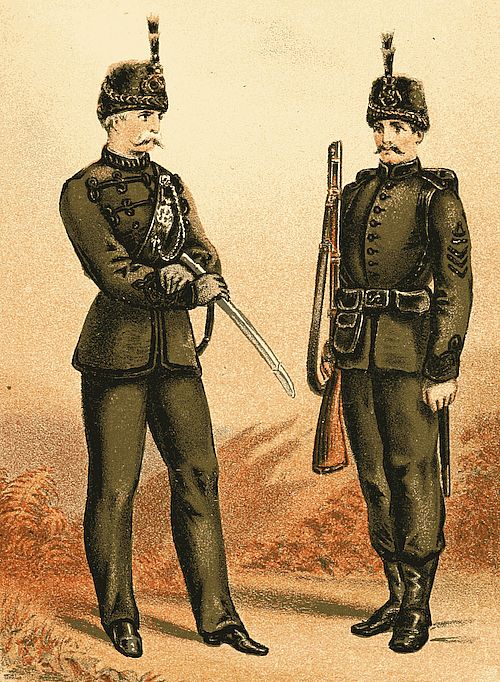
RIFLE BRIGADE,
1871.
On the recovery of His Royal Highness the Colonel-in-Chief
from his dangerous illness in the winter of 1871–2, Sir
George Buller, Colonel-Commandant, addressed the following
letter to the Comptroller of His Royal Highness’s household:
‘23 Bruton Street, Berkeley Square, March 5, 1872.
‘Sir,—I have the honour by the desire of Lieutenant-Colonel
Manningham-Buller, and the officers of the 1st Battalion
Rifle Brigade, to request you will be pleased to lay
before His Royal Highness the Prince of Wales, Colonel-in-Chief
of the Rifle Brigade, their most respectful and sincere
congratulations on the recovery of His Royal Highness from
His late dangerous illness, and in which congratulations I beg
to add that I most cordially concur.
‘An unavoidable delay has occurred in the transmission
of this address of the officers of the 1st Battalion Rifle
Brigade in consequence of the letter on this subject having
been sent to my house in London, and not forwarded to me,
by error.
‘I have the honour to be,
&c. &c. &c.,
‘(Signed) George Buller.
‘General, Colonel-Commandant 1st Battalion
Rifle Brigade.
‘General Sir William Knollys, K.C.B.
&c. &c. &c.’
To which the following gracious reply was received:
‘Marlborough House, Pall Mall, March 9, 1872.
‘Sir,—I have the honour to inform you that in compliance
with your request, I have laid before the Prince of Wales,
Colonel-in-Chief of the Rifle Brigade, the congratulations
which you have been good enough to forward of Colonel
Manningham-Buller, and the officers of the 1st Battalion Rifle
Brigade, on His Royal Highness’s recovery from His late
dangerous illness, with your own cordial concurrence in them.
‘His Royal Highness requests you will accept for yourself
and convey to Colonel Buller and the officers under his
command His sincere thanks for their congratulations, and
assures you how gratifying it is to His Royal Highness to
receive them.
‘I have the honour to be,
&c. &c. &c.
‘(Signed) William Knollys,
‘General.
‘General Sir George Buller, G.C.B., Colonel-Commandant
1st Battalion Rifle Brigade.’
On May 1 the establishment of the 1st Battalion was
further reduced to 520 rank and file.
On May 25 the Battalion was inspected by Field-Marshal
His Royal Highness the Duke of Cambridge.
The Battalion remained at the Shaft barracks, Dover,
during the whole of this year.
The 2nd Battalion at Shorncliffe on May 1 received
orders to reduce its establishment from 49 to 47 sergeants;
21 to 19 buglers; and from 850 rank and file to 820.
On August 16 Head-quarters and eight companies of
the Battalion, under command of Major Stephens (Colonel
Glyn having been selected to command a brigade) proceeded
by rail to Aldershot, in order to take part in the autumn
manœuvres. On their arrival they encamped on Cove Common
until the 26th, when they marched to Hazeley Heath
and encamped. On the 27th they marched to Silchester,
passing by Strathfieldsaye, where they marched past the monumental
statue of their great Colonel-in-Chief, Arthur, Duke
of Wellington. On the 28th they marched to Greenham
Heath, where they halted next day, and on the 30th proceeded
to camp near Wilton. On the following day they marched
to camp at Rushall Park, where they remained till the commencement
of the manœuvres on September 4.
But on August 24 the two companies of the Battalion
remaining at Shorncliffe, with the women, children and baggage,
were conveyed by train from Shorncliffe to Dover and
embarked on board H.M. Troop-ship ‘Tamar,’ and arrived
at Kingstown on the 29th, whence they proceeded on the same
day by rail to Birr, there to await the arrival of the Battalion.
On September 4 the Head-quarters marched from Rushall
Park to Stapleford, where they encamped until the 8th, during
which time they were employed on outpost duties, and daily
took part in sham-fights at Wishford, Steeple-Langford and
Wiley. On the 9th they marched to Darrington-field. On
the 10th they took part in the defence of the river Avon, and
on the 12th were in the march past, which concluded these
autumn manœuvres.
During this time the Battalion was always encamped, as
mentioned in the autumn manœuvres of the preceding year.
They also furnished their regimental transport, having received
waggons and field equipment at Woolwich, where a
party of about 60 men with two officers had proceeded, after
being instructed by the Land Transport Corps.
On September 13 the Battalion marched from Darrington-field
to Salisbury, and thence proceeded by train to Portsmouth,
where they embarked in the evening, six companies on
board H.M. Troop-ship ‘Orontes’ and two on board H.M.
Troop-ship ‘Jumna,’ for conveyance to Ireland.
On the 16th they disembarked at Kingstown and proceeded
by train to Birr, detaching a company and a half to
Nenagh; a company to Roscrea; and half a company to
Portumna.
But the regimental transport marched from the camp at
Darrington-field, by Andover, Basingstoke, Guildford, and
Epsom to Woolwich, where they arrived and handed over
equipment on the 25th. On the next day they marched with
the horses to Aldershot, where they arrived on the 28th and
remained till October 12, when they returned to Woolwich,
arriving on the 16th; and after giving up the horses to the
Control department were attached to the Army Service Corps
at Woolwich till the 23rd. They embarked on that day on
board the ‘Lady Eglinton,’ and joined the Battalion on
the 28th.
The 3rd Battalion, which had arrived from India on
December 30, 1871, landed at Portsmouth on January 1, and
occupied quarters in the Clarence barracks, and was joined
by the Depôt companies from Chatham.
On February 27, 14 officers and 599 of other ranks of
the 4th Battalion, under command of Colonel Elrington, proceeded
from Chatham to London, to take part in the thanksgiving
for the recovery of His Royal Highness, the Colonel-in-Chief.
In June Colonel Elrington, who had formed the Battalion,
and commanded it from its formation, retired on half-pay;
and Colonel Ross, C.B., succeeded to the command.
The Head-quarters with eight companies removed from
Chatham to Blandford by rail, and took part in the autumn
manœuvres.
The Battalion being destined for Ireland, the remaining
two companies embarked at Sheerness on August 24, on
board the ‘Orontes’ Troop-ship, and landed at Kingstown on
the 28th, and proceeded to Richmond barracks.
At the conclusion of the autumn manœuvres the Head-quarters
marched from camp near Amesbury to Salisbury on
September 14, and thence proceeded by rail to Portsmouth
and embarked on board the ‘Jumna’ Troop-ship. They
landed at Kingstown on the 16th and marched to Dublin,
where for the remainder of the year they occupied Richmond,
Ship-street, and Linen-hall barracks.
The 1st Battalion proceeded by rail from Dover to Aldershot
on June 5, 1873, and were encamped on Rushmoor
bottom until July 28, when they occupied quarters in the
Permanent barracks.
On June 24 the Battalion proceeded by rail to Egham, and
thence marched to Windsor Park and took part in a review
before Her Majesty and the Shah of Persia. On this occasion
His Royal Highness the Colonel-in-Chief marched past in the
uniform of the Regiment, at the head of the Battalion. After
the conclusion of the review they returned by the same route
to their camp at Rushmoor which they reached about ten P.M.
The 2nd Battalion remained at Birr, occasionally relieving
the detachments; and in June the establishment was reduced
from 820 to 700 rank and file.
On July 31 the Battalion and the detachments proceeded
by rail to the Curragh for the autumn manœuvres, and encamped.
The Battalion returned to Birr on August 29,
replacing the detachment at Portumna, the others being discontinued.
On September 3 the Battalion received orders to prepare
for service on the Gold Coast of Africa, in the expedition
against Ashantee under Sir Garnet Wolseley.
Colonel Glyn having been appointed Adjutant-General of
Auxiliary Forces in Ireland, Lieutenant-Colonel Warren took
command of the Battalion.
On November 13 they were inspected by Lieutenant-General
Sir Thomas Steele, K.C.B., previous to embarkation;
and on the next day they received definite orders to hold
themselves in readiness to embark on any day after the 16th.
Accordingly, on the 21st, the Battalion proceeded by
wings, by railway from Birr to Cork. The left wing, under
the command of Major J. Plumtre Glyn, started from Birr at
three in the morning of that day; and the right wing, under
Major Stephens, at half-past three for Cork, where they were
to embark. Colonel Warren and the Staff of the Battalion
accompanied the left wing.
The climate of the Coast of Africa necessitating the disuse
of their European clothing, the men and officers were
provided with two grey frocks, a pair of grey tweed trousers,
a pair of duck trousers, two flannel shirts, two flannel belts,
a pith helmet with puggaree attached, and a pair of canvas
gaiters.
On arrival at Cork they embarked on board the Troop-ship
‘Himalaya,’ and sailed at four in the afternoon. The
officers who embarked were:—
Lieutenant-Colonel Warren; Majors, Stephens and Plumtre
Glyn; Brevet-Majors, Nicholl and Sotheby; Captains,
Slade, Dugdale, Somerset, Robinson, Cary and H. Lascelles;
Lieutenants, the Honourable T. Scott, Stopford-Sackville,[325]
Maberly,[326] Taylor, Hopwood, the Honourable A. Grosvenor,
Thompson, (Adjutant), Harrington, Smyth,[325] the Honourable
J. Constable-Maxwell,[325] Prideaux-Brune, Parke and Turnor;
Sub-Lieutenants, the Honourable Otway Cuffe, Sherston, the
Honourable E. Noel and the Honourable H. O’C. Prittie.
Captain Harvey (Paymaster), Quarter-master Stanley,
Surgeon-Major Wiles and Surgeon Macrobin.
The ‘Himalaya’ arrived at Funchal, Madeira, on the 27th.
Here they found in garrison at Funchal one of the regiments
of Caçadores which had been brigaded with them sixty years
before in the Peninsula. After coaling, the ‘Himalaya’
started on the evening of the same day, and reached St.
Vincent on December 1, whence after coaling again, she started
on the 2nd, and arrived at Cape Coast Castle on December 9.
Here nothing was ready for their reception; and it was
decided that the ‘Himalaya’ should put to sea again until
the end of the month. Accordingly, on the 13th she started
on a cruise. To be thus for three weeks longer cooped up
on board ship under a tropical sun was a sore trial to the
soldiers. However everything was done that could be done
to amuse the men, and relieve the monotony of their enforced
and unexpected cruise. A newspaper was started, readings
and theatricals were extemporised, and a quasi band which
had been got up (the band of the Battalion having been left
at the Depôt) played daily. At last on December 30, the
‘Himalaya’ arrived at Cape Coast Castle, and the Battalion
was allowed to disembark.
In the meanwhile Captain Robinson had been appointed
Brigade-Major to Brigadier Sir Archibald Alison, commanding
a brigade; and Captain Cope, who had been detailed for
the Depôt, started on December 4 in the ‘Sarmatian’ (which
took out the Brigadier and the 42nd Regiment), and having
arrived at Cape Coast Castle on the 17th, awaited the arrival
of the Battalion, and took over Captain Robinson’s company
on its landing.
On July 19 the 3rd Battalion left Portsmouth by rail-road
for Exeter, and on arrival there encamped at Duck’s Marsh,
about two miles and a half from that station, until the 21st;
on which day they proceeded by route march to Maiden
Down; on the next to Merripit Hill, and on the 23rd to
Yannaton Down, Dartmoor, encamping each day at their
halting-places. They took part in the autumn manœuvres,
being in the brigade commanded by Colonel Lord Alexander
G. Russell.
On the conclusion of the manœuvres, this Battalion was
present at the review and march-past at Roborough Down on
August 22, before His Royal Highness, the Colonel-in-Chief.
At its conclusion they marched seven miles to Plymouth,
whence they proceeded at ten o’clock the same night, viâ
Exeter, to Winchester, and arriving there on the morning of
the 23rd, occupied barracks; detaching, on December 13,
three companies to Portsmouth, who were quartered in the
Clarence barracks.
The 4th Battalion continued in Dublin; but were concentrated
from the various quarters they occupied, in the
Royal barracks in July.
Having received orders to embark for India, the Depôt
and Service companies were formed, and transfers made and
received to complete its establishment for foreign service
(886 non-commissioned officers and privates). And on
October 19 and 20 the Service companies proceeded by rail
to Queenstown and embarked on the 21st in the ‘Jumna.’
They started on the 22nd and arrived at Bombay on
November 23. They landed on the 24th and 25th, and proceeded
by rail to Deolalee.
From Deolalee they moved on November 28 and 30, and
following day to Umballa, and on arrival occupied quarters
there.
On March 12, 1874, the 1st Battalion proceeded by rail-road
from Aldershot to London, in order to be present at the
entry of the Duke and Duchess of Edinburgh. They lined
Regent Street during the progress of the Royal procession,
and returned to their quarters at Aldershot in the evening.
On May 19 this Battalion was present at a review and
march-past before the Emperor of Russia. The brigade to
which they were attached was composed of three Battalions
of the Regiment (the 1st, 2nd, and 3rd), and one of the 60th,
and was commanded by Major-General Lord Alexander
Russell, their former Lieutenant-Colonel.
After taking part in the summer drills of this year, during
the month of June, this Battalion proceeded to the forts on
the Gosport side of Portsmouth harbour, which they occupied
from July 3 and 4 until November 20, when they moved to
Winchester, on the embarkation of the 2nd Battalion for
Gibraltar, and were there quartered.
CHAPTER XV. — FOOTNOTES:
We left the 2nd Battalion on board the ‘Himalaya’ at Cape
Coast Castle. On January 1, 1874, ‘rouse’ sounded soon
after midnight, and the parade was at 1.20 in the morning.
The left wing, consisting of four companies (17 officers and
352 men), landed in surf boats, the first company reaching
the shore at a quarter after three, the fourth company in
about a quarter of an hour afterwards. The whole disembarkation
occupied about forty minutes, and elicited the
warm approval of the Brigadier, Sir Archibald Alison. The
companies fell in immediately on landing, and at once
marched for Inquabim, seven miles, which they reached about
half-past six; the Battalion heading the advance up the
country.
The right wing, consisting of the remaining four companies
(16 officers and 300 men) disembarked at about the
same hour on the morning of the 2nd, and started for Inquabim,
which they reached about half-past five. On this march no
men fell out. On their arrival they found an excellent encampment
of bamboo huts, 65 men being in each hut.
The left wing had on this day preceded them to Accroful,
another march of seven miles, to which the right wing proceeded
on the 3rd, starting at half-past four, and arriving at
half-past six, without a man falling out. On this day the
left wing advanced to Yancoomassie-Fanti.
On the 4th the right wing, starting at the usual hour of
half-past four, marched to Yancoomassie-Fanti, a distance of
about ten miles and a quarter, where they arrived at eight
o’clock. Not a man fell out; but the climate began already
to tell on some of the officers, two of whom had to be carried
during this day’s march. The left wing had marched to
Mansu; and it may suffice, once for all, to state that they
preceded the march of the right wing by one day.
On the 5th the right wing started at a quarter to four,
and after a fearfully hot march of eleven miles reached Mansu
at eight. The road was hilly, the weather extremely close, and
four men fell out during the march.
It is well known that it is supposed that horses, mules
and animals of carriage or draught will not live in the climate
of this part of Africa. This idea is perhaps exaggerated.
But its existence caused inconvenience to the mounted officers
of the Regiment. Major Stephens, who was in command of
the right wing, was obliged to content himself with a donkey,
which had been brought up to Accroful by an officer of the
Staff.
From Yancoomassie an officer with the Quarter-master-Sergeant
started somewhat before the companies, to take over
the camping ground. The sergeant started first, but soon
returned with a tale that, in the darkness of the morning and
of the woods, he had seen a monstrous beast which he took
for a rhinoceros; that he had at first intended to shoot it,
but had, on the whole, considering the size and probable
fierceness of the animal, determined to retire. However, reinforced
by the officer who was to accompany him, he started
again. Both were determined; both held their revolvers
ready to bring down the wild beast which barred the way.
But when they came to the corner at which they were to find
him, they stalked not a rhinoceros,—but the Major’s charger.
On the 6th the right wing started at twenty minutes after
three, and after a very cool and pleasant march of eleven
miles, reached Sutah.
On the 7th, having a long march before them, they started
at half-past two in bright moonlight. The road was for the
first four miles very bad, being across swamps, over which a
path had been made of small trees laid down. The cooks
had been sent on about six miles to Faisoowah to prepare
breakfast, and the men were glad after this fatiguing march
to find cocoa and biscuit ready for them. Resuming their
march they found the remainder of the road good; the men
marched well, and stepped out cheerfully; and they got into
their camp at Yancoomassie-Assin at seven. The distance
was about thirteen miles.
The right wing halted at this camp until the 19th. The
left wing also halted for some days at Barracoo, to which they
had marched on the 7th. During this time the Riflemen
were engaged in clearing the bush and in other fatigue duties
in the mornings and evenings. The desertion of the native
carriers, the only means of transport, increased, and threatened
serious evil; and the Riflemen were ordered when on sentry
over them to have their rifles loaded, and, if necessary, to
shoot any carriers attempting to desert. Owing to this halt
probably, and the want of interest and activity to the men,
fever and dysentery, the scourges of the climate, began to
make their appearance.
As it was found that the camp at Barracoo was from its
situation particularly unhealthy, the left wing marched on the
17th to Prahsu, a distance of seven miles.
But the right wing did not leave Yancoomassie-Assin till
the 19th, when starting at five in the morning they reached
their camp at Barracoo at half-past eight. They found it
the worst camp they had hitherto occupied; the huts very
small, and the position, as has been above stated, very unhealthy.
Seventeen men of these four companies were sent
back, mostly ill with fever, and they found at Barracoo seven
men of the other wing who had been left behind sick.
On the 20th the right wing marched to Prahsu, and the
whole Battalion was once more reunited. On their march
they heard in the front what they believed to be the report
of three cannon, and much wondered why they should be fired.
On arrival they found that these were the report of three
volleys fired over the grave of Captain Huyshe of the 1st
Battalion. He had died the day before of fever and dysentery.
The left wing of the Battalion was at Prahsu, and paid the
last sad honours to his remains.
He was a man of great promise, and a most well-informed
as well as talented officer. The early part of his career had
been in the 83rd Regiment, from which he exchanged into
the Rifle Brigade. He had accompanied Sir Garnet Wolseley
in the expedition to the Red River in 1870, and had written
an interesting account of it.[327] He had entered the Staff
College, and after a few months’ study there, had, on the
Ashantee Expedition being determined on, been offered the
post of Deputy-Assistant Quartermaster General of the force,
which he most gladly accepted. He had come to the Gold
Coast with Sir Garnet Wolseley in September. He had
started from Cape Coast with diarrhœa, had exposed himself
a good deal to the weather in surveying and sketching
country; and dysentery and fever supervened and carried
him off. His talents, his fund of information, his sweetness
of disposition, and his gentlemanly manners had endeared
him to his brother officers, who have erected a handsome
memorial to him in the Cathedral of Winchester; but to
none more than to the writer of these lines.[328]
Hitherto the Battalion had found at their camping, or
rather halting stations, huts built of bamboo, and thatched
with plantain or palm leaves. The men’s huts contained
about seventy men; those of the officers were, of course,
smaller. In all of them were bedsteads, constructed of
bamboo, keeping the sleepers about two feet from the
ground.
On the 21st the Battalion crossed a narrow bridge, which had
been made across the Prah, here about eighty yards wide, and
marched to Essiaman, about thirteen miles and a half. Cocoa
had, however, been prepared for them at Attobiasse, about
half-way. The morning was very dark when they started;
but it was cooler, the bush much more open, and the road
good. On their arrival, they no longer found the huts which
had been prepared for them on the other side of the Prah.
At Essiaman the men were in long open sheds, covered with
palm leaves, while the officers built themselves shelters of
bushes and tentes d’abri, in which they could sling their field-hammocks.
On the 22nd, starting at half-past five, the Battalion
marched to Accrofoomu, about fourteen miles, which they
reached about a quarter to eleven. Some fourteen men fell
out, mostly from fatigue; for the heat was excessive and the
march long. The sheds here were insufficient to accommodate
the Battalion; so that lean-tos had to be built and tents
pitched. As at Essiaman, the officers had to construct huts
for themselves.
On the 23rd they started at a quarter to six, and marched
to Moinsey, at the foot of the Adansi hills, a distance of about
eight miles. It was a pleasant march, for the road was good,
the bush much more open, and the air cooler. There were
no huts nor sheds, and the men had to build them.
The next day they started at the same hour, and ascended
the Adansi range. The ascent, which is steep, occupied about
half an hour. They halted at the top, and saw the sun rise
over the trees below, while the mists hanging between the hills
had the appearance of lakes. Resuming their march, they
passed through Quisah, a large village about five miles on the
way, deserted by the Ashantees. They arrived at Foomanah
at about nine. This was a considerable town, containing the
house or palace of the King of Adansi. The men and officers
were quartered in the so-called houses, built of yellow baked
clay, and rather resembling ovens with roofs over them. In
some of them were found dead bodies.
An envoy from the King of Ashantee had here met Sir
Garnet Wolseley; and the Battalion, with the Naval Brigade,
paraded at five in the afternoon, and lined the road north of
the town, by which he was to return to Coomassie, the ranks
facing inwards.
They halted at Foomanah till the 29th. But on the 25th
the Battalion was inspected by Sir Garnet Wolseley, and on
the 26th Major Nicholl’s company formed part of a reconnaissance
in force to the village of Kiang Boassu, about four or
five miles to the front, where Ashantee tom-toms had been
heard the day before. The Riflemen on this reconnaissance
were under the command of Major Stephens. They started
at a quarter to six, and returned soon after nine. The
Ashantees fired on them; they returned the compliment,
killed two Ashantees, and made two prisoners, besides burning
the village.
As usual during a halt, sickness again appeared. Captain
Slade was sent down to the coast on the 28th, seriously ill
from dysentery, and Lieutenant the Honourable Thomas Scott
took command of his company.
On the 29th the Battalion paraded at half-past five, and
marched to Ahkankuassie, a distance of about ten miles.
Here the men built huts for themselves; while the officers, or
some of them, found houses in the village. But these were
filthy places, and overrun with lizards. The Battalion furnished
an outlying picquet, Major Sotheby’s company, at
Adadwassie, about a mile and a half in advance of Ahkankuassie.
Rations were served out for the following day, which
the men were to carry on the march.
On the 30th the Battalion moved forward to Insarfu,
passing through Adadwassie, where the picquet joined them.
The distance to Insarfu was only about four miles, and the
Riflemen reached it about ten o’clock, having formed the rear-guard
of the European brigade.
It being generally expected that the Ashantees would
make a stand on the next day, and that there would be a
fight, the Captains of the Battalion were assembled at the
Commanding Officer’s quarters, to receive instructions for the
operations of the morrow. It was explained to them that they
were to form the rear face of a hollow square, in which formation
the Commanding General intended to advance. Nor
was this, they were informed, to be considered less the point
of honour than the front, as the tactics of the Ashantees were
to envelop the flanks and fall upon the rear. At evening
parade these orders were explained by the Captains to the
Riflemen, who listened with interest and eagerness to the information.
Rations for the next day were issued. The men
were camped under tentes d’abri in quarter-distance column
in a plaintain ground; the officers, some of them, built huts
near their men; some found shelter in the houses in the
village, which, if less filthy than those at Ahkankuassie, were
only a fraction of a degree nearer cleanliness.
On the 31st the Battalion paraded at twenty minutes after
six, and about half-an-hour afterwards marched from Insarfu.
The 42nd led, the Rifle Brigade forming the rear of the
hollow square or order of battle, which was thus disposed:—
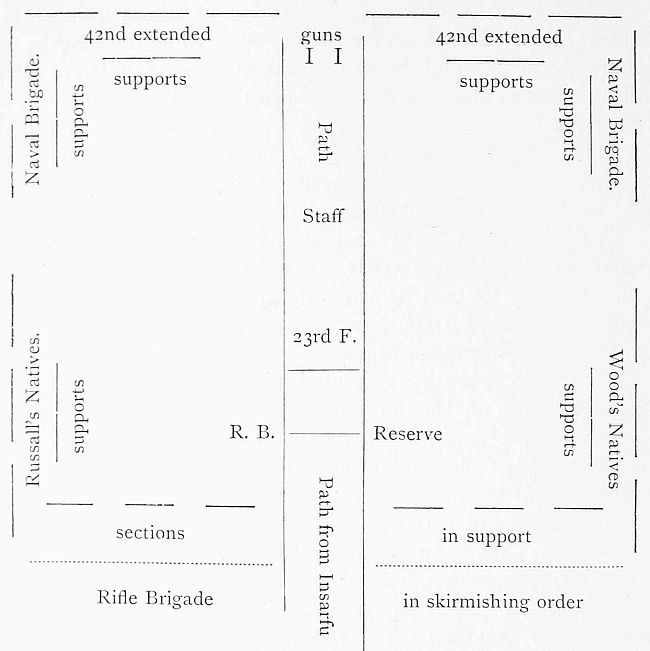
After advancing about a mile and a half, firing was heard
in front, the 42nd having engaged the Ashantees, who were
posted on ground rising from a muddy stream, which flowed
through a swampy ravine. The action commenced about
eight; but it was not till more than an hour and a half later
that the Riflemen became engaged. Then Major Nicholl’s
company was sent to the right column, under Lieutenant-Colonel
Wood, and Major Sotheby’s and Captain Cope’s companies
were extended on the east and south-east of Egginassie,
fire having been opened by the enemy from the bush in
that direction. The bush was dense and thick; consisting of
great cotton trees, with a high undergrowth, and interlaced
everywhere with creepers, so that the men could not see
more than fifteen or twenty yards before them, and had often
to cut a way with their swords. Sotheby’s left touched the
Bonnymen of the right column, while the connection between
his right and the road or path was kept up by Cope’s company,
who entered the bush, and threw his right back to the
road. These companies were exposed to a heavy fire; and
Lieutenant Sherston, one of Sotheby’s subalterns, was very
severely wounded through the right shoulder. Captain Cary
was sent up to support a native company of the left wing on
the left of Egginassie; but on Major Stephens reporting to Sir
Garnet Wolseley that there was a gap between the left and
centre columns, which ought to be filled, Lieutenant Taylor,
with part of Cary’s company, was sent to fill it up; while
Captain Cary himself with the remainder moved towards the
left flank, to support the native troops, which were hard
pressed. Captain Lascelles was directed by Sir Garnet
Wolseley to take his company to occupy some heights to the
north of Egginassie, and so to connect Wood’s natives with
the path. He passed through the bush, which had been
partially cleared round the village by the Engineer labourers,
and took up this position, extending three sections, and
keeping the fourth in support under Lieutenant the Honourable
E. Noel.[329]
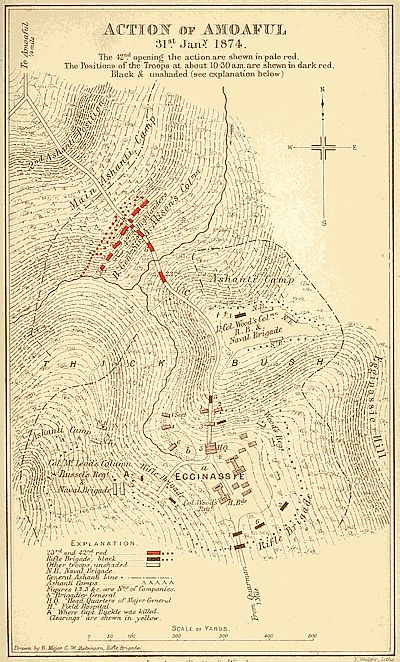
Drawn by B. Major C. W. Robinson, Rifle Brigade.
E. Weller, Litho.
London, Chatto & Windus.
ACTION of AMOAFUL
31st Jany 1874.
To face Plan of Battle.
BATTLE OF AMOAFUL.
ABOUT 10.30 A.M.
DETAILED DESCRIPTION.
Centre Column.
The 42nd carrying the enemy’s main position north of the swamp. Rait’s
artillery in action. 23rd in support.
Rifle Brigade.—No. 1 company in action in the clearing to the east of
the path (with the Right Column). No. 3 company leaving Egginassie
to support the 42nd. The remainder in action around
Egginassie.
Right Column.
Naval Brigade engaged in the clearing east of the main path. (Lieut.
Knox’s rockets playing into a hollow to the north-east.)
Wood’s Regiment in action round Egginassie.
Left Column.
Russell’s Regiment has taken the heights west of Egginassie.
Col. M’Leod, with the Naval Brigade, is cutting his way to try and
connect with the Centre Column.
Rifle Brigade Companies.
1. Nicholl; 2. Sotheby; 3. Somerset; 4. Dugdale; 5. Lascelles;
6. Cope; 7. Slade (Scott); 8. Cary.
Soon afterwards Sir Archibald Alison, who was in the front
with the 42nd, asked for ‘a support of half a Battalion of
Rifles.’ The half-Battalion being, as we have seen, ‘otherwise
engaged,’ Captain Somerset’s company was sent forward
by the road or path to him. Starting at the double, this
company advanced to the swamp about half a mile in front,
where Sir Archibald had fought his way with the 42nd. Here
Somerset found Sir Archibald Alison, with the detachment of
the 23rd Fusiliers, awaiting his arrival. The company was
posted here to keep up communication with the rear, and to
advance when required. Sir Archibald crossed the marsh
with the Fusiliers, and advanced towards Amoaful. Somerset’s
company remained in this position till nearly the close of
the day, keeping communication with the Fusiliers, who were
some hundred yards to their north, and furnishing occasional
escorts to staff officers passing along the path. Somerset’s
men were exposed to the fire of Ashantees, who, creeping up
to the edge of the bush, discharged their pieces at them. By
this fire Lieutenant Smyth was wounded in the thigh, and two
other Riflemen were hit. But the Riflemen soon silenced this
annoying fire; Sergeant Bills especially making good use of
his rifle.
But before Captain Somerset’s company had moved up to
the front, about twenty Riflemen had been detached from it,
and attached to Major Nicholl’s company, which, as we have
seen, was on the right, supporting the Naval Brigade and the
native levies under Colonel Wood. By noon the Ashantees
had been driven from the ridge which they occupied beyond
the stream, their camp had been taken, and the village of
Amoaful carried by the 42nd Regiment. The direction of the
combat was now changed; and, as far as the front and left
faces of the square formation were concerned, it had terminated,
and the fire, which had been kept up without cessation
from eight in the morning, was now lulled. But about
one it began again, and the brunt of the fight now fell on the
Riflemen; for the Ashantees, pursuing their usual tactics,
swept round and fell on the right flank and rear, attacking
the village of Egginassie on the north-east.
About one o’clock the fire was renewed. Captain Cope’s
company was sent into the village, and lined one side; and
Captain Cary, with a portion of his company, was sent through
Egginassie, and extended to the east of it. This attack of the
Ashantees was most determined; they came up in numbers,
and were shot down by the Riflemen. The din was tremendous.
Besides volleys and file-firing, and the heavy report
of the Ashantee guns, tom-toms, horns, and the yells of the
Ashantees and of the native troops, made the bush and all the
surroundings hideous. In this fire a man of Cary’s company
was shot in the face by a slug fired by an Ashantee in a tree;
but two of his comrades soon brought his assailant down, and
killed him. After about an hour of this work, during which
the Ashantees kept up a fire as continuous and heavy as it had
been during any part of the fight, their fire slackened. Then
an advance was made by Major Sotheby’s and Captain H.
Lascelles’ companies, and part of Captain Cary’s. The line
advanced towards the north-east up the valley; and pivoting
on the left, bringing up the right, moved forward to the edge
of a clearing, which had been made by the right column.
‘This was admirably executed. Skirmishing as quietly and
steadily as if on parade, the men of the Rifle Brigade searched
every bush with their bullets, and in five minutes from the
commencement of the advance the Ashantees were in full and
final retreat.’[330]
The Ashantees having been thus driven from the high
ground to the northward of Egginassie, Captains Lascelles’
and Cary’s companies were withdrawn; and passing by their
left, regained the main path, and by it the village of Egginassie,
which they at once began to entrench and fortify; the
other portion of Cary’s company, which had been detached
under Lieutenant Taylor, being called in to assist in this
work.
But the day was not over for the Riflemen. Hardly had
the firing lulled about Egginassie, when heavy firing was heard
in the rear. A large force of Ashantees, sweeping round from
the west, had attacked Quarman, about a mile to the south,
on the line of communication, which was held by a detachment
of the 2nd West India Regiment, and a few Europeans, under
Captain Burnett, of the 15th Foot. Captain Dugdale’s company,
which formed the rear-guard of the Battalion, was at
once ordered to Quarman, and on the way was somewhat exposed
to the fire of the detachment there, who did not know
of his approach to relieve them, and whose bullets whistled
over the heads of the Riflemen as they passed through some
low ground on the way. The bush had been cleared round
Quarman, and Dugdale at once extended his company, and
drove the Ashantees who were attacking it back into the bush
with considerable loss. He then entered the village, and
being senior officer assumed the command. The position was
very important, for it connected the front at Egginassie and
Amoaful with Insarfu. Soon after Dugdale had entered
Quarman, Captain Slade’s company, under Lieutenant the
Honourable T. Scott,[331] joined him. The attack was soon renewed;
the Ashantees now not venturing into the clearing, but
firing from the surrounding bush. This attack had just been
repulsed, when Major Sotheby with his company reached
Quarman. He had started from Egginassie, escorting a long
train of hammocks containing wounded, and also some
wounded men who were able to walk, and had passed through
Quarman on his way to Insarfu, when he heard firing in his
rear. Colonel Colley, who was passing through Quarman at
this time, directed Captain Dugdale to take his company out;
who, marching about half a mile towards Egginassie, and
turning into the bush, outflanked the Ashantees, and fired
several volleys which effectually drove them off. Major
Sotheby, finding that Quarman was again attacked, turned
back when near Insarfu. His bearers flung down the wounded,
and fled into the village. Colonel Colley was also attacked
as he was bringing up a convoy from Insarfu. As soon as
Dugdale knew of this attack, he detached Scott with his company
to help him. The enemy occupied the side of the path
and kept up a heavy fire, wounding two of Scott’s men.
However, he kept up the fight till after six; when, as it was
getting dark, Dugdale recalled him to Quarman, which these
two companies occupied during the night. Thus Dugdale
had saved and retained this important post, connecting the
front with Insarfu, whence the supplies were to be drawn, and
to which the wounded were to be escorted.[332]
Major Sotheby, finding that it was considered of importance
that ammunition should be conveyed to the front from
Insarfu, left that place about eight in the evening with his
company, and having some carriers with him picked up some
of the baggage abandoned by the cowardly bearers, and
having parked it at Quarman, reached Egginassie at eleven
at night. Here the Head-quarters and, on Sotheby’s arrival,
six companies of the Battalion were camped. For Somerset’s
company had been about six o’clock withdrawn from the
marsh to higher ground in the rear, and had, with Nicholl’s
company, rejoined the Battalion about eight, while Cary’s,
Lascelles’, and Cope’s companies, after their fight, were employed
in clearing the bush about Egginassie. This was very
hard work. The men and officers had no food but the biscuit
and sausage issued the day before, which they carried in their
pockets. But happily there was no hot sun, so that the
Riflemen were able to clear a considerable space, and to
throw up a breast-work. Three officers, Major Stephens,
Lieutenants Smyth and Sherston, and 6 Riflemen, were
wounded on this day.
The main position of the Ashantees on this day was at the
camp on the ridge north of the stream, which was carried by
the 42nd; and they had other advanced positions and smaller
camps on the right and left of the path by which the troops
advanced. Their design seems to have been, while holding
their main position, to turn the flanks and attack the rear.
Directly the advance was made on the main position, the
Ashantees attacked in strength against the left; failing in
this they fell on the right, and made a furious effort to get to
Egginassie and so to establish themselves in rear. Foiled at all
these points, they attempted to capture Quarman, and cut the
line of supplies. This attack was repelled by Captain Dugdale
and his company.
Though the central column forced the Ashantee camp
and took the village of Amoaful, and so had the most conspicuous
share in the events of the day, yet before the fight
was over almost all the troops were engaged more or less;
the Riflemen heavily and successfully before the close of it.
Six companies, as I have said, camped at Egginassie, Captain
Lascelles’ company being on outlying picquet; and two
occupied Quarman.
During the night a panic took place among the native carriers,
for a native sentry on outpost duty having fired his piece
about four in the morning, the carriers were terrified. One officer
was awakened by these cowards jumping over him; another
sleeping in a hammock was overset by them. They knocked
down the piled rifles, and were running in every direction in
abject and contemptible terror. At last order was restored.
On February 1 the six companies of the Battalion at
Egginassie were extended to line the road from that village
to Insarfu (the 42nd continuing the line from Egginassie to
Amoaful) in order to allow supplies to be brought up from
Insarfu to the front. On the same day the village of Becqua
was destroyed by some of the other troops. In this affair
the Battalion was to have been employed; but orders had
been given to Colonel Warren as soon as he had assembled
his six companies at Egginassie to ascertain if there was any
force of Ashantees in the bush near the road between Quarman
and Insarfu, and if they were found, to clear the bush with
his Riflemen. No enemy were there; but in consequence of
this delay, the Battalion did not reach Amoaful till after one
o’clock, at which hour the expedition to Becqua had started.
Part of the 42nd were therefore substituted for the Riflemen.
On their arrival at Amoaful they remained under arms
in the broad street or central place until the destruction of
Becqua was ascertained. Then they were dismissed; and,
after assisting in burying the dead Ashantees, encamped.
On the 2nd the Battalion advanced; Lord Gifford and
his scouts preceding with some native troops, Captain Cary’s
company guarded Captain Rait’s guns, and Captain Lascelles’
company was in support. These formed the advanced guard
under Colonel M’Leod. The Battalion followed, Captain
Somerset’s company forming an escort to Sir Archibald Alison.
The other regiments brought up the rear. They moved off
between six and seven o’clock, and soon came up with the
rear of the Ashantees, on whom the native troops immediately
opened fire, but with so little effect that Colonel M’Leod
halted them and brought up Cary’s company to the front.
But the enemy made no stand, merely firing wildly and then
flying. The road was strewed with food, clothing, and weapons,
evidencing the precipitate flight of the enemy. On the march,
Cary’s company still leading, the Riflemen passed through
three villages and a camp all deserted by the Ashantees;
though in some fires still burning and cooking materials at
hand showed how short a time they had been abandoned.
As a flank attack was not unlikely, Somerset’s company was
extended and searched the forest paths on each side of the
road. Sir Archibald Alison, as whose escort they had acted,
signified through Captain Robinson, his Brigade-Major, his
marked approval of the way in which they had skirmished,
and of the individual intelligence of these Riflemen.
The Battalion reached Aggemamu, a distance of eight
miles, about three in the afternoon, and halted there.
But Cary’s and Lascelles’ companies were pushed on about
two miles and a half to the village of Adwabin, which they
occupied.
Sir Garnet Wolseley having resolved to take on his forces
to Coomassie as a flying column, determined to leave his
baggage at Aggemamu, and to make that place a temporary
base, through which his communications might be kept open
with the rear. The Battalion was therefore ordered to find a
captain to take charge of this post, and the duty fell to
Captain Cope. At Aggemamu the roads to Coomassie
bifurcate; one leading to the right or east, and one the longer,
but it was reported the best road, forking to the left. This
Sir Garnet resolved to follow.
‘The importance of Aggemamu could scarcely be overestimated.
From it two roads led to Coomassie, by the
longer of which we were about to march, disregarding the
shorter or easternmost of the two. It was of course of vital
importance that the point at the junction of the roads should
be securely held, as a base for our flying column, and as a
point of support upon which, if necessary, to fall back.’[333]
Lieutenants Bell and Hare, with native labourers, were
engaged in the evening of this day, under the superintendence
of Captain Home, in making a clearing round Aggemamu.
Sir Garnet Wolseley having thus determined to push on
to Coomassie without impedimenta, enquired of the soldiers
on this evening whether, as it might take six days to advance
to Coomassie and to return to Aggemamu, and there were but
four days’ rations in hand, they were willing to do the
six days’ work on four days’ rations. The response was a
unanimous assent. The General told them at the same time
that they might probably get a fortnight sooner to the coast
by this sacrifice than if they halted at Aggemamu for further
supplies to come up. Eventually one day’s additional ration
of preserved meat, biscuit, and tea, came up.
On the 3rd the Battalion started at half-past five, Major
Nicholl’s company leading, and on reaching Adwabin, the
advanced guard, with which were Cary’s and Lascelles’ companies
which had passed the night there, were pushed forward.
They soon felt the enemy, with whom they became engaged
about half-past eight. The first point at which he made a
decided stand was in a hollow through which flowed a stream,
a tributary of the Ordah. The overloaded guns of the
Ashantees carrying high, they chose positions, as in this case,
below the attacking force. They were in cover behind a large
fallen tree from which they kept up a heavy fire. Nicholl’s
company was sent forward to reinforce the two companies
already with the advance. On the road was a gun with an
escort of part of Lascelles’ company and some natives. On
the left of the road was the remainder of Lascelles’ company
and Cary’s; further on the left was Nicholl’s company, part
advanced beyond the stream and part on its left bank.
Lieutenant the Honourable T. Scott’s company was afterwards
moved up in support, and these four companies were
hotly engaged at this point, when about noon a flag of truce
came in, and the firing ceased on our side, though the Ashantees
continued their fire and actually wounded a native while
the envoy was being passed to Head-quarters. However, his
mission was fruitless, and he was very soon passed beyond
the front. The fire was then renewed, and eventually
slackened after lasting for about five hours. The advance
then pushed on followed by the other troops; but the progress
was slow; for the Ashantees, finding we could beat them
fighting in the bush, now tried ambuscades, and a good many
men were thus wounded. The other troops followed the
advanced guard, which about three o’clock in the afternoon
reached the bank of the river Ordah, here about three feet
deep and forty yards wide. Here they hutted themselves;
Captain Dugdales company being on picquet.
In this affair eight Riflemen were wounded. The men
carried their great-coats, which they found an incumbrance in
skirmishing in the bush, and on the next day they were handed
over to the carriers. Colonel M’Leod, who commanded the
advance, praised the manner in which Cary’s company had
fought on this day.
Some captive Ashantees had stated that 10,000 of the
enemy were around, and every precaution was taken to protect
the camp from a sudden assault. A chain of sentries
was posted at twenty yards apart at about 100 yards from
the camp. A tremendous thunderstorm came on about six
in the evening and lasted till two in the morning. The Riflemen
had indeed built huts; but as no banana, plantain, or
palm leaves were at hand to thatch them, they afforded a very
insufficient shelter against the storm. However a cask of
rum was brought in about three, and a ration of that spirit
helped to revive the soldiers, while fires were lit to dry their
clothes.
Meanwhile the Engineers and blue jackets had been busy
in making a narrow bridge over the river, which was ready
for their advance in the morning.
Accordingly, about seven in the morning of the 4th, the
force crossed the bridge; the advance was led by some
native troops; a gun with some rockets followed, with three
companies of the Battalion; Captain Cope’s commanded in
his absence at Aggemamu by Lieutenant Stopford-Sackville,
Captain Slade’s under Lieutenant the Honourable T. Scott,
and Major Sotheby’s. This advance was under the command
of Colonel M’Leod. The rest of the troops followed,
the remaining companies of the Battalion leading. Soon after
passing the bridge the native troops became actively engaged.
But as the native soldiers were firing wildly and ineffectively,
Colonel M’Leod halted them, and passed Sackville’s company
through them to the front, and ordered him to extend to the
right of the road. The gun was also brought up with Scott’s
company in support on the road. As the first company was
extending two or three men were wounded. One, Brown,
was badly hit in the side, but refused for some time to go to
the rear, and went on skirmishing. The road or path rose
from the river, and after running for some distance along a ridge
with ravines on each side, descended again, and finally rose
to the village of Ordahsu. The gun having been brought up
was fired up the road and into the bush on each side. It
was advanced gradually by the native bearers as ground was
gained, the Riflemen in support lying down on each side of it
while it was in action, and then with it resuming the advance.
Colonel M’Leod had asked for and obtained a reinforcement
of three companies of the Battalion, and Captain Cary’s company
was extended in the bush on the right of Sackville’s.
Sotheby’s company was also sent by Colonel M’Leod into
the bush on the left of the road.
Major Stephens with Scott’s company pushed steadily on
by the road, one section of this company supporting the gun.
At last they reached the clearing which surrounded the village
of Ordahsu. ‘Then the Rifles gave a cheer, and with a
sudden rush cleared the way to the open, and carried the
village without a check.’[334] This was Scott’s company, or part
of it; and Lieutenant Harington, with the remainder, swept
round the edge of the clearing, and having thus outflanked the
Ashantees in the village, also rushed into it. The village
was held by fifty or sixty of the enemy, who fought bravely,
and were most of them killed. Major Stephens, with Scott
and his portion of the company, passed through the village
and to the edge of the clearing beyond it where the Riflemen
lying down kept up a constant fire on the enemy. Sackville
also brought up his company, one section being still with the
gun, and as Scott’s party had purposely left the road clear
the gun made good practice to the front. It was afterwards
taken forward beyond the village to where Major Stephens,
with Scott and his party, were, and a heavy fire of shell and
of rockets was kept up. The Ashantees here made a most
determined resistance, coming up to the very edge of the
clearing and discharging their pieces. Sackville shot one
with one of the men’s rifles. Meanwhile Major Sotheby was
steadily advancing through the bush on the left of the road,
and soon came up on the left of Scott’s company. Here
Private Taylor of Sotheby’s company observed a chief and
two other Ashantees in a tree about fifteen yards from him.
He shot one man, and the other fled into the bush. The
chief tried to hide himself in the leaves, and brought up his
piece to his shoulder; but Taylor was too quick for him, and
rushing up, ran him through with his sword before he could
fire. For this act of valour Taylor received the medal for
gallant conduct in the field.
Cary’s company had at the same time been advancing on
the extreme right, and was engaged in keeping back the
Ashantees who were pressing on to the east of the village.
This company was afterwards moved over to the left of the
village, and the ground between it and Sotheby’s on the extreme
left was occupied by Captain Somerset’s company;
which, as well as Major Nicholl’s, Captain Lascelles’, and
Captain Dugdale’s, had been pushed on to Ordahsu.
It was now after eleven, and a halt was ordered, in order
(it is said) that the baggage might be brought up to the
village, and disposition made for its defence. But the enemy,
who had been held or driven back until then, at once made a
fresh and furious attack, rushing up as before to the very edge
of the bush, shouting and yelling, and opening a very heavy
fire. The Riflemen who were standing in the village or
sheltering from the sun under the trees were at once extended,
Dugdale’s company on the right, and Nicholl’s on the left of
the village.
Sir Archibald Alison, considering that it would take too
much time to withdraw the Riflemen from the bush round the
village, and that as the enemy were making a vigorous attack
it would be difficult to do so, brought up the 42nd to the front
by the road the Riflemen had won, and were still guarding.
The leading companies of the Riflemen, on seeing the 42nd
advancing, sprang up, believing that a general advance was to
be made, and were most anxious to push forward; but they
were stopped by Colonel M’Leod, who advanced with his own
regiment, the 42nd. But little more was done. The Ashantees
had had enough of it; and though the 42nd received
some fire by which a few men were wounded, the enemy
made no further stand in the front.
Scott, with his company, followed the 42nd. And
Lascelles and Sackville also advanced. And the firing about
Ordahsu gradually ceased.
In these five hours’ fighting the Battalion had 17 men
wounded. Four officers were also hit: Major Sotheby in the
face, Sackville in the leg, Scott on the right breast, and
Surgeon Wiles. Sergeant-Major Stretch was also slightly
wounded. But these officers, not wishing to add up a great
list of casualties or to parade their wounds, were not reported
as wounded, but went on with their work. One Sergeant
(Sumner) was missing. In the hard fighting between the
river and Ordahsu he had sent two men to the rear with a
wounded comrade; and probably in the gap thus formed in
extended order the Ashantees had rushed in and killed him.
He was never afterwards heard of.
Sir Archibald Alison, in a dispatch dated Ahkankuassie,
February 9, 1874, thus speaks of the conduct of the Battalion
at Ordahsu: ‘This was the first day upon which (with the
exception of one company) I had the pleasure of seeing the
Rifle Brigade in action under my orders. It is needless for
me to speak of the steadiness and high discipline of the Rifle
Brigade; but I must express my satisfaction at the way in
which they were handled by Lieutenant-Colonel Warren, and
under him by Major Stephens and Major Glyn.
‘On every occasion when I had an opportunity of seeing
it, I had to remark on the excellent way in which the company
officers commanded their companies.’
The Riflemen were much fatigued by their five or six
hours’ hard and incessant fighting under an African sun, and
hungry too; for only a little biscuit had been served out, and
few of them had had a meat ration the day before. But
Coomassie was to be reached, and they pressed on from
Ordahsu. Two rivers were forded in the way, and at the
entrance of the town the road was through a marsh, and was
covered with filthy water. At last Coomassie was entered
about half-past five. Many Ashantees were hanging about,
watching the entrance of the English force, but they offered
no resistance. Indeed, their courage did not then seem great.
For the Battalion on marching in had formed quarter-distance
column. When they were to wheel into line, of course they
opened out to company-distance on the leading company.
But this simple parade manœuvre struck terror into the
surrounding Ashantees, who ran back as the rear companies
retired.
When the line was formed, Sir Garnet Wolseley rode to
the front, and three cheers were given for the Queen, which
added wings to the flight of the gazing Ashantees. It was
now nearly dark, and after the ceremony, the Riflemen were
dismissed, and quarters told off to them, with orders not to
leave their quarters, and to be ready to turn out at a moment’s
warning. A meat ration was served out, but many of the
Riflemen were too tired to cook it. Captain Cary’s company,
made up to a hundred men by Riflemen of Captain Somerset’s
company, formed a guard over the King’s palace. Captain
Brackenbury was the staff officer appointed to accompany
Captain Cary with orders for this guard. ‘Some idea,’ he
says, ‘of the size of the building, and of its irregularity, may
be gained from the fact that we posted thirteen sentries in
such positions that they were only just able to protect all the
inlets to the building. After having apparently been all round
the building once, we again marched round to see whether a
sentry could not be economised; and though in one place we
were enabled to remove one, we found that the whole of a
long gallery, evidently the women’s quarters, had been
omitted, and we had to place another at the entrance of this.
The guard of 100 men was placed in the great central
court.’[335]
Captain Dugdale was the prize Commissioner on behalf of
the European troops, and he and the other Commissioners
worked all night in securing what articles of value they could
find in the palace, or the carriers at their disposal enabled
them to remove. Here were found, among other curious and
costly articles, the gold masks, of which the 2nd Battalion
subsequently purchased and possess one.
In the course of the night fires broke out in two or three
places in Coomassie, which were kindled by the native followers,
who were prowling about and plundering. Many of
the Riflemen were turned out to assist in putting out these
fires, and were engaged from two till four in the morning in
assisting the Engineers to pull down houses and to extinguish
the flames. This was hard work on the soldiers after their
hard fight and march of the day before. One section of each
company was ordered not to take their belts off, but to be
ready to turn out instantly in case of an attack. In the course
of the night the palace guard captured an Ashantee chief,
who was endeavouring to escape with gold dust, nuggets, and
jewels about him.
On the 5th the Battalion paraded at ten o’clock in the
street of Coomassie. The wounded were sent down, escorted
by Cope’s company, under Lieutenant Sackville, and some
native troops.
On the 6th the Battalion paraded at half-past six, and
marched out of Coomassie about an hour afterwards. The
palace was to be blown up, and the town burned. As soon
as the Engineers reported that all was ready at the palace,
the guard of the Rifle Brigade was marched off, with orders
to rejoin its Battalion, and orders were given for the palace to
be blown up.
Heavy rains had now set in. The marsh at the entrance
of the town was knee deep, and the rivers, trifling streams on
the march up, were now wide torrents, five feet deep in mid-channel.
The Engineers made a bridge with a felled tree, but
the men had often to wade, almost waist deep. On arrival at
Ordah about three in the afternoon, the bridge was found to
be submerged some two or three feet deep, and the Riflemen
had to wade across it. This was so slow a process that the
rear companies did not get over till six. The Battalion then
camped on the ground it had occupied on the 3rd.
They started at a quarter-past six on the morning of the
7th, and marched to Aggemamu. The stream before entering
this village had been bridged over by Captain Cope, and
steps had been cut by him in the steep path ascending
from it.
We left him detailed to the charge of Aggemamu on the
2nd. He had with him 17 sick or weakly Riflemen, and 15
sick men of the other regiments, 100 native troops, 50 or 60
labourers, under a sergeant of Engineers, a few native police,
and 5 officers. But the men were so ill, that had he been
attacked, he could barely have mustered 20 Europeans fit to
fight. As soon as the force had marched, he set to work to
make his post defensible. He pulled down the greater part
of the village, keeping only a small square of houses, which he
loop-holed; and built small redoubts and a kind of redan at
the fork of the roads, in which he placed his native soldiers.
He brought the baggage into his enclosure, and, indeed, used
some of it in building his defences. In levelling the outside
of the village, the native labourers most foolishly, and in direct
violation of his orders, set fire to some houses. The fire came
raging towards the intrenchment; but he happily succeeded
in making a gap, and thus saving the stockade and the
baggage from the flames. Scouts informed him that the
Ashantees were in force all round, and that he would most
probably be attacked. After the troops had left, he heard
heavy firing in front, and his patrols brought in a prisoner,
who stated that the king would fight at Kasie.
On the 4th he still continued his work of fortifying his
post. No news came to him from the front, but heavy firing
was heard to the north and north-west. Five prisoners were
brought in. On the 5th he went on with his work, and sent
some of his blacks out into the woods to gather plantains for
food, thus utilising them as outposts; for on the approach of
an enemy they would have fled back, and given the earliest
intimation of danger. He was short of rations too, and was
obliged to keep his men on half-rations. He had another
cause of anxiety, besides being without any intelligence from
the front: that though the road was clear to the rear, no
convoy of provisions came up; and he feared the troops on
their return from Coomassie might find Aggemamu unprovisioned.
He sent out a reconnaissance of 30 men, under
Lieutenant de Hoghton, 10th Foot, who went three miles along
the right-hand road, and brought in a good deal of corn. They
burned a large village, but saw no Ashantees.
At last, in the middle of the night between the 5th and
6th, Colonel Colley came in from the front, ‘in thunder,
lightning, and in rain,’ with intelligence of the proceedings of
the last three days. This was the first communication Cope
had received from the front since the troops left Aggemamu
on the morning of the 3rd. It was a most anxious time; but
his exertions were rewarded, for ‘Sir Garnet on his return
complimented Captain Cope much on the measures he had
taken for defence; and added that they were so good that he
could not have wished him better fortune than to have been
attacked.’[336]
‘We found,’ says Colonel Brackenbury, ‘that a perfect
fortress had been constructed by Captain Cope, which would
have defied the attacks of an army. In the execution of his
duty he had spared no person and no thing; and we shall not
soon forget the despairing face of one non-combatant officer,
who with tears in his eyes complained that his baggage had
been built into the fortification, and that he was told he could
not have it out.’[337]
In the same way Mr. Henty observes, ‘I found [Aggemamu]
changed beyond recognition; the whole place, in fact,
having been levelled with the ground, except the principal
group of houses, which had upon the way up been used as
Head-quarters. These had been loop-holed, and formed an
interior citadel, which could have been defended by the
garrison had the breast-work round the village been carried.’[338]
On Colonel Colley’s information that the force was on its
way back, Captain Cope set his people to build huts for the
troops.
On the same day his company came in as escort to the
wounded, and on the 7th proceeded to Biposu, and on the
8th to Ahkankuassie. On that day he started from Aggemamu
with the Naval Brigade; and leaving them at Amoaful,
pressed on and joined his company at Ahkankuassie. This
was a march of about eighteen miles, a long one in that
climate.
On the 11th he crossed the Prah. And on the 12th
reached Barracoo with his convoy, who were thence to proceed
by forced marches to Cape Coast, while he was ordered
to take his company down by the regular marches by which
they had come up to this point. Accordingly he reached
Cape Coast at about half-past eight on the morning of the
19th, and at once embarked in surf-boats, and got on board
the ‘Himalaya’ at half-past nine, where his company awaited
the arrival of the Battalion.
They had moved from the camp at the Ordah as I have
stated on the 7th, and marched to Aggemamu; whence,
after a few hours’ halt, Captain Somerset’s company was sent
forward as an escort of sick to Amoaful. But the convoy
being large, and the progress slow, night fell while they were
still some miles from Amoaful. And the road being bad,
and the night very dark, great difficulty was experienced in
getting through the forest.[339]
On the 8th the Battalion left Aggemamu, and proceeding
by daily marches, with the same halting or camping-stages as
on going up the country, reached Cape Coast Castle at six in
the morning of the 22nd, where they embarked immediately
on board the ‘Himalaya.’ The whole Battalion, with its
baggage, was on board by half-past seven. The total strength
of the Battalion on embarkation (including Captain Cope’s
company, which was already on board) was 22 officers, and
408 non-commissioned officers and private Riflemen, of
whom only 16 officers and 277 of other ranks were reported
as ‘fit for duty.’[340]
The casualties of the campaign may be thus summarised:
| | |
| Officers | Non-commissioned
officers and
privates. |
| | |
| Landed at Cape Coast Castle, fit for duty | 33 | 652 |
| Wounded | 3 | 30 |
| Died of wounds | | 2 |
| Admitted in hospital while on the Coast | 22 | 298 |
| Invalided to England | 3 | 47 |
| Left sick on board the ‘Victor Emmanuel’ | | 42 |
| Left sick at Gibraltar | | 48 |
| Died on passage home | | 3 |
| Landed in England | 27 | 483[341] |
| | |
Nor is this statement by any means a perfect record of
what the Battalion suffered from this deadly climate. After
their return to England, and even after their arrival at Gibraltar,
many officers and men suffered from the effects of their African
campaign, and some men died.
On the 23rd the ‘Himalaya’ sailed for England at six in
the morning.
On March 4 she arrived at St. Vincent, where she remained
till the 7th. On the 16th the green clothing was taken into
wear again, and on the next day the ‘Himalaya’ arrived at
Gibraltar. Here the Battalion was welcomed by Major-General
Somerset, an old Rifleman, who came off to see them,
and during their stay showed them every attention. They
left Gibraltar on the 20th. These stoppages had been made,
and the rate of speed diminished purposely, in order not to
bring the men from so hot a climate into the coldest portion
of an English spring.
However, the ‘Himalaya’ reached Spithead about half-past
two in the morning of the 26th. She came into harbour
in the forenoon; the crews of the various ships manned the
yards and cheered, their bands playing ‘Ninety-five.’ The
Battalion landed at the Dock-yard Wharf about half-past one,
many officers of the 1st Battalion (then stationed in the Gosport
Forts) and some old Riflemen being assembled to greet them.
They marched thence through streets decorated with flags,
and every disposable expression of welcome, to the Governor’s
Green,’ where they were welcomed by Lieutenant-General
Lord Templetown, Commanding at Portsmouth, the
Mayor, and others. Thence they marched to the station,
where a repast had been provided for them. They left by
special train for Winchester, where an ovation awaited them.
A welcome from the Mayor and Corporation at the railway
station; streets decorated with every flag, flower, and allusive
ornament that could be put into requisition; and escorts of
County Yeomanry and City Volunteers.
On the 28th the Battalion was inspected by His Royal
Highness the Duke of Cambridge, who expressed himself
much satisfied with the appearance of the Battalion. After
they had marched past and formed square, His Royal Highness
addressed some kind words to them; congratulating them
on their conduct in the field and on their endurance on the
march to and from Coomassie, adding that from what he then
saw of their appearance, he considered that they were even
now fit to go anywhere.
On the 30th the Battalion proceeded to Windsor, where
the troops which had been employed in the Ashantee expedition
were reviewed by Her Majesty the Queen. The Prince
of Wales (Colonel-in-Chief) and His Royal Highness Prince
Arthur met the Battalion at the Windsor Station, and in a
few kindly words the Colonel-in-Chief welcomed the Battalion
home. His Royal Highness marched past at the head of the
Battalion. Sir Archibald Alison also addressed the Riflemen,
and complimented them on the soldierlike qualities they had
shown in the field while under his orders. The Battalion returned
to Winchester that night at nine by rail.
Sir Archibald Alison issued the following order on resigning
command of the Brigade. After stating that he had amply
complimented the 42nd Regiment in an order on board the
‘Sarmatian’ on his return voyage, he proceeds: ‘Before now
taking leave of the other regiments of the Brigade, he desires
to express to Lieutenant-Colonel Mostyn, commanding 23rd
Royal Welsh Fusiliers, and to Lieutenant-Colonel Warren,
commanding 2nd Battalion Rifle Brigade, his appreciation of
the gallantly displayed by their regiments in the field, and
his perfect satisfaction with the excellent conduct which characterised
them in camp and on the line of march. No words
of his could convey more to these regiments than that, in his
opinion, they fully sustained at Amoaful and Ordahsu, and
throughout the campaign, the historical reputation with which
they entered it. In resigning his connection with the Brigade,
the Brigadier-General desires to express his warm acknowledgment
of the consistent support he has received from all
ranks.’
An order was also received from His Royal Highness the
Field-Marshal Commanding-in-Chief, conveying Her Majesty’s
approval of the conduct of her troops engaged on the Gold
Coast.
On May 16 Sergeant Armstrong and Private Taylor received
the Medal for distinguished conduct in the field from
the hands of the Queen at Windsor; the former for having
with some unarmed natives repelled an attack, and having
himself killed two Ashantees on February 2, in the advance
from Amoaful; and Taylor for his gallant conduct at Ordahsu,
which I have already mentioned.
On May 19 the Battalion, consisting of 20 officers and 493
of other ranks, left Winchester at half-past five in the morning,
by rail for Aldershot, and took part, with the 1st and 3rd Battalions,
in a review before the Czar of Russia. They returned
to Winchester the same evening, arriving at ten o’clock.
On October 24 the Battalion was armed with the Martini-Henry
rifle.
They received orders to prepare for embarkation for
Gibraltar, and two companies were selected to form the
Depôt.
On November 7 Captain Dugdale’s company embarked on
board Her Majesty’s Troop-ship ‘Tamar’ for Gibraltar. And
on the 16th and 17th the remaining companies of the Battalion
embarked at Portsmouth on board Her Majesty’s Troop-ship
‘Simoom,’ and sailed for Gibraltar, where they arrived on the
24th, and on disembarkation were encamped at the North
front until the 28th, when they moved to Buena Vista barracks,
and were there quartered.
The total strength on disembarkation was 18 officers, 40
sergeants, 40 corporals, 17 buglers, and 585 private Riflemen.
The 3rd Battalion moved from Winchester and Portsmouth
by rail-road on March 13, and occupied quarters in the Permanent
barracks with the 1st Battalion. They took part in
the summer drills held this year in June and July, and were
encamped at Woolmer forest from the 20th to the 29th of
the latter month. During the June drills the Battalion, with
the 1st Battalion, one of the 60th, and a Militia battalion,
formed a brigade commanded by Lord Alexander Russell.
The 4th Battalion remained at Umballa during this year,
with the exception that, in consequence of an outbreak of
fever at Umballa, they were moved out under canvas to camp
at Jundlee, and afterwards nearer Umballa, from November
18 to December 12.
On February 24 and 25 they had been inspected by
Major-General Percy Hill, and on August 8 by Lord Napier
of Magdala, Commander-in-Chief in India.
The 1st Battalion continued at Winchester during the year
1875, moving to Aldershot for the summer manœuvres.
The 2nd Battalion remained at Gibraltar during the whole
of the year.
Lieutenant-Colonel Nixon, commanding the 3rd Battalion,
died near Aldershot on March 31, 1875. He had served in
the Regiment twenty-eight years, and had accompanied the
2nd Battalion to the Crimea and India, and I have recorded
his services and gallantry at Cawnpore and Lucknow, and
with the Camel Corps, and the approval of those in command
which they elicited. He was deservedly and universally
esteemed by his brother officers, and his sudden premature
death excited sincere regret. His funeral on April 5, at Hale
Church, near Aldershot, was attended not only by the officers
of the 1st Battalion, who also sent their band from Winchester,
but by many old Riflemen. He was succeeded in the command
of the Battalion by Lieutenant-Colonel Maclean, who
was promoted from Senior Major.
This Battalion, after taking part in the summer drill and
manœuvres near Aldershot in the months of June and July,
including a review and march-past for the Sultan of Zanzibar
before his Royal Highness the Prince of Wales, left Aldershot
on July 27 for Chatham, where it occupied St. Mary’s barracks,
detaching (in November) one company to Upnor Castle.
The 4th Battalion left Umballa on March 3 for Delhi,
where it arrived on the 13th, and formed part of the Governor-General,
Lord Northbrook’s, camp, during the durbar held
there. It returned to Umballa on the 30th.
On the approach of the visit of the Prince of Wales to
India, the 4th Battalion again marched from Umballa on
November 26, and arrived at Delhi on December 8, in order
to take part in the manœuvres to take place there during the
Prince’s stay. While His Royal Highness the Colonel-in-Chief
was at Delhi, the Battalion furnished a personal guard
of honour of 100 men; and on his visit to Agra a similar
guard of honour accompanied him. After the review and
march-past on January 12, 1876, the Prince gave a dinner to
the men of both his regiments, the 10th Hussars and the 4th
Battalion, on the 16th, and dined at the mess of the Battalion
on the 13th.
The 1st Battalion left Winchester by rail-road on June 6,
1876, and embarking at Portsmouth on board the ‘Simoom’
Troop-ship, started on the same day for Dublin, where they
arrived on the 9th, and occupy the Royal barracks, having a
present strength of
| Officers. | Sergeants. | Buglers. | Corporals. | Privates. |
| 33 | 46 | 18 | 40 | 758 |
The 2nd Battalion remain at Gibraltar, their strength
being
| Officers. | Sergeants. | Buglers. | Rank and File. |
| 33 | 39 | 17 | 624[342] |
The 3rd Battalion left Chatham by rail-road on July 26,
and proceeded to Shorncliffe camp, where they occupy
quarters. Their strength on July 28, when inspected by
Colonel the Hon. F. Thesiger, commanding that camp (who
had served in the Regiment), being:—
| Officers. | Sergeants. | Buglers. | Rank and file. |
| 30 | 45 | 19 | 528 |
On the conclusion of the manœuvres and the departure of
the Prince of Wales from Delhi, the 4th Battalion returned on
January 27 to Umballa, where they continue to be stationed;
their strength being on the 1st October
| Officers. | Sergeants. | Buglers. | Corporals. | Privates. |
| 34 | 49 | 17 | 40 | 801[342] |
On October 7, 1876, His Royal Highness the Duke of
Connaught, who had served upwards of four years in the 1st
Battalion as Lieutenant and as Captain, and had left it in
April 1874, took command of that Battalion at the Royal
barracks, Dublin, as Lieutenant-Colonel.
On October 31 it was notified that Her Majesty had been
graciously pleased to permit the word ‘Ashantee’ to be
borne on the plates of the pouch-belts.
I have thus inadequately recorded the services of the
Regiment, which as the Rifle Corps, as the 95th, and as the
Rifle Brigade, has, in the seventy-five years of its existence,
served in the field in Spain, Portugal, France, Belgium,
Holland, Denmark, Germany, and Russia; in South and
Western Africa; in North and South America; and in Asia.
In these services it has been engaged in 22 General Actions, 30
Lesser Combats, 11 Sieges or Assaults of fortified places, and
in skirmishes and affairs of posts too many to enumerate. In
them it has won the commendation of all those commanders
under whom it has served. Nor have its discipline and conduct
in quarters in more peaceful times less elicited the approbation
of Generals who have commanded the stations it has occupied.
And if I have not always recorded this, it is because I have
been unwilling to load my pages with what no Rifleman can
doubt, and what can scarcely interest any other reader.
Of the tone and prestige of its officers I need not speak.
One honourable fact I must record: No officer of this Regiment
has ever been brought to a Court-Martial.
Whatever future services it may be called to, whatever
changes regiments or the army may undergo, I am confident
that as long as the number 95 or the name Rifle Brigade
exist in English Military History, the same love of the green
jacket and the same esprit-de-corps which have animated its
past, and animate its present, will still animate its future
members—officers, non-commissioned officers, and private
Riflemen.