During the period covered by the present chapter the foundation of the
two leading American comic weeklies, Puck and Judge, the former in
1877 and the latter in 1881, led to a distinct advance in political
caricature in this country. It also made it possible for the first
time to draw an intelligent comparison between the tendencies of
caricature in England and in America. No one can look over the early
files of Puck and Judge and compare them with Punch for the
corresponding years without being struck with the contrast, not merely
in methods of drawing and printing, but in the whole underlying
spirit. For the past half century Punch has adhered faithfully to
its original attitude of neutrality upon questions of party politics.
Its aim has been to represent the weight of public opinion in a sober
and conservative spirit; to discountenance and rebuke the excesses of
whichever party is in power; to commemorate the great national
calamities, as well as the occasions of national rejoicings. If it
somewhat overstepped its established bounds in its repeated attacks
upon Lord Beaconsfield because his foreign policy was regarded with
distrust, it made amends with an eloquent tribute at the time of that
statesman's death. And if on one occasion it cartooned him in the
guise of the melancholy Dane, with broad impartiality it
travestied his great rival, Gladstone, a month or two later, in
precisely the same character. Taken as a whole, the English cartoons
are not so distinctly popular in tone as those in this country. The
underlying thought is apt to be more cultured, more bookish, so to
speak; to take the form of parodies upon Shakspere and Dante, Dickens
and Scott. And yet, taking them all in all, it would be difficult to
point out any parallel series of cartoons which, after the lapse of
years, require so little explanation to make them intelligible, or
which cover in so comprehensive a manner the current history of the
world.
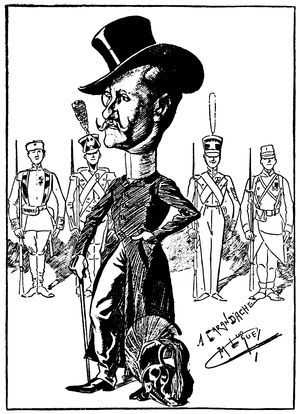
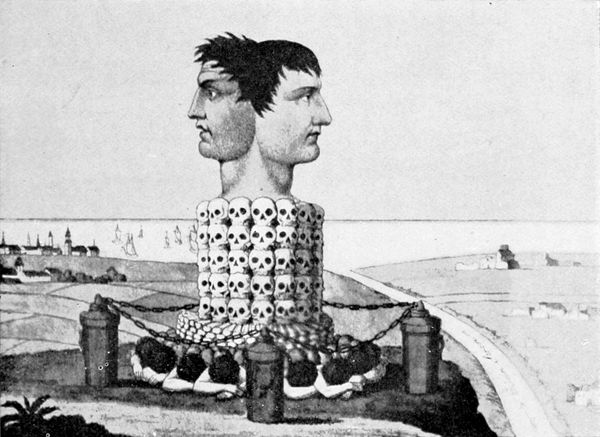
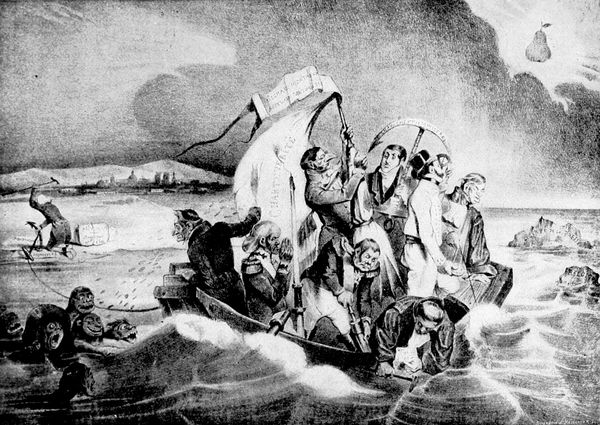
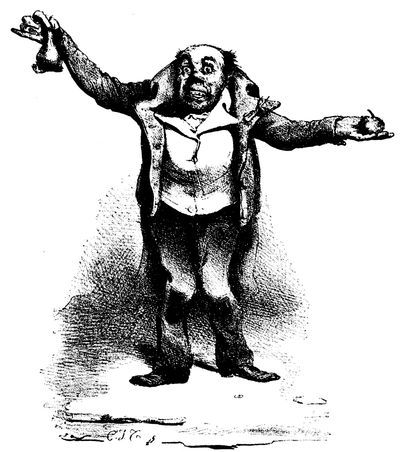
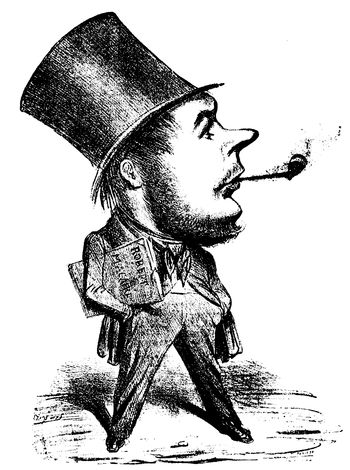
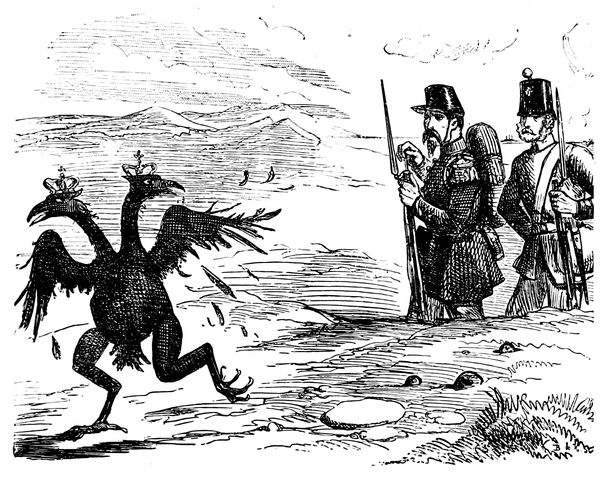
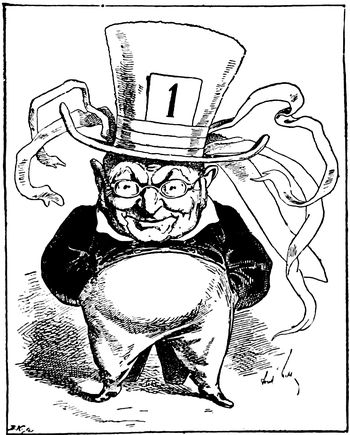
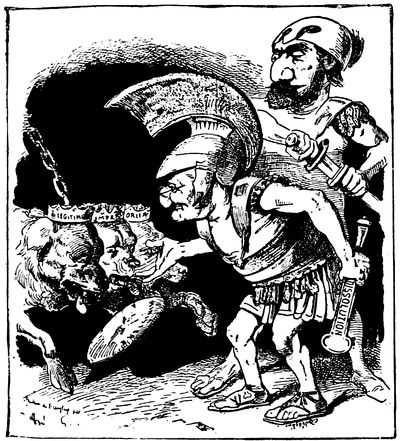
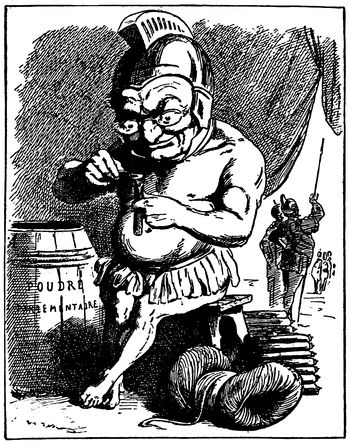
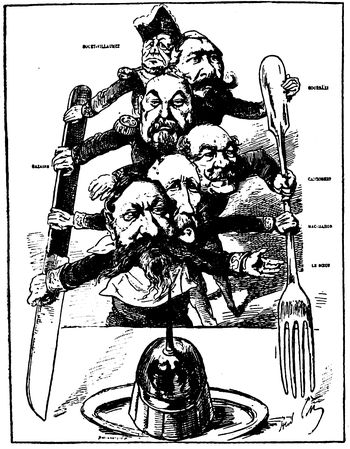
Caran d'Ache.
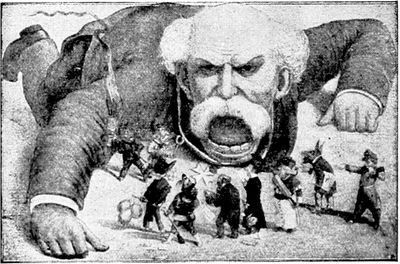
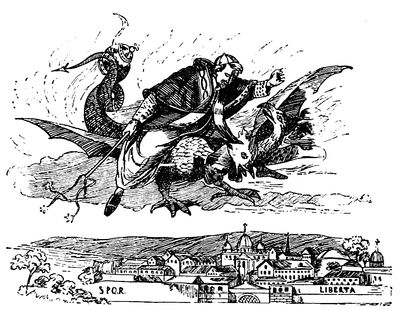
Gulliver Crispi.
From "Il Papagallo" (Rome).
On the other hand, the typical American cartoon of a generation ago
concerned itself but little with questions of international interest,
while in its treatment of domestic affairs it was largely
lacking in the dignity and restraint which characterized the British
school. Being founded upon party politics, its purpose was primarily
not to reflect public opinion, but to mold it; to make political
capital; to win votes by fair means, if possible, but to win them.
From their very inception Puck and Judge, as the mouthpieces of
their respective parties, have exerted a formidable power, whose
far-reaching influence it would be impossible to gauge, especially
during the febrile periods of the Presidential campaigns. At these
times the animosity shown in some of the cartoons seems rather
surprising, when looked at from the sober vantage ground of later
years. Political molehills were exaggerated into mountains, and even
those elements of vulgar vituperation and cheap personal
abuse—features of political campaigns which we are happily
outgrowing—were eagerly seized upon for the purpose of pictorial
satire. The peculiar bitterness which marked the memorable campaign
between Mr. Cleveland and Mr. Blaine in 1884 was strongly mirrored in
the political caricature of the time. It marked the highwater line of
the element of purely personal abuse in comic art. In the end the
extreme measures to which each of the rival parties resorted
during that year had very beneficial effects, for after the election
the nation, in calmer mood, grew ashamed at the thought of its
violence and bitterness, and subsequent campaigns have consequently
been much more free from these objectionable features. Mr. Harrison,
Mr. Bryan, Mr. McKinley, and Mr. Roosevelt have all been assailed from
many different points. But we are no longer in the mood to tolerate
attempts to rake up alleged personal scandals and to use them
in the pamphlet and the cartoon. Enough of this was done by both
parties in 1884 to last us for at least a generation. There are
cartoons which appeared in Puck and Judge which even at this day
we should not think of reprinting, and which the publications
containing them and the artists who drew them would probably like to
forget.
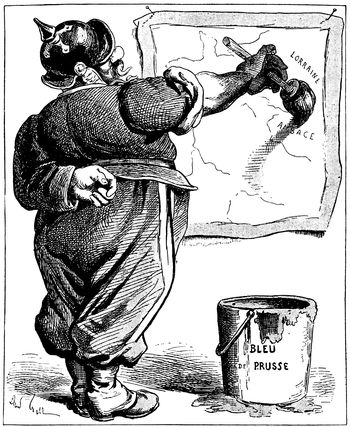
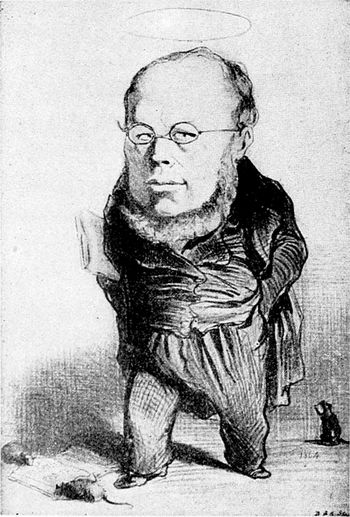
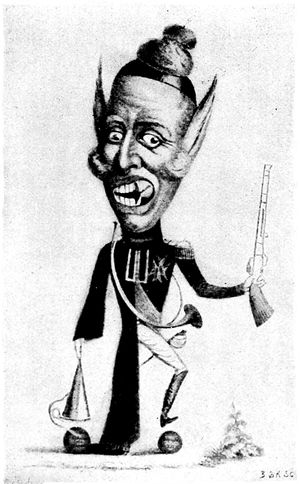
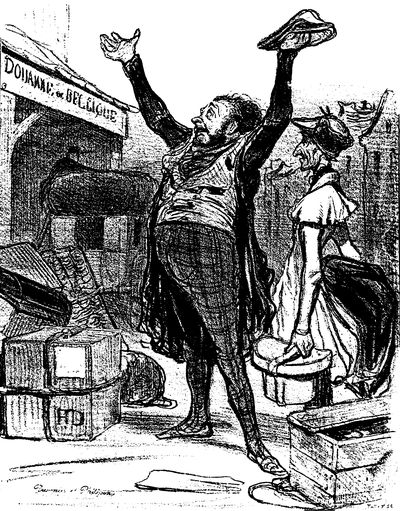
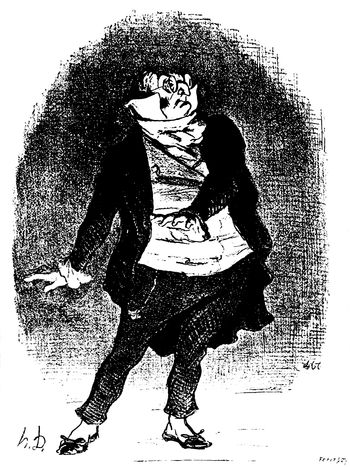
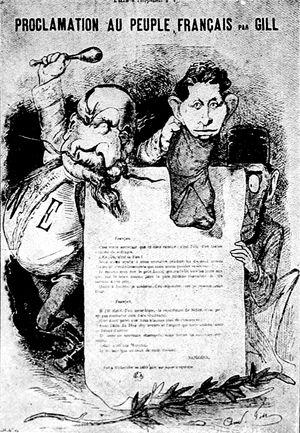
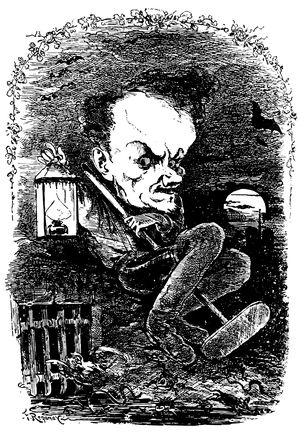
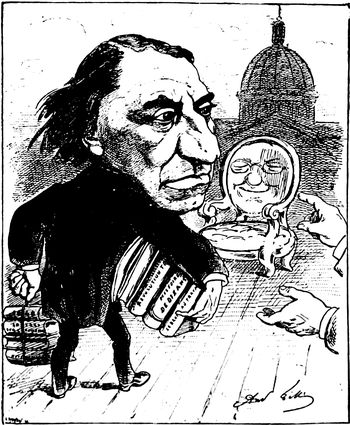
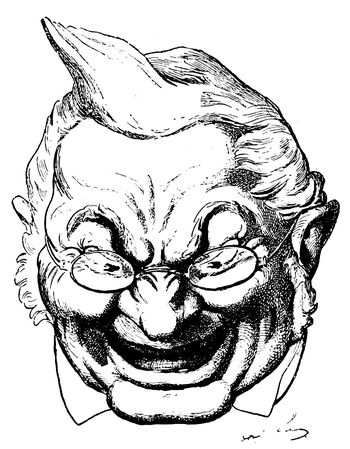
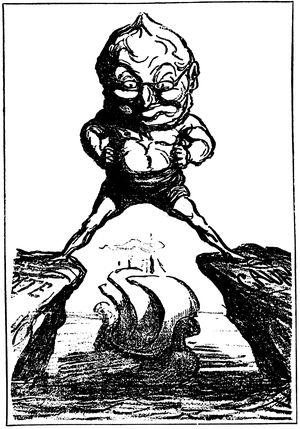
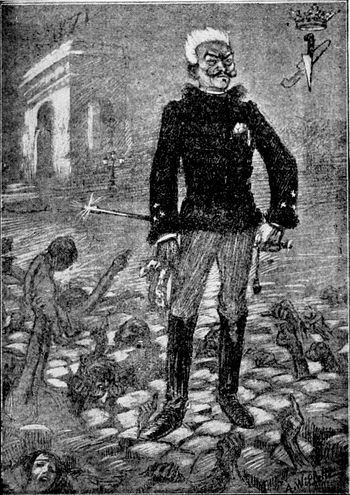
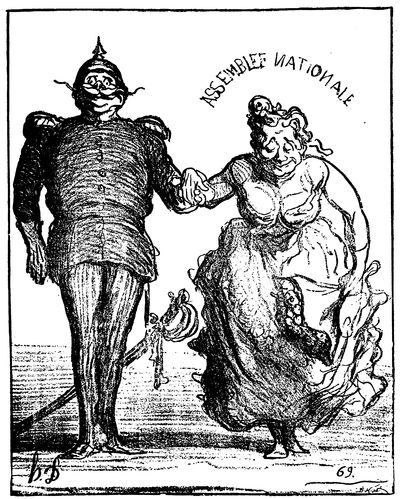
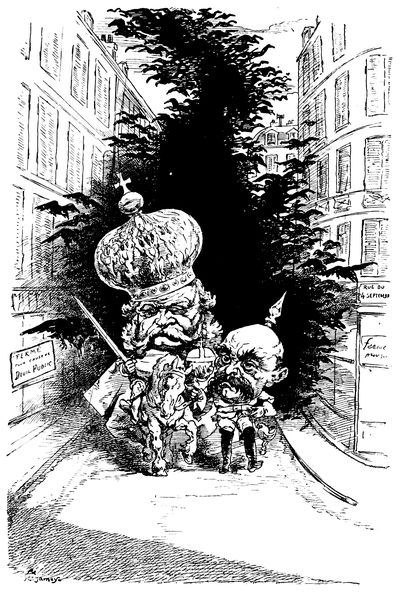
Fig. 291. Caricature de Gill. (Éclipse, 19 octobre
1873.)
Nevertheless, to the close student of political history there is in
the American cartoon of this period, with all its flamboyant
colorings, its reckless exaggeration, its puerile animosity, material
which the more sober and dignified British cartoon does not offer. It
does not sum up so adequately the sober second thought of the nation,
but it does keep us in touch with the changing mood of popular
opinion, its varying pulse-beat from hour to hour. To glance over the
old files throughout any one of the Presidential campaigns is the next
best thing to living them over again, listening once more to the daily
heated arguments, the inflammable stump speeches, the rancorous
vituperation which meant so much at the time, and which seemed so
idle the day after the election.
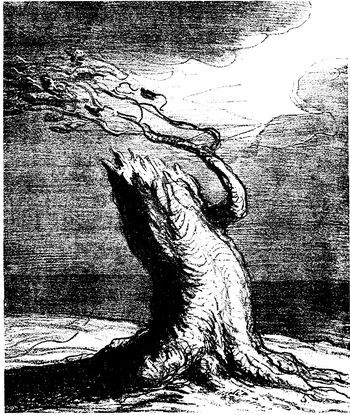
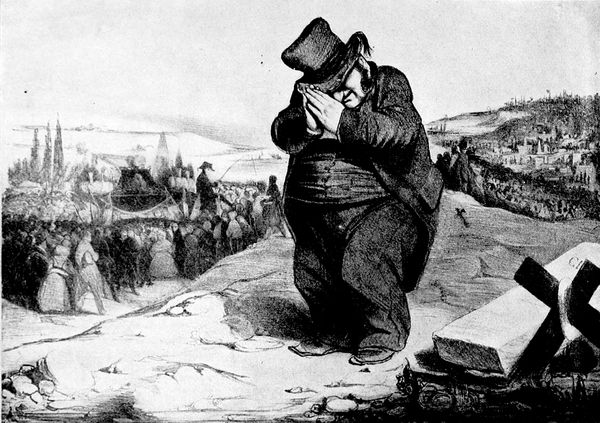
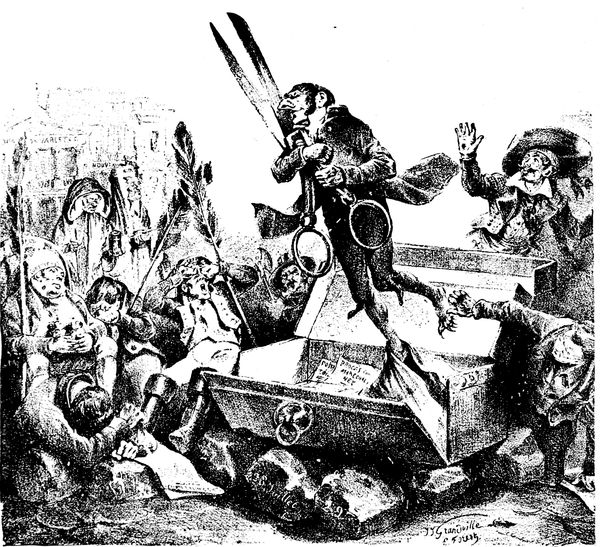
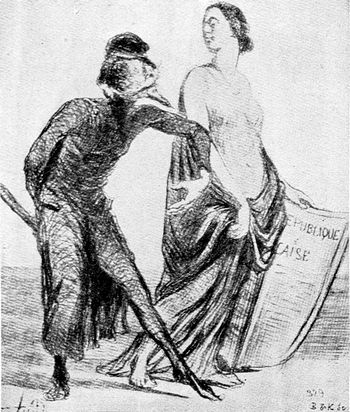
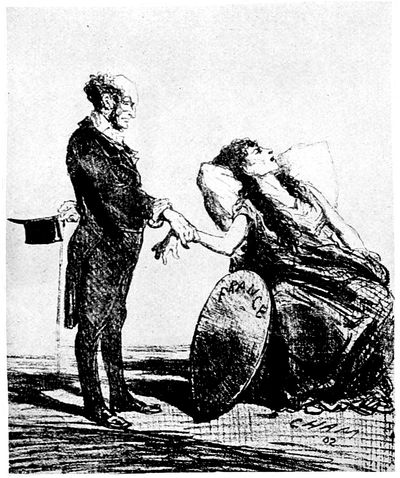
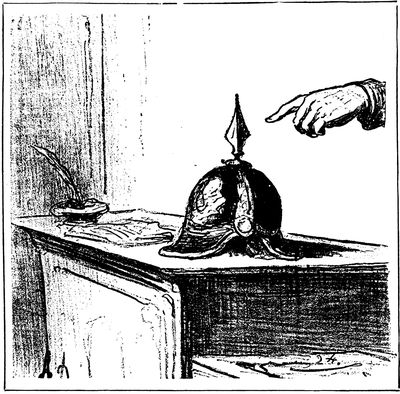
"Poor France! The Branches are broken, but the Trunk
still holds."
By Daumier in "Charivari."
It is not strange that during these years American cartoonists
concerned themselves but little with matters outside of their own
country. For more than a decade after the close of the Franco-Prussian
War there were very few episodes which assumed international
importance, and still fewer in which the United States had any
personal interest. France was amply occupied in recovering from the
effects of her exhaustive struggle; United Germany was undergoing the
process of crystallizing into definite form. Europe, as a whole, had
no more energy than was needed to attend to domestic affairs and to
keeping a jealous eye upon English ambition in Egypt and Russian
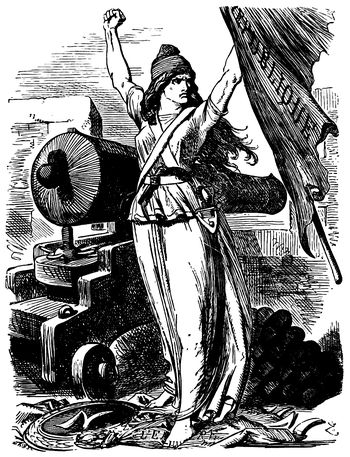
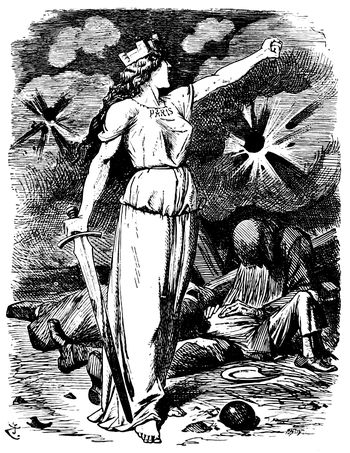
aggression in the Balkan States. For some little time after the French
Commune echoes of that internecine struggle were still to be found in
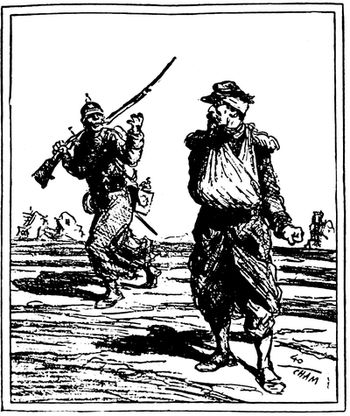
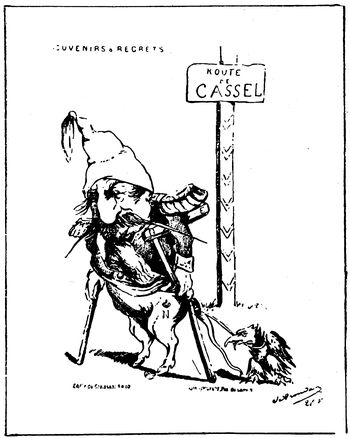
the work of caricaturists, both in France and Germany. Before taking
final leave of that veteran French artist, Honoré Daumier, it seems
necessary to allude briefly to a few of the cartoons of that
splendidly tragic series of his old age dealing with the France which,
having undergone the horrors of the Germanic invasion and of the
Commune, is shattered but not broken, and begins to look forward with
wistful eyes to a time when she shall have recovered her strength and
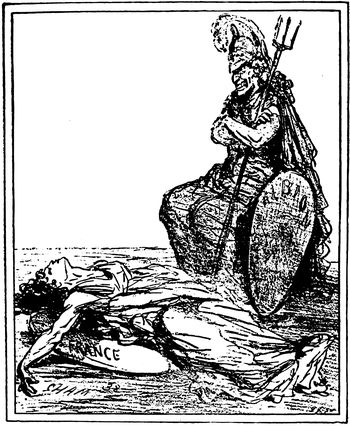
her prosperity. One of the most striking of these cartoons represents
France as a deep-rooted tree which has been bent and rent by the
passing whirlwind. "Poor France! The branches are broken, but the
trunk holds always." Simple as the design is, the artist by
countless touches of light and of shadow has given it a somber
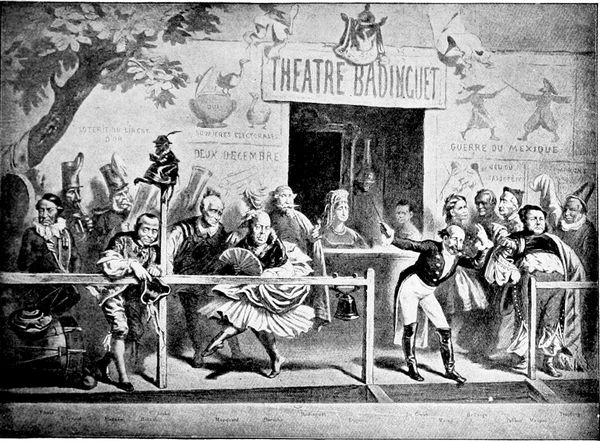
significance which long remains in the memory. It was to Napoleon that
Daumier bitterly ascribed the misfortunes of La Patrie, and in these
cartoons he lost no opportunity of attacking Napoleonic legend. Stark
and dead, nailed to the Book of History is the Imperial eagle. "You
will remain outside, nailed fast on the cover, a hideous
warning to future generations of Frenchmen," is Daumier's moral. Of
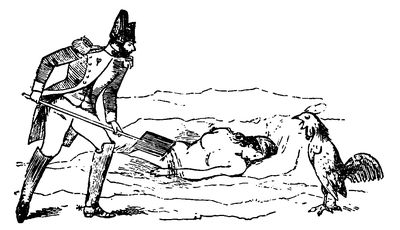
brighter nature is the cartoon called "The New Year." It represents
the dawning of 1872, and portrays France sweeping away the last broken
relics of her period of disaster.
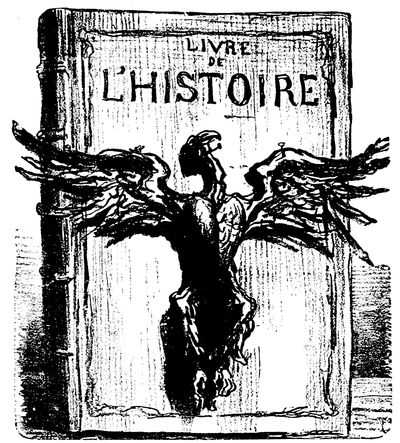
"You shall stay there, nailed to the Cover, a Warning
to Future Generations of Frenchmen."
By Daumier in "Charivari."
In Germany, also, one finds a few tardy cartoons bearing upon Napoleon
III. Even in the Fliegende Blätter, a periodical which throughout
its history has confined itself, with few exceptions, to social
satire, perennial skits upon the dignified Herr Professor, the
self-important young lieutenant, the punctilious university student,
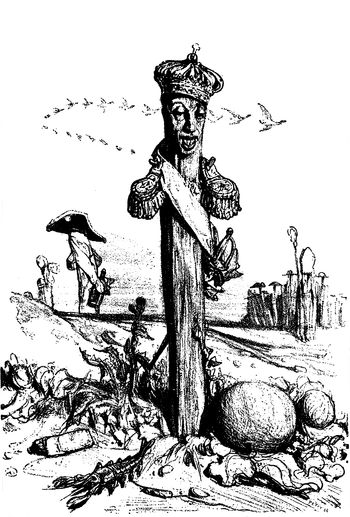
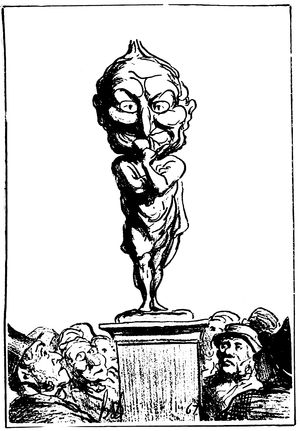
one famous cartoon appeared late in the year 1871, entitled "The Root
of All Evil." It portrayed Napoleon III., as a gigantic, distorted
vegetable of the carrot or turnip order, his flabby features distended
into tuberous rotundity, the familiar hall-mark of his sweeping
mustache and imperial lengthened grotesquely into the
semblance of a threefold root. Still better known is a series of
cartoons which ran through half a dozen numbers of the Fliegende
Blätter, entitled "The Franco-Prussian War: A Tragedy in Five Acts,"
in which the captions are all clever applications of lines from
Schiller's "Maid of Orleans". As compared with the work of really
great cartoonists, this series has little to make it memorable. But as
an expression of a victorious nation's good-natured contempt, its
tendency to view the whole fierce struggle of 1870-71 as an amusing
farce enacted by a company of grotesque marionettes, it is not without
significance and interest.
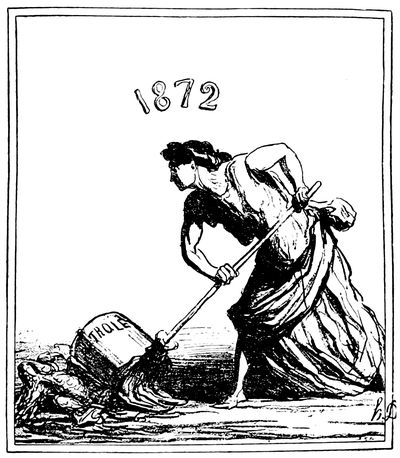
The New Year brings New Hope for France.
By Daumier in "Charivari."
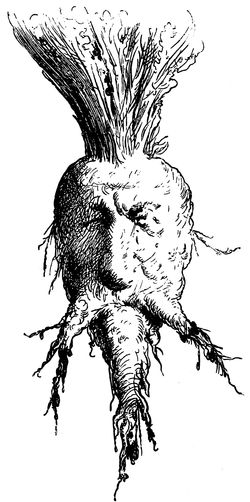
"The Root of all Evil."
From the "Fliegende Blätter" in 1871.
Almost as Germanic in sentiment and in execution as the "Maid of
Orleans" series in the Fliegende Blätter was the curious little
volume entitled "The Fight at Dame Europa's School," written and
illustrated by Thomas Nast. This skit, which was printed in New York
after the close of the War, contained thirty-three drawings
which are remarkable chiefly in that they are comparatively different
from anything else that Nast ever did and bear a striking resemblance
to the war cartoons of the German papers. The Louis Napoleon of this
book is so much like the Louis Napoleon of the Fliegende Blätter
that one is bound to feel that one was the direct
inspiration of the other. The text of the book, though nothing
astonishing, serves its purpose in elucidating the drawings. It tells
of the well-ordered educational establishment kept by Dame Europa in
which the five largest boys acted as monitors, to keep the unruly
pupils in order. These boys were Louis, William, Aleck, Joseph, and
John. If a dispute arose among any of the smaller boys, the monitors
had to examine into its cause, and, if possible, to settle it
amicably. Should it be necessary to fight the matter out, they were to
see fair play, stop the encounter when it had gone far enough, and at
all times to uphold justice, and to prevent tyranny and bullying. In
this work Master Louis and Master John were particularly prominent.
There was a tradition in the school of a terrific row in times past,
when a monitor named Nicholas attacked a very dirty little boy called
Constantine. John and Louis pitched in, and gave Nicholas such a
thrashing that he never got over it, and soon afterward left the
school. Now each of the upper boys had a little garden of his own in
which he took great pride and interest. In the center of each garden
there was an arbor, fitted up according to the taste and means of its
owner. Louis had the prettiest arbor of all, while that of John was a
mere tool-house. When the latter wished to enjoy a holiday he would
punt himself across the brook and enjoy himself in the arbor of his
friend Louis. By the side of Louis's domain was that of William, who,
though proud of his own garden, never went to work in it without
casting an envious glance on two little flower beds which now belonged
to Louis, but which ought by rights he thought to belong to him. Over
these flower beds he often talked with his favorite fag, a shrewd lad
named Mark, full of deep tricks and dodges.
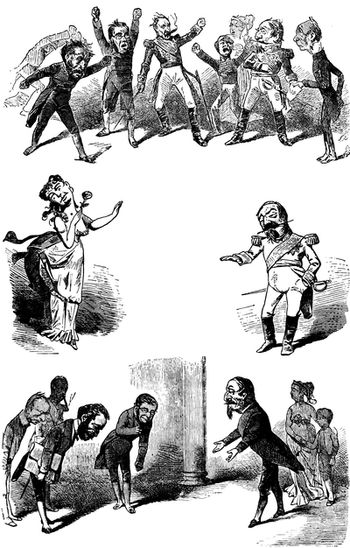
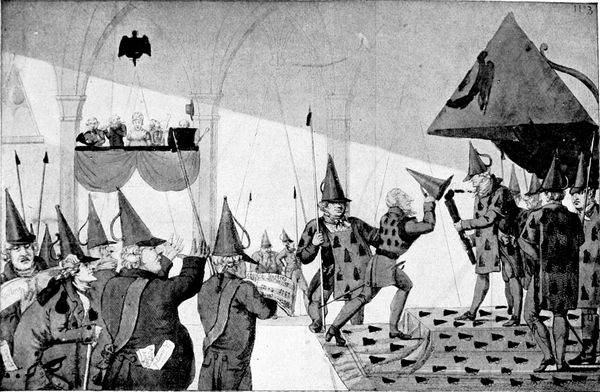
The whole spirit of these pictures, which appeared in
the Fliegende Blätter after the Napoleonic downfall in 1871, is a
travesty on the splendid lines of Schiller in the "Maid of Orleans"
(Jungfrau von Orleans).
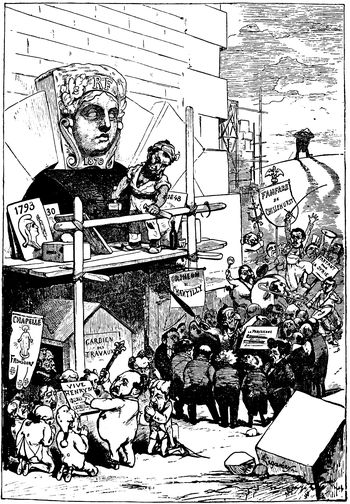
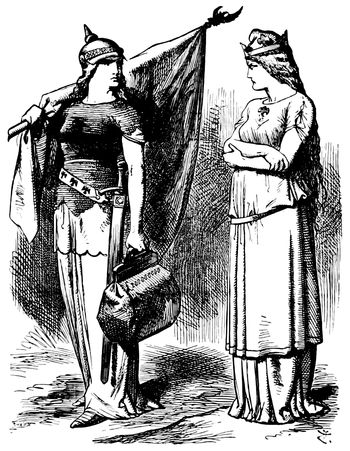
Fig. 294. La situation politique en France. (Novembre
1873.)
Caricature de Félix Régamey, publiée dans le Harper's Weekly de
New-York.
"There is only one way to do it," said Mark. "If you want
the flower beds, you must fight Louis for them, and I believe you will
lick him all to smash; but you must fight him alone."
"How do you mean?" replied William.
"I mean, you must take care that the other monitors don't interfere in
the quarrel. If they do, they will be sure to go against you. Remember
what a grudge Joseph owes you for the licking you gave him not along
ago; and Aleck, though to be sure Louis took little Constantine's part
against him in that great bullying row, is evidently beginning to grow
jealous of your influence in the school. You see, old fellow, you have
grown so much lately, and filled out so wonderfully that you are
getting really quite formidable. Why, I recollect the time when you
were quite a little chap!"
Thereupon the astute Mark designs a plan by which William may provoke
the encounter while making Louis seem the aggressor. And so on, under
the guise of fistfight between two schoolboys, Nast tells of all the
events of the struggle of 1871; the outbreak of hostilities, the
Baptism of Fire, Sedan, the German march on Paris, the Siege, and the
different attitudes assumed by the other monitors.
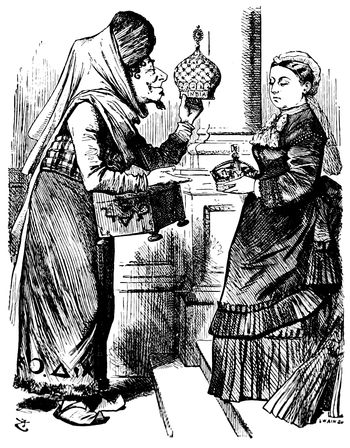
"New Crowns for Old."
Disraeli offering Victoria the Imperial crown of India.
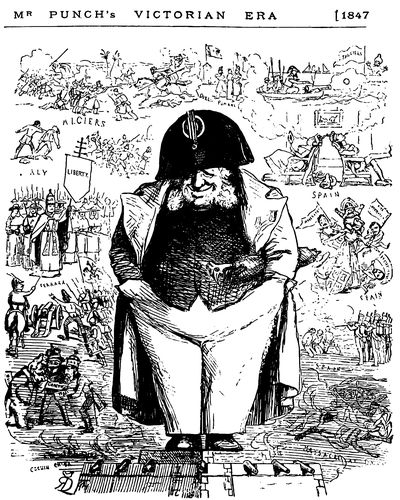
Punch, however, is really the most satisfactory and comprehensive
source for the history of political caricature during the years
following the siege of Paris down to 1886. From the indefatigable
pencil of Tenniel and Sambourne we get an exhaustive and pungent
record of the whole period of Disraeli's ascendency, the fruits of his
much-criticised foreign policy, England's attitude regarding the Suez
Canal, her share in the Turco-Russian conflict, her
acquisition of the island of Cyprus, the fall of Khartoum, the Fenian
difficulties of 1885, and the history of Mr. Gladstone's Home Rule
policy.
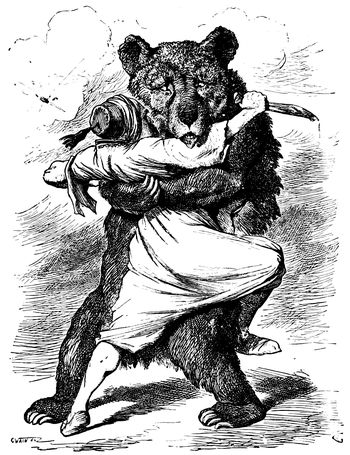
"Tightening the Grip."
Throughout the cartoons of this period there is no one figure which
appears with more persistent regularity than that of Lord
Beaconsfield, and with scarcely an exception he is uniformly treated
with an air of indulgent contempt. Of course, his strongly marked
features, the unmistakably Semitic cast of nose and lips, the closely
curled black ringlets clustering above his ears, all offered
irresistible temptation to the cartoonist, with the result that
throughout the entire series, in whatever guise he is portrayed, the
suggestion of charlatan, of necromancer, of mountebank, of one kind or
another of the endless genus "fake," is never wholly absent.
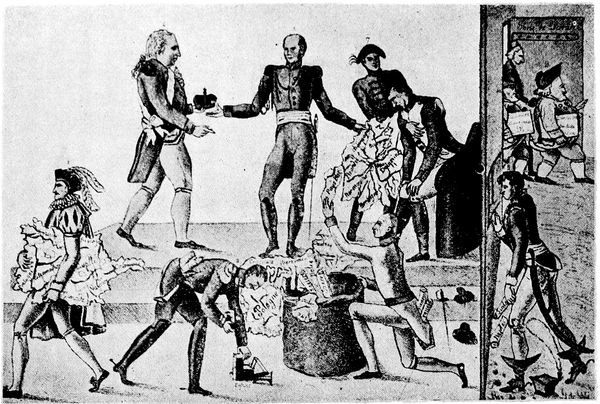
Even in Tenniel's cartoon, "New Crowns for Old," which commemorates
the passage of the Royal Titles Bill, conferring upon the Queen the
title of Empress of India, the scene is confessedly adapted from
Aladdin, and "Dizzy" is portrayed as a slippery Oriental with an oily
smile, in the act of trading a gaudy-looking piece of tinsel headgear
for the more modest, but genuine, regal crown topped with the cross of
Malta. The bestowal of the title of Earl of Beaconsfield upon Mr.
Disraeli, which followed within a very few weeks, was too good a
chance for satire for Mr. Tenniel to let pass, and he hit it off in a
page entitled "One Good Turn Deserves Another," in which Victoria,
with the Imperial crown of India upon her head, is conferring a
coronet upon "Dizzy," kneeling obsequiously at her feet.
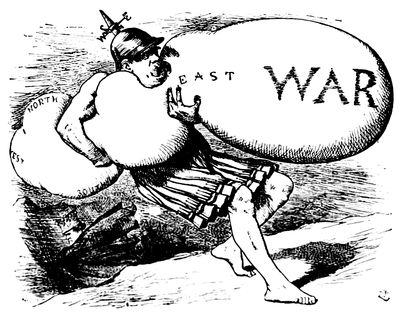
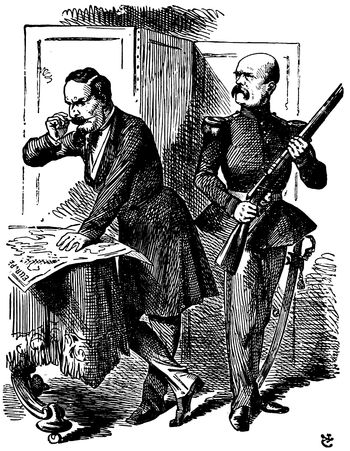
Æolus—Ruler of the Storms. The Easterly Wind too much
for Bismarck.
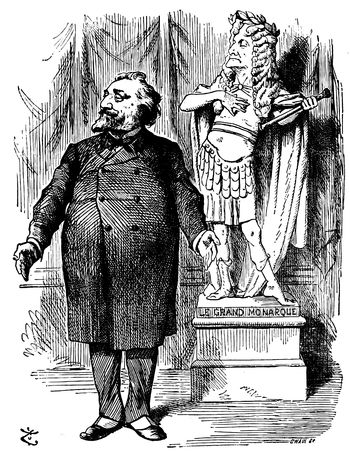
"L'État C'est Moi!"
At this time the one international question which bade fair to assume
any considerable importance was that of Russia's attitude in the
Balkan peninsula. Already in June, 1886, we find Punch portraying
the Czar of Russia as a master of the hounds, just ready to let slip
the leash from his "dogs of war." Servia, Montenegro, Bosnia, and
Herzegovina, in pursuit of the unsuspecting Sultan of Turkey,
while John Bull in the guise of a policeman, is cautiously peering
from behind a fence, evidently wondering whether this is a case which
calls for active interference. It is only a few days later that the
outbreak of an insurrection in Bosnia and Herzegovina hastens a
decision on the part of Europe to "keep the Ring" and let the Sultan
ward off the "dogs of war" single-handed—an incident duly
commemorated in Punch on June 19. The Turkish atrocities in
Bulgaria, however, aroused public sentiment throughout the Continent
to such a degree that the Powers united in demanding an armistice.
Tenniel's interpretation of this incident takes the form of a
sick-chamber, in which the Sick Man of Europe is surrounded by a corps
of illustrious physicians, Drs. Bull, William I., Francis Joseph and
Company, who are firmly insisting that their patient shall
swallow a huge pill labeled "Armistice"—"or else there's no knowing
what might happen!" The protocol on Turkish affairs which soon after
this was proposed by Russia and supported by Disraeli, forms the
subject of two suggestive cartoons in Punch. The first, entitled
"Pons Asinorum," depicts the protocol as a make-shift bridge supported
on the docile shoulders of John Bull and the other European Powers,
and spanning a lagoon entitled "Eastern Question." Over this bridge
the Russian bear is stealthily crawling to his desired goal, his eye
half closed in a sly wink, his sides bristling like a veritable
arsenal with weapons. The second cartoon, alluding to the Porte's
rejection of the protocol, represents Disraeli looking disconsolately
upon a smoldering pile of powder kegs and ammunition, over
which he has placed the protocol, twisted into the shape of a
candle-snuffer. "Confound the thing! It is all ablaze!" he ejaculates,
while Lord Hartington reminds him, "Ah, my dear D., paper will burn,
you know!"
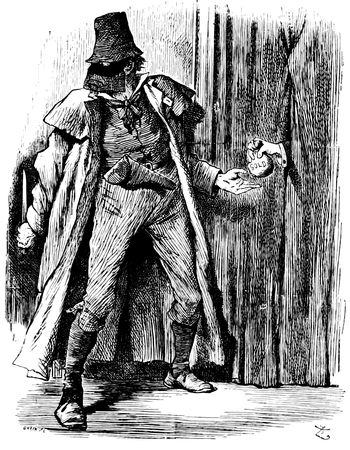
The Hidden Hand.
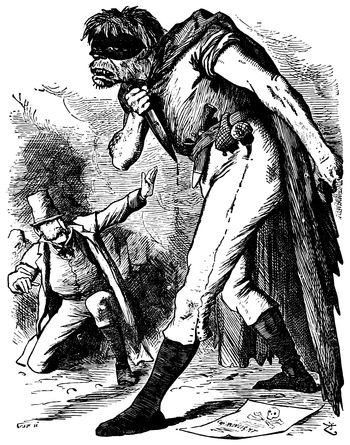
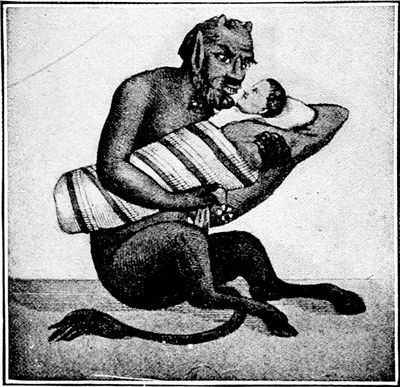
The Irish Frankenstein.
The next significant caricature in the Punch series belongs to the
period of actual hostilities between Turkey and Russia, after Plevna
had been completely invested and the Turks were at all points being
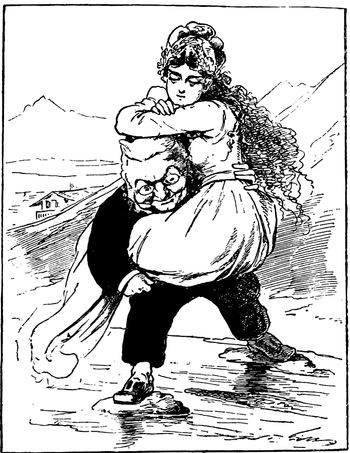
steadily beaten back. This caricature, entitled "Tightening the Grip,"
showing the struggling Turk being slowly crushed to death in the
relentless hug of the gigantic bear, may safely be left to speak for
itself without further description. Meanwhile, England was watching
with growing disquiet Russia's actions in the Balkans. In one cartoon
of this period, Mr. Bull is bluntly refusing to be drawn into a game
of "Blind Hookey" with the other European Powers. "Now then,
Mr. Bull, we're only waiting for you," says Russia; and John Bull
rejoins: "Thank you, I don't like the game. I like to see the cards!"
Prince Bismarck at this time was doing his best to bring about an
understanding between England and Russia, but the difficulties of the
situation threatened to prove too much even for that veteran diplomat.
Punch cleverly hit off the situation by representing Bismarck Æolus,
the wind-god, struggling desperately with an unmanageable wind-bag,
which is swelling threateningly in the direction of the East and
assuming the form of a dangerous war-cloud. Eventually all
misunderstandings were peacefully smoothed away at the Berlin
Congress, which Tenniel commemorates with a cartoon showing "Dizzy" in
the guise of a tight-rope performer triumphantly carrying the Sultan
on his shoulders along a rope labeled "Congress," his inherent
double-dealing being suggested by his balancing pole, which he sways
back and forth indifferently, and the opposite ends of which are
labeled "peace" and "war."
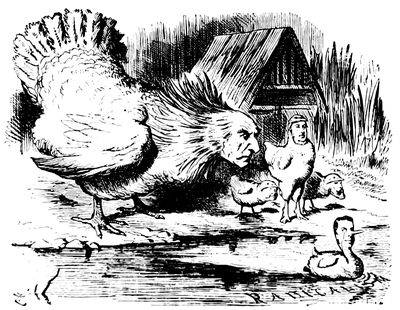
The Daring Duckling. June, 1883.
An early appearance of Mr. Chamberlain in caricature.
Comparatively few cartoons of this period touch upon
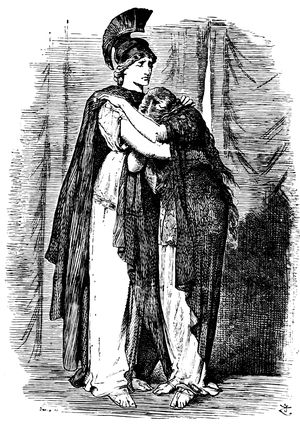
American matters. All the more noteworthy is the one which Mr. Tenniel
dedicated to the memory of President Garfield at the time of the
latter's assassination. It is a worthy example of the artist's most
serious manner, at once dignified and impressive. It bears the
inscription, "A Common Sorrow," and shows a weeping Columbia clasped
closely in the arms of a sorrowing and sympathetic Britannia.
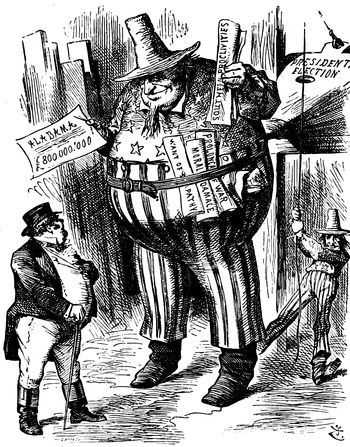
Settling the Alabama Claims.
M. Gambetta seldom received attention at the hands of English
caricaturists; but in 1881, when the resignation of Jules Ferry and
his colleagues resulted in the formation of a new ministry with
Gambetta at the head, and both English and German newspapers were
sarcastically saying that "the Gambetta Cabinet represented only
himself," Punch had to have his little fling at the French
statesman, portraying him as beaming with self-complacence, and
striking an attitude in front of a statue of Louis XIV.,
while he echoes the latter's famous dictum, "L'État c'est moi!"
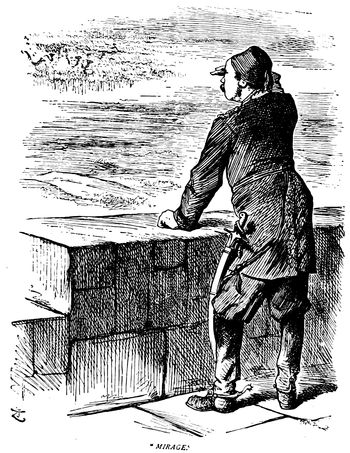
Gordon Waiting at Khartoum.
Two cartoons which tell their own story are devoted to Fenianism. The
first commemorates the Phœnix Park outrage in which Lord Frederick
Cavendish, the newly appointed Chief Secretary, lost his life. The
cartoon is called "The Irish Frankenstein," and is certainly baleful
enough to do full justice to the hideousness of the crime it is
intended to symbolize. The second cartoon, entitled "The Hidden Hand,"
shows the Fenian monster receiving a bag of gold from a mysterious
hand stretched from behind a curtain. The reference is to a supposed
inner circle of assassins, directed and paid by greater villains who
kept themselves carefully behind the scenes.
The tragedy of Khartoum formed the subject of several grim
and forceful pages. "Mirage" was almost prophetic in its conception,
representing General Gordon gazing across the desert, where, by the
tantalizing refraction of the air, he can plainly see the advancing
British hosts, which in reality are destined to arrive too late. "Too
late," in fact, are the very words which serve as a caption of the
next cartoon. Khartoum has fallen, and Britannia, having come upon a
fruitless mission, stands a picture of despair, her face buried upon
her arm, her useless shield lying neglected upon the ground.
It was not until late in the '60's, when Thomas Nast began his
pictorial campaign in the pages of Harper's Weekly against the Ring
which held New York in its clutches, that American caricature could
claim a pencil which entitled it to any sort of consideration from the
artistic point of view. Some of the cartoons which have been
reproduced in earlier papers of this series have possessed
unquestionable cleverness of invention and idea; for instance, many of
those dealing with President Jackson's administration and his
relations with the United States Bank, and some of the purely
allegorical cartoons treating of slavery and of the Civil War. But in
all these there was so much lacking; so many artistic shortcomings
were covered up by the convenient loops. The artists felt themselves
free from any obligation to give expression to the countenances of
their subjects so long as the fundamental idea was there, and the
loops offered an easy vehicle for the utterance of thoughts and
feelings which a modern artist would feel obliged to express in the
drawing itself—by a skillful quirk of the pencil, an added line, an
exaggerated smile or frown. It was a thoroughly wooden school of
caricature, in which one can find no trace of the splendid suggestion
which the caricaturists should at that time have been drawing from
contemporary masters of the art in France and England.
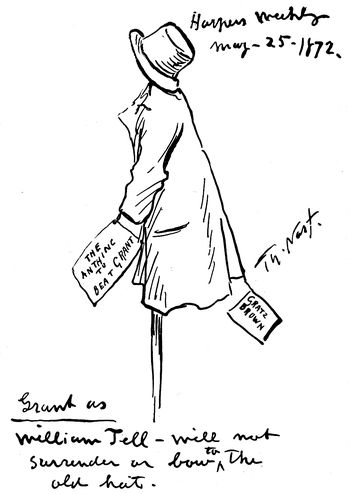
The Gratz Brown Tag to Greeley's Coat.
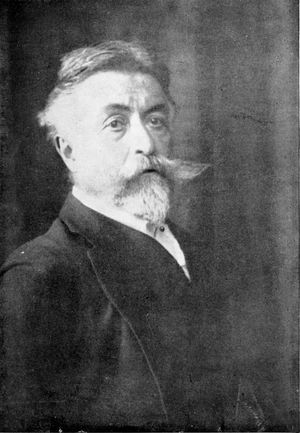
Thomas Nast.
Although during the years of his fecundity Thomas Nast drew many
cartoons bearing on events of international importance, his
name will always be remembered, first of all, in connection with the
series through which he held up the extravagances and iniquities of
the Tweed Ring in the pillory of public opinion. He had decided
convictions on other subjects. To the end of his life it was his
nature to feel intensely, even in small matters. But his scorn and
hatred of the corrupt organization that was looting New York became a
positive mania, which was reflected in the cartoons which he literally
hurled week after week against Tweed and his satellites. "I don't care
what they write about me," said Tweed, "but can't you stop those
terrible cartoons?" and in the end they, more than anything else, led
to his downfall, his flight and his capture in Spain, where he was
recognized by the police through the likeness Nast had
drawn of him as a kidnaper. But in recognizing Nast's services in
behalf of New York City it is not fair to overlook his work as a
political caricaturist on broader issues. To him we owe also the Gratz
Brown tag to Greeley's coat in the campaign of 1872, the "Rag Baby of
Inflation," the Jackass as emblematic of the Democratic Party, the
Labor Cap and the Full Dinner Pail, which in later years were so much
developed by the cartoonists of Judge. And if to-day, at the
beginning of the twentieth century, we have a school of caricature
which for scope and craftsmanship is equal, if not superior, to that
of any nation of Europe, it is only just to recognize that it was
Thomas Nast who first gave American caricature a dignity and a
meaning.
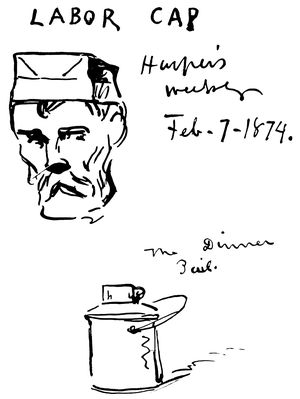
First Appearance of the Cap and Dinner Pail as
Emblematic of Labor.
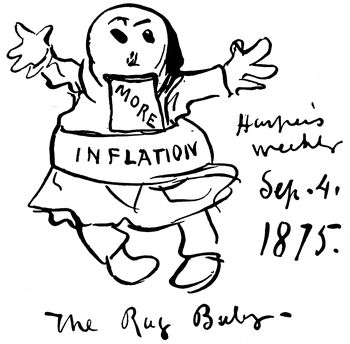
The First "Rag Baby."
The earliest Presidential election which falls within the
scope of the present chapter, that of 1872, antedates the
establishment of American comic weeklies. The central figure in the
few caricatures which have survived from that year was, of course,
Horace Greeley, whose candidacy at one time was thought seriously to
threaten the fortunes of the Republican Party. The caricatures
themselves, with the exception of those drawn by Thomas Nast, show
little improvement over the caricatures which were executed during the
Civil War. The artists relied entirely upon the traditional loops to
make them intelligible to the public, and the features of the
political characters portrayed were expressionless and wooden. One of
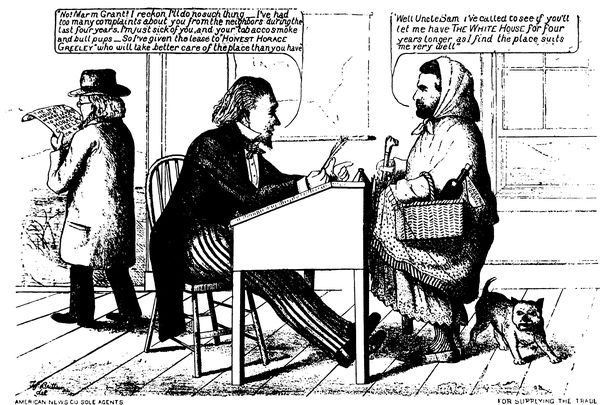
the best of this series was drawn in support of the Horace Greeley
candidacy. Uncle Sam is represented as a landlord and President Grant
as his tenant, a shiftless widow with a dog at her heels and a bottle
of rum in the basket on her arm. The Widow Grant has come to ask for a
new lease. "Well, Uncle Sam," she says, "I've called to see if you
will let me have the White House for four years longer, as I
find the place suits me very well." "No, Marm Grant," retorts Uncle
Sam, shaking his head, "I reckon I'll do no such thing. I've had too
many complaints about you from the neighbors during the last four
years. I'm just sick of you and your tobacco smoke and bull pups, so
I've given the lease to Honest Horace Greeley, who will take better
care of the place than you have."
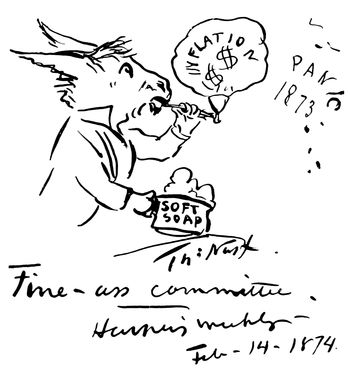
The Donkey. First used to ridicule the Inflation
Tendency.
In another of this series Horace Greeley is represented as the
entering wedge that is splitting the rock of the Republican Party.
Greeley, with a paper hearing the words "Free Trade" in one hand and
one bearing "Protection" in the other, is being hammered into the
cleft in the Republican rock by a huge mallet—Democratic
Nomination—wielded by Carl Schurz. "This is rather a novel position
for a stanch old Republican like me," he says. "I begin to feel as if
I was in a tight place." President Grant, with a cigar in his hand,
is looking on complacently. "My friend," he calls out to
Schurz, "you've got a soft thing on your wedge, but your mallet will
kill the man." To which Schurz replies: "I don't care who's killed, if
we succeed in defeating your election." Below, creeping furtively
about the rock, are the figures of Dana, Sumner, Gratz Brown,
Trumbull, Hall, Sweeny, Tweed, and Hoffman of the Ring. "Anything to
beat Grant!" is the cry of these conspirators. "Honesty is the word to
shout, there are so many rogues about," mutters Tweed. "Oh, how freely
we'll win with Greeley," says Hall. "Anything to beat Grant. He
wouldn't make me Collector for New York," are the words of Dana. The
cartoon is a belated specimen of the school of American caricature
which was in vogue in the days of President Jackson.
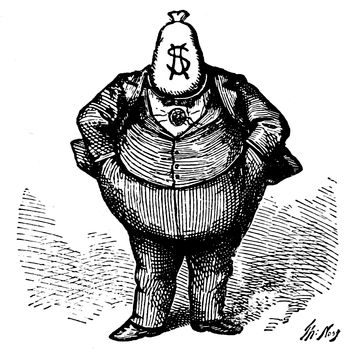
The Brains of Tammany.
As has already been stated, Puck was not founded until 1877, too
late to take part in the Tilden-Hayes campaign. When we speak of
Puck, however, we refer, of course, to the edition printed in
English, for, as a matter of fact, twenty-four numbers of a German
Puck were published during the year 1876.
"A Popular Verdict."
As that year was an important one in American history, these numbers
can by no means he ignored, and despite their crude
appearance when contrasted with the Puck of later days, they contain
some of Keppler's most admirable work. For instance, there is the
figure of the tattooed Columbia, the precursor of Gillam's famous
Tattooed Man. This figure appeared in November, 1876, and was the idea
of Charles Hauser, a member of the first editorial staff of the young
weekly. The artist's idea of the unhappy condition of our nation is
shown in the hideous tattooed designs with which Columbia's body is
scarred from head to foot. We can read "Whisky Ring," "Black Friday,"
"Secession," "Tammany," "Election Frauds," "Corruption," "Civil War,"
"Credit Mobilier," and "Taxes." The figure is as repulsive as that
which eight years later drove Mr. Blaine to frenzy.
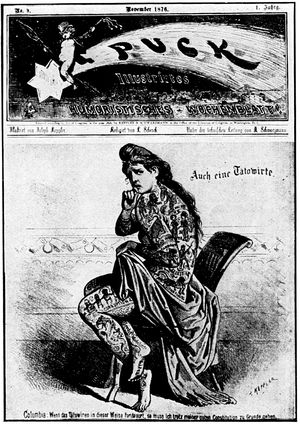
The Tattooed Columbia.
By courtesy of the Puck Company.
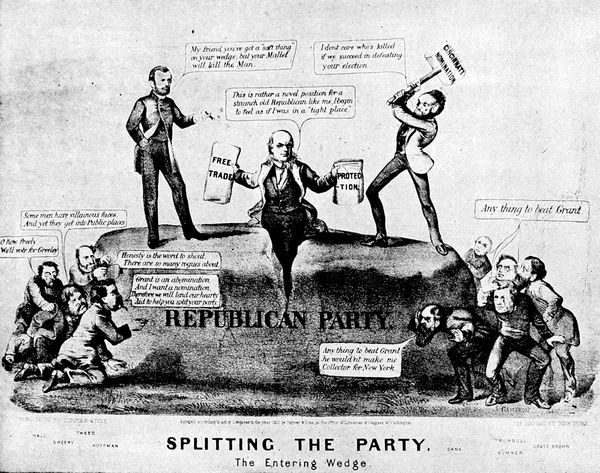
Splitting the Party.
From the collection of the New York Historical Society.
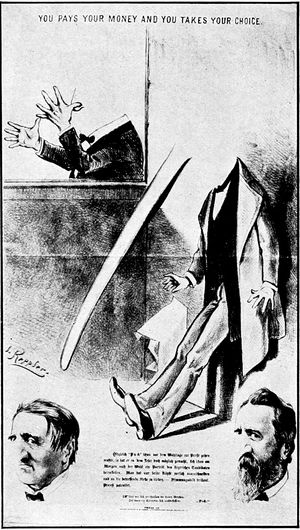
You pays your Money and you takes your Choice.
By courtesy of the Puck Company.
A familiar device in the caricature of the later '70's was
that of representing political figures as being headless and placing
their heads in another part of the picture, so that you might adjust
them to suit yourself. In this way the artist did not commit himself
to prophecy and was enabled to please both parties. For instance, an
excellent example of this is shown in the cartoon called "You Pays
Your Money and You Takes Your Choice," drawn by Keppler during the
campaign of 1876. Of the two headless figures one is seated
in the window of the White House gesticulating derisively at his
beaten opponent. The other, thoroughly crushed and with a nose of
frightfully exaggerated length—both Mr. Tilden and Mr. Hayes were
rather large-nosed men—is leaning helplessly against the wall of the
cold outside. At the bottom of the picture are the heads of the two
candidates, which one might cut out and adjust as pleased himself.
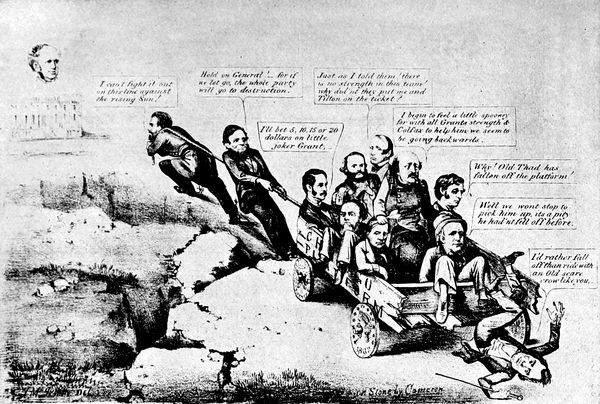
The Radical Party on a Heavy Grade.
From the collection of the New York Historical Society.
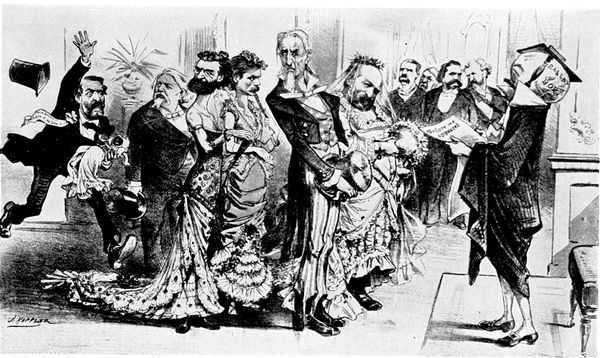
Probably no cartoon dealing with the Garfield-Hancock campaign of 1880
was more widely discussed than that called "Forbidding the Banns,"
drawn for Puck by Keppler. It was a cartoon which an American comic
paper would publish to-day only after considerable hesitation, for
there was in it the spirit of a less delicate age, a coarseness which
was pardonable only when the genuine strength and humor of the
complete work are taken into consideration. "Forbidding the Banns"
shows a political wedding party at the altar with Uncle Sam as the
reluctant and uncomfortable groom, General Garfield as the eager
bride, and the figure of the ballot box as the officiating clergyman.
The bridesmaids are Mr. Whitelaw Reid and Carl Schurz, with Murat
Halstead bringing up the rear. The ceremony is well along and the
contracting parties are about to be united when W. H. Barnum, the
chairman of the Democratic National Committee, rushes in shouting, "I
forbid the banns!" and waving frantically the figure of a little baby
marked "Credit Mobilier." The faces of all the bridal party show
consternation at the unexpected interruption, while the bride protests
coyly: "But it was such a little one."
"Forbidding the Banns." A Famous Cartoon of the
Garfield-Hancock Campaign.
By courtesy of the Puck Company.
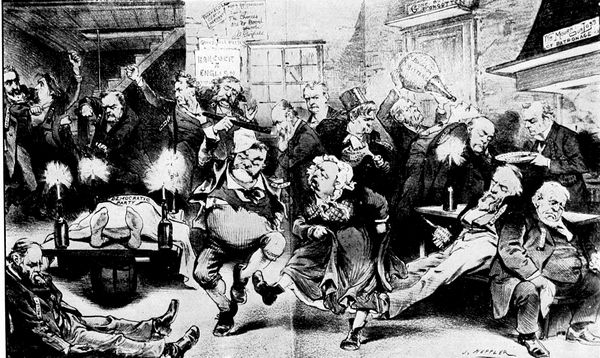
The defeat of General Hancock in 1880 was commemorated by Keppler in
Puck with the cartoon called "The Wake over the Remains of the
Democratic Party." The ludicrous corpse of the defunct is stretched
on a rough board and covered with a loose sheet. The lighted
candles at the four corners protrude from the necks of bottles, and
the mourners are indulging in a protracted carouse which seems
destined to end in a free fight. In the center of the picture Kelly,
with Ben Butler as a partner, is doing a dance in the most approved
manner of Donnybrook Fair. All about there is the general atmosphere
of turmoil and unnatural excitement, but the figures of Hewitt, Davis,
Belmont, and English are stretched out in a manner indicating that the
festivities of the night have proved too much for them.
As has already been pointed out, the political caricature
commemorating the Cleveland-Blaine campaign of 1884 was chiefly
remarkable for its extraordinary rancor. There was little, if any,
really good-natured satire underlying these cartoons; they were
designed and executed vindictively, and their main object was to hurt.
Mr. Cleveland's official record in Buffalo, and as Governor of New
York, had been such as to cause many of the more liberal Republicans
to support his candidacy and offered little to the political
cartoonist, so the opponents of Republican caricature found it
expedient to base their attacks on matters of purely personal nature.
The Wake over the Remains of the Democratic Party after
the Election of 1880.
By courtesy of the Puck Company.
Even in later years the cartoonist did not entirely refrain from this
method of belittling Mr. Cleveland's capabilities. It was sneeringly
said that much of the success of his administration was due to the
charm, the tact, and the personal magnetism of Mrs. Cleveland, and
this idea was the inspiration of a number of cartoons which were far
from being in the best of taste. One of these which was not
particularly offensive was that entitled "Mr. Cleveland's Best Card."
It was simply a huge playing card bearing the picture of Mrs.
Cleveland. Another much more obnoxious was a curious imitation of the
famous French cartoon "Partant pour la Syrie," which was
published in Paris after the flight of the Empress Eugénie.
A Common Sorrow.
The Democratic cartoonists, besides their use of the Tattooed Man idea
and the alleged scandals in Mr. Blaine's political career, made a
strong point of the soundness and cleanness of Mr. Cleveland's
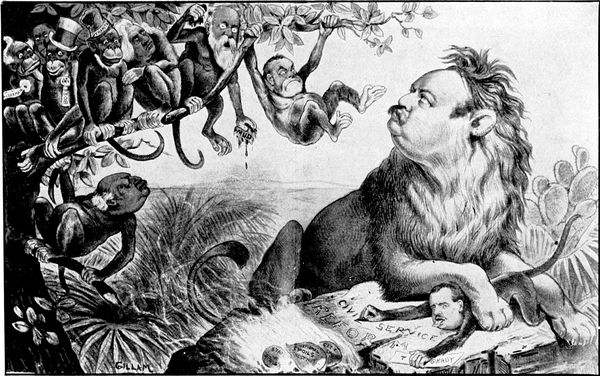
official record. A typical caricature of this nature was that drawn by
Gillam called "Why They Dislike Him." It represents Mr. Cleveland as a
lion lying on the rock of Civil Service Reform. Perched on the limb of
a tree overhead are a group of chattering monkeys, his political
enemies, who are hurling at him imprecations and abuse because he will
not consent to serve as the cats-paw to pluck the chestnuts for them
out of the political fire. Familiar faces among the group
of noisy bandar-log are those of Croker, Butler, and Dana. Prostrate
and helpless under the paw of the lion is a monkey with the face of
Grady.
Why They dislike Him.
By courtesy of the Puck Company.
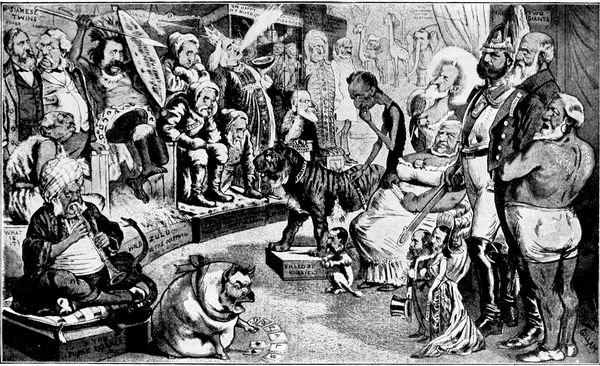
The First "Tattooed Man" Cartoon.
By courtesy of the Puck Company.
The most terrible and effective series of cartoons published during
the Cleveland-Blaine campaign was that in which the Republican
candidate appeared as the Tattooed Man in the political show. For many
weeks during the summer and autumn of 1884 Mr. Blaine was assailed
through this figure in the pages of Puck. The story of the origin of
this historic cartoon is as follows: Mr. Bernard Gillam, the artist,
had conceived the idea of a cartoon in which each of the Presidential
possibilities should appear as some sort of freak in a political
side-show. One of these freaks was to be the Tattooed Man, but Mr.
Gillam at first hit upon David Davis as the person to be so
represented. He was describing the proposed cartoon one day in the
office of Puck when Mr. Bunner, who was at that time the editor,
turned suddenly and said: "David Davis? Nonsense! Blaine is the man
for that." The cartoon so conceived was splendidly executed, and
became one of the great pictorial factors in turning the scale of the
election. It stirred Mr. Blaine himself to a point where he resolved
to prosecute the publishers of Puck, and was persuaded from this
course only by the very strongest pressure. The tattoo marks which
were most obnoxious to him were those which spelled out the word
"Bribery." A curious feature of this series was that Mr. Bernard
Gillam was an ardent Republican, voting for Mr. Blaine on election
day, and at the same time that he was executing the Tattooed Man
cartoon in Puck was suggesting equally vindictive caricatures of Mr.
Cleveland and the Democratic party for the rival pages of Judge.
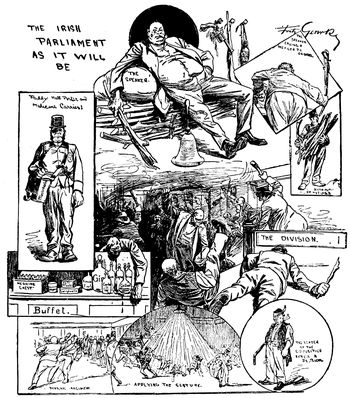
A German Idea of Irish Home Rule.
In looking backward over a century of caricature, it is interesting to
ask just what it is that makes the radical difference between the
cartoon of to-day and that of a hundred years ago. That there is a
wide gulf between the comparative restraint of the modern cartoonist
and the unbridled license of Gillray's or Rowlandson's grotesque,
gargoyle types, is self-evident; that comic art, as applied to
politics, is to-day more widespread, more generally appreciated, and
in a quiet way more effective in molding public opinion than ever
before, needs no argument. And yet, if one stops to analyze the
individual cartoons, to take them apart and discover the essence of
their humor, the incisive edge of their irony and satire, one finds
that there is nothing really new in them; that the basic principles of
caricature were all understood as well in the eighteenth century as in
the nineteenth, and that, in many cases, the successful cartoon of
to-day is simply the replica of an old one of a past generation,
modified to fit a new set of facts. When Gilbert Stuart drew his
famous "Gerrymander" cartoon, he was probably not the first artist to
avail himself of the chance resemblance of the geographical contour of
a state or country to some person or animal. He certainly was not the
last. Again and again the map of the United States has been drawn so
as to bring out some significant similarity, as recently when it was
distorted into a ludicrous semblance of Mr. Cleveland, bending low in
proud humility, the living embodiment of the principle,
L'État c'est Moi; or again, just before our war with Spain, when it
was so drawn as to present a capital likeness of Uncle Sam, the
Atlantic and Gulf States forming his nose and mouth, the latter
suggestively opened to take in Cuba, which is swimming dangerously
near. Puck's famous "Tattooed Man" was only a new application of an
idea that had been used before; while the representation of a group of
leading politicians as members of a freak show, a circus, or a
minstrel troop, is as old as minstrels or dime museums
themselves. Few leading statesmen of the past half century have not at
some time in their career been portrayed as Hamlet, or Macbeth, or
Richard III.; while as for the conventional use of animals and
symbolic figures to represent the different nations, the British Lion
and the Russian Bear, Uncle Sam and French Liberty, these belong to
the raw materials of caricature, dating back to its very inception as
an art. And yet, while the means used are essentially the same as in
the days of Hogarth and Cruikshank, the results are radically
different.
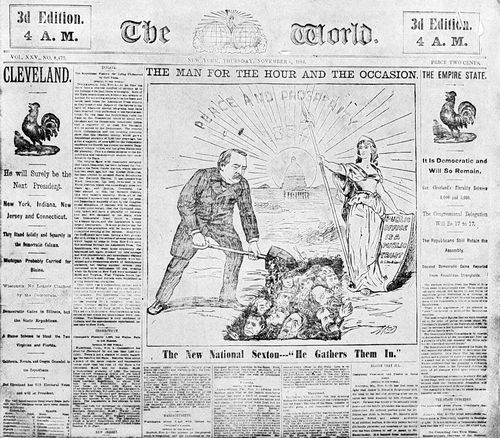
The World (Newspaper).
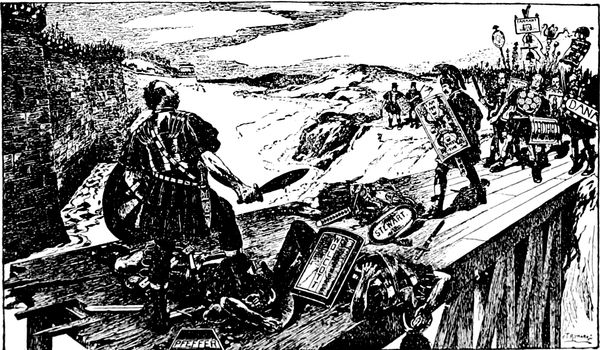
Horatius Cleveland at the Bridge.
From New York "Life."
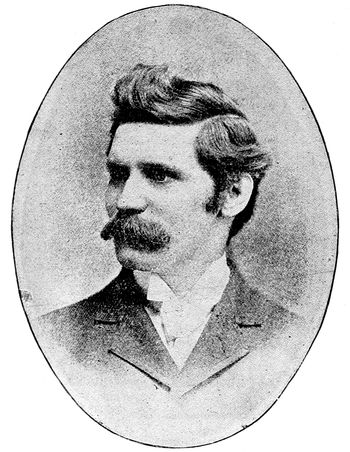
Bernard Gillam of "Judge."
The reason for this difference may be summed up in a single
word—Journalism. The modern cartoon is essentially journalistic, both
in spirit and in execution. The spasmodic single sheets of Gillray's
period, huge lithographs that found their way to the public through
the medium of London print shops, were long ago replaced by the weekly
comic papers, while to-day these in turn find formidable rivals in
the cartoons which have become a feature of most of the leading
daily journals. The celerity with which a caricature is now
conceived and executed, thanks to the modern mechanical improvements
and the prevailing spirit of alertness, makes it possible for the
cartoonist to keep pace with the news of the day, to seize upon the
latest political blunder, the social fad of the moment, and hit it off
with a stroke of incisive irony, without fear that it will be
forgotten before the drawing can appear in print. The consequences of
all this modern haste and enterprise are not wholly advantageous. Real
talent is often wasted upon mediocre ideas under the compulsion of
producing a daily cartoon, and again a really brilliant conception is
marred by overhaste in execution, a lack of artistic finish in the
detail. Besides, the tendency of a large part of contemporary
cartoons is toward the local and the ephemeral. This is
especially true of the caricatures which appear during an American
political campaign, in which every petty blunder, every local issue,
every bit of personal gossip, is magnified into a vital national
principle, a world-wide scandal. And when the morning after the
election dawns, the business settles down into its wonted channel,
these momentous issues, and the flamboyant cartoons which proclaimed
them, suddenly become as trivial and as empty as a spent firecracker
or Roman candle.
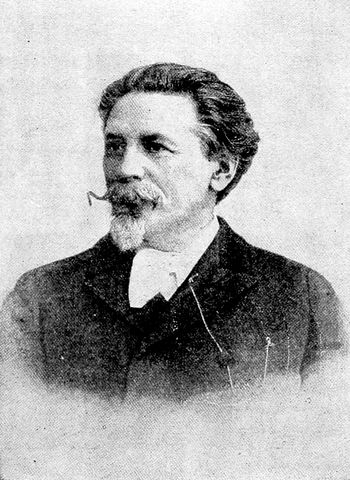
Joseph Keppler of "Puck."
But another change which the spirit of journalism has wrought in the
contemporary cartoon, and a more vital change than any other, is due
to the definite editorial policy which lies behind it. The dominant
note in all the work of the great cartoonists of the past, in the
English Gillray and the French Daumier, was the note of
individualism. Take away the personal rancor, the almost irrational
hatred of "Little Boney" from Gillray, take away Daumier's mordant
irony, his fearless contempt for Louis Philippe, and the life of their
work is gone. The typical cartoon of to-day is, to a large extent, not
a one-man production at all. It is frequently built up, piecemeal, one
detail at a time, and in the case of a journal like Punch or Judge
or Life often represents the thoughtful collaboration of the entire
staff. In the case of the leading dailies, the cartoon must be in
accord with the settled political policy of the paper, as much as the
leading articles on the editorial page. The individual preferences of
the cartoonist do not count. In fact, he may be doing daily violence
to his settled convictions, or he may find means of espousing both
sides at once, as was the case with Mr. Gillam, who throughout the
Cleveland-Blaine campaign was impartially drawing Democratic cartoons
for Puck and suggesting Republican cartoons for Judge at the same
time.
What the political cartoon will become in the future, it is dangerous
to predict. There is, however, every indication that its influence,
instead of diminishing, is likely to increase steadily. What it has
lost in ceasing to be the expression of the individual mind, the
impulsive product of erratic genius, it has more than gained in its
increased timeliness, its greater sobriety, its more sustained and
definite purpose. At certain epochs in the past it has served as a
vehicle for reckless scandal-mongering and scurrilous personal abuse.
But this it seems to have happily outgrown. That pictorial satire may
be made forceful without the sacrifice of dignity was long ago
demonstrated by Tenniel's powerful work in the pages of Punch. And
there is no doubt that a serious political issue, when presented in
the form of a telling cartoon, will be borne home to the
minds of a far larger circle of average every-day men and women than
it ever could be when discussed in the cold black and white of the
editorial column.
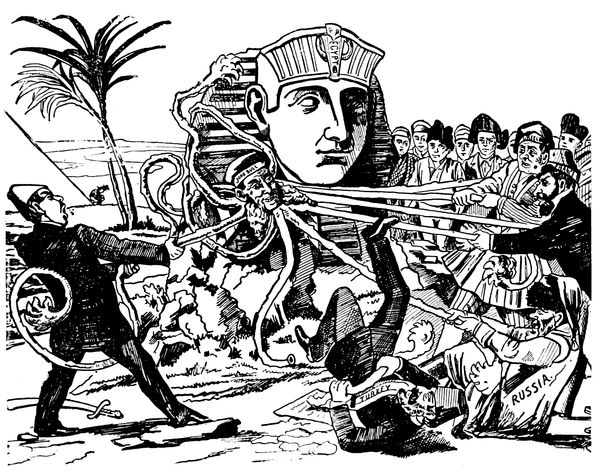
The John Bull Octopus in Egypt.
From "Il Papagallo" (Rome).
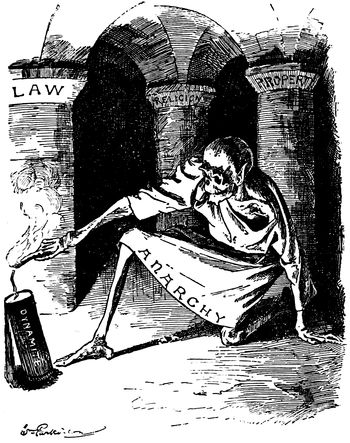
A Hand against every Man.
From London "Judy," April 13, 1892.
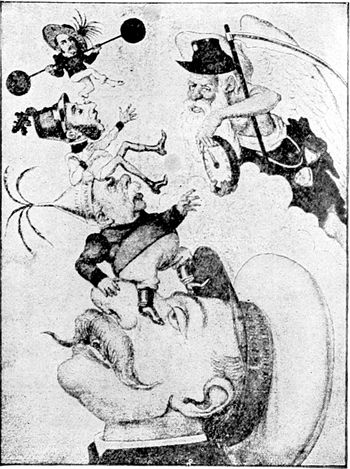
The Stability of the Triple Alliance.
From "Il Papagallo" (Rome).
Another interesting effect of the growing conservative spirit in
caricature is seen in the gradual crystallization of certain definite
symbolic types. Allusion has already been made, in earlier chapters of
this work, to the manner in which the conception of John Bull and
Uncle Sam and other analogous types, has been gradually built up by
almost imperceptible degrees, each artist preserving all the essential
work of his predecessor, and adding a certain indefinable something of
his own, until a certain definite portrait has been produced, a
permanent ideal, whose characteristic features the
cartoonists of the future could no more alter arbitrarily than they
could the features of Bismarck or Gladstone. And not only have these
crystallized types become accepted by the nation at large,—not only
is Uncle Sam the same familiar figure, tall and lanky, from the New
York Puck to the San Francisco Wasp,—but gradually these national
types have migrated and crossed the seas, and to-day they are the
common property of comic artists of all nations. John Bull and the
Russian Bear, Columbia and the American Eagle, are essentially the
same, whether we meet them in the press of Canada, Australia, Cape
Colony, or the United States. And for the very reason that there is so
little variety in the obvious features, the mere physical contour, the
subtler differences due to race prejudice and individual limitations
are all the more significant and interesting. There are
cases, and comparatively recent cases, too, where race-prejudice has
found expression in such rampant and illogical violence as prompted
many of the Spanish cartoons during our recent war over Cuba, in which
Americans were regularly portrayed as hogs—big hogs and little hogs,
some in hog-pens, others running at large—but one and all of them as
hogs. The cartoonists of the Continent, Frenchmen, Germans, and
Italians alike, have difficulty in accepting the Anglo-Saxon type of
John Bull. Instead, they usually portray him as a sort of sad-faced
travesty upon Lord Dundreary, a tall, lank, much bewhiskered "milord,"
familiar to patrons of Continental farce-comedy. But it is not in
cases like these that race prejudice becomes interesting. There is
nothing subtle or suggestive in mere vituperation, whether
verbal or pictorial, any more than in the persistent representation of
a nation by a type which is no sense representative. On the other
hand, the subtle variations of expression in the John Bull of
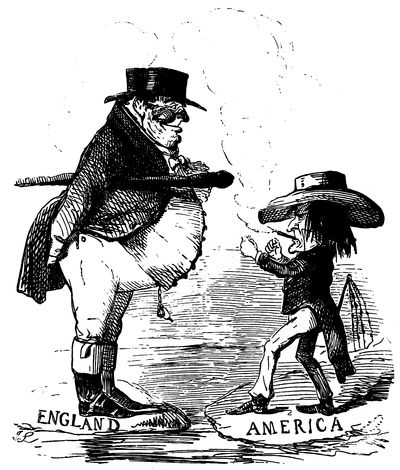
contemporary American artists, or the Uncle Sam of British caricature,
will repay careful study. They form a sort of sensitive barometer of
public sentiment in the two countries, and excepting during the rare
periods of exceptional good feeling there is always in the
Englishman's conception of Uncle Sam a scarce-concealed suggestion of
crafty malice in place of his customary kindly shrewdness, while
conversely, our portrayal of John Bull is only too apt to convert that
bluff, honest-hearted country gentleman into a sort of arrogant
blusterer, greedy for gain, yet showing the vein of cowardice
distinctive of the born bully.
In marked contrast to the preceding lengthy period of tranquillity,
the closing decade of the nineteenth century witnessed a succession of
wars and international crises well calculated to stimulate the pencils
of every cartoonist worthy of the name. One has only to recall that to
this period belong the conflict between China and Japan, the brief
clash between Greece and Turkey, the beginning of our policy of
expansion, with the annexation of Hawaii, our own war with Spain, and
England's protracted struggle in the Transvaal, to realize how rich in
stirring events these few years have been, and what opportunities they
offer for dramatic caricature.
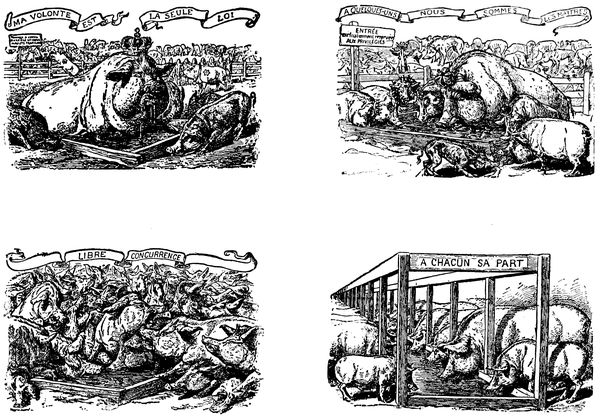
I. Absolute Monarchy.
II. Constitutional Government.
III. Middle Class Republic.
IV. Social Republic.
A Present Day Lesson.
From the "Revue Encyclopédique."
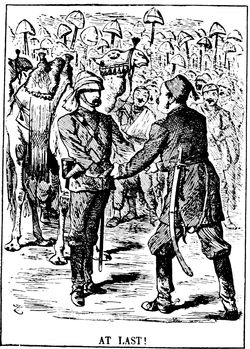
A Punch slip: a cartoon published in anticipation of
an event which did not occur—viz. the meeting of General Gordon and
General Stewart at Khartoum.
By Tenniel, February 7, 1885.
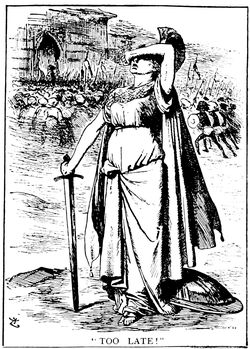
Telegram, Thursday morning, Feb. 5.—"Khartoum taken
by the Mahdi. General Gordon's fate uncertain."
By Tenniel, February 14, 1885.
The London "Times" and the Spurious Parnell Letters.
A cartoon produced in an earlier chapter, entitled "Waiting," showed
General Gordon gazing anxiously across the desert at the mirage which
was conjured up by his fevered brain, taking the clouds of the horizon
to be the guns of the approaching British army of relief. Early in
1885 the relief expedition started under the command of General Henry
Stewart, and on February 7 there was published in Punch the famous
cartoon "At Last," showing the meeting between Gordon and the
relieving general. This was a famous Punch slip. That meeting never
occurred. For on February 5, two days before the appearance of the
issue containing the cartoon, Khartoum had been taken by the Mahdi.
The following week Tenniel followed up "At Last" with the cartoon
"Too Late," which showed the Mahdi and his fanatic
following pouring into Khartoum, while stricken Britannia covers her
eyes.
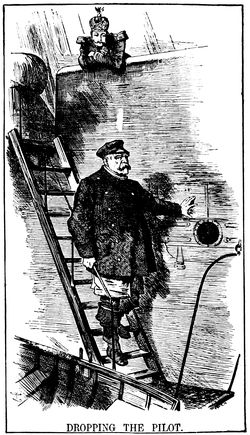
Tenniel's Famous Cartoon at the Time of Bismarck's
Retirement.
The Times challenge to Charles Stewart Parnell was, of course,
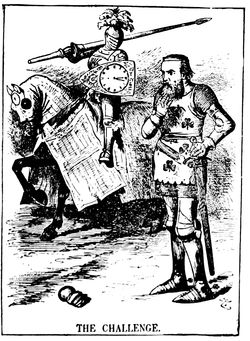
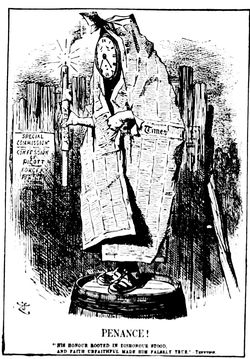
recorded in the caricature of Punch. The "Thunderer," it will be
remembered, published letters, which it believed to be genuine,
involving Parnell in the murders of Lord Frederick Cavendish and Mr.
Burke in Phœnix Park, Dublin, in 1882. When these letters were
proved to have been forged by Pigot, Punch published a cartoon
showing the Times doing penance. Both of these cartoons
were by Tenniel. "The Challenge" appeared in the issue of April 30,
1887, and "Penance" almost two years later, March 9, 1889.
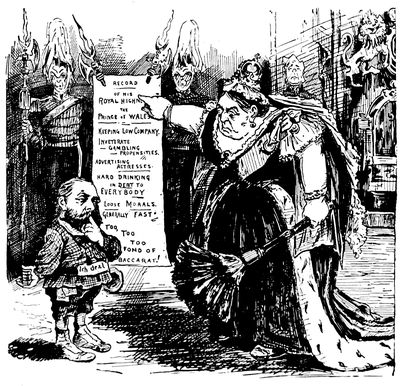
L'enfant Terrible.
The Baccarat Scandal at Tranby Croft in 1891.
From "Puck."
A cartoon which marked Tenniel's genius at its height, a cartoon
worthy of being ranked with that which depicted the British Lion's
vengeance on the Bengal Tiger after the atrocities of the Sepoy
rebellion, was his famous "Dropping the Pilot," which was published on
March 29, 1890, after William II. of Germany had decided to dispense
with the services of the Iron Chancellor. Over the side of the ship
of state the young Emperor is leaning complacently looking
down on the grim old pilot, who has descended the ladder and is about
to step into the boat that is to bear him ashore. The original sketch
of this cartoon was finished by Tenniel as a commission from Lord
Rosebery, who gave it to Bismarck. The picture is said to have pleased
both the Emperor and the Prince.
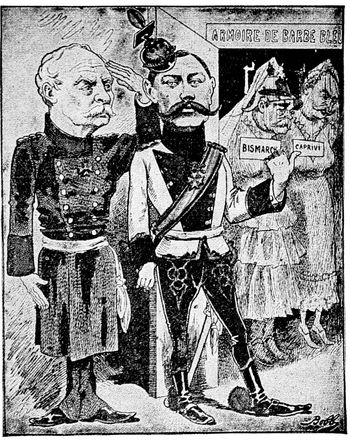
William Bluebeard.
"My first two wives are dead. Take care, Hohenlohe, lest the same fate
overtake you."
From "La Silhouette" (Paris).
The baccarat scandal at Tranby Croft and the subsequent trial at which
the then Prince of Wales was present as a witness was a rich morsel
for the caricaturist in the early summer of 1891. Not only in England,
but on the Continent and in this country, the press was full of jibes
and banter at the Prince's expense. The German comic paper,
Ulk, suggested pictorially a new coat-of-arms for his Royal Highness
in which various playing cards, dice, and chips were much in evidence.
In another issue the same paper gives a German reading from Shakspere
in which it censures the Prince in much the same manner that Falstaff
censured the wild Harry of Henry IV. The London cartoonists all had
their slings with varying good nature. Fun represented the Prince as
the Prodigal Son being forgiven by the paternal British nation. Point
to this cartoon was given by the fact that the pantomime "L'Enfant
Prodigue" was being played at the time in the Prince of Wales'
Theater. The Pall Mall Budget showed the Queen and the Heir Apparent
enjoying a quiet evening over the card table at home. The Prince is
saying: "Ah, well! I must give up baccarat and take to cribbage with
mamma."
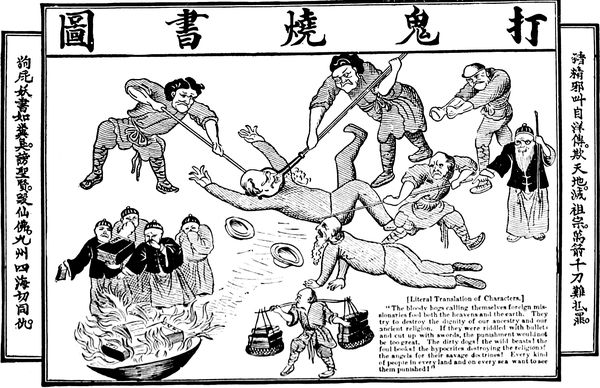
Christianity and the Bible in China.
An exact copy of a Chinese native cartoon. Reproduced in the San
Francisco "Wasp," Jan. 2, 1982.
Moonshine, in a cartoon entitled "Aren't they Rather
Overdoing it?" took a kindlier and a more charitable view of the whole
affair. His Royal Highness is explaining the matter to a most horrible
looking British Pharisee. "Don't be too hard on me, Mr. Stiggins," he
says. "I am not such a bad sort of a fellow, on the whole. You mustn't
believe all that you read in the papers." The nature of the American
caricature of the scandal may be understood from the cartoon which we
reproduce from Puck. This cartoon speaks for itself.
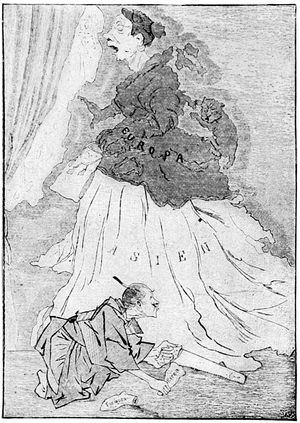
Japan—"Does it hurt up There?"
From "Kladderadatsch."
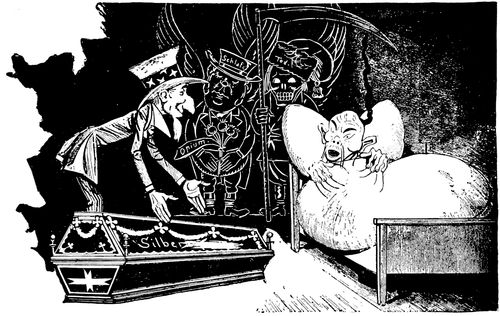
Business at the Death-Bed—Uncle Sam as Undertaker.
From "Kladderadatsch" (Berlin).
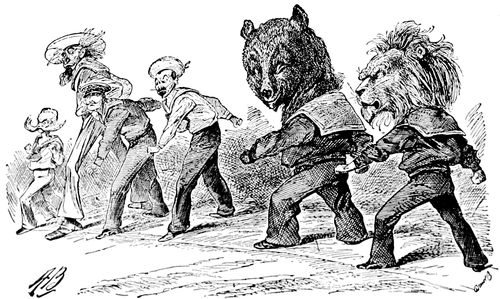
The Start for the China Cup.
From "Moonshine" (London).
The Emperor William and his chancellors inspired La Silhouette, of
Paris, to a very felicitous cartoon entitled "William Bluebeard."
William is warning Hohenlohe and pointing to a closet in
which are hanging the bodies of Bismarck and Caprivi, robed in
feminine apparel. "My first two wives are dead," says Bluebeard. "Take
care, Hohenlohe, lest the same fate overtake you!"
The increase in European armament in 1892 suggested to Tenniel the
idea of the cartoon "The Road to Ruin," which appeared November 5 of
that year. It shows the figures of two armed horsemen, France and
Germany, each burdened with armies of four million men, riding along
"The Road to Ruin." Their steeds, weighed down by the burdens they
bear, are faltering in their strides. A cartoon published shortly
afterwards in the London Fun shows the figure of Peace welcoming the
emperors of Germany and Austria, and urging them hospitably to lay
aside their sword-belts. "Thanks, Madam," rejoins Kaiser Wilhelm, "but
we would rather retain them—in your behalf!"
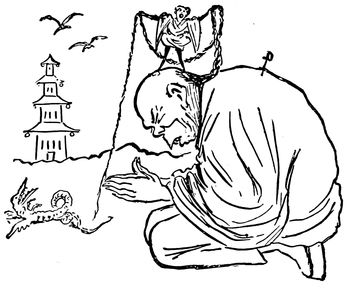
Tableau.
End of the Chinese-Japanese War.
From Toronto "Grip."
The brief war between China and Japan was necessarily of a nature to
suggest cartoons of infinite variety. It was the quick, aggressive
bantam against a huge but unwieldy opponent, and one of the earliest
cartoons in Punch utilized this idea in "The Corean Cock
Fight." The big and clumsy Shanghai is warily watching his diminutive
foe, while the Russian bear, contentedly squatting in the background,
is saying softly to himself: "Hi! whichever wins, I see my way to a
dinner." Every feature of Chinese life offered something to the
caricaturists. For instance, in a cartoon entitled "The First
Installment," London Fun shows the Jap slashing off the Chinaman's
pigtail. Now this idea of the pigtail in one form or another was
carried through to the end of the war. For example the Berlin Ulk
offers a simple solution of the whole controversy in a picture
entitled "How the Northern Alexander Might Cut the Corean Knot." China
and Japan, with their pigtails hopelessly tangled in a knot labeled
"Corea," are tugging desperately in opposite directions, while Russia,
knife in one hand and scissors in the other, is preparing to cut off
both pigtails close to the heads of his two victims.
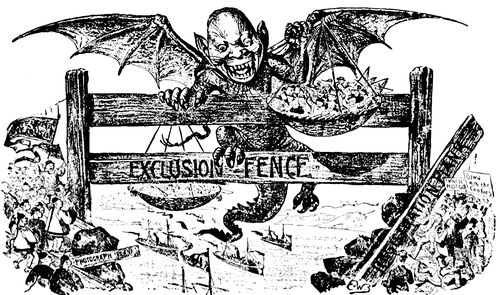
The Chinese Exclusion Act.
From The San Francisco "Wasp."
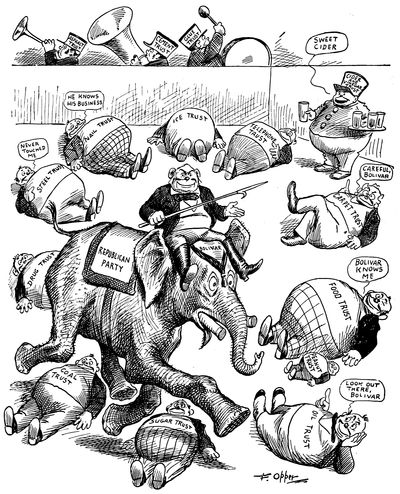
The Great Republican Circus.
This is considered by Mr. Opper as one of his most effective political
cartoons.
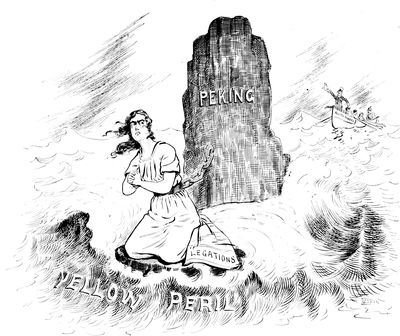
To the Rescue!
Punch characteristically represented the contending nations
as two boys engaged in a street fight, while the various
powers of Europe are looking on. John Chinaman has obviously had very
much the worst of the fray; his features are battered; he is on the
ground, and bawling lustily, "Boo-hoo! he hurtee me welly much! No
peacey man come stoppy him!" The end of the war was commemorated by
Toronto Grip in a tableau showing a huge Chinaman on his
knees, while a little Jap is standing on top of the Chinaman's head
toying with the defeated man's pigtail. Kladderadatsch, of Berlin,
printed a very amusing and characteristic cartoon when the war was at
an end: "Business at the death-bed—Uncle Sam as Undertaker." This
pictorial skit alludes to the proposition from the United States that
China pay her war indemnity to Japan in silver. It shows a stricken
Chinaman tucked in a ludicrous bed and about to breathe his last.
Uncle Sam, as an enterprising undertaker, has thrust his way in and
insists on showing the dying man his handsome new style of coffin.
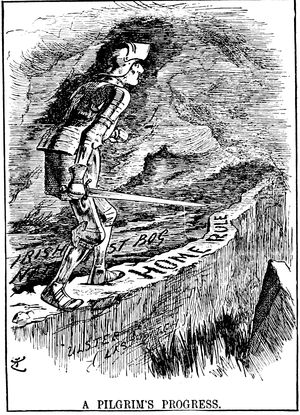
Mr. Gladstone in the Valley.
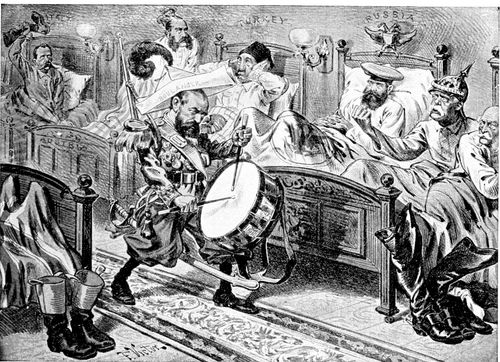
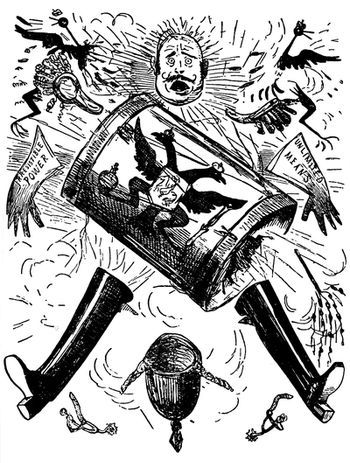
The Boulanger Excitement.
The Noisy Boy in the European Lodging House.
From "Judge."
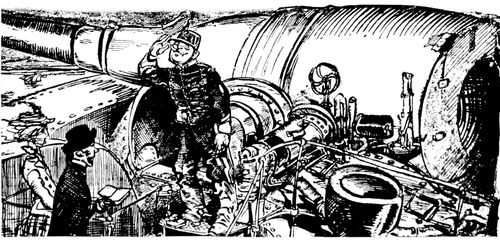
"Yes, Citizens, since the Disarmament This has been
made into a Telescope. Fortunately it was not a Muzzle-loader, so they
have been able to put a Lens at both Ends."
A French cartoon aimed at the Peace Conference.
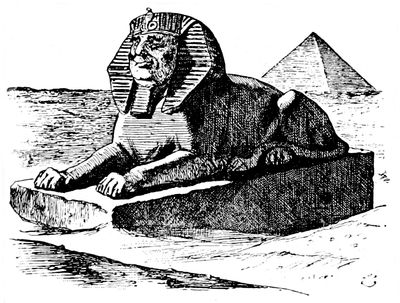
A Fixture.
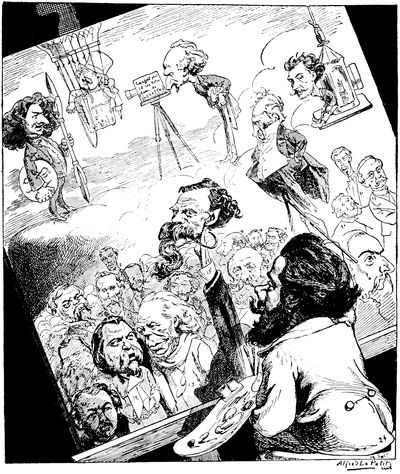
A Group of modern French Caricaturists.
Still another clever cartoon in which the Kladderadatsch summed up
the situation at the close of the war shows a map of the
eastern hemisphere, distorted into a likeness of a much-perturbed
lady, the British Isles forming her coiffure, Europe her arms and
body, and Asia the flowing drapery of her skirts. Japan, saw in hand,
has just completed the amputation of one of her feet—Formosa—and has
the other—Corea—half sawn off. "Does it hurt you up there?" he is
asking, gazing up at the European portion of his victim. The same
periodical a few months later forcibly called attention to the fact
that while France and Russia were both profiting by the outcome of the
war, Germany was likely to go away empty-handed. It is entitled "The
Partition of the Earth: an Epilogue to the Chinese Loan." China,
represented as a fat, overgrown mandarin, squatting comfortably on his
throne, serene in the consciousness that his financial difficulties
are adjusted for the time being, is explaining the situation to Prince
Hohenlohe, who is waiting, basket in hand, for a share of the spoils.
On one side Russia is bearing off a toy engine and train of cars,
labeled "Manchuria," and on the other France is contentedly jingling
the keys to a number of Chinese seaports. "The world has been given
away," China is saying; "Kwangtung, Kwangsi, and Yünnan are
no longer mine. But if you will live in my celestial kingdom you need
not feel any embarrassment; your uselessness has charmed us
immensely."
The Boulanger excitement, which so roused France until the bubble was
effectually pricked by the lawyer Floquet's fencing sword, was
satirized by Judge in a cartoon entitled "The Noisy Boy in the
European Lodging House." The scene is a huge dormitory in which the
various European powers have just settled down in their separate beds
for a quiet night's rest when Boulanger, with a paper cap on his head,
comes marching through, loudly beating a drum. In an instant all is
turmoil. King Humbert of Italy is shown in the act of hurling his
royal boot at the offending intruder. The Czar of Russia has opened
his eyes and his features are distorted with wrath. Bismarck is
shaking his iron fist. The Emperor of Austria is getting out of bed,
apparently with the intention of inflicting dire punishment on the
interrupter of his slumbers. Even the Sultan of Turkey, long
accustomed to disturbances from all quarters, has joined in the
popular outcry. The lodgers with one voice are shouting, "Drat that
Boy! Why doesn't he let us have some rest?"
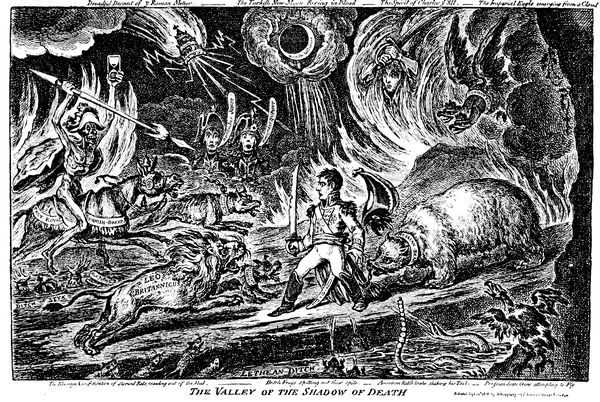
The old allegorical ideal of Christian passing through the dangers of
the Valley of the Shadow of Death in Bunyan's "Pilgrim's Progress,"
which has been appearing in caricature every now and then since
Gillray used it against Napoleon, was employed by Tenniel in a cartoon
of Mr. Gladstone and Home Rule published in Punch, April 15, 1893.
The old warrior, sword in hand, is making his way slowly along the
narrow and perilous wall of Home Rule. On either side are the bogs of
disaster, suggestive of his fate in case his foot should slip.
The Panama scandals in France and the ensuing revelations of
general political trickery suggested one of Sambourne's best cartoons,
that depicting France descending into the maelstrom of corruption.
This cartoon appeared in the beginning of 1893. It shows France in the
figure of a woman going supinely over the rapids, to be hurled into
the whirlpool below.
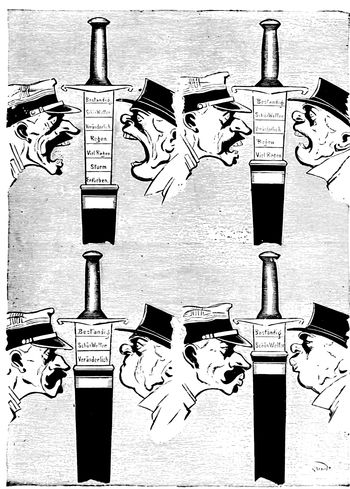
The Anglo-French War Barometer.
Fashoda!!! Fashoda!! Fashoda! Fashoda.
From "Kladderadatsch" (Berlin).
British feeling on the Fashoda affair was summed up by Tenniel in two
cartoons which appeared in October and November, in 1898. The first
of these called "Quit-Pro Quo?" was marked by a vindictive
bitterness which appeared rather out of place in the Punch of the
last quarter of the century. But it must be remembered that for a
brief time feeling ran very high in both countries over the affair. In
this cartoon France is represented as an organ-grinder who persists in
grinding out the obnoxious Fashoda tune to the intense annoyance of
the British householder. The second cartoon represents the Sphinx with
the head of John Bull. John Bull is grimly winking his left eye, to
signify that he regards himself very much of a "fixture" in Egypt.
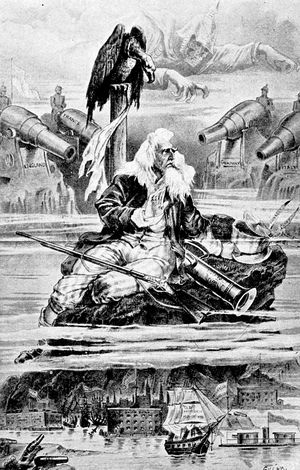
The dangerous condition in which the United States found itself about
the time we began the building of our new and greater navy was
depicted in Judge by the cartoon entitled, "Rip Van Winkle Awakes at
Last." It shows a white-bearded, white-haired Uncle Sam seated on a
rock about which the tide is rapidly rising, looking round at the
great modern armaments of England and France and Germany and Italy,
and murmuring, as he thinks of his own antiquated wooden ships of war
and brick forts, "Why, I'm twenty years behind the age." In his old
hat, with the broken crown, are the feathers of Farragut, Perry, Paul
Jones, and Lawrence, but these alone are not enough, nor will even the
"Spirit of '76," which hovers over him in the shape of an eagle, quite
suffice. He has his musket of 1812 and his muzzle-loading gun of 1864,
but in the background are those huge cannon of European foes and above
them is the gaunt, grim figure of a helmeted Death. A little more and
it would have been too late. Now there is yet time. Rip Van Winkle
awakes at last.
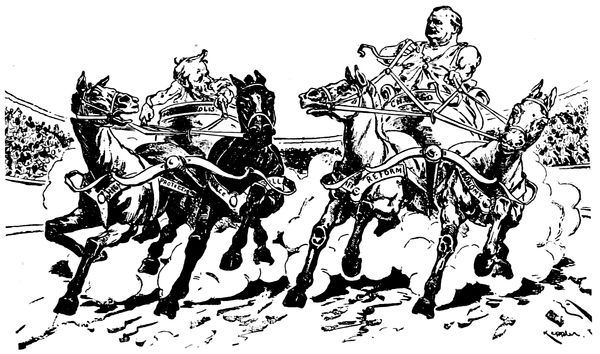
An interesting variant upon the old type of "Presidential
Steeplechase" cartoons appeared in Puck during the summer of 1892,
after the Republican convention at Minneapolis and the Democratic
convention at Chicago had respectively nominated Mr. Harrison and Mr.
Cleveland. The cartoon is entitled "They're Off!" and is drawn with
admirable spirit. The scene is a Roman amphitheater, and the two
Presidential candidates, in the guise of charioteers, are
guiding their mettlesome steeds in a mad gallop around the arena. Mr.
Cleveland's horses, "Tariff Reform" and "Economy," are running
steadily, and seem to be slowly forging to the front, while those of
Mr. Harrison, "High Protection" and "Force Bill," are not pulling well
together, and with ears pointed forward, look as though they might at
any moment become unmanageable.
Rip Van Winkle wakes at last.
By Gillam in "Judge."
They're off!
The Presidential race between Harrison and Cleveland in 1892.
From "Puck."
"Where am I at?"
The famous redrawn cartoon which in its original form depicted Mr.
Cleveland and the Democratic Party disastrously routed at the polls in
1892.
By Gillam in "Judge."
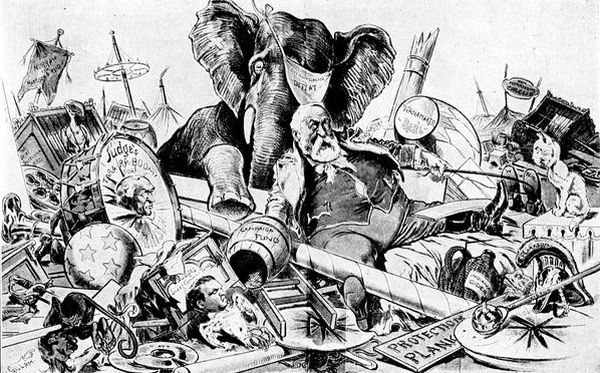
In connection with this campaign of 1892, there was no cartoon of more
interest than that entitled "Where Am I At?" which Bernard Gillam
drew for Judge, and this interest lies less in the cartoon
itself than in the amusing story of its conception and execution.
Right up to election day not only Gillam, but the entire staff of
Judge, were perfectly confident of Republican success at the polls.
To them the election seemed to be a mere formality which had to be
gone through with, in order that General Harrison might remain in the
White House for four years more. So a conference was held, after which
Mr. Gillam began work on the cartoon which was to commemorate the
Republican victory. The idea used was that of a general smash-up, with
Mr. Cleveland in the middle of the débâcle and the Republican
elephant marching triumphantly over the ruins. Along these lines a
double-page cartoon was drawn with an immense variety of detail,
reproduced, and made ready for the press. Election Day came around,
and a few hours after the polls had been closed it became evident, to
the consternation of Mr. Gillam and his associates, that instead of
the expected Republican victory, Mr. Cleveland had swept the country
by overwhelming majorities. What was to be done? It was too
late to prepare another cartoon, so that the plate already made was
taken from the press, and the cartoonist set to work. To the
discomfited countenance of Mr. Cleveland Gillam attached a beard which
transformed the face into a likeness to that of the defeated
Republican candidate. A huge patch drawn over one of the eyes of the
Republican elephant changed its appearance of elation to one of the
most woe-begone depression. Other slight changes in the legends here
and there throughout the picture transformed its nature to such an
extent that only the most practiced eye could detect anything that was
not wholly spontaneous and genuine. To cap it all, in a corner of the
picture Gillam drew a likeness of himself in the form of a monkey
turning an uncomfortable somersault. With a knowledge of these facts
the reader by a close examination of this cartoon, which is reproduced
in this volume, will undoubtedly detect the lines along which the
lightning change was made. Nevertheless, it will be impossible for him
to deny that the transformation was cleverly done.
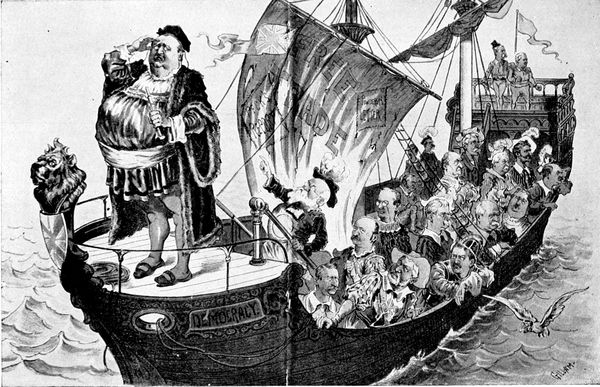
The Political Columbus who will not land in 1892.
By Gillam in "Judge."
Besides being the year of the Presidential campaign, 1892 was a year
when the thoughts of Americans were turned backward four centuries to
the time when Christopher Columbus first landed on the shore of the
Western Hemisphere. The original ships of Columbus's fleet were being
brought over the water from Spain; the Columbus idea was being
exploited everywhere in topical song and light opera; and it would
have been strange indeed if it had failed to play some part in
political caricature. Gillam in Judge made use of it in the cartoon
entitled "The Political Columbus Who Will NOT Land in '92." It
represents the ship of the Democracy with Mr. Cleveland as Columbus
gazing anxiously and uneasily at the horizon. At the bow of
the ship is the lion's head and the shield of Britannia, in allusion
to Mr. Cleveland's alleged pro-English sympathies. The sail upon which
the ship is relying for its progress is marked "Free Trade" and is a
woefully patched and weather-beaten bit of canvas. The crew of the
ship is a strange assortment which suggests all sorts of mutiny and
piracy. In the front of the vessel and close behind the captain are
Dana, Croker, Sheehan, and Hill. Beyond them we see the figures of
Cochran, Carlisle, Crisp, Brice, and Mills and Flower. In the far aft
are Blackburn and Gorman. Evidently crew and captain are animated by
despair, although the gull, bearing the features of Mr. Pulitzer, of
the New York World, that is circling around the ship, shows that
land is not so many miles away. "I don't see land," cries
Cleveland-Columbus. And the despairing crew, pointing to the Free
Trade sail, calls back, "And you never will with that rotten canvas."
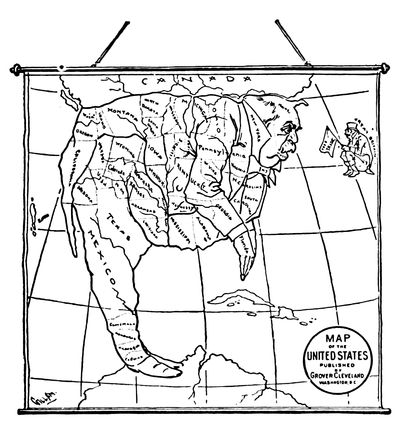
Map of the United States.
In contrast with the vindictive and malicious character of
the cartoons which heralded Mr. Cleveland's first election, there was
a marked absence of unpleasant personalities in those which belong to
the period of his second term. There was no disposition, however, to
spare him in regard to the growing difficulty he had in holding his
party together or his assumption of what Republicans regarded as an
entirely unwarranted degree of authority. This autocratic spirit was
cleverly satirized by a cartoon in Judge, to which allusion has
already been made. It consists simply of a map of the United States so
drawn as to form a grotesque likeness of the President. He is bending
low in an elaborate bow, in which mock-humility and glowing
self-satisfaction are amusingly blended, his folded hands forming the
Florida peninsula, his coat-tails projecting into lower California.
Beneath is inscribed the following paraphrase:
My country, 'tis of ME,
Sweet land of liberty,
Of ME I sing!
Mr. Cleveland's troubles with his party began early in his second
administration. As early as April we find him depicted by Judge as
the "Political Bull in the Democratic China-Shop." The bull has
already had time to do a vast amount of havoc. The plate-glass window,
commanding a view of the national capitol, is a wreck, and the floor
is strewn with the remains of delicate cups and platters, amidst which
may still be recognized fragments of the "Baltimore Machine," "Rewards
for Workers," "Wishes of the Leaders," etc. An elaborate vase, marked
"N. Y. Machine," and bearing a portrait of Senator Hill, is just
toppling over, to add its fragments to the general wreckage.
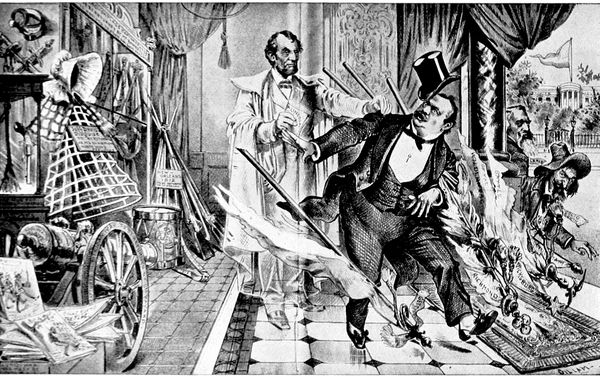
Return of the Southern Flags.
By Gillam in "Judge."
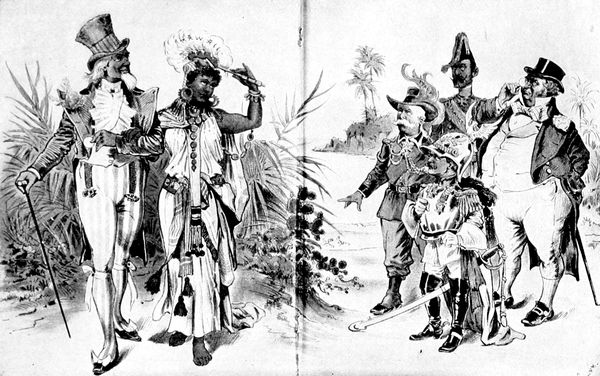
The Champion Masher of the Universe.
By Gillam in "Judge."
The general depression of trade and the much-debated issue of tariff
reform recur again and again in the caricatures of the
second Cleveland administration, especially after the Republican
landslide of 1893. Thus, in December of that year, a significant
cartoon in Judge represents the leading statesmen of each party
engaged in a game of "National Football," the two goals being
respectively marked "Protection" and "Free Trade." "Halfback" Hill is
saying, "Brace up, Cap; we've got the ball," and Captain Grover,
nursing a black eve, rejoins disconsolately, "That's all very well,
boys, but they've scored against us, and we've got to put up the game
of our lives to beat them." In January the same periodical published a
pessimistic sketch, showing Uncle Sam, shivering with cold, and his
hands plunged deep into his pockets, gloomily watching the mercury in
the "Industrial Thermometer" sinking steadily lower from protection
and plenty, through idleness, misery, and starvation, to the zero
point of free trade. "Durn the Democratic weather, anyway," says Uncle
Sam. A more hopeful view of the situation found expression in Puck,
in a cartoon entitled "Relief at Hand." Labor, in the guise of an
Alpine traveler, has fallen by the wayside, and lies half buried
beneath the snows of the "McKinley Tariff." Help, however, has come,
in the form of a St. Bernard, named "Wilson Tariff Bill," while
Cleveland, in the guise of a monk, is hastening from the neighboring
monastery, drawn in the semblance of the national capitol. Still
another cartoon harping on the need of tariff reform represents
McKinley and the other leading Republicans as "Ponce de Leon and His
Followers," gathered around a pool labeled "High Protection Doctrine."
"They think it is the fountain of political youth and strength, but it
is only a stagnant pool that is almost dried up." Among the many
caricatures in which Judge supported the opposite side, and heaped
ridicule on the Wilson Bill, one of the best shows Uncle Sam
retiring for the night, and examining with disgust and wrath the
meager crazy quilt (the Wilson Bill) with which he has been provided
in lieu of blankets. "I'll freeze to death," he is grumbling, "and yet
some of those idiots call this a protective measure."
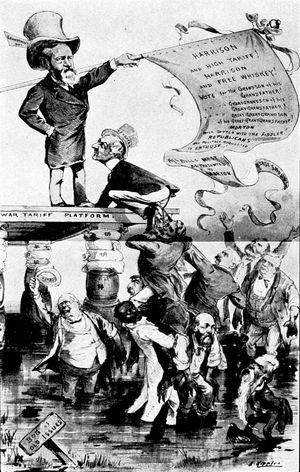
The Harrison Platform.
By Keppler in "Puck."
Mr. Cleveland's determination to return to the South the flags
captured in the War of Secession, in the hopes of putting an end to
sectional feeling, brought down upon his head the wrath of the more
extreme Republican element, a wrath which was reflected
strongly, editorially and pictorially, in the papers of the day. This
suggested to Judge the cartoon entitled "Halt," in which Mr.
Cleveland, in the act of handing back the captured flags, is
restrained by the spirit of Lincoln, which says, "Had you fought for
those flags you would not be so quick to give them away!" To which Mr.
Cleveland is made to reply, "Great Scott! I thought you were dead and
forgotten long ago. I only meant to please Mr. Solid South. They're
rubbish, anyhow." This is another cartoon from the hand of the
prolific Gillam.
The movement for the annexation of the Hawaiian Islands, which
occurred in the spring of 1893, and which many Americans were inclined
to regard with suspicion and disfavor, was commemorated in a great
variety of cartoons, both in this country and abroad. It was only
natural that a movement which owed its inception to a Republican
administration, should receive the cordial approval and indorsement of
Judge. A cartoon, dated February 18, represents Columbia in the
guise of an exemplary modern school-mistress, serenely holding in
order her turbulent class of mingled Chinese, negroes, Indians,
Italian organ-grinders, and Russian anarchists, while she gives a
cordial welcome to the small, half-naked new scholar from the Pacific,
who is timidly begging to be admitted. Canada, represented as a demure
little maiden, stands just behind Hawaii, an interested spectator,
apparently more than half inclined to follow his example. In much the
same spirit was a design that appeared in the Wasp, representing
Uncle Sam in the character of St. Peter, holding the key to America's
political paradise. "Poor little imp," he is saying to the Hawaiian
applicant, "I don't see why I should shut you out, when I've let in
all the tramps of the world already." Another cartoon which appeared
in Judge was entitled, "The Champion Masher of the
Universe." This represents Hawaii under the form of a dusky but comely
damsel, being borne off complacently by a gorgeously attired Uncle
Sam, while his discomfited rivals are looking on in chagrin and
disgust. These rivals are England, under the form of John Bull;
France, shown under the features of President Sadi Carnot; Germany,
the Emperor William; and Italy, King Humbert. This cartoon was drawn
by Gillam.
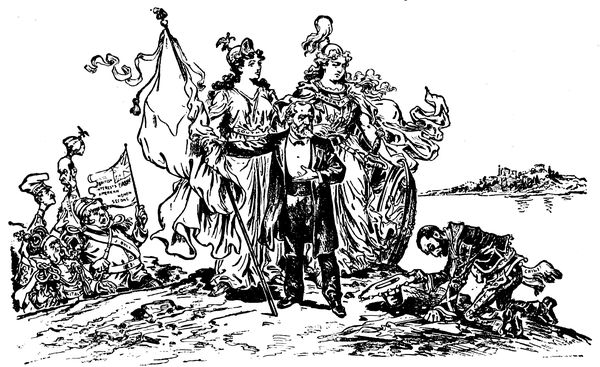
The End of the Chilian Affair.
From "Judge."
The Toronto Grip saw the matter in quite a different aspect. Hawaii,
a badly frightened savage, is bound to a stake, while Uncle Sam, in
the guise of a missionary, is whetting the knife of annexation,
preparing to give him the coup-de-grace, and at the same time waving
off John Bull, who holds his knife, "Protectorate," with similar
intent. "Hold up," says Hawaii, "didn't you say it was wrong to eat
man?" and Uncle Sam rejoins benevolently, "Yes—but—well,
circumstances alter cases, and the interests of civilization and
commerce, you know —— You keep off, John; he's my meat." The
suggestion that England was merely waiting for a good excuse to step
in and take possession of Hawaii, while the American administration
and Congress were trying to reach an understanding, was eagerly seized
upon by other journals as well as Grip, especially in Germany. The
Berlin Ulk portrayed Queen Liliuokalani, armed with a broom, angrily
sweeping Uncle Sam from his foothold in Honolulu, while John Bull,
firmly established on two of the smaller islands, "laughs to his
heart's content," so the legend runs, "but the Yankee is mad with
rage." In similar spirit the Kladderadatsch depicts John Bull and
Uncle Sam as "Two Good Old Friends," trying to "balance their
interests in the Pacific Ocean." With clasped hands the two rivals are
see-sawing backwards and forwards, each striving to retain a
precarious foothold, as they straddle the Pacific from Samoa to
Hawaii, and each quite oblivious of the discomfort of the squirming
little natives that they are crushing under heel.
The fiasco of Mr. Cleveland's attempt to restore Queen Liliuokalani to
her throne was hit off in Judge by a cartoon portraying him as Don
Quixote, physically much the worse for wear, as a result of his latest
tilt at the Hawaiian windmill. The knight's spirit, however, is
unbroken, and he is receiving philosophically the well-meant
consolation of Sancho Panza Gresham.
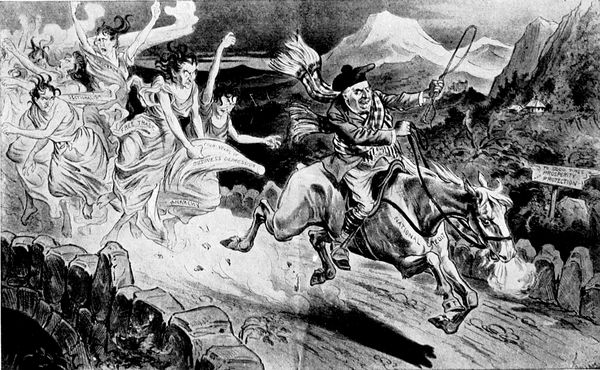
Mr. Mckinley as a Political Tam o' Shanter.
By Gillam in "Judge."
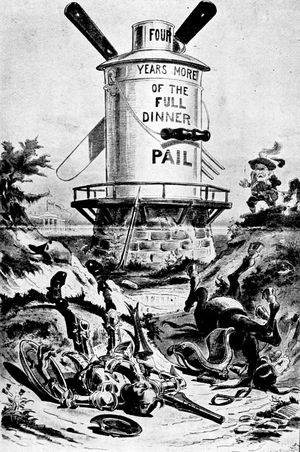
Don Quixote Bryan meets Disaster in his Encounter with
the full Dinner Pail.
By Victor Gillam in "Judge."
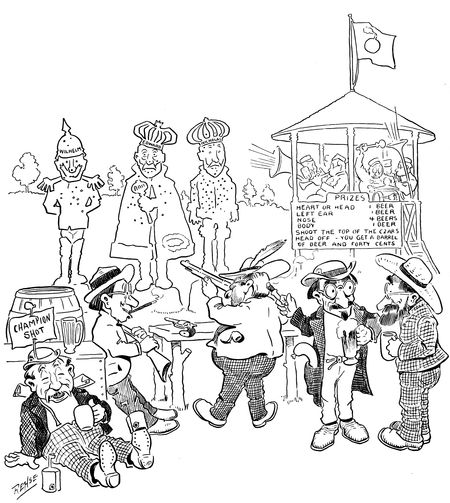
Outing of the Anarchists.
Another cartoon of sterling literary flavor is that representing Mr.
McKinley as a political Tam o' Shanter, which appeared during the
exciting election of 1896. The countenance of Tam in this cartoon
shows none of the anxiety and mental perturbation of the hero of
Burns' poems. You can see that he has full confidence in his
good mare, "National Credit," and is perfectly convinced that she will
carry him unscathed over the road to Good Times, Prosperity, and
Protection. The carlins have been close at his mare's heels, however,
and as he passes the bridge over which they dare not cross,
the foremost of his pursuers has caught and pulled away as a trophy
the tail of the steed. The tail, however, is something with which he
can well part, for it typifies four years of business depression. The
leaders of the pursuing carlins are Free Trade, Anarchy, Sectionalism,
and Popocracy.
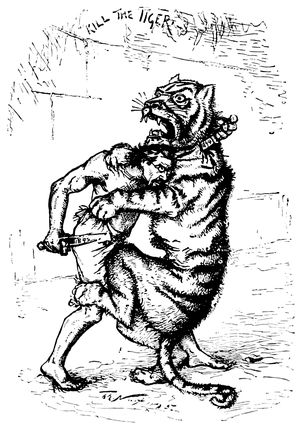
To the Death.
Mr. Bryan's appeal to the farmer in 1896 was hit off by Hamilton in a
powerful, but exceedingly blasphemous, cartoon entitled "The
Temptation." Bryan in the form of a huge angel of darkness has taken
the farmer to the top of a high mountain to show him the riches of the
world. As far as the eye can see stretch oceans and cities and hills
and rivers and mountains of silver. It is a great pity that so grim
and powerful a cartoon should have been marred by that
display of bad taste which has been too frequent in the history of
caricature.
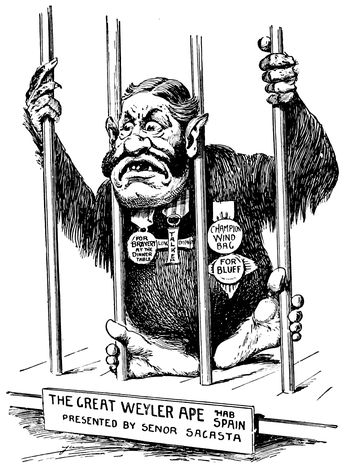
The Great Weyler Ape.
The caricature produced by the campaign between Mr. McKinley and Mr.
Bryan in 1900 offers few, if any, cartoons more admirable than that by
Mr. Victor Gillam, representing Don Quixote Bryan meeting disaster in
his fight against the full dinner pail. This cartoon has that literary
flavor which has been too much lacking in American caricature, and
which raises this particular cartoon far above the average in the same
school. The idea, of course, is based on Don Quixote's disastrous
encounter with the windmill, which that poor crack-brained gentleman
took to be a giant. The body of the windmill is a huge dinner pail
and its arms are a crossed knife and fork. Don Quixote,
incased in armor from head to foot, and mounted on the Democratic
donkey with free silver for a saddle, has tilted against the solid
structure with disastrous results. His lance is shattered, and he and
his faithful steed lie prostrate and discomfited on opposite sides of
the road. The Sancho Panza needed to complete the picture appears
under the familiar features of Mr. Richard Croker, who, leading the
Tammany Tiger by a rope, is hurrying to his master's assistance. In
the distance may be seen the White House, but the road in that
direction is completely barred by the stanch windmill that has so
successfully resisted the mad knight's onslaught.
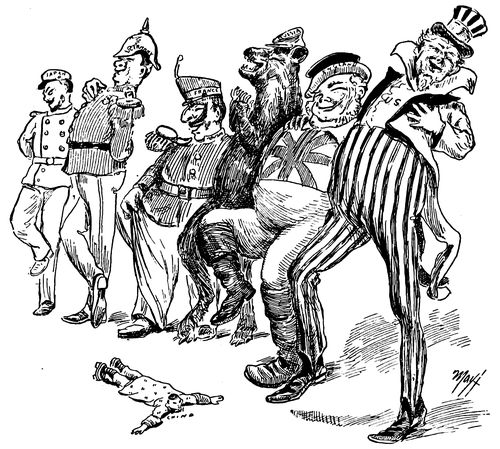
"We are the People."
The pent-up feeling throughout the United States, which reached a
dangerous degree of tension during the weeks preceding the declaration
of war against Spain, was forcibly symbolized in the Minneapolis
Herald. The dome of the National Capitol is portrayed, surmounted by
a "Congressional safety-valve." McKinley, clinging to the cupola, is
anxiously listening to the roar of the imprisoned steam, which is
escaping in vast "war clouds," in spite of all the efforts of Speaker
Reed, who is freely perspiring in his effort to hold down the valve.
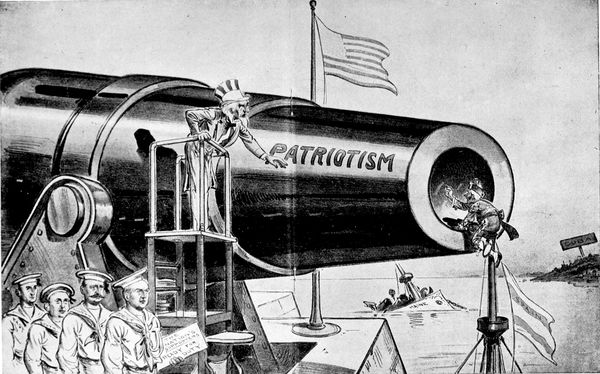
Be Careful! It's Loaded!
By Victor Gillam in "Judge."
One of those cartoons which are not to be forgotten in a day or a week
or a month; one which stirs the blood and rouses the mind to a new
patriotism even when seen years after the events which inspired it, is
Victor Gillam's "Be Careful! It's Loaded!" which appeared a few weeks
before the outbreak of the Spanish-American War and which we deem
worthy of being ranked among the twenty-five or thirty great cartoons
which the nineteenth century has produced. To realize to-day its full
force and meaning one has to recall the peculiar tension under which
the American people were laboring during the months of February,
March, and April, 1898. The Maine had been destroyed in Havana
Harbor, and although, now that anger has died down, we can no longer
cling implacably to the belief, which was then everywhere expressed,
that it was an act emanating from the Spanish Government, at the time
it was too much for our overwrought nerves; the condition
of Cuba was growing every day more deplorable, and everyone felt that
the inevitable conflict was hourly at hand. In the picture American
patriotism is symbolized by a huge cannon. A diminutive Spaniard has
climbed to the top of a mast of a Spanish vessel and monkey-like is
shaking his fist down the muzzle. Uncle Sam, standing by the gun and
realizing the Spaniard's imminent peril calls out, excitedly, "Be
Careful! It's Loaded!" a warning to which the latter seems little
inclined to pay any attention. In its very simplicity this cartoon
differs greatly from most of those of the school of Puck and
Judge. There is none of that infinite variety of detail which makes
an elaborate study necessary in order to arrive at a full
comprehension of the meaning of a cartoon. "Be Careful! It's Loaded!"
like the most striking English and French cartoons, may be understood
at a glance.
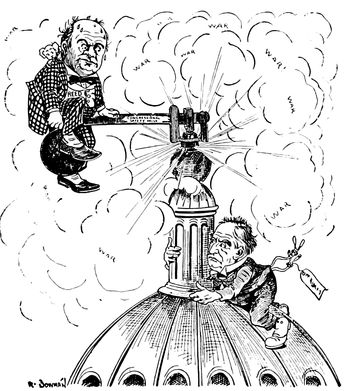
Speaker Reed to McKinley—"You've got to bank the fire
some way or other: I can't hold in this steam much longer."
Minneapolis "Tribune."
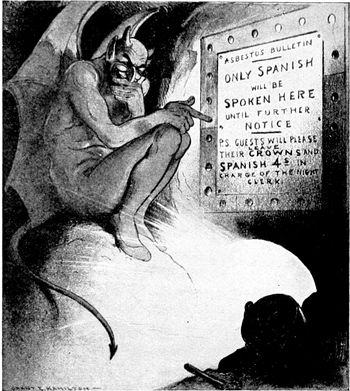
The Latest War Bulletin.
By Hamilton in "Judge."
A cartoon like Grant E. Hamilton's "The Latest War Bulletin"
we find amusing at the present time. We did not find it so a little
over five years ago. This latest war bulletin, printed in asbestos, is
supposed to have been just received from the infernal regions. His
Satanic majesty, with a sardonic grin upon his face, has just composed
it to his own entire satisfaction. Marked up on the burning furnace of
Hades it reads: "Only Spanish will be spoken here until further
notice—P.S. Guests will please leave their crowns and Spanish 4's in
charge of the night clerk."
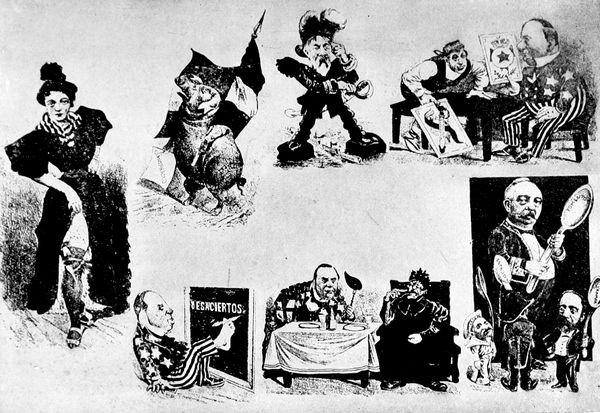 |
| A Knife for the American Pigs. |
Piratical—(Spain accused an American ship of flying the Spanish flag
in order to cut the cable) |
Sampson—"Where is Cervera's fleet?" |
McKinley—"I wonder what he holds?" |
| The result of the war—defeats. |
McKinley and England. |
|
The Minister of Revenue has a spoon for the war kettle. |
Spanish Cartoons of the Spanish-american War.
From "Don Quijote" (Madrid).
Another equally hideous cartoon by Hamilton is that entitled "The
Spanish Brute Adds Mutilation to Murder." It shows a hideous ape-like
monster representing Spain, one blood-dripping hand smearing the
tombstones erected to the sailors of the Maine and the other
clutching a reeking knife. All about him under the tropical trees are
the bodies of his mutilated victims. The expression of the
monster's countenance is a lesson in national prejudice. It shows how
far a well-balanced nation may go in moments of bitterness and anger.
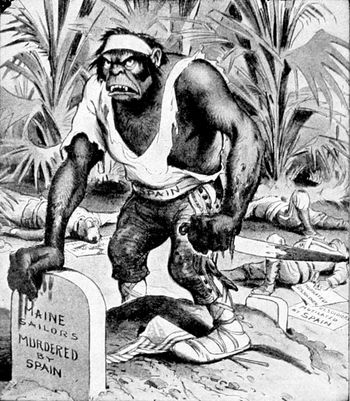
The Spanish Brute—Adds Mutilation to Murder.
By Hamilton in "Judge."
One of the most striking and amusing of all the cartoons evoked by the
results of the Spanish-American War appeared in Punch at a time when
our departure from our traditional policy began to cause comment in
Europe. There are two figures, that of Dame Europa and that of Uncle
Sam. Dame Europa is a lady of frigid aspect, with arms folded, and who
has drawn herself up to full height as she gazes scornfully at the
complacent and unruffled Uncle Sam. "To whom do I owe the honor of
this intrusion?" she asks icily. "Marm, my name is Uncle Sam." "Any
relation of the late Colonel Monroe?" is the scathing retort.
No less interesting than the American cartoons of the Spanish
War are those contributed by Spain herself, although in the light of
subsequent events they are chiefly amusing for their overweening
confidence and braggadocio insolence. Among the more extravagant
flights of Spanish imagination, which later news turned into
absurdities, may be cited "Dewey's Situation," in which the victor of
Manila is represented as a disconsolate rat, caught in the Philippine
mouse-trap; "Cervera bottles up Schley," a situation which the sober
facts of history afterwards reversed; and "McKinley's Condition," in
which the President is represented as swathed in bandages, and
suffering severely from apocryphal injuries received at Porto Rico and
Cienfuegos. All of these cartoons appeared at different times in the
Madrid Don Quijote, which did not always keep on this level of empty
boasting, but occasionally produced some really clever caricature. A
regular feature of the Spanish War cartoons was the American Hog as a
symbol of the United States, and some of the applications of this idea
in the Don Quijote were distinctly amusing. For instance, in
reference to Spain's accusation that an American ship flew the Spanish
flag at Guantanamo in order to approach near enough to cut the cable,
America is shown as a fat hog, triumphantly strutting along on its
hind legs and ostentatiously waving the Spanish colors. Again, the
Sampson-Schley controversy is hit off in a picture showing Sampson
surrounded by a number of naval "hogs," each armed with gigantic
shears and bent upon obtaining the Admiral's scalp. Still another
cartoon seeks to explain the "real purpose" in getting Cuba away from
Spain. A drove of pigs have clustered around a huge barrel of Cuban
molasses and are eagerly sucking the contents through tubes. Of a
more dignified type are the caricatures representing Spain
as a beautiful and haughty Señorita, boldly showing how she keeps
beneath her garter "a knife for the American pigs"; or pointing to her
shoe on which Cuba serves as a buckle, and arrogantly challenging a
diminutive McKinley, "you can't unbuckle that shoe!"
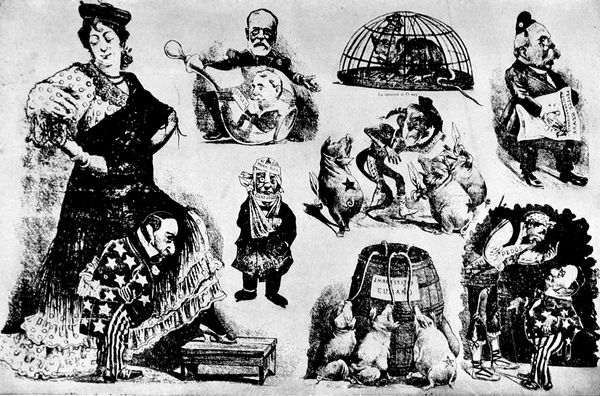 |
| "You can't unbuckle that shoe." |
Cervera bottles up Schley.
McKinley's condition. |
Dewey's situation.
After Sampson's scalp.
America's Real Desire. |
Castelar writes a letter.
"This is for you if you don't behave." |
Spanish Cartoons of the Spanish-American War.
From the "Don Quijote" (Madrid).
A cartoon which was a forerunner of the Transvaal War and the railway
between Capetown and Cairo was that entitled "The Rhodes Colossus,"
which appeared in Punch December 10, 1892. It was by the hand of
Linley Sambourne. It shows a colossal figure of Cecil Rhodes standing
on a map of Africa with one foot planted in Egypt and the other at the
Cape. In his hands he holds a line suggesting the telegraph wire
connecting the two places.
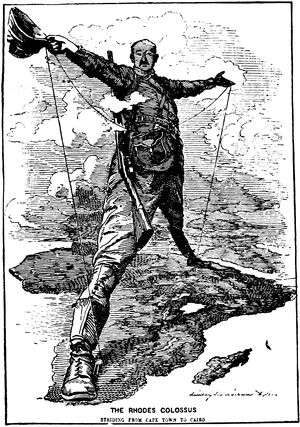
The Rhodes Colossus.
By Linley Sambourne.
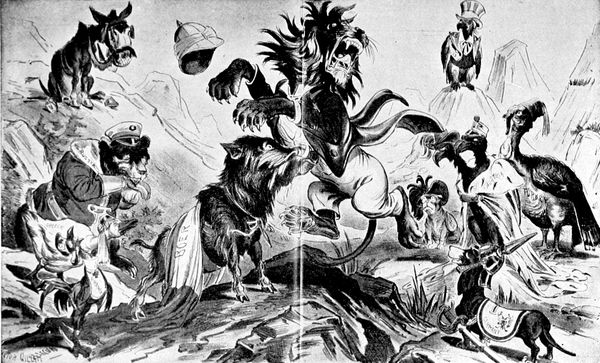
The Situation in South Africa.
By Gillam in "Judge."
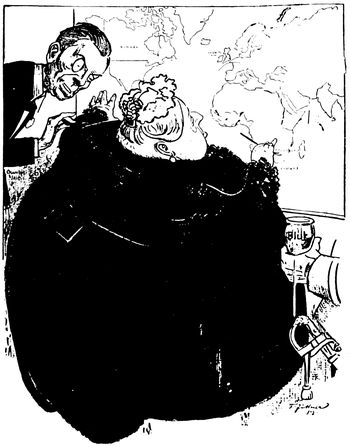
The English World Kingdom, or Bloody Cartography.
From the "Lustige Blätter."
Although the German Government refused to interfere in the
protracted struggle in the Transvaal, the sympathy of Germany with the
Boers found expression in a host of cartoons, bitterly inveighing
against British aggression. Thoroughly characteristic is one which
appeared in the Lustige Blätter entitled "English World-Kingdom; or,
Bloody Cartography." A grossly distorted caricature of Victoria is
standing before a map of the world, and dipping her pen in a cup of
blood, held for her by an army officer. Chamberlain, at her elbow, is
explaining that "the lowest corner down yonder, must be painted red!"
Another of the Lustige Blätter's grim cartoons, alluding to the
terrible price in human life that England paid for her ultimate
victory in the Transvaal, depicts Britannia, as Lady Macbeth,
vainly trying to wash the stain from her bloody hands. "Out,
damned spot!" In lighter vein is the cartoon which is here reproduced
from the Wiener Humoristische Blätter showing "Oom Paul at His
Favorite Sport." Kruger, rakishly arrayed in tennis garb, is
extracting infinite enjoyment from the congenial exercise of volleying
English soldiers, dressed up as shuttlecocks, over the "Transvaal net"
into the watery ditch beyond.
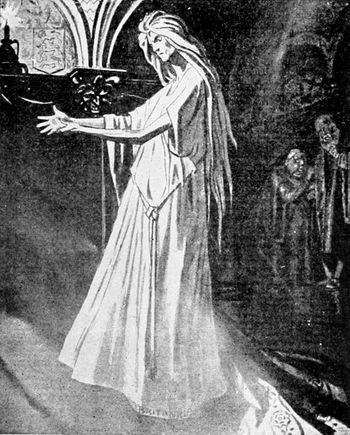
Britannia as Lady Macbeth trying to wash away the
Stains of the Boer War.
From the "Lustige Blätter."
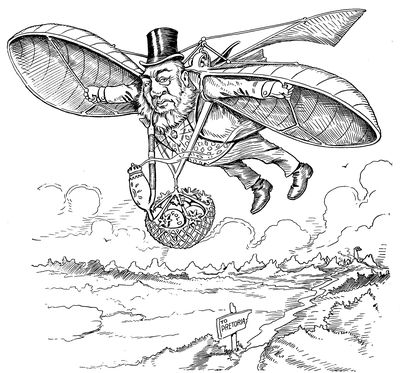
The Flying Dutchman.
Minneapolis "Journal."
Judged by the manner it was mirrored in the caricature of Europe and
America, the Dreyfus Case assumed the magnitude of a great war or a
crisis in national existence. During the last two or three years that
the degraded Captain of Artillery was a prisoner at Devil's Island,
when Zola was furiously accusing, and the General Staff was talking
about "the Honor of the Army," and France was divided into
two angry camps, one had only to glance at the current cartoons to
realize that Dreyfus was, as the late G. W. Steevens called him, "the
most famous man in the world." For a time the great personages of the
earth were relegated to the background. The monarchs and statesmen of
Europe were of interest and importance only so far as their careers
affected that of the formerly obscure Jewish officer.
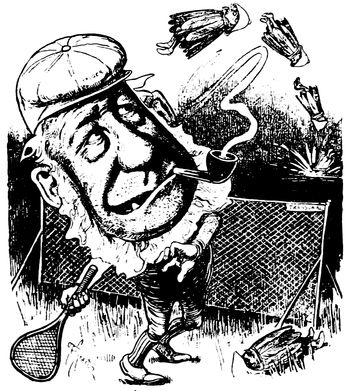
Oom Paul's Favorite Pastime.
From the "Wiener Humoristische Blätter."
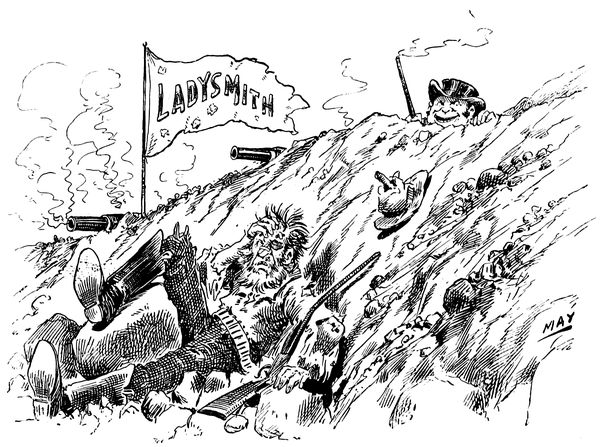
Up against the Breastworks.
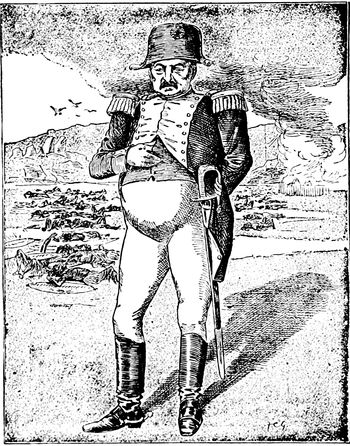
Mr. Rhodes—The Napoleon of South Africa.
From the Westminster "Budget" (London).
Perhaps the most famous of all the admirable cartoons dealing with
l'Affaire was the "Design for a New French Bastile," which was of
German origin and which caused the paper publishing it to be excluded
from French territory. It appeared just after Colonel Henry had cut
his throat with a razor in his cell in the Fortress of Vincennes, when
suspicions of collusion were openly expressed, and some went so far as
to hint that the prisoner's death might be a case of murder and not
suicide. The "Design for a New French Bastile" showed a
formidable fortress on the lines of the famous prison destroyed in the
French Revolution with a row of the special cells beneath. In one of
these cells a loaded revolver was placed conspicuously on the chair;
in the next was seen a sharpened razor; from a stout bar in a third
cell dangled a convenient noose. The inference was obvious, and the
fact that the cells were labeled "for Picquart," "for Zola," "for
Labori" and the other defenders of Dreyfus gave the cartoon an added
and sinister significance. In caricature the Dreyfus case was a battle
between a small number of Anti-Dreyfussard artists on the one hand,
and the Dreyfus press with all the cartoonists of Europe and the
United States as its allies on the other. The opportunity to exalt the
prisoner, to hold him up as a martyr, to interpret pictorially the
spirit of Zola's ringing "la vérité est en marche, et rien
ne l'arrêtera!" offered a vast field for dramatic caricature. On the
other hand the cartoon against Dreyfus and his defenders was
essentially negative, and the wonder is that the rout of the minority
was not greater—it should have been a veritable "sauve qui peut."
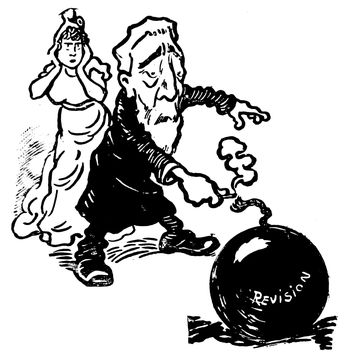
Fire!
From "Psst" (Paris).
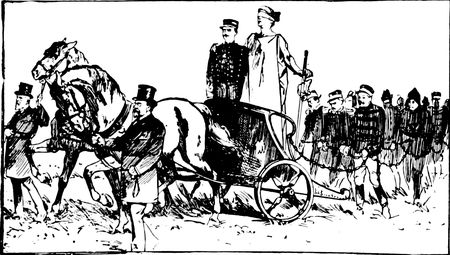
The last Phase of the Dreyfus Case.
Justice takes Dreyfus into her car.
From "Amsterdammer."
The spirit of anti-Dreyfussard caricature was Anti-Semitism. One of
the most striking of the cartoons on this side purported to contrast
France before 1789 and France at the end of the Nineteenth Century.
In the first picture we were shown a peasant toiling
laboriously along a furrow in the ground, bearing on his shoulders a
beribboned and beplumed aristocrat of the old régime, whose thighs
grip the neck of the man below with the tenacity of the Old Man of the
Sea. That was France before the Revolution came with its bloody
lesson. In the picture showing France at the end of the Nineteenth
Century there was the same peasant toiling along at the bottom, but
the burden under which he tottered was fivefold. Above him was the
petty merchant, who in turn carried on his shoulders the lawyer, and
so on until riding along, arrogantly and ostentatiously, at the top
was the figure of the foreign-born Jew, secure through the possession
of his tainted millions.
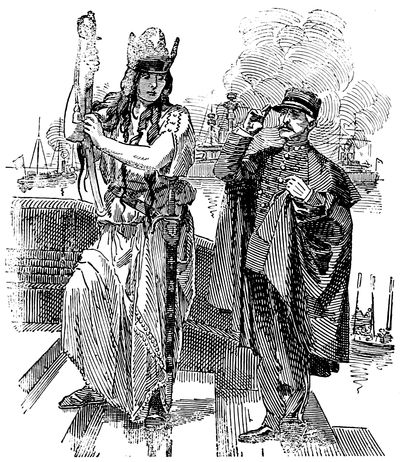
Toward Freedom.
Madame la République—"Welcome, M. Le Capitaine. Let me hope that I
may soon return you your sword."
From "Punch" (London).
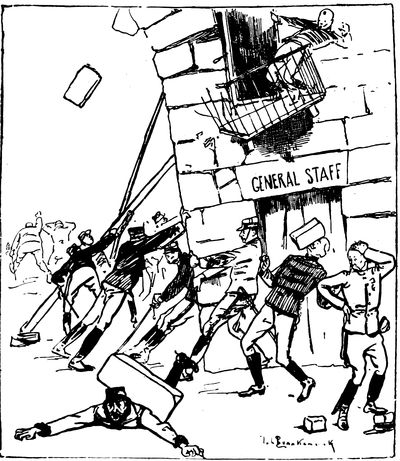
A Dutch View.
The present condition of the French general staff.
From "Amsterdammer."
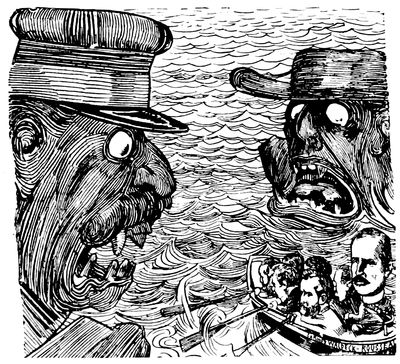
Between Scylla and Charybdis.
Waldeck-Rousseau—"Forward, dear friends, look neither to the right
nor the left, and we will win through at last."
From "Humoristische Blätter" (Berlin).
The dangerous straits through which the Waldeck-Rousseau
ministry was obliged to pass were hit off in a cartoon appearing in
the Humoristische Blätter of Berlin, entitled "Between Scylla and
Charybdis." On one side of the narrow waterway a treacherous rock
shows the yawning jaws of the Army. On the other side, equally hideous
and threatening, gleam the sharpened teeth of the face typifying the
Dreyfus Party. Waldeck-Rousseau, appreciating the choppiness of the
sea and the dangerous rocks, calls to his gallant crew: "Forward, dear
friends, look neither to the right nor to the left, and we will win
through at last." Many of the cartoons dealing with the Dreyfus case
were mainly symbolic in their nature; full of figures of "Justice
with her Scales," "Justice Blindfolded and with Unsheathed
Sword," "Swords of Damocles" and so on. A Dutch cartoon in
Amsterdammer, entitled "The Last Phase of the Dreyfus Case," showed
Justice taking the unfortunate captain into her car. The horses
drawing the car were led by Scheurer-Kestner and Zola, while following
the chariot, to which they are linked by ignominious chains, were the
discredited Chiefs of the Army. The same paper humorously summed up
the condition of the French General Staff in a picture showing a
falling house of which the occupants, pulling at cross-purposes, were
accelerating the downfall. The decision upon Revision and the
dispatching of the Spax to Cayenne to bring Dreyfus back to France was
commemorated in London Punch in a dignified cartoon called "Toward
Freedom." Madame la République greeted Dreyfus: "Welcome, M. le
Capitaine. Let me hope I may soon return you your sword." The
same phase of the case was more maliciously interpreted by Lustige
Blätter of Berlin in a cartoon entitled "At Devil's Island," which
showed the Master of the Island studying grinningly a number of
officers whom he held in the hollow of his hand, and saying: "They
take away one captain from me: but look here, a whole handful of
generals! Oh, after all, the arrangement is not so bad."
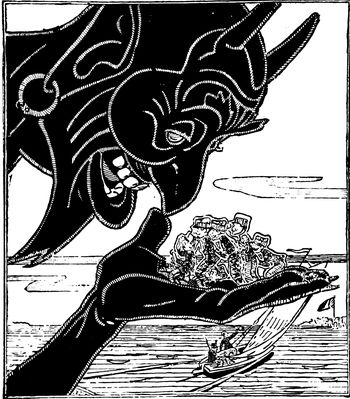
At Devil's Island.
The Master of the Island.—"They take away one captain from me; but
look here, a whole handful of generals! Oh, after all, the arrangement
is not so bad."
From "Lustige Blätter" (Berlin).
With the Spanish-American War, the Affaire Dreyfus in France, and
England's long struggle for supremacy in the Transvaal, the period
arbitrarily chosen as the scope of this book comes to a brilliant and
dramatic close. But the cartoonist's work is never done. Nimble
pencils are still busy, as in the days of Rowlandson and Gillray, in
recording and in influencing the trend of history. And although, now
and again during the past century, there has been some individual
cartoonist whose work has stood out more boldly and prominently than
the work of any one of our contemporaries in Europe or in this country
stands out to-day, there has never been a time in the whole history of
comic art when Caricature has held such sway and maintained such
dignity, and has enlisted in her service so many workers of the first
talent and rank. Without alluding to the men of France and England,
what an array it is that contemporary American caricature presents! C.
G. Bush of the New York World, Charles Nelan of the New York
Herald, Frederick Burr Opper and Homer Davenport of the New York
American and Journal, Mahoney of the Washington Star, Bradley of
the Chicago Evening-News, May of the Detroit Journal, "Bart" of
the Minneapolis Journal, Mayfield of the New Orleans
Times-Democrat, Victor Gillam, carrying on the traditions of his
brother—Rogers, Walker, Hedrick, Bowman, McCutcheon, Lambdin,
Wallace, Leipziger, Berryman, Holme, Bartholemew, Carter,
Steele, Powers, Barritt—and to name these men does not nearly exhaust
the list of those artists whose clever work has amused and
unconsciously influenced hundreds of thousands of thinking American
men and women.
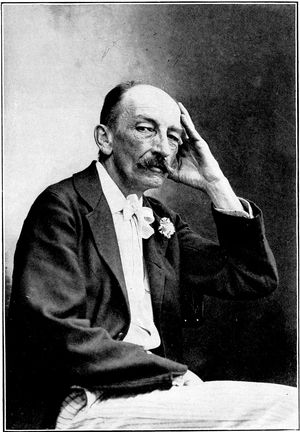
C. G. Bush of "The World." The Dean of Active American
Cartoonists.
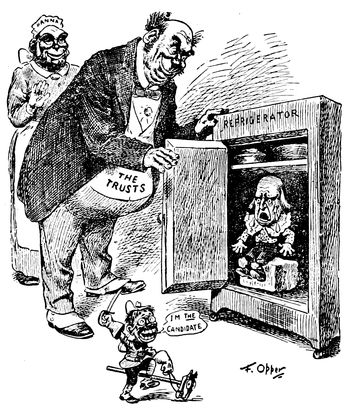
Willie and his Papa.
"What on earth are you doing in there, Willie?"
"Teddy put me in. He says it's the best place for me during the
campaign."
There are interest and significance in the fact that a majority of the
ablest caricaturists of to-day are devoting their talents almost
exclusively to the daily press. It is an exacting sort of work,
exhaustive both physically and mentally. The mere idea of producing a
single daily cartoon, week in and week out,—thirty cartoons a month,
three hundred and sixty-five cartoons a year, with the regularity of a
machine,—is in itself appalling. And yet a steadily growing number of
artists are turning to this class of work, and one reason for this is
that they realize that through the medium of the daily press their
influence is more far-reaching than it possibly can be in the
pages of the comic weeklies, and that at the same time the
exigencies of journalism allow more scope for individuality than do
the carefully planned cartoons of papers like Puck or Judge. Speed
and originality are the two prime requisites of the successful
newspaper cartoon of to-day, a maximum of thought expressed in a
minimum of lines, apposite, clear-cut, and incisive, like a
well-written editorial. Indeed, our leading cartoonists regard their
art as simply another and especially telling medium for giving
expression to editorial opinion. Mr. Bush, "the dean of American
caricaturists," may be said to have spoken for them all when he said,
in a recent interview, that he looks upon a cartoon as an editorial
pure and simple.
"To be a success it should point a moral. Exaggeration and a keen
sense of humor are only adjuncts of the cartoonist, for he must deal
with real people. He must also be a student. I am obliged not only to
use my pencil, but to study hard, and read everything I can lay my
hands on. The features of Roosevelt, Bryan, Hanna, and Croker may be
familiar to me, but I must know what these men are doing. I must also
know what the masses behind these popular characters think and
believe."
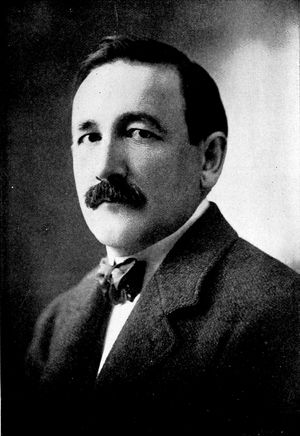
Homer Davenport, of the "New York American and
Journal."
Another direct result of the influence of journalism upon caricature,
in addition to that of compelling the artist to keep in closer touch
than ever before with contemporary history, is the growing popularity
of the series method—a method which dates back to the Macaire of
Philipon and the Mayeux of Traviès, and which consists in portraying
day by day the same more or less grotesque types, ever undergoing some
new and absurd adventure. It is a method which suits the needs of
artist and public alike. To the former, his growing familiarity with
every line and detail of the features and forms of his
pictorial puppets minimizes his daily task, while the public, even
that part of the public which is opposed to comic art in general, or
is out of sympathy with the political attitude of a certain series in
particular, finds itself gradually becoming familiar with the series,
through fugitive and unexpected glimpses, and ends by following the
series with amusement and interest and a growing curiosity as to what
new and absurd complications the artist will next introduce. This
employment of the series idea is as successful in social as political
satire. Mr. Outcault's "Yellow Kid" and "Buster Brown," Mr. Opper's
"Happy Hooligan" and "Alphonse and Gaston," Gene Carr's "Lady
Bountiful," and Carl Schultze's "Foxy Grandpa" are types that have won
friends throughout the breadth of the continent. In the domain of
strictly political caricature, however, there is no series that has
attracted more attention than Homer Davenport's familiar conception of
the Trusts, symbolized as a bulky, overgrown, uncouth figure, a
primordial giant from the Stone Age. And since there have been a
number of apocryphal stories regarding the source of Mr. Davenport's
inspiration, it will not be without interest to print the artist's own
statement. "As a matter of fact," he says, "I got the idea in St.
Mark's Square in Venice. Seeing a flock of pigeons flying about in
that neighborhood I immediately, with my love of birds and beasts,
determined by fair means or foul to purloin a pair. I watched them fly
hither and thither, and in following them came across a statue of
Samson throwing some man or other—I forget his name—to the ground.
The abnormal size of the muscles of the figure struck me at once, and
turning round to my wife, who was with me, I said with a sudden
inspired thought, 'The Trusts!'"
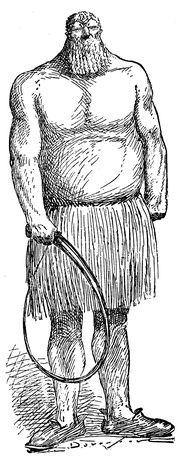
Davenport's Conception of the Trusts.
Of equal importance are the various series in lighter vein
through which Mr. Opper aims to lead people to the same way of
thinking politically as the paper which he serves. Long years of labor
and constant production do not seem to have in any way drained his
power of invention, for no sooner has one series done its work, and
before the public has become sated with it, than an entirely new line
of cartoons is introduced. Mr. Opper, as well as Mr. Davenport, has
had his fling at and drawn his figure of the Trusts, and to place the
two figures side by side is to contrast the methods and work of the
men. Mr. Opper's purpose seems to be, first of all, to excite your
mirth, and consequently he never fails to produce a certain effect.
When you take up one of his cartoons in which the various stout,
sturdy, and well-fed gentlemen typifying the different Trusts are
engaged in some pleasant game the object of which is the robbing, or
abusing of the pitiable, dwarfish figure representative of the Common
People, your first impulse is a desire to laugh at the ludicrous
contrast. It is only afterwards that you begin to think seriously how
badly the abject little victim is being treated, and what a claim he
has upon your sympathy and indignation. In those series which are
designed entirely along party lines, such as "Willie and his Papa,"
this method is even more effective, since it begins by disarming party
opposition.
Of such men, and the younger draughtsmen of to-day, much more might be
written with sympathetic understanding and enthusiasm. But most of
them belong rather to the century that has just begun rather than that
which has lately closed, and a hundred years from now, whoever
attempts to do for the twentieth century a service analogous to that
which has here been undertaken for the nineteenth, will find an
infinitely ampler and richer store of material, thanks to
this group of younger satirists in the full flood of their enthusiasm,
who are valiantly carrying on the traditions of the men of the
past—of Leech and Tenniel, of Daumier, and Philipon, and Cham and
André Gill, of Nast and Keppler and Gillam, and who have already begun
to record with trenchant pencil the events that are ushering in the
dawn of the new century.
THE END