THE HISTORY Of the most NOBLE Order of the GARTER : And the several ORDERS of Knighthood extant in EUROPE .
Transcriber's Note:
The cover image was created by the transcriber and is placed in the
public domain.
His Royal Highness GEORGE AUGUSTUS Prince of Wales, &c. And Knight of the most Noble Order of the Garter.
M. Vdr. Gucht Scul.
Containing
I. The Antiquity of the Town, Castle,
Chapel, and College of Windsor; with
their several Officers: The Foundation
of the ORDER by King EDWARD III.
The Statutes and Annals at large, as
they have been altered and amended.
II. The HABITS, ENSIGNS, and OFFICERS
of the ORDER. The Ceremonies
of Election, Investiture, and Instalment of
Knights: The manner of their Feasts; and
the Duties and Fees payable on these Occasions.
Some Account of the Founders, with
an exact List of all that have been installed
since the Institution, and their several Coats
of Arms emblazon’d.
Written at the Command of King Charles II.
By ELIAS ASHMOLE, Esq; Windsor Herald.
Now compared with the Author’s Corrections in his Library
at Oxford, faithfully digested, and continued down to the
present Time.
The Whole illustrated with proper Sculptures.
LONDON: Printed for A. Bell in Cornhill, E. Curll,
J. Pemberton, and A. Collins in Fleet-street; W. Taylor
and J. Baker in Pater-Noster-Row, 1715.
Price 7 s. 6 d.
TO HIS ROYAL HIGHNESS GEORGE-AUGUST, Prince of WALES, &c.
KNIGHT and COMPANION of the
MOST NOBLE ORDER of the
GARTER.
PARDON me, Mighty
Prince, that in the
Crowd of Your Joyful
and Devoted Britons,
one of an obscure Fame
presumes to lay his Humble
Offering at Your Feet.
IT is the History of the
MOST NOBLE ORDER of the
GARTER; which, from its
first Institution, has been
constantly worn by Persons
of the highest Birth, and
most illustrious Merit.
IF the Stile and Manner,
in which it is treated, were
proportionable to the Dignity
of the Subject, there
would need no Apology
for this Dedication. For
to whom, next to the Great
Sovereign of the Garter, whose
true Heir You are, in all
manner of Virtue and Honour,
could this Treatise have recourse
for Protection, but
to Your Royal Highness,
who are the Premier Knight
of this Most Noble Order, and
the standing Grace and Ornament
of it.
BUT far above all particular
Views, are the unspeakable
Blessings derived to
these Kingdoms, by the
SUCCESSION of Your
Illustrious Royal House:
Every Briton seems new Born,
and to have borrow’d fresh
influence from its Glorious
Presence.
THE Godlike Virtues of
Your Royal Father, are not
to be excelled; and should
we venture to express an
Equality, it can only be the
Appearance of Your Royal
Highness’s imitating so
Great a Pattern.
AS He is Wise and Good
beyond Praise, so has He a
Title to the Hearts of His
People beyond Question;
which stands Confirmed by
the highest Instances of Divine
Providence, as well as
the incontestible Authorities
of Temporal Laws: On
these Foundations, what glorious
Prospects may we not
Build of future Happiness?
IT were easy to dwell on
this Subject, were it not
wasting Moments of much
more concern to Your Royal
Highness, than what I am
able to Express.
MAY Your Royal Highness
long Live to Adorn this
MOST NOBLE ORDER, and
to support the Crown, by a
bountiful and flourishing
issue, that there may never
want one of Your Royal
Line to sit on the Throne
of Great-Britain,
Is the Ardent Prayer of,
ILLUSTRIOUS SIR!
Your Royal Highness’s
Most Faithful,
Most Obedient,
and Humbly Devoted Servant.
THE PREFACE
Those
who are acquainted with Mr.
Ashmole’s History of the most
Noble Order of the Garter, will easily
satisfy themselves; that no Pains or Industry
was wanting to Perfect and Complete so Voluminous
a Work: He had the Encouragement
of a very gracious Prince, and the use
of publick Records, more particularly the several
Books of the Order, with the Assistance
of several MSS wrote by the Officers
of Arms, who bore Part in the Ceremonies,
or went on Embassies to Stranger
Kings, Princes, &c. and by their constant
Observations, were familiarly versed in all
its Laws and Customs.
These were very great helps to him, and
it must be confessed his own elaborate Study
had not less owing to it. There is nothing
that has relation to this most Noble Order,
which he has not touched on; and indeed
it is a Work so very copious, that he
does himself acknowledge he has inserted some
things of little importance; which he desires
may be considered to be done, to gratify some
few who have a more immediate concern therein.
The Reader will in this Treatise find little
else omitted: A very painful and exact Abridgment
has been made, many Corrections
of the Author’s, which he saw before his Death,
and left among his other Books in his Library
at Oxford, are here carefully altered;
some Additions are made, a List
continued, of the several Knights-Companions,
as well as Officers of the Order,
for above forty Years; and the Coats of Arms
of abundance of the Knights-Companions
visibly corrected from good Authorities; and
every distinct Chapter treated of at large; so
that this Work has not been compleated but
at great Labour as well as Expence, which
could not have been supported, but for
the Encouragement some of the Knights-Companions
of the most Noble Order
were pleased to give it; as well in their
Subscriptions, as in the good Opinion they
seemed to Express of the Design.
THE HISTORY OF THE Most Noble Order OF THE GARTER.
IT was, undoubtedly, a good Sentiment in
the first Collector of this Learned Work,
to introduce, as well as a Discourse of
Knighthood in general, a Treatise of all
the several Orders that have prevail’d in
other Parts of the World; for these in
their Rise and Institutions, having a relative Sense to
the particular Subject he was to illustrate, seemed to
afford him a very good Opportunity of doing it, by
building on so convenient a Foundation.
I shall therefore, (tho’ much more confin’d to brevity)
follow the same Method, making it serve as a
proper Introduction; there being many Things in the
voluminous Original, which I conceive may with less
Inconveniency be dispenc’d with.
It was a constant Maxim in all well-regulated Governments,
to give a just Encouragement to Merit, and
this by proportioning Rewards to the Service done;
for Merit must be suppos’d to consist in the Performance
of some Virtuous or Heroick Action, directed
for the publick Good: And as Vertue is either Military
or Civil, so the Distribution of Rewards is different;
either by bestowing Degrees and Titles of Honour,
or by Donations of Wealth; so that in either
Construction, Vertue may have its proper and suitable
Reward.
But the proper Reward of Military Vertue, is Honour:
(to which distinct Head this Work is confin’d.)
Honour, which Aristotle calls the Greatest of exteriour
Goods: And being an Object of a nobler Ambition
than the Accumulation of Wealth, is principally the
Aim of that Vertue we understand by Valour; which
springs from more generous Spirits, and hath been the
constant Foundation of raising Men to the highest
Eminence of Glory, and superiour Dignity.
But that Fame might not lose itself in an unbounded
Notion, it was at length thought fit to reduce Honour
into Form and Order, by investing the Person meriting
with some particular Title or Appellation of Excellence,
(the Original of all Nobility;) of which Knighthood,
as it hath been accounted the most suitable Reward
to the greatest Vertue, so it hath been esteemed the
chief and primary Honour among many Nations.
TheRomans held Honour and Vertue in that Esteem,
that they deify’d, and dedicated Temples to them:
They made them so contiguous in their Situation, that
there was no other Passage to that of Honour, but thro’
the Temple of Vertue, mystically admonishing, that
Honour was not to be attained by any other Way.
In several of the Roman Coins we see Honour and
Vertue represented together in one Reverse, and in one
Medal; the Face of Honour so shadows that of Vertue,
that but a little of it appears, Honour being the more illustrious
of the two; and where we behold any Person outwardly
adorned with it, we are to judge him inwardly endued with
Vertue, inasmuch as Honour is his due, and justly bestowed
upon him.
§. 2. In tracing the Original of Knighthood, we are
not so vain to say, with the French, that S. Michael was
the premier Chevalier; yet thus much we may assert, that
’tis near as ancient as Valour and Heroic Vertue, notwithstanding
the Ceremonies and Circumstances of it
have varied according to several Ages and Nations: And
therefore, with much Probability, we may derive the
Original of Military Honour from the Trojans and
Greeks; among whom, as Knights of great Renown,
were Hector, Troilus, Æneas, Antenor, Agamemnon, Menelaus,
Peleus, Tydeus, &c. And thus Homer uses the
Word ἱππότης, in the same Sense as Eques was afterwards
among the Latins.
Τοῖσι δὲ καὶ μετέειπε γερήνιος ἱππότα Νέστωρ,
’Mong whom thus Nestor spake, that honour’d Knight.
§. 3. Upon a more substantial Basis we shall descend
to the Romans; among whom, in the very Infancy of
their Military Glory, a Society of Knights was instituted,
immediately after their Union with the Sabines. Romulus
inrolled Centuriæ tres Equitum, three Centuries of
Knights, out of the chiefest Families, whom he appointed
to be his Life-guard, and called them Celeres,
from their Activity and Dispatch in Martial Affairs.
Tarquinius Priscus made an Addition to these Centuries;
the like did Servius Tullius, who ordained, that
those who should succeed in that Body, should be
elected ex censu, viz. from a considerable and certain
Valuation of their Estates, who had the greatest Cense,
and were of the most Noble Families, says Dyonys. Halicarn.
And soon after, the Equestrian Class began to be
formed and constituted one of the three Orders of the
Commonwealth, which were thus rank’d, according to
Livy: Senatus, Ordo Equestris & Plebs; which in the Roman
Literal Notes is set down after this Manner:
CON. SEN. E. ORD. P. Q. R. And forasmuch as
this Degree is placed between the Patricians, or Senators,
and the Plebeians, it answers exactly the State of our
Knights between the Nobility and Commonalty: And
from this Order, to the Height of Nobility which resided
in the Senators, was the Way prepared; Junius Brutus
being the first who was raised to a Senator from the
Equestrian Order.
It was a Constitution, as old as Tiberius’s Reign, that
none should be admitted, unless Free-born, or a Gentleman
for three Generations; and, indeed, for a long
Time none were elected Knights but the best Sort of
Gentlemen, and Persons of Extraction, as was the illustrious
Mœcenas.
Atavis regibus ortus eques, Mart.
who aspired no higher, not out of any Incapacity of
attaining greater Honours, but that he desired them not,
says Paterculus: Yet at length, thro’ Corruption of
Times, Plebeians and Freedmen being too frequently received
into this Degree (too near a Parallel among the
Knights of this Age) occasion’d their Power to grow
less and less, ’till it shrunk to nothing; so that the Places
and Offices of Judges which they before had executed,
became conferrable upon the Publicans. And when
Cicero was Consul, anno ab urbe conditi 690, the Equestrian
Order stood in need of Re-establishment, whereupon
they were then incorporated into that Commonwealth
in the third Degree, all Acts passing in the Name of the
Senate, the People of Rome, and the Equestrian Order.
They often enjoy’d Abroad the Government of several
Provinces, whereof Egypt had this peculiar to itself,
that none of the Senators were admitted, but only those
of the Equestrian Order, whose Decrees Augustus commanded
to be had in like Regard, as if the Magistrates
of Rome, or Kings, Consuls, or Prætors, had pronounced
them.
As a Mark of Eminence, they had the Titles of
Splendidi and Illustres bestowed upon them, and sometimes
have been called most sacred Knights.
And besides other Privileges, they had Seats with the
Senators in the Circus Maximus; and by the Roscian Law,
sat next them in the Theatres: They had likewise a
College called Collegium Equitum; and Temples were
dedicated to the Goddess Fortune, under the Title of
Equestri Fortunæ.
Having shewn the Dignity and Honours of the Equestrian
Order among the Romans, we shall now touch
upon the Degrees of Knighthood which have been
Personal, and may be comprehended under the Modern
Title of Equites Aurati, or Milites Simplices, (as distinguish’d
from the several Orders of Chivalry, instituted
in Christendom.) In the Circumstance of whose Creation
we confess, nothing in the Roman Ordo Equestris
hath place, tho’ that might be the Ground and Original
of the Dignity, and one common End in both, namely,
the Pursuit of Military Exploits, and Service in the
Wars.
§. 4. Of the Degrees of Knighthood. We shall first
of the Monozons, i. e. Knights begirt with the Military
Girdle, a Custom devolved to the Germans and Gauls
from ancient Times, and from them to After-Ages.
SirHenry Spelman notes, That the late Emperors conferred
the Dignity of Knighthood with the Military Girdle instead of
all other Arms, because that Part more eminent amongst them
girdeth, supporteth, and adorneth the rest; whence Selden
calls this Girding the most essential part of the Ceremony.
Nor do we find among the various Ceremonies
of Knighthood any that have continued so constant in
Practice as the endowing with Girdle and Sword, Ornaments
proper to the Dignity and Marks of Honour and
Vertue, with which the Statues and Portraitures of
Knights, on their Grave-stones have been adorned.
For as at this Day Knights are styled Equites Aurati,
from the Golden Spurs, heretofore put on at their
Creation, so were they more anciently Singulo Miletari
donati, in respect, when any one was Knighted, he was
not only smitten with the Sword, but invested with
Sword and Belt, yet retain’d at the creating our Knights
of the Bath, as the old Formulary thus hath it;
Then shall the King of great Favour take the
Sword, and gird the Esquire therewith.
Secondly, The Baccalaurei or Knights Batchelors, are
to be consider’d, who are indifferently styled Chevaliers,
Milites, Equites Aurati, and Knights. This Degree is truly
accounted the first of all Military Dignity, and the
Foundation of all Honours in our Nation, and is derived
from, if not the same with that immediately preceding.
For as the Ceremony of a gentle Touch on
the Shoulder with the flat Side of the Sword hath been
since used, instead of girting with the Sword and Belt,
(especially in Times of War, or in Haste) as an Initiation
into the Military Order; so on the contrary, it is
not unusual now-adays, for the Prince, at least Gladio,
if not Cingulo donare; for he oftentimes bestows the
Sword upon the Person he Knighteth.
Miræus gives them the Epithet Aurati, from the Privilege
of wearing Gold upon their Swords and Spurs,
omitting Tiraquel’s fanciful Distinction between Miles and
Eques Auratus, who allows the former to signify a Knight
Noble before, and the other to denote one whom we
call a Knight and no Gentleman, or applicable to the
Neapolitan Gentlemen, (usually called Cavalieri) who
are all styled Equites, tho’ they never have attained the
Knightly Dignity.
The third Sort were Knights Banerets, who so well deserv’d
in the Wars, that they were afterwards permitted
to use Vexillum quadratum, a square Banner, whence they
were called Equites vexillarii, or Chevaliers a Buniere from
the Dutch Banerheere, Lord or Master of the Banner.
Camden conceives this Title first devis’d by K. Edward 3.
in Recompence of Martial Prowess; a Recital of which
Dignity is mention’d in a Patent 20 E. 3. to John Coupland,
for his Service, in taking David King of Scots Prisoner.
But it was much more ancient with us, as well
as in France; and they had particular Robes, and other
Ornaments given them from the Crown, ad apparatum
suum pro militia, tanquam pro Baneretto, a Rege suscipienda,
&c. viz.ad unum Tunicam, &c. after which is set down
the particular Robes, and other Ornaments appointed
for his Creation.
To shew this Dignity yet more ancient, there is the
Evidence of a Writ in K. Edw. 3d’s Time, for furnishing
Thomas Bardolf with the Robes of a Baneret. It is an Honour
esteemed the last among the Greatest, viz.Nobilitum
Majorum, or the First of the Second Rank; and is placed
in the Middle between the Barons and the other Knights;
in which respect the Baneret may be called Vexillarius
minor, as if he were the lesser Banner-Bearer; to the End
he might be so differenced from the Greater, namely
the Baron, to whom the Right of bearing a square
Banner doth belong.
But there are some remarkable differences between
these Knights and Knights-Batchelors; as in the Occasions
and Circumstances of their Creations, the Baneret
being not Created, unless at a Time when the King’s
Standard is erected, and that he bears his own Banner
in the Field; whilst the Knight-Batchelor follows that
which is anothers.
This farther difference is observed between them,
that the Knight-Baneret had so many Gentlemen his Servants
at Command, as that he could raise a Banner, and
make up a Company of Soldiers to be maintained at his
Table, and with his own Pay: But the Knight-Batchelor
had not sufficient for this, and therefore marched under
the Banner of another; and the Wages of the Baneret
were double.
Next to these, we are to mention Knights of the
Bath, which is a Degree that hath the Investiture and
Title of Knight, with an additional Denomination,
derived from Part of the Ceremony of his Creation.
It is the general receiv’d Opinion, that our K. Hen. 4.
first instituted these Knights, which is justify’d by Sir
John Froisard, who says he created 46 of them at his
Coronation, chusing them from such, as were either
his Favorites, or had pretensions to it from their personal
Merits, or Services.
But if the Ceremonies and Circumstances of their
Creation be well consider’d, it may be inferr’d, that he
rather restor’d the ancient way of making Knights, than
Instituted them; and consequently that the Knights
of the Bath, are really no other than Knights-Batchelors;
that is, such as are created with those Ceremonies,
wherewith Knights-Batchelors were formerly created by
Ecclesiasticks: But some of them having been laid aside,
were then brought again into Use, and made peculiar
to this Degree, and since continued to them upon some
solemn and great Occasion.
At the first View they look like a distinct Order of
Knighthood; but cannot be so accounted, because they
have no Statutes assigned them, nor are in Case of Vacancy,
supply’d, (the Essentials of distinct Orders) nor
do they wear their Robes beyond the Time of that Occasion
upon which they were created; as chiefly, the
Coronation of a King or Queen, the Creation of a Prince
of Wales, Duke of York, and the like; whereas also
their Number is uncertain, and always at the Pleasure
of the King.
Favine calls them Knights of the Crown, because, to
distinguish them from Esquires, they wore upon their
Left Shoulder an Escutcheon of Black Silk embroider’d
with three Crowns of Gold; but therein he mistakes,
for they never used only a Silk Lace, and the Jewel they
wore was made of Gold, containing three Crowns, with
this Motto Tria juncta in una, hanging down under the
left Arm at a Carnation Ribbon worn cross the Body.
This leads us to the Degree of Baronets, who seem
allied to Knighthood, by having granted them the Addition
of Sir to be set before their Names: But this
gives them not the Dignity of Knighthood; nor can
they properly be styled Knights, until they be actually
Knighted.
It is a Degree erected Anno 9. Jac. 1. and the Grant
made by Letters Patents under the Great Seal of England.
It is Hereditary to them, and the Heirs Male of
their Bodies lawfully begotten, for ever; and by a
subsequent Decree of the said King, Precedence is
granted to them before all Banerets, except such as
should be made by the King under his Standard, display’d
in an Army Royal in open War, and the King
personally present, and next to and immediately after
the younger Sons of Viscount and Barons.
The Ground for erecting this Degree was partly
Martial; for tho’ themselves were not enjoined personal
Service in the Wars, yet each Baronet was to maintain
thirty Foot Soldiers for three Years in Ireland, after the
rate of Eight Pence per Day, for the Defence of that
Kingdom, and chiefly to secure the Plantation of Ulster.
They were at least to be descended from a Grand-father,
on the Father’s Side, that bore Arms, and had
a Revenue of 1000 l. per Ann. or Lands of old Rents
of equal Value with 1000 l. per Ann. of improv’d Lands,
or at least two Parts of three of such Estate in Possession;
the other third in Reversion Expectant upon one Life
held only in Jointure.
The Year after, King James I. added some new Privileges
and Ornaments, viz. to Knight those already
made that were no Knights; and the Heirs hereafter of
every Baronet should, at the Age of One and Twenty
Years, receive Knighthood; likewise that all Baronets
might bear in Canton, or in an Inescutcheon, the Arms
of Ulster; and farther, to have place in the Armies of
the King in the Gross, near about the Royal Standard.
Since the Institution of Baronets in England, there
have been made divers in Ireland after the like Form:
And the Knights of Nova Scotia in the West-Indies were
ordained in Imitation of Baronets in England by the said
King James, A. D. 1622. for the Planting that Country
by Scotch Colonies, and the Degree made likewise
Hereditary.
These latter wear an Orange Tawny Ribbon as their
Badge, to distinguish them from other Knights; and it
appears, there was an Intention, 1627. to move his
then Majesty, that all Baronets and Knights Bachelors
might wear Ribbons of several Colours, some Badge
or Jewel, in such Sort as did the Knights of the Bath,
to distinguish the one from the other: But that Matter
dropt.
§. 5. We shall now observe the Etymology of Eques,
Miles, Chevalier, Ritter, and Sir. The Grecians had a Title
of Honour equivalent to the Signification of Eques in
the Latin, from Equus, an Horse, because one Part of
the Ceremony, whereby this Honour became conferred,
was the giving of an Horse; or because having
an Horse at the Publick Charge, they received the
Stipend of an Horseman to serve in the Wars, Horses
being Symbols of War, Bello armantur equi. It is to
be noted, That the Degree of Knighthood in the Dialects
of other Nations hath the same Derivation: For
in the French, a Knight is called Chevalier; in the German,
Ridder, or Ritter, q. d.Rider; so the Gheslagen
Ridder is interpreted, The dubbed Knight; in the Italian,
it is Cavagliero; in the old British, Morchog; concerning
which, hear one of Jeffery Chaucer’s Scholars.
Eques ab Equo is said of very right,
And Chevalier is said of Chevalrie,
In which a Rider called is a Knight;
Arragoners done also specifie
Caballiero through all that Partie,
Is Name of Worship, and so took his ’ginning
Of Spurs of Gold, and chiefly Riding.
And tho’ the Word Miles signified at first any legally
inrolled for the War, which Inrolment was twofold,
Honoraria and Vulgaris; yet upon the Decay of the Roman
Empire, upon the Irruption of the innumerable
Forces of the Alani, Goths, Vandals, &c. which consisted
in Horse, their Foot was rendred useless. Miles was no
longer said of him that served on Foot in the Wars, but
began to be properly spoken of the Horseman; whence
it came into Vogue, That among the Titles of Nobility,
he who had that of Miles bestowed on him, was understood
to be Horseman, or Eques, that is, of the Equestrian
Dignity.
Selden observes Miles to be equivocal: and that in the
old feodal Laws of the Empire it signify’d a Gentleman,
as the Word Gentleman is signify’d in Nobilis; and with
us it hath been frequently used to denote both Gentlemen,
and Knights; for Milites denotes Gentlemen,
or great Freeholders, and not dubbed Knights, viz.
such who hold by Knights Service from a Lord of
a Mannour, and such who are chosen from the several
Counties to serve in the High Courts of Parliament.
Miles, even in the Saxon Times, denoted sometimes a
Dignity. But about the Year 1046, becoming a Title
of Honour, it is since most generally appropriated to
Persons who have received Knighthood correspondent
to Eques and Chevalier, tho’ indeed less proper; in regard
Knighthood is the Dignity of Horsemanship, and the
Tenure of Lands by Knights Fees here in England,
anciently called Regale Servitium, is in truth Horse Service;
and the Tenants such as served the King on
Horseback in Wars, are Gentlemen at least (if not of
Noble Extraction.)
Minshew says, the Equites, which heretofore followed
and accompanied the Emperor, are, in the German
Tongue, called Knechtes, that is, Servitors, or Ministers;
but Camden says, Knecht, in SaxonCniht, was in far more
ancient Times accepted as an honorary Title; and,
among the old Germans, signify’d a Person arm’d with
Spear and Lance, (the Ensigns of their Knighthood)
as in After-Times such were, among other Nations,
adorned with a Girdle and Belt, since called Equites
aurati, and sometimes simply Milites.
The Addition Sir to the Names of all Knights Banerets,
Knights of the Bath, and Batchelor Knights, pronounced
at the Time when they are created, with this
Compellation: Arise, Sir John, or Sir Thomas, &c. is
accounted Parcel of their Style, which the Banerets enjoy
by virtue of a Clause in their Patent. It is a Contraction
of the Old French Sire, taken for Seigneur, or
Lord, from the Greek Κύριος. But how it came to be
first given, we cannot find; nevertheless, our English
Writers have bestowed it upon the major Part of the
Nobility, after they had been received into the Order
of Knighthood; and in the Life of St. Thomas Becket,
written about the Time of King Edw. 1. we meet with
the Title prefix’d to the Names of the four Knights,
who slew the said St. Thomas.
§. 6. The Ensigns of the Equestrian Order among
the Romans, by which they were made, was a Publick
Horse, or a Gold Ring; yet still, to those who had
Equestrian Cense, the Horse was the ancienter Badge
of the two; but when thro’ the Multitude of these
Knights no Publick Horses were assigned, but to such
who were ready to enter upon Military Service, and to
fight in the Legions, such were called Legionary Knights,
to distinguish them from the rest, who had only receiv’d
the Honour of a Gold-Ring; for they were not all
employ’d in Wars.
The Censor (after the Institution of that Office ab
urbe condita, 310.) and afterwards the Emperor, were
the Persons who bestowed this Equus Militaris, or Publicus,
as it was called from the Annual Allowance, to
keep him, which they gave unto those of known Vertue
and approv’d Life, compelling him to serve in the
Wars, tho’ against his Will; (but in the more ancient
Method of Election, Constraint was not used.) And
upon Negligence in the Care of these Horses, or any
Blemish, Reproach, or Infamy, or Loss of Patrimony
in the Knights, the Horses were not only taken away,
but the Knights wholly disfranchis’d. Rosinus laying
down the Manner and Order used in ejecting such
Knights, adds, A Recital being made of all the Knights that
were inrolled, those whose Names he omitted, were thereby understood
to be depriv’d of that Dignity.
When they had served in the Wars the Time appointed
by Law, it was the Custom to lead their Horses by
the Bridle into the Forum, before the Duumvirs [Censors,]
and giving an Account under whom and what
Generals or Captains they had served; they were
thereupon dismissed from farther Service in the Wars:
An Example whereof Plutarch relates to have been given
by Pompey himself.
But whereas among the Roman Inscriptions we find
Equo publico honoratus donatus, ornatus, and exornatus, such
is not to be construed to be of Equestrian Dignity, but
only to have received the præmia militaria, with which
the Emperors used to recompense some particular Exploit,
by the Honour of such a Gift, according to Salmasius.
Equus Publicus, by a wondrous, nevertheless
an accustom’d Speech, among the Romans, is the Knight,
qui equo publico meret. And qui equo publico donatus, the
other deserving Person.
As to the Ring: In Genesis we read of Pharoah’s taking
off his Ring, and putting it upon Joseph’s Hand. When
they came in Fashion with the Romans, the Senators at
first wore Iron ones, which were accounted the Ensign
of Military Vertue, received upon a Publick Account.
Howbeit, in Process of Time, when Gold Rings were
drawn into Use, none but Senators and Knights had
them. The Difference among the Rings of the three
Orders in the State were, as Licetus observes, Gold Rings
set with precious Stones were given to the Senators only;
Plain Rings without Stones to the Knights, and
Iron Rings to the Plebeians, or Free-born-men; insomuch
that Equestri dignitate donare and annulo honorare,
is a promiscuous Phrase in Tacitus, to give the Dignity
of Knighthood; and at the Battle of Cannæ, by the two
Measures or Bushels of Gold Rings sent to Carthage, the
Number of the Roman Knights there slain was computed.
§. 7. At length Freed-Men being created Knights,
the Jus annulorum, the Right of wearing Gold Rings,
became promiscuous.
Among the Germans, the Shield and Lance were accounted
the grand Badges of Military Honour, or
Knighthood. This the Lombards, the Franks, and our
Country-men, all descending out of Germany, used, and
was to us (in the Opinion of Sir Hen. Spelman) the
Foundation of the Knightly Order. Much like the
ancient Germans was the Custom of making Knights
among the Irish: And Favine notes the Shield and Lance
were the proper Arms appertaining to a French Knight,
which Esquires, Armigers, carried always after their
Masters, Shields and Scutes (as they are vulgarly called)
i. e. Equestrian Targets, inclining to an Oval, not
Shields or Bucklers of Foot Soldiers.
Another Ensign and Ornament of Knightly Honour
is, the Cingulum militare, or Balteus, which, Varro says,
is Tuscan, signifying a military Girdle, which were
garnished with great Buckles, Studs, and Rings of pure
Gold, to shew their Dignity and Power in military Commands;
and with such a Belt, set with Pearls and
precious Stones, young Athelstan was girded, when he
receiv’d Knighthood from his Grandfather King Alfred.
Our Knights were no less anciently known by these
Belts, than by their gilt Swords, Spurs, &c. Howbeit
the Use now only appears in Knights of the Bath.
To this Belt was also added a Sword, not of Ordinary
Use; and therefore termed the Sword of a Knight,
which was hallowed with great Ceremony.
Another eminent Badge is the Golden Spurs, wherewith,
at the Time of their Creation, Knights Spurs
were wont to be adorned; and to these, a little after the
Conquest, were added far more and greater Ornaments.
They were usually put on after the Person had been
presented to the Prince who gave the Honour, to signify,
that the new-made Knight should not only declare his
Valour by his Sword, but also by the Management of
his Horse, which he should encourage and excite with
his Spurs, to the carrying on his valiant Designs. These
Spurs have been of that Esteem, that Knight Batchelors
are latinized Equites aurati; among the Germans, Ritter
dess Gulden Sporns; and with us heretofore, Knights of the
Spurs: And several Families by the Name of Knight,
bear for their Arms the Spurs on a Canton.
It is farther certify’d among the Rights of a Knight
Baneret, that upon the Account of his Knighthood he
may wear gilt Spurs, as well as a gilt Sword; and that
the Spurs are essential, may be collected from the Degradation
of a Knight, where his gilt Spurs are first cut
off with an Hatchet, the Case of Sir Andra Harcla. In
the last Place is the Collar, an Ensign of Knightly Dignity
among the Germans, Gauls, Britons, Danes and Goths,
among whom it was customary to wear them, as denoting
such as were remarkable for their Valour. But in
later Times, it was the peculiar Fashion of Knights
among us to wear Golden Collars composed of S S.
or other various Devices; so that those Monuments are
known to be erected for Knights on whose Portraitures
such Ornaments are found.
§. 8. The Qualifications for Knighthood are principally
three. 1. Merit, the bare mentioning whereof
shall suffice here. 2. Birth, viz. that the Parties who
enter thereinto ought first to make appear they be
Gentlemen of three Paternal Descents, bearing Coat
Armour; and much the same was the Law of the Empire
under Frederick 2. A. D. 1212. Some think it also
insufficient, unless descended so by the Mother’s Side;
at least she must be a freed Woman. And, 3. Estate,
which also serves to support the Dignity.
Thus Wealth was so much regarded among the Chaledonians,
that those who were rich, bore the Name of
Knights. It was Estate that entitled a Man to this
Honour among the Romans; for the Censor might
compel any Citizen equal to the Equestrian Cense,
whom he thought fit to take that Order: And this
consisted of 400000 Sesterces, i. e. 3025 l. of our Money.
And as in Old Rome, so here in England, not long after
the Conquest, they who held a Knights Fee, viz. 680
Acres of Land might claim it, says Camden. But it appears
from Selden, that no certain Number, or Extent
of Acres, made a Knight’s Fee; and Temp. Hen. 3. and
Edw. 1. and 1 Edw. 2. the Census militis was measured
by 20 l. by the Year, or more; and by the Royal Prerogative,
some who held 15, then 20, at other times
30, then 40, and sometimes 50 l. Lands, were required
to accept this Honour by Writs directed to the Sheriffs
of the Counties, and were excused only by Reason of
old Age, irrecoverable Weakness, Loss of Limbs, or
being in Holy Orders; and upon all other Causes (if
exempted) they paid a Fine, estimated according to
the Nature of the Excuse, or length of Time given.
But in the promiscuous Course of Knighthood, where
the Men of Wealth and Estate (whether otherwise
worthy or not) became dignify’d; yet the Gate of
Honour was not then shut against those, who wanting
Riches, deserved well of their Country; for when
Princes conferr’d such Dignities upon Men of narrow
Fortunes, they usually bestowed with them annual Pensions,
or Lands, agreeable to the Judgment of the Author
of the Division du monde, who saith that the Honour
of Knighthood is not to be given any Person who
hath not a considerable Estate, unless sufficient Means to
support the Honour of the Order be also given with it.
These Pensions are frequently mention’d in our Rolls,
sometimes during Pleasure, and sometimes during the
Life of the Knight, or till better Provision should be
made for their Supports: Examples whereof are, Sir
John Atte Lee, Sir Nele Loring, Sir John Walsh, Knights.
The like Rewards our Kings gave to such whose Merit
raised them to the Degree of a Baneret, express’d in their
Patents, ad manutenendum statum Baneretti, Pro sustentatione
sua, ut ipse statum Baneretti melius manutenere possit, Pro statu
suo manutenendo; or Words to the like Effect: Examples
where of are, Sir Reginald Cobham, Sir Thomas de Rokeley,
Sir John Lysle, and Sir Roger de Swynerton, Banerets.
It may be next consider’d who can make Knights;
wherein it is apparent, that they who never were, and
others who never could be Knights, have conferr’d this
Dignity; yet ’tis to be understood, that Necessity and
Custom hath in this Case the Force of a Law: For anciently,
Bishops and Priests made Knights; so also do the
Popes, and some Commonwealths; likewise our Queens.
For the Sovereign, or the Heir apparent, tho’ they be no
Knights, may nevertheless do it, by reason they possess
the Kingdom; and are therefore the Head and Chief of
Chevalry, and consequent all the Power thereof is contained
in their Command. To conclude this Point,
Knighthood was always received from the Hands of another
Person, either by Ceremony, or Diploma, except only
the Kings of Spain, who Time out of Mind made themselves
Knights; and this by Vertue of an old Law written
in the Arragonian Tongue, as Ambrosias Morales reports.
And, to shew that no Man upon Earth hath any Power over
him, he shall gird himself with the Sword made after the Form
of a Cross; and that Day can no other Man be Knighted.
§. 9. Of the Ceremonies and Formalities used at the
Conferring of Knighthood, the most ancient was perform’d
by putting the Belt loose over the Shoulder, or
girding it close about the Waste. The Bend in Armoury
represents the one, and the Fess the other. The first
Christian Kings at giving this Belt kissed the new Knight
on the Left Cheek, saying, In the Honour of the Father,
and the Son, and of the Holy Ghost, I make you a Knight.
It was called Osculum pacis, the Kiss of Favour, or Brotherhood,
and is presumed to be the Accollade, or Ceremony
of Imbracing, which Charles the Great used when
he Knighted his Son Lewis the Debonair. It was in the
Time of the same Emperor, the Way of Knighting by the
Colaphum, or Blow on the Ear, used in Sign of sustaining
future Hardships, which is thought to have been deriv’d
from the Manner of Manumission of a Slave among the
Romans; a Custom long after retained in Germany and
France. Thus William Earl of Holland, who was to be
Knighted before he could be Emperor, at his being elected
King of the Romans, received Knighthood by the Box of
the Ear, &c. from John King of Bohemia, A. D. 1247.
In the Time of the Saxons here in England, Knights received
their Institutions at the Hands of Great Prelates or
Abbots; which, according to their Opinion, render’d them
more auspicious. In the accomplishing of which Solemnity,
they added many religious Ceremonies, as Watching,
Fasting, Bathing, and Consecrating the Sword; an
Instance of which we have in Heward Lord of Brune, in
Lincolnshire, who received this Honour from Brand,
Abbot of St. Edmundsbury. But not long after the Conquest,
this Custom was restrained by a Synod at Westminster,
A. D. 1102. 3 H. 1. which among other Things
ordained Ne Abbates [i. e. all Spiritual Persons] faciunt
milites. However the religious Ceremonies for the most
part continued, especially Vigils and Bathings, as appears
by that grand Solemnity at the Creation of 267
Knights, Sons of Earls, Barons, and Knights, upon
Whitsontide, anno 34 Edw. 1. cited by Selden and Camden.
And these Formalities the Saxons and Normans, not only
here in England, but the French, Spaniards, and other
Nations, observ’d, concluding from it, that decency
of Habit was as well expected from them, as Integrity
of Life, and purity of Manners. And the like religious
Ceremony was heretofore observ’d in Spain at the Creation
of Knights, whether Cavelleros de Espuela d’Orada,
or Amados [our Knights Batchelors,] In this Form, the
Person to be Knighted was bathed in the Evening, and
presently laid in Bed; then cloathed in rich Robes, and
led to the Church to perform his Vigils: That being
over, and Mass heard, his Spurs were put on, and his
Sword girt about him, then drawn out, and put into
his Right Hand; whereupon the Oath was forthwith
administred to him; which taken, he that bestowed the
Dignity gave him una Pesconade, a Blow, or Stroke on
the Neck, saying, God assist you in the Performance of
your Promise.
The Oath or Vow the Knights professed, was in general,
to relieve and protect Widows, the Fatherless,
Oppressed and Miserable, and to defend the Church of
God; which to keep and perform was esteem’d as meritorious,
as to do all that a Monk, Frier, or Canon Regular
should.
There is also mention (by Mr. Selden) of consecrating
the Sword, offering it at the Altar, and receiving it again
from thence, as an implicit Kind of taking an Oath.
But as in Peace and great Leisure these tedious Ceremonies
were used, yet it was otherwise in Times of War,
or on a Day of Battle, where Hurry and Throng of
Affairs would not permit; and therefore, as well before
the joining of Battle, as after Victory obtained, it
was usual for the Prince or General in the Field, on
Sight of the Army, to give those whom he thought fit
to advance to that Honour (they humbly kneeling before
him) a Stroke with a naked Sword flatwise upon
their Shoulders, or else to touch their Heads or Shoulders
lightly, without any other Ceremony, except
pronouncing Sis Eques in nomine Dei; to which he adds,
Rise, Sir —— Knight, or in the French, Sus, or Sois, Chevalier,
au nom de Dieu, which we commonly call Dubbing,
the old English Word used for Creating [Consecrating]
a Knight, from doopen to dip, by Bathing.
Another Manner of creating Knights Abroad was,
by Royal Codicils, or Letters Patents (these the Spaniards
call Privilegios de Cavelleria) whereupon such Knights are
intitled Equites Codicellares; and these were sent to such
as dwelt in remote Countries, and sometimes, but
rarely, extended so as to make the Degree hereditary.
There is one Example, that by the bare signification
of Letter, without any Ceremonies or Patents
under Seal; Philip IV. of Spain, Jan. 15. 1633. conferr’d
upon all the Captains that behav’d themselves
valiantly in Defence of Mastricht (then lately besieg’d by
the Hollanders) to those that were Gentlemen, the Title
of Knights; and to others, that of Gentlemen.
Having thus briefly shew’d the various Forms of Creation
of Knights Batchelors, I shall remark what Selden has
observ’d of Knights Bannerets in later Times, wherein he
that was advanc’d to that Honour in the Field, was inducted
between two Senior Knights with Trumpets before
them, and the Heralds carrying a long Banner of his
Arms, call’d a Penon; in which Manner being brought
to the King or Lieutenant, who bidding him good Success,
the Tip of the Banner is cut off, that of an Oblong
it might become a Square, like the Banner of a Baron:
This done, he returns to his Tent, conducted as before.
As for the many and various Formularies at the
Creation of a Knight of the Bath, see Sir Edward Byshe
among his Notes upon Upton and Sir William Dugdale’s
Warwicksh. The Knights of the Bath, at the Coronation of
King Charles II. watched and bathed; they took an
Oath; they were girded with a Sword and Belt; and
lastly, dubbed by the King with the Sword of State.
§ 10. In the Dignity, Honour and Renown of Knighthood,
is included somewhat of Magnificence more excellent
than Nobility it self; which mounting the Royal
Throne, becomes the Assertor of Civil Nobility, and sits
as Judge at the Tribunal therefore. Knight is noted by
Camden as a Name of Dignity, but Baron is not so.
For if heretofore a Baron had not receiv’d Knighthood,
he was written plainly by his Christian Name, and that
of his Family, without any Addition but that of Dominus,
a Term attributed to a Knight; and in ancient
Charters, the Titles and Names of Knights may be
seen set before Barons. It bestows Gentility not only
upon the meanly Born, but upon his Descendants, and
encreaseth the Honour of those well-descended. Hereunto
agrees the Common-Law: If a Villain be made a
Knight, he is thereby immediately enfranchised, and
consequently accounted a Gentleman; agreeable to
the Roman Law, where the Donation of a Gold-Ring
ennobled a Slave. Mœcenas dy’d a Companion
of that Order; even Kings and Princes look upon
it as an Accession to their Honour, their other Titles
shewing Dominion and Power, this their Valour
and Courage. Geysa, King of Hungary, Leopold, Marquis
of Austria, Ottacher, Duke of Stiria, and Frederick,
Duke of Austria and Stiria; Godfry, Duke of Brabant,
with Henry his Son, Peter, King of Arragon, the Emperor
Henry III. our William Rufus, King Edward III. Henry
VI. Henry VII. Edward VI. Lewis XI. Francis I. Kings
of France, and others, received this Dignity at the Time
they enjoy’d their other Titles. And tho’ it is said the
Sons of the French King are Knights as soon as they receive
Baptism, yet are they not judg’d worthy the
Kingdom, unless first solemnly created. And we elsewhere
find, that the Royal Heirs of Arragon were suspended
from that Crown, until they had received the
Honour of Knighthood. And after the Norman Conquest,
our young Princes were sent over to the neighbouring
Kings to receive this Honour. Thus our King
Henry II. was sent to David, King of Scots, and Knighted
by him in Carlisle; and Edward I. at the Age of Fifteen
Years, to Alphonsus XI. King of Castile, for the same
Dignity. In like manner did foreign Princes repair
hither, to receive the Honour from our Kings. As
Malcolme, King of Scotland, and Alexander, Son of William,
King of Scotland, Knighted by our King John,
Anno 1212. So was Alexander III. by our King Henry
III. at York, Anno 1252. and Magnus, King of the Isle of
Man, by the same King. All which sufficiently demonstrate
the great Renown of Knighthood, and the Honour
and Esteem which was ever had for that Order.
CAP. II. Of the Religious Orders of Knighthood in Christendom. — 1. The Knights of the Holy Sepulchre in Jerusalem, are accounted the most Ancient . — 2. Knights Hospitallers of St. John Baptist in Jerusalem. — 3. Knights Templars. — 4. Knights of the Order of St. Lazarus. — 5. Knights of the Teutonick Order, or Prussia. — 6. Knights of Mount-Joy. — 7. Knights of St. John of Acon or Acres. — 8. Knights of St. Thomas. — 9. Knights of St. Blaze. — 10. Knights of the Martyrs in Palestine. — 11. Knights of St. Catherine at Mount Sinai. — 12. Knights of St. Anthony in Æthiopia. — 13. The Constantinian Angelick Knights of St. George in Greece, but now in Italy. — 14. Knights of St. James in Galicia or Sanctiago. — 15. Knights of St. Saviour in Arragon. — 16. Knights d’Avis in Portugal. — 17. Knights of St. Michael ’s Wing in Portugal. — 18. Knights of St. Gereon. — 19. Knights of St. Julian de Pereyro, or of Alcantara. — 20. Knights of Trugillo or Truxillo in Spain. — 21. Knights of Calatrava. — 22. Order of the Holy Ghost at Rome. — 23. Knights of St. George d’Alfama. — 24. Knights of Christ in Livonia, or of the Sword-bearers . — 25. Knights of Jesus Christ in Italy or France. — 26. Knights of St. Mary de Merced. in Aragon. — 27. Knights of the Rosary in Toledo. — 28. Knights of St. Mary the Glorious, in Italy. — 29. Knights of St. James, in Portugal, — 30. Knights of our Lady, and of St. George of Montesa. — 31. Knights of Christ in Portugal. — 32. Knights of the Passion of Jesus Christ. — 33. The Order of the Brician Knights in Sweden. — 34. Knights of St. Maurice in Savoy. — 35. Knights of the Holy Ghost, — 36. Knights of St. George in Austria and Carinthia. — 37. Knights of St. George at Rome. — 38. Knights of St. Peter at Rome. — 39. Knights of St. Paul at Rome, — 40. Knights called Pios at Rome. — 41. Knights of St. Stephen at Florence. — 42. Knights of St. Maurice and St. Lazarus in Savoy. — 43. Knights of Loretto. — 44. Knights of the Blessed Virgin Mary of Mount Carmel. — 45. Knights of the most Glorious Virgin Mary of Rome. — 46. Knights of the Annunciade, and St. Michael the Archangel in Mantua, or of the Christian Militia in Moravia.
§ 1.
THE
Grounds and Causes of founding Societies
or Knightly Orders, were several and
different, tho’ all terminated in one End.
Among which, principally were these, First, A sincere
Love to Honour, and therein chiefly to excite and promote
Vertue by suitable Rewards; such was the Design
of King Arthur, when he formed himself and other
Martial Men into a Fellowship, which he stiled Knights
of the Round Table. Secondly, To repress the Incursions and
Robberies of the Saracens and Barbarians, to vindicate
the Oppressed, redeem the Enslaved, and to entertain
and relieve Pilgrims and Strangers, which were Part of
the Duties the Knights Hospitallers and Templars, &c.
stood engag’d in. A third Reason was, To Fight in
Defence of the Christian Faith, against Pagans and
Infidels; to enlarge the Christian Territories, and
promote the Service of the Catholick Church: And
indeed their Zeal very much advanced Christianity.
Lastly, When Sovereign Princes perceived themselves
embroiled in Wars or dangerous Factions, the erecting
such an Order or Society was, that they might by such
a Tye restore Peace, quiet all Jealousies, unite Affections,
and secure a lasting Friendship and powerful Assistance,
both for their own and their Country’s Safety.
And to this End were Badges of several Orders devised,
as Pledges of Remembrance to quicken and establish
their Friendship.
§ 2. These Orders are of Two Kinds, 1. Religious, or
Ecclesiastical; and, 2. Military, or Secular.
§ 3. The Institutions of the latter Sort were after a
while thought too weak to continue, if not sustained
by Religion and Piety; and too defective without adjoyning
Ecclesiastical Persons thereunto. Therefore
the Founders, considering Divine Assistance should concur
with Military Industry, began to dedicate these Orders
to the Honour and Worship of God, or to our
Saviour, or to the blessed Virgin, or some other of the
Saints, to gain the Protection and Favour of Heaven,
more easily, as they thought, obtainable by the Prayers
and Offices of the Clergy. Whereupon some in their
Institution joyned Sacred Orders to their Military, and
made Provision for Sacred Persons to pray for their Prosperity
at home, while they were engaged abroad.
Hence King Edw. III. at the first Institution of the Garter,
appointed Thirteen Secular Canons, and Thirteen
Vicars to attend the Celebration of Divine Offices. Upon
the same Account certain Foundations of Divine
Service were erected at Bugey, for the Order of the Annunciads;
at Dijon, for the Order of the Golden Fleece;
and at Mont St. Michael in Normandy, for the Order of
St. Michael.
§ 4. I shall now deliver a brief Account of the Religious
Orders of Knighthood, proceeding according to
their Antiquity.
Dr.Heylin reports this Order to be instituted A. D.
1099. at such Time as the Temple of Jerusalem was regain’d
from the Saracens by Philip King of France. Yet
Favin will have it to be by Baldwin the First, King of Jerusalem;
for while the Saracens possess’d the City, there
were certain Canons Regular of St. Augustin, to whom
they permitted the Custody of the Holy Sepulchre.
These Canons Baldwin made Men of Arms, and Knights
of the Holy Sepulchre, and ordained that they should nevertheless
retain their white Habits, and on the Breast
bear his own Arms, which were Argent a Cross potent:
Or, between four Crosses of the same, commonly call’d
The Jerusalem Cross. Their Great Master was the Patriarch
of Jerusalem. They were to guard the Sepulchre,
fight against the Saracens and Infidels, protect Pilgrims,
redeem Christian Captives, hear Mass every
Day, recite the Hours of the Cross, and to bear the
five red Crosses in memory of our Saviour’s Wounds.
Their Rule was confirm’d by Pope Innocent III. Upon
the loss of the Holy Land, these Knights retired to
Perugia in Italy; but retaining their white Habit, chang’d
their Arms to a double red Cross. A. D. 1484. they
were incorporated to the Knights Hospitallers of Jerusalem
then in Rhodes. But A. D. 1496. Alexander VI.
made himself, and the Popes his Successors, Great Masters
thereof, and empower’d the Guardian of the Holy
Sepulchre (his Vicar General) to bestow the same
upon Pilgrims to the Holy Land. Philip II. King
of Spain, endeavour’d to restore this Order in some of
his Dominions, about the Year 1558. himself being
elected Great Master: And another Attempt was made
by the Duke of Nevers, 1615. but these Designs took
no Effect.
Before the taking of Jerusalem from the Saracens,
certain Christian Merchants of Naples obtain’d leave
from the Caliph of Egypt to erect a small and convenient
House, for the Entertainment of themselves and
Countrymen, which they built before the Church of
the Holy Sepulchre, together with a small Oratory. To
them repair’d certain Canons of the Order of St. Augustin,
who built another Oratory; but the Confluence
of Pilgrims growing great, they erected a large Hospital,
in the Place where our Saviour celebrated his
last Supper, for the better accommodating devout
Travellers, who for want of a Place to lodge in were
often robb’d and murder’d: So that at length from
their Charity and Hospitality, as also for that they
took St. John Baptist for their Patron, they obtain’d
that Title. It was instituted A. D. 1092. or according
to others 1099. by Gerard, a Native of Thoulouse, who
came to Jerusalem in the Time of Godfry of Bouillon, and
built this Hospital (which became the first Seat of this
Order) dedicated to St. John of Cyprus, Bp. of Alexandria,
commonly call’d Johannes Eleemosynarius; and King Baldwin
I. conferred on them large Privileges, permitting
them Arms, and instituted them to be Knights, A. D.
1104. Their Duty was to fight against the Infidels,
and they acknowledged Obedience to the Patriarch of
Jerusalem; but growing rich, they obtained from Rome
to be absolved from that Obedience. Pope Gelasius II.
or Calixtus II. A. D. 1120. confirmed their Rule of living;
and Adrian IV. receiv’d them under the Protection
of the Papal See, being likewise endowed with ample
Privileges, and exempted from Payment of Tithes, by
succeeding Popes, chiefly by Pius IV.
They took the black Habit of Hermits of St. Augustin,
and lived under his Rule by Grant of Honorius II. Anno
1125. vowing Obedience, Poverty, and Chastity; and
on the Breast of their Habit wore at first a plain Cross
of White Cloth, which was after changed to one with
Eight Points; but in time of War they used a Red
Cassock, bearing the White Cross upon it. Unto
Gerard succeeded Raimund, who digested and enlarged
their Laws and Institutions in the Composition whereof
his Stile was Raimundus Dei gratia servus pauperum Jesu
Christi & Custos Hospitalis Jerusolymitani; but afterwards
he and his Successors had the Title of Great Master of
the Order given him, to denote his Power and Authority.
At this Day he has the Title of Prince of Malta and
Goza; among his Privileges he seals in Lead, as doth the
Pope and Doge of Venice; he acknowledges the Pope
for his Head, and the King of Spain for his Patron; he
had under him in several Kingdoms Priors; some of
whom had also the Addition of Great with us in England
he was stiled Prior Hospitalis; St. Johannis Jerusalem
in Anglia, and by that Title was he summoned to the
Parliament as a Baron of this Kingdom, and at length
for Place and Precedency was ranked the first Baron;
and the greatness of these Knights grew to such height
that temp. H. 3. they had in Christendom 19000 Mannors.
WhenSaladine took Jerusalem, these Knights retreated
to Acres or Ptolemais, and that being taken they seized
upon the Island of Rhodes, A. D. 1308. whence they began
to be call’d Knights of Rhodes; but A. D. 1522. being driven,
thence by Solyman, they betook themselves to the Island
of Malta, which with Tripoli and Goza were granted to
them in Fee by the Emperor Charles V. A. D. 1530. under
the Tender of one Falcon yearly to the Viceroy of
Sicily, and to acknowledge the King of Spain and Sicily
for their Protectors. In this Isle they continue a Bulwark
to those Parts, and from this their Settlement are
called Knights of Malta.
About the Year 1117, 1118, 1119, or 1120, this
Order took Beginning, Baldwin II. then reigning in Jerusalem;
when Nine Gentlemen, of whom Two of noble
Extraction, Hugh de Paganes and Godfrey de St. Omer, came
in Devotion to the Holy Land; they were called Brothers
of the Militia of the Temple, ordinarily Knights
Templars, from the Habitation assigned them out of a
part of the King’s own Palace, adjoyning to the Temple
of Solomon in Jerusalem. Their first Undertaking was to
guard the most dangerous Ways about that City, against
the Violence and Robberies of the Saracens, which
made them acceptable to all, and for which they had
Remission of their Sins; but for the first Nine Years
they were yet so poor that they lived upon the Alms of
others, wore Clothes bestowed in Charity upon them,
and rode two on one Horse; in memory of which primitive
Poverty their Seal had the Impress, which is represented
in Math. Paris, A. D. 1127. They had
Rules assigned them, drawn up by St. Bernard Abbot of
Clairvaux, by the Appointment of Pope Honorius II. and
Stephen Patriarch of Jerusalem. They made their Vows
of Obedience, Poverty and Chastity, and to live under
the Rules of Canons regular of St. Augustin. Their
Habit was White, to which, in the Time of Eugenius III.
they added the Red Cross, and of the same Form that
the Hospitallers wore (Favin says a patriarchal Cross) and
sowed it on the left Shoulder of the Maulles. These
with the Holy Sepulchre Hospitallers and Teutonicks,
principally supported a long time the Kingdom of Jerusalem;
but when Riches encreas’d, and their Revenues
augmented, they grew proud, fell from the Obedience
of the Patriarch to joyn with the Pope; and at last,
1307. all the Knights of this Order in France were, in
one and the same Hour, seized and imprison’d by Philip
le Bel, King of France, with Consent of Pope Clement V.
being charged with most infamous and damnable Crimes.
And in England, Anno 1. Ed. 2. they were also apprehended
afterwards, rendred Convicts, and all their
Possessions seized into the King’s Hands. Howbeit the
Bishop of York commiserating their deplorable Condition
within his Diocess, charitably disposed of them in
Monasteries under his Jurisdiction. Two Years after
many of these Knights were burn’d in France, and
Jaques de la Maule, the last great Master, suffered the
same Fate, having seen, A. D. 1312. his Order by Papal
Authority, condemned and perpetually dissolved;
after which their Lands were annexed to the Hospitallers,
for their Service against the Turks.
Thus they fell, no less famous for Martial Atchievments
in the East, than their Wealth in the West; for
they enjoyed 16000 Lordships in Europe, and a Spanish
Author tells us, their Revenue was Two Millions yearly,
and had in possession 40000 Commanderies, which
occasion’d divers to think they were falsly accused, and
by suborned Witnesses, merely upon the Ambition and
covetous Design of Philip King of France.
These were at the first a Fraternity of Religious
Monks, after which they became Ecclesiastick Knights,
in Imitation of the Knights of the Holy Sepulchre.
Pope Pius V. 1572. stiles it Antiquissimum Charitatis &
Militiæ Christi Ordinem; yet it must be understood as an
Order of Monks, founded by St. Basil, about the time
of Julian the Apostate, A. D. 366. upon a Charitable
Account, viz. to take Care of Leprous Persons (a Malady
frequent in the East) by which they became separated,
even from the Conversation of Men. At
length, through the Incursion of the Barbarians, and
Injury of Time, it lay extinguish’d, but was revived
when the Latin Princes joyned in a Holy League to recover
the Holy Land. And a famous Hospital was
erected at Jerusalem, under the Title of St. Lazarus,
for the Reception of Lepers: For in that Time the
Monks of this Order added Martial Discipline to their
Skill in Physick; and for their Services against the Infidels,
begat a great Esteem from Baldwin II. King of
Jerusalem, and some of his Successors. In process of
Time this Order decayed, being suppressed by Innocent
VIII. who united it to the Hospitallers at Rhodes, A. D.
1490. Nevertheless Pius IV. restored it A. D. 1565.
confirming the old, and granting new Privileges, making
his kinsman Don Janot de Chastillon great Master.
Pius V. A. D. 1567. enlarged their Privileges, permitting
them to take one Wife only, to wit, a Virgin, not
a Widow. Lastly, Pope Gregory XIII. A. D. 1572.
bestowed the Great Mastership of this Order upon
Emanuel Philibert Duke of Savoy, and his Successors, and
prescribed them the Cistercian Rule; and accordingly he
had the Investiture and Collation of the Commanderies in
Spain and Italy.
In the Time of the Holy War, a wealthy Gentleman
of Germany, who dwelt at Jerusalem, commiserating
the Condition of his Country-men, coming thither in
Devotion, made his House their Receptacle; afterwards
he erected a Chapel to the Blessed Virgin, whence they
had also the Title of Marian Knights. To him associated
other Germans, and in short time encreasing, they
professed the Military Employments of the Templars,
and followed the Acts of Piety and Charity of the
Hospitallers. A. D. 1190. or 1191. they elected Henry
Walpott their first Master, and the following Year were
confirmed by Celestine III. under the Title of Knights
Teutonicks, or Dutch Knights, of the Hospital of St. Mary
the Virgin, vowing Poverty, Obedience, and Charity,
and following the Rule of St. Augustin. Their Statutes
were composed from those of the Hospitallers and Templars,
and One Article was, That none but Germans
should be of this Order. Their Habit was a White
Mantle, on the Breast a plain Black Cross, but some
make it a Black Cross voided with a Cross Potent.
At Acon they erected another Hospital; but after that
City was taken by Saladine, they removed under Hermannus
their Master into Germany, on whom the Emperor
Frederick II. A. D. 1229. and Pope Honorius III. bestowed
Prussia; where having conquer’d that Nation,
and reduced it from Paganism, they built the City of
Maryburgh, and there, A. D. 1340. fixed the chief
Residence of their great Master. This Country they
enjoyed till 1525. that Albertus Brandenburgh, the
Last great Master, made solemn Renunciation of that
Order, and became feudatory to Sigismond I. King of
Poland, who created this Albert first Duke of Prussia:
However, some of the Knights disrellishing this Action
elected another great Master, viz.Albert Wolfang, and
leaving Prussia setled in Germany, where they now reside.
The younger Sons of the German Princes being, for
the most part received into this Order, giving it the
greatest Reputation.
These are so called, from a Castle where this Order
was instituted, built upon the Point of a Mountain not
far from Jerusalem, whence the Pilgrims first view’d the
Holy City, and where these Knights lay in Garrison.
Their Habit was White, and the Badge thereof an
Octogonal Cross Red; they vowed Poverty, Chastity,
and Obedience, and followed the Rule of St. Basil;
which Pope Alexander III. A. D. 1180. changed to that
of Augustine. Upon the Loss of the Holy Land they
retired to Spain, and fought against the Moors, and according
to the Places they resided, in had other Names,
in Catalonia and Valentia, Equites de Mongoia, i. e. Mount
Joy; but in Castile, Knights of Monfrac, a Castle there.
When Alphonso IX. King of Castile gave them Lands
they had won from the Moors, the Donation says, To you
Don Rodrigo Gonsales, Master of Monfrac, of the Order
of Mount Joy. Upon the Decay of this Order, A. D.
1221. this Castle was given to Don Gonsalionez, Master
of the Order of Calatrava, by Ferdinand the Saint; and
these Knights were incorporated with them.
Under the Patronage of this Saint was this Order
erected; they exercised all Duties of Charity towards
Pilgrims, and assumed Arms in imitation of the Hospitallers;
they followed the Rule of St. Augustine; and
according to Favina, had a Black Habit, upon which
they wore a White Cross patee. After Acon was taken
they removed into Spain, and flourished in the Reign of
Alphonsus the Astrologer King of Castile, about which time
Pope Alexander IV. approved the Order under the conjoined
Title of St. Thomas and St. John of Acon. This
King gave them by his Will all the Furniture of his
House, and much Money; but afterward they dwindled,
and at last were united to the Hospitallers. The Ensign
was a Red Cross, in the middle whereof stood the
Figures of St. John and St. Thomas.
Distinct from the former, yet wearing the same Habit,
as the Knights of St. John of Acon, making the same
Processions, and following the same Rule; their Badge
was a Saltire Gules, (or as others are of Opinion) the
same with that of St. John of Acon, wanting the Figures
in the middle: But Favin reports, this Order was
instituted by King Richard I. after the Surprizal of
Acon; and that these Knights were of the English Nation,
who wore a White Habit and a Red Cross,
charged in the middle with an Escallon, and that
St. Thomas Becket was their Patron. Howbeit, after the
Christians were driven out of the Holy Land, the
Knights of this Order were joined to the Hospitallers.
These were also called Knights de Sta. Maria; they
were Officers and Servants to the Kings of Armenia;
their Habit was Sky colour with a Cross Gold on their
Breasts; others say a Red Cross, and in the middle the
Picture of St. Blaze, their Patron. This Order was at
the height, when the Armenian Kings of the House of
Luzignan kept their Court in Acon.
These took their Denomination from an Hospital in
Palestine, dedicated to St. Cosmus and St. Damianus,
Martyrs; where Acts of Charity were exercised towards
Sick Strangers. Their Profession obliged them to other
Works of Mercy, viz. to redeem Captives, and
bury their Dead. They followed the Rule of St. Basil,
which was confirmed to them by Pope John XXII.
There Badge was a Red Cross, in the middle whereof,
within a Circle, was the aforesaid Two Saints. When
they retir’d into Europe they changed into a Red Cross,
and St. Augustin’s Rule.
This Order was instituted, A. D. 1063. under the
Patronage of St. Catherine, whose Body was there deposited
in the Church of the Monastery erected and dedicated
to her Name. Their first Institution was to
guard the said Sepulchre, to secure Travellers, defend
the Grecian Pilgrims, and to relieve them with Hospitality.
Their Habit was White, and they lived under the
Rule of St. Basil the Great, vowing conjugal Chastity,
and Obedience to the Abbot of this Monastery, who
was their Superior. But when the Turks obtained these
Countries, these Knights were ill treated and driven away,
and the Order almost abolished; nevertheless
some Shadow remains for such as travel to visit the
Holy Sepulchre at Jerusalem, do now and then pass to
this Monastery at Mount Sinai, where in imitation of
the Padre Guardian of Jerusalem, the principal Monk in
this Covent makes them Knights of St. Catherine over
her Tomb, with the like Questions and Formulary as
used at the Holy Sepulchre. These Knights now wear
upon the left side of their White Habit the Cross of Jerusalem,
and Instrument of St. Catherine’s Martyrdom;
but according to others, the middle of the Wheel is
pierced with a Sword.
After the Death of St. Anthony the Hermite, who
dy’d about the Year 357. many of his Disciples remaining
near Æthiopia, follow’d his Example and Manner
of Life, and their Successors liv’d in great Austerity
and Solitariness in the Desart (therefore call’d Anchorites)
till the Year 370. when ’tis said John, Emperor
of Æthiopia, erected them into a Religious Order of
Knighthood, under the Title and Protection of St. Anthony,
Patron of his Empire, and bestow’d upon them
great Privileges; and being thus instituted, they receiv’d
St. Basil’s Rule, and cohabited in Monasteries.
Their Habit is black, with a blue Cross Tau. Their
chief Seat is in the Isle of Meroe; but in other Parts of
Æthiopia they have great Numbers of Convents, and no
less than 2000000 of annual Revenue. The eldest Sons
of Nobles and Gentlemen cannot be admitted, but the
second Sons may; and if a Man (except a Physician)
have three Sons, he is bound to assign one of them to
be of this Order. Their Vow is to observe conjugal
Chastity; to die in Defence of the Christian Faith;
to guard the Empire; to obey their Laws and their
Superiors; and to go to War when and wheresoever
commanded: Moreover, they take an Oath not to
fight in Wars between Christians, nor receive Holy
Orders, or marry without License. They are of two
Sorts: One employ’d in the Wars, the other who being
Old are exempted from Military Services, and retire
themselves under the Title and Profession of
Monks, to the Abbies where they first took their Habit;
before which they must serve three Years against
the Arabian Pyrates about the Red Sea, three Years against
the Turks, and three against the Moors upon the Borders
of Borneo. When they come to be admitted into
their Abbey, they are introduced in their Military
Habit, of which being disrob’d, the Religious one is
put on, viz. a black Gown reaching down to the
Ground, lined with blue, having a blue Cross fix’d to
the Breast, and over that a black Cowle; they are
afterwards led to the Church, and there make their
Profession. Philip VII. Son to the Founder, enlarg’d
their Lands and Privileges, and added a Border of
Gold to the Badge of the blue Cross, as observed at
this Day.
InItaly, France and Spain, there are a Sort of Monks
that have the Title of Knights of St. Anthony, which
observe the Rule of St. Augustin, and they wear a
plain Cross like that in Æthiopia; but the Principals
of these wear a double St. Anthony’s Cross of blue Satin,
the one above the other. Their chief Seat is at
Vienne in Dauphine, of which Place the General of the
Order bears the Title of Abbot, the Monastery being
erected into an Abbey 1297. in Honour of St. Anthony,
whose Body was translated thither from Constantinople;
and all other Places built in Honour of his Name, were
made subject to him A. D. 1523. Morœus calls them
The Hospitallers of St. Anthony, and says they begun in
FranceA. D. 1121. from Gaston a Nobleman of Vienna.
But Baronius and others say, Gaston and Gerin instituted
it earlier, making the Letter Thau their Ensign or
Badge.
Marquez, a Spanish Writer, makes this one of the first
Military Orders in Christendom, and derives a formal
Institution, Rules and Laws from Constantine the Great,
which appears little better than Fabulous, therefore
we shall omit his Account.
The Great Masters have their chief Seat and Convent
at Brianno near Venice, and is Hereditary in the
Family of Angelus Flavius Comnenus. Among the rest of
their Prerogatives, the Masters are Commensales Pontificum,
i. e. may sit at the Table with the Pope, who defends
them as Benefactors to the Church, and Founders
of the Lateran Cathedral at Rome. As Subjects to
no Prince, they have Power of coyning Money: They
give Titles of Counts and Princes to their own Fraternity,
and take upon them the restoring to Honours, of
legitimating Bastards, making Doctors, Poets Laureats and
Publick Notaries. This Order is under the Protection of
the Virgin Mary and Patronage of St. George; and they
profess Obedience and conjugal Chastity; they wear a
white Habit, on the left Side whereof is sowed a red
or crimson Velvet Cross, Flory; in the middle is the
Labarum
imbroidered with the Letter A upon one
Arm of the Cross, and Ω on the other. The Sides
are wrought with Gold and Silk, but the Labarum is
all Gold. Amongst these Knights are three Degrees;
the first call’d Collered or Grand Crosses, wearing a
Collar form’d of Labarums, whereat hangs the Cross
and St. George. The second are the Knights, and these
wear the Cross above describ’d. The third are Servants,
and they bear the Cross only, without the Labarum.
The many Grand Priorates or Commanderies
belonging to this Order, shew the Power they were
formerly endow’d with.
This is the principal Order in Spain, and had its
Title of Don Raniro, King of Leon, who about the Year
826. at Clavigio, by the Assistance of St. James (said to
appear upon a white Horse, bearing a Banner with a
red Cross) and gain’d a mighty Victory over a great
Army of the Moors. Some place the Institution about
the Year 1160. others 1175. whereas it was only then
confirm’d, and their Rule of Living prescrib’d by Pope
Alexander III. there being a Fraternity of Knights in
Spain, A. D. 1030. under a Master and Governor, with
Revenues.
And altho’ this Order at first were dispos’d to vertuous
Courses, and valiantly to encounter the Moors,
Enemies to the Cross of Christ, yet in time they became
scandalously perverted, but were afterwards reduc’d to a
better Life, and approv’d on by the said Pope Alexander,
who receiv’d them into the Protection of the Papal
See, and gave them the Rule of St. Augustin, the Form
of holding Chapters, of electing their Masters, of Treves,
and thirteen Commendadores of Houses, and of the
Visitors; and in short very large Privileges, together
with the Monastery of St. Lorjo, situate in Galicia near
Sanctiago; and the Prior and Canons thereof were incorporated
into this Order.
Their Ensign is a red Cross, which the Knights
wear upon their Breast, terminating like the Blade of
a Sword, the Hilt crosletted and fashion’d after the ancient
Manner; whereupon it was call’d La Order de
Sanctiago de la Espada.
Their Habit is a white Mantle close before, on the
Breast whereon is placed the said Cross, made of Silk or
Cloth, and they are obliged to wear it upon their
Garments, Coats or Cloaks, tho’ they use Crosses of
Gold likewise.
When the Moors were driven out of Spain, and the
principal Branch of this Order expir’d, upon a Contest
for the Place of Great Master, the Crown of Castile
stepp’d in between, and by consent of the Knights,
obtain’d it under the Title of Administrator, which
was granted to King Ferdinand; and his Son Charles V.
annex’d it with all its Rights, &c. to his Successors
in the Kingdoms of Castile and Leon. Since which, the
Kings of Spain now enjoy the Administration of this
Order, and carry that Title and Stile in the Inscription
upon the Great Seal thereof, which holds the Royal
Arms of Spain, upon a Cross that filleth all the Shield,
with a Sword at each of the four Corners.
These were instituted A. D. 1118. by Don Alphonso,
call’d Emperor of Spain, King of Navarre, Arragon, &c.
chosen out of the Spanish and French Nobility that
assisted in his Wars. He form’d them into a Society,
the better to enable him to drive the Moors out of
Saragossa, and the whole Territory of Arragon. Their
Rule of living was the Cistercian, and somewhat conformable
to the Knights Templars. When the Moors were
driven out of Spain, their rich Commanderies were at
length united to the Crown.
Their Habit was a white Mantle, on the Breast
whereof was a red Cross Anchre; but some say it was
the Figure of our Saviour.
DonAlphonso Henriquez, first King of Portugal, took
from the Moors, A. D. 1147. the City of Evora, and to
strengthen it, sent thither several gallant Commanders,
who assum’d the Title of Knights of St. Mary of Evora,
putting themselves under the Protection of our blessed
Lady. Not long after they were call’d d’Avis, from a
Castle upon the Portuguese Frontiers, conquer’d from
the Moors, whither they transplanted themselves. It was
confirm’d by Pope Innocent III. A. D. 1204. under the
Rule of St. Benedict, and therefore in some Papal Rules
call’d of St. Benedict d’Avis. The Knights profess conjugal
Chastity and Obedience. Anno 1213. they submitted
themselves to the Rule, Statutes and Visitation of the
Order of Calatrava; but in the Time of John of Portugal
(natural Son to Pedro King of Portugal) seventh Great
Master d’Avis, they cast off their Acknowledgments to
Calatrava, and never after submitted to them; and afterwards,
when the Crown of Portugal fell into the
Hands of Philip II. King of Spain, this Order was govern’d
according to the Statutes of Portugal.
Their Badge is a green Cross, Flory, (such as the Knights
of Alcantara us’d to wear.) They must be Gentlemen
by Extraction, both of the Father’s and Mother’s side.
About the Year 1165. others say 1171. Don Alphonso,
who founded the Order d’Avis, founded this also after
his obtaining a notable Victory over the Moors and Albara
King of Sevil, in which Battle St. Michael the Archangel
is said to appear on the right Side of Alphonso, and
fight against them.
Their Investiture, &c. was the same with d’Avis.
It is now grown out of Use, but the Mastership remains
with the King of Portugal.
This Order was establish’d by Frederick Barbarossa the
Emperor; others say by Frederick II. and consisted only
of the German Nation. They follow’d the Rule of
St. Augustin, and wore a white Habit, whereon was
sow’d a black Patriarchal Cross, set on a little green
Hill.
They had the first Appellation from St. Julian de Pereyro,
a Town in Leon, where they had a Monastery
built for them by Ferdinand II. King of Leon and Galicia,
who in his Diploma of Privileges granted thereunto
1176. stiled himself Protector of this Society of
Knights. In the Approbation-Bull of Pope Alexander III.
their Chief is called Prior; but in that of Pope Lucius
III. he is stiled Master of Pereyro. They used a Secular
Habit, modest and grave, and the Ecclesiasticks a Clerical
Habit, with a Shred of Cloth and a Scapulary, to
distinguish them from other Seculars and Ecclesiasticks.
They observed the Rule of St. Benedict moderated, as it
was convenient for the Exercise of Arms against the
Moors, for which End it was instituted. Their ancient
Badge was a Pear-tree Vert, in Allusion to the Name.
The Occasion of altering the first Appellation was
upon change of their Habitation. Pope Adrian VI. annex’d
this Mastership, together with those of St. James
and Calatrava, to the Royal Crown of Castile for ever.
This Order is so call’d from the City of Trugillo in
Estremadura, but when, or by whom founded, or their
Badge, is unknown. Some suppose these Knights the
same with that of Alcantara; ’tis evident they were in
being A. D. 1227. when ’tis pretended the Master of
Alcantara took Trugillo from the Moors, and plac’d there
a Brotherhood of Knights. But it seems these Knights
of Truxillo, were a distinct Order several Years before,
and ’tis not unlikely that they might be incorporated into
that of St. Julian de Pereyro, and by this Means the Order
of Alcantara acquired the Towns of Trugillo, Sancta
Cruz, &c. which Alfonso IX. King of Castile had given
them. They were to be of Noble Descent, and make
proof of their Gentility; they were obliged to be near
the King’s Person, and to attend him in all Martial Expeditions,
maintaining always Two Horses and Servants
in Readiness.
This Order was instituted in Castile by Sanchio III.
and so called from Calatrava, a Frontier Castle of Castile
and Toledo, which the Moors took, A. D. 714. compounded
of the ArabickCala a Castle, and the SpanishTravas Manacles, with which the Moors fettered the
Christians; 400 Years after which, upon the Recovery
of the Town from the Moors, it was given to the Knights
Templars; but they, unable to stop the mighty Conquests
of the Moors, the said Sanchio by Proclamation
promis’d the Inheritance to any who would undertake
the Defence of it, being the Key of the Kingdom of
Toledo. At length Raymond of Barcelona (formerly a
Knight, then a Cistercian Abbot) by the Perswasion of
Velasquez, accepted the Proffer, and had the Donation,
A. D. 1158. and fortifying it by the Help of his Associates,
this Order arose, call’d at first Militia de Calatrava.
Upon the account of the Fertility of the Place,
20000 Men and their Families were drawn from the
neighbouring Countries to settle there, so that the
Moors never after attempted it. They remain’d under
their own Masters till Pope Adrian VI. annex’d it to the
Crowns of Castile and Leon.
Marquez calls them Brothers of the Hospital of the Holy
Ghost, who tho’ not invested with Swords and Spurs,
are nevertheless reckoned among the Military Orders,
because bound to certify their Gentility before Admittance.
Their chief Seat is the Sumptuous Hospital of
the Holy Ghost, founded at Saxia near the River Tyber
at Rome, by Pope Innocent III. A. D. 1198. or 1201.
But the Ancient Foundation was the Hospital of the
Holy Ghost at Montpelier in France, tho’ this other became
the Principal. They profess Chastity, Poverty, and
Obedience, living under the Rule of St. Augustine, and
have a Master. Their Ensign is a White Patriarchal Cross
with Twelve Points, sowed to their Breast, and on the
left side of their Black Mantle.
In this Hospital, Care is taken for the nursing and
bringing up exposed Children, curing Infirmities, Entertainment
of Strangers for Three Days, relieving the
Poor, and the like Works. Their Revenue is about
24000 Ducats per Day, having great Commandaries in
Italy, Sicily, Spain, France, Burgundy, Germany, and elsewhere.
So named from a Town in Tortosa, were instituted,
A. D. 1201. received Approbation from the Papal See,
A. D. 1363. and A. D. 1399. was united to the Order
of our Lady of Montesa.
A. D. 1186. Mainard first preach’d Christianity to the
Livonians, and erected the Bishoprick of Riga; but his
Successors meeting with many Difficulties, A. D. 1200.
Albert, then Bishop of Livonia, instituted this Order in
Imitation of the Knights Teutonicks, with design to extirpate
Idolatry, and promote the Gospel. He prescribed
to these Knights the Cistercian Rule and Habit, viz. a
long White Mantle and Black Hood; on the Breast was
the Figure of a Red Sword, or rather Two plac’d in Saltire,
whence they had the Title of Ensiferi fratres, or Brethren
Sword-bearers. Their Statutes were something like the
Knights Templars, and they vowed Obedience and
Chastity. Pope Innocent III. confirmed this Order,
which became fully instituted, A. D. 1203. but because
they could not of themselves accomplish their End.
About the Year 1237, they were united to the Teutonick
Order, and submitted to their Rule and Habit, by
whose Help they overcame the Livonians, and brought
them to the Christian Faith; thenceforward the Great
Master of Livonia acknowledged him of Prussia their
Superior, until Walter de Pletemberg, their Great Master,
separated this Order from their Obedience to the Teutonick.
Finally, A. D. 1561. Gothard de Ketler, the last
Great Master, following the Example of the Great
Master of Prussia, became subject to the Crown of Poland,
surrendering to King Sigismond II. the City and
Castle of Riga, and all the Lands, Charters, Privileges,
&c. of this Order, receiving in exchange the
Dukedom of Curland, to him and his Heirs for ever;
so the Order expired after 357 Years continuance.
St.Dominick descended of the Family of the Guzmans
in Spain, instituted this Order, A. D. 1206. principally
to fight against the Albigenses, then call’d Hereticks. He
prescribed to them a White Habit, and for their Badge a
Cross flory, quarterly, sable and argent. The Work being
done with the Albigenses, they devoted themselves wholly
to spiritual Warfare; and afterwards, upon admitting
Widows and Virgins into their Order, they became
called Fratres seu Sorores de Pœnitentia B. Dominici, whose
Rule Pope Innocent VI. confirm’d circa An. 1360.
James I. of Aragon, being sometime a Prisoner to
Simon Earl of Montfort in France, where he suffered
much Hardship, and being moved with the insufferable
Miseries the Christians endured under the Slavery of
the Moors, made a Vow to the Blessed Virgin, That
when delivered himself, he would endeavour the Redemption
of such Christians as the Moors had made Captives,
and accordingly laid up great Summs for the Performance;
and afterwards, by the Council of Raymond
de Penafort, his Confessor, and Pedro Nolasco, a Noble
Chevalier, he founded in Barcelona this Order of la
Nueva Merced, so named by the Virgin, who, as they
reported, appeared to them all in one and the same
Hour, directing the Institution. In Anno 1358. I find
it called also Ordo beatæ Eulaliæ, from St. Eulalia the
Virgin and Martyr, buried at Barcelona in the Church
bearing her Name. This Order began on the Day of
St. Laurence, in August, A. D. 1218. in the Fifth Year of
that King, which Day they annually commemorate.
They were to gather Alms, and go in Person to redeem
Christian Slaves; which Work prospered so well, that
Velasco (the first General or Head) set at Liberty 400
within the Space of Six Years after its Foundation. Their
Habit was a Coat and Scapular of course white Cloath,
garnished with Cordons and Ribbons, wherewith they
fast’ned it about their Necks, and from the upper-end
thereof issued a Cap that covered half their Head:
The Monks wore their Coats and Scapulars reaching
down to their Feet; but those of the Knights were
much shorter. A. D. 1251. King James, the Founder,
granted unto all the Fraternity, that they should wear
upon their Scapulars the Arms of Aragon, viz.Or 4 Pales
Gules, and above that the White Cross of the Church of
Barcelona in a red Field, with Two Coats joined together
per fess in one Shield, which came afterwards to
be encompassed with a Bordure, which the Knights
wore on their Scapulars, but the Monks on their
Mantles, and both upon their Breasts. Disputes arising
among themselves, they were incorporated with the
Knights of Montesa; so that, ever since, the whole Fraternity
have been only Priests. The Master General
hath his Residence at Barcelona, by the Decrees of Pope
Clement V. and John XXII. To conclude, they now
collect great Sums of Money, send out their Agents
yearly, chiefly to Algiers and Fess, and for the Redemption
of Christian Captives, and have from the Time of
their Institution followed their proposed Ends with all
religious Care and Faithfulness.
Roderick, Bishop of Toledo in Spain, seeing the Country
sore oppressed by the Moors, assembled the Noblest
of the City, and proposed the Necessity of their Assistance
to extirpate the Moors; whereunto they being unanimously
inclin’d, he gave Beginning to this Order.
By their Statutes, besides fighting against the Moors, they
are obliged to say, continually, the Rosary of our
Blessed Lady. Their Rule of Living was that of
St. Dominick; and their Ensign the Figure of our Lady
of the Rosary upon a Cross flory, quarterly, argent and
sable.
Their Author was Bartholomeo de Vincenza, a Friar
Preacher, or Dominican, afterwards Bishop of that City.
The End he chiefly designed, was to procure Peace to
Italy, then much disquieted by Civil Wars. It was instituted,
A. D. 1233. called Generalis Devotionis annus,
and approved and confirmed by Pope Urban IV. A. D.
1262. and the Rule of St. Dominick prescribed them,
who are obliged to take into their Care Widows and
Orphans, and endeavour to beget Concord among such
as are at Variance. Their Habit is a White Tunick or
Cassock, and a Mantle of Russet; some make their
Badge which they wear upon their Breast a purple Cross
patee bordered with Gold, others make it a purple Cross
patee, with Two Stars in chief; but Marquez, that has
writ of the Order of Knighthood, gives it an Octogonal
Cross, like that of Malta. They profess Obedience and
Conjugal Chastity; but are forbid to wear Spurs or
Bridles of Gold: They are commonly called Cavaleri
de Madona, and reside at Bolonia, Modena, and other Italian
Cities; and because they have no Monasteries, but
dwell in their own Houses at Ease and Plenty, they
were called Fratres Gaudentes or Hilares.
Were instituted, A. D. 1310. by Denys VI. King of
Portugal, in honour of St. James, under whose Protection
he became victorious in divers Battles against
the Moors, and at length quieted his Kingdom by the
Assistance of these Knights. It was not long after
its Institution ere this Order flourished, through the
Privileges the Founder bestowed, and the Approbation
of Pope Nicholas IV. and others his Successors. The
Knights profess Conjugal Chastity, Hospitality and Obedience,
and none are admitted till they make proof
of their Gentility by Blood. Their Ensign is a red
Sword, formed like that of St. James of Galicia; the
Habit White, and the only difference between them
lies in a little Twist of Gold which these of Portugal
draw about their Sword. At Alcasar de Sul was their
Principal Convent, which they afterwards removed to
Dalmela, where it yet continues. Their Statutes, &c.
are much the same with those of St. James in Galicia,
whereupon some erroneously have confounded them.
This Order succeeded into the Lands and Possessions
of the Knights Templars in Valentia, as the Knights
Hospitallers did into those of the Templars in France, Italy,
and England; for James II. King of Aragon and Valentia,
refusing to give their Revenues to the Hospitallers (which
as other Princes had done) gave them to the Convent
of Montesa, where had been placed both Knights and
Friars of the Order of Calatrava; and excusing himself
to Pope John XXII. A. D. 1317. he instituted
this Order in the City Valentia (nevertheless subject to
that of Calatrava) and made choice of the Town of
Montesa, to give the Knights both Name and Habitation,
whom he obliged to defend his Kingdom against the
Moors. Their College, dedicated to St. George, was
built the following Year, and their Statutes confirmed
by the said Pope John, who gave them the Cistercian
Rule. Upon their Habit is White, and the Badge a
plain red Cross, which they wear on their Breasts. A. D.
1399. the Order of St. George d’Alfama was incorporated
to it. And the Great Office of Master hereof is in the
King of Spain, who hath the Revenue of Thirteen
Commandaries belonging thereunto to the Value of
23000 Ducats per annum.
These sprang also from the Ruin of the Knights
Templars, whose confiscated Estates King Denys, sirnamed
Penoca, desired of Pope John XXII. might not
be disposed out of his Kingdom, in regard of the
great Evils the Neighbouring Moors in Algarves, did his
Kingdom; and forasmuch as the Town of Castro Marin
was a Frontier, and commodious to resist the Enemy,
he moved for Licence to institute an Order of Knights
therein, and offer’d his Holiness the Rents and Jurisdiction
thereof, which accordingly was granted by the
Pope, and dedicated it to the Honour of God, and
the Exaltation of the Catholick Faith, under the Title
of the Military Order of our Lord Jesus Christ, as is alledged
from the miraculous Apparition of our Saviour crucified,
seen by the King when he went out to fight the
Moors.
This Order was erected by Charles King of France,
(tho’ it made no Progress) and our King Richard II. with
a large Design exceeding all other Religious Orders,
except those of St. John of Jerusalem and Knights Templars.
They were to renew the Memory of our Saviour’s
Passion, to extirpate Pride, Covetousness and
Luxury, to make way for the Reconquest of Jerusalem
and Palestine, and for the Subversion and Confusion of
Enemies of the Faith. A MSS. in the Arundelian Library,
reckons up Twenty Causes for the Necessity of its
Institution, which are too long to be inserted; and
altho’ it was dedicated to our Saviour, yet the Blessed
Virgin was look’d upon as a principal Mediatress and
Advocate of this Holy Chevalry. Their Governments
in the principal Convent, were to be debated
by Five Councils, in the Presence of the Prince:
1. The Quotidian Council, consisting of Twenty-four:
2. The Particular consisting of about Fourty:
3. The Grand Council consisting of Eighty. 4. The
General Chapter held every Year. And, 5. The
Universal Chapter to be held every Fourth or Sixth
Years, consisting of a Thousand Knights of the
Chevalry. The Principal Officer was the Grand Justiciary,
the next the Grand Bailiff: In the Chief City,
and in every City and Castle of theirs, one was to administer
Justice called a Potestate. In the general
Chapter was to be an Officer called the Senator, and in
the Universal Chapter a Dictator with Coadjutors and
Assistants.
In the principal Convent were to be Ten Executers of
Justice, and Four styled Charitable Commissaries, whose
Office was, to provide for Widows and Orphans; and
whereas this Order was made up of Eight several Languages,
and as many Notaries, who put on the Habit
of the Brothers; for the greater Regularity of their
Order, they were to bind themselves by Oath to
the Observance of these Three Points, Obedience to
Sovereigns, Poverty of Spirit, and Conjugal Chastity.
They were allotted for their Maintainance, the Possession
of Cities, Castles, &c. Gold, Silver, &c. and all
to be in common, &c.
There was to belong to the Castle or Principal Convent
a Church of marvellous Structure; it was design’d
Fifty Cubits in breadth, without any Pillars, a Hundred
Cubits long, and in height Twenty-five; likewise
an Hospital, where the Widows of the Holy Chevalry
should attend upon the Sick and Infirm; a Baptistery or
Font, for the Baptizing the Children of the Knights;
a stately Palace, with a great Hall and large Consistories,
to contain the Prince and Council with their Retinue;
with a large and delightful Cloister for the Canons
and Clerks; together with a very spacious Palace,
to entertain the Princes of the West when they came
that Way, either to War, or upon Pilgrimage: In
fine, there was to have been Three chief Halls, wherein
they might dine together; with distinct Lodgings and
Habitations, Wine-Cellars, Granges, Granaries, Stables
for Horses and Cattel, Easements, Mills, Cisterns,
Baths, and all other Necessaries for the Chevalry. Their
Habit was to denote the Passion of Jesus.
The Dress they were obliged to was a hansome Cloth
Coat of a civil Colour, reaching down half way their
Legs, and girt with a large Girdle of Silk or Leather
Two Fingers broad, the Buckle of Black Horn, the
Tongue and Garnishing of the Holes, Tin; to have
Red Chaperons or Caps, representing the Blood of our
Saviour; over their said Coats, a Mantle of White
Cloth or Serge, which from the Shoulders downward
was to be open on both Sides along the Arms,
and in that Part before the Breast a Cross of red Cloth
or Serge Two Fingers broad, extending to the Breadth
and Length of that Part of the Mantle; the Cross of the
Prince’s Mantle was to be edged round with a Gold
Fringe about half an Inch broad; there were to be
some other small Distinction as to the Shape of the
Cross upon the White Habit to be used by this Holy
Chevalry. Their Arms in a Banner were Argent, upon a
Cross Gules; a Compass of Four convex semi-circles, conjoyning
Four intervening Angles alternately sable (in Allusion to
the Agony of our Lord) charged with an Agnus Dei
Or, the Compass and Cross both fimbriated Gold, with a little
red Bordure.
In Times of extraordinary Danger, and great Battles,
they were to have another singular and solemn
Banner; every Knight was to have his Esquire armed
at all Points, a little Valet for his Lance and Helmet, a
bigger to carry his Mail, and a third to lead his Sumpter;
Five Horses, and Four Servants were to attend
him in all Warlike Expeditions, and Two or Three
Horses and Servants in all Times of Peace. The Number
of these Knights of the Holy Chevalry was 1000
or 1100.
Was founded, A. D. 1366. by an holy and famous
Queen of that Kingdom which they repute St. Bridget,
the Aim of whose Profession was to oppose Heresy,
secure the Confines of the Kingdom, bury the Dead,
succour Widows and Fatherless, and to keep up Hospitality.
Their chief Ensign was a Blue Octogonal Cross,
and under it a Tongue of Fire, the Symbol of Love and
Charity.
This Order took its rise upon the Retreat of Amadeus
VIII. Duke of Savoy, into the Desart of Ripaille,
near the Lake of Geneva, and was conferr’d by him,
A. D. 1434. on Ten of his Courtiers, who retir’d
with him, as well as to preserve the Memory of
St. Maurice, the Patron of Savoy. Nine Years after its
Institution, the Founder was elected Pope, A. D. 1439.
and assumed the Name of Felix V. Nine Years after
that he resigned the Chair, and retir’d to his Solitude
in Ripaille, where he died, Jan. 7. 1451. and lies buried
at Lausanna. The Order continued not long after
his Death; but Duke Emanuel Philibert restored it,
A. D. 1572. and the Dukes of Savoy are their Grand
Masters.
Were instituted by Pope Paul II. A. D. 1468. under
the Title of Brethren of the Hospital of the Holy Ghost,
They wore upon their Habits a White Cross forme.
The Emperor Frederick III. others say Rudolphus of
Hapsburgh, first Founder of the Greatness of the House
of Austria, instituted this Order, A. D. 1470. chiefly
to guard the Frontiers of Germany, Hungary, Austria,
Stiria, and Carinthia, and to suppress the Insolency of
the Turks, since which these Knights have gallantly
behaved themselves. The Great Master was advanc’d
to the Honour of a Prince; and the Castle of Mildstad
in Carinthia was given him for his Seat, where was
founded a Cathedral Church of Canons, under the
Rule of St. Augustin. Their Ensign is the Arms of
St. George, a red Cross, and their Habit white; they profess
Conjugal Chastity and Obedience, and have the
Emperors for their Protectors.
There are also Cavalleros de San Jorge en Alemania, an
Order erected by the Emperor Maximilian, 1494. upon
the like Design with the former; it was confirmed by
Pope Alexander VI. and is under the same Profession and
Protection as the other. There Ensign is a red Cross,
with a Crown of Gold on the top of it; they were otherwise
called crowned Knights; for after they had served a
Year, they and their Heirs have a peculiar right of
Adorning their Shields and Helms with a Crown; the
Occasion was upon a notable Victory obtained against
the Turks, who confessed that a Man on Horseback supposed
to be St. George, put them into that Fear and
Disorder as to quit the Field.
These were instituted by Alexander VI. 1498. or, as
others say, by Pope Paul III. at whose Death it became
extinct. They dwelt at Ravenna, their Province, and
were to secure the Adriatick Sea from Pyrates.
PopeLeo X. A. D. 1520. instituted this Order to
fight against the Turks, and defend the Sea Coasts.
Their Number was Four Hundred; they wore the
Image of St. Peter within an Oval of Gold hanging at a
Golden Chain.
Were instituted by Paul III. 1540. and while he was
Pope, he made Two Hundred of them. Their Ensign
was St. Paul’s Image hanging at a Golden Chain.
PopePius IV. erected this Order 1560. He created of
them at first 375. but they encreased to 535. He granted
them very considerable Endowments, and preferr’d them
before the Knights of the Empire, and Malta, because
they were his Courtiers, and had the Charge of carrying
his Chair on their Shoulders when he went abroad.
This Order was founded in imitation of the Knights
of Malta, 1561. by Cosmo de Medicis II. Duke of Florence,
afterwards first Duke of Tuscany, in honour of St. Stephen,
Pope and Martyr, the Patron of the City of
Florence, and in memory of the Battle on the 6th of
August, (St. Stephens-day) at Marciano, where overthrowing
the Assertors of Liberty, he laid the Foundation
of his Grandeur. Pius IV. confirmed it under the
Rule of St. Benedict, which was afterwards enlarged
with many Emoluments and Privileges, by the succeeding
Popes. The Knights vow’d Conjugal Chastity and
Charity, in relieving the Afflicted, Obedience to their
Masters the Great Dukes of Tuscany. The chief Place
of their Residence was at Pisa, where the Founder erected
a Church and Convent, as a Nursery for Persons
skilful in Maritime Affairs, but since it is transferred to
Cosmopoli in the Isle of Ilva. Their Habit is a long
Mantle of White Chamlet trimmed with Red, and on
the left part of their Breast a Cross (like that of Malta)
of red or crimson Satin border’d with Gold; it is daily worn
on their Cloaks, and on their Military Garments, and
about their Necks in a Ribbon on Festival Days. This
Order (like the Maltese) also consists of Knights, Priests
and Servants. The Priests wear the Cross of red Taffaty
without a Bordure, the Servants the Cross of St. Anthony
only. The Statutes were reformed by Ferdinand Duke
of Tuscany, Son to the Founder, and approv’d, 1590.
PopeGregory XIII. having, at the Request of Emanuel
Philibert, Duke of Savoy, restor’d the Order of St.
Lazarus, and the Order of St. Maurice, A. D. 1572. and
constituted this Duke Grand Master, the same Year,
for their greater Honour, he united them under the
Title of St. Maurice and St. Lazarus, and appointed the
Dukes of Savoy Hereditaries and Masters, and oblig’d
them to furnish out two Gallies for the Service of the
Papal See, to be employ’d against Pyrates. Upon this
Union, the Knights had assign’d them for Habit a
Gown of Crimson Tabby, with wide Sleeves, a long
Train, and edg’d with white Taffaty, and a Cordon
with a Tassel of White and Green fix’d to the Collar.
The Badge is, A green Cross ancree of St. Laurence, plac’d
Saltirewise, surmounted with the white Cross pornelle of St.
Maurice, which the Knights wear either in a Gold
Chain, or any colour’d Ribbon. And the said Duke
founded for the Knights two fair Convents, one at
Nice, the other at Turin, and bestow’d on them all the
Revenues within his Territories, formerly appertaining
to the Order of St. Lazarus. The Dukes of Savoy, as
Grand Masters, use this Title.
This Order, about the Year 1587. was instituted by
Sixtus V. who erected the Church of our Lady at Loretto
into a Cathedral and Bishop’s See, and gave the
Knights for their Ensign, the Image of our Lady of
Loretto, hung in a Gold Chain. This is not quite extinguish’d.
Tho’ the Grand Mastership of St. Lazarus, and its
Commandaries in all Dominions, were confirm’d by Pope
Gregory XIII. upon the House of Savoy, yet under King
Henry III. some Knights in France, of that Order, refus’d
to joyn with their Fellows, under the Obedience
of the Duke of Savoy. King Henry IV. desirous to have
a new order, bearing the Denomination of The Blessed
Virgin, &c. apply’d himself to Pope Paul V. and obtain’d
what he su’d for A. D. 1608. (besides other Pensions
out of certain Ecclesiastical Benefices in France)
the Commandaries and Hospitals of St. Lazarus in that
Kingdom, and the Knights of St. Lazarus that remain’d
in France, were incorporated with them under two Titles;
their Seal being inscrib’d, Sigillum Ordinis & Militiæ
Mariæ Virginis de Monte Carmeli, & Sancti Lazari in
Hierusalem. The Order consists of One Hundred choice
French Gentlemen, whose Offices are to attend on the
King in every warlike Expedition. They vow Chastity
and Obedience, and profess to fight against the
Enemies of the Romish See. The Feast of the Patroness
is the 16th of July; Philibert Nerestang, a valiant
Knight of St. Lazarus, was elected their first Master
1608. Their Badge is a Cross of 8 Points of tawny
Velvet or Sattin, with a white Border sow’d on the left
Side of their Cloaks, and the Image of the Virgin Mary
of Mount Carmel plac’d in the Middle, within a Rundle
encompass’d with Rays of Gold. They also wear about
their Necks, in a tawny Silk Ribbon, the like Cross
of Gold; but the Image of the said Knights is enamel’d
on both Sides. There Investiture is like that of
Malta.
A. D. 1618. Pedro, John Baptista, and Bernardo, sirnam’d
Petrignaneos (three Brethren of Spelta in Italy) invented
this Order: To which was added, the Rule of
St. Francis d’Assise, whereof the Popes are Great Masters.
Paul V. confirm’d them, and gave these Knights the
Palace of St. John Lateran for their Convent, and the
City and Port of Civita Vecchia to make their Arsenal;
with an Island adjacent, together with the Government
of his Gallies. Their Institution was for the Exaltation
of the Roman Church, and to check or suppress
the Turks roving in the Mediterranean. There are three
Sorts of this Order, 1. Knights Gentlemen, Laicks.
2. Knights Gentlemen, Priests and benefic’d. 3. Knights
Chaplains, or Servants of Arms. All of these wear on the
left Side of their Mantles their Badge, which is a blew
Cross floree Azure, border’d with Silver, having 4 Mullets,
or Stars, at the End of each Flower, to signifie the Four
Evangelists; in the Middle is a Circle (extended round
underneath the Arms of the Cross) set with 12 Rays
for the 12 Apostles, inscrib’d, In hoc signo vincam; and
within it (taking up the Center of the Cross) is a Cypher
of M. S. i. e. Sancta Maria, crown’d with Chaplets
of Flowers, and Stars of Gold set over the Chaplet.
By these Names they have been promiscuously called.
It was instituted 1618. by Charles Gonzaga, Duke
of Mantua and Nevers, in Conjunction with Adolph,
Count of Altham his Brother, and John Baptist Petrignan
Sfortia. To give it the greater Lustre, they divided
the World among them; Charles took the North and
West Parts, Adolph the Eastern, and the other had the
South, where they were personally to found Convents
and invest Knights. Duke Charles began his Institution
of this Order under the Rule of St. Francis, in Olmutz
the Metropolis of Moravia, the Year aforesaid, and dedicated
it to the blessed Virgin and St. Michael: But
what Progress the others made in their pious Resolutions,
History is silent. It has been likewise styl’d,
Conceptionis Ordo & Militis Virginis annunciatæ. Anno 1612.
several illustrious Princes of divers Countries entered
themselves into that Order at Vienna. It was approv’d
by Pope Paul V. and confirm’d by Pope Paul VIII. 1624.
The Design of its Institution was, to establish Peace and
Concord among Christian Princes and their Subjects;
to release Captives, and deliver the Oppressed out of
the Hands of the Infidels.
On some unhappy Difference among the illustrious
Founders, in a short time it moulder’d away and became
ineffectual, that the Mahometans (for whose Destruction
it was design’d) heard only the Report of it.
CAP. III. — 1. Knights of the Round Table may, for Antiquity, challenge the first Place . — 2. Knights of the Oak in Navarre, — 3. The Order of the Gennet, — 4. The Order of the Crown-Flower, — 5. The Order of the Dog and Cock. — 6. The Order of St. Andrew, or the Thistle, in Scotland, — 7. Knights of our Lady of the Star, — 8. The Order of the Lilly in Navarre, or of St. Mary of the Lilly, — 9. The Order of the Sword in Cyprus, — 10. The Bear in Switzerland, — 11. The Broom-Flower in France, — 12. The Ship and Double Crescent in France. — 13. Knights of St. James in Holland. — 14. The Order of the Swan in Cleveland. — 15. The Knights of Jesus at Rome, — 16. The White Eagle in Poland, — 17. The Order of Knights de la Banda in Castile, — 18. The Order de la Calza, — 19. The Order of St. Mark in Venice, — 20. The Order of the Seraphims, or Seraphick Knights, otherwise sirnam’d of Jesus, — 21. The Order of the Sword and Military Belt in Sweden. — 22. The Order of the Knot in Naples. — 23. Knights of the Annunciade in Savoy. — 24. The Thistle in France, — 25. The Order of the Dove — 26. The Order of the Argonauts of St. Nicholas — 27. Knights of St. Anthony in Hainault. — 28. The Porcupine in France, — 29. The Order of the Lily or Lilies in Arragon or de la Jarra de S. Maria, of the Vessel of St. Mary, — 30. The Order of the Dragon overthrown in Hungary, — 31. The Equites Tusini in Bohemia, or else both in Bohemia and Austria. — 32. Ordo Disciplinarum, — 33. Orde de la Scama, in Castile, — 34. The Order of the Golden Fleece, — 35. The Order of St. George at Genoa, — 36. The Order of the Croissant, or Half-Moon in France, — 37. The Order of the Ermin in Britanny, — 38. The Order of the Ermin in Naples — 39. The Order of St. Michael in Naples, — 40. The Order of St. Michael in France. — 41. The Order of the Elephant in Denmark. — 42. The Order of the Burgundian Cross at Tunis, — 43. Knights of the Holy Ghost, — 44. The Order of The precious Blood of our Saviour Jesus Christ of Mantua, — 45. The Order of the Amaranta, — 46. The Order of the Black Eagle,
§ 1.
HAVING
particulariz’d the Religious Orders,
I shall proceed to those accounted absolutely
Military. Among them,
The Founder was Arthur King of Britain, crown’d in
the Year of our Lord 516, at the Age of 15 Years; of
whose incredible Courage and Gallantry, tho’ some
have stretch’d too far, yet William of Malmsbury is of
Opinion, he was worthy to have been celebrated by
true and faithful Historians, and not false and spurious
Tales. He it was that long prop’d up his declining
Country, and inspir’d Martial Courage into his Subjects,
the Saxons, in twelve pitch’d Battles having overcome,
and conquer’d divers Countries. He liv’d in
so great Repute and Renown, that worthy Knights
came from all Parts to his Court, as a Seminary of Military
Discipline, to demonstrate their Valour in point
of Arms. This gave him Occasion to select out of
these, and his own Subjects, some say Twenty Four
of the most Valiant, which he united in a Fellowship;
and to avoid all Controversy upon Precedency, caus’d a
Round Table to be made, whence the Order had its
Appellation. He admitted not only Britains, but Strangers;
and their Qualifications were to be Persons of
Nobility, Dignity, and renown’d for Vertue and Valour.
The Place where they were instituted was Windsor;
and those others of Note, where he and his
Knights assembled, were at Caerleon in Monmouthshire,
Winchester, and Camelot in Com’ Somerset; and their time
of convening was Whitsuntide. In Winchester Castle was
a large Round Table, call’d (and affirm’d to be) King
Arthur’s; or at least set up in the room of one more
ancient, which was destroy’d in the rebellious Times
of Forty One, with other Reliques there. The Articles
of their Profession (Number 12) are set down by
Sir William Segar. We find no authentick Proof what
Badge they bore, notwithstanding the Report that
King Arthur had a Shield nam’d Pridwin, wherein the
Virgin Mary was depicted. His Sword and Lance had
also their Names, one being call’d Caliburne, the other
Irone or Rone. It’s not remember’d that this Order surviv’d
the Founder, but rather that it expir’d with
him, most of these Knights perishing with him at the
Battle of Kamblan, now Camelsford, in Cornwall, where
tho’ he kill’d his Enemy Mordred, yet he dy’d A. D. 542.
It may be noted, that the like Round Table grew in
Estimation shortly after the Norman Conquest, being permitted
at Haslelades, Tilts and Turnaments, temp. Steph.
and R. I. And Roger Mortimer, Earl of March, kept the
Celebration of the Round Table (consisting of One
Hundred Knights, and as many Ladies) with Tilting
at Kenelworth-Castle, in Com’ Worcest’ 7 Ed. I. And King
Edward III. designing to restore it, held a Just at Windsor
in the 18th Year of his Reign; and in the 19th
ordain’d it annually to be kept there at Whitsontide.
But it was thought fit upon divers Accounts to forbid
these Assemblies, and in particular 16 H. III. at Shrewsbury,
when the King went to meet Llewellin Prince of
Wales, and in 36 H. III. and at many other times.
Were instituted by Garcia Ximenes of the Blood of
the Goths, who had formerly retir’d from the World to
a solitary Life, but relinquish’d it to command an Army
rais’d by the Navarrois, to deliver themselves from
the Oppression of the Moors. As he was marching to
encounter them, A. D. 722. there appear’d to him
from the Top of an Oak the Sign of the Cross, ador’d
by an infinite Number of Angels. On giving Battle to
the Infidels he gain’d a remarkable Victory, and the
People elected him their King; and he in thankfulness
to God erected this Order, investing his Nobles therewith,
and oblig’d them to defend the Christian Faith,
and acknowledge Obedience to his Successors, Kings
of Navarre. Time has eclips’d this Order.
Was Founded by Charles Martel, in Memory of the
famous Battle near Tours, A. D. 726. where he overthrew
385000 Saracens and Moors, with their General
Abdiramo; and to reward those who had well-behav’d
themselves in this Action. The great Number of rich
Gennet Furr, (Ermine has since gain’d the better value)
as also the Creatures themselves taken alive among the
Spoils, was the Occasion of assuming the Name: But
others impute it to Gennets, a kind of neat-shap’d
Horses, whereof not unlikely a great Part of the Founder’s
Cavalry consisted. The Knights were Sixteen in
Number, and were accounted the first Order of this Nature
among the French, which continu’d till the Institution
of the Star, when it was laid aside, tho’ some
French Authors question if ever the Order was in being.
Erected by Charles the Great, Son of King Pepin,
A. D. 802. to reward the Frizons, who had behav’d
themselves valiantly in his Armies, and to encourage
others to emulate their Vertue. It was so call’d from
its Ensign, viz. an Imperial Crown embroider’d with
Gold. The Knights were invested with the Military
Belt and a Box on the Ear.
That there was such an Order in France is related
by several Writers, but they give no certain Account
of its Institution.
Is reported by John Lesley, Bishop of Ross, to take
beginning from a bright Cross in Heaven, in Fashion of
that whereon St. Andrew suffer’d Martyrdom, which
appear’d to Hungus, King of the Picts (and to the Scots
whom Achaius King of Scotland sent to his Assistance)
the Night preceding the Battle with Athelstan King of
England; over whom prevailing, they went in Solemn
Procession to the Kirk of St. Andrew, to thank God and
his Apostle for their Victory, promising that they and
their Posterity would ever bear the Figure of that Cross
in their Ensigns and Banners. Favin, in his Theatre of
Honour, relates it to be instituted upon the famous
League, Offensive and Defensive, made between Achaius
and Charlemain King of France; to preserve the Memory
of which Alliance, Achaius added the Tressure of Flowers
de Lys to the Lyon, and took for Device the Thistle and
Rue, which he compos’d into a Collar of his Order;
and for his Motto, Pour ma Defence: Yet doth Menenius
make these the Symbols of two different Orders, one
of the Thistle, whence the Knights were so styl’d, and
the Motto, Nemo me impune lacessit; the other call’d Sertum
Rutæ, or The Garland of Rue: Nevertheless to both
these Collars hung one and the same Jewel, viz. the
Figure of St. Andrew, bearing his Cross before him.
But there are some, saith the same Author, that refer the
Institution of the Thistle (the Badge of the Scotch Kingdom
from the Times of Achaius) to the Reign of Charles VII.
King of France, when the Amity was renew’d between both
Kingdoms. Lastly, Others place its Foundation 1500.
Their principal Ensign is a Gold Collar, compos’d of
Thistles interlink’d with Anulets of Gold, and pendant
thereto St. Andrew with his Cross, and this Epigraph,
Nemo me impune lacessit. Their solemn Meeting
was annually on St. Andrew’s Day, in the Church of
the Town dedicated to his Name: During the Festivity,
the Knights were richly habited, and wore their
Parliament Robes, having fix’d on their left Shoulders
an Azure Roundle, charg’d with a Saltire Argent,
or St. Andrew’s Cross enfil’d in Centre, with a Crown
compos’d of Flower de Luces Or. For the ordinary and
common Ensign, the Knights us’d a Green Ribbon,
whereat hung a Thistle of Gold, crown’d with an Imperial
Crown, within a Circle of Gold, containing the
last nam’d Epigraph; and now of late they have sew’d
to their left Breast an Irradiation (like that of The
Knights of the Garter) over a Saltire Silver, the Irradiation
charg’d with a Blew Roundle of St. Andrew’s Cross.
Their Number consisted of Thirteen, in Allusion to our
blessed Saviour and the Twelve Apostles.
Owe their Original to Robert the Devout of France,
A. D. 1022. to manifest his strict Devotion to the blessed
Virgin. They were in Number Thirty, inclusive
of the Chief. Their Seat was in the noble and ancient
House of St. Owen, call’d de Chichey, near St. Denys
in France. This Order was of no long continuance,
for being much sully’d and disgrac’d (during the Civil
and Foreign Wars) by the Imitation of Persons that
had neither Birth nor Merit to recommend them, King
Charles VII. took Occasion to efface it A. D. 1455. by
delivering up, in a Chapter, the Ensign that he wore
to the Chevalier du Guet, Captain of the Night-watch
in Paris, the Lords and Princes throwing it off after it
had receiv’d that Mark of Infamy; tho’ some alledge
it declin’d upon the Erection of The Order of St. Michael,
as the Star supplanted that of the Gennet.
Was founded A. D. 1048. by Garcius VI. King of
Navarre, in Honour of the blessed Virgin Mary, after
his Recovery from a languishing Sickness. Others relate,
that prevailing against the Moors, he made a Feast
in Honour of the blessed Virgin, at which he instituted
this Order, electing his Brothers and Sons among the
first Knights. It was esteem’d the most Illustrious of
all Spain, and consisted of Thirty Eight Knights, extracted
out of the ancientest Blood of Navarre, Biscay
and Old Castile. The Kings of Navarre were their Chief.
They promis’d, at their Institution, to expose their
Lives and Fortunes in Defence of the Christian Faith,
the Conservation of the Crown, and Expulsion of the
Moors.
Was erected 1195. by Guy of Lusignan, King of Jerusalem
and Cyprus, after he had purchas’d that Isle of
our King Richard I. in Commemoration of so fortunate
a Plantation of 15000 Persons whom he brought thither.
Some question the Truth of this; however all
assent, its Founder was one of the Lusignan Family. The
Collar was compos’d of round Cordons of white Silk,
woven into Love-Knots, interlac’d with the Letters
S and R. Beneath this Collar hung an Oval of Gold,
whereon was perfigur’d a Sword, the Blade enamell’d
Silver, the Hilt Gold, and about the Oval this Motto,
Securitas Regni. Micheli says, Pro Fide Servanda, and Gothofredus,
pro integritate tuenda. Their Festivity was Ascension-Day,
whereon the Founder gave it (in the Church
of St. Sophia, the Cathedral of Nicosia in Cyprus) to
his Brother Amaury, and to Three Hundred Barons
establish’d in that his new Kingdom. There were
Eight Kings of Cyprus of the Lusignan Line, Great Masters;
but when this Isle fell into the Hands of the
Turks, this Institution ceas’d.
Was instituted A. D. 1213. by the Emperor Frederick
II. in Favour of the Abbot of St. Gall in Swaben,
who had assisted him in gaining the Empire. These
Knights wore a Collar of Gold, at the End whereof
hung a Bear Gold, mounted on an Hillock enamell’d
with Black, in Honour of St. Ursus of the Theban Legion,
who was martyr’d before the Temple of the Sun
at Soleurre in Switzerland. It was also call’d The Order of
St. Gall, from the Name of the Patron (a Scotch Gentleman,
and the Apostle of Swaben) of the Place where
it receiv’d its Appellation. The Abbot whereof, for the
Time being, had Power to confer this Honour, which
was done by girding with the Military Belt (the Sword
being first consecrated) and putting on the Collar. It
continu’d ’till the Switzers became a Common-Wealth;
and then the Castles of the Nobles being dismantled, it
was laid aside.
Took its Original from Lewis of France, to honour
the Coronation of his Queen Margaret, A. D. 1234. Their
Habits were Cassocks of White Damask, and Violet Chaperons;
the Collar compos’d of Broom-Flowers Proper,
interlac’d with Flowers de Lys, hanging thereat a
Cross Florence Gold, to which was added this Inscription,
Exaltat Humiles; the Founder accounting the
Broom the Symbol of Humility. Their Number was
at the Sovereign’s Pleasure, and this Order continu’d
till the Death of King Charles V. Some say Charles VI.
instituted it, and others deny the being of any such
Order.
Such an Order was of Old, in Honour of the great
Atchievements of that Nation, tho’ by whom founded
is unknown. Favin affirms, St. Lewis erected this after
he had instituted the Broom Flower, to animate the Nobility
to accompany him in his Expedition to Africa,
1269. Their Badge was alluding to the Name of the
Order, the Figure of a Ship Pendant in an Oval of
Gold; and expir’d with St. Lewis after the first Class
of Knights; but its Honour was kept up by Charles,
Brother of St. Lewis, and flourish’d in Sicily with his Successors,
until the Kings of Arragon obtain’d that Kingdom.
This Order was erected by Florentius, Earl of Holland
and Zeland, and Lord of Friseland; and he, A. D.
1290. bestow’d the Ensigns of it, in his Palace at the
Hague, upon Twelve of his chief Nobility, among which
was Lancenot Lord Hamilton, Embassador from the King
of Scots. They were invested with a Collar of Gold,
or Military Belt of Silver gilt, set off with Six Escallops,
whereat was hung the Picture of St. James the
Apostle.
If ever any such was, it has been effac’d long since.
Yet Favin says, the Princes of Cleve have born the Swan
for their Order, Devise, Crest and Supporters, to preserve
the Memory of the Knight of the Swan, whose Romance
he sets down. And further reports, That Charles
Gonzaga of Cleve, Duke of Nevers, had a Design to re-establish
it.
Were instituted by Pope John XXII. at Avignon in
France, A. D. 1320. as a Temporal Prince, being Lord
Paramount of St. Peter’s Patrimony. Paul V. much augmented
it. Their Badge is a plain Cross Gules, inclos’d
within a Cross patee Or, hanging at a Gold
Chain. Pope Clement IX. 1668-9. treated Three of
the Embassadors from the Swiss Cantons with the usual
Ceremonies, himself putting on the Chains, and the
Captains of his Guards girding their Swords about
them.
Was instituted by Ladeslaus, King of Poland, to honour
the Marriage of his Son Casimire the Great, with
Anne Daughter of Gedimer Duke of Lithuania, 1325. The
Ensign was a white Eagle crown’d.
Was set up by Alphonsus II. King of Leon in Castile,
in the City of Victoria, A. D. 1332. (or Palencia 1330.
or Burgos 1368. according to others) not long before
his Coronation, the better to secure himself against his
Enemies. Soon after the Solemnity was celebrated at
Burgos, in the Monastery of St. Mary Royal, where the
Candidates, conducted by the King to the Altar, and
depositing their Arms, spent the Night in Watching
and Prayer. The Morrow after Mass, they were invested
with a red military Belt or Ribbon, of four Fingers
broad, which came a-cross the Body over the right
Shoulder, and so under the left Arm, and was the Ensign
from whence they took their Denomination. This
Order was chiefly to Honour the Nobility; and at first
none were admitted but the younger Sons of Noblemen
[excluding elder Brothers] or Persons well-descended,
or Esquires, who had serv’d in Court or
Camp Ten Years at least. It was anciently of great
Esteem, and Kings have vouchsafed to take its Ensign;
but at length it was disus’d.
Instituted at VeniceA. D. 1400. from the Example
of the Knights de la Banda, in Honour of the Inauguration
of Duke Michele Steno. It consisted of a Society
of particular Noblemen and Gentlemen, who voluntarily
met together, and elected a Chief among themselves.
They took an Oath to observe their Articles,
part whereof was, the Honour of the City, where
noble and splendid Regales were made; and with such
like magnificent Divertisements did they entertain King
Henry III. of France, and other noble Personages. It
receiv’d the greater Lustre, by the Addition of several
Italian Princes; and the most conspicuous Families
were receiv’d into it. Their Habit, on Solemn Days,
was a Crimson Senator’s Vest appearing very splendid.
Their Ensign, a Sun in a Sheild painted in their Banners.
It arriv’d to such Profuseness, that in 1590. it
was wholly laid aside.
Is here reckon’d, because the Knights are dignify’d
with a Title and particular Ensign of Honour at their
Creation. The Ceremony is after the Manner of Knights
Batchelors, by Dubbing with a Sword, and their Title
a bare Mark of Honour, having no Laws or Statutes,
or particular Obligations enjoyn’d. It had the Denomination
from St. Mark the Evangelist, whose Body
was translated to Venice, 828. and became the Titular
Angel and Guardian of that City, his Picture being
display’d in their Banners. The exact Time of its Institution
is not certainly determin’d. The Badge that
adorns these Knights, is, a Gold Chain put over their
Shoulders at their Creation, whereat depends a Medal,
on one side whereof is the Symbol of St. Mark, viz. a
winged Lyon, holding in his right Paw a drawn
Sword, and in his left an open Book, with this Motto,
Pax tibi Marce Evangelista meus. On the Reverse, the
Duke surviving is beautify’d with a particular Impress.
Sometimes represented on his Knee, receiving
a Standard from the Hands of St. Mark. This Medal
is worn on a Cross enamell’d Blew. The Duke confers
this Honour, either privately in his Chamber, or publickly
in a full College. The Senate have the Power
of creating this Order; and they who receive it by
their Sanction, the Dignity is greater than from the
Hands of the Duke himself. Absent Persons are invested
by Letters Patents; and to aggrandize their Honour
and Title, style themselves Knights of St. Mark.
Was begun by Magnus IV. King of Sweden 1334. in
Memory of the Siege laid to the Metropolitan City of
Upsala. The Collar was compos’d of Seraphims and
Patriarchal Crosses.
By whom or when founded we have no Memoirs.
The Collar made up of Swords, with Belts twining
round them (the Symbol of Love and Justice) the
Swords somewhat inclining towards the Point, and so
joyn’d Two and Two, Point to Point, plac’d round in
a Circle.
WhenLewis, King of Hungary, warr’d against Joan,
Queen of Naples; not so much to dispossess her of the
Kingdom, as to revenge his Brother Andrew’s Death,
whom this Joan, his Wife, had strangled 1351. On the
26th of May, the Queen and Lewis Prince of Tarantuni,
being crown’d King and Queen of that Realm on the
same Day, in Commemoration of so pacifick an Union,
and to tear up all their Enmities, the Prince instituted
this Order; into which enter’d, at that Time, Threescore
and Ten Lords. Their Habit was White, and
their Ensign a Knot (the Emblem of Love and Friendship)
intermixt with Gold. This Order expir’d in a
short Time.
Ame VI. Earl of Savoy, instituted this Order, under
the Title of The Collar 1362. in Honour of the Fifteen
Divine Mysteries of the Rosary. Favin, on a mistaken
Ground, calls it The Order of the Snares of Love, in regard
its Founder had receiv’d of his Lady, a Bracelet
made of the Tresses of her Hair, plaited in Love-knots,
and that the four Letters, afterwards interlac’d by the
Founder, should signifie Frappes, Entres, Rompes, Tout.
It is conspicuous enough at the first Erection it was
call’d of The Collar, and so remain’d till Charles III. or
Le Bon Duke of Savoy, bestow’d on it the Title of The
Annunciation, from the Picture of the Annunciation
which he annex’d to The Collar, 1518. The Founder appointed
the Number of his Knights to be Fifteen,
among whom Sir Richard Musard, an Englishman, is recorded
1434. and 1568. their Number was encreas’d to
Twenty, that being solely lodg’d in the Breast of their
Sovereign. Riene Castle, in Buger, was their principal
Seat; they had a Chartreuse to entertain Fifteen Priests
to celebrate Fifteen Masses to the Honour of the Fifteen
Joys of the blessed Virgin, and to the Soul’s Health of
these Knights; and here were their Ceremonies and
Chapters held, until Charles Emmanuel I. exchang’d it
and other Places for the Marquisate of Saluces, 1607. on
the Anniversary of the Feast and Celebration of the
Order (being fix’d upon the Day of the Annunciation)
were translated first to the Church of St. Dominick at
Montmeiller, and afterwards by him to the Hermitage of
Camaldule, upon the Mountain of Turin call’d l’Eremo
Assis. The ancient Collar was of Gold, Three Fingers
broad; in barbarous Characters were ingraved these
Letters, F E R T, and one Knot (commonly call’d the
Savoy Knot) at the end of each Fert; which, with
Three other Knots entwin’d one within another, made
up the Circumference pendant at the Collar without any
Figure. These old Characters were suppos’d to be the
Initials of Fortitudo ejus Rhodum tenuit, alluding to Amadeus
le Grand, who so valiantly defended Rhodes against
the Turks, 1310. But that this was long before the
Devise of the House of Savoy, is manifest from the
Coins of Lewis de Savoy, Baron de Vaud. who dy’d
1301. the Monument of Thomas de Savoy, who dy’d
1233. whereon was lying at the Feet of his Portraiture
a Dog with a Collar about his Neck, inscrib’d Fert, as
an integral Word, and from a Brass Coin of the said
Earl’s, on the Reverse whereof are Two Knots of the
Model before spoke of, and the Word Fert in the midst.
There is the Ectype of a Silver Coin of Peter de Savoy,
(who erected in England the noble Pile of that Name
in the Strand, temp. H. III.) wherein is represented the
Devise Fert in Gothick Characters, the true Interpretation
of which Word cannot be explain’d. This ancient
Collar is still in vogue and daily worn, but now called
The little Collar, fashion’d of Gold or Silver gilt, about
an Inch broad, and of different weight. The Knights
wear it about their Necks, close to the Collar of their
Doublet. Duke Charles III. as he much restor’d the
Splendor of this Order, Anno 1518. introduc’d the
larger one, only worn upon high Days. It weighs
about Two Hundred Crowns, and is compos’d of the
Word Fert, interwoven with Knots, severed with Fifteen
Roses of Gold, whereof Seven are enamell’d with
White, and Seven with Red, and border’d with Two
Thorns. The Figure of the Annunciation is enamell’d in
various Colours, pendant at three Chainets to another Rose-colour’d
both White and Red. He first appointed the
great Mantle of Crimson Velvet, his own being furr’d
with Ermines, but the rest of the Knights with Miniver,
fring’d and border’d with Savoy Knots in fine
Gold; under this Mantle is worn a Surcoat of fine Damask.
Duke Emanuel Philibert, his Son, alter’d the
Colour of the Mantle to Azure, and lin’d it with White
Taffaty, of which Silk he made the Surcoats. Charles
Emanuel chang’d the Mantle into an Amaranthus or Purple
Colour, seeded with Roses and Flames in embroidery
of Gold and Silver, and lin’d with Cloth of Silver
tissu’d Blue, now in use; under which, instead of
the White Taffaty Surcoat, is now worn a White Satin
Suit embroider’d with Silk, the Hose gather’d upwards
in the fashion of Trouses.
Was instituted on New-Year’s Day 1370. by Lewis II.
Duke of Bourbon, upon his Marriage with Anne, Daughter
to the Count Daulphine in Auvergne. The first Solemnities
of this Order were perform’d at Nostre Dame de
Maulins in Bourbonnois, where he founded a College of
Twelve Canons, in Honour of the blessed Virgin; the
Intent was, to corroborate his Interest for the Aid of
the Duke of Orleans, against the Faction of the House of
Burgundy, and by joyning of Flowers de Lys and Thistles
(the Symbols of Hope and Courage) emblematically
to express the Nobleness of his Spirit against all
the Power of Fortune. He ordain’d the Number of
Knights to be Twenty Six, comprehending himself and
his Successors, Dukes of Bourbon, as Chiefs, and oblig’d
them to wear daily a Belt, a Girdle of Watchel coloured
Velvet, lin’d with Crimson Sattin embroider’d with
Gold, and therein the Word Esperance curiously
wrought. The Girdle was fasten’d with a Buckle and
Thong of Gold, bearded and chequer’d with Green,
enamel’d in Form like the Head of a Thistle. On the
Anniversary of the Festival (the Conception of our
Lady) the Knights wore Cassocks or Surcoats of Carnation
Damask with White Sleeves, girded as before;
the Mantle of the Order was sky-colour’d Damask with
broad Welts of Gold Embroidered on the Collar, and
lined with Red Satin, but the Mantlet of Green Velvet,
the Bonnet was also of Green Velvet; at the Point of
the Band hung a Tassel of Crimson Silk and Threads
Gold, the Lining of Crimson Taffaty, and turn’d up
after the antique manner, whereon they had embroided
the Golden Shield with the Word Allen; the
great Collar was of Gold, of the weight of Ten Marks,
enamelled with Green, distended like Network, which
was filled with Flowers de Lys (together with the Letters
of the Impress) plac’d in a Lozenge of Red Enamel;
at the Bottom of the Collar, in an Oval of Gold (the
Circle whereof was enamelled with Green and Red)
appeared the Figure of the Patroness, the Virgin Mary,
irradiated with Gold, and crowned with Twelve
Silver Stars, a Crescent of the same under her Feet,
enamell’d with Purple and Sky-colour; at the End of the
Oval depended the Head of a Thistle enamelled Green,
but bearded White. The Founder took an exact Patern
for the Order of the Garter, with which he acquainted
himself while he was Prisoner in Windsor Castle.
Was begun by John I. King of Castile in Segovia,
1390. or, as others, 1379. to encourage his Nobles to
prosecute the Noble Acts of his Grandfather King
Henry III. but the Founder dying the same Year, before
it had taken root, it became of small Continuance.
Was instituted by Charles III. King of Naples, 1382.
to preserve Amity among the Nobles, to compose Enmities
and suppress Seditions. If any of these Knights,
upon a Variance, refused a Reconciliation, the Ensigns
were to be forfeited. Others say the Design was to
advance Navigation, to which their Ensign alludes, being
a Ship floating upon the Waters in the midst of a
Storm, having this Motto, Non credo tempori. In the
Convent of that sumptuous Church which St. Nicholas,
Bishop of Smyrna, erected, was the grand Feast held
on the Anniversary of that Saint. This King appointed
a White Habit for the Knights, and prescribed them
laudable Constitutions; but for want of a settled Revenue,
their Splendor expired with their Founder.
Albert of Bavaria, Earl of Hainault, Holland, and
Zeland, designing an Expedition against the Turks and
Moors, instituted this Order, 1382. The Ensign thereof
was a Golden Collar wrought after the Fashion of
an Hermit’s Girdle, at which hung a Walking-Staff, and
a little Golden Ball.
Was erected by Lewis of France, Duke of Orleans,
1393. to honour the Solemnization of the Baptism of his
eldest Son Charles, by his Wife Daughter to the Duke of
Milain. He chose the Porcupine for his Devise, with
this Epigraph, Cominus & Eminus; not only out of the
aspiring Hopes conceived of this Child, but also to intimate
something of Revenge against John Duke of
Burgundy, his mortal Enemy; the Porcupine being an
Emblem both Offensive and Defensive. Others make
Charles aforesaid the Founder of this Order, 1430. in
Imitation or Emulation of the Golden Fleece, instituted
by Philip Duke of Burgundy. Their Number, including
the Founder, was Twenty Five; their Habit,
Surcoats of Violet Velvet, and over them Mantles of
Watchet Velvet lin’d with Carnation Satin; the Collar
was formed of Gold Chains, at the End whereof hung
a Porcupine of Gold upon an enamelled Hillock of
Grass and Flowers, which Creature was also embroidered
on the Knights Belts.
Was erected by Ferdinand King of that Country,
called the infant of Antiquera, 1403. and dedicated to
the Blessed Virgin. Favin ranges it under the Denomination
of the Title of the Looking-glass of the Blessed
Virgin in Castile, instituted in Memory of a Victory
King Ferdinand obtained in that Kingdom against the
Moors, 1410. whence he transplanted them with him
into Arragon, 1413. when he received the Crown,
where it flourished under the Sons of that King, and
then the Line was extinct.
Was instituted, A. D. 1413. by the Emperor Sigismond
the Glorious, 1418. for the Defence of the Christian
Religion, and to crush or oppugn all Hereticks and
Schismaticks, and for the Satisfaction he receiv’d in
conferring Peace to the Churches of Hungary and Bohemia,
by the Aid of the Council of Constance. It was in
high esteem shortly after in Germany; but the Order and
Founder had very near the same Period. The Knights
wore daily, as their Ensign, a Green Cross flory, on solemn
Days, a Scarlet Cloak, and on the Mantlet of
Green Silk a double Chain of Gold (others say a Green
Ribbon) at the End of which hung a Dragon dead with
broken Wings, in posture of being overcome (the Symbol
of Heresy) enamelled with Variety of Colours.
This Order had its Name from Toca, a Cap or Coif.
The Archdukes of Austria were its Founders; which
they enacted to engage their Subjects in Defence of the
Christian Faith against Turks and Hereticks, conferring
upon the Knights towards their Support whatsoever
they acquired in the Wars, which was a respite to themselves,
after almost Two Hundred Years Charges, and
Military Expence; indeed the Encouragement proved so
good a Bait, that they cleared their Provinces almost of
all Turks and Schismaticks that infested them. Their
Badge was a plain Green Cross, and their Habit Red.
Was instituted by the Bohemian Kings, or rather the
Austrian, to be a Curb upon the Turks and Hereticks, at
least to prescribe the Confines of the Kingdom. The
Collar of the Order had a White Eagle. These Knights
flourished in Germany, in the Reigns of Sigismond and
Albert Emperors.
Was instituted by John II. King of that Realm, about
the Year, 1420. to excite his Nobility to fight against
the Moors, which produced so good Effect, that
in a short time the Moors were shamefully overthrown.
That King granted them Privileges, gave them their
Statutes and Rules; but upon his Death the Splendor
hereof was greatly eclips’d. Their Ensign was a Cross
composed of the Scales of Fishes. They were obliged
to defend Castile against the Moors, to dye in Defence of
the Faith, and when the King went to War they marched
before him. Their Ensign was a Cross composed of
the Scales of Fishes, the Spanish Scama bearing the same
Signification as the Latin Squama.
Had its Original from Philip II. Duke of Burgundy,
Sirnam’d the Good, the 10th of Jan. 1429. at his Marriage
with Elizabeth, Daughter of Portugal, in the City
of Bruges in Flanders, to perpetuate the Memory of his
great Revenues raised by Wools with the Low-Countries.
Some say in Commemoration of Gideon, who with
Three Hundred Men vanquished a numerous Army of the
Midianites; or of Jacob’s Fleece, viz. the Party-coloured
and streaked Fleece, after the Example of Jason and
his Argonauts, whose Expedition to Colchos he intended
to make his Patern by a Voyage into Syria against the
Turks. He founded it to the Glory of the Almighty
Creator, and Redeemer, in Reverence of the Virgin
Mary, and St. Andrew the Apostle, who was Patron
thereof, and whose Festival was celebrated on that Day,
but afterwards translated to the 1st of May, by reason
of the shortness of the Days, and the Fatigue aged
Knights would find to convene in an intemperate Season.
The Knights at first were Twenty Four, beside the
Duke, chief and supream, who reserved the Nomination
of Six more at the next Chapter; but Charles V.
encreased them, 1516. to Fifty. Duke Charles and
Maximilian, Sons to the Founder, annex’d many Privileges
to them, which were confirmed, 1556. For their
Habit Three different Mantles were ordain’d them at the
grand Solemnity; the first Day, of Scarlet Cloth,
richly embroidered about the Lower End, with Flints
struck into Sparks of Fire and Fleeces, with Chaperons
of the same; and the same Day, after Dinner, to proceed
to Vespers in Mantles of Black, and of the Colour of
Chaperons; the Day following they were to hear Mass
habited as themselves thought fit; but Duke Charles
aforesaid prescribed them Mantles of White Damask for
that Day’s Ceremony, and changed their Cloth Mantles
into Velvet. The great Collar is composed of double
Fusils, placed Back to Back, Two and Two together,
in form of the Letter B, representing it both Ways, to
signify Bourgoigne. And these Fusils are interwoven with
Flint-stones (in reference to the Arms of the ancient
Kings of Bourgoigne) seeming to strike Fire, and Sparkles
of Fire between them, the Device of the Founder, at
the End whereof hung the Resemblance of a Golden
Fleece, enamelled proper. To the Flint Paradine
ascribes the Motto, Ante ferit quam Flamma micet; and
to the Fleece, Pretium non vile laboris. The Jewel is
commonly worn in a double Chainet or Males of Gold,
linked together at convenient Distance, between which
runs a small Red Ribbon, or otherwise it is worn in a
Red Ribbon alone. The Emperors of Germany descended
from Philip Archduke of Austria, Duke of
Burgundy and Count of Flanders, were the Sovereigns of
it, till Charles V. gave the Guardianship of it to the
Kings of Spain, which he perform’d on the 25th of October,
1556. conferring it on his Son King Philip at Bruxelles,
when he took the Collar from his Neck, and with
his own Hands put it over his Son’s Shoulders in the
Presence of divers of the Knights, with this Form,
Accipe, fili mi, quem e collo meo detraho, tibi præcipuum Aurei
velleris torquem, quem Philippus Dux Burgundiæ cognomine
bonus Atavus noster, monumentum Fidei Sacræ Romanæ Ecclesiæ,
esse voluit & hujusce Institutionis ac Legum ejus, fac
semper memineris: Since which the Honour of being
Chief of this Order remains at this Day in that
Crown.
Was given by Frederick III. Emperor of Germany, in
honour of St. George the titular Saint and Patron of Genoa.
The Ensign is a plain Cross Gules, and worn by
the Knights at a Chain of Gold about their Neck. The
Dukes of Genoa are Chiefs thereof; and in regard their
Dignity lasts but two Years, the Order is much impair’d
thro the Inconstancy and Alteration of the
Times.
Was erected in the City of Anjou, 1464. or according
to the Saincte Marthes, A. D. 1448. by Rene of the
House of Anjou, King of Jerusalem and Sicily, &c. Duke
of Anjou, &c. The Intent thereof was the Honour of
God, Support of the Church, and Exaltation of Knighthood;
over which he declared himself and his Successors,
Dukes of Anjou and Kings of Sicily, Chiefs. He
also chose St. Maurice, Knight and Martyr, for Patron,
and held the first Ceremonies in the Church of Angiers
dedicated to his Name. The Symbol which the Knights
wore on the right Side of their Mantle, was a Golden
Crescent, whereon in Red Enamel was this Word L’oz,
signifying L’oz en Croissant, whereby they were spur’d
forwards to search after the Increase of Valour and Reputation.
At this Crescent was fasten’d as many small
Pieces of Gold, fashion’d like Columns, and enamell’d
with Red, as the Knights had been engag’d in Battels
and Sieges; for none could be adopted into this Order,
unless he had well trod the Paths of Honour. The
Knights were Thirty Six, others say Fifty, in Number.
For their Habit they wore Mantles of Red or Crimson
Velvet, and a Mantlet of White, with the Lining and
Surcoat of the same.
Was erected by Francis I. Duke of Bretagne, to perpetuate
the Memory of his Grand-father John the
Conqueror, or else in Imitation of other Orders in
France; and thereupon he new built his Castle of Ermin.
The Number of these Knights were Twenty Five.
Their Habits were Mantles of White Damask lin’d
with Carnation, and the Mantlet of the same. The
great Collar was of Gold, compos’d of Ears of Corn
in Saltire, bound above and beneath with Two Circles
of Gold, imitating the Crown of Ceres, denoting the
Care of Husbandry, and was sometimes called The Order
of the Ears of Corn. At the End of this Collar hung
the Mus Ponticus, or Ermin, passing over a Turf of
Grass diaper’d with Flowers, at the Edge whereof was
imboss’d this Epigraph in French, Amaire, the Device
of his said Grand-father, by which he made known his
Courage; and rather than fail in the least Punctilio of
his Word, he would undergo any Misfortune. This
Order ended when the Dukedom of Bretagne became
annex’d to the Crown of France, by the Marriage of
Anne, Dutchess of Bretagne, to Charles VIII. and Lewis
XII. both French Kings.
Owes its Institution to Ferdinand I. King of Naples,
at the Expiration of the War which he was engag’d in
with John of Lorain, Duke of Calabria, 1463. being induc’d
thereto by the Treason and Confederacy of his
Brother-in-law Marinus Marcianus, Duke of Sessa, who
design’d to murder him, and transfer the Kingdom to
the Duke of Calabria: But the Plot being defeated, instead
of bringing him to Justice, he not only pardon’d
him, but instituted this Chevalry, admitting therein
all the Noblemen of Title and Figure in the Kingdom,
and generously appointed him one of the first Knights.
The Collar was of Gold, intermix’d with Mud or Dirt,
to which depended an Ermin and this Motto, Malo
mori quam fœdari, alluding to the clean Nature of the
Animal.
Had its Original from the same King Ferdinand, in
honour of St. Michael the Arch-Angel, Patron of Apulia.
The Habit of the Knights was a long White Mantle
embroider’d with Ermins, and the Collar of Gold
compos’d of the Letter O, to which hung in an Oval
the Epigraph Decorum. By the Habit it seems to be
the preceding Order, if that was dedicated to St. Michael.
Lewis XI. King of that Realm, considering how his
Affairs were entangled, to re-unite the Affections of
his Nobility to himself, instituted these Knights, 1469.
giving them their Denomination from St. Michael the
Arch-Angel, the titular Angel and Protector of France,
in Reverence of whom their ancient Kings were wont
to solemnize this Feast-day with great Magnificence,
and keep an open Court. Their Number at first were
to be Thirty Six, whereof the King and his Successors
were Chief: But it afterwards proceeded to Three Hundred.
The Collar is compos’d of Escallop-Shells of
Gold, joyn’d one with another and double-banded, fasten’d
on small Chains of Gold, at the End of which
is annex’d an Oval of the same; and therein, on an
Hillock, is the Figure of St. Michael combating and
trampling down the Dragon. The Motto, Immensi tremor
Oceani. The Habit was a Mantle of White Damask
hanging down to the Ground, furr’d with Ermin,
having its Cope embroider’d with Gold, and the
Border of the Robe interwoven with Escallops of
Gold; the Chaperon or Hood, with its long Tippet, was
made of Crimson Velvet; but afterwards King Henry II.
order’d this Mantle to be Cloth of Silver, embroider’d
with Three Crescents of Silver, interwoven with Trophies,
Quivers and Turkish Bows, semied and canton’d
with Tongues and Flames of Fire; the Chaperons of
Crimson Velvet should have the same Embroidery. Their
Grand Festival was to be celebrated on Michaelmas-day,
at the Church of Mount Michael in Normandy; but after
wards transferr’d to Bois de Vincennes near Paris. There is
an Herald of Arms to attend this Order, called Monsieur
St. Michael. Upon the instituting The Order of the Holy
Ghost, not only Care was taken to preserve this of St.
Michael, and to rectify it, but the Knights had the Privilege
allow’d them, that if they thought fit they were
made capable of receiving that of The Holy Ghost, which
no Stranger or Native could be enroll’d in that had
taken upon him any other Order. The Collar of St.
Michael may be worn with that of The Holy Ghost, and
it is now frequently us’d. The Evening before any receive
The Order of the Holy Ghost, he is admitted into The
Order of St. Michael.
KingChristian I. being at Rome upon a religious Account,
Pope Sixtus IV. among other Honours, invested
him with this Order, in Memory of the Passion of our
Saviour; and withal ordain’d the Supreme or Chief in
his Successors, Kings of Denmark.
This King founded the magnificent Chapel of the
Three Kings in the Cathedral Church of Roschilt, (Four
Leagues from Copenhagen) where the Knights were to
assemble upon the Death of any of their Fraternity. He
admitted thereunto divers Kings, Princes and Noblemen.
Its chief Ensign was the Figure of an Elephant,
on whose side (within a Rundle) was a Crown of
Thorns, with Three Nails all bloody, in Memory of
the Passion. The Knights were oblig’d to Acts of Piety,
Alms-Deeds, and certain Ceremonies, especially upon
those Days on which they wore the Ensigns. King
John valu’d it so highly, that he wore them on every
solemn Festival. He advanc’d it to that Pitch of Grandeur,
that our King Henry VIII. and James V. King of
Scotland, accepted it.
Hertholm, a learned Dane, in a particular Treatise of
this Elephantine Order, says, The Badge was meerly Military,
anciently given as a Memorial and Incitement to
the Danish Princes, who took upon them the Defence
of Christianity against the Moors and Africans.
Heretofore the Knights wore a Collar of Gold compos’d
of castellated Elephants and Crosses, something
like the Crosses ancrees (Menenius calls them Spurs) at
which hung the Picture of the Virgin Mary to the Middle,
holding Christ in her Arms, and surrounded with
a Glory of Sun-beams. But that long since laid aside,
they now wear only a Blue Ribbon, at which hangs an
Elephant enamell’d White, adorn’d with Five large Diamonds
set in the Middle. These Elephants, in the
Reign of King Christian IV. had in the same Place, within
a Circle, the Letter C, and in the Center of it the
Figure 4, denoting Christianus Quartus.
This Honour is usually conferr’d on the Days of
the King’s Coronation. Frederick III. brought into use,
in Imitation of The Garter, an embroider’d Glory of Silver
Purple wrought upon the left Side of their Cloak
or Vest, on which was embroider’d Two Crowns within
a Rundle, bearing this Motto, Deus providebit. The
late King, his Son, chang’d the Motto to, Pietate &
Justitia; but all the Knights created by his Father are
oblig’d to continue the former Motto.
Was instituted on St. Mary Magdalen’s Day, 1535. by
Charles V. Emperor of Germany and King of Spain, after
he had restor’d Mulleasses, King of Tunis, to his Kingdom,
to reward those Commanders who had behav’d
themselves well in the Victory. It was the Day wherein
he made his pompous Entry into Tunis, when clad in
the Coat he usually wore in Battle, whereon was embroider’d
a Burgundian Cross, which Cross he made the
Badge, and added a Steel striking Sparks of Fire out
of a Flint, with this Inscription, Barbaria; and for a
more ornamental Decoration, gave a Collar of Gold,
whereat hung this Badge.
Were instituted by the French King, Henry III. 1578.
to unite his Nobles more firmly in their Obedience, to
encourage them to persevere in the Romish Religion, and
to illustrate the State of his Nobility. It was so call’d
by reason he was born on Whitsunday, 1550. elected that
Day, 1573. King of Poland; and on that Day, 1574.
came to the Crown of France. It was to consist of One
Hundred Knights, besides the Sovereign or Great Master,
which Office is inseparable from the Crown of
France. A long Mantle of Black Velvet turn’d up on
the left Side, and open’d on the right, was also appointed
for the Habit, being at first embroider’d round
with Gold and Silver, consisting of Flowers de Lys and
Knots of Gold, between Three sundry Cyphers of Silver;
and above the Flowers de Lys and Knots, were
thickly powder’d Flames of Fire. This great Mantle
was garnish’d with a Mantle of Cloth of Silver, cover’d
with Embroidery made after the same Fashion, excepting
only, that instead of Cyphers there were wrought
Doves of Silver, and both these Robes double lin’d
with a Satin of Orange-Tawney. The great Collar
worn over the Mantle, was at first compos’d of Flowers
de Lys, canton’d or corner’d with Flames of Fire, interwoven
with Three Cyphers and divers Monograms of
Silver; one was the Letter H and a Greek Lambda, both
double, for the King’s Name and the Queen’s, Lovisa
de Lorain; the other Two were reserv’d in the King’s
own Mind. But these Cyphers were taken off the
Colour and the Embroidery of the Robes by King
Henry IV. and for a Mark of his Victories, Trophies of
Arms were interlac’d instead thereof, with the Letter
H crown’d (the Initial of his Name) whereout arose
Flames and Sparks of Fire; and for the like Reason
the H has been chang’d into L, both by Lewis XIII and
XIV. At this Collar hung a Cross richly enamell’d in
the midst, whereon was figur’d a Dove in a flying Posture,
as descending down from Heaven with full
spread Wings: And that an Epigraph might not be
wanting, some have attributed to it this, Duce & Auspice.
Besides these Ornaments, the Knights wear a
Black Velvet Cap, with a White Plume; their Breeches
and Doublets are of Cloth of Silver, and their Shoes
White ty’d with Roses or Knots of Black Velvet. The
Badges ordain’d to be ordinarily worn, are a Cross of
Yellow or Orange-colour Velvet, like a Malta Cross,
fix’d on the left Side of their Breast, except in military
Expeditions, and then they are permitted to wear them
of Cloth of Silver or White Velvet, having a Silver
Dove, and at the Angles or Corners, Rays and Flowers
de Lys of Silver. They have a Cross of the Order
made of Gold (like the Malta Cross) with a Flower
de Lys in each Angle, to be worn about their Necks in
a Blue Ribbon, and to be enamell’d White about the
Sides, but not in the Middle. Such as are Knights
both of St. Michael and The Holy Ghost, are to bear the
Figure of St. Michael on one Side, and of a Dove on the
other. The Anniversary is held on the first Day of the
New-Year, but the first Part of the Ceremony begins
always on the last Day of the Old, when it was instituted;
and the Place for celebrating thereof is the
Church of Augustin Fryars in Paris.
Was instituted, 1608. by Vincentio de Gonzago IV.
Duke of Mantua, and II. of Montferat, for Defence and
Propagation of Christianity, and in Honour of Three
Drops of Blood of our Redeemer; as also to set forth
more nobly the Nuptials of his eldest Son Francisco. It
was confirm’d by Pope Paul V. and consisted of Twenty
Knights, the Founder and his Successors to be Great
Masters. The Collar is compos’d of Ovals of Gold,
some extended in Length, others in Breadth, alternately,
and interlink’d with small Anulets: Those in
Length have these Words rais’d in White Enamel, Domine
probasti; on the other in Breadth is a Grey Crucible
fill’d with small Rods of Gold, and placed on a
Trevet of Black Enamel over Flames of Fire, intimating,
that they who incorporated in this Society, should
hold inviolable Faith and Concord in the greatest Trials
and Emergences of Life; at the End of the Collar
is pendant a larger Oval of Gold, in which are figur’d
two Angels standing upright, holding between them a
Chalice crown’d, in the Table whereof are painted
Three Drops of Bloods enamell’d Red, and round the
Oval, Nihil isto triste recepto.
Owes its Institution to Christina, Queen of Sweden,
about the Year 1645. in honour of a Lady of that
Name, of great Beauty, Courage, Modesty and Charity.
The chief Ensign is a Jewel of Gold compos’d of Two
A’s, adorn’d with Diamonds on both Sides, and join’d
together by reversing one of them, being set within a
Circle of Laurel Leaves wreath’d about with White,
and on the Four Sides this Motto, Dolcenella memoria;
which Jewel the Knights wear either in a Gold Chain,
or a Crimson or Blue Ribbon, as they best like of. His
Investiture is with this Ceremony: The Queen being
seated under her State, an intended Knight kneels before
her, when she acquaints him with her Inducements
to confer on him this Honour, enumerating his Services
and Merits: This done, he takes an Oath, still
kneeling and holding his Hands between the Queen’s,
to defend her Person from Harm, and the Persons of
his Brother Knights; to incite Justice, Vertue and Piety,
and discountenance its Opposers; after which the
Queen puts about him (in the manner of a Baudrick)
a Crimson Silk Scarf with the Jewel fasten’d thereto.
To an absent Prince or Personage, she sends the Jewel,
accompany’d with her Letter, which supplies the Place
of a personal Investiture. Among many others have
been several Kings and Princes. Sir Bulstrode Whitlocke
has been elected Knight of this Order.
Was instituted by Frederick King of Prussia, and Elector
of Brandenburgh, soon after he had the Title of
King conferr’d upon him.
§ 2. 1. In the West-Indies, Montezuma, King of Mexico,
set Knighthood in the highest Splendor, ordaining certain
military Orders, with several Badges and Ensigns.
The most honourable among the Knights were those
that carry’d the Crown of their Hair ty’d with a little
Red Ribbon, having a rich Plume of Feathers, from
which did hang Branches and Rolls of Feathers upon
their Shoulders. They carry’d as many Rolls as they
had done gallant Exploits in the Wars; and the King
himself and his Sons were of this Order; which Purchas
calls Eagle Knights.
2. There was another Order, call’d Of the Lyons and
Tygers. These Knights being commonly the most valiant
in the Wars, always bore with them their Badges
and Armories.
3. Other Knights there were, as The Grey Knights,
not so much respected as the rest. They had their
Hair cut round about the Ears: They made War upon
their Enemies with Ensigns like other Knights, and
were only arm’d to the Girdle, while the most Honourable
were Cap-a-Pee’d. All Knights might carry
Gold and Silver, be array’d in rich Cotton, have the
use of painted and gilt Vessels, and wear Shoes; but
the common People only the earthen sort; neither
might they carry Shoes nor Attire themselves, but in
a gross Stuff. Every Order had their Lodging assign’d
them in the Palace, distinguish’d by their proper Ensigns:
The first was the Lodging of the Prince, the
second of Eagles, the third of Lyons and Tygers, and the
fourth of Grey Knights.
The Province of Cinaloa (near New Mexico) created
their Knights by giving a Bow, and setting them to encounter
a Lyon or some other wild Beast.
TheInguas, or Lords of Peru, dedicated their Children
to Honour, by adorning them with Guarras or
Ensigns. They pierced their Ears, whip’d them with Slings,
smeared their Faces with Blood, in order they should
be true Knights to the Ingua. Those of Royal Extraction,
before they received the Order of Knighthood
abstained Seven Days from all manner of Nutriment,
except a little raw Grain and Water, and after being
heartned and brisked up again, performed some Military
Exercises, also Racing, Wrestling, Leaping, Shooting,
Slinging, throwing the Dart and Lance, &c. and enduring
to be beaten on the Hands and Legs with
Wands; these being as it were the Tests whether they
could endure the Hardships of War or no; for if they
did not sustain them manfully, they were denied
Knighthood. The Ceremonies being performed by
boaring an Hole in the Ears, putting on gallant Shoes,
and wearing of the Breeches, which before they were
restricted, adorning their Heads with Flowers, and having
the Privilege of an Herb that none but themselves
cou’d make use of, and lastly giving an Axe into their
Hands. Menenius calls these Knights Oreiones, from
the Spanish Orejas, flop or loll-eared, in the Latin Auriculares,
from the Leaf which they bore hanging in their
Ears, or because they only negotiated Affairs with the
Emperor, and had his Ear at all times.
InJapan there’s an Order of Knights called Mengoras,
part of whom are called Bonzees, living in Fraternities,
as our Religionists in Europe. Some of these have the
Charge of their Idols, and the Service relating to their
Temples, others follow the Wars. They profess Chastity
with such Severity, that no Woman is allow’d to
enter their Cities. They govern the Kingdoms they
conquer, and are so very opulent that some of them
possess 60000 Duckets per Annum; and have a publick
Armory well stored to make use of upon any Exigence,
which is maintain’d by a daily Contribution. Women
have been excluded their Share in this Way of Honour,
tho’ their Courage and Valour have equalized the
Amazons of old; the Example is of the noble Women
of Tortosa in Spain, or the Femme Cavaliers of the Torchi.
Micheli barely calls them Chavalleros, or rather Chavalleras,
seeing the Latins have had the Words, Equitissæ & Militissæ,
to express, Virago’s and Heroines.
DonRaymond, last Earl of Barcelona, having in the
Year 1149. reduced the City of Tortosa from the Moors,
on the Thirty First following they laid a fresh Siege to
it, in hopes to recover it. The Inhabitants were at
length reduced to great Streights; they desired Relief
of the Earl, but he not being in a Condition to answer
their Request, they had Thoughts of a Surrender;
which the Women to prevent put on the Apparel of the
Men, and by a resolute Salley forced the Moors to raise
the Siege. The Gallantry of the Action the Earl acknowledged
by granting them several Privileges, and
to perpetuate the Memory instituted this Order,
somewhat like a Military one, and none were to be admitted,
only those brave Women, and the Honour to derive
to their Descendants, and assigned them for a Badge
a Thing like a Fryer’s Capouche, sharp at the Top, after
the Form of a Torch, of a Crimson Colour, to be worn
upon their Head-Cloaths; that at all publick Meetings
the Women should have Precedence of the Men, and
should be exempted from all Taxes, and that all the
Apparels and Jewels left by their dead Husbands should
be theirs.
A more general Ornament of Honour peculiar to the
Fair Sex is the Cordon, which some will have to be an
Order, or Equivalent thereunto. The Institution is
attributed to Anne Britaigne, Wife to Charles VIII. of
France, who instead of the Military Belt or Collar, bestowed
a Cordon or Lace on several Ladies, admonishing
them to live chastly and devoutly, always mindful of
the Cords and Bonds of our Saviour, and to engage
them to a greater Esteem of it, she surrounded her
Escutcheon of Arms with the like Cordon; from which
Example the Arms of unmarried Ladies and Gentlewomen
are usually adorn’d with them.
CAP. IV. Of the Castle, Chapel and College of Windsor, &c. — DEAN. — CANONS. — PETTY CANONS. — CLERKS. — CHOIRISTERS.
Having dispatch’d the several Orders of Knighthood,
and trac’d them from their proper Fountains,
we come now to treat of the most Noble
Order of the Garter; an Order, that not only grants
Merit, and Honourable, and Valiant Exploits at Home,
but what Imperial Heads and Persons, fam’d for the Antiquity
of their Race, or Gallantry of Actions, have always
esteem’d a further Advancement to their Glory
therein to be enroll’d. For the better Explanation, it
will be necessary to begin with the Description of the
Castle, Chapel, and College of Windsor. The Place
claims no greater Antiquity than of the Saxons, named by
them Windleshore, and, as Cambden conjectures, had the
Denomination from the Winding of a Shore thereabouts,
as did Wandsworth in Surry, heretofore written Windlesworth.
The first authentick Notice is from the
Donation which King Edward the Confessor made
thereof to the Monks of Westminster, (as the Charter expresses
it) For the Hope of eternal Reward, the Remission of
all his Sins, the Sins of his Father, Mother, and all his Ancestors,
to the Praise of Almighty, &c. he grants Wyndleshore,
with all its Appurtenances, as an Endowment
and perpetual Inheritance, to the Use of the Monks there,
and at Westminster, that served GOD. Those Monks enjoy’d
it not long, for King William the Conqueror, in the
first Year of his Reign, being greatly enamour’d with
the pleasant Situation and Commodiousness of the Place,
situate so near the Thames, and the Wood fit for Game,
invited Eadwin, the then Abbot, and the Monks, to accept
in Exchange for it, Wokendune in Essex, a Mansion
called Ferings, with all its Members and Hamlets, together
with Fourteen Sokemen and their Lands, and one
Freeholder, and Three Houses in Colchester, all in Essex,
since which it has remained in the Crown.
The King being thus possess’d, forthwith built a
Castle upon the Hill, which, in Doomsday Book, contained
half an Hide of Land, and is there noted to be
Parcel of the Mannor of [Clivore] Clure. This Castle
King Henry I. rebuilt, and beautified with great Magnificence,
and, in the Tenth Year of his Reign, held his
Whitsontide there with great State and Splendor. Shortly
after, in a Charter of Peace between King Stephen
and Duke Henry, (King Henry II. afterwards) this Castle
was called Mola de Windesor, the Fortress of Windesor.
Within this Castle was King Edward III. born, (commonly
called Edward of Windsor) and was baptized in
the old Chapel; and so great was his Affection to that
Place, that he constituted it the Seat of the most noble
Order of the Garter; and to embellish it the more, he
founded the College of the Chapel of St. George, and
much enlarged, and beautified the Castle.
For this Work he appointed several Surveyors, whom
he assigned to press Hewers of Stone, Carpenters, and
such other Artificers as were thought useful and necessary,
as also to provide Stone, Timber, and all other
Materials for them. William de Wyckham (who attained
to be Bishop of Winchester) was one of these Supervisors,
and had that Place conferr’d on him by Letters Patent,
October 30. Ed. III. And a Grant of the same Fee was
likewise allowed to Robert de Bernham, viz. One Shilling
a Day, while he was at Windsor, Two Shillings when
he went elsewhere about that Affair, and Three Shillings
per Week to his Clerk; afterwards he was chief Custos
and Surveyor of this Castle, of the Mannors of Old and
New Windsor, and of other Castles, Mannors, &c. belonging
to the King, to provide Workmen, and look after
the Repairs, and in those Mannors to hold Leets and other
Courts, Pleas of Trespass and Misdemeanours.
About the 34th of Ed. III. it is presumed the most considerable
Enlargement of the Castle was made, seeing
there was then great Store of the ablest Diggers and
Masons impress’d, by virtue of Writs directed to the several
Sheriffs, with Command under 100 l. Penalty to
send them to Windsor the Sunday after the Feast of
St. George, to work at the Kings Charge, from whence
they were not to depart without Wyckham’s License, Security
having been first taken by the Sheriffs, and returned
into Chancery. London found Forty; Essex, in
conjunction with Hertford, Forty; Wilts, Leicester, with
Worcester, Cambridge, with Huntington Forty, Kent,
Gloucester, Somerset, with Devon, and Northampton,
one with another, found also Forty a-piece. And because
divers of these Workmen, for Gain and Advantage,
clandestinely left Windsor to the Hindrance of the Work,
all Persons were forbid to employ or retain them under
Forfeiture of all they had, and likewise to arrest those
that withdrew themselves from the Work, and commit
them to Newgate. A. 36. Ed. III. many of them being
swept away by the Pestilence, the like Writs were
directed to other Sheriffs, under a Hundred Pound Penalty,
to send able Men; whereupon the Counties of
York sent Sixty, Derby Twenty Four, Salop Sixty, Hereford
Fifty, Nottingham Twenty Four, Lancaster Twenty
Four, and Devon Sixty. A. 37. Ed. III. The noble
Edifice was ready for Glazing, and of Twenty Four of
that Occupation impress’d for the King’s Service,
Twelve were to be employed at Windsor. In this Year
and the next a great Proficiency was made, and vast
Quantities of Stone were amassed, dug out of the
Quarries of Wellesfor, Newel, and Carby, and other Places.
From the 37th to the 43d, the Building of the Castle was
diligently pursued. We find no Addition to this august
Pile till his 48th Year, and after that Time nothing
more during his Reign, so that it is supposed this Famous
Piece for Magnificence and Strength was then
chiefly finished, viz. the Great Hall of St. George, the
Lodgings on the East and South side of the Upper Ward,
the Keep or Tower in the Middle Ward, the Chapel of
St. George, the Houses for the Custos and the Canons in
the Lower Ward, with the whole Circumference of the
Walls, their several Towers and Gates, as in the present
Posture they remain.
In succeeding Times King Hen. VII. added that stately
Fabrick adjoining to the King’s Lodgings, in the
Upper Ward. King Hen. VIII. re-edified the great Gate
at the Entrance into the Lower Ward. King Edw. VI.
began, and Queen Mary perfected the Conveying the
Water, from Blackmore-Park in Wingfield Parish, into a
Fountain of curious Workmanship erected in the Middle
Ward, which supplied all the Castle. Queen Elizabeth
made a Terrace Work on the North side of the
Castle; from whence there is a pleasant Prospect down
upon Eaton-bridge, the Thames, and the adjacent Country.
King Charles I. A. D. 1636. built the Gate at the
East end of the Terrace, which leads into the Park.
And lastly, King Charles II. greatly beautified and repair’d
the Fabrick, and furnish’d it with a curious Armory;
and, in fine, every Thing is so fitly disposed and
ordered, that they are worthy of the Notice of every
nice and curious Traveller.
Camden elegantly describes its Situation in Prose in
this manner: From an Hill (says he) that rises with a
gentle Ascent, it enjoyeth a most delightful Prospect round
about; foreright, in the Front, it overlooketh a Vale, lying
out far and wide, garnished with Corn Fields, flourishing with
Meadows, deck’d with Groves on either side, and watered with
the most mild and calm River Thames. Behind it arise
Hills every where, neither rough nor over high, attired, as it
were with Woods, and even dedicated, as one would say, by
Nature, to hunting Game.
And thus Denham’s Muse pourtrays it:
Windesor, the next (where Mars with Venus dwells,
Beauty with Strength) above the Valley swells
Into my Eye, and doth it self present
With such an easy and unforc’d ascent,
That no stupendious Precipice denies
Access, no horror turns away our Eyes;
But such a Rise as doth at once invite
A Pleasure, and a reverence from our sight.
Thy mighty Masters Emblem, in whose face
Sat Meekness heightned with Majestick Grace;
Such seems thy gentle height, made only proud
To be the Basis of that pompous Load.
Than which a nobler weight no Mountain bears
But Atlas only that supports the Spheres.
This Castle is under the Government of a Constable, so
call’d in the Reign of King John, and has bore that Denomination
ever since: The Office is of great Antiquity,
Honour and Power, but of small Revenue, for it is partly
Military and Civil; as Military he commands the Castle
and any Garrison placed therein, and is obliged to defend
it against all Enemies whatsoever; all the Prisoners
brought hither are committed to his Charge, and is
answerable for all that is in the Castle to the King, under
whom he is Commander, as a Civil Officer. He is
Judge of a Court of Record held there by Prescription,
for determining, by way of Common Law, all Pleas
between Party and Party, arising within the Precincts
of the Forest of Windsor, and Liberties thereof,
which compriseth many Towns; and all legal Processes
issue out in his Name. He is allowed a Deputy learned
in the Law, who is called the Steward of the Court of
Record, and is Keeper of the Constable’s Seal of Office.
This Officer supplies the Constable’s Place as a Judge of
the Court of Common Pleas, from whose Judgment the
Appeal is by Writ of Error returnable in the King’s-Bench,
or Common Pleas at Westminster. The Constable is
likewise Forester and Warden of the Forest of Windsor,
which is an 120 Miles in compass. He hath under
him one or more Lieutenants at his Pleasure, and may
imprison any Trespasser in Vert and Venison Convict,
having a Prison in the Castle for that Purpose, named
the Coalhole. He hath the Freedom of using the Sports
of the Forest, which is granted to no Person without
his or the King’s License, and signs all Warrants to kill
Deer, (except what the King signs) and is to fell Timber
and Wood.
He that was Chastelain (the French Word for Constable)
in William the Conqueror’s Reign was Walter Fitz Other,
from whom the Family of the Barons of Windsor are descended,
and the Earls of Plimouth, bearing the Surname
of Windsor, Temp. Car. II. Prince Rupert was
Constable.
We come next to the Chapel of St. George, which is
situate in the Lower Ward or Court of this Castle, and
so named by King Edw. III. shortly after he had founded
the College mention’d in the next Section; he having
pulled down the old Chapel erected there by
King Henry I. and dedicated to King Edward the Confessor,
to raise a more stately Structure in its stead; to bring
which Matter to Perfection, in the 24th Year of his
Reign, John de Spoulee had the Office of Master of the
Stone-Hewers, and had Power to provide Masons, and
other Artificers, to whose Care they were entrusted.
In Anno 25. Ed. I. John de Dorchester, Sub-Constable of
the Castle, was appointed to keep a Controul upon all
the Provisions bought for the Works of the Chapel, as
well as on the Payments, and all other Affairs relating
thereunto. To this Fabrick he erected several Houses
adjoining, for the Custos and Canons to reside in; and
afterwards King Hen. IV. gave them the void Place in
the Castle call’d the Woodhall, nigh the great Hall, for
building of Houses and Apartments for the Vicars,
Clerks, and Choristers, and the other Ministers, assigned
for the Service of the Chapel; but King Edw. IV. observing
the Walls and Foundation of the Chapel sapped
and consumed, and esteeming the Fabrick not stately or
spacious enough, designed another more noble and excellent
in its Room: In order to it Richard Beauchamp,
Bishop of Salisbury, was constituted Master and Surveyor
of the Work, who had Power from the King to remove
all Impediments, demolished divers of the Officiary
Houses, and other irregular Piles and decay’d Walls,
and dug up their Foundations, particularly those ancient
Buildings on the East side of the Chapel, which extended
unto the Walls on the North side of the Castle, where
the Towers, viz.Clurey’s Tower, and Le Amenery’s Tower,
and Barney’s Tower, were situated; as also on the South
side of the Chapel, unto the Belfry there, exclusively;
the Materials whereof he might bestow upon any Buildings
in the Castle, as he thought convenient. How
well the Bishop discharged this Office, appears from the
Preamble of his Patent, whereby that King conferred
on him the Chancellorship of the Garter, in which is set
forth, That out of meer Love towards the Order, he had given
himself the Leisure daily to attend the Advancement and Progress
of this goodly Fabrick.
From this Erection of K. Ed. IV. arose the elegant and
beauteous Structure now standing, enlarged in Length
at least an Hundred Fathom (tho’ it did not arrive to its
Perfection until the Reign of King Henry VIII.) together
with the Dean and Canons Houses on the North side of
the Chapel, and those of the Petty Canons raised at the
West End, in form of a Fetter-lock (one of King Edward
the IVth’s Badges) and so vulgarly call’d. Temp.
Henry VII. Sir Reginald Bray, Knight of the Garter, became
a liberal Benefactor, finishing the Body of the
Chapel, and rearing the Middle Chapel on the South
thereof, which still retains his Name, and where his
Body lies interred, as is manifest by his Arms,
Badges, &c. cut in Stone, and by his last Will. Anno
21. Hen. VII. John Hylmer and William Vertue, Free Masons,
undertook the Vaulting the Roof of the Choir (a
curious Piece of Architecture) for 700 l. and finish’d it
by Christmas, 1508. Anno 8 Henry VIII. the Rood Loft,
and Lanthorn, were erected, with the Contributions
raised by the Knights Companions. Near to the East
end of this Chapel, was a little Fabrick of Free-Stone,
raised by Cardinal Wolsey, call’d the Tomb House, in the
Middle whereof he designed to erect a Monument for
King Henry VIII. and had almost finished it before he
died; but this was demolished, 1646. by command of
the Long Parliament; and all the Copper Figures, exceedingly
enriched by Art, carry’d thence. This Place
King Charles I. intended to enlarge, for the Interment of
his own Royal Body, and those of his Successors; but
those villainous Times drawn on, they with much ado
afforded him but a mean obscure Place near the first
high Place in the Choir of this Chapel, in the same
Vault where the Bodies of King Henry VIII. and his last
Queen yet remain.
In this Chapel, besides many of the Knights Companions,
repose the Body of King Hen. VI. removed
from Chertsey Abbey in Surrey, deposited under the Uppermost
Arch at the South side of the Altar, without
any Monument or Inscription, and likewise that of
King Edw. IV. under a large Stone of Tuch, raised
within the opposite Arch, at the North side of the Altar,
but without Inscription, having on the outside of
his Grave a Range of Steel gilt, to inclose it from the
North Isles, cut excellent well in Church-work.
Over this Arch hung this King’s Coat of Mail, cover’d
over with Crimson Velvet, and thereon the Arms
of England and France quarter’d and richly embroider’d
with Pearl and Gold, interwoven with divers Rubies;
which Trophy had remain’d over his Monument ever
since his Interment, till plunder’d by Captain Fogg, 1642.
who at the same time sacrilegiously robb’d the Chapel
of all its Altar-Plate.
Within this Chapel were several Chantries endow’d
with Lands and other Revenues, for Chaplains
and Priests to sing Masses for the Souls of their Founder’s
Kindred.
William of Wickham, Bishop of Winchester, in 3 Hen. IV.
gave Two Hundred Marks to the Dean and Chapter,
to buy Twenty Marks per Annum to maintain one
Chaplain.
18 Ed. IV. The Feoffees of Richard, Duke of Glocester,
gave the Mannors of Bentfieldbury in Essex, Knapton
in Norfolk, and Chetlesworth in Suffolk, for a daily Mass.
22 Ed. IV. Sir Thomas St. Leger founded a Chantry of
Two Priests, who were to officiate in the middle Chapel
on the North Side of the Church; and the said
King, by his Will, ordain’d Two Priests to serve at his
Tomb, with an Exhibition of Twenty Marks yearly
a-piece.
9 Hen. VII. There was another Chantry Priest assign’d
for Thomas Pasche and William Hermer, &c. who was to
perform his Office at the Altar on the North Side the
new Church.
13 Hen. VII. Margaret, Countess of Richmond, founded
a Chantry for Four Chaplains, to celebrate Mass in the
East Part of the new Work of the Chapel.
18 Hen. VII. William, Lord Hastings, founded a Chantry
for One Priest, on the North Side of the Choir,
about the middle whereof this Lord lies.
21 Hen. VII. Charles Somerset, Lord Herbert, (afterwards
Earl of Worcester) left a Secular Priest for a daily
Mass, &c. to be said in the South Chapel dedicated to
the Virgin Mary, where he lies interr’d. Both these
Lords have built Appartments adjoyning for their
Chantry Priests, now to be seen and distinguish’d by
their Arms, garter’d and cut in Stone over their several
Doors.
To these we shall add the Foundation of the new
Commons, erected over against the North Door of the
Body of St. George’s Chapel, by James Denton one of the
Canons, Anno 11 Hen. VIII. for the Lodging and Dieting
such of the Chantry Priests, Choristers and stipendiary
Priests, who had before no certain Place where to
hold Commons in, which he furnish’d with all proper
Utensils, the Charge amounting to 489 l. 7 s. 1 d. in
lieu of which the Choristers were to say certain Prayers
when they enter’d the Chapel, commemorate his Death,
and pray for his and the Souls of all the Faithful departed.
In this Chapel of St. George there were heretofore
several Anniversaries or Obits held and celebrated,
which we pass over. And as it was usual for some of
the military Profession to spend the Remains of their
Lives in pious Speculations, for their King and Country,
and the Salvation of their own Souls, Permission
was allow’d to the well-dispos’d Knights of the Garter,
who retir’d from the Noise and Bustle of the World,
to make their Abode there; yet so as to maintain themselves
out of their own Revenues. King Henry VIII.
ordain’d that the Sovereign should assign them convenient
Appartments within the Castle; and the like Favour
he granted to other Knights, tho’ not of the Order;
but the Lodgings to be such as the Sovereign
and Knights Companions should decree: However, we
do not find the Knights Companions made use of the
Benefit, but only for their better Accommodation at
the grand Feast of the Order, &c. A Motion was
made, 14 Car. I. that they might have Lodgings assign’d
them in the great Court, which they offer’d to repair at
their own Charge, since all the Officers had Conveniencies
in the Castle, but the Knights Companions none,
which the King did not dissent to, provided it be
without Exclusion of the great Officers of State.
§ 3. Within the Chapel of the Castle, erected by
King Henry I. was founded a College for Eight Canons,
to be maintain’d by an annual Pension out of the Exchequer.
King Edw. II. founded here a Chantry for
Four Chaplains and Two Clerks; as likewise a Chapel
in the Park of Windsor, under the same Regulation,
for Four more Chaplains, whom King Edw. III. remov’d
and joyn’d to those before settled in the Chapel
of the Castle, and built Habitations for their better
Accommodation, on the South Side thereof.
The Foundation we treated of here was confirm’d
by Letters Patent, dated at Westminster, Aug. 6. 22 Edw.
III. three Quarters of a Year before he erected The
Order of the Garter, when he laid the Foundation of the
ancient Chapel a-fresh, in honour of God, the Virgin
Mary, St. George and St. Edward the Confessor; and ordain’d,
that to King Henry’s Eight Canons there should
be annex’d One Custos, Fifteen more Canons, and
Twenty Four Alms-Knights, together with other Ministers,
all under the Power of the Custos, and these
to be supported out of the Revenues wherewith this
Chapel should be endow’d: Upon which Pope Clement
VI. 1351. by his Bull directed to the Arch-bishop
of Canterbury and Bishop of Winchester, approved in
part the King’s Intention.
The next Year the Statutes and Ordinances of the
College commenc’d, by Virtue of the Pope’s Authority,
the King’s Command, and Consent of the Bishop of
Salisbury, in whose Diocess the Chapel is situate. By
which Statutes, Winchester (one of the Pope’s Delegates)
instituted a College, within the Precincts of the Chapel
of St. George, consisting of one Custos, Twelve Secular
Canons, Thirteen Priests or Vicars, Four Clerks,
Six Choristers, and Twenty Six Alms-Knights, besides
other Officers.
§ 4. The first Custos was John de la Chambre, constituted
Nov. 14. 22 Edw. III. to whom succeeded William
Mugg, on the 18th of June following: Which Mugg is
the first, if the Institution of the College bears Date
by Papal, and not Kingly Authority. After him were
others that were call’d by the same Title; till the last
Year of King Henry IV. when Thomas Kingston was presented
by the Name of Dean; and his Successor, John
Arundel, observing divers Endowments granted to the
College alternately, by the Name of Custos, Dean and
Custos, or lastly of Dean only; and doubting this
Variation of Titles in Time might bring Inconveniences
upon the Foundation, petition’d the Parliament,
8 Hen. VI. whereupon the King, by Letters Patent under
the Great Seal, granted that the said John should
be Custos sive Decanus for Life, and his Successors Custodes
sive Decani, Wardens or Deans of the Free Chapel of
St. George, within the Castle of Windsor; and that the
Custos, or Dean and Canons thereof, and their Successors,
by that Appellation, should have and hold, to
them and their Successors for ever, all Lands, Tenements,
&c. Liberties, &c. devolv’d upon the College
at any Time before: So that here was a kind of new
Incorporation, by the Title of Custos, or Deans and
Canons only; at least this was a great Step to compleat
the Privilege they after enjoy’d, when thro’ the
Interest of Richard Beauchamp, Bishop of Salisbury, then
also Dean of Windsor, and Chancellor of the Order,
King Edw. IV. by Letters Patent dated Dec. 6. in the
19th Year of his Reign, model’d them by the Name of
Dean and Canons of the Free Chapel of St. George
within the Castle of Windsor, one Body corporate in
Thing and Name, with a perpetual Succession, and capable
in Law to purchase, receive and take Lands, &c.
in Fee and Perpetuity; to have a common Seal, and
might plead and be impleaded by that Name; and for
better Security, the Letters Patent of Incorporation
were, within Three Years after, pass’d into an Act of
Parliament now in force.
The Authority of the Custos or Dean consists in
being President over the rest of the College; to govern,
direct and order them their Goods and Estates.
He has all manner of Ecclesiastical Jurisdiction over
them, with a Reservation of Power of Appeal to the
Chancellor of England, who is Visitor of that College.
When any Persons lead Lives inordinate, he with
the Chapter (in Cases where no particular Penalty is
appointed) may reprehend or correct at Discretion;
and in Matters of Discord, shall within Eight Days reconcile
the contending Parties, or do Justice. After
thrice Admonition, may expel from the College all
Sowers of Discord, Backbiters and Whisperers, that are
below the Degree of a Canon. And that there be no
defect of Government, when the Dean has Occasion to
be absent above Eight Days, he shall appoint One of
the Canon Residents for his Deputy, in whose absence
he has the Title of Lieutenant, and on all Occasions to
exercise his Office; for the Statutes allow him Sixty
Days in a Year for Non-residence; which space the
Royal Visitation, 1552. enlarg’d to One Hundred and
Ten Days; and the Lord Chancellor Hyde granted him
Liberty of Six Weeks absence. But in the Vacancy of
the Custos, the Chapter has all his Power conferr’d on
them; which Chapter ought, within Two Days after
the Vacancy made known, elect one of the Resident
Canons, under the Title of President, to govern the
College until they be provided of another Custos.
The Canons, by the Letters Patent of the first Erection,
were appointed to be Twenty Four, including
the Custos; but upon the Institution of the College by
the Bishop of Winton, there was ordain’d, as afore-noted,
One Custos, Twelve Secular Canons, and Thirteen
Priests or Vicars, in all Twenty Six, compleatly
the Number of The Knights of the Garter: And for a fuller
Distinction between these Canons Secular and the
Priests, the first Twelve are, in a Bull of Pope Innocent
VIII. nam’d Majores Canonici, the others Minores, or
Petty-Canons. To these Twelve Seculars were assign’d
so many Prebendships in the Chapel of St. George (as
also Stalls in the Choir and Place in the Chapter) together
with that held by the Custos, whence they are
frequently styl’d Prebends, and have a sacerdotal Power;
for if they are not in full Orders before they are
instal’d, they must, within a Year after they have enjoy’d
their Prebendship, be ordain’d a Priest, or quit the
Benefice.
By the Bull of Pope Clement VI. the Right of presenting
the Canons, Priests, Clerks, Alms-Knights and
other Ministers, were reserv’d to the Founder and his
Successors; yet we find the first Canons were presented
to the Custos, by the Founders of The Order of the Garterviz. the Twenty Five first Knights Companions,
every one presenting singularly; yet this was but with
the Sovereign’s Permission, Pro hac vice; and that none
of them should be entitled to it hereafter but the Sovereign
alone. And because it might the more effectually
be observ’d, the Custos was oblig’d upon every
Canon’s Death, to signify the same to the Sovereign,
that he might pitch on One to succeed; which being
nominated, he is approved, instituted, and instal’d, by
the Custos or Dean, to whom he swears Canonical Obedience,
and Observance of the Statutes.
The principal Duty of these Canons (and of all the
other Ministers of the College) is continually to attend
upon the Service of God in the Chapel of St. George;
and the Statutes run upon each Day’s Omission of a
Canon Resident, to be mulcted his quotidian Distribution
12 d. And tho’ we find no License of Non-Residence
granted them by their Founder, yet there is
mention of Canons Resident and Non-Resident, for
whom great Defalcations are appointed to be made, to
prevent such Neglects, because the residentiary Canons
bear not only the Burden of that Duty belonging to the
Chapel, but the Expence of Hospitality and other
Works of Charity, occasion’d from their residing at
Windsor.
Richard Beauchamp, Bishop of Salisbury, obtain’d Power
from Sextus IV. to make new Statutes, and dispens’d
with the old Ones; and in 1478. he gave to the Dean
and every Canon Fourteen Days of Non-Residence in
every Term, to wit, Fifty Six Days in the Year. By
the Visitation, 1552. they obtain’d a Dispensation for
Eighty Days; and the Lord Chancellor Hatton yet gave
them a further Permission to Two Hundred and Two
Days, which the Lord Chancellor Hyde confirm’d; so
that there remains One Hundred and Sixty Three Days
in the Year, in which the Canons ought to be resident
with Hospitality, to be consonant to their Statutes.
The Canons are particularly oblig’d to pray for the
Sovereign, and for the happy Estate of the Order. If
any Knight Companion, or other Person, should bestow
Ten Pounds per Annum, in order to be Partaker
of the Prayers appointed for the Benefactors of the
College, his Name was to be inscribed amongst them,
and he also prayed for. Which Article, tho’ King Hen. V.
confirmed, yet with this Restriction, it should not be
admitted without the Consent of the Sovereign, or the
Knights-Companions of the Order. 4 Edw. VI. some
one of them were enjoyned to commemorate the Benefactors
in a Discourse upon the Tuesday next after the
third Sunday in Lent, and on the first Tusedays in June,
September and December, and not only to set forth the
Munificence of the Founder, and of King Hen. VIII. but
of all others, so as to excite their Auditors to an Emulation,
in the Increase of Religion, and setting forth of
God’s Glory.
The civil Obligations of these Canons are to attend
the Sovereign (or his Deputy) and the Knights Companions
at their grand Feast, and at the Feasts of the
Installation, or when the Sovereign or Knights Companions
shall come to the Chapel of St. George upon a Religious
Account. On those solemn Days, over their Ecclessastical
Habit they wear a Murrey Mantle, (at this
Day a Taffaty Robe, in Fashion like the three inferior
Officers of the Order) with the Arms of St. George
arched within a Rundle on the Right Shoulder.
Those now call’d Petty Canons in the Patent of Foundation
went undistinguish’d with the Canones Majores:
only in the Bull of Pope Clement VI. to the Archbishop
of Canterbury and Bishop of Winton, for instituting the
College, they are called Presbyteri; and by the said
Bishop in the very Words of his Statutes, Presbyteri seu
Vicarii, by which last Name they are styl’d at the first
Erection of the Garter. Their Number was originally
Thirteen, only King Henry the VIIIth’s English Statutes
mention Eight petty Canons, besides Thirteen
Vicars, (but the Latin takes Notice only of Thirteen
Priests, some called Canonici Minores, others Vicarii.)
Ann. 1. Edw. VI. Twelve Priests were appointed, and
named Petty Canons, that is, Four to be added to the
Eight mention’d in the Statute of King Henry VIII. Yet
in Queen Elizabeth’s Ordinances for the continual
Charge, the Petty Canons thereby provided for are
Thirteen, agreeable to the ancient Number of Vicars;
but at this Day they are reduced to Seven, and one of
them Subchanter.
The Vicars at their Admission are bound to be Priests,
at least Deacons, and at the next Ordination they must
commence Priests. Their Statutes oblige them to continual
Residence; and if absent from Matins or from
the grand Mass, they are amerced 2 d. and for every
Canonical Hour, the Mass of the Virgin Mary, or for
the Defunct, a Penny: All which Forfeitures were to
be deducted out of their Sallary, and divided among
those Vicars that duly attend these Duties. But the
Statutes 1 Edw. VI. state the Forfeit of Absence from
Matins to be one Half-penny, and the like from Procession,
Communion or Even-Song, to be paid to the
Poor’s Box. And not only they, but all other Ministers
of the Chapel, if they leave the College above
Twenty Days, without Reasons sufficiently approved
of by the Residentiary Canons; or any of the Society
that lead a vicious or scandalous Life, after the Fact
manifestly proved before the Custos, are to be expelled;
but an Absence less than Twenty Days, without Leave
granted, is punishable at Discretion.
Each Vicar enjoy’d at first an annual Pension of 8 l.
paid after this Manner, viz. every Kalendar Month
8 s. for their Diet, and at the Expiration of every
Quarter Day the Surplus was consign’d for other Necessaries
they stood in need of. King Ed. IV. encreased
their Pensions to Twenty Marks a-piece; to which
Queen Elizabeth (they being then called Petty Canons)
advanced 13 s. and 4 d.per Annum to each out of the
Lands confirm’d on the College by King Ed. VI. and
now their yearly Sallaries are encreas’d to Thirty
Pounds. Out of these Petty Canons is elected a Subchanter,
(and commonly the same Person is the Dean’s
Vicar) who has the Cure of Souls, marries and buries,
&c.
For the Service of the Choir at the Foundation were
allotted Four Clerks, one whereof was to be instituted
a Deacon, and another a Sub-deacon before their Admission,
and these two were design’d (upon Vacancy)
to the Vicars Places. But for the other Two, Institution
into lesser Orders, in which they were to continue,
were sufficient. Each of the Two first sort had
Eight Marks per Ann. and the other Two but Six. King
Ed. IV. encreas’d their Number to Thirteen, and allow’d
them 10 l.per Ann. They are mention’d to be
Thirteen in Hen. VIII’s Statutes. 1 Ed. VI. they were
encreas’d to Fifteen; but here appointed to be Laymen,
wearing Surplices in the Choir, each having the
same Allowance. 4 Ed. VI. a Model was proposed to
augment the Number of these Fifteen Clerks to Twenty.
But in the Reign of Queen Elizabeth they were
again reduced to Thirteen, as at this present they remain,
(one of them as Organist hath a double Clerk’s
Place, and consequently reckon’d for Two) and an
Augmentation to each of 2 l. 13 s. 4 d. three Farthings
yearly; which being at first opposed by the Dean and
Prebends, they at length (5 Eliz.) consented to allow
them 40 s.per Ann. a-piece, not out of the new Lands,
but out of other Payments which the Dean and Chapter
should otherwise receive; and 1662. they encreased
their annual Pensions to 23 l. a-piece. They are obliged
to be present in the Choir at Divine Service
as well as the Petty Canons, and under the same
Forfeitures; nor may they or the Petty Canons go out
of Town above Three at once, lest the Choir should be
left unprovided.
For the Service of the Choir were appointed Six
Choiristers, and they to be of the Clerical Order at
their Admission; to each of which was allow’d Five
Marks per Ann. And as the Deacon and Sub-deacon
were plac’d in the College only in Addition to the
Vicars, and design’d to succeed them in their Vacancies;
so also were there Six secular Children, endued
with clear tuneable Voices, to succeed the Choiristers,
when they perceiv’d a Roughness or Alteration in their
Voices. King Ed. IV. encreas’d the Number of Choiristers
to Thirteen, and allow’d them annually Six Marks
a-piece, and which was again confirm’d by King H. VIII’s
Statutes. Yet the Injunction of 1 Ed. VI. reduced them
to Ten; but Queen Elizabeth establish’d the former
Number, and gave in Augmentation among them all of
3 l. 11 s. 8 d. They are now reduced to Eight, and
their present Exhibition is 12 s.per Month.
§. 5. The Alms Knights we shall treat of in a threefold
Estate: 1. Under the Foundation; 2. When disjointed
thence by Act of Parliament; and, 3. As established
anew by Queen Elizabeth.
1. Then, King Edward III. out of the great Regard
he had to military Honour, and those who had bravely
behav’d themselves in his Wars, yet after chanced to
fall in decay, made a Provision for their Relief and comfortable
Subsistence in old Age, by providing for them
in this his Foundation, and making a Coalition in one
joint Body with the Custos and Canons; these he call’d
Milites Pauperes, and we Poor or Alms-Knights. The stated
Number at first were Twenty Four, equal to the Custos
and Canons at the first Erection. But shortly after, upon
his instituting the Order of the Garter, Two more
were added (as there was to the first Canons) to make
the compleat Number of the Knights-Companions of that
Order, which were Twenty Six, as we find stated at
the Ordination of the College by the Bishop of Winchester,
the Pope’s Delegate.
The Intention of the Founder was for those that
were real Objects of Charity, as he describes them, viz.
poor Knights, infirm in Body, indigent and decay’d, or
as the Statutes of the Garter qualifies them, such as
thro’ adverse Turns of Fortune were reduced to that
Extremity that they had not wherewithal to sustain
themselves, to live so genteelly as was suitable for a
Military Condition, which for greater Caution was reiterated
in the Statutes of King Hen. V. King Hen. VIII.
and in the Orders of Queen Elizabeth; for it was express’d,
in case any Estate of 20 l.per Annum devolved
on them, such Knights were to be discharged the College,
and they were to proceed to a new Election.
At the first each Knight-Companion of the Order
presented his Alms-Knight, but ever after their Election
was to be at the Disposal of the Sovereign. Their Habit
was a Red Mantle, with the Escutcheon of St. George,
without any Garter to surround it. Their Exhibition,
after their first Election was 12 d. a-piece every Day
they were at Service in the Chapel, or resident in the
College, besides 40 s.per Annum for other Contingencies,
it being the stated Allowance appointed to each
of the Canons Residents.
About the Beginning of King Hen. VI’s Reign, their
quotidian Distributions and Annual 40 s. had been unpaid
upon the Account of some Dissentions risen between
them and the Dean and Canons; but upon Complaint
of John Bishop of York, Lord Chancellor of England,
and Visitor of the College, 10 Hen. VI. they were redressed,
and their Arrears of both discharged, without
any Deduction, and likewise obtained this Clause, That if
the Treasurer of the College became negligent in future
Payments, he should lose his own Quotidians, from
the Time of his voluntary Omission, and the same to
be divided among the Alms-Knights. Their Duty was
to pray for the Sovereign and the Knights Companions,
to be every Day present at High Mass, the Masses of the
Virgin Mary, at Vespers and Compline, and in default
to be mulcted their 12 d.toties quoties, which was to
be converted to the Use of the other Alms-Knights, then
residing in the Castle of Windsor; notwithstanding
which Decree, the Dean did afterwards break in upon
them, and disposed of these Forfeitures at his Pleasure,
till 2 Rich. II. Adam, Bishop of St. David’s, then
Chancellor of England, and Visitor of the College, redress’d
it, and another Complaint of like Nature being
made of the Deans disposing of Donations and other
Liberalities of the Knights Companions in wrong of the
Alms-Knights, this Chancellor decreed an equal Distribution
between the Alms-Knights and Canons, till
the King and Council should otherwise determine.
These and other Differences between the Dean and
Canons and Alms Knights, grew up to that height, that
they became irreconcileable, insomuch as in the Act of
Parliament, 22 Edw. IV. for incorporating of the Custos
and Canons, by the Name of Dean and Canons,
the Alms-Knights were not only omitted; but this
Clause inserted, That the Dean and Canons, and their Successors,
should for ever more be utterly quit and discharged
from all manner of Exhibition or Charge of or for any of the
said Knights. And this under the Cover, That the King
has greatly augmented the Number of the Ministers of
the Chapel, that the Revenue was insufficient to maintain
both them and the Alms-Knights; but in the Dean
and Canons Answer to the Knights Petition to repeal
this Act, the Cause is alledged, For that some of these
Knights used their utmost Endeavours before this Act,
to incorporate themselves, and to be exempt from the
Obedience and Rule of the Dean and Canons.
After this Act, which struck off their Quotidian
Portions and Fees assigned by King Edward’s Foundation,
how the Alms Knights subsisted we find not; but
so soon as King Hen. VII. came to the Crown, they petitioned
the King and Parliament for Repeal of the Act,
22 Edw. IV. and alledged it was obtained without their
Knowledge, or being called thereunto, which Plea availed
not at all; but on the contrary, the Dean and
Canons, some Years after, got an Exemplification thereof
under the great Seal, dated Feb. 4. 18 Hen. VII.
And it is very evident from King Hen. VIII’s Letter to
the College, that what they did in this Nature after
this Act commenced, was merely upon Courtesie; for
he returns them Thanks for a Pension of Twenty Marks
conferred upon Peter Narbone, whom he had recommended
to an Alms-Knights Place, and Promises to
burthen them no more with Requests of this sort, but
that he would settle Lands for their Maintenance. So
great was their Caution, Narbone was by Covenants indented
between him and the Dean and Canons, to relinquish
his Pension upon that King’s settling Lands on
the College, for the Provision of such Knights. In the
Interval between the Disunion of the College and Alms-Knights,
to their Establishment by Queen Elizabeth,
their Habit and Badge continued the same, and was so
confirmed by Hen. VIII’s Statutes. It may be collected
by his last Will, there was an Intention to draw the
Garter about the Escutcheon of St. George, which Projection
came to nothing, and expired. In this Interval
it is observ’d that several Persons of considerable Rank
and Distinction became Alms-Knights; some of which
were rendred great Objects of Charity; among which
Number was Sir Robert Champlayne, a valiant Knight,
an Honour to our Nation, for his renowned and martial
Services abroad. He was of King Henry VI’s Party in
the Civil Wars against King Edw. IV. Immediately after
whose coming to the Crown he left England, and travelled
into Hungary, (with an Equipage of Three Servants
and Four Horses) where in the Assistance of Mathous
Corvinius King of Hungary against the Turks, he behaved
himself very gallantly; but prosperous Fortune not
always attending him with Success, he receiv’d many
Wounds; and at length was taken Prisoner, lost all,
and forced to pay 1500 Ducats for his Ransom; for the
Attestation of which he had the Great Seals of the King
of Hungary, the Archbishop of Crete, Legate de Latere
in Hungary, the Emperor of Germany, the King of Sicily,
the Count Palatine of the Rhine, and the Duke of Burgundy;
and lastly, a Declaration thereof under the Privy
Seal of King Edw. IV. And being reduced to so low an
Ebb of Fortune, he was, thro’ Hen. VII’s Favour, admitted
an Alms-Knight.
But some obtained Admittance, probably out of Devotion,
rather than Poverty, as Thomas Hulme, Clarenceux
King of Arms, Temp. Edw. IV. Lodowick Carly, the
King’s Physician, and John Mewtes, Secretary of the
French Tongue, both Temp. Hen. VII. and Bartholomew
Westby made second Baron of the Exchequer, 1
Hen. VIII.
It is evident King Hen. VIII. designed a Re-establishment
of half the ancient Number of Alms-Knights,
viz. Thirteen; for which purpose he appointed
by his Will 600 l.per Annum, in Mannors, Lands, and
Spiritual Promotions, settled upon the Dean and Canons,
and their Successors for ever, upon the Proviso’s that
they should find Two Priests to say Mass at his Tomb,
to commemorate yearly Four Obits for him, and at
every Obit distribute 12 l. in Alms, likewise to pay
12 d. a Week to those Thirteen Alms-Knights, who
were to have once a Year a long Gown of White Cloth,
and a Mantle of Red, besides Five Marks annually, to
such one among them as should be constituted their Governor,
and so much for a Sermon every Sunday throughout
the Year. In Performance of which Will, King
Edw. VI. in the first Year of his Reign, did confer several
Lands upon the College; but 600 l.per Annum of
these Rents were by the Dean and Canons paid back,
to be employed on erecting of Houses for the Alms-Knights,
intended to be settled by King Hen. VIII. This
Work began not till the 3d and 4th of Philip and Mary,
and was finished the 5th and 6th of their Reign, the
Charge amounting to 2747 l. 7 s. 6 d. These Houses are
situate on the South side of the Lower Ward of the
Castle, and contain Thirteen Rooms, besides an Hall,
a Kitchin, and a Pastry; the Stone was brought from
Reading, the Timber from the Forest, and the Lead,
and Apparels for the Chimnies, from Suffolk Place in
Southwark. At a Chapter of the Garter, held the 1st of
June, the 4th and 5th of Philip and Mary, the Houses
being then near finished, a Debate arose about placing
some Alms-Knights therein, if possible, by Michaelmas
following, whereupon the Marquiss of Winton, Lord-Treasurer,
had Orders to assign Lands for their Maintenance;
and towards the compleating of this the Queen
had nominated Nine of the Thirteen designed; but falling
sick in August, a stop was put to the Affair, till Queen
Elizabeth coming to the Crown confirmed her Sister’s
Grants to the Nine nominated Knights, and made up
the Number full Thirteen, ordained by King Henry VIII.
under which Establishment they still remain; for afterwards,
viz.Aug. 30. in the first Year of her Reign,
minding the Continuance of King Edward’s Foundation,
the Intent of her Progenitors, and Advancement of the
Order of the Garter, and King Henry VIII’s Will, for the
Support of Thirteen poor Men decayed in Wars, to be
called Thirteen Knights of Windsor; and having erected
certain Orders for their better Regulation, and declar’d
how and in what manner the 600 l. given by her
Father should be employ’d for the Maintenance of these
Knights and their Successors, she lastly declared, That
the Dean and Canons should for ever cause these Rules
and Orders to be observed.
Impr. That there be Thirteen Poor Knights, all Gentlemen,
one whereof to be Governour, that have spent
their Time in the Wars, or other Service of the Realm,
having little or nothing to live upon, to be elected by
the Sovereign and Successors.
2. It. The Governour and Knights must be unmarried,
yet that the Crown may dispence withal; and
upon their marrying are to lose their Place.
3. It. None deformed, and convicted of Heresie,
Felony, or any notable Crime, is to be admitted of
the Thirteen, and after admittance, so convicted, to be
expelled.
4. It. Each Knight to have yearly, for their Liveries,
a Red Gown of Four Yards, and a Mantle of Blue or
Purple of Five Yards, at 6 s. and 8 d.per Yard.
5. It. An Escutcheon of St. George embroidered without
the Garter, to be upon the Left Shoulder of the
Mantle.
6. It. The Charges of the Cloth, Lining, Making,
and Embroidering, to be paid by the Dean and Chapter,
out of the Revenue of the Foundation.
7. It. That the Knights attend, Morning and Afternoon,
Divine Service, within the College, in their ordinary
Apparel, without a reasonable Let to be allowed
by the Governour.
8. It. That they keep their Lodgings appointed, and
Table in a common Hall appointed, and to have their
Provisions by a common Purse, except for a reasonable
Cause any be licensed to the contrary by the Dean, and
that License not to endure above Twenty Days in a Year,
excepting only for Sickness.
9. It. They are not to haunt the Town, nor Publick
Houses, nor call any Woman into their Lodgings, without
reasonable Cause and License of the Dean.
10. It. Twelve of them to be obedient to him appointed
to be Governour, and all Thirteen to the Dean
and Chapter, in the Observation of these Statutes.
11. It. The Thirteen Knights to have Places within
the Church, where the Dean and Canons shall think
best to hear the Divine Service together.
12. It. To be present at the quarterly Service, for
the Memory of the Patrons and Founder of the College,
and especially of King Hen. VIII. and Queen Elizabeth,
and have each of them, at that Time, 20 d. and the
Governour 2 s. The said Service to be the Sundays next
before the Quarter-days, the Annunciation, St. John Baptist,
Michaelmas, and Christmas.
13. It. Any of the Twelve Knights disobeying the
Governour, in any of these Statutes, to incur the Forfeiture
the Dean and Chapter shall put on him, the Governour
to report the Offence, which if more heinous,
the Dean and Chapter are to give a Warning, and register
the same, and after a second Warning Expulsion is
to follow; the like Punishment to the Governour, disobeying
the Dean and Chapter in the Observation of
these Statutes.
14. It. The Penalties of the Punished to be imployed
by the Dean and Chapter at their Discretion, upon any
of the Ministers or Choristers of the Church.
15. It. Upon the King or Queen’s coming to or going
from Windsor, the Thirteen Knights are to stand
before their Doors in their Apparel, and do Obedience.
16. It. At the keeping of the Feast of St. George, they
are to stand likewise in their Apparel before their Doors,
at the coming and going out of the Lieutenant, and of
other the Knights-Companions.
17. It. At every Feast of St. George they shall sit together
in their Apparel at one Table, and have Allowance
of Meat and Drink at the Royal Charges.
18. It. They are daily in their Prayers to pray for the
Sovereign and the Knights-Companions.
19. It. They are always to lie in their Lodging, and
upon lying out of them and the College, without License
from the Dean, to forfeit 12 d.
20. It. If Lands or Revenues of 20 l.per Annum fall
to any of the poor Knights, he is to be removed, and
another put into his Place.
21. It. They are every Day (excepting Cause of Sickness)
to be present at Divine Service in the College, as
aforesaid, and receive a daily Distribution of 12 d.per
Day, to be paid them monthly, if it may be, or at least
in such sort as the other Ministers of the Chapel be
paid; and he that shall absent himself one Day, without
leave from the Dean, shall lose his Distribution
of 12 d.
22. It. The Governour is to keep a Book, and register,
the Absenters, and other Defaulters of the Statutes,
whereof he shall deliver one to the Dean, and another
to the Steward, or him that payeth the poor Knights,
who by Order of the Dean is to make proper Defalcations
at the Time of paying them.
23. It. The Dean once a Year is to appoint a Day and
Hour, at which the poor Knights are to be warned to be
present, to hear these Statutes read, and any Knight
absenting after that Warning, and without License, is to
forfeit 6 s. 8 d.
24. It. Any elected poor Knight, before he take any
Commodity of his Room, shall take a corporal Oath before
the Dean, to be faithful and true to the Crown,
and that for the time of their tarrying there to truly
observe the Statutes and Ordinances upon the Penalties
contain’d in the said Statutes.
The 25th Article is a Dispensation for those poor
Knights chosen before these Statutes, who were not certainly
known Gentlemen, yet Men well reported for
Honesty, and meet to be relieved; but with an Intent
that none hereafter be admitted, unless a Gentleman
born, agreeable to the first Order.
The annual Allowance of each, upon this new Establishment,
is 18 l. 5 s. to be paid by the Dean of Windsor,
(but their Governour has 3 l. 6 s. and 8 d. more)
besides their Gown and Mantle mentioned in their Statutes.
King James I. doubled this Pension, and made it
payable out of the Exchequer quarterly.
To these Thirteen Alms-Knights, temp. Car. I. Five
more were added, Two of the Foundation of Sir Peter
la Maire, Knight, and Three of Sir Francis Crane, Knight,
Chancellor of the Garter; for Sir Peter, by his last Will,
dated Jan. 8. 1631. bequeath’d 1500 l. to charitable
Uses, to be dispos’d as Sir Francis (who had marry’d
his Sister) should think fit, within Four Years after
his Death; whereupon Sir Francis, determining to erect
certain Houses in Windsor-Castle, for the dwelling of
Five Alms-Knights, design’d the said 1500 l. towards
that Use, and what was deficient made up at his own
Cost, charging his Brother Executor, Sir Richard Crane,
by his Will, dated Aug. 27. 1635. to see the Pile which
he had began, finish’d. Sir Francis also bequeath’d 200 l.per Annum to be settled in Lands, by his Executors, for
the perpetual Maintenance of Five Alms-Knights, after
the rate of 40 l.per Annum to every one of them; but
his Executor growing slack in the Performance, the
Work being rather expos’d to Ruin, than forwarded by
him; upon Complaints made to the Sovereign and
Knights-Companions in Chapter, Orders were issu’d
out to quicken him, and a peremptory Letter, dated
Mar. 7. 1639. to go on with the Work faithfully; which
Commands he evading, and bad Times coming on,
the Building was totally neglected. Sir Richard Crane
afterward dying, by his Will, dated Sept. 20. 1645. he
appointed that his Mannor of Carbrooke in Norfolk, should
stand bound for ever for Payment of the said 200 l.per
Annum; whereupon, by Inquisition taken at Windsor,
Mar. 4. 1652. (by Virtue of a Commission upon the
Statute Anno 43 Eliz. for charitable Uses) the Mannors
of Woodrising and Wesfield, &c. in Norfolk, were found
liable to satisfie for building and finishing the said Five
Houses, and payment of the 200 l. yearly; and further,
that the Arrears thereof, from Sir Francis Crane’s Death,
came at that time to 3200 l. some Contest ensu’d in
Chancery; nevertheless the 200 l.per Annum was, July
19. 1655. decreed to be paid out of all the Lands
which were Sir Richard’s, and the building of the
Houses out of his personal Estate. At Two Years Expiration
arose that fair Pile of Building, between the
Chancellor’s and Garter’s Towers, against the West
Wall, in the lower Ward of the Castle, which was begun
again and finish’d the next Year; the Expences
amounting to 1700 l. But for a final End of this Suit,
it was decreed, Jan. 27. 1659. the Mannor of Carbrooke
should stand charg’d with 200 l.per Annum, payable
half-yearly at Michaelmas and Lady-day, or within Thirty
Days after, for the Maintenance of Five Alms-Knights,
together with 30 l. yearly for Repairs, payable also
then; which annual Sum of 230 l.Anno 12 Car. II. in
a Chapter held at Whitehall, Jan. 14. the King decreed
the Chancellor of the Order, for the Time being,
should receive and dispose thereof thus: 200 l.per
Annum among the Five new Alms-Knights quarterly, at
the Four usual Feasts of the Year, and to employ the
residue upon Repair of the new Buildings erected for
their Lodgings; which Powers were inserted in the
Patent for his Office, bearing date the 20th of the same
Month. And it was moreover decreed, that these Five
Knights should be subject to the same Rules and Government
of the Thirteen of Queen Elizabeth’s Foundation,
and made equal Partakers of the same Privileges,
and wear the like Habits.
KingCharles I. taking into Consideration the Donation
of Sir Francis Crane, which made the Alms-Knights
Eighteen, (tho’ they were not yet settled) intended to
make up Twenty Six, as they were at the Institution
of the Order; to compleat which Design, a Chapter was
held at Whitehall, Apr. 18. 1637. for the Knights-Companions
to consider the best Way how the same might
be effected, and report their Opinions; but nothing
was done thereupon, and this Affair waits a more propitious
Opportunity.
§ 6. The other Ministers of the College and Chapel
of St. George, call’d Ministers in the Foundation Patent,
are the superior Officers, viz. The Chantor, Steward
and Treasurer.
The Chantor is elected from among the Canons,
whose Office is chiefly to govern those that sing in the
Choir, and such as are employ’d about Divine Service.
Before the Reformation he appointed who should begin
the Antiphones, celebrate Masses, and read the Lessons,
Epistles and Gospels. To his Care was committed
all the Books, Crosses, Chalices, Vestments, and all
the Sacred Ornaments of the Chapel. He receives the
Offerings there made, and Accounts for them; for all
which Services an annual Pension of 5 l. is allow’d
him.
The Steward and Treasurer are annually chosen on
the Morrow after Michaelmas-day from out of the Canons
Resident. To the Steward’s Office appertains the Government
of all the Revenues of the College, the Rents
and Profits whereof he is to pay the Treasurer. In his
Custody are repos’d all the Ornaments, Jewels, and other
Treasure of the Chapel, not committed to the
Chantor, under the Obligation of rendring an Account;
and his yearly Pension is 5 l.
The Treasurer is to distribute to the Custos, Canons,
Vicars, &c. their Pensions and Allowances,
which if he fail Eight Days after their prefix’d Times
of Payment, he is debar’d of his own quotidians, as Canon
Resident, until such Arrears be discharg’d; as likewise
the Steward, if he be found delinquent. His
Pension is also 5 l.per Annum. There is one Treasurer
to receive the Rents of the old Lands, and another chosen
from the Canons to receive the new, who have
been allow’d the like annual Pensions. The former is
term’d Seneschallus veteris, the latter Seneschallus novæ Dotationis.
Moreover, there is a Steward of the Courts, and
Clerk of the Lands, which is an Officer under both
the before-mention’d Stewards. He keeps the Courts
by himself or Deputy, and is a Barrester at Law, and
the standing Council for the College. His yearly Pension
is 20 Nobles. But the Council in Spiritualibus is
usually a Graduate in the Law.
The Chapter-Clerk enters and registers all Acts of
the Chapter-House; he draws and engrosses all Indentures,
Patents, Grants, Leases, &c. which pass the common
Seal of the Dean and Canons. His Pension is 3 l. 6 s.
8 d.per Annum. The Under Stewardship and Chapter
Clerkship heretofore were enjoy’d by one Person, but
of late they are divided, and now he must be a Barrester
at Law.
Of the Virgers Institution the Statutes of the College
make mention, that in Procession and other Solemnities,
they were to go before the Dean and Canons,
bearing their Rods, for which Service they were to have
annually a Robe, and 6 d.per Diem. And besides these,
there are Two Sextons, Two Bell-ringers, a Clock-keeper,
and a Porter who attends the shutting and opening
of the Gates.
§ 7. For the Endowment of the College we shall
only treat upon those Lands given to the Maintenance
of this Foundation by the Founder himself, or by his
Successors, or by Sovereigns of The Order of the Garter,
such as have been Knights-Companions.
KingEdw. III. by his Letters Patent of the Foundation
[22 Edw. III.] aforesaid, gave them [the Custos,
Canons, Alms-Knights and Ministers] the Advowsons
of the Churches of Wyardesbury [Rasbury] in Lincoln,
South-Tanton in Exeter, and Uttoxater in Coventry and
Litchfield Diocess, in Frank Almoigne, free from all Secular
Exactions; which License, to appropriate the
same to the College, notwithstanding the Statute of
Mortmain, he appointed as much out of his Treasure
for their Support, as amounted to an immoveable Estate
of 1000 l.per Annum; and lest there might be any Defect
in the Knights Title to Uttoxater and South-Tanton,
Henry Earl of Lancaster, 23 Edw. III. and Thomas Beauchamp
Earl of Warwick, that Year had special Licenses
granted them in Right of Patronage to the said Two Advowsons,
and they to receive the same. Another such
License, 28th of January, 24 Edw. III. was given to
William de Bohun Earl of Northampton, for assigning to
the Custos and Chaplains the Advowson of Dodyngton in
Com. Oxon, which he held of the King in Capite. The
28th of January following, this Royal Founder conferr’d
on them (by the Name of Custos and Chaplains of his
free Chapel at Windsor) one Messuage, Seventeen Acres
of Land, one of Pasture, and 3 s. Rent, in Wyrardesbury
in Com. Bucks, which had been convey’d to him by Richard
de Gloucester, Heir to Isabel de Ditton; and the 22d
of May ensuing granted unto them the Advowson of
Dachet near Windsor.
Anno 25 Edw. III. the King gave them the Advowsons
of the Churches of Eure in Com. Bucks, of Riston in
Com. Norfolk, and of Whaddon and Caxton in Com. Cantab.,
and in May that Year the Advowson of Simondesbourne
(surrender’d temp. Edw. IV. to Richard Duke of
Gloucester) and of St. Stephens of Saltash. The first of
these Queen Philippa purchas’d of Sir John Darcy, and
the other of Edward the Black Prince; and gave them
both, first to the King, that by his Grant afterwards to
the College its Title might be more corroborated.
The same Year, October 26. the King bestow’d on them
100 Marks per Annum, out of the Farm of the Town
of Northampton, to be paid by the Bailiff of the Town
at Easter and Michaelmas by equal Allotments: And it
was at the Founder’s Instance (therefore worthy to be
inserted) that the Town of Yarmouth, 26 Edw. III. under
their Common Seal, granted them a Last of Red
Herrings yearly, well dry’d and cleans’d, to take the
Corporation into their Prayers; tho’ some say it was a
Penance enjoyn’d them for murdering a Magistrate.
In the 26 Edw. III. the Founder granted them and
their Successors the Mannor of Eure near Weybrigg, in
Com. Bucks, the Mannor of Craswell in Bray in Com. Berks,
and a Wear call’d Braybrook, situated in the Thames,
with all the Lands in that Parish convey’d unto him
by Sir John Philibert, together with the Knights Fees,
Advowsons, &c. belonging to those Mannors. He
gave to the Custos and College soon after the Seisin
thereof, as also of a Wood call’d Temple-Wood in Stoke-Pogeys,
convey’d to the King by John de Molyns: But
deeming all the Lands too small for the End he intended,
28 Edw. III. the King granted the Custos and
College, by Letters Patent, a Pension of 100 l.per Annum
out of the Exchequer; and upon the vacating the
same, 34 Edw. III. he gave them yearly Lands of 101 l.
11 s. 11 d. out of the Possessions of religious Aliens,
which fell into his Hands by Occasion of the French
Wars: But lest these Possessions should be again restor’d
upon a Treaty of Peace, they were to receive
the annual Sum of 101 l. 11 s. 11 d. out of the Exchequer,
till they were provided of Lands of the like
Value. Upon several Restrictions, he granted them
51 l. 9 s. 9 d. yearly to be receiv’d out of 126 l. which
the Prior of Takkele paid him for the Farm of that Priory,
it being then in the King’s Hand by reason of the
War with France. And by reason the Revenues did
not amount to 1000 l. per Annum, as he design’d at
the Foundation, in the 35th Year of his Reign, he
granted them so much Money yearly out of the Exchequer,
as would make up the Deficiency, till Lands
or Rents of that Value should be settled on them.
Lastly, 39 Edw. III. the Founder bestow’d on them a
Piece of Ground in New Windsor, (whereon had stood an
House of John of London) in lieu of the great Garden
South of the Castle, formerly given them by him; and
also a Garden opposite thereunto on the other side of
the Way. Besides these Largesses of the Founders,
there were others made by pious and devout Persons,
said to be incorporated into the first Foundation, and
made up that Revenue which William Bishop of Winchester
adjudg’d sufficient for the Support of the College,
which we shall silently pass over with the bare
mention only.
The Mannor of Dodyngton-Castle; two Pastures call’d
Frith and Ashcroft; the Chapel of Langeley; the Parsonages
of Estriton, Langeley-Maries, Wantynge, Shaldeborne,
Wedonbeek, Glynde and Ryslepe; the Pensions of the Vicarages
of Wantynge, Clyffe, Tylthey and Gottesford; and
the Portions of Bassyngborne and Prestwyke, in Haseley
magna, Chalgrave, Adewelle, Aston, Rowhand, Sevyndon,
Kyngeston and Henton, in Stoke-Basset, and Clopecote in
Gatehampton; Whytechyrche, Maplederham, Retherfeld, Esthenreth
Stretham; of Thornecroft in Letherhed; of Totynbeek
in Wodesdon; Evington, Woodmershthorne; of
Fordham, Ethrope, Newenham, and in Tollesworth.
In succeeding Times other considerable Donations
were made by the Sovereigns and Knights Companions
(omitting others.) Some of which, as they fall
in our way, we shall speak of.
13 Rich. II. that King gave them a Croft in Northmolton,
with the Advowson of that Church.
9 Hen. V. John, Duke of Bedford, third Son to King
Hen. IV. conferr’d on them the Priory of Okeborne in
Wilts (a Cell to Bec in Normandy) with all its Appurtenances:
Which Donation was confirm’d by King Hen. V.
and afterwards by King Edw. IV.
7 Edw. IV. that King, who had a singular Respect
for the College, conferr’d on them the Mannor of
Atherston in Com. Warwick, the Mannors and Advowsons
of Chesingbury in Wilts, and of Quarle in Hantshire; the
Church and Priorate of Uphaven, and the Deanry or
Chapel of St. Burien in Cornwall, with an Addition of
an annual Pension, which the Abbot of Sautrie discharg’d
for the Church of Fulburne, to the Abbey de bona Requie,
and another yearly Income of 20 l. paid by the Abbot of
Rousford for the Mediety of the Church of Rotheram.
13 Edw. IV. he consign’d to them the Mannor or
Priorate of Munclane, in Com. Hereford.
14 Edw. IV. he gave unto them the Custody, Patronage,
and free Disposition of the Hospital or Free Chapel
of St. Anthony, London, (a Preceptory to St. Anthony
of Vienna, with all the Liberties, Privileges, Lands, &c.)
upon the first Vacancy. The same Year he endow’d
them with the Priorate of Brimsfield in Com. Gloucest. the
Mannor of Blakenham in Suffolk; the Priorate of St. Elene
in the Isle of Wight; the Priorate or Mannor of Charleton
in Wilts; and all the Lands, &c. in Northmundon,
Compton and Weleigh, in Sussex and Southampton; the Mannor
of Ponyngton and Widon in Dorset, together with an
annual Pension of 12 Marks, payable by the Priory of
Monte acuto, with all the Lands, Tenements, Rents,
Advowsons, &c. annex’d to the said Priorates and
Mannors. The same Year he bestow’d on them the
Mannor of Membury in Com. Dorset; the Lordships of
Preston and Monkesilver in Com. Somerset; the Advowsons
of Puryton and Wollavington in that County, together
with the Knights Fees, Advowsons, Profits, Rights, &c.
18 Edw. IV. his Feoffees, the Queen, the Arch-Bishop
of York, and others seised to the Use of the King,
demis’d to them the Mannor of Wykecombe, call’d Bassetsbury,
the Fee-Farm of the Town of Great Wykecombe,
the Mannor of Crendon in Com. Bucks, and the Mannors
of Haseley and Pyrton in Com. Oxon: And that Year the
King gave unto them the Advowson of the Church of
Cheshunt, being of his own Patronage, provided the Vicarige
was sufficiently endow’d, and a compleat Sum
of Money annually distributed among the poor Parishioners,
according to the Diocesan’s Ordinance. To these
he united the Custody or Deanry of the Free Chapel of
Wolverhampton in Com. Staff. to the Custos or Dean of
this College, and his Successors for ever; which
Church, cum membris, is exempt from not only the Jurisdiction,
&c. of the Bishop of Litchfield and Coventry,
but by a Papal Bull from all Legates and Delegates;
nor is it subject to any terrene Power, but the King of
England alone, and under it to the perpetual Visitation
of the Keepers of the Great Seal, pro tempore.
20 Edw. IV. he resign’d to them the Advowson or
Patronage of the Prebend of Ewern in Com. Dorset, with
all its Rights and Privileges: And lastly, in the 21st
Year of his Reign, he granted them Two Parts of the
Mannors of Old Swynford and Gannow, in Com. Wygorn.
and the Reversion of the Third Part of them, with
the Advowson of the Church of Old Swynford; nor was
he thus munificent alone, but excited and spurr’d on
others to the like Example, licensing, in the first Year
of his Reign, all his Subjects to confer what they
pleas’d to the Dean and Canons, within the Value of
300 Marks per Annum, as well such as held of him in
Capite or otherwise, notwithstanding the Statute of
Mortmain; and afterwards increas’d this License to
Lands of 500 l.per Annum Value, (which King Hen. VIII.
extended to 1000 l.) Hereupon, Anno 20 Edw. IV.
John, Duke of Suffolk, and Elizabeth his Wife, the King’s
Sister, were permitted to assign to them the Mannor or
Lordship of Grovebury, otherwise call’d Leighton Busard,
in Com. Bedford, the Church of Tintagell in Cornwall, as
also Nineteen Messuages, Seven Tofts, One Hundred
and Forty Acres of Land, Fourteen of Meadow, One
Hundred and Forty of Pasture, One Hundred of Wood,
and Four Shillings Rent in Newford and Blanford, in Com.
Dorset, and Seventy Messuages, Twelve Tofts, Five Hundred
Acres of Land, One Hundred of Meadow, Two
Hundred of Pasture, Forty of Wood, and Twenty
Shillings Rent, in Stokeley, Northall, Edelesburgh and
Rodenach, in Com. Bucks, and Twenty Messuages, Eight
Tofts, Three Hundred Acres of Land, Sixty of Meadow,
Two Hundred of Pasture, Forty of Wood, and
Twenty Shillings Rent, in Compton St. John, in Com.
Sussex, and Ten Messuages, Nine Tofts, Two Hundred
Acres of Land, Twenty of Meadow, One Hundred of
Pasture, Ten of Wood, and Twenty Shillings Rent, in
Portsmouth and Burghegge, in Hampshire, and One Messuage,
Three Tofts, Sixty Acres of Land, Six of Meadow,
Forty of Pasture, and Twenty Shillings Rent, in
Stodeham, in Com. Hertford, held of the King in Capite,
without any Restriction whatsoever, for which the
Duke and Dutchess were to be had in the perpetual
Orisons of the Dean and Canons. The same Year
Sir Walter Devoreux de Feners, Knight, together with
Sir John Devoreux and others his Feofees, made over to
them the Mannor, Church, and perpetual Advowsons
of Sutton Courtney in Com. Berks.
All the before-mentioned Endowments are called the
Lands of the old Dotation, to distinguish them from
those confirmed on the College by King Edw. VI. which
are term’d the Lands of the new Dotation; of which
hereafter. But several of them given by King Edw. IV.
the College never possessed, viz.Atherston, Quarle, Uphaven,
St. Burien, Fulburne Pension, Brimfield, St. Elen,
Charleton, Blakenham, Ponyngton, Wedon, Old Swynford,
and Gannow, and of some others they were seized but
a short time, viz.Chesingbury, the Lands in Newford,
Blandford, and Portsmouth. Besides these, the College
was dispossess’d of Gottesford, temp. Hen. VI. of Cheshunt,
temp. Hen. VII. temp. Hen. VIII. or a little before of
Wodemershthorn, Tylthey, Retherfeld, Levyngdon, Stoke-Basset,
Stretham, Totingbeek, Fordham, Elthorp, Newenham,
and Tollesworth; afterwards they surrendred into
the Hands of King Hen. VIII. Eure, Clyff, Ashton,
Rowhand, Kingston, Esthenreth, Northmundon, Compton,
Weleg, Compton St. John, and Shobingdon Portion; and upon
the Reformation the College lost at least 1000 Marks
per Annum, in the Profit made by St. Anthony’s Piggs,
which the Appropriation of the Hospital of St. Anthony’s
London brought to it, and no less then 500 per Annum,
the Offerings of Sir John Shorne’s Shrine at Northmarston
in Com. Bucks, a Man of great Piety and Veneration
with the People, and sometime Rector there. The
Advowson of this Church was appropriated to the Dean
and Canons, by the Convent of Dunstaple, temp.
Edw. IV. in exchange for Wedenbeck in Com. Bedford.
The Dean and Canons having convey’d unto K. H. VIII.
the Mannor and Rectory of Ivor in Bucks, the Mannor
of Dammery-Court in Dorset, and other Lands, Rents,
Portions, and Pensions in the Counties of Somerset,
Hants, Middlesex, Oxford, and Sussex, to the yearly Value
of 160 l. 2 s. 4 d. for which they had no Recompence
in his Life, that King, by his last Will, ordered them
an Equivalent upon the Commutation and Agreement
of an Exchange; which Will, King Edw. VI. his Son
and Successor performed, as well for the Assurance of
Lands, to the yearly Value of 600 l. to the Dean and
Canons for ever, to the Uses in the Will, as for the Assurance
of other Lands, of the annual Value of the said
160 l. 2 s. and 4 d. wherefore by Letters Patent, dated the
7th of October, in the First Year of his Reign, he granted
them the Rectories of Bradnynche, Northam, Iplepen,
Ilsington, and Southmolton in Com. Devon, the Tithe of
Corn of Otery, in that County, as also Blossoms-Inn in
St. Laurence-lane, London, the Tithes of Grain, &c. of
the Rectory of Ambrosbury, in Wilts, and all the Tithes
of Bedwyn, Stoke, Wilton, Harden, Harden-Tunrige, Knoll,
Pathall, Chisbury, East-Grafton, West-Grafton, Grafton-Martin,
and Wexcomb, the Prebend of Alcannyngs and
Urchefounte, the Rectories of Urchefounte, Stapleford,
Tytcombe, and Froxfeild, all in Com. Wilts, and all the
annual Pension of 8 l. issuing out of the Manner of
Icombe in Com. Gloucester, the Rectory and Vicarige of
Ikelington in Cambridgeshire, the Rectory of East-Beckworth
in Surrey, the Reversion of the Portion of Tithes of
Trequite in Cornwall, and the Rent of 13 s. 4 d. reserved
upon the same, the Rectory and Church of Plympton,
and the Chapels of Plymstoke, Wembury, Shagh, Sandford-Spone,
Plympton, St. Maurice and Brixton, in Com. Devon,
the Rectory of Isleworth and Farickenham in Com. Middlesex,
and Shiplake in Com. Oxon, the Reversion of the
Rectory of Aberguille, and of the Chapels of Llanlawet
[Llanbadock] and Llanpenysaunt, with the Rent of 30
reserved thereon, the Reversions of the Rectory of
Talgarth, with the reserved Rent of 11 l. 6 s. 8 d. the
Reversion of the Rectory of Mara in Com. Brecknock, and
6 l. Rent, and that of St. Germains in Cornwall, with 61 l.
13 s. and 4 d. Rent, to have and to hold, &c. forever,
except the Tithes of Woolpat and Fitzwaren in Wilts, the
Vicarige-House of Ikelington, Marriage-Money, Dirge-Money,
and Mass-Money, and the whole Profit of the
Bedrolls of Ikelington; nevertheless to pay the Crown in
the Court of Augmentation, for the Rectories of Aberguille,
Talgarth and Mara, the Chapels Llanbadock and
Llanpenysaunt 4 l. 2 s. 8 d. in the Name of Tenths, and
for all Rents, Services, &c. of the other Rectories, &c.
48 l. 7 s. 4 d. annually at Michaelmas. Moreover, within
all these Premises, the King granted them Court Leets,
or Views of Frankpledge, and to levy Fines, Amerciaments,
Free Warrens, Waifs, and Felons Goods, and
all other Profits, &c. whatsoever, and the said Rectories,
Tithes, Pensions, Rents, and all other Gifts and
Grants in the Possession of the Dean and Chapter,
were confirmed to them by Act of Parliament, 2 Jac. I.
The ancient Rate of these New Lands in the King’s
Books was 661 l. 6 s. and 8 d.per Annum; but according
to the improved Rents, as they were then turned
over to the College, 812 l. 12 s. 9 d. out of which
160 l. 2 s. 4 d. was yearly allowed them in Requital of
their Lands passed to King Hen. VIII. and 600 l.per Annum,
for accomplishment of his Will; but the remaining
Sum, viz. 52 l. 10 s. 5 d. was reserved in lieu of
Tenths, to be paid into the Court of Augmentation; nevertheless,
this last reserved Sum was not assented unto
by the Dean and Canons to be so paid, because the
Charges issuing out of the Lands were larger than were
expressed in the Rental. And we find that, shortly after,
the Rents of St. Germains, Northam, Ilsington, &c.
part of the New Lands, were received and accounted
for, according to the old Rate in the King’s books, to
wit, 162 l. 13 s. 4 d.per Annum, in Recompence for the
Lands conveyed to King Hen. VIII. and out of which
they paid a yearly Surplusage of 2 l. 2 s. 1 d. This Sum,
together with the Rents of the rest of the New Lands,
being upon the said Improvement accounted to be 597 l.
17 s. 11 d. made in all 600 l.per Annum; and this was
laid out by the Dean and Canons for some time towards
erecting the Alms-Knights Apartments.
Thus stood the Lands accounted for till the Settlement
made by Queen Elizabeth, who in the First Year
of her Reign appointed the Dean and Canons to convert
the Rents of these New Lands to such Uses and
Intents as she had set down in a Book signed with her
Sign manual, and annexed to an Indenture made between
her and the Dean and Canons; by which Indenture
they were obliged to apply the Rents and Profits of
these Lands, as was prescribed in the Book, and to observe
the Ordinances therein, and upon Default, to abide
such Orders as the Crown, or any Knight-Companion,
deputed by the Sovereign, shall set forth.
l.
s.
d.
In this Book the Total of the Revenue reckon’d at the ancient Value
661
06
08
The Annual Charge and Disbursements therein set down
430
19
06
And so Remains
230
07
02
Which Remainder has been and is assigned for Payment
of Tenths to the Crown, Vicars, Curates, Annual Stipends,
Officers Fees, Reparation of the Premisses,
and for the Relief of the Dean and Canons, in Maintenance
and Defence of the said Lands.
And to the End the Queen might know how the Revenue
was disposed of, she gave charge that her Lieutenant
and the Knights-Companions should annually (at
the Feast of the Order held at Windsor) state the Accompt,
and see how the Income was expended, and that
her Lieutenant should yearly be put in mind of it by
one of the Officers of the Order. This Ordinance was
renewed, 21 Jac. I. and the Chancellor of the Order
was appointed to be the Remembrancer, and in Obedience
thereunto, the Account of these new Lands (which
begins at Lady-Day, as that of the old Lands doth at
Michaelmas) was afterwards exhibited in Chapter, and
in particular that Account, 9 Car. I. which was submitted
to the Sovereign and Knights-Companion’s Consideration,
who referred the Inspection thereof to the
Knights-Commissaries, who were to consult over the
Affairs of the Order.
§. 8. The Privileges of the Chapel and College are
Ecclesiastical and Temporal: As to the first, Pope Clement
VI. exempted the Chapel, College, Canons, Priests,
Clerks, Alms-Knights and Officers, from all ordinary
Jurisdiction of Archbishops, Bishops, Archdeacons,
and all Judges and Officers, and received them within
the Protection of the Papal-See; and granted a farther
Privilege, That the Custos should have Ecclesiastical
Jurisdiction over the Canons, Priests, &c. as also the
Cure of their Souls, notwithstanding any Papal Constitution,
Provincial, or Synodical, yet allowing that the
Custos should receive that Cure from the Diocesan of the
Place. In Consideration of this Exemption, the Custos
was to pay annually, on St. George’s Day, a Mark in Silver,
to the Pope’s Chamber. Two Years preceding,
the Chapel was called the King’s Free Chapel, which
Title it still enjoys; for it owes Subjection to none but
the Sovereign of England, the Supream of the Church,
as heretofore it stood divided between the King and See
of Rome. The Privilege of Exemption included in
the Confirmation of Liberties, made by the Founder in
his Charter, dated Anno Regni sui 47. and all other Emoluments
granted by him, are confirmed by Act of
Parliament, 8 Hen. VI. As the College has its sole Dependance
on the Crown, it is visitable only by the
Lord-Chancellor, whose Visitations and Power are reserved
to him by the Statutes of the College, and himself
called in the King’s Commission for Visitation,
2 Rich. II. Governor of the said Chapel, as well in Spirituals
as Temporals, and, under the King, immediate
Custos. And so jealous were the Dean and Canons, lest
the Power of the said Exemption should be infringed,
that when Sixtus IV. had granted the Bishop of Salisbury,
and themselves, to make new and interpret the
ancient Statutes, they soon obtained a Revocation of
that Authority, lest the said Bishop (in whose Diocess
the College is situate) being so unpowered, might by
Degrees bring them under his Jurisdiction, in prejudice
to their Exemption. And, A. D. 1485. to prevent
such design, the Archbishop of Canterbury, &c. were
commission’d to see the Bull revoked, and Salisbury enjoyned
not to intermeddle further in the College Affairs.
Moreover other Bishops, and the Chancellor of England,
were to renew, alter, or new make such Statutes as
might accrue to the Advantage of the College.
If the Archbishop of Canterbury be present in the
Chapel, he sits below the Dean, nor can he consecrate
there, without his License. And this is very remarkable,
that at the ratifying the Peace between King
Charles I. and Lewis XIII. A. D. 1629. in the Chapel at
Windsor, Dr. Wren, then Dean of the College, gave the
Oath to the French Ambassador, and not the Archbishop
of Canterbury, tho’ he was then present.
The Dean and Chapter are to weigh well and debate
at their yearly Chapters all things fit to be dispatched in
reference to the College Affairs, and whatsoever Determination
they come to, not repugnant to their Statutes,
all Persons are firmly obliged to observe.
The Deans have no Institution from any Bishop, but
his Institution, Investiture, and Installation into the
Custos-ship, Canonship, and Prebendship, is conferred
from such of the Canons Resident, to whom the King
(who collates) doth recommend him. Other Marks of
Exemption appear in the constant proving of Wills before
him, or in his Absence before his Lieutenant. In
using the Power of Excommunication within their Jurisdiction
(the Precincts of the College) granting a Dispensation
for eating Flesh in Lent, a farther Mark of
their Privilege appears, that the Ordination for the
Chantry Priests were confirmed by the Dean and Chapter,
and not the Bishop of the Diocess, as were the
Statutes of the new Commons. The Dean is exempt
from paying all Synodals, or Procurations, nor can any
of the King’s Chaplains preach in the Chapel of
St. George, unless he be a Canon there, or have License
from the King, or from the Dean and Canons. They
send no Delegates to the Synod, and when the Point
was debated, 1640. it was carried in the Negative, as
being against their Liberties, and might intitle them to
the Payment of Subsidies; nor are they intitled to any
Share in the Government of the Church, more than the
Colleges in the Universities, where there are many nominal
Deans. In short, when by the Act of Uniformity,
14 Car. II. every Clergyman was bound to subscribe before
the Archbishop or his Ordinary, the Canons subscribed
before the Dean; and tho’ some of them subscribed
before the Bishop, yet was it with a Salvo,
saving the Rights and Privileges of this Free Chapel.
Their Temporal Immunities and Privileges are these,
as granted them by Charter, 6 Mar. 27 Edw. III. and
confirmed by several of his Successors.
The Custos and Canons were free from paying Aid
upon making the King’s eldest Son a Knight, and marrying
his eldest Daughter, and exempt of all Aids to the
King’s Contributions and Tallages.
Whensoever the Clergy should give a Tenth, or other
Imposition, out of their Spiritualties, or the Commons
give a Tenth, Fifteenth, or other, out of their
Temporalties, Subsidy, or the King tax his own Demean,
or the Pope impose any Money to be raised upon
the Clergy, to give it the King, this College and
their Possessions were to stand freed thereof.
They were discharged from any Contributions of
arraying Soldiers, and from sending them to guard the
Sea-Coasts, and from every Fine and Composition of
the like Nature. Their Houses within the Castle of
Windsor, as elsewhere, are quit from any Livery of the
King’s and Queen’s Stewards, Marshals, Purveyors,
Officers, and Servants, and from the like Officers of the
Peers or Nobles, and the said Officers were not to intermeddle
there, without Leave of the Custos and
Canons.
No Duke, &c. or Nobleman, nor any Stewards,
Marshals, Escheators, Sheriffs, Coroners, Bailiffs, or
Officers, nor other Person of what Condition soever,
upon any Pretence, were not to lodge or remain in their
Houses without their Consent.
The Custos, Canons, and their Tenants, were not
to pay any Toll, Paviage, Piccage, Barbicanage, Terrage,
Pontage, Murage, Passage, Payage, Lestage, Stallage, Tallage,
Carriage, Pesage, and from Scot and Geld, Hidage,
Scutage, working about Castles, Parks, Bridges,
Walls for the King’s Houses; and from Suits to the
County, or Hundred Courts, and Wapentakes, or Court
Leets, Murder, and common Amerciaments, before either
King, Justices of the Bench, or Itinerant, and from
every like Custom had an Immunity.
Within their Lands, Fees, and Precincts, the
Chattels of all Felons and Fugitives were seized to their
own Use. All Fines for Trespasses, and all other Contempts
and Misdemeanors, Fines pro licentia concordandi,
and for all other Causes, Amerciaments, Redemptions,
Issues, and Forfeitures whatsoever, Annum Diem Vastum
& Streppum, and all Things which might belong to the
King and his Heirs, and all Wrecks, Waifs, and Strays,
were granted them.
No Purveyance of Corn, Hay, Horses, Carts, Carriages,
Victuals, or any Goods, Chattels, or any thing
whatsoever, should be carried off by any of the King’s
Officers, upon their or their Tenants Land.
They were to be free from paying any Pension, Corrody,
or other Sustentation to be granted to the
Crown.
They were to have free Warren in all their Demain
Lands wheresoever, and that altho’ they lay within the
Bounds of the King’s Forest.
That they should enjoy for their Conveniency a
weekly Market on Wednesday, at their Mannor of Ever
in Bucks, and Two Fairs to last Eight Days, one on the
Eve and Feast of St. Peter and St. Paul, and Two Days
after the other, upon the Eve and Feast of St. Peter
ad Vincula, and Two Days following.
That they should, in all their Lands have Socage
and Sackage, Infangthef, Utfangthef, and View of
Frankpledge, with Thewe, Pillory, and Tumbrel for
punishing Malefactors, and Power to erect Gallows upon
their own Soil for executing those apprehended in
their Jurisdiction.
They were to be exempt of all Suits and Pleas of the
Forest, and of all Charges or Fees which the Officers
of the Forest might demand, and from the Expeditation
of their Dogs and Suits of Court there; as likewise all
from Gelds, Dane Gelds, Knights Fees, Payments for
Murder and Robbery, Building or Repairing of Bridges,
Castles, Parks, Pools, Walls, Sea Banks, Causeways,
and Inclosures; and of all Assizes, Summonses, Sheriffs
Aids, their Bailiffs, or Officers, bearing of Treasure,
and all other Aids whatever; as also from the common
Assessments and Amerciaments of the County, and
Hundred, and all Actions relating to them; they were
discharged from the Payment of Ward-penny, Aver-penny,
Tithing-penny, and Hundred-penny, and quit
from Grithbreck, Forestal, Homesoken, Blodwite,
Wardwite, Hangwite, Fightwite, Leyrwite, Lastage,
Pannage, Assurt, and Waste of the Forest; so that such
Waste be not committed in the Forests, Parks, and
Woods belonging to the Crown, and then reasonable Satisfaction,
without Imprisonment, should be accepted.
All Writs and Attachments were returnable to them,
as well relating to the Pleas of the Crown as other,
thro’ all their Lands and Fees, and no Sheriff, Bailiff,
or Officer, should execute any such there, unless
in Default of the Custos and Canons, and they to have
and hold Leets, and Lawdays, and Cognizance of all
Pleas betwixt their Tenants, as well of Trespasses and
Contracts, as others. And lastly, They were to have
and hold Wards, Reliefs, Escheats, Forfeitures, and other
Profits, Issues, and Emoluments whatsoever, within
their own Fees, from all their Tenants, which might
appertain to the Crown, as if the Tenants did hold of
the Crown or others in Capite.
CAP. V.
We come now to treat of the most Noble and Illustrious
Order of the Garter; which, if we consider
either its Antiquity, or the Nobleness of
the Personages, that have been enroll’d, it excels and
outvies all other Institutions of Honour in the whole
World. It owes its Original, as is confessed on all
Hands, to Edward III. King of England and France; yet as
to the Occasion, there are several Opinions which we
shall rectifie. The vulgar and more general is, that the
Garter of Joan, Countess of Salisbury, dropping casually
off as she danced in a solemn Ball, King Edward stooping
took it up from the Ground, whereupon some of
his Nobles smiling, as at an amorous Action, and he
observing their sportive Humour, turned it off with a
Reply in French, Honi soit qui mal y pense; but withal
added, in disdain of their Laughter, That shortly they
should see that Garter advanced to so high an Honour and Renown
as to account themselves happy to wear it.
But upon Examination of this Tradition, let others
judge what Credit it bears to establish its Belief; for
Sir John Froissart, the only Writer of the Age that treats
of this Institution, assigns no such Original, nor for
200 Years after is there any thing to the Purpose in our
other Historians, till Polydore Virgil took occasion to say
something of it; but had it been Fact, some French
Historian or other, would not have neglected to register
it at a convenient Time with a Scoff and Ridicule,
since that Nation was so ready to deride King Henry V’s
Design of invading them with a Return of Tennis
Balls.
In the Original Statutes of this Order, there is not
the least Conjecture to countenance the Conceit of such
a Feminine Institution, no not so much as laying an
Obligation on the Knights-Companions to defend the
Quarrels of Ladies (as some Orders then in being enjoyned;)
nor doth the Author of that Tract entitled Institutio
clarissimi Ordinis Militaris a prænobili subligaculo nuncupati,
prefaced to the Black Book of the Garter, let fall
the manifest Passage to ground it on.
As to what Polydore says, he is not so confident to
ascertain the Person whose Garter it was; but cautiously
declining that, says, it was either the Queen’s, or the
King’s Mistress’s; and if it were the latter, yet doth he omit
her Name and Title, both which (on what Authority
we find not) are supplied by modern Historians, who call
her Joan Countess of Salisbury, the same elsewhere celebrated
by the Name of the Fair Maid of Kent, (whom
Edward the Black Prince, afterward married) whereas
no Historian ever gave the least Inuendo that King
Edward III. ever courted her as a Mistress. Selden points
at her when he calls the Lady, from whom the Garter
slipp’d, Countess of Kent and Salisbury: But about the Time
when this Order was founded she in truth was dignified
with neither Honour; for altho’ she was Daughter to Tho.
of Woodstock, Earl of Kent, and had been sometime the reputed
Wife of William Mountague, second Earl of Salisbury,
yet then she cou’d not properly be accounted Countess
of Salisbury. She was actually Wife to Sir Thomas Holland,
(one of the First Founders of the Order.) Nor
was she yet (tho’ afterwards) Countess of Kent, because
her Brother John Earl of Kent, at the Institution of
this Order, survived, and died not till 26 Edw. III.
That there was a Countess of Salisbury with whom
King Edward III. became greatly enamour’d, Froissart reports
after this manner, That this King having relieved a
Castle of that Earl’s in the North, wherein his Countess had
been besieged by the Scots (the Earl himself being at that time
Prisoner in France;) upon sight of her extraordinary Beauty
he fell in love with her; but she so virtuously demeaned her
self, during his Abode there, that he declined further Solicitation.
However, some time after, the King out of Desire
to see her, proclaim’d solemn Justs in London, whither
this Countess and other Ladies being invited, came
up. This Castle it seems was Wark upon Tweed in Northumberland,
which King Edward had formerly bestowed
on her Husband, for his good Service past, when he
first espoused her, being then but a Knight.
Altho’ it should be admitted that this Countess of
Salisbury was the King’s Mistress, yet must it be remark’d,
That she was Wife to William Mountague, Kt.
created Earl of Salisbury, Anno 11 Edw. III. Mother to
William the before-mention’d second Earl, that her
Christian Name was Catherine, not Alice, as Froissart, not
Joan, as others call her, Daughter to William Lord
Granston, and that she expired 28 Edw. III. But that the
whole may appear, what indeed it is, a meer Fable, we
shall insert the Judgment of Dr. Heylin, who took great
Pains in this Particular. This, says he, I take to be a vain
and idle Romance, derogatory both to the Founder and the
Order first published by Pol. Virgil, a Stranger to the Affairs
of England, and by him taken upon no better ground than
Fama Vulgi, the Tradition of the common People, too trifling
a Foundation to so great a Building.
Of the same Contexture with the former is another
Tradition in Andrew du Chesne, That the Queen departing
from the King to her own Apartments, and he following soon
after, chanced to espy a Blue Garter lying on the Ground (supposed
to have slipp’d from her Leg) whilst some of his Attendants
carelesly passed by it, as disdaining to stoop at such a
Trifle; but he knowing the Owner, commanded it to be given
him; at the Receipt of which he said, You make but small
account of this Garter; but within few Months, I’ll cause the
best of you all to reverence it alike. Some suppose that the
Motto was the Queen’s Answer, when the King asked
her, What Men would conjecture of her, upon her losing her
Garter in such a manner?
Both Relations are far distant from Fact; nevertheless
it has thus far’d with other Orders of Sovereign
Foundation, and an amorous, instead of an honourable
Account, has been falsly render’d of their
Institution; as for Instance, The Order of the Annunciade,
and that of The Golden Fleece.
There is a third Opinion grounded on a Relation
made of King Rich. I. who, whilst his Forces were
employ’d against Cyprus and Acon, and extremely tir’d
and harrass’d with the Siege, he, by the Assistance and
Mediation of St. George (as imagin’d) was inspir’d with
fresh Courage, and bethought himself of a new Device,
which was to tie about the Legs of a Number of
Knights, a Leathern Thong Garter, for such had he
then at hand, whereby they being emulated to future
Glory, with Assurance of Reward if they prov’d victorious,
they might be excited to behave themselves intrepidly
and well, much after the Examples of the old
Romans, among whom were distributed various Crowns
for several Causes, to adorn the Soldiers: But if King
Richard I. did make use of this Device in the Holy Land,
as a Signal or Mark of Distinction of a Party, upon
some warlike Exploit, yet that he took Occasion to
create a distinct Order of Knighthood thereupon, there
is not sufficient warrant to believe; (for it is only
put down in the Preface of the Black Book, but not
in any Part of the Annals of the Order; nor can it
plead higher Antiquity than the Reign of King Hen.
VIII. when written.) All the Advantage that can be
made of it, is, to heighten the Reputation of that Saint
among the English, by which Means the Garter came
to be dedicated to him, and not that it contributed to
its Institution.
§ 2. The true Motive was therefore, neither the
Ladies Garter, or King Richard’s Leathern Thong,
that it owes it Original to: But King Edward, being
a Person of consummate Vertue, gave himself up to
military Affairs; and being engag’d in War for recovering
his Right to France, made use of the best Martialists
of the Age, did thereupon first design (induc’d
by its ancient Fame) the Restoration of King
Arthur’s Round Table, to invite hither the Gallant Spirits
from abroad, and endear them to himself; and adjudging
no Place more requisite than Windsor, upon
New-Year’s-Day, A. D. 1344. he issu’d out Letters of
Protection for the safe going and return of Foreign
Knights, to try their Valour at the Solemn Justs to be
held there on Monday after the Feast of St. Hilary following
(which happen’d Jan. 19.) And these Letters
of Safe-Conduct continu’d in force until the Octaves of
the Purification of our blessed Virgin ensuing, being
the 18th Year of his Reign. At the Time appointed,
he provided a great Supper to begin the Solemnity,
and then ordain’d this Festival to be annually at Whitsontide;
and immediately after these first Exercises were
over, for a future and better Accommodation, he impress’d
Workmen and Carriages for erecting a particular
Building in the Castle, and therein plac’d a Table
of Two Hundred Foot Diameter, where the Knights
should have their Entertainment of Diet, at his Expence
of 100 l.per Week; to which Building he gave
the Name of The Round Table. And as at these great
Conventions the Days were spent in all Kinds of noble
Feats of Arms, Justs and Turnaments, so were a
great Part of the Nights consum’d in publick Balls
and dancing with the Ladies that attended the Queen
thither; and perhaps it was hence conjectur’d, that at
some of these Balls the Queen’s Garter, or the Garter
of Catherine, Countess of Salisbury, might slip off, and
the King’s taking it up occasion Smiles in the Bystanders;
and afterwards, when the King had modell’d
his intended Order, a Garter offering it self for its
chief Ensign, might add to the Conjecture; but that
it was the principal Cause, is a groundless Imagination.
And tho’ King Edward advanc’d the Honour of the
Garter, as to denominate the Order, yet was it not to
enhance Reputation to, or perpetuate an effeminate
Occasion, but to adorn Martial Prowess, with Honours,
Rewards and Splendor; to increase Vertue and
Valour in the Hearts of his Nobility, that so true
Worth, after long and hazardous Exploits, should not
enviously be depriv’d of that Glory which it hath intrinsically
deserv’d, and that active and hardy Youths
might not want a Spur in their Progression in the
Paths of Vertue, which is to be esteem’d glorious and
eternal.
It is further observable, that the French King, Philip
de Valoys, in Emulation of this Seminary at Windsor,
set up a Round Table at his Court, and invited Knights
and valiant Men of Arms out of Italy and Almaine thither,
lest they should repair to our King Edward III.
which meeting with Success, prov’d a Countermine to
his main Design; who perceiving that his Hospitality
towards strange Knights, upon Account of reviving
King Arthur’s Round Table was too general, nor did sufficiently
ingratiate them to his Person, but being unconstrain’d
and at Liberty, did after their Departure
take what Side they pleas’d in the ensuing Wars, he at
length resolv’d upon a Projection more particular and
select, and such as might oblige those whom he
thought fit to make his Associates, in a lasting Bond of
Friendship and Honour: And having issu’d forth his
own Garter for the Signal of a Battle, that was crown’d
with Success, (which is conceiv’d to be the Battle of
Cressy, fought about Three Years after his erecting the
Round Table;) upon so remarkable a Victory, he thence
took Occasion to institute this Order, and gave the
Garter Preheminence among the Ensigns of it, whence
that select Number, whom he incorporated into a Fraternity,
are styl’d Equites Aureæ Periscelidis, and vulgarly
Knights of the Garter. By this Symbol he design’d to
bind the Knights and Fellows of it mutually unto one
another, and all of them joyntly to himself, as Sovereign
of the Order; nor was his Expectation frustrated,
for it did not serve only as a vehement Spur and
Incentive to Honour and martial Vertue, but also as a
golden Bond of Unity and internal Society; and for
this Consideration Cambden aptly calls it a Badge of
Unity and Concord.
By the Symbols of this Garter the Knights are reminded,
with all Religiousness, Sincerity, Friendliness,
Faithfulness and Dexterity, not to leave the Pursuit of
whatsoever they take in hand, nor to enterprize any
Thing contrary to the Statutes of the Order; neither
to frustrate the Rights of Peace and Friendship, nor
vilify the Law of Arms, or proceed in any Thing farther
than Faith and Compact, or the Bond of Friendship
will admit. Moreover, in the binding of the Leg
with this enobled Ensign, there was given this Caveat
and Exhortation, that the Knights should not pusillanimously
(by running away from Battle) betray the
Valour and Renown which is ingrafted in Constancy
and Magnanimity. Nay, so exactly did the Founder
contrive the whole Habit into the Signification of the
Garter, that he ordain’d his and the Knights-Companions
Robes and Ornaments to be all alike, both for
Materials and Fashion, intimating thereby, That they
ought to conserve brotherly Affection among themselves.
The great Collar of the Order was made of
equal Weight, and like Number of Knots and Links,
in Token of the like Bond of Faith, Peace and Amity
inviolably to be observ’d and retain’d amongst them:
In fine, all Things were so design’d, that every one
might plainly perceive how much these Things tended
to the Maintenance of Amity and Concord.
In further reference to the establishing this Order,
the aforesaid King calling together the Earls, Barons,
and principal Knights of his Kingdom, Freely, says
Froissart, and obligingly declar’d his Mind to them concerning
this Affair: To which all of them being well inclin’d, entertain’d
the Motion with equal Joy and Applause, deeming
it would prove a very great Advancement to Piety, Nobility
and Vertue, and likewise an excellent Expedient for the uniting
not only his Subjects one with another, but all Foreigners
conjunctively with them, in the Bonds of Amity and Peace.
And ’tis very improbable the prudent Founder should
summon his Nobles to consult about the Grandeur of
an Order, that had taken its Rise from so slight an
Occasion as the dropping of a Garter from a Lady’s Leg.
Now, to draw the Tye of Friendship more close, the
King caused those who were (or should be) of the
Order, to be call’d Fellows, Associates, Colleagues, Brethren,
and Knights-Companions, and the Order it self a Society,
Fellowship, College of Knights, and Knight-Companionship;
and their Habits to be all alike, to represent how they
ought to be united in all Chances and various Turns
of Fortune; Co-partners both in Peace and War, assistant
to one another in all serious and dangerous Exploits;
and thro’ the whole Course of their Lives to
shew Fidelity and Friendliness one towards another.
There are other Reasons assign’d, much to the same
Effect, That the Order was instituted to fortifie the Confidence
of the King, the Kingdom and Martial Vertue; that
is to say, to strengthen the Faith of the Subjects towards
them, and for their greater Security, and because the Garter
carries with it a Bond or Tye of Fellowship, and is a Symbol
of Amity between Princes, being Companions of the same
Order.
In the last Place, if we look upon the Statutes of its
Institution, we shall find the Injunctions wholly Military,
and so are the Words of Admonition pronounc’d
at the putting on the Ensigns of the Order: And the
Ground of the Institution (in the Preamble to King
Henry VIII’s Exemplar) is said to be for the Honour of God
and Exaltation of the Catholick Faith, joyn’d both with Piety
and Charity, in establishing a College of religious Men to pray
for the Prosperity of the Sovereign of the Order and the Knights-Companions,
and to perform other holy Duties; as also ordaining
a Maintenance for a Company of Alms-Knights, who
have not otherwise wherewith to support themselves; but not
one Word relating to the Engagement on behalf of the
feminine Sex.
And whereas King Edw. III. had laid Claim by his
Title to the Kingdom of France, and in Right thereof
assum’d its Arms, he from the Colour of them, ’tis said,
caus’d the Garter to be made Blue, and the Circumscription
Gold: And it may, without straining, be inferr’d
from the Motto, Honi soit qui mal y pense, that
he retorted Shame and Defiance upon him that should
dare to think amiss of so just an Enterprize, as he
had undertaken for recovering of his lawful Right to
that Crown; and that the Magnanimity and Bravery
of those Knights, whom he had elected into this Order,
was such as would impower and enable them to
maintain the Quarrel against all who thought ill of it.
Consonant to this is the Conjecture of Harpsfield, that
this Apophthegm was design’d to put the Knights-Companions
in mind, Not to admit any Thing in their Actions,
or among their Thoughts, derogatory to themselves and their
Honour.
That Age did exceedingly abound with Impresses,
Motto’s and Devices, and particularly King Edw. III.
was so excessively given up to them, that his Apparel,
Plate, Bed, Houshold-Furniture, Shields, and even the
Harness of his Horses, and the like, were not without
them, many of which now to descant upon would be
a fruitless Attempt, seeing the Occasion of the Invention,
and the Circumstances are lost, that should illustrate
them; and others, by reason of their Brevity,
seem’d insignificant, in regard something was designedly
omitted, and left to be understood, which cannot
now be rightly supply’d, so as to arrive at the Mind of
the Inventor. Of this Number may be this Motto, It
is as it is, which was embroider’d upon a Doublet of
that King; tho’ there are others which seem more easy
to be decypher’d; as that daring Motto wrought upon
his Surcoat and Shield provided to be used at a Turnament,
Hay, Hay, the Wythe Swan;
By God’s Soul I am the Man.
§ 3. The Time when the Order was instituted, Historians
differ widely about; Selden, Cowper, and
others, from Froissart (who wrote temp. Rich. II.) would
have it in the 18th of King Edw. III. But since Froissart
errs, in making the Number of Knights-Companions
no fewer than Forty, which is a grand Mistake,
Why might not he trip in Point of Time, and confound
the Year of its Erection, with that wherein the
Founder renew’d the Order of The Round Table, Windsor
being the Place for both. For should we admit,
that during some Part of the Solemnity held in this
King’s 18th Year, when the Accident of the Lady’s
Garter slipping off happen’d, what other Inference can
be made, but that he had only an Intention to put in
Execution somewhat afterwards? Not that an Order
was actually erected at that Time: Besides, the Jollity
of the Season, the Greatness of the Concourse, and
the Splendidness of the Festivity, it was too busy a
Time to suffer much Consultation tending thereunto;
or at least to mould and model a Design so compleat
and substantial, as it appears to have been even at first.
If we joyn Fabian, he is plain, that tho’ the King design’d
the Institution at the End of the Festival,
(which he places between Candlemas and Lent, in the
19th, and not 18th Year of that King) Yet was it not
then, saith he, but afterwards establish’d by him. Nevertheless,
Mr. Selden elsewhere observes, it had its Original
in the 24th Year of the said King. And our industrious
Stow (with whom Lily, Speed, and Segar agree)
tells us, That the first Feast of the Order was celebrated
A. D. 1350. which exactly agrees to the 24th of Edward
III. But Polydore Virgil places it after the 25th of
Edward III. We must therefore have recourse to some
other Proofs for elucidating this Point, since this Chronological
Æra of the true Time of its Institution hath
wonderfully slipp’d the Pens of all Writers.
Admitting then that the erecting this Order was
first thought of by King Edward, at some of those
grand Assemblies of The Round Table, held after the
French King had set up the like; yet was it not mature,
or brought to any Perfection, till after his glorious
Victories and Triumphs over the French and Scots in
the Battles of Cressy and Nevil’s Cross, (in the last of
which the Scotch King, David, was taken Prisoner) and
until King Edward had Calais surrendred to him, as will
appear very conspicuous.
Among the Rolls of the Great Wardrobe, is one
containing the Account of all the King’s Liveries, from
Michaelmas Anno 21, to the 31st of Jan. 23 Edw. III.
In the same are divers Things mention’d to be adorn’d
with Garters, which were provided against the first
grand Feast of St. George; and among the rest, the
Royal Robes, viz. his Mantle, Surcoat and Hood;
likewise a Bed of Blue Taffaty was bedeck’d with Garters,
containing the Motto, Honi soit qui mal y pense.
There were made for the Sovereign Three Harnesses,
whereof Two were of White Velvet, wrought over
with Garters de blu & diaspris per totum compedmein cum
Woodhouses; and the Third de Velvetto Ynde cont. Lappekin
quisseux & caligas, wrought over likewise with
Garters. Had the Roll been divided into Years, or
had distinguishing Marks of Time upon it, we might
have been guided with more Certainty as to the true
Year of the Institution. However, we may thence
conclude it was not founded in the 18th of Edw. III.
because that the Sovereign’s Robes were not made
until the 22d Year of his Reign at soonest; perhaps
not till the Beginning of the 23d. But to put the
Matter beyond dispute, the Founder’s Statutes fix the
Time of Institution to his 23d Year; so do the Statutes
of King Henry V. and the Preface to the Black Book,
Leland, Mills and Dr. Heylin. To conclude, when he
had fix’d upon the Day and Place for celebrating the
first grand Feast of this Order, he sent his Heralds into
Germany, France, Scotland, Burgundy, Hainault, Flanders
and Brabant, to invite all Knights and Esquires, (with
Assurance of Safe-Conduct and Liberty for Fifteen
Days, both before and after the grand Solemnity) to
shew their military Prowess and other publick Exercises
there to be perform’d, proper to the Place and
Occasion; agreeable to which Invitation, sundry
Knights and Gallant Men came over to signalize their
Valour; and what made the Solemnity more glorious,
King Edward’s Queen was there present, attended with
Three Hundred of the fairest Ladies, in all imaginable
Splendor and Gaity.
§ 4. The Patrons of the Order were several, under
whose Protection (according to the Custom of the Age)
King Edw. III. put himself and all the Knights-Companions,
that the Affairs of the Order might be defended,
preserved and govern’d.
Thefirst and chiefest which he elected, was the
Holy Trinity, which in a more especial Manner was invocated
to the Aid and Assistance of this Order.
Secondly, King Edward III. intitled peculiarly the
blessed Virgin Mary, accounted then the general Mediatrix
and Protectress of all Men; unto whom King Edward
IV. was so strictly devoted, that he thought some
additional Ceremonies requisite to her farther Honour,
and thereupon ordain’d, that on her Five Solemnities
the Knights Companions should annually (as accustom’d
on the Feast of St. George) wear the Habit of
the Order as long as Divine Service was celebrating,
(unless they had sufficient Cause of excuse) bearing on
the right Shoulders of their Robes a golden Figure of
the Virgin Mary; and that they should go in the same
Manner and Habit upon all Sundays throughout the
Year; and lastly, that on the same Days for ever they
should say Five Pater Nosters, with as many Ave Maria’s.
Thirdly, St. George of Cappadocia, a most choice Champion
of Christ and famous Martyr, was also elected
one of the Patrons to this Order by King Edward III.
not so much as he was a Professor of the Christian Faith,
or for that he was an armed Soldier or Knight of
Christ, but so much the more because in those Wars,
which were waged by the Christians against the Infidels,
he by several Appearances manifested his Presence
as a most certain Encourager and Assistant to the
Christians; the Relations whereof may be seen in Dr.
Heylin’s History, who hath laboriously and judiciously
maintain’d the History of this Saint, against those that
will not allow him a Place in Heaven, or a Being in
the Church. In like manner the learned Selden hath
avouch’d him to be the special Patron, Protector, Defender,
and Advocate of this Realm of England; and
has made it plainly appear in what Veneration he hath
been honour’d abroad, especially among the Eastern
Nations. To whose corroborating Testimonies we
shall add, That this Title of Patron to our Nation, as
given to St. George by the Founder of this Order, in a
Patent granted to the Dean and Canons of the Chapel
of St. Stephen at Westminster, and St. George at Windsor,
which dischargeth them from Payment of Tythes; as
also by King Henry VIII. in the Preamble of his Statutes.
And tho’ in general he is styl’d the Principal
Patron of the Affairs of Christendom, and a tutelar Guardian
of military Men, yet among all Christians the
English did excel; and in this Nation the Founder of
this Order, in making choice of such an approv’d expert
Captain and Patron, in particular Respect of
whom the Knights had the Title of Equites Georgiani,
St. George’s Knights, and the Order it self came to be
call’d the Ordo Divi Sancti Georgii, The Order of St.
George.
It is remarkable, that Du Chesne, a noted French Historian,
acknowledges it was by the special Invocation
of St. George that King Edward III. gain’d the Battle of
Cressy, which afterwards bringing to his Remembrance,
He founded, says he, a Chapel within the Castle of Windsor.
But if we may ascend a step higher, and give
credit to Harding, it’s recorded King Arthur paid St.
George particular Honours, for he advanc’d his Picture
in one of his Banners, which was about Two Hundred
Years after his Martyrdom, and very early for a Country
so remote from Cappadocia to have him in Reverence
and Esteem.
Lastly, The Founder added a fourth Patron, whose
Name himself bore, viz. St. Edward the Confessor, his
Predecessor, King of England; and we find he was
wont to be invocated by this Founder, as well as St.
George, in any great Difficulties and Streights. Walsingham
gives an Instance at the Skirmish of Calais, A. D.
1349. when King Edward, in great Anger and Grief,
drew out his Sword, and most passionately cry’d out,
Ha St. Edward, Ha St. George; which his Soldiers
hearing, ran presently to him, and rushing violently
upon the Enemy, put many of them to the Sword.
These Four Patrons we find recorded together in the
Preamble of the Foundation of Windsor College by
King Edward III. tho’ in the Preamble to his Statutes
of the Order, and to King Henry V’s Statutes, St. Edward
the Confessor is omitted; nevertheless he is enumerated
with the rest in the Preamble to King Henry VIII’s.
§ 5. As to the Honour and Reputation of this Noble
Order, either in Comparison with others, or in Reference
to it self, it challenges the Precedency of Antiquity,
before the eldest Rank of Honour of that Kind
any where establish’d.
Secondly, The Statutes of the Foundation were so exquisitely
and judiciously devised and compacted, upon
such solid Foundations of Honour and Nobleness, that
they afterwards became a Precedent to other Orders;
and gave the Plan to those Two of The Golden Fleece and
of Monsieur St. Michael, as is manifest by comparing their
Statutes.
Thirdly, It is no small Honour that accrues to this
Order, that the Number of these Knights-Companions
were never encreas’d, but as they were Twenty Six
with the Sovereign, so they now thus continue, ut
Pretium faciat raritas; for the infringing this Article
hath split several other military Orders into Contempt
and Ruin, as nothing more tarnishing, or throwing a
sully on the Worth of Glory and Honour, than when
render’d so vulgar, and indifferently disposed without
Distinction and Merit, as is exemplify’d in The Order
of the Star, and the now declining Order of St. Michael.
Fourthly, It has receiv’d more additional Lustre by
being honour’d with the Companionship of divers Emperors,
Kings and Sovereign Princes, who esteem’d it
the Summit of their Glory, and the highest Trophy of
additional Honour, to be enroll’d in the Number. Insomuch
that some of them with Impatience courted the
Election. For we find recorded in the Register, A. D.
1672. Eight Emperors of Germany, Three Kings of
Spain, Five French Kings, Two Kings of Scotland, Five
Kings of Denmark, Five Kings of Portugal, Two Kings
of Sweden, One King of Poland, One King of Arragon,
Two Kings of Naples, besides divers Dukes and other
free Princes; as One Duke of Guelderland, One Duke of
Holland, Two Dukes of Burgundy, Two Dukes of Brunswick,
One Duke of Milan, Two Dukes of Urbin, One
Duke of Ferrara, One Duke of Savoy, Two Dukes of
Holstein, One Duke of Saxony, and One Duke of Wertemberg,
Seven Count Palatines of the Rhine, Four Princes
of Orange, and One Marquis of Brandenburg.
Fifthly, It entitles those Knights and Noblemen, whose
Vertue hath rais’d them to this Pitch of Greatness, to
be Companions and Associates with Emperors and
Kings, a Prerogative of an high Nature, and a sufficient
Recompence for the greatest Merit. We shall close
up all with the high Elogy bestow’d on it by the learned
Selden, That it exceeds in Majesty, Honour and Fame, all
Chivalrous Orders of the World.
CAP. VI. The Statutes and Annals of the Order.
Order and Regularity is not only the Beauty
and Symmetry of Government and Societies, but
also greatly contributes to their Establishment
and Perpetuity. Statutes and Rules are as well the
Bounds to determine, as Bonds to unite Fellowship
and Societies together; and if either fall into disuse,
or be unadvisedly broken, they open a Field to Dissolution
and Ruin.
Such like Considerations mov’d and excited the victorious
King Edward III. (after he had determin’d the
Erection of this most renown’d Order of the Garter) to
devise and institute several laudable Statutes and Ordinances,
to be duly observ’d and kept within the said Order; which
being collected into one Body, are call’d The Statutes of
Institution.
The Original of these was ordain’d to be kept within
the Treasury of the College of Windsor, but hath
long since wholly perish’d; yet a Transcript of them
is recorded in the Reign of King Henry V. in an old
Book call’d Registrum Ordinis Chartaceum. Two more
ancient Exemplars of this Body of Statutes are also in
being; the one in the Library of the Lord Hatton,
and the other in the Black Book of the Order; and
comparing them together, I shall here give from the
Latin the Heads they consist of.
1. The King of England, his Heirs and Successors,
are to be Sovereigns or Superiors of this Order.
2. None are to be admitted, unless he be a Gentleman
of Blood, and that he be a Knight and without
Reproach.
3. The Knights-Companions were to be Twenty
Six, each to have at Windsor a Mantle and Garter for
the better Splendor of the Order; to wear the said
Habit whensoever they go to the Chapel of St. George
or Chapter-House, to hold a Chapter, or do any thing
relating to their Order. In like manner they are to
wear the Habit upon the Vigils of St. George, in their
Procession from the King’s Lodgings to the Chapel or
Chapter-House, and returning back, and during Supper,
continue so habited till it be over, and likewise on
the Morrow of St. George’s Day, at Chapel, Dinner-time,
Supper-time, and afterwards all the said Day, until the
Sovereign or his Deputy shall deposite the Ensigns of
the Order, and decree their Departure.
4. There were to be Thirteen Canons Secular, who
at the Time of their Institution, or within a Year, were
to be Priests, and as many Vicars already Priests, or to be
made so at the next Ordination, answerable to the
number of the Knights-Companions; these religious
Persons to be presented by the several Founders each
one, and upon the Death or Vacancy of such presented,
the Sovereign of the Order ever afterwards to have the
Nomination of them, who were bound to pray for
the good Estate of the Sovereign and his Kingdom,
and particularly for this Order.
5. The Canons were to wear a Purple Mantle, with
the Arms of St. George in a Roundle upon their right
Shoulder.
6. There were to be Twenty Six poor veterane
Knights, each to have a competent Subsistence, their
Election to be after the manner of the Canons aforesaid.
7. These Knights were to have a Red Mantle, with
the Arms of St. George; but without any Circle of the
Garter about it.
8. If the Sovereign could not be present at the solemn
Festival of St. George, his Deputy was to supply his
Place at the Charge of the Sovereign; but such Deputy
was not to make any new Ordinances, tho’ he has
License to correct or amend the old Ones.
9. Every Year, upon the Vigils of St. George, the
Knights-Companions within the Realm, or elsewhere,
if conveniently, are to assemble, at Windsor Castle, and
be present there at the Celebration of Divine Service,
in the Habit of the Order, where placed regularly in
their Stalls or Seats, directly over their Heads their
Helmets and Swords, &c. are to be hung up, and remain
as long as such Knights live, in Honour of them,
and to signify the Defence of the Church, to which
they are obliged as a Military Order; but in case the
Feast of St. George happens to fall within the Quindene
or Fifteen Days after the Feast of Easter, then it
was to be prorogued to the Sunday next following, accounting
Fifteen Days from Easter Day, that every
Knight-Companion might have reasonable time to come,
nor be forced to ride upon any of the Three Easter
Holy-days.
10. That they meet in St. George’s Chapel yearly, on
the Eve of St. George, at the Hour of Three in the Afternoon;
and if they come not at the Time assigned,
without a just Excuse, which the Sovereign or his Deputy
allows, their Penalty is to be according to the
Ordinance of the Chapter; which is, That they shall
not enter into the Chapter Door for that time, but stay
without, and shall have no Voice in any thing that is
done in the said Chapter; and if they come not before
the Beginning of Vespers, they shall not enter into
their Stalls, but shall tarry below before the said
Stalls in the Choiristers Places during Vespers. The like
Penalty is ordain’d for not coming to the Mass or Morning-Service
betime, and at Vespers, on St. George’s Day;
and whosoever shall absent himself wholly from this
Solemnity, without sufficient Excuse and Leave from
the Sovereign or Deputy, he is not to enter within his
Stall the next Feast after, but shall stay below, and before
his Stall, as it is said at Vespers, and in the Morrows
Procession must walk before the Three processional
Crosses, [now the Choiristers,] and at Mass [Service]
shall sit below until the Offering, and he to
offer last. After which he is to come before the Sovereign,
or his Deputy’s Stall, and ask Pardon, which
re-instates him in his Stall. Absenting the next second
Time upon the Feast, without Leave, he has no Stall
allowed him until he hath given and offered a Jewel
upon St. George’s Altar, to the Value of Twenty Marks,
which is to be double every Year until a Reconciliation.
11. Wheresoever they be, they must wear their
Blue Robes from the Beginning of the first Vespers, on
the Eve of St. George’s Day, to the second Vespers on
the Morrow inclusive, &c.
12. If any Knight-Companion appears publickly
without his dignifying Garter, upon challenging the
same, is to pay half a Mark to the Custos and
College.
13. At the Times of Offering, each associated with
the other who holds the opposite Stall, are to march
in Procession together to make their Offerings; but alone,
when his Consort is absent, and so that in all Processions
the Sovereign goes last.
14. In the Morrow after the Solemnity of St. George’s
Feast is over, before their separating, a Mass de Requie
or Office de Defunctis was to be used, at which the
Knights-Companions were all entirely to be present,
without necessary Impediment shown to the Sovereign
or Deputy for Liberty to depart.
15. They were to leave their Robes at Windsor always,
to be ready for them there upon any sudden Occasions
that might evene.
16. Journying near Windsor, in Honour of the Place,
unless lawful Cause obstructs, they must take it in their
Way, and assuming the Habit of the Order the Canons
wore, devoutly to meet and conduct them into the
Chapel; where, if it happens to be time of Divine
Service, they are to hear the same; if not, they are
to be detained no longer than while the Canons shall
say the Psalm de profundis for the Defunct, and during
their own Offering: But if any had riden thro’ the
Town, without visiting the Chapel and offering there,
for every Neglect he must go one Mile on Foot from
the said Chapel, to shew his Obedience, and offer an
Half-Penny in Honour of St. George.
17. Upon first Notice of the Death of any of the Order,
the Sovereign shall ordain a Thousand Masses,
every Foreign Prince shall cause Eight Hundred, a
Prince of Wales Seven Hundred, a Duke Six Hundred,
an Earl Three Hundred, every Baron Two
Hundred, and every Knight Batchellor One Hundred
Masses to be celebrated for the Good of the Soul departed;
which neglected for a Quarter of a Year after
notice of such Death, the Masses are to be doubled;
upon half a Year’s Neglect, again doubled; and so from
Time to Time in like Form till the End of the Year,
and then the Year’s to be doubled.
18. Upon sure Notice of the Death of a Knight-Companion,
the Sovereign, or his Deputy, is to converse
by Letters, the Remainder [not Strangers] that
are within the Kingdom, to meet him within Six Weeks
in some convenient Place, and elect another; which assembled,
at least Six, with the Sovereign or Deputy, every
of them present is to name Nine of the worthiest
and sufficientest Knights without Reproof that he
knows, whether native Subjects or Foreigners, sobeit
they hold no contrary Party, or be against the Sovereign,
viz. Three Earls, or of sublimer Title; Three
Barons, and Three Knights Batchellors, which Names
the Bishop of Windsor, for the Time being, was to
write, or, in his Absence, the Dean or Register, and,
in their Absence, the oldest Residencer in the College,
and after shew them to the Sovereign, who is to chuse
out of them him that has the most Voices, and whom
he esteems the most beneficial to the Crown and Kingdom.
Every Knight failing to appear at an Election,
without an approved Cause, was to pay to the Custos
and College the Penalty of a Mark, and at his next
coming to the Chapter shall kneel upon the Ground, in
the midst of the Chapter, before the Sovereign or Deputy,
until Reconciliation.
19. Soon after Election, the Knight-Companion elect
is to have a Garter, in token of his Election, and that
he is a Fellow of the Order; and as soon as decreed to
take Possession of his Stall, but not before, is to have
a Mantle, which, if he dies before he receiv’d, he was
not to be accounted as one of the Order, because he
wanted Possession; nevertheless he was to have one
half of the Masses abovesaid, because he had the Garter
deliver’d to him and nothing beside. If he was not
installed within a Year after his receiving the Garter,
and especially if within the Realm, and without reasonable
Excuse to be allowed of by the Sovereign or
Deputy, his Election became void, and they might proceed
to a new one: Moreover, neither the Sword nor
Helmet was to be put upon his Stall within the Castle,
before his coming; to the End, that if the Knight elect
came not, his Atchievements might not be unhandsomly
taken down and abused, but honourably removed into
the Choir for the publick Use and Profit of the said
College.
20. Every Foreigner elected was to have Certification
of such his Election from the Sovereign, at the
Sovereign’s Charge, who was to send him the Garter
and the Mantle, and a Copy of the Statutes of the Order,
under the Common Seal of the said Order, within
Four Months after the Election, the better for him to
advise on; which being accepted, of whatsoever Condition
he be, he was obliged within Eight Months after
to send a sufficient Proxy, according to his State and
Dignity, a Knight irreprehensible to be installed in his
Room, and who was to bring with him a Silk Mantle
of the Blue Colour of the Order, also a Sword and
Helmet to remain at Windsor, which Mantle was be put
upon the right Shoulder of the Proxy, by the Sovereign
or Deputy at the time of Installment, when he is
introduced to take the Stall in the Name of his Lord
and Master; neither was he to deposite the same till the
End of Divine Service; after which he was not to wear
it, nor be admitted in the Chapter-House, or have any
Suffrage, by virtue of any Powers vested in him; but
this Favour Foreigners elected by Proxy were to have,
that could not personally come themselves, they were
to be Partakers of the whole Masses and Orisons of the
Order; whereas, if they died before the Installation,
they were to have but a Moity of them.
21. Upon the Death of any Earl, [or of Superior
Dignity] Baron, or Knight Batchellor, his Successor,
whether Earl, [or of Superior Dignity] Baron, or
Knight, was to have a vacant Stall of his Predecessor,
without any changing of Places, except the Prince of
Wales alone, who was to have always the next Stall,
and opposite to the Sovereign; so that it may happen for
a Knight to have an Earl’s Place, or an Earl a Knight’s
Place; and this because the first Founders might be
known.
22. Every Knight-Companion at his first Entrance,
was to give a certain Alms, according to their Eminence
and Degree, for the perpetual Maintenance of the Canons
and Poor Knights, viz. the Sovereign Forty Marks,
a Foreign King Twenty Pounds, a Prince of Wales
Twenty Marks, a Duke Ten Pounds, an Earl Ten
Marks, a Baron a Hundred Shillings, and a Knight
Batchellor Five Marks, that by these pious Donations
they might justly entitle themselves to the Name and
Privileges of the Order; wherefore, before these Payments
were rightly performed, their Sword and Helmet
[Atchievements] were not to be hung up, and for Foreigners
the Sovereign was obliged to pay himself.
23. Upon the Death of any of the Founders his
Arms, in a Plate of Metal, was to be fixed upon the
Back of his Stall, and their Successors were to have the
like, but to be placed underneath their Predecessors,
and not to be so great as those of the first Founders.
24. At Admission every Knight-Companion must
promise and swear personally, or by Proxy, faithfully
to observe the Statutes of the Order, and none are to
be installed by Proxy but Foreigners only, which cannot
conveniently come in Person.
25. If the Sovereign be out of England at the Installation
of any Knight-Companion, or could not attend
himself to do what appertains to him in that Point, he
might impower and authorize any of the Fellows to officiate
for him.
26. That there be a Common Seal or Signet Keeper,
whom the Sovereign was to assign.
27. Every Knight-Companion was to have a Copy
of the Statutes under the Seal of the Order, the Original
sealed likewise with the said Seal, to remain for
evermore within the Treasury of the College, and upon
the Death of any Knight-Companion, his Executors
were to send back such Copy to be deliver’d to the Custos
or Warden.
28. No Knight-Companion was to go out of the
Realm and Dominion of England, without the Knowledge
and Licence of the Sovereign, who of Grace and
Favour is bound to grant it upon a Military Expedition,
or other notable Act appertaining to the Honour of
Knighthood, in Preference and Advancement of this
Order of St. George.
29. They were not to arm themselves against each
other, but in the Wars of their Sovereign Lord, in his
right and just Quarrel; and if it happen’d that any of
the Order should be retain’d in the Cause and Quarrel
of any Lord, and the adverse Party desir’d another
Knight-Companion on his Side, that latter Knight is by
no means to agree but to excuse himself in all Things,
because his Fellow was armed on the other Side, and
was retain’d before him. And every Knight was bound
to except and agree, at his being retain’d, that he may
have his Discharge from the Wars, upon any of the
Order’s being engaged in Arms before him for the contrary
Party; and if the second retained knows not of it,
upon notice that any of his Fellows were retained before
him, and armed on the contrary Side, the second
retained Knight was to excuse himself to his Master, and
relinquish the Quarrel.
30. All Licences given to the Knight-Companions
to travel in quest of Honour by Military Exploits; also
all Certificates, mandatous Letters, Certificates, and other
Writings whatsoever relating to the Order, were
to be issued out by the Sovereign, under the Seal of the
Order, to remain in the keeping of one of the Order,
during the Sovereign’s Pleasure. And if the Keeper of
the Seal absent himself upon reasonable Cause, he was
to leave the Seal with another of the Fellowship
that the Sovereign should appoint, to the Intent that
the Seal at no time be out of the Presence of the Sovereign,
he being within his Dominion. And in like
manner concerning the Seal in the Absence of the Sovereign
or the Deputy.
31. If any Knight-Companion for Devotion sake
should desire to dwell at Windsor, he was to maintain
himself at his own, and not at the College Charge.
32. Any other Knight, not of the Order, upon the
Account of Devotion, that would reside there, was to
be provided for at the Appointment of the Sovereign,
and the Fellowship also. Any Knight or other Person
giving 10 l. yearly Rents or Lands, or more, to the
College, to participate of their Prayers and Suffrages,
he was to be registred in the Calendar of Benefactors,
and continually be pray’d for by the Canons and Poor
Knights.
33. Upon the Death of any Canon, the Custos or
Warden is to certify the same by Letters to the Sovereign,
if beyond Sea, to know whom he pleases to present
to the Canonship.
34. There was to be a Register appointed by the
Sovereign and Fellowship, the most intelligent Person of
the College, who was to be present at the Chapters, to
record their Elections and the Electors, their Punishments,
and Causes of them, with their Reconciliations,
all Acts whatsoever administred in their Council, from
Chapter to Chapter yearly; for the faithful Execution
of which Office he was to be sworn at his Admission
therein; and whatsoever had been register’d was in
the Beginning of the following Chapter, on the Vigils
of St. George, to be publickly recited before the Sovereign
and the whole Fellowship, that what was amiss and
incorrect might be mended and reduced to due
Form.
§ 2. Besides these Statutes there are Two other
Bodies, or Exemplars establish’d since, the one by King
Henry V. the other by King Hen. VIII. King Henry V.
finding the Glory of the Order declining, removed the
Grand Festival and other Solemnities, and commanded
a strict Observation of all the Founder’s Statutes, and
brought many more to like Perfection, which he subjoined
to such of them, where they might be properly
and are as follow:
To Article
3. That the Knights should mark their
Obeisance in the Choir first to the Altar,
and next to the Sovereign, or in his Absence
to his Stall.
8. That the Deputy should elect, if
the Sovereign (when abroad) had not Six
Knights with him.
9. That the Feast of St. George should
not be kept upon St. Mark’s Day, nor the
Days of St. Philip and Jacob, nor of the
Holy Cross, neither upon any Days which
should happen in the Festivals of the
Ascension or Pentecost, or other solemn
Feasts ordained by the Church to the interrupting
their Divine Service.
12. That when a Knight should ride
out he might wear a Blue Silk Ribbon instead
of his Garter.
14. That the Order and Manner of
Offering up the Atchievements should be
as is there prescribed, viz. before they
offer their Money, their Swords should be
first offered by Two Companions, which
the Sovereign or his Deputy should appoint,
and afterwards their Helmets with
their Crests, by Two others of the
Order.
20. That Knights absent in the Sovereign’s
Service might be install’d by Deputy.
31. That the Sovereign should take a
Signet of the Order abroad with him, to
be fixed to all the Acts he does in Foreign
Parts relating to this Order, in Distinction
to those done at home.
34. That no Charge should be admitted
upon the College by the Custos or Canons,
without the Sovereign’s Consent likewise.
The Statutes with these Additions (as the Statutes of
Institution) this King caused to be translated into French,
and transcribed into a Roll, which was ordered to be
presented to every Knight-Companion under the common
Seal of the Order. In after Times it was transcribed
into Books; and by a Decree, Anno 3 Hen. VII.
an Original Book of these Statutes and Institutions,
fair written, was to be reposed in the College of St. George,
and the Scribe or Register to have Transcripts of them
in Readiness, to present the elected Knights withal.
The last and largest Body was first began, and received
the finishing Stroke by King Hen. VIII. chiefly in
regard some of the former Statutes wanted Explication
and others Contraction. And for the compleating of
which Purpose, on St. George’s Day, Anno 9 Regni sui
he summoned all the Knights-Companions to convene
next Year at the Time of the Solemnity, about the Abrogation
of what tended to darken the Honour of this
Order (if any such were), and for the Advancement of
what might promote the Grandeur and Lustre of it. But
these Resolves came to no Perfection till May 28.
Anno 11 Regni sui, when he entred upon this Reformation
with all magnificent Ceremony imaginable, for being
accompanied with Nineteen Knights-Companions
of the Order proceeding in Cavalcade to the Chapter-House,
and taking into Consideration their former
Statutes of Knights-Companions, with all due Reverence
implor’d the Sovereign to reform and explain
them as he should think convenient, which he brought
to a successful Period, by the Advice and Consent of
the Society assembled: That done, all present entreated
the Sovereign, kneeling, that where any of them had
been peccant against the Order, he would please to remit,
and issue out a general Pardon, which he granted
and ratify’d in Chapter next Day. This was a Task of
Three Years compleat before it rose to Perfection, viz.
April 23. Anno 14 Hen. VIII. for then the Sovereign,
out of right singular Love, well-temper’d Zeal, and
entire Affection to this most noble Order, to the Estate
of Chivalry, and the Continuance and Encrease thereof;
as also at the humble Request and instant Importunity
of the then Knights-Companions, and by their Advice,
Counsel and Consent, did interpret and elucidate
all the Obscurities, Doubts and Ambiguities of
the former Statutes and Ordinances. Divers Affairs
contain’d in Fifty of them being explain’d and amended;
he made likewise necessary Additions, the Original
whereof being sign’d and seal’d, were commanded to
be carefully laid up in the Treasury of Windsor College,
to remain as a Standard to succeeding Times;
yet they have not been seen there these many Years
past.
The Articles and Clauses added to the former Statutes,
in this last Body, are these:
To Article
1. That the Interpretation of the
Statutes, &c. belongeth to the Sovereign.
2. The Three Points of Reproach declar’d,
and what is meant by a Gentleman
of Blood.
4. Of the Prerogative of the Feast.
5. How the Feast is to be observed by
absent Knights.
6. Attendance on the Sovereign, if
he be not at the Feast.
7. That the Sovereign’s Deputy may
correct Things in Chapter.
12. The offering up of Atchievements,
and a Taper arm’d with an Escutcheon.
13. Canons to sit in the lower Stalls,
when any Knights are present.
14. That Six Knights make a Chapter.
20. The Manner of Installation set
down.
21. Clause for a Foreign Knight’s
Deputy to be conducted from the Chapter-House
to the Stall; and for making
an Election void, if the Knight send not
his Proxy within Seven Months.
23. For advancing and translating of
Stalls.
25. Plates not to be larger than the
first Founders, except Strangers.
27. The Time Three Months prefix’d
for the Executor of a deceas’d Knight-Companion
to send back the Copy of the
Orders deliver’d to him at his Admission,
which might be also sent to one of the
principal Officers of the Order.
38. Concerning the Collar of the
Order.
This Body of Statutes was compil’d in Latin, and is
recorded in the Black Book of the Order. It was translated
into French and English by Sir Thomas Wriothesley,
Kt. then Garter King of Arms. The English Version
annex’d here to this Treatise, is what hath since been
deliver’d (instead of the former Statutes) to all succeeding
Knights-Companions, according to the Injunction;
but of late Times appointed to be sent to Foreign
Princes and other elect Knights abroad, sealed
with the Great Seal of the Order, affix’d to a Label of
Blue Silk and Gold.
§ 3. There have been several Endeavours since the
Reign of King Henry VIII. for reforming the Statutes.
As first, King Edward VI. who as Sovereign, by the
Orders themselves, had an undoubted Prerogative set
him to alter and reform many Things which seem’d
inconsistent with the Religion he establish’d. To
which Purpose, at a Chapter at Greenwich, held April 23.
in the Third Year of his Reign, the Lord St. John, the
Earl of Arundel, and Sir William Paget, were to peruse
and make them agreeable to the King’s other Proceedings,
by the Assistance and Advice of the Protector, the
Duke of Somerset, and other Companions. This was
follow’d by a subsequent Order pass’d in the Chapter
at Greenwich the Year after, that the Statutes should be
reform’d and corrected as they thought expedient:
And for the better Accomplishment of their Design, at
the next Feast, April 24. 5 Edw. VI. another Order
commenc’d, impowering the Duke of Somerset, the Marquess
of Northampton, the Earls of Warwick, Arundel,
Bedford and Wilts, to peruse and amend the Statutes
and other Books of the Order, which were brought to
some tolerable Degree of Perfection; for thereupon a
new Body was collected (in general very much altering
the Laws of the Order) and publish’d March 17.
Anno 7 Edw. VI. But this King within Four Months
after expiring, Queen Mary, his Sister and Successor,
the very first Thing she transacted was to abrogate and
make them void; wherefore we need not mention
them, as never in use and unrevived. For the Execution
of which Purpose, she conven’d a Chapter at St.
James’s, the 27th of September following; and it was
then decreed, that the said Laws and Ordinances, as
inconvenient, impertinent, and tending to Novelty,
should be disannulled, and no Account to be made of
them for the future; and for the quicker Execution, Sir
William Petre (that Day admitted Chancellor) had Orders
to see them speedily expung’d out of the Book of
Statutes, and forthwith defac’d, lest any Memory of
them should remain to Posterity; and only those of
her Father, Hen. VIII. and his Royal Predecessors, should
be retain’d.
In this Affair King Philip, her Husband, appear’d no
less zealous; for on the 5th of August, 1 and 2 Philip
and Mary, (which was the 3d Day after he had been
invested with the Habit) himself being present at a
Chapter at Windsor, it was ordain’d, That all Acts and
Decrees in the Great Book, [i. e. the Black Book aforesaid]
which were repugnant and disagreeable, either
with the ancient and receiv’d Statutes of the Order, or
else with the Laws of the Realm, should clearly be
abolish’d and erased, by the Marquis of Winchester, the
Earls of Arundel, Pembroke, and the Lord Paget.
No sooner was Queen Elizabeth fix’d on the Throne,
but soon after, viz. on St. George’s Day, in the second
Year of her Reign, a View of the Statutes was committed,
by Commission, to Four of the Knights-Companions,
viz. the Marquis of Northampton, the Earls of
Arundel and Pembroke, and the Lord Howard of Effingham,
who were thereby impower’d to peruse and consider
those Statutes with the utmost Care and regard,
if any of them were repugnant to the Religion, Laws
and Statutes of the Realm; and if any such were recorded,
to represent them faithfully to the Sovereign,
that she, in Conjunction with the Knights-Companions,
might establish such Decrees concerning them as she
should think fit; but that any thing was done in pursuance
hereunto, doth not appear; for the Transcripts
of her Father’s Body of the Statutes, throughout the
Time of her Reign, were presented to the Knights-Companions
at their Installations; and the Practice of
her Time was pursuant to the Direction therein, except
in some few Things now and then added or alter’d at
future Chapters, when there arose fresh Matters for
such Expedients.
KingJames I. her Successor, revolv’d something towards
a new Regulation; and in order to put it in
Execution, the 14th of May, in the 9th Year of his
Reign, decreed, That Commissionary Letters should
be granted to the Earls of Nottingham, Worcester, Pembroke
and Northampton, to empower them to examine
the Registers and other Monuments which pertained
to that Order; and where any Passage should be found
obsolete or obscure, to make it conspicuous and clear;
where Contrariety appear’d, fitly to reconcile it; yet
with no Design of innovating any Thing, but an Intention
of renewing all, as near as might be, to the first
Standard and most ancient Institution of the Order;
saving always Power to himself, as Sovereign of the
Order, to add or diminish any Matter (according to
the Occasion) as it should seem agreeable to his Prudence
for the Honour of this Most Noble Order.
What Progress they made in this Commission, the
Memoirs of that Time are silent in; but some few
Years after, this Affair was reviv’d, and another was
issu’d forth, to the Earls of Nottingham, Worcester, Southampton,
Arundel and Montgomery, and the Viscount Lisle,
all Knights-Companions, dated April 26. in the 16th
Year of his Reign; which Six, or any Four of them,
were thereby constituted to take an exact Survey of all
the ancient Statutes and Articles of the said Order; and
authoriz’d to call before them all such Persons, whether
Officers of the said Order, or others, as could
give any Light or Information concerning that Affair;
and after a serious Deliberation, to pen down what in
them they conceiv’d meet to be explain’d, and what to
be added, whereby to render the Order more illustrious,
that the same being presented to the Sovereign
and the Society, at a Chapter holden, might be resolv’d
on in part, or in all, to be put in Execution, if it
seem’d so good to that King.
This Affair mov’d very slowly; but towards the
latter End of his Reign, the Earls of Worcester, Montgomery,
Arundel, Surry and Leicester, Five of the Six
Commissioners above-nam’d, having held divers Conferences,
and debated several Matters represented to
them, and at a Chapter convened at Whitehall the 19th
of May, Anno 20 Jac. I. did present to the Sovereign
certain Articles, subscribed with their Hands, which,
for the Honour of the Order, they thought requisite
to be duly observ’d.
By the first of which they made Provision for a further
Progression and Advancement of the illustrious Institution,
in proposing, that every Year a Commission
from the Sovereign should be granted, or continu’d to
such Knights of the Order as the Chapter should pitch
on, to deliberate and weigh all Affairs that fell under
the Order, and that the Year after, an Estimate, by the
Knights in Chapter, should be exhibited, of their Resolutions
and Proceedings by Virtue of the said Commission.
This, with Eight other Articles, were confirm’d
by the Sovereign and Twelve of the Knights-Companions,
the 22d of May following, in a Chapter
held at Whitehall; and so prosperously their Endeavours
succeeded, that on the Feast-day of St. George, at Windsor
in the ensuing Year, the Earl of Worcester, (being then
the Sovereign-Deputy) with Ten Knights-Companions
more, gave their assent to Eight other Articles (most
of them concerning the Alms-Knights) which the
Morning after had the Approbation of the Sovereign;
and before the Celebration of Divine Service, by his
Deputy and Companions assembled in the Chapter-House,
the Observation thereof was duly decreed.
KingCharles I. design’d and endeavour’d the most
compleat and absolute Reformation of any of his Predecessors;
and at the Solemnity of St. George, held at
Windsor the 6th of October, in the 6th Year of his Reign,
He commission’d Nine Knights-Companions, viz. the
Earls of Mulgrave, Pembroke, Montgomery, Arundel, Surry,
Salisbury, Carlisle, Dorset, Holland, Berkshire and Suffolk,
with command to assemble Four Times in a Year, to
take into their Consideration the Affairs of the Order;
all which, but the Earls of Mulgrave and Dorset, met at
Whitehall the 2d of January following, where some few
Matters fell under their Consultation. This Commission
was seconded by one of a larger extent about
Three Months after, and directed to the said Knights-Companions,
or to any Eight, Seven, Six, Five or
Four of them, empowering them to meet and devise,
and exactly preponderate all the Statutes and Ordinances
of the Order, as well such as were established at
the Foundation, as those that had been since made, by
Explanation or Addition, and to weigh advisedly whether
any Thing had been enacted, that had caused
Doubt or Ambiguity, or stood in need of any Change or
Amendment; and if upon mature Deliberation by them
thus conven’d, there should appear any Contrariety or
Defect, for want of plain Expression, or other Omission,
fit to be supplied, tending to the Honour of the
Order, That then the Sovereign might, upon Return
of their Proceedings, resolve upon some general Declaration
in Chapter, to reform and reduce into one Body
all the Statutes and Ordinances thereof, that the same
being compil’d and settled in one perfect Model, might
be so consign’d to Posterity, free from all future Questions
and Doubts.
Nevertheless not any thing was done upon this
Commission, tho’ it stood in force even from the 6th
to the 13th Year of this King’s Reign; but where the
Neglect lay History does not fully inform us, tho’ it
may be conjectur’d by what follows.
At the Feast of St. George, celebrated by Prorogation
at White-hall, for the Year 1636. upon the 17th, 18th,
and 19th Days of April, 1637. divers Petitions for Reformation,
and reducing of Matters to their pristine
Constitution, were presented to the Sovereign by the
Chancellor, and read; some of which, more especially,
tending to set off and encrease the Honour of the
Order, were received and decreed by the Sovereign,
and the rest referr’d to the said Knights-Commissioners.
The first of those Decrees which at that time had its
Sanction, was to revive and renew the Powers given in
the former Commission; and thereupon a new one,
dated the 7th of May following, was issued under the
Great Seal of the Order, and directed to the Earls of
Mulgrave, Darby, Pembroke, and Montgomery, Arundel,
and Surry, Kelly, Salisbury, Dorset, Holland, Barkshire,
Suffolk, Lyndsey, Exeter, Marquiss Hamilton, Duke of
Lenox, the Earls of Darby, Moreton, and Northumberland,
or to Three or more of them, to meet and consult of
any Matters contain’d in the Statutes, or for Honour of
the Order. These Knights-Commissioners were endow’d
with all the plenary Powers given in the foresaid
Commission, dated 6 Car. I. unto which was granted a
further Addition, for the better effecting the Sovereign’s
Care: That Three or more of them should meet at
the Sovereign’s Court, and begin to put the said Commission
in execution in Whitson Week next ensuing, attended
and assisted by the Chancellor of the Order, and
all, or any other Officers, or such of them as they
should fix on, or find serviceable. And being assembled,
to have free Liberty to hear, propound, and debate
of whatsoever shall fall under their Cognisance,
or that they should conceive conducible to the Honour
and perfect Establishment of so Illustrious and Noble a
Body. And to prepare all Matters of such their Resolutions
and Debates to be laid before the Sovereign
at the next Feast of St. George, and so successively at every
Chapter so appointed by him, to receive his full
Determination, Approbation, and Royal Assent, with
further Power to adjourn from time to time, after the
first Opening and Reading of the said Commission;
their Meetings to be in such Places, and on such Days as
should seem most convenient to them.
Now who wou’d suppose, that after so Noble an Intention
of the Sovereign, and his earnest Solicitude to
issue forth a second Commission, his hearty recommending
and exciting their Deligence for a speedy Dispatch,
and lastly, his expecting an Account of their
Transactions the next Feast, these honourable Persons,
Companions of the Order, should need a Spur to accomplish
so laudable a Design; but it was so.
For altho’ the Commission was opened at White-hall
the 30th of May following, in the Presence of the
Earls of Pembroke and Montgomery, Salisbury, Holland,
Marquiss of Hamilton, and Duke of Lenox, Commissioners;
yet Sir Thomas Row Chancellor, in his Letter to
Dr. Christopher Wren, dated the 4th of June, 1637. sadly
complained, That it was much as he could do to
draw together Five of the Knights-Companions, to open
and read the Commission, and this quasi in transitu,
was in Confusion and Hurry, and all that was transacted
was to appoint another Convention at Court in Midsummer
Week then next ensuing, and charge the Chancellor
to prepare Matter (for Propositions and Observations
upon the Statutes) fit for their Consultations against
that Appointment, according to the Tenor of the
Commission. And in another Place writes, That he
found such Difficulty to procure Meetings, and as certain
non Chalance in every one, as if it were but a ceremonious
Affair, and so few hearty in it, that he feared
he and the Officers should wait to little Purpose: And so
indeed it fell out; for albeit he attended in Midsummer
Week, according to their Direction, yet there was nothing
dispatch’d, save only the adjourning of their
Meeting to London.
Some little Progress was afterwards made in this Affair
at White-hall the 8th of February following, where
Three of them were present, viz. the Earls of Berkshire,
Lindsey, and Northumberland, who order’d the
Chancellor, Register, and Garter, to prepare an Abbreviation
of the Statutes, and reduce every thing of one
Head into an Act, to keep up to Method, and avoid
Confusion.
The 1st of February after, another Assembly of Seven
of the Knights-Commissioners was held at White-hall, in
whose Presence a few Points were debated; but little or
nothing concluded.
§ 4. As concerning the Annals of the Order, or the
Books wherein the several Resolutions and Decrees occasionally
made in Chapters, and wherein other historical
and ceremonial Matters relating to it are recorded,
it will not be amiss to give some Account of them
in this Place.
The first, in Order of time, is an old Paper Book
written in French, call’d Registrum Chartaceum, hitherto
fortunately preserv’d in the Paper Office at White-hall,
which probably was begun by John Coningham; for we
find him, 1414. (a little before the Annals commenced)
made Canon of Windsor, and Register of the Order,
and in regard the same Hand-Writing is carry’d
on from the Beginning of the Book down to 16 Hen. VI.
inclusive, where follows an Hiatus till Anno 23 Hen. VI.
that the Annals began to be set down with another
Hand; and that he shortly after died in 1445. Henceforward
these Annals are entred with promiscuous Hands,
which may be presumed the proper Hand-Writings of
the Registers of this Noble Order, as they succeeded
each other in the Office.
After we find Richard Sidnor mention’d in the Register
Anno 16 Hen. VIII. (who subscribed his Name at the foot
of every Leaf) the Annals were pen’d in one Hand until
Anno 26 Hen. VIII. that Robert Aldrydge, D. D. and one of
the Canons of Windsor succeeded him; and then ’tis
evident the Writing also was changed to an old set
Roman Hand, which ran on to the End of 29 Hen. VIII.
in which Year he was advanced to the Bishoprick of
Carlisle; and this Book breaks off in the 31st of his
Reign.
Besides this there is another Book that goes by the
Name of the Black Book, wherein the Annals of the
Order are transcribed in Latin, concerning which there
pass’d a Decree, Anno 3 Hen. VII. that it should be fairly
copy’d out, and afterwards that the Sovereign should
be put in Remembrance of it; but neither of these Decrees
was put in execution, nor was this confirm’d till
towards the End of the Reign of King Henry VIII.
This Book differs very little from the Registrum
Chartaceum, for therein is nothing enrolled relating to the
Order (except one of the Exemplars of the Founders
Statutes, and a Catalogue of the first Twenty-five
Knights-Companions) before the 4th Year of King
Henry V. the Annals of the Order, until that time, being
entirely lost. It hath the same Hiatus or Intervals
from 16 to 23 Hen. VI. from 7 to 10 of Edw. 4. from
4 to 7 Hen. VII. and from 10 to 14 Hen. 7. It also runs
parallel therewith for the most part, and that it was
compil’d by Dr. Aldrydge, whilst he continu’d Register,
is collected from some Passages in the Preface of all the
Sovereigns, ending with King Henry VIII. The Transcription
of this Book was finish’d Anno 13 Hen. VIII.
for so far is written, as also the Appendix, with one
and the same Hand; (in a middle-siz’d Text) but Anno
32 Hen. VIII. another Hand appears, which, with some
Variation, is continu’d to the End of 5 Edw. VI. where
this Book breaks off.
The Register of the Order was oblig’d to provide
Two Books, and therein to enter the Ordinances,
Statutes, and Acts of this Noble Corporation, one to be
lodg’d at the Chapter House at Windsor, and call’d, Index
Windesoriensis, and the other being a Duplicate of the
former, to remain in his own Custody, ready to expose
to the View of the Sovereign, whensoever he should
demand it; this latter was called Aulæ Registrum.
As to the general Directions for Compiling these
Books, and the Particulars they are to consist of, we
are inform’d from the said Statutes and Constitutions;
for besides the Entry of all the Scrutinies taken in
Chapter and Elections made thereupon, it is his Office
to record the Penalties inflicted on Knights-Companions,
and the Reconciliation of all Delinquents with
other Acts, and their Causes appertaining to the Order,
all which are decreed to be recited before the Sovereign
and Knights-Companions at the Beginning of the
Chapter yearly, if Occasion be, to correct and reduce
into Method. Moreover he is to record all the Policies
in War, Exploits, Transactions, and memorable
Atchievements, both of the Sovereign and Knights-Companions,
according as he can best attain the Knowledge
of them, by his own diligent Search, or the Assistance
of Mr. Garter, which having consign’d to Writing
from Year to Year, is to be perused at the next
Chapter by the Knights-Companions, for their Approbation
and Correction; and being reiterated the second
time in the Chapter, he is to see that they be fairly engrossed
in the said Book, for a perpetual Remembrance.
And because the time perfix’d for Rehearsal of these
Particulars in Chapter, had in succeeding Years been
imploy’d in other Affairs. In one of those Articles
which the Knights-Companions exhibited to King
Jac. I. the 19th of May, Anno Jac. R. 20. and ratified
the 22d of May following, it was decreed that nothing
of this Nature, or any other Act in Chapter,
should be registred before it had been perus’d and pass’d
the Consideration of the then Knights-Companions, or
at least Four of them, who when they should set Times
apart to consult of the Affairs of this Order (for which
they were chiefly commission’d) might then also make
Use of such Opportunities as should give this Business
Dispatch with more Conveniency. Upon mature Consideration
had of those Injunctions, the then Register at
a Chapter held 19 Nov. 22 Car. II. presented the Continuation
of the Annals of this Order, which he had
ranged in order to register in the Liber Carolinus, and
submitted them to the Approbation of the Knights-Companions,
whom the Sovereign had commission’d to
inspect the Affairs of the Order; which Tender, when
they declin’d, he propos’d that it might pass the Examination
of the Prelate; but they not giving their Assent
to it, in regard the Register himself was under
the Obligation of an Oath, to deal with the utmost Fidelity
in his Reports, it was decreed, That the said
Annals should be fairly recorded in the Book, without
any further Inspection.
Besides the abovemention’d Particulars, there were
Materials of another Nature, decreed to be collected
by the Chancellor of the Order and Garter King of
Arms, to be digested first, and after entred by the Register;
for whereas one part of the Chancellor’s Duty
was to make a Narration every Year in Chapter, at the
Feast of St. George, of the illustrious Exploits of the
Knights-Companions, as well as the Actions that tend
to eclipse their Glory; so the Register was to note these,
and record them from a perpetual Æra or Memorial of
their Honour or Disgrace.
And it is part of Garter’s Duty diligently to enquire
after the Valiant, Fortunate, and Renown’d Acts, both
of the Sovereign and the rest of the Knights-Companions,
and relate them with all Exactness to the Register,
for his Engrossing: But how sparingly these are put in
execution, the Annals themselves bear witness. However,
Sir Edward Walker Garter-King has drawn up an
Account of the shining Actions and Characters of the
Knights-Companions, beginning with Thomas Earl of
Strafford, and continuing it down to his Son, which he
deliver’d Dr. Ryves the Register, for the Use afore-directed.
Among the Articles establish’d at the Feast of
St. George, 21 Jac. I. the last is, That the then Register
should compose a Book, wherein should be orderly transcribed
the Form and Manner of all the Solemnities, Ceremonies,
and Processions, at the Celebration of the Order;
as also of taking down and offering the defunct
Knight’s Atchievements, that the Knights-Companions
might have free Recourse to it; but such Book never was
extant.
For the Safety and Preservation of the Annals, the
Knights-Commissioners determined the 22nd of May, An.
Jac. I. 20. That a secure and convenient Place within the
Castle of Windsor should be appointed, in which all Acts
concerning the Order should be reposed, and to which
every Knight-Companion at all times might have access.
And upon the Remove or Decease of the Register of
the Order, the Book, containing the Account of all such
Transactions, should be committed to one of the Knights
of the Order.
The second of these Books is called the Blue Book, so
call’d, being bound in Blue Velvet; it begins with the
first Year of Queen Mary, and ends at the 18th of King
Jac. I.
The third being bound in Red Velvet, is denominated
the Red Book; it commences where the Blue Book leaves
off, and treats of the like Acts and Entries, and is carry’d
down to 14 Car. I: having first given a full Account of
the Installation of the Prince, afterwards King Charles II.
And as to great part of this Work, it was perform’d by
the elegant and judicious Dr. Matthew Wren, Bishop of
Ely, and Register of the Order, whose excellent Pattern
his Brother and Successor Dr. Christopher Wren hath copy’d
in its following Tract. This Bishop compiled a MS.
A. D. 1631. wherein, by way of Comment upon King
Henry VIII’s Statutes, he hath compendiously shewn what
Alteration there hath passed in the Law of the Garter, a
Work performed with great Judgment, and exceedingly
useful to the Curious.
The fourth and last Book is, Liber Carolinus, and commences
1640. wherein the Annals are brought down to
the beginning of 1670. by Ryves, then Register. And
in a Chapter conven’d at Windsor the 16th of April, Anno
13 Car. II. it was decreed, That there should be Two
of these Books compiled, the one printed in Latin, in
the Custos of the Register at Windsor; and the other in
English, to be reserv’d at Whitehall, and call’d, Registrum
Aulicum.
CAP. VII. The Habit and Ensigns of the Order . — NAME. — MATERIALS.
THE Habit and Ensigns of this most Noble Order
are most eminently distinguishable and magnificent,
and consist of these Particulars, viz. Garter,
Mantle, Surcoat, Hood, George, and Collar; for as the
Romans were very exact and particular in assigning each
Degree a peculiar Habit and Vesture, by which the Quality
and Rank of their Citizens might be discernable, the
Distinction of Apparel was afterwards taken up by divers
other Nations, whence every Military, as well as Ecclesiastick
Order of Knighthood, did appropriate to it self
a peculiar Dress, Ensign, or Badge, as a Mark of Distinction
one from another, to set off the Lustre and Honour
of their several Societies.
The four first, viz. the Garter, Mantle, Surcoat, and
Hood, were assigned the Knights Companions, by the
Founder, and the George and Collar by King Henry VIII.
and all these together are called the whole Habit or Ensigns
of the Order, which we shall treat of succinctly,
beginning with the Garter.
The Royal Garter challengeth the Preheminence, for
from it this famous Order receiv’d its Denomination: It
is the first part of the Habit presented to Foreign Princes
and Absent Knights, and that wherewith they, and all
other elect Knights, are first adorn’d; and of so great
Honour and Grandeur, that by the bare Investiture with
this Noble Ensign, the Knights are esteem’d Companions
of the greatest Military Order in the World.
The Materials whereof it was compos’d at first, is
an Arcanum; nor is it described by any before Polydore
Virgil, and he but in general: As to the ornamental Part
of it, it was adorn’d with Gold and precious Stones,
and had a Buckle of Gold at the End, to fasten it about
the Leg; but there’s no doubt but it was wrought with
rich Embroidery, and the Motto rais’d with Gold,
Pearl, and sundry Sorts of Silk, as may be guess’d
from the Garters anciently plac’d on the left side of the
Knights-Companions Mantles, and those other little
embroider’d Garters, wherewith their Surcoats and
Hoods were heretofore embellish’d.
The present Habits, Ensigns and Badges, belonging to the Officers of the Garter.
The Prelate & Chancellors Mantle.Registers, Garters & Black Rods Mantle.Garters Scepter. Black RodChancellors BadgeGarters BadgeBlack Rods Badge
Chancellors BadgeGarters BadgeBlack Rods BadgeThe GarterThe Sovereigns Mantle.Hood.Surcoat.The Collar and Great GeorgeRibbond & GeorgeA Knight Companions Mantle.Cap and Feather.
But of those wrought in the last Age, we have more
particular Satisfaction; for we find the Garter sent to
Emanuel Duke of Savoy, Anno 1 and 2 Philip and Mary,
was set with Letters of Goldsmith’s Work, the Buckle
and Pendant of the same, and on the Pendant a Ruby,
and a Pearl hanging at the End. The Garter made for
Francis II. Anno 6 Elizabeth, was richly wrought with
Letters of Gold, set off and garnish’d with Stones,
the Buckle and Pendant weighing Three Ounces and
an half-quarter, was richly set with Rubies and Diamonds.
The French King Henry IV. had a Garter of
Purple Velvet embroider’d with Letters of Gold, and
deck’d out with Diamonds and Rubies. And the Garter
of Christian IV. King of Denmark, was embroider’d
with Gold and Pearls: But that Garter sent to Gustavus
Adolphus King of Sweden, outvied all others conferr’d
by former Sovereigns, each Letter of the Motto being
compos’d of small Diamonds; and for every Stop, a
Diamond within a Range of Diamonds, above and below,
on the sides of the Garter, and besides other Diamonds
on the Buckle, and about the same, to the Number
in all of 411.
The Garter which King Charles I. wore upon his Leg
at the Time of his Martyrdom, had the Letters of the
Motto compos’d likewise of Diamonds, which amounted
to the Number of 412. It came to the Hands of
Captain Preston (one of the Usurper’s Captains) from
whom the Trustees, for Sale of the King’s Goods, receiv’d
it, and sold it to Ireton, sometimes Lord Mayor of
London, for 205 l. But after the Restoration, the King’s
Attorney-General proceeding upon an Action of Trover
and Conversion, Verdict was given for the King against
him for 205 l. and 10 l. costs of Suits, in Trinity Term,
16 Car. II.
The Motto of King Charles II. was set with Diamonds
upon Blue Velvet, and the Borders wrought
with fine Gold Wire; the Diamonds which framed
the Letters of the Motto, were Rose Diamonds, much
of a Size or Proportion; but those which framed the
Stops, Table-Diamonds; the Total which set each Letter,
compos’d the Stops, Ilot Holes, and adorn’d the
Buckle; the Table was Two Hundred and Fifty; the
Hinge of the Buckle was pure Gold, and on it the Sovereign’s
Picture to the Breast, curiously cut in Flat-stitch,
crown’d with a Laurel and the military Garb
of the first Roman Emperors; the Table or Pendant
was Gold, and on the back-side thereof engrav’d St.
George on Horse-back encountring the Dragon.
This noble Ensign, the Garter, was at the Erection
of the Order appointed to be wore on the left Leg, a
little beneath the Knee, which Usage still presides:
And the placing it thus, on the Sepulchral Portraictures
of Knights-Companions, was an early Custom; for on
the Alabaster Monument of Sir William Fitz-warin, who
was interr’d in the North-side of the Chancel at Wantage
in Com. Berks, 35 Edw. III. he lies there with his
Surcoat of Arms upon his Breast, and the Representation
of a Garter (but without Motto) carv’d upon his
left Leg. In the same Posture lies Sir Richard Pembridge,
elected a Knight-Companion, temp. Edw. III.
and is portraicted on his Monument in the South-side
of the Cathedral of Hereford, below the Pulpit, and encompass’d
with a Rail of Iron-Spikes.
The next Monument whereon the Garter was depicted,
was that erected for Sir Simon Burley, (beheaded
A. D. 1388.) and rear’d in the North-Wall near the
Choir of St. Paul’s, London. Thence-forward the Practice
became more frequent, and then the Motto began
to be cut thereon; insomuch that it is now the constant
and just Practice to do it, whensoever the Knights-Companions
are exhibited in Effigies.
And altho’ this Ensign was first design’d in Ornament
to the left Leg, yet it was not confin’d so solely
thereto, but was anciently us’d to incircle the Escutcheon
of St. George’s Arms, worn by the Sovereign and
Knights-Companions on their Mantles, who within a
small space after us’d it to surround their own proper
Coat of Arms, which their Successors have retain’d as
their peculiar Privilege, permitting it to none but to
their principal Officer, the Prelate of the Order.
The first Example that occurs, is the before-mention’d
of Sir Francis Burley, where, on the Front, towards
the Head, is his own Arms empaling his first
Wife’s, set within a Garter, (wanting the Impress;)
but another having the same Empalement, (plac’d below
the Feet) is surrounded with a Collar of SS. of
the same Form with that about his Neck.
The Monument also of Joan, Wife of Ralph Nevil,
Earl of Westmoreland, on the South-side of the Choir,
in the Cathedral of Lincoln, bears the Arms of Nevil,
empaling those of Joan, his Wife, (who dy’d A. D.
1410.) Incircled within a Garter, and fix’d on this
Lady’s Monument, Daughter to John of Gaunt, Duke of
Lancaster, is there such a Collar of SS. placed about a
Square; but the Paint being faded, was render’d unintelligible.
Another antique Instance is that Escutcheon, Sable,
Three Ostrich Feathers Argent, surrounded with the Garter,
affix’d in the Glass-Windows of Greenwich-Church
in Kent, by Humfrey, Duke of Glocester, and Supported
with a Greyhound and an Antelope. It is reported,
these Three Feathers were the Ensign of King Henry IV.
which were conferr’d by John of Gaunt, his Father,
who bore them for his Device, and placed in a Field
Sable, as here, but the Pens were powder’d with Ermin,
for a difference from the Black Prince’s Feather, which
were Argent, as the King’s Pen was Or, and the Duke
of Somerset’s Compony Argent and Azure.
The Arms of Sir Lewis Robessart, Lord Bourchier,
Knight-Companion, temp. Hen. V. we find encompass’d
with a Garter on each side his Monument, in Westminster-Abbey.
At the Interment of Richard Duke of York, Father
to King Edw. IV. at every Corner of the Majesty-Escutcheon
(set over the Image of the Defunct) was an
Escutcheon of the Arms of France and England quarterly,
and Four Angels Gold, holding the same within a Garter.
And so some of the Funeral Escutcheons of John Viscount
Wells, (who dy’d 14 Hen. VII.) were surrounded
with the Garter, as others bearing his Lady’s Arms.
At the Interment of Thomas Duke of Norfolk, in Thetford-Abbey,
(who dy’d 16 Hen. VIII.) there was provided
a Shield of his Arms within a Garter, and a
Coronet affix’d over it; a Target also of the Arms of
George, Earl of Shrewsbury, within a Garter, was born
at his Funural, Anno 33 Hen. VIII.
It was the Custom, (begun about the Reign of
Hen. VII.) when the Obsequies of any Foreign Prince
were celebrated in England, to paint an Escutcheon of
such Prince’s Arms within the Collar of the Order,
whereof he was Sovereign or a Fellow-Companion;
as those of the French King, Charles VIII. celebrated at
St. Paul’s, London, had Escutcheons of the Arms of
France, within the Collar of the Order of St. Michael,
at each End of the Hearse; and when the Obsequies
of John King of Portugal were solemniz’d at St. Paul’s,
there was, among others, one large Escutcheon of his
Arms within the Collar of the Golden Fleece. The Funeral
Rites of the Emperor Charles V. being perform’d
in Westminster-Abbey, 22 and 23 Dec. 1558. there were
Ten great Escutcheons compass’d with Garters, to shew
he was a Fellow of this Order: And upon the same
Account, where Princes were Sovereigns of one, and
Companions of another Order, their Hearses were
hung with Escutcheons of their Arms, surrounded with
the Collars or principal Badges of both those Orders;
as at the Interment of Francis I. the French King, celebrated
at St. Paul’s, London, 1 Edw. VI. the Escutcheons
were the Arms of France, encompass’d within the Garter
of St. George, and Collar of St. Michael. At the Obsequies
of Hen. II. of France, Anno 1 Eliz. at St. Paul’s
also, there were some Escutcheons of his Arms, incircled
both with the Garter and Collar of the Golden
Fleece, having been a Knight-Companion of both these
Orders: Under the Joysts was a Majesty Escutcheon of
Black Taffaty of this King’s Arms, within a Garter
crown’d with an Imperial Crown, and in several Places
of the Hearse were fasten’d other Escutcheons of his
Arms within this principal Ensign of the Garter.
KingHen. VIII. was the first that introduc’d into his
Great Seal the Eschutcheon of his Arms incircled within
a Garter, as may be seen placed on either side his
Portraiture sitting on his Royal Throne; since him,
all succeeding Sovereigns have born their Arms after
that Manner, not only in their great and Privy-Seals,
but in those other appertaining to their Courts of Justice,
and generally in all Matters where their Arms
were visible (except Coins); in Imitation of whom,
the Knight-Companions have done the like.
But there were An. 21 Car. 1. certain Half Crowns
stamp’d in the West of England, containing the Sovereigns
Arms, so encompassed, regally crowned and
supported; and this was the first Money whereon the
Royal Garter appeared. After him King Charles II.
having an Eye to the Advancement of the Honour of
this Order, caused the irradicated Cross of St. George encompass’d
about with the Royal Garter to be publickly
stamp’d in the Center of his Silver Coin, struck upon
the Recoinage of it, Anno 14. Car. 2.
There were other Medals heretofore stamp’d upon
several Occasions, wherein the Garter was designedly
express’d, and enclosing Shields of their Arms; as that
in the Year 1619. Frederick Prince Palatine of the Rhine,
was crowned King of Bohemia, and Robert Cecil Earl of
Salisbury created Lord Treasurer, both Knights Companions
of this Noble Order: Moreover, Gold Rings
have been cast into the Figures of Garters; the Ground
on the outside enamell’d with a deep Blue, through
which the golden Letters of the Motto appearing, set
them off with an admirable Beauty. And it seems such
Rings were in vogue since the Preface to the black
Book of the Order makes mention of wearing the Garter
on the Leg and Shoulder, and sometimes likewise subjoins
the Thumb, interdum Pollice gestare; by which we
may naturally conjecture, that Gold Rings were formed
into the Fashion of Garters, and bestowed by some new
installed Knights upon their Relations and Friends to
wear in Memorial of so great an Honour conferred upon
them.
Among the Officers belonging to the Order the Prelate
is permitted to bear his proper Arms (impaled with
those of his See) within the Garter, and the rest only
to wear the Badges of their Offices, surrounded with
the same to express their peculiar Relation.
Besides the Manner of bearing Arms, within the Garter
of this Order, the Garter either in whole or part, hath
been by Way of Armory, but without the Motto; as in the
Seal belonging to the Office of Garter King of Arms,
where the Garter (enclosing a Crown) is placed on a Chief,
between a Lyon of England and a Flower de Lys of France.
And to instance in Family, we find Argent Three Demy-Garters
Azure, buckled and garnished, Or, granted by
King Hen. VII. to his Servant Peter Nerborne, and sable a
Garter, Or, between Three Buckles of the Second, to be
born by Buckland or Bowland in Com. Northampton.
§. 2. The second Ensign of the Order is the Mantle,
which is the Chief of those Vestments which the Sovereign
and Knights-Companions make use of upon all
solemn Occasions relating to the Order. That this
Pattern was derived to us from the ancient Greeks and
Romans, is not at all to be disputed, since it so little varies
in Fashion from their Pallium or Toga; for the Grecian
Pallium was a sort of long Cloak, which only
wanted a Collar or Cape, and the Roman Toga as proper
to them, as the Pallium to the Grecians, and the Custom
as Antique as Romulus himself; for he is recited by
Plutarch to have worn it. The Pallium is more fully
described to be a kind of upper Robe that covered the
whole Body, made fast on the right Shoulder with a
Fibula or Clasp. It was usually worn over the Tunica
or short Coat, whence the Proverb Tunica Pallio propior,
and is more particularly observed to have been a Garment
fashioned without Sleeves, that reached down to
the Ancles.
In describing this upper Robe, called the Mantle,
(the Sovereigns being distinguished from the Knights-Companions,
only by a long Train) we shall first set
down its various Appellations it is mentioned by in the
Records of the Order; Secondly, the Materials whereof
it consists; Thirdly, the Colour; Fourthly, the
Quantity; and last of all the Ornamental Trimmings,
that nothing be omitted to satisfy any curious Enquirer.
In the Founder’s Statutes it is called Mantellum, and
in Hen. V. Manteau, both which we render Mantle. But
the Exemplar of the Founder’s Statutes entred in the
black Book, and the Statutes of King Henry VIII. call
it Trabea, which Rosinus reckons among the different
Kinds of Mantles or Gowns. And in 20 Art. of King Hen.
VIIIth’s Statutes, it is applied both to the Mantle and
Surcoat; sometime it is stiled Chlamyda; sometime
Stola; but in other Places more pertinently, Pallium and
Toga.
That Mantle prepared for the Founder against the
first Feast of this Order, appears to be fine Woollen Cloth,
and it is not improbable this Material was chosen, rather
than any other richer, to the Intent the Founder might
give the Preference to our native Commodity, altho’
there’s permitted in the Statutes of Institution a permission
for the Proxies of Foreign Princes to bring over
with them Mantles of Silk and Velvet when they came
to receive possession of their Principal Stalls, either because
other Countries were better stored with such
Commodities than our English Cloth, or that it might
be more agreeable to represent the State and Grandeur
of Foreign Princes, as accounting Silk or Velvet the
nobler Representation.
What Duration the wearing Cloth had, is not directly
set down, but the first time we discover their
Mantles to be of Velvet, is about the beginning of the
Reign of King Hen. VI. which Sort of Silk hath thence
remained until this Day. About this Period, ’tis observed,
that the Mantles of Foreign Princes were made
here of Velvet, for so was that transmitted to the King
of Portugal, elected Anno 1346. Concerning the Mantles
of the Knights-Companions, there is no doubt
but they were of the same Materials with those made
for the Sovereign, viz. at first of fine Woollen Cloth,
and when the Sovereign exchanged it for Velvet, they
followed his Example; but we cannot meet with equal
Satisfaction in this Point, because the Knights-Companions
provided this Robe at their own Expence; and
their private Accounts herein passing thro’ so many Contingences,
were of no great Durability. But their
Surcoats were of the Sovereigns Donation, and consequently
the Particulars of them remain on Record in
the Rolls and Accounts of the great Wardrobe.
The Colour of these Mantles is appointed by the
Statutes to be Blue, and of this Colour was the Founders;
by which, as by the Ground-work of the Royal
Garter, it is not improbable he alluded to the Colour
of the Field in the French Arms, which a few Years before
he began to Quarter with those of England. But
the Colour of the Surcoat was changed every Year, as
will appear by and by. Of the same Colour were the
Velvet Mantles, made temp. Hen. VI. who tho’ he altered
the Stuff, did not vary the Dye. It is apparent,
that the blue Colour was retained to King Edw. IVth’s
Reign, for when this Sovereign transmitted the Habit
and Ensigns of the Order to Julian de Medicis, the
Mantle was of blue Velvet.
But in King Hen. VIIIth’s Statutes there’s no mention
at all of the Colour of this upper Robe, save only of
the Mantle, which the Proxy of a Foreign Prince was
enjoined to bring with him when he came to assume the
Stall of his Principal; which, tho’ it does not come directly
up to the Point, yet it is to be observed to be of blue
Velvet. And it’s highly probable that the blue Colour
remained still to be used; for within a few Months after
the compiling the said Statutes, it’s plain, the Mantle
sent to James King of Scotland, was of blue Velvet, and
in the ancient Form of Admonition and Signification appointed
to be spoke at the Investiture of Foreign Princes,
and then in Plea it is called the Mantle of celestial Colour.
Likewise the Mantle sent to Emanuel Duke of Savoy,
1 and 2 Ph. and Mar. was of the same Composure.
In Queen Elizabeth’s Reign, upon what Ground
History is silent, the Colour of Foreign Prince’s
Mantles was changed from Blue to Purple, for of
that Colour were the Mantles sent to the French Kings,
Charles IX. Anno. 6 Eliz. and Hen. III. Ann. 27 Eliz. So
also to the Emperor Maximilian 9 Elizabeth, to Fredrick II.
King of Denmark, An. 24 Eliz. to Joh. Casimire Count
Palatine of the Rhine, Anno 21 Eliz. to Christiern IV.
King of Denmark, An. J. R. IV. But that sent to Frederick
Duke of Wirtemberg in the same Year, was a mix’d
Colour of Purple and Violet.
Thus the Purple Colour came in Request, and continued
till about the 12 of King Charles I. when he determining
to restore the Colour of the Mantle to the primitive
Institution, gave Directions to Mr. Peter Richaut,
Merchant, to provide himself with a Quantity of rich
blue Velvets from Genoa; and upon their arrival into
England, signify’d his Pleasure by Sir Thomas Rowe the
Chancellor, That all Knights-Companions should purchase
as much of the said Velvet as would furnish them
with new Robes against St. George’s-Day next ensuing;
compliance to whose Will, all the Knights paid
Obedience, at the Rate of Thirty seven Shillings a
Yard, being the Price the Sovereign paid to Mr. Richaut
for the Velvet of his own Robes. And the first Essay of
these Mantles was to honour the Installation of the
Prince, afterwards King Charles II.
And because there were many Knights-elect to be installed
after the Restoration, it was ordained at the
Chapter held at Whitehall the 14th of Jan. Anno 12.
Car. 2. (called to consider of the Preparations of the
grand Feast then at hand), That Directions should be
given to the Master of the Wardrobe to negotiate
Abroad for excellent Velvets of Skie Colour, and Crimson,
and other Materials agreeable for the Mantles and
Surcoats, both of the old Knights-Companions, and those
that were then to be installed; which was accordingly
effected, and they were transmitted in time to accommodate
them at the said Feast.
Tho’ the just Number of Ells of Cloth for the Sovereigns
Mantle at the first Institution are not set down,
yet in the Total for his Mantle, Hood, and Surcoat,
there was allowed ten Ells of long Cloth. The Mantle
of King Henry VI. took up one Piece, five Ells and
three Quarters of blue Velvet; and those sent to Frederick II.
and Christian IV. Kings of Denmark; and to the
French King, Henry III. contained each twenty Yards of
Velvet.
This we find to be the Allowance for Foreign Princes,
and are the more full and extensive, by reason of their
long Train, which being more scanty in the Mantles
of Knights-Subjects, eighteen Yards was sufficient to
make one of them. The full Length of King Charles II.
from the Collar behind to the end of the Train, was
three Yards the Length of the foreside, one Yard and
three Quarters from the Foot along the bottom to the
fixing on of the Train, was two Yards, and from thence
the Length or Compass of the Train, two Yards.
The left Shoulder of each of these Mantles have
from the Institution been adorned with a large fair
Garter, containing this Motto, Honi soit qui mal y pense.
These were distinguished from the lesser Garters, anciently
embroider’d upon the Surcoats and Hoods of
the Sovereigns and Knights-Companions, by the Name
of Garters Gross.
Within this Garter was the Arms of St. George, viz.
Argent a Cross Gules, and was heretofore wrought in Sattin,
with Gold, Silver and Silk; but in descending
Times greater Expence and Magnificence became the
Practice of the Order, for it was embordered upon
Velvet with Damask, Gold, and sundry Sorts of Purls,
Plates, Venice Twists and Silks, and the Letters of the
Motto and Borders of the Garter composed of fair
Oriental Pearl. The Garter fix’d upon the Mantle of
King Charles II. was encircled with large Oriental Pearl,
so were the Letters of the Motto and the Cross within
the Garter, the Diameter of which was seven Inches,
but the Depth from the upper Part to the end of the
Pendant, ten Inches.
Temp. Hen. VI. it seems to have been the Mode to
embellish the Mantle with three or four Velts drawn
down the sides, and round the bottom, as it appears
by the Monument of John Talbot Earl of Shrewsbury in
the South-wall of the Chancel of Whitechurch in Com.
Salop.
About that Time the Lining of this Robe was white
Damask, and afterwards white Sattin; but of later
Date it was lined with white Taffaty, which continues
yet in vogue.
For exemplary Ornament, the Mantle had fixed to its
Collar a pair of long Strings, anciently woven of blue
Silk only (called Cordons, Robe-strings or Laces); but
of later Days, twisted round and made of Venice Gold
and Silk of the Colour of the Robe, at each end of
which hung a great Knob or Button, wrought over
and raised with a rich Caul of Gold, and Tassels thereunto
of like Silk and Gold.
And at the Collar was usually fixed an Hook and Eye
of Gold for its firmer affixing of it to the Shoulders.
§. 3. The Third Ensign of the Order is the Surcoat
or Kirtle, which altho’ we find no Place for it in the
Founder’s Statutes, is nevertheless as ancient as the Mantle
or upper Robe, that is only taken Notice of there,
for such a Vesture King Edward III. then made, together
with his Mantle and a Hood to celebrate the
first Feast of the Order in.
Its Original it owes to the Greeks and Romans; amongst
whom this Garment had its determinated Tunica,
and was worn next under the Toga, but amongst
them was both narrower and shorter; it was girt close
to the Body with a Girdle, and so fitted, that the Hem
of it reached a little below the Knee, or to the middle
of the Ham. It was the proper Mode of the Roman Citizens, and
by its trimming were the three Degrees among
them known; for the Senators Tunicks were embroidered
or purfled over with broad purple Studs, the
Knights with narrow ones, and the Plebeians plain.
In setting forth the Surcoat, which was heretofore
annually bestowed by the Sovereign or the Knights-Companions,
and therefore called his Livery, we shall,
as in the Description of the Mantle, treat somewhat of
the Name, Materials, Colour, Quantity and Garnishing
of it.
As to the Name in the old Rolls of the great Wardrobe,
it is stiled Roba, but more properly as the
Founder’s first Surcoat is called Tunica, which Name it
bears in the red Book of the Order. In English it is rendred
Gown, Kirtle, Surcoat, Undercoat and Robe. The
Appellation of Gown is attributed to Surcoats of the Sovereigns
and Foreign Princes, Temp. Hen. VI. Edw. IV.
and Hen. VII. But since, and very lately, it hath been
bestowed also on the Surcoats of Knights-Companions;
and that of Kirtle sometimes given to those sent to Foreign
Princes, as appears by the Books of Warrants in
the great Wardrobe, but the rest are Terms of a later
Date: As the first Mantles, so the first Surcoats were
composed of Woollen Cloth, and tho’ the Cloth of the
Mantles was in some space after changed for Velvet, yet
the Surcoats continued afterwards to be of Cloth, at
least till after the Office of Chancellor of the Garter
was erected by King Edward IV. as is manifest by the
Precedent of this Livery in the Sovereigns great Wardrobe;
but in process of Time they became Velvet,
which sort of Silk is yet retained.
The Colour of this Vesture was anciently changed
every Year, commonly into Blue, Scarlet, Sanguine in
Grain, or White. But the Colour of the Mantles remained
the same as at the Institution, until Queen Elizabeth’s
Reign, and then it commenced Blue: And ’tis
remarkable, that the Surcoats of the Knights-Companions,
were always of the same Colour with the Sovereigns.
The Founder’s first Surcoat was of the same Cloth and
Colour with the Mantle, viz. Blue, but in the 34th Year of
his Reign he altered it to Black, and of the same Colour
were those he conferred that Year upon these following
Knights-Companions, viz. the Black Prince, the Earls
of Ulster, Richmond and Salisbury, Edmund of Langly, Sir
Richard la Vach, Sir Hugh Wrotesly, Sir Reginald Cobham,
Sir Bartholomew Burghest, the Lord Mohun, Sir Walter
Manney, Sir Nele Loring, Sir Walter Paveley, Sir William
Fitz Warin, Sir Miles Stapleton, the Earls of Stafford,
Warwick and Suffolk, and Sir Thomas Ughtred: The
Motive that induced him to pitch upon this sable
Colour, was conceived to be a kind of Humiliation,
because the Pestilence began again to spread its Malevolence,
which had furiously raged Eleven Years before.
The Surcoats which the Sovereign gave the
Dukes of Lancaster and Clarence, and Fourteen other
Knights, Anno 37. Edward III. were of Cloth, Sanguine
in Grain. Those Twenty four provided for the Feast
of St. George, Anno 7 Richard II. were Violet in Grain,
whereof one was for the Sovereign, the other Twenty
three for the Knights-Companions, following John King
of Castile, and Leonard Duke of Lancaster, the Earls of
Cambridge, Buckingham, Derby, Kent, Warwick, Stafford,
Salisbury, Northumberland and Nottingham, the Lords
Nevil, Basset, and John Holland, Sir Guy Bryan, Sir William
Beauchamp, Sir Thomas Percy, Sir Nele Loring, Sir
John Sulby, Sir Lodowick Clifford, Sir Simon Burley, Sir
Richard Burley, Sir Bryan Stapleton and Sir Soldan de la
Trane.
Anno 11 Richard II. there were ordered against St.
George’s Feast Twenty three Surcoats of white Cloth for
the Sovereign, and Twenty two Knights-Companions;
and the 12 and 19 Year of the same King, the Sovereign
bestowed on the same Persons Surcoats of long
blue Cloth, after the Original Model. The Twenty
two Surcoats made up for the Feast of St. George, Anno
1 Henry V. were of white Cloth; Anno —— Henry VI.
the Sovereigns Gown or Surcoat was of Scarlet, as was
that sent to the King of Portugal in the 13th Year of the
same King. Anno —— Henry VI. the Sovereign had white
Cloth; and so were the Surcoats given to Twenty
Knights-Companions more in the —— Year of his Reign.
Afterwards the beforementioned Four Colours began to
be disused, for the Surcoat presented to Julian de Medicis,
temp. Edward IV. was purple Velvet, and towards
the latter end of the Reign of King Henry VIII. and
since, it is upon Record, the Surcoats of the Sovereign
and all the Knights-Companions were Crimson Velvet,
nor did the Colour suffer a Mutation in the Surcoat,
tho’ King Charles I. restored the Mantle to its first primitive
Colour, Anno 12 Regni sui.
There has been some disproportion in the Quantity
of the Cloth allowed in the Provision against one
and the same Feast, for Anno 34 Edward III. the Earls
of Stafford, Warwick, and Suffolk, as also Sir Thomas
Ughtred had then for each of their Surcoats six Ells of
Cloth (perhaps the tallness of their Stature required it)
when the other Fifteen Knights were allowed but five
Ells, being the same Quantity the Sovereign’s Surcoat
had contained in it at the same time.
The Dukes of Holland and Clarence, Anno 1 Henry V.
with the Earls of Arundel, were allowed Eight Ells a-piece,
the Dukes of Bedford, Gloucester and York, the
Earls of Westmorland and Warwick, the Lords Grey,
Fitz Hugh and Roos, six Ells apiece; the Earls of Dorset,
with six Barons and five Knights Batchelors, but five
Ells apiece. Afterwards, when the Number of Ells of
Cloth, Garters and Furrs came to be ascertained for each
Degree, all the Knights-Companions (even the Prince
of Wales) were not to exceed five Ells: But since Velvet
came in Plea, the Allowance for Surcoat and Hood
hath been eighteen Yards, when the Surcoat reached
down to the Feet; but now it being the Fashion to
wear it shorter, the Allowance is stinted to Ten. The
Length of King Charles II’s Surcoat was one Yard and
an half, and of the Sleeve one Yard wanting a Nail.
The Ornamental Trimmings of these Garments are
next worthy of Note, especially at the Time of Instituting
this Order, for they were then, and a long time
after, powdered all over with little Garters, embroidered
with Silk and Gold-Plate, in each of which was
neatly wrought the Motto, Honi soit, &c. Besides, the
Buckles and Pendants to those small Garters, were
Silver gilt; of these Garters there were no less than
160 upon the first Surcoat and Hood made for the
Founder.
In King Richard II’s Reign, the little Garters that adorned
the Surcoats of the Sovereign, and the other
Knights were wrought in Embroidery upon blue Taffaty
with Cyprus, and Soldat Gold and Silk of divers
Colours, and the Letters Gold. And as the Sovereign
was not limited in the Proportion of Cloth or Velvet
for his Surcoat, no more was he confined to the Number
of Garters, wherewith to adorn it; nor do I find
that any of the Knights-Companions were, until the
Precedent of the Livery of the Garter was settled, for
Anno 1 Henry V. the Dukes of Holland and Clarence, the
Earl of Arundel, the Dukes of Bedford and Gloucester had
each of their Surcoats adorned with 120 Garters, but
the Duke of York, and the rest wore but 100. The
Settlement in the Precedent of the Livery was, in relation
to Degrees of Honour, a greater or less Number
of Garters: Thus,
A Duke
120
Garters.
A Marquis
110
An Earl
100
A Viscount
90
A Baron
80
A Baronet
70
A Knight-Batchelor
60
About the Reign of King Henry VI. the Sovereigns
Number of Garters did not much exceed those which
the Founder allow’d to himself at the Institution; for the
Surcoat and Hood of the said King consisted of 173;
and the King of Portugal, Anno 13 Henry VI. 120 Garters.
But this Drapery of their Robes became at length quite
obsolete, perhaps when Cloth was altered to Velvet,
and the plain Surcoat hath to this Day continued in Use.
While these Surcoats remained of Cloth, they were
lined with Bellies of pure Minever Fur, only the
Sovereigns was purfled with Ermin; and of these, it
seems, a like Proportion was at first stated to all the
Knights-Companions, viz. 200 Bellies. Yet in the
Reign of King Richard II. some Difference began in the
Allowance to the Knights-Companions, for a Baron,
and all Degrees upward had 200 Bellies; but under a Baron
120 only. However, Anno 1. Henry V. the Barons
were tantamount to the Knights-Batchelors, for all Degrees
above a Baron were allow’d, a Fur of 200 Bellies.
But the Barons and Knights-Batchelors Furs were only
120 Bellies.
Afterwards, by the Precedent of the Garter, there
was another Proportion limited, the Prince, a Duke,
a Marquis, an Earl, had each of them Five Timber of
pure Minever allowed to a Surcoat; but the Viscount,
Baron, Baronet and Batchelor-Knights but Three
Timber apiece. In time these Furs were disused, and
the Surcoats came to be lined with white Sarcenet, to
which, temp. Eliz. white Taffaty succeeded, and that
still continues.
What became of the old Surcoats, since the Knights-Companions
had new ones every Year, the Black Book
of the Order informs us, That on the Eve of the Feast
of St. George, the Knights wore to Vespers, the Sovereigns
Livery or Surcoats, used by them the preceding
Year, which after that Night they threw off, (for the
new Surcoats were worn on the Feast-Day); but the
Ensigns and Ornaments of this Kind were disposed of
to the Use of the Colledge.
The Hood and Cap comes in the next Place to be
spoken of, which Hood in King Henry VIII’s Statutes,
and the Black Book of the Order is called Humerale;
but in the Rolls of the Great Wardrobe, Capucium.
In the French it is Chaperon, a Word used in the
Statute, Anno 1. Richard II. C. 7. and also retained in
the Old English Copy of Henry VIII’s Statutes made of
his Reign, and annexed to this Treatise. They were
anciently wore for Defence of the Head against the Inclemencies
of Weather, but of later Times Caps and
Hats have supplied their place. How they sat upon the
Head, may be observed in the Portraitures of the first
Founders; as also with some Variety of Fashion in succeeding
Ages: Yet is not the Hood quite thrown by,
since ’tis still kept reclining upon the Back, almost like
a Pilgrim’s Hat.
This Hood was ordained, and is yet retained as part
of the Habit of this most Noble Order. And tho’
neither it nor the Surcoat is mentioned in the Statutes
of Institution, or in either its Exemplars, nor doth
King Henry V. lay any Stress upon it, yet it is of equal
Antiquity with the rest, as appears from the Rolls of the
great Wardrobe, and Henry VIII’s Statutes have made remarkable
Observation of it, for the Mantle, Surcoat,
Hood, and Collar are called the Habit of the Order: And
in the Black Book, Anno 22. Henry VII. at the Investiture
of Philip King of Castile, the Mantle, Kirtle, Hood
and Collar are expresly called Whole Habit.
It was heretofore, and now is generally made of the
same Materials as the Surcoat, and was anciently trimmed
and set off with a small Proportion of Garters
lined with Cloth of a different Colour, and such as
would best strike the Sight; but now with Taffaty, as
is the Lining of the Surcoat.
As to the Cap, which was instituted to succeed the
Hood; it hath been, and yet is, fashioned of black
Velvet lin’d with Taffaty; but the Figure hath several
Times varied; for Temp. Henry VIII. it was flat, in
Queen Elizabeth’s Reign it was a little raised in the
Head; but in King James’s Time they were much more
high-crown’d. This Cap hath been usually adorn’d with
Plumes of White Feathers, and Spriggs, and bound about
with a Band set thick with Diamonds; so was
the Cap for the Installation of King Charles II. and
sometimes the Brims have been tack’d up with a large
and costly Jewel.
This Custom of wearing Caps and Feathers at the
Grand Solemnities of the Order, had, for some Time,
about the Beginning of King James I. Reign, been
omitted, and thereupon, in a Chapter held the 13th of
April, Anno 10. Jac. I. this commendable Custom was
re-establish’d.
To these may be added the Cross of the Order encompass’d
with a Garter, which by the Sovereign was
ordain’d the 27th of April, 2 Car. I. to be worn upon
the Left Side of the Cloaks, Coats, and riding Cassocks
of the Sovereigns and Knights-Companions, of the
Prelate and Chancellor at all Times, when they were
not adorn’d with their Robes, and in all Places and
Assemblies (but not embellish’d with Pearls and Stones)
that the wearing thereof might be a sufficient Indication
to the World, of that Height of Honour they arriv’d to
from the said most Noble Order, instituted for Persons
of the greatest Merit and Worth.
And it was not long after e’er the Glory or Star, as
it was usually call’d, having certain Beams of Silver,
that shot out in Form of a Cross, was introduc’d and
annex’d to it, in Imitation (as thought) of the French,
who after the same manner wore the chief Ensign of
the Order of the Holy Ghost, being the Representation
of a Dove irradiated with such like Beams.
And whereas some Painters affirm the Symbol of the
Holy Ghost to be thus adorn’d congruous enough, yet
censure it improper for a Garter, let them consider that
King Edw. IV. erected his White Rose with the like
Glory, whereof both the Stone Work and Wood Work
of St. George’s Chapel in Windsor, manifestly illustrate,
whose Antiquity makes a Precedent for it long before
the Institution of the Order of the Holy Ghost; but this
King assum’d this Device upon appearance of three Suns,
which suddenly united together into one immediately,
before his successful Victory at Mortimer’s-Cross, a happy
Æra he thought himself oblig’d to perpetuate. And they
mistake who suppose it to be the Garter that is thus
irradiated, whereas it is something else more worthy
of the Glory, for from it, not the Garter, do the
Rays diffuse, viz. the inclos’d Cross of the Order, celebrated
as glorious, since it darted its bright Beams from
Heaven, when it appear’d to Constantine the Great; as
the same is represented on a Silver Medal: On the one
Side whereof was a Bust in profile, or side Face of King
Charles I. and on the Reverse, this Badge of the Order,
within a Garter, inscrib’d, Honi, &c. a Cross irradiated,
dispersing its Beams in a Rhombular Form of Eight
Angles, beyond the Orbit or bounding Lines of the said
Garter, having for Circumscription, Prisci decus Ordinis
Auctum, 1629.
§ 5. Having finish’d our Discourse concerning the
Robes of the Order, we shall speak of the Robes and
Hoods assign’d to the Queen, Knights-Companions
Wives, and other great Ladies, by the Donation of the
Sovereigns, set off and embellished with Minute Garters,
and lin’d with Rich Furs, which Robes they were
adorn’d with during the Solemnity of the Feast of
St. George, a Custom almost as ancient as its Institution.
The first Mention we find recorded of the Feminine
Habit occurs, Anno 7. R. II. when the Queen, the
Sovereign’s Mother, the Dutchess of Lancaster, the
Countesses of Cambridge, Buckingham, Pembroke, Oxford,
and Salisbury, the Ladies Philippa and Catherine,
Daughters to the Duke of Lancaster, and the Lady
Mohun had such kind of Robes and Hoods provided
for them. They were made of Cloth, Violet in Grain,
like as the Sovereign and Knights-Companions that
Year, the Robes lin’d with Fur, but the Hoods with
Scarlet, and both embroidered over with little Garters,
and the Proportion of Cloth, Furs, and Garters, were
stated according to their several Ranks and Degrees;
for the Queen had Eight Ells, and Half an Ell of
Scarlet for the Lining of her Hood. The Sovereign’s
Mother had allow’d her one whole Piece, and a double
Proportion of Scarlet; but from the large Quantity it
is conceiv’d she had Two Robes and Hoods made at this
time: Besides, the particular Number are but Eleven
Persons, and cannot else reach the Total of the Robes
that were made up and expressly set down to be Twelve.
The Dutchess of Lancaster had the Allowance of Half
a Piece, and Half an Ell of Scarlet; the Countess of
Cambridge Seven Ells of Cloth and Half an Ell of
Scarlet, and the rest of the Ladies the same Proportion of
Cloth with the Knights-Companions, i. e. each Five
Ells a-piece, and Half an Ell of Scarlet. According to
their Cloth was also their Proportion of Minever; the
Queen’s Allowance was Two Furs, each containing
Three Hundred Bellies of pure Minever; the Sovereign’s
Mother had twice that Proportion, the Dutchess
of Lancaster, and Countess of Cambridge had the same
Allowance as the Queen; but all the rest of the
Ladies had only one Fur of Two Hundred Bellies.
Besides the embroidered Garters to deck out the
Twenty-four Surcoats of the Sovereign and Knights-Companions,
and the Twelve Robes for the Queen,
and other Ladies, amounted to the Number of
2900.
Against the Feast of St. George, Anno. 11. R. II.
there were prepared Fifteen Robes and Hoods for the
Queen and other Ladies, of the same Livery and suit
with the Sovereign and Knights-Companions, viz.
White long Cloth, and Blue Cloth for the Lining of
their Hoods, bearing the same Proportion in all Things
as the former, Anno 13. Rich. II. the Ladies Robes
and Hoods were Sanguine Cloth, and the Lining of
their Hoods Cloth in Grain. And in the 19th Rich. II.
they were Blue Cloth, and long Cloth in Grain for
Lining their Hoods. In both these Years we find the
Dutchess of Aquitaine had double the Proportion of
Cloth allow’d her (as had also the Dutchess of York)
viz. Fourteen Ells, (the Queen having then but the
former Allowance of Eight Ells) and yet her Proportion
of Lining, both for the Robe and Hood, was no more
than allow’d the Queen.
ButAnno 1 Henry V. the same Quantities of Cloth,
Minevers, and Garters, were the same to Ladies of all
Degrees, and that was to each Five Ells of White
Woollen Cloth, only the Queen-Mother had Eight
Ells of White Cloth and Eight Ells of Black Cloth, a
Fee containing Two Hundred Bellies of Minever, and
an Hundred embroidered Garters, and 12 Henry VI. the
Master of the great Wardrobe was commanded to make
ready the like Livery, both for Colour of Cloth,
number of Ells, Bellies of Minever, and Garters, for
the Countess of Suffolk, against the approaching Feast
of St. George.
A plainer Narrative is made of these Liveries, Anno
16 Edw. IV. when at the Feast of St. George at Windesor,
the Queen, the Lady Elizabeth, the King’s Daughter,
and Dutchess of Suffolk, the King’s Sister, had for their
Livery Murrey Gowns embroidered with Garters.
Besides these Robes worn by the Ladies at the Festivals
of the Order, there seems to be some Imitation
of wearing a Garter also on their Left Arms, as the
Knights did on their Left Leg, as it is observ’d on the
Countess of Tankervile’s Monument, where she is so
pourtray’d.
After a long Disuse of these Robes, Anno 14 Car. I.
there was an endeavour to restore it; for the Deputy
Chancellor sollicited the Sovereign in Chapter, That
the Ladies of the Knights-Companions might be
granted the Privilege to wear a Garter of the Order about
their Arms, and an upper Robe at Festival Times,
according to ancient Usage, upon which Motion the
Sovereign gave Order that the Queen’s Pleasure
should be known herein, and the Affair left to the
Ladies particular Request, and the Year ensuing, upon
the Deputy Chancellor’s Report at another Chapter at
Windesor, it was then left to a Chapter to be called by
the Knights-Companions, to preponderate of every
Circumstance, how it were fittest to be effected for the
Honour and Lustre of the Order; which was appointed
to be held at London about All-hollantide next;
But the unhappy War breaking out, this Matter entirely
broke off.
§ 6. There remains now the Collar and George,
brought in by King Henry VIII. And first, of Collars in
general, which is an Ornament not of late, but ancient
Invention, and the wonderful Consent of most Nations
plead for it: Sacred Writ sets down the Collar of Gold
for one of the Ornaments Pharaoh conferr’d upon Joseph.
The Images of Isis and Osiris were represented with such
like Collars, in a manner, extending to their Shoulders,
as Kircher informs us. Their Workmanship seems wonderfully
curious, being intersected with various Lines,
and divided with Tablets and precious Stones. The
Collar was of an illustrious Original among the Romans,
and gave Denomination to the Family of Torquati, descended
from L. Manlius, whom the Soldiers surnam’d
Torquatus, because he fought with a Champion of the
Gauls, Anno V. C. 392. and, having foil’d him in fight,
cut off his Head, and then pluck’d off his Collar,
bloody as it was, and put it about his own Neck. In
further Memory of which Action were found several
Roman Coins referring to L. Torquatus, Consul with
L. Cotta, Anno V. C. 688. And it’s remarkable that
when one of another Tribe was adopted into this Family,
he did also assume this Badge of Honour, as in
the Coin of D. Junius Silanus, tho’ the Fashion of the
Work somewhat differ’d from the former.
In pristine Times none but Kings and Princes wore
Collars, and therefore their Use seems of Dignity and
Power, as is evident from Daniel, where the Assyrian
Kings used this Ornament. Afterwards Men famous for
Wisdom and Council, had them as a distinguishing
Badge, as in the Example of Joseph, and from the Proclamation
of Belshazzar King of Babylon, who proposed
it as a Præmium to him that could interpret the Hand-Writing
upon the Wall. And Men famous for Military
Atchievements had it conferr’d upon them, in Recompence
of their Merits; thus Collars were of the
Number of the Dona & Præmia Militaria among the
Romans, and the Honour of receiving them thought worthy
to be consign’d to Posterity in Marble Inscriptions.
From them the later Emperors receiv’d it, and we read
of investing a Knight of the Holy Sepulchre with a
Collar at his Creation; where, as soon as the Ceremony
of his Ordination is over, the Padre Guardian Kisses the
new Made Knight, and puts about his Neck (according
to the mode of the Ancients) a Golden Collar, with a
Cross hanging at it.
Most aptly therefore have the Sovereigns of Military
Orders annex’d this Ornament of the Collar to their
Habit, and conferr’d it on the Fellows and Companions,
many of whom have meritoriously deserv’d it for their
great Wisdom and valorous Exploits, and for this reason
it was instituted in additional Glory to the Ensigns
of the Garter, compos’d in a peculiar manner, in Relation
to the Name and Title; to the wearing of which
the Sovereign oblig’d both himself and Knights-Companions,
and his and their Successors.
This Collar was ordain’d to be of Gold Thirty
Ounces Troy weight, but not to exceed it; howbeit that
Collar sent to Gustavus Adolphus, King of Sweden,
weigh’d Thirty-four Ounces and a Quarter, and that of
King Charles I. 35 Ounces and an Half; which, after
his Sufferings, fell into the Hands of Thomas Harrison,
one of Oliver’s Major-Generals, and was by him delivered
to the Trustees for Sale of the King’s Goods:
They, 1649. sent it to the Mint, with divers of the
Regalia, to set the Stamp on work for the first Gold
that the upstart Common-wealth coin’d.
It was appointed by King Henry VIII’s Statutes, that
this Collar should be compos’d of Pieces of Gold
in Fashion of Garters, the Ground enamelled Blue,
and the Letters of the Motto Gold; in the midst of
each Garter, Two Roses plac’d, the innermost enamelled
Red, and the outermost White, contrarily in the
next Garter, the innermost Rose enamelled White,
and the outermost Red, and so alternately; but of
later Times these Roses are wholly Red.
The Number of these Garters are so many as be the
ordain’d Number of the Sovereign and Knights-Companions;
at the Institution they were Twenty-six, being
fasten’d together with as many Knots of Gold, and
this Mode hitherto has continu’d invariable; nor
ought the Collar to be adorn’d or enrich’d with precious
Stones, (as the George may be) such being prohibited
by the Law of the Order.
At the Middle of the Collar before pendant, at the
Table of one of the Garters in the Collar is to be fix’d
the Image of St. George arm’d sitting on Horseback, who
having thrown the Dragon on his Back encounters him
with a Tilting-Spear. This Jewel is not encompass’d
with a Garter or Row of Diamonds, as in the lesser
George; but in round Relief. It is allow’d to be beautified
and sett off with Diamonds and other Enrichments,
at the Pleasure of the Knight-Companion who possessed
it, and upon that Score it hath been frequently adorn’d
with Variety of costly Work, whereon the Diamonds,
and other precious Stones, being set to that Advantage
as might, upon its Motion and Agitation, dart forth a
resplendent Lustre.
Before the Establishment of this Article by King
Henry VIII. it appears that the Knights-Companions
were invested with Collars at their Installations, for
the Black Book makes mention of a Collar among the
Ensigns of the Garter, wherewith Philip King of Castile
was invested, Anno 22 Henry VII. but whether a Collar
of SS’s, or of another Model, is not specifi’d: Nevertheless
this Scruple is in part clear’d up by an old Memorial
of the Ceremonies, at the Creating Henry Lord
Stafford Earl of Wiltshire, 1 Henry VIII. where it is said
in the Annals, that after he was invested with the Robes
of his State and Dignity, the Collar of the Garter was
put about his Neck at constituting him a Knight of the
Order. And to make it more conspicuous in a Vellum
Book of the Statutes sent to Maximilian the Emperor,
sign’d 1508. by the Register T. Rowthale, and in another
of Edward Stanley Lord Monteagle, elected ann. 6. Hen. VIII.
the Forty First Article, enjoins a Collar to be worn
by each Knight-Companion expresly called the Collar
of the Order, which tho’ it be not in all Respects
consentient to that prescribed by King Henry VIII’s Statutes,
yet there is not much Variation, and ’tis reported
to be a Gold Collar coupled together by several Pieces of Links,
in Fashion of Garters, with a Vermilion Rose, and the Image
of St. George hung thereat. The Reason of the Knights-Companions
wearing it at the Times appointed, the
License for putting it to mending, the Command not
to enrich the Collar, but the George only; and under a
Penalty not to sell, pawn or alienate it upon any Necessity
whatsoever, are wholly the same as was afterwards enjoyn’d
by King Henry VIII. So that he did but only
annex to his Body of Statutes a Decree, which for the
greatest part had been put in practise before. In the
11th Hen. VIII. upon Interpretation of the Eleventh
Article of the Statutes, the Collar is there enumerated
as part of the entire Robes that a Knight-Companion is
oblig’d to wear, for a more convincing Proof, That
the Collar of Garters was used before King Henry VIII’s
Reign, the Monument of Sir Giles Daubeny plainly Delineates
(who departed 22 Henry VII.) in Westminster-Abbey,
where his Portraicture in the Robes of the Order
is adorned with such a Collar as King Henry VIII’s
Statutes do afterwards describe.
As the Garter sent to Gustavus Adolphus King of Sweden,
so the great George (pendant at his Collar weighing
Seven Ounces) was set with large and resplendent Diamonds,
to the Number of Eighty-Four.
In what Regard this Noble Ensign of Honour the
Collar, hath been with the Sovereigns and Knights-Companions,
not only of the Order of the Garter, but
other Military Orders, may be collected from the
Pictures of some of them, as well as from their Seals,
Coins, and Medals, for in these they have been pleased
to exhibit their Effigies and Escutcheons of Arms; and
omitting Foreign Examples, the Collars, both of the
Garter and Thistle, were express’d in the Coronation Medal
of King Charles I. in Scotland, 1633. tho’ in that of
his Coronation at Westminster, and afterwards in that of
King Charles II. 1661. the Collar of the Order of the
Garter are only put over their Royal Robes.
These Ornaments of the Collars, have been affix’d
sometimes encircling the Shields of their Arms; and in
a Seal of Charles the Bold Duke of Burgundy, Sovereign
of the Order of the Golden Fleece, plac’d to an Instrument
dated, 1470. it is worthy of Remark, that
Collar adorns the Neck of the Lyon of Flanders; but
the Sovereigns of the Garter usually encompass’d their
Arms, not within the Collar of the Order, but the
Royal Garter, that being its principal Ensign; and
sometimes, having no Shield of Arms, the void Space
within the Garter, exhibits their Arms.
Observable is the Seal of Charles Count Palatine of
the Rhine, wherein is a Shield quarterly of the Palatinate
and Bavaria, obscuring the Lyon Guardant its Supporter,
his Four SS’s only appearing quadrangularly, and his
Head a top ensign’d with an Electoral Crown; this
Shield is encircled both within the Garter and Collar of
the Order, and is the first Example wherein both these
Ensigns are jointly together. It is very frequent to express
the Collars of different Orders together: Thus I
have seen the Arms of Robert Dudley Earl of Leicester,
entour’d within the Garter, and a Collar of the Order
of St. Michael, having been Knight of these Orders,
and the Funeral Atchievement of the late James Hamilton
Douglas Duke of Hamilton, had the Garter and a Collar
of the Thistle about it. And in a Plate under the Effigies
of the Duke of Aspernons, a Shield of his Arms
quarter’d, is encompass’d with the chiefest Ensigns of
those Three Orders, whereof he was a Brother and
Companion, viz. with the Garter and the Collars of
St. Michael and the Holy Ghost. And the older the Order
is in the Roll of Antiquity, whose chief Ensign is there
represented, the nearer ought it to be plac’d to the
Escutcheon of Arms, being the more Honourable Post.
A Mistake was committed in the marshalling these Collars,
when the Duke of Chevereux affixed it over his Stall
at Windsor, the Collars of St. Mithael and the Holy Ghost
are plac’d nearer to his Escutcheon than that of the
Garter.
§ 8. And whereas we have spoke of another kind of
Collar, call’d a Collar of SS’s, worn as Badges of lower
and inferior Honour, it will not be amiss to inform our
Judgment in other Affairs concerning them. Wicelius
informs us from a Book in the Library of Fulda, where
(in the Life of the Two Brothers Simplicius and Faustinus,
both Senators, and suffer’d Martyrdom under Dioclesian)
there is a Description of the Society of St. Simplicius,
consisting of Noble Personages in their own Families,
and describing the Collar wore as the Badge of it
says, thus: It was the Custom of those Persons to wear about
their Necks Silver Collars, compos’d of double SS’s, which denote
the Name of Saint Simplicius, between these double SS’s.
The Collar consisted of Twelve small Plates of Silver, in
which were engraven the Twelve Articles of the Creed, together
with a single Trefoil: The Image of St. Simplicius
hung at the Collar, and from it Seven Plates, representing the
Seven Gifts of the Holy Ghost. As to the manner of their
Martyrdom, they were bound together by the Neck to a Stone,
and thrown over the Bridge into the River Tyber.
At what Time the Collar of SS’s came into England is
not fully determin’d, but it will appear at least Three
Hundred Years since, and worn as an Ornament for
Women, as well as Men; for on a Monument in the
Collegiate Church of Warwick, the Figure of Margaret,
Wife to Sir William Peito (said to be interr’d Temp.
Edw. III.) hath a Collar of SS’s drawn about, and set
close to her Neck, which the Sculpture in The Antiquities
of Warwickshire, by mistake, represented like a
Ruff. There was also a Collar of SS’s about the Neck
of Sir Simon Burley’s Statue in St. Paul’s London.
In the ancient Creation of an Esquire in England,
part of the Ceremony was the King’s putting about his
Neck a Silver Collar of SS’s. And Selden, in his Titles
of Honour contemns not the old Ballad, The Tanner of
Tamworth, to prove the Creation of Esquires in King
Edw. IV’s Reign, by conferring such Collars on them.
But that the Golden one was the undoubted Badge of
a Knight, as may be instanc’d by many undeniable Examples,
deduc’d from the Monuments of such Persons,
Temp. Hen. VI. Ed. IV. Hen. VII. Hen. VIII. and since, and
so legally appropriate thereto, that in the Act 24 H. VIII.
made for Reformation of Apparel, there is a Proviso
entred, That Knights, notwithstanding, might publickly
wear a Gold Collar of SS’s, tho’ since it is grown
obsolete and useless. Favin tells us that our Hen. V. instituted
an Order surnam’d Knights of the SS’s on the
Day of the Martyrs St. Crispine and Crispianus; which
tho’ he found nothing of it in our English Historians,
yet from the Chronicle of Juvenal des Ursins, where he
treats of the Battle of Agincourt, he collected this following
Relation.
“The King of England exhorted his Men, and
commanded, That if any had trespass’d against another,
they should be reconcil’d and confess’d to the
Priests, otherwise no good Success wou’d accrew to
them in their Attempts. He advis’d them to be
civil in their March, and to do their Duty well, and
agreed upon these Conditions, That those of their
Company who were not of gentle Extraction he
wou’d make so from the Fountain of Honour, and
give them Warrants, that for the future they should
enjoy the Privileges the Gentlemen of England had;
and to the End they might be distinguish’d from others,
he granted them leave to wear a Collar
powder’d with the Letter S.”
Among the Variety of Collars of SS’s now in vogue,
there are these following: The Lord Mayor of London’s
Collar is compos’d of Gold, having a Knot (like one
of those that tye the Garters together in the great Collar
of the Order) inserted between Two SSs, and they
again situated between Two Roses, viz. a White Rose
within a Red, and in the Middle before the Breast is
a large Portcullis, whereat hangs a most rich Jewel sett
with large Diamonds.
The Collars of the Lords Chief Justices of both the
Benches, and the chief Baron of the Exchequer, are
(in Memory of the said St. Simplicius, a Senator, and
consequently a Gownman) form’d of the Letter S, and
a Knot alternately, having a Rose set in that part of it
which falls out to be in the Middle of their Breasts, and
another on their Backs; the Five Flowers of these Roses
are constituted of Five large Pearls.
Those Collars, which appertain to the Kings and
Heralds of Arms, as well as to Serjeants at Arms, having
been bestow’d by former Kings, and renew’d to
them by King Charles II. to be worn upon Days of solemn
Attendance, are compos’d of SS’s link’d together.
In the Middle of the Breast is a Rose, at each of which
hangs Three small Drops of Silver; but the SS’s in
the Collars worn by the Kings of Arms are made
somewhat larger than the other, and in that part lying
on either Shoulder, is a Portcullis taken in between
the SS’s, which are wanting in the rest.
The general difference of the Collars appropriate to
the before-named Degrees, is this; Knights have allow’d
them Collars of Silver gilt, but Esquires only Silver;
and therefore in the Creating of an Herald, in part of
that Ceremony, he is made an Esquire, by putting on
him a Collar of SS’s of Silver; and so is a Serjeant at
Arms.
The Kings of England have sometimes been pictured
with a Collar of SS’s about their Arms, in like manner
as the Garter doth surround them, as appears from an
Impression of King Henry VIII’s Privy Signet; whereon
his Royal Arms crown’d are encircled with a Collar of
SS’s, to the lower End of which are affix’d Two Portcullisses.
§ 9. We come now to the lesser George of the Order;
and we do not find that the Effigies of St. George was at
any time worn by the Sovereign or Knights-Companions,
before the Breast or under the Arm, as now
used till the 13th of Henry VIII. But then that King
decreed in a Chapter held at Greenwich, the Morrow after
St. George’s Day, That every Knight should wear loosely
before his Breast the Image of St. George in a Gold
Chain, or otherwise, in a Ribband, the same to be
fasten’d within the ennobled Garter, for a manifest
Distinction between the Knights-Companions, and others
of the Nobility and Knights, who, according to
the Mode of those Times, wore large Gold Chains,
the ordinary Ensigns of Knighthood. And thus the
wearing the Medal or Jewel, usually call’d the lesser
George, to distinguish it from the other Work at the
Collar of the Order, first receiv’d the Injunction, and
hath since been frequently used.
ThisGeorge was, for the most part, pure Gold curiously
wrought, but divers of them were exquisitely
graved in Onyx’s and Agats, and with such a happy
Collection of the Stones, that heightned and received
their Beauty by the Skill of the Artificer, in contriving
the Figures and History, the natural Tincture of the
Stones have so fitted them with Colours for Flesh, Hair,
and every thing else, even to Surprize and Admiration.
In this Jewel is St. George represented in a Riding
Posture encountring the Dragon with his drawn
Sword.
By the last Article of King Henry VIII’s. Statutes, it
was allowed to be enriched at the Pleasure of the Possessor,
(as is the great George) which for the most Part
hath been curiously enamell’d, and the Garter about it
sett with Diamonds. And of what weight and bigness
these lesser George’s were, may be gather’d from that
sent to the French King Charles IX. being an Ounce and
an half and half quarter Weight. The Variety of
Workmanship in those Gold Chains whereat this Jewel
hung, was usually great, according to the Fancy and
Pleasure of the Persons for whom they were wrought.
But within a short Space, wearing the lesser George in
Silk-Ribbands, as well as Gold-Chains, was promiscuously
us’d and ad Libitum. (So were the Symbols of Foreign
Orders, as divers Coins and Medals declare.) But
the Colour of these Ribbands when they came first to be
wore, was black. John Dudley Viscount Lisle, the Lords
St. John and Parr, so used them at their Investiture,
35 Henry VIII. and several Pictures of other Knights-Companions
about that time confirm the same. That
small Chain whereat hung the lesser George transmitted
to Emanuel of Savoy, Ann. 1 & 2 Ph. & Mar. was formed
of twelve Pieces of Gold, in every of which was sett
three small Diamonds, and of twelve other like Pieces,
wherein were three Rubies and twenty four Pearls.
It appears by a Letter of Sir Richard St. George, Kt.
Clarencieux, dated July 10th, 1627. that the blue Ribband
had some Years before been additional to the Ornament
of the Order; and ’tis reported, that Robert Earl of
Essex observing in France the Jewels of the Order of
St. Michael and St. Esprit worn in blue Ribbands, upon
his return was the principal motive those Ribbands
whereat the George hung, were exchanged into that
Colour. And in a Picture of Queen Elizabeth, drawn
towards the Declension of her Reign, her lesser George
is represented hanging before her Breast in a blue Ribband.
And this Colour was more caressed, and grew in
great repute, by reason it was the Ground of the Garter,
and nearest the Colour of the Mantle of the Order:
So that toward the latter End of the Reign of King
James I. because the dye of the Ribband had not been
peculiarly express’d in any Statute, and the blue and
azure accustomed for some Years past, it was decreed,
That for the future it should be always of blue,
and no other; nor in time of Mourning it self, should
be changed.
The Manner of wearing this Ribband in time of
Peace, was of later Times pendant about the Neck,
down to the Middle of the Breast, where the lesser
George hung; but since, for the more Conveniency of
Riding or Action, the same is spread over the left
Shoulder, and brought under the right Arm where the
Jewel hangs.
But where the Pictures of the Sovereign and Knights-Companions
are drawn in Armour, there even to this
Day the George is represented as fix’d to a Gold Chain
instead of a blue Ribband, and worn about the Neck,
not brought under the right Arm, as exhibited on the
three Pound Pieces of Gold stamped at Oxford by King
Charles I. 1643. and a Medal of Charles Count Palatine
of the Rhine, dated 1645.
Among the invaluable Jewels and other Curiosities
of King Charles I. which came to the Hands of the Trustees
appointed for Sale of his Goods, were these,
l.
s.
d.
A George containing 161 Diamonds, Sold for
71
2
0
A George cut in Onyx, with 41 Diamonds in the Garnish,
37
0
0
A small George with a few Diamonds
9
0
0
A George with 5 Rubies and 3 Diamonds, and 11 Diamonds in a Box
11
0
0
A George cut in a Garnet
8
0
0
Total
136
2
0
The George King Charles I. had at his Martyrdom, was
curiously Engraved in an Onyx set about with twenty
One large Table-Diamonds in the Fashion of a Garter.
On the reverse of the said George was the Picture of the
Queen set in a Case of Gold, the Lid neatly enamell’d
with Goldsmith’s Work, and surrounded with another
Garter adorned with an equal Number of Diamonds, as
was that of King Charles II. also sett with fair Diamonds;
and after the Defeat given to the Scotch Forces at Worcester,
4 Car. II. was strangely preserved by Colonel
Blague, one of that King’s dispersed Attendants, who resigned
it for safety to the Wife of Mr. Barlow of Blare-Pipe-House
in Stafford-shire, where he took Sanctuary;
from whom Robert Milward Esq; receiv’d and gave it
into the Hands of Mr. Isaac Walton, (all Loyalists.) It
came again to Blague’s Possession, then Prisoner in the
Tower; whence making his escape, he restor’d it to
King Charles II.
It is worthy of Remark, that besides the Sovereign
of the most Noble Order of the Garter, other Princes of
Christendom have assumed the bearing St. George encountring
the Dragon in like Posture, tho’ not so anciently,
nor upon the same Grounds and Foundation as
they; probably having elected him Patron and Guardian
of their Countries or Families; such as the Emperors
of Russia, the Dukes of Mantua, and the Counts
Mansfield in Germany, as their Seals and Coins plainly
demonstrate.
In the Great Seal of Borice Feodorwicke, Emperour of
Russia affixed to his Letter sent to Queen Elizabeth, dated
at Mosco, June 12th, 1602, was a double Headed
Eagle displaid, having each Head crowned, and bearing
an Eschutcheon with the Representation of St.
George upon its Breast. There is another of this Emperour’s
Great Seals, fixed to his Letter, dated May 31st.
1594. which he also sent to Queen Elizabeth. On one
side is the above-said Eagle, having on his Breast an
Escutcheon charged with an Horse currant; the Reverse
the Figure of St. George encountring the Dragon with his
Spear. The Great Seal of Alexie Michaelowich, Emperour
of Russia, affixed to his Letters sent King Charles II.
1660. hath a like Eagle with a third Crown situated
between the two Heads, and bearing in a Cartouch-Compartment
upon his Breast, the Figure of St. George:
Which Representation of St. George and the Dragon, we
find assigned for Arms, to Anne de Russie, Daughter to
Jarislaus King of Russia and Muscovia, given in Espousal to
Henry I. King of France, 1051. and thus Blazon’d, D’in
St. Marthe de Gueules, a un homme a Cheval, d’argent, tenant
une Lance en la main, qu’il darde en la gueule d’un Dragon
renverse.
The Counts of Mansfield have frequently stamp’d it
on their Coin. On one side is St. George encountring
the Dragon with his Sword, with this Circumscription,
Sanct. Geo. Co. do. de Man. on the reverse, his Arms circumscribed,
Mon. de Arc. Co. do. de Man. Of those of the
Dukes of Mantua, we may see one of Vincentius Duke of
Mantua and Montferat, a Knight of the Order of the
Golden Fleece, wherein is his Effigies to the Breast,
Vinc. D. G. Dux MANT. III. MONTFERU. on the Reverse
St. George and the Dragon, Motto, Protector nostra aspic.
1591. and Casal at the Bottom.
§ 10. When the Habit or part of it ought to be worn is the
next thing we shall speak of.
The more solemn Days and Occasions which require
a fuller conformity, and the wearing the whole Habit,
i. e. the Garter, Mantle, Surcoat, Hood, Collar, Great
George, and Cap, are first, The High Festival of the
Order, commonly called St. George’s Feast, whether it
be solemnized on the 22d, 23d or 24th of April, annually,
or any other Days within the Year by Prorogation, as is
apparent by all the Bodies of the Statutes.
For, First it is ordained, That the Knights-Companions
should be Arrayed in the whole Habit on the Eve
of St. George, before the Sovereign proceeded to the
Chapter to hear Divine Service, and being so Robed,
should attend on the Sovereign to the Chapter-House,
thence to the Chapel, and return with him back in
the same manner, until after Supper, as well those that
minded to Sup, as those that should not Sup; nor
might they disrobe, until the Sovereign or his Deputy
had put off his, or declar’d it seasonable for his or their
doing so.
By the same Statute they were enjoined to wear the
whole Habit on the Feast of St. George, both at their
Progression in the Morning to the Chapter-House or
Chapel, at their return to Dinner from thence to the
Second Vespers, and back to Supper, as also till Supper
was over, and until the Sovereign or his Lieutenant took
leave of the rest of the Knights-Companions.
Secondly, It is manifest from King Henry VIII’s Statutes,
That the Eve, the Day of St. George, and Morrow
following, were to be observed with solemn Service,
and holding of Chapters wheresoever the Sovereign
was resident; tho’ the Grand Feast were Prorogued
to a longer Duration; and when by reason of such Prorogation,
they should convene in any Place besides
Windsor to attend the Sovereign for the Solemnization
of St. George’s Day, they then must Adorn themselves
with the whole Habit from beginning of the first Vespers,
until the last Evening Service of the same Day.
Thirdly, On such other Days of the Year whereon the
Grand Feast is held by Prorogation, and during such
Part of the Eve and Day of the Feast, as is before appointed
when it is held on its proper Day.
Fourthly, By absent Knights, whensoever the Grand
Feast of St. George should be celebrated, and wheresoever
they should happen at that time to reside, (if at
Liberty, and not under restraint) to keep it in like
manner as if then present with the Sovereign, or his
Deputy in the Place where he should Celebrate the
Feast. The time of wearing the whole Habit in this
Point extends but to the End of the second Vespers, as
in the second Instance above.
Fifthly, The Knights-Companions are to wear the
entire Habit at the Feasts of Installation when they
assist at that Ceremony; where, if it commence in the
Evening, they are not to disrobe themselves till after
Supper; and being the next Morning habited as before,
then to proceed to the Chapter-House or Chapel,
and not to devest themselves till Dinner is ended.
The less solemn Occasions are those, which require
the wearing the Mantle or Collar of the Order only.
And they are first, upon the Morrow after the Grand
Feast-Day, when the Sovereign and Knights-Companions
proceed to the Chapel, and make their Offering; then it
sufficeth, that they barely put on the Mantle, which,
Service being Finished, they were wont to leave it at the
Chapter-House-Door as they retired out of the Chapel.
Secondly, As often as Chapters are called, and in what
Place soever assembled, either for Elections, or other
Causes, as it shall please the Sovereign to nominate:
And as often as it is requisite for the Sovereign, or any
of the Knights-Companions to enter into the Chapel of
St. George at Windsor; and in reference hereunto, is the
Article 15 E. 3. was that their Mantles should remain in
the Vestry at Windsor, that upon any sudden emergency,
they might be in readiness: for in the Inventory of the
Chapel taken 8 R. 2. we find remaining at that
time in the Vestry, a Mantle appertaining to the Sovereign,
another to John Duke of Britain, a third to John
Holland Earl of Huntington, another to Edmund Langley
Earl of Cambridge, and one to Thomas Holland, Earl of
Kent, all of them then surviving: And by a Decree past
at the Grand Feast 1 H. 6. the Mantle of the young
Sovereign was appointed to be left at Windsor, as the
Statutes required; and this Article was confirmed by
King Henry VIII. by Virtue whereof, the Mantles of the
Emperor Charles V. and Anna Duke of Montmorency, were
left in the Custody of the Dean and Canons of Windsor.
And heretofore in the Bill of drawing up Matters necessary
for the Installation of a Knight-Companion, there
were usually two Mantles set down; one expressed to
be left in the College, and the other for all other Occasions
that might intervene.
These Mantles thus ordered to be reposed in the
College upon emergent Occasions, were anciently committed
to the Custody of the Black-Rod, as granted by
Letters Patent with the Office 1 H. 5. And after the
Death of the Owners, devolved to the Dean and Canons
of Windsor, either for the publick Use of the Knights-Companions
when they casually came to Windsor, or
else sold sometimes to the Heirs of the Deceased, or
others who succeeded in the Order, as that of Charles V.
was to the Earl of Bedford, and that of the Constable of
France lent to the Earl of Warwick, Ann. 7 Eliz. which
appears from the Accounts of the Chanter of the
College, temp. H. 4. H. 5. H. 8. Q. Eliz. and Jac. 1. who
in all times answered the full Benefit thereof to the
College, as being a certain Perquisite to the Dean and
Canons, which they accordingly had and enjoyed.
And yet we find some of the College made over-bold
with the Robe of Sigismond the Emperour, and sold
it while he surviv’d. But the Archbishop of York, who,
as Chancellor of England, visited the College, 1431.
secured the Money from being distributed among
those that sold it, and reserved the Dividend to the
Dean and Chapter that should chance to be living at
that Emperour’s Expiration; and commanded for the
Future under Pain of Excommunication, That no Dean
and Canon should imbezil or aliene any Knights-Companion’s
Mantle while he was alive, but the same should
be decently and faithfully kept and preserved. But we
are informed, that this Statute was altered, Ann. 9 Eliz.
and one drawn up to this effect, That the Knights-Companions
should be bound by Oath to take care by their Wills,
that after their Decease, all the Ornaments which they had
received should be restored, the Robes to the College, and the
Jewels to the Sovereign that gave them.
In the last Place, the Times of wearing the Collar of
the Order, with the Great George appendant, which is
not only enjoined to be worn (as part of the Habit) at
the grand Feasts and Feasts of Installation, but also at
other times when not any of the rest of the Habit is
ordered (saving the Garter) is to be worn, as in special,
at the principal and solemn Feasts of the Year, and other
Feast-Days: To which a particular Order in Chapter,
Ann. 4 Eliz. thus directs,
The Holy-days and Sundays within the twelve Days.
St. Matthias Day.
Holydays in Easter-Week.
St. Mark’s Day.
St. Philip and Jacob’s Day.
Holy-days in Whitsun-Week.
St. Peter’s Day.
St. James’s Day.
St. Bartholomew.
St. Matthew.
St. Luke.
St. Simon and Jude.
St. Andrew.
St. Thomas.
Besides these, the Sovereigns and Knights-Companions
have been accustomed to wear this Ensign upon
the Anniversary of the Sovereign’s Coronation, of the
Gun-Powder Treason, and, of later Times, on the Sovereign’s
Birth-day: So formerly upon some occasional
Ceremonies not relative to the Order; as when a Knight-Companion
hath been created into Titles of Dignity and
Honour, he had the Collar of the Garter added to his
Investiture, as appears in the Case of Henry Stafford, created
Earl of Wiltshire, Ann. 1 Hen. 8. And at a Chapter
held May 22d. 1622. That such Knights-Companions as
should afterwards assist at the Funeral of any Knight-Companion,
should wear the Collar apert at the said
Funeral. And it was so observed by the Dukes of Ormond
and Richmond, the Earls of Manchester and Sandwich,
at the Obsequies of George Monk Duke of Albemarle.
Howbeit, the Custom is otherwise as to wearing the
Garter, the principal Ensign of the Order; for tho’ it
be injoyned to be wore at the grand Festivals, &c. yet
it does not imply that it might be left off: For indeed
it ought daily to be worn both by the Sovereign and
Knights Companions. And therefore was it decreed
even in its Institution, That if any Knight-Companion
should in publick be found without one buckled about
his Leg, upon Challenge he should be mulct a Noble to
the Dean and College of Windsor. By King Henry VIII.
the Fine was raised a Mark, payable as before to any of
the five Officers of the Order, or to the Dean; besides
which Fine, the Knight lies liable to a Check. But to
alleviate the Strictness, and obviating other Inconveniencies,
King Henry V. admitted of a Qualification; and in
case of riding with Boots, ordained, That it might
suffice if the Knight-Companion wore some Ribband
or Silk-Lace to represent the Garter; tho’ in this very
Article there is a Proviso, That no Knight-Companion
should enter into Chapter, without his Garter buckled
about the Leg.
In short, King Henry VIII. ordained, That the Gold-Chain
whereat the lesser George (in that Age) hung,
should be worn all other days in the Year, except the
Principal and Solemn Feasts, whereon the great Collar
was ordained to be worn, and except in time of War,
Sickness, or long Voyage, in any of which Cases, a Silk-Lace
or Ribband, with the Image of St. George thereat,
was sufficient; and the blue Ribband having since succeeded
in Place of the Gold Chain, the Injunction of
this Statute extends to it in all particulars.
CAP. VIII. — Of the ROBE. — Of the OATH.
§ 1.
Concerning
the Officers appointed for
the service of the Order, to give it a greater
degree and augmentation of Honour, the
Founder constituted a Prelate, Register and Usher, assigning
them several Duties. Some of his Successors
added the Chanchellor and Garter, and all of them Sworn
to be of the Council of the Order; among these the
Prelate and Chanchellor are usually nominated the Principal,
the other three the inferiour Officers of the
Order.
In this Chapter we shall give some account of their
Institution, Oath, Habit, Ensigns, Privileges and Pensions;
for as to the nature of their Offices and their
Duties, they are for the general, Recorded in the Black
Book, under the Title Constutiones ad Officiales Ordinis
[Garterij] peculiariter attinentes, &c. Upon the Establishment,
Anno 13. Hen. VIII. 1521. and annex’d to his
Statutes, and more particularly their Duties, will occur
in several places of the ensuing Discourse, where they
properly fall in to be Treated of, as follows;
The Prelate is the first and primier Officer, and in
the Founders Statutes, call’d Prælatus Ordinis; and that
the then Bishop of Winchester, William de Edyngton was
the first Prelate is very obvious from thence; he is an
Officer of Honour only, and hath neither Pension nor
Fees allowed him by the said Constitutions; this Office
is vested in the Bishop of Winchester, for the time being;
and from the Annals of the Order it’s manifest his Successors
have continued Prelates to this Day, except the
interruption only of a few Months, Anno 7. Ed. 6. immediately
after the publishing this King’s Statutes;
wherein the other Four Officers were constituted anew,
to attend the Order, but the Prelate wholly laid by.
What high reputation this See hath been favour’d
with, may be collected from an Act of Parliament, 31.
Hen. VIII. concerning the Placing of the Lords in Parliament
Chamber, and other Assemblies and Conferences
of Council, whereby this Bishop had Place assigned
him next to the Bishop of Durham, who hath place by
that Act, next the Archbishop of York; tho’ before in respect
of the prehemenence of this noble Order, he had
precedence and Place granted above all Bishops, and next
unto the Arch-Bishops. At that Officers admittance he is
oblig’d to take an Oath in the presence of the Soveraign
or his Lieutenant, which consists of these particulars.
1. To be present in all Chapters, whereunto he is Summoned.
2. To report all things truly without Favour or Fear.
3. To take the Scrutiny faithfully, and present it to the
Sovereign.
4. To keep secret, and not disclose the Councils of the
Order.
5. To promote and maintain the Honour of it.
6. To withstand and reveal what is designed to the contrary.
This Oath is read in Chapter, by the Register of the
Order, the Gentleman-Usher of the Black-Rod, holding
the Book, whilst the Prelate Kneels between the
Sovereign’s Knees.
As the Knights-Companions had their Surcoats bestowed
on them, at the Sovereigns charge, and therefore
called the Kings Livery, so had the Officers of
the Order their Liveries or Robes out of the Sovereign’s
Wardrobe, and in particular the Prelate of the
Order: For in the Rolls of the great Wardrobe, we
find that William de Edyngton had allow’d him for his
Robe of the Sovereign’s Livery, against the Feast of
St. George, Anno 37. Ed. III. one Cloth of Sanguine
grain, and a large quantity of Furs for trimming it up:
And we find this Robe so assigned the Prelate to be of
the sute or colour of the Knights-Companions Surcoats
the same Year, viz. Sanguine in grain, and that
he had a great allowance of Furr; for his being a Mantle
was larger than any of the Knights Surcoats, tho’ they
are both call’d by the same name Roba in the Rolls
of the Wardrobe, Anno 7. Rich. II. William de Wyckham
then Prelate had the same allowance, one Cloth of Violet
in grain and other Materials. But the Discrimination
was in the Bellies of Minevers, whose Number
was now much encreased, and that the same allowance
was bestowed on him in the 11th and 19th Years of the
said King. But in these three Instances the Colour of
the Cloth was different, and suitable to the Knights-Companions
Surcoats, those very Years, viz. Violet in
grain, White and Blue, and Anno 12. Hen. VI. the
Robe of Henry Beaufort, Cardinal and Prelate was
White, as then were the Surcoats of the Knights-Companions,
whence it is evident the Livery formerly
allowed the Prelate annually varied in Colour, as did
the Knights-Companions Surcoats.
In that ancient Precedent of the Liveries of the Garter,
remaining in the great Wardrobe, wherein the
Surcoats of the Knights-Companions are reduced to a
Stated proportion in the measure of the Cloth, number
of Furs and Garters, modeled out according to their
state degrees, there the Prelate hath the following allowance
for his Livery,
24
Yards of Woollen Cloth.
18
Timber pur
Minever.
18
Timber gross.
3
Timber de Biss.
By all which it is manifest what Materials and colour
the Prelate’s Robe was of at the institution of the Order,
and for a long time after, nor do we find any
variation until the Reign of King Hen. VIII. and then
this Habit was ordained to be Crimson Velvet, lin’d
with white Taffaty, faced with blue, and thereon
down the opening before upon the bordures, sundry
Royal cognizances on the right side, the Rose of England
Crowned, on the left side opposite one of King
Edw. IV’s. Badges, viz. a Rose within the Sun Beams
Crowned; and then the aforesaid Badges again vice
versa, with more Damaskings; on the right side the
Flower de luce of France Crowned, and on the left
side King Edw. III’s. peculiar Badge, viz. The Sun
Beams issuing out of a Cloud, and those Badges repeated
in alternate situations; every Badge interpolated
with an Area of Embroidered Damasking;
Forty of these Clouds wrought of Gold, Silver and
Silk, having in the middle the Saxon Letter E of Gold,
were provided to him several Garments made for that
King 21 Edw. III. and Embellished with Stars. As the
left Shoulder of a Knight Companions Mantle, so the
right Shoulder of the Prelates Robe is injoyned to be
Embroidred with a Scutcheon of St. George’s Arms, encompassed
with a Garter, and adorned with Cordons of
blue Silk mingled with Gold. After a while the colour
of this Robe became changed to Murray. The allowance
of Velvet 16 Yards, of white Sarcenet for Lining 12
Yards, and a Garter for the Shoulder, Embroidred with
Purls of Damask Gold. But 23 Eliz. for the Livery
of Bishop Watson then newly admitted, the quantity
of Velvet was encreased to 18 Yards; but the
Lining and Garter remained as it was, so also the
Cordon, having Buttons and Tassels of blue Silk, and
Venice Gold; the like Robe in all particulars were
made for Bishop Cooper, and Bishop Bilson, his Successars,
Temp. Eliz.
About 12 Car. I. the Prelate and Chancellor Petition’d
the Sovereign to restore them their ancient
Rights and Privileges of Honour, in relation to their
Ensigns and Robes upon their outward Garments,
whereupon 13 Car. I. it was Ordered in Chapter, that
the Knights-Commissioners (newly Established by that
Chapter) should take into their consideration the Robes
the Prelate and Chancellor were to be invested with, and
certify the Sovereign the ancient Colour and Fashion; but
nothing was effected untill after the Restoration, and
then by Warrant under the Signet of the Order,
Dated February 19. 13. Car. II. the Prelate had assigned
him for his Livery of the Order, one Robe of Purple
Velvet, containing 18 Yards, and 10 Yards of white
Taffaty for Lining, as also the Arms of St. George within
a Garter, wrought with Letters, and Purls of Damask,
Gold and Pearls, having Laces, Buttons and Tassels of
purple Silk, and Venice Gold; but what inducements
the Sovereign had for so changing the Murray Colour
for Purple, has not reached our Intelligence. The
time he is obliged to Wear this Robe, is in express text
of the Constitutions, to be Yearly on the Vigil and Day
of St. George, wheresoever he is at liberty, whether it
be in Parliament, or any other solemn Occasion, or
Festival whatsoever.
The Honours conferred on this Officer, are, that his
Post in all Proceedings and Ceremonies of the Order,
is on the right Hand of the Chancellor; that he
hath the Privilege of Marshalling his Arms within
the ennobled Garter, and accordingly hath it been customary
to surround them, impaling his See. He hath
allotted him convenient Appartments within the Castle
of Windsor, in a Tower Situated on the North-side,
called Winchester Tower; and as often as he shall Arrive
thither, or to any other Place at the Sovereign’s Command,
upon the Affairs of the Order, he ought to have allowed
him of the Court Livery for Himself and Retinue,
according to the Stipends, that Earls resident in Court
do possess. 2 Car. I. This Officer (so well as the Chancellor)
had the Honour allowed him, to Wear upon the
left Part of his Cloak, Coat, and riding Cassock, at
all seasons, when he should not be Invested with his
Robe, and in all Places, and Assemblies, a Scutcheon of
the Arms of St. George, but not inriched with Pearls and
Stones. But not long after there was some restraint upon
this Act, tho’ I do not find it repealed.
§ 2. The institution of the Chancellors Office, his
Oath, Robe, Badge, and Pension next follows to be handled.
At the Erecting this Noble Order, the common
Seal was ordained to remain in the custody of whomsoever
the Sovereign should please to lodge it, but expresly
to be one of the Knights-Companions; among whom in
after-times, Sir John Robertsack is Stiled Custos Sigilli Ordinis,
having the custody of it by Decree, 1. Hen. VI. by a
Prolepsis of Speech, Styled Chancellor in the Black
Book. But King Edw. IV. finding it requisite to fix
the Office of Chancellor of the Garter, in a Person
distinct from the Knights-Companions, and subservient
to them, Decreed in a Chapter at Westminister, 16 Regni sui,
That the Seal of the Order should be resigned to
Richard Beauchamp, then Bishop of Salisbury to keep
during pleasure, and he to be called Chancellor of this
most noble Order; not long after by Letters Patent,
under the Great Seal of England, Dated the 10th of Oct.
15. Edw. IV. this King declared, that tho’ this Office
was not expressed by the Founder’s Statutes, yet was it
nevertheless very useful, and therefore for the Advancement,
and good of the Order, he constituted an Officer
named Chancellor: And forasmuch as this Office
was of great Import and Concern, and required an expert
and able Person, it was His further Pleasure, that
none but a Bishop should Execute it; moreover considering
the Chapel of St. George at Windsor, was Founded
within the Diocess of Salisbury, and having regard to
the prudence and diligence of the said Beauchamp,
who out of meer love to the Order, attended daily the
progress of the Work, wherewith the King was then in
hand for enlarging the Chapel at Windsor; he did
therefore Ordain the said Bishop for the Term of his
Life, Chancellor of the Order, and after his decease,
his Successors, Bishops of Salisbury, should always have
and hold the said Chancellor-ship; Nevertheless, provided
that the King’s Concession should be put in execution,
by the Advice of the Knights-Companions,
and without prejudice to the Bishop of Winchester, in
those things which ought by the Statutes of Institution
to belong unto him.
This Office thus conferred upon Beauchamp personally
for Life, and perpetually to his Successors, Bishops
of Salisbury, by vertue of this Grant continued
Chancellors, nor doth it appear that any other Person
had been invested therein, until Ann. 7. E. VI. that Sir
William Cecil, then principal Secretary of State, was
made Chancellor.
For upon Reformation of the Order by that King, his
Statutes wholly excluded the Ecclesiasticks, and appointed
that the Chancellors-Office should be executed
by a Knight qualified, with Honour and Reputation
to manage a Post of that Care and Fidelity; he thereupon
appointed Sir William Cecil, Chancellor; And
here first entred a secular Person, notwithstanding
which in a Charter to the Bishop of Salisbury, 4 Eliz.
(containing the Charters of Queen Mary, H. VIII. and
H. VII. and in another 4. Car. I.) the forementioned
Letters Patents, made to Beauchamp, by King Edw. IV.
are therein recited totidem verbis, and confirmed as
a Tacit Reservation of the Right and Title of those
Bishops, whensoever the Sovereign should have a
benign and propitious Aspect towards that See. The
first of these Bishops who concerned himself for recovering
this high Station to that See, was Bishop Cotton,
who upon the Death of Sir Edward Dyer, sometime
Chancellor, Petitioned the Sovereign, 6. Jac. I. and prayed
Restitution thereof to the Church of Salisbury; but before
any determination, the two chief Justices, and chief
Baron was advised withal, who were of Opinion, that
this Office was not compleatly or sufficiently annexed
to the Bishoprick of Salisbury by King Edw. IV. But
Cook in his Institutes, reports the point Void, upon the
incertainty of the Grant, for that a new Office was
Erected, and not defined what Jurisdiction or Authority
the Officer should Exercise; and there’s assigned a third
Reason, That the Grant was in the Sovereign’s disposal,
because the Patent was obtained without Fee; with
one or more of these Opinions, the Sovereign’s judgment
being swayed, He forthwith nominated Sir John
Herbert, one of His privy Council to the Chancellor-ship,
and so this affair remained Silent, until Anno 12.
Car. I. when John Davenant, Bishop of Salisbury, upon
Sir Francis Cranes decease, remonstrated to the Sovereign
his Claim to this Office, whereupon at a Chapter
held at Windsor, 5th of Dec. that Year, the Sovereign
propos’d to the Knights-Companions present, that tho’
he had made Election of Sir Thomas Rowe for his
Chancellor that time, yet understanding a Claim made
by the Bishop of Salisbury, that the Place was annexed
to that See, he commanded the Lords-Companions to
take the pretence of right into their considerations; to
which proposition of the King’s, they answered that
they thought it not their duty to search for the Title of
any Person, but that if the Bishop did produce his
Evidence and Proofs, he might present it in Chapter to
be considered.
Upon this Encouragement, the Bishop presented a
Petition, which was read in the Chapter at Windsor,
the 18th of April ensuing, to this effect, That King Edw.
IV., by Letters Patent, had Erected this Office of Chancellor,
and did then grant the same to Richard Beauchamp,
Bishop of Salisbury, and his Successors for ever, in consideration
that the Chapel of St. George was within
their Diocess; that those Bishops had enjoyed the same,
according to the Charter, which Charter had been confirmed
under the Great Seal of England, by some other
Kings and Queens, and lastly by the King himself. But
that the use and exercise of that Office had for many
Years been discontinued from them, praying therefore
an Hearing, and Examination, that the right of the
said Church might be preserved and restored. To the
substance of which it was objected.
First, That> the Great Seals of England did not work
within, or upon the Statutes and Rules of the Order
of the Garter.
Second, That no Grant could prescribe the present
Sovereign, it being a Law Fundamental within the Order,
Suprema Lex was Suprema Voluntas.
Third, That it did not appear by the Records of the
Order, that the Office of the Chancellor was any otherwise
conferred upon Richard Beauchamp, Bishop of Salisbury,
than quam diu Regiæ celsitudini complaceret.
To the First, It was answered by way of Exception,
as to the Grant of Offices, forasmuch as the Great Seal
of England was took into, and became legal within the
Order in like cases; and not any Patent for an Office,
had past under the Seal of the Order, but under the
Great Seal of England, and in particular the Office of
the Chancellor-ship, which had not been transacted, if
any legal defect had been therein.
To the Second, granting it was so as was Objected, it
appeared that the Sovereign was as much at liberty to
restore this Office to the See of Salisbury, as continue it
to secular Dignities.
To the Third, what was alledged out of the Records
of the Order, related only to the time of delivering
the Seals to Bishop Beauchamp: But afterwards when
the Office was Erected by Letters Patent, it was then
granted to him during Life. Something was replied
from the Judges Opinions, even in this case, Ann. Jac.
R. VI. But the Sovereign thought it was not then well
canvass’d and weighed, to permit the Chapter Acts of
this Order, wholly independant from other Laws, to
receive construction and determination from the common
Law, and therefore declared that the Bishop ought
to be heard; and to that purpose, gave him Orders to
prepare the Vouchers and Proofs of his pretensions
in vindication of his Petition, and to send them to be
delivered to the Knights-Commissioners, elected for the
affairs of the Order, for their consideration at the
next Chapter, which was accordingly put in execution,
and then refierred to them again to be considered, prepared
and abbreviated, to be perused by the Sovereign, for
his final determination. But the Scotch War shortly after
breaking forth, and troubles running high at Home,
the further Prosecution was laid aside, and not revived
until the 19th of Nov.Anno 21. Car. II. When Seth
Ward, Bishop of Salisbury, took encouragement upon
the former grounds, and the Sovereign’s favour, to set
on foot this Claim, by a Petition presented to the Chapter
then held at Whitehall, where, after a full debate and
mature deliberation had of its equity and just Foundation,
he obtained a Decree for Re-establishment of
this Office on the Bishops of that See, upon the first
vacancy, Dated the 19th of Nov. 1669. and present
his Majesty the Sovereign, the Dukes of York, and Ormond,
Earls of Oxford and Manchester, Prince Rupert,
Earls of Bristol and Sandwich, and the Duke of Monmouth.
The Oath the Chancellor takes at his Admission
which we find to be the same with the Prelates, and
in the like humble Posture upon the Knee, and usually
Administred by the Register of the Order. As to his
Robe, it was at first the same with the Prelates, both
for Cloth and Colour, but his proportion of Cloth far
less, having allowed him but 5 Yards, when the Prelate
had 24, nor but 3 Timber of Minever gross,
where the Prelate had 19, beside a large quantity of other
Furs; nor was the Colour confined to one kind,
until the constitutions of this Office appointed it to be
Crimson, as was the Prelates, for no doubt it was before
annually changed, as his was to the Colour of the
Knights-Companions Surcoats; however by the Picture
of the ancient Habits of the Officers, it is conspicuous,
it was debared the Royal Badges, wherewith the Prelates
Rose was Embroidred; when the Colour of the
Prelates Robe was changed to Murray, the Chancellors
had the same Alteration and was Trim’d alike in all
other particulars. The proportion allowed to Sir
Thomas Smith for his Livery, Anno 14. Eliz. was 18
Yards of Murray Velvet, 12 Yards of Sarcenet for the
Lining, one Garter wrought with Pearls of Damask Gold
for the Shoulder, one Lace (or Cordon) with Buttons,
and Tassels of blue Silk and Venice Gold, and the
same Materials and Quantities were afterwards distributed
out of the Sovereigns great Wardrobe, to the
succeeding Chancellors.
ButAnno 13. Car. I. The Prelate and Chancellor endeavouring
a Reformation in this Habit, the Dye both
of the Prelates and this Officers Robe was changed into
Purple.
Besides this Robe, the Chancellor of the Order hath
an honourable Badge of Distinction assigned him to wear,
first granted to Sir William Peters and his Successors, the
9th of October, 1 and 2 Ph. and Mar.viz. a golden Rose
enclosed within a Garter, which he and his Successors,
Chancellors of the Order, have ever since worn daily
about their Necks; at first it was Pendant in a Gold-Chain,
but since in a Purple Ribband. It seems something
of this Design had been in Agitation a little before,
so soon as the Chancellorship became vested in a
Layman; for King Edward VI’s Statutes did Ordain,
That the Chancellor should wear about his Neck a Cross of the
Order, with a red Rose, in a white, of Gold, all compassed
within a Garland of red and white Roses.
And because it was suggested to King Charles I. That
there were different Accounts and Uncertainties contained
in some Books concerning the Wearing of this
Badge, He, by Warrant dated at Oxford the 16th of December
in the 21st Year of his Reign, 1645. ordained
Sir James Palmer Kt. and Bart. Chancellor of the said
Order, (and his Successors) should wear about his Neck at
all times in Honour of his said Place, (that thereby he may be
known to be of that Office and Dignity, as hath been accustomed)
a Medal or Jewel of Gold enamelled with a red Rose,
(within a Garter of Blue enamel, with this Sentence inscribed,
Hony soit qui mal y pense) or such an one as we or the rest
of the Knights-Companions of the said Most Noble Order of the
Garter do or shall from time to time hereafter wear in our Collars
of the said Order in particular Reference to us or them.
And in the Reverse thereof, he shall bear the Escutcheon of
St. George enamelled within a Garter also in reference to the
Order it self, which he only shall wear hanging by a light purple
Ribband, or in a gold Chain, as hath been accustomed.
Among the Officers of the Order, the Chancellor is
seated next beneath the Prelate, and in all Proceedings
and Sessions, goeth, and sitteth, on his left Hand:
And as it was ordered by the Constitutions of the Officers,
That if the Chancellor hapned to be a Layman,
he should be also a Knight, and have other personal
Endowments. So did King Charles I. conceive it requisite
to confer some further Mark of Distinction upon this
Officer, in relation to Place and Precedence without
the Order; to which effect, there passed a Decree in a
Chapter assembled by the Sovereign at Whitehall, the
23d of April, 1623. present, the Earls of Mulgrave, Montgomery,
Rutland, Carlisle, Holland, Suffolk, Pembroke, Arundel
and Surrey, Salisbury, Dorset, Bark-shire and Northampton,
That Sir Francis Crane, the present Chancellor, and all others
that should succeed him in that Place hereafter, shall, in right
of that Place, in all Assemblies, and upon all Occasions, be
ranked and placed immediately after Knights-Privy-Councellors,
and before the Chancellor of the Exchequer, the Persons holding
both Places, being in Pari gradu, and consequently before all
others, whom the said Chancellor is to precede, &c.
And to the intent the Chancellor of the Exchequer’s
Place may be certainly known, May the 20th, 21 Jac. I.
it was thus established, That the Knights of the Most Noble
Order of the Garter, the Privy-Councellors, the Master of the
Courts of Wards and Liveries, the Chancellor and Under
Treasurer of the Exchequer, Chancellor of the Dutchy, the
Chief Justice of the Court of King’s Bench, the Master of the
Rolls, the Chief Justice of the Court of Common-Pleas, the
Chief Baron of the Exchequer, and all other Judges and Barons
of the Degree of the Coif, should have Place and Precedency
in all Places, and upon all Occasions before the younger Sons of
Viscounts and Barons, and before all Baronets, &c.
The aforesaid Constitutions provide the Chancellor
of the Order an Habitation within the Castle of Windsor,
as well as the Prelate, which is the South-West Tower
in the lower Ward of the Castle, call’d the Chancellor’s
Tower. The Possession thereof had been for some time
in the Power of others; and therefore by a Chapter
convened at White-hall, Nov. 5th, 5 Car. I. it was restored
unto Sir Francis Crane, then Chancellor of the Order,
and after his Decease, to descend to his Successors.
These Constitutions also ordained him the like Liveries
at the Table and Court of the Sovereign, as were
allowed to the Prelate.
At the first Erection of this Office, the Chancellor
had no Pension awarded him, until the Constitutions in
reference to the Officers were Established. At that
time there was conferr’d on him a Pension of 100l.per
Annum, in consideration of his Employment, or else an
allowance proportionate in Fees, Offices or other Promotions,
over and above his Lodgings in the Castle,
and Liveries at Court. But as to Fees and Perquisites,
there are none to be Claimed by this Officer; and for
that Reason, he not only possesses the said Pension, but
all his disbursements allowed him, even to Paper,
Wax, and Wafers; and indeed those who enjoyed the
Office esteem’d it as a degradation of their Post, to receive
either fee, or gratuity for any affair Transacted
within the Order; and Sir Thomas Rowe, sometime
Chancellor, affirmed That his Office was an Office of Honour,
and not of Fees, and that he had always excepted against
Fees, for the disbursement of the Sovereign’s Money: Tho’ he
acknowledged some had bestowed on his Clerk a small
gratuity, for the bare Ingrossing of an Alms Knights Patent,
but nothing farther.
And because the Custody of the Seals of the Order,
appertains to this Officer; it will be here the fittest
Place to mention something of them. By the Statutes of
Edw. III. they were to have a Common Seal. This is
confirmed by the Statutes of King Hen. V. and since
named the Great Seal of the Order. The use of this is
not only to Seal the Original Statutes, appointed to remain
perpetually within the Treasury of Windsor College,
as also those Copies of which each Knight-Companion is
obliged to conserve one, but likewise all Letters of
Licence to any of the Knights-Companions desirous of
winning Honour abroad, and all Mandates and Certificates,
relating to the Order.
After what Model the first Seal was compos’d,
we have no exact Relation. Polydore Virgil tells us, That
when the Founder of the Order had fixed Choice of
St. George for its Patron, he represented him Armed,
and Mounted on an Horse, bearing a Silver Shield, and
thereon a Red Cross, but whether St. George thus designed,
was on the first Seal, or only a Scutcheon of his
Arms, as in latter times, is uncertain. But his Author
observes that the Founder Habited his Soldiers in white
Jackets or Coats, and on their Breasts and Backs sowed
Red Crosses, parallel to the Arms assigned to St. George,
as well as to the Kingdom of England, put under his
Patronage, which Arms the Sovereigns of the Order,
have ever since exhibited in their Standards. But besides
this Common Seal King Hen. V. in the 9th Year of
his Reign, Instituted a privy Signet, in case the Sovereign
should be called out of this Kingdom upon
weighty Affairs. The intent thereof was to affix it to all
Acts passed by the Sovereign beyond Sea, to distinguish
them from those of his Deputies in England. King
Hen. VIII’s Statutes, Ordain the making both of a Common
Seal and Signet, and direct that the Arms of the
Order should be Engraven upon each of them. The
Common Seal used in his Reign was a Garter, within it
a Shield having the Cross of St. George, impaling the
National Arms, the said Shield encompassed with two
Branches hanging from the Regal Crown, which
debruses part of the Garter; the Signet being designed
after the same manner, but less: Temp. Jac. I. it suffered
no other alteration, but only in the National
Arms, by admitting the Quarterings of Scotland and
Ireland, and new-fashioning the Crown, omitting the suspension
of the Shield.
There was a Seal made at the beginning of the
Reign of King Cha. I. which being esteemed too little
for the Grandure and Honour of the Sovereigns Commissions,
if was afterwards Decreed in Chapter, held
18th of April. 13. Car. I. That a new one should be made of
a larger Size, with the accustomed Arms and Motto, and the
care thereof commited to Sir Thomas Rowe, Chancellor;
which Command he Executed with all due care and regard,
as is manifestly evident by the nobleness of the
design: One Representation being St. George, in Armour,
adorned with a waveing Mantle, his Bever
open, his Helmet plumed, holding a Shield of his
Arms in his left Hand, and striking with a Sword in his
right, his Body mounted on a bold Horse, Trampling
over a Dragon, which Assails the Champion, the whole
Figure is well contracted, and the Sun, a Rock, the
Bones of devoured Men, and a Mountain in Lointon,
in it is Circumscribed, Magnum sigillum Nobilis Ordinis
Garterij; having the enrichments of festons between
every Word placed pentagonally: The other
Representation, is the Royal Garter imperially Crowned,
enclosing a Shield of the Arms of St. George, impaling
the Sovereign’s Arms, the same Bordered with
Fret-work, and other Ornaments in Cartouche. In
the same decree, direction was given also for a new
Signet, the former being thought too big for Letters,
and this was an Oval shaped so from its Impression,
which was the Garter Crowned, wherein was St. George,
and the Sovereigns Arms impaled.
It was at the same Chapter further decreed; “That
all Legations to deliver this Order to Foreign
Princes, all other Acts, bearing the Stile of Commissions,
all Patents of Offices and Fees, all Grants
or Licences sent out of the Kingdom, should be Sealed
with this Seal, which should be henceforward called
the Great Seal of the Order; so also the Book of
Statutes, sent to Elect Knights or Foreign Princes,
being fixed to a Label of Blue Silk, and held according
to antient Custom; and that all Letters concerning
the Order, whether of signification of Election,
or Lieutenancy, or Summons upon prorogation,
or other Directions from the Sovereign, should only
be Sealed with the Signet: Moreover, these Seals
were appointed to be thenceforth Born before the
Sovereign in all Publick Assemblies, during the
Celebration of St. George’s Feast, or in other its Solemnities
by the Chancellor of the Order, in a Purse
of blue Velvet,” and Command given to Sir Thomas
Rowe, to provid one accordingly; on the foreside of
which Purse was richly Embroidred (by a Gold-Smith)
with Venice Gold and Silver, Gold and Silver Purls and
Plates, and variety of Naples Silks, the Arms of St. George
impaling the Sovereign, surrounded with a Garter
Crowned, having a very fair Running Work, or Compartment
round about it, the charge of which amounted
to 13 l. 16 s. 10 d.
By the Statutes of Institution, it was ordained, That
in case the Knights-Companions, to whose care the
Sovereign did commit the Seal of the Order, should
upon lawful Occasions, be absent from Court, it behoves
him to leave it behind him, with some other
Knight-Companion to present, to the Sovereign, to
the intent it might be always in readiness; but if
the Sovereign be out of His Kingdom, then the disposal
of it, was commited to the Deputies, and the Signet
of the Order should have a Warrant for all such Acts and
Decrees as should be confirmed there.
The distance from Court was by the Constitutions,
restricted to 10 Miles, and by the Statutes of King
Hen. VIII. to 20. upon consideration whereof we find
Sir Thomas Rowe Chancellor, having some occasions, Anno
13 Car. I. to be absent above 20 Miles, tendred the Seals to
the Sovereign, who was pleased to dispence with the
Statutes, and permitted him to keep them nevertheless.
§ 3. The Registers Oath, Mantle, Badge, Privileges
and Pension, fall next under our consideration;
he was one of the three, Constituted at the Institution
of the Order, under the Title of Registrator and Registrarius,
and so is called in the Statutes of King Hen. V.
elsewhere in the Books of the Order, Scriba and Actuarius.
What were the first Registers, names we cannot
discover, till the Reign of King Hen. V. But it
may be presumed, they were Canons of Windsor;
because this Office was at first assigned to one of that
College; besides the Registers from the Reign of
King Henry V. to the beginning of King Henry VIIIth
Reign, were also Canons of this College, among
whom was John Coningham, (and the first found called
so) as the Fragments of a Glass Inscription in Clare
Church near Windsor, where he was Rector, attests. The
first Dean of Windsor, Constituted Register of the Order
was John Vesey, Anno 8. Hen. VIII. many of whose
Successors in this Deanry, have since been admitted;
nevertheless, as they were Canons not Deans of Windsor,
and tis not improbable the Deans were Elected to
this Office, as being enabled to support the Reputation
of the Registership, with the Revenue of his Deanry,
better than any of the Canons, with the addition of the
Pension. But at a Chapter held at Whitehall, the 22d
of April, 11 Car. I. The Sovereign thought it convenient
that the Office of Dean and Register should concenter
in one and the same Person, as formerly, and therefore
commanded this his Pleasuer to be Enrolled among
the Annals of the Order, that so it might pass in the
future Times, from Example into Rule.
By the Constitutions of the Office, a secular Person
is made capable of it, no less than an Ecclesiastick,
how be it, He is to be a Man of singular integrity, eminent
quality, a Knight, and signalized for Experience and
Learning; but if an Ecclesiastick, then must he be a Person
of consummate Erudition, a professor of Divinity or
Law, either Canon, or Civil, and a Dignitarian in some
Cathedral Church, or else a Canon at Windsor.
The substance of his Oath in the Statute of the
Institutions was, That he should enter upon the Registry, with
all Fidelity, the Scrutinies, Elections, Penalties, Reconciliations,
and all other Acts relating to the Order, to which was added,
that he shall faithfully Discharge his Duty in all
things. But in King Hen. VIIIth Days, the Oath enjoyned
him, differs nothing from that of the Prelates
and Chancellors.
At his Admission, he takes this Oath Kneeling,
while the Prelate used to pronounce the Words as Anno
1 Mar. 5. and 6. Ph. and Mar. but in his absence, as Anno
3 Eliz. the Chancellor administred it. Anno 4. Car. I.
the Prelate, Chancellor, and Register, took their Oaths
at one time, and then it was thus Ordered; first the
Register took it Kneeling between the Sovereign’s Knees,
the Black Rod holding the Evangelists, and the Garter
read the Words out of the black Book; this done,
the Register read the Words of the Prelates Oath,
when he was Sworn; and in the last place, did the
like to the Chancellor; after this manner did Garter
read the Words to the Registers, admitted 11 Car. I. and
12 Car. II. We cannot trace the Habit this Officer had
assigned him at the Erection of the Order; but it afterwards
appears, that his Allowance was the same
with the Chancellors, consisting of 5 Yards of Woollen
Cloth, and 3 Timber of Minever gross, equalent to
what those Knights-Companions had allotted, who
were under the degree of an Earl: The Habit he is
pourtrayed in, at a proceeding of King Hen. VIIIth
Reign, shews it to be Ecclesiastical, a black Gown, a
Surplice over that, reaching to his Ancles, and thereon
a Mantle of Furs; but the Constitutions of his Office
restricted him to none, wherein there seems a defect,
since they have assignd Habits to the Garter, and black
Rod. Notwithstanding by a Draught of the Officers in
their ancient Dress, it is plainly demonstrable to be a
Mantle, somewhat of a Russel colour, Faced with a
Pane of blue, whereon is Embroidred a Flower-de-luce
Crowned Gold, then another Pane red, thereon a
Lyon Passant gardant Crowned Gold, and so they are alternately
placed to the bottom; to this Mantle belong
Cordons of Silk, blue and yellow.
Since that time, not only the Registers, but also Garters
and Black Rods, Robes, underwent some Alterations;
for by a Decree in Chapter, called at St. James,
Jun. 1. 4 and 5. Ph. and Mar. these Officers were assigned
Mantles of crimson Satin, Lined with Taffaty, and
a Scutcheon of St. George’s Arms, Embroidred on the
left Shoulder, but not encircled with a Garter, having
the same Buttons and Tassels as were appointed to the Prelate
and Chancellor; the proportion of Satin assigned
to each Mantle, was 14 Yards, and as many Yards of
white Taffaty.
And tho’ the Registers Mantle was Ann. 27 Eliz. composed
of the preceeding Materials, and had like Trimming,
yet they agree not in their Proportions, here being
allowed 18 Yards of crimson Satin, and but 12 of
Taffaty; from hence these Mantles continued immutable
until the 20th of Feb. 13 Car. II. when there Issued
a Warrant to the Master of the great Wardrobe, to
prepare for this Officer, as also for Garter, and the Black
Rod, for their Liveries Mantles of scarlet Satin, each
containing 18, and 10 Yards of white Taffaty for Lining,
but consonant in all other Punctilio’s with the
former; yet why the colour was altered, is not expressed.
The Register seems to have been represented with a
Scrowle in his Hand, for his Badge, and by the proceedings
in Queen Elizabeth’s Reign, Pictured with a
Book, both proper Symbols of his Office. In Dr. Christopher
Wren’s Registership, the Sovereign Commanded
him to cover the red Book of the Order with crimson
Velvet, and assigned for the Garter, two Pens in
Saltire, interlacing the Garter above with these two
Letters C R Crowned, all being richly Embroidred,
(as also the Border) with Venice Gold and Silver, and
various colours of Naples Silk, by Harrison the Sovereign’s
Embroiderer, with a Clasp, in Imitation of the
Garter, surrounding the Representation of St. George,
which cost 12 l. 17 s. 6 d. This Book he was Ordered
to bear before his Breast, on all Solemn Occasions
when he wore his Mantle, and for his better Convenience,
he made a Belt and an Ouch to hang it by.
So high a Regard had the Sovereigns of this Order,
not only to this Officer, but likewise to Garter and
Black Rod, that they took them into a particular Protection,
and by the Constitutions of their Offices
granted them, “That they, their Goods and Servants
should severally remain under the Safe-guard of the
Sovereign; and if any Injury or Violence should
chance to be offered them either by Subjects or Forreigners,
whensoever they should exhibit their Complaint
to the Sovereign, either himself or the
Knights-Companions should afford them Justice; but
if the adverse Party should refuse to submit his Cause
to the Sovereign, then the Sovereign and Knights-Companions
should shew themselves so far inclinable
towards these Officers, as to be ready to allow them
all favour, countenance, &c.” consistent with Justice
and Equity.
Upon the strength and Security of this ancient Privilege,
to avoid the prolongation of a Law Suit,
Dr. Christopher Wren Register, Petitioned the Sovereign
in Chapter, held at Whitehall, the 19th of April, 13
Car. I. against one Thornhill, who under Pretence of
Digging for Salt-Peter, had so Undermined his Pigeon-house,
Built on the Rectory of Knoil Magna in Wiltsh.
that it fell down; and upon reading of the Petition, it
was resolved by the Sovereign, and Knights-Companions,
“That they would consider the Grant in the Constitutions,
and, until it was farther declared, the Chancellor
of the Order should have Power upon Information
of any rigour upon Controverse begun in
any other Court, to write Letters under the Signet
of the Order, that all vexation against them should
be superseded until Information of the cause were given
to and determination in the Cause resumed by the
Sovereign, or leave of him obtained to Proceed.” After
this it is set down, that Thornhill was Summoned
before the Lords Commissioners of the Navy, and his negative
Answer given in, and represented to the Sovereign
in another Chapter, conven’d the 4th of October ensuing;
whereupon it was ordered, “That the Chancellor
should write to the same Lords Commissioners, and
another to the Earls of Pembroke, Arundel and Dorset,
three of the Knights-Companions, to Empower
them, that they or any three of them, should cause
the said Thornhill to be brought before them, and likewise
write to any of the Inhabitants of Knoil, to view
and testifie the Truth, to hear any further proof on
the behalf of either Party, and to give Sentence according
to Justice, that so a tedious Suit of Law might
be prevented, and the Dignity of this most noble Order
protected.” These Commands of the Chancellor
being Executed, and Certificates returned from the
Country, the Knights Companions, in a Chapter held
the 23th of May, 14 Car. I. were moved to peruse them;
but before they could meet, Thornhill fled, and the Prosecution
of this business ceased. Upon the same footing
was it, that the said Dr. Wren obtained from King
Cha. I. His Gracious Protection for himself, Servants,
and Estate, literally expressed in the late War, as the
Violaters of that Order would answer this our contrary at their
Peril, Dated at Oxford, under the Signet of this our Order the
12th Day of Dec. in the 19th Year of our Reign.
This Officer by the Constitutions hath a Pension of
50 l.per Annum, or proportionable in Fees, Offices, or
other Emoluments; and Ann. 1. and 2 Ph. and Mar.
the same numerical Pension was conferred on Owen
Oglethorp, Dean of Windsor, out of the Exchequer, until
some Ecclesiastical Preferment of like value should
devolve on him. The same was confirmed to Dr. Maxey,
by Decree in Chapter, 16 Jac. I. and afterwards to Dr.
Beaumont, by Letters Patent, under the Great Seal of
England, 20 Jac. I. but there needed no Allotment of
Lodgings at Windsor to this Officer, as there was to the
rest, since both the Canons and Dean were provided of
Houses belonging to their Ecclesiastical Dignities within
the College, at the Erection of the Order.
§ 4. Thefourth Officer of the Order is Garter. He Was ordained
by King Henry V. with the advice and consent of all
the Knights-Companions, who for the Honour of the
Order, was pleased he should be the principal Officer
within the College of Arms, and chief of the Heralds.
The Services enjoyned him, relating to the Order,
were in preceding Times, performed by the Windsor
Herald of Arms, an Officer created with that Title by K.
Edward III. much about the time of his Erecting this
Order, and an Annual Pension of 20 Marks, payable
out of the Exchequer, by Letters Patent for Life, which
was confirmed by King R. II.
SirWilliam Brugges was the Person first created Garter,
and called in the Institution of his Office, Jartier
Roy d’armys des Anglois, but elsewhere stiled Willielmus
Brugges, alias Dictus, Gartier Rex Armorum. This Sir William
became a great Benefactor to St. George’s Church at
Stamford, and in the Windows of the Chancel caused
to be Represented King Edward III. with his twenty
five Knights-Companions kneeling, Habited in their
Mantles and Surcoats of Arms, but now much shattered
and defaced; John Smert his Successor had this
Office conferred on him by Letters Patents, under this
Title Rex Armorum de Garteria, and John Wrythe was stiled
Principalis Heraldus, & Officiarius inclyti Ordinis Garterij, Armorumq;
Rex Anglicorum, but Sir Gilbert Dethick leaving
out Heraldus joyned Principalis Rex, which still continues.
In the Constitutions of his Office he is called Garterus,
Rex Armorum Angliæ, whom the Sovereign and Knights-Companions
have decreed to be a Gentleman of Blood
and Arms, of unspotted Reputation, and Born within
the Kingdom of England; besides as King Hen. V. did
before, so doth King Hen. VIII. declare that he shall
be chief of all the Officers of Arms, dependant upon
the Crown of England.
The substance of his Oath administred by the Register
at his admission, whilst he humbly kneeleth at the
Sovereign’s Feet, in the Chapter House; is,
1. To yield Obedience to the Sovereign, and Knights-Companions.
2. To keep Silence, and not disclose the Secrets of the
Order.
3. To make Signification of the Death of each Knight-Companion.
4. To execute all things faithfully committed to his Care.
5. To enquire diligently after all the noble Acts of the
Knights-Companions, and certifie them to the Register.
6. To be faithful in the exercise of his Office.
And such an Oath Sir Christopher Barker took at a
Chapter held at Greenwich 28 Hen. VIII. when he was
made Garter.
As for a particular Habit, we do not find any inserted
in the Great Wardrobe, whence it is presumed, he
was at first distinguished from the rest of the Officers of
the Order, by his Coat Embroidred with the Sovereign’s
Arms, like as the Provincial King’s then wore.
But after the Constitutions of the Officers were Established,
there was assigned him a Habit or Mantle in all
respects, resembling the Register, (saving that the
Ground whereon the Lyons and flower-de-luces were
Embroidred, was entirely Red) and this to be wore
only at the publick Solemnities of the Order. Queen
Mary Commanded it to be made of crimson Satin, and
so it remained till the Restoration, when the Colour
was altered to scarlet.
This Officer is appointed to bear a white Rod or
Scepter at every Feast of St. George, the Sovereign being
present, gilded at both ends, and at the top the Arms
of the Order impaling the Sovereign’s Arms pourtray’d
on an oblong Cube Crowned, but no directions are
given in the Constitutions for this Crown, nor for that
Ducal one on his Head wherewith his Effigies has
been represented, and yet at all great Solemnities is
never used that we can discover. There was assigned
him by Queen Eliz. a Badge of Gold to be worn daily
by him and his Successors, before the Breast, in a gold
Chain or Ribband, and thereon Ennamelled the
Sovereign’s Arms, Crowned with an Imperial Crown,
and both surrounded with the Garter: But Sir Edward
Walker when made Garter, obtained the Sovereign’s
leave to Impale therein St. George’s Arms, with those
of the Sovereign’s, which Badge is alike on both
sides.
There is an House appointed for his Habitation
within Windsor Castle, called Garters Tower. It was
by Chapter annexed for ever to the Office of Garter,
and restored to Sir William Segar’s Possession, 2d of
May, 1630. By the Constitution of his Office, he is to
be allowed Barons Service in the Sovereign’s Court,
and his Table Served next after the Dean of the Chapel,
with such Liveries as of old were accustomed.
It appears that King Hen. V. after his erecting this
Office, died before he had settled a Pension upon Sir
William Brugges, for supportation of his little Estate,
which the Knights-Companions taking into consideration,
and that he might more honourably comport himself
to the Service of the Order, till the young King
should come to Age, they being assembled in a Chapter,
with the consent of the Prelate, decreed the said
Sir William to receive of each of them at every Feast of
St. George, as is set down, viz.
Of the Bishop of Winchester Prelate
5
Marks.
Dukes
5
Of every
Earl
6
Nobles.
Baron or Baronet
4
Knight Batchelor
2
The first payment was agreed to be pay’d down, and
so to remain in force annually with request to the absent
Knights, that for the Honour of the Order, and
causes in the Instrument express’d, they would approve
of their Ordinance which passed under the Seal of the
Order, Dated at Windsor, 1422. Afterwards King Hen.
VI. in consideration of his Services to his Father and
himself, with consent of his Council, granted to the
said Brugges, by Letters Patent, a Pension of 20 l.per
Annum, out of the Fee Farm of the City of Winchester
during his pleasure, which Pension upon the surrender
of his Patent he granted anew to him and Agnes his
Wife, for their Lives and the longer liver of them;
and when this Office upon Sir William Brugges death,
was devolved on John Smert, Guyenne herald (3 April 28
Hen. VI.) he had the yearly Sum of 20 l. granted him
therewith for Life out of the Exchequer: But his Successor
John Wrythe, Norroy, obtained an increase of Pension
to 40 l.per Annum, made payable out of the small Customs
of the City of London; this annual Sum was
afterwards confirmed to Garter by the Constitution of
his Office, and an Augmentation from the then Knights-Companions
additional to the Pensions granted by their
Predecessors, upon the Death of King Hen. V.
Of
A Duke
4
Pounds.
A Marquess
5
Marks.
An Earl
4
A Baron
6
Nobles.
A Knight Batchelor
4
In succeeding times the Sovereign thought fit to augment
this Pension to 50 l.per Annum, (now payable out
of the Revenue settled upon the Order,) and the
Knights-Companions yet to enlarge their Sallery,
which they did, (the Sovereign assenting) by the decree
made in a Chapter held at Windsor 13, 14, and 15.
Sept. An. 1617. wherein it was ordained, That their Officer
Sir William Segar Garter Knight, King of Arms of that
Order should then, and from thenceforth have renew’d and
paid unto him certain annual Fees and Pensions, anciently enjoyed
by his Predecessors, with a surplus of 10 l. per Annum,
which his Majesty’s Act of Royal Bounty, hath given to
his said Servant for his better support and maintenance, as
also of Prince Charles, Prince of Wales, the Sum of 8 l.
and of every Duke of the Blood 6 l. all other Estates, viz. a
Duke not of the Blood 4 l. a Marquess 5 Marks, an Earl 4
Marks, a Viscount 7 Nobles, a Baron 40 s. and a Knight
Batchelor that shall be of the Order, 26 s. 8 d. all which
said Sums of Money, according to the several degrees of their
Estates, are to be paid, (continues the Decree) unto the
said Garter or his assigns yearly at St. Georges’s Feast, or
immediately after, as well by the Knights then present, as by
those that shall be absent, or hereafter are to succeed in the said
Order; and after the decease of the said Garter, to his Successors
for ever.
At St. Georges’s Feast, Celebrated at Windsor, 22, 23,
and 24 of April, Anno 15 Car. II. Sir Edward Walker then
Garter, representing by Petition, that the annual Pension
of the installed Knights then in Arrear for one Year,
amounted to 94 l. 13 s. 4 d. according to their proper
proportion, the Sovereigns Share, (he being to pay for
all stranger Knights) amounted at that time, to 32 l. 13 s.
4 d. and humbly praying that his Majesty would grant
to him and his Successors an 100 l.per Annum, out of
the Revenue settled to the use of the Order, in lieu not
only of those said Pensions, payable from the Sovereign
and Knights-Companions, both Strangers and Subjects;
but for resigning his Claim to his annual Pension of 50 l.
in consideration for preparing Scutcheons and removal
of Atchievements. This Petition the Sovereign was
pleased to refer to a Committe of the Knights-Companions,
who, namely the Duke of Albemarl, the Earls of
Lindsey, Manchester, Sandwich, and Stafford, who being
attended by Garter, and weighing the event of the
Petition, offered their opinions to the Sovereign, to
grant him the said 100 l. per Annum in lieu of what
he offered to quit, whereby the interest of this Office
might be preserved in a more compendious Method
than it was, his Majesty exempted from those small payments
for Strangers, and the Knights-Subjects themselves
were discharged from their annual Pension, and his
Majesty ratifying the same shortly after, Sir Henry de Vic,
the Chancellor, was ordered to pay unto Garter, and his
Successors the said annual Pension of 100 l. which was
accordingly put in Execution, as an Equivalent for all
Fees and Salaries relating to the Order of the Garter.
The Duty of this Officer in general is, to perform,
or cause to be effected all Transactions whatsoever, the
Sovereign, or Prelate, or Chancellor shall enjoyn him,
in relation to this Most Noble Order.
§. 5. The fifth and last Officer is the Black-Rod.
This Officer was instituted by the Founder, King Ed. III.
but whether at the first Erection of the Order doth not
appear. Howbeit, within a few Years after, 35 E. III.
the King conferr’d to William Whitehorse, Esq; for Life,
Officium Hostiarii Capellæ Regis infra Castrum de Windesore,
with a Fee of 12 d. a Day out of his Exchequer.
Anno 3 Hen. IV. this Office is called Officium Virgarij
comitivæ de la Garter infra Castrum Regis de Windesore; and
under that Denomination was confirmed to Thomas Sye,
with the Fees and Emoluments thereunto expressed. In
the Patent to his Successor, John Athilbrigg, Ann. 1 H. 5.
it is stiled, Officium Virgarij sive Ostiarij, &c. Afterwards
it hath the Title, Officium Virgæ-bajuli coram Rege ad festum
Sancti Georgii infra Castrum Regis de Windesore. And ever
since it runs in the Patents by the Appellation of Virgæ-Bajulus,
Virgarius, or Nigri-vergifer. But in the Constitutions
of his Office, he hath the Title of Hostiarius; and
under the restriction of these Qualifications, that he be
a Gentleman of Blood and Arms, born within the Sovereigns
Dominions; and if he be not a Knight at his
admission into the Office, he ought then to be Knighted.
As Garter was Entituled the Principal Officer of Arms,
so was the Black-Rod, for the Honour of the Order, appointed
the Chief Usher in the Kingdom. And as he
is so, and frequently called Gentleman-Usher of the
Black-Rod, so we shall wave, as we did in Garter, all
things appertaining to his Employments, otherwise than
what directly is included in this Most Noble Order.
In a Chapter held at Whitehall, the 13th of February,
6 Car. I. It was decreed, That the Office of the Black-Rod
should from thenceforth successively, as soon as the same should
become void (James Maxwell, Esq; then enjoying it) be
annexed to some one of the Gentlemen-Ushers, Daily-waiters,
whom the Sovereign should appoint.
This was carried upon the Petition of the Gentlemen-Ushers,
Daily-waiters, seconded by the Lord Chamberlain,
the Earl-Marshal, and others, Knights-Companions;
as is evident from another Petition of theirs
to the Sovereign in Chapter, assembled at Oxford, the
17th of January, 20 Car. I. But some Years after this,
1642. the Lord Lanrick, Secretary for Scotland, had on
Mr. Maxwell’s behalf, obtained the Sovereign’s Warrant
for Letters-Patent under the Great-Seal, for two Lives,
Maxwell’s and Mr. Alexander Thayn, the longest Liver of
them; whereby the said Decree was frustrate to the
Gentlemen-Ushers; of which making Complaint in the
last mentioned Chapter, the Sovereign and Knights-Companions
(in regard this latter Grant was not only
repugnant to the preceding Decree, and the Great-Seal
surreptitiously gained, but ought likewise to have passed
the Seals of the Order) order’d Peter Newton, Esq;
to be presently sworn into this Office. Nevertheless,
after the Restoration, A. D. 1660. Newton being then
dead, the Gentlemen-Ushers, Daily-waiters, Petition’d
again, and Thayne was demanded to put in his Answer;
and the result of the whole was, after mature Deliberation
in a Chapter held at Whitehall, the 20th of February,
13 Car. II. the Decree which fix’d this Office to one
of the Gentlemen-Ushers Daily-waiters, was confirmed,
and John Ayton, one of the Petitioners, was sworn
Gentleman-Usher of the Black-Rod, which was performed
by the Register in the Presence of the Sovereign,
the Chapter sitting.
The Form of the Oath given to this Officer, temp.
Hen. VIII. was, Truly and Faithfully to observe and keep all
the Points of the Statutes of the Order as to him belonged and
appertained.
He hath the like Habit with the Register and Garter
before described, but his Ensign and Badge is somewhat
different from Garter’s; for first, it was ordained, That
he or his Deputy should carry a Black-Rod (whence he hath
his Title) before the Sovereign, or his Deputy, at the Feast of
St. George, within the Castle of Windsor, and at other Solemnities
and Chapters of the Order. On the Top of which
there ought to be set a Lyon of England. This Rod
serves instead of a Mace, and has the same Authority to
apprehend Delinquents, and such have offended against
the Statutes of this Most Noble Order. And
where he apprehends any one of the Order, as Guilty of
some Crime for which he is to be expell’d the Order,
the manner of it is by touching them with this Black-Rod,
and his Fee for it, is 5 l.
He has assigned him a Golden Badge to be openly
worn in a Gold Chain, or Ribband, before his Breast,
composed of one of the Knots in the Collar of the Order
which tye the Roses together, and encompassed
with a Garter, being alike on both sides; which was
conferred on him and his Successors, by Decree in
Chapter, held the 24th of April, 8 Eliz.
’Tis as ancient as Hen. Vth’s Reign, for there’s a
House in Windsor Castle granted to this Officer by Letters-Patent,
during Life. And the same Provision is
made for him by the Constitutions of his Office. It is
situate on the South-side of the Castle in the middle
Ward. The said Constitutions give him Baron-Service
at Court, and Livery thereto appertaining; and besides
these, the keeping of the said Castle, and the two Parks
adjacent.
KingCharles I. having taken into his Hands the
little Park of Windsor, and bestow’d it upon James
Maxwell, then Usher of the Black-Rod, He, at a Chapter
held at Whitehall, the 5th of November, 1629. decreed,
That as the Custody of the said Park was conferr’d
on Maxwell in right of his Office; so the same
should for ever after be annex’d thereto, and not to be
disposed of but under the Great Seal of the Order, and
that only to the Usher of the Order for the time being.
Lastly, this Officer had anciently a Fee of 12 d.per
diem, which we find continu’d down in the Letters-Patents,
whereby this Office was granted. Besides
which, the Constitutions of his Office allow him an
annual Pension of 30 l. heretofore paid him out of the
Exchequer, but by King Charles I. assigned him out of
1200 l.per Ann. settled upon the Order; touching
which, and the Payment of the Officers Pensions upon
the new Establishment, is the next Section.
§. 6. KingJames I. taking into his Royal Breast,
the Constitution of this Most Noble Order, that it was
in the Nature of a Distinct Sovereignty, govern’d by
Laws and Conventions proper to the Body, and himself
as Sovereign in Matters immediately relating
thereunto, had the sole and uncontroulable Authority
of revising, adding, or explaining; and finding that
the Pensions paid to the Officers of the Order (as those
to the Alms-Knights) and some other Expences, had
been anciently made payable out of his Exchequer by
vertue of the Great Seals of England, or otherwise by
Privy-Seals; and conceiving it incongruous, that the
Officers should claim their Pensions by vertue of any
other Seal than that of the Order, for it is in some
kind derogatory to the Honour of the Order, to permit
other Seals to be used within the same: He thereupon
with twelve Knights-Companions in a Chapter
held at Whitehall, the 22d of May, 20 Jac. I. passed a
Decree, That all things concerning the Order should hereafter
be ratify’d under the Seal of the Order only, and in particular,
that the Grants of poor Knights Places, after their
being Signed by the Sovereign, should be passed under the Seal of
the Order only, and none other. And the Year following,
the Chancellor was ordered, That he should take Advice
of the Sovereign’s Attorney-General how by Vertue of the
Seal of the Order, the Pensions, (given to the Poor Knights)
might be paid and receiv’d, His Majesty’s further Pleasure
being, That all Grants and Payments concerning the Order,
should afterwards be confirmed under the Seal of the Order only,
and by Vertue thereof.
As to the Alms-Knights Patents, this Decree was of
Force and Validity, but in the other Generals, how far
it was pursu’d we know not; for in some of them it grew
obsolete and useless. But in a Chapter called at Windsor,
the 22d of April, 10 Car. I. a Debate arose about setting
a Part of the Annual Summ of 1000 l. out of the Receipts
of his Majesty’s Exchequer, to be employ’d particularly
in discharge of Expences towards the Feasts of
the Order, Legations to Foreign Princes, Payment of
the Officers Pensions, &c. disbursed for the Necessity
and Reputation of this Noble Order. Afterwards at a
Chapter held the 18th of April, 13 Car. I. that Sovereign
ratify’d his Royal Assignation, and increased his
Bounty to 1200 l.per Ann. setling it for those designs in
a Perpetuity for ever, and making it payable out of the
Customs in the Port of London, but to be received by
the Chancellor of the Order for the time being, as Treasurer
of this Money, of which he was to give up an Account
to the Sovereign and Knights-Companions yearly
at St. George’s Feast. And in pursuance of this Ratification,
the Attorney-General had Instructions to draw up a Book
for his Royal Signature to Warrant its passing under the
Great Seal of England, which was dispatch’d, the Letters-Patent
bearing teste at Westminster, the 23d of January,
13 Car. I. Immediately after, Sir Thomas Rowe, the
Chancellor of the Order, presented a List of the ordinary
Fees and Charges of the Order, upon which it was agreed
to, That there should issue out a standing Commission
to the Chancellor under the Great Seal of the Order to warrant
the Yearly Payments, and he to be discharged according as the
said Patent had provided. This Commission passing the
Great Seal the 3d of May, 14. Car. I. the Sovereign thereby
impower’d the Chancellor to make payable out of
the yearly Revenue of 1200 l. all and every the yearly
Fees, Pensions, Salaries, and other Payments due and
payable to the Officers of the Order, Alms-Knights, or
others, appertaining to the Order, either by Charter,
Grant, or Assignation under the Seal and Signet of the
Order, or by any other Lawful way whatsoever, and in
particular,
l.
s.
To
Himself as Chancellor
100
0
per Ann.
Register of the Order
50
0
Garter Principal King of Arms
50
0
Usher of the Black-Rod
30
0
Thirteen Alms-Knights
237
5
Total
467
5
And Sir Thomas Rowe, and in his Absence beyond Sea,
Sir James Palmer, Deputy-Chancellor receiv’d out of the
Sovereigns Receipts of Subsidies, Customs and Imposts,
the 1200 l.per Ann. out of which they paid the Annual
Pensions above-named, under the Title of certain and
ordinary Charges, as also such as come within the Denomination
of Accidental and Extraordinary Expences; of
which kind in their time, were,
Mantles, when the Sovereigns pleas’d to bestow them on the
Knights-Companions.
Plate for the Altar in St. George’s Chappel at Windsor.
Embroidery of the Purse for holding the Seals.
Removal of Atchievements and Plates against Installations.
Escutcheons set up at St. George’s Feast.
Privy Seals and Fees disburst for receiving the 1200 l. per
Annum.
Fees for Installation of Foreign Princes and Stranger-Knights.
Parchment used in Dispensations and Prorogations.
Blue Wax for the Seals of the Order.
By which we are easily inform’d, what ought to be
accounted extraordinary Expences, towards the Discharge
whereof this Sum was to be employ’d as far
as it would reach, to mitigate the Cost the great
Wardrobe formerly stood taxed with, Provisions of the
Order, both for foreign Embassies and Expences at
Home.
The Manner of the Chancellor’s passing his Account,
as directed by the said Commission, was thus done by
Sir James Palmer, He humbly moved the Sovereign in
Chapter held the 10th of October, 15 Car. I. That it
would please him to view the Disbursements made for
the Expences of the Order, which thereupon being Examined
by the Knights in the Sovereign’s Presence, the
same were found agreeable to the Directions of the Commission,
and the Payments justify’d by the Acquittance of
every Officer to whom any Fee was due, no Payment having
been made without the Sovereign’s Hand first to Authorize
it: All which being seen and allow’d, the Account
(wherein his Disbursements exceeded his Receipts 37 l.
13 s. 10 d.) was esteemed Equitable and Just, and passed
by the Subscription of Charles then Prince of Wales, the
Earls of Pembroke and Montgomery, Salisbury, Holland,
Berk-shire, Duke Hamilton, and the Earl of Northumberland.
§. 7. The Executions of these Offices is the last thing
here to be described: For tho’ all the Officers are
strictly obliged to give personal Attendance to their
Offices; yet, in case of Sickness, Absence out of the
Kingdom, or other emergent Reasons, the Sovereign is
pleased to dispence with them, and constitute others to
Officiate in their stead, who on such Occasions wear the
Robe of that Officer whom they represent, so in case of
Vacancy, the Absence of the Prelate at the Grand Feast
celebrated at Windsor, 31 Hen. VI. is noted in the Black
Book to have been upon just Cause, and the Bishop of
Bangor officiated Divine Service, and next Morning celebrated
the Mass pro defunctis. The following Year,
his Place in these religious Duties was supply’d by the
Bishop of Salisbury, as Ann. 36 and 37 Hen. VI. and at
all times of the Prelates absence, the Sovereign hath
made known his Will what Bishop should supply for
him. The Office of Chancellor hath been executed by
Proxies, and to this may first be referred a Passage in
the Black Book, where Dr. Taylor hath the Title of Vice-Chancellor.
Of later times, when Sir Thomas Rowe was
employ’d in an Embassy into Germany, Sir James Palmer,
Kt. (one of the Gentlemen-Ushers of the Privy-Chamber)
was deputed by the Sovereign to the Chancellor-ship
during his Absence, having the Purse with
the Seals deliver’d to him the 4th of May, 14 Car. I. being
sworn by the Register of the Order durante deputatione
& beneplacito Regis, which Clause was likewise annex’d
in the Deputy Chancellor’s Oath, 12 Car. II. Upon Sir
Thomas Rowe’s return, and indisposition, 16 Car. I. Sir
James was again deputed Chancellor, and a third time,
18 Car. I. continu’d Deputy Chancellor unto the Death of
Sir Thomas Rowe, of which the Sovereign being inform’d
at Oxford, 1644. reserved the disposal of this Office ’till
Sir James’s return to Court, and then commanded him
to wear the Badge and Ribband about his Neck, ’till a
Chapter of the Order compleated his admittance.
In the Vacancy of the Register-ship, Ann. 2 H. VIII.
Thomas Ruthall Bishop of Durham, supply’d it: And
Ann. 18 and 19 Eliz. Dr. Day, Dean of Windsor, executed
the Office, and attended at the Feasts of St. George,
as Deputy-Register; Dr. George Carew then Register,
having Licence by his Patent to execute it by himself
or Deputy, being dispenc’d with by the Queen in case
of Sickness, or other Impediment. After his Decease,
Dean Day was commanded to execute the Office during
its Vacancy (being 14 Years) which he effected ’till he
was advanced to the Bishoprick of Winchester, An. 38 Eliz.
upon which, Dr. Robert Bennet (who succeeded him in
his Deanry) was the same Year admitted Register.
Afterwards, Dr. Beaumont, being much broken with
Age, and other Diseases, Dr. John King, the junior
Canon, supplied his Place.
The Office of Garter hath been supplied by Deputation:
For in those Embassies with the Ensigns of the
Order to Foreign Princes, where special Occasions detained
Garter at home, some of the Kings or Heralds of
Arms, have been order’d upon those Employments,
upon the Recommendation of Garter to the Sovereign;
whereof there are several Instances; the last of Gregory
King, Esq. Lancaster-Herald, who lately carried over
the Habit to the Elector of Hanover. So also in case of
Vacancy; for we find that Clarencieux, King of Arms,
executed this Office after Sir Gilbert Dethick’s Death, in
January, 27 Eliz. being then sent with the Earl of Darby
to the French King Henry III. As also in Reference to
the Preparations the 15th of April following, and Service
performed thereat, and at the Feast of St. George
ensuing.
The Constitution of the Office of Black-Rod admit
of a Deputy to bear the Rod before the Sovereign, where
a lawful Occasion impedes his personal Service. And
Sir Peter Young, (Chief Gentleman-Usher,) performed
this Office at the Feast of St. George held at Windsor,
Ann. 6 Car. I. James Maxwell, Esq. Black-Rod, was in
France upon the Sovereign’s Service; and after, being
Mission’d by the King into Scotland, Peter Newton, Esq;
supplied his Place at the Feast at Windsor, 8th, 9th, and
10th of October, Anno 15 Car. I.
CHAP. IX. — SECT. XI. The Presentation of it to the Sovereign. — The Sovereign’s Considerations upon the Qualifications of those to be elected.
§. 1.
We
come now to treat of the Election of
a Knight into the Order, according to
the Statutes of Institution, which Ordains,
That whensoever any Knight-Companion happens
to depart this Life, The Sovereign (or his Deputy)
after certain Notice had thereof, should forthwith by his Letters,
Summon all the Knights-Companions then within the
Realm (who were able to come) to meet him within Six Weeks
after such Notice, in what convenient Place soever he pleased to
assign for the Electing a new Companion into the Society. Thus
did the Law of this Most Noble Order, in case of Death,
and to prevent Vacancies, at first provide; wherewith
we evidently find the Practice of elder Times did punctually
concur: For as soon as Garter, in Discharge of
his Duty, had made Certificate to the Sovereign of a
Knight-Companion’s Decease, or otherwise to the Register
of the Order, all fitting Diligence was used to
fill up the vacant Stall, within the Space limited by this
Statute, or immediately after, and for the quicker Dispatch,
Letters of Summons were issued to the Knights-Companions,
to give personal Attendance at the Election.
In an ancient one upon the Death of Sir Henry Fitz Hugh,
Knight-Companion, Temp. Henry V. these particulars
were no less pursuant to the Statutes, than worthy Observation.
“I. The Day whereon the defunct Knight-Companion
died is therein set down.
“II. Direction is given for celebrating Masses, according
to the Tenor of the Statutes.
“III. Intimation that a Stall is become void by the
Knight’s Decease.
“IV. The Law of the Order vouched, which appoints
an Election of another Knight within six
Weeks after Certificate made of the Death of the
former, to avoid as much as may be an interval in
Succession.
“V. The Sovereign’s Power asserted where he sees
Cause to Prorogue the Election.
“VI. An Injunction to attend personally at the Election,
under a Penalty express’d in the Statutes.
“VII. The Day, Place, and Hour for Appearance is
with certainty appointed, to the End all might Accommodate
themselves to be present.
“VIII. The End of coming is mention’d with full
Disposition and Preparation to perform what the Statutes
in this Case requir’d.
“IX. Lastly, Direction is there given to the Knight
summoned, that in case his coming to the Chapter was
impeded, he should certifie the Reason of his Default
against the time of his Appearance, of the Validity
whereof the Sovereign was to be sole Umpire.”
And generally of these Topicks, and to this Purport
were the Letters of Summons in succeeding times composed.
The before-mention’d Branch of the Statutes of Institution
hath been sufficiently enforced by Incorporating
it into the Statutes, temp. H. V. and H. VIII. nor
hath it since undergone any Alteration; howbeit some
further Addition and Explanation were annexed to
them, 21 Jac. I. at a Chapter held at Windsor the 24th
of April that year, where it was decreed, That the Sovereign
being advertised of the Death of a Knight-Companion,
the Knights-Companions remaining at Court should move him
to declare his Pleasure whether he would that Letters should be
sent to all the Knights-Companions within the Realm to attend
his Person for the Choice of a new Knight, at a Day by the said
Sovereign appointed, according to the ancient Statutes of the
Order, or be pleas’d to defer the Election until the Feast of St.
George, at what time Elections have been most usually made;
and according as he resolv’d in what Place it should be, so it
ought (by Letters directed to the Knights-Companions
within the Realm) to be made known unto them.
This Deferring, or Prorogation of the Election, was
no new thing, tho’ not indulged by the Statutes, or declared
Law, before this 21 Jac. I. as is evident by the
Letter of Summons sent after the Death of Sir Robert
D’Umfrevil, Knight Companion, temp. H. 4. wherein Notice
is taken of the Limitation given by the Statutes, after
Certificate of Death, viz. Six Weeks, within the Space
whereof a new Election was to commence; yet where a
Chapter for Election could not conveniently be summoned
within that limited Time, it was sufficient if the
Soveraign declared as he did in the said Placart and
entered in the Black Book, That being then involved in
other Business, he could not well attend this Affair, and therefore
deferr’d the time for Election, unto the Eve of St. George
next following.
But of later Date, this formal Way of Summons by
Letter, hath been discontinued, and only remained to
such as are remote, and warned only by a verbal Message.
For the Chancellor of the Order having consulted the
Soveraign’s Pleasure, as to the Day and Place, usually
acquaints Garter therewith, who thereupon goes immediately
to the Knights Companions then at Court, and
desires their Attendance at the Chapter, according to the
Soveraign’s Designation.
And here it is to be remarked, that no Knight Elect
ought to be summoned to a Chapter of Election, or are
rendered sufficient of giving their Votes therein, until
they be compleatly installed, either in Person, or by
Proxy. Nor indeed did any Necessity intervene, or require
it till the late rebellious times, when the Castle of
Windsor being Garrison’d by the Parliament’s Forces, it
was not possible for the Duke of York and Prince Rupert,
to take Possession of their Stalls, as the Law of the Order
enjoined. Therefore the then Soveraign, whose
Right it is, did, 17 Jan. 1644, dispense with their Installations
in St. George’s Chapel, for the present, and
invested them with the Privileges of the Order, among
which the Power of voting in Chapter, was one: Provided
those Princes should first take the Oath given at
Installations, and afterwards perform the accustomed
Ceremonies, so soon as it should be thought convenient,
and the Castle was restored to the Possession of his Majesty.
In compliance to which Proviso they both then
took the Oath, and on the Eve of the first Feast of
St. George after the Restoration, the Duke was installed;
and on the Eve of the second Feast, 15 Car. 2. by the
Earls of Northumberland and Berk-shire; and the Prince by
the Duke of Albemarle and Earl of Lindsey.
§. 2. The Place of Election.] But at what time soever
the Ceremony of Election is purposed, the same ought
to be Celebrated in Chapter, (for so is the Assembly of
the Sovereign and Knights-Companions call’d, where
or whensoever conven’d) whether at the Solemnity of
St. George’s Feast, the ordinary or most accustom’d Time,
or on other Days specially set apart by the Sovereign;
and when the Sovereign thinks fitting in the Interval
of Feasts, to elect any Foreign Prince or other Person,
Stranger or Subject, he often transacts it in peculiar
Chapters called to that purpose, and then appoints both
Day and Place, having that Prerogative. Some few
Examples both of pristine, and of late Time, make it
manifest and apparent.
Place.
Day and Year.
Knights elected.
1.
Sign of the Lion in Brentford
July 11. 24 H. 6.
Alb. de Vasques Dalmadea, E. of Averentia.
Lord Beauchamp.
Lord Hoo.
2.
Sov. Bed-Chamber at Westminster
Nov. 27. 25 H. 6.
Sir Francis Surreyne.
3.
London, within the Bishops Palace.
Feb. 8th 39 H. 6.
Richard E. of Warwick.
Lord Bonvile.
Sir Thomas Kyriel.
Sir John Wenlock.
4.
Tower of London.
August 8. 14 Ed. 4.
G. Ubaldus, D. of Urbin. H. Percy, E. of North.
5.
Star-Chamber.
May 15th. 15 Ed. 4.
Edward Pr. of Wales. Richard Duke of York. T. Grey, Mar. of Dorset.
6.
Sovereign’s Bed-Chamber in the Wardrobe, London.
Febr. 10. 19 E. 4.
Ferdinand, K. of Spain. Hercules, D. of Ferrara.
7.
Greenwich,
July 14. 15 H. 8.
Lord Ferrers.
8.
Calais.
Oct. 27th. 24 H. 8.
A. Montmor. E. Beamon. P. Chabot, E. of Newbl.
9.
Hampton-Court.
Jan. 9th. 32 H. 8.
Edward Seymour, Earl of Hertford.
10.
Windsor.
Aug. 6. 1 & 2 Ph. & Mar.
Emanuel Duke of Savoy.
11.
Whitehall.
Feb. 8th. 20 Eliz.
John Casimire, Count Palatine of the Rhine.
12.
York.
Sept. 12. 16 Car. I.
Thomas Earl of Strafford.
But for the most Part since the Beginning of Queen
Elizabeth’s Reign, Whitehall, the Sovereign’s almost constant
Court and Abode, hath been the usual Place
whereunto all the Knights Companions have been specially
Summon’d, and peculiar Chapters assembl’d for
Election in the Intervals between the Vacancy and St.
George’s Feast. However, while King Charles II. was in
Exile, and wanted the compleat Number of Knights to
constitute a full Chapter, he was necessitated not only to
dispence with the Ceremony of Election in Chapter, but
also in supplying the Defect of a Scrutiny, by making
his own Election; yet after his Restoration, Whitehall
recover’d her wonted Honour, and April the 1st. 13
Car. II. at a Chapter call’d and held in the Bed-Chamber
there, the Duke of Richmond, the Earls of Lindsey, Manchester,
and Strafford were elected.
§. 3. In the next Place we are to consider what Number
of Knights-Companions ought to be assembl’d to
make up a compleat Chapter of Election.
By the Statutes, there should be Six in Number at
the least, besides the Sovereign or his Deputy; the
due observance of which hath been so strict formerly,
that Elections have been deferr’d where Chapters have
been deficient in that Number; for Proof of which, the
Duke of Gloucester, Ann. 9 Hen. VI. then Deputy to the
Sovereign (at that Time in France) for Celebrating the
Feast of St. George at Windsor, forbore to proceed to Election,
because the Number of Knights-Companions there
assembled was less than the Statutes requir’d. And Ann. 10
Hen. V. no Election was Solemniz’d, tho’ one Stall was
void by the Death of the Lord Clifford, and probably
for that reason; for the Earl of Bedford, then the Sovereign’s
Deputy, had but three Knights present with him,
Ann. 22, or rather 23. Humphry Duke of Bucks being
deputed to celebrate the Feast of St. George at Windsor,
altho’ there was at that Time four Stalls vacant, yet
did no Nomination pass; one reason, because there was
not present a sufficient Number to compleat the Election. So
when the same King celebrated the Grand Feast personally
at Windsor, Anno 31. Regni sui, having but three
Knights attending him thereat, the Election was Prorogu’d
for the very same Reason; in like manner 32, 33
and 34 Hen. VI. the Elections were retarded, for at the
first of them there were present but two Knights-Companions,
besides the Sovereign’s Deputy; and at the
Two last but four, besides the Sovereign, tho’ the Registrum
Cartaceum, Ann. 33. names five by adding the
Duke of Somerset. At the Feast of St. George celebrated
at Windsor, A. D. 1471. Temp. Edw. IV. the Sovereign
fully resolving to Constitute an Election, and having
but five Knights-Companions present, Calys, Pursuivant
at Arms, was dispatch’d to London for Sir John Astley to
repair thither and compleat the Chapter, rather than
violate the Laws of the Order. January the 31st. 21
Car. II. being design’d for the Election of Christopher Duke
of Albemarle, and there being Conven’d but five Knights
at the Chapter, the Election was put off ’till the Third
of February following, at which Time a proportionable
Number of Knights being present, his Election receiv’d
their Approbation.
§. 4. Yet in cases of Necessity only, and to illustrate
the Power and Prerogative of the Sovereigns, where
the Exigency requires it, tho’ not to be made use of
where there is a possibility to perform the Rules and
Injunctions of the Statutes, the Sovereigns for divers
Reasons, have been induced to dispence with this
Branch of the Statute for want of a plenary Number to
compleat a Chapter. And the first Liberty observ’d
herein, was made use of by King Henry VIII. Ann. 26.
Regni sui, who upon the Death of the Lord Montjoy, very
speedily assembl’d a Chapter at Whitehall, where no
more than five Knights-Companions being present, the
Absence of the rest were excus’d by special Grace and
Favour, and the Injunction of the Statute (as the Annals
subjoin) concerning the Number of Nominators, were by the
same Clemency dispenc’d with, because of the Exigency
of the Time and Place, and immediately upon taking a
Scrutiny, James V. King of Scotland was elected into
the Fellowship of this illustrious Order, but from
that Time to the Rebellion, there occurs not any thing
of this Nature; but the Wickedness of those Days created
new Exigencies and Projections, which occasion’d, or
rather inforc’d the Sovereign, King Charles I, most unwillingly
to awaken and rouse up this dormant Prerogative,
which he put in Execution at a Chapter purposely
assembl’d for the Election of Thomas Earl of Strafford,
held at the City of York the 12th of September, 16 Car. I.
where at that Time and Place he dispenc’d with the
Defect of Number of Six Knights-Companions, having
then with him Four only, some of the rest being engag’d
in his Service against the Scots.
Afterwards when several of the Knights-Companions
so much adhered to the Long Parliament, that all
Summons were ineffectual to draw them to their Attendance
upon their Sovereign, tho’ but to celebrate the
Grand Festival of their Patron (much less to the compleating
Chapters of Election) to which they were
obliged by the Oath taken at their Installment, the Sovereign
was constrain’d to extend further his Supreme
Authority; and thereupon at the Feast of St. George, celebrated
at York, the 18th, 19th and 20th of April, Ann.
18. Regni sui, in a Chapter held on the Eve of the said
Feast by himself and but four other Knights Companions,
It was Order’d, That Letters of Dispensation should be drawn
up for the insufficient Number (as wanting Six Knights)
to hold a Chapter of Election, and for Authorizing the Knights
then present to deliver in their Votes according to Custom in other
Scrutinies, that so the Sovereign might proceed to the Election
design’d. By vertue of which Dispensation, the Duke
of York and Prince Rupert were elected Fellows of this
noble Society.
The like Dispensation was made at Oxford upon the
2d of March, Anno 20. Car. I. there being but five
Knights-Companions present with the Sovereign; at
which Chapter, William Prince of Orange, and Bernard de
Foix, Duke of Espernon, were elected.
Last of all, in reference to the holding three several
Chapters preparatory to the Feast of St. George, and
grand Installation celebrated at Windsor the 15th, 16th,
and 17th of April, 13. Car. II (one of which Chapters
was held for the Election of Four Knights, and to deliberate
with the surviving Knights-Companions) the
Sovereign was pleas’d the 29th of March preceeding, to
pass the like Dispensation under the Signet of the Order,
and his own Sign Manual, for this defect; and thereby
made those three Chapters as legal as if the Number of
Knights-Companions had been compleat.
§. 5. We are now arriv’d at opening the Chapter,
whereinto neither the Sovereign, nor any of the Knights-Companions
are to be admitted without the Ornament,
both their Mantles and Garters, as the Statutes ordain,
and the Law is still in force, tho’ the Chapter hath been
assembl’d elsewhere than at Windsor. As for instance,
one call’d at Whitehall for the Election of John Count
Palatine of the Rhine, Anno 20. Eliz. the Earl of Huntingdon,
and the Lord Grey of Wilton, not having their
Mantles then at Court, were not permitted to enter into
the Chapter to give their Votes.
KingCharles I. determining to call a Chapter for
electing the foresaid Thomas Earl of Strafford at York,
where neither he nor any of the Knights-Companions
then attending his Person, had the Robes of the Order
with them; and taking into his Royal Consideration,
the Statutes now mention’d, did by his Authority, as
Sovereign of the Order, dispence with those Knights
then present for coming into the Chapter without their
Mantles.
Afterward, upon other Emergencies that ow’d
their Origin to the late Rebellion, the Sovereign did
the like in some subsequent Chapters held at Oxford.
After the Restoration, a Dispensation passed the
Signet of the Order, dated the 10th of January, 12
Car. II. (the Great Seal being under the Hand of the
Graver but not finish’d) He was necessitated to make
use of his Supreme Authority for holding a Chapter the
14th of January following, in regard the Knights-Companions
then in being were not as yet provided of new
Robes.
Presuming then, that a full Number of Knights,
(in Obedience to their Summons) are attending their
Sovereign habited in their Mantles and Garters, and
entred into the Chapter-House at Windsor, or other
Place appointed for this Assembly, the Sovereign having
taken his Seat at the upper End of the Table, and given
leave to the Knights-Companions to sit, the Occasion
of their being call’d together is first declar’d either by
the Sovereign himself, or the Chancellor of the Order
by his Command.
The next thing in Course, is to exhibit to the Sovereign
Information of all the vacant Stalls; and if the
Sovereign chance to be in Foreign Parts, an Information
ought to be transmitted to him by his Deputy or Lieutenant;
but if in England, and present in the Chapter,
then to be presented him by the Chancellor, or in his
Absence by the Register, or other Officer of the Order.
After this they singly debate how the Place of the
defunct Knight shall be supply’d, and sometimes (where
two or more Stalls are found void) whether they shall
be all fill’d up at that time, or if not, how many Knights
shall be elected pro hac vice.
But when the Scrutiny is intended to be taken in the
Choir of St. George’s Chapel at Windsor, these or the like
particulars (referring to Election) are commonly consider’d
of on the Feast-Day in the Chapter held immediately
before Vespers, wherein it is most usually order’d,
That the Scrutiny shall be taken in the Chapel that following
Afternoon. And so it was decreed on St. George’s
Day, Anno 5. Edw. VI. viz.That the Elections of Knights
should be taken that Even-song in the Chapel.
This being effected, the Chancellor begins to collect
the Knights-Companions Votes, and this is frequently
term’d the taking the Scrutiny: For the ampler
View of the Nature of which Action and Ceremony, we
shall proceed to certain Considerations preparatory thereunto,
beginning with what concerns the Nomination of
the Persons to be proposed to the Election.
§. 6. And first, That Knights-Companions only present
in Chapter, have the sole Right inherent in themselves,
to nominate and propose Persons to the Sovereign’s Election,
consentaneous to the Bodies of the Statutes,
that even from the Institution of this Most Noble Order,
it hath not ever suffer’d any deviations.
It is worthy of Remark, that Anno 26. Eliz. the
Feast of St. George being Celebrated at Greenwich, the
Earl of Warwick, and Lord Burleigh were seized with a
Fit of the Gout, upon the Feast Day, which retarded
them from Evening Prayer, whilst the Scrutiny was taken;
whereupon we find their Indisposition of Body,
and Absence, noted in that Scrutiny, where their Nominations
should else have been set down, had they been present.
And upon the same Occasion was what Robert Cook,
Esq; Clarenceux, King at Arms, informs us, That as for
those Knights Companions who happen to be absent when the
Scrutiny is taken, altho’ this Absence is occasioned by Accident
of Sickness, or with the Soveraign’s Licence, nevertheless,
in regard of this their Absence at that very
time, their Votes may not be received.
Those Knights Companions that come late to the
Chapter, forfeit likewise the Privilege of giving their
Votes for that time, which so happened to Prince Rupert,
and the Earl of Strafford, at the Chapter held for the Election
of James Duke of Monmouth, in the Privy Chamber
at Whitehall, 29 Mar. 1663.
Altho’ none of the absent Knights-Companions can give
a Proxy to vote, or otherwise send their Suffrages into
the Chapter or Chapel, there to pass in Nomination;
yet formerly, circa temp. H. 5. & H. 6. when divers of
the Knights Companions were frequently employed in
the Wars of France, and consequently so fixed to their
Commands, that they could not personally attend the
Feast of St. George at Windsor, it was usual for the Commander
there in Chief, with Consent of those Knights
Companions, to make a formal Certificate, or Presentment
(but not to pass it by way of Nomination or Vote,
for that the Law of the Order did not permit) to the
Soveraign, or his Lieutenant and Knights Companions
assembled at the Feast, of such Persons famous for martial
Valour and Virtue, with an Account of their gallant
Acts and Atchievements, (attested by other Persons of
Honour) as were at that time, and in that Kingdom, in
the Sovereign’s Service, and seemed worthy Candidates
for the Honour of the Election, to the intent victorious
and brave Persons might be preferr’d to so noble and
sublime a Post; an Example whereof we find preserved
by the Industrious and Learned Dugdale.
“My Lord the Duc of Bedford remembreth, as by the
Statutes of the Order of the Gartre, the Election
of the Stalls voyde. He saith in the Voyc of the Brethren,
and of the Fellowship, beyng at the tyme of the Fest,
in the Presence of the Soverain or hys Deputy; that
thinkyth to my said Lord, that for hys Acquital to
Knighthood, that fytteth hym to give in Knowledge
to the Kyng Soverain of the Ordre, and to his Fellowship
of the same Ordre, the great Honours of the
notable Knights, that from tyme to tyme exercyseth,
and have exercysed in Knighthood; and especially
in the Service of their Soverain Lord. And of such
notable Knyghts as my Lord of Bedford, for the tyme
remembreth him of, he hath by the Advyce of them
of the Fellowship of the Ordre, being now in France,
in the Kyngs Service, and givyng in charge to the
said Garter Kyng of Arms, of the Ordre, to shew
theyr Names to the Kyng, and to expound Part of
theyr Deeds, Acts, and of theyr Worthyness. First
to expose the Honour of Sir John Radeclyff that hath
contynowed all the tyme of the victorious Kyng that
last dyed, whom Christe absolve, at the first landing
of hym, at Quies de Caux, where the sayd Radeclyff
receyved the Order of a Knyght, and after contynowed
the Siege of Hareflew. And after with my Lord of Excester
at the Battaile of Vallemont, and of Quies de Caux.
And also sithen the deth of the sayd victorious Kyng,
Radeclyff being Seneschall of Guyen, hath brought by
hys Labour in Knyghthood to hys Soveraign Lord’s
obeysance within the Duchie of Guyen many dyverse
Cities, Towns and Fortresses. And in especial deserved
great and notable merits at the Siege of the
City of Bazates, whych Siege was accorded, appointed,
and set day of Battaile and of Rescous, the whych day
was kept and houlden with great power on both Sydes,
and under Banners displayed, the Enemyes doubtyng
to fyght wyth Radeclyff required hym of apoyntment
they to depart under saufe conduct from the said
Field, the whych saufe conduct he graunted them
for the term of eight days, like as they required the
honour and empruse rested in the said Radeclyff, and
to hys hygh meryte, for incontynent followyng was
delyvered to hym, the reddyssion and possession of
the sayd Cytty of Bazates. And also the sayd Radeclyff
was at the Battaile of Assincouert, and hath contynowed
and exercysed the Armys the Space of
xxviij Wynters unreproched. And in the tyme of his
Esquierhood was at the Battaile of Shrewsbury and at
the Journey of Husks wyth the Lord Grey at the discomfiture
and taking of Owenson.
Syr Thomas Ramston,
Syr Rauff Butler,
Syr William Oldegall,
Syr Robert Harlyng,
Syr Gilbert Halsall.
“Item, My Lord the Duc of Bedford beseecheth the
Kyng Soveraign of the Order to have also for recommendyd
to his good grace and highnesse other
of his Subjects and Servants now being in hys Service
in the Realme of France, whych hath done
and yet doth take great payne by their knyghtly
labour dayly to serve the merite of worthyness
and prowess, as Syr Robert Hungerford, Syr
Thomas Beamont, Syr John Popeham, Syr Nicholas Burdet,
Syr Rauff Nevill, Syr Edward Wyver, Syr John
Robesart, Syr Tyre Robesart, Syr William Bretton, Syr
Thomas Kyngston, Syr Richard Hankford, and dyverse
other.”
But lest it may be suppos’d by some, that the
Knights-Companions present in Chapter, can at their
pleasures nominate or propose to elect such Persons as
they deem meet, so they be qualify’d according to the
Statutes, this Privilege is to be understood of Knights Subjects
only: For in all Cases concerning Strangers, the
Sovereign doth but barely grant them Sufferance, and
may direct and confine the Knights-Companions to the
Nomination of such as he at any time intends to Honour
with Election, which Prerogative was particularly Asserted,
31 Eliz. and 3 Car. I.
In the First of these Instances, the Blue Book, of the
Order recordeth, That at a Chapter held immediately
before Vespers on St. George’s Day, the Earl of Huntingdon,
then Lieutenant for the Sovereign, made known to the
Knights-Companions, That the Sovereign did permit them,
or leave it to their Pleasure to chuse into the Order whatsoever
Foreign Prince they should by their Votes approve of.
Here we have two Points that offer themselves to
our Consideration. First, That the Knights-Companions
have not the Liberty to nominate what Foreign Prince
they please, but the same is derivative from the Sovereign,
and only by his Permission. Secondly, To weigh
the Paragraph well, that Nominare ought to be render’d
or understood here by the Word Eligere, and that
the Power delegated to the Knights-Companions from
the Sovereign, was only to nominate, not elect; For it
immediately follows, That the Knights-Companions went
from the Chapter to the Second Vespers; and while the Divine
Offices were celebrating, the Prelate receiv’d their Nominations,
and that very Evening the Lieutenant presented them to the
Sovereign for her to consider of; which had been insignificant
and useless, if the Knights-Companions had been
impower’d by her Licence to have made the Choice
themselves. But the contrary is evident; for the next
Morning, all the Knights-Companions attending the
Sovereign in Chapter, she herself confirm’d there the
Election not of any Foreign Prince, but of the Earl of
Sussex, and the Lord Buckhurst.
In the other Instance, Anno 3 Car. I. the Sovereign in
a Chapter held before Vespers on St. George’s Day, signify’d
it to be his Pleasure (Three Stalls being then
vacant) that out of Foreign Princes, the Nomination of whom,
(saith the Annals in that very Place) belongs only to the
Sovereign, i. e. The Sovereign has the Prerogative to direct
the Knights-Companions to name, or impose upon
them the Nomination of such Foreign Prince he pleaseth
they, the Knights-Companions, should pitch upon;
which must undoubtedly be understood to Nominate,
or enter down into the Scrutiny, (not elect) Gustavus
Adolphus, King of Sweden, and Henry Prince of Orange.
For a little after, it is evident, when the Scrutiny was
presented to the Sovereign, that himself, not the
Knights-Companions, made Election of them.
And it is further manifest, by the Scrutiny there inserted,
that both those Princes were named by every
of the Knights-Companions then present, according to
the Sovereign’s signification (which has been usually
done at all other Times upon the like Occasions.) But
concerning the third Person then to be Elected, the
Sovereign, (intending him to be a Knight-Subject) left
it entirely to their Pleasure to Nominate whomsoever
they thought worthy of their Votes. Since this Time,
the Nominations in like Cases, have been sufficiently
acknowledg’d by the Knights-Companions themselves,
to be a Prerogative belonging solely to the Sovereign.
For to the End they might more expeditiously and
clearly shew their Compliance, it was moved in a Chapter
held at Oxford, March the 2d. 19 Car. I. That it might
become a Custom for the Sovereign to declare before-hand,
whether he would elect any Foreign Prince, and whom, that so
the Knights-Companions might be there to name him in the
Scrutiny.
§. 7. Another Consideration in our Progress towards
the Act of Election, is appertaining to the Number,
Qualifications and Dignities of the Persons nominated,
which may be more conspicuously resolved from another
Branch of the before-mention’d Article, viz. That every
one of the Knights-Companions present at the Election
should nominate for himself nine very sufficient Persons,
whom he should judge free from all Reproach and
Scandal, whether Subjects to the Sovereign, or Foreigners,
Provided they are known not to Favour or
Abet any Party at enmity with him; that is to say,
three Earls, or others of higher Degree, three Barons,
and three Knights. Wherein the Things chiefly observable,
we rank under five Heads.
For the First of these, their Number. Every Knight-Companion
assembl’d in Chapter, is injoin’d to name
Nine, neither more nor less. So also saith King Henry V’s
Statutes. Nor are King Henry VIIIth’s. any ways dissonant.
And in this particular, the Statutes have been
hitherto inviolably observed, except in one Case. As to
Numbers, and the Mysteries wrapt up in them, we shall
not further insist upon. But why our Royal Founder
selected this particular Number above all other, unless
he had some Eye, and tacit Reflection on the Nine
Worthies, or a treble threefold Cord and Symbol of
perfect Stability and solid Amity, the Number Nine is
accounted to signifie, can with no great Facility or
Certainty be decypher’d.
As to the Second Point, they ought to be of unspotted
Character. The Injunction in the Statutes of
Institution takes Order, that the Persons designed for
Election, should be free from all Reproach, and of untaintted
Reputation; and according to those of King Henry V.
are to be the best and most sufficient Knights, and freest from
Reproach. To the same purpose the Exemplar in the
Black-Book, Such as are fittest, and whom they who
Nominate believe to be free from Ignominy and Dishonour.
And to this Act of Nomination belongs part of the
Second Article in Henry VIIIth’s Statutes, That no
Knight-Companion should name any Person whom he thinks or
esteems in his Conscience to have upon him any Spot of Reproach.
But on the Contrary in another Place of the same Statutes
it is Provided, That they be nominated and proposed
out of the Number of the most worthy and select
Knights.
How tender the Knights-Companions were in pristine
Times of infringing this particular, is proved
from a notable Passage which happen’d Ann. 39 Hen. VI.
at a Scrutiny taken the 8th of February, in the Bishop of
London’s Palace, where John de Foix Earl of Kendal, a
Gascoigner by birth, (which makes the Example more
eminent, that a Stranger should have so great Regard
to the Honour of the Order) not being acquainted with
the Quality and Merit of Knights and Honourable Persons
amongst us so well and demonstrably as to nominate
such whom he was confident were irreprehensible,
forbore to mention any Persons at all. And certainly,
seeing the Statutes put very considerable Qualifications
upon the Deputies and Proxies, made choice for the
Installation of Strangers (as elsewhere shown) much
more Caution and Regard ought to be used both in the
Nomination and Election of Knights into this radiant
and illustrious Society.
The third Head the Statutes render indifferently
capable of being nominated or elected, either Knights Subjects,
or Strangers, [Free Princes or their Subjects.]
And it was so even at the Election upon the first Choice,
where among the Twenty five Elected Knights, Twenty
three of them were Subjects. And this was the constant
Custom not only in the remaining Part of the Founders
Reign, and during those of his three Successors, but
has continued ever since, as appears from the Scrutinies
taken and entred throughout the Annals of the Order.
Of those who have gain’d admission into this Noble
Order by Election, we shall in the last Chapter give an
Account in a compleat Catalogue of them, and likewise
insert the Names of such as have missed their Election,
yet are not to be buried in Oblivion, out of this very respect,
that by their standing Candidates, have the
Fame of being enrolled in the Principal Register of
Honour now in the Christian World. It cannot be
supposed we should give a List of all, (for that were a
Task too laborious, and wou’d prove too numerous) but
only of those of eminent Quality in foreign Parts, with
the Æra when the Scrutinies were taken.
A CATALOGUE of someStrangerswho have been nominated, but not elected.
Rambrith de Walsey
25 Hen. 6.
Johannes de Voynada
Franciscus Sforza, Dux Mediolani
28 Hen. 6.
Franciscus secundus, Dux Britanniæ
13, 14, 15, 22 E. 4.
Henricus quartus, Rex Legionis & Castil.
14 Ed. 4.
Matthius Corvinus, Rex Hungariæ
19, 22 Ed. 4.
Fredericus secundus, Dux Austriæ
22 E. 4. 1 R. 3.
Philippus quartus, Dux Burgundiæ
14 Hen. 7.
Franciscus Maria, Dux Urbini
1, 2 Hen. 8.
Uladislaus secundus, Rex Hungariæ
1, 2, 6 Hen. 8.
Christianus secundus, Rex Daniæ
6, 8 Hen. 8.
Dux Barryæ
8 Hen. 8
Comes Galaciæ
Alphonsus Dux Ferrariæ
13, 15 Hen. 8.
Ludovicus secundus, Rex Hungariæ
13, 14, 15 H. 8.
Maximilianus Sforza, Dux Mediolani
14, 15, 16 H. 8.
Marchio Pescaræ
17 Hen. 8.
Johannes tertius, Rex Portugalliæ
17, 18, 26, 28 H. 8.
—— Marchio Mantuæ
18 Hen. 8.
Carolus Burbonus, Dux Vandosme
24 Hen. 8.
Gulielmus Dux Clivensis
32 Hen. 8.
—— Dux Bavariæ
Dux Alvæ
1 & 2 Ph. and M.
Dux Medinæ Cæli
Comes Fereæ
Franciscus secundus, Rex Galliæ
Franciscus tertius, Comes Palatinus
Augustus Dux Saxoniæ
Alphonsus secundus, Dux Ferrariæ
—— Dux Andegavensis
Dominus Grabazenby
24 Hen. 8.
Dominus Humers
Dominus Johannes Mounte
Dominus Harmibolt
Dominus Boysy
Those Persons were render’d incapable of Nomination
who were known to Act in contrary Interest to the Sovereign;
as the Exemplar in the Black-Book expresseth
more copiously, Such as are not his Adversaries, or Abettors,
or willing Defenders of his Adversaries. Sometimes the
Knights-Companions being more wary and discreet in
Nominating them, to put either disrespect upon the
Sovereign, or offer Violation to the Statutes.
In the last Place, concerning the Degree, Rank and
Dignity of the Nine Knights proposed to be Elected, the
Statutes of the Institution set forth, That they be, First,
Three Earls, or Persons of great Dignity. Secondly,
Three Barons. And, Thirdly, Three Knights: Or, as it
is in Henry V’s Statutes, Trois Contes ou de greegnear estat,
trois Banerets, & trois Batchelers. These Degrees are to
be ranked in Three Classes, and they distinguish’d by
Three Divisions, all including the Three Degrees
aforesaid.
Whereas all other Bodies and Exemplars of the
Statutes make positive mention of Earls only, yet the
Statutes of Hen. VIII. in this Point are more ample, by
expressing the first Class, Dukes, Marquesses, and Earls,
or Persons superior to these in Degree, wherein the highest
Dignity is comprehended.
We may observe the different Title, viz.Baneret
that Henry V’s Statutes hath given us instead of Baron;
and not only in this Article, but in all other where
there is Occasion to treat of Barons; and yet the Record
intends by it no other than the Person it mentions:
For tho’ a Banneret had its Denomination à vexillo, it
usually signify’d a Degree of Honour next below a Baron,
both in a later and a modern Date; yet formerly
among our Records, it is expressedly Synonymous to Baron,
as is sufficiently clear’d up by our most Learned
Selden; and in this Sense is to be taken here, and not
as a distinct Title of lower Degree, because we observe
the Bannerets rank’d in all Scrutinies before King Henry
VIII. establish’d his Statutes (except one) with the
Knights-Batchelors, not with Barons.
The Title of the third and lowest Rank in this
Classis in the Statutes of their Institution, are called
Milites Bachalauri, and in those of King Henry V. Batchelors,
and elsewhere Bachalauri & Bachelauri Equites, which
in common Acceptation are the same with Milites, tho’
thus render’d to evince their difference from Knights-Bannerets,
who are of a superior Degree of Honour.
And here we may observe, that there is no Place in a
Scrutiny for any under the Degree of a Knight-Batchelor.
And tho’ Three of the Nine mentioned are set
down to be Barons, and Three other Earls, or of higher
Degree, yet must these Six be such as have had conferred
on them the Order of Knighthood, else their Names
are rejected, and neither given or taken in Nomination;
for the Words of the Statute expresly are, That each of
the Knights assembl’d at the Election shall name nine Knights.
Thus King Charles I. Anno 6 Regni sui, designing to
invest James Marquess of Hamilton with this Order, conferr’d
the Honour of Knighthood upon him immediately
before his Nomination: And the Annals in that
Place put this commentary Remark thereupon, Because
by the Statutes it is provided, that none should be elected into
the Order that have not been dignify’d with the Title of Knight.
Yet the Ceremony of Knighting the Person designed
to be elected, was not so strictly regarded, but sometimes
this Branch of the Statute was either wholly passed,
or else confounded with the second Article throughout
the several Bodies of the Statutes, which prohibits
the Choice or Election of any Person into the Society,
as this doth the Proposal or Nomination. And thereupon
perhaps it was conceiv’d, that altho’ the Nomination,
Election, and sometimes Delivery of the Ensigns
of the Order was first dispatch’d and past, yet it was
sufficient if the Honour of Knighthood was conferr’d
afterwards; as in the Cases of William Earl of Derby and
Thomas Lord Burleigh, Anno 43. Eliz. where the Register
observes, That as soon as their Election was over,
and they Usher’d into the Chapter, the Earl of Derby,
(who it seems had not been Knighted before) was dubbed
Knight with a drawn Sword, according to Custom,
after which they had the Garter and George put on by
the Sovereign her self.
In like manner, Ulrick Duke of Holstein, and Henry
Earl of Northampton, immediately after their Election,
(the last Day of St. George’s Feast, Ann. 3. Jac. I.) and
before they receiv’d the Ensigns of the Order, had the
Dignity of Knighthood conferr’d on them by the Sovereign;
and in like manner the Earl of Sussex, Ann. 3 C. I.
which the Red-Book of the Order recites, That as soon as
it was understood that the Earl had not receiv’d the Order of
Knighthood before, the Sovereign immediately drawing his
Sword, Knighted him; which was not done till after his
Election and Investiture with both the George and
Garter.
Thus did the Ceremony of Knighthood succeed the
Election of Charles Prince of Wales, the 21st of May,
Ann. 14 Car. I. for after he had been elected, and invested
with the Ensigns of the Order by the two Senior
Knights (the Earls of Pembroke and Montgomery, and of
Arundel and Surry) were intreated by the rest of the
Knights-Companions, to present his Highness to the
Sovereign in the Name of all the rest, to be initiated a
Knight-Batchelor. He was conducted by the said Earls
(his Supporters) into the Presence-Chamber in Windsor-Castle,
where before the Chair of State, he most Solemnly
receiv’d the Order of Knighthood from his Father
King Charles I.
To Honour which Knighthood, and the Memory
thereof, Four of the chief Nobility then present were
Knighted, viz. the Earls of Essex, St. Alban’s and Elgin,
and Viscount Grandison, being conducted from the Great
Chamber to the Sovereign’s State, each between two
Batchelor-Knights.
Afterwards the Law in this Point began again to
be more rightly understood; and by that Time James
Duke of York came to be elected (which was the 20th
of April, 18 Car. I. at the Feast of St. George celebrated at
York) the Sovereign appointed, and accordingly conferr’d
Knighthood upon him the Day before, which he
receiv’d upon his Knees, being conducted into the Presence-Chamber
between two of the Nobility, who were
also Knights, the Marquess of Hertford and Viscount
Grandison. In Honour and Commemoration whereof,
Four other Noblemen receiv’d the Honour of Knighthood
at that time, the Earl of Carnarvan, the Lords
George D’Aubignie, John Stewart, and Bernard Stewart, each
supported by two Knights.
And thus Prince Edward Count Palatine of the Rhine,
and George Duke of Buckingham, being designed by
King Charles II. to be admitted into this Noble Order,
were both first Knighted at St. Germains in France, 1649.
and afterwards had the Ensigns of the Order sent unto
them, by the Hands of Sir Edward Walker, Kt. Garter,
who, in right of his Office, invested them therewith.
Yet in the Case of Prince Rupert, who was elected
with James Duke of York, Ann. 18. Car. I. His want of
Knighthood became no impediment, because he was a
Prince in another Country, viz. Count Palatine of the
Rhine, and Duke of Bavaria, and might therefore justly
challenge a Privilege to come within the Rule of
foreign Princes.
But the Sovereign, to arrive as near to the Intention
and Observance of the Statute as he could, (where there
was a possibility to do it, and the Honour would be
well accepted by the Prince) thought it requisite by
Commission under the Great Seal of England, to impower
Thomas Earl of Arundel and Surry, and George Lord
Goring, both being then in Holland, or either of them, to
Knight the said Prince before putting on the Garter
(seeing it could not possibly be done before his Election)
which was intended to be sent by him by the Hands of
Sir John Burrough, Garter. But Death intervening, the
Sovereign’s Intention was frustrated; altho’ the Prince,
upon his coming afterwards into England, receiv’d both
the Garter and the George from the Sovereign himself at
Nottingham nevertheless without Knighthood, which to
excuse, it may well be alledg’d, that the Sovereign might
not recollect this Part of the Ceremony, it being a Time
of so great Turmoil and Fatigue, occasion’d by the then
setting up of his Standard.
However, upon the 17th of January, 1644. when a
Decree past in Chapter then assembl’d at Oxford, That
both the Duke of York and the Prince, should enjoy all
Emoluments and Privileges of the Order, tho’ they
were not as yet Install’d (which Ceremony was to be
compleated assoon as Windsor was out of the Power of
the Rebels.) The Prince, before he receiv’d his Oath,
was conducted by the Earl of Berk-shire and Duke of
Richmond and Lenox, unto the Sovereign, and had conferr’d
on him the Honour of Knighthood, there being
at the same Time two of the Nobility Knighted in Memorial
of that Solemnity, the Lord Henry Seymour, Second
Son to the Marquess of Hertford, and the Lord
Capell, conducted each between two Knights.
§. 8. We are now come to speak of the Scrutiny it
self, in reference to which, we shall consider by whom
it ought, or hath been usually taken, and the Manner
and Form thereof.
By the Statutes of the Institution, the Collecting the
Knights-Companions Votes, and entring them in the
Scrutiny, solely appertains to the Prelate of the Order;
and upon him is this Office devolved, not only by the
other Bodies of the Statutes, but by the Constitutions
of his Post, and the Obligation of his Oath, whose right
we find duly asserted upon this Persons taking a Scrutiny,
Anno 29 Eliz.
The Statutes likewise provided, That if the Prelate
was at any Time absent, then the Dean of Windsor, or
the Register, or the Senior Residentiary of the College,
or the Secretary, or Scribe of the Order, should undertake
the Employment; and elsewhere it is mention’d
expressly, In the absence of the Prelate, whose particular Duty
otherwise it was. And among the various Examples enroll’d
in the Annals of the Order, these Examples abundantly
confirm it. The Prelate of the Order collected
the Suffrages from the Knights-Companions, Anno
9 Hen. V. when John Earl-Marshal, and Four other
Knights were elected. The like did Henry Beaufort, Lord-Cardinal,
Prelate of the Order, upon the Election of
John King of Portugal, Anno 13 Hen. VI. And when the
Duke of Suffolk was chose, Anno 26 Hen. VI. the Prelate
then also gather’d the Suffrages; which he likewise did
upon the Feasts of St. George, Celebrated in the 12th,
13th, 14th, 27th, 28th, 30th, 31th, 34th and 35th
Years of Queen Elizabeth’s Reign. Sometimes the Scrutinies
have been gathered both by the Dean of Windsor,
and the Register of the Order jointly; as we find by the
Election of John Lord Talbot, Ann. 2 Hen. VI. of Sir
John Falstaff, Ann. 6 Hen. VI. and the Duke of Quinbery,
Ann. 5 Hen. VI. all receiv’d at the Feasts of St. George,
celebrated at Windsor.
It is more than a bare Conjecture, that the Dean at
those Times receiv’d the Votes from the Knights-Companions
on the Sovereign’s side, while the Register collected
those on the Prince’s; for ’tis observ’d, that in
King Henry Vth’s Reign, in Posts of different Natures,
one whereof was to signifie the Sovereign’s Pleasure to
the Knights-Companions about their paying due Reverence,
first to God, and afterwards to himself; and the
other in a Ceremonial, which directs the Manner and
Order of Mulcting the Knights-Companions; in both
which, the Dean perform’d the Service on the right
Hand the Choir (the Sovereign’s side) and the Register
on the left.
Sometimes the Register of the Order took them
alone, as at the Election of John Earl of Arundel, Anno
10 Hen. VI. and those of the Earl of Morteyn and Sir
John Grey, Ann. 14 Hen. VI. Moreover it’s plain, that
when the Office of Register was not fill’d, and Thomas
Ruthall, Bishop of Duresme, executed it during its Vacancy,
the Bishop himself, Ann. 2 Hen. VIII. collected
the Suffrages. The like did William Day, Dean of
Windsor, in the Absence of George Carew, Dean of the
Chapel and Register of the Order, at the Feasts of
St. George held at Whitehall, Anno 18 and 19 Eliz.
This Duty was executed by the Register from the
15th Year of King Henry VIII. to the Period of his and
his Son’s Reign, as the Black-Book of the Order fully
evinces; as also on St. George’s Day, Ann. 1. Eliz. by
John Boxhall; and at the Feast of St. George held Ann.
1 Jac. I. by Giles Thompson, who in the several Times
were Registers, yet we must not mistake that what they
officiated was on their own behalf, but supply’d the
Place of the Prelate.
In the Beginning of Queen Mary’s Reign, we find
the Chancellor of the Order began to perform this Service,
being by King Henry VIIIth’s Statutes adjoined to
those other Offices before describ’d, to collect the Scrutinies
in absence of the Prelate, and thereby made capable
of the Employment, which afterwards is tacitly
remark’d to be perform’d as if in his own right, when
the Register has only effected it in the Chancellor’s absence,
tho’ in reality it was no other, than as in the
Instance of the Bishop of Duresme and Dr. Day aforesaid,
who took the Scrutiny in the Vacancy of the Office,
and absence of the Register.
Anno 4 Eliz. the Register in the Absence of the Chancellor
(who was sick,) upon the Feast Day of St. George,
collected the Suffrages. And Ann. 8. Eliz.George Carew,
then Register of the Order, took the Votes of the Knights-Companions
in absence of Sir William Petre, Chancellor of
the Order. So also Ann. 4. Jac. I. where the Cause of
the Chancellor’s Absence is noted to be Sickness, and
Ann. 6. Jac. I. to be Death.
In the first of these Instances, we find the Prelate expressly
set down to be there; in the two following, his
presence is implyed, for it is said, that the Four Officers of
the Order did attend both Feasts, whereof, (the Chancellor
being wanting) the Prelate must needs be one.
Now all these Passages seem to relate to the Right
of the Chancellors rather than the Prelates by this Remark,
That every of the Scrutinies were taken in the
Absence of the Chancellor, which looks something like
a cautionary Remark that denoted the Right of Executing
this Office to the Chancellor, rather than the
Prelate.
When a Deputy-Chancellor hath been admitted to
Officiate in the Chancellor’s absence, he, and not the
Prelate, hath taken the Scrutiny, (tho’ present) as at
the Election of Charles Prince of Wales, the 20th of
May, 14 Car. I. and at another taken the 22d of May
following, and the same when the Suffrages were collected
for the Election of the Duke of York and Prince
Rupert at York, Anno 17 Car. I.
But there is one Passage more (upon taking a Scrutiny
Anno 22 Jac. I.) which seems Advantageous to the
Chancellor in this Point, where it is said, That when the
Knights-Companions had given their Votes (as say the Annals)
THE CHANCELLOR WHO, ACCORDING TO HIS
OFFICE, was to receive them, presented them to the Sovereign.
Howbeit, in truth there is no sufficient Foundation for
the Register to insert this as done by the Chancellor, by
Virtue of his Office, or any one Act or Chapter that hath
suspended or made void, the Right of the Prelate,
which is reserved by him, even by the Patent, for erecting
the Office of Chancellor; especially in those Affairs,
which, respecting the Order, ought by the Statute
of the Institution to appertain to him. But since the
stated Time of performing this Ceremony in the Chapel,
the Prelate (if present) is presumed to be Officiating
at the Altar, in discharge of another part of his
Duty, upon this consideration hath the Service been
then imposed upon the Chancellor, and others.
Lastly, We find the Scrutiny to be once taken by
Garter, Ann. 16. Car. I. at the Election of Thomas Earl
of Strafford. But this was at a Time, when not only
the Prelate, but all the other Officers of the Order, excepting
Sir John Burrough, Garter, were absent, and consequently
this Service so executed, ought rather to be
judged to have been done in the Prelate’s than Chancellor’s
Right.
§. 9. But whosoever gather’d the Suffrages, the
Time when they enter’d upon this Duty (in the Intervals
of Feasts, where the Occasion requir’d a peculiar
Chapter for an Election) was usually after the Chapter
had been open’d, and the Matter of Election proposed
by the Sovereign; after which he proceeded with all
possible Reverence and Respect.
Howbeit upon an extraordinary Occasion (in the
Interval of the Grand Feasts) the Sovereign hath sometimes
called an Assembly of the Knights Companions,
to be convened at the Castle of Windsor, who in the
Choire of St. George’s Chapel (not Chapter-House) after
the more solemn Manner, have deliver’d in their Nominations,
and returning thence into the Chapter-House,
he there continu’d the Election. Thus did King Henry
VIII. upon the 7th of June in the 17th Year of his
Reign, in reference to the Election of the Lord Henry Fitz
Roy, (so stil’d in the Scrutiny, and rank’d among the
Barons; for as yet he was not created Duke of Somerset
and Richmond) and Ralph Nevil, Earl of Westmorland.
On the 20th of May, Anno 14 Car. I. being Trinity-Sunday,
the Sovereign caus’d a Chapter to be held
that Afternoon in the Chapter-House at Windsor,
for the Nomination and Election of Charles Prince
of Wales; at the Breaking up whereof, the Sovereign
and Knights-Companions proceeded immediately
to St. Georges’s Chapel, where at Evening-Prayer,
(which was not within the Compass of the Feast, for
that began not ’till next Day) the Scrutiny was taken.
And besides those Examples which shew the Nominations
have been collected (upon peculiar Occasions)
in the Choire at Windsor, there are one or two Instances
they have been also taken in the Chapel at Whitehall, as
on the 15th of May, Ann. 1 Car. I. at the Choice of
Edmund Earl of Dorset, Henry Earl of Holland, and Thomas
Viscount Andover, as on the 4th of July the same Year,
whereat the Duke of Chevereux was pitch’d upon.
The Suffrages have commonly been collected at the
Second Vespers, or in the Time of Evening-Prayer on
St. George’s Day, or on that Day whereon the Feast of
St. George hath been celebrated by Prorogation; and
with this Distinction of Time, the taking of divers Scrutinies
are mark’d.
However, there occurs one Scrutiny gather’d in the
Chapter-House at Windsor on the Eve of the Grand-Feast,
at which the person immediately elected, was
sent for in, and had the Ensigns of the Order conferr’d
upon him, when immediately the Sovereign made his
Progression to the Chapel, and after some small Interval,
the Elect proceeded to his Installation. And this was
the Case of James Marquess Hamilton, Ann. 6 Car. I.
who lying under an Obligation to commence his Voyage
next Morning towards Germany (whither he had
the Commission of General of 6000 Foot in Assistance
of the King of Sweden) occasion’d this his Sovereign’s
Indulgence, and quick dispatch.
When the Scrutiny first began to be collected in the
Chapel, is treated of somewhat general and indefinite.
Ann. 2, 3, 4, 5, 8, 9 Eliz. it was during the time of
Evening-Prayer. And in like manner, Ann. 4 Jac. I. and
13 Car. I. And when the Feast of St. George was solemniz’d
at Whitehall, the 18th of April, 13 Car. I. the Annals
say, That the Sovereign recreated himself with the Melody
of Evensong, during which the Chancellor collected the Votes of
the Knights-Companions.
But in some other Places, the Time when this Matter
was transacted is restricted to a precise Time, or some
particular Part of Evening Prayer, as Anno 26 and 27
Eliz.whilst the Choire sung the Service, and the like
Anno 14 Jac. I. but 4 Car. I. while the Anthem was sung
after the second Lesson, but more frequently after the first
Lesson, as in the 2 and 9 Car. I. while the Anthem was singing,
or whilst they were hymning the Anthem of the
blessed Virgin called the Magnificat, and which is all one
with that, Anno 14 Car. I. viz. assoon as the first Lesson was
read, or at the first Lesson, which is remembred to be
the usual Part of the Service, in which the nomination ought
to begin.
§. 10. The manner of the Order the Knight-Companions
Votes ought to be collected when the Scrutiny is
taken in the Choire, when the Register informs us, upon the
Celebration of St. Georges’s Feast at Greenwich, 28
Hen. VIII. as entred into the Black Book; “That he
used his Diligence in going to and fro from one Side to
the other, to demand and redemand the Suffrages from
the Knights-Companions, according to the Variety
and Disposition of their Stalls,” which same Methods
in eisdem terminis the Chancellor observed, Anno 24
Eliz. and without question was generally performed
at other Seasons, for the annals describe it to be perform’d
de more 5 Eliz. or juxta Ordines Constitutionis Anno
26 Eliz.
That the Officer who collects the Scrutiny, is obliged
to begin at the youngest Knight-Companion, and so
proceed upward towards the Eldest, is evident from
the Order mentioned to be in Vogue, An. 2 and 20 Eliz.
as also 15 Car. I. But to give a more particular Account
of this Ceremony, as it stood temp. Car. I. and doubtless
long before, tho’ not Recorded in Scriptis, is as follows.
First, The Officer arose and went into the Middle of
the Choire; directly over against his own Seat, he
made two Reverences, first towards the high Altar, and
next to the Sovereign, then he proceeded up to the
Choire near the hault pace against the Stall of the junior
Knight-Companion, and there made like Reverence;
this done he went up to the Stall of the said junior
Knight, and with a singular Reverence to him, only demanded
whom he pleased to nominate, which having
taken, (making to him a second Reverence,) he descended
into the Choire, and thence passed to the next senior
Knight on the other Side, (unless by reason of the vacancy
of the Stall he Sits on the same Side with the junior)
and having received his nomination from the second
Knight-Companion, he again crossed the Choire to the
Third, and in like manner he ascended according to
the Seniority of the Knights-Companions present, (always
crossing the Choire where there was occasion)
until he arrived at the senior Knight-Companion; and
having thus received all their Nominations, he returned
into the Middle of the Choire, and after accustomed
Reverences, took his Seat.
This Method in collecting the Votes as to the general,
and in the Choire, ought likewise to be observed when
they are taken from the Knights-Companions in Chapter,
they being ranked in due order on either Side of the
Table, according to the Seniority of their Elections
and situations of Stalls in the Choire; the Officer beginning
with the junior and thence gradually ascending
to the senior Knight.
And that we may rightly apprehend after what form
every Knight-Companion Ranketh the Names of those
Persons he proposeth, and how each Classis is distinguished
and divided, the following Scrutiny will manifest
which was taken off, May, Anno 13 Hen. VI. upon the
Vacancy of one Stall hapning by the death of Sir Henry
Tanke Clux a German, and the first Scrutiny found Marshalled
among the Annals of this most noble Order.
NOMINABANT.
Principes.
Barones.
Equites.
Dux Exoniæ.
Duc. Norfolciæ
Dom. Lovell
Dom. S. Stanley
Duc. Warwici
Dom. Audley
Dom. J. Holland
Com. Oxoniæ
Dom. Dudley
Dom. J. Steward
Marc. Suffolc.
Duc. Norfolciæ
Dom. Lovell
Dom. J. Fengs
Com. Devoniæ
Dom. Audley
D. R. Woodvyle
Com. Oxoniæ
Dom. Foix.
Dom. A. Ogard
Com. Salopiæ.
Duc. Warwici
Dom. Audley
Dom. R. Fengs
Duc. Norfolciæ
Dom. Dudley
Dom. T. Stanley
Com. Oxoniæ
Dom. Foix
Dom. T. Kiriell
Dom. Sudeley.
Duc. Norfolciæ
Dom. Foix
Dom. R. Fengs
Duc. Warwici
Dom. Lovell
Dom. J. Fengs
Com. Devoniæ
Dom. Audley
Dom. G. Bonevile
Dom. Willoughby.
Duc. Warwici
Dom. Wells
Dom. T. Kiriell
Duc. Norfolciæ
Dom. Lovell
D. J. Montgomery
Com. Oxoniæ
Dom. Laware
D. R. Shotesbroke
Dom. Scales.
Duc. Warwici
Dom. Foix
D. E. Hungerford
Com. Oxoniæ
Dom. Clyfford
D. G. Beauchamp
Com. Devoniæ
Dom. Laware
Dom. A. Ogard
Dom. Johannes Falstaff.
Duc. Warwici
Dom. Boucer
D. R. Hungerford
Duc. Norfolciæ
Dom. Audley
Dom. R. Roos.
Com. Oxoniæ
D. Gray Ruffyn
Dom. A. Ogard
Dom. J. Beauchamp.
Duc. Warwici
Dom. Foix
Dom. R. Fengs
Com. Devoniæ
Dom. Lovell
Dom. J. Fengs
Com. Oxoniæ
Dom. Audley
Dom. R. Roos.
In the first Column each Knight-Companion hath his
own Name perfixt to those Persons for whom he condescends
his Vote, to the intent it may appear by whom
the Knights candidates are nominated, and these are
Ranked in three several Divisions.
The first contains, The Degrees of Earls, Marquesses,
Dukes, Princes, Kings and Emperors; yet at
a Scrutiny taken Anno 24 Hen. VI. in a Chapter held at
Brainford, Albro Vasquez d’almadea, (who immediately following,
is Stiled Comes Averentiæ) is by a mistake Ranked;
but in the second Division among the Barons,
and twice among the Knights Votes of the Marquess of
Suffolk, and Earl of Shrewsbury, but this Error perhaps
owes its original for want of due knowledge, either of the
Law in the Statutes or his Degree, the latter of which
is the most feasible to conjecture; for being a Stranger,
his Title might not be so generally divulged, nor is it
taken notice of in the Scrutiny itself, tho’ in the annals
immediately after it was rectified.
And to shew the probability of this Point, the Earls of
Oxford, Devonshire, and Arundel, (whose degrees were
sufficiently known) at a Scrutiny taken Anno 24 Hen. VI.
are ranked in the second Division among the Barons,
and Anno 1 Hen. VIII. the Earl of Darby is three Times
so placed, and again 13 Hen. VI. the Earl of Devonshire
twice; but this happened not thro oversight or neglect
of the Statutes, but because at these Nominations
wherein they are so Ranked, the first Division to which
they appertained, happened to be fill’d up with those
other higher Dignities belonging to the same Class, viz.
Kings or Dukes, as when the beforementioned Earls of
Oxford, Devonshire, and Arundel, were set down in the
Place of Barons; the King of Portugal, the Dukes of
Warwick and Norfolk, were put in the Class of Princes,
and so it happened in many other instances.
On the contrary, Anno 15 and 16 Edw. IV. the Lord
Rich. Grey one of the Queen’s Sons, by her former Husband,
Sir John Grey of Groby Knight; in respect of his
Alliance to the Royal Family, is Ranked in the first Division
among the Princes, under the Title Dominus
Richardus filius Reginæ, and afterwards Anno 19 Edw. IV.
set only among the Barons, as well with the former
Title as this Richardus Dominus Grey, but Anno 22 Edw. IV.
he is thrice register’d among the Princes, and as often
with the Barons, whence it is observable that to be
Enrolled in the Rank of Princes, may be afforded of
courtesie to Persons of high Eminency and Blood; but
then as they can lay no claim to it by their Merit, so
such of the Knights-Companions as Rank them lower,
suffer no diminution in their Honour.
Wherein the second Division are Ranked the Barons
and Viscounts, for Viscounts in all Scrutinies, after
the first Erection of that Dignity, were on the same
level with the Barons, until the 3 of Jac. I. (excepting
only John Dudley Viscount Lisle, Anno 35 Hen. VIII. who
by every Knight, the Duke of Norfolk excepted, is
Ranked in the first Division of Princes) and in a Scrutiny
then taken, Robt. Cecil Viscount Craneborne is the second
Viscount in the List that has been Ranked with
Princes, whence it became the frequent Practice in
succeeding Scrutinies, until Anno 14 Car. I. And then
(upon a Question put in Chapter convened at Westminster
23 May 14. Car. I.) whether Earls Sons and Viscounts
were eligible with Barons, it passed in the affirmative,
and that by general usage except in the two cases just
mentioned; and about the same time we find it reiterated
near that Time, for in two Scrutinies taken the
19th and 21st of that Instant May, the Viscounts are
therein reduced to the second Division, and Ranked
with the Barons.
The Knights-Batchelors and Bannerets held the same
Rank in King Hen. VIII’s Statutes, in all Scrutinies with
Barons.
But tho’ the word in King Hen. VIIIth’s late Statutes
is Baronettus instead of Banerettus, yet is this frequently
obvious in some ancient Books and Records, as
well as in those ancient Writers, long before the Title
of Baronet was conceived or brought into use.
In the last place he who demands those Suffrages (the
Knights-Companions present) is by the Statutes of Institution
to receive them in writing; for in a Scrutiny
taken Anno 2 Hen. VI. at the Election of John Lord
Talbote and Turnival, the Dean of Windsor, and the
Register of the Order, wrote down the Votes and Nominations
of every singular Knight present at the Day of Election.
And at another Scrutiny Anno 4 Hen. VI. to fill up
that which by an Error in the Black Book is set down
Sir Henry Fitzhugh, ’tis inserted, That the Dean and Register
wrote down in Order, (according to their Seniority) the
Votes of the Knights-Companions. And after the Scrutinies
began to be entred in the Annals, it is evident the
general Practice kept pace with the Injunction of the
Statutes; only there are two instances of an Election
confirmed without taking a Scrutiny in writing, one in
the case of the Princes Henry and Christiern IV. King of
Denmark, where the Knights-Companions in a Chapter
convened at Whitehall, 14 of July 1 Jac. I. gave in their
Votes viva voce, and immediately the Sovereign admitted
them both into the Illustrious Society; the other was
the Case of James Marquis Hamilton, Elected the 2d of
Feb. 20 Jac. I. with the vocal consent of all the Knights-Companions.
It is worthy observation, that this Method, and
the omission of taking the Scrutiny in writing, is not only
contrary to the Law of the Order expressly set down
for a more stable consignation of the Action, and more
faithful transmission of it to Posterity, but exceeding
prejudicial to Persons of Honour, and Distinction, whose
Names would otherwise survive with great veneration
among the candidates of this Illustrious Order, and of
which Honour many deserving Persons will be hereafter
deprived, if the Injunctions of the Statutes be not
observed in this particular respect.
THE Knights-Companions, having delivered their
Suffrages, the Officer by whom they are Collected,
humbly presents to the Sovereign the Nominations,
for so it is recorded the Prelate of the Order acted in the
9th of Hen. the Vth. If these Votes were taken in
Chapter, the Paper usually was immediately presented
to the Sovereign who made his Election, before the
Chapter broke up; but if gathered in the Chapel,
tho’ it was given to the Sovereign, yet the choice was
not made then, but the Morning after, and this was the
manner in the 2d and 5th Years of Queen Eliz. Another
time it hath not been presented till the Vespers
were finished, but in the Practice of latter Days the
Scrutiny hath not been given up to the Sovereign till
the next Day at the opening of the Chapel before Morning-Prayer,
as in the 13, 15, 20, 30 Years of Queen Eliz.
demonstrates, and was the accustomed Practice of the
17th Year of King Charles the first of ever-sacred Memory;
the last presentation was transcribed in a little
Book, and with all due Reverence offered upon the
Knee, before any other Affair was transacted in the
Chapter.
This has been the general Use as we are ascertain’d,
Anno 2 Hen. VI. the Dean of Windsor, and the Register
of the Order, having Collected the Vote of every
Knight, they were immediately given into the Hands
of the Sovereign’s Deputy; and in the same nature
were they presented on the 4th Hen. VI. when John
Duke of Bedford was Lieutenant, in the 20th of Queen
Eliz.; when the Suffrages were Collected by Sir Francis
Walsingham the Chancellor, he gave them up to the Earl
of Sussex, then Lieutenant to the Sovereign.
But it’s evident from several Passages in the Blue
Book of the Order, that the Lieutenant afterward delivered
them to the Sovereign, as is apparent from the
Records of the 30th, 34th, 38th, and the 40th Year of
Queen Eliz.
In the 12th Year of K. James I. some Exceptions arose
upon the Chancellor’s not presenting the Scrutiny to the
Prince, (who at that time was the Sovereign’s Lieutenant)
but to the Sovereign himself, which was an Error
he fell into, as well as some of his Predecessor’s; as the
2d, 3d, and 25th of Eliz. demonstrate.
§ 12. As the Knights-Companions are under an Obligation,
by the Statutes, to nominate no Person, but who
can bear the Test of the afore-mention’d Qualifications,
there’s a Standard of Honour provided for the Sovereign,
to measure the Extraction, Quality, and Merit of the Person
proposed to be elected, least it might chance, thro’
the Indulgence of the Sovereign, this Fountain of Honour
might be mudded by the Choice of inferior and undeserving
Persons, for the Statutes run—because this Order
consists of Goodness, and honourable Virtue, doth not admit
Unworthiness and Villany, and so by Consequence secludes
all Persons of mean Extraction and Merit.
The Qualifications for Election are exhibited in the 2d
Article, as in the 18th are included those of Nomination:
The Words of the Institution are, That none shall be elected
into the Order; and refer only to the Act of Election:
For if we consult the rest of the Statutes, and compare
them with this Passage, they run according to this Tenor,
That none shall be elected and chosen a Companion of
this Order. These refer more principally to the Time of
the Election, and not to the Investiture with Garter, and
George, and Installation, from the Expressions of admitting
and receiving Knights into this Order, as the Examplars of
the Statutes of Institution set forth. And this is farther
illustrated, from another Passage in the 2d Article of Henry
the VIII’s Statutes, where the Word Reproach is mentioned,
saith, The Guilt thereof so incapacitates a Man’s Election,
that for the future it’s a Bar, and utterly disqualifies
him for that Honour.
There are Two Points requisite for Qualifications and
Endowments; first, to be a Gentleman of Blood; and, 2dly,
a Knight without Reproach. By the Statutes of Henry the
Vth’s Institutions, no Man ought to be elected, unless he
be a Gentleman born. The Examplar in the Black Book
saith, Unless he be worthy upon the Account of Birth and
Arms: And in another Passage, That he be one eminent
for his Demeanour and good Report; which intimates the
Conjunction of Blood and Virtue, which make up the
noblest Composition. The Statutes of King Henry VIII.
are more extensive than those, and say, He must be a Gentleman
by Name, Arms, and Blood; and least this Character
might seem intricate and perplex’d, A Gentleman of Blood
is defin’d to be, One descended of three Descents of Nobles,
viz. of Name and Arms, both by his Father and Mother’s
side.
It’s certain Gentility does not receive its Perfection in
the Person it was first devolv’d on, but is rather compleated
by Succession: For, among the Romans, tho’ the Father
was Free-born, and of the Equestrian Cense; yet it
was farther requisite, that the Grand-father should be the
same, or else they could not obtain the Ring, one of the
Symbols of the Equestrian Order, as Pliny informs us. Gentility
hath its beginning in the Grand-father, its increase
in the Father, and full ripeness in the Son; and consequently
in the Constitution of Gentility, the Father and
Grand-father conveying a Lustre to the Son, make it
entire and compleat; for its incongruous to suppose a
ripeness in the Son, unless there had been a former encrease
in the Father, and a longer Series from the Grand-father.
The memorable Instance of the Lord William Paget,
who was divested of the Garter five Years after his Election,
upon Pretence of his not being a Gentleman of
Blood by either Father or Mother, proceeded not wholly
from the defect in Point of Extraction, as Haward relates,
but rather from the Prevalence and Practice of John
Dudley, Duke of Northumberland, by whose means he was
most unjustly deprived of the Garter; repenting, perhaps,
at the great Honours he had done this Lord, by his fair
Character of him to King Edward VI. when he procured
him a new Grant of those Arms, under the Great Seal of
England, when he was Earl Marshal, which he had some
time before received from the Garter Principal King of
Arms.
But, admit the defect of Blood and Arms, for three Descents,
were the true Cause of the recalling his Garter,
that it might be conferred upon the Earl of Warwick, eldest
Son of the said Duke, who, out of courtesie, is called
so, in which Relation both Haward and Stow have mistaken,
for they were bestowed upon Sir Andrew Dudley,
Brother to the Duke; for tho’ he was put in the Scrutiny
enter’d among the Annals of Edward VI. in the Sixth
Year of his Reign, upon St. George’s Day, yet was the
Earl neither then, nor at any other time, elected.
The Ensigns of this most Noble Order, as soon as
Queen Mary ascended the Throne, were with as much
Honour restored to the Lord Paget, and with as great and
absolute an Authority, as they were disgracefully taken
from him. And in Confirmation of this Lord’s Restauration,
he had the Garter buckled on his Leg, and the Collar
and the Order put about his Shoulders, with the George
depending, by two of the Knights-Companions present;
and the Garter King at Arms was order’d, That he should
take Care his Atchievements should be replaced over his
Stall at Windsor, which is the 9th on the Sovereign’s side.
It is observable, that the very Records of the Order
brand his Degradation as Injustice; as if it were inferable,
That when Honour is conferred, upon the Account
of Virtue and exquisite Endowments, the Consideration
of these supplies the defect and obscurity of Extraction.
The Sovereign, whose Prerogative it was to declare and
interpret the Statutes, being present in Chapter, thought
fit to qualifie the Law, and gave him this honourable
Commendation, That he had highly deserved of the Nation,
by his Prudence and Counsel.
And though there’s only inserted in the Examplar of
the Black Book, Virtue and good Report for a Qualification,
yet the same was observed by the Sovereigns and Lieutenants
in foregoing Times, with great Circumspection; and
that the Magnanimity, Fortitude, Prudence, Generosity, Fame,
Reputation, and other Virtues and Excellencies, whether
innate or acquired, of the Person proposed to Election,
have by prudent Inquisition been inspected, and brought
to the Touchstone, before they have been admitted into
so noble and illustrious a Body.
Those Qualities were chiefly consider’d and esteemed
by Henry V. for which Reason, at an Election in the
9th Year of his Reign, he gave the Preference, before
others that were nominated and presented unto him, to
John, Earl Marshal, William, Earl of Suffolk, John, Lord
Clifford, Sir Lewis Robertsack, and Sir Heer Tank Clux.
Humphry, Duke of Gloucester, Deputy to K. Hen. VI.
trod in the same Steps, and did weigh, by the strict Rules
of Fortitude and Prudence, the gallant and noble Actions
and Deserts of John, Lord Talbot, before the Election,
and gave in an Approbation worthy of his own Judgment,
and that Candidate’s Merit. And for this Reason it’s expressed
in the Annals of the Order, that such noble and heroick
Qualifications should have the favour of Election
preferrable to others, as is evident in the Matter of Choice
of Sir Nicholas Carew, in the 28th of Hen. VIII. That he
was a very fit Person, upon the Eminency of his Extraction
and Fame, and the many noble and worthy Actions he had
performed; so as that all present did, without any delay,
unanimously approve of his Election. And after this Tenure
run the Commendation of Henry, Earl of Cumberland, at
his Election, viz.The many famous and loyal Atchievements
performed by him, both at several other times, and then
more especially, when the Tumult of Rebellion began to break
forth in those Borders where he had his Habitation.
The 2d Point to treat on is, That no one is qualified
for Election, unless he be a Knight; or as it is expressed
in one of the Examplars in the Hatton Library, Unless
girded with the unstained Girdle of Knighthood; so singular
a regard the Law of the Order hath to this particular Qualification
above the rest: And least Chance or Inadvertency
might let slip a Person not Knighted into the Scrutiny,
were the Words inserted ut minimum, that he be at least
a Knight before he be elected, when the Sovereign comes
to make his Choice. It is evident from the 2d Article
in the Statutes, that it hath long since received this Construction,
as appears by an eminent Instance. In the
17th of Hen. VIII. The Feast of St. George being celebrated
at Greenwich, and the Sovereign being present, having
elected the Lord Roos, afterwards Earl of Rutland,
into the Society of this most noble Order; and being advertised
on the Morrow after St. George’s Day, while the
Mass of Requiem was celebrating, That he had not before
received the Dignity of Knighthood, according to the Statutes,
which positively enjoin, That whosoever is elected into this
Society, should be in Degree at least a Knight; that is, actually
Knighted before-hand. And tho’ the Lord Roos was,
at the Time of his Election a Baron of this Realm, which
is a higher degree of Honour than a Knight; The Sovereign
after Mass re-assembled the Knights-Companions,
and annulled the Election, and commanded the Garter
and George, so lately conferred, to be taken off, and in the
same Place dubbed him a Knight; and then he was Elected
again, with an unanimous Consent, and so declared
by the Sovereign’s own Mouth; and was restored to his
Ensigns and Ornaments, by the Dukes of Norfolk and Suffolk.
Agreeable to this, it’s recorded in the Red Book of the
Order; that none of the English, Scotch, or Welsh Nation,
how considerable soever otherwise, in the Prerogative of
Blood or Virtue, can be Elected into this most honourable
Society; but that he ought to be first ennobled and rendered
capable, by this first degree of Knightly Honour.
But this Law does not bind Foreign Princes; for by a
Decree at White-Hall, in 13 Charles I. these Words, ut
minimum, are explained to relate to all Subjects, of what
Degree soever, within the Sovereign’s Dominions; but
Foreign Princes ought not to be Knighted, as the Basis and
first Degree of Chivalry. The Statutes of Institution, as to
those before-mentioned, not only enjoyn them to be
Knights, but to be free of all Infamy and Reproach. In
Henry V’s. Statutes, it stands, Chivalier sans reproche, which
Answers in the Latin, Eques irreprehensus; and the Argument
used by the Duke of Bedford, for promoting the
Election of Sir John Radcliff, was, that he had continued
and exercised the Armies, the space of twenty eight
Years, without Reproach. King Henry VIII. determined
this Word Reproach into three Species; first, when a Knight
hath been convicted of Heresy, against the Catholick Faith;
or suffered any publick Punishment for such Offence: Here
Heresy is reckoned among those defects, that deprive Men
of Honour; because it bends its Force against the Catholick
Church, which not only renders a Man, in the ballance
of Honour, of no Weight and Esteem, but more than
all other Sins, makes him Infamous. And therefore when
by Tongue, Pen, or Actions, a Man endeavours to trample
under Foot the sacred Law, he scandalizeth Government,
and seduceth others.
The second Point is, when any Knight hath been arraigned,
convicted, and attainted of Treason; however
Q. Elizabeth qualified this Point by a Decree, made in
the first Year of her Reign; that in case any Persons so
convicted, were pardoned by the Sovereign, and restored in
Blood; every such Gentleman in Name, Arms, and Blood,
and descended as aforesaid, being otherwise qualified, according
to the ancient Statutes of the Order, should be thenceforth
accounted Eligible, and might be Chosen a Companion.
This Decree, it’s presumed, owes its Original, upon the
occasion of restoring in BloodWilliam Marquiss of Northampton,
and the Lord Robert Dudley, after Earl of Leicester,
who had been attainted of High Treason in the
first of Q. Mary: And we find that in the next Feast of
St. George, they recovered their Privileges of Honour, and
were preferred in Nomination, and on the last Day of the
Feast, were Elected into this most illustrious Society.
Though the Marquess of Northampton had been formerly
Elected in the 35 H. 8. and was restored in Blood,
as I said before; it’s very remarkable, that it was thought
fit to descend to a new Nomination and Election, as appears
from the Decree it self, as it was performed upon
the third of June Anno primo Eliz.
The last Point of Reproach, is, where a Knight Companion
hath fled from Battle; in which the Sovereign, or
his Lieutenant, or other Captain, (having the King’s Authority)
were present; when Banners were displayed,
and both Sides proceed to Fight. Now for a Person to
behave himself cowardly in the Fight, abandon his Colours,
leave his Prince, Friends, and Companions, in
hazard of Life, are undoubtedly Concerns of a very
high and reproachful Nature, and draw down Dishonour
upon the Order, the Sovereign, and Knights Companions,
and a sufficient indication of a pusilanimous Mind; that
prefers to drag an infamous Life, and makes his Honour
a Sacrifice to a reproachful Safety; for the Resolution of
a right Martial Spirit, ought either to return decked with
Victory, or die upon the Bed of Honour.
By the Laws of King Edward the Confessor, the Soldier
that runs from his Colours, either in Land or Sea Service,
his Life and Estate were made liable to answer the Offence;
and our Acts of Parliaments have made it Felony,
without Benefit of Clergy; for as much as such desertion
endangers the Estate of the King, Nobility, and Commonwealth.
But the danger is of a far more dismal hue, when Officers,
or he that Commands in Chief, or who has any
Post of Trust assigned him, either quit it, or is found defective
in his Duty, as was Thomas Earl of Lancaster, who
quitted the Army at the Siege of Berwick, the consequence
of which proved an abortion to the whole Design; and
for which he was proclaimed Traytor, Anno 12 E. 2. And
therefore whoever is culpable of any of these three Points
of Reproach, is disqualified from being Elected into this
most noble Order. Before we proceed any farther, it may
not be improper to take notice of an Error which Polydore
Virgil hath interwove with one, and which Erhardus
Celius, in his History of England, hath copyed from that
Author, but refuted by the learned Pen of Dr. Heylein, viz.
that the Knights-Companions have certain Laws belonging
to their Order, whereby they are obliged to help one
another, and in Time of Battle never to betake themselves
to shameful Flight: The Statute Law of the Order is silent
upon the first Clause, nor is the latter otherwise to be
taken, than one of those Points of Reproach spoke of in
the second Statute of K. Henry VIII. which nulls the Election
of the Person nominated, if he be peccant in that
Point: Now that which gives some Umbrage to the
Knights mutual Assistance and Defence, is founded upon
an Article in their Statutes, which prohibits the arming
themselves one against another, to create a mutual Affection,
and to extinguish Feuds, which is the Life and
Soul of Society, and which the Founder, to prevent Inconveniencies,
had a great Regard to; and therefore he
Ordained, which has been confirmed since by other Statutes;
That none of the Knights-Companions should Arm
themselves against any of their Fellows, unless either in the
Cause of his Sovereign, or his own just Quarrel: And
this Clause it was, that gave the Handle to both Parties,
that sided with the Houses of York and Lancaster; some
firmly adhering to Henry VI. whom they accounted Sovereign
of the Order; and others taking Part with
Edward IV. as esteeming him Sovereign de Jure, though
not de Facto.
But more firmly to tye this Knot of Amity among
this noble Fraternity, least they should unhappily engage in
Factions one against another, and proceed so violently as
might commence into Actions of Blood and Slaughter;
it was ordained, That if a Knight-Companion should happen
to be retained in the Service of a Foreign Prince, to
take up Arms in his Quarrel; and after his Adversary
desired to entertain another Knight-Companion on his Side
also; he that was last invited, was bound to wave this
Offer, and in no wise to give his Consent. And upon this,
the Knights-Companions were obliged to make special Precautions
in that their Engagements; that if any of his
Fellows were retained on the other Side, and that if he
knew not that another of his Fellows had been engaged
with the Adversary, so soon as it came to his Knowlege,
he was obliged to relinquish the Service he before
had undertaken.
To these three Points of Reproach we have set down,
we find in a Manuscript, that belonged to Heny Grey, third
Marquiss of Suffolk, a fourth added to these other three
Points of Reproach; in these Words:
That if any Knight of the Order, from
henceforth, by Prodigality or Ryot, wilfully
or negligently, Dispend, Sell, Aliens, or do
away his Patrimony or Livelihood, by reason
whereof, he shall not be able honourably
to maintain himself, and his Estate, in
such honourable manner, as may Conserve
the honour of the said Order, and of himself;
in this Case he shall be Summoned
by the Usher of Arms of the Order, called
the black Rod, by Commandment of the
Soveraign,
his
Lieutenant,
or
Deputy;
to appear
before his Majesty, or his Commissioners,
and the Knights of the Order, at the
next
Chapter
ensuing; there to be examined
before the Soveraign, or his said Commissioners,
and the Knights and Companions
of the said Order; and if he be found in
such great default of
Prodigality, insolent Riot,
or wilful Negligence;
that then the Soveraign,
with the advice of the Company of
the said Order may deprive and degrade
him of the said Order, at the said Chapter,
if it be their Pleasure.
Though this fourth Point is not inserted into King
Henry VIII’s Statutes, yet the Substance thereof seems to
be approved of before; for we find among some Orders,
prepared by the Marquiss of Exeter, and other Knights-Companions,
at a Chapter at Windsor, the twenty fifth
and twenty sixth Days of May, Anno 8 Henry VIII. one
of them was something to this Purpose.
§. 13. Amongst the Number of these Candidates, the
Sovereign is chiefly to regard those who have most Voices,
or whom he conceives most requisite to contribute to the
Honour of the Garter, and most Beneficial to himself, and
of most Advantage to his Crown and Kingdom. We
find the Law hath not always reserved the greatest Number
of Voices, as will appear from the Annals; yet it has
sometimes confirmed the Election, as in the Case of the
Duke of QueenberryAn. 5 Henry VI. where, after a due and
sufficient Examination taken of the Scrutiny, the Duke, by
the consent of most Voices, was Elected into the Stall of
Thomas Duke of Exeter; and so was the Election of Sir
Nicholas Carew, the twenty fourth of April, in the 28
Henry VIII.
It is remarkable in a singular Instance, that when two
Knights had on either Side equal Voices; which was the
Case of Sir John Fastolf, and Sir John Radcliff; the first
being esteemed more Worthy, by the Sovereign’s Lieutenant,
obtained the Election.
The second Inducement relates to such as, in all Appearance,
may bring most Renown to the Order, and advance
it to a higher pitch of Greatness; and these have in
a great Measure been effected, by enrolling Foreign
Princes into this illustrious Society, whose Valour and
great Merit have proclaimed them deserving both of
Nomination and Election. And upon this Consideration,
K. Charles I. of blessed Memory, upon Consideration had of
the glorious Atchievements, and high Renown, of Gustavus
Adolphus King of Sweden; judged it a Part of his Respect,
not only to render him all Offices of Kindness and
Friendship, as to a Prince nearly allied, and his most special
Friend; but also to impart to him, as far as in him lay,
the greatest and highest Honour that might be, and especially
such, wherewith the military Virtue of so great a Captain
was wont to be adorned.
But the principal Motive thought requisite to
Elect Foreign Princes into this Society of Honour, hath
been expressed in the Commissions of Legations, to be in
Respect of their glorious Merits, ennobled by the lustre and
grace of their Heroick Virtues, their eminent Nobleness,
Grandeur, Prowess, and Magnificence; the renown of which,
Fame had divulged and spread Abroad throughout the
World.
Where the Advantage of the Sovereign’s Service was
thrown into the Ballance, no Consideration could outvie
its Pretensions, as in 2 H. 6. justifies; whose eminent
Service for his King and Country, was the sole Motive
that crowned his Election: And the great Zeal and Affection,
which John Jaspar Ferdinand de Marchin shewed
for the Cause and Service, and the recovery of the just
Rights of King Charles II. was the strongest Inducement
that swayed that Sovereign to chuse him, in the tenth
Year of his Reign, a Knight-Companion of this most noble
Order. But the last inducement is of the greatest Latitude,
for the Sovereign has a Power to reject whosoever
he pleases, though they do exceed in multiplicity of Voices,
and in other Qualifications; and even to Elect a Person
that’s but once mentioned, as was shewn in the Person of
Casimire, the fourth King of Poland, An. 28 Henry VI. who
having only the single Vote of the Lord Scales; yet upon
respect to the Sovereign, how advantageous he might be
for his, and his Kingdom’s Interest, obtained the Election.
And of later Date, (as the Preambles for the carrying
the Ensigns to Foreign Princes set forth) the Advantages
the Sovereign has conceived to possess himself of, in the
improving, confirming, and establishing, of a most strict
and inviolable Bond of Friendship, and fair Correspondence,
between him and Foreign Princes, their Realms and Subjects,
hath been a grand Inducement to Elect such Princes
into this most noble Order.
§ 14. Upon the vacancy of any of the Knights-Companions
Stalls, the Election of others to supply those, is a
Prerogative of the Sovereign, and in some Cases to his Lieutenant;
for it’s recorded in the Black Book of the Order, in
Henry VIII’s Statutes: That if any Stalls fall Vacant, it
should belong to the Sovereign, to Elect new Knights, wheresoever
he was Resident; upon Condition, the Chapter consisted
of six compleat Knights-Companions; but if he chanced
to be out of his Realms, and the Number was deficient,
and that his Lieutenant held the Feast of St. George
at Windsor; in such a Case the Election belongs to the
Lieutenant, who is first to be certified of his Sovereign’s
Pleasure, and what Esteem he has for the Candidates,
to the intent such Information may guide, or direct his
Election.
This Power of Election is fully acknowledged, by the
Knights-Companions themselves, to be in the Sovereign;
as the fragment of a Letter demonstrates, sent from the
Chapter, convened at Windsor, upon the Feast of St. George,
to Henry V. then in France; viz. That the Sovereign, in what
Place soever residing, may, as is most fitting, Elect into a
vacant Stall, (there being a sufficient Number of Knights
called to this Election) such as he shall judge serviceable to
his Crown, or do exceed others in deserts, and nobleness of
descent: And at publishing the Election of Duke Emanuel
of Savoy, in the Reign of Philip and Mary, who were joint
Sovereigns of the Order; it’s styled, The Election of the
King and the Queen.
This grand Prerogative of the Sovereign being not duly
weighed by Polydore Virgil, occasioned his tripping in this
Affair, and drew in Claudius Coteræus into the same palpable
mistake; for writing of this Order, and the Succession
of new Knights, reports in his History of England,
That one Knight is received in the room of another deceased,
by the Choice and Election of all the rest; and Erhard Celly
in his Anglo-Wirtemb. does as falsely affirm, That no Person
may be received into this Order, not so much as by the
Sovereign, unless with the common Consent and Suffrage of
all the Knights-Companions.
But these Passages are altogether erroneous, the Knights-Companions
only nominate the Persons, but the right of
Election remains solely in the Sovereign of the Order; for
whosoever is honoured with his Choice, is immediately
admitted; and pronouncing barely the Name of the Person
in Chapter, constitutes the Election. After the Scrutiny
hath been taken, and presented to the Sovereign, he
peruseth it himself, or the Chancellor, or some other Officer
of the Order that gathered it, reads it over to him; afterwards
the Sovereign resolves forthwith, upon some one or
more of the Knights, contained in the Scrutiny; and
then publickly declareth the Name of him, or them, he
does Elect; and by the bare Act of his Pronunciation, they
Commence Elected Knights; except now and then the
Sovereign is pleased to give his Reasons, why the Knight
is Elected by him.
But though this Act of Election be solely in the Sovereign,
yet the Consent of the Knights-Companions is frequently
recorded in the Annals, and sometimes mentioned
in the Commissions of Legations to Foreign Princes; not that
the single Act of Election is, in truth, the Act of the whole
Chapter, or is made invalid, without the joynt Consent
of the Knights-Companions, present at the Election; but
their Consent so expressed, is to be taken as an honorary
Respect given them by the Register, intimating rather an
Applause, or Commendation of their Sovereign’s Choice,
as being in their Opinions Just and Right, according to
the Merit of the Elected, than a material Circumstance,
tending to the Ratification of the Election made by the
Sovereign, as if defective without it.
§. 15. Among other Duties incumbent on the Register,
and expressed in the Statutes of the Order, this is one:
That the Register’s Office is to set down, and record for a
Memorial, the Elections (or Scrutinies,) and Names of the
Knights Elected: But in succeeding Times a Scruple
arose, if this was not needless, when the Scrutiny should
be taken, yet no Election made; to clear up which doubt,
in a Chapter held in 5 Elizabeth, on St. George’s-Day, it’s
recorded as the Sovereign’s Will and Pleasure, that thenceforward
it should be Enacted, and received as the Sanction
of a Law, within this Order; That if any Nominations
were taken from the Knights-Companions, the same
should be entered into the Annals, though there were no Election
made of any Person into the Order at that Time:
Which we presume was so Decreed, out of great deference
to those Princes and noble Personages, who, in descending
Times, should, by the glory of their Exploits,
appear but worthy of a bare Nomination into so resplendent
and illustrious an Order. And in pursuance of this
Decree, there is frequent mention made of the delivery
of the Scrutiny into the Hands of the Register, in order
to be Recorded.
The Blue Book says, Anno 22 Elizabeth; That the
Chancellor himself delivered the Knights-Companions Votes
to the Register, to be committed to Writing, for a perpetual
Memorial; and accordingly the Register, as his Duty obliged
him, transcribed them, and put them in their proper Place,
with all Care and Fidelity. Anno 34 of the same Queen,
’tis said, the Votes were delivered to the Register, who took
care to Record them, according to usual Order. Yet maugre
this Law, the Entry of Scrutinies hath been sometimes
omitted, either by the Register’s forgetfulness of the
Decree, or some accidental Miscarriages. In some Places
of the Annals, in the room of Scrutinies, we find Excuses
entered, as it’s said, Anno 28 Elizabeth; that the
Prelate, immediately after Vespers, presented the Scrutiny
to the Sovereign; but because there was no Election made
of any new Knights, in regard of hurry, or weighty and
pressing Affairs, it was laid aside, and through Neglect
lost, or at least came not into the Register’s Hands, to be
inserted in its proper Place. And when the Dean of Windsor
collected the Scrutiny at Vespers, Anno 18 Elizabeth,
it’s said, No Election was made, nor any thing else done:
The like Excuse is made, Anno 5 Charles I. but the Fault
is thrown upon the Chancellor; for though the Scrutiny
had been taken by him, during the Vespers of the Feast-Day,
yet would he not suffer it to be entered. In some Places
we find, Anno 31 Elizabeth, the Votes being presented,
they were left with her. And Anno 11 Charles I. the Scrutiny
of Algernoon Earl of Northumberland never came to
the Register’s Hands.
But the Law yet remains in force, that all Nominations
and Votes of the Knights-Companions ought to be enter’d
among the Annals, whether Election be made or not, unless
it shall please the Sovereign, upon some Emergency, to
forbid it: As appears but by one Example of such a Prohibition,
viz.Anno 40 Eliz. where, by the Queen’s special
Command, the Scrutiny then taken was not recorded
among the Acts of this most Noble Order. But then it is declared,
That the Register took care to set down all the Passages
as they happened, the Names only excepted. And
why the Scrutiny is not inserted in the Registry, An. 44 of
Eliz. gives this Account: That upon assembling the
Knights-Companions, it seemed good to the Sovereign, for
several urgent Reasons, best known to her self, to give
Commandment, That for that time, they would wholly
forbear all Scrutiny of Votes, and Nominations of Persons;
except which, there was nothing wanting to heighten the
Solemnity of that Assembly: But this in the Annals is said
to be præter morem, contrary to the usual Custom.
§ 16. Anno 27 of Eliz. there is a remarkable Occurrence,
not to be passed over; for the Earls of Rutland and
Derby, the morrow after St. George’s Day, were desirous
to have seen the Scrutiny, which was committed into the
Custody of the Dean of Windsor, to be registred, in pursuance
of the before-mentioned Decree, Anno 5 Eliz. but
he returned a modest denial, and said, It ought not to be
seen before it was register’d. The Earls, not satisfied with
this Answer, requested the Opinions of the Knights-Companions,
present at the Feast, on this Affair; who, upon
mature Deliberation, adjudged the Point against them;
and since it has been a standing Rule, that no Knight-Companion
ought to see whom the other hath named.
§ 17. It hath chanced, that tho’ the Nominations for Election
have been received, presented and perused, yet the
Sovereign hath thought expedient to defer it, upon several
Considerations, and principally where an intent was to
keep an open Stall; but we must understand this of such
Scrutinies as are taken of Course, at the Vespers on the
Feast-day.
And the most memorable Example of this Kind, is that
of the Emperor Sigismond, who expired in the 16th Year
of K. Henry VI. whose Stall was reserved Twenty One
Years, and then determined, that Prince Edward, the Sovereign’s
only Son, should fill it up, being at that time
about Six Years of Age. This is the first Emperor, whose
Election we find register’d in the Annals, being about the
7th of May, in the 4th Year of Henry V. styled Sigismundus
Imperator Almanicus.
And keeping a vacant Stall was sometimes given as a
Reason by the Sovereign for his deferring an Election, as
is plain from An. 13. Car. I. when the Scrutiny taken
the Day before was read over in the Chapter-House, the
Sovereign declared, That he would receive no Man into the
Order before his Son Charles. Whereupon all the Knights-Companions
gave their Opinions, That this Resolution was
rather the effect of Justice, than Fatherly Indulgence; since
they all acknowledged him, to be more a Prince by Merit,
and towardliness of his Youth, than by the Fortune of his
Birth. At which the Sovereign expressed his Satisfaction
no otherwise than by Silence.
And in like manner, Anno 15 Charles I. when the Chancellor
of the Order gave up the Scrutiny to the Sovereign,
he declared——That he had a purpose to have Chosen
Prince Rupert, his Nephew, a Knight of the Order; but
being then a Prisoner with the Emperor, he would not Elect
any at that Time; whereupon, a vacancy of a Stall was
reserved. It has sometimes been the Sovereign’s Pleasure
to defer Elections, without expressing the Cause, as in
the 13 of Elizabeth; though she perused the Scrutiny in
Chapter, yet the Blue Book informs us; That the said Sovereign
made no Election, though two Stalls were vacant.
Thus was it in the 2, 3, 11, and 12, of K. James I. where
no other mention is made than this; none were admitted
into the Order this Year.
Sometimes we find these Prorogations of Elections recorded,
as solely done by the Will of the Sovereign; and
at other Times by the Sovereign, and the approbation of
the Knights-Companions; to the first of these we find a
Memorial, in the 22 of Elizabeth, on the 24 of April;
that the Knights-Companions had a Message sent to their
Chapter, held before Morning-Prayer; That it was the
Pleasure of the Sovereign to prorogue the Election to the following
Year. And so it was, in the 10th of Charles I. though
the Nomination was taken by the Chancellor, and presented
to the Sovereign in Chapter, the Sovereign did not
think fit to make any Election at all. And for a Testimony
of the second, we meet with this Instance, in the
27th of Elizabeth; that with the concurrent Approbation
and Assent of all the Knights-Companions then assisting,
the Sovereign thought fit to put off the Election to another
Time. As to the seeming difference of the Sovereign’s absolute
Authority, and yet the Knights-Companions Approbation,
we have cleared up that Point in the Act of Election;
for though it is his unquestionable Authority and
Prerogative, to Prorogue Elections ad libitum, yet out of
Respect, and Honour to the Knights-Companions, their
Approbation hath been sometimes exprest.
§ 18. When any Knight-Companion hath received a
Summons, to appear at a Chapter of Election, and doth
wilfully refuse, or withdraw himself, he was to be mulct
a Mark for his Disobedience, which King Henry VIII’s
Statutes inlarged to twenty Shillings, payable to the Dean
and College of Windsor, to pray for defunct Souls. And
at his next appearance in Chapter, he was to remain
kneeling in the midst of them, before the Sovereign, or
Deputy, till he was restor’d to their Favour: Yet upon a
just Cause signified to the Sovereign some time before,
under the Seal of his Arms, he was excused, if it was
found just and feasible; if not, it was rejected, and he remained
Punishable.
And for greater Caution, this Clause was formerly inserted,
in the Letters of Summons; where, after the Time
and Place for Election was certified, and command given
to observe both, the Letter concludes thus, et se estre ny
poues nous Signifies soubz, &c. and if it cannot be accomplished,
that is, if the Knight-Companion could not meet
at the time assigned, to perform what the Statutes oblige,
he should then signify to the Sovereign, under his Seal, the
cause of his Impediment; so that he might perceive by his
Excuse, whether it was worthy of Acceptance, or he in
Fault or not.
CAP. X. The Investiture of a Knight-Subject with the Garter and George.
IF the Knight chance to be at Windsor, that is newly
Elected, or wheresoever the Chapter is held, after
the Sovereign hath signified his Pleasure in the Election
of the Person, the Garter is immediately dispatched
out of the Chapter, to give him the Intelligence; as is apparent
upon the Choice of the Lord Howard, and Sir Henry
Marney, Anno 2 Henry VIII. who was dispatched from
the Chapter, to conduct them to the Sovereign’s Presence,
to be invested with the principal Ensigns of the Order,
the Garter and George.
And as Garter hath been accustomed to signify in Person
the Election of a Knight, in like manner an Election
is signified, by the Letters of the Sovereign, when he is
pleased (for the greater Honour of the Person) to weave
by verbal Notice: In such Cases, it’s the Chancellor’s Office
to draw up the Letters, and they are to pass, both
under the Sovereign’s Sign Manual, and Signet of the Order.
Such a particular mark of Distinction and Honour
was conferr’d on our Sovereign of Blessed Memory, King
Charles II. Sir John Burrough Garter, carrying the Letter.
Charles Rex,
“Our most dear and entirely beloved Son, having, to
our great Comfort, seen and considered the ripeness of
your Youth, and conceived joyful and pregnant Hopes
of your manly Virtue, in which we are assured you
will increase, to your own Honour, both in Prowess,
Wisdom, Justice, and all Princely Endowments; and
that the Emulation of Chevalry will, in your tender
Years, provoke and encourage you, to pursue the Glory
of Heroick Actions, befitting your Royal Birth, and our
Care and Education. We with the Companions of our
most Noble Order of the Garter, assembled in Chapter,
holden this present Day, at our Castle of Windsor;
have Elected and Chosen you one of the Companions
of our Order. In Signification whereof, we have sent
unto you, by our Trusty and Well-Beloved Servant,
Sir John Burrough Knight-Garter, and our principal
King of Arms, these our Royal Letters, requiring you
to make your speedy repair unto us, to receive the Ensigns
of our most Noble Order, and to be ready for
your Installation, upon the 21st Day of this present
Month. Given under the Signet of our Order, at our
Castle of Windsor, the 20th of May, in the 14th Year of
our Reign, 1638.”
To our dearly beloved Son Prince Charles.
This is the only Instance we have met with, where a
Letter was sent to an Elect Knight, and he at the same
time present at Court; but when an Election is confirmed,
and the Person remote from the Court, then the general
Tenure of the Letter is, both to signify his Election,
and Summon him to his Investure, with the Garter and
George, as was performed by the Earl of Derby, and Sir
Edward Strafford, to King Henry of France.
But where the Sovereign is pleased to mention particular
Services, to recommend the Election of a Knight, the
Preamble of the Letter is worded accordingly; and as
this is a Case not very frequent, it will not be amiss to
exemplify it in the Choice of Sir John Falstoff, where the
Letter runs thus—We considering the virtuous Fidelity you
have shown, and the honourable Exploits you have done, in the
Service of our thrice renowned Father, and that in our Service
also, you (as many others) have given Proof of that
Honour, and these Deserts, wherewith God hath endowed you,
always suffering, as is the part of a good Subject, the Pains
and Toils of War, for the vindicating and maintaining of
our just Right, Claim, and Title, have Chosen you one of our
Companions of our Order.
When the Letter barely signifies Election, that is, when
the Sovereign does not design a present investure with the
Garter and George, but defers it till he takes Possession of
his Stall, the Day of his Installation is inferred towards the
end of the Letter; and upon his appearance at Windsor,
so soon as he appears in the Chapter-House, the Garter is
first buckled about his left Leg, then follows his Investure
with the rest of the Ornaments of the Order, and lastly
his Installation. And this was the Case of Henry Earl of
Northumberland, Anno 29 Henry VIII. whose Investure of
the Garter was deferr’d till his appearance at Windsor,
and then the whole Ceremony was performed at once.
§ 2. If the elect Knight be at hand, where the Chapter
is convened, and the Garter hath been sent to make
known to him the Honour, and Conduct him into the
Chapter-House, to receive the Garter and George, before
they break up, Intimation being given of his approach,
the Sovereign sends out two of the Knights-Companions
to meet him, who, after a mutual Salute, Conduct him
between them, to the Presence of the Sovereign, Garter
going before them. Thus was Ubrick Duke of Holstein,
Anno 3 Jac. I. introduced into the Chapter, between
Prince Henry, and the Earl of Dorset, and Christian Duke
of BrunswickAnno 22 Jac. I. between William Earl
of Pembrook and Philip Earl of Montgomery, to receive
the Garter and George. The 6th of November, Anno 14
Charles II. Christian Prince of Denmark being elected at
a Chapter held at White-Hall, and then absent, the Garter
King was dispatched next Day by the Sovereign, to inform
him, and to desire his Presence the next Day, that
he might receive his Investure; which accordingly was
done, being conducted between the Earls of Lindsey
and Manchester into the Chapter, Garter preceding them,
and after three Obeysances, they brought him up to the
Sovereign. Among Knights-Subjects, we find the Lord
Burley, and the Lord Grey, were conducted to the Sovereign
by the Lord Clynton, and the Earl of Bedford,
Anno 14 Elizabeth, cum multis aliis. Anno 4 Jac. I.
Robert Earl of Salisbury proceeded up to the Sovereign’s
Throne, between the Earls of Nottingham and Dorset. In
the Reign of King Charles I. the Earl of Northampton was
conducted to receive the Garter in the Chapter-House at
Windsor, between the Earls of Pembrook and Montgomery.
And when King Charles II. appeared, upon his Letter of
Summons, at the Chapter held in the withdrawing Chamber
in Windsor Castle, to receive his Investure, two of the
Senior Knights, viz.Philip Earl of Pembrook and Montgomery,
and Thomas Earl of Arundel and Surry, were sent
out to Conduct him in, who brought him between them
unto the Sovereign, the Gentleman Usher of the Black
Rod going before.
The Duke of Monmouth being elected at a Chapter held
in the withdrawing Room at White-Hall, the 28th of
March, Anno 15 Charles II. Garter was immediately sent
to him in the Sovereign’s Bed-Chamber, who being met at
the Door by the Earls of Lindsey and Manchester, both
the Garter and the Black Rod passed to the lower End
of the Room before the Duke and the two Knights-Companions,
whence they proceeded up to the Sovereign
with three Reverences. At the Election of James Duke
of Cambridge, in the same Room at White-Hall, (December
3. Anno 18 Charles II.) Garter was also sent forth into
the Bed-Chamber, to acquaint him that the Earl of
Manchester, and the Duke of Monmouth, were appointed
by the Sovereign and Chapter to bring him in thither;
that done, the aforesaid Knights-Companions arose and
went to the Duke, whom meeting at the Bed-Chamber
Door, they took their compass about the rest of the Knights-Companions,
(then standing) and brought him between
them, from the lower End of the Room, close before the
Sovereign, the Garter and Black Rod proceeding.
§ 3. The Knight elect being thus introduced to the Sovereign,
bows with all Reverence, and formerly a short
gratulatory Speech was the vogue, that set forth his acknowledgment
of his Sovereign’s Royal Favour, and the
grateful Respect he bore to the Knights-Companions for
his Election.
Anno 28. Hen. VIII. we find Sir Nicholas Crew, after
he had been conducted into the Chapter-House at Windsor,
to receive his Investiture, thus to address himself:
giving infinite Thanks both to the Sovereign and whole Society,
for that they had vouchsafed to receive him into the Honour
of this most illustrious Order, being a Person in his own
Esteem most unworthy thereof: In the next Place professed,
That whereas he was preferred in this Choice before many
others, much more deserving than himself, it was not to be
attributed to his Merits, or any Thing by him performed, but
meerly to the Sovereign’s Bounty, and the Favour of the
Knights-Companions towards him.
The conferring of so singular an Honour, being thus
thankfully own’d, the Ceremony of Investiture begins;
the Garter first takes place, as the most ancient and chiefest
Ensign, and then the George; but the compleat Investiture
is not performed until the Elect Knights are installed
at Windsor. Formerly the manner of robing of them was
performed on this wise: First, the Elect Knight set his
Foot upon a Stool, and then one of the Knights-Companions,
by the Sovereign’s appointment, as his Substitute,
buckled the enobled Garter about his left Leg, as may be
seen in the Antiquities of Warwickshire, in an old Draught
of the Combats of Sir John Astley, who was inrolled in
this illustrious Body, and is so represented. But of later
Date, the Elect Knight kneeled on his right Knee, whilst
this Ceremony was performed, in which space the Words
of Admonition and Signification, at this part of the Investiture,
were read. The Admonition, upon the buckling
of the Garter, in the English Statutes of K. Hen. VIII. is
set down on this manner:
SIR,
The loving Brethren of the Order of the Garter, have received
you their Brother and Fellow; and in Token of this,
they give and present you this present Garter, which God grant
that you receive and wear from henceforth to his Praise and
Glory, and to the Exaltation and Honour of the said Noble
Order, and your self.
Afterwards it was decreed, at a Chapter held at Windsor,
the 5th of August, Anno 1 & 2 Phil. and Mary, to this
effect: ‘That not only the same Advertisements, which
were wont to be given to Strangers at their Investitures,
should be likewise given to Knights-Subjects, that for
the future should be elected and install’d; and with a
farther Proviso, ‘That among the Knights-Companions
there should not be any difference either in Ceremony or
Habit.’
Hereupon the aforesaid Tenure ceased to be used upon
the fixing of the Garter, and one Form remained at the
Investiture of Strangers and Knights-Subjects, which is
pronounced by the Chancellor, if the Sovereign or his
Lieutenant be present, otherwise by the Register.
“To the Laud and Honour of Almighty God, his immaculate
Mother, and St. George the holy Martyr, tye
or gird your Leg with this noble Garter, wearing it to
the increase of your Honour, and in Token and Remembrance
of this most noble Order; remembring
that thereby you being admonished and encouraged, in
all just Battels and Wars, which only you shall take in
Hand, both strongly to fight, valiantly to stand, and
honourably to have Victory.”
But against the Investiture of K. Charles II. the Words
of the Signification being better weighed and considered,
were thus methodized:
“To the Honour of God Omnipotent, and in Memorial
of the blessed Martyr St. George, tye about thy Leg,
for thy Renown, this noble Garter; wear it as the Symbol
of the most illustrious Order, never to be forgotten
or laid aside; that thereby thou may’st be admonished
to be couragious; and having undertaken a just War,
into which only thou shalt be engaged, thou may’st
stand Firm, valiantly Fight, and successfully Conquer.”
The Princely Garter being thus buckled on, and the
Words of the Signification pronounced, the Elect Knight
is brought before the Sovereign, who puts about his Neck
the George, pendant at a Sky-colour’d Ribband, at which
part of the Ceremony, the Admonition used at the adorning
of an installed Knight with the Collar of the Order,
(only changing the Word Collar for Ribband) is pronounced;
but were alter’d upon the Occasion assign’d
before.
“Wear this Ribband about thy Neck, adorn’d with
the Image of the blessed Martyr, and Soldier of Christ,
St. George; by whose Imitation provok’d, thou may’st
so overpass both prosperous and adverse Adventures,
that having stoutly vanquished thy Enemies, both of
Body and Soul, thou may’st not only receive the Praise
of this transient Combat, but be crown’d with the Palm
of eternal Victory.”
Greater Respect is conferr’d upon foreign Princes, who
receive their Election here, than abroad; because the Sovereign
most usually performs the Investiture himself; as
was solemniz’d upon Philip, King of Castile, when the
Sovereign took the Garter from the King at Arms, and
fixed it on his Leg, and Prince Henry fasten’d the Buckle.
Queen Elizabeth her self buckled the Garter about the
Leg of John Casimier, Count Palatine of the Rhine, and
hung about his Neck a Gold Chain with the George at it.
And the like Honour did King James I. confer upon the
Duke of Holstein, in the 3d Year of his Reign.
Sometimes it happens, tho’ very rarely, for the Sovereign,
out of his special Grace and Favour, to condescend
to Honour a Knight-Subject this way; tho’, when Queen
Elizabeth was pleased to adorn the Lord Burleigh with
the Garter, the Annals record it to be done as it were by
the by. The same Favours she bestow’d, tho’ at different
times, upon Henry, Earl of Sussex, and the Earl of Shrewsbury.
King James I. invested Henry, Earl of Northampton,
with the principal Ensigns of the Order, as a Person
worthy of so great an Honour: And the Blessed Martyr
placed both the Garter and the George, with his own
Hands, upon King Charles II.
Sometimes the Sovereign hath but performed part of
the Investiture, and laid his Commands on the senior
Knight to do the rest. Thus, Anno 13 Henry VIII. the
Sovereign reached out the Garter to the Marquis of Dorset,
and commanded him to buckle it about the Leg of
the Earl of Devonshire; which, whilst he was about, the
Duke of Norfolk gave him his Assistance, and the Sovereign
put on the Gold Chain. At the Investiture of Christian,
Duke of Brunswick, Anno 22 Jac. I. the Sovereign
put about his Neck the Blue Ribband, whereat hung the
Effigies of St. George; and the Earls, who introduc’d him
to the Sovereign’s Presence, buckled on the Garter. Thus
did the Sovereign to William, Earl of Northampton, Anno
4 Car. I. and the Earl of Pembroke fasten’d the Garter
about his left Leg.
This Order of Investiture began to be inverted Anno
22 Jac. I. the George and the Ribband being first put on,
and the Garter last. And so was it performed when the
Prince of Denmark, Dukes of Monmouth, Cambridge, and
Albemarle, received their Investiture in the Reign of King
Charles II. The Garter, as it was the first, so is the principal
and most worthy Ensign of the Order; and, in the
Practice of all former Times, had always the Preference
given to it. The Investiture with these two Ensigns,
hath generally been performed by the two senior Knights,
at the Command of the Sovereign; but always in his
Presence, the Chapter sitting; but if absent, then by his
Lieutenant. For, in 31 Eliz. the Lord Buckhurst being
elected at Whitehall, and coming to Court wholly ignorant
of the Affair, and after the Sovereign was risen, (yet
leaving the Chapter sitting) her Lieutenant invested him
both with the Garter and George. After the Solemnity is
compleated, the elect Knight renders most humble Thanks
to the Sovereign, and with due Respects salutes the
Knights-Companions, who re-salute the elect Knight,
and joyfully receive him into their Society. If two or
more elect Knights receive this Investiture at one time,
as soon as the Senior is invested, and his humble Thanks
presented, he moves downwards towards the Chapter-House
Door, and there stands till the next Junior Knight
is invested; and if there be more, so on until the Chapter
break up.
§ 4. Where a Knight-Subject, at the time of his Election,
is far distant from Court, or beyond Sea, and the
Sovereign determines to send him the Two principal Ensigns
of the Order, the Charge of this Employ does of
right belong to the Garter. For the Proof of which there
are divers Precedents.
The Letters heretofore sent from the Sovereign, along
with the Ensigns of the Order, to the elect Knights, have,
for the most part, been drawn after the Form of those that
certify the Election, and differs only in the last Clause,
which requires the elect Knight to repair to the Sovereign:
The difference lay not in the Body, but in the
Direction of the Letter, which was always worded according
to the Quality of the Person to whom it was sent.
As to a Knight-Batchelor, the Direction was, To our trusty
and well-beloved; and to an Earl, Right trusty, and right
well-beloved Cousin; to a Duke, Right trusty, and right entirely
beloved Cousin, &c.
The Forms of those Letters, sent upon like Occasions to
Knights-Subjects, when King Charles II. was beyond Sea,
were penn’d after another Model, and contained other
additional particular Clauses; as, 1. Power to wear the
Star of Silver about St. George’s Cross; 2. The Great
Collar of the Order; and, 3. To style themselves Knights,
and Companions of the Order of the Garter, in as ample a
Manner, as if they had been installed at Windsor; with
an Assurance of receiving the whole Habit there, when
the Sovereign was restored to the Possession thereof.
And it appears from some of these Letters, that by reason
Sir Edward Walker, Garter, was otherwise employ’d
in the Service of the Sovereign, when they were transmitted,
the Sovereign pitch’d upon other Persons, to carry
both the Letters and Ensigns of the Order, and yet
continued the Garter in the Rights of his Office. However,
Sir Edward esteeming this devolving his Employment
on others, as an Invasion on the Rights of his Office;
and having a just regard for the Interest of his Successors,
no less than his own, humbly petitioned King Charles II.
for Redress, and obtained his gracious Reference thereupon,
to several Knights of the Order, to examine the
Matter, and to give in their Report, what they found, and
what they thought proper to be effected therein; and upon
whose Report the Sovereign did him full Right by his
gracious Declaration. For the Dukes of Buckingham and
Hamilton, and the Marquis of Newcastle, to whom this
Affair was referr’d, gave in their Report to the King at
Breda, May 27. 1650.
We, George, Duke of Buckingham, William, Duke of
Hamilton, and William, Marquis of Newcastle, Knights
of the most noble Order of the Garter, having read and consider’d
the within written Petition, do find the Allegations
therein mentioned to agree with the Statutes and ancient
Practices of the said Order; and that Garter King of Arms,
and his Deputies, ought to bear all Letters-Patents appertaining
to the Brethren of the said Order, and all Elections
to the Knights elect. And we do therefore make this Report
to your Majesty, to the end you may be pleased to mantain
the Petitioner in his just Rights; and that no Example lately
made may be brought in Precedent against him, or his Successors
in the said Office.
G. Buckingham.
Hamilton.
W. Newcastle.
It was formerly the Practice, to send the Book of Statutes,
under the common Seal of the Order, together with
the Letters signifying an Election, and the Ensigns of the
Order, no less to a Knight Subject than to a Stranger,
that he might peruse and advise thereupon, whether he
would accept of the Election, or not; for so it appears,
Anno 4 Hen. VI. by the Letters sent to Sir John Falstoff.
Within a few Days after Prince Rupert was elected into
this Order, (being then in Holland) a Commission of Legation
was prepared to be sent thither, with the Garter
and George, by Sir John Burrough, Kt. to perform the Investiture
with them; but Sir John dying, prevented the
Ceremony. Some time after the Prince had been in England,
the then Sovereign thought fit to lay his Commands
on Sir James Palmer, Chancellor of the Order, to attend
his Highness, to declare the Reason why the said Commission
was not sent and executed, as was designed, as
well as to deliver him the Commission it self; to the intent
(being prevented of receiving his Installation at
Windsor, because that Castle continued in the Possession
of the Rebels) it might remain with him as a Memorial
of his Sovereign’s Princely Favour, and Respect to his
Quality and Merits, and for a farther Evidence of his being
admitted into this most Noble Order, since there was
no other Memorial thereof, but the Minutes of his Election,
and this Commission. And accordingly on Monday,
the 14th of January, 1644. the Chancellor, accompanied
with Dr. Christopher Wren, Register, and Sir Edward
Walker, newly made Garter, attended the Prince at
his Lodgings in Oxford; who, having notice of their Design,
receiv’d them with all obliging Civility; and the
Chancellor, in an eloquent Speech, made known to his
Highness his Sovereign’s Commands, and the Intent of
his coming; which was no sooner finished, but Sir James
Palmer presented his Petition to the Prince, who gave his
Majesty many humble Thanks for this gracious Message;
and acknowledged his Majesty’s Favours beyond his Desert;
but promised he would study to be more worthy
by his Actions, than in return of Words; with many
Thanks to the Chancellor, and other Officers of the Order,
for their Trouble: Whereupon they took their Leave,
and the Chancellor went immediately to his Majesty, and
gave him a Narrative of what they had done.
§ V. It was an ancient Custom, and part of the Ceremony
belonging to the Investiture with the Garter, to
give him an Oath, whether he was a Stranger or a Subject-Knight,
which we find styled, The Oath in such Cases
accustomed to be taken; and which was to this effect; That
the Knight should well and faithfully keep and observe, so
far as God should enable him, all that was contained in the
Statutes of the Order: But this of late hath been disused,
and not imposed, unless upon foreign Princes.
It is observable, that Anno 4 Hen. VI. a particular
Commission was issued, to the Earls of Warwick, Salisbury,
and Suffolk, with Power, to any Two, or One of
them, to receive this Oath from Sir John Falstoff, upon
his Investiture; which was besides the Oath his Proctor
was afterwards to take at the Installation, which Sir John
empowered him to do on his behalf; which was, Such
Oath as should be required at the time of Installation.
Altho’ we have fully treated of the Ceremony and Manner
of investing a Knight elect, with the Garter and George,
we shall subjoin Two or Three considerable Instances, as
most proper to this Place.
When Philip, Prince of Spain, Anno 1 Mariæ, had these
Ensigns of the Order sent him, the Sovereign joyn’d Garter
King of Arms, with the Earl of Arundel, to perform
the Investiture; who, upon notice of his arrival on the
Coast of England, set forward on their Journey to Southampton;
where, on Friday the 20th of July, they took
Water, and meeting the Prince before he landed, entered
his Barge, and gave him notice of his Election in a short
Speech; which being ended, Garter having the Garter in
his Hand, kissed it, and so presented it to the Earl, who
forthwith fasten’d it about the Prince’s Leg; and after
Garter had presented the Earl with the George, hanging
at a Chain of Gold, he put it likewise about the Prince’s
Neck. The Ceremony of Investiture being thus performed,
the Prince came on shore at Southampton; and on
the uppermost Stair were ready attending his landing,
the Marquis of Winchester, Lord High Treasurer of England,
with divers other Lords: The Prince gave the Lord
Williams his White Staff, and made him Lord Chamberlain
of his Houshould; and Sir Anthony Brown, Master of
his Horse, presented him, from the Queen, a Horse with
a Foot-cloth of Crimson Velvet, richly embroider’d with
Gold and Pearls, having the Bridle and all other Furniture
suitable, whereon he rode to the Cathedral, and after
Prayers to the Lodging prepared for him.
Concerning the Garter’s Investiture of the Earl of Warwick,
at Newhaven in France, the first of May, Anno 5 Eliz.
is as follows: The Garter repairing first to the Earl’s Lodgings,
put on his Mantle in the next Chamber to the Earl’s,
and proceeded into the Earl’s Chamber; where, having
made Three Reverences, he buckled the Garter about his
left Leg, and after put on the George and the Ribband
about his Neck; reading to the Earl the Words of the
Signification, appointed to be pronounced at the Investiture;
which being concluded, Garter retir’d into the Room
where he had put on his Mantle, and there disrobed himself,
and so the Ceremony ended.
It was the Custom about these Times, for the Nobility,
Allies, or Friends, to the elect Knight, to send him
by the Garter, several Garters and Georges, as Marks of
Congratulation for the Honour he was to receive, which
the Garter delivered to him when the Investiture was finished,
and he had put off his Robe, with the particular
Services and Respects of those Friends who had bestow’d
them. For thus was it with the Earl of Warwick, at Newhaven,
and the Lord Scroop at Carlisle, Anno 26 Eliz. At
the Garter’s return to Court, he is obliged to deliver an
Account to the Sovereign, how he hath discharged his
Employment; and by special Directions from the elect
Knight, who presents the highest Respects he can express,
as well to the Sovereign as to the rest of the Knights-Companions,
for honouring him with a Reception into so
illustrious a Body.
We shall close this Section with a brief Account of the
Investiture of the Duke of Gloucester, on Easter-day in the
Morning, being the 14th of April, 1653. In reference to
which Ceremony there was provided:
1. A Garter with the Motto, to be tyed about his left
Leg.
2. A George in a Ribband, to be put about his Neck.
3. An embroider’d Cross of St. George, with a Garter
and Star, to be sew’d on the left Shoulder of the Duke’s
Cloak.
4. A Velvet Cushion, whereon the Ensigns and Ornaments
of the Order were to be laid.
For the Honour of the Order, and his said Highness,
Sir Edward Walker, Garter, humbly proposed, That he
might be assisted by Two or Four Knights in performing
his Duty.
That his Highness the Duke might receive the Ensigns
of the Order, in the Presence-Chamber of the Princess
Royal, or in his own, accompanied with the Queen of
Bohemia, her Royal Highness, and some other Persons of
Honour and Quality.
That his Highness having placed himself under the State,
Garter should take the Cushion upon his Arms, on which
were to be laid all the particular Ornaments just now
mentioned; being assisted with the Knights, and a Passage
left for him to make his Three Obeysances, he should
proceed up towards the Duke, and lay the Cushion with
the Ornaments upon a Stool set near his Highness for that
purpose.
That he should signifie to his Higness, in few Words, the
Cause of his coming, and then deliver into his Hands the
Sovereign’s Letter.
That his Highness having receiv’d it, should break it
open, and deliver it back to the Garter to be read; which
he having done, should return it to his Highness.
That, after this, he should proceed to the Investiture of
his Highness with the Ensigns of the Order.
Which being done, he briefly represented unto his
Highness, in a Speech, somewhat of the Quality and
Splendor of the Order.
And, lastly, to kiss his Highness Hand, and so depart.
And according to those Proposals, and in the same Order,
were all Things performed.
§ 6. The Sovereign of this most Noble Order defrays
the Charges of the Garter, whensoever, and as often as
he is dispatch’d to any elect Knight-Subject, either with
Letters to signifie his Election, or to invest him with the
Garter and George; and this is commonly proportioned according
to the length or the shortness of the Journey. The
Allowance for the Journey which Sir Gilbert Dithick, Garter,
made into the Counties of Lincoln and Cumberland,
first to the Earl of Rutland, and then to the Lord Scroop,
when Queen Elizabeth was Sovereign, appears to have
been 20 l.
Besides the Sovereign’s Allowance to the Garter, he receives
honourable Gratuities and Rewards from the elect
Knight himself, after he has performed the Investiture;
and these have usually been proportioned, according to
the estimate of the Honour he receives, and the particular
affection he has for the Garter, and the service done by
him. Among whom, Anno 17 Henry VIII. we find the
Earl of Arundel bestow’d on Thomas Wriothesley, Garter,
ten Pounds in Angelots, being then at his Mannor of
Dawnley; and Ralph Earl of Westmoreland, elected at the
same Time with the aforesaid Earl, being at Mile-end,
gave to him six Pounds thirteen Shillings and four Pence.
The Earl of Northumberland, in the 23 of Henry VIII.
bestow’d on the Garter, for the verbal certifying him of his
Election, four Pounds, though he went no farther than
the Chapter-House Door.
Lastly, Anno 26 Elizabeth, the Earl of Rutland honourably
received the Garter at Newark, and the Lord Scroop
gave him thirty Pounds in Gold, a Velvet Cloak, and a
Gallaway Nag, and to William Dethick, York Herald, who
accompanied Garter to Carlisle, ten Pounds.
But since these Times, the Knights elect have enlarged
their gratuities to Garter, for his Service upon this Occasion.
CAP. XI. Of Preparations for the Personal Installation of a Knight.
§ 1.
THE
Inauguration of a Knight of this most
Noble Order, consists in a Conjunction of
many Ceremonies, and contains the most
solemn part of those, which compleateth all the rest;
and till this great Solemnity be regularly and duly performed,
the Person elected hath not the Honour to be
enrolled among the Number of Founders, but barely
passes for an elect Knight, and no other: For the Statute
expresly says, That in Case a Knight elect die before
his Installation, He shall not be named one of the
Founders; and the reason assigned for it is, because he
hath not had the full Possession of his Estate, and in this
Point do the other Bodies of the Statutes agree. But
when the Ceremonies of Installation are compleatly finished,
without all doubt the Knight is amply vested, in
Possession of all Honours and Privileges appertaining to
the Founder of this most Noble Order. But to spur up
each elect Knight, who is either a Subject to his Sovereign,
or resides within the Realm, (and consequently is
better able to provide for Installment, than one remaining
in Foreign Parts,) for the completion of his Honour,
or else to wave the Act of Election, he has the space of
one Year allowed him by the Statutes for Installation,
otherwise his Election is ordained to be absolutely null and
void: Nor can there be any Motive sufficient to retard the
Sovereign from proceeding to a new Election, unless the
elect Knight send or produce an Extenuation or Excuse
for such his delay, fit to be excepted by the Sovereign or
his Deputy, and the whole of that resplendent Body, or
that the Sovereign himself think fit to defer the Ceremony
of Installation for some time longer. For which reason,
when certain Articles, tending to the Honour of the Order,
had been prepared by the Sovereign’s Lieutenant and
ten Knights-Companions, in a Chapter held the 24th of
April, Anno 21 Jacobus I. ratified by the Sovereign,
and ordered to be observed; one of them was for accelerating
the Installation, after the Knight had been elected,
yet qualified with this Exception: Unless for some
special Cause the Sovereign shou’d think fit to defer the same
until the Eve or Day of St. George next following, the Time
of Election.
§ 2. The Feast of Installation hath not been hitherto
assigned to any certain Period of Time, but has always
depended upon the Will and Pleasure of the Sovereign, to
affix a convenient Day, which hath been granted upon
the request of the Knights elect, or some other of the
Knights-Companions, whose Favour and Esteem with
the Sovereign was best able to prevail; such a one do we
find Anno 35 Elizabeth; who, on the behalf of the Earls
of Shrewsbury and Cumberland, obtained the 19th of June
the said Year, to be appointed for the Installation. It
sometimes happens, that though the Day of Installation be
prefixed, yet something extraordinary intervening, it hath
been prorogued to a farther and more convenient Season
for the Sovereign’s Affairs. And the most remarkable Instance
is set down, Anno 3 and 4 Philip and Mary, when
the Earl of Sussex, the Lord Grey, and Sir Robert Rochester,
Knights elect, had their Installation, together with the
Feast of St. George, prorogued to the 10th of May in the
Year aforesaid. But many urgent Affairs, relating both
to the King and the Queen, fell out about that time; not
only the Grand Feast, but the Solemnity of their Installation
were prorogued to the 5th of December, and stood
so by several Prorogations, to the 20th of February next
ensuing; yet it was ordered that the Earl of Sussex shou’d
be immediately installed, which was performed on the
8th of January, and the Lord Grey the 20th of April following;
but Sir Robert Rochester never obtained that Honour.
Though the time of Installation be arbitrary and uncertain,
yet hath the Place, from the first Institution of the
Order, been appointed only to the Sovereign’s Free Chapel
of St. George, within whose Choice are erected the Sovereigns
and Knights-Companions Stalls, and under its
sacred Roof their Banners and Atchievements are affixed,
as Monuments of their high Merit, and so great Honour.
For though the Celebration of the Grand Feast of St. George,
happened to be removed from Windsor, by a Decree of
the 1 Elizabeth; yet the Feast of the Installation was excepted,
and ordered to be Solemniz’d in that Place: For
Anno 21 Jac. I. it was provided among the Orders,
That after an Election made of a Knight of the Order, his
Installation shou’d be performed at Windsor, according to the
ancient Customs and Statutes of the Order. When the Sovereign
hath been pleased to prefix a certain Day for this
Solemnity of Installation, there are several things to be
obtained, previous to it. (1.) A Commission to admit
and instal the elect Knight. (2.) Letters to each of the
Commissioners, and the elect Knight, to repair to Windsor.
(3.) Warrants for the Sovereign’s Livery. (4.) A
Bill or Warrant for the removal of Stalls and Atchievements,
all signed by the Chancellor of the Order, with
the Sign Manual of the Sovereign: And lastly, the Knights
own Preparations; among which his Atchievements are
to be ready to be hung up, as soon as he is installed.
§ 3. No elect Knight can be installed, unless by the
Sovereign of the Order himself, or by his Commission
drawn up in Writing, and passed under the Great-Seal of
the Order, directed either to his Lieutenant or Knights-Commissioners.
There is but one Instance to be found,
where the Sovereign hath been pleased to Honour a
Knight by installing of him himself; and that was Philip
of Castile and Leon, Anno 22 Henry VII. yet it is feasible
enough that Sigismond the Emperor, and some other Foreign
Princes of Rank and Eminence, might be installed
by other Sovereigns, though there’s no Memorial left upon
Record. In reference to Installation by Commission, it was
ordained by the Statutes of Institution; That in Case the Sovereign
shou’d be absent out of the Kingdom, at the Time of
Installation of any of the Knights, so as he could not personally
perform those things his Office obliged him to, it
shou’d be Lawful for him to Constitute, as his Deputy in
this Affair, whomsoever of the Society he shou’d think fit; and
he to have Power and Authority, in the Sovereign’s Name, to
Perform and Execute these Things, which it wou’d have been
in his own part to have done, had he been Present. By Virtue
of this Article, the Sovereign’s Deputy, or Lieutenant,
performed the Ceremony before the Reign of King Henry
VIII. which was usually done at the Feast of St. George;
but in the Commission given out for Installation, formerly
the Lieutenant was first mentioned, and the Knights-Companions
appointed for his Assistance at the said Feast,
were joined with him in the Commission for Installation;
but of late, the Commission hath passed to the Lieutenant
alone. King Henry VIII. by his Statutes, enlarged
the Power of his Deputy, and they run to two or more
of the Knights-Companions, that shou’d Exercise the same
by the Sovereign’s Letters of Commission. And by the
Privilege of this Article, whensoever after, the Sovereign’s
did Constitute an Installation, otherwise than at the
Feast of St. George, they then delegated their Authority
to such of the Knights-Companions as were judged most
proper to perform this Ceremony. The Year after the
enacting this Statute, there’s a Commission recorded to
be issued out to the Marquiss of Dorset, and the Earls of
Devonshire and Kent, to Instal the Lords Ferrers of Chartley,
the substance of which is in our Annals. The particular
Powers these Commissions have granted to them,
are to accept and admit the Knight into the Order, to receive
the Oath, and to Instal him; And their general
Power is, to effect and accomplish every Point which belongs
to his due Admittance, and plenary Instalment.
§ 4. Besides, the Commission impowering the Sovereign’s
Lieutenant, or Knights-Commissioners, therein
nominated to the Installation of an elect Knight, it hath
been a matter frequent with the Sovereign, to Issue out
Letters of Summons under his privy Signet, both to the
Commissioners for Installation, and elect Knights, under
the signet of the Order; those to the Commissioners are
directed severally to each, nominated in the Commission;
who are to give them notice of the Instalment, and to require
their repair to Windsor, against the Day assigned,
that they may proceed to their Installation. Those directed
to the elect Knights, pass likewise under the Sovereign’s
Sign Manual, and Signet of the Order; and if
there be two or more Knights appointed to be Installed
on the same Day, the like Letter is sent to each of them,
the difference being only in the Direction.
Besides these Letters sent from the Sovereign, the
Chancellor (if the Sovereign be absent,) in his circular
Letter to the Knights-Companions, gives them an intimation
of the designed Installation, upon the Feast of St.
George. And if the Feast be held either by the Sovereign
or his Lieutenant, he dispatcheth a Letter to the Prelate
of the Order, intimating the Sovereign’s Commands for
his attendance at the Day appointed; and if it be performed
by Commissioners, he issues his Letters to the
three inferior Officers of the Order, purporting the same
Command; the conveyance of which appertains to the
Garter, and are left to his Care, and Trust, by the Constitutions
relating to the Order, whose allowances and
rewards upon these and such like Services, in their due
Place, shall be considered.
§ 5. The third matter to be obtained by the Chancellor
of the Order, is the Sovereign’s Warrant, directed for the
Master of the Great Wardrobe, for the Time being, to
deliver so much Velvet for the Livery of the Order, as
will make the Knight elect a Surcoat and Hood, and as
much Sarcenet or Taffety as will serve to line them: Of
such a Warrant there is an ancient Precedent in Latin,
entered in the Black Book of the Order; where it runs,
Nos ideo volumus & præcipimus, ut hinc Tabellioni virgas
Octodecem subrubri ostri de more tradas, cum tanto albo serico,
quanto vestimentum inde conficiendum infulciri poterit, pro
liverata (quam vocant) sua, &c. There is likewise inserted
another Precedent in English of the like Nature, for the
delivery of these Materials to Sir John Wallop Kt. elected
Anno 38 Henry VIII. and in the same Form run all the
Warrants of Queen Mary and Queen Elizabeth.
Over and above these, there is a Warrant and Scheme
prepared for the Sovereign to Sign, wherein is described
the Order of the Stalls of Windsor, as he wou’d have them
stand at the ensuing Election; by the Virtue of which,
the Garter is impowered to shift or remove the Plates
and Atchievements of the present Knights-Companions, so
that room may be made for the elect Knight, or Knights,
and to fix the new Plates and Atchievements within, and
over the Stalls, in such order as they are rank’d in the
Scheme. As soon as the Sovereign’s Pleasure is known
concerning an Installation, Garter brings to the Chancellor
of the Order, the Names of the present Knights-Companions,
placed in the order they then fit in their Stalls, to
the intent he may present them to the Sovereign; who,
upon observing the series wherein they stand already, he
may easier determine how to alter and place both them,
and the new elect Knights. Anno 27 Elizabeth, the Office
of the Garter being Vacant, this employ was put upon
the Clarenceux, and the Sovereign’s Warrant for removal
and placing of Plates and Atchievements, was delivered
to him, five Days before the Installation of the Earl of
Rutland, the Lords Cobham and Scroop, who thereupon
fixed them according to the direction given; upon what
Ground this alteration and removal came to be made,
and continues still in Vogue, though it was otherwise at
the Institution of the Order, wherein we must have recourse
to the Statutes, and the antique Practice grounded
upon them: Among the Statutes, those of the Institution
did ordain, That if any Earl, Baron, or Knight-Batchellor,
shou’d depart this Life, he that succeeded in his Place, of
what Condition or State soever, shou’d possess the same
Stall which his Predecessor held before, without changing:
So that it might happen for an Earl, or a Duke, to succeed
a Knight, and, vice versa, it was thus at first
constituted by Edward III. that it might be known who were
the first Founders of this most Noble Order.
Now how punctually this Article of the Statutes hath
been observed, that none Chosen along time after the Institution
of the Order, shou’d interrupt or change this
course, we shall demonstrate, conceiving it very material
to eye those Tables, yet preserved in the Chapter-House
in Windsor, wherein are collected the Names of all those
Knights-Companions who succeeded one another in each
Stall, until the beginning of Henry VII’s Reign.
From which Series of Succession, we shall remark how
exactly the Law in this Point hath been observed, even to
King Henry VIII’s Reign, when it received some alteration
in this Point. For we find in the Annals several
Knights designed for the Stall of their immediate Predecessors,
by the Honour only of Election, although prevented
of Installation by Death, or other accidents; and
the Statutes do not only bind him who shall chance to
attain the Honour of Installation, but him who shall succeed
or come after the Defunct Knight. First therefore we shall
Instance in Foreign Kings, among whom we find Ericus
King of Denmark, to have received Installation in Henry V’s
Reign, not according to the State and Dignity of a King,
but into the Stall of that Knight-Companion whom he
succeeded, viz. the Duke of Bavaria. John the first King
of Portugal, a Knight and Companion, likewise in Henry
V’s Time, was installed in the second Stall on the Sovereign’s
Side, which belong’d to Henry Duke of Lancaster,
his first Predecessor: And to this King did succeed,
in the same Stall, his Son Edward King of Portugal, Anno
13 Henry VI. to whose Successor Humphry, Anno 34, and
Casimir King of Poland were elected, Anno 28 Henry VI.
into the sixth Stall on the Prince’s side, at that Time vacant
by the Death of the Duke Conimbero, whose first Founder
was Sir John Mohun. Alphonsus King of Arragon and Naples,
Anno 38 Henry VI. was elected into the Stall of
Don Altro Vasques Dalmedea Count d’Averence, being the
seventh on the Sovereign’s side, Sir Hugh Courtney first possessing
it. Ferdinand King of Naples and Sicily, elected
Anno 3 Edward IV. was installed on the third on the
Prince’s side, Ralph Earl of Stafford having been first installed
therein. And lastly, we find Alphonsus King of
Sicily and Jerusalem, being elected by Henry VII. received
his Installation on the Prince’s side, whose Predecessor was
Thomas Beauchamp Earl of Warwick.
In the second Place, if we descend to Foreign Princes,
it is remarkable, that William Duke of Gueldres, elected
by Richard II. was installed in that which Sir John Beauchamp
possessed, and William Earl of Holland, Haynalt,
and Zealand, in that which appertained to Sir John Chandos.
Philip Duke of Burgundy, in the Time of Henry V.
into the Stall of Sir John Clifford. And Anno 28 Henry VI.
Henry Duke of Brunswick was elected into the Duke of
Suffolk’s Stall.
And as the Statute was carefully observed, with reference
to the Election and Installation of Foreign Princes,
so no less in relation to the Princes of the Blood
at Home; among whom let us observe, in the third
Place, the ranking the Sons of the Founder of this most
Noble Order; where we see Lyonel Duke of Clarence
his third Son, to have been installed in the sixth Stall
on the Sovereign’s side, whose immediate Predecessor
was Sir John Beauchamp: In like manner John of
Gaunt, Duke of Lancaster, his fourth Son was installed
in the seventh Stall on the Prince’s side, having Sir
Thomas Holland for his Predecessor and a Founder:
His fifth Son Edmund Langley, Duke of York, possess’d
the Stall Sir Hugh Courtney did before: And the sixth
Son, Thomas Woodstock, Duke of Gloucester, enjoy’d
the Stall Sir John Grey did before: This Rule was
likewise observed strictly in relation to the Sons of
King Henry VII.
If we review the aforesaid Tables, we shall find, that
as the Knights-Companions of higher Dignity assumed the
Stalls, (when they became vacant) though often of the
lower sort, so some of the inferior rank among them
have had the Honour to be installed in Seats of a superior
Class, and this by the virtue and due of the Law.
Amongst these Knights-Companions we shall enumerate
Sir Philip la Vache, a Gascon, who, in the Reign of King
Richard II. was first installed in the Prince’s Stall, (being
vacant by the Death of John of Gaunt,) though afterwards
removed to the third Stall on the Sovereign’s side. Sir
Nicholas Sarnesfield, Standard-bearer to the Founder, who
succeeded Hugh Earl of Stafford, and after him Sir William
Arundel, immediate Successor to Sir Nicholas, were
both installed in the second Stall on the Sovereign’s side:
As likewise Sir John Robsart, Sir Gilbert Talbot, and Sir
John Grey, &c. were installed in the second or third Stalls
on the Sovereign’s side.
These Instances already asserted, are sufficient to manifest
the Usage and Practice, how the Knights-Companions
have succeeded in the Stalls of their immediate Predecessors,
down to the Reign of Henry VIII. and was
consonant and agreeable to the ancient Law of the Order.
But we are to observe, that tho’ each Knight was, by
the before-mentioned Article, constituted to succeed his
immediate Predecessor, in the Stall void by his Death,
yet there’s an exception as to that of the Prince of Wales.
This Stall is the first on the left Hand, at the entrance
into the Choir of St. George’s Chappel at Windsor, and
wherein Edward the Black Prince was installed; from this
Stall does the whole range of Stalls on the same side take
their Denomination, and to which the Prince of Wales,
as soon as he is elected into the Order, hath a due Title.
Though this Stall de Jure appertains to that Prince, yet
heretofore, when the Sovereign had no Heir, then was it
for the present disposed to some other Knight, otherwise
a defect in the full Number of Knights-Companions would
have ensued.
The first that obtained that Honour, (besides the Prince of
Wales,) was John of Gaunt, Duke of Lancaster, decreed him
by K. Richard II. who never had Issue, and removed from
the seventh Stall thither. But the first Companion that
happened to be installed in it, was Sir Philip la Vache just
mentioned, which was a great Honour done to one of his
Rank: But it fell to him by the then Law of the Order,
being elected into the Room of the said Duke, who died
possessed of it. But King Henry IV. coming to the Crown,
and his eldest Son being created Prince of Wales, laid claim
to the Stall by Virtue of that Statute, and had it assigned
to him. Nevertheless, that the former Possessor
might suffer as little diminution as might be in the Honour
of his Session, he was removed no lower than to the
Stall which King Henry IV. lately held, when he was Earl
of Derby.
Upon the Death of Henry IV. Henry V. being Sovereign,
Sir John Dabrichcourt supplyed the vacancy, and
was installed therein; and he dying in the fifth Year of that
King possess’d thereof, his Plate continues in that Stall to
this Day, and the Emperor Sigismond succeeds Sir John
Dabrichcourt in the Prince’s Stall.
Some few Years before King Henry VI. died, he had a
Son Born; and though the Emperor Frederick was elected
into the Order, Anno 35 Henry VI. yet was that Stall
reserved for the Prince, (though he never possess’d it) and
the Emperor 37 Henry VI. was installed by Proxy in
the Duke of Somerset’s Stall, then lately deceased.
In Edward IV’s Reign, the right of this Stall returned
again to Edward his Son, the Prince of Wales, and in
Henry VII’s, to Prince Arthur, but upon his Death, to
Maximilian, Son of Frederick King of the Romans, and after
Emperor, enjoyed it. So did the Emperor Charles V.
(his Grandchild,) in regard there was no Son as yet Born
to the Sovereign.
But Prince Edward being Born, while the Stall was
possessed by Charles V. it chanc’d likewise that the King
of the Scots died, which caus’d King Henry VIII. to reserve
his Stall for that Prince, although he never had Possession
of it, or was elected into the Order, though we
find him once registred in a Scrutiny. King Henry VIII.
dying, Prince Edward became, both by Inheritance and
Succession, Sovereign of this most Noble Order.
From this Time, to the eighth Year of King James I.
there was no Prince of Wales, who finding the Prince’s
Stall vacant, at his entrance upon the English Throne,
did in a Chapter in the first Year of his Reign, advance
the French King Henry IV. from the second Stall on the
Sovereign’s side, into it; and appointed Prince Henry to be
installed in that King’s void Seat, where he continued
till Anno 3 Jac. I. that Christierne IV. King of Denmark,
came to be installed by Proxy, and the Prince was moved
lower to make way for him, though he was Senior both
by Election and Installation. Anno 9 Jac. I. upon the
Death of the French King, not the Prince, whose Right
it was, since he was created Prince of Wales, but the
said King of Denmark, was translated to the vacant Stall;
and hereupon Prince Henry was returned again to the second
Stall on the Sovereign’s side, which he enjoyed as
long as he survived, and upon his Death, Prince Charles was
removed into it, and there remained all King James’s
Reign.
When King Charles II. came to be installed, the Sovereign
finding him prevented from assuming the Prince’s
Stall, the King of Denmark being yet alive, assigned to
him the second Stall on the Sovereign’s side, (wherein himself
sat whilst Prince of Wales,) and where hitherto his
Plate remains as a fixed Memorial of his Installation
therein.
Although it has been made apparent, that the Knights-Companions,
at their Election or Installation, succeeded the
immediate defunct Knight in his Stall, yet we may observe,
that sometimes after Installation, as an especial signal
of Favour and Indulgence, the Sovereign hath been
pleased, though very rarely, to advance a Knight-Companion
to a higher Stall than that wherein he was first
placed; and though there be no such Permission granted
by the Law of the Order, yet we find John of Gaunt, Duke
of Lancaster, removed from the seventh Stall on the Prince’s
side, to the Prince’s Stall it self, and it’s said to be done
by the Decree of the Sovereign and the Knights-Companions.
And no doubt but as this was done by so good
Authority, and so upon no less enducements to the Sovereign,
and the whole Society. We shall here mention a
few of these extraordinary Cases. William Henalt, Earl of
Ostervant, was advanced by King Richard II. from the
eleventh Stall on the Sovereign’s side, to the Duke of
Britain’s, being the second on the Prince’s side. Humphry
Duke of Gloucester, in the Reign of King Henry VI. was
removed from the eleventh Stall on the Sovereign’s side,
to the second on the same side; and Richard Nevil, Earl of
Warwick, by the Consent of the Knights-Companions in
Chapter, Anno 39 Henry VI. was translated to the Duke
of Buckingham’s Stall; the Lord Bonvil, to the Lord Scales’s
Seat; Sir Thomas Kyriell, to the Place of the Earl of
Shrewsbury; and the Lord Wenlock, to the Stall of Viscount
Beaumont. But King Henry VIII. thinking it requisite
for the Sovereign of this most Noble Order, to be impowered
by a General, how to Act that at Pleasure, which
the former Sovereigns did not, but by the Power of particular
Acts, or Orders, in the Chapter; after he had
confirmed the ancient Law of succeeding in the Stall of
the immediate Predecessor, and not to suffer an alteration
without the Sovereign’s Licence, in the next Article he
established this Privilege upon Himself and Successors:
That if there were any Place or Stall void, the Sovereign, at
his own Pleasure, might Advance and Translate any Knight
of the Society into the void Stall, so that it were higher
than that, wherein he sate before.
This in Effect did vacat the ancient Law of succeeding
in Stalls, though at the same Time he seem’d to Confirm
it to the Knights-Subjects, for afterwards Translations preceeding
to Installations, became so frequent, that the Right
an elect Knight had to his Predecessor’s Stall, was seldom
enjoyed. However, hereby he confirmed a Power to
gratify such of the Knights-Companions, as he shou’d think
fit to advance, without having recourse to a Chapter;
and from hence began the Custom to Issue out Warrants,
under the Sovereign’s Sign Manual, for the Translation of
Stalls, and consequently the alteration and removal of such
of the Knights-Companions Helms, Crests, Banners, and
Plates, who shou’d receive a higher Exaltation.
Besides the Power established upon the Sovereigns of
this most Noble Order, of translating Stalls, when a vacancy
happened, they farther added this larger Prerogative:
That the Sovereign, once in his Life, might, if it
pleased him, make a general Translation of all the Stalls
at his Pleasure, except of Emperors, Kings, Princes, and
Dukes, who shou’d keep their Stalls and Places, unless
advanced to a higher Room and Stall. In which Translation,
the long continuance in the Order, and the Praises,
Worthiness, and Merits of the Knights-Companions, were
to be considered and remembred.
But this Branch of the Sovereign’s Prerogative, as far
as we can find, was never put in Execution, though the
Translation, Anno 27 Henry VIII. border’d something
upon it, perhaps lest it might raise too great Feuds among
the Knights-Subjects; forasmuch as that of translating only,
(when there happened a vacancy,) begot great Emulations,
which at length introduced a Change, to which we shall
pass, after we have taken notice of a Clause added in the
twenty second Article of King Henry VIII’s Statutes, relating
to Princes.
It is observable the ancient Law of succeeding in Stalls,
in relation to them, was wholly altered. For King
Henry VIII. upon the Establishment of his Body of Statutes,
not only appointed those Strangers, then present of
the Order, to be seated next himself; but that all Emperors,
Kings, and Princes, should hold their Stalls after
their Estates, and the very next unto the Sovereign, tho’
Knights-Subjects, upon vacancy, become removable at
Pleasure.
For this reason, the Emperor Maximilian II. and after
him Rudolph II. his Son, had the Prince’s Stalls assigned
them after their Election into the Order; and several of
the Kings of France were placed in the next below, being
the second on the Sovereign’s side. And when there
chanced to be more than one King at a time in the Order,
the second Stall on the Prince’s side was assigned him;
for Precedency was measured now by Dignity and State,
and not by the Antiquity of the Order; As appears from
the King of Bohemia, Anno 19 Henry VIII. and the King
of Spain, Anno 8 Elizabeth, Princes Strangers, according
to their regality, and illustrious extraction, had their
Scituation next to Kings, as is manifest from the Dukes
of Savoy, Montmorency, and Holstein, Anno 3 Elizabeth,
and Frederick Prince Palatine, and Maurice Prince of
Orange, Anno 11 Jac. I.
But notwithstanding these Assignments of Stalls to Strangers,
they were nevertheless subject to removal, sometimes
to Stalls higher than their own, upon the Death of a
Stranger, who died possessed of a superior one; and sometimes
again to others lower, for the advancing a Knight
of greater Degree and Distinction, where the upper Stalls
were already supplied; else they could not be so ranked,
according to their respective Quality, as the Statutes enjoyn;
nor indeed wou’d any Stranger King have accepted
of an Election, unless he was placed in a distinguishable
Stall, suitable to his Dignity. Ferdinand, Emperor
of Germany, is an instance of Advancement in translation
of Stalls; for after the Death of the Emperor
Charles V. his Brother, he was advanced from the second
Stall on the Prince’s side, into the Prince’s Stall. And
Henry IV. of France, from the second on the Sovereign’s
side, to the Prince’s Stall, and Christierne IV. King of
Denmark, Anno 9 Jac. I.
Among Princes Strangers, we find Emanuel Duke of
Savoy, advanced from the third on the Prince’s side, to the
second on the same side, Anno 2 Elizabeth; and Frederick
Prince Palatine, Anno 1 Charles I. was advanced from the
second of the Prince’s, to the second on the side of the
Sovereign; likewise Henry Frederick, Prince of Orange;
was advanced from the third of the Sovereign’s, to the
second of the Prince’s, upon the Death of the King of
Sweden, Anno 10 Charles I.
When the French King Charles IX. was elected, Anno
6 Elizabeth, the superior Stalls were already filled with
Strangers, and there was no Expedient left to give him
the Stall the Sovereign design’d him, but by the removal
of some of those Knights-Strangers lower; and upon this,
Emanuel Duke of Savoy was displaced to the third on
the Sovereign’s side.
But the French King was not installed, until the 16th
of January, Anno 8 Elizabeth, and before that it was concluded
to remove the King of Spain to the Duke of Savoy’s
Stall, as void before, and to instal the French King in
the King of Spain’s, which was accordingly done; so that
upon this occasion, there were four Strangers, and five
Knights-Subjects, removed lower, to make way for the
French King.
The 20th of April, Anno 2 Jac. I. The Duke of Wirtemberg
was installed in the third Stall on the Prince’s
side, and the Year following advanced to a higher.
The 26th of May ensuing, Ulerick Duke Holst, had assigned
unto him that Stall from which the Duke of Wirtemberg
was advanced: But against the Installation of
Christierne, the fourth King of Denmark, the Duke was
removed back to his Seat, wherein he was installed, and
the Duke advanced into the vacant one. All which will
appear more conspicuous, from the appointment of Stalls
on these Occasions, which follow.
A remove of Banners and Plates, at the Installation
of Frederick Duke of Wirtemberg, Anno Jac. I.
Reg. 2.
JAMES Rex.
1. The Sovereign
1. The French King
2. The Prince
2. Void
3. Earl of Nottingham
3. Duke of Wirtemberg
4. Earl of Ormond
4. Earl of Dorset
5. Earl of Shrewsbury
5. Earl of Cumberland
6. Earl of Northumber.
6. Earl of Worcester
7. Lord Sheffeild
7. Earl of Suffolk
8. Earl of Devonshire
8. Sir Henry Lea
9. Earl of Sussex
9. Lord Scroop
10. Earl of Derby
10. Lord Burleigh
11. Duke of Lenox
11. Earl of Southampton
12. Earl of Marr
12. Earl of Pembrook
13. Void
13. Void
The Order of Stalls at the Feast of St. George,
Anno Jac. I. Reg. 3.
JAMES Rex.
1. The Sovereign
1. The French King
2. The Prince
2. Void
3. Duke of Wirtemberg
3. Earl of Nottingham
4. Earl of Ormond
4. Earl of Dorset
5. Earl of Shrewsbury
5. Earl of Cumberland
6. Earl of Northumber.
6. Earl of Worcester
7. Lord Sheffeild
7. Earl of Suffolk
8. Earl of Devonshire
8. Sir Henry Lea
9. Earl of Sussex
9. Lord Scroop
10. Earl of Derby
10. Lord Burleigh
11. Duke of Lenox
11. Earl of Southampton
12. Earl of Marr
12. Earl of Pembrook
13. Void
13. Void
A remove of Banners and Plates, at the Installation
of Christian IV. King of Denmark, the 8th of
September, Anno Jac. I. Reg. 3.
JAMES Rex.
1. The Sovereign
1. The French King
2. The King of Denmark
2. The Prince
3. Duke of Holst
3. Duke of Wirtemberg
4. Earl of Nottingham
4. Earl of Ormond
5. Earl of Dorset
5. Earl of Shrewsbury
6. Earl of Cumberland
6. Earl of Northumber.
7. Earl of Worcester
7. Lord Sheffeild
8. Earl of Suffolk
8. Earl of Devonshire
9. Sir Henry Lea
9. Earl of Sussex
10. Lord Scroop
10. Earl of Derby
11. Earl of Exeter
11. Duke of Lenox
12. Earl of Southampton
12. Earl of Marr
13. Earl of Pembrook
13. Earl of Northampton
In this last Scheme, we find Prince Henry removed from
the second on the Sovereign’s, to the second on the Prince’s
side, to make room for the King of Denmark. And tho’
the Duke Chevereux, Anno 3 Charles I. was advanced from
the third Stall on the Sovereign’s side, to the second on
the Prince’s side, that became vacant by the Death of the
Duke of Brunswick; yet the Year after, upon the admission
of Gustavus Adolphus, King of Sweden, he was removed
two Stalls lower, and the Prince Elector Palatine
one.
We pass on now from the removal and translation of a
Knight-Subject, after he had been installed, to the assignment
of his Stall, at the Time of the Installation it self;
where it is worthy of Remark, That on the 24th of April,
Anno 6 Elizabeth, in lieu of the ancient Law, which appointed
each elect Knight to succeed in the Stall of his
Predecessor, a new one was introduced, being composed,
as was conceived, upon a more just level than the former,
and as far as was possible, to extinguish all danger that might
arise from Emulation. The Words are: That all Knights,
who for the future were admitted into the Society of the Order,
should take and be installed in the lowest Stall, according to
the Course and Seniority of their Election, except only Stranger
Kings and Princes.
Upon which it chanced, that when a Knight-Subject
elect was to be installed, all the Knights-Companions,
between him and the vacant Stall, were removed higher,
that the space might be supplied: And if two or more
were to be installed together, they possessed the lowest
Stalls, according to the Seniority of their Election. And
though the manner and order in removals, is become a
thing of course, and rendered familiar and easy; yet it
cannot be effected, or the Atchievements, Banners, or
Plates, displaced, unless by a Warrant issued from the
Sovereign, to justify the Garter for such his removals;
which will plainly appear by the insertion of these
Schemes.
The Order of Stalls, as they stood at the Feast
of St. George, Anno 29 Eliz.
ELIZABETH Regina.
1. The Sovereign
1. Void
2. The French King
2. The King of Spain
3. The King of Denmark
3. Void
4. Duke John Casimire
4. Void
5. Viscount Mountague
5. Earl of Leicester
6. Earl of Shrewsbury
6. Earl of Warwick
7. Lord Hunsdon
7. Void
8. Void
8. Earl of Worcester
9. Earl of Huntington
9. Lord Burleigh
10. Lord Grey
10. Earl of Derby
11. Earl of Pembrook
11. Ld. How. of Effingh.
12. Void
12. Lord Cobham
13. Lord Scroop
13. Void
A Translation of Stalls made against the Feast
of Installation, Anno 30 Eliz.
ELIZABETH Regina.
1. The Sovereign
1. Void
2. The French King
2. The King of Spain
3. The King of Denmark
3. Void
4. Duke John Casimire
4. Void
5. Viscount Mountague
5. Earl of Leicester
6. Earl of Shrewsbury
6. Earl of Warwick
7. Lord Hunsdon
7. Earl of Worcester
8. Earl of Huntington
8. Lord Burleigh
9. Lord Grey
9. Earl of Derby
10. Earl of Pembrook
10. Ld. How. of Effingh.
11. Lord Cobham
11. Lord Scroop
12. Earl of Essex
12. Earl of Ormond
13. Sir Christop. Hatton
13. Void
The first of these Schemes plainly evince, how the
Stalls were ranked on St. George’s-Eve, Anno 29 Elizabeth,
and the other how modelled against the Installation of
the Earls of Essex and Ormond, and that of Sir Christopher
Hatton, the 23d of May, Anno 30 Elizabeth, which demonstrates
those three elect Knights appear to be installed
in the lowermost Stalls, (as the last mentioned
Decree enjoyns,) and by reason the Earl of Essex, and
Sir Christopher Hatton, were settled on the Sovereign’s
side, the vacancy in the eighth and twelfth Stalls of the
same side became filled up; the Earl of Huntington being
advanced into the eighth, the Lord Grey in the ninth,
and the Earl of Pembrook in the tenth Stall, by the advance
of the Earl of Worcester into the seventh on the
Prince’s side, the vacancy is there supplyed, and the other
Knights seated below him, by a like removal, left the
twelfth Stall for the Earl of Ormond, and the thirteenth
void.
The same Order was observ’d by King James, as appears
by another Scheme of the Stalls settled on the 3d of
July, Anno 1 Jac. I. at the Election of the Duke of Lenox,
the Earls of Northampton, Marr, and Pembrook.
Stalls altered at a Chapter held at Windsor, the
3 July, Anno 1 Jac. I.
JAMES Rex.
1. The Sovereign
1. The French King
2. The Prince
2. Void
3. Earl of Nottingham
3. Void
4. Earl of Ormond
4. Lord Buckhurst
5. Earl of Salop
5. Earl of Cumberland
6. Earl of Northumberl.
6. Earl of Worcester
7. Lord Sheffeild
7. Ld. How. of Walden
8. Lord Hunsdon
8. Lord Montjoy
9. Sir Henry Lea
9. Earl of Sussex
10. Lord Cobham
10. Lord Scroop
11. Earl of Derby
11. Lord Burleigh
12. Duke of Lenox
12. Earl of Southampton
13. Earl of Marr
13. Earl of Pembrook
From hence it is evident, that these elect Knights were
installed in the lowest Stalls, and so continued throughout
the series of his Reign, and since, except the Prince of
Wales, and Charles Duke of York, Sons to the said Sovereign:
For the Prince was installed on the second on the
Sovereign’s side, and upon that Election of the Duke of
York, Anno Jac. I. the second Stall on the Prince’s side
was assigned him, and the Morrow after St. George’s Day,
upon which he was elected, he made a solemn Progression
to the Chapel, in order to take Possession of it. Upon
Whitsunday following, at a serious Debate, it was determined
in Chapter, that notwithstanding he was the Sovereign’s
Son, yet he shou’d have no more Preheminence
than other Knights-Companions, and that his Atchievements,
which had been set up over the second Stall on
the Prince’s side, shou’d be removed to that Stall next
above the Viscount Rochester’s, and to be conserted with
the Earl of Montgomery, before whom he had the Preference,
on Whitsun-Munday, as they proceeded to the Chapter-House,
in order to their Installation. And where it
was farther Decreed, That all Princes not Absolute, shou’d
be installed thenceforth in the Prince’s Place. But after this
had passed, Endeavours were used to advance the Duke
into the Stall he was first appointed to, and the Kings of
Arms were consulted upon this Point; who certified, that
Richard Duke of York, second Son to King Edward IV.
was installed in the fourth Stall on the Prince’s side, and
had Precedence of the Duke of Suffolk, and the Earls of
Dowglass and Essex, who were elected long before him:
That Henry Duke of York, second Son to King Henry VII.
was installed in the third Stall on the Sovereign’s side,
and had the Preference of the Duke of Buckingham, and
the Earls of Oxford and Derby, his Seniors; and in the
last Place, that Henry Fitz Roy, Duke of Richmond, base
Son of King Henry VIII. had Place and Precedence
before the Dukes of Norfolk and Suffolk, and other
Knights-Companions. Upon which Grounds it was thought
requisite that the Issue of the Sovereign should enjoy the
same Privileges in this Affair, as those Princes that were
Strangers; and therefore at another Chapter assembled at
White-Hall, on Easter-Monday, being the 13th of April,
Anno 10 Jac. I. the Order which passed the Year before,
for making the Duke a Puisne, was abrogated, and he
was translated to the second Stall on the Prince’s side, and
paired with Prince Henry, as may be seen by the Stalls
then settled, and entered into the Blue Book of the
Order.
We need not bring any more corroborating Circumstances
of the Observation of the Chapter Act, made Anno
6 Elizabeth, as it relates to Knights-Subjects, which has
been punctually performed; but since Strangers are therein
excepted, it will not be amiss to note, that the Rule and
Practice continued as was established by King Henry VIII.
viz. that they were installed in Seats next to the Sovereign,
according to the illustriousness of their Dignity and
Birth.
We shall mention one Instance, of the manner of placing
both Strangers and Knights-Subjects at one and the same
Time. At the first coming of King Charles I. to the Crown,
there were of both Conditions to be installed in one Day,
to wit, the Duke of Brunswick a Stranger Prince, the
Earls of Salisbury and Carlisle, Knights-Subjects, elected
by King James I. in the 22d Year of his Reign, and on
the 15th of May following, the Earls of Dorset and Holland
were elected with the Viscount Andover, and the Duke
of Chevereux the 4th of July after. And when the removal
of Stalls was propounded for the Admission of these
seven elect Knights, it was agreed too, that the Dukes of
Brunswick and Chevereux shou’d be installed in the uppermost
Stall among Strangers, as King Henry VIII. had
before ordained, but the Knights-Subjects in the lowermost
Stalls, according to the pristine Practice, as appears from
the Decree, Anno 6 Elizabeth, and from the settlement
of Stalls then made, and thus intituled. ·
A remove of Banners and Stalls, at the Feast of
St. George, and Installation holden at Windsor,
the 13, 14, 15 Days of December, Anno 1625.
At which time were installed the Dukes of
Brunswick, and Chevereux, the Earls of Salisbury,
Carlisle, Holland, Dorset, and the Viscount Andover,
as follows.
CHARLES Rex.
1. The Sovereign
1. The King of Denmark
2. The Prince Palatine
2. The Duke of Brunswick
3. Duke Chevereux
3. Earl of Northumberl.
4. Earl of Worcester
4. Lord Sheffeild
5. Earl of Suffolk
5. Earl of Sussex
6. Earl of Darby
6. Earl of Marr
7. Earl of Pembrook
7. Earl of Montgomery
8. Earl of Arundel
8. Earl of Somerset
9. Earl of Kelly
9. Viscount Wallingford
10. Earl of Rutland
10. Duke of Buckingham
11. Earl of Leicester
11. Earl of Salisbury
12. Earl of Carlisle
12. Earl of Dorset
13. Earl of Holland
13. Viscount Andover
After the Restauration of King Charles II. to his Crown
and Kingdoms, when several Knights-Companions, both
Strangers and Subjects, were to be installed, a Debate
arose in the Chapter held at White-Hall, the 10th of
April, Anno 13 Car. II. about placing their Atchievements
over their Stalls; upon which the following Order was
issued out.
CHARLES Rex.
Whereas divers elect Knights and Companions of our
most Noble Order of the Garter are, by our special Appointment,
to be installed in the Chapel of our Castle of
Windsor, upon the 15th Day of this Instant; and that
some of them who are Strangers, do not as yet, nor are
likely to appear, either in their own Persons, or by their
sufficient Proxies at the said Instalment, and so might
run the hazard to lose the Benefit and Advantage of their
Pre-election, in Point of Rank and Precedency, in respect
of some of our Subject-Knights, who, though since
elected, will be first installed, without some Expedient
taken therein to prevent it. There being no reason, (nor is it
our intention) that those noble Persons shou’d suffer that
prejudice, for want of that usual formality, and for which
they are not in the fault, but others, who, according to
the Statutes and ancient Custom, were to give timely
Advertisement to the said Foreign elected Knights, and
to Summon them by themselves or Proxies, to assist at
the said Instalment: Our Will and Pleasure is, you proceed
forthwith to the placing of the Hatchments of all
the respective Knights and Companions of our said Order,
whether installed or elect, Subject or Stranger, over the
Stalls, which we do in manner as followeth assign, and
appoint them in our aforesaid Chappel.
1. The Sovereign
1. Void
2. The Duke of York
2. The Elector Palatine
3. Prince Elector of Brand.
3. Prince of Orange
4. Prince Rupert
4. Prince Edward
5. Earl of Salisbury
5. Earl of Barkshire
6. Earl of Northumberl.
6. Duke of Espernon
7. Duke of Ormond
7. Duke of Buckingham
8. Earl of Southampton
8. Marquiss of Newcastle
9. Earl of Bristol
9. Prince Tarente
10. Count Marshin
10. Duke of Albermarle
11. Earl of Sandwich
11. Earl of Oxford
12. Duke of Richmond
12. Earl of Lindsey
13. Earl of Manchester
13. Earl of Strafford
And for so doing, this shall be your sufficient Warrant,
any Statute, or Custom, to the contrary notwithstanding:
Given under the Signet of our said Order, at our Court
at White-Hall, the 10th of April, 1666.
To our Trusty and Well-beloved
Servant, Sir Edward
Walker, Kt. Garter, and
Principal King of Arms,
of our most Noble Order
of the Garter.
By the Sovereign’s Command
Hen. de Vic.
By which we find the Stranger Princes are placed in
the upper Stall, nearest the Sovereign, according to their
Dignities and Degrees, and all the Knights-Subjects as to
the Time of their Elections. It is to be observed upon
this Settlement, that though the Earl of Southampton did
not receive his Garter and George, till the Sovereign,
upon his happy arrival in England, conferred it upon him
with his own Hand; yet, according to the Time of the
Election, Place and Precedency were allowed him; which
was in January, An. Dom. 1649. in the Isle of Jersey,
some few Days before Duke Hamilton and the Marquiss
of Newcastle were elected.
It was ordered by the Sovereign and Knights-Companions,
convened in Chapter on the 10th of January,
Anno 14 Car. II. That thenceforward all Princes Strangers,
of what Condition soever, shou’d have Precedence among
themselves, according to the Seniority of their Elections and
Installations. Upon which the Sovereign, under the Signet
of the Order, authorized the Garter, upon the 30th of
March, to set up their Atchievements in St. George’s
Chapel, in the Order here exhibited.
CHARLES Rex.
1. The Sovereign
1. Void
2. Duke of York
2. Prince Elector Palatine
3. Prince Rupert
3. Prince of Orange
4. Elector of Brandenbur.
4. Prince of Denmark
5. Earl of Salisbury
5. Earl of Barkshire
6. Earl of Northumberl.
6. Duke of Ormond
7. Duke of Buckingham
7. Earl of Southampton
8. Marquiss of Newcastle
8. Earl of Bristol
9. Prince Tarente
9. Count Marshin
10. Duke of Albermarle
10. Earl of Sandwich
11. Earl of Oxford
11. Duke of Richmond
12. Earl of Lindsey
12. Earl of Manchester
13. Earl of Strafford
13. Duke of Monmouth
But upon mature Consideration of a Law made by
Henry VIII. for placing of Strangers, and for another
founded by Queen Elizabeth for Knights-Subjects; the
Sovereign, by the consent of the most Noble Companions
present, at a Chapter held the 19th of November, 1699.
was pleased to Ordain, first, That the Prince of Wales,
and such Emperors and Kings that shou’d be of the Order,
shou’d be placed in the nearest Stalls to that of the Sovereign,
according to their Elections and Installations.
Then, That all other Sovereign Princes, and Princes of
the Blood, shou’d be placed in their Stalls next unto the
King’s, according to the Seniority, in the Order. And thirdly,
That all other his Majesty’s Subjects and Strangers,
not of the Dignity above-mention’d, shou’d be installed in
the lowest Stalls, according to their Antiquity in the Order,
and the ancient Practice.
And whereas the Stall termed the Prince’s had been
long vacant, the Sovereign King Charles II. by the advice
of the most Noble Companions, at the same Chapter, was
pleased to order, That the present King of Sweden shou’d,
by his Proxy, be placed in that Stall, and his Atchievements
hung up thereon accordingly, in convenient Time. Which
order was strictly put in Execution, and the Stalls at
the Feast of St. George, Anno 23 Car. II. were thus
ranged.
CHARLES Rex.
1. The Sovereign
1. The King of Sweden
2. King of Denmark
2. The Duke of York
3. Prince Elector Palatine
3. Prince Rupert
4. Prince of Orange
4. Elector of Brandenbur.
5. Pr. Elector of Saxony
5. Duke of Ormond
6. Duke of Buckingham
6. Duke of Newcastle
7. Earl of Bristol
7. Prince Tarante
8. Count Marshin
8. Earl of Sandwich
9. Earl of Oxford
9. Duke of Richmond
10. Earl of Strafford
10. Duke of Monmouth
11. Duke of Albermarle
11. Void
12. Void
12. Void
13. Void
13. Void
§ 7. Having dispatch’d the ancient Law of Succession
into void Stalls, and of Translation from one to another;
we come now to consider what is farther to be prepared
for the Knight elect, against the Day of the great Solemnity,
at his own Expence; the chief of which are;
1. A Mantle or upper Robe, with its Appurtenance.
2. A Collar of the Garter and Great George.
3. A Cap of black Velvet, adorned with Plumes.
4. A Helmet, Crest, Mantlings, and Sword.
5. A Banner of his Arms.
6. A Plate of his Arms and Stile.
7. A Cushion, to carry his Robes and Collar upon.
8. Lodging Escutcheons.
Though the Kirtle on the Surcoat was anciently given
by the King to the Knights-Subjects, yet we do not find
the Mantle of the Order was, nor indeed of a later Date,
unless now and then, as a distinguishing mark of Favour.
But the Sovereign always bestows the Mantle upon Strangers,
as well as the whole Habit, when he has elected
them into the Society of the Order. And upon sending
of the whole Habit over by Garter to the King of Portugal,
Anno 13 Hen. VI. the Mantle, Surcoat, and Hood,
were accompted for in the Great Wardrobe, and is to this
Day practised.
However of late the Sovereign hath been pleased, now
and then, to confer the Mantle upon a Knight-Subject.
Witness King James I. Anno 21. did to James Marquiss
of Hamilton; and King Charles I. Anno 4. to Theophilus,
Earl of Suffolk, and the Year ensuing to William, Earl of
Northampton: And Anno 14. Sir James Palmer, by his
Sovereign’s Direction, paid for the Velvet and Taffety of
the Earl of Kelly’s Mantle and Surcoat, to Sir Peter Richaut,
and put it upon the Account of the extraordinary Expence
of the Order.
King Charles II. as a signal Mark of his Favour, caused
seventeen Mantles (with the usual Liveries of Surcoat and
Hood,) to be made ready against the grand Feast of St.
George, Anno 13. which he confered not only among the
new elect Knights, but upon the Earls of Salisbury, Barkshire,
and Northumberland, that were three Senior Knights-Companions.
The Collar of the Order, and the great George, the
elect Knight is to provide himself, unless where the Sovereign
is pleased to bestow the Mantle, which is always
accompanied with the Collar, and then a like Warrant
issues to the Master of the Jewel-House, as was used for
providing the seventeen Collars, Anno 13 Car. II.
The black Velvet Cap before-mentioned and described,
with the Helm, Crest, and Mantlings, together with a
Sword and Girdle, are to be got in readiness by the care
and direction of the Garter, but at the Expence of the
Knights elect; all which are to be set over his Stall, as
soon as his Installation Fees are paid.
This Honour, that every Knight-Companion shall have
his Helm, Crest, and Sword, affixed over his Stall at the
Chappel of St. George, is particularly provided for in all
the several Bodies of Statutes; and are ordained to remain
there during the Lives of the Possessors, In Memory
of him that bears them, and a Testimony of the Defence of
the Church, as the Oaths of Military Orders require.
The Helms upon this Occasion are composed of Steel,
and of a more than ordinary proportion; those for Sovereign
Princes are framed open, with large Barrs; but those
for the Knights-Subjects are made close. About King
Henry VIII’s Reign, the Knights-Subjects Helms were
parcel gilt with fine Gold in Oil, wrought with curious
Works, and burnished with fine Gold. But in the Reign
of Queen Elizabeth, and since that Time, it hath been
the Custom to gild their Helms all over, and place the
Arms of St. George in the Middle before the Vizors.
The Mantlings that hang down on either side of the
Helm, together with the Wreath, are in some places called
Appendixes, and are all of Tissue, or Cloth of Gold,
and formerly lined with Sarcenet; but in the Reign of
Queen Mary they were exchanged for white Satin, for
so were the Mantlings of Anthony Brown, Viscount Montague,
and William Howard, Lord Admiral, lined.
At the bottom of these Mantlings hang a pair of gilt
Knobs burnished with Gold, from which spring out Tossels
either of Gold or Silver, (consentaneous to the Metal
in the Knights Court of Armour) mixed with Silk of the
chief Colour in his Arms.
Upon the Helm and Mantlings, is placed a Wreath of
corded Silk, of the Knight’s Colours, which was formerly
of Sarcenet, but now of Taffety.
The Crest of the Knight is placed either upon these
Wreaths, or Issuant out of a Crown, or Ducal Cap, turned
with Ermin; and of what kind soever the Crest is,
the same is neatly carved in Wood, and either gilt, or
wrought in; Directly before the Helm, an armed Sword
hangs down, the Pomel, Cross, and Chape are gilt; the
Scabbard is made of the same Tissue or Cloth of Gold as
the Mantlings are, as is the Girdle that belongs to it; but
the Buckles and Pendants are of Copper Gilt.
The Custom of setting up the Helm, Crest, and Sword,
over the Stall of the Knights, is as ancient as the Institution
of the Order; but when the Banners were first hung
up, we have not so clear a Conviction; for neither the
Statutes of Institution, nor those of Henry V. make mention
of them.
The first time they occur to us, we find to be in Anno
2 Hen. VI. in the black Book of the Order, where the
Banners of the King of Portugal is particularly spoke of,
among the Atchievements then set over the Stall. But
they are more particularly mentioned in the Body of King
Henry VIII’s Statutes.
The Fashion of the Sovereign’s and all the Knights-Companions
Banners are square; yet it does no where appear
what the exact Standard was; yet we find them in
the Reign of Queen Elizabeth to be two Yards and a Quarter
Long, and a Yard and three Quarters Broad, besides
the Fringe, which is composed of Gold, or Silver and Silk,
of the Colours in the Wreath; and on them are wrought,
upon Taffety-Sarcenet, double Sarcenet, or rich Taffety,
with fine Gold Colours on both sides, the Paternal Coat
of the Knights-Companion, together with his Quartering,
or so many of them as he pleases to use, and the Garter
is to take care they be warrantably Marshalled.
And because a single Coat was not conceived to stand
fair enough in a Banner of this proportion, the Sovereign
hath been pleased to grant a new Coat, to bear in Quarters
his Paternal one, if he wanted it; as King James I.
did to Robert Carr, Viscount Rochester; to whose Paternal
Coat he first added a Lion Passant, Gardant Or, in
the dexter Part, as an especial Gift of his Favour, and
then invented a new Coat, to be born in Quarter therewith,
viz. Quarterly Or and Gules, a Lyon Rampant
Sable over all, June 8. Anno 9 Jac. I.
These Banners of Arms are fixed to the End of long
Staves, painted in Oil, formerly of the Colour of the
Wreaths, but now Red; their Ends are put into Sockets
of Iron, well fixed in the Wall, directly over the Knights-Companions
Helms and Crests, and frequently lined with
Fustian to preserve them.
There is moreover to be provided a Copper Plate Gilt,
whereupon are engraved, the Escutcheon of the Knights
elect Arms in Colours Enamilled, with his Quartering,
Helm, Crest, and Supporters, and underneath, his Style
and Titles of Honour, encircled with a Garter. Which
Plate the Garter usually takes Care to provide, and is
to be fixed on the back of the Knights Stall, assigned for
his Installation.
A Velvet Cushion is likewise to be provided, to carry
the Knight’s elect Mantle, Collar, Hood, and Book of
Statutes, before him, in the Progress into the Choire, in
order to his Installation. At the Installation of the Lord
Treasurer Weston, and the Earls of Exeter and Lindsey,
who were installed, Anno 6 Car. I. the materials and garnishing
of these Cushions are recited severally, to contain
one Yard and a Half of Crimson Velvet, one Ell of rich
Taffety for their Lining, four Yards of Fringe, and
four great Tossels.
Lastly, There have frequently been made ready a convenient
Number of Lodging Escutcheons of the elect
Knights Arms, invironed with a Garter, and his Stile and
Titles placed underneath; it having been an ancient Custom,
for the Knights to distribute these Escutcheons
at the Inns, in their Passage to, and at Windsor, as a Memorial
of their Installation.
What falls under the Care of the Garter to prepare and
make ready, the Expence sometimes has been cast up,
and the Account stated and defraid before-hand; by which
means, he was in a better capacity to furnish out the Ceremony,
for so did the Earls of Shrewsbury and Cumberland,
Anno 34 Eliz.
Besides these mentioned to be prepared and provided
either by the Chancellor of the Order, or the Garter,
the Knight elect must take care of other Affairs more particularly
relating to himself and his retinue; such as are
Apparel, the Number of his Attendants and Servants,
with their Cloaths and Liveries, his Coach and Saddle
Horses, both for himself and them, with other material
Circumstances, to set off his Cavalcade and Proceeding
with greater Pomp and Gallantry. The Provisions for
Dyet at Windsor (if the Feast be kept at the elect Knight’s
Charge and Expence,) are to be considered of, and very
often some Clark of the Sovereign’s Kitchin is to be consulted,
in the management of that Affair.
The Hall or Room where the grand Dinner is to be kept,
as well as the Chapter-House and Chappel, ought chiefly
to be decked and adorned with rich and sumptuous Furniture,
against this Solemnity, over and above what is
commonly used. The Hall or Dining-Room is to be set
off with rich Hangings; and if the Sovereign or his Lieutenant
hold the Feast, there must be placed a Cloth of
State at the upper End of it. The Chapter-House is also
to be hung, and a rich Carpet spread upon the Table,
set about with Velvet Chairs and Cushions; and because
in the late Times of Rebellion and Plunder, this Place
was not exempt, and nothing was found there upon the
Restauration; King Charles II. in a Chapter convened the
1st of January, Anno 14th of his Reign, caused Directions
to be given to the Master of the Wardrobe, to provide Velvet
for Chairs, to furnish the Chapter-House, and Cushions
to be used in the Choir of St. George’s Chappel, which accordingly
were prepared against the following Feast.
Against the Installation of Philip, King of Castile and
Leon, Anno 22 Henry VII. The Table in the Chapter-House
was covered with Cloth of Gold, and the Forms
with Baudkin; before the Sovereign was laid a Cushion
of Cloth of Gold, whereupon a Crucifix lay, and the
Evangelist turned open to a place of the Cannon, with
several Tapers burning on either Side. At the upper End
of the Table, towards the Right Hand, was set a Chair
for the Sovereign, under a golden Canopy, with Cushions
of Cloth of Gold, and on the Left Hand a Stool with like
Embellishments, for the King of Castile.
In St. George’s Chappel, the High Altar is to be richly
adorned with Plate, the Sovereign’s Stall with a Canopy,
and other usual Ornaments, and the Stalls of the Knights-Companions
present at the Ceremony, with Velvet Cushions.
As to the Furnishing of other Places in the Castle
of Windsor, on so solemn an Occasion, we shall relate the
Account of the Ceremony of the Installation of the King of
Leon and Castile, just now mentioned. The Words are
these:
To wit of the gret rich Cobbord, which
continually stode in the gret Hall, which was
all guilt Plate, or of the gret and rich Beds
of Estate, Hangings of rich Cloth of Gold,
or of the rich and sumptuous Clothes of Arras,
with divers Clothes of Estate, both
in the King’s Loggings, and in the King
of
Castile’s
Loggings, so many Chambers,
Haulls, Chappels, Closettes, Galleries,
with odir Loggings, so richly and very
well appointed, with divers odir things,
that I suffice or cannot discern, and as I
suppose few or none that there were, that
ever saw
Castell
or odir Loggings, in all
things so well and richly appointed, and the
great continual fare, open Houshold, so
many Noble Men soo well appareilled and
with soo short Warnying, heretofore, as I
think hath not been seen.
CAP. XII. The Personal Installation of a Knight-Subject. — The Offering in the Chappel, on the Eve of the Feast. — The Supper of the Eve. — The Order in proceeding to the Chapter-House. — The Ceremonies perform’d in the Chapter-House. — The proceeding into the Choir. — The Ceremonies of Installation. — The Order to be observed when two or more Knights are installed in one Day. — The Offering of Gold and Silver. — Of the grand Dinner at the Installation. — Of setting up the Knight’s Atchievements.
§ 1.
Formerly
the Knights elect proceeded from
London to their Installation at Windsor, in the
nature of a Solemn and stately Cavalcade,
which was performed on Horse-back, with the greatest
Grandeur, and exceeding Pomp, whether we refer to the
great Number of their Honourable Friends, who, on
gallant Coursers, rode along with them; or the multitude
of their own Attendants well mounted, the magnificence
of whose Apparel, Jewels, Gold Chains, rich Embroideries,
and Plumes of Feathers, of their Lord’s Colours,
struck Amazement, and even dazled the Eyes of the
Spectators.
Equivalent to this Pompous Show was the Feast, which
contained in it all manner of Stateliness and Plenty, as
well of Provision, as other Incidents that might increase
its Glory, in which the elect Knights, who kept it at
their own Expence, strove not only to out-vie their
Predecessor, but to Excel one another; That all Embassadors
and Strangers esteemed it one of the goodliest and
noblest Sights, that was to be exhibited in Christendom.
But to make the splendor of the Cavalcade no less
conspicuous to the City of London, than to the Town and
Castle of Windsor, the Knights elect have taken up their
Lodgings, sometimes in the Strand, sometimes in Salisbury-Court,
in Holborn, or within the City; and for intent
they chose to pass through some Eminent Streets, that the
People might the better Survey them, and receive the
greater Satisfaction. To illustrate which Matter, we shall
descend to some Particulars.
Anno 34 Eliz.Gilbert, Earl of Shrewsbury, in order to
his Cavalcade, was lodged in Mr. Gresham’s House, (now
known by the Name of Gresham-College,) whence he Rode
through the City, accompanied with many of his Honourable
Friends, and a numerous and gallant Train of Attendants
and Servants, to Charing-Cross, where he met
George, Earl of Cumberland, (his Companion elect) and
thence both Rode together towards Windsor; within a
Mile or two of which Place, Garter King of Arms met
them, and Marshalled their Attendants in Order; and
then the elect Knights proceeded with their gallant Train
through the Town into the Castle in this Order.
1. Trumpets, two and two.
2. Gentlemen in Blue Coats and Gold Chains.
3. Gentlemen of Note.
4. Garter.
5. Gentlemen Ushers.
6. The two elect Knights, Earl of Ormond, and Baron of Effingham; with their Footmen about them.
7. Noblemen, Knights, and Gentlemen of Quality.
8. All their Servants in the Rear.
Custom and Peace contributed to make the Cavalcades
more glorious, during the Reigns of Queen Elizabeth,
and King James I. and especially that of Robert, Earl of
Salisbury, and Thomas, Viscount Bindon, May 21st, Anno
4 Jac. I. who arrived at Windsor honourably accompanied,
with a great appearance of Nobility, Knights, and
Gentlemen of Figure.
But the Fate of this Solemnity, much like that glorious
Body of the Sun, (whose Lustre at such times it strove
to outshine) had now and then its interpositions, and intermitting
Clouds, at other times long Nights, and the
Splendor and Glory thereof but struck the Sight now
and then; when the Pleasure of the Sovereign grew auspicious,
or the Honour of the Order became fixed upon
more generous Spirits. But to speak impartially, there
may grow an Excess in such Solemnities, even to Shame
and Surfeit; and the best Cure to prescribe for it, is a
long Abstinence. Nor was this Festival at all Times free
from this Distemper, but then a quick Application of the
Sovereign’s soon rectified it by taking away the Cause,
and prohibiting Excess in their Attendants.
For this reason it was that King James I. observing
those Excesses the elect Knights run into upon this Occasion,
and willing to cheque the growing Inconveniencies,
at the Installation, of Francis, Earl of Rutland, Sir George
Villars, Kt. (afterwards Duke of Buckingham) and the Viscount
Lisle, Anno 14 of his Reign, forbid Livery Coats,
for saving Charge, and avoiding Emulation; and shortly
after, in a Chapter at White-Hall, Anno 16. with the Consent
of the Knights-Companions then assembled, to put
some restraint upon the Number of Attendants, decreed,
That every of the Knights-Companions should have fifty
Persons to attend him unto the Annual Solemnities of the
Order, and no more.
In the Installation of William, Earl of Northampton,
Anno 5 Car. I. we find this stinted Number encreased to
fourscore, who began his Cavalcade to Windsor, from
Salisbury House in the Strand, and certainly wou’d have
exhibited a more glorious Show, had not a continual Rain
for three Days space impeded him. Nevertheless, that
what he designed with so much Splendor and Gallantry
might out-live the accident of foul Weather, the Order
of it shall be inserted here.
The Order of riding to the Installation of William,
Earl of Northampton, 20th of April, 1629.
1. Trumpets, whose Banners were of Damask, and
had the Earls Arms, with his Crest and Supporters
environed with a Garter.
2. The meanest of his Servants; as Grooms and Yeomen,
in Blue Coats, two and two.
3. His Lordship’s other Servants, in Blue Coats; as
Gentlemen, Esquires, and Knights, two and two.
4. Two Secretaries; Mr. Ralph Goodwin, and Mr. Francis
Merosse.
5. Steward, Mr. Cuthbert Ogle.
6. Comptroller, Mr. William Goodwyn.
7. Two Pages.
8. His spare Horse, led by the Gentleman of his Horse.
9. His Chaplain to distribute his Alms.
10. Pursiuvants at Arms, two and two.
11. Gentleman Usher, Mr. Walter Thomas, Bareheaded.
12. The Senior Herald covered.
13. The Earls of Berkshire, Northampton, and Salisbury.
14. Noblemen in their Places, two and two.
15. Knights, Esquires, and Gentlemen, which accompanied
him.
16. The Commissioners Servants.
17. Other Noblemens, Knights, Esquires, and Gentlemens
Servants.
Henry Earl of Danby, and William Earl of Morton, being
to receive the Honour of Installation, Anno 10 Car. I.
disposed themselves for their more commodious Passage,
and the Peoples View; one was at Warwick House in
Holbourn, and the other at Dorset House in Salisbury-court,
and made their Progression severally through the Streets
to Hyde-Park, each having two Noblemen to support him,
with their Footmen in rich Coats on either side them.
Their Gentlemen Ushers rode Bareheaded, and before
them the Officers of Arms wearing their Coats, and
their Servants in blue Coats and Cognizances, (as was
the ancient Mode,) were all led on by Trumpets. The
rest of the Lords, Knights, and Gentlemen followed after
each Knight’s elect Troop, according to their Rank
and Quality foremost. The Proceeding of the Earl of
Morton, was Marshalled in this manner.
1. Trumpets, two and two.
2. Grooms in Coats, two and two.
3. Yeomen, two and two.
4. Gentlemen, two and two.
5. Secretaries.
6. Stewards.
7. Gentleman of the Horse.
8. Pages.
9. Four Officers of Arms.
10. Gentleman Usher bare.
11. Lancaster Herald covered.
12. Earl Morton, supported between two chief Lords.
13. Foot-men on each side, in rich Coats.
14. Noblemen and Gentlemen, according to their Degrees.
At Slough, (two Miles on this side Windsor,) they all
made a stand, and being again placed in Order, they
proceeded to Windsor Castle, where, alighting in the lower
Court, the Knights elect were conducted to their several
Apartments.
The last Cavalcade this Age has beheld, was exhibited
by Algernoon, Earl of Northumberland, May 13. Anno 11
Car. I. from Dorset House in Salisbury-court, toward Windsor;
nor was it the least in Pomp and Glory: Eight and
forty Gentlemen preceeded, then came the Pages, being
Earls Sons, viz.
1. Mr. William Herbert, Mr. John Herbert, Mr. Philip Cecil, Mr. Algernoon Sidney.
2. Heralds at Arms, two and two.
3. Mr. Blundeville, Gentleman Usher, Bareheaded.
4. Norroy King of Arms.
5. Marquiss of Winchester.
6. The Earls of Northumberland and Kent.
And somewhat behind him, the rest of the Lords,
Knights, and Gentlemen in order; they had Priority according
to their Quality, Riding two and two, and the
Coaches closing up the Troop.
There was a publick Cavalcade designed from Somerset
House in the Strand, to Windsor Castle, when King
Charles II. was to have been installed, which though it
proved Abortive, yet ought not to be omitted, by reason
of the Chancellor’s Letter to each Knight-Companion, to
make Preparation to attend him thither.
May it please your Lordship,
“The King’s Majesty, Sovereign of this most Noble
Order of the Garter, having determined to Create
the Prince his Eldest Son Knight, and to propose him
in Election, to be a Companion of his Order; for the
better Conveniency of his Installation, hath prorogued,
by a Commission under the Seal of his Order, given
the 25th of February, now remaining in my Custody,
the Celebration of the Feast of St. George, from the 22,
23, and 24 of April next, whereon it shou’d have been
Solemnized, unto the 21, 22, and 23 of May, immediately
ensuing; and thereby given Command to all
the Knights-Companions, and Officers of this Order, that
they should attend his Royal Person, at his Palace of
White-Hall, upon those Days appointed. In discharge
of the Duty of my Place, and by special Order, I do
signify unto your Lordship his Majesty’s Will, and that
it is his Pleasure, for the more Honour of the Prince,
and the Noble Feast of his Election and Installation,
that your Lordship shou’d be attended with your Servants
and Retinue, according to solemn Custom, and
be prepared to Accompany his Higness, from Somerset
House in the Strand, unto the Castle of Windsor, upon
the 18th of that Month, and assist at the Ceremony and
Feast of his Installation, upon the Day following: Praying
your Lordship that you would be pleased to take
knowlege hereby, both of the Time and Place designed,
and of the Sovereign’s Order, I humbly rest,”
In all due Obedience, and Observance,
Thomas Rowe.
St. Martin’s-lane, Feb. 27. 1637.
When this Letter was issued out, the Sovereign intended
to create the Prince Knight of the Bath, which
Ceremonies were intended to begin at the old Palace-yard
in Westminster, upon the 21st Day of May, Anno 13 Car. I.
and to Solemnize the Feast of St. George, upon the 23d
of the same Month at White-Hall, and to take the Scrutiny
that Evening for his Election into this Order: The
next Day was designed to invest him with the Garter
and George, and the Day after to set forward the Cavalcade
towards Windsor, wherein also the Knights of the
Bath, (intended to be created with the Prince,) were to
Ride with their Robes. But this Resolution being altered,
stop’d the Progression of the Cavalcade, and in the
room of a Knight of the Bath, he was created a Knight-Batchellor
at Windsor.
Formerly it was the manner for the Sovereign’s Lieutenant
to Ride to Windsor, attended with a gallant and
glittering Train, and no small Number of his own Gentlemen
and Yeomen richly attired, and in every Punctilio
fifty set out, as was seen in the Cavalcade of the Duke
of Norfolk, Earl Marshal of England, and Lieutenant for
the Sovereign, for St. George’s Feast, Anno 5 Eliz. who
had attending him twenty of his own Gentlemen and
Yeomen, at the Time the Earls of Northumberland and
Warwick were to be installed; but this was never put in
Practice, but when the Sovereign appointed the Installation
and the Feast of St. George to be celebrated together.
The Lieutenant, and his Assistants, or sometimes the
Knights-Commissioners, (if the Feast of St. George be not
then Solemnized,) being arrived in the Castle, immediately
retire to their Lodgings, which for the most part
have been prepared at the Dean’s House, whose Rooms
are the fairest in the Castle, and the best fitted for Accommodation,
next to those of the Sovereign’s in the
upper Ward; and for the Knights elect, they were at all
Times furnished with Lodgings in some of the Prebends
Houses.
§ 2. If it so chanced that the Installation was performed
by Commissioners, and the Cavalcade proceeded from
London, in the Morning of the Day preceeding the Installation,
and arrived at the Castle of Windsor early that
Afternoon; then the Knights-Commissioners have been accustomed
only to put on their Mantles, and enter St.
George’s Chappel to offer; but without the Attendance of
Heralds, or any solemn Procession into the Choir, save
one of the Prebends; where having placed themselves in
their Stalls with usual Reverences, and heard an Anthem,
they passed up to the Altar with the Verger and Garter
before them, and there made their Offering, both of Gold
and Silver, according to the usual Custom. As soon as
Vespers were finished, after the same manner they descended
from their Stalls, and departed to their Lodgings;
and in this case the Knights-Commissioners did not lay by
their Mantles till Supper was ended.
In this nature was the Ceremony of Offering (on the
Eve of the Installation) performed by the Lord Admiral
and Earl of Ormond, Commissioners for the Installation
of the Earl of Shrewsbury and Cumberland, Anno 34
Eliz. But at the Installation of the Earl of Rutland, and
others, Anno 26 Eliz. the Lord Hunsdon (one of the Commissioners
for that Solemnity,) refused to make his Offering
alone, though he arrived timely enough, on the Eve
of the Feast at Windsor Castle, because he wanted the
Company of Viscount Mountague, who was a joynt Commissioner
with him, that arrived not till the Morning
after.
This Offering of the Knights-Commissioners, coming to
the Castle on the Eve of the Installation, is founded upon
an Article of Edward III. which runs to this Effect: That
if any of the Knights-Companions, being upon a Journey,
shou’d accidentally pass by Windsor-Castle, he is to turn
in thither, in Honour of the Place, and prepare himself to
enter into the Chappel to Offer; first putting on his Mantle,
without which he must never presume to enter into it; but
upon Emergencies, and allowable Causes, he is to be excused.
After the Knight-Companion had entered the Castle,
the Canons Resident were, by the aforesaid Article, appointed
to meet and recieve him, and with due Reverence
conduct him into the Choir. If it was at the
Celebration of High Mass, the Knight was obliged to stay
and hear it, in Honour of God and St. George; but if he
arrived in the Afternoon, he was to stay till the Canons,
and the rest of the Choir, had sung the Anthem de Profundis,
which no sooner was ended, but he proceeded to
the High Altar and Offered, and returned to his Stall
with usual Reverences, and then departed.
But if the Knight-Companion passed through the Town
of Windsor, and neglected to Offer at the Chappel, as often
as he omitted it, he was bound, upon his Obedience,
to walk a Mile on Foot to the Chappel, in Honour of
St. George, and upon defailure, to offer a Peny, which
by King Henry VIII’s Statutes is inlarged to a Groat.
Upon the Explication of this Article, there arose a Dispute
about the just Distance intended from the Castle;
and that the Knights-Companions might be sensible of the
breach of the Injunction, it was thought requisite by King
Henry VIII. to set down a certain Bound, which in his
Statutes is declared to be two Miles; within which, if
any of the Knights-Companions come, and do not repair
to the Chappel and Offer, he is liable to the Mulct before
specified.
Upon Hunting, or other Pastimes the Forest afforded,
they used to send their Offering in Money to the Canons,
which being received, the Knights took it for a Dispensation
of the Ceremony enjoined by the Statutes.
Endeavours were used to have this Article interpreted
with greater Latitude, which so far took Effect, that at
a Chapter called at Windsor the 10th of October, Anno
15 Car. I. it was ordered, that some Expedient might be
found out, to save the Knights from the Breach of their
Oath, if they came within the limited Distance of the
Place, and passed thence without Offering. But no farther
Progress being made in that Affair, the Law stands
as it did.
§ 3. The Supper, after their arrival at Windsor, is but
in the Nature of a private Meal, and prepared for the
Lieutenant (or Commissioners) or Knights elect, most
commonly at the Dean’s House. Anno 26 Eliz. on the
Eve of the Installation of the Earl of Rutland and Lord
Cobham, the Commissioners supped together with such
Lords and Gentlemen of Figure as came along with
them; and no Nobleman had above one Servant to attend
him at the Table, and the rest provided for themselves
at their proper Inns. Sometimes they have been
permitted to Sup in some Appartments of the Sovereign’s
Lodgings; for so it was at the Installation of the Lord
Russel, and other elect Knights, Anno 31 Henry VIII.
and likewise of the Earl of Shrewsbury, and Lord Hunsdon,
Anno 3 Eliz. the Lieutenant and Knights supped in the
great Chamber there, in the same Regularity that was used
at other Times. And in the 34th of Queen Elizabeth,
when the Earls of Shrewsbury and Cumberland were installed,
all the Lords and Gentlemen supped together
at one long Table set in the Council Chamber.
§ 4. Before we come to the particular Ceremonies of
the Installation, transacted either by the Sovereign, (or
in his absence by his Lieutenant or Commissioners,) we
shall premise this general Remark: That since neither
the Statutes of Institution, nor those of King Henry V.
afford us a Formulary for the Personal Installation of a
Knight elect; yet those enacted by King Henry VIII.
do briefly exhibit the Order and Method of it. And we
must farther observe, that if the Installation be appointed
together with the Feast of St. George, then either the Sovereign,
or else his Lieutenant and Assistants are present;
but if at any other Season, then it passeth by Commissioners
only.
After such time therefore as the Sovereign, his Lieutenant,
or Commissioners, have prefixed the Hour wherein
to proceed to the Chapter House, in Order to the Installation,
(which has generally been dispatched in the Evening,)
all the Knights-Companions, and elect Knights, the
Officers of the Order, and of Arms, the Prebends of the
College, and Alms-Knights, are to give their Attendance,
viz. the Knights-Companions, and elect Knights, and
Officers, of the Order, on the Sovereign, in his inward
Lodging; the elect Knights, and Officers of Arms, in the
Presence Chamber, the Prebends and Alms-Knights, in the
Great Chamber, where they waited the Sovereign’s coming
forth.
The Attendance to be given upon the Sovereign’s Lieutenant,
and such of the Knights-Companions as are appointed
for his Assistants, is by the Officers of the Order and
of Arms, the Prebends and Alms-Knights, either at his
Lodgings, or elsewhere he shall deem meet to appoint;
from which the Knights-Companions are exempt. For
though the Knights-Companions have sometimes proceeded
to the Chappel before the Sovereign’s Lieutenant,
at an Installation, yet hath it been at such time only, as
they accompanied their Sovereign to Windsor, to hold the
Feast of St. George; and if the Sovereign, through any Indisposition,
or weighty Affair, cou’d not pass down to the
Chappel on the Eve of the Feast, yet they being obliged
by the Statutes to celebrate Vespers, did upon this Occasion
proceed thither, though not upon the Account of
Installation; as it fell out at the Installation of Prince
Henry, and four other Knights, Anno 1 Jac. I. when the
Progression began from the Presence Chamber, and thence
passed to the Chappel in the following Order.
1. Alms-Knights.
2. Prebends.
3. Pursuivants.
4. Heralds.
5. Ulster King of Arms.
6. Lyon King of Arms.
7. Clarenceux King of Arms.
8. The four elect Knights.
9. Knights-Companions.
10. Garter.
11. Register.
12. Black Rod.
13. Chancellor.
14. The Sovereign’s Lieutenant leading the Prince in his Hand.
At the Installation of the Duke of Brunswick, and five
other elect Knights, the 23d of November, Anno 1 Car. I.
the Knights-Companions likewise proceeded before the
Sovereign’s Lieutenants, tho’ the Sovereign was at Windsor,
but not in the Cavalcade.
Upon the Sovereign’s Commissioners, neither the
Knights-Companions, nor the Prelate, nor Chancellor, do
give their Attendance; only at the Grand Feast of St.
George, Anno 13 Car. II. the Chancellor then waiting on
the Sovereign at Windsor, in the Duties of his Place, out of
a singular Regard to his Royal Highness the Duke of
York, attending the Commissioners in the proceeding to
his Installation, for at that time he was Comptroller of his
Houshould.
The Proceedings on this solemn Occasion have been
generally order’d on Foot; yet upon extraordinary Incidents
have been marshalled and disposed on Horse-back,
in manner of a Cavalcade, as was used at the Installation
of Philip King of Castile, Anno 22 Hen. VII. and that
when the Lord Russel and other elect Knights were installed,
Anno 31 Hen. VIII. King Philip (when the Earl of
Sussex was installed, Anno 1 and 2. Ph. and Mar.) honoured
him with his Presence, and riding on Horse-back, with
several of the Knights-Companions, from his Lodgings
in the Castle, down to the Cloister Door, at the East-End
of the Chappel, and there alighting, proceeded directly
to the Chapter-House. The Proceeding was on Horse-back,
at the Installation of the Earl of Shrewsbury and the
Lord Hunsdon, Anno 3 Eliz. and at the Earl of Northumberland’s
and Earl of Warwick’s, Anno 5. At the Installation
of Francis, Duke Montmorency, the Viscount Hereford,
and the Lords Burleigh, Grey, and Shandos, Anno 14
Eliz. The Sovereign’s Lieutenant and Knights Assistants
did Robe themselves in the Sovereign’s Lodging in the
Castle; and meeting in the Presence Chamber, proceeded
downwards towards the outer Hall-door, in the upper
Ward of the Castle, when taking their Horses, adorned
with Foot Clothes, they proceeded on Horse-back to the
West Door of the Chappel.
If the Progression was begun on Horse-back at the beginning
of the Feast, so it continued, as often as the Sovereign
(his Lieutenant or Commissioner) went to the Chapter-House,
or Chappel, and their returns were marshalled
in the like Order at their setting out.
The Servants and Attendants belonging to the Knights
elect, (if they be taken into the Procession,) pass on first
two and two in a Rank, according to their Quality; and
those who are the most inferior, the foremost: Next the
Alms-Knights in their Habits and usual Order.
Then follows the Virger of the College.
After him the Prebends or Canons: But what attendance
they have given heretofore at the Installations, the
Memoirs of this illustrious Society is wholly silent in; for
in those Schemes left us of proceeding to Installations, in
the Reigns of King Henry VIII. King Edward VI. Queen
Mary, and part of Queen Elizabeth, we find them not
inserted, though since they are next to the Prebends of the
College, the Pursuivants, Heralds, and Provincial Kings
of Arms, proceed in a Body.
After them the Knights-Subjects elect, unless the Proctor
of an absent Knight-Subject, pass at the same time in
this Proceeding, who take Place after the Provincial Kings:
And if it so chance, that the Proctor to a Stranger-Prince
be present at the same time, he is to proceed between
the Knight-Subject’s Proctor, and the Knights-Subject
elect. But Prince Henry at his Installation, Anno 1 Jac. I.
moved in a Place Superior to all the Knights-Companions,
and was paired with the Earl of Nottingham, the Sovereign’s
Lieutenant for that Occasion. Where two or more
elect Knights prepare for their Installation at the same
time, they take Place according to the Seniority of their
Election, going two and two together; and if the Number
be odd, the Junior elect Knight passeth alone. Formerly
the elect Knight passed in his ordinary Apparel,
wearing over it in Days of Yore a short Gown, afterwards
a Cloak, and of latter Times a Coat, as did the
Earl of Northumberland, Anno 5 Eliz. and the Earls of
Pembrook and Derby, Anno 16 Eliz. and the Annals of the
Order make this remark upon the Earl of Sussex, and the
Lord Buckhurst, Anno 31 of Eliz. of Charles Duke of York,
An. 9 Jac. I. But this was before any peculiar under Habit,
was appointed to the Knights-Companions, for now there
being a Cloth of Silver Doublet, and Trunk Hose, established
to be worn at the Feast of Installation, and of St.
George, the elect Knight proceeds in this Dress, as did
the Duke of Albermarle, Anno 23 Car. II.
In this proceeding to the Chapter-House, he wears only
the Garter about his Leg, and the George and the Ribbond
wherewith he was invested, either about his Neck,
or as of late drawn under his right Arm, which being
omitted by Sir George Villars, and Viscount Lisle, is noted
to be contrary to order.
The Earl of Rutland with his Fellow elect Knights,
Anno 14 Jac. I. proceeded Bare-headed, as did the Duke
of Lenox, Anno 9 Car. I. as well as the Duke of Albermarle,
Anno 23 Car. II.
The elect Knight does not always make one in this
Proceeding, but sometimes stays at his Lodgings in the
Castle, as did the Earls of Shrewsbury and Cumberland,
Anno 34 Eliz. or else at some other convenient Station
adjoining to the Chapter-House, till he be sent for in thither,
to receive Investiture with the Surcoat, as the Duke
of Montmorency did, and other elect Knights, Anno 14
Eliz. who went privately from the Sovereign’s Lodgings,
down to the House of Mr. French, (then one of the Prebends,)
and rested in the Parlour, until they were sent
for: Sometimes the Knight elect goes privately into the
East-Isle of the Chappel behind the High Altar, and there
remains till called in, as did the Duke of Monmouth, Anno
15 Car. II.
If the Sovereign be present at the Installation, the
Knights-Companions proceed next after the Knights elect,
according to the order of their Stalls; but if the Sovereign’s
Lieutenant, then his Assistants go in their Places; as at the
Installation of the Earl of Shrewsbury and Lord Hunsdon,
Anno 3 Eliz. makes plain, the proceeding being ordered
after this manner.
1. Vergers.
2. Alms-Knights.
3. Officers of Arms.
4. Elect-Knights.
5. Assistants to the Lieutenants.
6· Officers of the Order.
7. Earl of Arundel, Lieutenant.
If the Installation be dispatched by Commissioners,
then the three inferior Officers of the Order immediately
follow the Knight elect, and proceed next before the
Commissioners, and they were thus marshalled at the
Installation of the Earl of Northampton, Anno 5 Car. I.
1. The Earls Servants.
2. Alms-Knights.
3. Prebends.
4. Heralds.
5. Elect-Knights.
6. Officers of the Order.
7. The Sovereign’s Commissioners.
Yet Anno 16 Eliz. at the Installation of the Earls of
Pembrook and Derby, we find the Officers did precede the
elect Knights, but it was through inadvertency; at the
Installation of the Earl of Northampton, some Question
and Debate arose, concerning the precedency of these
three Officers, in this proceeding, where it was at length
concluded, that from the Castle to the Chappel, they
shou’d proceed before the Commissioners; but in returning
from the Chappel to the Castle, they shou’d follow.
We presume the Question, (whatsoever it was) chanced
not to be propounded, till the proceeding was ready to
pass on, and then started on a sudden, because the Heralds
(as the Annals note,) did not quickly discypher the matter,
that it proceeded more from surprize, than want of
Ability to resolve.
This determination which took Place, was barely
grounded upon Conjecture, and if seriously considered,
will appear disconsonant to Precedents and Practice, both
before and since; where all returns are marshalled answerable
to their setting forth, unless the Condition of
any Person in the mean time suffer a Mutation.
It’s observable, that when Installation pass by Commissioners
only, these three inferior Officers wear their
Robes, but bear not the Ensigns of their Office in the
Proceeding. And this seems to be deduced from particular
Injunctions, laid down in the Constitutions belonging
to the Officers of the Order, which appoint Garter
and Black-Rod to bear the Ensigns of their Offices
at the Feast of St. George, when the Sovereign or his Deputy
shall be present; whence it may be inferred, that if
either chance to be absent, they are under no obligation
to bear them: For at the Installations of Frederick, King
of Denmark, and John Casimire, Count Palatine of the
Rhine, Anno 25 Eliz. no Ensigns were born by the Officers;
and so was it practised the Year after, at the Installations
of the Earl of Rutland and Lord Cobham, as the
Red-Book of Order plainly sets forth. But if the Sovereign
himself be present, or that he constitute a Lieutenant
in his stead, the Register then carries the Red-Book,
and the Garter and the Black-Rod bear each of them their
Rods. It is remarkable, that in every proceeding to Installation,
by Lieutenant, or Commissioners, the Garter
carries the Sovereign’s Commission in his Hand before
them to the Chapter-House. At the Installation of the
Earls of Derby and Moreton, the Officers of the Order
proceeded before the Knights to the Chapter-House, not
only without the Ensigns of their Office, but their Heads
covered; and the reporter of this Installation gives this
for a reason; because there was then neither the Sovereign,
nor his Lieutenant, representing the King’s Person,
present.
The Sovereign sometimes being willing to confer additional
Honours to some elect Knights, hath appointed
their Installation at such time as he personally solemnized
the Feast of St. George, as he did at the Installation
and Election of Philip King of Castile, Anno 22
Hen. VII. which for its memorableness, and mixt proceeding
on Horse-back, we shall insert in this Place: He
passed from the Sovereign’s Lodging in the Castle, to
the South-Door of St. George’s-Chappel, and was thus
ordered.
1. Knights according to their Degrees.
2. Lords after their Degrees.
3. Knights-Companions in their whole Habit, bearing Company with some of the Knights of the Order of Joyson d’Or.
4. Prelate of the Order.
5. Archbishop of Canterbury.
6. The Spanish Ambassador.
7. Joyson d’Or, King of Arms, in Coat of Arms.
8. Garter King of Arms, in his Coat of Arms.
9. The Sword.
10. Philip King of Castile.
11. The Prince.
12. King Henry VII. Sovereign of the Order.
Anno 19 Jac. I. was another instance at the Feast of
St. George, when the Sovereign, with several Knights-Companions,
proceeded also to the Chapel, at the personal
Installation of Frederick, Prince Palatine of the Rhine;
we might add several other Examples, but shall only
mention that of the personal appearance of King Charles II.
at the grand Feast of St. George, held next after his happy
Restoration, whereat twelve elect Knights were installed.
At this Solemnity of Installation, the Sovereign
proceeds in full Robes, having the Sword of State born
before him by a Nobleman not of the Order, his Train-bearers,
&c. following the Sovereign’s Lieutenant and his
Assistants, as also the Commissioners proceed in full Robes,
which is mention’d, Anno 31 Henry VIII. when the Earl
of Arundel and his Assistants installed the Lord Russel and
two other elect Knights, but the Sovereign’s Lieutenant
only hath his Train carried up, which is usually perform’d
by some of his own Gentlemen.
The Processional way (if beginning in the Presence-Chamber,)
is from thence in the upper Ward of the Castle,
and through the other Wards in at the Cloyster Door, and
so to the Chapter-House; but if from the Dean’s House,
they go only through the Cloysters, into which there is an
immediate Passage from the Deanry: The proceeding
having entred the East Door of St. George’s Chapel, and
past by the Chapter-House Door, makes a stand in the
North Isle; while first the Officers of the Order, next the
Knights-Commissioners, or else the Knights-Assistants,
and the Sovereign’s Lieutenant; or lastly the Knights-Companions,
and the Sovereign with the Sword born before
him, pass into the Chapter-House, but the Knight
or Knights elect do not enter, but as they come in at the
Chapel-Door, they fall off on the left Hand into the East
Isle behind the high Altar, and there repose themselves,
(on Chairs or Stools, with Cushions purposely prepared,)
until they are called into the Chapter-House. This hath
generally been the Custom, of which many Examples might
be produced, but in respect to great Personages they have
been sometimes (though rarely) admitted into the Chapter-House,
with the Sovereign or his Lieutenant, among
whom Philip of Castile and Leon, Anno 22 Henry VII.
and Prince Henry, Anno 1 Jac. I. the latter was led in by
the Sovereign’s Lieutenant, when four other elect Knights
installed with him sat till they receiv’d their Summons
to enter.
Sometime the Sovereign and Knights-Companions wav’d
going to the Chapter-House, and pass’d immediately into
the Choir, as did King JamesAnno 9. when Charles
Duke of York and others were installed; the like did King
Charles I. but then a Chapter was held in the Privy-Chamber,
before the proceeding set forward; and in the
former instance, when the proceeding came as far as the
East End of the Chapel, the Duke of York, &c. with
Norroy before them, went out of the proceeding into the
Chapter-House, and there reposed, while the Sovereign
proceeded on to the South Door of the Chapel, and thence
into the Choir.
§ 5. After the Lieutenant’s entrance into the Chapter-House,
and opening the Chapter; Garter, with three
Reverences, presents first the Commissioners of Lieutenancy
to hold the Feast, next that of Installation, to the
Lieutenant, (or if the Installation pass’d by Commissioners,
then only the Commission of Installation to the Senior
Commissioner,) which being receiv’d, he delivers it to the
Register of the Order, who forthwith Reads it; for to
him this Duty belongs, as is recorded in the Black-Book
of the Order, on occasion of Garter’s reading the Commission
for Installation of Sir Thomas Brandon, Anno 22
Henry VII. the Register being then absent.
When the Register hath read the Commissions, he returns
them to the Lieutenant, (or Commissioners,) and he
again to the Garter, as at the Installation of the Earls of
Shrewsbury and Cumberland, Anno 34 Eliz. If the Sovereign
be present, the Chancellor acquaints him the Knights
elect are without, otherwise the Lieutenant, and Assistants,
(or Commissioners) consult touching the calling in,
and receiving them, and Garter is usually employed in this
Service; who, with all due respect, compliments and conducts
him to the Chapter-House Door: But in the instance
of the Earls of Shrewsbury and Cumberland aforesaid,
Garter went to their Lodgings, and having delivered his
Message, they forthwith repaired to the Chapter-House,
their Train attending them to the Door: At the Installation
of Francis Duke of Montmorency, the Earl of Leicester,
then the Sovereign’s Lieutenant, as an evidence of
singular respect, sent from the Chapter two of the four
Assistants assigned him, who taking Garter, and the Officers
of Arms before them, led him thence between them
to the Chapter-House.
When there are two or more elect Knights, that wait
in the East Isle, expecting to be called in, Garter first conducts
the Senior by Election to the Chapter-House Door,
and so the rest in their several Orders, as in 14 Jac. I.
by the Earl of Rutland, Sir George Villars, and the Viscount
Lisle; and so again 13 Car. II. As soon as Garter
hath conducted the elect Knight to the Chapter-House
Door, two of the Commissioners, (when the Installation
is performed by Commissioners,) or two of the Knights-Assistants,
(when by the Sovereign’s Lieutenant,) or two
of the Senior Knights, (if the Sovereign himself be present,)
receive him without, who is immediately conducted
from the Chapter-House Door, up to the Sovereign, (his
Lieutenant, or Commissioners,) to whom he makes humble
Reverence; when the Lieutenant, (or Senior Commissioners,)
in a short Speech, publishes the effect of his
Commission, and declares to him the Sovereign’s bounty
and ready kindness, in a full admittance into this Honourable
Society, which the elect Knight very humbly acknowledges
and accepts. When Philip King of Castile
and Leon was installed in Person, Anno 22 Henry VII.
the Sovereign being present rose from his Throne, and
gave him Information of the Statutes and Ceremonies of
the Order, and how he was bound by them; to all which
he freely and readily assented.
These Ceremonies of receiving an elect Knight being
over, he disrobes himself of his upper Garment, then the
Surcoat and Kirtle is taken from the Table, with which
he is invested; and during this Ceremony, the following
Words of Admonition, entred at the end of King Hen. VIII’s
Book of English Statutes, are read or spoken.
Take this Robe of Purple, to the encrease of your Honour,
and in Token, or Sign, of the most Honourable Order you have
receiv’d; wherewith you being defended, may be bold not only
strong to Fight, but also to offer your self to shed your Blood
for Christ’s Faith, the Liberties of the Church, and the just
and necessary defence of them that are oppressed and needy.
After this, his Sword is close girt about him over his
Surcoat, by the Commissioners, (or the Assistants to the
Lieutenant, or some of the Knights-Companions,) and
sometimes in the way of assistance, Garter hath done this
Service; and as soon as the Ceremony is over, the Sovereign,
or his Lieutenant, proceeds into the Choir, leaving
the elect Knights behind them: The Hood was heretofore
put on in the Chapter-House, (for so the Statutes of
King Henry VIII. do appoint,) after the elect Knight
hath been invested with his Surcoat, and before he proceeded
to his Installation; but of late, because it must be
taken off again in the Choir, and laid aside, that the
Mantle may be put on, it hath been esteemed a sort of diminution
in the Investiture to take off any part of the Habit
before the whole Investiture be compleated; so that in
the beginning of the Reign of King James I. it was judged
more convenient that the Hood should be carried on the
Cushion by Garter into the Choir, together with the Mantle
and Collar, and not be put on till after Investiture with
the Mantle; and thus it was observed at the Feasts of
St. George, 13, 15, and 23 Car. II. And though antiently
it was laid over the left Shoulder, and so worn upon
all Occasions, yet Anno 2 and 3 Phil. and Mar. the wearing
it so being taken notice of to obscure the Escutcheon
of St. George, embroidered on the same Shoulder of the
Mantle, it was decreed in a Chapter held the same Year,
22 of April, that for the future the Knights-Companions
should wear their Hoods on their right Shoulders, to the
end that the Escutcheon might be the better seen and appear.
Nevertheless, there was a Question moved 12 Jac. I.
whether the usage of wearing the Hood should not be restored
to the left Shoulder, but it seems it was over-ruled;
and 23 Car. II. some of the Knights-Companions imagining
it most proper to wear their Hoods on their left
Shoulders, ran into that error, but upon better information
the next Morning, altered them to the right. To
Foreign Princes, there is liberty given by King Hen. VIII’s
Statutes to receive, if they please, their Habit wholly
within the Chapter-House, before they enter their Stalls;
by which it appears that this was the Custom in times past;
an instance whereof we have in Philip King of Castile,
Anno 22 Henry VII. who was entirely invested in the
Chapter-House with the Garter, Surcoat, Mantle, Hood,
and Collar; the Sovereign himself putting his Hand to
his Investiture with the Mantle. Hence King Philip,
Grandson to the aforesaid King of Castile, was invested
with the whole Habit of the Order before he assumed the
Stall; in Philip and Mary’s proceeding to the Chapel, he
receiv’d his Investiture within the West Door, and there
the Register delivered the Mantle to the Earls of Derby
and Pembrook, who kissing it, presented it to the Queen,
who, assisted by the said Earls, personally invested the
King therewith: Next Garter gave the Collar to the
Earls of Arundel and Pembrook, who likewise presented it
to the Queen, and she thereon put it about King Philip’s
Neck; and immediately the Knights-Companions, having
robed themselves within the Chapel Door, proceeded
before the King and Queen, who with joined Hands passed
into the Choir, where the Queen led him to the Sovereign’s
Stall, which ascending, they both sat therein.
But as the aforesaid Statute leaves this to the pleasure of
the Stranger Prince, and was permitted only for gaining
Time, so none, who have receiv’d personal Installation at
Windsor since, have been fully invested before they entered
the Choir. For instance, Francis, Duke de Montmorency,
14 Eliz. and Frederick, Prince Palatine of the Rhine, 10
Jac. I. were both invested with their Surcoats only in the
Chapter-House, but they receiv’d their Mantles, Hoods,
and Collars, in their Stalls, after they had taken their
Oaths.
§ 6. The Knight elect, habited as before, proceeds
from the Chapter-House along the North Isle, and enters
the West Door of the Choir in solemn Order; but his
Place in this proceeding is changed, for here he is led between
two Knights-Companions. This is noted in the
Black-Book to be the Order wherein Albra Vasques d’Almadea,
Earl of Averence, and two others, proceeded to
their Installations, 24 Henry VI. And notwithstanding the
Statutes of Institution, and those made by King Henry V.
are silent in the Order of this Proceeding; yet for an elect
Knight to be led to his Stall between two fellow Knights,
is no modern Ceremony; since we likewise find, that the
Viscount Bourchier, 30 Henry VI. past to his Instalment
between the Lord Hastings and Lord Beauchamp. But
the Order of proceeding is precisely set down in
Henry VIII’s Statutes, viz.That the elect Knight, attended
by his Gentlemen and Servants, shall be led between
two other Knights-Companions, the Officers of the Order
going before them. And this has been the constant Practice
at all Installations since; the Knight elect proceeding,
either between two of the Knights-Commissioners, when
there hath been no Lieutenant, or between two of the
Knights Assistants, where a Lieutenant was constituted;
or lastly between the two Senior Knights-Companions,
the Sovereign being present: But when there hath been
three Commissioners named, then the two Senior Commissioners
take the Knight elect between them, and the
Junior Knight-Commissioner proceeds before them;
which was observed at the Instalment of the Earls of
Essex and Ormond, and Sir Christopher Hatton, 30 Eliz.
In all cases where the Sovereign is present at an Installation,
after the custom of investing with the Collar in
the Chapter-House was left off, it is generally to be observed,
that as soon as the Investiture with the Surcoat is
finished, the Sovereign passes from the Chapter-House
into the Choir, with the whole proceeding before him,
leaving the elect Knight behind; and when he and the
Knights-Companions have taken their Stalls, the two
Senior Knights-Companions, by the Sovereign’s verbal
Directions, descend from their Stalls, and stand under
their Banners, whilst the Alms-Knights, but not the Prebends,
Officers of Arms, and the three inferior Officers of
the Order, pass out of the Choir, and proceed before
them to the Chapter-House, from whence they introduce
the elect Knight into the Choir to his Installation; but
if there be more than one Knight installed, then the two
next Senior Knights descend, and so the next, till all the
elect Knights are Conducted in: And this course is likewise
observed when a Lieutenant is constituted, and hath
been generally so practised since the Investiture with the
Collar was performed in the Choir; and particularly at
the Installations of the Duke of Lenox, the Earls of Pembrook,
Marr, and Southampton, 1 Jac. I. and of the Duke
of Holstein, and the Earl of Northampton, 3 Jac. I. In this
proceeding to Installation, the Register usually carries a
Book of the New Testament, for the elect Knight to take
his Oath on, as likewise the Oath it self, fairly written
on Parchment: Garter bears his Mantle till he arrives at
his Stall; and King Henry VIII’s Statutes place this Service
upon some of the Knights-Companions likewise;
but it never appears that it was ever performed by any of
them. ’Tis probable, that about the time when this Injunction
passed, it was the Custom for Garter to bear the
Mantle on his Arm; for so it was at the Installation of
the Lord Russel, and others, 31 Henry VIII. but it was
not long after, that the laying it on a Velvet Cushion began.
The great Collar of the Order was likewise laid
upon the Cushion, at the Installation of Sir Henry Sidney,
6 Eliz. the Earl of Shrewsbury, 34 Eliz. and in this manner
born before the Knights elect, 13 Car. II. before the
Duke of Monmouth, 15 Car. II. and before the Duke of
Albermarle, 23 Car. II. with these the Hood, heretofore
put on in the Chapter-House, hath of late been laid on
the Cushion, and also the Book of Statutes, and so born
by Garter before Prince Henry, 1 Jac. I. and Frederick,
Elector Palatine, 10 Jac. I. and before the Knights Installation,
13 Car. II. and since.
And here it is to be observed, that when Garter bears
the Ornaments and Ensigns on the Cushion before an
elect Knight, or a Proctor, he is always placed between
the Register and Black-Rod in the proceeding: Lastly, in
this proceeding the Knight elect goeth Bare-headed, holding
his Cap in his Hand; and so did the Duke of Albermarle,
23 Car. II. for it hath been thought incongruous
to the Order of Investiture, as is before observed of the
Hood, to put on any part of the Habit, or other Ornaments,
that must be taken off again, before the Investiture
is compleated; and the proper Place for putting on the
Cap is not till all the other is finished.
§ 7. When the proceeding hath entered the Choir,
the Alms-Knights, and Officers of Arms, make their
Obeysances toward the High Altar, and the Sovereign’s
Royal Stall, in the manner hereafter described; then they
proceed to the Steps before the Altar, and divide themselves;
next the Officers of the Order make the same
Reverence; and lastly, the two Commissioners, or Knights
Assistants, or Knights-Companions, and Knights-elect,
all three together. After this the Officers of the Order
turn aside toward the Stall designed for the elect Knight,
and approaching near it, stand below in the Choir, whilst
the Commissioners, or Assistants, or Knights-Companions,
pass into the lower Row of Stalls, sometimes called the
middle Row, directly under the designed Stall, leading
the elect Knight with them, who in this Place takes his
Oath, called in the Annals, the sacred Oath of the Order
of the Garter; during which time he ought to stand between
the two Knights-Companions who brought him
thither, as at the Installation of Prince Henry, 1 Jac. I.
and when the Earl of Shrewsbury was installed, 34 Eliz.
’tis observed, that the Senior Commissioner first entered the
lower row of Stalls; but 31 Henry VIII. at the Installation
of the Lord Russel, and others, the Junior Assistant
went up first. The Knight elect being thus placed, the
Register of the Order standing before them, but below
in the Choir, reads the Oath; for it is part of his Duty
to administer the same: And in this solemn Ceremony,
the New Testament, whereon the Oath is taken, generally
opened in some Place of the Gospels, is indifferently
held by one of the three inferior Officers of the Order,
or sometimes the Register hath held it, as at the Installation
of the Earl of Derby, 16 Eliz. the Earl of Rutland,
and Lord Cobham, 26 Eliz. At other times the Garter
hath held it, as 5 Eliz. when the Earl of Northumberland
took his Oath; and 10 Car. I. at the Installation of the
Earl of Moreton: But when the Earl of Shrewsbury was
Sworn, 34 Eliz. the Usher of the Black Rod performed
this Office.
Whilst the Oath is administring, the elect Knight holds
his right Hand on the Holy Evangelists; and when the
Register hath pronounced the Words, he immediately
Responses, I will, so help me God, and then takes off his
Hand reverently, kissing the Book; and by this Ceremony
seals his Obligation to the Statutes of this most Noble
Order. The Ceremony used when Philip, King of Castile
and Leon, took the Oath, which was done in the
Chapter-House at Windsor, 22 Henry VII. he laid his
Hand on the Canon, under which was placed the Book
of Statutes of the Order by the Prelate, to whom it was
delivered by the Register, and having repeated the Words
of the Oath, and reverently kissed all those things by
which he Swore, he took a Pen from the Prelate’s Hand,
and Signed the Oath he had taken, and deliver’d it to the
Sovereign then present.
The Form of the ancient Oath appointed by the Statutes
of Institution, to be taken by a Knight-Subject, was
very short, but comprehensive: That he should well
and faithfully observe, to the utmost of his Power, all the
Statutes of the Order; and this was all the Oath taken by
the first Founders, and to which they also affixed their
Seals; and so it continued without alteration or addition,
till towards the End of King Edward IV’s Reign; and
then, at a Chapter held at the King’s Wardrobe in London,
it was decreed, That all the Knights-Companions then
alive, and all such as should afterwards be admitted into
the Order, should be obliged to subjoin the Words following:
That they wou’d aid, support, and defend, with all
their Power, the Royal College of St. George, within the
Castle of Windsor, as well in its Possessions, as all other
things whatsoever; which being drawn in form, was enter’d
in the Black Book; but has since receiv’d many
alterations: And there is an instance, 1 Eliz. when the
Oath has been dispensed with; as by the Duke of Norfolk,
and others, in regard the Rites and Ceremonies of
Religion were then altered, and no new form of an Oath
settled, so that they only obliged themselves by Promise
to observe such Statutes and Orders as should be decreed
in the next Council of the Order, which was soon after
settled, and recorded in the Red Book of the Order, and
is the Oath taken by a Knight-Subject at this Day.
You being Chosen to be one of the Honourable Company
of this most Noble Order of the Garter, shall Promise and
Swear, by the Holy Evangelists, by you here touched, that,
wittingly or willingly, you shall not break any Statute of
the said Order, or any Articles in them contained; the
same being agreeable, and not repugnant to the Laws of
Almighty God, and the Laws of this Realm, as far forth
as to you belongeth and appertaineth: So help you God, and
this Holy Word.
As soon as the Knight elect hath taken the Oath, he
is led to his appointed Stall, through the Entrance next
beneath it, and there placed before it. In the Interim,
Garter advancing into the lower row of Stalls, to the
Place where the elect Knight stood when he took the
Oath, presents from thence the Mantle, Collar, and
Book of Statutes, to those who led him, who invest the
Knight elect first with the Mantle, by putting it on his
Shoulders. There are some Examples where the elect
Knight hath been invested before he went up to his Stall,
as in the case of the Earl of Northumberland, 5 Eliz.Francis,
Duke de Montmorency, and others, 14 Eliz. the Earls
of Dunbar and Montgomery, 6 Jac. I. and the Prince
of Wales, 14 Car. I. among which may be numbered those
installed at the Grand Feast of St. George, 13 Car. II.
but this happen’d through a vast Concourse of People in
the Chapel, that prevented the due Order.
In the Red Book it is observed, that the Investiture
with the Mantle and Collar, hath been sometimes performed
by the Black Rod; as at the Installation of the
Earl of Northampton, 5 Car. I. the Lord Treasurer Weston,
the Earls of Exeter and Lindsey, and the Marquiss of Hamilton,
6 Car. I. Nevertheless, this is to be understood as
this Officers Assistance to the Knights-Companions, whose
Office it only is, and no otherwise. Whilst the Ceremony
of Investiture with the Mantle is performing, the Words
of Admonition proper thereto, are pronounced as follows.
Take this Mantle of Heavenly Colours, in Sign and Token
of the most Honourable Order you have receiv’d, and to the
increase of your Honour, signed and marked as you see, with
a red Escutcheon of our Lord’s Cross, to the intent that you,
being always defended by the Virtue and Strength thereof,
may pass through your Enemies, and them also overcome and
vanquish, so that at the last, for your worthy and approved
Acts, you may, after this Temporal Chivalry, come to Eternal
Triumphant Joys in Heaven.
But at the Installation of King Charles II. they receiv’d
some alteration, and were put in the following Form.
Receive this Robe of Heavenly Colour, the Livery of this
most excellent Order, in augmentation of thy Honour, enobled
with the Shield and Red Cross of our Lord, by whose Power
thou may’st safely pierce Troops of thy Enemies, and be over
them ever Victorious; and being in this temporal Warfare
Glorious in egregious and heroick Actions, thou may’st obtain
Eternal and Triumphant Joy.
Next, the Commissioners, Assistants, or Knights-Companions,
lay the Hood on the Knight’s right Shoulder
over the Mantle, and bringing the Tippet athwart his
Breast, tuck it under the Girdle, at which his Sword
hangs: And lastly tye the Collar about his Shoulder,
over his Mantle and Hood; and at this part of the Investiture,
the following Words of Admonition are likewise
pronounced.
To the encrease of your Honour, and in Token of the Honourable
Order you have receiv’d; take this Collar about
your Neck, with the Image of the Holy Martyr, and Christ’s
Knight, St. George, by whose aid you being defended, may
pass through the Prosperities and Adversities of this World,
that having here the Victory, as well of your Ghostly as Bodily
Enemies, you may not only receive the Glory and Renown of
Temporal Chivalry, but also at the last, the endless and everlasting
reward of Victory.
This Form of Words receiv’d likewise alteration when
King Charles II. was to be installed, to the Tenor following.
Wear this Collar about thy Neck, adorn’d with the Image
of the Blessed Martyr and Soldier of Christ, St. George,
by whose Imitation provoked, thou may’st so overpass both
prosperous and adverse Encounters, that having stoutly vanquished
thy Enemies, both of Body and Soul, thou may’st not
only receive the Praise of this transient Combat, but be
Crowned with the Palm of eternal Victory.
Antiently at the Solemnity of Installation, when the
Sovereign, or his Lieutenant was present, the elect
Knight, after he had been invested with the Mantle in
his Stall, was immediately conducted out of the Choir,
back to the Chapter-House, where the Sovereign, or
Lieutenant, used to remain till his return, there to receive
the Collar of the Order from one of them, which done,
he is said to have receiv’d the entire Possession of his Habit.
This is contained in King Henry VIII’s Statutes,
and appears to have been the Practice about that Time,
as in the case of the Lord Mountjoy, and others, 18 Hen. VIII.
and several others after, in the 1 and 3 Edw. VI. and the
3, 5, and 14 Eliz. The Proceeding back to the Chapter-House
on this occasion, was much after the manner of
what is before mention’d, except, that here the new installed
Knight took his Place according to the Dignity of
his Stall. But ’tis observable, that when the Sovereign’s
Lieutenant remained in the Chapter-House, while the
elect Knight proceeded to his Installation, the Usher of
the Black-Rod stayed behind to attend the Lieutenant;
and as soon as the Investiture with the Collar was over,
the Lieutenant proceeded to the Choir in the Rear, and
the new installed Knight in Place according to his Stall,
as in the case of the Lord Russel, and others, 31 Hen. VIII.
and the Marquiss of Dorset, and others, 1 Edw. VI. The
Proceeding having entered the Choir, and the Lieutenant
and Knights-Companions taken their Seats, then the usual
Ceremonies, the Service of the Church began.
But when the Installation was performed by Commissioners,
the Collar of the Order was laid on the Cushion
with the Mantle, and born before the elect Knight to his
Stall, where, after his Investiture with the Mantle and
Hood, he receiv’d Investiture with the Collar also, of
which there are several Examples in the time of Phil. and
Mar. and Queen Eliz. In like manner, at all Installations
since, where the Sovereign has been present, the ancient
custom of returning to the Chapter-House being laid aside,
the Knights-Companions, who led the elect Knights to
their Stalls, did there invest them with their Collars also;
as the Earl of Rutland, Sir George Villars, and the Viscount
Lisle, 14 Jac. I. and the Earl of Suffolk, 4 Car. I.
and hath been thus observed at all Installations since, the
Sovereign present.
So soon as the Investiture with the Mantle, Hood, and
Collar is over, those appointed deliver the Book of Statutes
to the new invested Knight, which was observed to
the Earls of Shrewsbury and Cumberland, 34 Eliz. the Earl
of Rutland, Sir George Villars, and the Viscount Lisle,
14 Jac. I. and so generally to all elect Knights since.
This Book the Knight is to keep safe in his own Custody,
for his Instruction in the Laws and Ceremonies of this
most Noble Order. They likewise give him the Black
Velvet Cap adorned with Plumes of white Feathers, and
this in particular was observed to be the last Ceremony
performed at the Installation of King Charles II.
All things relating to the full Investiture being ended,
there remains only to compleat this great Ceremony, the
Installation it self, which is performed in the manner following.
The new invested Knight standing before his
Stall, and turning toward the High Altar, makes humble
Obeysance that way, and then toward the Sovereign, or
if absent, toward his Stall; which done, the Commissioners,
Knights-Assistants, or Knights-Companions, receive and
embrace him with great Civility, as their Fellow and Companion,
and set him down in his assigned Stall with Professions
of Esteem, and Wishes for his Honour and Happiness.
Of this Ceremony, there is a notable Instance at
the Installation of Philip, King of Castile, 22 Henry VII.
where the Sovereign personally introduced him to his
Stall, and there placed him, at which time there was a certain
Form of Words pronounced relating to the elect
Knight’s Session, and Act of Installation, no less than at
his Investiture, but the same are not repeated.
§ 8. In this case it seems to have been the ancient
Practice, when the Ceremony has been perform’d by two
Commissioners, or two Knights-Assistants, that as soon
as they had finished all the Ceremonies due to the Senior
of them, they left him possest of his Stall, and forthwith
returned to the Chapter-House in the usual manner, and
thence conducted the next Senior elect Knight, and so of
the rest; So it was at the Installation of Albro Vasques
d’Almadea, Earl of Averenches, the Lord Beauchamp, and
Sir Thomas Hoo, in the time of Henry VI. and so of the
Earl of Huntington, 1 Edw. VI. when the two Assistants,
after they had invested and installed the said Earl, returned
to the Chapter-House for the Lord la War, and so
for the Lord Cobham, and Sir William Herbert. In like
manner, when the Commissioners had given the Proctor to
Emanuel, Duke of Savoy, Possession of his Principal’s Stall,
1 and 2 Phil. and Mar. they proceeded back for William
Lord Howard; so by the Earl of Pembrook, 16 Eliz.
when they had first installed the Earl of Derby, and by
the Earl of Cumberland, after the Earl of Shrewsbury had
been installed.
When the Sovereign hath nominated three Commissioners,
they have returned altogether to fetch in the other
Knights singly, that were to be installed, and alternately
changed their Places in the proceeding to the several Installations,
one of them always going single before; as at
the Installation of the Earls of Essex and Ormond, and
Sir Christopher Hatton, 30 Eliz. when the Earl of Worcester,
the Lords Hunsdon and Grey, were Commissioners:
And if the Lieutenant had four Assistants assigned him,
which was necessary when many Knights were to be installed,
the order of their Installation hath been as follows.
First, Two of the Senior Knights-Assistants conducted the
Senior elect Knight to his Installation, and the other two
Assistants proceeded with the second elect Knight; the
former then took the third elect Knight, and so alternately
changed till all were installed: As at the Installation of
Francis, Duke de Montmorency, and others, 14 Eliz. And
the like manner of alternate change is observed if four
Commissioners be constituted, as at the Installation of
Frederick, King of Denmark, and John, Prince Palatine
of the Rhine, 25 Eliz. where the King’s Proxy was conducted
into the Choir between the Earl of Leicester and
the Lord Hunsdon, the two Senior Commissioners; and
the Prince, between the Earl of Huntington and the Lord
Charles Howard, the two Junior Commissioners.
But some have been of Opinion, that the Commissioners
named to this Employment, ought not to divide the Duty,
and part of them to Instal one, and part the other, and
by such an alternative to dispatch the Ceremony, as in
former Cases; but all jointly assist at each Installation:
Of which Opinion there is an Instance at the Installation
of the Earl of Salisbury, and the Viscount Bindon, 4 Jac. I.
where the Earl having been brought into the Choir, invested
and installed by the Earls of Nottingham and Suffolk,
the two Senior Commissioners, the other two Commissioners
who were left behind in the Chapter-House,
to conduct the Viscount to his Stall, remembring that all
four were joint Commissioners, apprehended that the Earl
was not legally installed, because they, as Co-partners in
the Commission, had not assisted; and this Opinion being
debated, prevailed so far, that it was agreed to be imparted
to the Earl of Salisbury, who submitted to descend into
the lower Seats before his Stall, and there all four Commissioners
gave him his Oath again, then led him to his
Stall, and a second Time invested and installed him; and
so of the Viscount Bindon.
But this Method was not only new, but different from
former Practice, as in all the cases before recited; and
besides, where the Sovereign hath authorized his Lieutenant
to perform this Ceremony, and appointed some of
the Knights-Companions to assist, they, and not the
Lieutenant, have done the Duty belonging to Installation,
that part of it of investing with the Collar in the Chapter-House,
the whole Duty at the Installation of Prince
Henry excepted. And ’tis to be farther observed, that the
foregoing case of the joint Assistance in the Installation of
the Earl of Salisbury, was thought so little Essential, or
worthy of becoming a Precedent, that at the very next
Feast, when the Earls of Dunbar and Montgomery were
installed, 6 Jac. I. and four Commissioners appointed, the
two Senior installed the Earl of Dunbar, and the two
Junior the Earl of Montgomery; and so again, 10 Car. I.
by the Earls of Danby and Moreton. But lastly, if the Sovereign
be present, and consequently the Knights-Companions
perform this Ceremony, then there is generally so
many of them as can go through the whole, without
changing, after the manner used when done by Commissioners
or Assistants; in which case the two Senior Knights-Companions
descend from their Stalls, and passing thro’
the Choir to the Chapter-House with the Proceeding before
them, conduct to his Installation the eldest elect
Knight; and having performed that whole Ceremony, return
and take their Stalls, and so the rest in due Order;
as was practised at the Installation of Prince Henry, and
others, 1 Jac. I. and of the Earl of Rutland, 14 Jac. I.
and at the grand Feast of St. George, 13 Car. II. but here
the separate proceeding with each single Knight to and
from the Chapter House, taking too much time, and the
Day being far spent in the Ceremonies of the Dukes of
Ormond and Buckingham; the Sovereign ordered, that
with the next Proceeding, the rest of the elect Knights,
being eight, besides two Proxies, should all be introduced
at once; so that each of them being placed before his
Stall, took the Oath, receiv’d his Investiture, and was
led up to his Stall, and took Possession of it by solemn Installation.
And in regard so many Knights elect were introduced
together, it was judged necessary, that their Mantles and
Collars should be likewise brought in the proceeding,
and each elect Knight appointed one of the Gentlemen that
attended him, to bear the Cushion whereon they were laid,
before him to the Choir Door, where they held them in
their Arms, till Garter in due order fetch’d them into the
Choir: And here we may insert this general Rule, that
at all Installations, where some of the elect Knights are
not sent for unto the Chapter-House, to receive Investiture
with the Surcoat, before the Senior elect Knight
hath been conducted to his Stall, but left to repose themselves
in the East Isle of the Chappel, as hath often happened,
the Knights Commissioners, or Assistants, on their
return to the Chapter-House, send Garter for the next
Senior elect Knight, whom they receive at the Door
thereof, and having invested him with his Surcoat, and
girt his Sword about him, proceed with him to his Installation
in the usual manner. And the same method is
observed if there were more elect Knights to follow; and
we find it 30 Henry VIII. 16, and 34, and 10 Car. I.
The Knight, or Knights, having now receiv’d a compleat
Installation, the Knights-Commissioners, Assistants, or
Knights-Companions, with marks of Respect, take their
leave of the last installed Knight, and descending into the
Choir, take their own Stalls; but the Senior Knight-Companion
ascends first: But observe, that if the Stalls
of the Knights-Commissioners, Assistants, or Knights-Companions,
be on the same side with the last installed
Knight, then they descend not into the Choir, but pass
directly to them along the Stalls, as in the 34 Eliz. The
Ceremonies of Installation being finished, the Officers of
Arms first, next the Alms-Knights, descend from the
Steps of the Altar, and take their several Stations in the
Choir; then one of the Prebends of the College, or, if
the Sovereign be present, the Prelate, with the Serjeant
of the Vestry before him, is conducted to the Altar by
the Verger of the Chappel, and there begins the Service
appointed by the Church, which being ended, the Proceeding
passes out of the Choir in usual Order, either to
the Presence-Chamber, or the Lieutenants, or Commissioners
Lodgings, as the Occasion is.
§ 9. But if the Installation be solemnized in the Morning,
the Service of the Church having proceeded as far
as the Offertory, two of the Prebends, appointed to recieve
the Offering, are conducted to the Altar by their
Verger, and first the Alms-Knights, then the Officers of
Arms, ascend the Steps of the Altar again, and stand in
order as before. After which, Garter Summons down the
Knights-Companions to the Offering, who descend into
the Choir under their proper Stalls, as does the Sovereign’s
Lieutenant, who offers first for the Sovereign, he receiving
the Bezant from the Senior Knight, and then returns
to his Stall: And at this instant, was the usual time heretofore
for offering the Defunct Knights Atchievements,
which was altered by King James I. as will be seen hereafter.
The Lieutenant, after a short stay in his Stall, descends
again, and proceeds up to the Altar, to make his own Offering
of Gold and Silver, and then returns, as do the rest
of the Knights-Companions, including those newly installed,
in their due order. But when the Installation passes
by Commissioners, there is then no Offering made for
the Sovereign, but the Commissioners offer first, and after
them the other Knights in due order.
The Ceremony of Offering at the Installation of Philip,
King of Castile, 22 Henry VII. is remarkable. He descended
from his Stall into the Choir, and standing before
it, as the other Knights-Companions did, the Sovereign
left his Royal Stall to proceed to the Offering, to which
the King would have followed, but the Sovereign would
not permit, obliging the King to proceed along with him,
on his left Hand, though he desired to perform his Duty
as a Brother of the Order, so that they made their Offerings
so near together, where, though the Sovereign had the
Precedence, yet ’twas hardly observable.
§ 10. On the Day of Installation, there hath, from ancient
Time, been appointed a Noble and Sumptuous Feast,
and though it was agreed on in a Chapter, 3 Edward VI.
That the Knights elect might, from thenceforth, be installed by
Commission without a Feast; yet after his Reign, we find
the old custom of a Feast at this Solemnity restored.
If the Sovereign appoint the Installation to be when the
Feast of St. George is also celebrated, and is himself personally
present, the Feast is then kept at the Sovereign’s
Charge; and if in such case he constitute a Lieutenant,
then the Installation Dinner is kept at the Charge of the
Lieutenant; and is usually prepared in some of the Sovereign’s
Lodgings in the Castle, but seldom in St. George’s
Hall; as was done by the Earl of Arundel, at the Installation
of the Earl of Shrewsbury, and the Lord Hunsdon, 3 Eliz.
But when the Installation is kept at any other time of the
Year, than that of St. George’s Feast, then the new installed
Knights are at all the Expence; who generally have
had the Dinner prepared in the Dean’s Lodgings; however,
be it where it will, the Sovereign, or his Lieutenant,
Commissioners, or Assistants, together with the
new installed Knights, proceed thither in full Robes;
which is observed in the Installation of 3 Eliz. above, to
be according to the ancient Custom. At the Installation,
31 Henry VIII. the Sovereign’s Lieutenant walked alone,
after him his two Assistants, and lastly the new installed
Knights.
The Lieutenant’s Place at the Table is somewhat on the
left Hand the Cloath of State, there sat the Earl of Arundel,
3 Eliz. but the other four Knights-Companions, his
two Assistants, and the two new installed Knights, sat
toward the Table’s End on both Sides, for that they could
not well sit all on a side. But of late Years, as at the
Installation, 5 Car. I. a Question arose, whether the Lieutenant
or Commissioners should sit at Dinner in their
Habits, since the Power given them seemed to expire
when the Knights were elected; (though unanimously allowed
the new installed Knights ought to do so,) and likewise
Precedents quoted, as 29 Henry VIII. at the Installation
of the Lord Cromwell, where the Knights put off
their Habits, and dined in their ordinary Apparel; and so
of the Earl of Rutland, and the Lord Cobham, 26 Eliz.
where the Commissioners did the same, and the new installed
Knights kept on only their Surcoats: But what
followed on this Debate is not mention’d; but the general
Practice at other Times hath been of keeping on the
Habit till the Dinner is ended.
At the second Course, called also second Mess, or second
Service, Garter, accompanied with the Officers of
Arms, Proclaims the Stiles and Titles of Honour of the
Sovereign (if he be personally, or by his Lieutenant, present,)
in Latin, French, and English, and cries Largess thrice;
next the Stiles of the new installed Knights in French, or
English only, with two Largesses, and in that Order they were
installed. And thus it was at the Installation of Charles,
Duke of York, 9 Jac. I. of Frederick, Prince Palatine, 10
Jac. I. and the Earl of Rutland, and others, 14 Jac. I.
Philip, King of Castile, Dined with the Sovereign in
his Privy-Chamber, 22 Henry VII. whose Stile was Proclaimed
by Garter, not in the same Room, but at the Sovereign’s
great Chamber-Door, and in St. George’s Hall,
after Largess had been thrice cryed. When the Sovereign
constitutes a Lieutenant, then is the Lieutenant’s Stile
also Proclaimed, and to his other Honours is added this
of his Lieutenancy, and afterwards the Stiles of the new
installed Knights, as 3 Eliz. But the Order of this Ceremony
is more particularly observed at the Installation of
the Duke de Montmorency, and others, 14 Eliz. where
first Garter cried Largess, and next Proclaimed the Sovereign’s
Stile, &c. in three Languages, then stepping
two Foot back, Proclaims the Lieutenant’s Stile in French
only, with two Largesses; and after that, he cried one
Largess for the Duke; and lastly, for all the other new
installed Knights, only two Largesses, and the Officers of
Arms did the like; and still as Garter had finished his
Proclamation, the Heralds joined with him in crying
Largess, and so with Reverence departed the Hall.
But lastly, it is proper to observe, that when neither
the Sovereign, nor his Lieutenant, are present, then the
Sovereign’s Stile is not Proclaimed, nor those of the Commissioners,
but only of the new installed Knights.
As soon as Dinner is ended, the Knights-Companions
rise from Table, and withdraw to disrobe themselves,
and therewith the Solemnity of Installation ends: And
if at any time the Solemnity continues that Evening, and
the following Day, it is only because the Sovereign (or
his Lieutenant,) is present, on account of celebrating St.
George’s Feast, and not with reference to the Installation.
§ 11. The last thing to be done at this great Solemnity,
is setting up the Helm, Crest, Sword, Banner, and Plate,
of the new installed Knight, over his Stall in the Chappel
of St. George; to which purpose they are to be provided,
according to the Directions before given.
By the Statutes of Institution it is ordained, that the
time for setting up the Atchievements shall be when the
elect Knight comes to Windsor-Castle, that is, to his Installation,
and not before; and the reason is there likewise
given, lest it should happen, he not coming for his
Installation within the time limitted, and consequently the
vacating his Election ensuing, that a new Election being
made, those military Ensigns might not seem to be disgracefully
withdrawn, and an occasion of Dishonour given,
which otherwise could not be avoided, if they should be
suddenly taken down from a Place so high; which demonstrates,
that the intention of this Article extends to the
finishing the Ceremonies of Installation, before the Atchievements
ought to be set up, by so carefully providing
against the Dishonour of taking them down, in case the
Election should become void; which must infallibly happen,
if the Knight elect died but an Hour before he were
compleatly installed. Accordingly, in the ancient Deputations
both to Sir William Philip, and Sir John Falstaff,
Power is given their Proctors first to demand, receive,
and obtain their principal Stalls, and next to tender their
Helms, and Swords, to be hung up in the Choir of
Windsor, according to Custom: And for clearer Information
of the course of this Ceremony, that the Sovereign
impowered his Commissioners, first to give the Deputy
Possession of his Principal’s Stall, and after to receive the
Atchievements, and place them over it: This is to be
considered as a Memorial of the Knights being installed a
Companion of the Order, and ’tis incongruous in the
Rules of Honour to have the Sign or a Memorial of an
Action precede the Action it self.
Again, the Statutes expresly provide, that the Knights
Atchievements shall not be hung up, till the Duties and
Fees enjoined are first discharged; and ’tis certain, there
are no Fees due, nor can be claimed, till the Ceremonies
on which they become due are entirely finished. But to
clear all Doubts which may arise upon this Point, it was
at a Chapter held at White-Hall, the fourth of February,
22 Car. II. ordained, That not any of the Atchievements
of an elect Knight’s Stall be set up in the Chappel at Windsor,
before he be installed, and the Fees of Installation
paid.
And though this was the Practice anciently, yet were
the Atchievements always prepared and brought to Windsor,
and set before the elect Knight’s Stall; and in case of
his not coming to receive Installation, then, being no
otherwise placed, they might be the easier removed without
the Choir, in as decent manner as could be, so that
the Honour of Knighthood might be preserved entire; nevertheless,
to be retained for publick Use, and the Benefit
of the College.
Where mention is made in the Annals of any Person
employed to set up the Atchievements of a Knight, it is
to be understood that he was his Proctor, and installed
on his behalf: And there appears but one single Instance
where one Person hath hung up a Knight’s Atchievements,
when another was installed for him; and this happen’d
14th of August, Anno 29 Hen. VI. where the Lord Rivers
having been elected to the Stall of the Lord Hungerford,
his Sword and Helm were soon after (sent) hung up
by William Bobden, his Esq; and Guyen Herald, and he
installed the 30 October following, by Sir William Crafford
his Proctor; but this was contrary to the Law of
the Order.
Where the setting up of a Knight’s Atchievements is
barely mentioned, without taking notice of the Installation,
it is to be understood, that such Knight’s Installation was
also solemniz’d at that Time: As in the case of the King
of Portugal, of whom the Annals only note, that he had
taken care to set over his Stall, Helm, Sword, and Banner,
and all things belonging thereto, at the Feast at
Windsor, 2 Henry VI. In what manner these Atchievements
are fixed, appears by the Statutes; the Helm and
Crest to be set over each Knight-Companion’s Stall, and
the Sword to hang directly under them; but the Plate
to be nailed to the back of the Knight’s Stall.
CAP. XIII. The Installation of a Knight-Subject by Proxy. — The Original Cause of making Proxies. — Letters of Procuration. — Qualifications of a Proxy. — Preparations for Installation. — Proceeding to the Chapter-House. — Transactions in the Chapter-House. — Proceeding to the Choir. — Ceremonies performed in the Choir. — The Grand Dinner.
§ 1.
There
was no liberty given at the Institution of
the Order, for a Knight-Subject to be installed
by his Proctor or Deputy; but on
the contrary, in the Founder’s Statutes was inserted this
express Prohibition. That none of the Knights elect
should be permitted to be installed by Proxy, unless he were
a Stranger. And this Law continued unaltered till the
Reign of Henry V. when John Duke of Bedford, the Sovereign’s
Deputy for holding the Feast of St. George at
Windsor, 7 Henry V. and other the Knights-Companions
then present, took it into Consideration; that where a
Knight-Subject, elected into the Order, was at that Time
employed beyond Sea, in the Service of his Prince, and
likely to continue in that Service some time, it was agreed,
that the said Duke should make an Address to the Sovereign,
by Letters under the Seal of the Order, (he being
then employed in the War against France,) that in the
like cases his Majesty would Ordain, That Knights-Subjects
might, as well as Strangers, be admitted into the
Order, notwithstanding the Clause in the Statutes.
It likewise appears from that Letter, as well as from
the Blue-Book, that Sir John Grey, and the Lord Bourchier,
had been installed at the aforesaid Feast, by their
several Proxies; which the Sovereign’s Deputy concurr’d
with, out of great Respect to their Persons; lest by a
too rigid Observance of the Statutes, by their absence in
the Wars, where they were then loyally employed, and
might meet their Deaths, they should want the desired
Suffrages of those Masses, ordained to be Sung for a defunct
Knight; as had happen’d to several by unsuspected
delays. But to clear this matter, for the future it was
Decreed, 9 Hen. V. That where any elect Knight was
actually in the Sovereign’s Wars, or otherwise employed
Abroad on his Sovereign’s Affairs, he should possess the
Privilege of a Stranger in this particular; which Decree
was added to King Henry Vth’s Statutes. And it was soon
after enjoined the elect Knight, on notice of his Election,
to take care timely to appoint his Proctor, that he might
enjoy the Rights and Privileges of a Founder: Such an
Obligation was laid on Sir John Falstaff, who, at the
reception of the Garter, was in France, employed in the
Sovereign’s Service.
But King Henry VIII. besides his Confirmation of this
Decree, for allowance of a Proxy in the aforesaid two
Cases, farther enlarged it, to such as the Sovereign should
either Command, or permit Licence to be installed by
Proxy, which is to be understood of Knights elect within
the Kingdom, as well as those beyond Sea: By Virtue
of which Clause, the elect Knight, the Earl of Dorset being
Sick, 1 Car. I. obtained the Sovereign’s Licence to
be installed by his Deputy Sir Richard Young.
§ 2. It is observed before, out of the Registrum Chartaceum,
that Sir John Robesart, elected into the Order
by King Henry V. was installed by Virtue of his Letter
Missive, sent to Sir Thomas Barr his Proxy; but the
same Register calls it, in another Place, a sufficient Procuration
under his Seal of Arms, enabling him to perform
the Ceremony of his Installation.
The Copy of this Instrument is not extant; but that
Letter Missive Sir John Grey directed to Sir John Lisle,
to take Possession of his Stall, and by Virtue of which he
was installed, tells him he had Chosen him for his Proxy,
and to take his Stall for him in his Name, &c. And
omitting other Precedents, doubtless, in the case of a
Knight-Subject, the Sovereign may, if he pleases, nominate
and appoint a Proxy for Installation, where the elect
Knight hath not done it himself; for here, all those Considerations
of grand Respect, Forms of the Oath, &c. constantly
afforded to Strangers, have no Place; which is
evident from the Sovereign’s Letters of Summons to the
Commissioners named for Installation of the Lord Grey,
4 and 5 Phil. and Mar. who at that time was Prisoner
in France, and his Deputy Sir Humphry Radcliffe, is
therein mentioned to be appointed by the Sovereign
herself.
The first Precedent of Letters of Procuration, or Deputation,
drawn into a solemn Form, is that made by Sir
William Phelip, 5 Hen. V. by which, having obtained the
Sovereign’s Licence, he impowers two Knights, Sir
Andrew Butrely, and Sir John Henington, or either of
them, as their Business would permit, to supply his Place,
and take Possession of his Stall, in the Choir at Windsor.
§ 3. The Qualifications of a Proctor, nominated by a
Knight-Subject, are the same with those requisite in the
Proctor of a Stranger, of which something will fall in
our Way hereafter; I shall therefore only in general observe
here, that to neither Knight-Subject, nor Stranger,
the Proctor is to be under the Degree of a Knight, enobled
with Arms, and of an honest and untainted Reputation;
it being judg’d proper chiefly in this Point, that a
Knight-Subject should exactly observe the same Rule
enjoined to Strangers; in respect of which, it is very
remarkable, that Sir William Lisle, though one of the
Alms-Knights, yet in Degree a Knight, was not refused
to be Proctor to Sir John Grey, 7 Hen. V.
§ 4. The Day for Installation of a Knight-Subject by
Proxy, being appointed by the Sovereign, there are to be
provided for him, first, a Commission for Installation,
which by the Chancellor of the Order is presented to the
Sovereign for his Sign Manual; to which is after affixed,
the Seal of the Order: And appoints, 1. To conduct
the Proctor to Windsor-Castle. 2. To put him in Possession,
as from the Sovereign, of the Stall assigned his
Principal. 3. To invest him with all the Benefits,
Honours, Prerogatives, Franchises, and Liberties thereto
belonging. 4. To receive his Mantle, Helm, and Sword,
and set them up in their appointed Places. 5. To add
thereto all usual Ceremonies. 6. Lastly, an Injunction to
all the Knights to permit all the Solemnity punctually to be
performed: An ancient Precedent of this is found 5 Hen. V.
in the case of Sir John Falstaff: Also 2 Edw. IV. at the
Installation of the Earl of Worcester, and other elect
Knights, by their Proxies.
Of later Times, the Commissions granted on such Occasions
differ from those made for the Personal Installation
of the Knights themselves, only by premising the
Cause of their Principal’s Absence, and Service he is then
employed on; authorizing the Commissioners to admit
the Proxy into his Stall: Likewise where the Installation is
performed by two or more Commissioners, the Sovereign
directs Letters to each of them, giving notice of the intended
Solemnity, and requiring them to attend at a Day
prefixt, to the end the Proxy may be put into Possession
of his Principal’s Stall.
And as there is, upon admission of an elect Knight, installed
by Proxy, the same ground for removal of Stalls,
as in personal Installations; so the Sovereign issues out
Warrants to Garter, some time before the Solemnity, to
remove the Atchievements and Plates, as usual, and
place them in the Order such Warrants direct. Anciently
the Stall for an elect Knight, was assigned in the Commission
issued for Installation, as in the case of Sir Henry
Inghouse, Proctor to Sir John Falstaff, 5 Henry V.
The rest of the Particulars to be provided against the
Day of Installation, are at the Knight’s own Charge, and
are agreeable with those in Personal Installations.
§ 5. The next thing to be consider’d, is the Proxies
Place in proceeding to the Chapter-House, and this is
immediately after the Provincial King of Arms, because as
yet he hath not taken Possession of his Principal’s Stall;
which done, it gives him a Place in his return according to
its Dignity. In this Order the Proctors of the Marquiss of
Newcastle, and the Earl of Bristol, proceeded (Bare-headed,)
13 Car. II.
And though this be the Proctor’s usual Place in this
Proceeding, yet Sir Henry Sidney, Proctor to the Earl of
Warwick, 5 Eliz. proceeded immediately before the elect
Knights; which is the only instance of that kind.
Lastly, the Proctor, as in the case of an elect Knight,
passes into the East-Isle, behind the High-Altar, as soon
as he comes within St. George’s Chappel, while the Sovereign,
Lieutenant, or Commissioners, proceed into the
Chapter-House, and there reposeth himself till he is sent
for in; as in the case of the Marquiss of Newcastle and
Earl of Bristol above: But if the Proxy pass not in the
Proceeding, he then goes privately to his Place, before
the Proceeding sets forward.
§ 6. After the Chapter is opened, the first thing done,
is for Garter to present the Commission or Commissions,
which he carried in the Proceeding thither, as well
that for the Lieutenancy, (if a Lieutenant held the Feast,)
as of Installation, for admitting a Proxy, the Order of
which is observed before.
The Letters of Procuration, or Deputation, are next
read, after which the Proxy is sent for into the Chapter-House
by Garter, who conducts him to the Door, and
there the Commissioners, or Assistants, or Knights-Companions,
receive him. But 5 Eliz. Sir Henry Sidney exhibited
his Deputation, after he was called in: Or sometimes
the Proxy produces his Deputation before the
Proceeding to the Chapter-House, as Sir George Howard,
Deputy to the Earl of Bedford, did, 6 Eliz. And in such
case there is no need of admitting the Proxy into the
Chapter-House, but that he may stay without, till the
Sovereign, his Lieutenant, or Commissioners, are past
into the Choir, and he sent for thither; at which time
the Mantle was wont to be laid on his right Arm at the
Chapter-House Door, by the Knights-Companions appointed
to introduce him.
Anciently, as soon as the Proxy was admitted into the
Chapter-House, and the Letters of Procuration were read,
the Mantle of his Principal was usually laid on his right
Arm by the Sovereign’s Lieutenant, or Commissioners,
and part of it spread on the Proxies Shoulders, the Escutcheon
of St. George lying uppermost, and the Cordons
laid fair to be seen; and in this manner he bore it in
the Proceeding to the Stall, where he held it till
Service was ended; but ’tis now ordered otherwise, as
by the direction of King Charles II. that the Mantle
should be born on the left Arm.
But 5 Eliz. the Earl of Warwick’s Proctor had the
Mantle born before him into the Choir by Garter, in the
same manner as is usual to Knights Personally installed;
and not delivered him, till he had taken the Oath; and
at the delivery thereof, the Words of Admonition were
pronounced by the Register; as it was observed to the
Proxies of the Marquiss of Newcastle, and the Earl of
Bristol, 13 Car. II.
§ 7. The Proxy proceeds from the Chapter-House
Door, between the Sovereign’s Commissioners, &c. But
touching the Order of this Proceeding, so much has
already been said, that we shall give but one Instance,
Anno 6 Elizabeth.
1. Verger.
2. Alms-Knights.
3. Officers of Arms.
4. Officers of the Order.
5. Lord Hunsdon, Proctor to the Lord Cobham.
6. Earl of Bedford.
§ 8. The Proceeding having entered the Choir, the
Commissioners, &c. conduct the Proxy into the lower
Stall, directly under that designed for his Principal,
where the Register reads the Words of the Oath, while
the Proxy, laying his Hand on the Book, repeats them
after him, and Kisses the Book: And this Oath his Deputation
impowers him to take, in the Name of his
Principal; the Form of the Oath having no difference
from the Oath taken Personally by an elect Knight.
The Oath being taken in this solemn manner, the
Proctor is led up to the Stall of his Principal, where both
the Knights, who conducted him into the Choir, first
take the Mantle, and lay it on his Arm, next laying their
Hands on him, in the Name of his Lord and Master,
from whom he received his Deputation, set him down
therein: And so the Ceremony of Installation being fully
ended, the Service of the Church begins.
If the Installation be performed in the Morning, there
is an Offering of Gold and Silver; at which time the
Proxy in his turn comes from his Principal’s Stall, and
stands before it, and when the Sovereign, or the Lieutenant
for him, and for himself, or else the Commissioners,
and the rest of the Knights-Companions present,
have offered, then the Proxy (being joined to the Knight,
sitting in the opposite Stall, if present at the Solemnity, and
having two Officers of Arms before them,) proceeds to the
High Altar, and there offers both Gold and Silver; and
then returns, and takes his Stall as the rest do. In this
manner the Earl of Warwick’s Proxy, joining with the
Earl of Northumberland, installed at the same time, proceeded
to the Offering, 5 Eliz. As likewise the Proctor
to the Earl of Bedford, with the Lord Hunsdon, 6 Eliz.
The Ceremony of the Offering being finished, the Service
of the Church goes on, which being over, the Proceeding
returns in the same Order it came to the Chapter-House,
except, that now the Proxy takes his Place according
to the Dignity of his Stall. But in regard the
Statutes expresly declare; That after the Proxy hath
been admitted to his Principal’s Stall, he shall neither wear
the Mantle, nor have any Voice in Chapter, nor enter
there in the absence of him that sent him; so that it was
the ancient Practice to take off the Mantle from his Arm
at the Chapter-House Door, in his return from the Choir,
and delivered to the Verger of the Chappel, though
sometimes to the Sexton, at other times to Garter, also
to the Black-Rod, who hath taken it from off the Proxies
Arm, and carried it into the Chapter-House; this done,
the Proxy retires privately out of the Proceeding to his
Lodging.
It appears however, but by what indulgence is not
mentioned, that though Garter took the Mantle from
Sir Henry Sidney, 5 Eliz. at the Chapter-House Door, on
the Evening he returned from Installation; yet the next
Morning he rode in the Procession to the Chapel, the
Celebration of the Feast of St. George continuing, with
the Mantle on his right Arm; and having entered the
Choir, took his Principal’s Stall, bearing likewise the
Mantle in the grand Procession, at the Offering of Money,
and during Divine Service, and from the Chappel to
the Castle to Dinner: And the like in the Afternoon of
the said Day, he rode on Horse-back in the Proceeding
to the Chapter-House Door, but there the Mantle was
taken from him, and laid within upon the Table, whilst
he retired into the East-Isle of the Chappel, and at the
rising of the Chapter, it was again delivered to him,
whence he proceeded in his Principal’s Place to the second
Vespers.
Next Morning, the Lieutenant, and Assistants, having
ended the Chapter, the Mantle was again laid on his
Arm, and in that manner he passed to his Principal’s Stall,
and afterwards offered, as on the Feast Day. The Morning
Service ended, the Lieutenant and Assistants returned
to the Chapter-House Door, where they put off their
Mantles, and at the same time the Sexton of the College
receiv’d the Mantle from him.
§ 9. At Dinner the Proxy sits with the Lieutenant
or Commissioners, and takes Place where his Principal
should sit if he were present; and this was so observed
at the Installation of the Earl of Warwick, 5 Eliz.
The Stile of the Knight installed by Proxy, is proclaimed
in French, or English, in the usual Form and
Place, as 25 Hen. VIII. at the Installations of the Earls of
Beaumont and Newblanke, by their Proxies; for they were
Knight-Subjects, though not to the Sovereign, and therefore
not improper to be made use of as an Instance.
To conclude, the Proctor is to take care that the Atchievements
and Plate of his Principal are set up in their
proper Places, which appears not only from the ancient
Letters of Procuration, but also by Commissions of Installation,
which appoint that the Sovereign’s Deputy
should receive from the Proctor his Principal’s Helm and
Sword, (for there is no mention of the Banner till afterwards,)
and place it over his Stall.
CAP. XIV. The Signification of Election to Strangers. — Within what time, and in what manner, Certificate is made of their Election. — Of notice given of an Election, before sending the Habit. — Notice of Election sent with the Habit. — Certificates of Acceptation. — Of an Election not accepted.
§ 1.
In
regard that Strangers elect, are for the most
part Sovereign Princes, whole Affairs obliged
them to abide in their own Dominions, and
very rarely permitted them to receive Personal Installation,
it was thought fit to allow them several Privileges, by the
Founder of this most Noble Order, and principally, that
of giving previous and timely Notice of their Elections,
and convenient time of consideration for Acceptance;
affording Investiture in their own Countries, and permitting
their Installations to be performed at Windsor by their
Proxies or Deputies.
It was therefore by the Statutes ordained: That when
any such should be chosen into the Order, they should be
certified of their Elections by the Sovereign; and besides,
that, at his Charge, the Garter should be sent over to them,
with the Mantle and Statutes of the Order, Sealed with
the common Seal; so that they might have notice, at
least within four Months from the time of Election, to the
end they might advise and determine with themselves,
from the Tenor of the Statutes, whether they would receive
the Honour of this most Noble Order.
In Pursuance of these Directions, it became customary
for the Sovereign, when he sent his Letters, to send also,
and that by way of solemn Embassy, the Habit and
Ensigns of the Order, with a Book of the Statutes; and in
case the Election were accepted, Investiture might be received
before the return of the Persons, by whom the
Habit was sent. As upon the Elections of Edward, King
of Portugal, at the Feast of St. George, 13 Hen. VI. the
Duke of Urbin, 14 Edw. IV. and several others.
The right of bearing these Letters signifying Election,
and returning the Strangers Answer, belongs to Garter,
by the Constitutions of his Office. And though Certificate
of Election was to be made within four Months
from the time of Election, yet King Henry VIII. added
this necessary Clause: That when the Sovereign had any
great or high Impediment, he might defer certifying the
Election till a more convenient Time. As may be seen in
the case of Frederick III. Emperor of Germany, in the
time of Henry VI. who having been elected 35 of that
King, had not Letters sent him to signify it till the next
Year. It likewise appears, that Letters to the same Effect
were then likewise dispatched to the King of Arragon,
the Duke of Brunswick, and King of Poland, who had
been elected eight Years before.
And yet we find it recorded, that the Habit and Ensigns
of the Order were sent by special Ambassadors to all
three, 34 Hen. VI. two Years before: But perhaps this
ought to be understood of their being but then design’d,
and ordered to be sent, and on second Thoughts might be
stopped, or if sent, by some accident might have miscarried;
otherwise it seems needless to have sent other Letters
to give notice of their Election two Years after: But
to clear this matter, we after find a second mention of
sending the Habit and Ensigns to the King of Poland,
37 Hen. VI. by which it is demonstrable, that the first
Embassy took no Effect.
It does not appear that King Hen. VIII. or any of his
Successors, ever made use of that Liberty granted by the
aforesaid Article of his Statutes, for deferring the significatory
Letters of Election beyond the time appointed by
the Statutes of Institution, as we find by the many Instances
of that kind. Francis the first King of France was
elected October 21. 19 Hen. VIII. and was installed the 25
January following; so that ’tis plain, the Letters of Notice
must needs have been dispatched within the limited
Time. James V. of Scotland, who was elected 20 Jan.
26 Hen. VIII. had notice of Election immediately sent
him; and Hen. II. of France, having been elected 24
April, 5 Edw. VI. had Letters of Signification sent him
in May following; and so in all Examples since. And
when King Charles II. elected any Stranger whilst he
was Abroad, Letters of Signification were sent them immediately
after.
§ 2. Here it is to be observed, with how much caution,
more than the former, the Statutes of King Henry VIII.
Ordain, to send Letters that signify Election, and the
Book of Statutes only at first; but not the Garter and
Mantle, till the elect Stranger, having had time to consult
the Statutes, certifies his acceptance of the Order;
and then, and not before, it is Decreed to send a solemn
Embassy with the whole Habit, George, and Collar: And
consonant to this, the Practice hath sometimes been. As
in the case of Henry II. King of France, 5 Edw. VI.
Emanuel, Duke of Savoy, 1 and 2 Phil. and Mar. and in
that of Frederick, Duke of Wirtembergh, to whom Queen
Elizabeth sent Letters soon after his Election, and he returned
Thanks, and Acceptation, by his two Ambassadors,
who received Promise of sending the whole Habit
soon after; however, the same were not sent during her
Life.
§ 3. When the Sovereign hath been well assured of the
elect Stranger’s acceptance, the same Embassy (as anciently
before adding this Clause,) dispatched both Ceremonies.
The Sovereign’s Letter signifying Election, being
first presented, together with the Book of Statutes,
and an acceptance declared, then within few Days, the
whole Habit of the Order was solemnly delivered.
And thus it was directed soon after the Election of
James V. King of Scots, to the Lord William Howard, sent
on that Embassy; and in like manner, at the Election of
Christian IV. King of Denmark, 1 Jac. I. to the Earl of
Rutland sent on that Embassy. As also to Gustavus Adolphus,
King of Sweden, and Henry, Prince of Orange, within
two Months, their Elections following on April 24.
3 Car. I. and the date of the Commission for delivering
the Order being on June 24. following.
The manner and order of the delivery of these
Letters, signifying Election, when the Habit is
sent, is thus.
“First, The Ambassador and Officer of Arms having
notice given them of the first Audience, present themselves
to the Stranger Prince, in the accustomed manner
of Ambassadors; and delivering the Sovereign’s
Letters Missive, with all due Reverence, the Ambassador,
after some short general Compliment from the
Sovereign, signifying that his Master, and the Honourable
Society of the Garter, in respect of his renowned Prowess,
Valour, Virtues, &c. and to establish and encrease
the Amity that is between them, hath elected him into
the most Noble Order of St. George; and that Sovereigns
do never elect any Stranger, but such as they
highly Honour; and therefore earnestly desires it may
be accepted as a true Testimony thereof: To which
end the Sovereign hath sent him over, and his Herald
there present, to perform the due Ceremonies.”
But this Commission of Legation hath sometimes been
obstructed by the multitude of Affairs lying on the Sovereign’s
Hands, particularly in the Time of Car. I. when
engaged in that unnatural Civil War; so that when they
sent their Letters of Signification, it was thought fit to
Commissionate their Agent, or Resident at the Prince’s
Court, and Garter Principal King of Arms, to deliver
part; but the two chief and most peculiar Ensigns of the
Order, viz. the Garter and George, deferring the solemn
Embassy till a more convenient Season. The first Precedent
of which kind, was 10 Jac. I. when Sir Ralph
Winwood, and William Seagar, Esq; Garter, were Commissioned
to deliver only, for the present, the Garter and
George, to Maurice, Prince of Orange, five Days after
his Election; and so to Charles, Prince Palatine of the
Rhine, 9 Car. I. and to William, Prince of Orange, and
the Duke de Espernon, the same Reign. And so likewise
during the unhappy Exile of King Charles II. it was usual,
for want of more conveniency, to present the elect Knight,
in confirmation of his Election, whether he were Stranger,
or Subject, with the Garter, George, Ribband; and sometimes
a St. George’s Cross, radicated within a Garter, to
be fixed on the left Shoulder of their Cloaks, or upper
Garments. But these things after returned into their
proper Channel, as we may see in several cases since,
of which we need not instance more, than that of the
present Sovereign, and his Royal Highness the Prince:
The former at a Chapter of the most Noble Order, held
at Kensington, 18 June, 1701. 13 Will. III. was elected,
and on the 21 June, the Sovereign, by Commission under
the Great Seal of the Order, constituted the Earl of
Macclesfield, and Gregory King, Esq; Lancaster Herald,
(then Deputy Garter King of Arms,) to carry the Habit
and Ensigns, and to invest his then Electoral Highness
therewith. The next Day after their arrival, at a private
Audience, his Electoral Highness received the
Garter and George, with the usual Formalities; and
two Days after, viz. 24 August, was solemnly invested
with the whole Habit of the Order. On 13
March following, 1702-3. he was installed at Windsor
by his Proxy Charles, Lord Mohun, with the accustomed
Ceremonies. The same Order was observed
at the Election of his Royal Highness the Prince, 4 April,
5 Queen Anne; when the Lord Halifax, and John
Vanbruge, Esq; Clarenceux King of Arms, (in the room of
Sir Henry St. John, Knight Garter,) were Commission’d to
carry the Habit and Ensigns. They had their first Audience,
on this occasion, of the Prince, the 31 May, who
afterwards received the Garter and lesser George, and on
2 June following, was invested with the whole Habit
and Ensigns of the Order.
§ 4. After delivering the Sovereign’s Letter, signifying
Election by the Ambassador, and the elect Stranger doth
readily accept the Order, he is obliged, by the Statutes,
to return the Sovereign a Certificate of such his Acceptance,
and desire of Ratification. And ’tis observable,
before the additional Clause made by King Henry VIII.
this ceremonious Course had been the Practice of ancient
Times; and both expected from, and observed by
the King of Denmark, who having been elected, 6 Hen. V.
was the eighth of the same King taken notice of for not
returning, before that Time, an Answer, whether he
accepted the Honour or no: And it appears, before the
next Feast of St. George, he sent over his ready Acceptance,
both of the Honour of Election, and of the Ensigns
of the Order; and thereupon Directions were given
for his Installation by the Lord Fitz Hugh, his Proxy.
But for an instance, after the said additional Clause,
there is one remarkable enough, in the Preamble of the
Sovereign’s Credential Letters to the Duke of Savoy, 1 and
2 Phil. and Mar. sent with the Habit and Ensigns of the
Order; in which it appears: That the Sovereign having
given notice of his Election into this most Noble Order, he
had returned back his cheerful and ready Acceptance of, and
singular Satisfaction in the said Choice; and therefore cordially
wished it might attain its due Effect.
In succeeding Times it was thought necessary, where
the whole Habit was sent to a Stranger, together with the
Sovereign’s Letters of notice, to make a provisional Decree,
(which passed, 13 Car. I) That Garter, and all
others, whom he pleased to join in Commission with him,
should be most punctually careful, that they delivered not
the Ensigns of the Order to any elect Stranger, till they
were satisfied, by his Letters Patent, of his kind and grateful
Acceptance thereof; or in case of refusal, to forbear
their Presentation.
And the same care was also taken, where only the
Garter and George were sent; as appears by the Instructions
sent, 19 Car. I. to Sir William Boswel, then appointed
by the Sovereign to present those two principal
Ensigns to William, Prince of Orange; where, among
other things, he is expressly commanded, To take a Testimonial
from the said Prince, of his kind Acceptation thereof,
before he should deliver those Ensigns of Honour to him:
So likewise in the Institutions of the same Date, for delivery
of the Garter and George to the Duke de Espernon.
§ 5. That sometimes this Honour hath not been accepted,
appears in the single case of Philip II. Duke of Burgundy,
who having been elected by King Henry V. then
in France, had not, Anno 1 Henry VI. sent his Answer.
It was therefore concluded on at the Feast of St. George,
held at Windsor the said Year, by Humphry, Duke of
Gloucester, then Deputy to the Sovereign, and by, and
with the unanimous consent of the Knights-Companions
present, to send Letters to the said elect Duke, by which
he was desired to know, whether he gave his Acceptance
or no? The Duke of Burgundy, it seems, made no
Answer to this Letter: It was therefore again debated at
the next Year’s Feast, and then thought fit, to send Persons
over to him with the Nomination, who should press
him for his final Answer. And then it appears, that the
said Duke weighing the Statutes, and reflecting on the
Quarrels between the Duke of Gloucester, and the Duke
of Brabant his Unckle, made a plausible Excuse, refusing
the Election, lest he should be forced either dishonourably
to violate the pious Constitutions of the Order, or
the obligations of Alliance; and upon this they proceeded
to a new Election.
But this is the only instance of this kind; and it hath
been the constant way of all elect Strangers, not only to
accept, but to receive with the highest Marks of Satisfaction,
the notice of their Election, and the Investiture
of the Order.
CAP. XV. The Investiture of Strangers, with the Habit and Ensigns of the Order. — The Time for sending the Habit and Ensigns unlimitted. — Preparations made for the Legation. — The Ceremonies of Investiture. — Certificates of having receiv’d the Habits, and Ensigns of the Order.
§ 1.
Though
the Statutes of the Order appoint and
prefix a time, wherein the Sovereign’s Letters of
notice to an elect Knight ought to be sent, yet
as to the sending a solemn Embassy with the Habit and
Ensigns, they do not limit any certain time, but leave it
wholly to the Sovereign’s Pleasure, wherein his own Interest
and Conveniency, as well as that of the elect Stranger,
is to be considered.
Nevertheless, the Statutes of Institution direct, that
this Legation shall be dispatched with convenient speed;
which must be interpreted to refer both to the Sovereign’s
conveniency of sending, and the Stranger’s capacity of receiving.
And therefore we find it six Years after the Election of
the Kings of Arragon and Poland, and the Duke of Brunswick,
e’er we meet with the first notice of the Sovereign’s
determination of sending over the Habit: For they having
been elected 4 August, 28 Hen. VI. the preparations for
the Legation were not made till the thirty fourth Year
of the same King; and doubtless some cause, within the
limits of that conveniency allowed to the Sovereign by
the aforesaid Article of the Statutes, or the accident of
Miscarriage might fall out; particularly in respect to the
King of Poland, because three Years after the former
Order of Legation, we find new Directions issued for
sending the Ensigns of the Order to him.
But in King Henry VIIIth’s Body of Statutes, this Clause
of sending the Legation with convenient speed, is wholly
omitted, and the Sovereign is not limitted as to the
Time; so that the Habit and Ensigns have happen’d to
be sent sometimes sooner, sometimes later; as the Sovereign
has thought convenient; of which sufficient hath
been said already; and we find in two Elections of Strangers
in the two late Reigns, viz. that of the present Sovereign
and Prince; that the Legation was sent only a
very few Days after their Election.
§ 2. In reference to this solemn Embassy, there are
several things to be provided, before the Ambassadors,
or Commissioners, take their Journey. As, (1.) Credential
Letters. (2.) Commission of Legation. (3.) Warrants
for the Habit and Ensigns. And (4.) other Necessaries.
The Credential Letters are, as to particulars, drawn
suitable to the present Occasion, by the Chancellor of the
Order, and directed to the Stranger elect; but the Substance,
in general, is, That the Sovereign having elected
him into the Society of the Order, hath sent his Ambassadors
with full Power to present the Habit, and perform the
Ceremonies due and accustomed, as if himself were present.
And farther, to desire him, To give Credit to all that his
Ambassadors shall say, or perform, on his behalf, in reference
to their Commission, as he would do to himself.
These Letters pass under the Sign Manual of the Sovereign,
and Signet of the Order; but it is observable,
that these to Emanuel, Duke of Savoy, were sign’d both
by King Philip and Queen Mary.
The Commission of Legation is likewise to be prepared
by the Chancellor of the Order, fairly engrossed on Velom,
and Sealed with the Great Seal of the Order, the Substance
of which, for the most part, hath been as follows.
First, The Merits and Worthiness of the elect Stranger,
to deserve the Honour of Election, and the reasons of inducing
the Sovereign to confer the same upon him, are
elegantly set forth.
Secondly, The Persons nominated for this Honourable
Employment, are ordained, authorized, and deputed,
and therein Stiled, Ambassadors, Procurators, and special
Messengers, and so are acknowledged to be by the Stranger
elect, in their Certificates of the Receipt of the
Habit.
Thirdly, Their Power, Authority, and special Command,
is to address themselves to the Stranger elect, and
present, and deliver him from the Sovereign, the Garter,
Mantle, and other Ensigns of the Order: Where observe,
that there were four or five joined in a Commission,
as it has sometimes happened, then any five,
four, three, or two, were of the Quorum; whereof the
Principal of the Embassy was always one.
Fourthly, They were impowered to require from the
Stranger elect, his Oath, according to the Form prescribed
in the Statutes; but this was a special case, and only inferred
in the Commissions of Legation to Charles, Duke
of Burgundy, 9 Edw. IV. and Ferdinand, Archdeacon of
Austria, 15 Hen. VIII. and omitted in all Commissions
since that time.
And lastly, To perform, and dispatch those things,
which they should judge necessary, in the same manner
as if the Sovereign were present in Person; and this
Power it was thought fit to allow the Ambassadors, in
case any thing should want to be performed which their
Instructions had not sufficiently provided for.
The first Embassy on this occasion, recorded in the
Blue-Book, is that to Edward, King of Portugal, 13 Hen. VI.
to whom, for the greater Dignity of the Order, Garter was
thought fit, by the Chapter, to be sent alone with the
Habit of the Order: And hence is the original of Garter’s
Claim to this Employment.
Nevertheless, in succeeding times, as the Order grew
into Esteem, some one of the Knights-Companions was
made choice of by the Sovereign to be Principal in these
Legations; as were Galliard Sieur de Duras, sent to
Charles, Duke of Burgundy, 9 Edw. IV., Arthur Plantagenet,
Viscount Lisle, to Francis the first King of France,
19 Hen. VIII. and others.
Sometimes other Noblemen, or Persons of Quality,
though not Knights-Companions, (yet correspondent to
the Degree of the Stranger elect, or to the Esteem the
present Interest begat in the Sovereign,) were employed
chief in these Embassies; among whom Sir Charles Somerset,
after Earl of Worcester, was sent to the Emperor Maximilian,
6 Hen. VII. Henry, Lord Morley, to Don Ferdinand,
Prince of Spain, 15 Hen. VIII. and others.
In Embassies of this nature, it was heretofore usual, to
join some Persons of Rank and Quality, or Office near
the Sovereign, in the Commission; as Sir John Scot, Comptroller
of the Houshold, and Sir Thomas Vaughan, Treasurer
of the Houshold, both joined with the Sieur de Duras
aforesaid: And Sir Nicholas Carew, and Sir Anthony Brown,
with the Viscount Lisle.
To these Person, the Sovereign thought fit sometimes
to add a Doctor of the Law, or a dignified Clergyman,
and such as had the Language of the Country, not only
the better to make such Answers to Questions as the
Stranger elect might start, on perusal of the Statutes, but
likewise to inform him touching the Institution of the
Order, or other Passages relating to the Founder, or
matters touching the Honour of the Garter. Besides,
a dignified Clergyman was in those Times thought
proper to Administer the Oath, and pronounce the Words
of Signification, at the Investiture with the Habit and
Ensigns of the Order.
And for these reasons, was John Russel, Doctor of the
Civil Law, and Archdeacon of Berkshire, joined in Commission
with the aforesaid Sieur de Duras, and Edward
Lee, Doctor in Divinity, Archdeacon of Colchester, and
the Sovereign’s Almoner, sent over with the Lord Morley;
and others.
But of later Years the Sovereign’s Ambassador, Resident
with the Stranger elect, hath supplied this Place; as did
Sir Thomas Smith, in the Legation sent over to Charles IX.
and Sir Edward Stafford, in that of the French King Henry III.
and Sir Anthony Mildmay, to that of Henry IV.
Besides the aforementioned Persons, Garter was always
joined in these Commissions of Legation, not only to keep
on Foot his Right, but to manage the Ceremonious Part;
and of this there are so many numerous Instances as are
sufficient to justify the Privilege of his Office, and maintain
the interest of an ancient Right. Besides which, if
it were any way disputed, we find it decreed in a Chapter
13 Car. I. That the carrying the Ensigns of the Order to
Stranger Princes, doth properly belong to Garter.
Besides those Persons joined in the Commission of Legation,
there has frequently been appointed, either Norroy,
King of Arms, or some one of the Heralds, to go in
Quality of an Attendant in this Service, not only for the
Honour of the Sovereign, but of the Stranger who is to
receive the Habit, in regard the Ceremonies of Investiture
with the whole Habit, require the Assistance of two Officers
of Arms, of which there are some Precedents.
Lancaster Herald attended the Embassy to Charles IX.
King of France: Chester Herald, and Rouge Dragon,
Pursuivant at Arms, on that of Henry III. of France. A
Herald likewise attended the Embassy to Emanuel, Duke
of Savoy: York Herald, that of Maximilian, the Emperor:
And Somerset Herald, to Henry IV. of France.
And whereas there went only Norroy to Christian IV.
King of Denmark, it was because no more of the Officers
of Arms could then be spared from their necessary
Attendance on the Sovereign’s Coronation; so in the Embassy
to Maurice, Prince of Orange, one Herald sufficed,
because the Garter and George only were sent him, and
consequently there was but little Service then to be performed.
Concerning other Companions, and Attendants, in these
Legations, they are both for Quality and Number such,
and so many, as the chief in the Legation judges sufficient
for the Honour of the Sovereign, and the Dignity of the
Embassy; and with these have usually gone several Noblemen,
Knights, and Gentlemen.
In the third Place, there is to be prepared for these Legations,
Warrants for the Habit and Ensigns of the Order;
and these are also to be drawn up by the Chancellor of the
Order, who is to attend the Sovereign for his Sign Manual
thereto.
One Warrant is to be directed to the Master of the
Great Wardrobe, to deliver to Garter the Mantle, with
the Escutcheon of St. George within a Garter, embroidered
on the left Shoulder, and Tossels belonging; and also the
Surcoat and Hood.
There is also another Warrant drawn up, for the delivery
of the Ensigns of the Order to Garter, viz. the rich
Garter, and great Collar of the Order, with a George Pendant,
and another George hanging in a blue Ribbond;
together with Cases for them, lined with purple Velvet,
and gilt on the outside.
And sometimes these Ensigns have been delivered out
of the Jewel-House, to the Herald of Arms, joined in the
Legation in Garter’s stead, as were those sent to Charles,
King of Sweden, 20 Car. II. but those provided for John
George, Duke of Saxony, to Sir Thomas Higgons, the Principal
in the Legation; for which they gave their several
Receipts.
The Sovereign’s Warrant for the delivery of the Ensigns
sent to Maximilian the Emperor, was directed to
the Lord Treasurer, for which Garter gave his Receipt.
But for those sent to the French King, Henry IV. the
Warrant was directed to the Master of the Jewel-House;
and out of this Office have all the Ensigns of the Order
been since delivered.
There are several other necessaries to be provided,
which may pass as Appurtenances to the former, and are
sometimes incerted in the Sovereign’s Warrants for the
Habit of the Order, and at other times issued by particular
Warrants: As a black Velvet Cap with white Feathers
and a Heron Sprig, a Girdle and Hangers with the same
coloured Velvet, with the Surcoat. A Yard of purple Velvet
hath usually been allowed out of the Great Wardrobe,
for covering the Book of Statutes, sent to the elect Stranger:
And for the Velom, Writing and Binding the said Book,
there is a Fee paid by the Sovereign to the Register of the
Order, which hath generally been proportioned to the Dignity
of the Receiver; for this Officer had allowed him
for the Book sent,
l.
s.
d.
To the French King, Henry IV.
5
0
0
To John Casimir, Count Palatine
4
0
0
To the Duke of Holstein, 3 Jac. I.
3
6
8
To the King of Sweden, 3 Car. I.
3
0
0
But to be more particular, we will insert the Bill of
Charges for the Book of Statutes, sent to James VI. of
Scotland, 26 Hen. VIII.
l.
s.
d.
For Velom
0
5
0
For illumining the Arms and Letters
0
10
0
For Writing
1
0
0
For Binding and Gilding
0
2
8
For half a Yard of purple Velvet
0
7
0
For half a Yard of crimson Sattin
0
7
0
For the purple Silk for the Laces
0
0
4
For the white and green Silk for the Seal
0
1
0
For red Silk for the Strings, and garnishing the Book
0
1
0
For an Ounce and half of Venice Gold
0
5
0
For shaping, making the Bag, and garnishing
0
3
4
For red Sarcenet for lining the Bag
0
1
4
For a Box
0
0
8
Total
3
4
6
This Book of Statutes ought to be Sealed with the common
Seal of the Order, which not only the Institution,
but all the other succeeding Bodies of Statutes appoint.
Besides, at a Chapter held at White-Hall, 13 Car. I. the
Law was confirmed; and thereupon it was again decreed,
That the Book of Statutes sent to any Stranger Prince,
should be Sealed with the Great Seal of the Order, affixed
to a Label of blue Silk and Gold.
There is also to be provided a large purple Velvet
Cushion, to carry the Robes on, when they are to be presented;
this is likewise put into the Sovereign’s Warrant,
and provided by the Master of the Great Wardrobe;
usually containing one Yard and quarter in length, adorned
with Fringe, Cauls, and Tossels of Gold and purple
Silk, and within it a Pillow of Fustian filled with Down.
There were two Velvet Cushions prepared for the Service
of the Duke of Wirtembergh’s Investiture, 1 Jac. I.
one of Purple, for the Sovereign’s State; and another of
Crimson, for the Duke; so the same Year to Christian IV.
King of Denmark.
Two Majesty Escutcheons are likewise to be provided,
painted in Oil, and gilt with Gold; one to have the Arms
of the Sovereign surrounded with a Garter, under an Imperial
Crown; the other of the Stranger’s Arms, within
a Garter also, and such a Crown as is proper to his Dignity.
Both these are to be put in Frames, painted and
gilt, with their several Stiles fairly Written under the
Arms, and set on the back of the Sovereign’s Stall, under
the State, as also on the back of the Stall of the Stranger
elect: But there were three Majesty Escutcheons sent over
in the Legation to Henry, Prince of Orange, in regard
that at his Investiture, Frederick, Elector Palatine, was present.
In case the chief Person in the Legation be a
Knight of the Order, then he is to have a like Escutcheon
of his own Arms, set over his own Stall; for so had the
Earl of Derby provided for him at the Sovereign’s Charge,
when he was sent with the Habit to the French King,
Henry III.
The remaining Necessaries, are such as relate to the
Transportation of the Habit of the Order, viz.
One Pair of fine Holland Sheets to fold the Habit in.
Two sweet Bags of Taffaty to lay amongst them.
Two Trunks to put the said Parcels in.
One Sumpter Saddle.
All which are to be provided at the Sovereign’s Charge,
and is also his Gift to the elect Prince.
What farther Warrants are to be obtained from the
Sovereign, relate to Garter, and such other Officers of
Arms, as are appointed to attend the Legation; as first a
Warrant, whereby the Sovereign ascertains a Warrant for
their Diet, and Reward, during their Journey, and till
their return; and on which, most commonly, for greater
certainty of its Payment, the Sovereign’s Privy Seal is
obtained.
The Allowance to Garter in the Reign of Edw. VI.
was ten Shillings a Day for his Diet, and Ten Shillings a
Day more as a Reward: And this we find allowed to
Sir Gilbert Dethick, in the Embassy to Henry II. King of
France, 5 Edw. VI. and the like in his Legation to
Maximilian the Emperor; and to Frederick II. King
of Denmark, 24 Eliz.
And when Clarenceux was sent in the Place of Garter
(the Office being void by the Death of the said Sir Gilbert)
to the French King, Henry III. the same was also allowed
him, and commenced nine Days before his setting out;
and of which there are other Precedents.
Of this daily Allowance, Garter hath usually obtained
an advance before-hand, for his better support by the
way.
When any of the Heralds were sent in Garter’s Place,
the same Allowances were made them, as if Garter had
gone in Person; as had Henry St. George, Esq; Richmond
Herald, sent with the Earl of Carlisle, to Charles, King of
Sweden, 21 Car. I. As also to Thomas St. George, Esq;
Somerset Herald, sent with Sir Thomas Higgins, to the Duke
of Saxony, soon after.
As to the Allowance to such Officers of Arms, as are
not joined in, but appointed to attend any of these Legations;
it was usually, if a Herald, the Moiety of what
was given to Garter: And if a Pursuivant at Arms, half
as much as a Herald.
Agreeable to which, was the Allowance given to Chester
Herald, and Rouge Dragon Pursuivant, in the Embassy to
Henry II. King of France, 5 Edw. VI. and there called
the old Rate; so also to Somerset Herald, to Frederick II.
King of Denmark, and the French Kings, Henry III. and
IV. And both the Herald and Pursuivant had also a proportionable
part of their daily Allowances before-hand.
Besides which Allowances mentioned, Garter hath also
Allowance for Postage, both Outward and Homeward,
for Himself and Servants; and for Transportation of the
Habit, and other Things necessary for the Voyage. And
this by a Clause added in the Sovereign’s Warrant, is
left to Garter at his return, when he gives in a Bill of
particulars, subscribed with his Hand, to the Treasurer or
Chamberlains of the Exchequer, to have been disbursed
by him.
The Warrant to furnish Garter, or the Herald, with Post
Horses, and convenient Shipping to carry them over, is
usually had of the Privy Council, or Secretary of State;
either before, or after the Lord Ambassador; and is not
provided for in the same Ship.
§ 3. The Ceremonies performed at a Stranger Prince’s
Receipt of the whole Habit and Ensigns of the Order,
are highly Solemn, whether we consider the manner of
Investiture performed by the Sovereign’s Ambassadors, on
the Festivity and Triumphs, added by the new invested
Prince.
First, the Commissions joined in the Legation, receiving
notice of their first Audience, are to present themselves in
the accustomed manner of Ambassadors, Garter, or his
Deputy, going in breast with the chief of the Legation,
if there be only himself joined in Commission with the
Lord Ambassador, and in this Place William Segar, Esq;
Norroy King of Arms, (sent in the room of Garter) proceeded
with the Earl of Rutland at their first Audience before
Christian, IV. King of Denmark.
Being arrived near the elect Stranger, they present the
Letters, certifying Election, or their Credential Letters
from the Sovereign; and after some short general Compliment
by the Ambassador, he makes known to him,
his Election in the usual Form, which is before sufficiently
spoke of.
After the Formality of this Address is over, and that
the Stranger hath by his Answer accepted of his Election,
and consented to the Reception of the Order; the Ambassador
immediately delivers him the Book of Statutes, that
he may, if he pleases, peruse them before he assume the
Habit, and desires his Consideration thereon. Next, both
the Commissioners in the Legation present him with the
George and Ribbond. and put it about his Neck, as in
several Instances hath been shown.
In the interim, before the Day of Investiture, Time
is usually set apart for Conference between the Sovereign’s
Ambassador, and some of the elect Prince’s Council,
touching the ordering of the Ceremonies, and wording
the Oath to be by him taken. Garter is likewise to consider
what Places in the elect Prince’s Court are fit to perform
the Ceremony, and to see them made ready, and to
instruct his Officers, what Duties and Services they are to
undertake.
If the great Hall, or other large Room, be appointed,
there ought to be prepared a Table, with a rich Carpet,
whereon the Habit and Ensigns of the Order are to be laid,
while the Sovereign’s Commission of Legation is read;
another Table should be prepared for the Stranger who
receives the Order; and a third for the Sovereign’s Ambassador.
In the Church or Chappel where they are to proceed
to hear Divine Service, a Stall is to be erected under a
Cloth of State, on the Right Hand Entrance of the Choir,
for the Sovereign of the Order, wherein is to be fixed the
Majesty Escutcheon of the Sovereign’s Arms; another Stall
is also to be placed on the same side of the Choir for the
invested Stranger, at the same distance from the Sovereign’s
Stall, as is that for the elect Stranger in the Choir
at Windsor; in which is to be fixt the Majesty Escutcheon
of his own Arms, brought likewise over by Garter or his
Deputy; a third Stall is to be erected for the Lord Ambassador,
who (if a Knight-Companion) hath an Escutcheon
of his own Arms within a Garter set over it; for so had
the Marquiss of Northampton, at the Investiture of the
French King, Henry II. Anno 5 Edw. VI. and the Earl of
Derby, at that of Henry III. under all these Escutcheons of
Arms, the Stiles and Titles (fairly Written) of the Sovereign,
and each Knight-Companion, are to be affix’d.
Where there is no solemn Proceeding to Church, the
Sovereign’s Escutcheon of Arms, with his Titles, have been
set up at the upper end of the Room, where the Investiture
is performed; so also the Stranger Knight’s at due
distance, as at the Investiture of Gustavus Adolphus, King
of Sweden, in his Tent at the Leaguer, near Darshaw, in
Prussia, 23 September, Anno 3 Car. I.
Besides the before-mentioned Preparations; the Church
or Chappel, into which the new invested Stranger proceeds,
is to be richly adorned, as we find by several Instances;
as at the Investiture of King Henry III. when the Church
of Augustine Fryars in Paris, was hung with rich Arras,
and all the Choir and Stalls with Cloth of Gold. On the
Day the Solemnity of Investiture is celebrated, the elect
Stranger sends his Coach, and some Persons of Quality,
to Accompany the Sovereign’s Ambassadors to his Court.
At the Investiture of Henry, Prince of Orange, Frederick,
Prince Palatine of the Rhine, sat with the Viscount Charleton,
in one Boot of the Prince’s Coach, and Sir William
Segar in the other; and were met by the said Prince at
the Foot of the Stairs of his Court, and conducted thence
into his great Chamber.
After such time as the elect Stranger, and the Sovereign’s
Ambassadors, have a while retired; the Stranger
usually first enters the Room appointed for the Ceremony,
and stands under his own State, expecting the coming
in of the Ambassadors, and notice thereof being given
them, they (reposing in a Room near) proceed in manner
following.
Servants to the Lord Ambassador, two and two.
The Herald in his Coat of Arms, bearing the Mantle,
Surcoat, Hood, and Cap, in his Arms; and if a Pursuivant
attend the Embassy, he (wearing his Coat) proceeds
before him, bearing part of the said Habit.
Garter vested in his rich Coat of his Sovereign’s Arms,
also (but at the Investiture of the Duke of Wirtemberg,
he wore his Robe of Crimson Satten, as did Clarenceux,
at the Investiture of the French King, Henry III.) bearing
on a Cushion the Garter, and Collar of the Order, with the
great George, the Book of Statutes, and the Commission of
Legation.
Lastly, The Lord Ambassador, or chief in the Embassy,
who, if a Knight-Companion, proceedeth in his compleat
Habit.
If any other Knight-Companion is present, he also wears
his whole Habit of the Order, as did the Constable of
France, at the Investiture of the French King, Henry II.
The said Constable also pair’d in the Proceeding with the
Sovereign’s Ambassador.
In going up to the Sovereign’s State, they all make
three Reverences, and drawing near, the Ambassadors
Servants fall off on either side for the Herald to pass up
to the Table, set before the Sovereign’s State; whereon
(with a single Reverence) he lays the Robes.
Then Garter draws near the Table also, and with a like
Reverence towards the Sovereign’s State deposites the
Ensigns of the Order.
The Lord Ambassador follows, and makes his Reverence
towards the Sovereign’s State, and after turning to
the Stranger elect, and doing him Reverence, he (or some
other fit Person) delivers himself in a short, but grave, and
learned Oration; “in which he not only sets forth the
Praises of the illustrious Order, and of the King the Sovereign,
but also the Virtues, the memorable and
praise-worthy Actions of the elect Stranger, to whom
the Habit and Ensigns of the Order are sent: Neither
are his Ancestors (if any of them have attain’d the
Honour of this Order,) past over in Silence, that thereby
his Heart (already breathing impatience and desire,) may
be so much the more inflamed with an Earnestness to
obtain the Honour and Favour of this so great a Dignity.
“He adds besides, that the Sovereign having well
weigh’d these and the like things in his Mind, and
maturely advis’d thereof with his Knights-Companions,
they were perswaded and well satisfied in themselves,
to nominate and chuse him before others; to the end
that he might both himself be honoured by the Choice
of such a Person, and also thereby give an increase and
addition of Lustre to those renowned Actions and Virtues,
which already were a chief Ornament to him.
“Lastly, He points towards the Ensigns of the Order,
which he declares to have been sent by the Sovereign,
out of great Love, and singular Affection, to dignify
him therewith, as to a Person to whom he wish’d as
well and honourably as to any other Prince whatsoever,
and withall intreats him kindly to accept thereof, and
wear them in remembrance of the Sovereign and his
Order.”
This or the like Oration being ended, the Ambassadors
present their Commission of Legation to the elect Stranger,
who delivers it to his Secretary, and he publickly Reads
it.
At the before-mentioned Investiture of the French King,
Henry II. the Bishop of Ely, one of the Commissioners of
the Legation, made the Speech, to which the Cardinal of
Lorrain returned Answer in the said King’s behalf, with
all thankful Acknowledgments of the Honour of the
Order.
After the Commission is read, Garter presents the Oath
fairly Written, which is administred to the elect Stranger,
where, if any Exceptions were before made and admitted,
they must be rehears’d, as we find it directed in
the instructions given for the Investiture of James V. King
of Scotland. The Ceremony of the Oath being finish’d,
Garter takes from off the Cushion the Garter, and having
kiss’d it, presents it to the Lord Ambassador, who kneeling
down, puts it with all Reverence on the Stranger’s
left Leg, being assisted by Garter, who pronounces these
Words of Signification.
Ad laudem atque honorem Omnipotentis Dei, intemeratæ
Matris ejus, & Sancti Georgii Martyris; cinge tibiam
tuam hoc insigni Subligaculo, circumferens in augmentum
honoris tui, & in signum ac memoriam illustrissimi
Ordinis, nusquam oblivioni daturus, aut omissurus, quod
eo moneris; ut valeas, inquam & velis in justo bello,
quod solum inibis, stare firmiter, agere fortiter, & feliciter
omnino vincere.
This being said, Garter takes the Surcoat, and with the
Ceremony of a Kiss, delivers it to the Lord Ambassador,
who (after the Stranger elect hath put off his Cloak
or upper Garment, and Sword,) puts it upon him in this
manner: First, The Lord Ambassador begins at the
Stranger’s Right Arm, and Garter (or the Leiger Ambassador
if present,) assists at the left Shoulder. The Stranger
being thus vested with the Surcoat, both the Lord
Ambassador and Garter gird his Sword about him, with
a Velvet Girdle of the same Colour, at the doing whereof
Garter saith these Words.
Capito vestem hanc purpuream, ad incrementum honoris,
& in signaculum Ordinis accepti: qua munitus non veteberis
pro fide Christi, libertate Ecclesiæ, pro jure, & oppressorum
atque indigentium necessaria tuitione, sanguinem
etiam fundere, nedum fortiter ac strenue dimicare.
After this, Garter takes up the Mantle and Hood, which,
in like manner kissing, he delivers to the Lord Ambassador,
who invests the Stranger therewith, and lays the
Hood upon his right Shoulder; (the Train being given
into the Hands of some Noble Personage to be born up,)
Garter also pronouncing these Words.
Accipe Clamidem hanc Cœlici coloris, in signum Clarissimi
hujus Ordinis, & in Augmentum etiam honoris tui,
rubeo Clypeo Dominicæ crucis, uti cernis, insignitam: ut
cujus virtute semper ac vigore protectus per Hostes tutus
abeas, eos ubique superare valeas, & pro clarissimis denique
Meritis, post egregiam hanc hujus temporis Militiam,
ad æterna vereque Triumphalia gaudia pertingas.
Garter, in the last Place, takes up the Collar, and with a
Kiss also presents it to the Lord Ambassador, who placeth
it about the Stranger’s Shoulders, and Garter uttereth these
Words.
Torquem hunc in Collo deferes, ad augmentum honoris,
& in signum quoque clarissimi ordinis a te suscepti, cum
imagine Sanctissimi Martyris, & Christi Militis Georgii:
cujus præsidio suffultus, Mundi hujus tam prospera quam
adversa sic pertranseas, ut animæ pariter ac corporis hostibus
hic strenue devictis, non Temporariæ modo Militiæ
gloriam, sed & perenis victoriæ palmam denique recipere
valeas. Amen.
When the Ceremony of Investiture is finished, the Lord
Ambassador congratulateth the new invested Stranger in the
Sovereign’s Name, and in the Name of all the Knights-Companions,
and then delivers him his Velvet Cap, adorned
with white Plumes, and the Book of Statutes.
The Stranger being thus invested, stayeth a while in
the Room, where he received this Honour, with the Ambassador,
and after Complements of Congratulation between
them, he goeth to the Church in a solemn manner,
having the Train of his Mantle born up; at the Entrance
into the Church, all in the Procession make three Reverences,
the first towards the High Altar, the next towards
the Sovereign’s Stall, and the third towards the
new invested Stranger’s Stall.
The Lord Ambassador proceedeth towards the Seat
assign’d for him, and stands before it till the Stranger hath
ascended his Stall, and after making his Reverences, (as
before) takes his; then Garter making the like Reverences,
sits down on a Chair, plac’d for him before the Sovereign’s
Stall.
But the Herald at Arms ought to be often near the
Stranger, or else the Lord Ambassador, to inform them of
the Order of Ceremony, because Garter is obliged to attend
the Sovereign’s Royal Stall.
After a solemn Anthem, Garter passeth in the middle
of the Choir, and by a Reverence, first to the invested
Stranger, and next to the Lord Ambassador, gives them
the Signal for descending, and being both come down,
Garter passeth up before the Stranger to the High Altar,
where he makes his Offering of Gold and Silver, being
accompanied with the Lord Ambassador, the Herald laying
the Cushion whereon he kneels when he Offers.
But if a Knight-Companion be sent on this Legation,
then he proceeds first up to the Altar, preceeded by Garter,
and Offers for the Sovereign, which done, he returns
to his own Stall: Next, the invested Stranger proceeds
up, (preceeded as before,) Offers, and returns back to his
own Stall; afterwards the aforesaid Knight-Companion
proceeds up again, and Offers for himself: And in this
Order was the Offering made when the Emperor Maximilian
was invested at Vienna, January 4. Anno 10.
Eliz.
The new invested Stranger having offered, returns to
his Stall, and the Lord Ambassador, with three Reverences,
takes his Seat, the Organs, &c. playing all the while:
When the solemn Service is finish’d, the Stranger descends
again from his Stall, and with the Proceeding before him,
returns in the same Order he came to the Room, where
he received his Investiture.
It’s observable, that the Emperor Maximilian, out of
a compliance with the Protestant Religion, caused, on the
Day of his Investiture, all Prayers to Saints incensing, and
other Matters and Ceremonies not used by the Church
of England, to be wholly omitted at the Service in his
Chappel.
At these great Solemnities, the invested Strangers have
heretofore held most magnificent Feasts, but of late they
are not so much in Use: And when Dinner was ready,
they proceeded thither in their whole Habit, which they
wore all Dinner time.
At the Investiture of Christian IV. King of Denmark,
Anno 1 Jac. I. the Sovereign’s Stiles and Titles of Honour
were proclaimed thrice, (before they sat down to
Dinner,) and the said King’s twice; but when Maurice
and Henry, Princes of Orange, received Investiture, the
Stiles were proclaimed immediately after they were invested,
and in the same Room, the Ceremony being perform’d
to both in the Afternoon.
At the Feast made by Maximilian I. (King of the Romans,)
Sir Charles Somerset, and Sir Thomas Wriothesley,
sent on the Embassy, was admitted to his Table, and sat
on his left Hand: On the Day of Investiture of Don Ferdinand,
Prince of Spain, Arch-Duke of Austria, the Lord
Morley, and Sir William Hussey, sat on his right Hand at
Dinner, and Dr. Lee, and the said Sir Thomas Wriothesley,
on his left; these four being join’d in the Commission of
Legation.
At a Feast on the like Occasion by the French King,
Henry II. he admitted to his Table (beside the Marquiss
of Northampton, the principal Person in the Legation,) the
before-mentioned Constable of France; and all three sat
in their full Robes of the Garter, which they put not off
till after Dinner. The Cardinal of Lorrain sat also at the
King’s Table, but it was on the other side.
When the Investiture was performed in the Afternoon,
then was the Grand Dinner turn’d into a Supper; as it
was at the Investiture of Maximilian the Emperor, and
two of the French Kings; but when Henry, Prince of
Orange, receiv’d the Ensigns of the Order, there was no
Feast at all, but purposely omitted, to prevent the difference
which might have been occasioned by the Precedency
and Place, between Ambassadors drinking of Healths,
and other Complements.
On this Solemnity, and the Honour they deriv’d from it,
some have thought fit to transmit the Memory to Posterity,
by Medals, with Inscriptions relating thereto; such were
those of Gold and Silver, which Frederick, Duke of Wirtemberg,
caused to be made; as also those made by Charles,
King of Sweden.
§ 4. The magnificent Solemnity of Investiture, &c.
being compleatly finish’d, and the Ambassadors having
fully performed their Duties therein; they are yet further
to obtain from the new invested Stranger, before their
departure, a publick Instrument, testifying the reception
of the said Habit and Ensigns, Sign’d with his Hand, and
Sealed with his Great Seal; this we find anciently done
in several Instances, and is generally demanded and obtain’d.
Hereupon a Clause to this Effect is usually added, in
Instructions given to Ambassadors; as appears from those
to the Lord Howard and Garter, in the Embassy to
James V. King of Scotland; namely, that Garter should
remember (after the Investiture was performed,) to Purchase,
and Sollicit a Certificate from the said King, of his reception
of the Order, and taking the Oath, both under his
Seal.
The Form and Substance of these Certificates are much
alike; for after a recital of all the Powers given to the
Ambassadors nam’d in the Commission of Legation, the
Stranger Prince first makes Certificate of his receiving,
and Investiture with the Mantle, Surcoat, Collar, and
other Ornaments of the Order; and that they receiv’d
them from the Sovereign’s Ambassador, with the accustom’d
Solemnities.
In some of these Certificates, namely from Ferdinand,
Prince of Spain, Anno 15 Hen. VIII. from Francis I.
the French King, Anno 19 Hen. VIII. and from Gustavus,
King of Sweden, Anno 3 Car. I. we find the taking the
Oath appointed by the Statutes to be also certified. Of
the return of these Certificates, the Annals of the Order
sometimes take notice, and by a Decree, 13 Car. I. care
was taken to oblige the Ambassadors to produce these Certificates
to the Sovereign at their return.
The Stranger Prince hath been pleas’d sometimes, to
give with the Certificate, a particular Testimonial of Garter’s
punctual discharge of his Duty in the Legation, or of
the Officer of Arms employed in his stead; as did Gustavus,
King of Sweden, in the preamble of his Diploma,
whereby he testifies the bestowing upon Henry St. George,
Richmond Herald, the Honour of Knighthood; they have
also usually given Garter Gratuities, either in Money,
Diamonds, or some other Present of great value, of which
several Instances might be produced.
CAP. XVI. The Installation of a Stranger by Proxy. — Touching the Choice and Nomination of a Proxy. — The Proctor’s Qualifications. — His Letters of Procuration. — Of the Proctor’s Reception. — The Preparations for Installation. — The Proctor ’s Cavalcade to Windsor. — Supper after his Arrival there. — Of the Proceeding to the Chapter-House. — The Ceremonies perform’d therein. — Of the Proceeding to the Choir. — The Ceremonies of Installation. — The Proctor’s Offering. — The Dinner.
§ 1.
After
the Stranger is invested, he is enjoin’d
by the Statutes (be he of what State or
Condition soever,) to send in eight Months
after his Investiture, either a Proctor or Deputy to be installed
in his behalf, in the Seat assign’d him within the
Chappel of St. George at Windsor.
The Time limited for sending in Henry Vth’s Statutes,
is but seven Months; and those of Henry VIII. allow no
more; and that not only after Investiture, but after the
Stranger hath certified the Sovereign of his reception of
the Order.
By King Henry VIIIth’s Statutes, it’s also provided;
That in case a Stranger do not send his Deputy or Proctor
within seven Months, without having a reasonable Excuse,
and such as should be allowed by the Sovereign or his Deputy,
the Election (notwithstanding his former Acceptation,)
should be also void, except so it be, that the Stranger be
hindred or disturbed by great Affairs, and then might he
send his Excuse to the Sovereign, or his Deputy, within one
Month after; and according as the Sovereign or his Deputy
should allow or disallow of his Excuse, that then the Sovereign
or his Deputy might give unto him four Months of respite
more; within which time, if he neither come, nor
send his Deputy to be installed for him, then the said
Election should be void for that time.
The French King, Francis I. was so earnest for compleating
this Honour, that he dispatch’d his Proctor hither
with all the speed he could, and most of the Stranger
Princes have sent their Deputies within the limited time,
there being very few Instances to the contrary, and those
were occasioned through the multiplicity of Affairs.
When the Garter and George only have been sent to a
Stranger, the Ceremony of Installation hath been dispenc’d
with, till a more convenient time, as appears from the
Instructions of March 4. Anno 19 Car. I. given at the
sending these two principal Ensigns of the Order, to William,
Prince of Orange, and Bernard de Foix, Duke d’Espernon,
(in regard of the Interruptions then given by the
Rebellion here,) such dispensations, and for the same reason,
was King Charles II. necessitated to give those Strangers
whom he honoured with Election, while he remain’d
in Foreign Parts.
Upon the said King’s happy Restauration, among many
other things relating to the Order, this particular was taken
into consideration, in reference not only to the Duke de
Espernon and Prince Maurice, who were dead, but those
Strangers also then living; and at two Chapters held at
White-Hall, Anno 13 Car. II. directions were given to
Garter to place the Banners and Atchievements of the surviving
Strangers over their respective Stalls; and the Sovereign,
by his supream Power, (induc’d by the impossibilities
of the late Troubles to perform the Installation,
and by reason of the time elaps’d since their Elections,)
dispenc’d wholly and absolutely with their Installations,
but at the same time declar’d, that as the like necessity
and conjuncture could never happen again, so he
would not, on any motion or pretence whatsoever, give
the like dispensation.
It seems to rest in the pleasure of the Stranger, whether
he will chuse to send over any Person of his own
Court, or give his Procuration to some one of the Sovereign’s
Subjects, to receive his Stall, and in his Name
to take Possession of it; the latter of which hath been
done several times, out of desire to favour some of our
Nobility with this Honour, of which many instances
might be given.
It hath sometimes happned, that a Proctor for the Installation
of a Stranger, hath been appointed and nominated
by the Sovereign of the Order, though the Principal
had nam’d another before: Thus it fell out in the case of
Maurice, Prince of Orange, Anno 10 Jac. I. who having
deputed Count Henry his Brother, to be installed for him,
and he having put to Sea in Order thereto, but by reason
of contrary Winds not arriving in England before the Day
appointed for his Installation, the Sovereign and Knights-Companions
ordered that Lodowick of Nassau, Kinsman to
the elect Prince, should take Possession of his Stall on his
behalf: A case somewhat like, was that of John George,
Duke of Saxony, who sent over his Procuration to John,
Earl of Bath; and he being detained in the West on extraordinary
Occasions, when St. George’s Feast was held
at Windsor, Anno 23 Car. II. wrote to the Chancellor of
the Order, to obtain the Sovereign’s Dispensation, for
not appearing in the Name of his Principal; who representing
his humble request to the Sovereign, in a Chapter
held on the Eve of the said Feast, he was pleas’d to grant
it, and appointed Heneage, Earl of Winchelsea, who perform’d
the Service. There is also an ancient Example
of this kind, Anno 9 Hen. V. where the Sovereign nominated
the Lord Fitz Hugh, Proctor for the King of Denmark;
which yet was not done, till after the Sovereign
had been certified that the said King had been invested,
and obliged himself by Oath to the observation of the
Statutes.
In like manner it is recorded, that the Earl of Cleveland
was by the Sovereign appointed Deputy for the Installation
of Gustavus Adolphus, King of Sweden, and yet not
unlike, but this might be with consent of the said King,
though the Annals herein are silent.
§ 2. By the Statutes of the Order, the Proctor, whether
he be nominated by his Principal, or by the Sovereign,
must be Procurator sufficiens & Idoneas; that is, such a
Person who hath always been accounted of unblameable
Conversation, not branded with any note of Infamy, but
altogether irreprovable. And such was Dominicus Franciscus,
Deputy to Charles, Duke of Ferrara, who in the
Black-Book of the Order is characterized to be a Knight of
incorrupt Fame; nor are we to doubt but that other
Proctors to Strangers were such, though the Testimonials
of their Virtues do not appear in the Annals of the
Order.
Secondly, The Proctor ought to be a Person correspondent
to the State and Dignity of the Stranger that is
invested, which may sufficiently appear by several Instances;
the Emperor Maximilian I. appointed for his
Proxy, the Marquiss of Brandenburgh, Anno 6 Hen. VII.
Francis I. King of France, Adrian de Fercelin, Lord of
Bross, Anno 19 Hen. VIII. and Henry IV. of France, Sieur
de Chastes, Vice Admiral of France, Anno 42 Eliz.
Thirdly, It is provided that he be a Knight, and without
any manner of Reproach; and if it so happen that
he have not receiv’d the degree of Knighthood, the Sovereign
is to bestow that Honour before he be allow’d to
take upon him the Execution of his deputative Power;
for none but Knights are capable of this Honour, or permitted
to bear the Ensigns of so great an Order. Hereupon
the Lord Willoughby of Eresby, Proctor for Frederick II.
King of Denmark, was Knighted by the Sovereign, the
Morning before he proceeded to take Possession of the
Stall.
There was one reason notwithstanding, why this particular
was not strictly stood upon, (though moved)
in the case (and it’s the single case) of Henry Ramell,
Hereditary Lord of Wosterwitz and Beckeskaw, Deputy for
Christian IV. King of Denmark, Anno 3 Jac. I. for it
being taken notice of that he was not a Knight, certain
Persons were sent from the Sovereign to signify his Pleasure,
that he should be advanc’d to the Honour of Knighthood
before he took upon him the Ensigns of the Order
in his King’s behalf; to which he made Answer, that
he appeared here, not in his own, but in the Name of
the King of Denmark; and that such a degree of Honour
was unusual in his own Country, (being Born in Pomerania,)
and therefore humbly desired that he might be
excus’d from the Honour; upon which the Sovereign
was pleas’d to dispence with him, and forthwith the said
Deputy (but no Knight,) was admitted to take the Stall
assign’d to the said King his Principal.
§ 3. The Authority wherewith an elect Stranger invests
his Proxy, which ought to pass under his Hand and
Seal, do generally contain these Particulars.
First, He premiseth the Sovereign’s Election of him into
the Order of the Garter, and his receipt of the Habit
and Ensigns thereof, then takes notice or the Obligation
the Statutes of the Order put upon him, for sending a
Proxy to take Possession of his Stall, in regard the Dignity
whereunto he is advanc’d in his own Country, will
not permit him to repair Personally to Windsor; and being
not only desirous that the Election and Investiture
should obtain its due effect, but to fulfil, as far as in him
lies, the Injunctions of the Statutes, in what concerns the
assuming of his Stall, and taking the Oath appointed; he
therefore Ordains, Authorises, and Deputes, a Person
fitly qualified, (named in the Deputation,) his sufficient
Proctor, and special Deputy, to appear at the Castle of
Windsor in his behalf and in his Name, at the next Solemnity
that should be held there, to supply his room,
and receive Possession of the Stall assign’d him, according
to the usual Form; and in all respects to perform those
Ceremonies and Things in his behalf due and accustom’d,
or should appear to belong any way to the Splendor or
Ornament of the Order: As also to take the accustomed
Oath with those Qualifications, and in that Form as had
been (or should be) agreed on; and further, to fulfil all
other things which he should think necessary to be perform’d
on this Occasion, or whatsoever thing might require
a more special Command, than was contain’d in the Letters
of Procuration; and as fully as the Stranger should
be obliged to, and would do, if he were there present in
his own Person. Lastly, there is usually added a Clause
of Ratification and Confirmation, of all such things as the
Proctor should say or do, in reference to the Solemnity of
installation.
§ 4. When the Sovereign is acquainted with the arrival
of the Proxy, and the occasion of his coming, he
soon after gives him Audience; after which, a Day for
Installation is assign’d, and the Sovereign nominates some
of the Knights-Companions his Commissioners, to perform
the Ceremonies.
The Proctor heretofore has been receiv’d with very
great State; Sir Balthasar Castilian, sent hither from the
Duke of Urbin, Anno 22 Hen. VII. was met at the Sea-side
by Sir Thomas Brandon, with a goodly Company of
his own Servants well Hors’d, who kept Company with
him, till they came near Deptford in Kent; where, by the
Sovereign’s Command, he was met by Sir Thomas Dokara,
and Sir Thomas Wriothesley, Garter: The said Sir Thomas
Dokara had attending him thirty of his Servants, all in
new Liveries, well Hors’d, every Gentleman bearing a
Javelin in his Hand, and every Yeoman a Bow and a
Sheaf of Arrows, and so they convey’d him to his Lodging.
The next Day they conducted him to London, and
by the way there met him divers Italians, and Paulus de
Gygeles, the Pope’s Vice Collector, to whose House he was
convey’d and lodg’d. The reception also of James Lord
Rambovillet, Proctor for the French King, Charles IX. was
very noble.
§ 5. The Preparations of the Installation of a Stranger
by Proxy, are the same as for the Proxy of a Knight-Subject,
mention’d as before, and the Form of the Commission
for Installation is much the same; the Preamble
contains the Authority wherewith the Proxy is impower’d
and is penn’d with like Words.
The Letters of notice to the Commissioners.
The Warrants for removing of Stalls, and for the
Strangers Atchievements, are all to be obtain’d by the
Chancellor of the Order, under the Sovereign’s Sign Manual,
to which the Signet of the Order is to be affixt.
The Strangers Atchievements (as mention’d in the
Warrant,) are to be provided at the Sovereign’s Charge;
namely, his Helm, Crest, Mantlings, and Sword, together with
a Banner of his Arms and Quarterings; and these the
Proctor is enjoin’d to bring along with him to Windsor.
Sometimes a Warrant hath been directed to the Master
of the Wardrobe, to provide but some part of these Atchievements;
and another Warrant to the Lord Treasurer
of England, to deliver Garter Money to provide the
other part; in each of which, the particulars relating to
either are enumerated; for so were the Warrants drawn
up for the Atchievements of the French King, Henry II.
At other times direction hath been to the Master of the
Wardrobe, to deliver to Garter the whole, who thereupon
puts the Charge upon Account.
Sometimes particular Warrants have been directed to
the Master of the Wardrobe, to deliver several Parcels of
the Materials, for the making up these Atchievements;
as were those Warrants, to deliver the Sovereign’s Embroiderer,
and to Garter, so much Velvet, Cloth of Gold,
&c. for making the great Banner, and other the Atchievements
of Charles IX. and Henry III. French Kings.
It also appears that Garter hath sometimes laid out the
Money for all, or part of the Atchievements, and then delivered
his Bill of disbursements into the Wardrobe; as is
manifest from those Bills for the Atchievements of Frederick
II. King of Denmark, in Count Palatine of the Rhine,
and the Duke of Holstein.
Besides the Atchievements, some other things used at
the Solemnity are commonly included in the foresaid Warrants;
the Mantle of the Order is not prepared at the Sovereign’s
Charge, for the Statutes of Institution appoint the
Proxy to bring one with him, not that the Sovereign
should provide it, having done that before, at the Legation
with the whole Habit; nor is it found in the Rolls or
Books of the Sovereign’s great Wardrobe, that any Account
is made for providing a second Mantle, when the
Proxy of a Stranger came hither; which, had the Sovereign
been at such Charge, would not have been omitted.
§ 6. The Day appointed for the Installation drawing
on, the Proxy was heretofore accompanied from London
to Windsor, with the Sovereign’s Lieutenant and his Assistants,
(if the Feast of St. George was then also celebrated,)
or otherwise the Sovereign’s Commissioners with a
great Retinue.
Among the rest, when the Deputy of the French King,
Francis I. rode to Windsor, Anno 19 Hen. VIII. all the
Knights-Companions that were in Commission for that Solemnity,
assembled at the Lord Sandy’s Place near St.
Paul’s Church in London, whence they rode to the Deputy’s
Lodging, and thence accompanied him with a gallant
Equipage to the Castle of Windsor, where Lodgings were
prepared for him at the Dean’s House.
In like manner, Anno 8 Eliz. the Earls of Sussex and
Leicester, and Lord Clinton, (three of the four Commissioners
appointed for the Installation of the French King,
Charles IX.) with other Lords and Gentlemen, took their
Horses at the Court Gate at Westminster, and with a great
Train rode to the Lodgings of the said King’s Proxy, (being
then at St. Mary’s Spittle in London,) whence they
went through Holbourn towards Windsor; the Earl of
Southampton, Viscount Mountague, Sir Henry Lea, and Sir
Edward Umpton, met them at Langford near Colbrook,
with their Hawks, and shew’d the Proxy variety of sport,
with which he being well pleased, they rode to his Lodgings
at the Dean’s House at Windsor, the usual Place of
entertaining the Strangers Proxies.
§ 7. The Evening of their arrival passeth with a sumptuous
Supper, but the principal Entertainment is reserv’d
for the following Day’s Dinner. At the Installation of the
French King, Francis I. all the Commissioners met together
at the Marquiss of Exeter’s Lodgings, and went to
the Dean’s House, where they were entertain’d by him
at Supper all at one Table; at another Table sat Garter,
with certain of the Deputy’s chief Gentlemen, and some
of the Heralds; and at a third sat the rest of the Heralds,
and other of the Proxies Servants.
The Commissioners and other Noblemen, who accompanied
the Proctor of Charles IX. to Windsor, supped also
with him at the Dean’s; He himself sitting at the upper-end
of the Table; then the Earls of Sussex and Leicester
by him, one against the other, next the Earl of Southampton,
and Viscount Mountague, then the Lord Clinton, and
Lord Herbert of Cardiff, after them two Strangers of distinction,
then lower sat the Lord Grey, and other Strangers,
and last of all, at the lower end, opposite to the Proctor,
sat Monsieur Dose, alias St. Michael, the French Herald.
Garter, Black-Rod, and divers Strangers, supped
with the Dean, and in the Parlour and Hall sat divers
Pensioners, Gentlemen, and Strangers.
§ 8. What hath been before set down of the Proceeding
to the Chapter-House, at the personal Installation of a
Knight-Subject, will extend hither, both as to Order
and Circumstances; yet this general Rule is to be born in
mind, that the Place of a Stranger Prince’s Proctor here,
is next after the Provincial King’s, (unless the Proctor of
a Knight-Subject happen to intervene,) and before the Junior
Knight-Companion, (unless a Knight-Subject pass then
in the Proceeding,) of which we have an Instance at the
Installation of the Dukes of Brunswick and Chevereux,
and the Earl of Dorset, by their Proctors, but the Earls of
Salisbury, Carlisle, and Holland, with Viscount Andover
in Person, Anno 1 Car. I. when the Proceeding was ordered
as followeth.
1. Two Waiters of the Sovereign’s Hall, in their Livery Coats, bearing White Rods.
2. Alms-Knights.
3. Prebends of the College.
4. Officers of Arms.
5. Proctors to the absent elect Knights.
6. Elect Knights in Person.
7. Knights-Companions.
8. Black-Rod.
9. Register.
10. Garter.
11. Chancellor.
12. Prelate.
13. Sovereign’s Lieutenant.
14. Courtiers and Gentlemen in the Rear.
Only in the single case of Christian IV. King of Denmark,
Anno 3 Jac. I. (as an extraordinary Respect and
Honour,) his Proxy went in the Proceeding to the Chapter-House
next before the Sovereign’s Lieutenant.
As we had a former Example, of a Proctor to a Knight-Subject,
who in this Proceeding past before the Alms-Knights,
and Officers of Arms, namely, Sir Henry Sidney,
Deputy to the Earl of Warwick, 5 Eliz. so here in the
case of a Stranger, the Viscount Hereford, Proxy to the
Duke of Holstein, installed 3 Eliz. went in this Proceeding
to the Chapter-House, before the Officers of Arms:
Which Proceeding was ordered as follows.
1. Gentlemen and Knights.
2. The Proctor and Ambassador of Holstein together.
3. Officers of Arms.
4. Register and Garter.
5. Lord Hastings, and Lord Paget, Commissioners.
If the Proxy of a Stranger pass in the Proceeding, which
the Sovereign, his Lieutenant, or Commissioners, make
to the Chapter-House, then for the most part he gives his
Attendance in the Presence-Chamber, or in the Room
whence the Lieutenant or Commissioners proceed, and
there joins himself thereto.
But sometimes the Commissioners, as an instance of
singular Respect, after their setting out, have taken the
Proxies Lodging in their way, and there receiv’d him into
the Proceeding; so did Prince Henry, by the Proctor
of Christian IV. King of Denmark; and the Commissioners
by the Proctor of the Duke of Wirtembergh, 2
Jac. I.
’Tis observed, that the Proxies of Strangers have not
always gone in the Proceeding, but sometimes staid at their
Lodging, till the Commissioners were ready to send for
them to the Chapter-House. As at the Installation of
Charles IX. King of France, 8 Eliz. the Commissioners
meeting, they, and the three inferior Officers of the Order,
robed themselves, and then went to the Proxies
Lodging, and having just conferr’d with him, took leave,
and proceeded to the Chapter-House, whence they sent
out Garter to the Proxy, with invitation to come to them,
who was presently conducted by Garter to the Chapter-House
Door, where the two Senior Commissioners receiv’d
him between them.
Sometimes the Proxies have past privately to the East-Isle
of St. George’s Chappel, and there rested, before the
Sovereign and Knights-Companions went into the Chapter-House,
or proceeded into the Choir, without entering
thereinto; for so did the Earl of Cleveland, and the Marquiss
of Dorset, Proxies to Gustavus Adolphus, King of
Sweden, and Henry, Prince of Orange, 4 Car. I. The like
Method was observed by the Earl of Dover, Proxy to
Charles, Prince Palatine, 9 Car. I. and by Sir George
Cartaret, Proxy to Christian, Prince of Denmark, 15 Car. II.
so also of the Earls of Carlisle and Winchelsea, Proxies to
Charles, King of Sweden, and John George, Prince Elector
of Saxony, 23 Car. II.
§ 9. When the Proceeding hath arrived at the Chapter-House
Door, the Sovereign, and Knights-Companions, or
the Lieutenant, &c. with the Officers of the Order before
them, enter to hold their Consultation; the Stranger’s
Proxy being first requested to stay without, till his Deputation,
or Letters of Procuration are read, to the end
they may understand the effect thereof.
To this purpose we find it directed, by an ancient Hand,
that where any Knight is installed by his Deputy, he ought
to stay without the Vestry, or Chapter-House Door, till he
be introduced by two Knights-Companions: So the Lord
Paget, one of the Commissioners for Installation of the
Duke of Savoy, when the Proceeding was come to the
Chapter-House Door, acquainted his Proxy with this Custom
and Injunction, which he complied with.
The East-Isle, behind the High Altar, is the usual Place
for Proxies to stay, till they are called into the Chapter,
as it is also for the Deputies of Knights-Subjects, where
Chairs and Cushions are prepared for this occasion.
The first thing done after the Chapter is opened, is
reading the Commission for Installation, by the Register of
the Order, (but if the Sovereign be present, no Commission
issues,) and next, the Letters of Procuration; this being
the most usual and proper Place for this Ceremony.
However, at the Installation of the French King, Francis
I. by a very unusual compliance, the Commissioners
went from the Chapter-House, after they had called in and
invested the Earl of Oxford, with his Surcoat and Hood,
to the Dean’s House, where the Proctor was lodg’d, and
in a great Chamber there, shewed him the Sovereign’s
Commission, and in it the Authority for admitting him
into the Stall of his Lord and Master: Upon which the
Proctor presented them with his Procuration, which impowered
him to take Possession of it, and to perform what
Ceremonies related to it; which Instrument the Register
read before them. This being done, they all proceeded
to the Chappel; where entering, they waved their return
to the Chapter-House, and passed directly into the Choir.
After some time of Consultation in the Chapter-House,
the Proxy is sent for in thither by Garter, who conducts
him to the Chapter-House Door, and his Reception there
by the Commissioners is after the same manner as is
used to the Knight elect, or to his Proxy: But whether
he ought to enter the Chapter-House, or be admitted any
farther than the Door, or Porch thereof, and to pass thence
immediately into the Choir, hath been some Question;
because the Practice seems to have been sometimes one
way, sometimes another.
All that we find to prohibit his Entrance therein, is
an Expression in the short Ceremonial of Installation of
Strangers by Proxy, entered in the Black-Book; where it
says—That the Mantle is to be laid on the Proctor’s right
Shoulder, in the Porch of the Chapter-House, because he is
not to enter into it.
And there are two Instances where the Mantle was delivered
to the Proctor at the Chapter-House Door; from
whence some may infer, that the Practice of those Times
was also agreeable to the aforesaid direction; namely,
that of the Proctor of the French King, Francis I. 19
Hen. VIII. where Garter stood at the Chapter-House Door,
with the Mantle, and as the Proceeding passed by, presented
it to the two Senior Knights-Companions, who
placed it upon the Proctor’s right Arm; and so of the Proctor
of Emanuel, Duke of Savoy, 1 and 2 Phil. and Mar.
who entered not into the Chapter-House, but had the
Mantle discussed at the Door.
But these Instances, if duly weighed, cannot properly,
or with any Advantage, be alledged to prove the Assertion;
because the Affairs relating to both, receiv’d dispatch in
the Proctors Lodging a little before, and where the Proctor
himself was present, where the meeting of the Commissioners
and Proctor cannot be deemed less than a Chapter,
tho’ not held in the Chapter-House, from the Transactions
that passed there, viz. producing the Sovereign’s Warrant,
and the Proctor’s Instrument of Deputation, which were
both read before them by the Register, and the Proctor
accordingly admitted, which being finished, nothing relating
to the present purpose required their passing into the
Chapter-House, or remained to be done till they came into
the Choir.
But the general Practice runs strong on the contrary
side; for we find that the Proctor for Charles IX. King of
France, 8 Eliz. was met at the Chapter-House Door, by
the Earls of Sussex and Leicester, who took him in thither
between them, where, after the Register had read, as well
the Sovereign’s Commission for Installation, as his Letters
of Procuration, and the Commissioners had admitted him
Deputy for the said King, they all came forth, and laid his
Principal’s Mantle on his right Arm and Shoulder, the
Train whereof was born by the Earl of Southampton, assisted
by the Lord Herbert of Cardiff.
Again it is remarkable, 25 Eliz. that Garter conducted
the Proxy of Frederick II. King of Denmark, to the Chapter-House,
and at that Place the Earl of Leicester, and the
Lord Hunsdon, received and led him in: So also was
Christian IVth’s Proxy led thither, by the Earls of Nottingham
and Dorset. And in Jac. I. Lodowick, Count Nassau,
Proctor to Maurice, Prince of Orange, was called into the
Chapter-House, and there left, while the Sovereign, and
Knights-Companions, proceeded into the Choir: Also in
like manner was Sir George Cartaret, Proctor to Christian,
Prince of Denmark, 15 Car. II. and the Proctors to the
King of Sweden, and Duke of Saxony, 23 Car. II.
Nor are these Instances, and the Practice in this latter
case, really derogatory to the Statutes, which, though they
prohibit the Proxies Entrance into the Chapter-House, yet
do not extend to any thing previous to the Installation,
but what may happen after; for the Article of the Statutes
having first directed the delivery of the Mantle to the
Proxy, and next the assumption of his Principal’s Stall, in
these Words, Dictus Procurator Installatus, it immediately
subjoins, that from thenceforth, that is, from the time of
Installation, he shall neither wear the Mantle, nor enter into
the Chapter, nor have Voice there, by virtue of any Power
granted him. All which are Prohibitions, plainly relating
to future Examples, and arising after the Ceremonies of Installation
are past, and not at all refering to what preceeds it.
And it seems the Law hath been thus understood, in
regard the greater prevalence of Practice hath generally
attended it; for not only the Proxies of Strangers, as is
observed, but generally Knights-Subjects, have been called
into the Chapter-House, and there received the Mantle,
before they proceeded into the Choir.
The Ceremony of delivering the Mantle to the Proctor,
is performed by the Sovereign, his Deputy, or the Commissioners,
Garter presenting it to them; and the manner
of it was anciently, by putting it on the Proxies right Arm
or Shoulder, in the Name of his Lord and Master, there
to hold it till the End of Divine Service.
But as there hath arisen some dispute, touching the
Proctor’s entry into the Chapter-House before Installation,
so it hath happened in this Point of receiving the Mantle,
viz. whether in the Chapter, or Stall allotted their Principal,
of which there are Examples.
That part of the Article in the Statutes of Institution,
relating to this Point, runs thus:——That the Mantle, tempore
Installationis Procuratoris, shall be laid on his Arm,
&c. but whether this shall be construed to that instant of
time, when the Proctor is brought to the Stall of his Principal,
or to some greater Latitude, as during the time of
Installation, including the very first Action, or beginning
of the Ceremony, namely, the being called to the Chapter-House
Door, and entrance into it, is the Question; because
there are Instances in both, but the latter is most
warrantable by the Statutes and general Practice.
The Article in Henry VIIIth’s Statutes being much more
clear in describing and explaining the Ceremonies of Installation,
than any of the former; (the particulars of
which in every Point seems to be excellently regulated,)
having mentioned the Sovereign, or his Deputies, laying
the Mantle on the Proxies Arm, it immediately follows,
as the very next thing to be performed in course of time;
That afterwards he shall be led by two Knights, from the
Chapter-House Door to the Stall, and there being, shall
make his Oath, and be installed; it gives no Account of
laying the Mantle on the Arm of the Proctor at the instant
of Installation in the Choir, that being directed to
be done before. It is also recorded in the Black-Book,
where this Ceremony is more fully treated; That Garter
shall take the Mantle upon his Arms, and deliver it to
both the Knights-Commissioners, and that they (according to
the Tenour of the Statutes,) shall lay it on the Proctor’s
right Shoulder, in the Porch of the Chapter-House.
Besides, the ancient usage of receiving the Mantle in
the Chapter-House, or at the Chapter-House Door, either
before, or in the Proceeding to the Choir, of which many
instances may be given, there are several modern instances
where the Mantle was born to the Choir, (and sometimes
the Collar of the Order with it,) not by the Proctor, but by
Garter, before him, and delivered in his Principal’s Stall;
as in the Proceeding of the Proxy for the Duke of Wirtembergh,
Anno 2 Jac. I. when, after he had taken the
Oath, and was led into the Duke’s Stall, (not before) was
the Robe laid on his Arm; and so was it done in many
more Installations; which manner hath so far prevail’d as
to be the continu’d Practice, Garter carrying the Mantle
on a Cushion before the Proctors into the Choir, and laying
it (after they have taken their Oaths,) on their Arms in
such manner, that the Cross of St. George may be conspicuous.
§ 10. Concerning the Proxies Proceeding into the Choir,
King Henry VIIIth’s Statutes direct: That he shall be accompanied
and led by two Knights-Companions of the Order,
from the Door of the Chapter-House, to the Stall assigned to
his Principal; agreeable to which, is that Passage in the
Black-Book; That as soon as the two Knights have placed
the Mantle on his Arm, they shall take him between them,
and conduct him to the Stall of his Lord; and thus assisted
have all Proxies proceeded to the Choir.
Since the Custom of receiving the Collar in the Chapter-House
was laid aside, the Sovereign, (or his Lieutenant,)
with the Knights-Companions, (so soon as the Mantle is delivered
the Proctor, or (as of late) that he hath been admitted
according to the purport of his Deputation,) proceed
to the Choir, leaving the Proxy behind them in the
Chapter-House, and after they have taken their Stalls, the
Sovereign directs two of the Knights-Companions to descend;
who taking the Alms-Knights, Officers of Arms,
and the three inferior Officers of the Order before them,
pass to the Chapter-House, and bring thence the Proxy to
his Installation. In this Proceeding the Proxy goes Bare-headed,
as did the Earl of Dover, Proctor to Charles, Prince
Palatine of the Rhine, and Sir George Cartaret, Proctor to
the Prince of Denmark, Anno 15 Car. II.
§ 11. When the Proceeding hath entred the Choir, and
paid the accustomed Reverences, both towards the Altar
and the Sovereign’s Stall, and the Alms-Knights, Officers
of Arms and of the Order, taken their usual Stations; the
two Commissioners (Knights-Assistants or Knights-Companions,)
and Proctor make their Reverences together, and
then they conduct him into the lower Stalls directly before
the Stall appointed for his Principal, the foresaid Officers
of the Order standing below in the Choir: If there be
more than two Commissioners, then the two Senior conduct
him as before, while the rest of the Commissioners
take their Station below in the Choir, before their proper
Stalls, and there stay till the Installation be finish’d,
and the like do the Lieutenants-Assistants, except the two
Senior that are imployed in the Ceremony.
The Proxy thus introduced into the lower Stalls, stands
there while the Register pronounceth the Oath of the
Order to him, which he repeats distinctly, laying his
Hand on the New Testament, and afterwards kisseth the
Book.
The ancient Oath appointed by the Statutes of Institution
is short, and without limitation in all Points, the same
with that a Knight-Companion takes at his Personal Installation,
viz.Faithfully to observe, to the utmost of his Power,
the Statutes of the Order; but afterwards the Sovereign’s
and Fellows of those other Orders of Knighthood, (as the
Golden Fleece, Monsieur St. Michael, &c.) before their admission
into the Order of the Garter, sued for, and obtained
the allowance of some relative exceptions or proviso’s to
be added to the aforesaid Oath; which usually were
such as stood with the interest of their Religion, their
great State or Dignity, or precedent obligation to the
Order they had before accepted.
In the Black-Book is a Precedent of the Oath to be taken
by an Emperor; whereby he is obliged to promise on his
Royal Word, and give his Faith on his Honour and the
Holy Evangelists, That he will faithfully and truly, to the
utmost of his Power, observe the Statutes in every Branch
and Article thereof, at least so far as they can or ought to
be observed by him, and so far as they shall not be contrary
or derogatory to those whereunto he hath before given
his Name and Sworn, and saving all other conditions agreed
on. There are besides this, other Precedents in the Annals
of the Form of the Oath from the Proctor of an Emperor
or King, and of every other inferior Degree, wherein
are several exceptions before agreed on; and when
Philip, King of Castile and Leon, (Sovereign of the Order
of the Golden Fleece,) was Personally installed at Windsor,
Anno 22 Hen. VII. and took the Oath without Limitation,
yet he soon after obtain’d the Sovereign’s Dispensation,
that the use of the Collar and other Ensigns of the
Order might be left to his pleasure, and that he might not
be obliged to be present at future Chapters.
Other Exceptions have been admitted, but were obtained
with great difficulty and much debate, lest the Dignity
and Reputation of the Order should (instead of being
kept up) be lessen’d, the forbearance of some Circumstances
that hath been yeilded to, having sometimes been
brought into Precedent, to the prejudice of the Order.
The exceptions that were allow’d the Arch-Duke of
Austria, when he took the Oath at his Investiture at Noremberg,
Anno 15 Hen. VIII. were as follow.
Not to wear the Garter and Collar but at some certain
times in the Year, at his own pleasure.
That if he were not in Place convenient to go to hear
Mass on St. George’s Day, he should cause a Priest to say it
in his presence.
Not to be obliged, if busied in weighty Affairs, to wear the
Garter, Collar, or whole Habit of the Order, on St. George’s
Day, longer than during divine Service; nevertheless he promised,
if he could not than wear it for a whole Day together,
he would willingly wear it on some other solemn Day
within the compass of the Year.
Of another nature were the exceptions which Francis I.
King of France, procured to be admitted into the Oath
taken by his Proctor, Anno 19 Hen. VIII. viz.To observe
the Statutes of the Order of the Garter so far as they
were consistent with, and not contrary or prejudicial to the
Statutes of the Order of St. Michael, and other Orders
which his Principal had before taken of other Princes.
Such like exceptions have been generally allowed to
Kings and Sovereign Princes; but as to the Proxies of
such Strangers, not Sovereign Princes, but Subjects, the
Form of their Oath is usually framed (by the indulgence
of the Sovereign,) with just limitations, not only to their
obligation of the Statutes of any other Order they had accepted,
or any Oath formerly taken, but sometimes to the
Fidelity and Allegiance which they owe their Sovereign
Lord and Prince.
After the Oath hath been administred to a Stranger’s
Proxy, (with such or the like exceptions before set down,)
the two Knights-Commissioners pass up with him into the
higher Row of Stalls, and so to that assign’d to his Principal,
where being arrived, they take the Mantle from
Garter, and lay it upon the Proctor’s left Arm, with the
Escutcheon of St. George uppermost, according to an Order
in a Chapter held, Anno 23 Car. II. which was to be
a standing Rule for the future, and is now observ’d.
In the Act and Ceremony of Installation, the Commissioners
who first conducted the Proxy into the Choir, jointly
embrace him; then the Proxy makes his double Reverence,
and lastly the Commissioners, according to the Custom of
Installations, set him down in his Principal’s Stall, where
he hath used to remain during Divine Service; but by
the aforesaid Order in Chapter, Anno 23 Car. II. the Proxies
are prohibited sitting in their Stalls, but directed to stand
before them uncovered, with their Mantles on their right
Arms, until Divine Service be ended.
The two Knights (between whom the Proxy proceeded
to Installation,) descend into the Choir, and stand before
their own Stalls, and after a while, first the Senior Commissioners,
and then the other, ascend into them with
usual Reverences, and then Divine Service begins.
§ 12. The Proctor having receiv’d Possession of his
Principal’s Stall, stays in the Choir, and performs the following
Ceremonies, the chief of which is the Offering
of Gold and Silver, according to the Degree and Seniority
of his Principal’s Stall, in case the Installation be in the
Morning; but if it be celebrated when St. George’s Feast is
held by the Sovereign’s Lieutenant, the Proxy ought not to
Offer till the Lieutenant hath first Offered for the Sovereign;
and the Lieutenant also Offereth for himself before
the Proctor, if his Stall be higher than the Stranger’s, for
whom the Proctor is installed.
The Proctor in Offering doth it with all the Ceremony
as if his Lord were present; when the Knights-Companions
descend from their Stalls, (which Ceremony begins
with the Junior Knight,) he also descends in his turn, and
placeth himself below in the Choir before the Stall of his
Principal, and if he have an opposite Knight-Companion,
he joins himself to him, and proceeds towards the Altar
to the Offering, with the Officers of Arms before him;
but if no Knight-Companion be opposite, he then proceeds
alone, having his Train born, and a Knight-Companion,
or some other great Personage, suitable to his Degree, attending
on his left Hand, to give him the Offering, which
he Offers kneeling on a Cushion, and after him the rest
of the Knights-Companions present Offer, every one according
to the Seniority of their Stalls.
After the Offering, the Proctor taking his way by the
East-end of the Stalls, returns back to the Stall of his Principal,
and Divine Service being finish’d, and like Honour
in all respects shewed to his Proxy as if his Principal had
been present, he ought to remain in his Master’s Stall
till his next Junior Knight hath left his Stall, and then
descend after him, and stand below before his Stall, till
his turn come to join himself again to the Proceeding, and
so to pass out of the Choir.
Sometimes the Proctor hath been receiv’d at his coming
down from his Lord’s Stall by the two Knights-Commissioners
who installed him, as were the Proctors of Frederick
II. King of Denmark, and John, Count Palatine of
the Rhine, between whom they also proceeded to the
Chapter-House Door, in the same manner they were conducted
into the Choir; but notwithstanding this, the Proctor
ought rather to take in his return the Place of his
Principal, (as he did at the Offering, and which is indeed
his right,) and so the Proctor of Francis I. went behind
alone in his Principal’s place, and followed the Knights-Commissioners
from the Choir to the place where he lodged;
and this Method is since followed.
§ 13. When the Installation hath past in the Morning,
there hath usually been prepared a great Dinner at the Sovereign’s
Charge; we need here only mention what is different
in this particular from the Personal Installation of a
Knight-Companion.
The Proxy washes alone, sits at the chief Place of the
Table alone, and is serv’d alone, but the other Knights-Companions
sit at the end of the Table; but if the Sovereign’s
Lieutenant be present, the Proctor dines at the same
Table with him, and then a little before the second Course
is brought in, the Sovereign’s Stile is proclaimed with the
usual Ceremony, in Latin, French, and English; but otherwise
only the Stile of the new installed Prince, and but
once. The Stile and Titles of Christian IV. King of
Denmark, were proclaimed in Latin; and of Maurice,
Prince of Orange, in French.
Dinner being ended, all rise in Order and Wash; first, the
Proxy alone, and after him the Knights-Commissioners; and
accompanying the Proctor to his Chamber, where leaving
him, they retire to their own Lodgings, and there put off
their Habits.
When the Solemnity of Installation is over, the Proctor
is to take care, that Garter forthwith set up the Atchievements
of his Principal over his Stall, and fix the Plate of
his Arms on the back thereof; in Memorial of the Ceremony
of Inauguration; to which end also Medals have
frequently been struck, to perpetuate the Honour so received.
CAP. XVII. The Duties and Fees payable by the Knights-Companions at their Installations . — Touching the Fees due to the College of Windsor. — Fees due to the Register, Garter, Black-Rod, and Officers of Arms. — Fees belonging to other of the Sovereign’s Servants. — Fees payable for Strangers.
§ 1.
Such
was the Piety and Bounty of our Ancestors,
that they thought no Work well perform’d,
without being attended with some charitable
Donation, especially if it had relation to the Church,
whereto they generally bore a venerable Esteem. Hence
was it at the Installation of the Order ordain’d: That every
Knight-Companion should, at his entrance, bestow a certain
Sum of Money, according to his Quality and Degree. That
is to say,
l.
s.
d.
The Sovereign of the Order
26
13
04
A Stranger King
20
00
00
The Prince of Wales
13
06
08
Every Duke
10
00
00
Every Earl
06
13
04
Every Baron
05
00
00
Every Knight-Batchelor
03
06
08
These Summs were appointed towards the Relief of the
Cannons of Windsor, the Alms-Knights, and augmentation
of the Alms-Deeds, there appointed perpetually to be done.
To the end, That every one entring into this Military
Order, might thereby more worthily obtain the Name, Title,
and Privilege, of one of the Founders of the Order; it being
supposed a worthy and just thing, that whosoever obtained
this Privilege, should add some small increment to this
Foundation.
Not long after establishing the Statutes, the Titles of
Marquiss and Viscount becoming special Dignities, it was
Decreed, Anno 22 Hen. VI. that a Marquiss should contribute
8 l. 6 s. 8 d. and a Viscount 5 l. 16 s. 8 d. which
was confirmed by King Henry VIIIth’s Statutes.
And though in all the Bodies of the Statutes, the Sovereign
of the Order is charg’d with Payment of Fees to
the College, yet is it to be understood only of those Sovereigns,
who were not (before the assumption of their Stall,)
elected into this Order.
Upon a Decree, Anno 22 Car. II. the Installation Fee
to all the Officers of the Order were settled: Those made
payable to the Dean and Canons are,
l.
s.
d.
A Stranger King
20
00
00
A Stranger Prince
10
00
00
The Prince of Wales
20
00
00
A Duke
10
00
00
A Marquiss
08
06
08
An Earl
06
13
04
A Viscount
05
16
08
A Baron
05
00
00
A Knight-Batchelor
03
06
08
These Fees ought to be paid at the time of the Knight’s
Installation, by the Hands of some one of their Servants,
so soon as the Ceremonies are ended; the Statutes expressly
prohibiting the setting up of their Atchievements till
Payment be made.
The Alms-Knights, by Queen Elizabeth’s Establishment,
receiv’d Installation Fees apart from those paid to the College,
which by the aforesaid Establishment of Fees, Anno
22 Car. II. are made equal to those payable to the Dean
and Canons; and by the said Decree, the Choir of Windsor,
under which not only the Vicars, but the Vergers, Choristers,
and Bell-Ringers, are comprehended, receive the
following Fees.
l.
s.
d.
A Stranger King
16
00
00
A Stranger Prince
08
10
00
A Prince of Wales
16
00
00
A Duke
08
10
00
A Marquiss
06
15
00
An Earl
05
10
00
A Viscount
04
00
00
A Baron
04
00
00
A Knight-Batchelor
03
00
00
§ 11. In the Rank of those Officers to whom Installation
fees are due, stands first the Register, who, as appears by
the Black-Book, is to have of every Knight-Companion
13 s. 4 d. and a Robe.
But there being a concealment of this Fee, it was represented
to King Charles I. who ordered the Register to be
paid in Lieu of the Robe, as follows;
s.
d.
l.
s.
d.
Imprim.For a
Knight-Batchelor
13
04
28
00
00
Baron
13
04
30
00
00
Viscount
13
04
32
00
00
Item.For a
Earl
13
04
and
34
00
00
Marquiss
13
04
36
00
00
Duke
13
04
40
00
00
Prince
13
04
38
00
00
The same were since settled by the Establishment of
Installation Fees, Anno 22 Car. II. when it was added,
that the Prince of Wales, and a Stranger King, should
pay 40 l. and a Stranger Prince 38 l. 13 s. 4 d.
Next, the Register and Garter claim both Droits and
Fees, for their Service and Attendance, having a greater
share of Business than any other Officer of the Order. As
to the first of these, it was ordained by the Constitutions
of his Office; That as often as any Knight should happen
to be installed, he might challenge for himself the Garments
wore by him, immediately before his Investiture with the Surcoat
of the Order. And the constant Practice hath interpreted
this to be the Knight’s upper Garment, anciently a
short Gown, of later times a Cloak, but now a Coat;
which he puts off in the Chapter-House when the Investiture
begins.
By the Establishment of Installation Fees, Anno 22 Car. II.
the composition set upon each Knight-Companion for his
upper Garment, was thus rated.
l.
s.
d.
A Prince of Wales
60
00
00
A Duke
55
00
00
A Marquiss
50
00
00
An Earl
45
00
00
A Viscount
40
00
00
A Baron
35
00
00
A Knight-Batchelor
30
00
00
Besides this Droit or Composition, there hath in all
times been paid to Garter by every Knight-Companion, a
Fee for his Installation, which was likewise brought to the
following certainty by the said Establishment.
l.
s.
d.
A Stranger King
30
00
00
A Stranger Prince
20
00
00
A Prince of Wales
40
00
00
A Duke
35
00
00
A Marquiss
30
00
00
An Earl
25
00
00
A Viscount
20
00
00
A Baron
25
00
00
A Knight-Batchelor
10
00
00
The Fee due to the Black-Rod by the said Establishment,
is, from
l.
s.
d.
A Stranger King
20
00
00
A Stranger Prince
20
00
00
A Prince of Wales
40
00
00
A Duke
20
00
00
A Marquiss
18
00
00
An Earl
16
00
00
A Viscount
14
00
00
A Baron
12
00
00
A Knight-Batchelor
10
00
00
The Officers of Arms, by the said Establishment, have
the same Fees as are allowed the Black-Rod; only in the
Fee of a Stranger King, they have an addition of ten
Pounds more.
§ 3. In the Lists of Installation Fees of former times,
some Officers were set down, who gave their attendance,
with the several Sums they receiv’d, some that were
then accounted Fees, and others Benevolences; all which
nevertheless were admitted into the List of Installation
Fees, 22 Car. II. and though not entered into the Register
of the Order, yet are to be given in under the Hand of Garter,
with the other Fees payable at Installations, and to be
paid by every Knight to all Persons concern’d respectively,
according to ancient Custom, viz.
Prince.
Duke.
Marquiss.
Earl.
To the Wardrobe
06 00 00
03 00 00
02 10 00
02 00 0
The Trumpets
12 00 00
06 00 00
05 00 00
04 00 0
The Serj. Trumpet
02 00 00
01 00 00
01 00 00
01 00 0
The Musicians
16 00 00
08 00 00
01 00 00
06 00 0
Drums and Fifes
04 00 00
02 00 00
01 15 00
01 10 0
Knight-Harbinger
03 06 08
03 06 08
03 06 08
03 06 8
The Porters
06 00 00
03 00 00
02 10 00
02 00 0
Master Cook
03 00 00
01 10 00
01 05 00
01 00 0
Serjeant Porter
06 00 00
03 00 00
02 00 00
01 00 0
To the Vestry
02 00 00
01 00 00
01 00 00
01 00 0
Yeomen Harbingers
06 00 00
03 00 00
02 10 00
02 00 0
Ushers of the Hall
02 00 00
01 10 00
01 05 00
01 00 0
Grooms of Chamb.
03 00 00
01 10 00
01 05 00
01 00 0
Yeomen Ushers
06 13 04
03 06 08
03 00 00
02 10 0
Quarter Waiters
08 16 00
04 08 04
03 16 08
03 06 8
Sewers
08 00 00
04 08 04
03 16 08
03 06 8
Buttery
03 00 00
01 10 00
01 05 00
01 00 0
Pantry
03 00 00
01 10 00
01 05 00
01 00 0
Cellar
03 00 00
01 10 00
01 05 00
01 00 0
Viscount.
Baron.
Kt-Batch.
To the Wardrobe
01 15 00
01 10 00
01 05 00
The Trumpets
03 00 00
02 10 00
02 00 00
The Serj. Trumpeter
01 00 00
01 00 00
01 00 00
The Musicians
05 00 00
04 00 00
03 00 00
Drums and Fifes
01 05 00
01 00 00
01 00 00
Knight-Harbinger
03 06 08
03 06 08
03 06 08
The Porters
02 00 00
01 10 00
01 00 00
Master Cook
01 00 00
01 00 00
01 00 00
Serjeant Porter
01 00 00
01 00 00
01 00 00
The Vestry
01 00 00
01 00 00
01 00 00
Yeomen Harbingers
02 00 00
01 10 00
01 00 00
Ushers of the Hall
01 00 00
01 00 00
01 00 00
Grooms of Chamber
01 00 00
01 00 00
01 00 00
Yeomen Ushers
02 00 00
01 10 00
01 00 00
Quarter Waiters
03 00 00
02 10 00
02 00 00
Sewers
03 00 00
02 10 00
02 00 00
Buttery
01 00 00
01 00 00
01 00 00
Pantry
01 00 00
01 00 00
01 00 00
Cellar
01 00 00
01 00 00
01 00 00
§ 4. That Strangers should be liable to the demand
of Fees, was thought unreasonable; therefore by the Statutes
of Institution, the Sovereign is obliged to pay them;
the first Example whereof that we meet with, is an Order,
1 Hen. VI. which appointed: That the usual Fees, due for
the Installation of the King of Denmark, should be discharg’d
by the Sovereign, as the Statute enjoin’d.
To this purpose Privy-Seals were issued to the Lord
Treasurer for the time being, to pay the Fees to the Register
of the Order out of the Exchequer, which was the
constant Custom, till King Charles I. in the 13th Year of
his Reign, settled an Annual Pension of 1200 l. upon
the Order; and by a Commission in the said Year, impower’d
the Chancellor of the Order, and his Successors,
to pay out of the same, not only the ordinary, but also extraordinary
Charges of the Order; wherein the Fees for
Installation of Strangers are included.
Notwithstanding the Sovereign (as we have shown) discharg’d
the Installation Fees due from Strangers, yet they
or their Proctors for them, did always bestow particular
Rewards on the College, the Officers of the Order and of
Arms, the Alms-Knights, and some others who attended
the Solemnity, and in particular Garter had anciently bestowed
on him a rich Gown, to wear at the time of Installation,
but of late he has been presented with some
other thing of considerable Value. They also were liberal
to the Officers of Arms, as appears by several Largesses
given to them by their Proctors, and in general to the
greatest part of those that gave their Attendance.
CAP. XVIII. Of the Grand Feast of the Order. — The Grand Feast appointed to be celebrated Annually on St. George’ s Day. — The Anniversary of St. George fixed by the Church, to the twenty third of April. — St. George’ s Day made Festum duplex. — The Place for celebrating the Grand Feast, assigned to Windsor-Castle. — St. George’ s Day kept apart from the Grand Feast, and how then observed . — The Grand Feast neglected by King Edward VI. — Removed from Windsor by Queen Elizabeth. — Of Prorogation of the Grand Feast. — Of Commissions of Prorogation. — That the Grand Feast ought to be celebrated once a Year. — At a Chapter held at White-Hall, 2d February, 1640.
§ 1.
By
the Statutes of Institution, it’s ordain’d, That
a solemn Festival should be Annually celebrated
on the 23d Day of April, or St. George’s Day,
in Honour of the Patron of the Order, as is observed in
other military Orders, erected since this of the Garter,
to which this seems to give Rules of holding their Festivals
on the Anniversary of their Patrons. Thus Philip,
Duke of Burgundy, on his erecting the Order of the Golden
Fleece, taking St. Andrew for its Patron, appointed the
Festival on St. Andrew’s Day. Lewis XI. King of France,
appointed Michaelmas Day for holding the Feast of the
Order of St. Michael. And so the Festival of the Duke of
Savoy’s Order of the Annunciade, on Lady Day. The Duke
of Bourbon’s Order of the Knights of our Lady, on the
Conception of our Lady (8th December;) and other instances
might likewise be given if it were necessary.
§ 2. That the 23d of April was the Day whereon St.
George suffered Martyrdom by Beheading, appears from
the Greek Hexamiter before his Commemoration; which
was the Day observed both by the Greek and Latin
Church; as also by our Predecessors, the Saxons.
§ 3. After the Sovereign and Knights-Companions had
encreased the Honour of their Patron’s Festival, our
Church began to take greater notice of it, being now
also esteemed among us as the Patron of the Nation;
and therefore they bestowed an addition of Honour upon
it, by making it Festum duplex, ad Modum Majorum Duplicis.
3 Hen. V.
§ 4. The Founder of this most Noble Order having
fixed on this Day, for performing its Solemnities, he
made Choice of that of his Nativity, the Castle of Windsor,
which for a long time after was inviolably observed
there, either upon the very Day, or some other appointed
by Prorogation, not long after: For which way of Prorogation,
allowance was given by the Statutes of the Order,
and of which the Registers are full of instances.
§ 5. How this Noble Order flourished from its Foundation
to the time of Henry V. no Account can be given,
since the Annals thereof are wanting to his Reign; but
then it appears to have been in considerable Splendor; but
the Civil Wars toward the end of Henry VIth’s Reign,
eclipsed it for a while. Under King Edward IV. when
things were a little settled, it seem’d to recover; and in
King Henry VIIIth’s time, was at a greater heighth than
ever. However, though the several Branches of the Order
receiv’d some Augmentation from the influence of this
Monarch, yet the Grand Feast began to decline, by a removal
of the observation of St. George’s Day from Windsor,
and a prorogatory Celebration of the Grand Feast to
other times.
The Article of the Statutes, causing this great alteration
from the original design of the first Institution, gives the
Sovereign Power to prorogue the Grand Feast at his Pleasure;
but then ’tis evident from the same Statute, that St.
George’s Day was nevertheless ordained to be duly observed
by it self, in what Place soever the Sovereign (if within
the Realm) should then reside; Windsor hereby being
not excluded.
It farther implies, the sacred Rites and Offices to be performed,
with other Matters concerning the Order; for besides
the particulars therein enumerated, this general
Clause is observable: That what other urgent Affair soever,
relating to the Order, should offer it self to be performed,
the same might be treated of, and receive dispatches,
in the Chapter held where the Sovereign then
should be, as fully as if he were at Windsor Castle.
So that henceforward, all things began to be ordered,
both on the Eve the Day of St. George, and the Morrow
after, with as great State; all Affairs as legally dispatched,
and all Ceremonies as magnificently performed, except
that of offering up of Atchievements, which is peculiar
to the Chappel of St. George at Windsor only, as could
be observed at the Grand Festival it self.
And how, by Virtue of this Article, and with what
Ceremonies St. George’s Day was held, when the Grand
Feast was prorogued, is evident from a full and ample Precedent,
22 Hen. VIII. now remaining in the Office of Arms.
For though the Sovereign with 13 Knights-Companions
were at Windsor that Year, upon the 22, 23 and 24 of
April, yet at that time they observed only the Feast Day of
St. George, with the Eve and Morrow after, but deferred,
by Order in Chapter, the Celebration of the Grand
Feast, to the 8th of May ensuing.
§ 6. From the Accession of this Prince, the Sovereignty
of this Order became more neglected, so that during his
Reign, no Anniversary of St. George was kept at Windsor,
by a Grand Festival.
This is supposed to be owing to the common Calamity
of that Age, wherein most Ceremonies, solemn or splendid,
especially such as related to Divine Services, came
under the denomination of being either Superstitious or
Idolatrous. Insomuch, that at a Chapter held at Greenwich,
2 Edw. VI. an Abolition being intended for such
Ceremonies as were not consonant to the King’s Injunctions,
lately prescribed, it was then decreed, that then,
and for ever from thenceforth, at the Feast of this most
Noble Order, no other Ceremonies should be observed
than such as were appointed by his Majesties Letter.
That no Procession should be made with going about the
Church, or Church-yard, but the King’s Majesty’s Procession,
lately set forth in English to be used. His Majesty and other
Knights-Companions sitting in their Stalls, at the Entry,
such Reverences to be made to the King’s Majesty only as was
heretofore. The Offering to be in the Box for the Poor, without
any other Reverence, or kissing any Paten, or other thing;
but only at the return, due Reverence to the King, as was used
before. The Mass of Requiem to be left undone, but yet,
both on St. George’s Day, and for next Day, a Mass to be
Sung with great Reverence; in which, immediately after the
Words of Consecration is said, the Priest shall say the Pater
Noster, and so turn and Communicate to all, or so many of the
Order, or other, after they have done, as shall be disposed to
receive the Communion, according to the Order prescribed by
his Majesty’s Book of Communion, and without any other
Rite or Ceremony after the said Communion to be used; except
some godly Psalm or Hymn to be Sung in English, and
so to end the said Service. All Chapters, and other Rites
concerning the Order, not being contrary to these, to remain
as they have been used.
This Decree seemed to mean nothing less than a Prohibition
to the holding the Grand Feast at Windsor, at least
the neglect of its Celebration there, whilst King Edw. VI.
lived: And though toward the End of his Reign, some
care was taken for a Permission to hold the said Feast,
either on St. George’s Day, or some other appointed by
Prorogation; yet it was without any regard to the ancient
and usual Place; for when the Act passed, commanding
the Days therein mentioned to be kept Holy, and no other,
whereby this was involved among many other Saints Days
then prohibited to be kept, as not being found among the
Feasts then Establish’d; it was considered, that a Proviso
and Allowance should be entered in the aforesaid Act, for
the Celebration of this Feast, particularly by the Knights-Companions;
which Act, though it suffered a Repeal by
Queen Mary, yet stands in force at this Day, being revived
by King James I. his repealing that Statute of
1 Mar.Cap. 2.
§ 7. But the most fatal Blow given to the growing
Honour of the Castle of Windsor, was a Decree in Chapter
held 9 Eliz. with the consent of the Knights-Companions
then present, viz.
That if on the Vigil and Day of St. George, the Feast
was not held at Windsor, according to the usual Custom, it
should nevertheless be sufficient, if the Observation thereof
were kept at the same Place where the Sovereign should then
happen to be, where also the rest of the Knights-Companions
were obliged to be present, no less than if the Feast had been
held at Windsor.
And so severe was the latter part of this Decree against
the flourishing condition of that Place, that it commanded
also,
That no other Solemnity, under the notion of St. George’s
Feast, should thenceforth be celebrated at Windsor, except
upon occasion of the Installation of some illustrious Person,
and then also, not without express leave of the Sovereign.
And to say truth, this Statute was but too strictly observed
during her Reign; for we meet but with one Feast
of St. George held there, till 1 Jac. I. (unless we mistake
the Feasts of Installation for those of St. George,) but
then the Sovereign, who was yet in Scotland, lent his
Commission, dated 5 April, to the Earl of Nottingham, his
Lieutenant, to prorogue the Festival to the 3d July following,
and after constituted him to hold the Feast, which
was performed the 2, 3 and 4 Days of the said Month,
with all Pomp and Ceremony. The King himself, being
then at Windsor, was prevented from being present by
some occasion not mentioned.
Thus, after a long Interval, the Honour of the Feast
was restored, which had this effect, toward the End of
King James I. Reign, and that of his Son and Successor,
King Charles I. that it begat a Re-union of the Feast and
Place, whereby the Castle of Windsor, famous for the
Institution of this most Noble Order, retrieved its ancient
Honour, of having its Solemnities celebrated there.
§ 8. Having thus noted, that from the beginning of
King Henry VIIIth’s Reign, till of late Years, the Grand
Feast was seldom observed upon the precise Day of
St. George; and that the occasion how both Day and
Feast came to be celebrated apart, took its rise from the
indulgence of the Statutes in point of Prorogation: ’Tis
necessary farther to observe, that this Prorogation is of two
sorts, either Absolute, as being enjoined by the Statutes;
or else Arbitrary, at the Sovereign’s Pleasure, upon intervening
Reasons.
In the first of these the Founder’s Statutes enjoin, That
if the Feast of St. George shall happen within fifteen Days
next after Easter Day, it shall be prorogued to the Sunday
Fortnight, or fifteen Days after Easter Day. And the reason
is there given, That every of the Knights-Companions might
have opportunity of coming thereto, without being constrained
to ride upon any of those three Holy Days preceeding Easter
Day. The same Rule for Prorogation, where there is a
concurrence of these two Feasts, is likewise enjoin’d by
the Statutes of King Henry V. and King Henry VIII.
And when the Grand Feast, in this case of Easter, has
been kept before the expiration of the said fifteen Days,
the Knights-Companions then absent, to avoid the Penalty
for their not appearing, have made Excuse; that the ancient
Statutes of the Order were violated in keeping the
Feast within fifteen Days after Easter, as was alledged
when Sir John Denham, Lord Treasurer, as President,
held the Feast of St. George at Windsor, 24 April, 8
Henry VII.
Anciently, where the Register mentions the Grand Feast
to be held at Windsor, beyond the Day of St. George, ’tis
observable upon Calculation, that Easter Day, in those
times, fell too near the 23d of April, to celebrate the Feast
on, without breaking the Law, which was the real cause
of those Prorogations, of which there are many Instances.
And as the Knights-Companions had Prohibitions put upon
the Solemnization of their Feast, in case of its interfering
with Easter, so had the Church of England, in their Observation
of St. George’s Day, in reference to several other
Festivals; and this continued till the time of the Reformation
begun by King Edward VI. but since the Grand
Feast has been celebrated upon any of them indifferently
the Feast of Easter only excepted.
The second sort of Prorogations, which are meerly
Arbitrary, and wholly dependent on the Sovereign’s Pleasure,
yet warranted sufficiently from the Words, Causa
postulante, mentioned in King Henry VIII’s Statutes; as
likewise the great Latitude given the Sovereigns of this
most Noble Order, in reference to their Affairs, in the
same Statutes: The first Precedent of which was, Anno
5 Hen. V. when about August, four Months after St.
George’s Day, that King being engaged in the Wars of
France, ordered the Feast to be celebrated at Caen in Normandy,
and with great Solemnity created fifteen Knights
into the Order.
There are several other Examples, particularly one
8 Hen. VIII. when the King being at Eltham on St. George’s
Day, it was in a Chapter there held, Decreed, That the accustomed
Feast of St. George should be observed at Windsor
25th of May ensuing. And from this time it became Annually
customary, to keep the Day of St. George where the
Sovereign at that time made his Abode: On which Day,
and the Day after, the usual Solemnities were observed.
But as to the Solemnization of the Grand Feast itself,
that was in one of the Chapters then held, adjourned to
some farther time, and then solemnized at Windsor by
Prorogation, not by the Sovereigns themselves, but by
their Lieutenants and their Assistants appointed for that
purpose.
But to proceed with the Causes of Prorogation, which
were either for some weighty reasons, or upon emergent
Occasions; Anno 1 Mariæ, the Sovereign celebrating
the Feast of St. George at St. James’s, Philip, Prince of
Spain, and the Earl of Sussex, were on the Morrow after
elected into the Order; whereupon it was likewise Decreed,
that the Inauguration of these two elect Knights,
till the Prince came to England, which happening 21st
July following, the Grand Feast, together with that of the
elect Knights Installations, were appointed to be celebrated
at the same time.
Again 3 and 4 Phil. and Mar. at a Chapter held 22d
April, the Feast of St. George, together with the Installation
of three elect Knights, was appointed to be held at
Windsor the 9th of May ensuing; and by a Chapter summon’d
the 3d of May, before the appointed Day for
holding the Feast, the same was prorogued to the 15th
of December following, upon the pressing Affairs of the
King and Queen. But before that design’d time came,
another Chapter was held on the 31st of October,
wherein it was again prorogu’d to the first Sunday after
Twelfth-day, viz. 9 January, if by that time the King,
who was then in Flanders, should return to England: But
that not happening, it was farther prorogu’d to the 20th
of February; and thence, by another Decree, to St. George’s
Day. Of which there are many other Examples, and
sometimes upon other Occasions; but still at the Sovereign’s
Pleasure.
§ 9. There is no Precedent of Commissions for Prorogation,
ancienter than 12 Car. I. left by Sir Thomas Rowe,
wherein Notice is taken of all the Adjournments of the
Grand Feasts, from St. George’s Day preceeding, till that
Time, with the Reasons thereof, and chiefly upon Consideration
of the spreading Sickness, together with a Command
to the Knights-Companions, and the Officers of the
Order, to attend the Sovereign on the new assign’d Days
for celebrating the Feast.
As to the Substance hereof, the succeeding Commissions
very near agree, yet with some little Difference; as
first, the Preambles are general, and run thus: Whereas,
upon special Reasons, and other important Affairs, &c. except
the Commission issu’d 25th February, 1637. where
the Preamble was fitted to a special Occasion, and runs
thus,——Whereas we have determined to create the Prince,
our eldest Son, a Knight, and to propose him in Election as a
Companion of our most Noble Order, for the more Conveniency
of his Installation, We have thought fit to defer the Feast of
St. George, &c.
But in the Commissions of Prorogation of the Grand
Feast, 25th February, 19 Car. I. the Place appointed for
Celebration is omitted, which Defect we find in the above-mentioned
Precedent also; yet afterwards that material
Part came to be inserted, and first of all in that Commission
of the 26th February, 14 Car. I. where the Place, being
the City of York, is put into the Body of the Commission.
And when the Civil War drew on, and the Sovereign
could not well ascertain any Place, then the
Grand Feast was appointed to be kept at any such Place
as, on a nearer View, should seem convenient; afterwards
it vary’d something, and came to be inserted thus,—Wheresoever
We shall then be; or thus, at such Places as We shall
timely appoint.
The most ordinary course, preparatory to the issuing
such Commissions of Prorogation, has been by the Sovereign’s
Declaration in Chapter, or otherwise the Signification
of his Pleasure to the Chancellor of the Order at any
other Time, who thereupon drew up the Commission,
and presented it to the Sovereign for his Sign Manual,
and then affixed thereto the great Seal of the Order. But
where the Chancellor was not at Hand to receive the Sovereign’s
Commands, in this Case it was convey’d to him
by some other Hand, with command to summon the
Knights-Companions and Officers accordingly. For so it
was done to Sir Francis Windebank, Knt. Secretary of
State, by his Letter to Sir Thomas Rowe, 13 Car. I. for Prorogation
of the Grand Feast.
And as all the preceeding Adjournments of the Grand
Feast have been either decreed in Chapter, or directed immediately
from the Sovereign; so there is a Precedent
where the Lieutenant has been impowered to prorogue
the same; yet to the Time and Place appointed by the
Sovereign, and inserted in the Commission of Lieutenancy:
And this was in a Commission, 1 Jac. I. directed to Charles,
Earl of Nottingham.
§ 10. Though the Prorogations of the Grand Feast
have been occasionally made use of on the aforesaid important
Reasons, yet no such Adjournment or Prorogation
is legally to be inlarged beyond St. George’s Day ensuing;
because once within the compass of every Year, the Grand
Feast ought to be solemniz’d; for so it was ordained
by the Statutes at the Institution of the Order, and confirmed
likewise by the succeeding Statutes. And when
our Historians take notice of the Grand Feast, they speak
of the same thing, that it ought Annually to be performed;
whence it is frequently called in the Registers, Annua
Festivitatis, solemnitas annua, celebritas annua, and
the like.
Of late Times, an Occasion happen’d that brought this
of the Statutes, into a solemn Debate in Chapter, which,
for the Result thereof, became very remarkable.
The Sovereign propos’d to the Knights-Companions, that
having prorogued the Celebration of St. George’s Feast from
time to time, to the 1st, 2d, and 3d of March, so near Lent,
that if the Feast were not held on these Days, it could not
be done within the compass of that Year; because the 23d of
April, for the next Year, did fall on Good-Friday, and so
consequently must have been kept in Lent this Year, or not at
all; and considering the great and important Affairs of the
Parliament, he moved the Question, whether, if there were
no Feast kept this Year, it would be any Blemish to the Honour
of the Order? And whether he might not dispence with
the Statute, and defer it till next Year? They all confessed
the Sovereign’s dispensing Power; yet some of the Knights
seeing from the Institution to that Time, no Precedent
was found where the Grand Feast had been wholly omitted,
but that some of the Sovereigns, even though engaged in War
beyond Sea, either solemniz’d the Feast in their own Presence,
or by Commission in England, which was averred by
the Chancellor to be both the fundamental and constant Practice,
humbly besought the Sovereign not to begin to make
any Breach in the constant Order, so long and uninterruptedly
continued. Whereupon it was resolv’d, by general Vote,
that the Feast should be celebrated on the aforesaid Days of
Prorogation.
By which Determination it sufficiently appears, of what
Moment the Sovereign and Knights-Companions then conceiv’d
it to the Honour of the Order, to follow the Statutes,
for the Celebration of the Grand Feast once every
Year. Besides, it is observable, that it was not thought
expedient to be dispens’d with, even on the most pressing
and important Occasions. But rather than the Statutes
should suffer any Violation, the Feast was then solemniz’d,
tho’ they were so straiten’d, in point of time, as not to
have above two Days to make Preparation for it.
And though indeed, on the breaking out of the unhappy
Civil War, the Sovereign was oblig’d to defer the Solemnity
from Year to Year, it was not to be look’d on as any
Precedent; and on the Restauration of King Charles II. it
renew’d its former Order.
CAP. XIX. Of Preparations for the Grand Feast of the Order. — Of Letters giving Notice of the Time and Place. — Of Dispensations for not attending the Grand Feast. — Of Commissions of Lieutenancy. — Warrant for the Removal of Atchievements. — Escutcheons of Arms and Stiles. — Of Adorning the Chappel. — The Furnishing St. George’ s Hall. — Officers and Servants appointed to attend the Grand Feast.
§ 1.
Among
many other things which are necessary
to be prepar’d beforehand; the first of Course
is, the Letters directed to all the Knights-Companions
and Officers of the Order, resident within the
Kingdom, to give them Notice of the Time and Place,
when and where the Feast is to be held. (2.) Letters of
Dispensation to such Knights, as the Sovereign shall please
to excuse from their Attendance at the Feast. (3.) Commissions
of Lieutenancy, (or sometimes of Assistance)
when the Sovereign cannot personally solemnize the same.
(4.) Warrants for the Removal of Atchievements, if there
be then Occasion. (5.) Escutcheons and Stiles, to be set
on the back of each Knight-Companion’s Stall, if the Feast
be held elsewhere than at Windsor. (6.) The Chappel to
be decently adorn’d. (7.) The great Hall, or other
Place, for the Grand Dinner, to be prepar’d, and very
nobly furnish’d. (8.) And lastly, Officers to be appointed,
besides those of the Order of Arms, who are to give peculiar
Attendance on the Sovereign, at this Grand Solemnity.
As to the first of these Points, the Chancellor is to attend
the Sovereign some convenient Time before the approach
of St. George’s Day, to learn his Pleasure therein,
and whether he is inclined to Prorogue the Day, &c.
If the Sovereign be inclin’d to a Prorogation, then the
Chancellor is to draw up a Commission for that purpose.
After this, Letters issu’d out anciently under the Sovereign’s
Sign Manual, both to his Lieutenant, when he
holds not the Feast personally, and the Knights-Companions,
giving them notice of the Time and Place; but of late
the Chancellor hath been appointed to dispatch these Letters
in his own Name.
But whether the Feast be held upon St. George’s Day,
or any other, by Prorogation, the Sovereign’s Pleasure
was usually known so long before the appointed Time,
that these circular Letters issu’d out sometimes two,
three, four, five, or six Months, before the assign’d Day.
And in Cases where there has been farther Prorogations,
Care has been taken to issue out new Commissions, in the
like convenient Time, before the old were expir’d; as
may be observ’d by what has gone before; that so those
Knights Companions, who are most remote from Court,
may have sufficient Time to prepare; either for Attendance,
or, on just Occasion, to apply themselves to the Sovereign,
for Letters of Dispensation for Absence: And farther, that
the absent Knights may thereby take notice of the Day
set, because such are oblig’d to hold the Feast in their
own Houses, at the same Time.
Besides the Letters directed to the Knights-Companions;
the Chancellor is likewise to write his Letters to each of
the Officers of the Order, to give them the like notice.
§ 2. It having been complained of by the Chancellor
of the Order, and taken notice of by the Sovereign and
Knights-Companions, in a Chapter held at the Celebration
of the Grand Feast, 13 Car. I. at White-Hall:
That of late Years, divers Knights-Companions had neglected,
both their Attendance on the Sovereign at the Feast
of St. George, or to send, under their Seals of Arms, their
probable Excuses, and Petitions for Licence and Dispensation,
contrary to the most ancient Statutes, and their Duty.
It was therefore, among many other things, decreed,
That for the future, every Knight of the Order should be
bound to attend on the usual Days, or such as should be assigned
by Prorogation: But in Case of Sickness, or other
important Business to retard them, they shou’d, under
their Seals of Arms to the Chancellor, signify the Reasons
for requiring a Dispensation for their Absence, twenty
Days at least before the usual, or assigned Time, to
be presented by him to the Sovereign; and on Neglect of
so doing, except in sudden Accidents, should not be excused,
but incur the Penalty of the Statutes.
And it is evident, that this way of enjoining the Knights-Companions
to send the Reason that prevented their Attendance,
under their Seals, has been very ancient; for the
Black-Book records an Order in Chapter, held at a General
Feast, 1 Hen. VI. to this very Purpose; and enjoin’d farther,
That when such absent Knights were present at the
next Feast, they should be oblig’d to give the Reason why they
should not incur the Penalty of their former Absence, since the
Statutes enjoin it.
In Pursuance of the beforementioned Decree, Sir Thomas
Rowe, then Chancellor, added to those his Letters,
dated 18 May, 1637, and directed to the Knights-Companions,
under the Seal of the Order, this following Postscript.
According to two Acts made in Chapter, in the Presence
of the Sovereign, 18 April, 1637. concerning the Neglect of
the Knights-Companions, in their Attendance upon his Majesty
at the Feast of St. George, and a Command expresly receiv’d
to signify so much to your Lordship; I have the true
Copies of the Acts themselves, it being resolv’d, in Case of
Omission of your lawful and timely Excuse, under your Seal
of Arms, and in Occasion of Absence, in keeping the Solemnity
in your own House, that no Dispensation shall be given,
but your Lordship shall incur the Penalties of the ancient
Statutes; which are, That you shall not be permitted to the
Chapter, nor to your Seat, the next Year; but shall stand
before it, as do the Choiristers: In Procession then you shall
go before, and not in your Place among the Knights, and
shall Offer last; and that this Penance being done, you
shall come before the Seat of the Sovereign, and ask Absolution:
But if two Years successively your Lordship shall omit
your Attendance, or timely Suit for Dispensation, you shall
pay twenty Marks, and that Sum to be doubled for every
Year of such Omission, till you are reconcil’d, and pardon’d
by the Sovereign, whereof I beseech your Lordship to take
Knowledge.
It afterwards appears, by an Order past in Chapter,
9th October, 15 Car. I. that this early Notice to be given
from such of the Knights-Companions as, upon the Reasons
already mention’d, should be absent, was design’d chiefly
in Favour of the Officers of the Sovereign’s Houshold,
who, by knowing in due Time who should be absent,
and who not, might make timely and certain Provision
for the Feast.
Upon Notice sent by the Chancellor, to the Knights-Companions,
as aforesaid, if any of them should happen to
be any way indispos’d, or have other lawful Excuse for
not repairing to Court, and attending the Feast, they may
acquaint the Chancellor therewith, whose Duty it is to
represent it to the Sovereign, and thereon to procure his
Letters of Dispensation for their Absence, if the Sovereign
consents.
Which Letters are to be convey’d by Garter, or carry’d
by whomsoever he shall appoint; for which there was a
Fee by the Mile allowed him, by the following Order,
past at a Meeting held by the Knights-Commissioners, for
regulating Points relating to the Order, 13 Car. I.
Whereas it having anciently been the Office of Garter,
King of Arms, to disperse and send Letters of Prorogation,
Dispensation, and other Commands of the Sovereign, to the
absent Knights, which in many Cases must be chargeable, it
was this Day order’d, That if he should send any Act of
Favour or Dispensation to any Knight, absent from his Majesty’s
Court, or four Miles from the City of London, he to
whom such Dispensation should be sent, should pay his Servant
or Messenger, for every Day’s Travel, as much as is allow’d
and paid any other Messengers of his Majesty’s House
or Chamber.
Variety of Occasions and Accidents, as Grounds to move
the Sovereign, and Inducements to obtain his Dispensation,
are extant in several Letters sent to Sir Thomas Rowe,
when Chancellor, on the aforesaid Injunctions, decreed
13 Car. I. but they all agree in the Causes we have mentioned.
§ 3. Touching the third particular, and preparing Commissions
of Lieutenancy, in such Cases where the Sovereign
cannot personally celebrate the Feast; as also Commissions
for those whom he thinks fit to appoint for his
Assistants, the Reader is referr’d to the Head in the next
Chapter, under which there is an Account of constituting a
Lieutenant; and here only observe, that the Chancellor is
to draw up these Commissions, and attend the Sovereign
for his Hand, and after to pass them under the Great Seal
of the Order.
§ 4. If there be Occasion for Removal of any of the
Knights-Companions Atchievements, at the Grand Feast,
which indeed has seldom happen’d, unless an Installation
were celebrated at the same time, then does the Chancellor
obtain the Sovereign’s Warrant, directed to Garter,
for the Performance thereof: But of this we have already
said sufficient, under the Head of Preparations made for
Personal Installations of a Knight-Companion.
§ 5. Heretofore, when the Celebrations of St. George’s
Day were kept at any other Place besides Windsor Castle,
it was thought most necessary to provide large Paper Escutcheons;
wherein were Marshalled the Arms and Quarterings
of the Sovereign, and each Knight-Companion, in
Metal and Colour, encompass’d with a Garter; and thereon
Crowns, Caps, or Coronets, peculiar to each Dignity,
with their Stiles and Titles fairly printed underneath,
(but without Crests or Supporters,) to be set on the Back-side
of their Stalls, on the Eve of the Feast: But the Sovereign’s
Arms were impaled with those of St. George, over
which an imperial Crown was plac’d, and these, (in Defect
of the Plates and Banners, set over their Stalls, in the
Choir of St. George’s Chappel at Windsor,) did serve for
Directions for the Knights-Companions, that, by the view of
them, they might the more readily and certainly know
their proper Stalls.
We have not met with any Memorial of this Usage,
that reacheth higher than Anno 21 Hen. VII. when the
Sovereign, holding the Day of St. George at Cambridge,
King’s College Chappel was furnish’d with Escutcheons of
the Knights-Companions Arms; but to shew the Use was
ancient, there is this Note put into the Memorial, [as was
Yearly accustomed,] Anno 22 Hen. VIII. the Sovereign
being at Windsor on the Eve of St. George, appointed the
Service of the Church to be celebrated in his Chappel,
in the upper Quadrangle of Windsor Castle; and there
being present with him thirteen Knights-Companions, each
of them had set over their Heads an Escutcheon of their
Arms.
This Manner the Stalls were afterwards solemnly establish’d,
and enlarged to absent Knights, by an Order of
Chapter, held at Greenwich, Anno 3 Edward VI. wherein
the Sovereign and Knights-Companions agreed, that from
thenceforth every Stall, upon St. George’s Eve, should have
an Escutcheon of the Arms of them which are absent, as
well as those that were present, at their several Costs and
Charges:
But this cannot be understood of the Stalls situate in
the Chappel of St. George at Windsor; for besides, that
we have met with no ancient Account of any such Custom
in that Place, we find a Memorial, rather implying the
contrary; when Queen Elizabeth, in the sixth Year of her
Reign, held the Feast of St. George upon its proper Day,
at Windsor Castle; namely, that there was no Escutcheons
of the Knights-Companions Arms set up there, but
only the Plates; and without all doubt, had it been the
Usage to fix Escutcheons in the Choir of that Chappel, as
at other Places, they would not at that time especially
have been omitted; because then the Sovereign appear’d
upon an extraordinary Occasion, and where many things
were added to heighten the Glory of that Grand Feast,
by Reason the Peace between England and France was to
be proclaimed at this Festival, in the Presence of the French
Ambassador, and was accordingly done with great Solemnity
on St. George’s Day in the Morning, at the East-Entrance
in the lower Ward of the Castle, at the top of
the Hill towards St. George’s Chappel; and to which
Place the Sovereign, in her whole Habit of the Order, (the
French Ambassador being near her,) with the five Officers
of the Order, and Knights-Companions before her, and before
them the Officers of Arms and Trumpets, proceeding
in a stately and well order’d Cavalcade; and after Clarenceux,
King of Arms, had ended the Proclamation, they
continu’d the Proceeding thence to the Chappel, in the
same State and Order.
As to the Practice and constant Usage of setting up Escutcheons
of Arms, since Anno 3 Edward VI. and at such
time as St. George’s Day was held elsewhere than at Windsor,
we have seen Variety of Testimonies.
The Care of ordering and providing of which belong’d
to Garter; but the Sovereign of the Order was at the
Charge, (notwithstanding the said Order, Anno 3 Edw. VI.)
which heretofore we see was paid out of the Treasury in
the Exchequer; and since the Establishment of 1200 l.
per Annum, (settled by the late Sovereign King Charles I.
to discharge the ordinary and extraordinary Expences of
the Order,) the Allowance issu’d thence, and was paid by
the Chancellor of the Order; but now the Charge is plac’d
upon Garter, he having an Allowance therefore included
in the Augmentation of his Pension, Anno 15 Car. II.
We find Privy Seals to have issu’d as high as the fifteenth
of Queen Elizabeth, for the Annual Allowance of
7 l. for Escutcheons imploy’d for the Use aforesaid, and
that the Price some time before was about that rate; for
the three and twenty Escutcheons, provided against St.
George’s Feast, Anno 1 and 2 Phil. and Mar. came to 6 l.
1 s. and 8 d. and those five and twenty set up the following
Year, 6 l. 11 s. and 8 d. some Differences then also
being in the Work, which enhanc’d the Price, viz. those
provided for Princes, at 6 s. and 8 d. a Piece, and each of
the rest at 5 s.
The Sovereign, the Prince of Wales, and Stranger
Kings and Princes, have accustomably had, at these
Times, Majesty Escutcheons set up over each of their Stalls;
but the rest of the Knights-Companions, Lodging Escutcheons
only; and we have seen an Account of some Majesty
Escutcheons prepar’d for every St. George’s Feast,
from 1613, to 1619; to wit, one for the Sovereign,
another for the King of Denmark, a third for the Prince
of Wales, and a fourth for Frederick, Count Palatine of
the Rhine, at 6 s. and 8 d. a piece; but so many Knights-Companions
as attended the Sovereign at those Feasts, had
each a Lodging Escutcheon, at 2 s. and 6 d.
From the Marshalling of Arms, quarter’d in the
Knights-Companions Escutcheons, and ordering their Stiles,
(printed always in French) there are several things no less
useful than worthy of Observation; for, first, though the
Plates of Arms and Quarterings, fix’d in each Knight-Companion’s
Stall at Windsor, continue there without Alteration,
or very seldom chang’d from that Order wherein
they were Marshall’d at that Time of their Installation;
yet these Escutcheons and Stiles Annually set up, do admit
of frequent Alteration, as there is Occasion; either
by adding more Quarterings, altering the Stiles, or amending
any thing that is amiss.
For Instance: Whereas the Duke of Savoy, before 5
Eliz. bore Gules a cross Argent, it was then alter’d into five
Coats; that is to say, in the first Quarter, Westphalia, Saxe-Moderne
and Angria; in the second, Chablais; in the third,
Aouste, and the fourth as the first; and over all, in the
middle, the aforesaid Escutcheon of Savoy.
When the Lord Hunsdon was install’d, Anno 3 Eliz.
he had twelve Coats of Arms, thus Marshall’d in his
Plate; four, four, and four; the first Carey, the second
Spencer, the third Somerset, the fourth Bullen, the fifth
Ormond, the sixth Hoo, the seventh Rochford, the eighth
Seyntomer, the ninth Malmains, the tenth Wichingham,
the eleventh St. Leger, and the twelfth Hangford; but
Anno 7 Eliz. his Escutcheon receiv’d an Addition of four
other Coats, viz.Beuchamp, Warwick, Berkley, and Gerard,
and they were inserted next to Somerset, the third
Coat in this said Plate.
But on the contrary, where Ambrose, Earl of Warwick,
had twenty one Coats put into his Plate, Anno 5 Eliz.
and they Marshall’d in this Order, five, five, five, and six;
namely, first Sutton, second Paganell, third Grey of Ruthin,
fourth Hastings, fifth Quincy, sixth Malpas, seventh
Somery, eighth Valence, ninth Talbott, tenth Warwick, eleventh
Beauchamp, twelfth Berkley, thirteenth Lisle, fourteenth
Gerard, fifteenth Guilford, sixteenth Houlden, seventeenth
West, eigthteenth and nineteenth Quarterly de la Ware
and Cantilupe, twentieth Mortimere of Wigmore, and twenty
one Greely; at the Feast of St. George held at White-Hall,
Anno 9 Eliz. his Escutcheon contain’d but sixteen;
viz. four, four, four, and four; namely, first Sutton, second
Paganell, third Somery, fourth Malpas, fifth Grey of Ruthin,
sixth Hastings, seventh Valence, eighth Ferrers, ninth Quincess,
tenth Chester, eleventh Talbott, twelfth Beauchamp,
thirteenth Warwick, fourteenth Berkley, fifteenth Gerard,
sixteenth Lisle: So that there were seven Coats taken out
of the former; namely, Guilford, Holden, West, de la Ware
and Cantilupe, Quarterly Mortimere and Greely, and two added,
viz.Ferrers and Chester.
But the greatest and frequentest Variations are in the
Stiles and Titles of Honour, set under the Escutcheons,
and these relate unto, and are occasioned principally from
their attaining or resigning of Offices or Dignities.
We find that the Stile set under the Escutcheon of Ferdinand
the Emperor, at St. George’s Feast, Anno 1 and 2
Phil. and Mar. was as followeth.
Du tres hault tres-Excellent & tres-Puissant Prince, Ferdinand,
par la grace de Dieu, Roy des Romaines, de Hungarie,
& Bohemie, Arch-Duc d’Austrie, Duc de Burgoigne, &c. Chevalier
du tres-Noble Ordre de la Jarretiere.
But Anno 5 Eliz. in the said Emperor’s Stile, the Titles
of King of Hungary and Bohemia were left out; because
Maximilian his Son had a little before obtain’d both those
Kingdoms.
In the Reign of Queen Elizabeth, the Stiles of Philip,
King of Spain, who, while Queen Mary lived, was Co-Sovereign
of this most Noble Order, run thus:
Du tres Hault tres-Excellent and tres-Puissant Prince Philip,
par la grace de Dieu, Roy d’Espaigne, des Deux Cicels &
Jerusalem, Arch-Duc d’Austriæ, Duc de Burgoigne, Millan,
& Brabant, Compte de Hapsburghe, Flanders, &
Tiroll; Chevalier du tres-Noble Ordre de la Jarretiere.
But at the Feasts of St. George, Anno 28, 29, and
30 Eliz. the Title of Catholick Prince was also given
him.
The Instances relating to Knights-Subjects are very many;
there having been almost every Year some Additions, or
Omissions.
In the Duke of Norfolk’s Stile, Anno 3 Eliz. the Lieutenantship
of the North was omitted. In the Earl of Rutland’s,
at the same Feast, President of the Council in the
Council in the North, was added. The Marquiss of Winchester
caus’d the Title of Baron St. John to be omitted,
because his eldest Son bore that Title, and was a Baron of
Parliament.
It may be further observed, that a Stranger elect (having
receiv’d the Habit and Ensigns of the Order,) hath been
allow’d the Honour of having an Escutcheon of his Arms
set on the back of that Stall design’d for him, notwithstanding
he has not been install’d.
§ 6. The Chappel where divine Service is celebrated,
at the Time of the Grand Feast; whether it be that of
St. George’s at Windsor, or elsewhere, as the Sovereign is
pleas’d, hath at all Times been adorn’d with rich Furniture;
the Care and Oversight whereof at Windsor, is committed
to the Dean of the College, but at other Places, to
the Dean of the Chappel.
The Altar, by the Gift of pious Benefactors, was
adorned with Vessels, sumptuous both for their Materials
and Workmanship; but temp. Hen. VIII. and Edw. VI.
most of them were dispos’d of, so that King James I.·
taking notice that very little Plate, and other Ornaments,
were belonging to the Chappel, was pleas’d to make
some Provision for the adorning thereof, which was at
length effected by the free Contributions of the Knights
themselves.
For at a Chapter held at White-Hall, 16 Jac. I. it was
decreed, that every Knight-Companion should give to the
Use of the Altar, in the said Chappel, a piece of Plate of
the Value of 20 l. at the least.
This Decree was confirm’d, Anno 6 Car. I. the Dean and
Canons of Windsor being impower’d to demand and receive
the Sums of Money, as above, which they were to
bestow in Plate for the Use of the Altar; and accordingly
they agreed for the Quantity of Plate hereafter mention’d,
which was deliver’d, Anno 1637. viz.
Ou.
Dr.
Two little Candlesticks chas’d and gilt, for Wax Candles
092
06
Two Chalices, with four Pattens
113
01
Two great Candlesticks, neat for Tapers
553
15
Two little Basons
251
15
One great Bason
210
00
l.
s.
The Value at 12 s. the Ounce, came to
730
10
Besides nine Cases
009
10
But to make some farther Addition to the Glory of this
Altar, King Charles II. at the time of his Installation,
offer’d two large gilt Water-pots, weighing 387 Ounces
ten Peny Weight, amounting, by the excellent Workmanship,
to 12 s. the Ounce, and to the Sum of 232 l. 10 s.
Some sacred Ceremonies were perform’d at the Consecration
of this Plate, not very necessary to be spoke of here.
But all these, with the other Goods and Monuments belonging
to the King’s free Chappel and Treasury at Windsor,
were rifl’d and taken away by the Parliament Army.
King Charles II. therefore, after the Restauration, Anno
1667, by the Consent of the Knights-Companions, did levy
and collect, and by his own Bounty furnish’d the Chappel
again with the following Plate:
A Pair of gilt Flaggons, bought with Money collected from
the Knights Companions, 150 Ounces.
A Pair of wrought Flaggons, with great Bellies, having
the Figure of St. George on Horseback on the Cover, &c.
bought with the Knights Money, 414 Ounces.
One small Bason. 25 Ounces and an half.
A Pair of plain gilt Chalices and Covers, bought also with
the Knights Money, 163 Ounces and a quarter.
A large Embost Bason, with the Figure of Mary Magdalen
washing our Saviour’s Feet, 198 Ounces.
A Pair of large Taper Candlesticks, 264 Ounces.
At the Charge of the College.
A Pair of large Basons gilt and emboss’d, given by her Royal
Higness the Dutchess of York, 305 Ounces.
A plain gilt Corporas, the Gift of Sir Richard Fanshaw,
24 Ounces.
A double gilt Chalice, the Gift of the Lady Mary Heveningham,
33 Ounces.
As to the Adorning, and Furniture of the Chappel, ’tis
very sumptuous; the particulars being not so very material,
I shall here omit them.
§ 7. The Care of making ready and furnishing St.
George’s Hall, or any Place, either there, or elsewhere, set
apart for the Grand Dinner, is committed partly to the
Gentlemen Ushers of the Black-Rod, and partly to the Sovereign’s
Surveyer-General of his Works, both by Warrant
from the Lord Chamberlain of the Houshold: They
cause to be prepar’d the Tables, and set in order the rich
and costly Furniture.
§ 8. The principal Officers of the Grand Feast are
serv’d by Noblemen, whom the Sovereign appoints, and
are put in a List, Sign’d by the Lord Chamberlain of the
Houshould, and deliver’d to the Black-Rod, who gives them
Notice some convenient time before the Feast, that they
may the better perform the Duty of their several Places;
of what Quality they usually are, will appear by the
following List.
Those that gave their Attendance at the Grand Feast,
Anno 14 Car. II. when the Sovereign was install’d, were,
For the Sword,
The Earl of Northampton.
The great Bason,
The Earls of Bedford, Hertford, Clare, St. Albans, and the Lord Herbert of Ragland.
The Cup-bearer,
The Earl of Essex.
The Carver,
The Earl of Carlisle.
The Sewer,
The Earl of Dover.
The Surnap,
The Earl of Elgin.
The Ewer,
The Earl of Devonshire.
The Train,
The Lords Russel, Herbert, and Cranborne.
The Gentlemen of the Sovereign’s Privy-Chamber in
waiting bear the Canopy, and the Sovereign’s Officers and
Servants following, (having notice from the Lord Chamberlain,)
give their Attendance; as appears by the List
of those appointed to give their Attendance at Windsor,
Anno 23 Car. II.
Lord Chamberlain, and Servants.
Groom of the Stool.
Bed-Chamber Men.
Secretaries of State.
Gentlemen-Ushers of the Privy-Chamber.
Mr. Vice Chamberlain.
Gentlemen of the Bed Chamber.
Privy Purse.
Secretaries of Scotland.
Twelve Gentlemen of the Privy-Chamber in waiting.
Four Gentlemen Ushers daily Waiters.
Two Cup-bearers.
Eight Quarter Waiters, Gentlemen Ushers.
Two Chaplains.
Two Physicians.
Two Chirurgeons.
Mrs. Sempstress and Landress to his Majesty.
Four Grooms of the Chamber.
Fourteen Lords to attend his Majesty.
Officers of the Guard.
Yeomen of the Guard.
Three Masters of the Tents.
Master of the Ceremonies.
Aid of the Ceremonies.
Jewel-House.
Musicians.
Yeomen of the Bows and Guns.
Captain Cook, and the Children of the Chappel.
Two Carvers.
Two Sewers.
Two Pages of the Presence.
Two Esquires of the Body.
Two Apothecaries.
Four Serjeants at Arms.
Eight Sewers of the Chamber.
Pages of the back Stairs.
Captain of the Guards.
Officers of the Robes.
Two Grooms of the Privy-Chamber.
Groom Porter.
Marshal of the Ceremonies.
Removing Wardrobe.
Gentlemen of the Chappel.
Five Messengers.
Sixteen Trumpeters.
Serjeant Trumpeter.
Drum Major.
Four Drummers and a Fife.
CAP. XX. The Order of the Ceremonies on the Eve of the Grand Feast. — Of the beginning of the Grand Feast. — Of setting the Proceeding in Order. — Of the Proceeding to the Chapter-House. — Of the opening of the Chapter. — Transactions in the Chapter held before the Vespers. — The Ceremonies relating to the first Vespers. — The Supper on the Eve.
§ 1.
The
Celebration of the Grand Feast, with the
Ceremonies, devis’d to set forth and illustrate
the Glory thereof, hath been worthy the observation
of the first Institutor, and all succeeding Sovereigns;
well knowing that what is once slightly observ’d
will soon fall into disesteem, if not into contempt. Therefore
they have been very particular to the Day, the Hour,
and the Place, where the Sovereign and Knights-Companions
are to meet.
As to the first, although St. George’s Day (or such other
Day as the Sovereign shall please to nominate and appoint,
by Prorogation in lieu thereof,) be the Principal and
Grand Day of the Feast, yet the Eve of that Day does
the Feast take Commencement, and determines not till
the third Day following; the whole Solemnity taking
up three Days inclusively.
And this is clear from several Articles of the Statutes,
wherein the course of the Ceremonies to be observ’d at
the Grand Solemnity are set down; whether observed,
on the Eve, the Feast-Day, or the Morrow after: And
these three Days together did the Sovereign hold the
Grand Feast, whether they personally celebrated the same,
or deputed other of the Knights-Companions to that Employment,
the cause of the Commissions of Deputation
limitting their Power either in general, during the time of
the Feast; or in particular, upon the Day of St. George,
the Day, and that following, viz. the last Day of the
Feast. In like manner, when in succeeding Times, Commissions
of Prorogation of the Grand Feast were made
use of, we find the three Days continuance of the
Feast to be particularly mentioned in the Body of
those Commissions: Namely, the Day wherein, by such
Appointment, the Feast was to begin, the Grand Day it
self, and the Day whereon it ended.
The Directions given in the Statutes, for the Order and
Course of this Solemnity, to begin with the Eve, run
thus: Every Year upon St. George’s Eve, shall be an Assembly,
or Meeting of all the Knights-Companions of the
Order, at Windsor Castle, &c. and the same is positively
enjoin’d by all the other Bodies of the Statutes.
And as the Grand Feast is generally said to Commence in
Vigilia Sancti Georgii, or as it is otherwise exprest in the
Black-Book, in Vigilia in future celebratis, or, Vigiliis
Divi Georgii, or in Vigilia Festi. So has the time of this
preceeding Day several other Denominations given it
in the same Register, Vesper ante Diem Sancti Georgii;
in Vesperiis Georgianis, in Vesperiis Festi, in Vesperiis Commitionem;
and at other times, pridie Divi Georgii, pridie
Georgianæ Solemnitatis, pridie Festi, pridie feriarum Divi
Georgii, and sometimes per vigilia, and lastly in plain
English, St. George’s Eve; all which signify one and the
same thing, and are but various Names given to the
Evening of the Day foregoing either that of St. George,
or that whereon the Grand Feast is appointed to be held
by Prorogation.
Thus we see that the Founder began his Solemnity
upon the Eve of the Feast Day; which doubtless was in
conformity to the Custom of the Church, who made the
Vigils and Eves part of the ensuing Festivals, and as
Ushers to the Grand Solemnities.
As the Eve was appointed by the Founder for the
Commencement of the Anniversary of the Grand Feast,
so to make the time more certain, the Statutes express the
exact Hour of meeting for beginning the Solemnities,
to be at the Hour of Tierce, which in many other Places
is called, Hora Tertiarum. But this seemed not sufficient
to express clear enough the meaning of a Law, where a
Penalty was enjoined, and therefore at a Chapter held at
Windsor, 17 Edw. IV. a scruple arising among the Knights-Companions,
concerning the Words Hora Tertiarum, whether
they were intended to mean three in the Afternoon,
or at the Hour of the Church, generally used after
Prime Noon before; and fixed it to the latter.
The Registrum Chartaceum Records the same Explanation
of the Words; and to let us see that ’twas immediately
put in Practice, it is there entered with the Names
of those Knights-Companions present with the Sovereign,
both in the Morning and Evening of the same Day.
Another Instance of which there is, 3 Hen. VII. on
the Eve of the Grand Feast, held by Prorogation at
Windsor, where the Sovereign, in regard of the arrival of
several Ambassadors, put off the usual Chapter till Noon;
whence it is evident, that the Custom at this time was
likewise to begin the Solemnity in the Morning.
But notwithstanding the said Decree of King Edw. IV.
we find it Anno 11 Hen. VIII. to be meant and intended
for three in the Afternoon. And when King Henry VIII.
came to Model the Statutes of the Order, in two several
Articles, he declares and expounds the Hora Tertia, (which
the English Version of those Statutes renders the Hour of
Tierce,) to be the Hora Tertia post Merediem, three in the
Afternoon; and in another Article of the same Statutes,
Hora Tertiarum, id est, Hora Tertiarum post Merediem;
and elsewhere, Hora Tertia Vespertina vel Pomeridiana;
which Hour, as it was then settled to be the punctual
time for the Knights-Companions meeting, to enter on the
Solemnity of the Feast, so has it ever since continued unaltered,
and usually observed.
The Place of Assembly for the Sovereign and Knights-Companions,
hath usually been in such of the Sovereign’s
Privy Lodgings, both at Windsor, or elsewhere, as he
hath appointed; frequently in the Privy, Withdrawing,
or Bed Chambers: To this appointed Place the Knights-Companions
repair, to give their Attendance on the Sovereign,
having first invested themselves in full Robes,
either in their own Lodgings, or some convenient Room
at Court, where Garter is to attend them, with notice of
the approaching Hour.
The Knights-Companions being come to the Sovereign,
as likewise the Officers of the Order, habited in their
Mantles, and bearing in their Hands the Symbols of their
several Offices, they wait the Sovereign’s being vested in
his Robes, till he passes into the Presence Chamber,
or give beginning to the Feast, by opening the Chapter at
their meeting, before he goes thither.
About the same time, the Provincial Kings, Heralds,
and Pursuivants, wearing their Coats of the Sovereign’s
Arms; so also the Band of Pensioners, armed with their
Pole Axes, Assemble in the Presence Chamber; but the
Prebends of the College, vested in their Taffaty Mantles
over their Surplices, and Alms-Knights in their Mantles
and Surcoats, come no nearer than the Guard Chamber.
Lastly, The Servants and Attendants of the Knights-Companions
meet without the Guard Chamber Door, whence
spreading themselves down the Stairs, through the Stone
Gallery, into the upper Ward of the Castle, or as far as
their Number will reach, all wait the Sovereign’s coming
forth into the Presence.
It will be necessary here to inform the Reader, in regard
not only the Feast Day of St. George, but the
Grand Feast held in Honour of the Order, hath been kept
in several other Places besides Windsor Castle, more particularly,
at White-Hall, St. James’s, Greenwich, and York;
that there are many Ceremonies, and other Particulars hereafter
named, which alter not with the Place; but appertain
to the Festival, and are therefore to be observed every
where alike; as for instance, the form of Proceeding,
the manner of holding Chapters, the Ceremony of Offering
Gold and Silver, Swearing of Officers, and such
like: But others there are, which are precisely local and
particular, as the Prebends and Alms-Knights going in
the Proceeding, the Offering up of Atchievements, &c.
to Windsor only.
Since the withdrawing the Grand Feast from Windsor,
some of the Officers of Arms, curious in the Observation
of these Solemnities, performed in other Places, have
afforded us great Plenty of Memorials, relating to the ceremonious
Part thereof, while the same was continued
at Windsor; and therefore, when the true Place where the
Instance lies, shall be also cited, the Reader is not to conclude
that the Precedent urged doth not full enough answer
the Purpose, unless it had been likewise fetched
from Windsor. But that in this case, the Ceremony or
Example is such, as is peculiar to the Feast, not the Place,
and ought to be observed without alteration at any Place,
where the Sovereign shall keep the Grand Feast.
§ 2. In Times past, the Knights-Companions appeared
at the Grand Feast, attended with a numerous Train of
Servants and other Dependents; but the Feast having removed
from Windsor to other Places, much of this ancient
Splendor was laid aside; yet upon King James I. Accession
to the Crown, somewhat of this Glory began to
revive; for we find it entered upon the Register, in the
fourth of his Reign; That the ancient Custom, which for some
Years had been intermitted, wherein, at the Solemnity of
this Feast, all the Knights-Companions were wont to go attended,
each with a large Train, was recalled and brought
back into use.
But this heighth of Gallantry and Splendor in the Number
of Attendants, and richness of their Apparel, within
ten Years grew up to such Excess, or rather Exorbitancy,
that it required a restraint; wherefore the Sovereign, by
the unanimous Advice of the Knights-Companions, Decreed,
and Commanded, That every one of the Knights-Companions
of the Order, should have to attend upon his Person
at the yearly Solemnization of the Feast of the Order, fifty
Persons, and no more: The reason whereof we find elsewhere
noted to be, for saving of Charge, and avoiding of
Emulation. But in the beginning of King Charles I.
Reign, of ever Blessed Memory, the gallantry of Attendants
began again to Increase and Augment; insomuch
that at the Grand Feast held at White-Hall, the 22d, 23d,
and 24th of April, Anno 8 Car. I. we find it observed,
that the Knights-Companions came forth attended, each
with a Train of Servants very richly clad.
But to return and enter upon the Proceeding, to the end
the Servants and Attendants of the Knights-Companions
may be exactly Marshalled, the Usher of the Hall (whose
Duty it is to rank them) ought to call for a List from Garter,
of such Knights-Companions as are to be present at
the Grand Feast, noted with their several Places in the
Proceeding, for his better Directions in assigning the Attendants
their due Places, the Order whereof is thus: First,
the Junior Knights-Attendants proceed one before another,
on the left Hand, upon whose right Hand the second
eldest Knights-Attendants go in equal Rank with
them, for this we observe to have been the general rule;
where the Knights-Companions Proceed in pairs, their Attendants
go together; those belonging to the Senior Knights
of the two, on the right Hand, and to the Junior upon
their left; but the Order is otherwise, where any of the
Knights-Companions proceed single and alone, (which often
falls out, as shall be noted in its due Place,) for then
the Attendants belonging to that single Knight go two
and two, on both sides the Way, opposite one against
the other.
But when the Grand Feast is Celebrated at White-Hall,
there the Knights-Companions Attendants are Marshalled
by the said Usher, on both sides the Passage, from
the outward Door of the Guard Chamber, down into the
Hall, taking up all the Room as far as the old Chappel;
and because here they do not proceed, in regard of the
shortness of the Processional way, but only make a stand,
for the Proceeding to pass through them, they are ranked
in a way different from that used at Windsor; nevertheless
relating more especially to the Order observed by
their Masters: Which Method, in the Sovereign’s Proceeding
to the Chappel, at the beforementioned Feast,
held at White-Hall, Anno 8 Car. I. we find thus described.
The eldest Knight-Companions Servants were ranked on
the right Hand of the Passage, the chiefest of them near
unto the old Chappel Door; and the second Knight (being
Companion to the eldest) his Attendants stood on the
left side, the chiefest of them also next the said old Chappel
Door, and in case the eldest Knight’s Fellow or Companion
be not present in this Proceeding, then the eldest
Knight’s Servants ought to be placed opposite one against
the other, upon each side the said old Chappel Door:
The like Order is to be taken in Marshalling the Servants
of the other Knights of this most Noble Order, whose
Companions are then absent.
Secondly, The Order of Proceeding amongst the Alms-Knights,
(who, Anno 1 Car. I. had two Waiters of the
Sovereign’s Hall, in their Livery Coats, bearing white Rods
in their Hands, to proceed before them,) is in general
two and two together, the Junior is placed foremost on the
left Hand, and his next Senior on his right; and if Sickness,
or other lawful Impediment, chance to hinder one
or more of them, from going in the Proceeding, his Junior
is advanc’d into his Place, and consequently all the
other Juniors do in like manner alter their Places, and
advance, to the end the superior Place be still supplied,
according to the right rule of Marshalling the Singles,
that compose a gross Body; but in this Case, if the
Number that attend happen to be odd, the Governor of
the Alms-Knights goes last of all, and alone.
Thirdly, The Virger of the College hath his Place
next after the Alms-Knights, and immediately before the
Prebends of the College; who being habited in a Gown,
beareth a Silver Verge, the Ensign of his Office: Nevertheless,
heretofore, when the Prebends went not in the
Proceeding, on the Eve of the Grand Feast, the Virger
proceeded first of all, before the Alms-Knights, for so it
was observed on the Eve of St. George, at Windsor, Anno
6 Eliz. and in this manner we see it exprest, in the Proceeding
set forth by Marcus Gerchard.
Fourthly, Under the general rule, relating to the Alms-Knights,
are comprehended the Prebends of the College,
the Pursuivants, Heralds, and Provincial Kings, insomuch,
that where either of the said Kings are absent, the Senior
Herald is advanced, and goes in breast on the left Hand of
him who is then present; so also where any of the Heralds
are wanting, his next Junior ascendeth into his
Place; whereby it sometimes falls out, that the Senior
Pursuivant is joined to the left Hand of the Junior Herald:
And through their defects and absence, the Number of
the Officers of Arms be odd, then (with this difference in
the foresaid rule observed among the Alms-Knights,) the
youngest Pursuivant goeth single by himself.
Touching the right of Precedency, between the Officers
of Arms, and Prebends of the College, in Proceeding
before the Sovereign and Knights-Companions, we find
there hath been heretofore not only some Question started,
but the Place contended for; insomuch, that at the
Installation of the Earls of Shrewsbury and Cumberland,
Anno 34 Eliz. the Prebends took Place, and upon the 24th
of May, Anno 39 Eliz. at the Installation of Thomas, Lord
Howard of Walden, and others, the Prebends again endeavoured
to pass between the Officers of Arms, and Officers
of the Order; but Charles, Lord Howard of Effingham,
then Lieutenant to the Sovereign, delivered his
Opinion on the behalf of the Officers of Arms against the
Prebends.
Yet did not this so settle the Order of Precedency, or
quiet the Prebends, but that the Contention again broke
out, Anno 1 Jac. I. at the Installation of the Earls of Pembrook,
Marr, Southampton, and Duke of Lenox; (which
happened on the ninth, not second of July, in the foresaid
Year,) even to such a heighth, that the Prebends, Pursuivants,
and Heralds, contended in the Proceeding; but
the Controversy was on the next Morning composed, by
the Lord Admiral, (then the Sovereign’s Lieutenant,) the
Lord Treasurer, and the Earl of Worcester; and the Order
in Proceeding thus settled: first, That the Alms-Knights
should go foremost, the Pursuivants next, then the Prebends,
and then the Heralds and Kings of Arms; and this
Order in Proceeding was afterwards observed, on the
21 May, Anno 4 Jac. I. at the Installation of the Earl of
Salisbury, and Viscount Bindon; as also the 19 May, Anno
6. of the same King, at the Installation of the Earls of
Dunbar, and Montgomery.
Howbeit, Anno 9 Jac. I. and so afterwards, we do not
find the Pursuivants mentioned in the Proceeding, by particular
Name, nor otherwise, than in this following Order,
viz.Alms-Knights, Prebends, Heralds, &c. but it may
be presumed that the Pursuivants, then joined again in
Body with the Heralds, (though for some Years before divided
from them, by the interposition of the Prebends,)
as well as the Provincial Kings, and all of them under the
Title of Heralds, and sometimes Officers of Arms.
And though at the Grand Feast held by Prorogation, on
Sunday the 14th of September, in the said fifteenth Year
of King James, it is noted, that the Prince (being then
the Sovereign’s Lieutenant,) proceeded to Morning Service
on the Feast Day, with the Alms-Knights, Heralds,
Prebends, and Officers of the Order before him; from
which manner of Expression, it may perchance be supposed,
that the Heralds went at that time next after the
Alms-Knights, and before the Prebends; nevertheless, elsewhere
we find them, on the Eve of the aforesaid Feast,
ranked in this following Order.
The Alms-Knights.
The Prebends.
The Officers of Arms.
The Knights of the Order, &c.
And doubtless, they proceeded in the same Order to the
Chappel, on the next Morning, notwithstanding what is
before said to the contrary, those Expressions being interwoven
with the general Account given of the Ceremonies
of the whole Festival, and more subject to mistake, where
the relation of the Proceeding is carried on in a continued
Discourse, than were ranked (as is before exhibited,) in
particular Lines, and in the Order and Form of a Proceeding.
Besides, we no where meet with any Order or
Decree, nulling the foresaid Determination, made Anno
1 Jac. I. which placeth the Prebends before the Heralds.
Finally, to give an end to the Disputes in this Point,
we find, that upon the Eve of this Feast, held at Windsor,
the 23, 24, and 25 of November, Anno 1 Car. I. the Prebends
proceeded next before the Pursuivants, and the
Pursuivants immediately before the Heralds and Provincial
Kings; that is to say, all the Officers of Arms (except
Garter, whose Place is elsewhere,) proceeded in one entire
Body together, which Order we find to be the same
in all Proceedings after, that we have met with, and was
so observed at the Grand Feast held at Windsor, Anno 13
Car. II. and ever since. But to proceed.
All the before mentioned Attendants wait in their several
Stations, till the Hour of Tierce, when the Sovereign
(having the Knights-Companions and Officers of the
Order before him, and his Train carried up,) passeth towards
the Presence Chamber, notice of whose coming
being given, the Band of Pensioners make the accustomed
Guard and Passage along the Presence Chamber, the Seniors
standing towards the Lobby Door, within which
Guard, on the other side, the Officers of Arms place
themselves: Upon the same warning, the Yeomen of the
Guard clear a like Passage from the Presence Chamber
Door, along the Guard Chamber, unto its outward Door,
for the Proceeding to pass through.
At the Sovereign’s approach, one of the Gentlemen
Ushers attended with the Sword of State, (the Point resting
upon the Ground,) delivereth to such one of the Nobility,
(not being a Knight of the Order,) whom the Sovereign,
as an honorary Favour, hath before nominated,
to bear it from thence, before him in all the Proceedings
of the Feast; during which Action, the Knights-Companions
proceed forwards, and being entred the Presence
Chamber, Flank on each side the State, with some small
distance between them, and there make a stand: The Sovereign
being also entred, passeth to the Step before the
State, (the Nobleman who beareth the Sword, and the
five Officers of the Order, retiring a little on his right Hand,)
and then turning himself towards the Knights-Companions,
standeth there a while, until they have made their Reverences
unto him; which being performed, he resaluteth
the Knights-Companions by putting off his Cap: This done,
the Sovereign putteth his Cap on again; whereupon every
of the Knights Companions putteth on theirs, and immediately
Rank themselves, according to their due Place,
on both sides the State.
For the right understanding whereof, we are in the
fifth place to Note, that in the Order and Method wherein
the Knights-Companions are ranked, (if they be all present,)
is two and two together, the Junior foremost on
the left Hand, for that is his Place in all Proceedings;
but where any of them be absent, the rule is different
from that appropriate to the before-mentioned Degrees;
for though it be recorded, that upon the Eve of the Grand
Feast held at Windsor, Anno 7 Hen. V. the Knights-Companions
went in Order to the Chapter-House and Choir;
yet this being exprest but in general terms, how it ought
to be understood, will more fully appear, from the particular
Directions given for the Order of the Knights-Companions
Proceeding in King Henry VIII’s Statutes;
where the Law directs each Knight-Companion to proceed
alone, at such time as his Fellow (who possesseth the Stall
opposite unto him) is absent, but the Order of such
Proceeding will by a Scheme be made more evident.
The Proceeding of the Knights-Companions, present on the Eve of
St. George, to the Closet at White-Hall, Anno 3 Eliz.
The Lord Hunsdon.
Void.
The Lord Robert Dudley.
The Viscount Mountague.
The Lord Loughborow.
The Earl of Shrewsbury.
The Earl of Sussex.
The Lord Howard of Effing.
Void.
The Earl of Westmorland.
The Marquiss of North.
Void.
The Lord Clynton.
The Duke of Norfolk.
Void.
The Earl of Pembrook.
Thus four Knights-Companions proceeded alone, in regard
the Stalls opposite to them were void, the three first
being absent, and the last void by the Death of the Earl
of Huntington; and to avoid all disputes in relation to
Precedency, King Henry VIII. Decreed, in the sixteenth
Year of his Reign; That each Knight-Companion should
take Place, in Procession, Station, or sitting at the Table,
thence forward, as he had his Seat or Stall in the Choir, and
not according to the Degree of his Birth or Condition, unless
the Sovereign was pleased that any should be made Choice of,
according to the Nobility of his Family, to sit at the end of
his own Table, or perform any other thing by the by.
The Proceeding among the Officers of the Order differeth
from all before spoken of; for, being five in Number,
the three inferior Officers (when all present,) March
in a breast, and (of later Times,) the Register in the middle,
Garter on his right Hand, and the Usher of the Black-Rod
on his left.
After these three Officers, the two superior proceed
together, the Prelate on the Right, and the Chancellor on
the left; and after, the Officers of the Order follow the
Sword, which is carried immediately before the Sovereign.
In the beginning of Queen Elizabeth’s Reign, it was born
by some of the Barons, but of later Times it hath been
conferr’d on Persons of higher Rank, as Anno 4 Car. I.
on the Earl of Dover; Anno 9 Car. I. on the Earl of Danby;
and Anno 13 Car. II. on the Lord Viscount Mordant, then
Constable of the Castle of Windsor; and at this Time ’tis
usually born by none under the Degree of an Earl.
The Sovereign’s Place in the Proceeding, & notandum
quod superior Ordinis tempore Processionis in dicta Capella
transibit retro totam Sociarum Comitivam; which though
the Statute mentions here to be performed at the Grand
Procession, yet it refers to all those times the Sovereign
proceeds to, or from, no less than within the Chappel.
In ancient Time, the Sovereign (if he were at Windsor, to
celebrate the Grand Feast,) proceeded to the Chappel in
Person, as well on the Eve, as on the Feast Day. Queen
Elizabeth being the first who went not to the Chappel on
the Eve of the Feast, unless we except King Henry VI.
who, by reason of Sickness, was necessitated to make a
Deputy in his stead: The aforesaid Omission of Queen
Elizabeth, was first occasioned through Indisposition of
Health, though she afterwards, without that necessity, did
not comply, as in the 18, 25, 29, and 31 Years of her
Reign, which gave occasion to King James to make Deputies
at those three Grand Feasts he Celebrated at Windsor;
and the like did King Charles I. in the first Year of
his Reign; but in the fourth Year of his Reign, the ancient
Custom (for many Years intermitted,) was restored,
and the Sovereign (making no Lieutenant,) proceeded to
the Chappel, not only on that Eve, but always observed
it afterwards, as did King Charles II. in all the Grand
Feasts he held, and is now observed.
It will be necessary to take notice, that the Proceeding
begins from the Presence Chamber, call’d in the Statutes
the Great Chamber; a Scheme whereof, on the Eve of
the Grand Feast, is here exhibited.
The Attendants on the Knights-Companions.
Alms-Knights.
Virger of the Chappel.
Prebends of Windsor.
Officers of Arms.
Knights-Companions.
Black-Rod.
Register.
Garter.
Chancellor.
Prelate.
The Sword.
The Sovereign.
Train-bearers.
Captain of the Pensioners.
Pensioners.
To the foregoing Proceeding have been occasionally
receiv’d some Persons of Quality, and others Eminent in
Place and Degree; (though their Offices do not particularly
relate to this most Noble Order,) but are admitted by
reason of their requisite Attendance on the Sovereign, in
his Proceedings on all Occasions.
On St. George’s Eve, Anno 3 Eliz. the old Ambassador
of Sweden, accompanied by the Earl of Hertford, went
in the Proceeding to the Closet at White-Hall, next after
the Train-bearers, and immediately before the Ladies Attendants
on the Sovereign; and the next Morning, when
the Sovereign proceeded to the Chappel, the new Ambassador
of Sweden went in the same Place.
As to those admitted on the Account of their Offices,
is the Lord Chamberlain, (though not a Knight of the
Garter,) and is allowed Place somewhat behind, on the
right Hand of the Sovereign, and the Vice Chamberlain
on the left.
The Dean of the Sovereign’s Chappel at White-Hall
attends when the Proceedings are thither, going a little
behind the Sovereign towards his left Hand; next goes
the Clerk of the Closet, then the Master of the Robes,
as also one of the Masters of Requests, and then the
Gentlemen of the Robes.
§ 3. Having under the precedent Head, treated at
large of the Rank and Place of all those that pass in the
Proceeding, wherein all are Bare-headed, except the Sovereign
and Knights-Companions: I now come to the Place
whither the Proceeding is directed.
The first Solemn Action on the Entrance of the Grand
Feast, which the Sovereign and Knights-Companions are
obliged to perform, is to Celebrate a Chapter, to which
end it hath been most usual for them to proceed from the
Presence Chamber, every one in their due Place and Order;
first to the Chapter-House, to consult of things of course;
and next into the Choir, to hear Divine Service; which
has been the constant Custom from the Reign of King
Henry V. as many Examples, recorded in the Registers of
the Order, evidence.
As this Custom of holding a Chapter on the Eve of the
Grand Feast, was constantly observed when celebrated
without Prorogation; so also hath a Chapter been in like
manner held before Vespers, on the Eve, at such time
as the Feast Day of St. George only hath been observ’d,
when (for any cause) the Anniversary of the Grand Feast
receiv’d Prorogation: As for Instance, Anno 1 Mary, a
Chapter was held at the Mannor of St. James’s, on the
Vigil of St. George, before the first Vespers; whereunto is
fixt this Note, ut moris est; and the Grand Feast for
that Year receiv’d Adjournment, until the coming of
Philip, then Prince (after King) of Spain.
In like manner, though the Celebration of the Grand
Feasts were removed from Windsor, and observed at other
Places, yet this usual Custom of holding a Chapter on the
Eve, was always practised; after which the proceeding
to Evening Prayer succeeded, as is manifest by several
Testimonies from the Registers.
The publick processional way to the Chapter-House at
Windsor, used Time out of Mind, led from the Presence
Chamber through the Cloister, and the great Gate of the
King’s Lodging, to the upper Ward of the Castle, thence
through the middle Ward, and part of the lower, to and
through the Passage, between the East End of the Chappel
and Tomb-House; and thence into the Chapter-House, Situate
on the North East Corner of St. George’s Chappel.
But the Sovereign hath sometimes thought fit to wave
this publick processional way, and pass along the private
way, which leads from the King’s Privy Chamber, down
the Stairs into the Terrace, viz. through that stately Walk
lying on the North side of the Castle, and entring again
at a Door, heretofore made through a part of the Castle
Wall into one of the Canons Lodgings, adjoining to Winchester
Tower, (now made up) went thence through the
Cloisters, proceeding in the Order before shewed.
We shall close this Head, with observing, that though
the Proceedings to the Chapter-House or Chappel, on the
Eve of the Feast, have most commonly been on Foot;
yet have they been also on Horse-back, on extraordinary
Occasions, as Anno 3 Hen. VII. at which Time several
Ambassadors being arrived here from Foreign Kings
and Princes, they and many of the Nobility of this Kingdom,
with the King’s Council, the two Archbishops, the
Bishops of Lincoln and Ely, and the Chief Justice of the
King’s Bench, repaired also thither; and on the Eve, the
Sovereign, accompanied with the Knights-Companions, rode
from the upper Quadrangle down to the College. The
Queen and the King’s Mother rode in a Chair, covered
with rich Cloth of Gold, drawn by six Coursers finely
Harnass’d, and twenty one Ladies, habited in Crimson
Velvet, rode on white Palfries: Sir Roger Cotton, Master
of the Queen’s Horse, led her Horse of State, whereon
was a Saddle of Cloth of Gold, and three Crowns of
Silver gilt; as soon as they alighted, the Sovereign and
Knights-Companions proceeded to the Chapter-House, and
thence to Evening Song, which ended, they return’d in
the Order they came.
King Henry VIII. in the eleventh Year of his Reign,
at three a Clock in the Afternoon, with all the Knights-Companions,
in the Habit of the Order, proceeded from
the Presence Chamber in Windsor-Castle, till they came
to the Quadrangle, where they took their Horses, and
rode according to their Stalls, not according to their
Estate, next before the King, and thence rode to the
middle Door of the Chappel, and there alighted, and proceeded
without the Choir to the Chapter-House; there are
other Examples, but these may suffice.
§ 4. The Proceeding being arriv’d at the Entrance
into the Chappel, first the Attendants on the Knights-Companions
divide themselves as they enter, beginning at
the outward Door, and Flank on each side the North Isle
of the Chappel, and so toward the West Door of the
Choir, making a stand along the Isle for the Alms-Knights,
Virgers, Prebends, and Officers of Arms, to pass through
them, who go on towards the said West Door; and when
the Junior Knights-Companions are entred into the Chappel,
the Proceeding makes a stand, while all the Knights-Companions
following turn aside on the right Hand into the
Chapter-House, next the Officers of the Order, and lastly
the Sovereign; but the Nobleman that carries the Sword,
the Train-bearers, Pensioners, &c. stay without the Chapter-House
Door in the North Isle; none being admitted in
but the Sovereign, the Knights-Companions, and the Officers
of the Order; who being all entred, the Door is
shut by the Gentleman Usher of the Black-Rod, and every
Person severally takes his due Place and Station, whereupon
the Chapter immediately opens.
In what Manner and Order the Sovereign, Knights-Companions,
and Officers of the Order, are ranked, at the
holding of a Chapter, is describ’d, Anno 11 Hen. VIII.
when the Sovereign and Knights-Companions consulted in
the Chapter-House, on the Reformation and Explanation
of the Statutes of the Order.
The Sovereign, on his Entrance, proceeded to the midst
of the North-end of the Table; the Knights-Companions,
whose Stalls in the Choir were on the Sovereign’s side,
took the right Hand of the Table, and those of the Princes
side the left; then the Prelate of the Order came and stood
on the Sovereign’s right Hand, at the corner of the Table;
Register and Garter were at the lower end, and Black-Rod
kept the Chapter-House Door on the inside. The Chancellor
of the Order is not there mention’d, (as not being
present) yet his Place is on the Sovereign’s left Hand of
the Table.
If the Sovereign and Knights-Companions arrive at the
Chapter-House so late, that the Business necessary to be done
cannot be discuss’d, without putting off the Celebration of
Vespers, beyond the Canonical Hour; it hath been usual
to adjourn the Debates till the next Morning, as was done
Anno 14 Car. I.
§ 5. When the Chapter held before the Vespers is opened,
and no Adjournment given thereto, all things are
then to be provided for, which concern the Honour and
Dignity of this most Noble Order.
The matters of course are; first, Swearing, and admitting
Officers; secondly, Debating about the Knights-Companions
then absent, and either dispensing with, or inflicting
Penalties on them; and thirdly, Constituting or
appointing an Officer, to carry on the State and Solemnity
of the Feast in the Sovereign’s absence. But other
Particulars that are occasional, cannot so well be brought
within Rule, as being wholly accidental.
As to the first, the Officers of the Order, soon after the
Chapter is open’d, take their respective Oaths, in Order
to perform the Duty of their several Places, during the
Session of the Chapter, and thenceforward, as is evident
from several Examples, but one may suffice, from a Chapter
held at Windsor, Anno 4 Car. I. whereat Dr. Neal, Bishop
of Winchester, was Sworn Prelate; Sir Francis Crane,
Chancellor; and Dr. Mathew Wren, Bishop of Ely, Register.
It hath sometimes happened, that some of the Officers
of this Order have been Sworn at other Times, as at
Chapters next ensuing their Nomination and Choice, wherein
the Administration of the Oath is one of the first things
done.
Touching the second particular debated in Chapter, viz.
the dispensing with, or punishing absent Knights; it is to
be considered, that the Statutes of the Order enjoin all
the Knights-Companions to be present at the Celebration
of the Grand Feast: that is, those that are within the
Kingdom, or elsewhere; although the Service of St. George,
according to the Rites of the Church, be not celebrated,
as on the Service of the Day whereon that of St. George
has fallen, viz.Good-Friday: But with this Limitation,
so that they be in a capacity, or may conveniently repair
thither.
Therefore the next thing usually entred upon in the
Chapter, is the Sovereign’s and Knights-Companions taking
notice, whether any of the Fellowship make default
of coming at the Hour assign’d; and if so, they are
considered under one of these Heads. First, Stranger
Princes; Secondly, Late Commissioners who are arrived,
or every Minute expected; and Thirdly, Such as have
given notice that they cannot be present, during the continuation
of the Feast: Of these Excuses of course, verbal
Apologies, or Letters of Excuse, are, or may be, offered;
and in case they are approved or admitted, then
the Penance, which by the Statutes ought otherwise to
be inflicted, is admitted; all which ought to be recorded.
Stranger Princes are excused in course, on Account of
their necessary Residence in their own Territories; and
of their Excuses and accustom’d Dispensations, are divers
Instances in the Registers of the Order.
As to Knights-Companions, who are tardy in their Journey,
or being come to the Castle, fall short of the Hour,
or of attending the Sovereign to the Chapter-House, either
through negligence, or want of timely notice, or other
accident; the Statutes enjoin for Penance, that they be
not permitted for that time to enter into the Chapter, but
tarry without the Door, and not have Voice in any thing
that shall happen to be done there, unless they can alledge
a just Excuse, or render such a sufficient cause as the Sovereign,
or his Deputy, shall approve of; but few defaulters
have been noted of this kind.
The third sort of Delinquents, are those Knights-Companions
absent, not only at the Hour of Tierce, but are
likely to be so during the whole Feast; the Proceedings
relating to them, are either upon what is offered in Excuse
of their absence, or determined on their neglect of making
Apology for it.
Excuses for absence, are either by Letters or Word of
Mouth; if by Letters, they are directed to the Chancellor
of the Order; or else the Sovereign sends to his Lieutenant
on their behalf, and both are produc’d by the Chancellor:
But if Excuse be made by Word of Mouth, then
are they delivered by the Sovereign himself; or on motion
made by some of the Knights-Companions present in
Chapter.
The Custom of sending Letters has been very ancient:
The Lord Powis’s Letter, under his Hand and Seal, (certifying
his Indisposition of Body,) was produc’d in Chapter,
Anno 8 Hen. V. And the following Year the Dukes
of York, Norfolk, and Buckingham, with the Earls of Salisbury,
Shrewsbury, and Pembrook, Viscount Bourchier, the
Lord Rivers, and Sir John Falstaff; being all absent from
St. George’s Feast, they declared the reason of their absence
by their Messengers. There are many Precedents of this
kind, and of Letters sent from the Sovereign, directed to
his Lieutenant, to accept of Knights-Companions Excuses,
whose absence he had beforehand dispenc’d with; we observe
those Dispensations excus’d not the sending their
own particular Excuses; for it is evident they were also
expected, and that such allowance of absence was not
Absolute, the Clause running thus: That you [the Sovereign’s
Deputy] allow these Excuses so far as are consonant
to reason. And in all other Letters of the same nature, a
Clause to this Effect hath been inferred: That as the Sovereign
thought good to advertise his Deputy, that for certain
Causes he had dispenc’d with their Attendance for that
time; so he will’d him to accept their reasonable Excuses in
that behalf accordingly.
Secondly, The absent Knights-Companions have had
their Excuses frequently made by Word of Mouth, either
of the Sovereign, or some other of the Knights-Companions,
present in the Chapter. This Favour is done either
by the Sovereign himself, if present; or by his Order
to the Lieutenant, in his absence.
There have been many Examples of what hath been
done in this Case, and also when the Sovereign hath not
been present in Chapter, but hath beforehand verbally
given his Deputy or Lieutenant direction to excuse the
absence of several Knights-Companions.
It will be necessary to observe what Effect the Excuses
have usually produc’d; whereinto we find the just
and reasonable favourably admitted, some suspended,
and divers disallowed. Those easily allow’d were, first,
Sickness; (for those of the Knights-Companions who have
been either Sick, far spent with Age, or intent on publick
Affairs, have been readily allow’d,) Secondly, The not
recovery of Wounds receiv’d in the publick Service;
as we meet with in the Case of Sir William Harington,
Anno 7 Hen. V. whom we see excus’d for his Illness, occasion’d
from his Wounds then lately receiv’d at the Siege of
Rohan, and elsewhere. Thirdly, Impotency and old Age.
Fourthly, Imployment in the Sovereign’s Service, either
Abroad or at Home; those Abroad are necessarily excus’d,
those at Home we shall be more particular to. The Earl
of Shrewsbury, Anno 22 Eliz. was taken up in certain Affairs,
enjoin’d him by the Sovereign; the Earl of Huntington,
26 Eliz. being President of the Council of the
North, his absence was for that, and several Years following,
favourably excus’d; and a like Case was that of
the Earl of Danby, Anno 13 Car. I. who for his necessary
Attendance at the Seat of Justice in Eyre, was excus’d
waiting on the Sovereign at the Grand Feast that Year.
Fifthly, When the Grand Feast hath receiv’d Prorogation,
and any of the Knights-Companions have not had notice of
the Day whereunto it was prorogued. Sixthly, When any of
them have been in Captivity; as was Thomas, Earl of
Salisbury, and the Earl of Huntington, both Prisoners in
France, Anno 2 Hen. VI. Seventhly, When any of them
have obtain’d the Sovereign’s Letters of Dispensation, of
which sufficient is spoken before. Lastly, Some other just
and lawful Occasion, as well as Accident, having fallen out;
(not relating to those under the former Heads,) the Sovereign,
on Information given in Chapter, hath been pleas’d
to allow of; as in the Case of the Lord Fauconbridge,
Anno 32 Hen. VI. was readily admitted, on his pleading
the care of his Domestick Affairs, he having been lately in
Prison, and had obtained leave to go and see his House and
Lands in the Country. The Earl of Arundel’s absence,
Anno 15 Car. I. was pardon’d, by reason of the Dutchess
of Richmond’s Death, who died on the Eve of the Grand
Feast; that so he (being the chief of her Family,) might
be at Hand to advise and assist in all things conducing to
the Honour of the deceased Dutchess.
And as the Knights-Companions have been often excus’d
for not appearing on the Grand Feast, so hath the
Sovereign, on sufficient Grounds, been pleas’d to license
and dispence with their departure; from the same of this
is an Example, 6 Eliz. when the Lord Hastings of Loughborough,
falling Ill a little before the Offering on St.
George’s Day, obtain’d Licence from the Sovereign to depart
out of the Choir; and came no more abroad that Day,
nor during the Feast. As also another in the Duke of
Lenox, Anno 15 Car. I. The Deputy Chancellor having, by
Command of the Sovereign, and in discharge of the Duty of
his Office; who being forc’d to go back to London, by
reason of the aforesaid Dutchess of Richmond’s Death, had
his Excuse, and the Sovereign’s Licence for departure.
We are next to consider Excuses, which, though sent in
due time, yet on Debate in Chapter were suspended rather
than allow’d; to which Head may be referr’d that
Case of several of the Knights-Companions, who were
Members of the Lord’s House in the long Parliament.
For Anno 18 Car. I. the Deputy Chancellor having, by
the Command of the Sovereign, and in discharge of the
Duty of his Office, sent to each of them a Summons,
for their Attendance at the Celebration of the Grand
Feast, to be held for the preceeding Year at York; and
notice thereof being given to the House of Lords, they
immediately made the ensuing Order.
Die Martis 22 Maii, 1641.
Whereas the Lord Chamberlain of his Majesty’s Houshould,
and some other Lords of Parliament, Knights of the Garter,
have been Summoned to give their Attendance, and repair
into the City of York, for the Celebration of St. George’s
Feast; who acquainting this House with the Summons aforesaid,
it is this Day ordered by the Lords in Parliament, that
they attend the weighty Affairs of the Kingdom discussed in
Parliament, whereunto they are obliged by his Majesty’s
Writ, and the Law of the Land.
Jo. Browne, Cleric. Parliament.
Whereupon the said Knights-Companions, before the Days
appointed by Prorogation for holding the Feast, sent their
petitionary Letters of Excuse to the Deputy Chancellor,
wherein they profess’d their desire and readiness to attend,
in Obedience of the said Summons; nevertheless
pleaded the foresaid Order for the Ground of their stay in
London, and therefore desired him to obtain for them the
Sovereign’s Dispensation: On producing the said Letters
in Chapter, the Sovereign would not at that time either admit
or disallow of their Excuses, but referr’d the consideration
to the next Chapter, to be held by Prorogation.
Of Excuses which have not been allow’d, the most remarkable
is that of the Duke of Norfolk, and the Lord
Scales, Anno 36 Hen. VI. who were adjudg’d to the Penalty
of the Statute, in regard the Causes alledged to excuse
their absence were not approved; the latter was
signed by the Sovereign and Knights-Companions, in a
Jewel to the value of twenty Marks, to be offered in the
College; whereby the rigour of the Statutes appears to
have been more strictly executed on him, than the Duke,
probably because the Lord Scales was absent the Year
before, and no cause thereof shewed to the Chapter.
In relation to the Proceedings on the absent Knights-Companions
neglect of sending their Excuses, we shall observe,
that some of them have with difficulty been remitted,
some left in suspence, and others sentenc’d, and referr’d
either to the Sovereign’s pleasure, or the Punishment
assign’d by Law; of the first kind we find that the
Earl of Westmorland, Anno 10 Hen. V. though not very
well, yet had much ado to be excus’d, because he signified
not the Cause of his absence, as the Statutes required.
So Anno 12 Car. I. the Earls of Derby and Kelly,
having made no Excuse, were for that Omission blameable,
but by the Grace of the Sovereign for that time pardon’d.
As to those who, through the indulgence of the Sovereign,
(where probable cause hath induc’d it,) have not
had Sentence pass’d on them presently, but were deferr’d
in expectation of some satisfactory Cause to be shewed;
we find in the Case of the Prince, the Duke of Buckingham,
and five other Knights-Companions absent from the Feast,
held Anno 18 Hen. VII. wherein it is registred, that no
cause of Excuse was shewed, but there was an expectation
of one to be alledged.
But as for those of the third sort, on whom Sentence
hath pass’d; they have been left either to the pleasure
of the Sovereign, or to those Penalties which the Law of
this Order inflict; of which, as also of those on whom
Judgment hath pass’d, are divers Instances.
Besides these Grounds of assigning Penances, there are
other Causes set down in the before recited ninth Article,
of the Statutes of Institution for Penances; as when the
Knights Companions are absent at other times, beside the
Hour of Tierce, that is, the beginning of the first Vespers.
Secondly, At the beginning of the Morning Service on the
Feast Day. Thirdly, At the beginning of the second Vespers.
Fourthly, During the whole Feast. And, Fifthly,
at the Grand Feast next following.
For the first, admitting any Knight-Companion hath failed
of meeting and attending on the Sovereign at the Hour
of Tierce, and thereupon suffered the Punishment of Non-admittance
into the Chapter-House, and deprivation of
Vote; nevertheless if at the rising of the said Chapter,
he be not ready to proceed with the Sovereign, and
other the Knights-Companions, into the Choir, to the beginning
of the first Vespers; he ought not only to suffer
the former, but this additional Penalty, that he shall not
presume to Enter into his Stall at that time, but tarry in
that part of the Choir, where the Taper-bearers are wont
to stand; nevertheless before his own Stall, until the holy
Offices be ended; and the Law of the Order is the same
in King Henry V’s, and King Henry VIII’s Statutes, only
render the Place for the Delinquent Knight to stand in, to
be before the Stalls in the Choiristers Places; and now
how the Penalty hath been inflicted, upon breach of the
Law in this particular, we shall see by the following
Instances.
At the Grand Feast celebrated at Windsor, An. 21 H. VII.
when it seems the Lord Kildare, Sir Gilbert Talbot, and
Sir Richard Goulford, came late to the Chappel, we find
this Memorandum fixt to their Names; they stood without,
(before their Stalls) by the Sovereign’s Permission, or
rather Command: But yet this is not all the Punishment
which hath been inflicted upon the Knights-Companions for
this Offence; (though it be all that is set down in the
foresaid Article,) for Anno 25 Hen. VI. upon the Eve of
St. George, the Marquiss of Dorset not coming to the first
Vespers, and being convicted of his late coming, was prohibited
joining in the Nomination then made, for the
Election of the King of Portugal, into the room of the
Duke of Gloucester.
Offenders in the second and third Case, being such as
neglect to come before the beginning of the high Mass, or
the second Vespers, called also the Vespers on St. George’s
Day, have the like Punishment with the former assigned
them, throughout all the Bodies of the Statutes; viz.
Exclusion from their Stalls, and Station in the Choiristers
Range.
Anno 1 Hen. VI. We observe the Lord Willoughby noted
to be absent upon the Eve of the Grand Feast, but
present on the Day; and consequently he incurred no
further Penance than what his absence on the Eve drew
on him; the Earl of Derby, Anno 18 Eliz. coming too late
to the first Morning Service on the Feast Day, did for
some short time undergo the same Penance, but soon after,
upon Dispensation from the Lieutenant, went up to
his Stall.
There are several other Instances; and besides the aforesaid
Defaults, he is likewise to undergo the same Penalties,
when the Grand Feast is prorogued, or celebrated at any
other Place than Windsor.
But if he offend in all, and have no reasonable or allowable
Excuse for his absence, he is then prohibited entering
his Stall at the next Feast, and to pay ten Pounds,
to be employed towards the Ornaments of the College;
and sometimes the former Penance has been inflicted for
late coming to Divine Service.
The fourth degree of Offence is yet greater than any,
and the variety of Penances are heightened. If a Knight-Companion
shall neglect coming to the Grand Feast, and
have no allowable reason; he shall not at the Feast held
the ensuing Year be permitted to enter his own Stall,
but stand below it; he shall walk alone by himself before
three Crosses, which, in ancient time, were born in
the Grand Procession: When the Grand Procession returns
to the Choir, he shall stand in the Place aforesaid,
till the time of the Offertory; he shall Offer last by himself,
and then humbly approach the Stall of the Sovereign,
or his Deputy, and there desire Absolution. But
there is no Instance that these Rigours were put in Execution,
though many have offended in this kind.
Lastly, The Statutes enjoin; That where a Knight-Companion
remains within the Kingdom, and shall be
Guilty of an Omission two Years together, he ought to
be so long interdicted his Stall, till he have offered a
Jewel at St. George’s Altar, to the Value of twenty Marks;
and thenceforward every Year in which he shall be guilty
of the same Omission, the Penalty to be doubled, till he
is pardoned: The most memorable Case in the Prosecution
of a Contempt, was against the Earl of Arundel,
14 Edw. IV. who for being absent two Years together,
was Mulct forty Marks; and continuing his Contempt
the next Year, was fined the Sum of eighty Marks.
Touching the Necessity, and Power, of the Sovereign’s
constituting a Deputy; it was provided for at the Institution
of the Order; the Sovereign being then engaged in
the Wars of France, thought it reasonable that Provision
should be made by the Statutes, for to depute some Person
in his stead.
When therefore such Occasion happened, a Commission
was made out to one of the Knights-Companions, some
reasonable time before the approach of the Feast; so that
none of the ancient Ceremonies might be omitted, or any
Impediment happen through his absence; and such Deputy
hath usually been one of the chief of the Order, in
Authority, Eminence, or Birth. The first so made was,
John Duke of Bedford, 7 Hen. V. and the reason thereof
given, in the Registrum Chartaceum, is, because the
Sovereign was then employed in the Wars in Normandy.
And though the Title given by the Statutes to this
Officer, be not particularly mentioned in the Blue-Book,
where it speaks of the said Duke’s holding the Feast of
St. George that Year, but rather implied in the Words
Regiæ Sublimatis locum implevit; yet in the Registrum
Chartaceum it is expresly set down, and the said Duke
there styled, Depute de l’Ordre de Jaritiere. Sometimes
he has been styled, Deputatis Ordinis, & præses clarissimæ
Ordinis, &c.
About the beginning of the Reign of King Henry VIII.
the Title of Locum Tenens, or Lieutenant, began to be
taken up, and has, for the most part, continued in all succeeding
Times; and the other Titles of Deputy, President,
and Vicegerent, laid aside. As to the Business of
this Officer, sufficient has been said already. As an Essential
Honour to his Place, he has from ancient Time
had some of the Knights-Companions assigned for his Assistants;
the first mention of which is in the Registrum
Chartaceum, 8 Hen. VIII. The Number of these Assistants
were in those times uncertain; at the time aforesaid
they were 4. 21 Hen. VIII. 3. and 32 Hen. VIII. we find
but two; which Number has been a constant Rule ever
since, except once, viz. the last of Hen. VIII. They were
always appointed in Chapter, and have Letters of notice
sent them thereof: But neither the Lieutenant, nor Assistants,
can be Chosen two Years together, except the
Sovereign should please to be present at the Day or Feast;
and after it was Decreed, 23 and 24 Hen. VIII. that
this Indulgence should extend to the term of three Years.
Lastly, We observe that this Officer always held the
Feast at his peculiar Cost and Charge; and gave liberal
Rewards to Garter, and for his Escutcheons, as also to the
Officers of Arms, Gentlemen-Ushers, Alms-Knights, and
to all the several Waiters and Attendants employed in the
Ceremony.
§ 6. The first Chapter held on the Eve of St. George
being finished, the Sovereign and Knights-Companions
immediately proceed from the Chapter-House to the Choir,
to hear Vespers. The Officers of Arms, Prebends, and
Alms-Knights, having attended in the North-Isle of the
Chappel, do now put themselves in Rank, and continue
the Proceeding from the Chapter-House Door, along the
said North-Isle, to the West Door of the Choir; in like
manner as they did from the Presence Chamber, to the
Chapter-House: The Organs then beginning to play, and
so continue till Vespers begin.
When the Alms-Knights arrive at the West-Door, they
first enter in a whole Body, while the rest of the Proceeding
makes a short stand, and pass forward near the
middle of the Choir, where they make a joint and low
Obeysance; next, all turning about by the left Hand,
to the Sovereign’s Seat; then still turning from the right,
to the left Hand, they ascend the Haut Pas’s, even to
the Rails set before the Altar; and forthwith divide themselves,
flanking on each side, the Juniors nearest the Rails.
This done, the Prebends enter in a Body also, and
having made the like Obeysances in the middle of the
Choir, divide themselves, and take their Seats; which, by
King Henry VIII’s Statutes, are appointed in the lower
range of Seats, between, but not in, the Stalls of the
Knights-Companions. While the Prebends are entering
their Seats, the Pursuivants, Heralds, and Provincial
Kings of Arms, in a Body, likewise enter the Choir;
and after due Reverence, pass up to the Altar, and join
the Alms-Knights; though anciently some difference was
in this Ceremony.
Afterwards, the two Junior Knights-Companions enter,
passing on till they come near their own Stalls, and
there make their Reverences, and then divide, and take
their stands directly before their Stalls; and so of the
rest of the Knights-Companions.
Next to the Knights-Companions, the Black-Rod, Garter,
and Register, enter in a Breast, who, proceeding to the
middle of the Choir, make their Obeysances, and then
pass to their Form, placed on the South-side of the Choir,
before the Sovereign’s Stall, and stand before it. After
them, the Chancellor and Prelate in the like manner,
stand before their Form, placed near the Sovereign’s Seat:
And for these Forms, whereon the Officers of the Order
sit in the Chappel, there is a special Decree for the allowance
of them, entered at the end of the Constitutions of
their Offices.
Last of all the Sovereign enters, (having the Sword born
before him, but his Band of Pensioners stay at the Choir
Door, to keep off the Crowd,) who, coming to the Steps
which ascend the Royal Seat, makes a Reverence toward
the Altar, and then takes Place therein, before he makes
a second Reverence.
When the Lieutenant, in the Sovereign’s absence, proceeds
to the first Vespers; as soon as he enters the Choir,
and comes near the Sovereign’s Stall, he stands and makes
a little pause there; then doing his Reverences, after he
has again stood a while, before he ascends his own;
where being arrived, he makes the double Reverence a
second time, and then sits down.
And now to placing the Knights-Companions in their
Stalls: Garter, as soon as the Sovereign, or his Lieutenant,
is placed, makes again the usual Reverence in the
middle of the Choir; then turns to the Senior Knights, and
doth his Reverence to each of them; whereupon, at one
Instant, they make their double Reverences below, where
they stood, and strait ascend at the first, or western Entrance,
that goes to the side Stalls; where being arrived,
they make again their double Reverences, and then seat
themselves. But when the Sovereign’s Lieutenant is present,
each Knight adds a third Reverence to him, both
when they ascend to, and descend from, their Stalls; and
so likewise do all Persons, who pass in the Proceeding, add
to their double Reverences so often as there is occasion to
make it, after such time as the Lieutenant is entered his
Stall; and so long as he continues therein, both on the
Eve, the Feast Day, and the Morrow after.
The Knights-Companions being all seated, the Prelate
and Chancellor pass into the middle of the Choir, and
having made double Reverences, return to their Forms,
and sit down. And after them, in the same manner, the
Register, Garter, and Black-Rod, proceed.
As to the Sovereign’s other Attendants, the Nobleman
who carries the Sword retires before the Sovereign’s
Stall, a little on the right Hand; and the Lord Chamberlain
of the Houshold, if not a Knight of the Garter, and
the Vice Chamberlain, on the left, till the Sovereign give
them leave to sit down. The Clerk of the Closet stands
at the Sovereign’s right Hand, but the young Noblemen,
that carry up the Sovereign, and the Gentleman of the
Robes, sometimes repose themselves on the Steps going to
the Sovereign’s Stall.
This being done, preparation for Vespers begin; in reference
to which, the Prelate ascends the Altar, it being
the Duty of his Office, which if he omits, he is fined twenty
Marks, to the use of the College, unless he give sufficient
reason for his absence; in which Case, or on the vacancy
of the See of Winchester, the Sovereign hath sometimes
appointed another Bishop to Officiate for him. The Proceeding
to the Altar, on this occasion, is as follows.
First, The Serjeant of the Vestry makes a double Reverence,
then comes before the Prelate, and makes a single
one to him; who thereon arises from his Seat, and the
Serjeant proceeds before him into the middle of the Choir,
where the Prelate makes a double Reverence; and passing
forward after the Serjeant, and having ascended the uppermost
Haut-pas before the Altar, he makes one single Reverence
toward the same, and so goes to the North side
of it.
After which, the two Provincial Kings, Heralds, and
Pursuivants, leaving their fore-mentioned Stations, join
together till they come near the Forms of the Register,
Garter, and Black-Rod; where, making their double Reverences,
they divide again on each side, and there
stand.
Lastly, The Alms-Knights come down into the Choir in
a Body, and there make their joint double Reverences,
and then take their Chairs; all which being finished,
Divine Service is begun by the Prelate.
The like Solemnity is observed at any other Place, as
well as at Windsor; where, because the Alms-Knights are
absent, the Pursuivants at Arms ascend nearer the High-Altar
than when they are at Windsor; but this occasions
little Variation.
When the Vespers are ended, the Prelate goes to the
middle of the Altar, and with great Reverence makes an
Obeysance; and thence, with the Serjeant before him,
descends to the middle of the Choir, where he makes his
double Reverences, and so returns to his Seat; whereupon
all make ready to pass out of the Choir, which is
performed in much the same manner, and with the same
State, as they proceeded thither; and the Servants and
Attendants of the Knights-Companions are marshalled in
the same Order as they were at the beginning of the
Proceeding, that the whole Procession may again pass
through them.
The Alms-Knights having entered the Guard Chamber,
spread themselves on each side thereof; the Prebends pass
through them, and fall off on either side the Room to
the Presence Chamber Door.
Then the Pursuivants, Heralds, and Provincial Kings,
proceeding through the Lane made by the Alms-Knights
and Prebends, enter the Presence Chamber, and fall off on
either side toward the Stall, the King’s standing uppermost.
Then enter the Knights-Companions, and place themselves
on each side of the State, in such Order as they sat
in their Stalls, the eldest nearest the State; but those
whose Companions are absent, stand alone; after whom
follow the Officers of the Order, disposing themselves conveniently
near the State.
Lastly, The Sovereign passes to the Step before the
State, where, being arrived, he turns toward the Knights-Companions,
who make their Reverences jointly to him,
and he thereon puts off his Cap, and re-salutes them;
which done, the Sovereign and they withdraw into the
Privy Chamber till Supper time.
But in Queen Elizabeth’s Reign, when the Feast of St.
George was held at White-Hall, or Greenwich, and the
Sovereign, as was usual with her, proceeded no farther
on the Eve to Vespers, than to the great Closet, the ordinary
way, and thence sent her Lieutenant into the Choir.
Then, in such Case, when Vespers were ended, the Lieutenant
returned from the Choir, through the great Hall,
and so back to the said Closet, and stood at the Door
thereof, attending the Sovereign’s coming forth; from
whence they all proceeded before her into the Presence-Chamber,
and there the Ceremony, for that time, ended.
But in the Reign of King James I. when the Supper on
the Eve, as also the following Meals, were prepared in
the Banquetting-House, the Sovereign’s Lieutenant frequently
returned from the Closet, by the Lobby, to the
said Banquetting-House, instead of going to the Presence;
and passing up the State, gave an End to the Ceremony
till Supper time: And so we find it observed in
the 7, 8, 9, 10, 12, 13, 14, and 16 of that King.
When the Sovereign and Knights-Companions are retired,
they are not to put off any part of their Robes till Supper
is over, for that is prohibited by the Statutes, not only
to those who do not Sup, as well as those who do. And
hereon, 19 Car. II. the Sovereign having a mind to take
the Air, went into Hide-Park, after he had taken leave of
the Knights-Companions, the Dukes of York and Monmouth,
and the Earl of Oxford being with him, but all in full
Robes, and so returned to Supper.
§ 7. When the Sovereign is pleased to Sup publickly,
on the Eve of the Feast at Windsor, the Supper has been
always prepared in St. George’s Hall. The usual Place at
White-Hall, was heretofore in the Presence Chamber; of
later times, the Banquetting-House; and at Greenwich,
either the Presence, or the Council Chamber; where the
Sovereign, or his Lieutenant, were always present. But
when the Feast of St. George was celebrated at York,
17 Car. I. the Sovereign and Knights-Companions marched
after the first Vespers, to a House prepared for that purpose,
and supped there.
But if the Eve of the Feast fell out on a Fasting Day,
as it did 22 Hen. VIII. and 11 Jac. I. the Supper was always
omitted; and the Sovereign, with his Lieutenant,
and Knights-Companions, were served of the Void only.
Nor does the Sovereign, when he Sups publickly, pass
privately to the Place; but as soon as notice is given
that the first Mess is set upon the Table, he presently enters
the Presence Chamber, whence the Officers of the
Order, and of Arms, the Knights-Companions in their full
Robes, for so the Statutes expresly direct, having put themselves
into their usual Order, proceed before him to St.
George’s-Hall: Where being entered, the Pursuivants,
Heralds, and Provincial Kings, fall off all upon the right
Hand, opposite to the Knights-Companions Table, the Junior
Pursuivants standing toward the lower End of the Hall.
Then the Knights-Companions passing up beyond them,
formerly divided themselves on either side, according to
the Decree, 16 Hen. VIII. and made a stand, each taking
Place, according to the Order of their Stalls. But at the
Feast held at White-Hall, 19 Car. II. the Sovereign directed
that they should stand all on the right Hand side,
facing the Table.
Next, the five Officers of the Order follow, who ascending
beyond the Senior Knight, retire on the right
Hand: After them the Sovereign, and the Officers of Arms,
all doing him Reverence as he passes by: Who passing up
to the Haut-pas, before his own Table, turns himself to
the Knights-Companions, and putting off his Cap, they return
their Reverences jointly to him.
The Sovereign sitting down to Supper, is first served
by Water by some Nobleman; then Grace is said by the
Prelate; then is the Senior Knight conducted to his Table
by two Officers of Arms, and so the rest in Order, to the
Tables appointed them. Whereupon the Officers of the
Order, and of Arms, retire out of the Hall to Supper.
If a Lieutenant be constituted, he proceeds to Supper
in full Robes, and in the same Order as doth the Sovereign,
and sits alone at the Sovereign’s Table, yet on the
left Hand of the Cloth of State, being served in all Points
with Water, and by a Cup-bearer, Carver, and Sewer, as
the Sovereign himself is.
When Supper is ended, and the Banquet taken away,
the Sovereign and Knights-Companions proceed back in the
same Order they came to the Presence Chamber, where
the Sovereign, or his Lieutenant, standing on the Step
before the Cloth of State, Salutes them as before; and
then appoints the Hour and Place for the Knights-Companions
to attend him the next Morning: The like, if the
Supper be provided in any other Place besides the Presence
Chamber, the Sovereign and Knights-Companions proceed
back thither, because the Ceremony ought to end there,
as has always been the Custom. And if the Supper be
prepared in the Presence Chamber, they then take their
Leave in the same Room, there being no occasion to proceed
farther.
If any of the Knights-Companions accompany the Sovereign,
or his Lieutenant, to his Lodgings, they then go
after, not before him, in regard the State of that Night’s
Service ended in the Presence Chamber; and after they
have retired to their Lodging, they have Permission to
Unrobe.
When the Sovereign, or his Lieutenant, do not Sup in
St. George’s Hall on the Eve of the Feast, on the following
Night, the Officers of Arms have formerly had the
Liberty to Eat there; and this Privilege was assigned
them by Decree of a Chapter held 16 Eliz. appointing
them that Table, which was before that time used by the
Chancellor, Register, and other Officers of the Order: But
how they came to lose this Privilege, is not mentioned;
for now, instead of sitting in the great Hall, they are necessitated
to Eat in such Rooms of the Castle as they can
procure.
CAP. XXI. The Order of the Ceremonies on the Feast Day. — The Proceeding to the Chappel in the Morning. — The Proceeding to the second Service. — Of the Grand Procession. — The Offering of Gold and Silver. — The Return to the Presence. — Of the Dinner on the Feast Day. — The Ceremonies belonging to the second Vespers. — Of the Supper on the Evening of the Feast Day.
§ 1.
Notwithstanding
the Celebration of the Feast
takes up three Days, viz. part of the twenty
second, all the twenty third, and part of the
twenty fourth of April, yet the twenty third, St. George’s
Day, is the Grand Part: The Ceremonies of which may
be divided into Sacred and Civil, the first solemnized in
the Chappel, the latter in St. George’s Hall.
In Order to which, the Knights-Companions in full Robes
repair to the Sovereign’s Privy Lodgings, at the Hour appointed;
as also the Officers of the Order. In the mean
time the rest of the Degrees and Persons, which made up
the Proceeding on the Eve of the Feast, take their several
Stations then appointed them, to attend the Sovereign’s
coming out of the Presence-Chamber.
When the Sovereign, having the Knights-Companions,
and Officers of the Order before him, has entered the Presence,
the Sword is delivered to the Nobleman appointed
to bear it; and after the usual Salutations, the Proceeding
sets forward to the Chappel in the same Order as on the
Eve; the Knights-Companions having their Trains born
by some of their own Gentlemen.
At the Foot of the Stairs, entering the Cloister, or
Stone Gallery, twelve Gentlemen of the Privy Chamber
attend, with a rich Canopy of Cloth of Gold, who, when
the Sovereign approaches, receive him under it, and bear
it over his Head, till he comes to the Choir Door of St.
George’s Chappel; which Canopy is carried only on the
Morning of the Feast Day, and not at any other time.
The Processional way to the Chappel, is the same they
traversed on the Eve, if the Sovereign and Knights-Companions
proceed to the Chapter-House first; for anciently
it was the Custom to hold a Chapter in the Morning of the
Feast Day, either before Mattins, or after, before the
Grand Procession set forward. This Course received interruption
in Queen Elizabeth’s time, during which, no
Chapter was held in the Morning, except in the 26, 31,
and 38 Years of her Reign, and then only for admitting
some Officers of the Order: But the time of holding this
Chapter was restored by King Charles I. who several times
held it before the first Service began; as in the 5, 14,
and 15, of his Reign.
But if no Chapter be held at this time, then, as soon as
the Proceeding comes near the Chappel, instead of entering
the Passage between the East-end of the Chappel, and
King Henry VIII’s Tomb House, as it does on the Eve,
by reason the Sovereign goes first to the Chapter-House, it
proceeds straight on to the South Door, and thence into
the Choir: Yet King Charles II. in the 15 of his Reign,
appointed the whole Proceeding to pass by the said South
Door, all along the South side of the Chappel, and then
to enter at the West Door, which was then, and since
observed.
When the Alms-Knights are come to the West Door
of the Choir, they enter, and pass up above the Steps of
the Altar, in the very same Manner and Order as they did
on the Eve, and so exactly of the rest: Which being done,
the Prelate begins the Morning Service, according to the
Order observed in the Common-Prayer, only that the
first Lesson being made proper to the Festival, is taken
out of the 44 Chapter of Ecclesiasticus.
This Solemn Proceeding to the Chappel in the Morning
of the Feast Day, is, and has been, most usual performed
on Foot; yet there are Instances heretofore, where
the Sovereign and Knights-Companions have proceeded
on Horse-back, for the greater Splendor and Gallantry of
the Order: As in 16 Edw. IV. when several Ladies rode
in the Cavalcade, richly adorned, of which Habit mention
is already made. So also 3 Hen. VII. when it was augmented
by the Presence of the Queen, and the King’s
Mother, attended by a splendid Train of Ladies: And
again the 22 of the same King, when he held the Feast at
Baynard’s-Castle, in London, he proceeded on Horse back
to St. Paul’s: The like King Henry VIII. did at Windsor,
on the Feast of St. George, 11 of his Reign; and King
Philip, 1 and 2 of Phil. and Mar. and Queen Elizabeth,
in the 6 of her Reign, in her whole Habit of the Order;
so did the Sovereign’s Lieutenant at the same Feast ride
to the first and second Vespers, and to the Morning Service
the Day after.
It was a Custom begun by Queen Elizabeth, and used
when she celebrated St. George’s Feast, either at White-Hall,
or Greenwich, for the Sovereign’s Lieutenant, and
Knights-Companions, in full Robes, attended with the Officers
of the Order, and of Arms, to meet in the Presence
Chamber, about nine in the Morning of the Feast Day,
and proceed thence as they did the Evening before, through
the Guard Chamber, down into the great Hall, and thence
into the Chappel, where they took their Stalls, as on the
Eve; after which, Morning Prayer was performed as far
as the Litany, and this was called the first Service; which
done, they all descended from their Stalls, in the accustomed
Order, and proceeded back to the Presence, and
there waited the coming of the Sovereign, before whom
they proceeded a second time to the Choir, where the Litany,
and Grand Procession began, called the second Service,
at which the Sovereign was usually Present; but
seldom at the first Service.
The first Instance we have met with of this double
Proceeding, is recorded in the Blue-Book of the Order,
3 Eliz. and was continued throughout her Reign; and
that of King James I. not only when the Feast of St.
George was celebrated at White-Hall, or Greenwich, but
also at other times, when celebrated at Windsor; and so
1 Car. I. But from that time, the Sovereign went to the
Chappel at the beginning of Morning Service, which was
continued without interruption: Which way has been
ever since duly observed.
But when it was known that the Sovereign did not
go in the Grand Procession, but his Lieutenant for him;
then the Service was constantly gone through withal at
once.
§ 2. When the Feast has been celebrated elsewhere
than at Windsor, as soon as the Prelate was come
down from the Altar, on finishing the first Service, the
Knights-Companions descended from their Stalls in usual
Order; and then the Lieutenant, with the Officers of the
Order, and of Arms, proceeded before him to the Presence,
to conduct the Sovereign to the second Service;
which second Proceeding was disposed in the same manner
as was that to the first Service in the Morning; only
in the latter, because the Sovereign proceeded, the Sword
was also carried.
§ 3. We are now arrived at the Grand Procession of
this most Noble Order, which is indeed the most Solemn,
and Magnificent Part of the whole Ceremony, and has
always been celebrated in the Morning of the Feast Day
of St. George; or on such other Day, as the Sovereign hath
appointed by Prorogation to hold the same. But as to
the instant of Time when it began, it has sometimes been
uncertain; with respect to the conveniency of the Church
Service, when it was conceived most proper; which was
generally at the end of the second Collect, and before
the Litany: Nevertheless, in 6 Eliz. the Feast being then
held at Windsor, it began presently after the Te Deum
was Sung; and the twentieth of the said Queen’s Reign,
at Greenwich, after reading the second Lesson. And to
come nearer our Times, the Grand Procession set forward,
8 Car. I. when the first Service was finished; and 17
Car. I. after the Sermon was ended: But at the Grand
Feast, 13 Car. II. it was brought to its usual time, after
the last Collect.
As to the Proceeding, or Processional way at Windsor,
that has not been always the same; sometimes it was
confined within the Walls of St. George’s Chappel, but at
other times enlarged through the lower Court of the
Castle; a few Instances of both Cases are remaining,
but none of any ancient date.
What the Order and Manner of this Ceremony was,
may be collected from what an old Relator says, of the
Solemn Procession made the 29 May, 5 Hen. VIII. That
it was ordered as of old Time accustomed.
First went the Alms-Knights, two and two on either
side the Choir, then the Officers of Arms, next the
Knights-Companions; after them the Officers of the Order,
and then the Prelate bearing the Heart of St. George, under
a Canopy honourably assisted, four Noblemen bearing
each a Torch; and last of all the Sovereign.
And though here is no mention of any Ecclesiasticks,
that joined themselves in the Proceeding; yet it cannot
be supposed, that as part of the Divine Service was to be
performed, but that some of the Chaplains and Priests
were included. And we meet with one Instance, where
the Priests not only went in the Grand Procession, but
had a Place assigned in it; where the Gentlemen of the
Sovereign’s Chappel, and Choir of Windsor, now go.
But it must be confessed, that the Records of the Order
are very defective in this particular, relating to the Grand
Procession, and speak of it only in general, or at most,
take notice but of some of those Degrees that attend in
it; and this but of late Time neither: Among which,
23 Eliz. it is said; They all proceeded in Order, as the Custom
was; the Sovereign following in the Rear of the Procession.
As to Place and Precedency, it is in every respect the
same, as in the Sovereign’s Proceeding to the Chappel, on
the Eve of the Grand Feast; only here are some Persons
added, which go not in that; Namely, the Gentlemen
and Choiristers of the Sovereign’s Chappel at White-Hall;
and the Petty-Canons, Vicars, and Choiristers of Windsor:
The whole Order is as follows.
The Morning Service having proceeded to the second
Lesson, and the Prelate conducted by the Serjeant of the
Vestry from the Altar to his Seat;
The Alms-Knights rise from their Seats, and pass to the
middle of the Choir; and after their accustomed Reverences,
go up to the sides of the Altar.
Next, in like manner, the Officers of Arms pass up.
Hereupon Garter rises from his Seat, and makes his
usual Reverences; then waving his Rod, summons the
Junior Knights to descend.
Whilst they and the rest of the Knights-Companions are
leaving their Stalls, with usual Reverences; the Gentlemen
of the Chappel, Petty-Canons, and Vicars of Windsor,
put on Copes, and make themselves ready to proceed.
Then the Knights-Companions being all come down,
stand each under his proper Stall.
Then the Black-Rod, Garter, and Register rise, and stand
before their Forms.
So do the Chancellor and Prelate.
This done, the Alms-Knights come down from the
Altar, and passing into the middle of the Choir, make
again their double Reverences, and proceed out of the
Choir.
After them the Choiristers pass in a Body to the middle
of the Choir, and having made their double Reverences,
(as do all that follow,) proceed forth two and two.
So do the Vicars of Windsor.
Next, the four Petty-Canons come from their Seats, into
the middle of the Choir; and there begin to Sing an
Hymn.
Then follows the Serjeant of the Vestry, bearing his
gilt Rod.
After him the Gentlemen of the Chappel at White-Hall.
Next the Virger of Windsor Chappel, bearing his Silver
Rod.
Then the Prebends of Windsor.
After whom the Officers of Arms come down from the
Altar, and pass on.
Then the Knights-Companions, the Juniors first.
Then the Black-Rod, Garter, and Register.
The Chancellor and Prelate.
The Nobleman that bears the Sword of State.
Then the Sovereign, above in his Stall, makes a Reverence
toward the Altar, and being descended, another
below; then passes out, and enters under the Canopy,
which waits for him at the Choir Door; the Lord Chamberlain
of the Houshold, if not a Knight of the Order,
attending somewhat behind the side of the Canopy, on the
Sovereign’s right Hand; and the Vice Chamberlain at the
like distance on his left; as in the Grand Procession,
23 Car. II.
And lastly, The Band of Pensioners, who attend the
Guard on each side the Sovereign and Knights-Companions,
with their Captain at the Head of them.
In this Order, to this Day, they proceed with great
Devotion; the whole Choir Singing the Office appointed,
which heretofore was the Litany; but is now generally
a Thanksgiving Hymn.
The Grand Procession, when it has been celebrated at
White-Hall, or elsewhere than at Windsor, is for the
most part ordered after the aforesaid manner, as may be
seen by the following Scheme.
Serjeant of the Vestry, with his gilt Rod.
Choiristers in Surplices.
Gentlemen of the Chappel in Copes.
Subdean in a Cope.
Officers of Arms.
Knights Companions.
Officers of the Order.
The Sword.
The Sovereign under a Canopy, with his Train born up.
The Pensioners as before.
But in what this Grand Procession differs from that at
Windsor, we shall here Note.
First, Here the Serjeant of the Vestry leads the Proceeding,
and is followed by the Choiristers.
Secondly, The Prebends and Choir of Windsor, and the
Alms-Knights, are here wanting.
Thirdly, The Subdean and Dean of the Chappel are
taken in, and proceed next to the Gentlemen of the Chappel,
to whom the Sovereign’s Almoner has sometimes
joined himself.
Fourthly, Whilst the Knights-Companions are descending
from their Stalls, the Gentlemen of the Chappel go into
the Vestry, to put on their Copes; but the Dean of the
Chappel hath his brought into the Choir, which he puts
on below, under his Seat.
Fifthly and Lastly, In Queen Elizabeth’s Reign, the
Ladies Attendants went with the Pensioners on either side
the Sovereign.
To contribute more to the Pomp and State of this
great Ceremony, a Canopy is born over the Sovereign’s
Head, by Knights and Gentlemen of Quality, while he
passeth in Procession, till he return to the Choir Door.
The Persons appointed to carry the Canopy, Anno 11
Hen. VIII. were four Knights of the Body, when four
other Knights bore four Wax Tapers; but since they are
the Gentlemen of the Privy Chamber in ordinary, who at
the time of the Feast are in waiting, twelve of whom are
appointed for this Service; the Sovereign hath also the
long Train of his Mantle carried up by several of the
young Nobility, who receive notice thereof by the Lord
Chamberlain of the Houshold.
In like manner the Lieutenants, or Deputies to the Sovereign,
have had their Train carried up in the Proceedings,
by Persons of Distinction; and the Train of a Stranger
King, personally present at Windsor, hath also been
born up; and in like manner the Train of a Deputy from
a Stranger King; and lastly, the Knights-Companions have
their Trains carried up by their own Gentlemen.
The Cloaths and Apparel of the Sovereign and Knights-Companions,
and the great variety of rich Jewels which
surround or adorn their Caps, or where else they may
appear most conspicuous, shine with great Lustre.
The Provincial Kings, Heralds, and Pursuivants, habited
in their rich Coats, and going together in one Body,
appear also very conspicuous, from the Royal Arms
of the Sovereign richly Embroidered on them with fine
Gold, Purples and Twist; the Ground of the Provincial
King’s Coats are blue Velvet, the Heralds blue Sattin,
and the Pursuivants blue Damask.
The Habit in which the Canons of the College proceed,
is also peculiar; for though, as Clergymen, they
are vested in Linen Surplices at all times of Divine Service,
yet at this Solemnity they wear a Mantle over those
Surplices, which is a Habit appointed for them, from the
Foundation of the Order; these Mantles are of Murry Taffety,
and on the right Shoulder is an Escutcheon of St.
George’s Arms within a Rundlet, Embroidered with Gold
and Silk, which is bought at their own Charge.
The Gentlemen of the Sovereign’s Chappel, the Petty-Canons,
and Vicars of Windsor, appear in Habits more
glorious, being all (or the most part of them) vested in
rich Copes of Cloth of Gold, or most costly Embroideries;
but the Children of the Chappel and Choiristers,
proceed habited in Surplices of white Linen; lastly, the
Habits of the Alms-Knights [a Mantle and Kirtle] are
not unremarkable both for Colour and Materials, which
appear suitable to their Age and Degree. The Mantles
are of Cloth, which the Statutes appoint to be of a red
Colour, with a Shield of the Arms of St. George, but
without a Garter to surround them.
In this Grand Proceeding, the Habits entertain the Beholders
with a very delightful Prospect, being so ordered,
that the Grave are placed between those that are Rich and
Gallant; and to add to the greater Shew of this Solemn
Ceremony, the Registers of the Order make mention of
divers Persons of Rank and Quality, who put themselves
on the Duty of Attendance on their Sovereign, because
related to his Service, though in reference to the Order
not so concerned as to be taken into the Proceeding;
such are divers of the Nobility, sometimes great Ladies,
many considerable Officers of the Houshold, and other
Courtiers, all richly habited and attired.
To complete the Pomp of this great Solemnity, we
may (in the last Place,) fitly remember the Musick, as a
part thereof, the Choirs of the Sovereign’s Chappel at
St. James’s, and at Windsor, being united, all Singing the
sacred Hymn together, while the Grand Procession devoutly
passeth; and on their return to the Choir Door, the
Alms-Knights first advance into it, and after double Reverences
ascend above the Haut Pas’s to the Altar.
Next the Choiristers, and in like manner the Vicars,
Petty-Canons of Windsor, Gentlemen of the Chappel, and
Prebends, go to their Seats.
Then the Officers of Arms pass up, and join to the
Alms-Knights. After this the Knights-Companions enter,
and stand before their Stalls.
The like doth the Black-Rod, Garter, and Register.
As also the Chancellor and Prelate.
Then doth the Sovereign take his Royal Stall.
The Knights-Companions ascend their Stalls.
The Officers of the Order sit down on their Forms, in
the same Manner and Order, and with like Reverences,
as at their Entrance into the Choir, on the Eve of the
Feast.
Then the Prelate, with two Prebends, (appointed to
read the Epistle and Gospel,) are conducted, the one by
the Serjeants of the Vestry, the other by the Virger, up
to the Altar, (which they approach with usual Reverences,)
the Prelate passing to the North-side, and the Prebends to
the South, to finish the remaining part of Divine Service.
Whereupon the Officers of Arms descend into the Choir;
And
The Alms-Knights go down to their Seats, which,
while they are so doing, the two Prebends put on their
Copes at the South-side of the Altar. This done, the
Prelate begins the second Service, which hath been celebrated,
since the time of the Reformation, according to the
Book of Common-Prayer, and is the same commonly used
on any other Feast Day; excepting a peculiar Epistle and
Gospel; the first being the thirty third Chapter of Deuteronomy,
and the latter the fifth Chapter of St. John, beginning
at the twenty fourth Verse, and ending at the
thirtieth; which being read, the Creed is Sung.
We may here Note, that before the Reformation, it belonged
to the Abbot of Tower-Hill to read the Gospel,
and to the Prior of Medemenham in Norfolk, to read the
Epistle.
§ 4: This Ceremony, whether it be performed in the
Sovereign’s Chappel at Windsor, or in any other Church
or Chappel, is one and the same, (except the Sovereign’s
Offering of Gold and Silver, instead of the Bezant,) which
is peculiar to Windsor.
The accustomed time of Offering on the Feast Day, is
mentioned Anno 22 Hen. VIII. to be after the Sovereign’s
return to his Stall from the Grand Procession, in the time
of High Mass, and at this Day begins immediately after
this first Sentence of the Offertory is pronounced by the
Prelate.
Let your Light so shine before men, &c.
This said, the Organ begins to Play, and forthwith
a Groom and Page of the removing Wardrobe, (with Reverence
first made,) unrol a long Carpet, and spread it before
the Altar; which being done, the Alms-Knights first,
next the Pursuivants, Heralds, and Provincial Kings, ascend
in usual Order, and flank the Carpet on both sides.
Then Garter steps from his Seat, and after double Reverences,
and the usual manner of waving his Rod, the
Knights-Companions descend in their accustom’d Order,
and stand before their Stalls.
After this, Black-Rod goes from his Seat to the Altar,
towards which, making a single Reverence, he turns his
Back, and immediately the Groom of the removing Wardrobe
delivereth him a little Carpet, anciently of Silk,
now of Cloth of Gold; and the said Groom holds on
his Arms a Cushion of Cloth of Gold, for the Sovereign to
Kneel upon, at the time of his Offering, which the Black-Rod
forthwith lays on the upper Haut Pas before the Altar,
and each of them, as well in delivering, as receiving
the Cushion, kiss it.
After this, the Prelate of the Order takes a gilt Bason to
receive the Sovereign’s Offering, and stands before the
middle of the Altar, with one of the Prebends to assist him,
at which time the Sovereign arising makes his Reverence
towards the Altar, and then descending, makes a little
Reverence below, and ascends towards the Altar with his
Attendants, and being come into the middle of the Choir,
he makes another Reverence, and at the first Haut Pas
his last.
He that bears the Sovereign’s Offering, is either the Senior
Knight, the Prince, or the greatest Estate among the
Knights-Companions then present, and no other Person, (of
what Degree soever) if he be not of this Noble Fraternity,
performs this Service.
The Sovereign being come to the upper Haut Pas kneels,
at which Instant Black-Rod on his Knee delivers (with
Assay) the Sovereign’s Offering to the Senior Knight, or
other Person nominated, and he kneeling presents it to the
Sovereign, which he immediately Offers into the Bason
held by the Prelate, and then ariseth, and is conducted and
attended, as when he came up to Offer; at the Entrance
into his Stall, he turns and makes a Reverence, and his
Attendants also bow towards the Altar; and being attended
into his Stall, doth the like again, and then reposeth
himself in his Seat.
An Entry is made in the Red-Book, Anno 6 Car. I. That
whereas in other Places (besides Windsor) the Sovereign is
wont to Offer a certain Gold Piece, (vulgarly called a Bezant)
to be redeemed afterwards at a certain Price; the Usher of
the Black-Rod having been admonished, that in these Services
there is no Redemption to be made, should never present
the Bezant at Windsor to the Sovereign, but Gold and Silver
of English Money.
When the Sovereign is absent, and the Lieutenant Offers
for him, he performs the Ceremony as follows.
First, (After the Preparations made for the Offering, as
aforesaid,) he descends from his Stall with the usual Reverences,
and goes to the Steps ascending the Sovereign’s
Stall, and there stands a while; then making his double
Obeysance, he proceeds towards the Altar (the Officers
of the Order going before him,) with one other Reverence
in the middle of the Choir, and another at the first Haut
Pas of the Altar; the Carpet and Cushion is spread and
laid for him, as is for the Sovereign, and the Offering also
given in the same way, and the Lieutenant kneeling puts it
in the Bason, and returns to the Sovereign’s Stall in the
same Order, &c. he came; where standing a while again
before it, he makes a Reverence towards it, and then
goes up into his own Stall, where (if it fall out that the
Lieutenant is not the Senior Knight,) he stays to receive
the Reverences of all the Knights-Companions his Seniors,
as they go up to Offer, and when his own turn comes to
Offer, he descends with a double Reverence, and proceeds
up with his Fellow, (if present) and Offers for himself in
his own Place, but his Train is then let down, the Carpet,
&c. taken away, and only two Officers of Arms
(but none of the Order) proceeds before him, and when
he has Offer’d, he returns to his Stall.
But it seems, 7 Jac. I. that Garter alone, on the Feast
Day, brought up the Prince, then the Sovereign’s Lieutenant,
when he came to Offer for himself, which Service
ought to have been performed by Clarenceux and Norroy,
which was an oversight in Garter; as likewise his bringing
down at the same, the Knights-Companions out of their
Stalls to Offer, before the Epistle and Gospel were Read,
contrary to the usage of former times; by which they
were kept a tedious time waiting below in the Choir,
before the Offering began. But 11 Jac. I. the Prince was
brought up by Clarenceux and Norroy, when he came to
Offer, and not by Garter. When the Lieutenant hath
Offered for himself, he returns to the lower end of the
Stalls, and passes to his own, where having paid the usual
Reverences, he enters it, and is ready to receive the Reverences
of all the other Knights-Companions.
As soon as the Sovereign, or his Lieutenant, is returned
to his Stall, the two Provincial Kings pass down into
the middle of the Choir, where making Reverences jointly
to the Altar, and next to the Sovereign, Clarenceux turns
himself to the Senior Knight, and makes him a third Reverence,
while Norroy at the same Instant does the same
to the next Junior Knight, and so both, as an intimation
of their going up to Offer; then each King retires a little
backward toward the Stalls: In the mean time, the two
Senior Knights draw near together, and making double
Reverences, Clarenceux and Norroy step forth, and pass
up before them, till they arrive near the Prelate; (or if
the Senior Knight be without his Opposite, then he is
brought up single,) then making their Reverences, first
towards the Altar, next to the Knights, Clarenceux retires
to the right side, and Norroy to the left, waiting for the
return of the Knights, who are kneeling on the uppermost
Haut Pas of the Altar, making their Offering. Which
humble Ceremony of kneeling, not being heretofore used,
was fixed by a Decree of 4 Car. I.
The Knights-Companions Offerings are both of Silver
and Gold, which is receiv’d by two of the Prebends, or by
one Prebend and one Chantor, anciently by one Chantor
only, when the Offering is at Windsor; but by the Dean
of the Chappel, when at White-Hall. The Offering
being made, the Knights-Companions rise, and forthwith
divide themselves, Clarenceux conducting the Senior
Knight to the lower end of the Stalls on the Sovereign’s
side; and Norroy the next Junior Knight, to the lower
end of the Stalls on the Prince’s side; and at parting
make their Reverences, and return to their Stations before
the Altar. The Knights, at their Entrance into the Stalls,
make their double Reverences together, and then pass on
to their own; where making the like Reverences, they
take their Seats.
But if any Stranger King be present at the Offering, he
does not retire to his Seat, by the lower end of the Stalls,
but along the Choir, as does the Sovereign, the same
way he proceeded up: So did the King of Denmark,
4 Jac. I.
The Ceremonies of the two Senior Knights Offering
being finished, the two Senior Heralds observing their last
Reverences, pass down into the Choir, in the same manner
as did Clarenceux and Norroy, to bring up the next two
Senior Knights to Offer, who use all the same Ceremonies,
and are conducted back in like manner to the Altar;
and so of the other, brought up by the two next Senior
Heralds; Clarenceaux and Norroy beginning again, if
there are more Knights than the Heralds in one Course
supply; and after them the Heralds again, till the whole
is ended: And here it may be noted, that where any
Knight goeth single to Offer, he hath nevertheless two
Heralds to attend him.
Touching the Offerings themselves, made in the Chappel
of Windsor, they belong of right to the Dean and Prebends,
being conferr’d on them by the Statutes of the
College: And ordained also, that the Chantor should see
them receiv’d, and faithfully kept; and at the end of
every Month, or Weekly, if the College required it, give
an Account of what was receiv’d: All which was confirmed
by King Edward III. the Bishop, Dean, and Chapter
of Salisbury, to whose Jurisdiction the College of
Windsor belongs; and also by the Bishop of Winchester,
Prelate of the Garter, 1352. But Dr. Montague, Bishop
of Winchester, at the Feast at Windsor, 21 Jac. I. challenged
a right to the Offerings; and Bishop Andrews did de
Facto both receive, and keep the Offerings, whenever he
officiated at Windsor. But on complaint of the Dean and
Prebends of Windsor, this matter was referred to the Chapter;
yet we do not find that any final or positive Determination
was ever made to the time of the Restauration,
from which time the right of the Dean and Canons has
never been disputed, and the Statutes have duly taken
Place.
What has usually been offered, either in Gold or Silver,
we shall see by the Account given in by the Bishop of
Winchester, 4 Car. I. at St. George’s Feast at Windsor,
September 24.
The whole Offering of the eight Knights, is four
Pounds fifteen Shillings, viz. in Gold ten Shillings each,
and in Silver two; excepting the Lord Steward, whose
Offering in Silver was only one Shilling; besides the Sovereign’s
Bezant redeemable.
The Offerings on the twenty fifth Day.
His Majesty’s Offering in Gold one Pound, and in Silver
ten Shillings.
The eight Knights-Companions the same as the Day
before; the whole, besides the King’s Bezant, eleven Pounds.
When all the Knights have offered, and are returned to
their Stalls, the Chancellor of the Order makes his Reverences;
and after him, the Register, Garter, and Black-Rod,
theirs together, and take their Seats: Next, the Carpet
being rolled up by the Groom and Page of the removing
Wardrobe, the Provincial Kings, Heralds, and Pursuivants,
and last of all the Alms-Knights, make their Reverences,
and pass into the Choir, where they remain till the
Prelate has finished the second Service; who, conducted by
the Serjeant of the Vestry, comes down from the Altar with
his accustomed Reverences to his Seat. After whom,
the two Prebends are brought down by the Virger, who
making their usual Reverences take their Seats.
§ 6. Immediately after, all prepare to pass out of the
Choir, and to proceed back to the Presence Chamber,
which is done in every particular as it is in the return of
the Sovereign from the first Vespers.
The Proceeding passes on through the South-Door of
the Chappel, and here the Trumpets are taken in, and
placed before the Alms-Knights, and sound all the way
to the Guard Chamber; at which time the Drums and
Fifes begin to beat and play. Thence the Proceeding
passes into the Presence Chamber, whither it ought to go,
before the Sovereign pass into the great Hall to Dinner;
and here the Knights-Companions take their usual Stands;
and after the Sovereign’s Salutation, and their Reverences,
the Sovereign retires into the Privy Chamber, and the
Knights likewise retire till Dinner is ready.
§ 7. As soon as the Sovereign hath notice given him, that
the first Mess is set on the Table, the Sovereign and
Knights-Companions come out of the Privy Lodgings into
the Presence Chamber, attended by the Officers of the
Order, and seat themselves in the same manner, as at the
Supper on the Eve of the Feast: The Musick sounding
whilst the said Mess is carrying up; which is in the following
Order.
Four Serjeants at Arms,
two and two.
The Comptroller.
The Treasurer.
The Sewer.
The Messes carried up by the Pensioners.
Master of the Houshold.
Cofferer.
A Clerk Comptroller.
A Clerk Comptroller.
Second Clerk of the Kitchin.
Chief Clerk of the Kitchin.
The Sovereign hath most frequently sat alone, though
sometimes heretofore he hath been pleased to admit some
of the Knights-Companions to sit at the Table with him;
but this Honour has not been offered to any of them since
the Reign of Queen Elizabeth. As soon as the Sovereign
is placed, the Knights-Companions put on their Caps,
and remaining covered, retire against the Tables prepared
for them; where Water is brought them by a
Gentleman of Quality; and having washed, they all sit
down.
The Order of passing to their Seats at the Table, 19
Car. II. and so appointed to be observed for the future,
was after the following manner. First, The Duke of
York entered the Rails at the upper end of the Table, and
passed down the hither side, to the lower end, and thence
to the bench-side to his Place: In like manner followed all
the other Knights, according to the Seniority of their Stalls,
as it is ordained they shall sit, and not according to their
Estates or Dignities, (except the Sons of Stranger Kings,
Princes, and Dukes,) and all on the right Hand, or farther
side of their Table, not one against another, but two
and two at a Table to a Mess, and those whose Opposites
are wanting to sit alone, and have a whole Mess.
Their Meat being usually brought up by the Yeomen of
the Guard; and are attended by some of the Gentlemen
Pensioners, and others of the Sovereigns Servants, two to
each Table.
It appears that anciently the Officers of the Order had
a Table allowed them in the great Hall, and sat covered
in the Sovereign’s Presence; but on the Eve of the Feast,
10 Car. I. it was ordered in Chapter, That they should be
at their Choice, to keep the Feast privately by themselves,
or sit uncovered where the Sovereign dined. Whereupon,
from that time, they forbore sitting in the Hall, or where
else the Sovereign and Knights-Companions sat. It likewise
appears, that the Officers of Arms did anciently sit
in St. George’s Hall, at a Table joined to that, at which
the Officers of the Order sat.
Before the Entrance of the Sovereign’s second Course,
he stands up and drinks to the Knights-Companions, (and
so it is remembred to be done by Phil. and Mar.) they
standing all the while uncovered, till they have all pledged
him: Which done, the Officers of Arms make themselves
ready, at the lower end of the Hall, to proceed up in the
following Order.
Garter.
Clarenceux and Norroy.
Heralds two and two.
Pursuivants two and two.
And so altogether make their Reverence to the Sovereign,
and proceed near the side of the Knights Table, till
they come to the middle of the Hall, where, after another
Reverence made, they go still forward; and when Garter
has passed about two Yards beyond the Knights Table,
and come near the Haut Pas ascending the Sovereign’s
State, they make the like Reverence again jointly. Then
Garter with a loud and audible Voice cries Largess thrice,
though anciently but twice.
Upon Garter’s beginning to cry Largess, all the Knights-Companions,
unless Kings and great Princes, if any be
present, stand up uncovered, till he has made an end;
(which Custom, it seems, 7 Car. I. had been discontinued
for some time.) Then Garter proceeds, and Proclaims the
Sovereign’s Stiles and Titles of Honour, first in Latin,
after in French, and lastly in English; he and the Officers
of Arms making a Reverence between; and at the end
join altogether in crying Largess thrice, and then all make
Reverence together.
Hereupon, sometimes the Treasurer of the Houshold
puts the Sovereign’s Largess, which is ten Pounds in Gold,
into Garter’s Hat; and this is afterwards divided among
the Officers of Arms, according to Custom. But Anno
23 Car. II. the Black-Rod put the Largess into Garter’s
Hat. This being finished, all the Officers of Arms retire
about three Yards backward, keeping their Faces towards
the Sovereign, and there make a Reverence, and so a
second, and thence retire out of the Hall to Dinner.
This Ceremony ended, the Sovereign’s second Course
is brought up; first the Serjeants at Arms, next the Treasurer
and Comptroller of the Houshold, next the Sewer,
then the Gentlemen-Pensioners, bearing the Messes; then
the Cofferer and Master of the Houshold, the two Clerks
of the Green-Cloth, the two Clerks Comptrollers, and
lastly the two Clerks of the Kitchin, habited in their
Gowns, and their Caps in their Hands. And after the
Sovereign’s Table is compleatly furnished, the second Course
is served up to the Knights Table by the Yeomen of the
Guard, in such Order as was the first.
But where any Knight-Companion happens to be installed
at this Grand Feast, and is present at Dinner,
then Garter, and the Officers of Arms, proceed in Order,
(after they have proclaimed the Sovereign’s Stile,) from
the lower end of the Hall, till they come before the new
installed Knight’s Mess, and there Garter cries Largess
once, and Proclaims his Stile in English only; and then
retires to Dinner.
In the last Place comes in the Banquet, brought to
the Sovereign’s Table by the Pensioners, in the same Order
as the Messes; (only in Place of the Clerk of the
Kitchin, the Chief Clerk of the Spicery waits,) and the
Banquet for the Knights-Companions, by the Yeomen of
the Guard.
Dinner being ended, the Knights-Companions rise first,
and having washed, place themselves a little below the
State, in their usual Order, and make their Reverences to
the Sovereign. After which, the Sovereign hears Grace
said by the Prelate, then Water is brought in the usual
way, and the Sovereign washes: Which done, the Knights
making again due Reverence to the Sovereign, he puts off
his Cap, and salutes them, and then proceeds as usually to
the Presence Chamber, with the Knights and Officers of
the Order before him, &c.
In like manner does the Sovereign’s Lieutenant proceed
from the Presence to the Hall, or such other Room
where the Dinner is prepared, only his Place at the Table
is a little on the left Hand the Cloth of State, or at the
end of the Table: And after Dinner, he returns to the
Presence in the same Order as the Sovereign does.
§ 8. The usual time for Proceeding to the Chapter-House,
hath usually been about four a Clock in the Afternoon,
but sometimes not before five, by reason of the
length of the Dinner. The Proceeding is as at other times;
and when the Sovereign and Knights have made a Cavalcade
of it on the Eve, or on the Feast Day, the same has
been observed at the Proceeding to the second Vespers.
It has been customary to hold a Chapter before the second
Vespers, for the regulation of the Affairs of the Order.
When the second Vespers are ended, the Proceeding passes
out of the Choir in the very same Order as at the first
Vespers; but Anno 15 Car. I. it happening to be late ere
the second Vespers ended, the Sovereign did not go to the
Presence Chamber, but proceeded directly to the great
Hall to Supper by Torch Light.
§ 9. It has not been frequently known, that the Sovereign
hath supped publickly in St. George’s Hall on the
Feast Day; but when it happens, as 14 Car. I. the Proceeding
thither, and return, are in all respects performed
as at the Supper on the Eve. And if the Sovereign’s Lieutenant
hath on this Night supped publickly, then it was in
the Presence Chamber, where he sat alone at the Sovereign’s
Table, as at other times.
CAP. XXII. The Ceremonies observed on the last Day of the Feast. — Of the Proceeding to the Choir. — Of the elect Knights proceeding into the Choir. — Of the Ceremonies performed at Divine Service.
§ 1.
The
manner of Proceeding to the Chapter-House
is performed in the same manner as it
was on the Eve of the Feast; and differs only
in this Point; that then the Sovereign and Knights are obliged
by the Statutes to proceed in full Robes; here, by
the Indulgence of King Henry VIII’s Statutes, all are dispensed
with, except the upper Robe or Mantle: And
as then the Image of St. George was worn Pendant
at the Coller of the Order, now a blue Ribbond sufficeth;
and instead of a Cap and Feather, only their ordinary
Hats.
It was the ancient Custom to Celebrate a Chapter in the
Morning of the last Day of the Feast, before the Sovereign
proceeded to the Chappel, chiefly to make Election
of Knights, where any Stall is void; which has sometimes
been held, when the Sovereign did not go to the
Chappel, in the Privy Chamber, and then the Lieutenant,
waving the Chapter-House, proceeds straight on to the
Chappel, and enters at the South Door.
§ 2. Where an Election has been made of a Person
then present at Court, he is called into the Chapter-House
by Garter, according to the usual manner; and having
been invested with the George and Garter, he usually passed
in the Proceeding to the Chappel, whether it were
from the Chapter-House, or Presence Chamber; and in
this ordinary Apparel, always bare-headed; the Place
allowed him in the Proceeding being between the Knights-Companions
and the Officers of Arms: But if two
Knights have been elected, they then proceed together,
before the Knights-Companions. At his Entrance into the
Choir, the elect Knight is placed by Garter, next before
the lowest Stall; or if there be two elected, and both
proceed to the Chappel, they are placed in the two lowest
Stalls; where they are to stand all Service time, unless
upon Licence to sit, as they have sometimes obtained.
§ 3. In this Morning Service, before the Reformation
of our Church, the Mass of Requiem was solemnly Sung,
for the Souls of the Knights-Companions, and all faithful
Souls departed, which was provided for by the Statutes.
As likewise, that all the Knights should be present thereat,
unless upon License obtained, or special Case to the contrary.
At this Celebration, was the deceased Knights
Atchievements also offered with solemn Ceremony; of
which we shall speak presently.
Another Ceremony belonging to the Service of this
Morning, is the Offering of Gold and Silver, which
(when the first Sentence of the Offertory has been pronounced,)
is again performed by the Sovereign and
Knights-Companions; the Ceremonies being the same, in
all particulars, as are observed at the like Offering on the
Feast Day.
Divine Service being ended, the Sovereign and Knights-Companions
frequently proceed to the Chapter-House, and
there put off their Mantles, and therewith the Ceremonies
of this Grand Feast determine.
CAP. XXIII. The Observation of the Grand Feast by absent Knights. — Absent Knights enjoined to observe the Grand Feast. — How it is to be observed in Case of Sickness. — In what manner the Feast hath been observ’d by absent Knights. — Dispensations for Absence granted during Life.
§ 1.
Having
shewn with what Magnificence and Ceremony
the Feast of St. George has been, and
ought to be observed; as also how strictly
the Statutes oblige the Knights-Companions to appear annually
thereat; and what severe Penalties they are liable
to, if absent, except on reasonable Cause of Absence.
Yet lest the Honour might receive diminution, from too
small an Appearance at its publick Solemnities; it was
farther at the Institution of the Order Decreed: That
none of them should depart the Kingdom, without first acquainting
the Sovereign, and obtaining his special Leave and
License; nevertheless the Sovereign granted them License
to go beyond Sea, before the rest of his Subjects, if they
were dispos’d to undertake any Military Expedition, from
whence any Glory of Knighthood might be hop’d for.
It was then by the eleventh Article also ordained; (on
whatsoever occasion the Absence might be,) That wheresoever
any of the Knights-Companions resided, during the
said Feast, they should wear their Mantles of the Order,
from the Hour of the first Vespers on the Eve of St. George,
till the second Vespers on the Feast Day were finished; as
they should have done, had they been present in Person,
with the Sovereign or his Deputy, during the whole Celebration
of the Feast; (in case they were not deprived of their
Liberty) the Prorogation of the Feast notwithstanding.
King Henry VIII. observing the Custom of these Celebrations
began to be neglected, in the eleventh year of his
Reign, enlarged the Law in this particular, explaining
the said eleventh Article. He declar’d and enjoin’d the
wearing of the whole Habit on the Eve of St. George, if
the Knight-Companion were not under restraint. Then he
enumerated the times for wearing it; to wit, on the Eve,
at all times of Divine Service, Dinner and Supper; unless
in case of War, Sickness, or other just impediment;
when it was sufficient, if the absent Knight did wear the
Garter and George, either in a Gold Chain, or Silk Ribbond.
And when the same Sovereign, about three Years after,
made a general Reformation of the Statutes, he enjoin’d
the absent Knights-Companions (unless under restraint,) to
prepare a Capital Stall in the Church or Chappel where
he design’d to hear Service, to the Honour of the Sovereign;
in which should be set up the Arms of the Order
within a Garter; and also to erect another Stall, as far in
distance (according to the proportion of the said Church
or Chappel,) from the Stall of the Sovereign, as is the
absent Knights Stall in the Castle of Windsor, and therein
place his own Arms: And should wear the whole Habit
of the Order, and hear Divine Service, such as the Church
ordained for the said time; as well on the Eve and
Morning, as on the Afternoon on the Feast Day. He is likewise
to do Reverence towards the Altar, in the Honour
of God, and after towards the Stall erected for the Sovereign,
at his coming in and going out of the said Church
or Chappel, and, as often as he should pass before the said
Stall. But Emperors, Kings, Princes, or Electors, are
excepted, who may place their Seats and Stalls as they
think fitting.
This Decree is still in full force, and we shall only further
observe, that it has been usual for the absent Knight
to perform the same Ceremonies as near as may be to
what is observed at Windsor, and to be attended with a
convenient Number of Gentlemen before him, well habited,
with the Officers of his Houshold, &c. who, according
to their Degrees, proceed two and two together
bare-headed; and that he Dines and Sups alone at all times,
unless a Knight-Companion be with him.
§ 2. In Case of Sickness, if the absent Knight was
only confin’d to his Chamber, the Custom was to prepare
a Capital Stall for the Sovereign, in the Chamber where
he lay, and another Stall for himself, placed according to
the before-mentioned directions, to remain during the
Feast; in which Room Divine Offices were celebrated.
And if the absent Knight was so Sick as to keep his Bed,
then his whole Habit of the Order was laid thereon; and
upon this Account Ambrose, Earl of Warwick, falling Ill
at Greenwich, when St. George’s Day was there celebrated,
Anno 30 Eliz. retir’d to his Chamber, and sat in his
Robes.
§ 3. Of this, the Black-Book of the Order gives a very
considerable Precedent; Namely, the Feast of St. George
held at the Palace of Hereford, by Prince Arthur, 15
Hen. VII. being then in his Government of the Principality
of Wales; and had with him Sir Richard Pool, one
of the Knights-Companions; where every thing, according
to the form of the Statutes, was duly observed. The Prince’s
Sword was born before his Stall, and the Service performed
by his Herald with great exactness. Likewise the
Sovereign’s Herald stood all the while before the Sovereign’s
Stall, which was adorned with accustomed Ornaments;
and the Bishop, who performed Divine Service,
had his Seat erected near the High Altar.
There are other Instances, as particularly those observed
by Sir Henry Sidney, at Shrewsbury and Ludlow, 23
and 24 Queen Eliz. which were very remarkable.
As to the observation of the Feast, by a Knight beyond
Sea, there is an Instance in Robert, Earl of Leicester, Lieutenant
for Queen Elizabeth, Governor, and Captain General
of the united Provinces, and there celebrated the
Feast, 1586. He had an Escutcheon of the Order, impailed
with the Sovereign’s Arms, fixt to the front of his
House, so also to the back of her Stall in the Church, and
his own Arms at the back of his own Stall.
He proceeded on Horse-back to the Church, a Pursuivant
riding before him, wearing a King of Arms’s Coat;
who, after Sermon, proceeded before him to the Offering;
which he made for the Sovereign and himself; Service
being ended, he returned to his Lodging, and dined with
great Solemnity.
§ 5. Sometimes Dispensations for Absence have been
obtained for Life, upon the Petite of the Knights-Companions
setting forth their Age and Infirmity: An Instance
of which, we find was granted to the Lord Dacrees, 26
Hen. VIII. and the Earl of Derby, 14 Car. I. and the
Lord Musgrave; but both with this Restriction; that the
absent should be obliged to send to Garter for his Escutcheons,
at the same time that he sent his Excuse, and
Petite for Dispensation; and should solemnly keep in his
own House the Feast, with all the sacred Rites and Ceremonies,
in his Robes, and other Ornaments, if Health
permit; and in Case of Sickness, upon his Bed, according
to the ancient Statutes.
This Act was thought of so great Importance to be observed,
that the Chancellor was ordered to transcribe it,
and send it to each of the Knights-Companions; acquainting
them at the same time, with the Penalties they should
be liable to, if they neglected the least Punctilio. And
the like was again observed, and repeated to them, before
the Feast of the ensuing Year.
CAP. XXIV. The Degradation of a Knight-Companion.
§ 1.
The
Ensigns of the Order are not to be withdrawn
from a Knight, during Life, unless
Guilty of some of those Marks of Reproach,
set down in King Henry VIII’s Statutes, viz. Heresy,
Treason, or Flying from Battle: It has sometimes been
found, that Prodigality has been made a fourth Point,
where a Knight has so wasted his Estate, as to be incapable
of supporting his Dignity. The Pretence for divesting
William, Lord Paget, 6 Edw. VI. was, his not being
a Gentleman of Blood, both by Father and Mother.
But Felony comes not within the compass of this Statute,
as not being expresly mentioned among the Reproaches
there Summ’d up; and so it was adjudged in a Chapter,
14 Jac. I. in the Case of Robert, Earl of Somerset, then
lately condemned for that Fact, whereon his Hatchments
were not removed.
When a Knight-Companion is found Guilty of any of
the Offences mentioned in King Henry VIII’s Statutes, he
is usually degraded at the next Chapter, of which the Sovereign
gives the Knights-Companions previous notice;
and then commands Garter to attend such of them as are
appointed to go to the Convict Knight, who, in a solemn
manner, first takes from him the George and Ribbond, and
then his Garter. And at the ensuing Feast of St. George, or
sooner, if the Sovereign appoint it, publication of his
Crimes and Degradation is made by Garter.
Next, Garter, by Warrant to that purpose, takes down
his Atchievement, on which Service he is vested in his
Coat of Arms, and the Officers of Arms standing about
him, the Black-Rod also present; First Garter reads aloud
the Instruments of Degradation, after which one of the
Heralds, who is placed ready on a Ladder set to the back
of the Convict Knight’s Stall, at the Words expelled, and
put from among the Arms, takes his Crest, and violently
casts it down into the Choir, after that his Banner and
Sword; and when the Publication is read out, all the
Officers of Arms spurn the Atchievements out of the Choir,
into the Body of the Church, first the Sword, then the
Banner, and last of all the Crest, so out of the West Door,
thence to the Bridge, and over into the Ditch; and thus
it was done at the Degradation of Edward, Duke of Buckingham,
13 Hen. VIII. Their Plates are likewise taken
down from their Stalls and carried away.
Degradation not being alone thought sufficient, it was
debated in Chapter, 32 Hen. VIII. whether the Names
of such Knights-Companions as were convicted of Treason
should remain in the Registers, or be razed out: Where
the Sovereign determined; That wheresoever the Actions
or Names of such Offenders should be found, these Words
[Vah Proditor] should be Written in the Margin; by which
means the Register wou’d be preserved fair, and not defaced
with razures or blots.
In the close of this Section we may observe, that some
Knights-Companions, who have suffered Degradation, have
lived to be restored thereto; being re-elected, and re-invested,
and their Atchievements set up again, by the
Indulgence of the next Reign; as were the Lord Paget’s,
1 Mar. and the Marquiss of Northampton, 1 Eliz. as likewise
the Duke of Norfolk, 1 Mar.
CAP. XXV. Honours paid to deceased Knights-Companions. — Of fixing on the Stalls Plates of their Arms and Stiles. — The Offering of Atchievements. — Of depositing the deceased Knights Mantles in the Chapter-House.
1.
As
to the first part of this Section, the celebrating
Masses for defunct Knights-Companions,
I think it very little material here;
that Ceremony altering with the Form of Religion, became
wholly disused, 32 Hen. VIII. at which time, in a
Chapter then held at Westminster, the following Decree
was made.
That everyone of the Knights-Companions, in lieu of the
said Masses, should, for the future, after the Death of any of
their Brethren, according to the Rates of their Degrees hereafter
mentioned, and immediately upon Demand of the Register,
and Dean of Windsor, or one of them, pay the several
Sums following.
l.
s.
d.
The Sovereign
8
06
8
A Stranger King
6
08
4
The Prince
5
16
8
A Duke
5
00
0
A Marquiss
3
16
0
An Earl
2
10
0
A Viscount
1
01
8
A Baron
1
13
4
A Knight-Batchelor
0
16
8
The Monies so collected, (called Obiit Monies) were
by the said Decree appointed to be distributed in Alms-Deeds,
as the Reparation of High Ways, the Relief of the
Poor, &c. The receipt and disbursements of these Sums
were committed to the care of the Dean and Register.
Mr. Ashmole, has made this addition in his Library,
which it will not be out of our way to observe, for
the information of those who may be desirous to know
how the Point then stood; that not withstanding the
aforesaid Order in Chapter, made the 24th of May,
Anno 32 Hen. VIII. for changing the Number of Masses
usually Sung for defunct Knights, into a pecuniary
Rate, according their degrees; the Prayers for Souls
departed, both by private Persons, as also by the Clergy,
in Masses and Exequies; nay farther, to give Alms
to others, and to pray for them, was continued by
the Church of England several Years beyond that space;
for in a Book, entituled the Institution of a Christian Man,
&c. made by the Clergy of England, as appears by the
Subscriptions of the Archbishops, Bishops, and others of
the Clergy to the Preface; dedicated by them to King
Henry VIII. and printed by Thomas Bartelet, the King’s
Printer, Anno 1537. cum Privilegio, the Article of Purgatory
is there set down.
But to proceed. This charitable distribution, in a Chapter
held at Greenwich, 5 Edw. VI. was enlarged to the
relief of the Poor in the Town of Windsor, and other
Towns, Villages, and Places, at the discretion of the
Dean of Windsor. And though the said Decree was confirmed
by King Edward VI. Queen Mary, and Queen
Elizabeth, yet for many Years, the Collection of these
Obiit Monies was neglected; till in 9 Car. I. the Earl
of Portland, out of his great Generosity, as well as his Zeal
for restoring so pious a Work, reiterated to the Sovereign
the ancient Decrees made in this Case. Whereupon it
passed in Chapter, that the same should be revived, and for
ever continued; and that the same should begin for the
five Knights, whose Atchievements were offered at that
Feast, viz. the King of Sweden, the Elector Palatine, the
Earls of Northumberland, Banbury, and Rutland. And as
to Stranger Princes, it pleased the Sovereign to express
himself, That as by the Statutes they are left to perform
these Payments by themselves, if they wou’d; so, if it
were not done by them, that both then, and for the future,
the same should be paid by the Sovereign himself.
Afterwards, all the Sums of Money, to be collected
by Virtue of this Decree, together with the Knights-Companions
Duties, at their first Entrance in the Order,
were employed toward providing Plate for the Altar,
within St. George’s Chappel, which is already treated of.
§ 2. The next thing provided for by the Statutes of Institution,
was the deceased Knight’s Honour; in regard of
which, it was ordained, That when any one of the first
Founders should die, there should be in Metal an Escutcheon
of his Arms, with his Helm, or Crest, fastened at the back
of his Stall, for a Mark of Honour to him that bore them.
And in like manner, that their Successors should have a
like Escutcheon fixed on the back of their Stalls; and to
difference them from those of the first Founders, they
were appointed to be made somewhat less, and to be
placed a little underneath them. But this Article relates
only to the Knights-Companions, not to the Sovereigns of
the Order; nor do we find that any of them had Plates
of their Arms and Stiles set upon the back of their Stalls,
in manner as is before prescribed to the rest of the Knights-Companions.
King Henry VIII. in his Body of Statutes, alters this
Article in three particulars; first, as to the setting up their
Plates, which he appoints not to be after their Deaths,
but within, after the Installation of every Knight-Companion;
secondly, as to the nature of the Metal, that it
may be such as the Knight shall please himself: And lastly,
as to the size, though he also restrains the Knights-Subjects
to a lesser than those of the first Founders; yet he gives
liberty to the Knights-Strangers to use their Plates and
Fashions at Pleasure. As to the first of these, it has been
pretty duly observed; and indeed the second, of making
them of Copper; but the last, viz. the size, has been
very little regarded; for the very Plates of those Knights
who were soon after installed, and thence downwards,
are larger than those of the first Founders.
In tract of time, many of these Memorials were, by
sacrilegious Hands, taken away, which King Charles I.
taking notice of, and desirous to put a stop to a Mischief
not in his Power to prevent, and to preserve the Remembrance
of the precedent Knights-Companions; commanded
the Dean of Windsor to describe the Stiles of those
that remained in a Book, which he accordingly did, and
deposited the same in the College: But what became of
this Book, could not be afterwards discovered; so that
the most that could be done, was to draw the Arms, and
Copy out the Stiles, engraven on the Plates then remaining;
from whence the following Observations may be
made.
First, That for many Years after the Institution of the
Order, the Plate whereon the Shield was engraved, bore
no other Inscription, than the deceased Knight’s Name, set
at the Foot thereof, under the Escutcheon of his Arms.
Afterwards, the chief Title of Honour began to be added,
though now and then, in the first and elder times,
both were omitted, as also their Crests. But about the
beginning of King Henry VIII’s Reign, not only the
Knight’s chief Title, but all other his Titles and Dignities,
whether Honorary, or Officiary, were drawn together
in one Inscription, concluding with that of Knight of this
most Noble Order; and which, about the same time, the
Knights-Companions used to insert, in all their publick
and private Instruments of Writing; a Custom observed
by the Knights of other Sovereigns Orders Abroad.
At first the Knights-Companions gave their Paternal
Coats of Arms, singly and without any Quarterings;
but toward the beginning of Hen. V. they began to add
their Quarterings, as appears from the Escutcheons of
Hugh, Lord Burnel, who died 9 Hen. V. Sir Lewis Robessart,
and others. Yet was not the same generally
used, but left to the Pleasure of the Knights-Companions.
But of later times, this very thing was thought of such
concern, that where a Knight has been elected, who
wanted Quarterings, the Sovereign has been pleased to
grant him another Coat of Arms, to quarter with his
Paternal Coat; that his Banner, which ought to hang
over his Stall, might not seem too naked.
Soon after King Henry VIII’s Accession, the Knights
compassed their Shields with the Royal Garter, and thereon
(such as were Noblemen) placed the Coronet belonging
to their Dignity. As to Supporters, we observe two
Places to which they are added; the one of John Beaufort,
the first Duke of Somerset of that Name, elected 20
Hen. VI. the other of Anthony Widvile, Earl Rivers, elected
5 Edw. IV. and besides these, till the Reign of King
Henry VIII. there is not another Example: But then it
grew into common usage, as also the ingraving their peculiar
Motto’s, or Devices upon the Plates.
§ 3. A third Honour paid to the defunct Knight, is
a most solemn Offering up his Atchievements at the High
Altar; namely, the Banner of his Arms, his Sword, Helmet,
and Crest, with its Mantlings; all which had been
set up over his Stall at his Installation. The Ceremony
of Offering these Ensigns does not appear to have been
regulated at the Institution of the Order, but rather added
as an additional Honour, by King Henry V. and the
manner thereof set down in the fourteenth Article of his
Body of Statutes.
This Solemnity is local to the Chappel of St. George,
within the Castle of Windsor, and not to be performed till
the Sovereign has notice of the Knight-Companion’s Death.
In 1 Edw. VI. at the Feast then held at Windsor, there
arose a Question, whether the Atchievements of King
Henry VIII. which yet hung over the Sovereign’s Stall,
should be taken down and offered at the Mass of Requiem
ensuing, or not? in regard his Banner, Sword, Helm,
and Crest, with Mantles, had been offered up before, at
his Interment within that Chappel. In conclusion of
which it was determined, That the said Atchievements
shou’d not again be offered, but remain over the Sovereign’s
Stall, for his Son King Edward VI. But when the Sovereigns
of this most Noble Order are not interred at
Windsor, then their Atchievements are offered up the next
ensuing Feast; as were those of Queen Elizabeth, which
the Blue-Book notes to be done at Morning Prayer.
As to the time for performing this Ceremony, it was
ordained to be on the Morrow after the Feast, when the
Mass was Sung for the Souls of the Knights-Companions,
&c. and so was duly observed till the time of the Reformation,
when the Mass of Requiem being abolished, it was
nevertheless at the Morning Service, on the Morrow immediately
after the Offertory: But after Queen Elizabeth
had removed the Feast of St. George from Windsor, this
Solemnity was frequently dispatched in one Day, before
they went out of the Choir; and the ancient Rule, as to
the time, being thus broke, was never after restored, but
generally performed the very same Morning wherein the
elect Knights were installed: And though the Day was
thus changed, yet the Ceremony it self was not performed
till after the Installation was finished, that Solemnity having
always the Precedency, till 9 Jac. I. when he observing
how incongruous it seemed, to instal a new Knight before
his Predecessor had been fully discharged of his Stall,
gave Order for Offering the Atchievements of Sir Henry
Lea, the Lord Scroop, and others, before the Instalment
of the elect Knights.
Not long after, it was thought convenient to perform
this Ceremony on the Eve of the Feast, presently after
the first Vespers began; and next to proceed with the Installations;
whereby, as much as possible, the Stalls of the
Knights-Companions might be supplied, in all the rest of
the Solemnities of the Feast. But if at any time, any of
the new elect Knights were introduced into the Choir,
before the Offering of the Atchievements began, they
were appointed to stand there under the Stalls designed for
them till that Ceremony was finished.
Thus it continued from the said 9 Jac. I. till the 15
Car. II. when it was performed at the time anciently accustomed
for it; the Prince of Denmark, and the Duke
of Monmouth, being both installed before the first Vespers
began, and the Atchievements of the defunct Knights not
offered till the Morrow after the Feast Day.
As to the Manner and Order of this Ceremony, among
other Institutions of King Henry V. it is appointed, That
as often as, through the vacancy of any Stall, the Swords,
Helms, with the rest of the defunct Knights, ought to be
offered, the Sword of the deceased Knight shall be first offered,
being carried up to the High Altar by two of the Knights-Companions,
and afterwards the Helm, with the Crest and
Mantlings, by two other Knights-Companions; and this
Offering is to be made for them, in the Order they were
installed, not as they died.
But of the Offering of a defunct Knight’s Banner, we
find no express mention till 18 Hen. VII. at which time
the Banner of the Lord Brook was offered: But afterwards
the direction for Offering their Ensign and Banner
was taken into King Henry VIII’s Body of Statutes. And
since the same were introduced, according to the foregoing
Precedent, it was to be offered first, and so hath
been generally observed.
By the appointment of the Statutes of Henry V. the Sovereign
is to nominate and assign the Knights-Companions,
who are severally to perform this Ceremony; and so is the
direction in Henry VIII’s Statutes: But since the beginning
of Queen Elizabeth’s Reign, the Knights have generally
proceeded to this Offering, according to their Seniority;
and when the Course ended, then the Seniors
began again. There are likewise many Examples where the
Sovereign’s Lieutenant has joined in the Ceremony to assist
the other Knights: Nor is a Proxy, or Deputy, to be
admitted to perform any part of the Ceremony, though in
the Offering of Money he ought.
We shall next proceed to the Duties of the Prelate of
the Order, the Prebends, and Officers of Arms, as their
Services severally, or jointly, relate to the performance of
this Ceremony. First then, the Prelate, and two Prebends,
ought to proceed up to the Altar, immediately before
Garter summons down the Knights-Companions to
the Offering; and there stand ready to receive the Atchievements,
as they are severally offered up.
It is next the Duty of the Provincial Kings, and Heralds,
to conduct the Knights-Companions, when they proceed up
to the Altar, bearing any part of the defunct Knight’s Atchievements.
The whole Ceremony is briefly thus.
First Garter rises from his Seat, and proceeds into the
middle of the Choir, where, after his usual Obeysances, he
summons the Knights-Companions to descend, who come
down and place themselves before their Stalls: Whereupon
Clarenceux and Norroy (or in the absence of either,
the Senior Herald, or of both, of the two eldest Heralds,)
pass down from the Steps of the Altar into the Body of
the Choir; in the interim Garter takes the Banner of the
eldest defunct Knight, and presents it, half rolled up, to
the two Senior Knights-Companions; the two Provincial
Kings by this time approaching them, make their double
Reverences, and after to the other Knights-Companions,
and then stand a little aside; while the two Senior Knights,
having taken the Banner between them, make their double
Reverence, and pass up to the Altar, (preceeded by the
Kings) bearing it with the lower end of the Staff foremost,
and at the first Haut-Pas make another double Reverence.
The Provincial Kings being arrived at the uppermost Haut-Pas,
after an humble Obeysance, divide themselves to
make way for the Knights to Offer, who forthwith raise
the Point of the Banner upwards, and after a single Reverence
toward the Altar, present it upon their Knees, to
the Prelate of the Order, who delivers it to two Canons,
and they deposite it upon Cushions laid before the Altar.
This done, the two Provincial Kings conduct the Knights
back into the Choir, who, with the usual Reverences, retire
to their Stations, under (not to) their Stalls, and the
Provincial Kings to their, on either side the Altar.
Next the two Senior Heralds pass down into the Choir,
as the Provincial Kings did, whilst Garter, taking up the
Sword, presents it to the two next Senior Knights, who
proceed to the Altar with the two Heralds before them,
in the same Order as before, bearing the Sword between
them, and offer the same with the Pommel or Hilt upwards,
and then retire as before.
In the next place, the two next Senior Heralds go down
as before, and the Helm and Crest is offered in the like
manner: But the Pursuivants at Arms do no part of this
Duty.
Heretofore we find that Garter has not only begun this
Solemnity, by presenting the Banner, but has also conducted
the two Senior Knights to the Altar, as he did 5
Eliz. by the Banner of the Lord Grey; and at some other
times. It was likewise the usage heretofore for the Prelate
to deliver the offered Atchievements, to some of the
Heralds, to be deposited near the Altar.
There is nothing on this farther observable, than what
relates to the Atchievement it self, which, as they became
by this Ceremony part of the Goods of the Chappel, and
included within the Words of the Statutes of the College,
whereby the Sovereign granted to the Dean and Canons
all Oblations, they could not be sold or alienated, and
were therefore deposited by them in the Chapter-House: But
the Helms and Swords, because they were at first forged
for the Service of War, of an extraordinary large size,
have been frequently redeemed, that they might serve
again to the same uses. And likewise, because it belongs
to Garter to provide Atchievements for new installed
Knights, he usually hath compounded with the Dean and
Canons for the defunct Knight’s Atchievements.
$ 4. In 9 Eliz. there passed a Decree, That the Knights-Companions
should be bound by their Oaths, to take care, by
their last Will, that after their Decease, all their Ornaments,
which they had receiv’d, should be restored, the Robes
to the College, and the Jewels to the King that gave them.
Sir Christopher Hatton complied with the Decree, and sent
his Mantle accordingly; but that of Sir Henry Lea, being
left to the disposal of others, and not sent to the College,
happened at length to come into the Hands of Brokers, and
was openly exposed to Sale in Long-lane, to the great
dishonour of the Order.
This Decree was in after times but slackly observed,
and therefore in a Chapter held at Windsor, 4 Car. I. the
Knights were admonished, That when the Sovereign should
vouchsafe to bestow the Mantle of the Order, the Knight
should take care at his Death, to have it sent to the Chappel
at Windsor, according to the Statutes. But this taking
little Effect, the Sovereign thought fit to restore vigorously
the Law in this particular, by a Decree in Chapter, 13
Car. I. which obliged all Knights-Companions, receiving
the Ensigns of the Order from the Sovereign, to take
care, according to the tenor of their Oaths, that these,
together with the Book of Statutes, should be restored
in the Hands of the Sovereign, after their Deaths; and
a Command was therewithal given, That certain Books,
Mantles, and Surcoats, then lying at White-Hall, shou’d
be delivered to the Register of the Order, to be laid up at
Windsor, in honourable Memory of those to whom they belonged.
In Observation of these Decrees, where the Habit and
Ensigns of the Order were either wholly, or in part, bestowed
by the Sovereign, Order was taken, at the Decease
of such Knights-Companions, to send for them in
again. As at a Chapter held 15 Car. I. the Garter and
George of the Lord Treasurer Weston being sent back,
were presented to the Sovereign; and after delivered to
the Dean and Chapter of Windsor, to be preserved: And
in the same Chapter it was ordered, that the Earl of Kelly’s
Robes and Ornaments of the Order, should be sent for by
the Chancellor.
These former Decrees were yet thought needful to be
confirm’d by King Charles II. so that in a Chapter held
1669. at White-Hall, it was Decreed, That the Mantle
of each Knight-Companion, with the Book of Statutes, should
be sent to Windsor, immediately after their Deaths; and
that the Chancellor of the Order should be obliged, by Letters
to their Heirs and Executors, to put them in mind of
sending them thither. But it is to be understood, that
where the Mantle has been provided at the Knight’s own
Charge, there is no obligation for returning them.
Thus I have run through all the Particulars, relating to
the Institutions, Laws, and Ceremonies, of this most Noble
Order; I shall in the last Place proceed to give a List
of all those who have enjoyed this singular Mark of Honour
from its first Foundation. The Motives which excited
the Royal Founder to set on Foot the said Order,
are already particularly treated of; who having established
Rules and Statutes for the Government, and regulation
thereof, he next resolved to elect, from among the
Flower of his own Wars, twenty five of the most celebrated
Knights, who, together with himself, should make
up the Number of Twenty six; for of so many does the
Order by his Appointment consist: And indeed that Age
plentifully furnished him with Men of the most brave and
celebrated Characters, and of signal Reputation in Arms,
raised by the eminent Wars of those times, and justly
distinguished by their own heroick Actions.
The first that he elected into this Noble Order, was
Edward, his eldest Son, who already in part deserved,
and afterwards justly obtained the Title of a Brave and
Martial Prince, of whom our Histories speak so largely.
The rest of his accomplished Collegues, were these that
follow, and are thus placed in their Stalls.
CAP. XXVI. A List of the Founders, and Catalogue of their Successors, to the present time. — A Catalogue of the several Officers of this most Noble Order, to this Time.
1 The Sovereign King Edward III.
2 Edward Prince of Wales.
3 Henry, Duke of Lancast.
4 Th. Beauchamp, E. War.
5 Piers Capitow de la Bouch.
6 Ralph Stafford, E. Staff.
7 W. Montacute, E. Salisb.
8 Rog. Mortimer, E. March.
9 Sir John Lysle.
10 Sir Barthol. Burghersh.
11 Sir John Beauchamp.
12 Sir John Mohun.
13 Sir Hugh Courteney.
14 Sir Thomas Holland.
15 Sir John Grey.
16 Sir Richard Fitz Simon.
17 Sir Miles Stapleton.
18 Sir Thomas Wale.
19 Sir Hugh Wrotesley.
20 Sir Nele Loring.
21 Sir John Chandos.
22 Sir James Audeley.
23 Sir Otho Holland.
24 Sir Henry Eam.
25 Sir Sanchet Daubrichcourt.
26 Sir Walter Paveley.
A Catalogue of their Successors, with the
Blazoning of their Arms, corrected in
above sixty Errors, in the Plates engrav’d
in Ashmole.
Knights afterwards elected in the Reign of King Edward III.
27.
Richard
of Bordeaux, afterwards King of England;
of that Name the second.
Quarterly France ancient and England, a Label
of three Points Argent on the middlemost, a Cross
of St. George.
28. Lionel of Antwerp, Earl of Ulster, and Duke of
Clarence.
Quarterly France ancient and England, on a Label of
three Points Argent, as many Cantons Gules.
29. John of Gaunt, Duke of Lancaster, after created Duke
of Acquitaine.
Quarterly France ancient and England, a Label of three
Points Ermine.
30. Edmund of Langley, Earl of Cambridge, after Duke
of York.
Quarterly France ancient and England, on a Label of
three Points Argent and nine Torteauxes.
31. John de Montford, Duke of Bretagne, and Earl of
Richmond.
Plain Ermine.
32. William de Bohun, Earl of Hereford.
Azure a bend Argent between two Cottises, and six
Lyons rampant Or.
33. William de Bohun, Earl of Northampton.
Azure on a bend Argent, cottized between six Lyons
rampant Or, three Mullets Gules.
34. John Hastings, Earl of Pembroke.
Or a manch Gules.
35. Thomas Beauchamp, Earl of Warwick.
Gules a fess between six cross Croslets Or.
36. Richard Fitz Alan, Earl of Arundel and Surrey.
Gules a Lyon rampant Or.
37. Robert Ufford, Earl of Suffolk.
Sable a Cross ingrailed Or.
38. Hugh Stafford, Earl of Stafford.
Or a chevron Gules.
39. Ingelram de Coucy, Earl of Bedford.
Barry of six Vair and Gules.
40. Guiscard d’Angoulesme, Earl of Huntingdon.
Or billetty a Lyon rampant Azure.
41. Edward Spencer, Lord Spencer.
Quarterly Argent and Gules, in the second and third a
fret Or, over all a bend Sable.
42. William Latimer, Lord Latimer.
Gules a Cross patonce Or.
43. Reynold Cobham, Lord Cobham of Sterborough.
Gules on a Chevron Or three Estoils Sable.
44. John Nevil, Lord Nevil of Raby.
Gules a Saltire Argent.
45. Ralph Basset, Lord Basset of Drayton.
Or three Piles Gules a Canton Ermin.
46. Sir Walter Manny Banneret.
Or three Chevrons Sable, to which King Edward III.
added an augmentation of a Lyon Passant gardant
Or, placed on the uppermost Chevron.
47. Sir William Fitz Warin, Kt.
Quarterly per fess indented Ermine and Gules.
48. Sir Thomas Ufford, Kt.
Sable a Cross ingrailed Or with his difference.
49. Sir Thomas Felton, Kt.
Gules two Lyons passant in pale Ermine crowned Or.
50. Sir Francis Van Hale, Kt.
Gules within a bordure cousu Azure enurny verdoy of
Lyons rampant and Flower Deluces, a Wyvern or
bifooted Dragon rising and crowned all Or, charged
on the breast with an inescochion, of the first therein
a double headed Eagle displaid Gold.
51. Sir Fulk Fitz Warrin, Kt.
Quarterly per fess indented Argent and Gules.
52. Sir Allan Boxhull, Kt.
Or a Lyon rampant queve fourche Azure frettee Argent.
53. Sir Richard Pembruge, Kt.
Barry of eight Or and Azure.
54. Sir Thomas Wreigt, Kt.
Gules on a Cross patonce Or, five mullets of the Field.
55. Sir Thomas Banester, Kt.
Argent a Cross patonce Sable.
56. Sir Richard de la Vache, Kt.
Gules three Lyons rampant Argent crowned Or.
57. Sir Guy de Bryan, Kt.
Or three Piles Azure.
Knights elected in the Reign of King Richard II.
58. Thomas of Woodstock, Earl of Buckingham, after
Duke of Gloucester.
Quarterly France ancient and England, a bordure Argent.
59. Henry of Lancaster, (or Bolinbroke,) Earl of Darby,
afterwards King of England; of that Name the fourth.
Comme son Pere, No. 29.
60. William, Duke of Gelderland.
Parti per pale Or and Azure, two Lyons rampant combatant
and counter-changed.
61. William of Bavaria, Earl of Ostrevant, after Earl of
Holland, Henault, and Zeland.
Quarterly the first and fourth Or, a Lyon rampant Sable,
the second and third Or, a Lyon rampant Gules, i. e.
Flanders and Hainault.
62. Thomas Holland, Earl of Kent, after Duke of Surry.
England a border Argent, to which the King in Augmentation
gave him King Edward the Confessor’s,
viz. Azure a Cross patonce between five martlets Or,
to be impaled before his own aforesaid, assumed
from his Grandmother of the House of Plantagenet
Woodstock. Vide among the Founders.
63. John Holland, Earl of Huntingdon, after Duke of
Exeter.
England a border of France, as descended maternally
from Plantagenet Woodstock.
64. Thomas Mowbray, Earl of Nottingham, after Duke
of Norfolk.
England a Label of five Points Argent, his maternal
Grandmother’s Arms Plantagenet of Brotherton, his
own Arms was Gules a Lyon rampant Argent.
65. Edward, Earl of Rutland, after Duke of Albemarle,
Comme son Pere, No. 30.
66. Michael de la Pole, Earl of Suffolk.
Azure a Fess between three Leopards Faces Or.
67. William Scroop, Lord Scroop, after Earl of Wiltshire,
and Lord Treasurer of England.
Azure a bend Or, a Label of three Points Argent with
difference, being of the Masham Line.
68. William Beauchamp, Lord Bergavenny.
Comme son Pere, No. 35. with a Crescent difference.
69. John Beaumont, Lord Beaumont.
France a Lyon rampant Or.
70. William Willoughby, Lord Willoughby.
Quarterly Ufford and Beke, viz. Sable a Cross ingrailed
Or, and Gules a Cross moline Argent, his Grandmother
Ufford’s Arms, his own proper Coat being
Or fretty Azure.
71. Richard Grey, Lord Grey.
Barry of six Argent and Azure, a Label of five Points
Gules.
72. Sir Nicholas Sarnesfield, Kt.
Azure an Eagle displaid Or, crowned Argent, potius
Argent crowned Or.
73. Sir Philip de la Vache, Kt.
Comme, No. 56.
74. Sir Robert Knolls, Kt.
Gules on a Chevron Argent, three Roses of the first.
75. Sir John Sulby, Kt.
Ermine four barrs Gules.
76. Sir Lewis Clifford, Kt.
Checquy Or and Azure a fess Gules, potius a bend Gules.
77. Sir Simon Burley, Kt.
Or three barrs Sable in chief, two Pallets of the second,
in pretence Hussey, viz. Gules with three bars Ermine.
78. Sir John d’Evereux, Kt.
Gules a fess Argent in chief, three Plates.
79. Sir Richard Burley, Kt.
Comme, No. 77.
80. Sir Bryan Stapleton, Kt.
Argent a Lyon rampant Sable, on his Shoulder an annulet
diff.
81. Sir Peter Courtney, Kt.
Or three Torteauxes, on a Label of three Points Azure,
nine Plates.
82. Sir John Burley, Kt.
Comme, No. 79.
83. Sir John Bourchier, Kt.
Argent a Cross ingrailed Gules, between four water budgets
Sable.
84. Sir Thomas Granston, Kt.
Paly of six Argent and Azure, on a bend Gules, three
escallops Or.
85. Sir Robert Dunstavil, Kt.
Argent a fret Gules and Border ingrailed Sable, over all
on a Canton, of the second a Lyon passant Or.
86. Sir Robert de Namur, Kt.
Or a Lyon rampant Sable, suppressed by a Batime Gules.
87. Sir Sandich de Frane, Kt. alias vocat Sanchet la Towre.
Or a Lyon rampant quevee fourchee Gules.
Knights elected in the Reign of King Henry IV.
88. Henry, Prince of Wales, after King of England, of
that Name the fifth.
Quarterly France ancient and England, a Label of three
Points Argent.
89. Thomas of Lancaster, Earl of Albemarle, and Duke
of Clarence, Brother to Prince Henry.
Quarterly France ancient and England, on a Label Argent,
three cantons Gules at the Label Ermine as his
Grandfather, No. 29. but charged with Cantons.
90. John, Earl of Kendal, and Duke of Bedford, after Regent
of France, another Brother to Prince Henry.
Quarterly France ancient and England, a Label of five
Points per pale Ermine, and Azure semi de liz Or.
91. Humphry, Earl of Pembrook, and after Duke of Exeter.
Quarterly France ancient and England, a border Argent.
92. Thomas Beaufort, Earl of Dorset, and after Duke of
Exeter.
Quarterly France ancient and England, a border gobone
Ermine and Azure, in every piece of the second a
Flower Deluce Or.
N. B. Sir Thomas Percy, Knight of the Garter, living
7 Rich. II. is mentioned by Ashmole, p. 213, tho’ omitted in
his and other Catalogues. Or a Lyon rampant Azure.
93. Robert, Count Palatine, Duke of Bavaria, after Emperor
of Germany.
Quarterly Sable, a Lyon rampant crowned Or, for the
Palatinate, and Paly bendy Argent and Azure, Bavaria.
94. John Beaufort, Earl of Somerset, and Marquiss of Dorset.
Quarterly France ancient and England, a bord. gobone
Argent and Azure.
95. Thomas Fitz Alan, Earl of Arundel.
Comme son Pere, No. 36.
96. Edmund Stafford, Earl of Stafford.
Comme son Pere, No. 38.
97. Edmund Holland, Earl of Kent.
England a border Argent.
98. Ralph Nevil, Earl of Westmorland.
Comme son Pere, No. 44.
99. Gilbert Roos, Lord Roos.
Gules three water budgets Argent.
100. Gilbert Talbot, Lord Talbot.
Gules a Lyon rampant within a border ingrailed Or.
101. John Lovell, Lord Lovell.
Barry nebulee of six Or and Gules.
102. Hugh Burnell, Lord Burnell.
Argent a Lyon rampant Sable, crowned Or, a border Azure.
103. Thomas Morley, Lord Morley.
Argent a Lyon rampant Sable crowned Or.
104. Edward Charleton, Lord Powis.
Or a Lyon rampant Gules.
105. Sir John Cornwall, Kt.after Lord Fanhope.
Ermine a Lyon rampant Gules crowned Or, a bordet
ingrailed Sable besanty.
106. Sir William Arundel, Kt.of the House of Fitz Alan.
Gules a Lyon rampant Or, a crescent difference.
107. Sir John Stanley, Kt.
Quarterly Argent and Or in the first, on a bend Azure,
three Stags Heads Silver, in the second a chief indented
as the third, charged with three Plates, i. e.
Stanley and Latham.
108. Sir Robert de Umfrevile, Kt.
Gules Semi de cross Croslets a cinque foil Or, over all a
bend ingrailed Argent.
109. Sir Thomas Rampston, Kt.
Argent a Chevron, and in the dexter chief Point a
cinquefoile Sable.
111. Sir Thomas Erpingham, Kt.
Vert an inescocheon within eight Marlets, placed in
Orle Argent.
Hitherto the Knights of this Noble Order are ranked,
as placed in divers other Catalogues, and according to their
greatest Dignities, because the certain Years of their
Elections cannot be found; only we have here removed
Sir John Sulbie, and Sir Sanchet de Trane, from the Reign
of King Henry IV. in which they are written in those old
Catalogues, to the Reign of King Richard II. for it appears
in Ashmole, Page 213. that they were Knights
of the Garter, 7 Rich. II. and we have a little varied the
Places of the Knights in that Reign following: The precedence
in the Roll of Accounts of Alan de Stoke that Year,
who reciting twenty three of these Knights-Companions,
gives therein the preference to some of them after this
manner; Sir Guy Bryan, Sir William Beauchamp, Sir
Thomas Percy, Sir Nele Loring, Sir John Sulby, Sir Lodowick
Clifford, Sir Simon Burley, Sir Richard Burley, Sir
Bryan Stapleton, and Sir Soldan de la Trane. These that
follow are Marshalled in an exact Series of their Elections.
Knights elected in the Reign of King Henry V.
111. Sir John Dabrichcourt, Kt.
Ermine three barrs humet Gules.
112. Richard Vere, Earl of Oxford.
Quarterly Gules and Or, in the first Quarter a Mullet
Argent.
113. Thomas Camois, Lord Camois.
Or on a chief Gules, three Plates.
114. Sir Simon Felbryge, Kt.
Or a Lyon rampant, rather saliant Gules.
115. Sir William Harington, Kt.
Sable, a fret Argent, a Label of three Points, Gules.
116. John Holland, Earl of Huntingdon.
Comme son Pere, No. 63.
117. Sigisimund, Emperor of Germany.
Or an Eagle double headed displaid Sable, on the
Breast, Hungary and Bohemia, in pretence Brandenburgh.
118. Dux Hollandiæ Lib. Nig. Fol. 27.
119. .... Duke of Briga.
Or an Eagle displaid Sable, escharfoned cross the breast
Argent.
120. Sir John Blount, Kt.
Quarterly Sanchet of Spain, his Mother’s Arms, viz.
Argent a Castle Azure and Blont, viz. barry nebulee
of six Or and Sable.
121. Sir John Robessart, Kt.
Vert a Lyon rampant Or, vulned on the Shoulders proper.
122. Sir William Phelip, afterwards Lord Bardolph.
Quarterly Gules and Argent, in the first Quarter an
Eagle displaid Or, Guillim gives him the Lord
Bardolph’s Arms, whose Heir he Married, Azure
three Cinquefoils Or.
123. John, King of Portugal.
Over Or, debrasing a Cross d’Avis Or, of Calatrava,
Portugal, viz. Argent five Escochions in cross, each
charged with five Plates saltirewise, a bordure of
Castile, viz. Gules, therein Castles Or.
124. Eric, King of Denmark.
Or semi de Coeur or Hearts proper, three Lyons passant
gardant in pale Azure, crowned Or.
125. Richard Beauchamp, Earl of Warwick, after Lieutenant
General, and Governor in France and Normandy.
Comme son Pere, No. 35.
126. Thomas Montacute, Earl of Salisbury.
Argent three losenges in fess Gules.
127. Robert Willoughby, Lord Willoughby.
Comme son Pere, No. 70. viz. Ufford and Beke.
128. Henry Fitz Hugh, Lord Fitz Hugh.
Azure three Chevrons fretted in base, and a cheif Or.
129. Sir John Grey, Kt.Earl of Tankervile.
Gules a Lyon rampant and border, ingrailed Argent.
130. Hugh Stafford, Lord Bourchier.
Quarterly Or, a Chevron Gules, a mullet diff. for Stafford
and Argent, a Cross ingrailed Gules between four water
budgets Sable for Bourchier.
131. John Moubray, Earl Marshal.
Comme son Pere, Plantagenet, Brotherton, No. 64.
making only the label to consist of three Points.
132. William de la Pole, Earl of Suffolk, after Marquiss
and Duke of Suffolk.
As his Grandfather, No. 66.
133. John Clifford, Lord Clifford.
Checquy Or and Azure, a fess Gules.
134. Sir Lewis Robessart, Kt.afterwards Lord Bourchier.
Comme son Frere, No. 12.
135. The Heer, or Sir Henry Van Clux, a German Lord,
Captain of Crewly in Normandy, 7 Hen. V.
Quarterly per fess embatteled Gules and Argent, in the
second and third a branch of a Tree in bend, with
four folages bend, couped at both ends, sable rather
Vert.
136. Sir Walter Hungerford, after Lord Hungerford, and
Lord Treasurer of England.
Sable two bars Argent in chief, three Plates.
137. Philip le Bon, Duke of Burgundy.
France a bordure Gobone, Argent and Gules being Burgundy
Modern, aliter Quarterly, the first Austria, viz.
Gules a fess Argent; the second Burgundy, Modemas
aforesaid; the third, Bendy Or and Azure Burgundy
ancient; the fourth, Brabant Sable, a Lyon rampant
Or, over all Flanders, Or a Lyon rampant Sable.
Knights elected in the Reign of King Henry VI.
138. John Talbot, Lord Talbot, after Earl of Shrewsbury.
Comme son Frere, No. 100.
139. Thomas Scales, Lord Scales.
Gules six escallops, three hundred and twenty one Argent.
140. Sir John Falstoff, Kt.
Quarterly Or and Azure, on a bend Gules, three escallops
Argent.
141. Peter, Duke of Conimbero, third Son of John I. King
of Portugal.
Comme son Pere, No. 123. but without the Calatrava
Cross of Flower Deluces, viz. Portugal a border of
Castile.
142. Humphry Stafford, Earl of Stafford, after Duke of
Bucks.
Comme son Pere, No. 96.
143. Sir John Ratcliff, Kt.
Argent a bend ingrailed Sable.
144. John Fitz Alan, Earl of Arundel, and Lord Maltravers.
Comme, No. 106, and 95, and 36.
145. Richard, Duke of York, the King’s Lieutenant in
France and Normandy.
Quarterly France modern and England, on a label of
three Points Argent nine torteauxes.
146. Edward, King of Portugal.
Comme, No. 123.
147. Edmund Beaufort, Earl of Moriton, after Earl of
Dorset, and Duke of Somerset.
Quarterly France modern and England, a border gobone
Ermine and Azure.
148. Sir John Grey, Kt.
Barry of six Argent and Azure in chief, three torteauxes
over all, a label of three Points Argent for his difference,
being of the Ruthyn Line.
149. Richard Nevil, Earl of Salisbury, after Lord Chancellor
of England.
Quarterly first and fourth, his Wives Arms, Argent three
losenges enjoyn’d in fess, viz. Montague, Gules quartering
Monthermer Or, an Eagle displaid Vert, second
and third, Gules a Saltire Argent, Comme son Pere,
No. 98. with a label of three Points gobone Argent
and Azure difference therein.
150. William Nevil, Lord Falconbergh, after Earl of Kent.
Quarterly first and fourth, his Wives Arms, Argent a
Lyon rampant Azure Falconbergh, second and third,
Comme son Pere, No. 98. viz. Gules a saltire Argent,
a mullet Sable difference.
151. Albert, Duke of Austria, afterwards Emperor.
Or on the breast of an imperial Eagle, i. e. double-headed
and displaid Sable, an Escochion of Austria,
viz. Gules a fess Argent.
152. John Beaufort, Earl of Somerset, afterwards Duke of
Somerset, and Earl of Kendal.
Quarterly France modern and England, a border gobone
Argent and Azure.
153. Ralph Butler, Lord Sudley, after Lord Treasurer of
England.
Gules a fess checquy Argent and Sable, between six cross
patees fitchee of the second.
154. Henry, Duke of Visco, fourth Son of John I. King of
Portugal, after King of Portugal.
Comme son Frere, No. 141.
155. John Beaumont, Viscount Beaumont.
Comme son Beau Pere, No. 69.
156. Gaston de Foix, Earl of Longueville and Benanges,
Captain de Buch.
Quarterly first and fourth Or, three Pales Gules, the Arms
of the old Counts de Foix, second and third Argent,
two Cows passant, Gules armed and ingrailed, and
collered Or, Bells hanging at their Necks, Azure for
Bearne, vel vice versa, both the maternal Coat of the
Gaston. Over the whole Atchievement, a label of
three Points terminating in Crosses Sable, on each of
which charged with five escallops Argent, in allusion
to the Arms of Greilly, the original House of this
Gaston.
157. John de Foix, Earl of Kendal.
Comme son Pere, No. 156.
158. John Beauchamp, Lord Beauchamp of Powick, and
after Lord Treasurer of England.
Gules, a fess between six martlets Or.
159. Alphonsus, King of Portugal.
Comme, No. 123.
160. Albro Vasques d’Almada, Earl of Averence in Normandy.
Or on a bend Vert between two Eagles, displaid Gules,
as many cross patonces Argent pierced.
161. Thomas Hoo, Lord Hoo.
Quarterly Sable and Argent.
162. Sir Francis Surien, Kt.
Or three pales Gules, on a chief Sable, three escallops
Argent.
163. Alphonsus, King of Aragon.
Aragon, viz. Or four pales Gules.
164. Casimire IV.King of Poland.
Quarterly first and fourth, the Dutchy of Lithuania, viz.
Gules a Chevalier armed at all Points a Cap-a-pee,
brandishing his Sword aloft, Argent garnished Or,
Mounted on a barded Courser, furnished throughout of
the second, and holding a Shield in his left Hand,
Azure charged with a Cross double crossed as the
second; second and third Gules, an Eagle displaid
Argent, rather vice versa, the last being Poland.
165. William, Duke of Brunswick.
Gules two Lyons passant gardant in pale Or.
166. Richard Widvile, Lord Rivers, afterwards created
Earl Rivers.
Argent a fess and canton Gules. Philipot Vil. Cant.
says he bore Rivers in pretence. Gules a Gryphon
rampant Or.
167. John Mowbray, Duke of Norfolk.
Comme son Pere, No. 131.
168. Henry Bourchier, Viscount Bourchier, after Lord
Treasurer of England, and Earl of Essex.
Bourchier Comme, No. 83. quartering Lovain, viz.
Gules a fess between fifteen billets Or.
169. Sir Philip Wentworth, Kt.
Sable a Chevron between three leopards faces Or.
170. Sir Edward Hall, Kt.
Argent three cross Croslets fitchee Azure in bend, between
two cotises Gules.
171. Frederick III. Emperor of Germany.
Comme son Frere, No. 151.
172. John Talbot, Earl of Shrewsbury.
Comme son Pere, No. 138.
173. Lionell Wells, Lord Wells.
Or a Lyon rampant quevee fourchee Sable.
174. Thomas Stanley, Lord Stanley.
Quarterly first and fourth Or on a chief indented Azure,
three Plates for Latham, his great Grandmother’s
Arms; second and third Stanley, viz. Argent on a
bend Azure, three Staggs heads caboshed Or.
175. Edward, Prince of Wales.
The national Arms, viz. Quarterly France modern and
England, a label of three Points Argent.
176. Jasper, Earl of Pembroke, after Duke of Bedford.
Quarterly France modern and England, a border Azure,
semi de Flower de Luce Or.
177. James Butler, Earl of Wiltshire.
Or a chief indented Azure.
178. John Sutton, Lord Dudley.
Or a Lyon rampant quevee fourchee Vert.
179. John Bourchier, Lord Berners.
Argent a Cross ingrailed Gules between four Water-budgets
Sable, on a label of three Points, of the second
nine Lyons of England.
180. Richard Nevil, Earl of Warwick.
Quarterly of four; first, his Wives Arms, Beauchamp,
Earl of Warwick, viz. Gules a fess between six Croslets
Or impaling the old Earls of Warwickchecquy.
Or and Azure a Chevron Ermine; second, his Mother’s
Arms, viz. Montague, Argent three losenges in fess
impaling Monthermer, Or an Eagle displaid Vert;
third, Spenser, viz. quarterly Argent and Gules a
bend Sable, in the second and third a fret Or; fourth,
Clare, impaling Or, three Chevrons Gules impaling
Nevil, his paternal Coat, viz. Gules a saltire Argent,
differenced with a label gobonated Argent and
Azure.
181. William Bonvill, Lord Bonvill.
Sable six mullets, 3 2 1 Argent pierced Gules.
182. John Wenlock, Lord Wenlock.
Argent a Chevron Sable between three Negroes heads
brased proper.
183. Sir Thomas Kyriell, Kt.
Or two Chevrons Gules on a Canton, of the last a Lyon
of England.
Knights elected in the Reign of King Edward IV.
184. George, Duke of Clarence.
Quarterly France and England, a label of three Points
Argent, on each a canton Gules.
185. Sir William Chamberlayn, Kt.
Gules a Chevron between three escallops, Or a label extended
of three Points Argent.
186. John Tiptoft, Earl of Worcester, after High Constable
of England.
Argent a saltire ingrailed Gules.
187. John Nevil, Lord Montague, after Earl of Northumberland,
and Marquiss of Montague.
Comme son Pere, No. 149. a crescent difference in pretence
quarterly; first, Argent on a Canton Gules a
rose Or for Bradeston, two Gules a Cross ingrailed Argent,
for Ingolsthorp, [Wife of this Lord Montague]
third, Delapole, viz. Azure a fess between three leopards
faces Or; fourthly and lastly, Brough Argent on
a fess dancet Sable three besants.
188. William Herbert, Lord Herbert, after Earl of Pembroke.
Parti per pale, Azure and Gules three lyons rampant
Argent.
189. William Hastings, Lord Hastings.
Argent a Maunch Sable.
190. John Scrope, Lord Scrope of Bolton.
Azure a bend Or.
191. Sir John Astley, Kt.
Quarterly Azure a cinquefoil Ermine for Astley, and Or
two barrs Gules for Harcourt, over both a label extended
of three Points Ermine.
192. Ferdinand, King of Naples, Son of Alphonsus, King
of Aragon.
Aragon, viz. Or four pales Gules, a baston sinister Argent.
193. Francis Sfortia, Duke of Milan.
Milan, viz. a Guivre or Snake wreathed and erected
in pale Azure vorant, an Infant issuant proper.
194. James, Earl of Douglas.
Argent an heart Gules regally crowned proper as the
augmentation, on a chief Azure, three mullets Argent.
195. Galiard de Duras, Lord of Duras.
Quarterly, Gules a lyon rampant Argent, and Argent a
bend Azure, both by the Name of Duras.
196. Sir Robert Harcourt, Kt.
Gules two barrs Or.
197. Anthony Widvile, Lord Scales and Nucells, afterwards
Earl Rivers.
Comme son Pere, No. 166. there should be the due
difference of a label.
198. Richard, Duke of Gloucester, after King of England,
of that Name the third.
Quarterly France and England, a label of three Points
Ermine.
199. ...... Lord Mountgryson in Apulia.
..........
200. John Moubray, Duke of Norfolk.
Comme son Pere, No. 167. viz. Plantagenet Brotherton.
201. John de la Pole, Duke of Suffolk.
Comme son Pere, No. 132.
202. William Fitz Alan, Earl of Arundel.
Comme son Frere, No. 144.
203. John Stafford, Earl of Wiltshire.
His Grandmothers Arms Plantagenet Woodstock, viz.
Quarterly, France modern and England, a border Argent
and Crescent difference; aliter Quarterly, first,
Plantagenet Woodstock, ut ante; second, Azure a bend
Argent cotised between six lyons rampant Or, for
Bohun, Earl of Hereford; third, the said last Coat
with three mullets Gules on the bend for Bohun,
Earl of Northampton; fourth, his own paternal Arms,
viz. Or a Chevron Gules, in the Centre of the
whole, a Crescent difference.
204. John Howard, Lord Howard, after Duke of Norfolk.
Quarterly first and fourth, Plantagenet Brotherton pro
Mowbray, viz. England a label of three Points Argent;
second and third, Howard, Gules a bend between
six cross Croslets fitchee Argent.
205. Walter Devereux, Lord Ferrers of Chartley.
Argent a fess Gules in chief three torteauxes.
206. Walter Blount, Lord Montjoy.
Quarterly; first Argent two Wolves passant in pale Sable,
a border Gules of Saltires Argent for ayela; second,
Azure a Castle Or, sanchet de ayela, his Grandmother’s
Arms, a Spanish Lady; third, barry nebulee
of six Or and Sable, his own paternal Arms;
and fourth, Vair and Beauchamp of Hatch, a maternal
Ancestor.
207. Charles, Duke of Burgundy.
Burgundy modern, viz. France a border gobonated Argent
and Gules.
208. Henry Stafford, Duke of Buckingham.
Plantagenet Woodstock, his great Grandmother’s Arms,
viz. Quarterly France modern and England a border
Argent, his own Coat was, Or a Chevron Gules.
209. Thomas Fitz Alan, Lord Maltravers, afterwards Earl
of Arundel.
Quarterly Fitz Alan, Comme son Pere, No. 202. and
Maltravers, viz. Sable a fret Or over the whole
Atchievement, a label extended of three Points Argent
for difference.
210. Sir William Parr, Knight of Kendal.
Quarterly; first and fourth, Ross of Kendal, viz. Or
three Water-budgets Sable; second and third, Argent
two barrs Azure, a border ingrailed Sable Parr.
211. Frederick, Duke of Urbin.
Quarterly; first and fourth, Or an Eagle displaid Sable;
second and third, Or bends couped Azure, between
the two uppermost an Eagle displaid Sable, the said
Quarterings separated by a Pale Gules, charged with
the Papal Infula or tripple Crowned Mytre Or in
chief, and the Ecclesiastical Keys, in Saltire the dexter
Gold, the Sinister Argent in base tyed Azure, for his
Office of Gonfalonier under the Pope, tho’ properly
this Mytre is a Gonfannon pavilionated.
212. Henry Percy, Earl of Northumberland.
Quarterly Percy, Lovain and Lucy, viz. Or a lyon
rampant Azure and Gules, three lucies hauriant
Argent.
213. Edward, Prince of Wales.
Quarterly France and England, a label of three Points
Silver.
214. Richard, Duke of York, second Son to King Edward.
Quarterly France and England, a label of three Points
Argent, on the first one Canton Gules.
215. Thomas Grey, Marquiss of Dorset, and Earl of
Huntingdon.
Barry of six Argent and Azure, in chief three torteauxes,
a label extended of three Points Ermine.
216. Sir Thomas Montgomery, Kt.
Gules a Chevron Ermine between three Flower Deluces
Or.
217. Ferdinand, King of Castile and Leon.
Quarterly Castile and Leon, viz. Gules a Castle Or and
Argent, and lyon rampant Gules crowned Or.
218. Hercules d’Esti, Duke of Ferrara.
Quarterly; first, Or an Eagle displaid Sable, bequd. membred
and couroned Gules, the Empire; second, for France a
bordure parte per indenture throughout Gules and Or;
for Ferrara, the said Quarterings separated by a Pale
Gules, charged with the papal Keys in Saltire, the
dexter being Or, the sinister Argent as Gonfalonier,
over all pretence Azure an Eagle displaid Argent for
Esti. Mr. Ashmole afterwards corrected it as now
in his Library. Palewise of three pieces, first, partie
per fess in the chief Or an Eagle displaid Sable,
membred langued and Crown’d Gules, and in base
Azure three Flower Deluces within a bordure indented
Or and Gules; secondly, Gules, two Gules in Saltire,
the one Or, the other Argent, charged in fess with
an Escutcheon of pretence Azure supporting an Eagle;
of the third membred langued and Crown’d, of the
second, over all in chief a papal Crown Or, garnished
with sundry Gemms Azure and Parts; thirdly, the
third as the first, counter plac’d.
219. John, King of Portugal, Son to Alphonsus V.
Comme son Pere, No. 159.
Knights elected in the Reign of King Richard III.
220. Sir John Conyers, Kt.
Azure a manch Or.
221. Thomas Howard, Earl of Surrey, after Lord Treasurer
of England, and Duke of Norfolk.
Quarterly, first and fourth Gules a bend betwixt six cross
Croslets fitchee Argent for Howard; second and third,
England a label of three Points Argent, for Plantagenet,
Brotherton and Mowbray; over the whole a label
extended of three Points Argent.
222. Francis Lovell, Viscount Lovell.
Comme, No: 102.
223. Sir Richard Ratclift, Kt.
Argent a bend ingrailed Sable.
224. Sir Thomas Burgh, Kt. after Lord Burgh.
Azure three Flower Deluces Ermine.
225. Thomas Stanley, Lord Stanley, after Earl of Darby.
Argent on a bend Azure, three Stags Heads caboshed
Or, a crescent diff.
226. Sir Richard Tunstall, Kt.
Sable three combs Argent.
Knights elected in the Reign of King Henry VII.
227. John Vere, Earl of Oxford.
Comme son Beau Pere, No. 112.
228. Sir Giles d’Aubeny, after Lord d’Aubeny.
Gules four fusils in fess Argent.
229. Thomas Fitz Alan, Earl of Arundel.
This is the same Person, No. 209. called Thomas
Lord Maltravers, who succeeded his Father William
Fitz Alan, Earl of Arundel; therefore one of them
should be out, for other Catalogues have him not
temp. Hen. VII.
230. George Talbot, Earl of Shrewsbury.
Comme son Beau Pere, No. 171.
231. John Wells, Viscount Wells.
Comme son Pere, No. 173.
232. George Stanley, Lord Strange.
Comme son Pere, No. 225. in pretence his Wives Arms,
viz. Strange of knockin, Gules two lyons passant in
Pale Argent quartering Mohun, Or a Cross ingrailed
Sable.
233. Sir Edward Wydevile, Knight Banneret.
Comme, No. 197. with due difference.
234. John Dynham, Lord Dynham, Lord Treasurer of
England.
Gules four fusils in fess Ermine.
235. Maximilian, King of the Romans, after Emperor of
Germany.
Or on the breast of a single headed Eagle displaid Sable,
an Escochion Quarterly of four first, Barry of eight
Argent and Gules for Hungary; second, Gules a fess
Argent for Austria; third, Gules a lyon rampant with
two Tails, armed langued and crowned Or for Bohemia;
fourth, bendy Or and Azure, a bordure Gules
for Burgundy ancient.
236. Sir John Savage, Kt.
Quarterly, first and fourth, Argent a pale of Losenges
Sable, Daniel pro Savage; second, Or on a fess
Azure, three garbs of the first Vernon; third and last,
Gules a Chevron between three martlets Argent, the
ancient Arms of Savage, over the whole Atchievement
a label extended of three Points Gules.
237. Sir William Stanley, Kt.Lord Chamberlain.
Comme son Frere, No. 225. a crescent on a Crescent
difference.
238. Sir John Cheney, Knight Banneret.
Azure six Lyons rampant Argent and Canton Ermine,
Shirland’s Arms his maternal Ancestor.
239. Alphonsus, Duke of Calabria and Naples, King of
Sicily and Jerusalem.
Quarterly, the first Arragon, viz. Or four pales Gules,
the second Calabria, viz. Argent a Cross potent Sable.
240. Arthur, Prince of Wales.
Quarterly France and England a label Argent.
241. Thomas Grey, Marquiss of Dorset.
Comme son Pere, No. 215.
242. Henry Percy, Earl of Northumberland.
Comme son Pere, No. 212.
243. Henry Bourchier, Earl of Essex.
Comme son Beau Pere, No. 168, vel 83.
244. Sir Charles Somerset, Knight Banneret, after Earl of
Worcester, and Lord Herbert.
Quarterly France modern and England, a border Gobone
Argent and Azure, over all a baston sinister Argent
impaling his Wife Herbert, viz. per pale Azure
and Gules three Lyons rampant Argent.
245. Robert Willoughby, Lord Brook.
Quarterly Ufford and Beke, viz. Sable a Cross ingrailed
Or, and Gules a cross moline Argent, his maternal
Ancestors; but the proper Arms of his Family, Or
fretty Azure.
246. Sir Edward Poynings, Kt.
Barry of six Or and Vert, a bend Gules.
247. Sir Gilbert Talbot, Knight Banneret of Grafton.
Comme son Pere, No. 172. a Crescent difference.
248. Sir Richard Poole.
Parti per pale Or and Sable, a Saltire ingrailed counter-changed.
249. Edward Stafford, Duke of Buckingham.
Quarterly of four, first, Comme son Pere, No. 208. i. e.
Plantagenet Woodstock; second, Azure a bend Argent
cotised between six Lyons rampant Or, Bohun Earl
of Hereford; third, Or a Chevron Gules Stafford;
fourth, Azure on a bend Argent cotised between six
Lyons rampant Or, three mullets Gules, Bohun Earl
of Northampton.
250. Henry, Duke of York, after King of England, of
that Name the eighth.
Quarterly France and England, a label of three Points
Ermine.
251. Edward Courtney, Earl of Devonshire.
Or three Torteauxes.
252. Sir Richard Guilford, Knight Banneret.
Or a Saltire between four martlets Sable.
253. Edmund de la Pole, Earl of Suffolk.
Comme son Pere, No. 201.
254. Sir Thomas Lovell, Knight Banneret.
Argent on a Chevron Azure between three Squirrels, sercint
Gules, an annulet difference.
255. Sir Reginald Bray, Knight Banneret.
Argent a Chevron between three Eagles Legs, erased a
la quise Sable.
256. John, King of Denmark.
Denmark Comme, No. 124.
257. Guido Ubaldo, Duke of Urbin.
Comme, No. 211.
258. Gerald Fitz Gerald, Earl of Kildare.
Argent a Saltire Gules.
259. Henry Stafford, Lord Stafford, after Earl of Wiltshire.
Plantagenet Woodstock, a crescent difference, Comme
son Frere, No. 249.
260. Richard Grey, Earl of Kent.
Barry of six Argent and Azure, in chief three Torteauxes.
261. Sir Rys ap Thomas, Knight Banneret.
Argent a Chevron Sable between three cornish Choughs
proper.
262. Philip, King of Castile.
Quarterly Castile and Leon, Comme, No. 217.
263. Sir Thomas Brandon, Knight Banneret.
Barry of ten Argent and Gules, over all a Lyon rampant
Or Crowned per pale; of the second and last, a
mullet difference.
264. Charles, Archduke of Austria, Prince of Spain, after
Emperor of Germany.
Quarterly Castile and Leon, Comme, No. 217.
Knights elected in the Reign of King Henry VIII.
265. Thomas Darcy, Lord Darcy.
Azure semi of cross Croslets, three cinquefoiles Argent.
266. Edward Sutton, Lord Dudley.
Comme, No. 178.
267. Emanuel, King of Portugal.
Comme, No. 218. viz. Portugal debrusing a Calatrava
Cross, or a Cross Flower Deluced, within a bordure
of Castile.
268. Thomas Howard, Lord Howard, eldest Son to Thomas,
Duke of Norfolk, afterwards Earl of Surry, and
second Duke of Norfolk.
Gules a bend between six cross Croslets fitchee Argent,
a label of three Points Or.
269. Thomas West, Lord La Ware.
Argent a fess dancet Sable.
270. Sir Henry Marney, Kt.after Lord Marney.
Gules a Lyon rampant gardant Argent.
271. George Nevil, Lord Abergaveny.
Gules on a Saltire Argent, a Rose of Lancaster, i. e.
Gules.
272. Sir Edward Howard, Kt. second Son to Thomas,
Duke of Norfolk, second Duke of that Family.
Gules a bend between six cross Croslets fitchee Argent,
a crescent difference Sable.
273. Sir Charles Brandon, after Duke of Suffolk.
Comme son Pere, No. 264. but without difference.
274. Julian de Medices, Brother to Pope Leo X.
Or eight roundels in Orle, that in chief of France, viz.
Azure charged with three Flower Deluces Gold, the
other Gules.
275. Edward Stanley, Lord Monteagle, second Son to the
Earl of Derby.
Comme son Pere, No. 225. in pretence Gules a Lyon
rampant Or, for his Wife Vaughan.
276. Thomas Dacres, Lord Dacres of Gilessland.
Gules three escallops Argent.
277. Sir William Sandys, after Lord Sandys.
Argent a Cross ragulee Sable in pretence Bray, his
Wives Arms, viz. Quarterly first and fourth, Gules
three Bars Vair Longville pro Bray; second and third,
Argent a Chevron between three Eagles Legs.
278. Henry Courtney, Earl of Devonshire.
Quarterly first and fourth, an Augmentation, viz. France
and England within a Border of England and France
Quarterly; second, Courtney, Comme son Pere, No.
251. third, Rivers, Earl of Devonshire, Or a Lyon
rampant Azure.
279. Ferdinand, Prince and Infant of Spain, Archduke of
Austria, after Emperor of Germany.
Quarterly Castile and Leon, ut No. 216. a label of three
Points Azure, on the Foot of the first a Crescent Or.
280. Sir Richard Wingfield, Kt.
Argent on a bend Gules cottised Sable, three pair of
Wings impailed, of the first an Estoile of sixteen Rays.
281. Sir Thomas Bullen, Kt. after Viscount Rochford,
and Earl of Wiltshire and Ormond.
Argent a Chevron Gules between three Bulls-Heads coupee
Sable, afterwards his Mother’s Arms, Butler of
Ormond, Or a chief indented Azure.
282. Walter d’Evereux, Lord Ferrars of Chartley, after
Viscount Hereford.
Comme son Beau Pere, No. 205.
283. Arthur Plantaginet, Viscount Lisle.
Quarterly first, France and England; second and third,
Ulster, viz. Or a Cross Gules; fourth, Mortimer,
Earl of March; viz, Barry of six Or and Azure, on
a chief of the second a pale two Esquens based dexter
and sinister Gold, an Escochion Argent, over all
a baton sinister Azure.
284. Robert Radcliff, Viscount Fitz Walter, after Earl of
Sussex.
Quarterly first and fourth, Argent a bend ingrailed Sable,
Radcliff, second and third, Or a fess between
two Chevrons Gules Fitz Walter.
285. William Fitz Alan, Earl of Arundel.
Comme son Pere, No. 209. but without difference.
286. Thomas Mannors, Lord Roos, after Earl of Rutland.
Or two Barrs Azure a chief Quarterly, two Flower Deluces
of France, and a Lyon of England.
287. Henry Fitz Roy, after Earl of Nottingham, and Duke
of Richmond and Somerset.
Quarterly France and England, a border Quarterly Ermine
and compone Argent and Azure a baton sinister
of the second.
288. Ralph Nevil, Earl of Westmorland.
Comme, No. 98.
289. William Blount. Lord Montjoy.
Barry nebulee of six Or and Sable.
290. Sir William Fitz Williams, Kt. after Earl of Southampton.
Losengy Or and Gules a mullet difference.
291. Sir Henry Guilford, Kt.
Comme son Pere, No. 252. with a Canton of Granada,
viz. Argent a Pomegranet slipped and leaved all
proper.
292. Francis I. the French King.
France, viz. Azure three Flower Deluces Or.
293. John Vere, Earl of Oxford.
Comme son Cousin, No. 227.
294. Henry Percy, Earl of Northumberland.
Quarterly; first, Percy, Lovain, Or a Lyon rampant Azure;
second, Quarterly France modern and England
a border gobonne; third, Lucy Gules three Lucies hauriant
Argent; fourth, Poynings, Barry of six Or and
Vert a bend Gules.
295. Anthony Montmorency, Duke of Montmorency.
Or a Cross Gules between sixteen Eagles displaid Azure.
296. Philip Chabor, Earl of Newblanch.
Quarterly; first and fourth, Or three Chabots Chubs or
Chevin Fish hauriant Argent; second, Argent a Lyon
rampant Gules, Crowned Or; third, Gules a Sun
Argent.
297. James V. King of Scotland.
Scotland, viz. Or a Lyon rampant within a double
tressure flory counter flory Gules.
298. Sir Nicholas Carew, Kt.
Or three Lyons passant in pale Sable, with due difrence.
299. Henry Clifford, Earl of Cumberland.
Comme, No. 133.
300. Thomas Cromwell, Lord Cromwell, after Earl of
Essex.
Azure on a fess between three Lyons rampant Or a rose
Gules, on either side whereof a Chough proper.
301. John Russell, Lord Russell, after Earl of Bedford.
Argent a Lyon rampant Gules on a chief Sable, three
escallops of the first.
302. Sir Thomas Cheyney, Kt.
Comme son Oncle, No. 237.
303. Sir William Kingston, Kt.
Azure a fess between three Leopards faces Or.
304. Thomas Audley, Lord Audley of Walden, and Lord
Chancellor of England.
Quarterly per pale indented Or and Azure, in the second
and third, an Eagle displaid of the first, on a bend
of the second a fret between two martlets Gold.
305. Sir Anthony Browne, Kt.
Sable three Lyons passant in bend double cotised, Argent
a Crescent difference.
306. Edward Seymour, Earl of Hertford, after Duke of
Somerset.
Quarterly the Augmentation, viz. Or on a Pile Gules
between six Flower Deluces Azure, the Lyons of England;
second, Seymour, viz. Gules a pair of Wings
conjoyned in pale tips downward Or.
307. Henry Howard, Earl of Surrey.
Gules on the middle of a bend between six cross Croslets
Argent, the Augmentation, viz. an Escochion Or,
therein a demi Lyon within a double Scotch tressure
Gules, an Arrow transfixing his Mouth, of the last
a label of three Points Azure.
308. Sir John Gage, Kt.
Quarterly per bend dexter and sinister Azure and Argent,
a Saltire Gules.
309. Sir Anthony Wingfield, Kt.
Comme son Frere, No. 281. but without the Estoil.
310. John Sutton, (alias Dudley) Viscount Lisle, after Earl
of Warwick, and Duke of Northumberland.
Or two Lyons passant in pale Azure, Somery his maternal
Ancestor.
311. William Paulet, Lord St. John of Basing, after Earl
of Wiltshire, and Marquiss of Winchester.
Sable three Swords in pile Points conjoyned in base Argent
Hilts Or, a Crescent difference.
312. William Parr, Lord Parr of Kendall, after Earl of
Essex, and Marquiss of Northampton.
Argent two Bars Azure a border ingrailed Sable, vide son Beau Pere, No. 210.
313. Sir John Wallop, Kt.
Argent a bend unde Sable.
314. Henry Fitz Alan, Earl of Arundel.
Comme son Pere, No. 285.
315. Sir Anthony St. Leger, Kt.
Azure frette Argent a chief Or.
316. Francis Talbot, Earl of Shrewsbury.
Comme son Pere, No. 172.
317. Thomas Wriothesley, Lord Wriothesley, after Earl
of Southampton.
Azure a Cross Or between four Falcons Argent.
Knights elected in the Reign of King Edward VI.
318. Henry Grey, Marquiss of Dorset, after Duke of Suffolk.
Comme son Pere, No. 241.
319. Edward Stanley, Earl of Derby.
Comme, No. 225.
320. Thomas Seymour, Lord Seymour of Sudley.
Comme son Frere, No. 307. with a Crescent or Mullet difference.
321. Sir William Paget, Kt. after Lord Paget.
Sable on a Cross ingrailed between four Eagles displaid
Argent, five Lyons passant of the first.
322. Francis Hastings, Earl of Huntingdon.
Comme, No. 189.
323. George Brook, Lord Cobham.
Gules on a Chevron Argent, a Lyon rampant Sable
Crowned Or.
324. Thomas West, Lord La Ware.
Comme son Pere, No. 269.
325. Sir William Herbert, Kt. after Lord Herbert of Cardiff,
and Earl of Pembroke.
Perti per pale Azure and Gules, three Lyons rampant
Argent, a border Gobonee Or, and of the second besanted.
326. Henry II. the French King.
France Comme, No. 292.
327. Edward Clinton, alias Fines, Lord Clinton, after Earl
of Lincoln.
Argent six cross Croslets fitchee Sable on a chief Azure, two
mullets Or pierced Gules.
328. Thomas Darcy, Lord Darcy of Chiche.
Argent three cinquefoiles Gules.
329. Henry Nevil, Earl of Westmorland.
Comme son Pere, No. 288.
330. Sir Andrew Dudley, Kt.
Or a Lyon rampant quevee fourchee Vert a Crescent difference.
Knights elected in the Reign of Queen Mary.
331. Philip, Prince of Spain, after King of England, by
that Name the second.
Quarterly Castile and Leon, Comme, No. 262.
332. Henry Ratcliff, Earl of Sussex.
Argent a bend ingrailed Sable.
333. Emanuel Philibert, Duke of Savoy.
Tierce emanche towards the chief the dexter Westphalia or
ancient Saxony, viz. Gules on Horse enraged Argent the
same counterturned; the sinister Saxony modern, viz. barry
of eight Or and Sable, over all a chaplet of rue Vert
in bend, ente in base Angria, viz. Argent three bouteroles
Gules.
334. William Howard, Lord Howard of Effingham.
Gules on a bend between six cross Croslets Argent, the
Scotch Augmentation, Comme, No. 307. a mullet difference.
335. Anthony Browne, Viscount Montagu.
Comme son Pere, No. 305.
336. Sir Edward Hastings, Kt. after Lord Hastings of
Loughborough.
Comme son Frere, No. 322, a crescent difference.
337. Thomas Ratcliff, Earl of Sussex.
Comme son Pere, No. 332.
338. William Grey, Lord Grey of Wilton.
Barry of six Argent and Azure, a label of five Points
Gules.
339. Sir Robert Rochester.
Checquy Argent and Gules on a fess Azure, three escallops
Or.
Knights elected in the Reign of Queen Elizabeth.
340. Thomas Howard, Duke of Norfolk.
Comme son Pere, No. 308. but without the label, viz.
Howard with the Scotch Augmentation in the middle
of the bend.
341. Henry Manners, Earl of Rutland.
Comme son Pere, No. 286.
342. Sir Robert Dudley, Kt. after Earl of Leicester.
Comme son Oncle, No. 330.
343. Adolphus, Duke of Holstein.
Norway, viz. Gules a Lyon rampant Argent crowned Or,
holding, or supporting with three of his Feet, a danish Battle
Ax, of the last headed as the second.
344. George Talbot, Earl of Shrewsbury.
Comme son Pere, No. 316.
345. Henry Carey, Lord Hunsdon.
Argent, on a bend Sable three Roses of the Field, a crescent
on a crescent difference.
346. Thomas Percy, Earl of Northumberland.
Comme, No. 212. viz. Percy, Lovain, and Lucy, Quarterly.
347. Ambrose Dudley, Earl of Warwick.
Comme son Frere, No. 342. without the crescent distinction.
348. Charles IX. the French King.
France, Comme, No. 326.
349. Francis Russel, Earl of Bedford.
Comme son Pere, No. 301.
350. Sir Henry Sidney, Kt.
Or a Pheon Azure.
351. Maximilian II. Emperor of Germany.
Or, on the Breast of an imperial Eagle, i. e. double
headed and displaid Sable, an Escochion of Hungary
and Bohemia, viz. barry of eight Argent and Gules impailing
Gules, a Lyon rampant Argent crowned Or.
352. Henry Hastings, Earl of Huntingdon.
Comme son Pere, No. 322.
353. William Somerset, Earl of Worcester.
Or, on a fess France and England, Quarterly and borded
gobenee Argent and Azure.
354. Francis Montmorency, Duke of Montmorency.
Comme, No. 295.
355. Walter d’Evereux, Viscount Hereford, after Earl of
Essex.
Comme son Pere, No. 282.
356. William Cecill, Lord Burghley, after Lord Treasurer
of England.
Barry of ten Argent and Azure on six Escocheons Sable,
as many Lyons rampant of the first.
357. Arthur Grey, Lord Grey of Wilton.
Comme son Pere, No. 338.
358. Edmund Bruges, Lord Chandos.
Argent on a Cross Sable, a Leopard’s Face Or.
359. Henry Stanley, Earl of Derby.
Comme son Pere, No. 319.
360. Henry Herbert, Earl of Pembroke.
Comme son Pere, No. 325. omitting the besants.
361. Henry III. the French King.
France Comme, No. 348.
362. Charles Howard, Lord Howard of Effingham, after
Earl of Nottingham.
Comme son Pere, No. 334. viz. Howard, with a mullet
difference.
363. Rodolph, Emperor of Germany.
Comme, No. 351.
364. Frederick II. King of Denmark.
Denmark, Comme, No. 257. but the Lyons crowned Or.
365. John Casimire, Count Palatine of the Rhine.
Quarterly; first and fourth, the Palatinate, viz. Sable
a Lyon rampant Or, crowned Gules; second and third,
losongy bend-wise, Argent and Azure for Bavaria.
366. Edward Manners, Earl of Rutland.
Comme son Pere, No. 341.
367. William Brook, Lord Cobham.
Comme son Pere, No. 323.
368. Henry Scrope, Lord Scrope of Bolton.
Comme, No. 190.
369. Robert d’Evereux, Earl of Essex.
Comme son Pere, No. 355.
370. Thomas Butler, Earl of Ormond and Ossery.
Or a chief indented Azure.
371. Sir Christopher Hatton, Kt. after Lord Chancellor of
England.
Azure a Chevron between three garbs Or.
372. Henry Ratcliff, Earl of Sussex.
Comme son Frere, No. 337.
373. Thomas Sackville, Lord Buckhurst, after Lord Treasurer
of England, and Earl of Dorset.
Quarterly; Or and Gules a bend vaire.
374. Henry IV. the French King.
France, Comme, No. 361.
375. James VI. King of Scotland, after King of England,
France, and Ireland.
Scotland, Comme, No. 297.
376. Gilbert Talbot, Earl of Shrewsbury.
Comme son Pere, No. 316.
377. George Clifford, Earl of Cumberland.
Comme son Beau Pere, No. 299.
378. Henry Percy, Earl of Northumberland.
Comme son Frere, No. 346.
379. Edward Somerset, Earl of Worcester.
Comme son Pere, No. 353.
380. Thomas Burogh, Lord Burogh.
Azure three Flower Deluces Ermine.
381. Edmond Sheffield, Lord Sheffield, after Earl of
Mulgrave.
Argent a Chevron between three garbs Gules.
382. Sir Francis Knolles, Kt.
Azure crusily, a Cross moline voided Or.
383. Frederick, Duke of Wirtenbergh.
Or three Staggs attires placed Bar-ways Sable, id est,
Wirtenbergh.
384. Thomas Howard, Lord Howard of Walden, after
Earl of Suffolk, and Lord Treasurer of England.
Comme son Pere, No. 340. with a Crescent difference.
385. George Carey, Lord Hunsdon.
Comme son Pere, No. 345.
386. Charles Blount, Lord Montjoy, after Earl of Devonshire.
Comme, No. 289.
387. Sir Henry Lea, Kt.
Argent a fess between three Crescents Sable.
388. Robert Ratcliff, Earl of Sussex.
Comme son Pere, No. 372.
389. Henry Brook, Lord Cobham.
Comme son Pere, No. 367.
390. Thomas Scrope, Lord Scrope of Bolton.
Comme son Pere, No. 368.
391. William Stanley, Earl of Derby.
Comme son Pere, No. 359.
392. Thomas Cecil, Lord Burghley, after Earl of Exeter.
Comme son Pere, No. 356.
Knights elected in the Reign of King James I.
393. Henry, Prince of Wales.
Quarterly; first and fourth, France and England quartered;
second, Scotland, viz. Or a Lyon rampant
within a double tressure counterflory Gules; third,
Ireland, Azure an Harp or String Argent, over all a
label of three Points Argent.
394. Christian IV. King of Denmark.
Denmark, Comme, No. 364.
395. Lodowich Stewart, Duke of Lenox, and after Duke
of Richmond.
Quarterly; first, the Augmentation, viz. France within
a border cousu Gules, charged with eight round
Buckles Or; second, Or a fess checquy, Argent and
Azure, a border ingrailed Gules, for Stewart, over all
in pretence Lenox, viz. Argent a Saltire ingrailed between
four cinquefoils or roses Gules.
396. Henry Wriothesley, Earl of Southampton.
Comme son Beau Pere, No. 317.
397. John Erskin, Earl of Marr.
Azure a bend between six cross Croslets fitchee Or, his
Title of Marr, his proper Coat, Argent a pale
Sable.
398. William Herbert, Earl of Pembroke.
Parti per Pale, Azure and Gules, three Lyons rampant
Argent.
399. Ultrick, Duke of Holstein.
Norway, Comme, No. 344. but the Lyon crowned Or.
400. Henry Howard, Earl of Northampton.
Comme son Frere, No. 341. a Crescent difference.
401. Robert Cecil, Earl of Salisbury.
Comme son Frere, No. 392. with a Crescent difference.
402. Thomas Howard, Viscount Bindon.
Comme son Frere, No. 268. viz. Howard with a Crescent
difference, and without the label.
403. George Hinne, Earl of Dunbarr.
Vert a Lyon rampant Argent.
404. Philip Herbert, Earl of Montgomery, after Earl of
Pembroke.
Comme son Frere, No. 398. a Crescent difference.
405. Charles Stewart, Duke of York, after Prince of Wales,
and King of England, of that Name the first.
Quarterly; first and fourth, France and England; second,
Scotland; third, Ireland; Comme son Frere,
No. 393. on a label of three Points Argent, nine
Torteauxes.
406. Thomas Howard, Earl of Arundel, after Earl of
Norfolk.
Comme son Beau Pere, No. 340.
407. Robert Carr, Viscount Rochester, after Earl of Somerset.
Gules on a Chevron Argent, three Mullets Sable in the
dexter chief Point, a Lyon of England, Augmentation
and difference.
408. Frederick, Count Palatine of the Rhine, Prince Elector
of the Empire, and after King of Bohemia.
Quarterly; the Palatinate and Bavaria, Comme, No.
365. in pretence the Augmentation, viz. Gules an
Imperial mound or globe Or.
409. Maurice Van Nassau, Prince of Orange.
Azure billettee a Lyon rampant Or; i. e. Nassau.
410. Thomas Ereskine, Viscount Fenton, after Earl of
Kelly.
Quarterly; first, the Augmentation Gules, an imperial
Crown within a double Tressure counterflory Or;
second, Erskine, Comme, No. 397. with a Crescent
difference.
411. William Knolles, Lord Knolles, after Viscount Wallingford,
and Earl of Banbury.
Comme son Pere, No. 382.
412. Francis Manners, Earl of Rutland.
Comme son Oncle, No. 366.
413. Sir George Villiers, Kt. after Baron of Whaddon,
then Earl and Marquiss of Buckingham, and lastly, Earl
of Coventry, and Duke of Buckingham.
Argent on a Cross Gules five Escallops Or, a martlet
difference.
414. Robert Sidney, Viscount Lisle, after Earl of Leicester.
Comme son Pere, No. 350.
415. James Hamilton, Marquiss Hamilton, and Earl of
Cambridge.
Gules three cinquefoiles pierced Ermine.
416. Esme Stewart, Duke of Lenox, and Earl of March.
Comme son Frere, No. 395.
417. Christian, Duke of Brunswick.
Gules two Lyons passant gardant in pale Or, which is
Brunswick.
418. William Cecill, Earl of Salisbury.
Comme son Pere, No. 401.
419. James Hay, Earl of Carlisle.
Argent three Escocheons Gules.
420. Edward Sackvile, Earl of Dorset.
Comme son Beau Pere, No. 373.
421. Henry Rich, Earl of Holland.
Gules a Chevron between three Crosses bottonee Or.
422. Thomas Howard, Viscount Andover, after Earl of
Barkshire.
Comme son Pere, No. 384. viz. Howard, with a Crescent
on a Crescent difference.
Knights elected in the Reign of King Charles I.
423. Claude de Lorrain, Duke of Chevereux.
Hungary, viz. Barry of eight Argent and Gules; his
proper Arms being Lorrain, viz. Or on a bend
Gules three Alerions [Doves, or as others, Eaglets
without becques,] displaid Argent.
424. Gustavus Adolphus, King of Sweden.
Sweden, viz. Azure three Crowns Or.
425. Henry Frederick Van Nassau, Prince of Orange.
Nassau, Comme son Frere, No. 409.
426. Theophilus Howard, Earl of Suffolk.
Comme son Pere, No. 384.
427. William Compton, Earl of Northampton.
Sable three Helmets Argent with a Lyon of England
Augmentation in fess between them.
428. Richard Weston, Lord Weston, Lord Treasurer of
England, and after Earl of Portland.
Or, an Eagle regardant displaid Sable.
429. Robert Bertie, Earl of Lindsey.
Argent three battering Rams proper armed and garnished
Or.
430. William Cecil, Earl of Exeter.
Comme son Pere, No. 392.
431. James Hamilton, Marquiss of Hamilton, Earl of
Cambridge and Arran.
Comme son Pere, No. 415.
432. Charles Lodowick, Count Palatine of the Rhine,
Prince Elector of the Empire, and Duke of Bavaria.
Comme son Pere, No. 408.
433. James Stewart, Duke of Lenox, and Earl of March,
after Duke of Richmond.
Comme son Pere, No. 416.
434. Henry Danvers, Earl of Danby.
Gules a Chevron between three mullets of six Points Or.
435. William Douglas, Earl of Morton.
Quarterly; first and fourth, Morton Argent on a chief
indented Gules, two mullets of the first; second and
third, Douglass, Comme, No. 193.
436. Algernon Percy, Earl of Northumberland.
Comme son Pere, No. 378.
437. Charles, Prince of Wales, after King of England, of
that Name the second.
Comme son Oncle, No. 393.
438. Thomas Wentworth, Earl of Strafford.
Sable a Chevron between three Leopards faces Or.
439. James Stewart, Duke of York, after King James, of
that Name the second.
Comme son Frere, No. 437. viz. the national Arms
with a label Ermine.
440. Rupert, Count Palatine of the Rhine, and Duke of Bavaria,
after Earl of Holderness, and Duke of Cumberland,
second Son of the King of Bohemia.
Comme son Frere aisne, No. 432. but without the
Augmentation, No. 405, viz. the Palatinate and
Bavaria quarterly.
441. William Van Nassau, Prince of Orange.
Nassau, Comme son Pere, No. 425.
442. Bernard de Nogaret de Foix, Duke de Espernon and
de Valette.
Quarterly; Castile and Leon, Comme, No. 331. in
pretence Nogaret, viz. Or a Nut-tree eradicated
proper impailing Thoulose, i. e. Gules a Cross urdee
voided Or, and pomellee as the Points Or, over both
Coats a chief of Valette, viz. Gules a Cross potent
Argent.
Knights elected in the Reign of King Charles II.
443. Maurice, Count Palatine of the Rhine, and Duke of
Bavaria, third Son of the King of Bohemia.
Comme son Frere aisne, No. 440.
444. James Butler, Marquiss of Ormond, after Earl of
Brecknock, and Duke of Ormond, in Ireland and England.
Comme, No. 370.
445. Edward, Count Palatine of the Rhine, and Duke of
Bavaria, fifth Son of the King of Bohemia.
Comme son Frere aisne, No. 443. viz. the Palatinate
and Bavaria quarterly.
449. William Cavendish, Marquiss of Newcastle, after
Duke of Newcastle.
Sable three Harts heads caboshed Argent, a Crescent
difference.
450. James Graham, Marquiss of Montrose.
Or on a chief Sable, three escallops of the first.
451. James Stanley, Earl of Darby.
Comme son Pere, No. 391.
452. George Digby, Earl of Bristol.
Azure a Flower Deluce Argent, a Crescent difference.
453. Henry Stewart, Duke of Gloucester, third Son to
King Charles I.
Quarterly; first and fourth, France and England,
Quarterly; second, Scotland; third, Ireland, on a
label Argent nine Roses of Lancaster.
454. Henry Charles de la Tremoville, Prince de Tarente.
Arragon, Sicily, viz. parti per Saltire the chief and
base Or, four pales Gules for Arragon; the second and
third, Argent an Eagle displaid Sable for Sicily in
pretence, his paternal Arms, viz. Tremoville, Or a
Chevron Gules between three Eagles displaid Azure.
455. William Van Nassau, Prince of Orange, after King
of England, of that Name the third.
Nassau, Comme son Pere, No. 441.
456. Frederick William, Prince Elector of the Empire, Marquiss
of Brandenburgh.
Argent an Eagle displaid Gules, which is Brandenburgh.
457. John Gaspar Ferdinand de Marchin, Count de Gravil.
Quarterly; first and fourth, Argent a Fish hauriant
Gules; second and third, Or two barrs Sable.
458. Sir George Monk, Kt. after Duke of Albermarle.
Gules a Chevron between three Lyons Heads erased Argent.
459. Sir Edward Montague, Kt. after Earl of Sandwich.
Quarterly, Montague and Monthermer, viz.Argent three
Losenges in fess Gules, a border Sable and Or, an
Eagle displaid Vert, over all a Mullet difference.
460. William Seymour, Marquiss of Hertford, after Duke
of Somerset.
Comme, No. 306. a Crescent difference.
461. Aubrey de Vere, Earl of Oxford.
Comme, No. 293.
462. Charles Stewart, Duke of Richmond and Lenox.
Comme son Oncle, No. 433.
463. Montague Bertie, Earl of Lindsey.
Comme son Pere, No. 429.
464. Edward Montague, Earl of Manchester.
Comma son Cousin, but with a Crescent difference.
465. William Wentworth, Earl of Strafford.
Comme son Pere, No. 438.
466. Christierne, Prince of Denmark, after King of Denmark.
Denmark, Comme, No. 394.
467. James Scot, Duke of Monmouth and Bucclugh.
The Imperial Arms of King Charles II. a baston sinister
Argent, In pretence, Scot of Bucclugh, viz. Or
on a bend Azure, a Crescent between two Mullets.
468. James Stuart, Duke of Cambridge, Son of James,
Duke of York.
Comme son Pere, No. 439. viz. the national Arms,
with a label of five Points Ermine.
469. Charles IX. King of Sweden, Goths and Vandalls.
Sweden, Comme, No. 424.
470. John George II. Duke of Saxony, Juliers, Cleves
and Monts, and Prince Elector of the Empire.
Quarterly; first, Thuringe, viz. a Lyon rampant barry
of ten Argent and Gules.
471. Christopher Monk, Duke of Albermarle.
Comme son Pere, No. 458.
472. John Maitland, Duke of Lauderdale.
Or a Lyon rampant dismembred, Gules within a double
tressure counterflory Azure.
473. Henry Somerset, Marquiss of Worcester, after Duke
of Beaufort.
Quarterly, France and England, a border gobone Argent
and Azure.
474. Henry Jermyn, Earl of St. Albans.
Sable a Crescent between two Mullets in pale Argent.
475. William Russell, Earl of Bedford, after Duke of
Bedford.
Comme, No. 346.
476. Henry Bennet, Earl of Arlington.
Gules between three demi Lyons rampant couped Argent,
a besant after changed to an imperial mound, serving
for both difference and Augmentation.
477. Thomas Butler, Earl of Ossory.
Comme son Pere, No. 444.
478. Charles Fitz Roy, Earl of Southampton, after Duke
of Southampton, and now Duke of Cleveland.
The Imperial Arms of England, a Battune Sinister
Ermine difference.
479. John, Earl of Mulgrave, now Duke of Buckingham.
Arragon a Chevron between three Garbs Gules.
480. William Cavendish, Duke of Newcastle.
Comme, No. 447.
481. Thomas Osborn, Earl of Danby, after Duke of Leeds.
Quarterly, Ermine and Azure a Cross Or.
482. Henry Fitz Roy, Duke of Grafton.
The Arms of King Charles II. with a Battoon Sinister
Gobony Argent and Azure.
483. William, Earl of Salisbury.
Barry of ten Pieces Argent and Azure on six Escocheons
Sinister, as many Lyons rampant; of the first,
a Crescent difference.
484. Charles, Count Palatine of the Rhine.
Comme, No. 445.
485. Charles, Duke of Richmond.
The Arms of King Charles II. within a Bordure Gobony
Argent and Gules, the Argent charg’d with
Roses as the second.
486. George, Prince of Denmark.
Denmark, Comme, No. 466.
487. Charles Seymour, Duke of Somerset, &c.
Quarterly; first, an Augmentation, viz. Or on a Pile
Gules, between six Flower Deluces Azure, three Lyons
of England; second, the paternal Coat of Seymour,
Gules, two Wings conjoined in Lure Or.
488. George Fitzroy, Duke of Northumberland.
Knights elected in the Reign of King James II.
489. Henry Howard, Duke of Norfolk.
Comme, No. 426.
490. Henry Mordaunt, Earl of Peterborough.
Argent a Chevron between three Estoils Wavy.
491. Laurence Hyde, Earl of Rochester.
Azure, a Chevron between three Lozenges, a Crescent
difference.
492. Louis de Duras, Earl of Feversham.
Quarterly; first and fourth, Gules a Lyon rampant Argent;
second and third, Argent a bend Azure, with
a label of three Points difference.
493. Robert Spencer, Earl of Sunderland.
Quarterly, Argent and Gules, in second a Fret Or, over
all a bend Sable, charged with three eschallops of
the first.
Knights elected in the Reign of King William and
Queen Mary, and King William.
494. James Butler, Duke of Ormond.
Or, a chief indented Azure.
495. Frederick Schonbergh, Duke of Schonbergh.
Argent, an Escocheon Sable, over all a Carbuncle of
eight Roys Or, a Crescent difference.
496. William Cavendish, Duke of Devonshire, then Earl
of Devonshire.
Sable, three Hearts Heads caboshed, Argent.
497. Charles Sackville, Earl of Dorset and Middlesex.
Quarterly, Or and Gules a bend Vaire.
498. Frederick III. Marquiss of Brandenburgh, Prince
Elector, and Great Chamberlain of the Holy Roman Empire;
after King of Prussia.
Comme, No. 456.
499. George-William, Duke of Brunswick and Lunenburg-Zell,
Prince of the Holy Roman Empire.
500. Charles Talbot, Duke of Shrewsbury.
Gules a Lyon rampant, within a border ingrailed Or.
501. Prince William, Duke of Gloucester.
The Arms of England, with a label of three Points
Argent, the middlemost charged with the Cross of
St. George, and an Escocheon of his paternal Coat of
Denmark.
502. John Holles, Duke of Newcastle.
Ermine, two Piles, their Points meeting in base Sable.
503. William Bentinck, Earl of Portland.
Azure, a Cross Moline Argent.
504. Thomas Herbert, Earl of Pembroke and Montgomery.
Comme, No. 404.
505. Arnoldjoost Van Keppel, Earl of Albermarle.
Gules, three eschallops Argent.
506. James Dowglass, Duke of Queensbury and Dover.
Quarterly; first and fourth, a Heart Gules, Crown’d
with an Imperial Crown Or, on a chief, Azure, three
Mullets Argent; second and third, Azure, a Bend Or,
six cross Croslets of the same, all within a double
Tressure Counterflory Gules.
507. George-Lewis, Elector of Brunswick-Lunenburgh,
&c. the present Sovereign.
Knights elected in the Reign of Queen ANNE.
508. Wriothesly Russel, Duke of Bedford.
Comme, No. 475.
509. John Churchill, Duke of Marlborough.
Sable, a Lyon rampant Argent, on a Canton of the second,
St. George’s Cross.
510. Meinhardt Schonbergh, Duke of Schonbergh.
Comme, No. 495.
510. Sidney Godolphin, Earl of Godolphin.
Gules, an Eagle with two Heads display’d between 3 Fleurs
de Lis Argent.
511. George Augustus, Prince Electoral of Hanover, now
Prince of Wales.
512. William Cavendish, Duke of Devonshire.
Comme, No. 496.
513. John Campbell, Duke of Argyle.
Girony of eight Pieces, Or and Sable.
514. James Hamilton, Duke of Hamilton and Brandon:
Placed here in his Order of Election, but lived not to be
installed.
Comme, No. 447.
515. Henry Beaufort, Duke of Somerset.
Comme, No. 473.
516. Henry de Grey, Duke of Kent.
Barry of six Argent and Azure.
517. John Poulett, Earl Poulett.
Sable, three Swords, their Points in Pile Argent, the
Hilts Or.
518. Robert Harley, Earl of Oxford and Earl Mortimer.
Or, a bend cotised Sable.
519. Thomas Wentworth, Earl of Strafford.
Sable, a Chevron between three Leopards Heads Or.
520. Charles Mordant, Earl of Peterborough and Monmouth.
Comme, No. 490.
Knights elected by King George.
521. Charles Poulet, Duke of Bolton.
Sable, three Swords, their Points in pile Argent, their
Hilts Or, a Crescent difference.
522. John Maners, Duke of Rutland.
Comme, No. 412.
523. Lionel-Cranfield Sackvil, Earl of Dorset and Middlesex.
Comme, No. 497.
524. Charles Montague, Earl of Halifax.
Argent three Lozenges in fess Gules, within a border
Sable difference.
Prelates of the Order.
1.
William
de Edyngton, Bishop of Winchester,
Lord Treasurer, and after Lord Chancellor of
England.
2. William de Wykham, Bishop of Winchester, Priest, Cardinal
of St. Eusebius, and Lord Chancellor of England.
3. Henry Beaufort, Bishop of Winchester, Priest, Cardinal,
&c. and Lord Chancellor of England.
4. William de Waynfleet, Bishop of Winchester, and Lord
Chancellor of England.
5. Peter Courtney, Bishop of Winchester.
6. Thomas Langton, Bishop of Winchester.
7. Richard Fox, Bishop of Winchester, and Lord Privy-Seal.
8. Thomas Wolsey, Bishop of Winchester, Priest, Cardinal,
&c. and Lord Chancellor of England.
9. Stephen Gardiner, Bishop of Winchester.
10. John Poynet, Bishop of Winchester.
11. Stephen Gardiner restored, and made Lord Chancellor of
England.
12. John White, Bishop of Winchester.
13. Robert Horne, Bishop of Winchester.
14. John Watson, Bishop of Winchester.
15. Thomas Cooper, Bishop of Winchester.
16. William Wykham, Bishop of Winchester.
17. William Day, Bishop of Winchester.
18. Thomas Bilson, Bishop of Winchester.
19. James Montague, Bishop of Winchester.
20. Lancelot Andrews, Bishop of Winchester.
21. Richard Neyle, Bishop of Winchester.
22. Walter Curle, Bishop of Winchester.
23. Brian Duppa, Bishop of Winchester.
24. George Morley, Bishop of Winchester.
25. Peter Mew, Bishop of Winchester.
26. Sir Jonathan Trelawny, Bar. now Bishop of Winchester.
Chancellors of the Order.
1. Richard Beauchamp, Bishop of Salisbury, and Dean of
Windsor.
2. Lionel Woodevelle, Bishop of Salisbury.
3. Thomas Langton, Bishop of Salisbury.
4. John Blyth, Bishop of Salisbury.
5. Henry Dean, Bishop of Salisbury.
6. Edmond Audley, Bishop of Salisbury.
7. Sir William Cecil, Kt. Secretary of State.
8. Sir William Peters, Kt. Secretary of State.
9. Sir Thomas Smith, Kt. Secretary of State.
10. Sir Francis Walsingham, Kt. Secretary of State.
11. Sir Amias Paulet, Kt. Secretary of State.
12. Sir John Woolee, Kt. Secretary for the Latin Tongue.
13. Sir Edward Dyer, Kt.
14. Sir John Herbert, Kt. Secretary of State.
15. Sir George More, Kt.
16. Sir Francis Crane, Kt.
17. Sir Thomas Row, Kt.
18. Sir James Palmer, Kt.
19. Sir Henry de Vick, Bar.
20. Seth Ward, Bishop of Salisbury.
21. Gilbert Burnet, now Bishop of Salisbury.
Registers of the Order.
1. John Coringham, Canon of Windsor.
2. John Deepden, Canon of Windsor.
3. James Goldwell, Canon of Windsor.
4. Oliver King, Canon of Windsor, Secretary to Prince
Henry, Son of King Henry VI. To King Edward IV.,
V. and Henry VII.
5. Richard Nix, Canon of Windsor.
6. Christopher Urswick, Dean of Windsor.
7. Thomas Wolsey, the Kings Almoner.
8. William Atwater, Canon of Windsor, after Bishop of
Lincoln.
9. Nicholas West, Dean of Windsor.
10. John Vescy, Dean of Windsor.
11. Richard Sydnor, Canon of Windsor.
12. Robert Aldridge, Canon of Windsor.
13. Owen Oglethorp, Dean of Windsor.
14. John Boxal, Dean of Windsor, and Secretary of State.
15. George Carew, Dean of Windsor.
16. William Day, Dean of Windsor.
17. Robert Benet, Dean of Windsor.
18. Giles Thompson, Dean of Windsor, and Bishop of
Gloucester.
19. Anthony Maxey, Dean of Windsor.
20. Marc Antonio de Dominis, Archbishop of Spalato,
Dean of Windsor.
21. Henry Beaumont, Dean of Windsor.
22. Matthew Wren, Dean of Windsor.
23. Christopher Wren, Dean of Windsor.
24. Brune Ryves, Dean of Windsor.
25. Dr. Gregory Heskard, Dean of Windsor.
26. Dr. John Robinson, Dean of Windsor, since Bishop of
London.
27. Dr. George Verney, Lord Willoughby of Brook, now
Dean of Windsor.
Garters King of Arms.
1. Sir William Brugges, Kt.
2. John Smert.
3. Sir John Writh, Kt.
4. Sir Thomas Wriothesley, Kt.
5. Sir Thomas Wall, Kt.
6. Sir Christopher Barker, Kt.
7. Sir Gilbert Dethick, Kt.
8. Sir William Dethick, Kt.
9. Sir William Segar, Kt.
10. Sir John Borough, Kt.
11. Sir Henry St. George, Kt.
12. Sir Edward Walker, Kt.
13. Sir William Dugdale.
14. Sir Thomas St. George.
15. Sir Henry St. George.
Ushers of the Black-Rod.
1. William Whitehorse.
2. John Cray.
3. Thomas Sye.
4. John Athelbrig.
5. William Evington, and Edward Hardgyll.
6. Robert Marleton.
7. Ralph Ashton, and Hugh Dennys.
8. Sir William Compton, Kt.
9. Henry Norresse, Esq;
10. Anthony Knyvet, Esq;
11. Sir Philip Hobby, Kt.
12. John Norres, and William Norres, Esqs;
13. Anthony Wingfield, Esq;
14. Richard Coningsbye, Esq;
15. James Maxwell, Esq;
16. Peter Newton, Esq;
17. Sir John Ayton, Kt.
18. Sir Edward Carteret, Kt.
19. Sir Thomas Duppa.
20. Sir Fleetwood Shepard.
21. Sir David Mitchell.
22. Sir William Oldes.
APPENDIX. The Statutes of Institution of the most Noble Order of the Garter, as they were reform’d and explain’d by King Henry VIII.
Whereas the moost famous, moost happiest, and
victorious Prynce Edwarde, the thirde of that
Name, his Noble Progenitour sometyme Kyng
of England and of Fraunce, and Lord of Irland, &c. To
th’ onnoure of Almighti God, and of the Blessed and Immaculate
Virgyn Marie, and the Blessed Martir Sainte
George, Patron of the right Noble Roialme of England;
and of Saynt Edwarde, Kyng and Confessour; To the
exaltation of the holy Faith Catholique, ordeyned, established,
created, and founded within the Castel of Wyndesore,
a Company of twenty six Noble and Worthi
Knyghtes, for to be of the said moost Noble Ordre of
Saynt George, named the Gartier, and for the honourable
continuance, augmentation, and interteyning of the same.
The seid moost victorious Kyng did devyse and institute
divers honorable Estatuts, and laudable Ordinances, for
to be observed and kept by the Cobrethren and Confreres,
Knyghtes and Compaynons of the said moost Noble
Ordre; amonge the which Estatutis been certeyne
doubtis and ambiguities, which to be more playnly declared,
interpreted and extended, it is thought right necessary
and expedient, and that certeyne other new Ordinances
and Articles be to the said Statutes added and
adjoyned. Wherefore the said moost excellent and victorious
Prynce Henry VIII. Kyng of England and of Fraunce,
Defensor of the Faith, and Lord of Irland, and Soverayne
of the said moost Noble Order; and for the right
singular Love, good Zeal, ardent and intier Affection
that his Royall Majestie hath and bearith to the said moost
Noble Order, and to the Estate of Chivalrie and Knyghthood,
and for the honorable contynuance and encreasing
the same. And also at the humble requeste and instante
desire of the Knyghts and Companyons of the said Noble
Order, and by their Advyse, Councell and Assent, the
twenty third Day of April, in the Year of Grace MDXXII.
and of his moost Noble Reign the eighth Year, made interpretacion
and declaracion of the Obscurities, Doubtis,
and Ambiguities, of the said Estatutes, Ordinances, Interpretacions,
Declaracions, Reformacions, with their
additions aforesaid, after the trew intencion of them,
shall be from henceforth observed, kept and ensued by the
Soverayne, and the Knyghtes Confreres and Companyons
of the said Noble Order, in manner and fourme following.
I. Firste, It is ordened and accorded, That the Kyng
and his Heires and Successors, Kyngs of England, shall be
for evermore Soveraynes of the saide moost Noble Order
and amiable Companye of Saynt George, named the Gartier,
to the which Soverayn, and to his Heires and Successours,
shall apperteine the Declaracion, Solucion, Determinacion,
Interpretacion, Reformacion, and disposition of all Causes,
concernyng and towchyng any thing of Obscuritie or
Dowbte conteyned in the Statutes of the said moost Noble
Order.
II. Item, It is accorded, That none shall be elected and
chosen for to be Fellow or Companyon of the said moost
Noble Order, except that he be a Gentilman of Blood,
and that he be a Knyghte, and without reproche. And
that the Knyghtes of the said Noble Order, from hensforth,
shall not Name any Person in their Election to be
Felow or Companyon of the said Noble Order, in whom
thei shall thynke or extiem in their Conscience to have
Spotte of Reproche. And as towchyng the Declaracion of
a Gentilman of Blode, it is declared and determined that
he shall be descended of three decentis of Noblesse, that
is to say, of Name and of Arms, both of his Father’s side,
and also of his Mother’s side. And as towchyng or concernyng
any manner of reproche, forasmoche as there be
divers and many sundry Poyntis of reproche, there shall be
here declared but three Poyntes of them oonly, as it is
declared in manner and fourme folowyng.
A List of all the present Knights-Companions of the most Noble Order of the Garter; as their Places
occur in their Stalls in the Royal Chappel of St. George, within the College of Windsor: Shewing
the respective Times of their Installations.
The Sovereign’s Side
The Prince’s Side
3.
1. The Sovereign, George,
King of Great-Britain, France and Ireland;
installed March 13. 1702-3. 2Queen Anne.
2. George-August, Prince
of Wales, &c. installed December 22d,
1706. 5 Queen Anne.
4.
5. Charles Fitzroy, Duke of
Cleveland and Southampton, &c. installed April the first,
1673. 25 Charles II.
6. John Sheffield, Duke of
Buckingham and Normanby, &c. installed May 28th, 1674.
26 Charles II.
7. Charles Lenox, Duke of
Richmond, &c. installed April 20th, 1681. 33 Charles II.
8. Charles Seymour, Duke of
Somerset, &c. installed April 8th, 1684. 36 Charles II.
9. George Fitzroy, Duke of
Northumberland, &c. installed April 8th, 1684. 36 Charles II.
10. James Butler, Duke of
Ormond, &c. installed April 5th, 1689.
1 William and Mary.
11. Charles Talbot, Duke of
Shrewsbury, &c. installed June 5th, 1694. 6 William and Mary.
12. Thomas Herbert, Earl of
Pembroke and Montgomery, &c. installed May 14th, 1700.
12 William III.
13. Arnold Joost Van Keppel, Earl
of Albemarle, &c. installed May 14th, 1700. 12 William III.
14. John Churchill, Duke of
Marlborough, &c. installed March 13th, 1702-3.
2 Queen Anne.
15. Meinhardt Schonbergh, Duke of
Schonbergh; installed September 2d, 1703. 2 Queen Anne.
16. William Cavendish, Duke of
Devonshire, &c. installed December 22d, 1710. 9 Queen Anne.
17. John Campbel, Duke of Argyle,
&c. installed December 22nd, 1710. 9 Queen Anne.
18. Henry de Grey, Duke of Kent,
&c. installed August 4th, 1713. 12 Queen Anne.
19. John Poulett, Earl Poulett,
&c. installed August 4th, 1713. 12 Queen Anne.
20. Robert Harley, Earl of
Oxford, and Earl Mortimer, &c. installed August 4th,
1713. 12 Queen Anne.
21. Thomas Wentworth, Earl of
Strafford, &c. installed August 4th, 1713. 12 Queen Anne.
22. Charles Mordant, Earl of
Peterborough and Monmouth, &c. installed August 4th,
1713. 12 Queen Anne.
23. Charles Poulet, Duke of
Bolton, &c. installed December 9th, 1714. 1 King George.
24. John Maners, Duke of
Rutland, &c. installed December 9th, 1714.
1 King George.
25. Lionel-Cranfield Sackvil, Earl
of Dorset and Middlesex; installed December 9th, 1714.
1 King George.
26. Charles Montague, Earl of
Halifax, &c. installed December 9th, 1714. 1 King
George.
The first Poynt of Reproche ys, That if any Knyght
(as God defende) be convaynqued or attaynted of Errour
against the Cristen Faith Catholique, or had for any suche
Offence suffred any Payne or Punicion publique.
The second Poynt of Reproche is, That if any Knyght
(as God defende) had been arrayned, convicted, or attainted
of High Treason.
The third Poynt of Reproche is, That if any Knyght departe
or flee away from Batayle or Journei, beyng with
his Soverayne Lord, his Lieutenant or Deputie, or other
Capetayne having the Kyng’s Power Royal and Auctoritie;
and whereas Banners Estandatz, or Pennons, have
bene displaied, and that thei preceded to Fight, he that
then reniously and cowardly flieth or departeth away from
thens, ought to be esteemed and judged to have reproche,
and never worthi to be elected Knyght of the said Company,
(as God forbidde) do commytte any such reproche;
that then he shall be departed and disgraded of the said
Order, at the next Chaptier ensuyng, if it soo shall please
the Soverayne and the Company.
III. Item, That every Yere upon the Vigill of Saynt
George, that is to say, the twenty second Day of the Month
of April, on what Day soever it fall on, and tho’ no Service
of Saynt George be celebrate or done, all the Knyghts
of the said Company beyng in any Place or Places of
their Liberties, in what Places soever it be, shall be bounde
for to were the hole Habit of the said Order; that is to
wit, Robe, Mantell, Hudde, and Coller, from the owre
of the first Even Songe, at the owre of Tierce, that is, at
three of the Clocke at Afternone, untill the said Even
Songe, and other Devyne Service, Souper, and Voydance,
be done and accomplished; and likewyse on the Morrow
on Saynt George’s Day at Matens, Procession,
[1] Mass, and the seconde Even Songe and all
the said Day, untyll that Souper and Voydance
be done, as ys aforesaid.
IV. Item, That if for any Causes it should please the
said Soverayne to proroge the said Feast and Solemnytie
of Saint George, or that the said Feast shuld be prolonged
and proroged to another Day, that all the Knyghtis of the
said Order, that shall be within the Realme of England,
shall gyve their Attendance the Even and the Day of Saynt
George, on the Parson of the said Soverayne, and shall
fynde themselffes in his Company, in what Place soever he
be within the said Realme of England, and they so gyving
their Attendance upon his said Parson the said Even and
Day, shall observe and kepe the Servyce of Saynt George,
if the Ordenance and Commaundement of holye Church
doth suffre and permit it, and if the Ordenaunce of the
Church doth not permit it, in this behalfe they be bound
to tarry with the Soverayne, and heare such Servyce as all
be than limited and ordened by the holy Churche to be
done and celebrated, the said Even and Day of Saynt
George, in observyng and kepyng, duryng the said Daies,
of all other Ceremonies, aswell in goyng to the Chapter
upon the said Even before Even Song at Afternone, and
the said Day of Saynt George at Afternone, before the laste
Even Songe, and also in weryng their hole Habit; and
every Knyght beyng in his own Stall in kepyng the Devine
Servyce, from the tyme of the fyrst
Even Song of the said Even, Matens and
[2] Masse, unto the last Even Song of the said
Day, and the Morrow after ensuying before
the [3] Masse of Requiem, they shall take their
Mantells, upon suche Gownes as shall please
them, and shall enter into the Chapter, if there be eny
Election or other great Affaires, before the
said [4] Masse of Requiem, in using such Ceremonyes
to this accustomed, as though they
were present in the said Castell of Wyndesore. And in
case that the said Soverayne be come, and entred into the
said Chapiter, and that some of the seid Felows of the
said Order be not entred or come with hym, and shulde
tary behynde, in case they that have not gyven and done
dew Attendance upon hym, shall abide withoute the
Dores of the said Chapiter, without entryng into it, duryng
all the tyme that the said Soverayne and other Knyghtes
shall be in the said Chapter for that tyme. And if so be
that eny of the above-named Knyghtes come to late to the
first Even Song of the said Even or Mattens [5] Masse, or laste Even Song, the said Day
of Saynt George, he shall have for Penance,
that during the tyme and space of such Devyne Servyce
he shall knele or stande before his Stall in the Place of the
Queresters; and if he come not to gyve Attendance upon
the Parson of the said Soverayne the sayd Even and Day
of Saynt George as is aforesaid, and that he have no Lycence
or other reasonable Excuse, and that it be acceptable
to the said Soverayne; for his absence in this Case,
the said Knyght that soo shall have done, for his Penance,
shall not come in his Stall at the next Feast ensuyng, in
the presence of the Soverayne, nor in his said Stall in the
said College of Wyndesore; and farthermore shall Pay ten
Pounds, for to be converted and bestowed to the use of
the Ornaments of the said College.
V. Item, If it chaunsed that any of the Knyghtes of the
said Order, by Leave or Licens, or otherwise, were in
his House, or in any other Place, at his Libertie and
Fraunchise, the said Even and Day of Saynt George, he
shall be bound to cause to be prepared a Capitall Stall in
the Church or Chappel in the which he shall heare Devine
Service. In the Capitall Stall shall be sett and elevated
the Order of Saynt George, named the Gartier, beyng
within the Gartier; and his propre Arms, within the Gartier
also shall be set at a Stall that shall be asmoche in
distance, after the proportion and quantity of the said
Church or Chappel, from the Stall of the said Soverayn,
as is his Stall in the Castle of Wyndesore, and shall were
his said Habit hole, and shall heare the Devyne Service,
suche as by the Holy Church is ordened and limited for
the said Day, as well the first Even Song Mattens
[6] Masse, as the latter Even Songe. In
doyng by him, first Reverence to the Aulter, in
the Honor of God, and after to the Stall where is fixed
or set up the Armes of the said Order, as well and as
often at his comyng in, as at his goyng owte of the said
Church or Chappel; and also as often as he shall passe before
the said Armes allwey, excepte the Emperours,
Kynges, Princes, and Electors. The which may in this
case so ordeyne their Seats and Stalles, as that shall
seme them beast, and at their Pleasure.
VI. Item, If that were so, that without any Prorogation
the said Feast and Solempnyte of Saynt George were
kept and celebrated the said Day and Even of Saynt
George, in the said Castell of Wyndesore; and if it were
not the Pleasure of the said Soverayne for to be present,
or that conveniently he may not be there in Parson the said
Day and Feast, at his said Castell of Wyndesore; That in
this Case, in what Place that his Pleasure shall be, beyng
within this his Realme of England, his Majestie may appoynte
and Commande suche Knyghtes of the seid Order
as best shall seme hym, there for to kepe Company and
geve Attendance upon the Parson, and to kepe all and
lyke Ceremonyes as though they were at the said Castell
of Wyndesore; and they doyng the thynges abovesaid,
shall be excused for their absence of the Feast of Saynt
George, holden at the said Castell of Wyndesore for that
Yere.
VII. Item, It is agreed that if the Soverayne cannot be
at Saynt George’s Feast, that he shall make his Deputy, by
his Letters, for to kepe the Chapter upon Saynt George’s
Even, at the Owre of Tierce, the which is at three of the
Clocke at Afternone, and on Saynt George’s Day, to kepe
the said Feast at the Costes of the said Soverayne for the
space abovesaid, without any new Ordenance to be made,
havyng Power to correcte and redresse all Poynts of the
said Chapter as for then shall seme necessary.
VIII. Item, That every one on Saynt George’s Even,
that is to wit, the twenty second Day of April, a gatheryng
together shall be made of all the Knyghtes of Saynt
George within the Castell of Wyndesore, that is to wit,
of all them that shall be within this Realme of Englande
or withoute, that conveniently may come; and there
they shall have the Service of Saynt George, and also shall
were their hole Habit of the said Order, duryng the
seid Servyce, being ordinarily in theyre Stalls. And every
of them shall have his Banner, Sworde, with his Helme
and Creste, above his Stall, the which, duryng his Lyff,
shall abyde in the said Chappell for his Honor, and in
Signe and Knowledge that he beres them in defence of
holy Churche, as the Order of Knyghthod requireth.
But in Case that the seid Feast of Saynt George happen to
fall within fifteen Days after the Feast of Easter, or upon
any Fyshe-Daye or Fastyng-Day, then shall it be proroged
and prolonged at the Soverayn’s Pleasure, as above is said,
if so be that the Day of the seid Feast be not assigned nor
ordeyned to be kepte the twenty fourth, twenty fifth,
twenty sixth, nor the last Day of April, nor upon the
fowre first Dayes of May, for by cause of the impediment
or let of Devyne Servyce ordened by Holy Churche, for
the double Feasts of Saynt Marke, Philipp and Jacob, and
the invention of the Holy Cross of our Lord Jesu Chryste,
nor at such Dayes as shall fall the Assencion, or the Feast
of Pentecoste, or any other Feaste of Solempnitie as is
ordened in Holy Churche, whereby the fyrst or second
Even Songe, by suche Prorogacions, might be letted or
distorbed.
IX. Item, That all the Knyghtes of the said Order shall
come Yerely in the said Place of the said Castell of
Wyndesore, on Saynt George’s Even, at the Owre of Tierce,
the which is at three of the Clocke at Afternoone, as it is
abovesaid; and if thei come not at the tyme assigned,
without havyng a juste and reasonable Excuse, that they
may be acceptable to the said Soverayne or to his Deputy,
or otherwyse pardoned by the said Soverayne, of their
absence, by special Letters of Excuse, in the whiche
Letters theyr Names and Causes shall be wryten, or
otherwyse shall have their Pennance after the Ordenaunce
and Agreement of the said Chapter; And the said Ordenaunce
is such, that they shall not entre into the Chaptre
for that tyme, but shall byde without the Dore, and
shall have Voyce in any thynge that is done in the said
Chapter at that tyme allonly; and if they come not to
Even Songe before the begynnyng of the said Even Songe,
they shall not enter into their Stalles, but shall byde belowe
affore the said Stallis, in the Queristers Places, duryng the
said Even Songe; and like Pennance is ordened
for them that come not to the High [7] Masse betyme, and at Even Songe on St.
George’s Daye. And if there be any that come not to the
Feaste, and have not a reasonable Excuse towarde the
Soverayne or his Deputye, as is above declared, his Pennance
shall bee, that he shall not enter within his Stalle
the next Feaste after, but shall byde below, as it is said at
the first Even Songe, and shall goo in the
Procession before all the [8]
three Crosses,
and shall sit below as afore is said, all the [9] Masse tyme, untyl the Offering, and
he shall Offer laste; and after his Pennance so done, incontinent
he shall come before the Soverayn’s Stalle, or his
Deputye, and there he shall aske Pardon; and after that,
the Soverayne or his Deputye shall Command hym to
goo unto his Stalle in his fyrst Estate; and if he come not
to the seconde Feaste, and be dwellyng within the Realm,
without having any Excusation alowable to the Soverayne
or his Deputye, as is abovesaid, he shall not enter into his
Stalle from thenceforth, until the tyme that he hath gyven
and offered a Jewell unto Saynte George’s Aultar, within the
said Chappell, of the valew of twenty Markes of Silver of
Troye, and fro thensforwarde, he shall double every
Yere the Penaltie, unto the tyme he be reconsciled.
X. Item, It is agreed, That if any Knyghte of the sayd
Companye be founde in apperte without his Garter, that
he pay anon, after that the Chalenge be made to hym by
any of the five Officers of the Order, or of the Warden
of the seid College, a Marke of Money, except he be
boted for to ryde, that then it shall suffice to were under
his bote a blew Ribande of Sylke, in signyfying of the
Garter, and also provided that no Knyght of the seid Order
from hensforthe, do entre into the Chaptre without
his Garter, upon the Payne abovesaid; and whosoever of
the said Officers or Warden shall make the fyrst Chalence,
shall have the Penaltye for his Labor.
XI. Item, It is agreed, That the Knyghts of the Order
of St. George, alway, and as often as they were theyr
Mantels, they shall goo before there Soverayne, every of
them with his Felow, that is for aneynst him ordinarily
as they be set in their Stalls. And if it should happen
that eny of them were not there present, his Felow for
aneynst hym shall goe alone, the which Order shall be
kepte and observed, as well in goyng in Procession as
elliswhere in other Places. But at the Offryng, the Soverayne
or his Deputye shall goo before all the Company,
and the ordinaire Officers of the said Order shall goo as
they have bene accustomed, when any Procession shall be
done in the Chapter, Chappell, or elliswhere. And for
the Order of the said Knyghtes for to sitt at the Table,
for to take their refeccion by it at Dinner, or at Souper,
they shall sitt all along on one side after there Stalles, and
not after there State, except Children or Bretherne of
Kinges, Princes, and Dukes, that be Strangers, the which
shall kepe their Places and Romes after their Astate; and
at their voiding and going out shall abide and goo in Order,
so as thei sat at the Table.
XII. Item, It is agreed, That every one of them at the
Castell of Wyndesore, on the Morrow after the Feast of
Saynt George, before the departyng of the Company, that
the said Knyghtes, upon such Gownes as shall please them,
at the Chapter Dore, shall take their Mantels, and shall
goo into the said Chapter, and after that shall
goo and here a [10] Masse of Requiem, the which
shall be Solempnely songe for the Souls of all
the Felows of the said Order, which be departed and deceassed,
and for all Christen Sowlles; and that all the
Company be there present, without eny of them be lett
bi a reasonable Cause, or have Lysence of the Soverayne
or his Deputie before the departyng; and when it happens
that for any Cause of the voydyng of eny of the
said Felowship, there shall be certayne Banners, Swordes,
Helmets, and Crestes, the which ought to be offered up
before the offeryng of eny Silver, the said Hachements
ought to be offered, fyrst the Banner, by two of the seid
Felowship, such as the Soverayne or his Deputye shall appoynte
or name, and after that the Sworde shall be offered
by two other, and likewise his Helmet and Crest by two
other Knyghtes of the seid Order, assigned by the Soverayne
or his Deputye; and if any Knyghte of the seid
Order shuld decease the Yere afore, then every Knyghte
beyng in the said Castell of Wyndesore, at
the said [11] Masse of Requiem, shall offer a Tapre
armed with a little Scuchion, of the Arms of
the Knyghte departed; and if there were more then one
deceassed, that then be made for every of them a Scuchion
of Arms, and a grote sett nye to the light of the Tapre,
the which Scuchions and Tapers shall be made at the
Coste and Charge of the Knyghts of the seid Order.
XIII. Item, It is agreed, That all Strangers that shall be
electe Felowes of the seid Order, shall be certifyed by
Letters of the Soverayne of their Election. The which
Letters of Certification, with the Statutes of the seid Order,
under the common Seal, shall be sent unto them, at
the Coste and Charges of the seid Soverayne, in all diligence,
and at the fardest thei shall be certifyed of this
within foure Moneths after the seid Election, to the end
that the seid Electe may advyse them by the seid Statutis,
if they will receyve the seid Order or no. But if
the seid Soverayne have greate and high Lettes and Busynes,
that then he may deferre the Certification of the seid
Election at his good Pleasure, unto tyme of opportunitie
and convenient. After that the Certification have byn
delivered, and that the Soverayne shall be certefied that
the said Electe will receyve the said Order; Then the
Soverayne shall sende unto the said Electe by his Ambassadours
his hole Habit, with the Gartier and Coller; and
that all such Strangers, of what Estate, Dignytie, or Condicion,
that they be of, shall sende within seven Moneths
after the reception of the said Gartier, Coller, and Habit,
and that he have certified the Soverayne to have reseyved
those thyngs, a sufficient Deputye or Attorney, after the
Astate of his Lorde and Maister, so be that he be a
Knyghte without Reproche, to be stalled in his place;
the whiche shall bryng with him a Mantell of blew Velvett,
of the Order of that which he shall send him, and
also his Banner, Sworde, Helme, and Crest, for to be
and abide within the said College duryng his Lyff. And
that the Mantell, in the tyme that the said Deputye or
Attorney shall be stalled by the Soverayne or his Deputye,
put upon his right Arme, for to hold the said Mantell
upon his Arme, and shall be accompanyed and ledd by two
of the Knyghtes of the said Order, from the Dore of the
Chapter unto the Stalle, and there beyng shall make his
Oath, and shall be stalled for, and in the Name of his
said Lorde and Maister, and the said Mantell abovesaid,
the said Attorney or Deputye shall bere it upon his right
Arme duryng the Devyne Servyce; beyng sett in the
Stalle of his said Maister and Lorde without beryng of it
at any tyme after: And to have no manner of Voyce in
the Chaptre, or to come in it, in the absence of hym
that hath sent hym. And if he send not his said Attorney
within seven Moneths abovesaid, without havyng a reasonable
Excuse, which shall be acceptable to the Soverayne
or his Deputye, the Election shall be void of hym; except
so be, that the said Knyghte be lett and distorbed
by great Affaires; then he may send his Excuse to the
said Soverayne, or to his Deputye, within a Moneth after;
and after he is, as the Soverayne or his Deputye will allowe
it, or accepte it, that then the said Soverayne or
his Deputye, may geve unto hym four Moneths more of
respite; and if he came not or sent not his Attorney, before
that the tyme of the four Moneths be fynished, that
then in this case the Election shall be hole voyde from
hym for that tyme. And it is to be knowne, that this
Favoure is done and shewed to the Strangers, the which
may not well come in their proper Parsons, that they
myght be stalled by Attourneys; to the ende
that they may be parretakers of the [12] Masses,
and all the Prayers of the seid Order, for
they shoulde fayle of the half, yf they were not stalled before
their Deathe. And likewise it is ordened for them
that be never Chosen and electe of the said Order, beyng
in the Kyngs Warres by his Commaundement, for to enjoy
of the Benefytes of the said Statutes, to that that shall
appertayne allonly to their Stallacion.
XIV. Item, There is also ordened a Dean and Warden,
with twelve Cannons Seculers, the which shall be
Pristz at their entryng in, or ells within a Yere nexte
folowyng; and also eight Peticanons and twelve Vicars,
also Prestes at their entryng in, or ells at the gyvyng of
the next Orders, or at the furdest within a Yere after
their Presentacion; also thirteen Clerkes and thirteen Queristers,
for to syng and Pray unto God for the prosperity
of the Soverayne and all the Knyghtes of the said Order
lyving, and also for the Sowles of all the Knyghtes of the
said Order departed, and for all Crysten Sowles; and
the Presentation of the said Cannons shall belonge allway
to the Soverayne of the said Order; and the said Cannons,
when any Knyghte of the said Order is there present
within the Quyer of the said Chappel, shall sitt in the
lowermost Seates, where they be wonte to sitt at the
Feastes of Saynt George; and in the absence of the said
Knyghtes, the said Cannons may sitt in the high Seates
nexte unto the Stalles of the said Knyghtes.
XV. Item, There be ordened five Officers appertaynyng
to the said Order; that is to witt, Prelate, Chaunceler,
Register, and Kyng of Armes, named Gartier, and an
Huysher at Armes, named the Blacke-Rod; the which
shall be receyved and Sworne to be of the Councell of
the said Order; the Secretes, with alsoo their Charges and
Privileges, shall expressely be declared in the Booke of the
Ordenances of the said Officers.
XVI. Item, It is also ordened, That thirteen pore
Knyghtes, that have not wherwithall to lyve, for to have
in that Place their lyvyng and sustentacion conveniently,
for their good Prayers in the Honor of God and Saynt
George, of the which the Charges and Privileges hereafter
shall be declared folowyng: The Ordynances of the Officers
and of their Election is ordened, as of the Presentacion
of the Cannons, so that allway the Election shall
abyde to the said Soverayne; and it is agreed that the
pore Knyghtes shall have their Mantells of Scarlett, and a
Scuchion of the Armes of Saynt George, without a Gartier.
XVII. Item, It is agreed, That every Knyghte of the
said Company shall leave his Mantell within the said
College, for any sodayne Chaunses that myght happen,
for to kepe, holde and observe, all suche Ordenances,
Precepts and Commaundements, which may be advysed
in Chapter by the said Sovereign. The which Soverayne,
by the Consent and Agrement of six Knyghtes of the said
Order, may at all Tymes and Places, at his Pleasure, Sommon
and make to be kepte Chaptre for all suche Causes,
as it shall please to the said Soverayne to name, towching
the said Order.
XVIII. Item, It is agreed, That if it fortune, that any
of the said Companye shulde come within eleven Myle of
the Castell, that he shall goo in, if he may, for the Honor
of the Place, if he be not busied or lett by some juste
Cause, and that he take his Mantell before he entre within
the said Chappell; and alsoo that he enter not in, but he
have his Mantell upon hym; and the Cannons there
beyng present for that tyme, shall come to receyve hym,
and devotly shall bring hym into the said
Chappel; and if it be in tyme of [13] Masse, he
shall tarry and heare Masse in the Honor of
God and of Saynt George; and if it be at Afternone, he
shall come in, in manner abovesaid; and there shall be
said by the Cannons de Profundis, for all Cristen Sowles,
and there shall offer and returne to his Stalle; and if any
of the said Companye ride thorowgh the Town, and wyll
not offer as agreed, that upon his Obedience for every
tyme that he faileth, he shall goe one Myle a Fote from
the said Chappell unto the said Place, in Honor of Saynt
George; and also for every tyme that he shall so fayle, he
shall gyve a Grote for his Offrynge; the which distance,
for to come nygh unto the said Castell, is two Myles
allonly and no more.
XIX. Item, It is accorded the thirty second Yere of
our Soverayne Lorde Kynge Henry VIII. by the Grace of
God, Kynge of Englande and of Fraunce, Defensor of the
Faithe, Lorde of Irland, &c. upon Saynt George’s Day,
the twenty third Day of Aprill, at a Chapter holden at
the Paleys of Westminster, by the Soverayne and the Companyons
of the said Noble Order then there assembled;
That as sone as the deth of any of the Company of the said
Order shall be certeynly knowen, every of the rest, beyng
no Strangiers, shall, accordyng to the rates of their Degrees
hereafter specified, immediately, upon a demande to
be made for the same by the Register and the Dean, or
one of them, to be by one of them employed in Aulmes
Deeds, as in mendyng of High Wayes, or such other
Workes of Charitie, as the Kyng’s Majestie from tyme
to tyme shall lymite and appoynte, the severall Somes of
Money ensuyng. Furst, The Soverayne, eight Pounds
six Shillings and eight Pence; a King of another Realme,
six Pounds thirteen Shillings and four Pence; the Prince,
five Pounds sixteen Shillings and eight Pence; a Duke,
five Pounds; a Marquess, three Pounds fifteen Shillings;
an Erle, fifty Shillings; a Visconte, forty one Shillings and
eight Pence; a Baron, thirty three Shillings and four Pence;
a Bacheler Knyghte, sixteen Shillings and eight Pence.
Of all which Somes thus to be receyved, the said Dean and
Regester, or eyther of them, shall yerely, at the Chapter,
present his Accompte to the Kyng’s Majestie, with his
true and juste declaracion of disbursyng agayne, and defraying
of the same. In that Cause the Partie whose
Porcyon shall apere to be unpayde, shall in the Name of a
Payne add unto his former Dutye another thirde parte of
the same, and so for every Yere that he shall be behynde,
to pay a thirde parte more than he shuld pay if he shuld
satisfye his Ordinary, accordyng to the rate before expressed;
and if the Dean or Register, or any of them, shall
not at every suche Chapter present the Certificate of the
Receipts and Payments in fourme aforesaid, whereby the
same may apere to the Soverayne and Companyons of the
Order then present, or at the leest he in whome the defawlt
shall rest, shall in the Name of a Payne contente
and paye immediately, to be employed abowte like purpose
as afore, the Some of ten Pounds for every such defaulte.
XX. Item, It is agreed, That if any of the said Companye
die, that the Soverayne or his Deputie, after that
they shall have certification of his Deth, shall be bounde
for to send and gyve knowlege by ther Letters to all the
Felowship of the said Order, beyng within Englande, for
to come and be with the said Soverayne or his Deputie,
in what place soever it be, where it shall please hym to
assigne, convenyently within six Wekys after the certification
of the Deth or Decease of the said Knyghte;
the which allsoo assembled, or at the lest six, with the
Soverayne or his Deputie abovesaid, every of them that
there shall be present come to the Election, shall name
nine of the worthiest and sufficient Knyghtes withoute Reproffe
that he shall knowe, Subjectes to the said Sovereyne,
or others, so be that they holde no contrary Partie
or be agaynst hym; that is to witt, three Dukes, three Marquess,
Erles, or of greater Astate, three Barons, or Banerettis,
and three Bachelers; the which denominations the
cheiff Prelate of the said Order shall wryte; that is to
witt, the Byshop of Wynchester for the tyme beyng, or in
his absence the Chaunceler, or the Dean, or Register, or
the mooste auncient Residencer of the said College in their
absence, and the denominacion soo done by all, or six at
the leest, by hym that have Written shall be shewed to
the said Soverayne or to his Deputie, that then shall Chose
of them that be named he that shall have the moost Voyces,
and also he that the Soverayne shall exteme to be moost
Honorable to the sayde Order, and moost profitable to his
Crowne and to his Realme. And if there be any Knyght
of the said Order that doth fayle for to come to the said
Election, if he be not lett by a juste Cause, and that the
said cause of his Excuse shewed under his Seal of Armes,
be founde by the Soverayne or his Deputie to be juste and
reasonable, then his Excuse to be accepted and allowed;
and that if his Cause be not juste, and that he come not
to the Seremonies above-named, it is agreed that he shall
Paye to the Warden of the College for to synge for hym
that is departed, twenty Shillings Sterling; and at his nexte
comyng to the Chapter, he shall not be before the Soverayne
or his Deputie and the Company; and shall knele
upon the Grounde in the myddes of the Chapter, untyll
the tyme that he be reconciled by the Soverayne or his
Deputie and the said Companye.
XXI. Item, It is agreed, That if any Knyghte of the said
Companye shulde departe, and another is Chosen and
Electe, he shall have sone after his Election the Garter,
in signyfyeng that he ys one of the Knyghtes and Felowes
of the Order of the Garter, and his Robe and Hode shall
be delivered hym in the Chapter-House incontinently, after
that his Commission hath been red before the Soverayne
or his Deputie and the Companye, and after that
shall be led by two Knyghtes of the said Order, accompanied
with the other Noblemen, and the Officers of the
Order shall also be present, and his Mantell shall be borne
before hym by one of the Knyghtes of the said Order, or
by the Kyng at Armes of the Order. The which Mantell
shall be delyvered to hym for his Habit, after that he
shall have made his Oth before his Stalle, and not before.
And this done, he shall retorne into the Chapter-House,
where he shall reseyve, by the Soverayne or his Deputie,
the Coler, and soo he shall have the full Possession of his
Habit holely, except great Prynces Strangers, the which
may receyve their Habit holely within the Chapter-House,
as it hath been used and accustomed in tymes paste, for
the shortenyng of tyme. And if he die before he have receyved
hys Habit, he shall not be named one of the Founders,
seyng that he lacketh to have full Possession of his
Astate: But he shall have the one halfe of the Masses
above-named for the delyverance of the Garter, and none
other thynge above it. And if he soo Chosen come not
in all good diligence, after the reception of the said
Garter in the said Place to be stalled, and in specyally
within the Yere of his Election, if he be a Knyghte
dwellyng within the Realme, and hath none Excuse reasonable,
allowable, and acceptable to the said Soverayne
or his Deputie and the Company; then the Election
shall be voyd of hym, and the Soverayne or his Deputie
and the Companye, shall goo and make another new
Election, and neyther the Banner, the Sworde, nor the
Helmet, nor Crest, of hym so Chosen, be put upon his
Stalle within the Castell before his commyng; to the ende
that if he come not, his said Hachementes, as Banner,
Sworde, Helmet, be not taken down nor avoled, but
honesly put oute of the Quyer, and the reast of other
thyngs shall abyde, to the profitt and use of the saide
Order.
XXII. Item, It is agreed, That if any of the Dukes,
Marques, Erles, Vizcontes, Barons, Bandrettis, or Bachelers
die; that he that shall come after and succede in
his place and rome, be he Duke, Marquess, Erle, Vizconte,
Baron, Baneret, Bacheler, or any of the Astates
above-named, he shall have the selffe same Stalle his Predecessor
had, and shall not change it, without he have
especiall License or Warrant of the said Soverayne, allwayes
all Emperours, Kyngs, and Prynces, be excepted, the
which shall kepe and holde theyr Stalles after theyr Astate,
and very nexte unto the Soverayne; and then by
this meane a Duke shall take the Stalle of a Bacheler, and
a Bacheler the Stalle of a Duke, in signe and knowlege
of the fyrst Founders.
XXIII. Item, If there be any Place or Stalle voyde,
the Soverayne at his Pleasure may advance and translate,
by his special License, any Knyghte of the said Companye
in the said Stalle, so be it that it be more hyer then
the Stalle that he was in afore; also the Soverayne onys
in his Lyffe may, if it please hym, make a general Translation
of all the States at his pleasure, excepte the Emperours,
Kyngs, Prynces, and Dukes; the which allwey
shall kepe ther Places and Stalles, if not that they be
translated in more hyer Rome and Stalle, in the which
translacion the long contynuance in the Ordre, and the
praises, worthynes, and Merites of the Knyghtes ought
to be considered and remembred; the which Knyghtes
from hensforth in goyng and syttyng at all tymes, that
they shall were their Mantells, shall kepe their Places
after the Order of their Stallis, and not after their Astatis,
as is aforesaid.
XXIV. Item, It is agreed, That all the Felowis abovesaid,
at their fyrst commyng in, shall gyve every of them
a certayne Somme, after their Astate, for the entertaynyng
and mayntenance of the Cannons and pore Knyghtes
dwellyng in the said Place, and for the Almes Dedes that
is there perpetualli ordenyd; that is to witt, the Soverayne
fourty Markes, a Stranger Kyng twenty Pounds,
the Prynce twenty Markes, every Duke ten Pounds,
every Marques eight Pounds six Shillings and eight Pence,
every Erle ten Markes, every Vizconte five Pounds sixteen
Shillings and eight Pence, every Baron and Baneret,
five Pounds, every Bacheler five Markes; and their
Baners, Helmetts, Crestis, and Swordis, shalle not be
set over their Stalles untyll the tyme that they have
payd, at their entryng, the foresaid Sommes, every one
after his Astate and Degree whereof he is; and that is
to witt, the Soverayne is bounde to pay for every Stranger
that shall be Chosen and electe, when he shall be stalled in
his propre Parson, or by procurement or Attornay, and
these Gyftes be gieven, to the entent that every one of them
that shall entre into the Ordre, be more worthy to have
the Name, Title and Privelege of one of the Founders of
the said Ordre.
XXV. Item, It ys agreed, That every Knight within the
Yere of his Stallation, shall cause to be made a Scouchon
of his Armes and Hachementis in a Plate of Metall, suche
as shall please hym, and that it be suerly sett upon the
back of his Stall; and the other that shall come after, shall
have their Scochons and Hachements in like manner; but
their Plates of Metall nor there Hachements shall not be
soo large nor soo greatte as they of the first Founders
were; excepte Strangers, which may use their Plates and
Fashions at their Pleasure.
XXVI. Item, It ys agreed, That no Knyght chosen and
electe for to be Felow of the said Noble Ordre, shall not
be stalled by Procurement or Attornay, excepte he be a
Straunger, and may not well come hyther in his propre
Parson for to be stalled, or other that is busied withoute
the Realme for the Affaires of the Soverayne, or by his
Commandement and Lycence, as it ys above declared.
XXVII. Item, That every Knyght entryng in the said
Ordre, shall Promes and Swere faithfully to observe and
kepe the Poyntis and Articles that here followeth; that is
to witt, that to his trew Powre he shall helpe, duryng his
Lyffe, and duryng the tyme that he shall be Felow of the
said Ordre, for to kepe, defende and sustayne the Honor,
Quarrelles, Rightes and Lordshippes of the Soverayne of
the said Ordre.
Item, That with all his Powre he shall enforce hymselffe
and take payne honorably to entertayne and augment the
said Ordre; and if it happen hym for to know any thynge
that were imagyned or procured to the contrarye, of the
defence and resistence of this, with all his trew Powre
he shall put hymself in more gretter endevorment.
Item, That well and trewly he shall accomplisshe and
entertayne all the Statutis, Poyntis and Ordynances of the
said Ordre; and of all this shall make a generall Othe,
all and so as though it were redde unto hym fro Poynt to
Poynt, and Article to Article, and shall make the said
Othe to the Soverayne of the said Ordre, or his Deputie,
in sweryng and promisyng upon the Holye Gospellis, for
to kepe them and entertayne them withoute any fraude or
delacion. And upon this he shall touche the Boke, and
kysse the Crosse.
Item, This done, the said Knyght soo Chosen, with
due Reverence, shall receyve the Garter; the whiche the,
Soverayne or his Deputye shall put it aboute his left Leg,
in saying these Words: “Sir, The lovyng Companye of
the Ordre of the Garter hath receyved you theyr Brother,
Lover, and Felow; and in token and knowlege
of this, they gyve you and present you this present
Garter; the whiche God wyll that you receyve and
were from hensforth to his Praise and Pleasure, and to
the Exaltacion and Honor of the said Noble Order, and
of your self.”
XXVIII. Item, It is agreed, That in case that the Soverayne
be out of the Contrey, to the whiche he cannot
in propre Parson do that shall appertayne to the Stallation;
he may gyve Powre and Auctorite, by his Letters
of Commission, to two of the Felows, or to dyverse, for
to exercise it in his Name.
XXIX. Item, It is agreed, That a common Seal, a Signet
of the Arms of the Ordre be made, the which shall
rest in the custodi and kepyng of the Chanceler of the
Ordre, or of such a Knyghte and Felow of the said Ordre
as shall please the Soverayne to name and assigne;
and if he that shall have the Seales in kepyng or custodi,
shulde departe or goo forth for any cause twenty Miles
farre from the Soverayne, then he shall deliver the said
Seals to the Soverayne, or to such Knyghte of the Ordre,
or to any other Parson that it shall please the said Soverayne
for to ordeyne and appoynte; to the entent that at
no tyme the said Seals be out of the presence of the seid
Soverayne, he beyng within his Realme; and if he be
owte of his Realme, the Signet shall suffice for to Seal
all suche Actes and Wrytynges touchyng the said Ordre,
that there may be concluded and made.
XXX. Item, It is agreed, That every Felow of the said
Ordre, from hensforth, shall have the Statutis of the said
Ordre first collected and oversene by the Register, and
after that sealed with the common Seal aforesaid: And if
the Knyght will have any Armes devysed, or cognysance
made within the Boke of the said Statutes, then the
said Boke shall be delyvered to the Kynge at Armes of
the Ordre, for trewly to ordayne of it as it shall appertayne;
and the original to be likewyse signed and sealed,
the whiche shall abyde in the Treasory of the said College
for evermore.
XXXI. Item, It is agreed, That after the Death of eny
of the Knyghtes of the said Companye, his Executours
shall be bounde for to sende agayne, and to delyver, the
Statutes of the said Ordre within three Monethes after, if
so be that the Statutes hath been delivered unto hym by
the Soverayne, or to his charge; the which Statutes shall
be delivered agayn to the Warden or Register of the said
College, or to one of the principal Officers for the tyme
beyng.
XXXII. Item, It is agreed, That none of the Knyghtes
of Saynt George, of the said Companye of the Garter, shall
not goo oute of the Contrey nor Dominion of the Soverayne,
without havyng Leave and Lisence of the Soverayne;
and therefore it is agreed, That if eny Viage be
made, or any other notable Acte, appertaynyng to the
Honor of Knyghthod; the said Soverayne, of his Grace,
for the great Love, Favor and Confidence that he beares
towarde the Knyghtes of the said Ordre, will prefarre, advance
and present the said Felowes and Knyghtes of the
Order of Saynt George before all other.
XXXIII. Item, That none of the Knyghtes of the said
Ordre shall not Arme themselves the one against the other,
but in the Warres of his Soverayne Lorde, in his right
and juste Quarell; and if it shulde happen that any of
the said Ordre were retayned with any Lorde, and holdyng
his Partie and Quarell, and the adversari Partie desireth
alsoo to have another Felowe of the said Ordre with
hym; In this case such a Knyght and Felowe shall not
be retayned, but may excuse hym from all suche thynges,
because his Felowe is armed against hym on the other
syde, and was retayned before hym; and every Knyght
of the said Ordre shall be bounde to excepte when he
shall be retayned, that he may be holely dischargyd from
his Servyce of Warre, if any of the Felowshipp before hym
retayned or holdyng the contrary and adversari Partye;
and if he that is second retayned, know that any of his
Felowes be retayned before hym, and armed with his
adversari Partye; Then he that is seconde retayned, at the
fyrste knowledge that he shall have thereof, shall be bounde
to excuse hym toward his Maister, and leave that
Quarell.
XXXIV. Item, That all the Lycencis gyven to the
Knyghtes of the said Ordre that goo oute of the Realme,
for to seke and obtayne Honor; and all Certifications or
sendynge Letters and Writynges concernyng the said
Ordre, from hensforth shall be Sealed with one of the
Seales of the said Ordre.
XXXV. Item, It is agreed, That if eny Knyght of the
said Ordre, for his Devocion, wyll dwell within the said
Castell contynually; there shall be ordeny’d for hym a
dwellyng Place convenient, by the Assignment of the Soverayne,
and he of his propre Goods, and at his Costes
and Charges, shall provyde for hys Lyveyng.
XXXVI. Item, If any other Knyght, not beyng of the
said Ordre, hathe any wyll to dwelle there for his Devocion;
there shall be ordened for hym a dwellyng Place,
after the Wyll and Pleasure of the said Soverayne, and
with the Consentement of the said Company.
XXXVII. Item, It is ordened, That yf any Knyght, or
other Parson, wylle gyve any Landes, Heritage, or Rentes,
for to be participant of all the good Oraysons and Prayers
that shall be said in the sayde Place, also his Name
shall be registred, and the Canons and pore Knyghts
shall Pray perpetually unto God for hym; and also the
said Deane, Warden, and Canons of the said College,
from hensforth, shall not take any maner of Charge upon
the said College, withoute the Advyse and Consentement
of the sayd Soverayne, or his Deputye, and the Felowship
of the sayd Order, in Presence, and by them concented
and agreed in playne Chapter.
XXXVIII. Item, For to have better knowledge of
the Knyghtes that shall be of the said Order, the Soverayne
of it willyth and ordeneth, by the Willes and Consentement
of all the hole Company, that from hensforth,
that every Knyght of the said Ordre shall have and were
apertly and openly, a Coller of Golde about his Necke,
waying thirty Ounces of Troy Weyght, and not above,
the whiche Coller shall be made by Pieces in Fashion of
Garters, in the myddes of which Garters shall be a double
Rose, the one Rose of Rede, and the other within White,
and the other Rose White, and the other Rose within
Rede, and at the ende of the said Coller shall be put and
fastned the Ymage of Saynt George. The whiche Coller,
the said Soverayne, his Successours, and amiable Companye
of the said Ordre, shall be bounde to were, and in
especiall in principall and solempne Feasts of the Yere,
and in other Dayes of the Yere shall be holden to were a
small Chayne of Gold, with the Ymage of Saynt George
dependyng at the ende of the said Chayne, excepte in
tyme of Warre, Sickeness, long Viage; then it shall suffice
hym to were alonely a Lase of Sylke, with the said
Image of St. George; and if the said Coller have any
need of reparacion, it might be put into the Handes of
the Goldesmyth and Workeman, unto the tyme that it be
repared; the whiche Coller allso may not be made more
richer with Stones or other thynges, reserving the said
Ymage, the which may be garnished and enryched at the
Pleasure of the saide Knyghte: Also the said Coller may
not be solde, engaged, aliened, nor gyven, for any nede,
cause, or necessity whatsoever it be.
A List of the Founders, and Catalogue of their
Successors, to the present time. page 501.
Transcriber’s Note
This book often uses inconsistent spelling and formatting (decorative
small capitals, italics, etc.). This was left as printed unless noted
below.
Opening quote marks in the printed book were often included at the beginning of
a quote and at the start of each subsequent line of the paragraph.
Closing quote marks were often omitted. In this representation of the
book, the opening quotes following the first were omitted and a closing
quote was added to aid readability.
Some presumed printer’s errors have been corrected, including normalizing
punctuation. Further corrections are listed below.
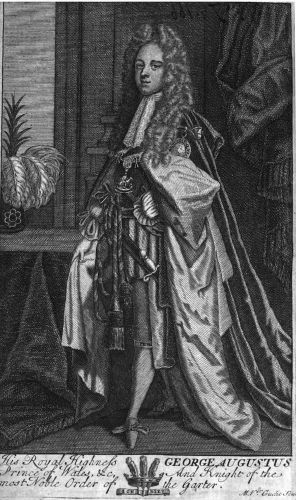

 imbroidered with the Letter A upon one
Arm of the Cross, and Ω on the other. The Sides
are wrought with Gold and Silk, but the Labarum is
all Gold. Amongst these Knights are three Degrees;
the first call’d Collered or Grand Crosses, wearing a
Collar form’d of Labarums, whereat hangs the Cross
and St. George. The second are the Knights, and these
wear the Cross above describ’d. The third are Servants,
and they bear the Cross only, without the Labarum.
The many Grand Priorates or Commanderies
belonging to this Order, shew the Power they were
formerly endow’d with.
imbroidered with the Letter A upon one
Arm of the Cross, and Ω on the other. The Sides
are wrought with Gold and Silk, but the Labarum is
all Gold. Amongst these Knights are three Degrees;
the first call’d Collered or Grand Crosses, wearing a
Collar form’d of Labarums, whereat hangs the Cross
and St. George. The second are the Knights, and these
wear the Cross above describ’d. The third are Servants,
and they bear the Cross only, without the Labarum.
The many Grand Priorates or Commanderies
belonging to this Order, shew the Power they were
formerly endow’d with.