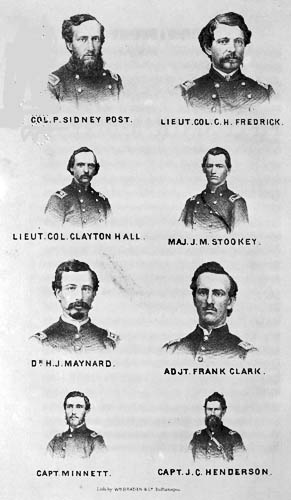
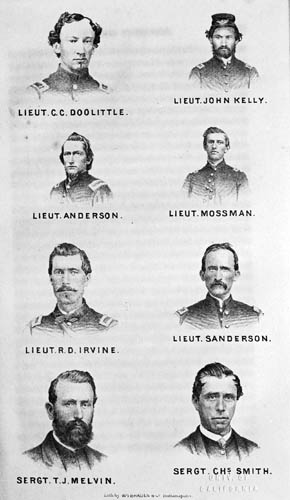
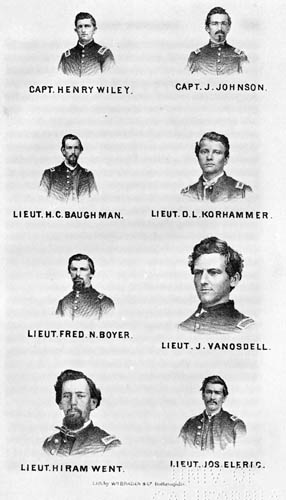
On the morning of the 10th, the army was again on the move, the Ninth
Missouri bringing up the rear of Jeff. C. Davis' division. The roads
were very bad, but the weather was favorable, and the country more
level than from Syracuse here. The sick and much extra baggage was left
at Lebanon, to be brought up at a more convenient season.
It was now anticipated that the enemy would be attempting to impede the
advance of our army, but no indications of their presence was
discovered until the evening of the 12th. About one o'clock, of the
12th, General Sigel's column, which was advancing on another road, some
half mile to our left, came upon their out-posts pickets, and a sharp
skirmish ensued. As soon, however, as a piece of artillery could be
brought to bear upon them, they fled in confusion, leaving the road
undisputed. This was the first firing of artillery the Ninth Missouri
had ever heard, and it caused a general excitement. The army halted
about four o'clock, in a good position, and several companies from the
different regiments were sent out through the woods as skirmishers.
Companies F and A of the Ninth, was ordered to scout the woods for a
mile or two in front. They were very proud of the distinction, and
elicited the envy of the other companies. With erect and martial step,
those two companies—the one, (Company F,) commanded by Captain Kelly;
the other, (Company A,) by Captain Hale—filed off into the woods in
search of the hidden foe. The boys in camp listened anxiously for the
report of fire arms, and soon, in the distance, several volleys of
musketry announced that the enemy had been found.
On the return of our skirmishers in the morning, they reported, that
before they had advanced over half a mile, they heard firing in their
front, and that Major Black, commanding the skirmishers, ordered an
advance on double quick. The underbrush was thick and intensely dark,
but by strenuous efforts the men succeeded in reaching an open space
and getting into line of battle, just as the rebels began to disappear
in an inglorious retreat. Some five hundred rebels had made a vigorous
attack upon our cavalry pickets, (First Missouri,) but had been
handsomely repulsed, with a loss of five killed and thirteen wounded,
before the infantry could come up.
Before going out, many of the boys took the precaution to leave their
money and valuables in the hands of their friends, so that if they
should be killed or captured, their effects would be safe.
Early on the morning of the 13th, the army was again in motion.
Springfield was now only seventeen miles distant, and no fortifications
were yet discovered. Price is now known to be at Springfield, and he
must either fight or run within the next forty-eight hours.
The army proceeded to within five miles of Springfield without any
indications of the enemy; but now coming to an open country the troops
were halted, and a long line of battle was formed across a very large
piece of meadow land. The line was formed in front of some heavy timber
skirting the meadow, and the supposition was that the enemy was posted
in the timber, ready for battle. The troops marched into line on double
quick, and in splendid style. The Ninth Missouri, led by its noble
commander, Lieut. Colonel C. H. Frederick, now had an opportunity of
displaying its proficiency in rapidity of action, and fell into line
with the precision of veterans. Very soon the whole line was formed,
and the men standing on their arms awaiting further orders. General
Curtis and staff now rode along the line, with the announcement that
Springfield was in our possession. Price had evacuated without a fight.
The news was received with a shout and the tossing of hats in the air,
mingled with curses and maledictions. Although it was pleasing news,
yet the disappointment in not getting satisfaction out of the infernal
scoundrels, was great among the troops. The line of battle was now
broken and the troops again formed into marching order. And now
commenced the most wonderful retreat and pursuit of two opposing
armies, that the world had ever witnessed.
Price commenced the evacuation of Springfield on the 12th, and in four
hours after the rear of his army had left the town, our advance was
passing through in pursuit. It was said by the rebel sympathizers in
town, that Price would make a stand at Wilson's Creek, ten miles below
town; that he had twenty thousand fighting men, and would drive Curtis
as he had General Lyon the summer before. It was more than probable
that the rebel army numbered at least that many, if not more. Price had
returned from Lexington to Springfield, on the 23d of December, 1861,
with his whole army, and had been using all his energies to recruit and
fill up his army until now. "He began to raise fifty thousand men for
the Southern Confederacy, the object of which was to secure him the
commission of Major General in the Southern Confederacy. He soon
accomplished his object.
The men are sworn into the service for twelve months. Several regiments
of the State Guard were soon broken up; they went into it very readily,
because they were made to believe that as soon as Price was promoted,
he would have power to order troops from any of the Southern States,
and that they would soon make a clean thing of it in Missouri, and also
invade Kansas and leave it as the Lord made it, without a house to
shelter Jayhawkers. These men felt confident that they would soon be
let loose to accomplish this glorious work, and were highly delighted
with the idea, but the poor fellows were badly fooled. General Curtis
and his brave boys were now rather interfering with their glorious
anticipations.
The army made no delay in passing through town, but marched about three
miles beyond, before going into camp. Camp was pitched on a large farm
belonging to an old rebel, and his effects had now fallen into
unsparing hands. The old gentleman had left a large, fine house, large
barn and good log stable on his premises. The log stable was designed
and worked up into quite a strong fort for the protection of the house
and barn. Heavy timbers and earth were so thrown together as to be a
perfect defence against musket balls, and port holes were opened for
the use of the besieged. But they dare not use it at this time, and our
boys soon made it untenable in the future. Soon after dark the house
and barn afforded plenty of light to see to go to bed by, all over
camp. Every thing about the premises was destroyed. The next morning
ashes and embers alone marked the spot where the house and barn stood;
and posts and bottom rails indicated where fences had been.
On the 14th the march was continued to Wilson's Creek, for dinner, and
several miles beyond for camp. Wilson's Creek is the scene of General
Lyon's defeat and death, and the writer can do no better than
transcribe, from Abbott's History of the Civil War in America, an
account of the whole affair:
Wilson's Creek is a tributary of White River. From the village of
Springfield, there is one road leading to Fayetteville, Arkansas,
running in a south-westerly direction. Another road pursuing a course
nearly due west, conducts to Mount Vernon. Along the banks of Wilson's
Creek there is a cross road, which connects the Fayetteville and the
Mount Vernon roads. The valley of this creek is about twenty rods in
width, bounded by gentle sloping hills, which are covered with scrub
oaks a few feet high, except where the land is in cultivation. Upon
this cross road about three miles in length, equally accessible from
Springfield by either of the roads we have mentioned, the rebel camp
was situated.
Concealed by the shades of evening, on the 9th of August, General Lyon,
with floating banners, but silent bands, emerged from the streets of
Springfield, to attack by surprise, if possible, the foe, outnumbering
him nearly three to one. His force was divided; one part under his own
command, moved along the Mount Vernon road, to attack the enemy in
front, while the other part, under the intrepid Colonel Sigel, with six
pieces of artillery, two companies of cavalry, and several regiments of
infantry, took the Fayetteville road, with instructions to attack the
rebels in the rear. Precautions were taken, to render the surprise as
complete as possible, and it was hoped that the rebels, distracted by
the presence of an enemy, thus unexpectedly assailing them on both
sides, and taken by surprise, might be effectually put to flight. It is
proper to add, that the term of service of the Fifth Regiment of
Missouri Volunteers, had expired; that Colonel Sigel, had gone to them,
company by company, and by his personal influence, had induced them to
re-enlist for eight days; that this re-enlistment expired on the 9th,
the day before the battle; that many of the officers had gone home, and
that a considerable part of Sigel's force, was composed of raw
recruits.
The morning of the 10th of August, was just beginning to dawn, when
Colonel Sigel cautiously arrived within a mile of the rebel camp. So
quietly did he advance, that some forty of the rebels going from their
camp to get water and provisions, were taken prisoners without being
able to give their commanders any warning of their danger. Silently the
Union troops ascended the hills, which bordered the creek, and there
beheld spread out before them, the tents of the foe. The rebels were at
their breakfast. Colonel Sigel bringing his artillery into position,
with a well directed shot into the midst of their encampment, gave the
rebels the first intimation of his presence. They were thrown into
utter disorder, by the suddenness of the surprise, and retreated in
confusion down the valley. The infantry pursued, and quickly formed in
the camp, so lately occupied by the rebels. The rebels, however,
recovering from the first panic, were almost as quickly formed into
line of battle, and Colonel Sigel found his little force opposed by
one, three thousand strong. The artillerymen moved down into the
valley, to co-operate with the infantry, and after a short fight, the
enemy retired in some confusion. Meanwhile, the sound of heavy firing
from the other end of the valley, was distinctly heard, and it was
evident that Lyon was there, engaging the enemy in force. In order to
aid Lyon, Colonel Sigel pressed forward his columns up the valley,
selecting a position to cut off any attempted retreat of the enemy. He
had already succeeded in taking over one hundred prisoners, when by a
natural, but unfortunate mistake, his well-laid plans were overturned,
and he was compelled to retreat. The firing in the north-west had
ceased. He presumed that Lyon had been successful, and that his troops
were in pursuit of the enemy. This was confirmed by the appearance to
the east of him, of large bodies of rebels, apparently retreating to
the south. Of course there could be no communications between him and
Lyon, as the rebel force was directly between them. At this juncture,
word was brought to Colonel Sigel, that Lyon's forces were advancing
triumphantly up the road. His troops were told not to fire upon them,
and with exultant hearts, they waved their flags, to those whom they
supposed to be their victorious comrades.
Suddenly from the advancing troops, there burst upon Sigel's little
band, a point-blank destructive fire, which covered the ground with the
dying and the dead. At the same moment, from the adjoining hills, where
they had supposed that Lyon's victorious troops were pursuing the
enemy, there came plunging down upon them shot and shell, from a rebel
battery. The Unionists were thrown into utter confusion, for they still
believed that the volleys which swept their ranks, came from their
friends. The gloom of the morning, and the absence of all uniform,
prevented the prompt detection of the error. The cry ran from mouth to
mouth, "our friends are firing upon us." The soldiers could not be
dissuaded from this belief, until many had fallen. Nearly all the
artillery horses were shot down at their guns, and death was sweeping
the ranks. Most of these young patriots, had recently came from their
peaceful homes, and had never before heard the spiteful whistle of a
hostile bullet. It is not strange that a panic should have ensued.
Under these circumstances, it might have been expected in the best
drilled army. Five cannon were abandoned in the disorderly retreat. The
foe, exultant and with hideous yells, came rushing on. Colonel Sigel
himself, in his efforts to arrest the rout, narrowly escaped capture.
With anguish, he afterwards summed up, that, out of his heroic little
band, he had lost, in dead, wounded and missing, eight hundred and
ninety-two. Some popular complaints have been uttered against Colonel
Sigel, for not having afterwards, with the remnant of his forces,
formed a junction with General Lyon. But this was not possible. There
were but two roads, by which he could gain access to Lyon's position,
at the other end of the valley. One was the long circuitous route of
twenty miles, by the way of Springfield. The other, was the valley
road, then in full possession of the exultant rebel army. There was,
therefore, nothing for Colonel Sigel to do, but to withdraw his
shattered and bleeding ranks as safely as possible, from the field.
General Lyon, meanwhile, having left Springfield at about the same
time, with Colonel Sigel, arrived at one o'clock in the morning, in
view of the enemy's campfires. Here his column lay, on its arms, till
daylight, when it moved forward. The enemy had pickets thrown out at
this point, and their surprise, was therefore, less complete than it
had been in the rear. By the time Lyon reached the northern end of the
camp, he found the enemy prepared to receive him. He succeeded,
however, after a brief struggle, in gaining a commanding eminence at
the north of the valley, in which the camp was situated. Captain
Plummer, with four companies of infantry, protected his left flank. The
battle was now commenced, by a fire of shot and shell from Captain
Totten's battery, and soon became general. In vain did the rebel host
endeavor to drive Lyon from his well chosen position.
On the right, on the left, and in front, they assailed him, in charge
succeeding charge, but in vain. His quick eye detected every movement,
and successfully met and defeated it. The overwhelming number of the
rebels, enabled them to replace, after each repulse, their defeated
forces with fresh regiments, while Lyon's little band found no time for
rest, no respite from the battle. The rebel host, surged wave after
wave upon his heroic lines, as billows of the sea dash upon the coast.
And as the rocks upon the coast beat back the flood, so did these
heroic soldiers of freedom, with courage which would have ennobled
veterans, and with patriotism which has won a nation's homage and love,
hurl back the tireless surges of rebellion, which threatened to engulf
them. It will be enough for any of these patriots to say. "I was at the
battle of Wilson's Creek," to secure the warmest grasp of every
patriot's hand.
Wherever the missiles of death flew thickest, and the peril of the
battle was most imminent, there was General Lyon surely to be found.
His young troops needed this encouragement on the part of their adored
leader, and it inspired them with bravery, which nothing else could
have conferred. His horse had been shot under him; three times he had
been wounded, and, though faint from the loss of blood, he refused to
retire even to have his wounds dressed; in vain did his officers
beseech him to avoid so much exposure. It was one of those eventful
hours, which Gen. Lyon fully comprehended, in which there was no hope
but in despair. Again and again had the enemy been repulsed, only to
return again and again with fresh troops, to the charge. Colonels
Mitchell, Deitzler and Andrews, were all severely wounded. All the men
were exhausted with the long and unintermitted battle, and it seemed as
though one puff of war's fierce tempest would now sweep away the thin
and tremulous line. Just then the rebels again formed in a fresh and
solid column for the charge. With firm and rapid tread, and raising
unearthly yells, they swept up the slope. General Lyon called for the
troops standing nearest him to form for an opposing charge. Undaunted,
and ready for the battle as ever, they inquired: "Who will be our
leader?" "Come on, brave men," shouted Gen. Lyon, "I will lead you." In
a moment he was at their head. At the next moment they were on the full
run; at the next a deadly storm of bullets swept their ranks,
staggering, but not checking them in their impetuous advance; on, on
they rushed for God and liberty, and in another moment the foe were
dispersed like dust by the gale. The victory was entire. This division
of the rebels could rally no more. The army was saved; but Lyon was
dead! Two bullets had pierced his bosom. As he fell, one of his
officers sprang to his side, and inquired anxiously: "Are you hurt?"
"Not much," was his faint reply. They were his last words. He fell
asleep, to wake no more. O! hateful pro-slavery rebellion! Such are the
victims immolated upon thy polluted shrine. Indignation is blended with
the tears we shed over such sacrifices, which we have been compelled to
offer to the demon of slavery. A nation mourned the loss of Lyon, the
true Christian knight, without fear and without reproach. His remains
now repose in the peaceful graveyard of his native village.
While passing this battle ground the soldiers picked up many human
skulls and bones, which were scatted upon the earth, in the places,
perhaps, where the soldiers to whom they belonged had fallen.
On Friday evening, (the 16th,) after twenty-four hours' retreat from
Springfield, the rebel army was encamped on Crane Creek, twenty-nine
miles distant. The Federal army was five miles in the rear, preparing
to make an early start in pursuit next day. Price had placed his train
in his advance. About one hundred wagons contained supplies, which were
brought into Springfield from Forsyth only a few hours before the
retreat was ordered. He will have some advantage among the hills, and
the rebel sympathizers here claim that he will be reinforced by twelve
or fifteen regiments from Bentonville, under General Van Dorn. On
Friday afternoon four officers and thirteen privates were captured by
our forces and sent to Springfield. They were captured near the rebel
outposts by a squad of the First Missouri Cavalry. They were looking up
mules, and got into our advance, supposing they were rebel pickets. The
same evening Lieutenant Bushnell advanced on the rebel pickets with his
mountain howitzer, and threw four shells, scattering them like sheep.
About six o'clock the army halted near Dug Springs, and prepared to
bivouac for the night; but, before the preparations were completed,
orders came to push forward. A messenger had announced that our cavalry
was close upon the enemy, and desired that the infantry be sent forward
in support. Hunger, fatigue, and all, were forgotten. Onward was the
word, until twelve o'clock at night. The division of General Davis was
in the advance, with the cavalry of Colonel Ellis and Major McConnell.
The enemy had halted on Crane Creek, and, had not the night been so
terribly dark, it is more than likely General Curtis would have
attacked him immediately, but he was fearful of being drawn into an
ambuscade. The troops lay on their arms awaiting the break of day.
At an early hour February 15th, the column moved forward, but during
the night Price had again fled, leaving a large portion of his camp
equipage, and a number of wagons. During that day the chase was very
exciting, there being constant skirmishing between our advance and his
rear guard. The road was strewn with broken wagons, dead and dying
mules and horses, and every conceivable kind of goods. At four o'clock
in the afternoon the booming of cannon notified us that Price had made
a stand. The Dubuque battery was pushed forward, and for an hour we had
a fine artillery fight. By the time our infantry got up the enemy had
precipitately fled. On the 16th instant we pushed on, finding many
evidences of the hasty flight in that day's march. During the afternoon
our cavalry again overtook the rebels at Cross Timbers, and here was
made a gallant charge by Colonel Harry Pease and forty men. Coming on
the enemy's picket, they drove it in, dashing at once in the very midst
of his camp. One of our men, a lieutenant of cavalry, was wounded, and
five or six horses killed. The enemy's loss was much greater. The
charge was really one of the most brilliant things that occurred on the
route. On the 17th instant we had several skirmishes, and at last
discovered the enemy in position on the south side of Sugar Creek.
Taking it altogether the flight of Price, and our pursuit, will form
one of the most interesting passages in the history of the war.
The valley through which Sugar Creek pursues its meandering course is
nearly half a mile in width at Trott's Store. From the brows of the
opposite ridges the distance is somewhat more, as the road winds.
Skirmishing between the pickets of the two armies occurred during the
morning, when Price moved out of sight beyond the brow of the
south-western hills. His army, as was since ascertained, then formed in
two lines on both sides of the road, and two Louisiana regiments, under
command of Colonel Louis Herbert, which had arrived from Cross Hollows
to reinforce Price, marched with their batteries, determined to give us
a warm reception. Two of the enemy's cannon were planted on the brow of
the hill, overlooking Sugar Creek, and their pieces were also ranged
along the road, about two hundred yards apart, for half a mile or more.
These pieces had prolongs attached, indicating that a running fight was
intended in case of pursuit. In the meantime our cavalry formed on the
opposite side of the valley, and marched across the creek to a point
near Trott's Store, and halted. The enemy then opened fire from their
batteries. One shot fell short, and a shell exploded over the heads of
our men stationed on the opposite hill, doing no damage. Captain
Hardin, of the Ninth Iowa Battery, answered the enemy's fire from the
opposite bluff, throwing three shells from a howitzer with such good
effect that the enemy were forced to fall back with their battery.
General Curtis then ordered the cavalry to move up the hill and charge
on the retreating foe. The order was gallantly obeyed by Colonel Ellis,
in command of the First Missouri Cavalry, followed by Major Wright,
leading his battalion, and Major McConnell, with the Third Battalion of
the Third Illinois Cavalry. The whole force of our cavalry making the
attack numbered some eight hundred. Gaining the brow of the hill, it
was ascertained that they had fallen back over a mile to an open field,
where their battery was again stationed, and the enemy in force, formed
in line. Our cavalry, regardless of danger, plunged forward to the
charge on the enemy's position, mostly screened by the intervening
woods. Nothing could have withstood the impetuosity of such a charge,
had not our advance, led by Colonel Ellis, when debouching from the
woods into the open field, been met by a murderous fire poured in upon
their ranks from behind the trees. Our loss was seven in killed and
wounded at this point. Inevitable destruction, without a chance to
resist so galling a fire, caused our brave men to recoil, when Colonel
Ellis, with great coolness and presence of mind, ordered his men to
right and left and scour the woods. The order was obeyed with telling
effect on the enemy, many of whom were cut down behind their places of
concealment, and the rest fled. Meantime Major McConnell, with his
battalion, left the road, and, deploying to the left, advanced on the
enemy's line, while Majors Wright and Boliver performed the same
maneuver on the right.
Two regiments of infantry arrived to support the cavalry, and formed in
line. Colonel Phelps' regiment deployed on the left of the road, and
Lieutenant-Colonel Herron, with the Ninth Iowa, deployed on the right.
Captain Hayden, of the Dubuque battery, answered the enemy's batteries,
which had opened upon our advancing columns, with a brisk fire. The
cannonading was kept up for a few minutes, when the enemy precipitately
fled, taking away most of his killed. Other regiments were coming into
the field to take part in the ball. Among the latter was the Fourth
Iowa. The men, anxious for the fray, had pulled off their coats and
threw them aside.
There is little doubt that if the rebels had been followed up closely
the rout would have been complete, and no time would have been given
them to burn their barracks at Cross Hollows.
The Colonel Herbert who commanded the rebel brigade was the gentleman
of California notoriety, who slew the waiter at Willard's Hotel, a few
years since. The other Confederate Colonels under him in the fight were
McRae and McNair.
Among the badly wounded is J. A. Edwards, of Co. H, Eighth Indiana. He
belonged to the infantry, but, getting possession of a horse, was the
foremost in the fight, running the gauntlet of the leaden hail, which
poured in upon him from the timber, without quailing. He got ahead of
the cavalry, and was cut off by the enemy.
The Hospital Steward of the Third Illinois cavalry (Baker) had his
horse shot down. He fell with the horse, dismounted, and leaped upon
another horse in the melee, and rushed forward on the enemy with
renewed vigor. Like Edwards, he had no business in the fight, but
nothing could keep him from pushing to the front and have a "hand" in.
A man belonging to the Dubuque battery had his horse's head taken off
by a cannon ball. He was leaning forward at the moment, and the ball
passed just above him, doing no injury.
The inhabitants along this route, from Cassville to this point, were
told by Price's army that the Northern troops were marching down, and
were burning all the houses, ravishing the women, and killing the
children. These ignorant people, it seems, believed the silly tale, and
the result is that a general stampede took place. Men procured teams,
gathered up what little valuables could be carried along, and, taking
their families aboard, deserted their homes. Only three men were found
in Cassville when our army arrived.
At Keitsville nearly all the inhabitants fled. From that point to Cross
Hollows about two-thirds of the inhabitants on the road have deserted
their dwellings. In several houses the tables were spread for
breakfast, and in the hurry of flight were thus left. The wash-tub was
seen filled with water on the back of the chair, indicating that the
hegira occurred, as it actually did, on a "wash-day." The doors were
ajar, the clock on the mantelpiece had ceased ticking, feather beds
were piled in the center of the floor, all sorts of furniture were
scattered about, and not a sound was heard but the mewing of a cat. An
air of lonesome, heart-sick desolation prevailed. One large dwelling
was recently burned down, and the ruins were still smoking. Surely the
leaders in this cursed civil war will have much to answer for.
Although strict orders forbid our boys from disturbing any private
property, they, nevertheless, helped themselves to such things as they
fancied. Clothing, quilts, dishes, cooking utensils, hams, lard,
molasses, vinegar, meal, beans, and whatever else their hands inclined
toward, was appropriated.
Rations at this time were very small, owing to having outmarched the
provision train, and the boys were very glad to have such opportunities
of filling up. Coffee had been played out several days before, and many
had been restricted to hominy and parched corn. But now the fleeing
rebels had left enough to more than satisfy their hunger, and they were
not disposed to treat their liberality with contempt. Some Indiana
troops threatened mutiny, on the 16th, in consequence of not having
their proper provisions. They positively refused to march any farther
until they were supplied with rations. Appropriations supplied them.