A Discourse of the most famous Doctor John Faustus of Wittenberg in Germanie, Coniurer, and Necromancer: wherein is declared many strange things that he himselfe hath seene, and done in the earth and in the Ayre, with his bringing vp, his trauailes, studies, and last end — CHAPTER I — CHAPTER II — CHAPTER III — CHAPTER IV — CHAPTER V — CHAPTER VI — CHAPTER VII — CHAPTER VIII — CHAPTER IX — CHAPTER X — CHAPTER XI — CHAPTER XII — CHAPTER XIII — CHAPTER XIV — CHAPTER XV — CHAPTER XVI — CHAPTER XVII — CHAPTER XVIII — CHAPTER XIX — CHAPTER XX — CHAPTER XXI — CHAPTER XXII — CHAPTER XXIII — CHAPTER XXIV — CHAPTER XXV — CHAPTER XXVI — CHAPTER XXVII — CHAPTER XXVIII — The third and last part of Doctor Faustus his merry conceits, shewing after what sort he practised Necromancy in the Courts of great Princes, and lastly of his fearful and pitiful end — CHAPTER XXIX — CHAPTER XXX — CHAPTER XXXI — CHAPTER XXXII — CHAPTER XXXIII — CHAPTER XXXIV — CHAPTER XXXV — CHAPTER XXXVI — CHAPTER XXXVII — CHAPTER XXXVIII — CHAPTER XXXIX — CHAPTER XL — CHAPTER XLI — CHAPTER XLII — CHAPTER XLIII — CHAPTER XLIV — CHAPTER XLV — CHAPTER XLVI — CHAPTER XLVII — CHAPTER XLVIII — CHAPTER XLIX — CHAPTER L — CHAPTER LI — CHAPTER LII — CHAPTER LIII — CHAPTER LIV — CHAPTER LV — CHAPTER LVI — CHAPTER LVII — CHAPTER LVIII — CHAPTER LIX — CHAPTER LX — CHAPTER LXI — CHAPTER LXII — CHAPTER LXIII
Of his Parentage and Birth
JOHN FAUSTUS, born in the town of Rhode,
lying in the province of Weimer in Germanie,
his father a poor husbandman, and not able well to
bring him up: but having an uncle at Wittenberg,
a rich man, and without issue, took this J. Faustus
from his father, and made him his heir, in so much
that his father was no more troubled with him, for he
remained with his uncle at Wittenberg, where he was
kept at the University in the same city to study
Divinity. But Faustus being of a naughty mind and
otherwise addicted, applied not his studies, but took
himself to other exercises: the which his uncle often-times
hearing, rebuked him for it, as Eli oft-times
rebuked his children for sinning against the Lord:
even so this good man laboured to have Faustus apply
his study of Divinity, that he might come to the
knowledge of God and his laws. But it is manifest
that many virtuous parents have wicked children, as
Cain, Ruben, Absolom, and such-like have been to
their parents: so this Faustus having godly parents,
and seeing him to be of a toward wit, were very
desirous to bring him up in those virtuous studies,
namely, of Divinity: but he gave himself secretly to
study Necromancy and Conjuration, in so much that
few or none could perceive his profession.
But to the purpose: Faustus continued at study in
the University, and was by the Rectors and sixteen
Masters afterwards examined how he had profited
in his studies; and being found by them, that none
for his time were able to argue with him in Divinity,
or for the excellency of his wisdom to compare with
him, with one consent they made him Doctor of
Divinity. But Doctor Faustus within short time
after he had obtained his degree, fell into such fantasies
and deep cogitations, that he was marked of
many, and of the most part of the Students was called
the Speculator; and sometime he would throw the
Scriptures from him as though he had no care of his
former profession: so that he began a very ungodly
life, as hereafter more at large may appear; for the
old proverb saith, Who can hold that will away?
so, who can hold Faustus from the Devil, that seeks
after him with all his endeavour? For he accompanied
himself with divers that were seen in those
Devilish Arts, and that had the Chaldean, Persian,
Hebrew, Arabian, and Greek tongues, using Figures,
Characters, Conjurations, Incantations, with many
other ceremonies belonging to these infernal Arts,
as Necromancy, Charms, Soothsaying, Witchcraft,
Enchantment, being delighted with their books,
words, and names so well, that he studied day and
night therein: in so much that he could not abide
to be called Doctor of Divinity, but waxed a worldly
man, and named himself an Astrologian, and a Mathematician:
and for a shadow sometimes a Physician,
and did great cures, namely, with herbs, roots, waters,
drinks, receipts, and clysters. And without doubt he
was passing wise, and excellent perfect in the holy
scriptures: but he that knoweth his master’s will and
doth it not, is worthy to be beaten with many stripes.
It is written, no man can serve two masters: and,
thou shalt not tempt the Lord thy God: but Faustus
threw all this in the wind, and made his soul of no
estimation, regarding more his worldly pleasure than
the joys to come: therefore at the day of judgment
there is no hope of his redemption.
How Doctor Faustus began to practise in his Devilish
Art, and how he conjured the Devil, making him
to appear and meet him on the morrow at his
own house
You have heard before, that all Faustus’ mind was set
to study the arts of Necromancy and Conjuration, the
which exercise he followed day and night: and taking
to him the wings of an Eagle, thought to fly over the
whole world, and to know the secrets of heaven and
earth; for his Speculation was so wonderful, being
expert in using his Vocabula, Figures, Characters,
Conjurations, and other Ceremonial actions, that in
all the haste he put in practice to bring the Devil
before him. And taking his way to a thick Wood near
to Wittenberg, called in the German tongue Spisser
Waldt: that is in English the Spissers Wood (as
Faustus would often-times boast of it among his crew
being in his jollity), he came into the same wood
towards evening into a cross way, where he made
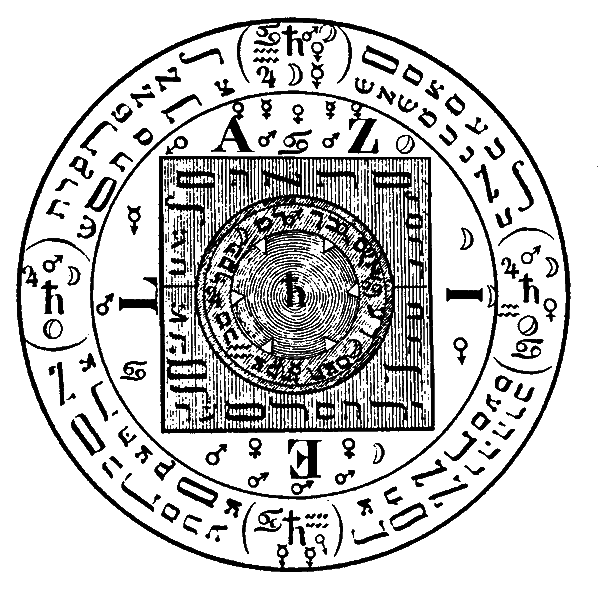
with a wand a Circle in the dust, and within that many
more Circles and Characters: and thus he passed
away the time, until it was nine or ten of the clock
in the night, then began Doctor Faustus to call for
Mephostophiles the Spirit, and to charge him in the
name of Beelzebub to appear there personally without
any long stay: then presently the Devil began so
great a rumour in the Wood, as if heaven and earth
would have come together with wind, the trees bowing
their tops to the ground, then fell the Devil to blare as
if the whole Wood had been full of Lions, and suddenly
about the Circle ran the Devil as if a thousand
Wagons had been running together on paved stones.
After this at the four corners of the Wood it thundered
horribly, with such lightnings as if the whole world,
to his seeming, had been on fire. Faustus all this while
half amazed at the Devil’s so long tarrying, and doubting
whether he were best to abide any more such horrible
Conjurings, thought to leave his Circle and
depart; whereupon the Devil made him such music
of all sorts, as if the Nymphs themselves had been in
place: whereat Faustus was revived and stood stoutly
in his circle aspecting his purpose, and began again
to conjure the Spirit Mephostophiles in the name of
the Prince of Devils to appear in his likeness: whereat
suddenly over his head hanged hovering in the air
a mighty Dragon: then calls Faustus again after his
Devilish manner, at which there was a monstrous
cry in the Wood, as if Hell had been open, and all
the tormented souls crying to God for mercy; presently
not three fathoms above his head fell a flame
in manner of a lightning, and changed itself into a
Globe: yet Faustus feared it not, but did persuade
himself that the Devil should give him his request
before he would leave: Often-times after to his companions
he would boast, that he had the stoutest head
(under the cope of heaven) at commandment: whereat
they answered, they knew none stouter than the Pope
or Emperor: but Doctor Faustus said, the head that
is my servant is above all on earth, and repeated certain
words out of Saint Paul to the Ephesians to make his
argument good: The Prince of this world is upon
earth and under heaven. Well, let us come again
to his Conjuration where we left him at his fiery
Globe: Faustus vexed at the Spirit’s so long tarrying,
used his Charms with full purpose not to depart
before he had his intent, and crying on Mephostophiles
the Spirit; suddenly the Globe opened and sprang
up in height of a man: so burning a time, in the end
it converted to the shape of a fiery man. This pleasant
beast ran about the Circle a great while, and lastly
appeared in manner of a gray Friar, asking Faustus
what was his request. Faustus commanded that the
next morning at twelve of the clock he should appear
to him at his house; but the Devil would in no wise
grant. Faustus began again to conjure him in the
name of Beelzebub, that he should fulfil his request:
whereupon the Spirit agreed, and so they departed
each one his way.
The conference of Doctor Faustus with the Spirit
Mephostophiles the morning following at his
own house
Doctor Faustus having commanded the Spirit to
be with him, at his hour appointed he came and
appeared in his chamber, demanding of Faustus
what his desire was: then began Doctor Faustus
anew with him to conjure him that he should be
obedient unto him, and to answer him certain Articles,
and to fulfil them in all points.
1. That the Spirit should serve him and be obedient
unto him in all things that he asked of him from that
hour until the hour of his death.
2. Farther, anything that he desired of him he should
bring it to him.
3. Also, that in all Faustus his demands or Interrogations,
the Spirit should tell him nothing but that
which is true.
Hereupon the Spirit answered and laid his case
forth, that he had no such power of himself, until
he had first given his Prince (that was ruler over him)
to understand thereof, and to know if he could obtain
so much of his Lord: therefore speak farther that I
may do thy whole desire to my Prince: for it is not
in my power to fulfil without his leave. Shew me the
cause why (said Faustus). The Spirit answered:
Faustus, thou shalt understand, that with us it is
even as well a kingdom, as with you on earth: yea,
we have our rulers and servants, as I my self am one,
and we name our whole number the Legion: for although
that Lucifer is thrust and fallen out of heaven
through his pride and high mind, yet he hath notwithstanding
a Legion of Devils at his commandment,
that we call the Oriental Princes; for his power is
great and infinite. Also there is an host in Meridie,
in Septentrio, in Occidente: and for that Lucifer
hath his kingdom under heaven, we must change and
give ourselves unto men to serve them at their pleasure.
It is also certain, we have never as yet opened unto
any man the truth of our dwelling, neither of our
ruling, neither what our power is, neither have we
given any man any gift, or learned him anything,
except he promise to be ours.
Doctor Faustus upon this arose where he sat,[14] and
said, I will have my request, and yet I will not be
damned. The Spirit answered, Then shalt thou want
thy desire, and yet art thou mine notwithstanding:
if any man would detain thee it is in vain, for thine
infidelity hath confounded thee.
Hereupon spake Faustus: Get thee hence from me,
and take Saint Valentine’s farewell and Crisam[15] with
thee, yet I conjure thee that thou be here at evening,
and bethink thyself on that I have asked thee, and ask
thy Prince’s counsel therein. Mephostophiles the
Spirit, thus answered, vanished away, leaving Faustus
in his study, where he sat pondering with himself
how he might obtain his request of the Devil without
loss of his soul: yet fully he was resolved in himself,
rather than to want his pleasure, to do whatsoever
the Spirit and his Lord should condition upon.
The second time of the Spirit’s appearing to Faustus
in his house, and of their parley
Faustus continuing in his Devilish cogitations, never
moving out of the place where the Spirit left him
(such was his fervent love to the Devil) the night
approaching, this swift flying Spirit appeared to
Faustus, offering himself with all submission to his
service, with full authority from his Prince to do
whatsoever he would request, if so be Faustus would
promise to be his: this answer I bring thee, and an
answer must thou make by me again, yet will I hear
what is thy desire, because thou hast sworn me to be
here at this time. Doctor Faustus gave him this answer,
though faintly (for his soul’s sake), That his request
was none other but to become a Devil, or at the least
a limb of him, and that the Spirit should agree unto
these Articles as followeth.
1. That he might be a Spirit in shape and quality.
2. That Mephostophiles should be his servant,
and at his commandment.
3. That Mephostophiles should bring him anything,
and do for him whatsoever.
4. That at all times he should be in his house,
invisible to all men, except only to himself, and at
his commandment to shew himself.
5. Lastly, that Mephostophiles should at all times
appear at his command, in what form or shape soever
he would.
Upon these points the Spirit answered Doctor
Faustus, that all this should be granted him and fulfilled,
and more if he would agree unto him upon
certain Articles as followeth.
First, that Doctor Faustus should give himself to
his Lord Lucifer, body and soul.
Secondly, for confirmation of the same, he should
make him a writing, written with his own blood.
Thirdly, that he would be an enemy to all Christian
people.
Fourthly, that he would deny his Christian belief.
Fifthly, that he let not any man change his opinion,
if so be any man should go about to dissuade, or
withdraw him from it.
Further, the Spirit promised Faustus to give him
certain years to live in health and pleasure, and when
such years were expired, that then Faustus should
be fetched away, and if he should hold these Articles
and conditions, that then he should have all whatsoever
his heart would wish or desire; and that Faustus
should quickly perceive himself to be a Spirit in all
manner of actions whatsoever. Hereupon Doctor
Faustus his mind was so inflamed, that he forgot his
soul, and promised Mephostophiles to hold all things
as he had mentioned them: he thought the Devil
was not so black as they used to paint him, nor Hell so
hot as the people say, etc.
The third parley between Doctor Faustus and
Mephostophiles about a conclusion
After Doctor Faustus had made his promise to the
Devil, in the morning betimes he called the Spirit
before him and commanded him that he should
always come to him like a Friar, after the order of
Saint Francis, with a bell in his hand like Saint
Anthony, and to ring it once or twice before he appeared,
that he might know of his certain coming:
Then Faustus demanded the Spirit, what was his
name? The Spirit answered, my name is as thou
sayest, Mephostophiles, and I am a prince, but servant
to Lucifer: and all the circuit from Septentrio to
the Meridian, I rule under him. Even at these words
was this wicked wretch Faustus inflamed, to hear himself
to have gotten so great a Potentate to be his servant,
forgot the Lord his maker, and Christ his redeemer,
became an enemy unto all mankind, yea, worse than
the Giants whom the Poets feign to climb the hills to
make war with the Gods: not unlike that enemy
of God and his Christ, that for his pride was cast into
Hell: so likewise Faustus forgot that the high
climbers catch the greatest falls, and that the sweetest
meat requires the sourest sauce.
After a while, Faustus promised Mephostophiles
to write and make his Obligation, with full assurance
of the Articles in the Chapter before rehearsed. A
pitiful case, (Christian Reader), for certainly this Letter
or Obligation was found in his house after his most
lamentable end, with all the rest of his damnable
practices used in his whole life. Therefore I wish all
Christians to take an example by this wicked Faustus,
and to be comforted in Christ, contenting themselves
with that vocation whereunto it hath pleased God to
call them, and not to esteem the vain delights of this
life, as did this unhappy Faustus, in giving his Soul
to the Devil: and to confirm it the more assuredly,
he took a small penknife, and pricked a vein in his
left hand, and for certainty thereupon, were seen on
his hand these words written, as if they had been
written with blood, Ô HOMO FUGE: whereat the
Spirit vanished, but Faustus continued in his damnable
mind, and made his writing as followeth.
How Doctor Faustus set his blood in a saucer on
warm ashes, and writ as followeth
I, Johannes Faustus, Doctor, do openly acknowledge
with mine own hand, to the greater force and strengthening
of this Letter, that siththence I began to study and
speculate the course and order of the Elements, I have
not found through the gift that is given me from above,
any such learning and wisdom, that can bring me to
my desires: and for that I find, that men are unable
to instruct me any farther in the matter, now have I
Doctor John Faustus, unto the hellish prince of
Orient and his messenger Mephostophiles, given
both body and soul, upon such condition, that they
shall learn me, and fulfil my desire in all things, as
they have promised and vowed unto me, with due
obedience unto me, according unto the Articles mentioned
between us.
Further, I covenant and grant with them by these
presents, that at the end of twenty-four years next
ensuing the date of this present Letter, they being
expired, and I in the meantime, during the said years
be served of them at my will, they accomplishing my
desires to the full in all points as we are agreed, that
then I give them full power to do with me at their
pleasure, to rule, to send, fetch, or carry me or mine,
be it either body, soul, flesh, blood, or goods, into
their habitation, be it wheresoever: and hereupon,
I defy God and his Christ, all the host of heaven, and
all living creatures that bear the shape of God, yea all
that lives; and again I say it, and it shall be so. And
to the more strengthening of this writing, I have
written it with mine own hand and blood, being in
perfect memory, and hereupon I subscribe to it with
my name and title, calling all the infernal, middle,
and supreme powers to witness of this my Letter and
subscription.
John Faustus, approved in the Elements,
and the spiritual Doctor.
How Mephostophiles came for his writing, and in
what manner he appeared, and his sights he
shewed him: and how he caused him to keep
a copy of his own writing
Doctor Faustus sitting pensive, having but one only
boy with him, suddenly there appeared his Spirit
Mephostophiles, in likeness of a fiery man, from whom
issued most horrible fiery flames, in so much that the
boy was afraid, but being hardened by his master, he
bade him stand still and he should have no harm:
the Spirit began to blare as in a singing manner.
This pretty sport pleased Doctor Faustus well, but
he would not call his Spirit into his Counting house,
until he had seen more: anon was heard a rushing of
armed men, and trampling of horses: this ceasing,
came a kennel of hounds, and they chased a great
Hart in the hall, and there the Hart was slain. Faustus
took heart, came forth, and looked upon the Hart,
but presently before him there was a Lion and a
Dragon together fighting, so fiercely, that Faustus
thought they would have brought down the house,
but the Dragon overcame the Lion, and so they
vanished.
After this, came in a Peacock, with a Peahen, the
cock brustling of his tail, and turning to the female,
beat her, and so vanished. Afterward followed a
furious Bull, that with a full fierceness ran upon
Faustus, but coming near him, vanished away. Afterward
followed a great old Ape, this Ape offered
Faustus the hand, but he refused: so the Ape ran
out of the hall again. Hereupon fell a mist in the hall,
that Faustus saw no light, but it lasted not, and so
soon as it was gone, there lay before Faustus two great
sacks, one full of gold, the other full of silver.
Lastly, was heard by Faustus all manner Instruments
of music, as Organs, Clarigolds,[16] Lutes, Viols,
Citterns,[17] Waits,[18] Hornpipes, Flutes, Anomes,[19] Harps,
and all manner of other Instruments, the which so
ravished his mind, that he thought he had been in
another world, forgot both body and soul, in so much
that he was minded never to change his opinion concerning
that which he had done. Hereat, came Mephostophiles
into the Hall to Faustus, in apparel like unto
a Friar, to whom Faustus spake, thou hast done me
a wonderful pleasure in shewing me this pastime,
if thou continue as thou hast began, thou shalt win
me heart and soul, yea and have it. Mephostophiles
answered, this is nothing, I will please thee better:
yet that thou mayest know my power and all, ask what
thou wilt request of me, that shalt thou have, conditionally
hold thy promise, and give me thy handwriting:
at which words, the wretch thrust forth his hand,
saying, hold thee, there hast thou my promise:
Mephostophiles took the writing, and willing Faustus
to take a copy of it, with that the perverse Faustus
being resolute in his damnation, wrote a copy thereof,
and gave the Devil the one, and kept in store the other.
Thus the Spirit and Faustus were agreed, and dwelt
together: no doubt there was a virtuous housekeeping.
The manner how Faustus proceeded with his damnable
life, and of the diligent service Mephostophiles
used towards him
Doctor Faustus having given his soul to the Devil,
renouncing all the powers of heaven, confirming this
lamentable action with his own blood, and having
already delivered his writing now into the Devil’s
hand, the which so puffed up his heart, that he had
forgot the mind of a man, and thought rather himself
to be a spirit. This Faustus dwelt in his uncle’s house
at Wittenberg, who died, and bequeathed it in his
Testament to his Cousin Faustus. Faustus kept a
boy with him that was his scholar, an unhappy wag,
called Christopher Wagner, to whom this sport and
life that he saw his master follow seemed pleasant.
Faustus loved the boy well, hoping to make him as
good or better seen in his Devilish exercise than himself;
and he was fellow with Mephostophiles: otherwise
Faustus had no more company in his house; but
himself, his boy and his Spirit, that ever was diligent
at Faustus’ command, going about the house, clothed
like a Friar, with a little bell in his hand, seen of none
but Faustus. For his victual and other necessaries,
Mephostophiles brought him at his pleasure from the
Duke of Saxon, the Duke of Bavaria, and the Bishop
of Saltzburg: for they had many times their best wine
stolen out of their cellars by Mephostophile: Likewise
their provision for their own table, such meat as
Faustus wished for, his Spirit brought him in: besides
that, Faustus himself was become so cunning, that
when he opened his window, what fowl soever he
wished for, it came presently flying into his house,
were it never so dainty. Moreover, Faustus and his
boy went in sumptuous apparel, the which Mephostophiles
stole from the Mercers at Norenberg, Auspurg,
Franckeford, and Liptzig: for it was hard for them to
find a lock to keep out such a thief. All their maintenance
was but stolen and borrowed ware: and thus
they lived an odious life in the sight of God, though
as yet the world were unacquainted with their wickedness.
It must be so, for their fruits be none other:
as Christ saith through John, where he calls the Devil
a thief, and a murderer: and that found Faustus, for
he stole him away both body and soul.
How Doctor Faustus would have married, and how
the Devil had almost killed him for it
Doctor Faustus continued thus in his Epicurish
life day and night, and believed not that there was
a God, hell, or Devil: he thought that body and soul
died together, and had quite forgotten Divinity or
the immortality of his soul, but stood in his damnable
heresy day and night. And bethinking himself of
a wife, called Mephostophiles to counsel; which
would in no wise agree: demanding of him if he
would break the covenant made with him, or if he
had forgot it. Hast not thou (quoth Mephostophiles)
sworn thyself an enemy to God and all creatures?
To this I answer thee, thou canst not marry; thou
canst not serve two masters, God, and my Prince:
for wedlock is a chief institution ordained of God,
and that hast thou promised to defy, as we do all, and
that hast thou also done: and moreover thou hast
confirmed it with thy blood: persuade thyself, that
what thou dost in contempt of wedlock, it is all to
thine own delight. Therefore Faustus, look well
about thee, and bethink thyself better, and I wish
thee to change thy mind: for if thou keep not what
thou hast promised in thy writing, we will tear thee
in pieces like the dust under thy feet. Therefore
sweet Faustus, think with what unquiet life, anger,
strife, and debate thou shalt live in when thou takest
a wife: therefore change thy mind.
Doctor Faustus was with these speeches in despair:
and as all that have forsaken the Lord, can build upon
no good foundation: so this wretched Faustus having
forsook the rock, fell in despair with himself, fearing
if he should motion Matrimony any more, that the
Devil would tear him in pieces. For this time (quoth
he to Mephostophiles) I am not minded to marry.
Then you do well, answered his Spirit. But shortly
and that within two hours after, Faustus called his
Spirit, which came in his old manner like a Friar.
Then Faustus said unto him, I am not able to resist
nor bridle my fantasy, I must and will have a wife,
and I pray thee give thy consent to it. Suddenly
upon these words came such a whirlwind about the
place, that Faustus thought the whole house would
come down, all the doors in the house flew off the
hooks: after all this, his house was full of smoke,
and the floor covered over with ashes: which when
Doctor Faustus perceived, he would have gone up the
stairs: and flying up, he was taken and thrown into
the hall, that he was not able to stir hand nor foot:
then round about him ran a monstrous circle of fire,
never standing still, that Faustus fried as he lay, and
thought there to have been burned. Then cried he
out to his Spirit Mephostophiles for help, promising
him he would live in all things as he had vowed in his
handwriting. Hereupon appeared unto him an ugly
Devil, so fearful and monstrous to behold, that
Faustus durst not look on him. The Devil said, what
wouldst thou have Faustus? how likest thou thy
wedding? what mind art thou in now? Faustus
answered, he had forgot his promise, desiring him of
pardon, and he would talk no more of such things.
The Devil answered, thou were best so to do, and so
vanished.
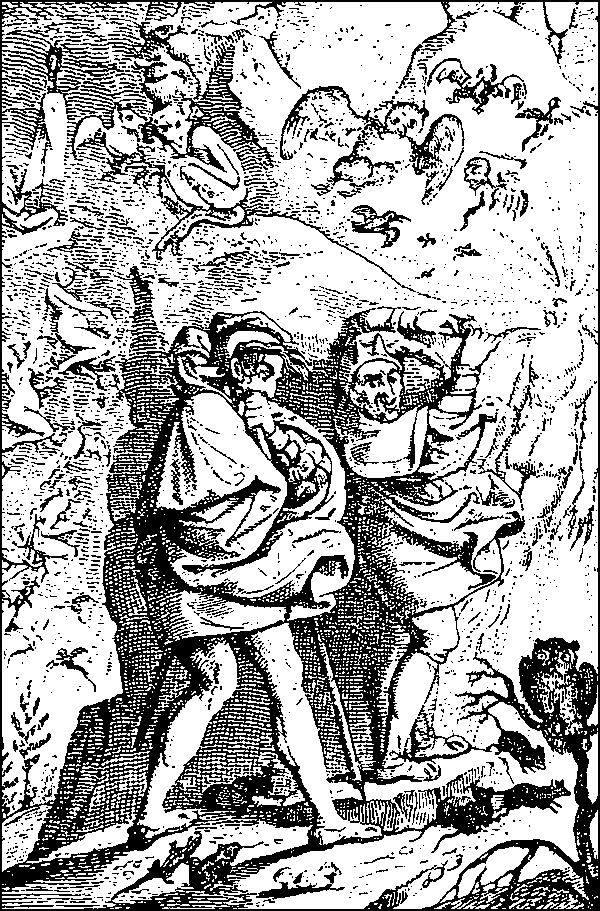
THE JOURNEY TO THE WITCHES’ SABBATH
After P. Cornelius
After appeared unto him his Friar Mephostophiles
with a bell in his hand, and spake to Faustus: It is
no jesting with us, hold thou that which thou
hast vowed, and we will perform as we have promised:
and more than that, thou shalt have thy heart’s
desire of what women soever thou wilt, be she alive or
dead, and so long as thou wilt, thou shalt keep her
by thee.
These words pleased Faustus wonderful well, and
repented himself that he was so foolish to wish himself
married, that might have any woman in the whole
City brought to him at his command; the which he
practised and persevered in a long time.
Questions put forth by Doctor Faustus unto his
Spirit Mephostophiles
Doctor Faustus living in all manner of pleasure that
his heart could desire, continuing in his amorous
drifts, his delicate fare, and costly apparel, called on
a time his Mephostophiles to him: which being come,
brought with him a book in his hand of all manner
of Devilish and enchanted arts, the which he gave
Faustus, saying: hold my Faustus, work now thy
heart’s desire: The copy of this enchanting book
was afterward found by his servant Christopher
Wagner. Well (quoth Faustus to his Spirit) I have
called thee to know what thou canst do if I have need
of thy help. Then answered Mephostophiles and said,
my Lord Faustus, I am a flying spirit: yea, so swift as
thought can think, to do whatsoever. Here Faustus
said: but how came thy Lord and master Lucifer to
have so great a fall from heaven? Mephostophiles
answered: My Lord Lucifer was a fair Angel, created
of God as immortal, and being placed in the Seraphims,
which are above the Cherubims, he would have presumed
unto the Throne of God, with intent to have
thrust God out of his seat. Upon this presumption
the Lord cast him down headlong, and where before
he was an Angel of light, now dwells he in darkness,
not able to come near his first place, without God
send for him to appear before him as Raphael: but
unto the lower degree of Angels that have their conversation
with men he was come, but not unto the
second degree of Heavens that is kept by the Archangels,
namely, Michael and Gabriel, for these are
called Angels of God’s wonders: yet are these far
inferior places to that from whence my Lord and
Master Lucifer fell. And thus far Faustus, because
thou art one of the beloved children of my Lord
Lucifer, following and feeding thy mind in manner as
he did his, I have shortly resolved thy request, and
more I will do for thee at thy pleasure. I thank thee
Mephostophiles (quoth Faustus) come let us now
go rest, for it is night: upon this they left their communication.
How Doctor Faustus dreamed that he had seen hell
in his sleep, and how he questioned with his
Spirit of matters as concerning hell, with the
Spirit’s answer
The night following, after Faustus his communication
had with Mephostophiles, as concerning the fall of
Lucifer, Doctor Faustus dreamed that he had seen
a part of hell: but in what manner it was, or in what
place he knew not: whereupon he was greatly troubled
in mind, and called unto him Mephostophiles his
Spirit, saying to him, my Mephostophiles, I pray thee
resolve me in this doubt: what is hell, what substance
is it of, in what place stands it, and when was it made?
Mephostophiles answered: my Faustus, thou shalt
know, that before the fall of my Lord Lucifer there was
no hell, but even then was hell ordained: it is of no
substance, but a confused thing: for I tell thee, that
before all Elements were made, and the earth seen,
the Spirit of God moved on the waters, and darkness
was over all: but when God said, let it be light, it
was so at his word, and the light was on God’s right
hand, and God praised the light. Judge thou further:
God stood in the middle, the darkness was on his left
hand, in the which my Lord was bound in chains
until the day of judgment: in this confused hell is
nought to find but a filthy, Sulphurish, fiery, stinking
mist or fog. Further, we Devils know not what
substance it is of, but a confused thing. For as a
bubble of water flieth before the wind, so doth hell
before the breath of God. Further, we Devils know
not how God hath laid the foundation of our hell,
nor whereof it is: but to be short with thee Faustus,
we know that hell hath neither bottom nor end.
The second question put forth by Doctor Faustus to
his Spirit, what Kingdoms there were in hell,
how many, and what were their rulers’ names
Faustus spake again to Mephostophiles, saying:
thou speakest of wonderful things, I pray thee now
tell me what Kingdoms is there in your hell, how many
are there, what are they called, and who rules them:
the Spirit answered him: my Faustus, know that
hell is as thou wouldst think with thyself another
world, in the which we have our being, under the
earth, and above the earth, even to the Heavens;
within the circumference whereof are contained ten
Kingdoms, namely:
- Lacus mortis.
- Stagnum ignis.
- Terra tenebrosa.
- Tartarus.
- Terra oblivionis.
- Gehenna.
- Herebus.
- Barathrum.
- Styx.
- Acheron.
The which Kingdoms are governed by five kings,
that is, Lucifer in the Orient, Beelzebub in Septentrio,
Belial in Meridie, Astaroth in Occidente, and Phlegeton
in the middest of them all: whose rule and dominions
have none end until the day of Doom. And thus far
Faustus, hast thou heard of our rule and Kingdoms.
Another question put forth by Doctor Faustus to his
Spirit concerning his Lord Lucifer, with the
sorrow that Faustus fell afterwards into
Doctor Faustus began again to reason with Mephostophiles,
requiring him to tell him in what form and
shape, and in what estimation his Lord Lucifer was
when he was in favour with God. Whereupon his
Spirit required of him three days’ respite, which
Faustus granted. The three days being expired,
Mephostophiles gave him this answer: Faustus, my
Lord Lucifer (so called now, for that he was banished
out of the clear light of heaven) was at the first an
Angel of God, he sat on the Cherubims, and saw all
the wonderful works of God, yea he was so of God
ordained, for shape, pomp, authority, worthiness, and
dwelling, that he far exceeded all other the creatures
of God, yea our gold and precious stones: and so
illuminated, that he far surpassed the brightness of
the Sun and all other Stars: wherefore God placed
him on the Cherubims, where he had a kingly office,
and was always before God’s seat, to the end he might
be the more perfect in all his beings: but when he
began to be high-minded, proud, and so presumptuous
that he would usurp the seat of his Majesty, then was
he banished out from amongst the heavenly powers,
separated from their abiding into the manner of a
fiery stone, that no water is able to quench, but continually
burneth until the end of the world.
Doctor Faustus, when he had heard the words of
his Spirit, began to consider with himself, having
diverse and sundry opinions in his head: and very
pensively (saying nothing unto his Spirit) he went into
his chamber, and laid him on his bed, recording the
words of Mephostophiles; which so pierced his
heart, that he fell into sighing and great lamentation,
crying out: alas, ah, woe is me! what have I done?
Even so shall it come to pass with me: am not I
also a creature of God’s making, bearing his own
Image and similitude, into whom he hath breathed
the Spirit of life and immortality, unto whom he hath
made all things living subject: but woe is me, mine
haughty mind, proud aspiring stomach, and filthy
flesh, hath brought my soul into perpetual damnation;
yea, pride hath abused my understanding, in so much
that I have forgot my maker, the Spirit of God is
departed from me. I have promised the Devil my
Soul: and therefore it is but a folly for me to hope
for grace, but it must be even with me as with Lucifer,
thrown into perpetual burning fire: ah, woe is me
that ever I was born. In this perplexity lay this
miserable Doctor Faustus, having quite forgot his faith
in Christ, never falling to repentance truly, thereby
to attain the grace and holy Spirit of God again, the
which would have been able to have resisted the
strong assaults of Satan: for although he had made
him a promise, yet he might have remembered through
true repentance sinners come again into the favour
of God; which faith the faithful firmly hold, knowing
they that kill the body, are not able to hurt the soul:
but he was in all his opinions doubtful, without faith
or hope, and so he continued.
Another disputation betwixt Doctor Faustus and his
Spirit, of the power of the Devil, and of his
envy to mankind
After Doctor Faustus had a while pondered and
sorrowed with himself of his wretched estate, he called
again Mephostophiles unto him, commanding him to
tell him the judgment, rule, power, attempts, tyranny
and temptation of the Devil, and why he was moved
to such kind of living: whereupon the Spirit answered,
this question that thou demandest of me, will turn
thee to no small discontentment: therefore thou
shouldst not have desired me of such matters, for it
toucheth the secrets of our Kingdom, although I
cannot deny to resolve thy request. Therefore know
thou Faustus, that so soon as my Lord Lucifer fell
from heaven, he became a mortal enemy both to God
and man, and hath used (as now he doth) all manner
of tyranny to the destruction of man, as is manifest
by divers examples, one falling suddenly dead, another
hangs himself, another drowns himself, others stab
themselves, others unfaithfully despair, and so come
to utter confusion: the first man Adam that was made
perfect to the similitude of God, was by my Lord his
policy, the whole decay of man: yea, Faustus, in him
was the beginning and first tyranny of my Lord
Lucifer used to man: the like did he with Cain, the
same with the children of Israel, when they worshipped
strange Gods, and fell to whoredom with strange
women: the like with Saul: so did he by the seven
husbands of her that after was the wife of Tobias:
likewise Dagon our fellow brought to destruction
thirty thousand men, whereupon the Ark of God was
stolen: and Belial made David to number his men,
whereupon were slain sixty thousand, also he deceived
King Solomon that worshipped the Gods of the
heathen: and there are such Spirits innumerable
that can come by men and tempt them, drive them to
sin, weaken their belief: for we rule the hearts of
Kings and Princes, stirring them up to war and bloodshed;
and to this intent do we spread ourselves
throughout all the world, as the utter enemies of God,
and his Son Christ, yea and all those that worship
them: and that thou knowest by thyself Faustus,
how we have dealt with thee. To this answered
Faustus, why then thou didst also beguile me. Yea
(quoth Mephostophiles) why should not we help thee
forwards: for so soon as we saw thy heart, how thou
didst despise thy degree taken in Divinity, and didst
study to search and know the secrets of our Kingdom;
even then did we enter into thee, giving thee divers
foul and filthy cogitations, pricking thee forward in
thine intent, and persuading thee that thou couldst
never attain to thy desire, until thou hast the help of
some Devil: and when thou wast delighted with this,
then took we root in thee; and so firmly, that thou
gavest thyself unto us, both body and soul the which
thou (Faustus) canst not deny. Hereat answered
Faustus, Thou sayest true Mephostophiles, I cannot
deny it: Ah, woe is me miserable Faustus; how have
I been deceived? had not I desired to know so much,
I had not been in this case: for having studied the
lives of the holy Saints and Prophets, and thereby
thought myself to understand sufficient in heavenly
matters, I thought myself not worthy to be called
Doctor Faustus, if I should not also know the secrets
of hell, and be associated with the furious Fiend
thereof; now therefore must I be rewarded accordingly.
Which speeches being uttered, Faustus went very
sorrowfully away from Mephostophiles.
How Doctor Faustus desired again of his Spirit to
know the secrets and pains of hell; and whether
those damned Devils and their company might
ever come into the favour of God again or not?
Doctor Faustus was ever pondering with himself
how he might get loose from so damnable an end
as he had given himself unto, both of body and soul:
but his repentance was like to that of Cain and Judas,
he thought his sins greater than God could forgive,
hereupon rested his mind: he looked up to heaven,
but saw nothing therein; for his heart was so possessed
with the Devil, that he could think of nought
else but of hell, and the pains thereof. Wherefore in all
the haste he calleth unto him his Spirit Mephostophiles,
desiring him to tell him some more of the secrets of
hell, what pains the damned were in, and how they
were tormented, and whether the damned souls
might get again the favour of God, and so be released
out of their torments or not: whereupon the Spirit
answered, my Faustus, thou mayest well leave to
question any more of such matters, for they will but
disquiet thy mind, I pray thee what meanest thou?
Thinkest thou through these thy fantasies to escape us?
No, for if thou shouldst climb up to heaven, there to
hide thyself, yet would I thrust thee down again;
for thou art mine, and thou belongest unto our society:
therefore sweet Faustus, thou wilt repent this thy
foolish demand, except thou be content that I shall
tell thee nothing. Quoth Faustus ragingly, I will
know, or I will not live, wherefore dispatch and tell
me: to whom Mephostophiles answered, Faustus, it
is no trouble unto me at all to tell thee, and therefore
sith thou forcest me thereto, I will tell thee things
to the terror of thy soul, if thou wilt abide the hearing.
Thou wilt have me tell thee of the secrets of hell, and of
the pains thereof: know Faustus, that hell hath many
figures, semblances, and names, but it cannot be
named nor figured in such sort unto the living that
are damned, as it is unto those that are dead, and do
both see and feel the torments thereof: for hell is
said to be deadly, out of the which came never any to
life again but one, but he is as nothing for thee to reckon
upon, hell is bloodthirsty, and is never satisfied; hell
is a valley, into the which the damned souls fall:
for so soon as the soul is out of man’s body, it would
gladly go to the place from whence it came, and
climbeth up above the highest hills, even to the heavens;
where being by the Angels of the first Mobile denied
entertainment (in consideration of their evil life spent
on the earth) they fall into the deepest pit or valley
which hath no bottom, into a perpetual fire, which
shall never be quenched: for like as the Flint thrown
into the water, loseth not his virtue, neither is his
fire extinguished; even so the hellish fire is unquenchable:
and even as the Flint stone in the fire being
burned is red hot, and yet consumeth not: so likewise
the damned souls in our hellish fire are ever burning,
but their pains never diminishing. Therefore is hell
called the everlasting pain, in which is neither hope
nor mercy: So is it called utter darkness, in which
we see neither the light of Sun, Moon, nor Star:
and were our darkness like the darkness of the night,
yet were there hope of mercy, but ours is perpetual
darkness, clean exempt from the face of God. Hell
hath also a place within it called Chasma, out of the
which issueth all manner of thunders, lightnings, with
such horrible shriekings and wailings, that oft-times
the very Devils themselves stand in fear thereof: for
one while it sendeth forth winds with exceeding snow,
hail, and rain congealing the water into ice; with
the which the damned are frozen, gnash their teeth,
howl and cry, and yet cannot die. Otherwhiles, it
sendeth forth most horrible hot mists or fogs, with
flashing flames of fire and brimstone, wherein the
sorrowful souls of the damned lie broiling in their
reiterated torments: yea Faustus, hell is called a
prison wherein the damned lie continually bound;
it is also called Pernicies, and Exitium, death, destruction,
hurtfulness, mischief, a mischance, a pitiful
and an evil thing, world without end. We have also
with us in hell a ladder, reaching of an exceeding height,
as though it would touch the heavens, on which the
damned ascend to seek the blessing of God; but
through their infidelity, when they are at the very
highest degree, they fall down again into their former
miseries, complaining of the heat of that unquenchable
fire: yea sweet Faustus, so must thou understand
of hell, the while thou art so desirous to know the
secrets of our Kingdom. And mark Faustus, hell is
the nurse of death, the heat of all fire, the shadow of
heaven and earth, the oblivion of all goodness, the
pains unspeakable, the griefs unremovable, the dwelling
of Devils, Dragons, Serpents, Adders, Toads,
Crocodiles, and all manner of venomous creatures, the
puddle of sin, the stinking fog ascending from the
Stygian lake, Brimstone, Pitch, and all manner of
unclean metals, the perpetual and unquenchable fire,
the end of whose miseries was never purposed by God:
yea, yea Faustus, thou sayest, I shall, I must, nay I
will tell thee the secrets of our Kingdom, for thou
buyest it dearly, and thou must and shalt be partaker
of our torments, that (as the Lord God said) never
shall cease: for hell, the woman’s belly, and the earth
are never satisfied; there shalt thou abide horrible
torments, trembling, gnashing of teeth, howling,
crying, burning, freezing, melting, swimming in a
labyrinth of miseries, scalding, burning, smoking in
thine eyes, stinking in thy nose, hoarseness of thy
speech, deafness of thine ears, trembling of thy hands,
biting thine own tongue with pain, thy heart crushed
as in a press, thy bones broken, the Devils tossing firebrands
upon thee, yea thy whole carcass tossed upon
muck-forks from one Devil to another, yea Faustus,
then wilt thou wish for death, and he will fly from
thee, thine unspeakable torments shall be every day
augmented more and more, for the greater the sin,
the greater is the punishment: how likest thou this,
my Faustus, a resolution answerable to thy request?
Lastly, thou wilt have me tell thee that which
belongeth only to God, which is, if it be possible for
the damned to come again into the favour of God,
or not: why Faustus, thou knowest that this is against
thy promise, for what shouldst thou desire to know
that, having already given thy soul to the Devil to
have the pleasure of this world, and to know the
secrets of hell? therefore art thou damned, and how
canst thou then come again to the favour of God?
Wherefore I directly answer, no; for whomsoever
God hath forsaken and thrown into hell, must there
abide his wrath and indignation in that unquenchable
fire, where is no hope nor mercy to be looked for,
but abiding in perpetual pains world without end:
for even as much it availeth thee Faustus, to hope
for the favour of God again, as Lucifer himself, who
indeed although he and we all have a hope, yet is it
to small avail, and taketh none effect, for out of that
place God will neither hear crying nor sighing; if he
do, thou shalt have as little remorse, as Dives, Cain,
or Judas had: what helpeth the Emperor, King,
Prince, Duke, Earl, Baron, Lord, Knight, Squire or
Gentleman, to cry for mercy being there? Nothing:
for if on the earth they would not be Tyrants, and self-willed,
rich with covetousness; proud with pomp,
gluttons, drunkards, whoremongers, backbiters, robbers,
murderers, blasphemers, and such-like, then
were there some hope to be looked for: therefore my
Faustus, as thou comest to hell with these qualities,
thou must say with Cain, My sins are greater than can
be forgiven, go hang thyself with Judas: and lastly,
be content to suffer torments with Dives. Therefore
know Faustus, that the damned have neither end nor
time appointed in the which they may hope to be
released, for if there were any such hope, that they
but by throwing one drop of water out of the Sea in
a day, until it were all dry: or if there were an heap
of sand as high as from the earth to the heavens, that
a bird carrying away but one corn in a day, at the end
of this so long labour; that yet they might hope at
the last, God would have mercy on them, they would
be comforted: but now there is no hope that God once
thinks upon them, or that their howlings shall never be
heard; yea, so impossible, as it is for thee to hide thyself
from God, or impossible for thee to remove the
mountains, or to empty the sea, or to tell the number
of the drops of rain that have fallen from Heaven
until this day, or to tell what there is most of in the
world, yea and for a Camel to go through the eye of
a needle: even so impossible it is for thee Faustus,
and the rest of the damned, to come again into the
favour of God. And thus Faustus hast thou heard
my last sentence, and I pray thee how dost thou like
it? But know this, that I counsel thee to let me be
unmolested hereafter with such disputations, or else
I will vex thee every limb, to thy small contentment.
Doctor Faustus departed from his Spirit very pensive
and sorrowful, laid him on his bed, altogether doubtful
of the grace and favour of God, wherefore he fell into
fantastical cogitations: fain he would have had his
soul at liberty again, but the Devil had so blinded
him, and taken such deep root in his heart, that he
could never think to crave God’s mercy, or if by
chance he had any good motion, straightways the Devil
would thrust him a fair Lady into his chamber, which
fell to kissing and dalliance with him, through which
means, he threw his godly motions in the wind, going
forward still in his wicked practices, to the utter ruin
both of his body and soul.
Another question put forth by Doctor Faustus to his
Spirit Mephostophiles of his own estate
Doctor Faustus, being yet desirous to hear more
strange things, called his Spirit unto him, saying:
My Mephostophiles, I have yet another suit unto
thee, which I pray thee deny not to resolve me of.
Faustus (quoth the Spirit) I am loth to reason with
thee any further, for thou art never satisfied in thy
mind, but always bringest me a new. Yet I pray thee
this once (quoth Faustus) do me so much favour, as
to tell me the truth in this matter, and hereafter I will
be no more so earnest with thee. The Spirit was
altogether against it, but yet once more he would
abide him: well (said the Spirit to Faustus), what
demandest thou of me? Faustus said, I would gladly
know of thee, if thou wert a man in manner and form
as I am; what wouldest thou do to please both God
and man? Whereat the Spirit smiled saying: my
Faustus, if I were a man as thou art, and that God had
adorned me with those gifts of nature as thou once
haddest; even so long as the breath of God were by,
and within me, would I humble myself unto his
Majesty, endeavouring in all that I could to keep his
Commandments, praise him, glorify him, that I might
continue in his favour, so were I sure to enjoy the
eternal joy and felicity of his Kingdom. Faustus said,
but that have not I done. No, thou sayest true (quoth
Mephostophiles) thou hast not done it, but thou hast
denied thy Lord and maker, which gave thee the
breath of life, speech, hearing, sight, and all other thy
reasonable senses that thou mightest understand his
will and pleasure, to live to the glory and honour of
his name, and to the advancement of thy body and
soul, him I say being thy maker hast thou denied and
defied, yea wickedly thou hast applied that excellent
gift of thine understanding, and given thy soul to the
Devil: therefore give none the blame but thine own
self-will, thy proud and aspiring mind, which hath
brought thee into the wrath of God and utter damnation.
This is most true (quoth Faustus), but tell
me Mephostophiles, wouldst thou be in my case as I
am now? Yea, saith the Spirit (and with that fetched
a great sigh) for yet would I so humble myself, that
I would win the favour of God. Then (said Doctor
Faustus) it were time enough for me if I amended.
True (said Mephostophiles), if it were not for thy
great sins, which are so odious and detestable in the
sight of God, that it is too late for thee, for the wrath
of God resteth upon thee. Leave off (quoth Faustus)
and tell me my question to my greater comfort.
Here followeth the second part of Doctor Faustus
his life, and practices, until his end
Doctor Faustus having received denial of his Spirit,
to be resolved any more in such-like questions propounded;
forgot all good works, and fell to be a
Calendar maker by help of his Spirit; and also in
short time to be a good Astronomer or Astrologian:
he had learned so perfectly of his Spirit the course
of the Sun, Moon, and Stars, that he had the most
famous name of all the Mathematicks[20] that lived in
his time; as may well appear by his works dedicated
unto sundry Dukes and Lords: for he did nothing
without the advice of his Spirit, which learned him
to presage of matters to come, which have come to
pass since his death. The like praise won he with his
Calendars, and Almanacs making, for when he presaged
upon any change, Operation, or alteration of the
weather, or Elements; as wind, rain, fogs, snow, hail,
moist, dry, warm, cold, thunder, lightning: it fell so
duly out, as if an Angel of heaven had forewarned it.
He did not like the unskilful Astronomers of our time,
that set in Winter cold, moist, airy, frosty; and in the
Dog-days, hot, dry, thunder, fire, and such-like: but
he set in all his works, day and hour, when, where,
and how it should happen. If anything wonderful
were at hand, as death, famine, plague, or wars, he
would set the time and place in true and just order,
when it should come to pass.
A question put forth by Doctor Faustus to his Spirit
concerning Astronomy
Doctor Faustus falling to practice, and making his
Prognostications, he was doubtful in many points:
wherefore he called unto him Mephostophiles his
Spirit, saying: I find the ground of this science very
difficult to attain unto: for that when I confer Astronomia
and Astrologia, as the Mathematicians and
ancient writers have left in memory, I find them to
vary and very much to disagree: wherefore I pray thee
to teach me the truth in this matter. To whom his
Spirit answered, Faustus, thou shalt know that the
practitioners or speculators, or at least the first inventors
of these Arts, have done nothing of themselves
certain, whereupon thou mayest attain to the true
prognosticating or presaging of things concerning
the heavens, or of the influence of the Planets: for if
by chance some one Mathematician or Astronomer
hath left behind him anything worthy of memory:
they have so blinded it with Enigmatical words, blind
Characters, and such obscure figures; that it is impossible
for an earthly man to attain unto the knowledge
thereof, without the aid of some Spirit, or else the
special gift of God; for such are the hidden works of
God from men: yet do we Spirits that fly and fleet
in all Elements, know such, and there is nothing to
be done, or by the Heavens pretended, but we know
it, except only the day of Doom. Wherefore (Faustus)
learn of me, I will teach thee the course and recourse
of ♄. ♃. ♂. ☉. ♀. ☿ and ☽.[21] the cause of winter and
summer, the exaltation and declination of the Sun, the
eclipse of the Moon, the distance and height of the
Poles, and every fixed Star, the nature and operation
of the elements, fire, air, water, and earth, and all
that is contained in them, yea herein there is nothing
hidden from me, but only the fifth essence, which
once thou hadst Faustus at liberty, but now Faustus
thou hast lost it past recovery; wherefore leaving that
which will not be again had, learn now of me to make
thunder, lightning, hail, snow, and rain: the clouds
to rend, the earth and craggy rocks to shake and split in
sunder, the Seas to swell, and roar, and over-run their
marks. Knowest not thou that the deeper the Sun
shines, the hotter he pierces? so, the more thy Art is
famous whilst thou art here, the greater shall be thy
name when thou art gone. Knowest not thou that the
earth is frozen cold and dry; the water running, cold
and moist; the air flying, hot and moist; the fire
consuming, hot and dry? Yea Faustus, so must thy
heart be enflamed like the fire to mount on high:
learn, Faustus, to fly like myself, as swift as thought
from one kingdom to another, to sit at princes’ tables,
to eat their daintiest fare, to have thy pleasure of their
fair Ladies, wives and concubines, to use their jewels,
and costly robes as things belonging to thee, and not
unto them: learn of me, Faustus, to run through
walls, doors, and gates of stone and iron, to creep
into the earth like a worm, to swim in the water like
a fish, to fly in the air like a bird, and to live and nourish
thyself in the fire like a Salamander; so shalt thou be
famous, renowned, far-spoken of, and extolled for
thy skill: going on knives, not hurting thy feet;
carrying fire in thy bosom, and not burning thy shirt;
seeing through the heavens as through a Crystal,
wherein is placed the Planets, with all the rest of the
presaging Comets, the whole circuit of the world from
the East to the West, North and South: there shalt thou
know, Faustus, wherefore the fiery sphere above ♄ and
the signs of the Zodiac doth not burn and consume the
whole face of the earth, being hindered by placing
the two moist elements between them, the airy clouds
and the wavering waves of water: yea, Faustus, I will
learn thee the secrets of nature, what the causes that
the Sun in summer being at the highest, giveth all
his heat downwards on the earth; and being in winter
at the lowest, giveth all his heat upward into the
heavens: that the snow should be of so great virtue,
as the honey; and the Lady Saturnia ♓ [22] in Occulto
more hotter than the Sun in Manifesto. Come on
my Faustus, I will make thee as perfect in these things
as myself, I will learn thee to go invisible, to find out
the mines of gold and silver, the fodines[23] of precious
stones, as the Carbuncle, the Diamond, Sapphire,
Emerald, Ruby, Topaz, Jacinth, Garnet, Jasper,
Amethyst, use all these at thy pleasure, take thy heart’s
desire: thy time Faustus weareth away, then why
wilt thou not take thy pleasure of the world? Come up,
we will go visit Kings at their own courts, and at their
most sumptuous banquets be their guests, if willingly
they invite us not, then perforce we will serve our own
turn with their best meat and daintiest wine: Agreed,
quoth Faustus; but let me pause a while upon this
thou hast even now declared unto me.
How Doctor Faustus fell into despair with himself:
for having put forth a question unto his Spirit,
they fell at variance, whereupon the whole
route of Devils appeared unto him, threatening
him sharply
Doctor Faustus revolving with himself the speeches
of his Spirit, he became so woeful and sorrowful in
his cogitations, that he thought himself already frying
in the hottest flames of hell, and lying in his muse,
suddenly there appeared unto him his Spirit, demanding
what thing so grieved and troubled his conscience,
whereat Doctor Faustus gave no answer: yet the
Spirit very earnestly lay upon him to know the cause;
and if it were possible, he would find remedy for his
grief, and ease him of his sorrows. To whom Faustus
answered, I have taken thee unto me as a servant to
do me service, and thy service will be very dear unto
me; yet I cannot have any diligence of thee farther
than thou list thyself, neither dost thou in anything
as it becometh thee. The Spirit replied, my Faustus,
thou knowest that I was never against thy commandments
as yet, but ready to serve and resolve thy questions,
although I am not bound unto thee in such
respects as concern the hurt of our Kingdom, yet was
I always willing to answer thee, and so I am still:
therefore my Faustus say on boldly, what is thy will
and pleasure? At which words, the Spirit stole away
the heart of Faustus, who spake in this sort, Mephostophiles,
tell me how and after what sort God made the
world, and all the creatures in them, and why man
was made after the Image of God?
The Spirit hearing this, answered, Faustus thou
knowest that all this is in vain for thee to ask, I know
that thou art sorry for that thou hast done, but it
availeth thee not, for I will tear thee in thousands of
pieces, if thou change not thine opinions, and hereat
he vanished away. Whereat Faustus all sorrowful
for that he had put forth such a question, fell to weeping
and to howling bitterly, not for his sins towards
God, but for that the Devil was departed from him so
suddenly, and in such a rage. And being in this
perplexity, he was suddenly taken in such an extreme
cold, as if he should have frozen in the place where he
sat, in which, the greatest Devil in hell appeared unto
him, with certain of his hideous and infernal company
in the most ugliest shapes that it was possible to think
upon, and traversing the chamber round about where
Faustus sat, Faustus thought to himself, now are they
come for me though my time be not come, and that
because I have asked such questions of my servant
Mephostophiles: at whose cogitations, the chiefest
Devil which was his Lord, unto whom he gave his
soul, that was Lucifer, spake in this sort: Faustus, I
have seen thy thoughts, which are not as thou hast
vowed unto me, by virtue of this letter, and shewed
him the Obligation that he had written with his own
blood, wherefore I am come to visit thee and to shew
thee some of our hellish pastimes, in hope that will
draw and confirm thy mind a little more stedfast unto
us. Content quoth Faustus, go to, let me see what
pastime you can make. At which words, the great
Devil in his likeness sat him down by Faustus, commanding
the rest of the Devils to appear in their form,
as if they were in hell: first entered Belial in form of
a Bear, with curled black hair to the ground, his ears
standing upright: within the ear was as red as blood,
out of which issued flames of fire, his teeth were a foot
at least long, as white as snow, with a tail three ells
long (at the least) having two wings, one behind each
arm, and thus one after another they appeared to
Faustus in form as they were in hell. Lucifer himself
sat in manner of a man, all hairy, but of a brown colour
like a Squirrel, curled, and his tail turning upwards
on his back as the Squirrels use, I think he could
crack nuts too like a Squirrel. After him came
Beelzebub in curled hair of horse-flesh colour, his head
like the head of a Bull, with a mighty pair of horns,
and two long ears down to the ground, and two wings
on his back, with pricking stings like thorns: out of
his wings issued flames of fire, his tail was like a Cow.
Then came Astaroth in form of a worm, going upright
on his tail; he had no feet, but a tail like a slow-worm:
under his chaps grew two short hands, and his back
was coal-black, his belly thick in the middle, and yellow
like gold, having many bristles on his back like a Hedgehog.
After him came Chamagosta, being white and
gray mixed, exceeding curled and hairy: he had a head
like the head of an Ass, the tail like a Cat, and Claws
like an Ox, lacking nothing of an ell broad. Then
came Anobis; this Devil had a head like a Dog, white
and black hair in shape of a Hog, saving that he had
but two feet, one under his throat, the other at his
tail: he was four ells long, with hanging ears like a
Bloodhound. After him came Dythycan, he was a
short thief in form of a Pheasant, with shining
feathers, and four feet: his neck was green, his body
red, and his feet black. The last was called Brachus,
with four short feet like an Hedgehog, yellow and
green: the upper side of his body was brown, and the
belly like blue flames of fire; the tail red, like the tail
of a Monkey. The rest of the Devils were in form of
insensible beasts, as Swine, Harts, Bears, Wolves,
Apes, Buffs, Goats, Antelopes, Elephants, Dragons,
Horses, Asses, Lions, Cats, Snakes, Toads, and all
manner of ugly odious Serpents and Worms: yet
came in such sort, that every one at his entry into the
Hall, made their reverence unto Lucifer, and so took
their places, standing in order as they came, until
they had filled the whole Hall: wherewith suddenly
fell a most horrible thunder-clap, that the house shook
as though it would have fallen to the ground, upon
which every monster had a muck-fork in his hand,
holding them towards Faustus as though they would
have run a tilt at him: which when Faustus perceived,
he thought upon the words of Mephostophiles, when
he told him how the souls in hell were tormented,
being cast from Devil to Devil upon muck-forks, he
thought verily to have been tormented there of them
in like sort. But Lucifer perceiving his thought, spake
to him, my Faustus, how likest thou this crew of mine?
Quoth Faustus, why came you not in another manner
of shape? Lucifer replied, we cannot change our
hellish form, we have shewed ourselves here, as we
are there; yet can we blind men’s eyes in such sort,
that when we will we repair unto them, as if we were
men or Angels of light, although our dwelling be in
darkness. Then said Faustus, I like not so many of
you together, whereupon Lucifer commanded them
to depart, except seven of the principal, forthwith
they presently vanished, which Faustus perceiving,
he was somewhat better comforted, and spake to
Lucifer, where is my servant Mephostophiles, let me
see if he can do the like, whereupon came a fierce
Dragon, flying and spitting fire round about the house,
and coming towards Lucifer, made reverence, and
then changed himself to the form of a Friar, saying,
Faustus, what wilt thou? Saith Faustus, I will that
thou teach me to transform myself in like sort as
thou and the rest have done: then Lucifer put forth
his Paw, and gave Faustus a book, saying hold, do
what thou wilt, which he looking upon, straightways
changed himself into a Hog, then into a Worm, then
into a Dragon, and finding this for his purpose, it
liked him well. Quoth he to Lucifer, and how cometh
it that all these filthy forms are in the world? Lucifer
answered, they are ordained of God as plagues unto
men, and so shalt thou be plagued (quoth he) whereupon,
came Scorpions, Wasps, Emmets, Bees, and
Gnats, which fell to stinging and biting him, and
all the whole house was filled with a most horrible
stinking fog, in so much, that Faustus saw nothing,
but still was tormented; wherefore he cried for help
saying, Mephostophiles my faithful servant, where
art thou, help, help, I pray thee: hereat his Spirit
answered nothing, but Lucifer himself said, ho ho ho
Faustus, how likest thou the creation of the world,
and incontinent it was clear again, and the Devils and
all the filthy Cattle were vanished, only Faustus was
left alone; seeing nothing, but hearing the sweetest
music that ever he heard before, at which he was so
ravished with delight, that he forgot the fears he was
in before: and it repented him that he had seen no
more of their pastime.
How Doctor Faustus desired to see hell, and of the
manner how he was used therein
Doctor Faustus bethinking how his time went away,
and how he had spent eight years thereof, he meant
to spend the rest to his better contentment, intending
quite to forget any such motions as might offend the
Devil any more: wherefore on a time he called his
Spirit Mephostophiles, and said unto him, bring thou
hither unto me thy Lord Lucifer, or Belial: he brought
him (notwithstanding) one that was called Beelzebub,
the which asked Faustus his pleasure. Quoth Faustus,
I would know of thee if I may see hell and take a view
thereof? That thou shalt (said the Devil) and at midnight
I will fetch thee. Well, night being come,
Doctor Faustus awaited very diligently for the coming
of the Devil to fetch him, and thinking that he carried
all too long, he went to the window, where he pulled
open a casement, and looking into the Element, he
saw a cloud in the North more black, dark, and obscure,
than all the rest of the Sky, from whence the wind
blew most horrible right into Faustus his chamber,
filled the whole house with smoke, that Faustus was
almost smothered: hereat fell an exceeding thunder-clap,
and withal came a great rugged black Bear, all
curled, and upon his back a chair of beaten gold, and
spake to Faustus, saying, sit up and away with me:
and Doctor Faustus that had so long abode the smoke,
wished rather to be in hell than there, got on the
Devil, and so they went together. But mark how
the Devil blinded him, and made him believe that
he carried him into hell, for he carried him into the
air, where Faustus fell into a sound sleep, as if he had
sat in a warm water or bath: at last they came to
a place which burneth continually with flashing flames
of fire and brimstone, whereout issued an exceeding
mighty clap of thunder, with so horrible a noise, that
Faustus awaked, but the Devil went forth on his way
and carried Faustus thereinto, yet notwithstanding,
howsoever it burnt, Doctor Faustus felt no more heat,
than as it were the glimpse of the Sun in May: there
heard he all manner of music to welcome him, but
saw none playing on them; it pleased him well, but
he durst not ask, for he was forbidden it before. To
meet the Devil and the guest that came with him,
came three other ugly Devils, the which ran back
again before the Bear to make them way, against whom
there came running an exceeding great Hart, which
would have thrust Faustus out of his chair, but being
defended by the other three Devils, the Hart was put
to the repulse: thence going on their way Faustus
looked, and behold there was nothing but Snakes, and
all manner of venomous beasts about him, which were
exceeding great, unto the which Snakes came many
Storks, and swallowed up all the whole multitude of
Snakes, that they left not one: which when Faustus
saw, he marvelled greatly: but proceeding further
on their hellish voyage, there came forth of a hollow
cliff an exceeding great flying Bull, the which with such
a force hit Faustus his chair with his head and horns,
that he turned Faustus and his Bear over and over,
so that the Bear vanished away, whereat Faustus began
to cry: oh, woe is me that ever I came here: for he
thought there to have been beguiled of the Devil, and
to make his end before his time appointed or conditioned
of the Devil: but shortly came unto him a monstrous
Ape, bidding Faustus be of good cheer, and said,
get upon me; all the fire in hell seemed to Faustus
to have been put out, whereupon followed a monstrous
thick fog, that he saw nothing, but shortly it seemed
to him to wax clear, where he saw two great Dragons
fastened to a waggon, into the which the Ape ascended
and set Faustus therein; forth flew the Dragons into
an exceeding dark cloud, where Faustus saw neither
Dragon nor Chariot wherein he sat, and such were the
cries of tormented souls, with mighty thunder-claps
and flashing lightnings about his ears, that poor
Faustus shook for fear. Upon this came they to a water,
stinking and filthy, thick like mud, into the which ran
the Dragons, sinking under with waggon and all; but
Faustus felt no water but as it were a small mist,
saving that the waves beat so sore upon him, that he
saw nothing under and over him but only water, in the
which he lost his Dragons, Ape, and waggon; and
sinking yet deeper and deeper, he came at last as it
were upon an high Rock, where the waters parted and
left him thereon: but when the water was gone, it
seemed to him he should there have ended his life, for
he saw no way but death: the Rock was as high from
the bottom as Heaven is from the earth: there sat
he, seeing nor hearing any man, and looked ever upon
the Rock; at length he saw a little hole, out of the
which issued fire; thought he, how shall I now do? I
am forsaken of the Devils, and they that brought me
hither, here must I either fall to the bottom, or burn
in the fire, or sit still in despair: with that in his madness
he gave a leap into the fiery hole, saying: hold
you infernal Hags, take here this sacrifice as my last
end; the which I justly have deserved: upon this
he was entered, and finding himself as yet unburned
or touched of the fire, he was the better appayed,[24] but
there was so great a noise as he never heard the like
before, it passed all the thunder that ever he had
heard; and coming down further to the bottom of
the Rock, he saw a fire, wherein were many worthy
and noble personages, as Emperors, Kings, Dukes,
and Lords, and many thousands more of tormented
souls, at the edge of which fire ran a most pleasant,
clear, and cool water to behold, into the which many
tormented souls sprang out of the fire to cool themselves;
but being so freezing cold, they were constrained
to return again into the fire, and thus wearied
themselves and spent their endless torments out of
one labyrinth into another, one while in heat, another
while in cold: but Faustus standing thus all this while
gazing on them were thus tormented, he saw one
leaping out of the fire and screeching horribly, whom
he thought to have known, wherefore he would fain
have spoken unto him, but remembering that he was
forbidden, he refrained speaking. Then this Devil
that brought him in, came to him again in likeness of
a Bear, with the chair on his back, and bade him sit
up, for it was time to depart: so Faustus got up, and
the Devil carried him out into the air, where he had so
sweet music that he fell asleep by the way. His boy
Christopher being all this while at home, and missing
his master so long, thought his master would have
tarried and dwelt with the Devil for ever: but whilst
his boy was in these cogitations, his master came home,
for the Devil brought him home fast asleep as he sat
in his chair, and so he threw him on his bed, where
(being thus left of the Devil) he lay until day. When
he awaked, he was amazed, like a man that had been
in a dark dungeon; musing with himself if it were
true or false that he had seen hell, or whether he was
blinded or not: but he rather persuaded himself
that he had been there than otherwise, because he had
seen such wonderful things: wherefore he most
carefully took pen and ink, and wrote those things
in order as he had seen: the which writing was afterwards
found by his boy in his study; which afterwards
was published to the whole city of Wittenberg
in open print, for example to all Christians.
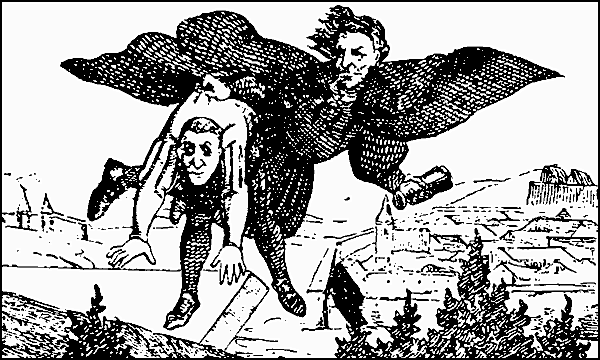
How Doctor Faustus was carried through the air
up to the heavens to see the world, and how the
Sky and Planets ruled: after the which he wrote
one letter to his friend of the same to Liptzig,
how he went about the world in eight days
This letter was found by a freeman and
Citizen of Wittenberg, written with his own hand, and sent to his
friend at Liptzig a Physician, named John Victor, the contents of which
were as followeth.
Amongst other things (my loving friend and brother)
I remember yet the former friendship had together,
when we were schoolfellows and students in the
University at Wittenberg, whereas you first studied
Physic, Astronomy, Astrology, Geometry, and Cosmography;
I to the contrary (you know) studied Divinity:
notwithstanding now in any of your own studies I am
seen (I am persuaded) further then your self: for
sithence I began I have never erred, for (might I speak
it without affecting my own praise) my Calendars and
other practices have not only the commendations of
the common sort, but also of the chiefest Lords and
Nobles of this our Dutch Nation: because (which is
chiefly to be noted) I write and presaged of matters
to come, which all accord and fall out so right, as if
they had been already seen before. And for that (my
beloved Victori) you write to know my voyage which
I made into the Heavens, the which (as you certify me
you have had some suspicion of, although you partly
persuaded yourself, that it is a thing impossible) no
matter for that, it is as it is, and let it be as it will,
once it was done, in such manner as now according
unto your request I give you here to understand.
I being once laid on my bed, and could not sleep
for thinking on my Calendar and practice, I marvelled
with myself how it were possible that the Firmament
should be known and so largely written of men, or
whether they write true or false, by their own opinions,
or supposition, or by due observations and true course
of the heavens. Behold, being in these my muses,
suddenly I heard a great noise, in so much that I
thought my house would have been blown down, so
that all my doors and chests flew open, whereat I was
not a little astonied, for withal I heard a groaning
voice which said, get up, the desire of thy heart, mind,
and thought shalt thou see: at the which I answered,
what my heart desireth, that would I fain see, and to
make proof, if I shall see I will away with thee. Why
then (quoth he) look out at thy window, there cometh
a messenger for thee, that did I, and behold, there
stood a Waggon, with two Dragons before it to draw
the same, and all the Waggon was of a light burning fire,
and for that the Moon shone, I was the willinger at
that time to depart: but the voice spake again, sit up
and let us away: I will, said I, go with thee, but upon
this condition, that I may ask after all things that I see,
hear, or think on: the voice answered, I am content
for this time. Hereupon I got me into the Waggon,
so that the Dragons carried me upright into the air.
The Waggon had also four wheels the which rattled
so, and made such a noise as if we had been all this
while running on the stones: and round about us flew
out flames of fire, and the higher that I came, the more
the earth seemed to be darkened, so that methought I
came out of a dungeon, and looking down from Heaven,
behold, Mephostophiles my Spirit and servant was
behind me, and when he perceived that I saw him,
he came and sat by me, to whom I said, I pray thee
Mephostophiles whither shall I go now? Let not
that trouble thy mind, said he, and yet they carried us
higher up. And now will I tell thee good friend and
schoolfellow, what things I have seen and proved;
for on the Tuesday went I out, and on Tuesday seven-nights
following I came home again, that is, eight days,
in which time I slept not, no not one wink came in
mine eyes, and we went invisible of any man: and as
the day began to appear, after our first night’s journey,
I said to my Spirit Mephostophiles, I pray thee how
far have we now ridden, I am sure thou knowest:
for methinks that we are ridden exceeding far, the
World seemeth so little: Mephostophiles answered me,
my Faustus believe me, that from the place from whence
thou earnest, unto this place where we are now, is already
forty-seven leagues right in height, and as the day
increased, I looked down upon the World, there saw
I many kingdoms and provinces, likewise the whole
world, Asia, Europa, and Africa, I had a sight of:
and being so high, quoth I to my Spirit, tell me now
how these Kingdoms lie, and what they are called, the
which he denied not, saying, see this on our left hand
is Hungaria, this is also Prussia on our left hand, and
Poland, Muscovia, Tartascelesia,[25] Bohemia, Saxony;:
and here on our right hand, Spain, Portugal, France,
England, and Scotland: then right out before us lie
the Kingdoms of Persia, India, Arabia, the King of
Alchar, and the great Cham: now are we come to
Wittenberg, and are right over the town of Weim in
Austria, and ere long will we be at Constantinople,
Tripolie, and Jerusalem, and after will we pierce the
frozen Zone, and shortly touch the Horizon, and the
Zenith of Wittenberg. There looked I on the Ocean
Sea, and beheld a great many of ships and Galleys
ready to the battle, one against another: and thus I
spent my journey, now cast I my eyes here, now there,
toward South, North, East, and West, I have been in
one place where it rained and hailed, and in another
where the Sun shone excellent fair, and so I think
that I saw the most things in and about the world,
with great admiration that in one place it rained, and
in another hail and snow, on this side the Sun shone
bright, some hills covered with snow never consuming,
others were so hot that grass and trees were burned
and consumed therewith. Then looked I up to the
heavens, and behold, they went so swift, that I thought
they would have sprung in thousands. Likewise it was
so clear and so hot, that I could not long gaze into it,
it so dimmed my sight: and had not my Spirit
Mephostophiles covered me as it were with a shadowing
cloud, I had been burnt with the extreme heat
thereof, for the Sky the which we behold here when
we look up from the earth, is so fast and thick as a
wall, clear and shining bright as a Crystal, in the which
is placed the Sun, which casteth forth his rays or
beams over the universal world, to the uttermost
confines of the earth. But we think that the Sun is
very little: no, it is altogether as big as the world.
Indeed the body substantial is but little in compass,
but the rays or stream that it casteth forth, by reason
of the thing wherein it is placed, maketh him to extend
and shew himself over the whole world: and we think
that the Sun runneth his course, and that the heavens
stand still: no, it is the heavens that move his course,
and the Sun abideth perpetually in his place,
he is permanent, and fixed in his place, and although
we see him beginning to ascend in the Orient or East,
at the highest in the Meridian or South, setting in the
Occident or West, yet is he at the lowest in Septentrio
or North, and yet he moveth not. It is the axle of the
heavens that moveth the whole firmament, being a
Chaos or confused thing, and for that proof, I will
shew thee this example, like as thou seest a bubble
made of water and soap blown forth of a quill, is in
form of a confused mass or Chaos, and being in this
form, is moved at pleasure of the wind, which runneth
round about that Chaos, and moveth him also round:
even so is the whole firmament or Chaos, wherein are
placed the sun, and the rest of the Planets turned
and carried at the pleasure of the Spirit of God, which
is wind. Yea Christian Reader, to the glory of God,
and for the profit of thy soul, I will open unto thee
the divine opinion touching the ruling of this confused
Chaos, far more than any rude German Author, being
possessed with the Devil, was able to utter; and to
prove some of my sentence before to be true, look
into Genesis unto the works of God, at the creation
of the world, there shalt thou find, that the Spirit of
God moved upon the waters before heaven and earth
were made. Mark how he made it, and how by his
word every element took his place: these were not
his works, but his words; for all the words he used
before, he concluded afterwards in one work, which
was in making man: mark reader with patience for
thy soul’s health, see into all that was done by the word
and work of God, light and darkness was, the firmament
stood, and their great ☉ and little light ☽ in
it: the moist waters were in one place, the earth was
dry, and every element brought forth according to
the word of God: now followeth his works he made
man like his own image, how? out of the earth?
The earth will shape no image without water, there
was one of the elements. But all this while where
was wind? all elements were at the word of God,
man was made, and in a form by the work of God, yet
moved not that work, before God breathed the Spirit
of life into his nostrils, and made him a living soul,
here was the first wind and Spirit of God out of his
own mouth, which we have likewise from the same
seed which was only planted by God in Adam, which
wind, breath, or spirit, when he had received, he was
living and moving on earth, for it was ordained of
God for his habitation, but the heavens are the habitation
of the Lord: and like as I shewed before of the
bubble or confused Chaos made of water and soap,
through the wind and breath of man is turned round,
and carried with every wind; even so the firmament
wherein the Sun and the rest of the Planets are fixed,
moved, turned, and carried with the wind, breath, or
Spirit of God, for the heavens and firmament are
movable as the Chaos, but the Sun is fixed in the firmament.
And farther my good schoolfellow, I was thus
nigh the heavens, where methought every Planet was
but as half the earth, and under the firmament ruled
the Spirits in the air, and as I came down I looked upon
the world and the heavens, and methought that the
earth was enclosed in comparison within the firmament,
as the yolk of an egg within the white, and methought
that the whole length of the earth was not a span long,
and the water was as if it had been twice as broad and
long as the earth, even thus at the eight days end came
I home again, and fell asleep, and so I continued
sleeping three days and three nights together: and
the first hour that I waked, I fell fresh again to my
Calendar, and have made them in right ample manner
as you know, and to satisfy your request, for that you
writ unto me, I have in consideration of our old friendship
had at the University of Wittenberg, declared
unto you my heavenly voyage, wishing no worse unto
you, than unto myself, that is, that your mind were as
mine in all respects. Dixi.
Doctor Faustus the Astrologian.
How Doctor Faustus made his journey through the
principal and most famous lands in the world
THE RIDE PAST THE GALLOWS
After P. Cornelius
Doctor Faustus having over-run fifteen years of his
appointed time, he took upon him a journey, with full
pretence to see the whole world: and calling his
spirit Mephostophiles unto him, he said: thou knowest
that thou art bound unto me upon conditions, to perform
and fulfil my desire in all things, wherefore my
pretence is to visit the whole face of the earth visible
and invisible when it pleaseth me: wherefore, I
enjoin and command thee to the same. Whereupon
Mephostophiles answered, I am ready my Lord at
thy command and forthwith the Spirit changed himself
unto the likeness of a flying horse, saying, Faustus
sit up, I am ready. Doctor Faustus loftily sat upon
him, and forward they went: Faustus came through
many a land and Province; as Pannonia, Austria,
Germania, Bohemia, Slesia, Saxony, Missene, During,
Francklandt, Shawblandt, Beyerlandt, Stiria, Carinthia,
Poland, Litaw, Liefland, Prussia, Denmarke,
Muscovia, Tartaria, Turkie, Persia, Cathai, Alexandria,
Barbaria, Ginnie, Peru, the straits of Magelanes,
India, all about the frozen Zone, and Terra Incognita,
Nova Hispaniola, the Isles of Terzera, Mederi, S.
Michael’s, the Canaries, and the Tenorrifocie, into
Spaine, the Mayne Land, Portugall, Italie, Campania,
the Kingdom of Naples, the Isles of Sicilia, Malta,
Majoria, Minoria, to the Knights of the Rhodes,
Candie, or Creete, Ciprus, Corinth, Switzerland,
France, Freesland, Westphalia, Zeland, Holland,
Brabant, and all the seventeen Provinces in Netherland,
England, Scotland, Ireland, all America, and Island,
the out Isles of Scotland, the Orchades, Norway,
the Bishopric of Breame, and so home again: all these
Kingdoms, Provinces, and Countries he passed in
twenty-five days, in which time he saw very little that
delighted his mind: wherefore he took a little rest
at home, and burning in desire to see more at large,
and to behold the secrets of each Kingdom, he set
forward again on his journey upon his swift horse
Mephostophiles, and came to Treir, for that he chiefly
desired to see this town, and the monuments thereof;
but there he saw not many wonders, except one fair
Palace that belonged unto the Bishop, and also a
mighty large Castle that was built of brick, with three
walls and three great trenches, so strong, that it was
impossible for any prince’s power to win it; then he
saw a Church, wherein was buried Simeon, and the
Bishop Popo: their Tombs are of most sumptuous
large Marble stone, closed and joined together with
great bars of iron: from whence he departed to Paris,
where he liked well the Academy; and what place
or Kingdom soever fell in his mind, the same he visited.
He came from Paris to Mentz, where the river of
Mayne falls into the Rhine; notwithstanding he tarried
not long there, but went to Campania in the Kingdom
of Neapolis, in which he saw an innumerable
sort of Cloisters, Nunneries, and Churches, great and
high houses of stone, the streets fair and large, and
straight forth from one end of the town to the other
as a line, and all the pavement of the City was of
brick, and the more it rained in the town, the fairer
the streets were; there saw he the Tomb of Virgil;
and the highway that he cut through that mighty hill
of stone in one night, the whole length of an English
mile: then he saw the number of Galleys, and Argosies
that lay there at the City head, the Windmill that
stood in the water, the Castle in the water, and the
houses above the water where under the Galleys
might ride most safely from rain or wind; then he
saw the Castle on the hill over the town, and many
monuments within: also the hill called Vesuvius,
whereon groweth all the Greekish wine, and most
pleasant sweet Olives. From thence he came to
Venice, whereat he wondered not a little to see a City
so famously built standing in the Sea: where, through
every street the water ran in such largeness, that
great Ships and Barks might pass from one street
to another, having yet a way on both sides the water,
whereon men and horse might pass; he marvelled
also how it was possible for so much victual to be found
in the town and so good cheap, considering that for
a whole league off nothing grew near the same. He
wondered not a little at the fairness of Saint Mark’s
place, and the sumptuous Church standing therein
called Saint Mark’s; how all the pavement was set
with coloured stones, and all the rood or loft of the
Church double gilded over. Leaving this, he came to
Padoa, beholding the manner of their Academy, which
is called the mother or nurse of Christendom, there
he heard the Doctors, and saw the most monuments
in the town, entered his name into the University of
the German nation, and wrote himself Doctor Faustus
the insatiable Speculator: then saw he the worthiest
monument in the world for a Church, named S.
Anthony’s Cloister, which for the pinnacles thereof
and the contriving of the Church, hath not the like
in Christendom. This town is fenced about with
three mighty walls of stone and earth, betwixt the which
runneth goodly ditches of water: twice every twenty-four
hours passeth boats betwixt Padoa and Venice
with passengers, as they do here betwixt London and
Gravesend, and even so far they differ in distance:
Faustus beheld likewise the Council house and the
Castle with no small wonder. Well, forward he went
to Rome, which lay, and doth yet lie, on the river
Tybris, the which divideth the City in two parts:
over the river are four great stone bridges, and upon
the one bridge called Ponte S. Angelo is the Castle of
S. Angelo, wherein are so many great cast pieces as
there are days in a year, and such Pieces that will
shoot seven bullets off with one fire, to this Castle
cometh a privy vault from the Church and Palace of
Saint Peter, through the which the Pope (if any danger
be) passeth from his Palace to the Castle for safeguard;
the City hath eleven gates, and a hill called Vaticinium,[26]
whereon S. Peter’s Church is built: in that Church
the holy Fathers will hear no confession, without the
penitent bring money in his hand. Adjoining to this
Church, is the Campo Santo, the which Carolus
Magnus built, where every day thirteen Pilgrims have
their dinners served of the best: that is to say, Christ
and his Twelve Apostles. Hard by this he visited
the Church-yard of S. Peter’s, where he saw the
Pyramid that Julius Cæsar brought out of Africa:
it stood in Faustus his time leaning against the Church
wall of Saint Peter’s, but now Papa Sixtus hath erected
it in the middle of S. Peter’s Church yard; it is
twenty-four fathoms long and at the lower end six
fathoms four square, and so forth smaller upwards,
on the top is a Crucifix of beaten gold, the stone
standeth on four Lions of brass. Then he visited the
seven Churches of Rome, that were S. Peter’s, S.
Paul’s, S. Sebastian’s, S. John Lateran, S. Laurence,
S. Mary Magdalen, and S. Marie Majora: then went
he without the town, where he saw the conduits of
water that run level through hill and dale, bringing
water into the town fifteen Italian miles off: other
monuments he saw, too many to recite, but amongst
the rest he was desirous to see the Pope’s Palace, and
his manner of service at his table, wherefore he and
his Spirit made themselves invisible, and came into
the Pope’s Court, and privy chamber where he was,
there saw he many servants attendant on his holiness,
with many a flattering Sycophant carrying of his meat,
and there he marked the Pope and the manner of his
service, which he seeing to be so unmeasurable and
sumptuous; fie (quoth Faustus), why had not the
Devil made a Pope of me? Faustus saw notwithstanding
in that place those that were like to himself, proud,
stout, wilful, gluttons, drunkards, whoremongers,
breakers of wedlock, and followers of all manner of
ungodly exercises: wherefore he said to his Spirit,
I thought that I had been alone a hog, or pork of the
devil’s, but he must bear with me yet a little longer,
for these hogs of Rome are already fattened, and fitted
to make his roast-meat, the Devil might do well
now to spit them all and have them to the fire, and let
him summon the Nuns to turn the spits: for as none
must confess the Nun but the Friar, so none should
turn the roasting Friar but the Nun. Thus continued
Faustus three days in the Pope’s Palace, and yet had
no lust to his meat, but stood still in the Pope’s chamber,
and saw everything whatsoever it was: on a time the
Pope would have a feast prepared for the Cardinal
of Pavia, and for his first welcome the Cardinal was
bidden to dinner: and as he sat at meat, the Pope
would ever be blessing and crossing over his mouth;
Faustus could suffer it no longer, but up with his fist
and smote the Pope on the face, and withal he laughed
that the whole house might hear him, yet none of them
saw him nor knew where he was: the Pope persuaded
his company that it was a damned soul, commanding
a Mass presently to be said for his delivery out of
Purgatory, which was done: the Pope sat still at
meat, but when the latter mess came in to the Pope’s
board, Doctor Faustus laid hands thereon saying;
this is mine: and so he took both dish and meat and
fled unto the Capitol or Campadolia, calling his Spirit
unto him and said: come let us be merry, for thou
must fetch me some wine, and the cup that the Pope
drinks of, and hereupon Monte Caval will we make
good cheer in spite of the Pope and all his fat abbey
lubbers. His Spirit hearing this, departed towards
the Pope’s chamber, where he found them yet sitting
and quaffing: wherefore he took from before the
Pope the fairest piece of plate or drinking goblet, and
a flagon of wine, and brought it to Faustus; but when
the Pope and the rest of his crew perceived they
were robbed, and knew not after what sort, they persuaded
themselves that it was the damned soul that
before had vexed the Pope so, and that smote him on
the face, wherefore he sent commandment through
all the whole City of Rome, that they should say Mass
in every Church, and ring all the bells for to lay the
walking Spirit, and to curse him with Bell, Book, and
Candle, that so invisibly had misused the Pope’s holiness,
with the Cardinal of Pavia, and the rest of their
company: but Faustus notwithstanding made good
cheer with that which he had beguiled the Pope of,
and in the midst of the order of Saint Barnard’s
bare-footed Friars, as they were going on Procession
through the market place, called Campa de fiore, he
let fall his plate dishes and cup, and withal for a farewell
he made such a thunder-clap and a storm of
rain, as though Heaven and earth should have met
together, and so he left Rome, and came to Millain
in Italie, near the Alps or borders of Switzerland,
where he praised much to his Spirit the pleasantness
of the place, the City being founded in so brave a
plain, by the which ran most pleasant rivers on every
side of the same, having besides within the compass or
circuit of seven miles, seven small Seas: he saw also
therein many fair Palaces and goodly buildings, the
Duke’s Palace, and the mighty strong Castle, which is
in manner half the bigness of the town. Moreover, it
liked him well to see the Hospital of Saint Mary’s,
with divers other things. He did nothing there worthy
of memory, but he departed back again towards
Bolognia, and from thence to Florence, where he was
well pleased to see the pleasant walk of Merchants,
the goodly vaults of the City, for that almost the whole
City is vaulted, and the houses themselves are built
outwardly, in such sort that the people may go under
them as under a vault: then he perused the sumptuous
Church in the Duke’s Castle called Nostra Donna,
our Lady’s Church, in which he saw many monuments,
as a Marble door most huge to look upon: the gate
of the Castle was Bell metal, wherein are graven the
holy Patriarchs, with Christ and his twelve Apostles,
and divers other histories out of the old and new
Testament. Then went he to Sena, where he highly
praised the church and Hospital of Santa Maria
Formosa, with the goodly buildings, and especially
the fairness and greatness of the City, and beautiful
women. Then came he to Lyons in France, where he
marked the situation of the City, which lay between
two hills, environed with two waters: one worthy
monument in the City pleased him well, that was the
great Church with the Image therein; he commended
the City highly for the great resort that it had unto
it of strangers. From thence he went to Cullin, which
lieth upon the River of Rhine, wherein he saw one
of the ancientest monuments of the world, the which
was the Tomb of the three Kings that came by the
Angel of God, and their knowledge they had in the
star, to worship Christ: which when Faustus saw, he
spake in this manner. Ah, alas good men how have
you erred and lost your way, you should have gone to
Palestina and Bethelem in Judea, how came you
hither? or belike after your death you were thrown
into Mare Mediterraneum about Tripolis in Syria;
and so you fleeted out of the Straits of Giblaterra
into the Ocean Sea, and so into the bay of Portugal;
and not finding any rest you were driven along the
coast of Galicia, Biskay, and France, and into the
narrow Seas, then from thence into Mare Germanicum,
and so I think taken up about the town of Dort in
Holland, you were brought to Cullin to be buried:
or else I think you came more easily with a whirlwind
over the Alps, and being thrown into the River of
Rhine, it conveyed you to this place, where you are
kept as a monument? There saw he the Church of
S. Ursula, where remains a monument of the thousand
Virgins: it pleased him also to see the beauty of the
women. Not far from Cullin lieth the town of Ach,
where he saw the gorgeous Temple that the Emperor
Carolus Quartus[27] built of Marble stone for a remembrance
of him, to the end that all his successors should
there be crowned. From Cullin and Ach, he went to
Geuf, a City in Savoy, lying near Switzerland: it is
a town of great traffic, the Lord thereof is a Bishop,
whose Wine-cellar Faustus, and his Spirit visited for
the love of his good wine. From thence he went to
Strasburg, where he beheld the fairest steeple that ever
he had seen in his life before, for on each side thereof
he might see through it, even from the covering of
the Minster to the top of the Pinnacle, and it is named
one of the wonders of the world: wherefore he demanded
why it was called Strasburg: his Spirit
answered, because it hath so many high ways coming
to it on every side, for Stras in Dutch is a high way,
and hereof came the name, yea (said Mephostophiles)
the Church which thou so wonderest at, hath more
revenues belonging to it, then the twelve Dukes of
Slesia are worth, for there pertain unto this Church
fifty-five Towns, and four hundred and sixty-three
Villages besides many houses in the Town. From
hence went Faustus to Basile in Switzerland, whereat
the River of Rhine runneth through the town, parting
the same as the River of Thames doth London:
in this town of Basile he saw many rich Monuments,
the town walled with brick, and round about without
it goeth a great trench: no Church pleased him but
the Jesuits’ Church, which was so sumptuously builded,
and beset full of Alabaster pillars. Faustus demanded
of his Spirit, how it took the name of Basyl: his Spirit
made answer and said, that before this City was
founded, there used a Basiliscus, a kind of Serpent,
this Serpent killed as many men, women, and children,
as it took a sight of: but there was a Knight that made
himself a cover of Crystal to come over his head, and
so down to the ground, and being first covered with
a black cloth, over that he put the Crystal, and so
boldly went to see the Basiliscus, and finding the place
where he haunted, he expected his coming, even
before the mouth of her cave: where standing a while,
the Basylike came forth, who, when she saw her own
venomous shadow in the Crystal, she split in a thousand
pieces; wherefore the Knight was richly rewarded
of the Emperor: after the which the Knight founded
this Town upon the place where he had slain the
Serpent, and gave it the name of Basyl, in remembrance
of his deed.
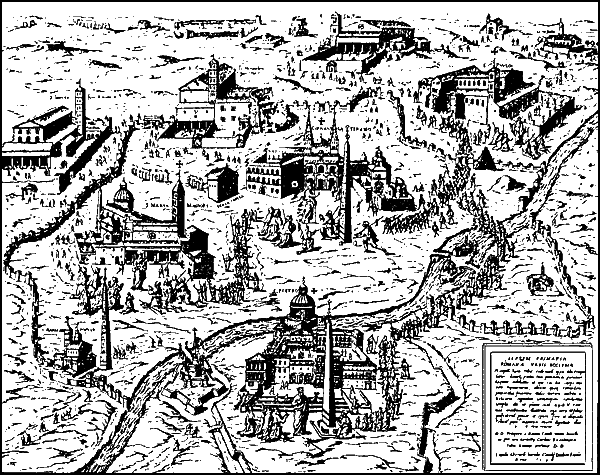
THE SEVEN CHIEF CHURCHES OF ROME
Second Half of the 16th Century
From Basyl Faustus went to Costuitz[28] in Sweitz, at
the head of the Rhine, where is a most sumptuous
Bridge, that goeth over the Rhine, even from the gates
of the Town unto the other side of the stream: at the
head of the River of Rhine, is a small Sea, called of
the Switzers the black[29] Sea, twenty thousand paces
long, and fifty hundred paces broad. The town
Costuitz took the name of this; the Emperor gave it
to a Clown for expounding of his riddle, wherefore the
Clown named the Town Costuitz, that is in English,
cost nothing. From Costuitz he came to Ulme, where
he saw the sumptuous Town-house built by two and
fifty of the ancient Senators of the City, it took the
name of Ulma, for that the whole lands thereabout
are full of Elms: but Faustus minding to depart
from thence, his Spirit said unto him: Faustus think
on the town as thou wilt, it hath three Dukedoms
belonging to it, the which they have bought with ready
money. From Ulme, he came to Wartzburg the chiefest
town in Frankelandt, wherein the Bishop all together
keepeth his Court, through the which Town passeth
the River of Mayne that runs into the Rhine: thereabout
groweth strong and pleasant wine, the which
Faustus well proved. The Castle standeth on a hill
on the North side of the Town, at the foot whereof
runneth the River: this Town is full of beggarly
Friars, Nuns, Priests, and Jesuits: for there are five
sorts of begging Friars, besides three Cloisters of
Nuns. At the foot of the Castle stands a Church, in
the which there is an Altar, where are engraven all
the four Elements, and all the orders and degrees in
Heaven, that any man of understanding whosoever
that hath a sight thereof, will say that it is the artificiallest
thing that ever he beheld. From thence he went
to Norenberg, whither as he went by the way, his
Spirit informed him that the Town was named of
Claudius Tiberius the Son of Nero the Tyrant. In
the Town are two famous Cathedral Churches, the
one called Saint Sabolt, the other Saint Laurence; in
which Church hangeth all the reliques of Carolus
Magnus, that is his cloak, his hose and doublet, his
sword and Crown, his Sceptre, and his Apple. It hath
a very gorgeous gilden Conduit in the market of Saint
Laurence, in which Conduit, is the spear that thrust
our Saviour into the side, and a piece of the holy
Cross; the wall is called the fair wall of Norenberg,
and hath five hundred and twenty-eight streets, one
hundred and sixty wells, four great, and two small
clocks, six great gates, and two small doors, eleven
stone bridges, twelve small hills, ten appointed
market-places, thirteen common hothouses,[30] ten
Churches, within the Town are thirty wheels of water-mills;
it hath one hundred and thirty-two tall ships,[31]
two mighty Town walls of hewn stone and earth,
with very deep trenches. The walls have one hundred
and eighty Towers about them, and four fair platforms,
ten Apothecaries, ten Doctors of the common
law, fourteen Doctors of Physic. From Norenberg,
he went to Auspurg, where at the break of the day, he
demanded of his Spirit whereupon the Town took his
name: this Town (saith he) hath had many names,
when it was first built, it was called Vindelica:
secondly, it was called Zizaria, the iron bridge: lastly
by the Emperor Octavius Augustus, it was called
Augusta, and by corruption of language the Germans
have named it Auspurg. Now for because that Faustus
had been there before, he departed without visiting
their monuments to Ravenspurg, where his Spirit
certified him that the City had had seven names, the
first Tyberia, the second Quadratis, the third Hyaspalis,
the fourth Reginopolis, the fifth Imbripolis, the sixth
Ratisbona, lastly Ravenspurg. The situation of the
City pleased Faustus well, also the strong and sumptuous
buildings: by the walls thereof runneth the
River of Danubia, in Dutch called Donow, into the
which not far from the compass of the City, falleth
nearhand threescore other small Rivers and fresh
waters. Faustus also liked the sumptuous stone bridge
over the same water, with the Church standing
thereon, the which was founded 1115, the name whereof
is called S. Remedian: in this town Faustus went
into the cellar of an Innholder, and let out all the Wine
and Beer that was in his Cellar. After the which feat
he returned unto Mentz[32] in Bavaria, a right princely
Town, the Town appeared as if it were new, with
great streets therein, both of breadth and length:
from Mentz to Saltzburg, where the Bishop is always
resident: here saw he all the commodities that were
possible to be seen, for at the hill he saw the form of
Abel[33] made in Crystal, an huge thing to look upon,
that every year groweth bigger and bigger, by reason
of the freezing cold. From hence, he went to Vienna,
in Austria: this Town is of so great antiquity, that it
is not possible to find the like: in this Town (said
the Spirit) is more Wine than water, for all under the
Town are wells, the which are filled every year with
Wine, and all the water that they have, runneth by
the Town, that is the River Danubia. From hence,
he went unto Prage, the chief City in Bohemia, this
is divided into three parts, that is, old Prage, new
Prage, and little Prage. Little Prage is the place where
the Emperor’s Court is placed upon an exceeding high
mountain: there is a Castle, wherein are two fair
Churches, in the one he found a monument, which
might well have been a mirror to himself, and that was
the Sepulchre of a notable Conjurer, which by his
Magic had so enchanted his Sepulchre, that whosoever
set foot thereon, should be sure never to die in
their beds. From the Castle he came down, and went
over the Bridge. This Bridge hath twenty and four
Arches. In the middle of this Bridge stands a very
fair monument, being a Cross builded of stone, and
most artificially carved. From thence, he came into
the old Prage, the which is separated from the new
Prage, with an exceeding deep ditch, and round about
enclosed with a wall of Brick. Unto this is adjoining
the Jews’ Town, wherein are thirteen thousand men,
women, and children, all Jews. There he viewed the
College and the Garden, where all manner of savage
Beasts are kept; and from thence, he fetched a compass
round about the three Towns, whereat he wondered
greatly, to see so mighty a City to stand all within
the walls. From Prage, he flew into the air and bethought
himself what he might do, or which way to
take, so he looked round about, and behold, he had
espied a passing fair City which lay not far from
Prage, about some four and twenty miles, and that was
Breslaw in Sclesia; into which when he was entered,
it seemed to him that he had been in Paradise, so neat
and clean was the streets, and so sumptuous was their
buildings. In this City he saw not many wonders,
except the Brazen Virgin that standeth on a Bridge
over the water, and under the which standeth a mill
like a powder mill, which Virgin is made to do execution
upon those disobedient town-born children that be
so wild, that their parents cannot bridle them; which
when any such are found with some heinous offence,
turning to the shame of their parents and kindred,
they are brought to kiss this Virgin, which openeth
her arms, the person then to be executed, kisseth her,
then doth she close her arms together with such
violence, that she crusheth out the breath of the person,
breaketh his bulk, and so dieth: but being dead, she
openeth her arms again, and letteth the party fall into
the Mill, where he is stamped in small morsels, which
the water carrieth away, so that not any part of him
is found again. From Breslaw he went toward Cracovia,
in the Kingdom of Polonia, where he beheld the
Academy, the which pleased him wonderful well.
In this City the King most commonly holdeth his
Court at a Castle, in which Castle are many famous
monuments. There is a most sumptuous Church in
the same, in which standeth a silver altar gilded, and
set with rich stones, and over it is a conveyance full
of all manner silver ornaments belonging to the Mass.
In the Church hangeth the jaw bones of an huge Dragon
that kept the Rock before the Castle was edified
thereon. It is full of all manner munition, and hath
always victual for three years to serve two thousand
men. Through the Town runneth a river called the
Vistula or Wissel, where over is a fair wooden bridge.
This water divideth the Town and Casmere, in this
Casmere dwelleth the Jews being a small walled Town
by themselves, to the number of twenty-five thousand
men, women, and children. Within one mile of the
Town there is a salt mine, where they find stones of
pure salt of a thousand pound, or nine hundred pound,
or more in weight, and that in great quantity. This
salt is as black as the Newcastle coals when it comes
out of the mines, but being beaten to powder, it is as
white as snow. The like they have four mile from
thence, at a Town called Buchnia. From thence,
Faustus went to Sandetz, the Captain thereof was
called Don Spiket Iordan, in this Town are many
monuments, as the tomb or sepulchre of Christ, in
as ample manner as that is at Jerusalem, at the proper
costs of a Gentleman that went thrice to Jerusalem
from that place, and returned again. Not far from
that Town is a new Town, wherein is a Nunnery of
the order of Saint Dioclesian, into which order may
none come, except they be Gentlewomen, and well
formed and fair to look upon, the which pleased
Faustus well: but having a desire to travel farther,
and to see more wonders, mounting up towards the
East over many lands and Provinces, as into Hungaria,
Transilvania, Shede, Ingratz, Sardinia, and so into
Constantinople, where the Turkish Emperor kept his
Court. This City was surnamed by Constantine the
founder thereof, being builded of very fair stone. In
the same the great Turk hath three fair Palaces, the
walls are strong, the pinnacles are very huge, and the
streets large: but this liked not Faustus, that one man
might have so many wives as he would. The Sea
runneth hard by the City, the wall hath eleven Gates:
Faustus abode there a certain time to see the manner
of the Turkish Emperor’s service at his table, where he
saw his royal service to be such, that he thought if
all the Christian Princes should banquet together, and
everyone adorn the feast to the uttermost, they were
not able to compare with the Turk for his table, and
the rest of his Country service, wherefore it so spited
Faustus, that he vowed to be revenged of him, for
his pomp he thought was more fit for himself: wherefore
as the Turk sat and ate, Faustus shewed him a
little apish play: for round about the privy Chamber,
he sent forth flashing flames of fire, in so much, that
the whole company forsook their meat and fled, except
only the great Turk himself, him Faustus had charmed
in such sort, that he could neither rise nor fall, neither
could any man pull him up. With this was the Hall
so light, as if the Sun had shined in the house, then
came Faustus in form of a Pope to the great Turk,
saying, all hail, Emperor, now art thou honoured that
I so worthily appear unto thee as thy Mahumet was
wont to do, hereupon he vanished, and forthwith it
so thundered, that the whole Palace shook: the Turk
greatly marvelled what this should be that so vexed
him, and was persuaded by his chiefest counsellors,
that it was Mahumet his Prophet, the which had so
appeared unto them, whereupon the Turk commanded
them to fall down on their knees, and to give him
thanks for doing them so great honour, as to shew
himself unto them; but the next day Faustus went
into the Castle where he kept his Wives and Concubines,
in the which Castle might no man upon pain
of death come, except those that were appointed by
the great Turk to do them service, and they were
all gelded. Which when Faustus perceived, he said
to his Spirit Mephostophiles, how likest thou this
sport, are not these fair Ladies greatly to be pitied,
that thus consume their youth at the pleasure of one
only man? Why (quoth the Spirit) mayest not thou
instead of the Emperor, embrace his fairest Ladies,
do what thy heart desireth herein, and I will aid thee,
and what thou wishest, thou shalt have it performed:
wherefore Faustus (being before this counsel apt
enough to put such matters in practice) caused a great
fog to be round about the Castle, both within and without,
and he himself appeared amongst the Ladies in
all things as they use to paint their Mahumet, at which
sight, the Ladies fell on their knees, and worshipped
him, then Faustus took the fairest by the hand, and
led her into a chamber, where after his manner he
fell to dalliance, and thus he continued a whole day
and night: and when he had delighted himself sufficiently
with her, he put her away, and made his Spirit
bring him another, so likewise he kept with her twenty-four
hours’ play, causing his Spirit to fetch him most
dainty fare, and so he passed away six days, having
each day his pleasure of a sundry Lady, and that of
the fairest, all which time, the fog was so thick, and so
stinking, that they within the house thought they had
been in hell, for the time, and they without wondered
thereat, in such sort, that they went to their prayers
calling on their God Mahumet, and worshipping of his
Image. Wherefore the sixth day Faustus exalted
himself in the air, like to a Pope, in the sight of the
great Turk and his people, and he had no sooner
departed the Castle, but the fog vanished away,
whence presently the Turk sent for his Wives and
Concubines, demanding of them if they knew the
cause why the Castle was beset with a mist so long?
they said, that it was the God Mahumet himself that
caused it, and how he was in the Castle personally
full six days, and for more certainty, he hath lain with
six of us these six nights one after another. Wherefore
the Turk hearing this fell on his knees, and gave
Mahumet thanks, desiring him to forgive him for being
offended with his visiting his Castle and wives those
six days: but the Turk commanded that those whom
Mahumet had lain by, should be most carefully looked
unto, persuading himself (and so did the whole people
that knew of it) that out of their Mahumet should be
raised a mighty generation, but first he demanded of
the six Ladies if Mahumet had had actual copulation
with them, according as earthly men have, yea my
Lord, quoth one, as if you had been there yourself,
you could not have mended it, for he lay with us stark
naked, kissed and colled[34] us, and so delighted me, that
for my part, I would he came two or three times a
week to serve me in such sort again. From hence,
Faustus went to Alkar, the which before time was called
Chairam, or Memphis, in this City the Egyptian
Soldan holdeth his Court. From hence the river
Nilus hath his first head and spring, it is the greatest
fresh-water river that is in the whole world, and
always when the Sun is in Cancer, it overfloweth
the whole land of Egypt: then he returned again
towards the North-east, and to the Town of Ofen and
Sabatz in Hungaria. This Ofen is the chiefest City
in Hungaria, and standeth in a fertile soil, wherein
groweth most excellent wine, and not far from the
Town there is a well, called Zipzar, the water whereof
changeth iron into Copper: here are mines of gold
and silver, and all manner of metal, we Germans
call this town Ofen[35], but in the Hungarian speech it is
Start. In the town standeth a very fair Castle, and
very well fortified. From hence he went to Austria, and
through Slesia into Saxony, unto the Towns of Magdeburg
and Liptzig, and Lubeck. Magdeburg is a
Bishopric: in this City is one of the pitchers wherein
Christ changed the water into wine at Cana in Galile.
At Liptzig nothing pleased Faustus so well as the great
vessel in the Castle made of wood, the which is bound
about with twenty-four iron hoops, and every hoop
weigheth two hundred pound weight, they must go
upon a ladder of thirty steps high before they can
look into it: he saw also the new church-yard, where
it is walled, and standeth upon a fair plain, the yard
is two hundred paces long, and round about in the
inside of the wall, are goodly places separated one from
each other to see sepulchres in, which in the middle
of the yard standeth very sumptuous: therein standeth
a pulpit of white work and gold. From hence he
came to Lubeck and Hamburg, where he made no
abode, but away again to Erfort in Duringen, where he
visited the Freskold, and from Erfort he went home to
Wittenberg, when he had seen and visited many a
strange place, being from home one year and a half,
in which time he wrought more wonders than are here
declared.
How Faustus had a sight of Paradise
After this, Doctor Faustus set forth again, visited
these countries of Spain, Portugal, France, England,
Scotland, Denmark, Sweden, Poland, Muscovy, India,
Cataia, Africa, Persia, and lastly into Barbaria amongst
the Blackamoors, and in all his wandering he was
desirous to visit the ancient monuments and mighty
hills, amongst the rest beholding the high hill called
the Treno Riefe, was desirous to rest upon it: from
thence he went into the Isle of Brittany, wherein he
was greatly delighted to see the fair water and warm
Baths, the divers sorts of metal, with many precious
stones, and divers other commodities the which
Faustus brought thence with him, he was also at the
Orchades behind Scotland, where he saw the tree
that bringeth forth fruit, that when it is ripe, openeth
and falleth into the water, whereof engendereth a
certain kind of Fowl or Bird: these Islands are in
number twenty-three but ten of them are not habitable,
the other thirteen are inhabited: from hence, he went
to the hill of Caucasus, which is the highest in all that
Tropic, it lieth near the borders of Scythia, hereon
Faustus stood and beheld many lands and Kingdoms.
Faustus being on such an high hill, thought to look
over all the world and beyond, for he meant to see
Paradise, but he durst not commune with his Spirit
thereof: and being on the hill of Caucasus, he saw
the whole land of India and Scythia, and towards the
East as he looked he saw a mighty clear strike of fire
coming from heaven upon the earth, even as it had
been one of the beams of the Sun, he saw in the valley
four mighty waters springing, one had his course
towards India, the second towards Egypt, the third
and fourth towards Armenia. When he saw these,
he would needs know of his Spirit what waters they
were, and from whence they came. His Spirit gave
him gently an answer, saying; it is Paradise that lieth
so far in the East, the garden that God himself hath
planted with all manner of pleasure, and the fiery
stream that thou seest, is the walls or defence of the
garden, but that clear light that thou seest so far off,
is the Angel that hath the custody thereof, with a
fiery sword: and although that thou thinkest thyself
to be hard by, thou hast yet farther thither from hence,
than thou hast ever been: the water that thou seest
divided in four parts, is the water that issueth out of
the Well in the middle of Paradise. The first is called
Ganges or Phison, the second, Gihon or Nilus, the
third Tigris, and the fourth Euphrates, also thou seest
that he standeth under Libra and Aries right up
towards the Zenith, and upon this fiery wall standeth
the Angel Michael with his flaming sword to keep
the tree of life the which he hath in charge; but the
Spirit said unto Faustus, neither thou, nor I, nor any
after us, yea all men whosoever are denied to visit it,
or to come any nearer than we be.
Of a certain Comet that appeared in Germanie, and
how Doctor Faustus was desired by certain
friends of his to know the meaning thereof
In Germanie over the Town of S. Eizleben was seen
a mighty great Comet, whereat the people wondered;
but Doctor Faustus being there, was asked of certain
of his friends his judgment or opinion in the matter.
Whereupon he answered, it falleth out often by the
course and change of the Sun and Moon, that the
Sun is under the earth, and the Moon above; but
when the Moon draweth near the change, then is the
Sun so strong that he taketh away all the light of the
Moon, in such sort that he is as red as blood: and to
the contrary, after they have been together, the Moon
taketh her light again from him, and so increasing in
light to the full, she will be as red as the Sun was before,
and changeth herself into divers and sundry colours,
of the which springeth a prodigious monster, or as
you call it, a Comet, which is a figure or token appointed
of God as a forewarning of his displeasure:
as at one time he sendeth hunger, plague, sword, or
such-like: being all tokens of his judgment: the which
Comet cometh through the conjunction of the Sun
and Moon begetting a monster, whose father is the
Sun, and whose mother is the Moon, ☉ and ☽.
A question put forth to Doctor Faustus, concerning
the Stars
There was a learned man of the Town of Halberstat,
named N. V. W. invited Doctor Faustus to his table,
but falling into communication before supper was
ready, they looked out of the window, and seeing many
stars in the firmament, this man being a Doctor of
Physic and a good Astrologian, said: Doctor Faustus,
I have invited you as my guest, hoping that you will
take it in good part with me, and withal I request
you to impart unto me some of your experience in
the Stars and Planets. And seeing a Star fall, he said:
I pray you, Faustus, what is the condition, quality, or
greatness of the Stars in the firmament? Faustus
answered him: My friend and Brother, you see that
the Stars that fall from heaven when they come on
the earth they be very small to our thinking as candles,
but being fixed in the firmament there are many as
great as this City, some as great as a Province or
Dukedom, other as great as the whole earth, other
some far greater than the earth: for the length and
breadth of the heavens is greater than the earth
twelve times, and from the height of the heavens there
is scarce any earth to be seen, yea the Planets in the
heavens are some so great as this land, some so great
as the whole Empire of Rome, some as Turkie, yea
one so great as the whole world.
How Faustus was asked a question concerning the
Spirits that vex men
That is most true (saith he to Faustus) concerning
the Stars and Planets: but I pray you in what kind
or manner do the spirits use or vex men so little by
day, and so greatly by night? Doctor Faustus
answered: because the spirits are by God forbidden
the light, their dwelling is in darkness, and the clearer
the Sun shineth, the further the Spirits have their
abiding from it, but in the night when it is dark, they
have their familiarity and abiding near unto us men.
For although in the night we see not the Sun, yet the
brightness thereof so lighteneth the first moving of
the firmament as it doth that on earth in the day, by
which reason we are able to see the Stars and Planets in
the night, even so the rays of the Sun piercing upwards
into the firmament, the Spirits abandon the place, and
so come near us on earth in the darkness, filling our
heads with heavy dreams and fond fantasies, with
screeching and crying in many deformed shapes: as
sometimes when men go forth without light, there
falleth to them a fear, that their hair standeth on end,
so many start in their sleep thinking there is a Spirit
by him, gropeth or feeleth for him, going round about
the house in his sleep, and many such-like fantasies:
and all this is for because that in the night the Spirits
are more familiarly by us than we are desirous of their
company, and so they carry us, blinding us and
plaguing us more than we are able to perceive.
How Doctor Faustus was asked a question concerning
the Stars that fall from Heaven
Doctor Faustus being demanded the cause why the
Stars fell from heaven, he answered: that is but our
opinion; for if one Star fall, it is the great judgment
of God upon us, as a forewarning of some great thing
to come: for when we think that a Star falleth, it is but
as a spark that issueth from a candle or a flame of fire,
for if it were a substantial thing, we should not so soon
lose the sight of them as we do. And likewise, if so
be that we see as it were a stream of fire fall from the
firmament, as oft it happeneth, yet are they no Stars,
but as it were a flame of fire vanishing, but the Stars
are substantial, therefore are they firm and not falling:
if there fall any, it is a sign of some great matter to
come, as a scourge to a people or country, and then
such Star falling, the gates of heaven are opened, and
the clouds send forth floods, or other plagues, to the
damage of the whole land and people.
How Faustus was asked a question as concerning
thunder
In the month of August, there was over Wittenberg
a mighty great lightning and thunder, and as Doctor
Faustus was jesting merrily in the market place with
certain of his friends and companions being Physicians,
they desired him to tell them the cause of that weather.
Faustus answered: it hath been commonly seen
heretofore, that before a thunder-clap fell a shower of
rain or a gale of wind, for commonly after a wind
followeth a rain, and after a rain a thunder-clap:
such things come to pass when the four winds meet
together in the heavens, the airy clouds are by force
beaten against the fixed crystalline firmament, but
when the airy clouds meet with the firmament, they
are congealed, and so strike and rush against the
firmament, as great pieces of ice when they meet on
the water, the echo thereof soundeth in our ears, and
that we call thunder, which indeed is none other than
you have heard.
How the Emperor Carolus Quintus requested of
Faustus to see some of his cunning, whereunto
he agreed.
The Emperor Carolus the fifth of that name was personally
with the rest of his Nobles and gentlemen at
the Town of Innsbruck where he kept his Court, unto
the which also Doctor Faustus resorted, and being there
well known of divers Nobles and gentlemen, he was
invited into the Court to meat, even in the presence
of the Emperor: whom when the Emperor saw, he
looked earnestly on him, thinking him by his looks to
be some wonderful fellow, wherefore he asked one
of his Nobles whom he should be: who answered
that he was called Doctor Faustus. Whereupon the
Emperor held his peace until he had taken his repast,
after which he called unto him Faustus, into the privy
chamber, whither being come, he said unto him:
Faustus, I have heard much of thee, that thou art
excellent in the black Art, and none like thee in mine
Empire, for men say that thou hast a familiar Spirit
with thee and that thou canst do what thou list: it is
therefore (saith the Emperor) my request of thee that
thou let me see a proof of thine experience, and I
vow unto thee by the honour of mine Imperial Crown,
none evil shall happen unto thee for so doing. Hereupon
Doctor Faustus answered his Majesty, that upon
those conditions he was ready in anything that he
could, to do his Highness’ commandment in what
service he would appoint him. Well, then hear what
I say (quoth the Emperor). Being once solitary in my
house, I called to mind mine elders and ancestors,
how it was possible for them to attain unto so great a
degree of authority, yea so high, that we the successors
of that line are never able to come near. As, for
example, the great and mighty monarch of the world,
Alexander Magnus, was such a lantern and spectacle
to all his successors, as the Chronicles make mention
of so great riches, conquering, and subduing so many
Kingdoms, the which I and those that follow me (I
fear) shall never be able to attain unto: wherefore,
Faustus, my hearty desire is that thou wouldst vouchsafe
to let me see that Alexander, and his Paramour,
the which was praised to be so fair, and I pray thee
shew me them in such sort that I may see their personages,
shape, gesture, and apparel, as they used in
their lifetime, and that here before my face; to the
end that I may say I have my long desire fulfilled, and
to praise thee to be a famous man in thine art and
experience. Doctor Faustus answered: My most
excellent Lord, I am ready to accomplish your request
in all things, so far forth as I and my Spirit are able
to perform: yet your Majesty shall know, that their
dead bodies are not able substantially to be brought
before you, but such Spirits as have seen Alexander
and his Paramour alive, shall appear unto you in manner
and form as they both lived in their most flourishing
time: and herewith I hope to please your Imperial
Majesty. Then Faustus went a little aside to speak
to his Spirit, but he returned again presently, saying:
now, if it please your Majesty, you shall see them,
yet upon this condition that you demand no question
of them, nor speak unto them, which the Emperor
agreed unto. Wherewith Doctor Faustus opened
the privy chamber door, where presently entered the
great and mighty Emperor Alexander Magnus, in all
things to look upon as if he had been alive, in proportion
a strong thick-set man, of a middle stature, black
hair, and that both thick and curled head and beard,
red cheeks, and a broad face, with eyes like a Basilisk,
he had on a complete harness burnished and graven
exceeding rich to look upon; and so passing towards
the Emperor Carolus, he made low and reverent
curtsy: whereat the Emperor Carolus would have
stood up to receive and greet him with the like reverence,
but Faustus took hold of him and would not
permit him to do it. Shortly after Alexander made
humble reverence and went out again, and coming
to the door his Paramour met him, she coming in,
she made the Emperor likewise reverence, she was
clothed in blue Velvet, wrought and embroidered
with pearl and gold, she was also excellent fair like
Milk and blood mixed, tall and slender, with a face
round as an Apple, and thus she passed certain times
up and down the house, which the Emperor marking,
said to himself: now have I seen two persons, which
my heart hath long wished for to behold, and sure it
cannot otherwise be, said he to himself, but that the
Spirits have changed themselves into these forms, and
have not deceived me, calling to his mind the woman
that raised the Prophet Samuel: and for that the
Emperor would be the more satisfied in the matter,
he thought, I have heard say, that behind her neck
she had a great wart or wen, wherefore he took Faustus
by the hand without any words, and went to see if it
were also to be seen on her or not, but she perceiving
that he came to her, bowed down her neck, where
he saw a great wart, and hereupon she vanished,
leaving the Emperor and the rest well contented.
How Doctor Faustus in the sight of the Emperor
conjured a pair of Hart’s horns upon a Knight’s
head that slept out of a casement
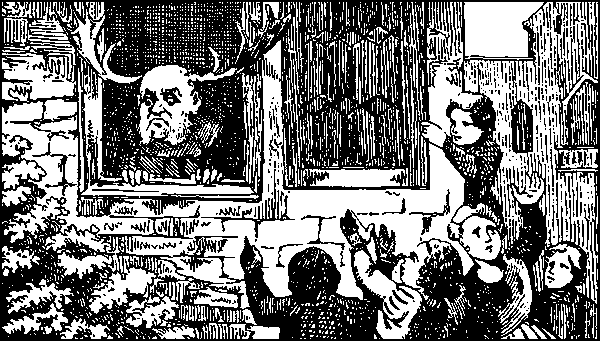
When Doctor Faustus had accomplished the Emperor’s
desire in all things as he was requested, he went forth
into a gallery, and leaning over a rail to look into the
privy garden, he saw many of the Emperor’s Courtiers
walking and talking together, and casting his eyes
now this way, now that way, he espied a Knight
leaning out at a window of the great hall; who was
fast asleep (for in those days it was hot) but the person
shall be nameless that slept, for that he was a Knight,
although it was done to a little disgrace of the Gentleman:
it pleased Doctor Faustus, through the help of
his Spirit Mephostophiles, to firm upon his head as he
slept, a huge pair of Hart’s horns, and as the Knight
awaked thinking to pull in his head, he hit his horns
against the glass that the panes thereof flew about his
ears. Think here how this good Gentleman was
vexed, for he could neither get backward nor forward:
which when the Emperor heard all the Courtiers laugh,
and came forth to see what was happened, the Emperor
also when he beheld the Knight with so fair a head,
laughed heartily thereat, and was therewithal well
pleased: at last Faustus made him quit of his horns
again, but the Knight perceived how they came, etc.[36]
How the above-mentioned Knight went about to be
revenged of Doctor Faustus
Doctor Faustus took his leave of the Emperor and
the rest of the Courtiers, at whose departure they
were sorry, giving him many rewards and gifts:
but being a league and a half from the City he came
into a Wood, where he beheld the Knight that he had
jested with at the Court with others in harness,
mounted on fair palfreys, and running with full
charge towards Faustus, but he seeing their intent,
ran towards the bushes, and before he came amongst
the bushes he returned again, running as it were to
meet them that chased him, whereupon suddenly all
the bushes were turned into horsemen, which also
ran to encounter with the Knight and his company,
and coming to them, they closed the Knight and the
rest, and told them that they must pay their ransom
before they departed. Whereupon the Knight seeing
himself in such distress, besought Faustus to be good
to them, which he denied not, but let them loose,
yet he so charmed them, that every one, Knight and
others for the space of a whole month did wear a
pair of Goat’s horns on their brows, and every Palfrey
a pair of Ox horns on their head: and this was their
penance appointed by Faustus, etc.
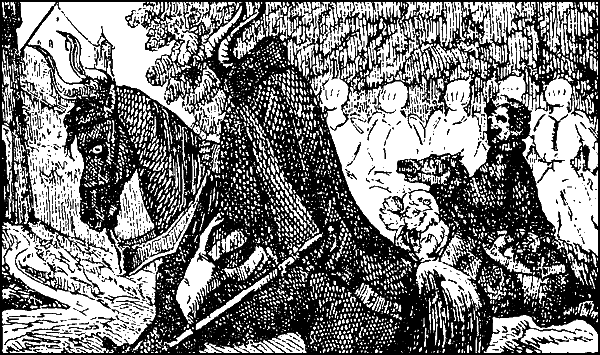
How three young Dukes being together at Wittenberg
to behold the University, requested Faustus to
help them at a wish to the town of Menchen
in Bavaria, there to see the Duke of Bavaria
his son’s wedding
Three worthy young Dukes, the which are not here
to be named, but being students altogether at the
University of Wittenberg, met on a time altogether,
where they fell to reasoning concerning the pomp and
bravery that would be at the City of Menchen in
Bavaria, at the wedding of the Duke’s Son, wishing
themselves there but one half hour, to see the manner
of their jollity: to whom one replied, saying to the
other two Gentlemen, if it please you to give me the
hearing, I will give you good counsel that we may
see the wedding, and be here again to-night, and this
is my meaning; let us send to Doctor Faustus, make
him a present of some rare thing and so open our
minds unto him, desiring him to assist us in our
enterprise, and assure ye he will not deny to fulfil
our request. Hereupon they all concluded, sent for
Faustus, told him their mind, and gave him a gift,
and invited him to a sumptuous banquet, wherewith
Faustus was well contented, and promised to further
their journey to the uttermost. And when the time
was come that the Duke his son should be married,
Doctor Faustus called unto him the three young
Gentlemen into his house, commanding them that
they should put on their best apparel, and adorn
themselves as richly as they could, he took off his own
great large cloak, went into a garden that was adjoining
unto his house, and set the three young Dukes on his
cloak, and he himself sat in the midst, but he gave them
in charge that in any wise they should not once open
their mouths to speak, or make answer to any man so
soon as they were out, no not so much as if the Duke
of Bavaria or his son should speak to them, or offer
them courtesy, they should give no word or answer
again, to the which they all agreed. These conditions
being made, Doctor Faustus began to conjure, and on
a sudden arose a mighty wind, heaving up the cloak,
and so carried them away in the air, and in due time
they came unto Menchen to the Duke’s Court, where
being entered into the outmost court, the Marshal
had espied them, who presently went to the Duke
shewing his Grace that all the Lords and gentlemen
were already set at the table, notwithstanding, there
were newly come three goodly Gentlemen with one
servant, the which stood without in the court, wherefore
the good old Duke came out unto them, welcoming
them, requiring what they were, and whence: but
they made no answer at all, whereat the Duke wondered,
thinking they were all four dumb; notwithstanding
for his honour sake he took them into his court, and
feasted them. Faustus notwithstanding spake to
them, if any thing happen otherwise then well, when
I say, sit up, then fall you all on the cloak, and good
enough: well, the water being brought, and that they
must wash, one of the three had so much manners as
to desire his friend to wash first, which when Faustus
heard, he said, sit up, and all at once they got on the
cloak, but he that spake fell off again, the other two
with Doctor Faustus, were again presently at Wittenberg,
but he that remained, was taken and laid in
Prison: wherefore the other two Gentlemen were
very sorrowful for their friend, but Faustus comforted
them, promising that on the morrow he should also
be at Wittenberg. Now all this while was this Duke
taken in a great fear, and stricken into an exceeding
dump, wondering with himself that his hap was so
hard to be left behind, and not the rest, and now being
locked and watched with so many keepers, there was
also certain of the guests that fell to reasoning with
him to know what he was, and also what the others
were that were vanished away, but the poor prisoner
thought with himself, if I open what they are, then
it will be evil also with me: wherefore all this while
he gave no man any answer, so that he was there a
whole day, and gave no man a word. Wherefore the
old Duke gave in charge, that the next morning they
should rack him until he had confessed: which when
the young Duke heard, he began to sorrow and
to say with himself, it may be that to-morrow, if
Doctor Faustus come not to aid me, then shall I be
racked and grievously tormented, in so much that I
shall be constrained by force to tell more than willingly
I would do: but he comforted himself with hope
that his friends would entreat Doctor Faustus about his
deliverance, as also it came to pass, for before it was
day, Doctor Faustus was by him, and he conjured
them that watched him into such a heavy sleep, that
he with his charms made open all the locks in the prison,
and therewithal brought the young Duke again in
safety to the rest of his fellows and friends, where they
presented Faustus with a sumptuous gift, and so they
departed the one from the other, etc.
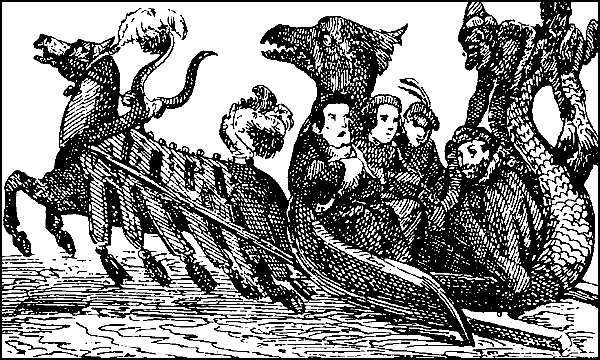
How Doctor Faustus borrowed money of a Jew, and
laid his own leg to pawn for it
It is a common proverb in Germanie, that although
a Conjurer have all things at commandment, the
day will come that he shall not be worth a penny:
so is it like to fall out with Doctor Faustus, in promising
the Devil so largely: and as the Devil is the
author of lies, even so he led Faustus his mind, in
practising of things to deceive the people and blinding
them, wherein he took his whole delight, thereby
to bring himself to riches, yet notwithstanding in the
end he was never the richer. And although that
during four and twenty years of his time that the Devil
set him, he wanted nothing; yet was he best pleased
when he might deceive anybody: for out of the
mightiest Potentates’ Courts in all those Countries,
he would send his Spirit to steal away their best cheer.
And on a time being in his merriment where he was
banqueting with other Students in an Inn, whereunto
resorted many Jews, which when Doctor Faustus
perceived, he was minded to play some merry jest to
deceive a Jew, desiring one of them to lend him some
money for a time, the Jew was content, and lent
Faustus threescore dollars for a month, which time
being expired, the Jew came for his money and interest,
but Doctor Faustus was never minded to pay
the Jew again: at length the Jew coming home to his
house, and calling importunately for his money,
Doctor Faustus made him this answer: Jew, I have
no money, nor know I how to pay thee, but notwithstanding,
to the end that thou mayest be contented,
I will cut off a limb of my body, be it arm or leg, and
the same shalt thou have in pawn for thy money, yet
with this condition, that when I shall pay thee thy
money again, then thou also give me my limb. The
Jew that was never friend to a Christian, thought with
himself, this is a fellow right for my purpose, that
will lay his limbs to pawn for money, he was therewith
very well content; wherefore Doctor Faustus took a
saw, and therewith seemed to cut off his foot (being
notwithstanding nothing so) well, he gave it to the
Jew, yet upon this condition, that when he got money
to pay, the Jew should deliver him his leg, to the end
he might set it on again. The Jew was with this
matter very well pleased, took his leg and departed:
and having far home, he was somewhat weary, and by
the way he thus bethought him, what helpeth me a
knave’s leg, if I should carry it home, it would stink,
and so infect my house, besides it is too hard a piece
of work to set it on again, wherefore what an ass was
Faustus to lay so dear a pawn for so small a sum of
money; and for my part, quoth the Jew to himself,
this will never profit me anything, and with these
words he cast the leg away from him into a ditch.
All this Doctor Faustus knew right well, therefore
within three days after he sent for the Jew to make him
payment of his sixty Dollars, the Jew came, and
Doctor Faustus demanded his pawn, there was his
money ready for him: the Jew answered, the pawn
was not profitable or necessary for anything and he
had cast it away: but Faustus threateningly replied,
I will have my leg again, or else one of thine for it.
The Jew fell to entreating, promising him to give him
what money he would ask, if he would not deal
straightly with him, wherefore the Jew was constrained
to give him sixty Dollars more to be rid of him, and
yet Faustus had his leg on, for he had but blinded
the Jew.
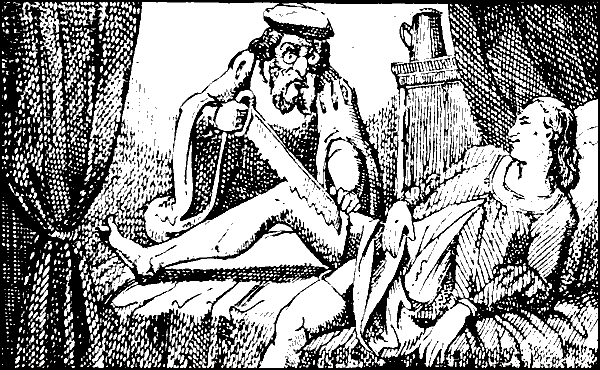
How Doctor Faustus deceived an Horse-courser
In like manner he served an Horse-courser at a fair
called Pheiffring, for Doctor Faustus through his
cunning had gotten an excellent fair Horse, whereupon
he rid to the Fair, where he had many Chap-men that
offered him money: lastly, he sold him for forty
Dollars, willing him that bought him, that in any wise
he should not ride him over any water, but the Horse-courser
marvelled with himself that Faustus bade him
ride him over no water (but quoth he), I will prove,
and forthwith he rid him into the river, presently the
horse vanished from under him, and he sat on a bundle
of straw, in so much that the man was almost drowned.
The Horse-courser knew well where he lay that had
sold him his horse, wherefore he went angrily to his
Inn, where he found Doctor Faustus fast asleep, and
snorting on a bed, but the Horse-courser could no
longer forbear him, took him by the leg and began to
pull him off the bed, but he pulled him so, that he
pulled his leg from his body, in so much that the
Horse-courser fell down backwards in the place,
then began Doctor Faustus to cry with an open
throat, he hath murdered me. Hereat the Horse-courser
was afraid, and gave the flight,[37] thinking
none other with himself, but that he had pulled
his leg from his body; by this means Doctor Faustus
kept his money.
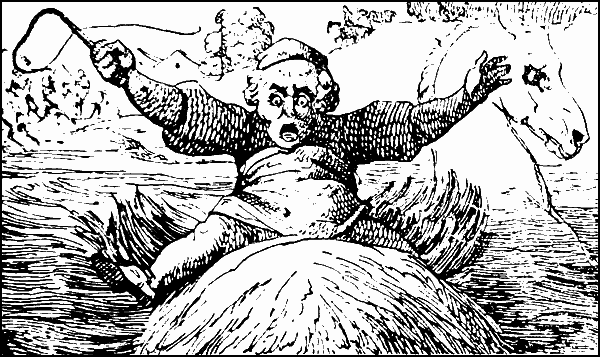
How Doctor Faustus ate a load of Hay
Doctor Faustus being in a Town of Germanie called
Zwickaw, where he was accompanied with many
Doctors and Masters, and going forth to walk after
supper, they met with a Clown[38] that drove a load of
Hay. Good even good fellow said Faustus to the
Clown, what shall I give thee to let me eat my belly
full of Hay? The Clown thought with himself, what
a mad man is this to eat Hay, thought he with himself,
thou wilt not eat much, they agreed for three farthings
he should eat as much as he could: wherefore Doctor
Faustus began to eat, and that so ravenously, that all
the rest of his company fell a-laughing, blinding so
the poor Clown, that he was sorry at his heart, for he
seemed to have eaten more than the half of his Hay,
wherefore the Clown began to speak him fair, for fear
he should have eaten the other half also. Faustus
made as though he had had pity on the Clown, and went
his way. When the Clown came in place where he
would be, he had his Hay again as he had before, a full
load.
How Doctor Faustus served the twelve Students
At Wittenberg before Faustus his house, there was
a quarrel between seven Students, and five that came
to part the rest, one part being stronger than the other.
Wherefore Faustus seeing them to be overmatched,
conjured them all blind, in so much that the one could
not see the other, and yet he so dealt with them, that
they fought and smote at one another still, whereat
all the beholders fell a-laughing: and thus they continued
blind, beating one another, until the people
parted them, and led each one to his own home: where
being entered into their houses, they received their
sight perfectly again.
How Faustus served the drunken Clowns
Doctor Faustus went into an Inn, wherein were
many tables full of Clowns, the which were tippling
can after can of excellent wine, and to be short, they
were all drunken, and as they sat, they so sang and
hallowed, that one could not hear a man speak for
them; this angered Doctor Faustus; wherefore he
said to those that had called him in, mark my masters,
I will shew you a merry jest, the Clowns continuing
still hallowing and singing, he so conjured them, that
their mouths stood as wide open as it was possible
for them to hold them, and never a one of them was
able to close his mouth again: by and by the noise
was gone, the Clowns notwithstanding looked earnestly
one upon another, and wist not what was happened;
wherefore one by one they went out, and so soon as
they came without, they were as well as ever they were:
but none of them desired to go in any more.
How Doctor Faustus sold five Swine for six
Dollars apiece
Doctor Faustus began another jest, he made him
ready five fat Swine, the which he sold to one for six
Dollars a piece, upon this condition, that the Swine-driver
should not drive them into the water. Doctor
Faustus went home again, and as the Swine had
defiled themselves in the mud, the Swine-driver
drove them into a water, where presently they were
changed into so many bundles of straw swimming
upright in the water: the boor looked wishly about
him, and was sorry in his heart, but he knew not
where to find Faustus, so he was content to let all go,
and to lose both money and Hogs.
How Doctor Faustus played a merry jest with the
Duke of Anholt in his Court
Doctor Faustus on a time came to the Duke of
Anholt, the which welcomed him very courteously,
this was in the month of January, where sitting at the
table, he perceived the Duchess to be with child, and
forbearing himself until the meat was taken from the
table, and that they brought in the banqueting dishes,
said Doctor Faustus to the Duchess, Gracious Lady,
I have always heard, that the great-bellied women
do always long for some dainties, I beseech therefore
your Grace hide not your mind from me, but tell me
what you desire to eat, she answered him, Doctor
Faustus now truly I will not hide from you what my
heart doth most desire, namely, that if it were now
Harvest, I would eat my belly full of ripe Grapes, and
other dainty fruit. Doctor Faustus answered hereupon,
Gracious Lady, this is a small thing for me to do, for
I can do more than this, wherefore he took a plate,
and made open one of the casements of the window,
holding it forth, where incontinent he had his dish full
of all manner of fruits, as red and white Grapes, Pears,
and Apples, the which came from out of strange
Countries, all these he presented the Duchess, saying:
Madame, I pray you vouchsafe to taste of this dainty
fruit, the which came from a far Country, for there
the Summer is not yet ended. The Duchess thanked
Faustus highly, and she fell to her fruit with full
appetite. The Duke of Anholt notwithstanding could
not withhold to ask Faustus with what reason there
were such young fruit to be had at that time of the
year? Doctor Faustus told him, may it please your
Grace to understand, that the year is divided into two
circles over the whole world, that when with us it is
Winter, in the contrary circle it is notwithstanding
Summer, for in India and Saba there falleth or setteth
the Sun, so that it is so warm, that they have twice
a year fruit: and gracious Lord, I have a swift Spirit,
the which can in the twinkling of an eye fulfil my
desire in any thing, wherefore I sent him into those
Countries, who hath brought this fruit as you see:
whereat the Duke was in great admiration.
How Doctor Faustus through his Charms made a
great Castle in presence of the Duke of Anholt
Doctor Faustus desired the Duke of Anholt to walk
a little forth of the Court with him, wherefore they
went both together into the field, where Doctor Faustus through his
skill had placed a mighty Castle: which when the Duke saw, he wondered
thereat, so did the Duchess, and all the beholders, that on that hill,
which was called the Rohumbuel, should on the sudden be so fair a
Castle. At last Doctor Faustus desired the Duke and the Duchess to walk
with him into the Castle, which they denied not. This Castle was so
wonderful strong, having about it a great and deep trench of water, the
which was full of Fish, and all manner of water-fowl, as Swans, Ducks,
Geese, Bitterns, and such-like. About the wall was five stone doors
and two other doors: also within was a great open court, wherein were
enchanted all manner of wild beasts, especially such as were not to
be found in Germanie, as Apes, Bears, Buffs, Antelopes, and such-like
strange beasts. Furthermore, there were other manner of beasts, as
Hart, Hind, and wild Swine, Roe, and all manner of land fowl that any
man could think on, the which flew from one tree
to another. After all this, he set his guests to the
table, being the Duke and the Duchess with their
train, for he had provided them a most sumptuous
feast, both of meat and all manner of drinks, for he
set nine messes of meat upon the board at once, and
all this must his Wagner do, place all things on the
board, the which was brought unto him by the Spirit
invisibly of all things that their heart could desire, as
wild fowl, and Venison, with all manner of dainty
fish that could be thought on, of Wine also great plenty,
and of divers sorts, as French wine, Cullin wine,
Crabatsher wine, Rhenish wine, Spanish wine,
Hungarian wine, Watzburg wine, Malmsey, and Sack:
in the whole, there were an hundred cans standing
round about the house. This sumptuous banquet
the Duke took thankfully, and afterwards he departed
homewards, and to their thinking they had neither
eaten nor drunk, so were they blinded the whilst that
they were in the Castle: but as they were in their
Palace they looked towards the Castle, and behold it
was all in a flame of fire, and all those that beheld it
wondered to hear so great a noise, as if it were great
Ordnance should have been shot off: and thus the
Castle burned and consumed away clean. Which
done, Doctor Faustus returned to the Duke, who gave
him great thanks for shewing them of so great courtesy,
giving him an hundred Dollars, and liberty to depart
or use his own discretion therein.
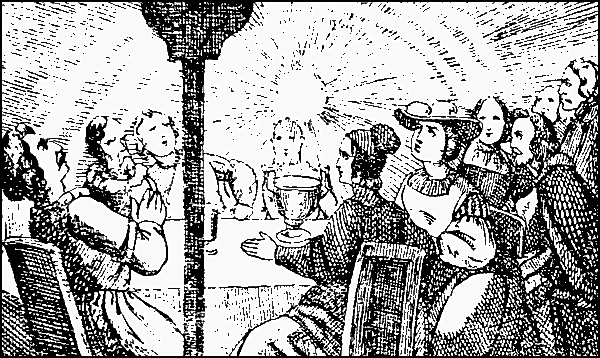
How Doctor Faustus with his company visited the
Bishop of Saltzburg his Wine-cellar
Doctor Faustus having taken his leave of the Duke,
he went to Wittenberg, near about Shrovetide, and
being in company with certain Students, Doctor
Faustus was himself the God Bacchus, who having
well feasted the Students before with dainty fare,
after the manner of Germanie, where it is counted
no feast except all the bidden guests be drunk, which
Doctor Faustus intending, said: Gentlemen and my
guests, will it please you to take a cup of wine with me
in a place or cellar whereunto I will bring you, and they
all said willingly we will: which when Doctor Faustus
heard, he took them forth, set either of them upon an
holly wand, and so were conjured into the Bishop of
Saltzburg his Cellar, for there about grew excellent
pleasant Wine: there fell Faustus and his company
to drinking and swilling, not of the worst but of the
best, and as they were merry in the Cellar, came down
to draw drink the Bishop’s butler: which when he
perceived so many persons there he cried with a loud
voice, thieves! thieves! This spited Doctor Faustus
wonderfully, wherefore he made every one of his
company to sit on their holly wand and so vanished
away, and in parting Doctor Faustus took the Butler
by the hair of the head and carried him away with
them, until they came unto a mighty high-lopped
tree, and on the top of that huge tree he set the Butler,
where he remained in a most fearful perplexity,
and Doctor Faustus departed to his house where they
took their VALETE one of another, drinking the Wine
the which they had stolen in great bottles of glass out
of the Bishop’s cellar. The Butler that had held
himself by the hand upon the lopped tree all the night,
was almost frozen with cold, espying the day, and
seeing the tree of so huge great highness, thought
with himself it is impossible to come off this tree
without peril of death: at length he had espied
certain Clowns which were passing by, he cried for
the love of God help me down: the Clowns seeing
him so high, wondered what mad man would climb
to so huge a tree, wherefore as a thing most miraculous,
they carried tidings unto the Bishop of Saltzburg,
then was there great running on every side to
see a man in a huge tree, and many devices they
practised to get him down with ropes, and being
demanded by the Bishop how he came there, he said,
that he was brought thither by the hair of the head of
certain thieves that were robbing of the Wine-cellar,
but what they were he knew not, for (said he) they had
faces like men, but they wrought like Devils.
How Doctor Faustus kept his Shrovetide
There were seven Students, and Masters that studied
Divinity, Iuris Prudentia, and Medicina, all these
having consented were agreed to visit Doctor Faustus
and so to celebrate Shrovetide with him: who being
come to his house he gave them their welcome, for
they were his dear friends, desiring them to sit down,
where he served them with a very good supper of
Hens, fish, and other roast, yet were they but slightly
cheered: wherefore Doctor Faustus comforted his
guests, excusing himself that they stole upon him so
suddenly, that he had not leisure to provide for them
so well as they were worthy, but my good friends
(quoth he) according to the use of our Country we
must drink all this night, and so a draught of the best
wine to bedward is commendable. For you know
that in great Potentates’ Courts they use as this night
great feasting, the like will I do for you: for I have
three great flagons of wine, the first is full of Hungarian
wine, containing eight gallons, the second of Italian
wine, containing seven gallons, the third containing
six gallons of Spanish wine, all the which we will
tipple out before it be day, besides, we have fifteen
dishes of meat, the which my Spirit Mephostophiles
hath fetched so far that it was cold before he brought
it, and they are all full of the daintiest things that one’s
heart can devise, but (saith Faustus) I must make them
hot again: and you may believe me, Gentlemen, that
this is no blinding of you, whereas you think that it
is no natural food, verily it is as good and as pleasant
as ever you ate. And having ended his tale, he commanded
his boy to lay the cloth, which done, he served
them with fifteen messes of meat, having three dishes
to a mess, the which were of all manner of Venison,
and other dainty wild fowl, and for wine there was no
lack, as Italian wine, Hungarian wine, and Spanish
wine: and when they were all made drunk, and that
they had almost eaten all their good cheer, they began
to sing and to dance until it was day, and then they
departed each one to his own habitation: at whose
parting, Doctor Faustus desired them to be his guests
again the next day following.
How Doctor Faustus feasted his guests on the
Ash-Wednesday
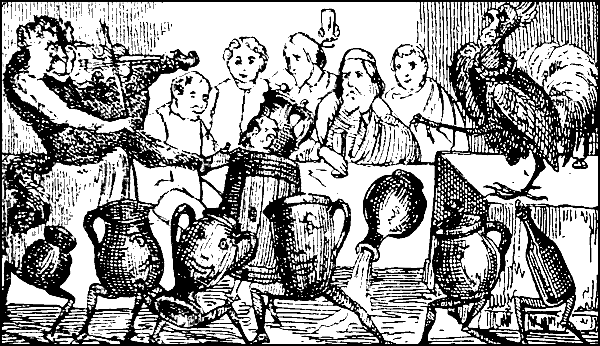
Upon Ash-Wednesday came unto Doctor Faustus his
bidden guests the Students, whom he feasted very
royally, in so much that they were all full and lusty,
singing and dancing as the night before: and when
the high glasses and goblets were caroused one to
another, Doctor Faustus began to play them some
pretty jests, in so much that round about the hall
was heard most pleasant music, and that in sundry
places, in this corner a Lute, in another a Cornet, in
another a Cittern, Gittern, Clarigolds, Harp, Horn
pipe: in fine, all manner of music was heard there
at that instant, whereat all the glasses and goblets,
cups and pots, dishes, and all that stood on the board
began to dance: then Doctor Faustus took ten stone
pots, and set them down on the floor, where presently
they began to dance and to smite one against the other
that the shivers flew round about the whole house,
whereat the whole company fell a-laughing. Then
he began another jest, he set an Instrument on the
table, and caused a monstrous great Ape to come in
amongst them, which Ape began to dance and to skip,
shewing them many merry conceits. In this and such-like
pastime they passed away the whole day, where
night being come, Doctor Faustus bade them all to
supper, which they lightly agreed unto, for Students
in these cases are easily entreated: wherefore he
promised to feast them with a banquet of fowl, and
afterwards they would all go about with a Mask, then
Doctor Faustus put forth a long pole out of the window,
whereupon presently there came innumerable of
birds and wild fowl, and so many as came had not any
power to fly away again, but he took them and flung
them to the Students: who lightly pulled off the
necks of them, and being roasted they made their
supper, which being ended they made themselves
ready to the Mask. Doctor Faustus commanded
every one to put on a clean shirt over his other clothes,
which being done, they began to look one upon another,
it seemed to each one of them they had no heads, and
so they went forth unto certain of their neighbours,
at which sight the people were wonderfully afraid.
And as the use of Germanie is, that wheresoever a
Mask entereth, the good man of the house must feast
them: so when these maskers were set to their
banquet, they seemed again in their former shape with
heads in so much that they were all known what they
were: and having sat and well eaten and drunk,
Doctor Faustus made that every one had an Ass’s
head on, with great and long ears, so they fell to
dancing and to drive away the time until it was midnight,
and then every man departed home, and as
soon as they were out of the house each one was in his
natural shape again, and so they ended and went to
sleep.
How Doctor Faustus the day following was feasted
of the Students, and of his merry jests with
them while he was in their company
The last Bacchanalia was held on Thursday, where
ensued a great Snow, and Doctor Faustus was invited
unto the Students that were with him the day before,
where they had prepared an excellent banquet for
him: which banquet being ended, Doctor Faustus
began to play his old pranks, and forthwith were in
the place thirteen Apes, that took hands and danced
round in a ring together, then they fell to tumble and
to vaulting one over another, that it was most pleasant
to behold, then they leaped out of the window and
vanished away: then they set before Doctor Faustus
a roasted Calve’s head: which one of the Students
cut a piece off, and laid it on Doctor Faustus his
trencher, which piece being no sooner laid down, but
the Calve’s head began to cry mainly out like a man,
murther, murther, but, alas, what doest thou to me!
Whereat they were all amazed, but after a while
considering of Faustus his jesting tricks they began
to laugh, and then they pulled in sunder the Calve’s
head and ate it up. Whereupon Doctor Faustus
asked leave to depart, but they would in no wise
agree to let him go, except that he would promise
to come again: presently then Faustus, through his
cunning, made a sledge, the which was drawn about
the house with four fiery dragons: this was fearful
for the Students to behold, for they saw Faustus ride
up and down as though he should have fired and slain
all them in the house. This sport continued until
midnight with such a noise that they could not hear
one another, and the heads of the Students were so
light, that they thought themselves to be in the air
all that time.
How Doctor Faustus shewed the fair Helena unto
the Students upon the Sunday following
The Sunday following came these Students home to
Doctor Faustus his own house, and brought their
meat and drink with them: these men were right
welcome guests unto Faustus, wherefore they all fell
to drinking of wine smoothly: and being merry, they
began some of them to talk of the beauty of women,
and every one gave forth his verdict what he had seen
and what he had heard. So one among the rest said,
I never was so desirous of anything in this world, as
to have a sight (if it were possible) of fair Helena of
Greece, for whom the worthy town of Troie was
destroyed and razed down to the ground, therefore
saith he, that in all men’s judgment she was more than
commonly fair, because that when she was stolen away
from her husband, there was for her recovery so great
bloodshed.
Doctor Faustus answered: For that you are all my
friends and are so desirous to see that famous pearl
of Greece, fair Helena, the wife of King Menelaus,
and daughter of Tindalus and Læda, sister to Castor
and Pollux, who was the fairest Lady in all Greece:
I will therefore bring her into your presence personally,
and in the same form of attire as she used to go when
she was in her chiefest flowers and pleasantest prime
of youth. The like have I done for the Emperor
Carolus Quintus, at his desire I shewed him Alexander
the great, and his Paramour: but (said Doctor Faustus)
I charge you all that upon your perils you speak not
a word, nor rise up from the Table so long as she is
in your presence. And so he went out of the Hall,
returning presently again, after whom immediately
followed the fair and beautiful Helena, whose beauty
was such that the Students were all amazed to see her,
esteeming her rather to be a heavenly than an earthly
creature. This Lady appeared before them in a most
sumptuous gown of purple Velvet, richly embroidered,
her hair hanged down loose as fair as the beaten Gold,
and of such length that it reached down to her hams,
with amorous coal-black eyes, a sweet and pleasant
round face, her lips red as a Cherry, her cheeks of
rose all colour, her mouth small, her neck as white as
the Swan, tall and slender of personage, and in sum,
there was not one imperfect part in her: she looked
round about her with a rolling Hawk’s eye, a smiling
and wanton countenance, which near hand inflamed
the hearts of the Students, but that they persuaded
themselves she was a Spirit, wherefore such fantasies
passed away lightly with them: and thus fair Helena
and Doctor Faustus went out again one with another.
But the Students at Doctor Faustus his entering
again into the hall, requested of him to let them see
her again the next day, for that they would bring
with them a painter and so take her counterfeit:
which he denied, affirming that he could not always
raise up her Spirit, but only at certain times: yet
(said he) I will give you her counterfeit, which shall
be always as good to you as if your selves should see
the drawing thereof, which they received according
to his promise, but soon lost it again. The Students
departed from Faustus’ home everyone to his house,
but they were not able to sleep the whole night for
thinking on the beauty of fair Helena. Wherefore
a man may see that the Devil blindeth and enflameth
the heart with lust often-times, that men fall in love
with Harlots, nay even with Furies, which afterward
cannot lightly be removed.
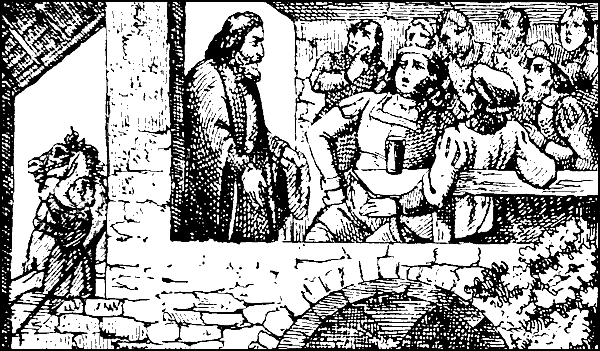
How Doctor Faustus conjured away the four wheels
from a clown’s waggon
Doctor Faustus was sent for to the Marshal of
Brunswicke, who was greatly troubled with the
falling sickness. Now Faustus had this use, never
to ride but walk forth on foot, for he could ease himself
when he list, and as he came near unto the town of
Brunswicke, there overtook him a Clown with four
horses and an empty waggon, to whom Doctor Faustus
jestingly to try him, said: I pray thee, good fellow,
let me ride a little to ease my weary legs; which the
buzzardly ass denied, saying: that his horses were
also weary, and he would not let him get up. Doctor
Faustus did this but to prove the buzzard, if there
were any courtesy to be found in him if need were.
But such churlishness as is commonly found among
clowns, was by Doctor Faustus well requited, even
with the like payment: for he said unto him, Thou
doltish Clown, void of all humanity, seeing thou art
of so currish a disposition, I will pay thee as thou
hast deserved, for the four wheels of thy Waggon
thou shalt have taken from thee, let me see then how
canst thou shift: hereupon his wheels were gone,
his horses also fell down to the ground, as though
they had been dead: whereat the Clown was sore
affright, measuring it as a just scourge of God for his
sins and churlishness: wherefore all troubled, and
wailing, he humbly besought Doctor Faustus to be
good unto him, confessing he was worthy of it, notwithstanding
if it pleased him to forgive him, he would
hereafter do better. Which humility made Faustus his
heart to relent, answering him on this manner, well,
do so no more, but when a poor weary man desireth
thee, see that thou let him ride, but yet thou shalt
not go altogether clear, for although thou have again
thy four wheels, yet shalt thou fetch them at the
four Gates of the City, so he threw dust on the horses,
and revived them again, and the Clown for his churlishness
was fain to fetch his wheels, spending his time
with weariness, whereas before he might have done a
good deed, and gone about his business quietly.
How four Jugglers cut one another’s head off, and
set them on again; and how Doctor Faustus
deceived them
Doctor Faustus came in the Lent unto Franckfort
Fair, where his Spirit Mephostophiles gave him to
understand that in an Inn were four Jugglers that cut
one another’s head off, and after their cutting off,
sent them to the Barber to be trimmed, which many
people saw. This angered Faustus (for he meant to
have himself the only Cock in the Devil’s basket), and
he went to the place where they were, to behold them.
And as these Jugglers were together, ready one to cut off
the other’s head, there stood also the Barbers ready to
trim them, and by them upon the table stood likewise
a glass full of distilled water, and he that was the
chiefest among them stood by it. Thus they began,
they smote off the head of the first, and presently
there was a Lily in the glass of distilled water, where
Faustus perceived this Lily as it were springing, and
the chief Juggler named it the tree of life, thus dealt
he with the first, making the Barber wash and comb his
head, and then he set it on again, presently the Lily
vanished away out of the water, hereat the man had
his head whole and sound again; the like did they
with the other two: and as the turn and lot came to
the chief Juggler that he also should be beheaded, and
that his Lily was most pleasant, fair, and flourishing
green, they smote his head off, and when it came to
be barbed, it troubled Faustus his conscience, in so
much that he could not abide to see another do anything,
for he thought himself to be the principal
conjurer in the world, wherefore Doctor Faustus
went to the table whereat the other Jugglers kept that
Lily, and so he took a small knife and cut off the
stalk of the Lily, saying to himself, none of them
should blind Faustus: yet no man saw Faustus to
cut the Lily, but when the rest of the Jugglers thought
to have set on their master’s head, they could not,
wherefore they looked on the Lily, and found it a
bleeding: by this means the Juggler was beguiled,
and so died in his wickedness, yet not one thought
that Doctor Faustus had done it.
How an old man, the neighbour of Faustus, sought
to persuade him to amend his evil life, and to
fall unto repentance
A good Christian an honest and virtuous old man,
a lover of the holy Scriptures, who was neighbour
unto Doctor Faustus: when he perceived that many
Students had their recourse in and out unto Doctor
Faustus, he suspected his evil life, wherefore like a
friend he invited Doctor Faustus to supper unto his
house, unto the which he agreed; and having ended
their banquet, the old man began with these words.
My loving friend and neighbour Doctor Faustus,
I have to desire of you a friendly and Christian request,
beseeching you that you will vouchsafe not to be angry
with me, but friendly resolve me in my doubt, and
take my poor inviting in good part. To whom Doctor
Faustus answered: My loving neighbour, I pray you
say your mind. Then began the old Patron to say:
My good neighbour, you know in the beginning
how that you have defied God, and all the host of
heaven, and given your soul to the Devil, wherewith
you have incurred God’s high displeasure, and are
become from a Christian far worse than a heathen
person: oh consider what you have done, it is not
only the pleasure of the body, but the safety of the
soul that you must have respect unto: of which if
you be careless, then are you cast away, and shall
remain in the anger of almighty God. But yet is
it time enough Doctor Faustus, if you repent and
call unto the Lord for mercy, as we have example
in the Acts of the Apostles, the eighth Chap. of Simon
in Samaria, who was led out of the way, affirming
that he was Simon homo sanctus. This man was
notwithstanding in the end converted, after that he
had heard the Sermon of Philip, for he was baptized,
and saw his sins, and repented. Likewise I beseech
you good brother Doctor Faustus, let my rude
Sermon be unto you a conversion; and forget the
filthy life that you have led, repent, ask mercy, and
live: for Christ saith, Come unto me all ye that are
weary and heavy laden, and I will refresh you. And
in Ezechiel: I desire not the death of a sinner, but
rather that he convert and live. Let my words good
brother Faustus, pierce into your adamant heart, and
desire God for his Son Christ his sake, to forgive you.
Wherefore have you so long lived in your Devilish
practices, knowing that in the Old and New Testament
you are forbidden, and that men should not suffer any
such to live, neither have any conversation with them,
for it is an abomination unto the Lord; and that such
persons have no part in the Kingdom of God. All
this while Doctor Faustus heard him very attentively,
and replied: Father, your persuasions like me
wondrous well, and I thank you with all my heart
for your good will and counsel, promising you so far
as I may to follow your discipline: whereupon he
took his leave. And being come home, he laid him
very pensive on his bed, bethinking himself of the
words of the good old man, and in a manner began
to repent that he had given his Soul to the Devil,
intending to deny all that he had promised unto Lucifer.
Continuing in these cogitations, suddenly his Spirit
appeared unto him clapping him upon the head, and
wrung it as though he would have pulled the head from
the shoulders, saying unto him, Thou knowest Faustus,
that thou hast given thyself body and soul unto my
Lord Lucifer, and hast vowed thyself an enemy unto
God and unto all men; and now thou beginnest
to hearken to an old doting fool which persuadeth
thee as it were unto God, when indeed it is too late,
for that thou art the Devil’s, and he hath good power
presently to fetch thee: wherefore he hath sent me
unto thee, to tell thee, that seeing thou hast sorrowed
for that thou hast done, begin again and write another
writing with thine own blood, if not, then will I tear
thee all to pieces. Hereat Doctor Faustus was sore
afraid, and said: My Mephostophiles, I will write
again what thou wilt: wherefore he sat him down,
and with his own blood he wrote as followeth: which
writing was afterward sent to a dear friend of the
said Doctor Faustus being his kinsman.
How Doctor Faustus wrote the second time with his
own blood and gave it to the Devil
I, Doctor John Faustus, acknowledge by this my
deed and handwriting, that sith my first writing,
which is seventeen years, that I have right willingly
held, and have been an utter enemy unto God and all
men, the which I once again confirm, and give fully
and wholly myself unto the Devil both body and soul,
even unto the great Lucifer: and that at the end of
seven years ensuing after the date of this letter, he
shall have to do with me according as it pleaseth him,
either to lengthen or shorten my life as liketh him:
and hereupon I renounce all persuaders that seek to
withdraw me from my purpose by the Word of God,
either ghostly or bodily. And further, I will never
give ear unto any man, be he spiritual or temporal,
that moveth any matter for the salvation of my soul.
Of all this writing, and that therein contained, be
witness, my own blood, the which with mine own hands
I have begun, and ended.
Dated at Wittenberg, the 25th of July.
And presently upon the making of this Letter, he
became so great an enemy unto the poor old man,
that he sought his life by all means possible; but
this godly man was strong in the Holy Ghost, that he
could not be vanquished by any means: for about two
days after that he had exhorted Faustus, as the poor
man lay in his bed, suddenly there was a mighty
rumbling in the Chamber, the which he was never
wont to hear, and he heard as it had been the groaning
of a Sow, which lasted long: whereupon the good old
man began to jest, and mock, and said: oh what
Barbarian cry is this, oh fair Bird, what foul music is
this of a fair Angel, that could not tarry two days in
his place? beginnest thou now to run into a poor
man’s house, where thou hast no power, and wert
not able to keep thine own two days? With these
and such-like words the Spirit departed. And when
he came home Faustus asked him how he had sped
with the old man: to whom the Spirit answered, the
old man was harnessed, and that he could not once
lay hold upon him: but he would not tell how the
old man had mocked him, for the Devils can never
abide to hear of their fall. Thus doth God defend
the hearts of all honest Christians, that betake themselves
under his tuition.
How Doctor Faustus made a marriage between
two lovers
In the City of Wittenberg was a Student, a gallant
Gentleman, named N. N. This Gentleman was far
in love with a Gentlewoman, fair and proper of
personage. This Gentlewoman had a Knight that was
a suitor unto her, and many other Gentlemen, the
which desired her in marriage, but none could obtain
her: So it was that this N. N. was very well acquainted
with Faustus, and by that means became a suitor
unto him to assist him in the matter, for he fell so
far in despair with himself, that he pined away to the
skin and bones. But when he had opened the matter
unto Doctor Faustus, he asked counsel of his Spirit
Mephostophiles, the which told him what to do.
Hereupon Doctor Faustus went home to the Gentleman,
and bade him be of good cheer, for he should have his
desire, for he would help him to that he wished for,
and that this Gentlewoman should love none other
but him only: wherefore Doctor Faustus so changed
the mind of the Damsel by a practice he wrought,
that she would do no other thing but think on him,
whom before she had hated, neither cared she for any
man but him alone. The device was thus, Faustus
commanded this Gentleman that he should clothe
himself in all his best apparel that he had and that he
should go unto this Gentlewoman, and there to shew
himself, giving him also a Ring, commanding him in
any wise that he should dance with her before he
departed. Wherefore he followed Faustus his counsel,
went to her, and when they began to dance they that
were suitors began to take everyone his Lady in his
hand, and this good Gentleman took her, who
before had so disdained him, and in the dance he
thrust the Ring into her hand that Doctor Faustus
had given him, the which she no sooner touched, but
she fell immediately in love with him, beginning in
the dance to smile, and many times to give him winks,
rolling her eyes, and in the end she asked him if he
could love her and make her his wife; he gladly
answered, he was content: and hereupon they concluded,
and were married, by the means and help of
Doctor Faustus, for which he received a good reward
of the Gentleman.
How Doctor Faustus led his friends into his Garden
at Christmas, and shewed them many strange
sights in his nineteenth year
In December, about Christmas in the City of Wittenberg,
were many young Gentlewomen, the which
were come out of the Country to make merry with
their friends and acquaintance; amongst whom there
were certain that were well acquainted with Doctor
Faustus, wherefore they were often invited as his
guests unto him, and being with him on a certain
time after dinner, he led them into his Garden, where
he shewed them all manner of flowers, and fresh
herbs, Trees bearing fruit and blossoms of all sorts,
in so much that they wondered to see that in his
Garden should be so pleasant a time as in the midst of
summer: and without in the streets, and all over the
Country, it lay full of Snow and Ice. Wherefore
this was noted of them as a thing miraculous, each
one gathering and carrying away all such things as
they best liked, and so departed delighted with their
sweet-smelling flowers.
How Doctor Faustus gathered together a great army
of men in his extremity against a Knight that
would have injured him on his journey
Doctor Faustus travelled towards Eyszleben, and
when he was nigh half the way, he espied seven
horsemen, and the chief of them he knew to be the
Knight to whom he had played a jest in the Emperor’s
Court, for he had set a huge pair of Hart’s horns
upon his head: and when the Knight now saw that
he had fit opportunity to be revenged of Faustus he
ran upon him himself, and those that were with him,
to mischief him, intending privily to shoot at him:
which when Doctor Faustus espied, he vanished
away into the wood which was hard by them. But
when the Knight perceived that he was vanished
away, he caused his men to stand still, where as they
remained they heard all manner of war-like instruments
of music, as Drums, Flutes, Trumpets, and such-like,
and a certain troop of horsemen running towards
them. Then they turned another way, and there also
were assaulted on the same side: then another way,
and yet they were freshly assaulted, so that which
way soever they turned themselves, he was encountered:
in so much that when the Knight perceived
that he could escape no way, but that they
his enemies laid on him which way soever he offered
to fly, he took a good heart and ran amongst the
thickest, and thought with himself better to die than
to live with so great an infamy. Therefore being at
handy-blows with them, he demanded the cause
why they should so use them: but none of them
would give him answer, until Doctor Faustus shewed
himself unto the Knight, where withal they enclosed
him around, and Doctor Faustus said unto him, Sir,
yield your weapon, and yourself, otherwise it will
go hardly with you. The Knight that knew none
other but that he was environed with an host of
men (where indeed they were none other than Devils)
yielded: then Faustus took away his sword, his piece,
and horse, with all the rest of his companions. And
further he said unto him; Sir, the chief General of
our army hath commanded to deal with you according
to the law of Arms, you shall depart in peace whither
you please: and then he gave the Knight an horse
after the manner, and set him thereon, so he rode,
the rest went on foot until they came to their Inn,
where being alighted, his Page rode on his horse to
the water, and presently the horse vanished away,
the Page being almost sunk and drowned, but he
escaped: and coming home, the Knight perceived
his Page so bemired and on foot, asked where his
horse was become? Who answered that he was
vanished away: which when the Knight heard, he
said, of a truth this is Faustus his doing, for he serveth
me now as he did before at the Court, only to make me
a scorn and a laughing-stock.
How Doctor Faustus caused Mephostophiles to bring
him seven of the fairest women that he could
find in all those countries he had travelled in,
in the twentieth year
When Doctor Faustus called to mind, that his time
from day to day drew nigh, he began to live a swinish
and Epicurish Life, wherefore he commanded his
Spirit Mephostophiles, to bring him seven of the fairest
women that he had seen in all the time of his travel:
which being brought, first one, and then another, he
lay with them all, in so much that he liked them so
well, that he continued with them in all manner of love,
and made them to travel with him in all his journeys.
These women were two Netherlanders, one Hungarian,
one English, two Wallons, one Francklander:
and with these sweet personages he continued long,
yea even to his last end.
How Doctor Faustus found a mass of money when
he had consumed twenty-two of his years
To the end that the Devil would make Faustus his
only heir, he shewed unto him where he should go
and find a mighty huge mass of money, and that he
should have it in an old Chapel that was fallen down,
half a mile distant from Wittenberg, there he bade
him to dig and he should find it, the which he did,
and having digged reasonable deep, he saw a mighty
huge serpent, the which lay on the treasure itself,
the treasure itself lay like a huge light burning: but
D. Faustus charmed the serpent that he crept into a
hole, and when he digged deeper to get up the treasure,
he found nothing but coals of fire: there also he heard
and saw many that were tormented, yet notwithstanding
he brought away the coals, and when he was come
home, it was all turned into silver and gold, as after
his death was found by his servant, the which was
almost about estimation, a thousand gilders.
How Doctor Faustus made the Spirit of fair Helena
of Greece his own Paramour and bedfellow
in his twenty-third year
To the end that this miserable Faustus might fill
the lust of his flesh, and live in all manner of voluptuous
pleasures, it came in his mind after he had slept his
first sleep,[39]
and in the twenty-third year past of his
time, that he had a great desire to lie with fair Helena
of Greece, especially her whom he had seen and shewed
unto the Students of Wittenberg, wherefore he called
unto him his Spirit Mephostophiles, commanding
him to bring him the fair Helena, which he also did.
Whereupon he fell in love with her, and made her his
common Concubine and bedfellow, for she was so
beautiful and delightful a piece, that he could not be
one hour from her, if he should therefore have suffered
death, she had so stolen away his heart: and to his
seeming, in time she was with child, and in the end
brought him a man child, whom Faustus named
Justus Faustus: this child told Doctor Faustus many
things that were to come, and what strange matters
were done in foreign countries: but in the end when
Faustus lost his life, the mother and the child vanished
away both together.
How Doctor Faustus made his Will, in the which
he named his servant Wagner to be his heir
Doctor Faustus was now in his twenty-fourth and
last year, and he had a pretty stripling to his servant,
the which had studied also at the University of Wittenberg:
this youth was very well acquainted with
his knaveries and sorceries, so that he was hated as
well for his own knaveries, as also for his Master’s:
for no man would give him entertainment into his
service, because of his unhappiness, but Faustus: this
Wagner was so well beloved with Faustus, that he used
him as his son: for do what he would his master
was always therewith well content. And when the
time drew nigh that Faustus should end, he called
unto him a Notary and certain masters the which
were his friends and often conversant with him, in
whose presence he gave this Wagner his house and
Garden. Item, he gave him in ready money one
thousand six hundred gilders. Item, a Farm. Item,
a gold chain, much plate, and other household stuff.
This gave he all to his servant, and the rest of his time
he meant to spend in Inns and Students’ company,
drinking and eating, with other jollity: and thus he
finished his Will for that time.
How Doctor Faustus fell in talk with his servant
touching his Testament, and the covenants
thereof
Now when this Will was made, Doctor Faustus
called unto him his servant, saying: I have thought
upon thee in my Testament, for that thou hast been
a trusty servant unto me and a faithful, and hast not
opened my secrets: and yet further (said he) ask of
me before I die what thou wilt, and I will give it unto
thee. His servant rashly answered, I pray you let
me have your cunning. To which Doctor Faustus
answered, I have given thee all my books, upon this
condition, that thou wouldst not let them be common,
but use them for thine own pleasure, and study
carefully in them. And dost thou also desire my
cunning? That mayest thou peradventure have, if
thou love and peruse my books well. Further (said
Doctor Faustus) seeing that thou desirest of me this
request, I will resolve thee: my Spirit Mephostophiles
his time is out with me, and I have nought to command
him as touching thee, yet will I help thee to another,
if thou like well thereof. And within three days after
he called his servant unto him, saying: art thou
resolved? wouldst thou verily have a Spirit? Then
tell me in what manner or form thou wouldst have
him? To whom his servant answered, that he would
have him in the form of an Ape: whereupon presently
appeared a Spirit unto him in manner and form
of an Ape, the which leaped about the house. Then
said Faustus, see, there hast thou thy request, but yet
he will not obey thee until I be dead, for when my
Spirit Mephostophiles shall fetch me away, then shall
thy Spirit be bound unto thee, if thou agree: and thy
Spirit shalt thou name Akercocke, for so is he called:
but all this is upon condition that thou publish my
cunning, and my merry conceits, with all that I have
done (when I am dead) in an history: and if thou
canst not remember all, thy Spirit Akercocke will
help thee: so shall the great acts that I have done
be manifested unto the world.
How Doctor Faustus having but one month of his
appointed time to come, fell to mourning and
sorrow with himself for his devilish exercise
Time ran away with Faustus, as the hour-glass, for
he had but one month to come of his twenty-four
years, at the end whereof he had given himself to the
Devil body and soul, as is before specified. Here was
the first token, for he was like a taken murderer or
a thief, the which findeth himself guilty in conscience
before the Judge have given sentence, fearing every
hour to die: for he was grieved, and wailing spent the
time, went talking to himself, wringing of his hands,
sobbing and sighing, he fell away from flesh, and was
very lean, and kept himself close: neither could he
abide to see or hear of his Mephostophiles any more.
How Doctor Faustus complained that he should in
his lusty time and youthful years die so
miserably
This sorrowful time drawing near so troubled Doctor
Faustus, that he began to write his mind, to the end
he might peruse it often and not forget it, and is in
manner as followeth.
Ah Faustus, thou sorrowful and woeful man, now
must thou go to the damned company in unquenchable
fire, whereas thou mightest have had the joyful immortality
of the soul, the which thou now hast lost.
Ah gross understanding and wilful will, what seizeth
on my limbs other than a robbing of my life? Bewail
with me my sound and healthful body, wit and soul,
bewail with me my senses, for you have had your
part and pleasure as well as I. Oh envy and disdain,
how have you crept both at once into me, and now
for your sakes I must suffer all these torments? Ah
whither is pity and mercy fled? Upon what occasion
hath heaven repaid me with this reward by sufferance
to suffer me to perish? Wherefore was I created a
man? The punishment that I see prepared for me
of myself now must I suffer. Ah miserable wretch,
there is nothing in this world to shew me comfort:
then woe is me, what helpeth my wailing.
Another complaint of Doctor Faustus
Oh poor, woeful and weary wretch: oh sorrowful
soul of Faustus, now art thou in the number of the
damned, for now must I wait for unmeasurable pains
of death, yea far more lamentable than ever yet any
creature hath suffered. Ah senseless, wilful and desperate
forgetfulness! O cursed and unstable life!
O blind and careless wretch, that so hast abused thy
body, sense, and soul! O foolish pleasure, into what
a weary labyrinth hast thou brought me, blinding
mine eyes in the clearest day? Ah weak heart! O
troubled soul, where is become thy knowledge to
comfort thee? O pitiful weariness! Oh desperate
hope, now shall I never more be thought upon! Oh,
care upon carefulness, and sorrows on heaps: Ah
grievous pains that pierce my panting heart, whom is
there now that can deliver me? Would God that I
knew where to hide me, or into what place to creep
or fly. Ah, woe, woe is me, be where I will, yet am
I taken. Herewith poor Faustus was so sorrowfully
troubled, that he could not speak or utter his mind
any further.
How Doctor Faustus bewailed to think on Hell, and
of the miserable pains therein provided for him
Now thou Faustus, damned wretch, how happy wert
thou if as an unreasonable beast thou mightest die
without soul, so shouldst thou not feel any more doubts?
But now the Devil will take thee away both body and
soul, and set thee in an unspeakable place of darkness:
for although others’ souls have rest and peace, yet I
poor damned wretch must suffer all manner of filthy
stench, pains, cold, hunger, thirst, heat, freezing,
burning, hissing, gnashing, and all the wrath and curse
of God, yea all the creatures that God hath created are
enemies to me. And now too late I remember that my
Spirit Mephostophiles did once tell me, there was a
great difference amongst the damned; for the greater
the sin, the greater the torment: for as the twigs of
the tree make greater flame than the trunk thereof,
and yet the trunk continueth longer in burning: even
so the more that a man is rooted in sin, the greater
is his punishment. Ah thou perpetual damned wretch,
now art thou thrown into the everlasting fiery lake
that never shall be quenched, there must I dwell in
all manner of wailing, sorrow, misery, pain, torment,
grief, howling, sighing, sobbing, blubbering, running
of eyes, stinking at nose, gnashing of teeth, fear to the
ears, horror to the conscience, and shaking both of
hand and foot. Ah that I could carry the heavens on
my shoulders, so that there were time at last to quit
me of this everlasting damnation! Oh who can
deliver me out of these fearful tormenting flames,
the which I see prepared for me? Oh there is no help,
nor any man that can deliver me, nor any wailing of
sins can help me, neither is there rest to be found for
me day nor night. Ah woe is me, for there is no help
for me, no shield, no defence, no comfort. Where
is my hold? knowledge dare I not trust: and for a
soul to Godwards that have I not, for I shame to
speak unto him: if I do, no answer shall be made
me, but he will hide his face from me, to the end that
I should not behold the joys of the chosen. What
mean I then to complain where no help is? No,
I know no hope resteth in my groanings: I have
desired that it should be so, and God hath said Amen
to my misdoings: for now I must have shame to
comfort me in my calamities.
Here followeth the miserable and lamentable end
of Doctor Faustus, by the which all Christians
may take an example and warning
In the twenty-fourth year Doctor Faustus his time
being come, his Spirit appeared unto him, giving him
his writing again, and commanding him to make preparation,
for that the Devil would fetch him against
a certain time appointed. D. Faustus mourned and
sighed wonderfully, and never went to bed, nor slept
wink for sorrow. Wherefore his Spirit appeared again,
comforting him, and saying: My Faustus, be not thou
so cowardly minded; for although that thou losest
thy body, it is not long unto the day of Judgment, and
thou must die at the last, although thou live many
thousand years. The Turks, the Jews, and many
an unchristian Emperor, are in the same condemnation:
therefore (my Faustus) be of good courage, and be
not discomforted, for the Devil hath promised that
thou shalt not be in pains as the rest of the damned are.
This and such-like comfort he gave him, but he told
him false, and against the saying of the Holy Scriptures.
Yet Doctor Faustus that had none other expectation
but to pay his debts with his own skin, went on the
same day that his Spirit said the Devil would fetch
him, unto his trusty and dearest beloved brethren
and companions, as Masters, and Bachelors of Arts,
and other Students more the which had often visited
him at his house in merriment: these he entreated
that they would walk into the Village called Rimlich,
half a mile from Wittenberg, and that they would
there take with him for their repast part of a small
banquet, the which they all agreed unto: so they went
together, and there held their dinner in a most sumptuous
manner. Doctor Faustus with them (dissemblingly)
was merry, but not from the heart: wherefore
he requested them that they would also take part of
his rude supper: the which they agreed unto: for
(quoth he) I must tell you what is the Victualler’s due:
and when they slept (for drink was in their heads)
then Doctor Faustus paid and discharged the shot,
and bound the Students and the Masters to go with
him into another room, for he had many wonderful
matters to tell them: and when they were entered
the room as he requested, Doctor Faustus said unto
them, as hereafter followeth.
An Oration of Faustus to the Students
My trusty and well-beloved friends, the cause why
I have invited you into this place is this: Forasmuch
as you have known me this many years, in
what manner of life I have lived, practising all
manner of conjurations and wicked exercises, the
which I have obtained through the help of the Devil,
into whose Devilish fellowship they have brought me,
the which use the like Art and practice, urged by the
detestable provocation of my flesh, my stiff-necked
and rebellious will, with my filthy infernal thoughts,
the which were ever before me, pricking me forward
so earnestly, that I must perforce have the consent
of the Devil to aid me in my devices. And to the end
I might the better bring my purpose to pass, to have
the Devil’s aid and furtherance, which I never have
wanted in mine actions, I have promised unto him at
the end and accomplishing of twenty-four years, both
body and soul, to do therewith at his pleasure: and
this day, this dismal day, those twenty-four years are
fully expired, for night beginning my hour-glass is at
an end, the direful finishing whereof I carefully
expect: for out of all doubt this night he will fetch
me, to whom I have given myself in recompense of his
service both body and soul, and twice confirmed
writings with my proper blood. Now have I called
you my well-beloved Lords, friends, brethren, and
fellow’s, before that fatal hour to take my friendly
farewell, to the end that my departing may not hereafter
be hidden from you, beseeching you herewith
courteous, and loving Lords and brethren, not to take
in evil part anything done by me, but with friendly
commendations to salute all my friends and companions
wheresoever: desiring both you and them, if
ever I have trespassed against your minds in anything,
that you would all heartily forgive me: and as for
those lewd practices the which this full twenty-four
years I have followed, you shall hereafter find them in
writing: and I beseech you let this my lamentable
end to the residue of your lives be a sufficient warning,
that you have God always before your eyes, praying
unto him that he would ever defend you from the
temptation of the Devil, and all his false deceits, not
falling altogether from God, as I wretched and ungodly
damned creature have done, having denied and
defied Baptism, the Sacraments of Christ’s body, God
himself, all heavenly powers, and earthly men, yea,
I have denied such a God, that desireth not to have
one lost. Neither let the evil fellowship of wicked
companions mislead you as it hath done me: visit
earnestly and oft the Church, war and strive continually
against the Devil with a good and steadfast
belief on God, and Jesus Christ, and use your vocation
in holiness. Lastly, to knit up my troubled
Oration, this is my friendly request, that you would
to rest, and let nothing trouble you: also if you chance
to hear any noise, or rumbling about the house, be
not therewith afraid, for there shall no evil happen
unto you: also I pray you arise not out of your beds.
But above all things I entreat you, if you hereafter
find my dead carcass, convey it unto the earth, for
I die both a good and bad Christian; a good Christian,
for that I am heartily sorry, and in my heart always
pray for mercy, that my soul may be delivered: a
bad Christian, for that I know the Devil will have
my body, and that would I willingly give him so
that he would leave my soul in quiet: wherefore
I pray you that you would depart to bed, and so I
wish you a quiet night, which unto me notwithstanding
will be horrible and fearful.
This oration or declaration was made by Doctor
Faustus, and that with a hearty and resolute mind,
to the end he might not discomfort them: but the
Students wondered greatly thereat, that he was so
blinded, for knavery, conjuration, and such-like
foolish things, to give his body and soul unto the
Devil: for they loved him entirely, and never suspected
any such thing before he had opened his mind
to them: wherefore one of them said unto him; ah,
friend Faustus, what have you done to conceal this
matter so long from us, we would by the help of good
Divines, and the grace of God, have brought you out
of this net, and have torn you out of the bondage
and chains of Satan, whereas now we fear it is too
late, to the utter ruin of your body and soul? Doctor
Faustus answered, I durst never do it, although I
often minded, to settle myself unto godly people, to
desire counsel and help, as once mine old neighbour
counselled me, that I should follow his learning, and
leave all my conjurations, yet when I was minded to
amend, and to follow that good man’s counsel, then
came the Devil and would have had me away, as this
night he is like to do, and said so soon as I turned again
to God, he would dispatch me altogether. Thus, even
thus (good Gentlemen, and my dear friends) was I
enthralled in that Satanical band, all good desires
drowned, all piety banished, all purpose of amendment
utterly exiled, by the tyrannous threatenings of my
deadly enemy. But when the Students heard his words,
they gave him counsel to do naught else but call upon
God, desiring him for the love of his sweet Son
Jesus Christ’s sake, to have mercy upon him, teaching
him this form of prayer. O, God, be merciful unto
me, poor and miserable sinner, and enter not into
judgment with me, for no flesh is able to stand before
thee. Although, O Lord, I must leave my sinful
body unto the Devil, being by him deluded, yet thou
in mercy mayest preserve my soul.
This they repeated unto him, yet it could take
no hold, but even as Cain he also said his sins were
greater than God was able to forgive; for all his
thought was on his writing, he meant he had made it
too filthy in writing it with his own blood. The
Students and the others that were there, when they
had prayed for him, they wept, and so went forth,
but Faustus tarried in the hall: and when the Gentlemen
were laid in bed, none of them could sleep, for
that they attended to hear if they might be privy
of his end. It happened between twelve and one
o’clock at midnight, there blew a mighty storm of wind
against the house, as though it would have blown the
foundation thereof out of his place. Hereupon the
Students began to fear, and got out of their beds,
comforting one another, but they would not stir out
of the chamber: and the Host of the house ran out
of doors, thinking the house would fall. The Students
lay near unto that hall wherein Doctor Faustus lay,
and they heard a mighty noise and hissing, as if the
hall had been full of Snakes and Adders: with that
the hall door flew open wherein Doctor Faustus was,
then he began to cry for help, saying: murther, murther,
but it came forth with half a voice hollowly: shortly
after they heard him no more. But when it was day,
the Students that had taken no rest that night, arose
and went into the hall in the which they left Doctor
Faustus, where notwithstanding they found no
Faustus, but all the hall lay besprinkled with blood,
his brains cleaving to the wall: for the Devil had
beaten him from one wall against another, in one
corner lay his eyes, in another his teeth, a pitiful and
fearful sight to behold. Then began the Students to
bewail and weep for him, and sought for his body
in many places: lastly they came into the yard where
they found his body lying on the horse dung, most
monstrously torn, and fearful to behold, for his head
and all his joints were dashed in pieces.
The fore-named Students and Masters that were at
his death, have obtained so much, that they buried
him in the Village where he was so grievously tormented.
After the which, they returned to Wittenberg, and
coming into the house of Faustus, they found the
servant of Faustus very sad, unto whom they opened
all the matter, who took it exceeding heavily. There
found they also this history of Doctor Faustus noted,
and of him written as is before declared, all save
only his end, the which was after by the Students
thereto annexed: further, what his servant had noted
thereof, was made in another book. And you have
heard that he held by him in his life the Spirit of fair
Helena, the which had by him one son, the which he
named Justus Faustus, even the same day of his death
they vanished away, both mother and son. The house
before was so dark, that scarce anybody could abide
therein. The same night Doctor Faustus appeared
unto his servant lively, and shewed unto him many
secret things the which he had done and hidden in his
lifetime. Likewise there were certain which saw
Doctor Faustus look out of the window by night as
they passed by the house.
And thus ended the whole story of Doctor Faustus
his conjuration, and other acts that he did in his life;
out of the which example every Christian may learn,
but chiefly the stiff-necked and high-minded may
thereby learn to fear God, and to be careful of their
vocation, and to be at defiance with all Devilish
works, as God hath most precisely forbidden, to the
end we should not invite the Devil as a guest, nor give
him place as that wicked Faustus hath done: for here
we have a fearful example of his writing, promise,
and end, that we may remember him: that we go
not astray, but take God always before our eyes, to
call alone upon him, and to honour him all the days
of our life, with heart and hearty prayer, and with
all our strength and soul to glorify his holy name,
defying the Devil and all his works, to the end we may
remain with Christ in all endless joy: Amen, Amen,
that wish I unto every Christian heart, and God’s
name to be glorified. Amen.
FINIS
FRESCO FROM AUERBACH’S CELLAR IN LEIPZIG
FRESCO FROM AUERBACH’S CELLAR IN LEIPZIG
THE
SECOND REPORT
of DOCTOR JOHN FAUSTUS, containing
his appearances, and the deedes
of Wagner.
VVritten by an English Gentleman
student in VVittenberg an Vniuersity of Germany
in Saxony.
PVBLISHED: FOR THE DELIGHT
of all those which desire Nouelties by a frend
of the same Gentleman.
LONDON.
PRINTED by ABELL JEFFES, for CUTHBERT
Burby, and are to be sold at the middle Shop at Saint
Mildreds Church by the Stockes. 1594.
THE SECOND REPORT OF DOCTOR JOHN FAUSTUS In nomine aeterne & semperuiuae maiestatis, Amen. Spectatum admissi risum teneatis amici. — CHAPTER I — CHAPTER II — CHAPTER III — CHAPTER IV — CHAPTER V — CHAPTER VI — CHAPTER VII — CHAPTER VIII — CHAPTER IX — CHAPTER X — CHAPTER XI — CHAPTER XII — CHAPTER XIII — CHAPTER XIV — CHAPTER XV — CHAPTER XVI — CHAPTER XVII — CHAPTER XVIII — CHAPTER XIX — CHAPTER XX — CHAPTER XXI — CHAPTER XXII — CHAPTER XXIII — CHAPTER XXIV — CHAPTER XXV — CHAPTER XXVI — CHAPTER XXVII — CHAPTER XXVIII
Doctor John Faustus, whose parentage howsoever
hitherto informed, is known to be base, his father
when he was at the best, but the son of a poor Farmer,
his Mother the daughter of one of the same condition,
born in a small village called Kundling in Slesia,
brought up in literature at Gracovia, after at Wittenberg,
whose life made him famous, and death notorious:
being thus tormented and torn in pieces, at the time
appointed betwixt the Devils and him, moved by this
example woeful and lamentable enough, the hearts
of the Students and Scholars which were witnesses
of his distraughture, that with an inward terror of
conscience vexed and tormented, they departed and
declared the whole volumes of his detestable life,
which afore his Tragedy was thus acted, were not
known. Christopher Wagner, his familiar servant
unto whom he had committed the secrets of his bosom,
and had intimated unto him whatever his four and
twenty years’ familiarity with the black Art, and more
black Devils had taught him: He after the death of
his thus slain Master musing at everything thus done,
everything thus done being wonderful: (as men do
whom fear makes passionate and meditation of former
loss urgeth a latter augment of fresh sorrows): in
a distraughtful fury (the Company of Students being
departed, which were eye witnesses of the Doctor’s
lamentable end) conveyed himself unto his Master’s
Library, viewing with sorrowful eyes the only Monuments
of his life, the disputations betwixt him and
Mephostophiles, his answers and demands, and else
whatsoever questions moved or disputed of betwixt
the Devils and him, and memorials of his Heavens and
Hells voyages, his conveyance with many the like
comical journeys. The boy of a sudden fell into
a deep considering of his former merriments, sports
and delights, in so much that in this conceit he flung
out of this study, as if he meant to bury the remembrance
of these matters by contempt and negligence:
coming into the same Hall wherein his Master’s latest
Tragedy was performed, sighing for his want, he
remembered (for as then he lately read it) how that
one Article to the which his Master had bound
Mephostophiles was, that after his death he should be
a Spirit in nature and essence as others were. The Wag
at this began to smile (oh how such things seeming
pleasant make fools’ hearts merry) conceiving with
himself how to make his once Master become his man,
and to have the number of his spiritual followers
doubled, scorning the alonely attendance of one servant.
To this therefore he determined a time for the
raising of his Master’s spirit: and therewith he fell
to read earnestly of other matters, so long that he began
to leave as wearied and wearied began to muse.
Suddenly the air began to receive an alteration and
change with a thick foggy mist, as if it would have
shut up the desired day from man’s view, the winds
raged, the thunder lifted up his voice above the
common strain, hail and rain immediately following,
and all these but the ordinary presages of an appearing
Spirit. At this Kit began to tremble, not as afraid
of that which came, but struck with inward horror of
conscience, thinking that no other time had been
appointed to be his doomsday. Suddenly (for always
such haps are sudden) the doors flew open as if they
would have fled from flying, and in all pomp entered
as it were the Prologue of a Comedy, a fellow so short
and little as if he should be of one year, and yet not
so brief as ill-favoured, in his hands a Club, on his
head a Crown of Laurel, riding upon a low Mule,
his name was Gomory, a strong and mighty Duke,
the ruler of six and twenty Legions: and next in
bravery appeared Volac, a great Governor, in the shape
of a Boy with wings like an Angel of Hell, seeming
to be of old rusty iron, riding upon a Dragon with
four heads, in his hands he held a flaming Torch to
give light to the after-comers and beholders: next
after him appeared Asmoday, a King mighty and puissant,
ragged and bristled like a Boar on foot, bearing
a banner or a lance. After him issued Lucifer the
King of the Orient with the four Monarchs of his
dominions, betwixt them were two mighty Spaniels
which drew in a fiery Cart Doctor John Faustus,
whom if reason had not better ruled Wagner would
have saluted, for so natural was his semblance, so
lively his countenance, as if it had either been a new
Faustus, or not the old murdered Faustus, but the
fear which his Master’s harm put him in, cast him besides
the renewing of his old acquaintance, after these came
divers others with trumpets and excellent melody.
This right marvellous triumph thus presented, each
one did his humble obeisance, the best beginning
(though good there were none) and in the end with huge
tumult and echoing of trumpets they crowned him
a King, which when they had done, with the like
ceremonies they conveyed out again the Doctor
whom his wretchedness made a King, and his new
King-ship nothing. Wagner started as if he had
now begun to marvel, amazed at this merry Interlude,
having recovered his memory again, he began softly
to speak to himself in such-like manner. Is this
(quoth he) the honour my Master hath in Hell?
Is this the reverence with which the Fiends infernal
use to entertain such guests? O ye Spirits of Hell,
and ye even now revived Emperors of great Limbus,
from whence have you drawn this extraordinary
humanity, is it to scorn poor Faustus or to mock
Wagner that you shew such reverence to a vile object,
what then would they do to Wagner who is worthy
to have a fitter servant than their King? At these
words he blushed exceedingly, and began to rage very
grievously with his conscience’s terror, and with some
few tears repenting his irreligious conclusion, rose up
from the ground, and supposing it to be but an illusion,
dream, or a temptation, or else some conceit proceeding
from his moist and melancholic fantasy, overpressed
with too many vapours, raised up by continual thought
into his Pores: wherefore he went forthwith into the
streets (so much he distrusted himself) and demanded
whether it rained, hailed, or thundered, and it was
answered that it neither rained, hailed, nor thundered.
Wagner, albeit he was newly revived from a fear, and
scarcely thoroughly wakened from this his great terror,
yet with this comical jest his decayed spirits began to
recover their old strength and power, turning these
great braveries of Devils into a merriment, and his
conceived fear into a mere fancy. This was the
first time that ever Faustus appeared unto his servant
Wagner, who recited this unto his companions as
a matter of great truth and little moment.
How certain drunken Dutchmen were abused by their
own conceit and self-imagination, of seeing the
grand Doctor, Doctor Faustus
It shall not be impertinent (my very good friends) to
declare as I am bound by a Translator’s duty, to shew
what these my Dutch friends and Students have
imparted unto me, not for that I will be a King of your
hearts to command you to believe, but that you may
with the rest of the History conceive the common
opinion of him in the vulgar’s belief here in Germany,
as concerning such the like illusions before pretended.
About the same time, the next year wherein Faustus
was thus handled betwixt six and seven o’clock in the
morning, the five and twentieth day of June, 1539,
there chanced certain Scholars to the number of nine,
and five other Merchants (called of them Copfhmen)
two being English, to walk abroad to a little village
within four English miles (which is about one of theirs)
of Wittenberg called Shaftsburg to the intent to make
merry, whither being come they were exceeding pleasant,
as Dutchmen are, especially when they be at
their good Beer, for they are men very impatient of
thirst, wherewith the Italian mocks them saying:
Germani multos possunt tolerare labores,
O vtinam possint tam bene ferre sitim.
Unto which they merrily answer:
Vt nos dura sitis, sic vos Venus improba vexat,
Lex lata est Veneri Iulia, nulla mero.
So long they drank, that at last they came to be within
a little of drunk, fetching over the Green nine Muses[45]
so often at sundry draughts, till they began to be exceeding
merry and pleasant, till it being time to depart,
so they set out for Wittenberg, and being within a
mile or such a matter of the City, they came to a
thick Grove called of them the Phogelwald which is
Bird’s Wood in English, a place somewhat delightsome
above any thereabouts, situated upon a top of a very
high Hill, but the arms of it spread themselves somewhat
lower into the neighbour valleys and meadows,
full of very fine Crystalline brooks and springs, which
running through the large ranks of trees empty themselves
into the Elve, a River which keeps his current
by Wittenberg; in this place in a fair Summer sunshine
day, gather together a great number of country
maids, servants, and other of the female sex, which
they call Phogels (Birds); unto them there resort in
such-like days, a great number of scholars to meet
with these Birds, which exercise Venery either for
pleasure, but indeed seldom but for gain, with whom
when they have danced a great while (after some odd
tune, as after that which they call Robinson’s delight,
but more truly a jest, though somewhat tolerable)
some twenty or thirty or forty couples together, then
here steps out one couple, and here another, and get
them to such odd corners, as their continual practice
doth make known; on the same day wherein this
merry company were wandering, who if I should not
much err, I durst say they were most deeply drunk,
being a Sun-shining day and having no other way to
pass to Wittenberg, but only by this Phogelwald,
where they determined to be lusty with some of the
Phogels, they came at length to these fore-named
places, where as to them it seemed sundry Women
dancing, and amongst them divers Scholars, and
verily they deemed Magister Doctor Faustus likewise,
and seeing diverse maids standing idle, so many as
would fit their many, they went to take them by the
hands, and as their order is saluting them, to hop
a bout or two (for all the high Dutchmens’ dances
stand upon hopping, turning, winding, and such odd
gesture) and as they seemed, they danced at great
leisure till this said Faustus came to them, requesting
them not to be amazed, for that it was reported he
was dead, assuring them in very deed he was not in this
World, but had changed it for a better, which if it
did please them he would shew unto them, where
betwixt their delights and his were no comparison,
at his request they were all contented, and he leading
the foremost, brought them down into a fair pleasant
green, whereon instead of certain flowers grew Pots
full of ye best beer, which they tasted on, finding them
as good as any that ever they drunk in their whole lives,
and farther into a most rich and sumptuous palace,
wherein as they seemed they dwelt many days with
great mirth and pleasure, till at length one more full
of courtesy than the rest thanked Master Faustus for
his good entertainment, at which words suddenly
was heard so great a noise and howling especially
of the poor Doctor, who was immediately reared up
into the Air, accompanied with such a sort of black
clouds and mists, as therewith not only the sky, but
also their eyes were mightily darkened, and they brought
into a deep Cavern, wherein besides most soft beds
they had nothing to comfort themselves, in which
they wallowed and slept till they snorted, some of the
Scholars that were present at their departure being
in a soberer conceit than the rest, desirous to see
whither they would go, followed them fast after, till
they espied them on this dirty ease, for instead of
beds they were all bewrapped, and some more than
half sunk in deep and yielding mire by the river’s
banks. Whom when they saw in this more than
miserable case, moved with pity, conveyed them in
Waggons home: and being demanded in the morning
(for then they were a little wiser) the occasion of their
so great and seldom seen disorder, they declared it
from the beginning to the ending, which they were so
far from believing, that they counted it as canonical,
which when some Students reported unto me, I
could not abstain from hearty laughter, not only to
see how they had abused themselves, but also others
by so fond belief. For I said that in drunkenness,
so thick a vapour as riseth from so thick a matter as
their Beer, clambering up and spreading itself so
universally in the fantasy, maketh it conceive no other
impression, but that which the mind, afore it came to
be overpressed, was conversant about, and it was
evident that in all the talk they had, there was nothing
mentioned but only Faustus, and Faustus’ merriments,
and where a thing is amongst so many so agreeingly
talked of, it is likely it should take effect as well in all
as in one. Well, I was content to subscribe to their
folly rather to satisfy their self-willed conceits, than
mine own thought. Many odd pranks Faustus is
made the father of, which are either so frivolous
as nobody can credit but like frivolous people, or so
merely smelling of the Cask, that a man may easily
know the child by the Father.
Wagner’s conference with Doctor Faustus, and how
miserably they broke up their disputations
Wagner one morning arose betimes and departed to
Wittenberg, but a small mile from the house, and
having purveyed himself of all necessaries, was admitted
for a scholar (immediately after his Master
was departed out of this World) into the University.
Where, for that he was Faustus’ true and familiar
servant, he was both well and manifoldly acquainted,
wherein he remained in all solace amongst a great
number of his companions, who then rather frequented
his company, not only for that he was Faustus his
servant, whose memory was very freshly continued
among them, but that they were verily assured that
he had a great part of his Master’s skill and
science, which they honoured with more than lawful
reverence.
Upon a day Christopher Wagner (as many times he
did) separated himself from his other companions and
friends, to ruminate upon his melancholic conceits,
erring far in a place full of Trees and the fulness of
Trees gave it the name of a Grove, suddenly like as
all such chances hap, Faustus or Faustus’ Spirit
clapped him upon the shoulder, saying: Wagner,
good morrow. Wagner availed[46] his Scholar’s Bonnet,
thinking verily that he was some other Student, but
beholding his Master Faustus, he was most terribly
affrighted, and stepping aside he began to mumble
to himself a Benedicite, and crossing himself, rehearsing
and saying CONIVRO TE IN NOMINE PATRIS
ET FILII ET SPIRITUS SANCTI, etc. making
Circle, etc.
Faustus rolling his eyes and for mere fury and anger
stamping, bound (for so he seemed) with the vehemency
of the Exorcism ran about most terribly the
brims thereof, that therewith the neighbour ground
did seem to tremble, casting out a blackish slomy[47]
sulphury smoke out of his mouth, wherewith the bright
air was much darkened, at length appeased, either
forced with necessity or knavery, he spake and that
very distinctly. Wagner (qd. he) art thou afeared
of me as of a Spirit, or infernal Ghost, am not I
(ungrateful rascal) Faustus, am not I thy Master
Faustus? quoth Wagner very confidently, what thou
wert I know, what also thou art who knows not?
Though once my Master, now thou shalt be my
servant, though once my friend and familiar, now I
may justly term thee neither, the Laws of Devils hath
not made me secure from thy tyranny, and how may
thy friendship avail me? For how can that help
which is not? affections are not amongst Fiends, nor
passions amongst Spirits.
Wherefore Faustus if thou wilt that I be thy
Master, as whether thou wilt or no, I will Conjure
thee, etc. to answer directly and truly to all my questions.
Ah Wagner (quoth Faustus) is this the duty of
a servant? dost thou mistrust that in me, which
neither I mean nor thou of honest thought and duty
oughtest imagine? And as for affections in Spirits,
certainly there is none, but I am none, feel me my
good Wagner, behold flesh, blood, and bones, and
Spirits have neither flesh, blood, nor bones. Believe
me I shall teach thee the nature and essence of Devils,
I will teach thee that which neither thou canst desire
of me or think Extra captum humanum. Then my
good Boy Wagner come to me, and use me not as a
Spirit whose body is nothing but a Spirit, and as
Logicians say Substantia incorporea, and I will open
unto thee the secrets of the World, and Hell, and else
whatsoever in the works of Nature. Come my Wagner
my son, my darling, my sweet delight, and rejoicing,
the only hope of my labours, boldly, lovingly, courteously
above all, which am the very same matter and
substance I once was, and if thou doubtest as well
thou mayest reach thy hand to me, for I cannot mine
to thee, and feel whether I am not as I say I am, flesh,
blood, and bones: Wagner half astonished at this his
fervent speech, yet rather hearing it than believing it:
Why Faustus, let me speak to you somewhat more
considerately, thou sayest thou art substance, and all
substance is heavy, and no heavy thing can ascend
upwards, and as thy conference with Mephostophiles
doth plainly declare, the place of Spirits is in the Air,
in which nothing that is heavy can remain, and therefore
thou art not substance or not Faustus. Quoth
Faustus, that no heavy things is in the Air is plainly
false, for thou seest that material bodies are in the
Air, as hail, snow, and other meteors: Whereto
Wagner answered: Faustus, they truly are in the Air,
not of the Air, and you know the causes of them are
terrestrial vapours drawn from the earth by the
attractive virtue of the Sun, and therefore they fall
down because they are heavy, for were they of the
Air as are Spirits, then should they still remain in it,
but briefly no violent motion may be called natural,
as that heavy material Dew is carried from the earth
by a violent and contrary motion: the Sun therefore
leaving the Zenith of any Horizon, and coming to the
Nadir oppositely, the material bodies of Dew (as the
causes always fail with the effects), and nextly the concretion
of Snow and Hail, because they are substance,
cannot remain in the light and unheavy Air: Wherefore
I have answered thee that thou art either a Spirit
or not substance. I wondered when I read this discourse,
with what patience the Doctor could endure
so long an argument, but it proved otherwise, for the
Doctor brake forth into these speeches, unable to
contain himself any longer. Wagner, thou seemest
to gather natural arguments of Metaphysical effects,
I say unto thee Wagner sith thou art thus far entered
into a Philosophical discourse, that I being as I am
Faustus, may be, for so I am, a dweller in the profound
Abyss of the Air, whose compass is measurable
in this, that it is not measurable: For let us speak
according to men naturally, the rather to fit thy
capacity, we see that in the regiment of man’s body,
the man is of quality like to the predominant complexion
and Element, as if Choler abound, the man is
light, nimble, and for a while furious, seldom strong,
ready to meddle, and carried away with phanatick
illusions: If Blood abound, he is ruddy, fair, gentle,
etc. Et sic de reliquis. If therefore the predominant
Element is able so much to change the nature of man,
as to make it above the rest capable or incapable, the
same reason maketh that this body of mine which thou
seest, being governed and predomineered by that
quick and ready spirit and soul which makes a man
immortal, is no hindrance why this corporal reality of
me should accompany my Spirit, not as a body, but
as a part of the same Spirit; and otherwise Wagner,
the whole world is in the Air, and as it were the centre
of the Heavens, and what substances soever is made,
Fishes which dwell in the deep Seas except (and
yet not always) are moved in the Air, Kit, believe
me I am as thou seest Faustus and the same very
same.
Wagner almost at the last cast, said, we dispute not
what you are Faustus, but what by reason you may be.
Well, answered Faustus, seeing thou wilt not believe,
nor give any credit to my sayings, and which I prove
by arguments, I hope thou wilt believe thine own eyes,
and if thou seest what I say unto thee, thou wilt
neither be obstinate nor incredulous, and rather than
Wagner (whom I do love as myself) should be carried
away with so palpable an Heresy, behold Wagner
and believe, and straightways he drew his knife, the
Prologue of his knavery, and looking first upon Wagner,
and next on the weapon which he had in his hand, as
if with his eyes he would have moved him to some pity,
and moved them to be witnesses of the truth, he
struck himself into his thigh twice or thrice, and after
his strokes followed blood so hastily, as if it would
have overtaken the injurious worker of his effusion:
which blood Faustus received in a silver Bowl, and
staunching his wound, but not until the blood might
be seen over the Cup-brims, then Faustus lifted the
blood on high saying: See here the witness of the
truth, Wagner take it, look how fresh it is, it is not that
which comes from a Spirit, it is blood both in nature
and colour, and if this be not enough to make thee
believe that which I do tell thee, it boots not, there is
not any truth at all.
I thought it enough for an extemporal Dis[48] and controversy,
I thought the scholar had heard as well and
as long as the Doctor had taught, but yet he had not
ended. Wagner receiving the Cup and looking on
the blood, beheld him without saying anything,
shewing by his silence his meaning. Faustus minding
to revenge and recompense Wagner his unbelief, nay
further (quoth he) feel my hand, tell me whether it
hath not the natural heat and essential solidity: then
immediately he stretched forth his arm. Wagner
with sudden ecstasy of joy carried away, ran to embrace
his old Master, as his new friend, whom when
Faustus had encircled he fell to beating the poor
Scholar most miserably, that Wagner’s pitiful roaring
seemed to be an Echo to the Doctor’s blows, now
(quoth Faustus) hereafter be learned either to be more
wary or less mistrustful, and therewith laughing
effusedly vanished away, leaving Wagner to be a
witness (yet almost half dead with his buffeting) of
their conference, and that he was a good substantial
Burgess of Hell: Wagner, poor Boy, for the space
of seven hours not able scarce of himself to stir or to
take breath, and without much stirring either of hand
or foot, whereby any able life might be conjectured:
At length lifting up his head and sighing a little (for
a little was as much as he could do at that time), he
reared himself up, and laying his head upon his hand
and his hand upon the ground, he after sighs sent out
most sorrowful groans, and after groans some feeble
words, as he after reported it to his companions and
familiar acquaintance: to accuse either his Master’s
rigour or his own folly, he thought as merely vain as
little prevailing: Wherefore comforting himself with
his misery, because he was comfortless, rose up, and
looking for the cup of blood (for the gain of the silver
moved him): In place whereof he found his Cap full
of piss, and all beraied,[49] sore ashamed and sore withal,
so well as he might, which was sorely enough, he rose
up, and what by creeping and going he got home to
his Chamber, where he abode till he had recovered his
health again.
Thus was his Philosophical incredulity recompensed
with rustical cruelty, such was the good love of the
Spirit that for a long space after he was not able to
walk out his Chamber. This did he affirm for most
certain truth, and to his saying added his beaten skin,
a testimonial and witness to his familiarly beloved
acquaintance, one of the which recounted it all summarily
in a Letter from Wittenberg to me, where I
was at Lyptzig, knowing that I intended to certify
my friends in England of a matter so notable and
strange, and worthy of memory, and augmented by
Fame more than of very deed, for the idle-headed
fellows having gotten such a notable fellow as Faustus
to Father their lies upon, ceased not daily and hourly
to beget new children, but they cost very little nursing
and bringing up, they had the wide World, a very
good Grandam where they might feed their fill:
As for the disputations betwixt those two in this place,
and those which you shall find in other places likewise
abundantly, consider from whose brains they
proceed, for you must give the German leave to shew
his Art, for wit for the most part they have very little,
but that which they toil for like Cart Horses. But in
all their doings you shall easily perceive if anything
be in them excellent, either with how much liking and
urging they bring it forth or how it is wetted over with
dropping of the Tap exceedingly.
Wagner’s cozenage committed upon the sellers of his
Master’s goods
According to the Law of the country the goods of
Faustus were to be confiscate and applied to the
Treasury, by an Edict published against Conjurers
by Sigismund, Duke of Saxony. According to the
tenor thereof Faustus’ goods were to be alienated, but
Wagner so handled the matter that the spear being
stuck up,[50] and his goods set to be sold, Wagner had
provided bidders and money of his own, the one were
such as never were seen more, and the other but
round counters. The Messengers being thus cozened
by Wagner, durst not for shame report it, nor he for
fear of further punishment vaunt of it: the one
contented to put up the loss quietly, and the other
to enjoy them without further contradiction.
The description of Vienna
Fame had so far carried the report of Faustus’ death,
as it had the memory of his life, and for by continual
motion rumours increase, as saith the Heroical fountain
of Latin verse Virgil,
Mobilitate viget viresque acquirit eundo.
In Austrich these news were very frequent, being a
Province mightily replenished with people, and marching
upon the hems of the Hungarian, is a near neighbour
to the most cruel Dog and tyrant the Turk. In
Vienna, a City of the same, by which, as the Thames
by London, the great and often but never enough
praised River of great Danuby keeps his current, the
City itself (being every way bigger then the fair City
of London) within the Walls, the head of the City
resteth upon the mountain of Orstkirken, the front
displayeth the wide plains upon the descendant of
the same Hill, but she washes her feet in the River:
her body and her breast covering the large valley
lying betwixt Hill and Hill, not far into the City the
Danuby is derived into two arms, which by running
about a certain Hill, of some half mile and more, meet
at length again in the same Channel: in this Island is
the Duke’s Court, out of which are two and thirty
marvellous goodly stone Bridges, intending to either
side of the City: at the very promontories’ ends,
stands two no less fair, than high and strong Castles,
in this place did the Duke keep his Court, with very
great royalty, unto whom when this was reported,
hearing of a certain that Wagner had great store of
his Master’s skill and whatsoever, he caused one that
in such matters is commonly commanded, to ride to
Wittenberg, to the intent to hear the truth, for many
things more than the truth were certified unto him:
the messenger without delay (because the journey
was long) departed and left the Court, and we him
a while.
A long discourse betwixt the Devil and Wagner, and
ended with a good Philosophical repast
Wagner solitary musing in his Chamber and conversing
with many multitudes of thoughts, suddenly
appeared Mephostophiles, his master’s Familiar, after
him Akercocke, which was Wagner’s, and after all
Faustus: Quoth Mephostophiles, what cheer? Sirrah
such as you see, we are as we were and never-the-better:
and welcome Akercocke, but my very good Faustus,
that you come at this time I rejoice. So then they all
sat down, and sat right against him. Then entered in
divers delicate viands, and there not then to be ended,
with unseen Symphonies of Music. Then spake
Wagner and said Claudite iam riuos, now we have
satisfied our appetite with meat, I pray you hear me
with patience, for I have a thing in my mind of which
I would fain be resolved, but because you so foully,
and so often foully entreated my Master, for demanding
some questions, you shall ratify this Article with me
again. I. That in my demands you shall answer truly
and patiently, for what hurt can redound to you by
answering of a question, seeing if you are sure of anything
you may hold fast, a question cannot take it
away: Without delay these good fellows confirmed
the Article with a great oath: but he would take their
simple word without surety, he knew their honesty so
well. Then Wagner pulling down his Cap into his
eyes, and leaning upon his elbow a while, and throwing
up his eyes to heaven, and then sighing, at length
folding his arms within themselves, sat still a little
time, then spitting a little and fetching a hearty hem,
with a good courage spake unto them thus.
Sirs, it is not unknown unto you how dear I have
always accounted of my Master, whose condition is
as far from that it was as mine from yours, for which
I have more often lamented his departure than mine
own misery, being once every way a man, so thoroughly
instructed with the weapons of all Sciences, that in all
the world hardly his peer could be found, so that your
victory over such a man is more to be wailed than over
many a thousand such as I am. To be short, that you
may understand whither I will go without further
Oration. Wherefore I desire you, I pray you, nay I
by your Article command you, that you declare unto
me truly without collusion, whether that Faustus here
present in that state wherein he now is, may come
again to be a living man amongst us, either his old
shape renewed, or he in a new: For some Philosophers
say, and some Divines, as Origenes and Tertullian,
and whether they say truly or no I know not, that no
sooner the soul of man departeth from one but that it
both enter into another. Wherefore I considering
with myself thus much, and often for his cause that
he may not only be Faustus, but also a living man and
dweller upon the earth, to enjoy not only those graces
which through his great deserts he had lost, but also
according to his infinite knowledge, multiply them
through God’s favours again and again abundantly.
And though you shall perhaps deny that the same
Individual cannot be again so resuscitated, yet that
Numero it may in spite of you all, I know it may: for
we do not doubt that the same Individual may Numero
be again regotten, because that after seven and thirty
thousand years, the heavenly constellation shall be in
every point per totum the same then that now it is, according
to Plato and the Astronomers. And therefore
we shall be ye same in Numero, and shall sit in this or
that school or place as now we do, that is in that Magno
anno, in that great year: Whereupon Plato said, that
after the great year he should return to Athens, and
should there read: Because the constellation shall
happen so, therefore that returning, the same effects
shall with them likewise return. Now having heard
my resolution, answer me to my first proposition in
full and amply, as that I may be satisfied. At the
conclusion of this speech Faustus turned his head
aside laying it betwixt his hands hiding it, so sat a
great while. Akercocke he frisked up and down, for
he had neither clog nor chain, because he was in the
number of the wild ones, and over the table and back
again. Akercocke was the familiar which Faustus
gave to Wagner who asked him in the fashion of an
Ape. Such cranks, such lifts, careers and gambalds,[51]
as he played there, would have made a horse laugh.
Mephostophiles who as it seemed was the speaker of
ye Parliament in hell, rose and walked about very
hastily, at length he came to the table and striking his
fist on it (the print was seen two years after, and was
carried to S. Marget’s church for a relique, to shew
what a hot fellow the Devil is in his anger) and
again beating said, thou, and then left, and came
and went, and came and went again, here he
takes me one book and hurls it against a Cupboard,
and then he takes the Cupboard and hurls
it against the wall, and then he takes the wall and
throws it against the house, and the house out at the
Window. Pacifying his rage at the length, rolling his
eyes, and seeming to beat his teeth together, sat down
further off, and thus quietly spake with a loud voice.
Were it not Wagner that our solemn vow forbiddeth
to disturb or torment thee for any demands, this thy
fond pride should be rewarded with most intolerable
punishments: As for the question, I will answer thee
more substantially than such a foolish doltish one doth
require. And for that we have day enough before us,
I will travel further in it then ye gravity of the argument
can require, if it be but that thou mayest see how great
an Ass thou art, which canst imagine so gross a matter
in thy more gross head: As for thy great Peer,[52]
be it as you expect it you, in the mean we will enjoy
him and thee at our pleasure in despite of God and
Heaven and all his imperial armies of saints. Thy
question is this: Whether the Spirit of a damned man
can return into the body of another man. To which
I answer Negatively, it cannot.
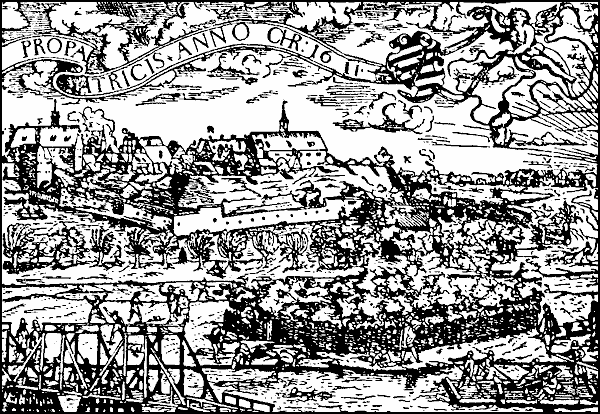
LUTHER’S HOUSE AND SURROUNDINGS IN THE YEAR 1611
THE CASTLE OF WITTENBERG IN THE YEAR 1611
1. If this were to them granted, then they should
observe and keep the Embryons in the Womb of the
mother, that they might constitutively unite themselves
to it, to have at the leastwise, sensual consolation and
delectation.
2. Then secondly, because it is common to reasonable
creatures to fashion and informate the body, and
to perfect it with some natural delightment, not to
vex it.
3. Then thirdly, because of the law and order of
Nature, the souls from the places in their departure to
them allotted, assigned and deputed of God, neither
do nor can depart at any time: for it is written:
For the soul is a Spirit going and returning. And they
which do otherwise hold opinion are to be accused,
nay condemned in this with Pythagoras, who did
abstain from all living Animals and creatures, believing
that in some the souls of some men did dwell and
abide. Thus far the Arrogonian named Bartholomew
Sybilla,[53]
a Monopolitan, who writ upon this question
being at Wittenberg, at the request of him that did
set forth the Dutch Copy, shews himself to be a good
Philosopher and no worse Divine. But mark what
follows, this is written according to men in faith: the
Devil was out of the first street of Coany when he was
past this last period. For that Pythagorical opinion,
if that were: this absurdity would follow: (I will
speak plainly the rather to fit thy capacity), and if
the soul should pass out of the dead into the living,
then should mortality be the cause of the soul’s
immortality (this is prettily spoken) and by that
means make it corruptible, which cannot be. And seest
thou Wagner? for I will teach thee by demonstrations,
and therewith he took a coal of fire, and held it to him
so long that it came to be but a coal, now thou seest
Wagner, that so long as fire was in this subject it had
life, but the quality being removed from the quantity,
neither is the quality found or seen or known whither
it vanisheth, nor can the same fire though fire may
return into another body or subject albeit the quantity
remaineth. Thus may the soul of man be compared
to the fire in the coal, as concerning his entrance and
departure, but not re-entrance, for that coal may take
life again, that is fire, but so cannot human body,
because one spirit can be united but to one body, and
not two to one, nor one spirit to two bodies: Wherefore
that Spirit being departed, it is irrevocable because
of the unity, and the impossibility of returning in
the one, in the other of receiving any other. As for
other reasons directly by circumstance, if the Soul
goeth either to joy or pain immediately, then I am
certain that that hope which thou hast is so merely
vain, as anything which may hap under that title: For
proof behold, and then through the Wainscot door
of Wagner’s study entered in two Kings, which drawing
their swords did there in presence combat together
fiercely and courageously, one of them shortly after
fainting under the adversary’s strokes fell down, the
other victorious, yet wounded, very canonically as
a man may say, staggered immediately, as if he would
fain have not fallen, yet for all that, he fell; then
entered two men carrying Torches with the snuffs
downwards, with great solemnity (more than is needful
to be recapitulated, for I see nothing but that this
might have been very well left out for anything worthy
the gravity of the matter) which when they had carried
out the first slain combatant, with armed men, and a
dying stroke of the Drum, clothed all in the colour
which best notes by his external hue the internal sorrow.
Then next there entered two Pages all in silver white,
crowned with Bays, carrying their Torches aloft
declaring the height of their glory by the height of
their flames: next to them divers Trumpeters and all
in white, urging forth into the vast air their victorious
flourishes, next a great standard bearer, and I cannot
tell what, but the conclusion was, that the triumph
was exceeding great and pompous, adorned with as
many ceremonies as such a victory might or could be,
the Spirit when they were all gone began to speak
and said, this was the battle which was fought for the
great Realm of Asia, by Hercules and Orontides,
where Orontides was slain, and Hercules sore wounded,
but yet recovered, after which he achieved his twelve
labours, and the thirteenth of which the Poet speaketh,
the hardest of all.
Tertius hinc decimus labor est durissimus, una
Quinquaginta simul stuprauit nocte puellas.
This History is as I do think in the Chronicle of
Hell, for I did never hear of it before, nor anybody
else, I appeal to all the Histories. Marry it may be
this was when Hercules was a little Boy, and then
peradventure indeed the records make no mention
of it, but yet we have that recorded which he did
when he was less than a little Boy, as his killing of a
Serpent in his Cradle, and such a History as I do
remember is enrolled in the golden Book of the seven
wise Masters of Rome, an authentical author. But
let that pass and let us draw more near unto the cause:
For as the Devil was afore our days, so by authority
he may allege experience, and we must of necessity
believe that it is either true or a lie. Mephostophiles
continued his speech for all this parenthesis, declaring
to Wagner his meaning in this point for (quoth he)
as you see these two champions contending for the
title of victory, one of them must needs, if they try
the extremest as they did, receive the dishonour, the
other the glory, so in the combat wherein the dying
body battleth with the lively soul, the soul, if grace
hath made acceptable, shall enjoy those everlasting
pleasures of Paradise, and dwell in heaven blessed
and glorious amongst the beautiful Angels, but if it
be counted as reprobate and outcast of God, then
according to that punishment which his great sins
did deserve, he can have no other place but the
continual horror of hell, wherein we miserable dwell,
and the ugly company of black Devils and his frightful
Angels. There is no other mean but honour or dishonour
in this case, no other mean but joy or pain, no
other mean but heaven or hell perpetually: there is
no place left for a third. I could more copiously dispute
of this matter, but that I will not be too tedious in so
exile[54] a question. For where it is said in an author
to which I am witness, for I stood by his elbow when
he writ the lines. Animae sunt in loco certo et expectant
indicium neq; se inde possunt commouere. Which
place as appeareth in the precedent chapter is heaven
or hell: again it is said Anima quae pecauerit ipsa
morietur. Of necessity then the soul to whom the
Lord imputeth not his sin shall live, for they are immediate
oppositions, for the soul that is in joy will not
come to these troubles, nor that which is in torment
cannot: therefore it is said: Et reuertatur puluis
in terram quemadmodum erat, et spiritus reuertatur
ad Dominum qui dedit ilium, so there is no mention in
any scripture of the soul’s returning, but to a certain
place deputed of God to him. But before I go any
further in ye declaring of that which is here to be set
down, I know they that have their consciences more of
the precise cut, will say, that here was a learned Devil,
true it is he is learned, strong, and above all human
conceit, subtle and crafty: and if they say it is blasphemously
done to have the word spoken to the world
by so vile a mouth, first they know how mightily the
Devil is conversant in holy writ, in anything to over-throw
a Christian thought, knowing that as ye word
of God is a word of power to attain salvation to whom
grace is given: and to work eternal damnation where
that gift is wanting, knowing it is the only means to
debel[55] and conquer the Christian thought, for as a
man is governed by a law and by it lives, so if anything
be evidently directed against him in it, it slays his heart,
it overthrows him, it takes away his power for ever,
nor is it more blasphemous to be spoke to us men, than
to God himself, as it is in S. Alathero, where the Devil
was not afeared, to assail his creator with most terrible
arguments of the divine letter. They which have
right minds can persuade themselves accordingly:
but otherwise they may cavil as long as they will,
which they may do to their small profit, assuring
them this that in coveting by fault finding to seem
learned, they make themselves the notes and reproach
not only of the learned, but even of the absurd and
barbarous rude fools, and that they are the only spirits
of error and contention, and the chief causes of unbelief
by vain reasonings and questions to the unresolved
Christian. But as for this speech which is
but Humile dicendi genus in very truth, let them thus
think, that if there were any such controversy betwixt
Wagner and his Spirit, as is here mentioned, that those
are not the words which were spoken, but that they
do proceed from a young Scholar who gave me this
copy, and not of a Devil, of whose familiarity and
frequency and of other circumstantive causes, I will
God willing in the Catastrophe and conclusion of this
Book deliver unto you my poor opinion. In the meanwhile
I will follow the matter into which we are fallen,
my good friends, and without further ado I pray
without any more excusive phrase, patiently expect
the good hour wherein the death of this volume is
prepared: Mephostophiles taking breath a little,
presented his speech saying: it is said likewise.
Factum est autem vt moreretur mendicus, etc. And it
came to pass that the beggar died, and was carried away
of Angels into Abraham’s bosom, and that rich man died
and was buried, and he being in Hell lifted up his eyes,
when he was in torments, and saw Abraham afar off
and Lazarus in his bosom. Nor nothing doth that
impugn which is said of the Papist, that he cannot
come into God’s presence nor be one of the elect
unless they be purified from their sins, for which
purification, they ordain a place so terribly stuck with
pins, needles, daggers, swords, nails, etc., so soultring[56]
with hot burning furnaces, and so every way formidable
with material sulphury fires, that no tongue can express,
nor any heart imagine, wherein the sinful
soul must be many times and often cleansed, but I
hope if this were true then Lazarus should have been
likewise so dressed in their terrible imagined terrors,
which he was not, unless they will be so impudent to
say that he had no sin. I shall not need to dispute
how absurd it is to say that the sin of the soul in the
body committed, must be extirpated and purified
by a material substance and rigour, nor of the matter
of the like argument. And hereupon he seemed to
sigh as if some sudden thought had overpressed his
stomach. I can, quoth he, largely discourse of all
divine and human propositions, but as the unlearned
Parrot who speaketh oft and much, and understandeth
never anything to profit himself. Ah that unto us
Spirits no secrets are secret, no doings of man unhid,
and yet we Devils cursed of God are incapable of any
of God’s mercies, though through them we were
created. We know repentance is the way to attain
the celestial favour: we know God’s mercies how great
they are, and that we ought to despair of nothing, yet
there is nothing (such is our seeing blindness) so it
appertain to God and godliness, of which we do not
despair. No, Wagner, we are so far from living again,
as we are from certainty to be saved. But instead of
that we are crossed with all kind of vexation, for
since the first time that I with my Master and fellows
fell down from heaven, being of the most royal order
of Angels, Potestates, Cherubins, and Seraphins,
riding upon the wrings of the Wind in all bright
shining Majesty, and enjoying the most glorious and
divine presence of our Creator, till for our heart-swelling
pride, and haughty insolency, within as
little space of time as we were created in, with his
dreadful lightning threw us down headlong into the
bottomless Abysses of the Air, wherein we endure
these tortures and like wicked souls with us, as our
manifold deserts have brought upon us. And for that
we know that the way to mercy is utterly denied, and
that we are as much hated of ourselves as of God, we
think it the sweetest remedy in these manifold miseries
to have partakers of our common woe with us. Wherefore
it is most expedient for us to be thus enviously
malicious against all mankind, making them too as
far in God’s dreadful curse as ourselves.
Wagner melting at these words, his eyes undid the
great burthen of his sorrow, straining himself so long
that he wept, and yet could say nothing, but only a
small volley of sobs hastily following: Mephostophiles
seeing how Wagner was drowned in so deep a melancholy,
told him pulling him by the sleeve, that he
would be still demanding of such foolish questions
which will profit him so little as mought be. Knowest
thou not (quoth he) that all the Rhetorics are the
servants of my tongue, or that we can move pity or
hatred when we please, fool as thou art, forget these
vain conferences, persuade thyself that they are but
the effect of speech, long canst thou not live, and yet
dost thou live as if thou didst not long: youthly
should be thy thoughts, and fraught with the rank
lustiness of conceit and amorous delight, if thou
wilt ask questions, let them be such as appertain to
love and wealth, to pleasure, to pastime, and to merriment.
How sayest thou to such a one, naming a
Gentlewoman, the most beautiful Lady under the
cope of Heaven? Thou shalt enjoy her, nay, anyone
so she be one whom thou lists to call beautiful, whosoever
thy eyes shall lay their delight upon. And presently
Music was heard so sweet, so plenteous, and
so ravishing, as if on Music depended all sweet, all
plenty, all ravishment. The doors conveying themselves
aside, as giving place to so divine a fairness,
entering in a blue Velvet Gown raised, and thickly
beset in the gards[57] with most pure Ooches[58] of gold,
not altogether ignorant of precious stones, furred
with royal Ermines, loose about her: her head’s
ornament (though greater ornament to her head than
her head there could not be) was a kind of attired
Caul (such as I have seen none in England according
to their description) raised up at the corners with
stiff square wires of beaten gold, on that a Chaplet
or frontier of Roses, on the Chaplet a veil of Lawn,
which covered all her fair body denying the sight of
such an Angel, but only through a shadow: In brief
she was such a one as would have roused the basest
desire in the whole World to attempt wondrous
enterprises, in her hands silken soft, she held a Lute,
discoursing sweetly upon the solemn strings with her
nimble fingers. A maid carrying a blue waxen Taper
in a silver white Candlestick made in the fashion of
a Censer, but it was derived into two several branches,
in whose ends were curiously wrought two most
beautiful places to pight[59] tapers on. The maid by
her Lady would have well contented a reasonable
proper Squire, it was a pretty rank lass, round about
as plump as a Bladder, which being yet smoking new
is blown up with Wind: well I will not trouble you
with these rude descriptions any longer, but desire
you to conceive the excellency of this fair Lady, for
it is far more copious in the Dutch Copy than is here
necessary to be recapitulated. Wagner’s heart leaping
at this sight looked about him, as if he would have
nobody privy to himself but himself, and so it was
indeed, for Faustus, Mephostophiles, and Akercocke
were gone, and thereupon with a boon courage advancing
himself upon his toes, and weeding himself
in the best German fashion, as he could very well,
began to travel unto her, but remembering his bad
apparel stepped back and blushed, and hid his face,
but suddenly returning again as if he had known now
how rather to become his weeds, began to fewter[60]
himself, but, O wonder, his habit was changed with
his thought, and he was now no more Wagner but
Armisuerio the Lady’s Lord. And to be short this
new Armisuerio and old Wagner met with the Lady,
and saluting her in the best kind of Bon noche,[61] used
her as he would do his Lady, and she him as her Lord.
So passing over their weary night in such pleasure
as I could find in my heart to enjoy, or any Man
(unless an Eunuch beside).
The arrival of the Messenger at Wittenberg, and
the description of Wagner
It is time to wind about another furrow with our
sweating Team and bring our speech to another matter,
entering out of one into another, for change is sweet.
Not forgetting by the way the Pursuivant, or, as we
may better call him, a Messenger, who lately departed
from Vienna in Austria, and I think by that time this
disputation was finished, had almost overtaken all
the way betwixt him and home, which was some
fifteen days’ travel, after five German miles to the day’s
labour, and arrived at Wittenberg, by enquiry came to
Wagner’s chamber, which was in the way as ye go to
the Public Schools, as ye go from Melanchthon’s house,
a pretty house and of a reasonable large size built of
hewn stone, and environed with a good thick Wall,
of some three foot and a half thick and twenty high,
at the bottom guarded about with a good broad Mount
of seven yards over, and round about very large and
secret walks, far from all company and resort, and there
he might talk without fear with the Devil and his
Dam too, thither this fellow coming, knocked peremptorily
at the door, Wagner was even now gone to his
study and rising up in a Pedlar’s chafe,[62] that he should
go to his book, especially if it were goodness not once
in a month, and yet then to be troubled, he swore
a little thing would make him never study more, it
should not, but putting on his cloak and his hat,
came down and unbolted the door: Unto whom the
Messenger seeing such a pretty jolly fellow did some
little of reverence, Wagner as yet scarce having let
down his choler, stepped back, and perceiving him
wear such a Weed as Serjeants there do use to wear,
thinking with himself that some had come from the
prince for cozening of his servants, shut the door upon
him and went pouting and swearing and pitifully
chafing, that if the knave offered to sue him, he would
surely kill him at the least, down he fetched a good
Bastinado and set it behind the door and opened it
again, and demanded somewhat mildly what he had
to say unto him, to whom the Messenger said, that he
came from the Arch-Duke of Austria from Vienna,
who willing to hear some certainty of his Master, did
send for him assuring himself, that not only he could
satisfy his desire in that matter, but also shew
him as much skill as ever his Master had. Wagner
hearing the purpose of his message with good effectual
words, thanked him again, and rendered most serviceable
reverence to his good Lord and Master for
remembering so gently of his poor servant, etc.
Desiring him to tarry until he might set everything in
due order and he would not fail to go with him. The
Messenger did not deny him, and so they went up
together into their Chamber, whom ever after the
Messenger loved dearly for his proper behaviour and
personage, for indeed Wagner was a very goodly
young man, being about the common stature, straight
and reasonably slender, well trussed, his hair very
yellow and his face fair, his beard which did but now
express the blossoms of his lusty courage of ye like
yellow, well-mannered, as having been brought up
amongst the finest and best sort of Devils: having
a pleasant filed tongue, and would make the dainty
Rhetoric come as smoothly out of his mouth as an
arrow out of a piece of paper, well could he talk of
amorous devices, and entreat the bravest Ladies with
sweet entertainment, in truth by report he was a
Gentle-like man, and accomplished with as many
fine parts as a better man than he might justly vaunt
of: he could play upon any fine Instrument, and was
not ignorant of any laudable exercises, carrying a
brave lusty conceit even to his death: and furnished
with many proportions of art, there was nothing wanting
in the man but a Godly mind.
The Tragedy of Doctor Faustus seen in the Air, and
acted in the presence of a thousand people of
Wittenberg. An. 1540
In a brave summer Sunshine day, the whole people
of Wittenberg being gathered together, to behold
certain matches for the Garland who could drink
most, and also to see a match shot at a pair of Butts
with Harquebusiers, as their order is, in a low meadow
hard by the Elve: which now being on his freshest
pride was full of fine and sweet flowers, being in the
latter end of the month, wherein the Sun departs
from the last embracings of Gemini. On a sudden there
was seen a marvellous bright and glorious Rainbow,
spreading the wide arms over the wide World, and
straight was there heard a noise of Trumpets, sounding
a short flourish, and then another, and by and by
another, all alike short, at the which the assembly
was wondrously affeard, and listened, desirous to
see the effect of this wonder and strange miracle,
some of them fell to their Ave Maries lustily, thinking
that the universal Doom had been at that instant,
as thus they beheld with admiration, they might
distinctly perceive a goodly Stage to be reared (shining
to sight like the bright burnish gold) upon many a
fair Pillar of clearest Crystal, whose feet rested upon
the Arch of the broad Rainbow, therein was the high
Throne wherein the King should sit, and that proudly
placed with two and twenty degrees to the top, and
round about curious wrought chairs for divers other
Potentates, there might you see the ground-work at
the one end of the Stage whereout the personated
Devils should enter in their fiery ornaments, made
like the broad wide mouth of an huge Dragon, which
with continual armies of smoke and flame breathed
forth his angry stomach’s rage, round about the eyes
grew hairs not so horrible as men call bristles, but
more horrible as long and stiff spears, the teeth of
this Hell’s mouth far outstretching, and such as a
man might well call monstrous, and more than a man
can by words signify: to be short his hue of that
colour which to himself means sorrow, and to others
ministers like passion: a thick lamp-black, blacker
then any paint, any Hell, blacker than its own self.
At the other end in opposition was seen the place
wherein the bloodless skirmishes are so often performed
on the Stage, the Walls not (so pleasant as old wives
would have their tales adorned with) of Pasty crust,
but Iron attempered with the most firm steel, which
being brightly filed shone as beautifully over the
whole place as the Pale shining Cynthia, environed
with high and stately Turrets of the like metal and
beauty, and hereat many in-gates and out-gates: out
of each side lay the bended Ordnance, shewing at
their wide hollows the cruelty of death: out of
sundry loops many large Banners and Streamers were
pendant, briefly nothing was there wanting that might
make it a fair Castle. There might you see, to be short,
the Gibbet, the Posts, the Ladders, the tiring house,
there everything which in the like houses either use
or necessity makes common. Now above all was there
the gay Clouds Vsque quaque adorned with the heavenly
firmament, and often spotted with golden tears which
men call Stars: There was lively portrayed the
whole Imperial Army of the fair heavenly inhabitants,
the bright Angels, and such whose names to declare
in so vile a matter were too impious and sacrilegious.
They were so naturally done that you would have
sworn it had been Heaven itself or the Epitome of it,
or some second Heaven, and a new Heaven it was,
from thence like dewy drops wherein the Sun lays his
golden shine, making them to appear like small
golden tears, the sweet odours and comforting liquor
streamed, and seemed always to rain from thence,
but they never fell, but kept a beaten path from down
on high wherein the descending Angel might rejoice.
I should be too long if I should express this rare Stage,
especially in such sort and such-like words as the like
occasion in a more worthy subject would require, but
of necessity we must barely apply our descriptions to
the nature of the whole History. We must not fail
in the first principle of Art, according to that of
Horace.
Humano capiti ceruicem pictor equinam
Iungere si velit, & varias inducere plumas
Vndique collatis membris, vt turpiter atrum
Desinat in piscem mulier formosa superne:
Spectatum admissi risum teneatis amici?
Credite Pisones isti tabulae fore librum
Per similem.
Non vt placidis coeant immitia.
I shall not need to turn back to declare the deep
astonishment of the people, who are always in most
small manners induced easily to wondering, but now
this excellent fair Theatre erected, immediately after
the third sound of the Trumpets, there entereth in the
Prologue attired in a black vesture, and making his
three obeisances, began to shew the argument of that
Scenical Tragedy, but because it was so far off they
could not understand the words, and having thrice
bowed himself to the high Throne, presently vanished.
Then out of this representance of Hell’s mouth,
issued out whole Armies of fiery flames, and most
thick foggy smokes, after which entered in a great battle
of footmen Devils, all armed after the best fashion
with pike, etc., marching after the stroke of the courageous
Drum, who girded about laid siege to this fair
Castle, on whose Walls after the summons Faustus
presented himself upon the battlements, armed with a
great number of Crosses, pen and ink horns, charms,
characters, seals, periapts,[63] etc., who after sharp
words defied the whole assembly, seeming to speak
earnestly in his own defence, and as they were ready
to rear the Ladders, and Faustus had begun to prepare
for the counterbattery, determining to throw down
upon the assembly’s heads so many heavy charms and
conjurations, that they should fall down half way from
the ascendant, whilst these things began to wax hot
from the aforesaid Heaven, there descended a Legion
of bright Angels riding upon milk-white Chariots,
drawn with the like white steeds, who with celestial
divine melody came into the Town, to the intent to
fight for the Doctor against his furious enemies, but
he wanting pay-money, and void indeed of all good
thoughts, not able to abide their most blessed presence,
sent them away, and they returned from whence they
came, sorrowfully lamenting his most wilful obstinacy,
whilst he had all benointed the Walls with holy Water,
and painted with blood many a crimson Cross. At
length the Alarm was given, and the Ladders cleaved
to the Walls, up the assailants climbed, up they lifted
their fearful weapons. Faustus not able (destitute of
help) to withstand them, was taken prisoner, and his
Tower razed down to the earth, with whose fall both
the large Heaven and World shook and quaked mightily,
whom, when they had fettered, they left there, they
marching out and the fore-named Chairs were presently
occupied with all the Imperial rulers of Hell,
who clothed in their holiday apparel sat there to give
Judgment upon this wilful Faustus, whom two Hangmans
of Hell unloosed, and there in presence of
them all the great Devil afore his chief peers, first
stamping with his angry foot, and then shaking his
great bush of hair, that therewith he made the near
places and the most proud Devils’ courages to tremble,
and with his fire-burnt sceptre, and his like-coloured
Crown, all of gold, setting one arm by his side, and
the other upon the pommel of his Chair, shook a
pretty space with such angry fury, that the flames
which proceeded from his frightful eyes did dim the
sight of the Wittenbergers below. There was in this
said Wittenberg a gallant fair Lady and a virgin,
which now following her mother, accompanied with
sundry gallant German Gentlemen, had even now
entered out of their Barge, and seeing the whole world
of people as they thought gazing up into the Heaven so
very strangely, were partly struck with wonder, some
with fear, and some with sudden merriment, and hasting
down the hill more than a round pace, asked some
what was there to do, and they bid them look up
(for here is to be noted that they looked up afore but
could see nothing, but as always they were wont until
they shewed them it), which they did, and at the same
time wherein the great Devil was in his red-hot anger,
this young Gentlewoman looked up, whose most ugly
shape so feared her, that even then there she fell
down in a swoon, whom they conveyed away very
speedily, yet ere they could come home she was well-nigh
dead, and so she lay for two years without hope
of life, or certainly of death: great sorrow to her
parents, and as cruel pain to her: But she at length
recovered her Spirit, and if by your patience I may,
I will tell you how. There was a most learned and
excellent Doctor dwelling in the town who had great
knowledge in the black Art, who being requested to
use some Physic to aid her in her great extremity,
being promised for reward five thousand Dollars.
This Doctor perceiving the cause of her malady was
not caused of any distemperature of her body, but
only of the aforesaid fear, knew that Physic might well
make her body sound, but her mind never. Wherefore
not only for the reward, but also to become
gracious and famous at once, proceeded in his cure on
this manner. One night having made his Orisons and
nine times combed his hair with tears of a pure maid,
and nine times gone about a fire made all of pure
Heben[64] coal, and thrice nine times called upon the name
of the most dreadful Hecate, he laid himself to sleep
upon a pure white and clean unspotted maiden’s
smock, and covered himself over with the ashes of
a white Hind roasted and burned altogether, he slept,
and the next morning apparelled in white robes,
having often and often called, recalled and exorcised
the three Fairies Millia, Achilya, and Sybilla, at
length the ground opened, and with them they brought
a milk-white Steed, and did put upon his finger the
ring of invisibility; when they were vanished, he
mounted up upon his Horse, who with more swift
flight then the winged Pegasus carried him through
the wide Air so fast and so long, that having passed
over Bohem, Hungary, Thracia, all Asia Minor,
Mesopotamia, and at length to Arabia Felix, where
he alighted upon a most high Mountain, all the way
from the top to the bottom of a just breadth and steepness,
so that he that were on that would think himself
not in the world, and they beneath would deem him
to be in Heaven, upon the brims of it round about
grew the high Pines, the stately Cedars, and always
so green as the most fresh Meadow: the height of
this huge rock was two and twenty miles in even
altitude and half a mile of just circuit all the way:
there he tied his Horse to a Tree and knocked at
the Castle gate, where afore was never seen any, so
that no path could there be seen, so that a man might
justly have called it the house of little Hospitality, to
him there came Neglectment, an old Lady, and
demanded what he would, who told her his errand,
and withal a ring of fine gold from the three Fairies;
she knew the ring and his errand, and conveyed him
into many a fair room, wherein she shewed him many
a worthy Knight’s memorials, many an antique
Monument heaped up, but inner rooms so monstrous
dark and nightly, that no human eye could perceive anything,
and forth she brought him unto a Garden, out
of the midst whereof rose a little Hill, from the summit
whereof there was a paved way of pure Crystal stone,
from along whose bosom trilled a small Water: This
water an old man held, and indeed he had it as a
Patrimony, for therefore he could shew many an
ancient evidence, and worn Charter, his hair was all
fled to his front, as if some enemy had scared the hinder
locks from his scalp, on his back hung a pair of Wings
which flagged down, as if either they had been broken
or he weary, and thus he overstrode a round World,
from out of every part whereof gushed out this small
River which was conveyed down in this Crystal pipe,
in his hand he held a long scythe, and in the other an
hour-glass, here the Doctor seeing the old ruins of
this sumptuous house, and all the fair Walls and
buildings over-grown with a deadly Moss, was much
amazed, but because he could not tarry, he dipped
a small Vial in the spring and departed, and for
because he was so peremptorily warned not to tarry,
he could not behold the most stately Galleries, in
which he might see the World’s chief pleasures and
Monuments, some wholly worn away, some half, and
some even now beginning, and some wholly quite
over-grown with a thick earthy fur, for as he came by
an old Wall he chanced with his elbow to rub off the
thick Moss, and then might he see a fair piece of
Parchment gilded and painted curiously, wherein
was truly described the ancient tokens of a most brave
and worthy Gentleman, so having sped of his journey
he came by the same way again as he went, Neglectment
shut the doors upon him, whilst he mounted
upon his white swift-footed Horse and by the like
time arrived at his own house, where having with the
blood of a new-slain heifer, thrice anointed the feet
of his Cavallo, and tying at his ear with a string of
fine silk spun by the hands of a pure maid, the received
ring of invisibility unto his ear, with many a Cross,
and many an open Ave Maria, dismissed him, who
in the same moment returned to the place from whence
he came. With this water the Doctor came to the maid,
and having used a certain incantation, gave her to
drink of the water of deep Oblivion, which she had
no sooner tasted of, but straightways she had forgotten
the terrible picture of the Devil, and was revived out
of all her infernal fears, the Doctor called, winning
him credit, favour, and fame, and richly rewarded for
his medicine, departed, and running home threw his
Vial into the deep River burying oblivion with oblivion,
the parents of the young Lady rejoicing exceedingly
at their daughter’s recovery, for ever after caused the
place wherein their daughter was thus scared, to be
inaccessible for man or beast, compassing it in with
a high wall, and overthrowing the banks, so that
now there is no mention of the meadow nor of the
Wall.
The Devil, the great Devil Lucifer having finished
his brief Oration, descended down out of his Judgment
seat, and pointing unto all his Nobles, took Faustus
by the hand, and placed him just before him, taking
him by the chin, seemed to them to bid him speak
freely, he mounted up again unto his high Throne,
and with a more mild madness expected the speech
of the Doctor, who having bowed himself submissively
unto these damnable company, he began to
speak, and yet not long, then he began to walk up and
down and to shew strange gestures, when suddenly for
some bug’s-words[65] escaped by Faustus, all the Devils
there rose up, and with their swords drawn threatening
with them the poor Doctor, turning all their
bodies and directing their faces to the King, who
with a stern countenance commanded silence. When
Faustus having long raged, of a sudden howling loud,
and tearing his hair, laid both his arms upon his neck,
and leaped down headlong off the stage, the whole
company immediately vanishing, but the stage, with
a most monstrous thundering crack followed Faustus
hastily, the people, verily thinking that they would
have fallen upon them, ran all away, and he was happiest
that had the swiftest foot, some leaped into the
River and swam away, and all of them with great
affright ran into the City and clapped the City gates
together, straight, and to increase this fear they thought
they heard a thing fall into the river as if a thousand
houses had fallen down from the top of Heaven into it.
But afterwards this was known to be Wagner’s knavery,
who did this to shew the Pursuivant some point of
his skill.
The messenger had not tarried above three days, when
as Wagner had trussed up his baggage, and was now
ready to depart, when on the third day at night he
caused his boy Artur Harmarvan (who was the son of
a wealthy boor, witty above many, and praised for his
notable waggery: his father dwelt at Malmesburg a
town hard by Wittenberg in Saxony in high Dutchland,
with whom Wagner being acquainted had obtained
him of his father to serve him, and he to be
taught of Wagner), him he caused to go to divers
scholars of his acquaintance, to sup with him at his
departure, who being invited to this hated farewell,
came speedily, where they had a banquet and other
courtesies which in such a time both custom and laws
of their fellowship do prescribe: In the supper time
the scholars moved many questions, and amongst
the rest, one desired the Pursuivant to describe unto
them his Lord and master, for they heard say that
the Duke Alphonsus was a marvellous qualified
Gentleman: The Pursuivant not willing to refuse
their request told them that seeing their demand
proceeded of a common good zeal, he could not but
wrongfully refuse to satisfy: notwithstanding the
truth might be better known of another than of him,
when duty bids to be partial, if any defect might
breed partiality, but so much as I will tell you, the
enemy will not disdain to affirm: And there he told
them the very stature, proportion, and particular
lineaments, concluding that he shewed the uprightness
of his mind by the proportion of his body, and keeping
in his outward shape, the virtue which philosophers
would have kept in the mind. There he told them the
feature of his countenance, the colour of his hair, eyes,
face, cheeks, etc. He told them his stature, favour,
and strength, which was such, that with pure cleanness
of his force, he hath foiled a gentleman in wrestling,
who beside whiteness of body, was very firm without
affection, not as some do which in performing anything
will with such a ridiculous sourness act it, as if the
force of the body must be personated upon the Theatre
of his face: He declared unto them that the gifts of
his mind were such as then he could not for the number
reckon up, but even as occasion should serve might
meet with them, being all such as were more ready
to be admired than imitated, as if all virtues were
gathered in him together, magnanimity, magnificence,
affability, modesty, etc., briefly (he said) there were in
him all those Graces, which adorn the subject with the
title of Virtuous. He likewise recounted unto them
his studies, unto which he accommodated himself at
vacant hours, were partly the Poetry. A Poem of his
he said he had by chance gotten (and by greater
chance had it there at that instant) which he had made
in praise of his excellent Lady when he was but of
young years, his Father living, I dare say he would
not for ten thousand florins have it seen, being such
a one as on a dreaming passion he had let fall from
his pen, and of many the most abject, but such as this
is deserves commendations, because a Prince made it,
but if you saw his real devices, you would then say
they were Prince-like. And then he read it, which I
was loath, my good friends, either to translate or
translated to present it here, for that it was not worthy
your censure, considering the nice buildings of Sonnets
nowadays, but according to Ariosto’s vein you shall
find it very conformable, as also for that I knew that
if I should have left it out, it would have been more
wished for than now admired. Yet for that I prefer
your well-known good wills afore any vain fear, take
this with the rest, if they be any with such favour, as
if I were by you at the reading.
A mio solemente amandona
Madonna: Donna non parelia.
L’Angelico sembiante e quel bel volte,
Fal’odio, el’ira va in oblivione,
Ch’a l’ etc.
Thus have I harshly Englished them verbally.
Angellike semblaunce beauties ornament,
Whose Vertue quels all wrath and rancor deepe,
Whose life Heauens grace and death would monument
How many wounded hearts thou makst to tremble,
And I of many one cannot dissemble,
How farre into in that eie-sore.
So were thy beauty but deseruing praise,
So were thy beauty but as feminine,
Then could my quill his straine so high arrayse,
Then could with it compare the masculine,
Thy beauty praise thy bounty past diuine,
No straine no quill such wonderments assaies,
Then Poets pen shall to thy power his power resigne.
What words may wel expresse such excellence,
No humane thought thy beauties may comprise
And wordes may tell all humane insolence
All humane words and witte thy gifts surprise.
To satisfie my selfe in my pretence,
Our pen vnto the heauens must wander hence.
And fill it selfe with dew of heauenly Sapience.
And I my life shall to your hands resigne,
Which liue to serue a humane Sainct so past deuine.
Se dacolei.
Che poco ingegno adhor adhor mi lima.
This Sonnet was ended with as much praise as it
began with desire, and one of them copied it out, and
so it was made common to the rest, and made a good
sort of them Poets, rectifying their gross conceits,
with so sweet a matter. He told them that this was
but a preparative to wondering in respect of his choice
makings. Then he shewed them this Epigram, which
he made when as before the Duke his Father, a brace
of fair English Greyhounds fell down at the Hart’s
heels stark dead (the Hart also lying not above six
yards off dead too) with chasing, having outstripped
the rest of the dogs above half a mile.
Then he reckoned unto him the delight he took in
Limning, and shewed them very many fine devices of
his own handiwork. The scholars singularly delighted
with the view of the reliques of so great a Prince,
approved by silence that excellency which by speech
they could not. In fine there he reckoned up enough
to be praised, and peradventure more than was true,
but not more than is desired. There he set forth
with great and ardent Emphasis other qualities, as his
skill and hardy demeanour at the Tilt tourney, how he
could manage the sturdy steed, leap, run, vaunt,
dance, sing, play on divers Instruments, and talk with
amiable speech amongst fair Ladies which we call
courting, in all his actions full of gentle familiar
affability, still reserving to himself the due honour
belonging to his personage. He concluded in fine that
he was the most qualified Prince and absolute Gentleman
that day in all Christendom: saying if they knew
his humanity, justice and liberality, you would say
in him were all humanity, justice and liberality;
And as the greatest thing that the world can shew is
beauty, so the least thing that is to be praised in him
is beauty, you would say no less than I have spoken
could be in his person, if you did but see him. Thus
far the digression came in the commendations of this
Alphonsus, which truly I was weary of, fearing the
great insufficiency of the description, but yet he had
not done. I would to God (quoth he) you would
come to Vienna and I promise you such lodging and
entertainment, that next to the sight of him should be
worthiest of your thanks. Wherefore you shall not
sorrow that your friend Wagner departeth unless you
will seem to envy rather his felicity than his departure.
I would we were even all of us as we sit at the Table
in the Duke’s Court, and here again with a wish, and
herewith there knocked one at the door, Wagner
craftily feigning that he himself would rise to see him
that knocked so, desiring them all to sit still in any
case, and opening therewith the door, there entered
two young Lords of Tergeste and Moravia, bearing
torches, and next there came the Duke of Austrich,
as they thought, and Wagner talked with him bare-headed
(the Pursuivant, thinking verily it had been
his Master, would have done his duty unto him, but
that the rest hindered him): on his head he wore a
little Hat of blue velvet, with a rich band of pearl,
stone and gold, and a long white feather, his cloak of
blue velvet, round guarded with gold lace, edged with
Orient pearl, and betwixt the gards oylet[67] holes whereout
hung by small silk threads long bugles, all the
sleeves in the like order: by his side a golden-hilted
Rapier, and on his Rapier his hand, his Buskins of
the fine Polonian leather, richly embroidered on the
turnings down with costly Goldsmith’s work, all his
apparel whatsoever most beautiful and princely, he
had no sooner passed by (which was not until he was
distinctly viewed of them) but that Wagner spake
unto them in such manner: saying that that Honourable,
this man’s Lord had sent for him, whose commandment
I will in no wise repugn. Wherefore I
beseech you to take it as you would my greatest advancement.
This his description of his feature,
judge how rightly he hath said, for my part I confess
that they are rather less than the truth, than not as he
hath reported, and herein to satisfy you the more,
I have caused my spirit Akercocke to take his shape
upon him.
Now (quoth he) it is time to depart, but because it
shall be the last night of our meeting, none of you shall
depart, for I have lodging enough for you all, and for
you shall not be forgetful of Wagner when he is gone,
let every man wish his woman, and so to bed my
masters. They began all to laugh merrily, not as
hoping or wishing, but as if they had heard a merry
purpose, and therefore they laughed because it was
merry, and such mirth they always liked of. Wagner
was almost angry, and yet for that he was almost,
he was not angry, sending out a great oath as the
Prologue of his Comedy, bidding his Boy go prepare
their beds and chambers, and bid them wish
whom they would, he would their wishes should be
performed. Then rose up one of the scholars persuading
himself of Wagner’s earnest, and yet doubting,
because he feared he was not in earnest. Why (quoth
he) if you mean in very deed, my friend Kit, I would
I had such a woman, I believe beside herself there is
none fairer then the fairest in this town. Why weenest
thou I jest (quoth Wagner), go thy ways, yonder she
is upon pain of my head, and so it was indeed: then
everyone strove who should wish first, and he that
wished last had his first wish, so everyone took his
Damsel and for that night departed to their beds, who
are witnesses of that night’s great pleasures, and in
the morning they arose wishing that every morning
were the morrow of such a night. Every one gat
him a Hackney, and brought him on the way a day’s
journey, where they with great grief left him, who
rode till he came to Vienna, and they till they arrived
at Wittenberg. Thus still you see these Pot-meetings
are ended amongst these puffed-cheeked Hannikins[68]
with bed dalliances, rightly describing their lives
most bestial and Epicure-like.
A lamentable history of the death of sundry students
of Wittenberg
Not long after it was reported and blazed abroad that
Wagner was departed, divers Scholars guessing that
he had left his Books or the most part behind, determined
to send for Harmarvan, which they did, who by
no persuasions could be won to let them have his
master’s Keys, so they devised amongst themselves to
bind the Boy as he should go home to his Inn, whereat
his Master had put him to board till his return. And
night drawing on, Harmarvan went to his lodging,
by the way Scholars to the number of seven met him
and bound him, and beat him sore until he gave them
all the Keys, which he carefully carried about him
sewed in a wide German slop,[69] which when they had
(they being all muffled and disguised strangely with
vizards) they loosed, and then they ran hastily to
Wagner’s house, as if they had fled from followers, or
else followed some hastily flying, where being come,
they opened the gates, and being entered shut them
again, this being about eleven of the clock in ye night,
and in they went, where they found two Barrels of
mighty strong March English Beer of two years old,
which they broached, and sat so long drinking till
they were all well drunk. And then down they get
into a back Court, and having lighted Tapers, having
injuriously framed all the circles, squares, triangles,
etc., and apparelled with all the conjuring robes that
the Art requireth, there they begin in a most dreadful
confusion of hellish syllables to inform the Fiend, and
after these words followed as if there needs must such
things follow after such words, a terrible roar, and then
so bright a smothering thick fiery fume ascended out
of the earth as if it would have made an eternal night,
then a vehement flame followed which with continual
motion, ran about the brims of the circle, until as
weary it left moving (all this while they continued
reasonably constant, and continued their invocations
without any fear), then from beneath was heard most
lamentable outcries, from above huge trembling,
thunder, and round about nothing but fear and death
in a thousand diverse shapes, then they began to
quail a little, but yet by encouragement grew hardy by
reason of the number, then round about was sounded
alarms with drums, and on set with Trumpets, as if
there all the World had conflicted, then ye flame which
all this while ran about the circle became a body, but
such a body, as, if it had been but a Picture, would
have madded anyone. At whose sight they wholly
overcome with deadly fear forgot the use of their
Pentacles or any such gear, but even submitted themselves
to the small mercy of the Fiend, who with
great violence rent them and tore them most lamentably.
Harmarvan who had raised a great many to the
intent to follow them suspecting that which indeed
was, was after long wandering (for they had caused
a Devil descryer to void all within a certain circuit)
with his company brought to the house, where round
about they might see in the Court wherein these
seven were conjuring, huge flames as if some great
pile had been made to the burial of a noble Hero,
climbing up in huge volumes up into the Air, or if
some great store of stubble had been fired, so vehemently
furious was the flame that no man there (and
there were above thirty) was able once to draw near
to any part of ye House, the cry was carried into the
City of this fire, whereupon the whole town was
assembled with hooks, buckets, ladders, etc., where
in vain they emptied many a large Well, till divers
learned Preachers falling down submissively on their
knees, with good faith appeased this seeming fire which
indeed was none, but a mere diabolical illusion, then
they entered into the house, where they found the
Barrels brought a bed and delivered, the cups, the
whole furniture clean destroyed, broken, and thrown
about the House, but drawing near unto the most
rueful and lamentable spectacle of all, coming into the
yard or grove which was moated about and enclosed
with a thick Wall of trees very exceeding high, as
Fir trees are, so very thick that no light was pierceable
into it, in the very midst whereof was a round plot
of some one hundred foot any way from the Centre,
there found they the religious Circles, there the strange
Characters, names of Angels, a thousand Crosses,
there found they the five cross hilted Daggers for the
five Kings of Hell, there many a strong bulwark
builded with rows of Crosses, there found they the
surplices, the stoles, pall, mitres, holy water pots
broken, their periapts, seats, signs of the Angels of
the seven days, with infinite like trash and damnable
roguery, the fruits of the Devil’s rank fancy. But the
most lamentable sight of all, the seven Scholars utterly
torn in pieces, their blood having changed the colour
of the ground into a dark Crimson, all their bodies as
black as any coal, as if they had been scorched with
a material fire, their flesh violently rent from the bones,
and hanging down in morsels like the skirts of a side-coat,
their bones all broken, their veins cut in sunder,
and their bowels broad shed upon the earth, their
brains poured out and covering the red grass all over,
their noses stumped, their eyes thrust out, their
mouths widened and slit up to the ears, their teeth
dashed out, and their tongues starting out betwixt
their gums, their hair clean singed off, in brief imagine
with yourselves in your minds, and propound a picture
in your thought, the most deformed, torn, and ill-favoured
that you can think on, yet shall it not compare
to the most lachrimable sight and shew of them,
surpassing as much all credit as my skill duly to describe
them, whom when they had buried without
tarriance, razed the house to the ground, and filled
up the moats with earth, heaping upon the place of
this murther the stones of the house defaced, then they
returned home discoursing with lamentable judgment
upon the high and severe revenge of God’s indignation
upon them which durst presume to tempt his
glorious Majesty. And finally, unless repentance
breed a more speedy remorse, such is the fatal end of
such proud attempts. And surely this is most true,
for I myself have seen the ground where the house
stood, and yet the moats dammed up and the Water
breaking through the stones even to this day, there
did I see a skull and a shank bone of them not yet
rotten: and there did I see the huge heap of stones
wherewith they are covered, a fearful example of
God’s wrath and justice against such infidel Christians.
A CARICATURE OF THE POPE
The great Turk called Soldan, Alias Chan, comprehending
as many victories in his sword as some
Emperors in their thoughts, arrived at length afore
Vienna, having made his preamble with the destroying
and burning of the country before him, thinking upon
the ancient politic rule, Better it is to have a spoiled
country than a lost, with a brave prepared Army of
two hundred thousand Saracens, horse and foot, and
so many it is certain he had, because they doubted not
but there were 300,000. The mighty Cham having
erected his royal Pavilions, and entrenched himself
to besiege the noble Vienna, munified his camp with
Artillery and deep ditches, and then he sent a Letter
of defiance unto the honourable Alphonsus, as being
principal in his own City, who was environed within
the walls of the City expecting the day of battle, for
to this intent the states of Italy and the Emperor of
Germany, with the Dukes of Saxony, Bavaria, and the
other Provinces near assembled (for now necessity
bred unity) with a brave company of Soldiers to
exterminate this monster out of their confines: unto
the Duke of Austrich only (for he had no intelligence
of their assembled forces) he directed his Letters with
defiance, meaning to conclude his long travails with
a certain victory; fearing neither the peril which so
many gallant soldiers thoroughly resolved might bring,
nor that ever God or fortune (as they call it) would
once shew him any disfavour, whose only favour is
only in show. Nor yet that the heaven’s great God
would not with severe revengement chastise the
Leviathan’s insolency and slaughter of so many
Martyrs, rather deferring than forgetting so just a
punishment.
About this time the Messenger and Wagner arrived at
Vienna very late in the night and passed through
the Turkish Sentinels, and arriving at the City, and
for that night they lay at the Pursuivant’s house; no
sooner had the approaching Sun sent afore him the
Marshals of the morrow light, and a new morning
ministered occasion of new matter, but up those two
arose and being ready departed for the Court, and now
the day was almost in the greatest beauty, when the
Messenger was admitted into the Duke’s presence,
unto whom he recited whatever was seen and done
in that time of his absence (only I forgot to tell you
how Wagner raged and stormed, and thundered,
when Akercocke brought him word of the destruction
of his House at Wittenberg as he was in the way to
Austria), wherewith the Duke was wonderfully both
delighted and astonished. And having welcomed
Wagner very graciously and accordingly rewarded,
he dismissed them till further leisure, commanding
the Pursuivant to shew him all the pleasure he mought.
After all these most excellent Princes
were come into the counsel chamber, the Herald sounded his trumpet
after the Turkish summons, then did all the states draw into the Great
Hall, wherein a high Imperial throne richly ordered with shining cloth
of Gold,
every noble and estate placed correspondently to his
degree, where in presence of them all the Herald was
admitted, who coming with his coat of Arms lying
upon his right arm into the bottom of the Hall, made
three obeisances down with the right knee unto the
ground, with a loud and distinct voice spake unto the
Duke only, telling him that his sovereign and Master
Sultan Alias Chan, the son of Murad Chan, the son
of Rabeck Chan, the son of Mahomet Chan, and so
upwards till he came to their great Prophet Mahomet,
God on the earth, and Emperor of all the East. And
then he began to reckon five hundred titles, with a long
etc.... Unto thee Alphonsus Arch-Duke of Austrich,
and there he declared the whole effects of his
message, and at last with a great Bravado ended, and
then he did on his gay coat of Arms, expecting their
answer. When as the Duke craving licence of the
Emperor to speak, answered ye Herald in most gallant
and triumphing terms, commanding him to say unto
the proud Turk his Master, that ere five days came
about, he would trample his victorious horns under
his feet, and ride in triumph upon his stubborn neck,
and that in defence of himself and of brave Christendom
he would leese[70]
the uttermost drop of his blood,
and to make it good he would not be in quiet till he had
met his Master in the midst of the field, and therewith
he drew out his sword, and all they with him, crying
God and Saint Michael for the right of Christendom:
then stood up the Emperor and avowed all that they
had said afore him, commanding moreover the Herald
to say to the proud Usurper, that seeing the quarrel
would breed great effusion of blood, and yet he never
the nearer, that he a man every way equal to himself,
not only for the speedier advance of his battles, but
also to have a certain end to such an uncertain enterprise,
he would fight with him body to body, armed at
all points after their own guise at any time within this
fortnight, and Herald, bring me word (quoth he)
that he will so do, and by my Honour I promise to
give thee for thy tidings 10,000 Ducats. Then the
Herald being highly rewarded was dismissed, and
reported their brave answers unto the Turk, with all
the great majesty of the Christian Princes, who presently
went to counsel together, and so continued till
other like necessary business called them away.
In this Chapter (Gentlemen) part of the Dutch copy
was wanting, and the other part so rent that it could
not be read, yet by some circumstances I conjecture
that the Duke of Austrich had divers and dangerous
conflicts with the Turk, yet being supported by the
English men and other Christians, with the help of
Wagner, who standing in a high tower to see the conflicts,
caused by his Magic such a storm to arise that
no man was able to abide, the Turk was still discomfited.
The gifts of Wagner to the Duke, and three Devils
retained for Soldiers to the same Prince
In the next morning Wagner presented himself to
the Duke in presence of all the whole Princes of the
Christians, whom very graciously he entertained as
he might for his good service, and there in presence
of them all he desired the Duke to take at his servant’s
hands a small gift, which he condescended unto, and
then Wagner caused a Chest to be brought in of fine
Iron, wrought and enamelled with gold and colour
most curiously, then he opened it and took out a
whole armour of fine bright steel so light as a common
Doublet, but so subtly and excellently framed, that
it passed all comparison of hardness, there was a
Musket shot at every piece whereon remained no great
notice of a blow, but as of a little touch, plain without
any broider work or otherwise carved, but so exceeding
bright as would well have dazzled the
long beholder’s eyes, a shield of the same fashion,
made like a tortoise shell, a sword of the like fine temper,
with all the furniture of a soldier, then took he out
a Plume which he had no sooner put into the crest, but
he that stood behind could not see no part of his back,
nor he that stood before of his breast, so that thus it
made him invisible, there he told him it was fetched
out of the great Turk’s armoury, which they say
was Mahomet’s, but I say more truly Alias Chan’s,
which for himself caused it to be made, having called
together the most excellent Philosophers and workmen
that were to be found in all his wide Empire. The
great rewards the Duke would have given him for it
he refused, he was only contented with thanks and
favour. And then might they see from the door of
the chamber three most gallant men to enter, which
were his three Familiars, whom Wagner taking by
the hands presented unto the whole assembly of
Princes, but more directly to the Duke, assuring them
that they were the most fortunate, most valiant,
strong, hardy, and puissant men that in the World
were to be found, and indeed they seemed to be as
goodly swart men as any eye beheld, he told their
several names: Mephostophiles he termed Mamri,
Akercocke he termed Simionte, Faustus he called
Don Infeligo, shewing that they were born in those
fortunate Islands, wherein the Poets feigned the
Elysian fields to be, joining by West upon the end of
Barbary, being from Vienna to those fortunate Islands
35 degrees of longitude and eight minutes, and 48
degrees and 22 minutes from the Equator or Equinoctial,
in latitude not then found out. So were they
most graciously entertained of all the Nobles, and
entertained in the Duke’s most Honourable pay.
Wagner said that they three left their country and
sought adventures, and by chance coming this way,
I knowing of it by secret intelligence, met them and
certainly assured of their high valours, thought good
to shew them to you, for he that first had spoke to
them had been first served, nor cared they whether
to serve us or the Infidel.
I spake before of a challenge made by the Emperor
unto the Turk, which when the Herald had reported
unto the Sultan (who certainly was a very honorable
Soldier) but there he vowed to perform it, and to set
the Emperor’s head upon the highest pavilion in view
of all the City. And thereupon the next day after this
skirmish, he sent the same Herald with purpose and
commandment to declare in excellent gallant terms
the acceptance of the combat, knowing that it depended
upon his honour to shew his small fear, in not refusing
so equal a Foe, whose proffer proceeded from a most
Honourable resolution: when it was reported unto the
Emperor that the same Herald returned, he caused the
Hall to be adorned with most brave furniture, his high
Chair of estate placed, and all about seats for the other
Princes. The Emperor having seated himself, full
of brave thought and gallant hardihood, expecting the
answer of the enemy in such sort as it was in very deed.
In all brave manner the Herald in proud phrase uttered
the purport of his message, requesting that a peace
being concluded on both parties for the space of three
days, and free egress and regress for the Nobles on
both parties, the one to view the Camp, the other the
Court, and on the third day he would, armed in his
country manner, meet him in the lists, to shew that
he never refused the combat of any Christian Emperor,
albeit he knew his calling far superior to that of his.
So then the message was accepted, the Herald had his
10,000 Ducats carried to the Turk’s camp on horse,
and they in the City began to keep feasts, and entertained
the Turkish Nobles in exceeding bravery, and
they theirs in the like without damage or thought of
treason.
During the time of this truce, these four companions,
Infeligo, Wagner, Mamri, Simionte, cast how to abuse
the great Turk most notably, and Akercocke otherwise
called Simionte he would begin first, and lead them
the dance. Then he leaves them and gets me up
unseen to the Turk’s Camp, and in his Camp to his
own Pavilion, and so into the place where the great
Infidel himself sat, he being then gone into the Lavatory,
which is a place wherein he three times a day
doth bathe himself, which by so doing he doth verily
believe that all his sins are remitted and washed away,
be they never so horrible, Devilish, or wicked, then
Akercocke or Simionte, which ye will, goes invisibly
into the Lavatory where the great Villain was bathing
himself amongst three of his most fair Concubines
stark naked, swimming as much in their dalliance as
in the water, mingling his washing with kisses and his
cleansing with voluptuousness, Akercocke in the shape
of a bright Angel appears unto him, and with a proud
magnifico presented himself unto the slave, who
straightways very reverently fell down upon his knees,
and with his hands high lifted up, worshipped towards
him in great humility, whilst Akercocke with good
devotion fell aboard the Concubines, and there acted
them before his face one after another: when he had so
done, he takes the great slave by the tip of his picke-devant,[71]
and shaking him fiercely (who all this while
with great dread and fear lay half astonished and all
naked on the ground), told him that he had prepared
a more braver place for his so good a servant than so
base a bath, and no fairer Concubines. (Now the
Turk had seen how like a lusty rank fellow this Simionte
had behaved himself, at which he wondered not
greatly, because Faustus whom he thought to have
been Mahomet, as well as he did think Akercocke,
had also shewed the virtue of so great a God as
Mahound, twenty times more beauty than Jupiter.)
Then the Turkish Emperor with half-dying hollow
voice, as if his breath had been almost gone or else
but now coming, said that he was all at his commandment,
and so followed Simionte stark naked as he was
born, who led him by the hand round about, and
through every Lane and place of his Camp, to the great
wonderment and laughter of his people, who verily
thought Mahound had commanded him to do penance
before he fought with the Christian Emperor. But
for all this the people fell into such laughter that some
had well-nigh given up the Ghost at the same instant,
divers Christian Nobles saw him all this while, who
effusedly laughed at so apparent foolery. The Turk
for all this not moved, for indeed he heard all and saw
nothing, went about wonderfully mannerly: like as
you shall see a Dutch Frow, with a handkerchief in
her hand, mince it after ye hopping German. Could
a man devise a more notorious kind of abuse, than to
make that man which will not be seen but in great
secrecy, and abundantly and richly clad, to be not
only seen openly but also stark naked, and become their
laughing-stocks whose terror he is always, but Akercocke
had not yet so left him, but down he runs to
Danuby, (where there was ready Mamri or Mephostophiles
to receive him), and there having turned
himself and the vilest part of himself to the Turk’s
mouth, making him kiss and kiss it again, he took him
and hurled him violently into the Water, and then
Akercocke vanished away.
The second Mocking
No sooner was he in but he saw then apparently how
he had been misled and abused, and there for very
shame would have drowned himself in very deed, had
not Mamri come swiftly flying over and gave him a
terrible blow on the noddle with a good Bastinado,
that he almost made his brains fly out, and rapt him
up by his long hair out of the water unto the land, where
he buffeted him so long till at length he came to himself
again, then Mamri fewtered himself to abuse him
kindly, and there with sweet and compassionative
speech comforted him, desiring his reverend Majesty
not to take any grief seeing it was done in the sight
of all his men, in the knowledge of none. And therewith
to shew ye more pity of his misery, he seemed to
shed abundance of tears, desiring him to go with him
and he would put upon him his soft raiment. The
Turk (who then had his crown upon his head or else
it had not been half in the right Qu[72]),
seeing one
lamenting his case so affectionately, condescended
unto him and promised him most large honourable
promotion and reward. Mamri set him upon his legs
and led him to a little muddy place by the river-side,
and there varnished the Emperor over with most
thick, terrible, and excremental mud, not sparing
either his face, nose, eyes, mouth, nor any thing,
whilst he miserable man thought he had been in most
divine contentment. Thus he led him in the view of
five thousand people (for here is to be noted that all
that ever saw him both knew him to be the great
villain Turk, and could not but laugh most entirely
at him, nor his own men could do any other, nor once
think of any rescue or remedy, by the working of
infernal instinct), until he came to Vienna, and in
Vienna to the most fair gates and where greatest
resort of people are always together, there at the City
gate he drew out a long tabor and a pipe and struck
up such a merry note, as the foolish ornament of all
London stages never could come near him, no not
when he waked the writer of the news out of Purgatory
with the shrill noise. There at the gate stood a Carpenter,
who was then carrying a Coffin to a certain
house to bury one in, him Mephostophiles beat till
he lay on the cold ground, and took the Coffin and
caused the Turk to hold it in his hand. Memorandum
that none of all these Spirits were seen of any one, but
felt of them which saw them. Then from the gate
he began to play, the Turk and the Coffin skipped and
turned, and vaulted, and bounded, and leaped, and
heaved, and sprung so fast and so thick together, that
the Coffin rapping the miserable man sometime on
the shins, breast, thighs, head, face, that the dirty
colour was almost wiped away with the streams of
blood. At this strange sight and the unheard noise
of that kind of Instrument, all the boys, girls, and
rogues in the town were gathered with this troupe,
and with this mirth he conveyed them round about the
streets, and all the way as they went, such eggs, such
chamber-pots’ emptyings, such excrements, odoure,[73]
water, etc., were thrown down on their heads, that it
seemed all those vile matters were reserved for that
Tempest, until such time (then it being about two of
the clock in the afternoon when everyone is busied in
some pleasant pastance[74]),
as all this fair company
came to the Court, whereout at divers windows lay
the chiefest of all the Nobility, and the most brave
Gentlewomen, who seeing such a huge crowd of Boys,
the great Turk and a Coffin dancing, and a tabor and
pipe played upon, they were almost amazed, thus he
marched finely round about the whole Court, till
coming to the Court gate he entered in (but the Boys
were excluded), with this merry Morris there in
presence of them all, the Turk fell down dead, whom
Mamri laid in the Coffin, and then vanished away.
LUTHER AS A SEVEN-HEADED MONSTER
A caricature of Luther, 1529
Septicepts Lutherus, ubiqe sibi, suis
scriptis cōtrari⁹, in visitationā Saxonicā, p D.D. Ioā. Copleū, Editus
Doctor Martin⁹ Luther⁹ Ecclesiastes Suermer⁹ Visitator Barrabas
Martin Lutherus
Septiceps
The third
Then came Infeligo or Faustus and touching him
revived him to the great wonder of the beholders,
and covering him somewhat shamefastly, went into
his chamber with him, and there benotted[75] him round
upon the head and the beard, which is the foulest
reproach and disgrace that can be offered to the
Turk, which done he conveyed him into the presence
of the Emperor, where he made them such sport,
that unneath[76] they could recover their modesty in three
hours’ space, to see the proud Villain plastered over
with such muddy mortar, all over his head and face,
his teeth and eyes shewing like black Moors, or as
a pair of eyes, looking through a Lattice, or as they
call it a Periwig, wherein if the eyes had feet they
might be set in the stocks: All his lineaments were
lineamented with this pariet,[77] he stood quivering and
shaking either for cold or fear like an Aspen leaf (as
they say) whilst every man buffeted him, he standing
with a scourge stick and an old shoe, as they do at
blind man buff to see who he could hit. Thus long
he made them sport, till one told the Emperor that it
was the great Turk, at which he was exceeding wroth
and sorry.
The fourth and last
When Wagner seeing him grieved, came and kneeled
down before him, declaring that he would undertake
to heal all his wounds and other grievances whatsoever,
yea and make him utterly forget all that was passed
as if it had never been, and promised more to carry
him home himself safe and sound, which the Emperor
thanked him highly for, requesting him to perform
it presently, for he would not for half his revenues
that his Foe should have any occasion to allege against
him, for to excuse the Combat. Then went Wagner
up into his chamber, and apparelled himself in white
taffeta made close to his body, and there where they
use to wear round hose half a foot deep, stuck with
swans’ feathers, like the skirts of a horseman’s coat,
his hose, shoes (for all were together) of the same white
taffeta, and within with white leather, at his heels
two fine silver wings, and on his shoulders two marvellous
large bright silvery wings, and on his head
an upright little steeple hat (with a white feather of
two or three ranges) of white taffeta, and in his hand
a Caduceus or a Mercurial Rod in the same white
silver colour, he entered into the Presence Chamber
afore all the assembly to their singular contentation,
for in his Personated garments he seemed to be a very
Angel, for it was in doubt whether Mercury was half
so beautiful or no. And there opening a large casement
(as there they are very large) with a brave
R’ingratio[78] departed from them taking up his flight
in the view of them all into the air, as if he would
have beaten the Azure firmament with his vast wings.
Thus he carried him lower and lower till he did light
upon a great Elm, and there he opened his sight to
see in what plight he was. The Turk seeing in what
a trance he had been, began to swear, to ban and
curse, and was even then ready to have thrown himself
down headlong, but Mercury he stepped to him and
bade him be of good cheer, for it had pleased the great
God Jupiter, whose servant Mahomet was, to shew
him those great abuses, to the intent he should be
more wary in his actions, and take heed how to tempt
the Christians with vain battles and such-like speech,
but now (quoth he) come and give me thy hand, and
then will I lead thee to thy Pavilion, where as yet
thou art not missed of the Nobles, for in the place
where thou wast taken away, hath Jove sent one to
bear thy shape. Then again he took his flight and all
the way as he went he rapped his heels against the tops
of the high trees, and beat him pitifully upon the
shins all the journey, upon the tents’ tops. Now they
arrived in the same place from whence he was taken,
and there he laid himself down who presently recovered
his former strength in full perfectness, and not only
not felt it but utterly forgot it. Then he continued
his wonted solace and prepared himself to the battle,
whilst he was made a laughing-stock of the world,
Wagner returned through ye same path which he had
made in the air before, came not yet to the Court
before they had done laughing, for there the matter
from the beginning to the end was rehearsed.
The process to the Combat
The two days of the truce were passed and the third
morning was come, in which time many gallant feats
of arms and activity were performed on both parts.
Now the time of the combat was come. There was
in the River of Danuby a pretty Island of a quarter
of a mile long or more, as even as ground might be
all the way, in this place were the lists prepared, and
a scaffold richly hanged for the Judges to determine
in. In the evening about four of the clock (being
then reasonably cool) the Christian Emperor issued
out with above 100,000 Christians, the rest being
above 60,000 were left to defend the City (for both
the Christian and especially the Turks were increased)
where he entered into the wide plain, and coming to
the bank’s side he entered into a broad Ferry boat
leaving his whole Army on the other side of the River
whilst he laboured to attain to the Island. The Duke
of Austria with his attendants Mamri, Simionte,
Infeligo, and Wagner, the Dukes of Cleve, Saxony,
Campany, and Brabant, with the like number all
bravely and gloriously mounted: The Duke of Austria
in his bright armour marshalled the field, and of the
Christians sat as Judges the kings of Lusitany and
Arragon with their Heralds: Now the Emperor is
landed in the Island and is mounted into his rich saddle,
armed in armour so costly, strong, curious, and resplendescent,
that it seemed all the beauty in the world had
been gathered together in it, his courser so firm, nimbly
jointed, tall and large, such a one might have been the
son of Gargantua’s mare for his Giant-like proportion.
Then took he his strong and large Ashen lance, bearing
in his steel head Iron death, at the top whereof hung
a fair and rich pennon, the whole shaft of the spear
double gilded over and curiously enamelled, about
his neck hung his horn shield, artificially adorned with
his own achievements, the belt whereon his sword
hung of beaten gold, his caparison of pure cloth of
gold, whereon the rich stones were so ordinary that
they took away ye glittering of the metal only as if it
had been the Sunbeams, trailed along betwixt precious
gutters. On his helmet was fixed a rich Crown of the
most excellent metal. In brief, for I would fain have
made an end of this idle news, there was all the richness
in his Empire, in that all the beauty of his richness,
in them all ye desire of each eye: when he had saluted
ye judges he trotted twice or thrice about the lists, and
then lighted at his Pavilion which was there erected of
cloth of gold, where he sat with convenient company
and refreshed himself. Now in the mean the Turk
he set forward with an army double the Christian,
and 100,000 and above still left in the Camp. And
here I must needs leave to tell you of his exceeding
preparation unless I should make a whole volume,
for beside the wondrous furniture of his Soldiers, the
most rare choice of ornaments, there was nothing
could be devised, nay more than of set purpose could
be devised was there. But briefly I will turn to the
Turk himself, where if I had art according, I should
sooner weary you with delight than words: But
100,000 of his men having marched before to the banks
and there embattled themselves by the river all along,
with such hideous noise of Trumpets, horns (for so
they use), drums of brass, flutes, etc., that there was
more heard than seen by far, then approached the
great Turk himself, before him rode 4000 Janissaries
armed in their fashion, with a long Gown of Scarlet-red
laced with gold lace, and long sleeves of a very
narrow breadth, which was girt close unto him, under
that a good armour, with a long high cap like a milk-pail
for all the world, of white Satin or some such-like
gear, with a long feather enough to come down to
a tall man’s hams, very thick laced in the brims with
gold and pearl, in his hand a short Javelin, at his side
his Scimitar, at his back a great Quiver of broad arrows,
and by a string of silk hung his steel bow, over every
one hundred of these is a Boluch Bassa, a Centurion
as we call him, and these be of the Turk’s guard, and
are called Solaquis Archers, and they rode fifty in a
rank, then came following them about two hundred
Peicher or Peiclers, all in one livery of very rich tissue
after their fashion, and these are of the Turk’s Laqueis[79]
which have a sharp teen[80] Hatchet sticking at their
girdles, and the haft of Brasil,[81] with this they will
stand thirty paces off and cleave a penny loaf or hit
it somewhere, they will commonly stick an inch and
half deep into a very tough Ashen wood, or a Brasil,
or such-like hard wood: there in great triumph
upon an Elephant richly trapped, stood a Tower of
two yards and a half high of pure silver, in the top
whereof stood an Image of beaten gold, representing
their Mahomet, round about which upon Mules
Azamoglans or Jamoglans, who are children of tribute
exacted upon the Christian captives, and contributary,
fine, sweet, and the most choice picked Gentlemen
brought up to sundry dainty qualities, who with
heavenly melody followed this Elephant, the religious
men going round about singing sweetly together:
afore all these next to the Janissaries went above
two hundred Trumpets, and as many followed the
great Turk, who then approached, having his Chariot
of pure silver of above 20,000 pound weight, drawn
with eight milk-white Elephants, round about rode
and went bare-headed, Azamoglans Peyclers most
gorgeously and resplendescent apparelled, under the
Turk’s feet lay a pillow of clear Crystal embossed at
the ends with huge golden knobs, on his head a wreath
of purple with a most rich diadem as it is commonly
known the order of it, the stage can shew the making
of it, but other things they differ mightily in. Here
you must suppose the exceeding glory of his apparel,
there he sat upright in the Chair with such a majestical,
proud, severe, war-like countenance, as justly became
so high a throne, before him went Aga which is the
great Captain of his Janissaries, with the Hali Bassa,
the Captain of his naval expeditions, Bianco Bassa,
the Captain of his Janissarie Harquebusiers, the
Zanfyretto Bassa Captain of his Guard, with others of
great authority bare-headed. After his Chariot came
sweet melody, and then five Elephants of War (an
Elephant is well-nigh as big as six Oxen gaunt and
slender like a horse in ye flanks, and of more swift
foot than a man would think for, his fashion is like
no beast in England, but the ridge of his back is like
that of an horse, his feet hath five great horny toes,
and a very long snout of above two yards in length,
with which he will draw by only snuffing up a good
pretty big lad, and deliver him to the Rider; this long
trunk falls down betwixt a large pair of teeth or tushes[82]
of above an Ell and a half long (as ye may commonly
see at the Comb-makers in London) bending like a
Boar’s upward, his ears well-nigh from the top to
the nether tip of the hanging down above seven feet
long). And after these five Elephants, saddled and
ordered for a man to ride on, came trumpets, and all
in the like manner as before, and then marched 500
in a rank, 100,000 footmen, and by their sides for
wings 40,000 horsemen, so that he came to the combat
with 240,000 fighting-men, well accomplished in
arms: then was the great Turk carried under a goodly
canopy upon a black Waggon on men’s shoulders into
the Ferry, which was richly prepared, where in the
view of both Camps he landed, whilst the war-like
instruments echoed wide in the Air. In the Island for
Judges sat (in armour as did the others) the king of
Rhodes and the king of Pamphilia, now called Alcayr.
When the Turk was landed, there was brought to him
by the hands of two kings a great Elephant of an Ash
colour, white embossed very glitteringly, whereon
the great Turk mounted by a short ladder of silver,
armed very strongly and most beautifully, then took
he his Javelin in his hand and vibrated it in great
bravery (as he could handle his weapon well) and
hung his quiver of long Darts at his Back, then his
Scimitar, etc., and so having saluted the Judges retired
unto the uttermost part of the field, then mounted up
the brave and puissant Emperor so lightly in his heavy
armour, as if either his gladness had lessened his
weight, or the goodness of his cause, to the great
rejoicing of the Christian and amazement of ye Turk,
at whom the Christians yelled so universally and
hallooed, and other infinite kinds of gladsome tokens,
that the Turk astonished stood stone still till the
Christian had done, and then as men new risen to life,
with such an horrible shout, that their voice rebounded
to the air, at which same time the Christian shouted
again with them, as if they would have committed
a battle with voices, and surely their voices did fight
in the wide coasts and shores of the air. This done
the Emperors prepared themselves to the fight.
The Combat
And when they were sworn that neither of them had
any magic herb, charm or incantation whereby they
might prevail in their fight on their adversary, and had
solemnized the accustomable ceremonies in like
matters of combat. The Heralds gave their words of
encounter, then with loud voice and shrill Trumpets’
courageous blast, whilst all the people were in dead
night expecting the demeanour of these renowned
Princes. Now we have brought you to behold these
two champions, arrived thither with their brave
followers, ready to prove their valiance in the face of
so great a multitude. Now if you will stand aside
lest their ragged spears endamage you, I will give
you leave to look through the Lattice, where you shall
even now see the two Emperors, with their brave shock,
press Doubt betwixt their cruel encounterings. Now
you may see the two combatants, or but as yet champions,
coming from the ends of the field, the excellent
Christian Emperor with incomparable valour, visiting
his Horse sides with his spurs, carrying his spear in
the rest with an even level, so that the thundering of
the brave Steed presaged ye dint[83] of the great thunder-clap.
When Ali Chan, gently galloping with his huge
beast, came forward with more swift pace still as he
drew nearer to the Emperor. All this while you may
behold them hastening in their course, like as you see
two great waves galloping from the corners of the sea
driven by contrary winds, meeting together by long
random, to make the neighbours’ shores to quake and
dimmed with their boisterous career. The Emperor
being now with his greatest fury ready to fasten his
lance upon his adversary, and his adversary ready
to fasten his Javelin on him, when the Turk
suddenly stepped aside, and the Emperor thrusted
his void lance into the Air, (for he mought easily
do it), for though the Elephant be but low, yet
he was higher than his horse by a yard, and yet
his horse was the fairest and tallest to be found
in all Christendom, so that needs he must lay his spear
in an uneven height to break it on him. Suddenly ye
Turk stopped and with his nimble Beast followed the
Emperor as he had fled, whereat all the whole army of
Turks shouted horribly clapping their hands, and the
Christian stood still in great silence, struck with just
wonder of this strange Quiddity[84] in combat, and ere
the Emperor could make his stop with a short turn,
the Turk had hit him upon the shoulder with his
Javelin, which being denied entrance, for very anger
rent itself in forty pieces, and chid[85] in the Air till they
broke their necks on the ground: and had not then
the Horse started, the monstrous Elephant had over-thrown
him with his rider to the earth. But then the
Horse incensed with ire for this injury, and his master
more hotly burning with disdain and furious gall,
leaped, bounded, and sent out at his mouth the foamy
arguments of his better[86] stomach, but so fast the vile
Turk followed, that he had spent three long Darts
upon the barbed flanks of the Horse, which all in
vain returned to their Master. The beholding Turks
so eagerly pursuing the strokes with shouting, as if
with a hidden Sympathy their training[87] had augmented
the violence of the blows. At length the good Emperor
sorely ashamed came now to make him amends for
his pretty falsery: and with great scope thronging[88]
his lance forward just upward upon the Turk’s face,
and when he was almost by him, the Infidel, as if he
but make a sport of the fight, stepped aside very
delivery,[89] thinking that he should have made him
run in the like order as before, but he, more
cautelous marking of purpose which way he meant
to decline, turned with him, and his learned Horse
could well do it, and indeed desire of revenge
had so seated itself in his brave courageous breast,
that now he even followed him as he had been drawn
with Cart-ropes, the Turk seeing how he was circumvented,
fetched a pretty compass and trod a round,
the Elephant flying from ye horse and the horse following
the Elephant, as you might see Seignior Prospero
lead the way in Mile end Green in the ringles,[90] this
was a pretty sport to see the matter turned to a play.
Now the Christians having like occasion to shew their
gladness, gave such an Applaudite as never was heard
in any Theatre, laughing so effusedly that they dashed
their adversaries clean out of countenance, tickling
again with the long loud laughter: When they had
run not passing twice about, the Turk, seeing his
time, conveyed himself out of the ring, and then got
again on his back, spending his cowardly Darts upon
his strong enemy’s armour, and so fast he followed
and so quickly the good Emperor turned back again,
that his horse’s barb of Steel out-sticking in his front,
met just upon the outside of the right eye of the Elephant,
that it sticking out a foot entered in above an
inch, which ye horse perceiving made the rest follow
into his head up to the hilts (as to say) laying out his
fore feet out straight, and his hinder legs in like manner,
went poking, and crowded himself forward still gathering
upon the Elephant, so that not so much with the
Horse’s force as the great beast’s cruel pain, the
Elephant swayed back above one hundred feet. Now
was the Emperor glad, and with both his hands lifting
himself upon his stirrups, took his lance and struck
with the point the Turk full on the vizard so thick
and so many times, that some blood followed, with an
hue and cry out of the windows of the Helmet, to find
the worker of his effusion: till the villian slave
drawing his fine sword smote the lance very bravely
in two, and casting his shield afore him, received the
last stroke on the truncheon of it, which the gentle
Emperor with fell fury threw at him, that he made him
decline almost to the fall. The Turk sitting on the
Elephant’s back could not with his Scimitar reach the
Christian, nor he the Turk with his Curtilax,[91] so that
now they sat and looked one upon the other, and the
people at them, and all at this strange coping.[92] The
good Horse Grauntier by chance being gored a little
under the mane betwixt the bendings of the barbs
with the sharp tusk of the Elephant, neighed with
great stomach, and leasing[93] from the beast which he
had well-nigh forced to the lists’ end, being thereto
forwarded with the sharp spurs with so exceeding
fury, that it was not only a marvel how the good Prince
could sit him so assuredly, and also that he spoiled
not himself, and with more eager fury began to gallop
upon the Elephant again, his mouth wide open, and
horrible with the salt fume[94] which in abundance
issued from his great heart: for by how much the
more a thing is gentle and quiet, by so much the more
being moved he is iracund[95] and implacable. But the
Emperor turning his reins carried him clean contrary
to the lists’ end, where stood lances for the same purpose
as the manner is, of which he chose the two stiffest,
longest, and rudest for their stature and came softly
pacing to the Turk: who stood even there still where
he was, the Elephant bleeding in such abundance, that
by the loss of so much blood his meekness turned into
rage, and began to rise and bray, and stamp, and with
an uncertain sway to move, so that with much ado
the Slave stayed and appeased him, then the brave
Emperor, lifting up his vizor not only to take breath
but the more freely that his speech might have passage,
he told the Turk that he had in a base cowardly manner
by false fraud and unequal fight dishonoured himself
and endangered him, for which he told him Malgrado
suo[96] he would be gloriously revenged: and now that
they had spent a good time in uncertain Fortune, he
had brought two lances, choose which he would, and
either begin the fight anew or make an end of the old,
promising upon his Honour that if he refused so to do,
he would fasten one in his beast and another in his
heart. And if he dared to do that, he bade him come
down on foot and there break a staff with him. The
Turk, as he was an Honourable soldier, then presently
slipped off his Elephant, bravely answering that he
came to conquer him in sport, and not meaning to
make a purposed battle, but sith he was so presumptuous
as to dare him to his face, he should soon perceive
how lightly he weighed his proud words, and then
skipping to him straight a Lance out of his hand, and
went one hundred paces backwards, so did the Emperor
very joyfully, when they were come so far as they
thought, they might trust to their breath, holding their
Lances in both their hands, began to run very swiftly,
and desire brought them together so fast and outrageously,
that their Lances somewhat too malapert[97]
not suffering them to come together, hurled the Turk
above seven feet of the Lances’ length, so that not one
there but thought he had been either slain, or his wind
dashed out of his belly: the Prince reeled backward
above two paces and yet fell down much astonished.
The people on both sides exceedingly amazed and
affrighted, especially the Turks, who sent out such
a doleful Sauntus[98] that it would have moved the stones
to ruth, but the dolour of the Christian was not so great,
for the moving of the Emperor revived their spirits
much. In a cause on which the beholders’ safeties
do depend, the ill-success is much feared, for it may
be seen by this, that they will with a certain alacrity
and Sympathy seem to help or pity as the cause
requires. On a sudden the Emperor lifted up his head,
at which the Christians gave such an universal shout,
as if even now they would have frayed[99] the mountains
adjacent. The two courageous beasts having lately
heaped up red-hot rancour in their disdainful stomachs,
assaulted the one the other with all the weapons of
nature, that it had been enough for to have delighted
anyone, but the Horse had some small advantage
by reason of the Elephant’s right eye was covered with
the trailing down of the blood. By this time the
Emperors rose again, and the one went to his Horse,
the other to his Elephant, having first splintered their
spears, and fenced so long as any virtue remained in
the slaughtered Lances. When each had gotten to
their beasts, they began to forward them, who with
equal ire moved needed no encouragement, then did
the Emperor coming with full scope upon the Turk,
smite the Elephant just upon one of the teeth, while
with great rage the Horse had fastened his pike again
in the Jaw bone, so that the Elephant still swayed
back, but neither of them being able to reach the one
the other, the excellent Prince, casting his golden shield
before him and drawing his glittering Curtelax, leaped
upon the neck of his Horse, and laying one hand upon
the one tooth of the Elephant, with the other hand
upon the thong, that went across his forehead, vaulted
up, and settling his feet upon the tusks and his hand
on the head of the beast, cast up himself, and laid his
sitting place where his hands were, and there rode by
little and a little till he might buckle with the insedent.[100]
No sooner came he within the reach of the Turk, but
he smote the Turk so freely, who was ready prepared
for him, that he made him decline a little, there they
fought so long that the Elephant driven through pain
was thrust up to the lists, hereupon all the people
Christian in a more free manner than ever at any time
before, all the while their hard-metalled swords played
upon each other’s shield, so that the glory of their
rare fight was so wonderfully pleasing to the eye, and
so honourable to the combatants, that if they had
jested, one would well have been contented to view all
the long day: but the good Prince was too hard for
the other, for with his ready blows he urged the great
Slave out of his cell, and made him sit behind the
arson[101] of the saddle, and if this chance had not happened,
he had surely made him sit behind the arson
of his Elephant’s Tail. For as soon as the Elephant
had but touched the lists, the Christian Marshals of
the field came galloping and parted the Combatants,
holding the Turk as vanquished, whilst betwixt the
contrary and adverse part there was four Negatives,[102]
so that well-nigh they had fallen to blows, for ye case
seemed to the Christian plain, to the Turk unjust.
That because the Beast whereon he rode went to the
Lists’ end, therefore the stopper should be blamed.
Well, Heralds whose office it is to deal in such royal
matters, had the discussing of it, and it was deferred
to arbiters, with this condition, that if the Turk was
found vanquished, he should be yielded as recreant
(and miscreant he was). So the matter was posted off
whilst it never was concluded, and both the parties
departed, the one to ye camp, the other to the city,
in no less solemn pomp than they entered accompanied
into the sands, where so rare a chance fortuned
betwixt so puissaunt Emperors. And because the
matter was as strange as true, I have sojourned a little
too long in it. But in the next Inn you shall have a
better refreshment or a newer choice.
By chance a Knight smote Faustus a box on the ear
in the presence of a great company of brave Ladies,
wherefore he swore to be egregiously revenged on
him, giving him the Field, which the Knight refused
not, so the weapons, the place, the time were ordained,
and Faustus went out to the field, and no sooner was
Faustus gone out of the presence but Signior di
Medesimo, who was well-known to be a valorous and
courageous man in his kind as any was about the
Court, on a sudden fell down on his knees before all
the Ladies, shaking and quivering, with a face as pale
as him which was new risen from a month’s burying,
desiring them if ever they tendered any Gentleman’s
case, to entreat Monsieur Infeligo to forgive him his
trespass. At this the whole assembly burst out into
a loud laughter, to see the man that was even now in
his brave terms and vaunting words to come in all
submissive manner to entreat for a pardon so ridiculously.
He yet not desisting with many a salt tear and
hands lifted up towards the Heavens, from whence his
pity came, when Faustus came blowing in like a swashbuckler
with his Rapier by his side and his hand on
his Poynard, swearing all the cross row over.[103] But
when he saw the Knight in such a pickle, he sat himself
against a wall and laughed so loud and so heartily,
that all the whole rout could not choose but laugh
with him, and here was laughing, and here and there
and everywhere. At length two Ladies rose, to whom
perhaps this Knight owed some particular service,
and desired Don Infeligo with very mild sermon to be
friends with Medesimo again, he told them that they
could not demand the thing which he would not
readily fulfil, marry he requested this, that as the
disgrace which he had received was too great to be
forgotten without some such equal revenge, that he
might use some like injury, whereby he might be satisfied
and he might again come into his grace: which
they granted. Faustus came to Medesimo and reared
him up upon his feet, and then got upon his back,
and so rid twice about the Chamber, and when he
had done he took him by the chin, who had not yet
forgotten how to weep, shaking worse then any school-boy
when he fears to climb the horse, and gave him
a good box on the ear and went his way. So the Knight
was utterly disgraced, and for shame durst not be
seen all that day after. They which were there had
sport abundance, and Faustus was feared for his
brave valour and with his continual delight in knavery
got him foes enough too.
Another time he by chance overheard a Gentleman
which was talking to a Lady, and said that whatsoever
she commanded him to do, he would do it, if she would
grant him grace. The Gentlewoman belike willing
to hear him speak so not to her, required him to build
in that place with one word a Castle of fine silver, at
which the Gentleman amazed went away confounded,
Faustus followed him fast, and said to him that he had
overheard the Lady’s unjust demand, wherefore go
say (quoth he) thou wilt do it with one word. And so
the Gentleman did and it was done, whilst he ran
laughing in to many nobles and lusty gallants, telling
them he would shew them the strangest thing that
ever they saw, and all they came running into the
garden together, where they found the Gentleman fast
locked in a pair of stocks, and an ugly foul kitchen
wrench in his arms. O Lord, what wondrous sport did
he make them there. And when they had laughed
their fill, he loosed the gallant, who went and swore
all that he could he would be revenged on him. In
such monstrous intolerable knaveries Faustus took
especial felicity.
These four honest fellows Faustus, Akercocke,
Mephostophiles, and Wagner went out together into
the street, and walking there by chance espied four
Gentlewomen seeming to be sisters, them they cast
to abuse, and they were never content to play any
merry pranks for honest sport, but they must be so
satirically full of gall, that they commonly proved
infamous, sparing neither their good name on whom
they committed them nor any kind of villainy, so it
might procure mirth: when they had talked sufficiently
with them, they did so much that they were contented
to ride abroad with them, and so each fetched his horse
and came to them masked, and the Gentlewomen were
wimpled likewise (for the men as well as women use
there to wear masks). Thus they rode to the common
furlong where many Italian gentlemen were playing
at the Balloon, and there they rode round about,
whole armies of shouts accompanying them, they riding
still backward and forward, whilst these men-women
had sewed their coats to their doublets, and pinned
upon their backs things of vile reproach amongst
them, then rode they to the Court not yet satisfied,
where they were entertained with more merriment
and laughter. And when these men-women saw the
greatest multitude that was there likely to be, even
upon a piece of ground which was higher than all the
rest, they leaped down, and by reason of the friendship
betwixt their petticoats and their doublets, they haled
them all down one after another, the horses ran away,
and they lay upon them to their great confusion and
reproach, yet they thought all well sith they were
personated and masked, but the women stripped off
their women’s garments and their head attires, and
there they were well known to be four brave noble
young Gentlemen brethren, and each of them rent off
the masks of Mephostophiles and his mates, and detected
them to their great shame, who neither durst
revenge themselves for fear of further displeasure, nor of
revealing what they were, nor could be moaned of any
one for their notable abuses aforehand, so that whereas
in others it had been but a common jest, on them it
was wonderful strange and ridiculous. So they with
shame enough went fretting in vain to their lodging.
The Emperor being some five or six days in rest within
his walls, caused, as sloth cannot dwell in true noble
breasts, the whole Army to set forward, leaving a
convenient Garrison within the City of 30,000 men,
marched into the fields in sundry embattles with above
130,000 men. And there in the view of the Army
Mephostophiles, Akercocke, Wagner, Faustus pricked
up to the Turk’s camp, armed in complete harness,
and there challenged any four to break a staff with
them, then came there forth four Janissaries horsemen
armed at all assays,[104] and there they ran together to
the singular delight of the beholders, so gallantly they
demeaned themselves, but in the cope[105] all the four
Janissaries were run quite through and through (as
they say) and there lay on the cold earth, then made
these four fellows in Arms their stop and expected a
fresh revenge: which came immediately thundering out
of the entry of the Camp, with whom to occur in time
they met with the like success as before, to their singular
commendations and high praises: then gan the Turk
to stamp and fret, and commanded four of the best
in his whole camp, and four more with them to run at
these villains and to captive them, where they should
rue the rashness of their presumption with long
eternal torment. These eight came with all their power
together and broke their lances very hardly upon their
faces, and so did they four on theirs, then they drew
their swords committing a brave tourney, till two of
the Turks were slain, and the six fled, which were
immediately hanged, at which ye Christian laughed
heartily, and these four returned thanked highly, and
for that the Enemy would not advance himself to the
general Fortune of the fight, they marched in again
into the City.
About two a clock in the night the Turk approached
with all his whole army unto the walls of the City,
causing particular bands and Pioneers to dig through
the countermure, the Sentinels which were on the
walls, privily espying by reason the Moon gave some
slender light, though she was but three days old,
gave warning without any alarm to the chief commanders:
so that the whole power of the City almost
was gathered into Arms, without any stroke of the
Drum. The place wherein the Turk was entering,
was right against a street’s end of above two yards
over and not above thirty yards from the breach, they
had digged a deep trench and placed on the scarf nine
double cannons thoroughly round and charged with
chain and murdering shot, and on each side of the
cross street they had erected forts of gravel, etc., like
our Barricadoes now, in each of which they placed
above fifteen Culverin and Cannon. Now the breach
being sufficient, the Turk having entered above 2,000
men, gave ye onset, and sounded the bloody alarm,
when suddenly the Flankers discharged and the
bulwarks shot freely together, and utterly cut off all
them that entered beyond the ditch, and betwixt those
three mentioned Forts with their terrible shot, they
swept them all out of the place, then began the Turk
to thrust his men forward upon the breach (having
lost in this assault above 2,100) and ever as they came
up to the breach, the Cannon heaved them off, and the
small shot from the loops so galled them that they
durst not approach. But the Turk cared not, for the
murthering of his men might weary the Cannons’
insatiate cruelty at length. Then was the alarm given
through the City, and everyone fell to their Arms,
getting to the walls, and the rest to the assembling
places, whilst the Turk freshly filled the breaches
with murthered men, he enforcing himself to his power
to enter, and they to keep him out. When he saw
that how he had stopped the breaches so with dead
bodies, which almost made a new red sea with their
blood, in a great rage transporting above 30,000 men
over the Danuby, furnished them with scaling ladders,
whilst he with great store of cannon beat his own slain
men off the fore-named breaches, for he was a merciless
tyrant, and caused them to assault the wall itself,
which they did. Now began the morning to appear,
and ye Christian came just upon the backs of the assailants,
with the greatest part of the whole power of
the city, and put them all to the sword, save those
that escaped from them by water, but killed of their
own fellows. Then the Christian marched upon the
Turk, who seeing his power greatly weakened, having
lost at his unlucky assault above 23,000 men, cursing
and banning his disastrous fortune, and his Gods the
givers of it, retired in a flying pace to his camp, whilst
the plenteous spoil made rich the Christian, for upon
the dead carcases were found store of jewels and gold
in great plenty.
This new victory gladded the Christians exceedingly,
as much as it grieved the Turk. The breaches now
were freshly repaired with all expedition. The
Christian princes seeing the inconvenience that
followed their keeping within the City, and how great
shame it were for them to abstain from the enemy,
considering their power to be not much inferior to
that of the Turks in number, much more in brave
soldiery, wherefore they made a general muster, and
determined to offer the battle to them in the plain
field, which if they refused, they would give them in
their camps, concluding all under one day’s valiance,
then marched forth the English archers, of whom
Wagner desired he might be with his fellows, which
when they had taken their stand, they brought store
of fletchery[106] to them in carts, which were there disburdened,
so every archer being five double furnished,
the number of them now was nine thousand, the pike
being converted into them, being thereto desirous, and
having therefore made great suit, for the Emperor was
very loth to forget their first good service: Faustus counselled
the Captain to choose a plot of above one hundred
acres square, where it was open to each horseman,
which they marvelled at greatly, but yet they easily
granted to stand anywhere: they were so well placed,
that they stood as well to defend the friend, as to offend
the foe. Then in due order marched out the whole
armies of the Christian, and so settled themselves,
whilst the Turk brought forward his thick swarms.
Now it had been a brave sight, to see the greatest
princes of the whole world East and West, attended
on by their whole forces set in array, their gorgeous
and bright armours and weapons casting up long
trammels of golden shine to the heavens, the noise
of clarions, trumpets, etc., encouraging the fainting
soldier, and increasing the boldness of the resolute.
There was at once in this Field all the terror of the
world, accompanied with all the beauty. In the City
you might have seen the remainders at the churches
at prayer, solemn procession round about the town
with great devotion, etc. Well, the time was come
that the horsemen began to assault the pike, and
attempting the ruptures of their array, and the forlorn
hopes fiercely skirmishing, whilst with loud outcries
the whole use of hearing was taken away: above you
nothing but smoke, round about you the thundering
cannon, and sharp horrors of sundry weapons, and at
your feet death. There might you see the great use
of the eughen[107] bow, for the horse no whit fearing the
musket, or culiver,[108] as used to it, nor yet respects the
piercing of a bullet, by the thick tempest of arrows,
hiding their eyes, and hurting their bodies, overthrew
the horsemaster to the ground, on that side could not
one horseman appear, but straight they fetched him
down, so that of thirty thousand horsemen of one
assault, there was not one that came within five
spears’ length of the battle on foot. The great Turk
cursing heaven and earth, and all trees that bore such
murthering fruit as bows and arrows, caused a troop
of five hundred barbed horses, with twenty thousand
more to run upon the archers altogether, which they
did, but when they came just upon a little ridge,
not one horse but suddenly stopped, and the riders
which now had rested their staves, lying close upon
the saddle pommels, were thrown quite out of the
saddle, and either their backs broken, or quite slain.
All the whole archery with the camp wondering hereat,
as ignorant of the matter, everyone suspending his
several judgment, but Faustus laughed heartily, who
knew the matter plain, for there had they buried in
sand all the way wolves’ guts, which by natural magic,
as authors affirm, suffers not the horse to come over
it in any case, nor any force can carry him over with
a rider on him. For the Archers drew just upon, and
so universally shot together, that all the troops were
put to flight, and above half spoiled and murthered.
To be brief, so much the Christian prevailed upon
the Turk in three hours and a half fight, that all them
were turned and fled, each one advancing forward in
his flight, there were slain in this battle and flight
above seven score thousand Turks, the great Turk
himself fighting manfully on his Elephant, was by
the Emperor’s own hands slain, all his chief Bassas
and men of honour, to the number of three hundred
died manfully about him: now the retreat was sounded,
and they marched home in most glorious pomp and
rejoicing, where the soldiers made rich with the great
spoil of the camp, were dismissed, and the princes
returned home, and due order taken for the safety of
the City. So the Duke of Austria rid of his enemies,
gave himself to his forepassed life, and the other
princes with great joy caused general feasts and triumphs
to be performed in all their kingdoms, provinces, and
territories whatsoever.
Finis