The ancient patriarchs led a quiet pastoral life,
far removed from those excitements which kindle
the avarice and ambition of men in modern times.
Their chief care was to increase their flocks; and
for this purpose they removed their tents, from
time to time, near the most verdant pastures and
abundant fountains. Their habits and manners
partook of the simplicity of their occupations; of
this there is sufficient proof in the story of Jacob’s
courtship and marriage.
In those times, when the earth was thinly peopled,
an increase of laborers was an increase of
wealth; hence, physical strength, being the quality
most needed, was most esteemed. To be the
mother of a numerous family was the most honorable
distinction of women; and the birth of a son
was regarded as a far more fortunate event than
the birth of a daughter. Under such circumstances,
women were naturally considered in the
light of property; and whoever wished for a wife
must pay the parents for her, or perform a stipulated
period of service, as Jacob did for Rachel.
Sometimes, when parents were desirous to unite
their families, the parties were solemnly betrothed
in childhood, and the price of the bride stipulated.
Marriage in those primitive times consisted merely
in a formal bargain between the bridegroom and
the father of the maiden, solemnized by a feast.
We are not told how far the affections of women
were consulted in these arrangements, but there is
every reason to suppose that they were passively
guided by others.
Among the Israelites, as well as among the nations
with whom they sojourned, innocence was
by no means universal. The world seems very
soon to have grown old in sin. Even in the remotest
times, there are allusions to a class of
women openly and shamelessly vicious; and it is
hardly possible for the imagination to conceive of
a crime that is not mentioned in the laws of
Moses. The deception practised by Abraham and
his son Isaac, lest the beauty of their wives should
be the occasion of their own death, betrays habits
and manners sufficiently violent and profligate.
That the husbands of Sarah and Rebecca should
have been willing thus to consult their own safety,
at the risk of exposing them to insult, is by no means
extraordinary among a people where polygamy prevailed;
for in all such countries the value placed
upon women has an origin essentially low and depraved.
We are told that Sarah herself consented
to pass for the sister of her husband; and both in
Egypt and in Gerar the handsome stranger was
ordered into the household of the king. That marriage
was acknowledged as a protection, and that
the concealment of it left her defenceless, is shown
by Pharaoh’s earnest expostulation with Abraham:
“What hast thou done unto me? Why saidst thou,
She is my sister? Why didst thou not tell me she
was thy wife?” The same is likewise implied by
the reproof which Abimelech, king of the Philistines,
gave to Abraham, and afterwards to his son Isaac,
under similar circumstances.
The occupations of the ancient Jewish women
were laborious. They spent their time in spinning
and weaving cloth for garments, and for the covering
of the tents; in cooking the food, tending the flocks,
grinding the corn, and drawing water from the wells.
When Abraham entertained the three strangers under
the tree before his dwelling, “He hastened into the
tent unto Sarah, and said, make ready quickly three
measures of fine meal, knead it, and make cakes upon
the hearth.” Jacob found Rachel tending the flocks
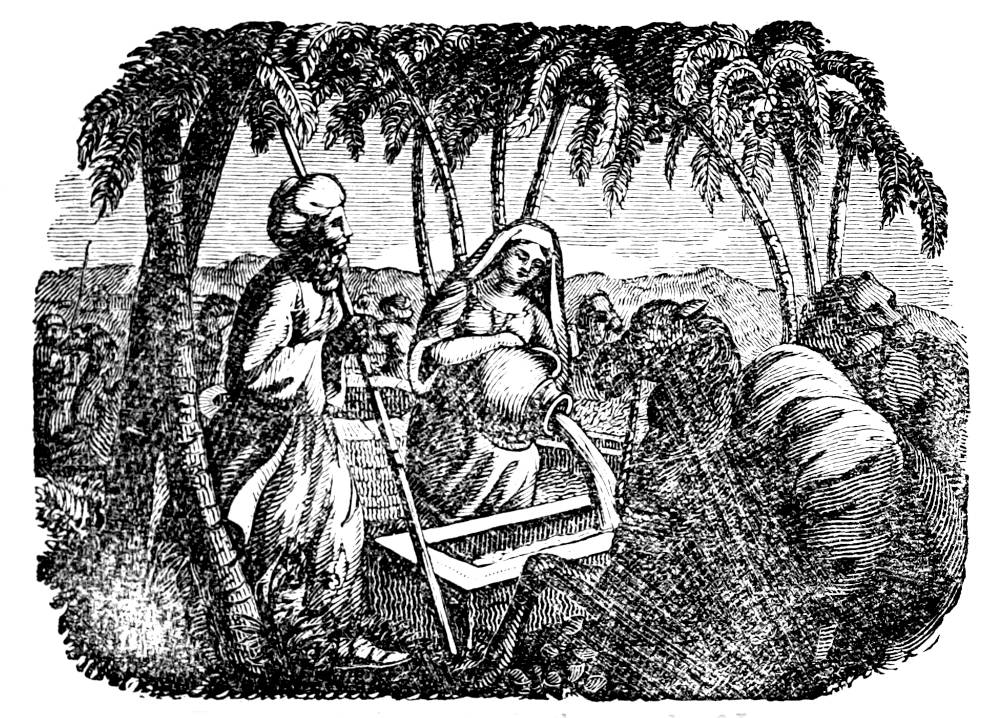
of her wealthy father; and when Abraham’s servant
sought the beautiful Rebecca as a wife for Isaac, the
damsel not only drew water for him, but for his
camels also.
The performance of these tasks does not necessarily
imply a deficiency of respect for women, for at
that period kings and princes were in the habit of
reaping their own grain, and slaying their own cattle.
The condition of women then bore a general correspondence
to that of the men, as it ever since has
done.
The manners were generally rude, and females of
course were not treated with the politeness which
has prevailed in modern times. Thus when the
daughters of Jethro came to draw water for their
flocks, the shepherds of Midian drove them away,
notwithstanding their father was high priest of the
country.
Jewish husbands seem to have had a discretionary
power of divorcing their wives; and no bargain or
vow made by a woman was binding, unless made in
the presence of her father or husband, and with their
sanction.
Before the time of Moses, women appear to have
been incapable of inheriting the estates of their
fathers, even when he died without other heirs. The
daughters of Zelophead brought before Moses, the
priests, the princes, and the congregation a petition,
setting forth that their father had died in the wilderness
without sons; on which account they thought
themselves entitled to a share of his possessions.
Moses granted the petition, and ordained that in future,
when a man died without sons, his inheritance
should descend to the daughters.
We know little of the amusements of Israelitish
women; but in the early periods of their history,
when both sexes were almost constantly occupied in
procuring the means of subsistence, it is not probable
that amusements were either frequent or various.
Music and dancing were unquestionably among the
most ancient recreations of human beings. I imagine
they were coeval with language itself; for they
were but varied manifestations of those emotions
and thoughts which words were framed to express.
Among modern highly civilized nations, dancing is
indeed regulated by merely artificial rules, and has
as little to do with character as the projection of a
map; but in more simple forms of society, the national
dances, like national tunes, are an embodiment
of the characteristic passions of the people: such are
the war dances of the Indians, and the voluptuous
dances of the East.
Moses speaks of singing men and singing women;
and throughout the Old Testament there is frequent
mention of music and dancing at sacred festivals.
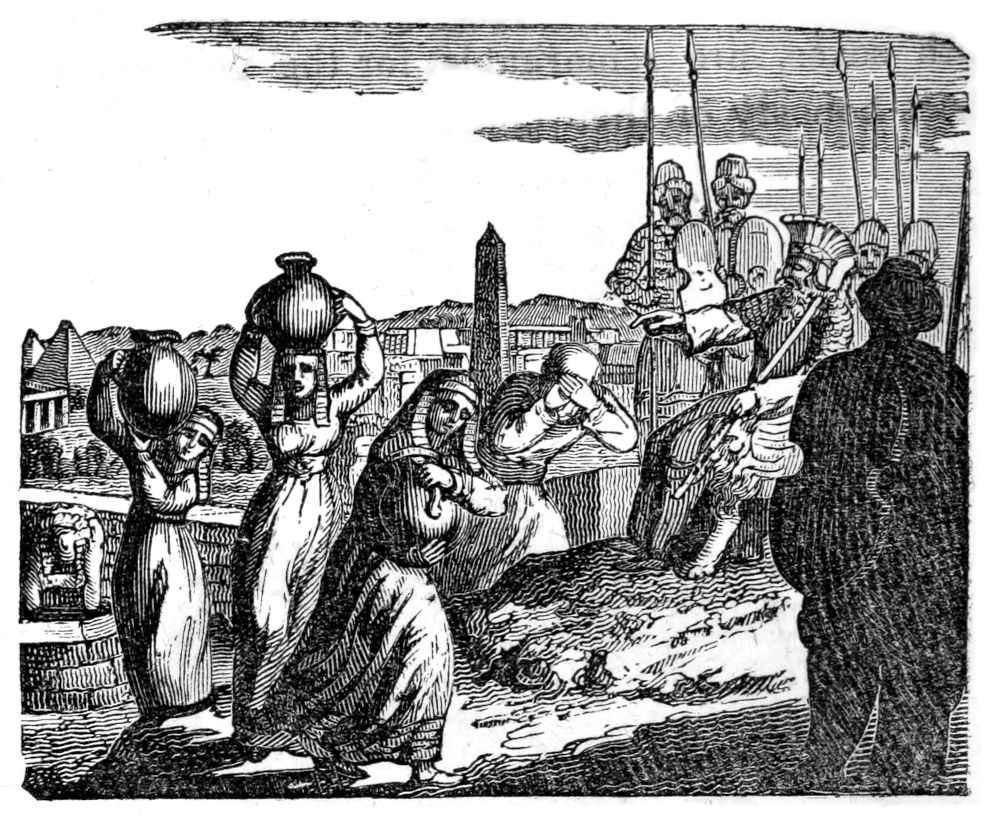
After Pharaoh and his host had perished in the
Red sea, we are told that “Miriam the prophetess
took a timbrel in her hand, and all the women went
out after her with timbrels and with dances. And
Miriam answered them, ‘Sing ye to the Lord, for he
hath triumphed gloriously.’”
Deborah and Barak likewise joined in a song of
triumph, after the defeat of Sisera.
Whether music and dancing were entirely confined
to public and solemn occasions, is uncertain; but we
can hardly imagine that it was so. The ancient
Israelites, like other people who live in similar climates,
no doubt highly enjoyed family meetings in
the open air, each one under the shadow “of his own
vine and fig-tree;” and to have had musical instruments,
without using them on such occasions, would
have been a strange perversity.
In the later periods of Jewish history, a class of
public singers probably existed, whose character was
similar to such classes now found in the East; this
may be inferred from the words of the son of Sirach,
“use not much the company of a woman who is a
singer.”
In the patriarchal ages the Jewish women must
have enjoyed a large share of personal freedom; for
we read of all ranks engaged in the labors of the
field, and going out of the cities to draw water.
That they were not usually secluded from visiters
seems to be implied by the question which the strangers
asked Abraham, “Where is Sarah, thy wife?”
Indeed, living as they did in tents, and removing so
frequently, it would have been no easy matter to have
preserved the complete privacy that exists in the
seraglios of the East. But as the Jews grew more
numerous and wealthy, the higher ranks indulged in
a much greater number of wives, and kept them more
carefully secluded. Solomon had seven hundred
wives, and three hundred mistresses; but these, like
horses and chariots, were probably valued merely
as the appendages of ostentatious grandeur. To
prevent the increasing tendency to polygamy, a law
was made forbidding any man who took a new wife
to diminish the food and raiment of his other wives,
or in any respect to treat them with less attention.
The part of the house appropriated to females
was called the armon. It was universally toward
the east, and entirely separated from the apartments
of the men. None but the nearest male relations
were ever allowed to pass the threshold. Any infringement
of this law was punished with great severity.
The houses in Palestine were built with flat roofs,
and in such a manner as to inclose in the centre a
large, open, quadrangular court, called the chazer or
thavech. This court was as completely sheltered
from public observation as the most private apartment.
It contained a fountain shaded by palm trees,
and screened by an awning which could be drawn
over it whenever occasion required; it was ornamented
with columns, vases of flowers, and tesselated
marble, according to the wealth of the owner. Here
the women pursued their occupations, played with
their children, and enjoyed the cool evening air, at
seasons when there was no danger of the approach
of strangers. The arrival of male visiters was
doubtless proclaimed in season for them to retire, as
it now is in Christian convents and eastern seraglios.
When king David went out against Absalom,
his women assembled on the house-top to witness
his departure, as they are now allowed to do in
oriental countries, when they wish to see any procession
or show. From various passages of Scripture
there is reason to suppose that people generally
slept on the house-tops in summer, as they still do
in many of the fine climates of the East.
The occupations of women during the prosperous
reign of Solomon may be gathered from his Proverbs:
“Who can find a virtuous woman? Her price
is far above rubies. The heart of her husband shall
safely trust in her, and he shall have no need of spoil.
She seeketh wool and flax, she worketh willingly with
her hands. She riseth while it is yet night, and
giveth meat to her household, and tasks to her maidens.
She stretcheth forth her hand to the distaff; her
fingers hold the spindle. She openeth her hand to
the poor, yea, she stretcheth forth her hands to the
needy. She maketh herself coverings of tapestry;
her clothing is silk and purple. She looketh well to
her household, and eateth not the bread of idleness.
Give her of the fruit of her hands; let her own works
praise her in the gates.”
That women sometimes transacted business, and
made bargains in their own name, seems to be implied
in the Proverbs: “She considereth a field and
buyeth it; with the fruit of her hands she planteth a
vineyard. She maketh fine linen and selleth it. She
delivereth girdles to the merchant.” It is likewise
certain that women went with their husbands to Jerusalem,
and worshipped in the temple on solemn
festivals.
Even in those days there was no dearth of invective
against the follies and vices of the sex. Solomon
praises good women in the most exalted terms; but
he implies their extreme rarity by the question, “Who
can find a virtuous woman?” The son of Sirach
says, “All wickedness is but little to the wickedness
of a woman.” “From garments cometh a moth, and
from women wickedness.” “A loud crying woman
and a scold shall be sought out to drive away the
enemies.” “A drunken woman and a gadder abroad
causeth great anger.”
Perhaps it never occurred to those wise men, that
the system of polygamy was calculated to stifle the
best emotions of the female heart, and to call all its
worst passions into exercise. But even under the
most barbarous and tyrannical forms of society, the
salutary influence of good and sensible women is
felt and acknowledged. The son of Sirach says,
“Blessed is the man that has a virtuous wife, for the
number of his days shall be doubled;” and the Old
Testament abounds with similar remarks.
The spirit of that age was not favorable to intellectual
improvement; but as there were wise men,
who formed exceptions to the general ignorance, and
were destined to guide the world into more advanced
states, so there was a corresponding proportion of
wise women; and among the Jews, as well as other
nations, we find a strong tendency to believe that
women were in more immediate connection with
Heaven, than men. Miriam, the sister of Aaron, was
a prophetess, and seems to have possessed great influence.
Deborah, the wife of Lapidoth, was not
only a prophetess, but for many years a judge in
Israel; and we are told that Barak refused to go up
with his army against Sisera, unless she went up
with him. At a later period, there was Anna the
prophetess, who for many years remained in the
temple of the Lord, night and day, in fasting and
prayer. When Joseph and Mary brought the child
Jesus into the temple, she immediately “gave thanks
to the Lord, and spake of him to all them who
looked for redemption in Israel.” The belief in
women who were under the influence of evil spirits,
is shown by the story of the witch of Endor.
That women were imbued with the sternness which
marked the barbarous character of men, is evident in
the story of Jael, who drove the nail through the
temples of Sisera, her sleeping guest; and of Judith,
who deliberately bewitched the senses of Holofernes,
that she might gain an opportunity to sever his head
from his shoulders.
Josephus tells us that Mary, the daughter of
Eleazer, who dwelt beyond Jordan, of eminent wealth
and rank, fled away to Jerusalem during the Roman
invasion, and was there when the city was besieged
by Cæsar’s troops. The little property she had been
able to bring safely out of Perea was seized by the
rapacious guards, from whom she received continual
insult and injury. At last famine prevailed to a
dreadful degree in Jerusalem, and it became impossible
for her to obtain any food. Goaded to madness
by long continued hunger, she killed her own infant
for food, saying, “Why should I preserve thee, miserable
babe! If the Romans spare our lives, we must
be slaves; and the seditious villains among us are
more terrible than either of these things. Be thou
my food and a by-word to the world, which is all that
is now wanting to complete the calamities of the
Jews.” The soldiers perceived that food had been
cooked in her house, and demanded their share of it.
She produced the remnant of her horrid meal, saying,
in mockery, “This is mine own son; and what
has been done is mine own doing. Eat of this food;
I have eaten of it myself. Do not pretend to be more
tender than a woman, or more compassionate than a
mother.”
The seditious soldiers, accustomed as they were to
bloodshed and crime, went out trembling and afraid.
When the famishing people heard of it, they desired
to die, and esteemed those most happy who had died
before such miseries were witnessed.
The dress of the ancient Hebrew women probably
differed but little from that worn by the daughters of
Israel at the present day. A robe which fell in ample
folds, fastened by a girdle; loose flowing sleeves confined
by bracelets; braided hair; and a turban, from
which descended a long, transparent veil. Garments
of silk and fine linen, of scarlet and purple, are
often mentioned in connection with people of rank;
and we are told that Tamar wore a robe of divers
colors, according to the custom of the king’s unmarried
daughters. Jewels were in use, even in the
days of the patriarchs; for when Isaac sent his servant
in search of Rebecca, he sent bracelets and ear-rings,
of silver and of gold; and when Moses built a
tabernacle for the Lord, “Both men and women
came, as many as were willing-hearted, and brought
bracelets, and ear-rings, and rings, and tablets, all
jewels of gold, an offering unto the Lord. And all
the women that were wise-hearted did spin with
their hands and brought that which they had spun,
both of blue, and of purple, and of scarlet, and of
fine linen.” The Israelitish mirrors were made of
polished brass, and the women were so partial to
them that they carried them everywhere, even to
the most solemn places of worship. The use of false
hair among the ancient Jews seems to be implied by
the fact that Absalom’s hair sold for two hundred
shekels.
The Jews endeavored, both by law and custom, to
keep their nation unmixed by foreign intermarriages;
and it was a favorite plan with them to unite different
branches of the same family. Thus the wife
of Abraham was his sister, by the father’s side; and
Isaac and Jacob both sought wives among their kinsmen.
When a man died without heirs, the nearest
relation was bound to marry the widow; and if he
refused to do so, she publicly accused him before the
elders, loosed the shoe from his foot, spat in his face,
and said, “So shall it be done unto the man that will
not build up his brother’s house.” And his name
was called in Israel, “The house of him that hath his
shoe loosed.”
Notwithstanding the effort to keep the blood of the
nation, and even of individual families, unmixed from
generation to generation, the rule was sometimes
broken through. Thus Moses married an Ethiopian
woman; the wife of Joseph was daughter of the
priest of On; and Solomon married the daughter of
Pharaoh, king of Egypt.
It is generally supposed that formal ceremonies at
a wedding were first prescribed by Moses. According
to the rabbies, the appointed days were Friday for
a bride who had never been married, and Thursday
for a widow. The contract was read and signed by
ten witnesses, who were free and of age. The bride
was veiled and given to the bridegroom by her parents.
Her father said, “Take her according to the
law of Moses;” and the husband answered, “I take
her according to that law.” Benedictions were then
pronounced both by the parents and the guests.
The maidens sang a marriage song, and the men
danced around the bridegroom, while the women
danced around the bride. The feasting continued
seven days, unless the bride were a widow, in which
case they continued but three days. If a man married
a number of wives in quick succession, he was
bound to allow a feast of seven days to each. At a
later period the form was somewhat changed. In
the presence of ten witnesses, the bridegroom said
to the bride, “Be thou a wife to me according to the
law of Moses, and I will worship and honor thee, according
to the word of God, and will feed and govern
thee, according to the custom of those who worship,
honor, and govern their wives faithfully. I give thee
fifty shekels for thy dowry.”
The story of Samson and Delilah seems to imply
that custom did not allow a young man to seek a
girl in marriage without the intervention of his parents.
He said to his father and mother, “I have
seen a woman of the daughters of the Philistines;
now therefore get her for me to wife;” and when his
parents started objections, he still pleaded, “Get her
for me; for she pleaseth me well.” The idea of applying
to the beautiful Delilah in person does not
seem to have occurred to his mind.
During the magnificent prosperity of Israel, marriage
ceremonies were conducted with more pomp
than they had been in the days of the patriarchs.
Instead of the bridegroom’s paying a certain sum of
money, or performing a certain period of service for
his bride, it became customary for wealthy parents
to give a handsome dowry with their daughters. This
is the natural tendency of society; because with the
progress of wealth and refinement women become
expensive, rather than profitable, in a pecuniary
point of view.
On the day of the nuptials, the bride was conducted
by her female relations to the bath, where she was
anointed with the choicest perfumes, her hair perfumed
and braided, her eyebrows deepened with
black powder, and the tips of her fingers tinged with
rose-color. Her companions then arrayed her in a
marriage robe of brilliant color, which fell in ample
folds to her feet. The girdle and bracelets were more
or less costly, according to the wealth of her parents.
A flame-colored veil was surmounted by a
crown, usually of gold; for this reason, a bride
among the Hebrews was called the crowned. Before
she left the bath, her friends from all quarters sent
in their wedding gifts. The bridegroom was anointed
and crowned in a similar manner, by the young men
of his family.
The bride, accompanied by her nurse, was conveyed
in a litter from her father’s house, followed by
all her female friends and relations closely veiled.
The procession was headed by seventy young priests
bearing flambeaux of oil and pitch, and by a multitude
of persons carrying the clothes, jewels, and
furniture, which had been presented to the bride;
each person carried but one thing. Next came the
bridegroom and his friends, in their richest apparel.
Then came the bride in her palanquin: and servants
and children closed the train.
When they arrived at the bridegroom’s house, the
bride anointed the door-posts with oil, and adorned
them with woollen fillets. Then the maidens lifted
her over the threshold, which formed the boundary
between her single and married life. The nuptial
train entered the courts, and the bride solemnly took
possession of her apartments in the armon, where a
feast was prepared for her and her female friends.
When all had partaken plentifully, both men and
women assembled in the inner court. The maidens
led the bride, and the young men the bridegroom, to
the parents, who placed the right hand of the wife
within the right hand of her husband, and pronounced
upon them the paternal blessing. “Blessed be thou,
O Lord our God, who didst create Adam and
Eve! Blessed be thou, O Lord our God, who causeth
Zion to rejoice in her children! Blessed be thou,
O Lord our God, who makest the bride and the
bridegroom to be glad together! The God of Abraham,
the God of Isaac, and the God of Jacob, be with
you, and help you together, and give his blessing
richly upon you! Jehovah make the wife that
comes into thy house like Rachel, and like Leah, who
built up the house of Israel!”
The marriage festivities continued seven days,
during which time numerous gifts were exchanged
between the newly married and their guests.
When a man believed he had reason to be jealous
of his wife, he could at any time compel her to submit
to the public ordeal of drinking the water of
jealousy. On such occasions, the wife was brought
before the priests and elders, in the midst of a crowd
of men, women, and children, who collected from
curiosity. When the culprit stood in the presence
of her judges, she was left alone, and if neither persuasion
or sternness could extort from her a confession
of guilt, they decreed that she should drink the
water of jealousy, and take the oath of purgation.
Being then led forth from the sanctuary, the priest,
who was appointed for the purpose, threw her jewels,
veil, and turban on the ground, dishevelled her
braided hair, rent her garments from the top of the
neck to the breast, and bound a strip of bark about
her, in place of a girdle, saying, “Thou hast forsaken
the manner of the daughters of Israel, who cover
their heads, and hast followed the manners of the
heathen, who go with their heads uncovered.”
Then the men spat on the ground, and the women
uttered cries of abhorrence. The husband gave the
priest the “offering of jealousy, the tenth part of an
ephah of barley-meal, with no oil or frankincense
poured thereon.” Then the priest filled an earthen
vessel with holy water from the laver beside the
altar, and put into it dust from the floor of the
tabernacle. With an elevated and solemn voice he
said, “If thou art innocent, be thou free from the
curse of this bitter water; but if thou art guilty,
may Jehovah make thee a curse among thy people,
and bring on thee all the curses written in his law.”
If the woman answered, expressing her willingness
to submit to the ordeal, the priest waved the “offering
of jealousy” before Jehovah, and mixing the
meal with salt, he burned it in the fire. Then the
curses of the law were written on a roll, and washed
off in the vessel of water wherein dust had been
mingled. The woman drank the water of cursing,
with her eyes lifted toward the holy of holies.
If, after a long pause, she was perceived to be unharmed,
a shout of joy burst from the multitude,
and hallelujah resounded from the temple through
the streets of the city. Her parents and husband
congratulated her on this proof of innocence, her
hair was braided anew, her jewels and veil restored,
and she was conducted home in triumph.
There was such a firm belief that any guilty person
who drank the “water of cursing” would be
immediately swollen with painful and loathsome
disease, that few would have ventured to abide by
the ordeal, unless they were conscious of innocence;
and if any one had been sufficiently daring to
run the supposed risk, the priests would not have
been easily deceived by a bold woman, who tried to
imitate the quiet fearlessness of virtue.
By the Mosaic law, an unfaithful wife was stoned
to death, and the partner of her guilt shared the same
fate.
Among the customs of Jewish women, it is mentioned
that “the daughters of Israel went yearly to
lament the daughter of Jephthah the Gileadite, four
days in the year.” It is well known, from Scripture
history, that Jephthah’s daughter went out with timbrels
and dances to meet her father, when he returned
victorious over his enemies; and that she cheerfully
consented to be sacrificed, in order to fulfil a vow he
had made unto the Lord.
It is not recorded what ceremonies were observed
in commemoration of her death; but it was probably
done after the manner in which they were accustomed
to bewail women who died unmarried. The procession
were clothed in mourning garments, with
dishevelled hair, and ashes upon their heads, and as
they moved, they wrung their hands and uttered loud
lamentations. It was not allowable to bathe, or
anoint, during the days appointed for mourning. Jewish
widows mourned for their husbands at least for
the space of ten months, and it was deemed extremely
indecorous for them to marry again in that
time.
Children mourn a year for their parents. They
do not put on black, but wear the same clothes they
had on at the death of their father, however tattered
and dirty they may be. Mourning for children,
uncles, and aunts, lasts one month, during which
period they do not cut their nails. When a husband
returns from the funeral of his wife, he washes his
hands, uncovers his feet, seats himself on the ground,
and remains in the same posture, groaning and weeping,
until the seventh day.
The custom of hired mourners to weep at funerals,
and excite others to tears, was common with
the Jews, and other ancient nations. Jeremiah
says, “Call for the mourning women, that they may
come; and send for cunning women that they may
come; and let them make haste, and take up a wailing
for us, that our eyes may run down with tears,
and our eyelids gush out with water.”
Women while in captivity wore their hair shaven,
and nails cut close, in token of grief. A new-born
Hebrew infant was washed and rubbed with salt.
When it was forty days old, the father offered a
lamb of the first year and a turtle-dove, the first as
a burnt-offering and the latter as a sin-offering for
the mother. She prayed while the victims were
slain by the priest, who afterwards sprinkled her
with the blood. At the feast of Pentecost an infant
child was solemnly presented by its parents before
Jehovah, in the temple.
There was a Jewish sect called Essenes, who were
similar to the Pythagoreans, and in many points resembled
the Shakers of modern times. Their name
was derived from a Persian word signifying resemblance
to a hive of bees. There was an entire community
of goods among them, and very strict subordination
to their elders. The tendency of their doctrines
was to keep the body in complete subjection
to the soul, which they believed to be immortal.
They lived in seclusion, never mixed with the world,
drank only water, ate only bread and hyssop, and
had great contempt for women. They always wore
white garments, and spat behind them, in token of
abhorrence to the world they had left. Marriage
was entirely forbidden among the higher class of
this sect, and among the inferior classes it was
allowed only with very strict limitations and severe
restraints. This society was kept up by people who,
from various motives, left the world to join them, or
saw fit to intrust them with the education of their
children.
None of the priests of Israel were allowed to marry
a widow, or a divorced woman, or one whose character
was not irreproachable.
The Jews are now scattered all over the earth;
but they everywhere adhere to their ancient faith and
usages; even in the United States, where every thing
is in the most direct opposition to the old Hebrew
spirit of regulating, defining, bounding, and limiting.
This singular people are very numerous in Poland,
where they have erected stately synagogues and
academies. The city of Hamburgh has been called
the “lesser Jerusalem,” on account of the number of
Jews who reside there. They are numerous in
Turkey, and have colonies in India.
A German traveller gives the following enthusiastic
description of the Jewesses in Poland: “I may
here say a few words about the fair daughters of
Israel, whom I saw at Kalish, decked in ornaments
and rich apparel, in honor of the Sabbath. The
pearl bands, worn as head ornaments by the Polish
Jewesses, are so peculiar, that it is almost impossible
to convey a correct idea of them by mere description.
These bands are seen only in Poland, and
their form obviously denotes their ancient and oriental
origin. They consist of strings of pearls intermingled
with gold, forming altogether an elaborate
piece of architecture, whose construction it is
not easy to describe.
“A Jewess of the higher class, adorned with her
pearl hair-band and gold neck-chain, from which is
frequently suspended an ancient gold coin, is an object
of no common interest, especially if she be as
beautiful as I have often seen Jewesses in Poland.
The events of thousands of years seem to be recorded
in their soul-beaming countenances. They deserve
to be stored in the memory, as a portion of the
pure, beautiful, and sublime of this world. Dignity,
feeling, tender melancholy, and, not unfrequently,
deep-seated sorrow, is expressed in the features of the
fair daughters of Israel, whose notions of virtue and
decorum are as rigid as the laws of their forefathers.
This rule, like every other, has of course its exceptions.
Few will deny that beauty consists more in
expression than in the form of the features. Many
women who are pronounced beautiful produce but
little, or perhaps even an unfavorable impression,
merely from the want of intellectual spirit. But
the utmost beauty of form combined with expression
leaves nothing to be wished for; and this will be
acknowledged by all who have seen the Jewesses of
Poland.”
“A faithful adherence to their national costume
serves to heighten their natural attractions.”
The modern Jewish women light a lamp every
Friday evening, half an hour before sunset, which is
the beginning of their Sabbath. The custom is said
to be in remembrance of their original mother, who
first extinguished the lamp of righteousness, and to
remind them of their obligation to rekindle it. Instead
of the scape-goat, they now use white fowls.
At the appointed season every mother of a family
takes a white hen, and striking it on the head, says,
“Let this die for my sins; she shall die, but I shall
live.”
Women did not succeed to the Jewish crown; two
instances, however, occur in their history, where
the supreme power was in female hands. Athaliah,
the daughter of king Omri, and mother of Ahaziah,
nearly destroyed the royal family, and usurped the
throne for six years. At a later period, Alexander
Jannœus left the crown to his wife Alexandra during
her life, and then to either of his sons whom she
might think proper to appoint.
The ancient Jews were of the same dark complexion
as the Arabs and Chinese; but their history
furnishes a remarkable exemplification of the influence
of climate. They are dispersed all over the
globe, and wheresoever they sojourn, those who
marry among Gentile nations are cast out of the
synagogue; therefore whatever changes have taken
place in their color must have been induced by climate
and modes of life. There are now Jews of all
complexions, from the light blonde of the Saxon to
the deep brown of the Spaniard, and the mahogany
hue of the Moors. The black Jews of Hindostan
were originally slaves purchased by the Jews who
sought shelter in that country, and who, with more
consistency than Christians have manifested, emancipated
their bondmen when they became converts
to their religion.
Little is known of ancient Assyria, and of Babylonia,
which was at first a part of Assyria. Being
a wealthy and luxurious nation, their women were
of course treated with a degree of consideration unknown
among savage tribes. The manner in which
Babylonish women are spoken of in the Bible implies
great magnificence of apparel; and as there is always
a correspondence between the moral and intellectual
condition of the sexes, it is not probable that
women were universally and totally ignorant in a
country where the sciences made such advancement,
and written laws were used.
The Babylonians manufactured rich embroidery,
tapestry, fine linen, and magnificent carpets. They
were distinguished for elegance and refinement of
manners; were very fond of music, and had a great
variety of instruments. Singing and dancing girls
were selected from the most beautiful to entertain
the wealthy at their meals; but we have no means
of knowing whether ladies of high rank considered
it a degradation to dance and sing before strangers.
It is generally supposed that the Babylonian women
were admitted to social and convivial meetings with
men; and it is on record that they sometimes drank
too freely of the wine. Weaving and embroidery
were no doubt generally practised by women, either
for amusement or profit. With regard to marriages,
they had a yearly custom of a peculiar kind. In every
district three men, respectable for their virtue, were
chosen to conduct all the marriageable girls to the
public assembly. Here they were put up at auction
by the public crier, while the magistrates presided
over the sales. The most beautiful were sold first,
and the rich contended eagerly for a choice. The
most ugly or deformed girl was sold next in succession
to the handsomest, and assigned to any person
who would take her with the least sum of money.
The price given for the beautiful was divided into
dowries for the homely. Poor people, who cared
less for personal endowments, were well content to
receive a plain wife for the sake of a moderate portion.
No man was allowed to provide a husband
for his daughter; and no man was permitted to take
away the woman he had purchased, until he had
given security to make her his wife. The feasts
by which wealthy Babylonians commemorated their
marriages became at last so extravagant that laws
were made to restrain them. The Assyrians worshipped
Venus under the name of Mylitta. Some
of the ceremonies observed in her temple are unsuitable
to be described in these pages.
When the Babylonians were besieged by the Persians,
they strangled all the women except their
mothers, and one other in each family, to bake their
bread. This was done to prevent famine; and the
lot fell upon women probably because they were of
less importance in carrying on the war.
It is not known whether females were admitted
into the priesthood; but a woman always slept in
the temple of Jupiter Belus, whom the Chaldean
priests declared to have been chosen by the deity as
his especial favorite from among all the nation.
Two remarkable women are mentioned in the
brief records we have of Assyria and Babylon.
Their names are Semiramis and Nitocris.
When Ninus, king of Assyria, besieged Bactria,
it is said the attempt would not have been successful,
had it not been for the assistance of Semiramis,
who was at that time the wife of one of his principal
officers. She planned so skilful a method of attack,
that victory was insured. Ninus became a passionate
lover of the sagacious lady, and her husband committed
suicide. Soon after this she became queen.
Some say she requested the monarch to invest her
with uncontrolled power merely for the space of
five days; and as soon as a decree to this effect had
been made public, she caused him to be put to death;
but other authors deny this. She succeeded Ninus
in the government of the Assyrian empire, and to
render her name immortal, she built the great city
of Babylon in one year. Two millions of men were
constantly employed upon it. Certain dykes built
by order of the queen, to defend the city from inundations,
are spoken of as admirable.
Altars were built and divine honors paid to the
memory of Semiramis.
The other celebrated queen was Nitocris, wife of
Nabonadius, who in the Scripture is called Evil
Merodach. She was a woman of great endowments.
While her voluptuous husband gave himself
up to what the world calls pleasure, she
managed the affairs of state with extraordinary
judgment and sagacity. She was particularly famous
for the canals and bridges which she caused to
be made for the improvement of Babylon.
Such instances as these do not indicate a degraded
condition of women. Yet the Assyrian monarchs
had seraglios, at least in times later than Nitocris;
for we are told that the effeminate Sardanapalus
spent his chief time in the apartments of his women,
learning to handle the distaff, and imitating their
voice and manners. This fact proves that spinning
was not unusual with women of high rank. The
exceeding love of perfumes which prevails in the
East characterized Assyria. When Babylon was
conquered, all the evils arose which might have been
expected among a voluptuous people so long accustomed
to luxurious living. Fathers and husbands,
rather than relinquish their own expensive habits,
were not unfrequently willing to receive the shameful
price of a wife or daughter’s beauty.
The ancient Lycians, supposed to be descendants
of the Cretans, always took their names from their
mothers, and not from their fathers. When any one
was asked to give an account of his ancestors, he
mentioned the female branches only. If a free woman
married a slave, the children were free; but if a
citizen married a concubine or a foreigner, his children
could not attain to any political dignity. The
inheritance descended to daughters, and sons were
excluded. Some say the Lycian women were treated
with this remarkable degree of respect, because
their prayers to Neptune once removed an extraordinary
salt blighting dew from the fields. Others suppose
it was because their ancestors, the Cretans, descended
from the goddess Thetis. A woman presided
over the different companies into which the Cretans
were divided, had the entire management of the
household, and at table gave the choicest food to
those who had most distinguished themselves. The
origin of these peculiar customs is obscured by fable,
but they probably arose from some great benefit early
conferred upon the state by women. The Lycian men
mourned for the dead by assuming female garments.
Artemisia, queen of Caria, so famous for her wisdom
and bravery, was descended from the Cretans
on the mother’s side. By the death of her husband
she was left with the government of the kingdom,
until her son should be of age. She served with
Xerxes in his expedition against Greece, and furnished
five of the best ships in the fleet. She endeavored
to dissuade the Persian monarch from venturing
a naval battle at Salamis; but her judicious
advice not being accepted, she commanded her portion
of the fleet, and fought with the utmost bravery.
When her vessel was pointed out to Xerxes, he exclaimed,
“The men on this occasion behave like
women, and the women like men.” The Athenian
conquerors considered themselves so much disgraced
by having a female antagonist, that they pursued
her with the utmost vengeance, and offered ten thousand
drachmæ to whoever would take her alive. But
she escaped in safety to her own kingdom by means
of an artifice; for having attacked one of her own
allies, with whom she was displeased, the Greeks
supposed her vessel to be one friendly to their cause.
Some other stratagems, which she used to obtain
power over her enemies, were entirely unworthy of a
generous mind.
Xerxes entertained so high an opinion of Artemisia,
that he confided to her care the education of the
young princes of Persia. Her statue was erected at
Lacedæmon, among those of the Persian generals.
She became in love with a young man of Abydos,
who did not return her passion; in consequence of
which she caused his eyes to be put out while he
slept, and then, in a fit of remorse, jumped from the
promontory of Leucas into the sea.
There was another Artemisia, daughter of a Carian
king, who married Mausolus, famous for his
beauty. She was so much in love with her husband,
that after his death she mixed his ashes with her
drink. She erected a monument to his memory, so
magnificent, that it was called one of the seven wonders
of the world; and from this circumstance the
word mausoleum is derived. She offered large rewards
to the literary men of the age, for the best
elegiac panegyric on her husband. Two years after
his decease, she died of grief.
Little is known of the Trojan women. Their
condition was probably very similar to that of women
in other nations of the same period. Andromache,
though a princess, and well beloved by her
husband, fed and took care of the horses of Hector.
It is to be presumed that she had a good deal of skill
in embroidery, for we are told that she made a representation
of the death of Hector, surrounded by
garlands. The dreams and prophecies of Cassandra,
daughter of king Priam, betray the usual tendencies
to invest women with supernatural powers.
The Asiatic Greeks, particularly those of Ionia,
were distinguished for voluptuous refinement, and
the beauty and gracefulness of their women. The
celebrated Aspasia, first the mistress, and afterwards
the wife of Pericles, was of Ionia. Her wit and eloquence
must have equalled her beauty; for we are
told that Plato loved to discourse philosophy with
her, and that Pericles sought her advice in great
political emergencies.
Zenobia, queen of Palmyra and the East, is the
most remarkable among Asiatic women. Her genius
struggled with, and overcame, all the obstacles presented
by oriental laws and customs. She is said
to have been as beautiful as Cleopatra, from whom
she claimed descent. She knew the Latin, Greek,
Syriac, and Egyptian languages; had drawn up, for
her own use, an abridgment of oriental history;
and read Homer and Plato under the tuition of Longinus.
She was the companion and friend of her
husband, and accompanied him on his hunting excursions
with eagerness and courage equal to his own.
She despised the effeminacy of a covered carriage,
and often appeared on horseback in military costume.
Sometimes she marched several miles on
foot, at the head of the troops. Having revenged
the murder of her husband, she ascended the throne,
and for five years governed Palmyra, Syria, and the
East, with wonderful steadiness and wisdom. After
a long and desperate resistance she was conquered
by the Roman emperor Aurelian, who had grown
jealous of the increasing wealth and power of his
rival.
The conduct of Zenobia after her capture tarnishes
all the lustre of her character. She who had conducted
many battles by her wisdom, and gained them
by her valor, trembled when she heard the ferocious
Roman soldiery demand her death; and she sought
to save herself by sacrificing her best friends to the
resentment of the conqueror.
Zenobia, almost weighed down with jewels, and
chained with gold, walked, a splendid captive, in the
triumph of Aurelian. That emperor, however,
treated his unfortunate rival with a degree of clemency
unusual in ancient times. He gave Zenobia
a very elegant villa, about twenty miles from Rome.
The great Queen of the East sunk into the obscurity
of private life, and her daughters married into noble
families.
Many of the customs of the ancient Jews still
prevail in Syria. The rude mill by which they
grind their corn is turned by two women, as it was
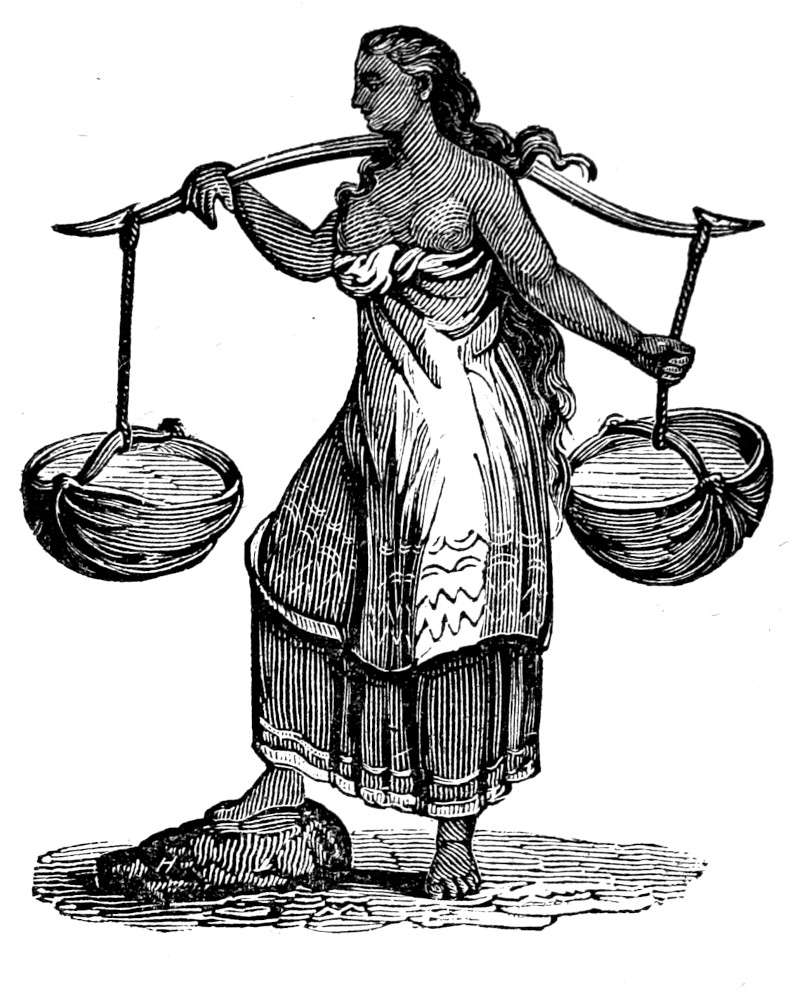
in the days of our Saviour. The excellent wells in
the neighborhood of mount Lebanon are still the
resort of women, who carry thence large jars of water
on their heads, as the daughters of the patriarchs
did of old. They are very timid; and if a stranger
approaches the fountains they immediately draw
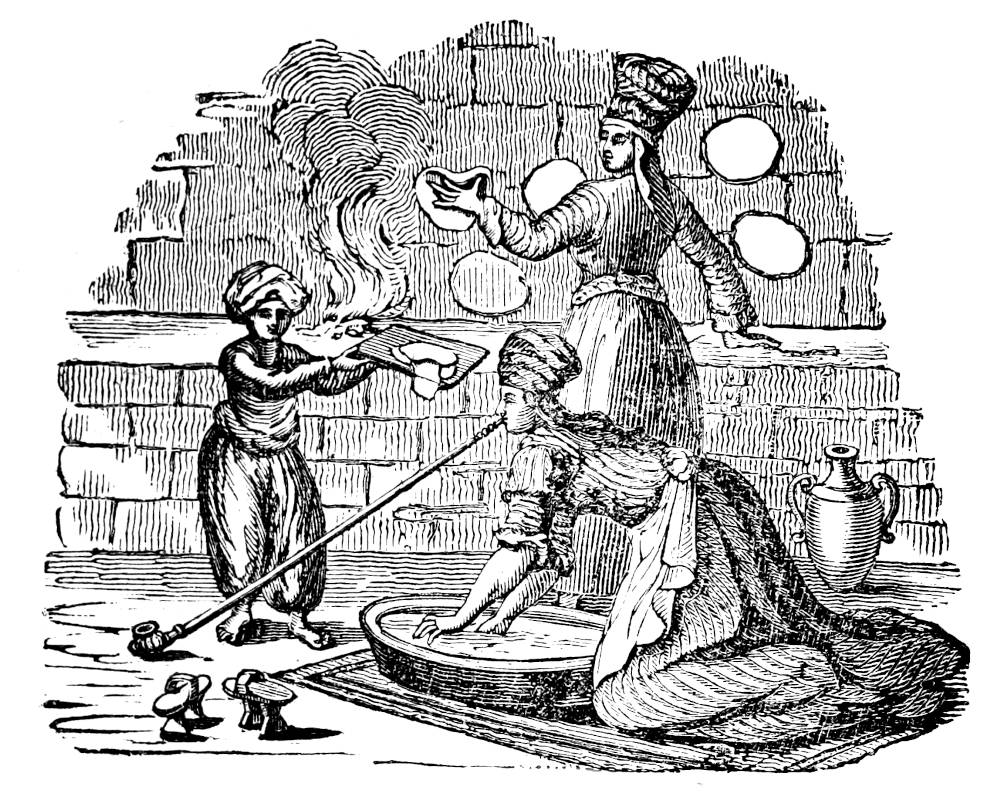
their veils. In common with many other Asiatic
nations, they bake their bread in small cakes against
a heated brick wall. When the cake is sufficiently
done, it drops of itself. This no doubt was the
manner in which Sarah “baked cakes on the hearth”
when Abraham entertained the strangers in his tent.
When a Syrian lady is betrothed, her lover sends
her a ring and other jewels, according to his rank
and wealth. After these are accepted, she is not
allowed to see her intended husband, or any gentleman
but her nearest relatives, until the wedding
ceremonies are completed. There is no period fixed
for the bridegroom to send for the bride; but during
the fourteen previous days he repeatedly sends presents
to her; and five days before she is summoned
from her father’s house, he sends a confidential woman
with jewels for her head, neck, and arms. Under
the care of this woman, the bride is bathed, her
hands stained red, and her face painted like a doll.
Presents from friends are sent to the bath, and the
bride walks several times round the fountain, adorned
with a succession of new dresses and ornaments, accompanied
by lighted candles, and the joyful cries of
her attendants. After this, she is required to sit in
a corner with closed eyes the whole day, except at
the hours of eating. The relatives of the bridegroom
escort her to his house, mounted on a horse, with her
eyes still closed, accompanied by musicians, women
bearing torches, and mules loaded with the dresses,
ornaments, or household utensils, which she has
received. As the procession passes along, the people
invoke blessings on the bride.
The Syrian women ride astride on horseback,
veiled; but they are less scrupulous than most
Asiatic women about removing their veils, when
comfort or convenience requires it.
Miss Abbot, the British consul’s daughter, who
made a journey into the mountains of Syria, speaks
of the inhabitants as remarkable for their kindness
and simplicity. They had never before seen a European
lady, and their curiosity was much excited.
The men stopped her horse to present bouquets and
benedictions; and the women crowded her apartments,
bringing baskets full of delicious grapes and figs.
The young lady says: “As I passed, blessings were
invoked upon me, as upon an Arab bride. I was
everywhere received with the affectionate welcome
of an old friend, rather than with the courteous
greeting of a stranger. The women were extremely
neat in their appearance, and though evidently very
poor, would accept of no remuneration for their offerings.”
The Syrian women wear a very high odd head-dress,
called the tantoura, not unlike the horn of a
unicorn. It is made of wood, pasteboard, and tinsel,
or of the precious metals set with gems. The inhabitants
of the mountains are less tawny than those
who live in the plains. About Lebanon their complexion
resembles that of the French. The women
of Damascus and Tripoli are celebrated for their
fairness, and for their beautiful dark eyes, which are
usually visible, though a veil covers the rest of the
face.
Among many sacred relics which abound in Syria,
they profess to show the kitchen and fireplace of
the virgin Mary, and the fountain where she was
accustomed to draw water.
In the mountains of the Anti-Libanus are a peculiar
class of people called Druses. They have
scarcely any religion, observe neither fasts nor festivals
of any kind, and allow brothers and sisters to
intermarry. They live in a very secluded manner,
and rarely take several wives. The women are extremely
modest and industrious. They grind corn
and make bread after the old scripture fashion.
The Druses divorce their wives on the slightest
pretext. If a wife ask her husband’s permission to
go out, and he says, “Go,” without adding, “but
come back again,” she is divorced. Though both
should wish it, they cannot live together again,
without being re-married according to Turkish forms.
These people are very jealous, but rarely punish a
criminal wife with death; divorce is the usual
penalty.
The Turks in Syria, as well as in other parts of
their empire, kill a woman as soon as they suspect
her; and the fine incurred by a seducer is enormously
heavy.
The Turkomans are a wandering tribe, living in
tents like Bedouins. They are peculiar for giving a
dowry with their daughters, instead of receiving a
price for them. They are exceedingly scrupulous
about the honor of their women. If a brother should
see his sister receiving a kiss even from her betrothed
lover, he would shoot the poor girl on the spot; yet,
with the usual inconsistency of mankind, they are
themselves extremely fond of intrigues, and pride
themselves not a little on success.
The Turkoman women are very industrious and
ingenious. They make the tent-coverings of goat
hair, and weave carpets scarcely inferior to those of
Persia. They use no shuttle, but pass the thread
with their fingers. They have peculiar skill in dying
various brilliant colors. Nearly all the labor
falls upon them. The men do nothing but feed the
horses and camels at sunset.
Syria is a part of the Turkish empire, and of
course governed by Mohammedan rulers.
Dr. Clarke gives the following account of a pacha
whom he visited at Acre. “The harem of the seraglio
is accessible only to himself. Early every
evening he regularly retired to this place, through
three massive doors, every one of which he closed
and barred with his own hand. Even to have
knocked at the outer gate after he had retired
would have been punished with death. No person
in Acre knew the number of his women, but from
the circumstance of a certain number of covers being
daily placed in a kind of wheel or turning cylinder,
so contrived as to convey dishes to the interior,
without any possibility of observing the person who
took them. He had from time to time received
presents of female slaves; but after they entered his
harem, none but himself knew whether they were
alive or dead. If any of them were ill, he brought a
physician to a hole in the wall, through which the
sick person was allowed to thrust her arm, the pacha
himself holding the hand of the physician while
the pulse was examined. He put seven of his wives
to death with his own hand, after his return from a
pilgrimage to Mecca, during which the janizaries
had obtained admittance to the harem. From all
the information we could obtain, he treated the
tenants of his harem like the children of his family.
When he retired, he carried with him a number of
watch-papers he had amused himself by cutting with
scissors during the day, as toys to distribute among
them.”
The same traveller says: “In the evening we took
some coffee in the house of the imperial consul, and
were introduced to the ladies of his family. We
were amused by seeing his wife, a very beautiful
woman, sitting cross-legged by us on the divan, and
smoking tobacco with a pipe six feet long. Her
eyelashes, as well as those of the other women,
were tinged with the black powder made of sulphuret
of antimony. Although this has by no means a
cleanly appearance, it is considered as essential to
the decoration of a woman of rank in Syria as her
ear-rings, or the golden cinctures of her ankles.
Dark streaks were likewise pencilled from the corners
of her eyes along the temples. This reminded
us of certain passages of Scripture wherein mention
is made of ‘putting the eyes in painting.’ English
translators, unable to reconcile this with their ideas
of a lady’s toilet, have rendered it ‘painting the
face.’”
The Arabs, though Mohammedans, seldom have
more than one wife. Divorces rarely take place,
unless for misconduct, or for not being the mother
of children. If the Arabian women are fortunate
enough to have several sons, they are almost idolized
by their husbands. The little girls are fair, but
they are almost universally exposed to hardships,
which soon spoil the complexion. When young
they are very lively and agreeable, and sing almost
perpetually. In cities the marriage ceremonies are
similar to the Turkish. The processions are gay
according to the wealth of the parties, and blessings
are invoked on the bride as she passes.
The Bedouins live in tents, divided into three
apartments, one for the men, one for the women, and
one for the cattle. Though often ragged and half
clothed, the Bedouin women generally manage to
have jewels of some kind or other, for the neck, ears,
nose, and arms. Those who cannot afford gold or
silver, wear a nose ring of iron, sometimes two or
three inches in diameter. The wives of sheiks, and
other men of rank, generally wear rows of sequins
across their foreheads, and fastened in bunches to
the ends of their long braided hair. Rings in the
nose, and very large clumsy glass bracelets about
the wrist, are common. Their manner of churning
butter is curious. They put the milk into a goat-skin
with the hair all on. This is suspended by
strong cords to the branch of a tree, and a woman
shakes it with all her might, until butter is produced.
These skins are seldom washed, and the butter, of
course, is none of the sweetest.
The Bedouins consider their wives as slaves, and
exercise arbitrary power in punishing them for any
fault. One of them is said to have beat his wife to
death merely because she had lent his knife without
permission, though she begged pardon and offered in
the humblest manner to go and bring it for him.
Being called before a council of the chief men of the
tribe, he acknowledged the offence; saying he had
told the deceased never to meddle with any thing of
his, and he was determined to have a wife who
would obey him better. The chief reproved him for
not first making a complaint to him; adding that if
his wife should, after such a step, be guilty of disobedience,
he had a right to kill her if he pleased.
The murderer was ordered to pay four sheep, as a
penalty for not making application to the sheik or
chief; and soon after he married another woman.
They are married by a priest, who joins their
hands, and reads certain verses from the Koran.
The bride is blindfolded by the priest, and the bridegroom
leads her into his tent, on the top of which a
white flag is displayed; he seats her on a mat, saying,
“You are at home.” He then returns to the
assembled company and joins with them in feasting,
singing, shouting, firing guns, and performing rival
feats on horseback, until after midnight. The bride
remains blindfolded during an entire week, her husband
merely removing the bandage from her eyes
for a moment, the first time he enters the tent, that
she may be assured of his identity. Some female
friend cooks the food, and performs other domestic
duties for her, until she is allowed to see the light of
day. The Arabs have many superstitious observances
respecting marriage. On such occasions
they apply to old women skilful in sorcery, who are
supposed to have the art of tying and untying the
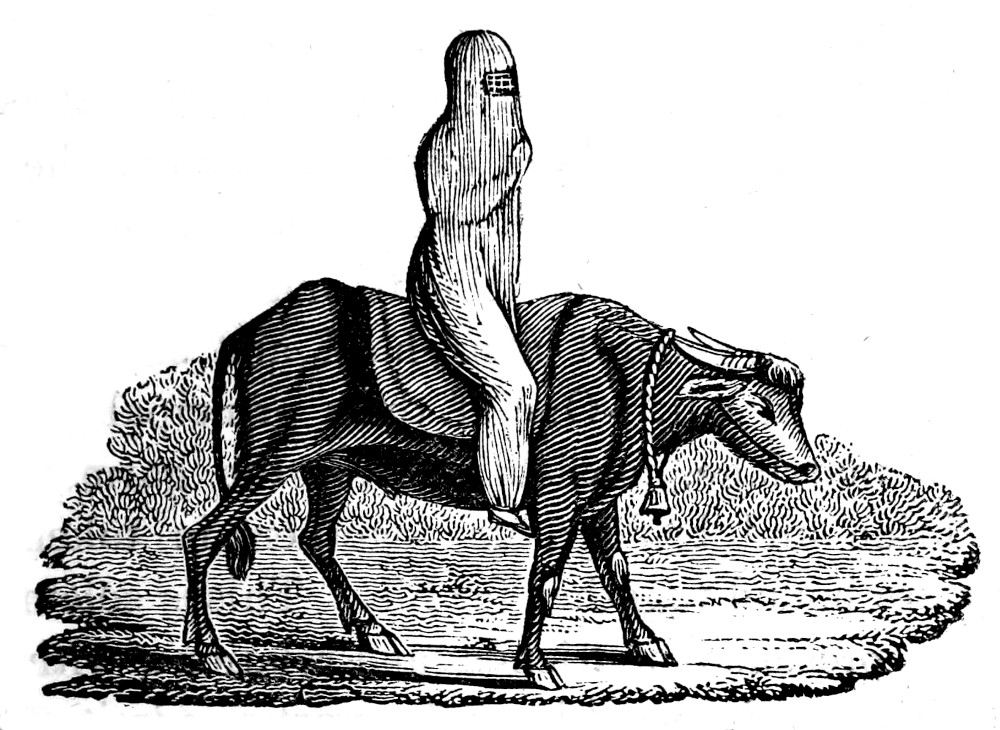
knots of fate. In cities, the Arabian women cover
their faces with a cloth, with two holes worked for
the eyes, which are almost always bright and beautiful.
Their complexion is lemon-colored. They
stain their fingers and toes a yellowish red, and
blacken the joints of the latter. The eyebrows are
stained black, and the lips blue; and a small flower
or spot is often painted or stained on each cheek,
the forehead, and the chin.
The following is a picture of an Arab beauty:—“Her
eyes are black, large, and soft, like the antelope;
her look is melancholy and impassioned; her
eyebrows are curved like two arches of ebony; her
figure is straight and supple as a lance; her step is
like a young colt; her eyelids are blackened with
kahol, her lips painted blue, her nails stained a
gold color with henneh, and her words are sweet as
honey.”
The Arab women are said to be generally graceful
in their motions, and in the adjustment of their
drapery. On entering an apartment, they carelessly
fling off their slippers, and show a naked foot peeping
from beneath the loose ample drawers, which fall
below the ankle. Mr. Madox, who visited the grand
sheik, says: “His daughters sat on a sofa with him;
not after the Turkish fashion, but with feet to the
ground. They were rather pretty, gaily dressed,
with coins suspended on gold chains by the sides of
their faces. One of them, seeing I had some difficulty
in detaching a piece of meat from the bone,
offered me another piece with her stained and jewelled
fingers. After dinner, when they washed their
hands, they made a great lather with the soap offered
by the attendants, which they put in their mouths,
and cleansed their teeth with their fingers. After
this they smoked.”
When the wives of Arab chiefs accompany their
husbands in devout pilgrimages to Mecca, they
are carried in a litter borne by two camels. Fifteen
miles from Mecca is a small hill, much resorted to
by the devout, called Djebel Arafat, or the Mountain
of Gratitude. On this spot, according to Mohammedan
belief, Adam and Eve met, were reconciled, built
a house, and lived together, after a separation of forty,
or, as some say, five hundred, years. The women
of Mecca are said to be free in their manners, even to
boldness. This may be partly owing to the constant
sight of strangers, who visit the city as pilgrims, and
partly to the dullness and indifference of the men,
induced by their abject poverty and ignorance.
But the Arabs are in general extremely jealous of
the honor of their women. They would immediately
stab a wife or daughter, who was supposed to have
disgraced herself. A single life is considered so disrespectable,
that a woman, in order to avoid it, will
marry a man very much her inferior, or even consent
to be the second wife of one already married.
The poor Arabs live in small thatched huts, and
sleep on straw mats. Those who are richer have
low houses of stone with terrace roofs; and here and
there may be found an extraordinary individual, who
has sofas, carpets, mirrors, and fountains. Those
whose circumstances do not admit of their having
separate apartments for women, are careful,
when they invite any one to the house, to enter
before him, and cry aloud, Tarick! Tarick! (Retire!
Retire!) At this warning all the females immediately
hide themselves.
If the wife of a Bedouin is seduced, the laws allow
him to kill any of the offender’s family whom he
may happen to meet. Sometimes the affair is settled
by the seducer’s father giving the injured husband
three or four of his daughters to sell, for as high a
price as he can obtain.
The Kereks are not so kind to their wives as the
Bedouins, with whom they often intermarry. A
woman cannot inherit the merest trifle of her husband’s
property. Even during his lifetime he does
not supply her with necessary clothing; she is
obliged to beg of her father, or steal her husband’s
wheat, and sell it clandestinely. No greater insult
can be offered to a Kerek than to tell him he sleeps
under the same blanket with his wife; for they do
not allow the women to share their apartments.
When a wife is ill, they send her back to her parents,
saying they paid for a healthy woman, and
cannot have the expense of an invalid. Butter is
used very freely by this tribe, and they consider it
the height of meanness to sell it. A butter-seller is
a most contemptuous epithet; and the daughters of
such a parsimonious person would have no chance
to get husbands.
The Courds, who dwell in the mountains between
Turkey and Persia, live in tents, and subsist by
plunder, like the Bedouin Arabs. Their women are
of a pale mahogany hue, with very fine features.
The nose is generally aquiline, the eyes bright and
mild, and the whole countenance expressive of kindness
and frankness. The Courds have the utmost
confidence in their wives and daughters. They may
be seen at the tent-doors and in the fields, without
veils, and always ready to answer a civil question,
or pay a stranger the simple duties of hospitality.
Both as maidens and matrons they are very virtuous
and modest. These women are active, vigorous,
and fearless, and they educate their children in the
same way. “Our boys will be soldiers,” say they;
“and they must learn to bear and dare every thing.
We show them the way.”
The Courds, like most people of similar habits,
receive a certain price for the daughters they dispose
of in marriage.
The inhabitants of Afghanistan are Mohammedans;
of course women are considered as property;
and the higher classes are kept scrupulously concealed.
But they are an active, romantic people,
and have more gallantry than usually characterizes
the Moslem religion. The women are industrious
in household avocations, and the labors of the distaff
and the loom; but they are not required to perform
out-of-door work. Owing to the nature of Mohammedan
customs and institutions, love and courtship
are little known in Moslem nations; but among
the Afghans a man often plights his faith to a young
woman, goes off to remote provinces, and makes
the most laborious exertions to earn money sufficient
to purchase her of her friends.
People of all tribes and languages may be found
about the beautiful regions of Caucasus. They are
generally handsome, vigorous, active, hospitable,
cunning, and dishonest.
The Circassians and Georgians have been most
celebrated. Among the Circassians, pride of birth is
carried to such an extent, that it is said an unequal
match was never heard of in that country.
They are very fond of hunting and military exploits;
and women, of course, participate in this
character. They polish and take care of the armor,
are very proud of their husband’s courage, and reproach
them severely when defeated. The young
men show great activity and skill in military exercises,
and the most alert has the privilege of choosing
the most beautiful girl as his partner at the next
ball. Their dances are in the elaborate Asiatic style,
less gay, graceful, and expressive than those of
Europe.
When a Circassian prince wishes to marry, he
pays the father of the princess the value of two
thousand rubles, in arms, horses, and cattle; and his
father-in-law gives him a number of slaves in return.
The prince of Circassia demanded from the
neighboring prince of Mingrelia an hundred slaves
loaded with tapestry, an hundred cows, an hundred
oxen, and an hundred horses, as the price of his sister.
The birth of a child, especially a boy, is celebrated
with great festivities. A female infant has a wide
leathern belt sewed around the waist, which continues
till it bursts, and is then replaced by another.
The bridegroom cuts this belt with his dagger, and
on account of its extreme tightness fatal accidents
sometimes occur.
The children of princes are not brought up at
home, but sent soon after their birth to the house of
some nobleman, who is charged with their guardianship.
The expenses of their education and marriage
are paid by the noblemen, who receive no remuneration
from the parents.
A Circassian dwelling is divided into two parts,
separated from each other by an inclosed court; one
allotted to the husband and such guests as he chooses
to invite, the other to the wife and family. If a
European were to ask a Circassian concerning the
health of his wife, he would angrily turn his back
without condescending to reply. The lower classes,
as usual, have more freedom than the higher; they
often go abroad without veils.
Girls marry between their twelfth and sixteenth
year, and are considered quite old at eighteen.
Their mothers teach them to embroider, and make
dresses for themselves and their male relations. On
the wedding day the father of the bride makes her a
present, but he reserves the greater portion of what
he intends to give her, until the birth of her first
child. On this occasion she visits him, receives the
remainder of her portion, and is clothed for the first
time in the matron’s dress and veil.
If there be rival lovers, they often decide the
question by single combat, or engage friends in the
quarrel, and the victorious party seizes the prize. If
the bridegroom can prove any thing against the former
character of his bride, he sends her back to her
parents, who generally sell her as a slave. An unfaithful
wife has her hair shaved, her ears clipped,
and the sleeves of her robe cut off, and in this situation
is sent home to her father on horseback, to be
sold as a slave.
The Circassians have two kinds of divorce; one
total, and the other provisional. In the first case both
parties are immediately at liberty to marry again; in
the other, the couple agree to separate for a year, and
if at the end of that time the husband does not send for
his wife, her relatives compel him to a solemn divorce,
that she may be able to marry again. After
the death of the husband, the wife governs the
family, without dividing the property among the
children. When she dies, the wife of the eldest son
usually takes her place; the children can then demand
a division of the fortune, the oldest receiving
the largest share. At funerals, women utter loud
cries of grief, and disfigure themselves with scars.
They wear black for mourning.
The Circassians, like the Arabs, are remarkable
for hospitality. They will incur any dangers to protect
a person that has eaten of their food. Should
the enemies of a stranger attempt to seize him in the
house of a Circassian, the wife of his host would
give him milk from her own breast, in token of
adoption; and from that moment all the tribe would
feel bound to avenge his wrongs, as if he were a
brother.
The Circassian women have been celebrated throughout
the world for their beauty. Some modern travellers
have denied their claims to such great celebrity.
Dr. Kimmel says, “I have met with none of
extraordinary beauty; and officers who have long
commanded in the Caucasus have informed me that
Circassian beauties are extremely rare.”
But it must be remembered that women of the
higher classes are rigorously excluded from the sight
of a traveller; and in a country where the feudal
system prevails to its utmost extent, the handsome
daughter of a serf would be immediately claimed by
her noble master, who could sell her for the royal
harems, or reserve her for himself, as he saw fit.
Women of rank embroider, weave elegant baskets,
and other ornamental things. The lower class tend the
flocks, weave garments for the men, and do a variety
of household and out-door work. The serfs are the
only class who continue to live with a wife after she
grows old. It is an uncommon thing for any man
or woman, even among the princes, to know how to
read or write.
The condition of the Georgians is very similar to
that of their neighbors the Circassians.
The Georgian women are very remarkable for
beauty; but are said to be wanton, treacherous, and
uncleanly. A great trade in female slaves has been
carried on in Georgia. Fathers sell their children,
brothers their sisters, and nobles their vassals. Jewish
agents are continually traversing the provinces
about Caucasus, seeking the fairest flowers for the
harems of Turkey and Persia. A handsome, red-haired
girl will sell in Constantinople for six or seven
thousand piastres.
The Georgian women are tasteful and elegant in
their dress, and great pains are taken to perfect them
in those voluptuous arts of pleasing, which the Orientals
call female accomplishments.
The men being almost always engaged in war, or
hunting, there is very little companionship between
the sexes.
The Armenians are Christians; but their customs
with regard to women are very similar to the Turks,
excepting that their laws do not permit a plurality
of wives. They keep their wives and daughters as
rigorously excluded as the Turks do theirs. A man
never sees the face of the woman he is to marry, and
courtship is a thing unknown.
The mother of a young man generally selects a
bride for him, and makes all necessary arrangements
concerning the dowry, bridal presents, &c. The nature
of these presents are regulated by old laws and
usages, and each article is blessed by a priest.
When the bridegroom goes to bring his bride from
her father’s house to his own, his father-in-law gives
him a new watch, and the nearest female relations
hang pieces of gold tinsel on his hat. He is introduced
to the bride, who sits on a low sofa, so completely
buried in dresses, that not so much as the tip
of her shoe is visible. A thick white linen veil,
called the perkem, used only for bridals, is thrown
over her head; over this is another veil composed
of tinsel, or sheets of gilt paper. Her hair flows
down, and, joined to a mass of false hair, rests upon
the sofa. The priest leads her blindfolded to the
centre of the room, places her hand in that of the
bridegroom, and pronounces a blessing. All the
company then form in procession; a priest goes first
with a lighted torch, and is followed by the bridegroom;
the march is closed by the bride, who, being
unable to see for herself, is led by female relations.
When they arrive at the bridegroom’s house, the
bride is smoked with incense, and sprinkled with
rose-water. She is then led to her apartments, and
left with the women. The bridegroom proceeds to
his apartment, where he is shaved and dressed in his
wedding suit, every article of which is blessed by
the priest, as he presents it. The couple are then
led forth to the centre of another apartment, where
the priest again joins their hands, and knocks their
foreheads gently together. One of the family waves
a crucifix over them, they again touch foreheads, and
continue to lean against each other, while the priest
chants some passages from the gospel. When he
has done singing, the priest produces two strings exactly
alike, made of white and rose-colored silk interwoven
together. He ties one round the brow of the
bridegroom, over whom the crucifix is held, and asks,
with a solemn pause between each question, “If she
is blind, thou acceptest her?” “If she is lame,
thou acceptest her?” “If she is hump-backed, thou
acceptest her?”
To each question the bridegroom answers, “I accept.”
The other silken string is then tied round
the brow of the bride, over whom the crucifix is held.
The priest says, “Thou acceptest.” She answers,
“I accept.”
The company then shower small pieces of money
on the couple, the cross is waved, and the priests
chant. All the men quit the room for a short time,
while the matrons remove a quantity of the robes
and veils, under which the bride is well nigh stifled.
At a given signal, the husband is admitted, and
allowed to see, for an instant, the countenance of his
wife.
All the company then pass in. The bride is not
again enveloped with the linen veil, but her face is
covered with the tinsel and gold paper. The female
guests kiss her, and put presents in her hand. After
this, all the male relations, to the remotest degree,
are allowed a glance at the bride’s face, and the favor
of kissing her hand.
Feasting and amusements then commence, and
continue for three days. All this time the bride is
obliged to sit motionless on the sofa; it would be
considered the height of indecorum for her even to
whisper to any one, except the old matron who accompanied
her from her father’s house, and who is
generally her nurse.
Toward the end of the third day, the priest leads
the bridegroom to the bride, removes the silken
strings from their brows, and carries away the tinsel
veil. The bride is now, for the first time, permitted
to speak. According to the old laws, she was not
allowed to open her lips in the presence of her
mother-in-law, or her married sister-in-law, for one
year; the practice is now less rigid, but the most
profound respect, and implicit obedience, is still exacted
from the bride toward the relatives of her husband.
The marriages even of the poorest Armenians take
place with all this ceremony and parade. Cooking
utensils, robes, veils, &c., are kept stored in the
churches, for the use of those who cannot afford to
buy them for the occasion.
The dress of the Armenian ladies is remarkably
heavy and loaded, and their ornaments large and
massive. They have black eyes, ruddy complexions,
and in general coarse features, with little expression.
When they go out, the face is muffled up
with bandages so as to show only the eyes, and
sometimes a part of the nose. In the house, as well
as abroad, and by night as well as by day, they wear
a nose band, the pressure of which makes that feature
universally broad and flat. They allow none of
their hair to be seen, except a long braid that falls
down the back nearly to the ground. The custom
of muffling themselves up, so that all look nearly
alike, led Tournefort to say, facetiously, “An Armenian
returning from a journey is not sure to find the
same wife; he cannot tell whether she may not be
dead, and whether some other woman may not have
stepped into the place of the deceased.”
The Armenian salutation, on entering a room, is to
place the right hand rapidly to the breast, mouth,
and forehead. The ladies throw off their slippers
before they sit down. The manner of lowering themselves
upon the divan, so as to assume the oriental
posture, is said to be altogether inimitable by a European.
For the sake of change in position, they
sometimes kneel.
Xenophon, in his Cyropædia, relates a beautiful
anecdote of an Armenian wife in very ancient times.
The princes of the country having evaded the payment
of their customary tribute to Persia, Cyrus
made war upon them, and took the royal family
prisoners. Tigranes, the king’s son, had been recently
married to a woman for whom he had very
great love. The Persian monarch asked the prince
what price he would give to regain her. Tigranes
with great fervor replied, “Oh, Cyrus, I would save
her from servitude at the expense of my life!” The
noble conqueror replied, “Take your own to yourself;
and do you, Armenian king, take your wife and
children, without payment, that they may know they
come free to you.”
When the Armenians returned home, all were talking
of the magnanimity, mildness, and beauty of
Cyrus. Tigranes said to his wife, “And do you,
Armenian dame, think Cyrus so very handsome?”
“Truly,” said she, “I did not look at him.” “At
whom then did you look?” inquired her husband.
“At the man who said he would ransom me at the
expense of his own life,” she replied.
The Turks as Mohammedans may have four wives,
and as many mistresses as they can maintain; but
the common class of people rarely have more than one
wife.
The Grand Sultan cannot marry one of his own
subjects, and Christian princesses would not in general
be willing to form one of his numerous harem,
even if such an alliance were not regarded as an
abomination by the Moslems. His household is
therefore composed of beautiful female slaves, usually
presented by the first grandees of the empire, as one
of the surest methods of obtaining royal favor. The
heir apparent is consequently always the “son of a
slave;” a contemptuous epithet often applied to him
in the hour of adversity.
Orkhan, the second emperor of the Turks, is the
only one on whom a Christian princess was bestowed.
Theodora, of the Greek empire, daughter of
Cantacuzene and Irene, was given to the powerful
Turk by her ambitious father, though he was well
aware that he previously had many wives and favorites.
No marriage ceremonies were performed; but
the troops were assembled round a throne, on which
Theodora was seated concealed by silken curtains.
At a signal from the emperor, the screens were withdrawn,
and the bride discovered in the midst of
kneeling eunuchs and blazing torches; while the joyful
sound of trumpets and other instruments of music
welcomed her appearance. Her father had stipulated
that she should be allowed to preserve her religion
in the midst of the harem, and he wrote much in
praise of her charity and devotion in this difficult
situation.
Achmet I. is said to have had three thousand women
in his harem, and the grandees of the empire
generally have some hundreds. The rigid seclusion
of Mohammedan women is said to have originated in
the conduct of Ayesha, called Best Beloved Wife of
the Prophet, and Mother of the Faithful. She went
out into the desert to look for a pearl necklace she
had lost, and on her return was accused of listening
to the smooth words of an officer she met. Mohammed
did not withdraw his affection, and publicly protested
her innocence; but keenly alive to the disgraceful
report, he expressly forbade any Mussulman
to speak to his wives, or to remain in his house after
dinner, or to enter it in his absence.
Harem is an Arabic word signifying sanctuary.
These retreats are so carefully guarded, that little is
known of their interior arrangements. Physicians,
and the wives of European ambassadors, have sometimes
gained access to seraglios, which they describe
as follows: Favorites of the highest rank are called
khatouns, of which there are seven. She who first
presents the Sultan with a son becomes the sultana
hasseki, and takes precedence of the others. Next in
rank to the khatouns are the odahlycs, whose number
is unlimited. Each of the khatouns has a seventh
part of the odahlycs, and a certain number of eunuchs
and slaves as her own peculiar attendants; and
each has a separate court, garden, and bath, belonging
to the pavilion in which she resides. These pavilions
are adorned with marble, paintings in arabesque,
gilding, mirrors, &c. The odahlycs, generally
to the amount of some hundreds, sleep on sofas
in a long high gallery, divided by a double row of
chests of drawers, where they keep their clothing.
The staircases to this gallery are secured by massive
trap-doors, fastened with bars of iron. The inner
courts of the harem are guarded by black eunuchs,
with muskets always in their hands, and the outer
by white eunuchs. Innumerable subordinate officers
are appointed to settle disputes, and keep order within
and around the harem. When any of the Sultan’s
women accompany him into the gardens, officers are
in readiness to warn the gardeners and all other men
to retire; and should any one be slow to obey, he
would be killed on the spot. When the king’s women
are removed from one seraglio to another, they
are accompanied by officers with staves to keep off
the people, and to prevent the ladies from showing
themselves by drawing the curtains of their litters.
When ill the women are always attended by their
own sex. Physicians are admitted into the harem
only under the strictest guard, and on extraordinary
occasions; even then they are not permitted to see
their patients, except through gauze. Notwithstanding
all these precautions, intrigues are sometimes
successfully carried on. If discovered, the woman is
tied up in a sack and drowned; but the Koran ordains
that he who accuses a woman without being
able to prove her guilt, shall receive the bastinado.
The mother of the reigning Sultan is called sultana
valydeh; a title which she assumes at his accession,
and loses whenever he dies, or is deposed.
Her sons treat her with the most unbounded respect,
and give her almost supreme control in the harem.
Her political influence is likewise by no means inconsiderable.
The grand seignior often communicates
to her the secrets of state; covered with a veil, she
holds conferences with the grand vizier and the mufti;
and in the absence of her son, she issues orders in
his name. In the time of Achmet III., the sultana
valydeh warmly espoused the cause of Charles XII.
of Sweden, and made great exertions to arm Turkey
against Russia, in his behalf. She even wrote letters
to the king of Sweden, and to count Poniatowski,
though such a step was in open defiance of
the laws of the harem. The revenues of certain
provinces belong to the sultana mother, and in
times of emergency she often lends large sums to his
Highness.
The sultana valydeh and the sultana hasseki
almost always dislike each other, because each is
jealous of the other’s influence over the reigning
monarch. The hasseki finds it prudent to dissemble
her hatred, for fear of giving offence to the Sultan;
and the valydeh on her part, while she refrains from
openly wounding the affections of her imperious
son, generally contrives all manner of secret and indirect
means to injure his favorite. It sometimes
happens, however, that the hasseki is so perfectly
passive and submissive as to be a favorite both with
mother and son.
If the heir apparent dies, the hasseki loses her
rank, and the next khatoun who has a son takes her
place.
This gives rise to the strongest feelings of rivalship,
envy, and hatred. No pains are spared by the
khatouns to destroy the offspring, injure the health,
or vex the feelings of those odahlycs in whom they
are fearful of finding rivals.
The sultana Guneche (a name which signifies the
sun) had acquired great influence over Mohammed IV.
by her beauty, excellent understanding, and perpetual
flow of spirits. In the height of her power, the
sultana mother was malicious enough to introduce
to her son a lovely Circassian slave, named Gulbeyaz,
or the white rose. The effect produced upon the
mind of the voluptuous monarch was precisely what
she wished: Guneche soon received intimation that
apartments and a sultana’s train were in preparation
for the new favorite. She stole to the chamber of
her rival, and after loading her with the bitterest invectives,
beat her so cruelly that the whole harem
was in an uproar. The Sultan provided Gulbeyaz
with another residence six leagues distant, and
threatened to treat Guneche as a slave. She, however,
made her peace with him, by attributing her rash
conduct to excess of love, and expressing her determination
in future to sacrifice her own feelings to the
gratification of her lion, as the sultanas fondly call
his Highness.
But afterward her jealousy showed itself in a still
worse form. The Sultan had received from the
grand vizier a most beautiful slave, named Khadyjeh.
With a view to her safety, he conveyed her to a seraglio
on the canal of the Black sea. For a time,
Guneche appeared to have no suspicion of the frequent
visits he paid her. But one day when the
grand seignior had gone a hunting some distance
from Constantinople, she ordered caïques to be secretly
prepared for an excursion on the canal. On
her arrival at the seraglio where Khadyjeh was confined,
she affected to wish to enter the pavilion to
rest. The new favorite was engaged in the innocent
amusement of angling, in a closet that overhung the
sea. Her vindictive rival came softly behind her, and
suddenly pushed her into the waves, from which she
rose no more.
The heir to the throne remains under the tuition
of his mother until he is eight or nine years old, and
custom, as well as the rules of the Koran, require
from him the most implicit and reverential obedience.
The day on which this important little personage is
delivered over to male instructers is celebrated with
great pomp. A recent traveller thus describes the
ceremonies that took place when the oldest son of
Sultan Mahmoud was nearly nine years old: “The
extensive plain of Ibraham Aga, on the Asiatic shore,
was covered with tents for the accommodation of
troops of children, of whom six thousand were present.
The Sultan was seated on a throne in a
splendid pavilion, supported by gilded columns, hung
with gold and silver tissue. The young prince was
introduced to all the chief officers of the empire, and
after respectfully embracing his father’s feet he took
his seat on a cushion near him. A chapter from the
Koran was read, and a prayer pronounced by the
grand mufti. At every pause all the children
throughout the camp cried Amen, and it was echoed
by the neighboring hills. Food is distributed and
criminals pardoned in honor of the occasion. The
festival lasts three days; and during all this time,
men, women, and children remain in the field. The
troops, the long line of tents, the noisy children, and
women in all manner of gay costumes, riding in
their painted and carved arabahs, drawn by oxen,
combine to make the scene very cheerful and exhilarating.”
In many instances the Sultans, when they ascended
the throne, have caused all their brothers to
be put to death, to prevent any disputes about succession.
Amurat III. caused his five brothers to be
killed in the presence of their own mothers, one of
whom, unable to endure the sight, stabbed herself in
despair. He likewise put to death two of his
father’s slaves, who were likely to become mothers.
Mohammed III., son and successor of Amurat, caused
nineteen brothers to be strangled, and ten of his
father’s odahlycs to be thrown into the sea, for the
same reason.
The khatouns occasionally make each other a
ceremonious visit, probably from motives of curiosity;
but their meals, baths, and amusements, are distinct
from each other. They change their dresses many
times a day, smoke, chew gum mastic, and loll on
sofas, while female slaves dance around them, and
perform pantomimes, which almost always represent
love scenes. They have likewise magic lanterns and
puppet shows, the subjects of which are said to be
any thing but modest. One of their favorite occupations
is making beads of rose leaves. The petals
of the rose are carefully picked, and pounded into a
smooth paste in an iron vessel. The iron, acting
upon a certain acid in the rose, turns the paste quite
black. It is made into little balls, which are perforated
for stringing, and hung up in the shade to dry.
When hard they are rubbed between the hands with
a little attar of rose, till they become perfectly
smooth. They never lose their fragrance. The
Turkish ladies spend hours in passing these beads
backward and forward on a string, inhaling the delicate
perfume. They practise dancing, music, and
embroidery, in the cool kiosks or pavilions, situated
in the midst of the gardens. Here Frank and Greek
women are sometimes admitted to exhibit goods and
jewelry for sale, and Jewesses skilled in fortune-telling,
amulets, and love-potions, are always welcome.
A visit from any lady of distinction, either from a
foreign nation or some distant part of the empire, is
an extraordinary occasion, and conducted with much
ceremony. If the visiter be a European, they manifest
the greatest curiosity concerning those Christian
countries where they have been told each man has
but one wife. At parting, the guests are usually
presented with embroidered handkerchiefs, and sprinkled
by the attendants with perfumed waters.
The Sultan sometimes indulges his women in
what is called the Feast of Lamps, which consists in
a general illumination of the gardens of the seraglio
with colored lamps and reflecting mirrors. Booths
are erected for the festival, furnished with a variety
of goods, and with vases full of beautiful flowers.
The sisters, nieces, and female cousins of the grand
seignior are invited. The women of the harem, in
appropriate dresses, tend the bazar, while the Sultan
and his guests walk about purchasing jewelry
and rich stuffs, which they present to each other.
Dancing, music, and sports of various kinds continue
till late at night.
The women of the harem try to obtain as many
jewels as they can, because in case of their master’s
death these are not taken away from them. In the
midst of slaughter, the most ruffianly soldier considers
the walls of the harem as sacred; and when
executioners are sent to strangle a state criminal and
seize his effects, they do not enter his seraglio, or
touch any property that belongs to his women.
The Sultan’s daughters and sisters enjoy more
liberty than any of his favorites. Not being heirs
to the throne, they are not exposed to the perils that
await his brothers and sons. While these girls are
yet in their cradles, a husband is provided for them,
generally among wealthy pachas; and as soon as he
dies, they are provided with another; who (with a
view to securing his wealth for the royal coffers) is
very likely to be accused of some crime and soon
strangled. Thus a sister of Amurat IV. had four
husbands in less than one year.
If the sultana be ever so old or ugly, a man dare
not refuse the honor of her alliance, if he values his
head. During the reign of Abdul Hamyd, an old
sultana fell in love with a handsome and wealthy
young man, whom she saw pass her windows during
a public ceremony. The young man was thunder-struck
when the Sultan made known the honor
that awaited him; for he had an excellent wife, whom
he most tenderly loved. But there was no escape
for him. Had he attempted to fly, his capture and
death would have been almost certain. He was
compelled to dismiss his wife, who survived their
separation but a few days.
The individual thus chosen is summoned to the
presence of the Sultan, where he waits till the presiding
khatoun comes and makes a signal that he is
to follow her into the harem. At the threshold,
the eunuchs take off his slippers, and make him wait
some minutes, in token of the obedience he owes his
royal consort. When he enters, he makes three
obeisances, kneels, bows his face to the ground, and
repeats a short prayer. The khatoun then conducts
him to his bride, who sits on a sofa, entirely covered
with a veil of red taffeta. She treats him with the
utmost haughtiness, which he tries to soften by
magnificent presents. The slaves bring a tray containing
sugar-candy and a pair of pigeons. The
bridegroom offers some of the pigeon to the sultana,
and she offers him candy. He expresses his felicity
in terms the most reverential. The sound of various
instruments then gives him notice to retire from the
apartments of the women, and feasting and amusement
is kept up till late in the night. If the bride
be past the years of infancy, she is conducted to her
husband’s residence with great pomp.
Some writers have affirmed that a part of these
marriage ceremonies consists in the Sultan’s saying
to his sister, or daughter, “I give this man to be thy
slave. If he offends, cut off his head;” and that the
bride actually wears a sabre in token of her authority.
Whether this be true or not, there cannot easily be
any other bond than fear, in an alliance where one
word of complaint from the wife would bring an executioner
to strangle the husband.
The female relations of the Sultan are never allowed
to quit Constantinople, lest their sons should
escape the power of the despot, and occasion disturbances
in the succession to the throne. When the
Sultan dies, his women are shut up in what is called
the old seraglio. If his successor be his son or brother,
it is sacrilegious for him ever to look upon
them; if otherwise, the love of novelty sometimes
leads him among them to select new favorites.
But the seraglios of the Sultan and his grandees
do not furnish a true picture of the character and
condition of the Turkish women; any more than
the royal marriages and etiquette of European courts
are indicative of the manners of the people. Women
of the middling classes in Turkey appear to enjoy
a very considerable degree of freedom and consideration.
It is even said that hen-pecked husbands are
as numerous there as elsewhere. Their houses are
indeed divided into separate apartments, one portion
devoted to the men and the other to the women.
Sometimes these apartments communicate only by
one door, of which the husband holds the key; and
the food of the women is conveyed to them by means
of a revolving cupboard, similar to those by which
the poor are supplied with food at the gate of convents.
But, generally speaking, the Turkish women
go in and out at their pleasure. The streets and
bazars of Constantinople are full of them. They
seldom address a stranger, or reply if spoken to; but
if any thing peculiarly attracts their curiosity, they
ask questions with much simplicity. Their favorite
recreation is an excursion on the Bosphorus, the
arrangements for which are made with very little
ceremony. A lady sends her servants to invite her female
friends, orders the provisions to be carried with
them, gives directions for her husband’s dinner, steps
into her caique,[1] calls for her friend, proceeds up
the Golden Horn, selects some pleasant scene where
the children can frolic under the shade of lofty trees,
and there they remain working, talking, singing, and
playing on the thambourah,[2] till the declining sun
gives them warning to return. Sometimes the husbands
join in these excursions, and sit in a group
apart from the ladies, smoking, and sipping sherbet
and coffee, while female slaves amuse them with
dancing and singing. Trustworthy attendants always
accompany the ladies on these occasions, to
protect them from intrusion. It would be considered
extremely indecorous for a stranger to approach the
group.
These excursions on the canals are said to be
sometimes the scenes of love-intrigues, carried on by
means of signals from those in the neighboring
houses to those in the boats. The police officers
are on the watch for such misdemeanors; how often
their vigilance is eluded, is best known to those who
reside near the Bosphorus. The natural love of
overcoming obstacles is a strong incentive to intrigue,
and the custom of wearing veils favors concealment.
In case of detection, the prompt punishment
of despotic countries follows without much
ceremony. All the public know, is that some woman
is seen hanging lifeless from her own window, with
her lover, or supposed lover, by her side; or that her
body, inclosed in a sack, is found floating on the
Bosphorus.
In former times the Turks considered it so improper
to display a female face, that they used to fire at
English merchant-ships the figure-head of which
represented a woman; but the custom of veiling the
face, by a muslin tied over the mouth and chin, is
gradually going out of fashion, especially with the
young.
The Turkish ladies spend some of their most
agreeable hours in the public baths appropriated to
their use. These baths are lighted by bell glasses
at the top, and consist of apartments of different
degrees of temperature. The last room is so hot
that high wooden clogs must be worn to protect the
feet from the pavement, and a sudden perspiration
trickles from the pores at the moment of entrance.
Yet the women go very frequently, and sometimes
remain in this atmosphere five or six hours, while
their attendants rub them with a kind of brush, and
pull the joints till they crack. This operation, at
first a little painful, is said to be followed by a sensation
peculiarly agreeable. Having made plentiful
use of perfumed soap and pomatum, braided their
tresses, and pared their nails, the bathers pass into
the next room, the temperature of which is lower.
Here clean beds are prepared for delicious repose
after the relaxation of the bath. Coffee and cordials
are likewise furnished in this room, and sometimes a
whole party of women dine there, and stay till evening,
listening to stories, and discussing the important
affairs of love and dress.
Turkish women generally have a sallow complexion
with dark eyes. A face like a full moon, and a
person decidedly fleshy, are among their requisites
for beauty. The grandees are said to place a peculiar
value upon fair-haired girls, probably on account
of their rarity.
The wedding ceremonies are simple. All the relations
send presents of furniture, clothes, or jewels,
which are the property of the wife in case of her
husband’s death. Sometimes, when the marriage
contracts are signed, a solemn promise is exacted
from the man that he will never marry again during
the lifetime of his wife. The bridal ceremony is performed
by an iman or priest, who joins the hands
of the parties, and recites certain prayers from the
Koran. It sometimes takes place at the bridegroom’s
house, but more generally at a mosque. The day
before the wedding the bride goes to the bath, where
her female relations and friends take off her dress,
sing a bridal song, and offer their various gifts. The
parties are escorted to the mosque in state, accompanied
by friends and relations in arabahs,[3] drawn
by oxen decorated with ribbons and garlands. The
arabah in which the bride is conveyed is closed, but
the others are open. The bridal veil is bright red
bordered with yellow. The eyebrows of the bride
are united in one broad black streak, by means of
antimony and gall nuts; and her fingers are stained
with hennah. When the new part of the nail forms
a contrast with the stained part, it is considered
peculiarly beautiful. Sometimes a childish love of
ornament is carried so far, that gilt paper cut in the
form of crescents, and various fantastic shapes, are
stuck upon the face. Before the arabah which contains
the bride are borne several trees surrounded
with hoops, from which hang festoons of gold thread
or tinsel, which wave in the breeze, and glitter when
the sun glances on them. The procession consists
of dancers, musicians, mountebanks, horses loaded
with the furniture and apparel of the bride, and
the relatives and friends on horseback, or in carriages.
When the bridegroom leaves the mosque, his
friends strike him smartly on the shoulders for good
luck. Girls are usually betrothed at the age of three
or four years, and receive the nuptial benediction at
twelve or fourteen. The custom of not allowing the
bridegroom to see the bride until after the ceremony
is contrary to the precepts of the Koran; for Mohammed
says to one of his disciples, who was about
to take a wife, “First see her, that you may judge
how you should like to live with her.”
The wedding festivities last four days; the men
feasting and frolicking in one set of apartments, the
women in another. They usually begin on Monday,
to avoid interfering with the Mohammedan Sabbath,
which comes on Friday. A single life is very disreputable,
and widows almost invariably marry again,
unless they are very old. A Turkish woman is respected
by her family and the world in proportion to
the number of her children. In general they have
very numerous claims to this kind of distinction.
The Koran declares that a woman who dies unmarried
is in a state of reprobation.
The common idea that Mohammedans believe
women have no souls, is not founded upon any thing
contained in the Koran. Mohammed expressly
says: “Whoso worketh good, male or female, shall
enter paradise;” and the pilgrimage to Mecca, for
the salvation of their souls, is enjoined upon women
as well as men, with the proviso that they must be accompanied
by their husbands, or near male relations.
The Mohammedan law forbids pigs, dogs, women,
and other impure animals to enter a mosque; and
the hour of prayers must not be proclaimed by a
female, a madman, a drunkard, or a decrepit person.
The first prohibition was no doubt intended to prevent
the frequent meetings between the sexes which
would be likely to take place during religious services.
The last regulation implies no peculiar contempt
for women; the same classes would be excluded
from the priesthood in Christian countries.
The Turkish proverb, that “A woman causes the
ruin or prosperity of a house,” implies that female
influence is in some degree acknowledged and appreciated.
Jests at the expense of women prevail in Turkey,
as they do all over the world. Nass-red-dyn, the
Turkish Æsop, wishing to propitiate the conquering
Tamerlane, proposed to carry him some fruit.
“Hold,” said he, “two heads are better than one; I
will ask my wife whether I had better carry quinces
or figs.” His wife replied, “Quinces will please him
best, because they are larger and finer.” “However
useful the advice of others may be,” rejoined Nass-red-dyn,
“it is never well to follow that of a woman;
I am determined to take figs.”
When he arrived in the camp, Tamerlane amused
himself with throwing the figs at his bald head. At
every blow Nass-red-dyn exclaimed, “God be praised!”
Tamerlane inquired what he meant. “I am
thanking God that I did not follow my wife’s advice,”
replied Nass-red-dyn; “for if I had brought
quinces instead of figs, I should certainly have a
broken head.”
Women do not attend funerals in Turkey, the
ceremonies of which are very simple. At the death
of a husband they put on a particular kind of head-dress,
and wear no ornaments for twelve months.
At the grave the iman repeats a prayer, and calls
the deceased three times by his name, and by that
of his mother, never by his father’s. If the mother’s
name be unknown, they call him “son of Mary,”
the blessed virgin; if the deceased be a woman under
similar circumstances, they call her “daughter
of Eve.” A column with a sculptured turban on the
top designates the grave of a man; a kind of vase,
or marble bowl, is placed on the top of columns
erected for women. After a rain, the birds come to
these vases to drink. In Syria, Armenia, and Turkey,
the color of mourning is celestial blue.
In 1755, Othman III. made very severe ordinances
with regard to women. He forbade their going
abroad on Friday; would not allow them to do their
own shopping; (that task being transferred to their
husbands and male relations;) ordered them to wear
coarse dull-colored cloth instead of fine Cashmeres;
and made an express edict against their high head-dresses.
The women, to avoid this last ordinance,
contrived a species of machinery by which they
could suddenly diminish their caps, and raise them
again, when the police officers were out of sight.
These regulations were but temporary. The
wives and daughters of the wealthy Turks dress
with extreme magnificence. Rich colored damask
brocades embroidered with silver and gold, and
looped up with buttons of diamond or pearl, are
much worn. Though the national costume remains
the same, fashion plays a thousand freaks with the
details of dress.
The Turks do not consider it polite to make inquiries
concerning each other’s wives. Among the
class of vicious women in cities the number of Mohammedans
is said to be very small, because the
laws restraining them are peculiarly severe. If it be
discovered that a Mohammedan woman has a Christian
lover, he is compelled to marry her, and renounce
his religion.
Perhaps there is no country where slavery exists
in so mild a form as in Turkey. The children of
slaves are brought up in the same way as the legitimate
children, and enjoy the same privileges and
rights. Female slaves are free by law at the end of
six years, and allowed to form the most advantageous
marriages they can.
Instances are numerous of slaves rising to the
highest dignities of the empire. The black eunuchs
of the seraglio often acquire immense wealth and
influence.
It is a singular fact, that the Mohammedan nations
treat slaves better than the Christian; and that,
among Christians, the Catholic nations treat them
better than the Protestant.
Both European and Asiatic Turkey have been
described under the head of Asia, because their
manners and customs are so decidedly and entirely
oriental.
Of the Asiatic Greeks nothing is here said, because
their character and condition is essentially the same
as that of the Greeks in Europe.
Numerous Frank and Armenian merchants reside
in Smyrna, the manners and costumes of which are
a curious combination of various nations. It seems
very odd to travellers to meet ladies with English or
French names, wearing the Turkish or Greek costume,
and speaking the Greek language. The Carnival
is celebrated at Smyrna with extraordinary
splendor. On this occasion the ladies appear in
their richest attire, and there is a continual succession
of waltzing parties, concerts, and theatricals.
The wealthy Frank merchants residing in Turkey
are extremely cautious in arranging the marriage
contracts of their daughters. The bridegroom engages
to secure his wife a certain portion of his
fortune, in case she survives him, and receives, on his
part, a written promise from her father of the money,
jewels, clothes, &c. constituting the dowry, and of
the portion he intends to leave her at his death.
The Persians seem to have been remarkable among
the ancient nations for a savage jealousy of women,
which led them to keep the objects of their love
perpetually imprisoned and guarded. Their severity
is spoken of as extraordinary, by Plutarch, and other
authors, who wrote at a period when even the most
enlightened nations allowed very little freedom to
their women. Yet the Persians are said to have
been the first who carried their wives and children
into the field of battle: “We do it,” said they, “that
the sight of all that is most dear to us, may animate
us to fight more valiantly in their defence.”
The Medes and Persians are likewise supposed to
have been the first who introduced dancing and
singing women to entertain their guests at a banquet;
but the fact that Cyrus gave two captive female
musicians to his uncle Cyaxares, proves that
music was cultivated at a very early period, by nations
which yielded to the dominion of Persia.
The character of Cyrus is the brightest page in
Persian history. At a time when female captives
taken in war were treated with the utmost indignity,
and sometimes with savage barbarity, he was distinguished
for a degree of respectful gallantry, which
would have done credit to the most refined prince
of modern times.
When told that the exquisitely beautiful wife of
Abradatas had been assigned to him among other
spoils of the Assyrian camp, and that the woman
wept incessantly for her husband, to whom she was
fondly attached, Cyrus at once resolved not to see
her, lest her unrivalled loveliness should make it difficult
for him to do his duty. In fact, he protected
her against himself, and against one of his favorite
officers, who, being appointed to attend upon the
beautiful Panthea, had become a captive to her
charms. Nothing could exceed the gratitude of the
princess, when she found herself and her attendant
maidens living in the midst of the Persian camp
with as much safety and seclusion, as if she had been
in the palace of her husband. Abradatas having
received information of the magnanimous conduct
of Cyrus, immediately hastened to engage himself,
his troops and treasures, in the service of the virtuous
monarch. When he was about to go forth to
battle with Cyrus, Panthea brought him a golden
helmet and arm-pieces, with broad bracelets for his
wrists, which without his knowledge she had caused
to be made from her own jewels. When he asked,
with affectionate surprise, if she had sacrificed her
ornaments for him, she replied that her husband was
her greatest ornament. She then reminded him
of their obligations to Cyrus, and told him that
much as she loved him, she had rather be buried
with him than live to know he had been deficient in
courage. Abradatas laid his hand gently on her
head, and looking upward, exclaimed, “O, great Jove,
make me worthy of such a wife as Panthea, and such
a friend as Cyrus!” As the princess put on his
armor, she turned aside to conceal her tears; and
when the door of his chariot was closed, she kissed
the steps by which he had entered, and followed
after him. When he perceived this, he again bade
her farewell, and entreated her to return. Her attendants
placed her on a litter, and threw a tent-covering
over her, to conceal her from the admiring
troops. When the dead body of Abradatas was
brought from the battle, Panthea reproached herself
that she had urged him to such desperate courage.
With the stern enthusiasm of ancient times, she
stabbed herself to the heart, and died on her husband’s
breast; having first given directions that their
corpses should be wrapped in the same mantle. The
Persian monarch, with sincere lamentations, ordered
magnificent funeral rites, and a monument to be
erected to their memory.
There is reason to suppose that Cyrus was blessed
in his own domestic relations; for we are told that
he mourned for his wife Cassandana with the sincerest
grief, and commanded public demonstrations
of sorrow throughout the empire.
The virtuous decorum of Cyrus was an exception
to the general character of Persian princes. Men
of rank, who could indulge their whims without
control, sometimes married their own sisters and
daughters. Artaxerxes Memnon, being in love with
his beautiful daughter Atossa, had some fears that
the affair would not redound to his credit; but his
mother quieted these scruples by saying, “Are you
not set over the Persians by the gods, as the only
rule of right and wrong?”
Another of the Persian kings called the magi together
to give their opinion on a similar occasion.
The accommodating priests answered, “We can find
no law that authorizes a man to marry his own
daughter; but our laws authorize a king to do
whatever he pleases.”
Some idea of the excessive voluptuousness of the
Persian court in ancient times may be derived from
the account given of Ahasuerus.
By an old custom the queen had a right to ask
any favor she thought proper on the king’s birthday,
and he was bound to grant it. Amestris, the
wife of Xemes, on one of these occasions, being filled
with vindictive jealousy, demanded that her sister-in-law
should be mangled in a most shocking manner
and thrown to the dogs. The innocent victim,
who had in fact discouraged and resisted the king’s
passion, was destroyed in the most cruel manner.
The splendor which now characterizes Persian
princes prevailed in ancient times. The revenues of
provinces were devoted to particular articles of the
queen’s wardrobe. This was implied by their names;
one being called the Queen’s Sandals, another the
Queen’s Girdle, &c. The use of false hair was not
uncommon in Media and Persia.
The account given of Alexander’s marriage with
the daughter of Darius seems to imply that the
ancient marriage ceremonies were very simple. A
great feast was prepared, the bride was seated beside
her lover, he took her hand and kissed her in
presence of the assembled guests, and she became
his wife.
The ancient Persians considered matrimony so
essential, that they believed those who died single
would infallibly be unhappy in another world; for
this reason, when a relation of either sex died unmarried,
they hired some person to be formally married
to the deceased as soon as possible.
It was considered a great misfortune to be childless.
“Children,” said the prophet Zerdhust, “are a
bridge that reaches to paradise; and how shall ye
pass if he have provided no bridge? The angel
shall ask every soul, if he have provided children;
if he answer, no, the soul that has contributed so little
to society shall himself be left desolate on the
banks of a river, where he shall see the fresh springs
and blooming fruits of paradise, but shall never be
able to reach them.”
A boy was kept in the female apartments, and not
permitted to see his father, till his fifth year, in order
that his parent might not experience so much
uneasiness in case he died before that period.
The slightest rudeness to a Persian woman was
punished with instant death by her husband or guardian.
He who spoke to one of the numerous inmates
of the king’s harem, or touched their persons
even in the most accidental manner, or passed their
chariots on the road, was killed immediately. The
modern laws are but little less severe.
A Persian woman, under the dominion of the kindest
master, is treated in much the same manner as a
favorite animal. To vary her personal graces for
his pleasure is the sole end and aim of existence. As
moral or intellectual beings, it would be better for
them to be among the dead than the living. They
are allowed to learn a little reading, writing, and embroidery;
but their reading is confined to the Koran,
and even that they generally read very imperfectly.
Dancing and music are little practised, except by a
public class of women, usually hired at festivals and
entertainments, and of a character notoriously profligate.
These girls are more remarkable for agility
than grace in their motions.
The Persian women are kept continually shut up
in the harem, which they rarely leave from the cradle
to the grave. They are visited only by female
relations, or female teachers, hired to furnish them
their scanty apparatus of knowledge. The mother
instructs her daughter in all the voluptuous coquetry
by which she herself acquired precarious ascendency
over her absolute master; but all that is truly estimable
in female character is neglected, as it ever must
be where nothing like free and kind companionship
exists between the sexes. A resident in Persia declares
that the women are ignorant, and inconceivably
gross in their ideas and conversation. Under
such a system it could not be otherwise.
The contempt in which women are held is singularly
exemplified by a Persian law, which requires
the testimony of four of them in cases where the declaration
of two men would be deemed sufficient.
While talking with a person of rank, it would be
considered grossly impolite to make the most remote
allusion to the female part of his family; even if his
beloved wife were on her death-bed, it would be
deemed an almost unpardonable insult to make any
inquiries concerning her.
A large black eye, full of amorous softness, is considered
the chief requisite in Persian beauty. To
increase this voluptuous languor of expression, they
make lines around the eyes with powder of antimony.
They take great pains to make their eyebrows
meet; and if this charm be denied, they paint them,
so as to produce the effect. They not only dye their
hair and eyebrows, but also stain the face and neck
with a variety of figures of birds, beasts, and flowers,
the sun, moon, and stars. A large proportion of the
noble families are descended from Georgian and Circassian
mothers, and consequently have fair complexions.
When a Persian father has selected a family with
which he wishes to have his son connected, he sends
an elderly female to ascertain the girl’s personal endowments,
and the probable consent of her parents
or guardians. If the report prove favorable, the
bridegroom sends messengers to explain his merits,
and make a formal offer of marriage. The heads of
the family meet to make all arrangements concerning
presents, ornaments, dowry, &c.; and the papers are
sealed and witnessed before magistrates.
On the morning of the wedding, the bridegroom
sends a train of mules laden with presents to the
bride, preceded by music, and followed by numerous
servants, bearing costly viands on silver trays, to be
spread before the inmates of her father’s house. The
day is spent in mirth and feasting. Toward evening,
the bride veiled, in scarlet or crimson silk, is mounted
on a superbly caparisoned mule, preceded by music,
and followed by a long train of relatives and
friends to the house of her destined husband, who
rides forth with a similar procession to meet her.
The female attendants conduct her to the apartments
prepared for her, and she is from that moment a
lawful wife. The bridegroom prepares a sumptuous
feast for his friends and relatives, who generally keep
up the festivities for three days.
The jointure settled upon a wife varies according
to the wealth of the husband. If he is in middling
circumstances, he merely bestows two dresses, a ring,
and a mirror; but he is likewise expected to supply
all the requisite furniture.
It is deemed an irretrievable disgrace for a bride
to be sent back after she has left her father’s house.
Sometimes the bridegroom promises a jointure beyond
his means; and in these cases, curious scenes
sometimes take place. He shuts the door against
the cavalcade, and declares the girl shall not enter
his dwelling, unless the jointure be reduced. Under
these circumstances he is generally able to make his
own terms.
The harems of grandees are the most magnificent
portion of their palaces. In the king’s seraglio the
same offices and places exist as at court; but the
chief equerry, the captain of the gate, the captain of
the guards, &c., are all of them women. Women
likewise read public prayers, and perform the rites
of the Mohammedan religion within the inclosures of
the harem. Women practise medicine, and bury the
dead. A Persian harem is in fact a miniature city,
with its mosques, cemeteries, bazaars, &c. The inhabitants
are divided into four classes. The princesses
of the blood are called begum; such of the
king’s women as have brought him children are called
kanoom; inferior women are called katoon; and
those kept for the purpose of waiting upon them are
termed slaves. Each female has an apartment to
herself, or lodges with some aged women, and cannot
go into the other rooms, without express permission.
The harem is watched by three sorts of
guards, over all of whom is placed a governor, or superintendent.
White eunuchs guard the outside,
and are never permitted to enter the interior; black
eunuchs dwell round the second inner inclosure;
and within are stationed elderly women to watch
day and night by turns. It is indispensably requisite
that the governor of the seraglio should be very old,
and exceedingly ugly. The inmates are sometimes
allowed to walk in the garden, after it has been well
searched, and all persons ordered to retire.
When it is necessary to remove the king’s women
from one dwelling to another, public notice is given
five or six hours beforehand of the road they are to
pursue. All the inhabitants of the villages through
which they are to pass must forthwith quit their
habitation. A horseman rides before the cavalcade,
calling with a loud voice, Prohibition! Prohibition!
The ladies sometimes ride astride on horseback,
closely veiled; but the wealthy generally travel in
palanquins, or cages of wicker-work, covered with
cloth, and supported by mules or camels. No excuse
avails if any male, over seven years of age, is caught
in any place where he could so much as see the camels
that carry these women; even if a traveller
were to stumble in his hurry to get out of the way,
the guards would beat him almost to death.
The first wife generally has a rank above her numerous
rivals, particularly if she be the mother of
children; but this depends entirely on the caprice
of the master. Misdemeanors are punished according
to the discretion of the husband. When divorces
take place, the dowry originally given to the wife
is set aside for her support. The Persians have a
superstition that the spilling of a woman’s blood
brings ill luck; for this reason, when the inmates of
the harem are discovered in any love-intrigue they
are generally muffled up in their long veils, and
thrown from the top of a high tower.
Interest compels these women to practise all manner
of coquettish arts. The more capricious and
presuming they are, the more likely are they to receive
attention; if gentle and reserved, they would
be overlooked in the crowd. The favorite always
makes despotic use of her transient power. On all
occasions, she causes the pleasure of her presence to
be purchased with long delay and impatience; and
when she visits her female relatives, she makes it a
point not to return till her husband has sent many
times for her. The Persians are generally scrupulously
neat in their persons and apparel.
The baths are a great place of amusement for
ladies. Here they pass hours and hours, listening
to stories of fairies and genii, eating sweetmeats,
sharing each other’s pipes, and painting their persons.
The Jewesses are the oracles of the seraglio.
From them the young beauties purchase all manner
of cosmetics, charms, amulets, love-potions, &c.
The endearing duties of a mother become a source
of fear and sorrow within the walls of the royal harem;
for, in order to prevent quarrels about the succession
to the throne, it is customary to put large
numbers of children to death, or to deprive them of
their eyes. The queen-mother herself superintends
these executions, to which she becomes hardened by
custom. The Persian mothers possess the only shadow
of power which women are allowed to have.
They regulate the education and settlement of their
children, and it is said a marriage is not concluded,
even with the father’s consent, if they oppose it.
Sometimes when one of the king’s women offends
him, or his mother, she is married to some menial of
the palace, which is considered a very disgraceful
punishment. But fortunate is her lot, who is transferred
from the royal harem to some favorite grandee.
She receives the title of a lawful wife, and is treated
like a princess. Notwithstanding the painful sacrifices
and perpetual fear belonging to those who form
the king’s household, parents are extremely anxious
to obtain the splendid bondage for a daughter; for
if she happens to be a favorite, the greatest honors
and emoluments are heaped on her relations.
Women of the middling class are more occupied
than the wives of grandees, and therefore unavoidably
have more freedom. They spin, sew, embroider,
superintend the house, keep account of expenses, pay
the servant’s wages, and see that proper care is taken
of the horses. Sir Robert Porter, speaking of this
class of Persian females, says, “They do all the laborious
part of the household establishment; each
having her own especial department, such as baking
the bread, cooking the meat, drawing the water, &c.
Though the latest espoused is usually spared in
these labors, and the best dressed, still the whole
party seem to remain in good humor. When their
lord shows himself among them, it is like a master
coming into a herd of favorite animals. They all
rush forward, frisking about him, pleased with a caress,
or frisking still if they meet with a pat instead.
The four wives of my worthy host retire at sunset,
and each taking her infant and cradle to the roof of
her division of the house, not forgetting the skin of
water she has brought from the well, deposits her
babe in safety, and suspends the water-case near her,
on a tripod of sticks, in order that the evaporation
may cool it for next day’s use. Our communicative
host told me that to preserve amity among these
women, he was accustomed, like all husbands who
valued peace, to divide his time and attention equally
and alternately among them. Indeed the law of
Mohammed, though it allows four wives, expressly
stipulates that the first married shall experience no
diminution of wardrobe, or accustomed privileges, in
consequence of the introduction of a new bride into
the family.
When women of the common classes leave their
houses they scrupulously conceal their faces with a
veil woven like a fine net, or a cloak with two holes
just big enough for their eyes; but the neck is often
less carefully covered than the face. Like all oriental
women, they are very fond of perfumes and ornaments.
Their clothing is usually chosen and purchased
for them, as we do for little children.
On the death of a husband, they lay aside all rich
and showy apparel, and assume the garb of mourning,
which among the Persians is pale brown. For
months and months they pay daily visits to the
grave, watering it with tears, rending their garments,
and tearing their hair. The law allows widows to
marry again, but they seldom take a second husband.
In many cases, the anniversary of the birthday of
the deceased is for years kept as a solemn festival
by his family and friends.
Several years ago, a beautiful Circassian accompanied
the Persian ambassador to London, where she
excited great attention, and was treated with distinguished
kindness. Sir Robert Porter met her when
she was returning to Persia, mounted on a miserable
post-horse. He says, “The poor creature, perceiving
that I was a European, rode forward to address
me; but in a moment the rough fellow who was her
conductor laid his whip over her shoulders, with so
terrible an admonition into the bargain, that, closing
both her lips and her veil, she travelled on, doubtless
with heavy recollections. To interfere in behalf of
a woman so situated would cast a sort of contamination
on her, and only redouble her stripes.”
Women whose husbands are not rich enough to
furnish palanquins, ride astride a horse, muffled in a
great sheet, which makes them look like a bag of
flour placed upright. Sometimes they are stuffed
into panniers slung across a mule or a camel, like
poultry on the way to market. If there be but one
traveller, some heavy article is put into the opposite
basket as a balance.
When the ambassador Meerza Abul Hassan was
in England, nothing excited his surprise so much as
the fact that women sometimes undertook voyages.
“Is it possible!” he exclaimed: “if I were to tell our
Persian women that there were English women in
ships, they would never believe me. They consider
it a great undertaking to go from one town to another;
but your women go from one end of the world
to the other, and think nothing of it. If it were even
known to my family that I was now in a ship, on
the high seas, there would be nothing but wailing
and lamentation from morning till night.”
The architectural remains and ancient literature
of Hindostan give a high idea of their knowledge
and refinement in remote ages. According to their
old poets, women were then regarded with a kind of
chivalrous gallantry, and enjoyed a degree of personal
freedom, to which modern Asiatic women are
entire strangers: Sacontalu, the adopted daughter
of a holy Bramin, is the heroine of an interesting
old drama, in which she is mentioned as receiving
strangers with the most graceful hospitality; and
when Dusmantha was absent from his capital, his
mother governed in his stead. Women were then
admitted as witnesses in courts of justice, and where
the accused was a female, their evidence was even
preferred.
Malabar boasts of her seven sages, and four of
them were women. The celebrated Avyar, one of
the most ancient of these sages, probably lived more
than a thousand years ago. Her origin and birth
are involved in poetic fable; but her works are still
extant, and held in much estimation. They principally
consist of short moral sentences, like the following:
“Speak not of God but with reverence.”
“The sweetest bread is that earned by labor.” “The
genuine object of science is to distinguish good from
evil.” “Let thy books be thy best friends.” “Modesty
is the fairest ornament of a woman.” “There
is no virtue without religion.”
The Mohammedan creed, which everywhere produces
a miserable effect on the destiny of women,
has considerably changed their condition in Hindostan.
The higher classes among the Hindoos, without
adopting the religion of the Mussulmans, copied their
jealous precautions with regard to females.
Wives are numerous, according to the wealth and
character of their owners. A petty Hindoo chief
has been known to have several hundred female
slaves shut up in his zananah.[4] Under these unnatural
circumstances, we cannot wonder at the
character of women given by one of their pundits,
as the Braminical expositors of law are called: he
says, “Women are characterized, first, by an inordinate
love of jewels, fine clothes, handsome furniture,
and dainty food; second, by unbounded profligacy;
third, by violent anger and deep resentment, no one
knowing the sentiments that lie concealed in their
hearts; fourth, another person’s good appears evil in
their eyes.” This is but one among many instances
wherein men have reproached the objects of their
tyranny with the very degradation and vices which
their own contempt and oppression have produced.
How can it be wondered at that women, with all the
feelings and faculties of human nature, and unnaturally
deprived of objects for their passions, affections,
or thoughts, should seek excitement in petty stratagem
and restless intrigue?
No Hindoo woman is allowed to give evidence in
courts of justice. The Bramins have power to put
their wives to death for unfaithfulness; but it is said
that milder punishments are more usually inflicted.
Sometimes reconciliation takes place, and the event
is celebrated by a feast, to which the neighboring Bramins
are invited, and the culprit waits upon them at
table.
This crime in Hindoo women is generally punished
by expulsion from their caste, a heavy fine, and the
bastinado. It is considered a still more disgraceful
penalty to have the hair cut off. This is rarely inflicted,
except upon very abandoned females, who are
afterward plastered with filth, and led about on a
donkey, accompanied with the sound of tamtams.
Instances of extreme injustice sometimes occur, as
must always be the case where human beings are
invested with arbitrary power.
One of the rajahs of Hindostan had a beautiful
wife, whom he loved better than all the rest of his
women. A young man, who was originally his barber,
gained his confidence to such a degree, that nothing
could be done but through his interest. The rajah,
having accepted an invitation to an annual festival
held at a great distance, trusted every thing to the
integrity of this prime minister. Before his master
had been gone a week, the villain dared to make love
to his favorite wife. She treated him with indignation
and scorn, and threatened, if he continued to
repeat professions of his love, that she would expose
his baseness. He knew the rajah had a most fiery
and impetuous temper, and he at once resolved how
to escape danger, and to be revenged upon his virtuous
victim. He sought an interview with his master
the very first moment he returned, and by a tissue
of plausible falsehoods, made him believe that his favorite
wife was a faithless creature, entirely unworthy
of his confidence. The rajah, in a fit of blind
fury, flew into the zananah, and without speaking a
word, murdered the beautiful object of his recent attachment.
The circumstance was soon forgotten; for such
murders were common, and punishable by no laws.
Even the nearest relatives of the deceased did not
ask the reason of such violence.
Thus precarious must all attachments be where
moral and intellectual sympathy have no share in
the union.
After a considerable time had elapsed, one of the
rajah’s wives, on her death-bed, said she had something
important to disclose to her husband; the
guilty favorite immediately imagined that his murdered
victim had made her a confident of his infamous
designs, and he fled with all possible precipitation.
His fears proved true; the dying wife disclosed
the whole history of his treachery. The rajah
tore his hair, and ran round the palace like a madman.
Horsemen were despatched in every direction,
but the wicked minister escaped. The agonized
prince did all he could—he raised a splendid temple
to the memory of his murdered wife. Within the
temple is her image, the eyes of which are costly diamonds.
The unfortunate rajah at last went mad. He
would look at his hands, and wash them a hundred
times a day; but he could not cleanse the blood from
his memory.
The Hindoo women frequently follow their husbands
to battle, and perish by their side. Rather
than fall into the power of conquering enemies,
they often commit suicide, or entreat their husbands
to kill them.
Females are engaged in almost every variety of
occupation, according to the caste of their husbands.
They cultivate the land, make baskets and mats,
bring water in jars, carry manure and various other
articles to market in baskets on their heads, cook
food, tend children, weave cloth, reel skeins of thread,
and wind cocoons. A single cocoon is divided into
twenty degrees of fineness; and these silk-winders
have such an exquisite sense of touch, that when the
thread is running swiftly through their fingers, they
break it off exactly as the assortments change.
Cashmere shawls are sometimes woven in a manner
so delicate, that they can be drawn through a wedding
ring; and they manufacture muslin so transparent,
that when laid on the grass it does not at all intercept
the color.
It has been said that there is no country in the
world where so many people live in idleness. This is
no doubt in a great measure to be ascribed to the enervating
influence of their brilliant climate, the abundance
produced by a luxuriant soil, and the slight
shelter or clothing required, where the air is so uniformly
mild, and the sky serene. All travellers
agree that the scenery of Hindostan is beautiful,
almost beyond imagination. Magnificent temples
and tombs indicate the grandeur of former times,
while the gorgeous edifices of more recent periods
denote the wealth, if not the classic taste of her
princes; innumerable rivers fertilize and adorn the
land, while the air is perfumed with the lavish
abundance of blossoms and fruit. The inhabitants
love to repose in the cool shadow of their broad-leaved
foliage; and the women are said to be so languidly
indolent, that they will hardly stretch forth their
arms to save their children from being trodden to
death. One of their favorite authors says: “It is
better to sit still than to walk; better to sleep than
to be awake; and death is the best of all.”
In pictures of Hindoo women of the higher classes,
I have always observed a dangling and listless position
of the arms and fingers, which indicates all the
writer has expressed. If any thing affects them
disagreeably, they are apt to signify it by lolling
out their tongues.
When a father dies, the eldest son supplies his
place, in protecting and providing for his mother
and younger members of the family. The widow
can only claim an allowance necessary for her support;
but filial piety is so highly reverenced by the
Hindoos, that children often stint themselves that
their parents need not suffer. The greatest insult
that can be offered a Hindoo is to speak contemptuously
of his mother.
The features of the Hindoos differ little from those
of Europeans; but their complexion is of a deep
mahogany hue. A very perceptible difference of
physiognomy characterizes the various castes. Those
who do not labor are less vigorous than Europeans,
but more elegantly shaped. The women are said to
be extremely beautiful, with delicate, regular features,
and remarkably fine dark eyes; but they lose
their beauty at an early age. They are generally distinguished
by a childish simplicity and modest gracefulness,
which is very attractive. If the husband is
dissatisfied with his wife, he parts from her and
seeks another; and the wife can do the same with
regard to her husband. Some reasons are required
to be given, but where both parties agree in wishing
for divorce it is very easily obtained. Sometimes
when a man desires a separation he calls his wife
mother, and after that it is considered indelicate to
live with her. Sometimes an occasional visiter addresses
the females of the house in this way, as a
pledge of his purity. The poor seldom have more
than one wife; and if she has children they rarely
part from her as long as they live. The women
are generally faithful and submissive to their husbands,
and very fond of their families. Even the
poorest of them esteem it a great misfortune to be
childless. They regard it, as the Jews did of old, as
a peculiar visitation of God, and spare neither prayers,
alms, offerings, nor penances, to avert this calamity.
They are often seen performing long journeys,
with two or three little children, whom they
lead by the hand or carry on their backs.
Women, even of the higher classes, are forbidden
to read or write; because the Hindoos think these acquirements
would inevitably spoil them for domestic
life, and assuredly bring some great misfortune upon
them. Many stories are circulated concerning
the dreadful accidents that have happened to women,
who could read and write. Poetry, music, and
dancing, are cultivated only by a class of women,
openly and avowedly licentious. The wives of
rajahs, and the numerous favorites of the Mohammedan
grandees, do indeed divert their lords with
dancing in the interior of the zananah, but it would
be deemed highly disgraceful to indulge in this amusement
before strangers. Nothing shocks an East
Indian more than the European custom of ladies
and gentlemen dancing with each other; they cannot
believe that it does not indicate great corruption of
manners.
From the remotest antiquity, dancing has been
associated with religion in India. The devedassees
are young girls devoted to the service of the temple
almost from their infancy; and this is considered so
great an honor, that even the rajahs are anxious to
obtain it for their daughters. They must be well
shaped, of pleasing features, of good constitutions,
and of very tender age; the parents are likewise required
to renounce all further claim to the child.
The devedassees, after bathing the novitiate in the
tank belonging to the temple, dress her in new
clothes and adorn her with jewels; the high priest
puts into her hand an image of the deity, to whose
service she devotes herself with a solemn vow; the
lobes of her ears are then bored, and the seal of the
temple imprinted on her with red-hot iron. The
great pagoda of Juggernaut contains five or six hundred
of these girls. The Bramins teach them to
read, write, sing, and dance. They must likewise
be versed in the history of their gods; but they are
forbidden to read the vedas.[5] They take care of the
temples, light the lamps, and sing and dance before
the statue of the god, on solemn festivals. Some
say the devedasses are entirely subservient to the
pleasures of the Bramins, who are exceedingly jealous
of them; others say they are at liberty to choose
any lovers, in or out of the temple, provided they be
of the higher castes. The tips of their nails are
stained red. The long braided hair, the neck, the
naked arms, and the feet are covered with jewels;
rings on the hand, rings on the feet, rings in the ears,
and sometimes rings in the side of the nose; literally,
according to the old nursery story, “with rings on
her fingers and bells on her toes.” The silver chains
and bells with which they decorate the ankles and
feet, make a monotonous but agreeable sound, as
they dance, that mingles pleasantly with the small
drums, tambourines, and silver cymbals, to which they
keep time. In their hands they hold wooden castanets,
which they strike in cadence. At the end of
each dance they turn toward the idol, with their
hands clasped before their faces. All make precisely
the same movements and gestures at the same moment.
When they become old, or the Bramins, for
any other reason, wish to have them leave, they are
dismissed from the pagoda. The temple where they
serve furnishes them with food, clothing, and pay;
but when they leave, they are obliged to relinquish
all articles of ornament. They are ever after received
in society with peculiar respect, a degree of
sanctity is attached to their character, and it is considered
an honor to marry them. If turned out of
the temple in their old age, they are liable to be
in destitute circumstances, unless they have a handsome
daughter to succeed them; if so, they may safely
rely upon filial kindness.
There is another class of Hindoo dancers, called
canceni, or bayaderes. They are avowedly courtesans;
but not disgraced by assuming that character,
as women are in Christian countries. They receive
the same education as the devedassees, or sacred dancers;
but they are not like them confined to the service
of the temples. Wealthy men hire them at entertainments,
and some grandees keep a whole company
constantly in their service. They too are load
with jewels, bracelets, armlets, carcanets, coronals,
rings, ear-rings, nose-rings, bells, and chains. The
dress of a distinguished dancer often costs from fifteen
to twenty thousand rupees. They surround
their eyes with a black circle, made with the head
of a pin dipped in powder of antimony. Those who
are accustomed to it think it increases beauty of expression.
To preserve the comeliness of their forms, they cover
the bosom with hollow cases of wood, linked together,
and buckled at the back. These cases are
made so very thin and pliable, that they move freely
with the slightest motion of the body; they are
plated with gold or silver, and sometimes set with
gems. There is nothing loud or bold in the manners
of these degraded women. They are all softness,
gentleness, and coquetry; but their dances, and the
songs that accompany them, in which the Orientals
take unbounded delight, are voluptuous beyond description.
There is another genuine Hindoo dance, called
nautch, that differs in all respects from the dances
performed by the devedassees, or the canceni. “It is
executed by three women, who display in their steps
and attitude a degree of seductive gracefulness astonishing
to Europeans.” These dancers are called
ramdjenies. Their dress is embroidered with gold
and silver. They wear trowsers of very rich stuff,
with a circle of bells around the ankles. Their lower
garment is very ample, and becomes inflated like a
balloon, when they turn swiftly.
One of the most remarkable features of Hindostan,
is the division of society into distinct castes. Nearly
a hundred different castes exist, the distinctions of
which the Bramins themselves are puzzled to define.
The parias, who are considered the scum of all the
castes, have a most deplorable lot. These absurd
regulations subject the masters of houses to great
expense, as the meanest domestic absolutely refuses
to perform any office but the one allotted to his or her
caste.
A religious and civil law forbids any mixture of
blood between the different castes. It is singular
that a man is not degraded from his caste for being
vicious, or for believing or disbelieving certain articles
of religion; but he is degraded for intermarrying
with an inferior caste, forming a friendship with any
such, or partaking food with them. Customs that
have some degree of similarity are hereditary among
the descendants of the Jewish nation, and in some
parts of the Chinese empire; but the nearest parallel
to the Hindoo distinction of castes exists between the
white and colored population of the United States of
America. There is indeed some difference. The
wealthy American, if starving, would gladly partake
food with the mulatto, whose companionship would
disgrace him under other circumstances; but the
high caste Bramin would die rather than receive sustenance
from a paria.
“A Bramin, being oppressed with thirst as he journeyed
along, met a woman of low condition carrying
a vessel of water on her head. He asked her for
some to drink; but, that he might not receive water
from an impure hand, he formed a little channel on
the ground; the woman poured the water in at one
end, while the Bramin drank at the other. One of
his own caste, who happened to be passing at the
time, accused him before the council of the Bramins;
the affair was investigated, and he narrowly escaped
the sentence of exclusion from his caste.”
It is said that all distinctions cease in the temple
of Juggernaut, on the occasion of a yearly festival;
in commemoration of the primitive equality of mankind,
the Bramin and the paria then eat together,
without any disastrous consequences.
It is rare to find an unmarried female in India,
except those who have been betrothed in infancy,
and lost their partners before the period of what
they call “the second marriage.” These girls can
never marry without losing caste; but as the affections
cannot be controlled by custom, these unfortunate
beings often forfeit their characters by
imprudence. Suicides on this account were so common,
that an officer of the British government, in
order to prevent them in his district, commanded
that all such corpses should be exposed to the public
gaze. The law proved so effectual, that there was
never any necessity for enforcing it.
Marriages between little girls and very old men
are common in India. The Hindoo girls usually
marry between the ages of seven and nine years, and
the boys between twelve and fourteen. The wife
must not only be of the same caste with her husband,
but also of the same family. The Hindoo has a
right to marry the daughter of his father, or of his
mother’s brother. Parents cannot give a denial
when their daughter is demanded, because brothers
and sisters only, of the same caste, are forbidden to
marry; but under that name the law includes the
children of the father’s brothers, and of the mother’s
sisters.
The ceremonies vary among different castes, and
in different districts. The wealthy give very expensive
entertainments, the cost of which is defrayed by
the husband’s father. The practice likewise varies
in regard to dowry. In the superior castes, the wife
generally brings her husband a portion; but among
the sooders, the bridegroom gives a sum of money
to the bride’s father. One kind of the ancient Hindoo
marriages required no ceremony but the mutual
consent of the parties. Without witnesses, they
exchanged necklaces or wreaths of flowers, the girl
saying, “I am thy wife;” and the bridegroom replying,
“It is true.” In the inferior castes the marriage
ceremony is still very simple, but it is not considered
legal unless performed in the presence of the chief
of the tribe.
A singular custom has been said to prevail in a
town of the Carnatic. When a young couple are
conducted to the temple, the bride offers her hand to
the priest, who cuts off the third and little finger at
the second joint. In ancient times both parties sacrificed
a joint of the finger; but as this sometimes
made it difficult for the husband to follow his profession,
the Bramins decided that the woman should
make a double sacrifice, and lose two fingers instead
of one. A woman of that caste considers it a disgrace
to have all her fingers.
Before any match is concluded, great pains is
taken to ascertain whether the aspect of the stars
predicts a fortunate or unfortunate union. Marriages
are solemnized only in February, May, June, October,
and the beginning of November.
When a Hindoo has fixed his mind upon what he
considers a suitable match for his son, he sends a
stranger to sound the girl’s father, in order to save
himself the shame of an open rejection. If the suggestion
be favorably received, he goes and makes a
formal proposition. He must be accompanied by
some married woman, by several relations, and a
Bramin skilled to explain omens. To meet a dealer
in oil, a dog that shakes his ears, a crow flying over
their heads, and a hundred other such things, are
considered signs so unlucky, as to make it necessary
to defer the visit. He generally carries the pariam,
a sum of money from four to six guineas, as the
price of the girl. Such marriages are said to be by
pariam. The bride’s father returns the visit with
great ceremony and pomp, carrying presents to the
bridegroom. After these formalities, the girl is considered
as sold; but the match may be broken off,
and the pariam returned, if it be determined by a
general meeting of the relatives, and sometimes of
the whole caste, that the bride’s father has any justifiable
reason for so doing. To avoid the expense
of an entertainment which it is customary to give,
the pariam is frequently paid on the wedding day;
but some pay it a year beforehand. The bridegroom
presents the bride with a piece of silk, which she
wears on the wedding day. This garment is always
silk, if the parties be ever so poor. If the pariam be
in money, it is tied up in one corner of this robe; if
it be a jewel, it is laid upon it.
There is another kind of marriage where the pariam
is dispensed with. This is called cannigadanam,
which signifies the gift of a maiden.
When the day is fixed for the wedding, the bride’s
father builds a bower of lattice-work in the courtyard
of his house. The erection of this pendal, or
marriage bower, is considered a publication of the
bans, and friends and relations immediately pay a
ceremonious visit. The female friends, walking under
a canopy, bring presents of betel to the young
couple. In the midst of the court is set up a stone
image of Polear, god of marriage. The Bramins
make offerings of cocoas, bananas, and betel, praying
that the god would be propitious to the marriage.
As soon as the pendal is finished, the image is removed.
The bridegroom, richly dressed, and accompanied
by his friends in festal attire, is conducted to
the house of the bride. Here a particular ceremony is
performed, called taking away the looks; for the Hindoos
believe the most deplorable consequences would
ensue, if any person looked on the young man with
envious, or malicious eyes. To avert this disaster,
they prepare a basin of water colored red, which they
turn round three times before the face of the bridegroom,
and then throw it into the street; sometimes
they tear a strip of cloth before him, and throw the
pieces different ways; and sometimes they fasten
certain mystic rings on the heads of the couple.
The bridegroom and bride, splendidly dressed, are
carried about for several days in palanquins, accompanied
by a long train of relations and friends, some
riding on horses, and some on elephants, preceded
by musicians and dancing girls. These processions
are generally in the evening, attended by illuminations
and fireworks. While these ceremonies continue,
the dancing girls meet in the pendal morning
and evening, and rub the young couple with naleng,
the small green seed of a plant sacred to marriage.
While the assembled guests are dining, the bride
and bridegroom eat together from the same plate.
This is the only time during her whole life that a
Hindoo wife is allowed to eat with her husband.
On the wedding day, the bride and bridegroom sit
beside each other, at one end of the pendal, which is
lighted with a great number of lamps. The Bramins,
on a raised platform, surrounded with jars of
water, offer prayers to their gods. They then kindle
the sacrificial fire, with various kinds of sacred wood,
and repeat prayers and invocations, while they throw
into the flames incense, sandal-wood, oil, butter, rice,
and other things. When the prayers are ended, the
father of the bride puts her hand within that of the
bridegroom, calls the god of fire to witness his
words, and then repeats after the Bramin: “I, ——,
the son of —— and grandson of ——, give my
daughter to thee, son of —— and grandson of ——.”
The Bramin breaks a cocoa-nut in two, blesses the
tali, which all present are required to touch, and gives
it to the bridegroom, who hangs it round the neck of
the bride. The tali is a golden ornament for the neck,
made in various forms, and is worn by all married
women, in the same manner as the wedding-ring with
us. The young couple walk three times round the
fire, and the bridegroom swears in presence of the
Bramin that he will take care of his wife. He then
casts into the fire boiled rice and butter, and she
casts in parched rice. The priest repeats prayers
while he mixes a little saffron with raw rice. This
he first sprinkles over the shoulders of the husband,
and then of the wife; all who are present rise and
perform the same ceremony, by way of benediction.
In the marriages of princes, pearls are sometimes
used instead of rice. The rest of the day is spent in
diversions, and the last public procession takes place
in the evening.
Next day, they hasten to pull down the pendal;
because it would be considered a very bad omen if
it should happen to take fire. The bride is often so
very young that she remains at her father’s house
for a considerable time after the wedding. When
this is the case, she is afterward given to her husband
with similar ceremonies and festivities, called
“the second, or little, marriage.” The Hindoo brides
wear a hymeneal crown, and the color of the nuptial
robe is golden yellow.
Until a wife becomes a mother, she is obliged to
obey the commands of her mother-in-law, and sees
her husband by stealth. The birth of a child is attended
with many religious ceremonies. The husband,
assisted by Bramins, sprinkles the house with
holy water, and all the inmates anoint themselves
with oil, and wash themselves. The mother is
bathed, and drinks a certain beverage prescribed for
such occasions. On the tenth day, friends and relations
assemble to give a name to the infant; but the
Bramin first consults the planets, endeavors by
prayer to avert any evil influence, and ties a zinar,
or amulet, about the neck of the child. Presents
are then made to the priests, and the ceremony is
concluded with a feast and rejoicings.
The Hindoo women make no use of a cradle.
The babe, unshackled by any clothing or bandages,
is laid on a large piece of cloth stretched on pieces
of wood, something like a small quilting frame. This
is suspended by strong cords from the ceiling, and two
women swing it, by pushing it from one to the other.
When the child has attained the age of six months,
it is fed for the first time with rice prepared with
milk and sugar. On this occasion a feast is made
and all the relations invited.
If a child dies, the mother sits at the door, or by
the river’s side, and utters loud lamentations, like
the following: “Ah, my Huree-das, where has he
gone? Who has taken my golden image? I never
saw a face like unto his! He played round me like
a golden top! Take me with thee!”
If any female neighbor tries to console her, she
answers: “Ah, mother, the heart takes no advice.
Was this a child to be forgotten? He had a forehead
like a king! Since it was born the master
never staid in the house; he was always walking
about with the child in his arms! I nourished and
reared him—where is he gone?”
While mourning in this way, they sometimes beat
their foreheads, tear their hair, and roll about, as if
in agony. Hindoo wives never call their husbands
by name, but always say, “the master.”
Very singular customs prevail among the people
called Garos. If a man’s wife prove unfaithful, he
cannot obtain divorce, unless he chooses to give her
all the property and children. A woman, on the
contrary, may part from her husband when she
pleases, and by marrying another person, convey to
him the whole property of her former husband. The
children go with her, but their rank is decided by
that of the father. If the wife has a lover, the husband
may indeed kill him, but he incurs the resentment
of all the man’s relations, and the woman
would be very likely to revenge herself by transferring
the property to a new husband. Divorces are,
however, said to be rare. When a chief dies, his
heir is any one of his sister’s sons, whom his widow
may choose as a successor. If the youth is married,
he immediately separates from his wife, who takes
all his private fortune and his children; he marries
the widow, and receives the wealth and rank of his
predecessor. When the old lady dies, he is at liberty
to choose a young wife, who, if she survive him, will,
in her turn, select one of his sister’s sons. The wife
of a chief, when she divorces her husband, is obliged
to choose one from the same noble family. The red
turban and bell-metal bracelets, which are bestowed
with great ceremony on the new chieftain, do not
always make him contented with a partner so much
older than himself. One, who was almost a boy,
complained to an Englishman, with great simplicity,
that he had married a toothless old woman, while
his poor cousin had a pretty young wife, with whom
he could play all the day long.
The Bramins, by a peculiar custom, often take
wives against their own will. If a father has a marriageable
daughter, on whom he wishes to see conferred
the privileges belonging to a Bramin’s wife,
he invites the Bramin to his house, and introduces
the girl to him; she respectfully offers her hand to
the unsuspecting visiter, and the moment he takes
it, her father begins to repeat the genealogy of his
family. This constitutes a legal marriage, and there
is no way of escape from it.
Some writers have mentioned a tribe in the Carnatic,
whose women are not allowed to be seen by
any man, not even their husbands, who visit them
only in the dark. Shut up in secluded apartments
with their female companions, they employ themselves
in weaving mats and baskets, and similar occupations.
Even their sons are taken from them at
three or four years old, and never suffered to look on
them again. Women of their own tribe nurse them
when they are ill, and when dead, their husbands
sew them up in a sack, before they are carried to
the funeral pile. This singular tribe was never
large, and is now said to be nearly extinct.
The clothing of the Hindoos is seldom washed;
for neatness is not their characteristic. The fashion
of their garments is modest; the arms and upper
part of the neck only being uncovered. Women of
all castes, throughout India, load themselves with
jewels. Common bracelets are made of vitrified
earth, green, yellow, and black. Another kind are
made of glass, and esteemed beautiful in proportion
to the closeness with which they fit to the arm.
Blood is often drawn, and the skin rubbed off, in
getting them over the hand; and as they are continually
breaking, the poor girls suffer not a little
for their vanity. Gems, gold, and rare shells, exquisitely
manufactured, are worn in the utmost profusion
by those who can afford them. The loss of
the precious metals in India, by friction alone, is
said to be immense. The fashion is of ancient date,
for the oldest statues of their gods and goddesses are
almost buried in jewels.
Females of the higher castes, married or unmarried,
never go abroad alone, and without being
completely veiled. If by any accident their faces
happen to be uncovered, and they meet a European,
they run, as fast as they can, into the first Hindoo
house that has an appearance of respectability. In
the interior of the country, a whole village of women
are put in consternation by the sight of a European;
this is probably in some measure owing to the insults
of intoxicated soldiers.
The rajpoots, one of the military tribes of Hindostan,
treat their women with an unusual degree of
respect. A rajpoot never forgives an insult offered
to his wife or daughter, and nothing but the death
of the culprit can atone for his offence. None but
the grandees avail themselves of the privilege to
take several wives; and even they seldom do it, except
from political considerations. Their married
women never visit any but their nearest relatives;
and any female would be very much ashamed of being
seen in public. The rajpoots, though exceedingly
kind husbands and sons, have one strangely unnatural
custom; they put to death new-born female infants
when they have no prospect of an advantageous
settlement for them. The daughters which they
bring up are kept most rigidly secluded from society.
Merely to have been seen by any other man than
their very nearest relation is considered pollution.
The rajpoots carry this feeling so far, that when
they cannot escape from a besieging enemy, they
murder all their women, to prevent their being seen
by strangers.
The Mahrattas of Hindostan form a kind of military
republic, and live in a miserably uncleanly,
half-barbarous manner. The women have very little
beauty, and have generally a bold look, different
from any other Hindoo females. The poor sling
their children over their shoulders in a bag, and
march thus a whole day, without any apparent fatigue.
They accompany the army on horseback,
with faces uncovered, and seated in the same manner
as the men. A circumstance related by Broughton,
in his Letters, gives us reason to think highly of the
morals of this rude tribe. A young girl served in
Sindia’s army two or three years, without being
discovered. She gained the confidence of her superiors,
and the regard of her associates, by conduct
remarkably regular and exemplary. She always
dressed her own dinner, and ate it by herself; and
she was never seen to wash in the presence of any
person. The secret which she took so much pains
to conceal, was discovered by a young comrade, who
followed her when she went to bathe. As soon as it
was known that a woman had served so long and so
faithfully in the army, Sindia made her flattering
offers of promotion in the corps to which she belonged,
and his wife proposed to receive her into her
own household; but Jooruor Singh, as the young
soldier was named, refused all patronage, and continued
to serve for some months. She was about
twenty-two years of age, with a fair and interesting
countenance, though not handsome. She frankly
answered questions concerning her situation, alike
without bashfulness or boldness. It was finally discovered
that the affectionate creature had encountered
the fatigues and perils of military life with the
hope of raising money enough to liberate a beloved
brother imprisoned at Bopal. As soon as this circumstance
became known to Sindia, he discharged
her from the army, made her a liberal donation, and
gave her a letter to the nabob of Bopal, earnestly
recommending her and her brother to his protection.
It is very much to the honor of all parties, that
Jooruor Singh, from the moment she was known to
be a woman, received increased deference and attention;
not even the meanest soldier presumed to utter
an offensive word in her presence.
This furnishes a good commentary on the severe
but often-evaded laws of the harem. Perfect external
freedom is always the greatest safeguard of virtue.
The Nairs, on the coast of Malabar, have very extraordinary
customs, for the origin of which it is
difficult to account. Their women are beautiful and
remarkably neat. They are usually married before
they are ten years of age; but it would be deemed
exceedingly indecorous for the husband to live with
his wife, or even to visit her, except as an acquaintance.
She lives with her mother, and prides herself
on the number of her lovers, especially if they
be Bramins or rajahs; but if any of them were her
inferiors, she would be immediately expelled from
her caste, which is the greatest misfortune that can
befall a Hindoo. Owing to these strange customs, a
Nair has much more affection for his sister’s children
than for those of his wife, and no one is offended at
being asked who is his father. The husband is, of
course, the lover of some other married dame. If he
offers the lady cloth for a dress, and she accepts
it, the matter is settled, until they see fit to change.
Sons inherit the fortune of the maternal grandfather.
The heir apparent to the throne of Travancore is not
the son of the rajah’s wife, but of his oldest sister,
who is treated as queen.
The Nairs treat their mothers with the utmost
respect, and have a filial regard for maternal uncles
and aunts; but they scarcely notice their fathers,
and have little affection for brothers and sisters.
Yet notwithstanding this allowed profligacy, these
singular people are very jealous of the honor of their
women. An intrigue with a European, or one of a
different tribe, would be punished with death. The
Bramins indeed are allowed to be the lovers of wives
and daughters of the other superior castes; their
proposals are deemed too great an honor to be refused.
The disgusting class called fakirs likewise
obtain great influence over the minds of women by
their ostentatious sanctity. They often carry beautiful
girls to their temples, under the pretence that
the god has chosen them for wives; and this is considered
an enviable distinction. The women among
the Nairs go with the upper part of the person entirely
uncovered; as is generally the case throughout
Malabar, and even in the southern parts of the
peninsula. They have their ears bored in childhood,
and in order to enlarge the aperture, they put in a
rolled leaf of the cocoa tree, or suspend a piece of
lead; afterward they insert small round ivory cases.
They wear the hair flowing loosely behind, or hanging
in several tresses curiously braided. It is never
cut off, except in seasons of mourning, or as a punishment.
The women in this part of Hindostan have a singular
custom. When a young girl is betrothed,
when she is married, and when a son is born, all the
female relatives meet at her house, and make the
event known to the neighbors by a long, loud, monotonous
howl, which one would suppose was intended
to express any thing but joy.
There is a caste in Hindostan, comprising all
painters and gilders, in which brothers marry their
sisters, and uncles their nieces.
At funerals, hired female mourners tear their hair,
beat themselves, and utter dismal cries. The custom
of widows burning themselves upon the funeral pile
of their husbands is not commanded as a religious
duty in any of their sacred writings; but enthusiastic
devotees have been led to sanction the cruel ceremony
by the following text: “The woman who dies
with her husband shall enjoy life eternal with him
in heaven.”
A woman who resolves upon this sacrifice, abstains
from food as soon as her husband is dead, and continually
repeats the name of the god he had worshipped.
When the hour arrives, she adorns herself
with rich clothes and jewels, and goes to the
funeral pile, attended by her relations and friends,
with the sound of musical instruments. The Bramins
give her drink in which opium is mixed, and sing songs
in praise of heroism. It is said that before the ceremony
they try to dissuade her from her project; but the
resolution once taken is sacred. One of them being
warned of the pain she would endure, held her finger
in the fire for some time, and then burned incense on
the palm of her hand, to prove her contempt of suffering.
Mr. Forbes mentions a female whose husband
had amply provided for her by will, and, contrary
to the usual custom of the Hindoos, had made
her perfectly independent of his family. “She persisted
in her determination to accompany him to a
better world, and suffered not the tears and supplications
of an aged mother and three helpless infants
to change her purpose. An immense concourse of
people of all ranks assembled, and a band of music
accompanied the Bramins, who superintended the
ceremony. The bower of death, enwreathed with
sacred flowers, was erected over a pile of sandal-wood
and spices, on which lay the body of the deceased.
After various ceremonies, the music ceased,
and the crowd in solemn silence waited the arrival
of the heroine. She was attended by her mother
and three lovely children, arrayed in rich attire, and
wearing the hymeneal crown. After a few religious
ceremonies, the attendants took off her jewels, and
anointed her dishevelled hair with consecrated ghee,
as also the skirts of her yellow muslin robe. She
then distributed her ornaments among weeping
friends, while two lisping infants clung around her
knees to dissuade her from the fatal purpose; the
last pledge of conjugal love was taken from her bosom
by an aged parent in speechless agony. Freed
from these heart-piercing mourners, the lovely widow,
with an air of solemn majesty, received a lighted
torch from the Bramins, with which she walked seven
times round the pyre. Stopping near the entrance
of the bower, for the last time she addressed
the fire, and worshipped the other deities prescribed;
then setting fire to her hair and the skirts of her
robe, to render herself the only brand worthy of illuminating
the sacred pile, she threw away the torch,
rushed into the bower, and embracing her husband,
thus communicated the flames to the surrounding
branches. The musicians immediately struck up
the loudest strains, to drown the cries of the victim,
should her courage have forsaken her; but several
of the spectators declared that the serenity of her
countenance and the dignity of her behavior surpassed
all the sacrifices of a similar nature they had ever
witnessed.”
Such an event is deemed very glorious to the family
of the victim, and that of her husband. They are
proud of her in proportion to the calmness and heroism
with which she meets her fate. If the resolution
of the poor creatures fail them at the last moment,
they bring irretrievable disgrace on their connections.
If they try to go back, they are often put to death
by relatives, or expelled from their caste, and forever
cut off from all intercourse with relations or
friends. But notwithstanding religious enthusiasm,
and the prejudices of education, they are not always
resigned to their cruel fate.
In 1796, the widow of a Bramin determined to be
burned with the body of her husband. It was dark
and rainy when the pile was lighted, and when she
began to be scorched by the flames, she crept away
unperceived, and hid herself in the brushwood. It
was soon discovered, and they dragged her forth.
Her own son insisted that she should be thrown on
the pile again, or else hang herself. She pleaded
hard for life, but pleaded in vain. The son said he
should be expelled from his caste, unless the sacrifice
were completed, and that either he or she must die.
Finding her still unwilling to destroy herself, the
son and his companions bound her limbs and threw
her on the funeral pile, where she quickly perished.
The bones are carefully collected in vases, and
thrown into some sacred river. The next day the
Bramins sprinkle milk and consecrated water over
the place, and sometimes erect a chapel.
It not unfrequently happens that a number of wives
are burned at once with the dead body of their husband;
and a willingness to make this sacrifice is
said to be still more a point of honor with mistresses
than with wives. When the chief Rao Lacka died,
fifteen mistresses perished with him, but not one of
his wives offered to sacrifice herself. A Koolin Bramin
of Bagnuparu had more than a hundred wives,
twenty-two of whom were consumed with his corpse.
The fire was kept kindled for three days, waiting the
arrival of the numerous victims. Some of them
were forty years old, and others no more than sixteen.
Nineteen of them had seldom even seen the
husband with whom they consented to perish.
It is said the widows of Bramins less frequently
immolate themselves than women of the other superior
castes, because the Bramins often take wives
without any inclination for the union on either side.
In 1819, a girl of fifteen determined to become a
suttee.[6] The person to whom she had been betrothed
died when she was six years old, and, according to
custom, she had ever after remained unmarried. No
entreaties could prevail on her to consent to live.
She asked for a fiddle which had belonged to her
betrothed, and jumped into the flames.
Among the Mahrattas, and some other tribes,
whose custom it is to bury their dead, the sacrifice
is made in a different manner. The widow is escorted
to the grave by a solemn procession; having listened
to the exhortations of the Bramins, and parted
her jewels among friends, she places upon her head a
pot filled with rice, plantain, betel, and water; then
with clasped hands she bids farewell to the spectators,
and descends into the grave by means of a
bamboo ladder; she seats herself by the body of her
husband, the ladder is drawn up, and the music resounds,
while the relatives throw in a quantity of
earth to suffocate the poor creature.
The Shaster, or Hindoo Bible, forbids a woman to
see dancing, hear music, wear jewels, blacken her
eyebrows, eat dainty food, sit at a window, or view
herself in a mirror, during the absence of her husband;
and it allows him to divorce her if she has no sons, injures
his property, scolds him, quarrels with another,
or presumes to eat before he has finished his meal.
Truly, in no part of the world does the condition
of women appear more dreary than in Hindostan.
The arbitrary power of a father disposes of them in
childhood; if the boy to whom they are betrothed
dies before the completion of the marriage, they are
condemned forever after to perpetual celibacy; under
these restraints, if their affections become interested
and lead them into any imprudence, they are punished
with irretrievable disgrace, and in many districts
with death; if married, their husbands have despotic
control over them; if unable to support them, they
can lend or sell them to a neighbor; and in the
Hindoo rage for gambling, wives and children are
frequently staked and lost; if they survive their husbands,
they must pay implicit obedience to the oldest
son; if they have no sons, the nearest male relative
holds them in subjection; and if there happen
to be no kinsmen, they must be dependent on the
chief of the tribe. Having spent life with scanty opportunities
to partake of its enjoyments, they become
objects of contempt if they refuse to depart
from it, in compliance with a most cruel custom.
The self-immolation of widows is of great antiquity.
The natives have a tradition that women many
centuries ago frequently murdered their husbands;
and the Bramins, finding the severest punishments
of no avail, put an effectual check to it, by saying it
was the will of the gods, that widows should be
burned on the funeral pile of their husbands.
The English government have made great exertions
to abolish this abominable practice, and it is
now prohibited by law in every part of British India.
The Hindoo character is proverbial for patient
mildness; yet their religious superstitions continually
lead them to the most ferocious deeds. Fond
as the women are of their children, they make a
great merit of throwing them to the sacred crocodiles,
and not unfrequently cast them from steep
rocks, in fulfilment of some superstitious vow.
They themselves undergo the most frightful penances,
and willingly lie down to be devoured by
crocodiles, or crushed beneath the car of Juggernaut.
Among the lighter penances, is that of conveying a
great quantity of water from the sacred Ganges to a
temple at some distance. Women of the higher
castes, being unwilling to appear in the streets, hire
others to perform this expiatory duty for them.
The Rev. Dr. Buchanan, in his description of the
sacrifices at the temple of Juggernaut, says: “At
the place of skulls, I beheld a poor woman lying
dead, or nearly dead, with her two children by her,
looking at the dogs and vultures which were near.
The people passed by without noticing the children.
I asked them where was their home. They said they
had no home but where their mother was.”
This bigoted attachment to customs so horrid and
unnatural, is remarkable in a people who are so
tolerant of the opinions of others. It is a singular
fact that the Hindoos reverence the objects held sacred
by other nations; hence their women and children
are frequently seen bringing offerings of fruit
and flowers to the mosque of the Mohammedan, and
the chapel of the Catholic. They say, “Heaven is
like a palace with many doors, and every one may
enter in his own way.”
The custom of murdering female infants, which
formerly prevailed throughout several districts in
India, is so unnatural that it could not be believed,
if it were not proved beyond all possibility of doubt.
The horrid act was generally done by the mothers
themselves, either by administering opium as soon as
a child was born, smothering it, or neglecting the
precautions necessary to preserve life. Now and
then a wealthy man saved one daughter, especially
if he had no sons; but the practice of infanticide
was so general, that when the young men wanted
wives, they were obliged to seek them in such
neighboring tribes as their laws permitted them to
marry. The marquis of Wellesley, during his government
in India, made great exertions to have
this abominable custom abolished; but the natives
were very stubborn in their prejudices. They urged
the natural inferiority of females, the great responsibility
which attended their bringing up, and the expense
incident upon their marriages. The arguments
of the English, aided by the influence of certain
solemn sentences from some of their sacred books,
did, however, at last persuade them to abolish the
barbarous practice. Colonel Walker was the British
officer who, after much difficulty, prevailed on the
Jarejah tribe to relinquish the custom. A year or
two after, many of the Jarejah fathers and mothers
brought their infant daughters to his tent, and exhibited
them with the utmost pride and fondness.
Grateful for the change produced in their habits, the
mothers placed their children in colonel Walker’s
hands, called them his children, and begged him to
protect those whom he had preserved.
The gentle and inoffensive character of the Hindoos
is not without exceptions. Bands of robbers
infest the more northern parts; and some of them
make use of a singular stratagem to decoy travellers.
They send out a beautiful woman, who
with many tears complains of some misfortune that
has befallen her, and implores their protection. No
sooner has the unwary traveller taken her behind
him on horseback, than she strangles him with a
noose, or stuns him with a blow on the head, until
the robbers come from their hiding-place, and complete
his destruction. It is generally supposed that
these murderers came into India with the Mohammedan
conquerors.
The Hindoos are very fond of shows and amusements;
but in these the women, especially of the
higher classes, have little share. The female pastimes
consist principally of bathing, dressing, chewing betel,
listening to story-tellers, and playing a species of
draughts.
In March the Hindoos keep a great festival called
hohlee; and it is a singular coincidence that during
one of these holydays it is common to send people
on absurd errands, in order to create a laugh at
their expense, just as we do on the first of April.
They likewise divert themselves with throwing about
great quantities of earth used in painting, and known
by the name of India red. The sport is to cast it
into the eyes, mouth, and nose. Sometimes it is
powdered with talc to make it glitter, and then if it
gets into the eyes it is very painful. They likewise
splash each other all over, with squirts filled with
orange-colored water, made of the flowers of the
dak tree. These frolics usually take place under the
front awning of wealthy houses, or the terraces of
the gardens, but sometimes within the buildings. A
rajah, surrounded by his numerous wives, has a fair
chance to get his full share of powdering and
drenching.
The hohlee is observed by all classes throughout
Hindostan, with the most boisterous merriment.
The utmost freedom is allowed to all ranks. Young
men and old parade about the streets, singing indecent
songs. Sometimes an individual dresses himself
up in the most fantastic style, to personify the
hohlee, and is followed by crowds throwing red dust
and orange-colored water. This custom, which is
said to be connected with some religious tradition, is
very similar to the observance of the carnival in
Catholic countries. The Hindoo ladies have their
share of the festivities; but no one is allowed to join
their parties except their husbands, or very young
brothers.
The wives of jugglers follow the same profession
as their husbands. It is a common sight to see
young women walking on their heads, with their
feet in the air, turning round like a wheel, or walking
on their hands and feet, with the body bent
backward.
A recent traveller thus describes one of the tricks
which he saw performed: “A young and beautifully
formed woman fixed on her head a stiff strong fillet,
to which were fastened, at equal distances, twenty
pieces of string, with a noose at the end of each.
Under her arm she carried a basket containing twenty
eggs. She advanced near us, and began to move
rapidly round upon a spot not more than eighteen
inches in diameter, from which she never deviated
for an instant, though her rotation became so exceedingly
rapid as to render it painful to look at her.
She absolutely spun round like a top. When her
body had reached its extreme point of acceleration,
she quickly drew down one of the strings, which
had formed a horizontal circle round her, and put an
egg into the noose. She then jerked it back to its
original position, and continuing her gyrations with
undiminished velocity, she secured all the eggs in the
nooses prepared for them, until they were all flying
around her head in one unbroken circular line. After
this she continued her motions with undiminished
velocity for at least five minutes, then seized the
eggs one by one, and replaced them in the basket.
This being done, she stopped in an instant, without
the movement of a limb, or the vibration of a muscle,
as if she had been suddenly transformed to marble.
She received our applauses with a calm countenance,
and an apparent modesty of demeanor, which
was doubtless the result of constitutional apathy,
rather than refinement of feeling; for these jugglers
are generally among the most depraved of their
caste.”
The reputed wealth and fertile soil of Hindostan
have attracted foreigners from all parts of the world.
Some entered as conquerors, some sought refuge
from persecution, and others went there for commercial
purposes. The peculiar manners of these different
nations have become too variously modified
to be particularly described. The Mohammedans,
who obtained certain districts by conquest, are extravagantly
fond of pomp and splendor. The nabob
Asuf gave a proof of this in the wedding of his
adopted son Vizier Aly. The bridegroom was about
thirteen years of age, the bride ten. The prince
could hardly move under the weight of his jewels.
The procession consisted of about twelve hundred
elephants richly caparisoned, of which one hundred
in the centre had houdas, or castles, on their backs,
covered with silver. In the midst was the nabob
himself, within a houda covered with gold and set
with precious stones. On both sides of the road
was raised artificial scenery of bamboo-work, representing
arches, minarets, and towers, covered with
lighted glass lamps. On each side were carried platforms,
covered with gold and silver cloth, on which
were musicians and dancing girls superbly dressed.
The ground was inlaid with fireworks, and at every
step of the elephants, rockets and fiery serpents shot
forth, kindling the night into day. Three thousand
flambeaux were likewise carried by men hired for the
occasion.
The palanquins in which the wealthy are carried
are sometimes very magnificent. They are painted
and gilded, ornamented with gold, silver, and jewels,
with cushions and coverings of crimson velvet.
The religion of Brama, as well as that of Mohammed,
forbids women to appear in public; but the
lower classes of Hindoos do not attempt to comply
with the inconvenient requisition. The Mohammedan
women, on the contrary, are extremely punctilious
on this point; even the poorest never venture
out of doors without being enveloped in a cotton veil
made like a bag, with a slight net-work over the
eyes and mouth. Those who cannot afford to travel
in palanquins, ride astride on a bullock, which has a
bell suspended to the neck, and a bridle passed
through the nostrils. A more uncouth or unpleasant
sight cannot well be imagined, unless it might be a
shrouded corpse thus mounted.
Mrs. Graham, in her very entertaining account of
India, gives the following description of a visit to the
harem of a Mohammedan chief: “My sister and I
were allowed to enter, but we could by no means
persuade the cazy to admit any of the gentlemen of
our family. We ascended to the women’s apartment
by a ladder, which is removed when not in immediate
use, to prevent the ladies from escaping. We
were received by the cazy’s wife’s mother, a fine old
woman dressed in white, and without ornaments, as
becomes a widow. The cazy’s mother, and the rest
of his father’s widows, were first presented; then
Fatima, his wife, to whom our visit was paid; and
afterward his sisters, some of them fine, lively young
women. They all crowded round us to examine our
dress, and the materials of which it was composed.
They were surprised at our wearing so few ornaments;
but we told them it was the custom of our
country, and they replied that it was good. I was
not sorry they so openly expressed their curiosity,
as it gave us a better opportunity of gratifying our
own. The apartment in which we were received
was about twenty feet square, and rather low.
Round it were smaller rooms, most of them crowded
with small beds, with white muslin curtains; these
were not particularly clean, and the whole suit
seemed close and disagreeable. Most of the women
were becomingly dressed. Fatima’s arms, feet, and
neck were covered with rings and chains; her fingers
and toes were loaded with rings; her head was
surrounded with a fillet of pearls, some strings of
which crossed it several ways, and confined her hair,
which was knotted up behind. On her forehead
hung a cluster of colored stones, from which depended
a large pearl, and round her face small strings
of pearl hung at equal distances. Her ear-rings were
very beautiful; but I do not like the custom of
boring the hem of the ear, and studding it all round
with joys, or jewels; and not even Fatima’s beautiful
face could reconcile me to the nose jewel. Her large
black eyes (the chesme ahoo, or stag eyes, of the
eastern poets) were rendered more striking by the
black streaks with which they were adorned, and
lengthened out at the corners. The palms of her
hands, the soles of her feet, and her nails, were
stained with henna, a plant, the juice of whose seeds
is of a deep-red color.”
“Fatima’s manner is modest, gentle, and indolent.
Before her husband, she neither lifts her eyes nor
speaks, and hardly moves without permission from
the elder ladies of the harem. She presented us
with perfumed sherbet, (a drink little different from
lemonade,) fruit, and sweetmeats, chiefly made of
ghee, poppy seeds, and sugar. Some of them were
tolerably good, but it required all my politeness to
swallow others. Prepared as I was to expect very
little from Mussulman ladies, I could not help being
shocked to find them so totally devoid of cultivation
as I found them. They mutter their prayers, and
some of them read the Koran, but not one in a
thousand understands it. Still fewer can read their
own language, or write at all; and the only work
they do is a little embroidery. They string beads,
plait colored threads, sleep, quarrel, make pastry,
and chew betel, in the same daily round. It is only
at a death, a birth, or a marriage, that the monotony
of their lives is interrupted. When we took leave,
we were sprinkled with rose-water, and presented
with flowers, and betel nut wrapped in the leaves of
an aromatic plant.”
Yet where talent exists it has sometimes found
means to manifest itself, even within the circumscribed
limits of the harem.
Many beautiful designs for Cashmere shawls, embroidery,
and printed cottons, have been designed by
these secluded women. Mherul-Nisa, afterward favorite
sultana of Jehangire, emperor of Hindostan, being
shut up with other slaves in a mean apartment of the
seraglio, exerted her ingenuity to increase her scanty
support. She embroidered splendid tapestry, painted
silks with exquisite skill, and invented a variety of
fanciful ornaments. These being extensively bought,
and much admired in the city of Delhi, excited the
emperor’s curiosity. He paid her a visit; and from
that moment she never lost the extraordinary influence
which she suddenly acquired over him. She
became his favorite wife, under the title of Noor
Jehan, signifying the light of the world; her relations
were placed in the principal employments of
the empire, ranked with princes of the blood, and
admitted to the private apartments of the seraglio;
her name was stamped on the coin with that of the
emperor; and the most expensive pageants, consisting
of music, fireworks, and illuminations, were continually
kept up to please her.
The discovery of that exquisite perfume called
attar of roses is attributed to Noor Jehan. She had
not only baths, but whole canals, filled with rose-water,
that she might enjoy its fragrance. One fine
morning, walking with the emperor along one of
these canals, in his magnificent gardens at Cashmere,
she observed a fine scum floating on the surface.
She took up some of it, and perceived that it yielded
a powerful odour. She caused the chemists to examine
it, and from it they produced the essence which
has ever since commanded so high a price. Noor
Jehan gave it the name of Atyr Jehangire, in honor
of her husband, and introduced the use of it throughout
Hindostan.
Among the foreign nations settled in India are
the Parsees, descendants from the ancient Persians,
who, like them, worship fire and sun, not as God,
but as his most perfect symbol. There are among
them holy women, who keep a perpetual fire burning
before their habitations, and are very strict in the observance
of religious rites; these women are held in
the highest veneration.
The Parsees, like most other oriental women, are
in the habit of bringing water on their heads from
the rivers and wells. They are well shaped, and
almost as fair as Europeans. They have large black
eyes, and aquiline noses. They are married very
young, but generally remain with their parents some
time after the wedding. The Parsees are allowed to
marry but one wife, and she must be of their own
nation.
The Hindoos in general believe in witchcraft. If
the crops are blighted, sickness prevails, or any unusual
misfortunes occur, they write the names of all
the women in the village on branches of the saul-tree,
and let them remain in water four hours and a
half; if any branch withers, the person whose name
is on it is decided to be a witch. Other superstitious
ordeals are likewise resorted to, and certain
forms of investigation are gone through with, which
not unfrequently end in the death of the accused.
They believe in the existence of demons, and use
various exorcisms to expel them from those who are
possessed. Women are almost always the persons in
whom these evil spirits are supposed to have fixed
their residence.
The Hindoos people the stars, the air, the woods,
and the ocean with deities; among which the goddesses
are about as numerous as the gods. The two
most conspicuous are Saraswadi, goddess of literature
and the arts, and Parvati, goddess of time and
of enchantments; the latter, like Venus, was born
of the foam of the sea, and is the mother of Love.
The Hindoo Cupid is called Camdeo, or Manmadin.
His bow is of sugar-cane, his arrows made of flowers,
and pointed with honey-comb. He is usually
represented riding on a parrot, and is particularly
worshipped by women desirous to obtain faithful
lovers and good husbands.
English residents are numerous in Hindostan,
where they preserve their national customs, slightly
varied by climate and surrounding circumstances.
India has been a great marriage-market, on account
of the emigration of young enterprising Englishmen,
without a corresponding number of women. Faded
belles, and destitute female orphans, were sure of
finding husbands in India. Some persons actually
undertook to import women to the British settlements,
in order to sell them to rich Europeans, or
nabobs, who would give a good price for them. How
the importers acquired a right thus to dispose of
them is not mentioned; it is probable that the women
themselves, from extreme poverty, or some other
cause, consented to become articles of speculation
upon consideration of receiving a certain remuneration.
In September, 1818, the following advertisement
appeared in the Calcutta Advertiser: “Females
raffled for. Be it known that six fair pretty young
ladies, with two sweet engaging children, lately imported
from Europe, having the roses of health
blooming on their cheeks, and joy sparkling in their
eyes, possessing amiable tempers, and highly accomplished,
whom the most indifferent cannot behold
without rapture, are to be raffled for next door to
the British Gallery. Twelve tickets at twelve rupees
each; the highest of the three doubtless takes the
most fascinating.”
The wives of respectable Hindoos are very rarely
seen in the street with their husbands, unless they
are going a journey. When they see an English-woman
walk arm-in-arm with her husband, they are
exceedingly shocked, and exclaim, “Oh! ah! do you
see this? They take their wives by the hand and
lead them about, showing them to other English.
These people have no shame.”
The inhabitants of Thibet are marked by a Chinese
cast of countenance; small black eyes, with
long pointed corners, with eyelashes and eyebrows
extremely thin. Ladies of rank extend the corner
of the eyelids towards the temples as far as possible,
by artificial means. They are fond of ornaments,
and wear a profusion of coral and amber necklaces,
to which are suspended images of their gods, forms
of prayer, or sentences from their sacred writings.
The most wealthy wear chaplets of large gems, such
as rubies, lapis-lazuli, &c.; and their black hair is,
on state occasions, almost entirely concealed by heaps
of pearl, emeralds, and coral.
Matrimony is rather dishonorable in Thibet. A
marriage contract forms an almost insuperable obstacle
to the attainment of political rank or influence.
Hence ambitious parents are desirous of placing
their sons in the monasteries, where no woman is
allowed to enter, and where a vow of perpetual celibacy
is taken. Every family consisting of more
than four boys is obliged to devote one of them to
this recluse life.
There are likewise in Thibet female devotees, who,
like nuns, devote themselves entirely to celibacy and
the duties of religion. They do not use a rosary to
facilitate their prayers; but, instead of this, they
have a painted barrel, with gilt letters on it, placed
upright in a case, which has an opening to admit
the hand. It revolves upon an axis, and as they
twirl it round, they repeat certain appointed words.
The Thibetian customs with regard to marriage
are very extraordinary. One woman is the wife of
a whole family of brothers, be they ever so numerous.
This custom is not confined to the lower ranks, but
prevails in the most opulent families. The oldest
brother has the right of choice. The courtship is
very brief, and the marriage quite unceremonious.
If the parents of the damsel approve his request,
they carry their daughter to his house, where the relations
meet and carouse for three days, with music
and dancing. The priests, who are bound to shun
the sight of women, have no share in the scene.
Mutual consent is the only bond of union. The
engagement thus formed cannot be dissolved, unless
both the parties consent to a separation; and even
where this is the case, they are never after at liberty
to form a new connection. These women, who are
said to be very jealous of their husbands, enjoy a
degree of freedom and consideration unknown to the
Hindoos. They are the acknowledged mistresses
of their family, have liberty to go where they please,
and are generally well supported by the joint earnings
of their numerous partners. When captain Turner
was at Teshoo Loomboo, he was acquainted with
five brothers, who all lived together in the utmost
harmony and affection, with one wife among them
all. The first-born child belongs to the oldest brother,
the second to the next of age, and so on.
Instances of infidelity are said to be rare. In
such cases, a man is condemned to pay a pecuniary
fine; a woman receives corporeal punishment. Public
opinion is said not to be very fastidious concerning
the character of unmarried females.
In Thibet, the exchange of scarfs accompanies
almost all the courtesies of life. When a visit is
paid, scarfs are exchanged; and every letter is accompanied
with a scarf, however distant may be its
place of destination. White and red are in use; but
the former is considered more genteel, and is respectful
in proportion to its fineness. These scarfs
are soft, thin, glossy, and of dazzling whiteness.
They are woven with damask figures, and usually
have some sacred motto near the fringe at the ends.
Women of the laboring classes are inured to a
great deal of toil. They plant, weed, reap, and
thresh grain, and are exposed to the roughest weather,
while their indolent husbands are perhaps living
at their ease.
The Birmans in their features resemble the Chinese.
The women, especially those belonging to the
northern districts, are fairer than the Hindoos, but
less delicately formed, being generally inclined to
corpulence. Their hair is black, coarse, and long.
Both sexes color the teeth, the eyelashes, and the
edges of their eyelids, with black. When women are
in full dress, they stain their nails and the palms of
their hands red, and strew their faces and bosoms
with powder of sandal-wood, or of a bark called
sunneka.
The hair is usually tied at the top of the head,
and the fillet worn by people of rank is embroidered,
and adorned with jewels. A long piece of silk or
cloth is fastened round the waist, and falls to the
feet, sometimes trailing on the ground. The upper
part of the person is covered by a loose jacket, with
long tight sleeves; but the lower garment being
open, it is impossible to walk without exposing the
limbs, in a manner that would be regarded as very
indelicate by Europeans. Wealthy women wear
shoes, that turn up with a pointed toe; the peasantry
go barefoot. Girls are taught at an early age to
invert their arms, so that the protruding joint of the
elbow comes inside, and gives the arm the appearance
of being broken.
The Birmans have less personal cleanliness than
the Hindoos, who, though they seldom wash their
garments, consider frequent bathing a religious duty.
Though separated from the Hindoos only by a narrow
range of mountains, they are strikingly unlike
them in character. The Birmans are lively, active,
and impatient. Their wives and daughters are allowed
the same degree of freedom in social intercourse
with men, as prevails in European society.
Marriage is a purely civil contract, over which the
priesthood have no jurisdiction. The law allows but
one wife; but the wealthy usually keep a number
of mistresses, who reside under the same roof with
the wife, and are subject to her control. When she
goes abroad, they attend her, bearing her betel-box,
fan, &c.; and when the husband dies, they become
the widow’s property, unless he has specifically
emancipated them.
The formalities of courtship and marriage are
similar to those of India. If the first private proposal
be well received by the damsel and her parents,
the relatives meet to agree concerning her dowry;
the bridegroom sends a present of dresses and jewels,
according to his wealth; the parents of the bride
give a feast, and written contracts are signed; the
new-married couple eat out of the same dish; the
bridegroom presents the bride with some pickled tea,
she returns the compliment, and thus ends the ceremony.
Divorces may be obtained under peculiar circumstances,
but they are attended with a good deal of
expense. The women are generally virtuous; for
their constant occupation leaves little leisure for
the mind to become corrupted. Ladies of the highest
rank are busy at the labors of the loom. When the
British envoy made a formal visit to the queen’s
mother, he found her maidens in the gallery of the
palace, weaving with the utmost activity. Nearly
all the cotton and silk used in the Birman empire is
woven at home by the women. Indeed, they take
an active share in the general superintendence both
of out-door and in-door transactions. When the
governor of Maindu had a large ship on the stocks,
his wife was seen to cross the river every morning
in her husband’s barge, attended by female servants;
she took her seat on the timbers, and superintended
the workmen for hours; and she seldom failed to
come again in the evening, to see that the day’s task
had been completed. The Englishmen, who observed
her, said her husband never accompanied
her, and she appeared to have no need of his assistance.
But notwithstanding the Birmese ladies enjoy so
much more of freedom and confidence than their
neighbors, they share something of the degradation
imposed upon all Asiatic women. Their evidence is
not deemed equal to that of a man, and they are not
allowed to ascend the steps of a court of justice, but
are obliged to give their testimony outside of the
building. A man who cannot pay his debts is liable
to be sold, with his wife and children; hence innocent,
industrious women not unfrequently suffer most
cruelly for the vices or indolence of their husbands.
Sometimes when criminals are condemned to death,
the helpless wife and children share his punishment.
When driven by poverty, the lower class of Birmans
do not hesitate to sell their wives and daughters to foreign
residents. Women are not considered as dishonored
by these circumstances, and seem easily to resign
themselves to their lot. They are generally very
faithful to their new owners, and render themselves
useful by keeping accounts, and aiding in the transaction
of business. But foreigners are never allowed
to carry these women or their children out of the
country. If a vessel were discovered with a Birmese
female on board, it would never again be allowed to
enter any of their ports.
Orders of monks are established in the Birman
empire, and formerly there were establishments of
nuns; but, for political reasons, a law was passed
forbidding any woman to seclude herself from society
by a religious vow.
Female mourners are hired to chant dirges at funerals.
Dancing and singing girls are introduced at
entertainments, and some of them are said to be extremely
graceful. In the month of April they celebrate
a merry festival, by throwing as much water as
they please upon whomsoever they meet; but in
this, as in all their amusements, the Birmans are
scrupulously decorous toward women. They may
throw water upon any girl who is the first aggressor,
but they must not lay hands upon her; neither
are they allowed to molest any female, who does not
choose to join in the merriment of the season.
The women of the Arracan mountains tattoo their
faces all over in segments of circles, which give them
a hideous appearance. These half savage tribes consider
a flat forehead the perfection of beauty, and
in order to produce it, they lay a heavy plate of lead
upon the brow of infants. The inhabitants of Pegu
are passionately addicted to tattooing.
The inhabitants of Tonquin and Cochin China,
though similar to the Chinese in features, written
language, and religious ceremonies, are very unlike
them in character, and in some of their customs.
The Cochin Chinese are lively, talkative, and familiar;
and they suffer their women to be quite as gay
and unrestrained as themselves. The middling and
lower classes of women are indeed condemned to laborious
occupations. They stand in the water from
morning till night, transplanting rice; they till the
ground; assist in repairing the mud cottages; manufacture
coarse earthen-ware; manage boats; carry
produce to market; gather the cotton, spin, weave,
and color it; and then make it into garments for
themselves and families. Their endurance of hardship
is so remarkable, that the Cochin Chinese proverb
says: “A woman has nine lives, and bears a
great deal of killing.”
The law makes no restriction as to the number of
wives; but the first espoused takes precedence of the
others. If married parties choose to separate, they
break one of their copper coins, or a pair of chop-sticks,
in the presence of witnesses, and the union is
dissolved; but the husband must restore all the property
his wife possessed before marriage.
Men consider their wives as an inferior race, and
sell them when they please. They are shamefully
indifferent about their moral character, if they can
obtain money by their vices. Women living thus
without the encouragement or restraint of public
opinion, and without the sweet reward of domestic
esteem and confidence, are generally vicious, wherever
there is the least temptation to be so. There
are, however, severe laws, which are enforced when
husbands think proper to appeal to them. Sometimes
an unfaithful wife is trampled to death by elephants,
and sometimes both of the offending parties
are tied together and thrown into the river. The
women are dark and coarse featured, with blackened
teeth, and small pretensions to beauty; but there is
something pleasing in their perpetual cheerfulness
and lively good-nature. They take great pride in
long hair, considering the reverse as a token of degeneracy,
and a mark of vulgarity.
The Cochin Chinese have dramatic performances,
in which female actors are introduced. Their voices,
when singing, are said to be shrill and warbling, and
their dancing full of graceful gestures and attitudes.
Men and women of the common class dress nearly
alike. Both wear a brown or blue frock, with black
nankeen trowsers, made very wide. They have
neither stockings nor shoes. The women wear their
long hair sometimes twisted on the top of the head,
and sometimes hanging in loose flowing tresses. To
shield them from the sun they have broad hats, like
an inverted saucer, woven with the fibres of bamboo,
and made impervious to water by means of a fine
varnish. These hats are fastened under the chin by
a slender wooden bow, like the handle of a pail; the
rich have it made of ivory, ebony, silver, or gold.
The higher classes dress very much like the wealthy
Chinese. Both ladies and gentlemen, when they go
abroad, have attendants to carry their fans, and a
box made of fragrant wood, often inlaid with gold
and silver, to contain their areca, betel, &c. Garments
are seldom changed till they begin to fall in
pieces, and their habits are in general so uncleanly
that a near approach to them is not pleasant.
The Siamese are a tawny people, with short black
hair, which both sexes cut quite short. They have
faces broad in the middle, and narrowing toward
the forehead and the chin. Their ears are naturally
large; and, like many other nations in the torrid
zone, they weigh them down with heavy ornaments,
so that one might thrust several fingers
through the distended apertures.
Long nails, particularly on the right hand, are
considered a mark of gentility. They often attain a
growth of several inches; and when women wish to
be particularly elegant, they wear artificial ones four
inches long.
The Siamese bathe very frequently, and anoint
themselves with perfumes. The interior of their
houses is likewise very neat. They seldom wear
any ornament about the head, except ear-rings; and
none but the young wear bracelets. Their common
clothing is very slight; consisting merely of a large
piece of calico, tied above the hips, and falling to the
feet.
Women enjoy a considerable degree of freedom.
When a young man sends his female friends to ask
a damsel in marriage, her parents consult their
daughter’s inclination; and if they approve the
match, magicians are immediately called to cast
nativities and consult the stars for omens. The
lover pays two or three visits to his betrothed,
bringing presents of fruit and betel. At the third
visit, the relations sign contracts, and pay the dowry.
A few days after, the priests sprinkle the young
couple with consecrated water, and repeat prayers.
The bride’s parents keep up feasting, dancing, and
music for several days; and sometimes months
elapse before the young people commence house-keeping
for themselves.
The Siamese laws allow of several wives, but the
wealthy only avail themselves of this indulgence.
Superior privileges are conferred on the first wife,
and upon her children. The children of the others
are not allowed to use the familiar appellation of
“father,” but are required to say, “Mr. father.”
The first wife may be divorced, but cannot be sold,
like the others. In case of divorce, she may claim
the first, third, fifth child, and so on, through the
odd numbers. The husband has a right to all the
even numbers; of course, the mother sometimes has
a larger share than the father.
All the property left by a husband belongs to the
first wife. She likewise inherits his authority; but
she cannot sell the even-number children, who in
case of division would have belonged to their father.
The poorer classes work on the land, and transact
business for their husbands, during the half of each
year, which they are obliged to spend in the service
of a despotic prince. They take great care of their
children, especially of their daughters, and are generally
very virtuous and modest. The Siamese, unlike
their neighbors of Cochin China, are very scrupulous
concerning the character of their women,
with which they conceive their own honor to be
intimately connected. Their laws are very severe.
An unfaithful wife is exposed alive to tigers, or sold
as a slave.
These people have a singular religious ceremony,
which reminds one of the Jewish scape-goat. An
infamous woman is carried about on a barrow, accompanied
with trumpets and hautboys. Every one
curses her, and pelts her with dirt. She is then carried
out of the town, left among bushes and thorns,
and forbidden ever to return to the city. They have
a superstition that this ceremony will avert all
threatened evils from them to her.
The Siamese priests are not allowed to marry, on
pain of being burnt to death.
There are female convents in Siam, but no woman
is allowed to take the vow before she is fifty years
old. When a man is condemned for any crime, his
innocent family suffer with him; and wives and
children are not unfrequently gambled away at
games of chance. The women marry very young.
It is a common thing to see wives and mothers of
twelve years old.
Like other nations in the vicinity, they smoke a
good deal, and universally color their teeth black.
The Malays are a proud and revengeful people,
excessively jealous of their women. The lower
classes of females are, however, allowed to go about
in public, and transact various kinds of business,
with a hardihood that braves all manner of fatigue
and exposure. The women, of course, imbibe something
of the fierce character of the men. No love
can hope to find favor in their eyes, until he can produce
a number of human skulls, which he has severed
from the bodies. When attacked by enemies, they
fight by the side of their husbands and brothers, with
a fiery courage amounting to desperation.
Their manner of living is almost as simple and
rude as that of savages. The women are generally
well shaped, with tawny complexions, oval faces,
expressive eyes, large mouths with thin lips, and
teeth blackened by chewing betel. They are fond
of gallantry, dress, and jewels. The higher class
wear a muslin garment, descending to the feet, and
fastened with a girdle at the waist; and to this they
add a short jacket. They frequently have ear-rings,
bracelets, and gold chains, and fasten their long
shining black hair at the top of the head with a gold
pin. The common people of both sexes dress almost
exactly alike; their clothing consisting merely of a
cloth wrapped about the waist, fastened by a belt, in
which they carry their daggers.
The children in Malacca, and the neighboring nations,
universally go without clothing.
The Chinese women have broad unmeaning faces;
small, lively eyes, obliquely placed, with eyelids
rounding into each other at the corners, not forming
an angle, as in Europeans; their hair is black; lips
rather thick and rosy; and their complexion is a
yellowish brown; excepting some inhabitants of the
northern provinces, who are fairer. They generally
paint their faces so as to give a strong carnation tint
to the whole surface. A foot unnaturally small is
considered a great beauty. In order to attain this,
the higher classes bind tight bandages round the feet
of female infants, so that none but the great toe is
suffered to retain its natural position. This compression
is continued until the foot ceases to grow.
It is then a misshapen little stump, four or five inches
long, with all the smaller toes adhering firmly to the
sole. The growth thus cruelly checked in its proper
place, increases the ankle to such a clumsy size,
that it almost entirely conceals the foot. When the
ladies attempt to walk, they seem to be moving on
stumps, and hobble along in the most awkward manner
imaginable. Their little shoes are as fine as tinsel
and embroidery can make them. According to
Chinese history, this custom originated several centuries
go, when a numerous body of women combined
together to overthrow the government; and to
prevent the recurrence of a similar event it was ordained
that female infants should wear wooden shoes,
so small as to cramp their feet and render them useless.
Some writers have supposed that this singular
practice originated in the jealousy of Chinese husbands,
who contrived this method to keep their wives
at home; but this seems very improbable. The
Persians, who seclude their women with much greater
rigor than the Chinese, do not think it necessary
to disable their feet; nor would such a precaution
be a safeguard against intrigues. The reason of
this, as well as other customs equally strange, may
probably be found in the caprice of fashion; and
while unnaturally small feet are considered by Chinese
men as a charming indication of elegant helplessness,
the Chinese women will no doubt endure
any degree of suffering to attain the enviable distinction.
Chinese hands are exceedingly small. The ladies
keep them concealed by long wide cuffs, and consider
it immodest to let them appear, even in presence
of male relations. Both sexes, among the wealthy,
suffer the finger nails to grow to an immense length,
to show that they perform no labor. Sometimes
they are said to be from eight to twelve inches long.
In order to preserve them from being broken, they
are obliged to keep them in light bamboo cases.
The ladies generally comb their hair back from the
face, and pluck out their eyebrows, so as to leave
only a very thin arch. They wear their robes so
long as to conceal the person from the throat to the
toes. The garments of the higher classes are made
of the richest materials, but are clumsy and inelegant.
The usual colors are red, blue, and green.
Though the Chinese ladies have no opportunity to
rival each other in the conquest of hearts, they are
nevertheless very fond of ornaments, especially about
the head. Bunches of silver or gilt flowers are always
interspersed among their ringlets, in greater or
less profusion; and sometimes they wear the fong-hoang
or Chinese phœnix, made of silver gilt, and so
arranged as to move with the slightest motion of
the wearer. The spreading tail forms a glittering
aigrette on the middle of the head, and the wings
wave over the front.
The Chinese trace the institution of marriage as
far back as their first sovereign, Fo-Hi, supposed to
be coeval with Noah. The law permits but one
wife; but though the emperor only can legally keep
several mistresses, custom sanctions the practice, and
it generally prevails among all who can afford it.
These women are generally purchased as slaves, and
the wife has control over them and their children;
but the latter have a right to a share of the paternal
inheritance. These female slaves call the lawful
wife “mother,” and at her death are obliged to observe
the same ceremonies of mourning prescribed
for a real parent.
The emperor never marries a foreign princess.
When he ascends the throne, people of the highest
rank present their youngest and handsomest daughters
to him, that he may choose a wife among them.
The empress, who is called Hoang-heou, has peculiar
prerogatives; and her family acquire great credit
and influence. Next to the empress in rank are two
queens with their numerous attendants; and the
third rank consists of six queens and their attendants.
The children of all these women are considered
a part of the imperial family. The emperor has
arbitrary power to name his successor, either in his
family or out of it; but he generally chooses one of
the sons of the empress.
The emperor’s daughters never succeed to the
throne. They are usually married to Tartar princes,
and mandarins of high rank, who always consider
such an alliance a mark of distinction. The great
men of the Celestial Empire keep their women most
carefully concealed from all eyes but their own. If
there is occasion to remove them from one place of
residence to another, they are conveyed in close carriages,
with gauze drawn over the small windows,
and a eunuch to guard them on each side. On state
occasions, they are sometimes admitted to the theatre,
where they are concealed behind a screen of
close lattice-work. The scenes represented on the
Chinese stage are said to be so indecent and disgusting,
that European spectators are absolutely driven
away. They have no actresses. Female characters
are performed by beardless young men, in the costume
of women. The ladies amuse themselves with
embroidery, music, dancing, puppet-shows, and painting
birds, flowers, and insects, on rice-paper, or thin
gauze. Some of the emperors, willing to gratify
the curiosity of their wives, built within the parks
of their palaces miniature towns, to represent, on a
small scale, the most remarkable objects in Pekin.
The gardens belonging to the imperial palaces are
exceedingly picturesque and beautiful. Here the
princes spend many tranquil hours, while their wives
play on musical instruments, and their children frolic
around them.
Chinese education consists principally in learning
certain ceremonials of behavior; such as what kind
of salutation to make to a superior, what to an inferior,
how to give a present, and how to receive one.
When an emperor dies, his widows cannot marry
again. They are removed to a palace peculiarly appropriated
to their use, and never again allowed to
leave it. It was formerly customary to immolate a
number of slaves on the grave of an emperor, or
prince; but this has given place to the harmless custom
of burning images of tinfoil, cut in the human
form.
A bridegroom knows nothing of the character
or person of his intended wife, except what he gathers
from the report of some female relative, or
confidant, who undertakes to arrange the marriage,
and determine the sum that shall be paid for the
bride. Very severe laws are made to prevent deception
and fraud in these transactions. On the day
appointed for the wedding, the damsel is placed in a
close palanquin, the key of which is sent to the
bridegroom, by the hands of some trusty domestic.
Her relations and friends, accompanied by squalling
music, escort her to his house; at the gate of which
he stands in full dress, ready to receive her. He
eagerly opens the palanquin and examines his bargain.
If he is pleased, she enters his dwelling, and
the marriage is celebrated with feasting and rejoicing;
the men and women being all the time in separate
apartments. If the bridegroom is dissatisfied, he
shuts the palanquin, and sends the woman back to
her relations; but when this happens, he must pay
another sum of money equal to the price he first
gave for her. A woman who unites beauty with accomplishments
brings from four to seven hundred
louis d’ors; some sell for less than one hundred.
The apartments of the women are separated from
those of the men by a wall, at which a guard is stationed.
The wife is never allowed to eat with her
husband; she cannot quit her apartments without
permission; and he does not enter hers without first
asking leave. Brothers are entirely separated from
their sisters at the age of nine or ten years.
Divorces are allowed in cases of criminality, mutual
dislike, jealousy, incompatibility of temper, or
too much loquacity on the part of the wife.
The Chinese character is grave, ceremonious, and
taciturn. It is said that women are in the habit
of answering concisely, and seldom speak unless
spoken to; nevertheless the Chinese proverb declares,
“What women have lost in their feet they have
gained in their tongues.” If female loquacity be a
ground for divorce, it may render the marriage contract
very precarious, even in China. A husband can
neither put away his wife, nor sell her, until a divorce
is legally obtained. If she leaves him, he may immediately
commence an action at law, by the sentence
of which she becomes his slave, and he is at
liberty to sell her to whom he pleases. If he leaves
her for three years, she may, by permission of the
mandarins, marry again; but if she were to anticipate
their consent, she would be liable to very severe
punishment.
A husband has always a right to sell an unfaithful
wife for a slave. Women do not inherit property,
but it may be left to them by will.
Next to submission, industry is inculcated as the
greatest of female virtues. The following are extracts
from a Chinese ballad: “Employment is the
guardian of female innocence; do not allow women
time to be idle; let them be the first dressed, and
the last undressed, all the year round.”
“No in-door household work is repugnant to a
modest and sensible woman. The shuttle and the
needle are only the occupation of her leisure; the
neatness of her house is the work of her cares; and
it is her glory either to nurse the sick, or prepare a
repast.”
“The pearls and precious stones, the silk and gold
with which a coquette so studiously bedecks herself,
are a transparent varnish which makes all her defects
the more apparent.”
It seems difficult to imagine such a thing as coquetry,
where there are no opportunities for display.
However, the Chinese must be more stupid than women
in general, if they are beautiful and cannot contrive
some means to let the world know it. Travellers
say they have sometimes seen pretty Chinese
girls sitting smoking pipes at the doors, but that
they always ran away at their approach. Perhaps
when they see a young man of their own nation
and rank, they take time to knock the ashes
from their pipes before they run.
Most of the houses in cities have terrace roofs, on
which flowers and shrubs are planted; and these
form a favorite promenade for the ladies. The Chinese
being a sedentary people, their florists, fruit
dealers, &c. are obliged to walk about the streets
crying their goods; mantuamakers, carrying a basket
with the implements of their trade, march round in
search of customers, which are not very numerous in
a land where the fashions never change; fortune-tellers,
mountebanks, and jugglers, squeaking on a
wretched flute, likewise go from house to house, and
are beckoned to call where their services are required.
The wealthy make great rejoicings at the birth of
a child, particularly if it be a son. They boil great
quantities of eggs hard, prepare rice after a peculiar
fashion, and send these, with dainties of various
kinds, to their relatives and friends. On the third
day the child is washed, and new feasts are given.
Hundreds of eggs, called third-day eggs, are roasted
and painted all manner of colors. Relations and
friends in their turn present the same kind of eggs,
with all sorts of pastry and sweetmeats.
The oldest Chinese writers attribute the first invention
of spinning to the wife of their emperor Yao,
and the discovery of silk to one of the wives of their
emperor Hoang-Ti. From that time, the empresses
have been in the habit of breeding, rearing, and feeding
silkworms, reeling the cocoons, and working the
silk. Until the last dynasty, there was a mulberry
grove in the gardens of the palace. Every year, the
empress, accompanied by the queens and the other
principal ladies of the court, went to this grove with
great solemnity and gathered leaves from the branches,
which her attendants lowered within her reach.
The finest pieces of silk, which were made under her
own inspection, and at which she often worked,
were destined for the ceremony of the great sacrifice
to Chang-Ti.
In the silk establishments the care of the insects
is intrusted to an intelligent woman called Tsam-Mou,
or Mother of the Worms. She is not allowed
to perform the duties of her office, unless she has
just bathed, and put on perfectly clean clothes. She
must not have eaten recently, or touched wild endive,
the smell of which is considered injurious to
the young worms. She wears thin light robes, that
she may be able to judge of the heat of the room;
for the Chinese do not use thermometers in these
establishments. The indifference with which the
silk reelers plunge their hands into boiling water, in
order to recover the cocoon when the thread breaks,
is truly astonishing. Bowls of cold water are kept
near, to soothe the pain. The skin on the hands of
these women becomes very thick and tough.
When the Chinese women are engaged in embroidery,
or any other sedentary employment, they are
usually seated on large china jars instead of chairs.
Their mirrors are of highly polished copper, which
they prefer to glass.
It is said that the leaves of the best kind of tea
are rolled separately by the fingers of a woman appointed
to the business. Females of the lower
classes endure as much labor and fatigue as the men.
A wife sometimes drags the plough in rice fields
with an infant tied upon her back, while her husband
performs the less arduous task of holding the plough.
No Chinese female is allowed to leave the celestial
empire, nor is any foreign woman permitted to pass
the frontiers. A European woman, who once endeavored
to enter Pekin in disguise, was discovered,
and came very near losing her life. In two or three
instances Chinese women have escaped secretly, and
been exhibited as great curiosities in Europe and
America; but their punishment would be very severe,
should they again come under the laws of China.
These strict regulations are doubtless made to
prevent the introduction of new fashions, and democratic
ideas, to disturb the dead calm that prevails
in a country where the individuals of each class are
entirely subservient to the one above it, and where
women of all classes are allowed a very small share
of personal freedom.
The custom of exposing infants, principally daughters,
prevails in China, as well as in some parts of
Hindostan. Every morning five carts drawn by buffaloes
traverse the streets of Pekin to pick up babes,
whom parents are either unable or unwilling to support,
as well as those whose lifeless bodies are thus
exposed to avoid the great expenses attending burial.
The dead infants are conveyed to a public cemetery,
and the living are placed in a charitable asylum.
As the streets of Chinese cities swarm with hungry
dogs and swine, the fate of these poor innocents is
sometimes horrible. Catholic and Mohammedan
missionaries station themselves at the gate of the
cemetery, to save such as appear to have any remains
of life. Sailors and fishermen often put their
new-born infants into gourds and toss them into the
water, where they perish, unless some kind hand is
stretched forth to save them. The children thus
cruelly exposed are usually girls, because they are
less likely to be profitable to poor parents than boys,
and it is more difficult to bring them up.
It is supposed that as many as twenty or thirty
thousand infants are annually exposed in the Chinese
empire. These scenes principally occur in cities,
and are more frequent in seasons of scarcity.
The Chinese celebrate the commencement of the
year with great festivities. The tribunals and shops
are closed, the posts stopped, and all business, public
and private, suspended; presents are given, children
formally pay respects to their parents; mandarins
do the same to their superior officers, and servants
to their masters. This is called “taking leave of
the old year.” In the evening, all the family partake
of a great feast, to which no stranger is admitted;
but the next day they are more social, and
spend the whole time in feasting and amusements.
The celebration is concluded by brilliant illuminations
in the evening.
Chinese children are not allowed to make the
remotest allusion to the infirmities of old age, in the
presence of their father or mother. If their father
be in mourning for any relative, they must abstain
from playing on instruments; and they must give
up music, all kinds of entertainments, and even
bright-colored dresses, if their father or mother is ill.
White is the mourning color among the Chinese.
A son cannot wear it while his parents are alive, but
he can wear no other for three years after their
death; and even after this period of mourning is
ended, his garments must ever be of one color.
The emperor Kien-Long having fallen in love with
a beautiful young girl at Sanchou-Fou, his empress
hung herself. One of her sons was very much embarrassed
to know what course to pursue. To go
into mourning might seem like an insult to his father;
and to omit it would be disrespectful to the
memory of his mother. By the advice of his tutor,
he appeared with a full dress over a suit of mourning.
This enraged the emperor so much, that he
gave his son a violent kick, which occasioned his
death a few days after.
Every morning, at daybreak, a Chinese son is required
to present his father and mother with water
to wash their hands, and stand ready to perform any
trifling services they may require. Filial obedience
is carried to such an extreme, that a son is bound to
divorce his wife if she be displeasing to his parents.
Even the emperor himself is not exonerated from
these obligations. When the mother of Kien-Long
died, all the mandarins were ordered to go into
mourning for seventeen days, and to abstain from all
amusements. No person of any rank was allowed
to shave for the space of one hundred days, or to
partake of any entertainment. For one month, people
were not permitted to marry; and in the most
crowded streets all classes refrained from speaking,
except in whispers. The will of that princess is a
curious document:
“Though unworthy, high Heaven has bestowed
upon me its choicest favors. I received from the
blessed ancestors of my husband the most valuable
of all gifts, when I brought into the world a son
destined to succeed him. The emperor, always full
of tenderness and respect for his mother, has omitted
nothing that lay in his power to render my life happy.
He never failed to come every morning and
evening either to salute me, or to see me eat. He
was constantly contriving means to gratify my
heart. He danced in my presence, recited the poems
he composed, showed me paintings which no hand
but his own had touched, and decorated my apartments
with them himself. All these attentions penetrated
to the bottom of my soul. I forgot my
age, and my old frame was filled with new vigor.”
At the close of the long and magnificent procession
which followed this empress to her grave, were
pages bearing her mirrors, boxes, jewels, fans, &c.;
and last of all the walking stick on which she had
leaned in her old age, was carried along with peculiar
veneration.
The Chinese books are full of anecdotes of filial
piety. “The mother of Ouang-Ouei-Yuen had ever
expressed great apprehensions of thunder, and when
she saw it approaching always requested her son not
to leave her. After her death, whenever he heard a
storm coming on, he hastened to his mother’s grave,
and said softly, ‘I am here, mother.’”
Another story is told of a young woman whose
mother-in-law, being without teeth, could not take
food without great exertion. Her dutiful step-daughter
nursed her several years from her own breast
often rising in the night to afford her nourishment.
In the month of April, the Chinese visit the tombs
of their parents, however distant, to pluck up the
weeds, repeat certain ceremonies, and deposit wine
and provisions. When the Tartars invaded China,
they availed themselves of the filial piety of the people,
and marched against them with their captive
mothers ranged in front of the troops. In some
cases, where this experiment was tried, the women
fell by their own hands, calling out to their
sons to revenge the death of those who would not
consent to be an obstacle in the way of their courage.
At this trying period the Chinese women, disguised
as men, labored with the utmost zeal, carrying
wood, stones, &c. to rebuild the fortifications.
A widow of any considerable rank seldom marries
again. Those of high station esteem it a sacred
duty to show this mark of veneration for the memory
of a husband, even if they have been but a few days
married, or even if the marriage contract had been
settled at the time of his death.
The poorer classes of widows are often sold for the
benefit of their deceased husband’s relations, who are
desirous of regaining the money originally paid for
them. The arrangement is often made without their
knowledge, and in spite of their resistance. As soon
as the bargain is concluded; the new proprietor sends
a palanquin well guarded, and the widow is locked
up in it, and sent to his house. If avaricious relatives
force a woman to this step before the customary
period of mourning expires, she can obtain redress
by application to the mandarins. A widow who is
averse to a second marriage, and has no one on whom
she can rely to repay the original price, may avoid it
by becoming a bonze or nun. Of these there are two
orders in China. One have their heads shaved, and
covered with a black cap, wear dark robes, and live
together in communities, like convents; the other
class dress more elegantly, and are not confined to
any particular place of abode. The female bonzes
are not as numerous, or so much respected, as formerly.
In 1787, one of them, who pretended to
perform miracles, and predict future events, gained
such unbounded influence over the minds of women
of rank and wealth, that her vanity and ostentation
became excessive. She received homage on a kind
of throne, and ventured to wear the light yellow
robes appropriated to the imperial family. Until
this period, Chinese women had been allowed to
visit temples served by these priestesses; but the
enraged emperor, having put the ambitious bonze to
death, forthwith issued the following decree: “All
persons of the female sex, of whatever quality and
condition, are forbidden upon any pretext whatsoever
to enter a temple, or to quit their houses except in
cases of absolute necessity. Fathers, husbands,
brothers, sons, or relatives, are commanded to keep
them at home, upon pain of being themselves severely
punished. After this prohibition, any woman
who shall enter a temple shall be apprehended and
imprisoned, till some one shall appear to claim her,
and to undergo the punishment due to his negligence.”
By the despotic laws of China a man not only
suffers for his own crimes, but it is often ordained
that his wife, all his mistresses, his children, and his
near relations, shall be put to death, or sold into
slavery. Suicide is said to be more common with
both sexes in China, than in any part of the world.
The habits of this singular people are very uncleanly.
They seldom wash their garments, and do
not, like most Asiatics, bathe frequently. It is said
that the bandages round the women’s little feet
sometimes drop to pieces without ever having been
changed.
Great numbers of people live continually in boats
on the water. The children are tied to the raft with
ropes, so that they can run about; and sometimes
their mothers fasten an empty gourd about their
necks, to keep them above water, in case they fall
overboard. Many persons born in these floating
dwellings never quit them till they die.
Some of the Chinese customs are much despised
by their Tartar conquerors. The Tartar women,
instead of cramping their feet, add to their natural
length by shoes with a long curved toe. The Chinese,
in derision, call them Tartar junks, from the
resemblance they bear to those vessels. These women
have a frank confident look, and appear freely
in the streets, either walking, riding on horseback
after the fashion of men, or carried by two bearers
on a little open carriage supported by one wheel.
Like the Chinese women, they cover their faces with
paint, but have naturally a more delicate complexion.
They are in general well formed. A small waist is
regarded by them as a peculiar characteristic of
beauty. Their hair is turned up all round, tied on
the top of the head, after the Chinese fashion, and
almost always adorned with flowers. The constant
habit of smoking and chewing betel makes their
teeth yellow.
At the new and full moon Tartar women sacrifice
to a household god, called the Spirit of the Door.
Two lighted tapers are placed on a small altar, and
leaves of gold and silver paper are burned in a pan
of perfumes. This is done with the idea of warding
off certain malignant influences, which might bring
disasters on the dwelling.
Many of the conquerors, who did not bring wives
with them, married Chinese women, and their descendants
are still called Tartars. It is said that
when they conquered the province of Nankin, they
made prisoners of all the women, whom they did not
choose to appropriate to themselves. Old and young
were tied up in sacks, and sold at the same price. A
Chinese artisan, who had but ten shillings, went to
market, with the rest, to try his luck. His money
was exactly the price required; so he seized a sack,
slung it over his shoulders, and pushed through the
crowd to examine his bargain. When he found he
had bought an ugly old woman, he was so enraged
that he was about to throw the unfortunate creature
into the river. But she begged him to spare her
life, assuring him that her sons would amply reward
him; and in fact it proved that he had drawn no
inconsiderable prize in this odd lottery.
In the mountainous districts of China is a singular
tribe called the Miao-Tse. They live together in
the utmost harmony, under the government of elders.
The men and women dress almost exactly alike.
The men wear ear-rings, and the women carry a
sword. Both go barefoot, and climb the sharpest
rocks with the swiftness of mountain goats. The
women roll their hair round a board about a foot
long and six inches broad, to which they fasten the
hair with bees-wax, so as to form a sort of hat. This
is very inconvenient when they wish to lie down.
They comb it but three or four times a year, and are
obliged to spend hours in melting the wax before the
fire. One of these women defended a fort against
Chinese troops, for more than two months after every
other being but herself was killed. She contrived
to fire several muskets in such a manner as to deceive
them with regard to the strength of the garrison;
and at every moment of leisure she collected
heaps of large stones, to hurl down upon them from
different places with her foot.
The Coreans, though they in general observe the
customs that prevail in the Chinese empire, do
not cripple the feet of their women; and young
people are allowed to marry according to their own
inclinations, after having had free opportunities of
becoming acquainted with each other. In this respect,
custom imposes so little restraint, that the lady
often resides at the house of her future father-in-law
some time before her marriage.
The laws of Corea do not allow a plurality of
wives; but sanction as many mistresses as a man
can support, provided he keeps them out of the
house. The husband can divorce his wife at pleasure,
and leave her the charge of maintaining his
children. In case of unfaithfulness, he has a right
to put her to death. The observance of the marriage
vow is enforced by very severe laws, both with
regard to the woman and her lover.
The class of abandoned females is said to be very
large in Chinese cities.
Yang-Tcheou is famed for the beauty and accomplishments
of its women, many of whom are sold at
a high price to the principal nobility in various parts
of the empire.
At Chinese funerals, as often as relations or friends
come to look at the corpse, the women and children
set up a dismal cry.
In their pagodas the image of a woman and child,
with rays encircling the head, is often worshipped
under the name of “the Sacred Mother.” It seems
difficult to reconcile this circumstance with their
early and strong aversion to the Catholic religion.
In some of their temples there is another image of
a woman, whose attributes seem to correspond with
the Lucina of the ancient Romans.
The women of Chinese Tartary assemble, to the
number of ten or fifteen, who annually elect a directress.
An aged bonze or priest presides, and sings
anthems in praise of their god Fo. These meetings
continue seven days, during which they employ
themselves in laying up treasure for the world to
come. This consists of small paper houses painted
and gilded, filled with minikin boxes, in which are
little rolls of paper done over with gold and silver
leaf. The houses and their contents are intended to
procure a comfortable home, with all its conveniences,
in the world to come. These miniature dwellings
are locked with paper padlocks and keys; and
when a lady dies, the survivors burn the whole with
much ceremony, believing that from the ashes will
arise to her just the same things, only made of real
silver and gold.
The Tartars generally lead a wandering life, with
no other wealth than their flocks and herds; though
some subsist by fishing, and a few by agriculture.
Their dwellings are usually tents made of felt, and
their food horse-flesh, mare’s milk, and millet. They
drink tea, boiled with milk, butter, and salt. Mare’s
milk is said to be deliciously sweet; but the Tartars
will not drink it till it has been fermented in
leather bottles, which are never washed. Their
habits are filthy, and, in common with the Chinese,
they have very little delicacy about their food. Dr.
Clarke says he saw a Calmuck girl grinning with
delight because she had succeeded in snatching a
portion of a decaying horse from thirteen hungry
dogs. The Tartar women in general perform a
greater share of labor than the men; for it is a prevailing
opinion that they were sent into the world
for no other purpose but to be useful and convenient
slaves to the stronger sex. Besides cooking and
other household avocations, they milk the mares,
cows, and goats, take care of the cattle, tan leather,
and make garments, mattresses, pillows, &c., of
skins.
The baron de Tott gives the following account of
their method of tailoring: “I approached a group
of Tartars assembled round a dead horse, which they
had just skinned. A young man about eighteen,
without clothing, had the hide of the animal thrown
over his shoulders. A woman, who performed the
office of tailor with great dexterity, began by cutting
the back of this new dress, following with her scissors
the round of the neck, the fall of the shoulders,
the semicircle which formed the sleeve, and the side
of the habit, which was intended to reach below the
knee. She proceeded in the same manner with the
other parts, till the cutting out was finished. The
man, who had served as a mould, then crouched on
his hams, while the several pieces were stitched together;
so that in less than two hours he had a good
bay coat, which only needed to be tanned by continual
wearing.”
The Mongul race of Tartars are very ugly. Their
complexion, which is naturally fair, becomes tawny
by exposure. They have high cheek bones, broad
flat noses, exceedingly small eyes, widely separated
and placed very obliquely, scanty eyebrows, thick
lips, and projecting ears. The infants are said to be
so unsightly, that they resemble bear’s cubs rather
than human beings.
The Tartar men and women dress very nearly
alike. Both wear wide trowsers; but the women’s
robe reaches to the feet, while that of the men does
not extend further than the knees. The poorest
wear garments made of the skins of animals, with
the hair turned inside in winter, and outside in summer.
Some wear woollen, others linen; and the
khans, or princes, with their families, sometimes wear
embroidered silks and brocades, trimmed with rich
furs. Tartar women of all classes are very fond of
ornaments. Their ear-rings are plain hoops of
metal, to which strings of beads, or pieces of mother-of-pearl,
are suspended. The neck and bosom is
often covered with a net-work of beads, and their
caps are frequently embroidered with beads, or covered
with coins, laid one over another, like shingles
on the roof of a house. The shape of these caps
vary with the different tribes; some are conical,
some round, and others exactly resemble a bishop’s
mitre.
Married women may generally be distinguished
from unmarried, by the arrangement of the head-dress.
Girls braid their hair in a much greater number
of tresses than the matrons, and adorn the ends
with ribbons or coins. They sometimes interweave
a quantity of horse-hair with their own. Children
wear no clothing whatever, until they are ten or
twelve years old.
These tribes, like most people who have no care
about accumulating wealth, are of an easy, indolent
disposition, and spend much of their time in amusement.
During the long winter nights, the young
people of both sexes enjoy themselves with music
and dancing. Their most common instrument is a
two-stringed lute. Their dancing consists more in
the motions of the hands than the feet.
The Calmucks are not, like some of the Tartar
tribes, addicted to drunkenness; but they occasionally
have festivals, during which they continue to
drink for half a day without interruption. On these
occasions the young women place themselves by the
men, and sing songs of love, or war, or fabulous adventures.
The necessity of procuring fresh pasturage for
their flocks, induces frequent migrations among the
Calmucks; and these occasions are celebrated with
a good deal of parade and festivity. The khan,
whose tents are carried before him, heads the procession,
accompanied by the princes on horseback.
Women of any distinction have awnings over their
saddles, to protect them from the sun and rain.
The doctrines of Lamaism forbid polygamy; therefore
the Calmucks, with very few exceptions, have
but one wife. The husband may, however, put
away his partner, and seek another, whenever
it pleases him; and the wife may do the same.
Such separations are not uncommon. Princes sometimes
marry their half-sisters; but in general the
Calmucks do not wed within the fourth or fifth degree
of relationship; and they very rarely marry out
of their own class.
When a young man has fixed his mind upon a girl,
he sends to her relations to make proposals. If
these are accepted, the lover gives an entertainment
at the house of the bride’s parents, where the betrothal
is forthwith celebrated. In case of refusal,
the young man sometimes seizes the damsel and carries
her off full speed. The parents cannot reclaim
their daughter, if he succeeds in getting her within
his hut, and preventing her escape until the next day;
but this compulsory proceeding does not release him
from the obligation of paying the accustomed price,
in reindeer, camels, horses, or flocks.
When the terms are settled in a more amicable
way, a magician is consulted to ascertain what day
will be most fortunate for the nuptials; and sometimes
the superstitious young couple are required to
wait several months. On the appointed day, the
bridegroom erects a neat new tent of white felt, very
near the bride’s parents. Her relations place her on
horseback to be conducted to her husband; and custom
requires that she should offer some resistance to
the proceeding. A priest purifies the hut with incense
and prayers, while the young couple go out and
squat beside each other on their heels, according to
the Tartar fashion. The priest comes forth, sits
down cross-legged before them, and repeats the usual
prayer.
A dish of minced meat is offered the young couple,
of which the man eats three handfuls, but the woman
refuses to partake. The caps of the bridal pair are
then thrown into the hut, and an entertainment begins,
which lasts till midnight. Before they separate,
the married and unmarried females have a contest
together for the bride; the former, who always
gain the victory, arrange the girl’s head-dress after
the fashion of matrons.
In a few days, the bridal tent is taken down, and
the husband removes to his accustomed dwelling.
During the two first years, the wife is not allowed to
visit her parents, unless upon some great emergency;
and then she must sit down outside of their hut,
without presuming to enter it. At the end of that
period, she goes to see them, and is loaded with
presents.
Among one tribe of the Calmucks, called Soongas,
marriages are celebrated on horseback. The bride,
mounted on a fleet horse, gallops off at full speed;
the lover pursues; and if he overtakes her, she is
carried to his hut, and becomes his wife without
further ceremony, except an entertainment to friends.
If the damsel be disinclined to the match, the lover
seldom succeeds in overtaking her before they arrive
at the destined goal.
The Calmucks are, almost without exception, remarkably
expert riders. Even matrons of eighty
years old will gallop twenty miles without stopping,
and children pursue the fleet-footed antelopes half a
day, upon their unshod horses.
If men think they have sufficient cause for jealousy,
they sometimes put their wives to death with
their own hands; but if a woman should, in a sudden
fit of desperation, kill her husband, her nose and
ears would be cut off, and she would be sold for a
slave. They have very definite laws concerning
marriages and marriage portions; and certain punishments
are appointed for those who attempt to
break off a match.
The Buraits, on the frontiers of China, live in a
manner very similar to the other Tartars. They
have in their huts images of wood, felt, or tin, intended
to represent good and evil spirits. The women
are not permitted to approach these images, or
even to pass before them. Polygamy is lawful
among this tribe; and they take from one wife to
five, according to their means of support. A girl
costs from five head of cattle to one hundred; and
the wealthy sometimes give five hundred. The
dowry given with the bride generally amounts to
about one-fourth of the price paid for her. A new
tent is built for a wedding. Festivities are kept up
for five days, with singing, dancing, wrestling, and
horse-racing, and each day a horse is killed, to feast
relations and friends. Owing to the general contempt
in which women are held, boys treat their
fathers with much more respect than their mothers.
When a woman dies, cooking utensils, a pipe, and a
quantity of tobacco are buried with her, for her use
in another world, as bows and arrows are always
buried with the men.
The inhabitants of western Tartary differ very
much in personal appearance from the Mongul race;
being generally well shaped, with handsome features,
and a Turkish cast of countenance. A large proportion
of them are Mohammedans. Many of them,
having gathered into large cities and villages, and acquired
wealth, wear more elegant and tasteful apparel,
and are more civilized in their habits, than the
tribes previously described. The women are not
handsome, but have a fresh, healthy, modest look,
which is very pleasing. They are extremely frugal,
industrious, and submissive. In some of the larger
towns there are schools for girls as well as boys; and
though they probably never learn any thing more
than reading and writing, these are rare advantages
for the women of Asia. Among the Tartars, as
among other eastern nations, married women are
generally better dressed than girls. All the expense
bestowed upon the latter would be a loss to the
father when his daughters were sold, exchanged, or
bestowed in marriage; but the finery of wives is a
perpetual credit to the wealth and generosity of
their husbands. Almost all the Tartars are great
admirers of scarlet garments, and all share the oriental
taste for ornaments. The rich have their
foreheads covered with a net-work of pearls, in lieu
of which the poor wear glass beads. The married
women fasten to the back of their jewelled-covered
caps a piece of gay brocaded silk, adorned with
pearls or beads, which hangs down nearly to the
end of their robes. Some of the tribes stain their
nails red, and their eyebrows black. They seldom
appear before strangers without a veil. Dr. Clarke’s
servant, perceiving that the Tartar women of the
Casan always covered their faces, and ran away at
his approach, thought it polite to save them the
trouble, by putting his hands to his own face, and
getting out of their way as quick as possible. This
excited female curiosity. The next time they met
him, they partially removed their veils; and he, as
in duty bound, ran the faster. At last they fairly
hunted him in troops, with their veils off, impatient
to see the man who thus hid his face at the approach
of a woman.
Even the poorest habitations are divided into two
parts; and the most intimate friend would give
deadly offence, if he were to enter the dwellings appropriated
to the female members of the family.
Where there are several wives, each one has a separate
set of apartments. The houses are generally
very clean, being often whitewashed, and the floors
well covered with neat mats and carpets. The rich
sometimes have handsome Turkish sofas with damask
canopies.
Wives are purchased at various sums, from twenty
to five hundred rubles, in money or flocks, according
to beauty and other advantages. Among some of
the pastoral tribes a good healthy girl may be obtained
for two or three rubles. Their numbers are
regulated by the same laws that prevail in other Mohammedan
countries; and, as usual, the poorer
classes seldom have more than one wife. But when
the first grows old, or ceases to please, they take a
second. Merchants who are obliged to travel a
good deal, generally maintain houses at various
places, with a wife at each.
The wedding ceremonies bear a general resemblance
to those already described. When the stipulated
price has been paid, the priest, in the presence
of assembled friends, asks the young people if they
will wed one another, repeats a prayer, and bestows
the nuptial blessing. Among the Tartars of the
Casan, all the female friends of the bride meet at her
father’s house the day previous to the marriage, and
deplore with her the approaching change in her condition,
while two men sing songs that treat of the
happiness of married life.
The Katschinzes, when they wish for a bride, send
an agent to the girl’s father, to present him with
brandy and a pipe of tobacco, and retire instantly
without speaking. If, when he returns sometime
afterward, the presents remain untouched, it is a refusal;
but if one has been drank and the other
smoked, it is acceptance. At the end of six months,
the lover himself comes to repeat the same ceremony;
the price is stipulated, and the wedding appointed.
Sometimes several months elapse, before a
day deemed sufficiently lucky arrives; but however
long the probation may be, the young people must
not indulge in any thing like courtship. A girl
would be disgraced, if she were to give her intended
husband the slightest reason to suppose she preferred
him to any other man.
When a young man is too poor to purchase a
bride, he often agrees to serve her father four or five
years. If a richer or more fortunate rival present
himself before the term of service expires, the first
suitor can merely demand wages for his work. If
the girl dies in the mean time, the bargain is transferred
to her sister; and if she had no sister, the
lover loses his labor. If the intended bridegroom
should die, his future bride becomes one of his father’s
wives.
But if none of these misfortunes occur, and the
wedding takes place, the bride must never see her
father-in-law after the day of the marriage; should
she chance to meet him, she must fall on the
ground and conceal her face till he has passed. Her
other relatives visit her when they please. In case
of any dissatisfaction, the husband sends his wife
back to her parents, and retains the children as his
property.
A Baschkir girl, before marriage, takes formal
leave of all the females of the hamlet, and afterward
of the milk vessel from which she has been fed since
infancy; this memorial of childhood is embraced
with many tears. When the priest unites the young
couple, he gives the husband an arrow, saying: “Be
bold; support and protect thy wife.” The bridegroom
conducts her to his hut, and a woman goes
before them proclaiming aloud the portion of the
bride. When the bride enters her husband’s dwelling,
she kneels down before his nearest relations.
The festivities continue three days.
Among the Yakutes, it is customary for the bridegroom
to remain with his father-in-law several days
after the wedding, and entertain his friends there.
When his wife is conducted to her new habitation,
she is led by female relatives, her own face being
closely covered with ermine. The door is barred
by a slender piece of wood, which she pushes against
and breaks. When she has entered, seven small
sticks with bits of butter are put into her hands, and
she throws them in the fire, while the priest pronounces
a blessing. On this occasion, feasts are
again given for two days to relations and friends.
Married women of this tribe wear an odd kind of
cap, made of the skin of some animal, in such a
manner that the ears stand upright and resemble
horns.
The Yakutes and Baschkirs, unlike most of the
neighboring nations and tribes, always consult the
inclinations of their daughters, before they agree to
a marriage contract. Where there is more than one
wife, the first, provided she has borne children, always
retains a certain degree of pre-eminence over the
others. When a husband dies, such of his wives as
have had no children return to their parents, with the
clothes and presents they have received; if they
have no paternal home, they can remain subordinate
to the oldest wife, and are entitled to a tenth part of
the cattle.
The occupations of the wealthy classes are similar
to those of other Asiatic women of rank. The love
of smoking is universal. Tartar women, besides
cooking, tending their children, making garments,
and milking the flocks, tan the skins of water-fowl,
with the feathers on, for caps and other articles;
weave cloth from common nettles; spin cotton of
extraordinary fineness; make felt coverings for the
tents; dye cloth; tan leather by means of sour milk
and chalk; and manufacture water-bottles, as transparent
as horn, from the hides of horses and camels.
While they are busy at these various avocations, the
men take care of the flocks, hunt, fish, or lie stretched
at their ease beside the kumiss bottle.
Few Tartars marry more than one wife. They
seldom take a second while they live in peace with
the first. They expend a great deal in wedding entertainments;
even the peasantry sometimes lavish a
thousand roubles on such occasions. The higher
classes will never bestow a younger daughter in
marriage before the elder is disposed of, though a
much higher price should be offered for the junior
sister. When a murza, or Tartar noble, enters the
apartments of his women, they all rise up respectfully,
and repeat the same ceremony when he leaves
the room, though he may come and go very frequently.
Very aged women are, by permission,
excused from this inconvenient homage, on account
of their infirmities.
But though the women are kept in a state of such
complete subjection, personal abuse is considered
very dishonorable, and the Tartars are seldom guilty
of it. In case of ill usage, a wife may complain to
magistrates, who, attended by some of the principal
people of the village, go to the house, pronounce a
formal divorce, and give the woman permission to
return to her own relations.
Tartar mothers nurse their infants till they are
two or three years old, and think Christian women
very cruel to wean them so early.
There is little variety in amusements. The men
and women generally have separate dances. Those
of the men are lively and martial; but the female
dances consist principally in slow motions and
changing attitudes, while the face is covered by the
hands. The women in general have no share in the
amusements of men; because this could not be without
violating Mohammedan ideas of decorum. The
day when any tribe removes to fresh pastures is always
a day of festivity. The women, sure of being
seen by all the men, decorate themselves in their
best style, and put on all their store of ornaments.
The Mohammedan Tartars often make war on
their neighbors, for the purpose of obtaining slaves
to sell. They frequently steal children for this purpose;
and if their own daughters are beautiful, or
their wives give them the least offence, they do not
hesitate to sell them to the Jewish slave merchants,
who are always traversing the country.
In former times nearly the whole of Asia was tributary
to the powerful Mogul empire. Traces of
ancient wealth and refinement are occasionally dug
up from the ruins of edifices built by Zinghis Khan
and Tamerlane. In 1720, there were found, in Calmuck
Tartary, urns, lamps, ear-rings, an equestrian
statue, the image of a prince wearing a diadem, and
two women seated on thrones. It is said the Mogul
women sometimes inherited the crown, but always
issued their decrees from behind a screen. They
were sometimes admitted to the apartments of men
after supper, where they conversed and partook of
the refreshments offered them. On such occasions
they always remained veiled, and the slightest rudeness
toward them would have been revenged even
unto death. When present at any public entertainments,
the Mogul women were screened from observation
by galleries of close lattice-work.
The Amazons, so famed in history, are supposed
to have lived on the borders of the Black sea. They
are said to have formed a state from which men were
entirely excluded, to have founded cities, and conquered
nations. They are represented armed with
bows, arrows, javelins, and a peculiar kind of axe, called
“the axe of the Amazons.” Some ancient writers
dispute the existence of this female empire; but the
monuments and coins on which Amazons are represented
are too numerous to admit a doubt that there
was some foundation for the story. That it was a nation
without men is highly improbable. The women
were probably warlike, and perhaps fought battles
in squadrons, separate from their husbands and brothers.
Among some of the Tartar tribes of the present
day, females manage a horse, hurl a javelin, hunt
wild animals, and fight an enemy, as well as the
men.
The women of Siberia are in a state of the most
abject slavery. Brides are bought with money, cattle,
or clothing, and their numbers depend on the
wealth of the purchaser. The tribe called Tchuwasches
offer honey and bread to the sun, and to
other deities, at the time the marriage contract is
settled. On the wedding day, the bride hides herself
behind a screen until the guests are assembled;
she then walks slowly three times round the room,
preceded by young girls who carry beer, honey, and
bread. The bridegroom enters, snatches off her veil,
kisses her, and exchanges rings with her. She then
hands refreshments to the assembled guests, who hail
her as the betrothed girl. After this, she again retires
behind the screen, where the married women assist
her in putting on the matron’s cap, which is much
more ornamented than the head-dress worn by maidens.
After all have partaken of a feast, the new wife
pulls off her husband’s boots, in token of subservience
to him. The festivities continue for two days; and
at parting the guests generally deposit some coin in
a loaf of bread, hollowed out for the purpose.
It is considered a wife’s duty to obey the most
capricious and unreasonable commands of her husband,
without one word of expostulation or inquiry.
If her master be dissatisfied with the most trifling
particular in her conduct, he tears the cap or veil
from her head, and this constitutes a divorce. The
complexion of these people is generally extremely
pale, owing probably to their wretched fare.
The marriage ceremonies of the Tcheremisses are
almost precisely similar to those just described. The
morning after a wedding, a man, who represents the
father of the bride, delivers the husband a whip,
which is very freely used whenever his wife offends
him. They have sacred groves, where the ceremonials
of pagan worship are performed. Women are
not allowed to approach these places, and men must
bathe before they enter. The mead, cakes, and beer,
offered to their gods must be prepared by virgins.
At the return of vegetation in the spring, a great
sacrifice is offered to their deities, accompanied by a
feast; this is the only occasion, on which the women
and children are allowed to eat with their husbands
and fathers.
Among the Morduans, when the stipulated price
has been paid, the father of the bridegroom leads
away the bride, who, closely veiled, departs from the
parental roof with many tears. On reaching the
bridegroom’s dwelling, her future spouse, pulling his
cap over his eyes, sits down with her to table. His
father takes a cake three feet long, prepared for the
occasion, and putting one end of it under the bride’s
veil, says, “Behold the light. Mayst thou be happy
in bread and children!” After this ceremony, the
young man is, for the first time, permitted to see the
woman whom his father has chosen for him. The
day is spent in dancing, singing, feasting, and drinking;
at the close of which the bride is placed on a
mat and carried to the bridegroom, to whom she is
consigned with these words: “There, wolf, take thy
lamb.”
The Wotyake fathers go to the house of their
sons-in-law, soon after the wedding, with a portion
of the dowry they had promised; they take the
bride back to the parental home, where she remains
for a few months, sometimes a year. During this
time, she lays aside the matron dress she had assumed,
and works partly for her parents, partly for
herself. When her husband comes to claim her
again, she shows the same reluctance to accompany
him, that she did at first. These women are very
modest, virtuous, and industrious.
The Ostiaks generally make a great many visits
to a girl’s father, before her price is settled; and
each time a strong effort is made to abate the sum,
so as to get as cheap a bargain as possible. The
price varies from ten to one hundred reindeer; but
the bride usually brings some dowry to her husband.
As soon as the young man has paid half the price
they have agreed upon, he comes to the hut and
takes up his abode there. If he likes the girl, who
without further ceremony is considered his wife, he
is bound to give her mother a reindeer; but if he has
cause for dissatisfaction, she is obliged to give him
one. The husband cannot take his wife to his own
hut, or beat her without her father’s permission, until
the whole of her price is paid. On payment of
the second installment, a wedding feast is given, and
the company divert themselves with singing, dancing,
and stories of love or war. The men and women
dance together, in couples, with a variety of amorous
gestures.
The Tungusians are the prettiest women in Siberia,
and the men are the best archers. Some of them
tattoo lines, curves, and figures on various parts of
the face. It is done by drawing threads, blackened
with soot, under the skin. The threads are soon
withdrawn, but when the violent inflammation subsides,
dark blue marks appear, which are never afterward
erased. This painful operation is performed
on children from six to ten years old. A wife is
bought for a few reindeer, but not even the simple
and universal ceremony of a feast takes place in
commemoration of the event.
The Samoyedes have such squat figures, large
heads, small eyes, flat noses, and wide mouths, that
some old travellers described them as human beings
with dogs’ heads. The women are said to be somewhat
less ugly than the men. A Samoyede has as
many wives as he can furnish reindeer to pay for;
but no ceremonies of any kind consecrate their marriages.
The Tchuktchi are among the wildest of the Siberians.
They consider it wrong and disgraceful to rob
or murder one of their own tribe; but such actions are
regarded as honorable, and even glorious, when committed
upon the members of any other tribe. This
is a good commentary on Christian and enlightened
nations, who consider it a great sin to make slaves
of their own people, but regard the self-same action
as perfectly justifiable toward persons of different
complexion. If savage nations could write our history,
how ridiculous they might make us appear by
stating simple facts, without the varnish of sophistry
with which we are accustomed to conceal them!
But to return to the Tchuktchi; expertness in theft
is considered so honorable, that a girl who has not
given some such proofs of her abilities, stands a poor
chance for a husband. These people, as well as the
Koraiks, have as many wives as they can buy.
Those who are rich in flocks often have one to tend
each of their numerous herds. The poor serve their
intended father-in-law for a stipulated time, or carry
off some girl by force.
The men of Kamtschatka are an uncouth looking
race; but when the women are clean, they are said
not to be altogether disagreeable. They have black
hair and eyes, a ruddy complexion, and small hands
and feet. The Kamtschadales take as many wives as
they can, and abandon them whenever they think
proper.
The Siberians spend their time in hunting, fishing,
smoking, drinking, and bartering away their furs to
Russian traders, by the light of a brand, in a country
covered with eternal snows. All the numerous and
toilsome domestic occupations fall upon the women.
They build the huts, tend the cattle, pack the
sledges, harness the reindeer, weave mats, baskets,
and cloth, dye worsted for embroidery, tan hides,
make garments, cook the food, tend the children,
and in some tribes catch all the fish. Their husbands
are savagely jealous; yet they would consider
it beneath their masculine dignity to reward the
most virtuous and industrious wife with a kind word,
or even a kind look. Women are not allowed to eat
with men; and particular dainties, such as reindeer’s
head, they are never suffered to taste. Among many
tribes they seem to be regarded as impure, unholy
beings. They must not approach that portion of the
hut which contains any sacred object; in loading or
unloading the sledges, they are not suffered to step
across the foot-marks of men or reindeer, but must
go round the sledge; and it is deemed necessary to
purify by fumigation the places where they have sat.
When likely to become mothers their situation is
peculiarly deplorable; for they are then obliged to
live on stale, half putrid provisions, not being allowed
to touch fresh food.
When boys commit any fault, mothers are often
beaten for it in their stead. Under these cruel circumstances,
the love of offspring, naturally so strong
in the female heart, is entirely destroyed. Wives deprecate
becoming mothers, and use all the means within
their knowledge to destroy innocent beings, who,
if they drew the breath of existence, would only add to
their cares and sufferings. They nurse their infants
for a very long time. When busy, they hang them
up in a sort of basket, while the older children tumble
about on hay spread on the ground. Their cabins
are parted into small divisions not unlike cow stalls,
and each mother has her separate establishment. It
is not unusual to see Samoyede women mothers at
eleven years old, although they inhabit an intensely
cold climate, on the very borders of the Frozen ocean.
Throughout Siberia it is a common thing for a
man who is too poor to buy a wife, and too lazy to
work for one, to seize and carry off by main force
the first woman he meets; indeed this is not a rare
occurrence among any tribes where wives are purchased.
If the depredator be overtaken, he is likely
to receive a sound drubbing; but if he secures the
prize within his hut, he can make much cheaper
arrangements with the parents, than he could under
other circumstances.
The Siberian women are remarkably stupid and
listless. In general they seem to be alive to no
other emotion than fear of the cudgel. Yet, even
in the rudest tribes, there are individuals who care
enough about personal attractions to paint their
faces red and white, or tattoo the face, neck, and
arms in whimsical patterns. The Tchuktchi women,
who wear merely trowsers and robes of dog-skin,
or reindeer’s skin, with the hair outside, leave
one half of the breast uncovered, tattoo the arms,
and almost always contrive to have some kind of
ear-rings and necklaces.
The Kamtschadale women used to wear feather
caps in winter, and wooden hats in summer; but
Russian caps are now in general use; and commerce
has made them so luxurious that a few of the rich
paint their faces, wear garments of costly fur, with
silk stockings and morocco shoes.
Most of the Siberian women wear bark shoes, and
wrap up their ankles in rags, until they resemble
stumps. Tribes in the vicinity of trading stations
are comparatively well supplied with the necessaries
and conveniences of life, and the women are
less stupid and indifferent. Their dress is sometimes
not altogether devoid of taste, and even elegance.
Their garments are neatly made, all the borders and
seams being embroidered with colored worsted.
Their birch bark caps are adorned with coral, beads,
shells, coins, or small plates of metal. Suspended behind
these gay head-dresses are loose floating bands,
or festoons of beads; and sometimes from each shoulder
hangs a long strip of yellow leather or cloth,
adorned with little brass images of horses, reindeer,
and fish. Some hang from their girdles a collection
of tassels, thimbles, buttons, and other trinkets,
which make an incessant jingling when they walk.
Indeed one of the smarter sort of Siberian women,
in what she considers full dress, carries decorations
that would be quite too heavy to caparison a horse.
The Siberians have various uncouth pantomimic
dances. Those in which the women are allowed to
join, are generally of an amorous character, and not
remarkably decorous. Cleanliness either in their
persons, food, or garments, is a rare virtue among
these tribes; some are filthy beyond description.
The shamans of Siberia are priests, physicians,
and sorcerers. Children of extremely irritable nerves
are usually chosen for this profession, the duties of
which are fatiguing and often frightful. The poor
creatures are made to drink intoxicating liquors, and
early have their imaginations filled with an idea of
the awful supernatural power they are destined to
receive from evil spirits. These preparations induce
paroxysms of frenzy, during which their words and
actions are supposed to be inspired. Women, from
their liability to nervous disorders, are often chosen
for this purpose. The parents of such debilitated
girls make money by the superstitions of people
who come to consult them, and to purchase little
images as a protection against malignant spirits.
These unfortunate beings often lead an existence full
of terror, laboring under great bodily weakness, and
fully believing themselves under the influence of the
evil one; some of them, however, are artful, and enjoy
the power which they know to be a mere mockery.
They wear the horns of animals, stuffed serpents,
eagles’ claws, and all manner of fantastic
things, to give them an awful appearance.
When the Siberians remove to a new place of residence,
the women sometimes walk on snow-shoes,
and sometimes ride the reindeer. The Kamtschadale
women travel in sledges, but are obliged to have
some man with them, to guide the unruly dogs.
The prevailing customs in Ceylon are similar to
those of India. They are divided into distinct castes,
from the nobleman to the weaver of mats; the children
follow the same business as their fathers; and it
is not allowable for one tribe to marry into another.
The people in general labor hard, and subsist on a
little rice and salt. One of their principal ceremonies
of marriage, consists in tying the garments of
the bride and bridegroom together, in token that
they are bound together for life. This is solemnized
in the presence of friends and relations, with such
festivities as the wealth of the parties admit.
In many of the islands of the Eastern Archipelago,
the condition of women is far better than it is on the
continent of Asia. They are not shut up within the
walls of a harem, but are allowed to eat with the
men, and associate with them on terms of equality.
Foreigners are freely introduced to them, and they
sometimes attend the parties given by English and
Dutch residents, where they uniformly behave with
modesty and propriety.
Before the introduction of Mohammedanism into
Java, women often held the highest offices of government;
and when the chief of a district dies, it is
even now not uncommon for the widow to retain the
authority that belonged to her deceased husband.
Polygamy is permitted by religion and law, but the
common people seldom have more than one wife.
The sovereign of Java does not by custom have more
than four, nor the chiefs more than two; but they
generally have a greater or less number of mistresses.
It is extremely easy to obtain divorces and
form new connections; but during the continuance
of the relation, the matrimonial vow is said in general
to be faithfully observed. If a woman is dissatisfied
with her husband, she can obtain divorce by
paying a certain sum of money established by custom.
The lower class pay about twenty dollars, and
the higher pay fifty. The husband can refuse to
consent, but he seldom does so, because it is considered
dishonorable to live with a reluctant companion.
It is not uncommon to see a woman who
has divorced three or four husbands before she is
thirty years old. Some individuals change their
mates ten or twelve times. A man may at any time
obtain separation by making suitable provision for
his wife’s support; and this is no difficult matter in
a country where food is very abundant, and shelter
almost unnecessary.
The Javanese have very little of the Asiatic
jealousy of women; but when they believe themselves
wronged, they pursue the offender with the
most implacable revenge. The prince of Madura,
during times of political commotion, sought refuge
with his family on board a Dutch ship. The captain,
according to the custom of his country, greeted the
princess with a kiss. She screamed, and her husband
immediately stabbed him to the heart.
There are three kinds of marriages in Java. The
first, which is most common, is where the rank of
the parties is equal, or the bridegroom superior to the
bride; the second is where the wife’s station is much
above that of the husband; and the third is a sort of
half-marriage, the offspring of which are not allowed
to be upon an entire equality with the other children.
In the two first kinds of marriage, the ceremonies are
alike; but in the last there is no ceremony at all.
The first wife is always at the head of the family;
on this account, no father is willing to bestow his
daughter upon a man of his own rank for a second
or third wife.
Girls are generally disposed of in marriage at a
very early age. An unmarried woman of twenty-two
years old is almost unheard of in Java.
The wedding ceremonies are similar to those in
neighboring countries. The betrothment is arranged
by relatives, and consists in the offering and accepting
of gifts.
A price is always paid by the bridegroom, in
money, jewels, clothes, buffaloes, or rice, according
to his wealth. This is generally regarded as a provision
for the wife; but among some tribes, the
money or goods is given outright to the girl’s parents.
On the wedding day, the bridegroom, dressed
in his richest attire, and mounted on his best steed,
proceeds to the bride’s dwelling, accompanied by his
friends with music. When they approach, she comes
out to meet them, and receives them with a low
obeisance. In some districts they have a frolicsome
custom of throwing bundles of betel leaves at each
other, as soon as the bride appears at the door. If
she receives a blow on the forehead it is considered
as a sign that she will have to obey her husband;
but if the reverse happens, it is supposed that she
will govern him. The bridegroom conducts his
bride to a seat elevated above the rest of the company,
and in token of their intention to live together,
they eat siri (or betel leaves) from the same siri-box.
In some places they eat rice from the same vessel.
The nuptials are celebrated at the mosque, according
to the Mohammedan ritual, and the young couple
move through the village in gay procession; the
bride in an open litter, decked with all the jewels she
could buy or borrow, and the bridegroom and his
friends on horseback, with as much splendor of appearance
as their means will allow. They are
always accompanied by music, and sometimes a buffoon
goes before them making ludicrous gestures.
They return to a feast at the bride’s parents’; and on
the fifth day after the marriage, a new procession is
formed to escort them to the house of the bridegroom’s
father, where an entertainment is prepared,
and where they again eat siri from the same siri-box.
In some districts, the spinning wheel, loom, and
various cooking utensils, are carried in the bridal
procession. Among some tribes in the interior, it is
customary for the bride to wash the bridegroom’s
feet, in token of subjection; in other places, he treads
upon a raw egg, which she wipes from his foot. In
some parts of the island, when a man marries a
second or third wife, he approaches the bride with a
burning brand, on which she pours water from a
vase. An English traveller speaks of a widow, who,
growing weary of this ceremony before the brand
was extinguished, threw the remainder of the water
full in her lover’s face. As first marriages are generally
arranged by parents, the second wife is more apt
to be the object of real affection.
In Java the labor of women is estimated about as
high as that of men; and as they are generally industrious
and frugal, they are quite independent of
the other sex. Children are not deserted or neglected,
as they are in many parts of Asia, because in Java
it is very easy to support them, and to employ them
profitably. Among the poor, it is common for the
parents to drop their proper names on the birth of
their first child, especially if it be a son: if the
babe, as often happens, is called by such a name as
The Handsome One, they are called the Father and
Mother of The Handsome One.
The birth of a child is celebrated by a feast of
yellow rice, to which the relations are invited; but
the name is not conferred with any religious ceremonies.
A yearly festival is held in Java in honor
of the dead. On these occasions, men, women, and
children, dressed in their best clothing, repair to the
burial-places and strew the tombs of their parents
with flowers consecrated to that purpose.
All the women in Java, from the princess to the
peasant, weave and make the garments worn by
their families. Men are accustomed to pride themselves
on the beauty of the cloth woven by their
wives and daughters. In every part of the island
women may be seen spinning and weaving, on an
elevated veranda in front of their bamboo cottages,
protected from the sun by a projection of the roof.
The Javanese are generally mild, respectful, and
timid. They are said to have a pensive look, and
their demeanor is somewhat elegant and insinuating.
Women of the lower classes, being very much exposed
to the influence of an intensely hot climate,
become extremely ugly in their old age.
With regard to complexion, they consider a golden
yellow as the standard of perfection. One of their
popular poets, describing a graceful woman, says,
“Her neck was yellow as gold, her gait was gentle
and majestic, like that of an elephant.” The Javanese
have naturally very fine teeth, but they used to
consider it a disgrace to let them remain “white, like
a dog’s;” and at eight or nine years old, they were
filed and died indelibly black, with a preparation
made of burnt cocoa-nut. This is a painful operation,
but was formerly considered so necessary, that
when they wished to say a girl was past her childhood,
they expressed it by saying, “She has had her
teeth filed.” Some people of fantastic taste had
them filed so as to resemble a saw. But Sir Stamford
Raffles says the custom of filing the teeth in
any way is now nearly out of fashion in Java.
They spoil their mouths, which are usually handsome,
by the use of betel and tobacco. Both men
and women take pride in a beautiful head of hair,
which they perfume with fragrant oils. The women
fasten it in a knot at the back of the head, and when
in full dress they interweave it with an enormous
mass of flowers, and wear wreaths suspended from
the ears. The Indian islanders are extremely fond
of flowers; it is an epithet they always apply to
express beautiful things.
When the Javanese wish to appear particularly
fascinating, they stain the face, neck, and arms with
a yellow cosmetic obtained from perfumed flowers.
The sovereign keeps a select band of beautiful
dancers for the amusement of the royal household.
These females are the only persons that are allowed
to perform the s’rimpi,—a slow, modest, and exceedingly
graceful dance, resembling a minuet by four
persons. At the beginning and end of the dance,
the performers raise their clasped hands to their
foreheads, and bend reverentially toward the prince.
None but very young girls belong to this band, and
they leave it as soon as they become mothers.
Javanese women of high rank dress in a manner
exceedingly tasteful and magnificent. They wear
full flowing robes of delicate silk, of green or other
colors, stamped with golden flowers; their girdles
are composed of plates of gold, clasped with diamonds;
while armlets, bracelets, and tiaras are richly
chased and studded with gems.
The public class of dancers, called rong-gengs, are
similar to their frail sisters of Hindostan in dress and
deportment. But notwithstanding their profligacy,
those who acquire considerable fortune frequently
marry men much superior to themselves in rank.
Their songs are very comic, and they are sometimes
accompanied by a buffoon, who excites laughter by a
ludicrous imitation of all their movements. The Javanese
dances have the same characteristics, which
distinguish that amusement in various parts of Asia.
They consist principally in graceful attitudes, and
slow movements of the limbs, even to distinct motions
of the hands and fingers. Men often join in
these dances, but no females, except professional
dancers, ever perform before strangers.
The women of Java are very fond of a peculiar
kind of amusement called sintren. A little boy or
girl, richly dressed, is put under a basket, and music
and song burst forth, while all the spectators clap
their hands to keep time. The basket soon begins
to move; in a short time the child rises—dances
in a wild but graceful manner—seems to sink exhausted
into slumber—and awakes apparently unconscious
of all that has happened. The charm
consists in the idea that the whole soul is fascinated,
and led unawares by the power of music.
The women of this island do not go with the upper
part of the person uncovered, as they do in the
southern parts of the peninsula.
The Javanese are exceedingly superstitious. Their
fears are easily excited by dreams and bad omens,
and they are great believers in old women endowed
with supernatural powers.
Sumatra is less advanced in civilization than Java,
and is inhabited by various tribes of different origin.
The Battas are an irritable and warlike tribe. They
take as many wives as they please, and seldom have
less than five or six. The women live in the same
apartment with their husband; the room has no
partitions, but each wife has a separate fireplace.
As the bridegroom always makes a present of buffaloes,
or horses, to the parents of the bride, daughters
are considered a source of wealth. The women do
all the work, while their husbands lounge in idleness,
playing on the flute, with wreaths of globe-amaranth
around their heads; or racing with each other,
without saddle or stirrups, or hunting deer, or gambling
away their wives, their children, and themselves.
The Battas consider their wives and children
as slaves, and sell them whenever they choose. An
unfaithful wife has her hair cut off, and is sold
for a slave; the paramour is killed and eaten by her
husband’s tribe.
On festival occasions, the girls wear gold pendants
in their ears, and fasten their hair with golden pins,
having heads in the shape of birds or dragons.
They likewise give a beautiful polish to large shells,
of which they make bracelets. Their dress covers
the person modestly.
More is known of the Redjangs than of any other
tribe in Sumatra. They are a small, well-formed
race, with deep olive complexion, and hair of shining
blackness, owing partly to the cocoa-nut oil with
which they constantly anoint it. The women are
very proud of long hair, which they roll up tastefully
on the crown of the head. They are fond of wearing
garlands, which are generally composed of white,
or light yellow, flowers. In some districts the girls
wear fillets half an inch broad around their foreheads;
the poor have them made of the leaves of the
nipah-palm, but the rich wear silver and gold.
The Redjangs have the absurd custom of stretching
the ears, flattening the noses, and compressing
the heads of new-born infants. They let the nails
of the middle and little finger grow to an extraordinary
length. The tips of the fingers are stained
with the red juice of henna; and it is singular that
their hands are always cold to the touch.
Their common garments are generally made of the
bark of the paper-mulberry tree, prepared in a manner
similar to Otaheite cloth.
The women in general are very ugly, but some of
them are remarkably handsome; especially among
the higher classes, who are not necessarily exposed
to the influence of the sun. A Sumatran woman is
considered old at thirty, and decrepit at forty. The
same custom with regard to names prevails here as
in Java. If a child is named Ladin, the parents are
called the Father and Mother of Ladin. It is a custom
with them never to speak their own name; if a
stranger inquires what it is, they ask another person
to tell it.
The Redjangs manifest a degree of delicacy toward
women, which one would not expect from a
people half civilized. Virtue and modesty are held
in high estimation, and as a natural consequence the
opposite vices are rare. If an unmarried woman
disgraces herself, her father and lover are both fined;
if unable to pay, she is sold for a slave. A dishonored
husband seldom seeks redress by a legal process;
he is either silent, or revenges his own wrongs.
Girls are seldom trusted from the presence of their
mothers; but at public festivals, in the town hall,
young people meet to dance and sing. If a young
man takes a fancy to any of the assembly, he
generally sends some elderly woman with presents
to the damsel. Her parents then interfere, and if
they consider the match a suitable one, the preliminaries
are soon settled. There are three different
kinds of marriage among the Redjangs. By the
first mode, the husband purchases his wife for a
given sum, and she becomes his slave, to all intents
and purposes. In this case, a man is allowed to
have as many wives as he can buy and maintain.
This marriage, which is called marriage by jourjour,
is in most cases modified by a custom, which
enables the parents of the bride to reconcile their
avarice with affection. A part of the price of their
daughter remains unpaid, and is called tali koulo, or
the bond of friendship. While this sum, however
small, remains due, the woman is not the slave of
her husband; he cannot sell her, or abuse her with
impunity, and she is at liberty to seek a divorce
from him when she pleases. When families are
upon good terms, a portion of the jourjour often
remains unpaid for several generations; and some
men are quite rich from the sums due to them for
daughters, sisters, aunts, and grand-aunts. These
are regarded as debts of honor, and are very seldom
lost. Where the whole jourjour is paid and received
during the lifetime of a woman, she is completely in
the power of her husband; her only privilege is, that
he is obliged to sell her to her relations, if they offer
as high a price as he can obtain elsewhere. But
these connections are very rarely formed without
the tali koulo, or bond of friendship.
The second kind of marriage is called marriage by
ambelanack. In this case the husband is adopted by
the bride’s father, remains with him, works under
his authority, and both parents and children are
considered as the property of the head of the family.
A man who is married in this way cannot take
another wife, without the consent of his adopted
father; but if he acquires, either by industry or inheritance,
a sum sufficient to pay the expenses attendant
upon other forms of marriage, he can at any
time secure to himself and wife the privileges belonging
to them.
By the third mode, the husband gives and receives
a sum of money, and the wife is on a perfect equality
with him. This is called marriage by simando, and
takes place less frequently than the other forms. In
this case, a second wife cannot be taken without divorcing
the first, and giving her half the fortune; but
if the wife herself seeks the separation, she loses her
right to half the property, and can only receive her
original dowry.
The various regulations connected with these different
forms of marriage, and consecrated by custom
only, are carefully observed.
The wedding ceremonies are very simple. The
father of one of the parties, or the chief of the village,
joins their hands and pronounces them husband
and wife. An iman performs this office for those
who are Mohammedans. A bamboo broken in the
presence of the parties and their relations constitutes
a divorce.
The Redjangs are gentle, patient, polite, and serious.
They bathe frequently, but never wash their
garments.
The Lampongs, who reside in the south part of
Sumatra, are distinguished by a complexion lighter
than the other tribes. In the shape of their faces,
and the form of their eyes, they resemble the Chinese.
The tallest and handsomest women of the
island belong to this tribe. Their manners are much
more free than the Redjangs, and they are less scrupulous
about the character of their wives and daughters.
It is a common thing to see a young girl
sitting out of doors, perfuming and arranging her
lover’s hair, while he lays his head in her lap, and
looks up affectionately in her face. They generally
marry by jourjour, and the bride is always protected
by the tali koulo, or bond of friendship. Marriages
by simando are very rare. At festivals, a young man
is appointed to select the couples that shall dance
together. On these occasions both men and women
use perfumed ointments, and paint their faces in fantastic
style.
The Sumatrans have naturally very perfect teeth,
but they grind them away almost to the gums, or
file them to a point, and dye them jet black. The
wealthy have the teeth of the lower jaw covered
with gold plate, so as to produce a rich contrast
with the upper ones. Those who cannot afford this,
leave one or two white, by way of contrast. A feast
is given by the family whenever a child has its ears
pierced and teeth filed. Women do not carry infants
in their arms, but sitting astride on the hip, supported
by a cloth which is tied on the opposite shoulder.
Their cradles are made to swing from the ceiling,
like those of the Hindoos.
Very little is known concerning the social condition
of Borneo. It contains various tribes, similar
to each other in person and manners. The women
of the Biadjos are said to be tall and handsome.
Their only clothing is a strip of cloth about the
waist, and they are accustomed to paint their bodies
blue. They hang weights to their ears, about as
large as a crown-piece, which stretches them to an
immoderate length. They plate their teeth with
gold, and wear necklaces of tigers’ teeth.
No man is allowed to solicit a damsel in marriage
until he has cut off the head of an enemy. When
this condition is fulfilled the lover makes presents to
his mistress; if they are accepted, an entertainment
is given by her parents, and on the ensuing day by
his parents. After the feast, the bridegroom is conducted
home to the house of the bride. At the door,
a friend sprinkles him with the blood of a cock, and
her with the blood of a hen; the parties then give
each other their bloody hands, and from that time
they live together. If the blood of the fowls spirts
too far, it is deemed an unlucky sign. If a man
loses his wife, he cannot marry a second, till he cuts
off the head of another enemy. If his wife conducts
herself improperly, he gives her a sound beating.
On the sea-coast of Borneo fleets of boats may be
seen laden with provisions brought to market by the
women, who are screened from the sun by huge
bamboo hats. These women are small and rather
pretty. In complexion they are about as dark as
mulattoes. They walk with a firm step, and turn
their toes out, which is an unusual thing among the
oriental nations. Wives are bought, and marriages
performed with great ceremony; generally before
the bride is eleven years old. Public opinion is by
no means rigid concerning the character of unmarried
females; but the subject is viewed differently
when they have husbands.
The natives of Celebes are of a light olive complexion,
with glossy black hair, that falls in ringlets
over the neck and shoulders. Men adorn their hair
with jewels; but women merely wear gold chains
about the neck. They color their nails red, and
their teeth black, and take great pains to flatten the
noses of their infants.
The husband receives no other dowry with his
wife than the presents she obtains before the ceremony.
As soon as the young couple are married,
they are shut up in an apartment by themselves for
three days; a servant brings them necessary food,
while their friends are entertained with great merriment
by the bride’s father. At the end of this time
they are liberated, receive congratulations, and are
conducted to their future home. The women of
Celebes are distinguished for virtue and modesty.
They take an active part in business, and are frequently
raised to the throne, though the government
is elective. At public festivals they appear freely
among men, and those in authority discuss affairs of
state in their councils. In token of equality, the
husband and wife always eat from the same dish;
he from the right side, and she from the left. The
wife of the chief of Lipukaski was considered one of
the first politicians in Celebes. One day she rode
out among the warriors of her tribe, and upbraiding
them with tardiness in giving battle, she demanded a
spear, that she might herself give them an example.
Stimulated by her reproof, they went forth and
gained the victory. This woman was said to have
a countenance expressive of great intelligence and
firmness. In many parts of the Eastern Archipelago
women have been intrusted with sovereign power;
and it is singular that this occurs most frequently
where the government is most turbulent. The passion
for gaming, so common in the other islands,
prevails in Celebes. Wives, children, and personal
freedom are often staked, and quarrels arise which
occasion deadly hostility between families. The
fine demanded by law is twenty dollars for the
murder of a man, and thirty for a woman. The
women of Celebes, and of the other Molucca islands,
wear hats of prodigious size, six or seven feet in
diameter. Infants are plentifully rubbed with oil,
and boys are never nursed longer than a year, from
the idea that it would injure their understandings.
In Amboyna, as in almost every part of the East,
a man purchases a bride by a certain sum of money
given to the parents. They have an unbounded
admiration for very young girls, and a great abhorrence
of old women. The girls are not often trusted
away from their mothers; but courtship is carried
on by means of nosegays, or plates of fruit, mutually
exchanged, and arranged in such a manner as to signify
the various degrees of love or disapprobation.
In some of the neighboring islands, when a young
man is too bashful to speak his love, he seizes the
first opportunity he can find of sitting near the object
of his affection, and tying his garment to hers.
If she allows him to finish the knot, and neither cuts
nor loosens it, she thereby gives her consent to the
marriage. If she merely loosens it, he is at liberty
to try his luck again, at a more propitious moment;
but if she cuts it, there is an end of hope.
The customs of the island of Bali greatly resemble
those of the Hindoos. Widows sacrifice themselves
on the funeral pile of their husbands in great numbers.
When the king dies, all his wives and mistresses
devote themselves to the flames; and when
the queen dies, great numbers of her female slaves
are stabbed with daggers, and thrown upon the pile.
This death is considered so honorable that it is generally
eagerly contended for; and if it happen that
a request to be sacrificed is for any reason refused, it
is mourned over as an irretrievable disgrace. Individuals
who have been thus denied, as well as those
who, being selected, are reluctant to become victims,
are forever after imprisoned. If they find means to
escape, the first person that meets them may dispatch
them with a dagger, and cast their bodies into the
streets. At the funeral of the king’s son, one of his
wives, who was very young, asked her father whether,
as she had been married only three months, it
was her duty to sacrifice herself. The parent, steeled
by custom, urged the disgrace she would bring on
her family, and the poor girl sprung into the flames,
where she was soon consumed. It seldom happens
that one of the laboring class devotes herself in this
way, and the sacred order never do; but it is almost
universal in the mercantile and military classes.
Wives are purchased; and if a young man cannot
obtain the requisite sum, he agrees to serve the father
or guardian of the damsel, until his labor defrays
the debt. When his conduct is very satisfactory,
the parents often remit a portion of his services.
Divorce is not allowed in Bali. The women of this
island disfigure their ears by enormously extended
apertures. They are frank and cheerful in their
manners, and enjoy a degree of consideration which
seems remarkable where polygamy prevails.
The women of Timor have very delicate and
graceful forms, dark brown complexions, pleasing
features, and black eyes full of vivacity. They consider
corpulence a very great defect.
When a new king begins his reign they sacrifice a
young female slave, adorned with jewels and flowers,
by exposing her on the water’s edge until the crocodiles
come and devour her. This is done on account
of a tradition that the royal family descended from
crocodiles.
The natives of this island chew betel and gild
their front teeth. In general, both men and women
let the hair flow loosely over their shoulders; but
sometimes the wealthy fasten it with golden rings,
or arrange it in the Grecian style, fastened by gold
pins with diamond heads, or tortoise-shell combs
inlaid with gold. They constantly wash their hair
with lye, and render it glossy with cocoa-nut oil.
The higher classes of females are seldom seen in
public. They are distinguished by golden bracelets,
expensive coral necklaces, and ornaments of copper-wire
around their arms and ankles. They are sometimes
tattooed with figures representing flowers, made
with an instrument dipped in indigo. They spend
their time in frequent bathing, smoking, chewing
betel, and sleeping, while slaves fan them to keep
away the insects. Sometimes they amuse themselves
by making trifling articles of rice straw, or
leaves of the pandanus; but all occupation, except
light fanciful work, is left to the poorer classes. They
pay evening visits, drink tea together, and remain
till late at night, entertained with the dancing and
singing of slaves, accompanied by the Malay tambourine
and the Chinese tamtam.
The ladies of Timor are extravagantly fond of
perfumes. Their dress is impregnated with the
odor of sandal-wood and gum-benjamin, their beds
are strewed with fragrant flowers, and they often
chew small Chinese cakes, highly aromatic, which
perfume the breath for a long time. They likewise
wear garlands about their head, neck, and arms.
Their love-letters are composed of flowers, and betel
leaves folded in different ways, according to the
meaning they are intended to convey. When a girl
bestows a wreath taken from her own person, it is an
open avowal of affection.
Very little disgrace is attached to any indiscretions
committed before marriage. When parents are satisfied
with the price offered for a daughter, they cause
animals to be killed and the entrails consulted for
omens, before the wedding takes place. The people
of Timor take as many wives as they can maintain,
and sometimes sell their children in order to purchase
them. Here, as in Java, girls are considered
a source of wealth, because at their marriage parents
are sure to receive a sum of gold, or a certain number
of cattle. So long as any part of the price remains
unpaid, they can take back their daughter without
making restitution, or they may claim her children
as property.
The inhabitants of New Guinea are frightfully
ugly. Their skin is black and rough; they color
their hair a fiery red, and dress it like a huge mop.
Both men and women pass rings, sticks, and pieces
of bone through their noses, which render it difficult
for them to breathe. While these savages are lounging
about, or chasing wild hogs, their women cut
wood, dig vegetables, and make pottery ware. The
bachelors live in houses by themselves, built apart
from the other cabins.
The natives of New Holland are nearly black, and
but little more comely than their neighbors of New
Guinea. They go without clothing, and rub themselves
with fish oil, as a defence against musquitoes.
They daub their hair with yellow gum, in order to
fasten ornaments of feathers, fish-bones, and the tails
of dogs. Both sexes have the back and arms deeply
scarred by an operation performed with pieces of
broken shell. Scarcely any woman has the two
lower joints of the little finger; it is not known
whether this sacrifice is made in mourning for relatives,
or for some other reason. Before a girl is
given to her husband, her two front teeth are knocked
out. The lover then throws a kangaroo skin over
her shoulders, spits in her face several times, marks
her with painted stripes of different colors, orders her
to march to his hut with his provision bag, and if
she does not go fast enough to please him, he gives
her a few kicks by the way. These savages generally
steal wives from some tribe with whom they
are at enmity. As soon as they observe a girl without
any protector near, they rush upon her, stupefy
her with blows of a club, and drag her through the
woods with the utmost violence. Her tribe retaliate
merely by committing a similar outrage. There are
no wedding ceremonies. These wretched women
spend much of their time in fishing. They chew
muscles and cockles, and drop them in the water for
bait. Their lines are made of fibres of bark, and
their hooks of mother-of-pearl oyster shells, rubbed
on stones till they assume the desired shape. They
commonly beguile the time by singing; but they
never dance, though the men spend a great deal of
their time in that amusement.
A woman will often be out with two or three children,
in a miserable boat, on the very edge of a rolling
surf, that would frighten even an experienced
mariner. If they have an infant, it lies across the
mother’s lap, without danger of falling; for while
employed in fishing, she sits in the bottom of the
shallow boat, with her knees up to her neck, and
between the knees and the body her babe lies
securely.
When the New Hollanders are displeased with
their wives, they spear them or knock them in the
head. Neither men nor women appeared to have any
sense of modesty; but when they found that white
people, who visited the island, thought it indecent to
go without clothing, the women grew more reserved,
and seemed desirous of conforming to their ideas of
propriety.
The people of Van Diemen’s Land are in a state
similar to that of New Holland. They rub their
hair with red ochre, and decorate it with fish-bones
and teeth. The dull black of their complexions is
deepened with powder of charcoal. They likewise
tattoo themselves in lines or points, which rise up in
tubercles, of the same color as the rest of the skin.
The women dive into the sea for shell-fish and lobsters,
while their husbands sit by a fire cooking and
eating the choicest morsels they procure; they likewise
hunt game, and cut all the fuel. The men keep
as many wives as they please, but treat them so
badly, that they seize every opportunity to run away
and place themselves under the protection of the
British sailors, who come there to obtain seals.
They are much handsomer, and more cleanly, than
the women of New Holland, and are said to be remarkably
kind and docile. Toward the sailors, who
protect them, they are most faithful and affectionate.
If a storm comes on while their mates are out engaged
in the seal-fishery, these tender-hearted creatures
constantly endeavor to propitiate the Good
Spirit with songs, which they accompany with
graceful and supplicating gestures. They have such
a dread of returning to the power of their brutal
husbands, that they are continually afraid the sailors
will go away and leave them. If they are so unfortunate
as to be seized by their tribe, they are
treated most savagely, and their half European children
are thrown into the fire. These children are
said to be universally and remarkably beautiful. In
their wild state these women wear little or no clothing.
Infants sit on the shoulders of the mother, entwining
their legs about her neck, and holding her
fast by the hair of her head. Being accustomed to
this position, they take care of themselves with great
dexterity. The women may often be seen at the
fishing stations, pursuing their occupation with babes
in this apparently dangerous situation.
Little is known of the interior of the Philippine
islands. Some of the native tribes who live in the
mountains, wear only a small apron made of the
barks of trees. They are said to be friendly, cheerful,
and cleanly, with scrupulous ideas of modesty,
both in married and unmarried women. They purchase
their wives. The simple bridal ceremony is
performed by a priestess, who sacrifices an animal on
the occasion. Manilla, the largest town of these
islands, is principally occupied by the descendants
of Spanish and Chinese settlers. They are extremely
indolent; sleeping and smoking the whole day.
Little children learn to smoke before they can run
alone; and women are so fond of cigars, that they
have them a foot long and thick in proportion.
When they walk out to take the evening air, whole
parties of them may be seen, elegantly dressed,
with these great bales of tobacco burning in their
mouths. They likewise injure their teeth by chewing
betel.
The island of Loo Choo has been seldom visited
by Europeans. Captain Hall gives a most delightful
picture of the honesty, kindness, simplicity, and
politeness of the inhabitants. All his efforts to obtain
a sight of the women of this island were fruitless.
The natives guarded them at every step, and
always sent runners before them, to give indication
of their approach. Once, at a sudden turning of the
road, the English officers met two women; but they
instantly threw the baskets from their heads, and
ran into the woods, in the utmost terror. It appears,
however, that they are not thus scrupulous about
being seen by their own countrymen; for by the help
of a telescope, captain Hall saw them coming from
the country with baskets on their heads, beating rice
in wooden mortars, playing with dogs in the midst
of a crowd of people, and washing clothes in the
river, after the East India fashion, by dipping them
in the stream, and then beating them on stones.
Infants are carried across the hip, as in India. The
natives were unwilling to speak of their women, and
seemed distressed when questions were asked. One
of them said they were regarded as inferior beings,
and not allowed the use of fans, which are considered
a great luxury in Loo Choo. But their treatment
of the English boatswain’s wife seemed to contradict
this statement; for it was not only kind and indulgent
in the extreme, but was tinged with something
of respectful gallantry. On one occasion, a Loo
Choo lady visited the boatswain’s wife, when all the
men were out of the way. She wore loose floating
robes, with a girdle tied at the side, and had sandals
on her feet. She was rather fair, with small dark
eyes, and shining black hair, fastened in a knot on
one side of the head. She seemed to be exceedingly
timid. When captain Hall insisted upon knowing
why the natives were afraid to let them walk into
the village, one of the chiefs answered, in broken
language: “Loo Choo woman see Ingeree man, Loo
Choo woman cry!”—meaning, “If a Loo Choo woman
should see an Englishman, she would cry.”
The manners and customs in Japan, and the occupations
of different classes, are similar to those of
China. In economy of time and labor they rival
even the Chinese; and unlike them they are scrupulously
neat in their habits. There is no end to
their rules for the ceremonials of behavior. They
have whole volumes written to teach people how to
drink a glass of water, how to give or receive a present,
how to salute a superior, or an equal, &c. &c.
Children, being early accustomed to habits of thoughtful
industry and punctilious civility, appear like
little old men and women, while they are yet infants.
In this respect they resemble their neighbors of
China, among whom the boisterous mirth of childhood
is a thing almost unknown; perhaps the whole
Celestial Empire does not furnish a genuine specimen
of a romping girl, or a madcap, roguish boy.
Implicit obedience to parents and superiors prevails
in Japan, to as great an extent as in China.
The houses in these islands are of simple construction,
made of bamboo, with apartments divided
by movable partitions. The wealthy have a good
deal of painting, gilding, and rich japaning, about
their walls and furniture. Their soft floor mats serve
both for seats and tables, and chop-sticks of ivory or
wood are used instead of knives and forks. They
have metal mirrors with handles, to be used at the
toilet. The fashion of their dress is the same for
both sexes, and for all classes, from the monarch to
the poorest subject; and they say it has remained
unchanged for two thousand five hundred years.
They wear long full robes, like night-gowns, with
sleeves so wide that they almost reach the ground.
These garments are cut round at the neck, without a
collar, leaving the throat and a small portion of the
neck uncovered. The women wear these robes so
long that they trail on the ground. The garments
are fastened at the waist with a sash, which the
married tie in front, and the unmarried behind. Ladies
of rank often have them made of variegated silk,
interwoven with flowers of silver or gold. They
sometimes wear thirty or forty at once; but they are
of such delicate texture, that the whole do not weigh
more than three or four pounds. Their shoes are
made of rice straw. The Japanese complexion is
yellow; but women of distinction, being sheltered
from the sun, are nearly as white as Europeans.
They appear in public when they please, either attended
by a servant with an umbrella, or rolled along
in a sort of ornamented wheelbarrow, with an awning
over it. Whether in doors or out, they always
have fans in their hands. They have very black
hair, broad snubby noses, and small oblong eyes,
which appear to be constantly winking. All ranks
and ages are remarkable for industry, and it is said
the women are generally characterized by an exemplary
observance of the domestic virtues. The emperor
has but one wife, who is styled empress, but
he has several mistresses, who form a part of the
royal household, though subordinate to her in
rank.
When a husband accuses his wife of infidelity, and
she asserts that she is guiltless, her oath is taken
in writing, and laid on water; if it swims she is esteemed
innocent. This crime, like most others in
Japan, is punished with death.
The men of the Aleutian or Fox islands are glad
in times of scarcity to barter away a wife for a fish
or a leather bottle full of train-oil. Sometimes one
woman lives with two husbands; and often leaves a
second or third to return to the first with all her
children. These islanders frequently exchange wives
with each other, and have not the slightest idea of
any dishonor connected with the infamy of their
women. Under these circumstances, it is not wonderful
that the females are destitute of modesty.
The men of the Fox islands wear frocks neatly
made of the skins of birds, which look beautifully
when the variegated feathers glisten in the sunshine.
The women wear the more homely covering of the
ice-bear, with the hairy side outward. They decorate
these unwieldy robes with strips of leather,
covered with beads, shells, or sea-parrots’ bills. The
wing-bones of the sea-mew furnish them with needles,
and seals’ nerves are used for thread. Rude as
these implements are, their workmanship is exceedingly
curious and delicate. The women tattoo themselves
in such a manner, that they look as if they
had mustaches.
The Ainos, or native inhabitants of the Kurile
islands, are modest even to bashfulness. The men
are very shy about allowing strangers to hold any
communication with their wives and daughters.
Their tattooed hands, swarthy faces, jet black hair
hanging over their foreheads, and lips stained blue,
are not much calculated to excite the admiration of
those accustomed to civilized life. The Ainos, of
both sexes, are remarkable for the gentleness and
strict honesty of their characters.
Asiatic women baking bread.
AFRICA. — FOOTNOTES: — Transcriber’s Note
Egyptian women bringing water for their conquerors.
It has been said Egypt was the first nation that
became civilized, and framed wise laws, by which
they agreed to be governed. It had reached the
height of its grandeur, and was beginning to decay,
while nations which we call ancient were yet in
their infancy. Moses, the great lawgiver of the
Jews, is said to have been learned in “all the wisdom
of the Egyptians.” Thebes, with its hundred
gates and immense population, was a subject of
wonder and praise even in the days of Homer.
Solon and Herodotus, Pythagoras and Plato, travelled
in Egypt to witness her magnificent works of
art, and gather from the far-famed stores of her intellectual
wealth.
Such was Egypt, long before Greece and Rome
had existence! This early civilization might be in
part owing to the annual overflowing of the Nile,
which made it impossible for the inhabitants to subsist
by hunting and fishing, and thus compelled them
to turn their attention to agriculture. During the
inundation of the river, they were obliged to take
shelter in houses raised on piles above the reach of
the waters. Men and women, being thus placed in
each other’s society, naturally endeavored to please
each other, and female influence produced its usual
effect of softening the character, and rendering the
manners more polished and agreeable. From this
union, music, poetry, and the fine arts would naturally
flow, as the stream from its parent fountain.
It is generally supposed that the Egyptians were
a colony from Ethiopia, and that their complexion
was black. Herodotus, who travelled in Egypt, distinctly
states that they had “black skins and curly
hair.” Speaking of the tradition that two black
pigeons had flown from Thebes in Egypt, and established
oracles, one at Dodona, and the other in Libya,
the same writer says, the story doubtless refers
to two priestesses stolen by the Phœnicians, and
carried one into Libya and the other into Greece: he
adds, “their being black explains to us their Egyptian
origin.” Pausanias likewise informs us that the
image of the Nile was always black, while the other
river gods were uniformly represented as white.
The ancient statues of Memnon and the Sphinx
afford no evidence with regard to complexion, because
they are usually painted red; that being the
color applied to sacred subjects both in Egypt and
various parts of India.
The features, with the exception of the lips, do
not correspond to the standard of “African features,”
which we have somewhat arrogantly established. In
point of fact, the various tribes of that vast continent
differ from each other in appearance as much as the
Italians and the Norwegians; and we have taken the
worst-looking as our standard of “negro features.”
Dr. Richardson says: “The Nubians are perfectly
black, but without possessing the least of the negro
feature; the lips small, the nose aquiline; the expression
of the countenance sweet and animated, and
bearing a strong resemblance to that which is generally
found portrayed in the temples and tombs of
the ancient Egyptians.”
A recent traveller tells us, “The Ethiopian women
brought to Egypt for sale, though black, are extremely
beautiful; their features being perfectly regular,
and their eyes full of fire. The price offered for
them is generally six or ten times higher than could
be obtained for Arabian women.”
Herodotus says, the Egyptian women left the management
of the loom to men, while they themselves
were abroad engaged in commerce; and that the
laws required daughters, instead of sons, to support
indigent parents. Some writers have said that the
queens of Egypt were much more honored than the
kings; and that in the marriage contract husbands
promised obedience to their wives.
It seems probable that there was something of exaggeration
in this. Perhaps the opinion had its origin
in some intentional satire, which was supposed to
be sober truth. That the Egyptian women enjoyed
a degree of freedom and importance very uncommon
in that age of the world, is beyond a doubt. That
they were not confined to their own apartments is
evident from the fact that Pharaoh’s daughter went
down to the river with her maidens to bathe. They
likewise succeeded to the throne, and to the inheritance
of their fathers. When Solomon married the
daughter of Pharaoh, he built her a magnificent palace
near his own, and allowed her to worship the
gods of her own country. As this was in direct opposition
to the customs and opinions of the Israelites,
there is reason to suppose these peculiar privileges
were stipulated by Egyptians in the marriage
contract. Her father gave her the whole city of
Gazer for her portion.
It is not probable that women of rank were engaged
in laborious occupations, as was common in other
countries. When Psammenitus, one of their kings,
was taken prisoner, he and the chief of his nobility
were placed on an eminence near the city of Memphis,
while his own daughter and other captive women
were ordered to bear water in pitchers from the river;
and the monarch is said to have considered this a
greater disgrace than the loss of his kingdom and his
liberty.
But notwithstanding the high respect paid to
Egyptian women, and the undoubted fact that they
were largely engaged in commerce and agriculture,
there are many things to prove that they had not
such unlimited ascendency as to reverse the usual
order of things, by governing their husbands, and
compelling them to do the work within doors.
The honorable office of the priesthood was entirely
confined to the men, both in the temples of the goddesses
and the gods. The mercantile caravans, going
through rude and warlike places, could not have been
composed of women. In one of the ancient Egyptian
mausoleums have been found paintings in bass-relief,
representing men planning furniture, hewing blocks
of wood, pressing out skins of wine or oil, ploughing,
hoeing, and bringing in asses laden with corn to be
stored in the magazines; there is likewise a group
of boatmen quarrelling, and a band of musicians playing
on the harp, the flute, and a species of clarionet.
The only women introduced are a group of dancing
women.
Nymphodorus remarks that Sesostris obliged the
men to employ themselves in feminine occupations,
because his subjects were becoming very numerous,
and he wished to weaken their characters, in order
to prevent revolt. In opposition to those writers,
who attribute such unlimited freedom and influence
to the Egyptian women, some have asserted that
they were kept constantly shut up, and their feet
cramped, according to the present custom of the
Chinese.
It is probable that these contradictory accounts
refer to different parts of Egypt; for the various districts
differed so much in their customs, that what
was worshipped in one was despised and abhorred in
another.
The superstitions of the Egyptians formed a singular
contrast with their scientific knowledge. They
held many animals in religious veneration; such as
the ibis, the crocodile, the cat, and the dog. If a cat
happened to die, the whole family shaved their eyebrows
in token of sorrow; and on the death of a dog,
they shaved the brows and the head. Maximus Tyrius
tells the story of an Egyptian woman, who
brought up a young crocodile. “Her countrymen
esteemed her particularly fortunate, and considered
her the nurse of a deity. The woman had a son
about the same age with the crocodile, and they
grew up and played together. When the animal
became large and strong, it devoured the child. The
woman exulted in the death of her son, and considered
his fate as blessed in the extreme, in thus becoming
the victim of their domestic god.”
The ancient Egyptians believed the Nile would
not overflow and fertilize their country, unless an
annual sacrifice were offered to the deity of the river.
For this reason, they every year, on the twelfth of
their month Baoni, (corresponding to our June,)
threw into the Nile a beautiful maiden, superbly ornamented.
When Amru conquered Egypt, he abolished
this cruel custom.
The Egyptians were fond of religious festivals,
which they celebrated with music, dancing, feasting,
and pompous processions. The women on these occasions
were usually decorated with garlands, and
carried in their hands symbols of the deity they worshipped.
Herodotus, speaking of the famous festival
of Isis, at Bubastis, says, “During the passage, the
women strike their tabors, accompanied by the men
playing on flutes.” Yet some writers have affirmed
that the Egyptians did not allow women to learn
music, lest it should relax the vigor of their minds.
This might be true of some districts in Egypt; but
it is more probable that public exhibitions of music
were considered beneath the dignity of any but hired
performers, as public dancing is still considered in
many parts of the world.
The Egyptians, in common with other ancient nations,
sanctioned great immodesty at their religious
festivals; particularly those of Isis and Bacchus.
We have no means of ascertaining how far this tended
to corrupt the manners of their women. Among
people of rank, birthdays were kept with great gayety
and splendor.
They were accustomed to seat a veiled skeleton at
their tables, decorated with a garland of dark-colored
flowers; this was intended to remind the guests that
death was with them, even in the midst of feasting
and joy.
The common tendency to invest women with supernatural
powers seems to have existed in Egypt.
We are told that Athyrte, daughter of Sesostris, encouraged
her father to undertake the conquest of the
world, in consequence of her divinations, dreams in
the temples, and prodigies she had seen in the air.
Though women were not admitted to the order of
hereditary priesthood, they were from time immemorial
selected to perform certain sacred offices in the
Egyptian temples. It was the duty of these consecrated
maidens to gather flowers for the altars, to
feed the sacred birds, and daily to fill the vases with
pure fresh water from the Nile. The moon was worshipped
in Egypt as a goddess, under the name of
Isis; and it is supposed that these maidens performed
certain mystic dances in her temple, as the devedassees
of Hindostan now do in the temples of Brama.
On these solemn occasions, the Egyptian girls
wore small metallic mirrors under the left breast.
The origin of the custom is unknown; some have
supposed it was done that they might at every movement
of their companions behold the reflected image
of Isis.
Notwithstanding the prevalence of strange superstitions,
it is generally supposed that the knowledge
of one God, and of the immortality of the soul, were
taught by Egyptian priests; and that these truths,
carried into Greece, were concealed and preserved
in the Eleusinian mysteries. The early Christians
were surprised at the frequent appearance of a cross
among the hieroglyphics of Egypt; some converted
priests explained the mystery, by saying it had always
been considered a symbol of life to come.
The ancient Egyptians were scrupulously neat.
They bathed frequently, and washed their garments
often. It was their custom to drink from brazen
goblets, which were cleansed every day. In making
bread, they kneaded the dough with their feet.
When a person of distinction died, it was customary
for the females of the family to disfigure their
heads and faces with dirt, and run about with their
garments in disorder, beating themselves and making
loud lamentations. This custom, so common among
ancient nations, still prevails in many parts of the
East.
There was a library at Thebes; and Homer was
accused of stealing the Iliad and Odyssey from a
similar establishment at Memphis. Though this
accusation bears internal evidence of falsehood, it
indicates the very ancient date of civilization and
literature in Egypt. That this taste continued down
to comparatively modern times appears from the
celebrated Alexandrian library, established by the
Ptolemies. The number of volumes is said to have
almost equalled the largest library of recent times,
and most of them were written in letters of gold.
Since the ancient Egyptian women were allowed
in all other respects such a remarkable degree of
equality with the men, it is reasonable to conjecture
that they shared with them in literary acquirements.
Modern Egypt presents quite a different picture.
The population is a mixture of Egyptians, Persians,
Syrians, Greeks, Arabs, and Turks. The men are ignorant,
and the women servile. “Each family,” says
Savary, “forms a small state, of which the father is
king; the members of it, attached to him by the ties
of blood, acknowledge and submit to his power.
When the master of the family dines, the women
stand, and frequently hold the basin for him to wash,
serve him at table, and on all occasions behave to
him with the extremest humility and reverence.
The women of the wealthier classes spend their time
principally among their slaves, in works of embroidery.”
When a rich man intends to dine with one of his
wives, he sends a slave to give her notice; she prepares
the most delicate dishes, and receives him with
the utmost attention and respect.
Notwithstanding the general degradation of the
sex, a virtuous and sensible woman can make herself
greatly respected, even in degenerate Egypt. “The
favorite wife of Mohammed Ali possessed an astonishing
degree of influence over her impetuous husband,
who always regarded her as the foundation of
his good fortune. She was, likewise, much esteemed
and beloved by the people; for her power was uniformly
exercised on the side of justice and mercy.
Much of her time was occupied in receiving petitions;
but she seldom had to refer them to the pacha,
as her ascendency was too well known by the ministers
to require this last appeal. If, however, in consequence
of any demur on their part, she was obliged
to apply to him, he answered their remonstrances by
saying, ‘’Tis enough. By my two eyes! if she requires
it, the thing must be done, be it through fire,
water, or stone.’”
The Turkish conquerors have carried into Egypt
the enervating despotism and luxurious voluptuousness,
which characterize their own land. The favorite
residence of the pacha’s harem is at Shoubra,
three miles below Cairo. In the garden are groves
of fruit-trees, and walks shaded by evergreens, paved
with pebbles in mosaic. A most splendid bath is
inclosed by a quadrangular platform of white sand-stone,
on which rests a handsome corridor. At each
corner of the bath is a dressing room, and between
each of these a magnificent divan, the canopy of
which is supported by white marble pillars beautifully
sculptured. In the centre of the bath is a seat for
the pacha himself, from which he may behold his
innumerable wives floating in the water around him.
A highly sculptured gallery extends all around in
front of the divans, resting upon the heads of four
large crocodiles of white marble, from whose mouths
the bath is partly supplied with water. In the centre
is a grand jet d’eau; marble vases filled with
flowers are dispersed about; and large statues of lions
guard the doors. Water for this enormous bath
is brought from the Nile by Persian wheels. The
interior of this palace is rich with gilding, carved
work, embroidery, and velvet hangings. The dress
of the pacha’s favorites corresponds to the splendor
of their residence. Some American ladies, who recently
obtained permission to visit his harem, say
that even the attendants wore head-dresses covered
with diamonds.
No glass windows are seen in Egypt, except in a
few houses built by Christian residents. A very
close wooden lattice-work conceals the inmates of
the house, excludes the air, and gives rather a dismal
appearance to the streets. The quadrangular court
in the centre (always formed by the eastern manner
of arranging the walls of their buildings) is, however,
open to the breezes, and generally kept wet and cool
by a fountain playing on marble or stone pavements.
This, as in other Mohammedan countries, is the
usual place where the women sit at their weaving
and embroidery, and are amused by the gambols of
their children, or the dances of their attendants.
The Arabs who live in cities keep their wives in
very close seclusion. In the large towns of Egypt
these women rarely have more than one apartment,
in which they eat, drink, and sleep. At night a
piece of carpet is spread on the floor, and they lie
down to rest, generally without changing their
clothes. No male stranger is ever allowed to set his
foot within the harem, and the ladies are not suffered
to go out of it without being guarded and screened.
The Arabs always decorate these bird cages with as
much gilding, painting, carving, mosaic, and silk
hangings, as their wealth will possibly allow; and
they indulge their captives, to the utmost of their
power, in rich shawls, muslins, silks, pearls, emeralds,
and diamonds. In summer the common people often
sleep on the flat roofs of their dwellings.
The Egyptian women, beside a large white veil
over the head, usually wear a black handkerchief tied
under the eyes and falling below the chin. Two
sparkling eyes are the only part of the countenance
that is visible. This, with their long loose robes
tied up to the throat, gives them a strange spectral
appearance. In cities many of these figures are
seen gliding about, selling the embroidered handkerchiefs,
so much used in the East, as parting presents
to guests, and to wipe the fingers after eating sweetmeats,
of which they are universally fond.
The country girls, closely veiled, are frequently
employed in selling melons, pomegranates, eggs,
poultry, &c. Their arms are often tattooed in fanciful
patterns, and sometimes their faces are disfigured
in the same way. It is a general custom to
stain the eyebrows black and the fingers red.
Everywhere on the banks of the Nile, the poorer
sort of women may be seen bringing up water from
the river, in pitchers on their heads, or shoulders.
In consequence of this habit, their motions are universally
firm, well balanced, and graceful.
The Syrian women who reside in Egypt retain
the customs of their country, and of course have
more freedom than the Mohammedans. They seldom
if ever go into the public streets without veils;
but at home they eat and drink with their husbands,
and are introduced to their guests. Even the
wealthiest personally assist in the domestic occupations
of the family, and hand refreshments and embroidered
handkerchiefs to their visiters. The Syrian
women are said to be generally distinguished
by the peculiar beauty of their hands and arms.
A great number of slaves, of all colors and shades,
are sold in Egypt; and these scenes are characterized
by all the brutal and disgusting particulars
which must necessarily everywhere attend the sale
of human beings. When the French army left
Egypt, shameful transactions were witnessed upon
the quay at Rosetta. The French were busily employed
in selling to the British troops the women
who had lived with them during their stay in the
country. Several of the English soldiers bought
very pretty girls for one dollar each. These scenes
occurred between two Christian nations!
There are public dancers in Egypt, of a character
similar to those in India, but said to have less skill
and grace. One of their most common dances at
weddings, and other entertainments, is very similar
to the Spanish fandango, but abundantly more indelicate.
After three o’clock in the day the women have the
public baths to themselves; and here, as in Turkey,
they are a favorite place of resort. Those Egyptians
who have not private baths, often hire one of the
public ones for an entire day, and indulge themselves
in the luxury of taking with them their dinners,
women, dancers, and story-tellers. With regard to
a change of garments, the Egyptians are very uncleanly.
The marriage ceremonies are like those of Turkey.
The Egyptian women often wear amber or glass
beads on the right wrist, and the left is almost always
encircled with a brass twist. Sometimes they
have bracelets above the elbow, with rings on the
fingers and thumb.
As you go south, the swarthy complexion of the
people becomes darker. In Upper Egypt (the site
of ancient Egypt) the inhabitants are quite black.
The women are tall, slim, erect, and generally well
formed. They have very perfect teeth; but the
mouth is distorted by the custom of making the
under lip project, and coloring it blue. Their hair
generally hangs in braids all round the head, those
on the forehead being shorter. Their dress, ornaments,
and occupations, are similar to those in other
parts of Egypt, excepting that they do not wear
veils. They are very modest, but have such simplicity
of manners, that they nurse their babes before
travellers without any consciousness of impropriety.
Their dances are rapid and vigorous, mixed with
undulating motions, as they from time to time bend
towards their partners. Both sexes are extremely
fond of this amusement, and their performances are
said to be far from ungraceful.
In some remote and poor villages of Egypt the
people are more barbarous; the women grease their
hair, wear rings in their nostrils, and strips of black
leather for bracelets.
While Tyre was in its greatest prosperity, the
capital of wealthy and proud Phœnicia, Pygmalion,
the king, had a sister Eliza, generally known by
the name of Dido. She married one of her royal
relatives, named Sichæus, whom her brother put to
death, in order to obtain possession of his immense
fortune. Dido privately eloped with the most valuable
of her husband’s effects, and after many disasters
arrived at the northern part of Africa, near the
place where Tunis now stands. Here she settled a
colony, and built a city, called Carthage, which in
the Phœnician language signified the New City.
What Virgil relates of this queen is a fiction. She
is supposed to have lived at least two hundred years
before Æneas. Having bound herself by a solemn
oath never to marry a second husband, she refused
the offers of Jarbas, king of Getulia, who threatened
to make war upon her colony, if she persisted
in her resolution. Regarding her vow as sacred,
and being unwilling to bring trouble upon her subjects,
she caused a funeral pile to be kindled, into
which she leaped and died.
History gives no information concerning the treatment
of females in Carthagenia: a nation which
owed its existence to a woman, who during her lifetime
governed them with wisdom, and died to avoid
involving them in danger, certainly ought to have
regarded them with respect and tenderness. This is
in some degree implied by the fact that when Tyre
was besieged by Alexander, the Carthagenians, unable
to assist them because they themselves were at
war, offered to receive all the Tyrian women and
children within their walls.
The conduct of Carthagenian women, during the
invasion of Scipio, proves that they could not have
been in a very degraded state. They not only
freely gave all their jewels for the public service, but
they labored hard in erecting fortifications, and both
maidens and matrons shaved their heads, that their
hair might be used for cordage. And when at last
there was no alternative but to yield to the conqueror
or perish, the wife of Asdrubal, the Carthagenian
general, reproached him for his cowardice in supplicating
mercy from the enemy, and seizing her infant
children, rushed into the flames of the temple of Esculapius,
which she herself had kindled.
The inhabitants of the Barbary states and the
neighboring deserts are descendants of the Arabs,
known by the general name of Moors. Their manner
of building is nearly the same that has prevailed
in Syrian and Arabian cities from the earliest ages.
Their houses have flat terraced roofs, sheltered courts
with fountains in the midst, large doors, and spacious
chambers. One small latticed window looks into the
street; the others open into the private court. The
latticed window is for the convenience of women on
the occasion of great festivals. At such times both
the inside and outside of the houses are much
adorned, and the women show themselves in their
best apparel. The same custom seems to be alluded
to in Scripture, where we are told that when Jehu
came to Jezreel, “Jezebel heard of it; and painted
her face, and tired her head, and looked out at a
window.”
On the occasion of a wedding, or any other great
domestic ceremony, the company are received in the
open court, which is strewed with mats and carpets
for their reception. In summer these courts are
screened from the sun by means of an awning drawn
up with ropes, like the covering of a tent. The
large chambers are generally entirely separated;
each wife having her own apartment. Sometimes,
when married children continue to reside with their
parents, one room serves for a whole family. At the
end of each chamber there is a little gallery raised a
few feet above the floor, with steps leading to it.
Here they place their beds; a custom which explains
the Scripture phrases, “go up unto thy bed,” and
“come down from thy bed.”
The wealthy have their walls hung with velvet
and damask of various colors, the ceiling richly
gilded, or painted in arabesques, and the floor paved
with painted tiles.
Linen, flax, figs, and raisins, are dried on the terraced
roofs, which are guarded by a balustrade, or
lattice work. On these roofs they likewise enjoy
the cool breezes of evening, and when the weather
is very warm they sleep there.
The dwellings of the poor are constructed merely
of palm branches, plastered with mud and clay,
which in case of a shower sometimes dissolves and
tumbles in pieces. The wandering tribes, called
Arabs, live in tents, and have habits similar to the
Bedouins.
The hills and valleys about Algiers are ornamented
with pretty gardens and country-seats, where the
wealthy inhabitants retire during the summer season.
These gardens are well stocked with vegetables
and fruit, and the rivulets afford an abundant
supply of excellent water.
Young children go entirely without clothing. The
women wear a long wide robe, generally blue, without
sleeves, and modestly high in the neck. Another
piece of cloth, usually of a different color, is thrown
over the shoulders, like a mantle. Some wear sandals,
others European slippers, either of red or yellow
morocco. In passing over the hot sands of the desert,
they sometimes wear high wooden clogs, which
raise them several inches above the ground, similar
to those used to protect the feet on entering the hottest
rooms of the eastern baths. The long ample
drawers worn by girls are of striped linen or silk,
and sometimes embroidered with divers colors.
When women appear in public they muffle themselves
up in large mantles or blankets, called hykes,
and veil themselves so that nothing can be seen but
their eyes. Like other Arabs, they stain their eyebrows
with powder of antimony, and sometimes
paint a spot on the forehead, the chin, and one
cheek; a circle round the eyes, in red or black, is
likewise considered becoming. In the country they
often go abroad without being veiled; but if they
see a stranger approach they hastily screen their
faces. Their hair is generally long and intensely
black. They plait it in several tresses, and adorn it
with ribbons, with glass, amber, or coral beads, and
sometimes with shells. Sometimes two of these
tresses are tied over the bosom, while the others fall
over the shoulders, nearly to the ground; at other
times the braids are arranged in a very becoming
manner on the top of the head. The latter fashion
forms a species of crown, over which elderly women
wrap a piece of blue or white cloth, which crosses
under the chin, and is tied behind. They may be
often seen carrying on their heads large leathern
bags, containing clothes, provisions, &c.
The Moorish women have generally bright sparkling
black eyes, and handsome features. Those who
are engaged in laborious occupations become swarthy;
but ladies secluded from the influence of the
sun often have delicate complexions. The higher
classes in Tunis are particularly spoken of as handsome
in their persons and elegant in dress; they
often wear robes of the richest silk, adorned with
gold buttons, lace, and embroidery.
The Moorish ladies have generally a great passion
for ornament. They decorate their persons with
heavy gold ear-rings; necklaces of amber, coral, and
gold; gold bracelets; gold chains and silver bells
for the ankles; rings on the fingers; silver cords
around the head, with silver rings hanging pendent
to the shoulder; and around the waist, under their
garments, they wear ten or twelve strings of glass or
crystal beads, which jingle as they walk. The
poorer class in Fezzan wear glass beads around the
head, and curl the hair in large ringlets, into which
they stuff a kind of paste made of lavender, cloves,
pepper, mastich, and laurel leaves mixed up with
oil. Men are proud of having their wives handsomely
dressed, because it is an indication of their
own wealth and importance. Dr. Shaw says the
Barbary women are so partial to the small mirrors
which they wear about their necks, that “they will
not lay them aside even when, after the drudgery of
the day, they are obliged to go two or three miles,
with a pitcher or goat-skin, to fetch water.”
The want of water in many places prevents them
from washing their garments so often as is necessary
for cleanliness. They anoint themselves with rancid
butter, in order to keep off musquitoes and other
insects.
When engaged in the house at work, the Barbary
matrons not only lay aside their hykes and tunics,
but even their drawers, wearing merely a cloth
wrapped around them.
The women weave a coarse kind of cloth for the
tent-coverings, made of goats’ or camels’ hair. It is
woven in broad stripes, impervious to the rain. One
of their principal occupations is the manufacture of
the hykes or blankets, universally worn both by men
and women. They have no looms, or shuttles. The
warp is fastened to a peg in the ground, and the
woof carried through with their fingers. They make
butter in a goat-skin exposed to the sun. The Barbary
cows give very little milk, but the sheep and
goats are both useful for the purposes of the dairy.
When the women make cheese, they separate the
curd from the whey with the flowers of the great-headed
thistle, or wild artichoke. The curds are
put into small baskets made of rushes, or dwarf-palm,
bound up close, and pressed. These cheeses seldom
weigh more than two or three pounds. In the
morning, the children and slaves are sent out to tend
the cattle, and do not return until nightfall; the
women in the mean time are engaged in their numerous
household occupations, and not unfrequently
work in the fields, and collect wood for cooking.
When the tribes find it necessary to travel, the
slaves drive the cattle, and the women take care of
the dromedaries, while the men, mounted and armed,
form a van-guard to protect the troop. The wives
and daughters of the wealthy sit cross-legged on a
small round concave saddle, placed on the back of a
dromedary, and generally screened from the sun by
a slight awning. The Barbary ox, a strong docile
animal, with a large hump above the shoulders, is
likewise much used for riding.
The Moors are indolent to excess. They lie
whole days upon their mats sleeping and smoking,
while the women and slaves perform all the labor.
Owing to their uncleanly habits, they are much infested
with vermin; and as they consider it beneath
their own dignity to remove this annoyance, the task
is imposed upon the women. They are very impatient
and tyrannical, and for the slightest offence
beat their wives most cruelly. The women, far
from thinking a sound drubbing any disgrace, are
rather disposed to regard it as a sign that their lords
and masters consider them of some importance; but
they are extremely mortified if the husband makes
any complaint to relations. The Moors, like other
Mohammedans, regard women as a very inferior
race, created to serve them with unconditional submission.
Wives are obliged to stand and wait upon
their husbands while they are eating, and must be
content with whatever food the men choose to leave.
When a European expressed his surprise at such
customs, they answered, “Why should such inferior
creatures be allowed to eat and drink with us? If
they commit faults, why should they not be beaten?
They were made to bring us children, pound our
rice, make our oil, and do our drudgery; these are
the only purposes to which their degraded natures
are adapted.”
Precisely the same arguments for abusing the
defenceless are urged by Christian slave-owners!
Among the Moors, masters and their Mohammedan
slaves eat together; but if the slave be a Christian,
he must eat by himself, and even the women and
children will not touch the food he leaves. Illiberal
and barbarous as this custom appears to us, they no
doubt would regard as still more absurd the customs
of the United States, which render it an abomination
for two people of different complexions to eat at the
same table. Their own superstitious abhorrence is
inculcated by the Mohammedan creed, which they
regard as sacred; but our prejudice is in direct opposition
to the maxims of that religion, which we
profess to reverence. In this respect, we must yield
to the Algerine in point of sincerity and consistency.
Moorish daughters receive no portion of their father’s
property, and have no dowry at the time of
their marriage. When a man dies, his wife takes
her young children and goes to live with her mother.
The daughters are dependent on their elder
brother. If the children are quite young, the chief
of the tribe takes possession of the property, until
the boys are old enough to have it divided among
them. If there is no male child, the brother of the
deceased is his heir.
The Moorish women, like the men, are exceedingly
ignorant, covetous, and gluttonous; but they are
not, like them, universally licentious; for they are
taught that virtuous wives will become celestial
beauties in another world, while all who fail in this
duty will be forever annihilated. An unfaithful wife
is punished with immediate death. A man has as
many wives and female slaves as he can maintain.
Although the inhabitants of Fezzan are Mohammedans,
their women are seen a great deal in public,
and are remarkable for wanton manners. Some of
the customs of the Moors seem at variance with their
habitual contempt of women. The wives of chiefs
are always appointed to conduct negotiations for
peace; and a feminine voice of entreaty will arrest
the uplifted scimetar just ready to fall on the head
of an enemy. In common with the Bedouins, they
consider the female apartments as a sanctuary, which
protects even the murderer. In some tribes, where
the women never appear before the men, the criminal,
if he gets within hearing of their dwellings, calls
out, “I am under the protection of the harem!” The
inmates, without showing themselves, cry aloud,
“Fly from him! Fly from him!” and even if the
man were condemned to death by the prince himself,
he is from that moment free to go where he pleases.
It would be considered a great breach of politeness
for a Moor to enter his neighbor’s tent. If he wishes
to see him, he calls him out; and the wife, hearing
his voice, immediately veils herself. It would likewise
be improper for a husband, when he entered the
female apartments, to recline upon the mat which
his wife was accustomed to use.
The Mongearts are an agricultural tribe, less intelligent,
and more mild, than their neighbors. Their
wives perform the greater part of the labor, but are
not treated with so much harshness as among the
other tribes. They have a simple method of preventing
disputes when they divide the spoils taken in war
or hunting. They separate the booty into as many
lots as there are men; then each one puts some article
into a bag, which is well shaken up, and the first
woman or child they see, is called upon to take an
article out of the bag, and lay it upon one of the lots.
Each one recognizes what he put into the bag, and
is obliged to rest satisfied with the lot on which it
happens to be placed.
The Monselemines are said to be even more avaricious
than other Moors. Every thing with them is
settled by money. Among the other tribes, if a Mohammedan
woman were known to have a Christian
lover, she would be killed, and the man must change
his religion to avoid death; but the Monselemines
throw the woman into the sea, and allow the Christian
to atone for his crime with money. The talbes, or
Moorish priests, take as many wives as they can support.
The women, as in other Mohammedan countries,
do not go to the mosques, but perform their devotions
at home, with their faces turned toward the east.
The Moors have extraordinary ideas concerning
female beauty. They fancy an oily skin, teeth projecting
beyond the lips, pointed nails an inch long,
and a figure so corpulent, that two persons putting
their arms around the waist could scarcely make
their fingers touch. A woman of moderate pretensions
to beauty needs a slave under each arm to support
her as she walks; and a perfect belle carries
weight enough to load a camel. Mothers are so
anxious to have their daughters attain this unwieldy
size, that they make them eat a great quantity of
kouskous,[7] and drink several bowls of camel’s milk
every day. Mungo Park says he has seen a poor
girl sit crying for more than an hour with the bowl
at her lips, while her mother stood over her with a
stick, and beat her whenever she perceived she was
not swallowing.
Still there are some girls of fourteen or fifteen, who
have what Europeans would consider a very graceful
shape, with a fine glow of health flushing their
brown cheeks. Their teeth are regular, and always
very white, owing to the constant practice of rubbing
them with a little stick of tamarind wood.
The Moors marry at a very early age. Wives
are always purchased; and the father of the girl
cannot refuse an offer, unless there is some stain upon
the young man’s character. The bridal tent is
adorned with a small white flag, and the bridegroom’s
brow is encircled with a fillet of the same color.
The bride is conducted to the tent by her parents,
where her lover presents her with garments and jewels,
according to his wealth. A grand entertainment
is given, and the young women dance all day to the
sound of instruments, while the spectators regulate
their motions by clapping hands. These dances are
not very decorous.
The next day the young wife is bathed by her female
relations, who braid her hair, stain her nails
red, and put on a new dress. She visits in the camp
all day, and in the evening is conducted back to her
husband’s tent. If her father be destitute, his son-in-law
generally assists him with a willing heart; and
if the bridegroom be poor, her father does all he can
to enable him to increase his flocks and herds. If a
wife does not become the mother of a boy, she may
be divorced with consent of the elders of the tribe,
which is always granted; in this case she is at liberty
to marry again. The mother of many sons is
held in the highest respect, and is never suffered to
perform any menial office. If a woman is very unhappy
with her husband, she goes back to her parents;
and though he may try to persuade her to
live with him again, he cannot compel her to do it.
If she persist in her dislike, she is even at liberty to
marry another. But if she has a child, especially if
it be a boy, this permission is not granted; should
she stay with her parents more than eight days, under
such circumstances, she would be liable to be
put to death. Women do not take the name of their
husbands, but always retain the one they received in
infancy. The birth of a son is attended with the
greatest rejoicings. The mother, by way of expressing
her delight, blackens her face, for the space of
forty days. On the birth of a girl, she blackens
only half her face, for twenty days.
When a Moor sets out on a journey, his wife follows
him about twenty paces from the dwelling; she
then throws after him the stone used to drive the
tent-pegs into the ground, and wherever it stops, she
buries it until his return.
The Moors, like their Arab brethren, are exceedingly
hospitable. A traveller is always sure of some
refreshment, for his host would rather go without
food himself than refuse it to a guest. If the master
be absent, his wife, or slave, goes out to meet the
stranger, asks him to stop at twenty paces from the
tent, brings milk for him to drink, sees that his camels
are unloaded, and furnishes him with mats and
awnings to erect a temporary shelter for himself. If
the guest be a man of rank, or one who has friends
in the tribe, a sheep or an ox is killed in honor of his
arrival. The wife cooks the meat, separating the
fat, which is served up raw. The visiter’s share is
placed on a small mat, carried by a slave, but always
handed to him by the master himself, if he be at
home.
The Moors plunder all travellers except those who
are protected by the sacred rites of hospitality. Even
the law authorizes theft in the night time; and on
this account the women are very careful to convey
into the tents every article of property before dark.
One of the greatest pleasures of Moorish women
consists in visiting each other. Politeness requires
that the guest should dress the provisions, make the
butter, and cook the dinner, while her hostess entertains
her with details of family affairs, and all the
scandal and gossip of the tribe. On these occasions
an unusual quantity of food is provided, and the master
invites his neighbors to the repast. The more
cooking the visiter has to do, the more she feels
honored.
At funerals, the women howl and lament; a practice
they continue at intervals, from the moment of
decease till they return from the grave where their
relative or friend has been deposited.
The Moors continually go out on predatory excursions
to seize the negroes for slaves, to supply the
insatiable market produced by Christian pride and
avarice. Sometimes they lie in ambush round a
village for days together, and when the helpless women
and children come to the springs to get water,
they seize them and carry them off. They place
their captives behind them on horseback, holding one
of their fingers between their teeth, ready to bite it
off, if they give the least alarm.
Sometimes they set fire to a village at midnight,
and seize the poor wretches that try to escape from
the flames. The negroes have strong local attachments,
and on such occasions the most agonizing
scenes frequently occur.
The wives of wealthy Moorish chiefs have black
female slaves, to whom they transfer all the toil,
while they loll upon mats, smoking their pipes all
day long. The poor slaves, who are treated with
the utmost haughtiness and rigor, try to anticipate
the slightest wish of their indolent mistresses. Sometimes
they carry their attention so far, as to pick up
every stone or stick, that might annoy the feet of
these walking flesh mountains.
If a Moor has a son by any of his black slaves,
the girl is much better treated than before; her child
shares equal privileges with the other children, and
is acknowledged as a free fellow-citizen like themselves.
In this respect Christian slave-owners might
learn a useful lesson from the ignorant Moslem.
The dwellings of negroes are generally huts made
of the branches of trees and thatched with palmetto.
The king’s residence usually consists of a number
of these huts surrounded by a clay wall. Each wife
has a separate building, sometimes divided from the
apartments of the men by a slight bamboo fence.
Some of the African huts are very prettily painted,
or stained, and the walls adorned with curious straw
work. The Ashantees display a considerable degree
of taste and even elegance in their architecture.
Their houses and door-posts are elaborately carved
with representations of warlike processions, and serpents
seizing their prey.
The various African tribes differ as much in personal
appearance as the inhabitants of the numerous
Asiatic kingdoms. The Pulahs, or Fulahs, of Bondu,
between the Senegal and Gambia, are copper-colored,
and have long hair. Some of them are black, though
less so than many tribes. Their women are slender
and graceful, with languishing eyes, and soft voices.
The Wolofs are tall and well-shaped, with prominent
and rather aquiline noses, lips not very thick,
black complexions, uncommonly sweet voices, and a
very frank, mild expression of countenance. This
tribe is considered the handsomest in Africa. A
people called Laobehs, whose manners bear a great
resemblance to those of the gypsies, are intermixed
with the Wolofs, but have no fixed residence. They
select some well-wooded spot, where they fell a few
trees, form huts with the branches, and work up the
trunks into mortars, and other wooden vessels. The
women pretend to tell fortunes; and though short,
ugly, and sluttish, they are much sought as wives,
on account of a superstition that such connections
bring good luck. The Laobehs possess no animals
but asses, on which they travel during their frequent
peregrinations. Groups of these men and women
may often be seen squatting round a fire, smoking
and talking.
The color of the Mandingoes is black intermixed
with yellow. They have regular features, with a
frank, intelligent expression. The women are almost
universally well-shaped and handsome. The
inhabitants of Bambara are not so black as the Wolofs,
but have no pretensions to beauty. They have
round heads, very closely curled hair, coarse features,
flat noses, thick lips, high cheek-bones, and bandy
legs. The inhabitants of Bornou, Mozambique, and
Southern Guinea, bear a great resemblance to those
of Bambarra. The Congoese have European features,
bright eyes, and black complexions. The
Kaffers, or Caffres, have likewise the European conformation
of head and features; their complexion is
glossy black, their eyes large and sparkling, their
teeth are beautifully white and regular, and the expression
of their countenances bright and good-humored.
Travellers all agree in describing the men as uncommonly
noble and majestic figures. The women are
of lower stature, rather muscular than graceful; but
many of them have very handsome faces.
The African women wear two long strips of cotton
cloth, either blue or white. One is tied round the
waist and falls below the knees; the other is worn
over the shoulders like a mantle. The latter garment
is generally thrown aside when they are at
work. The upper part of the person is almost universally
exposed. The wealthy sometimes wear a
kind of robe without sleeves, under their pagnes, or
mantles. Mungo Park speaks of seeing women in
Bondou, who wore a thin kind of gauze, called byqui,
which displayed their shape to the utmost advantage.
Sandals are sometimes worn, but they more
frequently go barefoot. Women of the island of St
Louis, who are generally handsome, and many of
them fair, by frequent intermarriages with Europeans,
wear a long garment of striped cotton fastened
at the waist, with another four or five yards in length
thrown over the shoulders in the antique style.
Striped cloth is twisted round the head, so as to
form a high turban. Their slippers are usually of
red, yellow, or green morocco, and they are seldom
without golden ear-rings, necklaces, and bracelets.
The Kaffer women wear a cloak made of leopard
or calf skins, dressed in such a manner as to be exceedingly
soft and pliant. This garment, which is
worn over the shoulders, and conceals all the upper
part of the person, is never laid aside except in the
very hottest weather. They wear no other clothing
but a small apron. It is a singular fact that the
Kaffer men care much more about ornaments than
the women. Almost every individual wears necklaces
of beads, or polished bone, with several ivory
bracelets about his arms and ankles. Those who
can afford it have wreaths of copper beads around
their heads, from which brass chains are suspended.
The women, on the contrary, seldom wear any other
ornament than a row of beads, or small shells, around
the edges of their aprons. Females of the royal
family sometimes have a few brass buttons on their
cloaks, and beads or shells on the skin caps they
wear in cold weather. The other African women
are very fond of ornaments. They decorate their
heads with coral beads, sea-shells, and grains of gold
and silver. Sometimes a small plate of gold is worn
in the middle of the forehead. The gold dust, which
they collect, is kept in quills, stopped with cotton;
and these are frequently displayed in the hair. Sometimes
strips of linen are stretched upon a stick, so
as to form a turban in the shape of a sugar loaf, the
top of which is covered with a colored handkerchief.
In some places the hair is raised high by means of a
pad, and decorated with an expensive species of coral
brought from the Red sea. Among some tribes the
women twist their woolly locks around straws greased
with butter; and when the straws are drawn out,
the hair remains curled in small tufts. This process
requires a whole day. A more neat and simple style,
is to braid the hair in several tresses, made to meet on
the top of the head. Almost all the Africans grease
their heads and anoint their bodies; a custom said to
be necessary to prevent cutaneous diseases, and the
attacks of insects, in warm climates. Tattooing is
very common, and almost every tribe has a style peculiarly
its own. The gold ornaments worn in Africa
are generally very massive. The heavy ear-rings
sometimes lacerate the ear, to avoid which they are
often supported by a band of red leather, passing over
the head from one ear to the other. The necklaces
and bracelets are sometimes of gold fillagree work,
very ingeniously wrought. Daughters of rich families
wear a necklace of coral, intermixed with gold
and silver beads, which crosses below the breast, and
is fastened behind, under the shoulders. The skins
of sharks, or strings of beads as large as a pigeon’s
egg, are sometimes worn around the waist, and smaller
beads decorate the ankles. In Bornou, they frequently
wear a piece of coral, ivory, or polished
oyster-shell thrust through the nose. African teeth
are universally very white and regular. They are
continually rubbed with a small stick of tamarind-wood,
which they hold between their lips like a tooth-pick.
Some tribes on the banks of the Gambia file
their teeth to a sharp point. Mollien is, I believe,
the only writer who speaks of veils worn by any except
the Moorish ladies. He thus describes the sister
and niece of a marabout,[8] who was his guide:
“They had oval faces, fine features, elegant figures,
and a skin as black as jet. I was charmed with the
modesty of these women; whenever I looked at them
they cast down their eyes, and covered their faces
with their muslin veils.”
The inhabitants of Madagascar are tall, well proportioned,
and of a very dark olive complexion. The
women wear long robes reaching to the feet, over
which is a straight tunic, that covers the upper part
of the person.
The African women make butter by stirring the
cream violently in a large calabash, or shaking it in
skins, after the Arab fashion. In the forests of
Bambarra is a tree called shea, from the kernel of
which, when boiled in water, a species of vegetable
butter is produced. The women put it down in
earthen pots, and preserve it for a long time. Mungo
Park says: “Besides the advantage of keeping a
whole year without salt, it is whiter, firmer, and to
my palate of a richer flavor, than the best butter I
ever tasted made of cow’s milk.”
Cheese is never made in the interior of Africa.
They give as a reason for it, the heat of the climate,
and the great scarcity of salt.
When the planting season arrives, women dig
small holes in the ground, into each of which they
drop three grains of millet, and cover it with their
feet. This simple process is sufficient in a country
where the soil yields almost spontaneously. When
the grain is nearly ripe, they erect tall platforms on
poles, where the women and children are stationed
by turns to frighten away the birds, by uttering loud
cries. If the birds become so much accustomed to
the noise as to disregard it, they bind a handful of
leaves or straw around each ear of millet, to prevent
their depredations.
Grain, instead of being threshed, is pounded in a
mortar, and the chaff blown away. Mortars are used
to prepare it for cooking, except in Abyssinia, where
a daily supply of corn is ground in small hand-mills.
The African women separate the seeds from cotton
by rolling it with a thick iron spindle; and instead
of carding it, beat it violently on a close mat.
In spinning, they use the distaff in preference to the
wheel. Throughout the country they may be seen
seated on a mat in front of their huts, engaged in
this old-fashioned employment. Weaving is generally
done by men. The women make nets and sails
for their husbands, and cut and sew their garments
with needles of native manufacture. They likewise
dye cloth of a rich and permanent blue, with a fine
purple gloss; these cloths are beautifully glazed. In
the manufacture of common earthen vessels for domestic
use, the women are as skilful as the men. A
good deal of care is required to prepare the manioc,
which forms a great article of food. This root is
ground in a mill, and dried in small furnaces, before
it can be used as flour. Mats, both for the table and
for seats, are woven very firmly and neatly; hats and
baskets are likewise very tastefully made of rushes
stained with different colors; and the gourds from
which they drink are often prettily ornamented with
a sort of bamboo work, dyed in a similar manner.
The Kaffer women make baskets of a strong reedy
grass, the workmanship of which is so clever that
they will contain water. At Sackatoo, Mr. Clapperton
met a troop of African girls drawing water from
the gushing rocks. He says: “I asked them for
drink. Bending gracefully on one knee, and displaying
at the same time teeth of pearly whiteness,
and eyes of the blackest lustre, they presented a
gourd, and appeared highly delighted when I thanked
them for their civility; remarking to one another,
‘Did you hear the white man thank me?’”
Here, as in Asia, the women generally act as porters,
carrying large burdens on the head. Sometimes
they may be seen sitting on mats by the road-side,
selling potatoes, beans, and small bits of roasted
meat, to travellers.
Men and women are both employed in digging
and washing gold for the Moorish markets. Small
shells, called cowries, constitute the general currency
of Africa. All payments from the king’s household
are made in branches containing two thousand cowries
each. The women pierce and string these, deducting
one-fortieth part as their own perquisite.
Four hundred and eighty of these shells are equivalent
to a shilling. The Africans are said to manifest
a most extraordinary facility in reckoning the large
sums exchanged for articles of merchandise. Europeans
have been much surprised at this, being themselves
unable to calculate so rapidly without the use
of figures.
The wives of the king of Dahomey, generally to
the number of three thousand, are formed into a regiment,
part of which act as his body-guard, equipped
with bows, arrows, drums, and sometimes muskets.
They are regularly trained to the use of arms, and
go through their evolutions with as much expertness
as any other of his majesty’s soldiers.
Captain Clapperton thus describes a visit he received
from the king of Kiama: “Six young girls,
without any apparel, except a fillet on the forehead,
and a string of beads round the waist, carrying each
three light spears, ran by the side of his horse, keeping
pace with it at full gallop. Their light forms, the
vivacity of their eyes, and the ease with which they
seemed to fly over the ground, made them appear
something more than mortal. On the kind’s entrance
they laid down their spears, wrapped themselves in
blue mantles, and attended on his majesty. On his
taking leave, they discarded their attire; he mounted
his horse, and away went the most extraordinary
cavalcade I ever saw in my life.”
In time of battle the African women encourage the
troops, supply them with fresh arrows, and hurl
stones at their enemies. In some tribes it is common
for them to unite with the men in hunting the
lion and the leopard.
Mr. Campbell attended a palaver, or council, in
Southern Africa. He says, “The speeches were replete
with frankness, courage, often with good sense,
and even with a rude species of eloquence. The
women stood behind and took an eager interest in
the debate—cheering those whose sentiments they
approved, or bursting into loud laughter at any thing
they considered ridiculous.”
If the king of Congo dies without sons, his daughter,
if she be marriageble, becomes absolute mistress
of the kingdom. She visits various towns and villages,
where she causes the men to appear before her,
that she may select a husband from among them.
When her choice is made, she resigns all authority
into his hands, and he becomes the king.
Every great man has bands of minstrels, of both
sexes, who sing his praises in extempore poetry,
while they play upon drums, or guitars with three
strings.
Some of these guiriots, or minstrels, travel about
the country with their families, dancing and singing
at every village where their services are required.
The Africans are so partial to these wandering musicians,
that they often make them quite rich by their
liberality. The female singers are covered with various
colored beads, and not unfrequently with ornaments
of the precious metals. But though the guiriots
are always welcome at weddings and festivals,
though their songs kindle the soldier’s courage as he
goes to battle, and enliven the dreariness of journeys
through the desert, yet they are regarded with even
more contempt than falls upon similar classes in
other parts of the world. Not even a slave would
consent to marry into a family that had followed this
profession; and when they die, their bodies are
placed in hollow trees, from the idea that crops of
millet would certainly fail if they were buried in the
earth. The guiriots dance in the same immodest
style that characterizes the Asiatic performers.
Their dances are always accompanied by drums and
other musical instruments. Among the Wolofs none
but public singers play on any instrument, it being
considered disrespectable for others to practise this
amusement.
The African women are so passionately fond of
dancing, that wherever the itinerant minstrels appear,
they flock around them, and encourage them by
songs, while they beat time by clapping their hands.
Indeed with this mirth-loving race every thing furnishes
occasion for festivity and frolic. Their marriages
and funerals conclude with dances; all their
festivals are commemorated with songs and dances;
every moonlight night the men and women meet in
great numbers to enjoy this favorite exercise; and if
the moon be wanting, they dance by the light of
large fires. The young girls often unite together to
buy palm wine, and after an entertainment at the hut
of one of their companions, they go together through
the village, singing in chorus a variety of charming
airs, marking time by clapping their hands; these
strains, though simple, and often repeated, are by no
means monotonous. The Fulah songs are said to
have a melancholy sweetness which is exceedingly
captivating; and some of the Wolof airs are gracefully
pathetic, while the measures in which they are
composed indicates skill in music somewhat remarkable
in a people so little civilized. On the banks of
rivers and on the sea-coast, the inhabitants of villages
one or two miles distant may be heard singing
the same song, and alternately answering each other.
Drums are their most common musical instruments;
beside which they have a guitar of three strings,
made of half a calabash covered with leather; a species
of castanets, made of small gourd shells, filled
with pebbles, or Guinea peas, which the dancers
shake in a lively manner; and an instrument resembling
a spinnet, called the balafo, in which the notes
are struck by small sticks, terminated by knobs covered
with leather. These instruments are generally
of rude construction, and produce dull, heavy tones;
but the voices of the people are peculiarly soft and
melodious, and they are said to keep time with great
exactness. Music is never mute in Africa. Whether
the inhabitants are weaving at their doors, laboring
in the fields, rowing their boats, or wandering
in the desert, songs may be heard resounding through
the air. Even the poor slaves dragged to distant
markets, suffering with hunger, and thirst, and cruel
laceration, will begin to sing as soon as they have a
few moments rest; particularly if the assurance is
given them that after they pass a certain boundary,
they shall be free and dressed in red. Thus does the
God of love console his guileless children even under
circumstances of the greatest external misery! and
man, in the wantonness of his pride, makes this blessed
influence of Divine Providence an excuse for continued
cruelty!
The Africans at their convivial meetings are extremely
fond of listening to stories of wild and ludicrous
adventures, and the wonderful effects of magic
and enchantments. They have likewise a species of
pantomime or puppet-shows. The women are extravagantly
fond of a game called ouri, which they
learned from the Arabs. A box with twelve square
holes contains a quantity of round seeds, generally
from the baobab tree. Each player has twenty-one
seeds to dispose of; they play alternately, and draw
lots who shall begin. The combinations are said to
be more numerous and complicated than those of
chess; yet girls of ten or twelve years old may often
be seen sitting under the shade of a tree intently
studying this difficult game.
Some of the African tribes have become Mohammedans
in consequence of their connection with the
Moors; but in general they are pagans. The belief
in one Supreme Being and a future state of rewards
and punishments is, however, universal, and without
exception; they likewise believe that the Almighty
has intrusted the government of the world to subordinate
spirits, with whom they suppose certain magical
ceremonies have great influence. When questioned
upon these subjects, they always endeavor to
wave the conversation, by answering reverently that
such matters are far above the understanding of man.
At the return of the new moon, (which they suppose
to be each time newly created,) every individual
offers a short whispered prayer of thanksgiving; but
they pray at no other time; saying it is presumptuous
for mortals to ask the Deity to change decrees
of unerring wisdom. When asked why they observe
a festival at the new moon, they simply answer that
their fathers did so before them.
Phillis Wheatly, a black female child brought
from the interior of Africa, and sold as a slave in
Boston, New England, afterward gained great celebrity
by her poetical writings, which, considering
the period in which she lived, and the limited advantages
of her own education, are certainly very remarkable.
This intelligent woman could remember
very little about the customs of her native land, excepting
that her mother always poured out water
before the rising sun.
Hornemann says it was the custom in Bornou
annually to throw a richly decorated maiden into
the Niger, according to the ancient custom in Egypt.
The Africans, like all uneducated people, are extremely
superstitious. They never go to battle, or
commence a journey, without being loaded with certain
protecting charms, of which the most valuable
are written sentences sewed up in little bags. The
marabouts or priests sell an immense number of
verses from the Koran, for this purpose. When
major Denham was in Houssa, the women, having
seen him write, came to him in crowds to obtain
amulets to restore their beauty, preserve the affections
of their lovers, and sometimes to destroy a
rival. When the Portuguese first attempted to establish
their empire in Congo, they found women of
rank, who went about with dishevelled hair, beating
drums, and pretending to perform magical cures;
and the women of Loggum, who are said to be very
intelligent, are still quite celebrated for their skill in
witchcraft.
The Africans are generally prejudiced against undertaking
any thing on Friday; if they are pursuing
a journey, they will halt under a tree and wait till
that day is over. There are likewise certain animals
and objects, which if met unexpectedly are considered
bad omens. An annual festival, called the tampcara,
is distinguished by a strange superstitious custom.
At this period a personage appears on the banks of
the Gambia, to whom they give the name of Tampcara.
The natives believe him to be a demon, and
bestow without resistance whatever he pleases to
demand. He appears only in the night, but his door
is at all hours open to the women. Husbands dare
not betray the slightest symptoms of jealousy, for
fear of incurring the awful displeasure of Tampcara.
There is another pretended demon, called Mumbo
Jumbo, whose mysteries are celebrated in the night-time.
Several nights previous to his arrival, a great
noise is heard in the adjoining woods. The men go
out to meet him, and find him with a stick in his
hand, decorated in a hideous and fantastic manner
with the bark of trees. Preceded by a band of music,
he approaches the village, where the women
ranged in a circle fearfully await his arrival. Songs
accompany the instruments, and Mumbo Jumbo himself
sings an air peculiar to the occasion. The most
profound silence follows. After a pause, Mumbo
Jumbo points out those women who have behaved
improperly during the year. They are immediately
seized, tied to a post, and whipped by the mysterious
visiter, with more or less severity, according to the
nature of their offence. All the assembly join in
shouts of derision, and the women are quite as ready
to take part against their sisters in disgrace as they
are accused of being in more civilized countries.
When African wives are refractory, it is a common
threat to remind them of the annual visit of Mumbo
Jumbo, who will assuredly find out their faults and
punish them accordingly. The dress in which he
usually appears is often kept hung upon the trees,
by way of admonition. This dreaded personage no
doubt receives his information from the husband or
father of the culprit; but the secret of the institution
is so carefully preserved, that a king, whose young
wife had coaxed him to tell it, was afterward persuaded
to put all his wives to death to prevent discovery.
The following is the air sung by Mumbo Jumbo,
as he enters a village:
The Africans have a most terrific idea of the sea,
which they always call the big salt water. Some
of the priests describe it as a malignant deity, and
forbid people to approach it. Beyond this big water
they suppose there is a land full of white sea-monsters,
cannibals, and sorcerers, who send to Africa and carry
off great numbers of men, women, and children, on
purpose to devour them.
Poor Gustavus Vasa, who, with his little sister,
was stolen while they were at play, was exceedingly
terrified at the sight of Europeans in a vessel.
“Where do these white monsters come from?” said
he: “Do they always live in these immense dens
upon the water? How can they move that great
house, except by magic?”
The Africans consider our color quite as great a
deformity as we regard theirs. When Andanson
entered a village at a little distance from the coast,
the children ran away screaming with terror; and it
required a great effort to persuade them to approach
the white man, and touch his long straight hair.
Many of them suppose that the pale color of Europeans
is owing to a leprous disease. When Mungo
Park was detained at Benown, the king’s wives made
him unbutton his waistcoat to show his white skin;
and even after they had counted his fingers and toes,
to ascertain that he was a human being, they could
not refrain from a shudder whenever they approached
him. The king’s sons seriously proposed to put out
his eyes because they so much resembled a cat.
The wives of the Foulah king were more civil to the
traveller, but they found his features and color
equally disagreeable. Mr. Park says: “As soon as
I entered, the whole seraglio surrounded me, some
begging for physic, others for amber, and all of them
desirous of trying that great African specific, blood-letting.
They were ten or twelve in number, most
of them young and handsome. They rallied me with
a good deal of gayety on different subjects, particularly
on the whiteness of my skin and the prominence
of my nose. They insisted that both were artificial.
The first they said was produced when I was an infant,
by dipping me in milk; and they insisted that
my nose had been pinched every day till it had acquired
its present unsightly and unnatural conformation.
Without disputing my own deformity, I paid
them many compliments on African beauty. I praised
the glossy jet of their skins, and the lovely depression
of their noses; but they told me that honey-mouth
was not esteemed in Bondu. In return, however,
for my company, or my compliments, to which
they seemed not to be so insensible as they affected
to be, they presented me with a jar of honey and
some fish, which were sent to my lodging.”
The prejudice with regard to a white skin is not
to be wondered at, when we consider that nearly all
the intercourse between Europe and Africa has been
for the purpose of obtaining slaves; and to this circumstance
must be added the natural tendency we
all have to admire what we are most accustomed to
in our own friends.
Mungo Park feelingly describes the sufferings of
some poor slaves that belonged to a caravan with
which he travelled. He says: “One of the female
slaves, named Nealee, began to lag behind, and complain
dreadfully of pains in her limbs. Her load was
taken from her, and she was ordered to keep in front
of the caravan. About eleven o’clock, as the party
was resting by a small rivulet, a hive of bees, which
had been disturbed in a hollow tree, attacked the
people and made them fly in all directions. When
the enemy had desisted from pursuit, and all were
employed in picking out the stings, it was discovered
that Nealee had not come up. She was found, very
much exhausted, lying by the rivulet, to which she
had crept in hopes of defending herself from the bees,
by throwing water over her body; but she was stung
in the most dreadful manner. When the slatees[9]
had picked out the stings as well as they could, she
was washed with water and then rubbed with bruised
leaves; but the wretched woman obstinately refused
to proceed any farther, declaring that she would rather
die than walk another step. As entreaties and
threats were used in vain, the whip was at length
applied. After bearing patiently a few strokes, she
started up, and walked with tolerable expedition for
four or five hours longer, when she made an attempt
to run away from the coffle, but was so very weak
that she soon fell down in the grass. Though she
was unable to rise, the whip was a second time employed,
but without effect. They tried to place her
upon the ass which carried the provisions; but she
could not sit erect; and the animal being very refractory,
it was found impossible to carry her forward
in that manner. The day’s journey was nearly ended,
and being unwilling to abandon her, they made a
litter of bamboo canes, and tied her on it with slips
of bark. This litter was carried on the heads of two
slaves, followed by two more, who relieved them
occasionally. In this manner she was carried till
the caravan reached a stream of water, where they
stopped for the night. At daybreak poor Nealee
was awakened; but her limbs were now so stiff and
painful that she could neither walk nor stand. She
was therefore lifted like a corpse upon the back of an
ass; her hands fastened together under the animal’s
neck, and her feet under his belly, with long strips of
bark. But the ass was so very unruly, that no sort
of treatment could make him proceed with his load;
and as Nealee made no exertion to prevent herself
from falling, she was quickly thrown off, and had
her limbs much bruised. The general cry of the
coffle now was, ‘Cut her throat—Cut her throat.’”
Mr. Park, not wishing to see this put in execution,
hurried onward. When he had walked about a mile,
one of Karfa’s domestic slaves came up with poor
Nealee’s garment on the end of his bow, and exclaimed,
“Nealee is lost.” Mr. Park asked if the
garment had been given him for cutting her throat.
He replied that Karfa would not consent to that
measure, and they had left her on the road. The
helpless creature was no doubt soon devoured by
wild beasts.
Mr. Clapperton tells another painful story of a
wretched slave mother, who saw her child dashed
on the ground, while she herself was compelled by
the lash to drag along her exhausted frame.
African mothers have an unbounded affection for
their children. When Mr. Park was at Wawra, and
known to be on his way to Sego, several women
came and begged him to ask the king about their
sons, who had been taken away to the army. One
declared that she had neither seen nor heard of hers
for several years; that he was no heathen, but said
his prayers daily; and that he was often the subject
of her dreams.
At Jumbo the same traveller witnessed an affecting
interview between an African who had been long
absent from home, and his relations. His aged and
blind mother, leaning on a staff, was led forth to
meet him. She stretched out her hands to welcome
him, fondly stroked his hands, arms, and face, and
seemed delighted to hear once more the music of his
voice. Instances are likewise on record of mothers
that have fallen down dead on the sands, when they
saw their children forced away in slave ships.
When suffering the extremity of famine, mothers
in the interior sometimes sell their children to a
wealthier neighbor, for the sake of procuring food.
But the domestic slavery of the Africans is altogether
of a milder character, and more resembles Hebrew
servitude, than the slavery existing among white
men. Even the richest African lives in a manner so
simple and pastoral, that little toil is requisite to supply
his wants, and being a stranger to the love of
accumulating wealth, he has no temptation to work
his laborers beyond their strength. The slave and
his master eat, drink, and work together in all the
freedom of uncivilized life; and the master can neither
put a slave to death for crime, or sell him to a
stranger, without calling a public palaver, or discussion,
of the elders of the tribe.
The affection of parents is warmly reciprocated by
their children. An African will forgive any personal
injury much more readily than a disrespectful epithet
applied to his parents. “Strike me, but do not
curse my mother!” is a common expression among
them. Filial attachment is less strong toward fathers
than toward mothers; because paternal love is
weakened by being divided among the offspring of
several different wives.
In general, the fondness of African mothers is
confined to the bodily comfort of their children; but
the Mandingoes extend their care to the formation
of moral character. A Mandingo woman whose son
had been mortally wounded by a Moor, wrung her
hands in frantic grief, continually repeating, “He
never told a lie; no, never.”
The women of Madagascar probably love their
children as tenderly as other mothers, but with them
superstition conquers nature, as it does among the
Hindoos. If a magician decides that the day of a
child’s birth is an unlucky one, parents endeavor to
avert the supposed evil destiny that awaits the infant,
by putting a violent end to its existence. Sometimes
the innocent little creatures are left in a narrow
path, through which large herds of cattle are driven;
and if it escape without being trampled to death, it
is supposed that the malignant influence is removed.
Sometimes a wooden vessel is filled with water, and
the babe’s face forcibly held in it, till it ceases to
breathe; sometimes it is laid face downward in a
pit dug for its reception; and sometimes a cloth is
stuffed into its mouth until suffocation ensues. Parents
themselves generally perform the horrid office,
strengthened by the mistaken idea that there is no
other way of saving the child from the misery predicted
for its future years.
The hospitality which generally characterizes a
pastoral people prevails in Africa. The blind are
the only beggars ever seen. They assemble in
greater or less numbers and take their rounds in the
villages, singing verses from the Koran; and every
one is ready to put grain and other provisions into
the bags which they carry slung at their backs.
The Seracolots are very remarkable for their hospitality.
When a vessel anchors near one of their
villages, the whole crew are abundantly and gratuitously
furnished with every necessary; and when a
stranger enters one of their dwellings, the owner
goes out of it, saying, “White man, my house, my
wife, my children, belong to thee.” This is no unmeaning
compliment; from that moment the guest
does in fact enjoy all the prerogatives of the master.
In cases where suspicion or fear led the men to
treat Mungo Park with neglect or rudeness, he always
found women compassionate and kind. When
the chief of a Foulah village shut the door in his
face, a poor woman, who was spinning cotton in front
of her hut, invited him in, and gave him a plentiful
dish of kouskous; and at another time when he sat
pensive and hungry by the road-side, unable to procure
any food, an old female slave stopped to ask
whether he had any dinner; and being informed that
he had been robbed of every thing, she took the basket
of ground-nuts from her head, and with a benevolent
look gave him a few handfuls. The weary
traveller was about to thank her for this seasonable
relief, but she walked away before he had time.
One tempestuous night the same daring adventurer,
hungry, destitute, and disheartened, took shelter for
the night under a tree. A Bambarra woman, returning
from the labors of the field, inquired why he
looked so sad; and when she learned his situation
she took up his saddle and bridle, and bade him follow
her. She conducted him to her hut, lighted a
lamp, spread a mat for him to sit upon, broiled a fish
for his supper, and gave him to understand that he
might lie down and sleep without interruption.
While he rested, the women in the hut resumed their
spinning, an employment which had been for a while
interrupted by their surprise at seeing a white man.
As they worked, they sung an extempore song, of
which the traveller was the subject.
The winds roared, and the rains fell;
The poor white man, faint and weary,
Came and sat under our tree.
He has no mother to bring him milk,
No wife to grind his corn.
CHORUS.
Let us pity the white man;
No mother has he to bring him milk,
No wife to grind his corn.
The air was sweet and plaintive, and the kind sentiments
it conveyed affected Mr. Park so deeply that
he could not sleep. In the morning, he gave his
landlady two of the four brass buttons that remained
on his waistcoat; these were all he had to offer to
signify his gratitude.
“In all my wanderings and wretchedness,” says
this enlightened traveller, “I found women uniformly
kind and compassionate; and I can truly say, as my
predecessor, Mr. Ledyard, has said before me: ‘To a
woman I never addressed myself in the language of
decency and friendship without receiving a decent
and friendly answer. If I was hungry or thirsty,
wet, or sick, they did not hesitate, like the men, to
perform a generous action. In so free and so kind a
manner did they contribute to my relief, that if I was
dry, I drank the sweetest draught, and if hungry, I
ate the coarsest morsel, with a double relish.’”
An Arab widow at Houssa became very much enamored
with captain Clapperton, and he found some
difficulty in ridding himself of her suit. According
to Moorish custom, her eyebrows were dyed black,
her hair blue, her hands and feet red, and her huge
person was loaded with necklaces, girdles, and bracelets.
In order still farther to tempt the European,
she displayed to him an additional store of finery,
and carried him through several rooms, one of which
was ornamented with pewter dishes and bright brass
pans. After these preliminaries, she proposed to
send forthwith for a priest to unite their destinies.
The captain stammered out the best apology he
could, and hurried away. She followed him to a
neighboring village, sitting astride on a very fine
horse, with scarlet housings trimmed with lace. She
wore a red silk mantle and morocco boots, and a multitude
of spells sewed in various colored leather were
hung around her. Her drummer was decorated in
ostrich feathers, and a train of armed attendants followed
her. It was rumored that she intended to make
herself queen, and invite captain Clapperton to share
the throne of Wawa. Her wealth and the influence
she might enable him to obtain, for a moment tempted
him; and as the widow had induced his servant
Pascoe to take a wife from among her slaves, she
had, according to African ideas, acquired some right
to himself; but he soon directed Pascoe to return his
wife, and thus destroy her remaining hopes. “It
would indeed have been a fine end of my journey,”
says he, “if I had deposed old Mohammed, and set
up for myself, with this walking tun butt for a
queen.”
One of Bonaparte’s officers, named Duranton, expatriated
himself at the time France was conquered
by foreign arms, and entered into commercial relations
in Africa. He finally went as far into the interior
as Kasso, where he adopted the language and
habits of the natives. By his bravery and knowledge
he soon gained unbounded influence. The king had
an only daughter, about sixteen, whom her countrymen
esteemed beautiful. Duranton, notwithstanding
the prejudice against his complexion, was pleasing
to the young damsel. He married her, and was soon
after elected king of Kasso. He has extended the
commerce of the tribe, but attempted no innovation
upon their ancient customs. He eats, dresses, and
sits after the manner of the natives, and observes precisely
the same sort of etiquette that was maintained
by his father-in-law.
On the coasts of Africa, where the natives have
frequent intercourse with European sailors, they are
exceedingly licentious and depraved.
According to Bruce’s description, the Abyssinian
women are grossly familiar in their manners; at a
village on the banks of the Gambia, the women were
likewise guilty of very rude freedoms. They troubled
Mr. Park exceedingly, begging for amber, beads, &c.,
and boldly proceeding to tear his clothes, in order to
secure the buttons. He mounted his horse and rode
off; but they followed him for more than a mile,
trying to renew their outrages.
The women of Loggun are described by major
Denham as intelligent, handsome, and lively; but
their freedoms were not of the most delicate character,
and they tried to pilfer every thing they could
lay hands on. When detected they laughed, and
called out to each other how sharp the traveller was
in finding out their tricks.
Captain Clapperton makes great complaints of the
loquacity of the women. He says they convinced
him that no power, not even African despotism, can
silence a woman’s tongue. According to his own
testimony, however, their love of talk originated in
mere childish curiosity, and was indulged with the
kindest intentions.
In Walo, the crown is hereditary, but always descends
to the eldest son of the king’s sister; and
among several other tribes a man’s property is always
inherited by the offspring of his sister, according
to the custom of the Nairs of Hindostan. This
circumstance does not indicate any great confidence
in the character of women.
It has been said that the Africans are generally
indolent; and when compared with the busy, restless
sons of ambition and avarice, this is no doubt
true. The soil is prolific and easy of cultivation;
their wants are very few and simple; and they have
not the slightest desire for the accumulation of
wealth. During the few months which it is necessary
to devote to agricultural pursuits, they are so
busy that they scarcely allow themselves time for
sleep; and the rest of the year they give up to child-like
merriment.
The African race, as distinguished from the Arabs
or Moors, are faithful, affectionate, sensitive in their
feelings, and liable to almost instantaneous changes
from gloom to gayety, according to the circumstances
in which they are placed. When in the greatest
misery, a kind look or word will animate them, as it
does the heart of a little child; but when their cup
of suffering is full, the “drop too much” which tyranny
seeks to add to the bitter measure, often arouses
them to fierce and desperate fury. In a state of
freedom they are almost universally gentle, inquisitive,
credulous, and fond of flattery.
Barrow speaks thus of the Kaffers: “A party of
women were the first who advanced to salute us,
laughing and dancing round the wagons, and putting
on all the coaxing manners they could invent, in
order to procure from us tobacco and brass buttons.
Good temper, animation, and a cheerful turn of mind,
beamed in all their countenances. We found them
to be modest without reserve; extremely curious
without being troublesome; lively but not impudent;
and sportive without the least shadow of being lascivious.
The most striking feature in their character
was a degree of sprightliness, activity, and vivacity,
that distinguished them from the women of most uncivilized
nations, who are generally reserved toward
strangers.”
The African laws are simple and rude, like their
habits; but it appears from the accounts of travellers
that widows retain peaceable possession of their
property, and are able to transact business with perfect
security. This implies a degree of good order
in society, which one would not expect to find in uncivilized
states.
In most of the tribes on the southern and western
coast of Africa, women do not inherit the property of
their fathers, either real or personal.
Among the Wolofs when a young man wishes to
marry, he signifies it to the parents of the girl, who
meet him at some public place in the village. When
the young couple are surrounded by a circle of relatives,
the man offers as much gold or merchandise,
oxen or slaves, as he can afford to pay. The girl’s
consent is not necessary for the completion of the
bargain; but if she refuses to fulfil the promise of
her parents, she can never marry another; should
she attempt to do so, the first lover can claim her as
his slave. As soon as the parties have agreed upon
the price, the young man pays the required sum;
and the same evening the bride is conveyed to the
bridegroom’s hut, by a troop of relations and friends.
On these occasions she always wears a white veil of
her own weaving. The rejoicings continue for eight
days, during which the guests are abundantly supplied
with palm wine and other liquors.
Among the Sereres, when a lover has formally obtained
the consent of relations, he summons his
friends to assist him in carrying off the object of his
choice. The bride shuts herself up in a hut with
her companions, where they maintain an obstinate
siege before they surrender to the assailants.
In Bambuk, the bride is escorted to the hut of her
future husband. When she arrives at the door, she
takes off her sandals, and a calabash of water is
placed in her hand. She knocks, and the door is
opened by the relations of the bridegroom, who remains
seated in the midst of the hut. The bride
kneels before him, pours the water over his feet, and
wipes them with her mantle, in token of submission.
Mr. Park speaks of seeing a betrothed girl at Baniseribe,
who knelt before her lover, and presenting a
calabash of water, desired him to wash his hands;
when he had done so, she drank the water, apparently
with delight; this being considered a great proof
of fidelity and love. In Madagascar, wives salute
their husbands just returned from war, by passing
the tongue over his feet, in the most respectful manner.
Among the Mandingoes, when the lover has settled
the bargain with the girl’s parents, she is covered
with the bridal veil of white cotton, and seated on a
mat, with all the elderly women of the neighborhood
ranged in a circle round her. They give her sage
instructions concerning the performance of her duties
and the propriety of her deportment as a matron. A
band of female guiriots come in and disturb their
serious lessons with music, singing, and dancing.
The bridegroom in the mean time entertains his
friends without doors. A plentiful supper is provided,
and the evening is devoted to mirth. Before
midnight the bride is privately conducted by her female
relatives to the hut which is to be her future
residence. The bridal party generally continue
dancing and singing until broad daylight.
At the island of St. Louis, the native women often
contract a sort of limited marriage with Europeans,
and their vows are said to be generally observed with
exemplary fidelity. They take the Portuguese title
of Signora, and the children receive the name of their
father. The bridal ceremonies are similar to the
Wolofs. When the European husband leaves the
country, he provides for his family according to his
wealth, and the generosity of his character; and his
wife is at liberty to marry again when she pleases.
In Congo, marriage is sometimes consecrated with
Catholic ceremonies, by the converts to Christianity;
but the pagan natives preserve the simplicity of
their ancient forms. When a young man has selected
a damsel that pleases him, he sends presents
to her relatives, accompanied by a cup of palm wine.
If the presents are accepted, and the wine drank, it is
considered a sign of approbation. He visits the parents,
and having received his bride from their hands,
conducts her to his own house. Here she remains,
till he is satisfied with regard to her temper, industry,
and general propriety of deportment. Sometimes
this season of probation lasts one year, and sometimes
two or three. If either party becomes dissatisfied
with the other, they separate, without any loss of
reputation; but if mutually pleased, they signify it
publicly to friends and relations, and the event is
celebrated by a feast. The Portuguese missionaries
made a strong effort to abolish this custom; but the
people were much attached to it; and mothers universally
declared they would not subject themselves
to the reproaches of their daughters, by urging them
to an indissoluble union with individuals, whose tempers
and dispositions they had never seen tried.
In Abyssinia there is no form of marriage, except
what consists in a mutual consent to live together
as long as they please each other. This connection
is dissolved and renewed as often as the parties think
proper. From the highest to the lowest rank, no
distinction is made between legitimate and illegitimate
children. The women, though Mohammedans,
appear freely in public; and the master of a
family considers it a point of civility to offer his wife
or sister to a guest. The celebrated queen of Sheba
is supposed to have been an Abyssinian; and the
monarchs now claim descent from Menilek, who they
say was her son by Solomon, king of the Jews.
In Caffraria, the bridal ceremonies are so simple
as scarcely to deserve the name. When young people
wish to live together, opposition from parents is
almost an unheard-of circumstance. A feast is prepared
to give publicity to the event, and they eat,
drink, and dance, for days or weeks in succession,
according to the wealth of the parties. If a Caffer
girl marries during the lifetime of her father, she
receives for dowry as many cattle as he can afford to
give; but after his death, she is dependent on the
generosity of her brothers. As a wife costs an ox,
or two cows, it is rare for any but wealthy Caffers
to have more than one. Twins are said to be more
common than in any other country, and three children
at a birth is a frequent occurrence.
An African dowry is sometimes furnished in a
manner painful to think upon. When the sultan of
Mandara married his daughter to an Arab sheik,
“the nuptials were celebrated by a great slave hunt
among the mountains, when, after a dreadful struggle,
three thousand captives, by their tears and bondage,
furnished out the materials of a magnificent
marriage festival.”
In Dahomey, all the unmarried females, throughout
the kingdom, are considered the property of the despotic
sovereign. Once a year they are all brought
before him; he selects the most engaging for himself,
and sells the others at high prices to his subjects.
No choice is allowed the purchaser. He pays twenty
thousand cowries, and receives such a wife as the
king pleases to appoint; being obliged to appear satisfied
with the selection, whatever may be her aspect
or condition. It is said that some have, in
mockery, been presented with their own mothers.
This brutal and bloody sovereign usually keeps as
many as three thousand wives, who serve him in
various capacities. No person is allowed to sit even
on the floor in the royal presence, except his women;
and they must kiss the ground whenever they receive
or deliver a message from the king. These
women are watched with the most savage jealousy.
Mr. M’Leod, who visited Dahomey in 1803, had
his compassion much excited by the sudden disappearance
of Sally Abson, daughter of the late English
governor by a native female. This girl, who had
been educated in the European manner, was accomplished,
and had a most winning simplicity of manner.
Mr. M’Leod could obtain no tidings of her for
a long time. But at last an old domestic ventured
to tell him that she had been carried off by an armed
band, in the night-time, to be enrolled among the
king’s women.
The king of Ashantee has three thousand three
hundred and thirty-three wives; a mystical number,
on which the prosperity of the nation is supposed
to depend.
The king of Yarriba boasted to captain Clapperton,
that his wives linked hand in hand would reach
entirely across his kingdom. The first question
asked by the chiefs was, how many wives the king
of England had; and when told that he had but one,
they would burst into loud peals of laughter, accompanied
by expressions of surprise and pity.
These numerous queens are, however, in fact, nothing
but servants, and valued only as an indication
of power and wealth. Beside forming a military
guard for the king, they labor in the fields, bring
water, and carry heavy burdens on their heads, just
like the wives of the poorest subject.
The pagan Africans are formally married but to
one wife; but they take as many mistresses as they
can maintain, and send them away when they please.
The lawful wife, provided she has children, has authority
over all the female members of the household,
and her children enjoy privileges superior to the rest;
but if she is so unfortunate as not to be a mother, she
is not considered as the head of the establishment.
The women belonging to one household generally
live very peaceably. Each one takes her turn in
cooking and other domestic avocations; and the
husband is expected to be equally kind, generous,
and attentive to all.
A slatee, with whom Mr. Park entered Kamalia,
brought with him a young girl as his fourth wife,
for whom he had given her parents three slaves.
His other wives received her at the door very kindly,
and conducted her into one of the best huts, which
they had caused to be swept and whitewashed on
purpose for her reception.
Dissensions, it is said, do sometimes occur, and the
husband finds it necessary to administer a little chastisement
before tranquillity is restored.
Unfaithfulness to the marriage vow is said to be
very rare among the Mandingoes and the Kaffers.
Throughout Africa this crime in a woman is punished
by being sold into slavery; but the punishment
cannot be arbitrarily and immediately inflicted
by the husband, as is the case in many Asiatic countries;
it is necessary to call a public palaver, or discussion,
upon the subject. The price of a woman
condemned for this vice is divided between the king
and his grandees; it is therefore probable that they
keep rather a strict watch upon the morality of
their female subjects. Sometimes the paramour is
likewise sentenced to be sold into slavery; sometimes
he receives a severe flogging, amid the shouts
and laughter of the multitude; and not unfrequently
he is murdered by the abused husband. In this latter
case, unless the murderer can buy a pardon from
his prince, he is obliged to seek refuge in some other
kingdom, where he falls at the feet of some rich person,
and voluntarily acknowledges himself a slave;
but he can never be sold, and is in fact regarded as
one of the family. It frequently happens that the
whole family of the culprit are obliged to flee their
country, to avoid being sold into slavery for the
crime of their relative.
The marabouts always marry among each other;
and as the children follow the profession of their fathers,
there are whole villages of these priests. They
obtain great influence by being able to write verses
of the Koran, and administer very simple medicinal
remedies. They consider it a sacred obligation to
ransom all persons of their own profession from
slavery.
The ties of domestic affection are said to be peculiarly
strong among the Shouaa Arabs, who reside
in tents near the central part of Africa. When their
chief learned that major Denham had been three
years absent from home, he said, “Are not your
eyes dimmed with straining to the north, where all
your thoughts must be? If my eyes do not see the
wife and children of my heart for ten days, they are
flowing with tears when they should be closed in
sleep.” His parting salutation to the traveller was,
“May you die at your own tents, and in the arms
of your wife and family.”
In some cases wealthy Africans do not avail themselves
of the universal custom of polygamy. Barrow
thus describes the Kaffer prince, Gaika: “At the
time I saw him, he was under twenty years of age,
of an elegant form, and a graceful and manly deportment;
his face of a deep bronze color, nearly approaching
to black; his skin soft and smooth; his
eyes dark brown, and full of animation; his teeth
regular, well set, and pure as the whitest ivory.
He had the appearance of possessing in an eminent
degree a solid understanding, a clear head, and an
amiable disposition. He seemed to be adored by his
subjects; the name of Gaika was in every mouth,
and it was seldom pronounced without symptoms of
joy. He had only one wife, who was very young,
and, setting aside the prejudice against color, very
pretty.”
The French traveller Brue says the women on the
banks of the Senegal appeared to consider the condition
of European wives very enviable, and expressed
great compassion for him in being separated from
his only wife without the power of marrying another.
When Dr. Lichtenstein visited Latakoo,
the women were, as usual, very curious about the
Christian custom of having but one wife. The
queen approved the system, but she thought polygamy
was necessary in Africa, because such numbers
of the men were killed in war.
Infants of a few hours old are washed in cold water
and laid on a mat, with no other covering than a
cotton cloth thrown loosely over them.
In twelve or fifteen days the mothers carry them
about, suspended at their backs, by means of the
pagne or mantle, which they fasten around the hips,
and over one shoulder. Infants are kept in this situation
nearly the whole day, while the women are
busy at their various avocations. They are nursed
until they are able to walk; sometimes until three
years old. A few tumbles, or similar trifling accidents,
are not considered worthy of much anxiety
or commiseration. Till ten or twelve years old,
children wear no clothing, and do nothing but run
about and sport on the sands. Those who live
near the sea-shore, are continually plunging into the
water; in consequence of which scarcely any disease
appears among them, except the small-pox. A child
receives its name when it is eight days old. A sort
of paste, called dega, is prepared for the occasion,
and the priest recites prayers over it. He takes the
babe in his arms, invokes the blessing of heaven upon
it, whispers a few words in its ear, spits three times
in its face, pronounces aloud the name that is given
to it, and returns it to the mother. He then divides
the consecrated dega among the guests, and if any
person be sick, he sends them some of it. A similar
custom prevails in the Barbary states.
The moment an African ceases to breathe, his wife
runs out of the hut, beating her breast, tearing her
hair, and summoning her neighbors by loud cries.
Friends and relatives soon assemble in the hut, and
join in her lamentations, continually repeating, “Woe
is me!”
When the marabouts have rubbed the corpse with
oil and covered it with cloths, each person goes up
and addresses it, as if still living. In a few minutes
they go away, saying, “He is dead;” the lamentations
are renewed, and continue till the next day,
when the burial takes place. Major Denham speaks
of hearing the Dugganah women singing funeral
dirges all night long in honor of their husbands, who
had fallen in battle. These dirges were prepared for
the occasion, and were so solemn and plaintive, that
they could not be listened to without the deepest
sympathy.
The body is conveyed to the grave in straw mats.
Women hired for the occasion follow it with loud
shrieks, and the most extravagant demonstrations of
sorrow. They return howling to the hut, where
they pronounce an eulogium on the deceased. If
they perform their parts well, they are complimented
by relations, and are treated with palm wine, or
other spirituous liquors. For eight days in succession
these women go to the grave at sunrise and sunset,
and renew their lamentations, saying, “Hadst
thou not wives, and arms, and horses, and pipes, and
tobacco? Wherefore then didst thou leave us?”
The relations and friends of the deceased remain
in seclusion with his widow eight days, to console
her grief.
The Abyssinian women wound their faces while
they lament for the dead. In Congo, the relatives
shave their heads, anoint their bodies, and rub them
with dust, during the eight days of mourning. They
consider it very indecorous for a widow to join in
any festivity for the space of one year after her husband’s
death.
In Dahomey and Ashantee, wives, and slaves of
both sexes, often one hundred in number, are slaughtered
at the death of the king, from the idea that he
will need their attendance in another world; and
every year, at least one human being and many animals
are killed “to water the graves” of the royal
family. The government of Yarriba is more mild
and paternal; but it is the custom for a few of the
king’s favorite wives, and some of his principal ministers,
to take poison, which is presented to them in
parrots’ eggs, in order that they may go to serve his
majesty in the world of spirits.
Fragrant flowers and a quantity of gold are sometimes
buried with people of rank, for their use in
another world. On the death of a young girl, the
body is washed, anointed with palm oil, decorated
in all her finery, and laid upon a bed; her companions
join in a dance around her; and when this ceremony
is concluded, she is buried in her best clothes.
The graves are covered with little mounds of straw,
on which a lance, bow, and arrow are placed for the
men, and a mortar and pestle for a woman. The solemnities
always conclude with a feast, at which the
guiriots dance, while all join in singing the praises
of the deceased.
The Africans, like the Asiatics, do not use knives
or forks. All eat from a wooden bowl, which is
placed on a mat, or low stool, in the middle of the
hut. The women seldom eat until the men have
done. After the repast a woman brings a calabash
of water, and offers it to each of the guests, for the
purpose of washing his hands and mouth. In Tesee
the women are not allowed to eat eggs, though the
men eat them without scruple. It is not known in
what the custom originated, but nothing will affront
a woman of that country so much as to offer her an
egg.
In Congo, people of rank are often carried by
slaves in a sort of hammock swung upon poles,
which is frequently protected from the sun by an
awning thrown over it. Women in all parts of Africa
are often seen riding on asses or oxen. They
guide the latter by means of a string passed through
a ring in the nose; and they sometimes manage to
make these quiet beasts curvet and caper.
Apes, baboons, and monkeys, are exceedingly numerous
in Africa. A woman of the country of Galam,
who was carrying some milk and millet to sell
in a neighboring village, was attacked by a troop of
apes from three to four feet high. They threw
stones at her, and holding her fast, beat her with
sticks, until she dropped the vessel she was carrying.
She returned home much bruised, and the men formed
a hunting party, which killed ten of the savage
animals, and wounded several others; not however
without getting sundry bites and bruises during the
encounter.
The Hottentot race seem to be distinct from all
other people, and surpassing all others, even the Calmucks,
in ugliness. The eyes are long, narrow, and
distant from each other; the eyelids do not form an
angle at the extremity near the nose, but are formed
in a manner very similar to the Chinese; their cheek
bones are very high and prominent, and form nearly
a triangle with the narrow pointed chin; the complexion
is yellowish brown, like an autumn leaf; the
hair grows in small tufts at certain distances from
each other; when kept short, the head looks like a
hard shoe-brush, but when suffered to grow, it hangs
in the neck in a sort of hard twisted fringe. An old
Hottentot woman is said to be a most uncouth and
laughable figure; some parts of the body being very
lank, and others jutting out in huge protuberances
of loose flesh. The letter S gives the best idea of
the curvature of their forms. The habit of throwing
the breast over the shoulder, in order to enable infants
to nurse while swinging at their backs, contributes
not a little to increase their deformity. Yet
some of the women, when very young, are said to be
perfect models of beauty in the female form. Every
joint and limb is well turned and proportioned, and
the hands and feet are remarkably small and delicate,
though they never wear shoes, or sandals.
Their charms, however, endure but a very short
time. They are old at thirty; and long before that
time, their shape assumes those strange and disgusting
disproportions, for which it seems difficult to account.
In their state of slavery they have suffered great
cruelties from their masters, the Dutch boors of
South Africa. The lands and flocks, of which their
fathers had been in peaceful and happy possession,
were wrested from them; they were compelled to labor
without compensation; allowed scarcely food
enough to support life; mangled with tough, heavy
whips of the sea-cow’s hide; and sometimes, for the
slightest offences, chained to a post, while shot was
fired into their naked limbs. These Dutch tyrants
introduced a singular degree of luxurious refinement
into their mode of despotism; they did not, according
to the usual custom of slave-owners, order their
offending vassals to receive a certain number of
lashes, but directions were given to flog them while
their master or mistress lazily smoked out one, two,
three, or four pipes.
Under these circumstances, the simple, kind-hearted
Hottentots became servile, degraded, and wretched
to the last degree. Unlike all others of the colored
race, they were always gloomy and dejected, being
rarely excited even to a languid smile. Their indolence
was so great that they would fast a whole day
rather than dig a root, if they might only be allowed
to sleep. The natural color of their bodies was concealed
by an accumulation of grease and soot, and
their habits were so filthy that the description would
be disgusting. Though strong in their attachment
to each other, they were generally disinclined to
marriage.
The situation in which women were placed,—being
originally ignorant savages, and afterward completely
in the power of masters, whose policy it was to
brutalize them,—of course precluded all possibility of
morality or modesty. In fact the immortal part of
man seemed extinguished in the Hottentots, and they
appeared to be altogether like the beasts of the field.
The bit of sheep-skin which they wear for clothing
scarcely answers the purposes of decency, and
with them it is entirely a matter of indifference
whether it does or not. The women wear a small
leather apron, seven or eight inches wide, which it is
their delight to decorate with beads, shells, or large
metal buttons. If in addition to this they can obtain
beads for the neck, and copper rings for the
arms, they experience as much delight as can possibly
be felt by people of such a phlegmatic temperament.
Those who cannot afford beads and shells
wear leather necklaces and bracelets, and cover themselves
with a piece of sheep-skin, cut into narrow
strips, which hang in a bunch about half way to the
knee. The rattling of this hard dry skin announces
the approach of a Hottentot woman some time before
she appears. In winter, they defend themselves
from the cold by means of a sheep-skin cloak over
the shoulders; and some wear skin caps on their
heads, ornamented as their rude fancy dictates.
Fragments of a looking-glass, to fasten in their caps,
or among their hair, are considered as precious as
diamonds with us.
The habit of greasing their bodies probably originated,
as it did in other warm climates, in the scarcity
of water, and the necessity of some protection
from the rays of the sun. Barrow suggests that this
practice introduced into South America would prove
a salutary check to the prevalence of that loathsome
disorder called the elephantiasis.
When a Hottentot wishes to marry, he drives two
or three of his best oxen or sheep to the house of the
bride’s relations, accompanied by as many friends as
he can collect together. The animals are slain, and
the whole assembly rub themselves with the fat.
The men sit in a circle round the bridegroom, and
the women round the bride. A blessing is then pronounced
on the young couple, which principally consists
in the hope that their sons will be expert huntsmen,
and prove a comfort to their old age. A feast
is then prepared, and when they have all eaten voraciously,
a pipe is lighted, of which each one smokes
a few whiffs, and then passes it to his neighbor.
Feasting is sometimes kept up for several days; but
they have no music or dancing. Men and women
always eat separately.
When an infant is born, they rub it gently with
fresh cow-dung, believing it to possess certain medicinal
qualities; they then bruise the stalks of wild
figs and wash the child in the juice; and when this
is dry, fat, or butter, is liberally applied. After this
the parents give it a name, which is generally the
appellation of some favorite animal. A feast is given,
of which all the inhabitants of the kraal, or village,
partake, except the mother, who receives some
of the fat for the use of herself and child.
Large numbers of the Hottentot women are childless,
and a family of six is considered a wonderful
prodigy.
The half European and half Hottentot children
are remarkably vigorous and healthy, and become
tall, well-proportioned men and women. This mixed
race, somewhat remarkable for brightness and activity,
seem likely to supplant the natives entirely.
It rarely happens that a Hottentot woman has
twins, but when this is the case one of them is barbarously
exposed in the woods, to be starved, or devoured
by wild beasts, as the case may be. Very old
people are sometimes exposed in the same way. All
the other African tribes are distinguished for great
respect and tenderness toward the aged.
When the Hottentot boys are eighteen years old,
they are formally admitted into the society of men.
The company of women, even that of their own mothers,
is ever after considered a disgrace to them; and
being released from all maternal authority, they not
unfrequently beat their mothers and sisters, merely
to show manly independence.
The women howl and lament for the dead, in the
same manner that prevails in other portions of the
continent.
A Hottentot kraal, or village, consists of a circle
of low dirty huts, which at a little distance resemble
a cluster of bee-hives. The employments of the women
are such as generally fall to their lot in a savage
state. A great many of them are slaves to the
Dutch boors, and of course perform all their most
menial and laborious occupations. Their patience
and fortitude under suffering are truly wonderful.
Low as the Hottentots are in the scale of humanity,
they are by no means destitute of good and
agreeable qualities. They are very mild, inoffensive,
open-hearted, honest, and grateful. Their affection
for each other is so strong, that they will at any moment
share their last morsel of food with a distressed
companion; and they very seldom quarrel, or speak
unkindly to their associates. They seem to be entirely
destitute of cunning, and when they have committed
a fault rarely fail to tell of it with the utmost
simplicity.
M. Vaillant says: “They are the best, the kindest,
and the most hospitable of people. Whoever
travels among them may be sure of finding food and
lodging; and though they will receive presents, they
never ask for any thing. If they learn that the traveller
has a long journey to accomplish, they will supply
him with provisions as far as their circumstances
will allow, and with every thing else necessary to
enable him to reach the place of his destination.
Such did these people appear to me, in all the innocent
manners of pastoral life. They excite the idea
of mankind in a state of infancy.”
The Hernhüters, or Moravian missionaries, have
had a most blessed influence on this poor persecuted
race. These missionaries cultivate gardens and fields
in the neatest manner, and are themselves engaged in
various mechanical trades. The Hottentots by kindness
and punctual wages are induced to come and
work for them, and the good fathers are ever ready
to instruct them in agriculture and the mechanical
arts. In 1824, nearly two thousand Hottentots lived
in small huts, under the protecting influence of
the missionaries, each one cultivating a little patch
of ground to raise vegetables for his family. Some
of them employed their leisure moments in making
mats and brooms, while others obtained a comfortable
subsistence by the sale of poultry, eggs, and
cattle.
Three hundred of their children attended Sunday
school; and they contributed five hundred six dollars
to the missionary establishment by voluntary subscriptions.
Under the fostering care of true-hearted,
humble Christians, their habits of indolence and filth
disappeared, and they became distinguished for industry
and cleanliness. By the last accounts, about
sixty Hottentots were communicants of the church.
Barrow, who visited the establishment in 1798,
says: “Early one morning I was awakened by
the noise of some of the finest voices I ever heard,
and looking out saw a group of female Hottentots
sitting on the ground. It was Sunday, and they had
assembled thus early to chant the morning hymn.
They were all neatly dressed in printed cotton gowns.
A sight so different from what we had hitherto observed,
with regard to this unhappy class of beings,
could not fail of being most grateful.”
“On Sundays, they all regularly attend divine
service, and it is astonishing how ambitious they are
to appear at church neat and clean. Of the three
hundred, or thereabouts, that composed the congregation,
about half were dressed in printed cottons.
Their deportment was truly devout. One of the fathers
delivered a discourse replete with good sense,
and well suited to the occasion; tears flowed abundantly
from the eyes of those to whom it was particularly
addressed. The females sung in a plaintive
and affecting style; and the voices were in general
sweet and harmonious.”
The Dutch had always excused their own tyranny
by saying that their unfortunate victims could not
possibly be raised above the level of brutes; and they
manifested extreme jealousy of the influence of the
Gospel, because it bringeth light and freedom. The
same spirit, which always led them to place the poor
Hottentot in the worst possible point of view, likewise
induced them to represent the amiable and generous
Kaffers as a savage, treacherous, and cruel tribe.
Yet they knew perfectly well that the Kaffers had
shown a remarkable degree of moderation toward the
white colonists; and that in the midst of a war, into
which they had been driven by a series of iniquitous
persecutions, they spared the lives of all the Dutch
women and children that fell into their hands, though
their own wives and children were murdered by the
Dutch without mercy.
In 1828 the British government relieved the Hottentots
from their grievous thraldom, and at once bestowed
upon them all the privileges of citizens. The
change from slavery to freedom produces the effect
that would naturally be expected by any one who
had observed human nature attentively. This long
oppressed race are fast improving in health, cleanliness,
industry, and respectability.
The Bojesmans, or Bushmen, are wild Hottentots,
who have always preserved their independence,
though under circumstances of the extremest misery
and want. In personal appearance they very much
resemble the Hottentots, but are more diminutive
and ugly. The colonists call them Chinese Hottentots,
on account of the peculiar position and formation
of the eyes and eyelids. Their customs and
modes of life bear a general resemblance to those of
their more submissive brethren; but, unlike them,
they are very cheerful, active, and industrious. Both
men and women spring from rock to rock, like wild
antelopes, and their motions are so swift that a
horseman finds it impossible to keep up with them
on uneven ground. Although their scanty subsistence
is earned with great danger and fatigue, they
are always merry.
The deadly animosity of the Dutch settlers makes
it necessary for them to remain concealed in their
hovels among the rocks all day; but on moonlight
nights, they come out and dance from the setting of
the sun to its rising. They consider the first thunder
storm as a sure indication that winter has passed
away, and testify their joy by tearing off their
sheep-skin coverings, and tossing them high up in
the air. On these occasions, they dance for several
successive nights. The circular places trodden
around their huts indicate their fondness for this
amusement.
The women usually wear a piece of antelope’s
skin cut into filaments, after the manner of the other
Hottentots; and like them they are entirely unconscious
of any shame in being without even this
scanty covering. Some of them wear caps made of
ass’ skin, and bits of copper or shells suspended in
the neck from their little tufts of hair. It is customary
for elderly men to have two wives, one old
and the other young. These poor creatures have
such a dread of white men, that Mr. Barrow could
hardly tempt the little children to come down the
rocks toward his party, to receive the biscuits he
held out to them. The mothers, finding their little
ones were treated kindly, ventured to approach; and
when they had received a few trifling presents, forty
or fifty women and girls came down without any
symptoms of fear. But the women went backward
and forward a dozen times, with invitations and presents
of tobacco, before one man could be prevailed
upon to descend; and when he did, he half cried,
half laughed, and trembled like a frightened child.
The Gonaquas are a tribe of unsubdued Hottentots,
taller than the Bojesmans, but resembling them in
personal appearance. The women generally paint
the whole body with compartments of red and black.
The red is an ochrey earth, the color of brick-dust,
and the black is either soot or charcoal, mixed with
grease. To finish this embellishment in approved
style is a tedious process. Some content themselves
with merely painting the cheeks. These colors are
always perfumed with a powder called boughou, the
smell of which is very disagreeable to those who are
unused to it; but the Hottentots are so fond of it,
that they will sometimes give a lamb for a thimble
full of boughou. The men paint only the upper lip;
by means of which they continually inhale the fragrance.
When young girls consent to perform this
office for their lovers, it is considered a very endearing
proof of affection. These women are very fond
mothers. Their principal occupations are cooking,
taking care of their children, and making garments
and vessels of the skins of animals sewed with sinews.
Their aprons and cloaks are usually made of calf
skins, and are longer and larger than those worn by
other Hottentots. As soon as milk is taken from
the cow, it is put in a leather sack with the hairy
side inwards, and suffered to ferment; for, like the
Arabs, they have a dislike to sweet milk.
The Dutch women at the Cape are excessively
ignorant, tyrannical, lazy, and fat; the inevitable
consequence of having slaves to do every species of
labor, while they themselves indulge in great profusion
of animal food. An old Dutch African woman
is said to be as laughable a figure as an old Hottentot;
one being as large and uninterruptedly round as
a hogshead, and the other characterized by uncouth
projections of the body. The young Dutch girls at
the Cape are said to be much superior to their clumsy,
awkward brothers. They are generally small
and well formed, with social, unaffected manners.
A few of the higher class are tolerable proficients in
music, French, and English, and have considerable
skill in lace and various kinds of needle-work. They
copy with much eagerness the English fashions that
are brought to them, from time to time, by ladies
bound for India.
Sons and daughters share equally in the paternal
inheritance, and an entire community of property,
both real and personal, takes place at the marriage
of two persons, unless provided against by a formal
contract before the wedding.