Plutarch speaks with disapprobation of the Persian
manner of treating women; yet the Greeks
themselves kept them under very strict discipline.
They had distinct apartments, in the highest and
most retired part of the house, and among the
wealthier classes these rooms were often kept locked
and guarded. Women belonging to the royal families
were not even allowed to go from one part of the
house to the other without permission. When Antigone,
in Euripides, obtains her mother’s permission
to go on the house-top to view the Argian army, her
aged guardian insists upon first searching the passage,
lest the profane eyes of a citizen should dishonor
her by a glance.
Young girls were more rigorously secluded than
married women; yet it was considered highly indecorous
for the latter to be seen beyond the door-step,
until they were old enough to assume the character
of matrons. Menander says:
“You go beyond the married woman’s bounds,
And stand before the hall, which is not fit;
The laws do not permit a free-born bride
Farther than to the outer door to go.”
Maidens were rarely allowed to appear in the presence
of men; and never without veils. This covering
was probably made of transparent stuff; for Iphigenia
speaks of seeing her brother through “the
veil’s fine texture.”
Eustathius says, “Women should keep within
doors, and there talk.” Thucydides declared that
“she was the best woman of whom the least was
said, either of good or harm;” according to the
Greek proverb it was considered extremely dishonorable
to be governed by a female; and Plato rejoiced
that he was not born a woman.
In order to prevent assignations, Solon enacted
that no wife, or matron, should go from home with
more than three garments, or a basket longer than
one cubit, or more food than could be purchased for
an obolus;[1] or travel in the night-time without a
lighted torch carried before her chariot. Lest pride
should seek to exhibit itself in a pompous retinue, he
ordered that no woman should appear attended by
more than one servant, except when she was drunk!
On the death of a husband, the oldest son became
the guardian of his mother. A woman was incapable
of appearing in court without her guardian;
therefore the words of the proclamation always
were, “We cite —— and her guardian.” No property
could be disposed of, either by will or otherwise,
without the consent of guardians. Female
captives taken in war were not usually treated with
any degree of respect or tenderness: thus we find
Hecuba complaining that she was chained, like a
dog, at the gate of Agamemnon. Alexander the
Great formed an honorable exception to this rule,
and in his treatment of the royal Persian prisoners
imitated the noble example of Cyrus.
Women were not allowed to attend the Olympic
games; but this prohibition could not have existed
at all periods; for we are told that Cynisca, daughter
of Archidamus, king of Sparta, was the first woman
who won the prize in the chariot-race at Olympia.
Perhaps the Spartan women alone partook of
these masculine diversions; those of more feminine
habits would probably perceive the propriety of not
attending games, where the combatants wrestled
without clothing. In commemoration of her victory,
Cynisca sent a chariot and four brazen horses, to
be dedicated to Olympian Jupiter.
In the earliest ages, Greek women had a right to
vote in the public assemblies; but this privilege was
taken away from them. They were never allowed
to be present at banquets, and it is not supposed that
they ever ate in the same apartment with the men.
The restraint of female influence being thus removed,
it may be presumed that the outward forms
of decency were less scrupulously observed than
they would have been under a different system. A
fine of one thousand drachmas was imposed upon
every woman who appeared in public without clothing;
and the necessity of making such a law does
not speak well for purity of manners.
That women were not always entirely passive and
subservient, appears by the example of Xantippe, so
famous for her household eloquence; and by the dispute
between Agamemnon and his wife, concerning
his wish that she should absent herself from the
wedding of her daughter Iphigenia:
Agamemnon. “Without more reasonings, my demands obey!”
Clytemnestra. “By Juno, that o’er Argos bears the sway,
Sooner would wretched Clytemnestra bleed,
Than give consent to so unjust a deed.
Affairs abroad better thy lot become;
’Tis fit that I should manage things at home.”
Themistocles used to say, “My little boy rules
Athens; for he governs his mother, and his mother
governs me.”
The women of Lemnos, finding themselves slighted
for the sake of certain Thracian captives, whose
charms conquered their conquerors, resolved upon
indiscriminate revenge. They unanimously agreed
to put all their male relations to death; and this
barbarous plan was carried into execution, with the
solitary exception of Hypsipyle, the queen, who
spared the life of her father. In consequence of this,
the women conspired against her, and soon after
drove her from the kingdom.
The most common employments of Grecian women
were spinning, weaving, embroidery, making
garments, and attending to household avocations.
Their embroidery often represented battle-scenes
and historical events, which must have required a
great deal of time and patience. During the early
ages, there seems to have been no difference whatever
between the occupations of princesses and women of
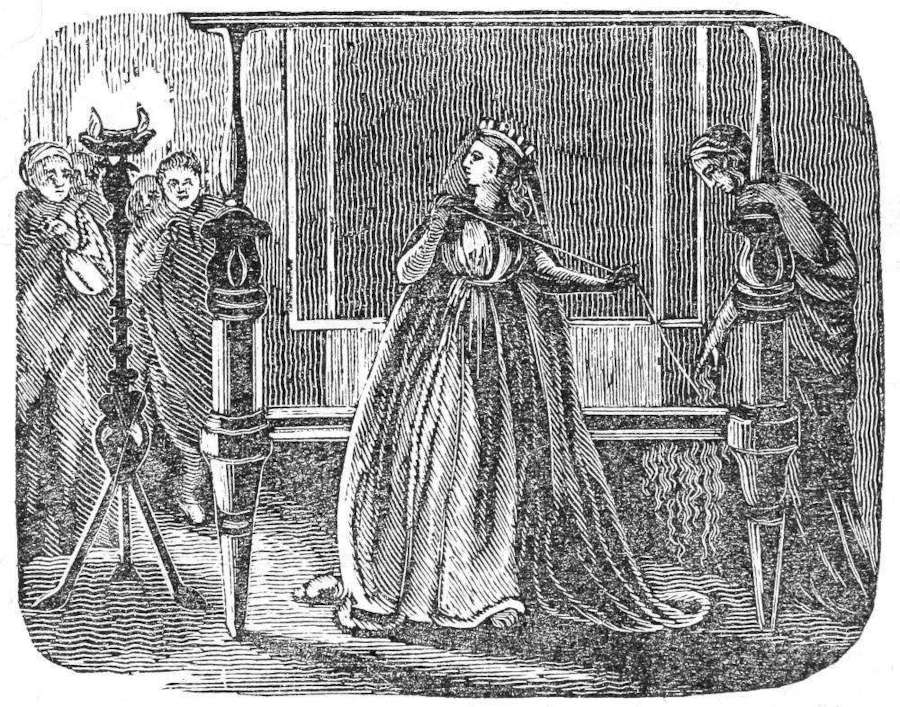
common rank. Before marriage, Penelope tended
her father’s flocks on the mountains of Arcadia; and
when she was queen of Ithaca, her son bids her attend
to the spindle and the loom, and leave the affairs
of the palace to his direction. During the absence
of her husband, she was troubled with numerous
powerful suitors, whose enmity was greatly to
be feared in those turbulent times. She promised to
choose one from among them, when she had finished
weaving a certain web; but she continually baffled
them, by unravelling in the night what she had
woven in the day: hence “Penelope’s web” became
a proverbial expression for works that were never
likely to be finished. We are told that Nausicaa,
daughter of king Alcinous, who met Ulysses shipwrecked
on her father’s coast, went down to the
shore, accompanied by her maidens, to wash clothes;
and princess as she was, she carried her dinner with
her.
Women grinding corn, after the manner of the Israelites,
are alluded to by old Greek authors; and
that they were in the habit of spinning with a distaff
as they walked, is to be inferred from the fact that it
was considered a bad omen to meet a woman working
at her spindle.
As luxury increased, the lines of demarkation between
different ranks no doubt became more obvious,
and laborious occupations were relinquished
by the wealthy. It is likewise probable that restraints
became less and less rigid. Women, in
later times, certainly joined the men in entertainments
at Aspasia’s house, and the remains of an
ancient picture leads to the conjecture that at some
period they attended the theatres. It is recorded
that certain women disguised themselves in male
attire, and went to Academus to listen to the philosophy
of Plato; and when this desire for knowledge
began to prevail, it could not be long before it
manifested itself in casting off the fetters prescribed
by custom. Individuals there were, as there ever
will be, of both sexes, who were in advance of the
people among whom they lived. Beside the far-famed
Sappho and Aspasia, there was Corinna, the
Theban poetess, who is said to have five times carried
the prize from Pindar; and there was Arete,
daughter of Aristippus, who taught philosophy and
the sciences to her son: from this circumstance the
young man was called Metrodidactos, i. e. Taught-by-his-mother.
Increasing luxury evidently did not produce universal
corruption; for the wife of Phocion was a
model of prudence, simplicity, and domestic virtue.
When one of the actors, who was to represent a
queen, demanded a more pompous retinue, Melanthius,
who was at the charge of the exhibition, said:
“Phocion’s wife appears in public with a single
maid-servant; and dost thou come here to show thy
pride, and corrupt our women?” The audience received
this remark with a thunder of applause. This
same modest matron, when a lady exhibited many
jewels in her presence, replied: “Phocion is my
greatest ornament, who is now called for the twentieth
time to command the armies of Athens.” Plutarch,
who lived as late as the time of Trajan, bears
testimony that his wife Timoxena was far above the
frivolity and affectation, which characterized many
of her sex; that she cared little for dress or parade;
and was chiefly desirous to perform all the duties,
and observe all the proprieties of life.
Of the amusements of the Grecian women we
know little. Religious festivals no doubt constituted
a large portion of their recreations. Many dances
were used on these occasions; among which was the
Caryatides, a Spartan dance, in honor of Diana.
Theseus, who invented a circular dance called the
Crane, is said to have been the first who introduced
the custom of men and women dancing together.
Various musical instruments were in use, such as
the harp and the cythara, and women doubtless
played upon these, as well as joined in the songs
appropriated to various festivals. Female characters
at the theatre were performed entirely by men in
disguise.
Ladies of rank were at all periods accompanied
by attendants; and among them was generally some
old nurse, or matron, continually about their persons.
Two such are described as waiting upon Penelope,
beside a numerous band of maidens, whom she guided
in the labors of the distaff and the loom.
The Grecian dress consisted of sandals for the feet,
and an ample flowing robe, without sleeves, fastened
at the waist by a girdle. The wealthy wore purple,
and other rich colors; the common class usually wore
white, for the economy of having it dyed when it
became soiled. Jewels, expensive embroidery, and
delicious perfumes, were used in great profusion by
those who could afford them. It is supposed that
women stained their eyebrows black, and stained the
tips of their fingers rose-color, after the manner of the
East. They took great pains to keep their teeth in
perfection, and some affirm that they painted their
lips with vermillion.
According to Socrates, the most costly female
wardrobe in his time might be valued at about fifty
minæ, or one hundred and sixty pounds, nine shillings,
and two pence.
Until the time of Cecrops, the Grecians lived
without the institution of marriage; but his laws on
that subject, being found conducive to the public
good, soon became generally observed. He expressly
forbade polygamy; but at certain periods, when
great numbers of men had been slain in battle, temporary
laws were passed allowing men to take more
than one wife. Euripides is said to have imbibed a
dislike to the whole sex by having two wives at
once, who made his house a perpetual scene of dissension.
It was allowable for a man to marry his
sister by the father’s side, but not by the mother’s.
Cimon married his sister Elpinice, because his father’s
misfortunes had left him too poor to provide a
suitable match for her; but afterward, when Callias,
a rich Athenian, became in love with Elpinice, and
offered to pay all her father’s fines, if she would consent
to be his wife, Cimon divorced her, and gave her
to him.
Parents negotiated matches for their children; and
neither young men nor maidens presumed to marry
without the consent of both father and mother.
In Athens, heiresses were compelled by law to
marry their nearest kinsmen, in order to preserve the
fortune in the family; but if he chanced to be old
and superannuated, a younger relative was admitted
into the household, and in all respects considered the
lady’s husband, except in having a legal claim to her
inheritance.
When a female orphan was left without adequate
support, the nearest relative was obliged to marry
her, or settle a portion upon her according to his
wealth and rank. When the connections were numerous,
they often combined together to contribute
the required sum.
Any foreigner who married an Athenian woman
was liable to be sold, together with his estate, and a
third part given to the accuser. Any foreign woman,
who married a citizen of Athens, was liable to be
sold for a slave, and the man was likewise fined a
thousand drachmas. These laws fell into disuse;
but were revived by Pericles for a short period, during
which five thousand Athenian citizens were sold
on account of foreign alliances.
It was common for Grecian lovers to deck the
doors of their beloved with garlands, and pour libations
of wine near the threshold, because this was the
manner in which Cupid was worshipped at his temple.
They likewise inscribed her name on trees, on
the walls of their houses, and on the books they used.
These inscriptions were generally accompanied by
some flattering epithet. In allusion to this custom,
one of the characters in Euripides says he never
should have a good opinion of women, though all the
pines in mount Ida were filled with their names.
When a person’s garland was untied, it was taken
as a sign of his being in love; and when women
were seen weaving wreaths, they were accused of
being love-sick.
Various magical arts and spells were in use to discover
the state of each other’s affections. The Thessalian
women were famous for their skill in these
matters; and the Grecian maidens were in the habit
of applying to them for assistance; thus one in Theocritus
says:
“To Agrio too I made the same demand,
A cunning woman she, I crossed her hand;
She turned the sieve and shears, and told me true,
That I should love, but not be loved by you.”
Many charms and philtres were likewise in use to
procure affection, when their love was unsuccessful.
These charms were sometimes compounded with
blood of doves, the bones of snakes and toads,
screech-owl’s feathers, bands of wool twisted upon a
wheel, and if possible from the neck of one who had
hanged himself. Sometimes pills, roots, and powerful
herbs, were the chosen ingredients; and instances
occurred wherein the unfortunate victims of superstition
lost their reason by the administration of these
dangerous philtres. Images of wax were sometimes
made and placed before the fire to melt, while certain
spells were pronounced; this was done from the
idea that there was some mysterious sympathy between
the wax and the heart of the beloved object.
Sometimes one who was forsaken and indignant
made an image of clay and placed it beside the wax,
that while one melted the other might harden; they
believed that the heart of the rejected thus became
stern and unrelenting, while the faithless lover was
softened by affection. Other enchantments, too various
to mention, were used by those who wished to
effect similar purposes.
Particular regard was paid to lucky seasons and
omens for the wedding day. The full of the moon
was considered a favorable time, and the conjunction
of the sun and moon was peculiarly auspicious. The
sixteenth day of the month was regarded as more
unlucky than any other. It was supposed that trees
planted on that day would wither and die, and that
girls who were either born or married at such a date
were destined to misery; but for a boy it was considered
a lucky augury to be born on the sixteenth.
Before marriage, the Grecian maidens offered baskets
of fruit to Diana, and many other ceremonies
were performed in her temple. On account of her
own aversion to wedlock, it was deemed peculiarly
desirable to appease her indignation, and propitiate
her favor. Sacrifices were likewise offered to Juno,
Minerva, Venus, the Fates, and the Graces. When
the victim was opened, the gall was taken out, and
thrown behind the altar, as a symbol that all anger
and malice must be cast aside. The entrails were
carefully examined by soothsayers, and if any unlucky
omen presented itself, the contract was dissolved,
as displeasing to the gods. The most fortunate
omen that could appear was a pair of turtles,
because those birds are remarkable for constant affection
to each other; if one appeared alone, it was
thought to prognosticate separation and sorrow to
the young couple.
In many places the bride was required to cut off
some of her ringlets and offer them to the gods of
marriage, at the same time pouring libations on their
altars.
Both bride and bridegroom wore bright colored
garments, and were adorned with garlands, composed
of flowers sacred to Venus, and other deities supposed
to preside over nuptials. The house where the wedding
was celebrated was likewise decked with garlands.
The Bœotians used wreaths of wild asparagus, which
is full of thorns, but bears excellent fruit; it was
therefore thought to resemble ladies, who give their
lovers some trouble in gaining their hearts, but whose
affection is a sweet reward. The bride carried an
earthen vessel full of parched barley, and was accompanied
by a maid bearing a sieve, to signify her
obligation to attend to domestic concerns; a pestle
was likewise tied to the door, for the same purpose.
The bride was usually conveyed in a chariot from
her father’s house to her husband’s in the evening.
She sat in the middle, with the bridegroom on one
side, and one of her most intimate female friends on
the other. A widower was not allowed to attend
his bride, but sent one of his friends for that purpose.
Blazing torches were carried before the young couple,
and music followed them. Homer thus describes a
bridal procession:
“The youthful dancers in a circle bound
To the soft flute, and cittern’s silver sound;
Through the fair streets, the matrons in a row
Stand in their porches, and enjoy the show.”
When the chariot arrived at the bridegroom’s
dwelling, the axletree was burnt, to signify that the
bride was never to return to the paternal roof. As
they entered, figs and various kinds of fruit were
poured on their heads, as an indication of future
plenty. A sumptuous banquet was prepared for relations
and friends, after which the company diverted
themselves with dances and hymeneal songs.
At Athens, it was customary for a boy to come in
during the feast, covered with thorn boughs and
scorns, bearing a basket full of bread, and singing,
“I have left the worse and found the better.” Some
have supposed this was in commemoration of their
change of diet from acorns to corn, but Dr. Potter’s
supposition seems much more probable; viz. that it
was intended to indicate the superiority of marriage
over single life.
In Athens, the bride’s feet were always washed in
water brought from the fountain of Callirhoe, which
was supposed to possess some peculiar virtue. She
was lighted to her apartment with several torches.
Around one of these flambeaux, the mother tied the
hair-lace of her newly wedded daughter, taken from
her head for that purpose. Mothers considered it a
great misfortune if illness, or any accident, prevented
them from performing this ceremony. The married
couple ate a quince together, to remind them that
their conversation with each other should be sweet
and agreeable. The company remained until late at
night, dancing and singing songs filled with praises
of the bridegroom and bride, and wishes for their
happiness. In the morning they returned, and again
saluted them with songs. The solemnities continued
several days; during which relations and friends
offered gifts, consisting of golden vessels, couches,
ointment boxes, combs, sandals, &c., carried in great
state to the house of the bridegroom by women, preceded
by a boy in white apparel, with a torch in his
hand, and another bearing a basket of flowers. It
was likewise customary for the bridegroom and his
friends to give presents to the bride, on the third day
after the wedding, which was the first time she appeared
unveiled.
The old Athenian laws ordered that men should
be thirty-five and women twenty-six, before they
married; but Plato considered thirty a suitable age
for the bridegroom, and other writers approved of
brides as young as eighteen, or fifteen. Grecian
women never changed the name they received when
infants: thus Xantippe would be distinguished from
another of the same name, by being called Xantippe,
the wife of Socrates.
In the primitive ages women were purchased by
their husbands, and received no dowry from relations;
but with the progress of civilization and wealth this
custom disappeared, and wives were respected in
proportion to the value of their marriage portion.
Medea, in Euripides, complains that women were the
most miserable of the human race, because they were
obliged to buy their own masters at a dear rate.
Those who brought no dowry were liable to be spoken
of contemptuously, as if they were slaves rather
than lawful wives. Hence, when men married women
without fortune, they generally gave a written
instrument acknowledging the receipt of a dowry.
Those who received munificent portions required a
greater degree of respect, and expected additional
privileges on that account. Hermione, in Euripides,
is enraged that the captive Andromache should pretend
to rival her in the affections of Pyrrhus; and
she thus addresses her:
“With these resplendent ornaments of gold
Decking my tresses, in this robe arrayed,
Which bright with various tinctured radiance flames,
Not from the house of Peleus or Achilles
A bridal gift, I come. In Sparta this
From Menelaus, my father, I received
With a rich dowry: therefore I may speak
Freely, and thus to you address my words.
Woman! would’st thou, a slave, beneath the spear
A captive, keep possession of this house,
And drive me out?”
Some have supposed that Solon intended to forbid
dowries, because one of his laws declares, “A bride
shall not carry with her to her husband above three
garments, and vessels of small value.” But this was
probably intended merely to prevent extravagance in
dress and furniture; for he allowed men who had no
sons to leave their estates to daughters, and express
laws were made to secure the property in the family,
by regulating the marriage of heiresses. The
daughters of several Grecian monarchs carried their
husbands whole kingdoms for a dowry. When distinguished
men died in poverty, the state sometimes
provided for their children. Thus the Athenians
gave three hundred drachmas to each of the orphan
daughters of Aristides, and bestowed a farm belonging
to the city upon the grand-daughter of their famous
patriot, Aristogiton. Phares, of Chalcedon,
made a law that rich men should give a portion to
their daughters when they married poor men, but receive
none with their sons’ wives. As luxury increased,
it followed, as an inevitable consequence, that
marriages were more and more made with a view to
the acquisition of wealth; and fathers were disappointed
at the birth of a daughter, on account of the
expense attending her establishment. It was customary
for the bridegroom to build and furnish the house,
and to make a settlement large in proportion to her
dowry, for the support of his wife in case of death or
divorce; but unless a written receipt of dowry could
be produced by the woman’s friends, the husband
could not be compelled to allow a separate maintenance.
Heirs were bound by law to support the
wives of those from whom they received estates.
When sons became of age, they enjoyed their mother’s
fortune during her lifetime, affording her a
maintenance in proportion to her rank. If a woman
died without children, her dowry returned to the relative
by whom it had been bestowed.
Girls who had no fathers were disposed of by
their brothers; and if they had neither parents nor
brethren, the duty devolved upon grandfathers, or
guardians. Sometimes husbands betrothed their
wives to other persons on their death-beds. The father
of Demosthenes gave his wife to one Aphobus,
with a considerable portion. Aphobus took the portion,
but refused to marry the woman after the death
of her husband; in consequence of which her son appealed
to the magistrates. The same orator engaged
in the defence of Phormio, who having been a faithful
slave, his master, before he died, bestowed upon
him freedom and his wife.
The forms of betrothing varied in some particulars
in different cities, but bore a general resemblance.
The parties took each other by the right hand, promised
fidelity, and sometimes kissed each other,
while the relative of the woman pronounced these, or
similar words: “I bestow upon thee, ——, my
daughter, or my sister, or my ward, with such and
such money, lands, cattle, or flocks, for her dowry.”
In case of divorce, a man was obliged to restore
his wife’s portion, and was required to pay monthly
interest upon it, so long as he detained it from her.
In general the Grecian laws allowed men to put
away their wives upon slight occasions; even the
fear of having too large a family was considered sufficient
ground for divorce. A woman incurred great
scandal in departing from her husband. In Athens,
if wives had reason to complain of their husbands,
they could appeal to the appointed magistrate, by
appearing publicly in court, and placing in his hands
a written statement of their grievances. Hipparete,
the wife of Alcibiades, losing all patience with his
continued profligacy, availed herself of this privilege;
but when she presented herself before the archon,
Alcibiades seized her by force, and carried her off;
no person presuming to interfere with his authority.
It was not unusual for the marriage tie to be dissolved
with consent of both parties. Thus Pericles
and his wife being weary of each other’s society, he
bestowed her upon another man, with her own free
will and consent. There is likewise reason to suppose
that men sometimes lent their wives to each
other, without any of the parties incurring blame by
the transaction; but when intrigues were carried on
without the husband’s sanction, severe penalties
were incurred. Women were sometimes put to
death, but more generally sold into slavery. They
were never after allowed to enter the temples, or wear
any but the most ordinary clothing. Whoever found
them disobeying these laws, might tear off their garments,
and beat them with any degree of severity
that did not endanger their life or limbs.
Wealthy paramours generally brought themselves
out of difficulty by paying a heavy fine; but those
unable to do this, were liable to very severe and disgraceful
punishments.
Although the law allowed but one wife, it was
thought no dishonor to keep a train of mistresses,
who were usually captives taken in war, or women
stolen by Grecian sailors and brought home for sale.
The public class of women was composed of individuals
derived from similar sources; hence the term
“strange woman,” (meaning a foreign woman,) was
a term of reproach with the Grecians, as well as the
Jews. This shameless class were required by Grecian
laws to wear flowered garments, by way of distinction
from the modest apparel of virtuous women;
and various texts of Scripture lead to the supposition
that a similar custom prevailed among the Israelites.
Some of them acquired immense wealth; and, what
is much more singular, they in some instances enjoyed
a degree of influence and consideration unattainable
by women of purer manners.
When Thebes was demolished by Alexander,
Phryne agreed to rebuild the entire walls at her own
expense, if they would engrave on them this inscription:
“These walls were destroyed by Alexander,
but raised again by Phryne the courtesan.” Phryne
had a statue of gold at Delphi, placed between two
kings. Theopompus, in his letter to Alexander,
speaking of a magnificent mausoleum near Athens,
says: “This distinguished mark of public respect a
courtesan has received; while not one of all those
who perished in Asia, fighting for the general safety
of Greece, has been thought worthy to receive a similar
honor.” Aspasia, first the mistress and afterward
the wife of Pericles, obtained unrivalled influence and
distinction. The most celebrated of the Athenian
philosophers, orators, and poets, delighted in her society,
and statesmen consulted her in political emergencies.
They even carried their wives and daughters
to her house, that they might there study agreeable
manners and graceful deportment. This, together
with the fact that Pericles made her his wife, and to
the day of his death retained such a strong affection
for her, that he never left her to go to the senate without
bestowing a parting kiss, seems to imply that she
could not have been so shockingly depraved as many
writers have supposed. It is more probable that she
deserves to rank in the same class as the Gabrielles,
and Pompadours of modern times. The public and
distinguished attention such women received in
Greece, was no doubt owing to the fact that they
alone dared to throw off the rigorous restraints imposed
upon the sex, and devote themselves to graceful
accomplishments, seductive manners, and agreeable
learning. For this reason it was generally taken
for granted that women of very strong, well-cultivated
minds were less scrupulous about modesty, than
those who lived in ignorance and seclusion. Sappho,
the celebrated poetess, has by no means descended
to posterity with an untarnished name. But a degree
of injustice is no doubt done to her memory, by
understanding the fervent language of the Greeks as
similar epithets would be understood in the dialect
of colder climes. Had Sappho been the most profligate
of woman-kind, she would not have been likely
to destroy herself for love of one individual. She
was the first woman who jumped from the famous
promontory of Leucate, called the Lover’s Leap.
The superstition prevailed that those who could perform
this feat, and be taken up alive, would be cured
of their passion.
Many ceremonies were performed by Grecian
women in the temple of Eleutho, who presided over
the birth of children. During the hours of illness it
was customary to hold palm branches in their hands,
and invoke the favor of this goddess. The old laws
of Athens expressly forbade that women or slaves
should practise physic; but one Agnodice, having
disguised herself in male attire, studied the art under
a skilful professor, and made the fact known to many
of her own sex, who gladly agreed to employ her in
preference to all others. The jealousy of the physicians
led to a discovery of the plot, and Agnodice
would have been ruined, had not all the principal
matrons of Athens appeared in court and pleaded
strongly in her favor. In consequence of their entreaties,
the old law was repealed, and women were
allowed the attendance of female physicians.
The Grecians generally wrapped infants in swaddling
bands, lest their tender limbs should become
distorted. In Athens newly born babes were covered
with a cloth on which a gorgon’s head was embroidered,
because that was represented on the shield of
Minerva, to whose care the child was consigned. It
was likewise customary to lay boys upon bucklers,
as a prognostic of future valor. Infants were often
placed upon other things bearing some resemblance
to the sort of life for which they were designed. It
was common to put them in vans made to winnow
corn, and therefore considered as emblems of agricultural
plenty. Sometimes instead of a real van,
an image of it was made of gold or silver. Wealthy
Athenians universally laid young infants upon dragons
of gold, in memory of one of their kings, who,
when an unprotected babe, was said to have been
watched by dragons. When a child was five days
old, the nurse took it in her arms and ran round the
hearth, thus putting it under the protection of the
household gods, to whom the hearth served as an
altar. This festival was celebrated with great joy.
Friends brought in their gifts, and partook of a feast,
peculiar to the occasion. If the child was a boy, the
door was decorated with an olive garland; if a girl,
wool was a substitute for the olive, in token of the
spinning and weaving destined to occupy her maturer
years. On the tenth day, another entertainment
was given, and the child received its name,
which was usually bestowed by the father. It was
common to choose the name of some illustrious or
beloved ancestor; but names describing personal and
moral qualities were frequently given, such as the
ruddy faced, the eagle-nosed, the ox-eyed, the gifted,
the lover of his brethren, &c.
When the child was forty days old, another festival
was kept, and the mother offered sacrifices in
Diana’s temple. Athenian nurses quieted fretful
babes with sponges dipped in honey.
It was common to expose children, especially females,
on account of the expense attending their settlement.
Posidippus says:
‘A man, though poor, will not expose his son,
But if he’s rich, will scarce preserve his daughter.’
The children thus exposed were wrapped in swaddling
bands, and placed in a sort of ark, or basket.
Sometimes jewels were attached to them, as a means
of discovery, if any person should find and nourish
them; or, as some have supposed, from the superstition
that it was important for the child to die with
some of the parents’ property in its possession.
The Thebans disliked this cruel practice, and their
laws made it a capital offence. Those who were too
poor to rear their children, were ordered to carry
them to the magistrates, who nourished them, and
afterwards received their services in payment.
The Grecians believed in the power of the evil eye,
especially over little children. It was generally attributed
to one under the influence of malice or envy;
and they endeavored to protect an infant from
its baneful effects, by tying threads of various colors
round the neck, and touching its forehead and lips
with spittle mixed with earth.
Filial respect and affection, the distinguishing virtue
of olden times, was in high repute among the
Grecians. The story of the daughter who nourished
her imprisoned father with her own milk, is too well
known to need repetition. Alexander the Great having
received a letter from Antipater full of charges
against Olympias, for her interference with public
affairs, the monarch read it, and said, “Antipater
knows not that one tear from a mother can blot out
a thousand such complaints.”
Solon made a law that women should not join in
the public funeral solemnities even of their nearest
relations, unless they were threescore years old; but
this law did not continue to be observed; for gallants
are described as falling in love with young women
whom they saw at funerals. It is supposed that
men and women formed separate portions of the procession;
the former preceding the corpse, the latter
following it. Mourning women were employed to sing
dirges, and bewail the dead. They beat their breasts,
disfigured their faces, and made use of other violent
demonstrations of grief. The female relatives of the
departed often joined in these excesses, altogether regardless
of the hideous scars produced thereby; but
this practice was forbidden by Solon. In many places
it was the custom for women to shave their heads,
and spread their tresses over the corpse. They laid
aside all ornaments and rich attire, and wore black
garments made of coarse materials. Those who
were joined by near relationship, or strong affection,
generally shared the same funeral urn. Thus Halcyone,
whose husband perished at sea, says:
“Though in one urn our ashes be not laid,
On the same marble shall our names be read;
In amorous folds the circling words shall join,
And show how much I loved—how you was only mine.”
A very beautiful bas-relief found at Athens, represents
a woman seated, while a man with three little
children seem bidding her an affectionate farewell.
It probably marked the sleeping-place of some beloved
wife and mother. At the funeral of a married
woman, matrons carried vases of water to pour upon
her grave; girls performed this office for maidens,
and boys for young men. These processions of water-bearers
are often represented on ancient sepulchres.
An owl, a muzzle, and a pair of reins, were
often carved on the tombs of women; as emblems of
watchfulness, silence, and careful superintendence of
the family.
It was not uncommon for widows to marry a
second time; but those who did otherwise were regarded
with peculiar respect. Charondas excluded
from public councils those men who married a second
wife, when they already had children. “Those who
do not consult the good of their own family cannot
advise well for the good of the country,” said he.
“He whose first marriage has been happy, ought to
rest satisfied with his share of good fortune; if unhappy,
he is out of his senses to incur another risk.”
In very early times the priestesses were allowed
to marry; thus Homer speaks of the beautiful Theano,
wife of Antenor, who was unanimously chosen
priestess of Minerva. At later periods, all who were
devoted to the service of the temples were required
to live unmarried.
The oracles of the gods were universally uttered
by women. The most celebrated was the Delphian
oracle of Apollo. The priestess who uttered the
prophetic words was called Pythia, or Pythonissa.
She was obliged to observe the strictest rules of
temperance and virtue, and to clothe herself in simple,
modest, and maidenly apparel. They neither
anointed nor wore purple garments, because such
habits belonged to the rich and luxurious. In early
times the Pythia was chosen from young maidens;
but in consequence of a brutal insult offered to one
of them, the selection was ever after made from women
more than fifty years old. Before the prophetess
ascended the tripus, where she was to receive
inspiration, she bathed herself, especially her hair, in
the fountain of Castalia, at the foot of Parnassus.
When she seated herself upon the tripus, she shook
the laurel tree, that grew near it, and sometimes ate
the leaves, which were thought to contain some virtue
favorable to prophecy. In a short time she began
to foam at the mouth, tear her hair, and cut her
flesh, like a maniac. The words she uttered during
these paroxysms were the oracles. The fits were
more or less violent; sometimes comparatively gentle.
Plutarch speaks of one enraged to such a degree
that the terrified priests ran from her, and she
died soon after. The time of consulting the oracle
was only one month, in the spring of the year.
Women had their share in sacred festivals among
the Greeks. In the processions of the Panathenæa,
in honor of Minerva, women clothed in white carried
torches and the sacred baskets. At the annual solemnity
in honor of Hyacinthus and Apollo, the Laconian
women appeared in magnificent covered chariots,
and sometimes in open race-chariots. At the
processions in honor of Juno, her priestess, who was
always a matron of the highest rank, rode in a chariot
drawn by white oxen. Aristophanes describes
the wife and daughter of a citizen as assisting in the
ceremonials of a rural sacrifice to Bacchus. The
girl carried a golden basket filled with fruit, and a
ladle with which certain herbs were poured over the
sacred cakes. Her father followed, singing a hymn
to the god, while the mother, standing on the house-top,
watched the procession, and charged her daughter
to conduct herself like a lady, as she was, and to
be cautious lest her golden ornaments were stolen in
the crowd.
One of the most ancient ceremonies among the
Greek women was that of bewailing annually, with
dirges and loud cries, the death of Adonis. Processions
were formed, and images of Venus and Adonis
carried aloft, together with shells filled with
earth, in which lettuces were growing. This was
done in commemoration of Adonis laid out by Venus
on a bed of lettuce.
In Attica, all girls not over ten or under five were
consecrated to the service of Diana, during a solemnity
which took place once in five years. On that occasion
all female children of the proper age appeared
dressed in yellow robes, while victims were offered
to the goddess, and certain men sung one of Homer’s
Iliads. No Athenian woman was allowed to be
married unless this ceremony had been performed.
The festival in honor of Ceres was observed with
much solemnity at Athens. None but free-born
women were allowed to be present; and every husband
who received a portion of three talents with
his wife, was obliged to assist in defraying the expenses.
The women were assisted in the ceremonials
by a priest, who wore a crown, and by certain
maidens, who were strictly secluded, kept under severe
discipline, and maintained at the public charge.
The solemnity lasted four days. All the women who
aided in it were clothed in simple white garments,
without ornaments or flowers. Not the slightest
immodesty or merriment was permitted; but it was
a custom to say jesting things to each other, in memory
of Jambe, who by a jest extorted a smile from
Ceres, when she was discouraged and melancholy.
On one of the festival days, the women walked in
procession to Eleusis, carrying books on their heads,
in memory of Ceres, who was said to have first
taught mankind the use of laws; on this occasion it
was against the law for any one to ride in a chariot.
There was likewise a mysterious sacrifice to Ceres,
from which all men were excluded; this was said to
have been because in a dangerous war, the prayers of
women so prevailed with the gods, that their enemies
were driven away.
The custom of offering human beings as sacrifices
to the gods was regarded with great abhorrence by
the primitive Greeks; but several instances occurred
in later times where captives taken in war were devoted
to this purpose. There is reason to suppose
that the victims were generally men; but there were
exceptions to this remark. Bacchus had an altar in
Arcadia, upon which young damsels were beaten to
death with bundles of rods. Iphigenia, daughter of
Agamemnon, was likewise about to be sacrificed to
Diana, because the soothsayer so decreed, when the
Greeks were kept back from the Trojan war by contrary
winds; and Macaria, the daughter of Hercules
and Dejanira, voluntarily offered herself as a victim,
when the oracle declared that one of her father’s family
must die, to insure victory over their enemies. Great
honors were paid to the memory of this patriotic girl,
and a fountain in Marathon was called by her name.
The Athenian slaves were much protected by the
laws. If a female slave had cause to complain of
any want of respect to the laws of modesty, she
could seek the protection of the temple, and demand
a change of owners; and such appeals were never
discountenanced or neglected by the magistrates.
The Milesian women being at one period much addicted
to suicide, a law was passed that all who died
by their own hands should be exposed to the public;
and this effectually prevented an evil, which no other
means had been able to prevent.
The customs of Sparta differed in many respects
from the rest of Greece. When a match was decided
upon, the mother, or nurse of the bride, or some other
woman who presided over the arrangements, shaved
the girl’s hair, dressed her in masculine attire, and
left her alone in an apartment at evening. The lover,
in his every-day clothes, sought an opportunity to
enter by stealth, but took care to return to his own
abode before daylight, that his absence might not be
detected by his companions. In this manner only
did custom allow them to visit their wives, until they
became mothers. Lycurgus passed a law forbidding
any dowry to be given to daughters, in order that
marriage might take place from motives of affection
only. Marriage was much encouraged in every part
of Greece, and peculiarly so in Sparta. The age at
which both sexes might marry was prescribed by
law, and any man who lived without a wife beyond
the limited time was liable to severe penalties. Once
every winter, they were compelled to run round the
forum without clothing, and sing a certain song, the
words of which exposed them to ridicule; they were
not allowed to be present at the exercises where
beautiful young maidens contended; on a certain
festival, the women were allowed to drag them round
an altar, beating them with their fists; and young
people were not required to treat them with the same
degree of respect that belonged to fathers of families.
Polygamy was not allowed, and divorces were extremely
rare; but the laws encouraged husbands to
lend their wives when they thought proper. Lycurgus
reversed the Athenian custom, and allowed brother
and sister of the same mother to marry, while
he forbade it if they both had the same father. In
Sparta there was a very ancient statue, called Venus
Juno, to which mothers offered sacrifice on the occasion
of a daughter’s marriage.
Damsels appeared abroad unveiled, but married
women covered their faces. Charilus, being asked
the reason of this practice, replied, “Girls wish to
obtain husbands, and wives aim only at keeping
those they already have.” Lycurgus ordered that
maidens should exercise themselves with running,
wrestling, throwing quoits, and casting darts, with
the view of making them healthy and vigorous; and
for fear they might have too much fastidiousness and
refinement, he ordered them to appear on these occasions
without clothing. All the magistrates and
young men assembled to witness their performances,
a part of which were composed of dances and songs.
These songs consisted of eulogiums upon such men
as had distinguished themselves by bravery, and
satirical allusions to those who had been cowardly
or effeminate; and as they were sung in hearing of
the senate and people, no inconsiderable degree of
pride or shame was excited in those who were the
subjects of them.
The Spartans bathed new-born infants in wine,
from the idea that vigorous children would be
strengthened by it, while those who were weakly
would either faint, or fall into convulsions. Fathers
were not allowed to educate and nourish their own
children, if they were desirous to do so. All infants,
being considered the property of the commonwealth,
were brought to the magistrates to be examined. If
vigorous and well formed, a certain portion of land
was allotted for their maintenance; but if they appeared
sickly or deformed, they were thrown into a
deep cavern and left to perish.
The Spartan nurses were so celebrated, that they
were eagerly sought for by people of other countries.
They never used swaddling bands, and religiously
observed the ceremony of laying infants upon bucklers,
as soon as they were born. They taught children
to eat any kind of food, or to endure the privation
of it for a long time; not to be afraid when left
alone, or in the dark; to be ashamed of crying, and
proud to take care of themselves.
The Spartans mourned for deceased relations with
great composure and moderation; though when a
king died, it was customary for men, women, and
slaves, to meet together in great numbers, and tear
the flesh from their foreheads with sharp instruments.
Indeed, in all things they endeavored to make their
own interest and feelings subordinate to the public
good. When news came of the disastrous overthrow
of the Lacedæmonian army at Leuctra, those matrons
who expected to receive their sons alive from the
battle, were silent and melancholy; while those who
received an account that their children were slain in
battle, went to the temples to offer thanksgivings,
and congratulated each other with every demonstration
of joy.
The Lacedæmonians usually carried bodies to the
grave on bucklers; hence the command of the Spartan
mother to her son, “either to bring his buckler
back from the wars, or be brought upon it.”
Some foreign women said to Gorgo, wife of king
Leonidas, “You Spartans are the only women that
govern men.” “Because we are the only women
who give birth to men,” she replied. This answer
was in allusion to their own strength and vigor, and
to the pains they took to make their boys bold and
hardy.
The Lacedæmonian women seem to have had a
share in all the concerns of the commonwealth; and
during the early portions of their history they appear
to have been well worthy of the respect paid to
them. When a new senator was chosen, he was
crowned with a garland, and the women assembled
to sing his domestic virtues and his warlike courage.
At the public feast given in honor of his election, he
called the female relative for whom he had the greatest
esteem and gave her a portion, saying, “That
which I received as a mark of honor, I give to you.”
When Cleomenes, king of Sparta, was beset with
powerful enemies, the king of Egypt agreed to furnish
him with succors, provided he would send his
mother and his children as hostages. Filial respect
and tenderness made the prince extremely unwilling
to name this requisition. His mother, perceiving that
he made an effort to conceal something from her,
persuaded her friends to tell her what it was. As
soon as she heard it, she laughed outright, and said,
“Was this the thing you so long hesitated to communicate?
Put us on board a ship, and send this
old carcase of mine wherever you think it may be
of the most use to Sparta, before age renders it good
for nothing, and sinks it into the grave.” When
everything was ready for departure, she, being alone
with her son, saw that he struggled hard with emotion.
She threw her arms around him, and said,
“King of the Lacedæmonians, be careful that we do
nothing unworthy of Sparta! This alone is in our
power; the event belongs to the gods.”
When Cleombrotus rebelled against his wife’s father,
in spite of her entreaties, and usurped the kingdom,
Chelonis left her husband and followed the
fallen fortunes of her parent; but when the tide
turned, and Cleombrotus was in disgrace and danger,
she joined her husband as a suppliant for royal mercy,
and was found sitting by him, with the utmost tenderness,
with her two children at her feet. She assured
her father that if his submission and her tears
could not save his life, she would die before him.
The king, softened by her entreaties, changed the
intended sentence of death into exile, and begged his
daughter to remain with a father who loved her so
affectionately. But Chelonis could not be persuaded.
She followed her husband into banishment.
Such was the character of Spartan women in the
earlier periods of their history; but in later times
their boldness and immodesty increased to such a
degree that they became a by-word and a reproach
throughout Greece.
In Grecian mythology, the goddesses are about as
numerous and important as the gods. That Beauty,
Health, and Majesty should be represented as female
deities, is by no means remarkable; but, considering
the estimation in which women were held, it is
somewhat singular that Wisdom should have been a
goddess, and that sister muses should have presided
over history, epic poetry, dramatic poetry, and astronomy.
The tradition that Ceres first taught the
use of laws does not probably imply that legislation
was invented by a woman; but that as men left a
wandering life, and devoted themselves to agriculture,
(of which Ceres was the personification,) they
began to perceive the necessity of laws for mutual
defence and protection.
In the earliest and best days of Rome, the first
magistrates and generals of armies ploughed their
own fields, and threshed their own grain. Integrity,
industry, and simplicity, were the prevailing virtues
of the times; and the character of women was, as it
always must be, in accordance with that of men.
Columella says: “Roman husbands, having completed
the labors of the day, entered their houses, free
from all care, and there enjoyed perfect repose.
There reigned union, and concord, and industry, supported
by mutual affection. The most beautiful woman
depended for distinction only on her economy,
and endeavors to assist in crowning her husband’s
diligence with prosperity. All was in common between
them; nothing was thought to belong more to
one than another. The wife, by her assiduity and
activity within doors, equalled and seconded the industry
and labor of her husband.”
It was common for sons to marry and bring home
their wives to the paternal estate. Plutarch says:
“There were not fewer than sixteen of the Ælian
family and name, who had only a small house and
one farm among them; and in this house they all
lived, with their wives and many children. Here
dwelt the daughter of Æmilius, who had been twice
consul, and had triumphed twice; not ashamed of
her husband’s poverty, but admiring that virtue
which kept him poor.”
Tanaquil, wife of Tarquin the First, one of the
best kings of Rome, was noted for her industry and
ingenuity, as well as energy and ambition. Her distaff
was hung up in the temple of Hercules, and her
girdle, with a robe she embroidered for her son-in-law,
were long preserved with the utmost veneration.
Her political influence seems to have been great, and
her liberality munificent. Her husband was originally
a private citizen of Tarquinia; but her knowledge
of augury led her to predict that an uncommon
destiny awaited him at Rome, and she persuaded
him to go thither. After his death, she succeeded in
raising her son-in-law, Servius Tullius, to the throne.
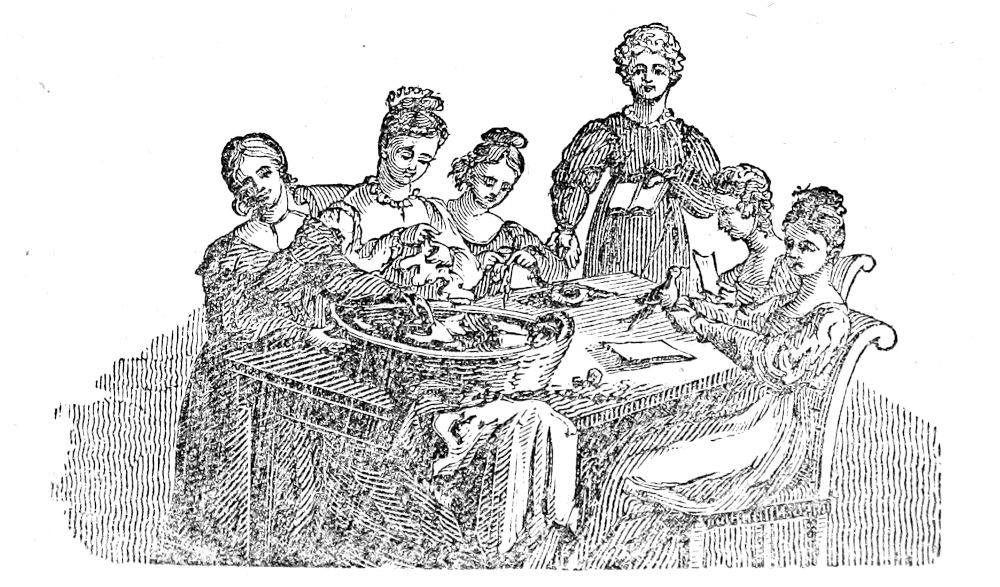
Lucretia, a young matron of high rank, was found
busy among her maidens, assisting their spinning
and weaving, and preparation of wool, when her
husband arrived with his guests, late in the evening.
The high value placed upon a stainless reputation
may be inferred from the fact that Lucretia would
not survive dishonor, though she had been the blameless
victim of another’s vices.
Cornelia, the daughter of Scipio Africanus, was
courted by a monarch, but preferred being the wife
of Sempronius Gracchus, a Roman citizen. After
the death of her husband, she took the entire management
of his estate, and the education of her sons.
She was distinguished for virtue, learning, and good
sense. She wrote and spoke with uncommon elegance
and purity. Cicero and Quintilian bestow
high praise upon her letters. The eloquence of her
children was attributed to her careful superintendence.
When a Campanian lady ostentatiously displayed
a profusion of jewels, and begged Cornelia to
show hers, she exhibited her boys, just returned from
school, saying: “These are my jewels; the only
ornaments of which I can boast.” During her lifetime,
a statue was erected in honor of her character,
bearing this inscription: “Cornelia, mother of the
Gracchi.”
The rigid decorum of Roman manners may be
inferred from the circumstance that Cato expelled a
senator, merely because he kissed his wife in the
presence of his daughter. “For my own part,” said
he, “my wife never embraces me except when it
thunders terribly;” adding, by way of joke, “I am a
very happy man when Jove is pleased to thunder.”
The superior condition of Roman women, in comparison
with the Greeks, may in a great measure be
attributed to an event that occurred in the very beginning
of their history.
Romulus, being unable to obtain wives for the citizens
of his new commonwealth, celebrated public
games, to which people of neighboring nations were
invited. In the midst of the entertainment he and
his soldiers seized a large number of women, principally
Sabines, and carried them off to his camp.
Their restitution was demanded and refused; but the
warlike husbands, anxious to conciliate the affections
of wives obtained in a manner so violent, treated them
with such tenderness, that the women were themselves
unwilling to return to their relatives. This led to a
war with the Sabines, and Romulus was closely besieged
in his citadel. At this crisis, Hersilia, his
wife, asked and obtained an audience with the senate,
in which she told them that the women had formed
a design of acting as mediators between their husbands
and fathers. A decree was immediately passed
in favor of the proposition. Every woman was
required to leave one of her children, as a hostage
of her return; the others they carried in their arms,
to soften the feelings of their parents. They proceeded
to the Sabine camp, dressed in deep mourning,
and knelt at the feet of their relatives. Hersilia
described the kindness of their husbands, and their
own reluctance to be torn from their families, in a
manner so eloquent and pathetic, that an honorable
and friendly alliance was soon agreed upon.
In consideration of this important service, the Romans
conferred peculiar privileges on women. In
capital cases, they were exempted from the jurisdiction
of ordinary judges; no immodest language or
behavior was allowed in their presence; every one
was ordered to give way to them in the street; and
a festival was instituted in their honor, called Matronalia,
during which they served their slaves at
table, and received presents from their husbands.
Three kinds of marriage were in use among the
Romans, called confarreatio, coemptio, and usus. The
first was established by Romulus, and was the most
solemn, as well as the most ancient. A priest, in
the presence of at least ten witnesses, pronounced
certain words, and sacrificed to the gods a cake made
of salt, water, and wheat-flour. The bride and bridegroom
ate of this cake, to signify the union which
ought to bind them. This manner of celebrating
marriage made a wife the partner of all her husband’s
substance, and gave her a right to share in
the peculiar sacred rites attached to his family. If
he died intestate, and without children, she inherited
his whole fortune, as a daughter; if he left children,
she shared equally with them. If she committed any
fault, the husband judged of it in presence of her relations,
and punished her at pleasure. Sometimes
when women were publicly condemned by law, the
penalty was left to the judgment of her husband and
relations. The priests of Jupiter were chosen from
sons born of this kind of marriage, and the vestal
virgins were selected from the daughters.
The coemptio, or mutual purchase, consisted of the
bride and bridegroom’s giving each other pieces of
money. The man asked the woman, “Are you willing
to be the mistress of my family?” She answered,
“I am willing;” and then asked him a similar question,
to which he replied in the same manner. According
to some authors it was accompanied with the
same ceremonies, and conferred the same privileges,
as the other form of marriage; and it continued in
use a long time after confarreatio was out of date.
That which was called usus, or usage, was when a
woman, with consent of her parents or guardians,
lived a whole year with a man, without being absent
from his house three nights. She thus became his
wife, and is supposed to have had the same rights
and privileges as other wives; but if absent three
nights, she was said to have annulled the contract.
No young man was allowed to marry before he
was fourteen, and no girl before she was twelve. A
man sixty years old was not permitted to marry a
woman younger than fifty; and if he was more than
sixty, he could not marry a woman of fifty.
Brothers and sisters, uncles and aunts, and cousin-germans,
were not permitted to marry each other.
For some time it was contrary to law for a patrician
to marry a plebeian; but this continued only about
five years.
All alliances with women of blemished reputation,
or low extraction, were considered dishonorable. No
marriage of a Roman with a foreigner could be legal,
unless express permission had been first obtained from
the government. Cicero even reproached Anthony
for marrying Fulvia, because her father was a freed-man.
A law was, however, passed, by which only
senators, their sons, and grandsons, were forbidden to
marry a freed-woman, an actress, or the daughter of
an actor. Finally the right of citizenship was granted
to all inhabitants of countries belonging to the
Roman empire, and the stigma attached to foreign
alliances was removed.
Neither sons nor daughters could marry without
their father’s approbation. The mother’s consent
was usually asked as a matter of propriety, though
there was no legal restriction to that effect.
When the consent of parents had been obtained,
the relatives held a meeting to settle the articles of
contract, which were written and sealed, in presence
of witnesses. They broke a straw, according to
their custom in making bargains; hence it was
called stipulation, from stipula, a straw. This occasion
was usually celebrated by a feast, during which
the bridegroom made presents to the bride, and gave
her a ring, that in early times was plain, and made
of iron, but afterwards of gold. It was worn on the
fourth finger of the left hand, on account of the idea
that a vein went from that finger to the heart. Some
of these bridal rings were made of brass or copper,
with the figure of a key, to signify that the husband
delivered her the keys of his house. Some of them
have been found bearing devices; such as I love you.
I wish you a happy life.Love me. If, after the
espousals, either party wished to retract, they could
do so, by observing certain forms.
The marriage portion varied according to the
wealth and rank of the parties. It was delivered in
money, or secured upon lands; and was paid at
three terms fixed by law. The husband was not permitted
to alienate it; and in case of divorce, except
it took place by his wife’s fault, her relations could
reclaim it. If any citizen caused a woman to lose
her fair fame, he was obliged to marry her without a
portion, or give her one proportioned to her rank.
In the first days of the republic, dowries were very
small. The senate gave the daughter of Scipio
about £35 10s.; and one Megullia was surnamed
Dotata, or the Great Fortune, because she had £161
7s. 6d. sterling. But as wealth increased, the marriage
portions became greater, until eight or nine
thousand pounds sterling was the usual dowry of
women of high rank. Seneca says, “The sum that
the senate thought sufficient dowry for the daughter
of Scipio, would not now suffice even the daughters
of our freed-men to buy a mirror.”
No marriage took place without first consulting
the auspices, and sacrificing to the gods, especially
to Juno, who presided over matrimonial engagements.
Like the Greeks, they took the gall from
the victims, and threw it behind the altar.
Certain days and festivals were regarded as unlucky
for a wedding; particularly those marked in
the calendar with black; but widows might marry
on those days. The whole month of May was regarded
as unfortunate for marriage, and the middle
of June peculiarly auspicious. The ceremony was
performed at the house of the bride’s father, or nearest
relation. She was dressed in a long white robe
bordered with purple, and fastened with a girdle
made of wool. Her hair was divided into six locks
with the point of a spear, and crowned with a wreath
of vervain gathered by herself. Her face was covered
with a flame-colored veil, and she wore high shoes of
the same color. In the evening, she was conducted
to her husband’s house. She was taken apparently
by force from the arms of her mother, or nearest female
relative, in memory of the Sabine women seized
by Roman soldiers. Three boys, who had parents
living, attended upon her; one supporting each arm,
and the third walking before her with a lighted flambeau.
Relations and friends eagerly sought to carry
away this torch, when they came near the bridegroom’s
house; partly on account of some peculiar
virtue it was supposed to possess, and partly for fear
it should be made use of for some fascination, that
would shorten the lives of the young couple.
A young slave followed the bride, carrying, in a
covered vase, her toilet, and corals, and children’s
playthings of all kinds, accompanied by maidens,
bearing distaff, spindle, and wool. A great train of
relations and friends attended the nuptial procession.
The door of the bridegroom’s house was adorned
with festoons, garlands of flowers, and lists of woollen,
rubbed with oil, and the fat of swine or wolves,
to avert enchantments. When the bride arrived thither,
being asked who she was, she answered, “Caia.”
This custom was taken from the name of Caia Cœcilia,
generally called Tanaquil; and the bride’s answer
implied that she intended to imitate such a good
and industrious wife. She then bound the door-posts
of her bridegroom with woollen fillets, likewise anointed
with oil, and the fat of swine or wolves; from this
circumstance the Latin word for wife is uxor, which
signifies the anointer; and our word uxorious is
thence derived.
The bride was gently lifted over her husband’s
threshold; for it was reckoned a bad omen to touch
it with her feet, because the threshold was sacred to
Vesta, who presided over female purity.
As soon as she entered, they sprinkled her with
water, and delivered the keys of the house, to show
that she was intrusted with the management of the
family; and a sheep-skin was spread before her, indicating
that she was to work in wool. Both she and
her husband were required to touch fire and water;
and with the water their feet were afterward bathed.
In the early ages they put a yoke about the neck of
the young couple, as an emblem of the mutual assistance
they were expected to render each other in the
cares and duties of life. The Latin word conjugium,
a yoke, is the origin of our word conjugial. The
bridegroom feasted the relations, friends, and attendants
of himself and bride. He was placed at the
head of the table, and the bride was laid in his bosom.
The feast was distinguished for the abundance,
variety, and delicacy of the refreshments. It was
accompanied with music. The guests sung to the
honor of the newly married an epithalamium, beginning
and ending with acclamations, in which was
often repeated the name of Thalassius. The following
circumstance is supposed to have been the origin
of this custom: when the Sabine women were forcibly
carried to the Roman camp, one of them, very
remarkable for her youthful beauty, attracted so
much attention, that quarrels were likely to ensue
concerning her. The men who carried her, wishing
to avoid any such contention, thought of exclaiming
aloud that they were carrying her to Thalassius, a
handsome and brave young man, exceedingly beloved
by the people. As soon as this was proclaimed, the
soldiers withdrew all opposition, and rent the air
with acclamations of the hero’s name. The marriage
thus prepared for Thalassius proved so happy
and prosperous, that the Romans ever after, in their
epithalamia, were accustomed to wish the newly-married
pair a destiny like his.
The bride was conducted to her apartment by matrons,
who had been married to only one husband.
The bridegroom scattered nuts among the boys, and
the bride consecrated her dolls and playthings to
Venus, thereby intimating that they relinquished
the sports of childhood. When the guests departed,
small presents were distributed among them.
Next day another entertainment was given, when
presents were sent to the bride by relations and
friends, and she performed certain sacred rites appropriate
to the mistress of a family. The goods which
a woman brought her husband beside her dowry were
called bona paraphernalia.
Daughters generally received the name of their
father, or some relation, varied only by ending according
to the feminine instead of the masculine gender:
thus Hortensia was the daughter of Hortensius;
and the two daughters of Mark Antony were named
Antonia Major, and Antonia Minor. By way of
endearment they frequently made use of those diminutives,
to which the language of Italy owes so much
of its gracefulness; thus the beloved daughter of
Tullius Cicero was called Tulliola. In a numerous
family, girls were often distinguished from each other
by the diminutives of numbers; as Secundilla, and
Quartilla, the Second and the Fourth. At marriage,
a woman retained her original name with the addition
of her husband’s; thus Cornelia, the wife of
Sempronius Gracchus, was called Cornelia Sempronia.
The birth of children was celebrated by a domestic
festival, during which the gates were adorned with
branches, garlands, and lamps, and a piece of money
was deposited in the temple of Juno Lucina, whose
office corresponded to the Eleutho of the Grecians.
Boys received the family name on the ninth day after
birth, and girls on the eighth; but they did not give
the prænomen, or, as we should say, the baptismal
name, until they took the virile robe, which marked
their entrance into manhood; and girls did not receive
it till they were married.
Romulus introduced the Spartan custom of exposing
all sickly and deformed children; with this
restriction, that every child should be nourished
three years, in order to try whether it would not, in
that interval, attain health and vigor. In later times,
this prohibition was disregarded, and the custom of
exposing infants became very common.
While the Romans retained their primitive simplicity,
mothers nursed their own babes, and would
have considered it a great misfortune or reproach, to
have employed another to fulfil that tender office;
but as luxury increased, indolence and love of pleasure
so far conquered maternal affection, that women
of rank almost universally consigned their children
to the care of female slaves.
Education kept pace with the changing character
of the people. At first, children were brought up in
habits of laborious industry. When the arts and
sciences were introduced, the cultivation of the mind
and manners received a considerable degree of attention;
and we know that girls shared in these privileges,
because when Claudius wished to seize the
beautiful Virginia as a slave, in order to deliver her
to the infamous Appius, he arrested her as she returned
from school, attended by her governante. In
the last days of Rome, personal habits were exceedingly
luxurious, and education became showy and
superficial, because it was acquired from vanity, rather
than a love of knowledge. The power of Roman
fathers was excessive. They could imprison
their children, load them with fetters, make them
work with the slaves, sell them, and even put them
to death; but mothers had no legal share in this authority.
A story is told of a Roman girl, who was
starved to death by her father, because she picked the
lock of a wine chest, to get at the wine.
The habit of adopting children, even when the
parents on both sides were living, was very common.
The adopted were subject to the same authority, and
received the same share of inheritance, as real sons
and daughters. They generally retained the name
of their own family, in addition to the one into
which they were adopted.
Though the Romans rivalled all preceding nations
in justice and kindness toward women, yet husbands
were intrusted with a degree of power, which modern
nations would consider dangerous. A man might
divorce his wife, if she violated the matrimonial vow,
poisoned his offspring, brought upon him suppositious
children, counterfeited his private keys, or drank
wine without his knowledge. Valerius Maximus
says that Egnatius Metellus, having detected his
wife drinking wine out of a cask, put her to death,
and was acquitted by Romulus.
The ancient Romans did not allow women to inherit
property; but as wealth increased, fathers did
not like to leave their fortunes to distant male relatives,
while their daughters were left portionless;
they therefore managed to elude the law, by making
such provision for their children, as rendered the
estates so taken of little value. The people, vexed
at these proceedings, passed the Voconian law, by
which no woman could inherit an estate, even if she
were an only child; but after a time, the right of
succession, both in moveables and land, was granted
to females after the death of their brothers.
Women could not dispose of property, or transact
any business of importance, without the concurrence
of a parent, husband, or guardian. Sometimes a man
appointed a guardian to his widow, or daughters,
and sometimes they were allowed to choose for themselves.
In some cases, discreet elderly women were
appointed guardians. No women, except the vestal
virgins, were allowed to give evidence in a court of
justice concerning wills. The favorite attendants of
noble Romans were sometimes intrusted with an extraordinary
degree of power over the wives of their
masters. Justinian’s principal eunuch threatened to
chastise the empress, if she did not obey his orders.
These facts show that Roman women were by no
means admitted to the social equality, which characterizes
the intercourse of the sexes at the present
time; but they ate and drank with the men, were
present at convivial entertainments, enjoyed the
evening air in the public groves, accompanied by
fathers, husbands, or brothers, and enjoyed many
privileges to which the women of neighboring nations
were entire strangers.
The Romans treated female captives with shameless
brutality. Queens and princesses were compelled
to submit to the grossest personal indignities,
and were often dragged through the streets chained
to the conqueror’s chariot wheels. The stern ferocity
that mingled with their better qualities is shown
in the story of one of the Horatii, who killed his
sister, merely because she wept for her lover slain
by his hand; and the example of Marcia, wife of
Regulus, who shut up some Carthagenian prisoners
in a barrel filled with sharp nails, to revenge her
husband, who had been put to death in Carthage. It
is, however, true that these actions were not sanctioned
by public opinion; for Horatius was punished,
and the senate interfered to check the wanton cruelty
of Marcia.
The Romans followed the common practice of
hiring mourning women to sing funeral songs in
praise of the dead. The nearest female relations
sometimes tore their garments, and covered their
hair with dust. In the funeral procession, sons veiled
their faces, and daughters went with uncovered
heads and dishevelled hair, contrary to the usual
practice of both. They followed the Grecian custom
of burning the corpse, and depositing the ashes
in an urn. Infants, that died before they had teeth,
were buried, not burned; and all children not weaned
were carried to the grave by their mothers. The
sepulchres were covered with flowers and garlands,
and a small altar was placed near, on which libations
were made, and incense burnt.
It was thought dishonorable for men to mourn;
but the law prescribed that women should mourn
ten months for a parent, or a husband. During this
time they laid aside ornaments, and purple garments,
and staid at home, avoiding all amusements; some
even refrained from kindling a fire in the house on
account of its cheerful appearance. Under the republic,
women dressed in black like the men; but
under the emperors, when party-colored garments
came in fashion, they wore white for mourning. If
a widow married within ten months after her husband’s
decease, she was held infamous. Indeed second
marriages were never esteemed honorable in
women. Even in the most corrupt days of the empire,
those who had been married but to one husband
were treated with peculiar deference; hence
Univira is often found on ancient sepulchres, as an
epithet of honor.
Plutarch says maidens never married on festivals,
nor widows on working-days, because marriage was
honorable to the one and seemed not to be so to the
other; for which reason they celebrated the marriage
of widows in presence of a few, and on days that
called off the attention of the people to other spectacles.
Those who remained widows had the first
place in certain solemn ceremonies. The crown of
chastity was decreed to them; and if they married
again, they were never after allowed to enter the
temple of that divinity.
The Romans borrowed their mythology from the
Grecian, where female deities abound. When they
invoked the gods by name, in their temples, the Romans,
in order to avoid mistakes, were accustomed
to add, “Whether thou art a god, or whether thou
art a goddess.” Women, as well as men, filled the
sacred office of the priesthood. The vestal virgins
were young girls, six in number, devoted to the service
of Vesta. When any vacancy occurred, twenty
maidens, not younger than six, or older than sixteen,
were selected from the families of Roman citizens.
It was required that their parents should both be
living, and free-born, and that they themselves should
be without any bodily imperfection or infirmity. It
was determined by lot which of the twenty should
be chosen; unless some one, with requisite qualifications,
was voluntarily offered by parents, and approved
by the pontifex maximus, or high priest. The
vestals were bound to their ministry for thirty
years. For the first ten, they learned the sacred
rites; for the next ten, they performed them; and
for the last ten, they taught the younger virgins.
It was the business of the vestals to keep the sacred
fire continually burning; they watched it in
the night time alternately; and whoever allowed it
to go out, was severely scourged. The fire was relighted
from the rays of the sun, and extraordinary
sacrifices were made to avert the unlucky omen.
Certain sacred images, on the preservation of which
the safety of Rome was supposed to depend, were
likewise intrusted to the care of the vestals. Wills
and testaments were often deposited in their hands,
by people who were afraid that relations would commit
frauds and forgeries. They were chosen as the
umpires of difficulties between persons of rank; and
their prayers were thought to have peculiar influence
with the gods. Even the prætors and consuls, when
they met them in the street, lowered their fasces,
and went out of the way, to show them respect.
They were supported by a public salary; had a
lictor to attend them in the streets; rode in chariots;
and sat in a distinguished place at the spectacles.
Any insult to them was punished with death;
and if a criminal chanced to meet one of them on
his way to execution, he was immediately set at
liberty, provided the vestal affirmed that the meeting
was unintentional. They were allowed to make
their wills, although under age; and were not subject
to the power of parents or guardians, like other
women. They were not forced to swear, unless so
inclined; and their testimony was admitted concerning
wills, though no other female was allowed to
give evidence on the subject. Beside these exclusive
honors, they enjoyed all the privileges of matrons
who had three children.
If any vestal violated her vow of chastity, she was
buried alive, with funeral solemnities, after being
tried and sentenced; and her paramour was scourged
to death in the forum. Such an event was always
thought to forebode some dreadful calamity to the
state, and extraordinary sacrifices were offered in expiation.
When the vestals were first chosen, their hair was
cut off, and buried under an old lotus tree in the city;
but it was afterward allowed to grow. They wore
long white robes, edged with purple, and their heads
were decorated with fillets and ribands. When
they left the service of the temple, they might marry;
but this was seldom done, and always reckoned
ominous.
There was at Rome a temple to the goddess who
presided over the peace of marriages, and the appeasement
of husbands. Gibbon remarks that her
name, Viriplaca, shows that repentance and submission
were always expected from the woman. When
domestic quarrels occurred, sacrifices were offered in
this temple, to procure reconciliation.
Beside innumerable religious ceremonies appropriated
to certain families, and performed on certain
occasions, it was customary for the Roman women,
at the end of every consular year, to celebrate in the
house of the consul, or prætor, certain rites in honor
of Bona Dea, or the good goddess. No man was allowed
to be present; even the consul himself was
obliged to leave his dwelling. Before the ceremonies
commenced, every corner and lurking-place was
carefully searched; all pictures and statues of men
contained within the building were covered with a
thick veil; and male animals of every kind were
driven away. All being in readiness, the vestal virgins
offered the customary sacrifices; and women
kept a secret so much better than free masons have
done, that to this day there is no conjecture in what
the ceremonies consisted, or why they were observed.
Only one attempt was ever made to violate the prescribed
rules. While Pompeia, the third wife of
Julius Cæsar, was celebrating the mysteries, Clodius,
a profligate Roman, who was enamored of her beauty,
habited himself as a singing girl, and walked through
the rooms, avoiding the light as much as possible.
A maiden asked him to sing; and as he did not reply,
she followed him so closely that he was obliged
to speak. His voice betrayed him, and the maiden
shrieked aloud that the sacrifices were profaned by
the presence of a man. He was driven out with ignominy,
and soon after brought before the judges;
but the populace were in his favor, and he was acquitted.
Cæsar did not believe that Pompeia was
aware of the intentions of Clodius; but he immediately
repudiated her, saying, “the wife of Cæsar
must not even be suspected.” On this occasion,
Cicero made the following remarks: “This sacrifice,
which is performed by the vestal virgins—which is
performed for the prosperity of the Roman people—which
is performed in the house of the chief magistrate—celebrated
with unknown ceremonies—in
honor of a goddess, whose very name it is sacrilege
to know—this sacrifice Clodius profaned!”
Beside the augurs, or soothsayers, the Romans believed
in certain women, supernaturally inspired,
called sibyls. The most celebrated is the sibyl of
Cumæ, in Italy. It was said that Apollo became enamored
of her, and offered to give whatever she
would ask. She demanded to live as many years,
as she had grains of sand in her hand; but unfortunately
forgot to ask for a continuance of youth and
health. She usually wrote her prophecies on leaves,
which she placed at the entrance of her cave; and
unless they were gathered up before the wind dispersed
them, they became incomprehensible. The
Roman historians declare that one of the sibyls came
to the palace of Tarquin the Second, with nine volumes,
which she offered to sell at a very high price.
The proposal being disregarded, she burned three, and
asked the same price for the remaining six; and
when Tarquin refused to buy them, she burned three
more, and still required the same sum for the remainder.
This singular conduct surprised the king
so much, that he consulted the soothsayers, who lamented
the destruction of so many of the books, and
advised him to purchase those that remained. The
sibyl disappeared, and never returned. The books
were intrusted to the care of the priests, and consulted
with the greatest solemnity on all important
occasions.
The Romans, like the Greeks, had firm belief in
omens and enchantments, over which they supposed
the moon presided; hence their witches were represented
as haggard old women, muttering incantations,
and accompanied by dogs howling at the moon.
Paulus Æmilius, having been appointed commander-in-chief
against Perseus, and conducted home from
the Campus Martius in a very splendid manner,
found his little daughter Tertia in tears. He took
her in his arms, and asked her why she wept. The
child embraced him, and said, “Don’t you know,
then, father, that Perseus is dead?” The girl alluded
to her little dog; but Æmilius replied, “I hail the
lucky omen!”
The Romans likewise used philtres. Lucullus
lost his senses by a love potion; and Caligula was
thrown into a fit of madness by a philtre which his
wife Cæsonia administered.
The ancient dress of Roman women was modest
and simple, like their characters. They wore a tunic
and toga, like those of the men, excepting that
the tunic had sleeves, was high in the neck, and long
enough to reach to the feet. The toga was a sort
of ample robe fastened on the shoulder, and falling in
graceful folds. They wore bands, or fillets, wrapped
around the limbs, instead of stockings. Their covering
for the feet were of two kinds; one consisting of
a pair of soles, fastened with straps, nearly like what
we call sandals; the other, a kind of half boot, open
from the toe, and laced in front.
Women usually wore white shoes, until Aurelian
allowed them to use red ones, forbidding all men, except
the royal family, to wear the same color. The
fashionable wore them very tight, with high heels,
to give them a majestic appearance.
As luxury increased, the ladies became less scrupulous
about exposing their persons. Tunics were
made shorter, lower in the neck, and with sleeves
open from the shoulder to the wrist, to display the
beauty of the arm. A good deal of coquetry and
grace was manifested in arranging the ample folds
which fell from the girdle. The number of tunics
increased, until it was customary to wear three.
The last invented was a very full robe, called stola;
and after this was introduced, the toga was worn
only by men and courtesans. The stola had a long
train, often embroidered with gold and purple. The
upper part was fitted to the form, and being open in
front displayed the second tunic. This gave the first
idea of bodices, which soon became the most brilliant
article of Roman dress, enriched with gold and pearls,
and precious stones. Above this dress the ladies
wore a very long mantle, fastened by a clasp on the
shoulders, from which it flowed loose, supporting its
own weight. It commonly rested on the left arm
and shoulder, leaving the right arm entirely uncovered,
according to the custom of the men. Under the
reign of Nero, women began to wear silken robes,
instead of linen or woollen; yet more than half a
century later, we find Aurelian refusing his empress
a mantle of silk, because the threads were sold at
their weight in gold. Afterward a kind of transparent
stuff became very fashionable. The texture was
so delicate that they were obliged to color it before
it was woven; and the fabric was so open, that the
body might be distinctly seen through it. Varro
called them “dresses of glass,” and Jerome loudly
declaimed against them.
Roman fans were round, like hand-screens; generally
made of feathers, and sometimes with small
metallic mirrors inserted above the handle.
At first, garments were generally white; none but
people of great dignity wore them of purple; but in
process of time, all manner of brilliant and varied
colors came into fashion. Women of rank loaded
their shoes with embroidery and pearls, and prided
themselves on the variety and costliness of their
necklaces, bracelets, ear-rings, and rings. Pliny says
that even women of the utmost simplicity and modesty
durst not venture abroad without diamonds,
any more than a consul without the marks of his
dignity. “I have seen,” says that writer, “Lollia
Paulina, wife of Caligula, load herself with jewels,
even after her repudiation; not for any pompous
festival, but for simple visits. The value of those
she affected to show amounted to forty millions of
sesterces, (more than two hundred thousand pounds.)
They were not given by the prince, but were part of
the effects which descended to her from Marcus Lollius,
her uncle.”
The Roman women in primitive times arranged
their hair in simple braids, neatly fastened with a
broad ribbon, or fillet. But afterward, they wore
structures of curls, high as a towering edifice; wigs
of false hair, like a helmet; combs made of box inlaid
with ivory; golden bodkins loaded with pearls; and
fillets embroidered with precious stones.
Those who peculiarly studied decorum, still wore
the plain broad fillet of olden times, and arranged
their hair in simple, graceful knots at the back of the
head. This style was called insigne pudoris, or a
sign of modesty.
Light colored hair was most admired. Both men
and women dyed it, to make the color more lively;
they perfumed it, and applied essences to give it
lustre. Sometimes they powdered it with gold dust;
which custom Josephus says was practised by the
Jews. The hair of the emperor Commodus is said
to have been rendered so brilliant by the constant
use of gold dust, that when he stood in the sunshine,
his head appeared on fire. In the early ages, women
never appeared in public without a veil; but in later
times this was dispensed with, or used merely in a
coquettish manner. The beautiful but infamous Poppæa
always partially shaded her face with gauze, to
increase the power of her charms.
The Roman ladies enlarged their eyes by stooping
over the vapor of burning powder of antimony; and
increased their expression by staining the eyelashes,
and gently tinting the lid underneath with the same
powder. The eyebrows likewise were finely pencilled.
Pliny speaks of a wild vine, the leaves and fruit
of which were bruised together, to make a cosmetic
for the complexion: and Ovid says some women
bruised poppies in cold water, and applied it to their
cheeks. Martial says Fabula was afraid of the rain,
because of the chalk upon her face, and Sabella of
the sun, on account of the ceruse with which she
was painted. Poppæa made use of an unctuous paint,
which formed a crust, that remained some time; it
was taken off with milk, and greatly increased the
fairness of the complexion. Ladies were accused of
keeping the crust for a domestic face, and reserving
the beautiful one for seasons when they went abroad.
Poppæa, from whom this paint derived its name, had
a troop of she-asses following her, even when she
went into exile. Juvenal says she would not have
dispensed with them if she had gone to the hyperborean
pole. Every day they milked five hundred asses,
for a bath to maintain the softness and freshness of
her complexion.
The Roman ladies were very careful of their teeth.
They cleansed them often with little brushes and
tooth-picks. Some were silver; but those made of
lentisk wood were considered the best. Artificial
teeth were sometimes used; for Martial, in one of his
epigrams, says to Maximina, “Thou hast only three
teeth; and those are of box varnished over.”
Ladies usually went to the bath when they first
arose, and from the bath to the toilet. This important
business occupied many hours. The attendants
were numerous, and each one had a separate department.
One combed, curled, and braided the hair; a
second arranged the jewels; a third poured the perfumes;
and a fourth prepared the cosmetics. Each
one had a name expressive of her employment; hence
the words ornatrices, cosmetæ, &c. Some, who were
called parasitæ, were merely required to look on,
and give advice; those who were the best skilled in
flattery were, of course, the greatest favorites. If a
curl was misplaced, or a color unbecoming, the waiting
maids were abused for the fault. Juvenal, speaking
to one of these women, says, “Of what crime is
that unhappy girl guilty, because your nose displeases
you?”
It was not surprising that such a state of things
should exist among women, when the men wore
golden soles to their shoes, plucked out the hairs of
the beard one by one, and applied bread dipped in
milk to the face, to freshen the complexion.
Still, in all periods of Roman history, there were
bright examples of female excellence. When Coriolanus,
in revenge for ungrateful treatment, threatened
to destroy Rome with an invading army, the remonstrances
and proposals of the nobility and senate had
no effect on his stubborn pride. The Roman matrons
persuaded his mother Veturia, and his wife Vergilia,
to go to his camp, and try their influence in appeasing
his resentment. The meeting between Coriolanus
and his family was extremely affecting. For
a while he remained inflexible; but the entreaties of
a mother and a wife finally prevailed over his stern
and vindictive resolutions. The senate decreed that
Veturia and Vergilia should receive any favor they
thought proper to ask. They merely begged permission
to build a temple to the Fortunes of Women,
at their own expense. The senate immediately ordered
that it should be erected on the very spot where
Coriolanus had been persuaded to save Rome. They
likewise decreed them public thanks; ordered the
men to give place to them upon all occasions; and
permitted the Roman ladies to add another ornament
to their head-dress!!
Veturia was made priestess of the new temple,
into which no woman who had married a second
husband was allowed to enter.
Portia, the daughter of Cato and wife of Brutus,
was remarkable for her prudence, philosophy, and
domestic virtues. She wounded herself severely,
and endured the pain in silence, to convince her husband
that she had sufficient courage to be intrusted
with his most dangerous secrets. Brutus admired
her fortitude, and no longer concealed from her his
intended conspiracy against Cæsar. On the day
when she knew the assassination was to take place,
she fainted away with excess of anxiety; but she
faithfully kept the secret that had been intrusted to
her. When she parted from Brutus, after the death
of Cæsar, a picture of Hector and Andromache, that
was hanging on the wall, brought tears to her eyes.
A friend of Brutus, who was present, repeated the
address of the Trojan princess:
“Be careful, Hector! for with thee my all,
My father, mother, brother, husband, fall.”
Brutus replied, smiling, “I must not answer Portia
in the words of Hector, ‘Mind your wheel, and to
your maids give law;’ for in courage, activity, and
concern for her country’s freedom, she is inferior to
none of us; though the weakness of her frame does
not always second the strength of her mind.” A
false rumor having prevailed that Brutus was dead,
Portia resolved not to survive him. Her friends,
aware of her purpose, placed every weapon beyond
her reach; but she defeated their kindness by swallowing
burning coals.
The emperor Augustus is said to have seldom
worn any domestic robes that were not woven by his
wife, his sister, his daughters, or his nieces. His
sister Octavia was celebrated for her beauty and her
virtues. When her husband, Mark Antony, deserted
her for the sake of Cleopatra, she went to Athens to
meet him, in hopes of withdrawing him from this
disgraceful amour; but she was secretly rebuked,
and entirely banished from his presence. Augustus
highly resented this affront to a beloved sister, but
she gently endeavored to pacify him, and made all
possible excuses for Antony. When she heard of
her husband’s death, she took all his children into
her house, and treated them with the utmost tenderness.
She gave Virgil ten thousand sesterces for
every line of his encomium upon her excellent and
darling son Marcellus. The poet was requested to
repeat these verses in the presence of Augustus and
his sister. Octavia burst into tears as soon as he
began; but when he mentioned Tu Marcellus eris,
she swooned away. She was supposed to have died
of melancholy, occasioned by her son’s death. Augustus
himself pronounced her funeral oration, and
the Roman people evinced their respect for her character
by wishing to pay her divine honors.
Agrippina, the granddaughter of Augustus, was a
model of purity in the midst of surrounding corruption.
She accompanied her husband Germanicus
into Germany, shared in all his toils and dangers,
and attached herself to him with the most devoted
affection. She often appeared at the head of the
troops, appeasing tumults, and encouraging bravery.
Tiberius, jealous of virtues that reflected so much
dishonor on his own licentious court, entered into
machinations against them. Germanicus was poisoned,
and Agrippina exiled and treated with the
utmost indignity. Despairing of redress, she refused
all sustenance, and died.
Arria, the wife of Pætus, not being allowed to accompany
her husband to Rome, when he was carried
thither to be tried for conspiracy against the government,
followed the vessel in a fisherman’s bark hired
for the occasion. She exerted every means to save
his life; and when she found all her efforts unavailing,
she advised him to avoid the disgrace and torture
that awaited him, by voluntary death. Seeing
that he hesitated, she plunged the dagger into her
own heart, and gave it to him with a smile, saying,
“It gives me no pain, my Pætus.” In judging of
these examples, we must remember that the Romans,
in their sternness and stoicism, regarded suicide as a
virtue.
Eponina, the wife of Sabinus, lived with her husband
concealed in a cave, for several years, rather
than desert him at a time of disgrace and danger, the
consequence of unsuccessful rebellion. Their retreat
was at length discovered; and neither her tears,
nor the innocent beauty of two little twins born in
the cavern, could soften the heart of Vespasian. The
faithful wife was condemned to die with her husband.
Valerius Maximus tells of an illustrious lady,
whose mother being condemned to die by famine, the
daughter obtained access to her prison, and nourished
her with her own milk. When this was discovered,
the criminal was pardoned; both mother and daughter
were maintained at the public expense; and a
temple to Filial Piety was erected near the prison.
Pliny, who lived as late as the time of Trajan,
warmly eulogizes the talents and domestic virtues of
his wife. He says: “Her taste for literature is inspired
by tenderness for me. When I am to speak
in public, she places herself as near me as possible,
under the cover of her veil, and listens with delight
to the praises bestowed upon me. She sings my
verses, and untaught adapts them to the lute; love
is her only instructer.”
Under the emperors, it was more easy to find women
distinguished for talent than for virtue. Julia,
the wife of Septimus Severus, was famous for her
genius and learning, and for the generous patronage
she bestowed on literature. Julia Mammæa, the mother
of Alexander Severus, had a mind equally cultivated,
with far greater purity of character than her
namesake. She educated her son for the throne in
a manner so judicious, that his integrity, virtue, and
firmness might have effectually checked the tide of
corruption, had he not met with an untimely fate.
As learning became fashionable, many acquired it
merely for display. Juvenal, speaking of pedantic
ladies, says: “They fall on the praises of Virgil, and
weigh his merits in the same balance with Homer;
they find excuses for Dido’s having stabbed herself, and
determine of the beautiful and the sovereign good.”
The Roman women seem to have been less iron-hearted
than the Spartans. When the Romans were
defeated by Hannibal, women waited at the gates of
the city, for news of the returning army. One, who
had given up her son for dead, died at the sight of
him; and another, having been told that her son was
slain, died when the report was contradicted.
The Roman women strongly resembled the Spartans
in the deep and active interest they took in
public affairs. Upon the death of Brutus, they all
clad themselves in deep mourning. In the time of
Brennus, they gave all their golden ornaments to
ransom the city from the Gauls. In reward for this
generosity, the senate ordained that they should be
allowed to ride in chariots at the public games, and
that funeral orations should thenceforth be pronounced
for them, as well as for distinguished men.
After the fatal battle of Cannæ, the women again
consecrated all their ornaments to the service of the
state. But when the triumvirs attempted to tax
them for the expenses of carrying on a civil war,
they tried various means to resist the innovation.
At last, they chose Hortensia for their speaker, and
went in a body to the market-place, to expostulate
with the magistrates. The triumvirs, offended at
their boldness, wished to drive them away; but the
populace grew so tumultuous, that it was deemed
prudent to give the women a hearing. Hortensia
spoke as follows: “The unhappy women you see
here pleading for justice, would never have presumed
to appear in this place, had they not first made use
of all other means their natural modesty could suggest.
Yet the loss of our fathers, brothers, husbands,
and children, may sufficiently excuse us; especially
when their unhappy deaths are made a pretence for
our further misfortunes. You say they had offended
you—but what have we women done, that we must
be impoverished? Empire, dignities, and honors
are not for us; why then should we contribute to a
war, in which we can have no manner of interest?
Our mothers did indeed assist the republic in the
hour of her utmost need; but they were not constrained
to sell their houses and lands for that purpose;
theirs was the voluntary offering of generosity.
If the Gauls or the Parthians were encamped on the
banks of the Tiber, you would find us no less zealous
in the defence of our country than our mothers were
before us; but we are resolved that we will not be
connected with civil war. Neither Marius, nor Cæsar,
nor Pompey, nor even Sylla himself, who first set
up tyranny in Rome, ever thought of compelling us
to take part in domestic troubles. Yet you assume
the glorious title of reformers of the state! a title
which will turn to your eternal infamy, if, without
the least regard to the laws of equity, you persist in
plundering the lives and fortunes of those who have
given you no just cause of offence.”
In consequence of this spirited and eloquent speech,
the number of women taxed was reduced from fourteen
hundred to four hundred.
When the deification of emperors and heroes became
fashionable at Rome, women soon had their
statues placed in the temples, and incense burned
before them; and these honors, instead of being the
reward of virtue, were often bestowed merely to
please the corrupt and the powerful. Poppæa, the
wife of Nero, a most thoroughly vicious woman, had
divine honors paid to her after death; the emperor
himself pronounced her eulogium in the rostrum;
and more perfumes were burned at her funeral, than
Arabia Felix produced in a year.
Messalina, the profligate wife of Claudius, governed
the emperor without control. She appeared with
him in the senate, placed herself by him on the same
tribunal in all public ceremonies, gave audience with
him to princes and ambassadors, and did not even
abandon him in the courts of justice.
Heliogabalus made his mother and grandmother
his colleagues on the throne, and placed them at the
head of a female senate, which he instituted to regulate
all matters of dress and fashion; this, however,
lasted but a short time. Extravagance, both in dress
and style of living, went on increasing to such a degree
that the details are almost incredible. During
the Carthagenian war, when Rome was in great distress,
an effort was made to check the growth of this
evil, by a law, which ordained that no woman should
wear more than half an ounce of gold, have party-colored
garments, or be carried to any place within a
mile’s distance, unless it was to celebrate some sacred
festivals or solemnities. This created much discontent;
and eighteen years after, the ladies petitioned
to have it repealed. Cato strongly opposed it, and
satirized the women for appearing in public to solicit
votes; but the tribune Valerius, who presented the
petition, urged their cause so eloquently, that the
law was abrogated.
When the Greek custom was introduced of reclining
full length upon their couches, while they ate
their meals, the ladies for a long time continued to
sit upon benches, because they considered the new
mode inconsistent with modesty; but during the
reign of the emperors, they began to imitate the
men in this particular. In the early ages they were
forbidden the use of wine; their relations were allowed
to salute them, as they entered the house, in
order to discover whether they had drunk it; and in
that case their husbands or parents had a right to
punish them. But in later times, they indulged
themselves without restraint. Seneca says: “Women
pique themselves upon carrying excess in wine
as far as the most robust men; like them they pass
whole nights at table, and holding a cup filled to the
brim, they glory in defying, and even in surpassing
them.”
The Romans were in the habit of drinking their
crowns; that is to say, the wine in which they had
been dipped. Cleopatra, perceiving that Antony
was jealous she had designs upon his life, diverted
herself with his precautions. At one of their splendid
feasts she wore upon her head a crown of flowers,
the extremities of which had been poisoned.
Antony, being invited to drink the crowns, readily
consented; but Cleopatra snatched the cup from his
lips, saying, “The garland was poisoned. If I could
live without you, I could easily find means for your
destruction.”
A love for exciting amusements kept pace with
other forms of dissipation. Women, not content
with music and dancing, and the entertainments of
the theatre, began to delight in horse-races, and the
contests of wild beasts and gladiators, during which
scenes of cruelty occurred too shocking to be described.
Sometimes they fought on the arena with
men, at the command of the despotic emperors. The
celebration of the Bacchanalian mysteries, in which
women took an active part, were a continuation of
the most indecent and horrid crimes. In many instances
they danced on the stage entirely without
clothing, and enjoyed the luxury of public baths promiscuously
with the men, totally disregarding the
modest regulations of former times.
Roman husbands, from the earliest times, had the
power of divorcing their wives whenever they pleased;
and afterward the laws were equalized to such a
degree, that either party had liberty to demand divorce.
If the wife was blameless, she received all
her dowry and goods; if culpable, the husband was
allowed to retain a sixth part for each child; if she
had been unfaithful to him, he kept all the dowry
and marriage-presents, even if he had no children
by her. Where there was a family, each of the parties
settled a proportionable part of their fortune.
Notwithstanding the facility of divorce, five hundred
and twenty-one years elapsed without an instance
of it in Rome. Carvilius Ruga was the first
one who repudiated his wife. He had great affection
for her, and parted from her merely because she
brought him no children. Notwithstanding this excuse,
the Roman citizens were very indignant at the
proceeding. But divorces gradually became frequent,
and were made upon the slightest pretexts. When
Paulus Æmilius repudiated Papiria, his friends said
to him, “Is she not wise? Is she not fair? Is she
not the mother of fine children?” In reply, he pointed
to his shoe, and said, “Is it not fine? Is it not
well made? Yet none of you know where it pinches
me.” Sulpicius Gallus turned away his wife because
she appeared bare-headed in public. Sempronius Sophus
separated from his, because she had whispered
to a freed-woman. Antistius Vetus did the same because
his wife went to some public place of amusement
without his knowledge. Cicero separated
from Terentia on account of her extravagance and
imperious temper; he espoused Publilia, a young
heiress, who had been his ward; but he repudiated
her for harsh treatment to his daughter Tullia. Cato
gave up his wife Martia, by whom he had had several
children, that Hortensius might marry her; and
when some time after Hortensius died, and left her
to inherit his great wealth, to the prejudice of his
own son, Cato retook her. Some men married women
of tarnished reputation, on purpose to find opportunity
to divorce them and retain their dowry.
Polygamy was at no period allowed; and even a
plurality of mistresses was prohibited. Mark Antony
gave great offence to the Romans by living with
Cleopatra during the lifetime of Octavia.
Papirius was accustomed to attend his father to
the senate before he assumed the manly robe; and
his mother one day inquired what had been debated
there. The lad replied, a decree had been passed
that every man should be allowed to have two wives.
The news spread rapidly; and the next day many
women presented themselves to demand that every
woman might be allowed two husbands. The senators,
surprised at such a strange proposition, did not
know how to account for it, until young Papirius
explained the mystery. They commended his prudence
in thus evading female curiosity, and ordained
that no young person, himself excepted, should attend
the debates of the senate.
As corruption increased, the women made as bad
use of divorce as the men. Seneca says there were
some who no longer reckoned the years by the consuls,
but by the number of their husbands. St. Jerome
speaks with indignation of a man in his time
who had buried twenty wives, and of a woman who
had buried twenty-two husbands. When Severus
ascended the throne, he found no less than three
thousand prosecutions against faithless wives. Women
of the highest rank unblushingly proclaimed
their own licentiousness, and laughed at the appearance
of modesty. A long train of cruel and disgusting
crimes followed this utter abandonment of principle.
At one time there was a general conspiracy
to murder all husbands, in order that the last appearance
of restraint might be thrown aside. Voluptas
had a temple, and was worshipped as a beautiful
woman, seated on a throne, and treading virtue beneath
her feet.
Augustus, perceiving that facility of divorce, far
from tending to promote happiness, only increased
discontent, endeavored to restrain it by penalties.
He likewise made the laws more severe with regard
to infidelity. The father of a faithless wife might
put her to death; and if the husband killed her and
her gallant, he was not punished by the laws. Fines
and banishment were likewise frequently resorted to.
The highest possible encouragement was given to
matrimony. When the people were numbered, the
censors asked each citizen, “Upon your faith, have
you a wife?” and those who had none were subject
to a fine. In the tribunals, those who came to make
oath were asked, “Upon your faith, have you a
horse? Have you a wife?” and unless they could
answer these questions in the affirmative, they were
not allowed to give testimony. Those who lived in
celibacy could not succeed to an inheritance, or legacy,
except of their nearest relations, unless they
married within one hundred days after the death of
the testator. Married men were preferred to all
public employments; and the prescribed age was
dispensed with in their favor, by taking off as many
years as they had legitimate children. They had
distinguished places at the theatre and the games,
were exempted from guardianships, and other burthensome
offices.
But when the condition of the people required
laws like these, it was useless to make them. Mere
external rewards are as feeble a barrier against the
tumult of the passions, as a bar of sand against a
rushing stream. The Roman knights loudly demanded
that the edicts should be revoked; and many,
to avoid the penalties, went through the form of marriage
with mere infants. Augustus, to prevent this
fraud, forbade any one to contract a girl that was
not at least ten years old, that the wedding might be
celebrated two years after. Metellus, the censor,
said to the people, “If it were possible for us to do
without wives, we should escape a very great evil;
but it is ordained that we cannot live very happily
either with them or without them.”
Such was the diseased state of society, when
Christianity came in with its blessed influence, to
purify the manners, and give the soul its proper empire
over the senses. Many women of the noblest
and wealthiest families, surrounded by the seductive
allurements of worldly pleasure, renounced them all,
for the sake of the strength and consolation they
found in the words of Jesus. Undismayed by severe
edicts against the new religion, they appeared before
the magistrates, and by pronouncing the simple
words, “I am a Christian,” calmly resigned themselves
to imprisonment, ignominy, and death. Taught
by the maxims of the Gospel that it was a duty to
love and comfort each other, as members of the same
family, they devoted their lives to the relief of the
sick, the aged, and the destitute. Beautiful ladies,
accustomed to all the luxurious appendages of wealth,
might be seen in the huts of poverty, and the cells
of disease, performing in the kindest manner the duties
of a careful nurse.
In the worst stages of human society, there will
ever be seven thousand of Israel who do not bow the
knee to Baal; and such a remnant existed in Rome.
The graceful form of heathen mythology had some
degree of protecting life within it, so long as it was
sincerely reverenced; but the vital spark, that at
best had glimmered but faintly, was now entirely
extinguished, and the beautiful form was crumbling
in corruption and decay. The heart, oppressed with
a sense of weakness and destitution, called upon the
understanding for aid, and received only the lonely
echo of its own wants. At such a moment, Christianity
was embraced with fervor; and the soul, enraptured
with glimpses of its heavenly home, forgot
that the narrow pathway lay amid worldly duties,
and worldly temptations.
The relation of the sexes to each other had become
so gross in its manifested forms, that it was
difficult to perceive the pure conservative principle
in its inward essence. Hence, though marriage
was sanctioned, and solemnized by the most sacred
forms, it was regarded as a necessary concession
to human weakness, and perpetual celibacy was considered
a sublime virtue. This feeling gave rise to
the retirement of the cloister, and to solitary hermitages
in the midst of the desert. St. Jerome is perhaps
the most eloquent advocate of this ideal purity.
His writings are full of eulogiums upon Paula, her
daughter Eustochium, and other Roman women,
who embraced Christianity, and spent whole days
and nights in the study of the Scriptures.
Women were peculiarly susceptible to the influence
of doctrines whose very essence is gentleness and
love. Among the Jews, the number of believing women
had been greater than converted men; the same
was true of the Romans; and it is an undoubted fact
that most nations were brought into Christianity by
the influence of a believing queen. By such means
the light of the Gospel gradually spread through
France, England, part of Germany, Bavaria, Hungary,
Bohemia, Lithuania, Poland, and Russia.
The northern nations bore a general resemblance
to each other. War and hunting were considered
the only honorable occupations for men, and all other
employments were left to women and slaves. Even
the Visigoths, on the coasts of Spain, left their fields
and flocks to the care of women. They had annual
meetings, in which those who had shown most skill
and industry in agriculture, received public applause.
They were bound by law not to give a wife
more than the tenth part of their substance.
The Scandinavian women often accompanied the
men in plundering excursions, and had all the drudgery
to perform. The wives of the ancient Franks
were inseparable from their husbands. They lived
with them in the camp, where the marriages of their
daughters were celebrated by the soldiers, with
Scythian, and other warlike dances. A man was
allowed but one wife, and was rigorously punished
if he left her to marry another.
They could put their wives to death for infidelity;
and if they happened to kill them without justifiable
cause, in a moment of anger, the law punished them
only by a temporary prohibition to bear arms.
The ancient German women could not inherit the
estates of their fathers; but by subsequent laws
they were permitted to succeed after males of the
same degree of kindred.
Women of the northern nations rarely ate and
drank with their husbands, but waited upon them at
their meals, and afterward shared what was left, with
the children. This custom could not have originated
in the habit of regarding women as inferior beings;
for the whole history of the north proves the
existence of an entirely opposite sentiment. It was
probably owing, in part, to the circumstance that
women were too busy in cooking the food, to wish to
eat at the same time with the men; and partly, perhaps,
to the fact that these feasts were generally
drunken carousals.
The eastern nations imagine the joys of heaven to
consist principally in voluptuous love; but northern
tribes seem to have believed that they chiefly consisted
in drinking. In the Koran, the dying hero is
assured that a troop of houries, beautiful as the day,
will welcome him with kisses, and lead him to fragrant
bowers; but according to the Edda,[2] a crowd
of lovely maidens wait on heroes in the halls of Odin,
to fill their cups as fast as they can empty them.
In a state of society so turbulent as that we are
describing, men had little leisure, and less inclination,
for the sciences; women, having better opportunities
for observation and experience in common
things, acquired great knowledge of simple remedies,
and were in fact the only physicians. Their usefulness,
virtue, and decorum, procured them an uncommon
degree of respect. The institution of marriage
was regarded with the utmost reverence, and second
marriages were forbidden. Tacitus says: “The
strictest regard to virtue characterizes the Germans,
and deserves our highest applause. Vice is not made
the subject of mirth and raillery, nor is fashion pleaded
as an excuse for being corrupt, or for corrupting
others. Good customs and manners avail more
among these barbarous people, than good laws among
such as are more refined. It is a great incitement to
courage, that in battle their separate troops, or columns,
are not arranged promiscuously, as chance
directs, but consist of one united clan, with its relatives.
Their dearest pledges are placed in the vicinity,
whence may be heard the cries of their women,
and the wailing of infants, whom each one accounts
the most sacred witnesses and dearest eulogists of
his valor. The wounded repair to their wives and
mothers, who do not hesitate to number their wounds,
and suck the blood that flows from them. Women
carry refreshments to those engaged in the contest,
and encourage them by exhortations. It is said that
armies, when about to give way, have renewed the
struggle, moved by the earnest entreaties of the women,
for whose sake they dreaded captivity much
more than their own. Those German states which
were induced to number noble damsels among their
hostages, were much more effectually bound to obedience,
than those whose hostages consisted only of
men. Indeed they deem that something sacred, and
capable of prophecy, resides within the female breast;
nor do they scorn the advice of women, or neglect
their responses.”
The Goths were likewise remarkable for purity of
manners. Their laws punished with heavy fines the
most trifling departure from scrupulous respect toward
women. After the conquest of Rome, they
were accustomed to say: “Though we punish profligacy
in our own countrymen, we pardon it in the
Romans; because they are by nature and education
weak, and incapable of reaching to our sublimity of
virtue.”
Once, when a civil war arose in ancient Gaul, the
women rushed into the midst of the battle, and persuaded
the combatants to be reconciled to each other.
From that time, the Gauls admitted women to their
councils of war, and such disputes as arose between
them and their allies were settled by female negotiation.
Thus in a treaty with Hannibal, it was stipulated
that should any complaints be made against
the Carthagenians, it should be settled by their general;
but in case of any complaints against the Gauls,
it should be referred to their women.
On account of the confusion at times attendant
upon the best regulated camp, the strictest laws
were made for the protection of northern women,
who universally followed the army. The operations
of the soldiers were from time to time settled in a
council, of which their wives formed a part; and
when in danger of defeat, they feared their dishonor
more than the swords of the enemy. If a man
occasioned a woman the loss of her fair fame, he
was obliged to marry her, if she were his equal in
rank; if not, he must divide his fortune with her;
and if he would not comply with these conditions, he
was condemned to death.
The ancient Britons long submitted patiently to
the outrageous oppression of the Romans; but when
the tyrants scourged their queen Boadicea, and loaded
her daughters with insult and abuse, they fought
with a desperate fury, that seemed resolved on freedom
or extermination. The women themselves joined
the army by thousands, and contended with the
utmost bravery. “They cared not for the loss of
their own lives,” says Holinshed, “so they might die
avenged.” The Britons had priests called druids,
among whom were women held in the highest veneration.
Female deities are found in the mythology of the
north. The Scythians adored Apia, and the Scandinavians
Frigga, the consort of Odin, in whose temples
sacred fire was kept burning, watched by virgin
prophetesses.
In Germany women belonged to the priesthood,
and inherited the regal dignity. They often administered
the government with a degree of ability that
excited the admiration of neighboring nations. The
greatest heroes were willing to fight under their banners,
and be regulated by their councils; for they
imagined them to be guided by oracular wisdom, derived
from sources more than human.
Nothing could exceed the desperation of northern
women in times of defeat. Proud and jealous of
their honor, they were willing to suffer any thing to
avoid the indignities that awaited female captives in
those days. When the troops of Marius pursued
the Ambrones, the women met them with swords
and axes, and slaughtered the fugitives as well as
their pursuers; for they deemed that no soldier who
turned his back upon an enemy ought to survive his
shame. They laid hold of the Roman shields, caught
at the swords with their naked hands, and suffered
themselves to be hacked and hewed to pieces, rather
than give up one inch of ground.
When the Romans, a short time after this, penetrated
to the camp of the Cimbri, a shocking spectacle
presented itself. The women, standing in mourning
beside the carriages, killed every one that fled,
even their own fathers, brothers, husbands, and sons.
They strangled their children, threw them under the
horses’ feet, and killed themselves. One was seen
slung from the top of a wagon, with a child hanging
at each foot. Notwithstanding these efforts to destroy
themselves, many were taken prisoners. The
female captives earnestly begged to be placed among
the vestal virgins, in hopes that a vow of perpetual
purity would afford protection to their persons; but
the profligate Romans were unworthy to be the masters
of such noble-minded women, and they sought
refuge in death.
On warlike expeditions, the northern nations were
generally accompanied by hoary-headed prophetesses,
clothed in long white robes of linen. In their divination
they observed the moon, and paid particular
attention to the flowing and murmuring of streams.
They likewise believed greatly in the efficacy of
philtres and love potions.
Powerful northern nobles generally had some
venerable sibyl, who directed their councils. Thorbiorga,
a Danish enchantress, was consulted by earl
Thorchil concerning a famine and pestilence that
afflicted Denmark. “A particular seat was prepared
for the prophetess, raised some steps above the other
seats, and covered with a cushion stuffed with hens’
feathers. She was dressed in a gown of green cloth,
buttoned from top to bottom, had a string of glass
beads about her neck, and her head covered with the
skin of a black lamb, lined with the skin of a white
cat; her shoes were of calf’s skin, with the hair on
it, tied with thongs, and fastened with brass buttons;
her gloves were of white cat’s skin, with the hair
inward; she wore a Hunlandic girdle, at which hung
a bag containing her magical instruments; and she
supported her feeble limbs on a staff adorned with
many knobs of brass. As soon as she entered, the
whole company rose and saluted her in the most respectful
manner. Earl Thorchil advanced, and led
her to the seat prepared for her. At supper she ate
only a pottage of goat’s milk, and a dish consisting
of the hearts of various animals. When asked at
what time she would please to tell the things they
desired to know, she replied that she would satisfy
them fully the next day. Accordingly she put her
implements of divination in proper order, and commanded
a maiden, named Godreda, to sing the magical
song called Wardlokur; which she did with so
clear and sweet a voice, that the whole company
were ravished with her music; and the prophetess
cried out, ‘Now I know many things, which I did
not know before! This famine and sickness will
soon fly away, and plenty will return next season.’
Then each of the company asked her what they
pleased, and she told them all they desired to know.”
The women of the northern nations sometimes
fastened their hair in simple knots on the top of the
head, but they generally allowed it to flow carelessly
over their shoulders. A linen garment without
sleeves, with a cloak made of the skins of such animals
as their husbands killed in hunting, constituted
their best finery. They were generally handsome,
with large clear blue eyes, fair complexions, regular
features, and majestic forms. Their stately beauty
became famous in the songs of their bards. Among
these warlike tribes the passion of love was mingled
with sentiment, not untinged by veneration. The
hero would encounter any dangers, to find favor in
the eyes of her he loved, and no success, however
brilliant, could compensate for her indifference. Battles
were often a number of separate duels fought between
those who had rival claims to some fair lady;
and in this way the sword often decided marriage
and inheritance.
When these barbarians subdued Rome, Christianity
passed from the conquered to the conquerors; and
being ingrafted on their previous habits, produced
that romantic combination of love, religion, and war,
that characterized the middle ages.
MIDDLE AGES.
Women attended by knights in armor.
As the passion for conquest extended, warlike and
predatory bands spread over Europe, seizing whatever
they could take by force of arms. No other right
but that of the strongest was acknowledged. Hence
castles and fortifications became necessary; and the
weak were glad to submit to any service to obtain
the protection of the powerful. These circumstances
were the origin of the feudal system. For a long time,
women were not allowed to inherit lands, because
the warlike barons required a military tenant, from
whom they could claim assistance in time of need;
but afterward women were allowed to succeed in default
of male heirs, provided they paid a required
contribution in money, instead of forces. If they
married without the consent of their feudal lord,
they forfeited their inheritance; and if he chose a
husband for them, they were compelled to accept
him. The law required that every heiress under
sixty years of age should marry, and that her husband
should perform feudal duties. If a baron did
not provide when a girl was twelve years old, she
might in open court require him to present three men
for her selection; and if he did not comply, he had
no right to control her choice afterward. She might
likewise at that age claim from her guardian the uncontrolled
management of her estates. The mother
was guardian of an infant, and in case of her death,
the next heir supplied her place. The widow’s dowry
was half of her husband’s estate for life, and half
of his chattels. If there was not sufficient to pay
debts, the widow and creditors divided equally. In
some places, the feudal lord claimed and enforced
certain privileges with regard to the daughters of
his tenants, which are too gross to be described.
It is true there were beautiful instances of a patriarchal
relation, where the noble-hearted baron received
cheerful and affectionate service, and gave
ample protection and munificent kindness in return;
but these were exceptions. There was a vast amount
of ignorance, degradation, corruption, and tyranny,
as there ever must be where one portion of the human
family are allowed unrestrained power over the
other.
For several centuries after the fall of Rome, the
state of society was exceedingly unsettled and turbulent.
The priests and the powerful barons were
continually at variance with the kings, neither of
them being willing to consent to a division of power;
and the settlement of the Saracens, or Moors, in
Spain, produced a spirit of ferocious discord in religion.
The daughters of princes and nobles lived
in perpetual danger; for bold, ambitious men, who
coveted their kingdoms, or their fortunes, often
stormed their castles, carried them off, and compelled
them to marry, without pretending to consult
their inclinations. Thus the Saxon heiresses
were divided among the retainers of William the
Conqueror. The annals of Scotland furnish a curious
instance of these warlike marriages. Sir
William Scott made an incursion upon the territories
of Murray of Elibank, and was taken prisoner.
Murray, in accordance with the barbarous spirit of
the times, sentenced his enemy to immediate death;
but his wife said, “Hout, na, mon! Would ye hang
the winsome young laird of Harden, when ye have
three ill-favored daughters to marry?” “Right,”
answered the baron of Elibank; “he shall either
marry our mickle-mouthed Meg, or strap for it.”
The prisoner at first resisted the proposal; but he
finally preferred “mickle-mouthed Meg” to the halter;
and the union thus inauspiciously formed proved
exceedingly happy.
The father or guardian of the bride generally gave
her to the bridegroom with these words: “I give
thee ——, my daughter, or my ward, to have
the keeping of the keys of thy house, and one third
of the money thou art possessed of, or shall possess
hereafter, and to enjoy all the other rights appointed
to wives by law.” The bridegroom generally bestowed
handsome presents on the bride, and she received
a dowry proportioned to her father’s wealth.
The young couple were usually escorted to church
by a troop of friends. The priest crowned them with
flowers and pronounced a blessing. Maidens were
married beneath a canopy; but this custom was not
observed by widows.
Among the Franks, marriages were not legal unless
solemnized in a full court, where a buckler had
three times been lifted up, and three causes openly
tried. Soter, the fifth bishop of Rome, is said to
have been the first who declared marriages illegal
unless solemnized by a priest. A magnificent feast
was given in honor of noble marriages, where immense
quantities of wine were drank, and music,
dancing, and minstrel songs enlivened the scene.
All the retainers, or vassals, of the feudal lord, partook
of the banquet, which of course was spread
in a spacious hall. The guests sat at table according
to their rank; and a huge salt-cellar marked
the dividing line between the noble and the ignoble.
Below the salt-cellar, the food was coarser, and
the liquors of a cheap kind.
The unsettled state of society made it exceedingly
difficult to have any places of safe deposit for articles
of merchandise, resembling the convenient stores
and shops of modern times. For this reason, fairs
were held; and gradually various shows, antic tricks,
and minstrel songs, were added to the other allurements
of the scene. Women visited these places,
escorted by fathers or husbands, with a strong band
of warlike retainers. In the absence of their natural
protectors, ladies could not venture beyond the
walls of their castle, even to visit a dying friend,
without being liable to insult and violence. But in
a short time every gallant warrior publicly declared
himself the champion of some fair dame, and proclaimed
that any offence given to her, either in his
presence or absence, would meet with ample revenge
at his hand. This was the beginning of the remarkable
institution of chivalry, which has been compared
to a golden thread running through the dark history
of the middle ages. Women, who before this period
had been subject to every species of rudeness and
neglect, were soon worshipped as deities. Those of
great beauty, wealth, or rank, of course had the
greatest number of champions; but chivalry extended
itself by degrees, until it embraced for its universal
object the protection of the weak against the
strong; and women of all ages and ranks were treated
with deference, because their cause was known
to be the cause of chivalry. No man was admitted
into the order without the fullest proof of his bravery,
integrity, and virtue. The least disparaging
word against the female sex disqualified a knight for
the duties and privileges of his profession. A lady
having any cause of complaint against a knight
touched his helmet, or shield, as a sign that she impeached
him of crime, and applied to the judges for
redress. If found guilty of any misdemeanor, the
culprit was excluded from the order, and could never
be restored, except by the intercession of the offended
fair one, and the most solemn promises of amendment.
None but women of stainless reputation were included
within the pale of chivalry; the principles of
the order did not require that the sword should be
drawn in defence of one who had forfeited her claim
to respect. The cavaliers, as they travelled, often
wrote sentences of infamy on the door of a castle
where a woman of tarnished character resided; but
where a lady of unsullied honor dwelt, they paused
and saluted her most courteously. At public ceremonies,
a distinction was made in favor of the virtuous.
If a woman of impure character took precedence
of one distinguished for modesty, a cavalier
boldly advanced and reversed the order, saying: “Be
not offended that this lady precedes you, for although
she is not so rich or well allied as you are, yet her
fame has never been impeached.”
The sons of gentlemen were generally placed with
some friend, or superior nobleman, to acquire the
education of a knight, which began as early as seven
or eight years of age. The boy was required to attend
upon his lord or lady in the hall, to convey
their messages, and follow them in all their exercises
of war or pastime. From the men he learned to
leap trenches, cast spears, sustain the shield, and
walk like a soldier. The ladies of the court gave
him his moral and intellectual education; or, in other
words, they instructed him in his prayers, and the
maxims of chivalric love. He was taught to regard
some one lady as his peculiar idol, to whom he was
to be obedient, courteous, and constant. “While the
young Jean de Saintré was a page of honor at the
court of the French king, the dame des Belles Cousines
inquired of him the name of the mistress of his
heart’s affections. The simple youth replied that
he loved his lady mother, and next to her his sister
Jacqueline was dear to him. ‘Young man,’ rejoined
the lady, ‘I am not speaking of the affection due to
your mother and sister; I wish to know the name
of the lady to whom you are attached par amour.’
The poor boy was confused, and could only reply
that he loved no one par amour. The dame des
Belles Cousines charged him with being a traitor to
the laws of chivalry, and declared that his craven
spirit was evinced by such an avowal. ‘Whence
sprang the valiancy and knightly feats of Launcelot,
Tristram, Giron the courteous, and other ornaments
of the round table?’ said she: ‘whence the grandeur
of many I have known rise to renown, except from
the noble desire of maintaining themselves in the
grace and esteem of the ladies? Without this spirit-stirring
sentiment, they must have ever remained in
the shades of obscurity. And do you, coward valet,
presume to declare that you possess no sovereign
lady, and desire to have none?’
“Jean underwent a long scene of persecution, but
was at last restored to favor by the intercession of
the ladies of the court. He then named as his mistress
Matheline de Courcy, a child only ten years
old. ‘Matheline is indeed a pretty girl,’ replied the
dame des Belles Cousines; ‘but what profit, what
honor, what comfort, what aid, what counsel for advancing
you in chivalrous fame, can you derive from
such a choice? You should elect a lady of noble
blood, who has the ability to advise, and the power
to assist you; and you should serve her so truly,
and love her so loyally, as to compel her to acknowledge
the honorable affection you entertain for her.
Be assured there is no lady, however cruel and
haughty she may be, but through long service will
be induced to acknowledge and reward loyal affection
with some portion of mercy. By such a course,
you will gain the praise of worthy knighthood; till
then, I would not give an apple for you or your
achievements. He who loyally serves his lady, will
not only be blessed at the height of man’s felicity in
this life, but will never fall into those sins that prevent
happiness hereafter. Pride will be entirely
effaced from the heart of him, who endeavors by humility
and courtesy to win the grace of a lady. The
true faith of a lover will defend him from the sins of
anger, envy, sloth, and gluttony; and his devotion to
his mistress renders the thought impossible of his
conduct ever being stained with the vice of profligacy.’”
The service which a lady required of her true
knight may be inferred from the following lines of
the old English poet, Gower, who wrote in the days
of Edward the Third:
“What thing she bid me do, I do,
And where she bid me go, I go.
And when she likes to call, I come,
I serve, I bow, I look, I lowte,
My eye followeth her about.
What so she will, so will I,
When she would sit, I kneel by.
And when she stands, then I will stand,
And when she taketh her work in hand,
Of wevying or of embroidrie,
Then can I not but muse and prie,
Upon her fingers long and small.
And if she list to riden out,
On pilgrimage, or other stead,
I come, though I be not bid,
And take her in my arms aloft,
And set her in her saddle soft,
And so forth lead her by the bridle,
For that I would not be idle.
And if she list to ride in chare,
And that I may thereof beware,
Anon I shape me to ride,
Right even by the chare’s side,
And as I may, I speak among,
And other while I sing a song.”
These gentle services were the least arduous that
a knight was pledged to perform. The most desperate
battles were fought to restore a lady’s rights, to
avenge a lady’s wrongs, or even to gain a lady’s
smile. It was a common maxim of that period that
he who knew how to break a lance, and did not understand
how to win a lady, was but half a man. A
knight without a lady-love was compared to a ship
without a rudder, or a horse without a bridle. “Oh
that my lady saw me!” was the eager exclamation
of a gallant knight, as he mounted the wall of a besieged
city, in the pride of successful courage.
A cavalier, called the Knight of the Swan, reinstated
a lady in the possessions of which the duke
of Saxony had deprived her. During the reign of
Charles the Sixth of France, the gentlewomen of the
country laid before the monarch grievous complaints
of their sufferings and losses from the aggressions of
powerful lords; and lamented that chivalry had so
much degenerated that no knights and squires had
armed in their defence. This appeal roused the valiant
Boucicaut, who gathered a band of chevaliers
around him, and formed a fraternity for the protection
of all dames and damsels of noble lineage. The
device on their shields was a lady in a green field,
and their motto promised redress to all gentlewomen
injured in honor or fortune. The gallant Boucicaut
carried the principle of veneration a little farther
than was, perhaps, pleasing to the sovereign ladies
of that romantic period; for he would not permit
one of the knights of his banner to look a second
time at a window where a handsome woman was
seated.
In the Spanish order of the Scarf, duties to women
were more insisted on than in any other order.
If one of those knights instituted an action against
the daughter of a brother-knight, no woman would
consent to be his lady-love, or wife. If he happened
to meet a lady when riding, it was his duty to alight
from his horse, and tender his service, upon pain of
losing a month’s wages, and the favor of all dames
and damsels; and he who hesitated to perform any
behest from a woman was branded with the title of
The Discourteous Knight.
Combats often took place for no other purpose but
to do credit to the chosen object of a knight’s affections.
This sentiment was frequently a cause of national
rivalry. During a cessation of hostilities, a
cavalier would sally forth, and demand whether any
knight in the opposite host were disposed to do a
deed of arms for the sake of his lady bright. “Now
let us see if there be any amorous among you,” was
the usual conclusion of such a challenge, as the cavalier
curbed his impetuous steed, and laid his lance
in rest. Such an invitation was seldom refused; but
if it chanced to be so, the bold knight was suffered
to return in safety; for it was deemed unchivalric to
capture or molest an enemy, who thus voluntarily
placed himself in the power of his opponents. When
two parties of French and English met accidentally
near Cherbourg, Sir Launcelot of Lorrys demanded
a course of jousting with the English knights for his
lady’s sake. The offer was eagerly accepted, and at
the very first onset Sir John Copeland wounded the
French cavalier to death. The chronicler says:
“Every one lamented his fate, for he was a hardy
knight, young, jolly, and right amorous.”
James the Fourth, of Scotland, was celebrated for
his romantic chivalry, and graceful bearing at jousts
and tournaments; and Louis the Twelfth, of France,
made use of these traits in his character to effect his
own political purposes. Being deserted by most of
his allies, he was anxious to renew the old bond of
friendship between France and Scotland; but this
was rendered difficult by the fact that England and
Scotland were at peace, and by the marriage of
James with the sister of Henry the Eighth. This
being the posture of political affairs, Louis induced
his beautiful wife, Anne of Bretagne, to choose the
king of Scotland for her knight and champion. An
ambassador was sent to Edinburgh, to present letters
from the French queen, wherein she assumed the
style of a high-born damsel in distress, assured James
that she had suffered much blame in defence of his
honor, called him her chosen knight, and besought
him for her sake to advance but three steps into the
territory of England, with his warlike banners floating
on the breeze. A present of fourteen thousand
crowns, with a glove and a turquois ring from her
own hand, accompanied the message. The chivalric
feelings of James would not permit him to refuse a
lady’s request, especially when that lady was a
beauty and a queen. The order was obeyed; and
the hostilities thus commenced terminated in the
defeat at Flodden field, so disastrous to Scotland.
But the good produced by chivalry, in softening
the character of those rude ages, was no doubt
greater than the evils arising from its occasional
excesses. A knight was bound to grant safe conduct
through his territories to those that requested it,
even when they came to deprive him of his possessions.
When Matilda landed near Arundel, to contend
for the throne of England, Stephen gave her
honorable escort to the castle of his brother, the earl
of Gloucester. It was not considered honorable and
courteous to take ladies in war. When a town was
captured, the heralds were wont to proclaim that it
was the conqueror’s will no violence, or disrespect,
should be offered to any gentlewoman. When Caen
fell into the hands of the English, in the reign of
Edward the Third, Sir Thomas Holland protected
many ladies, damsels, and nuns from outrage; and
when the castle of Poys was taken, the English
knights escorted the daughters of lord Poys to the
presence of Edward, who gave them a cordial welcome,
and ordered them to be safely conducted to a
town friendly to their family.
In the wars of the Guelphs and the Ghibbelines,
the emperor Conrad refused all terms of capitulation
to the garrison of Winnisberg; but, like a true knight,
he granted the request of the women to pass out in
safety, with such of their most precious effects as
they could themselves carry. When the gates were
opened, a long procession of matrons and maidens
appeared, each bearing a husband, son, father, or
brother, on her shoulders. As they passed through
the enemy’s lines, all respectfully made way for
them, while the whole camp rang with shouts of
applause.
The sentiment of courtesy was carried so far, that
when the Normans and English took the castle of
Du Gueslin, they were indignantly reproved, because
they had transgressed the license of war, by disturbing
the ladies of the castle while they were asleep.
In those turbulent times, no wonder that courage
was the quality most dear to a woman’s heart, and
chivalry the idol of her imagination. Ladies endeavored
to stifle the first emotions of love, and proudly
answered their humble suitors, that they must expect
no favor until they had gained sufficient renown by
their military exploits. “I should have loved him
better dead than alive,” exclaimed a noble damsel,
when she heard that her chosen knight had survived
his honor; and another, being reproached for loving
an ugly man, replied, “He is so valiant I have never
observed his face.”
In some cases, these romantic feelings overcame
even the stern distinctions of feudal pride. A squire
of low degree often aspired to the hand of a princess,
and not unfrequently gained it, by the ardor of his
passion and the desperate valor of his achievements.
A young candidate for chivalry said to a high-born
beauty, “How can I hope to find a damsel of noble
birth, who will return the affection of a knight ungraced
by rank, with only his good sword to rely
upon?” “And why should you not find her?” replied
the lady. “Are you not gently born? Are you
not a handsome youth? Have you not eyes to gaze
on her, ears to hear her, feet to move at her will, body
and heart to accomplish loyally all her commands?
Possessing these qualities, you cannot doubt to adventure
yourself in the service of a lady, however
exalted her rank.”
The martial spirit of women was fostered by the
honorary titles bestowed on them, and the part they
were expected to take in the splendid pageants of the
day. The wife of a knight was often called equitissa,
or militissa, or chevalière; and a high-spirited maiden
was called le bel cavalier. In France, women who
ruled over fiefs could confer knighthood, and had a
right to make war, decide judicial questions, and
coin money. At the solemn and imposing ceremony
of a knight’s inauguration, fair ladies attended upon
him, and delivered him the various pieces of his armor.
His coat of mail was usually crossed by a
scarf, which his lady-love had embroidered in the
seclusion of her own apartment. The crest of the
helmet was often adorned with ringlets of fair hair,
a garland of flowers, or a lady’s glove, which was
sometimes set in pearls. But the great scene of
beauty’s triumph was in the gorgeous pageant of the
tournament. On these occasions women had sovereign
power. If any complaint was made against a
knight, they adjudged his cause without appeal.
They generally deputed their power to some cavalier,
who was called the Knight of Honor. He bore
at the end of his lance a ribbon, a glove, or some
other token of woman’s favor, and the fiercest warriors
obeyed the orders sanctioned by these simple
emblems. The dames and damsels sometimes offered
a diamond, a ruby, a sapphire, a silver helmet, or
richly embossed shield, as the reward of him who
should prove himself the bravest in this mimic war.
The laws of chivalry required that a polite preference
should always be given to foreigners; hence when a
martial game was held at Smithfield, during the
reign of Richard the Second, the queen proposed a
golden crown to the best jouster, if he were a stranger,
but if an English knight, a rich bracelet was to
be his reward. “On the morning of the day appointed
for this merry tournament, there issued out
of the Tower of London, first threescore coursers
apparelled for the lists, and on every one a squire of
honor, riding a soft pace. Then appeared threescore
ladies of honor, mounted on fair palfreys, each lady
leading by a chain of silver a knight sheathed in
jousting harness. The fair and gallant troop, with
the sound of clarions, trumpets, and other minstrelsy,
rode along the streets of London, the fronts of the
housing shining with martial glory in the rich banners
and tapestries, which hung from the windows.”
The ladies who attended these splendid festivals
often wore girdles ornamented with gold and silver,
in imitation of military belts, and playfully wielded
short light swords, embossed with emblems of love
and war. The ladies and high-born spectators were
arranged round the lists in galleries highly adorned.
The knights were known by the heraldic emblems on
their shields and banners, and their names were publicly
announced by the heralds. No one was allowed
to tourney, who had blasphemed God, offended
the ladies, or assailed his adversary without warning.
Each knight was accompanied by squires, to furnish
him with arms, adjust his armor, and bring encouraging
messages from his lady-love. If the shock of
spears tore from a warrior’s helmet the emblem of
affection which the hand of some fair damsel had
placed there, she often took a ribbon from her own
person, and sent it to him with a courteous message.
As the combat proceeded, the air was rent with the
names of ladies; for each knight invoked his mistress
to assist him, as if she were endowed with supernatural
power to guide and strengthen him.
The older warriors, who stood gazing on the exciting
scene, called out, “On, valiant knights! Beautiful
eyes behold your deeds!” And when the
minstrels greeted some bold achievement with loud
strains of music, the spectators shouted, “Loyauté
aux dames!”
When the combats were ended, the heralds presented
to the ladies those knights who had borne
themselves most bravely. One, who was elected by
her companions, was called the Queen of Beauty and
Love. Before her the warriors knelt down, and received
the prizes awarded to their valor. Sometimes
the victorious knights were allowed to choose the
fair hand from which they received their reward.
The Queen of Beauty and Love presented the prize,
thanked him for the skill in arms which he had that
day displayed, and wished him success in love; the
gallant knight bowed low and replied, “My victory
was entirely owing to the favor of my mistress, which
I wore in my helmet.”
When the heavy armor was laid aside, the cavaliers
entered the banqueting hall, and, amid the flourish of
trumpets, seated themselves under silken banners,
with their favorite falcons perched above their heads.
The guests were placed two by two, every knight
with a lady by his side. To eat from the same
trencher, or plate, was considered a strong proof of
affection. In the Romance of Perceforest it is said,
“there were eight hundred knights all seated at table,
and yet there was not one who had not a dame
or damsel at his plate.” An invitation to a feast,
from a lady to her chosen knight, is thus described:
“——the attendant dwarf she sends;
Before the knight the dwarf respectful bends;
Kind greeting bears as to his lady’s guest,
And prays his presence to adorn her feast,
The knight delays not; on a couch designed
With gay magnificence the fair reclined;
High o’er her head, on silver columns raised,
With broidering gems her proud pavilion blazed.
Herself a paragon in every part,
Seemed sovereign beauty decked with comeliest art.
With a sweet smile of condescending pride,
She seats the courteous Gawaine by her side,
Scans with assiduous glance each rising wish,
Feeds from her food the partner of her dish.”
The minstrels tuned their harps to the praise of
beauty and valor, and after the tables were removed,
each knight chose his partner for the dance by kissing
her hand. This custom was introduced into
England from Italy, or Spain, and still retaining the
language of the country whence it came, was called
basciomani.
The peacock was much honored in the days of
chivalry. The knights associated them with all
their ideas of renown, and swore by the peacocks, as
well as by the ladies, to perform their boldest enterprises.
The vow of the peacock was sometimes
made at a festival prepared for the occasion. Between
the courses of the repast, a troop of ladies
brought in the splendid bird, on a golden or silver
dish, roasted, but covered with its feathers. In order
to do this, it was skinned very carefully previous to
being cooked, and was then served up in its plumage,
with the brilliant tail feathers spread out; but
some preferred to have it covered with leaf gold.
Just before it was brought into the banqueting hall,
they crammed the beak with wool, which being
dipped in inflammable matter and set on fire, made
the peacock appear to breathe forth flames.
The hall was adorned with mimic forests, and
with images of men, animals, &c., expressive of the
object for which the vow was to be taken. If it had
relation to wars in defence of religion, a matron, in
mourning garments, entered the room, and repeated
a long complaint in verse, concerning the wrongs she
suffered under the infidel yoke, and the tardiness of
European knights in coming to her rescue. Some
knights then advanced with measured tread, to the
sound of minstrelsy, and presented to the lord of the
castle the two ladies bearing the noble bird in a
glittering dish. The ladies besought his protection,
and he swore by God, the virgin Mary, the ladies,
and the peacock, that he would make war upon the
infidels. Every knight in the hall drew his sword
and repeated the vow. The dish was then placed
on the table, and the peacock carved in such a manner
that every guest might taste a morsel. A lady,
dressed in white, came in to thank the assembly,
presenting twelve maidens, wearing emblematical
dresses to represent Faith, Charity, Justice, Reason,
Prudence, Temperance, Strength, Generosity, Mercy,
Diligence, Hope and Courage. These damsels trooped
round the hall amid the cheers of the company,
and so the repast concluded.
“When they had dined, as I you say,
Lords and ladies went to play;
Some to tables, and some to chess,
With other games more and less.”
The passion for chess was universal at that period,
when the favorite forms of recreation were a pantomime
of war. The songs of the minstrels, or troubadours,
were another source of delightful amusement;
and deeds of valor, with maxims how to win
a lady’s favor, were the perpetual theme. To play
upon the harp, and be able to sing his love in verse,
were considered as necessary qualifications to the
knight of chivalry, as the knowledge of wielding his
sword, or managing his good steed. Kings, princes,
and knights, renowned for their military exploits,
became professors of the “gaye science,” as it was
called, and sung to the harp their own verses in
praise of the beauty they adored. William, count
of Poitou, the count de Foix, the dauphin of Auvergne,
a prince of Orange, Thibault, count of Provence
and king of Navarre, a king of Sicily, two
kings of Arragon, and Richard the First of England,
prided themselves upon their skill in minstrelsy.
The younger sons and brothers of noble families
very generally devoted themselves to this honorable
profession, from which they derived both pleasure
and profit. They wandered about from court to
court, and from castle to castle, singing the praises
of knights and ladies, who rewarded them with smiles,
and thanks, rich dresses, horses, armor, and gold.
Bertrand de Born, a celebrated troubadour in the
time of Henry the Second, says: “The first laws
of honor are to make war; to tilt at Advent and
Easter; and to enrich women with the spoils of the
conquered.” Such sentiments were not remarkable
at a period when he was considered the most honorable
man, who had burned the greatest number of
castles, and pillaged his neighbor’s estates most
successfully. Bertrand being out of favor with his
beautiful mistress, the wife of Talleyrand de Perigord,
in consequence of slanderous stories she had
heard of him, defends himself in a song very characteristic
of the state of society. He wishes “that he
may lose his favorite hawk in her first flight; that a
falcon may bear her off as she sits upon his wrist, and
tear her in his sight, if the sound of his lady’s voice be
not dearer to him than all the gifts of love from another.
That he may stumble with his shield about
his neck; that his helmet may gall his brow; that
his bridle may be too long, his stirrups too short;
that he may be forced to ride a hard trotting horse,
and find his groom drunk when he arrives at the
gate; that the dice may never more be favorable to
him at the gaming table; and that he may look on
like a coward and see his lady wooed and won by
another, if there be a word of truth in the accusations
of his enemies.”
Some idea of the general ignorance of the times
may be inferred from the remark of the minstrel,
Bernard de Ventadour, who, when he sang the praises
of the princess Eleanor, afterward mother of Richard
the First, adds, “She approves my writings, and
she can read them too.”
The story of Geoffroi Rudel is a remarkable illustration
of the fervid and imaginative tone of sentiment
that prevailed in those romantic days. He was
the favorite minstrel of prince Geoffroi Plantagenet,
the elder brother of Cœur de Lion. While he lived
at the court of England, admired and beloved by noble
knights and lovely ladies, he listened with delight
to descriptions of a certain countess of Tripoli,
whose beauty, kindness, and virtue, were perpetually
praised by the crusaders that returned from Holy
Land. Rudel fell deeply and passionately in love
with her fame. In one of his songs he says: “I
adore an object I have never seen. Yet I am convinced
that among all the Saracen, Jewish, and
Christian beauties, none can be compared with her.
Every night she appears before me in enchanting
dreams. The beauty I adore shall behold me, for her
sake, clad in a woollen garment, and with a pilgrim’s
staff.” The ardent troubadour actually sailed for
Palestine. But he became grievously ill during the
voyage, and was nearly senseless when the vessel
reached the shores of Tripoli. The countess, being
informed of the circumstances of his arrival, hastened
to meet him, and offer all the consolation in her
power. He fixed his eyes upon her with a joyful
expression, and expired. The countess caused him to
be magnificently buried among the Knights Templars,
and erected a monument of porphyry, with an Arabic
inscription, commemorating his genius and his
love. She then retired to a cloister, and took the
monastic vow. The last song Rudel had addressed
to her was transcribed in letters of gold, and she
wore it continually near her heart.
Richard de Barbesieu, having broken his vow of
fidelity to a certain princess, built a cabin of boughs
in the depth of the forest, and swore never to leave
his solitude till the offended lady again took him into
favor. Being a favorite minstrel in hall and bower,
the knights and ladies sent him many entreaties
to return; and finding their solicitations were all in
vain, they tried their utmost to appease the anger of
his lady-love. She at length relented so far as to
promise him pardon, whenever a hundred brave
knights, and a hundred beautiful dames, who had
sworn eternal love to each other, should kneel before
her, and with clasped hands supplicate mercy for
their minstrel. A hundred brace of lovers performed
the required ceremony, and the troubadour was pardoned.
Still more extravagant was the conduct of Pierre
Vidal, a half-crazed poet, who followed Cœur de Lion
to the crusade. Having been banished from the presence
of one lady for his presumptuous boldness, he
chose for the next object of his amorous effusions a
lady by the name of Louve de Penautier. In her
honor he assumed the name of Loup, and actually
disguised himself as a wolf, in order to be hunted by
a pack of hounds. He was brought back shockingly
mangled; and the lady and her husband took care
of his wounds, though they laughed at his folly.
The entire absence of jealousy in the husbands of
that period is by no means the least remarkable feature
of the times. They seem to have been proud
of the protestations of love offered to their wives,
and liberally rewarded the favored troubadour with
jewels and gold. Agnes, countess of Foix, was beloved
by a French minstrel, who became jealous of
her. She sent her own confessor to him to complain
of the injustice of his suspicions, and to swear that
she was still faithful to him. She required him to
write and publish the history of their loves in verse.
Yet this princess was considered virtuous, both by
her husband and the world. One of the troubadours
beseeches a priest to grant him dispensation from
vows of love to a lady whom he loved no longer; but
he does not seem to have considered absolution necessary
during the continuance of his attachment,
although the object of it was the wife of another.
Those who know human nature will probably think
it requires a good deal of faith to believe that immaculate
purity was universal.
The curious mixture of religion with love is another
singular characteristic of the middle ages. The
knight wrote poems in honor of the virgin Mary,
which cannot easily be distinguished from those addressed
to the lady of his affections. The troubadours
burned tapers, and caused masses to be said for
the success of their love; and one of them assures us
that he devoutly crossed himself with joy and gratitude,
every time he beheld his mistress. Peyre de
Ruer devoted himself to a noble Italian lady, who
was extremely fond of magnificent entertainments;
and in order to find favor in her eyes he exhausted
all his resources in banquets and joustes in her honor.
The lady, however, could not be persuaded to exercise
her sovereign attribute of mercy; and Ruer
wandered about the country in the disguise of a pilgrim.
He arrived at a certain church during the
holy week, and asked permission to preach to the
audience. This being granted, he gracefully and
earnestly recited one of his own love-songs; for,
says the chronicle, “he knew nothing better.” The
congregation, supposing it to be a pious invocation
to the virgin Mary, or the saints, were much affected;
and when he held out his hat for the customary
alms, it was heaped with silver. The minstrel cast
aside his pilgrim weeds and in a splendid dress presented
himself before his lady-love, with a new song
in her praise; and she, overcome with such a proof
of constancy, bestowed many caresses on the wandering
troubadour.
In Spain, a certain company, called Disciplinarians,
went through the streets every Good Friday,
with sugar-loaf caps, white gloves and shoes, and
sleeves tied with ribbons of such a color as their
ladies particularly admired. They carried whips of
small cords, with bits of glass fastened on the ends,
and when they met a handsome woman, they began
to whip themselves with all violence, insomuch that
the blood spirted on her robes; for which honor she
courteously thanked them. When a lover arrived
opposite the balcony of his mistress, he scourged
himself with redoubled fury, while she looked on
with proud complacency, and perhaps rewarded his
sufferings with a gracious smile.
Ladies of rank entered the lists of poetry in competition
with troubadours of the other sex. Among
these were the countess of Champagne, countess of
Provence, dame Castelossa, the comtesse de Die, &c.
The last-mentioned was beloved by the chevalier
d’Adhèmar, whose courage and magnanimity she
celebrated in verses, which the favored knight always
carried in his bosom; and not unfrequently he entertained
a company by singing his lady’s songs in
praise of himself. He died of grief, in consequence
of a false report of her inconstancy. The young
comtesse took the veil immediately, and died the
same year in the convent of St. Honoré. Her mother
buried her with her lover, and erected a superb
monument to the memory of both. The countess of
Champagne was much celebrated for the manner in
which she presided at one of the Courts of Love.
These courts were composed of ladies summoned to
meet together, for the purpose of discussing, in the
most formal and serious manner, “beautiful and subtle
questions of love.” They decided the precise
amount of inconstancy which a lady might forgive,
without lowering her own dignity, provided her lover
made certain supplications, and performed certain
penances; they took it into solemn consideration
whether a lover was justified, under any circumstances,
in expressing the slightest doubt of his lady’s
fidelity; they laid down definite rules, and ceremonials
of behavior, to be observed by those who wished
to be beloved; and gravely discussed the question
whether sentiment, or sight, the heart, or the eyes,
contributed most powerfully to inspire affection.
A young maiden in those days was educated, like
her brother, in the castle of some knight or baron, her
father’s friend; and her duties, like his, were mostly
those of personal attendance. She assisted in dressing
her lady, and sought by music and conversation
to beguile her lonely hours. Their learning, in general,
was confined to recipes for cooking, simple medicines,
needle-work, the ceremonials of chivalry, and
the prayers of the church. Reading and writing were
rare attainments, both with men and women.
The rules for behavior were exceedingly precise and
ceremonious. Maidens were taught that it was unseemly
to turn their heads round after the manner of
a crane, and were exhorted rather to imitate the beautiful
and timid hare, which looks straight forward.
If necessary to look aside, they were told to move
the head and body together, that their deportment
might appear dignified. Simplicity of dress was
likewise inculcated, except on festival occasions;
and that respect might be shown to religion as well
as chivalry, they were commanded to wear their
richest apparel to church. Modesty was strongly
urged. Every bard had a story of the daughter of
some knight, who displayed her person so freely that
her intended husband preferred her more modest,
though less beautiful, sister. The ferocious pride of
feudal power was softened by maxims of courtesy
toward those of inferior rank. A noble lady once
took off her hood and made respectful obeisance to a
mechanic. One of her friends exclaimed, “Why, noble
dame, you have taken off your hood to a tailor!”
“Yes,” she replied; “and I would rather have doffed
it to him, than a gentleman;” and those who heard
her answer, thought she had done right well.
All the domestic economy of the castle was arranged
by the maiden attendants, and they were early
instructed in the mysteries of the healing art. The
wounds of husbands and lovers were in those days
cured by the fair hand of woman. Spenser says:
“Into the woods thenceforth in haste she went,
To seek for herbs that mote him remedy;
For she of herbs had great intendiment,
Taught of the nymph from whom her infancy
Her nourced had in true nobility.”
A knowledge of surgery was likewise a necessary
feminine accomplishment.
“So prospered the sweet lass, her strength alone
Thrust deftly back the dislocated bone.”
Even as late as the days of queen Elizabeth, some of
the ladies of her court are praised for their skill in
surgery.
When men rode forth to hunt or hawk, they were
generally accompanied by ladies, for whom a gentler
species of falcons, called sparrow-hawks, were trained.
The birds were gallantly bedight with silver
bells, and it was the duty of every gallant knight to
attend on his lady, to let the falcon loose at the proper
moment, to animate it by his cries, to take from
its talons the prey it seized, and then replace it
respectfully on her hand. John of Salisbury, who
wrote in the thirteenth century, says that women
even excelled men in the knowledge and practice of
falconry. Julian Berners, prioress of a nunnery in
Sopewell, published, in 1481, a curious book full of
directions concerning heraldry and hawking; for
which reason she was called by cotemporaries “a
Minerva in her studies, and a Diana in her diversions.”
Some old English engravings represent ladies
followed by dogs, running on foot, with hawks
on their fists; and upon old monuments it is common
to see the image of a woman, with a hawk perched
near her, and a greyhound at her feet. Queen Elizabeth
was fond both of hunting and falconry, and
had no objection to the unfeminine amusement of
bear-baiting. Even when she was sixty years old,
Sir Walter Raleigh, in allusion to her sylvan sports,
compares her and her maids of honor, in their stiff
ruffs and fardingales, to the goddess Diana and her
graceful nymphs. Tournaments and masks continued
to be favorite amusements during the reign of
the maiden queen, though the last rays of chivalry’s
declining sun were then sinking to rise no more.
Elizabeth, who had all the petitesse of a vain woman
united with the cold caution of an artful man, always
delivered the prizes herself; for she could not endure
that one younger and fairer should personate the
Queen of Love and Beauty. The gallantry of knighthood
still characterized her courtiers. When she
dropped her glove at a tournament, the earl of Cumberland
picked it up, and was graciously requested
to retain it. With the true spirit of chivalry, he
caused it to be set in diamonds, and on festival occasions
always wore it in his high-crowned hat, which
had at that period superseded the helmet.
One singular custom that prevailed in England in
the old time deserves to be recorded for its oddity.
Sir Philip Somerville, in the reign of Edward the
Third, left the manor of Whichnour to the earl of
Lancaster, on condition that he should at all seasons
of the year, except during Lent, be ready to deliver a
flitch of bacon to any man and woman, who swore
they had been married a year and a day without
once repenting it; and that if they were again single,
they would choose each other again, in preference to
all the universe. The oath, taken in presence of
witnesses, was as follows: “I A wedded my wife B,
and syth I had her in my keepying and at my wylle,
by a yeare and a daye after our marriage, I would
not have changed for none other, richer ne pourer, ne
for none other descended of gretter lynage, sleeping
ne waking, at noo tyme. And if the said B were
sole and I sole, I would take her to be my wife before
all the wymen of the worlde, of what condytions so-ever
they may be, good or evyl, as help me God and
his seyntys, and this flesh and all fleshes.”
It is remarkable that during the middle ages, when
profound homage was paid to women, as to things
divine, a life closely secluded from their society was
deemed the surest road to heaven. The eucharist
was considered too holy to be touched by female
fingers, and they were required to put a white linen
glove upon the hand when they received it. The
emperor Honorius banished Jovinian because he
maintained that a man who lived with a wife might
be saved, provided he obeyed the laws of piety and
virtue; and Edward the Confessor was sainted for
dying unmarried. Celibacy was expressly enjoined
upon the clergy, and both priests and deacons were
degraded from office for disobedience to this edict.
In France it was carried to such an extent, that the
barons had power to make slaves of any children of
the married clergy. St. Dunstan, so famous for his
abhorrence of women, introduced celibacy of clergy
into England, and, with the consent of king Edgar,
exhorted the married priests to put away their wives,
under the penalty of being degraded from office, and
deprived of their livings. From the ungallant character
of St. Dunstan arose a superstitious custom,
of which some traces remain in Great Britain even
to the present day. It was deemed that if a bridal
couple drank from St. Dunstan’s well, on the day of
their marriage, the first one who tasted the water
would govern the other for life. A bridegroom, who
was very desirous to have the authority in his own
hands, repaired to the well as soon as his wedding
day dawned; and after the marriage ceremony was
over, he boasted to his bride that he had drank of the
water sooner than she could possibly have done.
“Ah, my friend,” replied she, laughing, “you have
not circumvented a woman’s wit; for I brought some
of the water from the well, in a vial, the night
before.”
When knights formed themselves into religious
orders, to fight in defence of the holy sepulchre, they
were required to take a vow of perpetual chastity,
poverty, and obedience. A Knight Templar was
forbidden to kiss maid, wife, or widow, not even
excepting his mother and his sisters; and was not
permitted to adorn his helmet with tokens either
of nobility or love. But the principles of these
pious knights yielded to the slightest pressure of
circumstances. Men of large fortune paid little attention
to their vow of poverty; connubial fidelity
was substituted for perpetual celibacy; and even in
this improved form, the history of the crusades gives
us small reason to suppose that the promise was
considered binding.
Such a project as that of the crusades naturally
took powerful hold of the imaginations of women
educated amid the splendid pageants of war and religion,
and accustomed to the continual combination
of things in their nature so discordant. Many accompanied
their lovers and husbands to the Holy
Land, and, after performing the most romantic exploits,
died beside them on the field of battle. Whole
squadrons of women sometimes took arms in defence
of the holy cross. Those that accompanied the emperor
Conrad were remarkable for the splendor of
their military dresses. Their leader was called
“the golden-footed dame.”
The ardor with which chivalry was embraced by
all the principal nations of Europe, and the powerful
hold it still retains on the imagination, notwithstanding
the detestable pride and tyranny of those gallant
nobles, is to be attributed to the sacred principles on
which the institution was originally founded; viz.
the chaste union of the sexes, and the forgetfulness
of self in the effort to do good to others. But chivalry
gradually degenerated from its original purity,
and became a ridiculous mania for renown. Knighthood
was no longer the reward of high-minded virtue,
but was bestowed on any man who had wealth
or power to obtain it for his own selfish purposes.
The profligacy of the troubadours was open and flagrant;
the crusaders, who made a pilgrimage to the
holy sepulchre in expiation of their sins, fearfully
added to the list on their way; poor knights, who
had no money to pay their retainers, made no scruple
of obtaining it by robbery and violence, and wandered
about in quest of adventures, letting out their swords
to richer brethren; women departed from the modesty
which had procured them homage, and bestowed
their smiles so indiscriminately that they lost their
value. Yet, as the affectation of any thing is always
more excessive than the reality, the exploits of
the knights during the rapid decline of chivalry were
more outrageously fantastical than they had ever
been. It was common for a cavalier to post himself
in some very public place, and fight every gentleman
who passed, unless he instantly acknowledged that
the lady of his affections was the handsomest and
most virtuous lady in the world; and if, as often
happened, he was met by one as mad as himself,
who insisted upon maintaining the superior charms
of his dulcinea, a deadly combat ensued. At the
beginning of the fourteenth century, a society of ladies
and gentlemen was formed at Poictou, called the
Penitents of Love. In order to show that love could
effect the strangest metamorphoses, they covered
themselves with furred mantles, and sat before large
fires, in the heat of summer, while in winter they
wore the slightest possible covering. Thus chivalry
became an absurd and disgusting mockery, and was
finally laughed out of the world by the witty Cervantes.
But though the form became grotesque, and
died in a state of frenzy, the important use performed
by the spirit of true chivalry ought not to be forgotten.
It stood in the place of laws, when laws could
not have been enforced, and it raised woman to a
moral rank in society, unknown to the most refined
nations of antiquity—a rank she can never entirely
lose, and from which her present comparative freedom
is derived. It taught Francis the First, that most
chivalrous of all monarchs, to lay the foundation of
a beautiful social system by introducing the wives
and daughters of his nobles at court, where none but
bearded men had previously been seen. “A court
without ladies,” said he, “is a year without a spring,
or a spring without roses.”
The Mohammedan religion, which debases woman
into a machine, and regards love as a merely sensual
passion, was introduced into the East about the same
time that chivalry arose in the West, to exalt women
into deities, and chasten passion with the purity of
sentiment.
The military spirit induced by chivalry continued
in full force through the whole of its existence, and
survived its origin. Philippa, wife of Edward the
Third, was the principal cause of the victory gained
over the Scots at Neville Cross. In the absence of
her husband, she rode among the troops, and exhorted
them in the name of God to be of good heart and
courage, promising to reward them better than if her
lord the king were himself in the field. At the surrender
of Calais, she displayed a better quality than
courage. Her incensed husband demanded that six
of the principal inhabitants should be put to death;
and six patriotic citizens voluntarily offered their
lives to appease the conqueror. When these heroic
men knelt at his feet, to deliver the keys of the city,
the queen likewise knelt, and begged their lives as a
boon to her. Her tears prevailed; and the grateful
inhabitants of Calais exclaimed, “Edward conquers
cities, but Philippa conquers hearts!”
Jane, countess of Mountfort, who lived at the same
period, and was a lineal descendant of the German
women described by Tacitus, possessed a large share
of manly courage. While her husband was detained
in prison, she defended his right to the duchy of Bretagne
against Charles of Blois. She visited all the
principal towns and fortresses, and exhorted the
troops to courage, in the name of herself and her infant
son. When besieged in the strong town of Hennebon,
she herself rode through the streets clad in
mail, and mounted on a goodly steed; and her cheering
smiles stimulated valor, even when her voice was
drowned in the din of battle. Perceiving that the
enemy’s camp was deserted, she seized a spear, and,
accompanied by three hundred of her best knights,
rode into the midst of it, and set the tents on fire.
Her return being cut off by the French troops, she
took the road to Brest, and for five days the good
soldiers of Hennebon were ignorant of her fate; but
on the sixth, she returned, with her golden banners
glittering in the sun, and surrounded by five hundred
lances, which her beauty and bravery had drawn
around her. Afterward, she went to England, to solicit
succor from Edward the Third. Returning with
a considerable fleet, she was met by an enemy; and
it is recorded that “the countess on that day was
worth the bravest knight; she had the heart of a
lion, and, with a sharp glaive in her hand, she fought
fiercely.”
In 1338, the countess of March, called Black Agnes,
from the color of her eyes and hair, resisted with
extraordinary bravery and success the earl of Salisbury,
who besieged her in the castle of Dunbar,
during the absence of her husband.
In Italy, the prince of Romagna intrusted the defence
of Cesena to his wife, Marzia, while he himself
maintained a more important post. The noble matron
donned the casque and cuirass, which she never
laid aside, night or day; and when, in a moment of
extreme peril, her father entreated her to surrender,
she replied, “My husband has given me a duty to
perform, and I must obey his command.” Though
unable to obtain the victory, her bravery and skill
secured a very favorable treaty.
When Regner Lodbrog waged war against Fro,
king of Sweden, a young Norwegian girl, named
Lagertha, greatly assisted him in his victory. Regner
became in love with her, and made her his wife;
but he soon after deserted her for another. Lagertha
lived in the utmost retirement, until she heard that
her husband was deserted by his friends, and placed
in danger by rebellious subjects; then the generous
wife forgot her own injuries, hastened to his relief,
and was again victorious.
Avilda, daughter of the king of Gothland, scoured
the seas with a powerful fleet; and king Sigar, who
found she was not to be won in the usual manner,
gained her heart by fitting out a fleet, and engaging
in a furious battle with her for two days without
intermission.
Marguérite of France, wife of St. Louis, while besieged
by the Turks in Damietta, during the captivity
of the king her husband, gave birth to a son, whom
she named Tristan, in commemoration of her misfortunes.
In this helpless situation, hearing that the
crusaders were about to capitulate with the enemy
she summoned the knights to her apartment, and the
words she uttered stirred their spirits like the tones
of a trumpet. Her address has been immortalized in
such beautiful verse, by Mrs. Hemans, that I cannot
forbear quoting some of the stanzas:
“The honor of the lily
Is in your hands to keep,
And the Banner of the Cross, for Him
Who died on Calvary’s steep:
And the city which for Christian prayer
Hath heard the holy bell—
And is it these your hearts would yield
To the goodless Infidel?
“Then bring me here a breastplate,
And a helm, before ye fly,
And I will gird my woman’s form,
And on the ramparts die!
And the boy whom I have borne for woe,
But never for disgrace,
Shall go within mine arms to death
Meet for his royal race.
“Look on him as he slumbers
In the shadow of the Lance!
Then go, and with the Cross forsake
The princely Babe of France!
But tell your homes ye left one heart
To perish undefiled;
A woman and a queen, to guard
Her honor and her child!”
No wonder such an appeal met with a thrilling
response:
“We are thy warriors, lady!
True to the Cross and thee!
The spirit of thy kindling words
On every sword shall be!
Rest, with thy fair child on thy breast,
Rest, we will guard thee well
St. Dennis for the Lily-flower,
And the Christian citadel!”
Joan of Arc, born of humble parentage, but strong
in military courage, and the enthusiasm of prophecy,
appeared among the discouraged troops of France,
mounted on a milk-white steed, with snowy plumes
nodding over her helmet, and in the name of God
urged them on to victory. Battle after battle was
gained by the consecrated maiden; and history weeps
to record that she at last fell a victim to the cruelty
of the English and the base ingratitude of the French.
Margaret of Anjou twice delivered her husband
from prison and placed him on the English throne;
nor did she yield to an overpowering torrent of
misfortunes, till she had decided twelve battles in
person.
During the reign of Anne of Austria, the French
women often appeared at the head of political factions,
wearing scarfs that designated the party to
which they belonged. Swords and harps, violins
and cuirasses, were seen together in the same saloon.
There was a regiment created under the name of
Mademoiselle; and when Monsieur wrote to the
ladies who attended his daughter to Orleans, the
letter was directed as follows: “A Mesdames, les
Comtesses Maréchales de camp, dans l’ armée de ma
fille, contre le Mazarin.” The gift of a bracelet, or
glove, was as much valued by the courteous gentlemen
of France, as it had been by the knights of chivalry.
M. de Chatillon wore the garter of his beautiful mistress
on his arm; and when the Duc de Bellegarde
went to take command of the army, he besought the
queen to honor him so far as to touch the hilt of his
sword. The Duc de la Rochefoucault says of Madam
de Longueville:
“Pour meriter son cœur, pour plaire à ses beaux yeux,
J’ai fait la guerre aux Roix; je l’ aurois fait aux Dieux.”
During the reign of James the Second, a singular
instance of female heroism occurred in Scotland.
Sir John Cochrane being condemned to be hung for
joining in Argyle’s rebellion, his daughter twice disguised
herself and robbed the mail that brought his
death-warrant. In the mean time his pardon was
obtained from the king.
A spirit of superstitious devotion manifested itself
in those times to an extent quite as remarkable as
the military enthusiasm. No guest was so welcome
in bower and hall as the pilgrim returned from the
Holy Land, with many a tale to tell of victories
gained by Knights of the Holy Cross over the worthless
infidel. The troubadours, after a youth spent in
love and minstrelsy, almost invariably retired to the
silence of the cloister. Noble and beautiful ladies,
upon the slightest disgust with life, or remorse of
conscience, took the vow that separated them forever
from the world, and pledged them to perpetual chastity
and poverty. When this vow was taken, all
jewels and rich garments were laid aside, and the
head shorn of its beautiful ornament of hair. The
building in which they secluded themselves was
guarded by massive walls, and iron-grated windows.
The rich and the noble seldom died without leaving
something to endow a convent. At last, they became
powerful instruments of oppression; for if a
nobleman had numerous daughters, and wished, in
the pride of his heart, to centre his wealth upon one
only, he could compel all the others to take the veil;
if they were not sufficiently beautiful to aid his ambitious
views, or dared to form an attachment contrary
to his wishes the same fate awaited them. If
a nun violated her vow of chastity, she suffered a
penalty as severe as that imposed on the vestal virgins;
being placed in an opening of the walls, which
was afterwards bricked up, and thus left to perish
slowly with hunger. The priests, with some honorable
exceptions, were not remarkable for purity, and
as the nature of their office gave them free ingress to
the nunneries, the results took place which might
have been expected from people bound by unnatural
vows. The licentiousness of the priesthood gradually
made the holy orders a by-word and a reproach,
and prepared the way for the stern reformers of the
sixteenth century.
But the influence of convents was far from being
all evil. Their gates were ever open to the sick, the
wounded, and the destitute; in the most turbulent
times, the sweet charities of life there found a kindly
nursery; and many a young mind was trained to
virtue and learning, under the fostering care of some
worthy abbess.
As chivalry declined, men began to take pride in
literature, instead of leaving all “book learning to
the meaner folk;” and women, of course, assumed a
corresponding character. The merits of Aristotle
and Plato divided the attention of the learned. The
universities declared in favor of Aristotle; but poets,
lovers, and women, were enamored of the ethereal
Plato. Women preached in public, supported controversies,
published and defended theses, filled the
chairs of philosophy and law, harangued the popes
in Latin, wrote Greek, and read Hebrew. Nuns
wrote poetry, women of rank became divines, and
young girls publicly exhorted Christian princes to
take up arms for the recovery of the holy sepulchre.
Hypatia, daughter of Theon of Alexandria, is said
to have exceeded her father in astronomy, and well
understood other parts of philosophy. She succeeded
her father in the government of the Platonic
school, and filled with reputation a seat where many
celebrated philosophers had taught. The people
regarded her as an oracle, and magistrates consulted
her in all important cases. No reproach was ever
uttered against the perfect purity of her manners.
She was unembarrassed in large assemblies of men,
because their admiration was tempered with the most
scrupulous respect.
In the thirteenth century, a young lady of Bologna,
who had great beauty of person, pronounced a
Latin funeral oration at the age of twenty-three. At
twenty-six she took the degree of doctor of laws, and
began publicly to expound the laws of Justinian. At
thirty, she was elevated to a professor’s chair, and
taught the law to a crowd of scholars from all
nations.
Marguérite Clotilde de Surville, in the early part
of the fifteenth century, wrote poetry remarkable for
its freshness and simplicity, and for the tender affection
toward her husband and child which breathes on
every page. After her husband’s death, she did better
than to enter a nunnery, according to the fashion
of the times—she lived unmarried, and devoted herself
to the education of her son. When some of her
verses were repeated to Margaret of Scotland, the
first wife of Louis the Eleventh, she sent her a wreath
of laurel, surmounted with a bouquet of daisies, (in
French called marguérites,) in which the flowers
were of gold, and the leaves silver. It bore this inscription:
“Marguérite d’ Ecosse à Marguérite d’
Helicon.”
Italy produced many learned and gifted women,
among whom perhaps none was more celebrated than
Victoria Colonna, marchioness of Pescara. She was
passionately fond of poetry, and being early left to
mourn the loss of a husband dearly beloved, she
spent the remainder of her life amid the quiet pursuits
of literature. Nearly all her sonnets bear allusion
to her husband. In one of these she says:
“Since I was not permitted to be the mother of
sons, to inherit their father’s glory, I may at least,
by uniting my name with his in verse, become the
mother of his illustrious deeds and lofty fame.” Ariosto
says that the marquis of Pescara was more to be
envied for the strains in which his gifted wife elevated
him above cotemporary heroes, than Achilles,
whose warlike deeds were sung by Homer.
In Spain, Isabella of Rosera converted Jews by her
eloquent preaching, and commented upon the learned
Scotus before cardinals and archbishops.
In England, Lady Jane Grey had great fame as a
scholar. She was found poring over Plato with delight,
while other members of her family were engaged
in diversions; and the night before the
blameless creature was executed for the fault of her
ambitious parents, she wrote to her sister in Greek,
exhorting her to live and die in the true faith of the
reformers.
Roger Ascham said of his royal pupil, Elizabeth,
“Yea, I believe that, besides her perfect readiness in
Latin, Italian, French, and Spanish, she readeth
more Greek every day than some prebendary of this
church doth Latin in a whole week.”
The eldest daughter of Sir Thomas More had
learning equalled only by her virtues. She corresponded
with the celebrated Erasmus, who styled
her “the ornament of Britain.”
Mary, queen of Scots, could write and speak six
languages. She made graceful verses in French;
and, when very young, delivered a Latin oration to
the court of France, to prove that there was nothing
unfeminine in the pursuit of letters.
The spirit of chivalry blazed forth anew in the
literature of that period. Many pens were employed
in framing the panegyrics of illustrious women; and
Italy was peculiarly distinguished for these performances.
Boccacio set the example in his Panegyric
de Claris Mulieribus. After this, innumerable writers
published eulogies on the celebrated women of all
nations. These volumes paved the way for the discussion
of the merits of women in general; and the
pre-eminence of female character over that of men,
was proposed for a question in public debate. In
this discussion, Cornelius Agrippa boldly asserted
the superiority of women.
Peter Paul de Ribera, an Italian, published a work
entitled, “The immortal Triumphs and heroic Enterprises
of eight hundred and forty-five Women.” But
even this ample panegyric is less singular than a
publication at Venice, in 1555, called “The Temple
of the divine Signora Joan of Arragon; erected in
her honor by all the greatest wits, and in all the
principal languages of the world.” The society
which conceived this method of deification, disputed
upon one point only; viz. whether Joan of Arragon
should possess the honors of the temple alone, or
share them with her celebrated sister, the marchioness
de Gaust. After mature deliberation, it was
decided that two sovereigns ought not to sit on the
same throne; it was therefore resolved by the academy,
“that the marchioness have separate worship,
and Joan of Arragon remain in the sole and exclusive
possession of her altars.” Latin, Greek, Italian,
French, Spanish, Sclavonian, Hebrew, Chaldaic, and
many other languages, were combined in this singular
monument to woman’s fame.
In the midst of all this adulation, women were not
backward in vindicating their own claims. Several
Italian ladies wrote books to prove the comparative
inferiority of men; and the French women espoused
the cause with equal zeal. The most conspicuous
among them was Margaret of Navarre, the first wife
of Henry the Fourth, who undertook to prove that
“woman is much superior to man.” This princess,
like Elizabeth of England, made use of expressions
so gross, that we in modern times can hardly realize
they came from a woman.
About the commencement of the sixteenth century,
witches began to be persecuted, abused, and despised,
instead of being treated with the reverence of more
ancient times. Either from association with the idea
of the wrinkled sibyl of Cumæ, or from some other
less obvious cause, every woman who was old and
haggard was in great danger of being considered a
witch. Every unaccountable event in the neighborhood
was charged to her; and any explanations she
attempted to make were regarded as the cunning
instigations of the devil. If a new disease appeared
among cattle, or a blight rested on the fields, or a
child had a singular kind of fit, or a neighbor had the
nightmare, it was immediately attributed to the influence
of some old dame, who at midnight, when honest
folks were sleeping, left her mortal body and went careering
through the air on a broomstick, accompanied
by a train of imps. If any person afflicted with fits, or
other grievances, swore that any particular individual
was the cause, their oath was deemed sufficient, and
the poor victim of superstition was forthwith committed
to jail, there to await a cruel death. In many
parts of the north of Europe, it was for several years
a very remarkable thing for any old woman to die
peaceably in her bed; and the same kind of excitement
prevailed to a considerable extent in England,
Germany, and France. The description of witches
and their accompaniments are nearly the same all the
world over. Even in remote Hindostan, an old woman
appeared many years ago, of whom it was reported
that she used to cook owls, bats, snakes, lizards,
and human flesh, in the skull of an enemy, by which
means she was able to render men invisible, and
strike terror into their adversaries. If the Hindoos
had read Shakspeare, they could not have pictured
more exactly the English ideas of a witch. A cat,
and generally a black one, is usually described as
one of the appendages of these enchantresses; and it
was supposed that they very often assumed the form
of that animal.
But it was not merely the aged who fell victims to
this strange superstition: the young and the beautiful
were sometimes burned at the stake, upon the
charge of having dealt in magic. Such was the fate
of the high-souled maid of Orleans. The duchess de
Conchini, being summoned before the judges, and
asked by what arts she had bewitched the queen of
France, calmly replied, “Merely by that ascendency
which great minds must have over little ones.” In
England, the duchess of Gloster was accused of
making a wax figure of Henry the Sixth, and causing
it to melt before the fire with certain incantations,
intended to produce his death. For this offence,
charged upon her by political enemies of her husband,
she was condemned to walk through the
streets barefoot, dressed in a white sheet, with papers
pinned on her back, and a burning taper in her hand;
and after performing this humiliating penance three
days, followed by an insulting rabble, she was banished
from the realm. Richard the Third pretended
that his withered arm was produced by the sorcery
of his brother’s widow and Jane Shore.
Fortune-telling was a power supposed to be universally
possessed by witches; and the most common
method was by studying the lines of the hand. A
cup containing tea or coffee grounds was sometimes
chosen in preference; the person whirled it round
three times toward herself, accompanying each motion
with a wish; then the sorceress examined the
cup, and pretended to find destiny inscribed there.
On the evening of the thirty-first of October, called
Allhallow Even, or Hallow E’en, witches, devils, and
fairies were supposed to be peculiarly busy. On this
occasion it was common for young girls to try tricks
to ascertain whom they were to marry. The burning
of nuts or apple-seeds in a shovel was a favorite
charm; the nuts were named, and accordingly as
they burned quietly together, or bounced away from
each other, it was supposed the issue of the courtship
would be. Burns describes this ceremony:
“Jean slips in twa wi tentie e’e;
Wha ’twas she wadna tell:
But this is Jock, and this is me,
She says in to hersel:
He bleezed owre her, an she owre him,
As they wad never mair part!
Till luff! he started up the lum,
And Jean had e’en a sair heart
To see ’t that night.”
It was likewise customary to go out blindfolded and
pull the first plant of kail they met; its being big or
little, crooked or straight, indicated the size and
shape of the future husband or wife; the quantity of
earth that clung to the root was prophetic of the
degree of wealth; and the taste of the stem indicated
the natural temper and disposition. Another trick
was to go partly down cellar in the dark, and throw
a ball of thread down stairs, keeping hold of one end
to wind it; if any thing impeded it, they called out,
“Who holds?” and it was believed that a voice from
the cellar would answer the name of the future
spouse. Sometimes an individual stole out unperceived
and sowed a handful of hemp-seed, repeating
now and then, “Hemp-seed, I sow thee; hemp-seed,
I sow thee; and he that is to be my true love come
after me and pull thee.” Then looking over the left
shoulder, the appearance of the invoked person was
supposed to be seen in the attitude of pulling hemp:
and no doubt it often was seen; for roguish lovers
did not always neglect such opportunities to advance
their suit.
A volume might be filled with the “tricks” tried
by young people to ascertain who would be their
future husband, or wife; but these few specimens
must suffice. Egyptian women were the most famous
sorcerers of the ancient world; and Gipseys
have been most famed for magical skill in modern
times.
The fourteenth of February is called St. Valentine’s
day. On the evening previous, it was customary in
many parts of the world for people to write valentines,
or love-letters in verse, to any lady who pleased their
fancy; and sometimes ladies were gracious enough
to address their lovers in rhyme. The outer door
was usually slyly opened, and the verses, tied to an
apple or an orange, thrown in. A loud rap then
announced the event to the inmates of the house.
Sometimes the boys, for the sake of sport, would
chalk the size of a letter on the door-step, and then
have fine fun when some person attempted to pick it
up. There was a superstition that whoever was first
seen on the morning of St. Valentine’s day, would
assuredly be the future spouse. On that day it was
customary for a young lady to choose from among
the gentlemen of her acquaintance one to be her gallant;
he presented her with a bunch of flowers, or
other trifling present, and thus bound himself to attend
upon her with the most obsequious gallantry
for the space of one year; before the service was
completed a more serious partnership was often resolved
on.
On St. Valentine’s day, it is still usual for the
common people of England to draw names by lot.
The man whose name is drawn makes the fair one
some trifling present, and is her partner in the dance.
She considers him her beau until he is engaged to
some one else, or till St. Valentine’s day returns.
These customs, together with the superstitious
observances of Hallow E’en, continued in full force
during the seventeenth century, and fragments of
them are now found in various parts of the world.
It may be necessary to say a few words concerning
the dress worn at the remote periods of which we
have been speaking. The Saxon ladies wore a bodice
and short petticoat, with a kind of mantle over the
head and shoulders. Buskins, laced in front, were
worn on the feet. The custom of combing the hair
all back from the face, surmounted with a black coif
and steeple hat, continued from the Norman conquest
till near the seventeenth century. Queen Elizabeth
was the first woman in England that wore silk stockings;
embroidered gloves and perfumes were likewise
first introduced into England from Italy, for her use.
This magnanimous queen was extremely offended if
any of the ladies of her court wore garments approaching
to her own in magnificence. She had a
new dress for every day in the year, and was much
attracted by rich apparel in gentlemen. Sir Walter
Raleigh had even his shoes embroidered with pearls,
and the court dresses of her favorite Leicester were
literally covered with jewels. Elizabeth enacted
sumptuary laws, which defined with great precision
what sort of bonnet might be worn by a gentlewoman,
what by an esquire’s wife, what by a baron’s
wife, &c. Aldermen’s wives were permitted by an
express law to wear the royal color of scarlet. Every
alderman who failed to supply his wife with a scarlet
gown before the ensuing Christmas, was fined ten
pounds; and every lady, who failed to appear in
these dresses at Christmas and Easter, forfeited
twenty shillings for every default.
During Cromwell’s time, ornaments were thought
sinful. Women wore their hair plain and smooth,
and muffled their persons from head to foot, as if
beauty were a gift to be ashamed of. This unnatural
restraint produced a violent reaction in the time
of Charles the Second. Ladies began to copy the
elegant drapery of Vandyke’s pictures, which gradually
degenerated into extreme immodesty.
The emperor Paul of Russia made very minute
regulations concerning the dress both of men and
women; and his laws were so capricious that it required
the most vigilant attention to comply with
them. He once ordered a lady of his court to be
imprisoned and kept on bread and water, because she
had been guilty of wearing her hair rather lower in
the neck than was consistent with his decrees.
During the middle ages, the French women wore
gowns quite high in the neck, and fitted closely to
the shape. The right side was embroidered with their
husbands’ coat of arms, and the left with their own.
The custom of displaying the shoulders was unknown
before the time of Charles the Sixth. Widows were
closely muffled, and wore caps and veils very much
like nuns. Henry the Fourth found himself obliged
to restrain extravagance by sumptuary laws; yet his
mistress, Gabriella, was sometimes so loaded with
pearls and diamonds, that she could not support her
own weight.
A taste for rich and elegant dress displayed itself
first and most conspicuously in Italy and France,
and thence spread into more northern nations. Petrarch’s
Laura is described as wearing gloves brocaded
with gold, and dressed magnificently in silk,
though a pound of silk at that period was valued at
four pounds sterling in money.
Spanish ladies wore necklaces of steel, to which
thin iron rods were fastened, curving upward to expand
the veil when thrown over the head. Caps
more than a foot high were likewise much in vogue;
they were dressed in the form of a toupee on the
top of the head, and covered with a black veil.
These caps may still be seen in some of the Spanish
provinces. Both in Scotland and Spain it was customary
for a widow to wear mourning till she died,
or married again. The first year was passed in a
chamber hung with black, from which the sunlight
was excluded; the second it was hung with gray,
and jewels and mirrors prohibited.
All nations prided themselves on long and beautiful
hair. Among the Saxons and Danes, married women
only covered it with a head-dress; girls wore
their tresses loose and flowing. A faithless wife had
her head shaven, and the church sometimes ordered
it as a penance for other sins. The Spanish and
Italian ladies retained the Roman predilection for
golden hair. In order to obtain the desired hue, they
made use of sulphur and aquafortis, and exposed their
heads to the sun during the hottest hours of the day.
During the middle ages, dwellings were vast, and
in some respects magnificent, but remarkably comfortless.
The wife of the proudest baron, though
she wore
“A mantle of rich degree,
Purple pall and ermine fre,”
was obliged to live without many things, which the
least wealthy citizen of the United States would
consider it absolutely necessary to provide for his
household. Coffee and tea were unknown. Coaches
were not used in England until 1680. Before that
time ladies rode on horseback or on palfreys; and
sometimes double, with another on the pillion. A
fondness for perfumes was universal; they were usually
kept burning in censers.
The word lady is supposed to have been derived
from the Saxon word hlaf-dig, meaning a loaf-giver,
from the custom of distributing bread among retainers,
after a feast in baronial halls. It was customary
to bind the tender limbs of infants in tight bandages.
After the sixteenth century, books or verses in
praise of women gradually diminished; tournaments
were abolished; and manners became less reserved
and respectful. Ladies of rank began to throw aside
the pedantry of learned languages, and acquire what
the French call “the talent of society.” The French
were the first to set the example of graceful accomplishments,
and fascinating vivacity of manners; and
they soon became, what they have ever since remained,
“the glass of fashion” for other nations.
The beautiful Mary Stuart carried the gay and
graceful refinements of Paris into the bleak atmosphere
of Scotland, and Henrietta Maria, with her
brilliant eyes, lively manners, and ever-changing caprices,
made them fashionable in old England.
Under the commonwealth, society assumed a new
and stern aspect. The theatres were shut; games
shows, and amusements of every kind, were prohibited.
Women were in disgrace, and love considered a
sin to be expiated by fasting and prayer. It was
everywhere reiterated from the pulpits that woman
caused man’s expulsion from paradise, and ought to
be shunned by Christians, as one of the greatest
temptations of Satan. “Man,” said they, “is conceived
in sin and brought forth in iniquity; it was
his complacency in woman that wrought his first
abasement; let him not therefore glory in his shame;
let him not worship the fountain of his corruption.”
Learning and accomplishments were alike discouraged;
and women confined themselves to a knowledge
of cookery, family medicines, and unintelligible
theological disputes of the day.
The reign of Charles the Second was an era of
shameless profligacy. Ladies of the court paid little
regard to decorum, either in dress or manners;
and men covered their selfish sensuality with just
gloss enough not to defeat their own purposes.
There never was a time when women were so much
caressed and so little respected. It was then customary,
when a gentleman drank a lady’s health, to
throw some article of dress into the flames in her
honor; and all his companions were obliged to sacrifice
a similar article, whatever it might be. One of
Sir Charles Sedley’s friends, perceiving that he wore
a very rich lace cravat, drank to the health of a certain
lady, and threw his own cravat in the fire.
Sir Charles followed the example very good-naturedly,
but observed that he too would have a joke sometime.
Afterward, when he dined with the same party,
he filled a bumper to some reigning beauty, and
called a dentist to extract a decaying tooth, which
had long pained him. Etiquette demanded that every
one of the party should throw a tooth in the fire;
and they yielded to necessity, after unavailing remonstrances
against this cruel test of their gallantry.
The practice of drinking in honor of ladies is said to
have originated at the concerts of St. Cecilia. When
the concert ended, the gentlemen retired to a tavern;
and he, who could drink the most wine, acquired the
right of naming the reigning toast for the ensuing
year.
During the reign of the second Charles, women,
instead of being approached with the respect paid to
superior beings, became the objects of contemptuous
satire. The despicable earl of Rochester set the
example of this species of writing; and in succeeding
reigns, it was followed by Pope, Swift, Young, and
a multitude of ordinary writers. Pope says:
“Men some to pleasure, some to business take,
But every woman is at heart a rake.”
The objects of this wholesale bitterness have been
disposed to palliate it, in consideration of the personal
deformity of the poet, which made him magnanimously
hate those whom he could not please.
Swift speaks of his unacknowledged and heart-broken
wife as follows:
“Her hearers are amazed from whence
Proceeds that fund of wit and sense,
Which, though her modesty would shroud,
Breaks like the sun behind a cloud.
Ten thousand oaths upon record
Are not so sacred as her word!
She tends me like an humble slave,
And when indecently I rave,
She with soft speech my anguish cheers,
Or melts my passion down with tears:
Although ’tis easy to descry
She needs assistance more than I,
She seems to feel my pains alone,
And is a stoic to her own.
Where among scholars can you find
So soft, and yet so firm a mind?”
And yet, when poor Stella had died, a victim to his
unkindness, he reviled all womankind in terms of
brutal grossness. He even started the opinion that
women were a connecting link between men and monkeys;
and ladies will no doubt be disposed to thank
him for any classification, that does not place them
in the same species with himself.
But panegyrists cannot raise women above their
level, or satirists force them below it. Their character
and condition is always in correspondence with
that of men; and both sexes have always furnished
about an equal number of exceptions to the general
character of the age in which they lived. There were
liberal-minded women, as well as men, during the
bigoted times of Cromwell, and many an English matron,
of stainless character, educated her pure-minded
daughters far from the corrupting court of Charles
the Second. The excellent lady Russell, who was
perhaps the very best woman in the world, lived in
these profligate times.
Mary, the wife of William the Third, made industry,
domestic virtue, and modest apparel, fashionable
by her own example; and during Anne’s reign the
social intercourse of the sexes was polite and pleasant
without being profligate. It is true that literature
was not the order of the day; for the women
of that period were as ignorant of their own language,
as they had formerly been learned in the classics;
Dr. Johnson declares that even the gifted Stella
could not spell correctly. Needlework became the
all-absorbing occupation among women of the higher
classes. Whole churches were hung with tapestry
embroidered by devout dames; and notable housewives
prided themselves on covering their floors,
chairs, and footstools, with the workmanship of their
own hands.
In queen Anne’s reign, it was considered vulgar to
speak or move like a person in good health. Complete
helplessness was considered peculiarly feminine
and becoming. The duchess of Marlborough
carried this fashion so far, that when she travelled,
she ordered the drums of garrisons to be muffled, and
straw laid before her hotels, lest her delicate nerves
should be offended with rude noises. About this
time was introduced from France the fashion of
wearing shoes with heels five or six inches high,
top-knots of extraordinary height on the head, and
hooped petticoats measuring six or seven yards in
circumference.
The custom of powdering the hair with flour was
introduced by ballad singers, in 1641. In the beginning
of the reign of George the First, only two
ladies wore their hair powdered, and they were
pointed at for their singularity. The women of that
period likewise wore a great quantity of artificial
hair, in imitation of periwigs worn by men.
About this time, lady Mary Wortley Montagu conferred
a great blessing upon England, and the civilized
world, by introducing inoculation for the small
pox, after her return from Turkey. The custom was
opposed with the utmost violence of ignorance and
prejudice; but lady Mary persevered in her generous
purpose, and to prove her sincerity, she first tried it
upon her own son, about three years old. In Litchfield
cathedral stands a cenotaph raised to her memory
by a lady, who had herself derived benefit from
this salutary practice. The monument represents
Beauty weeping for the loss of her preserver.
Some of the best English writers appeared during
the latter part of the seventeenth century; but the
romances of the day were exceedingly prosaic, love-sick,
and sentimental. The hero and heroine always
fell in love at first sight, and always had innumerable
difficulties to contend with, in consequence of the
cruelty of relations and the plots of libertines. Love,
instead of being acted upon and developed by circumstances,
was represented as the chief end and
aim of life, and all the events of this busy world were
merely its accessories.
About this time was introduced the word “blue-stocking,”
which has ever since been applied to literary
ladies, who were somewhat pedantic. It is said
to have originated at a literary club, where several
women assembled. A gentleman who wore blue
stockings was regarded as the lion of the menagerie;
and when he was detained, it was common to observe,
“We can do nothing till the blue stockings
come.” The manner in which the phrase has ever
since been used leads to the conclusion that the
members of this club were pedantic. It is now common
to say of a sensible, unaffected woman, “She
knows a great deal, but has no tinge of blue.” Byron
wittily remarked, “I care not how blue a woman’s
stockings are, if her petticoats are long enough to
cover them;” and this pithy observation comprises
all that ever need be said about the cultivation of female
intellect.
English history presents many instances of women
exercising prerogatives now denied them. In an action
at law, it has been determined that an unmarried
woman, having a freehold, might vote for members
of parliament; and it is recorded that lady Packington
returned two members of parliament. Lady
Broughton was keeper of the Gate-house prison;
and in a much later period a woman was appointed
governor of the house of correction at Chelmsford,
by order of the court.
In the reign of George the Second, the minister of
Clerkenwell was chosen by a majority of women.
The office of champion has frequently been held by
a woman, and was so at the coronation of George the
First. The office of grand chamberlain, in 1822,
was filled by two women; and that of clerk of the
crown, in the court of king’s bench, has been granted
to a female. The celebrated Anne, countess of Pembroke,
held the hereditary office of sheriff of Westmoreland,
and exercised it in person, sitting on the
bench of the judges. In ancient councils mention is
made of deaconesses; and in an edition of the New
Testament printed in 1574, a woman is spoken of as
minister of a church. The society of Friends, and
the Methodists, are the only Christian sects who now
allow women to speak at public religious meetings.
A woman may succeed to the throne of England
with the same power and privileges as a king; and
the business of the state is transacted in her name,
while her husband is only a subject. The king’s wife
is considered as a subject; but is exempted from the
law which forbids any married woman to possess
property in her own right during the lifetime of her
husband; she may sue any person at law without
joining her husband in the suit; may buy and sell
lands without his interference; and she may dispose
of her property by will, as if she were a single woman.
She cannot be fined by any court of law;
but is liable to be tried and punished for crimes by
peers of the realm. The queen dowager enjoys
nearly the same privileges that she did before she
became a widow; and if she marries a subject still
continues to retain her rank and title; but such marriages
cannot take place without permission from the
reigning sovereign. A woman who is noble in her
own right retains her title when she marries a man
of inferior rank; but if ennobled by her husband, she
loses the title by marrying a commoner. A peeress
can only be tried by a jury of peers.
In old times, a woman who was convicted of
being a common mischief-maker and scold, was sentenced
to the punishment of the ducking-stool; which
consisted of a sort of chair fastened to a pole, in
which she was seated and repeatedly let down into
the water, amid the shouts of the rabble. At Newcastle-upon-Tyne,
a woman convicted of the same
offence was led about the streets by the hangman,
with an instrument of iron bars fitted on her head,
like a helmet. A piece of sharp iron entered the
mouth, and severely pricked the tongue whenever
the culprit attempted to move it.
A great deal of vice prevails in England, among the
very fashionable, and the very low classes. Misconduct
and divorces are not unfrequent among the former,
because their mode of life corrupts their principles,
and they deem themselves above the jurisdiction
of popular opinion; the latter feel as if they were beneath
the influence of public censure, and find it very
difficult to be virtuous, on account of extreme poverty
and the consequent obstructions in the way of marriage.
But the general character of English women
is modest, reserved, sincere, and dignified. They
have strong passions and affections, which often develope
themselves in the most beautiful forms of domestic
life. They are in general remarkable for a
healthy appearance, and an exquisite bloom of complexion.
Perhaps the world does not present a lovelier
or more graceful picture than the English home
of a virtuous family.
In modern times, no nation has produced a greater
number of truly illustrious women. Hannah More
wrote as vigorously as Johnson, and with far more
of Christian mildness; Maria Edgeworth, as a novelist,
is second only to Sir Walter Scott; Mrs. Fry,
who cheerfully left the refinements of her own home,
to do good to the destitute and vicious in their prisons,
deserves a statue by the side of Howard; Mrs.
Somerville, notwithstanding the malicious assertion
of Byron, has proved that female astronomers can
look at the moon for some better purpose than to
ascertain whether there be a man in it; and who is
disposed to dispute lord Brougham’s assertion, that
Harriet Martineau, by her writings on political economy,
is doing more good than any man in England?
Modern literature contains abundant satire upon
the vices and follies of women; but invectives against
the sex are by no means popular. Byron indeed
treats them in the true Turkish style, like voluptuous
goddesses, or soulless slaves, as his own caprices
happen to be; but a libertine will always write
thus, because (as the old chronicler said of the troubadour)
“he knoweth nothing better.” Cowper, and
Wordsworth, and that sweet minstrel Barry Cornwall,
have praised us in a purer and better spirit, and
thereby left to posterity a transparent record of their
own virtue.
The Irish are an extremely warm-hearted people.
Their well educated women have an innocent gayety,
frankness and naiveté of manner, that is extremely
bewitching. As a people, they are remarkably characterized
by a want of foresight, and keen enjoyment
of the present moment. The style of Irish beauty
indicates this; being generally bright-eyed, fresh,
and laughing. If a young couple were in love with
each other, it would, in most cases, be in vain to
remind them of their extreme poverty, with a view
to inculcate maxims of worldly prudence. The answer
would be, “Sure, two people eat no more when
they’re together, than they do when they’re separate;”
and when told that they may have a great
deal of trouble and hard work in rearing a family
of children, they will simply reply, “Sure, that’s
what I’ve always been used to.” They are distinguished
for filial piety. The most nourishing food
and the best seat in their cabins are always appropriated
to father and mother; and the grandchildren
are taught to treat them with respectful tenderness.
The ancient custom of hired mourners at funerals
still prevails in some of the provinces of Ireland.
Women will often join a funeral procession, and
unite in the lamentations with all their powers of
voice for some time, and then turn to ask, “Arrah!
who is it that’s dead? Who are we crying for?”
Those who are particularly skilful in crying are in
great demand; and, as an Irishman said to Miss
Edgeworth, “every one would wish and be proud
to have such at his funeral, or at that of his friends.”
The Irish have been great believers in fairies, concerning
the existence of which they have many wild
popular tales. Their literature is generally imaginative
and glowing. Some of the most attractive
female writers of the present day are of Irish origin.
The Scotch women of former times were remarkably
high-minded, heroic, loyal to their prince, and
attached to ancient usages. Their character in these
respects corresponded with that of the men, and like
them they had an excessive pride of noble birth.
The dress of the Highland women was very picturesque
and graceful. It consisted of a petticoat
and jerkin with straight sleeves, over which they
wore a plaid fastened with a buckle, and falling toward
the feet in large folds. The Scotch generally
have high cheek-bones, blue eyes, light hair, and
countenances expressive of good sense. They are a
prudent, thrifty, and cautious people. The popular
belief in a kind of fairies, which they call brownies, is
indicative of the national character. Stories are told
of industrious housewives, who have great quantities
of work performed for them by diligent little brownies,
while they are sleeping; and of notable dairy-maids,
who awake in the morning and find silver
sixpences in their shoes, placed by the same invisible
hands.
Scotland has produced several women of great
talent, whose writings are generally characterized by
sound good sense, and accurate observation of human
nature.
It is a singular circumstance that so gallant a nation
as the French should exclude women from the
throne, while the ungallant English have a strong
predilection for the government of queens. The ancient
Franks preferred kings, on account of the continual
wars in which they were engaged; and a good
deal of difficulty having arisen concerning a succession
to the crown, after the death of Lewis Hutin, it
was solemnly and deliberately decreed that all females
should be excluded; and this decree remains
to the present day unreversed. Yet there is probably
no country in the world where women exert
such an active political influence as in France. Under
the regency of Anne of Austria, they obtained
an ascendency which they have never since lost.
According to cardinal de Retz, a revolution in the
heart of a woman at that time often produced a revolution
in public affairs; and the profligate Louis
the Fifteenth was notoriously governed by his mistresses.
The Comtesse Champagne, when she presided at
one of the Courts of Love, during the age of chivalry,
solemnly decided that true love could not exist between
a married pair; and it was the received maxim
of those courts in Provence, that being married was
no legitimate reason against returning the passion of
a lover. To this day, the French have a singular
code of morals upon this subject; yet those who
know them well, say they are quite as good, if not a
little better than their more decorous neighbors. It
is difficult to make fair comparisons; and we gladly
throw a gauze veil over the subject, à la mode
Française.
The French are very susceptible, but not characterized
by depth of passion. The following anecdote
may serve to illustrate the difference between them
and the English: A Frenchman, by the most ardent
professions, endeavored to gain the affections of a
married woman in England; and she at length became
so infatuated as to propose that they should
escape to Scotland and secure the happiness of their
future lives by marriage. The volatile lover excused
himself as well as he could, and often laughed with
his countrymen, when he told how much trouble he
had to escape such excess of kindness.
The French girls are kept under very strict superintendence.
They are not allowed to go to parties,
or places of public amusement, without being accompanied
by some married female relation; and they
see their lovers only in the presence of a third person.
Marriages are entirely negotiated by parents;
and sometimes the wedding day is the second time
that a bride and bridegroom see each other. Nothing
is more common than to visit a lady, and attend her
parties, without knowing her husband by sight; or
to visit a gentleman without ever being introduced to
his wife. If a married couple were to be seen frequently
in each other’s company, they would be
deemed extremely ungenteel. After ladies are married,
they have unbounded freedom. It is a common
practice to receive morning calls from gentlemen,
before they have risen from bed; and they talk with
as little reserve to such visiters, as they would in the
presence of any woman of refinement.
The French are generally slender, active, and well
proportioned, with brown complexions and dark eyes
and hair. The prevailing expression of their countenances
is vivacity, and their manners are characterized
by a graceful ease, which, if it be not nature,
is the best possible imitation of nature. An artificial
state of society is here carried to the utmost point of
refinement. In the perpetual invention of beautiful
forms more sober nations have toiled after them in
vain, scolding all the while about French fashions,
and French caprices.
The beautiful Marie Antoinette first introduced the
custom of wearing feathers in the hair. Having one
day playfully stuck a peacock’s feather among her
curls, she was pleased with the effect, and called for
some small ostrich plumes. She arranged them so
tastefully with jewels, that the king declared he had
never seen any thing more beautiful. Feathers immediately
brought an extravagant price in France,
and the fashion soon prevailed all over Europe.
One day the same queen put on a brown lutestring
dress, which the king, with a smile, remarked was
couleur de puce. As soon as this was made known,
every person of fashion was eager to wear the color
of a flea. They distinguished between the various
shades of a young and an old flea, and between different
parts of the body of the same insect. The
dyers could not possibly satisfy the hourly demand.
The silk merchants, finding this mania injurious to
their trade, presented new satins to her majesty, who
having chosen a glossy ash color, the king observed
that it was the color of her hair. The uniform of fleas
was forthwith discarded, and every body was eager
to wear the color of the queen’s hair. Some of her
ringlets were obtained by bribery, and sent to Lyons
and other manufactories with all haste, that the
exact hue might be caught.
French ladies, especially those not young, use a
great deal of rouge. A traveller who saw many of
them in their opera boxes, says, “I could compare
them to nothing but a large bed of peonies.”
After the French revolution, it became the fashion
to have every thing in ancient classic style. Loose
flowing drapery, naked arms, sandaled feet, and
tresses twisted, or braided, à la Diane, or à la Psyche,
were the order of the day. The want of pockets,
which had previously been worn, was obviated by
sticking the fan in the girdle, and confiding the snuff-box
and handkerchief to some obsequious beau. The
reticule or indispensable was not then invented.
The state of gross immorality that prevailed at
this time ought not to be described, if language had
the power. The profligacy of Rome in its worst
days was comparatively thrown into the shade.
Religion and marriage became a mockery, and every
form of impure and vindictive passion walked abroad,
with the consciousness that public opinion did not
require them to assume even a slight disguise. The
fish-women of Paris will long retain an unenviable
celebrity for the brutal excesses of their rage. The
goddess of Reason was worshipped by men, under the
form of a living woman entirely devoid of clothing;
and in the public streets ladies might be seen who
scarcely paid more attention to decorum. Even the
courage they evinced during the reign of terror was
often oddly mingled with frivolity. A French writer,
who went to the house of the minister, to solicit
liberty for an imprisoned friend, was struck with
always finding a young woman on the spot, who
apparently came for the same purpose. “Madam,”
said he, “you must have a good deal of energy, to
rise every day so early at a season so rigorous.”
She replied, “For more than a month I have constantly
been here at eight in the morning, to beg my
husband’s liberty. It is necessary to rise at seven to
arrange my toilet. You may judge how fatiguing
this is; for I cannot miss of a ball, and I often come
home at five in the morning, after having danced all
night.”
But the French revolution abounds with anecdotes
of women who evinced a noble forgetfulness of self.
Many a one, at the imminent peril of her life, humanely
afforded shelter to fugitives whose religious
and political opinions differed from her own; and
the courage with which they shared the destiny of
their friends was truly wonderful. A mother, in
order to gain access to the prison where her son was
confined, became portress of the jail. One day the
brutal jailers loaded her with such an enormous
weight that her delicate frame sunk under the burden,
and she expired near him she had loved so well.
Madame Lefort was one among numerous instances
of wives, who effected their husbands’ escape by
change of dress. The angry guards exclaimed,
“Wretch! what have you done?” “My duty,” she
calmly replied; “do yours.” When the marshal de
Mouchy was summoned to appear before the tribunal,
his wife accompanied him. Being told that no
one accused her, she replied, “When my husband is
arrested, so am I.” She followed him to prison, and
answered objections by saying, “When my husband
is sentenced, so am I.” She sat by his side in the
cart that conveyed him to the guillotine, and when
the executioner told her that no decree of death had
been issued against her, she answered, “Since my
husband is condemned, so am I.” They were beheaded
together.
Madam de Maillé was imprisoned instead of her
sister-in-law. She was aware of the mistake, but
submitted quietly, that the real victim might escape.
When tried, she merely observed that the Christian
name they had read did not belong to her. When
they insisted upon discovering where the person
lived to whom it did belong, she replied, “I am not
weary of life, but I had rather die a thousand deaths
than save myself at the expense of another. Proceed
to the guillotine.” The monsters, for once, spared
human life from respect to a noble action.
At this period, people ran wild with the idea that
men and women ought to perform the same duties,
and that it was gross tyranny not to choose women
to command armies, harangue senates, &c. An influential
Frenchman, being asked why they did not
elect ladies members of the Chamber of Deputies, replied
that the law required every member to be forty
years old, and he despaired of finding any one who
would acknowledge herself of that age.
Perhaps there is no country in the world where
women of all ranks are treated with so much politeness
as in France. No party is considered a party
of pleasure without their presence, and great complaints
would be made if they retired from table after
dinner, according to the custom of the English.
Whatever may be the husband’s business, they are
active partners in all his concerns. They may be
seen talking politics in saloons, selling goods at the
counter, gathering grapes from the vineyards, and
laboring in the fields.
France has produced many distinguished women.
Their literature has been, like themselves, witty,
agreeable and graceful; but it often reminds one
of the perfect artificial flowers from Paris, so natural
that they even bear the perfume of the blossoms
they represent. It seems to be universally conceded
that Madam de Staël was intellectually the greatest
woman that ever lived.
From the time of the Bourbon dynasty, Spanish
women were excluded from the throne; but the
late king reversed the decree in favor of his daughter,
who is now queen. The Spanish women are
small and slender, with dark hair and sparkling
black eyes full of expression. They are in general
very ignorant, but naturally witty, and much given
to lively repartee. Their motions are slow and
graceful, and their dress is usually modest. They are
rarely seen either in the house or the street without
their fans; and when they meet an acquaintance,
they have an exceedingly graceful and coquettish
manner of shaking the fan, by way of recognition.
They are indolent in their habits, doing little
except dressing, sleeping, saying their prayers
by bead-roll, and daily sauntering away a couple
of hours on the Prado. Cleanliness is far from
being a national characteristic. There is great
fondness for perfumes, which are generally kept
burning in their apartments, and ladies are seldom
without some high-spiced comfit in their mouths.
In no part of the world has the spirit of chivalry
lingered so long as in Spain. The Spanish lover
moves, speaks, thinks, and breathes only for his
mistress. He praises her in the most hyperbolical
terms, and approaches her with the deference due to
a superior being. Something of this characterizes
the Spanish manners toward the whole sex. They
never sit down while a lady is standing in the room;
and at the close of letters to women, or princes, they
say, “I kiss your feet,” though to a gentleman they
merely say, “I kiss your hand.” If a lady happened
to express admiration of a gentleman’s watch, or any
valuable trinket, it would be deemed very impolite
not to present it to her. Throughout Spain, the
sound of the guitar, frequently accompanied by the
voice, may be heard until late in the night; for he
who has not chosen a lady-love, will from mere gallantry
serenade some lady of his acquaintance.
The Spanish are fond of masquerades, and have a
great passion for chess. Ladies often attend the
cruel entertainment of bull-fights. Like all the inhabitants
of Catholic countries, they spend a great deal
of time at church, in religious ceremonies, which
often prove a convenient cover for love intrigues.
One of the boys who attend the altar is not unfrequently
the messenger on these occasions. He kneels
near the fair lady, crosses himself, repeats his Ave
Marias, and devoutly kisses the ground; during this
process, he contrives to slip a letter under the lady’s
drapery, and receive another in return. Girls are
generally educated at convents, and their marriages
arranged for them by relatives, soon after they leave
its walls. It is a matter of course for a married lady
to have a cortego, or gallant, who attends upon her
obsequiously wherever she goes, and submits to all
her caprices. The old custom of locks and keys,
duennas and spies, to guard the character of women,
has fallen into disuse in modern times.
The Portuguese are, in general terms, so similar to
the Spanish, that they do not need a separate description.
The pageantry, superstition and ignorance of
Catholic countries prevail in both kingdoms. Nothing
is more common than to see large processions
of men, women and children, on horses, mules and
asses, accompanied with music, going to return
thanks to some particular image of the Virgin, in
fulfilment of a vow. Women sit with the left side
toward the horse’s head, and sometimes ride after
the fashion of men. The title of donna is given
to all ladies. Those of high rank make their visits
in great state; they are carried in a chair by four
men, of whom the two foremost are uncovered; two
others attend as a guard, and a seventh carries a lantern;
two coaches follow, drawn by mules, one containing
her women, and the other the gentlemen of
her household. The market women, trudging into
the cities, by the side of their donkeys, with panniers
heavily laden with fruit and vegetables, and the great
numbers kneeling by the side of rivers to wash clothing,
or spreading it out on the banks to dry, have a
very picturesque effect in the eye of a traveller. In
both nations marriages, christenings, and funerals are
celebrated with all the pomp their circumstances will
admit; but their usual habits are frugal and temperate.
The ladies seldom taste any thing but water.
Their countenances are generally tranquil and modest;
and their teeth extremely white and regular,
owing to the frequent use of tooth-picks made of soft,
pliant wood.
In Portugal, women wear the crown, and confer
the title of king on their husbands, as in England.
In the interior provinces, they are not allowed to
go out of doors, without permission of parents and
husband; and even their male relations are not allowed
to sit beside them in public places. The
church is almost the only place where lovers have a
chance to obtain a sight of them. The Portuguese
women do not assume the names of their husbands,
but retain their own. Children bear the family name
of both parents, and are sometimes called by one,
sometimes by the other. It is not common for widows
to marry again.
The Italians, like their neighbors of Spain and
Portugal, live under the paralyzing influence of a
religion that retains its superstitious forms, while
little of life-giving faith remains. Like them they
have lively passions, are extremely susceptible, and
in the general conduct of life more governed by the
impetuosity of impulse than rectitude of principle.
The ladies have less gravity than the Spanish, and
less frivolity than the French, and in their style of
dress incline toward the freedom of the latter. Some
of the richest and most commodious convents of Europe
are in Italy. The daughters of wealthy families
are generally bestowed in marriage as soon as they
leave these places of education. These matters are
entirely arranged by parents and guardians, and
youth and age are not unfrequently joined together,
for the sake of uniting certain acres of land. But
the affections, thus repressed, seek their natural level
by indirect courses. It is a rare thing for an Italian
lady to be without her cavaliere servente, or lover,
who spends much of his time at her house, attends
her to all public places, and appears to live upon her
smiles. The old maxim of the Provençal troubadours,
that matrimony ought to be no hindrance to
such liaisons, seems to be generally and practically
believed in Italy.
Under the powerful aristocracy of Venice, heiresses
were bestowed in marriage by the government, and
never allowed to make a foreigner master of themselves
and their wealth.
In Genoa, there are marriage-brokers, who have
pocketbooks filled with the names of marriageable
girls of different classes, with an account of their
fortunes, personal attractions, &c. When they succeed
in arranging connections, they have two or
three per cent. commission on the portion. The
marriage-contract is often drawn up before the parties
have seen each other. If a man dislikes the
appearance or manners of his future partner, he may
break off the match, on condition of paying the brokerage
and other expenses.
The Italian ladies are affable and polite, and have
in general a good deal of taste and imagination. At
the theatres are a class of performers, called improvisatrice,
who recite extempore poetry upon any
subject the audience suggest, and often in such
metre as they prescribe. An English traveller describes
an improvisatrice whom he heard in the winter
of 1818, as a pale girl about seventeen, with large
black eyes full of fire. When she first began to declaim,
her cheeks glowed and her whole frame quivered
with convulsive effort; but as she proceeded
her language became more flowing and impassioned,
and the audience expressed their delight by loud and
frequent applause.
The literature of Italy has several illustrious female
names. Their writings, like every thing in that
sunny clime, are full of fervor and enthusiasm. It
has already been mentioned that a woman filled one
of the learned professorships in Bologna in the thirteenth
century; the same thing occurred in the fourteenth,
fifteenth, and eighteenth centuries.
Polish women resemble the French in gayety and
love of pleasure, and the Italians in ardor of passion
and vividness of imagination. Their manners are
said to be a seductive mixture of languid voluptuousness
and sprightly coquetry. The state of public
opinion is not favorable to female virtue; a circumstance
which at once indicates corruption, and increases
it. The Poles are fond of pageantry and
splendor, but are charged with sluttishness in the interior
arrangement of their houses. I presume there
is no nation, whose ladies are so universally acknowledged
to be pre-eminent in beauty. They have fine
forms, and an exceedingly graceful carriage. Their
complexions are generally very fair and clear; but
all except the young make use of rouge, and some to
an excessive degree. The eyes and hair are generally
light, but there are numerous exceptions.
During all the struggles of unhappy Poland, the
women have manifested an heroic spirit. When
king John Sobieski departed from home to raise the
siege of Vienna, then closely invested by the Turks,
his wife looked at him tearfully, and then at a little
boy, the youngest of her sons. “Why do you weep
so bitterly?” inquired the king. “It is because this
boy is not old enough to accompany his father,” she
replied.
During the late war, Polish women assisted the
men in erecting fortifications; and one of the out-works
was called the “lunette of the women,” because
it was built entirely by their hands. The
countess Plater raised and equipped a regiment of
five or six hundred Lithuanians at her own expense;
and she was uniformly at their head, encouraging
them by her brave example in every battle. The
women proposed to form three companies of their
own sex to share the fatigues and perils of the army;
but their countrymen, wishing to employ their energies
in a manner less dangerous, distributed them
among the hospitals to attend the wounded. The
old Spartan spirit revived at this troubled period,
and Polish matrons wished their sons to conquer or
die. If any man, from prudential motives, hesitated
to fight for his country’s freedom, the ladies treated
him with contempt, and not unfrequently sent him a
needle and thread, and asked a sword in return.
Two beautiful sisters of Rukiewicz, quietly seated
at home, were startled by the sight of a Russian officer,
with gens d’armes, entering the court. Knowing
that their brother was secretary of a patriotic
club, they immediately suspected that he had been
arrested, and that his enemies were in search of his
papers. While one sister with graceful courtesy received
and entertained the unwelcome visiters, the
other hastily set fire to the summer-house, where her
brother kept the records of the club. More than two
hundred persons, whose names were on the register,
were saved by her presence of mind. She returned
joyfully, and when the Russians inquired what had
occasioned the fire, she replied, “I wished to save
you further brutalities. You will find no documents,
or papers. I am your prisoner. Add me to the
number of your victims.” These noble girls were
carried to prison, and shamefully treated for three
years. As soon as they were released, they set off,
in spite of the remonstrances of their friends, to travel
on foot, and on the wagons of the peasantry, until
they could reach their exiled brother in Siberia.
In Poland, a son has two shares of an estate, and
a daughter but one; a father cannot dispose of his
fortune otherwise, except by a judicial sentence.
The Germans are less susceptible than the French,
but have more depth of passion. Among them there
is little of that instantaneous falling in love, so common
among the Italians and Poles; but their affections
are gained by solid and true qualities. They
have more sobriety than the French, and more frankness
than the English. Living for happiness rather
than pleasure, they attach all due sacredness to that
good English word home, the spirit of which is so
little understood by the southern nations. The women
of all classes are distinguished for industry. It
is a common practice to carry needlework into parties;
and sometimes a notable dame may be seen
knitting diligently at the theatre. Many of the
young Swabian girls, of thirteen or fourteen years
old, are sent to Stuttgard, to acquire music, or other
branches of education, among which household duties
are generally included. A matron, who keeps a large
establishment there, gives the instruction, which they
voluntarily seek. They may often be seen returning
from the baker’s, with a tray full of cakes and pies of
their own making; and sometimes young gentlemen,
for the sake of fun, stop them to buy samples of their
cookery.
Injustice is always done to nations by describing
them in general terms; and this is peculiarly the
case with Germany; for both men and women are
remarkable for individuality of character. It may,
however, be truly said that German women are usually
disposed to keep within the precincts of domestic
life, and are little ambitious of display. Their influence
on literature is important, though less obvious
than in some other countries. In almost every considerable
town, a few literary families naturally fall
into the habit of meeting at each other’s houses alternately,
and thus, without pretension, form social
clubs, of which intelligent and learned women are
often the brightest ornaments. Their female writers
have usually belonged to the higher classes; others
being too much employed in domestic avocations to
attend to literature. Several of these writers are
such as any nation might be proud to own. Among
the most distinguished are Theresa Huber, daughter
of the celebrated Heyne, in Göttingen; Madame
Schoppenhauer; and Baronne de la Motte Fouqué.
The women of Germany and Austria have, in general,
fair complexions, auburn hair, large blue eyes,
and a mild, ingenuous expression of countenance.
There is a good deal of innocent freedom in their
deportment, but so tempered with modest simplicity,
that they receive respect without the necessity of requiring
it. They are in general exemplary wives,
and excellent mothers. Divorce has never been
sanctioned by Austrian laws.
Both Germans and Austrians are said to have great
pride of high birth. The poor are simple and gentle
in their manners, very neat in their dress, and industrious
in their habits; but in some of the provinces
the peasantry, both men and women, are addicted
to intemperance. The young men of Vienna
are accused of being more fond of riding, hunting,
good eating, and smoking, than of joining the parties
of ladies. A foreigner is somewhat surprised to see
on such occasions thirty or forty ladies, talking together,
and engaged in various kinds of needlework,
without attracting, or seeming to expect, attention
from their countrymen.
The people who inhabit the vast extent of country
between the Black sea and the North sea are divided
into various distinct races, too numerous to admit of
a particular description. The women are generally
very industrious; even in their walks they carry a
portable distaff and spin every step of the way. Generally
speaking, the clothing of these people is of
domestic manufacture; the wants of each family being
supplied by the diligent fingers of its female members.
A Walachian woman may often be seen carrying
a large basket of goods to market on her head,
singing and spinning as she trudges along. Both Croatian
and Walachian women perform all the agricultural
operations, in addition to their own domestic
concerns. When a mother goes to church, or to visit
a neighbor, or to labor in the fields, she carries her
infant in a low open box, swung over her shoulders
by cords; while she is at work, this box is suspended
on a neighboring tree. The Liburnian women carry
on their heads a cradle, in which the babe sleeps securely.
When these cradles are set on the ground,
they rock with the slightest impulsion. The Gothscheer
women often follow the trade of pedlers, and
are absent from their homes many months, travelling
about the country with staff in hand, and a pack at
their back.
Among these numerous tribes, each preserving
their ancient customs from time immemorial, the
Morlachians seem to be the most rude. “In general,”
says M. Fortis, “their women, except those of
the towns, seem not at all displeased to receive a
beating from their husbands, and sometimes even
from their lovers.” Being treated like beasts of burden,
and expected to endure submissively every species
of hardship, they naturally become very dirty
and careless in their habits. The wretched wife,
after she has labored hard all day, is obliged to lie
upon the floor, and would be beaten, if she presumed
to approach the heap of straw on which her tyrant
sleeps. When the Morlachians have occasion to
speak of a woman, before any respectable person,
they always say, “saving your presence;” as if apologizing
for the mention of things so disgusting; and
in answer to inquiries reply, “It is my wife—excuse
the word.”
From these brutes in the human form, we gladly
turn to the frank, affectionate, romantic Tyrolese.
Among these simple, virtuous people, husbands and
wives are remarkably faithful to each other, and
fondly attached to their children. Their robust and
vigorous women are engaged in very toilsome occupations,
but the men take their full share in all laborious
tasks. Many of them travel through Germany
as pedlers, and they are rarely seen without a wife
or a sister by their side. The Tyrolese women are
gentle and modest, but not shy in the presence of
strangers. A mother, in the innocent kindness of
her heart, frequently sends her daughters to meet a
traveller, and offer him a present of fruit or flowers,
or a draught of sweet milk, from her own neat dairy.
Their affections are ardent, and they are proverbial
for constancy. It is an almost unheard of thing for
parents to arrange marriages, or attempt to throw any
obstacle in the way of a desired union between their
children. The young people become acquainted with
each other in their walks, or at their rustic amusements,
and when they have once taken each other by
the hand, in earnest pledge of their mutual affection,
every other man and woman in the world are forever
after excluded from their thoughts, so far as love is
concerned. The Tyrolese have a reverent and simple
faith in religion, and a strong belief in the active
agency of good and evil spirits. The peasant girls
scarcely dare to go abroad after dark, for fear of falling
into snares laid by mischievous spirits. To protect
themselves from these influences, it is common
for both sexes to engrave the figure of Christ upon
their flesh, by pricking it with a needle and rubbing
gunpowder into the punctures.
The Swiss resemble the Tyrolese in simplicity,
frankness, and honesty. The women are very neat
and industrious. They are busily engaged in their
dairies and domestic avocations, and are little inclined
to visiting. When they do visit socially, very
few men are invited, and those are their nearest relations.
Sometimes twenty ladies assemble together,
without one man in the party; their husbands being
all assembled at the smoking clubs.
In Basil, female societies are formed from infancy
of children of the same age, and the same class.
They are so particular about equality of years, that
sisters, whose ages differ a few years, belong to separate
societies, with whom they always meet at each
other’s houses. Friendships formed in this way
constitute a strong bond of union. Those that have
belonged to the same society in childhood often
meet, after separation, in maturer years, with the
affection of sisters. The ladies usually carry work
to parties, at which they assemble as early as three
in the afternoon. Parents have one day of the week,
which they call le jour de famille. On this occasion
all their offspring, even to the fifth and sixth generation,
are assembled together. The Swiss women marry
at an early age. Not long since, there were six
ladies in Basil whose grandchildren were grandmothers.
The manners of these hardy mountaineers
are patriarchal and affectionate. Young people are
allowed to marry according to their inclination, and
matches from interested motives are not common.
In such a state of things, there is no need of the restraints
imposed among voluptuous nations. The
Swiss girls have a great deal of freedom allowed
them, and are distinguished for innocence and modesty.
The inhabitants of the Netherlands are proverbial
for their industry and love of acquiring money.
Their women are eminently domestic, being always
busy in their household, or engaged in assisting their
husbands in some department of his business, such
as keeping accounts, and receiving money. They
are not only thrifty themselves, but teach their children
to earn something as soon as they can use their
fingers. If they quit their domestic employments, it
is to join some family party, or take a short excursion
with their husbands. Their stainless floors,
shining pewter dishes, and snow-white starched
caps, all indicate that notable housewives are common
in the land. The Dutch women are generally
robust and rosy, with figures the reverse of tall
and slender. At Haarlem, a very ancient and peculiar
custom is still preserved. When a child is
newly born, a wooden figure, about sixteen inches
square, covered with red silk and Brussels lace, is
placed at the door. This exempts the master of the
house from all judicial molestation, and is intended
to insure the tranquillity necessary for the mother’s
health. To prevent the kind but injudicious intrusion
of friends, a written bulletin of the state of both
mother and child is daily affixed to the door or window;
and finally a paper is posted on the door, to
signify on what day the mother will receive the
ladies of her acquaintance. Among the phlegmatic
and thrifty Dutch, matches are, of course, generally
made from prudential motives, rather than the impulses
of passion, or the refinement of sentiment.
Russia is a country slowly emerging from barbarism.
Of their condition in the time of Peter the
Great, something may be judged by the regulation
he made, ordering the ladies of his court not to get
drunk upon any pretence whatever, and forbidding
gentlemen to do so before ten o’clock. The empress
Catherine ordered certain Russian ladies to be publicly
knouted for some indiscretions. French manners
now prevail among the higher ranks, who are
generally frank, hospitable and courtly. The women
are serious and dignified, with something of oriental
languor. Their forms of society are ceremonious,
compared with the lively graces of the Poles, of
whose manners they are apt to judge severely. A
French writer has asserted that of all countries, except
France, it is perhaps the most agreeable to
be a woman in Russia; but when he said this, he
must have been thinking only of cities, and of a
favored class in those cities. The Russian ladies
are proverbial for the facility with which they acquire
foreign languages. They speak and write
French like native Parisians, though often unable to
spell the Russian tongue, which is seldom spoken in
polite circles. Among the higher ranks, whose
blood is mingled with that of Georgians, Circassians,
and Poles, there are some women of extraordinary
beauty; but the Russian females are in general short,
clumsy, round-faced and sallow. They daub their
faces with red and white paint, and in some districts
stain their teeth black. The peasantry use no cradles.
The babe is placed on a mattress, inclosed in
a frame like that used for embroidery, and suspended
from the ceiling by four cords, after the manner of
the Hindoos. Russian fathers, of all classes, generally
arrange marriages for their children, without consulting
their inclinations. Among the peasantry, if
a girl has the name of being a good housewife, her
parents will not fail to have applications for her,
whatever may be her age, or personal endowments.
As soon as a young man is old enough to be married,
his parents seek a wife for him, and all is settled
before the young couple know any thing of the matter.
Porter gives very unfavorable ideas of the morality
of the Russian nobility. He says the marriage
tie is little regarded, but the women are less profligate
than the men. It ought, however, in justice, to
be remembered that a traveller has a better chance
to see the vices of a country, than its virtues. Although
the Russians, in common with their neighbors
of Sweden and Lapland, have an Asiatic fondness
for frequent bathing, they are so dirty with regard
to their garments, that even the wealthy are
generally more or less infested with vermin.
The Cossack women are very cleanly and industrious.
In the absence of their husbands they supply
their places, by taking charge of all their usual occupations
in addition to their own. It is rare for a
Cossack woman not to know some trade, such as
dyeing cloth, tanning leather, &c.
Throughout Russia all classes salute each other
by kissing. “When a lady would only courtesy a
welcome in England, she must kiss it in Russia;”
and if a man salutes her in this way, she must on no
occasion refuse to return it.
The higher classes, both in Denmark and Sweden,
imitate the French manners and customs very closely.
The ladies generally have the northern physiognomy;
viz. fair complexion, light hair, blue eyes,
and a mild, clear expression. They have little
of the ardor of the Italians, or the vivacity of
the French. Ambition is more easily excited in
their breasts than love. Their manners are modest
and reserved. Gallantry toward ladies is not the
characteristic of any of the northern nations. The
Swedes are generally industrious and sincere, and
perhaps there is no country in the world where women
perform so much and such various labor. They
serve the bricklayers, carry burdens, row boats,
thresh grain, and manage the plough.
Swedish children are wrapped up in bandages like
cylindrical wicker baskets, to keep them straight,
from one to eighteen months old. They are suspended
from pegs in the wall, or laid in any convenient
part of the room, where they remain in great
silence and good humor. M’Donald, in his Travels,
says, “I have not heard the cries of a child since I
came to Sweden.” Travellers in these northern
countries are surprised to see women drink strong,
spirituous liquors, with as much freedom as the men.
Among the half-savage Laplanders, this bad habit
is carried to a great extent. There a lover cannot
make a more acceptable present to the girl of his
choice, than a bottle of brandy; and when he wishes
to gain the favor of her relations, he endeavors to do
it by a liberal distribution of the same liquor.
The Icelanders, though living in a climate even
more inclement, and exposed to equal fatigue while
fishing in their stormy seas, are temperate in their
habits, and at festive meetings rarely drink any thing
but milk and water. They have a love of literature
truly surprising among a people exposed to such
continual danger and toil. It is contrary to law for
a woman to marry unless she can read and write.
When darkness covers the land, and their little huts
are almost buried in snow, one of the family reads
some instructive volume, by the light of a lamp, while
the others listen to him, as they perform their usual
avocations. “In these regular evening readings the
master of the family always begins, and he is followed
by the rest in their turn. Even during their
daily in-door labors, while some are employed in
making ropes of wool, or horse-hair, some in preparing
sheep-skin for fishing dresses, or in spinning,
knitting, or weaving, one of the party generally reads
aloud for the amusement and instruction of the
whole. Most farm-houses have a little library, and
they exchange books with each other. As these
houses are scattered over a wild country, and far
apart, the only opportunity they have of making
these exchanges is when they meet at church; and
there a few always contrive to be present, even in
the most inclement weather.”
The dress of the Icelanders is neat, without any
effort to be ornamental. Families are almost invariably
clothed in garments spun and woven at home.
It is needless to say that a people with such habits
cherish the domestic virtues, and treat their women
with kindness.
The general manners of the modern Greeks are the
same, whether they live in Constantinople or the
various islands of the Archipelago. In cities, women
rarely appear in public, even at churches, till they
are married. In their houses certain rooms are appropriated
to the ladies and their attendants, to carry
on embroidery and other feminine employments.
The men have separate apartments. Female slaves
are treated with great gentleness. Some adopt them
when very young, and call them “children of their
souls.” Like the Greeks of old, some trusty female
slave is often the nurse, confidant, and friend of her
mistress. A woman of any consideration never appears
abroad without one servant at least; and those
who affect display, are attended by an innumerable
troop. The Greek ladies present their hand to be
kissed by their children or inferiors. Young girls
salute each other in a singular manner; they hold
each other by the ears while they kiss the eyes.
The wealthy Greeks, like the Turks, are exceedingly
fond of expensive jewels. The ladies often dress
themselves in the most splendid manner, without
any expectation of seeing company, merely to indulge
their own fancy, or that of their husbands.
Their marriage ceremonies in many respects resemble
those of their classic ancestors. The evening
preceding the wedding, the bride is conducted to the
bath, accompanied by music and attendants. The
next day, she proceeds with slow and solemn pace to
the church, adorned with all the jewels she can obtain,
and covered with a rose-colored veil. A blazing
torch is carried before her, and a long procession follows.
At the altar both bride and bridegroom are
crowned with flowers, which are frequently exchanged
in the course of the ceremony. They have
likewise two wedding rings, which are exchanged
and re-exchanged several times. Immediately after
the benediction, a cup of wine is offered to the young
couple, and afterward to the witnesses of the marriage.
When the bride arrives at her new home, she
is lifted over the threshold, it being considered ominous
for her feet to touch it. She likewise walks
over a sieve covered with a carpet. She is seated
on a sofa in the corner of the room, and there expected
to remain downcast and immovable, amid all
the music, and dancing, and gayety around her.
Every guest, as he comes into the room, passes by
her, and throws a piece of money in her lap, which
she deposits in a small silver box, without moving
her lips, or raising her eyes. The festival is kept up
three days, during which time the bride does not utter
a word except it be in a whisper to some of her
female attendants. Marriages usually take place on
Sunday, and the bride is not allowed to leave the
house until the Sunday following. Custom demands
that some dowry should be in readiness, and even a
beautiful woman is more acceptable for not being
entirely destitute. The Albanian girls carry their
marriage portions on their scarlet caps, which are
covered with paras and piastres, like scales. Peasant
girls will undergo the greatest fatigue to add a
para to this cherished hoard. They often get a large
price for old coins found among the ruins; but sometimes
no money will tempt them to sell it, because
they believe a certain charm resides in the legend
round the coin. The Greeks have universally a
strong belief in omens, signs, and oracles. When
they drink to the health of a bridal pair, they always
accompany it with the wish that no evil eye, or malignant
influence, may blight their happiness. They
are a gay and lively people, exceedingly fond of music
and dancing, which in their fine climate are often
enjoyed in the open air. Their character is ardent
and susceptible in the extreme; and the reality of
love is very apt to be tested by the suddenness of
the impression. Girls are often married at ten years
of age, and bachelors are very uncommon. Except
in the large towns, and among the opulent classes,
matches are rarely made from interested motives,
and divorces scarcely ever occur.
The inhabitants of ancient Lesbos were said to
be dissolute in their manners; and the island (now
called Metelin) still bears the same character. The
women of Scio are said to be peculiarly handsome
and engaging in their manners. They may be seen
at the doors and windows, twisting silk, or knitting;
and when a traveller appears, they not only invite
him into their houses, but urge him with playful earnestness.
Their object is partly friendly hospitality,
and partly a wish to sell some of the handsome purses
for which Scio is celebrated. They have learned to
offer them in the language of many nations; and
Frenchman, Italian, or Swede, is likely to hear himself
addressed, in his own tongue, from various quarters,
“Come and look at some handsome purses, sir.”
But this frankness is so obviously innocent, that a
profligate man would never mistake it for boldness.
The dead are carried to the grave in a kind of open
litter, with the face uncovered. When a young
maiden dies, she is covered with rich garments, and
crowned with a garland. As the bier passes along
the streets, women throw roses, and scatter perfumed
waters upon it.
At various epochs of their history, the Greek women
have evinced heroism worthy of the ancient
Spartans. They have fought against the Turks with
the resolute and persevering bravery of disciplined
warriors, and sought death in its most horrid forms
to save themselves from infamy. A woman of Cyprus,
with the consent of her daughters, set fire to
the powder-magazine in which they were concealed,
because they preferred this fate to the sultan’s seraglio;
and this was but one of many instances of similar
resolution. The captain of a Greek gun-brig,
famous for his bravery during the dreadful scene at
Napoli di Romania, was treacherously murdered by
order of the capitan pacha, at Constantinople. To
avenge his death, his widow built three ships at her
own expense, of which during the war she took the
command, accompanied by her two sons.
The Greeks are very ignorant; but both men and
women generally evince a desire to receive books,
and have schools established among them. Females
of the lower class often labor hard in the fields, and
thereby lose the beauty for which their country-women
are distinguished. Madox speaks of seeing
women in the Greek islands winnowing corn, who
looked like the witches in Macbeth.
In giving this brief outline of European manners,
either in the middle ages or modern times, the poor
have been nearly left out of the account. In the
middle ages, nobles treated their vassals as slaves.
They were scantily fed, miserably clothed, obliged
to marry according to the dictates of a master,
and seldom addressed in any better language than
“villain,” or “base hound.” The condition of Polish
and Russian serfs in modern times is about the same.
The Polish peasant women have scarcely clothing
enough for decency, and the hardships and privations
to which they are subjected destroy every vestige
of good looks. In Russia, women have been seen
paving the streets, and performing other similar
drudgery. In Finland, they work like beasts of burden,
and may be seen for hours up to the middle in
snow-water, tugging away at boats and sledges. In
Flanders, girls carry heavy baskets of coal to market
strapped on their shoulders. The old peasant
women in France are said to be frightfully ugly, in
consequence of continued toil and exposure to the
weather. In England, it is not unusual to see poor
women scraping up manure from the streets, with
their hands, and gathering it into baskets. In a
word, there is no part of Europe where an American
would not see the novel sight of females laboring in
the fields, or carrying burdens in the streets, without
a bonnet to shield them from sun or rain.
But the European structure of society differs from
that of Asiatic nations or savage tribes in the comparative
equality of labor between the sexes; if poor
women are obliged to work hard, poor men are so
likewise; they do not, like Orientals, sit in idleness,
while women perform nearly all the drudgery. In
some districts, such as Croatia, Morlachia, &c. women
have more than their share of toil. In Savoy and
the north of Italy, emigration, for the purpose of gaining
a livelihood in other countries, is general among
the peasantry, especially during the winter. In some
districts it is uncommon to find a tenth part of the
male population at home. The women and children
take care of the goats, sheep, and cattle, do all the
out-of-door work, and spin and weave garments for
their absent husbands.
Nearly all the amusements of modern times are
shared by the women as well as the men. No recreations
are more universally enjoyed by all nations,
and all classes, than music and dancing. In the
splendid saloons of the wealthy and the fashionable
they are introduced in a thousand forms, to vary the
excitements of life; and the toil-worn peasant dancing
with the girl of his heart, with the green-sward for
his carpet, and heaven for his canopy, has enjoyment
that princes might sigh for in vain. A traveller,
speaking of Greek dances, says: “Though the company
was generally composed of boatmen, fishermen,
and donkey drivers, with their wives, daughters, sisters,
or sweethearts, I have seen more beauty and
grace, and infinitely more spirit and gayety, than it
has been my lot to meet in saloons luminous with
chandeliers, and furnished with all the appurtenances
of luxury.” The Irish are extravagantly fond of
dancing. Weddings and other festivals are celebrated
with much dancing, and Sunday rarely passes
without it. Dancing-masters travel through the
country, from cabin to cabin, with a piper or blind
fiddler, and their pay is sixpence a quarter. The
waltz is a graceful dance of German origin. Modest
matrons formerly objected to their daughters
waltzing with gentlemen, on account of the frequent
intertwining of arms, and clasping each other’s
waists; but this is now common in the fashionable
circles of Europe, not only among the voluptuous
nations of the South, but with the more reserved
inhabitants of the North. The waltz is said to have
been danced at Luther’s wedding, when he married
the nun.
Theatrical representations are as open to women
as to men, though custom requires that they should
not appear in such public places without some protector.
In Spain, no man is allowed to enter the
boxes appropriated to women; but in other places,
the male and female members of the same family, or
the same party, sit together. The public performances
called opera-dancing can never be witnessed by
a modest woman for the first time, without feelings
of shame; yet they are sanctioned by fashion. There
has been about an equal degree of male and female
talent for dramatic acting. Women who adopt this
profession are not generally respected, because it is
taken for granted that their morals are not very severe;
but many have risen to high rank, in consequence
of powerful talent, and purity of character.
The nobility and gentry of Europe have very frequently
intermarried with distinguished actresses.
In Holland and Russia, skating is a favorite amusement
both with men and women. The Friesland
women often make a match to contend for a prize.
At one of these races, which took place in 1805, one
of the competitors was past fifty, and many only
fifteen. A girl about twenty gained the principal
prize, which was a golden ornament for the head;
another, sixteen years old, gained the second prize, a
coral necklace with a gold clasp. It is stated that
the former skated a mile in something less than two
minutes and a half. They commonly go two and
two, each with an arm round the other’s waist, or
one before the other, holding by the hand; but sometimes
thirty persons may be seen skating all together,
and holding each other by the hand.
In Catholic countries festival days are too numerous
to be described. During the Carnival there is
one universal spirit of gayety and fun. People appear
abroad in all manner of fantastic carriages, and
masquerade dresses. Buffoons, peasant girls, Gipseys,
Tartar warriors, and Indian queens, are mingled
together in grotesque confusion. People pelt each
other with sugar-plums, or with small comfits made
of plaster of Paris and flour, until they look as if a
sack of meal had been shaken over them. Beautiful
girls have showers of bon-bons bestowed, as they
pass along; and not unfrequently these sweet gifts
are contained in fanciful little baskets tied with ribbons.
On certain days it is allowable to play all
manner of mischievous pranks; these are called intruding
days, and probably have the same origin as
our April-fool day.
Easter is ushered in with great religious pomp
and pageantry. No person meets another without
kissing him on each side of his face and saying,
“Christ is risen!” The answer uniformly is, “He is
risen indeed!” On Easter Monday begins the presentation
of the paschal eggs, which have been previously
blessed by the priest. These ornamental eggs,
either of glass, porcelain, or gold, or real eggs with
fanciful colors and patterns, are presented by lovers
to their mistresses, by friends to each other, and by
servants to their masters. The poorest peasant,
when he presents his paschal egg and repeats the
words, “Christ is risen!” may demand a kiss even
of the empress. All business is laid aside. The
rich devote themselves to suppers, balls, and masquerades,
while the poor sing and carouse in the streets.
Christmas is observed with great festivity in Protestant
countries, as well as Catholic. All the schools
give a vacation, that families may be enabled to meet
together round the merry Christmas table. The
custom of bestowing presents is universal. In some
places, a large bough, called the Christmas tree, is
prepared the evening previous, and the boxes, baskets,
trinkets, &c. sent by friends are suspended on
the branches, with the name of the person for whom
they are intended affixed to them. There is great
eagerness, particularly among the children of a family,
to ascertain what are their Christmas gifts.
Houses are decorated with evergreens. In Great
Britain, a branch of misletoe is hung up in great
state, and a man may claim kisses of any woman
who passes under it, plucking off a berry at each
kiss. Both at Easter and Christmas it is customary
to lay aside the distinctions of rank, to a certain extent,
in imitation of the “meek and lowly” founder
of the Christian religion. The old barons and their
vassals shared the same Christmas luxuries at the
same loaded table; and even now, a servant may,
without offence, kiss the daughter of his lady, if she
chance to stand under the misletoe. On this occasion,
the rich are expected to give bountifully to the
poor.
The custom of bestowing gifts on the first of January,
accompanied with wishes for a happy new year,
is universal, according to the custom of the old Romans,
on the Kalends of January. Almost every lover,
husband, and parent, makes it a point to provide some
acceptable present for the objects of his affection. On
this day there is a great rivalry who shall call the
earliest upon friends with the compliments of the
season. In France, every man is expected to present
bon-bons, at least, to the ladies of his acquaintance;
and whoever visits a Parisian belle on the first of
January, will find her table covered with the jewels,
gloves, perfumes, and artificial flowers, that have been
presented in the course of the day. The ancient
Romans had a similar custom on the Kalends of
January.
The first of May was formerly observed with the
pageantry of processions, music, dancing, and oxen
decorated with ribbons and flowers. This festival is
still observed in most parts of Europe. People of all
classes go out into the fields to gather flowers and
green branches, which they often leave in baskets at
the door of some friend, accompanied with a poetical
welcome to Spring. In most villages a May-pole is
erected, decorated with garlands and ribbons, around
which the young people dance right joyfully. The
favorite of the village is usually chosen queen of
May, and crowned with flowers. It was an old superstition
that the first dew gathered in May was
peculiarly beneficial to the complexion.
The limits of this work will not permit even a
passing allusion to the numerous games and festivals
of modern times; it is sufficient to say that women
join in all, except those which are fatiguing and
dangerous.
The habits and employments of fashionable circles
are nearly the same throughout Christendom; the general
tone of their manners is taken from the French
and English, and is sometimes a compound of both.
Their infants are almost always nourished and taken
care of by hired nurses. The fashion of dress, which
varies more rapidly than the changing seasons, is an
all-absorbing object of interest. The time that is
not spent with mantuamakers, milliners, jewellers,
and dressing maids, is devoted to parties, morning
calls, and amusements, with an occasional exertion
of ingenuity in some light fancy-work. Many of the
court ladies of Bavaria are said to have no other
employment than changing their dresses many times
a day, and playing with their numerous parrots, dogs,
and cats. But in every country there are among the
wealthy classes honorable exceptions to these remarks—women
who appear with elegance, without
suffering dress to engross their thoughts, and who
can find time for the graceful courtesies of life, without
neglecting the cultivation of their minds, or the
care of their children. In recent times, it is very
common for ladies to form societies for various charitable
purposes. Women of different nations sometimes
unite their efforts for the same object; thus the
English ladies joined with the German, to support
the numerous Saxon orphans, who lost their parents
in the wars of 1813. Sometimes the members of
such societies busy themselves, for months together,
in preparing useful and elegant articles, and afterwards
sell them at a fair, which their friends and
acquaintances are, of course, generally desirous to
attend.
In many parts of Europe the peasantry do not
change their style of dress in the course of centuries;
but each of the innumerable districts has a fashion
peculiar to itself. They are distinguished from the
same classes of women in Asia, by going with their
faces uncovered, and almost universally dressing modestly
high in the neck. Among the wealthy, female
decorum is often sacrificed on the altar of unblushing
fashion.
Beautiful hair is now, as it always has been, considered
the greatest external ornament of woman;
and it is one with which the poor are often endowed,
as well as the rich. An Oxfordshire lass, with remarkably
beautiful hair, was courted by a young
man, whose friends objected to the match, unless the
girl’s parents would bestow fifty pounds as a dowry.
She went to London, sold her hair to a wig-maker
for sixty pounds, and triumphantly returned with the
requisite sum. The daughter of an English clergyman,
who had left his family in poverty, sold her
own rich profusion of glossy ringlets, to buy books
for her brother in college. A poor young German
girl, who lived at service, had very long auburn hair,
so remarkable for its beauty, that wealthy ladies repeatedly
offered her large sums for it. She could
never be persuaded to part with it; but when, during
the grievous wars of 1812 and 13, she saw the rich
and the noble giving their jewels for the relief of
poor soldiers, her shining tresses “of brown in the
shadow, and gold in the sun,” were silently and
cheerfully laid on the altar of patriotism. Who,
after this, will say that beautiful hair, or any other
outward adorning, is the greatest ornament of woman?
The Catholics, Lutherans, and Episcopalians, usually
celebrate their marriages in church. Pope Innocent
the Third is said to have been the first who instituted
this custom. Centuries ago, the ceremony
was performed at the door of the church, as if the
interior of the building were too holy for the purpose;
but now the young couple kneel before the
altar, to receive their nuptial benediction. The Catholics
consider marriage as one of the sacraments.
During the time of Cromwell, the Puritans, in their
zeal to change all popish customs, good or bad, ordered
that marriages should be performed by magistrates,
instead of priests; but the old custom was
restored by Charles, and though marriages under the
previous law were declared valid, many were so scrupulous
about the sanction of the church, that they were
re-married by clergymen. The Roman Catholic clergy
are still required to live in celibacy, unless the pope
grants them an especial license to take a wife; and
great numbers, both of men and women, seclude
themselves in convents, from the idea that there is a
peculiar sanctity in single life. In the Greek church,
women under fifty years of age are not allowed to
become nuns; their priests are required to marry,
but in case of a wife’s death are never permitted to
marry again. Among the Protestants, I believe
there is but one sect, who consider matrimony unholy:
the Shakers even require husband and wife to
separate when they join their community.
The wedding ceremonies vary in particulars, in
different nations and districts, but there is a general
resemblance between all the Christian forms. The
intention of marriage is proclaimed in the church, on
three successive public days, in order that any one
who has legal objections to the match, may have an
opportunity to make them known. When the bride
and bridegroom stand before the altar, the priest
says to the man, “Wilt thou have this woman to be
thy wedded wife, to live together after God’s ordinance
in the holy estate of matrimony? Wilt thou
love, honor, and comfort her, and keep her in sickness
and in health; and forsaking all others, keep thee
only unto her, so long as ye both shall live?” The
bridegroom answers, “I will.” The same question
is then asked of the bride, excepting that she is required
to “obey and serve,” as well as “love and
honor.” Then her father, or guardian, giveth her to
the bridegroom, who takes her by the right hand,
saying, “I take thee, ——, to be my wedded wife, to
have and to hold from this day forward, for better for
worse, for richer for poorer, in sickness and in health,
to love and to cherish, till death us do part, according
to God’s holy ordinance; and thereto I plight thee
my troth.” The bride then takes him by the right
hand and repeats the same form, with the addition
of the word “obey.” The bridegroom then puts a
golden ring on the fourth finger of her left hand, saying,
“With this ring I thee wed, and with all my
worldly goods I thee endow; in the name of the
Father, the Son, and the Holy Ghost. Amen.”
They then kneel before the altar, while the priest
utters a prayer for their temporal and eternal welfare;
at the close of which, he joins their hands
together, saying, “What God has joined together, let
no man put asunder.” Among many of the Protestant
sects, weddings are not celebrated in the church,
but at the house of the bride’s father, or some near
relation. The members of the society of Friends
have neither priest nor magistrate to officiate at the
ceremony. The bride and bridegroom take each
other by the hand, and make the required vows to
each other, in presence of the congregation and the
elders; a public record of the transaction is made,
and attested by witnesses. This society do not allow
their members to marry individuals of a different
creed. In some parts of Switzerland, a marriage
between a Protestant and a Catholic is illegal.
It is a general idea that white is the most proper
color for a bridal dress. Garlands and bouquets of
orange-buds, and other purely white blossoms, are
almost universally worn; and pearls are considered
the most appropriate jewels. In Holland, the apartment
in which the bride habitually resides, and all
the furniture in it, are decorated with garlands;
every thing belonging to the bridegroom, even his
pipe and tobacco box, is adorned in the same manner;
and a triumphal arch is erected before the
house, or festoons suspended at the entrance. Among
the Tyrolese, and in several other parts of Europe, it
is customary for the young couple to be escorted to
church by a gay procession, wearing flowers and
ribbons, dancing, playing on instruments of music,
and firing pistols by the way. A part of Bohemia,
called Egra, seems to be the only place where a
wedding is not considered an occasion of rejoicing.
There it would be deemed indecorous for the bride to
appear in white garments, or adorn herself with jewels
and flowers. She wears her usual black dress, with
a cloak of the same color, with a rosary in one hand,
and in the other a veil, with which to cover her
during the ceremony. In this dismal attire, she
demurely proceeds to church, attended by relations,
who preserve the utmost solemnity of countenance.
In Lapland, it is death to marry a girl without
consent of her friends. When a young man proposes
marriage, the friends of both parties meet to witness
a race between them. The girl is allowed at starting
the advantage of a third part of the race; if her
lover does not overtake her, it is a penal offence for
him ever to renew his offers of marriage. If the
damsel favors his suit, she may run hard at first, to
try his affection, but she will be sure to linger before
she comes to the end of the race. Thus no marriages
are made contrary to inclination, and this is the
probable reason of so much domestic contentment in
Lapland.
In the cold climates of Lapland and Iceland, the
bride, instead of garlands, wears a crown of silver
gilt. In Russia, the priest places silver crowns on
the heads of both the young couple; at the marriages
of people of rank, these crowns are held over their
heads by attendants. In some districts, the peasant
bride wears a wreath of wormwood; and in that
country of perpetual flagellation, it is an appropriate
emblem of her unhappy lot. After the nuptial benediction
is pronounced, it is likewise customary to
throw a handful of hops on her head, with the wish
that she may prove as fruitful as that vine. In some
Russian villages, it is customary, before the bridal
procession go to church, for a choir of young girls
to chant this epithalamium: “A falcon flies in pursuit
of a dove. Charming dove, are you ready?
Your mate is come to seek you.” The bride timidly
answers, “Yes;” and the procession moves forward.
After the wedding ceremony is performed,
the bridegroom has a right to give his bride “the kiss
of love,” holding her by the ears. The Sclavonian
women, for a week previous to their marriage, are
expected to kiss every man who visits them, in token
of general respect and friendship for the sex. Some
nations consider the ceremony of betrothal nearly as
solemn as that of marriage. Among the Tyrolese,
the father of the lover proceeds to the house of the
beloved, accompanied by his younger sons, carrying
baskets of honey-comb and aromatic plants. When
he arrives, she and all her friends rise and salute him.
“Welcome, my friend,” says the head of the family;
“what brings thee among us?” He replies, “As
thou art a father, let me put a question to thy daughter.”
He then steps up to the maiden, kisses her
forehead, and says: “God bless thee, lovely girl, who
remindest me of the days of my youth. I have a
son; he loves thee. Wilt thou make my declining
years happy?” If the damsel is too much embarrassed
to reply, her mother, who is the confidant
of her sentiments, answers for her. The young man
is then introduced, and receives a kiss from his new
parents, and his future bride. Sometimes, in order
to try the sincerity of their son’s attachment, the old
people will not allow him to be formally betrothed
to the object of his choice, till he has made a tour
into Switzerland, Bavaria, or Italy, to sell some of
the productions of the country. “Go, earn thy
wife,” say they; “a good husband must be able to
earn bread for his family.” The lover almost invariably
returns unchanged, bringing the proceeds of
his industry, with the ribbons still waving from his
hat, which had been placed there by the idol of his
heart.
In some parts of Russia young people are solemnly
betrothed, in presence of their families. A garment
of skin is spread on the ground, and the young people
kneel upon it. When they have interchanged
rings, the girl’s father places on their heads one of
the household saints, and pronounces a blessing. In
former times, he gave his daughter a few smart
strokes of the whip, and then delivered the instrument
of punishment to his future son-in-law, to signify
that he transferred authority to him; but this
brutal custom is now abolished. Russian husbands
were formerly intrusted with power of life and death
over their wives and children; but this law is ameliorated.
In Scotland and some other parts of Great
Britain, lovers, when they plight their troth to each
other, break a small coin, and each one wears half of
it next the heart.
In Scotland, a mutual promise to consider each
other husband and wife, if it be given in the presence
of two witnesses, constitutes a lawful marriage; and
in that country, as well as some parts of Germany,
if a man makes public acknowledgment that he
considers a woman as his wife, it gives her, and all
the children she may have borne to him, the same
legal rights they would have had, if the marriage
had been duly solemnized.
In the polished circles of Europe, whose marriages
are generally made par convenance, the affianced couple
do not have frequent opportunities of seeing each
other, without the presence of friends. If a gentleman
prolonged a visit to his lady after the family
had retired to rest, it would be regarded as extremely
ungenteel and ridiculous, and in many places would
by no means be permitted.
In North Holland, a singular degree of freedom is
allowed. A lover comes every Sunday evening “to
have a talk” with the girl of his heart, and, having
chosen some place apart from the rest of the family,
often remains until daybreak. A custom called
kweesten likewise prevails here, as well as in some
parts of Switzerland and Wales. In this case, if the
girl is coy, her admirer watches an opportunity to
get in at her chamber window, and there urges his
suit. This is so far from being considered any
harm, that parents, who have marriageable daughters,
do not scruple to leave a window open for the express
purpose. Those who are shocked at this custom,
will do well to remember that great restraints imposed
upon young people, however necessary they
may be, are always an indication of a corrupt state
of society.
It is a general custom in all parts of Christendom
for parents to give a dowry with their daughters,
proportioned to their wealth; even the poorest generally
contrive to bestow a few articles of clothing
or furniture. It is likewise an universal practice for
friends to send presents to the bride, a few days previous
to the wedding. When the Welsh peasantry
are about to enter into the matrimonial state, they
send a man round to invite their friends, and to declare
that any donations they may please to bestow
will be gratefully received, and cheerfully repaid on
a similar occasion. After the wedding party have
partaken a frugal entertainment of bread and cheese,
a plate is placed on the table to collect money from
the guests; and the young couple generally receive
as much as fifty or a hundred pounds to furnish their
household establishment. The village girls, in nearly
all countries, are ambitious about having a few
pieces of cloth, and coverlids, woven in readiness for
their marriage portion; but in cities, the extreme
poverty of the poor usually prevents even this simple
preparation. In the Greek island of Himia, the inhabitants
gain a livelihood by obtaining sponges for
the Turkish baths; and no girl is allowed to marry,
till she has proved her dexterity by bringing up
from the sea a certain quantity of this marketable
article.
Before the time of Francis the First, one hundred
livres, about fifty pounds, was considered a very handsome
dowry for a young lady; but at the present
time, a fashionable and wealthy bride would expend
a larger sum than that upon a single mirror. In all
countries a feast is given to relations and friends, on
the occasion of a daughter’s wedding; and the entertainment
is more or less bountiful and splendid, according
to the circumstances of the bride’s family.
After the ceremony is performed, all the guests
congratulate the newly married pair, and wish them
joy. The young couple generally choose from
among their intimate friends some individuals to
officiate as bride’s maids and groom’s men. These
friends are dressed in bridal attire, and during the
wedding ceremony stand on each side of the bride
and bridegroom. In some places, the maidens chosen
for this office carry the bride’s gloves and handkerchief.
In France, some people still retain the old
custom of having a silken canopy supported over the
heads of a young couple, by their attendants. Those
who affect display have five or six bride’s maids, and
as many groom’s men; but it is more common to
have one or two of each. The groom’s men are expected
to make presents to the bride, and to be among
the earliest friends, who call at her new abode. The
wedding cake is usually much decorated with flowers,
and sugar-work of various kinds. This is offered to
all visiters, and a slice neatly done up in paper,
and tied with white ribbons, is usually sent to intimate
friends. The superstitious depend very much
upon having a piece of wedding cake to place under
their pillows; and if nine new pins from the bride’s
dress are placed in it, the charm is supposed to be
doubly efficacious. The object is to dream of the
individuals they are destined to marry. Sometimes
names are written on small slips of paper, rolled up,
and placed beside the cake; and the first one taken out
in the morning reveals the name of the future spouse.
The Tyrolese place a similar value upon the bride’s
garland, and the pins that fasten it. The bride scatters
flowers from a basket among the young men of
her acquaintance; and these flowers prognosticate
their future fortunes; the honeysuckle and alpine
lily promise uncommon prosperity, but the foxglove
is an omen of misfortune. The Tyrolese bridegroom
distributes ribbons among the girls, to the different
colors of which they likewise attach prophetic meaning.
The Dutch treat their wedding-guests with a
kind of liquor called “the bride’s tears;” and small
bottles of it, adorned with white and green ribbons,
are sent as presents to friends, accompanied with
boxes of sweetmeats.
The time between the avowed intention of marriage
and the performance of the bridal ceremony
varies in different places, and among different ranks.
One year seems to be the most general period of
courtship; but people of rank are often contracted to
each other several years before marriage; and in all
nations there are some individuals who marry after
a few months’ or a few weeks’ acquaintance.
In Prussia, men are allowed to form what is called
a left-handed marriage, in which the ceremonies are
similar to other marriages, excepting that the left
hand is used instead of the right. Under these circumstances,
neither the wife nor the children assume
the name of the husband, or live in his house, or
have a legal claim to dower, or succeed to his estate
and titles; but they receive what he pleases to give
them during his lifetime, and at his death such legacies
as are named in his will. These marriages are
principally formed by poor nobles, who already have
large families. European monarchs are not allowed
to marry into any other than royal families; but
they sometimes form left-handed marriages with women,
who will not consent to be theirs on less honorable
terms.
By the Prussian laws, a man may be imprisoned,
and fined half his fortune, or earnings, if he refuses to
marry a woman, whom he has deceived with false
promises. If he runs away, the woman may be married
to him by proxy, and have a legal claim upon
him for the maintenance of herself and child.
The laws of most Christian countries do not allow
females to dispose of themselves before they are
twenty-one years old. If a girl over fourteen marries
without the knowledge of her parents, they cannot
render the contract void; but if they know of her
intention, they have power to forbid the union until
she is of age. The consent of both parents is almost
universally asked before young people are betrothed;
but after they are of age, the opposition of parents
cannot prevent marriage, unless the lovers choose to
submit, from motives of duty, or filial affection.
By the English laws, it is felony to abduct an
heiress, even if her consent to matrimony is obtained
after forcible abduction. He who compels a woman
to marry by threats is subject to a very heavy fine,
and two years’ imprisonment. If any girl is forced
or persuaded to marry, before she is twelve years old,
the ceremony can be declared null and void. Very
severe laws are made to protect females from personal
insult. Either man or woman may sue for a
breach of promise of marriage, and recover a sum of
money according to the aggravated nature of the circumstances.
If a father is displeased with his daughter’s
marriage, he can refuse to bestow any dowry,
and can make a will to prevent her receiving any portion
of his fortune. Hereditary estates and titles do
not descend to daughters so long as any sons are living;
but fathers can leave them by will such estates
as are not restricted by some settlement or entail.
As a general rule, parents bequeath a larger proportion
to sons than daughters; but where there is no
will, property is equally divided. Among the rich,
who settle marriage contracts with all possible formality,
the bridegroom often binds himself to pay a
certain annual sum to his wife, for her own peculiar
use, which is called pin-money. This phrase probably
originated in ancient times, when ornamental pins
constituted an important and expensive part of a
lady’s dress. It is deemed the husband’s business to
purchase furniture, and put the house in readiness
for his bride.
Not long ago, an English judge decided that the
law allowed a man to beat his wife with a stick as
big as his thumb; whereupon the ladies sent a request
that his thumb might be accurately measured.
In the present state of public opinion, any man who
availed himself of such permission would be disgraced.
Among the lower classes, a husband sometimes
puts a rope round his wife’s neck, and sells her
in the market; but this is an adherence to old custom
not sanctioned by any law.
A husband is bound to pay all the debts his wife
may have contracted since she became of age, whether
he knew of their existence or not; if she dies
before payment is completed, his liability ceases. If
a wife is driven away by ill usage, she can claim a
separate maintenance, but the husband is no longer
liable for her debts; and if she runs away from his
house, it is common to put an advertisement in the
newspapers warning people that he has ceased to be
responsible for expenses she may incur. Both parties
can claim divorce, with leave to marry again, in
cases of criminal intercourse. Where a woman
claims divorce, the husband is adjudged to afford
her a maintenance suitable to his wealth; when a
man seeks divorce, the wife’s paramour is condemned
to pay damages according to the discretion of the
court. The court likewise decide with which of the
separated parties the children are to remain. Some
individuals, especially officers of the army and navy
have thought there was something contemptible in
adjudging a sum of money in reparation of so great
an injury, and have chosen to revenge themselves by
single combat; but the opinion of the civilized world
has been growing more and more opposed to duelling;
and it is to be hoped that the last traces of it will
soon disappear before the light of the Gospel.
A woman cannot dispose of any property, or bring
an action at law, in her own name, during the lifetime
of her husband; her signature to a note is of no
legal value, because the law considers her as under
the guardianship of her husband, and all her property
as his. A widow is entitled to one third of her husband’s
estate, and any proportion of it may be inherited
by his will. Among the wealthy, the bridegroom,
before marriage, often settles a jointure upon
his bride, which cuts off her right of dower. If a
man transfers any landed property without his wife’s
signature thereto, the purchaser always remains liable
to relinquish a third of it to the widow. Whatever
a woman earns, or inherits by legacy, becomes her
husband’s, and may be seized by his creditors, or a
proportion of it divided among his relations, if he dies
without children. To avoid these risks, the whole,
or a part of a woman’s fortune, whether inherited
before or after marriage, is often put in the hands of
trustees, for her especial use. This places it out of
the power of creditors, unless it can be shown that
the transfer was made with fraudulent intentions.
In Germany such precautions are unnecessary, because
the law protects every article of a woman’s
property from the creditors of her husband. In
France, a widow has no claim on any part of her
husband’s fortune, unless he dies without relations,
or a particular contract to that effect has been made
previous to marriage; but she always retains a right
to her dowry, and to any donations or legacies made
to her. When a man has no children, he often wills
his whole fortune to his wife; and if he has a family,
leaves her one quarter of it, or half the income for
life. It is likewise a common thing for women to
bestow their fortunes on surviving husbands, by will.
The right of primogeniture ceased with hereditary
estates and titles; and all the children of a French
family now inherit an equal share of their parents’
property.
If a Spaniard has heirs in direct succession, his
widow can claim only one fifth of the estate, out of
which she is obliged to pay the funeral expenses.
European women drop the name of their fathers
when they marry, and assume that of their husbands.
A woman cannot recover damages for breach
of promise of marriage, either in France or Spain.
In France, and some parts of Germany, in addition
to the usual causes for divorce, it is allowable, whenever
both parties appear before magistrates, at successive
periods, (the interval between which is prescribed
by law,) and persevere in expressing a mutual
wish for separation. Exceptions are frequently made
to the usual laws, in favor of crowned heads. Philip,
landgrave of Hesse, applied to Luther for permission
to divorce his wife, and marry another, because his
princess was plain in her person, sometimes intoxicated,
and had a disagreeable breath. The royal
petitioner threatened to apply to the pope for a dispensation,
in case of refusal; and the synod of six
reformers, convoked by Luther, contrived to find
good reasons for granting his request. In later
times, Napoleon divorced Josephine, by decree of the
senate, because she brought him no children.
The women of Christian countries generally nurse
their children about one year; though many exceed
that time. Among the Catholics and Lutherans, the
ceremony of baptism is usually performed privately
at the house of the minister, soon after the birth of
the child, because they are in haste to administer a
rite which they deem necessary for salvation; but
other Protestant sects have their children baptized in
church, after divine service. The parents stand beside
each other when their child is offered for baptism.
The father takes the infant from its mother’s
arms, and presents it to the priest, who sprinkles it
with water, and bestows the baptismal name. Some
people request several of their friends to stand as godfathers
and godmothers at the baptism of their children.
Wealthy relations are very apt to have this
compliment paid them, because they are expected to
make the infant a present, and bound by a promise
at the altar to take some interest in its welfare.
In Holland, it is customary, so long as the mother
keeps her room, to treat the children of the house
and even of the neighborhood, with sugar-plums,
which are rough if the babe is a boy, and smooth if
a girl. In Russia, all married people who call to
congratulate a friend for having become a mother
are expected to slip a piece of money under her pillow,
the wealthy usually give a ducat.
It is uncommon for European women to study medicine
for the purpose of attending upon their own
sex, in seasons of illness; but in some cases it is
practised with great success.
Throughout Christendom, the law allows but one
wife. Licentiousness abounds in all cities; it is not
confined to a class of women avowedly depraved, but
sometimes lurks beneath the garb of decency, and
even of elegance. In villages there is a better state
of things, because the influences of rural life are more
pure, and young people generally form marriages of
inclination. Even in thrifty Scotland, and phlegmatic
Holland, matches of interest are common only
among the wealthier classes.
European laws allow widows to marry again, and
they very frequently do so, without the slightest imputation
of impropriety; but in all nations, she who
remains in perpetual widowhood is involuntarily regarded
with peculiar respect. In some parts of Illyria
and Dalmatia, if the bride or bridegroom have
been previously married, but especially if the bride
be a widow, the populace follow the wedding party,
as they proceed to church, keeping up a continual din
with frying-pans and shovels, and loading them with
all manner of abuse; sometimes they gather round
the house, and make hideous noises all night long,
unless the newly married pair purchase exemption by
the distribution of wine.
Some degree of blame is everywhere incurred by a
widow who marries again within the time prescribed
by custom; which is usually one year. Black is the
color of European mourning. The queens of France
formerly wore white as an emblem of widowhood,
and were therefore called reines blanches; but this
custom was changed by Anne of Bretagne, who assumed
black when Charles the Eighth died. The
empress dowagers of Austria never lay aside their
mourning, and their apartments are always hung
with black. In England, the mourning worn on the
death of any of the royal family is purple. The
nieces of the pope never wear mourning for any
relation.
I believe France is the only country in Europe
where women do not inherit the crown. There has
been a comparatively greater proportion of good
queens, than of good kings. Perhaps it may be that
women, distrustful of their own strength, pay more
attention to the public voice, and their government
thus acquires something of the character of elective
monarchies. But independent of this circumstance,
illustrious queens have generally purchased celebrity
by individual strength of character. In England,
nothing was more common than to hear the people
talk of king Elizabeth and queen James. Margaret,
queen of Denmark and Norway, was called the Semiramis
of the North, on account of her capacity to
plan and conduct great projects. Spain numbers
among her sovereigns no one that can dispute precedence
with the virtuous and highly-gifted Isabella of
Castile. The annals of Africa furnish no example
of a monarch equal to the brave, intelligent, and
proud-hearted Zhinga, the negro queen of Angola;
and Catherine of Russia bears honorable comparison
with Peter the Great. Blanche of Castile evinced
great ability in administering the government of
France, during the minority of her son; and similar
praise is due to Caroline of England, during the absence
of her husband.
In the walks of literature, women have gained
abundant and enduring laurels; but it cannot be truly
said that a Homer, a Shakspeare, a Milton, or a Newton
have ever appeared among them. It is somewhat
singular that instances of great genius in the fine arts
have been more rare among women than any other
manifestations of talent. Propertia da Rossi, of Bologna,
and the Hon. Mrs. Damer, of England, did
indeed gain a considerable degree of distinction as
sculptors, and Angelica Kauffman had a high reputation
as a painter; but these ladies have had few
competitors. Yet in works requiring delicacy, ingenuity,
imagination, and taste, women are proverbial
for excellence.
When knowledge was confined to a few, and applied
principally to the acquisition of languages,
which are merely the external forms of thought, men
were pedantic, and women were the same; for the
correspondence between the character of the sexes is
as intimate, as the affections and thoughts of the
same individual. In these days, when knowledge is
obtained to be applied to use,—when even that pretty
and ever-varying toy, the kaleidoscope, is used to
furnish new patterns at carpet-manufactories,—female
literature is universally more or less practical.
Modern female writers are generally known to be
women who can make a pudding, embroider a collar,
or dance a cotillion, as well as their neighbors. It is
no longer deemed a mark of intellect to despise the
homelier duties, or lighter graces of the social system.
This will, in time, probably make men more
liberal with regard to female learning. A writer in
the time of Charles the First says, “She that knoweth
how to compound a pudding is more desirable
than she who skilfully compoundeth a poem. A female
poet I mislike at all times.” Within the last
century it has been gravely asserted that “chemistry
enough to keep the pot boiling, and geography
enough to know the location of the different rooms
in her house, is learning sufficient for a woman.”
Byron, who was too sensual to conceive of a pure
and perfect companionship between the sexes, would
limit a woman’s library to a Bible and a cookery
book. All this is poor philosophy and miserable
wit. It is on a par with the dictatorial assertions of
the Austrian emperor, that his people will be better
subjects, and far more happy, if they are not allowed
to learn to read.
One of the most striking characteristics of modern
times is the tendency toward a universal dissemination
of knowledge in all Protestant communities. It
is now a very common thing for women to be well
versed in the popular sciences, and to know other
languages than their own; and this circumstance,
independent of the liberality and sincerity induced
by true knowledge, has very perceptibly diminished
the tendency to literary affectation. Pedantry is
certainly not the vice of modern times; yet the old
prejudice still lurks in the minds of men, who ought
to be ashamed of it. It is by no means easy to find
a man so magnanimous, as to be perfectly willing
that a woman should know more than himself, on
any subject except dress and cookery.
That women are more fond of ornament than men
is probably true; but I doubt whether there is so
much difference between the personal vanity of the
sexes, as has been imagined. Dandies are a large
class, if not a respectable one. No maiden lady was
ever more irritable under a sense of personal deformity
than were Pope and Byron; and Bonaparte was
quite as vain of his small foot, as Madam de Staël
of her beautiful arms.
In searching the history of women, the mild, unobtrusive
domestic virtues, which constitute their
greatest charm, and ought always to be the ground-work
of their character, are not found on record. We
hear of storms and tempests, and northern lights; but
men do not describe the perpetual blessing of sunshine.
The personal bravery evinced by women at all
periods excites surprise. We hear scarcely any
thing of the Phœnician women, except that they
agreed to perish in the flames, if their countrymen
lost a certain battle, and that they crowned with
flowers the woman who first made that motion in
the council. The Moorish women of Spain were
full of this fiery spirit. When Boabdil wept at taking
a farewell glance of beautiful Granada, his proud-hearted
mother said, scornfully, “You do well to
weep for it like a woman, since you would not defend
it like a man.”
The old Hungarian women, when their country
was invaded by the Turks, performed prodigies of
valor; and now, among the predatory tribes of Illyria
and Dalmatia, he who attempted to insult a girl,
would find that she wore a dagger and pistol at her
belt. But Christianity, which has done so much for
woman—which, at a time when its pure maxims
could produce nothing better, by reason of man’s
own evils, brought forth the generous spirit of chivalry
from the iron despotism of the middle ages—Christianity
is removing the garlands from the bloody
front of war, and teaching her sons and her daughters
that evil must be “overcome with good.”
Women are apt to be more aristocratic than men;
for the habits of their life compel attention to details,
and consequently make them more observing of manners
than of principles.
Where the Mohammedan religion prevails, man’s
reason is taught to bow blindly to faith, and his affections
have little freedom to seek their corresponding
truth; in all such countries women are slaves.
At those periods when reason has run wild, and
men have maintained that there was no such thing
as unchangeable truth, but that every one made it,
according to the state of his own will—at such
times, there has always been a tendency to have
men and women change places, that the latter might
command armies and harangue senates, while men
attended to domestic concerns. These doctrines
were maintained by infidels of the French revolution,
and by their modern disciple, Fanny Wright.
Many silly things have been written, and are now
written, concerning the equality of the sexes; but
that true and perfect companionship, which gives
both man and woman complete freedom in their
places, without a restless desire to go out of them, is
as yet imperfectly understood. The time will come,
when it will be seen that the moral and intellectual
condition of woman must be, and ought to be, in
exact correspondence with that of man, not only in
its general aspect, but in its individual manifestations;
and then it will be perceived that all this
discussion about relative superiority, is as idle as a
controversy to determine which is most important to
the world, the light of the sun, or the warmth of the
sun.
WOMEN IN SLAVE-HOLDING COUNTRIES.
A separate article is appropriated to this subject,
because slavery everywhere produces nearly the same
effects on character; but the story is briefly told, because
the details of that system are alike discreditable
to man and woman. A recent writer who defends
slavery has said that in slave-holding countries “women
are not beasts of burden.” This is a gallant
phrase to apply to all those ladies who live in countries
where the traffic in human beings is not introduced,
like a plague-spot, into the social system; but
the chief fault to be found with it is, that it is founded
on the common mistake of leaving out of the estimate
all those whose complexions are not perfectly white.
In all slave-holding communities, colored women are
emphatically “beasts of burden;” yet, under kindly
influences, they are capable of the same moral and
intellectual cultivation as other human beings.
One of the worst features of this polluting system
is that female slaves are neither protected by law, or
restrained by public opinion. Their masters own
them as property, and have despotic control over
their actions; and such is their degraded condition,
that to be the mistress of a white man is an object
of ambition rather than of shame. The same result
would be produced upon any class of people under
similar circumstances. They are taught from infancy
that they have no character to gain or to lose; and
their whole moral code consists in one maxim—obedience
to the white men. The personal kindness of
their masters, though founded on the most impure
feelings, is likely to shelter them in some degree from
harsh treatment, and to procure for them those articles
of finery upon which all ignorant people place
an inordinate value. The idea of obtaining money
to purchase freedom is likewise a frequent incentive
to immorality. It is not proposed to disgust the
reader with a recapitulation of facts in proof of these
remarks. It is sufficient to say that female virtue is
a thing not even supposed to exist among slaves;
and that when individual instances of it occur, it
sometimes meets with severe castigation, and generally
with contemptuous ridicule.
It may well be supposed that those who are delicately
termed “favorite slaves,” sometimes become
very pert and impudent, in consequence of their situation
in their master’s family. A female slave in
Baltimore was, for obvious reasons, very odious in
the eyes of her mistress, who let no opportunity
escape of getting her flogged for some misdemeanor,
real or pretended. The master, for reasons equally
obvious, was always reluctant to give orders for her
punishment; but he was sometimes obliged to do so,
for the sake of domestic peace. On such occasions,
the slave flounced about the house, and boasted that
every whipping he ordered her should cost him a
handsome sum for broken china.
Stedman relates that Mrs. S—lk—r, of Surinam,
having observed, among some newly imported slaves,
a negro girl of remarkably fine figure and expressive
countenance, immediately ordered the poor creature’s
mouth, cheeks, and forehead to be burned with red-hot
iron, and the tendon of her heel to be cut. These
cruel orders were given from mere prospective jealousy
of her husband; and to gratify this wicked
passion, the unoffending girl was maimed and deformed
for life.
One of the most observable effects produced by
this system, is that it invariably induces the habit of
not considering a large number of men, women, and
children in the same light as other human beings;
hence the most common maxims of justice and morality,
recognised in all other cases, are not supposed
to apply to slaves. The dimness of moral perception
and the obtuseness of moral feeling, produced by this
state of things, sometimes come out in forms very
shocking to those who are unaccustomed to the system.
Miss G——, of South Carolina, being on a
visit to an intimate friend of the writer, certain ladies,
who were present, began to talk on the never-failing
topic of domestics. “You do not have the trouble
of such frequent changes,” said one of them to Miss
G——; “but I should think you would find it very
disagreeable to be surrounded by so many slaves.”
“Not at all disagreeable,” replied the lady from
South Carolina; “I have always been accustomed
to blacks; I was nursed by one of them, of whom I
was very fond. As for good looks, I assure you
some of them are very handsome. I had a young
slave, who was an extremely pretty creature. A
gentleman, who visited at our house, became very
much in love with her. One day she requested me
to speak to that gentleman, for she did not wish to
be his mistress, and he troubled her exceedingly.
I did speak to him, begging him to change his conduct,
as his attentions were very disagreeable to my
slave. For a few weeks he desisted; but at the end
of that time, he told me he must have that girl, at
some rate or other; he offered me a very high price;
I pitied the poor fellow, and sold her to him.”
Miss G—— was an unmarried woman, with correct
ideas of propriety concerning those of her own color;
but having been educated under a system that
taught her to regard a portion of the human race as
mere animals, she made the above remarks without
the slightest consciousness that there was any thing
shameful in the transaction.
Pinckard, in his Notes on the West Indies, speaks
in terms of strong disgust, of the entire want of modesty
evinced by women in cases where their female
slaves were concerned. “It is to the advantage of the
hostess of a tavern,” says he, “that the female attendants
of her family should be as handsome as she can
procure them. Being slaves, the only recompense of
their services is the food they eat, the hard bed they
sleep on, and the few loose clothes which are hung
upon them. One privilege, indeed, is allowed them,
which you will be shocked to know; and this offers
the only hope they have of procuring a sum of money,
wherewith to purchase their freedom: and the
resource among them is so common, that neither
shame nor disgrace attaches to it; but, on the contrary,
she who is most sought becomes an object of
envy, and is proud of the distinction shown her.
“One of our attendants at table appeared, both
from her conversation and behavior, to be very superior
to her degraded station. She had nothing of
beauty, nor even prettiness of face, but she was of
good figure, and of respectable and interesting demeanor,
and, in point of intellect, far above her colleagues.
Together with gentleness of manner, and
an easy, pleasant address, she possesses a degree of
understanding and ability which claim respect. In
principle and in sentiment she appeared virtuous;
and, from the frankness of her replies, it was evident
that she knew no sense of wrong in her conduct.
We could not but lament, that the imperious habits
of the country did not allow of her being placed as a
more respectable member of society.
“This woman is the great support of the house—the
bar-maid, and leading manager of the family.
Her mistress had refused to take one hundred guineas
for her; which, she assured us, had been offered by
a gentleman, who would have purchased her. She
has a very lively, interesting little daughter, a Mestee,
about four years old. Of this child she spake with
great tenderness, and appeared to bear it all the fond
attachment of an affectionate parent. Yet, as the
infant was born in slavery, should the mother by any
means obtain her freedom, she cannot claim her
child, but must leave it, still the disposable property
of her mistress, equally liable to be sold as any other
piece of furniture in the house.”
This same habit of putting slaves out of the pale of
humanity, leads to great carelessness in sundering the
ties of domestic affection. The slave mother and her
little ones are advertised for sale “either singly, or
in lots, to suit purchasers.” If the will of the purchaser
separates them, the wretched parent in vain
shrieks, “I can’t leave my children! I won’t leave my
children!” With all the kind instincts of human
nature strong within her, she is an article of property;
and resistance is useless. In old times, when
slavery was sanctioned in Massachusetts, a wealthy
lady residing in Gloucester was in the habit of giving
away the infants of her female slaves, a few days
after they were born, as people are accustomed to
dispose of a litter of kittens. One of her neighbors
begged an infant, which, in those days of comparative
simplicity, she nourished with her own milk, and
reared among her own children. This woman had
an earnest desire for a brocade gown; and her husband
not feeling able to purchase one, she sent her
little nursling to Virginia, and sold her, when she
was about seven years old.
People who have never been under the influence
of this system, are reluctant to believe that slave-owners
make no scruple of selling their own mulatto
children; but those who have long resided in slave
countries know perfectly well that it is a fact of frequent
occurrence. One of the most singular instances
of this kind occurred a few years since.
Doctor W—— went into one of the south-western of
the United States to settle as a physician. In one of
the families where he visited in the course of his
practice, he saw a girl in a humble situation, who
was very handsome in her person, and modest in her
manners. He became in love with her, and married
her. Sometime after, a gentleman called, and announced
himself as Mr. I—r—, of Mobile. “Sir,”
said he, “I have a trifling affair of business to settle
with you. You have married a slave of mine.”
Dr. W—— was surprised and indignant; for he
had supposed his wife to be perfectly white. But
Mr. I—r— brought forward proofs of his assertion,
and the unrighteous laws of the land supported his
claim. After considerable discussion, the young
man found he must either pay eight hundred dollars,
or suffer his wife to be sold at auction. He paid the
money. When Mrs. W. was informed of the circumstance,
she was in deep distress, and apologized to
her husband for the concealment she had practised,
by saying, “As Mr. I—r— is my own father, I did
hope when I had found an honorable protector he
would leave me in peace.”
Another great evil resulting from this system, is
the tyrannical habits and impetuous passions that
are unavoidably developed by early habits of despotic
sway. The manner of speaking to a slave is almost
universally haughty and contemptuous. Delicate,
languid, and graceful ladies, who would cherish a
lapdog, and shrink from harming a butterfly, will, in
a moment of anger, seize the whip and chastise a
slave for the slightest fault, and sometimes for errors,
which in their calmer moments they discover were
never committed. If all history did not prove that
the possession of absolute power is apt to produce a
species of insanity, it would be difficult to believe the
occasional demonstrations of vindictive passions in
slave countries.
A young man from Missouri lately related, at a
public meeting in Ohio, the following circumstance
which took place in his own state. A young slave,
who had been much abused, ran away, after an unusually
severe whipping. She returned in a few days,
and was sent into the field to work. In consequence
of excessive punishment she was very ill; and when
she reached the house at night, she lay down on the
floor exhausted. When her mistress spoke to her,
she made no reply. She again asked what was the
matter, but received no answer. “I’ll see if I can’t
make you speak,” exclaimed she, in a rage; and she
applied red-hot tongs to her limbs and throat. The
poor girl faintly whispered, “Oh, misse, don’t; I’m
most gone”—and expired.
Such cruelties probably are not of common occurrence;
but the habits of indolence, acquired by having
slaves to obey every look, are universal. Ladies
thus educated consider it a hardship to untie a string,
or pick up a handkerchief that has fallen. A slave
must be always near them to perform such offices.
Even after the family have retired to rest, some of
their locomotive machinery must be within call. A
lady, having heard surprise expressed at this custom,
replied with much earnestness, “Mercy! what
should I, or my husband do, if we happened to
want a glass of water in the night, and there was
nobody near to bring it!” A little girl, whose parents
removed from Massachusetts to South Carolina,
complained that she had an utter aversion to going
to school, it was so fatiguing to carry her books.
All the other little girls had slaves to carry them.
Among the women of slave countries there is a
tendency to mental as well as physical indolence.
They are often more elegant and graceful than ladies
educated under a more healthy system; but they are
far less capable, industrious, and well-informed.
The slaves themselves are brutally ignorant. In
several of the United States, there are very strict
laws to prevent their learning the alphabet.
Early habits of allowed profligacy in men form a
bad school for the domestic affections; and a wife
who sees herself neglected for others, with a great
deal of unemployed time on her own hands, is placed
in circumstances where she has need of great strength
of principle. According to Stedman’s account, these
influences have produced a lamentable effect on the
character of women in Surinam; though there are
there, as elsewhere, honorable exceptions to the general
tone of manners and morals.
Human beings are generally merry and thoughtless
in proportion as their wants are merely animal; and
slaves are light-hearted, both by habit and natural
temperament. The memory of suffering soon passes
away; and during every interval of labor they will
sing, dance, and laugh, as if the world had no cares for
them. Pinckard, speaking of the British West Indies,
says: “Sunday is a day of festivity among the slaves.
They are passionately fond of dancing; and the Sabbath,
offering them an interval from toil, is generally
devoted to their favorite amusement. Instead of remaining
in tranquil rest, they undergo more fatigue,
or at least more personal exertion, during their gala
hours of Saturday night and Sunday, than is demanded
of them in labor during any four days of the
week. They assemble in crowds upon the open
green, or in any square or corner of the town, and
forming a ring in the centre of the throng, dance to
the sound of their beloved African music, consisting
of a species of drum, a kind of rattle, and their ever
delightful banjar. The dance consists of stamping
of the feet, twisting of the body, and a number of
strange, indecent attitudes. It is a severe bodily
exertion, more bodily indeed than you can well imagine,
for the limbs have little to do with it.”
The clothing of slaves is generally the slightest
possible, and of the coarsest materials. Pinckard
speaks of seeing old women at Barbadoes washing
clothes in the river, with no other covering than a
piece of blue cloth fastened round the loins, after the
manner of savages. He says “their bodies bore the
crowded and callous scars of repeated punishment.”
In the West Indies, the negro women carry their
babes across the hip, as in Africa.
Small rude huts are appropriated to the field slaves,
where they live much after the fashion of pigs in a
sty. Those who are kept for house-servants generally
lie down upon the floor, wherever they happen
to be when the labors of the day are over. A person
rising earlier than usual, is liable to stumble over
them in the entries. Female slaves toil in the fields,
under the lash of the driver, as laboriously as the
men; and, generally speaking, no difference is made
in the mode or severity of punishment. A little
patch of ground is usually assigned to each slave
family, where they may raise vegetables for themselves,
in addition to the tasks performed for their
masters. Many of them spend their leisure moments
in making baskets and brooms to carry to market,
and thus procure a little money.
The negroes believe they shall return to Africa
when they die; and this idea has often led to suicide.
They follow a friend to the grave with every
demonstration of joy; and when the ceremony is
finished, sing: “God bless you, Jenny—Good-bye—remember
me to all friends t’other side of the sea—tell
’em me come soon—Good-bye, Jenny.”
The influence of slavery is in every sense injurious
to the slave. As they derive no benefit from being
industrious, they try to evade labor, under all manner
of false pretexts; and the more time they can waste,
the more they think they have gained. They do
not, like free laborers, fear to be dishonest, lest they
should lose their character and place; but the compensation
which is not given they conceive themselves
at liberty to take. It is a common thing for
them to say, “Me no steal him; me take him from
massa.” Persons who are most kind and indulgent
to their slaves are often liable to be served in the most
negligent manner. Some have unjustly ascribed this
to the bad disposition of the Africans; but the fault
is in the pernicious system, which removes all salutary
moral restraints, and healthy incentives to exertion.
No human being will work from a disinterested
love of toil; and slaves soon learn that they
gain nothing by industry, and lose nothing by laziness;
in either case they get something to eat, and
something to cover them—and their greatest exertions
will do no more. Under a severe master or
mistress, they will work, from fear of the whip, which
a driver is paid to hold over their backs; but when
this is removed, no other inducement to industry
remains.
In all slave countries, there are many honorable
exceptions to the character implied in the preceding
remarks—men and women who conscientiously endeavor
to mitigate the condition of their slaves, as far
as possible. Instances of strong mutual attachment
sometimes occur, between masters and their dependents,
as there did in the proud old feudal times.
The negro nurse is called “mammy,” by those whom
she tended in their infancy, and is sometimes treated
with so much tenderness, that her young master and
mistress will resent it if an unkind word be spoken to
her. The negroes are of an affectionate disposition,
and are often devoted to their foster-children with
all the strength of maternal affection. During a tremendous
earthquake in St. Domingo, when others
were saving themselves with all haste, a young female
slave remembered a white infant, forgotten by
its own mother. She hastened to her nursling, and
placing herself in an arch over its body, was killed
by the tumbling walls of the house; but the little
object of her solicitude was safely restored to its
agonized parents.
But although there are here and there spots of
sunshine and verdure in the dark picture of slavery,
the natural tendency of the system is to turn any
form of society into a moral desert. Christian nations
are beginning to be aware of this; and the
hand of Divine Providence is now visibly seen removing
this “costly iniquity” from the face of the
earth.
AMERICA.
The mother of Washington receiving Lafayette in her garden.
Before America was settled by Europeans, it was
inhabited by Indian tribes, which greatly resembled
each other in the treatment of their women. Every
thing except war and hunting was considered beneath
the dignity of man. During long and wearisome
marches, women were obliged to carry children, provisions,
and hammocks on their shoulders; they had
the sole care of the horses and dogs, cut wood,
pitched the tents, raised the corn, and made the
clothing. When the husband killed game, he left
it by a tree in the forest, returned home, and sent his
wife several miles in search of it. In most of the
tribes, women were not allowed to eat and drink with
men, but stood and served them, and then ate what
they left.
When the Spaniards arrived in South America,
the Indian women, delighted with attentions to
which they had been entirely unaccustomed, often
betrayed the conspiracies formed against them, supplied
them with food, and acted as guides.
Father Joseph reproved a female savage on the
banks of the Orinoco, because she destroyed her infant
daughter. She replied, “I wish my mother had
thus prevented the manifold sufferings I have endured.
Consider, Father, our deplorable situation.
Our husbands go out to hunt; we are dragged along
with one infant at our breast, and another in a basket.
Though tired with long walking, we are not
allowed to sleep when we return, but must labor the
whole night in grinding maize to make chica for
them. They get drunk, and beat us, draw us by the
hair of the head, and tread us under foot. And after
a slavery of perhaps twenty years, what have we to
comfort us? A young wife is then brought home,
and permitted to abuse us and our children. What
kindness can we show our daughters equal to putting
them to death? Would to God my mother had put
me under ground the moment I was born.”
The Mexicans and Peruvians, particularly the latter,
were more enlightened and refined than the other
native tribes. The rich ornaments of gold and pearl
worn by the Peruvians, surprised their European visiters,
even more than the gentleness, modesty, and
benevolence of their characters. They had a temple
of the sun, to whose service young virgins were dedicated,
and instructed in many accomplishments.
The parents of a young Mexican having selected
a suitable wife, priests are consulted, and the match
concludes or not, according to their predictions. If
their answers are favorable, the girl is asked of her
parents by certain women styled solicitors, who are
chosen from the most respectable of the youth’s
kindred. The first demand is always refused; the
second receives a more favorable answer; and when
consent is finally obtained, the bride, after proper exhortation
from her parents, is conducted to the house
of her father-in-law. If wealthy, she is carried in a
litter. The bridegroom and his relations receive her
at the gate, where four women are stationed bearing
torches. As soon as the young couple meet, they
offer incense to each other. They then sit on a curiously
wrought mat, in the centre of the hall, near
the fire, and the priest ties the bride’s gown to the
bridegroom’s mantle. They offer sacrifices to the
gods, and exchange presents. The guests are then
entertained with feasting and dancing in the open
air; but the newly married are shut up in the
house for four days. At the end of that period they
appear in their richest attire, and give dresses to the
company, in proportion to their wealth.
Gumilla, in his History of the River Orinoco, says
there is one nation that marry old men to girls and
old women to lads, that age may correct the petulance
of youth. They say, to join together people
equal in youth and imprudence, is to join one fool to
another. The first marriage is however only a kind
of apprenticeship; for after a while the young people
are allowed to marry those of their own age.
Among several tribes of North American Indians,
the lover begins his suit by going at midnight to the
tent, or lodge, of his mistress. He lights a splinter
of wood, and holds it to her face to awaken her. If
she leaves the torch burning, it is a signal that she
rejects him; but if she blows it out, he understands
that he is at liberty to communicate his intentions.
In some places, when the lover approaches the hut
of his mistress, he begs leave to enter it by signs.
If permission is obtained, he goes in and sits down
by her in silence. If she suffers him to remain, without
any expression of disapprobation, it is an indication
that she favors his suit; but if she offers him
food or drink, he understands it as a refusal.
Indian marriages are generally performed in the
following manner: The young couple are seated on
a mat in the centre of the room. The bride, or
bridegroom, hold a rod or wand between them, while
some elderly person harangues them concerning
their reciprocal duties. He tells the husband that
he must catch plenty of venison and furs for his
wife; and the bride is urged to cook his food well,
mend his clothes, and take off his moccasins and leggins,
when he comes home from hunting. The rod
is then broken, and a piece given to the witnesses, in
testimony of the contract. The company form a
circle and dance and sing around them. Before they
separate, they partake of a plentiful feast provided
for the occasion. A strap, a kettle, and a fagot, are
put into the bride’s apartment, in token of her
employments. At Dacotah weddings, the bride is
carried forcibly to her husband’s dwelling, making
resistance at every step. In some parts of Old Mexico,
the bridegroom was carried off by his relations,
as if he were the one forced into wedlock. A
Dacotah lover puts on leggins of different colors,
seats himself on a log near the wigwam of his beloved,
and sings, or plays on some musical instrument.
The following has been given as a sample of
Indian love-songs, by a writer well acquainted with
their manners:
“She is handsomer than scarlet or wampum;
I will put on a blue leggin and run after her;
And she will flee as if afraid.
But I see, as she turns her head over her shoulder,
And mocks and laughs, and rails at me,
That her fears are nothing but pretence.
She is handsomer than scarlet and wampum;
I will put on a blue leggin and run after her.”
The Indians, both men and women, had great love
of finery. Their caps, belts, and moccasins were
plentifully embroidered with beads and shells, which
they called wampum. The chiefs considered a coronet
of feathers peculiarly beautiful; but this ornament,
generally indicative of successful war, was seldom
worn by women. But even among these rude
people, jokes concerning female love of dress were not
wanting. A few years since, the writer conversed
with two Penobscot Indians, the one old, the other
young, and very handsome. The youth wore a scarlet
band upon his hat, and his wampum belt was curiously
embroidered; the other had an old blanket
carelessly wrapped about him. “Where is your
wampum belt?” said I. With a look of quiet scorn,
he replied, “What for me wear ribbons and beads?
Me no want to catch ’em squaw.”[3]
[3] Indians call their women squaws, and infants papooses.
Among the Hohays are men who dress in a female
garb, and perform all manner of female avocations.
They are called Winktahs, and treated with the utmost
contempt.
The Indian bridegroom generally pays his father-in-law
for his bride; and even in their primitive form
of society, he who can offer a large price is most
likely to be acceptable to parents. Handsome Indian
girls are not unfrequently disposed of contrary to
their inclinations. They are not permitted to marry
relations within so near a degree of consanguinity as
cousins. Suicide is common among the women of
these savage tribes. When thwarted in love, or
driven to desperation by ill usage, they frequently
hang themselves to the branch of a tree, rush
into the sea, or throw themselves from a precipice.
The men very rarely destroy their own lives.
They seldom have more than one wife at a time; but
they change just when they please, interchange with
each other, and lend to visiters, without scandal.
When a wife becomes old, a younger one is often
purchased; and the first one may either kill herself,
or tamely submit to be the drudge of the family.
In several tribes, the pieces of stick given to the witnesses
at the marriage are burnt, in sign of divorce.
But, generally speaking, new connections are formed
without any formal dissolution of the old one.
When the sachem of Saugus married the daughter
of the chief of Pennakook, a great feast was given,
and the bride and bridegroom escorted to their dwelling
by some of the most honorable men of her father’s
tribe, who were feasted several days at the
expense of the husband. Some time after, the wife
expressed a wish to visit her father, and was permitted
to do so, with a select escort to accompany her.
When she desired to return, the old chief sent to the
sachem to come and take her away. This offended
the young man’s pride. “I sent her to you in a
manner that became a chief,” he replied; “and now
that she intends to return to me, I expect the same
from you.” The chief of Pennakook considered this
an insolent message. He would not allow his daughter
to return unless her husband sent for her; the
sachem would not submit to the terms; and the
young couple saw each other no more.
The Indians pride themselves on stoicism, and at
no period of their history have been addicted to voluptuousness.
Their sense of manliness and dignity
prevents them from being immodest. In this respect,
their deportment towards women is abundantly more
praiseworthy than that of civilized nations.
When it was proposed (either facetiously or otherwise)
that women should be members of parliament,
an Englishman objected to it, on the ground that a
lady, who sat with committees of gentlemen, might
sometimes meet with a species of impoliteness that
would be embarrassing. If this be a reason why
women should not transact public business, it is a
fact exceedingly disgraceful to civilized men. Female
captives taken by Indians, though treated with
the most diabolical cruelty, according to their savage
mode of warfare, have travelled with powerful warriors
days and weeks, through the loneliest paths of
the forest, and never been subjected to the slightest
personal insult.
Notwithstanding the habitual taciturnity of Indians,
and their pride of concealing all emotion, the
potent passion of love sometimes gets the mastery of
them, as well as of other men. One of their strongest
excitements to bravery, is the hopes of gaining
favor in the bright eyes of some beautiful maiden;
and it is often a matter of peculiar pride with them
to obtain the handsomest furs to decorate a wife, and
to furnish an abundant supply of venison for her
comfortable subsistence. An Indian woman is always
proud of having a good hunter for a husband;
and a lover is often told that he must signalize himself
by more daring exploits, before he can hope to be
received into favor.
Mr. Heckewelder, in his interesting account of the
American Indians, relates the following anecdote:
“In the year 1762, I was witness to a remarkable
instance of the disposition of Indians to indulge their
wives. There was a famine in the land, and a sick
Indian woman expressed a great desire for a mess of
Indian corn. Her husband, having heard that a
trader at Lower Sandusky had a little, set off on
horseback for that place, one hundred miles distant,
and returned with as much corn as filled the crown
of his hat, for which he gave his horse in exchange,
and came home on foot, bringing his saddle back
with him.
“It very seldom happens that an Indian condescends
to quarrel with his wife, or abuse her, though
she has given him just cause. In such a case, the
man, without replying, or saying a single word, will
take his gun and go into the woods, and remain
there a week, or perhaps a fortnight, living on the
meat he has killed, before he returns home again;
well knowing that he cannot inflict a greater punishment
on his wife for her conduct to him, than by absenting
himself for a while; for she is not only kept
in suspense, uncertain whether he will return again,
but is soon reported as a bad and quarrelsome woman;
for, as on those occasions a man does not tell
his wife on what day or at what time he will be
back again, which he never, when they are on good
terms, neglects to do, she is at once put to shame by
her neighbors, who, soon suspecting something, do
not fail to put such questions to her as she either
cannot, or is ashamed to answer. When he at
length does return, she endeavors to let him see, by
her attentions, that she has repented, though neither
speak to each other a single word on the subject of
what has passed. And as his children, if he has any,
will on his return hang about him, and soothe him
with their caresses, he is on their account ready to
forgive, or at least to say nothing unpleasant to
their mother.”
The women of these savage tribes, like the female
peasantry of Europe, have very hardy constitutions.
When an infant is a few hours old, they carry it to
some neighboring stream and plunge it in the water,
even if they have to break the ice for that purpose.
Until it is old enough to crawl about, they lay it
down on a clean piece of bark, while they attend to
their customary avocations; when obliged to travel,
they carry it swung at their backs, in a strip of cloth,
or a basket. Some tribes have the habit of placing
boys on the skin of a panther, and girls on that of a
fawn, from an idea that they will imbibe the qualities
of those animals. Names are usually bestowed to
indicate some personal or moral quality; as Parrot-nosed,
Serpent-eyed, The Timid Fawn, &c. These
names are often added to others, signifying The First
Son, The Second Son, The First Daughter, &c.
Most of the North American tribes make it a fundamental
principle of education never to strike a
child. When a fault is committed, the mother begins
to cry; if her son or daughter ask what is the
matter, she replies, “You disgrace me.” This reproach
is keenly felt, and generally produces amendment.
If a young person is more obdurate than
common, the parents throw a glass of water in his
face, and this is considered a most disgraceful punishment.
They seldom refuse a child any thing.
Hence when the avenger of blood is implacable, the
culprit is often led into his presence by a little child,
prettily adorned, and taught to lisp a prayer for pardon;
and a petition for mercy from such innocent
lips, is rarely denied even by the sternest warrior.
Pocahontas was only twelve years old when her intercession
saved the life of captain Smith.
Both girls and boys are early taught to endure
without a murmur the utmost rigors of climate, excess
of labor, and the extremity of pain. It is common
to try their fortitude by ordering them to hold
their hands in the fire, till permission is given to
withdraw them; and if even their countenances give
indication of agony, it is deemed dishonorable.
When taken captive in war they have need of their
utmost powers of endurance; for their enemies exercise
all their ingenuity in torture. Yet such is the
force of education, that women, as well as men, will
smile and utter jeering words, while their nails are
pulled out by the roots, their feet crushed between
stones, and their flesh torn with red-hot pincers.
It is an almost universal rule that women are more
tender-hearted than men; but the North American
Indians seem to furnish an exception. When a prisoner
is tied to the stake, women are even more furious
and active than men, in the work of cruelty. If
any one of the tribe chooses to adopt the prisoner,
his life is spared, and they cease to torment him.
Parents, who have lost their own children in battle,
often resort to this expedient, and bring up their
adopted sons and daughters with great kindness.
The power of Indian husbands is absolute. If they
detect a wife in unfaithfulness, they generally cut off
her nose, or take off part of her scalp. In a sudden
fit of anger they sometimes kill both her and her
paramour; and this goes unpunished, though it is
considered more proper to call a council of the elders
to decide the matter. Those stern old men do not
approve of very furious transports on such occasions;
because they deem it undignified to make such a fuss
about a woman, so long as the world contains plenty
of individuals to supply her place.
Dancing was a common amusement with the Indians.
Their war-dances were performed by men;
but there were others appropriated to women, or in
which both sexes united. Captain Smith gives the
following account of an “anticke” prepared by Pocahontas
for his reception at her father’s place of
residence: “Thirty young women came out of the
woods, covered onely with a few greene leaues, their
bodies all painted, some of one colour, some of another,
but all differing. Their leader had a fayre
payre of bucks hornes on her head, and an otter-skinne
at her girdle, and another at her arme, a quiver
of arrowes at her backe, a bow and arrows in
her hand. The next had in her hand a sword, and
another a club, another a pot-sticke, all horned alike;
the rest every one with their seuerall devises. These
fiends, with most hellish shouts and cryes, rushing
from among the trees, cast themselves in a ring
about the fire, singing and dancing with most excellent
ill varietie, oft falling into their infernall passions,
and solemnly again to sing and daunce. Having
spent neare an houre in this mascarado, as they
entred, in like manner they departed.”
Captain Smith does not give a very gallant account
of an entertainment intended as a particular
compliment to his arrival. The dance, like most
savage dances, was unquestionably a pantomime;
and he probably did not understand what it was intended
to represent.
The Indian women sometimes accompany the men
on hunting excursions, for the purpose of bringing
home the game; and in time of battle they often
encourage and assist the warriors. In addition to
the toilsome occupations already alluded to, they
made garments of skins, sewed with sinews and
thorns, wove neat mats and baskets, and embroidered
very prettily with shells, feathers, and grass of various
colors. When first visited by Europeans, they
wore furs in winter, and mats tied about them in
summer; but they soon learned to substitute blankets,
and strips of cloth. Those that can afford it,
have ears, neck, arms, and waist plentifully decorated
with beads, pebbles, fishes’ teeth, or shells. The Indians
of California perforate the lobes of the ears,
and insert pieces of wood five or six inches long, ornamented
with feathers. On the North-West coast,
the women make a horizontal incision in the lower
lip, for the purpose of introducing a wooden plug,
which makes the lip protrude in a hideous manner.
In the neighborhood of Kotzebue’s sound, they wear
large beads suspended from the nose, and when they
experience inconvenience from these ornaments, they
stow them away in the nostrils. The Guiana females
stick thorns, or pins, through the lower lip;
the heads are inside, and the points rest upon the
chin. They have likewise the habit of putting a
band round the ankle and knee, when girls are ten or
twelve years old; as this is never removed, it produces
an unnatural compression, and the calf of the
leg swells to an unwieldy size. Indians of both
sexes paint themselves in various colors and patterns,
and are more or less addicted to tattooing;
though it is by no means practised to the extent that
it is among the South sea islanders.
Before America was visited by Europeans, the Indian
tribes were universally temperate, healthy, and
cleanly in their habits; but they have now acquired
most of the evils of civilization, with few of its advantages.
They have a reddish brown complexion,
keen black eyes, regular white teeth, and sleek,
shining black hair, which the women usually suffer
to flow over the shoulders. Those who live near the
sea never become bald, and their hair does not turn
gray; perhaps this may be owing to the frequent
habit of bathing in salt water, which always has a
salutary effect on the hair.
The vigorous forms of their children may be attributed
to active habits, and to the entire freedom
of their limbs from all bands, ligatures, or clothing.
Several tribes have the habit of flattening the forehead,
by heavy pressure during infancy. To be
childless is considered almost as great a misfortune
as it was among the Jews. A man will never divorce
a wife who has brought him sons, and though he
may perchance marry several others, he always considers
her as entitled to peculiar respect.
Indian women are usually well skilled in simple
remedies, and are the physicians of their tribes. In
some places, medicine is considered peculiarly efficacious
if it is prepared and administered by the hand
of a maiden. The healing art is intimately connected
in their minds with magic, and medicines are seldom
given without prayers and incantations, to avert the
influence of evil spirits. There are in almost every
tribe individuals who claim the gift of prophecy, and
endeavor to foretel future events by conjurations and
dreams. I am not aware that they consider women
more frequently endowed with this supernatural
power than men.
Some tribes bury their dead, others expose them
on scaffolds suspended in high trees. The arms and
horse of a warrior are buried with him for his use in
another world; and a mortar, kettle, and other utensils
of daily use accompany the corpse of a female.
When a great chief dies, his wives, and many of his
attendants, are sometimes obliged to follow him to
the world of spirits. The tribe of Natchez is ruled
by a chief called The Great Sun; and when any
woman of the blood of the Suns dies, it becomes
necessary that her husband and attendants should be
sacrificed in honor of her decease. The widows of
illustrious chiefs generally take pride in devoting
themselves to death with stoical firmness. The wife
of The Stung Serpent, who was brother to The Great
Sun, thus addressed her children when she was about
to leave them: “Your father waits for me in the
land of spirits. If I were to yield to your tears, I
should injure my love, and fail in my duty. You
that are descended of his blood, and fed by my milk,
ought not to weep. Rather rejoice that you are
Suns and warriors, bound to give examples of firmness
to the whole nation.” The victims, having
been made giddy by swallowing little balls of tobacco,
are strangled, and placed near the corpse upon
mats, ranged according to their rank.
The Indians, both men and women, lament for the
dead with loud howling and lamentation, blacken
their faces, and wound themselves with flints, knives,
and splinters of wood. When the women are going
out to work, or returning from their labors, the widows
of the tribe often join in a sort of dirge, or
mourning chorus.
As sailors have the superstition that it brings bad
luck to have a woman on board a ship, so the Indians
believe that the fleetest horse in the world would lose
his speed, if a woman were suffered to mount him;
hence when it becomes necessary for women to ride,
they are placed on old worn-out animals.
Among the Dacotahs a particular lodge is set apart
for councils, and the reception of strangers. The
women supply it with wood and water, but are never
permitted to enter it. This tribe have an institution
called the Lodge of the Grand Medicine, the ceremonies
of which are celebrated in secret, and the members
know each other by certain signs. It differs
from Free-Masonry, in allowing women to be among
the initiated.
The women of the Hurons and Iroquois seem to
have had more influence than was common among
other tribes. Huron women might appoint a member
of the council, and one of their own sex if they
chose. They could prevail upon the warriors to go
to battle, or desist from it, according to their wishes.
Among the Natchez, authority descended in an hereditary
line both to male and female. It is a general
rule with the American tribes that a man should be
succeeded by his sister’s children, not by his own.
The dwellings of the Indians are huts made of the
interwoven boughs of trees, or tents covered with the
skins of animals, without division of apartments.
Whole villages of women and children are often left
for weeks, while the men are absent on hunting expeditions.
The South American tribes were more docile, indolent,
and soft-hearted than those of the north.
They married at an earlier period; twelve or thirteen
being the common age for a bride. It is said that
the tribes about the isthmus of Darien considered it
no impropriety for women to make the first declaration
of love. When they preferred a young man,
they told him so, and promised to be very faithful,
good-tempered, and obedient, if he would take them
to wife.
The women of Greenland and other countries
about the arctic regions are inured to the utmost
rigor of a northern climate, and the extremity of toil.
During the long winters, many of these tribes live in
snow huts with ice windows. They consider train-oil
one of the greatest of luxuries, and would eagerly
devour a tallow candle in preference to the most delicious
sweetmeats. They dress in garments of reindeer’s
skin, lined with moss, and changed so seldom,
that they become filthy in the extreme. The men
hunt bears and catch seals; but when they have
towed their booty to land, they would consider it a
disgrace to help the women drag it home, or skin
and dress it. They often stand and look idly on,
while their wives are staggering beneath a load that
almost bends them to the earth. The women are
cooks, butchers, masons, curriers, shoemakers, and
tailors. They will manage a boat in the roughest
seas, and will often push off from the shore in the
midst of a storm, that would make the hardiest European
sailor tremble.
In most countries, women enter into matrimony
more readily than men, even where their affections
are not concerned. The reasons are obvious. Women
are more restrained by the laws and usages of
society than men, and the scope of their ambition
is much more limited. Though marriage subjects
them to many cares and privations, it gives them in
some respects a greater degree of freedom and consideration;
it likewise generally insures protection and
support, and is almost the only way in which a woman
can rise above her natural condition, with regard
to wealth and rank.
In Greenland, all this is reversed. Young girls
have nothing to do but dance and sing, and fetch
water, and look to their baby brothers and sisters;
but when they marry, they become the slaves of an
absolute master, for whom they are obliged to toil
and drudge, with frequent beatings; and if left in
widowhood with little children, they are generally
in extreme poverty, with none to hunt or fish for
them. For these reasons, the Greenland women
are averse to marriage. When a girl sees the relations
of a young man at her father’s house, and
hears them praise his dexterity in catching seals, she
begins to suspect that her parents are about to sell
her; and she often runs away and hides in the mountains,
until the women search for her, and drag her
home. On such occasions, she will remain silent
and dejected for several days, refusing to be comforted.
Sometimes they make a solemn vow that they
will never marry, and shave their heads in sign of
their determination. Their hair is long, straight and
black. The women wear it in a roll on the top of the
head, adorned with some gay bandage of beads, or
hanging in two long braids each side of the forehead.
It is never cut off, except to avoid marriage, or in token
of deep mourning, or as a punishment. Mothers tattoo
the faces of their daughters, by drawing threads
filled with soot under the skin. They are generally
short in stature, with shoulders made very broad by
the constant habit of carrying burdens. Their complexion
is tawny, and their eyes small and sunken.
Some of the old women are said to be hideously
ugly; their eyes being inflamed by the glittering of
the sun on fields of ice, and their teeth blackened by
the constant use of tobacco. Some of the inhabitants
of these northern regions have their garments made
wide enough in the back to support an infant, which
is kept from falling by means of a girdle round the
mother’s waist; in other places, the babe sits behind
her neck, on a broad strap fastened round her forehead.
Some of the children, it is said, are rather
comely by nature, but, from being laid carelessly in
the bottom of boats, they look very much like wild,
neglected little animals.
Polygamy is not common, but is by no means
discreditable. The first wife, if she have children, is
considered the head of the family. When she dies,
the junior wife takes her place, and is generally very
kind to the motherless little ones. When a man
wishes to obtain a wife, he adorns himself, his children,
his house, his boats, and his darts, in the finest
manner he can, in order to render himself an object
of attraction. Widowers seldom marry under a year,
unless they have very small children, with no one to
nurse them. When a man wishes for divorce, he
leaves the house, apparently in anger, and does not
return for several days; the wife understands his
meaning, packs up her clothes, and removes to her
friends.
In these northern regions the dances are pantomimes,
consisting of violent writhings, stampings,
and contortions. They are particularly fond of imitating
the animals they are accustomed to pursue.
The bear has been called their dancing-master, for
they imitate, with wonderful accuracy, his motions
and attitudes, in all possible situations. Their skilful
female dancers are so rapid and violent in their
movements, that they appear to a civilized eye more
like furies or maniacs than any thing else.
The Greenlanders and Esquimaux are generally
good-humored and friendly, and, like all savages, extremely
hospitable. Men, women, and children, who
are obliged to live huddled together in small apartments,
cannot be expected to have any considerable
degree of refinement, or even decency, in their habits;
but their perilous mode of life tends to develope a
kind of instinctive intelligence. Captain Lyon mentions
one female, in particular, named Iligliuk, whom
her countrymen called “the wise woman.” She was
frequently on board his ship, and gave some valuable
geographical knowledge of the country, in the form
of a rude map; but she soon became very proud and
disdainful, in consequence of the attentions that were
paid her.
The tribes of these frozen regions have generally
great faith in magic, and place much reliance on information
obtained from male and female sorcerers,
who go about dressed in a fantastic manner, and assuming
a frenzied deportment, as if under the influence
of evil inspiration.
Intoxication is a common vice with both sexes;
and both have an excessive love of chewing and
smoking tobacco.
In the Russian settlements, there is a tribe which
have a strange manner of courtship. When a young
man has chosen a girl, he goes to her relations, and
offers “to drudge for them,” till he can secure the
object of his affections. The young woman is immediately
wrapped up in a multiplicity of garments, that
scarcely leave her face visible; and the lover has no
hope of obtaining his prize, until in some lucky moment
he catches her off her guard, and is able to
touch her uncovered hand, arm, neck, or face. It is
necessary that she should confess the fact, and affirm
that she was taken by surprise. It is difficult to
perform this task; for her female relations keep near
her night and day, and if the young man attempts to
tear off the teasing envelopes, he gets a sound beating,
and is liable to be dismissed in disgrace. Sometimes
two or three years expire before he attains his
object; and in the mean time, he is bound to perform,
with the utmost industry and submission, any labors
her relations choose to impose upon him. Soon after
the long-desired triumph is obtained, the damsel
consents to be his wife, and her friends, without any
further ceremony, commemorate the event by a feast.
The European settlers of South America are principally
Spanish and Portuguese. They retain the
language, manners, and customs of their ancestors;
but if the report of numerous travellers be correct,
the state of morals is worse than in the old countries.
We find the same ceremonious observance of etiquette—the
same exaggerated phrases to express courtesy,
friendship, or love—the same chivalrous bearing toward
ladies—the same pageantry in religious festivals—and
the same universal practice of taking the
siesta, or afternoon’s sleep, which prevail in Spain
and Portugal.
An enervating climate, an accommodating religion,
and the degrading system of slavery, have all combined
to produce an unfavorable influence on the moral
and intellectual character of the people. Slavery
is indeed nearly abolished, except in Brazil; but a
long time will probably elapse before its baneful
effects cease to be visible on the manners and habits
of those, who have been accustomed to breathe
its polluting atmosphere. The South American women
are generally ignorant and indolent, and more
governed by passion than by principle. Public opinion
is by no means rigid concerning the conduct of
married women; but individual revenge is not unfrequently
taken, in the form of duels and assassinations.
Captain Cochrane, speaking of Colombia,
says: “The majority of the women are by no means
handsome. They certainly have fine eyes and dark
hair; but neither features, complexion, nor figure are
good, compared with those of Europeans. Some few
have, when young, a little bloom on their cheeks;
but in general a sallow or Moorish cast of face meets
the eye. The men are far handsomer than the women,
and their dark complexions are more agreeable
to the eye. They are also better educated, being
generally able to read and write.”
M. Depons describes the women of Caracas as
“generally below the middle size; mild, tender, and
seductive; with jet-black hair, alabaster skins, eyes
large and finely shaped, and carnation lips. Their
attire is rather elegant. They feel a kind of vanity
on being taken for French; but whatever resemblance
there may be in the dress, there is too little
gracefulness to permit the illusion to subsist. Their
principal morning occupation is going to mass, and a
great portion of the rest of the day is spent lounging
on sofas, or gazing at the windows. Their education
is limited to learning a number of prayers, reading
badly, spelling worse, and playing by rote a few
tunes on the guitar and piano-forte. But in spite of
their defective education, the women of Caracas
know how to unite social manners with decent behavior,
and the art of coquetry with the modesty of
their sex.”
The festivals of the Roman Catholic religion are
sufficiently numerous to employ a large portion of
the time of its votaries; and they are observed with
as much pomp in the New World, as in the Catholic
countries of Europe. Corpus Christi day is celebrated
with unusual magnificence. It is announced the
preceding evening by artificial fireworks. The windows
of the houses are adorned with gay festoons of
silk and ribbons; jewellers sometimes display their
whole stock of sparkling gems, exposed in glass cases
on the outer walls of the building; at the corners of
the streets, through which the procession is to pass,
are altars richly ornamented with jewels and flowers;
and puppet-shows, with curious animals of various
sorts in cages, are ranged on all sides. As soon as
the sound of the bell is heard announcing the approach
of the procession, all leave their games, and
kneel in the street. “At the head of the procession,
are chariots dragged along by men; in one is king
David, with the head of Goliath in his hand; in
another, Esther; in a third, Mordecai; Joseph next
makes his appearance upon a horse richly caparisoned,
and followed by a great number of guards;
these, however, are only mounted on pasteboard
chargers. All these personages are the children of
the principal inhabitants of the city. To obtain the
honor of acting a part in this imposing spectacle, is
a great desideratum; and those who are honored, by
having their children nominated, neglect no kind of
expense: rivalling each other in splendor, they lay
pearls, diamonds, emeralds, and rubies under contribution,
and put their imagination to the rack, in order
to render the dresses of the actors more magnificent.
The most beautiful girls in the city walk between
two rows of priests, some carrying the ark, and the
show-bread, others incense or baskets of flowers. To
these succeed young Indians, who, to the sound of a
flute and tabor, perform wild fantastic dances. The
procession is closed by a detachment of troops, with
arms and colors reversed.” These religious solemnities
generally conclude with fireworks, concerts,
balls, and masquerades.
Doctor Walsh thus describes the great convent of
Ajuda, in Rio de Janeiro: “At the end of the chapel is
a large quadrangle, entered by a massive gateway,
surrounded by three stories of grated windows. Here
female negro pedlers come with their goods, and expose
them in the court-yard below. The nuns, from
their grated windows above, see what they like, and,
letting down a cord, the article is fastened to it; it is
then drawn up and examined, and, if approved of, the
price is let down. Some that I saw in the act of
buying and selling in this way, were very merry,
joking and laughing with the blacks below, and did
not seem at all indisposed to do the same with my
companion. In three of the lower windows, on a
level with the court-yard, are revolving cupboards,
like half-barrels, and at the back of each is a plate of
tin, perforated like the top of a nutmeg-grater. The
nuns of this convent are celebrated for making sweet
confectionary, which people purchase. There is a
bell which the purchaser applies to, and a nun peeps
through the perforated tin; she then lays the dish
on a shelf of the revolving cupboard, and turns it inside
out; the dish is taken, the price laid in its place,
and it is turned in. While we stood there, the invisible
lady-warder asked for a pinch of snuff; the box
was laid down in the same way, and turned in and
out.”
The disposition to take the veil, even among young
girls, is not uncommon in Brazil. The opposition of
friends can prevent it, until they are twenty-five years
old; but after that time they are considered competent
to decide for themselves. The same writer describes
the initiation of a young lady, whose wealthy
parents were extremely reluctant to have her take
the vow. She held a lighted torch in her hand, in
imitation of the prudent virgins; and when the priest
chanted, “Your spouse approaches; come forth and
meet him,” she approached the altar, singing, “I follow
with my whole heart;” and, accompanied by
two nuns already professed, she knelt before the bishop.
“She seemed very lovely, with an unusually
sweet, gentle, and pensive countenance. She did not
look particularly or deeply affected; but when she
sung her responses, there was something exceedingly
mournful in the soft, tremulous, and timid tones of
her voice. The bishop now exhorted her to make a
public profession of her vows before the congregation,
and said, ‘Will you persevere in your purpose of holy
chastity?’ She blushed deeply, and, with a downcast
look, lowly, but firmly answered, ‘I will.’ He again
said, more distinctly, ‘Do you promise to preserve
it?’ and she replied more emphatically, ‘I do promise.’
The bishop said, ‘Thanks be to God;’ and
she bent forward and reverently kissed his hand,
while he asked her, ‘Will you now be blessed and
consecrated?’ She replied, ‘Oh! I wish it.’
“The habiliments, in which she was hereafter to be
clothed, were sanctified by the aspersion of holy water:
then followed several prayers to God, that ‘As
he had blessed the garments of Aaron, with ointment
which flowed from his head to his beard, so he would
now bless the garment of his servant, with the copious
dew of his benediction.’ When the garment was
thus blessed, the girl retired with it; and having laid
aside the dress in which she had appeared, she returned,
arrayed in her new attire, except her veil. A
gold ring was next provided, and consecrated with a
prayer, that she who wore it ‘might be fortified with
celestial virtue, to preserve a pure faith, and incorrupt
fidelity to her spouse, Jesus Christ.’ He last
took the veil, and her female attendants having uncovered
her head, he threw it over her, so that it fell
on her shoulders and bosom, and said, ‘Receive this
sacred veil, under the shadow of which you may
learn to despise the world, and submit yourself truly,
and with all humility of heart, to your Spouse;’ to
which she sung a response, in a very sweet, soft, and
touching voice: ‘He has placed this veil before my
face, that I should see no lover but himself.’
“The bishop now kindly took her hand, and held
it while the following hymn was chanted by the
choir with great harmony: ‘Beloved Spouse, come—the
winter is passed—the turtle sings, and the blooming
vines are redolent of summer.’
“A crown, a necklace, and other female ornaments,
were now taken by the bishop and separately
blessed; and the girl bending forward, he placed them
on her head and neck, praying that she might be
thought worthy ‘to be enrolled into the society of
the hundred and forty-four thousand virgins, who
preserved their chastity, and did not mix with the
society of impure women.’
“Last of all, he placed the ring on the middle finger
of her right hand, and solemnly said, ‘So I marry
you to Jesus Christ, who will henceforth be your
protector. Receive this ring, the pledge of your
faith, that you may be called the spouse of God.’
She fell on her knees, and sung, ‘I am married to
him whom angels serve, whose beauty the sun and
moon admire;’ then rising, and showing with exultation
her right hand, she said, emphatically, as if to
impress it on the attention of the congregation, ‘My
Lord has wedded me with this ring, and decorated
me with a crown as his spouse. I here renounce
and despise all earthly ornaments for his sake, whom
alone I see, whom alone I love, in whom alone I trust,
and to whom alone I give all my affections. My
heart hath uttered a good word: I speak of the deed
I have done for my King.’ The bishop then pronounced
a general benediction, and retired up to the
altar; while the nun professed was borne off between
her friends, with lighted tapers, and garlands
waving.”
Doctor Walsh observes, that the spectators did not
seem to be at all impressed with the solemnity of this
ceremony, but laughed and joked about it with a degree
of levity not entirely consistent with delicacy.
It is a notorious fact that the South Americans have
little hearty faith in the religion they profess. The
French philosophy taught in their schools has destroyed
this, without introducing any thing better.
Women are very regular in their attendance at mass;
but men give themselves little trouble about it, unless
some love-affair attracts them to the church.
Girls often marry as young as twelve or fourteen.
Ambitious parents there, as elsewhere, are desirous
to have their children form matches of interest; but
the natural ardor and sensibility of the people is opposed
to this. With all the fervid romance of olden
time, they fall in love at the first glance; and while
the paroxysm endures, “the world is divided into
two parts—that where the beloved object is, and that
where she is not.” It is no uncommon occurrence
for the daughters of wealthy families to leave the
luxuries of their father’s house, for the sake of some
young man, whose industry will afford them merely
a comfortable subsistence. The enthusiastic character
of the people sympathizes so readily with such
disinterestedness, that a law was recently passed in
Brazil to prevent rich fathers from disinheriting their
children under such circumstances, unless some important
charge could be substantiated against the
moral character of those they married. It is much
to be regretted that the matrimonial vow is often as
lightly broken, as it was fervently uttered.
In large cities, French dress and manners prevail
to a considerable extent; but in the provinces women
frequently follow the Spanish custom of wearing the
mantilla, and covering the face, so as to leave only
one sparkling eye visible. They likewise ride on
horses, or mules, after the fashion of men. The laboring
class are principally blacks, or some of the
various shades between black and white; and here
as in other countries, the free negro is almost as
much paralyzed and degraded as the slave himself,
by the effects of that lazy and pernicious system.
The prejudice with regard to color is much less strong
than in North America. The descendants of Africans
have a wider field opened for the exercise of such
abilities as God may have given them; and both
sexes sometimes form highly respectable marriages
with the European race.
Because the prevailing character of South American
women is ignorant and voluptuous, it must not
be supposed that there are not numerous exceptions.
Even the cities, which are always worse than villages,
contain many virtuous, modest, and honorable
families; and during the frequent struggles for independence,
ladies in various parts of South America
have often manifested a sublime degree of firmness
and patriotism.
It is hardly possible to imagine a greater contrast
of character than existed between the settlers of
North and South America. Instead of wealth-seeking,
voluptuous adventurers, with a religion so flexible,
that it adapted itself to every form of human
passion, New England was settled by stern, uncompromising
Puritans—men who considered mirth
an indecorum, the love of women a snare, and
dress a shameful memento of the fall of Adam.
Though resisting tyranny, they themselves were
most tyrannical. The selectmen deemed they had a
right to ascertain whether every girl in their village
did a proper amount of spinning and weaving; and
if a mother staid away from meeting, to tend her
babe, the deacon straightway called to reprove her
for neglect of the ordinances. It was then customary
for women to carry their infants to religious meetings,
and attend to all their wants with as much freedom,
as if they had been by their own firesides.
With regard to external comforts, there was a near
approach to equality in the condition of all classes.
The employed ate and drank and labored with their
employers. Each household was a patriarchal establishment,
of which the hired domestics were a component
part; and they generally remained in the
family they once entered, until they were married
or died. It was an almost unheard-of thing for a
family to keep more than one female domestic, and
her wages, even forty years ago, was not more than
two pistareens, or 2s. 6d. Though cloth was then
three times as dear as it now is, this price was sufficient
to satisfy all wants; for a new calico gown
once a year was then considered quite a luxury.
The most respectable inhabitants of the colonies were
quite content to ride to church on horseback, with a
wife or daughter behind them, on a pillion. One
gown of silk brocade was considered wealth, and
two constituted magnificence; especially if a string
of gold beads, and gold buckles for the shoes, were
appended thereto. But though the richest wardrobe
of those primitive days would appear scanty enough in
modern eyes, men did not fail to discuss the worn-out
theme of female extravagance. The Simple Cobbler
of Aggawam, who wrote in Massachusetts as early
as 1647, says: “I can make my selfe sick at any
time with comparing the dazzeling splender wherwith
our gentlewomen were embellished in some former
habits, with the goosdom, wherewith they are
now surcingled and debauched. We have about five
or six of them in our colony: if I see any of them
accidentally, I cannot cleanse my phansie of them
for a moneth after. I speak sadly; me thinkes it
should break the hearts of English-men to see goodly
English-women imprisoned in French cages, peering
out of their hood-holes for some men of mercy to
help them with a little wit, and no body relieves
them. It is no marvell they weare drailes, on the
hinder part of their heads, having nothing as it seems
in the fore-part, but a few Squirrills braines, to help
them frisk from one ill-fauored fashion to another.
It is no little labour to be continually putting up
English women into Out-landish caskes; who if
they be not shifted anew, once in a few moneths,
grow too sowre for their husbands. When I heare a
nugiperous Gentledame inquire what is the newest
fashion of the Court, with egge to be in it in all
hast, whatever it be, I look at her as the very gizzard
of a trifle, the product of a quarter of a cypher, the
epitome of nothing, fitter to be kickt, if she were of
a kickable substance, than either honoured or humoured.”
About the time of the revolution, the fashion of
wearing hooped petticoats was imported from beyond
seas, and gave rise to considerable satire. A sailor
in New York, finding a narrow street entirely filled
by two persons in this inconvenient dress, amused the
spectators by jumping over, through a space left between
the ladies by the immense circumference of
their hoops.
While we remained English colonies, a system of
strict subordination was observed throughout society.
Men took off their hats, and women made a profound
courtesy to the magistrates, or the minister; children
seldom presumed to speak in the presence of their
parents, and were always taught to “make their
manners,” when they met any person.
It was in these days of simplicity, that the marquis
La Fayette went to take leave of the mother of
Washington, and found her weeding her garden.
The dignified matron received him cordially, without
embarrassment or apology; and when he congratulated
her on the greatness and glory of her son, she
quietly replied: “I am not surprised at what George
has done; for he was always a good boy.”
The women of ’76 shared in the patriotism and
bravery of the men. They were ready to sacrifice
themselves, or their children, for the good of the country.
Several individuals carried their enthusiasm so
far as to enter the army, where they courageously
faced all the perils and fatigues of the camp, until
the close of the war.
The strange delusion concerning witchcraft, which
prevailed in Europe, extended itself to the English
colonies toward the close of the seventeenth century.
Every old woman who had an ill temper, a sinister
expression of countenance, or an uncommon degree of
shrewdness, was in great danger of being burned for a
witch. Indeed such was the infatuation, that a little
girl about four or five years old was committed to prison,
charged with biting some bewitched persons, who
showed the print of small teeth on their arms. Another
poor child was brought before the magistrates
and asked, “How long hast thou been a witch?”
“Ever since I was six years old.” “How old are
you now?” “Brother Richard says I shall be eight
years old next November.” “You said you saw a
black cat once; what did it say to you?” “It said
it would tear me to pieces if I did not sign my name
to a book.” “How did you afflict folks?” “I
pinched them. My mother carried me to afflict
them.” “How could your mother carry you, when
she was in prison?” “She came like a black cat.”
“How did you know it was your mother?” “The
cat told me she was my mother.”
It seems unaccountable that such testimony as this
was gravely listened to, and believed by the magistrates;
and that too in cases where human life was at
stake; but the very nature of the supposed crime did
not admit of any other than absurd evidence. The
delusion prevailed to such a dreadful degree, that
every woman feared her neighbor, and when she lay
down to sleep, knew not but the next night would
find her in prison. Children accused their own parents
of carrying them to witches’ meetings at midnight,
and baptizing them in the name of the devil. Sometimes
the accused denied the charge, and when asked
what God witches prayed to, answered, “I cannot
tell; the Lord help me:” but in numerous instances
they confessed themselves guilty of all the absurd
charges brought against them, and accused others as
their accomplices. Some of the accusers lived and
died without ever acknowledging that they had stated
any thing untrue, although they were reputed religious
women; but several of those, who confessed
guilt, afterward acknowledged that they did it because
they had been told it was the only way to
save their lives. Men were sometimes tried as wizards;
but this was comparatively rare. Some remnants
of this superstition lingered long after the universal
epidemic subsided. Within the last twenty
years, an old woman in the vicinity of Boston, called
Moll Pitcher, pretended to tell fortunes, and her
claims to supernatural assistance were believed by
many, especially by sailors.
The state of society in the United States bears a
general resemblance to the English, though considerably
modified by the peculiar circumstances of the
country. In Europe, the female peasantry are universally
more virtuous than those who (for want of a
better term) are called the higher classes; even the
contadine[4] of voluptuous Italy are said to be generally
modest in their character and deportment. In
America there is no class corresponding to the peasantry;
but nearly all the people are obliged to support
themselves by their own industry. The result
is favorable to female virtue. Intrigues with married
women, so common in a more luxurious state of society,
are almost unheard of in the United States.
Should a Frenchman, or an Italian, address himself
to an American woman in terms with which his own
countrymen are quite familiar, he would generally
find it very difficult to make himself understood. I
by no means intend to say that profligacy does not
exist, even in the most puritanical portions of our
country—far, very far from it. The vicious class of
females in our cities perhaps bears as large a proportion
to the population, as in European towns; and
among the respectable and genteel classes of society,
there are individuals whose conduct is culpable; but
these are exceptions to the general rule. The laws
of modesty are never transgressed in dress, except by
a few ultra-fashionables, and the opinion even of their
own class is decidedly opposed to it. But a change
is visibly coming over the face of society. Wealth is
introducing luxury into our cities, and foreign refinements
are coming with foreign vices in their train.
The descendants of the Puritans allow their daughters
to waltz, and think it no scandal to witness the
exhibition of opera-dancers. The substantial body
of the people have still a religious cast of character;
but infidelity has taken strong hold in cities. The
connection between religion and marriage is not obvious,
but it is real. All infidels, whether they be
found in France, England, or America, have a decided
tendency to regard the institution of marriage as tyrannical.
The lines of demarkation between different
classes are becoming more distinct, and active industry
is considered a bar to gentility. These causes
may work slowly, or rapidly; but if their ultimate
effects prove favorable to virtue, the history of America
will differ from that of all other nations.
One of the most observable traits in the character
of Americans, is the great value they place upon education.
A mother will submit to any privation for the
sake of placing her children at good schools. There
are not many instances of the thorough and elegant
female education, which the higher classes of French
and English receive; but women are generally intelligent
and well informed; a good knowledge of history,
the popular sciences, Latin, French, and Italian,
are common acquisitions; and among the descendants
of the English settlers, it is almost an unheard-of
thing, for either man or woman, not to know how to
read and write. The Dutch settlers, with their wives
and daughters, are generally ignorant of those first rudiments
of learning; and the descendants of Africans,
of all complexions, from black to the slightest possible
tinge of olive, are almost universally so. In the
slave-holding states, which constitute half the Union,
it is contrary to law to teach them the alphabet; and
in the free states the prejudice against their color is
so strong, that they have found many discouragements
and obstacles in the path of learning. The same
prejudice excludes them from all trades and occupations,
except those which are considered the lowest.
A young mulatto girl, of very respectable character,
belonging to Boston, lately attempted to learn the
art of mantua-making; she was charged ten dollars,
five of which were paid in advance. In a few days
the mantua-maker informed her that she must not
come any more, because her other apprentices would
not consent to work in the same room with a colored
person. Another girl, who became an apprentice to
a milliner, was discharged, because the woman with
whom the milliner boarded threatened to turn her
out of the house, if she thus equalized herself with a
mulatto. It is almost an invariable rule to exclude
colored people from stages, and from all the comforts
and conveniences of vessels and steam-boats; respectability
of character and appearance, and ability to
pay for such privileges, make no difference in their
treatment. A worthy woman, who attempts to visit
a dying child at a distance from her home, is generally
liable to insulting conduct and contemptuous
expressions, if her complexion has the least tinge of
African ancestors.
In New Orleans there are a large class of the
mixed races, called Quaderoons. They are frequently
the daughters of wealthy and accomplished men, who
do not spare expense in their education. As a class,
they are proverbial for beauty and gracefulness, and
are regarded with most peculiar and inveterate dislike
by the white ladies. In every slave state, it is
supposed to be necessary, for the safety of the planters,
to have very severe laws with regard to free people
of color; and these laws fall oppressively upon the
Quaderoons. Some of them have inherited handsome
fortunes; but they are not allowed to ride in a carriage,
they must not sit in the presence of white
ladies, or enter their apartments without special permission;
they can moreover be whipped, like slaves,
upon any accusation proved by two witnesses. Many
of them have lost even the olive tinge, and have a
fair skin, sometimes with light hair and eyes; but
the law forbidding marriage between the colored
and white race is applied to them. Their personal
endowments often render them objects of attraction
to wealthy and distinguished men, and custom bestows
upon temporary connections a certain degree
of respectability. The Quaderoons are said to be
generally modest and decorous in their manners, but
usually have that flexibility of principle, which might
be expected from people placed under such pernicious
influences. Instances are, however, by no means rare
of constant and virtuous attachments, which continue
through life, though the laws prevent their being
sanctioned by the form of marriage. In such cases,
the children are frequently sent to France to be educated,
where they often form highly respectable matrimonial
connections.
The attention of many people in the United States
has recently been called to the demoralizing influences
growing out of slavery, and the consequent
prejudice against color. The reformation of the evil
is in the hands of Him, who hath said, “As ye would
that others should do unto you, do ye even so unto
them.”
As a general rule, education among the wealthy
classes is much more neglected in the slave states
than in other portions of the Union. This is owing
partly to the want of schools, and partly to the indolence
induced by slavery. It is a common thing,
even for the wives and daughters of distinguished
men, to be as deficient in correct spelling, as they
are in a knowledge of household duties. But many
are sent to the free states for education; and not a
few are admirable exceptions to the above remarks.
The southern ladies in general are delicately formed,
with pale complexions, a languid gracefulness of
manner, and a certain aristocratic bearing, acquired
only by the early habit of commanding those who
are deemed immeasurably inferior.
The women of the United States have no direct
influence in politics; and here, as in England, it is
deemed rather unfeminine to take an earnest interest
in public affairs. But perhaps there is no country
in the world, where women, as wives, sisters, and
daughters, have more influence, or more freedom.
Some travellers have compassionated the condition
of American women, because they spend so small a
portion of their time in amusements; but this remark
applies equally to men; and it could not well be
otherwise in a country where so much is to be done,
and where estates are so equally divided that few
become very wealthy. It is true that Americans do
not treat their ladies with the graceful gallantry of
Frenchmen, or the chivalric deference of Spaniards;
but in place of these external refinements, women
have their respect, esteem, and undoubting confidence.
The class who are exempted from personal exertion,
or at least from personal superintendence of
their domestic avocations, is comparatively very
small. Labor in the open fields and streets is rarely
performed by women, unless it be by foreign peasantry
lately arrived in the country. The buxom
daughters of the Dutch farmers do indeed continue
the old custom of raking hay, and the girls in Weathersfield,
Connecticut, may often be seen at early
dawn weeding the immense beds of onions, for which
that town is celebrated. A large proportion of
schools throughout the country are kept by women,
and it is not uncommon for them to keep shops for
the sale of English and French goods, toys, confectionary,
&c. Mantua-making and millinary are, of
course, their peculiar province; and many are employed
to tend looms in factories, to set types in
printing-offices, and fold sheets for the bookbinders.
By far the largest proportion of these do not work
for support, but to gain additional luxuries, which
their parents cannot afford to furnish. Nothing surprises
a foreigner more than the near approach to
equality in the dress of different classes. The rich
and fashionable are in most respects like those of
Europe; and humble imitators have need of great
diligence to copy their frequent changes. In the
article of jewels, the most wealthy cannot indeed
cope with their European models; for the diamonds
of a foreign duchess often surpass in value the whole
fortune, real and personal, of a rich American.
The habit of tight lacing, in order to form a slender
waist, has been copied, like other European fashions.
This practice, combined with the habit of
taking very little exercise in the open air, has an unfavorable
effect upon freshness of complexion and
beauty of figure. Excursions on horseback have
lately become a very favorite amusement with American
ladies.
In a country where the price of labor is so high, it
is no uncommon thing to see domestics dressed as
well as their employers. But though silk gowns
and laces have taken the place of coarse calicoes, the
situation of domestics is by no means improved.
They are less contented in their situation, and less
conscientious in the discharge of their duties, than
they were in more patriarchal times. Many attribute
this difficulty to our democratic institutions; but
I believe it originates in a want of republican principle,
not in the excess of it. If people would consider
their domestics as sisters of the great human family,
differing from them only in having, for the time being,
a different use to perform in society—if they
would have a tender regard to their health, a reasonable
regard to their convenience, a friendly interest
in their characters and plans—in a word, if they
would perpetually acknowledge a reciprocity of duties—we
should soon cease to hear complaints of the
indifference and carelessness of domestics. While
they are regarded as pieces of machinery, to whom
nothing is due but the payment of wages, they cannot
be expected to feel a deep interest for those who
manifest so little interest in them.
American ladies are accused of being more prudish
than foreigners. I hope the charge will always remain
a true one; but there may be an excess even
of a good thing; and when a sense of decorum
led them to be squeamish about seeing Greenough’s
beautiful little cherubs, because the marble innocents
had no drapery about them, I acknowledge it reminded
me of Sir Charles Grandison’s remark:
“Wottest thou not, my dear, how much indelicacy
there is in thy delicacy?”
The tendency of modern times has continually been
toward external refinement. The language used by
queen Elizabeth and the queen of Navarre would not
now be tolerated in any part of the civilized world;
yet the marriage of a divorced wife aroused more
virtuous indignation in the court of Elizabeth, than a
dozen such incidents would now occasion, in any
European court. Many phrases and subjects of conversation
which appear perfectly proper to an English
or French woman, are not so considered by an
American. Some of our customs are, however, offensive
to the modesty of foreigners; such as the treatment,
condition, and sometimes the dress of female
slaves. The practice of being assisted by gentlemen,
in rising from the rolling surf at Rockaway, after indulging
in the refreshment of bathing, has likewise
been regarded as singular. It is allowed on account
of the overpowering might of the waters, and scrupulous
attention to propriety is observed in all the
arrangements of the bath.
The laws of England prevail in the United States,
with slight modifications. Marriages are not generally
performed in the church, because the dissenting sects
are more numerous than Catholics or Episcopalians.
The ceremony is legal when performed by a magistrate,
but a clergyman is universally preferred. Fathers
give portions to daughters, according to their
wealth, and it is a rare thing for a bride to be entirely
destitute. It is customary for women to purchase
their furniture, which is generally arranged in the
house by some of the bride’s female friends. Divorces
are very uncommon. Infants are never wrapped
in the swaddling bands, ligatures, and biggins,
still used in many European countries. Of late
years, even that pretty ornament, the cap, is generally
dispensed with, in conformity with the advice
of physicians, except at baptism and on other ceremonious
occasions. As yet, it is an uncommon circumstance,
even among the rich, for a mother not to
nurse her own children.
Great freedom is allowed to young people; particularly
during courtship. In old times, the North
Holland custom prevailed in interior parts of the
country, to considerable extent. It is a universal
practice for lovers to remain with the objects of their
choice several hours after other members of the family
have retired to rest. Aristocratic people do indeed
consider this custom ungenteel, and urge upon their
daughters the scrupulous etiquette of more corrupt
countries. “The spirit of the age” is unfavorable to
the old-fashioned doctrine of “falling in love;” even
literature, which formerly represented this passion as
the moving-spring of all human action, now generally
ridicules its power. This influence has extended in a
considerable degree to America; and mothers are not
wanting who will consent to sell their daughters to
the highest bidder, though the bargain is accompanied
with formalities, supposed to render it much
more respectable than the sale of Circassian girls in
the Turkish markets. But while the country is so
prosperous, and there are such facilities for gaining
a living, matches of interest will continue to be exceptions
to the general rule. Stolen marriages can
be solemnized, without the consent of friends, at Providence,
Rhode Island, as at Gretna Green, in Great
Britain; but there is seldom any serious opposition
from parents to render such a step excusable.
There are very few convents in the United States.
The nearest approach to them among Protestants are
the establishments of Shakers, where the brethren
and sisters live in different dwellings, and enter the
meeting-house by different doors. These people are
proverbial for neatness and industry; but their unnatural
mode of life induces something of automaton
regularity, which is painful to a free spirit.
The games and amusements of America are similar
to those of Protestant Europe. Where all are peculiarly
amenable to public opinion, eccentricities in
character or dress are very rare, and some complain
that this produces a monotonous surface of society.
Lady Dare-all, the pride of fox-hunters and horse-racers,
would require even more boldness to act in
opposition to public opinion here, than was necessary
for the same process in England.
The custom of giving presents on the first of January
is generally observed; and Catholics and Episcopalians
commemorate Christmas with religious services
and social festivity. In New England, the last
Thursday of November is set apart as a day of
thanksgiving, in conformity to the custom of their
forefathers. All the members of a family, far and
near, generally meet under the parental roof on this
occasion. An abundant supply of roasted turkeys,
puddings, and pies are provided, and the day is spent in
festivity. The poor are bountifully supplied by their
neighbors. In remote parts of the country, it is still
considered a delightful frolic for farmers’ families to
meet together in the barn, to husk corn. If a girl finds
a red ear of corn, she is entitled to receive a kiss; and
if a young man finds one, he gains a right to take the
same privilege. The party partake of a plentiful supper,
and there is no lack of merriment, or good cheer.
Female societies for benevolent purposes are very
numerous in the United States. A large portion of
their funds are gained by the sale of ingenious articles
of their own manufacture.
The United States have produced several female
writers, some of whom have talents of the highest
order. Foreign critics would probably unite with
Americans in conferring the title of pre-eminence on
Miss Sedgwick; and never, in any age or country,
have the laurels rested on a woman of purer principles,
or more expansive benevolence.
A Sewing Society.
SOUTH SEA ISLANDS. — Transcriber’s Notes
Woman of Caroline Islands.
Among these numerous islands there is a general
resemblance of habits and manners. Their dwellings
are small huts covered with matting, and their furniture
consists of a few gourds, cocoa-nut shells, lances,
slings, fishing-nets, and low wooden stools, of black
or brown wood, neatly inlaid with ivory obtained
from whale’s teeth; these latter articles serve both
for seats and pillows. The floor is strewed with soft
grass, covered with mats, on which all the inmates
of the house sleep without distinction.
The clothing of both sexes is a species of cloth
made from the bark of the paper-mulberry tree, called
tapa or gnatoo. The common class wear a strip of
this cloth fastened about the hips and falling below
the knees. The wealthy sometimes have their garments
trailing on the ground, because an ample
drapery, particularly if it be very fine and delicate, is
considered an indication of high rank. The upper
part of the person is usually entirely exposed; but
on some occasions a mantle of tapa is thrown over
the shoulders. In some places mats are worn, one
before and the other behind, fastened about the hips
with a cord of curious straw work. These mats are
made of native flax, very fine and silky, and woven
with great neatness and ingenuity. Sometimes the
edges are ornamented with stripes of various colors,
or with black diamonds, colored with the husk of
cocoa-nuts. In several of the islands, one small
square apron of this description constitutes all the
clothing; and a broad leaf, or a wreath of leaves,
often supplies the place even of this slight garment.
The women of New Caledonia and New Hebrides
wear a short, clumsy-looking petticoat made of the
filaments of the plantain tree, about eight inches
long, fastened to a very long cord which is passed
several times around the waist, until the filaments lie
one above another, several inches in thickness. The
queens in the Sandwich islands sometimes wear
cloaks, or mantles, made of feathers of various colors,
and arranged in all manner of beautiful patterns; but
this magnificent dress is worn only by people of the
highest rank.
In some of the islands, the women, when they go
abroad, hold a green bough, or a banana leaf, over
their heads, by way of parasol; or sit down and
weave little bonnets of matting or cocoa-leaves, whenever
they have need of them. The belles occasionally
decorate themselves with fanciful turbans of fine
white gnatoo, among which their shining black ringlets
are very tastefully arranged. Sometimes they
wear a curious kind of head-dress made of human
hair, in braids nearly as fine as sewing silk; these
braids have been seen more than a mile long, without
a knot. Superb coronets of plumes are worn on
state occasions by people of distinction.
European fashions were adopted with great eagerness;
and their ignorance of the appropriate use of
imported articles often led them into the most grotesque
blunders. Mr. Stewart says he has seen a
native woman of high rank, and monstrous size, going
to church in a fine white muslin dress, with a
heavy silver-headed cane, an immense French chapeau,
thick woodman’s shoes, and no stockings. But
they soon learned better. In those islands that carry
on a traffic with Europe and America, the royal family
now have their walking dresses, dinner dresses,
and evening dresses, of velvet, satin, or crape, in the
most approved style; and their wooden stools are
changed for sofas and pillows covered with morocco
or damask.
In nearly all the South Sea islands, it is the custom
to make an incision in the lobe of each ear, into which
they introduce large rolls of leaves, sometimes covered
with a very thin plate of tortoise shell, cylindrical
pieces of ivory three inches long, or bits of wood,
from which they suspend shells, or the teeth of fishes.
Sometimes these heavy ornaments distend the
ears so much, that the lobes nearly touch the shoulders;
and sometimes they are torn asunder, and hang
in two slips. These people are exceedingly fond of
flowers, which they wear sometimes inserted in the
upper edge of the ear, sometimes thrust through the
cartilage of the nose, and sometimes woven in beautiful
garlands, around the head or the neck. They
place peculiar value on necklaces of whale’s teeth,
strung in such a manner that the largest come in
front, while the others gradually decrease in size
toward the back of the neck. When the string is
drawn, the pointed extremities diverge, and form a
handsome contrast with their dark brown skins.
Both sexes are about equally fond of finery. The
men of the South Sea islands consider profuse tattooing
an indication of rank; and some of them appear
to be covered with a permanent suit of embroidery
from the crown of the head to the sole of the
foot. The women are much less addicted to this
practice. Some have their hands tattooed, like embroidered
gloves; the feet and ankles of others are
stained to resemble ornamented half-boots; while
others have merely a few dots on the tip of the
tongue, or the palm of the hand. In the Feejee
islands only the women are tattooed, while the men
are not.
The hair of the South Sea islanders is remarkably
black, glossy, and beautiful. Some have attributed
this to the circumstance of their being so much in
the salt water; and others have supposed it might
be owing to the constant use of cocoa-nut oil. In
some islands they rub the hair frequently with lemon-juice,
which is said to give it a peculiar lustre.
In many places the natural beauty of their tresses is
concealed by an artificial color, generally brown or
purple, but in a few instances of a deep orange hue.
In the Sandwich islands several women have been
seen, with hair stained rose-color; these women cut
their hair short, comb it back in front, and plaster it
with a kind of lime made of burnt shells, so that
there is always a white circle round the forehead,
contrasting strongly with their dark skins. In the
Feejee islands they likewise powder the hair with
ashes of the bread-fruit leaf, or stiffen it with pulverized
lime. But generally, throughout these islands,
they wear the hair long and smooth, tied up
behind in a neat and tasteful manner, or suffered to
float gracefully over the shoulders. No small degree
of coquetry is shown in playing with it, and throwing
it out upon the wind.
Complexion varies in the different islands from
deep copper-color to light olive. The natives of the
Marquesas have light brown complexions, so clear
that the mantling blush may be distinctly seen.
They generally have fine teeth, expressive features,
remarkably delicate hands and arms, and large sparkling
eyes, with long glossy eyelashes. These women
are considered pre-eminent among the South
Sea islanders for beauty of face and figure. When
they become tanned, they have a method of bleaching
the skin with the juices of certain plants. The
first effect of this cosmetic is a very dark appearance;
but they remain in the house, covered up with mats,
until it can be washed off, and then the skin becomes
very fair. This is considered a necessary preparation
for great festivals, though it often costs the ladies
several days of seclusion.
In Otaheite they have graceful forms, teeth white
and regular, bright black eyes, pale brown complexions,
and a skin remarkable for its softness; but the
custom of widening the face by continual pressure
during infancy gives it a broad and masculine look.
Notwithstanding the practice of frequent bathing,
the inhabitants of nearly all the Polynesian islands
are much afflicted with cutaneous disorders.
These islanders are, in general, very particular
about cleaning their mouths, and frequently rub
their teeth with charcoal, or the husk of cocoa-nut.
They bathe at sunrise and sunset; and if removed
from the vicinity of the sea, they have water poured
over them plentifully from cocoa-nut shells. After
this, they generally anoint themselves with cocoa-nut
oil, perfumed with the aroma of flowers; some color
it with the juice of the tumeric, which makes it a
pale yellow, or with the burnt root, which produces
a deep orange. Wealthy people anoint themselves
with oil of sandal-wood. White men, who salute
the ladies of the South sea, are sometimes betrayed
by a transfer of yellow and orange tints to their own
faces.
Throughout these islands, they salute each other
by rubbing noses, or touching the nose to the forehead,
as if smelling. Our mode of expressing affection
seems to them very ridiculous, and they call
it, in derision, “the white man’s kiss.” At Radack
it is considered indecorous for any but husband and
wife to salute each other after the fashion of their
country, and even they never do it before strangers.
Sensuality is the prevailing characteristic of the
South Sea islanders. The licentiousness of their
habits and manners, unchecked by nearness of relationship,
and unrestrained by any sense of decency,
is too gross to be described. A child not unfrequently
finds its mother and aunt, or mother and grandmother,
in the same individual. The Sandwich
islands and the Society islands have maintained a
shameful pre-eminence in this respect; and the evil
has been much increased by the frequent visits of European
and American vessels. Some of the islands
furnish an agreeable exception to these remarks. The
women of the Tonga islands are said to be very modest
and reserved. They take great care of their
children; and their girls are early taught many little
ornamental accomplishments, such as plaiting flowers
in various fanciful devices, as presents for their
fathers, brothers, and superior chiefs. Voyagers
have likewise described the women of Radack and
New Caledonia as decent in their deportment and
bashful about mixing with strangers. The natives
of the Pelew islands are characterized by an uncommon
degree of virtue and decorum, and their manners,
though simple and untutored, are remarkably
delicate and obliging.
Gluttony is a prevailing fault in most of the islands
of the Pacific. The wealthy class, who can freely
indulge their appetites, attain to a size quite as unwieldy
as the Moorish women. It is mentioned of
one of the queens of the Sandwich islands, that she
was in the habit of eating so inordinately, that she
remained sluggish for the remainder of the day, and
it became necessary for attendants to rub her continually.
Mr. Stewart speaks of seeing one of the
king’s wives greedily devouring a large living fish,
while the blood spirted over her face, and the poor
animal wreathed its fins about her head in expiring
agony.
Cannibalism prevails in nearly all the islands.
The flesh of women and children is preferred to that
of men; and captives taken in war are often devoted
to this dreadful purpose. In some of the islands this
practice is abolished.
Infanticide is of common occurrence in many of the
South Sea islands. In Radack, on account of scarcity
of provisions, no woman is allowed to bring up
more than three children; if she has more than this
number, she is herself obliged to bury them alive;
the families of chiefs only are exempted from this
horrible necessity. Among the warlike inhabitants
of New Zealand, boys are of course prized more
highly than girls; and when mothers have several
daughters in succession, they do not hesitate to
destroy them as soon as they are born. When a
chief is very ill, it is customary to strangle the infant
child of some female slave, or inferior person, from
the idea that it will propitiate the gods. Mr. Mariner
relates an instance of this kind that occurred
while he was in the Tonga islands. The mother,
having some forebodings of what was to be done, hid
her babe. But it was discovered, and carried off by
some men, who ordered the poor woman to be held
back by force, to prevent her from following them.
When the child heard her voice, he began to cry;
but when arrived at the place of execution, he was
so much pleased with the bright band of gnatoo about
to be tied round his neck, that he looked up and
laughed with delight. This excited so much pity,
that even the executioner could not help saying,
“Poor little innocent!” Two men pulled the cords,
and the smiling little victim was soon deprived of
life. In some instances, mothers whose children
have been thus destroyed have become crazy, and
never recovered their senses.
In the Marquesas and Caroline islands, infanticide
is a thing unknown. Even in New Zealand, and in
other places where this shocking custom prevails and
is justified, the children they do rear are cherished
with the most indulgent tenderness, and no difference
of treatment is observable toward sons or daughters.
Mr. Ellis thus describes the conduct of a chief
named Tetoro, whom he saw at the Bay of Islands
in 1816: “Before we set out on our short excursion,
an incident occurred, which greatly raised my estimation
of Tetoro’s character. In the front of the hut
sat his wife, with two or three children playing
around her. In passing from the hut to the boat, he
struck one of the little ones with his foot; the child
cried, and though the chief had his mat on, and his
gun in his hand, and was in the act of stepping into
the boat, where we were waiting for him, he no sooner
heard its cries, than he turned back, took the child
up in his arms, stroked its little head, dried its tears,
and giving it to the mother, hastened to join us.”
The unbounded and almost incredible licentiousness
that has prevailed in the Sandwich islands and at
Otaheite, has produced the natural effect of diminishing
parental and maternal love. When it is inconvenient
to take care of children, there is no hesitation
about killing them; if strangers wish to buy, they
are willing to sell them for a string of beads; they
generally pay little attention to their cries or sufferings;
and if the poor little creatures are very ill, they
lay them down upon the sands to die. The introduction
of Christianity into these islands is, however,
gradually producing a better state of things.
The birth of a son is hailed with the utmost delight.
He generally receives the name of some animal,
river, or island; but sometimes slight incidents
give rise to a name; thus a little girl of the Sandwich
islands was called Lealea-hoku, or The Star
Necklace, because she had a necklace made of small
steel stars, such as European ladies formerly wore
on their shoes.
In New Zealand, fathers take the entire care of
boys from the moment they are weaned. The child
clasps his little arms about the neck of his parent,
and remains suspended on his shoulders, covered
with his mat, during the longest journeys and most
toilsome occupations. The children are so much
accustomed to this position, that they sleep with
perfect security.
Infants in this part of the world are nursed a long
time. They are often able to run about and talk,
before they are weaned. When mothers are busy at
their work, they lay them down on a clean mat, and
when necessary to carry them about, they fasten
them in a sort of satchel at their backs. Little children
seldom wear clothing of any kind. In the Marquesas,
every child inherits at least one bread-fruit
tree from its parents; for if they have no trees in
their possession, one is planted as soon as an infant
is born, that it may have something for future maintenance.
The tree is immediately tabooed, or forbidden,
to every one except the individual for whom it
is set apart. Even the parents of the child are not
allowed to eat of the fruit, or to dispose of it. Both
girls and boys, men and women, hold this species of
property with perfect security.
The connections formed in the South Sea islands
hardly deserve the name of marriage. They take
place with very little ceremony, and are dissolved
whenever the husband wishes for a change. A woman
often has five or six husbands in succession,
without the slightest disparagement to her character;
but whether she continues to like her companion
or not, she is bound to remain with him till he
consents to a separation. The first time a daughter
is married, her parents present a hog, a fowl, or a
plantain tree, to their son-in-law, before it is allowable
for them to eat of his provisions; but this is not
customary when the woman has previously had a
husband. In some places the lover offers the bride’s
father a present of fruit, fish, or other articles, the
value of which depends upon his rank. Chieftains
of the higher classes generally give a feast on the
occasion of a daughter’s marriage. The bride is
loaded with mats of the finest workmanship, anointed
with fragrant oil, and veiled in delicate white gnatoo.
The guests wear wreaths of flowers, and floating red
ribands, resembling silk, made of the fine membrane
of a tree. When the father gives his daughter to the
bridegroom, he reminds her that she is now tabooed,
or belongs solely and sacredly to her husband. The
entertainment concludes with singing, dancing, and
wrestling.
If a powerful chief takes a fancy to a girl, he often
carries her off by force, and in spite of her resistance;
ambitious parents not unfrequently betroth their
daughters in infancy to some man of rank, and the
contract must afterward be fulfilled; female captives
taken in war are always at the disposal of their conquerors;
but, generally speaking, mutual inclination
constitutes the sole bond of union in all the islands
of the Pacific.
At Nukuhiva it is the custom for every woman to
have two husbands. Some favorite of a girl’s father
becomes her husband, while she is yet very young,
and remains under the paternal roof, until she is contracted
in marriage to another individual. On this
occasion, the wife and her first companion remove to
their new residence, and are both supported by the
second husband.
In the other islands, polygamy prevails under the
more usual form of a plurality of wives. The number
varies according to circumstances; the poor seldom
have more than one or two; the chiefs sometimes
have twelve or fifteen. She who is of the best
family is the principal wife; the others are subordinate
to her, and her children take precedence of
theirs. If the mothers are not noble, the children are
never so, whatever may be the rank of their father.
When Mr. Marsden, the missionary, talked with
some of the New Zealand chiefs concerning the disadvantages
of polygamy, they frankly admitted that they
should have a more quiet life with one wife, for their
women always quarrelled. The younger wives, particularly
if they are handsome, often suffer a great
deal from the tyranny of the older ones; and if their
rank be inferior, their situation is sometimes most
lamentable. All the women, who heard the subject
discussed, agreed that it would be far better for each
man to have but one wife.
Finow, one of the most powerful of the Tonga
chiefs, had a sister, who was a very beautiful and
lively girl. She talked much about England, and
had a desire to go there to amass a great quantity of
beads; but she said she supposed the papalangi men
would not marry a girl with such a brown skin, and
it would be a sad pity to leave so many handsome
young chiefs in the Tonga islands, for the sake of
living unmarried in England. She added, laughing,
“I think the white men must be uncommonly kind,
good-natured husbands, or else white women must
have very little spirit; for if it were not so, they
could not live so long together without parting. It
is a very good custom to have but one wife, provided
the husband loves her; but if he does not, he will
only tyrannize over her the more; and then she has
not so good a chance to deceive him, as where his
attention is divided between five or six.”
Notwithstanding the universal practice of polygamy,
there are instances of very strong domestic attachment
in the South Sea islands. It is said that
the infidelity of a husband or wife has often driven
the other party to suicide.
Throughout the South Sea islands a woman may
carry on as many amours as she chooses, without
incurring any blame, until she is married, and thus
becomes an article of property; yet notwithstanding
this unpropitious course of education, instances of
misconduct after marriage are said to be by no means
frequent.
The king’s wives are always guarded by attendants,
who keep a strict watch upon their proceedings,
and whose lives are responsible for a breach of
trust.
Where the parties are of high rank, an unfaithful
wife and her paramour are sometimes both strangled
and thrown into the sea; but usually the woman
receives a sound beating, and no farther notice is
taken of the offence. In the Marquesas, if a husband
have just cause of complaint, he can transfer his wife,
even against her will, to any man who will take her.
In some of the islands, men form what is called
“the bond of friendship” with each other. By this
bond, individuals are bound to protect and assist each
other under all circumstances; and one friend is expected
to resign his wife to the other, whenever he
visits his house.
It is a common practice for women of rank to be
the adopted mother of some individual for whom their
husbands entertain great regard. One of the wives
of Finow performed this office for Mr. Mariner during
his residence in the Tonga islands, and he owed much
of his convenience and comfort to her motherly care.
The women of the Ladrone or Marian islands are
of a dark yellow complexion. Their teeth are spoiled
by the constant use of betel. They dress modestly,
and wear the hair tied very low, almost in the
neck. If a man marries a woman whose fortune is
superior to his, he performs the menial offices of
household labor; he cannot dispose of the smallest
article without her permission; and should his temper
or habits prove disagreeable, she can leave him,
carrying with her all the children and property. If
he detects her in misconduct, he may kill the gallant,
but has no right to use her ill. Should he, on the
contrary, be found guilty of the same fault, his wife
collects all the women of the neighborhood, who destroy
his garden, his grain, and his dwelling, and beat
him like so many furies, if they can find him.
Where the husband and wife possess an equal degree
of property, labor and authority is more equally
divided. It is not probable that these things are regulated
by laws; but where women are upheld by
powerful connections, their husbands are compelled
to yield to the right of the strongest. According to
an ancient law, if the father or brother of a young
woman saved a superior from any imminent danger,
the latter was required to prove his gratitude by marrying
the girl without any dowry. This law was
repealed, but by the force of custom it is still generally
observed. Disputes between the men are decided
by the women; but female disputes are settled
by themselves. When champions try their skill in
single combat, women adjudge the victory, and present
the reward, which usually consists of fruit or
linen. Mourning is worn in the Ladrone islands two
months for a man, and six months for a woman.
In the South Sea islands men and women never
eat together. Women take their food in the same
huts in which they sleep; and if any one should
presume to enter the eating-houses of the men, she
would be immediately strangled and thrown into the
sea. Articles of luxury, such as pork, turtle, shark,
cocoa-nuts, bananas, or plantains, are forbidden to
women. These rigorous prohibitions are disobeyed
whenever it can be done secretly. When ships are
near the shore, the women often swim off to them in
the night, and indulge their appetites by feasting on
various forbidden delicacies. Mr. Campbell says
that he once saw the queen of the Sandwich islands
herself guilty of this transgression; but she told him
her life would be forfeited, should the circumstance
be discovered.
On sacred days women are not allowed to enter
the morai, or temple; and at such seasons they must
not go out in a canoe. At the Caroline islands,
where they have no idols, but offer the first-fruits of
the earth to invisible gods, men and women present
their offerings in different temples, and at different
times, and no man is allowed to be present while the
women perform their religious ceremonies.
Riho-Riho, king of the Sandwich islands, at the
same time that he caused all the idols to be destroyed,
abolished the custom which made it impossible
for women to eat with their own husbands and fathers.
He invited all the principal chiefs, foreign
traders, and mercantile agents to a dinner party.
Two long tables, covered with dainties, were spread
in an open bower, around which a great multitude
had assembled. When the company had all taken
their seats, the king, with considerable agitation,
seated himself between two of his queens, offered
them some of the food forbidden to women, and himself
ate from the same dish with them. Some fears
were entertained lest this bold innovation of ancient
usages should occasion a revolt; but the temporary
excitement among the people soon yielded to their
habitual obedience to the chief.
In New Hebrides and New Caledonia, the women
are scarcely treated better than they are in New
Guinea and New Holland; but, with these exceptions,
the condition of Polynesian women is generally
preferable to that of most savage tribes. The men
universally take a share, though not always an equal
one, in laborious occupations. In the Tonga isles
a considerable degree of respect and delicacy is manifested
toward women of all classes. It is considered
rude to take any freedoms without their full
consent, and they are not required to perform any
hard labor, or very menial tasks. Traits of gallantry
and romantic tenderness may be discovered in some
of their love stories.
The sovereign power is often inherited by a woman;
and not unfrequently many powerful chiefs
acknowledge the supremacy of a queen, pay her tribute,
and approach her with all the ceremonials due
to superior rank. The most distinguished warrior,
if he have a wife descended from a family more noble
than his own, cannot dispense with certain respectful
forms prescribed by etiquette. The female
chiefs have as numerous attendants as the men. It
is the business of these attendants to shade them
with umbrellas, to carry their fans, pipes, spitting-boxes,
and kahiles, or feathered staffs with richly ornamented
handles, borne as an insignia of their rank.
Within doors they are stationed near them to drive
away the flies, while they are eating, smoking, or
sleeping. Mr. Stewart describes Tamehamaru, queen
of the Sandwich islands, as “a dignified and graceful
woman, with an unaffected expression of conscious
and acknowledged rank.” When he first saw her,
she was seated at a long table, with an open writing
desk before her, receiving tribute from her subjects,
as they passed along in single file. It is now no uncommon
thing, in the vicinity of missionary stations,
for chiefs, both male and female, to know how to read
and write; and it has even been said that one of the
princesses has her autobiography in preparation for
the press.
A remarkable degree of energy and moral courage
was evinced by one of the native women, who had
been a convert to Christianity. There was a large
burning lake in the island, that frequently sent forth
volcanic flames. From time immemorial there had
been a tradition that this place was the residence of
Pelé, the mighty goddess of fire. Priestesses were
appointed to attend upon this invisible deity, and to
place food within the crater for her use; but all except
these sacred women were afraid to approach,
lest they should be instantly devoured. Notwithstanding
the strength of this popular delusion, a female
chief descended into the crater, and stirred the
fiery ashes with a stick, to convince her ignorant
countrymen that Pelé the fire goddess was merely
an imaginary being, and nothing was to be dreaded
from her vengeance.
Besides the acknowledged priestesses, there are
people of both sexes, who when afflicted with extreme
depression of spirits, without any apparent
cause, are supposed to be inspired by the gods.
Women of the South Sea islands are generally
permitted to speak in their councils, and their advice
is listened to with respect. Finow murdered his
brother, and conferred his authority upon his aunt.
She assembled all the principal people, acknowledged
her great obligations to her deceased nephew, and
proposed a rebellion against the government of Finow.
The matter was discussed for a long time,
when the sister of the female chief who had first
spoken, rushed into the assembly, armed with a club
and spear, and exclaimed in a loud voice: “Why do
ye hesitate so long, when honor so clearly points out
the proper path to pursue? If the men have become
women, the women will be men, and revenge the
death of their murdered chief! Then stand and look
idly on, while women are sacrificed in the glorious
cause! Perhaps their example may at last excite
you to die in defence of their rights.” This thrilling
exhortation had the desired effect upon the chieftains.
In one respect, there is a decided contrast between
the savages of the South sea and those of North
America. The North American Indians consider
voluptuousness a despicable vice; and in cases of
seduction, far more blame is attached to the man
than the woman. The latter is forgiven; and, unless
her conduct is very gross, finds no difficulty in
subsequently forming a matrimonial connection; but
her betrayer is treated with the utmost neglect and
contempt. It may be questioned, whether Christian
nations are in this respect so just as the Indians.
While such severe blame and eternal infamy rests on
women who have been deceived, it is obviously unjust
that civilized society should so readily forgive
the deceiver.
The most common employment of the South sea
women is the manufacture of tapa, for garments and
bed clothes. It is made from the bark of the paper
mulberry tree, beaten out with a piece of wood grooved
like a crimping machine. It can be bleached perfectly
white, and much of it is worn in that state. But
in general it is stained with a variety of colors extracted
from vegetable productions. The stamps used for
this purpose are made by the women; sometimes by
embroidering leaves with fibres, so as to produce a
raised surface, but more frequently by cutting the pattern
in a piece of bamboo. When tapa is printed in
this way, it is called gnatoo. In point of beauty it
compares very well with calico; but as it cannot be
washed, a new suit is frequently required.
Women likewise braid very beautiful mats. Those
used for sleeping are coarse and strong; but some of
them are exceedingly white and delicate, or fancifully
ornamented with stained grass woven in various patterns.
Mr. Nicholas saw a remarkably elegant and
highly finished mat, made of flax, by the wife of a
New Zealand chief, and he was assured that it could
not be manufactured in less time than two or three
years. Even queens pride themselves on their skill
in weaving mats and baskets. The eating-houses,
being sacred to the use of men, are built entirely by
men; but in many of the islands women assist in the
construction of the dwellings appropriated to common
use. Sometimes a woman of distinction may
be seen carrying a heavy stone for the foundation of
a building, while a stout attendant carries the light
feathered staff to denote her rank. In some places
people of noble birth pride themselves on very long
nails, to show that they perform no labor; but, generally
speaking, women of all classes assist in the
labors of agriculture, and the management of canoes;
and when a journey is performed, they often carry
the baggage. Mr. Marsden, speaking of an expedition
of about fifty of the natives of New Zealand, says:
“We were to travel more than a hundred miles, in
some of the worst paths that can be conceived, and
to carry provisions for the journey. A chief’s wife
came with us all the way, and I believe her load
could not be less than one hundred pounds; many
carried much more.”
Females, particularly of the higher class, spend a
great deal of their time in making ornaments for their
persons, such as necklaces, finger rings, coronets and
mantles of feathers. In those islands where there are
missionaries and other European residents, they are
learning to make neat hats and bonnets, and garments
of cotton and silk. These native mantua-makers are
said to evince great dexterity and skill in their new
occupation. But with all these various employments,
the Polynesians, either men or women, seldom work
more than five hours out of the twenty-four. They
sleep and lounge half their time, and frolic away a
good portion of the remainder. They are attracted
by every new object, and run after it with the eagerness
of children. Mrs. Williams, wife of one of the
missionaries, says: “The best of native girls will, on
a hot day, take themselves off and swim, just when
you may be wishing for some one to relieve you; and
after this, they will go to sleep for two or three hours.
The moment a boat arrives, away run men, boys, and
girls, to the beach. If the mistress censures them,
they will laugh at her, and tell her she has ‘too
much of the mouth.’”
Dancing is one of the most common amusements
in the islands of the South sea. The dances in
which the women join are generally slow and graceful,
accompanied by a variety of motions with the
head, body, and limbs. In most of these dances, little
attention is paid to decorum. Sometimes forty
or fifty women dance together in a solid square,
changing their attitudes every moment; sometimes
all squatting down, and then all springing up at the
same moment. A musician accompanies the dancers,
who beats a small drum, made of a cocoa-nut shell covered
with shark’s skin. The women likewise strike
pieces of wood or notched reeds together in cadence,
like the castanets of more civilized nations. In addition
to this they often wear around their ankles a network
of shells, or dog’s teeth, which rattle as they
dance.
They have songs descriptive of war, or love, or
beautiful scenery. These are generally sung alternately
by both sexes, in a sort of recitative. The
following are extracts from a favorite song among
the Tonga people: “The women said to us, let us
repair to the back of the island to contemplate the
setting sun; there let us listen to the warbling of
birds and the cooing of the wood-pigeon. We will
gather flowers from the burial place at Matawto, and
then bathe in the sea, and anoint ourselves in the sun
with sweet-scented oil, and will weave in garlands
the flowers gathered at Matawto. Oh, how much
happier shall we be than when engaged in the wearisome
and insipid affairs of life! How troublesome
are the young men begging for wreaths of flowers,
while they say in their flattery, ‘See how charming
these young girls look coming from Licoo! How
beautiful is their skin, diffusing around a fragrance
like the flowery precipice of Mataloco!’”
It is a common amusement with the women of Polynesia
to throw up five balls in such a manner as to
keep four perpetually in the air. They are thrown
with the left hand, and caught with the right. The
players at the same time chant verses, with the cadence
of which their motions keep perfect time.
Sometimes seven or eight join together in this recreation.
Swimming is their favorite diversion, and they
show an astonishing degree of courage and expertness
in the practice of it. Women will often, for
mere sport, frolic in places where such a tremendous
surf breaks on the shore, that the boldest European
swimmer would not dare to venture within its power.
If beads, or nails, be thrown into the sea, they will
dive after them with incredible velocity, and seldom
fail to bring them up.
If a shark makes his appearance when women are
swimming, it is said the playful water nymphs surround
him, and, if they can once get him into the
surf, fairly drive him on shore; and even if the monster
escapes from them, they continue their sport,
without any apparent fear of danger.
At great festivals it is not uncommon for the women
to wrestle together in pairs. Finow, king of
Tonga, ordered a mock fight, in which fifteen hundred
women were ranged on each side. They gave
fair hits, without pulling each other’s hair, and kept
up the contest about an hour, without an inch of
ground being lost by either side.
In the Radack islands women fight not merely for
pastime, but in good earnest. They station themselves
behind the men, beating drums, and throwing
stones gathered in baskets for the purpose. When
the combat is ended, they throw themselves in as
mediators between the conquerors and the vanquished.
When a person of superior rank is ill, it is customary
for his relations to cut off a joint of the little finger,
as a sacrifice to the gods for his recovery. Even
little children will quarrel for the honor of laying
their finger upon a block of wood, and having a joint
cut off with an axe, or sharp stone. As soon as a
person dies, the air is rent with the shrieks and lamentations
of friends and dependents. The house is
hung with coarse brown gnatoo striped with black,
and the mourners, as an indication of wretchedness
and gloom, wear the most ragged and dirty mats
they can find. They pluck out the hair, beat their
faces till they become black and swollen, and disfigure
themselves in a frightful manner with gashes
made by sharp shells. Very handsome women sometimes,
in the excess of their grief, destroy every vestige
of their beauty. In the Feejee islands, when a
chief dies, custom requires that his principal wife
should be strangled and buried with him. Powerful
friends, by the offer of very valuable gifts, may save
the widow from this fate; but in many cases they
are unable to do it, and in others the victim makes it
a point of honor to be sacrificed. In the Sandwich
islands, it was formerly the practice to immolate a
number of slaves on the grave of the king and queen;
but this custom has been abolished by the influence
of the missionaries. The graves are decorated with
flowers, and carefully kept in order with smooth
layers of black and white pebbles gathered from the
beach.
Pitcairn’s island was peopled by English seamen,
who having mutinied on board the ship Bounty,
sought concealment on its distant and rock-bound
shores. They went to Otaheite to obtain wives, returned
in safety, and for more than twenty years
remained in complete seclusion from the civilized
world. It would be difficult for the imagination to
form a more charming picture, than the description
of these primitive people given by the first navigators
who visited them in their peaceful retreat. The
young people were tall, vigorous, and most beautifully
formed, with countenances expressive of the utmost
innocence, frankness, kindness, and good humor.
The women were exceedingly lovely, and modest
even to bashfulness. Marriages were performed with
the utmost solemnity, by John Adams, the old patriarch
of the colony. When young people formed an
attachment for each other, it was simply necessary
to inform this old man that the lover had cleared a
piece of land, and raised sufficient stock to support a
family; under such circumstances, his approbation
was easily obtained, and the marriage ceremony immediately
solemnized. Their habits were extremely
neat and orderly, and their manners characterized by
the utmost purity and decorum.
The young women assisted their fathers and brothers
in the cultivation of the ground, which produced
bread-fruit, yams, sweet potatoes, cocoa-nuts
and bananas. They likewise manufactured tapa for
garments, after the manner of their Otaheitan mothers;
and had caps and bonnets of their own weaving,
in which they displayed a great deal of taste and
ingenuity.
The Sabbath was kept as a day of rest and devotion,
and they never ate a meal without kneeling and
returning thanks, in the most simple and unaffected
manner, to the great Giver of all mercies.