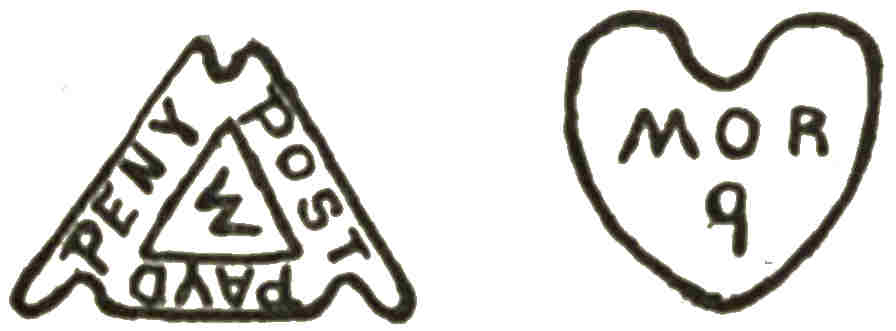
RATES AND FINANCE
After de Quester had been appointed Foreign Postmaster-General,
he published, in 1626, an incomplete set of rates from and
to various places on the continent. His charges for "packets," and
by packets he meant letters or parcels carried by a special messenger,
were as follows:—
To the Hague £7.
To Brussels or Paris £10.
To Vienna £60.
The ordinary rates were:—
To or from any of the above places 30s.
To or from any part of Germany 6s.
From Venice for a single letter 9d.[562]
From Venice for any letter over a single letter 2s. 8d.
From Leghorn and Florence for a single letter 1s.
From Leghorn and Florence over a single letter 3s. an ounce.[563]
This system of rates, although crude, marks a distinct era in postal
progress. It forms the foundation of the plan which was perfected
a few years later by Witherings. De Quester also published a statement
of the days of departure of the regular posts with foreign letters.[564]
In the trial between Stanhope and de Quester over the question
of who should be Foreign Postmaster-General, it came out in
the evidence that Stanhope had been accustomed to receive 8d. for
every letter to Hamburg, Amsterdam, and Antwerp.[565] This charge
was rather in the nature of a perquisite than a legal rate and serves
partly to explain why Stanhope was so anxious to retain the monopoly
of the foreign post.
Witherings' rates for domestic postage, as fixed by Royal Proclamation
in 1635, were as follows for a single letter:—
| |
d. |
| Under 80 miles |
2 |
| Between 80 and 140 miles |
4 |
| Over 140 miles |
6 |
| On the Borders and in Scotland |
8 |
| In Ireland |
9 |
If there were more than one sheet of paper, postage must be paid
according to the above rate for every separate sheet or enclosure.
For instance, a letter or packet composed of two sheets was called
a double letter and paid 4d. for any distance under 80 miles. A
letter of three sheets was called a triple letter and paid 6d. if conveyed
under 80 miles, and so in proportion.[566] In 1638, the rules concerning
the imposition of rates were changed slightly. The rates
themselves remained the same for single and double letters. Letters
above double letters were to be charged according to weight
as follows:—
| Under 80 miles |
6d. an ounce. |
| From 80 to 140 miles |
9d. |
| Above 140 miles |
12d. |
| For Ireland |
6d. if over two ounces.[567] |
This expedient must have been adopted from the difficulty in discovering
the number of enclosures when there were more than
two. It is impossible to say how long these rates continued, probably
not later than Witherings' régime. During Prideaux' management
the maximum postage on a single letter was 6d., reduced
later to 3d.[568]
The Council of State gave orders in 1652 for the imposition of
the following rates for a single letter:—
| Within 100 miles from London |
2 |
| To remoter parts of England and Wales |
3 |
| To Scotland |
4 |
| To Ireland |
6 [569] |
Whether these rates were actually collected is questionable. The
postage which the farmers of the Posts were allowed to collect in
the following year was fixed by the Council of State for single letters
as follows:—
| |
d. |
| Under 80 miles from London |
2 |
| Above 80 miles from London |
3 |
| To Scotland |
4 |
| To Ireland |
6 |
These rates are in effect lower than those of Witherings, for he had
inserted a 3d. rate for letters delivered between 80 and 140 miles
from London, had charged 4d. for all letters going farther than
140 miles, and had charged 8d. and 9d. for letters to Scotland
and Ireland respectively. They were a little higher than those of
1652, for by them 2d. had carried a letter 100 miles.[570]
In 1657, the first act of Parliament was passed, fixing rates for
letters and establishing the system for England, Ireland, and Scotland.
The domestic rates were:—
|
|
For a single letter |
Double letter |
Per ounce |
| In England |
{ Within 80 miles
{ from London |
2d. |
4d. |
8d. |
|
{ Above 80 miles
{ from London |
3 |
6 |
12 |
|
To or from Scotland |
4 |
8 |
18 |
|
To or from Ireland |
6 |
12 |
24 |
| In Ireland |
{ Within 40 miles
{ from Dublin |
2 |
4 |
8 |
|
{ Above 40 miles
{ from Dublin |
4 |
8 |
12 |
The foreign rates were:—
[571]
|
For a single letter |
Double letter |
Per ounce |
To Leghorn, Genoa, Florence, Lyons,
Marseilles,Aleppo, Constantinople |
12d. |
24d. |
45d. |
| To St. Malo, Morlaix, Nieuhaven |
6 |
12 |
18 |
To Bordeaux, Rochelle, Nantes, Bayonne,
Cadiz, Madrid |
9 |
18 |
24 |
| To Hamburg, Frankfort, and Cologne |
8 |
16 |
24 |
To Dantzic, Leipsic, Lubeck, Stockholm,
Copenhagen, Elsinore, Konigsburg |
12 |
24 |
48 |
These rates are considerably lower than those of Witherings and
are essentially the same as those of 1653, except that the postage
is fixed for letters to and from the continent. No provision is made
for letters to and from any other part of the world but Europe. Since
the government had not established any postal communication
with Asia, Africa, or the Americas, it would have been unfair to
demand postage on letters conveyed by merchant vessels to and
from those places.[572]
The act of 1660 is generally referred to as bringing the Post
Office under Parliamentary control and as the basis of the modern
system. This is probably due to the fact that the act of 1657 was
passed by a Commonwealth Parliament and signed by Cromwell.
Whether its authors lacked the power to give it validity, they did
not lack the brains to pass an excellent act, and although the Royalists
saw fit, after the Restoration, to dub it the pretended act of
1657, they could not improve it and had the sense to leave it largely
untouched. The first act had imposed rates from or to any place
to or from London as a centre. It had been taken for granted that
all letters passed to, from, or through the capital, and to all intents
and purposes this was so. It was possible, however, for letters,
technically called bye-letters, to stop short of London, and it was
to provide for these that postage was to be reckoned from any
place where a letter might be posted.
Scotland was no longer a part of England after the Restoration,
so that by the act of 1660 rates were given to and from Berwick
and for single letters were a penny less than they had been to Scotland
under the earlier act. From Berwick the rate, within a radius
of forty miles, was 2d. for a single letter, and over forty miles, 4d.
As far as foreign postage was concerned, letters to the northern
coast towns of Italy paid 3d. less than the old rate for a single
letter. Other rates remained the same. Alternative routes were
sometimes offered. For instance, letters might be sent directly to
northern Italy or they might go via Lyons, but in the latter case
they cost 3d. more. Again, there were many more continental
towns to which letters might be sent and from which they might be
received. Letters for Germany via Hamburg had to be postpaid
as far as that city. The same was true of letters to southern France
via Paris and of letters to northern Italy via Lyons. The highest
rate paid for a single letter was 1s. to northern Italy, Turkey, and
central and northern Germany. Merchants' accounts not exceeding
one sheet of paper, bills of exchange, invoices and bills of lading,
were to pay nothing over the charge of the letter in which they
might be enclosed. The same rule was to hold for the covers of
letters sent to Turkey via Marseilles. All inland letters were to be
paid for at the place where they were delivered unless the sender
wished to pay in advance.[573]
When the Scotch was separated from the English Post Office in
1695, rates were imposed by the Parliament of Scotland as follows:
|
For a single letter |
| To Berwick |
2s.[574] |
| Within 50 miles from Edinburgh |
2 |
| From 50 to 100 miles from Edinburgh |
3 |
| Above 100 miles from Edinburgh |
4 |
Packages of papers were to pass as triple letters.[575] In 1701, when the
Scotch Post was let out to farm, the English Postmasters-General
advised that the farmers should be obliged to pay at Berwick the
postage on English and foreign letters for Scotland, and an order
in accordance with this advice was signed by the King. It was the
custom to change the farmers every three years, which may have
produced a larger revenue but was certainly not calculated to
increase the efficiency of the office. The English Postmasters-General
had great difficulty in collecting at Berwick the postage
due them, and it is doubtful whether a large part was ever paid.
The frequent changes in the farmers must have been an excellent
means of allowing them to escape their debts to the English.[576]
It has been customary to point to the postage rates of 1660 as
lower than any before the nineteenth century. This is true in a general
way, but one limitation to the statement is generally overlooked.
Before 1696 all posts ran to or from London, and it was
not until well on in the eighteenth century that the system of cross
posts was introduced. Bristol and Exeter are less than eighty miles
apart, but a letter from Bristol to Exeter went to London first and
from there to Exeter, travelling about 300 miles to reach a town
eighty miles distant. Now by the act of 1660, the rate for distances
above 80 miles was 3d. Thus the letter paid 3d. from Bristol to
London and 3d. more from London to Exeter, 6d. in all. If there
had been a direct post from Bristol to Exeter, and there was not
until 1698, the postage would have been 2d. only. The possibility
of such an anomaly as this must be kept in mind in considering the
low rates of the seventeenth century.
In James the Second's reign, a Post Office had been established
in Jamaica, and rates of postage had been settled not only in the
island itself but between it and the mother country. This was a new
departure, since at that time there were no packet boats to the
West Indies. The rate between England and Jamaica was 6d. for a
single letter, 1s. for a double letter, and 2s. an ounce. As the Crown
was not at the expense of maintaining means of transport, this was
a pure tax.[577] In 1704, the postage on a single letter from the West
Indies was raised to 7½d., for a double letter 15d., but Dummer's
packets were then in operation.[578]
In 1698, a system of posts had been established in the American
colonies between the largest towns on the Atlantic coast. All that
is known about the rates is that the charge for the conveyance of a
letter between Boston and New York was 1s. and the post went
weekly between those places.[579] Hamilton, the deputy manager,
proposed that letters from England should be sent in sealed bags
entrusted to the masters of ships. The bags were to be handed over
to the postmaster of the port where the ship first touched and the
captain was to receive a penny for each letter. He advised that the
following rates should be adopted:—
| Not exceeding 80 miles from |
New York |
6d. |
| From 80 to 150 miles from |
New York |
9 |
| To and from Boston and New |
York, 300 miles |
12 |
|
Jersey, 370 miles |
18 |
|
Philadelphia, 390 miles |
20 |
|
Annapolis, 550 miles |
36 |
|
Jamestown, 680 miles |
42 |
| New York and |
Annapolis, 250 miles |
24 |
|
Jamestown, 380 miles |
|
|
(with many dangerous
places to cross by ferry) |
30 |
These rates were said to be too high and were not adopted, "it
being found that cheap postage greatly encourages letter writing,
as is shown by the reduction in England from 6d. to 3d."[580]
The preamble to the act of 1711 offered as an explanation of an
increase in rates the necessity for money for the war and the prevention
of private competition in carrying letters. It is plain that
higher rates will, up to a certain point, increase proceeds, though
not proportionately, but how increased rates can decrease competition
is more difficult to explain. Witherings had found that the
cheaper he made postage, the less fear was there from interlopers.
It is possible that the framers of the bill had intended to use part
of the increase in revenue for the support of searchers, but no such
provision is contained in the act itself.[581] On the ground that a large
revenue was necessary, no fault can be found with the increase. It
is probably true that in course of time lower rates would have increased
the product more than higher, but war and its demands
wait for no man. The people who could write and who needed to
write were in a small minority then, and their number could not
for a long time be influenced by lower rates. What was needed at
once was money and the only way to raise it by means of the Post
Office was the one adopted.
The rates for single letters within England and between England
and Edinburgh were increased by a penny for a single letter; for
double letters and parcels in proportion. To Dublin the charge
remained the same, and the rates within Ireland were not changed.
In the act of 1660, the postage on letters delivered in Scotland had
been reckoned from Berwick. Edinburgh was now made the centre
and the rates were as follows:—
| |
For a single
letter |
Per
ounce |
| From Edinburgh within Scotland |
d. |
d. |
| Not exceeding 50 miles |
2 |
8 |
| Above 50 and not exceeding 80 miles |
3 |
12 |
| Above 80 miles |
4 |
16[582] |
The rates within Scotland were lower than those within England
and Ireland. Scotland had a 2d. rate for distances not exceeding
fifty miles. England had no rate under 3d., except for the Penny
Post. Ireland, too, had a 2d. rate for distances not exceeding forty
miles, but for distances from forty to eighty miles and over, the rate
for Irish letters was 4d., while in England the rate was only 3d. for
distances not exceeding eighty miles. The distances which letters
travelled within Scotland were shorter than in England and Ireland.
As a rule the different rates for the three countries varied with their
wealth and consequent ability to pay, the least being required from
poverty-stricken Scotland. The new rates as compared with the
old were for a single letter:[583]—
For England
| |
1660 |
1711 |
| Not exceeding 80 miles |
2d. |
3d. |
| Above 80 miles |
3 |
4 |
| Between London and Edinburgh |
5 |
6 |
| Between London and Dublin |
6 |
6 |
Within Ireland
| Not exceeding 40 miles from Dublin |
2d. |
2d. |
| Above 40 miles from Dublin |
4 |
4 |
Within Scotland (Scotch Act, 1695)
| Not exceeding 50 miles from Edinburgh |
2d. |
2d. |
| From 50 to 80 miles from Edinburgh |
|
3 |
| From 50 to 100 miles from Edinburgh |
3 |
|
| Above 80 miles from Edinburgh |
|
4 |
| Above100 miles from Edinburgh |
4 |
|
The act of 1660 imposed rates on letters in Scotland from
Berwick as a centre. By that act rates had been fixed for distances
not exceeding 40 miles and for distances over forty miles from
Berwick, being 2d. and 4d. for single letters for the respective distances,
so that by the act of 1711, the Scotch rates were lower than
they had been in 1660 and slightly higher than those of 1695. When
forty miles was made the lowest distance according to which rates
were levied, it was thought and intended that 2d., the rate for that
distance, would pay for a single letter from Berwick to Edinburgh.
As a matter of fact, the distance between the two places was fifty
miles, so that the Scotch Act had estimated it better.
In the rates as given above, an exception is made in the case of
letters directed on board ship or brought by it. For such letters
one penny was charged in addition to the rates already given. This
extra penny was charged because the postmaster in the place where
the ship first touched was required to pay the master of the vessel
one penny for every letter received. Foreign letters collected or
delivered at any place between London and the port of departure or
arrival of the ship for which they were destined or by which they
had come, must pay the same rate as if they had left or arrived
in London.
As far as foreign post rates were concerned they were all from 1d.
to 3d. higher than they had been by the act of 1660. The lowest
foreign rate for a single letter, 10d., was paid between London and
France, and London and the Spanish Netherlands. To Germany
and Northwestern Europe, through the Spanish Netherlands, the
rate was 12d., to Italy or Sicily the same way 12d., postpaid to
Antwerp, or 15d. via Lyons. The same rates held for letters passing
through the United Provinces. To Spain or Portugal via the
Spanish Netherlands or the United Provinces or France, postpaid
to Bayonne, the rate was 18d. for a single letter, and the same
price held when letters were conveyed directly by sailing packets.
By the same act of 1711 rates were for the first time established
between England and her colonies and within the colonies themselves.
The postage for a single letter from London to any of the
West India Islands was 18d., to New York 12d., and the same from
those places to London. Between the West Indies and New York
the rate was 4d. In the colonies on the mainland, the chief letter
offices were at New York, Perth Amboy, New London, Philadelphia,
Bridlington, Newport, Portsmouth, Boston, Annapolis,
Salem, Ipswich, Piscataway, Williamstown, and Charleston. The
postage was 4d. to and from any of these places to a distance not
exceeding sixty miles and 6d. for any distance between sixty and
100 miles. Between New York, Perth Amboy, and Bridlington,
the rate was 6d.; between New York, New London, and Philadelphia
9d.; between New York, Newport, Portsmouth, and Boston
12d.; between New York, Salem, Ipswich, Piscataway, and Williamstown
15d.; between New York and Charleston 18d.; the Post
Office was to pay nothing for crossing ferries.
There had always been trouble in collecting the rates on bye and
cross post letters. These letters did not pass through London and
hence the officials at the General Post Office had no check on the
money due. By a clause in the act, the postmasters were ordered
under a penalty to account for the receipts from all these letters.
The postage on letters which did not pass to, through, or from
London was fixed according to the inland charges, varying with
the distances travelled. Finally, the postage on all inland letters
was to be paid on delivery unless the sender wished to pay in advance,
or in the case of the Penny Post, or unless such letters should
be directed on board any ship or vessel or to any person in the
army.
From the receipts from postage, £700 a week was to be paid
into the Exchequer for the purpose of carrying on the war. The
Accountant-General was to keep account of all money raised, the
receipts themselves going directly to the Receiver-General and
being paid into the Exchequer by him. One third of the surplus
over and above the weekly payment of £700 and £111,461 (the
amount of the gross receipts of the duties arising by virtue of the
act of 1660) were to be disposed of by Parliament. In making this
provision, Joyce thinks that the Chancellor of the Exchequer confused
gross and net product.[584] As a matter of fact there was no such
surplus as was anticipated by the Chancellor, but it does not follow
that he made the mistake of which he was accused by Cornwallis
and Craggs, an accusation in which Joyce evidently concurs. He
erred simply in supposing that expenses would remain the same.[585]
The act of 1711 in prescribing the rate of postage for the carriage
of "every single letter or piece of paper" enacted that a
"double letter should pay twice that rate." The merchants contended
that a double letter was composed of two sheets of paper if
they weighed less than an ounce and their reasoning was logical.
They argued from this that a letter enclosing a pattern or patterns,
if it weighed less than one ounce, should pay only as a single letter.
Actions were brought against the postmasters by the merchants
for charging more than they considered was warranted and
the merchants won every case. The lawyers also threatened legal
proceedings for the charge of writs when enclosed in letters. The
Postmasters-General hastened to Parliament for relief. The merchants
heard of this, and petitions were sent to the House of
Commons from "clothiers, dealers in cloth, silk, and other manufactured
goods," asking that when samples were enclosed in a
single letter the rate should remain the same provided that such
letter and sample did not exceed half an ounce in weight.[586] Their
efforts were fruitless. The following provisions were inserted in
a tobacco bill then before Parliament and passed in 1753: "that
every writ etc. enclosed in a letter was to pay as a distinct letter
and that a letter with one or more patterns enclosed and not
exceeding one ounce in weight was to pay as a double letter."[587] As
a matter of fact all the rates collected after 1743 by virtue of the
act of 1711 were illegal, for the act itself had died a natural death
in the former year by that clause which provided for the revival of
the rates of 1660 at the end of thirty-two years.
A postal act was passed in 1765, slightly changing the home,
colonial, and foreign rates. The cession of territory in North America
had made necessary a more comprehensive scheme of postage rates
there. The conclusion of the Seven Years' War had made it possible
to offer a slight reduction in postage. In Great Britain the following
rates were published for short distances for a single letter:—
| For Great Britain—not exceeding one post stage |
1d. |
| For England alone—over one and not exceeding two stages |
2d. |
The rates for all other distances remained unchanged. A stage, as a
rule, varied from ten to twelve miles in length, so that every post
town in England could now boast a modified form of penny
postage, with the exception in most cases of delivery facilities.
The changes in colonial rates were generally in the shape of substituting
general for special rules. The rate from any part of the
British American Dominions to any other part was fixed at 4d. for a
single letter when conveyed by sea. The act of 1711 had given the
postage from and to specially named places. This method had become
inapplicable with the growth in population among the old
and the increase in new possessions. The rate for a single letter
from any chief post office in the British American Dominions to a
distance not exceeding sixty miles, or for any distance not exceeding
sixty miles from any post office from which letters did not pass
through a chief post office, was placed at 4d., from sixty to 100 miles
6d., from 100 to 200 miles 8d., for each additional hundred miles
2d. The effect of this act was to continue the same rates for inland
postage in British America, while rates were provided for distances
over 100 miles. The postage between England and the
American colonies remained at 12d. for a single letter. In the
case of the West Indies, there was a decrease of 6d. A clause of
the act provided that the postage on letters sent out of England
might be demanded in advance.[588]
Postage rates were increased steadily from 1784 for twenty-eight
years, culminating in the year 1812 with the highest rates that
England has ever seen. Every available means to raise the revenue
necessary to maintain her supremacy was resorted to, and the
Post Office was compelled to bear its share of the burden. In 1784
another penny was added to the rates for single letters and additional
rates for double and triple letters in proportion.[589] Three
years later an act was passed, fixing the postage for the conveyance
of a single letter by sailing packet from Milford Haven to Waterford
at 6d. over and above all other rates. It was provided by the
same act that the rates between London and Ireland via Milford
should not exceed the rates via Holyhead.[590]
In 1796 the rates for letters conveyed within England and Wales,
Berwick, to and from Portugal, and to and from the British possessions
in America, as established by the acts of 1711, 1765, and
1784, were repealed and the following substituted for a single
letter:—
Within England, Wales and Berwick.
|
d. |
| Not exceeding 15 miles from place where letter is posted |
3 |
| From 15 to 30 miles, etc. |
4 |
| 30 60 miles |
5 |
| 60 100 miles |
6 |
| 100 150 miles |
7 |
| Over 150 miles, etc. |
8 |
| Within Scotland |
|
| In addition to rates in force |
1 |
The old system of reckoning by stages was thus abolished, probably
on account of the uncertainty as to the length of any particular
stage and the variations and changes which were being constantly
made. This change was made for England and Wales only,
and the old system of reckoning by stages was still retained in Scotland.
Letters from and to the colonies had formerly paid no postage
over the regular shilling rate for a single letter and proportionately
for other letters. Now they were to pay the full inland
rate in addition. A single letter from the West Indies would now
pay the shilling packet rate plus the rate from Falmouth to London,
1s. 8d. in all. The same rates and the same rule held for letters
to and from Portugal. A single letter from Lisbon had formerly
paid 1s. 6d. on delivery in London. It would now pay 1s. 8d.
This act was not to affect letters to and from non-commissioned
officers, privates, and seamen while in active service, who were allowed
to send and receive letters for one penny each, payable in
advance. The revenue arising from the new and the unrepealed
rates was to be paid to the Receiver-General and be by him carried
to the Consolidated Fund. The increase from the additional postage
was estimated at £40,000 a year and was to be used to pay the
interest on loans contracted the preceding year.[591]
When sailing packets were established between Weymouth and
the islands of Jersey and Guernsey, the packet rates and the rates
between the islands themselves were fixed at 2d. for a single letter.
Permission was also given to establish postal routes in the islands,
and to charge the same postage for the conveyance of letters as in
England. The surplus was to go to the General Office and all postal
laws then in force in England were to be deemed applicable to the
two islands.[592]
By the same act which gave the Postmasters-General authority
to forward letters by vessels other than the regular sailing packets,
rates were fixed for the carriage of such letters. For every single
letter brought into the kingdom by these vessels, 4d. was to be
charged. The Postmasters-General might order such rates to be
payable in advance or on delivery. This was in addition to the inland
postage, and for every letter handed over to the Post Office,
the captain was to receive 2d. The revenue arising from this act
was payable to the Exchequer.[593]
In 1801 the Post Office was called upon again to make a further
contribution to the Exchequer to help meet the interest on new
loans. The following were the new rates for a single letter:—
Within Great Britain by the General Post
| | | | |
d. |
| Not exceeding 15 measured miles |
3 |
| Above |
15 |
but not exceeding |
30 |
measured miles |
4 |
| |
30 |
|
50 |
|
5 |
| |
50 |
|
80 |
|
6 |
| |
80 |
|
120 |
|
7 |
| |
120 |
|
170 |
|
8 |
| |
170 |
|
230 |
|
9 |
| |
230 |
|
300 |
|
10 |
By the act of 1796 a uniform rate of 8d. for a single letter had
been paid for distances over 150 miles. The new act not only imposed
extra rates for all distances over 150 miles but it decreased
the distances above 30 miles for which the old postage would have
paid. For instance, a 6d. rate had carried a single letter 100 miles,
a 7d. rate 150 miles. They now carried only 80 and 120 miles respectively.
On letters to and from places abroad, "not being within His
Majesty's Dominions," an additional rate of 4d. for a single letter
was imposed.[594] In London, where a penny had been charged for the
conveyance of letters by the Penny Post, 2d. was now charged. An
additional rate of 2d. for a single letter was imposed upon letters
passing between Great Britain and Ireland via Holyhead or Milford.
The Postmasters-General were given authority to convey
letters to and from places which were not post towns for such
sums for extra service as might be agreed upon. Merchants' accounts
and bills of exchange which, when sent out of the kingdom
or conveyed into it, had not formerly been charged postage over
the letters in which they were enclosed, were now to be rated as
letters.[595]
In 1803, the following rates were imposed within Ireland for a
single letter:—
| | | | |
d. (Irish)
[596] |
| Not exceeding 15 Irish miles |
2 |
| From |
15 |
to |
30 |
Irish miles |
3 |
| |
30 |
|
50 |
|
4 |
| |
50 |
|
80 |
|
5 |
| Exceeding 80 Irish miles |
6 |
The postage on letters arriving in Ireland for the distance travelled
outside Ireland was ordered to be collected by the Irish Postmaster-General
and forwarded to London. An additional penny was imposed
upon Dublin Penny Post letters crossing the circular road
around Dublin.[597]
In 1805, for the third time within ten years, the Exchequer fell
back upon the Post Office for an increase of revenue estimated at
£230,000.[598] There were added to the rates as already prescribed—1d.
for a single letter, 2d. for a double letter, 3d. for a triple letter,
and 4d. for a letter weighing as much as one ounce, for all letters
conveyed by the Post in Great Britain or between Great Britain
and Ireland. The postage on a single letter from London to Brighton
was thus raised from 6d. to 7d., from London to Liverpool
from 9d. to 10d., and from London to Edinburgh from 12d. to 13d.
Twopenny Post letters paid 3d. if sent beyond the General Post
Delivery limits, while newspapers paid 1d. On every letter passing
between Great Britain and a foreign country 2d. more was to be
paid. An additional penny was charged for every single letter
between Great Britain and the British American Dominions via
Portugal, and between Great Britain, the Isle of Man and Jersey
and Guernsey.[599] In the same year the Irish rates were also increased
by the imposition of an additional penny upon each single letter
with corresponding changes in the postage on double and triple
letters. The Dublin Penny Post was left untouched, its boundaries
being defined as contained within a circle of four miles radius, with
the General Post Office building as the centre. Every letter from
any ship within Irish waters was charged a penny in addition to the
increased rates.[600]
Still the demand was for more money to help replenish an exhausted
treasury. An additional penny was added for the conveyance
of a single letter more than twenty miles beyond the place
where the letter was posted within Great Britain and between Great
Britain and Ireland. For the conveyance of a single letter between
Great Britain and any of the colonies or to any foreign country an
additional 2d. was required. These additional rates did not apply
to letters to and from Jersey or Guernsey, or to and from any non-commissioned
officer, soldier, or sailor.[601] Samples weighing no more
than one ounce were to pay 2d. if enclosed in a letter, if not enclosed,
1d. As this is the highest point to which postage rates in England
have ever attained, it may be interesting to give the rates resulting
from this act in tabular form as far as the postage for
inland single letters was concerned.[602]
| | | | |
d. |
| Not exceeding 15 miles |
4 |
| Above |
15 |
but not exceeding |
20 |
miles |
5 |
| |
20 |
|
30 |
|
6 |
| |
30 |
|
50 |
|
7 |
| |
50 |
|
80 |
|
8 |
| |
80 |
|
120 |
|
9 |
| |
120 |
|
170 |
|
10 |
| |
170 |
|
230 |
|
11 |
| |
230 |
|
300 |
|
12 |
| |
300 |
|
400 |
|
13 |
| |
400 |
|
500 |
|
14 |
| |
500 |
|
600 |
|
15 |
| |
600 |
|
700 |
|
16 |
| |
700 |
miles |
|
|
17 |
In 1810, an additional penny (Irish) was added to the rates then in
force in Ireland, with the exception of the penny rate on the Dublin
Penny Post Letters.[603] Three years later the rates and distances for
Ireland were changed again. As compared with the old rates they
were as follows, both tables being in Irish miles and Irish currency
and for single letters only:—
| 1810 |
d. |
1813 |
d. |
| Not exceeding 15 miles |
4 |
Not exceeding 10 miles |
2 |
| From |
15 |
to |
30 |
miles |
5 |
From |
10 |
to |
20 |
miles |
3 |
|
30 |
|
50 |
|
6 |
|
20 |
|
30 |
|
4 |
|
50 |
|
80 |
|
7 |
|
30 |
|
40 |
|
5 |
| Exceeding 80 miles |
8 |
|
40 |
|
50 |
|
6 |
| | | | | |
|
50 |
|
60 |
|
7 |
| | | | | |
|
60 |
|
80 |
|
8 |
| | | | | |
|
80 |
|
100 |
|
9 |
| | | | | |
Over 100 miles |
10 |
The rates of 1813 were lower for distances not exceeding forty
miles, higher for distances over eighty miles. On the whole there
was little change, but the later rates were probably more easily
borne as they were lower for short distances.[604]
The next year the rates and distances for Ireland were changed again, the result being
an increase both for short and for long distances. The results are
shown in the following table in Irish miles and Irish currency and
for a single letter:[605]—
| Not exceeding 7 miles |
2d. |
| Over |
7 |
and not exceeding |
15 |
miles |
3 |
|
15 |
|
25 |
|
4 |
|
25 |
|
35 |
|
5 |
|
35 |
|
45 |
|
6 |
|
45 |
|
55 |
|
7 |
|
55 |
|
65 |
|
8 |
|
65 |
|
95 |
|
9 |
|
95 |
|
125 |
|
10 |
|
125 |
|
150 |
|
11 |
|
150 |
|
200 |
|
12 |
|
200 |
|
250 |
|
13 |
|
250 |
|
300 |
|
14 |
| For every 100 miles over 300 miles |
1 |
In 1813 an additional half-penny was demanded on all Scotch letters "because the
mail coaches now paid toll in that country." So at least a correspondent to the Times
says (London Times, 1813, June 21, p. 3).
In 1814 the postage on a single letter brought into the kingdom
by ships other than the regular packets was raised from 4d. to 6d.
in addition to the regular inland rates. The rate for letters sent out
of the kingdom by these vessels was fixed at one third the regular
packet rates.[606] An exception was made in the case of letters carried
by war vessels or by vessels of the East India Company to and from
the Cape of Good Hope, Mauritius, and that part of the East Indies
embraced in the charter of the company. The rates by these vessels
were to be the same as the regular packet rates, 42d. for a single
letter between those places and England, and 21d. for a single letter
between the places themselves. Newspapers were charged 3d. an
ounce between England, the Cape, Mauritius, and the East Indies.
The rate for a single letter conveyed in private vessels not employed
by the Post Office to carry mails was 14d. from England to
the Cape or the East Indies, and 8d. from the Cape or the East
Indies to England. The company was allowed to collect rates on
letters within its own territory in India, but the Postmasters-General
of England might at any time establish post offices in any such
territory. The company was to be paid for the use of its ships in
conveying letters.[607]
By the Ship Letter Act of 1814, no letters were to be sent by private
ships except such as had been brought to the Post Office to be
charged. The directors of the East India Company had protested
against this section of the act. It is true that they were allowed to
send and receive letters by the ships of their own company, but in
India there was a small army of officials in their service whose letters
had hitherto gone free. For that matter it had been the custom
for the company to carry for nothing all letters and papers which
were placed in the letter box at the East India House.[608] Petitions
were presented against an attempt on the part of the Post Office to
charge postage on letters to and from India when conveyed by
private vessels.[609] The company refused to allow its vessels to be
used as packet boats or even to carry letters at all. It was in consequence
of all this opposition that the act of 1815 was passed, giving
more favourable treatment to letters to and from India. By this
act no person sending a letter to India was compelled to have it
charged at the Post Office and the masters were compelled to carry
letters if the Postmasters-General ordered them. The company
now withdrew all opposition and even refused to accept any payment
for the use of their vessels in conveying letters.[610] Notwithstanding
the favourable exception made in the case of letters to and
from the East Indies, there was still discontent over the high rates
charged by the Post Office for the conveyance of letters by the regular
packet boats and by private vessels, when carrying letters entrusted
to the Post Office.[611] In 1819 the sea postage on any letter
or package not exceeding three ounces in weight from Ceylon,
Mauritius, the Cape, and the East Indies was placed at 4d. If it
exceeded three ounces in weight, it was charged 12d. an ounce. The
sea postage on letters and packages to Ceylon, etc., not exceeding
three ounces in weight, was placed at 2d. If the weight was more
than three ounces, the charge was 12d. an ounce. The postage
on letters and packages from England was payable in advance.
Newspapers were charged a penny an ounce.[612]
By an act passed in 1827 it was provided that henceforth all
rates for letters conveyed within Ireland should be collected in
British currency. The rates themselves and the distances remained
the same as had been provided by the act of 1814. The postage
collected on letters between the two kingdoms was henceforth to be
retained in the country where it was collected. The rates for letters
passing between the two kingdoms were assimilated with the rates
prescribed for Great Britain by the act of 1812. In addition to the
land rates, 2d. was required for the sea passage to and from Holyhead
and Milford and to this 2d. more was added for the use of the
Conway and Menai Bridges.[613] Between Portpatrick and Donaghadee
the postage was 4d. for a single letter, between Liverpool and
any Irish port 8d., but no letter sent via Liverpool paid a higher
rate than if sent via Holyhead.[614] An additional halfpenny was also
demanded on every single letter passing between Milford Haven
and Waterford, to pay for improvements.[615]
In 1836, England and France signed a postal treaty by which
the rates on letters between the United Kingdom and France or
between any other country and the United Kingdom through
France were materially reduced.[616] On such letters the method of
reckoning postage differed from the English rule and was as follows:
One sheet of paper not exceeding an ounce in weight and every
letter not exceeding one quarter of an ounce were single letters.
Every letter with one enclosure only and not exceeding an ounce
in weight was a double letter. Every letter containing more than
one enclosure and not exceeding half an ounce was a double letter.
If it exceeded half an ounce but not an ounce in weight, it was a
triple letter. If it exceeded an ounce, it paid as four single letters
and for every quarter of an ounce above one ounce it paid an additional
single letter rate.[617] The sender of a letter from Great Britain
to France had the option of prepaying the whole postage, British
and foreign, or the British alone, or neither.[618]
In 1837, an act of Parliament was passed, consolidating previous
acts for the regulation of postage rates within Great Britain and
Ireland, between Great Britain and Ireland, and between the United
Kingdom and the colonies and foreign countries. The rates within
Great Britain remained the same as those established by the act
of 1812, including the additional half penny on letters conveyed by
mail coaches in Scotland. In Ireland the rates existing since 1814
still held and between Great Britain and Ireland the rates established
by 7 and 8 Geo. IV, c. 21.
The rates for letters between the United Kingdom and foreign
countries through France and those conveyed directly between the
United Kingdom and France remained the same as had been agreed
upon by the Treaty of 1836. Some of the more important of the
other rates were as follows:—
To Italy, Sicily, Venetian Lombardy, Malta, the Ionian Islands,
Greece, Turkey, the Levant, the Archipelago, Syria, and Egypt
through Belgium, Holland, or Germany, 20d. for a single letter.
Between the United Kingdom and Portugal, 19d. for a single letter.
|
Single letter |
| To or from Gibraltar |
23d. |
To or from Malta, the Ionian Islands, Greece, Syria,
and Egypt |
27d. |
Between Gibraltar (not having been first conveyed
there from
the United Kingdom) and Malta,
the Ionian Islands, Greece,
Syria, or Egypt
[619] |
8d. |
| Between the United Kingdom and Madeira |
20d. |
| Between the United Kingdom and
the West Indies, Colombia, and Mexico |
25d. |
| Between the United Kingdom and Brazil |
31d. |
| Between the United Kingdom and Buenos Ayres |
29d. |
| Between the United Kingdom and San Domingo |
15d. |
| Between the British West Indies and Colombia or Mexico |
12d. |
Letters between the United Kingdom and Germany, Belgium,
Holland, Switzerland, Spain, Sweden, and Norway were charged in
addition the same postage as if they had been sent from or to London.
Letters from and to France paid no additional postage. All
letters to and from non-commissioned officers, privates and seamen
while in actual service were still carried for one penny each, payable
in advance, but letters sent by them from Ceylon, the East Indies,
Mauritius, and the Cape were charged an additional 2d. payable
by the receiver.[620]
After the transference of the packet boats to the Admiralty
in 1837, the Postmaster-General was authorized to charge regular
packet rates for the conveyance of letters by such ships as he had
contracted with for such conveyance. He might also forward letters
by any ships and collect the following rates for each single
letter:—
When the letter was posted in the place from which
the ship sailed except when sailing between Great
Britain and Ireland |
8d. |
| If posted anywhere else in the United Kingdom |
12d. |
| Between Great Britain and Ireland in addition to
inland rates |
8d. |
| For a single letter coming into the United Kingdom
except from Ceylon, the East Indies, Mauritius, and
the Cape in addition to inland rates |
8d. |
| For letters from Ceylon, the East Indies, Mauritius, and
the Cape in addition to inland rates— |
|
| If not exceeding 3 ounces in weight |
4d. |
| If exceeding 3 ounces in weight |
12d. an oz. |
| For letters delivered to the Post Office to be sent
to Ceylon, the East Indies, Mauritius, and the Cape
in addition to all inland rates— |
|
| If not exceeding 3 ounces in weight |
2d. |
| If exceeding 3 ounces in weight |
12d. an oz. |
|
[621] |
The end of high postage rates was now at hand. In 1839, the
Treasury was empowered to change the rating according to the
weight of the letter or package,[622] and they proceeded to do so in
the case of letters from one country to another passing through
the United Kingdom, between any two colonies, between any South
American ports, and between such ports and Madeira and the
Canaries.[623] Parliament followed up the good work in 1840 by
enacting that in future all letters, packages, etc. should be charged
by weight alone, according to the following scheme:—
On every letter or package, etc.—
Not exceeding ½ ounce in weight, one rate of postage.
| Exceeding |
½ |
ounce but not exceeding |
1 ounce, |
2 rates of postage. |
|
1 |
" " " " |
2 ounces, |
4 " " " |
|
2 |
ounces " " " |
3 " |
6 " " " |
|
3 |
" " " " |
4 " |
8 " " " |
For every ounce above four ounces, two additional rates of postage,
and for every fraction of an ounce above four ounces as for one
additional ounce. No letter or package exceeding one pound in
weight was to be sent through the Post Office except petitions and
addresses to the Queen, or to either House of Parliament, or in such
cases as the Treasury Lords might order by warrant.[624]
On all letters not exceeding a half-ounce in weight transmitted by
the Post between places in the United Kingdom (not being letters
sent to or from places beyond the seas, or posted in any post town
to be delivered within that town) there was charged a uniform rate
of one penny. For all letters exceeding a half-ounce in weight, additional
rates were charged according to the foregoing scheme,
each additional rate for letters exceeding one ounce in weight being
fixed at 2d.[625]
The rates for colonial letters were also adjusted according to
weight as follows: Between any place in the United Kingdom
and any port in the colonies and India (except when passing
through France) for a letter not exceeding half an ounce in weight,
1s. Between any of the colonies through the United Kingdom, 2s.
If such letters exceeded half an ounce in weight, they were charged
additional rates according to the table already given, the rate for a
letter not exceeding half an ounce being taken as the basis.
The rates for letters to and from foreign countries were much
the same as they had been before the passage of this act, except
that instead of the initial charge being made for a single letter, it
was now reckoned for a letter not exceeding half an ounce in weight.
The rates for letters to and from France were graded according to the
distance they were carried in England, the lowest rate for a letter
not more than half an ounce in weight being 3d. to Dover or the
port of arrival, the highest rate being 10d. to any place distant
more than fifty miles from Dover.[626]
The franking privilege may reasonably be considered in connection
with the history of postal rates, nor should its effect in reducing
the revenue of the Post Office be neglected. The Council of State
gave orders in 1652 that all public packets, letters of members of
Parliament, of the Council, of officers in the public service, and of
any persons acting in a public capacity should be carried free. This
is the first record that we have concerning the free carriage of
members' letters, a privilege which later gave so much trouble and
was so much abused.[627] The next year the Post Office farmers agreed
to carry free all letters to and from members of Parliament provided
that letters written by such members as were not known by
their seals should be endorsed, "These are for the service of the
Commonwealth," and signed by the members themselves or their
clerks.[628] Nothing was said in the act of 1660 about the conveyance
of the letters of members of Parliament and they were carried free
only by act of grace. The House of Commons had passed a clause
of the bill providing for the free conveyance of the letters of members
of their own House. This had exasperated the Lords, who,
since they could not amend the clause so as to extend the privilege
to themselves, had dropped it.[629] In 1693, the attention of Cotton
and Frankland was called to the manner in which franking was
being abused. Men claimed the right to frank letters to whom the
Postmasters-General denied it, and members of Parliament were
accused of bad faith in the exercise of their privilege. The custom
had arisen of enclosing private letters in the packet of official letters.
A warrant was issued in 1693 to the effect that in future no
letters were to go free except those on the King's affairs, and the
only persons to send or receive them free were the two principal
Secretaries of State, the Secretary for Scotland, the Secretary in
Holland, the Earl of Portland, and members of Parliament, the
latter only during the session, and for forty days before and after,
and for inland letters alone. Each member was to write his name
in a book with his seal so that no one might be able to counterfeit
his signature.[630]
We learn from Hicks' letters that it was customary for clerks in
the Post Office at London to send gazettes to their correspondents
in the country free of charge. These gazettes or news letters were
supplied by the Treasury and, as 2d. or 3d. apiece was paid for them
by the recipients, the privilege was greatly esteemed.[631] The Deputy
Postmaster-General wished to abolish the privilege, but Hicks
himself, who was one of the favoured officials, was quite indignant
at the suggestion.[632] The principle was bad, but as the receipts for
gazettes formed a necessary part of the clerks' salaries, Hicks cannot
be blamed for protesting against abolition without compensation.
James II expressed a desire that the practice should be discontinued,
but when it was shown to him that the salaries of the clerks
must be raised if his wishes were obeyed, his proposition was
promptly withdrawn.[633]
The abuses of the privilege of franking were very pronounced
during the eighteenth century. The system of patronage which the
members of Parliament then exercised made them reluctant to
offend any of their constituents, who might entrench upon their
peculiar privileges. Members' names were forged to letters and
they made no complaint. Letters from the country were sent to
them to be re-addressed under their own signatures. The Postmasters-General
admonished them more than once, but, as a rule, the
members disclaimed all knowledge of abuses. Men were so bold as
to order letters to be sent under a member's name to coffee-houses,
where they presented themselves and demanded the letters so addressed.
In 1715, on receiving renewed complaints from the Postmasters-General,
it was ordered by the House that henceforth no
member should frank a letter unless the address were written entirely
in his own hand. This was expected to prevent members from
franking letters sent to them by friends. It was also ordered that no
letter addressed to a member should pass free unless such member
was actually residing at the place to which the letter was addressed.
In the third place, no member was to frank a newspaper unless
it was entirely in print. This was to prevent the franking of long
written communications passing as newspapers, for the members of
Parliament in sending and receiving letters free were restricted to
such as did not exceed two ounces in weight, but they were not so
restricted in the case of newspapers.[634] According to the Surveyor's
report, the loss from the ministers' franks in 1717 was £8270 and
from the members' franks £17,470.[635] The loss from franking was
proportionately much greater in Ireland than in England. In 1718
the Irish Parliament sat only three months, in 1719 nine months,
and in Ireland as in England, members of Parliament received and
sent their letters free only during the session and forty days before
and after it. The following is part of the report submitted by the
Postmasters-General to the Lords of the Treasury for these two
years:—
|
1718 |
1719 |
| Gross Produce from Letters |
£14,592 |
£19,522 |
| Charge of Management and Members' Letters |
11,526 |
18,768 |
| Net Produce from Letters[636] |
3,066 |
754 |
Under the charges of management is included the charge for carrying
members' letters as reckoned proportionately to the charge for the
letters which paid, together with the actual charge for the pay letters.
The net produce during the three months' session was £3006, during
the nine months' session only £753. In 1734 the old orders about
the maximum weight of two ounces and the requirement for the
whole superscription to be in the member's own writing were repeated
in a royal proclamation. In addition it was ordered that
any letters sent under cover to any member of Parliament or high
official of state, to be forwarded by him, should be sent to the General
Post Office to be taxed.[637] It could hardly be expected that this
order would be obeyed, for there was no method of enforcing it.
In 1735, the House of Commons instituted an enquiry into
the whole question of franking and summoned various Post Office
officials before them to give evidence. An estimate was laid before
them of the amount lost each year by carrying franked letters.
This estimate was obtained by weighing the franked letters
at intervals during the session of Parliament, and comparing
their weight with the weight of the letters which paid postage. As
the total revenue from the latter was known, the amount which
was lost on the former was guessed. The House expressed very little
confidence in the estimated amounts, and certainly it was a rough
way of attaining the object aimed at, but perhaps they were prejudiced
from the strength of the case against them.[638] Expressed in
yearly averages, the amounts by which the revenue was reduced by
franking were:—
| 1716-19 |
£17,460 |
|
1725-29 |
32,364 |
| 1720-24 |
£23,726 |
|
1730-33 |
36,864 |
The system of ascertaining forged franks and of discovering enclosures
was as follows: a Supervisor of the Franks charged all
letters, franked by a member's name, coming from any place, when
he knew that the member was not there. Very often by holding
them in front of a candle, he could see enclosures inside directed to
other people. If he was in doubt he generally charged the letter, for
if it should pay, all well and good, and if he had made a mistake, the
amount was refunded to the member. The Supervisor had noticed
that the number of franked letters had increased with every session
of Parliament, and some of the ex-members also attempted to frank
letters. The evidence of the Supervisor, especially his description
of the manner in which he attempted to discover enclosures, was
exceedingly distasteful to the House. The members themselves
were to blame for many of the abuses attendant upon the system,
and yet they contended that they were the unwilling victims of
others. A resolution was adopted that it was an infringement upon
the privileges of the knights, citizens, and burgesses chosen to represent
the people of Great Britain in Parliament, for any postmaster,
his deputies or agents to open or look into any letter
addressed to or signed by a member of Parliament, unless empowered
so to do by a warrant issued by one of the Secretaries
of State. In addition no postmaster or his deputies should
delay or detain any letter directed to or by any member unless
there should be good reason to suppose that the frank was a counterfeit.[639]
The restrictions adopted to curtail the abuse of the franking
privilege had but little effect. A regular business sprang up for
selling counterfeit franks. The House of Lords ordered one person
accused of selling them to come before the bar of the House for
examination, but he failed to present himself.[640] Another confessed
before the Upper House that he had counterfeited one of the Lords'
names on certain covers of letters showed to him and had then sold
them. He expressed sorrow for the offence, which necessity had
driven him to commit. He was sent to Newgate.[641] The abuses of the
franking system were so patent[642] that Allen was told that he might
withdraw from his contract to farm the bye and cross post letters
on three months' notice being given.[643]
The revenue from the Post Office was surrendered by the Crown
at the beginning of George the Third's reign in exchange for a Civil
List from the Aggregate Fund as it was then called.[644] While the
Post Office remained in the hands of the King, it was only by special
grant on his part that the members of Parliament had been allowed
to send and receive letters free. Accordingly in 1763, an act was
passed for the purpose of giving parliamentary sanction to the
privilege. This act repeated the principal points in the King's
proclamation and in the Parliament's previous resolutions on the
subject. All letters or packets sent to or by the King, the ministers
and the higher Post Office officials were to go free. The ministers
might appoint others to frank their letters, whose names must be
forwarded to the Postmaster-General. Those sending letters free
must sign their names on the outside and themselves write the address.
No letters to or from any member of Parliament should go
free unless they were sent during the session or within forty days before
or after, and the whole superscription must be in the member's
own hand or directed to him at his usual place of residence or at
the House. All letters in excess of two ounces in weight must pay
postage. Printed votes, proceedings in Parliament, and newspapers
should go free when sent to a member or signed on the outside by
him, provided they were sent without covers or with covers open
at the ends. The privileges of franking votes, proceedings in Parliament,
and newspapers, were continued to the clerks in the Post
Office and in the Secretaries of State's offices. The Postmasters-General
and their deputies were given authority to search newspapers
which had no covers or covers open at the ends and to
charge them if there were writing or enclosures in them. Finally,
any person who counterfeited a member's name on any letter or
package for the purpose of avoiding the payment of postage, was
guilty of felony and liable to transportation for seven years.[645]
The year following the passing of this act, the House of Commons
called for returns relating to the franking system. Besides the
members of Parliament, the ministers, and the Post Office officials,
to whom the franking privilege had been granted by the King's
warrant and by the late act, almost all who were in any way connected
with the Government claimed the right to send or receive
letters free, even to the Deputy Serjeant-at-Arms. The amount
which newspapers would have paid if there had been no franking
privilege was first given for the week ending March 13, 1764.
| Members' |
States' |
Post Office Clerks' |
| £465 |
£310 |
£1055 |
These amounts were obtained by weighing the newspapers and, as
this was the manner in which they would have been rated, the results
may be considered as fairly correct. The idea being to estimate
the loss from members' and states' franks only, the franking
by Post Office clerks does not enter into the following calculation.
It was judged from the figures given above that the Post Office
carried free every year enough newspapers franked by members
and state officials to produce £40,000 if they had been taxed at the
ordinary rates.[646] An attempt to arrive at the same result in another
way was also made. The sum total which would have been paid
on all members' and ministers' letters, newspapers, and parcels
arriving at or departing from London in 1763 was £140,000. Of
this amount £85,000 would have been paid on all mail leaving
London, and £55,000 on all mail arriving in London. The difference
in favour of the outgoing mail was judged to be due to the newspapers,
all of which were printed in London and sent to the country.
This would give a loss of £30,000 on newspapers, and £110,000 on
letters.[647]
Returns were also submitted, showing the gross amount of the
inland postage for Great Britain and Ireland, including the amount
which the franked letters and papers would have paid if they had
all been charged, the actual gross product and the difference between
the two. This difference would, of course, be the estimated
charge on all the free matter. These figures are given from 1715
to 1763. Roughly speaking, in fifty years franked letters and
papers increased 700 per cent while pay letters increased only
50 per cent. In 1715 one fifth as many free letters and newspapers
as those which paid went through the mail. In 1763 there were
eleven twelfths as many free letters and papers.[648] It will be seen
that the assumption is that the postage which this free matter
might have paid represented the loss suffered by the Post Office.
Now this is not so, because it did not cost the Post Office so much
to convey letters and papers as the ordinary rates would have paid
them. In the second place the Postal authorities considered the
£140,000 as so much actually lost, whereas if charges had been
enforced on the free matter, a much smaller amount would have
been sent. This is entirely apart from the rough and ready manner
in which the figures were obtained. Enough was shown, however,
to prove that the franking system was a burden to the country and
an imposition upon the Post Office.
In Ireland, Parliament met as a rule only during the even years
or if it met every year, the sessions in the odd years were very
short. For the five even years from 1753 to 1762, the expenses
averaged for each year £3306 over the receipts, while during the
five odd years, the receipts were greater than the expenditures by a
yearly average of £2249. These general results held good for every
individual odd or even year for the period for which returns were
given.[649]
Attempts continued to be made by members of the House of
Commons to diminish the abuses arising from franking. There had
been some misunderstanding as to whether they were entitled to
have ship's letters delivered free to them. Of course they were exempt
from the inland postage on such letters, but for every letter
brought into the country by vessels other than packets, the master
was paid one penny and this penny was collected from the person
to whom the letter was delivered. The members finally agreed to
pay the extra penny.[650]
Acts were now introduced to enable the Commander-in-Chief,
the Adjutant-General, and the Controller of Accounts of the Royal
forces to receive and send letters free. Both bills passed.[651] It is
some consolation that the Lord Chancellor and Judges failed to
obtain the franking privilege although a bill was introduced in the
Commons in their behalf.[652]
It was enacted in 1784 that a member must write on his free letters
not only his name and address but also the name of the post
town from which they were to be sent and the day of the month
and the year when they were posted.[653] The object of this restriction
could be easily evaded by enclosing postdated letters to their constituents
but, after the passage of this resolution, a considerable
decrease resulted in the number of free letters to and from members.[654]
When the Irish was separated from the English Post Office, the
privilege of franking newspapers to Ireland was taken away and a
rate of one penny a newspaper was imposed, payable in advance.
This meant a loss to the clerks in the Secretaries' offices but this
was made good to them by an addition of £1000 a year to their
salaries.[655]
In 1795, the members of Parliament made another attempt to
limit their own as well as the free writing proclivities of others. The
maximum weight of a free letter to or from a member was lowered
from two ounces to one. No letter directed by a member should go
free unless the member so directing it should be within twenty
miles of the place where it was posted either on the day on which
it was posted or the day before. No member should send more
than ten or receive more than fifteen free letters a day. Votes and
proceedings in Parliament when addressed to or by members of
Parliament were exempted from the provisions of this Act.[656]
The restrictions upon the franking privilege enjoyed by members
of Parliament were re-enacted in 1802 with some additions. The
number of free letters which a member might receive and send
in one day having been limited to twenty-five, it was decided that
these twenty-five so excepted from the payment of postage should
be those on which the charges were the highest, provided that none
of them exceeded an ounce in weight. The high officials of state,
the clerks of Parliament, certain clerks of the Commons and Lords,
the Treasurer and Paymaster of the Navy, the Lord Chancellor,
certain officials in Ireland, and two persons appointed by the Postmaster-General
of Ireland were allowed to send letters free.[657] The
members and clerks of both Houses were allowed to send newspapers
free provided that they were enclosed in covers open at both
ends. The same rule held for votes and proceedings in Parliament.[658]
The same franking privileges were extended to Irish officials.[659]
From 1806 to 1819 there was a large extension of the franking
privilege to various officials. During that time sixteen statutes and
parts of statutes were enacted in behalf of various persons from
the Lord High Chancellor to the Controller of the Barrack's Department
and the Commissioners of the parliamentary grant for
building churches. Sir Robert Buxton, a member of Parliament,
thought that it would be well for his fellow members to give up
their privilege in order to help the finances of the country. Windham
disagreed on the ground that it kept up communications
between a member and his constituents and encouraged literary
correspondence which would otherwise decline. Pitt justified it, in
that it enabled members to carry on the important business of their
constituents and did not result in much loss to the state.[660]
It had always been customary to charge letter rates for the conveyance
of newspapers to foreign countries and to the colonies.
Members of Parliament, however, had the privilege of franking
newspapers within the United Kingdom, the clerks of the Foreign
Office franked them to foreign countries, and the Secretary of the
Post Office franked them to the colonies. In 1825 it was enacted
that members need no longer sign their names to newspapers
franked by them, or give notice of the names of the places to which
they intended to send them.[661] This virtually provided for the free
transmission of newspapers within the United Kingdom. At the
same time it was provided that the rate for newspapers, votes and
parliamentary proceedings should be 1½d. each to the colonies,
payable in advance. Newspapers from the colonies were charged
3d. each, payable on delivery. Such newspapers must be posted on
the day of publication, must contain no writing, and must be enclosed
in covers open at both ends.[662] Two years later the charge for
votes and parliamentary proceedings to and from the colonies was
fixed at 1½d. an ounce. Newspapers brought from the colonies by
private vessels were to be charged 3d. each, the same as the packet
rate,[663] but in 1835 colonial newspapers by private vessels were allowed
to come in for a penny each, and the same rate was charged
for English newspapers sent to the colonies by private vessels. By
the same act the postage on newspapers passing between the United
Kingdom and any foreign country which charged no inland rate for
their conveyance was fixed at a penny each. If an inland rate was
charged, the postage was to be 2d. for each newspaper plus the foreign
rate.[664]
During the following year, all the regulations concerning the conveyance
of newspapers, votes, and proceedings in Parliament etc.
were embodied in one act. Within the United Kingdom all newspapers
which had paid the stamp duty were to go free except those
which were sent through the Twopenny Post and delivered by it,
not having passed by the General Post, and except those posted
and delivered within the same town. In both of these cases one
penny was charged. To and from the colonies no rate was demanded
when newspapers were sent by the regular packets. If
sent by private vessels one penny was payable, which went to the
master. The rate to and from foreign countries was fixed at 2d. for
each paper, but if a foreign state agreed to charge no postage on
English newspapers, no postage should be charged on the newspapers
of such foreign state, when brought to England by the packet
boats. If brought by private vessels, a penny was payable for each
paper, to go to the master. All newspapers, in order to receive the
advantage of these low rates or to go free, had to be posted within
seven days after publication and to contain no writing except the
name and address of the person to whom they were to be sent. In
addition the newspaper must have no cover or one open at both
ends.[665]
The following additions and changes in the regulations for the
carriage of newspapers were made in 1837. One penny was to be
paid for their conveyance by private vessels between different
parts of the United Kingdom. Between the colonies and foreign
countries through the United Kingdom, newspapers should go free
if conveyed by the packets and should pay a penny each if conveyed
by private vessels. Parliamentary proceedings conveyed between
the colonies and the United Kingdom, if sent by packet boats
and not exceeding one ounce in weight, were charged 1½d. each.
When in excess of one ounce they paid 1½d. for each additional
ounce. Pamphlets, magazines and other periodical publications
for the colonies, if not exceeding six ounces in weight, paid 12d.
when carried by the packets. For every additional ounce, 3d. was
charged. Bankers' re-issuable notes were carried at one quarter
the regular postage.[666] Patterns, with no writing enclosed and not
exceeding one ounce in weight, paid a single letter rate.[667] Any newspaper
which had been posted in violation of any regulation for the
conveyance of newspapers was charged three times the regular letter
postage.[668]
Franking and the privilege of sending and receiving letters free
from postage did not at any time extend to letters liable to foreign
postage except in the case of public despatches to and from the
Secretaries of State and British Ambassadors.[669] The owners, charterers
and consignees of vessels inward bound were allowed to receive
letters free from sea postage to the maximum of six ounces
for each man, but in the case of ships coming from the East Indies,
Ceylon, Mauritius, and the Cape, the maximum was twenty
ounces.[670] Within the kingdom, writs for the election of members of
the House of Commons and for those Scotch and Irish peers who
were elected, were allowed to go free.[671] All persons who were allowed
to frank letters within the Kingdom were grouped in ten
classes. Members of Parliament were placed in the first class and
their letters were subject to the old restrictions as to number,[672]
superscription, name of post town, date, and place of residence.
They might also receive petitions free, provided that each did not
exceed six ounces in weight. They might send free printed votes and
proceedings in Parliament.
Officials of both Houses of Parliament were in the second class.
They were subject to the same restrictions as the first class, except
that the number of their letters was not limited and each letter
might weigh two ounces.
The third class was composed of members of the Treasury Department
and the Postmaster-General and his secretaries. Their
franking privilege was unlimited as to the weight and number of
letters nor were they required to insert the name of the post town
or the date.
The fourth class, composed of heads of departments, might send
and receive letters with no limit as to number or weight.
The fifth class, the Lord Chancellor of Ireland and the Irish Surveyors,
had unlimited franking rights within Ireland. All the letters
of these five classes were subject to the following restrictions with
the exception of the third class. The whole superscription of the
letters sent must be in the hand of the privileged person, with his
name and the name of the post town from which the letters were
sent together with the date, and on that date or the day before, the
writer must be within twenty miles of the place where the letters
were posted.
The other five classes were made up of subordinate members of
departments, clerks, secretaries etc. when writing or receiving letters
on official business. Every such letter had to be superscribed with
the name of the office and the seal and name of the writer.[673]
It appeared from a report of a committee appointed to investigate
postal affairs that the total number of franks had increased
from 3,039,000 in 1810 to 4,142,000 in 1820; 4,792,000 in 1830 and
5,270,000 in 1837. Of these, members of the two Houses were
responsible for 2,028,000; 2,726,000; 2,814,000 and 3,084,000 at the
above dates respectively.[674] In concluding their report the Committee
recommended the abolition of Parliamentary franking.[675] This
advice was followed and improved upon two years later when
franking and the privilege of sending or receiving letters free were
abolished, except in the case of petitions to the Queen or Parliament
not exceeding 32 ounces in weight.[676]
No further reduction in inland postage rates was adopted until
the net revenue of the Post Office had pretty well recovered from
the blow received by the adoption of penny postage.[677] Such reduction
was finally granted in 1865, applying only to letters weighing
more than one ounce each, the increases in weight being graduated
by half ounces with a penny for each additional half ounce instead
of 2d. for each additional ounce as before. Corresponding reductions
were made at the same time in the book post and the pattern
and sample post, and were made applicable to correspondence with
British North America and the British possessions in Europe.[678] In
1870, when the impressed newspaper stamp was finally abolished,
the rate on prepaid newspapers was reduced to a halfpenny each
whether sent singly or in packages, but no package was to be charged
higher than the book post rate. Unpaid newspapers were charged a
penny for each two ounces or fraction thereof. The book post rate
was reduced at the same time to a halfpenny for each two ounces
or fraction thereof. The rate for patterns and samples, which had
formerly been 2d. for the initial four ounces, was altered to the existing
book post rate with a maximum of twelve ounces only. In 1871
the inland letter rate was fixed at a penny for the initial ounce, a
halfpenny for the next ounce and for each additional two ounces,
and the sample and pattern post was incorporated with the inland
letter post. A separate sample and pattern post was reëstablished
in 1887, only to be incorporated for a second time with the letter
post ten years later.[679] An additional charge for re-directed letters
was made when the re-direction necessitated a change from the original
delivery, but the charge was such only as they would be liable
to if prepaid. An exception was made in the case of letters re-directed
to sailors or soldiers, no additional charge being then made,
provided that the rate was not a foreign one. This privilege was
later extended to commissioned officers and the exemption extended
to foreign rates as well.[680] In 1891 all charges for the re-direction
of letters were abolished, followed three years later by a
like abolition in the case of all other postal matter, and in 1900 the
charge for notice of removal and re-direction after the first year
was reduced from £1 1s. to 1s. for the second and third and 5s. for
subsequent years.[681]
With an increase in the number of valuable articles carried by
post and better arrangements for their safe keeping, it was found
possible to reduce the registration fee from 11d. to 6d., then to 4d.
and eventually to 2d. At the time of the first reduction, a rule was
issued for the compulsory registration by the Post Office of all
letters unquestionably containing coin, for the sake of letter carriers
and others rather than the protection of the public. The Post
Office did not at the time of the first reduction hold itself responsible
for the full value of the contents of a lost registered letter but
was accustomed to remunerate the sender where the contents were
proved, were of moderate amount, and the fault clearly lay with
the Post Office. In 1878 it agreed to make good up to £2 the value
of the contents of any registered letter which it lost, stipulating in
the case of money that it had been sent securely and in one of
its own envelopes. Compulsory registration by the Post Office was
also extended to include uncrossed cheques and postal orders to
which the name of the payee had not been appended.[682]
An inland parcel post was not established in England until 1883.
An initial rate of 3d. was imposed for the first pound, increasing by
increments of 3d. to 1s. for the seventh pound. Later the maximum
weight was increased to 11 pounds, the maximum charge to
1s. 6d. In 1905 a further reduction followed on parcels weighing
more than four pounds.[683]
The use of postcards was first permitted in England in 1870, a
charge of a halfpenny a dozen being made in addition to the stamp.
In 1875 this additional charge was increased to a penny a dozen
for thin cards, 2d. for stout cards. In 1899 these prices were reduced
to a penny for ten stout cards, a halfpenny for ten thin ones,
and the latter began rapidly to displace the former. Private post
cards were first allowed to pass through the post in 1894 for a halfpenny
each, and two years later the charge on unpaid inland post
cards was reduced from 2d. to a penny.[684] At the same time that
the use of post cards was allowed, a half penny post was introduced
for certain classes of formal printed documents.[685]
In 1884 the scale of postage applicable to inland letters between
two and twelve ounces in weight was continued without limit. The
resulting rates were as follows: for the first ounce, one penny;
for two ounces, 1½d.; for all greater weights, a halfpenny for
every two ounces plus an initial penny. On the occasion of the sixtieth
anniversary of the late Queen's accession to the throne, further
decreases were announced in the postage on inland letters. The
weight carried by the initial penny was extended from one to
four ounces, the postage for heavier letters increasing as before at
the rate of a halfpenny for each additional two ounces.[686]
The decrease in postage for inland matter was accompanied by
lower rates for colonial and foreign letters. Although the proposal
of the Marquis of Clanricarde to establish a definite shilling[687] rate
for all colonial letters was not immediately adopted, it was not long
before even lower rates were accepted. The Marquis' plan was
communicated to the Treasury Lords in 1850 purely on Imperial
grounds, "to strengthen the ties between the colonies and the
mother country." Rates other than those on letters were even then
far from excessive. Newspapers, for instance, often passed free or
they were charged a penny each either in England or the colony,
but not in both. Parliamentary proceedings paid but one penny,
sometimes 2d. per quarter-pound, books 6d. per half-pound. A few
years later a 6d. letter rate was adopted for all parts of the Empire
except India, the Cape, Mauritius, and Van Diemen's Land. In
1857 the 6d. rate per half-ounce was extended to all the colonies and
in 1868 to the United States. In the following year this rate was
lowered to 3d. for letters to the United States, Canada and Prince
Edward Island.[688] In 1890 this rate in the case of most of the
colonies, and some foreign countries, was still further reduced
to 2½d., partly no doubt on account of the crusade which Mr.
Heaton had undertaken for penny postage within the Empire.[689] In
1898 his penny aspirations were realized for all the important colonies
with the exception of the Australasian and South African, and
in 1905 these too fell into line and were joined by Egypt and the
Soudan.[690] In 1907, the experiment was tried of charging the comparatively
nominal sum of one penny a pound on British newspapers,
magazines, and trade journals for Canada, duly registered for the
purpose, when sent by direct Canadian packet. This rate is less
than the cost but the loss is diminished by the fact that the Dominion
Government relieves the British Post Office of the whole cost
of ocean transit by the Canadian subsidized lines.[691]
In 1863 arrangements were made with the principal European
countries for a marked reduction in letter postage rates. With
France a rate of 8d. or 10d. for a quarter of an ounce, according to
the country in which the postage was paid, had existed. This was
reduced to 4d. payable in either country. With Italy and Spain the
existing rates of 1s. 1d. and 10d. respectively for a quarter of an
ounce were reduced to 6d. The Belgian sixpenny half-ounce rate
was made 4d., and with the German Postal Union the rate was
reduced from 8d. to 6d. for a half-ounce letter. In general these
were prepaid rates.[692] The first Postal Union meeting at Berne in 1874
reduced still further the old rates and simplified the rules for the settlement
of postal payments between the subscribing nations. A
uniform rate for prepaid letters of 2½d. the half ounce was agreed
to, 5d. for an unpaid letter. Post cards were charged at half the
rate of a prepaid letter, newspapers a penny for four ounces,
printed papers (other than newspapers), books, legal and commercial
documents, and samples of merchandise a penny for two ounces.[693]
In 1891 the uniform letter rate existing among those countries in
Europe which were members of the Postal Union was extended, so
far as the United Kingdom was concerned, to all parts of the globe.
On the first of October, 1907, a further reduction was made when
the unit of weight for outward foreign and colonial letters was
raised from half an ounce to an ounce, and the charge on foreign
letters for each unit after the first was reduced from 2½d.
to 1½d.[694]
Shortly after acquiring the money order business from the managing
proprietors, the Post Office reduced the rates of commission
to 3d. for orders not exceeding £2 in value, and 6d. for orders above
£2 but not over £5, the latter sum being at that time the maximum.
In 1862 the issue of orders for larger sums was allowed at the
following rates: 9d. when not in excess of £7, and 12d. between
£7 and £10. On the first day of May, 1871, a further reduction
was made and the following scale of charges announced: for
sums under 10s., a penny; between 10s. and £1, 2d.; between £1
and £2, 3d., and an additional penny for each additional pound to
the £10 limit. It was found, however, that the low rate of a penny
for small orders did not pay, and a decision was reached to raise the
rate for these small orders and provide a cheaper means for their
remittance by post. In pursuance of this policy the rate for orders
under 10s. was increased to 2d., for orders between 10s. and £1 to
3d., and in 1881 the following rates were announced for postal
notes: a halfpenny for notes of the value of 1s. and 1s. 6d.; a penny
for notes of the value of 2s. 6d., 5s. and 7s., 6d. and 2d. for notes costing
10s., 12s. 6d., 15s., 17s. 6d., and 20s. In 1884 a new series of postal
orders was issued, the 12s. 6d. and 17s. 6d. notes being dropped
and new notes issued of the value of 2s., 3s., 3s. 6d., 4s., 4s. 6d., 10s.
6d. for a penny each and the rate on the 15s. and 20s. notes was
reduced to 1½d. In 1903 still others were introduced with the result
that a postal order may now be obtained for every complete 6d.
from 6d. to 20s. and for 21s. and broken sums to the value of 5d.
may be made up by affixing postage stamps. Finally, in 1905, the
poundage on postal notes for 2s. and 2s. 6d. was reduced from 1d.
to a halfpenny, and on postal orders for 11s. to 15s. inclusive from
1½d. to 1d. In 1886 the money order rates were reduced as follows:—
|
|
d. |
| On sums not exceeding |
£1 |
2 |
|
£2 |
3 |
|
£4 |
4 |
|
£7 |
5 |
|
£10 |
6 |
These rates were in their turn altered as follows on February 1,
1897:—
|
|
d. |
| For an order not exceeding |
£3 |
3 |
| Over £3 but not exceeding |
£10 |
4 |
Upon the representation of the Friendly Societies, which send a good
many small orders, these rates were changed in May of the same
year to the following:—
|
|
d. |
| For an order |
not exceeding £1 |
2 |
|
exceeding £1 but not over £3 |
3 |
|
exceeding £3 but not over £10 |
4 |
And finally in 1903 the maximum amount of a money order was
raised from £10 to £40 and the following rates established:[695]—
|
|
|
|
d. |
| For sums not exceeding £1 |
|
2 |
| For sums above |
£1 |
but not exceeding |
£3 |
3 |
|
£3 |
|
£10 |
4 |
|
£10 |
|
£20 |
6 |
|
£20 |
|
£30 |
8 |
|
£23 |
|
£40 |
10 |
In addition to the reductions in rates which have been outlined
above, other changes have been made which have resulted in certain
cases in a saving to the transmitter of a money order. The
charge for correcting or altering the name of the remitter or payee
of an inland order has been reduced to the fixed sum of a penny.
The fee payable for stopping payment of an inland order was fixed
at 4d., and this was made to cover the issue of a new order if the
request was made at the time of stopping payment. A penny stamp
need no longer be affixed to a money order when payment is deferred
and payment may be deferred for any period not exceeding
ten days.[696]
The issue of telegraph money orders, commenced in 1889 as an
experiment, was in 1892 extended to all money order offices which
were also telegraph offices. The limit imposed was £10, the rates
being
| |
|
d. |
| On orders not exceeding |
£1 |
4 |
|
£2 |
6 |
|
£4 |
8 |
|
£7 |
10 |
|
£10 |
12 |
There was an additional charge of at least 9d. for the official
telegram, authorizing payment, which was sent in duplicate. When
several orders were sent at the same time and the total amount
did not exceed £50, only one official telegram was sent and paid
for. The above rates were lowered in 1897 to 4d. for sums not in
excess of £3, and 6d. for sums from £3 to £10 with a minimum
charge of 6d. for the official telegram of advice.[697] At the present
time inland telegraph money orders may be issued for the same
amounts as ordinary inland money orders and at the same rates,
plus a fee of 2d. and the cost of the official telegram.
During the Crimean War, the Army Post Office was authorized
to issue money orders at inland rates and the system was extended
to Gibraltar and Malta. In 1858 a proposition advanced by Canada
for the interchange of money orders was favourably received
by the Home Government, and in the following year provision was
made for their issue between the United Kingdom and Canada at
four times the inland rates, to a limit of £5. In 1862 the system
was extended to all the colonies, the rates being the same as those
already agreed upon with Canada except in the case of Gibraltar
and Malta where they were three times the inland rates, and the
maximum was increased to £10. In 1868 a money order convention
was concluded with Switzerland, the rates being the same as those
for inland orders, and in 1869 a similar agreement was made with
Belgium, but in 1871 the rates for both countries were increased to
three times the inland rates upon the same terms as those prevailing
with other parts of Europe. In 1880 colonial rates were reduced
to the same level, and in 1883 the following changes were adopted:
| |
|
d. |
| On orders not exceeding |
£2 |
6 |
|
£5 |
12 |
|
£7 |
18 |
|
£10 |
24 |
These were superseded in 1896 by the following rates:—
| |
|
d. |
| On orders not exceeding |
£2 |
6 |
|
£6 |
12 |
|
£10 |
18 |
By 1903 most foreign countries and some of the colonies had
agreed to a further reduction of rates and to a £40 limit. In 1905
the poundage on foreign money orders not exceeding £1 in value
was diminished from 4d. to 3d.[698]
There is no record of the yearly expenses of the Government for
the maintenance of the posts until the accession of James I.[699] There
are many instances of the issue of warrants for the payment of the
posts but it is not known how long a period they were intended to
cover.[700] There was no systematic financial method in dealing with
this phase of the postal question. The postmen remained unpaid
for years at a time. After sufficient clamour, part of the arrears
would be met, but it is impossible to say how much of the sum paid
was for current expenses and how much for old debts.[701] It might
be supposed from the fact that they received fixed daily wages that
some idea might be obtained of the cost of management. But their
wages often remained unpaid and the number of postmen varied,
as new routes were manned or old routes discontinued, so that any
figures for the period before the seventeenth century would be mere
guesses.
Until 1626[702] our knowledge of the finances of the Post Office is
concerned with expenses only, for there was no product, gross or
net, for the state. In 1603, the cost of the posts was £4150 a year.[703]
This was the year of James the First's accession, and to this is
probably due the fact that payment was made for an entire year.
Then there comes a break of several years' duration. In 1621, arrears
for the half year ending March 31, 1619, were paid. They
amounted to £917. For the next two years the yearly expenses
averaged £2984. The total expenses for the financial year ending
in March, 1621, were £3404. All the posts to Berwick received 92s.
a day, to Dover 17s. 6d., to Holyhead 36s. 8d. and £130 a year for a
sailing packet, to Plymouth 25s. a day. The wages for each postmaster
varied from 1s. 8d. to 4s. 4d. a day. In addition there was
an expenditure of £50 for extraordinary posts and 5s. a day to the
paymaster.[704] In 1625, the ordinary expenses were about £4300 a
year.[705] It is disappointing not to be able to make any more definite
statements concerning the financial operations of the Post Office
before 1635, but the unbusinesslike system under which it was conducted
must take the blame.
Our ideas of the financial operations of the Post Office from 1635
to 1711 are somewhat clearer than during the preceding period.
We know that Witherings' aim was to make the system self-supporting.
It had probably not entered into his head that it might ever
be anything more. After the sequestration of the position of
Postmaster-General to Burlamachi, he was called upon to render an
account of the financial proceedings of the Post Office during the
short period that he was in charge.[706] He reported that from August
4, 1640, to December 25, 1641, the receipts had been £8363 and the
expenditure £4867. £1400 of the balance had been paid to the
Secretary of State and "of the remaining £2000, those that keep
the office are to be considered for their pains and attendance."
This is rather vague but the report shows that the Post Office was
self-supporting only six years after Witherings' reforms had been
adopted.[707] Prideaux reported at an early period in his régime that,
with the exception of the Dover road and the Holyhead packet, the
posts paid for themselves.[708] After the Post Office was farmed, there
can be no doubt as to the total net revenue, but it is impossible to
say how much the farmer made over and above the amount of
his farm or how large his expenses were. Manley paid the state
£10,000 a year and is said to have made £14,000 during the six
years that he farmed the Posts.[709] In 1659 the rent was raised to
£14,000[710] a year, and in 1660 there was a further advance to
£21,500.[711] Of this £21,500 the Duke of York received £16,117 and
the rest was spent largely in paying pensions and for a few minor
expenses such as the payment of the Court Postmaster.[712] By the
act of 1663, the net Post Office revenue was settled upon the Duke
of York and his male heirs, with the exception of about £5000 a
year, that being the amount of the pension charges on the revenue.[713]
Certain deductions were made from the sum total of rent due, on
account of the loss to the farmer from the activity of the interlopers,
and the deficit was ordered to be made up from some other
branch of the royal revenue.[714]
After James II took his involuntary departure from England, his
pecuniary interest in the Post Office ceased. In 1690, an act of
Parliament was passed, making the receipts from the Post Office
payable into the Exchequer. They were to be used among other
things to pay the interest on £250,000 borrowed to carry on the
war.[715] From 1690 to 1710, the gross receipts rose from about
£70,000 to £90,000 a year, no consideration being taken of the ups
and downs caused by the French wars.[716] Complaint was made by
the Lords that a large part of the postal revenue was wasted in paying
pensions.[717] The Duchess of Cleveland received £4700 a year
and William's Dutch General, the Duke of Schomberg, £4000 a
year. Poor William Dockwra, the only one of the lot who had ever
done anything for the Post Office, was at the end of the list with
only £500 a year, terminable in 1697.[718] The sum total of money
payable in pensions from the post revenue in 1695 was £21,200.
The packet boats at the same time cost £13,000, and but £10,000
was spent for salaries and wages. The net revenue in 1694 was
£59,972, the gross being about £88,000.[719]
During the eighteenth century the postal revenue still continued
to be burdened with the pensions of favourites, deserving and undeserving.
Queen Anne asked Parliament to settle £5000 a year
upon the Duke of Marlborough and his heirs. The House of Commons
replied that they very much regretted that they could not do
so for the Post Office was already paying too much in pensions.
Probably the real reason for their refusal was the fact that the
Duke and the war party were becoming unpopular. However, the
Queen granted him the pension for her own life as she had a legal
right to do. In 1713, the total amount of pensions payable from the
postal revenue was £22,120. Before the act of 1711 was passed,
the Scotch Office had paid £210 to each of the Universities of Edinburgh
and Glasgow. This continued to be granted after the two
Offices were united.[720]
Our knowledge of the financial operations of the Post Office
during the eighteenth century is much more extensive than during
the seventeenth, owing to the reports made by the Post Office
officials to the Parliamentary committees, appointed to enquire
into abuses. The reports are all signed by the Accountant-General
or his deputy, and are therefore as trustworthy as anything which
can be obtained. They show that during the first half of the century,
or more explicitly from 1717 to 1754, there was a very small
annual increase in gross product, with an actual decrease in net product,
and of course an increase in expenditure. In round numbers
the average yearly gross product for the years 1725-29 was
£179,000, the net product for the same period being £98,000 and
the expenses of management £81,000. For the five years from 1750
to 1754, the average annual gross product was £207,000, net product
£97,000, and expenses £110,000. It is not surprising that there
was no increase worthy of the name in the gross product, for the
period under consideration was a time of stagnation, an intermediate
stage just before the dawn of the industrial revolution. The
actual decrease in net product or, what amounts to the same thing,
the increase in expenses of management, is due largely to the abuse
of the franking privilege, the large amounts received in fees and
emoluments, the extraordinary way in which the packet service
was mismanaged, and the losses and increased expense due to war.
Enough has been said about all but the last of these causes. The
Post Office suffered most during war from increased expenses and
direct losses in connection with the sailing packets. The placing
of these upon a war footing involved considerable increased cost.
In the second place, extra boats were used for political purposes
in addition to those regularly employed, and it was customary for
the Post Office to make good to the owners all damages inflicted
by the enemy. From 1725 to 1739, the expenses of the Post
Office averaged £80,000 or £90,000 a year. Then came the War of
the Austrian Succession, when the expenses averaged £105,000
per year from 1745 to 1749. The five following years being a
period of peace, the average annual expenses were £110,000, while
the Seven Years' War brought them up to £147,000. It may be
thought that expenses should become normal again when war has
ceased, but it has generally proved to be the rule that although
peace brings a decrease, yet the expenditure does not fall quite so
low as before the war.
From 1755 to the end of the century there is a marked rise both
in gross and net receipts and a comparative diminution in expenses.
The gross average annual product from 1755 to 1759 was £228,000,
from 1790 to 1794 it was £602,000. For the five years from 1755 to
1759 the average yearly net product was £81,000, from 1790 to
1794 it was £375,000, while expenses had risen for the same periods
only from £147,000 to £227,000. The following table shows the
average yearly increase or decrease in gross product, expenses, and
net products for the six five-year periods from 1765 to 1794. The
increases or decreases are given in the form of percentages, each
five-year period being compared with the preceding period.
[721]
|
Gross product |
Expenses |
Net product |
| 1765-69 |
17% increase |
22% decrease |
76% increase |
| 1770-74 |
11 " |
27 increase |
unchanged |
| 1775-79 |
12 " |
30 " |
" |
| 1780-84 |
19 " |
37 " |
" |
| 1785-89[722] |
21 " |
21 decrease |
90% increase |
| 1790-94 |
24 " |
14 increase |
30% " |
The net product from both the Scotch and Irish Posts was remitted
to England. These receipts did not amount to much as
compared with those from the English Post. Earl Temple, Lord
Lieutenant of Ireland, in writing to Grenville in 1784, said that the
Irish post "had never paid £8000 a year clear of expenses."[723] In
1796, the gross product was £26,949 and the expenses of management
£8718. Of the net product, £6651 were retained, being
placed to the credit of Great Britain for returned and missent
letters and for the £4000 which the Irish Post was entitled to
receive in lieu of the receipts from the Holyhead packet boats.
The remaining £11,579 were sent to the general Post Office. The
Scotch Posts did considerably better. The gross product in 1796
was £69,338, the expenses of management £14,346, for returned letters
£1206, and the net product sent to the General Office was
£54,265.
The time had long since passed when the London-Dover road
was the most important in the kingdom and when the receipts from
foreign exceeded those from inland letters. As late as 1653, when
contracts were called for from those wishing to farm the posts, the
amount offered in one instance was almost as great for the foreign
as for the inland post. The average annual gross product from the
foreign post for the period 1785-89 was £61,431, the expenses
£32,169 and the net product £29,262. For the period from 1790 to
1794 there was a small increase to £65,497 for gross product,
£34,277 for expenses, and £31,200 for net product.[724]
The receipts from the London Penny Post were never an important
factor in postal finance but it had always paid for itself and
given a reasonable surplus. Its importance was due more to its
social value in affording a cheaper letter rate and a speedier postal
service than the General Post. The average yearly gross product
from 1785-94 was £10,508, expenses £5177, and net product
£5331. After Johnson had improved it so much, it produced a
yearly average gross product from 1795 to 1797 of £26,283. Expenses
averaged £18,960 and net product £7323.
In the seventeenth century the receipts from bye and cross post
letters amounted to very little. So little was expected from them
that no provision was made for checking the postage on them. It
was taken for granted that all letters would pass to, from, or
through London. In 1720 they brought in only £3700. Allen had
done much to increase the revenue, but it was not until the last
part of the eighteenth century that the increase was at all marked.
From 1780 to 1784, the average annual gross product was £77,911,
expenses £12,346 and net product £65,565. From 1785 to 1789,
these had increased respectively to £104,817, £11,589, and £93,228,
and from 1790 to 1794 to £140,974, £15,030, and £125,944. The
small expense for these letters is explained by the fact that the
separate department for bye and cross post letters was debited
with only a portion of the total cost, the larger part being carried
by the general establishment.[725]
The financial history of the Post Office from the beginning of the
nineteenth century to 1838 is a rather depressing record.[726] From
1805 until 1820 both the gross and net receipts had increased steadily
although not rapidly, but for the remainder of the period the
revenue was practically stationary. During the five-year periods,
1820-24 and 1830-34, there had been a decrease in gross receipts,
and during the latter of these periods the net receipts had been kept
a little ahead of the five-year period 1815-19 only by a decrease in
expenditure.
The annual gross receipts from Scotland had increased from
£117,108 during the period 1800-04 to £204,481 during the period
1830-34, the annual net receipts for the same periods being
£98,156 and £149,752. The relatively large increase in expenses
from £18,952 to £54,729 had been due largely to the payment of
mail coach tolls after 1814, amounting to something under
£20,000 a year.[727] Ireland started with a smaller gross revenue,
£92,745 a year during the period 1800-04, but a larger annual
expenditure £64,368,[728] and comparatively small net receipts of
£28,377. Gross receipts, expenses, and net receipts had increased
slowly throughout the first thirty-four years of the nineteenth century
with the exception of the period 1820-24. For the five years
from 1830 to 1834 inclusive they amounted to £244,098, £108,898,
and £135,200 respectively.[729]
The increases in rates in 1801, 1805, and 1812 had not produced
the desired and expected results. The increase in 1801 had been
estimated to produce £150,000 but results showed that this estimate
was too large by £35,000. In 1805, the additional penny had
resulted in an increase of only £136,000, inclusive of any natural
increase of revenue, although it had been estimated to produce
£230,000. The third increase in rates in 1812 proved even less
productive. The Chancellor of the Exchequer said that he expected
it to produce £200,000. As a matter of fact the revenue increased
only £77,892 in amount. The fact of the matter was that rates
were already so high that an increase only led to greater efforts to
evade the payment of postage. As a system of taxation the Post
Office had become rigid. It could yield no more with postage as
high as it had been forced by the acts of 1801 and 1805. But, considered
primarily as a taxing medium, and it had been considered
as such for 200 years, it could hardly be called a failure. We flatter
ourselves that our idea of the Post Office is broader in its scope and
more utilitarian in its object but we have the good fortune to live
several generations after 1840. What England demanded was
revenue and still more revenue, and a postal system which could
produce £70 net for every £100 collected had some excuse for its
existence.
Rowland Hill has pointed out that from 1815 to 1835 the population
had increased from 19,552,000 to 25,605,000 while the net
revenue from the Post Office had remained practically stationary.
He said nothing, however, about the industrial depression of the
country during that period nor of the political and economic crisis
through which England was passing. He referred to the great increase
in the postal revenue of the United States during the same
period; on the one hand, a nation with immense natural resources
and a population doubling itself every generation, and on the other
hand, a people inhabiting two small islands, making heroic efforts
to recover from a most burdensome war.
With the introduction of penny postage the gross revenue of the
Post Office fell from £2,390,763 in 1840 to £1,359,466 in 1841, and
did not fully recover from the decreased postage rates for twelve
years. The cost of management, on the other hand, increased only
from £756,999 in 1840 to £858,677 in 1841. But the financial loss
is shown most plainly in the falling off in net revenue from £1,633,764
to £500,789. If we exclude packet expenses, and such was the practice
until 1858, the net revenue did not again reach the maximum
figure of high postage days until 1862. Including packet expenses
we find that the net revenue did not fully recover until the early
seventies. The average yearly gross revenue for the period from
1841-45 was £1,658,214, expenditure £1,001,405, and the net
revenue £656,809. These all increased steadily and on the whole
proportionately until 1860, the average yearly figures for the preceding
five years being £3,135,587, £1,785,911, and £1,349,676. In
1858 the packet expenses are included under cost of management
and their enormous increase from the beginning of the century
sadly depleted the net revenue. It seems more advisable, however,
not to include them until 1860 when the packets passed from the
control of the Admiralty to that of the Post Office. The average
gross revenue for the years 1861 to 1865 was £4,016,750, expenditure
(including packets) £3,013,389, and net revenue £1,003,341.
During the next quarter of a century these increased to £6,326,141,
£4,019,423, and £2,306,718 respectively, exclusive of telegraph
receipts and expenditures. For the five years ending 31st March,
1906, the average gross revenue was £15,926,905, expenditure
£11,156,292, and net revenue £4,770,613.[730]