INTRODUCTION.
xi
To write the history of a unit in the war must, even to the most
able pen, prove a mighty task, for it is not given to many to be able
in words to describe deeds greater almost than human intellect can
grasp. But when the task falls to the lot of one who, himself neither
author nor historian, can claim as a sole reason the fact that it was
his humble privilege to serve with the unit in question, the work
becomes doubly and trebly difficult. In a book of this nature it is
probably desirable that personal experience should have preference
to powers of rhetoric, and a knowledge of facts to fluency with the
pen, and for this reason, after much hesitation, the work was undertaken.
No skilful framing of words can portray in any way
adequately a war history; far better is it that in simple language
should be recounted the story of the batteries, so that each man may
judge of it according to his lights.
This History has been written primarily as a permanent record
for all those who served with the 33rd Divisional Artillery, a record
which they may keep for the benefit of themselves and their
descendants when, in years to come, the intervening space becomes
blurred by the mist of forgetfulness, and the story of those mighty
days in France lies in danger of being relegated to the shadowy past.
Secondly, it has been published in order that all those who were
in any way connected with the gunners of this Division may learn
something of their doings in France, may gain a little insight into
the daily lives of those whose deeds they can but dimly comprehend.
Moreover, although many regimental histories have already been
published, this is one of the first to devote itself to the doings of a
Divisional Artillery, and, throwing much light as it does upon the
daily life of a field gunner in France, it must be of considerable
interest to all those who wish to know something of the work of an
artillery unit in the war. Lastly, since it deals in detail with every
battle in which the 33rd Divisional Artillery was concerned, it will
be found to contain records of minor incidents and operations into
which the wider histories of the war cannot enter, but which were of
vital importance to the actual troops concerned.
The expense of publishing the History has been borne entirely
by old members of the 33rd Divisional Artillery, and in this respect
I must express my deep gratitude to Captain Leonard Vestey, Major
xiiD. M. Coffin and Colonel Sir Frederick Hall, by whose generosity,
combined with that of several others, the publication of this book
has been rendered possible. For personal help in collecting information
and facts, checking dates and generally verifying the accuracy
of the work I am also indebted to Brigadier-General C. G. Stewart,
Lieut.-Col. O. M. Harris, Lieut.-Col. E. J. Skinner, Major M. A.
Studd, Major D. M. Coffin, Major R. D. Russell and Major S. G.
Taylor.
Finally, I wish to acknowledge the courtesy of the War Office in
permitting the reproduction in this volume of the official maps used
in France during the war.
CHAPTER I. EARLY DAYS
1
August 1914 and its succeeding months will ever recall to the
minds of that generation which was privileged to live through
those epic days memories of a great turmoil, a chaos, a shattering
of that normal—and in many cases humdrum—existence which to
the majority represented Life. The outstanding impression will
depend upon the character of the person who looks back—to some
it will be a sense of overwhelming surprise, to some a rending and
shattering of all their dreams of a long-awaited happy future, while
to some it will be the promise of Great Adventure, the chance of
seeing Life face to face and stripped of all its petty adornments and
falsities, a sight vouchsafed to few and one which of necessity brings
with it the presence of that companion Death, so closely allied to
Life in its fierce and primitive state. Yet whatever the recollection
and whatever may be the impressions retained, to one and all remains
that proud memory of the wild enthusiasm which greeted the call
to arms, the readiness to fight, to leave comfortable homes, to
give up everything because the Country called for men; because the
Country, whatever the cause of the war might be, was in peril.
The 33rd Divisional Artillery, as its number implies, was not
one of the first to be formed. So great was the early rush to the
recruiting stations that the machinery to deal with the enlistment of
men was unable to cope with it, and it was not until January 14th,
1915, that a War Office letter addressed to the Mayor of Camberwell
authorised the recruiting of the 156th Brigade, Royal Field Artillery,
by Major Frederick Hall M.P. in the Borough of Camberwell. So
prompt was the response to this call that in March further authority
was granted for the recruitment of the 162nd Brigade R.F.A. in the
same neighbourhood, the formation of this Brigade being completed
by the middle of May, when it was placed under the command of
Major Duncan. It was then brought to the attention of the
authorities that there still remained masses of excellent material
2in Camberwell, that the district was overflowing with would-be
recruits not yet enlisted, and that the whole of the 33rd Divisional
Artillery might well be raised from there—a scheme which was
received by the Borough with the greatest enthusiasm. The required
authority was obtained; the 166th and 167th Brigades R.F.A., the
126th Battery of Heavy Artillery and the attendant Ammunition
Column were formed, and on June 1st 1915 the 33rd Divisional
Artillery, as such, was complete, manned to its full strength, and
manned by the men of Camberwell and Dulwich.
Meantime, from the day on which the first recruits had arrived,
training was carried on with the utmost vigour. N.C.O. instructors
were scarce, very few officers had been posted to the Division, and any
kind of uniform was noticeable by its absence. The early training of
recruits in those days was not calculated to enhance in their minds
the glamour of war; clad in the roughest and, in many cases, most
tattered of civilian clothes, shod in the boots which they had brought
with them, they were taught—day in, day out—that there were
many accomplishments which they must learn before they would be
fit for service in the field; that personal gallantry, a feeling of complete
superiority over the enemy, and a fixed intention of "sticking
it with the best" would not alone take them to France. They must
learn to indulge in that strange form of recreation known as "knees
bending with arms raising," and all its accompanying acrobatics;
they must be initiated into the mysteries of knotting and lashing,
of horse management, of dismounted drill and a hundred and one
other matters which go to form the training of a soldier. And then,
when their knees ached with bending and stretching, when their
brains whirled in trying to fashion some especially important and
therefore, to their minds, difficult knot, when some of the most tender
portions of their anatomy felt as though one more minute in the
saddle would cut right through to the bone, Gunnery descended
upon them. Gunnery, with its drill and its intricate and complicated
mechanism, opened out a completely new item of training, a hitherto
untrodden part of the long and tedious road which led from Camberwell
and Dulwich to the battlefields of France. Yet to the weary
mind of the recruit there was one great consolation. Here at last
was something tangible; here was something which spoke of War,
which brought him much nearer to the goal of his endeavours.
"Physical jerks" and the lurid remarks of riding masters were all
very well in their way, but the average recruit had no intention of
lying on his back outside a trench in France and of solemnly raising
his feet in the air to let them have a look, as it were, at fresh surroundings;
he had no desire to trot along a road behind the Line
3without stirrups or reins, although he was quite prepared to recognise
that it was a useful feat to be able to perform. No, he wanted to
fling shells at the enemy, to be able to inflict upon the "other side"
all that extreme discomfort which artillery is capable of administering;
he wanted, in short, a gun, and at last he saw one before him.
It was this shortage of guns for drill and instructional purposes
which of necessity delayed the training of the batteries. During
the time the brigades were at Dulwich there were only dummy loaders
and three 15-pounders available, nor was it until July that four 18-pounders
arrived to be divided up amongst the whole Division.
Training, however, in other essentials was briskly carried on in
and around Dulwich. Cold shoers were sent to Herold's Institute
at Bermondsey, cooks to St. John's Wood, artificers to Woolwich,
while every officer on joining was sent on a course of instruction to
either Larkhill or Shoeburyness. Map-reading classes were conducted
by Army-Schoolmaster Wilmot, and Lady Bathurst, with the assistance
of ladies of the district, gave lessons in French and German
twice a week. As far as billeting was concerned, the men of the
156th Brigade and the Divisional Ammunition Column were allowed
to live at their own homes; the 162nd Brigade was housed at
Gordon's Brewery, the 166th Brigade at the Tramway Depôt,
Peckham, while the 167th Brigade was partly billeted at home and
partly at the East Dulwich Baths. Such an arrangement of scattered
billets could hardly be hoped to succeed, especially when it is remembered
that in the earlier days the men were without uniform—a red,
blue or white armlet alone denoting the exalted presence of a Sergeant,
Corporal or Bombardier respectively. Yet gradually and steadily
a change became visible; slowly there appeared from out of the
disorganised and shapeless mass of men a clear-cut, firm formation,
a sense of discipline and orderliness, the beginnings of a unit of the
British Army.
Inspections were numerous at this time; during the months
from March to July the Divisional Artillery was, in fact, inspected
no fewer than seven times by Major-General Sir Francis Lloyd,
Major-General Sir T. Perrott, and Colonel M. Peake. At the earlier
inspections the men were still in civilian clothes, as was the 167th
Brigade at the recruiting march on Peckham Rye which took place
on May 1st, but shortly after that date a full supply of uniform
was received, and the men were properly and thoroughly equipped
in every way. Much could be related, incidentally, with regard to
the recruiting march just mentioned; it was the march of the men
of a district through that district, and aimed at getting more recruits
for the men's own unit. Suffice it to say that those recruits were
4obtained, and if the enthusiasm of the proceedings gave rise to some
curious and amusing situations, if there rode upon the ammunition
wagons (with which the batteries were now fully equipped) some whose
right to ride there might well be questioned, who could object?
The war was still young, enthusiasm was still high, men were still
wanted.
It was probably in the first two weeks of August that Camberwell
really grasped what the 33rd Divisional Artillery meant to it, for in
those days it lost it. It is a curious irony of life that few things are
really appreciated until they are gone, and then appreciation comes
too late. Through all these earlier days of training the men had
been living in or near their homes, but now there came a change,
Adventure became Reality, for the batteries were moved for the
rest of their training from London to Bulford. Night after night,
from August 4th till August 10th, there crept out of Waterloo station
trains bound for Bulford, packed with horses, men and wagons,
setting out on the second stage of their work; night after night
there were left in Camberwell homes very empty, hearts very dreary
at the arrival of that time which all had known must come, but
the coming of which was in no wise softened by this fore-knowledge.
Bulford wrought a tremendous change in the Divisional
Artillery, which was now under the command of its own C.R.A.
Brigadier-General Stuart. Here there was room to move; there
was different country to work over each day; there were schemes
on a far more elaborate scale than had been possible at Dulwich.
The official syllabus of training was steadily worked through, and
gradually this training became more interesting, more attractive
as dull routine was left behind and sham warfare put into practice.
The batteries were fully equipped with guns, even the 167th
Brigade, which was a 4·5 in. howitzer brigade and had been greatly
handicapped by a total inability to get howitzers from anywhere,
being finally fitted out, and at last, in the early part of November,
the batteries were given a chance of putting into effect on the
practice ranges all that they had been learning by tedious and hard
work during the period of training. One hundred rounds per battery
were fired, and in most cases the results were very satisfactory
when the shortness of training and the utter lack of previous
experience were taken into account. The batteries were complimented
by General Drake on the good service and drill at the guns, and
returned to camp more anxious than ever to get to France, more
keen than ever to fire a shot in anger now that they had fired one
in cold blood. Rumour, already in high activity throughout the
camp, became trebly busy since there appeared no further obstacle
5to keep the Division in England, and rumour was strengthened by the
granting to the men of that last leave—overseas leave—which was
given prior to departure for France.
It was in December that it came, December 6th to be quite
accurate. Just a bald official order to proceed overseas, accompanied
by a mass of typewritten time-tables, march tables and all the
paraphernalia inevitable in a move of such dimensions. The great
moment had arrived at last, the moment for which all had waited
so long, so eagerly and with such excitement, and any pangs which
might naturally have been felt at a parting such as this, any dark
forebodings which a look into the future might have called up, were
mercifully and naturally effaced by the bustle, the excitement, the
"fever," if you like, of the whole affair.
On December 10th, at 4 P.M., the entraining of the batteries
began at Amesbury and continued at intervals throughout the
night. Fifty-one trains in all it took to move the batteries and their
attendant ammunition columns, the last train leaving Amesbury at
4.5 P.M. on December 12th. Two days of bustle and excitement,
two days of movement and stir around Amesbury, two days during
which the station was crowded and packed with horses, guns and men
sweating, heaving, swearing—and then silence. As though by a
magic hand the 33rd Divisional Artillery was picked up and disappeared,
and for a space it was hidden from the sight of man.
CHAPTER II. FIRST EXPERIENCES OF WAR IN THE LA BASSÉE SECTOR. (DECEMBER 1915—JULY 1916).
6
On a foggy afternoon, typical of Flanders in December, there crept
into Aire station a long and heavy train obvious even to the lay mind
as a troop train, consisting as it did not only of ordinary passenger
coaches, but also of innumerable horse boxes and a line of long open
trucks crammed with guns and wagons. Every window was crowded
with faces—the faces of British soldiers surveying with interest this,
to most of them, new and strange land, listening with a thrill to
the distant mutter of guns, looking with eagerness for signs of war
and for a first view of the billets in which, for the next few days at
any rate, they were to live. At Hazebrouck and at Lillers similar
trains were pulling in, disgorging on to the track men, horses and
guns in what might appear to be indescribable confusion, but which
had in it all a method and a certain order. To the inhabitants
there was nothing new in this sight; scores of times had they seen
the arrival of fresh units from England in just this manner, but
to the men themselves the affair was one of the utmost significance.
As a unit they were making their first appearance within actual
reach of the scene of war, and the unit was that one whose history
the ensuing pages will endeavour to record; it was the 33rd
Divisional Artillery once more, the batteries of which for days had
been swallowed up, not exactly in the fog of actual war, but in the
impenetrable maze of Lines of Communication. For days they had
been just a memory, a rumour, an entry on the time-tables of
various R.T.O.s, scattered about the railway line between Havre
and Aire; for days they had indulged in wanderings which at times
made them wonder exactly where the war was to be found, and at
last in their estimation they had found it.
It must not be supposed that the journey of the Division from
Amesbury to its billets in the "rest" area was one long, smooth,
perfectly run affair. Far from it! On arrival at Southampton
it was found that two of the transports were in the wrong berths,
7while the engines of a third had broken down; as a result, one
brigade had to disembark and be broken up into small parties,
each party going on to a different ship. On arrival at Havre
mistakes had been made with regard to the accommodation of the
men, and one wretched party which marched seven miles out to
Harfleur had to return again over the same weary road before a
shelter could be found. In fact, the journey in trucks marked
"Hommes 40, chevaux 8" (a phrase no less sinister in practice than
in meaning) marked the termination of a period of discomfort and
homelessness which few who shared therein will ever forget. When
one remembers, however, the mighty forces which during these
months were moved from England to France, the actual fresh units
which came over railways overloaded with ammunition and
supplies for troops already in the Line, one cannot help recognising
the ability and organisation which enabled such work to be carried
out, and which moved a division of artillery to scheduled time across
a railway system already strained to breaking point.
It was on December 10th, it will be remembered, that the
Divisional Artillery disappeared so mysteriously from England;
on December 16th, at 2.30 P.M., the concentration of the same
Divisional Artillery was reported to be complete in the Aire-Thiennes
area. The cloud of mystery was once more lifted: the batteries
were known to be "somewhere in France." Actually, the area
in which they were billeted was the rest area of the First Corps;
they were attached to the division in reserve, and were billeted
in the villages of Mazinghem, Berguette, Guarbecque and Mt.
Bernanchon.
The first few days in France proved rather a disappointment.
Everybody (other than those who had been "out" before) had come
full of ideas about the war, mostly taken from picture papers and
so-called war stories; most of the men had somehow expected to
find themselves well within sight and hearing of the battle itself,
with all the accompanying thrills of aeroplane fights, shelling in
the distance, ambulances and what not, and what did they find?
An ordinary village, rather dirty and very muddy; a flat, uninteresting
country and the usual routine of stables, watering, exercise
and gun drill—just a continuation of the training which they had
carried out at Bulford, with the difference that away on the horizon
there was that continuous giant thudding, that heavy sullen
muttering which betokened artillery at work, not now in mere
practice but in grim earnest.
However, it was not of much good being in France unless use
was made of the proximity of the war for instructional purposes,
8and so, two days after the completed concentration, parties were
sent from each of the brigades to be attached to the 2nd Divisional
Artillery, then holding the line on the La Bassée front from Givenchy
on the north nearly to Fosse 8, the scene of such fierce fighting in
the Loos offensive, on the south. These parties were conveyed by
motor-bus to Cambrin, Annequin and Gorre, whence they were led
on foot by guides to the positions of the batteries to which they
were attached. Six parties in all went up from the brigades between
December 18th and January 11th, the duration of stay in the line
being usually four days, so that by the end of the second week in
January all the officers, N.C.O.s, and gunners had had their first
look at the war, had seen their first glimpse of the enemy lines,
had had their first experience of shell fire.
About the middle of January the batteries were considered to
have gained sufficient experience to merit their taking a more
strenuous part in the war, and complete batteries were accordingly sent
up in turn to take over the positions of the 12th Divisional Artillery
(63rd and 64th Brigades R.F.A.) and of the 2nd Divisional Artillery
(9th, 17th, 48th, 56th and 71st batteries), stretching from Givenchy
down to Vermelles. As a rule three batteries were sent up at a
time for six days, the wagon line work and ammunition supply
being carried out by the batteries to which they were attached,
while those not in the line continued training, with a few inspections
and sudden wild rumours to help pass the time. Of inspections
there were two:—on January 20th C/166 was reviewed by General
Joffre, while on January 26th the 162nd, 166th and 167th Brigades
were inspected by Lieut.-General Sir Hubert Gough, then commanding
the 1st Corps. As, prior to this, the 156th Brigade had
lined the route in December to bid farewell to Field-Marshal Lord
French, the whole Division in its early days had an opportunity
of seeing three great men whose names were to be connected so
closely with the history of the war.
The demon Rumour held widespread popularity at this time;
rumours of sudden moves to a different part of the line; rumours
of a sudden advance to support our infantry—anything, in fact, which
billet gossip could evolve on a quiet evening. Nor was this gossip
entirely to blame if it gave rise to so many rumours, for official
orders and counter-orders themselves gave plenty of scope for
wonder to the average brain. As an example of the continual
uncertainty which prevailed regarding future movements, the case
of the Divisional Ammunition Column might well be taken. On
January 26th it was ordered to stand by, ready for a sudden move;
this order was cancelled at 1.30 A.M. on January 27th, was revived
again at 5.30 the same evening with the additional information that
it must be ready to move at two hours' notice, and was finally
cancelled at 11.35 P.M. that night. Nothing immediate came of
these rumours, and all through February the same training, now
grown very tedious after the interest of a first visit to the Line,
was carried on. A somewhat ambitious plan of two-day manœuvres
was carried out in the First Army area around Estrée-Blanche and
Therouane on the last days of January by those batteries which
were not at the time undergoing training in the Line, but February
1st saw a resumption of the old billet life again.
9ORDER OF BATTLE.
December 1915—May 1916.
| H.Q.R.A. |
| |
| C.R.A. |
Brigade Major. |
Staff Captain. |
| Brig.-Gen. C. F. Blane, C.M.G. |
Major Sheppard. |
Capt. T. Usher. |
| |
| 156th Brigade. |
Lieut.-Colonel F. Hall, M.P.
(till February). |
Lieut.-Colonel Rochfort-Boyd, D.S.O. |
Adjutant: Lieut. W. Holden
(till February). |
Lieut. W. G. Pringle. |
| |
| "A" Battery. |
"B" Battery. |
"C" Battery. |
"D" Battery. |
| Major Alcard (till January). |
Capt. R. D. Russell. |
Capt. G. Lomer. |
Capt. S. Talbot. |
| Capt. L. R. Hill (after January). |
|
|
|
| |
| 162nd Brigade. |
| Lieut.-Colonel J. F. Duncan. |
| Lieut.-Colonel O. M. Harris, D.S.O. |
| Adjutant: Lieut. T. D. Shepherd. |
| |
| "A" Battery. |
"B" Battery. |
"C" Battery. |
"D" Battery. |
| Capt. F. C. Packham. |
Major R. G. M. Johnston. |
Capt. A. van Straubenzee. |
Major D. Stewart. |
| |
| 166th Brigade. |
| Colonel A. H. S. Goff. |
| Adjutant: Lieut. E. G. Lutyens. |
| |
| "A" Battery. |
"B" Battery. |
"C" Battery. |
"D" Battery. |
| Capt. D. M. Coffin. |
Major T. E. Durie. |
Capt. H. Freeman. |
Capt. G. Fetherston. |
| |
| 167th Brigade. |
| Lieut.-Colonel Du Plat Taylor. |
| Lieut.-Colonel Harpur. |
| Lieut.-Colonel L. T. Goff. |
| Adjutant: Lieut. W. D. Watson (till January). |
Lieut. H. C. Cory. |
| |
| "A" Battery. |
"B" Battery. |
"C" Battery. |
"D" Battery. |
| Capt. M. A. Studd. |
Major Barkworth. |
Major W. P. Bennett. |
Capt. W. A. T. Barstow. |
10Three units, however, escaped the general air of boredom which
was now gradually pervading the Divisional Artillery—one at an
early stage and the others later. C/167 (Major Bennett), as far back
as December 30th, marched up to the Line and came permanently
into action in a disused battery position about 150 yards south of
the La Bassée Canal, midway between Vauxhall Bridge and Pont
Fixe. It was attached to the 1st Corps Heavy Artillery for counter-battery
work, and, covering as it did the wide front from Violaines
on the north to Auchy on the south, with observation stations in
Givenchy ("N"), Cambrin, "King's Clere" and "Mountain House,"
it had an excellent opportunity of learning accurately the whole of
the front which the Divisional Artillery was at a later date to cover.
The wagon lines were bad, but the battery position, despite the
fact that it had to be built while the guns were actually there, was
not too uncomfortable. An occasional shelling with whizz-bangs
at that early stage did nothing more than arouse interest and teach
a few healthy lessons, while the daily shelling of Pont Fixe, about
300 yards away, by a 5·9 in. howitzer was regarded as a free entertainment
of great attraction.
A/162 (Captain Packham) and A/166 (Captain Coffin), the
other two batteries to go into action independently, were rather later
than C/167; they did not move into action until February 13th,
when they were attached to the 1st Corps Heavy Artillery for counter-battery
work and, having marched up through Béthune, Beuvry
and Annequin, took up positions covering, with C/167, the same
wide front.
At last orders came, on February 15th, for the whole of the 33rd
Divisional Artillery to take over the line from the 12th Divisional
Artillery. The relief began on February 23rd, when the first sections
of the batteries relieved their opposite numbers in action; three
batteries (C/156, C/162, A/166) which were already in the line for
training stayed there, and on February 25th the remaining sections
of the batteries came into action. C/167 vacated its position at
11Cuinchy, marched to the wagon line on the night of the 23rd/24th
and was split up, the right section going to D/167 (Captain Barstow)
and the left to A/167 (Captain Studd) to form six-gun batteries.
B/167 (Major Barkworth) had on February 14th been posted to
the 1/4th London Brigade R.F.A. (T.F.), and was permanently struck
off the strength of the Division.
At noon on Saturday, February 26th, the relief was reported
complete, the 33rd Divisional Artillery under its C.R.A., Brig.-General
C. F. Blane, assumed responsibility for the artillery support of
the front covered by the 33rd infantry, and for the first time held
the line entirely on its own. The front extended from Boyau 1 to
Boyau 53, that is from Mad Point to just south of Givenchy.
The four brigades, commanded by Lieut.-Colonel Rochfort-Boyd,
Lieut.-Colonel Duncan, Colonel A. H. S. Goff and Lieut.-Colonel
Harpur, were divided into two groups, "Z," the Northern Group,
being commanded by Colonel Goff, "A," the Auchy Group,
by Colonel Harpur; the batteries of both groups were dispersed
all along the front from the La Bassée Canal to as far south as
Vermelles.
Here a slight digression may well be permitted. It will be noticed
that Lieut.-Colonel F. Hall is not mentioned above as one of the
Brigade Commanders. To the regret of all ranks he returned to
England on February 15th, handing over the command of the 156th
Brigade to Lieut.-Colonel Rochfort-Boyd. It would be impossible
to over-estimate the work which Lieut.-Colonel Hall did in organising
the recruitment of the 33rd Divisional Artillery in Camberwell;
without his work, and the work of Lieut.-Colonel Duncan who was
also lost to the Division in March when he handed over the command
of the 162nd Brigade to Lieut.-Colonel O. M. Harris, the brigades
could never have been formed so rapidly as they were. In these
pages, which perpetuate the history of the 33rd Divisional Artillery,
it is essential that there should also be recorded the great effort
made by Lieut.-Colonel Hall in raising the four brigades, an effort which
was appreciated by His Majesty the King at a later date, when he
bestowed upon him a Knighthood of the Order of the British Empire.
To return, however, to the war. The trench system here, as
everywhere on the Flanders front, was situated in very flat ground,
and O.P.'s in the front line were of little use except for shooting on
the enemy fire trench. Providentially, along the rising ground a few
hundred yards behind the front line there were a number of ruined
houses dotted about at odd intervals, sometimes singly, sometimes
in groups; all of these were practically destroyed by shell fire, but
had just enough left standing to offer a precarious perch to anyone
12wishing to observe therefrom, and to provide a screen for such sandbagging,
strengthening and revetting as an ingenious mind, coupled
with no small influence with the Sappers and a desire for greater
comfort, might devise. "N" and Artillery House in Givenchy
were but little used as they were rather too far to the north, but
King's Clere and Mountain House (in Cambrin), Braddell Castle,
The Ruin and the Four Hundred on either side of the La Bassée
road, with Dead Man's House, Wilson's House, Ridge View and
Maison Rouge stretching along the line just south of the road, made
excellent spots from which, perched usually in the wreckage of the
roof, one could direct fire on to every spot in the zone. The Ruin and,
before it was rebuilt, the Four Hundred were trying in the extreme
to the nerves, for they hung together in a manner which might have
appeared impossible even to the ingenious mind of a Heath Robinson;
moreover, they were almost daily attended to by an ever-persistent
German gunner with an unlimited supply of 5·9 in. ammunition and
a nice taste in house removing, but King's Clere, a little further
to the north, provided an excellent view of all the front and back
areas, and had been thoroughly and effectively secured by means of
cement and iron girders. This part of the front was, indeed, a most
fascinating one for shooting over, provided a good O.P. was available.
North of the canal had little of interest, save the ruins of Violaines
and Canteleux, but to the south, and just on the bank, was the Railway
Triangle with its mysterious tower and mound. Auchy offered
several moderately undamaged houses whence, in the early morning,
smoke could be seen issuing, while loopholes appeared and disappeared,
or were camouflaged, with extraordinary frequency. Les Briques,
with its dead trees and ruined house, struck a grim and forbidding
note, but, just south of it, the green fields around Lone Farm were
always full of possibilities. Many and varied were the ideas as to
the use which was made of Lone Farm; as a farm it had totally
disappeared and suggested nothing more than a few dead trees and
a mound of bricks, but underneath those bricks there must have
been some splendid cellars. Every morning, just as day broke,
parties of twenty or thirty Germans could be seen there, and every
morning some battery or other, with an unexpected burst of shrapnel,
used to lengthen the German casualty list in no small manner. It
took the Germans an extraordinary time to learn the lesson of Lone
Farm, and for quite a considerable period it was there that the
newly-arrived battery officer from England saw the first grey-clad
figures of the enemy; there, as like as not, that he first saw his shells
actually bring death. South of Lone Farm again came the Corons
de Maron and the "Dump," or, to give it its correct title, Fosse 8 de
Béthune, but both of these were out of the zone of the batteries
and had, therefore, to be left undisturbed.
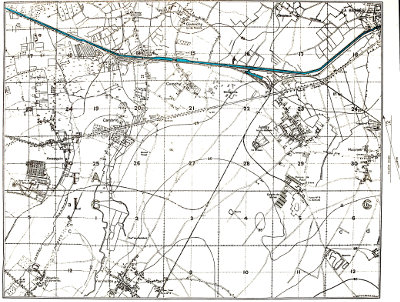
13Behind Auchy and Lone Farm could be seen Indian Well House,
Haisnes, Douvrin and the road running up to La Bassée. For normal
purposes this area was out of range, but was none the less interesting
in that it afforded all manner of unexpected sights. A train, a lorry
going along the road, a couple of horsemen trotting down a bridle
path are commonplace sights in England, but when you are separated
from that train or lorry by a network of ditches containing death
in a hundred forms, when that train or lorry is carrying men who will
probably to-morrow be trying their best to kill you, and whom you
may, with considerable fortune, kill first, then the matter appears in
a different light, and you feel an intense interest in the objects visible.
Up to the present this chapter has been devoted to a description
of the front on which the Division was operating. It may be that too
much space has been given to what is, after all, merely of personal
interest, but it should be remembered that this was the first front
upon which the Divisional Artillery served as a unit, and therefore
the memory of it has been impressed upon the minds of both officers
and men probably to a far greater extent than has any other portion
of the British Front in France. Now, however, regard must be
had for the tactical situation as it presented itself in the winter of
1915-16.
It will be remembered that, since the battle of Loos in September
and October 1915, no attack on any large scale had been carried
out by the British troops. Heavy fighting continued throughout
the winter along the newly-formed salient at Loos, and this in itself
proved such a drain upon the forces of both sides that the remainder
of the 1st Army front was comparatively quiet. On December 19th
the Germans launched a heavy gas attack in the Ypres salient, and on
February 13th, in the same area, occurred the famous attack on the
Bluff. The end of February saw the beginning of the great battle
of Verdun, and it was therefore a natural result that the La Bassée
front, situated as it was outside the zone of these different operations,
remained in a state of comparative quiet, and was disturbed solely
by the raids, mine explosions and artillery activity which were the
invariable régime of trench warfare.
This period of the campaign saw the arrival in France of a
great number of New Army divisions, and as far as possible these
divisions, with one or two noteworthy exceptions, were placed in a
part of the line which was not likely to be subjected to any large
scale operations but which, by the opportunities it offered of raiding,
patrolling and the like, formed an excellent training ground for
14troops not yet experienced in modern warfare. No better part of the
firing line could, in fact, have been chosen than the La Bassée sector.
The famous Brickstack area was a centre of great mining activities;
raids were the order rather than the exception, and big trench
minenwerfer were daily in action. The back areas of the German
zone were in full view of the artillery observation stations whence
practice could be obtained, day in day out, on every possible type
of target. Salient features presented themselves for registration and
calibration of the guns, and during these shoots the accuracy and
drill of the gun detachments could be fully and carefully noted.
Numerous houses, in a more or less advanced state of dilapidation,
gave all ranks a good idea of the effect of modern artillery fire on
fortifications, while working parties and moving targets of all descriptions
taught observing officers and gun detachments the essential
lesson of quick shooting without loss of accuracy, and the absolute
necessity of a familiarity with every inch of the ground covered.
It has already been stated that the mining activities of both
sides were very marked. Although this would appear to concern
the infantry rather than the artillery, the effect on the latter was of
great importance. The explosion of a mine was in many cases
followed by an infantry raid, and for this reason gun detachments
and officers on duty with the infantry were kept up to a high pitch
of speed and smartness in putting down an immediate barrage.
Moreover, this barrage shooting was most effective in instilling confidence
in the accuracy and good shooting of gun detachments. It
was a very strong but utterly fatal temptation to a battery commander
to add twenty-five or even fifty yards to the range of his
guns, to ensure that no shell fell short and inflicted casualties on our
own infantry. To withstand this temptation needed the most complete
confidence in the guns of the battery, but, on the other hand,
to add the margin of safety almost invariably meant that the barrage
dropped beyond its mark and inflicted no damage whatever upon the
raiding party or trench for which it was intended. Gradually did the
infantry learn completely to trust their gunners in barrage firing,
and once and for all did the battery officers realise that there was only
one range which would hit their target, and that any addition to that
range, although satisfying their own peace of mind, would effectually
wipe out any good which their efforts might have done, and would
leave the infantry to the mercies of a hand to hand encounter with
the enemy.
On March 8th an important alteration was made in the disposition
of troops along the Divisional front. From this date two
infantry brigades were kept in the line, each brigade maintaining
15two battalions in the front line. Each artillery section was divided
into two sub-sections composed of two 18-pdr. batteries apiece,
and it therefore worked out that each battalion of infantry in the
front line had two 18-pdr. batteries to provide it with direct
artillery support. This system appeared on paper excellent, and
indeed from the point of view of establishing close co-operation
between the Divisional Artillery and its own Infantry no fault in
the plan could be found, but there was one tremendous handicap
which every day made itself felt more vitally amongst gunners and
infantry alike. Throughout this period the supply of ammunition
for daily firing was most closely limited, and on March 18th the
allowance was restricted to sixteen rounds per battery per day.
It is not intended here to enter into the great ammunition controversy.
Such a matter would be out of place in what is meant to
be an historical record of an artillery unit throughout the war, but
it is mentioned in view of certain remarks which will later be made
concerning the mutual relations of the infantry with the artillery,
and is one of the chief difficulties with which the artillery had to
contend at this time.
March 18th saw the first attack of any dimensions which had
so far taken place in the neighbourhood of the 33rd Divisional zone.
After a short but very heavy artillery bombardment and the explosion
of three mines, the Germans made an attack upon the 12th Division
which was at that time on the right of the 33rd Division and was
confronting the Hohenzollern redoubt. Apart from a heavy bombardment
of Annequin with gas shells and the general searching
with long range fire of all the roads leading up to the front, no
material effect was felt by the 33rd Divisional Artillery. It gave
the batteries, however, some idea of what would be expected of them
in the event of a hostile attack on their own front, and, although
conducted at a distance, enabled them by sight and hearing to
realise the weight of shell fire to which they would be subjected if
they were themselves attacked.
April 27th saw a much larger attack by the Germans, once
again upon the right of the 33rd Division, and this time on the 16th
Division in the Hulluch sector. Early in the morning of that day
a very heavy bombardment began on the Division's right, and shortly
afterwards a call for mutual support was received. A heavy mist
lay upon the ground, but through it could be heard the throb and roar
of a battle in progress, mingling with the nearer and more persistent
thunder of our own guns and of the German retaliation. Gradually
the mist thickened instead of clearing, and gradually did the firing
become more intense; suddenly in the distance was heard the
16wail of a siren which was taken up by one closer at hand. The
Division had never before been subjected to a gas attack, and at
first the true meaning of these sirens was only suspected and not
fully realised, but a certain pungency soon made itself felt in the
morning air. The men began coughing and sneezing, the atmosphere
became thick and unbreathable, and in a very few minutes
all batteries were working under the protection of their gas helmets.
The battle was over by the middle of the morning, and the batteries
were able to return to the ordinary routine of the day, but a lesson
and a valuable lesson at that had been learnt, and it was brought
home even more clearly than before that the detachments must
be prepared to work under more difficult conditions than they had
as yet experienced. Whilst on the subject of this gas attack it is
important to note that, on the occasion in question, so dense were
the gas clouds that they were even felt at the wagon lines as far back
as Beuvry.
After this attack followed renewed trench activity and mutual
retaliation. On April 28th the wagon lines of the 166th Brigade
at Beuvry were heavily shelled by a long range gun, and numerous
casualties were suffered by horses and men. The shelling of wagon
lines is at all times most unsettling and likely to do great damage,
but this particular case, being the first of its kind of which the
batteries of the Division had had experience, created a great
impression.
About this time a somewhat curious incident occurred between
the German Air Service and our Artillery. On April 28th a German
aeroplane flew over the battery position of A/167 (Captain Studd)
and dropped a long streamer to which was attached a message.
This message stated that German headquarters were aware that
No. 1 Harley Street (a big building used as a dressing station and
situated in a road which derived its name from the number of aid
posts which lay along it) was a dressing station, but that, owing to
the great damage which was being done by the battery of howitzers
in action behind this particular house, they were reluctantly compelled
to destroy it by shell fire. Apart from anything else, this
was a considerable compliment to the work of A/167, the battery
referred to, but it did not say much for the observation powers of the
German aircraft. A/167 was then in action on the eastern end of
Tourbiers loop, and was at least 600 yds. from the dressing station in
question. Next day the bombardment of No. 1 Harley Street by
aeroplane observation began; a great number of direct hits were
obtained, and, although the Red Cross was clearly visible, the building
was entirely destroyed. It is pleasant to note, however, that
17this incident did not pass unavenged. Early one morning a short time
afterwards, the battery commander of A/166 (Captain Coffin) saw a
large convoy of German ambulances proceeding along the road near
Haisnes. A burst of high explosive blocked the front and rear of the
convoy, a steady and destructive fire of high explosive and shrapnel
swept the length and breadth of the road, and in a short time the
debt owing to the Germans by the destruction of the dressing station
in Harley Street was more than wiped out. The shelling of dressing
stations and ambulances was not, at this time, a practice usually
indulged in by our guns, but of late the enemy had been consistently
shelling all our aid posts, our dressing stations and our field ambulances,
and it was hoped that a short sharp lesson such as that detailed
above might tend to lessen in the future the sufferings of our own
wounded.
Quite soon after this incident another opportunity very fortunately
presented itself of impressing upon the Germans our intention of
brisk and immediate retaliation for any attacks on their part.
Three big minenwerfers had, of late, been harassing our infantry to
an undue extent every night from the vicinity of the Railway
Triangle, Spotted Dog and Ryan's Keep, and it was decided to
organise a really efficient shell storm to try and discourage the
enemy from this particular form of attack. Accordingly it was
arranged that, at 3.25 on a certain morning, a sudden and concentrated
bombardment by 9·2 in., 6 in., 4·5 in. howitzers and 18-pdrs.
should take place on the area from which the "Minnie" worked.
By a great stroke of fortune, ten minutes before the bombardment
was due to begin, the minenwerfer in question started its nightly
bombardment. Hardly had it begun than from all sides there poured
down shells of every description, trench mortar bombs and rifle
grenades, and for upwards of twenty minutes the German trench
system was one vast mass of smoke, flame and dust. Not for many
days afterwards did that minenwerfer worry our troops, and the
Germans must indeed have been impressed by the organisation which
in the space of a few minutes brought down upon them such a concentrated
and well-timed barrage.
On May 19th an important reorganisation of the Divisional
Artillery took place. When the 33rd Division embarked for France
its artillery consisted of four brigades:—the 156th, 162nd, 166th
and 167th. Of these, the first three brigades were made up of 18-pdr.
batteries, while the 167th was a 4·5 in. howitzer brigade. By an
order which now was issued, the brigades were reconstituted to
consist each of three 18-pdr. batteries and one 4·5 in. howitzer
battery. The effect of such an organisation was that each Brigade
18Commander had a small but complete tactical force under his direct
command, and, in the event of open warfare and a moving battle,
was so disposed that he had a percentage of both types of artillery
under his control. Everything, in fact, was now clearly indicating
the early resumption of active operations, and June 18th might be
considered to mark the first step in this direction in the La Bassée
sector.
On June 18th the 39th Division, then holding the line on the left
of the 33rd, was withdrawn, and the 33rd extended its front northward
as far as Grenadier Road in Givenchy. For one division this
was an extraordinarily wide front, and necessitated the alteration
and widening of gun pits, the establishing of new observation stations
in Givenchy, with the consequent laying of telephone lines—a
very heavy strain on the batteries who were responsible for the
support and protection of such a widely spread body of infantry.
The group system of batteries was reorganised into two new groups—Givenchy
and Cuinchy—and the late Auchy group became a subsection
of Cuinchy group. As an example of the width of front to be
guarded by the batteries, it may be stated that the howitzers had
to cover a front of 120°. In addition to the extension of the front,
preparations for operations on a large scale were ordered to be taken.
Every battery had to make accommodation for keeping around the
guns four times the amount of ammunition to what had previously
been the rule; all ranks were made acquainted with the forward
zone and the best lines of advance in case of a German withdrawal,
advance positions were selected and the whole front began to seethe
with an undercurrent of preparation and anticipation. To the
inexperienced minds of the troops this appeared to indicate an
offensive on the La Bassée front. Never before had the batteries
been in a big battle; they did not know that, had an attack been
contemplated on their front, the activity would have been multiplied
tenfold. They did not know that, far away in the south, preparations
on a vast and unprecedented scale were being made; that there
were in the Somme area concentrations of artillery, infantry,
ammunition and material which exceeded anything yet seen in war.
They only saw their own preparations and formed their opinions
accordingly.
19ORDER OF BATTLE.
May 1916—June 1916.
| H.Q.R.A. |
| |
| C.R.A. |
Brigade Major. |
Staff Captain. |
| Brig.-Gen. C. F. Blane, C.M.G. |
Major H. K. Sadler, M.C. |
Capt. T. Usher. |
| |
| 156th Brigade. |
| Lieut.-Colonel Rochfort-Boyd, D.S.O. |
| Adjutant: Lieut. W. G. Pringle. |
| |
| "A" Battery. |
"B" Battery. |
"C" Battery. |
"D" Battery. |
| Capt. L. R. Hill. |
Capt. R. D. Russell. |
Capt. G. Lomer. |
Capt. M. A. Studd. |
| Capt. Lutyens. |
|
|
|
| |
| 162nd Brigade. |
| Lieut.-Colonel O. M. Harris, D.S.O. |
| Adjutant: Lieut. T. D. Shepherd. |
| |
| "A" Battery. |
"B" Battery. |
"C" Battery. |
"D" Battery. |
| Capt. F. C. Packham. |
Major R. G. M. Johnston |
Capt. A. van Straubenzee. |
Major W. P. Bennett. |
| |
| 166th Brigade. |
| Colonel A. H. S. Goff, C.M.G. |
| Adjutant: Lieut. E. G. Lutyens. |
| |
| "A" Battery. |
"B" Battery. |
"C" Battery. |
"D" Battery. |
| Capt. D. M. Coffin. |
Major T. E. Durie. |
Capt. H. Freeman. |
Capt. W. A. T. Barstow, M.C. |
| |
| 167th Brigade. |
| Lieut.-Colonel L. T. Goff. |
| Adjutant: Lieut. H. C. Cory. |
| |
| "A" Battery. |
"B" Battery. |
"C" Battery. |
|
| Capt. S. Talbot. |
Major D. Stewart. |
Capt. G. Fetherston. |
|
20On June 24th these suspicions, already fostered by the Higher
Command in order to cover operations elsewhere, were more than
doubled. On that day the whole of the British line burst into
flame. From Ypres to the Somme a steady bombardment of the
German trench system began, wire was cut and kept open, repairs
to damaged trenches were prevented by persistent bursts of fire,
and in every sector did it appear that an attack was imminent;
unless the German Headquarters could discover where the main
concentration was taking place it was impossible for them to gauge
the most probable place of assault. That they did discover it was
realised, and realised bitterly, on July 1st and the succeeding days,
but there is no doubt that the artillery activity along the whole
front kept them in a considerable state of apprehension, nor did
they dare to dispatch troops to the Somme in such a whole-hearted
way as would otherwise have been possible.
Naturally, with both sides in such a state of activity, it was
inevitable that a great deal of raiding should go on—raids by the
Germans to try and discover in what strength we were holding the
line, raids by our troops to determine the German order of battle and
to follow, by identification, the arrival or departure of troops to and
from the zone. On June 22nd, at 2 A.M., a tremendous mine was
exploded by the Germans near the Duck's Bill in Givenchy. So
great was the mine, which had been dug right underneath Company
Headquarters of the 2nd Battalion Royal Welsh Fusiliers, that a
complete company was almost annihilated. Following the explosion,
the Germans raided the trenches under cover of a heavy barrage,
and for several hours hand to hand fighting of the fiercest nature
was carried on. Every gun which could be brought to bear upon
that area gave such support to our harassed troops as was possible,
and eventually the position was more or less restored. It is doubtful
whether this raid had any connection with the forthcoming Somme
offensive. It was conducted on such a large scale, and the mine shaft
itself extended for such a distance, that preparations must have
been begun some long time previously.
On June 27th it was our turn to harass the enemy by one of the
swiftest and best planned raids which had yet been carried out.
Two parties of the 9th Battalion Highland Light Infantry went
across No Man's Land at Mad Point and, under cover of a barrage,
entered the German front line at two spots some 250 yards apart.
The barrage in this case was a most difficult one for the batteries to
carry out, as not only had the two parties to be covered on their
front and flanks, but the reserve trenches behind the gap which lay
between the two parties had also to be blocked. This, however, was
only the beginning of the affair. Gradually the Highlanders, having
destroyed all the dug-outs, mine shafts and hostile troops within
their reach, began to bomb their way along the trench inwards towards
each other. Gradually such Germans as were not bombed retreated
before the hostile raiders and congregated in a herd in the middle,
with the raiding parties closing in on both sides and the barrage
21roaring over their heads to cut off all retreat. And then, when the
Germans were crowded and wedged into one section of the front line,
unable to move either way and awaiting a bombing attack from both
flanks, the raiding parties suddenly ceased pressing on, a mine
was exploded right underneath the spot where the Germans were
assembled, and the raiding parties returned to our own trenches,
all further work on their part being unnecessary. It was a triumph
of organisation and accuracy, and fully merited the results it
achieved.
On July 2nd the 2nd Battalion of the Worcestershire Regiment
raided the enemy lines for one hour and a half, and inflicted numerous
casualties on the enemy, and on July 5th the 2nd Battalion Royal
Welsh Fusiliers raided the enemy opposite the Duck's Bill and
remained in their trench system for over two hours. By now the
German infantry were in an advanced state of nerves. Although
the news of the offensive on the Somme had reached them and they
realised that the main attack was to the south, the continued bombardment
on their own front and the nightly raids gave them not one
moment's peace of mind, nor dared they materially weaken this
part of the line. The raid by the Royal Welsh Fusiliers on July
5th deserves rather more than a passing word. It will be
remembered that, on June 22nd, they had suffered heavily at the
hands of a German raid. On July 5th they were given a chance of
retaliation, and never has a raiding party gone over the top with
such a thirst for blood and revenge. Not only did the infantry
attack, but with them went a party of the Tunnelling Company
who were sore at the thought that the German miners had evaded
their counter-mining and had managed to carry a shaft so far beneath
the British trenches. It was not their fault—in that marshy ground
the most up-to-date and scientific apparatus was necessary to carry
a shaft to any depth beneath the ground. That apparatus the
Germans possessed and we did not, and as a result they carried their
shaft far deeper than we could reach, and blew up a company of
British infantry with one touch of an electric contact. July 5th,
however, proved an adequate revenge. For upwards of two hours
the infantry bombed and bayoneted, the sappers blew up all the
mine shafts, whilst the Cuinchy group of artillery alone fired 6,000
rounds, relays of detachments keeping the guns firing at "gun fire"
practically all the time.
That operation proved to be the last carried out by the 33rd
Divisional Artillery on the La Bassée sector. No hint had been
received by the batteries of a move, no word of warning was given
of an early departure, but suddenly, at about five o'clock on the
22afternoon of Thursday, July 6th, there came a bolt from the blue.
Orders were received that the 33rd Divisional Artillery was to move
down to the Somme, that it would be relieved forthwith by the
39th, and that the first half-batteries would march to the wagon lines
at 2 A.M. on the 7th, i.e., in eleven hours' time. Now the batteries
had been in action in the same positions for nearly five months, and
a few hours was but scanty notice to give in which to move out
from long-inhabited trench positions, ready and equipped for fighting
of any sort. Yet the order was complied with, and, when dawn
broke the following day, all traces of the departure had disappeared,
and away in the wagon lines were to be found the guns and men who,
the previous evening, had been in action within, in some cases,
1,700 yards of the enemy.
Before the further activities of the batteries are followed, a
word must be spoken in summary of the doings of the Divisional
Artillery on this front during the five months in which they
were in action. It may be complained that the foregoing chapter
deals too fully with the action of the Division as a whole, and
that not enough detailed information has been given concerning
the daily life of the batteries. The answer is, that what concerned
the Division vitally concerned the batteries, and that it has been
considered more desirable to give a general résumé of the work
carried out by the Division, for in that work the Artillery played
a most active part. It would have been easy, and to a few
people interesting, to have recorded the shelling to which the
batteries were subjected, the difficulties and trials they had to
undergo, and individual cases in which particularly brilliant or
destructive shoots were carried out, but in so doing the general
picture would have been lost and the value of this record greatly
reduced. The period spent on the La Bassée front was a period of
stationary warfare during which the batteries were hardened and
experienced, and, as such, lacked the interest which the ensuing
part of the campaign supplies. The description which has been given
of the type of fighting carried out during this time will enable an
idea to be gained of the work of the batteries, but two points in
particular are worthy of record.
When the batteries arrived in France they were raw and
untrained as far as actual fighting was concerned. The resulting
strain upon all battery commanders was tremendous, for no man
knows, until he has been under shell fire, the actual sensations of
that experience, and no battery commander knew exactly how
his men would bear the very great trial to which they were going to
be put. In those five months every battery had to suffer such
23shelling and bombardment, had to carry out such accurate and
wearying shooting, and to work under conditions of such difficulty
as to satisfy commanding officers that the 33rd Divisional Artillery
was indeed one of which to be proud, and that the men could be
relied upon to undergo any trial, to meet danger and death in any
form without deviating one inch from the work put before them.
When the batteries moved south to the Somme there was but one
feeling which pervaded officers and men alike, a feeling of complete
confidence, of complete determination and of keenness to take part
in real active operations which they fully realised, from the previous
five months' experience, they were well qualified to take.
And the other lesson learnt—what was that? It was the
most valuable one of co-operation and even of personal intimacy
with the infantry. During the whole of the La Bassée period, with
one short exception, the 33rd Divisional Infantry were holding the
line. Day in day out, officers from every battery were attached
to battalion and company headquarters, and the friendship of the
infantry for the gunners and vice versa became very real. Even
the N.C.O.s got to know each other by name, and the resulting
feeling of confidence and friendship was of the greatest value. It
was difficult to maintain this practice in later days when casualties
in the infantry and gunners increased by leaps and bounds, when old
friends were lost and new faces were ever appearing, and when the
batteries were continually being attached to strange divisions and
were covering infantry other than their own; but the lesson had
been learnt, and throughout the war the Divisional Artillery made
it an aim and object to get to know the infantry it was covering,
to live and fight with them, and to perfect that liaison which was so
important, not only by the teachings of the cold official text books,
but by the invariable lesson of human nature.
From the wagon lines to which they had marched on the night
of July 6th-7th, the batteries moved to Mt. Bernanchon and
Guarbecque, and there the Divisional Artillery concentrated. One
day it spent in overhauling, refitting and inspecting, and on the
9th it entrained at Fouquereuil, Chocques and Lillers, and moved
to the Somme, a unit no longer raw, inexperienced and untried, but
a unit trained and hardened by five months' trench fighting, now
setting off to take part for the first time in large scale operations,
in pitched battle, open fighting and all the trials and sufferings
attendant thereto.
CHAPTER III. THE BATTLE OF THE SOMME. (JULY 14th—SEPTEMBER 6th 1916).
24
Early on the morning of July 10th the long troop trains carrying
the batteries of the 33rd Divisional Artillery drew into the stations
of Longueau and Sallieux, in the neighbourhood of Amiens, and
began to unload with every due speed. All ranks fully expected to
march into action forthwith, and therefore with something akin
to dismay it was learnt that the destination of the batteries was the
area around Soues, Arouves and Le Mesge, villages some miles
west of Amiens, and far away from the battle lines. The 156th
Brigade and half of the 162nd Brigade marched first to Cardonette,
but their stay there was only temporary, and on the evening of the
10th, after a long and exceedingly dusty march in great heat through
Amiens, Ailly and Picquigny, the Divisional Artillery was reported
concentrated in the area allotted to it. There it stayed during the
whole of the 11th, resting, overhauling after the long journey and
generally making preparations for the great battle which all realised
was very near indeed at hand.
This was different country to the late surroundings of the
batteries. Hills and valleys, pleasant little villages with orchards
and pastures proved an agreeable change to the flat monotony
of Flanders, and, keen as the men were to prove their mettle in the
great struggle being waged over the far horizon, a day of rest in this
quiet country proved very welcome. On the 12th, however, all
was hustle and stir once again, and the four brigades marched together
as a Divisional Artillery to the Vecquemont-Daours area. The
heat was tremendous, and several inches of fine dust lay on the roads;
the result of a column, many miles in length, of horses and guns on
the march under these conditions may well be imagined, and on their
arrival—the 156th Brigade at Corbie, the 162nd Brigade at Daours,
with the 166th and 167th Brigades at Vecquemont—all were covered
and half choked with a mixture of dust and perspiration which
25nothing short of a dip in the neighbouring stream could remove.
Here the batteries bivouacked for the night, while battery commanders
were detached from the column to ride on at daybreak
to reconnoitre the front and generally to learn the tactical position
into which they must shortly lead their batteries; and from here
at 8.0 A.M. on the 13th the column, after the previous night's halt,
continued the march to Treux and the neighbouring Marette Wood,
where the brigades waited and gained such rest as was possible in
view of the fact that they were ordered to be prepared to move at
thirty minutes' notice.
Not until 1.30 A.M. on the 14th were the expected orders to move
received, and even then for one and a half hours the batteries stood
tense and expectant, gunners by their guns, drivers at the horses'
heads, while in the distance the throb and roar of the great attack
on the second German line of defence came down to them. At last,
at 3.0 A.M. in the half-light the 162nd, 166th and 167th Brigades
moved off to Becordel-Becourt, the 162nd Brigade proceeding in the
first place to Méaulte for a few hours, while the 156th Brigade moved
off in the afternoon of the same day to Méaulte, bivouacking on the
spot which the 162nd Brigade had just vacated on completing the
march to Becordel. Now was the battle very close at hand indeed;
the roads were choked with infantry, guns and transport moving
up, always moving up, with their faces set towards the east where
lay a mighty, seething cauldron, the melting pot of two great armies
in mortal conflict. Against this never-ending stream came down,
in a slowly moving column, the fruits—fruits indeed, though often
very bitter—of victory. Ambulances, walking wounded, shattered
guns, depleted and exhausted infantry battalions coming out to
rest, and, a sight more cheering to the up-going troops, long lines of
German prisoners. The appearance of this highway, one of the
main arteries to the actual front line, brought home to the batteries,
who were drawn up off the side of the road awaiting orders, a very
grim realisation of the ordeal they were about to undergo, but detracted
not one whit of eagerness from the minds of the men to plunge
into that struggle just as soon as circumstances should permit.
At 4.30 P.M. on the 14th the brigade commanders of the three
brigades at Becordel rode on to reconnoitre positions; it was generally
understood that no move into action would take place until
shortly before dawn of the following morning, and preparations
were accordingly made for a night bivouac. It was a disturbed
night; the road hummed and buzzed with traffic unceasingly, the
battery horse lines were twice shelled by a 4-in. high velocity gun—once
so heavily that the horses had temporarily to be withdrawn—and
26at 1.0 A.M. on the morning of Saturday, the 15th, two brigades,
the 162nd and the 166th, received orders to march into action at
dawn.
Independently at 3.0 A.M. the batteries of these two brigades
moved off in full fighting order, and, passing over the old front line
system near Fricourt, headed for the positions which had been
reconnoitred on the previous day on the slopes of the valleys running
from Caterpillar Wood to Montauban and Bazentin. Gas hung
thickly in the valley east of Fricourt and necessitated the wearing
of P.H. helmets, while a thick fog rendered progress of the utmost
difficulty, but gradually the batteries pushed their way up past the
ruins of Mametz and, topping the ridge, moved down the slopes into
the ill-famed and deadly Caterpillar Valley which, in the next few
days, was destined to be subjected to the most ruthless of shell-storms.
Here certain of the batteries in their innocence halted and
prepared for action, and Providence for once smiled upon them. A
few stray shells pitched over Mametz Wood, a few fell on the road
ahead, but Caterpillar Valley at that particular hour remained
untouched, and the batteries, after a short halt, continued unharmed.
Signs of battle were now to be found everywhere; the dead, friend
and foe alike, lay all around, broken and twisted guns and transport,
discarded equipment, rifles, bombs, all the disorder of battle were
strewn about, while the shell-pocked ground offered that dead and
forbidding appearance which is a characteristic only to be found in
ground recently fought over.
Through the now clearing mist the batteries advanced and, as in
open fighting, manœuvred in the manner so often taught in the plains
around Bulford. A, B and C/162 took up positions on the northern
slopes of the Caterpillar Wood-Montauban valley several hundred
yards north of Montauban, as previously reconnoitred, but D/162,
by an unfortunate misunderstanding, dropped into action just short
of the crest of the slope four hundred yards north of Caterpillar
Wood and about a mile to the left of the 18-pdrs., instead of
falling in practically alongside them. This alteration was very
regrettable, for, although for tactical purposes the range was the same
in either position, D Battery and its teams almost immediately
came under heavy fire directed at the cavalry in the valley between
it and Caterpillar Wood, and lost its battery commander, Major
W. P. Bennett, who was killed by a shell within the first few minutes.
The 166th Brigade at the same time came into action two hundred
yards east of Mametz Wood, and by 8.30 A.M. both brigades were
heavily bombarding that portion of Switch Trench which ran
west from High Wood. Of the remaining brigades the 156th
marched through Fricourt during the morning in rear of the 19th
Infantry Brigade (33rd Division), halted in reserve and reconnoitred
the whole position, while the 167th Brigade moved to a position of
assembly midway between Caterpillar and Bazentin-le-Grand Woods,
experiencing great difficulty en route in getting past our heavy
batteries which, in many cases, were in action off the side of the road
and firing directly across it. These two brigades came into action
on the night of the 15th/16th, with the exception of A/167 which
was not in action till 7.0 P.M. on the 16th, and took up positions
at 1.0 A.M., the 156th Brigade just north of Bazentin-le-Grand
village, the 167th Brigade close together in line half a mile north
of Caterpillar Wood. The wagon lines of all batteries lay immediately
west of Becordel. Thus, by dawn on the 15th, two brigades were in
action, while at dawn on the 16th the whole of the 33rd Divisional
Artillery was in the very midst of the Battle of the Somme, and was
bombarding the enemy to the utmost of its ability.
27ORDER OF BATTLE.
July—August 1916.
| H.Q.R.A. |
| |
| C.R.A. |
Brigade Major. |
Staff Captain. |
| Brig.-Gen. C. F. Blane, C.M.G. |
Major H. K. Sadler, M.C. |
Capt. T. C. Usher. |
| |
| 156th Brigade. |
| Lieut.-Colonel Rochfort-Boyd, D.S.O. |
| Adjutant: Lieut. E. H. Prior. |
| |
| "A" Battery. |
"B" Battery. |
"C" Battery. |
"D" Battery. |
| Capt. Lutyens. |
Capt. R. D. Russell
(wounded). |
Capt. G. Lomer. |
Capt. M. A. Studd. |
| |
Lieut. W. G. Pringle
(temporarily). |
|
|
| |
Capt. Mansell. |
|
|
| |
| 162nd Brigade. |
| Lieut.-Colonel O. M. Harris, D.S.O. |
| Adjutant: Lieut. Hill. |
| Lieut. B. R. Heape. |
| |
| "A" Battery. |
"B" Battery. |
"C" Battery. |
"D" Battery. |
| Capt. F. C. Packham. |
Major R. G. M. Johnston
(killed). |
Capt. A. van Straubenzee. |
Major W. P. Bennett
(killed). |
| Capt. Hill. |
Capt. V. Benett-Stanford. |
|
Capt. T. St. P. Bunbury. |
| |
| 166th Brigade. |
| Colonel A. H. S. Goff, C.M.G. |
| Lieut.-Colonel Murray. |
| Adjutant: Lieut. S. M. Wood. |
| |
| "A" Battery. |
"B" Battery. |
"C" Battery. |
"D" Battery. |
| Capt. H. A. Littlejohn. |
Major T. E. Durie. |
Capt. H. Freeman. |
Capt. W. A. T. Barstow, M.C.
(wounded). |
| |
|
|
Capt. Maxwell. |
| |
| 167th Brigade. |
| Lieut.-Colonel L. T. Goff. |
| Lieut.-Colonel C. G. Stewart, C.M.G., D.S.O. |
| Adjutant: Lieut. H. C. Cory. |
| Lieut. J. S. Campbell. |
| |
| "A" Battery. |
"B" Battery. |
"C" Battery. |
|
| Capt. S. Talbot. |
Major D. Stewart. |
Capt. G. Fetherston. |
|
28It is now necessary, in order to understand what follows, to
turn our attention from the affairs of the batteries, and to endeavour
to grasp the tactical situation as it presented itself at 4.0 A.M. on
July 15th 1916. At dawn on July 14th the great attack had been
launched on the German Second Line from Contalmaison on the left
to Longueval on the right. This line covered the important villages
of Bazentin-le-Petit, Bazentin-le-Grand and Longueval, while to
the rear of it lay the sinister woods of Bazentin, High Wood and
Delville Wood. The actual assault was carried out by the 23rd, 7th,
3rd and 9th Divisions, the 23rd being on the left opposite the northern
end of Bazentin-le-Petit, while the 9th Division on the right faced
the village of Longueval. At 3.25 A.M. the great attack began, and
the German Second Line on a front of three miles was broken; the
flanks remained firm, however, and before the advance could be
carried further it was considered essential that the gap should be
widened by an attack towards Pozières on the left, and against Ginchy
and Guillemont on the right. In addition to this, certain local
operations had to be carried out upon the front from Bazentin-le-Petit
to Longueval, which embraced the zone covered by the 33rd
Divisional Artillery, and it is with these operations that we must
necessarily concern ourselves.
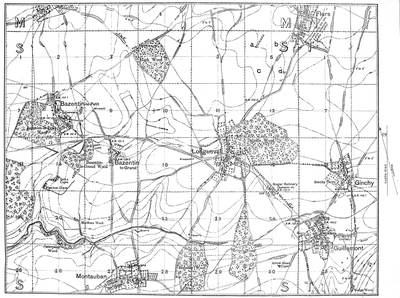
29By nightfall on the 14th the whole of Bazentin-le-Petit Wood,
village and windmill, Bazentin-le-Grand and the southern portion
of Longueval were in our hands, our line running just to the north
of these places; but High Wood, although reached and captured
by a gallant charge of cavalry supported by infantry, proved too
tough a nut to crack, and remained in German hands together
with the still uncaptured Delville Wood and the northern end of
Longueval Village which was under the fire of enemy machine
guns in High Wood. To clear these two woods and the remainder
of Longueval was essential, and therefore, on the morning of July
15th, an advance was ordered by the 98th and 100th infantry brigades
of the 33rd Division upon that portion of Switch Trench which ran
westwards from High Wood, while a South African brigade was
ordered up from Montauban to capture Delville Wood and the
northern part of Longueval which still lay in German hands. With
the latter attack, which indeed culminated into a battle of assaults
and counter-assaults spread over several days, we cannot concern
ourselves now. This history aims at perpetuating the deeds solely
of one unit, and, to preserve the sequence of events, it is manifest
that the operations upon that unit's immediate front must receive
the closest attention; for this purpose we shall turn to the attack
on Switch Trench launched on the morning of the 15th by the 98th
and 100th infantry brigades covered by the guns of, amongst others,
the 162nd and 166th Brigades of the 33rd Divisional Artillery, the
first big attack in which these brigades took part.
From 8.30 A.M. for one hour the guns of both brigades bombarded
Switch Trench where it ran west from High Wood, and at the end of
the hour lifted on to Martinpuich, while the infantry assaulted the
objectives which had just undergone this short but intense shelling.
On the left the 98th infantry brigade reached its objective, but the
100th brigade was held up by machine-gun fire on the flanks and,
after suffering some casualties, returned to its original line; the
98th brigade, with its right flank left thus in the air, had to follow
suit, and by ten o'clock in the morning the battle had died down,
leaving the guns free, apart from the usual day firing and registration,
to get slightly more settled in their new surroundings. It should
be remembered that the batteries had been marching, travelling by
train and marching, day in day out, since the early morning of the
9th, and now, plunged into a great battle, it might have been hoped
that at least a few hours' rest could have been obtained. This was
not to be, however; no sooner had the batteries ceased co-operating
in the infantry operation above referred to than they set to digging
rough shelter trenches for the men in case of bombardment, digging
pits for ammunition, camouflaging the guns as far as possible,
getting up from the wagon lines heavy dumps of ammunition, and
generally trying to get the battery positions into such a condition
as would enable the guns to inflict the maximum of damage upon
the enemy with the minimum of casualties to themselves. Open
warfare was still the order of the day, and at any moment orders
30might be received for a further advance by the batteries, but on the
other hand those orders might never come, and all ranks had already
seen sufficient of the fierceness of the enemy's barrage to give them
will to urge their already tired limbs to further efforts at self-protection.
As events turned out, no further assaults were made by the
infantry on the zone covered by the 33rd Division batteries till the
20th; for five days the batteries were able to register accurately
every outstanding feature and point of importance on their zones,
while communications were elaborated and perfected from the
somewhat rough and ready open warfare methods which had been
set up when first the brigades came into action. O.P.'s were established
in the old German second line between Longueval and Bazentin,
from which points very clear observation upon High Wood and
the ground lying to right and left thereof could be obtained, although
the ground, consisting as it did of open undulating downs, offered
but few salient objects upon which to register; there were, however,
one or two points—the corner of High Wood, the orchards north
of Longueval and the mysterious iron gate standing on the sky line
between High Wood and Delville Wood—which enabled every
battery commander to divide his zone up into areas each containing
at least one fairly clear reference point, while to the left of High
Wood an odd bush or tree and an occasional view of Switch Trench
served the same purpose.
It must not be supposed, however, that because there was no
infantry assault the guns had little to do. From the 15th until the
night of the 19th/20th every battery kept Switch Trench under
continual fire, cutting wire, bombarding the trench itself and generally
rendering that line of defence as difficult and as uninhabitable as
possible to the enemy. By night Switch Trench and Martinpuich
were kept under intermittent bursts of fire, and it is safe to say that
at no moment between the dates given above were all four batteries
of any one brigade silent. This was no trench fighting position;
the enemy had been got on the move, he must be kept on the move,
and to do this every battery was firing more ammunition in twenty-four
hours than had been normally fired by a whole brigade in a
week on its late front opposite to La Bassée. On the 17th C/156
(Captain Lomer) was forced to withdraw to Flatiron Copse, 800
yards south of Bazentin-le-Petit Wood, as part of High Wood was
still in German hands, and the battery, being under direct observation,
was not only subject to a galling fire but was in serious danger of
being rushed by a counter-attack on the part of the enemy. B
(Captain Russell) and D (Captain Studd) batteries of the same brigade
31stuck it out until the early morning of the 21st, and then, the operations
of the 20th which we shall shortly describe being over, withdrew to
south of Bazentin-le-Petit Wood and Flatiron Copse respectively.
As A/156 (Captain Lutyens) had in the first place dropped into
action at the northern end of the valley running from Caterpillar
Wood to Bazentin, the result of this movement was that the whole
of the 156th Brigade was now behind, that is south of, Bazentin-le-Grand
Wood, and no longer in the exposed position north of the
village which it had hitherto occupied.
It has already been stated that, from the O.P.'s in the old German
second line, a very fair view of the ground to the right and left of
High Wood could be obtained; this was indeed a fact, but with
such skill had the Germans sited their main front line—the ill-omened
Switch Trench—that it was exceedingly difficult to observe the
actual effect upon it of the shelling to which it had been subjected,
nor was the condition of the wire visible even through powerful
field-glasses. Accordingly it was ordered that one officer per artillery
brigade should advance from the outpost line of our infantry and
make such examination of the German wire by daylight as was
possible at close range. The opposing infantry were still in a
condition of open fighting—sentry groups and outposts being the
order of the day, with the main front line some distance behind
them; shortly before dawn on July 19th, therefore, the officers
in question crawled out from our sentry groups and, passing in some
cases right through the line of German outposts, made an examination,
as careful and thorough as the proximity of the enemy in broad
daylight would permit, of the condition of the Switch Trench wire.
The examination was not reassuring; in many cases the wire stood
firm and untouched, and it was realised that further and strenuous
efforts by the batteries would be essential that day if the coming
attack was to have any chance of success. It is a regrettable duty
to relate that one of the officers (Lieut. Elliott) who made this
reconnaissance never returned; having passed beyond a German
sentry group he was severely wounded, and, although his orderly
dragged him into a shell-hole and left him in such shelter as it offered
while he went for help to bring him back into our lines, his body
was never again found. The whole of the day was, indeed, a bad
one for the 33rd Divisional Artillery. Colonel A. H. S. Goff (166th
Brigade) was wounded and evacuated; all the batteries were heavily
shelled, in particular the batteries of 162nd Brigade which wilted
beneath a storm of shrapnel during the entire day, while the headquarters
of the same brigade received a three-hour bombardment
of lachrymose gas shell, making the carrying on of the administration
32extremely difficult. None of this, however, was allowed to
cause any interruption of the day's work, and by nightfall all
batteries of the Division had received orders for the following
day's assault upon High Wood, and had made the necessary
preparations.
At 3.25 A.M. on Thursday, July 20th, the first infantry operation
took place in this zone since the attack on the morning of the 15th.
Following on a half-hour bombardment by the 33rd and 21st
Divisional Artilleries (XV. Corps) which began at 2.55 A.M., the 19th
infantry brigade advanced to the assault of High Wood. Two
thousand rounds of 18-pdr. and 500 rounds of 4·5 in. howitzer
ammunition per brigade were fired in support of the infantry, the
target of the batteries being High Wood until "zero" hour (3.25 A.M.),
when the batteries lifted to the northern or enemy edge of the wood,
bombarding it for half an hour until 3.55 A.M. and then making
the final lift to the far side of the wood. The assault was successful,
the wood was carried, but during the whole day the infantry were
subjected to the most intense and galling artillery fire by the enemy
guns, light and heavy. All day long our batteries searched the
roads and approaches from Flers, and the hollows north of the wood—anywhere
whence an enemy counter-attack might develop—and,
with the exception of one which was launched at 12.30 P.M. and
beaten back by artillery and infantry combined, this fire was successful
in keeping the enemy at bay.
The hostile artillery fire, however, was terrible; not one inch
of the wood but was torn and swept by high explosive shell, rent
by shrapnel and rendered completely uninhabitable to any human
being. At 6 P.M. the effect of this shell-storm came to a head, and
for half an hour our batteries put down a heavy barrage along the
northern edge of the wood, under cover of which the infantry retired
to the southern half; it was no hostile counter-attack which thus
drove them back—it was the sheer weight and force of the thousands
of shells which, from all around, the enemy poured into the wood, and
which smashed and shattered the unfortunate troops who were
trying to hold what they had so gallantly won. At first the report
came through that the whole of the wood had been evacuated and
that the infantry were back in their original line in front of Bazentin,
but this was proved to be erroneous, and the southern half of High
Wood at any rate was retained in our grasp. At 9.30 P.M. the
enemy opened a vicious gas shell barrage on the ridge in front of
D/162 and on the batteries of the 167th Brigade, and at 11 P.M.
followed this up by a counter-attack on the scene of the morning's
fight. After three hours' firing the situation became quieter, and in
33the morning the position on the whole had not changed since dusk
the previous evening.
For the next two days there ensued another period of comparative
inactivity as far as infantry assaults were concerned. Both sides
paused, as it were, to draw breath, but not for one moment did
this cause a lull in artillery activity. The enemy, as well as our
own Higher Command, was beginning to realise more and more the
immense importance of counter-battery work, and these intervals
between the attacks were, from the gunners' point of view, almost
more to be feared than the attacks themselves. Morning, noon and
night first one battery and then another would be subjected to
a sudden burst of intense fire, while at other times a ponderous and
deliberate bombardment of a fixed area in which a number of batteries
were in position would be carried out—a system which had the most
harassing effect upon the men, and to the success of which an ever-lengthening
casualty list of guns and gunners bore eloquent testimony.
July 21st was a typical day of this sort; starting at 10 A.M., a
prolonged and widespread enemy bombardment was carried out
during the whole day with 4·2 in. and 5·9 in. upon the valley running
from Longueval to Montauban, and its adjacent slopes. The 18-pdr.
batteries of the 162nd Brigade, together with the headquarters
of the brigade itself, came heavily under fire, and a long casualty
list was only averted by the use of the shelter trenches which by this
time had been dug in all the battery positions. While this was in
progress the 167th Brigade, farther to the left, was also undergoing
a severe bombardment by 5·9 in. howitzers. Direct hits were
obtained upon B/167 (Major Stewart), and in all the batteries,
including D/162 which lay just behind the 167th Brigade, a number
of casualties were sustained. Murderous fire was, at the same time,
opened upon Caterpillar Valley, from the fork between Mametz and
Caterpillar Woods down the entire length of the valley nearly to
Mametz village itself, and at times during the day it was almost
impossible to see a single battery position from which the smoke,
flame and dust of bursting shells were not flying. Nothing could
be done; it was a case of "wait and see"—the hardest test to
which troops can be put—and to the eternal credit of the men it
may be said that they waited on this, as on all other similar occasions,
with quiet philosophy and with a stoicism which it would be hard
to equal.
Meanwhile, what of our friends the infantry? On the morning
of the 21st the hard-pressed 33rd Division was withdrawn from the
line and was succeeded by the infantry of the 51st Division (153rd,
154th, and 155th infantry brigades). At the same time the zones
34of the 33rd Divisional batteries side-slipped to the right and, coming
under the 51st Divisional Artillery for tactical purposes, covered
the line to the right (i.e. east) of High Wood. Day firing was carried
out upon Switch Trench, the new zones were registered and night
firing, consisting of 500 18-pdr. and 75 4·5 in. howitzer rounds per
brigade, was directed upon the hollows in rear of and approaches
to the divisional zone. At 10.15 P.M. Caterpillar Wood and the
neighbouring localities were heavily bombarded by gas shell and
high explosive, and all communications of the 167th Brigade were
cut; lamp signalling was immediately taken up, however, and
proved itself entirely reliable as a means of communication, despite
the gun flashes all around and in the sky.
The morning of July 22nd was devoted to further registration
and short bombardments. From 3.0 A.M. until 3.30 a general
bombardment of Switch Trench was ordered at the rate of 2 rounds
per minute from the 18-pdrs. and one round per minute from the
howitzers, totalling upwards of three thousand rounds fired by the
fifteen batteries. At the end of the bombardment the 162nd Brigade
stood by to carry out a registration by aeroplane, but no machine
ever appeared and soon afterwards normal firing for the day was
continued, D/162 shortly after one o'clock carrying out a destructive
shoot on some machine guns and dug-outs to the west of High Wood
which were, by their enfilade fire, holding up the whole situation
and preventing an advance in the neighbourhood. Their destruction
was essential, for an advance had been ordered for the following
day, and at 7 P.M. in the evening the whole of the front burst
into flame in preliminary bombardment for the assault. At the rate of
80 rounds per battery per hour the guns of the XIII., XV. and III.
Corps bombarded the positions which troops of the 5th (on the
right), 51st and 19th (on the left) divisions were to attack next day,
the objective of the 51st division, which was covered by the guns of
the 33rd Divisional Artillery, being the N.E. and N.W. edges of
High Wood, together with a portion of Switch Trench running
E. and W. therefrom.
"Zero" was 1.30 A.M. on July 23rd, and seven minutes previous
to that hour the fire of the batteries was increased to intense rate.
At half-past one to the second the infantry went over the top, and
the batteries searched back by short lifts to a line 200 yards beyond
the objective. For half an hour was this searching fire continued,
and at two o'clock the batteries slowed down and set up a protective
barrage 200 yards beyond the late German trench, under cover of
which it was hoped the infantry would be able to consolidate their
position. Such, however, was not the case. Although in places the
35attacking troops had gained their objectives, at many points our
men had been held up by machine gun fire and, by their failure to
advance, had compelled their more successful comrades to retire to
their starting place. All along the line the assault failed, and when
at 5 A.M. the enemy counter-attacked fiercely the guns shortened
their range and bombarded Switch Trench once more. By 8.30 A.M.
all was quiet again, the attack was over—and our infantry were back
holding the same line from which they had advanced earlier in the
morning.
From July 23rd-27th there ensued another of those lulls which
have already been described; for the moment our advance was
checked and held up while the Higher Command appeared to be
seeking a solution to the very determined and successful opposition
which the enemy showed to our troops in this sector, and during the
interval which elapsed the usual harassing was carried out night and
day by the now rapidly wearying batteries. Two thousand rounds
by day and 700 by night were poured on to the German defences by
each brigade, and in return the German batteries gave no peace to
our guns, daily subjecting the area in which the batteries were
located to a vicious and effective bombardment. Mametz and
Caterpillar Woods, the valleys running from Caterpillar Wood to
Bazentin on the one hand and Montauban on the other were daily
ploughed from end to end by shells varying in calibre from 77 mm.
to 12 in., while the valley running from Longueval to Montauban,
together with the ridge to the west thereof, became a veritable death
trap. It was of no use seeking to move the battery positions; one
place was as bad as another, and there was nothing to do but to
sit tight and trust that, before our batteries were completely wiped
out, a further advance might check the ever-increasing storm of
German shells.
There was another, and a very serious, difficulty to be faced at
this time also; owing to the enormous strain placed upon the guns
by the incessant day and night firing, the running-out springs began
to give way and to fail, and great difficulty was found in obtaining
new ones. Previous to the war almost all these springs had come
from Germany, and, with this source of supply cut off, British manufacturers
at home had found it impossible as yet so to organise
their output as to meet the ever-increasing and insistent demands
from the various theatres of war. As an instance of the seriousness
of this trouble it may be mentioned that on July 26th only five guns
of the 162nd Brigade were in action, the remainder having no serviceable
springs left, whilst of these five two had to be pushed up by hand
after the firing of each round. Such a state of affairs, which cut
36down the volume of fire of the brigade by over one half, was bound
to reflect seriously upon the preliminary bombardments and barrages
in any attack, nor was the trouble confined to the 162nd Brigade
alone.
On July 24th the 33rd Divisional Artillery ceased to work in
contact with the infantry, and was put under direct orders of the
XV. Corps to carry out counter-battery work on the whole Corps
front, searching hostile battery positions, hollows and approaches,
and in addition answering any S.O.S. call when required upon all
portions of the Corps front. Such duties naturally incurred still
more firing and work; two batteries (A and B) of the 162nd Brigade
were unable to get sufficient right switch to cover the now wider
front, and were forced to move further up the slope, new O.P.'s in
front of Longueval had to be reconnoitred and linked up with the
batteries by telephone, while the new zone which stretched from the
south of Martinpuich to Delville Wood had to be registered before
dusk. Hardly had this been done than, at 8.30 P.M., a report was
received that the enemy were leaving their trenches between High
Wood and Delville Wood, and the batteries immediately opened a
rapid rate of fire to break up the expected counter-attack which,
surely enough, was launched at 8.45 P.M. under a very heavy barrage.
Both sides bombarded with the utmost fury, and ultimately the
counter-attack melted under our fire, but not till midnight were the
tired batteries able to report "all quiet," and even then night
firing was carried on in the usual way. The 51st Divisional Artillery
was at this time responsible for the direct support of the infantry,
and it was by way of co-operation that this bombardment of the
hostile trenches was carried out.
It has been previously stated that from the 23rd to the 27th a lull
occurred in the infantry operations. This, broadly speaking, is a
fact, but it must not be supposed that during that time our front
line troops were entirely inactive. Bit by bit each day they had been
bombing their way through Longueval, sometimes without artillery
support, sometimes assisted by the guns, as on the 26th when for one
hour from dawn the guns poured shells into the northern end of the
village. It was slow work, this gradual penetration, but by the
evening of the 26th a very appreciable advance had been made, and,
when orders were received at 4 P.M. that a general assault on Delville
Wood and the orchards north of Longueval would take place next
day (27th), our troops were in a far more favourable position for
"taking off" than they had been a week earlier.
The assault was delivered at 7.10 A.M. on the morning of
Thursday, the 27th, and was preceded by an artillery bombardment
37beginning at 5.30 A.M. For this bombardment 1,500 18-pdr. and
400 4·5 in. howitzer rounds were fired by each brigade, and were
directed mainly upon the trenches to be assaulted and the back
areas thereof. To the 5th Division was entrusted the capture of
the objectives on the front directly under the guns of the 33rd
Divisional Artillery, and the line of this ran from the north-west
edge of Delville Wood through the enclosures 150 yards north of
Longueval village, along the sunken road running west from these
enclosures to the High Wood-Longueval road. The chief interest
of the attack, however, lay in the fact that the creeping barrage, as
already practised in the opening days of the Somme battle, was now
being more and more carefully elaborated. It had not yet reached
that high stage of perfection which, in the offensives of Arras and
Passchendaele in 1917, enabled the gunners to provide what was
almost an ever-moving curtain of fire advancing yard by yard in
front of the infantry, but it did even now remain upon one point
until the very last moment and then lift off, but scarcely creep, to
the next point to be attacked while the infantry stormed the first.
All day long fierce fighting continued but, although on the right
of the line the 2nd Division gained their objectives, on the left the
men of the 5th Division were held up at points. The climax of the
day was reached at six o'clock in the evening, when a heavy counter-attack
was launched all along the line by the enemy, but this counter-attack,
in common with a similar one launched at 10.30 P.M. on the
following night (28th), broke up under the fire of our guns. During
this attack green flares were lighted all along the front by our foremost
infantry at specified times, and although it was difficult to
persuade them to do this, inasmuch as they considered that the flares
would be equally useful to the enemy as well as to our guns in showing
up their position, the information thus obtained of the progress
of the assault was of very great value.
During the 28th and 29th the batteries busied themselves in
preparing for future operations. Casualties in men and guns had
been severe throughout the fighting, vast quantities of ammunition
had been expended, and all this had now to be replaced. On the
morning of the 27th a 5·9 in. shell had exploded directly in the pit
where the men of B/162 (Major Johnston) were getting their breakfasts,
killing and wounding every man in the pit, while on the afternoon
of the 29th D/162 (Captain Bunbury) was heavily shelled and
lost one and a half detachments who were practically blown to pieces.
A 5·9 in. shell burst right upon a pile of ammunition beside one of
its guns and exploded a number of rounds; in addition to the wiping
out of the detachments, the gun itself was completely destroyed by
38the explosion, and only the piece and a portion of the spade were ever
found afterwards. It is curious to note that the force of the explosion,
which made a huge crater in the ground, threw a complete
wagon of ammunition so high into the air that it came down some
150 yards from the battery, yet not a single round in the wagon
exploded. As, in addition to this, all the guns of C/167 (Captain
Fetherston) were out of action and the other batteries had suffered
the usual daily casualties which now had become inevitable, it will
be seen that the Divisional Artillery was in a fairly serious
plight. However, the work had to be carried on, and on the afternoon
of the 29th the batteries set themselves to the now familiar
task of bombarding Switch Trench with 45 rounds per gun, in preparation
for another attack which was due to take place on the morrow.
The bombardment proper for this attack began at 4.45 P.M. on
the 30th, but previous to this there had been the short burst already
referred to and another similar effort in the early morning from 3.15
to 5.15. At the same time our heavy artillery carried out a series of
destructive—or, at least, would-be destructive—shoots on the enemy
batteries; this was a most essential procedure, for the work of the
batteries had been greatly impeded all the morning by an intense
hostile gas shelling of the positions while, during the whole of the
afternoon, the batteries on the ridge north of Caterpillar Wood were
raked from end to end by high explosive. At last, however, the
final bombardment opened, and from 4.45 P.M. till 6.10 P.M. the
German defences between High Wood and Delville Wood were
subjected to 800 rounds per 18-pdr. battery and 400 rounds per 4·5 in.
howitzer battery all along the front. Seven minutes before zero,
which was at 6.10 P.M., fire was quickened to intense rate, and at
zero hour troops of the XIII. and XV. Corps advanced to the attack,
having for their objectives the sunken road running from the N.W.
face of Delville Wood to the east corner of High Wood. The XIII.
Corps, who were on the right, reached their objectives successfully,
but the XV. Corps, advancing on the left of the XIII., were not so
fortunate; enfilade machine gun fire from strong points near the
orchards north of Longueval held them up, while their left, although
successful in reaching the sunken road near the corner of High Wood,
was subjected to such a perfect hell of high explosive that it was shelled
out and forced to retire. Thus at 8 P.M., when firing was reduced to
normal, the situation was but little different to what it had been
before the attack.
The attack of the 30th was very typical of the tactics in practice
at this time in the Somme battle. The same thing had been seen
in the previous assaults of the 20th and 23rd, and the same thing
39was to be seen in subsequent operations; small attacks on limited
areas—perhaps only on a two division front—were launched and,
nine times out of ten, were doomed to failure by their narrow scope.
There is no doubt that individual strong points were holding up the
general advance and had to be overwhelmed before any more
ambitious plans were undertaken, but there is also no doubt that,
when these unfortunate battalions went over the parapet upon some
purely local undertaking, they were immediately subjected to
machine gun fire in enfilade from the flanks, where no attack was
taking place, and to overwhelming shell fire from batteries on
neighbouring zones, which, owing to the undisturbed state of their
own zone, were able to add to the already heavy volume of fire on
the front attacked. It may be that the Higher Command was right
in its handling of the situation, but for the men on the spot it was
heart-breaking to see battalions of the finest material launched
to certain death on an attack which, by the narrowness of its front,
was doomed to failure before it ever began.
July 30th and 31st contained nothing more of importance
than three S.O.S. calls from Delville Wood, and on Tuesday, August
1st, at 5.30 A.M. orders were received with dramatic suddenness
for the 162nd and 166th Brigades to be relieved by the 78th and 79th
Brigades of the 17th Divisional Artillery. In a fever-heat of expectation
the batteries of the two brigades waited all day long for the
orders to take effect; at last, between four and seven o'clock in
the afternoon, the incoming units arrived, and with heartfelt thanks
the batteries, taking their guns with them, marched back to the
wagon lines. It was unfortunate that D/78 should have chosen the
moment to relieve D/162 when four low-flying German aeroplanes
were right overhead, but choose it they did, and the price had to
be paid. The incoming battery was a little ahead of its time, and,
as a result, when the teams and limbers of D/162 appeared on the
scene the shell storm for which the aeroplanes had called was just
beginning. Whizz bangs, 4·2 in. and 5·9 in. shell poured down
upon the battery position and horses for over half an hour, and how
the battery escaped with such light casualties as it did, was a marvel.
One gun and one ammunition dump were destroyed, several drivers
and horses were hit, but in no way was the relief disorganised, and
D/162, after manœuvring under a hail of shells, ultimately withdrew
towards the Montauban flank. For the rest of the evening Caterpillar
Valley all around and south-west of Mametz Wood was deluged
with shells, and the batteries who chose that route for their outgoing
march had an extremely unpleasant time. All got away in the end,
however, and after a short halt at the wagon lines continued the
40march. Dernancourt, which was the destination of the batteries,
was reached at 2.30 A.M., and here they remained till the 11th
resting, refitting and generally cleaning up after the ordeal of the
past eighteen days.
Only two brigades were now left in the line—the 156th and the
167th—and, as Headquarters staff of the 33rd Divisional Artillery
had gone into rest at Dernancourt, these two were put under the
command of the 51st Division. The zone covered by the 156th
Brigade extended along the High Wood—Bazentin-le-Petit road
southwards from the north-west corner of the wood, while the 167th
Brigade looked after the road running south-east from the eastern
edge of High Wood; D/156 (Captain Studd) carried out counter-battery
duties. From August 1st to August 11th little of importance
in the way of operations occurred. Hostile attacks on Bazentin-le-Petit
on the 2nd and against High Wood on the 10th were repulsed
by our fire, while on the 4th and the 7th minor infantry engagements
were carried out by our troops on the orchards and houses
along the north-west edge of Delville Wood and on High Wood
respectively.
Very heavy firing took place throughout this period, and during
the week ending August 17th the 156th Brigade fired no less than
twelve thousand rounds, while the German artillery must have
flung something like the same amount into our positions. B/167
(Major Stewart) was shelled out and had to move on the 3rd to a
position six hundred yards east of Caterpillar Wood, where it was
joined next day by Captain Fetherston's battery (C/167) which had
also undergone a severe gruelling at the hands of the enemy. A/167
(Captain Talbot) proved no less unfortunate than the other two
batteries, and on the 5th, after a very heavy shelling which lasted all
day, it was compelled to move to a position alongside "B" and
"C," where it went to form two six-gun batteries instead of three
consisting of four guns each. At the same time the brigade was
temporarily handed over to the command of Major Stewart, for
Lieut.-Colonel L. T. Goff had on the previous day been evacuated sick
to England. Thus the two brigades remained shelling and being
shelled, day in day out, until August 11th, when the other two
brigades (162nd and 166th) came up into the line from the Dernancourt
rest area and relieved them. The 156th and 167th had been
in action continuously since July 16th under the most trying and
harassing of conditions. They had been subjected to shelling more
severe than any yet experienced in the war, and, when they marched
out to rest on the evening of the 11th, they were utterly exhausted,
utterly worn out, a party of very tired and weary men.
41On returning to the line on the 11th the batteries of the 162nd
Brigade did not reoccupy their old positions but, after reconnaissance
by Lieut.-Colonel Harris, formed two six-gun 18-pdr. batteries
under the command of Major Johnston and Captain van Straubenzee,
and took up positions on the southern slopes bordering Caterpillar
Valley, at a point about three hundred yards N.N.W. of Montauban.
At the same time D/162, which from the 8th onwards had been
sending parties up from Dernancourt to dig gun-pits and prepare
the place for occupation, came into action under the northern bank
of Caterpillar Valley about five hundred yards to the right front of
the other two batteries, which was the position it had originally
been intended to occupy on July 15th. The 166th Brigade took
up positions 500 yards north of Caterpillar Wood.
While these two brigades had been out at rest a change had
taken place amongst the infantry, and the guns now covered the
33rd Division (forming part of the XV. Corps), with the 14th
Division on the right and the 1st Division on the left, the tactical
command of the batteries being in the hands of the 14th Divisional
Artillery. From the 11th until the 18th the lull in infantry fighting,
which had been noticeable in this sector since the beginning of the
month, continued, but the work of the guns was as usual very heavy.
In addition to counter-battery work and minor bombardments,
four hundred and fifteen 18-pdr. rounds by day and five hundred by
night had to be expended by each brigade on searching and sweeping
roads and hollows behind the brigade zone, while the 4·5 in. howitzers
carried out the same work to the extent of two hundred and thirty-three
rounds by day and one hundred and sixty-six by night. The
zone in question was the extreme right of the 33rd Divisional front,
along the enemy front line known as Wood Lane. Fortunately for
the batteries, hostile shelling upon the gun positions was far less violent
than had been the case before the two brigades went into rest, and
it was now possible to get through a very fair amount of registration
without interference from enemy shell fire; this was important, for
the guns had to be ranged upon a number of new points owing to
the change in position, while a wireless set which had been installed
at Brigade Headquarters enabled numerous "N.F." calls to be picked
up from our aeroplanes, all of which were acted upon by the howitzer
batteries of the respective brigades.
On the 16th orders were received for an attack to be delivered
on Friday, the 18th, and in preparation for this the ammunition
allotted for night firing was doubled on the nights of the 16th and 17th,
while by day the guns bombarded Wood Lane, cutting the wire and
shelling not only the trench but also No Man's Land in front thereof,
42lest the German machine-gunners should creep out forward and
thereby escape our barrage. At 2.45 P.M. on the 18th the attack was
launched by the 33rd Division, with the 14th Division on its right.
In addition to the preceding two-days shelling, the whole of the
morning of the attack, with two short forty-minute intervals, was
devoted to barrage firing on the enemy trenches, the barrage of
18-pdrs. lifting at three given times to suggest an impending assault,
whereupon the 4·5 in. howitzers, a few minutes after the "lift,"
dropped back on to Wood Lane (the enemy front line) to catch such
of the enemy as had manned the parapet to withstand an attack.
Immediately prior to zero hour there was no bombardment; it
was hoped to start the attack simultaneously along the whole front,
and the best means of achieving this was considered to be an opening
of the barrage at zero itself, without any bombardment during the
preceding five minutes.
The order of battle in this attack showed the XIII. Corps on the
right, the III. Corps on the left and the XV. Corps in the centre.
The two flank Corps successfully gained their objectives, as did also
the right of the XV. Corps, but the 33rd Division was held up partly
by flank machine-gun fire and partly by hostile machine guns which
had, after all, succeeded in pushing forward into shell holes in No
Man's Land, and had thus avoided our barrage. The objective of the
33rd had been Wood Lane Trench, from about 150 yards north-west
of its junction with Orchard Trench to the cross-roads just outside
the western corner of High Wood; at 3.15 P.M., when the failure of
the infantry to gain the objectives was realised, the batteries of the
162nd and 166th brigades dropped their range from the protective
barrage they had established four hundred yards beyond Wood Lane
Trench, and put down a heavy barrage along a line two hundred
yards north-east of the trench. This was maintained throughout
the afternoon until, the position on the right being somewhat obscure,
the batteries were requested by the 14th Division to lengthen their
range by one hundred yards. A situation report was received
shortly afterwards, however, which entirely justified the original
shortening of the range, and this was resumed till half-past seven
in the evening when normal night firing was begun. Once again the
attack had been beaten off by the deadly and ubiquitous machine
guns, and once again our infantry looked at the grim and forbidding
Wood Lane Trench across a No Man's Land thick with dead and
wounded.
On the 19th the zones of the batteries side-slipped two hundred
yards to the right, and for two days registration, in addition to the
usual harassing fire, was carried out on the new zones. Teams were
43at work day and night to replenish ammunition which the past few
days had seen so lavishly expended, and, thus reinforced, a further
effort was made on the 21st to advance our line in the neighbourhood
of Wood Lane and Tea Trench (running N.E. from Wood Lane),
while the 14th Division advanced to the capture of the last line of
enemy defences in Delville Wood.
Once again we were defeated; after a short preliminary
bombardment Wood Lane was assaulted at 3.30 P.M., while at
1.30 A.M. on the following morning (22nd) the attack on Tea Trench
was carried out, but in neither case were we able to advance. The
enemy front line was stiff with men and machine guns, and our
troops were swept away by a blast of fire before they were even able
to get to grips with the enemy. Thus ended a tragic series of short
attacks on portions of the enemy trenches, attacks which failed in
their objects, which wore out our troops—infantry and gunners
alike—and which cost us many thousands of lives that we could
ill spare.
On the afternoon of August 22nd signs and portents were not
lacking of a new and great effort all along the line to continue the
advance which latterly had been so severely held up. The previous
day Lieut.-Colonel Harris (162nd Brigade) had been ordered to reconnoitre
a position for a forward gun which should be able, at a range
of not more than 2,000 yards, to enfilade the new German trench
running north-east from Wood Lane, and such a position had, after
taking bearings from various O.P.'s, been chosen. Now, at 4 P.M.
on the 22nd, the gun was ordered into action, and was accordingly
brought into position in a shell-hole on the southern edge of the road
which ran east and west due north of Bazentin-le-Grand. Three
hundred rounds were dumped alongside it, the whole was placed
under command of Lieutenant V. Benett-Stanford (C/162), and a
most satisfactory registration was obtained with seventy rounds
burst immediately over and into the enemy trench in true enfilade
at a range of 1,600 yards. Following on this, on the morning of the
23rd, the 156th Brigade came out of rest and went into action about
half a mile south-west of Montauban, as a group under Lieut.-Colonel
Rochfort-Boyd; to this group was added A/167 which took
up a position in the same area, and later B/167 which, on the 25th,
joined the 156th Brigade group in a position near A/167. The 167th
Brigade, now under the command of Lieut.-Colonel C. G. Stewart,
did not come into action as a unit, but kept its remaining battery
out at rest to replace casualties as they might occur.
On the 23rd the orders for the attack were received. This
time it was to be the biggest operation since July 14th, the order of
44battle showing the French to attack on the right from the Somme
itself to Maurepas, the XIV. Corps from south of Guillemont to the
western edge of Ginchy Village, the XV. Corps from a point in
the Longueval-Flers road north of Delville Wood to the western
edge of High Wood, and the III. Corps from that point westwards
to the extreme left of the attack.
On the immediate front of the batteries (of which the 156th
group was attached to the 7th Division, the 162nd and 166th to the
14th Division), the right infantry brigade (100th) of the 33rd
Division was to establish itself in Wood Lane, while the 14th Division
was to advance the right of its line so as to connect up with the left
of the XIV. Corps, to clear the remainder of Delville Wood, to
establish a line outside the wood from the position already held by
the Division in Beer Trench to the Longueval-Flers road, and there
to connect up with the right of the 33rd Division. The bombardment
began at 3.45 P.M. on Thursday, the 24th, and, so far as the
batteries of the 33rd Divisional Artillery were concerned, consisted
in shelling New Trench (behind Wood Lane) and the ground in rear
thereof, Tea Trench, Tea Lane and Tea Support (west of the
Longueval-Flers road), but chiefly Tea Trench, while the advanced
enfilade gun of the 162nd Brigade was ordered to sweep New Trench in
enfilade from 5.45 P.M. until the moment of attack. The average
rate of fire was one round per gun per minute, but towards the close
of the bombardment the rate gradually quickened up until, at zero,
the rate of fire became intense.
Zero hour was at 6.45 P.M. on the 24th, and, two minutes
after the infantry had gone over the top, a general lift was started
by the guns. The howitzers lengthened their range straight away
and bombarded the Flers-Longueval road, while the 18-pdr. barrage
gradually crept forward by 25 yards at a time, until it finally came
to rest along a line about 200 yards north-east of the infantry
objective. At a quarter-past six the rate of fire dropped to the
original one round per gun per minute, while at half-past ten the
close barrage was terminated and intermittent searching and sweeping
of the enemy zone was adopted in its stead.
Meanwhile, how had the day gone with the infantry? On the
extreme right the French had won a great victory and had swept all
before them; the XV. Corps had gained all its objectives save the
extreme eastern corner of Delville Wood and a small portion of
Beer Trench, while on our own immediate zone the infantry had at
last swept over the objectives they had for so long striven to capture;
the enfilade gun in particular did tremendous damage, the infantry
reporting numbers of the enemy found dead in New Trench and
45thereby testifying to the great effects which may be expected of field
guns firing in true enfilade. All night long till 7.30 A.M. on the 25th
the batteries stood by to answer S.O.S. calls, and kept a slow rate of
fire on their zones whilst the infantry consolidated the position, but
no counter-attack materialised, and in the morning we still held firmly
the ground we had captured the previous day. Great praise accrued
to infantry and gunners for the success of these operations; in
particular the G.O.C. R.A. 14th Division sent personal congratulations
to Lieut.-Colonel Harris (162nd Brigade) who, from his observation
station near Longueval whence all the battle could clearly be viewed,
sent back situation reports which reached the General Officer commanding
the 33rd Division before reports came in from any other
source, thereby enabling him to deal quickly with every new point
as it arose. There was only one disappointing feature in the whole
of the attack, and that was the enormous number of "dud" shells
fired by our heavy artillery. Not more than 40 per cent. of their
shells burst properly, whilst the German heavies obtained at least
95 per cent. detonations which caused the most appalling destruction
wherever they occurred. It was a sidelight—but an important one—of
the battle, nor, for many months, did this serious state of affairs
right itself.
Hitherto the enemy had not shown many signs of retaliation for
the operations of the past few days, but at 8 o'clock on the morning
of Friday, the 25th, the storm broke. Every battery position was
heavily bombarded throughout the day with shells of every calibre
up to 8 in., and this at a time when it was essential that ammunition
wagons should be able to reach the guns to refill their depleted
stocks. All day long the storm raged so severely that in certain
cases the detachments had to be withdrawn from the guns. Major
Johnston of B/162 was killed whilst sending his men into cover—a
loss which the brigade ill could suffer—and many of the detachments
were killed and wounded; so violent, indeed, was the shell
fire that the 18-pdr. battery positions of the 162nd Brigade, churned
up from end to end, were rendered quite uninhabitable, and during
that night and the following day new positions were taken up about
500 yards further to the north-east.
While this was going on, the batteries of the 156th Brigade group
were also changing positions, but this time for tactical purposes.
In order to be able to bombard Ginchy, new positions 1,500 yards
south-east of Longueval and along the sunken road running from that
village to Bernafay Wood had been reconnoitred, and were now taken
up, while the zones of the other brigades at the same time side-slipped
800 yards to the right and covered the ground immediately north-east
46of Delville Wood. Fearful weather, moreover, broke over the
whole battlefield. Rain and wind in endless storms turned the
countryside into a vast sea of mud, and, catching the batteries
of the 156th and 162nd Brigades in their new and only partially
prepared positions, caused them not merely extreme discomfort
but real difficulty in being able to fight their guns at all. No roads
led to the batteries, but merely dry weather tracks across roughly
beaten-down shell holes and trenches, and for a time it seemed as
though they must be cut off from all sources of ammunition supply.
Nevertheless, during the 27th and 28th the wagons of the batteries,
aided by our own D.A.C. and the Column of the 7th Division, struggled
through the mud with load after load, gunners and passing infantry
helping the teams to reach the positions, and by the evening of the
27th not only had all the batteries refilled their normal gun-line
dumps, but the 156th Brigade had gone even further and had brought
up 6,000 rounds per battery in conformation with an order they had
only received 24 hours previously! It had been intended on the
29th to resume the offensive with the French and Fourth Armies, and
indeed the 156th Brigade group did actually carry out a seven-hour
bombardment of Ginchy before the order to stop reached them;
the weather was too bad, no infantry could have attacked with
any hope of success, and accordingly the operations were postponed
until finer weather should supervene.
This lull was very welcome, for it gave the batteries an opportunity
of digging in and of draining their positions so as to render
them slightly more habitable. The infantry of the 14th Division
had, on the 26th and 27th, bombed their way with only minor
artillery support right through the remaining corner of Delville
Wood, and now held the entire wood together with a portion of Beer
Trench which hitherto had successfully resisted capture. The position
therefore seemed entirely favourable for a renewal of the attack
if only the weather would clear, but this it showed no signs of doing.
As a matter of fact, the first renewal of hostilities came from the
German side. On the 30th the 33rd Division infantry had been
relieved by the 24th Division, and hardly had the latter settled into
their trenches when, at 1 P.M. on the 31st, the Germans launched
a big attack along the whole line from High Wood to east and
south-east of Delville Wood. A heavy barrage was immediately
opened upon them, while Captain van Straubenzee and Lieut. Body,
who were at the O.P. at the time, got all the guns of the 162nd Brigade to
bear with tremendous effect upon a large force of the enemy in Cocoa
Lane, and the infantry on the front of the 33rd Divisional batteries
held their ground. For a long time the situation was obscure and,
47indeed, extremely anxious; the final report, however, showed that
the part of Tea Trench lying west of the Flers Road and a portion of
Wood Lane had been evacuated by our infantry, but that elsewhere
no serious encroachment had occurred on our front, although serious
reports were heard of the state of affairs to the east of Delville Wood.
So ended the month of August, and with September there came
an improvement in the weather, and a consequent promise of further
operations. On the afternoon of the 1st the expected orders were
received; once again the French and the Fourth Army were to attack,
once again was an attempt to be made to beat down the stubborn
German resistance. The bombardment was due to begin on the 2nd,
but before this could be done a slight rearrangement of the batteries
had to be carried out. On the night of August 31st, from 11 P.M.
till 4 P.M. on the morning of the 1st, thousands of lethal and lachrymose
shells had been poured down upon the batteries of the 156th
Brigade group, and especially upon A and B/167. Casualties from
gas poisoning were fortunately slight owing to the immunity offered
by P.H. helmets, but B/167 proved an exception and suffered so
many casualties, including its battery commander, that it had to
be withdrawn immediately from the line, its place being taken by
C/167 which, it will be remembered, was still out at rest. At the
same time Lieut.-Colonel C. G. Stewart took over the command
of the 166th Brigade in place of Lieut.-Colonel Murray, who was
evacuated also suffering from gas poisoning.
The bombardment for this new attack began at 8 A.M. on the
2nd, operation orders showing that it was to be on a great scale,
extending along the whole of the Fourth Army front from Thiepval
on the left to Guillemont on the right, and from there being carried
on by the French to as far south as the Somme. The Fourth Army
attack was to be carried out by the XIV. Corps (on the right), the
XV. (centre) and the III. Corps (on the left), the objectives of the
XIV. Corps being Falfemont Farm and Guillemont, and from there
to advance and establish a line along the Wedge Wood-Ginchy road
to as far north as the right of the XV. Corps. The XV. Corps aimed
at capturing Ginchy and its surrounding trenches, also Vat Alley,
Pint Trench to its junction with Ale Alley, and Ale Alley itself.
Further to the left the 24th Division were ordered to capture Beer
Trench from its junction with Ale Alley, or such portions as had not
been previously captured, to retake the portion of Wood Lane which
they had lost during the previous two days and to link up with the
1st Division on their left, the objective of which was the north-east
half of Wood Lane and the German intermediate line both to High
Wood and to a point 200 yards west thereof. The 162nd and 166th
48Brigades were supporting the 24th Division, while the 156th Brigade
group bombarded Ginchy.
All the day and night of the 2nd and during the morning of the
3rd the guns bombarded their allotted targets—the enemy front
and support line and the hollows in which his reserves might congregate.
Very special injunctions had been issued by the Commander-in-Chief
for every possible step to be taken which would lead to
success, and all ranks were to be fully impressed with the necessity
of knowing what was expected of them. In addition, every care
was to be taken to nurse guns and howitzers during the bombardment,
so that as many as possible might be in action when the
infantry assault took place.
Zero hour was noon on Sunday, September 3rd, and it is most
satisfactory to note that, as the infantry went over the top, every gun
and howitzer in the brigades was in action, firing at intense rate
and none the worse, owing to careful attention, for the heavy work of
the previous days. Lieut.-Colonel Harris observed and reported upon
the battle during the entire day from his observation station in an
old German trench west of Delville Wood, and from his position informed
Divisional Headquarters of the somewhat sensational events
of the day, sensational in victory upon most parts, in unexpected
reverses around High Wood.
At first the attack swept forward unchecked; at 12.15 P.M.
Cameron Highlanders of the 1st Division were seen to advance into
Wood Lane almost without opposition; parties proceeded round
the east corner and along the north-east face of the trench[1] and
reached, towards the east, a point fifty yards beyond the enemy
trench. At the same time parties crossed Wood Lane and were seen
to jump into the trench running eastwards along the crest. At
12.30 P.M. a second infantry battalion left Black Watch Trench,
about three hundred yards south-west of Wood Lane, and advanced
towards the latter under heavy machine-gun fire from the right flank;
the Camerons were still seen to be advancing over the sky-line east
of High Wood, and seemed to be working towards New Trench
which ran at right angles to Wood Lane. At 1.25 P.M. these troops
appeared to be held up by parties of the enemy, but the Camerons
surrounded the latter to the north and bombing encounters took
place; the whole of the remainder of the Camerons then disappeared
over the sky-line towards Switch Trench, where they were stopped
and suffered heavy casualties. During all this time there was very
little hostile artillery activity except for a medium barrage of 5·9 in.'s
49upon Delville Wood, and the infantry attack continued successfully
and uninterrupted, the depth of assault being small.
At two o'clock in the afternoon, however, came the first hint
of the turn of the tide. A report was received that large numbers
of the enemy were collecting in Switch Trench along two hundred
yards of its length east of the Flers-Longueval road, and the howitzers
opened a fifteen minutes' intense bombardment for their dispersal.
At twenty-five minutes past three the enemy were seen to advance
on Wood Lane, our infantry retiring about two hundred yards in
front of them. The Germans came from a north-easterly direction,
entered the east corner of High Wood, the north-west portion of Wood
Lane and the trench running east along the crest; we still held the
southern portion of Wood Lane. As soon as this was seen, nine guns
of the 162nd Brigade were pulled out and switched round on to the
enemy counter-attack which, however, did not advance over the
crest but halted on reaching the trench running along the crest.
At the same time small parties of the enemy were seen advancing
westwards from the gate which stood out on the sky-line midway
between High Wood and Delville Wood. By 3.35 P.M. the enemy
were occupying the whole of the sky-line from High Wood for
three hundred yards eastwards, and appeared to be unmolested by
any artillery fire except that of the nine guns already referred to.
No other battery or brigade appeared to get on to them or even to
observe them, and this extraordinary and quite inexplicable state of
affairs lasted for a considerable time. Not till very late was any
sort of barrage put down upon them, and even then it was a long way
over the crest and very meagre in quality. In the meantime the
enemy dug themselves in again, and at ten minutes to six about one
hundred of our men were seen actually retiring from the direction
of Switch Trench.
Thus, on this front, the whole attack was rendered utterly fruitless
by the assaulting troops being apparently ignorant of the nature
and locality of their objective; consequently, finding little resistance,
they overran the points to be taken, and were cut up on retiring.
The attack itself in its initial stages was as fine as there ever has
been, and had the promise of a great victory, but the final result of
the whole day's operation was that our line at seven o'clock in the
evening between High Wood and Delville Wood was the same as
before the attack, while the sacrifice and loss of life had been appalling.
It was all the more difficult to bear this disappointment, moreover,
when news of the battle on the rest of the front was received. All
along the line great successes had been achieved both by our troops
and by the French; the roll of prisoners and captured guns was
50appreciably swelled, and a considerable and important advance
had been made. Only on the High Wood-Delville Wood sector
did the front remain unchanged; there the two woods, black, forbidding
and grim, shattered by shells and burnt by both sides to
clear the appalling stench of the dead, stood like two sentinels
barring all further progress, obstacles of the most deadly type.
It was not granted to the batteries of the 33rd Divisional Artillery
to see these two woods completely and permanently in our hands.
On the morning of the 5th the battery commanders of the 1st and
2nd New Zealand Field Artillery Brigades came up with one section
apiece, and began to take over from the 33rd battery commanders.
Next day, Wednesday the 6th, the relief was complete; New
Zealanders took over our positions together with the support of the
front, and the batteries wound their way wearily back to the wagon
lines, whence, after a short halt, they continued the march to Bonnay
(156th and 162nd Brigades) and to Neuville (166th and 167th
Brigades).
Thus closed a chapter in the life of the 33rd Divisional
Artillery. For eight continuous weeks—with one rest of ten days in
the middle—they had been in action in the Battle of the Somme,
the greatest offensive undertaken up to that date. For eight weeks
they had continuously bombarded the enemy and had, as continuously,
been raked by hostile shell fire in return. It would be impossible
to estimate the number of shells—which ran into tens of
thousands—which the batteries had fired in that period; suffice it
to say that in spite of nervous and physical exhaustion, in spite of
the fact that seldom could more than two hours' sleep in twenty-four
be obtained, that food was oft-times short, that daily the men saw
their comrades maimed, shattered, blown to pieces before their eyes,
and daily waited for their own turn to come; despite all these trials
and horrors not one single order was ever issued to the batteries,
not one single request was ever made by the infantry which was not
immediately acted upon by the guns. Eight different divisions were
covered by the batteries during the period July 15th to September
6th; fourteen separate attacks were carried out during that time
and, whether acting under the orders of their own C.R.A. or of the
C.R.A. of a strange division, the part allotted to the batteries was
invariably carried out to the letter.
From August 1st onwards the headquarters of the 33rd Divisional
Artillery had remained out at rest, and the tactical handling of the
brigades had, during all the remainder of the time and in all the
succeeding battles, been under the control of other and strange
divisions. In view of this, it would be impossible to praise too
51highly the Brigade commanders who throughout the operations were
responsible for the handling of the batteries; to the battery commanders
there was always—even in the worst of times—the supreme
comfort of knowing that behind them was their own brigade headquarters,
and that whatever happened they were amongst friends;
but to the brigade commanders there was the great responsibility,
the great burden of knowing, during the final five weeks, that above
them, watching them, relying upon them, was a strange division
with whom they had never co-operated before, whose officers were,
in many cases, unknown to them.
Yet the real and full measure of praise was due and was agreed
by all to be due entirely to—the men. No words can aptly describe
their splendid courage and endurance maintained right up to the
end of these eight weeks of continual battle; those men who, some
of them twelve months before, had been ordinary civilians, who in
the early days of July had marched from Cuinchy and Cambrin,
full of enthusiasm and eagerness, up to this their first battle, they
were the real victors. As they marched back now to the wagon
lines, a body of tired and weary men with the strain of the past
weeks writ deeply in their faces and in their eyes; as they turned
their backs upon the battery positions, where the torn and shell-strewn
ground held many a rough cross and many a mound to bear
silent but eloquent testimony to the sacrifices which had been made,
they presented a spectacle to silence for ever the pessimists and
pacifists at home who, by their whining and selfishness, were undermining
the morale of the nation. If the men of England, half-trained,
inexperienced, civilians of twelve months ago can perform
such deeds as these, then must England indeed live!
CHAPTER IV. DAINVILLE, HEBUTERNE AND THE BATTLE OF THE ANCRE. (SEPTEMBER TO DECEMBER 1916.)
52
In the foregoing chapter the doings of the Divisional Artillery in the
Battle of the Somme have been chronicled, and, in view of the very
heavy strain undergone by all ranks, it might be expected that at
least a short rest would have been granted before the batteries went
into action again. This, however, was not to be, for the wastage of
men was tremendous at the moment, and so great was the necessary
concentration of guns for any attack that every available battery was
kept in the line. The nearest approach to a rest that could be hoped
for was the taking over of some part of the line which was quiet—changing
places, in fact, with batteries on some other portion of the
front, and this is practically what was done by the artillery whose
doings we are following.
On September 6th, as already noted, the brigades moved out of
action and spent the night around Bonnay and La Neuville (just
north of Corbie). On the 7th the whole Divisional Artillery, under
orders to go into action on the Arras front, marched northwards
and, passing through La Houssoye, Behincourt, Molliens-au-Bois
and Villiers Bocage, spent the night at Havernas (156th Brigade),
Wargnies (162nd Brigade) and Flesselles (166th and 167th Brigades).
Next morning the march was resumed, and the night of the 8th was
passed at Le Meillard (156th and 162nd Brigades), Outrebois (166th
Brigade) and Occoches-le-Petit (167th Brigade). On and on they
went, stopping on the 9th at Grouches, Lucheux, Bout-des-Pres and
Le Marais Sec, and on the 10th at Hauteville, Wanquetin and
Montenescourt, the day's march as a rule beginning about 9.30 A.M.
and finishing shortly after two o'clock in the afternoon. A short
halt was called in the Wanquetin-Montenescourt area on the 10th,
nor was any further move made till the 13th, the time being occupied
in a reorganisation of the Divisional Artillery.
53ORDER OF BATTLE.
September—October 1916.
| H.Q.R.A. |
| |
| C.R.A. |
Brigade Major. |
Staff Captain. |
| Brig.-Gen. C. F. Blane, C.M.G. |
Major H. K. Sadler, D.S.O. |
Capt. T. C. Usher. |
| |
| 156th Brigade. |
| Lieut.-Colonel Rochfort-Boyd. |
| Adjutant: Lieut. E. H. Prior. |
| |
| "A" Battery. |
"B" Battery. |
"C" Battery. |
"D" Battery. |
| Major S. Talbot. |
Major M. A. Studd, M.C. |
Major G. Lomer, D.S.O. |
Capt. W. G. Pringle (4-gun). |
| |
| 162nd Brigade. |
| Lieut.-Colonel O. M. Harris, D.S.O. |
| Adjutant: Lieut. T. D. Shepherd. |
| |
| "A" Battery. |
"B" Battery. |
"C" Battery. |
"D" Battery. |
| Major Hill. |
Major V. Benett-Stanford, M.C. |
Major A. van Straubenzee, M.C. |
Capt. T. St. P. Bunbury. |
| |
| 166th Brigade. |
| Lieut.-Colonel C. G. Stewart, C.M.G., D.S.O. |
| Adjutant: Lieut. S. M. Wood. |
| |
| "A" Battery. |
"B" Battery. |
"C" Battery. |
"D" Battery. |
| Capt. H. A. Littlejohn. |
Capt. Hon. T. P. P. Butler. |
Capt. Freeman. |
Capt. B. McCallum, M.C. |
| |
Capt. Dust. |
|
|
| |
| 167th Brigade. |
| Broken up. |
54It will be remembered that just before the Battle of the Somme
a change had been made in the formation of the brigades, and that
the 167th Brigade (until then a 4·5 in. Howitzer Brigade) was so
split up that the four brigades each had three 18-pdr. batteries and
one 4·5 in. howitzer battery, each battery consisting of four guns.
Very early in 1916, however, B/167 had been posted away to another
division, and therefore, after the reorganisation of the brigades before
the Battle of the Somme, the 167th Brigade consisted only of the
three 18-pdr. batteries which it had received from each of the
brigades in return for the 4·5 in. howitzer battery it had sent to them.
It was now ordered that all 18-pdr. batteries should consist of six
guns, and therefore from September 11th the 167th Brigade ceased to
exist. Sections of each of its batteries were sent to the 156th and
162nd Brigades, Lieut.-Colonel C. G. Stewart assumed command of the
166th Brigade, and on September 13th, with six-gun batteries of
18-pdrs. (except for the 166th Brigade), but with the 4·5 in. howitzer
batteries still consisting of only four pieces each, the Divisional
Artillery resumed its march and moved into action once more on the
Arras front near Dainville. One section per battery went up on the
first night and began taking over from the 37th Divisional Artillery,
and on the night of the 14th/15th the remaining sections of the
batteries moved in, assuming, from 6 A.M. on the morning of Friday
the 15th, responsibility for the artillery support of the infantry on
their front; the 156th Brigade covered the 35th Division, the 162nd
and 166th Brigades the 12th Division, each brigade for fighting being
under the control of the C.R.A. of the Division behind whose infantry
it lay. In addition, the artillery on the front was divided up into
groups, and Lieut.-Colonel Harris, from his headquarters in the white
house on the Arras-Doullens road, controlled not only his own batteries
but also C/63 and D/64 which, together with the 162nd Brigade,
went to form "G" group. "H" group was administered by Lieut.-Colonel
Stewart.
At the beginning of this chapter it was stated that, owing to
the huge concentration of artillery on the "live" sectors of the
front, no batteries could be spared to go into the rest area, and that
therefore the best which could be hoped for was a comparatively
quiet time on a peaceful part of the line. This was what the batteries
at Dainville were hoping for, and this was what they badly needed
after the strenuous days of the Somme fighting; it is therefore
interesting to note what happened to them in the following few days,
for it will give a good idea of the worry and hardship which
thoroughly bad staff work can give, and which it did give, to men
already tired by fighting.
By their northward march the batteries had left the XV. Corps
of the Fourth Army and were now under the orders of the XVII.
55Corps, Third Army. On the night of September 14th/15th, after six
weeks' heavy fighting and four days' marching to follow, the batteries
moved into action; at seven o'clock on the evening of the 15th,
just eleven hours after the batteries had assumed responsibility for
the defence of the front, orders were received to move out of action
and to march south to the VII. Corps area to cover the infantry of
the 33rd Division, the 12th Divisional Artillery taking over the
Dainville sector. This in itself was not so very bad; it is true that,
as a result of the orders, leave which had just reopened both for
England and for the Boulogne rest camp was stopped, and it was
generally felt that the batteries might equally as well have marched
to the VII. Corps area in the first case. There was the consolation
of knowing, however, that once again the batteries were to cover
their own infantry, and occasional mistakes of this kind were not
altogether unusual.
This, unfortunately, was not all. On the night of the 15th/16th
one section per battery withdrew from action and moved to the
Coullemont-Warlincourt-Couturelle area, the remainder of the
batteries, except those of the 156th Brigade, following on twenty-four
hours later. The next night the leading sections marched into
action as ordered on the Gommecourt front, relieving the batteries
of the 17th Divisional Artillery, and twenty-four hours later, on the
night of the 17th/18th, they were joined by the remaining sections
who had left the Dainville positions vacant; at the same time the
156th Brigade marched to Gaudiempré and came into action, on the
morning of the 19th, north-east of Sailly-au-Bois. Thus on
September 19th all the batteries were in action on the Gommecourt
front, and wagon-lines had been established around Gaudiempré and
Pas.
So far, so good, but now chaos set in. On the 20th, after the
batteries had been in action just twenty-four hours, orders were
received for the 162nd Brigade to sideslip and relieve the batteries
of the 78th Brigade, forming the northern group. This was done
by one section per battery and was to have been completed on the
21st, but was cancelled late on that evening; instead of sideslipping,
the batteries were ordered to return to their old positions on the
Arras front which they had quitted five days previously, were relieved
by the 46th Divisional Artillery and retired to their wagon-lines at
Pas, while at the same time half-batteries of the 156th Brigade
moved out of the line to wagon-lines around Wanquetin and Montenescourt.
At noon on the 22nd the remaining sections of the 46th
Divisional Artillery relieved what had been left in the line of the 33rd,
and the batteries of the latter returned to their old wagon-lines around
56Wanquetin and Sombrin. Two sections per battery (156th and
162nd Brigades) moved into action the same night (22nd/23rd) in
the Dainville sector and were joined by the remaining sections next
day, while on the 24th the 166th Brigade came into action between
Dainville and Arras, forming once again "H" Group of Artillery in
the Dainville sector. Thus after a general shuffle, numerous orders
and counter orders, general disturbance and three days' marching,
the batteries were in exactly the same positions which they had
occupied ten days before. They had marched all the way to Gommecourt
for nothing—merely to inhabit positions for twelve hours and
then to return to Arras and Dainville again. Yet these were tired
men who ached for rest and a little comfort.
It may be thought that at this stage the Higher Authority
would have been able to sort matters out and to run their administration
on slightly more efficient lines, but nothing of the sort was
experienced. On October 1st, six days later, the good game of battledore
and shuttlecock between XVII. and VII. Corps was continued,
and orders were again received to march to the VII. Corps area, the
scene of the previous excursion. On the 3rd the leading sections of the
batteries set out over the now well-known road and, after establishing
themselves once more in wagon-lines around Gaudiempré on the
4th, came into action on the Gommecourt front on the 5th, where
they were joined 48 hours later by the remaining sections which had
stayed behind at Arras to cover the move. Thus, in order to carry
out the apparently simple work of transferring a Divisional Artillery
from the Arras to the Gommecourt front, somebody amongst the
Higher Command had forced the unfortunate batteries to march
down from one front to the other, sideslip, return along the road to
their original Arras front, and then march all the way down again to
the zone they had been in after the very first march!
Strange to say, the batteries really did remain now on the
Gommecourt front, and, as they took part from there in operations
connected with the Battle of the Ancre, it will be well to examine
their positions carefully.
The 156th Brigade established itself around Sailly, the
162nd just south of Fonquevillers, and the 166th Brigade north of
the same village, the advantage of these positions being that the
hostile trenches west of Gommecourt could be barraged in enfilade—the
deadly effect of which had already been proved in the Battle
of the Somme—while the batteries could also cut wire on various
parts of the front east of Hebuterne to as far as Rossignol Wood.
This wire-cutting was, indeed, the main occupation of the batteries,
and every moment of good visibility was utilised to carry out the
tedious and extremely difficult work.
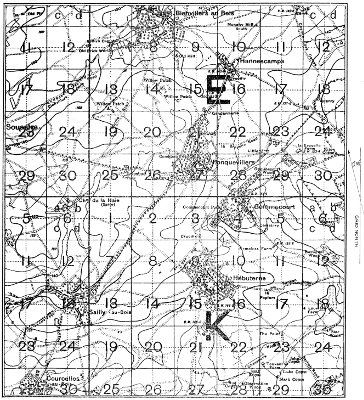
57The 49th Division was holding the line at the time, and the
batteries working under 33rd Divisional Artillery Headquarters (who
in its turn was controlled by the 49th Division) covered the front
from "The Z" to the south-west corner of Gommecourt Park, wire-cutting
being carried out mainly just below and south of the Gommecourt-Fonquevillers
road. From the 7th till the 11th, when the wire-cutting
was finished, the work went on daily without interruption;
on the 8th D/162 (Major Belgrave) had exchanged positions with a
battery of the 48th Division and had moved into Hebuterne itself,
while on the 9th the batteries were placed under control of VII.
Corps direct, and were relieved of the responsibility of covering the
49th Divisional front as far as infantry support was concerned, but
apart from these small interruptions no distraction of any importance
was suffered. Hostile artillery was sufficiently active to be rather
troublesome—the tactics employed being occasional short bursts of
shelling and sniping rounds into the battery positions, a procedure
which kept all ranks unpleasantly on the qui vive, and it was with a
feeling of satisfaction that the report was made on the 11th that
wire-cutting was complete.
Here the batteries had a slight rest from the continual firing of
the previous days, but not so the brigade commanders. On the 12th
orders were received that the brigade commanders of the 33rd
Divisional Artillery should supervise the wire-cutting of the 79th
Brigade, and no sooner was this done than positions had to be reconnoitred
for the batteries on the neighbouring Serre front. The reconnaissance
was carried out on September 18th, and the following day the
batteries moved into positions from which they were destined to take
part in the Battle of the Ancre. The move in this case was of no
magnitude whatever; the batteries of the 156th Brigade lay east
of Sailly-au-Bois, the 162nd Brigade took up positions south of
Hebuterne, with the exception of "D" battery which was in
Hebuterne itself, while the 166th Brigade shifted to the north of the
same village. Once again wire-cutting was the order of the day.
The front covered by the batteries, held at this time by infantry of
the 31st Division, extended from west of Puisieux to as far south as
Serre, and wire-cutting was concentrated on the zone stretching from
the cross roads south-east of The Point to 300 yards north-east of
John Copse, the batteries being under direct control of the XIII.
Corps.
From October 20th until November 13th the batteries were kept
in a state of high activity. Every day wire-cutting was continued,
58and bursts of fire were directed day and night upon the gaps cut
in the wire to prevent the repair thereof. At the same time all the
hostile approaches, communication trenches and trench junctions
were constantly bombarded, and here again every endeavour was
made to prevent the enemy from putting right such damage as had
been done. These tactics naturally used up a large amount of
ammunition, and as naturally evoked swift retaliation from the
enemy. Every night, as the ammunition wagons toiled up from the
wagon-lines around Couin and St. Leger with supplies for the guns,
they met the blast of the German shells searching the approaches
around Sailly, Colincamps and Hebuterne. Nightly did the Germans
take their toll of men and horses engaged upon the work of ammunition
supply, while an ever-lengthening casualty list in the battery
positions showed that the enemy, provoked to wrath and apprehension
by the obviously deliberate and premeditated cutting of his
wire, was not replying in vain. He knew, from the destruction of his
wire, that an attack was imminent, and realising this he turned the
full blast of his attention upon the batteries; they were the chief
danger at the moment, whereas the infantry could be attended to later
when the day of assault grew nearer at hand.
The tactics of the enemy were as before; not usually long
bombardments, but sudden short bursts of fire upon the battery
positions, catching men unawares and making them dread even the
narrow open spaces between the guns. Every day these bursts—sometimes
only a few sniping rounds—cut down the effectives at
the gun positions, until Hebuterne became a word of ill omen to
all. Still the work continued; the back areas of the enemy system
began to receive attention, Puisieux was bombarded on the 22nd
in conjunction with the heavy artillery, and on the 26th the first
infantry raiding party went over to obtain identification of the troops
opposite and to examine the effect of the previous six days' wire-cutting.
After two half-hour bombardments, with an interval of
two hours between, a party of the 93rd Infantry Brigade set out to
enter the hostile lines, but an enemy better known almost than the
Germans and in its way equally deadly, the enemy Mud, prevented
them from even reaching the German parapet. So heavy was the
going in No Man's Land that it became a physical impossibility to
get across, and after many efforts the infantry returned to our own
trenches.
Once again wire-cutting and trench bombardment were resumed,
and now the enemy became more violent still in his reply. Nightly
did he pour thousands of gas shells into the battery positions,
forcing the men to wear their box-respirators during what little rest
59they could achieve and depriving them of their badly-needed sleep.
Practically every day the villages of Sailly and Hebuterne were
shelled by 15 cm. and 10 cm. howitzers, while a deliberate bombardment
of batteries and brigade headquarters was carried out
during the last three days of the month. On November 2nd another
attempt was made by the 31st Division to raid the enemy trenches
east of Hebuterne, and throughout the night of the 2nd/3rd a heavy
flank and covering barrage was kept up by the batteries to support
the infantry in their hazardous task. Once again, however, failure
had to be confessed. The utter impassability of No Man's Land,
owing to mud and water-filled shell-holes, combined with very brisk
enemy opposition forced the raiding parties back to their trenches
again, and once more were the batteries left in ignorance of the
effect of their work.
It was essential, however, that the enemy lines should be penetrated,
for the non-success of the previous two raids had led to a
lack of knowledge of the hostile troops opposite, and had prevented
an examination being made of the German wire. Accordingly, on
November 6th, a third and this time in part successful attempt was
made. After a 20-minute bombardment during which three raiding
parties crept into No Man's Land, a hurricane barrage for six minutes
was carried out, under cover of which the raiders set out for the enemy
trenches between The Point and the Sunken Road. Heavy machine-gun
fire was encountered and the two raiding parties on the left were
held up, but on the right the party covered by the 162nd Brigade
forced its way into the enemy line, bombed dug-outs, examined the
wire and returned safely to its own trenches bringing with it, for
purposes of identification, five prisoners, of whom one died on
arrival.
Matters now began to move rapidly. From the 7th to the 10th
the enemy bombarded Sailly and Hebuterne heavily, and on the
night of the 9th fired 4,000 gas shells into our battery positions;
on the 10th also began the final three-day bombardment by our
batteries before the launching of the assault to be known in history
as the Battle of the Ancre. The 10th, 11th and 12th, designated
in the secret operation orders as W, X and Y days, marked a
doubling and trebling intensity of bombardment on the enemy
trenches; the German front and support lines were pounded and
flung in all directions, wire was cut, gaps and breaches were kept
under constant bursts of fire to prevent repair, and when November 13th
dawned it seemed that no more could be done, and that, in view of
the bad visibility and weather existing during these days, every
possible preparation had been made.
60Zero hour on Monday, the 13th, was a quarter to six in the
morning; sharp to the second the guns roared forth the barrage,
the infantry advanced to the assault and the Battle of the Ancre,
which for so long had been fomenting, burst out in all its fury. The
33rd Divisional Artillery was covering the extreme left of the battle
line, its zone extending from John Copse on the right through the
Touvert Farm-La Louverie Farm road to the left of the line of
assault, and was supporting the infantry of the 31st Division by whom
the attack was to be made. On the front of the batteries the wire was
found to be completely and successfully cut, the barrage proved
entirely satisfactory and the infantry, assaulting and passing over
the German front line, advanced to their next objective—the German
second line—along the whole of the front from Puisieux to as far
south as Serre.
On the whole the hostile barrage was not severe until noon,
when No Man's Land and our front system were very heavily bombarded.
Every morning from 5.45 till 6 A.M. for the previous three
days a heavy barrage had been fired on the German trenches so that,
after the first two occasions, the enemy grew used to these barrages
and could not tell whether an attack was coming or not. During the
assault itself, which was helped by a heavy fog, the chief casualties
were suffered from rifle and machine-gun fire coming from the German
second line, while heavy mud in No Man's Land made the advance
extremely tedious. The German front line, as already noted, was
successfully captured in spite of these difficulties, the enemy in most
cases being caught by surprise and surrendering on close fighting,
and it was not until the advance on the second line began that real
trouble was met.
The 3rd Division, to whom had been allotted the capture of Serre,
was unable, owing to the mud and heavy enemy opposition, to reach
its objective, and the 31st Division found itself with its right flank
in the air. All day long fighting continued, our casualties being
terribly heavy, while the batteries barraged with all their might in
the hope of protecting the 31st Division until such time as the 3rd
Division, by advancing on the right, should secure the flank. It
was all of no avail, however; after twelve hours of raging battle
orders were received from Corps Headquarters to evacuate the captured
ground, and this was done in the evening under a protective
barrage from the guns of the 33rd Divisional Artillery. Thus on
this particular front no advance was made, while the casualties were
so heavy that strong patrols had to be sent out during the night to
cover the bringing in of the wounded. It should be remembered,
however, that the operations described formed only the extreme left
61of a great battle, and that, although the flank was held up, the centre
advanced with such success that Beaumont-Hamel was captured
together with 3,000 prisoners, while an advance was made on to
the outskirts of Beaumont village itself. Therefore, in considering
the results of the Battle of the Ancre, the foregoing narrative which
concerns only the batteries on the extreme flank must not be taken
alone, but in connection with the history of the rest of that day along
the whole front of assault.
Next day, after firing a dummy barrage in the early morning in
co-operation with an attack further to the south, the batteries of
the 33rd Divisional Artillery gave up their part in the Battle of the
Ancre and began to retire to their wagon-lines. Two batteries per
brigade—"C" and D/156 with "B" and "D" of 162nd and 166th—moved
out on the night of the 14th/15th to the area around Couin
and St. Leger, and on the following night were joined by the rest of
the brigades. Here they remained till the 22nd, cleaning, reorganising
and resting, with occasional very unwelcome returns to their old
battery positions to remove ammunition; here with the most profound
regret they bade farewell to Lieut.-Colonel Rochfort-Boyd, whose
gallantry and personality had won for him a firm affection and
friendship in the hearts of all ranks, and who now, on handing the
command of the 156th Brigade to Major Bridges, went to take over
a Horse Artillery Brigade with the 1st Indian Cavalry Division
(there to meet his death while directing the batteries in the Cambrai
offensive of 1917); and from here they marched on November 22nd
through Villers Bocage and Talmas to Airaines, to enjoy in this, the
middle of November 1916, the first rest which they had been granted,
with the exception of ten days during the Battle of the Somme,
since they had gone into action nine months previously.
At Airaines they remained till December 5th, when they set out
once more with their faces turned towards the east to relieve the
French and to hold, throughout the winter, the ground wrested from
the Germans in the Battle of the Somme. The story of that long and
trying winter in bitter cold and deep mud, the tale of how the Germans
were so continually harassed by artillery fire that they were forced
to carry out the retreat of February 1917 to the famous Hindenburg
line, belongs to another chapter in the life-story of the batteries, and
as such must be relegated thereto.
CHAPTER V. WINTER ON THE SOMME 1916.
62
From November 23rd, the date of arrival at Airaines, until December
5th when the first units began the march back to the line again, a
complete rest was enjoyed by the batteries, and badly was it needed.
Clothing, harness and equipment had to be overhauled carefully,
casualties amongst men and horses replaced, while many of the
reinforcements lately arrived from England were not fit to take
their place in the gun detachments or teams, and needed a thorough
drilling to change them from the half-raw condition in which they had
left England to something more nearly approaching the necessary
smartness and accuracy required in the field. Moreover a certain
staleness, the inevitable result of a long period of continuous fighting,
had descended upon the batteries as a whole, and it needed a period
of brisk training interspersed with half-holidays, concerts and games
of every description to bring back the old spring and confidence.
On November 29th the first hint was received of the destination
of the batteries when fighting should once more become the order
of the day, for on that date Brig.-Gen. Blane set off for Maurepas—the
extreme left of the French on the Somme—there to hold a
conference with the French General commanding the artillery of
the French XX. Corps. On December 1st the full facts were known,
and a warning order was received that the 33rd Division was to take
over the line from the French from Sailly-Saillisel to a point opposite
Bouchavesnes, the batteries occupying the positions of the 127th
French Regiment of Artillery. Further it was learnt that the
artillery support of the line was to be carried out by the combined
brigades of the 33rd and 40th Divisions, each Division keeping two
artillery brigades in the line and one in rest.
On Tuesday, December 5th, the move began. A/162 and C/156
with No. 2 Section of the Divisional Ammunition Column set off
early in the morning on what was to be a three-day march, and
passing through Picquigny and Ailly-sur-Somme, halted for the first
night at St. Sauveur. The second day saw them leave Vecquemont and
Corbie behind them, and on the third day, after spending the previous
night at Vaux-sur-Somme, they arrived at Camp 14 on the Corbie-Bray
road some few miles west of Bray itself. So the move went on;
on December 8th B/156 and C/162 shook the dust—or rather mud—of
Airaines from off their feet and followed the first two batteries
by the same stages; next day A/156 and B/162 followed suit, and
on December 10th the two remaining batteries—D/156 and D/162—turned
their backs upon the rest area, arriving at Camp 14 two
days later.
63ORDER OF BATTLE.
October 1916—February 1917.
| H.Q.R.A. |
| |
| C.R.A. |
Brigade Major. |
Staff Captain. |
| Brig.-Gen. C. F. Blane, C.M.G. |
Major H. K. Sadler, D.S.O., M.C. |
Capt. W. E. Bownass. |
| |
| 156th Brigade. |
| Lieut.-Colonel Bridges. |
| Adjutant: Lieut. E. H. Prior (until January). |
| Lieut. F. L. Lee. |
| |
| "A" Battery. |
"B" Battery. |
"C" Battery. |
"D" Battery. |
| Major S. Talbot. |
Major M. A. Studd, M.C. |
Major G. Lomer, D.S.O. |
Capt. W. G. Pringle
(till January). |
| |
|
|
Major W. A. T. Barstow, M.C. |
| |
| 162nd Brigade. |
| Lieut.-Colonel O. M. Harris. |
| Adjutant: Lieut. R. H. Pavitt. |
| |
| "A" Battery. |
"B" Battery. |
"C" Battery. |
"D" Battery. |
| Major G. Fetherston, M.C. |
Major V. Benett-Stanford, M.C. |
Major A. van Straubenzee, M.C. |
Major J. D. Belgrave, D.S.O. |
| |
| 166th Brigade. |
| Lieut.-Colonel C. G. Stewart, C.M.G., D.S.O. |
| Adjutant: Lieut. S. M. Wood. |
| |
| "A" Battery. |
"B" Battery. |
"C" Battery. |
"D" Battery. |
| Capt. H. A. Littlejohn, M.C. |
Capt. Dust. |
Capt. H. Freeman. |
Capt. B. McCallum, M.C. |
64While this march was in progress matters had been moving up
in front, for on December 8th the 156th and 162nd Brigade commanders
(166th Brigade had been left in rest at Airaines) went up
to take over from the French the headquarters and battery positions
of the 127th Regiment of Artillery. Taking over from the army of
another nation was a somewhat more lengthy business than an
ordinary relief on the British front; the trouble of language was not
insuperable, but the difficulty of reconciling their methods of communication
and control with our own, and of making the alterations
necessary to fall in with the usual practice of brigade and battery
administration was by no means light, nor were matters simplified
by the oft-recurring phrase "ça ne marche pas" when discussing
some important telephone line from brigade to battery or O.P.
However, by December 12th all was ready for the arrival of the
batteries, and on that day there marched into action two sections
each of C/156, A/162 and C/162 who had left Camp 14 on the previous
day and had established wagon-lines at Camp 21, one mile south of
Maricourt, on the Suzanne-Maricourt road. They were followed
on December 13th by A/156, B/156 and B/162, while the 15th saw
the arrival of the "D" batteries, so that exactly ten days before
Christmas the whole of the Divisional Artillery was "back to work"
again. Camp 14 had only been used as a very brief halting place in
the scheme; it acted, in fact, merely as a place for the partial concentration
of the batteries, and it was well that this was the case, for a
worse spot and a more unsuitable artillery camp it would be difficult
to find. Some distance from the road, approached only by the
roughest of tracks, it lay in a valley and quickly showed itself to be
a veritable mud-trap. The horse-lines were bad, the men's quarters
were worse, and the effort of pulling into the camp off the road, and
of struggling back on to the road again when the march was resumed,
more than counteracted any benefit which might otherwise have
accrued from the two days spent there in rest. It was with a feeling
of relief, therefore, that the batteries turned their backs upon this
much-hated spot and set out for Camp 21, their permanent wagon-lines
whilst in action. Nothing could be worse than Camp 14;
perhaps Camp 21 might be better. Perhaps!
65As events turned out, Camp 21 between Suzanne and Maricourt
was a slight improvement, but very slight. It was on ground which
had been the scene of the summer and autumn offensive, and nothing
could solidify the earth which had been so torn and shattered by high
explosives. The least suspicion of rain—even of damp—turned everything
into mud, while the neighbourhood of the water-troughs,
unless built up from a timber foundation, became absolutely and completely
impassable. Certain of the batteries, in fact, which were
forced to establish their wagon-lines on the west of the road struck
such fearful conditions that a number of horses were actually drowned
in the mud. It was not the fault of the batteries or brigades—they
were ordered to establish wagon-lines in a certain spot and perforce
they had to do it, nor could the most strenuous of efforts put things
right in a few days. To whomever the fault was due, it was heart-breaking
to battery commanders to see the effects of a three weeks'
rest being wiped out almost in as many days by the impossible conditions
in which some of them found themselves.
To return, however, to the tactical situation. By December
16th all the batteries, less one section in some cases, were in action
in the Maurepas-Bouchavesnes area. Only two brigades—the 156th
and the 162nd—of the 33rd Divisional Artillery were in the line, for
the 166th Brigade had been left behind at Airaines, but to General
Blane's command were added two brigades of the 40th Divisional
Artillery—the 178th and 181st—in action in Anderlu and Marrières
Woods respectively, and with these four brigades it was considered
that sufficient artillery support for the divisional front would be
forthcoming. The batteries of the 162nd Brigade, with the exception
of "D" Battery, lay just west of the Clery-Le Forest road and about
half-way between the two villages; "D" battery, for reasons to be
discussed presently, took up a position two hundred yards east of
Hospital Wood, while the battery positions of the 156th Brigade
were congregated in the area around and east of Le Forest.
In taking over from the French a portion of the line, as was done
in this case, very considerable difficulties had to be faced from the
brigade and battery commanders' point of view. The French field
batteries consisted almost always of four guns, and to relieve them
with six-gun batteries involved either the digging of further gun-pits
and shelters for the men or the splitting up of the batteries into two
portions. In this case the 33rd Divisional Artillery was relieving
three groups (the 3rd, 4th and 5th) of French artillery, each group
consisting of three four-gun batteries, and accordingly it was resolved
to take one section each from "B" and C/156 and to combine them
into a third four-gun battery, while "A" and B/162 carried out the
66same procedure in the other brigade; two guns of C/162 relieved on
their own a French battery, and A/156 was fortunate enough to take
up a position in which it was possible to keep all six guns in action
together. Thus it will be seen that the brigades were thrown into
rather a disorganised condition, but this was not all. The French
Army did not maintain any batteries of field howitzers, and therefore
the 4·5 in. howitzer batteries of the two brigades found themselves
nobody's children, left out in the cold with nobody to relieve, no
battery position to take over. They were forced on this, as on another
later occasion, to buckle to and dig their own position, and for this
reason D/162, as already stated, came to the edge of Hospital Wood
and dug itself in under a small bank.
By the 16th and 17th of December the main work of establishing
the positions had been overcome, and, preliminary registration being
completed, the batteries had a chance of looking around them. The
surroundings were not inspiring; they had been wrested from the
enemy during the Somme offensive and, in common with the rest of
the battlefield, were torn and pitted with shell-holes in all directions.
The autumn and winter rains had turned the whole countryside into
a vast sea of mud, mud so deep, so thick and of such peculiar consistency
that it was altogether impossible to remove it, drain or even
dig through it. Conditions were, indeed, pitiable; every yard
walked was an effort involving absolute wading; thigh gum-boots
were powerless to keep the men dry; ammunition, rations and mail
had to be brought to the battery positions by pack-horse, for no
wagon could approach, and on top of all this it rained, rained continuously
and steadfastly during the whole period. It was indeed a
wretched place, rendered more wretched by the knowledge that
Christmas—a season usually associated with comfort and merrymaking—was
fast approaching.
For some time after the arrival of the batteries on this part of
the front there was no war, for the simple reason that war was
impossible. The battery positions consisted merely of six semi-dry
platforms for the guns, separated and surrounded by apparently
bottomless mud; the men lived in wet and muddy shelters and dug-outs,
and were scarcely ever dry; telephone lines forward ran through
mud which made the repair of breaks a clumsy, maddening business,
while up with the infantry there were no trenches, no dug-outs,
nothing but mud and water. Along the whole of the divisional front
there were only about four places where anything approaching the
semblance of a communication trench could be found, and these were
so bad as to be rather deeper of mud than the surrounding ground.
There was only one way to reach the front line—a ditch full of water
67with a little wire in front—and that was to walk straight over the
open up to the fire trench itself, and there, if a new arrival, drop in;
if an old hand, sit on the parados.
This state of affairs may sound fantastic and even an exaggeration,
but it is only too true an account. The French, finding conditions
were well-nigh impossible for fighting, decided philosophically
not to fight, and arranged with the enemy accordingly. It was
muddy for them, but just as muddy for the enemy; it was a beastly
business wading up communication trenches which were practically
non-existent to a front line which was scarcely habitable, but it was
just as beastly for the Germans; therefore, forward observing officers
going up to visit the infantry had the strange experience of walking
up to our front line over the open, of sitting on the parapet in full
view of the enemy one hundred yards away, and of seeing the enemy
doing exactly the same thing themselves. So extraordinary were
the conditions, in fact, that a battery commander of the 162nd Brigade
walked over the open with one of his subalterns not only up to the
front line but over it at a spot where it was deserted, and had got well
into No Man's Land before a sentry in one of the adjoining bays called
him back.
Whether the French method of thus maintaining an unofficial
truce was a good one need not be debated in these pages. It certainly
led them to give up making any effort to dig communication trenches
at all, even in spots where with trouble it would have been possible,
and it by no means helped to foster the "cultivation of the fighting
spirit," the importance of which was being impressed so busily upon
all ranks at the time. On the other hand it gave them a tiny
measure of comfort which made life just endurable, and by resuming
active operations and reducing the enemy to a state of misery they
would have let themselves in for similar wretchedness.
When the 33rd Division took over the line, however, the question
was left in doubt no longer. Where there was war there was to be
real war and no unofficial truce; the French protested, they tried
in vain to prevent the infantry sniping, but it was of no avail. One
morning a whole platoon of Germans marched calmly down to the
front line over the open, following the custom of bygone days; the
temptation was too great, and a Lewis gunner, hastily putting
together the gun he had been cleaning, raised it on to the parapet
and browned the lot! From that moment onwards not a head
dared show above the parapet, and everybody living in the front
line or visiting it endured discomfort and hardship beyond imagination.
Gradually, as the 33rd Division settled in, hostilities increased
and boiled up. Even so the majority of the firing was upon the
68back areas, for the forward trench system—engulfed in a sea of
mud—offered no target whatever. Duckboard tracks, valleys hidden
from infantry and artillery observers where the enemy might walk
about in the open, suspected battery positions, cross-roads and other
similar targets received as a rule the attention of our guns, while
the enemy administered the same treatment to corresponding features
behind our lines. The actual front covered by the batteries extended
from the enemy trenches on the Bouchavesnes ridge northwards
through Moislains Wood to the great wood of St. Pierre Vaast.
From observation stations along the ridge east of Aiguille Ravine
(in which was the artillery forward telephone exchange) a very
good view of all the enemy system could be seen except in the extreme
north of the zone, though the trenches behind the support line were
hidden owing to the steep valley which ran down towards Moislains.
Thus the year drew slowly to a close. On Christmas Day the
brigades took part in an artillery bombardment carried out along
the whole Corps front to show that "Peace on Earth, Goodwill
toward Men" was not considered to apply to Germans. In reply,
the enemy increased in violence his sniping with whizz-bangs of
any portion of duckboard track and road where he might catch
ration parties or artillery teams toiling up with ammunition from
Plateau Siding, and then, on December 31st, the 166th Brigade
arrived from Airaines and relieved the batteries of the 156th. By the
system already outlined one brigade of each Divisional Artillery
was kept in rest, and beneath the envious eyes of the 162nd Brigade,
whose turn was not yet, the 156th turned their backs to the mud
and marched away to the rest and comparative comfort of G.H.Q.
reserve.
The first fortnight of January proved uneventful. The same
harassing fire was continued, the same mud prevailed everywhere
and the greatest problem of all to be contended with at the time
was not the enemy, but the weather. An alarming increase in the
number of cases of trench-feet and frost-bite began to show itself,
not only in the infantry but in the artillery. For the infantry special
drying rooms were erected and dry socks were issued to every man on
leaving the trenches, but the gunners were thought to be better
off, and for them there were no such arrangements. Consequently
there fell upon brigade and battery commanders a very great strain,
a strain which had to be withstood at the time when more work
began to show itself in the offing.
More work there certainly was. On January 2nd General Blane,
on the relief of the 33rd Division by the 40th, had handed over control
of the brigades to the C.R.A. 40th Division and had gone with headquarters
69into rest at Belloy-sur-Somme. On January 10th there
came a warning order from his headquarters that a sideslip of the
division to the right was about to take place, and that brigade
commanders were to visit the French positions along the actual
borders of the Somme next day. Close on the heels of this came
directions for the batteries to withdraw from the line, the 166th
getting away first on January 12th, followed by the 162nd Brigade
four days later, and January 16th found both brigades in rest at
their wagon-lines—Camp 21, west of Maricourt.
The following six days were spent at these wagon-lines, and
during the period yet another reorganisation of the Divisional
Artillery took place. Since September 1916 there had been three
brigades, the full establishment of a brigade being three six-gun
18-pdr. batteries and one four-gun 4·5 in. howitzer battery. It was
now decreed that a Divisional Artillery should consist of two brigades,
each brigade to be of the same composition as before but with six-gun
howitzer batteries, and not four as previously. To bring this
about the 166th Brigade was broken up. One section of D/166
went to D/156, the other to D/162; A/166 (Captain Littlejohn)
marched to Mirvaux and became part of the 26th Brigade, while
B/166 (Captain Dust) joined the 93rd Brigade at Morlancourt and
was merged in that unit. The Divisional Artillery did not lose all
its old friends, however, by this breaking up. Major Barstow was
transferred to the 156th Brigade, as was also Lieut.-Colonel Stewart
who, with the whole of the staff of the 166th Brigade H.Q., came to
156th H.Q.; the late headquarter staff of that brigade took over the
nominal command of 166th Brigade—now a brigade in name only
and not in substance—and awaited orders at Belloy as to future
movements.
While this change-about had been going on, the batteries at
Camp 21 had been busy in other respects as well. Cold, dry weather
had set in, and, remembering the mud of Bouchavesnes and realising
that similar conditions existed in the positions which were shortly
to be occupied on the banks of the Somme itself, teams had been out
every day making use of the good going occasioned by the hard
weather, and filling up the ammunition pits at the battery positions
which by now had been reconnoitred by battery commanders themselves.
It was the only advantage which the 162nd Brigade, deprived
by this move of the rest for which it was nearly due, managed to
gain over the 156th Brigade who were now marching up from the
rest area to the new wagon-lines around Vaux Wood and Eclusier.
On January 22nd the move into action began. From the
wagon-lines west of Frise the batteries marched up to take over the
70defence of the line from the River Somme itself on the right to the
junction with the 4th Division, some three-quarters of a mile south
of Bouchavesnes, on the left. The infantry had relieved the French
17th Division two days previously and had been supported
temporarily by the French batteries, but now on the 24th the guns
came up and, taking over from the groups of Commandants de St.
Paule, Le Gros and Rouziers of the 30th, 29th and 49th Regiments
of Artillery, assumed responsibility for the support of the line from
eight o'clock on the morning of the 24th. Under the control of
General Blane at P.C. Jean the batteries were split up into two
groups; the left group, commanded by Lieut.-Colonel Stewart,
consisted of the 156th and the 14th Brigades, while the 162nd and
the 33rd Brigades, at first under the control of Lieut.-Colonel
Nevinson but ultimately, from the 31st, commanded by Lieut.-Colonel
Harris, went to form the right group, each group covering one brigade
of infantry in the front line.
Battery positions on the south of the Somme had been very
difficult to find, for on clear days Mt. St. Quentin, which was in
German hands, commanded the whole of the countryside, and the
concealment of flashes was a practical impossibility. After a certain
amount of debating Major Fetherston's battery (A/162) took up
a position just south of Buscourt Cemetery, with D/162 (Major
Belgrave) two hundred yards in front under the shelter of a bank;
C/162 (Major van Straubenzee) lay between Buscourt Cemetery
and the river, while Major Benett-Stanford established his battery
(B/162) with four guns to the south-east of these positions, the
remaining section being detached for enfilade work about seven
hundred yards south of Feuillières. With Brigade headquarters
situated in an old German second-line trench one hundred yards
behind "C" battery, the whole of the 162nd was thoroughly compact
and well together and, from the point of view of administration,
excellently placed.
The 162nd was the only brigade of the 33rd Division lying south
of the Somme. The batteries were, in fact, the first British guns
to return there since the very early days of the war, and it fell to
them now to occupy the extreme right of the British line in France,
just as they also occupied the extreme left of that same line on the
beach at Nieuport some six months later. The batteries of the
156th Brigade all lay to the north of the river, "A" and C/156
(Major Talbot and Major Lomer) to the east of Howitzer Wood
and 2,000 yards N.W. of Clery-sur-Somme, "B" and D/156 (Major
Studd and Major Barstow) south of the same wood, and from here
they continued the good work of harassing the enemy in the position
71to which he had been forced back by the offensive of the foregoing
months.
On January 25th battery commanders studied and registered
their new zones. The German line here ran from the river Somme
to the west corner of Limberlost Wood, and on through Freckles
Wood in a north-easterly direction. Observation stations north
of the river were situated on the high ground west of Hersfeld Trench,
while to the south of the river, from a high hill running sheer down
to the water about 1,200 yards due west of Halle, a magnificent
enfilade view right down on to the front covered could be obtained,
and also an extensive back area view of the country round Péronne,
Mont St. Quentin, Feuillaucourt, Allaines and along the Paris-Lille
road in the direction of Nurlu. The line just here offered an
extraordinary feature which was to be found in very few other
places along the front; owing to a big "hair-pin bend" of the
river and to the fact that the two arms of the bend enclosed a marsh,
the trenches ran straight down to the river on the north side and
there ceased altogether, reappearing on the southern bend again
some 2,500 yards further down. It was impossible to dig trenches
or to keep men in the marshes enclosed by the bend of the river, and
similarly it was practically impossible for men to get across to raid
our lines, but a danger—and a very serious one—now presented
itself, for a spell of intensely cold weather set in; the river, the
canal and the marshes were all frozen solid, and the situation suddenly
arose that between the batteries and the German lines there lay
nothing but two isolated machine-gun posts. Our old ally, the
marsh, which had hitherto proved a safe defence against hostile
raids on the guns, now offered a perfectly secure passage. So feasible
in fact did a raid appear, that plans were actually being formulated
for a descent upon the German batteries opposite this bend by our
people—plans which in the end had to be abandoned, as two howitzer
batteries, at the request of the infantry, shelled the frozen river and
with sixteen rounds cut a channel thirty yards wide across the ice.
The weather had indeed turned intensely cold. Every night
some thirty degrees of frost were registered, and the ground was
deeply covered, in snow. It was, of course, exceedingly healthy,
but involved a great deal of suffering, while the handling of guns
and ammunition, the cold metal of which seemed to bite right into
the flesh, was a matter to be taken by no means lightly. Fortunately
there was but little activity at the time. Hostile minenwerfers and
rifle-grenades worried our infantry to a large extent, but prompt
retaliation, coupled with the arrival into action of X, V and Y/33
trench mortar batteries, reduced this source of trouble to a minimum.
72Apart from this the batteries were more or less left to themselves
to register such targets as they chose until February arrived, bringing
with it a more definite sequence of events.
February heralded the commencement of more active operations,
but before these started the period in the rest area, for which the
162nd Brigade was due, began to be granted to certain of the
batteries. On February 1st A/162 stored its guns in the northern
part of Marrières Wood, leaving them there under a guard and
eventually handing them over to the 33rd Brigade. At the same
time orders were received to build positions east of Marrières Wood
for the guns stored there, while the 8th Division got positions ready
south-west of Rancourt to be taken up at a later date by "A" and
B/156. A/162, with its guns stored away, marched out to rest at
Vaux-sur-Somme, to be followed on the 7th by D/162 which went
into billets at Sailly-le-Sec; in the latter case, however, two guns
were handed over in situ to the 55th Battery to be served by them
from there, while the remaining four were left under a guard until
such time as the battery should return to man them once more.
With two batteries out at rest, the remainder found themselves
engaged in rapidly increasing work. On February 2nd a lengthy
bombardment of the enemy trenches was carried out by field and
heavy artillery, and the next day began the deliberate cutting of the
enemy wire by the 18-pdrs., which was to extend over a very considerable
period. To carry this out more effectively the enfilade
section of B/162 (which had been in action south of Feuillières)
moved to a point on the south side of the Somme east of Clery, where
the canal lock adjoined the river; the old position south of Feuillières
was taken over by a section of C/162 which moved thither from east
of Chapter Wood. At first hostile retaliation was slight, and until
about the 8th, with the exception of a severe lachrymose shelling
endured by B/162, the work went on more or less unhindered.
Gradually, however, the enemy grew apprehensive over the continued
cutting of his wire, and his anger was brought to a culminating point
on the 7th when the 9th H.L.I. raided the trenches and, after killing
ten machine gunners and bombing two dug-outs full of men, returned
to their own lines with two prisoners and a machine-gun as proof of
their exploit. For their assistance in this raid the batteries received
the thanks of General Baird (100th Infantry Brigade) who was
especially pleased with the way in which the wire had been cut.
73ORDER OF BATTLE.
February—March 1917.
| H.Q.R.A. |
| |
| C.R.A. |
Brigade Major. |
Staff Captain. |
| Brig.-Gen. C. F. Blane, C.M.G. |
Major H. K. Sadler, D.S.O., M.C. |
Capt. W. E. Bownass. |
| |
| 156th Brigade. |
| Lieut.-Colonel C. G. Stewart, C.M.G., D.S.O. |
| Adjutant: Lieut. F. L. Lee. |
| |
| "A" Battery. |
"B" Battery. |
"C" Battery. |
"D" Battery. |
| Capt. S. Talbot. |
Major M. A. Studd, M.C. |
Major G. Lomer, D.S.O. |
Major W. A. T. Barstow, M.C. |
| |
| 162nd Brigade. |
| Lieut.-Colonel O. M. Harris, D.S.O. |
| Adjutant: Lieut. R. H. Pavitt. |
| |
| "A" Battery. |
"B" Battery. |
"C" Battery. |
"D" Battery. |
| Major G. Fetherston, M.C. |
Major V. Benett-Stanford, M.C. |
Major A. van Straubenzee, M.C. |
Major J. D. Belgrave, D.S.O. |
| |
|
|
Capt. A. E. G. Champion. |
| |
| 166th Brigade. |
| Broken up. |
74On February 10th, after a further interval of wire-cutting, another
bombardment of the enemy trenches took place. From 1.0 P.M.
on that day until 6.15 A.M. the following morning a long and deliberate
artillery attack was carried out, finishing with a fifteen-minute
intense bombardment which crept over the enemy front line as though
to be followed by an assault, and then suddenly dropped back on to
the fire trench again to catch such infantry as might have manned the
parapet. The enemy was now fully aroused; all day he bombarded
the right brigade zone and especially 162nd Brigade Headquarters,
and from this day onwards he was always ready to retaliate heavily
for any operations carried out against him.
A raid on the 14th by the 4th Suffolks round Pekly Bulge (south
of the Clery-Feuillaucourt road) did not tend to calm the increasing
activity which was now becoming general, and, although no prisoners
were brought to our trenches (four, with their escort, were killed
by a heavy German trench mortar while crossing No Man's Land),
a great deal of damage and many casualties were inflicted upon the
enemy in their dug-outs. On the 19th, however, matters ought to
have reached their climax, for on that day should have taken place the
attack on Hersfeld Trench, in preparation for which all the previous
bombardments and wire-cutting had been carried out. It was
postponed, however; postponed until the 22nd because foggy
weather had prevented any full examination of the condition
of the wire after its bombardment, and because the mud in
No Man's Land was so bad as to prevent the infantry from reaching
the gaps. In point of fact this attack was again postponed on the
22nd, and finally, after being fixed for March 2nd, was abandoned
altogether.
The work now resolved itself into a slow but ever-persistent
harassing of the enemy. "A" and D/162 returned into action on
February 20th and joined in the general artillery attack which was
in progress all along this portion of the front—an attack the result
of which ultimately showed itself in the great German retreat to the
Hindenburg Line early in March. The operation on Hersfeld Trench
had been abandoned, but a new assault by the 8th Division further
to the north had been in course of preparation for some time, and
now definite steps were taken to carry it out. It will be remembered
that at the beginning of the month the 8th Division were preparing
battery positions for "A" and B/156 south-west of Rancourt;
on the morning of the 21st the leading sections of the two batteries
moved up to these positions, and at the same time the right group,
temporarily under the command of Major J. D. Belgrave while Colonel
Harris was on leave, pushed forward an advance gun of A/162 to a
position two hundred yards east of Clery, whence wire-cutting on the
group zone could more effectively be carried out. Although no
attack on the 33rd Divisional front was to be launched it was essential
to employ tactics which would mislead the enemy, and by continual
75harassing to prevent him from concentrating all his attention upon
the 8th Division.
There was, however, another reason for this continual bombardment.
Rumours began to circulate that the German Higher
Command, finding the present positions if not untenable at least
strategically unsound, intended to withdraw to the great trench
system known as the Hindenburg Line which for a long time past
had been in preparation well to the rear, and which was supposed
to be a model of siting and fortified field-work. At first rumours
were vague and of doubtful origin; but gradually it became evident,
from the explosions which every day could be seen behind the enemy
lines, that a great deal of destructive and demolition work was being
carried out, all of which pointed to the fact that the area was shortly
to be evacuated.
Under these circumstances it was necessary that information
should be obtained as to the strength in which the enemy was holding
the line, and for this purpose a series of raids was carried out. On
the night of February 27th/28th the 2nd Worcesters raided the
enemy trenches around Pekly Bulge in two parties, the first party
going over at 8.40 P.M. and remaining in the trenches for half an
hour, while the second raid started at 1.0 A.M. and lasted for sixty-five
minutes. Rumour had it that many of the first party—who were
nearly all old hands, and for whose benefit the first raid was said to
have been organised—went over again with the second party to
complete a few odd jobs which they had not had time to finish
thoroughly earlier in the night! Whatever the truth of this story
may be, the raid was eminently successful. Twenty-two prisoners
were taken, thirty-six of the enemy were killed in hand-to-hand
fighting and six dug-outs full of men were bombed. Moreover,
the prisoners proved to be men of the 2nd Guards Grenadier Regiment,
and this identification, together with the discovery that the German
line was still strongly held, was of the greatest value to Headquarters.
On March 1st the hostile trenches were again raided, this time
by the 2nd Argyll and Sutherland Highlanders, and on March 3rd
the attack by the 8th Division was carried out on the left with the
object of securing a jutting-out portion of the enemy front and
support lines. The attack was too far to the north to permit of the
33rd Divisional Artillery batteries taking any share therein, except
for "A" and B/156 who had on the 1st completed their move to the
left to reinforce the artillery supporting the assault. The 33rd
Division did, however, carry out a feint bombardment synchronising
with the barrage of the 8th Division, and this in itself was of considerable
value since once again information was obtained concerning the
76strength of the enemy. The infantry in and on the left of Limberlost
Wood not only let off smoke during the feint attack, but also fired
rockets of every conceivable colour and variety, and the effect of this
upon the enemy was surprising. Completely mystified, very nervous
and on edge, he bombarded the trenches held by the 33rd Division
with all his might and main, and disclosed the strength of artillery
which he still held upon the front. This strength was, indeed, quite
normal and seemed to belie any ideas of an early retreat on his part,
but one feature stood out prominently. Artillery officers from each
of the brigades, who were sent down to the infantry to report on the
hostile artillery strength, pointed out that the entire retaliation was
carried out by field-guns and 10 cm. howitzers; of heavy guns and
even 15 cm. howitzers there were none. Perhaps, after all, this
supposed retirement was near at hand. Whether it was or was not,
from the 4th until the 9th a steady bombardment was kept up upon
the enemy communications. Infantry patrols reported the line
lightly held, and the sniping and movement going on was suspected
of being carried out by a few picked men moving from place to place
in the trenches and utilising fixed and automatically-fired rifles to
the full. Even a raid by the enemy in the early morning of the 8th
did not wipe out this idea; the opinion was formed that it was
sheer bluff, and that only a very few machine-guns and individual
gunners, making a lavish use of Very lights, were maintaining the
appearance of strength on the enemy's part.
The 33rd Divisional Artillery never saw the climax of this affair.
On the morning of Friday the 9th, half batteries of the 156th and
162nd Brigades were relieved by the 178th and 181st Brigades
respectively of the 40th Division. The remaining half batteries
withdrew on the 11th, and the two brigades, turning their backs upon
the battlefields of the Somme, marched into rest at Vaux-sur-Somme
and Sailly-le-Sec. Rumour had it that they were to go into training
for some great battle shortly to take place, a battle in which the line
was to be broken, open fighting was to be the order of the day, the
German line was to be turned and British arms were to be victorious
over the enemy once and for all. Rumour, as on all such occasions,
ran wild amongst the men, but where the attack was to be and when,
whether it was in connection with the expected German retreat or
elsewhere was kept from all except a favoured few. Officially it was
said that there was to be fighting, and open fighting at that, and that
the batteries must train accordingly; more than that they were not
to know.
From the 11th until the 25th the batteries trained hard in every
form of exercise; gun drill, driving drill, flag and lamp signalling,
battery staff work and movement into action over open ground were
77carried out day by day, while in the evening concerts and sing-songs
were interspersed with lectures to build up the fighting spirit of the
men, to raise their morale to the highest and to give them that quiet
confidence and assuredness of being the better man which is so
essential to troops who have a battle lying before them.
Moreover, the fighting spirit of the men was raised in other ways
than by lectures. The batteries, drawn up in hollow square at church
parade, saw the Corps Commander decorate officers and men for
gallantry; heard the citation which accompanied the Order of the
Crown of Italy awarded to Lieut.-Colonel O. M. Harris; heard the Corps
Commander tell them how, shortly after they had been withdrawn
from the line, infantry patrols had discovered the enemy trenches
to be unoccupied; learnt how, with the enemy in general retreat, the
whole of our line southwards from Arras was pressing forward on the
heels of the enemy, and even as he spoke was occupying and advancing
east from Péronne. It was no concern of the men's that the enemy
was relinquishing very bad ground merely in order to take up a vastly
superior and stronger position which he had, under the most favourable
circumstances, been preparing for some time. They returned to
their billets feeling that the enemy really was the under-dog, that his
tail was down and consequently that theirs was decidedly up.
Only one incident of this period marred the pleasure of the rest
which was being enjoyed. Before the batteries moved northward
they lost their C.R.A., Brigadier-General C. F. Blane who, on undertaking
new duties, left the Divisional Artillery with whom he was
so closely connected. General Blane brought out the (then) four
artillery brigades to France in their early raw state in 1915. He
helped to mould and to shape them, and, after leading them through
all the hazardous times of the Battle of the Somme and through the
dreary and trying conditions of the winter, he now handed them over,
a splendid fighting unit, to his successor. General Blane did a
tremendous amount towards building up the 33rd Divisional
Artillery, and in its future history the name of the man who did so
much for it in its earlier stages must always be remembered.
The orders to move were ultimately received in the fourth week
of March. On the 24th the C.R.A., Brigadier-General Stewart, who
had succeeded General Blane in the command of the 33rd Divisional
Artillery, set out in a motor bus with his brigade and battery
commanders to make a preliminary reconnaissance of the new front on
which the batteries were to operate. Next day the latter in full
fighting order moved off towards the north on the four-day march
which was to terminate at Arras, and was to bring them to the
positions from which they would assist in the great offensive of April
9th—the battle of Arras and Vimy Ridge.
CHAPTER VI. THE BATTLE OF ARRAS AND VIMY RIDGE. (APRIL-JUNE 1917.)
78
The march of the batteries from the Somme to Arras proved very
exacting; not only were the weather conditions rather more than
bad—intense cold and wet being experienced the whole time—but
also the batteries, already deprived of their commanders, were
further depleted on the second day of the march, when an order
was received for one officer and twenty men from every battery
to go forward by motor lorry to work upon the positions which
had been allotted for occupation. A measure of praise is due to
those, in many cases, junior officers who under difficult conditions,
short of personnel and in foul weather led the batteries over the
long road through Talmas and Bealcourt towards Arras, now at
last disclosed as the goal of the 33rd Divisional Artillery.
All along the line of that march the direction of the coming
battle was clearly indicated. Vast columns filled the road, columns
of infantry, guns and transport, columns of motor-lorries and
ambulances, all with their faces set towards the north, all forming
part of a great moving stream inexorable in its progress. Even to
the inexperienced the sight of these masses moving up, with scarcely
a single vehicle passing in the opposite direction, indicated a great
concentration in progress, a mighty gathering of the storm clouds,
and only two questions remained unanswered; exactly where, and
how soon?
While the batteries were marching steadily along, pondering
over these questions, the brigade and battery commanders, who
had covered the whole distance on the 24th, were busily engaged
in examining the positions they were to occupy and the zones to be
covered. The 15th Divisional Artillery, who were in the line at
the time, had already in part prepared the positions to be occupied
by the 33rd, and the work and trouble they had expended thereon
won for them a very deep feeling of gratitude amongst the officers
and men who were to benefit by their labours. Until the arrival
of the working parties who had been detached from the batteries
on the line of march, however, no material work could be done, and
accordingly the time was spent in studying the zone to be covered
and in reconnoitring the best O.P.'s from which to shoot.
79ORDER OF BATTLE.
April—May 1917.
| H.Q.R.A. |
| |
| C.R.A. |
Brigade Major. |
Staff Captain. |
| Brig.-Gen. C. G. Stewart, C.M.G., D.S.O. |
Major T. E. Durie, M.C. |
Capt. W. E. Bownass. |
| |
| 156th Brigade. |
| Lieut.-Colonel B. A. B. Butler. |
| Adjutant: Capt. B. L. Oxley. |
| |
| "A" Battery. |
"B" Battery. |
"C" Battery. |
"D" Battery. |
| Major Lutyens. |
Major M. A. Studd, M.C. |
Major G. Lomer, D.S.O. |
Major W. A. T. Barstow, M.C. |
| Major H. McA. Richards, M.C. |
|
Major Barker. |
|
| |
| 162nd Brigade. |
| Lieut.-Colonel O. M. Harris. |
| Adjutant: Capt. R. H. Pavitt. |
| |
| "A" Battery. |
"B" Battery. |
"C" Battery. |
"D" Battery. |
| Major G. Fetherston, M.C. |
Major V. Benett-Stanford, M.C.
(wounded). |
Major A. van Straubenzee, M.C.
(wounded). |
Major W. P. Colfox. |
| |
Major H. C. Cory, M.C. |
Capt. W. G. Pringle. |
|
| |
|
Major L. Hill. |
|
80The strategical cat was now well out of the bag. A great attack,
it was learnt, was to be launched upon the whole German system
from and including Vimy Ridge on the left to a point well south of
Arras on the right. The 33rd Divisional Artillery was to be
responsible for the zone immediately south of the river Scarpe,
and, after taking part in the preliminary bombardment, was to
advance in support of the assaulting infantry so as to keep in touch
with the foremost troops throughout the battle. With this knowledge
the importance of a thorough acquaintance with the enemy
lines was realised, and many hours were spent in front line and
observation station studying the hostile wire, trenches and all the
back areas. For wire-cutting and bombardment of the German
front line our own fire-trench was the best place, and from it a very
clear view of the objectives could, in certain parts, be obtained.
In order to see the opposing support lines and back areas, however,
a higher view point was necessary, and for this purpose certain
ruined houses were utilised in the Faubourg St. Sauveur—an outskirt
of Arras on the Cambrai road—together with the ruins of
Blangy and some tall factory chimneys on the eastern edge of Arras.
The latter offered the most hair-raising experiences at times.
On normal occasions the top of a tall chimney sways in a most noticeable
manner with every gust of wind; when, as was often the case
here, a deliberate shoot was carried out upon it by the enemy, and
5·9 in. shells were bursting around its base, it really seemed to the
wretched observer, perched on an iron cross-bar at the top, that
the chimney must sooner or later sway right over and break in two,
even if a well-aimed shell did not by a direct hit effect the same
result. Moreover the inhabitants of these chimneys, being quite
near to the enemy trenches, had often the pleasure of hearing a
shell, aimed at some object behind them, whisk past their ears in
the course of its flight so close that it seemed inevitable that
ultimately the chimney must be hit.
With the arrival of the working parties on March 27th real
activity set in. Not only did the pits, platforms and dug-outs
begun by the 15th Division require to be completed, but also
accommodation for twelve thousand rounds of ammunition in every
battery position had to be made ready, while the ammunition which
was already there needed sorting. Moreover, the word was passed
round to hurry—time was short, and the day of attack was not far
81off. Hurry, indeed, was the watchword, and for four days the men
toiled unceasingly; on the 30th work was redoubled, for on that
day the remainder of the gunners of each battery, which had arrived
at Duisans the previous night, came up into billets at Arras and
continued the work of preparation. In addition to making ready
the battery positions in Arras, advanced positions were ordered to
be dug and ammunition dumped just behind our own front line,
whither the batteries would advance as soon as the first objective
in the attack had been secured. This work was of necessity slow,
for detection was easy and by day hostile aeroplanes caused a
maddening series of interruptions.
On the 30th/31st the first guns of the Divisional Artillery
came into action. "A" and B/156 (Major Lutyens and Major
Studd) placed advanced wire-cutting guns five hundred yards behind
Arras Cemetery, while Major Fetherston (A/162) put a forward
section in the garden of a house on the eastern outskirts of Arras,
with the task of cutting wire just south of the river Scarpe on the
enemy second and third lines. Wire-cutting was immediately
begun, and from this date the 33rd Divisional Artillery started to
take its active share in the forthcoming battle.
By April 1st the remaining guns of the brigades which had
been left at the wagon lines were brought into action. From their
headquarters in 6, Rue Jeanne d'Arc and 34, Rue des Capucins,
Lieut.-Colonel Butler, who had just been posted to the 156th
Brigade, and Lieut.-Colonel Harris directed the work of the batteries,
which was now exceedingly heavy. Work on the positions was still
in progress, wire-cutting—always a slow business—was continued
day in day out, ammunition needed constant replenishing,
registrations had to be checked and renewed, and gunners and
drivers were being instructed in the route by which the advance to
the forward positions would be made. The brigades lay between
the Baudimont Gate and St. Nicholas, and the advance from there
must inevitably take the batteries over a canal bridge and through
narrow winding streets before they could reach Blangy. Whether
that bridge would be intact when the time came and whether the
streets would not be blocked by shell-torn houses remained to be
seen; the route was laid down for the batteries, and that route had
to be known by all ranks.
On Wednesday, April 4th, began the bombardment proper, the
five-day bombardment which was to precede the launching of the
Spring offensive. In secret orders it was known as "V" day, the
succeeding days being designated "W," "X," "Y" and "Z"—"Z"
representing zero. From this it will be seen that originally
82April 8th was fixed for the attack; on the 6th, however, orders
were received that between "X" and "Y" days there should be
a "Q" day, for the attack was postponed for twenty-four hours
and it was necessary that the code system should be continued.
Each day had its own special programme with targets, rates of
fire and hours of bombardment fixed. One day was devoted to
the destruction of all woods, another to trench-junctions, a third
to villages and cross-roads, and so on; the enemy front and support
line and his wire were at the same time kept under continual
bombardment by day and night, and every night prolonged gas-shelling
of known and suspected battery positions was carried out.
The "village" day was a wonderful sight; all around behind
the enemy lines great clouds of smoke and brick-dust hung heavily,
in which every now and then further explosions took place. From
Tilloy on the right—handed over to the mercies of a 15 in. howitzer—from
Athies, Feuchy, Fampoux and numberless others these mighty
columns of destruction could be seen rising, and the casualties
amongst the enemy in the villages, which until now had been left
more or less untouched, must have been tremendous. The enemy
retaliation was not heavy; in fact, its weakness gave rise to the
rumour that he, knowing what was coming, had filled his trenches
with wire and had retired to a rear position. Patrols, however,
proved the falsity of this, as did also the harassing fire which was
intermittently directed upon the 33rd Divisional batteries, and
which, although not heavy, was sufficient to cause casualties and
give rise to great worry lest some of the vast piles of ammunition in
the positions should be exploded.
Gradually the day of attack—now definitely fixed for the 9th—drew
near. On the 5th the last armoured telephone cable was
laid to the batteries through the wonderful sewers of Arras, those
sewers which, converted into underground passages and lit with
electric light, acted as routes to the front line and afforded underground
shelter for all the reserve troops when the attack was launched.
On the 8th the wagon-lines were advanced from Duisans to a position
just west of Arras; on the 8th also took place the final reconnaissance
of the routes forward which were carefully marked out with flags—one
colour for infantry, another for guns and a third for cavalry.
On the evening of the 8th tanks, lumbering across country, passed
the batteries en route for their position of assembly, and early on
the morning of Easter Monday, April 9th, the tired detachments,
after shelling the enemy battery positions with gas all night long,
set dial sight and range drum for the opening rounds of the barrage.
Huddled under shelter of the gun shields from the cold drizzle which
83was falling, they peered out through the gradually thinning darkness,
listening for the blast of the whistle which would herald the opening
burst. All around hung a strange silence; in every battery position
sights were being set and checked, ammunition prepared, the last
necessary arrangements made. In every gun pit along the whole
of that long front Nos. 1 stood waiting for the signal which would
turn the countryside into a roaring volcano.
Sharp to the second at 5.30 A.M. the thin blast of countless
whistles cut the air, long sheets of orange flame stabbed the darkness,
and with a roar and a crash the hundreds of guns burst out, lighting
up the countryside, drowning all other sound and putting down a
furious barrage to protect the infantry who, at the same moment,
advanced in long lines to the assault. Standing in the eastern outskirts
of St. Nicholas, the scene was wonderful. Dark night was of
a sudden converted into day by the flashes of countless guns; with
a vast eruption the mine prepared under the enemy trenches opposite
Blangy flung skywards what once had been solid ground, while to
the flashes and tumult were now added countless rockets and Very
lights, fired despairingly by the enemy when he realised that the
expected attack had indeed been launched. At the same time
the ominous rattle and clatter of machine-guns broke out with
increasing intensity as the enemy strove to avoid the hand-to-hand
fighting which, above all others, he dreaded the most.
The front covered by the 33rd Divisional Artillery ran southwards
from the river Scarpe and was assaulted by the 44th and 45th
Infantry Brigades of the 15th Division. To the right of this Division
the 12th and 3rd were advancing to the assault, while the left of the
15th Division kept in touch with the attacking troops of the 9th
to the north of the Scarpe. The 15th Division formed part of the
VI. Corps, with the VII. Corps on the right and the XVII. on the
left. The attacking troops of the 15th Division were faced by the
10th Grenadier Regiment of the 11th German Division, and it was
estimated that six German battalions were in the actual front line
between the river Scarpe and the village of Tilloy.
The first objective to be taken was the German forward system,
and this was quickly overrun, our troops capturing many prisoners
and establishing themselves along the so-called "Black Line" as
arranged, which ran from the Scarpe, through Fred's Wood and
southwards to Tilloy. Here they halted for a space while our protective
barrage roared over their heads, and then at 7.30 A.M., the
scheduled time, they advanced once more with their ranks reorganised
to assault the German Second Line, known as the "Blue
Line," which ran down between the Railway Triangle and Watery
84Wood, and was continued along Observatory Ridge to the Cambrai
Road. This line was known to be more strongly held than the
first objective, and here it was feared that our troops would be held
up, for there were many formidable obstacles, such as the Railway
Triangle, to be overcome before the objectives could be secured.
As events turned out, these expectations were in part realised.
When the infantry went over the top at the beginning of the day a
subaltern from each of the artillery brigades accompanied the foremost
assaulting line, while a Captain from the same brigades was
attached to each battalion headquarters. In addition to this, from
every battery of the 33rd Divisional Artillery one subaltern was sent
with the attacking troops, to advance with them and to act as a
duplicate source of information with the other F.O.O.'s; as all these
officers were accompanied by telephonists, signallers and linesmen
it was expected that at least some of them would be able to keep their
telephone lines uncut, and would thereby be able to supply first-hand
information of the immediate tactical situation. It was from this
source that information now arrived.
The Railway Triangle just south of the river had proved, as
was expected, the first serious obstacle to the 15th Division. Here
stiff opposition was met, for the enemy machine gunners in their
dug-outs in the embankment escaped unscathed from the barrage, and
succeeded in bringing heavy fire to bear upon the attacking troops
before the latter were able to get to grips with them. What followed
was one of the inevitable results of a creeping barrage, but also gave
occasion for a very fine feat of arms on the part of the batteries.
The barrage automatically crept on towards the German second
line, leaving the infantry, held up by machine-gun fire, farther and
farther behind it. The forward observing officers, however, seeing
the crisis which had arisen, got news back to the batteries; urgent
orders were sent to all the guns concerned, and the barrage, moving
away towards Feuchy, suddenly halted and returned to the Railway
Triangle. Back it came to drop mightily, inexorably upon the
embankment itself, pounding and blasting away at the hostile machine
gunners who had been the cause of all the trouble, until at a given
moment, hastily arranged with the infantry, it lifted and crept
forward again, and the programme from there onwards was continued
once more. As a result of the operation the capture of this
very important strategical position was effected at the second
assault with the loss by our infantry of only three men wounded;
every living soul on the embankment had been wiped out by the
second visit of the barrage, and the advance was resumed unchecked!
It was a very fine example of the tactical handling of guns, and fully
deserved the long accounts given of it in the newspapers two days
later.
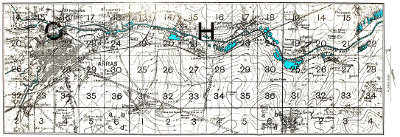
85With the fall of the Railway Triangle the German second line
was quickly captured, and here, on the immediate front covered
by the 33rd Divisional Artillery, the weary men of the 44th and
45th Infantry Brigades halted. The assault upon the third German
line, the "Brown Line," had been entrusted to the 46th Infantry
Brigade who, during the attack on the first two systems of defence,
had issued forth from the cellars and sewers of Arras into a position
of assembly in the German front line, and this brigade now advanced
to the attack.
As soon as the German second system had fallen, the batteries
began to advance so as to keep touch with the infantry. The delay
occasioned by the holding up of the latter at the Railway Triangle
had until now rendered any move of the guns impossible, for it was
essential that every piece should be brought to bear upon the
obstacle which was stopping the progress of the infantry. Now,
however, the move forward began; one section at a time, the guns
advanced to the positions already prepared for them in Blangy just
behind our original front line, battery commanders going forward
to register the guns immediately the trails were dropped. As soon
as the first sections were registered and in action, the second sections
began to advance; directly they were in action and firing, the third
sections joined them, and thus every battery maintained four guns
in action throughout the move forward, and was able to keep a
barrage in front of the infantry who now, in the afternoon, were
advancing to the assault on the German third line.
Strange to relate, the advance of the batteries, which of necessity
was carried out through the outskirts of Arras, was not greatly hampered
by shell fire. It was generally anticipated that the enemy
would bombard the eastern exits of the town as soon as ever the attack
was launched, for he must have known that troops would be issuing
forth from there, and, as the route of the batteries lay over a bridge
and through some very narrow streets, it was fully expected that
casualties would be suffered in this operation. It was therefore with
a feeling of relief that battery commanders saw the whole of their
batteries in action in the new positions around the eastern edge of
Blangy, bombarding throughout the afternoon the defences between
Orange Hill and the river Scarpe.
Throughout that afternoon it did indeed seem as though British
arms were winning the day. All around troops appeared to be
pressing forward; up the road from Arras there suddenly came
squadron after squadron of cavalry which wheeled into a big field
86in Blangy, dismounted, halted for a space while reconnoitring parties
pushed on ahead, then mounted and pressed away on over the captured
ground for some advanced objective. Long columns of infantry,
transport, ammunition columns and all the necessary material of war
poured steadily out of Arras and moved on ever towards the east,
until it seemed as though the whole of the front were pushing forward.
The batteries in Blangy, firing though they were upon the enemy as
hard as they could, felt somehow that they were being left behind,
and longed to receive the order to limber up and join more closely in
the pursuit which was now going on.
Orders were not long in coming for the 162nd Brigade at any
rate. Leaving the other brigade still in action around the eastern
outskirts of Arras, it threw forward reconnoitring detachments in
the middle afternoon, and by evening had begun to advance to
new positions—the third occupied that day—around the Railway
Triangle which, a few hours before, had been the scene of such close
infantry fighting. All day it had been raining on and off; now it
started to snow, and for the batteries of the 162nd Brigade there began
a night of real heart-breaking work.
Ground which has been barraged, captured and counter-barraged
a few hours previously, rained upon all day, trampled by cavalry
and countless advancing reserves; ground which consists of shell-torn
earth hastily shovelled down by a pioneer battalion to make a
rough track, and carried over trenches by arched wooden bridges
or not at all; ground of this nature churned up into deep sticky
mud is, for tired horses and men, a difficult obstacle over which to
drag guns and ammunition on a rapidly darkening night. Yet it
had to be done; the infantry were thought to be still advancing,
and unless they were covered by the guns they must, sooner or later,
meet with disaster. All that evening the four batteries of the brigade
struggled and fought their way through the rapidly increasing throng
on the track; pushed their way past the inevitable broken-down
wagons they met; manhandled each gun in turn through and over
trenches which were not bridged, and ultimately, soaked with mud
and perspiration, utterly worn out but victoriously aware of the fact
that they were still the most advanced batteries and that there were
none ahead of them, they arrived at the Railway Triangle and
dropped into action, A/162 on the eastern side of the embankment,
"B," "C" and "D" on the western. Here they remained throughout
the night of the 9th/10th waiting for daylight to come for the
advance to be resumed.
Thus ended the first day of the great Spring offensive. The
infantry, pushing on all the evening towards the German third line,
87had established posts on the northern slopes of Orange Hill (N.W. of
Monchy); the guns were still keeping touch with them despite the
rapidity of the advance and the appalling weather conditions; many
prisoners and guns had been taken, a considerable number of the
enemy lay dead on the captured ground, and nothing, so far, seemed
to be holding up the advance of our troops.
On the morning of Tuesday, the 10th, the infantry occupied the
remainder of Orange Hill. They had, in the first day of battle,
engaged in very heavy fighting; they had made a rapid advance
and now, tired out, were unwilling to continue until all the batteries
were not only in a position to give them close support, but were in
better communication with them. For this purpose the 156th Brigade
advanced up to the Railway Triangle, while the 162nd pushed forward
once again, this time bound for positions on the western slopes of
Orange Hill.
Fortunately there was very little fighting during the 10th;
the infantry were busy consolidating, reorganising themselves and
carrying out reliefs, and therefore it was possible to spend the day in
getting all the guns well forward, replenishing ammunition and
making arrangements for thorough support of the infantry in their
next advance.
It was well that the whole of the day was available for this, or
rather it was inevitable that it should be. So fearful was the mud
east of the Railway Triangle, where the Scarpe had helped the rain
and snow to form a bog, that the batteries had to make their way
across country to the outskirts of Arras once again, and, crossing
the railway, worked up towards Monchy along the Cambrai road.
The congestion was terrible everywhere, and movement along the
road, which was double-banked by traffic in both directions, proved
maddeningly slow. Not till the early morning of the 11th did the
batteries arrive in their new positions after a night of bogging and
digging-out guns, of marching along chaotic roads, of urging tired
men and tired horses to further work; but now, grouped on both
sides of the road which ran from Feuchy to Feuchy Chapel cross-roads
on the Arras-Cambrai road, they were right up close behind
the advancing infantry on the western slopes of Orange Hill itself,
and were in the best of positions for observation and close artillery
support.
On Wednesday, the 11th, the battle broke out again. The
37th Division, who had been in reserve hitherto, took up the attack
and assaulted Monchy-le-Preux from the north; at the same time the
cavalry advanced on the village from Orange Hill, and after severe
fighting Monchy was captured. This cavalry action was much
88criticized at a later date; it was an attempt to get through a supposed
gap in the enemy line, and consisted of a mounted advance across
some seven hundred yards of perfectly smooth and open ground
dipping slightly and then rising again. In this advance fairly heavy
casualties were suffered both from machine gun and shell fire—the
latter being mainly time high-explosive burst the height of a man's
head in the saddle—and the operation ended in a dismounted action
around Monchy; it certainly proved a valuable distraction from the
37th Division attacking on foot, and, had not the cavalry put their
horses in the village itself when they adopted dismounted action,
it is probable that their losses would not have been so severe. While
this operation, which advanced our line four hundred yards east of
Monchy and up to the river Scarpe, was in progress, the flanks also
tried to advance, but were held up and were forced to return to the
trenches they had left.
During the 11th the 156th Brigade came on from the Railway
Triangle and dropped into action slightly to the north of the 162nd
Brigade, and between it and Feuchy. At the same time the wagon-lines
of the brigades were brought forward and were kept right up
close (in the case of the 162nd Brigade, 500 yards) behind the battery
positions, for it was expected that the advance would soon be resumed.
Although the Army on the right, which had captured Bullecourt and
Riencourt, had been driven out again to its original positions, the
Army on the left had taken and held the Vimy Ridge, and it seemed
that, with the fall of this important feature, further progress must
very soon be made.
Now, however, the advance, which for three days had been so
brilliant, began to be checked. On April 12th the 29th Division
on the right and the 9th on the left tried to advance their line, but
were beaten back. Hostile artillery, so comparatively silent since the
9th, began to show increasing activity in barraging our troops and in
carrying out counter-battery work. It was manifest that the enemy,
after two days of disaster, was pulling himself together, and after losing
the majority of his artillery on April 9th and 10th, had now rushed up
fresh guns to stiffen the support of the front.
This opinion was strengthened on the 13th, when every battery
and wagon-line was heavily shelled, the enemy fire being directed
not upon any particular unit, but in a great shell storm over different
areas in which the guns and horses were congregated. It was clear
that a determined resistance was going to be offered to any further
attack, and accordingly the order was circulated that on this part of
the front the line should be held until the flanks had made further
progress. Since this course removed the possibility of any sudden
89need of teams for a quick advance, the wagon-lines were ordered to
return immediately to the eastern outskirts of Arras, only a small
number of animals for pack-work being maintained by each battery
in forward wagon-lines at the Railway Triangle. With a sigh of
relief battery commanders saw their teams wind their way down
Battery Valley to Arras again; the neighbourhood of Orange Hill was
no place for horses.
The wisdom of thus removing the horses was very soon put
beyond all manner of doubt. All through the early morning and day
of the 14th the batteries were heavily bombarded with gas shell and
high explosive, especially heavy punishment descending upon the area
where the horses had been. Serious casualties would inevitably have
been suffered if they had remained there, but as matters stood the
only casualties sustained were those in the gun positions themselves,
and even these did not prevent the batteries from opening a smashing
fire upon the enemy when in the evening he delivered a violent
counter-attack upon Monchy, a counter-attack which was broken up
under our fire, melted away and failed completely.
The batteries now settled down to what was to be temporarily
a "holding" job, and from the 12th until the 23rd nothing more than
the usual harassing fire and registration was carried out. The brigades
were placed under the administration of the 17th Divisional Artillery
and were ordered to dig themselves in, for heavy casualties had of late
been suffered amongst the detachments, and it was vital that no more
wastage should occur. Digging in was, in the present surroundings,
extremely difficult; two feet below the surface thick solid chalk
was met with, and every shovelful thrown up offered an unmistakable
mark to the keen eyes of the enemy aeroplanes which were now
actively patrolling the front. Not to dig in meant casualties from
the usual shell-fire to which the batteries were inevitably subjected;
digging in meant increased safety for the men but also, despite the
fullest use of camouflage, the attracting of further bombardment by
the enemy. Surely a choice between the devil and the deep sea!
In front of the batteries, on the forward slopes of Orange Hill and
in Monchy, excellent O.P.'s were obtainable and were made full use of.
The weather—hitherto bitterly cold with snow and icy blizzards—began
to improve, and visibility got consequently better. Greenland
Hill, Roeux, the Chemical Works and the Scarpe were clear targets
on the left, while on the right Pelves Mill on the cross-roads, with
the ruins of the little cottage beneath it, showed up clearly as a datum
line for the enemy trench system south of the river. Jigsaw Wood,
Hatchet Wood and Bois du Sars, all on the sky-line, blocked further
view, but sufficient was visible west of them to enable accurate
90registration to be carried out on all the enemy forward zone; his
actual fire trench could always be observed from our own front line
or even, in the case of the trenches near the river, from the commanding
slopes of Orange Hill.
On Monday, April 23rd, a fresh attack was made by the 17th
Division, with the 29th and 15th on the right and the 51st on the left,
the objectives on the batteries' zone being Bayonet Trench north-east
of Monchy, together with a small enemy salient which had been
formed on this part of the front. Three attacks in all were made, and
all failed; enfilade machine-gun fire from Roeux and from both sides
of the river cut down our men, and eventually the operation had to
be called off. On the 24th the attack was renewed and this time slight
progress was made, but no advance of any account was effected and
the losses amongst our troops were enormous. The battle was indeed
becoming costly, and the gunners, as well as the infantry, were showing
the effects of it. Every day the usual harassing fire took its toll of the
detachments, and on the days when heavy bombardments were carried
out on the battery positions (as on the 22nd when B/162 lost Major
Benett-Stanford and Captain Body wounded, with two out of the
three subalterns, Bostock and Neate, killed) numbers were cut down
to an alarming minimum.
On April 28th the battle was again resumed on a grand scale.
The 12th Division assaulted on the front of the batteries, this time
with the 3rd Division on the right and the 34th on the left; at 4.25 A.M.
the infantry attack was launched under cover of a very heavy
artillery barrage, the objectives being those portions of Bayonet and
Rifle trenches which still lay in the hands of the enemy. Three
minutes after the attack began the enemy put down a light barrage of
10·5 cm. and 77 mm. shells, which became heavier on Bayonet Trench
itself at about 7.30 A.M., but generally speaking the hostile artillery
fire was slight. In the main the enemy appeared to depend upon
his machine guns to ward off attacks, and in this he was fairly successful.
Mist and smoke shell rendered observation very difficult, but by
six o'clock the objective was reported to have been gained; from
here, however, machine-gun fire began to tell and, although the right
battalion of the brigade covered by the 33rd Divisional Artillery
advanced according to plan, and was reported to have reached the
second objective, the left battalion was held up by machine guns
and could not advance.
At half-past six in the morning a smoke barrage was put down
along the south bank of the Scarpe to try and help the left battalion,
while at the same time the field howitzers turned on to the troublesome
machine guns. All day long the batteries kept up a protective
91barrage in front of the infantry, increasing at times to intense rate
when an enemy counter-attack showed signs of being launched. At
11.30 A.M. the infantry endeavoured to consolidate their positions
under a now heavy enemy barrage which had been increasing in intensity
upon Bayonet Trench since ten o'clock, but it was of no avail.
Heavy machine-gun fire from across the river Scarpe prevented them
from achieving anything, and not until nightfall was the position
clear.
It was then found that Bayonet Trench had been captured in its
entirety, but that only a portion of Rifle Trench had been wrested
from the enemy; all along the infantry had been greatly impeded by
machine-gun fire from which they suffered heavy casualties. From
observation and reports received it would appear that the enemy had
concentrated in considerable force upon this front, and it was probably
due to the work of Forward Observing Officers from the batteries that
the many hostile counter-attacks attempted had been smashed
before they came to fruition. On the early morning of the 29th the
infantry established a line of posts and generally consolidated the
ground captured on the previous day, but no further gains were
possible. A final effort at 3.0 A.M. on the 30th to capture the
remainder of Rifle Trench from the enemy proved a failure, and the
infantry, suffering heavy losses, were forced to return once more to
their trenches.
Thus ended April, which had opened so brilliantly, and with the
arrival of May a less cheering period was destined to begin. Thursday,
May 3rd, in fact, marked the last great effort which was made to
continue the advance along the whole of the front; on the 1st an
unsuccessful attempt to capture the remainder of Rifle Trench had
been tried, but this was purely a local operation, and on the 3rd all
three Armies pulled themselves together and launched a combined
assault stretching from Arleux-en-Gohelle on the left to east of
Bullecourt on the right. On the immediate front of the batteries
of the 33rd Divisional Artillery, with whom were also the 12th
Divisional batteries and the VIth Corps Heavy Artillery, an intense
barrage was put down on the enemy front line for three minutes before
zero. At 3.45 A.M. the infantry assaulted, while the barrage crept on
at the rate of thirty-three yards per minute; intense machine-gun
fire was immediately encountered, together with a heavy barrage
which fell upon infantry and gunners alike, but the front wave of
assaulting infantry by keeping close up to our curtain-fire succeeded
in reaching the line Pelves Mill-Gun Trench. Here the situation
became very obscure; owing to the fact that zero hour had been
fixed for an hour of darkness, all communication between the front
92and succeeding waves was lost, while a heavy machine-gun barrage
put down by the enemy prevented our second wave from getting
beyond Scabbard Trench. At ten o'clock a party of Germans entered
Scabbard Trench and bombed our men out as far as the junction with
New Trench, with the result that the infantry forming the first wave
were left entirely cut off.
All this time the 18-pdrs. had been keeping up a protective
barrage beyond the first objective, in the hopes of saving such of the
leading troops as had got there. At 12.10 P.M. a new bombardment
was organised and two hours later a fresh attack was launched,
this time under a very novel barrage. The enemy, strongly dug in
in Scabbard Trench, could not be reached by the flat trajectory
of the 18-pdrs., and accordingly it was decided to organise a creeping
barrage of 4·5 in. howitzers. For a quarter of an hour four batteries
of field howitzers poured high explosive into Scabbard Trench,
our own men lying not only close up to the trench but also all round
it, and at 2.10 P.M. the howitzers lifted off and ceased firing, whereupon
the infantry, keeping close to the barrage, rushed the trench.
It was a desperate measure, this howitzer barrage, for it was like
firing into the centre of a circle with our own men all round, and,
with the infantry lying right up to and following so closely on the
heels of the barrage, it seemed inevitable that a few rounds should
fall short—and only a few short rounds of 4·5 in. H.E. are sufficient
to do inestimable havoc and wreck the confidence of attacking
troops. Like many desperate measures, however, it succeeded;
some fifty Germans, unable to stand the appalling weight of fire
(about 80 rounds of H.E. per minute in a confined space), fled from
Scabbard Trench and rushed down the bank running east towards
Pelves Mill, while simultaneously a party of about one hundred
of the enemy left the same bank and made for the cross-roads just
west of the mill. Immediately they broke cover the 18-pdrs. switched
on to the parties with excellent results, and two companies of the
17th Royal Sussex Regiment, profiting by the distraction, rushed
Scabbard Trench in its entirety; this they captured almost without
casualties, and found seventy dead Germans, the victims of the
howitzer bombardment.
The enemy now opened a furious bombardment upon Scabbard
Trench, realising that it had at last fallen, and at 2.20 P.M. launched
a heavy counter-attack which was beaten off after hand-to-hand
fighting, in which we captured one officer, twenty-five men and two
machine guns. All the afternoon the batteries were busy on various
targets, especially upon enemy infantry who kept massing behind
Keeling Copse and running in small batches to Cartridge Trench.
93At the same time a good view of the hostile counter-attacks on
Greenland Hill, north of the Scarpe, was obtained, and on several
occasions the guns were switched round to the left and dealt smashing
blows to the enemy every time he attempted to leave his trenches.
The total result of the battle was that on the extreme right the
5th Army advanced beyond Bullecourt, but was forced back again
by the enemy who reoccupied the village; around Cherisy all
objectives were gained, but here again the enemy counter-attacked
and drove out our troops; on the immediate front of the batteries
a partial success with enormous loss of life was obtained; on the
north of the river the attack on Roeux failed also, and only on the
extreme left was any real success achieved. Here the 1st Army
took Fresnoy and all the objectives north of Oppy. Oppy itself,
however, proved too difficult for the attacking troops, nor were
any of the objectives between it and the river captured. In short,
the attack began well, almost brilliantly, but finished badly; it
was not a defeat—the operations north of Oppy saved it from being
called that—but it was at least a partial failure which had cost
many thousands of lives.
May, then, did not begin very well, and, after spending the whole
of the 4th in consolidating the ground of the previous day's battle,
a lull set in—a lull which was not broken until the 11th. At 7.30 P.M.
on that day the 4th Division just north of the river carried out an
attack upon Roeux Chemical Works and Cemetery, the 33rd Divisional
Artillery supporting the operation on the flank. Covered by a
barrage, the density of which was one 18-pdr. for every seven yards
of front, the infantry rushed all the objectives and held them,
together with 300 prisoners; to this gain was added a further advance
along the river's edge at 6.0 A.M. next morning, which was covered
by a barrage put down on the north-western end of Roeux, and by
midday on the 12th the infantry were secure in their newly-won
positions. The ominous Chemical Works, from which such deadly
machine-gun fire had been directed on our attacks south of the
river, was now in our hands, and there seemed every chance of an
advance being possible on the front of the batteries.
Orders for this advance were not long in coming. At 6.45 P.M.
on that same evening (12th) the 12th Division, which was covered
by the 33rd Divisional batteries, advanced to the assault on Devil's
Trench, while the 3rd Division prolonged the attack to the right.
After a three-minute bombardment with a density of one 18-pdr.
to every ten yards of front, the 36th and 37th infantry brigades
advanced upon the portion of Devil's Trench which ran northwards
from Bit Lane to Harness Lane. Simultaneously with the attack,
94however, very heavy rifle and machine-gun fire was opened by the
enemy from both flanks—Gun and Devil Trenches—which were
held in force, and fifty yards short of the trench our infantry were
stopped, unable to advance any farther. Lieut. Wingfield, the forward
observing officer of the 156th Brigade who was with the attacking
company commander, got through to the guns and reported that the
infantry intended to assault again at 10.45 P.M. Accordingly, for
fifteen minutes prior to that time the batteries put down a heavy
barrage and then lifted on to the enemy support trenches. Close
on the heels of the barrage the infantry rose to the attack, but
circumstances were against them; darkness supervened everywhere,
the infantry were scattered all over the place owing to the non-success
of the first attempt, and Devil's Trench was only assaulted
here and there. By midnight it was reported that the remnants
of the attacking company were back in their own original front line
again. The operation had failed completely.
The operations of May 3rd, costly enough by themselves, had
now been followed by the two attacks on the 11th and 12th, and
so heavy were the casualties amongst the infantry that, for a time
at any rate, the infantry battle was broken off, and to the guns
was given the task of wearing down the enemy and of destroying
his morale. This new period was ushered in on the 14th by a
Chinese bombardment of the enemy trenches; a bombardment,
that is to say, which bore all the signs of a barrage covering assaulting
troops but which, in reality, crept forward unfollowed by any infantry,
and then dropped back suddenly on to the hostile fire-trench to catch
such of the enemy as had manned the parapet to meet the expected
assault. In this case our guns pounded Devil's Trench for a short
time, and then crept on by lifts of one hundred yards every minute.
After three lifts the barrage suddenly dropped without warning on
to the fire-trench again and blasted it with high explosives and
shrapnel, while the Division on the left swept the area with enfilade
machine-gun fire. No movement was seen, but the enemy doubtless
expected that another attack on Devil's Trench was being launched
and would therefore have manned the parapet; if he did so, his losses
must have been severe.
Having thus attacked his forward infantry, the guns now
turned their attention to enemy ration parties and back areas.
Every night, for the past week or so, a part of the night firing programme
(which was carried out every night by each battery mainly
on back areas) had been to keep up intermittent shell fire upon the
road running east from Pelves towards Hamblain. Aeroplane
photographs now received, however, showed tracks running parallel
95to this road and about 150 yards south of it, tracks which became
clearer every day. It was manifest that the enemy had given up
using the road and was cutting across country; on the night of the
15th, therefore, the guns directed their fire in intermittent bursts
on to the original road up till 9.0 P.M., and then at that hour, by
which time all traffic would have been diverted on to the cross-country
tracks, swept up and down those tracks with H.E. and
shrapnel for ten minutes at an intense rate of fire. That this fire
was effective in its object was clearly proved next day, when the
enemy retaliated strongly upon our own lines of communication—sure
sign that we had done something seriously to annoy him.
The batteries now began to have a bad time. Free from infantry
attacks and suffering most of his casualties from the guns, the enemy
turned the full fury of his attention upon the gunners. "B" and
C/162 were engaged by a 5·9 in. high velocity gun, their positions
being badly damaged; D/162 was registered by an enemy aeroplane
which carried out an all-day bombardment upon it in co-operation
with an 8 in. howitzer battery. Both brigades suffered severely
from bombardment by 5·9 in. howitzers, while a couple of whizz-bang
batteries devoted themselves to putting intermittent bursts
and sniping rounds into all the battery positions, and especially those
of the 156th Brigade, causing many casualties by the unexpectedness
of their attacks. As a rule, in fact, these sudden bursts did far more
damage to personnel than the long all-day bombardments, and it
was just such a burst which killed Captain Heape of A/162 and so
wounded Lieut. Tucker that he died next day—a loss grievously
felt, for both officers were of the very finest type which the brigade
contained. From day to day each battery in turn underwent a
severe shelling, and the casualties in men and guns mounted, ever
mounted.
On May 16th the lull in infantry fighting was broken, this
time by the enemy. After bombarding our front trenches
immediately north of the Scarpe, together with the village of Feuchy
and the back areas in general, during the whole of the 15th, a big
hostile attack was launched at 3.0 A.M. on the 16th and drove our
troops out of Roeux Cemetery and Chemical Works. By 7.30 A.M.
we had counter-attacked and recaptured the lost ground, and at
9.50 A.M. a hostile counter-attack was driven off. Shortly after
ten o'clock our men were seen advancing north-west from the Chemical
Works, but a furious hostile barrage was put down on them and they
were forced to retire. All day long the batteries poured shell into
Roeux and the adjoining trenches, and all day long fighting
continued; by evening the situation had calmed down, and little
96change showed itself on the front as a result of the twenty-four
hours' fighting. It was clear, however, that the enemy was not
only going to offer a stubborn resistance but was even assuming an
offensive attitude in places, and a bitter struggle was anticipated
when orders were received for another attack on Devil's Trench.
On the 19th our troops were once again flung upon this deadly
little objective—flung, as they had so often been before, on a narrow
limited front with the knowledge that flank machine-gun fire must
inevitably be met with.
Major Colfox (D/162) had, on the previous night, run a forward
gun right up to Chinstrap Lane, twelve hundred yards west of Roeux,
and had registered it over open sights in the early morning, in the
hope that enfilade fire from here might assist the infantry in their
oft-tried task. Under a heavy barrage the infantry rushed to grips
with the enemy, but no sooner had our guns started than the enemy
opened a heavy concentrated machine-gun fire all along the front,
while his guns put down a dense barrage within thirty seconds of the
beginning of the attack. A footing was gained in the part of Tool
Trench still held by the enemy, but strong bombing attacks were
delivered from both flanks, and our troops under the pressure of
these attacks were forced to withdraw. Devil's Trench once more
had proved a death-trap.
This venture was followed up at 11.30 P.M. on May 30th by
an assault on Hook and Tool Trenches, but the attack only added
one more item to the now growing list of local failures. Our troops
were evidently seen leaving their trenches, and this enabled the
enemy to open heavy machine-gun and artillery fire on them. In
spite of this, and of the mud and water caused by a thunderstorm
during the afternoon, the attacking troops reached their objectives,
but so heavy had been the casualties suffered whilst crossing No
Man's Land that the remnants were not strong enough to deal with
the garrison of the trench. Most of the attackers were driven out
by a counter-attack following immediately on the assault, but a
party of the Manchester Regiment established itself in Hook Trench
and managed to hold on till noon next day. The guns poured shell
over their heads and put down barrage after barrage for their protection,
but it was of no avail. Shortly after midday a superior
force of the enemy counter-attacked with fury, and this gallant
little party was overcome.
The advent of June brought with it a further succession of
local attacks—efforts to straighten our line, to remove important
points held by the enemy and generally to improve our tactical
position. It was evident, from the non-success of the French
97offensive in the south, that no more operations on a large scale
would be carried out here, but it was also clear that Higher Command
had decided in its mind that our line must embrace certain tactical
features now in the hands of the enemy, and to this end further
local undertakings had to be effected. Following on two Chinese
bombardments on June 3rd and 4th, in which the 33rd Divisional
Artillery took part to the south of the river, the 9th Division carried
out a short and successful attack around Greenland Hill on the
night of the 5th, and consolidated all its gains. Soon afterwards,
on the 13th, a very successful attack upon Hook and Long Trenches
was made by the 76th Infantry Brigade. During the previous week
a systematic bombardment had been carried out night and day upon
the enemy defences to obliterate his trenches and to weaken his
morale. Each day, however, there had been no firing between
5.0 A.M. and 9.0 A.M., and the enemy had grown accustomed to a
period of quiet at this time. When, therefore, the infantry rushed
across at 7.20 A.M., our barrage not starting till 7.21 by which time
they were in the hostile trenches, they caught the enemy quite
unprepared and showing little resistance. All gains were held and,
under cover of a protective barrage, the ground was consolidated.
At 7.15 A.M. next day (14th) a further attack under cover of
a barrage resulted in the capture of Infantry Hill by our troops,
and the morale of the latter, somewhat shaken by the continued
reverses at Roeux and Devil's Trench during the previous weeks,
began now to rise again to the pitch of confidence and assuredness so
badly needed. So greatly did it improve, in fact, that when the
enemy counter-attacked at 2.15 A.M. on the 16th, in an endeavour
to regain Infantry Hill, he was severely punished and beaten off—except
for the loss of two southern posts in front of Long Trench—despite
the fact that the attack had been delivered with a strength
of some seven hundred bayonets under cover of an intense artillery
bombardment. A second hostile attempt at 2.30 A.M. on the 17th,
although preceded by a two-hour bombardment, only resulted in
our losing a small portion of Long Trench, and it now seemed as
though Infantry Hill were securely in our hands.
Just prior to these attacks the 33rd Divisional Artillery had
received orders to move out to the wagon-lines and to take over part
of the line further south. The enemy's attitude, however, appeared
threatening, and accordingly the departure of the batteries was
postponed until the activity had died down. By June 20th all
appeared to be quiet, and at 6.0 P.M., after twelve weeks of continuous
battle on this front, the march to the wagon-lines was effected.
Taking their guns with them, the batteries topped the ridge west of
98Battery Valley and marched back to the peace and rest of Arras once
more.
The three months' fighting in this offensive had marked a
brilliant chapter in the doings of the 33rd Divisional batteries.
Under all conditions, in blizzards, in snow and mud, under intense
shell-fire from the enemy they had maintained their reputation for
straight shooting and complete reliability; moreover, and this
was above all the most valued, they had won the entire confidence
of the infantry. When the 3rd Division, which had carried out
the operations of June 14th-19th under cover of the guns of 33rd
Divisional Artillery, was withdrawn from the line, its G.O.C. Major-General
Deverell wrote to General Stewart and asked that the
personal thanks of the infantry might be conveyed to the batteries.
"We wish them" he concluded in his letter, "all good fortune in
the future and hope that we may again fight together with that
close co-operation which has been so conspicuously marked whilst
we have been together." High praise, that, and praise dearly won,
for there were many gaps in the ranks as the brigades turned westwards.
On each and every battery the offensive had left a heavy
mark, and the faces of new arrivals bore witness to the many blanks
which had had to be filled, but the greatest loss which the Divisional
Artillery as a whole had suffered was borne especially by the 162nd
Brigade. On May 23rd Lieut.-Colonel O. M. Harris was carried
away on a stretcher in the advanced stages of para-typhoid. To
the officers and men of his brigade his name seemed inextricably
interwoven with the brigade itself, for he had "made" it, working
it up from its early raw stage at La Bassée to the fine fighting
instrument it now was. With his going a certain gloom fell upon
the brigade, for all ranks realised that they had lost not only a very
gallant leader but a very true friend.
Before he left, however, Colonel Harris had one great satisfaction.
Throughout the battle of Arras the 162nd Brigade had made it its
object always to be the furthest forward, always to be the nearest
to the infantry. Its batteries were the first across No Man's Land
on April 9th, the first to advance as each enemy line fell, the closest
up behind the infantry throughout the operations, and early in
May this achievement was officially recognised. There came one
day from Field-Marshal Sir Douglas Haig a message saying that a
captured German 5·9 in. howitzer would be presented to the 162nd
Brigade in recognition of the work it had carried out during the
advance, and of the very fine manner in which it had on all occasions
pushed up so close behind the infantry. Such a distinction has
rarely, if ever before, been conferred upon a brigade of artillery, and
99to its commanding officer was due a full measure of praise in that
he had worked it up to a pitch of efficiency which made such deeds
possible.
One night the brigades spent in their wagon-lines at Arras,
and early on the morning of the 21st they hooked in and moved off
through Beaurains down the long road which led to Bapaume,
to pit their strength this time against the fortifications of the
Hindenburg Line.
CHAPTER VII. THE HINDENBURG LINE AND THE OPERATIONS ON THE COAST. (JUNE-AUGUST 1917).
100
When the batteries marched back to the wagon-lines on June 20th
they knew that they were to set off next day to go into action
immediately on another portion of the front, but their actual
destination remained somewhat of a mystery. There was a rumour
that they were going a considerable distance northwards, even to
the Coast it was suggested, and therefore, when they set out in a
southerly direction on the morning of the 21st, a certain amount of
surprise prevailed amongst the rank and file. Southwards they
headed, passing through Beaurains along the great road running
down to Bapaume, and gradually they penetrated more and more
deeply into the wilderness created by the enemy when he retreated
to the Hindenburg Line in February and early March.
As events turned out, the march was to be a short one. After
leaving the Bapaume road a few miles south of Arras, wagon-lines
were established around Hamelincourt, Boyelles and Boiry St.
Rictrude in the VII. Corps area, and one section per battery moved
up into action the very same afternoon; the march had represented
nothing more than a sideslip of some three miles to the right, but
even this short distance brought the batteries into totally different
surroundings. They were now moving through the country over
which the enemy right had retired in his withdrawal earlier in the
year, and on all sides they saw proof positive of the stories of destruction
which had been related to them. Every tree, every bush, even
the slender apple trees lay cut down and destroyed; roads had been
blown up, houses demolished, and the country had the appearance
of a great wilderness with every natural feature shaved off as though
by a giant razor. The Bapaume road, no longer a stately route
bordered by trees, lay like a piece of tape across the naked ground;
houses gaped and tottered, blown up not by the shells of the pursuing
army but by the prearranged handiwork of the retreating foe. It
was a case of wanton destruction, wrath vented upon the countryside
by a bitter and chagrined enemy, and, although it has been
suggested that all this work was carried out in order to open the
country for the great and last German drive westwards which was
destined to begin some nine months later, there can be little doubt
but that it was merely a continuance of that policy of frightfulness
and destruction which marked all his doings.
101ORDER OF BATTLE.
May—August 1917.
| H.Q.R.A. |
| |
| C.R.A. |
Brigade Major. |
Staff Captain. |
| Brig.-Gen. C. G. Stewart, C.M.G., D.S.O. |
Major T. E. Durie, M.C. |
Capt. W. E. Bownass, M.C. |
| |
| 156th Brigade. |
| Lieut.-Colonel B. A. B. Butler. |
| Adjutant: Capt. B. L. Oxley, M.C. |
| Capt. W. G. Sheeres. |
| |
| "A" Battery. |
"B" Battery. |
"C" Battery. |
"D" Battery. |
| Major H. McA. Richards, M.C. |
Major M. A. Studd, M.C. |
Major Barker, M.C. |
Major W. A. T. Barstow, M.C. |
| |
| 162nd Brigade. |
| Lieut.-Colonel Conolly. |
| Adjutant: Capt. R. H. Pavitt. |
| |
| "A" Battery. |
"B" Battery. |
"C" Battery. |
"D" Battery. |
| Major G. Fetherston, M.C. |
Major H. C. Cory. |
Major L. Hill. |
Major W. P. Colfox. |
| Major W. G. Pringle. |
Major Walker, D.S.O. |
|
|
102Despite this, very fair wagon-lines were obtainable around the
ruins of the villages aforementioned, for the ground was dry and
rolling and, there being no inhabitants in this area of desolation,
there were no restrictions as to the setting up of horse-lines. Quickly
the brigades settled down in their new surroundings, and as quickly
the first sections moved up into action, to be followed next day by
the remainder of the batteries.
Ever since May 12th General Stewart and his staff had been
near Hamelincourt, controlling the artillery covering the infantry
of the 33rd Division in the Bullecourt sector (at that time the 21st
and 37th Divisional Artilleries, together with the 150th, 293rd and
79th Field Artillery Brigades), and on going into the line now the
batteries came under the administration of the 50th Divisional
Artillery. The 156th Brigade occupied the positions vacated by
the 123rd Brigade of the 37th Division, situated east-south-east of
Henin-sur-Cojeul and just west of the Hindenburg Line. The
batteries of the 162nd Brigade were distributed at first amongst the
82nd, 83rd and 250th Brigade groups; ultimately, on the 23rd,
they were placed under the control of the 250th (C and D/162) and
the 251st (A and B/162) Brigade Groups, and supported the infantry
from positions in Heninel (C/162) and east of Henin, all batteries
except A/162 being just to the left of the 156th Brigade. The front
covered by the brigades was roughly the line running southwards
from Fontaine-lez-Croisilles nearly to Bullecourt.
This part of the front was of intense interest to the batteries.
To begin with, they were in touch with the infantry of their own
Division for the first time since February; the 162nd Brigade, it is
true, was shooting over the trenches north of that part of the
Hindenburg Line garrisoned by the 19th and 98th Infantry Brigades,
but the 156th Brigade was actually covering the 33rd Divisional
Infantry, and to the men there was a feeling almost of being home
once more when they thus found themselves amongst their own.
Added interest, moreover, was gained from the fact that the much-talked-of
Hindenburg Line could here be examined, for the fall of
Monchy had outflanked this part of the system, and the enemy
with much reluctance but of dire necessity had had to retreat from
it, leaving it to be occupied by our troops.
It was a mighty piece of fortification; in front of the fire-trench
were three thick belts of wire thirty yards apart, each belt some
fifteen yards deep; between the belts, which were so thick that
103hardly a mouse could get through them, lay concrete emplacements
for machine guns or trench-mortars, reached from the front line by
underground shafts. The fire-trench itself, about twelve feet in
depth, contained concrete pill-boxes at every turn and on every
tactical point, while the communication trenches running back to
the support line were so wired as to form a defensive flank should
any portion of the front be penetrated. On reaching the support
line an exact replica of the fire-trench was met with; three belts of
wire and the accompanying pill-boxes and machine-gun emplacements
lay in front of the trench, but this time a further feature was
added. Throughout the entire length of the Hindenburg support,
from Beaurains right down to Bullecourt, there ran an underground
tunnel seven feet high, three and a half feet wide and thirty feet
below the surface. Shafts ran down to it at intervals of twenty
yards, and to all intents and purposes it formed a vast dug-out
exactly under the parapet of the trench and running beneath it
throughout all the miles of its length. Its existence could only be
proved as far as Bullecourt, for from that point onwards it was held
by the enemy, but doubtless it continued southwards with the
Hindenburg Line itself since, offering as it did a perfect refuge for
the garrison, it formed an integral part of the defences of this great
system. For that portion of the passage which lay in British hands
a "Town Major" even had been appointed, and from him could be
obtained so many yards of the dug-out as the lawful habitation of
the unit on the spot!
The batteries were not slow to get to work here. June 22nd
and 23rd were spent in registration of the zone and in careful study
of the front to be covered. On the 23rd the 156th Brigade bombarded
Tunnel Trench at 11.35 A.M. and 7.30 P.M., and at midnight
on the 23rd/24th supported an attack on it by the 19th Infantry
Brigade from Lump Lane. The attack proved unsuccessful, and
throughout the 24th the bombardment was continued, while the
162nd Brigade took up the running on the left in an attack on York,
Bush and Wood Trenches. The 5th E. Yorkshire Regiment (50th
Div.) carried out this assault at 12.30 A.M. on the 26th, and at first
were successful. All the objectives except for the cross-roads
north-west of Fontaine-lez-Croisilles were gained, thirty prisoners
were captured and two hostile counter-attacks driven off. There
followed, however, such a deluge of hostile shell fire that the newly-gained
trenches were entirely demolished, and a large part of the
ground gained had to be relinquished.
After this outburst the brigades settled themselves down to
"artillery activity," searching for the opposing batteries and shelling
104all tracks and approaches to the enemy front line. The two brigades
each fired some six hundred rounds every twenty-four hours on
targets of this nature, and by so doing aroused the ire of the enemy
to no small extent. Hostile counter-battery work increased rapidly
in activity, but very few casualties were suffered. A/162 (Major
Pringle) were much damaged by hostile bombardments on the 22nd
and 24th, while Major Richards' guns (A/156) on July 2nd were
so heavily shelled that they had to shift their position, having lost
three sergeants killed and a number of men wounded. But if the
batteries suffered in this manner, at least they gave as good as they
took; nightly activity was more than ever directed upon the hostile
back areas and gun positions rather than upon the infantry, and to
this was added a chemical shell bombardment carried on throughout
the night of the 28th/29th which must have worried the enemy to
a considerable extent, if the weight of his retaliation on the 29th
were to be taken as a guide!
When the batteries came out of action prior to moving down
to this part of the front a rumour was circulated, as already mentioned,
that their destination was to be the Coast, and surprise
prevailed that their route should take them southwards. Battery
commanders were told by their Group Commanders on arrival,
however, that the Cherisy-Fontaine sector was nothing more than
a sorting-area, and that they, like the batteries before them, would
probably remain in action only some ten days or so before moving
elsewhere. Therefore, when orders were received on July 9th to
move out of action in a couple of days' time, the news was not
altogether unexpected. The preceding period had been spent in the
usual artillery activity with no infantry action of any sort, but
unfortunately the enemy, by this continued harassing of his battery
positions and roads, had been roused to an extreme pitch of retaliation.
He had of late taken to subjecting the valley from Heninel
through St. Martin-sur-Cojeul down to Henin to a miniature shell
storm, and as certain of the batteries had to utilise this route for
their move out it seemed as though his efforts, hitherto fruitless,
might meet for once with some success.
As matters turned out, however, the nightly searching took
place some thirty minutes before the batteries moved, and the actual
march away was carried out undisturbed on the night of July
11th/12th. A/162, nevertheless, and one or two other batteries
were very heavily shelled by 5·9 in. howitzers just as the teams and
limbers arrived, and only by the greatest good fortune, coupled
with some very marked gallantry amongst the men, did the guns
get away without serious casualties.
105On arrival at the wagon-lines it was found that no further
destination had been determined, and that here for the present the
batteries were to remain. There was no reason, indeed, for a move
to any more distant area, for the horse-lines here were good and dry,
tents had been pitched to shelter the men, harness "rooms" had
been erected while the batteries were in action, and a very fair
degree of comfort offered itself to all ranks. True, the horse-lines
were in view of enemy territory at points, but they were a long way
back—some five miles from the line—and no trouble from long-range
fire was expected; on the other hand the uninhabited state of the
area, due to the destructive march by the Germans early in the
year, offered an excellent training ground for work of every
description.
Refitting, overhauling and training began immediately after the
arrival of the batteries at their horse-lines. From the 13th to the
15th a Divisional Artillery scheme with skeleton batteries was
carried out around Adinfer Wood; this was followed by days of
battery training, gun drill, driving and riding drill, battery staff
work, training the detachments to cut gaps through wire entanglements
and rush their guns over trenches, and every conceivable
form of preparation for more open fighting.
All was not work, however; the weather was glorious and every
opportunity was taken of giving the men a holiday, a rest from
fighting and preparation for fighting, a chance of enjoying themselves.
Five or six jumps were put up near each battery, and the respective
wheelers knocked together gates for exhibition driving; the
Divisional band came down and gave a concert one afternoon, while
another half-day was spent in a cricket match between the two
Brigades. Batteries arranged mule races for their own edification
or ran off heats for the forthcoming sports, and altogether managed
to make the time very pleasant.
As a final flourish, two days were allotted for a Horse Show
and sports. On the 18th the Divisional Artillery Horse Show was
held near Boiry St. Martin, and produced an excellent programme.
Events were ushered in by the somewhat precipitous arrival on the
course of a six-in-hand emanating from D/162; a six-in-hand
which, although only hooked in to a G.S. wagon and consisting of
horses quite unused to this form of equitation, was driven up the
course by Major Colfox in true coaching style, the battery trumpeter
rendering weird noises from the back, while General Stewart's A.D.C.
took a prominent seat "to add tone to the picture!" Followed a
series of jumping, driving and "turnout" competitions, mule races
and the like, till at last a very cheerful day and one producing some
106fine horses and horsemanship came to an end. Major Studd won
the officers' jumping event. A/156 gathered up many of the other
prizes, and the remainder were scattered amongst all the batteries.
Four days later a day was given up to Divisional Artillery
Sports, the programme consisting not only of the usual flat race,
jumping and obstacle items but also of one or two mounted events,
and then the batteries packed their wagons, hooked in the teams
and turned their backs sadly on this pleasant spot. They were
off to the war once more, and rumour had at last been verified—the
Coast was their destination.
The knowledge of this destination had been obtained by the
batteries some time back. As early as July 4th General Stewart
and his Brigade-Major (Major Durie), who had been relieved in the
line by the C.R.A. of the 21st Divisional Artillery three days previously,
set out for XV. Corps Headquarters to attend a conference, and
did not return until the 8th. On the 13th orders had been received
for one officer and fourteen men per battery to move ahead of the
main body and report at headquarters of the 1st Division at Coxyde
Bains, to prepare the positions which the guns were to take up,
and with the name of the destination now disclosed an immediate
rush had been made for maps to discover its locality. "Bains"
certainly suggested the Coast, and surely enough it was ultimately
found there—a small village some four miles west of Nieuport and
right on the sea front. It was therefore with the knowledge of great
events impending that the batteries marched off on July 23rd, glistening
in the new paint and added burnish which eleven days in the
rest area had made possible. Authieule and Amplier, both in the
neighbourhood of Doullens, were their destinations that night,
and these they reached in the evening after a march through very
fine country under a glorious sky.
From 6.0 P.M. and throughout the night of Tuesday, the 24th,
the batteries entrained at Doullens North and South and at Authieule.
Eight horses in each van, guns and wagons lashed to long trucks
by French porters, men crowded into big cattle trucks, they journeyed
throughout the night and early morning past Hazebrouck and
Bergues, and finally arrived in the forenoon of the 25th, the 156th
Brigade at Adinkerke, the 162nd Brigade at Dunkirk. A rapid
detrainment, water and feed for the horses and a hasty meal for the
men, and the batteries set out in long columns for their wagon-lines.
The 156th Brigade went right up to Coxyde Bains and established
wagon-lines in the dunes behind the village; the 162nd Brigade
marched to Ghyvelde, a village two miles from the Belgian frontier
and some distance behind the line, and sent up one section of horses
107from each battery to be attached to the 156th Brigade at Coxyde
for use as a forward wagon-line.
The next morning battery and brigade commanders rode up
to the line to reconnoitre the positions they were to occupy, and
to inspect the work done by the advance parties, while on the 27th
and 28th the guns of every battery were calibrated at the Coxyde
Bains range, firing out to sea through electric screens, by which process
the muzzle velocities of the guns were measured. On the night of the
28th/29th the 156th Brigade, with "A," "B" and C/162, moved
up into action in the positions already prepared, and next night
were followed by D/162. Considerable difficulty was experienced
on both occasions owing to an enemy bombardment of the neighbourhood
with gas shell throughout the night; respirators were worn
for two and a half hours and casualties were thereby averted, but
the difficulty of finding the way in the darkness on an unknown
road was naturally greatly increased.
On July 30th, when the batteries had opportunity to review
their new positions, they found themselves in surroundings totally
different from any yet experienced. On their left lay the sea, all
around them was sand broken up by huge dunes, and practically
nowhere could any shell holes be seen. This did not, unfortunately,
mean that there was no hostile artillery activity; on the contrary
the enemy artillery, and in particular his high-velocity guns, showed
the most amazing persistence in raking our battery positions. The
reason for the absence of shell-holes was that the sand, continually
kept shifting by the wind, silted up and filled in any hole within a
few hours of its being made, leaving all the shell splinters lying on the
surface like pebbles on a sandy beach. There arose from this the
disadvantage of not being able to tell from the nature of the ground
whether it was subject to enemy shelling or not, but on the other
hand it offered real relief to eyes now physically wearied by the
continual sight of torn and desolated country.
These coastal positions, indeed, offered many new and hitherto
unexperienced features, but for every advantage there was at least
one disadvantage. The sand, kept moving by the wind, removed
the depressing sight of shell-holes; but the same sand blew into
men's eyes, blinding them, and jammed the guns at almost every
other round fired. The view of Ostend—visible on a clear day
from the Grand Dune—with the German destroyers occasionally
entering and leaving its harbour, offered an object of great interest;
but the proximity of Ostend involved the presence of an infinite
host of high velocity naval guns on land mountings, which blasted
impartially infantry, batteries and roads right back to and beyond
108the wagon-lines. The sand was excellent in the wagon-lines for
harness cleaning, and ensured dry standings for the horses; but it
offered a constant threat to any animal which should eat of it, and
necessitated the setting up of double picket-ropes for the horses,
to prevent them from getting their heads down and contracting
sand colic.
There was only one real consolation, and that was the presence
of the sea. The sea, with its submerged wire entanglements, offered
a zone free from the enemy; the sea occasionally provided the
thrills of destroyers passing and of monitors bombarding Ostend
and Westende. The sea, on a fine evening, somehow brought Home
very near as it stretched in a glory of shimmering gold, unconcerned
and utterly oblivious of warfare, back to and beyond the far horizon
whither lay England. The land could be smashed, the land could
be blasted and torn, but the sea remained ever the same, stronger
and mightier than any war, the connecting link between Hell and
the peace of an English home.
The batteries were very close to the sea, for they were on the
extreme left of the whole of the line. Headquarters of the 162nd
Brigade were established in the West Sand Dunes about 700 yards
south of Groenendyk Plage. "A" and B/162 lay some 150 yards
in rear of headquarters; D/162 was almost on the beach, for it
took up a position in the East Dunes 150 yards from the water's
edge, with C/162 not far off in the West Dunes about three hundred
yards from the shore; both these batteries lay in front of headquarters
and south of the Groenendyk Plage-Nieuport Bains road.
The 156th Brigade was farther inland but still quite close to the coast,
B/156, the southernmost battery, being 300 yards south of the Yser.
Both brigades, since they were situated on the extreme left of the
line, covered the left or Nieuport Bains sector, which ran from the
Coast along the south side of the Yser and along New Trench to
Barnes Bridge. In addition to the 33rd Divisional Artillery, the
infantry of the 66th Division, who held this front with one infantry
brigade (two battalions in the line), were also covered by the 66th
Divisional Artillery and three Army Field Artillery Brigades, the
whole being under the command of Brigadier-General D. B. Stewart,
C.R.A. 66th Division.
It may seem strange that such a great mass of guns should
cover a one-brigade front, and in the ordinary course of trench
fighting this weight of artillery would far have out-reached requirements.
The coastal zone, however, was not an ordinary part of
the line; there was a great deal of mystery hanging around it, a
great deal of "hush-hush" talk and, to give a hint as to the truth
109of this talk, a vast concentration of artillery. Ever since the batteries
had detrained at Adinkerke and Dunkirk the men at the wagon-lines
had seen, day after day and hour after hour, heavily laden
trains pull in, disgorge batteries and battalions, shunt out and be
replaced by more trains. Every day fresh batteries marched up
the pavé road long the Nieuport canal to occupy positions amongst
the sandhills; every day an inspection of the dunes around Nieuport
discovered fresh batteries congregated in every hollow, in every
depression of the ground, until there seemed to be no room for
more.
It was, indeed, a mighty concentration; close up to Nieuport
the field guns lay in tier upon tier; behind them the six-inch howitzers
occupied every possible position and many that were almost impossible;
eight-inch, sixty-pounders and 9·2 in. jostled each other
for room further back, while over their heads rushed the shells
of the long-range guns in action near Coxyde Bains. Clearly an
offensive was impending, but how and where? The area immediately
in front of the 66th Division was flooded and impassable, and on
the left lay the sea. Was it from there that the blow was to fall,
or was the right to attack and, piercing the German lines, force
the enemy troops facing Nieuport to retire? Rumour held orgy.
Meantime the batteries of the 33rd Divisional Artillery to
all outward appearances cared for none of these things. They
were in action, there was certain destructive work to be done, and
the enemy was making the doing of it very uncomfortable. From
Dune 18 and the neighbouring O.P.'s targets were registered and
bombarded, destructive and harassing fire was maintained on
selected "sore" spots, and the front was kept in continual turmoil.
On August 2nd the 49th Division on the right carried out a daylight
raid with the assistance of the batteries, and on the night of the
7th/8th the guns supported two raids on the Lombardzyde and
St. Georges sectors, both of which were successful. There followed,
on the night after this raid, a projector gas attack which was launched
on the enemy in the Nieuport Bains sector in conjunction with a
barrage fired by all batteries, and it is scarcely surprising to record
that the enemy's temper now became extremely frayed. Every
battery was shelled by high-velocity guns, 5·9 in. howitzers and
innumerable gas shells; the roads and approaches—especially the
Coast road—were under continual bombardment, and the strain
upon the detachments grew increasingly heavy. 162nd Brigade
wagon-lines, in order to cope with the ever-increasing demand for
ammunition, had moved up on July 31st to St. Idesbalde, and the
156th Brigade, which on August 1st had sent its horses back to La
110Panne, now, on the 5th, brought them up to Coxyde Bains once
more.
The night of the 15th/16th saw another projector gas attack
on the Nieuport Bains sector, during which the batteries fired
on the areas around Golf Road and Polder Trench, and which was
followed by increased enemy artillery activity. Nieuport and the
batteries around it, Pelican Ridge and the roads running inland
from the coast were all raked by enemy fire which increased in violence
on the 18th, when a practice barrage on the right divisional front
was carried out. There followed four more days of practice barrages
and then, on the night of the 24th/25th, the 19th Infantry Brigade,
supported by the guns, attacked and captured Geleide Post. It
was only a small operation, however, and the batteries covering it
merely fired on their S.O.S. lines; moreover it was a short-lived
success, for the following night the enemy won it back again.
For four weeks now the batteries had carried out continual
bombardments of the enemy; practice barrages had been fired,
and an immense concentration of artillery had gathered together.
An attack was clearly impending and it was evident that the enemy
realised the fact, for his guns had shown the very greatest activity
for some weeks; they were forever bombarding battery positions,
roads and communications, usually with high-velocity naval guns
on land mountings, but also with 5·9 in. and 8 in. howitzers, while of
late a 17 in. howitzer had been in the habit of blasting the field
batteries around Nieuport. Therefore the news came like a bombshell
when, on the night of August 27th/28th, the batteries were ordered
to withdraw to their wagon-lines. It seemed incredible that this
great concentration of artillery should be broken up without being
used for any offensive operations, and at first it was thought that
the 33rd Divisional Artillery might be an isolated case. But no!
Every day battery after battery—some heavy, some of field guns—pulled
out from the sand dunes and headed for the rest area, their
work over, their object unfulfilled. The mighty hosts of batteries,
which for weeks now had been lying in every hollow and valley
amongst the dunes, melted away and disappeared without ever
learning the object of their coming.
Many and varied have been the reasons put forward for the
breaking off of this attack. Some say that the advance of the enemy
at Lombardzyde early in July put a check to our plans; some
attribute it to the long spell of wet weather and to the non-success
of the great attacks at Ypres on July 31st and August 16th, while
many assert, not without truth, that the enemy obtained our entire
111operation orders for the battle and took counter-preparations accordingly.
Undoubtedly an attack had been planned, and an attack
on some entirely novel lines. The 1st Division had, for weeks past,
been kept isolated from all other troops while it practised unusual
offensive operations. Some of the batteries had received orders that
on a certain date they were to embark on a certain ship at a certain
port—all at present described in code—and the general belief was that
an offensive by land was to be launched in conjunction with an attack
somewhere near Ostend from the sea. Imagination, running riot,
spread the report that large rafts were to be towed inshore on which
there would be field-batteries firing as they floated in, while other
rafts were to carry infantry and tanks. The whole idea sounded
fantastic and a desperate adventure in view of the manner in which
the Belgian coast bristled with enemy guns and submerged wire-entanglements;
and, with the memory of Gallipoli fresh in the minds
of all, it is surprising how any such operation could have been considered
worth the gamble and the inevitable cost.
Whatever had been planned, however, nothing was carried
out. The batteries were left to reorganise in their wagon-lines for
two days—a period which the enemy utilised by bombarding with
long-range high-velocity guns the horse-lines of both brigades,
and especially those of the D.A.C. which suffered severe casualties—and
on Saturday, September 1st, under sudden orders they marched
out, battery by battery, on a three-day trek which brought them in
glorious weather through Ghyvelde and Cassel to the back areas of the
Ypres Salient. At Reninghelst and at Dickebusch their march
terminated, and wagon-lines were there established while parties
went up to the line to prepare positions for the guns to occupy. At
last, after nearly two years' fighting, they were to experience the
desolation and horror of the Salient, the deadliest portion of the
whole line for gunners, and were to take part in the autumn battles for
the Passchendaele Ridge; had they known it, few of the men who,
early in September, marched up past Dickebusch and Shrapnel
Corner to the battery positions beyond Zillebeke Lake were ever
destined to return, while the majority of those who did came down on
stretchers, the wreckage of modern war.
CHAPTER VIII. THE AUTUMN BATTLES OF YPRES AND PASSCHENDAELE. (SEPTEMBER—NOVEMBER 1917.)
112
In and around the Salient of Ypres there are to be found
the graves of more gunners than in any portion of the line, and even
those graves represent a mere particle only of the many thousands
to whom Ypres brought death. That much discussed, much described
and oft-portrayed area will never and can never be properly
comprehended by any man who has not fought there, for, before the
real meaning of the Salient can be understood, the picture of destruction
which it offered must be accompanied by the realisation of the
dread, the feeling of utter desolation and misery, the terrible haunting
horror which seized all men as they stepped out through the Lille or
Menin Gates with their faces set towards the east. No man, be he ever
so brave, was without fear in that place, while the majority were in
constant terror, a terror so rending, so utterly shattering that death
came often as a merciful release. Yet of that fear no man need be
ashamed; it was a terror entirely within and invisible, and to outward
appearances there were no signs thereof; in the which there is not
shame but honour.
The 33rd Divisional Artillery had yet to undergo these trials,
but their beginning was not long delayed. On the night of September
5th/6th, twenty-four hours after the conclusion of the march, one
section of each of the 18-pdr. batteries of the 156th Brigade went
into action and relieved portions of the 11th, 12th and A/298 batteries;
"A" and B/156 occupied positions south-west of Fosse Wood, C/156
lay north of Maple Copse, and on the two succeeding nights, one
section at a time, the remainder of the batteries came up. The
162nd Brigade was not so rushed as it had no "opposite numbers"
to relieve, but on the other hand the batteries had to prepare the
positions they were to inhabit, and this, in view of the appalling state
of the ground, was extremely difficult. To begin with, the finding of
any patch of ground which guns could possibly reach, and from which
they would be able to fire more than two or three rounds without
sinking into the mud, proved an arduous task, while the work of
preparing platforms and shelters on the positions, when chosen,
involved not only great labour but a still greater patience.
113ORDER OF BATTLE.
September—November 1917.
| H.Q.R.A. |
| |
| C.R.A. |
Brigade Major. |
Staff Captain. |
| Brig.-Gen. C. G. Stewart, C.M.G., D.S.O. |
Major T. E. Durie, M.C. |
Capt. W. E. Bownass, M.C. |
| |
| 156th Brigade. |
| Lieut.-Colonel B. A. B. Butler. |
| Adjutant: Capt. W. G. Sheeres |
| Capt. H. W. Smail. |
| |
| "A" Battery. |
"B" Battery. |
"C" Battery. |
"D" Battery. |
| Major H. McA. Richards, M.C. |
Major M. A. Studd, M.C. |
Major Barker, M.C. |
Major W. A. T. Barstow, M.C.
(wounded). |
| |
|
|
Capt. W. G. Sheeres, M.C. |
| |
| 162nd Brigade. |
| Lieut.-Colonel E. J. Skinner, D.S.O. |
| Adjutant: Capt. R. H. Pavitt. |
| |
| "A" Battery. |
"B" Battery. |
"C" Battery. |
"D" Battery. |
| Major W. G. Pringle. |
Major Walker, D.S.O.
(gassed in September). |
Major L. Hill, M.C. |
Major W. P. Colfox, M.C.
(wounded). |
| |
Major H. C. Cory, M.C. |
|
Major Beerbohm
(killed). |
| |
|
|
Major F. L. Lee. |
114The enemy, fully alive to the indications of a renewed offensive
on our part, swept the whole of the battery positions with shell storms
of increasing density, inflicting casualties amongst the working parties
and wrecking the work they had done, so that at times it appeared
as though nothing would be ready for the remaining guns of the
division when they were ordered up into action. No sooner was one
platform in a position prepared, with a few sandbags thrown up
around it for the protection of the detachments, than a 5·9 in. shell
would blow the whole thing to pieces, and the work had to be begun
all over again. Day after day the working parties, reinforced by men
from the D.A.C. and from the Trench Mortar batteries, toiled unceasingly
not only at their own positions but at the two positions they
had been ordered to prepare for the 23rd Divisional Artillery, for they
saw, after a very few hours of the Salient, that without protection of
some sort or other no detachment could possibly survive a single
barrage.
At length, after eight days' work, some reward for the labours
of the working parties showed itself, and it was well that this was so
for now the remaining batteries were ordered to move up into action.
On the night of the 13th/14th "A," "B" and C/162 took up the
positions marked out for them, to be followed on the next night by
D/162, and by the early morning of Saturday the 15th the whole of the
Divisional Artillery was in action and registered on the zones to be
covered.
Already severe casualties had been suffered by the 156th Brigade
south-east of Zillebeke, who since September 5th had been in action
under the 24th Divisional Artillery, while the 162nd Brigade working
parties had also borne the weight of the hostile fire. From the 15th
onwards, however, conditions became far more severe, for on that
day began the organised bombardment by our guns prior to the
forthcoming attack, and the resulting increase of counter-battery
work by the enemy. On September 13th the 156th was put under
the control of the 23rd Divisional Artillery on the relief by the latter
of the 24th, and with A/103 formed part of the right group under
Lieut.-Colonel B. A. B. Butler (O.C. 156th Brigade) whose headquarters
were at Tor Top. On its arrival in the line on the 14th the 162nd
Brigade was also controlled by the 23rd Divisional Artillery, but, with
the exception of C/162 which was placed in the right group, the batteries
went to form part of the left group, commanded by Lieut.-Colonel
Groves (O.C. 103rd Brigade) whose own batteries less A/103 made
up the rest of the group. "A," "B" and D/162 lay on the northern,
southern and western edges of Maple Copse (due east of Zillebeke)
while C/162 was in action just south of Fosse Wood; the positions of
the 156th Brigade have already been noted.
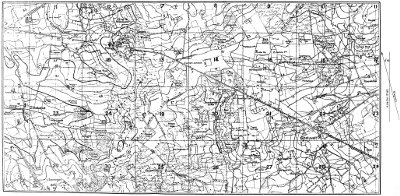
115It will be remembered that throughout July and August, 1917,
a succession of big attacks was carried out by the British troops in
the Ypres Sector, with the object of driving the enemy back from the
semi-circle of low-lying hills which overlooked our trenches in the
Salient. The proposed coastal operations of the foregoing chapter
had, indeed, been planned in connection with the Ypres offensive,
and with the breaking off of the former the batteries were sent down to
take part in further undertakings against the Passchendaele-Gheluvelt
ridge. The ill-omened autumn offensive against the Passchendaele
ridge was, in fact, about to begin, and the first battle of the series was
fixed for September 20th. For this, the limits of the zone covered
by the Divisional Artillery were Clapham Junction on the north and
Dumbarton Lakes on the south, the 162nd taking the left portion of the
zone, that is from the northern limit for 700 yards southwards to
Polderhoek Château, the 156th the right portion of the zone from
Dumbarton Lakes 700 yards northwards; the middle gap was
covered by the centre group of which the 33rd Divisional Artillery
formed no part. It had been extraordinarily hard to find any
marked feature upon which to range the guns, but Gheluvelt Mill,
situated as it was upon a small mound, offered a tolerably clear
feature for registration purposes, and this was utilised by the majority
of the battery commanders prior to the barrages which now began.
The whole barrage table for the forthcoming attack had, by
the 15th, been issued to the batteries, and the practice barrages
which now began to be carried out consisted sometimes of portions
of this table, sometimes of the complete barrage fired in its entirety.
As a rule these "rehearsals" were fired at half the rate which would
be used on the day of the attack, but the same proportions of shrapnel,
H.E. and smoke shell were adhered to, and therefore if only a part
even of the barrage were fired—such as the portion behind which
the infantry would advance from the first to the second objective—the
curtain of fire as it appeared on the ground would offer an exact
model of the real attack barrage, except for a certain diminution of
density. This fact was important, for it was realised that the bad
state of the ground to be attacked over would force the infantry to
advance very slowly, and that therefore a great deal depended upon
the barrage to keep enemy machine-gun fire down until our infantry
could get to grips with their assailants. Every day one and sometimes
two practice barrages were fired, and on each occasion one
officer of considerable experience was sent up from every artillery
116group to observe the effect thereof. In particular, reports were
rendered dealing with the density of the barrage, whether all batteries
opened fire simultaneously, whether there were any gaps or rounds
falling short, whether the average height of the shrapnel bursts was
correct and whether the barrage crept forward uniformly. After
every barrage these reports were examined and collected, and before the
next practice was carried out the necessary alterations had been made.
The first practice barrage began at 4.0 P.M. on September 15th
and was carried out along the whole Corps front; followed certain
minor adjustments, and at 5.30 A.M. on the 16th it was fired again.
At 10.0 A.M. on the same day an "Army barrage," i.e., a barrage on the
whole of the Army front, was fired, to be followed on the afternoon
of the 17th by another Corps barrage. On September 18th the last
two Army barrages were fired, one at 6.0 A.M. and one at 8.30 P.M.,
and at 11.0 A.M. on the 19th the Corps had its last rehearsal. It was
a relief when these practices were over; they invariably called down
heavy retaliation from the enemy who, as soon as he saw an infantry
attack was not pending, turned the full blast of his guns on to our
batteries. It was impossible to cease firing and put the detachments
under cover, for this action would have resulted in gaps appearing in
the barrage and confusing the observers who, unaware of what was
happening, would have reported that the barrage was uneven and
full of "holes." The programme had to be carried out from start to
finish whatever the enemy did, and if the batteries lost heavily
in these days it was all that was to be expected of the Salient. Lose
heavily they did, both in officers and men, and as the latter stood around
their guns in the small hours of the 20th, ready to begin this time the
real barrage covering the assault, there was not one detachment which
had not already been seriously depleted in numbers, which had not
been compelled to call up considerable reinforcements from the
wagon-lines.
It was on September 18th that the orders had been received
which fixed the 20th as the day of attack, and on the last two nights,
the 18th/19th and 19th/20th, the howitzers of both brigades busied
themselves with prolonged gas bombardments of the enemy batteries.
The only hope of salvation for the guns lay in silencing some of those
batteries, and they knew that their chances of surviving the long all-day
barrage which they were to carry out on the day of the attack
rested almost entirely on the efforts of the two preceding nights, and
on the work of the heavy artillery which, by intense counter-battery
work on the 20th, would try to keep down the enemy fire.
Twenty minutes to six in the morning of Thursday, the 20th, had
been fixed for the delivery of the assault, and some thirty minutes
117before this the detachments of all batteries manned their guns and
stood by, ready for the signal to go. Very feverish were those last
few minutes of waiting, for nearly every battery was being heavily
shelled, and it was probable that, as soon as the attack was launched,
the enemy guns which were causing all the trouble would come under
the counter-fire of our own "heavies," and would at any rate diminish
the now alarmingly heavy fire which they were directing upon the
wretched detachments.
With terrible slowness and deliberation the minutes passed;
5·9 in. and 4·2 in. shell were crashing every moment into the battery
positions, ammunition was exploding, men were being knocked out
and a number of direct hits were destroying the guns, killing and
wounding every single man of the detachments. In some of the
batteries a few more minutes of this would have put every gun out of
action, but mercifully zero hour was at last reached, a sheet of flame
lit up the entire countryside and with a great roar the barrage began.
The batteries of the 33rd Division poured forth a curtain of fire in
front of the advancing infantry, the heavy artillery bombarded the
enemy batteries and roads, and, whatever happened all round them,
whatever bombardment they suffered, the detachments were now
fully occupied and took heed of nothing but their work. The assault
had begun!
The infantry who were even now advancing under cover of the
guns of, amongst others, the 156th and 162nd Brigades were, as
already stated, troops of the 23rd Division. On the right the attack
was continued by the 41st Division, on the left by the 2nd Australian
Division, and together the long line advanced slowly through the mud
towards the enemy trenches. The ground was very bad; it was
estimated that the infantry advancing across No Man's Land could
not cover one hundred yards in less than six minutes, and accordingly
the barrage was so timed as to move forward twenty-five yards every
minute and a half. Even at this slow pace the infantry were hard
put to keep up with it, while the work of the gunners was rendered
exceedingly heavy; for the ultimate objectives were fairly deep
within the enemy lines, and with the barrage moving so slowly the
infantry were not due to reach their farthest goal till a late hour,
while an intense rate of fire had to be maintained over their heads the
whole time. Moreover, there was not one battery which by now had
not had some of its guns knocked out, and the speed of the remainder
had, of necessity, to be increased in order to keep up the full volume
of fire.
From 5.40 A.M. onwards the batteries roared forth at intense
rate; slowly the barrage crept on ahead of the infantry till it reached
118and covered the first objective; halted there for fifty minutes while
the assaulting troops reorganised themselves, and at 7.8 A.M. moved
off to the second objective, now at the slower rate of one hundred yards
in eight minutes. At 7.40 A.M. the second objective was reached and
covered, and for two hours and thirteen minutes a protective barrage
was maintained what time both infantry brigades in the forward
line brought up their reserve battalions for the attack on the 3rd and
last objective. At 9.53 A.M. the last phase of the attack began and,
moving forward now at only ten yards per minute, the barrage
started to creep towards the third objective, reached it at twenty-five
minutes past ten and, passing over it, put up a protective curtain of
fire beyond while the infantry established themselves in the newly
won trenches. This protective barrage, covering as it did the
ultimate objective of the day's fighting, had to be maintained until
well on in the afternoon; since it was fired at a slower rate, however,
it now became possible to relieve some of the detachments at the
guns and to set about clearing up the battery positions.
As already described, nearly all the batteries were heavily shelled
just before the launching of the attack early in the morning. Shortly
after the earlier phases of the barrage this hostile bombardment
had eased off under the counter-battery work of our own heavy
artillery, but throughout the morning—and, in fact, during the whole
of that day and night—every one of the battery positions was searched
and swept at intervals by 5·9 in. and 4·2 in. howitzers, the resulting
damage to personnel and equipment being very great. With gun
muzzles pointed now to a high elevation, small detachments maintained
a protective barrage at a slow rate of fire while the remainder
of the men—after eating a hasty meal—began to repair and
reorganise the positions.
Yawning holes gaped everywhere; guns had been knocked out
and had to be dragged from the pits on to the road; ammunition,
buried or scattered by hostile fire, was dug up; the dead were removed
and placed away near the road, whither presently a wagon would
come for them, while the gun pits themselves required to be rebuilt
so as to be fit for the new guns which the wagon-lines had already been
ordered to bring up. It was gloomy work, this, and was rendered all
the more depressing by the certain knowledge that presently the
enemy would open fire and would wreak the same havoc all over again,
but the outstanding necessity presented itself of keeping every gun
and every battery fully ready at a moment's notice to support the
infantry and prepared to open fire on any target within range.
All this time news at the batteries had been scarce. A Captain
from the right and left artillery groups had been attached to the two
119infantry brigades (68th and 69th) covered by the guns, and, in
addition, subalterns from the same artillery groups had accompanied
the two assaulting battalions in the attack on the third objective.
Their duty, however, was to report straight to Group headquarters,
and therefore it was left to the batteries only to surmise from the
continuity of the progress of the barrage that the attack must have,
at any rate at first, succeeded. The primary objective—the "Red
Line"—ran from Fitzclarence Farm through Herenthage Château to
the eastern edge of Dumbarton Wood, while the second objective—the
"Blue Line"—extended from a point midway between Black
Watch Corner and Cameron House down east of Veldhoek to the
eastern edge of Bass Wood, and, as the weight of artillery forming
the barrage on the divisional front alone consisted of 84 18-pdrs.,
30 4·5 in. howitzers and 42 heavier guns and howitzers, not counting
the batteries detailed for special work, it was hoped that these two
objectives at least might be overrun with comparative ease. It was
in the advance to the "Green Line," the final objective of the day's
battle, which ran from Carlisle Farm due south for eleven hundred
yards, bending back slightly to the west of Gheluvelt Wood but
embracing Tower Hamlets, that trouble might be forthcoming, for
by then the enemy should have recovered from his first surprise and
might offer very considerable resistance.
At last news was received. A short message stated that all
objectives had been taken but that very heavy fighting had occurred
in the advance upon the last objective, and only the excellence of the
creeping barrage had made success possible. The official report
written later by the 23rd Division stated: "The barrages were very
punctual and effective. Prisoners seemed dazed and utterly
demoralised. The creeping barrage from the second to the third
objective and the protective barrage beyond the latter are deserving
of special mention. Replies to S.O.S. were both prompt and effective,
rapidly dispersing any attempts at concentration or counter-attack.
This instilled great confidence into our infantry." These last remarks
were not received till a later date; at the time there came only the
bare news that all objectives had been taken and that a large part
of the success gained was owed to the excellence of the barrage. It
was good to learn that the day was won, that success had been
achieved, and it offered some slight comfort to know that the service
of the guns, which had involved such heavy losses amongst the
detachments, had been of avail. Only on the right had non-success
been met with, and there the left brigade of the 41st Division had been
unable to advance beyond the second objective. The troops covered
by the 33rd Divisional Artillery, however, threw out a protective
120flank; the S.O.S. barrage was so arranged as especially to protect the
right of the 23rd Division which was in the air except for the thin
defensive flank already referred to, and gunners and infantry set
themselves to watch for the inevitable counter-attacks.
All through the afternoon the batteries had been busy breaking
up concentrations of the enemy, and hitherto had been successful
in keeping them at bay. The valley of the Reutelbeek and the
area around Reutel Village offered some cover, and continued calls
from the infantry kept the guns at work on these areas. A determined
counter-attack launched shortly after 7.0 P.M. was beaten off under
our artillery fire; all night intermittent bursts from every battery
swept the enemy hollows and approaches, and at 4.30 A.M. on the 21st
a special barrage was fired with the object of breaking up any enemy
operation which might have been planned for daybreak. By these
means, and by continuing these methods throughout the day of the
21st, the infantry were able to maintain all their gains, and by the
evening of the 21st were assured of their position. Two furious
counter-attacks by the enemy, delivered after an artillery bombardment
lasting one and a half hours in each case, were broken up at
3.0 P.M. and at 7.0 P.M. by our artillery fire, and gunners and infantry
alike now set themselves to try and repair the wreckage of their
positions before offensive operations should break out anew.
The heavy firing which preceded the attack, the all-day barrage
which had been maintained on the 20th and the wastage of ammunition
incurred through enemy shells blowing up the dumps around
the guns necessitated very heavy work all through the 21st and 22nd
in bringing up ammunition from the wagon-lines. The lines of the
162nd Brigade were a great deal too far back for carrying out so much
gun-line work, and, as early as the 15th, forward wagon-lines composed
of one section per battery had at first been maintained on the eastern
outskirts of Dickebusch; later, after being heavily shelled on the
night following the attack, they had been moved across the road
to the neighbourhood of Dickebusch church. From here, and
from the 156th Brigade lines a little farther back, parties of pack
horses came up on the 21st to carry ammunition from the nearest
dumps to the battery positions, for it was impossible in the majority
of cases to bring ammunition wagons and teams anywhere near the
guns. Light railway tracks had been run as far forward as possible,
and, from the termini at Valley Cottages, Verbrandenmolen and other
points which the little petrol-driven trucks were able to reach about
once in four days, the pack animals carried the ammunition to the
batteries. During the whole of the two days following the attack this
transport of ammunition was carried out, although continually
121interrupted by hostile shell storms which inflicted many casualties
amongst men and horses, and by the 23rd not only were dumps at the
guns completely up to strength again, but further new guns had
come up from the Corps gun "pool" on the Reninghelst-Steenvoorde
Road, and had in the majority of cases replaced all the guns knocked
out during the previous week's fighting.
It was well that the guns had succeeded in replenishing their
ammunition on the 21st and 22nd, for on the 23rd began preparations
for a fresh attack. Throughout the two preceding days the enemy
had pounded and smashed every battery position in the attempt
to prevent as far as possible any further operations, but as fast as the
guns were damaged repairs were executed, and at seven o'clock in
the morning of the 23rd every battery was able to take part in the
Corps practice barrage which had been fixed for that hour. Like
its predecessors it was fired at a reduced rate to that at which the real
attack barrage was to be fired, and like its predecessors it called down
severe hostile retaliation. C/162 (Major Hill) was so heavily shelled
that it was compelled to move out to a fresh position three hundred
yards to the left flank, and every battery received the usual searching
which now had come to be regarded as inevitable, while the rest of the
day saw shell storms of increasing violence delivered upon every area
where any of our batteries were to be found.
On the night of September 24th/25th the infantry of the 33rd
Division relieved the 23rd Division, and General Stewart, moving
up to Burgomaster Farm in Dickebusch, assumed command of the
artillery covering the front. The whole of the 25th marked a day of
intense activity amongst the guns. At 5.40 A.M., while the infantry
relief was still in progress, a strong counter-attack was launched by
the enemy, preceded by a heavy barrage. For one and a half hours
our batteries maintained a rapid rate of fire on their S.O.S. lines,
but were unable to prevent the right of the 100th Infantry Brigade
astride the Menin Road and the whole of the 98th Brigade from being
driven back to the support line. At 11.35 A.M. the S.O.S. signal was
again sent up by the 100th Brigade, and again the guns burst forth in
their support—this time with success.
At 2.15 P.M. a Corps practice barrage was fired, and at 3.30 P.M.,
before the practice was over, devastating bombardment by guns of all
calibres was opened upon our battery positions. For upwards of half
an hour this bombardment continued, inflicting considerable damage
upon the battery positions, and then for a short time the weary
detachments had a rest. Not for long, however! At 5.30 P.M. the
storm broke out afresh, this time upon gunners and infantry alike,
and once again, now under heavy shell fire, the batteries responded
122to the S.O.S. signal sent up an hour later by the left brigade and by
the Australians further to the left. This counter-attack was also
repulsed, and by midnight it was found that the right brigade held
their line intact except for a small portion of trench north of Menin
Road, but that the left brigade north of the Reutelbeek had been
beaten back three hundred yards, though possibly some posts were
still held 150 yards in front.
Such a day as the 25th was not very favourable for preceding
an attack, yet when Wednesday, the 26th, dawned it found the
infantry of the 33rd Division assembling for the assault which had
been fixed for 5.50 A.M. It will be remembered that just prior to the
attack on the 20th the field batteries were all subjected to an intense
bombardment, while the infantry were allowed to assemble in the
front line almost untouched. Now the positions were reversed; at
5.0 A.M. the enemy put down an intense barrage on the infantry,
just as the latter were forming up for the attack, and inflicted very
heavy casualties upon them. For fifty minutes the hostile bombardment
tore them and shook them, and it was in greatly diminished
numbers that the infantry advanced across No Man's Land when,
at 5.50 A.M., the guns blazed out in the assault barrage.
For this attack one hundred and two 18-pdrs., thirty-six
4·5 in. howitzers and a large number of heavy guns were covering
the divisional front, which stretched from the southern edge of
the Polygon de Zonnebeke on the north to a point three hundred
yards short of Gheluvelt on the south. Dumps of eight hundred
and thirty rounds per 18-pdr. gun and seven hundred and fifty
rounds per 4·5 in. howitzer were maintained at the guns for, as
previously, the barrage was to move at the very slow rate of one
hundred yards in six minutes to the first objective, and one hundred
yards in eight minutes to the final line to be taken. Moreover,
a protective barrage was to be maintained beyond the final objective
for half an hour after its capture (8.40 A.M.), and from then until
2.15 P.M. was to continue at a reduced rate searching all the ground
beyond the infantry to a depth of one thousand yards. From this
it will be seen that allowance had to be made for a very heavy expenditure
of ammunition.
At 5.50 A.M. the infantry went over the top, and at 7.45 A.M.
came the first news. A captain from the right and left artillery
groups (between which two groups the 33rd Divisional Artillery
was split up) had been attached to the headquarters of the two
infantry brigades delivering the attack, while a subaltern from
each group accompanied the battalions assaulting the final objective,
and from them came the information. The 39th Division on the
123right and the 5th Australian Division on the left had captured the
Red Line—the first objective—but the 33rd Division had been held
up. The first objective on the front of the latter ran from Joist
Farm past Jut Farm and through Polderhoek to the northern edge
of Gheluvelt Wood, and had proved too strong for the troops who,
during the previous twenty-four hours, had been fighting hand
to hand in numberless counter-attacks and had endured the most
intense bombardments. At 8.40 A.M. the trench which had been
lost in the previous day's fighting just north of the Menin Road
was recaptured, and at 11.55 A.M., after calling back the barrage,
a fresh attack under the creeping fire of the batteries was launched
upon the first objective. For twenty minutes the guns carried out
this new programme, but at 12.15 P.M. a message was received
asking the batteries to keep up a protective barrage beyond the
Red Line until further notice, as a heavy barrage was being maintained
by the enemy upon our assaulting troops. This protective
barrage was continued for upwards of an hour, which fact indicated
that no further progress had been made by the infantry, and throughout
the afternoon intermittent fire was directed upon the enemy
beyond the first objective until such time as orders should be received
for a fresh attack.
In the middle of the afternoon a severe enemy shell storm
descended upon all the batteries and inflicted serious casualties.
At the same time a heavy bombardment of our infantry was reported,
and at 5.0 P.M. our guns, themselves heavily shelled by the enemy,
opened fire on their S.O.S. lines until 6.30 P.M. when they slowed down.
At 6.40 P.M. the S.O.S. signal was again sent up, and again for one
and a quarter hours the batteries put down a barrage. Scarcely
had they stopped than the enemy launched yet another counter-attack,
and not till nine o'clock at night did the gun detachments
cease the barrage firing which they had begun shortly before 6.0 A.M.
that morning. With the arrival of night matters became quieter
and no further operations were attempted. From information
received it was gathered that the infantry of the 33rd Division
held the original line from which they had been driven on the preceding
day, and had established advanced posts in the first objective
although not occupying it in force. The casualties were reported
to have been terribly heavy.
On the morning of the 27th a resumption of the advance was
carried out. Ammunition was running low but, with pack horses
hard at work bringing up fresh supplies, the batteries kept a covering
fire over the infantry, and by 9.45 A.M. the latter had established
themselves in force in the first objective of the previous day's fighting
124and had pushed out posts beyond. At midday the left brigade
were very heavily shelled and asked for covering fire from the batteries,
and half an hour later the 5th Australian Division on the left reported
that they could see the enemy massing in Polderhoek Château Wood.
On hearing this the guns of the 156th and 162nd Brigades were
immediately turned on to this area, searching and sweeping it for
upwards of three-quarters of an hour, and the threatened counter-attack
was broken up. At 2.15 P.M., however, it developed again,
and for an hour the guns of the 162nd Brigade maintained a medium
rate of fire on their S.O.S. lines, at the end of which time all was
reported quiet.
So the day wore on; the guns in continual action, the detachments,
depleted by hostile shell fire and weary almost to death,
seizing what opportunities they could of getting a few moments'
rest. At a quarter to seven in the evening the never-ending S.O.S.
call was sent out again, and for another hour the batteries fired on
the lines indicated, breaking up the attempted counter-attack
and assisting our troops to advance slightly upon the Blue Line—the
final objective of the previous day's battle—towards which they
had been working gradually the whole day long. When this barrage
was finished night firing began and was continued throughout the
night, two calls for support from the infantry being responded to at
1.15 A.M. and 5.10 A.M. respectively, and at twenty minutes past
five on the morning of the 28th such gunners as still survived pulled
themselves together to fire a Corps practice barrage.
This practice barrage had a threefold object. In addition to
further shattering the enemy's defences and upsetting his morale,
it was so timed as to coincide with any enemy counter-attack which
might have been fixed for dawn, and which would therefore be
dispersed by the fire of our guns before it could come to a head.
Moreover, it also helped our front line troops under cover of its fire
further to improve their position, and so well did it succeed in this
respect that, at 8.0 A.M., the infantry reported that they had consolidated
their front only one hundred yards short of the Blue Line.
This operation, apart from an Army barrage at 5.15 A.M. on the 29th
which coincided with and broke up a pending enemy counter-attack,
proved the last combined operation between infantry and gunners
to take place in the month of September; with the two brigades
now engaged in the usual harassing fire which was the order of the
day on this front, we must turn our attention to the life of the batteries
and, leaving their tactical operations alone for a few moments, see
how they had fared during the previous four days' battle.
The losses amongst the detachments had been cruel. In all
125the fighting a very heavy portion of the enemy's fire had been directed
in counter-battery work upon the gun positions, and the batteries,
being almost continually engaged with S.O.S. calls and unable to take
any form of cover, had been shot down time and again. Moreover,
the work had been desperate; with weakened detachments an
incessant fire had had to be kept up almost without a break, and such
intervals as offered themselves were necessarily utilised in rebuilding
damaged gun platforms and in restocking with ammunition. The
men were in an advanced stage of fatigue, and as yet no signs were
forthcoming of any possibility of a rest. On September 27th B/162
(Major Cory) was relieved by B/102 and marched down to St.
Hubertshoek, near Hallebast Corner, whither the 162nd Brigade
wagon-lines had moved on September 25th, and here this one battery
remained in rest until October 7th, but for the remainder there was
no relief. With men from the D.A.C. and from the Trench Mortar
batteries the guns were kept in action, but this course involved the
use of many unskilled numbers, and few detachments had more
than one man who could safely be trusted to lay the piece in a barrage.
On September 28th two moves took place which brought home
to the batteries the fact that, for the present at any rate, they were
not to be relieved. On that day General Stewart and his Staff,
on the relief of the 33rd Division infantry by the 23rd Division,
handed over control of the artillery to the incoming C.R.A. and
moved out to rest at Boeschepe, where the headquarter staff remained
until the batteries themselves at a later date were ultimately relieved.
Simultaneously, Lieut.-Colonel E. J. Skinner, commanding the 162nd
Brigade, came up and took over the control of the Left Group from
Lieut.-Colonel Groves (103rd Brigade) and set up his headquarters first
at Dormy House but later, on October 1st, at Bedford House, one
thousand yards south of Shrapnel Corner. The zone covered by the
two brigades was very slightly altered and now ran from Gheluvelt on
the Ypres-Menin road to a point about 1,700 yards northwards,
but the battery positions remained the same, and October came in
to find them preparing for offensive operations again.
On October 1st an Army practice barrage had been fixed to
begin at 5.15 A.M., and, just as the gunners were assembling to fire
the opening rounds, a furious shell-storm was opened by the enemy
upon our own front line and the whole area up to one thousand yards
in rear of it. It was manifest, from hostile aeroplane activity and
the weight of artillery fire which was being brought to bear, that a
big counter-attack was impending, and the Army barrage accordingly
came down at a very opportune moment. At 5.50 A.M., while it was
at its height, the enemy were seen advancing in a series of waves
126upon our front line, and with that action there began a day of the
most intense fighting. All communications with the front line
were cut, not even pigeons succeeded in finding a way through the
dense hostile barrage, and until the evening every battery was kept
in almost continuous action answering the numerous S.O.S. rockets
which appeared, and replying to the enemy bombardment which,
even without the evidence of rockets, called by its weight for active
reply. Not until midnight did the situation ease, and then it was
found that the infantry had maintained their whole front except
for the left which had been bent back very slightly. To the extraordinary
heroism of the infantry the G.O.C. 23rd Division ascribed
the defeat of the hostile attack—and with this the gunners very
heartily agreed—but he added in his report that the field batteries
had maintained such splendid protective fire that the enemy had,
on frequent occasions, been broken up before they could get to grips
with the garrison of our front line.
Although the Army barrage on October 1st had coincided with
and had helped to defeat an enemy counter-attack, its primary
object was to prepare for a renewed offensive on our part, and this
offensive now took definite shape. After firing another practice
barrage on October 2nd and maintaining throughout the 2nd and 3rd
a destructive fire upon the enemy system—the while long strings of
pack horses refilled the ever-diminishing dumps of ammunition
around the guns—the batteries in the early morning of October 4th
set range-drum and dial sight to the opening elevation of yet another
barrage, this time no practice but as a definite and vital protection
to infantry moving forward to the assault. Despite the rain and the
ever deepening mud the offensive was ordered to be continued.
At 6.0 A.M. on Thursday, October 4th, on the zone covered by the
33rd Divisional Artillery the infantry of the 5th Division advanced
to the attack, supported by one hundred and eight 18-pdrs., thirty-six
4·5 in. howitzers, sixteen 6 in. howitzers and an assortment of heavier
howitzers and 60-pdrs. Their right lay upon the northern edge of
Gheluvelt Wood and their left upon Juniper Cottages, and, with the
barrage moving ahead of them at the rate of one hundred yards in
six minutes, they essayed the capture of the high ground south-west
of Reutel together with the eastern slopes of the Polderhoek spur.
The actual line of their one and final objective ran from a point
500 yards south of Reutel, past the south-west corner of Juniper
Wood and east of Polderhoek Château to the northern edge of Gheluvelt
Wood, the holding of which line would cover the communications
of the 21st Division across Polygon Beek on the left in their attempt
to capture Reutel; the objective of the 5th Division, in fact, was
127the southward continuation of the first objective of the 21st Division,
and formed the right flank of an attack which, further north, was
intended to penetrate deeply into the enemy lines. On the right
of the troops covered by the 33rd Divisional Artillery the infantry
of the 37th Division were to advance their left slightly to conform
with the line of attack.
Throughout the night of the 3rd/4th the enemy had carried
out an intense bombardment of our front line system and had,
from time to time, swept the battery positions with shell-storms
from 5·9 in. and 4·2 in. howitzers. To this hostile bombardment the
batteries had, at the request of the infantry, energetically replied
at intervals during the night, but the opening rounds of the barrage
at six o'clock in the morning smashed their way into the beginnings
of an enemy counter-attack which was concentrating on the front
of our own attack. Fortunately the barrage dropped before the
enemy concentration was complete, and the fire of our guns at zero
broke up the enemy attempt before it could come to a head. Notwithstanding
this, however, very considerable opposition was met
with, and only on those parts of the front where the infantry managed
to keep right close under the barrage fire of the batteries was complete
success achieved.
The barrage, as already stated, had been arranged to move
forward at the rate of sixteen yards per minute until it should reach
a line two hundred yards beyond the objective. Here it was to halt,
fire a round of smoke shell from every alternate gun as a warning that
the protective line had been reached, and be maintained at a slow
rate to cover the infantry while they were digging in. In addition,
moreover, to this standing barrage, it was arranged that every now
and then the batteries should search by short lifts for one thousand
yards beyond the line of the protective barrage; while at 8.10 A.M.,
by which time the objective of the 5th Division should have been
fully secured, the barrage was to move on towards Gheluvelt in
conformation with the fire covering the 21st Division further north
in their advance on the second objective, thereby suggesting a
resumption of the advance on the 5th Division front. In point of fact,
however, no further advance beyond the first objective on the front
covered by the 33rd Divisional Artillery was intended; the batteries,
when they reached the extreme limit of their range, were to drop back
to the protective barrage line again, their work of drawing attention
away from the 21st Divisional front being finished.
As events turned out, the operations of the 5th Division were not
entirely successful. The 13th Infantry Brigade, under the guns of Lieut.-Colonel
Butler's Group (the right group), reached the final objective
128with the right battalion in the afternoon, after being held up for a
time by a strong point north of Lewis House. The left battalion
of the same brigade, however, encountered strong opposition at
Polderhoek Château and was unable to keep up with the barrage.
Survivors of the assaulting troops actually reached Polderhoek
Château and even penetrated beyond it, but after severe hand to
hand fighting a line was taken up two hundred yards west of the
Château. The left infantry brigade (95th), covered by the guns
of Lieut.-Colonel Skinner's Group, was also unable in places to keep up
with the barrage. The right battalion found that the ground between
the Reutelbeek and the company on the southern edge of Cameron
Covert was so sodden as to be absolutely impassable; a detour
to the right and left was accordingly made, and a line consolidated
in the 13th Brigade area and between Cameron Covert and the
stream. The left battalion of this brigade at the same time did
actually reach its final objective, but so heavy was the hostile fire
coming from the high ground around Poezelhoek that the position
became untenable, and a line was taken up in the area of the 21st
Division on the left, running from Reutel westward and facing south,
while the 21st Division formed a defensive flank by continuing
this line to Cameron Covert.
By three o'clock in the afternoon the right brigade disentangled
the muddle and formed a general line running from the northern
edge of Gheluvelt Wood north-north-east to the Scherriabeek and
then on to a point fifty yards short of Polderhoek Château; here
there was a gap of some 150 yards, and the line then continued
due north for another hundred yards, to be carried on northwards
through Polderhoek Wood to Cameron Covert by the left brigade.
It was well that even this rough line was organised, for throughout
the afternoon infantry and gunners alike were hotly engaged by the
enemy in numerous counter-attacks. In all, five attacks were launched
by the enemy on the right brigade front during the afternoon, and
three more in the evening, and in each case every gun which could
be brought to bear was switched round to help the exhausted infantry.
After the most severe fighting, and after continuous firing by the
batteries throughout the remainder of the day, the infantry were
able to report that all gains were held; rifle and artillery fire had
smashed every enemy attempt to advance, and our new line was
securely held. During the night of October 4th/5th the left battalion
of the left brigade, under cover of the guns, withdrew from the 21st
Divisional area and took up a line through the middle of Cameron
Covert, and so on the morning of the 5th the line stood solid. On
this part of the front the objective had not been captured except
129upon the extreme right, and the casualties had been tremendous.
Further to the left, however, success had been met with, and Reutel
Village, Abraham Heights and Gravenstafel were now in our hands.
It may be complained that this chapter has dealt too fully
with the infantry operations, and has not sufficiently recorded the
daily life of the batteries and their experiences during the attacks.
The answer to this complaint is, briefly, that the batteries had
no daily life but rather a daily death, while their experiences—day in,
day out—were invariably the same. Morning, noon and night the
men were splashing about in mud, trying to keep their ammunition
clean and their guns serviceable; daily they were shelled, sometimes
with long deliberate bombardments, sometimes in hurricane shell-storms
which descended upon them for forty minutes or so two or
three times a day. They were always wet, always cold; they
continually saw the guns and ammunition, which they had spent
hours in cleaning and preparing, blown to bits in the passing of a
second; they helped to bring up more guns, more ammunition, and
saw, in the serving of these new guns, their mates blown to pieces,
shattered, torn. They grew to believe that relief would never come,
that for all time they must exist in the grim shadows of Maple Copse,
of Fosse Wood and of Armagh Wood. They felt, as they saw the
shells crashing down all around them, that they were forgotten by
God and man. There is no daily history of the batteries to record
save the success or failure of the operations in which they took part,
and for the supporting of which they paid this heavy price. There
lies the true history of the batteries, and that it is which in these
pages must be recorded.
From October 5th there ensued a pause during which the
batteries strained every nerve to get up more ammunition from the
dumps, to clear up their shell-wrecked positions and to sort out the
gun line personnel into some sort of workable detachments. B/162
came up into action again from the wagon-lines on the 7th and took
over its old position from B/242, and for a few days such registration
and reconstruction of positions was carried out as was possible, having
regard for the heavy enemy fire which continually swept the entire
area in which the batteries were located. Only for a short time was
there a lull, however, for a fresh attack had been ordered to be
carried out on October 9th.
On Tuesday, the 9th, the 5th Division attempted to complete the
capture of the Polderhoek ridge and, by extending its left to Polygon
Beek, to form connection with the 17th Division. For this purpose
the weight of artillery, the pace of the creeping barrage and the
formation of the standing barrage were to be identical with those of
130the 4th, but the objective in this case was to include the whole of
Polderhoek Château and Wood together with Cameron Covert, and
was to bend back to the then front line at Joist Farm on the north.
The 15th Infantry Brigade was responsible for the attack on the right,
while on the left the 95th Infantry Brigade was ordered to pivot on a
stationary left flank and, clearing all the ground east of Cameron
Covert to as far south as the Reutelbeek and as far eastwards as the
line of the objective, was to form the connection between the left of
the 15th Brigade and the right of the 17th Division.
Zero hour was shortly after 6.0 A.M., and three minutes after
the beginning of the barrage the infantry advanced to the assault.
The ground, already a sea of mud, was churned up yet more by the
intensity of the barrage, and the troops forming the extreme right of
the 5th Division, by their efforts to avoid portions of ground which
were utterly impassable, lost direction and moved towards the south-east.
The mistake was presently discovered, but too late to catch up
the barrage, and a line was taken up a little in advance of the previous
front line immediately north of the Scherriabeek. Simultaneously the
left and centre companies of the right battalion advanced on their
proper course, but came under intense fire from Gheluvelt and
Polderhoek Château, and only one platoon—themselves all wounded—reached
the Château; ultimately, owing to heavy casualties, they
withdrew to their original front line. Loss of direction was responsible
also for the failure of the left battalion of this brigade to reach its
objective. Moving too much towards the right it came under heavy
fire from some houses north of the Château and, suffering many
casualties, was held up. By ten o'clock in the morning, despite the
fiercest efforts by the batteries to beat down the opposition, the whole
brigade was back in its old line. The left brigade, having no forward
movement on the right to which to conform, did not advance at all.
The state of the ground was now becoming appalling, and, with
two successive attacks rendered failures by the mud, a lull set in on
this part of the front—a lull during which each of the batteries in
turn managed to seize a few days' rest at the wagon-lines. The
news that these short rests were to be granted was received with
mixed feelings; clearly, if it was thought necessary to send each
battery in turn for a short spell at the wagon-lines, the brigades were
not destined to move right out of the line yet awhile, but on the
other hand this new plan did assure a short interruption of the nerve-racking
conditions of the gun line, and for this reason at any rate it
was welcome. On October 13th Lieut.-Colonel Butler and Lieut.-Colonel
Skinner handed over the control of their groups to the commanding
officers of the 27th and 103rd Brigades respectively and,
131accompanied by the personnel of one battery from each brigade
(A/156 and D/162), moved out to the wagon-lines. On the 17th
these two batteries moved back into action again after a four-day
rest, and on the 18th three more batteries moved out. Each battery
in turn had four days at the wagon-lines of comparative rest and
quiet, and then moved up into action again, and by the 24th all the
batteries except C/162 were back in the line once more, slightly
refreshed, slightly reorganised, but still suffering greatly from an
almost complete lack of trained men. C/162 (Major Hill) had been
left at the wagon-lines owing to the fact that the severe casualties
sustained by the battery just prior to moving out had rendered it
unfit to go back into action again.
On October 24th 162nd Brigade Headquarters moved back into
the line also, and took over command of "C" Group at Bedford
House under the 7th Divisional Artillery. This group consisted of
"A" and D/162, "B" and C/156, and also of the 46th, 47th and
112th Australian batteries. The front covered by the group and
held by the infantry of the 7th Division was, at the same time,
changed from north of Gheluvelt to just south of it, as the batteries
could reach this new zone at a slightly shorter range; with the new
front allotted and registered, orders were received for this group and
also for the 156th Brigade to cover an attack by the 7th Division to be
launched on the 21st. It seemed madness for any such attack to be
contemplated, for the weather had been wet and stormy since October
9th and the ground was even more impassable, even more treacherous
than it had been earlier in the month. The only hope of salvation
for the infantry lay in the putting down by the batteries of such a
curtain of fire as would completely cover the assaulting troops while
they waded through the mud, and this the batteries now prepared
to do. D/162 (Major Lee), its position at Maple Copse being almost
completely untenable owing to the searching fire which the enemy
continually directed upon it, moved eight hundred yards northwards
on the 24th to a position just west of Zouave Wood. D/156 (Major
Barstow) moved forward to the middle of what had been Sanctuary
Wood, dropping the trails just off the road under the shelter of the
slopes in the western half of the wood, and at dawn on Friday, the
26th, all batteries manned their guns to support this, as it seemed to
them, desperate venture.
The actual front of the attack by the 7th Division, which the
guns of the 33rd Divisional Artillery were to cover, included
Gheluvelt and the ground for six hundred yards north and south of it,
and the assault was supported by one hundred and forty-four
18-pdrs., forty-eight 4·5 in. howitzers, thirty-two six-inch and twenty
132heavier howitzers. Two objectives were fixed, the first including the
whole of Gheluvelt except the extreme eastern outskirts and running
down south-west to Berry Cottages, while the final objective reached
from the lake north-west of Gheluvelt down to Reigate farm, running
one hundred yards east of Gheluvelt Village, the object of the
operation being to capture Gheluvelt and some ground along the
Zandvoorde Spur, and so to secure the hold on Tower Hamlets. "C"
Group covered the 20th Infantry Brigade on the left, while "A" and
D/156 with B/162 were acting under the orders of Lieut.-Colonel
Marriott, commanding "B" Group, and covered the 91st Infantry
Brigade on the right.
At 5.40 A.M. the barrage began, the nearest fringe of it dropping
one hundred and fifty yards in front of the infantry as they formed
up for the attack. There it remained for six minutes, and then
started gradually to creep forward at the rate of twelve yards per
minute; after traversing two hundred yards at this pace the speed
of advance was slackened down to ten yards per minute for another
two hundred yards, and then, at a uniform pace of seven yards per
minute, it moved on to the protective line beyond the first objective.
Here it remained from 7.4 A.M. until 7.50 A.M. to give the infantry
time to reorganise and prepare for the next attack; at 7.50 A.M. it
moved forward again, after four minutes' intense fire to warn the
assaulting troops that the time to advance had come, and so forward
at the same slow rate to the protective line beyond the final objective;
this it reached at 8.46 A.M. and there remained as a protective barrage
to allow the infantry to consolidate the ground won.
Thus moved the barrage, but what of the infantry who should
have been close behind it? Already attention has been called to the
bog-like nature of the ground across which they were to attack, and,
even had it not, the extraordinarily slow rate of the barrage—twelve
yards per minute—should be sufficient evidence of the opinion formed
by the Higher Command of the sort of conditions with which the
infantry would have to contend. As events turned out it was this
very mud which denied success to our troops. Enemy artillery fire
on the forward system had been light up till zero, and not for seven
minutes after our barrage dropped did the enemy put down any sort
of reply with his guns. The cause of the infantry's undoing was
the machine-guns which played upon them and swept them while
they struggled helplessly in the mud—machine-guns safely ensconced
in concrete pill-boxes while our men were in the mud up to their
waists. By twenty minutes to eight the 91st Brigade was held up at
Lewis House and forced back to its original line; at half-past eight
elements of the 20th Brigade had reached Gheluvelt, but were stopped
133by the enemy pill-boxes and ultimately had to come back. Throughout
the morning the gunners maintained a protective barrage beyond
the infantry to try and assist them in their now almost hopeless
task, but at 2.35 P.M. the barrage was called off and the battle ceased.
All along the line of the 7th Division, and further to the right, the
assaulting troops had been beaten back to their original positions and
in some cases even west thereof. Machine-gun fire from Lewis House
and Berry Cottages had stopped the 91st Infantry Brigade, while
the men of the 20th Brigade had been beaten by the mud itself. They
had fought their way right through to Gheluvelt but, on reaching
it, had been unable to ward off counter-attacks as they were up
to their waists in mud and every rifle was clogged and smothered
with the same substance. A message sent that afternoon to headquarters
urged that the advanced battalions should instantly be
relieved "owing to heavy officer casualties, disorganisation and the
condition of the rifles," and that sentence in itself very aptly summed
up the conditions. Disorganisation there had been, and very considerable
at that, but such was the condition of the ground that
nothing else could have been expected. Thus the day ended in
failure on this particular portion of the front; under normal circumstances,
and with anything like firm ground over which to attack,
success might well have been achieved, but the weather conditions
stepped in and tilted the balance in favour of the enemy with overwhelming
effect.
This was the last infantry operation in which the 33rd
Divisional Artillery took part. On October 28th "A" and C/156
moved out to the wagon-lines; three days later they were followed
by D/156, which had been very heavily gas shelled on the night of
the 29th/30th. B/156 was relieved on November 2nd, and next
day the whole of the 162nd Brigade withdrew from the line and
marched back to Dickebusch, this time with the promise before them
of a real period of rest in the back areas.
The losses of the batteries in this autumn fighting had been
appalling. For fifty-one days they had been in continuous action
under the worst of conditions, covering attack after attack and
undergoing interminable shell fire from enemy guns of every calibre.
The smallest possible personnel was kept at each position, and seldom
did the total strength at the gun line of any one battery exceed thirty-six
officers and men. Yet the battle casualties of the 162nd Brigade
numbered three hundred and fifteen for this period, while those of the
156th Brigade were almost as great. A/156, a six-gun battery, had
twenty-six guns disabled during the time it was in the line, while
D/162, which had suffered the loss of one hundred and six
134casualties including six officers, had had nineteen guns put out of
action by the enemy. The batteries had, in fact, been practically
wiped out, and it was a mere remnant of their former selves which
reached the wagon-lines. They had marched up to the Salient a
fine fighting weapon, the outcome of many months' training and
experience, hardened and versed in all the methods of war. They
came away from that murderous spot smashed, depleted, worn out,
their work accomplished but at a tremendous cost. Ypres was no
longer to them a legendary spot, but a plain, ghastly reality, a grim
and deadly place where the batteries learnt, as they had never learnt
before, the full horror of war. In trench fighting it is the infantry
who look more closely into the depths of Hell than do any other
branches of the Service; but at Ypres the field guns share this deadly
privilege, and the price of it is high, higher than can be bought with
anything save human life itself. The 33rd Divisional Artillery had
shared that privilege, had paid that price, and the account thereof
may be seen to-day in the cemeteries which cluster round
Reninghelst, Dickebusch and La Clytte, in the nameless graves lying
amid the shell holes of Maple Copse, Sanctuary Wood and Armagh
Wood.
CHAPTER IX. WINTER IN THE SALIENT. (DECEMBER 1917—MARCH 1918.)
135
After the tremendous fighting of the autumn offensive at Ypres
and the smashing casualties which were suffered therein by the
batteries, a full month in the rest area was required to bring the
33rd Divisional Artillery back to anything like its normal pitch of
efficiency once more. Every detachment in every battery had to
be reorganised and built up on the foundation of the few remaining
gunners who had survived the two months' battle; raw recruits
from England needed instruction and drilling, gaps in the non-commissioned
ranks awaited filling, newly-joined officers were watched
and tested. From highest to lowest the personnel of the two brigades
were busily engaged in the tremendous work of smartening up and
training, of teaching and of learning, of overhauling equipment and of
filling up stores, of removing all traces of the scorching fires through
which the batteries had recently passed. By November 3rd both
brigades had completed the withdrawal to the wagon-lines at
Dickebusch; on the 4th the 156th Brigade marched to the training
area around La Nieppe, to be followed the next day by the 162nd
Brigade which moved into billets in Bavinchove, Zuytpanne and
Trois Rois, all in the neighbourhood of Cassel. Here for a week
they remained, at first resting and refitting, then beginning the more
elementary forms of training and gradually bringing the batteries
back to something approaching a state of efficiency once more.
On November 12th a move was made to the Bouvelinghem area,
still further from the line. The 156th Brigade found billets in
Bas Loquin and Warlez, the 162nd in Alquines, Le Buisson and
Haute Planque. Billets were none too good and horse lines had to be
set up in the open, but the surrounding country was more suitable
for the advanced training which now became possible, and in real
earnest did the instruction and drilling of the batteries set in. Gun
drill and driving drill became a daily affair, while battery staff work
and manœuvring in the open were added to the curriculum. Training
of every description, combined with sports, races and concerts, kept
136the men busy and contented, with the result that efficiency and
smartness appeared once more and the havoc of the autumn became
almost completely effaced. As the month wore on and time for a
return into action drew near the condition of the batteries grew
daily better, and by the end of November it could fairly be said that
both brigades had very nearly reached their old high standard once
more.
It had been generally understood that a bare four weeks of rest
could be hoped for, and that the end of the month would see a
return into action. On November 22nd Brigadier-General Stewart
and his staff had moved up to the Menin Gate at Ypres to take
over command of the artillery covering the infantry of the 33rd
Division, then holding the line at Passchendaele, and daily the order
was expected for the batteries to follow. Semi-officially it had been
stated that the brigades would be in action by December 3rd, but
night set in on November 30th without any warning order having
been received, and the line was distant a full three days' march. It
was difficult to believe that, with so much time to spare for the
issuing of warning orders, any sudden move could be contemplated,
yet that was actually what took place. At five o'clock on the evening
of Saturday, December 1st, orders were received for the batteries to
march at 8.0 A.M. on the following morning and, moreover, to be in
action by the evening of December 3rd.
Such haste, such rushing and such short notice seemed strange,
in view of the fact that for over a week the batteries might have had the
preliminary notice; yet fourteen hours, and fourteen hours of darkness
at that, was all the warning that was received, and far into the night
the detachments laboured by the light of lanterns, packing the
vehicles and getting ready to move at daybreak. To reach the line
in two days meant a very considerable march table for each day, and
Zermezeele had accordingly been fixed as the billeting area of the
batteries for the night of December 2nd/3rd. Late in that evening
and in darkness the brigades, after a long day of trekking, laboured
in to the lines allotted to them and hastily settled for the night, as an
early start was ordered to be made on the following day.
137ORDER OF BATTLE.
December 1917—March 1918.
| H.Q.R.A. |
| |
| C.R.A. |
Brigade Major. |
Staff Captain. |
| Brig.-Gen. C. G. Stewart, C.M.G., D.S.O. |
Major T. E. Durie, D.S.O., M.C. |
Capt. W. E. Bownass, M.C. |
| |
| 156th Brigade. |
| Lieut.-Colonel B. A. B. Butler, D.S.O. |
| Adjutant: Capt. H. W. Smail, M.C. |
| |
| "A" Battery. |
"B" Battery. |
"C" Battery. |
"D" Battery. |
| Major F. B. Carrell. |
Major M. A. Studd, M.C. |
Major Barker, D.S.O., M.C. |
Major D. Jones, M.C. |
| |
Capt. S. G. Taylor. |
|
|
| |
| 162nd Brigade. |
| Lieut.-Colonel E. J. Skinner, D.S.O. |
| Adjutant: Capt. R. H. Pavitt. |
| |
| "A" Battery. |
"B" Battery. |
"C" Battery. |
"D" Battery. |
| Major W. G. Pringle, M.C. |
Major H. C. Cory, M.C. |
Major M. M. I. Body, M.C. |
Major F. L. Lee, M.C. |
| Major G. Fetherston, M.C. |
|
|
|
138At daybreak on December 3rd the march was resumed, and
now further rush tactics were adopted. The personnel of one section
per battery was conveyed to Ypres by motor lorry while the remainder
of the batteries continued the march by road, for it was
intended to take over a portion of the battery positions that very
night in the line, so that on the following morning the 33rd
Divisional Artillery would be able to assume responsibility for the
artillery support of the zone without further delay. By midday
these advance parties had "debussed" at Potijze Château, where
guides were waiting for them, and by three o'clock in the afternoon
control of one section per battery had been taken over, while every
battery commander was busying himself in learning from his
"opposite number" the zone to be covered and the general characteristics
of the battery position itself. Thus the programme had been
adhered to, and by the evening of the 3rd a portion of the relief was
carried out; just forty-eight hours after the receipt of the warning
order, and thirty-six hours since the beginning of the march from
a training area so far distant as to be within ten miles of Boulogne,
two guns per battery of both brigades were in action once more.
While all this had been going on at the gun line, the remainder
of the brigades had marched to the wagon-lines which they were to
occupy during such time as the batteries were in action—the 156th
Brigade taking over an area 1,200 yards south-east of Vlamertinghe,
where permanent huts and stables were being built on either side
of the road, while to the 162nd Brigade had been allotted an open area
half a mile west of Ypres, between Goldfish Château and Belgian
Battery Corner. These lines were reached late on the evening of the
3rd and were extremely difficult to get into, in the case of the 162nd
Brigade, owing to the fact that the approaches from the road were
rendered quite impassable by mud. A most uncomfortable night
was spent on the side of the road, and not until daylight came was
there any chance of getting horses and men into their permanent
"billets"—mud lines and tents in the month of December! Longer
notice, less rushing and a spreading of the march over three days
would have meant much to both horses and men, yet the programme
had been organised and ordered by some Higher Command which
was for ever impressing upon Divisional Artilleries the importance
of the care of horses and the need of avoiding any unnecessary
overwork or strain!
On Tuesday, December 4th, the remaining two sections per battery
marched up to the gun line, led by guides from the advance parties,
and completed the relief of the outgoing units, the 26th and 311th
Army Field Artillery Brigades. The 156th Brigade together with
D/162 formed No. 1 Group of the artillery covering the divisional
front and was placed under the command of 158th Brigade Headquarters,
while Lieut.-Colonel Skinner (162nd Brigade) commanded
No. 2 Group which comprised the 18-pdr. batteries of his own brigade.
This was, however, only a temporary arrangement, for on December
17th Lieut.-Colonel Butler (156th Brigade) took over command of
No. 1 Group which was enlarged to contain the whole of the 33rd
Divisional Artillery, while Colonel Skinner and his headquarters
moved out to the wagon-line, leaving the 186th Brigade to form
No. 2 Group.
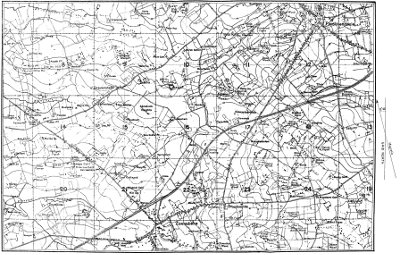
139As matters now stood, the whole of the 33rd Division was concentrated
together, the artillery covering for once its own infantry
on the Passchendaele Ridge-Crest Farm-Meetcheele Line. The
batteries of the 156th Brigade all lay along the Langemarck-Zonnebeke
road north-west of Zonnebeke, between Windmill Cabaret
and Kansas Cross, and covered the right of the zone, while the 162nd
Brigade supported the left zone from positions around Gravenstafel.
"A" and B/156, however, moved their guns to the vicinity of Otto
Farm on the 12th and 14th respectively.
Infantry action was at a standstill, for the mud and general
condition of the ground precluded movement of any sort; in few
places, indeed, was there any fire-trench at all, fortified shell-holes
linked together in groups and half-full of water offering the only
possible cover to the front-line troops. The forward system was
almost completely cut off by a vast sea of mud which extended back
to and beyond the battery positions and was traversed at intervals
by narrow duckboard tracks, the sole means of communication
from front to rear. Any smashing of those tracks, any detour from
them to avoid shell-fire meant hours of struggling through the slime,
while the wretched men who got wounded while crossing the morass
were, as likely as not, engulfed in the mud and never seen again.
Infantry operations, it has been said, were at a standstill, but
the same could by no means be recorded of the artillery. From
dawn till dusk the enemy was for ever pounding away at our lines,
raking battery positions from end to end and destroying the wooden
roads which offered the only possible route for the supply of ammunition
and rations. Gravenstafel, Kansas Cross and the road right
back to Wieltje were in a continual state of eruption, while devastating
shell-storms daily descended upon the battery area between
Gravenstafel and Zonnebeke. It was a grievous time for the gunners;
dug-outs were impossible, as water was met only eighteen inches
below the surface, and pill-boxes were few and far between. Even
the latter, with their doors facing towards the east, were by no
means sure refuges, and it was while actually standing inside such an
one that Captain Gallie, who had distinguished himself so wonderfully
in the autumn fighting, was killed on December 14th. The
only way to minimise casualties was to scatter a number of little
shelters all around the battery positions and, by keeping the men
thus separated, to reduce the damage which one direct hit alone
could do. Yet even so the strain of being eternally wet and cold,
of being for ever soaked with mud and under continuous shell-fire
140was tremendous, and, as far as was possible, detachments at the
guns were relieved every four days.
There was, indeed, little for the men to do except to keep the
gun-pits and ammunition serviceable, and to try to keep themselves
alive. Firing was reduced to the minimum of registration, calibration
and response to infantry calls, for it needed a full day's work
by every man to keep the guns clean, to rebuild the gun-pits after
their daily destruction by hostile shell-fire and to keep dry the
ammunition which, even when it was not blown up by enemy bombardment,
used to sink of its own accord in that bottomless mud
which rendered almost any form of foundation useless. Moreover,
every round fired necessitated the bringing up of fresh supplies
from the wagon-lines, and this was work not lightly to be undertaken.
As late as September 1920 the road from Wieltje to Gravenstafel
was still but a faint track of ploughed-up earth winding across the
shell holes and literally paved with the skeletons of horses and,
in some cases, of men; it was one of the main arteries—and there
were but few in that wilderness of mud—from the wagon-lines to the
batteries, and, to the terrible cost of the drivers and teams, well
the enemy knew it.
Thus, from December 4th, the batteries just barely existed;
they had had a month's rest in the back area and knew that, for
gunners, this would be considered sufficient to keep them going for a
long time to come—hopes of relief, therefore, were not even entertained.
At intervals the guns were registered on the Gasometers
east of Passchendaele; at intervals they bombarded enemy positions
around Moorslede, but mostly the detachments contented themselves
with preparing for emergencies by keeping the guns as serviceable as
was possible. It was a nightmare existence from which all ranks
hoped that they might one day awaken, but the awakening was not
yet expected.
It seemed, therefore, scarcely credible to the 162nd Brigade
when, on December 19th, orders were received to march out next
day to the wagon-lines. Foul as were the conditions in the line,
a mere seventeen days of continuous action was never regarded by
Higher Authority as sufficient to entitle a battery to a rest, and
neither officers nor men had in their wildest dreams hoped to spend
Christmas out of the line; yet such was now to be the case. On
Thursday, December 20th, all batteries of the brigade had reached
their wagon-lines in safety, and on December 23rd they marched
back to Divisional reserve in a camp on the Poperinghe-Busseboom
road, leaving their less fortunate comrades of the 156th Brigade
to carry on the war in their absence. Less fortunate the latter
141certainly were, for they were destined to spend Christmas in action,
but on the other hand the positions they were occupying were not so
bad as those of the 162nd Brigade, nor had they been subjected to
such violent shell-storms.
December 23rd to the 26th were spent by the 162nd Brigade
in overhauling kit and equipment, in helping to build permanent
standings in the camp they were occupying, and in celebrating the
unexpected luxury of a Christmas in rest. On Christmas night
a dinner for the officers was given at "Skindles" in Poperinghe,
while on Boxing Night the batteries organised dinners for their men.
On this day, also, the 156th Brigade was relieved by the 48th Army
Field Artillery Brigade and came down to the wagon-lines, with the
result that the whole of the 33rd Divisional Artillery was able to see
out in peace the old year which held for it such mighty, such proud
and such undying memories.
In peace the old year went out, but by no means in idleness.
On Boxing Day orders had come for the preparation of ten reserve
battery positions to cover the Army defence zone and to be occupied
in the event of a German offensive on the Ypres sector, and every day
before dawn working parties from each battery set out in motor
lorries to Potijze Château, between which spot and Oxford Road
the proposed positions lay. From December 26th to January 7th
the work was carried out during every hour of daylight, for orders,
inspired possibly by the fears of a German Spring offensive, were
imperative that the work should be pushed on as hard as possible.
On January 7th the work ceased temporarily and one section
per battery of each brigade went into the line again, relieving the
250th and 251st Brigades of the 50th Divisional Artillery. January
8th saw the relief complete, and once more the brigades were back
in action, the 162nd occupying the same positions around Gravenstafel,
the 156th remaining as before round Windmill Cabaret, Otto Farm
(the pill-box where Captain Gallie of A/156 was killed) and Van
Issacker's Farm, but with two guns of B/156 (Major Studd) and two
4·5 in. howitzers of D/156 (Major Jones) in forward positions for use
as anti-tank guns. The front to be covered remained unchanged,
while the "grouping" of the batteries showed but little alteration—Lieut.-Colonel
B. A. B. Butler commanding No. 1 Group which consisted
of the whole of the 156th Brigade and B/119, while No. 2 group
(162nd Brigade) was controlled by Major N. G. Jervis from a pill-box
east of Frezenburg. Lieut.-Colonel E. J. Skinner commanded the
whole of the 33rd Divisional Artillery group which was made up
of the 156th, 162nd and 119th Brigades.
The organisation and allocation of the brigades were therefore
142but little changed since the previous tour of duty in the line before
Christmas, but a great difference showed itself in the attitude of the
enemy. Hostile artillery activity had died down in an extraordinary
way, and comparative quiet reigned in the battery area after the
shell-storms of the earlier period. Roads were only occasionally
searched, battery positions were subjected merely to a few sniping
rounds or at most to short neutralising bursts of fire, and the long
concentrated bombardments which previously had been the order
of the day were now exceptional events. "Quiet day," "light
shelling of tracks," "intermittent bursts of fire on Zonnebeke Road
and Windmill Cabaret" appear frequently in the official diaries
of that period, and only on two days—January 13th and 20th—did
the hostile artillery show any marked activity. On those two
days the Zonnebeke-Windmill Cabaret area and the Crest Farm-Meetcheele
line were bombarded respectively, the latter very heavily
indeed, but these two outbursts marked isolated exceptions to the
quietness which had now set in and were not of long duration.
On January 29th, after a most uneventful period in the line,
one section per battery of each brigade was relieved by the 50th
Divisional Artillery and marched again to the wagon-lines. Next
day the relief was completed and the batteries marched to the
Oudezeele area, the gun line parties handing over their guns in action
and moving by lorry to the first night's halting place, there to join
up with the wagon-line personnel who had marched by road in the
ordinary way. The next day saw a continuation of the move to
Zudrove and Le Bas, and on February 1st the ultimate rest billets
were reached in Thiembronne, Merck St. Lievin and Bout de la
Ville. Here the batteries carried out the usual overhauling and
training, rejoicing at the quite phenomenal number of "rests"
which they had of late been enjoying.
It was, indeed, most unusual for artillery to reach the rest area
so often as had the 156th and 162nd Brigades of late. Gunners
were usually kept in the line almost continuously, staying on after
the infantry of their division had been relieved and covering the
incoming troops. A scheme was now in practice by which the whole
of the 33rd Division—infantry and gunners alike—held the line
together and went into rest together, the 50th Division acting as
their "opposite number," and by this scheme the two brigades were
benefiting. It could not last for long—it was too good for that; but
while it lasted it was wondrously pleasant!
There came an interruption in the ordinary routine of training
on February 12th; the 18-pdr. batteries of the 156th Brigade were
ordered to march to Tilques, there to have their guns calibrated by
143the Sound-ranging Section, after which they were attached to the
98th Infantry Brigade for tactical exercises. On the 14th the
18-pdrs. of 162nd Brigade were also calibrated, so that, by the 15th,
all guns were ready for the return into action which had been ordered
for February 22nd. Before this march took place, however,
C/162 (Major Hill) was detached from the Divisional Artillery for
special duties. On February 18th it marched to Tilques to join the
2nd Army Artillery School as a training battery, and there it was
left when once more the move to the line was made.
On February 19th the 156th Brigade moved to the Elnes area
and on the 20th to La Nieppe, the 162nd Brigade reaching Renescure
on the same day. On the 21st advance parties from each brigade
moved by rail to Vlamertinghe to take over the wagon-lines of the
50th Divisional Artillery, while the batteries continued their march
to Zermezeele and Rietveld—D/162, which had gone round by
Tilques to calibrate its guns, rejoining the rest of the brigade on this
day. February 22nd saw the arrival of the batteries at their wagon-lines
east and south-east of Vlamertinghe, the same which they had
occupied on the return to action in early January; A/162, however,
remained near Goldfish Château, and B/156 went to Ypres Asylum.
On the 22nd also lorries took one section per battery direct to the
forward area, the 156th Brigade this time relieving No. 2 Group
(251st Brigade), the 162nd Brigade No. 1 Group (250th Brigade).
The relief was complete by Saturday, February 23rd, and on the
next day 33rd Divisional Artillery Headquarters took over the
control, at Menin Gate, of the artillery covering the infantry of the
33rd Division on a two thousand yard front opposite Passchendaele
and due west of Moorslede. On this occasion the 162nd Brigade
took over the positions previously held by the 156th along the Langemarck-Zonnebeke
road, "A" and D/162 (Major Fetherston and
Major Lee) at Windmill Cabaret, some six hundred yards north-west
of Zonnebeke, B/162 (Major Cory) about two thousand yards also
to the north-west of the village, while Brigade headquarters were
situate in a pill-box one thousand yards north-east of Frezenburg.
The 156th Brigade positions, with the exception of Major Carrell's
battery (A/156) which remained at Otto Farm, were those which had
previously been held by the 162nd Brigade at Gravenstafel.
The policy adopted by the batteries on their return into action
now was to remain quiet, only registration and calibration being
carried out. The enemy on the whole were also inactive until the
end of the month; one or two attempts were made to rush our
advanced posts, and a large raid was executed—unsuccessfully,
however—upon the division on the right. Apart from this, and
144from a certain amount of activity with high-velocity guns upon our
back areas, the enemy attitude was very similar to ours.
March saw a change in the general policy of the Germans holding
this part of the line. An ever-increasing volume of artillery fire
began to be directed upon our battery positions, while high-velocity
guns were continually searching the roads and back areas. On the
2nd nearly all our batteries were heavily shelled, while severe bombardments
were carried out upon both flanks of the division; on the
3rd enemy aeroplanes were very active and continued so for several
days, especially on the 7th when low-flying machines appeared
everywhere. On the 6th a big shoot was carried out on the Windmill
Cabaret area N.W. of Zonnebeke, and on the 9th the batteries of the
33rd Divisional Artillery were bombarded with gas shell. The
front was indeed gradually boiling up to a state of high enemy
activity, and, with the fine weather which supervened and the knowledge
that an enemy offensive was almost inevitably coming on some
part of the front, the plan of action to deal with such an emergency
was continually tested. On March 10th in the early morning all
batteries fired "counter-preparation," a slow barrage which was to be
used in the event of an enemy attack being expected. On this and the
succeeding days fire was also directed upon special targets, upon
machine guns, dug-outs and likely places for the concentration of
hostile troops, while all batteries constantly practised the drill of
pulling their guns out of the pits at short notice and of engaging
targets on the flanks and at short ranges.
On the 14th a heavy German raid was repulsed, a prisoner
who had been taken beforehand having given information concerning
it, and on the 17th all batteries again fired in response to an
S.O.S. call at 4.40 A.M., but in this case no infantry action took place.
All this time the enemy long-range guns were for ever bombarding
Ypres, Wieltje, St. Jean, Potijze and every road leading up from the
back area, as many as one thousand high-velocity shells being poured
into the neighbourhood of Ypres each day. At the same time
battery positions, and especially the area between "Seine" and
Abraham Heights, were continually shelled, gas at night being the
usual practice.
Thursday, March 21st, 1918, was a comparatively quiet day in the
Ypres sector. The batteries had not been worried much, and for
their own part had not done more than to direct bursts of fire upon
enemy dug-outs and machine guns which were annoying the infantry.
About 1.0 P.M., just as the detachments were sitting down to their
midday meal, came the first message, telephoned up from Divisional
Headquarters, of the beginning of the great German offensive in the
145south. Little news was given beyond the fact that the attack
had been launched and that our troops, after giving up the advanced
system, "were holding the enemy on the main Army Defence Line."
Every few hours further messages came in, admitting certain losses of
ground but stating that the enemy was being held in the main,
and that the day was going in our favour. Such reports were certainly
encouraging to the men, and in no way gave any suggestion of defeat;
bit by bit, however, names of villages which had been captured by the
enemy began to appear, and reference to a map disclosed the disquieting
fact that a deep penetration into our lines had been made, a penetration
which must necessarily become deeper still owing to the loss
of certain tactical points. Information was very sparse and rumours
immediately became rife everywhere, so that a fair idea of the
situation could hardly be obtained. It was, indeed, of little use to
worry; the batteries had their own share of the front to look after
and knew that, sooner or later, they would be plunged into the battle
themselves—"sufficient unto the day ..." then, for in France
it was not good to worry about troubles before they came.
On March 25th the front covered by the 33rd Divisional Artillery
was extended some five hundred yards further to the south, S.O.S.
lines being rearranged accordingly, and on March 28th/29th one
section each of "B," "C" and D/156 moved out to alternate positions
S.E. of Kansas Cross, S.E. of Bostin Farm and east of Kansas Cross
respectively. During the preceding weeks the enemy had been
constantly shelling the Abraham Heights area with gas and had
rendered it quite untenable, B/156 having as many as forty gas
casualties in one week; the change of position described above had
therefore become an urgent necessity. Although the enemy artillery
activity had died down since the 21st it was still fairly vigorous,
especially upon roads, back areas and wagon-lines—the latter suffering
considerably.
A further extension of the brigade zones to the south was made
on March 29th, and on the same day another section of "B," "C"
and D/156 moved back to the alternative positions described above.
Next day Major Hill's battery (C/162), which had left Tilques on
the 27th and had marched up via Godewaersvelde to wagon-lines
at Goldfish Château, sent one section into action at Bostin Farm,
one thousand yards west of Zonnebeke Church, to be joined by the
rest of the battery on the night of March 31st/April 1st; by the
end of March, therefore, the 33rd Division had its guns well distributed
in depth, and could be certain of giving adequate protection to the
infantry even should the latter be forced back behind the line of
forward guns.
146Thus the batteries remained for the first week of April. March
had made its exit with a heavy enemy bombardment on the evening
of the 31st upon the forward, battery and back areas, with a heavy
gas concentration upon the Frezenburg line, to all of which the
batteries had at infantry request responded. April came in, bringing
with it little news save an ever-increasing expectation of attack
on the Divisional sector, and so the first week passed while everybody
held his breath, as it were, in anticipation.
On Sunday, April 7th, portions of the 156th and 162nd Brigades were
relieved by the 28th Army Field Artillery Brigade (Colonel Paynter)
and marched out to their wagon-lines near Vlamertinghe. On the 8th
the relief was completed and the batteries were all resting in the
wagon-lines, hourly expecting orders to move down south to the aid
of the hard-pressed 5th Army, for thither they all believed they
were to go, nor is it too much to say that considerable despondency
was felt in both Brigades at not being engaged in the battle then in
progress. Before any such orders were issued, however, an enemy
offensive was suddenly launched upon them from much nearer at
hand, and, although the 162nd Brigade marched to the Peselhoek-Poperinghe
area on April 9th, there was to be neither for them
nor for the 156th Brigade any rest. The Germans were about to
start their great attack in the north which grew into a drive for the
coast, and every man, every gun, every available round of ammunition
was needed in the great struggle shortly to begin.
CHAPTER X. Part I. THE GERMAN OFFENSIVE IN FLANDERS. (APRIL-MAY 1918.)
147
Early on the morning of Tuesday, April 9th, there came to the
batteries, as they lay resting in their wagon-lines, the sound of
tremendous shelling to the south, a continuous thunder which was
maintained throughout the whole of that and the succeeding day
(April 10th), giving rise to considerable speculation and rumour.
Clearly a great weight of artillery was at work and almost certainly
an attack was, if not already begun, at least imminent, but what was
happening and why did not the batteries move up to take part in the
battle? Of news or orders there were none, and not for many hours
did the men learn of the mighty German thrust which even then was
in progress, the thrust which, starting between Givenchy and Bois
Grenier on the 9th, spread northwards to Messines on the 10th and
marked the beginning of the greatest battle yet seen on the Flanders
front.
At last, on the afternoon of April 10th, news came to the 156th
Brigade that the Germans had attacked and advanced on a long front
between Ploegsteert Wood and Givenchy; that they had taken
Armentières and had advanced well in the direction of Bailleul,
though Neuve Église was still ours, and that the batteries were
to move up into action immediately to stop this onslaught. At
5.0 P.M. the march began, and the brigade set out for its rendezvous,
a point about one mile west-north-west of Neuve Église, which
it reached in pitch darkness after many weary hours on roads greatly
congested by traffic and by refugees who, in the last stage of exhaustion,
had scarcely strength to get out of the way of our troops.
Here the situation was found to be very obscure; nobody knew where
the infantry were, but warnings were received that parties of Germans
were believed to be little more than a mile to the south, and at any
moment the guns might be called upon to open fire. Consequently the
horses remained fully harnessed up all night and practically alongside
the guns, the latter having their trails dropped in a position ready
148to fire, Lewis guns and guards were posted in every battery position,
and so the brigade stood awaiting information which would clear up
a little the prevailing chaos.
At three o'clock on the morning of Thursday, the 11th, the
expected orders arrived, and at half-past four began the march to
Vierstraat, where positions had been allotted to the brigade. By ten
o'clock Lieut.-Colonel Butler had completed his reconnaissance of
Vierstraat cross-roads, by half-past ten the four battery commanders
were engaged upon the same work, and midday saw the batteries in
action bombarding the enemy who had by then reached a line running
just east of Wytschaete and curving away thence towards the north-east.
The battery positions lay around Vierstraat and between that
village and Kemmel, and from observation stations north-east of
Wytschaete the S.O.S. lines of the guns were quickly registered.
Meanwhile the 162nd Brigade, farther back in the Poperinghe
rest area, had also received urgent orders to move into action. On
the morning of April 10th the batteries had paraded for a drill order
of the whole brigade and had moved off to some open country near
by to begin the exercise. While this was actually in progress a dispatch
rider arrived and brought the parade to an abrupt conclusion,
for he carried with him orders for the brigade to join the 19th Division
at Dranoutre immediately and to move into action without a moment's
delay. Leaving Captain Pavitt (the Adjutant) to collect the batteries
and lead them to the rendezvous, Lieut.-Colonel Skinner (O.C. 162nd
Brigade) set off by motor with his orderly officer to report for orders
to the C.R.A. 19th Division near Neuve Église. Owing to various
difficulties on the way these orders were not received until 2.0 P.M.,
but their effect was that Colonel Skinner should bring his batteries
into action immediately near Spanbroekmolen. As no horses were
available, the reconnaissance of these positions had to be carried out
on foot and took a long time, but when the positions were finally
chosen the orderly officer (Lieut. Bartholomew) was sent back to
Dranoutre to await the arrival of the batteries and to guide them to
their positions.
149ORDER OF BATTLE.
April—August 1918.
| H.Q.R.A. |
| |
| C.R.A. |
Brigade Major. |
Staff Captain. |
| Brig.-Gen. C. G. Stewart, C.M.G., D.S.O. |
Major T. E. Durie, D.S.O., M.C. |
Capt. W. E. Bownass, M.C. |
| Brig.-Gen. G. H. W. Nicholson, C.M.G. |
Major W. A. T. Barstow, D.S.O., M.C. |
|
| |
| 156th Brigade. |
| Lieut.-Colonel B. A. B. Butler, D.S.O. |
| Adjutant: Capt. H. W. Smail, M.C. |
| |
| "A" Battery. |
"B" Battery. |
"C" Battery. |
"D" Battery. |
| Major F. B. Carrell. |
Major M. A. Studd, D.S.O., M.C. |
Major Barker, D.S.O., M.C. |
Major D. Jones, M.C. |
| |
Capt. S. G. Taylor, M.C. |
|
|
| |
Major W. G. Sheeres, M.C. |
|
|
| |
| 162nd Brigade. |
| Lieut.-Colonel E. J. Skinner, D.S.O. (wounded). |
| Lieut.-Colonel Ramsden. |
| Lieut.-Colonel W. R. Warren, D.S.O. |
| Adjutant: Capt. R. H. Pavitt, M.C. |
| |
| "A" Battery. |
"B" Battery. |
"C" Battery. |
"D" Battery. |
| Major G. Fetherston, D.S.O., M.C. |
Major H. C. Cory, M.C. |
Major M. M. I. Body, M.C. |
Major F. L. Lee, M.C. |
| |
|
|
Major R. D. Russell, M.C. |
150Meantime Colonel Skinner set out to find the infantry Brigadier
in that part of the line, so that he might inform him of his plans.
This was a long and tedious business in an unknown place in a now
dark and rainy night, and, on finding the Brigadier, Colonel Skinner
to his disgust, if not surprise, was told that the positions he had
chosen had, since he had left them, practically fallen into the hands
of the enemy. There was only one thing to do, and that quickly.
Setting out as fast as possible, he covered the four miles to Dranoutre
in pitch darkness and, arriving there at the same time as the batteries,
he stopped them and held a consultation with the C.R.A. of the 19th
Division, who had just been shelled out of his headquarters. After
a short discussion regarding the general situation which, as can be
judged by the foregoing narrative, was very obscure, the batteries
marched at once into action between Rossignol Wood and Parrot
Camp (North of Kemmel Village), and by 3.0 A.M. on Thursday,
April 11th, were in action, Brigade Headquarters being at Parrot
Camp. Thus they found themselves after a seventeen-mile march
along roads congested with troops, transport, refugees and cattle,
a march which had been preceded by over an hour's work on drill
order the previous morning; unfavourable conditions, those, to
usher in one of the greatest battles yet fought.
From April 11th onwards the batteries were under the administration
of the 19th Division. Brig.-Gen. Stewart and his staff had,
on April 9th, handed over control of the artillery in the Passchendaele
sector to Colonel Paterson (119th Brigade R.F.A.), but had marched
straight to Dranoutre, and on the 11th remained with headquarters
of the 33rd Division. On that fateful day General Stewart commanded
a composite infantry brigade until the early morning of the
12th, when he took over command of the artillery covering the
infantry of the 33rd Division on the Meteren front, south of the
156th and 162nd Brigades. The latter were therefore left with the
C.R.A. 19th Division.
During this period from the 11th onwards both brigades underwent
the severest trials. Great demands were made upon them;
the batteries were required to shoot on a big area whenever an enemy
attack showed signs of developing, yet never did the guns fail to
carry out their work. Attempts were daily made to man O.P.'s on
Kemmel Hill, but although the gallantry of observing officers and
signallers always enabled communication to be established, the
heavy and continuous fire which the enemy brought to bear upon the
hill rendered it impossible for that communication to be maintained.
In the case of the 156th Brigade observation was usually carried out
from a point north-east of Wytschaete, while the batteries of the
162nd Brigade were able to obtain a very good view of the enemy
from the ridge just in front of the guns.
From the moment that the batteries dropped into action they
were shelled almost continuously, but no infantry actions developed.
This was in a large part due probably to the efforts of the batteries,
by which every sign of concentration was smashed at the outset.
Especially was this the case on the 12th, when small bodies of the
enemy were continually advancing in the open, but were as continually
broken up by the fire of the guns. Every suspicion of movement
was shelled and, whether movement was visible or not, harassing
fire was maintained night and day. On the 15th information was
received that our line was to be withdrawn to Vierstraat-Lindenhoek,
but in the evening this retirement was cancelled, and the fatal morning
of April 16th dawned to find the batteries still occupying the same
positions.
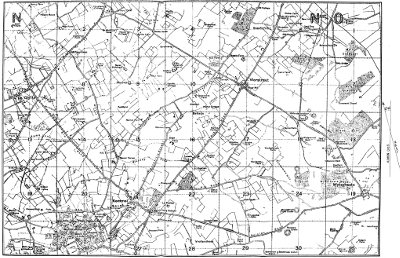
151A dense fog hung over the ground on Wednesday, 16th April,
blotting out all vision and deadening sound. There was no suggestion
of an enemy attack on the front covered by the batteries, no preliminary
bombardment—other than the continuous shelling which
had characterised every day since the offensive began—no S.O.S.
signals, yet early in the morning of that day the enemy made a heavy
attack from the south and, advancing his line in a north-westerly
direction, captured Wytschaete Ridge, Wytschaete Village and Wood,
together with the Hospice and Peckham. Apparently the Germans,
making use of the thick fog, advanced without an artillery barrage,
and the same fog hid the infantry S.O.S. signals. The first intimation
of an attack was obtained by the Forward Observing officer of the
156th Brigade, who from his O.P. three hundred yards north-east of
Wytschaete suddenly saw Germans twenty-five yards away. He
opened rifle fire upon these at point-blank range, but needless to
say was unable to stop them. He then tried to get away in order to
warn the neighbouring batteries, but was shot in the stomach and
later died of his wounds. The batteries, however, were by now fully
roused and were pouring gun fire into the advancing troops to try and
check their onslaught. Those of the 156th Brigade were just able to
remain in their positions, and, as soon as dawn broke, set up O.P.'s
on the ridge of the Kemmel-Vierstraat road, the original O.P.'s
being by then in enemy hands. From this ridge observed fire was
directed all day upon Wytschaete Village and Ridge, and great havoc
was wrought amongst the Germans as they advanced in the open.
Meanwhile the 162nd Brigade was also enduring a deluge of
shell similar to that which was descending upon the 156th but,
being further to the right, was in more imminent danger of being
captured, since the enemy advance was, as already described, taking
the form of a north-westerly sweep from the south. Shorter and
shorter grew the ranges of the guns, until at last the necessity of a
retirement became imperative; reluctantly the withdrawal began,
one section per battery at a time. In this operation conspicuous
gallantry was shown by all ranks, for the gun positions were being
torn and swept by a veritable tornado of shell which rendered the
approach of the teams well-nigh impossible. As an instance of this,
the retirement of a section of A/162 under Lieut. J. R. B. Turner may
152well be quoted; such heavy fire was directed upon his guns that
the teams could not get near them, and guns and wagons had to be
manhandled out of action. Under a hail of shell each gun in turn
was saved, every temporary lull being taken advantage of for a
team to dash in, limber up and get clear, and ultimately the section
was successfully withdrawn. Similar deeds were enacted in every
battery, and ultimately the whole brigade was withdrawn, the leading
sections coming into action in fresh positions and covering the withdrawal
of the remainder by their fire. By this means every gun was
saved, while the continuity of the barrage covering our own infantry
was never broken—a most gallant performance by the personnel of
the batteries, and a fine example of the tactical handling of a brigade
of artillery.
After the first rush the enemy advance slowed down and ultimately
stopped, there being no further attack on the evening of the
16th nor on the night of the 16th/17th. Lieut. Bruce and Lieut.
McDonald of the 156th Brigade went forward to Byron Farm and
got good information regarding the position of the infantry, and
during the whole of the night the batteries kept up a slow harassing
fire upon all likely places where the enemy might concentrate for a
further assault. 162nd Brigade Headquarters, which had been set
up in the ruins of a small cottage a short distance in front of the new
positions occupied by the batteries, was heavily shelled, although
hitherto the spot had been more or less immune; after losing
the wireless operator and several men, together with a great deal
of stores destroyed, it moved out and was established at dawn with
D/162.
Thursday, April 17th, brought with it a heavy enemy bombardment
of all the battery positions. The 162nd Brigade, as a result of its
retirement on the previous day, lay east of the Millekruisse-Hallebast
road, between the road and Kemmel-Beek; Major Cory's battery
(B/162) was on the left, nearest Hallebast Corner, with C/162 (Major
Body) next on the right. A/162 (Major Fetherston) lay further to the
right still, and then came Major Lee's guns (D/162) on the Millekruisse-Kemmel
road. The 156th Brigade was still hanging on to
the original positions held prior to the enemy attack on the previous
day, but the flashes of the more forward batteries must have been
clearly visible to the enemy on Wytschaete Ridge, and the guns came
in for a heavy gruelling. This did not prevent them, however, from
giving the utmost support to a counter-attack launched by our
infantry upon Wytschaete at 7.30 P.M., in which the guns of the
162nd Brigade also took a large share. The counter-attack was
unsuccessful, and, with the enemy still on Wytschaete Ridge, the
153necessity of a withdrawal of a portion of the 156th Brigade to a more
covered position became apparent. Next day (April 18th) a reconnaissance
was carried out and positions were chosen some one
thousand yards further west, behind the road known as Cheapside
which ran parallel with and about eleven hundred yards west of the
Kemmel-Vierstraat road. On the 19th these positions were occupied
by two batteries and the guns were registered from just in front,
the whole Brigade except for Major Carrell's battery (A/156) being
now clustered around Lieut.-Colonel Butler's headquarters in a line
five hundred yards in length. A/156 lay further to the north-east,
little more than a quarter of a mile from Ridge Wood.
From April 17th until the 25th the enemy did not make any
considerable advance, and, although the batteries were daily shelled,
a fair amount of opportunity offered itself for strengthening the gun
line. A certain readjusting of positions also took place about this
time. D/162 sent forward a section under Lieut. Bennet and Lieut.
Garrod to a position two hundred yards south of Siege Farm, near the
old position which had been held prior to the loss of the Wytschaete
Ridge, and from which some excellent harassing fire was carried out.
On the 22nd Major Studd (B/156), with only four serviceable guns
left, moved two of them some three hundred yards further south
on the Kemmel-Ridge Wood road, and to this latter position was
added on the 23rd a third gun, received that morning from the
I.O.M. On April 24th A/156, who had been very heavily shelled on
the previous day, moved two guns to a position three hundred yards
north of Siege Farm; the remainder were to have moved thither on
the morning of the 25th, but the events of that day, as will presently
be shown, put an end to any such ideas. About the 23rd also Major
Jones (D/156) put one 4·5 in. howitzer two hundred yards to the north
of the A/156 "Siege Farm" section. Thus the batteries were more
split up, each brigade having a main line of guns with detached
sections thrown out slightly in front, from which latter the majority
of the firing was done.
Before the further operations on this front are described a word
must here be spoken of the battery wagon-lines. As a rule the wagon-lines
were looked upon as comparatively safe—a "cushy" job for
those whose lot it was to live there—but the wagon-lines during the
German advance were far from restful. True, they did not suffer
the dense barrages which the gun line had to face; but they were
constantly shelled by high-velocity guns at long range, a most disconcerting
performance which meant that day and night, at odd
intervals, a shell would crash into the crowded horse-lines or work
havoc amongst the men's bivouacs, and even occasional shells are
154terribly upsetting when they burst amongst a mass of horses. In
addition, enemy aeroplanes came nightly and scattered bombs along
the length and breadth of the lines, while daily the weary drivers
and teams had to make their way up to the batteries with ammunition,
usually being shelled all along the road. The consequent strain
upon horses and men may well be imagined.
Throughout this period the wagon-lines were kept in two portions—a
forward wagon-line, in which were kept the gun teams and such
wagons as were necessary to the batteries in a move of any emergency,
and rear wagon-lines where lived the main body of drivers and teams.
From April 12th until the loss of Kemmel on April 25th the forward
wagon-lines of both brigades were situated between Hallebast Corner
and Vierstraat, the rear wagon-lines of the 156th Brigade being in the
Reninghelst-Ouderdom area, while those of the 162nd Brigade lay
at first at Canada Corner, north of Locre, moving on the 17th to the
area between Reninghelst and Busseboom. There they were all
kept continually moving, sometimes in Reninghelst, sometimes nearer
Busseboom, every spot they inhabited being shelled by the enemy
and, after a very short period, rendered uninhabitable. In both rear
and advanced wagon-lines the casualties amongst horses and men
mounted rapidly, but it is safe to say that the "emergency" teams at
Hallebast Corner had far the worst time.
To return to the tactical situation, however. On April 19th
both brigades had been put under the command of the C.R.A. 9th
Division, but on the 22nd the French 28th Division came up into
the line and the French Artillery Commander took over control of
the 162nd Brigade. Headquarters of the latter moved over to
Scherpenberg to be near the French commander, but the distance
from there to the batteries was too great for any efficient control to
be carried on, and permission was obtained by Lieut.-Colonel Skinner
to move his headquarters back to Millekruisse so as to be near the
batteries, and also near the commander of a "groupe" of French
artillery which had just come up and lay in action to the east of
and near the village. Lieut. Norton (C/162), who could speak
French fluently, was left as liaison officer with the "C.R.A." of the
French division.
The disposition of the two brigades on April 24th, therefore,
was as follows. The batteries of the 156th were grouped together
about 1,800 yards due north of Kemmel, with an advanced section
of 18-pdrs. (A/156) and one advanced 4·5 in. howitzer (D/156)
near Siege Farm and about 600 yards in front of the main line of
guns. Lieut.-Colonel Butler's headquarters were right amongst his
guns, between "C" and B/156, but the remaining two sections of
155A/156 were some 1,200 yards to the north-east and were so far away
that, when the battle began on April 25th, it was found impossible
to exercise command over them.
The 162nd Brigade also lay together between the Millekruisse-Hallebast
road and the Kemmel-Beek, and therefore slightly in rear
of the 156th Brigade. Lieut.-Colonel Skinner's headquarters were in
Millekruisse, and in this case one advanced section of 4·5 in. howitzers
(D/162) was thrown forward in a position just west of Rossignol
Wood.
As far as communications were concerned, a party of scouts
was kept on the top of Mount Kemmel in visual signalling with the
guns, while O.P.'s were manned at Desinet Farm, at Vierstraat
Cross-roads and elsewhere, whence good observation of Wytschaete
Valley and Wood and all the country to Spanbroekmolen was obtainable;
these O.P.'s were also in visual communication with the guns,
but the fog and smoke during the battle of the 25th rendered all their
work impossible. Each brigade had, in addition, a liaison officer
with the infantry battalion in the line, and therefore the system of
communication between infantry and artillery, and the observation
kept upon the enemy by the guns, was as good as could be hoped
for. Buried cables, however, were scarce, and it needed but a few
well-placed shells to cut off all connection of this kind.
April 24th was an unusually quiet day, though prior to this
date the enemy counter-batteries had been very active, each of our
batteries being carefully and accurately registered. This may have
been done by sound-rangers, but stringent precautions to avoid
being located by them were taken, and the universal opinion, which
was reported by Colonel Butler to Corps Headquarters, was that
the location of the batteries was being carried out by expert observers
in the German balloons. These had come very close to the line and
numbers of them were constantly in the air, entirely unmolested
either by the Flying Corps or by the R.G.A. April 24th, therefore,
gave little hint of what was coming, unless the exceptional activity
of the German anti-aircraft guns were taken as a sign. The quietness,
however, was soon to be broken; at 1.0 A.M. on Friday the 25th
a few of the batteries were warned that an enemy attack might be
expected at dawn, but the remainder were completely unaware
that any untoward events were impending until suddenly, at 2.0 A.M.,
there descended upon them with a roar and a crash the most appalling
barrage that they had ever yet undergone.
With a fairly extensive experience of shelling, it was acknowledged
by all ranks that never before had such a bombardment been
endured. In the battery positions it was hell, the gunners working
156their pieces in a perfect hailstorm of shell fire, while, to add to this
tremendous test of endurance, a large proportion of the barrage
consisted of gas shell which necessitated the wearing of gas helmets
by all ranks. How any of the guns or gunners survived that terrible
morning remains to this day a mystery, yet survive it they did and
to most excellent effect. The barrage which enveloped the guns
was also beating down upon the front line system, and the batteries,
in order to show the infantry that they were not forgotten, opened
fire on their S.O.S. lines. It was soon very clear, however, that an
attack was imminent, and accordingly "counter-preparation" was
begun and continued for several hours.
From 2.0 A.M. until 5.30 A.M. the barrage did not relax, but
from 4.30 A.M. onwards high explosive gradually superseded gas shell
until the bombardment became one almost entirely of high explosive.
Although this change did even more to wreck the battery positions
than had the chemical shell, it at least dispersed the gas and enabled
the men ultimately to remove their respirators; they were by now
almost dropping with the physical exhaustion of firing their guns
at top speed in gas helmets, combined with the nervous strain of
this terrific bombardment, and a breath of fresh air came to them
as a blessed relief.
At 5.30 A.M. a considerable bombardment was maintained on
the battery positions, but the full fury of the barrage dropped back
on to the infantry and, after resting on the trenches for about
forty-five minutes, began to creep forward towards the batteries
once more. Under cover of this creeping barrage the enemy infantry
advanced to the assault, and as it rolled up inexorably towards the
guns again—who all this time were being pounded and smashed by
the enemy artillery—the Germans advanced swiftly over the front
line and began to approach the battery area. Thick fog enveloped
their movements, practically every telephone wire was cut and, as
the same fog prevented any visual signalling at all, the situation
became extremely obscure. With a visibility of only fifty yards it
was impossible for battery commanders to know when the enemy
might not be right up to and amongst the guns.
At 6.10 A.M. the infantry got through their last message to the
guns; on a buried cable to 156th Brigade Headquarters the company
commander of a front-line company stated that he was still being
shelled, but that the Germans had so far made no movement. Shortly
afterwards the cable was destroyed and a terrible silence, as far as
information was concerned, set in. It would appear that, very
shortly after the despatch of that last message, the enemy assault
was delivered.
157At about 7.0 A.M. Lieut.-Colonel MacCullock of the 9th K.O.Y.L.I.
rode up to the battery positions. His battalion had been lying in
support in the valley of the Kemmel-Beek, where it had been heavily
gas shelled, and he now decided to move up to a line of disused
trenches on the forward slopes of Hill 44, just in front of the guns.
While his men were settling down into position, Colonel MacCullock
rode up along the main road to find out what was happening towards
Wytschaete, and, penetrating as far as the Grand Bois, he discovered
that this was still in our hands, whereupon he returned to complete
his dispositions for the defence of Hill 44. While this was still in
progress, Lieut. Phipps (156th Brigade) returned from Desinet
Farm at about 7.50 A.M. and reported that the enemy's rifle fire had
got very near. Owing to the fog he had been unable to see any
Germans, but there was no doubt but that they were rapidly approaching;
he further added that there were practically no French
troops to be seen in that area. Even while he was making his
report some French infantry retired through the line of guns, shouting
that the enemy were in Kemmel village and were coming on fast.
It was therefore clear that there now remained no infantry between
the guns and the enemy except for the K.O.Y.L.I. whose right flank
terminated in front of B/156, there being from there southwards
an ominous gap.
At 8.45 A.M. patrols sent out reported that there were no British
troops to be seen on the other side of the Kemmel-Vierstraat road,
and following almost immediately upon this news small parties of
Germans were seen coming across the road. These were immediately
engaged by such of the guns as were still serviceable, but by 10 A.M.
the enemy had pushed across the road and, although he did not
appear to have made much progress in the visible ground near
Godizonne Farm, had got beyond Siege Farm further to the south
and was within five hundred yards of the batteries.
Shortly before this last period a decision had had to be come to
as to the withdrawal of the guns. The only infantry in the neighbourhood
were the 9th K.O.Y.L.I. and some stragglers of the late
front-line battalion whom Major Barker (C/156) had collected to
form an escort to his guns; the line held by these troops ran about
one hundred yards in front of the batteries, but stopped on the right
at Hill 44, and south of this point no troops were to be seen at all.
Northwards the left of the K.O.Y.L.I. was continued by some other
infantry, but the whole line was terribly thin and could not hope to
stop a determined rush by the enemy. Lieut.-Colonel Butler and
Lieut.-Colonel Skinner were therefore faced with this problem:—Hill
44, a slight rise in the ground on the Ridge-Wood—Kemmel
158road, had a surprisingly good command over the country from
Dickebusch Lake round by the west to the northern slopes of Mount
Kemmel; it was, therefore, very important to hold it. For this
purpose the only infantry available were the 9th K.O.Y.L.I., but
they were in the best of spirits. On the other hand, reconnaissance
showed that, whereas the Germans were only using volatile gas on
Hill 44, they were using mustard gas some 700 yards to the rear,
and the natural deduction was that Hill 44 was part of the enemy
objective. If, therefore, the enemy gained the hill he would capture
the guns en bloc, and there would be no further obstacle to impede
his progress. It was accordingly decided to withdraw, one by one,
a proportion of those guns which were still undamaged, but to keep
the remainder in action in their present positions until the retired
guns, from a line further back, could open a full volume of covering
fire upon the enemy opposite Hill 44.
Hitherto the tactical continuity of the narrative has been
maintained in order to relate, as clearly as possible, the true story
of the attack by which the Germans captured Kemmel Hill, but now
a digression must be made so as to follow closely the action of the
batteries in their withdrawal. To do this, the story of each Brigade
will be taken separately, beginning with the 156th.
At 9.0 A.M., shortly after the first crossing of the Kemmel-Vierstraat
road by the Germans, the order to prepare for a withdrawal
was issued from Lieut.-Colonel Butler's headquarters. Since as early
as 6.0 A.M. A/156 had in its main position only one gun capable of
firing, and by 8.45 A.M. this gun also had been silenced; therefore,
on receipt of Colonel Butler's message, the battery withdrew from
its main position and moved to a fresh line in the direction of Ouderdom.
Shortly afterwards a section of Major Barker's battery (C/156)
was also withdrawn.
By 11 A.M. practically all the ammunition in B/156 southern
position had been expended, and moreover the guns were unable,
owing to trees, to fire at ranges of less than 1,200 yards. Major
Studd therefore removed the breech-blocks and dial sights from these
guns and, sending back a portion of his detachments to the wagon-lines
to hurry up the teams which had already been sent for, concentrated
his efforts on the two guns which he had kept in a position
300 yards further north. Of these two guns, one was taken away by
a team belonging to C/156 to a previously reconnoitred spot north
of La Clytte; the other was run forward by hand, with the assistance of
nine men of the K.O.Y.L.I., for a distance of some one hundred yards
to the crest of the hill, whence Major Studd and his four remaining
gunners engaged the enemy over open sights at a range of 300 yards.
159By 11.15 A.M. the remaining two sections of C/156 were in full
view of the enemy, some five hundred yards away, and, as their
ammunition was running out, a withdrawal to a line north of La
Clytte was decided upon. From a position of assembly two hundred
yards to the rear the limbers were brought up, one at a time; the
first gun got away without being fired upon; the second and third
escaped under heavy rifle fire, but the lead driver of the fourth gun
took it through a patch of soft ground which made the pace so slow
that all the horses and one of the drivers were shot, and the gun had
to be abandoned for the time. The withdrawal of this battery was
rendered very difficult by the fact that there were only one sergeant
and six men still unwounded; all the officers and the remaining other
ranks had been either killed or disabled, though Major Barker continued
to command his battery despite his wound. They had put
up a most brilliant fight, and the gallantry of all ranks was unsurpassable,
typical of every battery on this grim morning.
There remained now only the advanced section of A/156, D/156,
and the single gun of B/156. The advanced section of A/156 (Lieut.
Blackwell in charge) for a long time had been firing upon the enemy
at point-blank range; early in the morning teams were sent up to try
and save these two guns, but the rapid advance of the enemy had not
been realised and, fight to the last though they did with the enemy
all around them, the guns together with their teams were captured.
The advanced gun of D/156 near by had been knocked out earlier
in the day and had to be abandoned, after the withdrawal of dial
sights and breech-blocks. D/156 main position had also to be abandoned
temporarily.
Thus, by 11.0 A.M. the only gun in action in the forward positions
was the solitary 18-pdr. manned by Major Studd and his four men.
This little party was now joined by Colonel Butler who, by his quiet
bearing and confidence, greatly inspired both gunners and infantry.
He collected and controlled a party of machine gunners whose officer
had just been killed, and for some time remained with Major Studd's
gun, the capture of which was only prevented by the thin line of
K.O.Y.L.I. in front. Machine guns and a 5·9 in. howitzer worried
this party considerably, but steady harassing fire was kept upon the
enemy and prevented them from making any further advance.
At about 11.30 A.M. this single gun was switched round through
180° to fire on some Germans who were making for La Clytte, almost
directly in rear. At first about twenty of the enemy were visible who,
on being fired at, ran back one hundred yards into some scrub.
This movement, however, caused some three hundred of the enemy
to get up and bunch round their officers. Major Studd turned his
160gun on these and obtained a number of bursts right amongst them,
with the result that they ran back five hundred yards into a patch of
dead ground.
So the morning wore on, the enemy making no considerable
advance since he had established himself well across the Kemmel-Vierstraat
road. By 1.0 P.M. the ammunition of B/156 solitary
gun had all been expended; as its presence was drawing fire upon
the K.O.Y.L.I., it was run back behind the slope, and Major Studd,
removing breech-block and dial sight, set out with his four men
to find out what had happened to the remainder of his battery.
Thus, at 1.0 P.M., the last gun of the 156th Brigade ceased
to operate in the forward positions; all the remainder had either
got away or been silenced by 11.0 A.M., and it only remained to remove
those which had had to be abandoned. At 5.0 P.M. in the evening
Captain S. G. Taylor took up teams and attempted to save the guns
of B/156, but was only able to reach the single gun in the northern
position as it was impossible in the darkness to tell where the enemy
was. During the night of 25th/26th and the morning of the 26th
the howitzers of D/156 (less the advanced one, which had been hit)
were removed from under the enemy's nose, as was also the one gun
of C/156 which had been abandoned, and on the morning of the
26th also Captain Taylor brought up his teams and saved the three
guns of B/156 in broad daylight with the enemy only four hundred
yards away—a very fine performance.
So ended the doings of the 156th Brigade on April 25th; three
guns had fallen into the hands of the enemy, but all the remainder,
although a few had temporarily to be abandoned, were saved; in
every case the guns had been fought to the last, tremendous casualties
being inflicted upon the enemy. Let us now turn to the 162nd
Brigade and follow their doings also on this memorable day.
The four batteries of the 162nd Brigade had, in common with
all the other guns, been enveloped in the tremendous barrage which
the enemy put down at two o'clock in the morning. In spite of this
terrific storm of shell—the intensity of which may be judged from
the fact that Lieut. Squire of B/162 was killed by the concussion of
the bursting shell all around him, his body being otherwise unwounded—the
detachments under their battery officers' control maintained
a steady rate of fire upon the enemy. All communication between
"A," "B" and C/162 and Brigade headquarters completely broke
down, and runners were either killed or prevented by wounds from
reaching their destination; to quote the words of one who was a
witness of the batteries' deeds:—"Standing on the fringe of that
barrage was hell enough for me; to think of Fetherston, Body, Lee
161and Cory (the four battery commanders) and all the others walking
about in their batteries in the thick of it—I don't know how they
ever got out." Casualties came thick and fast amongst the detachments,
guns were disabled or completely knocked out, yet the fire
of the guns never faltered, and all through the morning they offered
a determined opposition to the enemy advance.
The first guns to move back were, of course, the forward section
of D/162 at Rossignol Wood. By great good fortune the wire between
this forward section and the main battery position remained intact,
as did also the wire from there on to Lieut.-Colonel Skinner's headquarters,
and the most useful information was thereby transmitted
to the Divisional Commander. At about 8.0 A.M., the enemy being
then almost on top of the two forward guns, orders were sent to
Major Lee to withdraw this section, and teams were immediately
sent forward under Lieut. Escott to carry this into effect. Making
their way through the barrage, the little party reached the forward
section just as the latter, who had been firing at intense rate the
whole morning, had expended practically all the ammunition.
In front the enemy were only three hundred yards away; on either
flank they had worked right round until they had almost closed
in on the guns, yet the withdrawal was carried out successfully
under heavy rifle, machine-gun and shell fire, the gunners with
their officers walking beside the guns. It is impossible to say too
much for such a fine feat; the section, under two young officers
(Lieut. Bennet and Lieut. Garrod, and later Lieut. Escott who was in
charge of the teams), had been in a very exposed and advanced
position; it came under the most intense fire both prior to and
during the retirement, every horse in both teams—there were no
wagons—was hit, yet the guns were saved without the loss of a
single small store, and all the wounded were brought safely away. In
recognition of this performance every driver of both teams was
awarded the Military Medal.
Shortly after the return of this advanced section to the main line
of guns, the withdrawal of the latter to previously reconnoitred
positions began. The batteries had now been firing for many hours
in the face of a perfect hail of shell, and, great as had been the tenacity
and determination shown by officers and men in keeping up a vigorous
rate of fire upon the enemy in spite of terrific retaliation, still greater
tenacity and courage was shown in the carrying out of the retirement.
For some time past not a single runner had succeeded in making the
double journey from Brigade Headquarters to the batteries and back,
each man in turn falling a victim to the intensity of the enemy
barrage, but finally Lieut. Stanley-Clarke of B/162, with much good
162fortune and considerable gallantry, succeeded in conveying to the
guns the order to withdraw.
Gun by gun the retirement began, each battery retaining a
proportion of its guns in the forward position until the remainder
had got safely away. It was a performance on the part of the
officers, gunners and drivers which has never been surpassed; while
other brigades were being forced to abandon their guns, the 162nd
Brigade retained practically its full tactical powers. Only three
guns, two of C/162 and one of A/162, could not be removed until
nightfall and were then got away with the enemy only a few hundred
yards distant, but not one single gun was lost to the Germans by the
162nd Brigade on April 25th, and in this achievement they stood
practically alone. Many of the neighbouring batteries of other
Divisions had earlier been silenced or had been forced to abandon
their guns, and too much praise cannot be given to the officers and
men of this Brigade who, in the face of overwhelming short-range
fire, continued to serve their guns long after they might reasonably
have been expected to retire, and even then withdrew them in an
orderly manner.
On the withdrawal of the batteries being completed, Brigade
Headquarters moved back to a prearranged rendezvous on the
Reninghelst-Ouderdom road. No horses or transport could come up
to assist in this, and the entire equipment had to be carried by
the Headquarters' staff under the direction of Captain Pavitt (the
Adjutant). A number of casualties were suffered during the march
from shell-fire and from low-flying aeroplanes, but ultimately the new
control-post was reached and command of the batteries was carried
out from there.
Thus has been described in detail the story of the two brigades
and the part they played in one of the great battles which threatened
the Channel ports. Before we return to the main narrative again
and describe the doings of the rest of that day, a word must be said
of the officers and men who put up such a wonderful fight. Names
have already been mentioned in connection with deeds of especial
gallantry, and yet with hesitation has this been done, for how can
one name in one battery be singled out from amongst the others
when all behaved in such a magnificent way? Every officer, every
man on that day showed such gallantry as can never be surpassed,
and proud should be he who can say, "I served with the 33rd
Divisional Artillery on April 25th, 1918!"
Yet two names must be mentioned, for without them this narrative
would be incomplete. Through all the trials and horrors of
the day, through all the great strain of the whole of this period every
163battery was inspired and encouraged by the presence of the two
Brigade Commanders, Lieut.-Colonel B. A. B. Butler and Lieut.-Colonel
E. J. Skinner. When times were grim and depressing,
when the enemy seemed to be pushing remorselessly on, when the
brigades, with their backs to the wall, appeared to be forgotten by
God and man, there was ever the presence of those two to cheer up
and hearten the weary spirits of their officers and men. With the
control of the artillery continually passing from one Division to
another, even from one nation to another, but little was done for
the gunners who were left to look after themselves. Orders from
above were few and far between, and in many cases came too late
to be of any use; communications from Division and Corps were
seldom received, and it remained with the two Brigade Commanders
to discuss between themselves the situation as it appeared to them,
and to issue orders to the batteries accordingly. The battery
commanders and their officers and men—wonderfully gallant fellows
all—had behind them the moral support of their Brigade Commanders,
but Lieut.-Colonel Butler and Lieut.-Colonel Skinner had no
such comforting support from above. Yet they were for ever calm,
confident and cheerful, and bore the tremendous strain of acting on
their own initiative in a way which the batteries strove hard to
repay. Colonel Skinner was wounded on May 10th and taken away
in an ambulance; Colonel Butler met a soldier's death in the final
British advance in the autumn, but the names of both will ever
bring to the minds of those who served under them a sense of deep
gratitude and a happy memory of a very highly valued friendship.
The main narrative of the battle was broken off at the point
where, at 10.0 A.M., the Germans had established themselves firmly
across the Kemmel-Vierstraat road and had pushed on past Siege
Farm towards the battery positions. It was about this time—shortly
before it, to be exact—that the withdrawal of the 156th
Brigade had begun, and it was about now that the culminating point
of the battle was reached. Having got past Siege Farm, the enemy
advance seemed to slow down as though requiring a breathing space,
and for this the fire of the guns and of the 9th K.O.Y.L.I. who
were still on Hill 44 was largely responsible. At 11.30 A.M., as
already recounted, a strong attempt was made by some five hundred
of the enemy to work round by the south to La Clytte so as to cut
off the retreat of our troops, but this manœuvre was defeated, and
Colonel MacCullock, taking the initiative, decided to counter-attack
without delay. As many guns as could be collected were warned
of the plan but, just as the 9th K.O.Y.L.I. prepared to launch their
assault, a counter-attack was delivered by fresh British troops
164from the direction of La Clytte, with the result that Colonel MacCullock
considered that any movement on his part was unnecessary.
A condition of stalemate now ensued. Whenever the enemy
showed himself he was fired on, while he on his part began sniping
very actively. Artillery fire was slow, taking the form of occasional
rounds thrown about promiscuously and varied by five-minute
barrages. The roads, however, were kept under constant fire by
enemy high-velocity guns, while counter-battery work on both
sides was maintained. About 3.30 P.M. one section of A/162, still
in action near Millekruisse, fired at the request of the infantry on
some Germans who were collected in huts on the far side of Cheapside,
and shortly afterwards our infantry reinforcements arrived.
The situation now seemed well in hand, and during that night
and the following day no further enemy advance took place. The
162nd Brigade, having succeeded in withdrawing all its guns except
three, was able to come into action again immediately, and indeed
some of its guns were in their fresh positions before the withdrawal
of the remainder had begun. Therefore in a very short time they
were all bombarding the enemy from a line east of the Zevecoten-Ouderdom
road and, under the orders of the 9th Division, were
covering an infantry brigade of the 49th Division along the La Clytte-Millekruisse
road. The 156th Brigade had fewer serviceable guns
and did not come into action again as a unit until next day, when
positions were taken up one mile north of La Clytte and were occupied
until the 28th. On the night of the 28th/29th the 156th Brigade
pulled out and began to march to the Winnezeele rest area; the
German attack on the 29th, about to be described, delayed this
march for a few hours, but ultimately Winnezeele was reached.
Next morning (30th) this brigade was again called up into action,
but only for a few hours, and ultimately returned to Winnezeele
with the prospect of a few days of rest ahead.
From April 26th to 28th the whole of the battery area was
heavily shelled by the enemy, while the roads and wagon-lines were
searched by high-velocity guns. The wagon-lines, indeed, came in
for a very bad time and, after being shelled out of different camps,
came ultimately to rest about one mile west-south-west of Poperinghe,
with forward wagon-lines between Ouderdom and Reninghelst.
On the 26th Lieut.-Colonel Skinner's headquarters were shelled out
and forced to move to Reninghelst, and on the 27th the whole of the
162nd Brigade changed positions; "A," "B" and "C" batteries
occupied an area near Goed Moet Mill, east-north-east of Ouderdom,
"D" battery moved 600 yards north of Ouderdom, while Brigade
headquarters went to De Drie Goen Farm.
165On Tuesday, April 29th, even while the relief of the 156th Brigade
was still in progress, the combined effort of both brigades was called
upon to resist yet another German attack, for at 5.0 A.M. the enemy
assaulted with eleven divisions in mass formation, the density being
from six to eight bayonets to the yard. It was again the same story,
from the batteries' point of view, of terrific shelling resolutely borne,
but this time there was the satisfaction of knowing that the work
of the guns had been successful. The attack, after getting up to
within one hundred yards of the line held by the 49th Division,
was repulsed, as was also a second assault at 6.0 A.M.; the German
effort to turn the Ridge Wood flank proved a costly failure, and the
enemy dead lay in rows in front of our line.
The fight of April 29th was the last big episode of the German
offensive in Flanders. From that date onwards there were a number
of local actions but no large-scale attacks, nor was any serious
penetration made by the enemy. From May 1st until the 7th the
162nd Brigade continued to bombard the enemy and to be heavily
shelled in return. On the 6th Brigadier-General Stewart and his
Staff took over from the C.R.A. 9th Division the control of the
artillery covering the front, which extended from Kruisstraathoek
cross-roads on the north to just south of Vierstraat. This artillery
consisted of the 50th, 51st and 122nd Brigades (9th Division), the
149th Brigade (30th Division) and the 162nd Brigade. On the
7th/8th, however, one section of the 162nd Brigade was relieved by
the 121st and marched into rest at Winnezeele, while at the same time
the 156th Brigade came up from the back area and took over the
positions of the 149th Brigade, in the very area where the wagon-lines
had been when the batteries were in action at Passchendaele
five short weeks earlier.
April 29th had been the last large-scale operation which the
enemy undertook on the Lys front, but Thursday, May 8th, saw a
most determined local action, in which the 156th Brigade and the two
sections per battery of the 162nd Brigade still in the line took an
active part. At 3.0 A.M. on the morning of the 8th the enemy put
down a very heavy barrage on the battery and back areas, to which
was added, at 5.0. A.M., a severe bombardment on the front system.
All the morning until 11.0 A.M. this barrage continued, and under
cover of it the Germans attacked. The right brigade front was
penetrated, but the left brigade formed a defensive flank from
Hallebast Corner to the southern end of Dickebusch Lake. All day
long the batteries fired on their S.O.S. lines, a steady rate being
maintained until 6.15 P.M., when a quarter of an hour's intense
bombardment was followed by a counter-attack on the part of the
16619th Infantry Brigade. By this counter-attack all objectives were
regained except on the extreme left where the situation remained
obscure, and, after a night of intermittent harassing fire with
counter-preparation fired at 3.30 A.M. in the morning (9th), the
remainder of the 162nd Brigade withdrew from the line and marched
to Winnezeele for a short period of rest.
167Special Order of the Day
BY
Field-Marshal Sir Douglas Haig, K.T., G.C.B., G.C.V.O., K.C.I.E.,
Commander-in-Chief, British Armies in France.
I wish to convey to all ranks of the Royal Regiment of Artillery
my deep appreciation of the splendid service rendered by them
in all stages of the Somme and Lys battles since the opening of the
enemy's attack.
The difficult conditions imposed by a defensive fight against
greatly superior numbers have been faced with the same skill, courage
and devotion to duty which characterised the work of all branches
of the Artillery throughout the offensive battles of 1917. With less
constant and loyal co-operation on the part of both field, heavy
and siege batteries, the great bravery and determination of the
infantry could scarcely have availed to hold up the enemy's advance.
The infantry are the first to admit the inestimable value of the
artillery support so readily given to them on all occasions.
The knowledge possessed by each arm, doubly confirmed by the
severe tests already passed through successfully, that it can rely
with absolute confidence upon the most whole-hearted and self-sacrificing
co-operation of the other is the greatest possible assurance
that all further assaults of the enemy will be met and defeated.
I thank the Artillery for what it has already done, and count without
fear of disappointment upon the maintenance of the same gallant
spirit and high standard of achievement in the future.
(Signed) D. Haig, F.-M.,
British Armies in France.
General Headquarters.
May 9th, 1918.
CHAPTER X. Part II. HOLDING THE ENEMY IN THE NORTH. (MAY-AUGUST 1918.)
168
Following on the two checks which had been administered to the
Germans on April 29th and May 8th, there now set in a period of
holding the line and of taking every possible step to prevent the
enemy from renewing the offensive. From May 9th until the 12th
counter-preparation was fired morning and evening, and to the
weight of artillery employed in this was added, on the 10th, three
groups of the French 47th Regiment of Artillery together with the
107th French heavy battery. On the same day also the 44th French
Regiment relieved the 19th Infantry Brigade.
On May 12th the 162nd Brigade, after a very short three days'
rest, moved into action in the II. Corps area and relieved the 17th
Brigade R.F.A. in the vicinity of Salvation Corner, Ypres. A/162
relieved the 13th Battery, "B" the 26th, "C" the 92nd and "D"
relieved D/17, and here they remained under the command of the
C.R.A. 29th Division until the 17th. On Friday, the 17th, after an
uneventful period they were themselves relieved by the 187th
Brigade (41st Divisional Artillery) and moved to their wagon-lines
one and three-quarter miles E.N.E. of Poperinghe, continuing the
march next day to wagon-lines in fields one mile north-east of Houtkerque.
Previous to this the 156th Brigade had come out of action
on the 12th and had marched on the 15th to Clifford Rest Camp,
near Proven; the whole of the 33rd Divisional Artillery, therefore,
was now concentrated in II. Corps Reserve.
From May 18th to the 31st a period of rest and training—very
badly needed by all ranks—was enjoyed. The two brigades
were attached to the 49th Division, and were detailed to support
with the latter the right flank of the Belgian Army in case of enemy
attack. This involved a certain amount of reconnaissance of various
battery positions to cover the different lines of defence, but apart
from this there was little to do, and the blessed absence of shell-fire
and of constant expectation of attack came as a tremendous relief.
169On the 20th General Sir Herbert Plumer inspected the 33rd
Division, in the following week all guns were recalibrated at Tilques,
and on the 29th, as a final distraction, the 162nd Brigade held
mounted and dismounted sports at D/162 wagon-lines. A final
distraction it was, for on May 31st orders were received for the two
brigades to relieve the 245th and 246th Brigades (49th Divisional
Artillery) in the Ypres sector, and on June 1st the march began.
The relief was spread over two days, but the morning of Tuesday,
June 3rd, found the whole of the 33rd Divisional Artillery in action
just south of Ypres—an area which the men were beginning to regard
with an air of regular proprietorship. Both brigades occupied
positions midway between Vlamertinghe and Ypres; with main
wagon-lines just east and north-east of Poperinghe, and forward
wagon-lines in the vicinity and north-west of Vlamertinghe, the
batteries settled down to cover the right brigade of the 6th Division
opposite Voormezeele.
From June 3rd to the 7th the time was passed in harassing
the enemy, while he in return kept up a heavy shelling of the battery
positions and roads. On Saturday the 8th, at 4.57 A.M., the French
46th Regiment on the right attacked Ridge and Scottish Woods
under cover of a barrage, in which the 33rd Divisional Artillery
took part, and captured both places, but counter-attacks at noon
left Ridge Wood in enemy hands again. On the 8th also the 33rd
Division relieved the 6th Division, and the two brigades found themselves
covering their own infantry once more.
During the rest of June little of any importance took place.
On the 10th Major Lee's battery (D/162) moved its position some
500 yards further south to some old horse standings, and during
the whole of this period considerable counter-battery work was
carried on by both brigades with excellent effect. On June 13th
the French attacked and captured Ridge Wood for the second time,
but again lost it in a counter-attack during the afternoon. On the
20th two raids were carried out, one by the 1st Middlesex on Lankhof
Château, just north of Voormezeele, at 12.15 A.M., the other by the
2nd Worcesters at the same hour on Manor Farm, south of Zillebeke.
The latter was completely successful, but in the Middlesex raid
the British covering party met a German covering party in No Man's
Land at three minutes before "zero." Fierce hand-to-hand fighting
ensued and the British covering party, reinforced by the raiders who
were forming up at the time, drove the enemy back to his trenches.
No identifications were, however, obtained.
Following this raid there was but little hostile retaliation. The
enemy activity had died down considerably of late, although from
170the 17th to the 19th heavy area shell-storms occurred once more
upon the guns, and indeed it seemed that the enemy was devoting
all his attention to the battery and back areas. This, in fact, was
hardly surprising. The chief work of the 156th and 162nd Brigades
at the time was the bombardment of enemy roads and battery
positions, and in the latter considerable success had attended their
efforts. Many explosions were caused amongst the enemy batteries
which were the targets, and it was only natural—a compliment, in
fact, to the accuracy of the British guns—that the Germans should
turn the chief blast of their hatred upon the originators of this
trouble.
Thus the month passed out uneventfully but uncomfortably,
and July came in to continue the conditions which had been prevailing.
On June 30th a slight change in the disposition of the
brigades had been made, for on that day the 11th Army Field Artillery
Brigade withdrew from the line and the 156th Brigade was left to
cover the entire front of the left infantry brigade, the 162nd looking
after the right. To simplify this "A," "B" and D/156 took over
the positions of the 83rd, 85th and D/11 batteries respectively, and
July found them in action in the Canal sector. The policy of the
batteries remained the same—harassing fire on roads and tracks,
constant counter-battery work and occasional responses to infantry
calls, while the enemy continued the practice of frequent shell-storms
on the batteries, with high-velocity guns looking after the
roads and back areas. In particular the forward gun positions at
Groenen Jager and the area around Vlamertinghe and Goldfish
Château received exceptionally heavy bombardment.
At the end of the first week certain alterations of the front
covered by the batteries were made; the infantry of the 33rd Division
handed over to the division on their left the front from Zillebeke
Lake to the Ypres-Comines Canal and, sideslipping to the right,
took over from the 6th Division on the right (who had relieved the
French 46th Division on June 26th) the front to as far south as the
Vijverhoek-Eizenwalle railway. No infantry operations took place,
however, until the 14th.
On Monday, July 14th, at 6.0 A.M. the right battalion, right
brigade of the 33rd Division (1st Middlesex), together with the
18th Infantry Brigade of the 6th Division on the right, attacked
under cover of the guns to recapture the original front line east of
Ridge Wood and from there to Voormezeele, and succeeded in every
detail. The enemy barrage was not really strong, and only for short
periods was it heavy. At first it was confined to the forward area
but later in the day spread to the batteries, and during the afternoon
171the latter came in for a fairly severe gruelling. All gains were held,
and the Forward Observing Officers dealt very effectively with small
parties of the enemy who kept dribbling up as though concentrating
for a counter-attack. No such concentration, however, was permitted
by the guns to be carried out. Counter-preparation was fired daily,
morning and evening, and so the British troops were able to boast
of a successful advance on their part on the scene of the late German
offensive; the strategic initiative was once more in our hands.
Following on this attack, hostile artillery activity greatly
increased. All battery positions were heavily shelled, Goldfish
Château and Vlamertinghe being bombarded with great severity,
and C/162 forward section had both its guns knocked out by direct
hits. It was a typical period of trench warfare, when the artilleries
of both sides sought each other out and pounded away at the opposing
positions, keeping the while a watchful and active eye on the doings
of the infantry.
It was therefore a most suitable time for "new hands" to
come and learn the ropes, and fortunately come they did. On
July 14th five American artillery officers were posted to each brigade,
to see what active service was like and to learn British methods.
They were the advance party of a division shortly to come into the
line, and for several days they remained with the batteries before
they returned to their own units, there to expound to the latter the
information and experience they had gained. On July 25th a
battalion of the 30th American Division took over part of the
front of the right infantry brigade, 33rd Division, and thus the
United States of America began to take a part in the war in the
north.
The only striking feature which presented itself during the
month of July on this sector was the constant fear of a renewed
enemy offensive. The German reserves, even as late as July 20th,
numbered some thirty-five divisions opposite this part of the front
alone, and, with the presence of such an enemy concentration, it was
only natural that there should be continued warnings and alarms
of impending attacks. On July 21st the wagon-lines of all batteries
were ordered to "stand by" throughout the night, with teams fully
harnessed up; on July 24th a message was received at 1 A.M. that
the enemy would attack at dawn. Again on the 26th the battery
wagon-lines were rudely disturbed by a warning that an enemy
assault was hourly awaited, and once again the drivers stood by
their teams expecting at each moment to hear the distant crash of
the opening barrage. As a result of these rumours every battery
was called upon to reconnoitre tiers of positions to be occupied in
172case of a successful enemy attack, but such an event never took place,
and the month drew to a close with no untoward affair to mark its
going.
Thus July passed out as its predecessor had gone—uneventfully,
but with considerable liveliness. With its going, however, the
Division lost Brigadier-General Stewart, who on July 29th handed
over the command of the Divisional Artillery to Brigadier-General
G. H. W. Nicholson. General Stewart had been with the Divisional
Artillery for many months, first as Colonel, later as Brigadier, and,
although the exigencies of war often took him away from the brigades
to other sections of the front where the infantry of the Division
was being covered by artillery not of its own, his presence was
familiar and welcome to all ranks. His departure was a cause of
great regret to his many friends, but he left behind him a unit of
which any Commander might justly be proud.
August 1918, a month of great deeds amongst the troops farther
south, brought little change of conditions in Flanders, and the
holding of the line continued as before. On the 2nd the 156th and
162nd Brigades assisted in a raid which gained identification of the
8th German Division in this sector; the 8th Division, however,
seemed to be following a policy exactly similar to its predecessors,
and life in the batteries continued as before, with rather an unusual
interlude on the 6th, when His Majesty the King inspected selected
officers from the 33rd Divisional Artillery at Lovie Château.
On August 7th the rear position of A/162 (Major Fetherston)
was moved to a point 500 yards north-east of Goldfish Château,
midway between Vlamertinghe and Ypres, and on the 10th C/162
took a similar step. At this time two more American officers,
Captain Westfeldt and Captain Fields, were attached to the 156th
and 162nd Brigades respectively, while forty-eight hour visits of
infantry officers to the batteries also began—a most welcome
interruption to the monotony of these days, and a very interesting
diversion for all concerned.
On Saturday, August 17th, the 119th and 120th Infantry Regiments
of the 30th American Division relieved the infantry of the
33rd Division in the line, and the 156th and 162nd Brigades found
themselves under the control of an American C.R.A. for the first
time. It was a novel experience; the 33rd Divisional Artillery had
at different times covered nearly half the British divisions in France;
it had worked alongside the Belgians, and had supported and been
controlled by the French on various occasions. Now the guns
found themselves co-operating with the United States Army whose
troops they covered for the remainder of the month.
173On August 28th came a sudden change. After a period of
artillery duels, of enemy bombardments on certain areas and of
vigorous counter-battery work by both sides, there appeared the
advance parties of the 330th and 331st Brigades (66th Divisional
Artillery) who came to relieve sections of the 33rd Divisional Artillery.
One section per battery moved out to the wagon-lines on Wednesday
the 28th, and on the 29th/30th the relief was completed, the 156th
Brigade marching back to wagon-lines in the Haandehote area, the
162nd to a camp near Houtkerque. By August 30th the concentration
of the 33rd Divisional Artillery in the back area was complete,
and on the evening of that day there came the warning order to
prepare to entrain for the 3rd Army.
On August 31st-September 1st the brigades entrained—the
156th at Proven, the 162nd at Heidebeke and Waayenburg—and
left for ever the dismal surroundings of the Ypres sector, where they
had been for twelve long months. Down in the south, whither they
were now going, the British offensive was in full swing; finished for
ever was the stagnation of trench warfare. The batteries, after
manfully holding the gate of the north, were about to be thrown into
the great advance in the south which thrust the enemy back on to
his own frontier, and were to take part in that wonderful pursuit
which ended in victory for the Allied arms, bringing to a close the
world-wide struggle of over four weary years.
CHAPTER XI. THE BRITISH OFFENSIVE, SEPTEMBER—NOVEMBER 1918. FINAL ADVANCE TO VICTORY ON THE 3RD ARMY FRONT.
174
Before the doings of the 33rd Divisional Artillery in the 3rd Army
advance are followed, it will be wise to review the tactical situation
on this part of the front from the opening of the British offensive
on August 8th up to the point where the 156th and 162nd Brigades
joined in the battle. Accordingly, the movements of the batteries
in question must be left for a moment while the broad aspect of these
operations is considered.
On August 8th Rawlinson's (4th) Army had opened the offensive
with a brilliant victory between the Ancre and the Avre, and on the
21st Byng (3rd Army) extended the zone of attack northwards to
beyond Albert. A succession of attacks from August 23rd onwards
pushed the enemy back over the old Somme battlefields until, on the
31st, our troops had forced the crossing of the Somme at Clery and
entered Péronne next day.
By September 6th, after constant attacks, Rawlinson's Army
had penetrated seven miles to the east of Péronne, while Byng had
reached the western edge of Havrincourt Wood. On the 7th the
greater part of the wood was in our hands, and three days later the
3rd Army was beyond our original front line of March 21st. The
result of these operations was that the Germans were forced back to
the Siegfried line—a great defensive zone seven miles in depth and
many times stronger than the Hindenburg line—with a few strong
positions still held in front thereof, and, before the grand assault on the
Siegfried line could take place, it was necessary that these few strong
positions should be captured. To achieve this, Byng struck on
September 12th with the IV. and V. Corps between Trescault and
Havrincourt, capturing both villages and clearing the ground for the
coming battle. On the 13th he made a further advance on the 3rd
Army front between Havrincourt and Gouzeaucourt, and there now
only remained the capture of certain strategical features, marked
down for assault on the 18th, before the 3rd Army front would be
ready to take part in Foch's supreme effort against the Siegfried line.
175ORDER OF BATTLE.
September—November 1918.
| H.Q.R.A. |
| |
| C.R.A. |
Brigade Major. |
Staff Captain. |
| Brig.-Gen. G. H. W. Nicholson, C.M.G. |
Major W. A. T. Barstow, D.S.O., M.C. |
Capt. W. E. Bownass, M.C. |
| |
|
Capt. S. D. Graham. |
|
| |
|
Major C. E. Boyce, D.S.O. |
|
| |
| 156th Brigade. |
| Lieut.-Colonel B. A. B. Butler, D.S.O. (killed). |
| Major W. G. Sheeres, M.C. |
| Adjutant: Capt. H. W. Smail, M.C. |
| |
| "A" Battery. |
"B" Battery. |
"C" Battery. |
"D" Battery. |
| Major F. B. Carrell. |
Major W. G. Sheeres, M.C. |
Major Barker, D.S.O., M.C.
(till end of September). |
Major D. Jones, M.C. |
| Major K. W. Milne, M.C. |
|
Capt. L. Vestey. |
|
| |
| 162nd Brigade. |
| Lieut.-Colonel W. R. Warren, D.S.O. |
| Adjutant: Capt. D. Strachan. |
| |
| "A" Battery. |
"B" Battery. |
"C" Battery. |
"D" Battery. |
| Major G. Fetherston, D.S.O, M.C. |
Major H. C. Cory, M.C. |
Major J. R. Barnes, M.C. |
Major R. D. Russell, M.C. |
| Major S. G. Taylor, M.C. |
Major Vaughan-Hughes, M.C. |
|
|
176Thus matters stood when, on September 16th/17th, the 156th
and 162nd Brigades moved into action. They had not gone into
the line directly on arrival in the Army area but, on detraining at
Petit Houvain, Frevent and Bouquemaison, had marched to billets
around Rebreuviette and Roziere on the main Frevent-Avesnes-le-Comte
road, where they remained for thirteen days. This period
was spent in training, in the carrying out of tactical schemes and in
general practising of open warfare, and on September 14th/15th the
march into action began. Great secrecy was being maintained
regarding the concentration of troops on any part of the front, for the
element of surprise was proving a tremendous factor in the success
of every attack; the march of the batteries up to the Line was
therefore conducted by night, the brigades leaving their billets at
evening on the 14th and, after an all-night march through Bouquemaison
and Doullens, arriving at Acheux (156th) and Louvencourt
(162nd) at 5 A.M. on the 15th. Next night the performance was
repeated and, passing through Albert and Le Sars, the batteries
reached Le Transloy in the early morning of the 16th. From here
positions were reconnoitred in the V. Corps area around Heudecourt
to support the 17th Division in an attack on the Gouzeaucourt-Peizière
line, and wagon-lines were established on the afternoon of the
same day in the neighbourhood of Bus.
On the night of the 16th/17th the batteries advanced into action
north of Heudecourt in a tremendous thunderstorm; officers and
men, after the long marches of the preceding nights, were completely
exhausted and, as soon as the guns were unlimbered, literally dropped
where they stood while awaiting daylight. They were all worn out
with bodily fatigue and ached for rest, and a few hours they now
obtained before, on the 17th, a rapid but accurate registration was
carried out. There was little time for this latter to be achieved as the
attack had been fixed for the next day, but twelve hours of daylight
sufficed for the essential preparations to be made, and by nightfall on
the 17th the batteries were ready to fulfil their part of the programme
in the coming battle, despite the fact that the barrage table was not
received until 11.0 P.M.
On September 18th at 5.20 A.M. the assault was delivered in
heavy rain along the whole Corps front, the 156th and 162nd Brigades
covering the infantry of the 17th Division, with the 38th Division on the
left and the 21st on the right. The division on the left was held up,
but the 17th, after fierce fighting, gained their objectives and consolidated
a line north and east of Gauche Wood. Many prisoners and
guns were captured, and during the whole afternoon the batteries of the
33rd Divisional Artillery were busy engaging numerous moving
targets and silencing hostile machine-guns and trench mortars. Two
counter-attacks were broken up by the fire of the guns, and at nine
o'clock at night a further creeping barrage was put down under cover
of which the 17th Division pushed north and consolidated a line just
north of St. Quentin Redoubt.
177After three days of active artillery fire, during which the infantry
of the 33rd Division (which had relieved the 21st on the 20th) slightly
advanced its line, the batteries of the 156th and 162nd Brigades
began to move up. On the night of the 21st the wagon-lines had been
brought to the Equancourt area, and on the 23rd the guns themselves
advanced, 156th Brigade to an area about 1,700 yards north of
Peizière, 162nd Brigade to new positions about 2,000 yards S.S.E.
This move was not carried out without loss, for the advanced guns
moving up in the afternoon were subjected to the most intense shell-fire,
but ultimately all guns reached the new line and from there the
harassing of the enemy was continued.
It was on this day (23rd), or rather on the night of 23rd/24th,
that a serious calamity befell the 162nd Brigade. An intense enemy
gas bombardment put the whole of the Headquarters staff and "B"
battery out of action, reducing the personnel of the Brigade by nearly
a quarter; it was a very severe loss in view of the active operations
which were being conducted, but Major Fetherston (A/162) from
his own battery position commanded from midnight onwards the rest
of the brigade in addition to his own guns, despite the fact that since
the 18th he had been suffering from a severe wound in the back which
had to be dressed twice a day. It was, indeed, a great feat of endurance
and devotion to duty on Major Fetherston's part, for he carried
on for a number of days in command of the 162nd Brigade, and took
no notice of a wound which, of itself intensely painful, took a long
time to heal when ultimately he was forced to go into hospital.
The period 25th/28th was one of much front trench and outpost
fighting, bringing many calls for support to the batteries and keeping
all guns actively engaged day and night. Pigeon Trench, Targelle
Ravine and Honnecourt Wood were frequently bombarded at request
of the infantry, while concentrations were continuously fired upon
all hostile communications and approaches. On the 25th "A"
and C/162 were strengthened by the attaching to them of one gun
each from B/162 which owing to casualties on the 23rd was unable
to man all its guns, while on the 26th yet another addition, and a
strange one at that, was made to the same two batteries. Four
captured German 77 mm. guns with a large supply of German "Yellow
Cross" gas shells were allotted to them; with grim delight the
detachments bombarded the enemy that very evening and far into
178the night with his own gas, and a particularly deadly form of it at
that.
On the 29th the attack broke out afresh in conjunction with the
whole of the 3rd, 4th and Debeney's French Armies. On the previous
day battery commanders had reconnoitred the forward areas with a
view to a possible advance should the forthcoming operations prove
successful, and at 3.30 A.M. the assault was delivered. Covered by
the guns of the 156th and 162nd Brigades, the 98th Infantry Brigade
moved forward to capture Villers Guislain, one company working
round on the north-west, one from the south-east and one making a
frontal attack up the centre. With each company there went a
Tank which latter, however, were all knocked out very early in the
day or were blown up in our own minefield, and in front of the whole
body an artillery barrage rolled through the village.
Villers Guislain was captured together with two hundred
prisoners, but unfortunately the various enemy machine-gun posts,
strong points and dug-outs were not mopped up, and the attacking
troops found themselves with parties of Germans behind them. From
here onwards the situation became very obscure; a second attack—a
continuation of the first—was launched at 5.50 A.M. when the 100th
Infantry Brigade assaulted the trenches east of Villers Guislain, the
objective being the line Evett Copse-Crawford Crater, an attack which
was accompanied by the advance of the 21st and 12th Divisions on
the left and right respectively, but progress by the infantry was
very irregular. Owing to the presence of Germans who had not
been mopped up in the rear of the attacking infantry, and as a result
of stiff resistance put up by the enemy all along the line, the day
developed into one long hard fight, every battery being heavily
engaged. A company of the 1st Middlesex was completely cut off
by Germans whose dug-outs had been overlooked in the first assault,
and, when our troops ultimately succeeded in capturing this ground
next day, the whole of the company which had been surrounded was
found lying dead all around. Whether the Middlesex had been
captured and slaughtered in cold blood it was impossible to say, but
their general appearance gave grounds for such an idea, and little
mercy was shown to the enemy in the succeeding days' operations.
By 2.30 P.M. the right infantry brigade was back on its original front
line and the enemy had practically regained Villers Guislain, and by
evening the whole of the attacking troops had retired once more
to their starting point.
Meanwhile, with the success of the earlier part of the day, orders
had come for the 162nd Brigade to advance to positions south and
south-east of Villers Guislain, and at 2.0 P.M. "A" and C/162 had
179begun to move forward in accordance with these orders. Hardly
had they started, however, than they came under intense fire which
continued all along their line of advance, while later, in the intermediate
positions which they were compelled to take up owing to the
retirement of the infantry, they were heavily bombarded by 4·2 in.
and 77 mm. B/156, another battery to move up according to prearranged
orders—which had been drafted on the assumption that
the attack would be a success—went right on to its forward position
and stayed there within four hundred yards of the enemy, but it
suffered heavily for its temerity.
The night of the 29th/30th passed quietly, and at 10.30 A.M. on
the 30th the enemy was reported to be evacuating the ground west
of the Canal de l'Escaut. Sunday's attack, although not a success
on the batteries' immediate front, had elsewhere pierced the mighty
Siegfried line, the effect of which was so great that the enemy was
forced to carry out a retirement along the whole front. As soon as
information of this withdrawal was received a general advance began,
the batteries reconnoitring the ground which covered the crossings of
the canal and the zone east thereof, while the infantry reached the
line which had been the objective of the 5.50 A.M. attack on the
previous day and threw out patrols to the western bank of the canal.
Between 11.0 A.M. and 2.0 P.M. the 156th Brigade advanced to positions
2,000 yards east of Peizière, while A/162 came into action just west of
Villers Guislain.
During the night 31st/1st the 162nd Brigade brought forward its
guns, and by dawn on October 1st was in action 1,000 yards east of
Villers Guislain, while the 156th Brigade also advanced its guns to the
vicinity of Pigeon and Targelle ravines, 2,000 yards south of the
village. From 3.30 A.M. to 7.0 A.M. such guns as had reached the
forward position fired a barrage in support of an infantry advance
on the right, and for the rest of the day were kept hard at work in
engaging the many targets and movement which presented themselves
on the far side of the canal. At the same time the batteries were
subjected to intense area shoots by the enemy who was trying
desperately to cover his retreat.
These area shoots were undoubtedly extremely unpleasant,
but just at this time the batteries were given visible proof that counter-battery
work was not entirely confined to the German side. During
the advance to the Canal, four 5·9 in. enemy howitzers were found
deserted, but still in the firing position, along a road. On this road
just behind them a German field battery of four 77 mm. guns had
apparently been marching—had, it should be noticed, for it would
never march again. Whether it had been caught in a shell-storm
180directed upon the 5·9 in. howitzer battery, or whether an aeroplane
had seen it and had switched some of our batteries round to catch it
will never be known, but whatever had occurred the work was most
effectual. The entire battery, personnel and guns, lay dead and
smashed upon the ground; the battery commander at the head of
the column, behind him his trumpeter and the whole of the battery
staff, all lay dead beneath their horses. Every team of every gun was
still in its harness, all three drivers of each team were still in their
places, but all were dead, torn and riven by our shells. It was a
most uncanny sight, this battery complete in every detail laid out
along the road, and swift must have been the storm from our guns
which transformed it and its surroundings into a shambles.
October 1st/5th was a period of probing the enemy line and of
trying to force the pace of his retreat. Day and night his communications
were shelled, his front system bombarded and every
sign of movement engaged. Patrols pushed out to the edge of the
canal on the 3rd found it still held by machine-gun parties, and as a
result certain batteries sent forward sections so as better to engage
Honnecourt and the numerous targets which presented themselves
in the neighbourhood. On one occasion an aeroplane reported enemy
transport to be on the move near Basket Wood, and a storm of shell
was immediately directed upon the area involved. During the
advance a couple of days later the batteries passed the locality where
this transport had been, and the sight of the smashed and broken
wagons and the dead drivers and horses who had been killed by the
batteries' own fire was most uplifting to the detachments who had
done the work. All this time gas concentrations were fired into La
Terrière and Basket Wood, and everything was done to render as
difficult as possible the retirement which the enemy was clearly
carrying out.
At last, on the 5th, the line gave. Further to the right our troops
had captured Montbrehain and Beaurevoir, and their loss necessitated
a withdrawal by the enemy from the La Terrière Plateau. At dawn
the 5th Scottish Rifles, accompanied by forward observing officers
from each brigade, pushed patrols across the river and, meeting only
slight resistance, advanced to Franque Wood and on through La
Terrière, establishing themselves in Aubencheul by 3.0 P.M. As
soon as it was known that the enemy had retired to the east of the
canal, the 156th and 162nd Brigades began to make rapid preparations
for the crossing, the repairing of bridges at Les Tranchées and elsewhere
being taken in hand without delay. By 4.0 P.M. the 156th
Brigade had completed a rough bridge in the southern end of Honnecourt,
and an hour later both brigades were ordered to move across
181the Canal in support of the infantry. A/156 and a section of C/156
immediately effected a crossing and dropped into action midway
between Vendhuille and La Terrière. At dusk D/156 went into
action 1,000 yards south of La Terrière, and the remainder of C/156
crossed the canal and took up a position of readiness one thousand
yards to the east thereof.
Thus the batteries pushed their way over one of the great barriers
which lay across the line of advance, and before night had fallen
a proportion of guns was firmly established on the eastern side.
Darkness prevented any further work from being done, but with the
arrival of dawn on the 6th, B/156 and the remainder of the 156th
Brigade crossed over and took up positions covering Aubencheul
from south of La Pannerie Wood. The 162nd Brigade, in the meantime,
had been seriously held up at the lock south of Honnecourt,
as the bridge, although repaired once, had again been broken, but
at 4.0 P.M. on the 5th after several hours' delay the crossing was
successfully carried out by portions of the batteries; at dawn on the
6th the remainder came into action in the vicinity of Franque Wood
and La Terrière after a perilous march along the east bank of the
canal, between the latter and a marsh, with only two inches of clearance
on either side of the wheels.
On October 7th the 162nd Brigade again advanced to Basket
Wood, while wagon-lines were brought forward to the vicinity
of the Canal, and at 1.0 A.M. on October 8th all batteries put down a
barrage in support of an attack by the 115th Infantry Brigade of the
38th Division. This Division had relieved the 33rd at 10.0 P.M. on
the 5th, and now advanced to the assault of the Beaurevoir Line and
Villers Outreaux in conjunction with a general attack on the last of
the Siegfried zone by Byng, Rawlinson and Debeney. After much
opposition and very severe fighting the final objectives were gained
at 10.0 A.M., and three-quarters of an hour later the 162nd Brigade
again moved forward—the third advance in three days—to the west
of Mortho Wood, while the 156th Brigade guns advanced to the
southern edge of Aubencheul. From here another barrage was
fired at 11.30 A.M., almost in fact before the guns had dropped their
trails—"limber supply" being adopted by certain batteries until
the ammunition wagons, arriving at the gallop, came up just in time
to prevent a stoppage—and under cover of it the 114th Infantry
Brigade assaulted Malincourt and the Malincourt-Serain road beyond.
At about noon it was clear that the enemy was in full retreat,
and accordingly the barrage was stopped, the infantry pushing on
with little opposition through Malincourt and reaching the final
objective at three o'clock in the afternoon. At two o'clock one section
182of B/156, and shortly afterwards three howitzers of D/156, advanced
until they were almost up with the attacking infantry, and by shooting
in close support and co-operation with the latter did excellent work
in the engaging of hostile movement, machine-guns and strong points.
At the same time the whole of 156th Brigade advanced so as to keep
touch with the infantry, reaching by 4.0 P.M. the area just south of
Malincourt.
At dawn on October 9th the advance was resumed. Tuesday's
battle had wiped out the whole of the Siegfried Line, the enemy
was now well on the run and the 19th Infantry Brigade (33rd Division)
pushed on through the 114th, the C.R.A. 33rd Division taking over
control of the guns, which consisted of the 121st and 122nd Brigades
in addition to the 156th and 162nd. Little resistance was met with
until Clary was reached, but here the infantry were held up by snipers
and machine-gun fire. Two guns of A/156 and three of B/156
together with some advanced sections of the 162nd Brigade, which
had followed close on the heels of the infantry, came into action
immediately on the western outskirts of the village and successfully
engaged the enemy machine-guns over open sights. Shortly afterwards
the infantry established themselves on the eastern outskirts
of Clary, whereupon two of the advanced guns of B/156 were pushed
through the village and again came into action, shooting over open
sights with extremely good effect at a range of 800 yards. In the
meantime the rest of the 156th and 162nd Brigades had been advancing
rapidly and, after passing through Villers Outreaux and Malincourt,
had dropped into action just west of Clary to help the infantry
in the assault on the eastern outskirts. With the fall of Clary the
advance quickened and the infantry went right through Bertry unchecked
and on to La Fayte and Troisvilles, closely followed by the
forward guns of the 156th and 162nd Brigades, which were shooting
at very close ranges over open sights all the afternoon and were successfully
dealing with every sign of enemy resistance. Keeping pace with
the advance came on also the main body of guns of the two brigades,
which searched out and broke up every sign of enemy movement and
opposition. So rapid was the move forward that the batteries took
up three successive positions during the day, night finding them in
the vicinity of Bertry with forward guns on the western edge of
Troisvilles.
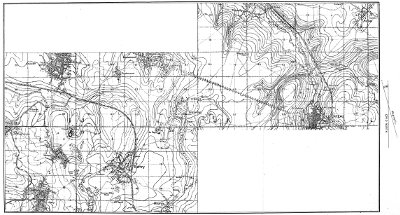
183The speed of the advance, indeed, was now beginning to make
itself felt; ammunition and food supply became a most serious
problem, and on this day (October 9th) tremendous difficulty was
met with by the wagon-lines in keeping touch with their firing batteries
without either crowding upon or losing all sight of them. The day,
with its eight mile advance and the occupation of three successive
positions, laid a heavy strain upon all the wagon-lines which, unable
to move in a direct line across country, had to complete a long march
before they joined up with their guns at Bertry in the evening; yet
throughout this period the guns and detachments were never without
ammunition and food, a fact which compares very favourably with
the batteries of the United States army which in some cases, being
without food, were completely unable to keep up with the advance.
There was another and most novel proof of the pace at which the line
was pushing forward; on entering Clary and Bertry the infantry
and guns were met by cheering French civilians who, in their exultation
at the departure of the enemy after so many weary years, rushed
to greet our troops with an outburst of joy—quite embarrassing!
Unable to cope with the rapidity of the attack the Germans had
allowed these people to stay behind, and in their excitement at this
unexpected relief they vented their delight upon the British troops
in the most amazing and whole-hearted manner.
Seven o'clock on the morning of the 10th saw all batteries on the
move again, supporting an advance by the 98th Infantry Brigade,
assisted by cavalry, upon the bridgeheads east of the River Selle
between Neuvilly and Montay. This was a great day for the guns
and, indeed, for all the troops concerned, for the advance was carried
out according to the true style laid down in the drill book for open
fighting. Cavalry patrols in front, infantry following on, batteries
first in "battery column" and then manœuvring into line, the whole
countryside around Troisvilles presented the amazing spectacle of
vast masses of troops moving steadily forward exactly as though on
an Aldershot field day. The 156th Brigade lay on the right of the
162nd, and together the two brigades manœuvred up to the crest of
the hill which commanded the crossing of the Selle. By 8.0 A.M. the
infantry were within 800 yards of the river, where they halted until
such time as the Divisions on the right and left had come up into line,
and by the same hour the batteries had pushed through Troisvilles
to a point midway between that village and Le Cateau, from which
positions they vigorously shelled hostile batteries and machine guns.
In addition to the delay on the flanks, the enemy on the immediate
front was showing clear signs of increased resistance. Several field
batteries had come up and were firing over open sights at the infantry,
while our own batteries, as they neared the crest of the hill, came under
very heavy shell fire. With ammunition wagons detached, however,
the guns pressed on under severe fire and reached the crest whence,
over open sights, they were able to assist the infantry in no small
measure, and throughout the day continued to engage hostile troops
184and movement of every description. At the same time the German
batteries rendered our positions very uncomfortable with 77 mm.
and long-range fire, while the teams which went back to Troisvilles
to water found the village congested with cavalry, artillery and
infantry pack horses, all of whom suffered severe casualties through
being spotted by an enemy aeroplane which called down a shell-storm
upon the entire village.
The whole of the 10th was spent in registration, harassing
fire and counter-battery work, D/156 and D/162 engaging with
great success four hostile batteries in action on the forward slopes
of the high ground east of the River Selle. Many enemy machine-guns
and snipers also demanded the attention of the guns, and so,
despite fairly active artillery fire on the part of the enemy, the
batteries were kept busy until 5 P.M.; at that hour a barrage was
fired to cover the 98th Infantry Brigade in an attempt to cross the
river and to form bridgeheads on the crest of the hill to the north-east,
in conjunction with the 17th Division on the left.
This attack met with considerable opposition as the River
Selle formed a most important part of the enemy defensive line,
and nowhere was an advance made beyond the railway. Night
fell with the enemy still holding the high ground, and brought with it
a most unpleasant time for the batteries. Without cover of any sort
or description, lying out in the open and being consistently shelled
with 77 mm. and 4·2 in., the detachments awaited the dawn, when
it was hoped that this stand on the part of the enemy might be
broken down.
Dawn, however, brought no further success, but on the contrary
a temporary reverse. The 98th Infantry Brigade at 10.15 A.M.
reported that it had been counter-attacked and now only had
two posts on the eastern side of the Selle; the 162nd Brigade was
accordingly detailed to look after the troops across the river, while
the remainder of the artillery covering the infantry were left to fire
on observed targets and to engage all movement and all possible
hostile batteries. The latter during the morning were quiet, but
from 2.0 P.M. until 4.0 P.M. a very considerable bombardment of
5·9 in., 4·2 in. and 77 mm., mainly from the Ovillers direction,
descended upon the whole area occupied by the batteries.
No further move was now made until 5.0 A.M. on the 12th when
the 100th Infantry Brigade assaulted the high ground east of the
river, the objective being the line of the road running from Amerval
to the outskirts of Montay. No creeping barrage was utilised in
this attack, the batteries firing on selected and observed targets
throughout the day. By 8.0 A.M. the left battalion was reported
185to have gained its objective in spite of strong enemy opposition, but
the right battalion was held up by machine-gun fire from the river.
An early morning mist rendered observed artillery fire—the only
kind of any use at the moment—impossible, and not till the middle
of the day could anything be done. Excellent work was then carried
out by the batteries but came too late, for by then the left battalion
had been forced back to the railway by strong enemy counter-attacks;
evening found our troops, in spite of stubborn fighting and most
gallant resistance, back to the west of the river whither they had been
driven by superior numbers of the enemy, only a few posts remaining
on the eastern bank.
With S.O.S. lines along the railway, both brigades now began
a period of continuous harassing fire on all enemy strong points
and communications, with synchronised bombardments on areas of
especial importance. A lull in the infantry action had set in, but
it was essential that the enemy should have no chance of organising
his front or improving his defences, and to prevent this the full
powers of the batteries were called upon. From October 13th to
the 20th under the control of the C.R.A. 38th Division (which had
relieved the 33rd on the 13th) the guns bombarded the railway,
the hostile trenches and batteries, the ravines east of the Selle and
every possible point which might be utilised by the enemy. Gas was
fired nightly into the ravines, every hostile effort to put out wire was
nullified, and two 6 in. trench mortars were brought into position
to help in the bombardment. The result of this firing, although not
apparent at the time, was clearly shown later when the batteries,
on advancing, found the railway embankment covered with the
bodies of dead Germans, all of whom had obviously, from their
mangled state, been killed by shell fire. Daily the enemy replied
to this activity by shelling the forward and battery areas, but the
initiative had passed for ever into the hands of the British Army,
and the lull, although of a week's duration, was but a temporary
measure. On October 20th Byng struck with seven divisions in an
attempt to capture the Selle line north of Le Cateau to Denain,
five miles from Valenciennes, and the 38th Division, covered by a
barrage from the guns, assaulted and captured by 10.0 A.M. the
high ground between Forest and the Selle as its share of the operation;
this, together with victories on other parts of the 3rd Army front,
left the way clear for a further general advance.
Next day (21st) the expected orders to resume the advance
were received. A general assault by the 3rd and 4th Armies was
planned, the objectives of the 33rd Division being Wagnonville and
Poix-du-Nord; the attack was to be on a grandiose scale, tanks
186assisting the infantry, while in addition to the 156th and 162nd
Brigades the whole of the 38th Divisional Artillery and the 223rd
Brigade R.F.A. (Naval Division) were to form the creeping barrage
behind which the infantry would move forward. Two 6 in. trench
mortars were allotted to each infantry brigade, the 6 in. howitzers
of the V. Corps Heavy Artillery were detailed to bombard selected
targets and engage in counter-battery work, and one 18-pdr. battery
of the 162nd Brigade was placed at the disposal of the G.O.C. 19th
Infantry Brigade.
In order to cover the Ovillers Slaughter House road for this
attack the 156th Brigade moved to within 1,000 yards of the Selle,
north-west of Montay. From here all necessary points were registered
during the 21st/22nd, and on the 22nd every battery sent forward
a reconnoitring party to examine the approaches to and crossings
of the River Selle. This was to be no local attack but an operation
on the very largest scale with tremendous issues hanging in the
balance, for it marked the beginning of the destruction of the new
water front, the Scheldt and the Sambre Canal, which the enemy
was seeking to hold, and the start of the last of the great conflicts
in the west. No precaution was to be overlooked, no step left
untaken which in any way might assist in bringing success to this
great combined effort further to hurl the enemy back towards his
frontiers.
During the night of the 22nd/23rd the infantry of the 33rd
Division relieved the 38th, the C.R.A. 33rd Division taking over
control of the guns, and at 2.0 A.M. on the 23rd the attack was
launched behind a creeping barrage with the 98th Infantry Brigade
on the right, the 19th on the left. By 4.30 A.M. the 1st Middlesex
were in Forest, and the 4th King's had passed through their lines
and were pushing on towards the next objective; an hour later
B/156 with one section of D/156 crossed the Selle and followed up
the leading battalion of the 98th Infantry Brigade with whom
they kept in close touch throughout the day, and by 6.45 A.M. both
artillery brigades had crossed the Selle, the 156th shortly afterwards
taking up positions 1,000 yards west of Croix, the 162nd dropping
into action west of Forest.
Meantime the infantry, in face of strong opposition, were pushing
slowly on, and by 10.30 A.M. were lining the Croix-Vendegies road
ready for the next advance. Before this took place the guns of the
162nd Brigade again moved up, this time to Richemont, while
C/156 pressed on nearly to Croix. So successful was the attack,
however, that the batteries found themselves being left too far behind,
and accordingly at 12.30 P.M. the 162nd Brigade again advanced
its guns in close support of the infantry and came into action 1,000
yards north of Croix. Here it remained throughout the rest of the
day, neutralizing machine-gun fire and generally assisting in every
possible way the infantry who were slowly making their way through
Vendegies Wood.
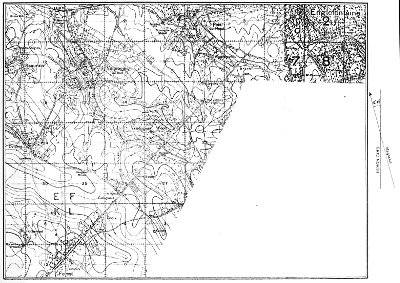
187By 5.0 P.M. the British line ran approximately along the northern
edge of the wood, and here the advance was stayed for the night,
the 156th Brigade, who had occupied the same positions since before
midday, pushing up to an area 1,000 yards north of Croix where
it remained throughout the hours of darkness. The day had been
a complete and overwhelming success all along the line, and the
batteries, after sixteen hours of continuous fighting and advancing,
were thankful to snatch a short rest. The strain had been great,
nor had the victory been won without loss; all batteries had suffered
to a more or less marked extent, but in particular must be mentioned
the tragic and yet glorious death of Lieut.-Colonel B. A. B. Butler.
While riding up from his headquarters at Richemont to visit the
batteries he was severely wounded and died the same evening, a
loss which the 156th Brigade could ill afford. Elsewhere has been
related the story of his gallantry during the enemy offensive, and
in the advance of the British line his courage and example were
no less marked. His death robbed the Brigade of a friend and a
leader than whom a better could not be found, and with victory
almost in sight it seemed doubly hard that he should not have
survived to share in it.
On the 24th at 4.0 A.M. the advance on Englefontaine was
resumed, Major W. G. Sheeres, M.C., taking over command of the
156th Brigade. Heavy bursts of fire were put down in front of the
infantry under cover of which they moved forward towards Paul
Jacques Farm and Wagnonville, and at dawn, although all ranks
were now very exhausted, the batteries began to advance. At
6.0 A.M. the 162nd Brigade had reached the southern outskirts of
Vendegies and was directing fire upon the eastern outskirts of Poix-du-Nord,
where the enemy was reported to be retreating. By
8.0 A.M. the same brigade had again advanced to a position in
observation 1,000 yards further on, the 156th Brigade reaching the
edge of the Bois de Vendegies one hour later. From here harassing
fire was kept up on the approaches to Englefontaine, while A/156
kept in close touch with the leading battalion of infantry. News
was then received that, after the overcoming of strong opposition,
Wagnonville had been captured and Englefontaine itself was being
rapidly threatened. Upon receipt of this information further battery
positions were hastily reconnoitred and all the guns were moved up,
188the 156th Brigade coming into action between Poix-du-Nord and
Wagnonville, the 162nd Brigade in Poix-du-Nord itself.
As events turned out, the infantry were held up between Poix-du-Nord
and Englefontaine, and the latter was accordingly kept
under the fire of the guns. All through the night of the 24th/25th
and during the day of the 25th the exits from the village were
continually bombarded, and at 1.0 A.M. on the 26th an attack was
carried out by both infantry brigades of the 33rd Division under
cover of a thick barrage in which ten per cent. of gas shells were
used. The programme for this barrage was worked out almost
entirely by Brig.-General G. H. W. Nicholson who, depleted of his
staff by "Spanish influenza" and other causes, tackled the work
single-handed and with such skill that the operation was a complete
success. Five hundred prisoners and many machine-guns were
taken, and with the fall of the village one battery of the 162nd
Brigade pushed forward to a previously reconnoitred position from
which close support of the infantry was possible.
From the 26th until the end of the month the batteries remained
in the same positions, and it was well that this was so, for the so-called
Spanish influenza was now raging in both brigades. It was
believed that this epidemic had been contracted through sleeping in
dug-outs and barns recently occupied by the enemy who was known
to be suffering from it very badly, but whatever the cause it handicapped
the guns to a marked extent. At one time the brigade
commander and all four battery commanders of the 162nd Brigade
were down with the disease, but despite this counter-preparations
were fired morning and evening to break up any would-be counter-attacks
by the enemy, while frequent gas concentrations were fired
into the hostile lines. On the 29th a successful "mopping-up" of
houses on the Englefontaine-Bavai road was carried out by the 17th
R.W.F. (the 38th Division had relieved the 33rd on the evening of the
26th), and on the 29th/30th there came to the weary batteries a short
relief. On that night the 122nd Brigade R.F.A. "took over" from
the 162nd who marched back to Bertry for a 72-hour rest, to be
followed two nights later by the 156th Brigade.
For over six long weeks the batteries had been fighting, advancing
and fighting again, covering in all a depth of 30 miles and never once
enjoying rest of any kind. Upon Brigade and Battery commanders
there had been the constant strain of dealing with the ever-arising
fresh situations, and of keeping in close touch with the infantry in
every stage of the advance; amongst all the battery personnel there
had been no rest, no respite from unending firing, marching and
enemy shelling, while the wagon-lines had been hard put to it each
189day to keep touch with the gun lines in every move and to keep them
fully supplied with ammunition. It is scarcely surprising, then,
that officers and men were dropping with fatigue when the orders
for a 72-hour rest were received, yet so high was the morale of the
troops at the time and so inflamed were all with the sense of victory,
that grudgingly did they give up their share in the battle and move
back to the quieter surroundings of Bertry.
They need not have feared, however, that they would be long
left out of the line. The so-called 72-hour rest, although achieved
by the 162nd Brigade, was reduced in the case of the 156th to one
of twenty-four hours, and November 2nd saw both brigades back
into action once more. A great combined attack by the 1st, 3rd
and 4th Armies, together with the 1st French Army, was about to
be launched upon the formidable defences of the Sambre, the great
Mormal Forest and the fortifications of the town of Le Quesnoy, and
to take part in this the two brigades were ordered to cover the line
due east of Englefontaine from positions in the western outskirts of
Poix-du-Nord (156th Brigade) and from Wagnonville (162nd Brigade).
These positions they occupied in the afternoon of November 2nd,
Lieut.-Colonel C. E. Boyce temporarily commanding the 156th Brigade,
and Colonel Pim (who was wounded next day and succeeded by Major
Vaughan-Hughes) the 162nd in place of Lieut.-Colonel Warren.
Before any further details of the fighting are entered upon, a
word of explanation is called for with regard to this chapter. Hitherto
a careful chronicle of the events of each day has been given, the
movements of the batteries being followed in detail. As a result,
perhaps, of this strict attention to tactics the personal element has
found itself excluded, the interest of the chapter being in the main
historical. Yet this is unavoidable; in one short chapter must be
described the whole of that brilliant advance from September 16th
until November 11th, with all its attacks, its changes of position and
forward marches. To digress from this and enter upon personal
narratives must inevitably destroy the continuity of the story, and
moreover, another difficulty has to be faced. In those days no
battery had time to think of the doings of any other guns save of
its own; no battery had really sufficient time to think and record
what it was doing itself, and therefore, were stories of individual
exploits narrated in these pages, only a particle could be put down
and many as deserving of mention would have to be left untold.
On frequent occasions every battery of both brigades performed
brilliant exploits in galloping forward guns to a level with the most
advanced infantry and in shooting upon the enemy over open sights
at almost point-blank range; on frequent occasions batteries had
190to pass through shell-storms to drop into the positions chosen for
them, and had to maintain effective covering fire under the full
weight of an enemy bombardment, but each and all did it in turn
and the singling out of any one in particular would be invidious.
All eight batteries took an equal share in this wonderful advance,
and the valour of their work can best be appreciated by an account
of the battles in which they were engaged.
On November 2nd the brigades had come back into action;
November 3rd was spent in reconnoitring advance positions and in
maintaining close co-operation between the infantry and the guns,
and on November 4th began the great attack on the Forêt de Mormal.
At 6.15 A.M. under a creeping barrage the 38th Division moved
forward to the assault, and for two hours the guns continued to
maintain a curtain of fire in front of the infantry as they pushed
their way on towards the objective. At 8.15 A.M. both the 156th
and 162nd Brigades began to advance, one battery at a time, to
positions already chosen east of Englefontaine, and by adopting this
procedure the continuity of the barrage was in no way interrupted,
the rear positions maintaining a brisk rate of fire until a proportion
of guns had reached the forward positions and had begun to carry
on the work from there. The 162nd Brigade successfully reached the
new positions, although heavily shelled on the way, but the 156th
was prevented from doing so by intense machine-gun fire, which
mere fact alone goes to show how closely the batteries were following
up the infantry. Only A/156 was able to get through, the remainder
having to drop into action temporarily to the west of the village,
but after a time the machine-gun fire slackened and the move was
completed, the whole of the 156th Brigade lying 1,000 yards south-east
of Englefontaine in the outskirts of the Forêt de Mormal and
close alongside the 162nd Brigade.
From here the barrage was continued until 3.0 P.M., when the
final objectives were reached. Positions were then reconnoitred
3,000 yards further forward, and at dusk all batteries advanced again.
Great difficulty was now experienced as numerous trees had been
felled across the roads which had, in addition, been blown up, but
by 8.0 P.M. all batteries were in action again in the reconnoitred
positions around a carrefour or meeting of roads in the forest. The
state of the roads, in point of fact, prevented the moving up of any
heavy guns except the 60-pounders, the six-inch howitzers being
compelled to remain halted far behind until some sort of track had
been repaired for them.
During the night of the 4th/5th the batteries again moved
forward and were deployed along the Sassegnies-Ribaumet-Sarbaras
191line, covering the River Sambre, while the infantry of the 33rd
Division relieved that of the 38th. At 4.30 A.M. the advance began
again, and each battery immediately sent one section forward to
keep in touch with the battalion commanders. These sections
pushed on through La Grande Pature and took up positions east of
Sarbaras which gave easy command of the crossings of and ground
beyond the River Sambre, and from which very successful observed
fire was carried out, much enemy movement being engaged. In the
meantime the remainder of the batteries hurried forward as fast as
possible, but great delay was caused by congestion on the roads and
by mine craters and felled trees. Not until noon had all the batteries,
in extremely wet weather, made their way through the Forêt de
Mormal, but by that time they were in action east of Sarbaras and
bombarding the ground beyond the Sambre with the utmost vigour.
This day, Tuesday, November 5th, marked the final breaking
of the enemy's resistance. With the two wings of his army separated,
with the Siegfried and Brynhild zones overrun, he was no longer in
retreat but in full flight, and during the afternoon of the 5th a careful
reconnaissance of the routes forward and of the crossings over the
Sambre was carried out, for the rout of the enemy might enable
a crossing to be effected at any moment. During the night of the
5th/6th the enemy retired to the east of the river and the 162nd
Brigade was ordered to follow him, the 156th being told to remain
in their present positions to the west. Night and day the enemy
kept the bridgeheads under the most intense shell and machine-gun
fire, and entirely prevented the Sappers and the battery working
parties from repairing the bridges sufficiently for the guns to get
across. Ultimately, at dawn on the 7th, a rough structure had been
thrown up, and the batteries began to move over the river. On the
previous evening a reconnaissance of the approach to the bridge
had been made by Major Taylor and Captain Heads, and it was found
that the proper approach had been hopelessly blocked. The batteries,
when they did advance, had to move down a steep, winding and
very narrow track, while the only route on the eastern side of the
river was a tortuous towing path and necessitated the cutting of
gaps in hedges and the manhandling of guns across rivulets and
swamps—a very difficult task.
D/162 was the first battery actually to cross the Sambre, but
it was so closely followed by A/162 that the latter got into action
first, dropping its gun trails just west of Pot de Vin at the moment
when the infantry were assembling along a sunken road for the attack
on the village. The gratitude of the infantry for this close support
by the artillery was very marked, and several of their officers came
192up to the batteries to express their thanks, for they knew with what
difficulty and at what a cost this advance of the guns close under
the enemy's nose had been effected. "B" and C/162 were prevented
for some time from crossing the river, for an infantry wagon broke
down right in the middle of the bridge shortly after "A" battery
had got over, but after a delay of about two hours the whole brigade
was across the last barrier and, despite severe casualties suffered in
the operation, was supporting the infantry to the full extent of its
power. November 7th was the last real fighting day of the war on
this part of the front, but it was none the less a very nasty day,
and in every battery a certain number of casualties were suffered.
The enemy was putting up a stiff resistance for he was trying to bar
to us the road to Namur, but his was only a forlorn hope and did
little more than to slow down slightly our rate of advance.
From this date onwards the only batteries of the 33rd Divisional
Artillery to the east of the Sambre were those of the 162nd Brigade,
as the 156th Brigade had not been called upon to advance. In
fact, the 162nd Brigade shared with the 169th Army Field Artillery
Brigade the distinction of being the only guns across the river on
this section from the 6th until the conclusion of hostilities.
On the 8th, even while a little group of men were sitting round
a table in the Forest of Compiègne discussing the terms of Armistice,
the infantry of the 38th Division advanced to the Maubeuge-Avesnes
road and later to the Bois de Beugnies, supported as far as possible
by the 162nd Brigade which pushed on beyond the cross-roads north-west
of Dourlers. On the 9th the enemy retreat became general;
the infantry followed up as far as Wattignies, and "B" and C/162
moved into action 1,000 yards west of the village, "A" and "D"
batteries remaining at Dourlers. Saturday, the 9th, was in fact the
last day of the war for the 33rd Divisional Artillery. In the early
morning of that day the 162nd Brigade fired upon the enemy rearguards—the
156th were already out of the battle—and reconnoitred
forward as far as Wattignies where the infantry had halted. Small
patrols of cavalry pushed further on to try and establish contact with
the rearguard of the German army, and desultory machine-gun fire
could be heard every now and then away in the distance, but to all
intents and purposes the enemy had completely vanished and
nowhere could our troops get into contact with them.
On November 10th came orders for the wagon-lines to join up
with the guns and for all four batteries of the 162nd Brigade to remain
in a position of readiness between Dourlers and Ecuelin. To the east
all the bridges had been blown up by the retreating enemy, and
pursuit by the batteries was utterly impossible. Moreover, it was
193known by all ranks that German plenipotentiaries had passed through
our lines some days before to sue for terms, and the knowledge of that
fact, combined with the utter rout of the enemy on the batteries'
own front, prepared the men for the news which was shortly to come.
At 9.0 A.M. on Monday, November 11th, 1918, came the news
that the war was over. In the Wattignies sector the order to break
off hostilities did not come, as many accounts strove to describe it,
in the midst of the battle, with raging gun-fire at one moment and
our troops all shouting and waving their helmets at the next. The
orders merely confirmed what already was known and anticipated,
and although, when the message from G.H.Q. was read out to the
assembled batteries, there was such cheering as comes from deep
down in the heart, the occasion was far too great to be grasped in
a single moment, and the gunners, as soon as the parade was over,
set off to play a football match against the infantry! Such an
attitude of mind must have seemed inexplicable to onlookers of other
nationalities who could not understand the temperament of the
British soldier, yet in a way the action was only natural. The Great
Pursuit was over; nay, more, the war, the terrible nightmare of four
years, was finished. How could the realisation of such a mighty
event be grasped in a moment by men who for months and years
had been hourly awaiting death, and now saw death pass from
them?
CHAPTER XII. FINALE.
194
And so the work is done, the record finished. In all humbleness
the pen was taken up to chronicle the deeds of these men; in all
humbleness it is laid down again with the closing of the story. In
mere bald words it has been impossible to describe the wonderful
gallantry, the grand determination and the final success over insuperable
difficulties which typified the men of the 33rd Divisional
Artillery. The true tale of their heroism, of their suffering and
sacrifice can never really be understood by any save those whose
privilege it was to be a witness thereof, but the story of the battles
in which they took part may perhaps convey a small idea of the
glory of their war record.
In December, 1915, they had their first experience of active
service; in November, 1918, the last "Cease Firing" sounded and
their work was accomplished. In all those ten hundred and fifty
days of war the batteries were in the line for over eight hundred days,
and these figures offer perhaps the most striking testimonial that
can be given of their work. They had been at one time the extreme
right-hand unit of the British line, on another occasion at Nieuport
they guarded the extreme left. On April 9th, 1917, the guns of
one of the brigades were the first of the whole line to follow up the
enemy in every successive advance; in November, 1918, they were
the first guns to cross the River Sambre. All along the British
front they fought, at Nieuport, amid the grim horrors of Passchendaele
and Ypres, at Kemmel, Givenchy, Cambrin and Arras; in
the ruins of Hebuterne and the wilderness of Gommecourt, High
Wood and Delville Wood; in the sea of mud round Bouchavesnes
and in the Somme marshes. In the dark days of early 1918 they
held with glorious obstinacy and determination the gate of the
north; in that wonderful autumn of the same year it was the 33rd
Divisional Artillery who took part in that mighty onslaught which
flung the enemy back upon his frontiers and ultimately forced him
to ask for peace. At this point it would have been gratifying to
have been able to record in fuller detail the individual services of
195various officers and men who were especially connected with the
doings of the brigades and batteries during the war, yet to attempt
to do such a thing is well-nigh impossible. Each and all contributed
their share, each and all played a noble part, and who is to judge
as between man and man in the scorching fires of battle? Elsewhere
has been described the great work done by Colonel Frederick Hall,
whose sheer determination and personal endeavour got all the
batteries out to France within eleven months of the date of their
first recruitment—a record probably unequalled by any other New
Army unit. Already mention has been made of Brig.-General C. F.
Blane who took the brigades out to France and initiated them in
the rigours of active service; of Lieut.-Colonel Rochfort-Boyd who
led the 156th Brigade in the earlier days, and of Lieut.-Colonel
O. M. Harris who commanded so gallantly the 162nd; of Colonel
A. H. S. Goff and Lieut.-Colonel L. T. Goff, and of Brig.-General
C. G. Stewart who succeeded General Blane as C.R.A. of the Division.
Already we have spoken of Lieut.-Colonel Butler and Lieut.-Colonel
Skinner, the two Brigade Commanders of the latter period of the
war, and of Brig.-General G. H. W. Nicholson who controlled the
batteries in the final victorious advance in 1918. Yet memory still
teems with the names of many others, for who is there from out of
all the batteries who is not also worthy of mention? Major Johnston
and Major Bennett, both killed on the Somme; Captain Heap and
Lieut. Tucker who died at Arras; Majors Studd, Barstow and
Fetherston who were never away from the Divisional Artillery for
long; Taylor, Sheeres and Heads of the 156th Brigade, Warr the
"Mayor of King's Clere"; Benett-Stanford and van Straubenzee
of the 162nd Brigade; Cory and Pavitt, Lutyens and Hill, Talbot
and Bruce, Turner and Barnes; Gallie who died at Passchendaele,
Colonel Johnson and Captain Rhodes of the D.A.C., both killed at
Zillebeke. There is no end to the names of those who should be spoken
of, since for every name mentioned at least three more immediately
present themselves to the mind. One and all did their best, and
better than that no man can do.
To follow the movements of the 33rd Divisional Artillery after
the Armistice would indeed seem an anti-climax, and yet, just as
the story has been told of its first formation, the gradual evolving
of a unit of artillery from the original raw mass, so must the final
days be recorded until the date when the men cast from them the
apparel of war and returned to civilian life once more, men who had
for ever deserved from their country the full rights of Citizenship.
From November 11th until the 14th the batteries remained in the
areas they had been occupying when hostilities ceased, and on the
19614th they turned their faces towards the west and began to retrace
their steps over the scenes of the late fighting. It was not decreed
that they should take part in the occupation of Germany, and
accordingly they marched back through Forest, Bertry and Clary
to billets in Villers Outreaux (156th) and Lesdain (162nd). Here
they remained until December 6th and here, or rather at Crevecoeur
near by, was held on November 22nd a thanksgiving service at
which officers and men were decorated for gallantry in the fighting
now past and done with; here also the men were visited by His
Majesty the King who had come over to France to thank in person
his victorious troops, and on December 6th began the six-day march
to the last rest billets which the men were to occupy in France.
Two routes were followed, one by each brigade, and, as mile
after mile rolled by, the batteries turned their backs once and for
all upon ground which for them held memories that can never be
effaced. Through Tincourt and Manancourt, past Riencourt and
Méaulte where they had assembled before moving into the Somme
battle of 1916, through Blangy-Tronville and Pont Noyelles, Le
Mesge and Picquigny, on beyond Selincourt and St. Maulvis they
marched until at last they reached their permanent billets around
Brocourt-Liomer, Inval Boiron and Hornoy. Here they stopped
and here, for many weeks, they passed the time in educational
schemes, in physical training and recreation until such time as
authority should permit of their return to civil life once more.
All through the war demobilisation, a return to England, to
Peace with no threat of war hanging over their heads, had seemed
to these men a wonderful dream which could never come true by
any possibility, which was so far removed from the order of things
as to be something quite intangible and incredible. It seemed
that the war must still be in progress beyond the eastern horizon,
that soon they must be flung into the scorching fires of battle again,
that this talk of a return to England for ever was fantastic, imaginary—a
trick of their brains. Yet even this most wonderful of events
did actually occur; in March, 1919, all units were reduced to
"Cadre A," the surplus men being sent to the Base for demobilisation,
in May a further 25 per cent. of these cadres was dispatched
home, and in the second week of June only an equipment guard
remained with each battery.
In July these last remnants of the 33rd Divisional Artillery
departed from the land of France which owed to them so much.
All through the first week of the month the skeletons of the batteries
entrained and moved to Havre, and the 9th found them in that
port waiting for a ship to carry them home. On Thursday, the
19710th, the 156th Brigade embarked for Southampton, on the 12th
and 17th the D.A.C. followed, and on Sunday July 27th, 1919, the
162nd Brigade, last remaining unit of the 33rd Divisional Artillery,
watched the quays and houses of Havre glide slowly by as the ship
gathered way and headed for the coast of England.
Thus the Brigades left France and set foot in England again,
their work accomplished, the battle won. Camberwell turned out
and gave right royal welcome to its Gunners when, a few days later,
they marched as victors through the crowded streets; and well
might it be so, for they had returned with such glory as can hardly
be believed of mortal man. Several days did the people spend in
rejoicing and in welcoming their citizen-soldiers home once more,
days in which the pangs and miseries of those dark times of watching
and waiting were put aside and forgotten. Yet in all those festivities,
beneath all the laughter and song of that week there was for ever
present the divine and sacred memory of those whose good fortune
it had not been to return from the battle, of those many hundreds
who had died in the service of the guns of the 33rd Division and
who lay in soldiers' graves along the length and breadth of the far-flung
battle line. Their example, their sacrifice must stand for all
time as a memorial and a constant reminder to those who come after
of the price which has been paid that they may live, and there will
ever remain to those who mourn the loss of many whose places can
never be filled, the proud memory of their heroism and endurance,
the glad knowledge of a man's part nobly played.
"Their seed shall remain for ever and their glory shall
not be blotted out. Their bodies are buried in peace;
but their name liveth for evermore."


