Tools and utensils, as emblems of trade, were certainly placed
outside houses at an early period, to inform the illiterate public
of the particular trade or occupation carried on within. Centuries
ago the practice, as a general rule, fell into disuse, although a
few trades still adhere to it with laudable perseverance: thus a
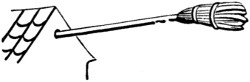
broom informs us where to find a sweep; a gilt arm wielding a
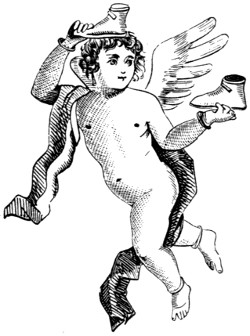
hammer tells us where the gold-beater lives; and a last or gilt
shoe where to order a pair of boots. Those houses of refreshment
and general resort, which sought the custom of particular trades
and professions, also very frequently adopted the tools and emblems
of those trades as their distinguishing signs. At other
houses, again, signs were set up as tributes of respect to certain
dignities and functions. Amongst the latter, the King’s Head and
Queen’s Head stand foremost, and none were more prominent
types than Henry VIII. and Queen Elizabeth, even for more than
two centuries after their decease. Only fifty or sixty years ago,
there still remained a well-painted, half-length portrait of bluff
Harry, as a sign of the King’s Head, before a public-house in
Southwark. His personal appearance, doubtless, more than his
character as a king, were at the bottom of this popular favour.
He looked the personification of jollity and good cheer, and when
the evil passions, expressed by his face, were lost under the
clumsy brush of the sign-painter, there remained nothing but a
merry, “beery-looking” Bacchus, eminently adapted for a public-house
sign.
A very respectable folio might be filled with anecdotes connected
with the various King’s Head inns and taverns up and down
the country and in London—some connected with royalty, others
with remarkable persons. Thus, for instance, when the Princess
(afterwards Queen) Elizabeth came forth from her confinement in
the Tower, November 17, 1558, she went into the church of All
Hallows, Staining, the first church she found open, to return
thanks for her deliverance from prison. As soon as this pious
duty was performed, the princess and her attendants went to the
King’s Head in Fenchurch Street to take some refreshment, and
there her Royal Highness dined on pork and peas. A monument
of this visit is still preserved at the above house in an engraving
of the princess, from a picture by Hans Holbein, hung up in the
coffee-room; and the dish from which she ate her dinner still
remains, it is said, affixed to the kitchen dresser there. There is
a tradition that the bells of All Hallows were rung on this occasion
with such energy, that the queen presented the ringers with
silken ropes.
A more painful association is connected with another King’s
Head:—
“In a secluded part of the Oxfordshire hills, at a place called Collins
End, situated between Hardwicke House and Goring Heath, is a neat little
rustic inn, having for its sign a well-executed portrait of Charles I. There
is a tradition that this unfortunate monarch, while residing as a prisoner
at Caversham, rode one day, attended by an escort, into this part of the
country, and hearing that there was a bowling-green at this inn, frequented
by the neighbouring gentry, struck down to the house, and endeavoured to
forget his sorrows for a while in a game at bowls. This circumstance is
alluded to in the following lines, written beneath the signboard:—
“Stop, traveller, stop, in yonder peaceful glade,
His favourite game the royal martyr play’d.
Here, stripp’d of honours, children, freedom, rank,
Drank from the bowl, and bowl’d for what he drank;
Sought in a cheerful glass his cares to drown,
And changed his guinea ere he lost his crown.”[444]
The sign, which seems to be a copy from Vandyke, though much
faded from exposure to the weather, evidently displayed an
amount of artistic skill not usually met with on the signboard;
but the only information the people of the house could give was,
that they believed it to have been painted in London. His son,
Charles II., is also connected in an anecdote with a King’s Head
Tavern, in the Poultry, for it is reported that he stopped at this
inn on the day of his entry at the Restoration, at the request
of the landlady, who happened just then to be in labour, and
wished to salute his majesty. Mrs King, the lady so honoured,
was aunt to William Bowyer, “the learned printer of the
eighteenth century.” In Ben Jonson’s time there was a famous
King’s Head Tavern in New Fish Street, “where roysters did
range.” It is this tavern, probably, that is alluded to in the
ballad of “The Ranting Wh——’s Resolution:”—
“I love a young Heir
Whose fortune is fair,
And frollick in Fish Street dinners,
[307]
Who boldly does call,
And in private paies all,
These boyes are the noble beginners.”[445]
At the King’s Head, the corner of Chancery Lane, Cowley the poet
was born in 1618; it was then a grocer’s shop kept by his father.
Subsequently it became a famous tavern, of which tokens are
extant. It was at this house that Titus Oates’s party met, and
trumped up their infamous story against the Roman Catholics,
trying to implicate the Duke of York in the murder of Sir Edmundbury
Godfrey. In the reign of William III., it was a
violent Whig club. The distinction adopted by the members was
a green ribbon worn in the hat. When these ribbons were shown,
it was a sign that mischief was on foot, and that there were secret
meetings to be held. North gives an amusing and lively description
of this club:—
“The house was double balconied in front, as may be yet seen, for the
clubsters to issue forth, in fresco, with hats and no perruques, pipes in their
mouths, merry faces and diluted throat for vocal encouragement of the
canaglia below, at bonfires, on unusual and usual occasions.”
Here the Pope-burning manifestations were got up, the Earl of
Shaftesbury being president. In opposition to this Green Ribbon
Club, the Tories wore in their hat a scarlet ribbon, with the
words, Rex et Haeredes. Ned Ward, with his usual humour,
describes a breakfast given in 1706 by the master of this house
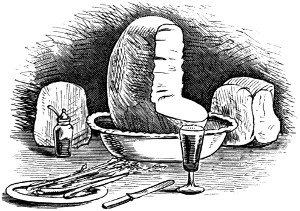
to his customers, consisting of an ox of 415 lb., roasted whole,
and at the same time embraces the opportunity of praising the
landlord as “the honestest vintner in London, at whose house the
best wine in England is to be drunk.” This was probably Ned’s
way of settling an old score.
Another King’s Head is mentioned by Pepys, 26th March
16634:—
“Thence walked through the ducking-pond fields, but they are so altered
since my father used to carry us to Islington, to the old man’s at the Kings-head,
to eat cakes and ale (his name was Pitts,) that I did not know which
was the ducking-pond, nor where I was.”
It was a very different “ducking” in which the landlady of the
Queen’s Head ale-house was concerned, as shown by the following
newspaper paragraph:—
“Last week, a woman that keeps the Queen’s Head ale-house at Kingston,
in Surrey, was ordered by the Court to be ducked for scolding, and was[308]
accordingly placed in the chair and ducked in the river Thames, under
Kingston Bridge, in the presence of 2000 or 3000 people.”—London Evening
Post, Ap. 27, 1745.
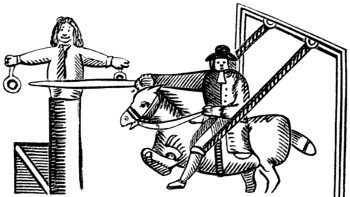
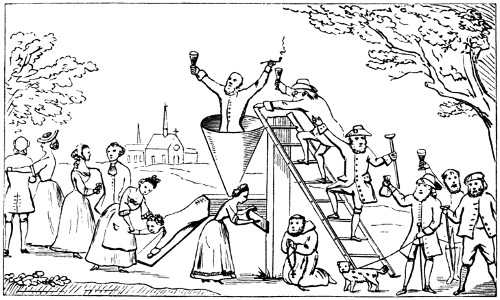
Full particulars of such an operation are given by Misson:—
“They fasten an arm-chair to the end of two strong beams, twelve or
fifteen feet long, and parallel to each other. The chair hangs upon a sort
of axle, on which it plays freely, so as to remain in the horizontal position.
The scold being well fastened in her chair, the two beams are then placed as
near to the centre as possible, across a post on the water side, and being
lifted up behind, the chair of course drops into the cold element. The
ducking is repeated according to the degree of shrewdness possessed by the
patient, and generally has the effect of cooling her immoderate heat, at
least for a time.”
At the King’s Head, Strutton, near Ipswich, about ten years ago,
there was the following inscription:—
“Good people, stop, and pray walk in,
Here’s foreign brandy, rum, and gin,
And, what is more, good purl and ale,
Are both sold here by old Nat Dale.”
Old Nat had lived for a period of eighty years under the shadow
of the King’s Head.
Combinations with the King’s Head are not very frequent. The
King’s Head and Lamb, an ale-house in Upper Thames Street, is
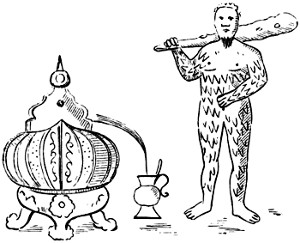
evidently a quartering of two signs. The Two Kings and Still,
sign of Henry Francis in Newmarket, 1667,[446] representing a still
between two kings crowned, holding their sceptres, may have
originated from the distillers’ arms, the two wild men, serving as
supporters, being refined into two kings, the garlands on their
heads into crowns, and their clubs into sceptres.
That Queen Elizabeth was for more than two centuries the
almost unvarying type of the Queen’s Head need not be wondered
at when we consider her well-deserved popularity. A striking
instance of the veneration and esteem in which she was held,
even through all the tribulations and changes of the Commonwealth,
is exhibited in the fact of the bells ringing on her birthday,
as late as the reign of Charles II.:—
“The Earl of Dorset coming to court, one Queen Elisabeth’s birthday,
the king [Charles II.] asked him what the bells rung for? which having
answered, the king farther asked him, ‘how it came to pass that her holiday
was still kept, whilst those of his father and grandfather were no more
thought of than William the Conqueror’s?’ ‘Because,’ said the frank peer[309]
to the frank king, ‘she being a woman, chose men for her counsellors; and
men, when they reign, usually chuse women.’”[447]
During the queen’s lifetime, however, the sign-painters had to
mind how they represented “Queen Bess,” for Sir Walter Raleigh
says that portraits of the queen “made by unskilful and common
painters” were, by her own order, “knocked in pieces, and cast
into the fire.”[448] A proclamation had been issued to that effect,
in the year 1563, saying that:—
“Forasmuch as thrugh the natural desire that all sorts of subjects and
people, both noble and mean, have to procure the portrait and picture of
the Queen’s Majestie, great nomber of Paynters, and some Printers and
Gravers have allredy, and doe daily, attempt to make in divers manners
portraictures of hir Majestie, in paynting, graving, and pryntyng, wherein
is evidently shewn, that hytherto none hath sufficiently expressed the naturall
representation of hir Majesties person, favor, or grace, but for the most
part have also erred therein, as thereof daily complaints are made amongst
hir Majesties loving subjects, in so much, that for redress hereof hir
Majestie hath lately bene so instantly and so importunately sued by the
Lords of hir Consell, and others of hir nobility, in respect of the great disorder
herein used, not only to be content that some special coning payntor
might be permitted by access to hir Majestie to take the naturall representation
of hir Majestie, whereof she hath been allwise of hir own right disposition
very unwillyng, but also to prohibit all manner of other persons
to draw, paynt, grave, or pourtrayit hir Majesties personage or visage for a
time, until by some perfect patron and example the same may be by others
followed.
“Therfor hir Majestie, being herein as it were overcome with the contynuall
requests of so many of hir Nobility and Lords, whom she can not
well deny, is pleased that for thir contentations, some coning persons, mete
therefore, shall shortly make a pourtraict of hir person or visage, to be
participated to others, for satisfaction of hir loving subjects; and furdermore
commandeth all manner of persons in the mean tyme to forbear from
payntyng, graving, printing, or making of any pourtraict of hir Majestie,
untill some speciall person that shall be by hir allowed, shall have first
fynished a pourtraicture thereof, after which finished, hir Majestie will be
content that all other painters, printers, or gravers that shall be known
men of understanding, and so thereto licensed by the hed officers of the
plaices where they shall dwell, (as reason it is that every person should not
without consideration attempt the same,) shall and maye at their pleasures
follow the sayd patron or first portraicture. And for that hir Majestie
perceiveth that a grete nomber of hir loving subjects are much greved and
take grete offence with the errors and deformities allredy committed by
sondry persons in this behalf, she straightly chargeth all her officers and
ministers to see to the observation hereof, and, as soon as may be, to reform
the errors allredy committed, and in the mean tyme to forbydd and[310]
prohibit the shewing and publication of such as are apparently deformed,
until they may be reformed which are reformable.”[449]
That there were signboards, however, representing her Majesty’s
“person, favour, and grace,” during her lifetime, is evident
from the fact that an ancestor of Pennant, the London topographer,
made his fortune as a goldsmith at the sign of the
Queen’s Head, in Smithfield, during the reign of good Queen
Bess.
The irascible Mr Boursault, whose bile was so often deranged
by signboard irregularities, took also sycophantic exception at
royal heads being represented in that way:
“Je souffre impatiemment que le portrait du Roy, celuy de la Reine, de
Monseigneur et des autres Princes et Princesses, servent d’enseignes de
boutiques; eux qui ne devroient faire l’ornement que des plus célèbres
galeries et des plus illustres cabinets. Monsieur d’Argenson et Vous même,
Monsieur le Commissaire, n’auriez-vous pas juste raison de vous facher de
voir vôtre portrait servir d’enseigne à, la Maison d’un cabaretier, ou à la
boutique d’un Fripier; et pourquoi donc ne vous fachez-vous pas de ce que
celui du Roy y est?”[450]
Of celebrated Queen’s Heads we must begin with the highly respectable
inn of that name, in which, before the reign of Queen
Elizabeth, lived the canonists and professors of spiritual and ecclesiastical
law. It was situated in Paternoster Row, where its
name is still preserved in Queen’s Head Alley. From this place
the lawyers removed to Doctors’ Commons.
Nearly as ancient a building was the old Queen’s Head, Lower
Street, Islington, at the corner of Queen’s Head Lane, one of the
most perfect specimens of ancient domestic architecture in the
vicinity of London. It is said that it was built by Sir Walter
Raleigh, after he had obtained “lycense for keeping of taverns
and retayling of wynes throughout Englande,” and that it was
called by him the Queen’s Head in compliment to his royal mistress.
Essex is also said to have resided there, and to have
been visited by the queen. The same tradition is current about
the Lord Treasurer Burleigh. In the reign of George II. it was
used as a playhouse, and bills are still extant of plays acted there
at that period.
It was a strong wood and plaster building, three lofty stories
high, projecting over each other, and forming bay windows supported
by brackets and caryatides. Inside it was panelled with
wainscot, and had stuccoed ceilings, adorned with dolphins,
cherubims, and acorns, bordered by a wreath of flowers. The
porch was supported by caryatides of oak, crowned with scroll-capitals.[451]
This time-honoured structure was pulled down in
October 1829, and nothing of it remains in the new building
erected on its site but the name, the carved oak panels of the
parlour, and a bust of Queen Elizabeth at the top front. A
carved mantelpiece, (formerly in the parlour of the old house,)
with the history of Dian and Actæon on it, (a favourite subject
with the virgin queen,) was sold for more than £60 at the sale
of the building materials, most of which were bought by antiquaries.
There used to be a large pewter tankard in this house, with an
inscription engraved on it, which is much too highly spiced to be
given here. It was signed John Cranch, and bore date 1796.
At the Queen’s Head, Duke Court, Bow Street, the English
language was enriched with two new terms, though one of them
seems to have been still-born. This tavern was once kept by a
facetious individual of the name of Jupp. Two celebrated characters,
Annesley Shay and Bob Todrington—the latter a sporting
man—meeting late in the day at the above place, went to
the bar and asked for half a quartern each, with a little cold
water. In the course of the evening they drank twenty-four,
when Shay said to the other, “Now we’ll go.” “Oh no,” replied
his companion, “we’ll have another, and then go.” This did
not satisfy the Hibernian, and they continued drinking on till
three in the morning, when they both agreed to go; so that
under the idea of going they made a long stay, and this was the
origin of drinking goes; but another preferring to eke out the
measure his own way, used to call for a quartern at a time, and
these in the exercise of his humour he called stays.[452]
In the beginning of this century, when Marylebone consisted
of “green fields, babbling brooks,” and pleasant suburban retreats,
there was a small but picturesque house of public entertainment,
yclept the Queen’s Head and Artichoke, situated “in a lane
nearly opposite Portland Road, and about 500 yards from the
road that leads from Paddington to Finsbury”—now Albany
Street. Its attractions chiefly consisted in a long skittle and
“bumble puppy” ground, shadowy bowers, and abundance of
cream, tea, cakes, and other creature comforts. The only memorial
now remaining of the original house is an engraving in the
Gentleman’s Magazine, November 1819. The queen was Queen
Elizabeth, and the house was reported to have been built by one
of her gardeners, whence the strange combination on the sign.
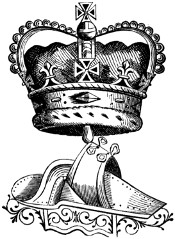
Besides Crowns (see p. 101) other royal paraphernalia are
occasionally used as signboard decorations. The Sceptre is not
uncommon; the Sceptre and Heart was the sign of Samuel
Grover, chirurgical instrument maker, on London Bridge, in the
latter end of the seventeenth century. It is engraved on his shop-bill,
and represents a circle surrounded by fruit and foliage, having
two Cupids standing at the upper corner, and containing in
the centre two palm branches enclosing a sceptre surmounted by
a heart. Round the whole are suspended lancets, trepans, saws,
&c. In all probability it is simply a quartering of two signs.
The Royal Hand and Globe was the loyal sign of a stationer
at the corner of St Martin’s Lane, in 1682.[453] It doubtless refers
to the royal hand holding the golden orb, surmounted by a cross.
It is still the sign of an ale-house near the Soho Theatre. The
same orb or globe seems to be alluded to in the sign of the
Sword and Ball, on Holborn Bridge, in the seventeenth century.
What stands in the way of this explanation, however, is that on
the token of this house the sword is represented piercing the
ball; but this may merely have been a fancy of the sign-painter,
who did not understand its meaning. As for the Sword and
Mace, the meaning is perfectly clear; it is the sign of a public-house
in Coventry.
The Church is almost as abundantly represented as royalty.
Even long after the Reformation the Pope’s Head was still very
common. Nash’s “Anatomie of Absurdities” was printed by T.
Charlwood for Thomas Hacket, and was “to be sold at his shop
in Lumbard Street, vnder the signe of the Popes Heade, 1590.”
Taylor, the Water poet, in his “Travels through London,” 1636,
mentions four Pope’s Head taverns; but the most famous of all
was the Pope’s Head tavern in Cornhill.
“I have read[454] of a countryman that, having lost his hood in Westminster
Hall, found the same in Cornhill hanged out to be sold, which he challenged,
but was forced to buy, or go without it, for their stall they said
was their market. At that time also the wine drawers at the Pope’s Head
tavern (standing without the door in the High Street,)[455] took the same man
by the sleeve, and said, ’Sir, will you drink a pint of wine?’ Whereunto
he answered, ‘A penny spend I may,’ and so drank his pint, for bread nothing
did he pay, for that was allowed free.[456] This Pope’s Head tavern,
with other houses adjoining, strongly built of stone, hath of old time been
all in one, pertaining to some great estate, or rather to the king, as may be
supposed both by the largeness thereof, and by the arms, to wit, three
leopards passant gardant, which were the whole arms of England before
the reign of Edward III., that quartered them with the arms of France
three flower de lys. Some say this was King John’s house, which might
be, for I find in a written copy of ‘Matthew Paris’s History’ that in the
year 1232, Henry III. sent Hubert de Burgh, earl of Kent, to Cornehill in[314]
London, there to answer all matters objected against him: when he wisely
acquitted himself. The Pope’s Head tavern hath a footway through from
Cornhill into Lumbard Street.”—Stow’s Survey, p. 75.
In this tavern, in the fourth of Edward IV. (1464,) a trial of
skill was held between Oliver Davy, goldsmith of London, and
White Johnson, “Alicante Strangeour,” also of London,—the
London goldsmiths being divided into native and “foren” workmen.
These last, though they might be Englishmen, were so named
merely as a distinction with respect to the work they produced,
which consisted frequently in counterfeit articles and bad gold.
The trial consisted in making, in four pieces of steel the size of a
penny, a cat’s face in relief, and another cat’s face engraved, a
naked man in relief, and another engraved, which work was to
be performed in five weeks. Oliver Davy, the native goldsmith,
won the wager, as White Johnson, the foreign workman, after six
weeks could only produce the two “inward engraved” objects.
The forfeit was a crown, and a dinner to the wardens, the umpires,
and all those concerned in the wager. The works were
kept in Goldsmith’s Hall, “to yat intent that they be redy iff any
suche controursy herafter falls, to be shewede that suche traverse
hathe be determyn’d aforetymes.”[457] In Pepys’s time this tavern,
like many others of that period and later, had a painted room.
“18 January 1668.—To the Pope’s Head, there to see the fine-painted
room which Rogerson told me of, of his doing, but I do
not like it at all, though it be good for such a publick room.”
Here in 1718 Quin killed his brother actor Bowen. “On
Thursday s’ennight at night, Mr Bowen and Mr Quin, two
comedians, drinking at the Pope’s Head tavern in Cornhill,
quarrelled, drew their swords, and fought, and the former was
run into the guts; he languished till Sunday last, and then died.
Bowen, before he expired, desired that Mr Quin might not be
prosecuted, because what had happened to him was his own seeking.”[458]
The jury brought in a verdict of manslaughter, and Quin
for the offence was burned in the hand.[459] The quarrel was rather
a foolish one, arising out of a wager which of the two was the
honester man, which had been decided in favour of Quin; inde
iræ. This tavern seems to have continued in existence till the
latter part of the last century.
The emblem of another class of high dignitaries of the Roman
Catholic Church, the Cardinal’s Hat or Cap, was at one time
common in England. Bagford says: “You have not meney of
them, they war set up by sume that had ben saruants to Tho.
Wolsey.”[460] But we find the sign long before Wolsey’s time, for
in 1459, Simon Eyre
“Gave the Tavern called the Cardinal’s Hat in Lumbard Street, with a
tenement annexed on the East part of the tavern, and a mansion behind
the East tenement, together with an alley from Lumbard Street to Cornhill,
with the appurtenances, all which were by him new built, towards a
brotherhood of our Lady in St Mary Woolnots.”—Stow, p. 77.
This tavern and another of the same name, also in Lombard
Street, were still extant in the seventeenth century. It was also
the sign of one of the Stairs on the Bankside, the name of which
is still preserved to that locality in Cardinal Cap’s Alley.
“But at the naked stewes
I understands howe that
The sygne of the Cardinall’s hat
That inne is now shit up.”
Skelton’s Whye come ye not to Courte.
These houses, by proclamation of 37, Henry VIII., were
“whited and painted with signes on the front for a token of the
said houses;” they were under the jurisdiction of the Bishop of
Winchester, whence Pennant makes some sly remarks upon the
sign of the Cardinal’s Cap:—
“I will not give into scandal so far as to suppose that this house was
peculiarly protected by any coeval member of the sacred college. Neither
would I by any means insinuate that the Bishops of Winchester and
Rochester, or the abbots of Waverley, or of St Augustine in Canterbury,
or of Battel, or of Hyde, or the Prior of Lewis, had there their temporary
residences for them or their trains, for the sake of these conveniences,
in that period of cruel and unnatural restriction,” &c.[461]
The Bishop’s Head was, in 1663, the sign of J. Thompson, a
bookseller and publisher in St Paul’s Churchyard. At this
house, in 1708, was published Hatton’s “New View of London;”
it was then in the occupation of Robert Knaplock.
More general, however, was the Mitre, which was the sign of
several famous taverns in London in the seventeenth century.
There was one in Great Wood Street, Cheapside, (called on the
trades token of the house the Mitre and Rose,) mentioned by
Pepys as “a house of the greatest note in London.”[462] The landlord
of this house, named Proctor, died at Islington of the
plague in 1665, in an insolvent state, though he had been “the
greatest vintner for some time in London for great entertainments.”
There was another Mitre near the west end of St Paul’s,
the first music-house in London. The name of the master was
Robert Herbert alias Forges. Like many brother-publicans, he
was, besides being a lover of music, also a collector of natural
curiosities, as appears by his
“Catalogue of many natural rarities, with great industrie, cost, and thirty
years’ travel into foreign countries, collected by Robert Herbert, alias
Forges, Gent., and sworn servant to his Majesty; to be seen at the place
called the Musick house at the Mitre, near the West End of S. Paul’s
Church, 1664.”
This collection, or at least a great part of it, was bought by Sir
Hans Sloane. It is conjectured that the Mitre was situated in
London House Yard, at the north-west end of St Paul’s, on the
spot where, afterwards, stood the house known by the sign of the
Goose and Gridiron. Ned Ward[463] describes the appearance of
another music-house of the same name in Wapping, which he
calls “the Paradise of Wapping,” though more probably it was
in Shadwell, where there is still a Music House Court, which
seems to point to some such origin. His description of this
prototype of the Oxford and Alhambra music-halls is not a little
amusing. The music, consisting of fiddles, hautboys, and a
humdrum organ, he compares to the grunting of a hog added as
a base to a concert of caterwauling cats in the height of their
ecstacy. The music-room was richly decorated with paintings,
(Hornfair was one of the pictures,) carvings, and gilding; the
seats were like pews in a church, and the orchestra railed in like a
chancel. The musicians occasionally went round to collect contributions,
as they still do in the Cafés Chantants of the Champs
Elysées, Paris. The other rooms in the house were “furnished for
the entertainment of the best of companies,” all painted with
humorous subjects. The kitchen, used at that period in many
taverns as a sitting room by the customers, was railed in and
ornamented in the same gaudy style as the rest of the houses; a
quantity of canary birds were suspended on the walls. Underground
was a tippling sanctuary painted with drunken women
tormenting the devil, and other somewhat quaint subjects. The
wine of the establishment was good. Here, then, we may
imagine our great-great-grandfathers listening to the woeful
fiddles scraping “Sillenger’s Round,” “John, come kiss me,”
“Old Simon the King,” or other old tunes, until flesh and blood
could stand it no longer, and a dance would be indulged in to
the music of “Green Sleeves,” “Yellow Stockings,” or some
other equally comic dance and tune; after which everybody went
home, through the dirty dark streets, doubtless “highly pleased
with the entertainment.”
Older than either of these was the Mitre in Cheap, which is
mentioned in the vestry books of St Michael’s, Cheapside, before
the year 1475.[464] In “Your Five Gallants,” a comedy by Middleton,
about 1608, Goldstone prefers it to the Mermaid:—“The
Mitre in my mind for neat attendance, diligent boys and—push,
excels it [the Mermaid] far.” But the most famous of the inns
with this name, was the Mitre in Mitre Court, Fleet Street, one
of Doctor Johnson’s favourite haunts, “where he loved to sit up
late,”[465] and where Goldsmith, and the other celebrities, and
minor stars that moved about the great doctor, used to meet
him. This house is named in the play of “Ram Alley, or Merry
Tricks,” in 1611. It was one of those houses which, for more
than two centuries, was the constant resort of all the wits about
town; even the name of Shakespeare throws its halo around
this place:—
“Mr Thorpe, the enterprising bookseller of Bedford Street,” says Mr J. P.
Collier, “is in possession of a MS. full of songs and poems in the handwriting
of a person of the name of Richard Jackson; all prior to the year
1631, and including many unpublished poems by a variety of celebrated
poets. One of the most curious is a song of five-seven-lines stanzas thus
headed: ’Shakespeare’s Rime which he made at the Mytre in Fleete Street.’
It begins—‘From the rich Lavinian shore,’ and some few of the lines
were published by Playford, and set as a catch. Another shorter piece is
called in the margin: ’Shakespeare’s Rime:’—
‘Give me a Cup of rich Canary Wine,
Which was the Mitre’s (drink) and now is mine;
Of which had Horace and Anacreon tasted
Their lives as well as lines till now had lasted.’
I have little doubt that the lines are genuine, as well as many other
songs.”
In this same tavern Boswell supped, for the first time, with his
idol, and the description of the biographer’s delight on that grand
occasion has a festive air about it that cannot fail to make a
lively impression on his readers:—
“He agreed to meet me in the evening at the Mitre. I called on him,
and we went thither at nine. We had a good supper, and port wine, of
which he then sometimes drank a bottle. The orthodox high church
sound of the Mitre,—the figure and manner of the celebrated Samuel Johnson—the
extraordinary power and precision of his conversation and the
pride from finding myself admitted as his companion, produced a variety
of sensations and a pleasing elevation of mind beyond what I had ever
experienced.”
There, also, that amusing scene with the young ladies from
Staffordshire took place, which would make an excellent companion
picture to Leslie’s “Uncle Toby and the Widow Wadman.”
“Two young women from Staffordshire visited him when I was present
to consult him on the subject of Methodism, to which they were inclined.
Come (said he) you pretty fools, dine with Maxwell and me at the Mitre,
and we will talk over that subject, which they did; and after dinner,
he took one of them on his knees and fondled them for half an hour
together.”
Hogarth, too, was an occasional visitor at this tavern. A card
is still extant, wherein he requested the company of Dr Arnold
King to dine with him at the Mitre. The written part is contained
within a circle, (representing a plate) to which a knife and
fork are the supporters. In the centre is drawn a pie with a
Mitre on the top of it, and the invitation—
Mr Hogarth’s compliments to Mr King, and desires
the honour of his company to dinner, on Thursday next,
to η. β. π. [Eta beta py.][466]
In this tavern the Society of Antiquaries used to meet, before
apartments were obtained in Somerset House.
“The Society hitherto having no house of their own, meet every Thursday
evening, about seven o’clock, at the Mitre Tavern in Fleet Street,
where antiquities are produced and considered, draughts and impressions
thereof taken, dissertations read, and minutes of the several transactions
entered, and the whole economy under such admirable regulations, that
probably in a short time they may apply for a royal power of incorporation.”[467]
In the bar of the Mitre Tavern in St James’ Market, which
was kept by her aunt, (Mrs Voss, formerly the mistress of Sir Godfrey
Kneller,) Captain Farquhar overheard Miss Nancy Oldfield
read the play of “The Scornful Lady,” and was so struck with the
proper emphasis and agreeable turn she gave to each character,
that he swore the girl was cut out for the stage. Captain (afterwards
Sir John) Vanbrugh, a friend of the family, recommended
her to Rich, and shortly after she made her debut at Covent
Garden, with an allowance of fifteen shillings a week.
Though a dozen other famous Mitre Taverns might be mentioned,
these are sufficient to show how general a sign it was;
the partiality of tavern-keepers for it is somewhat accounted for in
the following stanza of the “Quack Vintners,” 1712:—
“May Smith, whose prosperous mitre is his sign,
To shew the church no enemy to wine;
Still draw such Christian liquor none may think,
Tho’ e’er so pious, ’tis a sin to drink.”[468]
The Mitre also is found in a few combinations, as the Mitre
and Dove, i.e., the Holy Ghost, in King Street, Westminster;
the Mitre and Keys, in Leicester—evidently the Cross Keys,
which are a charge in the arms of several bishoprics; and the
Mitre and Rose, which, from trades tokens, appears to have
been the sign of a tavern in the Strand, as well as in Wood Street,
Cheapside.
That the friars were also honoured on the signboard appears
from “Fryar Lane, on the south side of Thames Street, near
Dowgate. It was formerly called Greenwich Lane, but of later
years Fryar’s Lane, from the sign of a Fryar sometime there.”[469]
Probably it was a Black Friar, or Dominican Monk, for that
order, above all others, had the reputation of being great topers,
and therefore were not out of place on a signboard. There is a
prayer extant of the holy fathers, addressed to St Dominic:—
“Sanctus Dominicus sit nobis semper amicus
Qui canimus nostro jugiter præconia rostro,
De cordis venis, siccatis ante lagenis;
Ergo tuas laudes si tu nos pangere gaudes,
Tempore paschali, fac ne potu puteali
Conveniat uti; quod si fit, undique muti
Semper erunt patres qui, non curant nisi fratres.”[470]
And an old French couplet gives the following gradations of the
potatory capacities of the different orders, in which the Franciscans
only are said to beat the Dominicans:—
“Boire à la Capucine,
C’est boire pauvrement;
Boire à la Célestine,
C’est boire largement;
Boire à la Jacobine,
C’est chopine à chopine;
Mais boire en Cordelier,
C’est vider le cellier.”[471]
Tokens are extant of a music-house, with the sign of the
Black-friar, dated 1671. In Paris also, the Bacchic propensities
of the Black-friars made a tavern-keeper of the seventeenth century
choose St Dominic as the patron saint of his tavern. His
principal customers, who formed a sort of club, were called
Dominicans; a contemporary song thus gives the rule of this
order:—
“Nous sommes dix, tous grands buveurs;
Bons ivrognes et grands fumeurs,
Qui ne cessant jamais de boire,
Et de remuer la machoire,
Méprisons d’amour les faveurs.”[472]
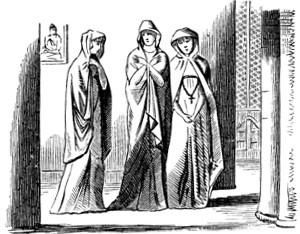
Nuns also figured on the signboard as the Three Nuns, which
was constantly used by drapers; not exactly, as Tom Brown says,
“very dismally painted to keep up young women’s antipathy to
popery and” single blessedness, but because the holy sisterhoods
were generally very expert in making lace embroidery, and other
fancy work—as the handkerchiefs made by the nuns of Pau, and
sold by our drapers, fully prove even at the present day. In the
seventeenth century, the Three Nuns was the sign of a well-known
coaching and carriers’ inn in Aldgate, which gave its name to
Three Nuns’ Court close at hand; near this inn was the “dreadful
gulf, for such it was rather than a pit,” in which, during the
Plague of 1665, not less than 1114 bodies were buried in
a fortnight, from the 6th to the 20th of September.[473] Not
improbably this sign, after the Reformation, was occasionally
metamorphosed into the Three Widows: Peter Treveris, a
foreigner, erected a press and continued printing until 1552 at
the Three Widows in Southwark; he printed several books for
William Rastell, John Reynor, R. Copeland, and others in the
city of London. It is still the sign of a cap and bonnet shop in
Dublin. The Matrons, also, may have originally represented
Nuns; this last hung, in the seventeenth century, at the door of
John Bannister, crutch and bandage maker, near the hospital,
(Christ’s Hospital School,) Newgate Street.[474]
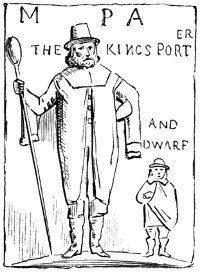
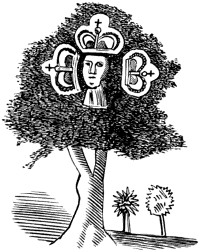
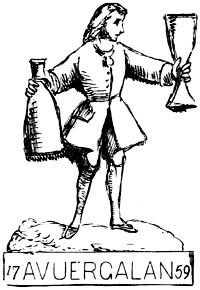
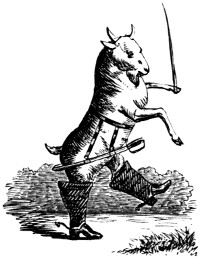
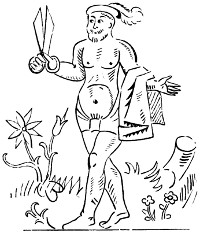
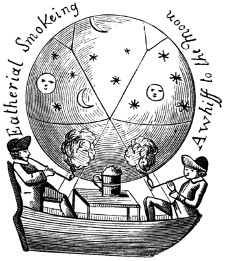
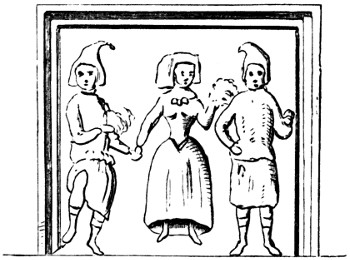
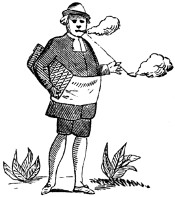
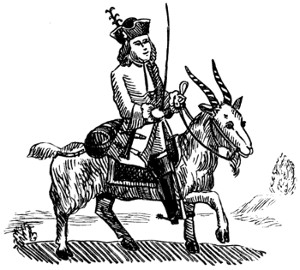
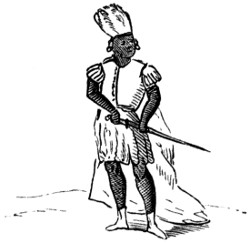
| PLATE XIII. |
 |
 |
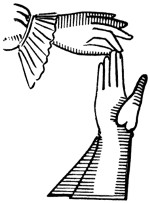
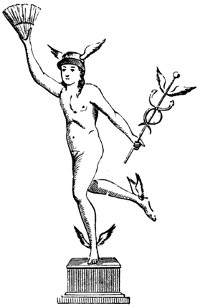
MERCURY AND FAN.
(Banks’s Collection, 1810.) |
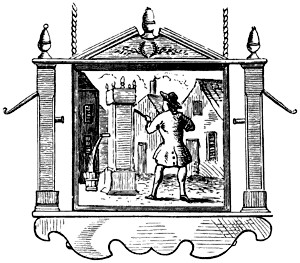
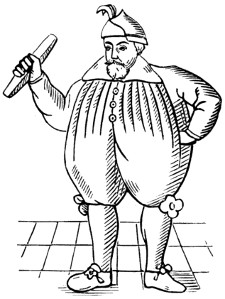
NOBODY.
(From an old print, circa 1600.) |
 |
 |
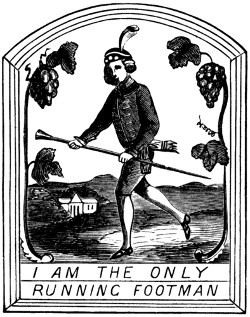
RUNNING FOOTMAN.
(Charles Street, Berkeley Square, circa 1790.) |
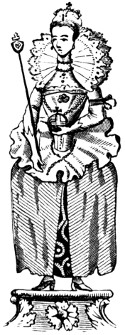
QUEEN ELIZABETH.
(Banks’s Collection.) |
At the present day the Church is a very common ale-house
sign, either on account of the esteem in which good living has
been held by churchmen in all ages, “superbis pontificum potiore
cœnis,” or, from the proximity of a church to the ale-house in
question; thus, one inn in the town would be known as the
“Market House,” whilst another might be known as the “Church
Inn.” It has been said the name was given that topers might
equivocate and say that they “frequently go to church.” Be
this as it may, there is generally an ale-house close to every
church, (in Knightsbridge the chapel of the Holy Trinity is
jammed in between two public-houses,) whereby a good opportunity
is offered to wash a dry sermon down. In Bristol, at the
beginning of the present century, it was still worse—a Methodist
meeting-room was immediately over a public-house, which gave
rise to the following epigram:—
“There’s a spirit above and a spirit below,
A spirit of joy and a spirit of woe—
The spirit above is the spirit divine;
But the spirit below is the spirit of wine.”
Other signs connected with the church are the Chapel Bell,
at Suton, in Norfolk, and the Church Stile or Church Gates,
which is very common. The origin of this last comes from an
old custom of drinking ale on the parish account, on certain occasions,
at the church stile. Pepys mentions this when he was
at Walthamstow, April 14, 1661:—“After dinner we all went to
the church stile, and there eat and drank.” To this a correspondent
in the Gent. Mag. (Nov. 1852, p. 442) makes the following
note:—“In an old book of accounts belonging to Warrington
parish, the following minute occurs:—“Nov. 5, 1688. Paid for
drink at the church steele, 13s.;” and in 1732, “It is ordered
that hereafter no money be spent on ye 5th of November or any
other State day on the parish account, either at the church stile
or any other place.” Though certainly the parish now does not
pay for any ale drunk at the church stile, the sign is evidently
set up in remembrance of the good old time when such things
were.
Belonging to the church was also the sign of the Three
Brushes, or Holy Water Sprinklers, which was that of an old
house near the White Lion prison, Southwark, in which there
was a room with panelled wainscoting and ceiling ornamented
with the royal arms of Queen Elizabeth. Probably it had been
the court-room at the time the White Lion Inn was a prison.
Amongst the Beaufoy trades tokens there is one of “Rob. Thornton,
haberdasher, next the Three Brushes in Southwark, 1667.”
Innumerable signs were borrowed from the army and navy;
thus, at the present day, every uniform in the service is represented
near barracks or in other haunts of soldiers. The Recruiting
Sergeant is generally the sign of the public-house,
where that worthy spreads his nets. Cross Guns, Cross
Lances, Cross Swords, and Cross Pistols, respectively, are
meant to allure artillerymen, lancers, and various cavalry men.
But above all the Standard, the Banner, or the Waving Flag—“the
glorious rag that for a thousand years has stood the
battle and the breeze,” is of common occurrence, not only in the
neighbourhood of military quarters, but everywhere in towns and
villages. At the Standard Tavern in the Strand, Edmund Curll
the bookseller used to meet the mysterious Rev. Mr Smith, who
sold him Pope’s correspondence.
“I am just going to the Lords to finish Pope,” writes Curll to this person.
“I desire you to send me the sheets to perfect the first fifty books,
and likewise the remaining three hundred books, and pray be at the
Standard Tavern this evening and I will pay you £20 more.”
The Kettledrum is a sign at St George-in-the-East; the
Drum and the Trumpet are both of frequent occurrence, and
the last is of old standing. One of the characters in “The Ball,”
a play by Shirley, 1633, thus commends the beer of the Trumpet:—
“Their strong beere is better than any I
Ever drunke at the Trumpet.”—The Ball, Act v.
Possibly this was the Trumpet in Shire Lane, immortalised in
the Tatler, and one of the favourite haunts of merry good-natured
Dick Steele. Bishop Hoadley was once present at one
of the meetings in this tavern, when Steele rather exposed himself
in his efforts to please, a double duty devolving upon him,
as well to celebrate the “glorious memory” of King William III.,
it being the 4th of November—as to drink up to conversation
pitch his friend Addison, the phlegmatic constitution of whom
was hardly warmed for society by the time Steele was no longer
fit for it. One of the company, a red hot Whig, knelt down to
drink the health with all honours. This rather disconcerted the
bishop, which, Steele seeing, whispered to him—“Do laugh, my
lord, pray laugh; it is humanity to laugh.” Shortly after Steele
was put into a chair and sent home. Next morning he was much
ashamed, and sent the Bishop this distich:—
“Virtue with so much ease on Bangor sits,
All faults he pardons though he none commits.”
Some trades tokens are extant of houses with the sign of the
Trumpet in King Street, Wapping, and in the Minories. At the
same period there was a sign of the Trumpeter in Trump Alley,
probably suggested by the name of the thoroughfare.
The Buckler is a very old sign, and occurs in “Cocke Lorell’s
Bote:”—
“Here is Saunder Sadeler of Froge Street Corner,
With Jelyan Joly at signe of the Bokeler.”
More general was the sign of the Sword and Buckler, which
was frequently set up by haberdashers for the following reason:—
“And whereas, until about the twelve or thirteenth yeere of Queene
Elisabeth, the auncient English fight of sword and buckler was only had
in use, the bucklers then being only a foot broad, with a pike of four or
five inches long; then they beganne to make them full half ell broad, with
sharpe pikes 10 or 12 inches long, wherewith they meant either to
breake the swordes of their enemies, if it hitte uppon the pike, or else
sodainely to runne within them and stabbe, and thrust their buckler
with the pike into the face, arme, and body of their adversary, but this
continued not long;[475] every haberdasher then sold bucklers”.—Stow’s
Chronicle.
The great prevalence of this sign originated in the so-called
sword and buckler play, once so common in England. Misson,
who visited this country in the beginning of the eighteenth century,
says:—
“Within these few years you should often see a sort of gladiators marching
through the streets, in their shirts to the waste, their sleeves tucked up,
sword in hand, and preceeded by a drum to gather spectators. They give
so much a head to see the fight, which was with cutting swords and a kind
of buckler for defence. The edge of the sword was a little blunted, and
the care of the prize fighters was not so much to avoid wounding one another,
as to avoid doing it dangerously; nevertheless as they were obliged
to fight till some blood was shed, without which nobody would give a
farthing for the show, they were sometimes forced to play a little roughly.
The fights are become very rare within these eight or ten years.”[476]
In the seventeenth century it was not a little rough play, which
is evident from those matches at which Pepys was present, and
which he describes at large. Jouvin, another Frenchman who
visited England in 1672, gives a detailed account of these divertisements,
which, at that period, at all events, were anything but
play; and Maitland was right when he designated them as “a
barbarous performance, by those whom necessity (occasioned by a
scandalous laziness and indolence) induces to expose themselves
to be horribly mangled for a little money, while the bloodily-minded
spectators satiate themselves with human gore to the
great reproach of religion.”
In the Spectator, No. 436, there is an amusing essay on those
“Hockley-in-the-Hole Gladiators,” and in No. 449 a letter appears,
in which the deceits of the champions are shown:—
“I overheard two masters of the science agreeing to quarrel on the next
opportunity. This was to happen in the company of a set of the fraternity
of the basket hilts who were to meet that evening. When this was settled,
one asked the other: ‘Will you give cuts or receive?’ The other answered,
‘Receive.’ It was replied, ‘Are you a passionate man?’ ‘No,
provided you cut no more, nor no deeper than we agree.’”
A few other instances of the Sword occur on signs, as the
Sword and Cross, a sort of emblem of the Church militant, or
perhaps an inversion of the Cross Swords: this was a sign
“next door to the Savoy Gate in 1711.” The Swordblade, a
coffee-house in Birchen Lane in 1718, and the Sword and
Dagger, a combination of arms that evokes the phantom of many
a desperate duel amongst the ruffling gallants of the reign of
James I. This sign of ill omen was, in the seventeenth century,
in St Catherine Lane, Tower, as appears from the traded
tokens issued there.
The Dagger was once common in London—
“My lawyer’s clerk I lighted on last night
In Holborn at the Dagger,”
says Captain Face, in Ben Jonson’s “Alchymist,” and various
trades tokens testify the prevalence of the sign. Probably this arose
from its being a charge in the city arms, which was supposed to
represent the dagger Sir William Walworth used in slaying Wat
Tyler. This at least was asserted in the inscription below the
niche in which Sir William’s statue was erected in Fishmonger’s
Hall:—
“Brave Walworth knyght Lord Mayor yt slew
Rebellious Tyler in his alarmes—
The king therefore did give in lieu
The Dagger to the Cytyes armes.”
Stow says that this is erroneous, as, when in the 4 Richard II.
a new seal was made for the city, “the armes of this city were
not altered, but remayne as afore; to witte, argent, a playne cross
gules a sword of Saint Paul in the first quarter and no dagger
of William Walworth as is fabuled.”[477] The Dagger and
Pie was in the seventeenth century the sign of a celebrated pie-shop
in Cheapside, the Pie being added to the original sign;
but from the trades tokens of this house we see that this was
represented by a rebus of a dagger with a magpie on the point.
Dagger-pies are frequently mentioned in the plays of that period;
for instance, in Decker’s “Satyro-Mastrix:”—“I’ll not take thy
word for a dagger-pie;” and in Prynne’s “Histrio-Mastrix,”
“and please you, let them be dagger-pies.” The London
apprentices appear to have been good customers to this house.
Whenever, for example, old Hobson, the merry haberdasher, went
abroad, “his prentices wold ether bee at the Taverne filling their
heds with wine or at the Dagger in Cheapside cramming their
bellies with minced pyes.”[478] And in Heywood’s comedy of
“If you Know not me you Know Nobody,” the worthy citizen
bitterly inveighs against the temptations held out to apprentices
by the dainties of this house:—
“Ten pounds a morning! Here is the fruit
Of Dagger-pies and Ale-house guzzling.”—Act i. sc. i., 1606.
A rather curious sign was that of the Red M and Dagger.
The letter M was the initial of Mrs Milner’s name, who, at this
sign in Pope’s Head Alley, “over against the Royal Exchange in
Cornhill,” sold the “Grand Restorative,” which cured consumption,
stone, dropsy, and all evils flesh is heir to. The sign occurs
among the Bagford bills; there is a similar one amongst the
Banks bills, the Pistol and C, the sign of John Crook, a razor-maker
at the Great Turnstile, Holborn, circa 1787: the bill
represents a renaissance scutcheon with a pistol, above it a C,
and surgical instruments disseminated on the field.
Though we have the authority of Cicero that cedant arma togæ,
yet booksellers, who flourish by the arts of peace, choose the Helmet
for their sign. Humphrey Joy, a bookseller and printer in St
Paul’s Churchyard in 1550, and another, celebrated in the reigns
of Henry VIII., Edward VI., and Queen Mary, Rowland Hall by
name, had both a Helmet for their sign. This Hall changed his
sign more frequently than is generally the custom; thus, besides
the Helmet, he is known to have traded at the signs of the
Cradle, in Lombard Street; the Half Eagle and Key, in
Gutter Lane; and the Three Arrows, in Golden Lane, near
Cripplegate. There is still a stone carving of the helmet fixed in
the front of a house in London Wall, with the date 1668 and the
initials H. M. Ned Ward mentions the Helmet in Bishopsgate;
he says at the battles without bloodshed of the Trainbands in
Moorfields, the gallant warriors wish
“For beer from the Helmet in Bishopsgate.
And why from the Helmet? Because that sign
Makes the liquor as welcome t’ a soldier as wine.”
Trades tokens are extant of the Blue Helmet in Tower Street.
From the same source we learn that there was, in the seventeenth
century, a sign of the Plate, i.e., the Breastplate, in Upper Shadwell;
and a Handgun in Shadwell. This weapon was a sort of
musket of early times, fired in the hand without a rest; “gunners
with handguns or half-hakes” are named by Stow in his enumeration
of the troops marching in the city watch on St John’s night.
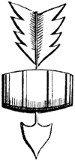
A few other old weapons remain to be mentioned, as the
Arrow, once a great favourite when this weapon made the
English name terrible whenever our troops took the field. In the
last century there was a beer-house at Knockholt, in Kent, the
sign an Arrow, with the following poetical effusion beneath:—
“Charles Collins liveth here,
Sells rum, brandy, gin, and beer;
I make this board a little wider,
To let you know I sell good cyder.”
The Cross-bullets, a name puzzling at first sight, was a sign
in Thames Street in the seventeenth century, representing two
bar-shot crossed, which the trades token elucidates by the equally
puzzling legend, “at the Crose bvlets;” this was an instrument
of destruction formerly used in naval engagements, and for that
reason set up in the neighbourhood of the shipping.
If we may believe a jocular article on a quack handbill in the
Spectator, No. 444, there was a Cannon-ball in Drury Lane;
for he mentions that—
“In Russell Court, over against the Canonball, at the Surgeons’ Arms,
in Drury Lane, is lately come from his travels a surgeon who has practised
surgery and physic both by sea and land these twenty-four years.
He (by the blessing) cures the Yellow Jaundice, Green sickness, Scurvey,
Dropsy, Surfeits, Long sea voyages, Campaigns, and women’s miscarriages,
lyings in, etc., as some people that has been lamed these thirty
years can testify; in short he cureth all diseases incident on man, women,
or children.”
Undoubtedly this bill had been slightly touched up in passing
through the hands of the Spectator, who, like the mythological
king, “quodcunque tetigit inaurat,” for it is rather “too good to
be true.”
The Halbert and Crown was, in 1791, the sign of Paul
Savigne, a cutler in St Martin’s Churchyard; whilst the Spear
in Hand is at the present day the sign of a public-house at
Norwich, being undoubtedly a popular version of some family
crest.
In Jews’ Row, or Royal Hospital Row, Chelsea, there is a
sign which greatly mystifies the maimed old heroes of the Peninsula
and Waterloo, and many others besides; this is the Snow-shoes.
It is the sign of a house of old standing, and was set up
during the excitement of the American war of independence,
when snow-shoes formed part of the equipment of the troops sent
out to fight the battles of King George against “Mr Washington
and his rebels.”
One of the low public-houses that stood on the outskirts of
London, towards Hyde Park Corner, at the end of the last century,
was called the Triumphal Car. There were a great many
other houses of the same description in that neighbourhood, viz.,
the Hercules Pillars, the Red Lion, the Swan, the Golden Lion,
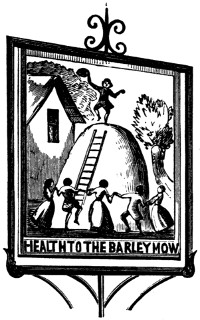
the Horse-shoe, the Running Horse, the Barleymow, the White
Horse, and the Half-moon, which two last have given names to
two streets in Piccadilly. The sign of the Triumphal Car was
in all probability bestowed upon the house in honour of the
soldiers who used to visit it.
“These public-houses, about the middle of last century, were much
visited on Sundays, but those contiguous to Hyde Park were chiefly
resorted to by soldiers, particularly on review days, when there were long
wooden seats fixed in the street before the houses for the accommodation
of six or seven barbers, who were employed on field days in powdering
those youths who were not adroit enough to dress each other’s hair. Yet
it was not unusual for twenty or thirty of the older soldiers to bestride a
form in the open air, where each combed, soaped, powdered, and tied
the hair of his comrade, and afterwards underwent the same operation
himself.”[479]
The grenadiers of Frederick the Great managed those things
still better, for twenty or thirty of them used to sit in a circle,
each dressing, plaiting, and powdering the pigtail of the man
before him, so that all hands were employed at the same time,
and none was lost in waiting. There is still a Triumphant
Chariot public-house in Pembroke Mews, Chelsea, a house of
more than fifty years’ standing.
The Bombay Grab in High Street, Bow, belongs to military
signs, as “Grab,” or “Crab,” is a slang expression for a foot
soldier; perhaps the landlord at one time may have been in the
Bombay army.
Objects relating to the navy, or rather to shipping, are still
more common in this seafaring nation of ours than the attributes
or emblems of any other trade or profession. Ned Ward
describes Deptford in 1703 as every house being distinguished
by either the sign of the Ship, the Anchor, the Three Mariners,
Boatswain and Call, or something relating to the sea.
“For as I suppose [says he] if they should hang up any other, the salt-water
novices would be as much puzzled to know what the figure represented
as the Irishman was, when he called the Globe the Golden Cabbage,
and the Unicorn the White Horse with a barber’s pole in his
forehead.”[480]
There is scarcely a town in the kingdom that has not a
Ship inn, tavern, or public-house. Tokens exist of “the Ship
without Templebar, 1649,” probably the inn granted in 1571 to
Sir Christopher Hatton, along with some lands in Yorkshire and
Dorsetshire, and the wardship of a minor.[481] William Faithorne
the engraver (ob. 1691) seems to have occupied the same house
afterwards, for Walpole informs us that—
“Faithorne now set up in a new shop at the sign of the Ship, next to
the Drake, opposite to the Palsgrave Head, without Temple Bar, where he
not only followed his art, but sold Italian, Dutch, and English prints, and
worked for booksellers.”[482]
This sign of the Ship, next to the Drake, seems to have
constituted a sort of a pun or a rebus on Admiral Drake, as
observed by Mr Akerman. Among the trades tokens there was
“Will Jonson at ye Drake, Bell Yard, Temple Bar, 1667.”
The Drake stood next to the Ship. It was doubtless a rebus, and
alluded to the Admiral, who was very popular in the reign of
Queen Elizabeth, the mint-mark of the martlet on her coins
being termed by the vulgar a Drake. The situation of this sign
near the Ship was appropriate enough. In the seventeenth
century there was a sign of the Ship at Leeuwarden, in Friesland,
(Netherlands,) with the following inscription:—
“Die in de ly, my vaart voorby
Zal hebben een Ryxdaalder en ’t gelach vry.”[483]
At the Ship tavern in the Old Bailey, kept by Mr Thomas
Amps, on Tuesday the 14th of February 1654, a plot against
Cromwell was discovered. Carlyle[484] forcibly pictures the conspirators
as eleven truculent, rather threadbare persons, sitting
over small drink there on that Tuesday night, considering how
the Protector might be assassinated. Poor broken Royalist men,
payless old captains, and such like, with their steeple hats worn
very brown, and jackboots slit, projecting there what they could
not execute. The poor knaves were found guilty, but not worth
hanging, and got off with being sent to the Tower for a while to
ponder over their wickedness.
Names of famous men-of-war are often found on the signboard,
in seaports; either in honour of some brilliant feat performed
by them, or simply in compliment to the crew, in the
hopes of obtaining their liberal patronage. Thus the Albion,
the Saucy Ajax, the Circe, and Arethusa, with innumerable
others, may be met with in the vicinity of Plymouth, Portsmouth,
and other seaports. The naming of signboards in this
way was an old custom; as two examples among the London
trades tokens very sufficiently prove. Thus, for instance, The
Speaker’s Frigate, the sign of a shop in Shadwell in the seventeenth
century. The frigate had been named after Sir Richard
Stainer, speaker in the House of Commons in the time of the Commonwealth,
who had done good service under command of
Admiral Blake, in some of the naval engagements with the
Spaniards. In 1652, this ship was sent to “Argier in Turkey,”
(Algiers,) under command of Captain Thorowgood, with the sum
of £30,000 to redeem English captives from slavery. Upon
this occasion the Puritan newspapers made the following punning
prayer:—
“A prosperous gale attend his motion; and a Christian vote and blessing
be present, in all their debates and consultations, for doubtless, ’tis a
sacrifice pleasing both to God and man, and plainly denotes unto the people
of England, that our magistrates had rather bring home exiles, than make
more.”[485]
After the Restoration the name of this ship was changed into the
Royal Charles, (which also occurs as a sign,) that ill-fated ship
taken by the Dutch in 1667, when, under Admiral de Ruyter,
they made their descent on Chatham and Sheerness, and burnt a
part of our fleet. The Royal Charles was one of the ships they
took away. Its stern is still kept as a trophy in Rotterdam.
Ships occur in various conditions, as the Full Ship, Hull;
Ship in Dock, Dartmouth; and the Ship on Launch, in every
ship-building locality. The Ship in Full Sail was the sign of
the first shop of Murray the publisher, in Fleet Street—probably
in opposition to Longman, who had the Ship at Anchor.
The Ship in Distress is a touching appeal to the good-natured
wayfarer to assist in keeping the pump going. At Brighton, there
was such a sign in the last century, on which the poet had
assisted the painter to invoke the sympathy of the thirsty
public:—
“With sorrows I am compass’d round,
Pray lend a hand, my ship’s aground.”
The Ship is to be met with in innumerable combinations: the
Ship and Pilot Boat, Narrow Quay, Bristol; the Ship And
Anchor is not uncommon, and in one place, at Chipping Norton,
it is quaintly corrupted into the Sheep and Anchor;[486] the Ship
and Whale, in compliment to the Greenland Fishery, occurs at
South Shields, and the Ship and Notchblock is a sailor’s coffee-house
in the Ratcliff Highway. All these explain themselves;
most of the other combinations seem to result from the quartering
of two signs, as the Ship and Bell, Horn Dean, Hants; the
Ship and Fox, “next door but one to the Five Bells tavern,
near the Maypole in the Strand,” in 1711; the Ship and Star
on a trades token of Cornhill, may be the north star by which
ancient mariners used to navigate; the Ship and Rainbow is
common to many places; the Ship and Shovel, Tooley Street;
said to be a deterioration of the Sir Cloudesley Shovel, but more
likely alluding to the shovels used in taking out ballast, coal, corn,
(when in bulk) and various other cargoes; the Ship and Plough,
Hull; the Ship and Blue Coat Boy, Walworth Road, although
susceptible of explanations, are doubtless only but quarterings.
The Ship and Castle, though of common occurrence, seemed
to puzzle the public already in the seventeenth century:—
“What resemblance the Ship and the Castle may bear
To ships floating on clouds, or to castles in air,
We know not; but this we are sure of, ’tis plain
Their clarets are perfectly Leger-de-Main.”
Search after Claret, 1691, canto I.
If not a combination of two signs, it may have some reference to
our national defences. It was a sign in Cornhill as early as
1716, when, on November 9, the newspapers conveyed the following
information to the metropolis:—
“We are informed that this day a fowl was roasted in a wonderful sun-kitchen
on the top of the Ship and Castle tavern, Cornhill, in view of many
gentlemen. The artist performer, who is a gentleman newly come from
France, proposes to roast and boil meat, bake bread, prepare tea and coffee,
and all kitchenwork done without common fire; some particular thing to
be seen every day that the sun shines out brightly. ’Twas observable that
when the fowl was dressed, it had the same taste and smell as if done by
a common fire. The machine is composed of about a hundred small looking
or convex-glasses.”
The scheme, seemingly, did not succeed in dethroning “old king
coal,” for if we had to depend on the sun for our cookery, it is
to be feared we would often have cold cheer.
Amongst all these ships, of course, Jack tar could not be forgot.
The Ship Friends occur in Sunderland; the Three Mariners
is an old sign, of which there are examples among the trades
tokens, and which is still to be seen on two or three public-houses
in London. There was formerly a tavern known by this
sign in Vauxhall.
“On repairing it in 1752, in it was found a remarkably high-elbowed
chair covered with purple cloth, and ornamented with gilt nails. An old
fisherman told Mr Buckmaster that he had heard his grandfather say, that
King Charles II. disguised, used on his water tours with his ladies to frequent
the above tavern to play at chess, &c., and that the chair found, was
the same as the king sat in. The chair was repaired and kept as a curiosity
by the late John Dawson, Esq., but by neglect was, at the pulling down of
his old dwelling at Vauxhall in 1777, destroyed. Mr Buckmaster sat in
the chair many times, but his feet would not touch the ground. King
Charles was very tall. No tavern of this name is known to exist now in
Lambeth, but there is one of the sign of the Three Merry Boys,[487] probably
a corruption of the above name.”[488]
In other places we meet with the Three Jolly Sailors; at
Castleford there used to be one representing the jolly sailors
“with a sheet in the wind,” and under it the following professional
invitation:—
“Coil up your ropes and anchor here,
Till better weather does appear.”
In North Street, Hull, there is a sign of Jack on a Cruise,
not on board H.M. ship, but “out on” what the lands folk call
“a spree;” the cruises, however, are generally confined to rather
low latitudes. The Boatswain appears to have been a public-house
in Wapping in the reign of Charles II., for Wycherly in
the “Plain Dealer,” 1676, makes Jerry Blackaire say:—“I should
soon be picking up all our own mortgaged apostle spoons, bowls,
and beakers, out of most of the ale-houses betwixt Hercules
Pillars and the Boatswain in Wapping.” The Boatswain’s Call
is a public-house sign in Frederick Street, Portsea, whose invitation
the sailors, no doubt, accept with much more pleasure than
the boatswain’s call of “all hands on deck” on a frosty winter
morning. It was the name of a patriotic sea song during one of
the wars with France. Red, White, and Blue, and its synonyme,
the Three Admirals, both occur in more than one instance
in Liverpool.
The Anchor was, perhaps, set up rather as an emblem than as
referring to its use in shipping. It is frequently represented in
the catacombs, typifying the words of St Paul, who calls hope
“the anchor of the soul, both sure and steadfast.” St Ambrose
says, “it is this which keeps the Christian from being carried
away by the storm of life.” Other early writers use it as a symbol
of true faith, and one of them has this beautiful idea:—
“As an anchor cast into the sand will keep the ship in safety, even so
hope, ever amidst poverty and tribulation, remains firm, and is sufficient
to sustain the soul; though, in the eyes of the world, it may seem but a
weak and frail support.”[489]
It was a favourite sign with the early printers, probably in imitation
of Aldus.[490] Thus Thomas Vautrollier, a scholar and printer
from Paris and Rouen, who came to England about the beginning
of Queen Elizabeth’s reign, and established his printing-office
in Blackfriars, had an anchor for his sign, with the motto, “Anchora
Spei.” At West Bromwich there is an ale-house having the sign
of the Anchor with the following inscription:—
“O sweet ale, how sweet art thou,
Thy chearing streams new life impart,
Esteemed by all extremely good,
To quench our thirst and do us good.”
Sometimes a female figure in flowing garments is represented
holding the anchor, in which case it is called the Hope and
Anchor. The Blue Anchor was painted of that colour as a
“difference” from other anchors; it is a common sign; it was the
trade emblem of Henry Herringman, of the “New Exchange,” the
principal London bookseller and publisher in the reign of King
Charles II., the friend of Davenant, Dryden, and Cowley. The
Blue Anchor and Ball was the sign of a mercer’s shop near
the Conduit in Cheapside in 1707, the ball being the usual addition
to intimate the sale of silks. Other distinctions are the
Sheet Anchor, at Whitmore, in Staffordshire; the Foul Anchor,
a sign of two public-houses at Wisbeach, implying, no doubt, that
the lotus-eaters, who anchor in that harbour, get so entangled in the
luxurious weeds of pleasure, that it becomes impossible for them
to leave; the Raffled Anchor, Swan’s Quay, North Shields; and
the Rope and Anchor, which is very common, the anchor being
generally represented with a piece of cable twined round the stem.
A few combinations also occur: the Anchor and Can, at
Ross, and at Putson, Hereford, which seems to allude to the
Anchor as a measure; the Anchor and Shuttle, Luttendenfoot,
Warley, Manchester, the shuttle being added in compliment to
the weavers; the Anchor and Castle, a quartering of two signs
in Tooley Street, &c.
Sometimes instead of the ship, some peculiar vessel is chosen,
as, for instance, the Sloop, or the Leigh Hoy, a sort of smack,
which occurs amongst the trades tokens as a sign near St Catherine’s
Docks, and is still to be seen in Church Street, Mile
End; the Coble, a sort of fishing-boat, common in Northumberland;
the Tiltboat, Sommers Quay, Thames Street, in the
XVIIth. century, and still at Billingsgate. This last was an open
passenger boat for Greenwich, Woolwich, Gravesend, and other places
down the river. It took twelve hours to perform the voyage to
Gravesend, and much more if the wind was contrary, and the boat had
not arrived before the tide turned. The tiltboats were superseded
by steamers in 1815. The Dark House, Billingsgate, was their
starting-place, and passengers would probably patronise the tavern
with this name in the immediate neighbourhood, as they go now
for a glass of ale and a sandwich to the Railway, or Steamboat
Inn, during the quarter of an hour preceding departure.
The Fishing Smack was a public-house formerly standing near
St Nicholas Church, Liverpool. The sign represented a man
standing in a cart loaded with fish, and holding in his right hand
what the artist intended to represent as a salmon. Underneath
were the following lines:—
“This salmon has got a tail,
It’s very like a whale;
It’s a fish that’s very merry;
They say it’s catch’d at Derry;
It’s a fish that’s got a heart,
It’s catch’d and put in Dugdale’s cart.”
This truly classic production of the Muse of the Mersey continued
for several years to adorn the host’s door, until a change
in the occupant of the house induced a corresponding change of
the sign, and the following lines took the place of the preceding:—
“The cart and salmon has stray’d away,
And left the fishing-boat to stay,
When boisterous winds do drive you back,
Come in and drink at the Fishing-Smack.”[491]
The Old Barge was a sign in Bucklersbury: “When Walbrooke
did lye open, barges were rowed out of the Thames, or
towed up so farre; and therefore the place has ever since been
called the Old Barge, of such a sign hanging out over the gate
thereof.”[492] The Old Barge, or the Old Boat, is still frequently
seen as a sign on the banks of some of the canals through which
boats and barges are towed.
The Boat, an isolated tavern in the open fields, at the back of
the Foundling Hospital, was the head-quarters of the rioters and
incendiaries, who, excited by the injudicious zeal of Lord George
Gordon, set London in a blaze during the “No Popery” riots in
1780.
Next Boat by Paul’s, in Upper Thames Street, may be seen
on the trades token of an ale-house, evidently kept by a waterman,
who used to ply with his boat near St Paul’s. The token
of this house represents a boat containing three men, over it the
legend, “Next Boat.” “Next Oars” was the cry of the watermen
waiting for a fare. Tom Brown in his walk round London,
says, “I steered him down Blackfryars towards the Thames
side till coming near the stairs, up started such a noisy multitude
of grizly old Tritons, hollowing and hooting out Next
Oars and scullers, &c. And with that I bawled out as loud as a
speaking trumpet, ‘Next Oars,’ and away ran Captain Caron,
and hollowed to his man Ben to bring the boat near.” “Next
Boat,” was also the sign of a public-house of note adjoining
Holland’s Leaguer in Blackfriars, where Holland Street is now.
The Law is very badly represented—the Judge’s Head seems
to be the only sign in honour of this branch of the Commonwealth.
It was the sign of Charles King, a bookseller in Westminster
Hall in 1718,[493] and may be readily accounted for in that
locality. It was also the first sign of Jacob Tonson, the well-known
bookseller and secretary of the Kit-Kat Club, when he lived
near Inner Temple gate, Fleet Street. In 1697 when he removed
to Gray’s Inn gate, he adopted the Shakespeare’s Head, under
which he became famous. After 1712, he took a shop in the
Strand, opposite Catherine Street, but without altering his sign,
and there he died in March 1736 possessed of a splendid fortune.
This was that famous Tonson who published the works of the
most celebrated authors and poets of the day. Dryden was one
of them. Liberality in those days was a word not to be found
in the dictionary of a publisher, as Dryden often experienced;
in one of his ill tempers, when Tonson had been putting on the
screw rather too much, the incensed poet began a satire upon
him:—
“With leering look, bullfac’d, and freckled fair,
With two left legs, with Judas-colour’d hair,
And frowsy pores that taint the ambient air.”
These three lines he sent as a sample of his savoir faire to the publisher,
with the gentle addition: “Tell the dog that he who wrote
this can write more.” Tonson did not wish to see more, however,
and Dryden obtained what he desired. About the year 1720, Jacob
Tonson left the business to his nephew, Jacob Tonson, jun., son of
his brother Richard, who, through the patronage of the Duke of
Newcastle, became stationer, bookbinder, and printer to the Public
Board, and this lucrative appointment was enjoyed by the Tonson
family, or their assignees, till the month of January 1800.
Lot Goodal, Beadle of St Martin-in-the-Fields, in 1680, had,
like other celebrities, taken his own goodly person for the sign
of his house in Rupert Street, as appears from his advertisement,
in which, like a true Dogberry, the public are informed
that he had taken a silver watch with a studded case “in custody.”
The Brown Bill was another constable’s sign:—
“Which is the constable’s house
At the sign of the Brown Bill?”
Blurt, Master Constable or the
Spaniard’s Nightwalk. Tho. Middleton. 1602.
This brown bill was a kind of battle-axe, or hatchet affixed to a
long staff, used by constables. The name was transferred from
the weapon to the men who carried it:—
“Const. Come, my brown bills, we’ll roar,
“Const. Bounce loud at the tavern door.”—Ibid.
They were also called Billmen:—
“To us billmen relate,
Why you stagger so late,
And how you came drunk so soon.”
John Lilly’s Endymion. 1591.
Lawyers are only commemorated in the complimentary sign of
the Good Lawyer,[494] and in the Rolls, a tavern kept by Ralph
Massie, in Chancery Lane, in the reign of Charles II. In various
parts of the house, and particularly in the great room up
stairs, the coats of arms of the Carew family spoke of its former
possessors. Further back still, we have it as a timber tenement
belonging to the knights of St John of Jerusalem, by whom it
was sold to Cardinal Wolsey, who for a time inhabited it, before
he had reached the summit of his pride and fame. Behind this
building was the house and garden of Sir Walter Raleigh. But
all these remnants of bygone glory were swept away in 1760,
when the house was rebuilt, and the name changed into the
Crown and Rolls. The name of Rolls, it is needless to observe,
was adopted from the neighbouring Rolls House, where
the rolls and records of Chancery have been kept since the reign
of Richard III.
The liberal arts are as badly represented on the signboard as the
Bar. The Poet’s Head was a sign in St James’s Street in the
seventeenth century; who the poet was it is impossible to say now;
perhaps it was Dryden, since the trades tokens represent a head
crowned with bays. The same sign had been used during the
Commonwealth by Taylor the Water poet, but in his case the
poet was Taylor himself, (see p. 48.) The Five Inkhorns, we
gather from the trades tokens, was the sign of Walter Haddon,
in Grub Street, a very appropriate trade emblem in that scribbling
locality. There was also a house with this sign in Petticoat
Lane, opposite which Strype’s mother lived; letters of his
are extant addressed:—
These for his honoured Mother,
Mrs Hester Stryp, widow
dwelling in Petticoat Lane over
against the five Inkhorns, without
Bishopsgate
in London.
Petticoat Lane in that time was the great manufacturing place
for inkhorns. The Hand and Pen was a scrivener’s sign, which
was adopted by Peter Bales, Queen Elizabeth’s celebrated penman.
Hollinshed says[495] that
“He writ within the Compasse of a Penie in Latine, the Lord’s Prayer, the
Creed, the Ten Commandements, a praise to God, a Prayer for the Queéne,
his posie, his name, the daie of the month the yeare of our Lord, and the
reigne of the Queéne. And on the seuenteenth of August next following,
at Hampton Court, he presented the same to the Queenes maiestie in the
head of a ring of gold, couered with a christall, and presented therewith
an excellent spectacle, by him devised, for the easier reading thereof;
wherewith her maiestie read all that was written therein with great admiration,
and commended the same to the Lords of the Councill and the ambassadors,
and did weare the same manie times vpon her finger.”
Bale was employed by Sir Francis Walsingham, and afterwards
kept a writing school at the upper end of the Old Bailey. In
1595, when nearly fifty years old, he had a trial of skill with one
Daniel Johnson, by which he was the winner of a golden pen, of
a value of £20, which, in the pride of his victory, he set up as
his sign. Upon this occasion, John Davis made the following
epigram in his “Scourge of Folly:”—
“The Hand and Golden Pen, Clophonion
Sets on his sign, to shew, O proud, poor soul,
Both where he wonnes, and how the same he won,
From writers fair, though he writ ever foul;
But by that Hand, that Pen so borne has been,
From Place to Place, that for the last half Yeare,
It scarce a sen’night at a place is seen.
That Hand so plies the Pen, though ne’er the neare,
For when Men seek it, elsewhere it is sent,
Or there shut up, as for the Plague or Rent,
Without which stay, it never still could stand,
Because the Pen is for a Running Hand.”[496]
The sign of the Hand and Pen was also used by the Fleet
Street marriage-mongers, to denote “marriages performed without
imposition.”
Music-shops always adhered to the primitive custom of using
the instruments they sold as their signs; for instance, the Harp
and Hautboy, the sign of John Walsh, “servant to his Majesty,”
in Catherine Street in the Strand, in 1700.[497] Other music-shops
had the French Horn and Violin; the Violin, Hautboy,
and German Flute; the Hautboy and Two Flutes; all
these instruments in the woodcut above the shopbill, which was
a copy of the sign, are placed perpendicularly beside each other,
without any attempt at grouping. The Hautboy was one of the
most constant music-shop signs; it was formerly a favourite street
instrument, and might be heard at the Christmas “waits,” and
on occasions of popular rejoicing. Waits even are said to have
derived their name from it, that, according to one authority,
being the old English name of the hautboy.[498] This, however, we
believe to be a mistake. The Waits were “watches”—guêts, who
went round at certain hours of the night with music, to let it be
known they were on the look-out, and make people feel secure.
Novello, the well-known music publisher, still adheres to the
old tradition, and carries on business in the Poultry under the
sign of the Golden Crotchet. Somewhat similar was the Sol
La, or the Merry Song (le chant Gaillard) of Guyot or Guy
Marchant, a bookseller and printer in Paris circa 1490. His colophon
here represents the two notes sol la, surmounting two conjoined
hands, in evident allusion to the words of the Pange Lingua
“Sola Fides.” At the side are represented two merry
cobblers, a class of mechanics, who, from time immemorial,
have been noted above all others for merriment, and a habit of
singing whilst at their work. It is a curious fact, that on the
title-page of one of the books printed by Marchant, the “Epistola
de Insulis de novo repertis,” his chant Gaillard is translated into
“Campo Gaillardo,” which seems to lead to the inference that
this work had been printed by some one who had heard of Marchant’s
sign, but had never seen it, and merely adopted his name
as being well known in the literary world,—a fraud frequently
complained of by the old printers.
The French Horn was once a very common sign, and is still of
frequent occurrence; thus, there is a French Horn and Rose
in Wood Street, Cheapside; a French Horn and Half-moon
at Wandsworth; and a French Horn and Queen’s Head in
Smithfield. This last house was, for many years, kept by Peter
Crawley, a noted member of the P. R., and there John Leech the
artist, and a friend, used to study low life and boxiana under the
tutelage of Black Sam. Finally, in the seventeenth century, there
was a Horn and Three Tuns in Leadenhall Street. The
trades tokens represent it as a French horn; but a drinking horn
would certainly have been a more useful instrument in the company
of three tuns. It was evidently a corruption of the Bottle-makers’
arms, which were argent on a chevron sable, three bugle-horns
of the first between three leather-bottles of the second.
These leather-bottles might easily be mistaken for tuns, and the
bugle-horn be modernised into a musical instrument.
This frequency of the Horn rather jars with the unpleasant
signification that instrument had in seventeenth century slang.
Among the Roxburghe Ballads (ii. 138) there is one entitled
“The Extravagant Youth, or an Emblem of Prodigality,” with a
woodcut representing a youth jumping into the mouth of a large
horn. On one side stands the father, seemingly in distress; on
the other is a mad-house, with the sign of The Fool, two of the
inmates looking out from behind the bars. The extravagant
youth, after expatiating on his mad career, says:—
“But now all my glory is clearly decay’d,
And into the horn myself have betray’d.
......
All comforts now from us are flown,
My father in Bedlam makes his moan,
And I in the counter a prisoner thrown,
This Horn is a figure by which it is known.”
The Bugle Horn is fully as common; it occurs on a trades
token of 1667 as the sign of a house in Aldersgate Street, and is
still to be seen on many inns by the roadside, where the mail
coach, in the good old coaching time, used to announce its arrival
by a cheerful tune from the guard’s horn. Sometimes the Horn
was used in a different sense. It was the sign and badge of the
cattle doctor and village gelder, and came to be exhibited as
such either from its use in drenching animals, or from the fact
of such an instrument being blown by the doctor, to give notice
to the villagers of his approach. At Messingham, Lincoln, the
Horn Inn, a century ago, was kept by such a personage. Further
on, at p. 369, this professional is mentioned in connexion with
Tom of Bedlam.
The Harp, in the beginning of the eighteenth century, was
the sign of a bird-fancier, “over against Somerset House in the
Strand;”[499] and is still used as the sign of many public-houses,
generally denoting an Irish origin. The Jew’s Harp (an instrument
formerly called jeu trompe, Jew’s trump, i.e., toy trumpet)
was in former times the sign of a house with bowery tea-gardens
and thickly-foliated “snuggeries,” in what was once Marylebone
Park, near the top of Portland Place, but removed on the laying
out of Regent’s Park. Mr Onslow the Speaker used to go there
in plain attire, and sitting in the chimney-corner, join in the
humours of the customers, until, being recognised by the landlord
one day, as he was riding in his golden coach to the House
in state, he found, on going in the evening for his quiet pipe
and glass, that his incognito was betrayed. This broke the
charm, and like the fairies in the legend, he never more returned
after that day. At the end of the last century there was another
Jew’s Harp Tavern [and Tea-gardens] in Islington. It consisted
of a large upper room, ascended by a staircase on the outside for
the accommodation of the company on ball nights, and in this
room large parties dined. Facing the south front of the premises
was a large semicircular enclosure, with boxes for tea and ale
drinkers, guarded by deal-board soldiers, between every box,
painted in proper colours. In the centre of this opening were
tables and seats placed for the smokers; a trap-ball ground was
on the eastern side of the house, whilst the western side served
for a tennis court; there were also public and private skittle-grounds.
We find a clue to this rather odd sign in Ben
Jonson’s play of the “Devil is an Ass,” Act i., scene 1, from
which it appears that it was formerly a custom to keep a
fool in a tavern, who, for the edification of the customers,
used to play on a Jew’s harp, sitting on a joint-stool.
One of the signs originally used exclusively by apothecaries
was the Mortar and Pestle, their well-known implements
for pounding drugs. Among the celebrities who sold medicines
under this emblem was the noted John Moore, “author of the
celebrated Worm Powder,” to whom Pope addressed some stanzas
beginning:—
“How much, egregious Moore, are we
Deceived by shows and forms;
Whate’er we think, whate’er we see,
All human kind are worms.”
His shop was in St Lawrence Poultney Lane. Every week
the newspapers contained advertisements proving, by the most
wonderful cures, the efficacy of his powders.
In the sixteenth century a publican in Paris adopted the sign
of the Pestle, on account of his living in the Rue de la
Mortellerie, (Mortar Street.) His house was in high repute
amongst the gallants of the period, which procured him a visit
from Master Villon, who thus describes it:—
“S’en vint en une hotellerie,
Rue de la Mortellerie.
Ou pend l’enseigne du Pestel,
A bon logis et bon hostel.”[500]
Villon, Franches Repues.
The Apothecary leads us to the Barber, or rather Barber-Surgeon,
and the Barber’s Pole, which dates from the time
when barbers practised phlebotomy: the patient undergoing this
operation had to grasp the pole in order to make the blood
flow more freely. This use of the pole is illustrated in more
than one illuminated MS. As the pole was of course liable
to be stained with blood, it was painted red; when not in
use, barbers were in the habit of suspending it outside the
door with the white linen swathing-bands twisted round it;
this, in latter times, gave rise to the pole being painted red
and white, or black and white, or even with red, white, and blue
lines winding round it. It was stated by Lord Thurlow in
the House of Peers, July 17, 1797, when he opposed the Surgeon’s
Incorporation Bill, that, “by a statute still in force, the
barbers and surgeons were each to use a pole. The barbers
were to have theirs blue and white striped, with no other appendage,
but the surgeons [which were the same in other respects]
were to have a gallipot and a red flag in addition, to denote
the particular nature of their vocation.”
Besides the well-known brass soap-basins appended to the
pole, the barbers in former times used to have other and more
repulsive signs of their profession:—
“His pole with pewter[501] basons hung,
Black, rotten teeth in order strung,
Rang’d cups that in the window stood,
Lined with red rags to look like blood,
Did well his threefold trade explain,
Who shaved, drew teeth, and breathed a vein.”
In Constantinople, where the barber still acts as surgeon and
dentist, the teeth drawn by him are worked in ornamental
patterns intermixed with blue beads, and hung as trophies in
the window. Some of our London dentists even yet follow this
disgusting custom, for in no less a thoroughfare than Sloane
Street there is a certain chemist-dentist who exhibits in his
window a whole bottleful of decayed teeth. Instead of cups
“lined with red rags to look like blood,” the genuine article
was formerly exhibited in the windows; but this was already
prohibited at an early period, since the “Liber Albus” enjoins
“that no barber be so bold or so daring as to put blood in
their windows openly or in view of folks; but let them have it
carried privily unto the Thames, under pain of paying two
shillings unto the use of the Sheriffs.”
As “a little learning is dangerous,” the barber of the olden
times generally contrived to make himself more or less ridiculous.
Steele says:—“The particularity of this man [Don
Saltero, see p. 95] put me into a deep thought whence it should
proceed that of all the lower orders barbers should go further
in hitting the ridiculous than any other set of men. Watermen
brawl, cobblers sing: but why must a barber be for ever a politician,
a musician, an anatomist, a poet, and a physician?” This
love of music was at all times an idiosyncrasy of the knights
of the brass basin. Morley, in his “Plain and Easie Introduction
to Practicall Musicke,” says:—“It should seem you came
lately from a barber’s shop, where you heard Gregory Walker
or a Corranta plaide in the new proportions.” Henry Bold, in
the beginning of the seventeenth century, speaks of ancient
tunes “still sung to Barbers’ citterns”, viz., the “Lady’s Fall;”
“John come kiss me now;” “Green Sleeves and Pudding Pies;”
“The Punk’s Delight,” &c. And Tom Brown, in his “Amusements
for the Meridian of London,” remarks:—
“In a Barber’s shop I saw a Beau so overladen with wig that there was
no difference between his head and the wooden one that stood in the
window. The fop it seems was newly come to his Estate, though not to
the years of Discretion, and was singing the Song: ‘Happy the child
whose father is gone to the Devil;’ and the Barber was all the while
keeping time on his Cittern, for, you know, a Cittern and a Barber is as
natural as milk to a calf, or the bears to be attended by a Bagpiper.”
The cittern is also mentioned by Ned Ward:—“I would sooner
hear an old barber sing ‘Whittington’s Bells’ upon a cittern.”
But enough of their musical parts; as for their learning no
examples are wanting: Partridge, the classical scholar, in Fielding’s
“Tom Jones;” Vossius’ barber, who used to comb his hair in
iambics;[502] and Smollett’s Hugh Strap, are excellent specimens.
This last one was sketched from life; his real name was Hugh
Hughson; he died in the parish of St Martin’s-in-the-Field, at
the advanced age of eighty-five, having kept a barber-shop in that
locality upwards of forty years. His shop was hung round with
Latin quotations, and he would frequently point out to his customers
the several scenes in “Roderick Random” pertaining to
himself, which had their foundation, not in the Doctor’s inventive
fancy, but in truth and reality. The meeting at the barber-shop
in Newcastle, the subsequent mistake at the inn, their
arrival together in London, and the assistance they experienced
from Strap’s friends, were all facts. He is said to have left
behind him an interleaved copy of “Roderick Random,” showing
how far we are indebted to the creative fancy of Doctor Smollett,
and to what extent the incidents recorded were founded upon
fact.
Not many years ago there was a hairdresser in the Rue
Racine, who, probably on account of his proximity to the universities
of the Collège de France and the Sorbonne, had this inscription
on his window: “κειρω τακιστα και σιναω,” “I shear
quickly and am silent.” This classical hairdresser was evidently
acquainted with the answers given by Anaxagoras to a barber
who asked him, “How do you wish to have your beard shaved?”
and who received the laconic answer, “without talking.” The
shutters and windows of our Parisian worthy were covered with
inscriptions in foreign languages, the number of which was only
surpassed by the Bible shop in Brompton, during the time of
the International Exhibition in 1862.
An eccentric barber opened a shop under the walls of the
King’s Bench Prison; the windows being broken when he entered
the house, he mended them with paper, on which appeared,
“Shave for a penny,” with the usual invitation to customers;
whilst on his door was scrawled the following rhymes:—
“Here lives Jemmie Wright,
Shaves almost as well as any man in England,
Almost—not quite.”
Foote, who delighted in anything eccentric, saw this inscription,
and hoping to extract some wit from the author, whom he justly
concluded to be an odd character, he pulled off his hat, and
thrusting his head through a paper pane into the shop, called
out, “Is Jimmy Wright at home?” The barber immediately
forced his own head through another pane into the street, and
replied: “No, sir, he has just popt out.”
Numerous more or less witty barbers’ inscriptions are recorded;
one of the best is that attributed to Dean Swift, penned by him
for a barber, who at the same time kept a public-house:—
“Rove not from pole to pole, but step in here,
Where nought excels the shaving but the beer.”
A variation often met is:—
“Rove not from pole to pole, but here turn in,
Where nought excels the shaving but the gin.”
Sir Walter Scott in his “Fortunes of Nigel,” vol ii., as a
motto to chap. iv., gives the following version:—
“Rove not from pole to pole—the man lives here,
Whose razor’s only equall’d by his beer;
And where, in either sense, the Cockney-put,
May, if he pleases, get confounded cut.”
The amalgamation of the two trades has led to some other
rhymes and jokes. A barber-publican in Dudley has the following
barbarous joke:—
“What do you think
I’ll shave you for nothing and give you some drink?”
The point of this joke lies in the punctuation, which the illiterate
shavers coming to the shop are sure to treat with supreme contempt;
but a barber in Ratcliffe Highway, circa 1825, had the
following bona fide invitation:—
“Hair cut with despatch,
Shave well in a minute,
And a glass in the bar—gain
With a thimbleful in it.”*
* Note—Of gin and bitters, all for a penny 12d.
* Note—Come in, Jolly Tars, and be scraped across the line.”
Another common inscription is the following:—“I tell U there is
no shaving to X L——’s” (name of the barber.) The Parisian
barbers are much on a par with their English colleagues in brilliancy
of wit and inventive power: “Ici on rajeunit,”[504] used to
be a frequent inscription with them; others have:—
“La nature donne barbe et cheveux,
Et moi je les coupe tous les deux.”
or—
“A toutes les figures dédiant mes rasoirs,
Je nargue la critique des fidèles mirroirs.”[505]
Tools belonging to various handicrafts are common public-house
signs at the present day. The Axe is a very old sign; it
was a well-known carriers’ inn in Aldermanbury in the seventeenth
century, and was one of the places visited in 1634 by that thirsty
tourist, Drunken Barnaby. From this inn, the first regular line
of stage waggons from London to Liverpool was established towards
the middle of the seventeenth century. There were constantly
some of them on the road, for they left every Monday
and Thursday, and it took them ten days in summer, and as
many as twelve in winter to perform the journey.
In 1642 there appeared “A Petition from the Towne and
County of Leicester unto the King’s most excellent Majestie,”
which was “printed for William Gay, and to be sold at his shop
in Hosier Lane, at the signe of the Axe, July 29, 1642.” When
we consider that “the King’s most excellent Majestie,” was
Charles I., we may come to the conclusion that there is something
in a sign, as well as in a name; it was certainly an ominous
and bad sign for the king. The Cross Axes is a sign at
Preston, Bolton, &c. The axe is also found combined with various
other carpenter’s tools, as the Axe and Saw, Carlton, Newmarket;
Axe and Compasses in many places; Axe and Cleaver,
in Boston, Yorkshire. Another sign, complimentary to the
same class of workmen, was the Two Sawyers, which, at the
end of the last century, was to be seen near the garden wall of
the archiepiscopal palace at Lambeth; not unlikely, this was the
same house, of which trades tokens are extant from the time of
Charles II., when it was kept by John Raines, and its locality is
described as the “New Plantation, Narrow Wall, Lambeth.”
Signs referring to iron in its various states are very common
on public-houses, as the smith is generally a good customer to
them. Iron seems to have a dyspeptic effect even in the bowels of
the earth, if we may judge from the quantity of Miners’ Arms in
Staffordshire, Warwickshire, and the black country, in which
latitudes teetotalism evidently has made but little progress; the
Davy Lamp is another sign intended to court the custom of
miners, but being almost exclusively for workmen in coal pits, it
only occurs in Northumberland. The Forge, or the Three
Forges, is common in the Midland iron districts. The Cinder-oven
occurs in Norwich. The Anvil, the Anvil and Blacksmith,
the Anvil and Hammer, the Smith and Smithy, &c.,
are all common about Sheffield. So are Hammers, combined
with various instruments, as Pincers, Vice, Stithy, &c. The
Two Smiths was a sign in the Minories in 1655; the trades
tokens of the house represent two men working at the anvil.
Hobnails is a sign in Dudley, that town having been famous
for the manufacture of nails of every description, even as early
as the time of Henry VIII., for the nails used in building the
hall at Hampton Court came from there, and the original accounts
preserved in the Public Record Office state that there
was “Payde to Raynalde Warde, of Dudley, for 7350 of dubbyll
tenpenny nayles inglys at 11s. the 1000.”
The Bag of Nails was once a very common sign; there is
one still remaining in Arabella Row, Pimlico. “About fifty
years ago, the original sign might have been seen at the front of
the house, which was a satyr of the woods, and a group of jolly
dogs, ycleped Bacchanals. But the satyr having been painted
with cloven feet, and painted black, it was by the common
people called the Devil, while the Bacchanalians were transmuted
by a comical process into a Bag of Nails.”[506] This was, however,
only an old slang name for the house, for, in the trial of
Catlin, Patterson, and others, for conspiracy, one of the witnesses
describing the place where the conspirators used to meet,
says: “He went into a public-house, the sign of the Devil and
Bag of Nails, for so that gentry called it amongst themselves,
(though it was the Blackmoor’s Head and Woolpack,) by
Buckingham Gate.”[507]
A bona fide representation of a bag of nails was also used as a
sign, as may be seen on the trades token of Henry Hurdam in
Tuttle (Tothill) Street, Westminster, 1663, where the bag of nails
is combined with a hammer crowned. And as it would be difficult
to guess what the bag contained, and nobody cares to buy
“a pig in a poke,” the nails were sometimes represented protruding
through it, as on the token of Samuel Hincks of Whitechapel,
1669. A somewhat similar sign is expressed in Rouen,
Rue des Bons Enfans; it is carved in stone, and represents a
bag, with smith’s tools protruding out of it.
Bakers and millers also are represented by a variety of signs.
Beginning at the Bushel, a sign on the Bankside in the seventeenth
century, and the Shovel and Sieve, the sign of a brush
and turnery warehouse among the Bagford Bills, we next
accompany the corn to the mill, where we meet the Dusty
Miller, a favourite sign in some parts of Yorkshire and Lancashire.
A reminiscence of childhood may have suggested the
epithet in this sign, for there is the well known nursery rhyme,
“Millery, Millery, Dusty poll,
How many sacks have you stole?”
The Millstone may be seen at Stockport and Macclesfield.
The Windmill itself is a very old sign. It was a tavern in
Lothbury, Old Jewry, frequented by fast men in the reigns of
Elizabeth, James, and Charles I. Wellbred, in “Every Man in
his Humour,” (a play by Ben Jonson,) dates his letter to Edward
Knowell from this house:—
“Why, Ned, I beseech thee, hast thou forsworn all thy friends in the
Old Jewry, or doest thou think us all Jews that inhabit there,” &c.
It is named amongst the list of inns “viewed” previous to the
visit of Charles V. in 1522.
“Hugh Clapton, Mercer, mayor, in 1492, dwelt in this house and kept
his Mayoralty there; it is now a tavern, and has to sign a Windmill. And
thus much for this house, sometime a Jew’s synagogue [in 1262,] since a
house of friars, [fratres de penitentia Jesu or de Sacca, 1275,] then a nobleman’s
house, [Robert Fitz Walter, 1305,] after that a merchant’s house,
wherein Mayoralties have been kept, and now a wine taverne.”—Stow.
The Peel, i.e., the wooden shovel with a long handle used by
bakers to place bread in the oven, was the sign of John Alder, in
Leadenhall Street, 1668. Next comes the basket or Panyer,
to bring bread round, which gave its name to “a passage out of
Paternoster Row—called of such a sign Panyer Alley.”[508] This is
the highest spot in the City of London, as we are informed from
an inscription under a stone figure of a boy sitting on a pannier,
eating a very questionable bunch of grapes:
“When you have sought the City round,
Yet still this is the highest ground.
Aug. 26, 1688.”
The Pannier was not an uncommon trade emblem. The Baker and
Basket is the sign of a public-house in Leman Street, and another
in Worship Street. The claims to superior usefulness of the Baker
and Brewer are held forth triumphantly to the advantage of the
latter in some signs of this name. One, in Wash Lane, Birmingham,
gives a pictorial representation of it; the baker’s hand is resting on
what is usually called the “Staff of Life,”—namely, a loaf of very
respectable dimensions; the brewer exhibits “with artful pride,”
a foaming tankard, when the following dialogue ensues:—
“The Baker says, I’ve the Staff of Life,
And you’re a silly elf;
The Brewer replied, with artful pride,
Why, this is life itself.”
The Two Brewers, or the Two Jolly Brewers, used to be
very common, but is now gradually becoming obsolete. It
represented two brewers’ men carrying a barrel of beer slung
between them on a pole; it was also frequently called the Two
Draymen. In the bar of the Queen’s Head Tavern, Great
Queen Street, is preserved a carved wooden sign, which formerly
hung before this house, representing two men standing near a
large tun. The Dray and Horses, meaning of course the
brewer’s dray, has now in some instances superseded the Two
Jolly Brewers. The Still, the chief implement in the manufacture
of spirits, is very appropriate before the houses where
the produce of the still is sold: frequently it is combined with
other objects.
The Boy and Barrel, to be seen in Dagger Lane, London,
and in many country places, is all that remains of the little
Bacchus on a tun, formerly in almost every ale-house:—
“A little Punch-
Gut Bacchus dangling of a bunch,
Sits loftily enthron’d upon
What’s called (in Miniature) a Tun.”
Compleat Vintner. London, 1720, p. 86.
The Boy and Cup at Norwich, in 1750, was a variation of
this sign. Other brewers and distillers’ measures also are exhibited,
as the Barrel; the Porter Butt, (three in Bath;) the
Brandy Casks, (three in Bristol;) the Rum Puncheon, at Boston,
Lincoln, and such like. Promises of fair dealing are held
out in the sign of the Full Measure, (four in Hull;) the
Golden Measure, Lowgate, Hull; and the Foaming Tankard;
or, an appeal is made to public joviality by such a sign as the
Parting Pot, at Stamford, Lincoln.
Shoemakers generally follow the advice of the proverb, ne sutor
ultra crepidam, and confine themselves to the sign of the Last,
which, for variety’s sake, they paint red, blue, gold, &c. But
since “cobblers and tinkers are the best ale drinkers,” many alehouses
have adopted this sign also. A Crispin who keeps an
ale-house near Liscard, Chester, has shown himself “true to the
last,” by putting under his sign of a Wooden Shoe or Last:—
“All day long I have sought good beer,
And, at the last, I have found it here.”
The Shears was originally a tailor’s sign, though like most
other trade emblems it had become common in the seventeenth
century.
“Snip, snap, quoth the tailor’s shears;
Alas, poor Louse, beware thy ears.”
This elegant little verse is quoted by Randle Holme, and seems
to have been thought such a good joke, that a canny Scotchman,
buried in Paisley Abbey, had a pictorial representation of it on
his headstone. Charles Mackie, who wrote the history of that
Abbey, says it is an obliterated cross; more probably, however,
it is a fleur de luce: this would also agree with the Scottish
pronunciation of the name of the insect, which is exactly the
same as the last part of that heraldic charge.
The Hand and Shears, in Cloth Fair, Smithfield, played an
important part at the opening of Bartholomew Fair. It was
customary to make the proclamation for opening the fair late in
the afternoon of August 23d, but the showmen and traders
opened their booths early in the morning:—
“Lawful objections being made to this, a riotous assembly met the night
before the day of the Mayor’s Proclamation at the public-house within
Cloth Fair, in which the Court of Piepoudre was held,[509] the Hand and
Shears—now transformed into a tall brick gin-palace—and at midnight
sallied forth, bearing along, in later years, the effigy of a woman to represent
Lady Holland, (who must have been instigator, and it would seem, first
leader of the mob,) and the mob—knocking at doors, ringing bells, clamouring
and rioting, some five thousand strong, during three hours of the middle
of the night—proclaimed for itself, in its own way, that Bartholomew
Fair was open. The first irregular proclamation was for many years made
by a company of tailors, who met the night before the legal proclamation
at the Hand and Shears, elected a chairman, and as the clock struck twelve
went out into Cloth Fair, each with a pair of shears in his hand. The chairman
then proclaimed the Fair to the expectant mob, who all sped on their
errand of riot, to arouse with the news of it the sleepers in the neighbourhood
of Smithfield.”[510]
The Three Crowned Needles looks also like a tailor’s sign,
and from the evidence of a trades token of 1669 we know that
it was the sign of a shop in Aldersgate. Hatton thinks that a
similar sign may have given its name to Threadneedle Street,
(Three Needle Street.) Three Crowned Needles was a charge in
the needle-makers’ company’s arms. It is a curious fact that all
the needles used in England up to the time of Queen Elizabeth
were of foreign make; those sold in Cheapside in the reign of
Queen Mary were made by a Spanish negro, who carried the
secret of their manufacture with him to the grave. In 1566 they
were manufactured under the direction of a German, Elias
Grause, and after that time only it seems that we had learned
how to make them.
Among agricultural signs, the Plough leads the van, sometimes
accompanied by the legend “Speed the Plough.” Of two
inscriptions on the sign of the Plough that have come under our
observation, both contain sound advice. That of the Plough at
Filey might well be remembered by “afternoon” farmers: it
says:—
“He who by the Plough would thrive,
Himself must either hold or drive;”
whilst on the Plough Inn, Alnwick, the following is cut in
stone:—
“That which your father old
Hath purchased and left you to possess,
Do you dearly hold
To shew your worthiness. 1717.”
In the inventory of church goods made at Holbeach, in Lincoln,
at the time of the Reformation:—
Wm. Davy bought the sygne whereon the plowghe did stond for xvjd.
This probably refers to the signs or badges exhibited by the
religious guilds in the middle ages over the altars and as decorations
in their churches, which were in some measure of the nature
of other signs, in pointing out certain fraternities or trades, besides
possessing a secondary and religious meaning.
The Plough and Horses is a sign at Branston, Lincoln.
The Plough and Harrow is very common. Two doors west
from the Harrow Inn lived Isaac Walton, about 1624, carrying
on the business of “milliner and sempster,” or what we should
now call a linen-draper. He afterwards resided at a house in
Chancery Lane, until he left London, for fear of having his
morals corrupted—as he himself asserted. Goldsmith’s tailor,
who lived at the sign of the Harrow, has gained immortality by
the bad taste of poor Goldy. On one occasion—
“Goldsmith strutted about, bragging of his dress, and, I believe, was
seriously vain of it, for his mind was wonderfully prone to such impressions.
‘Come, come,’ said Garrick, ‘talk no more of that, you are perhaps
the worst—eh, eh.’ Goldsmith was eagerly attempting to interrupt him,
when Garrick went on, laughing ironically, ‘Nay, you will always look
like a gentleman, but I am talking of being well or ill drest.’ ‘Well, let
me tell you,’ said Goldsmith, ‘when my tailor brought home my bloom-coloured
coat, he said, “Sir, I have a favour to beg of you. When anybody
asks you who made your clothes, be pleased to mention, John Filby,
at the Harrow in Water Lane.”’ Johnson. ‘Why, sir, that was because
he knew the strange colour would attract crowds to gaze at it, and then
they might hear of him, and see how well he could make a coat even of so
absurd a colour.’”[511]
Near Bagshot there is a public-house called the Jolly Farmer,
a corruption of the Golden Farmer, a nickname obtained by one
of the former possessors on account of his wealth, and his custom
of paying his rent always in guineas, which—so says the legend—he
obtained as a footpad on Bagshot Heath. That some such
thing happened is evident from the Weekly Journal, March 29,
1718, where allusion is made to “Bagshot Heath, near the Gibbet
where the Golden Farmer hanged in chains.” The use of
this word Jolly, on the signboard, formerly so common in our
“Merry England,” is now gradually dying away. Whatever be
the opinion of our workmen upon the subject of national good
humour, they no longer desire to be advertised as Jolly; it is
vulgar, and they prefer Arms like their betters—hence those
heraldic anomalies of the Graziers’ Arms, the Farmers’ Arms,
the Chaff-Cutters’ Arms, the Puddlers’ Arms, the Paviors’
Arms, and so forth.
The Shepherd and Shepherdess is one of those signs reminding
us of—
“The tea-cup days of hoop and hood
And when the patch was worn.”
calling up pictures of rouged shepherdesses with jaunty straw
hats on the top of powdered hair a foot high, short quilted
petticoats and high-heeled boots, courted in madrigals by shepherds
dressed in the height of the elegance of the New Exchange
gallants, with ribboned crooks and flowered-satin waistcoats. It
was the sign of a pleasure resort in the City Road, Islington,
much frequented in the eighteenth century for amusement, and
by invalids for the pure, healthy, country air of Islington, which
was then a charming village, more rural in the midst of its meadows
and rivulets than Richmond is now. Cakes, cream, and furmity
were its great attractions:—
“To the Shepherd and Shepherdess then they go
To tea with their wives for a constant rule,
And next cross the road to the Fountain also,
And there they sit so pleasant and cool,
And see in and out
The folks walk about,
And gentlemen angling in Peerless Pool.”[512]
| PLATE XIV. |
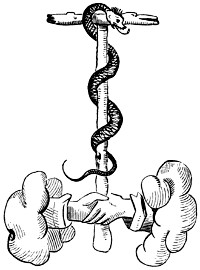 |
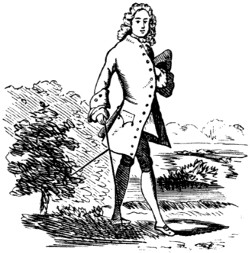 |
BRAZEN SERPENT.
(Reynold Wolfe, circa 1550.) |
GREEN MAN.
(Banks’s Collection, 1760.) |
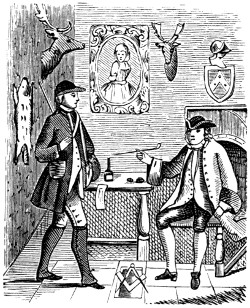 |
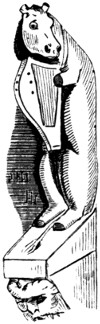 |
SIR ROGER DE COVERLEY.
(Banks’s Collection, 1780.) |
ASS PLAYING ON THE HARP.
(Chartres Cathedral, circa 1420.) |
More business-like is the sign of the Shepherd and Dog; he,
too, wears patches, but not on his face; so with the Shepherd and
Crook, and the Crook and Shears. All these may be found in
most villages, and refer to the inferior farm-labourer, to whom the
care of the flock is intrusted, and not the elegant Corydon or Alexis.
The merry, thirsty time of haymaking is commemorated in
the usual signs of a Load of Hay and the Cross Scythes.
There is a Load of Hay tavern on Haverstock Hill, a favourite
place for Sunday afternoon excursionists in the summer time.
Many years ago the eccentricity of Davies the landlord was one
of the attractions of the place. Lately the house has been re-built,
and it is now only a suburban gin-palace. The Mattock and
Spade, and the Spade and Becket, refer to field labour; the
first is very general, the second less so; but an example occurs at
Chatteris, Cambridgeshire. The Peat Spade, Longstock, Hants,
tells its own tale. The Dairy Maid was in great favour with
the London cheesemongers of the seventeenth century. Akerman
gives a trades token of such a sign in Catherine Street, in
1653, which is an amusing specimen of the liberties the token
engravers took with the king’s English, the country Phillis being
transformed into a “Deary Made.” The Dutch in the seventeenth
century used the sign for a rather heterogenous trade: it
seems that the process of sucking or inhaling the tobacco smoke
carried back their ideas to tender years of innocence and milk
diet, and so the Dairy Maid became the sign, par excellence, of
tobacco shops. Even at the present day that idea is not quite
forgotten; tobacco boxes or other smoking implements are
sometimes seen amongst that nation, with the words, “Troost
voor Zuigelingen,” “consolation for sucklings.” The inscriptions
under these signs were occasionally very curious:—
“Toebak dat edel kruyt soveel daarvan getuygen
Al die lang zyn gespeent beginnen weer te zuygen.”[513]
On the Goudsche Melkmeid in Amsterdam:—
“Goede Waar en goed bescheid
Krygt gy hier in de Goudsche Melkmeid
Puyk van Verinas en Virginia Tabac
Kunt gy hier rooken op uw gemak.”[514]
Another had:—
“Leckere Neusen, eele baasen,
Die by ’t klinken van de glaasen
Tot het smooken zyt bereyt;
Zoek je ’t beste van den acker
Puyk verynis? komt dan wacker
By de walsse mellik-meid.”[515]
Harvest-home, the pleasant time of congratulation and feasting,
must be an alluring sign for the villagers, calling up recollections
of all the festivities yearly celebrated on that grand
occasion, when—
“the harvest treasures all
Are gather’d in beyond the rage of storms,
Sure to the swain.”—Thomson.
One of the misfortunes of the “nimium fortunati sua si bona
norint” is pictured in the Cart Overthrown, which is a public-house
sign at Lower Edmonton; though how it came to be
such is difficult to guess. On Highgate Hill there is an old
roadside inn, the Fox and Crown, which displays on its front a
fine gilt coat of arms with the following inscription underneath:—
6th July 1837.
This Coat of Arms is a Grant
from Queen Victoria, for Ser-
vices rendered to Her Majesty
when in Danger Travelling
down this Hill.
The carriage conveying Her Majesty was proceeding down the
hill without a skid on the wheel, when something started the
horses, and the occurrence above narrated took place. The late
landlord died in distressed circumstances, and he stoutly asserted
to the last, that although he made repeated applications to the
Government for recompense, he having imperilled his own life to
save that of Her Majesty, all he ever received for his pains was
permission to display the royal arms on his house front.
The Woodman is another very common sign, invariably representing
the same woodman copied from Barker’s picture, and evidently
suggested by Cowper’s charming description of a winter’s
morning in the “Task.” The Drover’s Call is still seen on many
roadsides, though the profession that gave rise to it is well-nigh
extinct; the herds of steaming, fierce-looking oxen, formerly
driven from all parts of the kingdom, along the main roads leading
to London, there to be devoured, being now nearly all sent
here by rail. A yet older practice produced the sign of the
String of Horses, which may still be seen on many a highroad
in the North, and dates from times before mail coaches and stage
waggons existed, when all the goods-traffic inland had to be performed
by strings of packhorses, who carried large baskets,
hampers, and bales slung across their backs, and slowly, though
far from surely, wound their way over miles and miles of uninhabited
tracts, moors, and fens, which lay between the small
towns and straggling villages.
Many signs still recall those bygone days: the Old Coach and
Six may yet be seen in some places. There is one, for instance,
in Westminster, but it is no longer a “sign of the times,” for alas!—
“No more the coaches shall I see
Come trundling from the yard,
Nor hear the horn blown cheerily
By brandy-bibbing guard.”
The names of the coaches were often adopted by inns on the
road; for instance, the Mail, the Telegraph, the Defiance,
the Balloon, the Tally-Ho, the Bang-up, the Express, &c.,
&c.; but alas! the modern railroad has swept away the signs as
well as the coaches.
In London, there are not less than fifty-two public-houses known
as the Coach and Horses, exclusive of beer-houses, coffee-houses,
and similar establishments. Stow says, in his “Summary of English
Chronicles,” that in 1555, Walter Ripon made a coach for the
Earl of Rutland, “which was the first that was ever used in England.”
But in his larger Chronicle he says:—
“In the year 1564 Guilliam Boonen, a Dutchman, became the queen’s
coachman, and was the first that brought the use of coaches into England.
After a while divers great ladies, with as great jalousy of the queen’s displeasure,
made them coaches, and rid up and down the country in them,
to the great admiration of all the beholders, but then by little they grew
usual among the nobility and others of sort, and within twenty years became
a great trade of coachmaking.”
Taylor the Water poet, who, as a waterman of course, bore a
grudge to coaches, said, “It is a doubtful question whether the
devil brought tobacco into England in a coach, for both appeared
at the same time.” How common they became in a short time
appears from all the satirists of that period; not only the nobility,
but even the citizens could no longer do without them, after
they were once introduced. Not forty years after their first
appearance Pierce Pennyless, speaking of merchants’ wives, says:
“She will not go unto the field to coure on the green grasse, but
she must have a coach for her convoy.”[516] No wonder, then, that,
according to the “Coach and Sedan,” a pamphlet of 1636, there
were then in London, the suburbs, and four miles’ compass without,
coaches to the number of 6000 and odd. These were nearly
all private carriages, for the hackney coaches were only established
in 1625 by one Captain Bailey. Their first stand was at the
Maypole in the Strand. They numbered about twenty, and were
attached to the principal inns. In 1636, the number of hackney
coaches was confined to 50; in 1652, to 200; in 1654, to 300;
in 1662, to 400; in 1694, to 700; in 1710, to 800; in 1771,
to 1000; in 1802, to 1100; but in 1833 all limitation of number
ceased. Besides cabs of various kinds, there are now above a
thousand omnibusses regularly employed in the Metropolis, and
the commissioners of stamps are authorised to license all such
carriages without limitation as to number; the proprietor paying
the duty of £5 for the licence, and 10s. per week during its continuance.
What a difference just two centuries ago, when by
proclamation of the “Merry Monarch:”—
“The excessive number of hackney coaches [about 400] and coach horses
in London, are found to be a common nuisance to the public damage of
our people, by reason of their rude and disorderly standing, and passing to
and fro, in and about our cities and suburbs; the streets and highways
being thereof pestered and much impassable, the pavement broken up, and
the common passages obstructed and made dangerous.” Hence orders are[357]
given, that “henceforth none shall stand in the street, but only within their
coach-houses, stables, and yards.”
At the Coach and Horses, Bartholomew Close, some vestiges of
the ancient buildings of St Bartholomew’s Hospital and Convent
still remain—viz., a clustered column in the beer cellar, walls of
immense thickness, and an early English window in the taproom,
&c. This building occupies the site of the north cloister.[517] Another
Coach and Horses, in Ray Street, Clerkenwell, is also built
on classic ground, for it occupies the site of the once famous
Hockley-in-the-Hole of bear-baiting memory. A comical alehouse
keeper in Oswestry has travestied the sign of the Coach
and Horses into the Coach and Dogs.
The Wheel, an object sometimes seen on signboards, may
have been derived from the Catherine Wheel, (the name of a
favourite old coaching inn in Bishopsgate Street,) or from the
wheel of fortune; the Saddle and the Spur are both very general
on roadside inns, owing to the ancient mode of travelling on
horseback; the Whip occurs in Briggate, Leeds.
In Norwich there was (and we believe is still) a curious combination,
the Whip and Egg, which existed in that locality as
early as the year 1750,[518] and which is enumerated in London, under
the name of the Whip and Eggshell, amongst the taverns in
the black letter ballad of “London’s Ordinarie, or Everie Man in
his Humour,” whilst a still earlier mention occurs in Mother
Bunch’s Merriment, (1604,) when the transformation of pigs into
fowls, whereby one of the gulls was so “sweetly deceyved,” is
laid at the Whip and Eggshell. It has been explained as a corruption
of the Whip and Nag, but the combination of these two
would be so obvious that a corruption would scarcely be possible.
In “Great Britain’s Wonder, or London’s Admiration,” a ballad
on the frost of 1685, when the Thames was frozen over, and a
fair held upon it, the following lines occur:—
“In this same street, before the Temple made,[519]
There seems to be a brisk and lively trade,
When ev’ry booth hath such a cunning sign
As seldom hath been seen in former time;
The Flying P—— pot is one of the same,
The Whip and Eggshell, and the Broom by name.”
The Whip and Egg, therefore, figured on the ice, and may have
been brought together from the whipping of eggs, in making egg-punch,
egg-flip, and similar beverages, much drunk on the ice in
Holland; and as there were always crowds of Dutchmen on the
ice, whenever the river was frozen over, they may have introduced
their favourite drink as well as their Dutch whirlings, whimsies,
and flying boats, and the sign have been invented in order to indicate
the sale of those liquors.
The Three Jolly Butchers used to be seen in the neighbourhood
of markets and shambles, either in allusion to the three
merry north-country butchers, who killed nine highwaymen,
according to the ballad, or simply that favourite combination of
three which is of such frequent recurrence. The Cleaver seems
also to be in compliment to this profession, as well as the Marrowbones
and Cleaver. This last is a sign in Fetter Lane, originating
from a custom, now rapidly dying away, of the butcher boys
serenading newly married couples with these professional instruments.
Formerly, the band would consist of four cleavers, each
of a different tone, or, if complete, of eight, and by beating their
marrowbones skilfully against these, they obtained a sort of
music somewhat after the fashion of indifferent bell-ringing.
When well performed, however, and heard from a proper distance,
it was not altogether unpleasant. A largesse of half-a-crown or
a crown was generally expected for this delicate attention. The
butchers of Clare market had the reputation of being the best
performers. The last public appearance of this popular music was
at the marriage of the Prince of Wales, when small bands of them
perambulated the town, playing “God Save the Queen.” This
music was once so common that Tom Killigrew called it the
national instrument of England. In 1759 a burlesque Ode on
St Cecilia’s day, written by Bonnell Thornton, was performed at
Ranelagh. Amongst the instruments employed in this there
was a band of marrowbones and cleavers, whose endeavours were
admitted by the cognoscenti to have been “a complete success.”
As the use of coaches gave rise to the sign of the Coach and
Horses, so the Sedan produced some signs, as the Sedan Chair,
Broad Quay, Bristol; North Searle, Newark; the Two Chairmen,
&c., Warwick Street, Cockspur Street, and other parts of
London; and the Three Chairs in the seventeenth century, a
famous tavern in the Little Piazza, Covent Garden. The Sedan,
says Randle Holme, “is a thing in which sick and crazy persons are
carried abroad, which is borne up by the staves by two lusty men.”[520]
The first sedan chair used in England was one that the Duke of
Buckingham had received as a gift from Charles I., when Prince
of Wales, on his return from that romantic “Jean-de-Paris” expedition
to Spain.[521] The use of it got the Duke into trouble,
and he was accused of “degrading Englishmen into slaves and
beasts of burden.” Lysons, in his “Magna Britannia,” gives
another origin for them; speaking of Duncombe at Battlesden, in
Bedfordshire, he says:—
“It was to one of this family, Sir Saunders Duncombe, a gentleman pensioner
to King James and Charles I., that we are indebted for the accommodation
of the sedans or close chairs, the use of which was first introduced
by him in this country in the year 1634, when he procured a patent which
vested in him and his heirs the sole right of carrying persons up and down
in them for a certain time.”
Sir Saunders hereupon got forty or fifty sedans made, and sent
them about town, but differences soon arose between the chairmen
and the coachmen. Pamphlets were written,[522] ballads were
sung on the occasion, and the public sided with one or the other,
according to individual taste. A ballad in favour of the sedan
said:—
“I love sedans, cause they do plod
And amble everywhere,
Which prancers are with leather shod,
And neere disturb the care.
Heigh downe, dery, dery, downe,
With the hackney coaches downe,
Their jumpings make
The pavement shake,
Their noyse doth mad the towne.”[523]
De Foe, in 1702, says, “We are carried to these places [coffee-houses]
in chairs, which are here very cheap—a guinea a week,
or a shilling per hour—and your chairmen serve you for porters
to run on errands, as your gondoliers do at Venice.” The chairmen
of the aristocracy wore gaudy liveries and plumed hats, and
their chairs were richly gilt and painted, and provided with velvet
cushions. They used to be kept in the halls of their large
mansions. As for the chairmen, we may infer from Gay’s
“Trivia” that they were an insolent set of fellows:—
“Let not the chairman with assuming stride
Press near the wall and rudely thrust thy side,
The laws have set him bounds; his servile feet
Should ne’er encroach where posts defend the street.
Yet, who the footman’s arrogance can quell,
Whose flambeau gilds the sashes of Pall Mall,
When in long rank a train of torches flame,
To light the midnight visits of the dame.”
The trumpet-like instruments in which these torches were extinguished,
when arrived at their place of destination, are still
seen attached to the area railings of most of the houses in Grosvenor
and St James’ Squares, and various other parts of the town
fashionably inhabited at that period.
Another creature of this class, now as completely extinct as
the Plesiosaurus and the Megatherion, or any other monster of
the pre-Adamite world, was the Running Footman. We cannot
say that there is not a “sign” of him left, for there is one in
Charles Street, Berkeley Square, representing a man in gaudy
attire, running, with a long cane in his hand—under it, “I am
the only Running Footman.” This was a class of servants
used by rich families in former days to run before the carriage,
to clear the way, bear torches at night, pay turnpikes, and serving
also in a great measure for pomp. Generally their livery was
very rich, being somewhat of the Jockey dress, with a silk sash
round the waist; sometimes, instead of breeches, they wore a
sort of silk petticoat with a deep gold fringe. They carried long
sticks with silver heads, which have now descended to their successors
the footmen. The Duke of Queensberry was one of the
last noblemen who kept running footmen. A good story is told
of him in connexion with one of these servants. Whenever his
grace wanted to engage one it was his custom to make him put
on his livery and run up and down Piccadilly, whilst he, from his
balcony, watched their paces; and so it happened on a time, that
after one of those fellows had gone through all his evolutions and
presented himself under the balcony, the Duke said: “That will
do; you will suit me very well.” “And so your livery does me,”
was the answer, and off the fellow went running like a deer and
was never heard of afterwards. Another feat on record, somewhat
more to the credit of the fraternity, was that one of them
ran for a wager to Windsor against the Duke of Marlborough in
a phaeton with four horses, and lost only by a short distance; but
it cost the poor fellow his life, for he died very soon after. Most
of these running footmen were Irish, hence Decker[524] says—“The
Devil’s footeman was very nimble of his heeles, for no wild Irishman
could outrunne him,” and Brathwaite remarks:—
“For see those thin-breech’d Irish lackies run.”[525]
St Patrick’s day was generally given to them as a holiday, which
they invariably celebrated by purging themselves. In various
country places the sign of the Running Footman has been corrupted
into the Running Man.
Another “domestic” sign is the Trusty Servant at Minstead,
Hants:—
“A trusty servant’s portrait would you see,
This emblematic figure well survey;
The porker’s snout not nice in diet shows,
The padlock shut, no secret he’ll disclose.
Patient the ass his master’s rage will bear,
Swiftness in errand the stag’s feet declare.
Loaden his left hand apt to labour saith,
The vest his neatness: open hand his faith.
Girt with his sword, his shield upon his arm,
Himself and master he’ll protect from harm.”
The origin of this sign is a picture on the wall of one of the
rooms, near the kitchen of Winchester College, where it is accompanied
by the above verses in English and Latin.
Further, there is the Stave-Porter, Dockhead, London; the
Ticket-Porter, near London Bridge; the Porter’s Lodge, Leicester;
and the Porter and Gentleman in three different places
in London.
The Huntsman is common in the hunting districts. To the
hunt, also, we must refer such signs as—Hark to Bounty, Staidburn,
Clitheroe; Hark up to Nudger, Dobcross, Manchester;
Hark the Lasher, near Castleton, Derby; Hark up to Glory,
Rochdale, and the Chase Inn in Leamington. In Cambridge
there are two signs of the Birdbolt, an implement formerly used
to shoot birds; consequently it must be a sign of some antiquity.
In Nightingale Lane, East Smithfield, there is an Experienced
Fowler, who, no doubt, well knows the value of “a bird in the
hand,” and at Oldham and Rochdale there is an equally satirical
sign, that of the Trap. The Angler is common enough in the
neighbourhood of trout streams and other fishing resorts frequented
by the disciples of Isaak Walton.
Many professions are only represented by one or two objects
relating to them. The Tallow Chandler, very common among
the trades tokens, was always represented by a man dipping
candles. To that trade also seems to belong the Bowls and
Candle Poles, which occurs in the following rambling advertisement:—
“Stolen,
Lost, or Mislaid,
A Promissory Note for one hundred and twenty Pounds, signed by John
Smallwood and indorsed by John Addams. Whoever will bring the same
note to the House known by the Bowls and Candlepoles in Duke Street,
in the Park, Southwark, shall receive five Guineas Reward; and if offered
to be paid away or any Writ to be taken out for payment of the said Note,
pray stop it and the party, and you shall have the same Reward.
*** The House is in Tenements, and some part thereof being a Pawnbroker’s,
was broke open and several things of value missing. Note, This
mischief arrises from a country Butcher, who did strike and kick an old
Gentleman at London Bridge, about three quarters of a year ago. And all
persons who did see the said Assault and will speak the truth, (for Christ’s
sake,) are desired to send their Names and Place of Abode to the Bowls
and Candlepoles and the favour shall be thankfully acknowledged.”[526]
The Scales is a common sign referring to various trades: one
of the engraved bill-heads in the Bagford Collection gives the
Hand and Scales—viz., a hand holding a pair of scales; this
antiquated mode of representing a hand issuing from the clouds
to perform some action, has given name to a great many signs—all
combinations of the hand with some other object. The
Spinning Wheel was formerly much more common than now;
there is still a public-house with this sign at Hamsterley near
Darlington. The Woolsack was originally a wool-merchant’s
sign; it is often accompanied by the Black Boy. Machyn mentions
this sign in 1555: “The xx day of July was cared to the
Toure in the morning erlee iiij men; on was the goodman of
the Volsake with-owt Algatt.” It seems to have been one of the
leading taverns in Ben Jonson’s time, who often alludes to it in
his plays; like the Dagger, it was famous for its pies.
“And see how the factors and prentices play there
False with their masters, and geld many a full pack,
To spend it in pies at the Dagger and the Woolpack.”
The Devil is an Ass, act i., sc. 1.
“Her Grace would have you eat no more Woolsack pies nor Dagger furmety.”—Alchymist,
act v., sc. 2.
In the year 1682, the Woolsack Tavern in Newgate Market
attracted great attention, owing to a wonderful phenomenon
there exhibited, and set forth in the following handbill from the
Sloane Collection, No. 958:—
“At the sign of the Woolpack in Newgate Street, is to be seen a strange
and wonderful thing, which is, an elm-board, being touch’d with a
hot iron, doth express itself, as if it was a man dying, with grones and
trembling, to the great admiration of all the hearers. It has been presented
before the King and his nobles, and hath given them great satisfaction.
Vivat Rex.”
Such a curiosity could not fail to prove an object of immense
attraction with our wonder-loving ancestors, particularly after the
house had been visited by his Majesty, and thus acquired additional
respectability. Very soon, however, numerous London taverns
claimed public attention for similar wonders. It was as if the
wood used in their construction had been cut from the myrtle-tree
which conversed with Æneas near the river Hebrus, (“Æneid,”
lib. iii. 19,) or from the “fiera selvaggia” Dante saw in the second
circle of Hades, where he
“sentia da ogni parte tragger guai
E non vedea persona che’l facesse.”[527]
Inferno, canto xiii.
The mantel-piece at the Bowman Tavern, Drury Lane, expressed
its aversion of a red hot poker as unequivocally as the
elm-board at the Woolsack, and the dresser at the Queen’s Arms
in St Martin’s Lane was evidently a “chip of the same block.”
Indeed, boards were cauterised and groaned all over London.
The Block was a hatter’s sign, or as that trade was sometimes
called, Bever-cutter, the block being the mould on which the hat
is formed. Beatrix, in “Much Ado about Nothing,” says: “He
wears his faith, but as the fashion of his hat it ever changes with
the next block.” And Decker, in the “Gull’s Hornbook:”
“John, in Paul’s Churchyard, shall fit his head for an excellent
block.” The word was also often used as a synonym for “hat.”
The Postboy was the sign of a fishmonger’s shop in Sherborne
Lane, where in 1759 Green-native Colchester oysters were sold
at 3s. 3d. a barrel, and exceeding fine “Pyfleet oysters” at 4s. 3d.
a barrel. The Up and Down Post used to be, in the good old
coaching times, a thriving inn on the now deserted highway between
Birmingham and Coventry. The picture represented an
erect and a prostrate pillar, which after all was only a rebus or a
misunderstanding. In former times, before the mail-coaches were
instituted, the equestrian letter-carriers of the up and down mail
used to meet at this house, exchange their bags and each return
whence they came, thus effecting a considerable saving of time
and trouble. Even washerwomen have been exalted to the signboard,
for in Norwich there was the sign of the Three Washerwomen
in 1750. And one of the implements of their trade, the
Golden Maid, (better known as “the Dolly,”) may still be seen
at a turner’s shop in Dudley.
A few others remain, which cannot, strictly speaking, be called
professions, yet are they—or at least they were—means of making
a living, as the Three Morris-dancers, once a very common
sign, but now, like the custom that gave rise to it, almost extinct.
There is one still left, however, at Scarisbrook, Lancashire,
and in a few villages a remnant of the dance is also kept
up on certain occasions. They were called Morris, or Moors,
from the Spanish Morisco. Black faces were required for the
dance:—
“Nam faciem plerumque inficiunt fuligine et peregrinum vestium cultum
assumunt, qui ludicris talibus indulgent ut Mauriesse videantur, aut
e longius remota patria credantur advolasse atque insolens recreationis
genus advenisse.”[528]
There is a painted glass window at Betley, in Staffordshire, on
which the characters performing the dance in the early part of
the sixteenth century are represented; to these afterwards others
were added. The earliest performers appear to have been called
Robin Hood and Little John, Maid Marian, Friar Tuck, the May
queen, the fool, the piper, and the plain rank and file of dancers
variously dressed. To these afterwards were added a dragon, a
hobby-horse, and other quaint types. Among the characters represented
on the painted window are also a franklein, a churl, or
peasant, and a nobleman. The hobby-horseman occupies the middle
of the window, and is said to represent a Moorish king: he has
two swords thrust into his cheeks, which seem to represent a
feat of dexterity performed by Indian and Egyptian jugglers of
throwing a somersault with two swords balanced on each side of
the cheek. The horse (merely a frame covered with long trappings,
and only showing the neck and limbs of a horse, in which
the man capered about) held a ladle in his mouth for collecting
money.
The fool was one of the features of the pageant, and on him
rested a great deal of the duties to amuse the public, particularly
when the hobby-horse was not present; hence Ben Jonson:—
“But see the Hobby-Horse is forgot,
Fool, it must be your lot
To supply your wont with faces
And some other buffoon graces.
You know how.”
On May-day, which in those merry days was the merriest of all
the year, they came out in full force, and, along with the milkmaids
dancing with piles of plate on their heads, contributed not
a little to give the streets and thoroughfares a merry aspect. The
May-dance of the sweeps is perhaps the “last stage of decomposition”
of this amusement of our forefathers; their sooty complexions,
their clowns, their Lord and Lady and Jack in the
Green, may be all that remain of the morris-dance, the fool, the
Lord and Lady, the hobby-horse, and the rest.
In treating of games, we may advert to a rendering of the
Flying Horse, overlooked on a former occasion. Besides its
mythological and heraldic origin, there was another reason which
sometimes prompted the choice of this sign. It was the name
of a popular amusement, which consisted in a swing, the seat
of which formed a wooden horse. This the flying equestrian
mounted, and as he was swinging to and fro he had to take with
a sword the ring off a quintain. If he succeeded, his adroitness
was no doubt rewarded either with a number of swings gratis,
or a quotum of beer. Such a Flying Horse served for a sign to
an ale-house of that denomination in Moorfields, in the time of
Queen Anne. Swings, round-abouts, and such-like amusements,
were in those days the usual appendages of suburban ale-houses,
and to a certain extent have even come down to our time.
Oil and colour-shops generally, and some public-houses—mostly
near theatres—adopt the sign of the Harlequin. One
of the most noted amongst the latter was kept in the beginning
of this century in Drury Lane, by the eccentric Richardson, the
showman, or, rather, the “Prince of Showmen,” as he called
himself. In this tavern he saved some money, which enabled
him to fit up a travelling theatre, by which he realised so much,
that when he died in 1836, he left £20,000. It used to be one
of his boasts that he had brought out Edmund Kean, and several
other eminent actors. He desired in his will to be buried at
Marlow, in Bucks, (where he was born in the workhouse,) in the
same grave with the “Spotted Boy,” a natural phenomenon
which had been one of his luckiest hits, and brought him a considerable
amount of money.
It is curious to observe how the same simple thing has made
mankind laugh for nearly thirty centuries, and that is a black
face. In our age a large proportion of the public seem to find
inexhaustible pleasure in pseudo-negroes, their songs and antics.
The Greeks on their stage had a young satyr, dressed in goat
or tiger-skin, with a short stick in his hand, a white hat on his
head, his hair cut short, and a brown mask. This satyr performed
some antics, and was the prototype of the harlequin.
The Romans adopted a somewhat similar character under the
name of planipes, because he did not wear the tragic cothurna;
he also wore a variegated dress, for Apuleius, in his “Apology,”
speaks of the “mimus centunculus.” From the Romans it descended
to the Italians, and as early as the sixteenth century we
find the whole troop complete, playing in Spain, namely, Harlequin,
Pantaloon, Pagliacico, the Doctor, &c. At a masked ball
at the court of Charles IX., in 1572, the king represented Brighella;
the Cardinal of Lorraine, Pantaloon; Catherine de
Medici, Columbine; and the Duke of Anjou, (afterwards
Henry III.,) Harlequin. At that time, or shortly after, the
troop of the Gelosi played the Italian pieces in Paris, in which
these characters were introduced.
For the sign of the Green Man there is a twofold explanation.
1o. That it represents the green, wild, or wood men of the
shows and pageants, such as described by Machyn in his Diary
on Lord Mayor’s Day, October 29, 1553:—“Then cam ij grett
wodyn with ij grett clubes all in grene and with skwybes
[squibs] bornyng . . . . with gret berds and ryd here and ij
targets a-pon their bake.” This green in which they were
dressed consisted of green leaves. When Queen Elizabeth was
at Kenilworth Castle, in 1575, “on the x of Julee met her in
the Forest as she came from hunting one clad like a savage
man all in ivie,”[529] who made a very neat speech to the queen,
in which he was kindly assisted by the echo. Besides wielding
sticks with crackers in pageants, these green men sometimes
fought with each other, attacked castles and dragons, and were
altogether a very favourite popular character with the public.
One of their duties seems to have been to clear the way for
processions. In one of the Harleian MSS., entitled “The
maner of the showe, that is, if God spare life and health, shall
be seen by all the behoulders upon St Georges Day next, being
the 23 of Aprill, 1610,” we see amongst the requirements:—
“It. ij men in greene leaves set with work upon their other habet with
black heare & black beards very owgly to behould, and garlands upon
their heads with great clubs in their hands with fireworks to scatter abroad
to maintaine way for the rest of the show.”[530]
This interpretation is also given as the origin of the Green
Man by Bagford:—
“They are called woudmen, or wildmen, thou’ at thes day we in ye
signe call them Green Men, couered with grene bones: and are used for
singes by stillers of strong watters and if I mistake not are ye sopourters
of ye king of Deanmarks armes at thes day; and I am abpt to beleve that
ye Daynes learned us hear in England the use of those tosticatein lickers
[intoxicating] as well as ye breweing of Aele and a fit emblem for those
that use that intosticating licker which berefts them of their sennes.”[531]
The Wild Man, therefore, on a sign at Quarry Hill, Ladybridge,
Leeds, is the same as the Green Man.
2o. The second version of this sign is, that it is intended for
a forester, and in that garb the Green Man is now invariably
represented; even as far back as the seventeenth century, it is
evident from the trades tokens that the Green Man was
generally a forester, and, in many cases, Robin Hood himself,
which may be inferred from the small figure frequently introduced
beside him, and meant for Little John. The ballads
always described Robin and his merry men as dressed in green,
“Lincoln green.” When Robin meets the page who brings him
presents from Queen Katherine:—
“Robin took his mantle from his backe,
It was of the Lincoln greene
And sent that by this lovely page
For a present unto the queene.”[532]
And in the same ballad, when he is going to court, “he clothed
his men in Lincolne greene,” &c. Drayton, in his “Polyolbion,”
says:—
“An hundred valiant men had this brave Robin Hood
Still ready at his call, that bowmen were right good,
All clad in Lincoln green which caps of red and blue.”
Sometimes it is called Kendal green:—
“All the woods
Are full of outlaws, that in Kendal green
[368]
Follow the outlawed Earl of Huntingdon.”
Richard, Earl of Huntingdon, 1601, (i.e., Robin Hood)
It was, in fact, the ordinary dress of foresters and woodmen,
and is so still in Germany.
“All in a woodman’s jacket he was clad,
Of Lincoln Green, belayed with silver lace.”
Spenser’s Faery Queene.
One of the most noted Green Man taverns was that on
Stroud Green, Islington, formerly the residence of Sir Th.
Stapleton, of Gray’s Court, Bart., whose initials, with those of
his wife, and the date 1609, were to be seen on the façade. It
was one of the suburban retreats frequented by the fashion in
the days of Charles I., when it had been converted into a tavern.
A century ago the sign bore the following inscription:—
“Ye are wellcome all
To Stapleton Hall.”
A club used to meet annually at this place, styling themselves
the Lord Mayor, Aldermen, and Corporation of Stroud Green.[533]
At Dulwich, in the reign of George II., there was another Green
Man, a place of amusement for the Londoners during the summer
season; it is enumerated, with other similar resorts, in the
following stanza:—
“That Vauxhall and Ruckholt and Ranelagh too,
And Hoxton and Sadlers both Old and New,
My Lord Cobham’s Head and the Dulwich Green Man
May make as much pastime as ever they can.[534]
Derry Down,” &c.
Musick in Good Time, a new Ballad, 1745.
The Merry Andrew was a card-maker’s sign; in the Banks
Collection there is a shopbill of the time of Queen Anne, of
Edward Hall, card-maker to her Majesty at the Merry Andrew,
in Piccadilly. The playing-cards at that time used to have certain
heads on the wrapper, according to which they were denominated.
Merry Andrew was one of them. Other sorts had
the Great Mogul, Henry VII., Henry VIII., and the Duke of
Savoy, (Prince Eugene;) second-class cards had the Queen of
Hungary, the Spaniard, the beau, and the Merry Andrew. The
original Merry Andrew is said to have been a certain Doctor
Andrew Borde, born at Pevensey in the fifteenth century, and
educated at Winchester and New College, Oxford, but who
obtained his doctor’s degree at Montpellier. His writings
abound with witticisms, which are reported also to have pervaded
his speech. He is said to have frequented fairs, markets,
and other “busy haunts of men,” haranguing the people in
order to increase his practice in physic. He had many followers
and imitators, whence it came that those who affected the same
language and gestures were called Merry Andrews. Notwithstanding
all this mirth and animal spirits, he professed himself a
Carthusian, lived in celibacy, drank water three days in the week,
wore a hair shirt, and nightly hung his shroud at the foot of his
bed. He is said to have been physician to King Henry VIII.,
and member of the College of Physicians in London. He died
a prisoner in the Fleet in 1549. More celebrated than his works
on physic are his “Merry Tales of the Wise Men of Gotham,”
and the “Merry History of the Miller of Abingdon.”
Lower down still in the sphere of callings and professions the
signs will take us. At Oswald Wistle, Accrington, we meet with
the Tinker’s Budget. The budget is the tinker’s bag of instruments;
we see the word thus used in Randle Holme:[535]—“A
Tinker with his budget on his back, having always in his mouth
this merry cry:—‘Have you any work for a Tinker?’” And
Shakespeare, in the “Winter’s Tale:”
“If tinkers may have leave to live
And bear the sowskin budget.”
This inn, then, is certainly very modest in its pretensions; but
we shall descend lower still. Even “poor Tom’s flock of wild
geese,” otherwise Tom of Bedlam, we have now to introduce.
We find him at Balsall, Warwick, and no doubt it was formerly
not an uncommon sign, since he was such a favourite in ballads;
the Merry Tom, at Kirkcumbeck, Cumberland, evidently refers
to the same individual. Notwithstanding all the fantastic ballads
that went under Tom’s name, he was but a sorry rogue. Randle
Holme[536] says:—
“The Sow gelder and Tom of Bedlam are both wandering knaves alike,
and such as are seldom or never out of their way, having their home in
any place. The first is described as carrying a long staff, with a head like[370]
a spear or a half pike, and a horn hung by his side from a broad leather
belt or girdle cross his shoulders. Tom of Bedlam is in the same garb,
with a long staff, and a Cow or Ox Horn by his side, but his cloathing is
more fantastic or ridiculous, for being a mad man he is madly decked and
dressed all over with Rubins, Feathers, cuttings of cloth and what not;
to make him seem a madman or one distracted, when he is no other but a
dissembling knave.”
“The Canting Academy,” 1674, gives them a similar attire
and character:—
“Abram-men, otherwise called Tom of Bedlams; they are very strangely
and antickly garbed, with several coloured ribands or tape in their hats, it
may be instead of a feather, a fox tail hanging down a long stick, with
ribands streaming and the like; yet for all their seeming madness they
have wit enough to steal as they go.”[537]
Aubrey says:—
“Before the Civil Warre, I remember Tom o’ Bedlams went about a
begging. They had been such as had been in Bedlam and there recovered
and come to some degree of soberness, and when they were licensed to goe
out they had on their left arme an armilla of tinne (printed) about three
inches breadth, which was sodered on.”[538]
This permission, if ever it was granted, was retracted after the
Restoration, for in the year 1675 the London Gazette contained
in several numbers the following advertisement:—
“Whereas several Vagrant Persons do wander about the city of London
and countries, pretending themselves to be Lunaticks under
cure in the Hospitall of Bethlem, commonly called Bedlam, with brass
plates upon their arms and inscriptions thereon, These are to give notice
that there is no such liberty given to any Patients kept in the Hospital
for their cure, neither is any such plate as a distinction or mark put upon
any Lunatick during their being there or when discharged thence. And
that the same is a false pretence to colour their wandering and begging
and deceive the people to the dishonour of the Government of that
Hospital.”
Not only men but also women of a roving disposition, adopted
poor Tom’s horn, and went wandering, begging, and pilfering
under the name of Bess of Bedlam, which is still seen as a sign
in Oak Street, Norwich. Bess was an old companion of poor
Tom, for in the play of King Lear, Tom sings a snatch of a song
with the words, “Come over the bourn, Bessy, to me,” and in the
jollities of Plough Monday the fool and Bessy are two of the
principal personages.[539]
A third class of beggars called Mumpers, is also found on the
signboard under the name of the Three Mumpers.
Thus, after having gone through all ranks of society, from the
palace to the cottage, and from the sceptre to Tom’s staff with a
fox-tail, we now come to the great leveller Death, who also was
represented on the signboard. There were the Three Death’s-heads
in Wapping, of which house trades tokens are extant;
probably it was an apothecary’s, though it was a ghastly sign for
his customers. Undertakers were also strictly professional in
their choice. In the eighteenth century there were the Four
Coffins over against Somerset House,[540] and another in Fleet
Street, the sign of Stephen Roome,[541] whose son was the unfortunate
author whom Pope has “gibbeted” in the Dunciad, as
afflicted with a “funereal frown.” Savage, one of Pope’s literary
sicarii, calls Roome “a perfect town-author,”[542] and has drawn his
portrait in “An Author to be let, by Iscariot Hackney:”—
“Had it not been more laudable for Mr Roome, the son of an undertaker,
to have borne a link and a mourning staff, in the long procession of
a funeral—or even been more decent in him to have sung psalms according
to education, in an Anabaptist meeting, than to have been altering the
Jovial Crew or Merry Beggars into a wicked imitation of the Beggars’
Opera?”
Another undertaker, James Maddox, clerk and coffin-maker of
St Olave’s, had for a sign the Sugar-loaf and three Coffins.
The addition of the sugar-loaf has, of course, nothing to do with
his profession, for when death calls, the sweets of life are past.
It was simply the sign of a former tenant, suspended in front or
fixed in the wall of the house. Although the undertakers of the
present day do not display signs as of old, they advertise their
calling quite as effectually. The men who in their handbills
solicit us to try their “economic funerals,” or to test one of their
“three guinea respectable interments,—one trial only asked,” are
commercial with the rest of the age, although we might wish that
they would force themselves a little less upon our attention. One
undertaker recently hit upon what he deemed a brilliant method
of advertising his cheap funerals. He selected some good names
from the “Court Guide,” and sent out hundreds of telegrams announcing
the low prices at which a “body” could be interred. Some
reached their destination just as the lady or gentleman “body”
was sitting down to dinner, others as the “parties” were dressing,
or in the act of leaving home; but although the scheme
failed, the name of the undertaker and his prices were firmly
fixed in people’s memories, and he received, instead of orders,
numerous cautions not to telegraph in that way again.
An undertaker in Islington, some years ago, exhibited in his
window some pleasing artistic efforts of his children, which must
have greatly comforted the father. “Master A., aged 12 years,”
had produced a grinning skeleton, garnished with worms and
cross-bones; and “Miss B., aged 10,” had painted in colours a
section of a vault, with coffin heads, skulls, and sexton’s tools,
neatly arranged right and left. The drawings were framed and
glazed, and parental pride had placed them in the best spot in
the windows.