The History of Our Navy from its Origin to the Present Day Volume IV (of 4)
Whole book · 23 sections
THE HISTORY OF OUR NAVY
Transcriber’s Note
Larger versions of most illustrations may be seen by right-clicking them
and selecting an option to view them separately, or by double-tapping and/or
stretching them.
New original cover art included with this eBook is granted
to the public domain.
A Brief Story of the Development of the Warship that was Propelled by both Sails and Steam—The Remarkable Floating Battery of 1814—Barron’s Idea of a Ram—The Stevens Floating Battery—Ericsson’s Screw Propeller—Stockton and the First Screw Warship—Experiments with Great Guns—Discoveries of Bomford and Rodman—Practical Work by Dahlgren—A Comparison of Yankee Frigates with a Class of British Ships “Avowedly Built to Cope” with them—The Condition of the Personnel.
Lincoln’s Proclamation—It was Something of a Task to Close 185 Inlets and Patrol 11,953 Miles of Sea-beaches, especially with the Force of Ships in Hand—One Merchant’s Notion of the Efficiency of Thirty Sailing Vessels—Gathering and Building Blockaders—Incentives and Favoring Circumstances for Blockade-runners—When Perjury Failed and Uncle Sam was Able to Strike without Waiting for Act of Congress—When Blockade-runners Came to New York and Yankee Smokeless Coal was in Demand.
Effective Work Done by Southern Naval Officers who Continued to Wear the National Uniform that they might the more Readily Betray the National Government—The Secretary of the Navy was Deceived and the Commandant at Norfolk Demoralized—William Mahone’s Tricks Added to the Demoralization at the Yard, and it was Abandoned at Last in a Shameful Panic—Property that was Worth Millions of Dollars, and Guns that Took Thousands of Lives, Fell into the Confederates’ Hands—The First Naval Battle of the War—Three Little Wooden Vessels with Seven Small Guns Sent against a Well-built Fort Mounting Thirteen Guns—The Hazardous Work of Patrolling the Potomac.
They Did Plenty of Damage for a Time, but their Career was Brief—Capture of the First of the Class, and Trial of her Crew on a Charge of Piracy—Reasons why they could not be Held as Criminals—Luck of the Jefferson Davis—A Negro who Recaptured a Confederate Prize to Escape the Terrors of Slavery—A Skipper who Thought a Government Frigate was a Merchantman—The “Nest” behind Cape Hatteras.
An Expedition Planned by the Navy Department that Resulted in the First Federal Victory of the Civil War—An Awkward Landing Followed by Ineffectual Fire from Ships under Way—One Fort Taken and Abandoned—Anchored beyond Range of the Fort and Compelled Surrender by Means of the Big Pivot Guns—A Wearisome Race from Chicamicomico to Hatteras Lighthouse Won by the Federals—Capture of Roanoke Island—Origin of the American Medal of Honor.
The Shameful Story of Pensacola and Fort Pickens—When Lieutenant Russell Burned the Judah—A British Consul’s Actions when Confederate Forts were Attacked at Galveston—Extraordinary Panic at the Head of the Passes in the Mississippi when Four Great Warships, Carrying Forty-five of the Best Guns Afloat, Fled from a Disabled Tugboat that was Really Unarmed—Once more in Galveston—Lieutenant Jouett’s Fierce Fight when he Destroyed the Royal Yacht.
Capt. Charles Wilkes, of the American Navy, Took Four Confederate Diplomatic Agents from a British Ship Bound on a Regular Voyage between Neutral Parts, and without any Judicial Proceeding Cast them into a Military Prison—A Case that Created Great Excitement Throughout the Civilized World—A Swift Demand, with a Threat of War Added, Made by the British—Comparing this Case with another of Like Nature—The United States once Went to War to Establish the Principle which Captain Wilkes Ignored—The British Officially Acknowledge that the Americans were Justified in Declaring War in 1812.
A Fleet of Seventeen Ships, Carrying 155 Guns, Sent to Take a Harbor that would Make a Convenient Naval Station for the Atlantic Blockaders—There were Two “Exceedingly Well-built Earthworks” “Rather Heavily Armed” Defending the Channel, but one Part of the Squadron Attacked them in Front, another Enfiladed them, and in Less than Five Hours the Confederates Fled for Life—A Heavy Gale Weathered with Small Loss—Interesting Incidents of the Battle.
Superior Activity of the Confederates in Preparing for Ironclad Warfare Afloat—Story of the Building and Arming of the Merrimac—She was a Formidable Ship in Spite of Defects in Detail, but her Design was not the Best Conceivable—Origin and Description of the Ship that Revolutionized the Navies of the World—A Wondrous Trial Trip—For One Day the Merrimac was Irresistibly Triumphant—Two Fine Ships of the Old Style Destroyed while she Herself Suffered but Little—The Magnificent Fight of the Cumberland—A Difference in Opinions.
A Comparison between the Monitor and the Merrimac by the English Standard of 1812—It Astonished the Spectators to See the Tiny Monitor’s Temerity—After Half a Day’s Firing it was Plain that the Guns could not Penetrate the Armor—Attempts to Ram that Failed—The Merrimac A-leak—Captain Worden of the Monitor Disabled when the Merrimac’s Fire was Concentrated on the Pilot-house—Where the Monitor’s Gunners Failed—Fair Statement of the Result of the Battle—Worden’s Faithful Crew—The Merrimac Defied the Monitor in May, but when Norfolk was Evacuated she had to be Abandoned and was Burned at Craney Island—Loss of the Monitor.
Creating a Fleet for the Opening of the Water Route across the Confederacy—Ironclads that were not Shot-proof, but Fairly Efficient nevertheless—Guns that Burst and Boilers that were Searched by Shot from the Enemy—When Grant Retreated and was Covered by a Gunboat—First View of Torpedoes—Capture of Fort Henry—A Disastrous Attack on Fort Donelson—When Walke Braved the Batteries at Island No. 10—The Confederate Defence Squadron at Fort Pillow—The First Battle of Steam Rams—Frightful Effects of Bursted Boilers—In the White River—Farragut Appears.
It was Hard Work Getting the Squadron into the Mississippi—Preparing the Ships to Run by the Forts Guarding the River—Mortar Schooners Hidden by Tree Branches—The Forts were Well Planned, but Poorly Armed—A Barrier Chain that was no Barrier at the Last—The Heterogeneous Confederate Squadron—The Fire-rafts—Work of the Coast Survey—Bravery of Caldwell—Foreigners who Interfered—Work of the Mortar Fleet—When the Squadron Drove past the Forts—Scattering the Confederate Squadron—Nevertheless, at least Three Good Captains were Found among them—Sinking the Varuna—Fate of the Ram Manassas—Surrender of the Forts—End of the Ironclad Louisiana—The Work of the Mississippi Squadron.
The Forts and the Confederate Squadron the Union Forces were Compelled to Face—The Confederate Ironclad just Missed being a most Formidable Ship—Tedious Wait for Monitors—When the Southwest Wind Favored—There was a Fierce Blast from the Forts at First, but the Torpedo was Worse than Many Guns—Fate of the Tecumseh and Captain Craven—The Last Words of the Man for whom “there was no Afterward”—Torpedoes that Failed beneath the Flagship—Captain Stevens on the Deck of his Monitor—When Neilds Unfurled the Old Flag in the midst of the Storm—How Farragut was Lashed to the Mast—Jouett would not be Intimidated by a Leadsman—Mobbing the Tennessee.
The most Instructive Chapter in the History of the United States—Work Accomplished by an Energetic Seaman in a Ship his Brother Officers Condemned—Brilliant Work of the Florida under John Newland Maffitt—Bad Marksmanship and a Worse Lookout off Mobile—A Case of Violated Neutrality—Semmes and the Alabama—The Battle with the Kearsarge—What Kind of a Man is it that Fights his Ship till she Sinks under him?—American Commerce Destroyed—The British without a Rival on the Sea, at Last, and at Very Small Cost.
A Formidable Warship was Built under Remarkable Conditions to Enable the Confederates to Regain Control of the Inland Waters of North Carolina—Very Successful at First, but she was Laid up to Await the Building of another One, and then came Cushing with his Little Torpedo Boat, and the Confederate Hopes were Destroyed with their Ship.
It was a Well-guarded Harbor, and the Channel was Long and Crooked—The “Stone Fleet” and the Attitude of Foreign Powers—Brief Career of Two Confederate Ironclads—The Blockade was not Raised—A Confederate Cruiser Burned—Utter Failure of the Ironclad Attacks on the Forts—Capture of the Confederate Warship Atlanta—“Boarders Away” at Fort Sumter—Magnificent Bravery of the Men who Manned the Confederate Torpedo Boats.
It was One of the Best Works in the South, though not well Located—Butler’s Powder-boat Scheme, and what he Expected to Accomplish by it—Throwing 15,000 Shells at the Fort Disabled Eight Great Guns out of a Total of Thirty-eight—Butler Thought the Fort still too Strong and would not Try—He did not even Make Intrenchments According to Orders—Gen. A. H. Terry, with 6,000 Soldiers and 2,000 from the Ships, Easily Took the Fort Three Weeks Later—The Navy’s Last Fight in the Civil War.
The Folly of Allowing other Nations to Experiment for us—In Spite of what we Learned from their Mistakes, we were Unable, when we First Began for ourselves, to Build even a First-class Cruiser—The Result of Ten Years of Earnest Work—Battle-ships whose Power is Conceded by Foreign Writers—Cruisers that Awakened the Pride of the Nation—Three “Newfangled Notions”—A Yankee Admiral at Rio Janeiro and a Yankee Lieutenant on the Coast of Mexico—The One Important Fact about the New Navy.
LIST OF ILLUSTRATIONS
PAGE
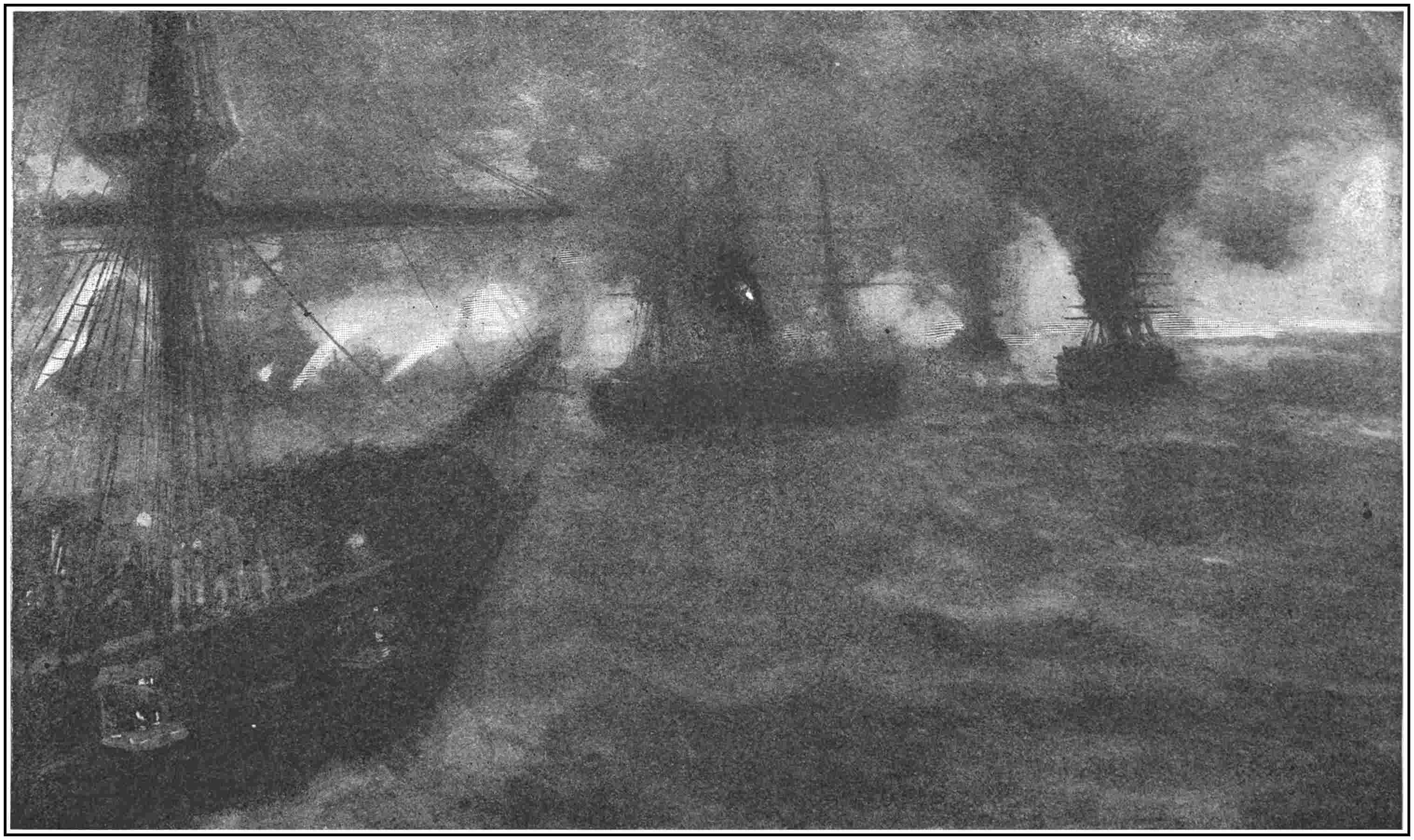
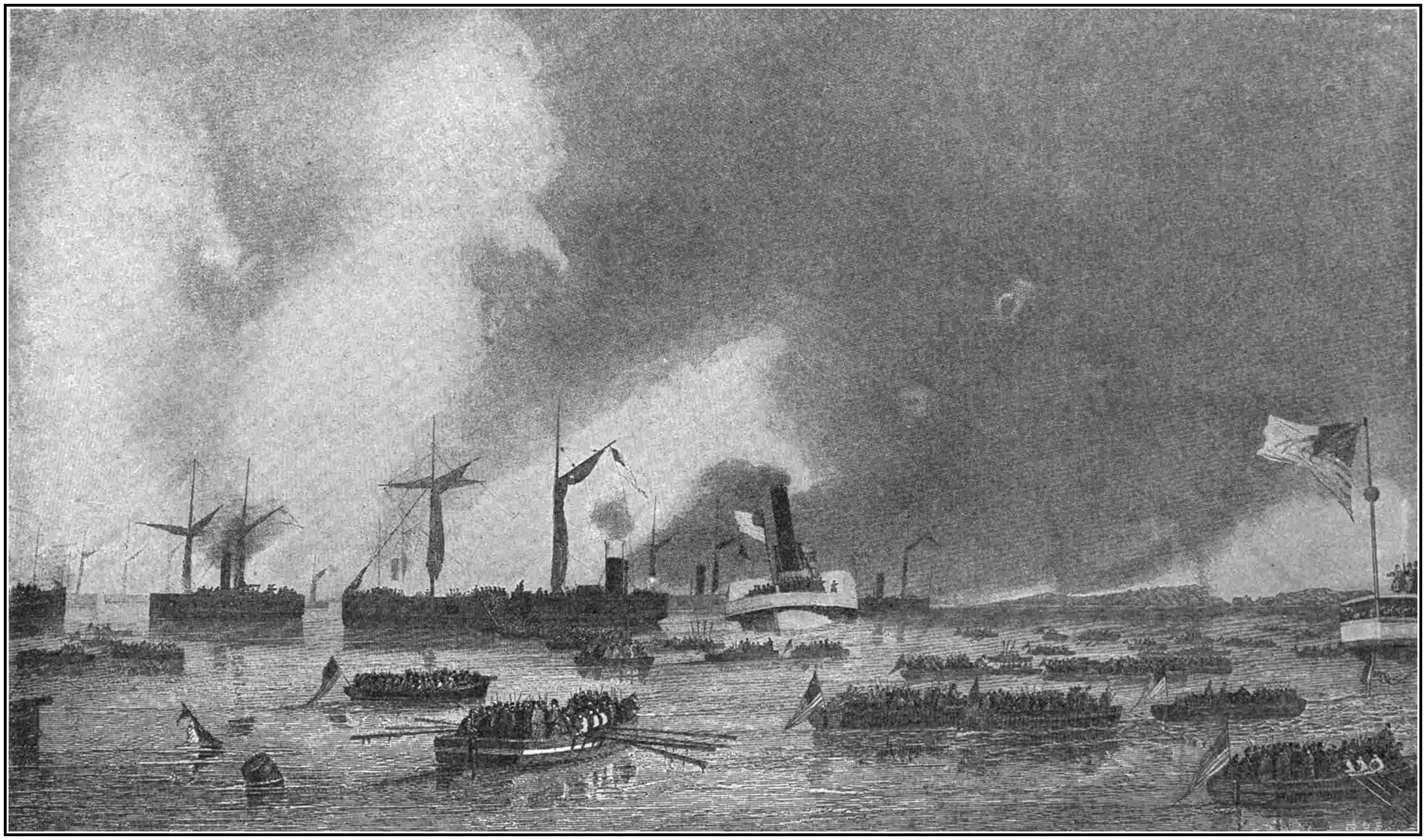
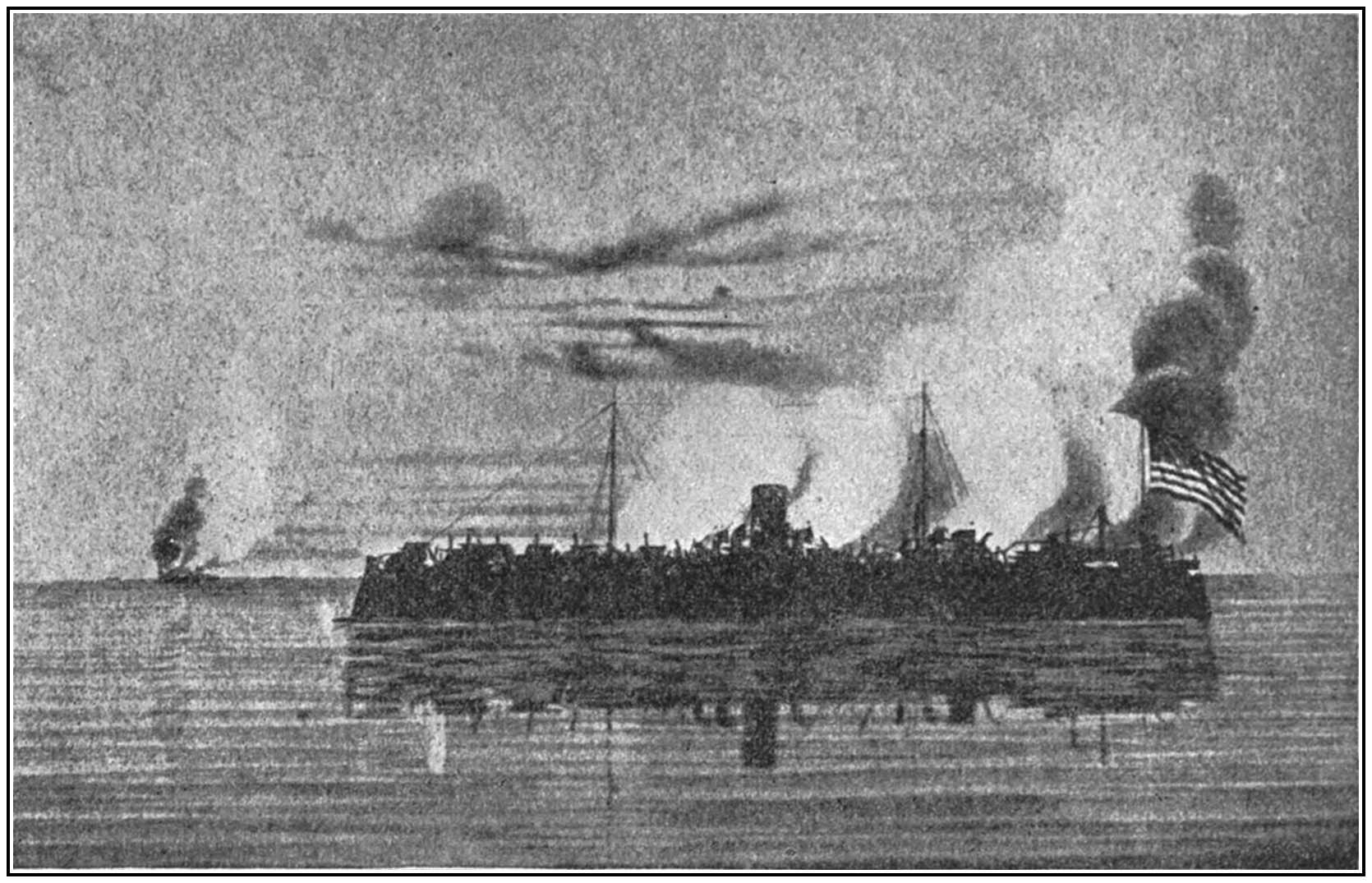
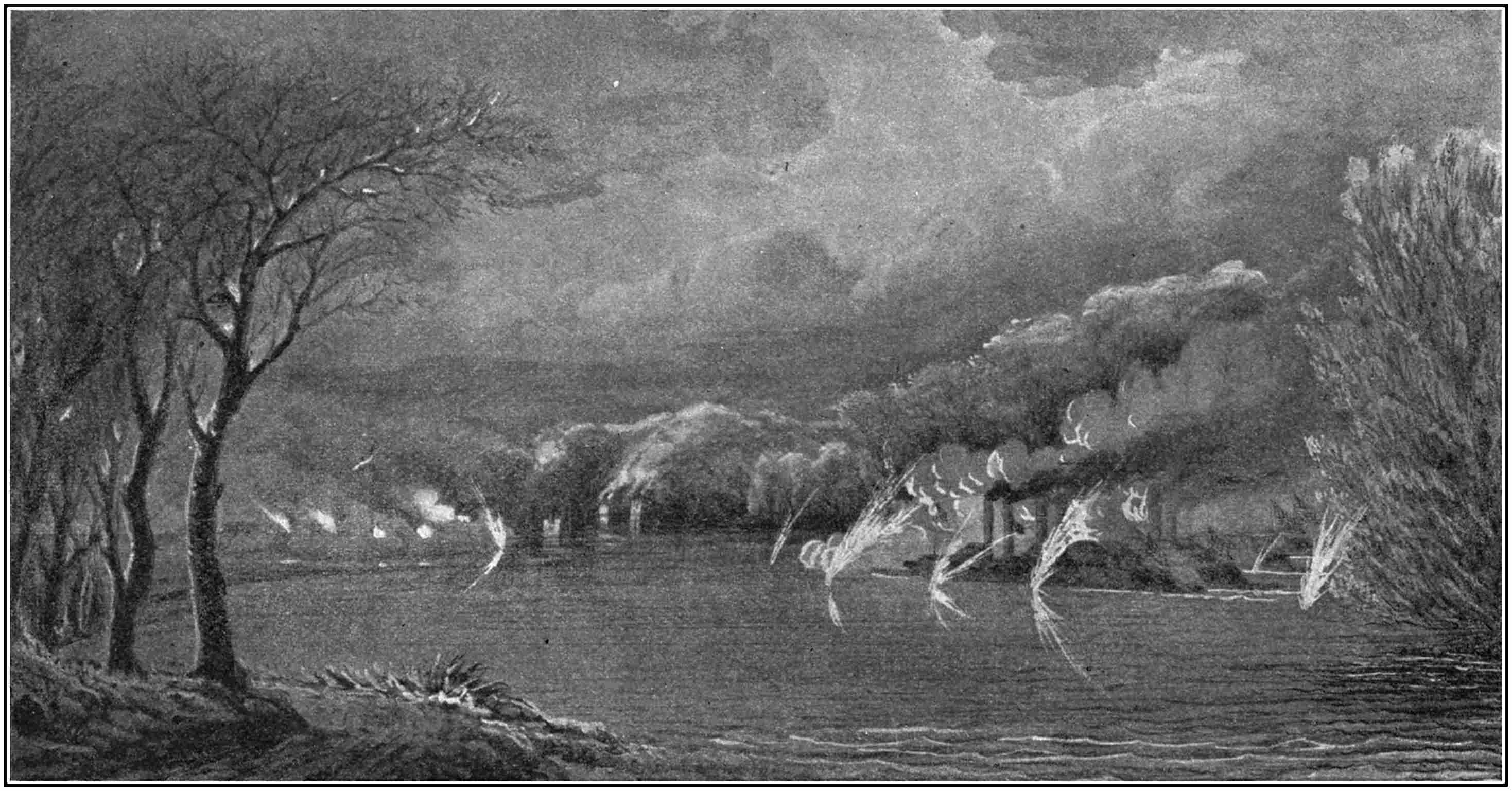
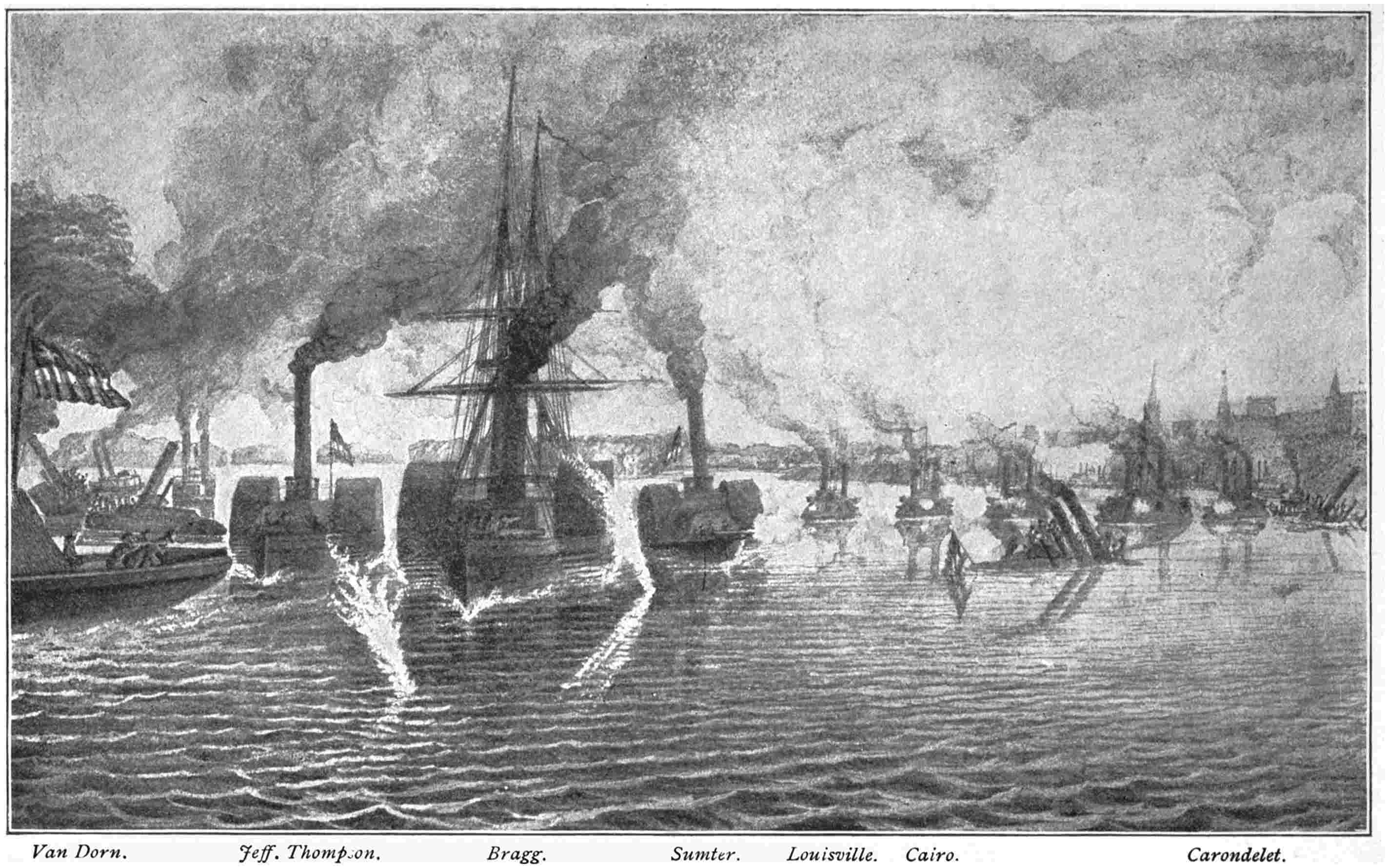
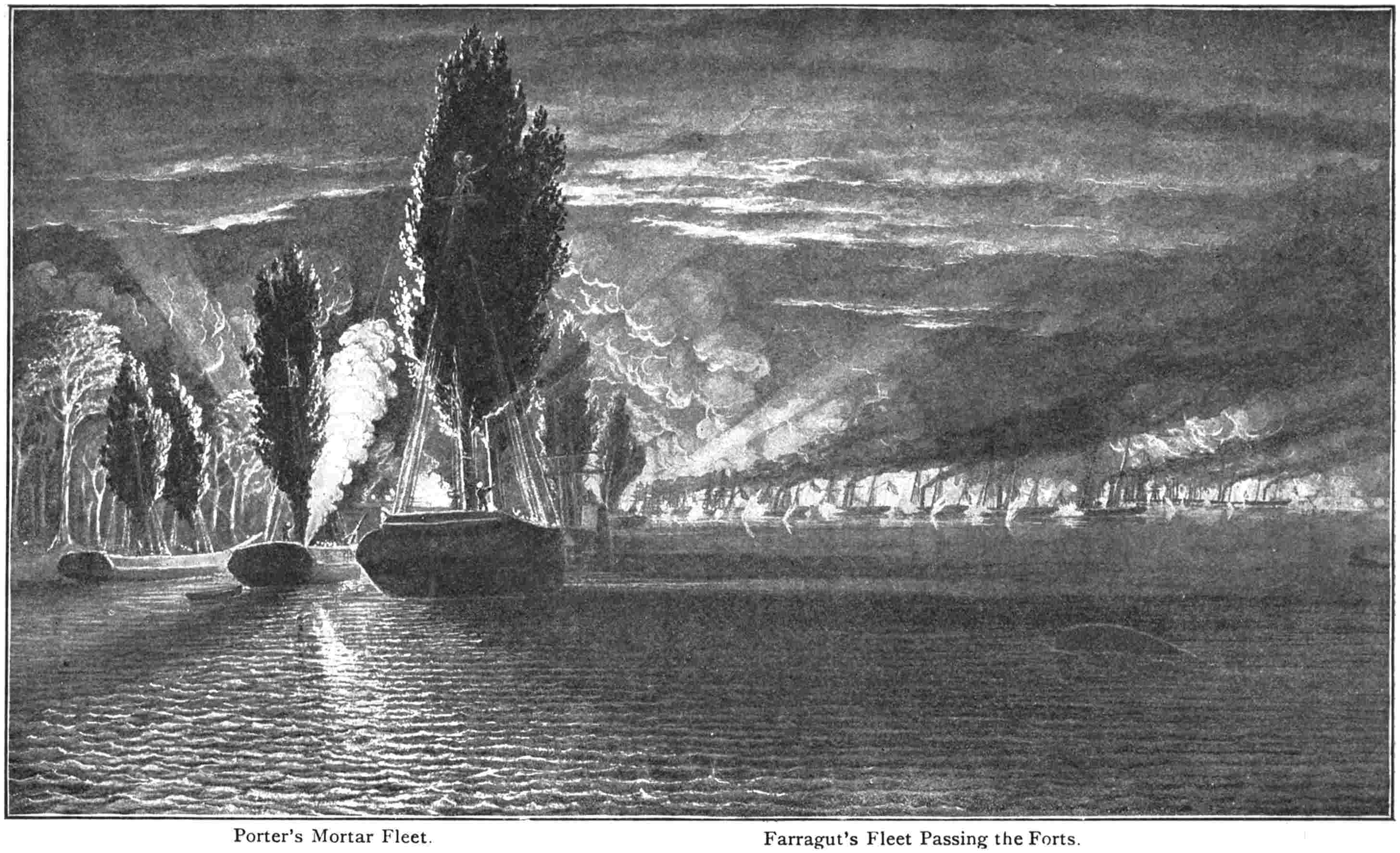
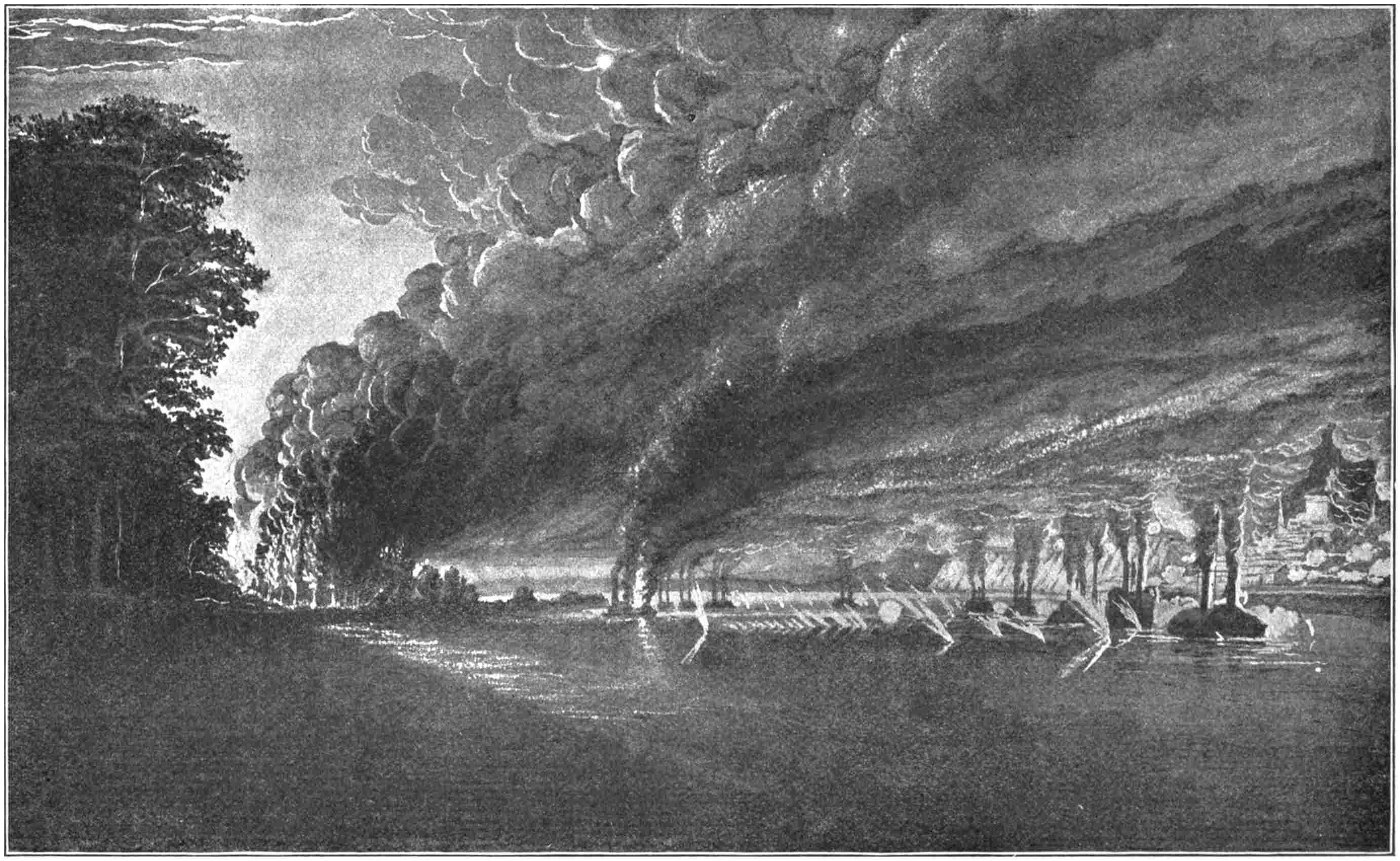
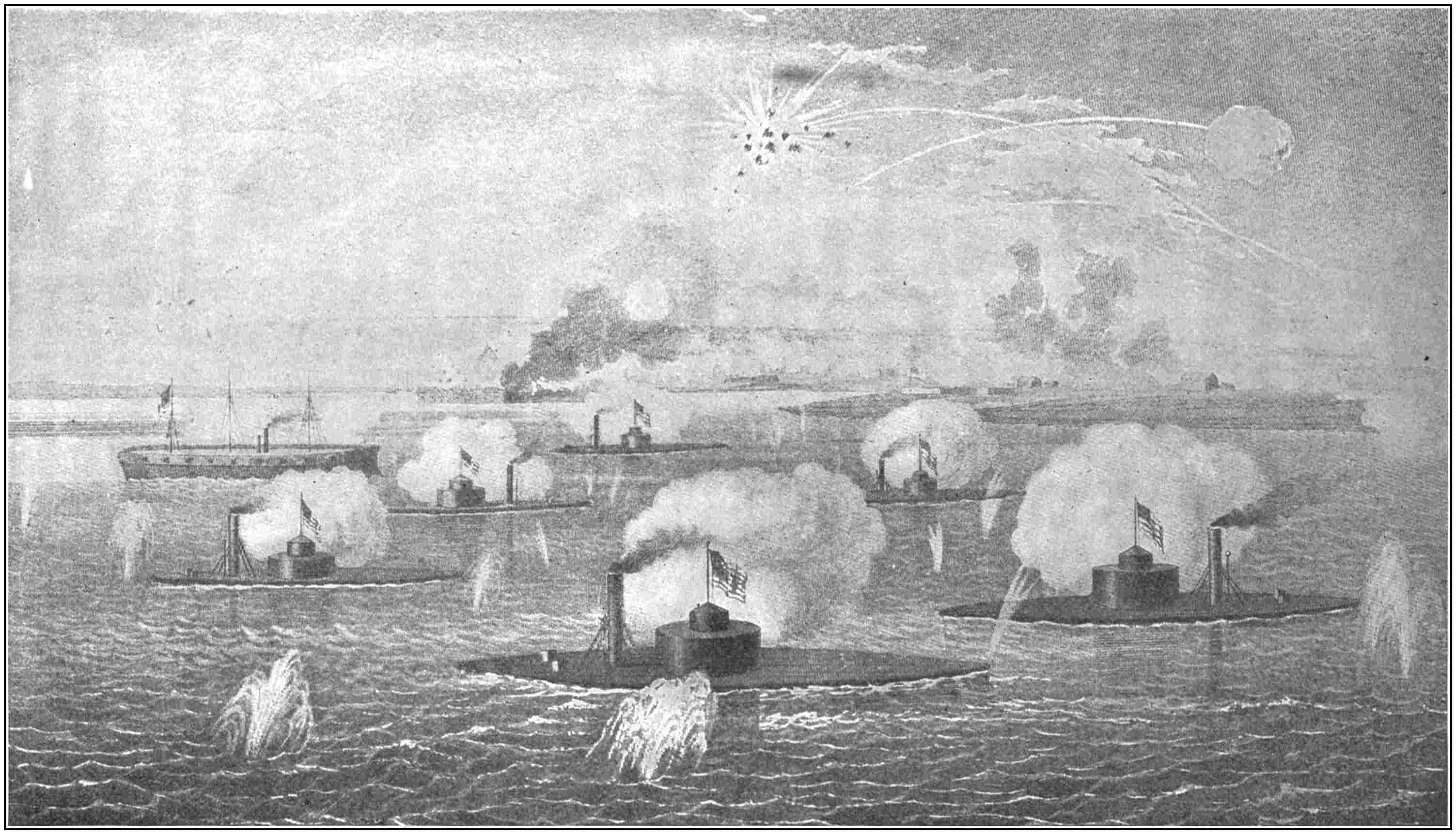
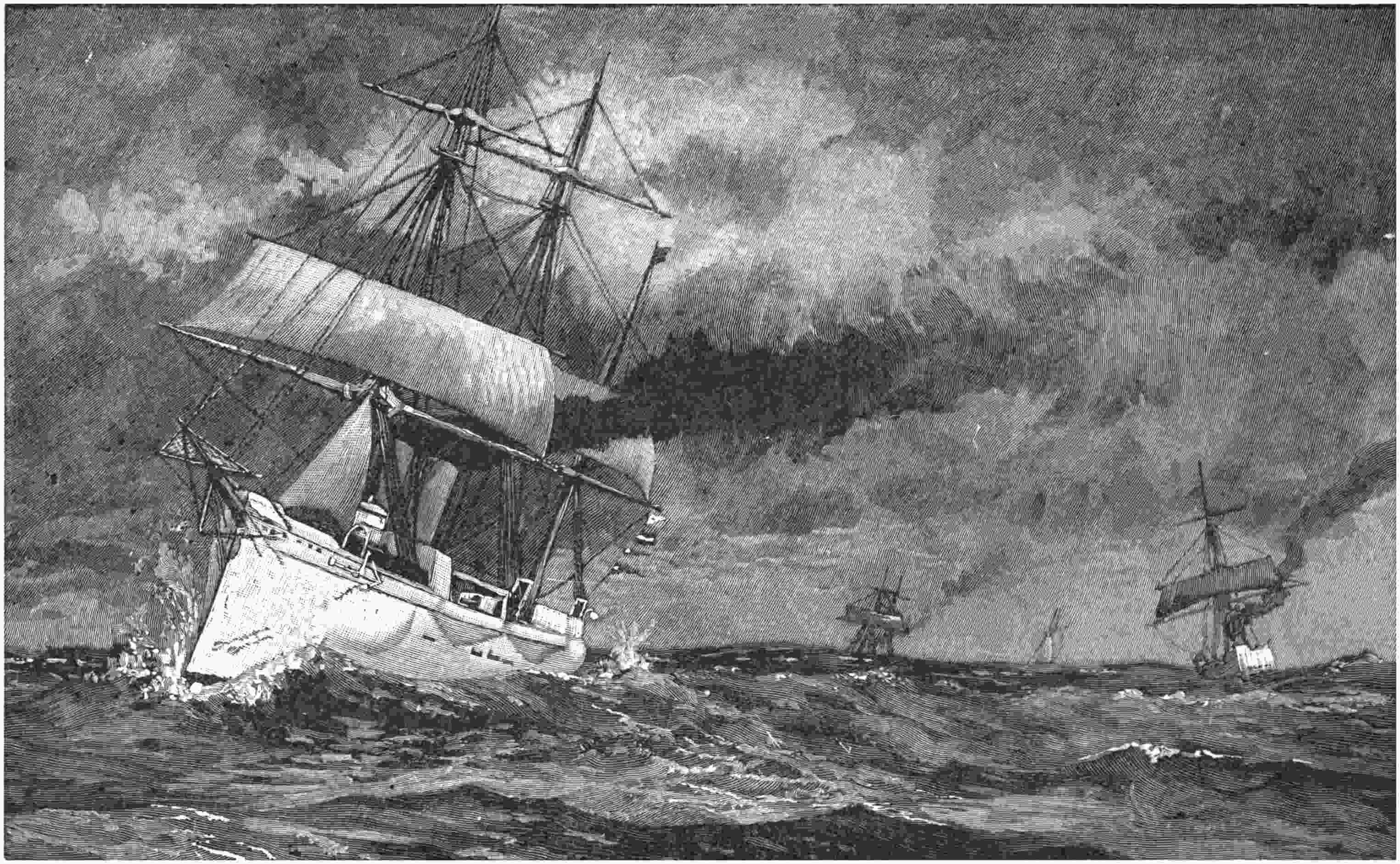
Farragut’s Fleet Passing Forts Jackson and St. Philip. (From a painting by Carlton T. Chapman),
Frontispiece
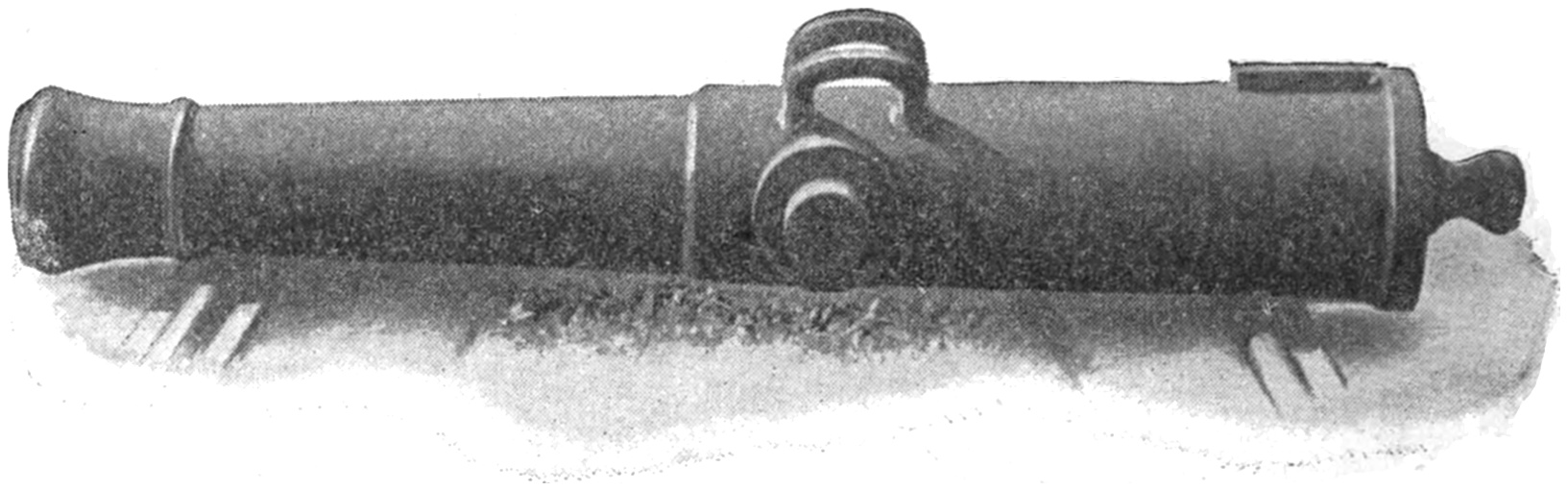
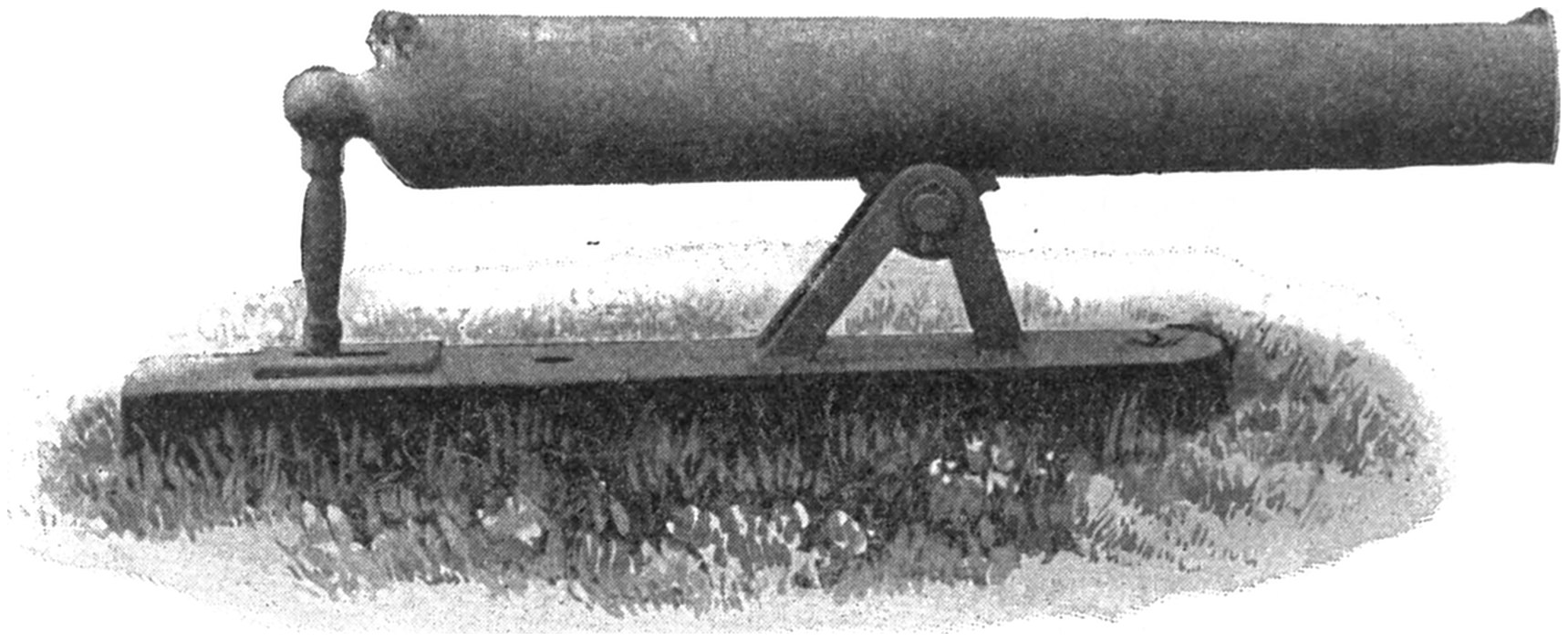
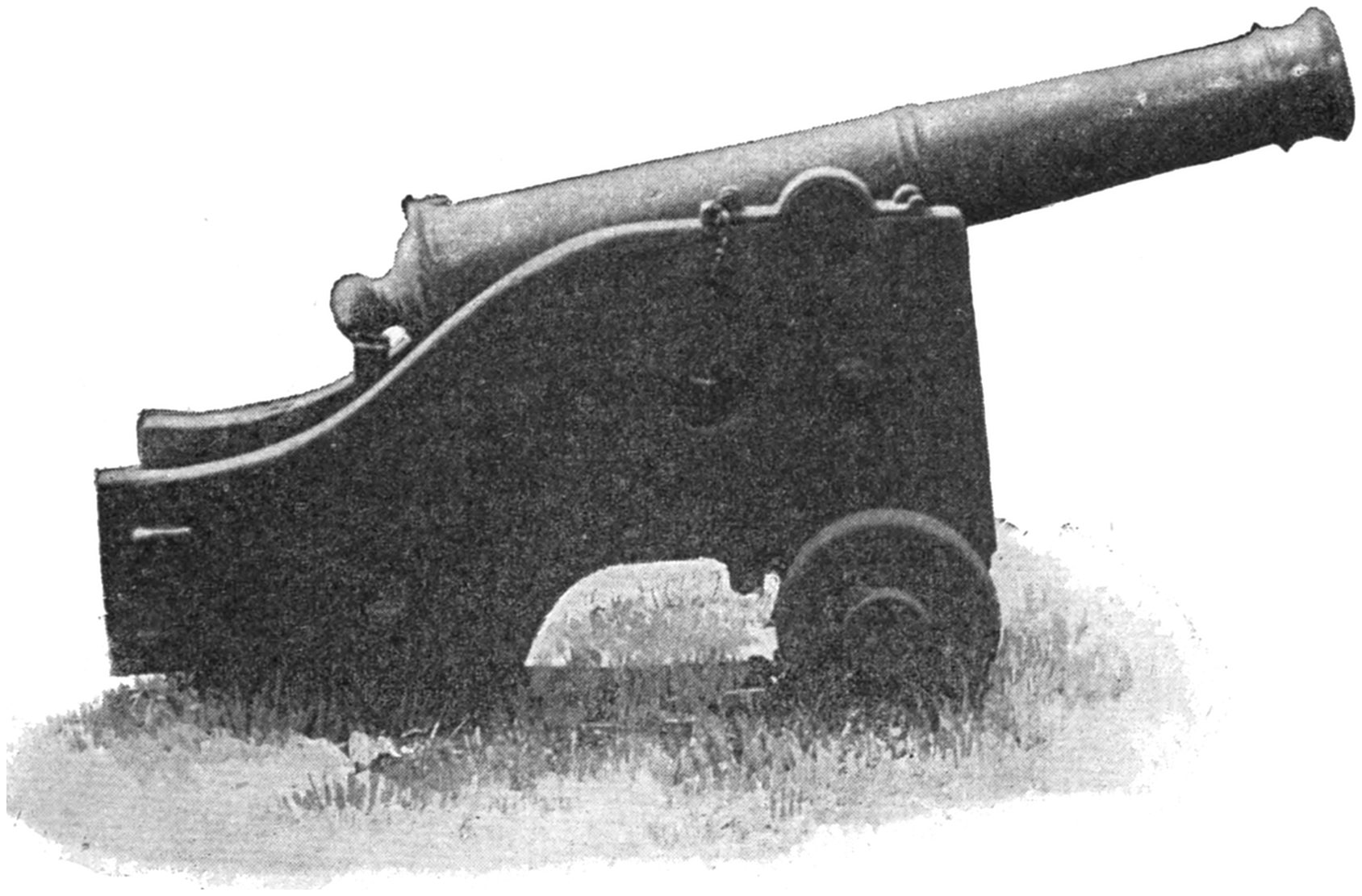
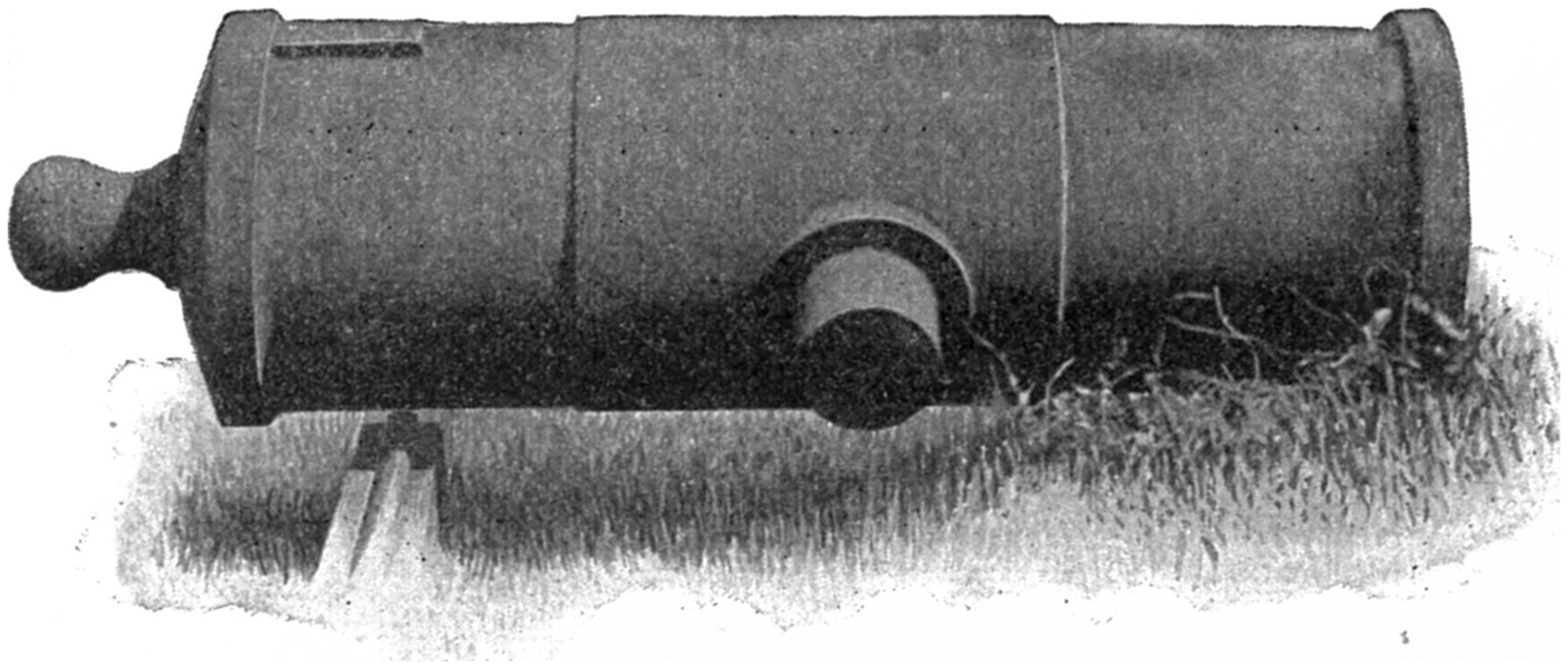
A Thirty-two-pound Carronade from the Constitution.
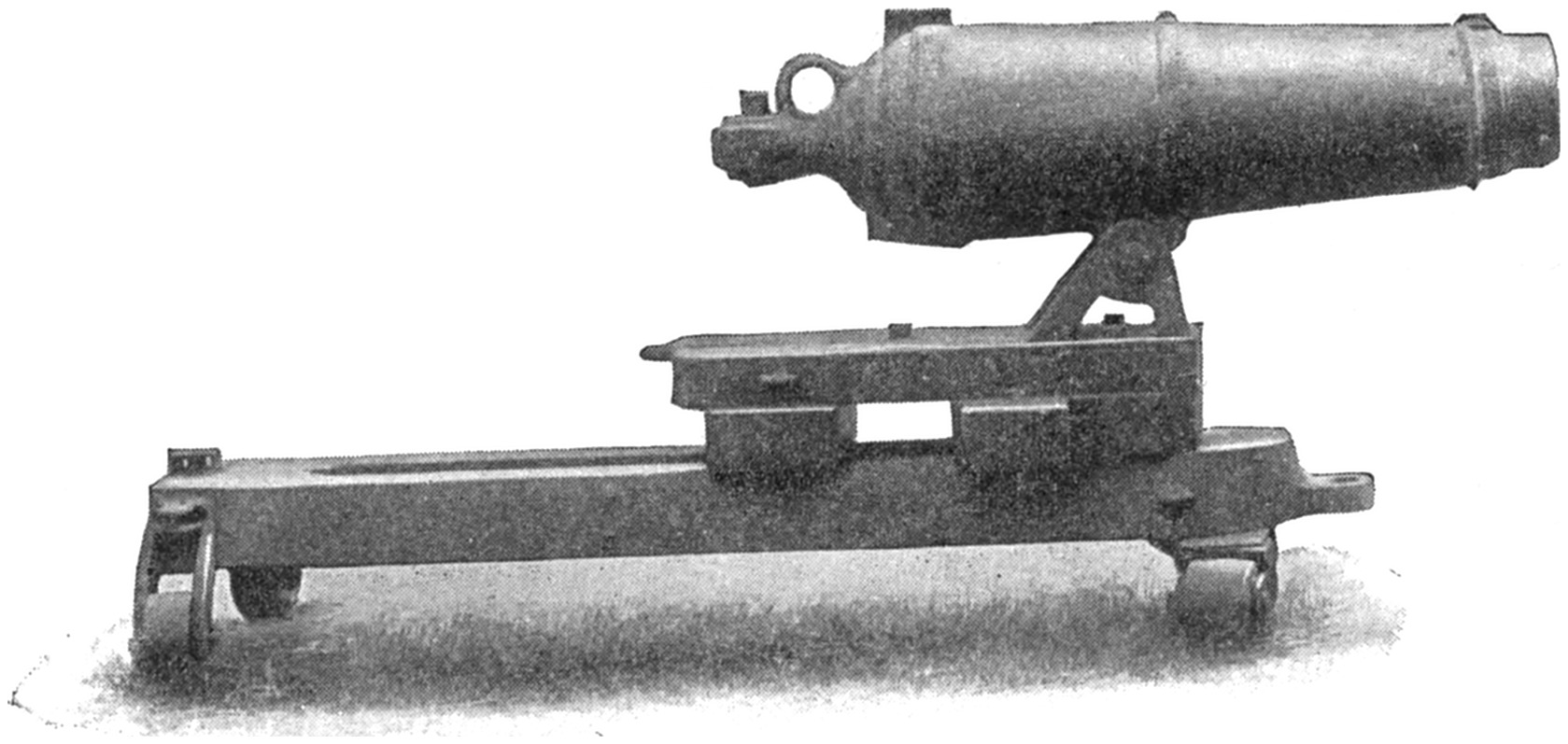
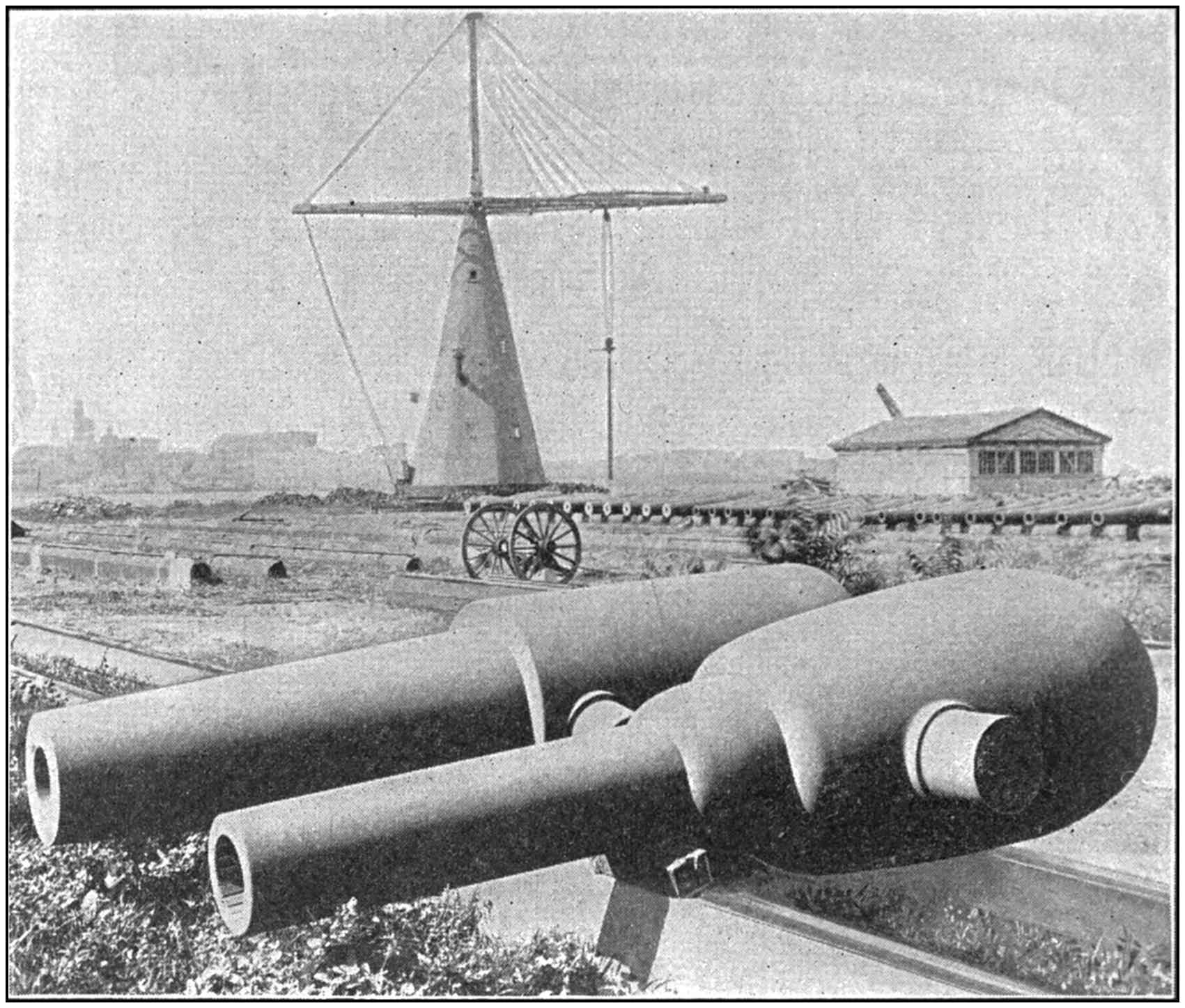
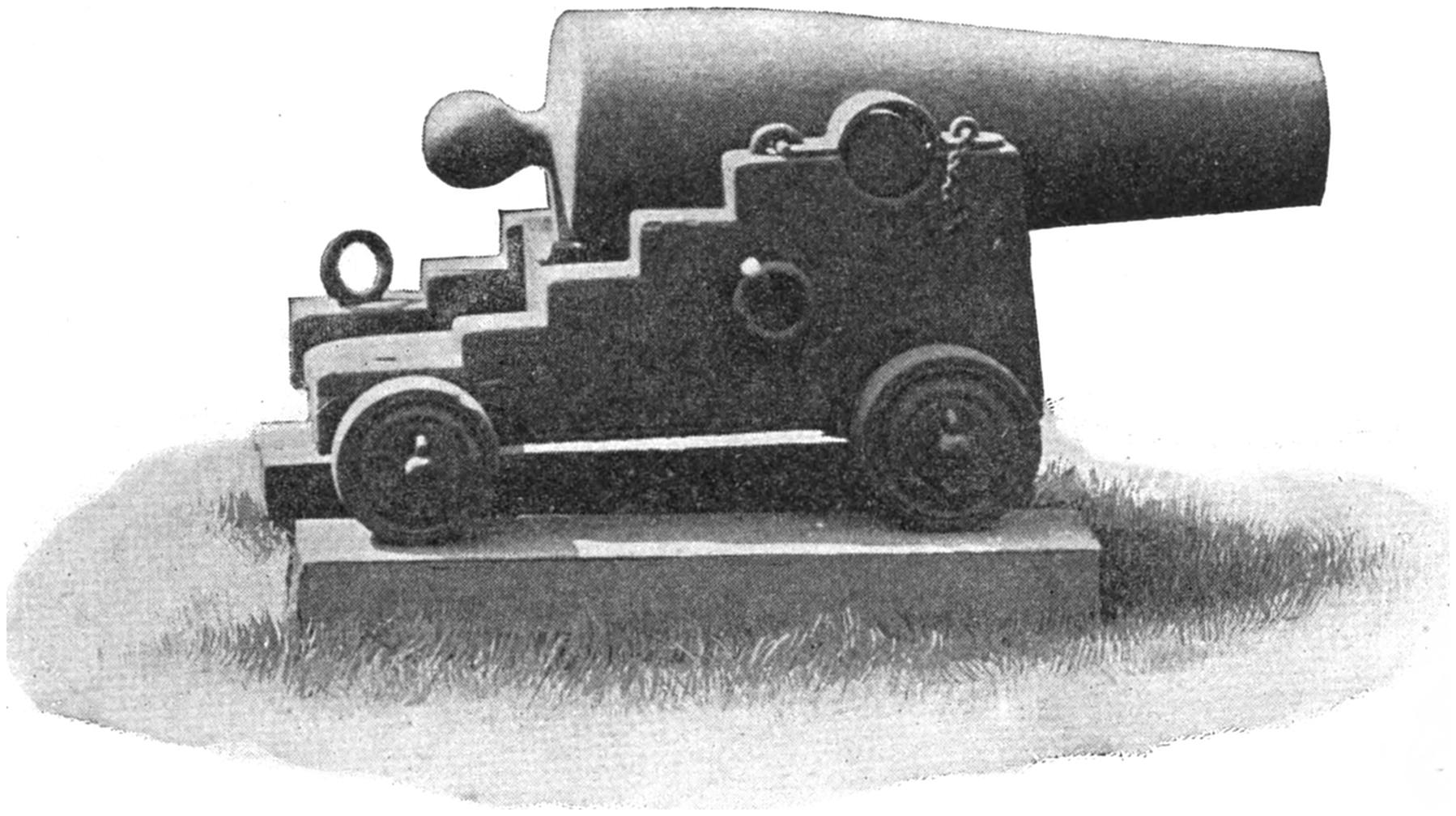
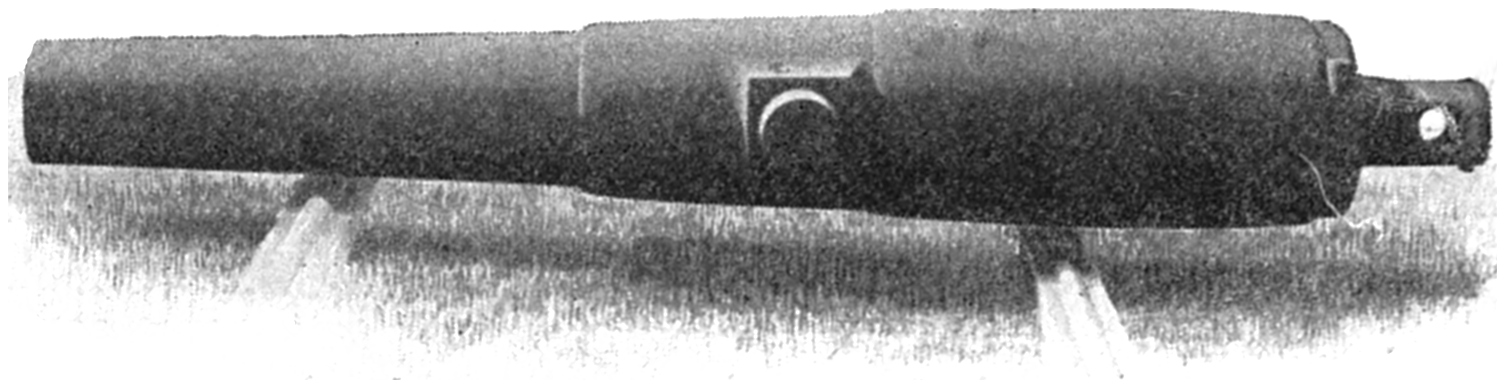
Twelve-inch Wrought-iron Gun—the Mate to the “Peacemaker,” which Burst on the Princeton. (From a photograph of the original at the Brooklyn Navy Yard),
THE HISTORY OF OUR NAVY — CHAPTER I THE STATE OF THE NAVY IN 1859
A Thirty-two-pound Carronade from the Constitution.
A BRIEF STORY OF THE DEVELOPMENT OF THE WARSHIP THAT
WAS PROPELLED BY BOTH SAILS AND STEAM—THE REMARKABLE
FLOATING BATTERY OF 1814—BARRON’S IDEA OF A RAM—THE
STEVENS FLOATING BATTERY—ERICSSON’S SCREW PROPELLER—STOCKTON
AND THE FIRST SCREW WARSHIP—EXPERIMENTS
WITH GREAT GUNS—DISCOVERIES OF BOMFORD AND
RODMAN—PRACTICAL WORK BY DAHLGREN—A COMPARISON OF
YANKEE FRIGATES WITH A CLASS OF BRITISH SHIPS “AVOWEDLY
BUILT TO COPE” WITH THEM—THE CONDITION OF THE
PERSONNEL.
From the point of view of a naval seaman
it was a far cry from the first war in defence
of the nation’s life to the last one—so far, indeed,
that all the progress made in the construction
of ships of war from the time when
men first went afloat to fight, down to the war
of the Revolution, had not equalled that made
in the eighty odd years that elapsed between,
say, the battle of Lake Champlain, which was
the most important battle afloat in the Revolution,
and that of Hampton Roads, which was
first in the Civil War.
Consider the forces that Arnold mustered
against the whelming odds under the ambitious
Carleton. Though two of the vessels
were dignified with the name of schooner and
one was called a sloop, the flagship of the
squadron was a galley managed by means of
oars, and the fleet as a whole, including the
Royal Savage, was inferior to an equal number
of the galleys with which the Romans,
in the days of Carthage, held sway over the
Mediterranean.
And then consider the ships that in 1860
graced the register of the American navy—ships
that with the aid of steam could hold
their own against wind and tide, and that carried
guns of so large a calibre that any but the
largest from Arnold’s fleet might have been
shoved down their throats after the trunnions
were knocked off. Arnold in his flagship, the
galley Congress, had eight guns of which the
bore was about three and a half inches in diameter,
and the shot weighed six pounds. But
when the Civil War came, the Minnesota was
armed with forty-two guns of a nine-inch calibre
and one of eleven inches, besides four
rifles that threw elongated projectiles weighing
100 pounds and one rifle with a projectile
weighing 150. Arnold’s Congress could throw
at a broadside twenty-four pounds of metal
over an effective range of perhaps 300 yards;
the Minnesota
could throw
1,861 pounds
over an effective
range of 1,600
yards.
And a still
more wondrous
advance was in
the minds of
men; it was at
hand—an advance
to a point
where steel forts
were to be sent afloat in place of the ships
that were in 1859 the pride of naval seamen.
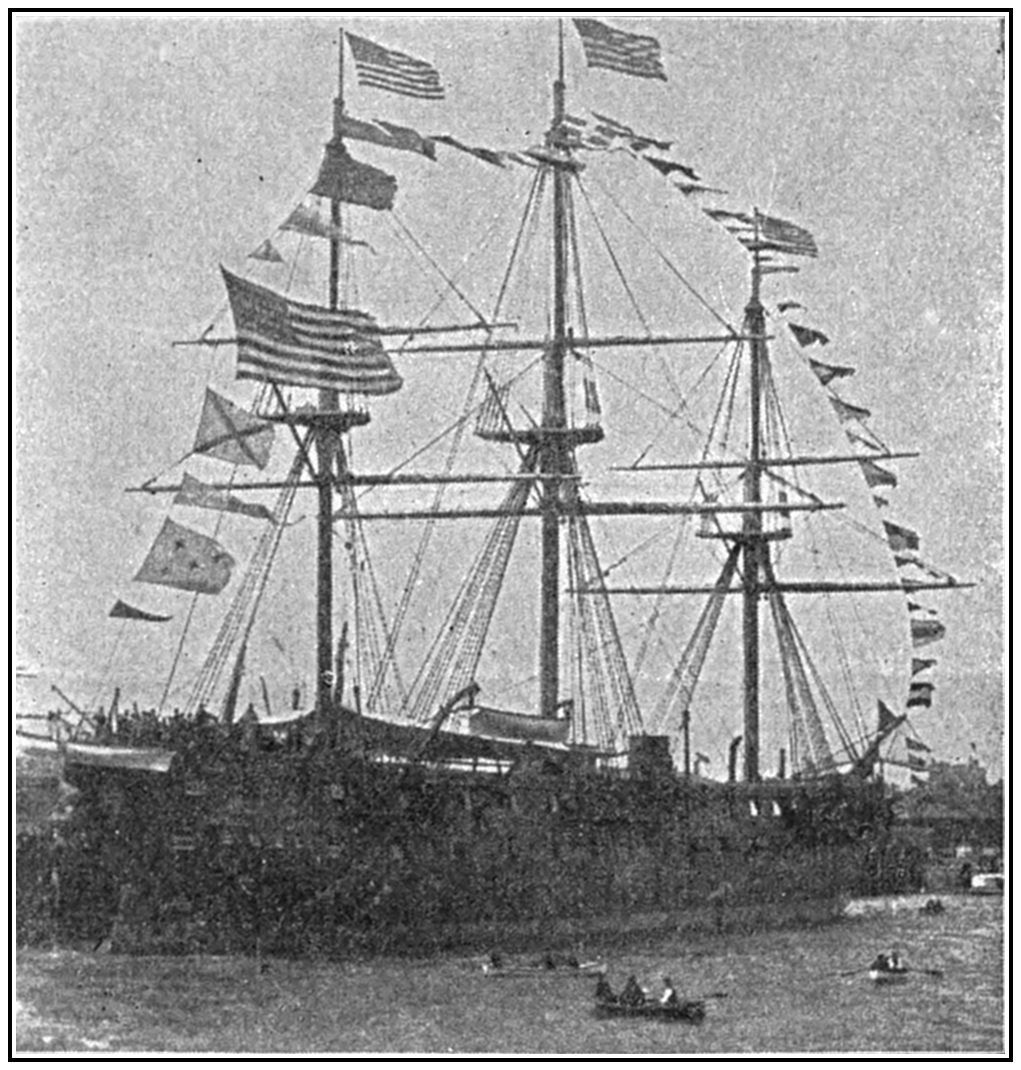
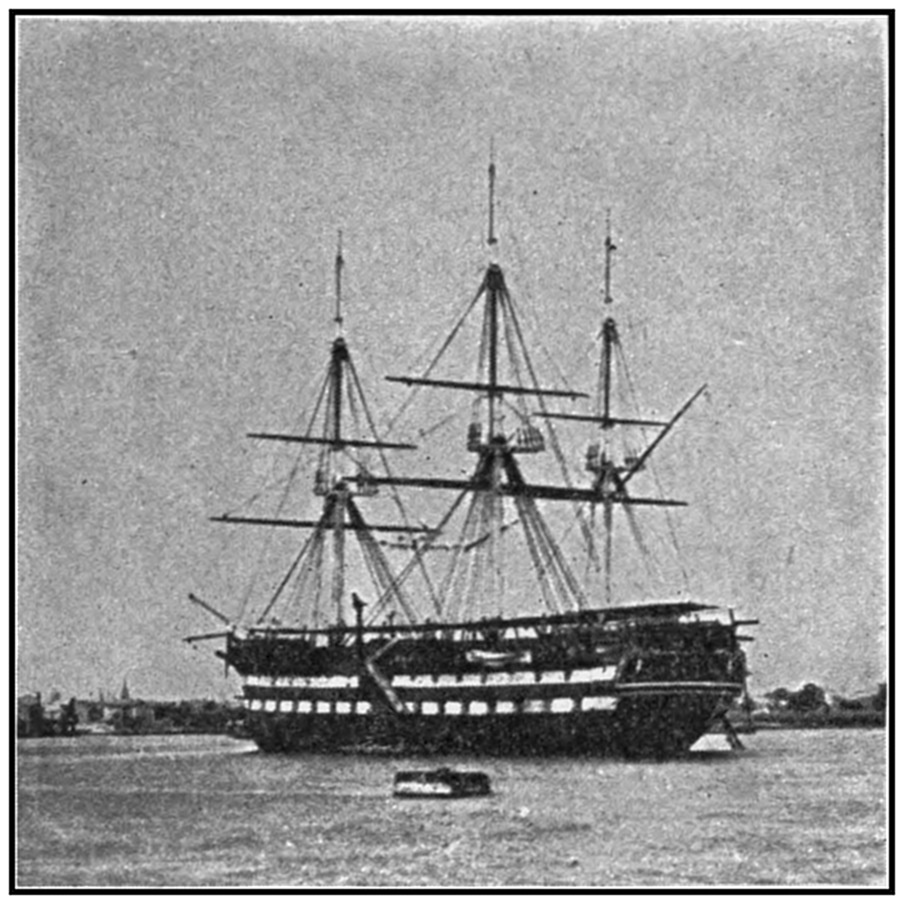
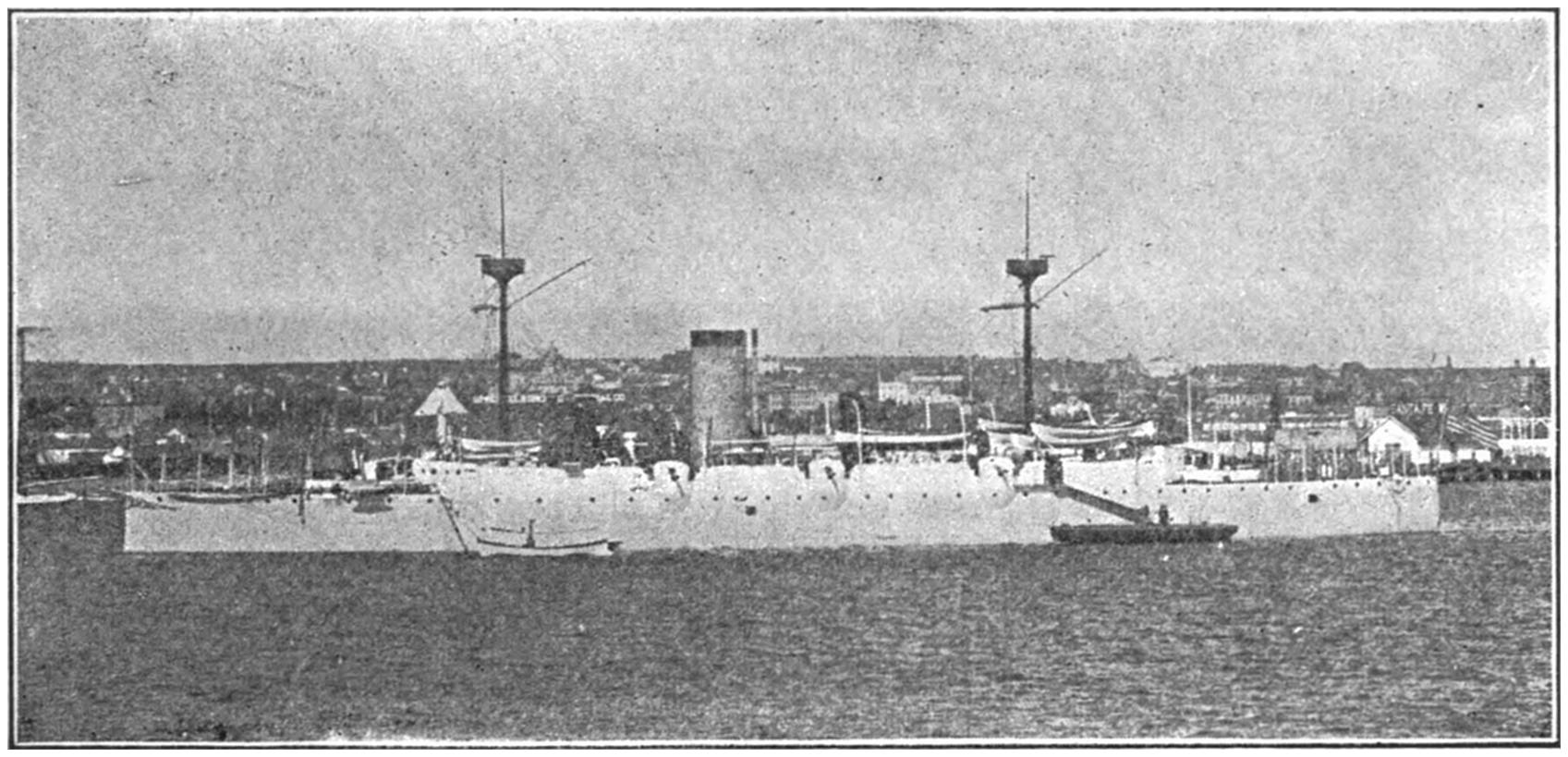
The Minnesota as a Receiving Ship.
From a photograph by Rau.
Remarkable as it seems to the present-day
student of naval history, the changes in naval
ships that produced the Minnesota before the
year 1859—even the changes that gave us the
steel fort afloat—were foreshadowed in 1813
when the immortal Fulton made plans for a
ship of war that should not only be propelled
by steam, but should be as impregnable to the
guns of that day as were the ironclads of 1862
to the guns of their day.
A Loop-pattern Gun of 1836—a Type which Runs back over 100 Years.
Although this ship was designed in 1813,
she was not sent afloat until October 29, 1814,
and even then, although swifter and more
convenient than Fulton had promised that
she should be—although she was the very
craft that on a smooth-water day could meet
and destroy the insolent blockading squadron
then off Sandy Hook—she was not put into
commission immediately, and the war came to
an end before there was opportunity to show
what steam might do for the sea power of a
nation.
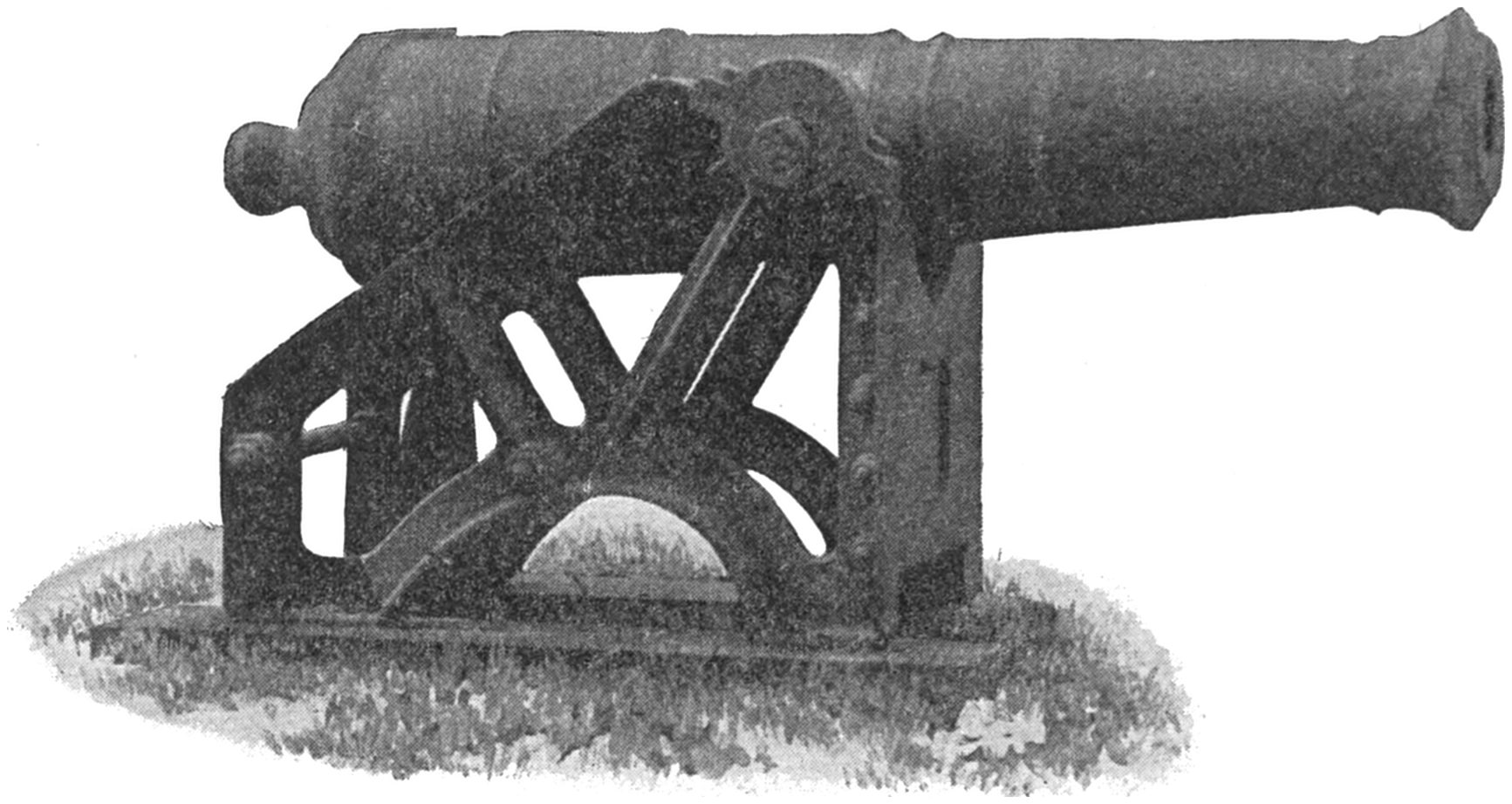
A Thirty-two-pounder from the Captured Macedonian—now at the Brooklyn Navy Yard.
From a photograph.
But because this was the first steam warship
the world ever saw, and because, when sent on
trial trips, she more than fulfilled every promise
of her designer, it is worth while giving a full
description of her. Her length was 150 feet;
breadth, 56 feet; depth, 20 feet; water-wheel,
16 feet diameter; length of bucket, 14 feet;
dip, 4 feet; engine, 48-inch cylinder, 5-feet
stroke; boiler, length, 22 feet; breadth, 12 feet;
and depth, 8 feet; tonnage, 2,475. She was
the largest steamer by many hundreds of tons
that had been built at the date of her launch.
The commissioners appointed to examine her,
in their report say:
“She is a structure resting upon two boats,
keels separated from end to end by a canal
fifteen feet wide and sixty-six feet long. One
boat contains the caldrons of copper to prepare
her steam. The vast cylinder of iron, with its
piston, levers, and wheels, occupies a part of
its fellow; the great water-wheel revolves in
the space between them; the main or gun-deck
supporting her armament is protected by a bulwark
four feet ten inches thick, of solid timber.
This is pierced by thirty portholes, to
enable as many 32-pounders to fire red-hot
balls; her upper or spar deck, upon which
several thousand men might parade, is encompassed
by a bulwark which affords safe quarters.
She is rigged with two short masts, each
of which supports a large lateen yard and sails.
She has two bowsprits and jibs and four rudders,
two at each extremity of the boat; so
that she can be steered with either end foremost.
Her machinery is calculated for the
addition of an engine which will discharge an
immense column of water, which it is intended
to throw upon the decks and all through the
ports of an enemy. If, in addition to all this,
we suppose her to be furnished, according to
Mr. Fulton’s intention, with 100-pounder columbiads,
two suspended from each bow, so as
to discharge a ball of that size into an enemy’s
ship ten or twelve feet below the water-line, it
must be allowed that she has the appearance
at least of being the most formidable engine
of warfare that human ingenuity has contrived.”
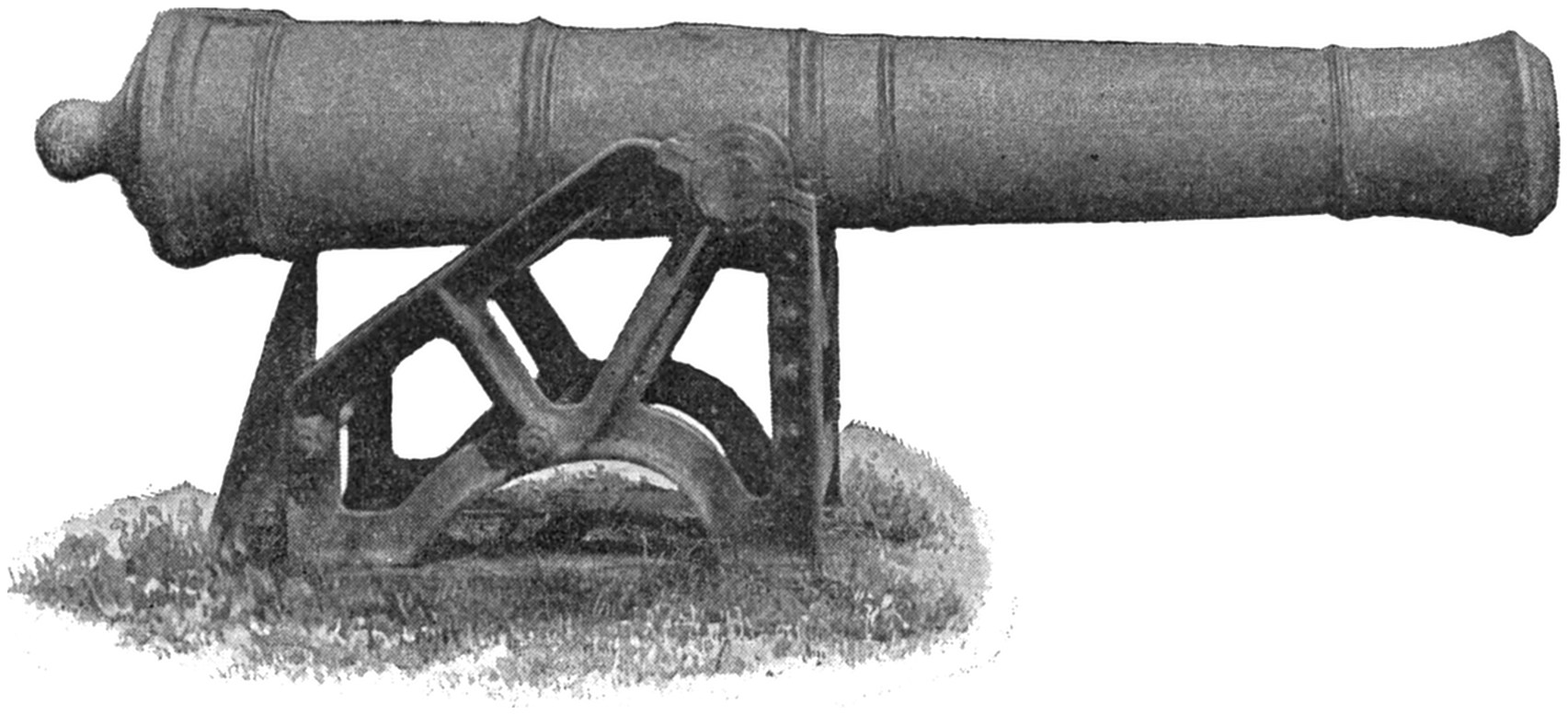
A Thirty-two-pounder from the Captured Macedonian.
Formidable she certainly was, but no war
came to demonstrate her powers, and she lay
in the Brooklyn Navy Yard as a receiving-ship
until the 4th of June, 1829, when her magazine
was fired, presumably by a drunken member
of the crew, and she was blown to pieces.
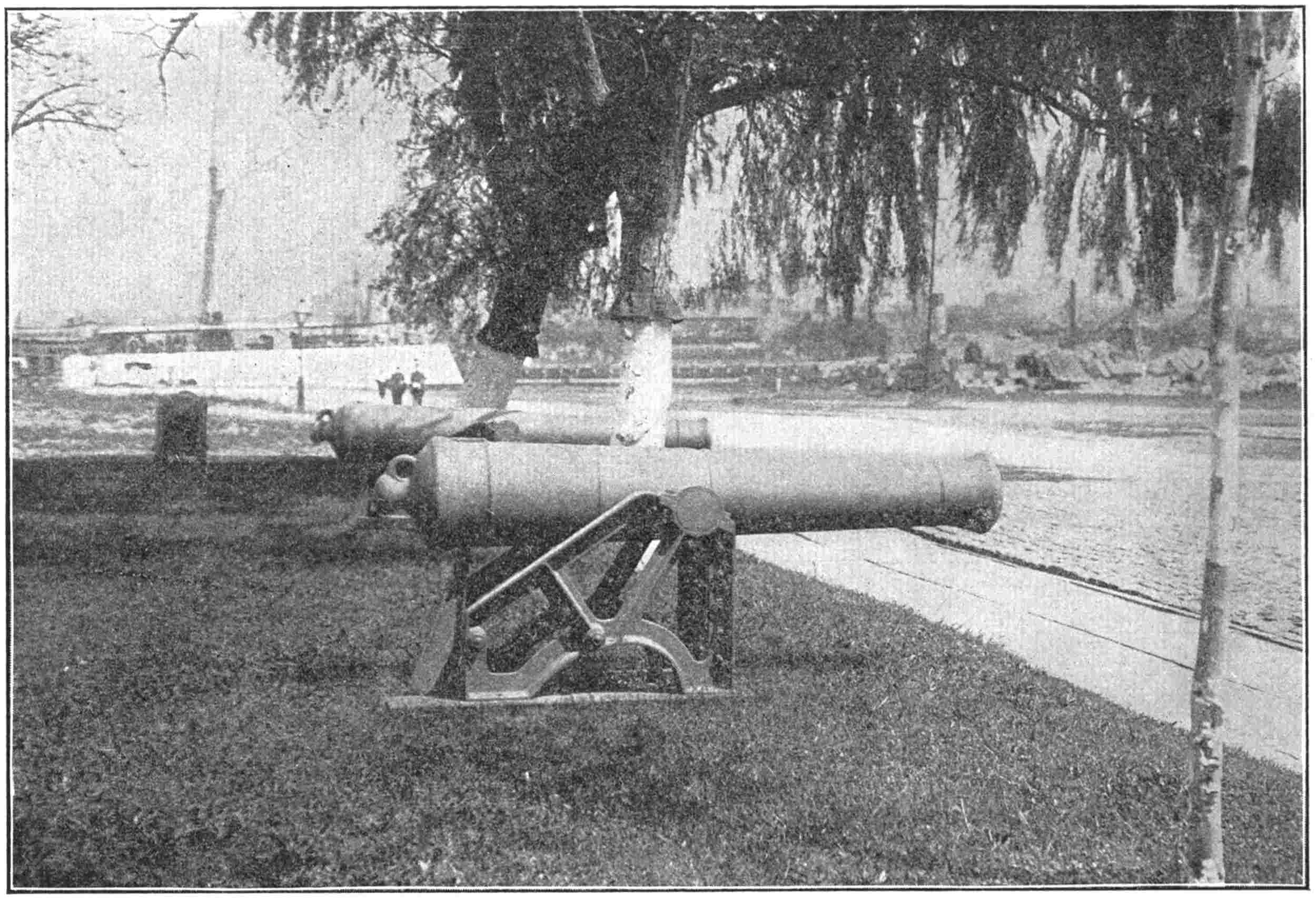
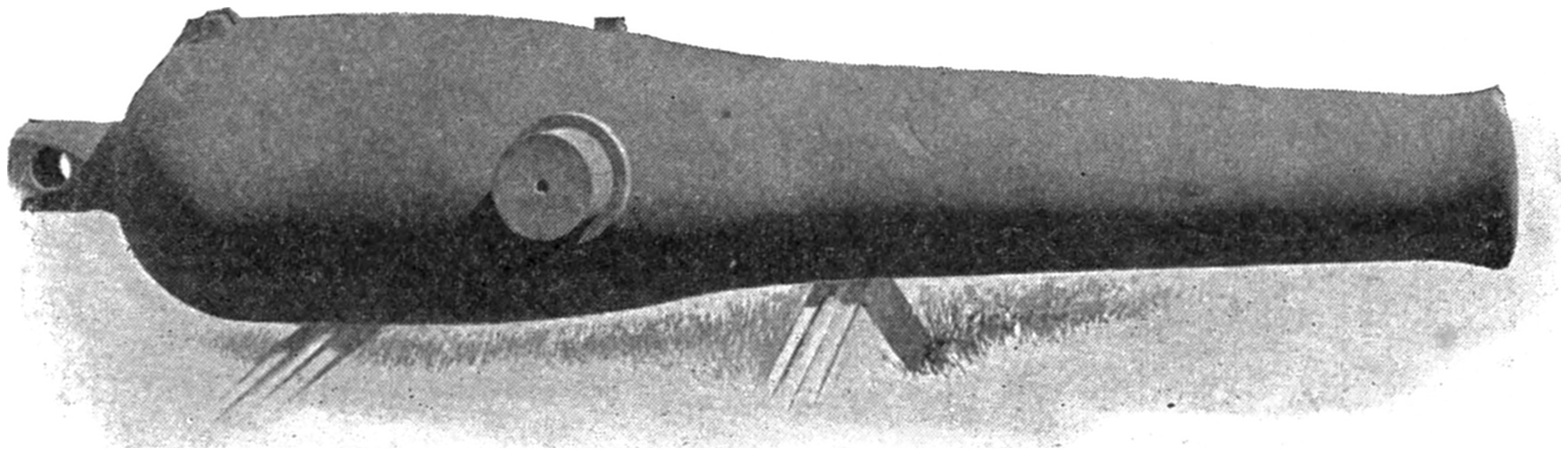
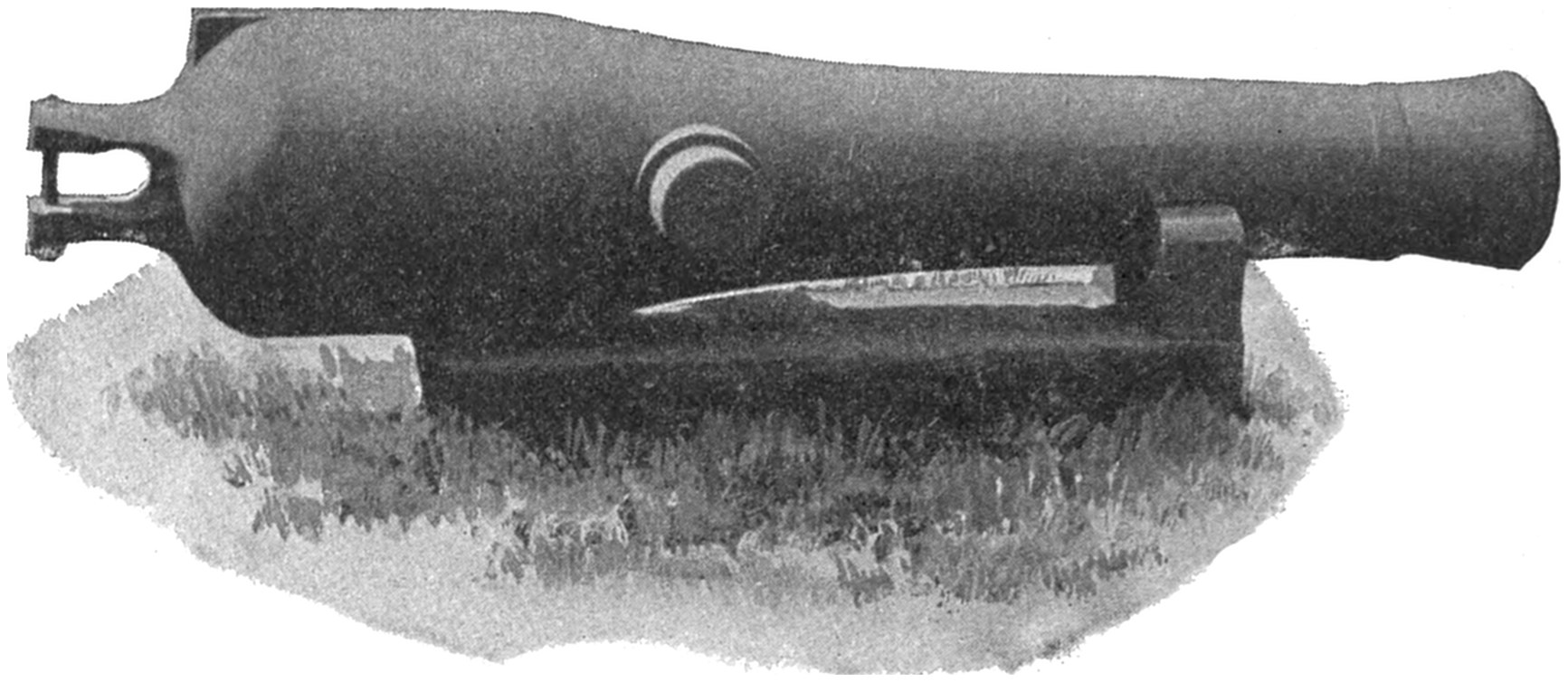
Old Cast-iron Thirty-two-pounder (Believed to be Spanish).
Robert L. Stevens, of Hoboken, in 1832,
conceived the idea of an ironclad ship that
was to be 250 feet long and twenty-eight
wide—something lean and eager in pursuit
and yet shot-proof. It was an idea that
cost him and his family nearly $2,000,000 before
he was done with it; but nothing came
of it, save as it kept the restless inventors of
the world thinking on the subject of swift,
impregnable ships of war. Mr. Clinton Roosevelt,
of New York, proposed to build a steamer
that should be sharp at both ends, “plating
them with polished iron armor, with high bulwarks,
and a sharp roof plated in like manner,
with the design of glancing the balls. The
means of offense are a torpedo, made to lower
on nearing an enemy, and driven by a mortar
into the enemy’s side under water, where, by
a fusee, it will explode.” The idea of polishing
the armor to make it slippery seems amusing
now; but the fact is that even as late as
1862 the armor of vessels in the Civil War
was greased to make the projectiles glance off.
Of course, the grease was of no use.
It is worth noting that it was in 1836 that
John Ericsson patented in England his screw
propeller. A model boat forty-five feet long,
which he named, for the American consul at
Liverpool, the
Francis B. Ogden,
attained in 1837 a
speed of ten miles
an hour. The Lords
of the Admiralty
took a trip in this
boat, and the opinion
of Sir William
Symonds, who
spoke for the others,
is worth giving as
showing how thick-skulled
prejudice operates to retard naval
progress. He said: “Even if the propeller
had the power of propelling a vessel, it would
be found altogether useless in practice, because
the power being applied in the stern, it would
be absolutely impossible to make the vessel
steer.”
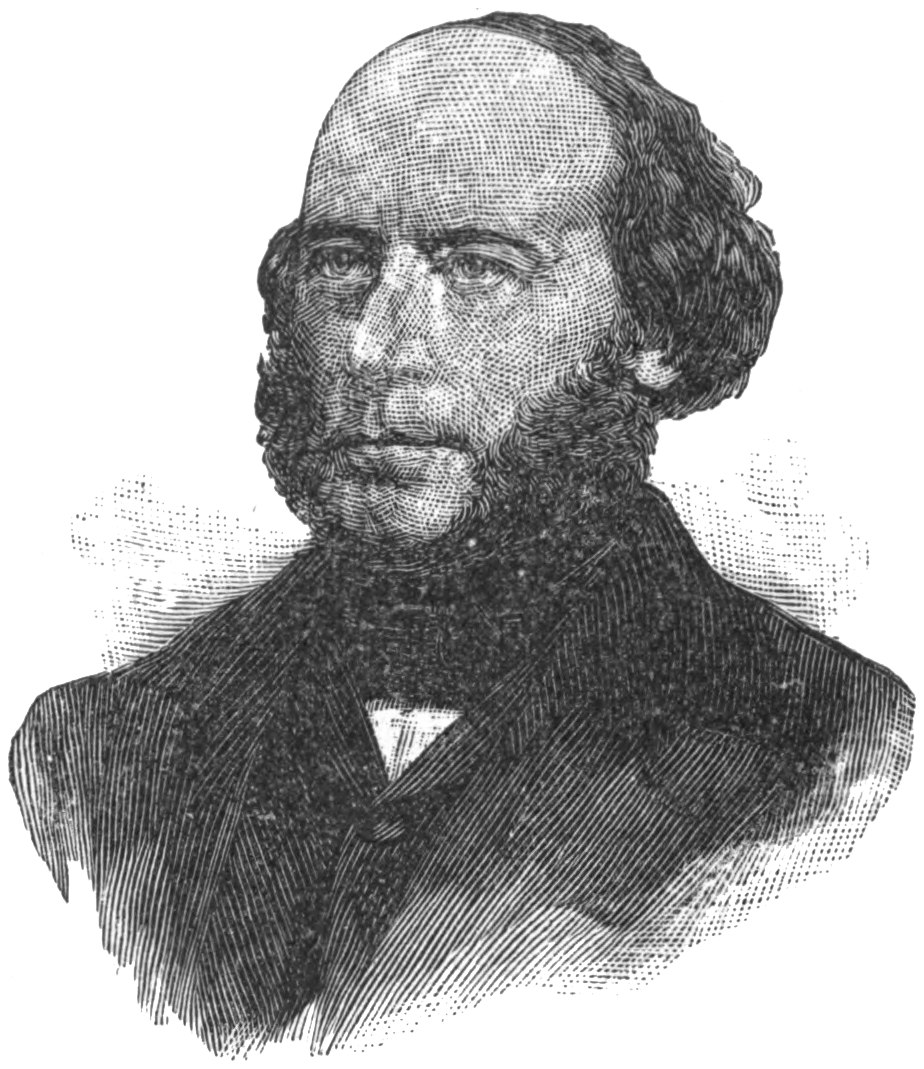
John Ericsson.
However, Capt. Robert F. Stockton made a
trip on the Ogden, and fortunately Stockton
was at once a man of wealth and of common
sense. Being convinced of the value of the
invention, he induced Ericsson to leave England
for the United States in the year 1839,
and that was, in a way, one of the most interesting
events in the history of the American
republic.
Meantime, however, a steamer to replace the
old Demologos, Fulton’s first war steamer, had
been launched in 1837. Practically the Fulton
2d, as she was called, was a sloop-of-war—a
ship of one deck of guns, propelled by paddle-wheels.
She was broad and shallow in model,
being 180 feet long by thirty-five wide and
thirteen deep. She had horizontal engines
lying on her upper deck. Her paddle-wheels
were twenty-two feet in diameter, towering
high above the deck, and her boilers were made
of copper. However, she carried eight long
forty-twos and a long twenty-four—a right
powerful set of guns for that day, and she behaved
so well that Capt. Mathew C. Perry, who
was assigned to her, expressed the opinion
that a time would come when sails, as a means
of propelling a man-of-war, would become obsolete.
However, it must be said that this remark
made almost every one who heard of it,
and especially the other officers of the navy,
think that Perry was a “visionary.”
It was in 1839 that Perry risked his reputation
by an expression of opinion—about the
time that Ericsson reached the United States.
Backed by Stockton, Ericsson planned a man-of-war
that should be driven through the water
by a submerged screw at the stern. The idea
of a ship being driven by machinery that was
placed wholly below the water-line, and so out
of danger from an enemy’s shot, was of a kind
to appeal even to a backwoods congressman,
and an appropriation was obtained. In 1843
the ship was launched under the name of
Princeton, and she was in a variety of ways
vastly superior to anything built before her.
She was 164 feet long by thirty wide and
twenty-one deep, and with 200 tons of coal and
all supplies on board, she had a draft of nearly
twenty feet.
Among other features, it appears that she
was the first warship fitted to burn anthracite
coal, thus avoiding the dense volumes of black
smoke which revealed all foreign war-steamers.
She was the first to carry telescopic funnels
that could be lowered to the level of the rail
out of the way of sails, and the first to use
blowers to force the draft in the furnaces.
She was also the first to couple the screw
directly to the engine instead having cog-wheels
intervene.
Her armament was also peculiar, for she was
fitted with two long wrought-iron guns that
threw balls about a foot in diameter, weighing
225 pounds—guns that, when fired at a target
at a range of 560 yards, pierced fifty-seven
inches of solid oak timber.
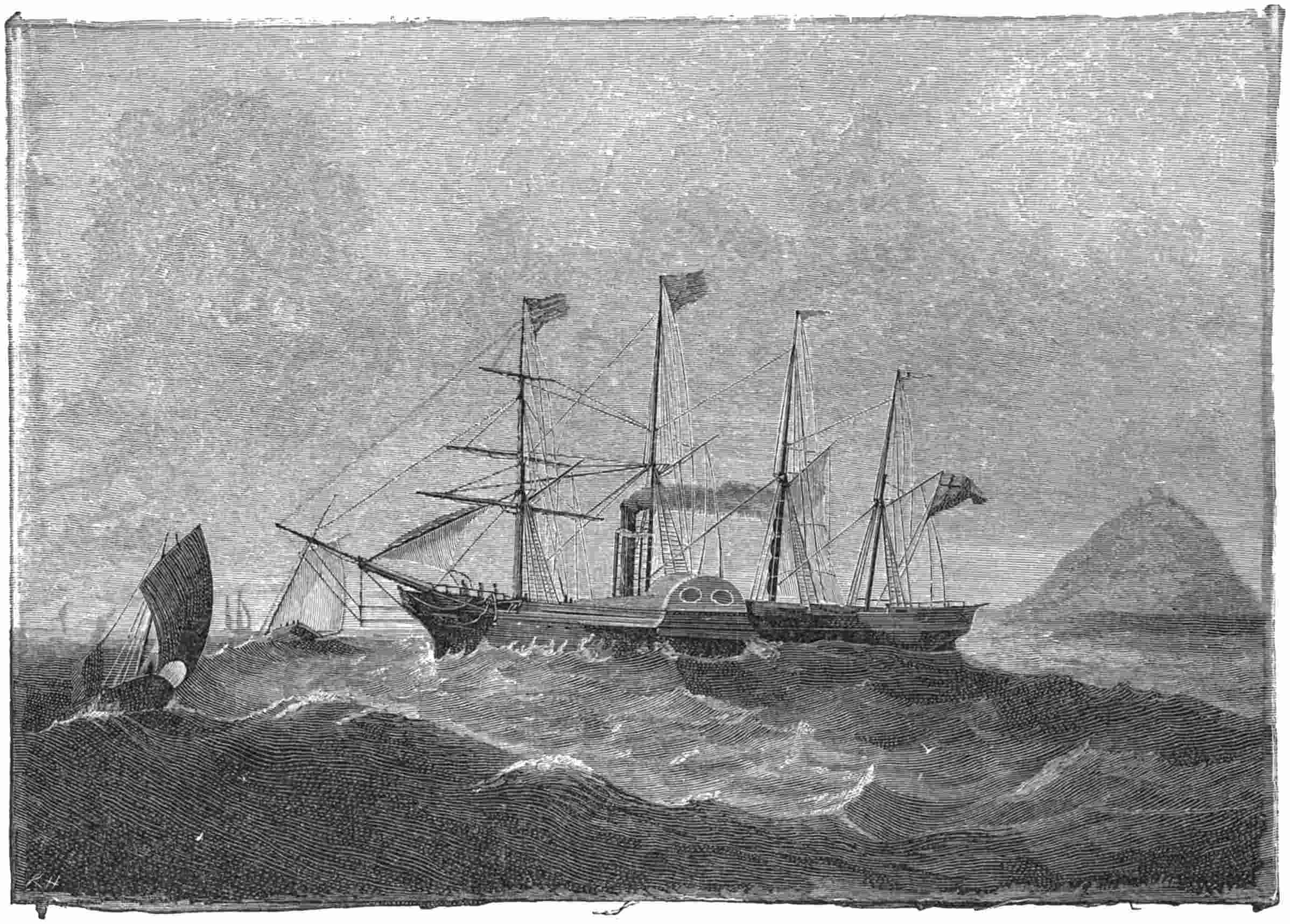
The Great Western—One of the First Steamships to Cross the Atlantic Ocean.
After an old painting.
And there was one other peculiarity to which
Stockton, who commanded her, called attention
with pride: “To economise room, and that the
ship may be better ventilated, curtains of
American manufactured linen are substituted
for the usual wooden bulkheads.”
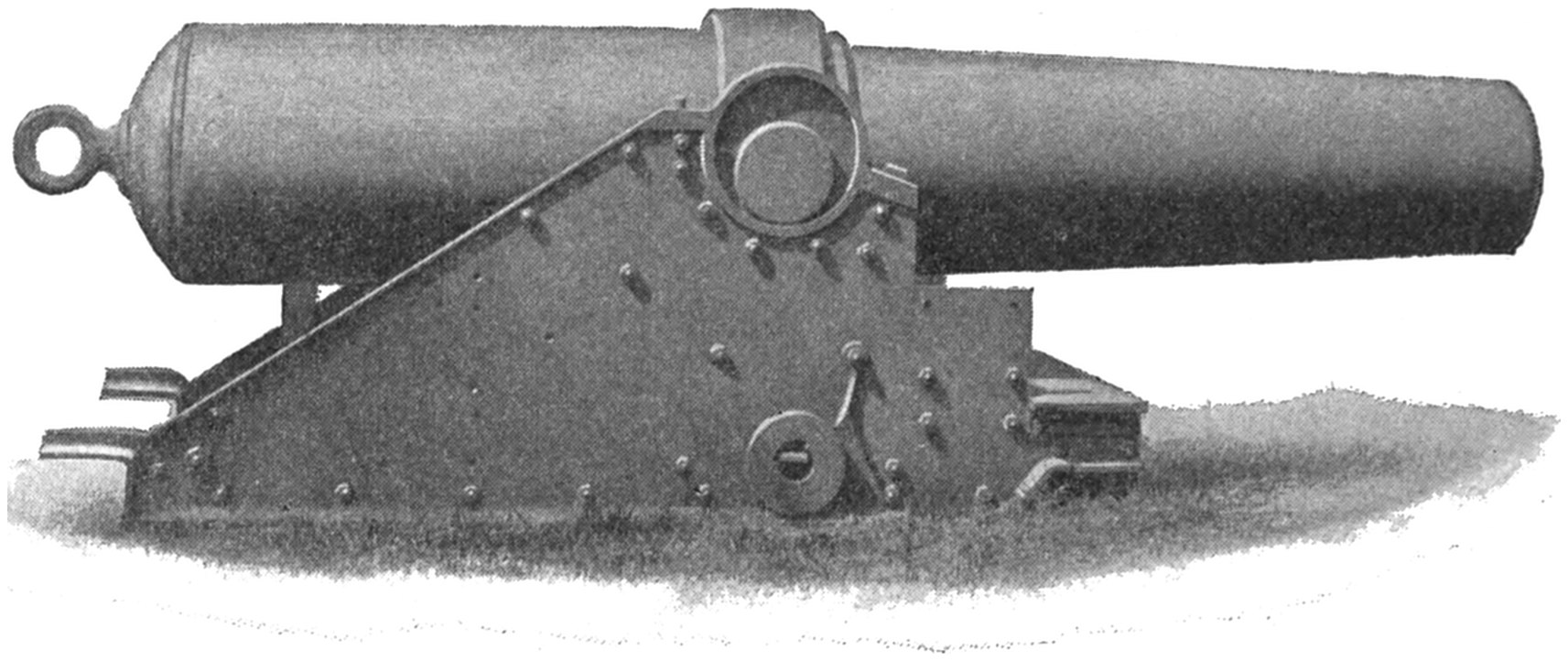
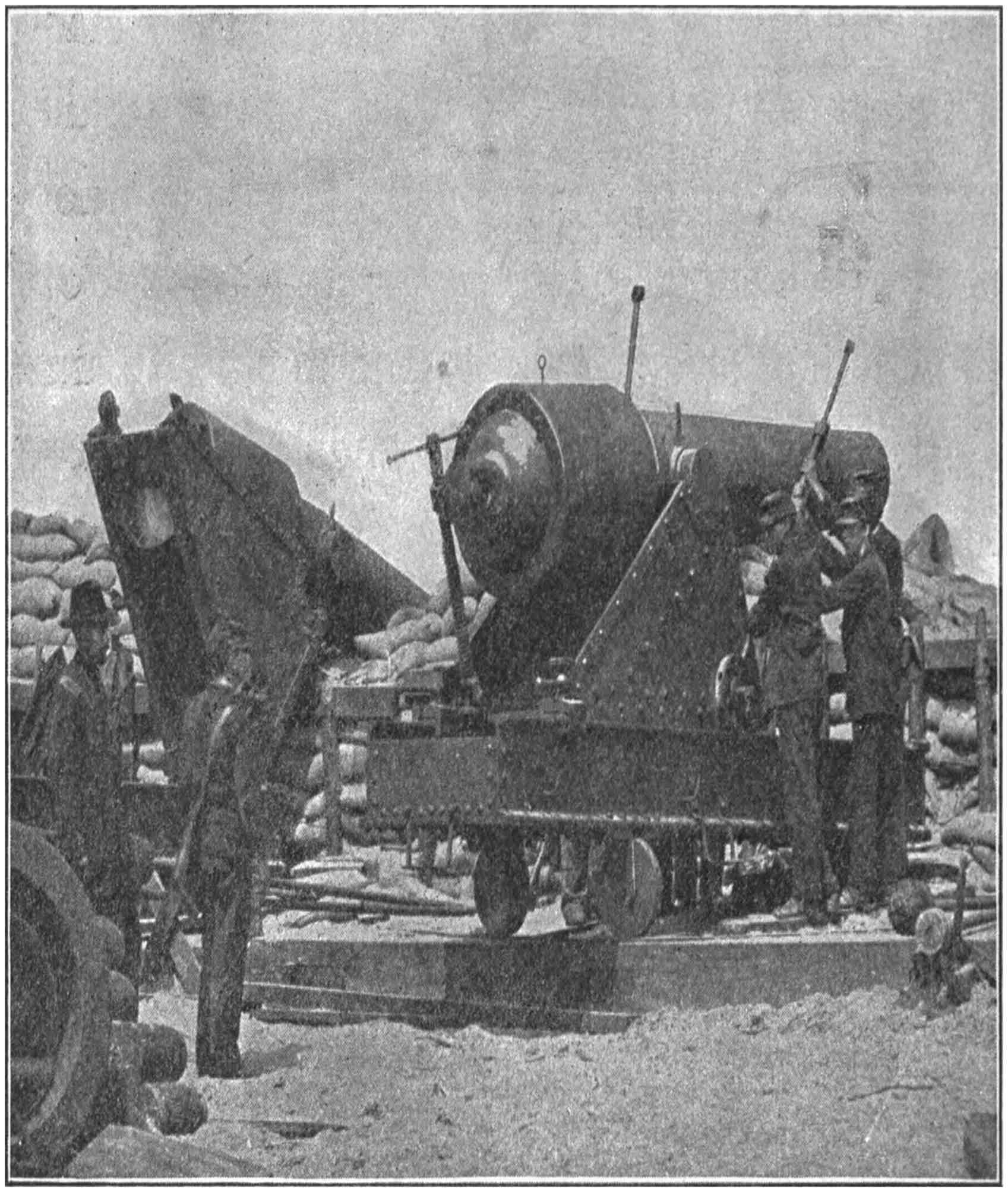
Twelve-inch Wrought-iron Gun—the Mate to the “Peacemaker,” which Burst on the
Princeton.
(The carriage is a mortar carriage from Porter’s mortar fleet at New Orleans.)
From a photograph of the original at the Brooklyn Navy Yard.
As a steamship the Princeton was a very
great success, but the art of forging was not
then sufficiently advanced to warrant the
manufacture of any but cast-iron guns. On a
trial trip made from Washington in 1844, one
of the great forged guns burst, killing and
wounding a number of gentlemen, including
the Secretary of State and the Secretary of
the Navy, with several ladies who had been
invited to go on the trip. Stockton had
boasted that “the numerical force of other
navies, so long boasted, may be set at naught,
and the rights of the smallest as well as the
greatest nations may once more be respected.”
And the boast would have been almost justified
but for the failure of the wrought-iron
gun.
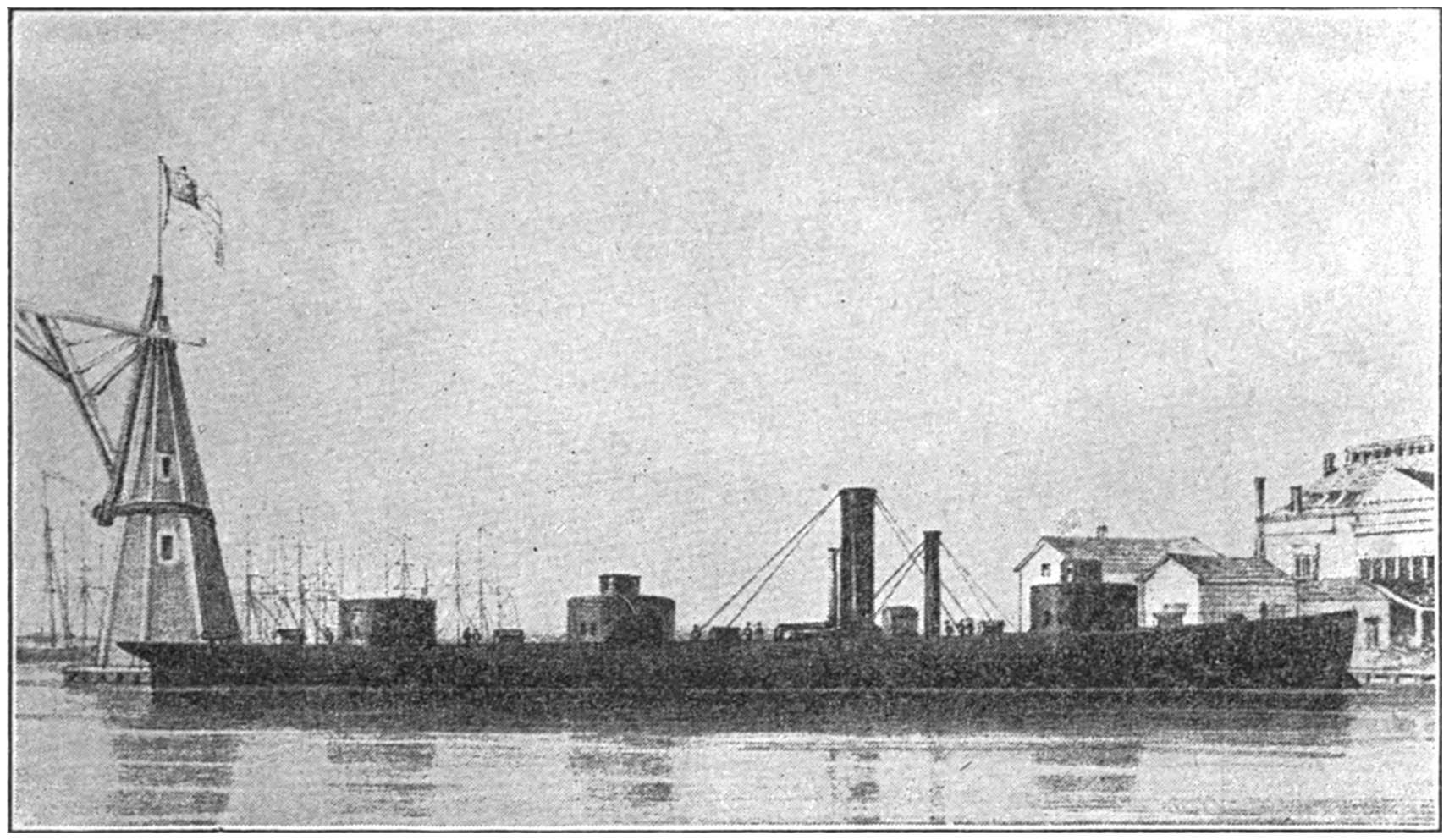
U. S. Ironclad Steamship Roanoke.
(The first turreted frigate in the United States, 1863.)
From an old lithograph.
However, the success of the Princeton as a
ship was so pronounced that money was appropriated
from time to time for others designed
much as she was until the navy had six
screw frigates—the Niagara, the Roanoke, the
Colorado, the Merrimac, the Minnesota, and the
Wabash; six screw sloops of the first class—the
San Jacinto, the Lancaster, the Brooklyn,
the Hartford, the Richmond, and the Pensacola,
besides eight screw sloops of the second class,
of which the Iroquois was a type, and five of
the third class, of which the Mohawk was a
type. There was also a screw frigate on the
stocks at the Portsmouth, New Hampshire,
dock-yard. The guns that these ships carried,
when compared with those of the war of the
Revolution, were quite as interesting as the
ships themselves.
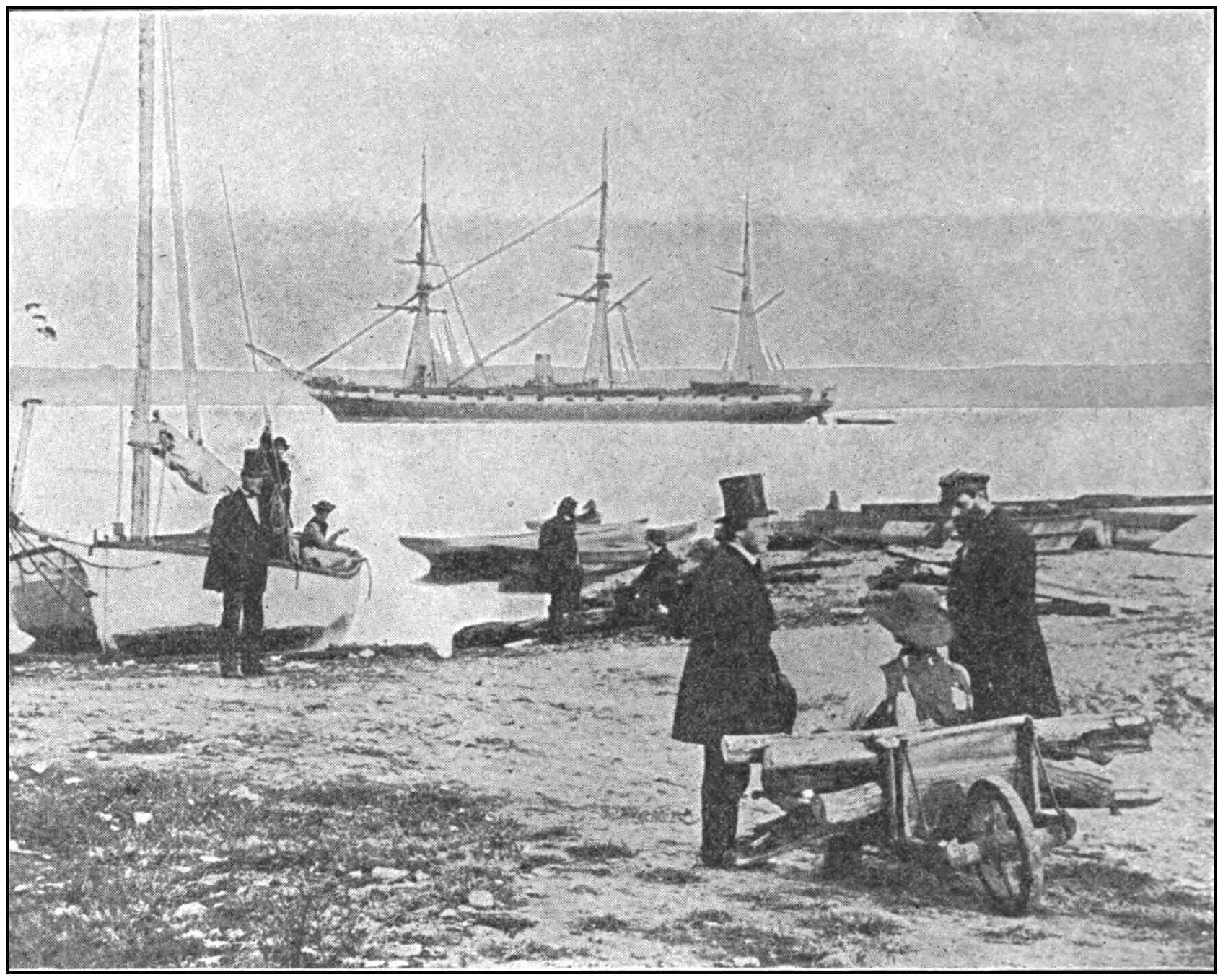
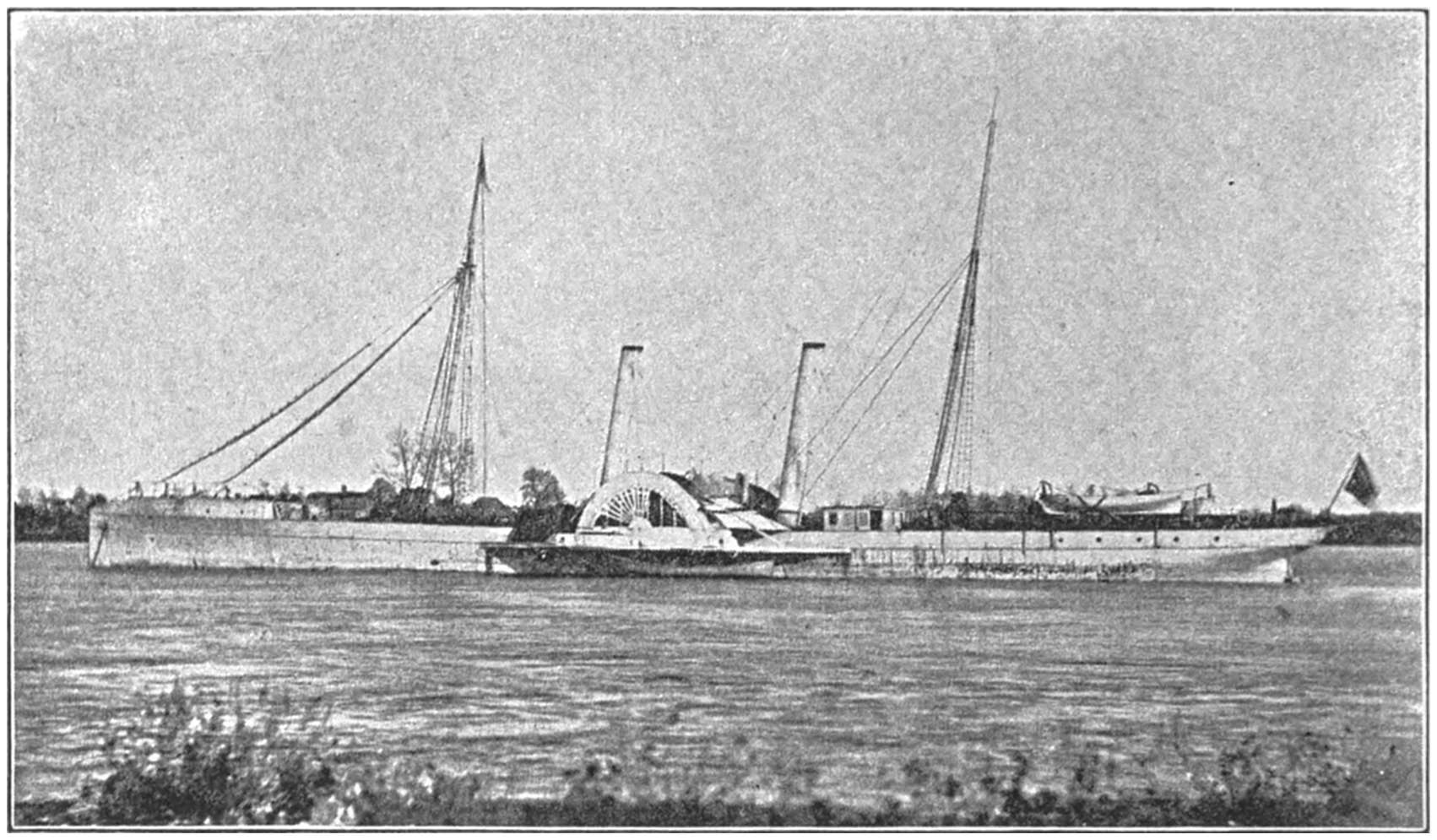
U. S. Frigate Pensacola off Alexandria.
From a photograph taken in 1865.
The prejudices in the way of improving
great guns were not only strong, but they were
founded on experiences that were seemingly
convincing beyond peradventure. For instance,
under Charles V a cannon was cast at Genoa
that was fifty-eight calibres long; that is, it
was of about six inches diameter of bore and
twenty-nine feet long. When fired, its ball of
thirty-six pounds weight had less range than
an ordinary twelve-pounder. So they cut off
four feet of the gun and found that its range
increased. Cutting off three feet more still
further increased the range, as did another cut
of six inches—“which shows,” says Simpson’s
text-book on gunnery, printed in 1862, “that
there is for each piece a maximum length
which should not be exceeded.” So that dictum
stood in the way of arriving at the design
of a gun like the modern rifle, that would
really give the greatest possible range to a projectile.
Then, the distribution of the metal in
the cannon with which Arnold fought on Lake
Champlain seems now ridiculous. One must
needs see a picture of the old gun beside one
of the guns as developed just previous to the
Civil War to realize the difference; but it may
be said that, with the bell-shaped muzzle and
the “rings” and “reinforces,” the old gun in
outline had as many ups and downs as some
step-ladders, while the cast-iron weapon of 1860
was as smooth and symmetrical as the hull of
a Yankee clipper.
A Twelve-pound Bronze Howitzer—the First One Made in the United States.
From a photograph of the original at the Brooklyn Navy Yard.
A curious series of experiments, made by
Colonel Bomford of the United States Ordnance
Department, told for the first time where
the greatest strain was exerted on the bore of a
gun, and gave some idea of the relative strain
elsewhere along the bore. Taking an old
cannon, he drilled a hole from the side near the
muzzle directly into the bore and inserted a
pistol-barrel. Then he put a bullet into the
pistol-barrel, and after loading the cannon in
the ordinary way, he fired it. Of course, as the
cannon-ball was driven from the big gun the
powder gas behind it drove the pistol-ball from
the pistol-barrel. The colonel measured the
velocity of the pistol-ball and made a note of it.
Then he drilled another hole in the cannon some
inches farther from the muzzle, and repeated
the experiment. The force exerted on the pistol-ball
was slightly greater there. By drilling
other holes he learned approximately the pressure
all along the bore. It appeared that the
greatest pressure was directly over the shot
when it was rammed home against the powder.
From there the pressure decreased rapidly,
being only about half as much when the ball
had travelled four times its own diameter from
its original resting place.
A Dahlgren Gun.
Captain Rodman of the Ordnance Department,
put a piston in place of Bomford’s pistol-barrel
and let the piston punch into a piece of
copper, and then determined the pressure on
the piston by forcing the same kind of a piston
into the same kind of a piece of copper by a
known weight. “Although not an accurate
process,” it was good enough, and with the
figures obtained by it before him, Lieut. John
Dahlgren, of the United States navy, designed
the gun of smooth outline that by its splendid
success in the hands of both forces, during the
Civil War, made him famous. The greatest
thickness of metal was placed around the greatest
strain, and a proper thickness at every inch
of length of the bore.
It was not alone, however, in putting the
metal where it would prove most serviceable
that Dahlgren made his gun efficient. He was
a metallurgist, and was careful to improve the
quality of iron used.
Meantime Captain Rodman had proposed
to cast cannon hollow and cool them from the
interior, instead of casting a solid log of iron
and boring it out on the old plan. Although
the first experiments did not show any especial
improvement in the strength of a gun so cast,
the method was eventually found to be the
best.
With Dahlgren’s model a gun of eleven
inches of diameter of bore was cast in 1852.
It was fired 500 times with shells and 655 times
with solid shot that weighed 170 pounds, the
service charge of powder being fifteen pounds.
The gun was not seriously injured or worn
even by the work. That settled the status of
the Dahlgren guns, and from that time on they
were furnished with reasonable rapidity to the
new steam warships of the navy.
Meantime rifled cannon made of cast iron
reinforced over the breech by a wrought-iron
jacket that was shrunk on had been introduced
into the American navy. They varied
from thirty-pounders up to 100-pounders, and,
except for the smaller calibres, were in many
cases more dangerous for their crews than for
the enemy. It must be told also that a cast-iron
rifle known as the Brooke, because designed
by Commander John M. Brooke, of the Confederate
navy, was produced in Richmond that
was better than the Parrott. It was strengthened
in its early service days by a series of
wrought-iron bands two inches thick and six
wide, that were shrunk on over the breech.
Later a second series of bands was shrunk on
over the first, breaking joints with them, of
course, and so a very good 150-pounder was
produced.
Meantime one Dahlgren smooth-bore, with a
bore fifteen inches in diameter, had been successfully
made, and the shells for all the Dahlgren
guns were provided with fuzes that could
be set to explode just about where and when
the gunner wished to have them do so. But
whether the damage to be done by a fifteen-inch
round shot smashing its way through a
ship’s side would be greater or less than that
of a rifle projectile boring its way through was
a question that had not been decided. It was
granted that the rifle had the longer range—with
a reasonable elevation a rifle would carry
three miles, maybe four, and do some damage
when the projectile arrived, while the effective
range of the smooth-bore was, say, 1,500 or
1,600 yards, though gunners made efforts, when
the time came, to run in to a range of 600 yards
or less instead. But, on the whole, it was the
belief among American naval officers before
the Civil War that the big Dahlgren smooth-bore
was the best gun afloat.
Two Blakely Guns at the Brooklyn Navy Yard.
So it came to pass that the newest and best
ships of the navy were armed with the Dahlgren
gun. The Merrimac, which was not the
best of the frigates, carried twenty-four nine-inch
guns on her gun deck, with fourteen
eight-inch and two ten-inch pivots on her spar
deck. She could throw 864 pounds of metal
from her gun-deck broadside, 360 pounds from
her broadside of eight-inch guns, and 200 from
her ten-inch, both of which could be fired over
either rail.
Mr. Hans Busk, M.A., of Trinity College,
Cambridge, was moved to write on page 104,
in his “Navies of the World,” that “the navy
of the United States has a tolerably imposing
appearance upon paper,” but he concludes that
a British frigate of the Diadem class, “avowedly
built to cope with those of the description of
the Merrimac, etc., would speedily capture her
great ungainly enemy.” To fully appreciate
this remarkable statement it must be known
that the Diadem could fire at a broadside ten
ten-inch shells, weighing in the aggregate 820
pounds, five thirty-two-pound solid shot, and
two sixty-eight-pound solid shot—in all 1,116
pounds of shot to 1,424 pounds that the Merrimac’s
broadside weighed.
The frigate Minnesota carried, soon after the
Civil War broke out, no less than forty-two
nine-inch Dahlgrens, one of eleven inches, four
100-pounder rifles, and one 150-pounder rifle.
She could throw 1,861 pounds of metal at a
broadside. Moreover, it was not a mere matter
of weight of metal. The diameter of the
American projectiles was a matter for serious
consideration by the enemy, and so was the
ability of the gun to stand service. The best
English gun could stand a charge of twelve
pounds of powder, and the best American
fifteen. There was a vast difference in the
smashing effect of an eleven-inch shell driven
by fifteen pounds of powder and a ten-inch
shell driven by twelve.
All this seems worth telling only because it
shows that the ideas of armament which prevailed
among the English and the Americans
before the War of 1812 were still held by the
two nations in 1859. Indeed, the disproportion
between the Minnesota’s armament and
that of the Diadem was very much greater than
that between the United States and the Macedonian.
In short, all things considered, the American
people had just the fleet they needed for
that day to resist foreign aggression.
But while the patriot holds up his head in
pride at the thought of the ships of 1859, he
hesitates and stammers when he comes to tell
of the men—of the personnel of the navy. It
was a far cry from the sailing ships of the old
days to the steam frigates of the later, but it
was a farther one, and a cry over the shoulder
at that, from the men who swept the seas
under the once-despised gridiron flag to those
who carried the American naval commissions
in 1859. It was not that courage and enterprise
were dead, or knowledge and skill were
lacking. There were, of course, men a-plenty
who were brave and tactful and energetic and
learned—plenty who were to become during
the war men of the widest fame. But
“long years of peace, the unbroken course of
seniority promotion, and the absence of any
provision for retirement,” had served the officers
as lying in ordinary served white oak
ships. Nearly all of the captains were more
than sixty years old. The commanders at the
head of the list were between fifty-eight and
sixty years of age. There were lieutenants
more than fifty years old, and only a few of
the lieutenants had known the responsibility
of a separate command.
And then, “as a matter of fact,” as Professor
J. R. Soley says in his work on “The Blockade
and the Cruisers,” “it was no uncommon
thing, in 1861, to find officers in command of
steamers who had never served in steamers
before, and who were far more anxious about
their boilers than about their enemy.”
But that was not all nor the worst that can
be said of the personnel of that day, for a sentiment—a
faith—had developed and spread to
a degree that now seems almost incredible,
under which men who had made oath that
they would always defend the Constitution
of the United States came to believe that
they were under obligations to draw their
swords against the flag they had sworn to
defend—the flag which some of them had defended
with magnificent courage.
That the politicians should have been secessionists
is not at all a matter of wonder. It
was entirely natural. But how a Tatnall, the
story of whose bravery at Vera Cruz still thrills
the heart; how an Ingraham, whose quick defence
of the rights of a half-fledged American
in the Mediterranean is still an example to
all naval officers—how these men could have
placed the call of friends and neighbors and a
State above the obligation of their oath to support
the Constitution, is something that is now
incomprehensible.
It must be granted that they were of good
conscience. There was not a sordid thought
in their minds—not one. Indeed, most of them
felt that they were making the greatest of
sacrifices for the sake of principle. But, if the
writer may express his thoughts without offence,
no patriot can now read of the glorious
achievements of the men who in other
days fought afloat for the honor of the nation,
without feeling inexpressibly shocked at the
thought that any man of the navy should have
been found willing under any circumstances to
strike at the gridiron flag.
There is not a little interest in considering
the actual numbers of the men who left the
navy to take part with the Southern States.
Before South Carolina passed her ordinance
of secession there were 1,563 officers, commissioned
and warrant, on the naval register. Of
these, 677 were from Southern States; but 350
of these Southern-born men remained true to
the flag, while 321 resigned to enter the Confederate
navy. Of thirty-eight Southern captains,
sixteen resigned; of sixty-four Southern
commanders, thirty-four resigned; of 151
Southern lieutenants, seventy-six resigned; of
128 Southern acting midshipmen, 106 resigned.
And that is to say that so demoralized had
the navy become under the influence of quarrelling
politicians that more than one-fifth of
all the officers were ready to forsake their
allegiance.
CHAPTER II BLOCKADING THE SOUTHERN PORTS
LINCOLN’S PROCLAMATION—IT WAS SOMETHING OF A TASK TO CLOSE
185 INLETS AND PATROL 11,953 MILES OF SEA-BEACHES, ESPECIALLY
WITH THE FORCE OF SHIPS IN HAND—ONE MERCHANT’S
NOTION OF THE EFFICIENCY OF THIRTY SAILING VESSELS—GATHERING
AND BUILDING BLOCKADERS—INCENTIVES AND FAVORING
CIRCUMSTANCES FOR BLOCKADE-RUNNERS—WHEN PERJURY
FAILED AND UNCLE SAM WAS ABLE TO STRIKE WITHOUT WAITING
FOR ACT OF CONGRESS—WHEN BLOCKADE-RUNNERS CAME
TO NEW YORK AND YANKEE SMOKELESS COAL WAS IN DEMAND.
The story of the actual work done by the
navy in this last war for the preservation of
the life of the nation begins when a blockade
of the ports of the seceded States was ordered.
Two proclamations were issued to provide for
this measure. The first was issued on April
19, 1861, which, as the reader will remember,
was six days after the capture of Fort Sumter,
in Charleston harbor, by the secessionists. It
covered all the ports of the South except those
of Virginia and Texas; but on the 27th of the
same month, these two States having also
joined the Confederacy, their ports were included
by a second proclamation. Because,
from a naval point of view, that was the most
important proclamation issued by a President
of the United States since the War of 1812,
its words shall be given literally.
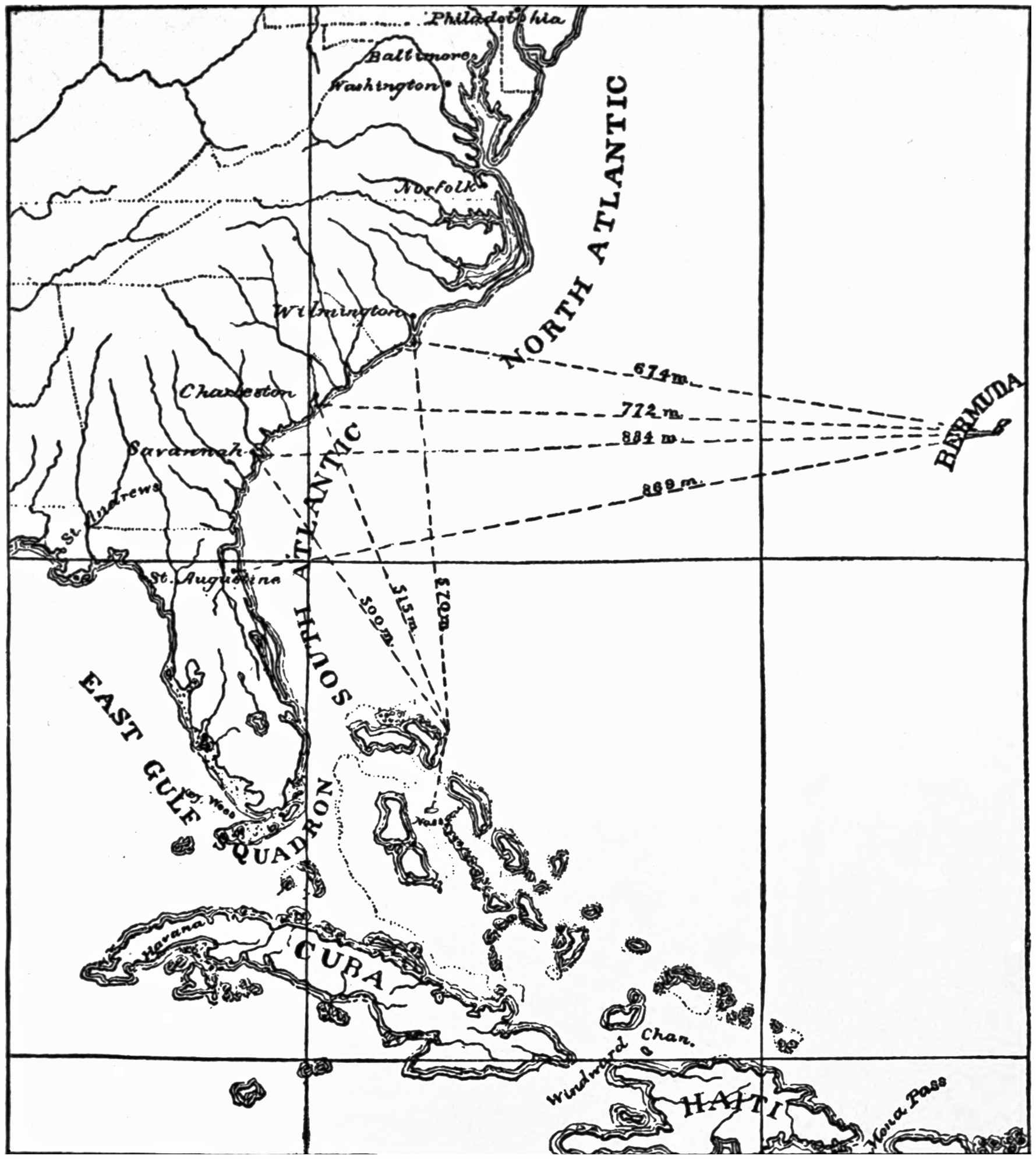
The Blockaded Coast.
From “The Navy in the Civil War.”
“Now therefore I, Abraham Lincoln, President
of the United States ... have further
deemed it advisable to set on foot a blockade
of the ports within the States aforesaid, in
pursuance of the laws of the United States and
of the Law of Nations in such case provided.
For this purpose a competent force will be
posted so as to prevent entrance and exit of
vessels from the ports aforesaid. If, therefore,
with a view to violate such blockade, a vessel
shall approach or shall attempt to leave any of
the said ports, she will be duly warned by the
commander of one of the blockading vessels,
who will endorse on her register the fact and
date of such warning, and if the same vessel
shall again attempt to enter or leave the blockaded
port, she will be captured, and sent to
the nearest convenient port for such proceedings
against her, and her cargo as prize, as
may be deemed advisable.”
It is worth while considering in advance some
of the facts relating to the task that was thus
set for the navy. The coast line invested
extended from Alexandria, Virginia, to the
borders of Mexico on the Rio Grande. The
continental line was 3,549 miles long. The
coast or shore line, including bays and similar
openings, was 6,789 miles long; and if to this
be added the shore lines of the islands which
were included in the blockade and which were
necessarily watched by the blockading fleet,
the entire length of beaches under guard was
exactly 11,953 miles.
The South Carolina islands, as described by
Jedidiah Morse, “are surrounded by navigable
creeks, between which and the mainland is a
large extent of salt marsh fronting the whole
State, not less on an average than 4 or 5
miles in breadth, intersected with creeks in
various directions, admitting through the
whole an inland navigation between the islands
and mainland from the northeast to the
southeast corners of the State. The east
sides of these islands are for the most part
clean, hard, sandy beaches, exposed to the
wash of the ocean. Between these islands
are the entrances of the rivers from the interior
country, winding through the low salt
marshes and delivering their waters into the
sounds, which form capacious harbours of
from 3 to 8 miles over, and which communicate
with each other by parallel salt creeks.”
And that will apply to the whole coast.
More than that, in this length of shore line
were found 185 harbor and river openings that
might be used for the purposes of commerce
with the Confederate States. It is also an important
fact that these harbor openings were,
in almost every instance, too shoal for the
ordinary ocean-going cargo ships of that day.
If too shoal for a merchantman, they were so
for a man-o’-war, and the more intricate and
variable the channels the better adapted they
were to the purposes of a trade that was to be
carried on in spite of the blockade.
To close these 185 harbor openings the
government had, on the day the proclamation
was issued, twenty-six steamers and sixteen
sailing ships in commission. But let not the
uninformed reader suppose that such a great
fleet as this was at once started off on that
duty. There were in the home squadron but
five sailing ships and seven steamers, while
of these a number were at sea en route from
nearby foreign to American ports, and of
those actually in the United States harbors
but three—the Pawnee, the Mohawk, and the
Crusader—were in Northern waters. To close
185 harbor openings the Secretary of the Navy
had for the moment just three steamers, the
rest of the commissioned fleet being either in
the ports of the Southern States or scattered
the wide world over. And that is to say, there
was for the moment no force adequate to
blockade efficiently even the one Southern
port of Charleston.
The navy register showed, however, in addition
to the forty-two ships in commission,
twenty-seven that were lying at the navy yards
in ordinary but fit for service. The government
had thirty-nine steamers and thirty-four
sailing ships that might be brought together
in the course of a few months to enforce the
blockade of the 185 harbors of the South and
keep contraband trade clear of the eleven
thousand and odd miles of Southern sea-beaches.
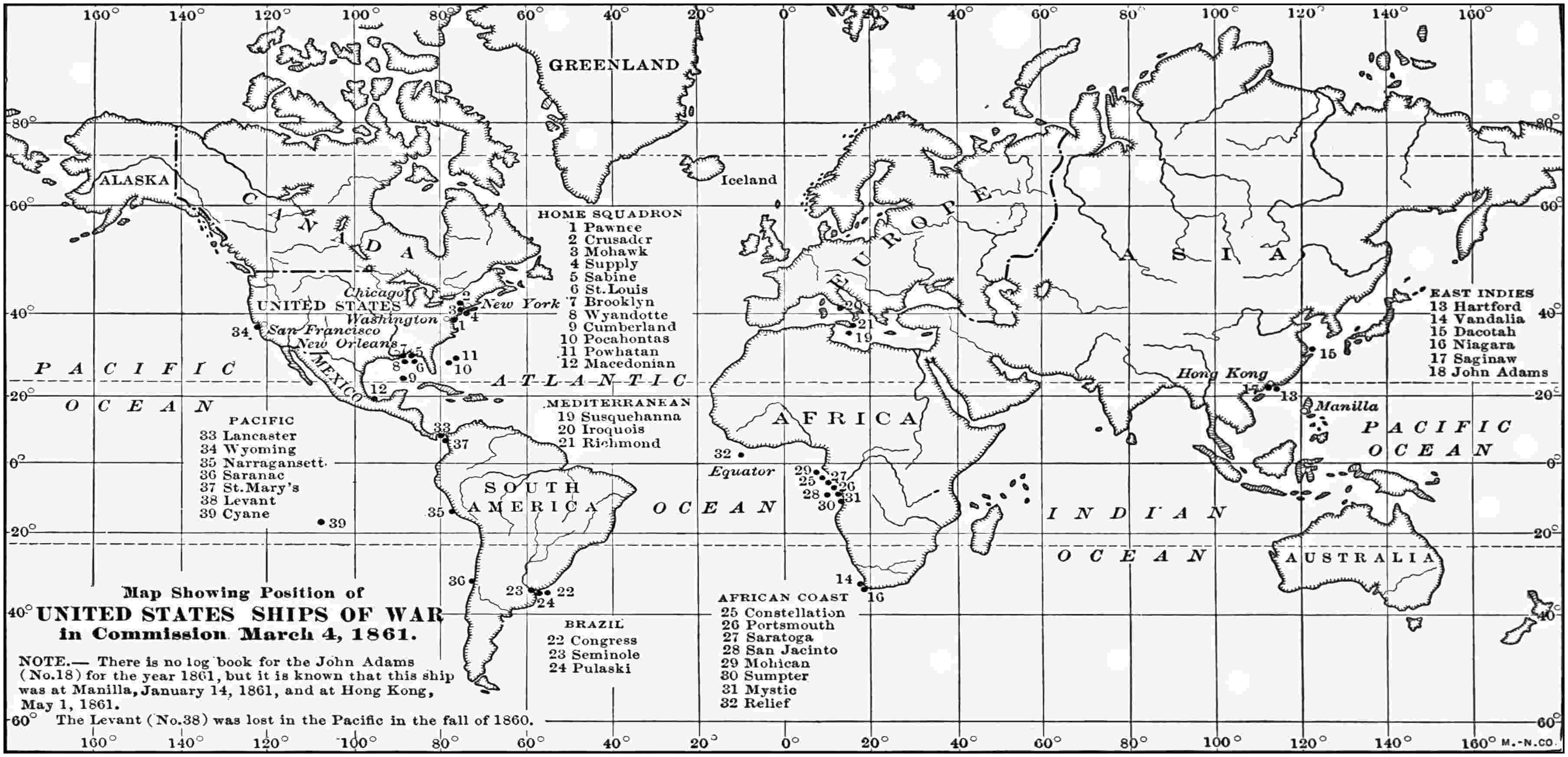
Map Showing Position of
UNITED STATES SHIPS OF WAR
In Commission March 4, 1861.
NOTE:—There is no log book for the John Adams
(No. 18) for the year 1861, but it is known that this ship
was at Manilla, January 14, 1861, and at Hong Kong,
May 1, 1861.
It is worth noting here that when the Navy
Department was first considering its lack of
ships for the purpose
of enforcing
the blockade, a consultation
was had
with a number of
the most eminent
ship-owners of New
York. The leader
of these eminent
ship-owners, after
considering the subject
carefully, said
to Secretary Welles
that thirty sailing
vessels would have
to be purchased before an actual blockade of
the ports could be completed. As a matter
of fact, over 600 ships were employed at the
end, and even then some blockaders got
through.
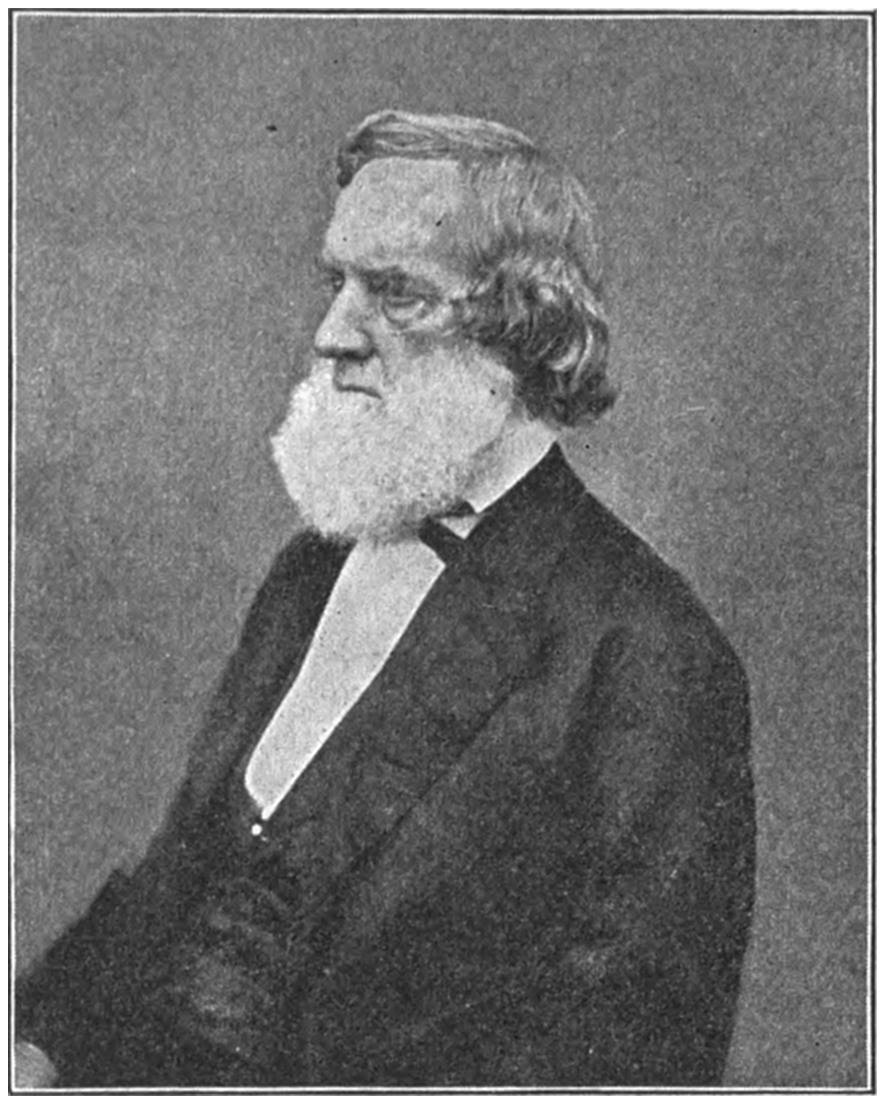
Gideon Welles.
From a photograph.
But it was not alone in a lack of ships that
the government was embarrassed. It was
necessary to find officers and crews for the
ships that were not in commission. Hundreds
of men were needed to man even one of the
five screw frigates, and yet to man the whole
twenty-seven ships not in commission there
were, on March 4, 1861, “only 207 men in all
the ports and receiving ships on the Atlantic
coast.” “It is a striking illustration of the
improvidence of naval legislation and administration
that in a country of thirty millions of
people only a couple of hundred were at the
disposal of the Navy Department.”
And as for the officers, as has been already
shown, when the need of the nation was greatest,
a fifth of them drew swords against the
flag instead of defending it.
To still further hamper the work of the
Navy Department, Congress was very slow to
learn that a vast naval force was needed.
The fact that the South had no navy and no
merchant marine of its own, seemed, in the
minds of the Congressmen, to make it wholly
unnecessary to spend money on fighting ships.
Indeed, a Navy Department has rarely been in
a more distressful condition than was that
under Mr. Gideon Welles in the first six
months or so of the administration of President
Lincoln.
However, a beginning was made. Perhaps
the first step of importance in fitting the navy
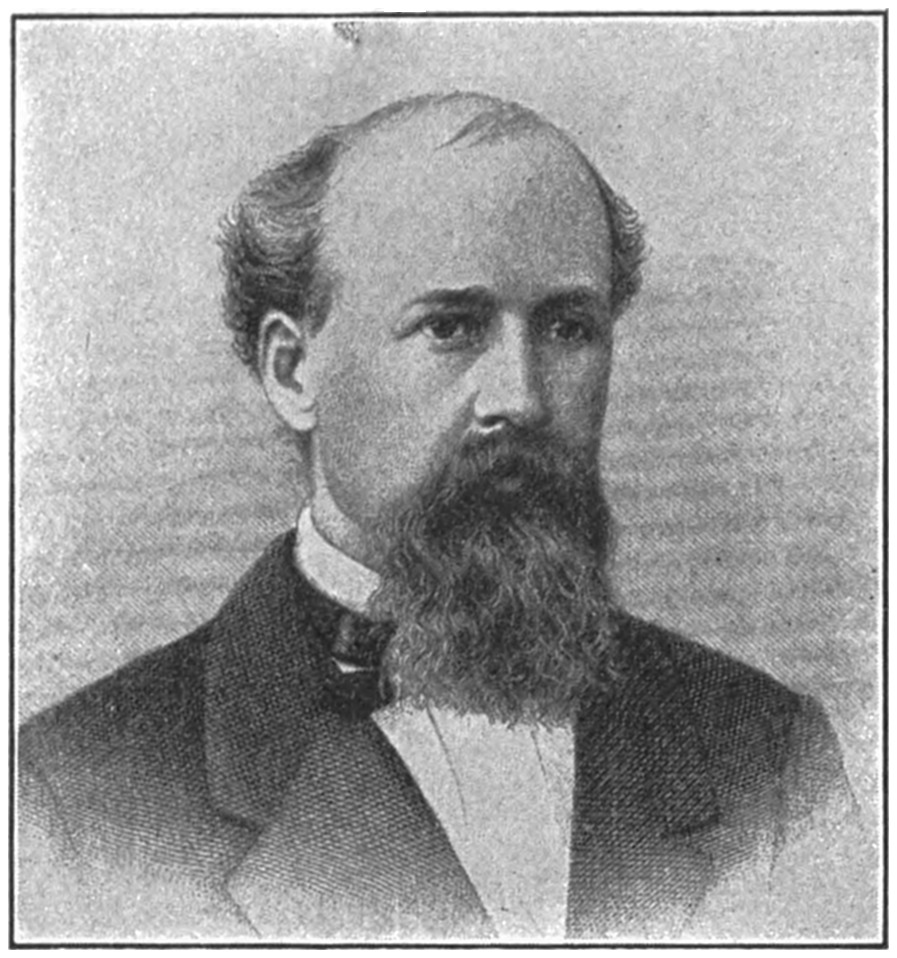
for war was the appointment of Mr. Gustavus
V. Fox as assistant to Mr. Welles, for Fox
had been a naval lieutenant and brought a
practical knowledge of naval affairs with him
when he was placed in charge of the actual
war operations of the ships.
First of all, of course, was the work of getting
men by a call for volunteers. The call
was answered by hosts, but never by as great
numbers as were
needed. Captains
and mates from the
Northern ports and
the Great Lakes
were the more valuable
part of this
volunteer force, but
so great was the
need of officers that
not a few men who
had never been at
sea received appointments.
The youngsters at the Naval
Academy who had had one year’s instruction,
or more, were taken at once into the
service. They were mere boys, but they had
learned something of warships, and some of
them made names that will not be easily forgotten.
Gustavus V. Fox.
From an engraving.
The next effort after the call for men was
to issue a call for ships. The department
strove to buy “everything afloat that could be
made of service,” and where owners would not
sell, to charter the ships. At first the ships
were purchased by the department direct or
by naval officers. Altogether, twelve steamers
had been purchased and nine chartered by July
1, 1861; and it is worth recording that, because
greed was a stronger passion than love
of country, the prices charged were outrageously
high. Afterwards a business man was
appointed to the task of buying ships, and
somewhat better rates were then obtained,
while a board of naval officers inspected the
ships to decide on their fitness and the alterations
needed to make them serviceable.
It was a heterogeneous collection, a nautical
curiosity shop, that they got together—deep-water
ships, inland-water steamers, ferryboats,
and harbor tugs. The inspecting officers were
compelled by stress of need to accept about
everything that would float and carry a gun.
And, singular as it may seem at first thought
to those who in these days ride on them, the
double-ended ferryboats made very successful
naval ships. It was the Fulton ferryboat Somerset
that captured the blockade-runner Circassian
off Havana—a prize that yielded $315,371.39
to her captors. Nor was that her only
service. Being well built to stand the hard
knocks of their ordinary service, the ferryboats
were easily fitted with heavy guns and
served well in battering down alongshore
forts.
By the 1st of December, 1861, the government
had purchased 137 vessels, of which,
however, fifty-eight were sailing vessels; and
it may as well be told here as elsewhere that
418 vessels were purchased during the war, of
which 313 were steamers.
Meantime the department started the work
of building ships. Congress authorized seven
sloops-of-war, and the department laid down
eight, of which four were built to the lines of
the sloops of 1858 in order to save time; and
it is worth noting that the Kearsarge was
among the four. The eight were begun immediately,
and six more were laid down before
the end of the year.
Without waiting for an appropriation, the
department contracted with private shipyards
for the building of twenty-three heavily armed
screw gunboats. And this contract is worth
more space than the mere statement of the
fact, for it draws attention to the importance
of the private shipbuilder as a factor in the
sea power of a nation. Even in the War of
1812, when wooden sailing ships were the sole
evidence of sea power, the private shipbuilder
was of essential importance. It was a private
shipbuilder from New York, Mr. Noah Brown,
who sent Perry’s victorious squadron afloat on
Lake Erie, and it was the private shipbuilder
who gave the Americans the supremacy that
they enjoyed from time to time on Lake Ontario.
Without private yards amply equipped
for the construction of the best warships
afloat, no nation
can have a sea
power adequate for
the protection of
its honor and the
preservation of
peace.
These twenty-three
gunboats
mounted from four
to five guns each,
of which one was
an eleven-inch
smooth-bore. They
were wooden boats,
of course, and they
were known as the
ninety-day fleet because
some of them were in commission within
three months from the signing of the contract.
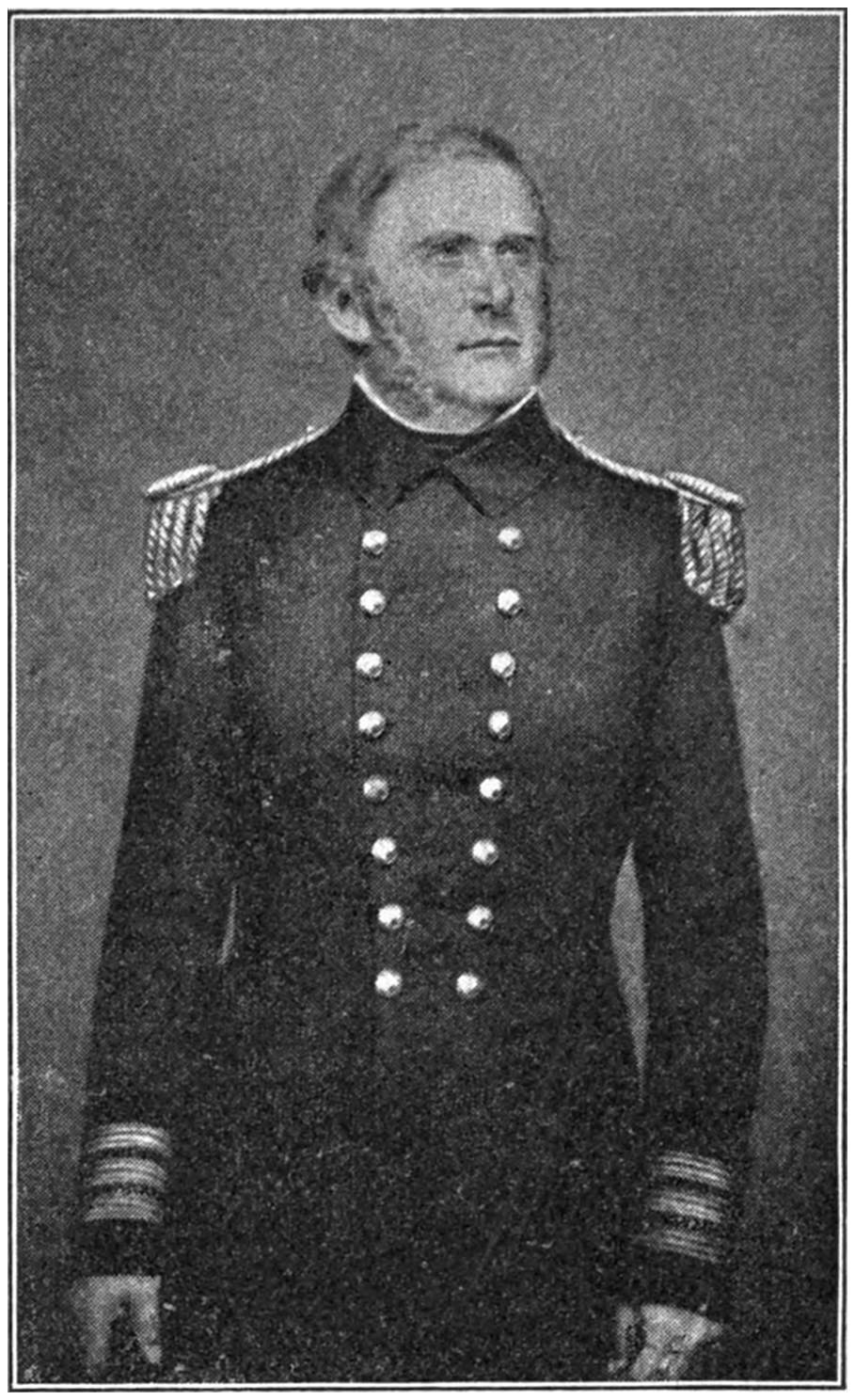
Garrett J. Pendergrast.
The fact that they were so quickly built is
also worth considering in connection with the
fact that ships relatively as efficient as they
were could not now be built in less than a
year. The day of a ninety-day fleet passed
when steel was substituted for wood.
The first point actually blockaded was
Hampton Roads. Flag Officer G. J. Pendergrast
established the blockade there, and issued
the following proclamation on April 30, 1861:
“To all whom it may concern:
“I hereby call attention to the Proclamation
of his Excellency Abraham Lincoln, President
of the United States, under date of the 27th
April, 1861, for an efficient blockade of the
ports of Virginia and North Carolina, and
warn all persons interested that I have a sufficient
naval force there for the purpose of carrying
out that Proclamation.
“All vessels passing the Capes of Virginia,
coming from a distance and ignorant of the
Proclamation, will be warned off, and those
passing Fortress Monroe will be required to
anchor under the guns of the fort, and subject
themselves to an examination.
“United States’ Flagship Cumberland, off “Fortress Monroe, Virginia, April 30, 1861.
(Signed) “G. J. Pendergrast,
“Commanding Home Squadron.”
This proclamation is worth careful perusal
for two reasons: The first reason is that it
contained an untrue statement. Instead of
having “sufficient naval force” “for an efficient
blockade of the ports of Virginia and
North Carolina,” he had barely enough for
Virginia alone. Wilmington was a most important
harbor of the South; it eventually
became the favorite with blockade-runners,
but there was not a ship ready to close it
for many weeks after this proclamation was
issued.
More important still is the second reason
for reading the proclamation carefully—the
fact that it was issued at the behest of the
Navy Department, and illustrates clearly the
department’s idea of a blockade at that time.
It is necessary to say here that, owing to the
excitement of the times, the government was
making a very grave error—it was trying to
establish a “paper blockade.” That is to say,
there was a determined effort made to interdict
trade where there was no blockade de
facto—not a ship, or a rowboat even, stationed
to close the port. And this was a most
remarkable undertaking, because the “free
trade” for which the War of 1812 was waged
was the freedom to trade in any belligerent
port not actually closed by the presence of a
warship. The government was sacrificing a
great principle for the sake of a temporary
advantage.
This was not due to the mistake of a naval
officer. It was the deliberate action of the
administration, and it is not unlikely that it
will come back, some time, to plague us when
we are the neutral nation seeking for trade in
a belligerent port.
Proof of the fact that the whole Cabinet was
involved is found in the correspondence of Mr.
Seward relating to the blockade off Charleston.
The Niagara had arrived home from
Japan on April 24th, and was sent to blockade
Charleston as soon as possible, arriving off the
bar on May 11th. She remained there four
days only, and then went away in search of a
ship that was said to be bringing arms from
Belgium to a port further south, and there
was no warship off that harbor until May 28th
(some accounts say the 29th), when the Minnesota
came to take the Niagara’s place. The
Harriet Lane, a revenue cutter, used as a warship,
did lie off the harbor on the 19th, but for
thirteen days Charleston was entirely uncovered.
On May 22, 1861, Lord Lyons, the British
minister at Washington, in the interest of British
ships at Charleston, called the attention of
Mr. Seward to the fact that the Niagara had
left Charleston on the 15th and that the harbor
was thereby opened. Replying to this, Mr.
Seward wrote, along with other things, the
following:
“The blockade of the port of Charleston
has been neither abandoned, relinquished, nor
remitted, as the letter of Her Britannic Majesty’s
Consul would lead you to infer. We
are informed that the Niagara was replaced by
the steamer Harriet Lane, but that, owing to
some accident, the latter vessel failed to reach
the station as ordered until a day or two after
the Niagara had left.
“I hasten, however, to express the dissent
of this Government from the position which
seems to be assumed by your note, that that
temporary absence impairs the blockade and
renders necessary a new notice of its existence.
This Government holds that the blockade took
effect at Charleston on the 11th day of this
month, and that it will continually be in effect
until notice of its relinquishment shall be given
by Proclamation of the President of the United
States.”
On May 13th the British ship Perthshire appeared
off Pensacola, having heard nothing of
the blockade there, but she was told that Mobile
was open. So she went to Mobile, loaded
cotton, and sailed on the 30th, although the
port was closed on the 26th by the Powhatan.
She was captured at sea on June 9th, by the
Massachusetts, but released by the flagship
Niagara, whose captain “considered the capture
illegal, as, by order of the Department, no
neutral vessel not having on board contraband
of war was to be detained or captured unless
attempting to leave or enter a blockaded port
after the notification of blockade had been indorsed
on her register,” The owner made a
claim for £200 compensation on account of the
detention of his ship, which had lost twelve
days of her voyage; and the claim was allowed
and paid by the government of the United
States.
The United States had now to abide by the
law that its navy had in 1812 established.
The ship of a neutral had a right to enter any
port left open by the government ships, and for
several months after the President’s proclamation
nine-tenths of the 185 Southern harbors
remained open.
This matter is of importance because of the
right of neutrals in case the blockade of a port
was actually abandoned or raised even for an
hour. The opening of the port made it legally
necessary for the blockaders to begin over
again as if no blockade had existed. The neutral
entering an opened port had a right to
remain fifteen days, as the law was applied,
after she was officially notified of the blockade,
while neutrals approaching a re-blockaded port
had the right to go away unmolested if they
had not been notified, actually or constructively,
that the new blockade existed.
New Orleans was blockaded on May 26,
1861, by the Brooklyn, and Galveston on June
2d by the South Carolina. For celerity of
movement in carrying out orders to blockade
the different ports no man exceeded Lieutenant
Woodhull, for within forty-eight hours after
receiving orders to charter a steamer he had
left Washington, obtained the Keystone State
in the Delaware, carried her to Hampton
Roads, and reported ready for duty.
On the whole, it may be said that on July 1,
1861, the magnitude of the work of blockading
185 ports and inlets began to be appreciated
by the Navy Department. Moreover, the hesitation
and vacillation that had characterized
the early movements of the government were
becoming submerged. The determination of
the people of the North to preserve the American
nation intact was growing, under the shame
of early reverses ashore, into a mighty tide
that was to be irresistible at the last. A
blockade was established within the time mentioned,
in which even the critical eye of British
men-o’-warsmen, sent especially to examine it
in the interests of British commerce, could find
no flaw. When, on the 13th of July, Commodore
Pendergrast issued another proclamation
saying Virginia and North Carolina were legally
closed, he stated the fact, and from that
time on the whole coast was, at worst, under
guard, if not impassable. It was a blockade
that was to starve the hosts fighting against
the flag into abandoning their arms and returning
once more to the ballot-box for a
redress of grievances.
This is by no means to say that the blockade
was absolutely effectual. Tales of the
blockade-runners are to be told further on,
but some of the difficulties in the way of effecting
a blockade, even when ships a-plenty
were on the coast, must be considered here.
Mention has already been made of the physical
aspects of the coast. No more difficult
coast for a blockade can be found in the world.
With this in mind, let the reader recall the
fact that the South in those days was about
the only producer of cotton in the world, and
that the sap of the long-leaved pine was converted
into tar and turpentine, which were
produced there in very great quantities. On
the other hand, consider that the South had
scarcely anything in the way of factories. The
people there were dependent on commerce for
their supplies of even the most common necessities
of life—for household goods, for clothing,
and even for some kinds of food. And as for
the arms and supplies needed for a war, there
was one small powder mill, but nothing more
in all the South, unless, indeed, the existence
of the Tredegar iron mills at Richmond might
be called a gun and engine factory.
Here, then, were the conditions for commerce:
The South was the chief source of
cotton and naval stores, and it was in desperate
need of manufactured articles in a great
variety. The blockade stopped all lawful traffic
between it and the rest of the world. The
cotton for the mills of the world was shut off.
The mills of France and England were shut
down for want of raw material, and people
starved to death in England because the mills
were shut down, and there was no way in
which the unfortunate operators could get
money for food. We can afford to recall this
fact when we feel embittered by the attitude
of a certain part of the English people toward
us during our struggle for national life. In
Lancashire, England, no less than ten million
dollars had been given away by relief committees
to the starving mill hands within two years
after the war began. Moreover, the English
government was not always one-sided, as will
appear further on.
The price of cotton rose to a level that now
seems fabulous in the markets of the world.
The prices of the goods that the people of the
South were accustomed to import rose as rapidly
there, while munitions of war commanded
any price that might be asked by one who
could supply them. Here was a chance for
profit such as the world had not seen since
the wars of Napoleon, and greed is the steam
that turns the wheels of commerce.
Just off the Southern coast lay the Bahama
Islands, while the Bermudas were but a day’s
sail farther away. It is 674 miles from Bermuda
to Wilmington, and 515 from Nassau
to Charleston—three days’ run, or less, in
either case. Here were neutral ports to serve
as a basis for the contraband trade, and thither
the contraband traders flocked as the pirates
of old swarmed about Jamaica.
Nassau was a natural resort for the blockade
runners, for its people had been wreckers—had
“thanked God for a good wrack”—for
time out of mind. Besides that, it was not
only near by the Southern coast, but it was
surrounded by a host of reefs awash, every
one of which was neutral territory, and was
surrounded by its marine league of neutral
waters, where a blockade-runner was safe.
As the reader will remember, the blockade-running
traffic was chiefly in the hands of the
British, although Yankees were found not unwilling
to turn a contraband dollar with one
hand while they flapped the old flag in the air
with the other and shouted over Union victories
vociferously.
At the beginning of the contraband business
the vessels were loaded in England, cleared
for Bermuda or Nassau, and sent thence to
the Southern destination, Charleston being
the chief port. Any vessel, even a condemned
sailing schooner, was counted good enough; in
fact, worthless vessels were preferred because
the loss would be less in case of failure.
The touch at the neutral port was, of course,
a mere device to deceive the American government
officials; but a change was soon made in
that game, for the courts held to the doctrine
of the continuity of a voyage. If the ultimate
destination of the ship and cargo was Charleston,
she might be lawfully captured anywhere
en route in spite of the fact that she was
cleared for a neutral port when the voyage
began.
A Four-pound Cast-iron Gun Captured from a Blockade-runner.
There being no appeal from this decision,
the contraband dealers resorted to shipping
goods from England to the neutral port off the
coast, and there unloading the goods. The
papers, of course, were made out in proper
form, under oath, giving the neutral port as
the ultimate destination. They showed, for
instance, that a house in Nassau was buying
shoes, woollens, guns, gunpowder, swords, etc.,
sufficient to supply an army, and it was called
legitimate trade. Perjury was as common in
this contraband business as the drinking of
wine. In fact, one cannot help quoting here
the words of the favorite “Naval History of
Great Britain”—the words of James where he
is writing of American traders in the days of
the “paper blockades” of 1812. He says:
“Every citizen of every town in the United
States, to which a creek leads that can float a
canoe, becomes henceforward ‘a merchant’;
and the grower of wheat or tobacco sends his
son to a counting-house, that he may be initiated
in the profitable art of falsifying ship’s
papers, and covering belligerent property.
Here the young American learns to bolt custom-house
oaths by the dozen, and to condemn
a lie only when clumsily told, or when timorously
or inadequately applied. After a few
years of probation, he is sent on board a vessel
as mate, or supercargo; and, in due time, besides
fabricating fraudulent papers, and swearing
to their genuineness, he learns (using a
homely phrase) to humbug British officers,
and to decoy and make American citizens of
British seamen.”
What Mr. James says of the American
people as a whole, can be truthfully said in
substance of the British blockade-runners.
They were an infamous lot, without exception,
and ever ready to sacrifice honor and risk life
so long as the number of pieces of gold was
large enough.
But this is not meant to apply to the Confederates
engaged in running supplies through
the blockaded lines. Their case was entirely
different, for they were legally belligerents, and
to obtain supplies was, from their point of view,
a patriotic duty. So it might—so it usually
did happen that a blockade-runner carried one
man (the pilot) whose courage and firmness
excite the heartiest approbation of every unprejudiced
mind, while every other member of
the crew was at heart a coward who dared not
fight the blockaders in pursuit, and a sneak who
would sell his soul for gold.
However, even the trick of transferring cargo
at Nassau did not serve them long, for “it was
held that the ships carrying on this traffic to
neutral ports were confiscable, provided the
ultimate destination of the cargo to a blockaded
port was known to the owner.”
An Eighteen-pound Rifle Captured from a Blockade-runner.
For this “the United States were accused
of sacrificing the rights of neutrals, which they
had hitherto upheld, to the interests of belligerents,
and of disregarding great principles
for the sake of momentary advantage.” In
fact, however, Lord Stowell had held where a
neutral, when trading between two ports of a
belligerent, had landed the cargo in a neutral
port and re-shipped it on another vessel, the
continuity of the voyage was not broken.
Cargoes shipped in due form to Nassau and
taken before reaching that port having been
declared lawful prizes in spite of perjury, the
contraband traders then adopted the bold expedient
of shipping their goods by regular lines
to New York and there re-shipping them to
Nassau and Bermuda; but the moment this
trade attracted attention the New York customs
officials were instructed to refuse clearances to
ships “which, whatever their ostensible destination,
were believed to be intended for Southern
ports, or whose cargoes were in imminent
danger of falling into the hands of the enemy.”
A Six-pound Gun Captured from a Blockade-runner.
The Nassau merchants got the British authorities
to inquire into this refusal to clear
ships to their port, the ground taken being
that an unjust discrimination was made against
them, but after considerable correspondence
the British decided to let Uncle Sam alone in
that matter. The subject is of special interest
for the reason that it shows how strong the
American government is in an emergency,
even though the Executive is very often
obliged to wait on Congress before making
a move.
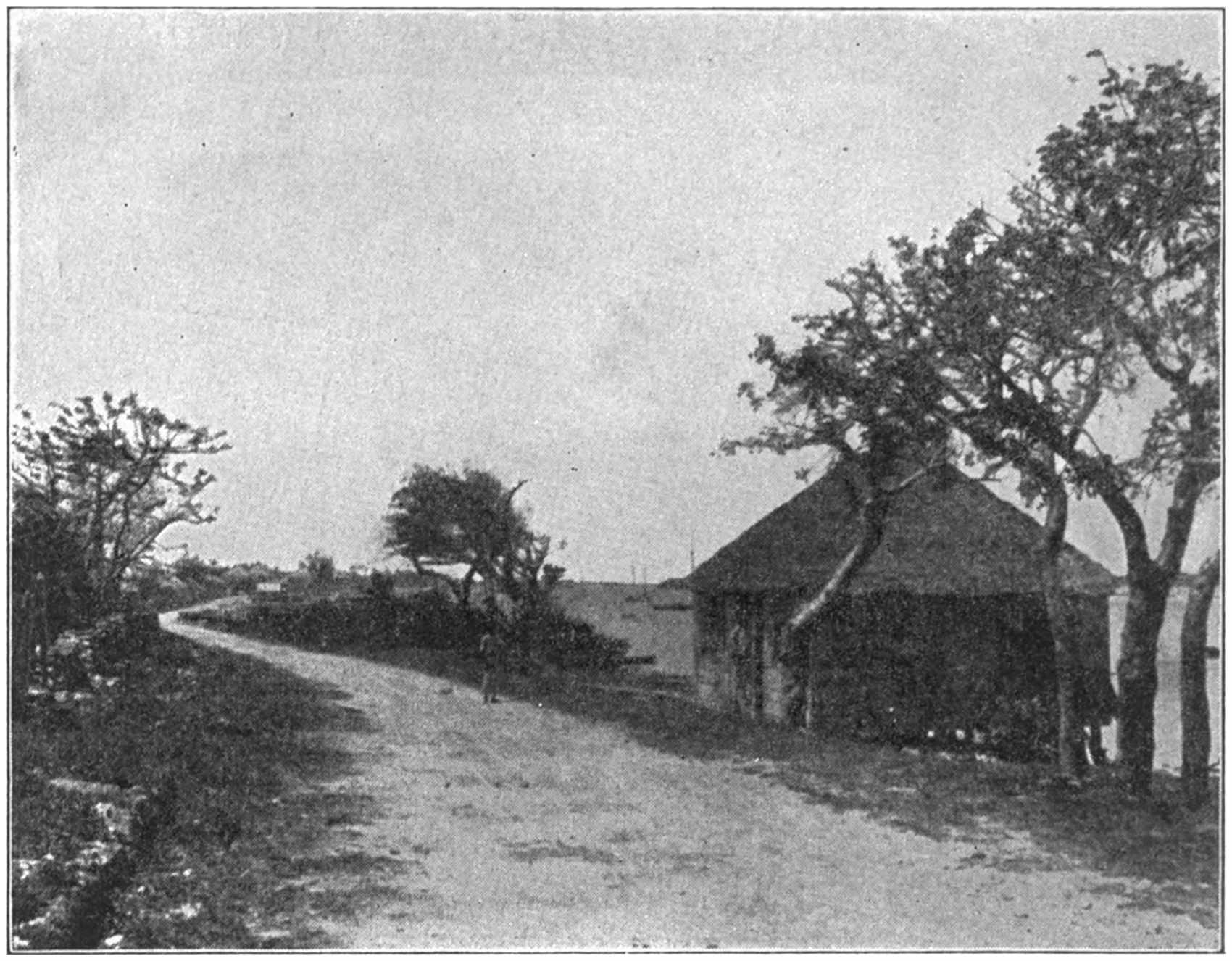
A Nassau View—Along the Shore East of the Town.
From a photograph by Rau.
So, at last, the contraband traders were
obliged to rely entirely on their ability as
sneaks. The goods were sent to Nassau and
Bermuda as before, though, meantime, Havana,
Cuba, and Matamoras, Mexico, on the
Rio Grande, were of considerable importance.
Cargoes of Southern products were safe after
reaching these ports, if cargoes of contraband
goods en route to them were not. Moreover,
there was a change in the forms of ships used
that made these nearby ports absolutely
necessary to the traffic; for soon after the
blockading fleets became efficient the use of
condemned ships as blockade-runners was
abandoned and smaller and swifter vessels
were adopted. The transition from these to
vessels built especially to run between the
islands and the Confederate ports was easy
and was quickly made. The inventive talent
of the traders was worthy of a better cause.
Low and slender hulls, with the most powerful
engines and twin screws or feathering paddles,
were adopted. The paint used was of an obscuring
color. There was no spar save that
necessary to support a crow’s nest for the
lookout. The one thing that they could not
keep from betraying them, at the last, was the
smoke, but at one time they burned anthracite
coal, and they stopped using it only when the
American government prohibited the export
of it. As time passed and the strangulation
caused by the blockade became more severe,
the skill and ingenuity of the blockaders increased,
so that the traffic never was stopped.
There was, at one time, talk in Richmond of
having the Confederate government take the
traffic into its own hands absolutely, because
of the demoralization caused by the illegitimate
traders. They brought what they could
sell at the most profit, of course. They
brought liquors where medicines were needed,
and silks and fancy slippers in place of the
necessities of life for which the people suffered.
It is a pity that the change was not made, for
then one might have considered the blockade-runners
with other feelings than disgust.
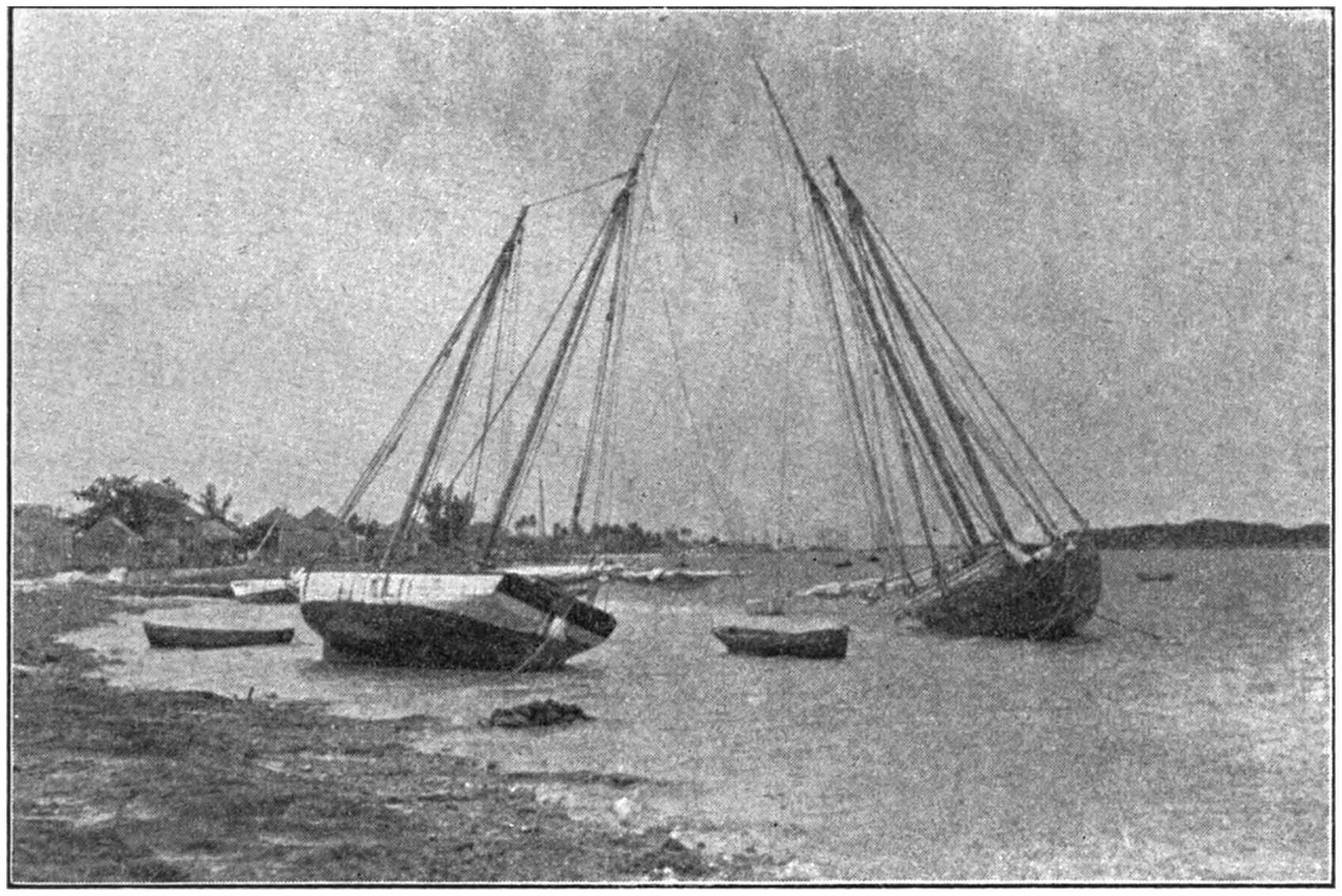
Nassau Schooners.
From a photograph by Rau.
But if the traffic never ceased absolutely,
the constriction of the blockade was and is
now manifest. It was so efficient that one
can scarcely read of the effects produced by it
in the South without tears. One can believe
that the blockade was a merciful as well as a
just measure of war in that it shortened the
struggle more than any other measure, and so
saved many lives on both sides; but it is a
pitiful fact that those who suffered most from
the effects of the blockade were the women
and the little ones. There are many tiny
graves in the South that were dug because
the blockade excluded the medicines needed
by the sick.
Lest the reader think the language used
here regarding the foreign blockade-runners
is too strong, a story told by one of them,
Thomas E. Taylor (see p. 110, “Running the
Blockade”), shall be given. Taylor was a
leader in the business. He ran the first steel
ship (the Banshee) built especially for the
purpose. Among other vessels under his
control was the Will-o’-the-Wisp. She was a
wretched ship, and here is what he says:
“I found her a constant source of delay
and expenditure and I decided to sell her.
After having her cobbled up with plenty of
putty and paint, I was fortunate enough to
open negotiations with some Jews with a view
to her purchase. Having settled all preliminaries,
we arranged for a trial trip, and after a
very sumptuous lunch I proceeded to run her
over a measured mile for the benefit of the
would-be purchasers. I need scarcely mention
that we subjected her machinery to the utmost
strain, bottling up steam to a pressure
of which our present Board of Trade, with its
motherly care for our lives, would express
strong disapproval. The log line was whisked
merrily over the stern of the Will-o’-the-Wisp,
with the satisfactory result that she logged
17½ knots. The Jews were delighted, so was
I; and the bargain was clinched.”
As to the legal status of a blockade-runner,
Taylor says: “The blockading force is entitled
to treat such a ship in all respects as an
enemy, and to use any means recognized in
civilized warfare to drive off, capture or destroy
her. A crew so captured may be treated as
prisoners of war, nor is any resistance to capture
permitted, and a single blow or shot in
his own defence turns the blockade-runner
into a pirate.” In the same line is what Wilson’s
“Iron Clads in Action” says regarding
the fact that the crews of captured blockade-runners
“at least once or twice rose up on the
prize crew and recaptured the ship. It was a
big risk—piracy upon the high seas—with the
penalty of death if blood was shed.”
One of the cases wherein the crew recaptured
the ship from the prize crew is described
very well in the Mercantile Marine Magazine
(London) for June, 1862, p. 177. The story
begins: “On Saturday, May 3, the rooms of
the Liverpool Mercantile Marine Association
were crowded almost to suffocation by the
merchants and Mercantile Marine officers of
Liverpool, to witness the presentation of a
magnificent testimonial to Captain William
Wilson, of the British ship Emily St. Pierre,
for his pluck and gallantry in recapturing his
ship which had been seized by the United
States cruiser James Adger, off Charleston.”
He had been guilty of “piracy upon the high
seas,” but 170 Liverpool merchants united to
give him a silver tea and coffee service, the
association named gave him a gold medal,
the owners of the ship gave him 2,000 guineas,
and his crew gave him a sextant. The captain,
in his little speech, said that the “token of your
kindness” would remind the British sailor that
“his efforts for the right and true will not be
lost sight of nor go unrewarded.” The story
is well worth quoting as showing how men,
naturally inclined to “the right and true,”
may be led by the exigencies of trade to applaud
and reward even “piracy upon the high
seas.”
The reader should observe here that for a
captured crew of one belligerent to rise against
a prize crew of the other belligerent is a very
different matter from this act of “piracy.”
As already said, the blockade-runners were
at first chiefly old sailing ships of various rigs
or old steamers, the idea being to risk as little
capital as possible in this illegitimate trade
while making the utmost profit—not an unknown
plan in legitimate trade, and never a
wise one. Small schooners were used all
through the wars to run the numerous shoal-water
inlets along the coast, but the real
interest in the blockade-runners begins when
the Liverpool merchants began to build
steamers especially designed for that purpose—build
them without hindrance on the part
of their government.
The Blockade-runner Teaser.
From a photograph made in 1864.
Taylor, as said, was the first to carry out one
of these swift vessels, and he describes her as
follows:
“The new blockade-runner was a paddle
boat, built of steel, on extraordinarily fine
lines, 214 feet long and 20 feet beam, and
drew only 8 feet of water. Her masts were
mere poles without yards, and with the least
possible rigging. In order to attain greater
speed in a sea-way she was built with a turtle-back
deck forward. She was of 217 tons net
register, and had an anticipated sea speed of
eleven knots, with a coal consumption of thirty
tons a day. Her crew, which included three
engineers and twelve firemen, consisted of
thirty-six hands all told.” And she was a type
of the best sort, although they eventually
reached a speed of seventeen knots.
At Nassau “everything aloft was taken
down, till nothing was left standing but the
lower masts, with small cross-trees for a lookout
man on the fore, and the boats were
lowered to the level of the rails. The whole
ship was then painted a sort of dull white, the
precise shade of which was so nicely ascertained
by experience before the end of the
war that a properly dressed runner on a dark
night was absolutely indiscernible at a cable’s
length. So particular were captains on this
point that some of them even insisted on their
crews wearing white at night, holding that
one black figure on the bridge or on deck was
enough to betray an otherwise invisible vessel.
“The reckless loading, to which high profits
and the perquisites allowed to officers led, is
to a landsman inconceivable. That men should
be found willing to put to sea at all in these
frail craft piled like hay wagons is extraordinary
enough, but that they should do so in the
face of a vigilant and active blockading force,
and do it successfully, seems rather an invention
of romance than a commonplace occurrence
of our own time.”
So prepared, the steamer sneaked away from
port, fled from every sail and every smoke,
crossed the Gulf Stream by daylight in order
to determine her position uninfluenced by the
current, and struck in on the coast at night.
The light on the blockading flagship was
commonly used to locate the harbor, and when
this was seen the runner either ran away
around the end of the squadron and slipped in
along the coast or else plunged boldly through
under the guns of the flagship.
The Banshee on her first inward trip received
$250 per ton in gold for freight on war
material. She carried out 100 tons of tobacco
at $350 per ton, and 500 bales of cotton, that
yielded $250 net per bale.
In January, 1865, Jefferson Davis, “in a
message to Congress on this subject, said that
the number of vessels arriving at only two
ports—Charleston and Wilmington—from
November the first to December the sixth,
had been forty-three, and that only a very small
portion of those outward bound had been captured;
that out of 11,796 bales of cotton
shipped since July the first, 1864, but 1,272
bales had been lost. And the special report
of the Secretary of the Treasury in relation to
the same matter stated that there had been
imported at the ports of Wilmington and
Charleston since October 26th, 1864, 8,632,000
pounds of meat, 1,507,000 pounds of lead,
1,933,000 pounds of saltpetre, 546,000 pairs
of shoes, 316,000 pairs of blankets, 520,000
pounds of coffee, 69,000 rifles, 97 packages of
revolvers, 2,639 packages of medicines, 43
cannon, with a very large quantity of other
articles. From March 1st, 1864, to January
1st, 1865, the value of the shipments of cotton
on Confederate government account was
shown by the Secretary’s report to have been
$5,296,000 in specie, of which $1,500,000 had
been shipped out between July 1st and December
1st, 1864.
“A list of vessels which were running the
blockade from Nassau and other ports, in the
period intervening between November, 1861,
and March, 1864, showed that 84 steamers
were engaged; of these, 37 were captured by
the enemy, 12 were totally lost, 11 were lost
and the cargoes partially saved, and one foundered
at sea.
“They made 363 trips to Nassau and 65 to
other parts. Among the highest number of
runs made were those of the Fanny, which
ran 18 times, and the Margaret and Jessie,
which performed the same feat and was captured.
Out of 425 runs from Nassau alone
(including 100 schooners), only 62—about one
in seven—were unsuccessful.”
The following estimate of the disbursements
and profits of a blockade-runner is taken from
Scharf, as is the quotation above. The estimate
refers to the last part of the war, when
the Confederate government took a half of the
cargo space of runners:
One captain, per month
$5,000 00
First officer, $600, second do., $250; third do., $170
1,020 00
One boatswain
160 00
One carpenter
160 00
One purser
1,000 00
One steward, $150; three assistants, $80
330 00
One cook, $150; two assistants, $120
270 00
One engineer and three assistants
3,500 00
Twelve firemen and coal-heavers
2,400 00
240 tons of coal at $20
4,800 00
Rations for crew
2,700 00
Oil, tallow, and packing
1,000 00
Stevedores
5,000 00
Pilotage, out and in
3,000 00
Sea insurance
3,500 00
Wear and tear
4,250 00
Incidental expenses
1,000 00
Interest
875 00
Risks, 25 per cent
37,500 00
Provisions for passengers
3,000 00
$80,265 00
Earnings, out and home:
800 bales of cotton for government
$40,000 00
800 bales of cotton for owners
40,000 00
Return freight for owners
40,000 00
Return freight for government
40,000 00
Passengers, out and home
12,000 00
$172,000 00
Leaving a monthly profit of
$91,735 00
On the other hand, it should be observed
that the Federal ships captured over 1,000
prizes during the war. One of these, the
Memphis, paid $510,914.07 in prize money to
her captors, two or three paid over $400,000,
and whole fleets yielded from $100,000 to
$300,000. The Banshee, of which Taylor
boasts, paid $104,948.48 to the Yankee crews
of the Fulton and Grand Gulf. Blockade-running,
like privateering in 1812, paid a few
firms handsomely. The Frasers of Charleston
are said to have cleared $20,000,000 in gold,
but many others lost heavily—the Jews who
bought the Will-o’-the-Wisp, for instance. It
was a thoroughly disreputable business, but
so much of the story must be told, if only to
show the character of part of the opposition
which the government faced in the Civil War.
CHAPTER III LOSS OF THE NORFOLK NAVY YARD
EFFECTIVE WORK DONE BY SOUTHERN NAVAL OFFICERS WHO CONTINUED
TO WEAR THE NATIONAL UNIFORM THAT THEY MIGHT
THE MORE READILY BETRAY THE NATIONAL GOVERNMENT—THE
SECRETARY OF THE NAVY WAS DECEIVED AND THE
COMMANDANT AT NORFOLK DEMORALIZED—WILLIAM MAHONE’S
TRICKS ADDED TO THE DEMORALIZATION AT THE YARD, AND IT
WAS ABANDONED AT LAST IN A SHAMEFUL PANIC—PROPERTY
THAT WAS WORTH MILLIONS OF DOLLARS, AND GUNS THAT
TOOK THOUSANDS OF LIVES, FELL INTO THE CONFEDERATES’
HANDS—THE FIRST NAVAL BATTLE OF THE WAR—THREE LITTLE
WOODEN VESSELS WITH SEVEN SMALL GUNS SENT AGAINST A
WELL-BUILT FORT MOUNTING THIRTEEN GUNS—THE HAZARDOUS
WORK OF PATROLLING THE POTOMAC.
The first actual battle of the war in which
the navy took part occurred on May 20 and
21, 1861, and resulted in the capture of the
Confederate forts that had been erected on
the Potomac River at Acquia Creek to shut
off communication between Washington and
the sea. As the reader will remember, there
was but one railroad running from the North
to Washington in those days. The authorities
of Maryland had decided that they would
keep their State neutral during the impending
strife, acting, of course, on the theory of State
sovereignty then held in the South, and had
prohibited the transportation of troops across
their State. The Confederates actually believed
that this prohibition would prevent the
Northern troops coming to the defence of the
nation’s capital overland, and that resort to
ships would be had in strengthening the forces
at Washington. To head off the ships, the
Confederates swarmed to the bank of the
Potomac River, and there were Confederate
fortifications with colors flying, in plain view
of Washington itself. The Confederates, in
the few weeks following the secession of Virginia,
were confident of capturing the national
capital.
It is easy to show there was really some
basis for the Confederate confidence. While
the North groped and discussed, the Confederates
were at work collecting material for
war. Officers who, like Semmes, had left the
service of the nation for that of the State, had
gone North—communications being still open—and
had purchased arms and ammunition in
considerable quantities. They were very near
to getting good steamers, too; and a patriot
now reads with pleasure the keen words of
scorn with which those officers spoke afterwards
of the Northern men who were so ready
to sell these goods—of the stay-at-home-and-make-money
patriots. But the South had not
stopped at mere buying. Indeed, all the
supplies purchased combined were as a pistol-shot
to a torpedo in comparison with what
they obtained when the Norfolk Navy Yard
was abandoned to them.
It is certain that the whole story of this
event will never be told; for it was brought
about by officers of the navy, who, after serving
honorably for many years under the flag,
were not only willing to turn on the flag, as
many did with satisfied consciences, but were
willing to stoop to the shameful work of pretending
to be loyal advisers of the nation’s
naval Secretary when they were secretly plotting
the destruction of the nation. While yet
Virginia had not passed the ordinance of
secession these men “lost no opportunity to
impress upon the mind of the Secretary of
the Navy the importance of doing nothing to
offend the State of Virginia.” These naval
officers, who were working day and night to
overthrow the government, stopped at nothing.
The commandant of the navy yard at
Washington was one of them. In the midst
of his plottings his daughter was married to
one of the younger plotters, and the others of
the gang were, of course, present at the wedding.
“The house was everywhere festooned
with the American flag, even to the bridal
bed.” And down at the Norfolk Navy Yard
one of the Southern officers went to Commodore
McCauley, after the Pensacola Navy
Yard had been turned over to the Confederates,
and said: “You have no Pensacola
officers here, Commodore;
we will
never desert you;
we will stand by
you to the last, even
to the death.” And
this was said with
the deliberate intent
of keeping the
commodore from
doing anything that
might save the nation’s
property for
the use of the government.
One need
not search long for
words to describe
such actions.
Hiram Paulding.
From an engraving by Hall.
Secretary Welles called Capt. Hiram
Paulding, an officer of known loyalty, to
advise him. Paulding broke up the nest of
scoundrels who wore the uniform that they
might the more easily betray the flag, but it
was then too late to prevent the accomplishment
of the object for which they had chiefly
labored—the betraying of the Norfolk Navy
Yard into the hands of the enemy. Large
bodies of Confederate troops were already
gathering at Norfolk, although Virginia had
not passed her secession ordinances. Commodore
McCauley was an old man and no
match for the young scoundrels who at Norfolk,
as in Washington, held on to their commissions
and drew their pay up to the last
day possible. They were incessant in their
labors to prevent anything being done that
would move a ship or a gun from the yard or
add a loyal man to its forces.
“Early in April”—note that it was not
until April—“the Department began to get
very uneasy for the safety of the navy yard.”
“The Department was most anxious to get
the Merrimac away, but was informed by
Commodore McCauley that it would take a
month to put her machinery in working order.”
No one seemed “to reflect that a few
armed towboats with marines on board” could
have taken every ship from the yard to an
anchorage under Fortress Monroe.
However, on March 31st, 250 seamen were
ordered from the New York Navy Yard to
Norfolk, and fifty seamen were transferred to
the revenue cutter Harriet Lane, which was
sent to Norfolk. “On April 11th Commander
James Alden was ordered to take command of
the Merrimac and Chief Engineer Isherwood
was sent to Norfolk to get the ship’s engines
in working order.” “On the 14th the work
was commenced, and on the 17th the engines
were in working order—so much for the commandant’s
assertion that it would take a month
to get the ship ready to move.” These quotations
are from
Admiral Porter’s
“Naval
History of the
Civil War.”
But he does not
say McCauley
was disloyal.
McCauley had
merely believed
the wilful lies
of those under
him.
A View of the Norfolk Navy Yard.
From a photograph by Cook.
It is cheering
to read that “the disloyalty did not at that
time extend to the mechanics,” and that
“they worked day and night” to get the
ship ready. “Then forty-four firemen and
coal heavers volunteered for the service of
taking the Merrimac out.” At this Commodore
McCauley, mindful of his orders to do
nothing to excite the suspicions of hostile
intent, said “that next morning would be time
enough.” Next morning, there being a good
head of steam on, word was again sent that
she was ready, but he replied that he had
decided not to send her out. “He gave as a
reason the obstructions that had been placed
in the channel, and when the anxious Alden
told him they could clear away the obstructions
he merely ordered the fires drawn. He
had become utterly demoralized, and his demoralization
was infectious.”
At about this time came Captain Paulding
in the Pawnee from Washington with a regiment
of Massachusetts volunteers. His instructions
were to “save what he could and
act as he thought proper.” When he arrived
the Southern officers had just resigned, and
the mechanics, being citizens of Virginia, had
been induced to leave the yard in a body. It
was reported that thousands of Virginia militia
were coming to reinforce the Confederates
gathering about the yard. The report was
due to a trick of William Mahone, afterwards
a noted practical politician of the State. He
was president of the Norfolk & Petersburg
Railroad, and ran empty cars up the line,
loaded on a mob sent there for the purpose,
and brought them back “with every man
yelling with all his might.” This was on
April 19, 1861. The next day Confederate
troops did arrive, and the demoralization in
the yard was completed. It was the most
disgraceful panic in the history of the nation,
for it was a panic that came on when not a
gun had been fired, and the only overt acts of
war were the robbing of a government powder
magazine and the sinking of a few hulks
(Mahone did this also), so that the government
officers would think the channel was
being obstructed.
“The broadside of the Germantown, which
was all ready for sea and only waiting a crew,
would have saved the navy yard against attack,
overawed Norfolk and Portsmouth, and prevented
the channel from being obstructed by
the Confederates.” So says Porter. Elsewhere
he adds, that the “five heavy guns on
a side on board the Pennsylvania” with fifty
good seamen on board, “could have bid defiance
to 5,000 Confederates in arms and held
Norfolk and Portsmouth.”
Nevertheless, “after the arrival of the
Pawnee had made the yard doubly secure,
the shells were drawn from the Pennsylvania’s
guns, and the guns spiked.” Every other gun
in the yard, afloat and ashore, except 200,
was spiked. Men with sledge-hammers ran
about the yard, vainly trying to knock the
trunnions from the guns in store. Others
soaked the decks of the ships and the buildings
with tar and turpentine. Others laid a
mine in the dry dock—put twenty-six barrels
(2,600 pounds) of powder there. Only the
Pawnee and the Cumberland, which were full-manned,
escaped the work of the destroyers.
“It was a beautiful starlight night, April
20th, when all the preparations were completed.
The people of Norfolk and Portsmouth
were wrapped in slumber, little dreaming
that in a few hours the ships and public
works which were so essential to the prosperity
of the community would be a mass of ruins,
and hundreds of people would be without employment
and without food for their families.
The Pawnee had towed the Cumberland out
of the reach of the fire, and laid at anchor to
receive on board those who were to fire the
public property. Commodore McCauley had
gone to bed that night, worn out with excitement
and anxiety, under the impression that
the force that had arrived at Norfolk was for
the purpose of holding the yard and relieving
him of responsibility, and when he was called
at midnight and informed that the torch would
be applied to everything, he could hardly realize
the situation, and was chagrined and mortified
at the idea of abandoning his post without
any attempt to defend it.
“At 2.30 A.M., April 21st, a rocket from the
Pawnee gave the signal; the work of destruction
commenced with the Merrimac, and in
ten minutes she was one vast sheet of flame.
In quick succession the trains to the other
ships and buildings were ignited and the surrounding
country brilliantly illuminated.”
The Old New Hampshire at the Norfolk
Navy Yard.
From a photograph by Cook.
At the beginning of April, 1861, there were
stored at this yard 2,000 cannon, of which 300
were new Dahlgrens; 150 tons of powder,
besides vast quantities
of loaded shells,
machinery, castings,
material for ship-building,
and ordnance
and equipment
stores—all in
great quantities. It
contained a first-class
stone dock.
The steam frigate
Merrimac was there
undergoing repairs,
the shops of the yard being well fitted for such
work. The sailing sloops-of-war Germantown
and Plymouth, of twenty-two guns each, and
the brig Dolphin, of four guns, were there, not
manned, but fit for sea. Six other sailing ships,
including the famous United States, that were
not of much use, but worth something, were
also there. On the whole, the material of
this yard was of more value, probably, than
that in any two beside it in the country. The
Confederates estimated the value of the property
abandoned to them at $4,810,056.68 in
gold. “But the greatest misfortune to the
Union caused by the destruction of the Navy
Yard was the loss of at least twelve hundred
fine guns, most of which were uninjured. A
number of them were quickly mounted at
Sewell’s Point to keep our ships from approaching
Norfolk; others were sent to Hatteras
Inlet, Ocracoke, Roanoke Island, and
other points in the Sounds of North Carolina.
Fifty-three of them were mounted at Port
Royal, others at Fernandina and at the defences
of New Orleans. They were met with
at Fort Henry, Fort Donelson, Island No.
10, Memphis, Vicksburg, Grand Gulf, and Port
Hudson. We found them up the Red River
as far as the gunboats penetrated, and took
possession of some of them on the cars at
Duvall’s Bluff, on White River, bound for
Little Rock. They gave us a three hours’
hard fight at Arkansas Post, but in the end
they all returned to their rightful owners,
many of them indented with Union shot, and
not a few permanently disabled.
“Had it not been for the guns captured
at Norfolk and Pensacola, the Confederates
would have found it a difficult matter to arm
their fortifications for at least a year after the
breaking out of hostilities, at the expiration of
which time they began to manufacture their
own ordnance and import it from abroad.
Great as was, therefore, the loss of our ships,
it was much less than the loss of our guns.”
So says Porter.
Burning of the Vessels at the Norfolk Navy Yard.
Rightly considered, the abandonment of the
Norfolk Navy Yard was as great a misfortune
to the South as to the North, for it needlessly
prolonged and intensified a conflict
that could have but one end. No one can
estimate the number of lives that these guns
cost both sides—the fortifications that were
erected and the battles that were fought in
consequence of their falling into Confederate
hands. But if it took the Confederates a
whole year to get at the work of casting
cannon, it is not unreasonable to suppose
that one year of the war would have been
saved had the government held its own.
It was with guns that were needlessly abandoned
at Norfolk that the Confederates made
their first fight against the Federal navy—the
battle at Acquia Creek. Something like thirty
miles below Washington the Potomac makes
a wide sweep to the east. Two creeks enter it
there from the west—one, right on the point
of the elbow, being known as Potomac Creek,
and the other, that enters a little way to the
north of the elbow, being called Acquia Creek.
There is a considerable bluff on the point between
Acquia Creek and the river, known in
those days as Split Rock Bluff. Because this
creek was the terminus of a railroad leading to
Fredericksburg, Virginia, and because it was
believed by the Confederates that the point
commanded the Potomac River, three batteries
were erected. The Confederate accounts say
that there were thirteen guns here, of which
two were eight-inch Dahlgrens, brought from
Norfolk. The Confederates completed this
battery about May 14, 1861. They had decided
to abandon Alexandria whenever the
Federals chose to take it, and make Acquia
Creek their frontier post on the river.
Accordingly, when the Federals, under cover
of the Pawnee, Capt. S. C. Rowan, crossed over
on the 24th, the Confederates moved out,
and there was no bloodshed until the insane
hotel-keeper, Jackson, shot Colonel Ellsworth
because the Confederate flag was taken down
from the Marshall House. Then the Potomac
flotilla, which was under Fleet Officer James
H. Ward, was ordered to attack the Acquia
Creek batteries.
In one respect that order was one of the
most remarkable ever issued in the navy, up to
that date, for Ward had under him the Freeborn,
a wooden paddle-wheel steamer of 250
tons, carrying three guns, the largest being a
thirty-two-pounder smooth-bore; the Anacostia,
a screw steamer of 100 tons, carrying two
little howitzers, and the Resolute, a steamer of
ninety tons, carrying two howitzers. In all,
three frail wooden vessels, carrying seven
small guns, were sent to attack a well-planned,
well-manned fort with not less than thirteen
guns, of which the worst was better than the
best afloat before it. This matter is especially
worth considering in connection with what a
Secretary of the Navy is likely to do in future
if the nation is ever again unexpectedly obliged
to fight.
However, Ward was a great man. He had
already distinguished himself as a writer on
gunnery and naval tactics and as an inventor.
He now showed his pluck by bravely attacking
the forts.
It was on Friday, May 31, 1861, at 10.30
o’clock at night, that the first shot of this war
was fired from a naval ship at a fort. In all,
fourteen shots were fired, and the Confederates
fired fifty-six at the ships. The forts were not
damaged, and one Confederate soldier lost a
finger. However, the Confederates abandoned
the battery they had erected at the water level
and took the guns to the top of the bluff.
Next day, the Pawnee having come to reinforce
the fleet, the attack was renewed, and for
five hours the four little steamers hurled their
shot at the forts. The Confederates fired
over 1,000 shot in return. It is instructive to
note that no one was hurt on either side by
all that firing. The ships were struck several
times, but “there was no irreparable damage
done.” The attack failed absolutely.
Ward was afterwards killed in an attack
on the Confederate forts erected at Matthias
Point, fifteen miles or so farther down the
river. This was on June 27, 1861. The Federal
forces attempted to land there and were
driven off easily. But for the coolness of
Lieut. J. C. Chaplin, of the Pawnee, who
rallied his force, in spite of a heavy fire, the
whole landing party would have been captured.
Ward was the only one killed, but
four others were wounded.
On the whole, the work of the navy on the
Potomac was confined to patrolling the stream
for the purpose of preventing the Confederates
of the two slave-holding States that bordered
it from communicating with each other.
The men engaged in it have not received and
never can receive the credit they deserve for
what they did, simply because there was nothing
striking about the work. More unfortunate
still, they had steamers that were wholly
inadequate to the work, and the fighting, when
any was done, was like that at Acquia Creek—ineffective
necessarily. Instead of an opportunity
to win fame, the men found toil of
the most wearisome kind, and as a reward for
it they got the reproaches of ignorant editors
at the North and the jeers of exultant editors
at the South. Nevertheless, this much was
done: The river was kept open, so far as was
needed, for the transportation of troops and
supplies, to and fro, and when, in 1862, the
Confederates found that their forts could not
stop traffic, even though their guns had an
effective range greater than the width of the
river, they retired from the bank of the Potomac
altogether.
CHAPTER IV A STORY OF CONFEDERATE PRIVATEERS
THEY DID PLENTY OF DAMAGE FOR A TIME, BUT THEIR CAREER
WAS BRIEF—CAPTURE OF THE FIRST OF THE CLASS, AND TRIAL OF
HER CREW ON A CHARGE OF PIRACY—REASONS WHY THEY COULD
NOT BE HELD AS CRIMINALS—LUCK OF THE JEFFERSON DAVIS—A
NEGRO WHO RECAPTURED A CONFEDERATE PRIZE TO ESCAPE THE
TERRORS OF SLAVERY—A SKIPPER WHO THOUGHT A GOVERNMENT
FRIGATE WAS A MERCHANTMAN—THE “NEST” BEHIND
CAPE HATTERAS.
From a blockade of the ports of the Southern
States it was a short and natural step for
the navy to land and effectually close some
port to Confederate commerce by occupying
it. But before telling the story of the first
expedition organized for this purpose the story
of the Confederate privateers—real privateers,
as distinguished from Confederate cruisers like
the Alabama—will be told, for the reason that
it was the work of these privateers that in
good part led the government to decide on the
first expedition for occupying a Southern port.
As a matter of fact, the idea of blockading
the Southern ports was born of the determination
of the Confederates to commission privateers.
The sequence of events was as follows:
The Confederates captured Fort Sumter on
April 13, 1861. On the 15th President Lincoln
called for 75,000 troops to protect the
government property and enforce the laws of
the nation in the seceding States. On the
17th Jefferson Davis “published a counter
proclamation inviting applications for letters
of marque and reprisal to be granted under
the seal of the Confederate States against
ships and property of the United States and
their citizens.” The quotation is from Scharf’s
“Confederate States Navy.” It was on receipt
of this that Mr. Lincoln, on the 19th,
ordered the blockade of the Southern ports.
However, Mr. Davis did not issue any commissions
to privateers until after the Confederate
Congress had passed, on May 6, 1861, an
act authorizing him to do so. This act provided
such safeguards as had ruled American
privateers in the War of 1812. On May 14th
another act supplemented the first by regulating
the sale of prizes and the distribution
of the proceeds.
Sufficient time has passed since that war
to enable at least the younger generation
of Northern-born men to view its events judicially,
and it is therefore likely that no student
of history will now be found to deny that the
letters of marque subsequently issued under
these acts of the Confederate Congress were
entirely legal. The Confederates were entitled
to the rights of belligerents—they at
least became entitled to them the moment
that President Lincoln issued his proclamation
blockading the Southern ports. There is no
point of international law more firmly established
now than that a proclamation of a blockade
carries with it a concession that war exists
between the blockaders and the blockaded.
And this is worth remembering, because Secretary
of State Seward was unwilling to admit
it for a very long time after a state of war did
actually exist. At the same time it was entirely
natural that Northern shipping men
should have called these privateers pirates.
Business operations tend to concentrate one’s
nerves in his pocket and to render them so
sensitive that any diminution of weight in the
pocket causes excruciating agony. Naturally
these would not hesitate to ignore the belligerent
rights of an enemy, nor to use harsh and
unjust language when they felt this pain.
Availing themselves of the invitation to
do so, a number of citizens of Charleston
equipped the pilot boat Savannah with an
eighteen-pounder, mounted on a pivot; procured
a crew of thirty men, all told, under Capt.
Thomas H. Baker; supplied them with small
arms and ammunition, and sent them out
under a commission which, because it was the
first issued, shall be given in full, as follows:
“Jefferson Davis, President of the Confederate
States of America, To all who shall see these
Presents, Greeting:
“Know ye, That by virtue of the power
vested in me by law, I have commissioned, and
do hereby commission, have authorized, and
do hereby authorize, the schooner or vessel
called the Savannah (more particularly described
in the schedule hereunto annexed),
whereof T. Harrison Baker is commander, to
act as a private armed vessel in the service of
the Confederate States, on the high seas,
against the United States of America, their
ships, vessels, goods, and effects, and those of
their citizens, during the pendency of the war
now existing between the said Confederate
States and the said United States.
“This commission to continue in force until
revoked by the President of the Confederate
States for the time being.
“Given under my hand and the seal of the
Confederate States, at Montgomery, this eighteenth
day of May, A.D., 1861.
“(Signed) Jefferson Davis.
“By the President. R. Toombs, Secretary of State.
“SCHEDULE OF DESCRIPTION OF THE VESSEL.
“Name—Schooner Savannah. Tonnage—Fifty-three
41/95th tons. Armament—One large
pivot gun and small arms. No. of crew—thirty.”
THE SAVANNAH
THE CONFEDERATE STATES PRIVATEER SAVANNAH, LETTER OF MARQUE No. 1, CAPTURED OFF
CHARLESTON, BY THE U.S. BRIG PERRY, LIEUT. PARROTT.
Entered according to act of Congress in the Year 1861 by E K KIMMEL 59 NASSAU ST. N.Y. in the
Clerks Office of the District Court for the Southern District of New York.
The Savannah sailed out of Charleston on
the night of Sunday, June 2, 1861, and, eluding
the Federal frigate Minnesota, went cruising
for Northern merchantmen. The schooner
was small, and the weather hot. The crew
slept on deck that night, and, as was testified
in court later on, they were not feeling very
well next morning. In fact, “being on a flare-up
the night before, not much was said,” even
when a sail was seen, and it became certain
that the sail “was a Yankee vessel.” Eventually
the sail was overhauled. It proved to
be the brig Joseph, of Rockland, Maine, Capt.
Thies N. Meyer, bound, sugar laden, from Cardenas,
Cuba, to Philadelphia. The brig had a
crew of six, all told. She was easily taken,
and with a prize crew of six men was sent to
Georgetown, South Carolina, where she was
condemned and sold in the usual form.
Nevertheless, the cruise was not a paying
venture, for soon after sending the prize away
the Savannah chased the government man-o’-war
brig Perry, thinking her another merchantman,
and was, in consequence, captured. The
Perry turned her over to the Minnesota; the
Minnesota towed her into Charleston harbor
near enough to let her owners learn of their
loss, and then sent her North. At New York
the Savannah’s crew was thrown into prison as
pirates, and on July 16, 1861, they were indicted
for piracy. The printed report of the
trial that followed makes an interesting book
of 385 pages. The accused as a whole claimed
the rights of prisoners of war, but in spite of
the plain evidence that they were entitled to
such rights, the jury disagreed. Perhaps when
one considers the state of the public mind in
the North at that time, the wonder is that they
were not convicted and hanged.
Having been remanded in irons to prison,
the Confederate authorities took up their case.
The victory the Confederates had obtained at
Manassas enabled them to put a number of
Federal prisoners into irons to abide the fate
of the Savannah’s crew. The Federal officers
so confined included five colonels, two lieutenant-colonels,
three majors, and three captains.
Mr. Davis sent an envoy with a protest
to Washington. Nothing was done about
the matter just then.
Meantime, on October 25, 1861, a member
of the crew of the privateer Jefferson Davis was
convicted on a charge of piracy, and on the
29th three others of the crew were convicted.
Nevertheless, on February 3, 1862, all of the
alleged pirates, with thirty-four men from the
privateer Petrel, were sent to Fort Lafayette
as prisoners of war, and the date is of some
importance because the change of policy, even
though it were compelled by a threat of retaliation,
was another official acknowledgment
that the government had a very great war upon
its hands instead of a local insurrection of no
concern to the rest of the world.
Much more interesting than that of the Savannah
are the stories of some of the other
privateers. The Jefferson Davis, for instance,
had a career that approached that of some of
the American privateers in 1812. She was
built by Northern capitalists in 1854 for a
slaver, and was captured on the coast of Africa
with many slaves on board, and sent to
Charleston. A fine Baltimore clipper she was,
and when the war came she was seized and
armed with three eighteen-pounders and two
twelves. She got out to sea on June 28th,
having seventy men before the mast. On July
6th, off Hatteras, she got the brig John Welsh,
loaded with sugar. On the same day the
schooner Enchantress was captured, and the
next day, being but 150 miles from Sandy
Hook, she took the schooner S. J. Waring,
that was bound to Montevideo with a valuable
cargo. The first-named prizes were sent to
Southern ports; but William Tillman, a colored
man, recaptured the Waring, and one
fact connected with the adventure makes the
story worth telling.
The Davis placed a prize crew of five men
on the Waring, Mr. Montague Amiel, a Charleston
pilot, being the prize master. William
Tillman, who was the Waring’s cook; Brice
Mackinnon, a passenger, and two of the Waring’s
seamen were left on board of her, and
she was headed toward the South. The
Northern men at once made friends with their
captors. The negro continued to cook perforce,
but he made no objection to the work,
and the two Northern seamen volunteered to
make the best of a bad streak of luck by helping
to work the ship.
But because Tillman knew that he would
become a slave as soon as he was carried into
a Southern port, he determined that he would
never go there, and on the night of July 16,
1861, when fifty miles south of Charleston, he
found opportunity to become master of the
schooner.
It was at about midnight. Prize Master
Amiel was asleep in the cabin, with the prize
mate in a nearby berth. The second mate
was on deck, but about half-asleep, while one
of the Waring’s original crew was at the
wheel, and two of the prize seamen were on
duty near the bow. Taking the hatchet which
he used in splitting wood for the galley stove,
the negro killed the prize captain and the two
mates, when the Confederate seamen surrendered
and agreed to help work the ship
back to New York. There was no one on
board who understood navigation, but the negro
knew enough to lay a course that would
bring “the broadside of America in sight,”
and after that he followed the coast until he
reached New York.
Meantime the Davis had captured the Mary
Goodell, from New York to Buenos Ayres; but
she was allowed to go after the prisoners were
put on board, and five of her crew had shipped
in the Davis. On the same day (July 9th) the
Mary E. Thompson, of Searsport, was captured
and sent in, after which the Davis went
to the West Indies.
In all, nearly a dozen merchantmen were
captured by the energetic captain, Louis M.
Coxetter, of the Davis. He then returned, and
while trying to enter St. Augustine, Florida,
grounded, and the vessel was lost. Not all of
his prizes ever reached home, and it was from
the recaptured vessels that the men convicted
of piracy were taken. It is said that the prizes
sent in, however, netted over $200,000 in gold
for the crew. Coxetter himself, like most of
his class, became a blockade-runner after the
blockade, and England’s refusal to permit the
sale of Confederate prizes in her ports made
privateering unprofitable—that is, say, after
January 1, 1862.
Between July 19 and August 27, 1861,
the privateer Dixie sent in three prizes. The
Freely, another Charleston privateer, was also
a successful boat. So was the York. The
revenue cutter Aiken, which was converted
into the privateer Petrel, at Charleston, was
about the most unlucky of the fleet. She
went chasing the frigate St. Lawrence soon
after getting safely to sea, thinking the big
man-o’-war was a merchantman. Certainly no
men worse fitted for their task than the Petrel’s
crew were ever sent to sea, for even
when within short range they failed to recognize
the warship. They fired three guns—the
first two across the bows of the St. Lawrence
to heave her to, and the last one at her.
Then the St. Lawrence opened her ports and
fired three guns at the privateer. An eight-inch
shell and a thirty-two-pound solid shot
struck her below the water-line, the shell
bursting while right in the planks. The hole
made was so large that the Petrel rolled to
the swell and sank instantly, leaving her crew
afloat in the water. Four men were drowned,
and the rest were picked up by the St. Lawrence.
There were a number of other privateers
from Charleston, but they neither accomplished
nor suffered anything worth especial mention.
In addition, there was a fleet of small schooners
that had their headquarters in the Pamlico
Sound. It is worth the reader’s time to take a
look at the map of the enclosed waters along
the coast south of the Chesapeake Bay; it is
worth any traveller’s time to visit the region.
A series of long, narrow islands, built of the
débris of New England rocks, lie along there,
enclosing the waters of Currituck, Albemarle,
and Pamlico sounds. They are but narrow,
and, for the most part, but barren stretches of
sand. Here and there a shoal inlet cuts
across this sand-bar—an inlet that is shifted to
and fro, and deepened and shoaled by the
wind-driven water of the sea, but always kept
open somewhere by the outflow of the waters
from the slope of land east of the Alleghany
ridge. There are a few inlets that are never
closed wholly, no matter how the set of the
tide piles the sand into them, and of these the
most important are known as Hatteras and
Ocracoke inlets.
Destruction of the Privateer Petrel by the St. Lawrence.
From an engraving by Hinshelwood of the painting by Manzoni.
The Hatteras Inlet, which lies thirteen miles
southwest of Cape Hatteras, is the most important.
Here the water over the bar is, at
high tide, usually fourteen feet deep; within
is a safe anchorage for any ship that can pass
in. But a mile inside the bar lies another,
where the water is ordinarily but seven feet
deep. Once across that, plenty of deep water
is found, both north and south, and away inland
to the ports whence came, in those days,
the bounties of nature called naval stores.
Hatteras is of small importance in these days,
since railroads have been stretched along the
coast, but the time was when not a small fleet
of coasters used it regularly.
It was from among these vessels and their
crews that the “Hatteras pirates” came in the
first four or five months of the Civil War. They
were, of course, lawfully commissioned private
cruisers, but the records of their deeds have
been lost, save, as it is known, that one bark,
seven brigs, and eight schooners had been carried
in there as prizes previous to August 28,
1861, and condemned and sold. The Transit,
of New London; the Wm. S. Robins, and the
J. W. Hewes were lying at Newbern alone, on
the first of July, awaiting adjudication.
Then, too, it speedily became a haunt of
blockade-runners seeking cotton as well as
naval stores, and to dispose of manufactured
goods from England.
To the Northern merchant Pamlico Sound
was a “pirates’ nest” that needed immediate
attention, and the next chapter shall tell what
was done.
CHAPTER V THE FORT AT HATTERAS INLET TAKEN
AN EXPEDITION PLANNED BY THE NAVY DEPARTMENT THAT RESULTED
IN THE FIRST FEDERAL VICTORY OF THE CIVIL WAR—AN
AWKWARD LANDING FOLLOWED BY INEFFECTUAL FIRE FROM
SHIPS UNDER WAY—ONE FORT TAKEN AND ABANDONED—ANCHORED
BEYOND RANGE OF THE FORT AND COMPELLED SURRENDER
BY MEANS OF THE BIG PIVOT GUNS—A WEARISOME
RACE FROM CHICAMICOMICO TO HATTERAS LIGHTHOUSE WON
BY THE FEDERALS—CAPTURE OF ROANOKE ISLAND—ORIGIN OF
THE AMERICAN MEDAL OF HONOR.
For the work that was to be done in restoring
the Federal authority over Hatteras Island
and adjacent inland waters a large force was
prepared, because no accurate estimate of the
Confederate force there was obtainable. To
Flag Officer Silas H. Stringham was assigned
the command of the expedition. His squadron
consisted of the frigate Minnesota, Capt. G. I.
Van Brunt; the frigate Wabash, Capt. Samuel
Mercer; the Monticello, Capt. John P. Gillis;
the Pawnee, Capt. S. C. Rowan, and the Harriet
Lane (revenue cutter), Capt. John Faunce.
The tug Fanny, under Lieut. Pierce Crosby,
went along as a tender, while the transports
Adelaide, Capt. H. S. Stellwagen, and Peabody,
Capt. R. R. Lowry, carried 860 soldiers under
Gen. B. F. Butler. The troops under Butler
had orders to return to Fort Monroe as soon
as the object of the expedition was attained.
S. H. Stringham
From an engraving by Buttre.
On the afternoon
of August 26, 1861,
the squadron rounded
Cape Hatteras
and anchored about
three miles above the
inlet, where it was
proposed to make
a landing. Two
schooners, with their
decks loaded with
“heavy iron surf-boats,”
had been
brought along, and
these surf-boats were
floated before dark.
The next morning
the debarkation of
General Butler’s
force began, and Captain Shuttleworth, of the
marines, with enough of his men to raise the
whole landing force to 915 men, went along.
The Pawnee, the Monticello, and the Harriet
Lane steamed close in and opened the attack
on the beach by shelling the live-oak and other
trees that grew in profusion just beyond the
reach of the waves.
When the surf-boats started ashore at 8.45
o’clock in the morning, the other ships of the
squadron made a swoop at the forts that could
be plainly seen guarding the inlet. The sailing
frigate Cumberland had joined the force
during the night, and
the Wabash took her
in tow and followed
in the wake of the
flagship Minnesota.
Meantime the frigate
Susquehanna
had happened along,
and she joined in the
procession, the plan
of attack being to
steam in until within
range, fire as the
forts were passed,
and then steam out
to sea and back again over an elliptical route. It
was a plan that was followed in several attacks
of the kind; but it is condemned by Admiral
Porter as “not the best calculated to bring
an engagement to a speedy conclusion.” The
plan “bothers the enemy’s gunners”—it is safer
for the ships—but it also “detracts from the
accuracy of the fire on board the vessels.”
B. F. Butler.
From a photograph.
A small earthwork called Fort Clark was
the first one met. It had no bomb-proof, and
it mounted five guns. The ships opened fire
on this fort long before they were within range,
and the fort replied. Both sides sowed the water
with shot and shells; but the Confederates
soon ceased to waste their ammunition, and
when the ships got within range, their fire
proved so hot that the fort was abandoned.
Meantime the troops had reached the surf
in their boats, and for a pleasant day they
found it a right vigorous surf. There was
very little difficulty in getting the boats to the
sand; they were so large that a gale would
scarcely have swamped them; but the moment
they touched bottom forward, the waves caught
them under the floating stern, slewed them
around broadside on, and hove them up hard
and fast. In vain the soldiers and sailors and
marines tugged and pried and swore. In all
420 men, with two howitzers, were placed on
the beach, and not another armed man could
they land. And what made matters worse
was the fact that they had neither provisions
nor supplies of any kind, and their ammunition
(it was the day of paper cartridges) was in
great part wet by the surf. It was a fortunate
thing that the Confederates were kept busy in
Fort Hatteras about that time.
Bombardment and Capture of the Forts at Hatteras Inlet, N. C.
From a lithograph published by Currier & Ives.
However, the Confederates having abandoned
Fort Clark, the Federal troops were
marched to it, and at 2 o’clock in the afternoon
the Union flag was hoisted above it.
Meantime the fire of Fort Hatteras had
been “smothered by the fire of the frigates,”
and the Confederate flag had disappeared.
Seeing this, the frigates ceased firing at 12.30
o’clock, on the supposition that the Confederates
were willing to surrender. But when, at
4 o’clock in the afternoon, the Monticello was
ordered to go in through the inlet and take a
look at the small fleet of Confederate vessels
inside the inner bar, the Confederate fort
opened fire on her. The Wabash was at this
time towing the Cumberland to a safe anchorage
off shore, but the Minnesota, Susquehanna,
Pawnee, and Harriet Lane returned the fire
with vigor until sunset. But the fire was, “for
the most part, ineffective, from too great a distance,”
as Ammen says. The fact is, there was
nothing reckless in the attack.
At sundown the Union troops abandoned
Fort Clark and camped up the beach, where
the smaller steamers could protect them. They
had had a hungry day of it, but food was sent
ashore at night. Then, as the night wore
away, the troops threw up a sand battery facing
the sound, and from this threw some shells at
the Confederate vessels, “which seems to have
materially disconcerted the enemy,” and prevented
the landing of reinforcements for the
fort.
The next morning the Susquehanna led the
way in to attack Fort Hatteras, and the Minnesota,
the Wabash, and the Cumberland followed,
and all came to anchor “in excellent
position and commenced firing with effect.”
That is to say, the position was excellent because
the ships were entirely beyond the range
of the fort, while their pivot guns, fifteen in
number, were throwing every shell fired into
the Confederate works. The fire began at 8
o’clock in the morning. The bomb-proof in
the fort was seriously damaged, and at 11
o’clock it was set on fire by a shell that
dropped through a ventilator. The magazine
being in great peril, the Confederates hoisted
a white flag at 11.10 o’clock. This was on
August 28, 1861; and that was not only the
first victory that the navy of the nation had
gained, but it was the first victory that any
Union force had gained in this war for the
defence of the nation’s life. The Union force
did not lose a man. The Confederates lost
two killed and thirteen wounded of which we
are certain. It is asserted that the losses
were greater.
Flag Officer Samuel Barron, of the Confederate
navy, who had charge of a small fleet of
armed boats on the sound; Major W. S. G.
Andrews, commanding the forts, and 615 men
and officers were captured. The two forts
contained together twenty-five guns, every one
of which came from the Norfolk Navy Yard, as
did also 1,000 muskets and a quantity of ordnance
stores found in the fort.
Eight-inch Mortar Captured at Hatteras.
This point was thereafter held by the Union
forces throughout the war. To show the value
of this victory, we may quote the report of
General Butler. He said:
“From there the whole coast of Virginia
and North Carolina, from Norfolk to Cape
Lookout, is within our reach by light draught
vessels, which cannot possibly live at sea during
the winter months. From it offensive operations
may be made upon the whole coast of
North Carolina to Bogue Inlet, extending
many miles inland to Washington, Newbern,
and Beaufort. In the language of the chief-engineer
of the rebels, Colonel Thompson, in
an official report, ‘it is the key of Albemarle.’
In my judgment, it is a station second in importance
only to Fortress Monroe on this
coast. As a depot for coaling and supplies
for the blockading squadron it is invaluable.
As a harbor for our
coasting trade, or
inlet from the winter
storms or from
pirates, it is of the
first importance.”
A fort at Ocracoke
Inlet was
abandoned by the
Confederates when
those at Hatteras
fell.
L. M. Goldsborough
From an engraving by Buttre.
Meantime the
Twentieth Regiment
of Indiana
Volunteers, under
Colonel Brown, of
the Hatteras Island
garrison, got into serious trouble. The regiment
had gone to a small settlement at the
north end of the island—Chicamicomico by
name—twenty-five miles north of Cape Hatteras
lighthouse. Just what purpose they
were to serve there is not now apparent; but
the Confederates, who had fortified Roanoke
Island, came with a superior force to cut them
off from communication with the forces at the
inlet, and there was a most fatiguing race
down the beach. The Union force won, the
Confederates being driven off by the Union
steamer Monticello, Capt. D. L. Braine.
Following this, in
1862, came the expedition
under Flag
Officer L. M. Goldsborough
and Gen.
A. E. Burnside
against Roanoke
Island. The force
left Hampton Roads
on January 11th.
There was a long
delay at Hatteras
Inlet bar, but on
Friday morning,
February 7th, they
were facing the Confederate
forts on the north end of Roanoke
Island, and a squadron of Confederate ships,
which their commander, Commodore W. F.
Lynch, described as “two old side-wheel steamers,
and six propellers—the former possessing
some speed; the latter slow in their movements,
and one of them frequently disabling
its shaft.”
Stephen C. Rowan.
From a photograph.
The Union steamers were, in fact, no better.
Both fleets were wholly unarmored, but the
guns on both sides were good for that day,
and therein lies the one point worth noting.
The Union fleet on one side and the Confederate
forts and fleet on the other fought for six
hours at one stretch at easy range. One Union
ship reports firing 181 shells, and probably those
that made no report of the matter (there were
nineteen in all) did as well, but only one ship—a
Confederate—was sunk, and she was able
to run away to a fort before going down.
After two days the Confederate forts surrendered,
and the Confederate ships fled to Elizabeth
City.
Commander S. C. Rowan, with a part of the
Union fleet, pursued and destroyed or captured
them all save one that passed through the
canal to Norfolk. The conflict at Elizabeth
City is especially notable, because the deed of
a heroic gunner led Congress to pass an act
creating a Union naval medal. Says Lossing:
“An extraordinary example of heroism was
exhibited during this engagement by John
Davis, a Finlander, who was a gunner’s mate
on board the Valley City. A shell entered
that vessel, and, exploding in the magazine,
set fire to some wood-work. Davis was there,
and, seeing the imminent danger to the vessel
and all on board, because of an open barrel of
gunpowder from which he had been serving,
he seated himself upon it, and so remained
until the flames were extinguished. For this
brave act the Secretary of the Navy rewarded
him with the appointment of acting-gunner in
the navy (March 11, 1862), by which his salary
was raised from $300 to $1,000 a year. Admiring
citizens of New York raised and presented
to him $1,100. The Secretary of the
Navy, by authority of an act of Congress, approved
December 21, 1861, presented him
with a Medal of Honor, on which are inscribed
the following words: ‘Personal Valor, John
Davis, Gunner’s Mate, U.S.S. Valley City,
Albemarle Sound, February 10, 1862.’ Such
medals were afterward presented to a considerable
number of gallant men in subordinate
stations, for acts of special bravery
‘before the enemy.’ Davis was the first
recipient.”
Attack on Roanoke Island—Landing of the Troops.
From an engraving of the painting by Chappel.
Landing of Troops on Roanoke Island.
From an engraving by Perine of a drawing by Momberger.
CHAPTER VI ALONG SHORE IN THE GULF OF MEXICO
THE SHAMEFUL STORY OF PENSACOLA AND FORT PICKENS—WHEN
LIEUTENANT RUSSELL BURNED THE JUDAH—A BRITISH CONSUL’S
ACTIONS WHEN CONFEDERATE FORTS WERE ATTACKED AT
GALVESTON—EXTRAORDINARY PANIC AT THE HEAD OF THE
PASSES IN THE MISSISSIPPI WHEN FOUR GREAT WARSHIPS, CARRYING
FORTY-FIVE OF THE BEST GUNS AFLOAT, FLED FROM A
DISABLED TUGBOAT THAT WAS REALLY UNARMED—ONCE MORE
IN GALVESTON—LIEUTENANT JOUETT’S FIERCE FIGHT WHEN HE
DESTROYED THE ROYAL YACHT.
There were stirring events in and around
the Gulf of Mexico during the year 1861—some
of them stirring the naval sailors in one
way and some in another. The trouble began
there very early in the year—on January 12th,
in fact, when Colonel Lomax and Major W.
H. Chase, with some Florida and Alabama
troops, surrounded the navy yard at Pensacola
and compelled Commodore James Armstrong
to surrender it to the Confederates. It was
very well known that an attack impended
a long time before it actually happened, but
no effort was made by any one in the yard to
preserve any of the government property for
government use. Armstrong was not, indeed,
disloyal, but he was very properly suspended
from the navy for five years for his failure at
Pensacola. The executive officer under him,
Commander Ebenezer Farrand, and Lieut.
Francis B. Renshaw had already decided to
join the Confederate
forces, and it should
not be forgotten
that they were
among the men willing
to serve the Confederates
while still
wearing the uniform
of the government.
Renshaw himself,
while in national
uniform, had the old
flag hauled down
and the Confederate
flag sent up in its
place. Farrand did
still worse. He refused to allow the powder
to be removed from the magazine when a loyal
officer, Commander Henry Walke, proposed
removing it. He kept it in the magazine
unguarded in order that the Confederates
might get it. When he could do no more for
the Confederates by remaining in the pay of
the government, he sent in his resignation.
Surrender of the Navy Yard at Pensacola.
From a painting by Admiral Walke.
Meantime the soldiers in charge of the three
forts that guarded the harbor had been concentrated
at Fort Pickens on the 10th by
Lieut. Adam J. Slemmer, U. S. A. At that
time Commander Henry Walke was in Pensacola,
in command of the transport Supply.
She was en route to Vera Cruz with stores for
the government ships lying there. On January
9th, Walke was ordered by Commodore
Armstrong to assist Slemmer in concentrating
the troops and army supplies at Fort Pickens.
Walke at once started to obey this
order; but when about to engage in doing so,
another order came under which he was to
merely give some food to the men already in
Fort Pickens and then return to the navy
yard, leaving the army forces scattered among
the three forts about the harbor. Walke, in
his “Reminiscences,” says Farrand “hood-winked”
the commodore into issuing that
order. Walke showed it to Slemmer, and
Slemmer, in despair, said if that order was
obeyed, no further effort to hold the forts
should be made. But Walke at once determined
to disobey the order in so far as he must
in order to concentrate the army forces at
Fort Pickens.
Walke’s act was one of the most remarkable
of that day. It was almost without precedent
that a naval officer should be independent-minded
enough to do what was right
in the interests of the government without
first receiving an unmistakable order to do it.
But that a man should save a fort for the
government by actually disobeying the order
of a superior—that was then unheard of,
though an officer of a higher grade saved
three fine ships from the Merrimac in like
fashion some time later. By concentrating the
army forces at Pickens, contrary to Armstrong’s
orders, Walke saved the fort. Then,
when the yard had been surrendered to the
Confederates, he took the paroled officers
and men, with their families, from the yard
and carried them to New York. This, although
done in the interest of the government,
and as an act of humanity, was also
contrary to his original order which contemplated
a passage to Vera Cruz. So Walke
was court-martialled, found guilty, and sentenced
to be censured! This is perhaps the
only case on record where the legal censure
of an American naval officer was as a badge
of honor.
Henry Walke.
From a photograph.
Meantime the Buchanan administration was
in some way moved, after the navy yard was
captured, to send the Brooklyn down there
with eighty-six artillery men and 115 marines.
But before these could be landed the administration
repented, and the Brooklyn was
ordered to lie off the harbor. And there she
lay when Mr. Lincoln came into office. On
March 12th an order was sent to Capt. J.
Vodges, commanding the artillery company
on the Brooklyn, to land. This order was received
by Vodges on March 31st, and on April
1st he called on Capt. H. A. Adams, of the
Brooklyn, for boats, etc., for the landing. Instead
of giving them, Adams declined, and
wrote a letter to the Navy Department, saying
that the order to Vodges “may have
been given without a full knowledge of the
condition of affairs here.” He was sure
that reinforcing the fort “would be viewed
as a hostile act, and would be resisted to the
utmost.” The department was warned that
“it would be a serious thing to bring on,
by precipitation, a collision.” In short, this
officer, who was a Union man, had been cajoled
into a state of mind where he ignored the fact
that the Confederates were working day and
night to place their defences in the best possible
order and were adding to their forces
daily. He had, in truth, been instructed by
Buchanan’s Secretary of the Navy “not to
land the company unless said fort shall be attacked
or preparations be made for its attack.”
The italics are not in the original document,
of course, but they are inserted to make plain
the way in which Adams ignored the Confederate
work of preparing to capture Fort Pickens
by increasing the effectiveness of Fort McRae
and Fort Barrancas. To land a man in
Fort Pickens would be “viewed as a hostile
act,” and would “bring on, by precipitation, a
collision.” To improve the Confederate Fort
McRae was not to be considered! Certainly
the contempt which the Southern people of
that day felt for men of the North was not
without some justification.
These facts seem worth giving because they
show the difference between the state of mind
on the Union side and that on the Confederate.
The Confederates knew what they
wanted and were reaching after it ceaselessly:
The Union forces at this time were not much
short of mental demoralization, anywhere, and
the quick-witted Confederates took advantage
of it.
This letter was carried to Washington by
Lieut. Washington Gwathmey, who afterwards
joined the Confederates. It took him five
days to cover the distance, and the reinforcement
of Fort Pickens was delayed by that
much.
The department could hardly tell whom to
trust, but Lieut. John L. Worden was chosen
to carry an order to Adams for the landing of
the troops; and no mistake was made in his
case, for he was the Worden who afterward
commanded the Monitor. He reached Pensacola
on April 11th, and on telling Gen. Braxton
Bragg, of the Confederate forces, that he had
an oral order for the captain of the Brooklyn,
was allowed to go off to her on the 12th. He
had committed the order to memory and destroyed
the document. That night, April 12,
1861, Fort Pickens was reinforced. Bragg had
planned an attack on Fort Pickens for the
night of the 13th—an attack that must have
succeeded, because the Union force had been
only eighty-three men, all told; but when the
artillerymen and the marines were landed the
face of matters was changed and the attack
postponed indefinitely. The flag has never
ceased to float over Fort Pickens. The Confederates
were greatly exasperated, and Worden
was arrested in Montgomery and held a
prisoner for seven months.
In September the general dulness of affairs
about Pensacola was relieved by a brilliant
dash which a force from the blockader Colorado
made into the harbor. The Confederates
had been strengthening their works along
shore gradually, and had at last started fitting
out a schooner called the Judah at the navy
yard for use as a privateer. This schooner
was guarded by a ten-inch columbiad (a columbiad
being a gun half-way between a carronade
and a long gun) and a field-piece, both
being placed to sweep her deck. There was
also a large force of men camped in the yard—some
accounts say 1,000—while the schooner
had a full crew on board, with a long pivot
gun and two broadside guns in place. It is a
remarkable fact
that the yard where
she was fitted and
the schooner herself
were within
easy range and plain
sight of Fort Pickens,
and the fact
that she intended to
sail out after American
merchant ships
was obvious. But
not a shot was fired
from the fort to disturb
her owners or
the workmen.
John G. Sproston.
(Who commanded one of the boats in the
attack on the Judah.)
From a photograph at the Naval Academy,
Annapolis.
So Commodore
William Marvine,
commanding the
Gulf squadron,
sent 100 men in boats under Lieut. J. H.
Russell, on the night of September 13, 1861,
to destroy her. In spite of the vigilance
of the Confederates, they arrived near the
schooner undiscovered, and were entirely successful
in firing her, in spite of a determined
opposition.
Meantime a wave of trouble had rolled over
Galveston, Texas—a wave that stirred the
foreign consuls living there into an astonishing
state of anger, and through their efforts it
was used with some effect to misrepresent and
prejudice the case of the government throughout
Europe. The affair occurred on August
3, 1861. Galveston was first blockaded by the
South Carolina, Capt. James Alden, in the
latter part of June. Captain Alden “never
had any intention of troubling” the people of
the city further than interrupting their ocean
trade, and this determination was stated to
them in an official communication. Nevertheless,
the Confederates erected a number of
batteries in a place where any attack on them
by the blockading squadron would necessarily
result in throwing projectiles into the city. A
glance at the map will show that Galveston is
built on the northerly point of an island that
forms the harbor. The city faces the bay, and
there is a wide stretch of sand behind the city—that
is, between the city and the sea. It
was between the city and the sea that the
batteries were placed.
On the morning of August 3d a tender of
the blockading ship was returning north from
a cruise to the south end of Galveston Island.
She passed within range of the batteries, and
they opened fire on her. She returned the
fire and reported it to Captain Alden, who
“waited all day for some explanation or disavowal
on the part of the authorities.” He
could scarcely realize that people “could be
so insane as to initiate hostilities when their
town was so completely at our mercy.” At 4
o’clock no disavowal having come, he took the
South Carolina within a mile of the works.
The Confederates opened fire on her and
Alden replied with fifteen shots, after which,
finding that he could not prevent the shot
going into the city as well as the works, he
withdrew.
Galveston Harbor.
From “The Navy in the Civil War.”
The next day Mr. Arthur Lynn, the British
consul, gathered together the Hanoverian and
Oldenburg consul, the Swiss consul, the Mexican
consul; the deputy consul for Bremen,
Saxony, Belgium, and Holland; the consul pro
tem. for Electoral Hesse, and the consul for
Nassau, besides representatives of some other
countries, and wrote and signed the following:
“The undersigned, consuls and vice-consuls
at Galveston, consider it their duty to enter
their solemn protest against your bombardment
of this city on the evening of the 3d
instant, without having given any notice, so
that the women and children might have been
removed, and also against your firing a shell
in the midst of a large crowd of unarmed citizens,
amongst whom were many women and
children, causing thereby the death of an unoffending
Portuguese and wounding boys and
peaceably disposed persons, as acts of inhumanity,
unrecognized in modern warfare, and
meriting the condemnation of Christian and
civilized nations.”
A copy of the protest was sent to Alden,
another to the reporters, of course, and then
each official sent one under seal to his government
in such fashion that it would appear in
the papers there also.
It was a small affair in itself. The Confederate
authorities made no protest about it.
So far as the attack on the blockading squadron
and the return of the fire were of interest
from a historical point of view, the matter was
not worth mention. But because this was the
first case in which a British consul, acting in
his official capacity, undertook the work of
misrepresenting the deeds of the government
officers, it may not be omitted. For the official
attitude of the European governments has
a very important part in the naval history of
the Civil War.
The next event of interest that occurred in
the Gulf region might very well be termed the
battle of Bull Run afloat, because a squadron
of American naval ships became involved in a
panic and fled precipitately before a force so
utterly insignificant that the shame of it was
felt by every man who wore the uniform.
The mouths of the Mississippi were at first
blockaded by the Brooklyn, Captain Poor,
and the Powhatan, Capt. D. D. Porter, but
when the Powhatan was away, one day, the
Brooklyn went chasing a strange sail, and the
watchful Semmes carried the Sumter, the first
of the noted Confederate cruisers, out to sea.
As the Confederates had before this carried
fifteen ships, two barks, and three schooners
from the Gulf to New Orleans as prizes, the
government was moved to place a sufficient
force in the river to close it absolutely.
This force included the flagship Richmond,
a screw steamer of 2,000 tons, carrying twenty
large guns, Capt. John Pope; the sailing sloop-of-war
Vincennes, ten guns, Capt. Robert
Handy; the sailing sloop-of-war Preble, eleven
guns, Capt. H. French, and the little screw
steamer Water Witch, of four guns (howitzers).
In all, there were forty-five guns in the squadron,
of which twenty were nine-inch Dahlgrens.
As the reader will remember, a chart of the
mouth of the Mississippi is marvellously like a
picture of the roots of a crooked tree. The
waters divide into three main channels, with a
host of offshoots. To effectually close all the
entrances to the river it was necessary only to
anchor the squadron in the river itself above
the point where it was split up, and this was
done. There were no Confederate forts near
the anchorage, and the officers and men, so far
as is known, possessed their souls in peace
until the month of October.
Meantime the Confederates had been working
against very great difficulties to prepare a
squadron fit to clear the river. They had incidentally
striven to get a steamer called the
McRae in commission for a cruiser, but had
failed in making her machinery work well,
and she was relegated to the work of harbor
defence.
Passes of the Mississippi.
From “The Navy in the Civil War.”
The work of shipbuilding was done under
the eyes of a commission that included Capt.
L. Rousseau, Commander E. Farrand, and
Lieut. Robert J. Chapman, of the Confederate
navy, all of whom had been reared in the
government navy. Capt. George N. Hollins,
formerly of the American navy, was assigned
to command the fleet when built.
By the first of October, four river steamers
had been converted into the semblance of gunboats
by adding timbers so that they could
carry eight or nine guns. They were called the
Polk, the Ivy, the Livingston, and the Maurepas.
A merchant steamer with a bark rig became
the McRae. To this was added a most remarkable
vessel—the first of her class, the ironclad
ram Manassas.
The Manassas was originally the double-screw
tug Enoch Train, of Boston. She was
128 feet long, twenty-six wide, and when
loaded she drew thirteen feet of water. She
was, in short, a tug of the first class in size.
Capt. John A. Stevenson, of New Orleans, undertook
the contract of making a ram of this
vessel for a company of capitalists who determined
to use her, privateer-fashion, against
the government blockaders immediately after
the Confederate Congress enacted a law on
May 21, 1861, binding the Confederate treasury
to pay to the destroyers twenty per cent.
of the value of any government ships that
might be destroyed by volunteers.
The tug was cut down almost to the water,
first of all, and then her bow was filled in solid
with timbers for a space of twenty feet abaft
the stem. A deck in the shape of half of a
long, sharp egg was built over her, twelve-inch
oak timbers being used for the purpose.
Of course, all the woodwork was thoroughly
bolted. Then the bow and the rounded deck
were everywhere plated with flat bar-iron one
and a half inches thick. There was one gun-port
forward, where a sixty-eight-pounder was
mounted, but for some fault of construction
they were not able to use it at first.
For motive power she had one compound
engine and two screws, the high-pressure cylinder
working one shaft and the low-pressure
the other. There was but one hatch, a small
one, at that, and through this everything—coal,
supplies, men—must pass. A ship like
that, no matter what her power, could never
be popular in any navy in time of peace, but
she was built for an emergency, and there was
no trouble in finding a crew. Lieut. Alexander
F. Warley, formerly in the government service,
took command of her for her owners.
From time to time the government officers
on the blockaders down at the head of the
passes heard about the work in the New Orleans
ship-yards. They learned some of the
details of the ram that was building, as well as
of the gunboat, but they not only did not
make any preparations for meeting or guarding
against an attack: they did not even consider
what might be done if the Confederates
should come.
At 3.30 o’clock on the morning of October
13, 1861, the government fleet lay quietly at
anchor, save that the schooner Joseph H.
Toone was alongside the Richmond, and the
Richmond’s watch on deck were taking coal
out of her. The Preble was in advance—that
is, was further up the river than any. Below
her lay the flagship Richmond, and below her
the Vincennes, while the Water Witch lay between
the Richmond and the east shore, with
a little prize schooner, the Frolic, near by. It
was a moonlight night, with some clouds flying,
the worst kind of a night, as all seamen
know, for seeing anything clearly, but there
had been no especial care in posting or warning
lookouts. It was with the squadron literally
“the careless end of night.” Within ten
minutes after the bell struck the hour of 3.30,
a lookout on the Preble saw a dark object driving
down the river, but without any smoke or
steam or other appearance of motive power.
At nearly the same moment the lookout on
the prize schooner saw it, and as the alarm
was raised on the Preble the schooner lookout
bawled to Richmond: “A rebel steamer
is coming down the river.”
In a minute the whole squadron awoke, and
with rattle and shout the crews ran to quarters,
but before they could get a gun cast loose, the
dark object afloat, the ram Manassas, driving
with the aid of the current at about nine miles
an hour, glanced across the coal schooner’s
bow, crashed through a cutter, and struck the
Richmond “abreast of the port forechannels,
tearing the schooner from her fasts.” “Three
planks on the ship’s side were stove in, about
two feet below the water-line, making a hole
about five inches in circumference.” These
quotations are from Pope’s official report, but
the report did not use italics.
Immediately “a red light was shown as a
signal of danger,” and then the whole squadron
except the Water Witch slipped their
cables and fled. “I ordered the Preble and
Vincennes to proceed down the Southwest
Pass,” says Pope, and “they did.” Meantime,
“after the first blow given to this ship by the
ram,” it “remained under our port quarter,
apparently endeavoring to fix herself in a position
to give us a second blow, but the slipping
of our chain and the ship ranging ahead under
steam frustrated the object.” That was Pope’s
idea. The fact was that the ram’s machinery
had not been properly stayed to sustain a shock,
and the blow had entirely crippled the low-pressure
engine, and left her with barely
enough power to stem the current. She lay
there making repairs, with her crew in a state
of alarm lest she be disabled altogether. However,
they got the high-pressure engine working
independently, and then, to the great relief
of her crew, she went creeping and coughing
up the river, hugging the shoal water lest the
Richmond or Water Witch pursue her after
she had passed them. Both the Richmond and
the Preble fired broadsides at her; the Richmond
fired three, “with what effect it was impossible
to discover owing to the darkness,”
but “some officers are of opinion they heard
shot strike the ram.” As the ram disappeared
up the river, the Richmond’s “helm was put
up, and the ship rapidly fell off, presenting her
broadside up and down the river.” In that
position they let her drift with the current to
“cover the retreat” of the squadron.
A squadron of four great ships, armed with
forty-five first-class guns, had been driven into
a shameful panic by one crippled tug carrying
a gun that couldn’t be fired.
At about this time a rocket was thrown up
from the ram, and at once three lights were
seen—“three large fire rafts, stretching across
the river, were rapidly nearing us, while several
large steamers and a bark-rigged propeller
were seen astern of them.” In the minds
of the flying officers the peril was frightful.
Nevertheless, as the Richmond “drifted near
the Passes ineffectual attempts were made to
get her head upstream.” The attempts did
not include the dropping of an anchor, because
that would have stopped her in her flight for
the sea. Pope was willing to head upstream
provided he could keep travelling away from
the fearsome ram and fire-rafts “stretching
across the river.” When the “ineffectual attempts”
were stopped “I found myself a mile
and a half down the Southwest Pass.” “I
then put the helm up, and continued down the
river, hoping to be able to get her head around
off Pilot Town. In doing this she drifted
some distance below, grounding broadside on.”
Meantime the Vincennes and the Preble had
been “drifting” also, and without making any
attempts to get their bows pointed upstream.
They were under sail, and the wind was in
the north. The Preble outran the Richmond,
even. Captain French says that as he passed
the Richmond Captain Pope told him to “proceed
down the pass.” He obeyed, and after
bumping on the bar two or three times, crossed
over into water unfretted by rams and fire-rafts.
So he “anchored near the coal ships
Kuhn and Nightingale to protect them if
necessary.”
Meantime the Vincennes, like the Richmond,
had grounded in the pass, and a little later
along came the Water Witch. She had found,
as she steamed down the pass, “that the fire
rafts were drifting with the wind steadily over
toward the western shore,” so the “Water
Witch was now steered to the northward and
eastward (upstream) and easily cleared them.”
The river at this “time in the vicinity of the
passes was entirely clear of the enemy.” Nevertheless,
a “general signal, ‘cross the bar,’”
was displayed on the Richmond.
The effect of this signal on Captain Handy
of the Vincennes is well-nigh past belief. He
read it “abandon the ship,” he says, but he
was not quite sure about the reading, and so
sent a boat to the Water Witch to ask how
Captain Winslow read it. Captain Winslow
replied “that it was impossible” an order to
abandon the ship had been given. Captain
Handy was of his original opinion still, and at
once ordered the boats away. A slow match
was set to the magazine, and then, as the crew
started over the side of the ship, Captain Handy
wrapped the ship’s flag about him in broad
folds and climbed down the ladder to his gig.
Fortunately, a quarter-gunner (whose name
has not been preserved, alas!) slipped down
below, and cutting off the burning end of the
slow match, tossed it overboard. Two of
the boats went to the Water Witch, but the
others, including the gig, to the Richmond.
Here Handy’s theatrical air left him. The
utter disgust of his crew became manifest
after it was told that the slow match had been
cut, and Handy was sent back crestfallen to
his ship. But, though crestfallen, he was as
nerveless as ever.
Of course daylight had come long before
the time the two ships had grounded, and the
Confederates, who had followed their fire-rafts
with the bark-rigged McRae and the four converted
gunboats and a river tug, found, to their
astonishment, the whole river clear. They had
hoped, at first, to make some disturbance—possibly
to sink the Richmond with the ram—and,
at any rate, get the McRae to sea. But
the McRae’s engines had failed, and so had
the ram’s, while the fire-rafts had drifted
ashore harmless. And yet there were the
government ships out at sea, or aground inside
and sorry they couldn’t get away. Very naturally
the Confederates came down where their
long-range Whitworth rifles would take effect,
and opened fire on the grounded ships. The
only damage done was when a shell lodged in
the locker where Captain Pope kept his linen.
Fortunately, the shell did not explode, and the
linen was not wholly destroyed. The Richmond
replied with a nine-inch gun on her forecastle,
and the Confederates, having boats so
frail that one shell could have sunk any one
of them, were obliged to keep at long range.
The Water Witch was sent in great haste to
bring the South Carolina from Barrataria, and
after she came to the rescue the transport
McClellan also arrived with rifles for the Richmond.
“My mind was very much relieved,
knowing that the armament of four rifled guns
on board the McClellan, together with the long
gun of the South Carolina, would keep the
enemy at bay,” says Pope in his report. Imagine
the state of mind of this officer! “Four
rifled guns on board the McClellan, together
with the long gun of the South Carolina, would
keep the enemy at bay!”
But before the relief ships arrived, Captain
Handy, of the Vincennes, had once more
become so nervous he couldn’t stand the strain
without doing something. The Confederates
were firing at the Richmond; but they might
fire at him and he might get hurt. So he
wrote a note to the already overwrought
Pope. Because no other case of the kind is
known to the annals of the American navy,
because the exhibit forms an interesting study
in mental phenomena, and because the shame
of it, when spread in history, must serve to
make a repetition of the story impossible, the
note shall be given in full:
“Sir: We are aground. We have only two
guns that will bear in the direction of the
enemy. Shall I remain on board after the
moon goes down, with my crippled ship and
worn-out men? Will you send me word what
countersign my boats shall use if we pass near
your ship? While we have moonlight, would
it not be better to leave the ship? Shall I
burn her when I leave her?
“Respectfully, Robert Handy.”
He was not allowed to abandon his ship
again, but it is a fact, incredible as it may seem,
that even after the South Carolina had come—the
South Carolina that, single-handed, was
of a force to have destroyed, with one watch in
their hammocks, the whole Confederate squadron—even
after she had come, Handy, in his
haste to get clear, threw overboard all of his
guns, and it was done by permission of Pope.
So the Vincennes got away in tow of the
steamers.
On the 14th they were all at anchor outside,
but even here, according to Captain
Pope’s report, Captain French, of the Preble,
did not feel safe. He was ordered to blockade
Pass à Loutre, but, after starting, came
back and asked permission to go to Ship Island
for wood for the galley fire. Pope told
him there was wood a-plenty at the Northeast
Pass, but he “earnestly requested to go to
Ship Island,” and Pope “reluctantly consented.”
At Ship Island the Preble would be
safe, but there was no telling what might happen
if she were caught all alone by a Confederate
gunboat off Pass à Loutre.
And then, in his report, written on the 17th,
Pope makes this statement: “My retreat
down the pass, although painful to me, was
to save the ships by preventing them being
sunk and falling into the hands of the enemy;
and it was evident to me they had us in their
power.”
This one other quotation will complete the
story: “It having been rumored there was
a panic on board this ship at the time she was
engaged with the enemy, I state it to be false;
both officers and men exhibited the utmost
coolness and determination to do their duty.”
This chapter shall conclude with the brief
story of brave men at Galveston.
It was in November. The frigate Santee
was blockading Galveston, and a Confederate
steamer, the General Rusk, was inside, together
with a privateer schooner called the Royal
Yacht. The Confederates were fitting the
Rusk for a cruiser, but she could not be shelled
without throwing shot into the city. So Lieut.
James E. Jouett volunteered to go in and cut
her out.
One has to look at the chart of the harbor
to appreciate the danger of the service, for the
boats would have to pull around the north end
of the island, on which the city stands, and
then along the water front of the city itself,
to reach the ship. Nevertheless, Jouett, with
forty men in two boats, started at 11.40 o’clock
on the night of November 7, 1861. Everything
went well while passing the sentinels
on the point, and those on the Royal Yacht
that lay near the point, also. But in keeping
well to the off side of the channel when approaching
the city the leading boat grounded,
and the second crashed into her. The noise
of the collision and the efforts to get afloat
betrayed them, and fire was opened from the
land and the Rusk. There was nothing for
it but to retreat. The forty men could do
nothing against the forces of the Confederates,
now that they were alarmed. But Jouett
was not to be balked altogether, and turning
about, he dashed at the Royal Yacht. The
first boat to reach her had a twelve-pound
howitzer in its bow, with Gunner William W.
Carter in charge. Aiming at her water-line
Carter fired just as the boat’s bow was within
jumping distance of the schooner, and as the
shell crashed through the schooner’s side he
leaped to her deck. Unfortunately, the recoil
of the howitzer drove the boat away from the
schooner, leaving Carter, with cutlass in hand,
alone to face the enemy. But Carter was the
man for the place, and at them he went, slash
and parry and thrust, while Jouett slewed the
boat up once more to the schooner’s rail and
leaped on board. But the moment he landed
there a Confederate thrust a bayonet through
his arm and into his lung. It was a dangerous
wound, but Jouett cut the man down and
hewed his way to Carter’s side.
Even then the fight was not won. Twice
the Confederates rallied and drove the Federals
back, but Jouett led on again, gained
the victory at last, and destroyed the schooner.
The Federals lost three killed and six wounded.
They carried off thirteen prisoners, but the
Confederate loss in killed and wounded is not
recorded. And it is worth adding that Jouett
is to be heard from further on.
CHAPTER VII STORY OF THE TRENT AFFAIR
CAPT. CHARLES WILKES, OF THE AMERICAN NAVY, TOOK FOUR
CONFEDERATE DIPLOMATIC AGENTS FROM A BRITISH SHIP BOUND
ON A REGULAR VOYAGE BETWEEN NEUTRAL PARTS, AND WITHOUT
ANY JUDICIAL PROCEEDING CAST THEM INTO A MILITARY
PRISON—A CASE THAT CREATED GREAT EXCITEMENT THROUGHOUT
THE CIVILIZED WORLD—A SWIFT DEMAND, WITH A THREAT OF
WAR ADDED, MADE BY THE BRITISH—COMPARING THIS CASE
WITH ANOTHER OF LIKE NATURE—THE UNITED STATES ONCE
WENT TO WAR TO ESTABLISH THE PRINCIPLE WHICH CAPTAIN
WILKES IGNORED—THE BRITISH OFFICIALLY ACKNOWLEDGE THAT
THE AMERICANS WERE JUSTIFIED IN DECLARING WAR IN 1812.
This is to tell the story of what is known,
in the history of the Civil War, as the Trent
affair. And it is worth saying in advance that
few, if any, events that have occurred on the
high seas are of more interest to the American
patriot than this. For not only did it involve
the capture and subsequent release of
two very important enemies of the American
government in time of war; it settled forever
in our favor the troublesome question that
drove the American people into the War of
1812. There was, indeed, what may rightly
be called an official declaration, on the part of
the Prime Minister of Great Britain, that the
United States was entirely justified in that
war.
James Murray Mason. John Slidell.
The two captured commissioners.
On the 12th of October, 1861, Mr. James
Mason, of Virginia, and Mr. John Slidell, of
Louisiana, with two other gentlemen, acting
as their secretaries, sailed from Charleston in
the blockade-runner Theodora, and, “unimpeded
by the blockading ships,” arrived at
Cardenas, Cuba, whence they proceeded to
Havana. Mr. Mason had, in former years,
been chairman of the Senate Committee on
Foreign Affairs and American Minister in
Paris. Mr. Slidell had represented the United
States at the capital of Mexico. These two
gentlemen had been chosen by the Confederates
to go to Europe as special representatives—Mr.
Mason to England and Mr. Slidell
to Paris—to secure, if possible, the recognition
of the Confederate States as a nation. It is
important to note that these special envoys
were sent because three others previously sent
had failed. “Lord Russell had received them
(the three) on the footing of private gentlemen
and listened to what they had to say, but
had avoided correspondence, and remained
immovable in his refusal to enter into any
official communication. At the French court
they had been equally unsuccessful,” and the
Confederates hoped that Messrs. Mason and
Slidell would do better.
On the day that these Confederate envoys
arrived in Havana the United States cruiser
San Jacinto, Capt. Charles Wilkes, was at
Cienfuegos, on the south side of Cuba, looking
for the Confederate cruiser Sumter—Wilkes,
by the way, being the officer who conducted
the celebrated Wilkes expedition to
the southern seas, of which mention is made
elsewhere.
Charles Wilkes.
From an engraving by Dodson of the portrait by Sully.
While at Cienfuegos, Wilkes heard of the
arrival of the Theodora on the north coast, and
made haste ineffectually to reach Havana to
intercept her. But while he failed to catch
the Theodora he learned at Havana that the
Confederate envoys were to sail in the Royal
mail line steamer Trent for the island of St.
Thomas, where, in the regular course of the
line’s business, they would be transferred to a
steamer bound to England. Having failed to
learn when the Trent would sail—failed because
of “the notorious action of her British
Majesty’s subjects in doing everything to aid
and abet the escape of these four persons”—Wilkes
went to “where the old Bahama Channel
contracts to the width of fifteen miles,
some 240 miles from Havana, and in sight of
the Paredon del Grande lighthouse.” The
Trent must pass through that neck of water,
and “at 11.40 on the 8th her smoke was seen.”
“We were all prepared for her, beat to quarters,
and orders were given to Lieut. D. M.
Fairfax to have two boats manned and armed
to board her and make Messrs. Slidell, Mason,
Eustis, and McFarland prisoners, and send
them on board.” Eustis and McFarland were
the secretaries. “The steamer approached
and hoisted English colors, our ensign was
hoisted, and a shot was fired across her bow;
she maintained her speed and showed no disposition
to heave to; then a shell was fired
across her bow, which brought her to. I
hailed that I intended to send a boat on board,
and Lieutenant Fairfax, with the second cutter
of this ship, was despatched.” The quotations
are from official reports.
On arriving beside the Trent, Fairfax went
on board alone, “leaving two officers in the
boat with orders to wait until it became necessary
to show some force.” He met the captain
on the quarter-deck and asked “to see the
passenger list,” but “he declined letting me
see it.” Fairfax then said he had learned that
the Confederate envoys were on board, and
should satisfy himself “whether they were on
board before allowing the steamer to proceed.”
“Mr. Slidell, evidently hearing his name
mentioned, came up to me and asked if I
wanted to see him. Mr. Mason soon joined
us, and then Mr. Eustis and Mr. McFarland,
when I made known the object of my visit.
The captain of the Trent opposed anything
like the search of his vessel, nor would he
consent to show papers or passenger list.”
This is from the report of Lieutenant Fairfax,
and it adds that “there was considerable
noise among the passengers just about this
time.” The fact is the passengers were, to a
man, in ardent sympathy with the Confederates.
“The passengers and ship’s officers
were making all kinds of disagreeable and
contemptuous noises and remarks.” “Did you
ever hear of such an outrage?” and “Did you
ever hear of such a piratical act?” were two of
the expressions that were heard by the officers
waiting in the boat. “Mr. Fairfax appeared
to be having an altercation with some one,”
and at last one waiting officer “heard some
one call out, ‘Shoot him!’”
At this some armed marines were sent on
board, and when they “advanced the passengers
fell back.” The most insolent of all
on board was a retired commander of the
British navy, who was in charge of the mails.
According to Lieut. James A. Greer, “the
mail agent, (a man in the uniform of a commander
in the royal navy, I think,) was very
indignant and talkative, and tried several times
to get me into discussion of the matter. I told
him I was not there for that purpose. He
was very bitter; he told me that the English
squadron would raise the blockade in twenty
days after his report of this outrage (I think
he said outrage) got home; that the northerners
might as well give up now,” etc., etc. The
Confederate envoys, in their letter to Captain
Wilkes, say that “it must be added here,
omitted in the course of the narration, that
before the party left the upper deck an officer
of the Trent, named Williams, in the naval
uniform of Great Britain, and known to the
passengers as having charge of the mails and
accompanying them to England, said to the
lieutenant that, as the only person present
directly representing his government, he felt
called upon, in language as strong and as
emphatic as he could express, to denounce
the whole proceeding as a piratical act.”
Further than that, “nearly all the officers
of the vessel showed an undisguised hatred
for the northern people, and a sympathy for
the Confederates. I will do the captain of
the vessel the justice to say that he acted differently
from the rest, being, when I saw him,
very reserved and dignified. The officers and
men of our party took no apparent notice of
the remarks that were made, and acted with
the greatest forbearance.”
However, in spite of the bluster and the determination
of the envoys to go only when
compelled to do so by force, the four were
taken on board the American warship. The
force used was not violence, of course. “Three
officers laid their hands on an envoy, after
which the envoy walked down a ladder to the
boat.” It is conceded on all hands that Lieutenant
Fairfax and his men acted in a manner
entirely becoming to gentlemen of the navy.
Having taken the Confederate envoys, Captain
Wilkes permitted the Trent to proceed
on her voyage. He says:
“It was my determination to have taken
possession of the Trent, and sent her to Key
West as a prize, for resisting the search and
carrying these passengers, whose character and
objects were well known to the captain; but the
reduced number of my officers and crew, and
the large number of passengers on board,
bound to Europe, who would be put to great
inconvenience, decided me to allow them to
proceed.”
It is worth noting, as illustrating the character
of Wilkes and his officers, that they were
absolutely certain that if they took the ship to
Key West she would be sold as a good prize
for a sum that would have given many thousand
dollars to the San Jacinto’s crew. But
for the sake of the convenience of the passengers,
they allowed her to go on.
After the Trent started on her way to St.
Thomas, the San Jacinto headed for Boston.
“Why he did not go into New York or
Hampton Roads, where he could have communicated
with the Government, is unexplained,
but the information of the capture was kept
from the Department four days longer than it
should have been.”
But when at last he did reach port, and the
news of the capture was given to the reporters,
the whole North went wild with joy, and the
rest of the civilized world, and especially Great
Britain, was stirred as rarely, if ever before, by
the capture of an envoy. Even Secretary of
the Navy Welles lost his head and officially
wrote to Wilkes: “Your conduct in seizing
these public enemies was marked by intelligence,
ability, decision, and firmness, and has
the emphatic approval of this department.” As
for the people of Boston, it may be said that
not in all the years since the War of 1812 had
they made such demonstrations over a naval
officer. Even Hull, with the Guerrière crew on
board the Constitution, did not receive so much
banqueting; and Congress passed enthusiastically
a resolution requesting the President to
give Wilkes a gold medal.
To the writer hereof it seems that the story
of all this excitement is worth careful consideration,
not so much because it was incited by
the capture of two enemies of the flag, but
because it was an expression of feeling against
the British. For the capture of Mason and
Slidell could not harm the Confederates greatly.
There were other statesmen in the South to
take their place. But they had been taken
from a British ship, and the people at the
North then believed that the British government,
while publicly professing friendship for
their cause, was secretly doing everything possible
to aid the South. The enthusiasm over
Wilkes appears to have been in good part a
protest against what was then called British
hypocrisy and enmity for the North. So great
was this enthusiasm, that for a man to openly
express the opinion that a grave mistake had
been made was to incur the most rabid denunciations—to
be called a “copperhead” and a
“traitor” and a “toady.”
Meantime the British were, as said, but little
less excited than the Americans, though
for quite a different reason. A British packet
ship had been assaulted on the high seas while
making her usual voyage between neutral ports,
and the people—especially the seafaring people—wanted
to know what their government
was going to do about it. As a matter of fact,
they did not have to wait long to learn.
“Richard Williams, Commander R.N., and
Admiralty agent in charge of mails” on the
Trent, made his report under date of November
9th, and this in due time reached Lord
Russell, the British Prime Minister. A Cabinet
meeting was called to consider the matter,
and on November 30, 1861, Russell sent a
despatch to Lord Lyons, the British Minister
at Washington, of which the following are the
important paragraphs:
“It thus appears that certain individuals
have been forcibly taken from on board a British
vessel, the ship of a neutral Power, while
such vessel was pursuing a lawful and innocent
voyage, an act of violence which was an affront
to the British flag, and a violation of international
law.
“Her Majesty’s Government, bearing in mind
the friendly relations which have long subsisted
between Great Britain and the United States,
are willing to believe that the United States’
naval officer who committed this aggression
was not acting in compliance with any authority
from his Government, or that, if he conceived
himself to be so authorized, he greatly misunderstood
the instructions which he had
received.
“For the Government of the United States
must be fully aware that the British Government
could not allow such an affront to the
national honour to pass without full reparation,
and Her Majesty’s Government are unwilling
to believe that it could be the deliberate intention
of the Government of the United States
unnecessarily to force into discussion between
the two Governments a question of so grave a
character, and with regard to which the whole
British nation would be sure to entertain such
unanimity of feeling.”
In another letter of the same date Lord Russell
added the following, setting a time limit
with instructions in case the British demand
was not allowed:
“In my previous despatch of this date I have
instructed you, by command of Her Majesty,
to make certain demands of the Government
of the United States.
“Should Mr. Seward ask for delay in order
that this grave and painful matter should be
deliberately considered, you will consent to a
delay not exceeding seven days. If, at the
end of that time, no answer is given, or if any
other answer is given except that of a compliance
with the demands of Her Majesty’s Government,
your Lordship is instructed to leave
Washington with all the members of your
Legation, bringing with you the archives of
the Legation, and to repair immediately to
London.”
These were the public official orders to Lord
Lyons; but in order to set forth accurately the
condition of affairs, it is necessary to quote
from a letter of private instructions in which,
as it now appears, Lord Russell, while determined
to enforce the British demand for reparation,
was anxious “to mitigate the effect of
their peremptory demand.” He said:
“The despatches which were agreed to
at the Cabinet yesterday, and which I have
signed this morning, impose upon you a disagreeable
task. My wish would be that at your
first interview with Mr. Seward you should not
take my despatch with you, but should prepare
him for it, and ask him to settle with the President
and the Cabinet what course they would
propose.
“The next time you should bring my despatch
and read it to him fully.
“If he asks what will be the consequence
of his refusing compliance, I think you should
say that you wish to leave him and the President
quite free to take their own course, and
that you desire to abstain from anything like
menace.”
Although, as said, the patriotic Americans,
as a whole, were greatly excited and incensed,
there were many of them who did not share in
these feelings, and among these were Secretary
of State Seward. To set forth the reasons for
this opposition to the opinions of their countrymen
more forcibly, the following incident of
the history of the Revolutionary War shall be
told:
It appears that when that war was at its
height “the colonial government despatched as
ambassador to Holland, then a neutral power,
Henry Laurens, a former President in the
Congress of the country, vested with power to
secure from that Government a recognition of
the United Colonies as an independent nation—to
conclude a treaty, and to negotiate a loan. In
1780 he left Charleston, on board the brigantine
Adriana, bound to Martinique. From
thence he took passage in a Dutch packet, the
Mercury, for Holland, and thus was on board
a neutral vessel, sailing between neutral ports.
“When three days out from Martinique, the
Mercury was overhauled by the British frigate
Vestal, Mr. Laurens, with his secretary, was
forcibly removed from on board the Mercury;
his papers were seized; they were taken in the
Vestal to St. Johns, Newfoundland, and thence,
by an order of the British admiralty, he, with
his secretary, was taken to England, and he
was committed, as a prisoner, to the Tower of
London, on a charge of high treason. The
British reverse at Yorktown soon changed the
character of his confinement to that of a prisoner
of war, and he was, not long thereafter,
released, in exchange for Lieutenant-general
Lord Cornwallis.”
The quotation is from Upton’s “Maritime
Warfare and Prize.” No one familiar with
this work will accuse Mr. Upton of lack of
patriotism. The fact is that the case of
Laurens, from a legal point of view, was precisely
the case of Mason and Slidell. If the
British were wrong in taking the American
from a Dutch ship and treating him as a criminal
in 1780, the Americans were wrong in taking
the Confederate envoys from the British
ship in 1861 and treating them as criminals.
William H. Seward.
From a photograph.
But that is by no means the end of the story
of the Trent affair. The demand of Great
Britain was officially communicated to Secretary
of State Seward on December 19th. On
December 26th Mr. Seward delivered to Lord
Lyons a reply reviewing the entire case. The
important points of this reply are as follows:
The American government did not authorize
the act of Captain Wilkes and knew nothing
about it until Captain Wilkes arrived and
reported it. Captain Wilkes believed that
what he had done was “a simple legal and
customary belligerent proceeding to arrest and
capture a neutral vessel engaged in carrying
contraband of war for the use and benefit of
the insurgents.”
The “four persons
taken from the Trent
by Captain Wilkes,
and their despatches,
were contraband of
war.” If the envoys
were contraband,
Captain Wilkes had
a right, under the
law of nations, to
capture the Trent,
but the contraband
“has a right to a
fair trial of the
accusation against
him.” “The neutral
state that has taken
him under its flag is bound to protect him, if
he is not contraband, and is therefore entitled
to be satisfied upon that important question.”
Both the accused and the neutral state have a
right to demand “a tribunal and a trial.” In
the Trent case there was neither tribunal nor
trial. Captain Wilkes constituted himself captor,
judge, and executioner. A very great wrong
had been done. For this wrong “the British
Government has a right to expect the same
reparation that we, as an independent State,
should expect from Great Britain or any other
friendly nation in a similar case.” “The four
persons in question are now held in military
custody at Fort Warren in the State of Massachusetts.
They will be cheerfully liberated.”
The comment of Commodore Joseph Smith
on Seward’s letter sums it up admirably. In
a letter to Flag Officer Foote he says, “It is
ingenious, gassy, too long, but able.”
It is to be observed that the letter of Mr.
Seward did not contain the word regret nor
any form of apology. It stated the case and
argued it, and admitted that an error—“simply
an inadvertency,” on the part of a naval
officer—had been made, and agreed to deliver
up the prisoners. Whether the Secretary
should have expressed regret when he admitted
the wrong, the reader can judge for
himself. What Lord Russell thought about
this point is not told in the documents, but
what he said was that “Her Majesty’s Government
have arrived at the conclusion that
they (the matters in Mr. Seward’s letter) constitute
the reparation which Her Majesty and
the British nation had a right to expect.”
Then, in another letter, he controverted
Mr. Seward’s statements that the Confederate
envoys made the Trent a good prize that
might have been lawfully condemned. Of
course no settlement of this question was
reached, but whether Lord Russell or Mr.
Seward was right, may be, perhaps, decided
by the reader. At this writing there is trouble
between Spain and the people of Cuba. If
a Cuban agent escaped from Cuba to the
United States and sailed from New York in
an American liner for England, would the
government of the United States permit a
Spanish warship to carry the Yankee liner to
Spain and there have her condemned as a
prize? As this question must be answered in
the negative, it is impossible to resist saying
that in the Trent case the British government,
instead of showing a spirit hostile toward the
American government, was, in spite of the
time limit, forbearing.
No direct reference to the British threat of
war has been made so far, nor has the policy
of adding to one’s enemies, when one is already
full of trouble, been mentioned. It was
a question of right and wrong. If, on sober
second thought, the whole American people
had concluded that they were right, or if it
had been manifest that it was necessary for
the life of the nation to keep those Confederates,
no threat of war and no attack from any
nation would have taken them from Fort Warren.
It is an idle speculation; but most writers
on this subject are sure that if Mason and
Slidell had not been liberated the British would
have declared war against us and so have set
up the Confederate States as an independent
government. But if the writer hereof may be
allowed to express an opinion, he must say
that, in spite of the seven days’ limit, England
was not quite ready to declare war. And it is
by no means certain that if she had done so,
the combination would have resulted as predicted.
For the people of the United States
were not in their last ditch, nor were they
friendless in the world.
If one other point in this controversy be
considered, the patriotic American can look
upon the Trent case with unmixed pleasure.
From 1783 until 1861—for seventy-eight weary
years the American government had vainly
striven with all the arts of diplomacy, and even
with the argument of open war, to get from
Great Britain a disavowal of her assumed right
to search a neutral ship in time of war and
take from it any persons whom one of her
naval officers might decide to be British subjects—a
renunciation of what the Prince Regent
(afterward George IV) proclaimed at
the palace of Westminster, in 1813, as the
“undoubted and hitherto undisputed right of
searching merchant vessels in time of war, and
the impressment of British seamen when found
therein.”
It was, indeed, not a very lively strife in the
later years of this period, for Great Britain had
abstained from exercising her “undoubted and
hitherto undisputed right” as against American
ships. But on November 8, 1861, an
American captain, being not well informed in
the causes of America’s fights for life and liberty,
undertook the very act that, when done
by Great Britain, led to the War of 1812. He
stopped a neutral ship on the high seas and
took from her men whom he declared to be
American citizens, and without any form of
trial haled them away to a condition that was
in law, if not in fact, exactly the condition of
the impressed American seamen before the
War of 1812. Great Britain had often taken
advantage of such an act; she had in more
than 6,000 cases, of which we have official
knowledge, benefited by such doings on the
part of her naval officers. But she had never
suffered from such an aggression as that until
November 8, 1861. There is no recorded act
nor official utterance of the government of
Great Britain during the first seventy-eight
years of the existence of the United States
that can be construed as a renunciation of the
right of taking British subjects from neutral
ships in time of war; but when an American
naval captain took an American subject from
a British ship the British Prime Minister, with
swift indignation, declared it “an act of violence
which was an affront to the British flag
and a violation of international law.” And
that was not all. “The British Government
could not allow such an affront to the national
honour to pass without full reparation.” Indeed,
the affront was so great that the British
Minister was to consent, for the purpose of
consideration and negotiation, “to a delay not
exceeding seven days.”
The outrages perpetrated on American seamen
in the old days have never been avenged;
but because the British were at last willing to
acknowledge in the most emphatic of official
documents that the United States waged a
just war in 1812, they may be forgiven.
CHAPTER VIII THE CAPTURE OF PORT ROYAL
A FLEET OF SEVENTEEN SHIPS, CARRYING 155 GUNS, SENT TO TAKE
A HARBOR THAT WOULD MAKE A CONVENIENT NAVAL STATION
FOR THE ATLANTIC BLOCKADERS—THERE WERE TWO “EXCEEDINGLY
WELL-BUILT EARTHWORKS” “RATHER HEAVILY ARMED”
DEFENDING THE CHANNEL, BUT ONE PART OF THE SQUADRON
ATTACKED THEM IN FRONT, ANOTHER ENFILADED THEM, AND
IN LESS THAN FIVE HOURS THE CONFEDERATES FLED FOR LIFE—A
HEAVY GALE WEATHERED WITH SMALL LOSS—INTERESTING
INCIDENTS OF THE BATTLE.
Within a month after the chief Confederate
ports on the Atlantic coast had been blockaded,
the imperative need of a nearby naval
station, where ships could lie in a harbor and
make repairs and take on coal, was manifest.
To run away north from Charleston and Savannah
to Hampton Roads, every time coal
was needed, was something that could not be
tolerated. For, as the reader will remember,
the majority of the steamers of those days
could carry no more coal than would last them
for a week or ten days under steam. And what
was worse, the machinery was always going
wrong, even though steam-pressures were so
low that steam-chests were known to burst inward
on the creation of a sudden vacuum.
The capture of Hatteras Inlet, in a small measure
supplied this want. Vessels drawing no
more than thirteen feet of water could make a
harbor there in any but the worst weather.
But because the majority of the blockading
ships drew much more than this, the government
was compelled to provide a deeper port.
Fortunately, “a harbor sufficient to contain the
largest fleet in the world” lay right where it
was needed. It was a little-known harbor, in
those days, even among shipping merchants,
for no great town overlooked its waters, and it
was visited only by coasters. It lay within the
State of South Carolina, about one-third of the
distance from Savannah harbor to Charleston,
and it was called very properly Port Royal.
Although neglected entirely by commerce, it
was really the best harbor on the Southern
coast. The bar that guarded it lay well out
at sea and had an ample depth of water over
it. The channel between Hilton Head on the
south and Bay Point on the north was a mile
wide. Although “the land hereabouts is generally
low, the trees are high,” and “a small
grove of trees, which tower above all the other
trees like a high-crowned hat,” marked the entrance
to the harbor unmistakably, so that even
a stranger could easily work his way in unless
a gale prevailed.
S. F. Dupont.
From a photograph.
Accordingly, the government decided to
take possession of Port Royal, and in October,
1861, began to gather a fleet of warships and
transports at Hampton Roads for that purpose.
On October 10th Flag Officer Samuel Francis
Dupont hoisted his flag on the steam frigate
Wabash, of
which Capt. C. R.
P. Rodgers was
commander. The
squadron under him
included the Susquehanna,
Capt. J.
L. Lardner; Mohican,
Capt. S. W.
Godon; Seminole,
Capt. John P. Gillis;
Pocahontas,
Capt. Percival
Drayton; Pawnee,
Capt. R. W. Wyman;
Unadilla,
Capt. N. Collins; Ottawa, Capt. T. H. Stevens;
Pembina, Capt. J. P. Bankhead; Seneca,
Capt. Daniel Ammen, and the Vandalia, Capt.
F. L. Haggerty. All of these were regular
warships, and the Vandalia was the only sailing
ship in the squadron. In addition to
these, there were six merchant steamers that
had been purchased and armed for use as
warships. The warships proper carried 125
guns, all told, of which seven were eleven-inch
Dahlgrens, and seventy-nine were eight-inch
or better—most of them being nine-inch. The
converted merchantmen carried from two to
eight thirty-two-pounders
each,
save one, the Isaac
Smith, which carried
a rifled thirty-pounder.
A force
of soldiers, 12,000
strong, under Gen.
Thomas W. Sherman,
was detailed
to coöperate with
the squadron, and
transports were provided
to carry them,
while coal-laden
schooners were
gathered in order
to keep the steamers
in fuel.
C. R. P. Rodgers.
From a photograph.
The older readers of this will remember very
well the excitement occasioned throughout the
nation by the gathering of this vast fleet at
Hampton Roads. For the administration had
determined to keep the destination of the expedition
a secret, and it succeeded so well that
the mystery remained until after the fleet was
gone.
S. W. Godon.
From a painting at the Naval Academy,
Annapolis.
On October 28th the Vandalia sailed away
from Hampton Roads at the head of the coal
fleet of twenty-five schooners, the schooner
captains having been ordered to go to Tybee
Bar, Savannah, in
case they parted
company. The next
day, October 29,
1861, the squadron,
the most powerful
aggregation of
fighting ships the
United States had
ever brought together,
steamed
slowly out of the
Chesapeake and
headed away to the
South “after considerable
delay in
forming a double
echelon line outside.” All that night and all
the next day the squadron was easily kept in
hand, but during the next night the easterly
breeze hardened and the seas began to grow.
As the squadron passed Cape Hatteras, on
the 31st of October, two of the transports
touched on the Diamond Reef. No damage
was done, but as the squadron continued down
the coast the wind canted to the southeast, and
before nightfall of Friday, November 1st, a
hurricane was upon them. The flag officer
gave orders for each captain to look out for
himself, and at that the fleet slowly scattered
as the ships were headed into the gale.
That was a night never to be forgotten by
any landsman afloat in the fleet. As the seas
rose the foam and spoondrift turned into tossing,
phosphorescent flames that swept across
the black water, adding terrors by their weird
light to the fears already excited by the laboring
of the ships. The warships were well
found and able, of course, but a sorrier fleet of
transports was never sent to sea, for it was
composed in great part of inland water steamers,
lighters, and ferryboats, and here they were
trying to live in a Hatteras hurricane.
The first to suffer disaster was the transport
Governor, a side-wheeler, carrying a battalion
of marines, 700 strong. As night came on, the
big arching timbers known as the hog-braces
gave way one after another. The marines
and the crew worked together to repair the
damage, with partial success; but she rolled
so heavily that her smoke-stack was pitched
over the rail, and it was then impossible to
keep a full head of steam on, and the pilot
could no longer control her. In swinging off
into the trough of the sea, she was strained so
badly that the seams were opened. The leak
grew worse and the rudder chains parted, and
there she lay, absolutely helpless and steadily
filling with water, in spite of the labors of
hundreds of willing men at the pumps and with
buckets.
At last daylight came, and with it help.
The sailing ship Sabine, Captain Ringgold,
hove in sight. It was known that the ships
were on soundings, and the Sabine anchored,
with the Governor astern of her also at anchor.
Then the Sabine paid out chain until she was
near enough for a transfer of the men. Seven
were killed by being caught between the ships
or tumbling into the sea, but the rest were
saved, with their arms. The Governor sank.
The transport Peerless was also lost, but her
people, twenty-six in number, were taken off
by the Mohican, Captain Godon.
Josiah Tattnall.
From an engraving by Hall.
Off Charleston the squadron took the Susquehanna
from the blockaders, and on Monday
morning, November 4th, the flagship, with
twenty-five other vessels of the fleet, came to
anchor off the bar at Port Royal, and here
they were eventually joined by all the others
that survived the gale.
The storm was widespread, and the people
at the North watched the clouds with an anxiety
that was equalled by the hope of the
South. Moreover, it was the first great expedition
the nation had undertaken, and the
people were unused to war.
Meantime, some one in the confidence of the
government had betrayed the secret, and on
November 1st, two days after the fleet sailed,
the Confederate
Secretary of War
telegraphed a warning
to the forts at
Port Royal and the
Confederate fleet at
Savannah. The
Confederate squadron
was under Commodore
Josiah Tattnall,
he who braved
the fire of the Mexican
works at Vera
Cruz. “His flagship
consisted of an
old passenger St.
John’s steamer, mounting one 32-pound gun
forward and one 18-pound gun aft. Then
came two ancient, used-up tug-boats, each
mounting one 32-pound gun; the next, a rotten
North River cattle-boat, mounting one 18-pound
gun; a dwarfish tug-boat from the James
River, slightly armed, bringing up the rear.”
It was a fleet in which machinery and men
were wholly unprotected and, for the purposes
of war, was worthless. The Confederate forts
were two in number—one, on Hilton Head, on
the south side of the channel, called Fort
Walker, and the other, on Bay Point, opposite,
called Fort Beauregard. These two forts were
two and five-eighths miles apart. As described
by Scharf, “they were exceedingly well-built
earthworks and were rather heavily armed,
Fort Walker mounting 23 guns and Fort
Beauregard 18, a total of 41; but 22 of these
were only 32-pounders or lighter pieces, so
that there were in fact but 19 guns fit to cope
with the at least 100 heavy rifles and shell-guns
of the Federal ships. Gen. Thomas F.
Drayton was in command of both posts, with
his headquarters at Hilton Head, and Col. R.
M. Dunovant had immediate command at Fort
Beauregard. The defences were garrisoned
by about 2,000 men, but this force was very
deficient in trained artillerists, and a small
supply of shot and shell forbade much practice
with the larger guns.”
Plan of Fort Walker on Hilton Head.
From a drawing by R. Sturgis, Jr., in 1861.
John N. Maffitt, a better authority on the
Confederate side, says that “the construction
of these works had been reprehensibly procrastinated
until the ninth hour, when, in haste
and confusion, raw troops, strangers to any
ordnance above a 12-pound field piece, were
hurried into the imperfectly-constructed earthworks
to battle without drill or target practice
against a masterly array of force.
“The excuse offered by the commanding
general for neglecting to exercise and familiarize
his artillerists with target-drill was the
scarcity of ammunition. The commodore replied:
‘Half the allowance spent in practice
will more likely insure good results for the
balance in fighting.’”
Within a few hours after the flagship
reached the bar at Port Royal, all but two or
three of the government force was safely
anchored inside. They found that the channel
marks had all been removed or placed to
deceive. Capt. Charles H. Davis and Mr.
Boutelle of the coast survey went in the coast
survey steamer Vixen to replace the buoys,
being guarded by five of the smaller warships.
When this had been done four of the gunboats—the
Ottawa, the Seneca, the Pembia, and the
Penguin—anchored within three miles of Fort
Walker.
Meantime Commodore Tattnall had brought
his river-boat squadron through the inland
waters to help defend Port Royal, and seeing
the gunboats within reach, he made a dash at
them, regardless of the character of his own
ships. It was like Tattnall to do that; but he
was fighting his own countrymen now, and not
Mexicans or Chinese. Capt. T. H. Stevens, of
the Seneca, who was senior officer, without waiting
for orders from the flagship, got up anchor,
and with the four gunboats headed in to meet
the Confederates. Of course the encounter
could have but one result, for the government
force was much the greater, and after Lieut.
Daniel Ammen had fired an eleven-inch shell
into Tattnall’s Savannah, Tattnall turned and
ran. And that was the end of the offensive
warfare waged by that Confederate squadron.
The plan of attack chosen by Flag Officer
Dupont was to divide his force into two squadrons.
The first included the Wabash, the Susquehanna,
the Mohican, the Seminole, the
Pawnee, the Unadilla, the Ottawa, the Pembina,
and the Vandalia in tow of the Isaac
Smith, a steam gunboat that had been obliged
to throw overboard all but one of her guns in
the gale, and so was useless for any other purpose
than that of a tug. The smaller squadron
included the Bienville, the Seneca, the Curlew,
the Penguin, and the Augusta, of which all but
the Seneca were converted merchantmen carrying
thirty-two-pounders; the Seneca, being
armed with one eleven-inch Dahlgren and a
twenty-pounder rifle, besides two howitzers,
was the only one of much consequence for attacking
an earthwork.
The larger squadron was to steam in past
the fort on Hilton Head (on the south side of
the channel), at a distance, when abreast, of
800 yards, and bombard it while passing in;
the small squadron was to keep at the north
side of the larger one and give such attention
as it might at long range to Fort Beauregard
over on the north side of the channel. When
the forts had been passed, the larger squadron
was to turn back and steam out past Hilton
Head, firing as before, while the little squadron
remained in the harbor to head off any
attack from Commodore Tatnall, and, what
was of more importance as the event proved,
to attack the forts from the rear.
For both forts had been planned to face the
roadstead and open sea, and very little had
been done to protect the landward faces from
an attack from within the harbor.
An offshore gale of wind prevented an attack
on the 6th, but the morning of the 7th
came with scarcely a ripple on the sea, and at
9 o’clock the two squadrons of warships, in
the order named, headed with a flood tide in
close order to attack the fort on Hilton Head.
They steamed along at six knots per hour, and
at 9.26 o’clock precisely a puff of white smoke
was seen on the parapet of the fort at the
south. Instantly an answering puff was seen
on Fort Beauregard at the north, and a round
black ball from each came bounding over the
smooth water, to fall short and sink out of
sight. In a minute the Wabash replied with
her two big ten-inch pivots, the Susquehanna
followed with an eight-inch pivot, and in ten
minutes more the whole fleet was engaged. A
hundred huge shells were falling upon and
around the fort, burying themselves for a moment
in its walls, and then bursting and throwing
great masses of sand in the air—masses of
sand that fell upon the gunners and the guns
there.
But, though inexperienced in war, and but
slightly trained in the handling of great guns,
the men within the forts were a sturdy host,
and fought back in a way that must excite the
admiration of all who read the story. The
ships were drawing nearer steadily, and there
was need for rapid work. To bring one cartridge
from the magazine every time a gun was
to be loaded required too much time, and the
gun’s crews in the forts, regardless of the
bursting shells that fell thickly around them,
brought cartridges by the armful, and piled
them beside the guns.
Nevertheless, they labored in vain. Fire as
swiftly as they might and as accurately as they
could, the majestic column of steamers passed
in with the tide, unimpeded, until well within
the harbor, when the longer column turned
slowly around and came back, heading to pass
this time within 600 yards instead of 800 as
before. Sweeping out to sea, they came back
again, passing once more at the shorter and
more deadly range, and then a number of them
came to anchor at a distance of 1,200 yards
from the fort, and began a steady fire at a sure
range, while “the Vandalia, in tow of the Isaac
Smith by a long hawser, swept in long, graceful,
but inconvenient curves past and among
these vessels. The Unadilla, whose machinery
was disabled, pursued her eccentric orbit, her
commanding officer hailing and requesting
other vessels to get out of the way, as he ‘could
not stop.’ As he swept by, again and again
the droll song of the man with the cork leg
that would not let him tarry was brought to
mind.” So says Ammen. But while the Unadilla
amused the government forces she was
not amusing the Confederates, for she kept
her batteries working as relentlessly as her
machinery worked.
Fort Walker.
Susquehanna.
Wabash.
Bienville.
Ottawa.
Curlew.
Seneca.
Fort Beauregard.
Bombardment of Port Royal, S. C.
From an engraving by Ridgeway of a drawing by Parsons.
And then came the steamer Pocahontas,
under Capt. Percival Drayton, a Southern-born
naval officer whose regard for his oath
had prevented his deserting the flag. The
Pocahontas had been delayed at sea by the
great gale, but although she arrived too late
to join in the procession, she ran in close to
the beach southeast of the fort, and, stopping
there, opened an enfilading fire. There was a
single thirty-two-pounder on this flank of the
fort, and Gen. Thomas Drayton, commanding
the fort, had it trained on the Pocahontas.
General Drayton on shore and Captain Drayton
afloat, brothers, were firing on each other.
But the gun ashore was knocked to pieces by
a shot from the ship, and thereafter the fire
of the Pocahontas began to drive the Confederates
from their guns, for there were no traverses
between the guns to protect the men
from an enfilading fire.
Meantime the smaller squadron left within
opened an enfilading fire on both the Hilton
Head fort and Fort Beauregard on the north
side of the channel. “This enfilading fire on
so still a sea annoyed and damaged us excessively,”
says General Drayton in his report.
It became more annoying still as time passed,
for the ebb tide began to run, and the gunboats
were swept down until within 400 yards
of the forts, and shots from even the howitzers
began to tell with deadly effect. It was a
storm that no force of men could stand. By
1.15 P.M., according to one account, and by 2
o’clock at the latest, “all but three of the guns
on the water front had been disabled, and only
500 pounds of powder [remained] in the
magazine” of the Hilton Head fort. The
work of the fleet was done. The Confederates
began to evacuate the fort on Hilton
Head. Lookouts on the Ottawa were the first
to see the men leaving the fort, and signals
were soon flying to announce the fact. In a
moment the Pembina was signalling the same
story, while men who ran aloft on the Wabash
hailed the deck to confirm the news.
Fort Walker.
Vandalia.
Susquehanna.
Seminole.
Wabash.
Bienville.
Fort Beauregard.
Bombardment and Capture of Forts Walker and Beauregard, November 7, 1861.
From an engraving by Perine.
At this the order to cease firing fluttered in
the air. The Wabash and the Susquehanna
steamed close in where their huge broadsides
would bear directly on the fort, and Capt.
C. R. P. Rodgers was sent in a boat to make
an examination.
“The entire fleet, now resting on its guns,
watched the whaleboat pull out from the wing
of the huge frigate and make its way like a
cockleshell toward the grim and silent fort.
Thousands of eyes centered on the little boat
with increasing interest as she drew nearer the
shore. Her keel soon grated on the beach,
and the officers were seen to jump out, approach
the fort and enter, and for a time they
were lost to view. Then Commander Rodgers
was seen scrambling up the highest part
of the ramparts, carrying the American colors
with him; and at the first glimpse of the beautiful
ensign the long suspense gave place to
tremendous cheers from every craft in the
fleet.” So says Maclay.
Although the main attack had been made
on the Hilton Head fort, the one at the north
had received attention at long range from the
larger squadron, and the gunboats within the
harbor had enfiladed it. It had suffered so
much, in fact, that the troops abandoned it as
soon as they saw that Hilton Head had surrendered.
Vessels that were sent to reconnoitre
found the flag down, and the next morning
Capt. Daniel Ammen of the Seneca hoisted
the American flag over the building that had
been used as headquarters there. Of his experience
Ammen has written as follows:
“He went into the house without a suspicion
of possible injury, and found everything
had been removed. The earthworks and
magazines were hastily examined, and the
encampment under the pine trees half a mile
distant was then visited.
“Returning to the vicinity of the earthworks,
where our flag had been hoisted an
hour before, a dull explosion was heard, a
cloud of smoke went up, and when it passed
away there was no vestige of the small frame
house upon which our flag had been hoisted.
A sailor walking near had fallen into the snare
by his foot striking a wire fastened to a peg,
through which a ‘spur tube’ had exploded a
quantity of powder placed under the floor of
the house. The sailor was knocked down and
stunned for a few minutes.”
The government loss in the fight was eight
killed, and six seriously and seventeen slightly
wounded. The Confederates lost “eleven
killed, forty-eight wounded and four missing.”
Admiral Porter says that “the victory at
Port Royal put new life into Union hearts.”
It “gave the powers of Europe notice that we
could and would win back the forts that had
been filched from us.” It “showed conclusively
that the time-honored theory that one gun on
shore was equal to five on shipboard no longer
held good.” And of Dupont he says that “all
the qualities of a great commander were possessed
in an eminent degree” by him.
The harbor of Port Royal remained under
the flag. The adjoining waters were patrolled
by government gunboats, and Tybee Island
and other approaches to Savannah soon fell
into government hands. Later on Port Royal
was used as a base for the operations against
Charleston, which will be described further on.
CHAPTER IX THE MONITOR AND THE MERRIMAC
SUPERIOR ACTIVITY OF THE CONFEDERATES IN PREPARING FOR
IRONCLAD WARFARE AFLOAT—STORY OF THE BUILDING AND
ARMING OF THE MERRIMAC—SHE WAS A FORMIDABLE SHIP IN
SPITE OF DEFECTS IN DETAIL, BUT HER DESIGN WAS NOT THE
BEST CONCEIVABLE—ORIGIN AND DESCRIPTION OF THE SHIP
THAT REVOLUTIONIZED THE NAVIES OF THE WORLD—A WONDROUS
TRIAL TRIP—FOR ONE DAY THE MERRIMAC WAS IRRESISTIBLY
TRIUMPHANT—TWO FINE SHIPS OF THE OLD STYLE
DESTROYED WHILE SHE HERSELF SUFFERED BUT LITTLE—THE
MAGNIFICENT FIGHT OF THE CUMBERLAND—A DIFFERENCE IN
OPINIONS.
The story of the most famous ship duel
known to the history of the world, the battle
between the Monitor and the Merrimac, begins
on June 10, 1861, when Lieut. John M. Brooke,
C.S.N., formerly of the American navy, was
assigned to assist the Confederate Navy Department
in designing an ironclad that should
be able to gain control of the navigable waters
in and about the Chesapeake Bay. Brooke
“entered upon this duty at once, and a few
days thereafter submitted to the department,
as the results of his investigations, rough
drawings of a casemated vessel, with submerged
ends and inclined iron-plated sides.
The ends of the vessel and the eaves of the
casemate, according to his plan, were to be
submerged two feet; and a light bulwark or
false bow was designed to divide the water
and prevent it from banking up on the forward
part of the shield with the vessel in motion,
and also to serve as a tank to regulate the
ship’s draft. His design was approved by
the department,” and Constructor J. L. Porter
was brought up from Norfolk to Richmond
to assist in making the working drawings.
Porter had already been considering this
subject, and brought with him a model of a
light-draft, screw-driven scow, that was to support
a “casemated battery, with inclined iron-covered
sides and ends.” In the opinion of
Brooke this would have been, “for ordinary
purposes, a good boat for harbor defence,”
but a blunt-ended hull was, naturally, not to
the liking of a naval man, and he proposed
to have the ends of the hull “prolonged
and shaped like those of any fast vessel, and
submerged two feet under water, so that
nothing was to be seen afloat but the shield
itself.”
Plans were drawn for such a ship, and, with
Chief Engineer W. P. Williamson, Brooke
went looking for engines to drive the proposed
ironclad, but failed to find any. It was
in this emergency that Williamson thought of
the hulk of the Merrimac, that had been partly
burned and sunk at Norfolk. Her engines
were old and in bad order when she arrived at
Norfolk before the trouble began, and new
ones were to have been provided. Moreover,
the fire and the soaking in sea-water had injured
them; but Williamson knew that they
could be made to work. Both Porter and
Brooke “thought the draft too great, but
were nevertheless of the opinion that it was
the best thing that could be done,” and the
order to transform the old frigate into a floating
fort was issued. Williamson “thoroughly
overhauled her engines, supplied deficiencies,
and repaired defects, and improved greatly
the motive power of the vessel.” Porter “cut
the ship down, submerged her ends, performed
all the duties of constructor, and originated
all the interior arrangements.” The casemate
was built according to the plans of his model.
“Mr. Brooke attended daily to the iron
armor, constructed targets, ascertained by
actual tests the resistance offered by inclined
planes of iron to heavy ordnance, and determined
interesting and important facts in
connection therewith, and which were of great
importance in the construction of the ship;
devised and prepared the models and drawings
of the ship’s heavy ordnance, being guns
of a class never before made, and of extraordinary
power and strength.”
Porter having got the hull in the dry dock,
cut it down to where the berth deck had been.
Then he laid a heavy timber deck over the
entire hull, and on this, amidships, he erected
a casemate, with its walls inclined in at an
angle of “about thirty-six degrees,” according
to one of her officers, and forty-five according
to another. This casemate was two feet thick,
and was made of twelve-inch timbers standing
on end, covered with eight-inch timbers laid
horizontally, which were in turn covered with
oak plank four inches thick. On these were
laid iron plates two inches thick and eight
inches wide, placed horizontally, with another
layer of the same dimensions over them placed
vertically. The side-walls of this casemate
projected down and out over the sides of the
hulk, like the eaves of a country house, to
protect the water-line, and the hull itself was
plated with one-inch iron for two feet below
the deck, although the design called for three-inch
iron. The inclined sides were carried up
high enough to give seven feet head room
inside, and then a heavy flat deck twenty feet
wide, with hatches in it, was laid across. On
the bow, two feet below the water-line, was
bolted a cast-iron wedge that projected two
feet from the stem, and was for use as a ram.
Franklin Buchanan.
The battery of the Merrimac contained six
of the nine-inch Dahlgrens found in the Norfolk
Navy Yard, and four rifles designed by
Brooke. Two of these rifles were mounted
as pivots at bow and stern, and two smaller
ones were in the broadside. The pivots were
cast-iron muzzle-loading rifles of seven-inch
calibre, and they weighed 14,500 pounds each.
The reader will appreciate the weight of the
gun when it is told that the best gun in the
British navy at that time was the 68-pounder,
having a calibre of eight inches and weighing
9,500 pounds. Moreover, Brooke’s heavy
casting was reinforced by wrought-iron bands
shrunk on. The broadside guns were of the
same construction, but weighed 9,000 pounds
and were of four-inch calibre. Brooke’s guns
were far and away the best then afloat.
When ready for a trial trip, with all weights
on board, the Merrimac drew twenty-two feet
six inches of water. Her crew numbered 320.
She was commanded by Flag Officer Franklin
Buchanan, and Lieut. Catesby Ap R. Jones
was chief officer. Another lieutenant was
John Taylor Wood, and both of these lieutenants
have written accounts of the ship.
They agree in saying that the engines were
in wretched order, and that the great draft
of the ship was a serious disadvantage in the
waters where she was to be used is manifest.
Nevertheless, for smooth water she was the
most powerful ship afloat. She was named
the Virginia, and should have been called so
in history, for she was a rebuilt ship; but it is
too late to change history now.
Of course, the government heard about the
building of a floating
battery on the
Merrimac hull.
The spy service of
the government
was never as good
as that of the Confederates,
and the
news obtained was
not always appreciated.
Porter tells
of seeing a mechanic
who had fled
from the Norfolk
Navy Yard ill-treated
when taken
on board the government flagship to tell what
he knew. This matter is referred to, not to
make an ill-natured criticism of a government
officer, but to show how important it is in time
of war to make a full and just estimate of the
power of the enemy.
The New Ironsides in Action.
From a photograph, of a drawing, owned by Mr. C. B. Hall.
The Confederates began the work of converting
the Merrimac in June, 1861. There
were several frigates in the Union navy that
might have been converted, with Northern resources,
into more powerful ironclad batteries
than the Merrimac was, but nothing was done
until Congress met, and on August 3d made
an appropriation for ironclads. Then designs
were called for, and three were selected for
acceptance after long consideration. One of
these proved a failure as an ironclad. One
proved a great success a year or so later (she
was called the New Ironsides), and, fortunately,
the third was of a design that might be built
quickly and yet prove efficient. This ship was
from the brain of John Ericsson, who had already
revolutionized the navies of the world
by introducing the submerged screw propeller;
and the name which he gave to the marvel he
produced, at once became generic.
Although Congress appropriated the money
for ironclads on August 3d, the board appointed
to consider plans did not convene until
the 8th.
It took them
until September
8th
to make up
their minds,
and it was
not until
October 4,
1861, that
the final contract
with
Ericsson
was signed.
This was a
needless delay,
and this
fact is worth emphasizing because it is not
unlikely that similar delays will be experienced
whenever the nation is again unexpectedly
plunged into war.
The Giant and the Dwarfs; or John E. and the Little Mariners.
[From a Swedish caricature, February 10, 1867.]
John.—Come here, little boys, and I will show you. What do
you say to this model of a gunboat for our coast defence?
The Little Boys.—Won’t do ... too small ... too heavy
draught ... too large guns ... too light draught ...
too large ... too small guns ... won’t do,—that’s what
I say ... and I also,—because it isn’t our invention.
John.—Well, little boys, that is at least some reason.
But if the authorities were dilatory, the mechanics
were not. The keel was stretched in
that part of the Brooklyn water front called
Greenpoint, before the end of the month, although
working plans had to be laid in the
mould loft and contracts for materials made.
Three gangs of men were employed, working
eight hours each in succession; the iron was
kept hot from the day the work began until
January 30, 1862, when the hull was sent
afloat in the waters of the East River, under
the name of Monitor.
The Monitor.
The hull of the Monitor, as it stood on the
land, was in a way something like that of
the common ferryboat. There was a smooth,
rounded hull, 124 feet long, thirty-four wide,
and about six feet deep, with a superstructure
laid flat across the top of this hull and projecting
out like a guard-rail on all sides.
It projected three feet and eight inches on
each side, and twenty-five feet at each end.
But this overhanging part was really a super-added
hull; it was a flat-bottomed hull, 172
feet long, forty-one wide, and five feet deep,
laid on top of the lower hull, and secured to it
by a single row of rivets. As a whole, the
Monitor was unlike any other hull ever built.
And it is no disparagement of the genius of
Ericsson to say that no sailorman could ever
have dreamed of such a thing even when in a
delirium from drink.
This hull was made of boiler-iron riveted
to suitable frames, and the vertical sides
of the overhang were protected by five one-inch
iron plates bolted on and backed by
heavy oak timbers. A heavy timber deck,
supported on big wooden beams, was protected
from a plunging fire by two layers of half-inch
iron plates. On the centre of this hull rose a
round turret, twenty feet in diameter inside
and nine feet high, made of eight one-inch
iron plates. It was supported on a pivot, to
which an engine was geared so that it could
be readily turned in either direction. Her
deck was one foot above the water-line. She
carried two eleven-inch smooth-bore guns,
firing solid shot weighing from 170 to 180
pounds. Her speed was between four and
five knots. A novel feature was the absence
of smoke-stacks in action; they were taken
apart and laid flat on deck, which gave an all-round
fire abaft. The draught to the furnaces
was maintained by powerful blowers. Forward
of the turret stood a pilot-house made
of iron logs, nine inches square, built up log-cabin
fashion by notching and bolting the
ends together. Her anchor was suspended
in a well under the bow, the cable passing
through a pipe beneath the deck to a winch
further aft. The propeller was, of course,
concealed under the overhang aft. In short,
her machinery was altogether below the water-line,
while her guns were placed as near the
centre of gravity as could well be imagined, and
were well protected. It is perhaps as well to
say here as elsewhere that with such modifications
as experience has suggested, the Monitor
type is, in the opinion of many of the American
captains who have commanded them, not
only the best protected, but the most efficient
and the safest style of coast-defence ships.
As the month of January, 1862, came on,
the Confederates learned from their spies that
the Monitor was rapidly nearing completion,
and the number of men at work on the Merrimac
was doubled. They had already been
pushing the work as fast as daywork could
do it, but with the added force, the Merrimac
rapidly assumed the form where she might be
placed in commission. The collecting of a
crew proved a matter of some trouble, for the
people of the South were all soldiers rather
than seamen; but by visiting the various
armies, Captain Buchanan was able to select
a thoroughly good crew for the work—men
who could fix the boilers, steer the ship, and
work the guns to the best advantage. The
fact that many of them did not know a royal
halliard from futtock shroud was of no importance,
for, like the latest of warships, the
Merrimac had neither halliards nor shrouds.
With the arrival of the crew the eagerness of
the officers to try their ship increased. She
had never steamed a mile in her new form—she
had never steamed at all save only to turn
her shaft at the dock to see whether the engines
would work or not; but this did not
matter. The men were fore and fit, and on
Saturday, March 8th, they would show what
the ship was good for.
A glance at the map shows that the waters
of the James River come down from the northwest,
those of the Nansemond come from the
southwest, and those of the Elizabeth come up
from the south to unite in Hampton Roads,
and flow out to the northeast to empty into
Chesapeake Bay. Old Point Comfort, with
Fortress Monroe, guarded the north side of the
mouth of Hampton Roads, but away south, on
the route to Norfolk, was Sewell’s Point, where
the Confederates had erected strong batteries
that completely commanded the channel running
south from Hampton Roads to Norfolk.
Over on the northwest corner, so to speak,
of Hampton Roads lay Newport News Point,
which was held by the government; so the
government ships were in the habit of anchoring
along the northerly side of Hampton
Roads all the way from Fortress Monroe to
Newport News, a distance of seven miles.
They were in plain sight of the Confederate
batteries on Sewell’s Point, but far out of
range, for it is a wide stretch of water.
Hampton Roads.
From “The Navy in the Civil War.”
On the morning of March 8, 1862, the steam
frigates St. Lawrence, Roanoke, and Minnesota
were anchored at wide intervals, in the order
named, in a line southwest from Fortress
Monroe toward Newport News Point, while
the sailing frigate Congress lay just east of
Newport News Point, and the sailing sloop-of-war
Cumberland lay just a little to the west of
the point. It was a lovely day of the early
spring. The ships swung easily to their
cables; the small boats wabbled over the tiny
waves as they tugged at the painters that held
them fast to the wide-spread booms. The
wash-clothes, on well-filled lines stretched in
the rigging, fluttered in the gentle breeze.
There was nothing to indicate that any officer
had any care or thought of the ironclad ship
that for months past the Confederates had
been building at Norfolk. And as a matter
of fact they did not give the ironclad a serious
thought, for they were conservatives. What
could a newfangled notion like this ironclad
do, any way? Hadn’t Lord Howard Douglas
and other good English authorities proved to
the satisfaction of the experienced men of the
world that a ship plated with iron would really
prove more dangerous to her crew than to an
enemy in the oft-approved frigates of the day?
He had.
The morning wore away in peace, but at
noon exactly, the crew of the Cumberland saw
the long trail of smoke from steamers that
were boldly coming up the channel from Norfolk.
A careful lookout kept watch of that
smoke until it was seen that the steamers were
three in number, of which one, although it
made more smoke than both the others, did
not look at all like a ship, but like a low black
box instead. There was no mistaking her
character, however. She looked as the escaped
colored people had said the new ironclad
looked, and the drums beat the long call
to quarters.
Over on the Congress, lying east of Newport
News Point, there was a similar stir while
signal flags fluttered aloft to warn the big
steam frigates lying up to the northeast toward
Fortress Monroe.
1. Old Point Comfort, 2. Fortress Monroe. 3. Water battery. 4. Hampton Roads. 5. Rip Raps. 6. Chesapeake Bay. 7. Sewell’s Point.
8. Craney Island. 9. Elizabeth River. 10. Norfolk. 11. Portsmouth. 12. Dismal Swamp. 13. Atlantic Ocean. 14. Cape Hatteras, N. C. 15. Nansemond
River. 16 James River. 17. Newport News. 18. Hampton. 19. Mill Creek. 20. Land approach to Fortress.
Capt. John Marston, who was senior officer
and commanded the Roanoke, reports that he
had already seen the enemy coming. At 12.45
o’clock they passed Sewell’s Point, over on the
south shore, and on getting out into deep
water they headed away to the west toward
Newport News.
The Merrimac had left Norfolk for a trial
trip, but the crew had slushed her walls to
make the Yankee shells slip off, and their enthusiasm
made them determine to give her
such a trial as no new-idea ship ever had either
before or since. Running across to Newport
News, the Merrimac headed for the Cumberland,
that lay beyond the point. The government
crews were at their quarters, and while
yet the Merrimac was three-quarters of a mile
away, the Cumberland’s ten-inch pivot began
to talk. Then the frigate Congress opened
fire. The Merrimac passed her broadside to
broadside, for the Congress swung head to the
east with the young flood-tide. It was an experienced
crew on the Congress, and her shot
rattled and burst against the Merrimac’s side—rattled
and burst “like peas from a pea-shooter.”
They made the slush there sizzle
and smoke, but they did no damage whatever.
As the Merrimac passed the Congress, however,
and opened fire with her broadside, the
shot struck home, carrying death on every side.
One broadside only, and then she was gone.
She was going to begin on the Cumberland.
Lieut. George U. Morris was in command of
the Cumberland, for Capt. William Radford
was away on other duty. But Morris was
equal to the emergency. As the Merrimac
drew near, the Cumberland’s guns were loaded
with solid shot and the heaviest service charge
of powder. The broadside guns were carefully
aimed, and almost every shot struck the
moving target—struck it and bounded clear
or burst into harmless fragments. There was
nothing they could do to impede the coming
monster. And then, when the Merrimac
was within a few yards, her long bow rifle
blazed forth. It was aimed by Lieut. Charles
Simms, and it killed and wounded “most of
the crew of the after pivot gun of the Cumberland.”
The Cumberland returned the shot with a
broadside, but the Merrimac was now upon
her; the long bow, that was just awash, slid
through the water and into the side of the old
sloop just under the fore rigging. The crash
of the timbers was heard above the roar of the
guns. The Cumberland shivered and heeled
slightly to the blow, while the Merrimac hung
for a moment in the wound she had made, and
then backed off, firing every gun that would
bear, while the water went roaring into the
Cumberland through the hole where the ram
had struck.
Heading to the west, the Merrimac steamed
slowly away astern of the wounded ship, and
then turned to come back again. While the
Merrimac turned she raked the Cumberland
first with the big stern pivot and then with the
broadside guns, killing and wounding many,
and then ranging up beside her, hailed and
demanded that she surrender.
The Sinking of the Cumberland by the Ironclad Merrimac.
From a lithograph published by Currier & Ives.
The Cumberland was now settling down
forward under the weight of water there; it
was plain that she must sink. It was certain
that her shot could not pierce the side of the
ironclad. But Lieutenant Morris replied:
“Never! I’ll sink alongside.” And then
the Cumberland’s “gun’s crews kicked off their
shoes, and stripped to the waist. Tanks of
cartridges were hoisted on the gun-deck and
opened, and round after round was fired at the
ironclad. A shell passing through the hatch
burst in the sick-bay, killing four of the
wounded. On the berth-deck, the wounded
men were lifted upon racks and mess-chests,
to keep them from drowning; and as the
water rose, those who fell on the upper decks
were carried amidships and left there. Already,
the boats had been lowered and made
fast in a line on the shore side. At half-past
three, the forward magazine was drowned, and
five minutes later the order was given to the
men to leave quarters and save themselves.”
The water had risen at this time to the gun-deck,
and the ship was heeling swiftly to port.
There was need of haste if the crew were to
save themselves even by swimming, but with
their feet in the rising flood one crew lingered
to fire a last shot. And as its smoke rolled
from the ship’s side she sank out of sight with
her flag flying.
“Never did a crew fight a ship with more
spirit and hardihood than these brave fellows
of the Cumberland while the vessel was going
down. Nor was it a mere idle display of gallantry,
this holding on to the last; for in these
days, in naval battles,” “c’est le dernier coup
qui peut-être nous rendra victorieux” (the last
shot may give us the victory). “Tirez, tirez
toujours!”
Flag and all disappeared as the ship went
down, but the water was only fifty-four feet
deep, and when she struck bottom she righted,
and the peaks of her masts appeared once
more to flutter the old flag in the sunlight.
And let it be told to the honor of the Cumberland’s
crew, who fought till their feet were
wet by the water above the deck of the sinking
ship, that their shot did more damage
than any others fired at the Merrimac, not
excepting the Monitor’s; for they shot off
the muzzles of two of the Confederate guns
and burst a shell in a port where its fragments
killed two and wounded several others.
There were 376 souls on board the Cumberland
when she went into action. Of these,
117 were lost and twenty-three were missing.
The Merrimac Ramming the Cumberland.
From a drawing by M. J. Burns.
“The gallantry of her officers and crew was
the theme of great praise, and painting and
poetry celebrated their heroism. Lieutenant
Morris, who was commanding in the absence
of Captain Radford, was the recipient of special
commendations from the Secretary of the
Navy in a letter to him on the 21st March.
Just a week later, twelve citizens of Philadelphia,
all personal strangers to him, presented
to Lieutenant Morris, at the house of R. W.
Leaming, an elegant sword, saying in a letter
to him, that it could have ‘no worthier recipient
than the brave sailor who fought his
ship while a plank floated, fired his last broadside
in sinking, and went down with his flag
flying at the peak.’ On the sword was the
motto in Latin, ‘I
sink, but never surrender.’”
George U. Morris.
From a photograph owned by Mr. C. B. Hall.
From the Cumberland
the Merrimac
turned to the
government batteries
on shore, which
were silenced for
brief intervals, and
then she began on
the Congress. Lieut.
Joseph B. Smith
was in command
that day. Seeing
the fate of the
Cumberland, he
made sail to fly toward Fortress Monroe, but
unfortunately grounded. Two Confederate
gunboats that had come with the Merrimac got
under the stern of the Congress and opened a
hot fire where only two guns would bear on
them, and then finally came the Merrimac
to take a raking position at a distance of 150
yards. She could not use the ram because
the water was shoal, but her powerful battery
knocked the guns of the Congress to pieces
and “searched the ship.” Just before the last
stern gun was disabled the powder cartridges
ceased coming to it. The division lieutenant
went to learn why. “After my eyes became
a little accustomed to the darkness and the
sharp smoke from burning oak,” he wrote, “I
saw that the line of cooks and wardroom servants
stationed to pass full boxes had been
raked by a shell, and every one of them either
killed or wounded.” For an hour the crew of
the Congress stood to their guns, and then,
Lieutenant Smith having been killed, and the
ship being on fire in several places, Lieut.
Austin Pendergrast hoisted a white flag.
Meantime the flagship Roanoke had sent
the Minnesota over toward Newport News to
attack the Merrimac, and had herself followed
with the St. Lawrence. But only the Minnesota
got near enough to fight. The other two
“very prudently ran aground not far from
Fortress Monroe.”
“As soon as the Congress surrendered, Commander
Buchanan ordered the gun-boats Beaufort
and Raleigh to steam alongside, take off
her crew, and set fire to the ship. Lieutenant
Pendergrast surrendered to Lieutenant Parker,
of the Beaufort. Delivering his sword and
colors, he was directed by Lieutenant Parker
to return to his ship and have the wounded
transferred as rapidly as possible. All this
time the shore batteries and small-arm men
were keeping up an incessant fire on our vessels.
Two of the officers of the Raleigh, Lieutenant
Taylor and Midshipman Hutter, were
killed while assisting the Union wounded out
of the Congress. A number of the enemy’s
men were killed by the same fire. Finally it
became so hot that the gun-boats were obliged
to haul off with only thirty prisoners, leaving
Lieutenant Pendergrast and most of his crew
on board, and they all afterward escaped on
shore by swimming or in small boats. While
this was going on, the white flag was flying at
her mainmast-head. Not being able to take
possession of his prize, the commodore ordered
hot shot to be used, and in a short time she
was in flames fore and aft. While directing
this, both himself and his flag-lieutenant, Minor,
were severely wounded. The command
then devolved upon Lieut. Catesby Jones.
“Our loss in killed and wounded was twenty-one.
The armor was hardly damaged, though
at one time our ship was the focus on which
were directed at least one hundred heavy guns
afloat and ashore. But nothing outside escaped.
Two guns were disabled by having
their muzzles shot off. The ram was left in
the side of the Cumberland. One anchor, the
smoke-stack, and the steam-pipes were shot
away. Railings, stanchions, boat-davits, everything
was swept clean. The flag-staff was repeatedly
knocked over, and finally a boarding-pike
was used. Commodore Buchanan and
the other wounded were sent to the Naval
Hospital, and after making preparations for
the next day’s fight, we slept at our guns,
dreaming of other victories in the morning.”
The quotations above are from John Taylor
Wood’s story of the action, as printed in the
Century Magazine, and Wood was a lieutenant
on the Merrimac. There is no dispute as to
the facts which he there relates. The points
especially worth observing in this account are
these: The government batteries on shore continued
their fire at the Confederates after the
Congress showed the white flag, and this fire
killed friend and foe alike. The commanding
officer of the Congress “was directed by Lieutenant
Parker to return to his ship and have
the wounded transferred,” and the Confederate
“gunboats were obliged to haul off with only
thirty prisoners, leaving Lieutenant Pendergrast”
on the Congress. Captain Buchanan’s
report of the fight says that the firing on the
Confederate gunboats was “vile treachery”;
and Scharf’s history says that “very great indignation
was felt and expressed by the Confederates,”
because the officers of the Congress
who had surrendered did not hasten on board
the last Confederate gunboat leaving the side
of the surrendered ship. It says their remaining
on the Congress was “to the discredit of
the honor of American sailors.” Admiral Porter
says, regarding Buchanan’s firing red-hot
shot at the Congress when the white flag was
flying and many wounded as well as the unhurt
were on board, “this was certainly most
inhuman, since the crew of the Congress were
not responsible for the act of the troops on
shore.”
It was a right fierce battle, and the things
done were inevitable under the circumstances—inevitable
because of the passions excited
by actual conflict. If another battle of the
kind be conceivable, then just such doings
must follow in its wake.
In after years Secretary of the Navy Welles
wrote an account of the effect this first raid of
the Merrimac had upon a Cabinet meeting at
Washington. Because it showed a lamentable
ignorance of the real power of the ship, and
because the losses of the day were wholly due
to needless delays in preparing to meet the
new style of warship, it is worth while quoting
one paragraph from his article:
“‘The Merrimac,’ said Stanton, ‘will change
the whole character of the war; she will destroy,
seriatim, every naval vessel; she will lay all the
cities on the seaboard under contribution. I
shall immediately recall Burnside; Port Royal
must be abandoned. I will notify the governors
and municipal authorities in the North to
take instant measures to protect their harbors.’
He had no doubt, he said, that the monster
was at this moment on her way to Washington;
and, looking out of the window, which commanded
a view of the Potomac for many miles,
‘Not unlikely, we shall have a shell or cannon-ball
from one of her guns in the White House
before we leave this room.’ Mr. Seward,
usually buoyant and self-reliant, overwhelmed
with the intelligence, listened in responsive
sympathy to Stanton, and was greatly depressed,
as, indeed, were all the members.”
But that was not all nor the worst of the
panic. Assistant Secretary of War John
Tucker wrote to Commodore Vanderbilt of
New York to ask “for what sum you will contract
to destroy the Merrimac ... answer
by telegraph, as there is no time to be lost.”
Humiliating as such panics are, they must not
be forgotten; they must be remembered because
they are humiliating, in order that they
may be avoided in future.
By the time the Congress was ablaze beyond
remedy, five o’clock had come, and the
ebb-tide had run so far that the Merrimac
could not go to look after the Minnesota,
which was grounded some distance off toward
Fortress Monroe. Moreover, another day was
coming, and to the mind of Lieutenant Jones,
who now commanded, he would much better
return to Sewell’s Point for the night and
take the others on the first of the flood-tide
next day. That he would have destroyed them
at leisure next day, had no new element come
into the conflict, is now unquestioned. But a
new and a remarkable element—the Monitor—was
at hand.
CHAPTER X FIRST BATTLE BETWEEN IRONCLADS
A COMPARISON BETWEEN THE MONITOR AND THE MERRIMAC BY
THE ENGLISH STANDARD OF 1812—IT ASTONISHED THE SPECTATORS
TO SEE THE TINY MONITOR’S TEMERITY—AFTER HALF
A DAY’S FIRING IT WAS PLAIN THAT THE GUNS COULD NOT
PENETRATE THE ARMOR—ATTEMPTS TO RAM THAT FAILED—THE
MERRIMAC A-LEAK—CAPTAIN WORDEN OF THE MONITOR
DISABLED WHEN THE MERRIMAC’S FIRE WAS CONCENTRATED ON
THE PILOT-HOUSE—WHERE THE MONITOR’S GUNNERS FAILED—FAIR
STATEMENT OF THE RESULT OF THE BATTLE—WORDEN’S
FAITHFUL CREW—THE MERRIMAC DEFIED THE MONITOR IN
MAY, BUT WHEN NORFOLK WAS EVACUATED SHE HAD TO BE
ABANDONED AND WAS BURNED AT CRANEY ISLAND—LOSS OF
THE MONITOR.
As it happened, the gunners on the Merrimac,
when firing red-hot shot at the Congress,
aimed high, and the shot were lodged in the
upper part of the hull. The flames quickly
spread over the bulwarks and up the rigging,
but were slow in eating down toward the
magazine. For hours the flames illuminated
the whole region, while now and again a gun
that had been left loaded was fired by the
growing heat. It was a scene that attracted
thousands of eyes ashore and afloat until, soon
after midnight, the fire arrived at the magazine,
and the exploding powder hurled the huge mass
of blazing timbers high in air. A thunderous
roar shook all the region round about, and
then “the stillness of death” followed.
But while the men on the Merrimac watched
the fruition of their day’s work, one of them, a
pilot, saw “a strange-looking craft brought
out in bold relief by the brilliant light of the
burning ship, which he at once proclaimed to
be the Ericsson.” The pilot was right. The
Monitor had arrived after a fearsome passage,
during which the water had poured in through
the hawse-pipe where the anchor chain led, and
even down the smoke-stack, until the fires
were all but extinguished. The belts on the
fans got wet, so that it was not possible to
keep up the draft, and the engineers and
firemen were all but suffocated. The water
dashed through the lookout slats of the pilot-house
with such force as to knock the pilot
over the wheel. The water gained in the hold
until there was imminent danger of sinking.
Nevertheless, it was an offshore wind, and the
tug that went with her got her inshore, where
the water was quiet, and at 4 o’clock on the
afternoon of Saturday, March 8th, she passed
in at Cape Henry and headed north for Hampton
Roads. She was commanded by Capt.
J. L. Worden, with Lieut. S. D. Greene as
executive officer, and A. C. Stivers and Isaac
Newton as chief and first assistant engineers.
The roar of the guns of the Merrimac as she
fired hot shot into the Congress twenty miles
away, fell upon the ears of the Monitor’s crew,
and the ship was at once cleared for action.
After a little they
“could see the fine
old Congress burning
brightly, and
soon a pilot came
on board to tell the
direful news.” The
Monitor was then
driven at full speed
to the Roanoke,
where Flag Officer
Marston directed
her to go to the
assistance of the
Minnesota, then aground not far from the scene
of the day’s conflict. In doing this Marston
disobeyed orders he had received from Washington
to the effect that the Monitor was to be
sent there, presumably to protect the capital;
and this is to be remembered because it shows
that the authorities at Washington were as
loath to trust in aggressive warfare in 1862
as they were in 1812 when they ordered Hull
to keep the Constitution in Boston harbor.
J. L. Worden.
From a photograph.
Steaming over to where the Minnesota lay,
the Monitor came to anchor, an officer reported
on board the big frigate, “and then all on
board [the Minnesota] felt that we had a friend
that would stand by us in our hour of trial.”
So wrote Captain Van Brunt of the Minnesota.
How far this confidence was justified was
proved by the event of the next day; but
when one contrasts the apparent power of
the two ships as they lay that night, the one
at Sewell’s Point and the other at Newport
News, the chance of the Monitor’s accomplishing
anything seems very remote. Consider
her guns. They were eleven inches in
bore, but ten-inch shot had been fired at the
Merrimac for hours that day without effect.
The Minnesota fired seventy-eight solid ten-inch
shot and 169 solid nine-inch shot, with full
service charges of powder, at the Merrimac
during the two days’ fighting. Only a few of
these were fired on Saturday, but the Congress
and the Cumberland had fired shot a-plenty of
that size at her, and none had hurt her massive
walls. The eleven-inch shot of the Monitor
was not so much heavier that her crew
could be confident of piercing the armor where
the ten-inch had failed utterly. The eleven-inch
solid shot used weighed from 170 to 180
pounds, the ten-inch about forty pounds less.
Moreover, the Monitor had but two guns to
the ten of the Merrimac. The weight of the
Merrimac’s broadside of five guns is not given
in any of the authorities known to the writer,
but her three Dahlgrens fired 270 pounds, her
small rifle at least forty-five more, and, with
one pivot counted in, the whole discharge was
465 pounds, or more than double that of the
Monitor. The Monitor’s crew numbered fifty-eight,
all told, while the Merrimac carried 320.
Certainly if one may judge by the standards
set up in English literature on the War of
1812, these differences in numbers of crews
and weights of broadsides would make the result
a foregone conclusion. Nor is that all to
be said about the crews, for the men on the
Merrimac had had their usual rest and food,
while the crew of the Monitor had had scarcely
a wink of sleep since leaving New York, and
it had been impossible to make a fire in the
galley and cook their food. They were served
with food that night, but no one slept. “The
dreary night dragged slowly on; the officers
and crew were up and alert, to be ready for
any emergency.” At daylight the Confederate
ships were seen at anchor off Sewell’s Point,
and at 7.30 o’clock they left their anchorage
and headed across toward Newport News to
begin anew their destruction of the Government
ships.
Deck View of the Monitor and her Crew.
From a photograph.
“At the same time the Monitor got under
way, and her officers and crew took their stations
for battle,” Captain Worden going into
the pilot-house with Quartermaster Peter Williams,
who was to handle the wheel, and Pilot
Howard to tell the route. These three filled
the little coop, that rose just four feet above
the deck. Lieutenant Greene went to the
turret with “sixteen brawny men, eight to
each gun.” Engineer Stivers also entered
the turret to assist in handling the machinery
turning it, and Acting Master L. N. Stodder
was there as second in command. Newton
had charge of the engines. The most important
man in the ship that day was Greene, for
it was his duty to aim and fire the guns.
Something like an hour passed, after the
Merrimac left her anchorage, before she arrived
in range of the government ships, but
when yet a mile away she opened with her
big bow rifle on the Minnesota. The Monitor
had waited for her, and now, as the first shot
was fired, headed straight at her. It astonished
the hosts of spectators to see the tiny
steamer taken directly alongside her huge antagonist.
As she ranged up in place, her engine
was stopped, and Worden, stooping over
a speaking-tube that led to the turret, shouted
the order:
“Commence firing!”
The crew in the turret triced up the shutter
that covered the port, ran the gun out as far
as it would go, and then Lieutenant Greene,
taking deliberate aim at the broad but sloping
wall, pulled the lock-string. The shot
struck its target with a resounding crash, split
and broke the iron plates in its path and
bounded clear. The Merrimac replied with a
broadside, and every shot struck the revolving
turret, but all without exception bounded
away harmless. “A look of confidence passed
over the men’s faces in the turret,” and with
good will they fell to the work of reloading
the gun, while Greene ran out the other one
and fired as before.
The most important naval battle in the
history of the world was fairly on. “Never
before was anything like it dreamed of by
the greatest enthusiast in maritime war.”
The Fight between the Merrimac and the Monitor.
From a lithograph published by Currier & Ives.
With deliberation the crews on both sides
worked their guns. The Monitor fired a gun
in seven or eight minutes, and the Merrimac
for a time made an average of a gun once in
less than three minutes. But the Monitor,
having a revolving turret, could easily direct
her guns at the Merrimac, while the latter,
huge and unwieldy and with narrow ports,
had to trust to the fortunes of the battle for
a chance to get a good aim at her tiny
opponent.
Standing in the little pilot-house, Captain
Worden peered through the chinks left for
eye-holes between the iron logs of which it
was built. He saw that the shot first fired
against the broad wall of the Merrimac
bounded away without doing material harm,
so he lessened the range—laid the Monitor so
close beside her that an active man might
have leaped from ship to ship. Still the
Monitor’s shot failed to penetrate, and he then
went cruising to and fro, seeking a vulnerable
point, but finding none, although a single well-directed
shot would have sunk the Merrimac
out of sight. Failing in this, Worden made a
dash at the stern of the Merrimac, hoping to
disable her rudder or screw. He missed the
mark, it is said, by the narrow margin of two
feet. Then the speaking-tube leading to the
turret broke, and the purser and the surgeon
were stationed to pass the orders of the captain.
The interior of the turret became filled
with smoke, and the walls and deck were covered
with the grime of battle. A painted mark
which had been laid to enable the turret’s crew
to tell which side was starboard and which
port, was obliterated. The turret’s crew were
shut in and unable to learn, save with great
difficulty, the bearing of the enemy. The machinery
that turned the turret was not quite
equal to the work; “it was hard to start and
harder to stop when once agoing.” Greene
was obliged to fire from a moving turret, and
the intervals between shots were lengthened.
In the Monitors Turret.
But over on the Merrimac matters were
in quite as bad a condition. The “ship was
working worse and worse. The smoke-stack
was carried away, and the steam went down.
Twice she grounded, while the Monitor, having
but a little more than half her draft, played
around her.” And even the shot from the big
rifles made no impression on the turret of the
Monitor. Lieutenant Jones, on going to one
part of the gun-deck, found the men standing
idle.
“‘Why are you not firing?’ he said to the
lieutenant in charge.
“‘Why, our powder is very precious,’ replied
the lieutenant, ‘and after two hours I find
that I can do her about as much damage by
snapping my thumb at her every two and a
half minutes.’” So says Wood, already quoted.
At this, Jones determined to ram the Monitor,
and for an hour manœuvred for a position
before he was able to order, “Go ahead full
speed!” Even then he failed because the
watchful Worden gave the handy little Monitor
a turn, and the Merrimac struck a glancing
blow that did not hurt the Monitor, but it
opened up her own bow, making an “alarming
leak.” The leak was temporarily plugged,
but it had its effect on the fortunes of the day,
later on.
As the Merrimac sheered past the Monitor
when trying to ram her, the Monitor fired
while the ships’ sides were touching. The
shot struck at right angles, and not only
broke the armor-plates, but bulged in the
wood backing from two to three inches. The
concussion made the men in the immediate
vicinity bleed at the nose and ears. It happened
on the Monitor that a shot which struck
the turret about that time disabled Mr. Stodder,
but he was thoughtlessly leaning against
the turret wall. These were the most effective
shots fired on either side during about six
hours of steady fighting. The crew of the
Merrimac were ordered to board the Monitor
at this time, but the ships drifted apart before
it could be tried.
Meantime the Merrimac had been making
occasional efforts to get at the vulnerable
Minnesota. She had fired not a few shots at
her from the off-side battery. One shot exploded
the boiler of the tug Dragon alongside,
and others made havoc on board the big
ship. The Minnesota replied as well as her
situation permitted, but without effect.
And then the end came when the commander
of the Merrimac so far appreciated
the condition of affairs as to order his gunners
to concentrate their fire on the Monitor’s pilot-house.
The result was paralyzing. A shell
fired at a range of ten yards struck and burst
against a lookout slot through which Captain
Worden was gazing. Flaming grains of powder
and shreds of iron were driven into his
face and eyes. It knocked him across the pilot-house,
and blinded and wholly disabled him.
The force of the explosion lifted a loose
plate that lay on top of the pilot-house, and
let in a flood of light. This “caused Worden,
blind as he was, to believe that the pilot-house
was seriously injured, if not destroyed;
he therefore gave orders to put the helm
to starboard and sheer off.” “The Monitor
retired temporarily from the action in order
to ascertain the extent of the injuries she had
received.” Worden was helped down from
the pilot-house, and Greene was sent for.
He found Worden, “a ghastly sight, with his
eyes closed and the blood apparently pouring
from every pore in the upper part of his face.”
Greene helped him to a sofa, where the doctor
took charge of him. He believed himself
dangerously hurt, but did not lose his fortitude.
Greene then went to the pilot-house
and took command.
The Action between the Monitor and the Merrimac.
From an engraving of the picture by Chappel.
During the time that was needed by this
change of commanders the Monitor was heading
toward Fortress Monroe. Captain Van
Brunt “thought it probable she had exhausted
her supply of ammunition, or sustained some
injury.” Lieutenant Jones and his officers on
the Merrimac very naturally supposed that
the Monitor had given up the contest. Jones
says:
“We for some time awaited the return of
the Monitor to the Roads. After consultation
it was decided that we should proceed to the
navy-yard in order that the vessel should be
brought down in the water and completed.
The pilots said if we did not then leave that
we could not pass the bar until noon of the
next day. We therefore at 12 M. quit the
Roads and stood for Norfolk. Had there
been any sign of the Monitor’s willingness to
renew the contest we would have remained
to fight her.”
Lieutenant Greene, of the Monitor, says of
this matter:
“Exactly how much time elapsed from the
moment that Worden was wounded until I had
reached the pilot-house and completed the examination
of the injury at that point, and determined
what course to pursue in the damaged
condition of the vessel, it is impossible
to state; but it could hardly have exceeded
twenty minutes at the utmost. During this
time the Merrimac, which was leaking badly,
had started in the direction of the Elizabeth
River; and, on taking my station in the pilot-house
and turning the vessel’s head in the
direction of the Merrimac, I saw that she was
already in retreat. A few shots were fired at
the retiring vessel, and she continued on to
Norfolk. I returned with the Monitor to the
side of the Minnesota, where preparations were
being made to abandon the ship, which was
still aground. Shortly afterward Worden was
transferred to a tug, and that night he was carried
to Washington.”
Undoubtedly fair is the statement made by
Lieut. John Taylor Wood:
“Although there is no doubt that the Monitor
first retired,—for Captain Van Brunt, commanding
the Minnesota, so states in his official
report,—the battle was a drawn one, so far as
the two vessels engaged were concerned. But
in its general results the advantage was with
the Monitor.”
The italics are not in Lieutenant Wood’s
statement, but are inserted here to emphasize
the effect of what he says. Greene adds:
“It has never been denied that the object
of the Merrimac on the 9th of March was
to complete the destruction of the Union fleet
in Hampton Roads, and that in this she was
completely foiled and driven off by the Monitor;
nor has it been denied that at the close
of the engagement the Merrimac retreated to
Norfolk, leaving the Monitor in possession of
the field.”
The reader is likely to think that “retreat”
is a strong word to use under the circumstances,
especially as the ebb-tide and not the
Monitor made the Merrimac leave. Nevertheless,
there was also the leak in the Merrimac’s
bow to be considered. That leak was
“alarming,” according to Jones, and the Merrimac
got it in battle by ramming the
Monitor.
But while the controversy over the result of
the battle is interesting, it is in no sense practical.
It is certain that neither crew was
whipped, whatever happened to the ships.
The bravery on both sides must excite the
pride of every American. But the one point
of the battle that is of practical consideration
is the gunnery.
Says Lieutenant Wood: “The Monitor was
well handled, and saved the Minnesota and the
remainder of the fleet at Fortress Monroe.
But her gunnery was poor. Not a single shot
struck us at the water-line, where the ship was
utterly unprotected, and where one would have
been fatal. Or had the fire been concentrated
on any one spot, the shield would have been
pierced; or had larger charges been used, the
result would have been the same.” Here are
statements of fact that ought never to be forgotten.
The haymakers of the lost Wasp
came back from the mists in which they disappeared
to mock at the gunnery displayed in
the Civil War, and especially in this battle,
for they, in a battle at night, laid their guns
by the sissing line of foam cast off by the
Avon’s bow, and so struck the water-line and
sank the ship in spite of the utmost efforts of
three crews to save her.
Group of Officers on Deck of the Monitor.
From a photograph.
In her battle with the Monitor the Merrimac
was floating with her unarmed bow, seventy
feet long, more than a foot out of water, instead
of a-wash, as was originally intended.
Had one shot from the Monitor struck the
Merrimac at the water-line’s junction with the
armor, she would have gone down. And yet
Greene elevated instead of depressing his
guns. The gunnery of the Merrimac was better
than that of the Monitor, for it was concentrated
at the last on a vulnerable point—the
pilot-house—and so Worden was disabled (he
was the only one badly hurt in this fight), and
the Monitor, for the time, was driven away.
The battle between the Monitor and the Merrimac
did not result in a glorious victory, but
it was an unparalleled lesson in naval warfare.
As a part of the history of the two famous
ironclads, and as a portrayal of the heart of
the typical naval seaman of that day, the following
letter, written to Captain Worden while
he was under the surgeon’s care in Washington,
must be given:
“To Captain Worden.
“Hampton Roads, April 24th, 1862. “U. S. Monitor.
“To our Dear and Honored Captain.
“Dear Sir: These few lines is from your
own crew of the Monitor, with their kindest
Love to you their Honored Captain, hoping
to God that they will have the pleasure of
welcoming you back to us again soon, for we
are all ready able and willing to meet Death
or anything else, only give us back our Captain
again. Dear Captain we have got your
Pilot-house fixed and all ready for you when
you get well again; and we all sincerely hope
that soon we will have the pleasure of welcoming
you back to it.... We are waiting
very patiently to engage our Antagonist
if we could only get a chance to do so. The
last time she came out we all thought we
would have the Pleasure of sinking her. But
we all got disappointed for we did not fire one
shot and the Norfolk papers says we are cowards
in the Monitor—and all we want is a
chance to show them where it lies with you
for our Captain We can teach them who is
cowards. But there is a great deal that we
would like to write to you but we think you
will soon be with us again yourself. But we
all join in with our kindest love to you, hoping
that God will restore you to us again and
hoping that your sufferings is at an end now,
and we are all so glad to hear that your eyesight
will be spaired to you again. We would
wish to write more to you if we have your
kind Permission to do so but at present we all
conclude by tendering to you our kindest
Love and affection, to our Dear and Honored
Captain.
“We remain untill Death your Affectionate
Crew
“The Monitor Boys.”
The stories of the Monitor and the Merrimac
may soon be completed. The Merrimac
was overhauled at Norfolk. Commodore
Josiah Tattnall relieved Admiral Buchanan
in command. On the 11th of April he took
the Virginia (Merrimac) down to Hampton
Roads, expecting to have a desperate encounter
with the Monitor. “Greatly to our
surprise, the Monitor refused to fight us. She
closely hugged the shore under the guns of
the fort, with her steam up. Hoping to provoke
her to come out, the Jamestown was sent
in, and captured several prizes, but the Monitor
would not budge.” That is from a Confederate
account, and it is truthful. The Monitor
was under strict orders from Washington
not to engage the Merrimac unless forced to
do so. A great fleet, that included a number
of vessels which were supposed to be able to
sink the Merrimac by ramming, had gathered
at Hampton Roads. Commodore Goldsborough
was in command of the fleet. The prizes
mentioned, two brigs and a schooner, were
taken from Newport News and in plain sight
of the fleet. Professor Soley’s history says
very truly that this incident was “humiliating.”
For about a month after that nothing
was done, but “on the 8th of May a squadron,
including the Monitor, bombarded our batteries
at Sewell’s Point. We immediately left
the yard for the Roads. As we drew near,
the Monitor and her consorts ceased bombarding,
and retreated under the guns of the forts,
keeping beyond the range of our guns. Men-of-war
from below the forts, and vessels expressly
fitted for running us down, joined the
other vessels between the forts. It looked as
if the fleet was about to make a fierce onslaught
upon us. But we were again to be
disappointed. The Monitor and the other
vessels did not venture to meet us, although
we advanced until projectiles from the Rip
Raps fell more than half a mile beyond us.
Our object, however, was accomplished; we
had put an end to the bombardment, and we
returned to our buoy.”
As the reader observes, this is also a
Confederate account. Commodore Goldsborough’s
report says, on the contrary, that “the
Merrimac was more cautious than ever”; and
that the “Monitor was kept well in advance
so that the Merrimac could have engaged her
without difficulty had she been so disposed.”
But the unprejudiced reader will say that a
Farragut was needed at the head of the Union
force.
The Merrimac remained unmolested until
government operations ashore compelled the
Confederates to evacuate Norfolk and the
battery at Sewell’s Point. Tattnall wished to
retreat with the Merrimac up the James River,
but his pilots said it could not be done, and
accordingly, on the night of May 10, 1862, he
ran her ashore “in the bight of Craney Island,”
not far from where he had, as a midshipman
in his teens, led the sortie from the little
fort built there to keep the British from Norfolk—led
the sortie that drove the boastful
Pechell’s men helter-skelter back to their ships.
On Craney Island he fired the Merrimac and
retreated ashore, leaving her to blow up on
the morning of the 11th at 5 o’clock.
The Monitor lasted a few months longer.
She was ordered to Beaufort, North Carolina,
in tow of the Rhode Island, and sailed from
Hampton Roads on the afternoon of December
29, 1862. The Passaic, in tow of the State
of Georgia, went along. On the morning of
January 2d a long swell set in with a wind that
grew to a gale, and just before midnight she
foundered, although not until all but sixteen
of her crew were saved.
Destruction of the Merrimac off Craney Island.
From a lithograph published by Currier & Ives.
If the reader would know the effect of this
fight on the navies of the world, let him
compare the best ships afloat in 1860—the old-style
ships with lofty masts and swelling canvas—with
the latest designs of battle-ships.
For the old frigates all disappeared, one may
say, when the Cumberland went, and the turreted
floating fort has followed in the wake of
the Monitor.
CHAPTER XI WITH THE MISSISSIPPI GUNBOATS
CREATING A FLEET FOR THE OPENING OF THE WATER ROUTE
ACROSS THE CONFEDERACY—IRONCLADS THAT WERE NOT SHOT-PROOF,
BUT FAIRLY EFFICIENT NEVERTHELESS—GUNS THAT
BURST AND BOILERS THAT WERE SEARCHED BY SHOT FROM THE
ENEMY—WHEN GRANT RETREATED AND WAS COVERED BY A
GUNBOAT—FIRST VIEW OF TORPEDOES—CAPTURE OF FORT
HENRY—A DISASTROUS ATTACK ON FORT DONELSON—WHEN
WALKE BRAVED THE BATTERIES AT ISLAND NO. 10—THE CONFEDERATE
DEFENCE SQUADRON AT FORT PILLOW—THE FIRST
BATTLE OF STEAM RAMS—FRIGHTFUL EFFECTS OF BURSTED
BOILERS—IN THE WHITE RIVER—FARRAGUT APPEARS.
In all the naval operations of the Civil War
hitherto described in this history, the object
had in view by the government was to
strangle and starve the Confederates. The
blockade and the occupation of points on the
Confederate coasts had but one object, and
even the capture of the Confederate agents on
the Trent was intended as a part of the same
work. The battle between the Monitor and
the Merrimac was fought on one side to raise
and on the other to maintain the blockade
at Hampton Roads. The Merrimac was not
seaworthy and could not have been made so.
The Confederates had no thought of using her
beyond the waters of the Chesapeake. But
while the naval forces were carrying on this
alongshore work with practically uninterrupted
success, an aggressive movement that was to
have far-reaching consequences was planned
and in time carried out by the naval power.
This was the opening of the Mississippi.
In the early days of the war the Confederates
having erected a number of forts along
the principal streams of the lower Mississippi
watershed, the government army officers were
of the opinion that no armed vessels would be
of any use there. They thought, curiously
enough, that the forts must effectually close
navigation on the streams.
However, this hopeless view vanished as
the importance of the navigation of those
streams grew upon the minds of all interested
in the conflict in that region. One has now
but to glance at the map of the Mississippi
Valley to understand the situation as it was
then. For the Mississippi itself, below Cairo,
wound its way through a course more than
1,000 miles of what was practically Confederate
territory. And, then, there were the Cumberland
and the Tennessee Rivers, that were
navigable almost into the heart of the Confederate
States, while other streams like the
Red, further south, were to be considered. In
these streams were found the cheapest and
most comfortable highways for the conveyance
of armed forces; but more important still was
the fact that if the government controlled the
Mississippi, it cut the Confederacy into two
parts and shut off the supplies grown in the
western part from the hungry East. An inland
navy was an imperative necessity, and
the War Department undertook the task of
providing one.
Commander John Rodgers was ordered to
report for duty to Gen. John C. Frémont, who
was then in command in the Mississippi Valley,
in order that he might attend to this
work. His first move, like the work of the
Navy Department in establishing the blockade,
was to buy and arm some merchant vessels.
Three that were named Taylor, Lexington,
and Conestoga were obtained at Cincinnati,
and converted into warships by shifting
the boilers and steam-pipes into the hold and
building five-inch oak bulwarks around the
decks to protect the crews from musket-shots.
These bulwarks were pierced with portholes,
and old guns were mounted in them, navy
fashion. The Taylor had seven, and the others
five and three respectively, nearly all the
guns being medium-length sixty-four-pounder
shell guns. They had no iron armor of any
kind.
Mississippi Valley—Cairo to Memphis.
From “The Navy in the Civil War.”
In those days James B. Eads, afterwards
famous as an engineer, was a river-boat builder,
having his yard at Carondelet, Missouri.
When in July, 1861, the quartermaster-general
of the army advertised for bids for the
construction of seven ironclad gunboats for
service in the Mississippi Valley, Eads submitted
plans, with estimates of cost and time,
that were at once accepted by the government.
The contracts were signed on August
7th, and it was agreed that the seven should
be ready for crews and guns in sixty-five days,
although the birds were teaching their young
to fly among the branches of trees that were
to be used in building the hulls of these vessels,
and the shops that were to supply the
iron were and had been idle ever since hostilities
had stopped the business of the country.
The Cairo.
From a photograph.
As the event showed, Eads was for the Mississippi
what Ericsson was on the coast. He
was a man of original ideas. And yet, as
Porter says, “it is strange how slowly even
the cleverest of men receive new ideas.” He
built ironclads, it is true, but with the smooth
water in which he was to send them afloat
they might have carried a thickness of armor
fit to turn the heaviest shot instead of the
boiler plate that was used. As described by
Eads himself, these boats “were to draw six
feet of water, carry thirteen heavy guns each,
be plated with two-and-a-half-inch iron, and
have a
speed of
nine miles
an hour.
The De
Kalb (at
first called
the St.
Louis)
was the
type of the other six, named the Carondelet,
Cincinnati, Louisville, Mound City, Cairo, and
Pittsburg. They were 175 feet long, 51½ feet
beam; the flat sides sloped at an angle of
about thirty-five degrees, and the front and
rear casemates corresponded with the sides,
the stern-wheel being entirely covered by the
rear casemate. Each gun-boat was pierced
for three bow guns, eight broadside guns (four
on a side), and two stern guns. Before these
seven gun-boats were completed, I engaged to
convert the snag-boat Benton into an armored
vessel of still larger dimensions.”
The Pittsburg.
After a photograph.
Each was propelled by a single paddle-wheel
set into the stern, where it was protected by
the fork-shaped hull as well as a casemate.
The boats were expected to fight bow on, and
the iron plate across the bow was backed by
two feet of oak. On the sides opposite the
boilers the iron armor was not backed save by
a slender supporting frame, while the stern
had neither armor nor oak wall. The pilot-house
was of good oak covered with two and
a half inches of iron in front and an inch less in
the rear. The crews had every incentive to
keep the bow of the ship toward the enemy.
“The armament was determined by the
exigencies of the time. The army supplied
thirty-five old forty-two-pounders, which were
rifled and so threw a seventy-pound shell.
These having lost the metal cut away for
grooves, and not being banded, were called
upon to endure the increased strain of firing
rifled projectiles with actually less strength
than had been allowed for the discharge of a
round ball of about half the weight. Such
makeshifts are characteristic of nations that
do not prepare for war, and will doubtless occur
again in the experience of our navy.” So says
Mahan.
The Mississippi Fleet off Mound City, Illinois.
From a photograph owned by Mr. C. B. Hall.
The Benton had been a snag-boat—a craft
with two hulls so joined and strengthened that
she could get the largest kind of a cottonwood
tree between the hulls, hoist it out of the mud,
and drag it clear of the steamer channel. She
had had two wheels, but one between the hulls
was substituted, and the whole was built over
into the semblance of an angular turtle, and
armored with plates of iron three and a half
inches thick, well backed with oak. She was a
five-knot boat and of deep draft for the service
(nine feet), but she was at that date the
most powerful warship afloat, and “she went
by the name of the Old War Horse.” She
carried sixteen guns, of which two were nine-inch
Dahlgrens.
Another vessel, like the Benton, was called
the Essex, because commanded by Capt. William
Porter, a son of the Porter of Essex fame.
“After bearing a creditable part in the battle
of Fort Henry she became separated by the
batteries of Vicksburg from the upper squadron,
and is less identified with its history.”
She carried one ten-inch and three nine-inch
guns besides several smaller ones.
Other vessels were added to this upper
Mississippi squadron from time to time, but
“they bore no proportionate share in the
fighting. The eight (from the Eads’ yards)
may be fairly called the ships of the line of
battle on the Western waters.”
Commander John Rodgers was relieved by
Flag Officer Foote on September 6, 1861.
He brought a number of younger officers who
were to command the ships of the new fleet
while taking orders from the commanding
general of that department. Among these
was Commander
Henry Walke, who
had saved Fort
Pickens at Pensacola,
as already
told, by disobeying
orders. Walke was
sent to the Taylor.
These salt-water
fighters found
strange materials
awaiting them—ships
such as they
had never dreamed
of in connection
with war, and men
from the river banks and the corn-fields who
knew nothing of great guns and less, were
that possible, of the restraints of naval discipline.
Nevertheless, the effects of naval
discipline made first-class tars out of the raw
material, and the gunboats proved good enough
for the occasion.
A. H. Foote.
From a photograph.
The first actual conflict between the gun-boats
and the Confederates was on September
10, 1861, when Grant (who was then under
Frémont) determined to dislodge a body of
Confederates stationed on the west side of the
Mississippi, eight miles below Cairo, and near
Norfolk, Missouri. The Conestoga, Captain
Phelps, and the Lexington, Captain Stembel,
were sent down. They found the Confederates
had sixteen field-pieces and a considerable
body of cavalry. There was a lively bit of
cannonading for a time, and two Confederate
gunboats (converted river steamers) came up
to join in. The Confederates’ guns were silenced,
and then the government gunboats
returned to Cairo.
A number of equally fruitless skirmishes
followed. On November 7th there was quite a
battle at Belmont, on the Missouri side of the
river, opposite Columbus, Kentucky. Grant,
with between 3,000 and 4,000 men, went down
the river in transports convoyed by the gunboats
Taylor, Captain Walke, and Lexington,
Captain Phelps. They landed just out of range
of the Iron Bluff forts above Columbus, and
attacked the Confederates at Belmont with
success, while gunboats under Walke shelled
the works on the Columbus side. Although
each boat might have been penetrated and
its boiler exploded by a stray grapeshot, they
were repeatedly carried by Walke, who was
senior officer afloat, under the Confederate batteries.
The reader should understand that
taking a frail steamboat under the fire of
heavy guns is a much more dangerous affair
than going under fire with an old-fashioned
ship with sails; for one shot could scarcely
disable even a thin-walled sailing ship, but
one shot into a steamer’s boiler not only disabled
her, but slaughtered her crew with the
steam. Walke and Phelps showed great gallantry
on this occasion.
The Confederate troops were driven to their
transports at first, but they rallied and were
reinforced from the Columbus side of the river
until they numbered about 7,000. Grant then
retreated, and his troops were in some disorder,
for they were yet undisciplined.
When Grant was compelled to retreat,
Walke took the Taylor within a few yards of
the banks where the Union troops embarked
and drove off the victorious Confederates. It
is not unlikely that Grant would have been
captured but for Walke’s timely aid, for he
was the last man to board the transports, and
the Confederates were at hand in force with
plenty of field-guns to sink the Union transports.
The Battle of Belmont: First Attack by the Taylor and the Lexington.
From a painting by Admiral Walke.
The next operation of importance was the
capture of Fort Henry on the Tennessee River,
just south of the Kentucky line. It was the
first of the advances into the Confederate
territory by way of the rivers of the West.
On February 2, 1862, Flag Officer Foote
assembled at Paducah, at the mouth of
the Tennessee, the ironclad gunboats Essex,
Capt. William D. Porter; Carondelet, Captain
Walke; St. Louis, Captain Paulding; and
Cincinnati, Captain Stembel; besides the three
wooden gunboats Conestoga, Taylor, and Lexington
to act as a reserve. Here the troops
under Grant were embarked on transports, and
the expedition proceeded cautiously up the
river—cautiously because a boastful woman
in a wayside house had told a scouting party
that the ships would be blown out of water by
torpedoes before passing an island just below
the fort. On Tuesday, February 3d, the expedition
had arrived within a few miles of Fort
Henry, and the troops were landed, and a combined
assault by the ironclads and the troops
was ordered. But before the movement could
be made, a tremendous storm came on; the
river rose until the gunboats, with both anchors
down, had to keep their engines going
at full speed to hold their own against the tide
and the flotsam.
To the impatient sailors this seemed a misfortune,
but after a time they saw they were
enjoying the greatest good luck, for there were
full-sized trees in the flood, and these swept
the torpedoes clear of their moorings and
brought them floating down. Small boats
were sent out to gather them in, and very
ugly things they were—cylinders of sheet iron
big enough to hold seventy-five pounds of
powder, with a lock and trigger that should
catch on a boat’s bottom and explode the
powder.
However, on the 6th the water was low
enough to permit an advance. Flag Officer
Foote went to the ships to inspect the crews,
and told the gunners that every shot cost the
government eight dollars, so none must be
wasted. They were to aim at the guns of
the fort—aim, and not merely point in the
direction.
Finally, the soldiers on shore waded away
through the mud, and the gunboats steamed
slowly up the river.
The fort they were to attack was a well-planned
earthwork mounting twenty guns, but
of these only eleven or twelve (accounts differ)
could be brought to bear on the approaching
fleet. The best of these was a sixty-pounder
rifle, but a ten-inch medium-weight shell gun
and two forty-two-pounders supported it, and
the rest were thirty-twos. As the gunboats
were to fight bows on, they could bring to
bear twelve guns, of which two were nine-inch
Dahlgrens, and the rest sixty-four-pounders,
or better. The weight of metal afloat was
superior, but until the days of armored ships
one gun in a fort was counted equal to from
three to five afloat.
Battle of Belmont: U. S. Gunboats Repulsing the Enemy during the Debarkation.
From a painting by Admiral Walke.
Interior of the Taylor during the Battle of Belmont.
From a painting by Admiral Walke.
By any reasonable standard here was as fair
a fight as one could hope to find between ships
and forts at that day, and at 12.30 o’clock on
Friday, February 6, 1862, the Cincinnati (the
flagship) fired her three bow guns simultaneously
at an estimated range of 1,700 yards.
The wily gunners on the other ships, remembering
Flag Officer Foote’s warning about
wasting shot, waited to see the effect of these
shots, and saw them all fall short. “So there
was $24 worth of ammunition wasted,” writes
an officer of the Essex; but the gunners had
learned the range, and “Jack Mathews, an
old tar who had seen much service on men-o’-war,
and was always restive under the command
of a volunteer officer,” was the first to
get his gun elevated, and the first to fire when
the word came.
A fresh breeze athwart the bows drove the
smoke away, and a shout arose as the shell
from Jack’s gun burst in the parapet under
one of the Confederate guns and covered it
with the soft earth.
The squadron advanced slowly but steadily,
reducing the elevation of the guns from seven
to six and then five degrees, and cutting the
fuses of the shells shorter and shorter. Every
shot reached home in the parapet, and some
passed clear through to lodge in and fire the
barracks of the Confederates. The Confederates
fought back stubbornly. “The fort seemed
a blaze of fire.” Their shells drove the officers
of the boats down into the casemates, but
when the casemates were struck the projectiles
bounded clear, doing little or no harm until
the battle had raged for nearly fifty minutes.
Then the gunner in charge of the Confederate
rifle got the range of the Essex and drove his
sixty-pound shell right through her bow armor
just above a port. Continuing its flight, it took
off the head of Master’s Mate Brittain and
plunged into the middle boiler located amidships.
In an instant the deck was deluged with
steam and scalding water, and the crew who
could reach them went plunging through the
ports, while the ship herself began drifting
with the current out of the fight.
When the steam had exhausted itself the
men from aft hastened forward. The deck
was covered with men dead or writhing in
their last agony. “Marshall Ford, who was
steering, was found at the wheel, standing
erect, his left hand holding the spoke and his
right hand grasping the signal-bell rope,” dead
at his post.
Battle of Fort Henry.
From a painting by Admiral Walke.
The men who had been working the bow
guns from the first had just been relieved and
sent aft to rest, but Jack Mathews had his
blood up and had obtained permission to stay
at his gun. He was among those who crawled
through the port and was picked up by the
boats, but he died that night. In all, twenty-nine
men were scalded, and more than half of
them died. Captain Porter was one of the
severely scalded.
But while one ship was disabled by a well-directed
shot, the other three steadily advanced,
and their shot told with increasing
effect. The Confederate rifle burst a few
minutes later, and the ten-inch shell gun was
spiked with its own priming wire. Five other
guns were disabled by the fire of the gunboats,
and this fire was rapidly becoming more deadly,
for they were soon less than 500 yards away.
Gen. Lloyd Tilghman, the Confederate commander,
had “done all that could be done to
defend his charge, and saying, ‘It is vain to
fight longer—our gunners are disabled, our
guns dismounted—we can’t hold out five minutes
longer,’ he ordered a white flag hoisted.”
As the firing ceased the Carondelet grounded,
and the steam on the flagship Cincinnati having
been shut off, she began drifting with the
current. To Flag Officer Foote it seemed that
the Carondelet was steaming ahead of the flagship,
and Foote ordered her to fall back. Of
course she could not do so. Foote became
excited at the seeming insolence of Captain
Walke, and, running forward, he shouted himself
hoarse, and then a junior officer tried it
also. Finally the Carondelet got free, and the
matter was explained; but it is apparent, from
the published memoirs of the two men, that
ill-feeling prevailed between them thereafter.
Tilghman went on board the Cincinnati and
surrendered to Foote, for the army under
Grant was detained by the muddy roads, and
did not arrive until an hour after the fort
had been silenced. It was a victory for the
gunboats exclusively.
The importance of taking the fort appears
when it is recalled that it was a main point
in the frontier chain of Confederate posts that
extended from Columbus, Kentucky, on the
Mississippi, east to the Cumberland Mountains.
The way to the interior of Tennessee was
open, and the Confederate positions at Bowling
Green and Columbus, Kentucky, were becoming
untenable because the Union forces were
in their rear.
Foote returned to Cairo immediately with
three ironclads, leaving the Carondelet at Fort
Henry, while the three unarmored gunboats
were sent up the river to destroy the bridge
of the main line of railroad from Memphis
to the East, thus cutting off rail communication
between the Confederate capital and
all the western parts of Kentucky and Tennessee.
Lieutenant Phelps was in charge of
these boats, and after reaching the bridge, he
left the Taylor to destroy both bridge and trestle-work
while he pushed on with the other
two. Three Confederate steamers, two of
which were loaded with military stores, were
grounded and fired above the bridge when
Phelps appeared, and there was a tremendous
explosion when they blew up.
Continuing on to Cerro Gordo, near the
Mississippi State line, he captured a river
steamer called the Eastport, that was already
partly converted into a gunboat. Further up
two more steamers were captured, and three
others were fired by the Confederates. The
raid extended to Florence, and was one of the
notably brave deeds on Western waters.
The Eastport was taken into the government
service, and Phelps commanded her until
she ran on a torpedo in the Red River two
years later and was destroyed.
From Fort Henry the gunboats turned to
Fort Donelson on the Cumberland River.
This fort, although on another river, was but
twelve miles from Fort Henry. It was a
much stronger position. As described by
Mahan, “the main work was on a bluff about
a hundred feet high, at a bend commanding
the river below. On the slope of the
ridge, looking down stream, were two water
batteries, with which alone the fleet had to do.
The lower and principal one mounted eight
32-pounders and a X-inch columbiad; in the
upper there were two 32-pounder carronades
and one gun of the size of a X-inch smooth-bore,
but rifled with the bore of a 32-pounder
and said to throw a shot of one hundred and
twenty-eight pounds. Both batteries were excavated
in the hillside, and the lower had traverses
between the guns to protect them from
an enfilading fire, in case the boats should pass
their front and attack them from above. At the
time of the fight these batteries were thirty-two
feet above the level of the river.”
Foote thought the position too strong for
the gunboats because the forts could deliver a
plunging fire that would strike on top, where
the gunboats were not armored, but he consented
to join the expedition. Meantime
Grant had sent the Carondelet, Captain Walke,
around in advance of the others, and she arrived
within range of Fort Donelson at 11
o’clock A.M. on February 12, 1862. Grant arrived
overland an hour later.
Upper Battery.
Water Battery.
Grant’s army attacking, in distance.
U. S. Gunboats.
Battle of Fort Donelson.
From a painting by Admiral Walke.
To announce her arrival to General Grant
the Carondelet threw a few shells at the enemy
and then dropped down out of range. Next
day, by order of Grant, the Carondelet took a
partly sheltered position behind a point, and
at a range of a mile and a quarter fired 184
shells into the fort to divert the attention of
the Confederates as much as possible from
General Grant. She was twice hit by the return
fire, and one shot penetrated, wounding a
few men with splinters.
On the night of the 13th Foote, with the
St. Louis, Louisville, and Pittsburg, arrived,
and at 3 P.M. on the 14th the squadron advanced
in line abreast to the attack. Opening
fire at a range of a mile, they steadily lessened
the range until at last within 400 yards of the
lower Confederate battery. The Confederates
were rapidly abandoning their guns at this moment
(4.30 P.M.), when a shot passed through
the pilot-house of the flagship St. Louis, wounding
Foote seriously, the pilot also, and smashing
the wheel; and at the same moment a
shell cut the tiller ropes of the Louisville.
The preventer tackles that had been provided
proved utterly inadequate in both cases—a
most serious fault that should have been foreseen—and
both vessels drifted helplessly out
of the fight.
Seeing this, the Confederates rallied to their
guns and renewed the fight. The Carondelet
and Pittsburg were soon seriously damaged,
and followed the disabled boats down stream.
Mahan says of this fight: “Notwithstanding
its failure, the tenacity and fighting qualities
of the fleet were more markedly proved
in this action than in the victory at Henry.
The vessels were struck more frequently (the
flagship fifty-nine times, and none less than
twenty), and though the power of the enemy’s
guns was about the same in each case, the
height and character of the soil at Donelson
placed the fleet at a great disadvantage. The
fire from above, reaching their sloping armor
nearly at right angles, searched every weak
point. Upon the Carondelet a rifled gun burst.
The pilot-houses were beaten in, and three
of the four pilots received mortal wounds.
Despite these injuries, and the loss of fifty-four
killed and wounded, the fleet was only
shaken from its hold by accidents to the steering
apparatus, after which their batteries could
not be brought to bear.
“Among the injured on this occasion was
the flag-officer, who was standing by the pilot
when the latter was killed. Two splinters
struck him in the arm and foot, inflicting
wounds apparently slight; but the latter,
amid the exposure and anxiety of the succeeding
operations, did not heal, and finally
compelled him, three months later, to give up
the command.”
Explosion on Board the Carondelet at the Battle of Fort Donelson.
From a painting by Admiral Walke.
The Confederates surrendered to Grant on
the 16th. It was an army victory. Nashville
fell on the 25th, and on March 1st the Confederates
began to evacuate Columbus, on the
Mississippi. No attempt was made by the
Confederates to hold Hickman, the next town
down the Mississippi, but they fortified Island
No. 10, that lay in the river opposite the dividing
line between Kentucky and Tennessee,
and both banks of the river. The position
there was particularly strong. The river, for
some distance, flowed south until the island
was reached, and then turned to the northwest,
and sweeping around a horseshoe bend, came
back again to its old line and continued on
south. The island lay right in the pocket of
the sharp bend where the river turned to the
northwest. The current was strong and full
of eddies, and the channel lay right under the
muzzles of the guns that were placed to defend
it. “On the island itself were four batteries
mounting twenty-three guns, on the Tennessee
shore six batteries mounting thirty-two guns.
There was also a floating battery, which, at
the beginning of operations, was moored
abreast the middle of the island, and is variously
reported as carrying nine or ten IX-inch
guns.” So says Mahan.
Nevertheless, the Union forces were sweeping
down, and this stronghold had to yield, and
the most interesting fact in connection with its
capture was the brave dash of an American
sailor, Captain Walke of the Carondelet.
Pope captured New Madrid, on the Missouri
side of the river, on March 3d, and began fortifying
the river below that town. A glance at
the map will show this necessarily cut off river
communications between Island No. 10 and
the Confederates down stream. But the Confederates
could come to Tiptonville, and from
that place a good road led across the neck of
land three miles to the shore opposite Island
No. 10, and that was but a small overland
journey for supplies. However, supplies could
come by no other route, because the region
east of the island was one vast swamp. Accordingly
Pope determined to cross over to
Tiptonville and so shut the Confederates in.
Meantime Foote’s flotilla had arrived in the
river just above Island No. 10, bringing along
a number of mortar boats—mere floating platforms
carrying a thirteen-inch mortar each.
Pope soon sent to Foote, asking that a couple
of the gunboats be sent down the river, on the
first favorable night, past the Confederate batteries
to New Madrid to serve as ferryboats
for the troops and to cover the landing. To
this request Foote sent a positive refusal, although
Capt. Henry Walke, of the Carondelet,
was urgent in asking permission to make the
run. Foote said that the risk was too great,
and he could not afford to lose even one ship
from his present command. But he added
that when “the object of running the blockade
becomes adequate to the risk,” he would
consent.
Iron Bluffs.
Chalk Bluffs.
U. S. Flotilla Descending the Mississippi River.
From a painting by Admiral Walke.
Battle with Fort No. 1 above Island No. 10.
From a painting by Admiral Walke.
This unexpected attitude of Foote delayed
the capture of the island about two weeks.
At the suggestion of Schuyler Hamilton, a
channel was cut through the trees of the
swamp from the Mississippi to New Madrid.
There was water enough there to float shoal
transports and barges, and when this work was
done and the transports for ferry use were
lying in the bayou behind New Madrid, Foote
gave Captain Walke, of the Carondelet, permission
to try running the batteries.
Captain Walke got his orders on March
30th. To prepare his ship for the iron deluge
he put extra planking over her deck, and then
ranged her chain cables across it to serve as
additional armor—a use of chain cables that
became famous in the one great naval duel of
the Civil War, as will appear further on.
Lumber and cord wood were piled where they
would protect the boiler and engines, and the
pilot-house was wrapped with ropes to a thickness
of eighteen inches, while the escape-pipes
were changed so as to exhaust in the wheel-box,
that thus the puffing or coughing noise
of the high-pressure engines then in use
should be drowned. To still further protect
her, a barge loaded with baled hay was lashed
on the left side, which was the one that must
receive the Confederate fire. The resourcefulness
of Captain Walke was well shown in
these preparations.
The night of April 10, 1862, was selected
for the dash. The moon set at 10 o’clock that
night and, as fortune favored, a heavy thunderstorm
came on. Lifting her anchors as the
first breath of the squall arrived, the Carondelet
swung around and headed down the stream.
The crew were at quarters, and every man but
two was under cover. One, a seaman, Charles
Wilson, stood at the rail heaving the lead,
while Theodore Gilmore stood half-way between
him and the pilot-house to pass the whispered
call of the leadsman. By the time they
were heading their course the rain began to
fall in sheets, and the monotonous words “no
bottom” from the leadsman were drowned, as
was the puffing of the engine. Not a lamp
was burning anywhere about the ship. The
pilot, William R. Hall, was a man who could
feel his way. But just before the batteries
were reached, the boat met the one contingency
for which no provision was made.
Wood was used as fuel in the furnaces, and
the soot in the chimney caught fire and went
blazing up from the top of the smoke-stack.
The lightning, too, was streaming across the
sky, and “the gallant little ship floated like a
phantom” before the eyes of the Confederates,
who ran to their guns, and in a moment set the
batteries flaming. The roar of the cannon
echoed to the boom and rumble of the thunder.
But the lightning that revealed the
“phantom ship” blinded the eyes of the gunners,
and they strove in vain to aim their guns
with accuracy. The Carondelet passed unharmed,
and the fate of Island No. 10 was
sealed.
The hardy spirit of the brave Walke has
never been sufficiently appreciated. This was
because other batteries were run safely later
on. But Walke was not only the pioneer.
He alone of all the captains in Foote’s command
favored the project from the first. The
others “believed that it would result in the
almost certain destruction of the boat, passing
six forts under the fire of fifty guns.” He was
willing to face the danger when all previous
experience made even the most daring of his
associates believe the task impossible. Nor
was the danger from the batteries the only
one, for it must not be forgotten that the Confederates
had a half dozen well-armed gunboats
at New Orleans, besides the ram Manassas,
that created so great a panic at the
mouth of the Mississippi. The Carondelet,
when below the Confederate batteries, was for
the time cut off from all support. The power
of the Confederate fleet was exaggerated at
the time, as we now know, but the officers of
Foote’s flotilla had no means of learning
the real facts. Moreover, it would have been
rank folly for them to underestimate the power
of the enemy.
It is worth telling that Island No. 10 has
disappeared under the action of the current,
and the main channel lies where the Confederate
batteries stood.
On April 6th Pope crossed over to Tiptonville
under cover of Walke’s guns. On that
day, also, Grant fought the Confederates at
Pittsburg Landing on the Tennessee. The
Taylor, under Lieutenant Gwin, and the Lexington,
Lieutenant Shirk, had part in that battle.
During the afternoon the Confederates
made a desperate attempt to turn Grant’s left
and capture the landing place and transports.
Gwin opened fire and silenced their batteries.
At 4 o’clock the Lexington arrived, and the
two gunboats silenced the Confederate batteries
three-quarters of a mile above the landing.
Again at 5.30 the Confederates came in
such force against Grant’s left that they arrived
within an eighth of a mile of the landing, but
the boats then drove them back in confusion.
It is not unlikely that Grant would have been
entirely overwhelmed by the superior force
of the Confederates but for the support of
the gunboats. They enabled him to hold out
until reinforcements came. And that night,
to quote a Confederate account, “the enemy
broke the men’s rest by a discharge, at measured
intervals, of heavy shells thrown from
the gunboats.” The Confederates could not
sleep because a great shell was dropped somewhere
in their camp, bringing death and disaster
every fifteen minutes. Imagine those
soldiers lying there all night counting the time
as they waited for the next shell.
The Carondelet Running the Gauntlet at Island No. 10.
From a painting by Admiral Walke.
The Carondelet Attacking the Forts below Island No. 10.
From a painting by Admiral Walke.
The next matter of interest in the story of
the Mississippi flotilla was what may be called
an irregular squadron battle. Island No. 10
surrendered on May 7, 1862, and the government
fleet advanced until near Fort Pillow,
which the Confederates had erected on the
First Chickasaw Bluffs, not far above the
Hatchie River. Here a stand was made awaiting
the coöperation of the army. Foote, suffering
from his wound, had to be relieved.
Capt. Charles H. Davis took his place on May
9th. The fleet at this time numbered seven
gunboats, four of which were stationed on the
Arkansas (westerly) shore and three on the
Tennessee side. They were the Mound City,
Capt. A. H. Kilty; Cincinnati, Capt. R. N.
Stembel; St. Louis, Capt. Henry Erben;
Cairo, Capt. N. C. Bryant; Benton (flagship),
Capt. S. L. Phelps; Carondelet, Capt. Henry
Walke; and Pittsburg, Capt. Egbert Thompson.
It was the custom while lying there to send
one of the gunboats every day to tow a mortar
boat to a mooring under Craighead’s Point,
where it could throw shells into Fort Pillow,
the gunboat lying handy by meantime to protect
the mortar boat from Confederate boats
known to be in the river below the fort.
The Confederate gunboats were the ordinary
river boats converted into warships by
putting cotton bales and pine timber about
the boilers, and by casing the bows with iron,
and in other ways adding to their strength
forward so that they became, after a fashion,
rams. Each carried at least one gun. This
work was done by the pilots themselves at
New Orleans, and the old line navy officers
there were not allowed to interfere. When
ready, eight of these boats had been sent up
to Fort Pillow, nominally under Capt. J. E.
Montgomery, one of the pilots, but, as a matter
of fact, each captain did as he pleased,
and the wonder is that anything worth mention
should have been accomplished.
Confederate Batteries.
Carondelet.
Pittsburg.
U. S. Gunboats Capturing the Confederate Forts below Island No. 10, April 7th.
From a painting by Admiral Walke.
Early on May 10th the government gunboat
Cincinnati towed a mortar boat to its
post, and then tied herself to a snag near by.
At 5 o’clock the mortar hurled its first shell
into Fort Pillow, and thereafter continued its
work until 6 o’clock, when a dense smoke was
seen rising in the air below Fort Pillow.
The Confederate rams were leaving their landing
for a dash at the mortar boat and the
Cincinnati. The Cincinnati quickly slipped
her moorings, and running out into the river,
faced the Confederates—faced them alone,
although the whole Confederate flotilla was in
plain sight of the government flotilla long before
they reached the Cincinnati. Apparently
Flag Officer Davis overslept that morning.
As the Confederates came in range the Cincinnati
opened fire and stood her ground. The
Confederates scattered at once, but continued
advancing. The leading Confederate boat,
the General Bragg, hugged the Arkansas
shore, passed above the Cincinnati, and then
turning around, drove her bow into the unprotected
quarter of the lone government boat.
The two boats were alongside each other in
a moment, and the Cincinnati gave the Confederate
boat a broadside that sent her skurrying
down the stream and out of the battle.
Behind the Bragg came two more Confederates,
the Price and the Sumter, firing with
guns and muskets at the ports of the Cincinnati,
while one of them rammed her again in
the place where the Bragg had struck her, and
at the same moment Captain Stembel fell
with a ball through his throat that well-nigh
proved mortal, and the executive officer was
mortally hurt.
Meantime Flag Officer Davis woke up, while
Captain Kilty, of the Mound City, without waiting
for orders, started to the aid of the mobbed
Cincinnati. Captain Walke, with the Carondelet,
was not far behind him, but both were
three miles away from the scene of conflict
when they started. The Carondelet was the
first to open fire, and the first shot raked the
fleeing Bragg. Another shell struck the Price
at the water-line, cutting a water-supply pipe
and causing her to leak so badly that she was
thrown out of the fight.
Mound City.
Carondelet.
Mortar.
Cincinnati.
Van Dorn.
General Price.
Bragg.
Sumter.
Little Rebel.
Battle of Fort Pillow.
From a painting by Admiral Walke.
But while aid was coming the Cincinnati was
run into shoal water, and there she sank. The
Mound City had meantime been firing at the
Confederates, and the Van Dorn turned to
ram her. She avoided the full strength of the
blow by a skilful use of the helm, but she was
cut into, nevertheless, and had to be run ashore
on the Arkansas side to keep her from sinking.
The Pittsburg had been obliged to go to the
assistance of the Cincinnati to get her into
shoal water, and the Cairo rendered the same
service to the Mound City. This left only
the flagship Benton, the Carondelet, and the
St. Louis to continue the battle with the six
remaining Confederate gunboats, though it
must be said that the guns of both the Pittsburg
and the Cairo were still firing at the Confederates.
But the Confederates retreated as
soon as the belated Benton and St. Louis got
fairly into the fight. Flag Officer Montgomery
said he retreated because the government
boats all went into water too shoal for his
rams, while their guns were far heavier as well
as much more numerous than his. As to the
guns, he had only thirty-two-pounders, but it
is certain that neither the Benton, the Carondelet,
or the St. Louis went into shoal water.
In fact, the Benton drew more water than any
of the Confederate “River Defence Squadron,”
as it was called, and the other two government
boats quite as much as any.
The fact is, Montgomery’s force was a lot
of militia afloat. They made a most brilliant
dash at the government forces, sank two gunboats,
and then, militia fashion, got out of it
when they were really just ready to begin to
fight. Not one of their boats was seriously
hurt. The Bragg had lost her tiller ropes, and
the Price was aleak, but both might have continued
the fight after a few minutes devoted
to repairs. The whole force was, so far as
hurts were concerned, “ready for action at
Memphis a month later.” As to the government
force, it may be said that Stembel, on the
Cincinnati, made a brilliant defence, and Walke
and Kilty, of the Carondelet and Mound City,
seemed to fully appreciate what was required
under the circumstances. The unprotected
mortar boat, Acting Master Gregory, kept up
a steady fire on the Confederates throughout
the conflict, and Gregory was promoted for his
bravery.
Soon after this fight the government flotilla
was reinforced by seven river steamers that
had been converted into rams along the Ohio
River by Col. Charles Ellet, Jr. Part of them
were stern-wheelers and part side-wheelers.
They were strengthened with fore-and-aft bulkheads,
and the boilers were protected with two
feet of oak. Ellet had independent charge of
them, with instructions to coöperate with the
gunboats under Flag Officer Davis.
Meantime the advance of the government
army in Tennessee had made it impossible for
the Confederates to hold Fort Pillow, and it
was evacuated on June 4, 1862. On the evening
of the 5th the government flotilla came to
anchor just above Memphis, that was yet in
Confederate control. The Confederate fleet
was seen at the levee next morning, but they
soon cast off and took a position where the
Union fleet could not fire on them without
danger of throwing shells into the city. It
was to be the last battle between the two flotillas,
and a great throng of citizens gathered
on the bluffs.
Lovell.
Bragg.
Sumter.
Carondelet.
Mound City.
Benton.
St. Louis.
Pittsburg.
The Battle of Fort Pillow.
From a painting by Admiral Walke.
The government gunboats started at 4.20
o’clock and dropped slowly down, stern first,
until the Confederates opened fire, when they
turned about and returned the fire with vigor.
The Union rams under Ellet had, until this
time, kept in the rear, but when the firing
began two of them—the Queen of the West
and the Monarch, swift vessels for their day—took
advantage of the smoke, dashed through
the government line, and boldly headed for the
Confederate boats.
This attack was wholly unexpected, and the
crowds of Memphis citizens on the heights
groaned aloud. The officers of the Confederate
ships were startled, too. Some of their
vessels swerved about under the nervous handling
of their tiller wheels, and that gave the
gallant Ellet the opportunity he hoped for.
With the Queen of the West he crashed fairly
into the broadside of the Confederate ship
Lovell, and she sank out of sight immediately.
But as the Queen of the West hauled clear,
the quick-witted pilot of the Confederate ram
Beauregard rammed her, and she was headed
for the Arkansas shore, where she grounded.
The government ram Monarch was close behind
the Queen of the West, and the Confederate
rams Beauregard and Price made a dash
at her from opposite sides. She cleverly eluded
them, and they crashed together, the Beauregard
making a hole in the Price that sent her
to the Arkansas shore.
That mishap very naturally confused the
pilot of the Beauregard, and while he was
recovering his wits the Monarch turned on
him and rammed. Just then a shot from the
Benton pierced the Beauregard’s boiler, and
with the steam and scalding water pouring
over her crew, she surrendered. The Monarch
took charge of her and towed her over
toward the Arkansas shore, where she sank
and quelled the agonies of the dying by burying
them under the river.
And then, to add to the disasters of the
Confederates, a shot pierced the steam-chest
of the Little Rebel, sending her also to the
morgue on the Arkansas shore.
The remainder of the Confederate squadron
now turned and fled for safety, but the shells
from the government flotilla were too swift
for them. The Thompson was sunk, and the
Bragg and Sumter surrendered. Only the Van
Dorn escaped.
On the whole, this was the most interesting
day in the history of the flotilla. The fight
was soon over (Memphis was in the hands of
the flotilla at 11 o’clock), but the Confederates
fought with the greatest gallantry until four
of their ships were destroyed. The chief feature
of the fight, from a naval point of view, was
the destructive work of the rams, for therein
one may find a foreshadowing of what shall
come to pass if ever two modern squadrons
are arrayed in battle. Three ships were
rammed out of the conflict within fifteen or
twenty minutes; the actual time does not appear.
It was the first fight of steam rams in
the history of the world.
Carondelet.
Benton.
St. Louis.
Lovell.
Cairo.
Bragg.
Louisville.
Van Dorn.
The Battle of Memphis—First Position.
From a painting by Admiral Walke.
Sumter.
Beauregard.
Louisville.
Benton.
St. Louis.
Carondelet.
Cairo.
After the Battle of Memphis.
From a painting by Admiral Walke.
While the flagship remained at Memphis
until June 29th, the river was practically
opened as far as Vicksburg by this fight. An
expedition to coöperate with the army was
sent up the White River in Arkansas, where,
at Charles City, a combined attack was made
by the gunboats and an Indiana regiment under
Colonel Fitch, on the Confederate works.
The Mound City was leading the gunboats,
and had arrived within 600 yards of the Confederate
fort, when a shell entered her casemate,
killing three men and bursting her boiler.
Of 175 officers and men on board, but three
officers and twenty-two men escaped unhurt
from the frightful blast. Eighty-two died of
wounds and the scalding, and forty-three were
drowned or shot in the water when they jumped
overboard to escape the steam, for the Confederates
continued firing at her crew when
they were swimming away from her.
The other gunboats continued battle until
Fitch was ready to make an assault from the
rear, when they ceased firing, and Fitch carried
the works by storm. The Confederate
commander was Capt. Joseph Fry, who was
captured and executed by the Spaniards in
the Virginius expedition, of which he was the
leader.
On June 29th Flag Officer Davis steamed
down the river from Memphis, and early on
the morning of July 1, 1862, came upon a
government fleet lying just above Vicksburg,
under the command of Admiral Farragut.
The story of Farragut’s journey from the
Gulf of Mexico to this point will be told in the
next chapter.
Van Dorn.
Jeff. Thompson.
Bragg.
Sumter.
Louisville.
Cairo.
Carondelet.
Battle of Memphis—The Confederates Retreating.
From a painting by Admiral Walke.
CHAPTER XII FARRAGUT AT NEW ORLEANS
IT WAS HARD WORK GETTING THE SQUADRON INTO THE MISSISSIPPI—PREPARING
THE SHIPS TO RUN BY THE FORTS GUARDING
THE RIVER—MORTAR SCHOONERS HIDDEN BY TREE BRANCHES—THE
FORTS WERE WELL PLANNED, BUT POORLY ARMED—A
BARRIER CHAIN THAT WAS NO BARRIER AT THE LAST—THE
HETEROGENEOUS CONFEDERATE SQUADRON—THE FIRE-RAFTS—WORK
OF THE COAST SURVEY—BRAVERY OF CALDWELL—FOREIGNERS
WHO INTERFERED—WORK OF THE MORTAR FLEET—WHEN
THE SQUADRON DROVE PAST THE FORTS—SCATTERING
THE CONFEDERATE SQUADRON—NEVERTHELESS, AT LEAST
THREE GOOD CAPTAINS WERE FOUND AMONG THEM—SINKING
THE VARUNA—FATE OF THE RAM MANASSAS—SURRENDER OF
THE FORTS—END OF THE IRONCLAD LOUISIANA—THE WORK
OF THE MISSISSIPPI SQUADRON.
In the story of the capture of New Orleans,
early in the year 1862, the name of David
Glasgow Farragut first appears in the annals
of the Civil War. When the war began Farragut
was a captain, and was awaiting orders at
his home in Norfolk, Virginia. He was a
Southern man by birth, and his family were
of the South. A most determined effort was
made by the Southern leaders to enlist him on
their side; but Farragut was a man who could
not forget his oath to support the Constitution
of the United States. His only recorded reply
to them was, “Mind what I tell you: You
fellows will catch the devil before you get
through with this business.”
David Glasgow Farragut.
From a photograph.
Removing his family to a home on the Hudson
River, he reported himself “ready for
duty,” and felt some relief when he was made
a member of the naval retiring board, created
by a new law passed to get rid of superannuated
officers. This appointment was at
least a show of confidence in his loyalty. And
there he was trying his official peers on a
charge of old age when the expedition against
New Orleans was planned.
The idea of attacking New Orleans originated
with Commander David D. Porter, when
in charge of the blockading steamer Powhatan,
that, during the summer of 1861, was lying off
the Southwest Pass of the Mississippi. Porter
made it a point to collect all the information
possible about the river and the defences, and
he found the fishermen from New Orleans
very good spies. Returning North, Porter
went to the Secretary of the Navy. He had
a knack of getting the ears of the leaders in
those days, as well as some luck, as one may
say, and the expedition was decided on. Of
course, Porter’s rank was too low for the command
of such a force, but he was permitted to
suggest the name of a suitable captain, and
Farragut was promptly named. As the reader
will remember, Farragut was reared in the old
Essex under Commodore David Porter, and
David Porter was the father of David D. Porter.
It was, perhaps, what may be called log-rolling
for one of the family, but David D.
Porter never did the nation a better service
than when he spoke for Farragut.
The offer of the leadership of this expedition
was eagerly accepted, and David Glasgow
Farragut, whose form and features are more
familiar to the eyes of the American people
than those of any other naval hero, had the
first opportunity of his life.
Making the Hartford his flagship, he sailed
from Hampton Roads on February 2, 1862, and
on the 20th arrived at Ship Island, near the
mouth of the Mississippi. Here he gathered
the following squadron:
Screw sloops: Hartford, twenty-four guns,
Flag Officer David G. Farragut, Fleet Captain
Henry H. Bell, Commander Richard Wainwright;
Pensacola, twenty-three guns, Capt.
Henry W. Morris; Brooklyn, twenty-two guns,
Capt. Thomas T. Craven; Richmond, twenty-four
guns, Commander James Alden.
Screw corvettes: Oneida, nine guns, Commander
S. Phillips Lee; Varuna, ten guns,
Commander Charles S. Boggs; Iroquois, seven
guns, Commander John De Camp.
Screw gunboats: Cayuga, two guns, Lieut.
Napoleon B. Harrison; Itasca, two guns,
Lieut. C. H. B. Caldwell; Katahdin, two
guns, Lieut. George H. Preble; Kennebec,
two guns, Lieut. John H. Russell; Kineo, two
guns, Lieut. George M. Ransom; Pinola, two
guns, Lieut. Pierce Crosby; Sciota, two guns,
Lieut. Edward Donaldson; Winona, two
guns, Lieut. Edward T. Nichols; Wissahickon,
two guns, Lieutenant Albert N. Smith.
Of the guns on this squadron ninety-three
could be fired in broadside, but none could
be fired directly ahead; the pivots, however,
could be fired within a point or two of the line
of the keel, and were practically bow guns.
More than half these guns were nine-inch
smooth-bores or better.
In addition to these ships, there were twenty
schooners carrying one thirteen-inch mortar
each, and six gunboats (among them three
ferryboats), carrying heavy guns, were assigned
to handle and protect them. The mortar flotilla
was placed under Porter.
It was an easy matter to get the gunboats
up the river, but the big ships stuck on the
bar. The Pensacola had to unload all of her
guns as well as other weights before she could
pass, and even then her bottom cut the channel
a foot deeper when she was dragged
through on April 7th, and the Mississippi had
a like experience. An attempt made to drag
the Colorado over failed altogether; but the
attempt had to be made in order to please
the officials at Washington, even though two
weeks of precious time were wasted.
However, Capt. Theodorus Bailey and
nearly all of the crew of the Colorado were
taken along if the ship was left behind, and on
reaching the head of the Passes the work of
preparing the ships for the task before them
began.
Thirteen-inch Mortar from Farragut’s Fleet.
From a photograph made at the Brooklyn Navy Yard.
Howitzers were placed in the tops (i.e., on
platforms at the tops of the lower masts), and
there protected by boiler iron from musket
fire. Each ship was made to draw more water
forward than aft so that she would have a
better chance to get off in case of grounding.
As the ships were to fight at point-blank range
care was taken to secure the guns so their
elevation should not increase under the shock
of firing. The rigging was stripped down to
the topmasts, and the spars, etc., sent ashore,
while some of the gunboats took their masts
out altogether. Chain cables were secured up
and down the sides of the ship to ward off shot,
and “bags of coal or sand or ashes, or whatever
else came to hand,” were piled to keep the
shot from the boilers and engines. Nets were
hung inside to stop the flying splinters in case
of shot piercing the wooden walls. Decks and
gun carriages were whitewashed to help the
light for the night battle, and the outsides of
the ships were smeared with mud to make
them less easily visible.
The mortar schooners were disguised by
lashing tree limbs to the masts in such fashion
that they could not be distinguished from the
trees along the banks. In short, no precaution
was omitted.
As for the Confederates, they rested in perfect
confidence behind the forts that had been
erected to defend the river. As a glance at
the map will show, there was some reason in
the location, if not in the armament of these
forts, for the confidence they felt. As will be
seen, the river comes down in a southerly direction
until within twenty miles of the head
of the Passes. There it suddenly turns to the
northeast for nearly two miles, when it makes
a sharp bend to the south once more. It was
right on this sharp, knee-like bend that the
forts were built. Fort St. Philip stood on top
of the knee-bend, so to speak, and from its
walls a fair view was had for a long way down
the river. On the under side of the knee lay
Fort Jackson. By the compass it was about
due south of Fort St. Philip and but 800 yards
away. Its guns pointed all over the bend of
the river and away to the south, the timber
on the west side of the river having been cut
away to allow an unobstructed view of the
stream almost to the uttermost range of the
guns.
But when the guns of these forts are considered,
one must say they were very poor.
The Confederates made a mistake there. In
all there were 109 cannon that might be used
on passing ships at one point or another, but
of these, fifty-six were twenty-four-pounders—excellent
guns in 1812, but very small fifty
years later. More than half of the others were
thirty-twos and forty-twos—in fact, but fifteen
of them were really guns of the day, and but
two—the seven-inch rifles—could be called first-class.
New Orleans, La., and its Vicinity.
1. Mississippi River. 2. Levee. 3. St. Charles Hotel. 4. Lake Pontchartrain. 5. Fort Pike. 6. Rigolets. 7. Lake
Borgne. 8. Mississippi Sound. 9. Ship Island. 10. Chandeleur Islands. 11. Gulf of Mexico. 12. Proctorsville. 13. Fort
Dupré. 14. Fort St. Philip. 15. Fort Jackson. 16. Balize. 17. South Pass. 18. Southwest Pass. 19. McDonoughville.
20. Algiers.
Doubtless the Confederates depended too
much on what nature had done for the defence,
but they tried to add to the forces of nature by
stretching a barrier from Fort Jackson to the
east across the river. Barriers appeal to the
unlearned mind, but they have never obstructed
a fleet that was commanded by a determined
man. Rafts of big cypress logs were built and
anchored in line, and then chain cables taken
from the Pensacola Navy Yard were stretched
from trees on the Fort Jackson side over these
supporting rafts to heavy anchors buried on
the east side. Before Farragut arrived the
floods of spring and the accumulation of driftwood
had broken the barrier, but it was renewed
by substituting schooners in place of
the rafts where the current was heaviest.
In addition to the forts and barrier chain,
the Confederates had the support of eleven
steamers and a floating battery. This battery
was built as an ironclad steamer to carry sixteen
heavy guns behind plenty of armor, but
there were so many strikes in the shipyard
where she was built that she barely got afloat,
and she was towed to a place at the forts. Her
engines were never used. Had Farragut been
delayed ten days more, she would have been
a formidable ship, and she would have had a
still more formidable consort in another and
larger ship of her class that never got afloat.
She was called the Louisiana, and was commanded
by Capt. John K. Mitchell. Another
of this squadron was the ram Manassas, that
under Lieutenant Warley had created a Manassas-like
panic in the blockading squadron
some months before. Two of the squadron
belonged to the State of Louisiana. They
were called the Moore, Capt. Beverly Kennon,
and the McRae, Capt. Thomas B. Huger.
These were cotton-clads—ocean-going steamers
protected with cotton bales—very inferior
as fighting ships, and yet the able Kennon
made a name for himself with the Moore. Of
the remainder of the squadron it may be said
that six were of the “River Defence Squadron”—the
guerrillas afloat—and that one of the
captains said just before the battle that they
were there “to show the naval officers how to
fight.”
There were also a number of unarmed
vessels present, whose duty it was to handle the
fireboats that had been prepared—huge coal
barges loaded with fat pine knots that might
have made serious trouble had they all been
turned loose together at the right time. And
one of these unarmed boats was the Mosher,
with a crew of six men under Captain Sherman—the
bravest man in the Confederate
squadron; but because he was only a tug captain
no record was made of his first name, nor
is anything said in history of his antecedents.
Of the armament of the Confederate squadron
little need be said. The Louisiana was well
armed, and the rest poorly. The Moore, under
Beverly Kennon, had two thirty-two-pounders,
and she was about as well off as any.
While Farragut prepared his fleet a coast
survey party under
F. H. Gerdes triangulated
the river,
under fire at times,
and set flags on the
banks where the
mortar schooners
were to be moored.
One division of
these was placed on
the west bank,
under shelter of
forest trees, and at
an average distance
of about 3,500 yards from the fort. The other
division was on the east bank. The exact
range was given to each schooner captain, and
at ten o’clock in the morning on April 18,
1862, the bombardment of Fort Jackson began.
The mortars were fired once in ten minutes,
and the fire was continued for six days.
Mortar Boats.
From an engraving.
Meantime Lieut. C. H. B. Caldwell had
requested permission to break the chain barrier,
and on the night of the 20th he was sent
with his boat, the Itasca, and the Pinola, Lieut.
Pierce Crosby commanding, to do so. While
the mortar schooners dropped their shells in a
shower on Fort Jackson to keep down the fire
as much as possible, two of the barrier hulks
were boarded, and on one of them it was found
possible to slip her anchor chain. This was
done, and she drifted away, leaving the barrier
chain to sag down under water. Then Caldwell
got above the barrier with his shoal-draft
Itasca, passing through a narrow space between
the hulks and what remained of the
old raft barrier. Running up far enough for
good headway, he turned back at full speed
with the current to aid him, and headed for
the place where the released hulk had been.
As the Itasca struck the sagging chain with
her curved bow, she rose more than three
feet out of water, and then the chain snapped
under her weight, and away she went. The
barrier was effectually broken, and the route
to New Orleans was open. All this was done
under heavy fire, but there was no picket boat
guarding the chain.
At this time the British frigate Mersey, Captain
Preedy, and a Frenchman were lying
with Farragut’s fleet. These two foreigners
steamed up the river to examine the barrier,
and on coming back were at great pains to
inform the Union forces that the forts were in
perfect order and the barrier absolutely impassable.
The French were at that time planning
to establish an emperor on a throne in
Mexico.
As said, for six days the mortar flotilla
hurled shells high in air to drop in and around
Fort Jackson. By day each mortar threw a
shell every ten minutes—the flotilla of twenty
threw 120 per hour—and at night they threw
one every half-hour each. On the 19th one of
the schooners was sunk by a shot from the
fort, and another was thrown out of the fight
later on; but on an average about 1,900 shells
were thrown each day. The effect of these
shells was to destroy all the buildings in the
fort, and, by cutting the levee, to flood the
floors of the bomb-proofs. They kept the
men under cover, and rendered them so uncomfortable
that in the end they became desperate.
What they did then will be told further on.
The garrison lost fourteen killed and thirty-nine
wounded in the course of the fighting.
Having the way clear, Farragut, on the 23d
of April, 1862, issued his orders for an advance
that night. The squadron was divided into
two divisions, and Capt. Theodorus Bailey
had the honor of commanding the first division.
His division flag was hoisted on the
Cayuga, that was to lead the line in what was
supposed to be the post of real danger. A
ship’s cutter under Caldwell rowed up to the
break in the barrier and found it still open.
The Confederates had a big wood-fire burning,
and the cutter crossed its light, but was not
attacked. It was a dark, still night—not the
best for the work—but at 2 o’clock in the morning
of the 24th two red lanterns were hoisted
at the peak of the flagship Hartford, and a
moment later the shrill piping of the boatswain’s
whistle was heard throughout the
squadron with the call “All hands up anchor!”
The merry click of the pawls as the men
walked around the great capstans soon rose on
the still air—rose so high that it reached up to
the sentinels on Fort Jackson and roused the
garrison to a knowledge that an important
action impended. It was a long task to get
the anchors of the largest ships, for they were
breasting a three-knot current, but soon after
3 o’clock they all got under way, and Porter’s
mortars, firing as fast as the men could tong
the shells into them, began drawing an almost
unbroken arch of fiery bombs from the
schooners to Fort Jackson. The nation had
never seen such a display of fireworks as that.
At 3.30 o’clock precisely the division leader
Cayuga passed in silence through the barrier,
followed by the huge Pensacola, and then a
flaming storm broke loose from the forts.
Huge piles of wood were lighted on the shore
to illuminate the river, and away upstream
the blaze of fire-rafts opened the murk of
night to reveal the Confederate ships, weird
and indistinct of outline, scattered along the
shores. The Union gunboats dashed ahead at
full speed, but the Pensacola and Mississippi
steamed slowly, their black hulls at regular intervals
sheeting the air with lurid fire as they
replied to the forts. Abreast of St. Philip,
where the Confederate fire was hottest, they
drew in so close that the gunners afloat and
those ashore heartily cursed each other as they
worked. With fierce energy the men ashore
drove shot and shell into the wooden ships,
while those afloat dusted the rampart with
hurtling showers of grape and canister. And
these were showers that no man could face,
and the garrison fled to cover for a moment,
but they returned again as the blasts ceased
with the passing of each ship.
For the first division it was at first but a
simple journey. They were through the barrier
and away before the Confederates fully
realized what was upon them. But for Farragut,
at the head of the second division, it
was another matter. The clouds of smoke
from the batteries settled low upon the water
to blind the pilots, and then came the blazing
fire-rafts to add to the confusion and the danger.
As it happened, it was the Hartford
that caught the first of these rafts. She had
grounded in the smoke and was trying to back
off, when the Confederate tug Mosher shoved
the flaming barge against her. In an instant
the paint on the whole side of the ship was
flaming up almost to the lower yards.
Porter’s Mortar Fleet.
Farragut’s Fleet Passing the Forts.
Beginning of the Battle of New Orleans.
From a painting by Admiral Walke.
As the flames rose, the men at the guns on
that side drew back, but they faced the danger
again as Farragut shouted:
“Don’t flinch from that fire, boys; there’s a
hotter fire than that for those who don’t do
their duty.”
But in a moment the case seemed desperate
even to Farragut’s courageous soul, for
he raised his hands above his head and
exclaimed, “My God, is it to end in this
way?” Just then Master’s Mate Allen, in
charge of the ship’s fire-brigade, climbed into
the mizzen rigging with the nozzle of a hose
in his hand, and a moment later the spurting
water of the hose had drowned the soaring
flames.
Meantime the tug Mosher had held the raft
faithfully against the Hartford, although under
the very muzzles of the ship’s big guns and in
the brilliant light of the blazing fire. But a
half dozen shells were fired at her, and drifting
away, she sank in the black water, carrying
down every one of the heroic men upon her.
And that was not the last case where men were
found to face certain death in this fashion.
The accounts of what was done by other
vessels of the fleets are as confused as were
their movements as seen by the various spectators.
It appears, however, that while the
last division of the squadron struggled through
the pass in the barrier the Cayuga, at the head
of the first, suddenly found herself among the
Confederate gunboats and the guerrillas that
were going to show the naval officers how to
fight. She had passed, perhaps without seeing
her, the dread ironclad Louisiana, moored above
Fort St. Philip, but the rest of the Confederate
ships were lively enough. The guerrillas were
lively in their haste to escape, those that had
steam up flying for life, and the crews of
those without steam setting them on fire and
scrambling ashore in haste, while the Cayuga
fired right and left at everything in sight. The
Moore was close beside the Cayuga on one
side, and the McRae on the other. Both
received a severe pounding as the Cayuga
passed on. The Oneida was not far in the
wake, and she, too, gave broadsides to the
Confederates. The Varuna, swiftest of the
government squadron, ran past everything and
continued up the river, followed by the Confederate
steamer Moore with the Union signals
aloft. Captain Kennon, seeing that the Confederates
were being whelmed by the Union
forces, determined to escape up the river.
B. Brooklyn.
C. Cayuga.
D. River Defence Fleet.
F. Steamers or Mortar Flotilla.
G. Governor Moore.
H. Hartford.
H1. Hartford aground and on fire.
I. Iroquois.
L. Louisiana.
M. Mississippi.
Mc. McRae.
Ms. Manassas.
m. Mosher.
O. Oneida.
P. Pensacola.
Q. General Quitman.
R. Richmond.
S. Sciota.
U. Advance Vessels during bombardment.
V. Varuna.
W. Water Batteries
X. Head of Fleet daring bombardment.
Y. Bailey’s Division, April 23d.
Z. Second Division of Mortars, 1st day’s bombardment.
1. Katahdin.
2. Kineo.
3. Wissahickon.
4. Pinola.
5. Kennebec.
6. Itasca.
7. Winona.
Battle of New Orleans.
From “The Navy in the Civil War.”
As the Varuna and the Moore disappeared
the McRae turned down toward Fort St. Philip.
On the way she ran aground, and then the
Union steamer Iroquois came along. The McRae
fired a broadside of grape and copper slugs
at her, and the Iroquois returned it with grape
and canister. The slaughter was great on
the McRae, her commander, Thomas B. Huger,
being among the mortally hurt. Huger, but
a few months before, had been executive officer
of the Iroquois, and most of her crew were the
men who had served under him. The McRae
afterward got under Fort St. Philip.
The Manassas during this time had not
been idle. She had, indeed, plunged into the
thick of the Union force. The Brooklyn, in
coming through the barrier, almost ran down
the Kineo. The collision changed her course,
and a minute later the Manassas butted her.
Her chain cable saved her from a fatal wound.
As the Manassas glanced clear, a man
climbed out of her hatch and stood by her
smoke-stack a moment to see what damage
she had done, and then he suddenly tumbled
over into the water and disappeared. An officer
of the Brooklyn afterwards asked the
quartermaster, who was heaving the lead in
the chains of the Brooklyn on that side, if he
saw the man fall off the Manassas. “Why,
yes, sir,” he replied; “I saw him fall overboard—in
fact, I helped him; for I hit him alongside
the head with my hand-lead.”
As the Brooklyn passed on, the Manassas
turned upstream after the Union ships, watching
for an opportunity to strike. She was
seen, and the Mississippi and Kineo turned back
to crush her, but she eluded them and ran
ashore. At that her crew fled to the river
bank, and the Mississippi gave her a broadside
that knocked her clear of the mud, and she
floated down the river. Opposite Fort St.
Philip, Lieutenant Read, of the McRae, boarded
her. He reported that she was then sound
save for a cut pipe, but he must have been mistaken,
for when she was passing Porter’s mortar
flotilla she was seen to be on fire, and she
soon “exploded faintly” and sank.
About the time the Manassas was abandoned,
the Moore, under Beverly Kennon, was overtaking
the Varuna not far from the quarantine
station. The Varuna’s captain was deceived
by the Moore’s false lights. So was one of the
Confederate fleet—a swift vessel called the
Jackson. The Jackson fired with her one gun
at both steamers, and then fled to New Orleans,
where her captain set her afire and abandoned
her. Then one of the guerrilla fleet,
the Stonewall Jackson, came up near the two,
and Kennon, on seeing her, opened fire on the
Varuna. He expected the Stonewall Jackson
to come to his help, for the Moore, with only
two thirty-two-pounders, was no match for the
Varuna. Nevertheless, Kennon had to fight
it out alone until victory was won. He was
now close on the Varuna’s quarter, where her
broadside would not bear on him, but because
of the height of his own ship’s bow he could
not bring his gun to bear, so he depressed the
muzzle of his gun and shot a hole through his
own bow to make way for shot to be aimed at the
Varuna. The next shot from the Moore raked
the Varuna, and to bring his broadside to bear,
Captain Boggs, of the Varuna, put her helm
over, and turned her across the course of the
Moore. And that was a fatal error, for Kennon,
instead of turning away, turned toward the
Varuna and drove the sharp bow of the Moore,
crashing through her side. The Varuna got
in a raking broadside that was very destructive,
but was herself cut through. The Moore
hauled off and kept on upstream, and then
came the Stonewall Jackson and rammed the
Varuna on the other side. The Varuna was
then headed to the easterly bank, where she
sank, leaving her bow out of water.
But neither the Moore nor the Stonewall
Jackson escaped, for the Oneida and Cayuga
came on and drove them both ashore. The
Moore was fired, but her crew surrendered
when the Pensacola came along.
Forts.
Brooklyn.
Hartford.
Mississippi.
Richmond.
Forts.
The Battle of New Orleans.
From a painting by Admiral Walke.
Of the whole Confederate squadron only the
Louisiana, the McRae, and the guerrilla Defiance
remained, and they were under the guns
of Fort St. Philip. The Defiance had been
abandoned, but men from the McRae took
possession of her. The Louisiana, even as a
floating battery, did nothing but fire a broadside
or two at the passing squadron.
Confederate Ironclad Ram Stonewall Jackson.
From a photograph.
The river was clear, save for two batteries of
no account, as far as New Orleans, and at 1
o’clock in the afternoon, on April 25, 1862, the
triumphant government squadron was before
the Crescent City. It had lost only thirty-five
killed and 128 wounded.
But two or three incidents of the occupation
of the city need be mentioned. Captain Bailey
and Lieut. George H. Perkins were sent ashore
to demand that the mayor haul down the Confederate
flags. A howling mob surrounded
and insulted and even threw filth upon the two
lone officers, who were simply obeying orders.
The letter of Farragut was delivered to Mayor
Monroe in the presence of Pierre Soulé, who
had been a senator and a minister to Spain.
Primed by Soulé, the mayor wrote a letter
filled with such expressions as “you have
a gallant people to administer”; “sensitive
to all that can affect its dignity and self-respect”;
“order and peace may be preserved
without resort to measures which could not fail
to wound their susceptibilities and fire up their
passions”; “you may trust their honor, though
you might not count on their submission to
unmerited wrong.” As to the Confederate
flags, “nor could I find in my entire constituency
so wretched and desperate a renegade as
would dare to profane with his hand the sacred
emblem of our aspirations.”
The flags came down, however, and the old
flag was raised over the Mint. A gambler
named Mumford, with three associates, hauled
it down, dragged it in the streets, and tore it
to pieces. It was a wild town until May 1st,
and even for a few days later; but on May
1st came Benjamin F. Butler with his troops
from the transports that had accompanied the
Union warships, and Butler was the man for
the place. If any reader wants to learn how
to tame a mob with superabundant “sensibilities”
and “passions” and “aspirations” and
“honor” mixed in the jumble exhibited by
Pierre Soulé and Mayor Monroe, let him read
“Butler’s Book.”
To return to Forts St. Philip and Jackson, it
must be said that with the government forces
above and below them, they were in such a desperate
strait that when Porter threatened to
renew the bombardment, more than half the
garrison mutinied. Most of them were foreigners,
anyway. The forts were surrendered
to Porter on April 28, 1862. While Porter
was opposite Fort Jackson negotiating for the
surrender, under a flag of truce hoisted on the
fort and on his flagship, Commander John K.
Mitchell, of the ironclad Louisiana, set her
on fire, and she came drifting down upon the
Union squadron lying under the flag of truce.
Fortunately, she blew up just before she arrived
where she could do any damage. Some Confederate
writers like Scharf assert that Mitchell
had a perfect right to destroy her, because she
was not included in the surrender. This is
correct. But when they say Mitchell “took
caution that no injury should fall to the
enemy’s fleet while under the flag of truce,”
they assert somewhat more than the facts warrant,
for Mitchell left the ship moored by
ropes that he knew would burn off before the
fire reached the magazine, and they admit that
he did not draw the charges from her heavy
guns. They say that he tried to “drown the
magazine” and failed, and that he then sent
an officer to warn Porter. The officer was
sent, but he was sent so long after the fire was
started that she blew up before he reached
Porter’s ship. Moreover, before the passing
of the fleet the Louisiana was moored far up
the stream, against the protest of the military
authorities, instead of down below, where she
could have driven off Porter’s mortars. The
Confederate heroes of the fight were Sherman,
Kennon, and Huger. Every American thinks
of their bravery and skill with pleasure, but
Mitchell was another kind of a man.
The capture of New Orleans was of the
greatest moment, as the reader will remember.
Baton Rouge and Natchez surrendered to
Captain Craven, of the Brooklyn, a few days
later. Pensacola was evacuated, and the
Union forces took possession on May 10th.
And because of these gains the French Emperor,
who was looking on Texas as well as on
Mexico as a good prize, was led to change his
mind.
It was Porter’s belief that had Farragut
been sent to Mobile immediately, it would
have fallen with small resistance, if any, and
the great battle later on would have been
saved. But the Administration wanted the
Mississippi opened immediately, and Farragut
went up to try it. He succeeded in passing
all the fortifications, including those at Vicksburg,
where he met Flag Officer Davis. But
at Vicksburg the forts were from 150 to 264
feet above the water, and the ships of that
day could not successfully attack such works.
And even had Farragut captured the forts,
there were not enough soldiers at hand to
hold the town.
The Essex after Running the Batteries at Vicksburg and Port Hudson.
After a photograph.
In fact, Farragut’s bold cruise up the river was
practically fruitless because the Administration
did not follow it up. This is not said to
criticise the Administration. It is the common
belief of the American people that no man in
the nation could have done better than Abraham
Lincoln. But after the batteries were
passed at Vicksburg, the Union forces made
what Mahan calls a recoil. Vicksburg was
more strongly fortified than ever, and so
was Port Hudson, while Grand Gulf became
a point of no small importance to the Confederates.
The Carondelet after Passing Vicksburg.
From a photograph.
While the combined squadrons of Farragut
and Davis lay above Vicksburg a Confederate
ram called the Arkansas, Capt. Isaac N.
Brown, was reported as about ready for action
at a shipyard up the Yazoo River. “Little
apprehension was felt in the Union fleet,” but
Captain Walke, with the Carondelet, the Taylor,
and Ellet’s ram, Queen of the West, went up for
a look at her on July 15, 1862. Very unexpectedly
they met her coming down for a look
at the Union forces. The Taylor was in the
lead, and she immediately turned back for the
support of the Carondelet. The Carondelet
turned back for the support of the ram, and
the ram turned back for the support of the
squadron in the Mississippi. Being very swift,
the ram ran soon out of sight. The gunboats
now had their unarmored sterns toward the
Confederate ship, and for an hour she spanked
them soundly, as they richly deserved. The
Carondelet at this time actually threw 150
pounds of metal from rifled guns in her bow
ports to the 106 that the Arkansas threw from
her bow ports, while her broadside fire was 170
pounds to 165 on the Arkansas. And yet,
although supposably supported by the Taylor,
she ran away, hugging the left bank, where the
Arkansas, of thirteen feet draft, could not ram
her, and there she eventually grounded, leaving
the triumphant Arkansas to chase the Taylor
and surprise the government squadrons.
Fortunate it was that the Confederates at the
Yazoo shipyards were poor mechanics. When
the Arkansas reached the Union squadrons
her machinery was in such bad order that she
was making barely one knot an hour. The
captured ram General Bragg had steam up,
but her captain waited for orders, and so missed
the chance of a lifetime, as Farragut remarked
at the time.
Boldly steering through the unprepared
squadron, the Arkansas fired right and left
and took a position under the Vicksburg
batteries. Her crew numbered forty-one. The
two Union flag officers were greatly mortified
because they were caught napping, and Farragut,
to retrieve himself, took his squadron
down past the batteries that night, hoping to
destroy the Arkansas as he passed, but he
failed because she was safely moored. Two
days later Farragut and part of his ships went
to New Orleans, and the handful of Union
troops that had been on the point opposite
Vicksburg went to Baton Rouge.
On October 5th Breckenridge attacked the
Union forces at Baton Rouge, and the Arkansas
went there to help. The Union ironclad
Essex, Capt. William Porter, with four other
gunboats, were below Vicksburg at the time,
three of the others being of Farragut’s fleet.
The Katahdin and Kineo were able to give
the Union army a good support in a fight
against superior numbers. The Arkansas,
while trying to come to the aid of Breckenridge,
broke down and ran ashore. While she
lay in the mud the Essex came up looking for
her, and as she could not be moved her crew
set her on fire and escaped. She was of the
usual form of the river ironclads, and was
armored with railroad iron. The design and
the material were good for that day, but she
was doomed to defeat by her builders before
she was launched.
Queen of the West.
Taylor.
Carondelet.
Arkansas.
Battle between the Carondelet and the Arkansas.
From a painting by Admiral Walke.
Arkansas.
Carondelet.
Battle between the Arkansas and the Carondelet.
From a painting by Admiral Walke.
On October 1, 1862, the Mississippi squadron
was transferred to the Navy Department,
and David D. Porter was promoted and placed
in charge. A lot of light-draft steamers clad
with half-inch or better iron were added to
the squadron and were armed with howitzers.
They were called tin-clads, and were of service
in carrying transports, and for light work generally.
Destruction of the Arkansas near Baton Rouge, August 4, 1862.
From a lithograph published by Currier & Ives.
Another addition to the squadron was a
class of heavy boats with their wheels well
aft and rectangular casemates forward. They
carried some eleven-inch Dahlgrens, and were
plated with two and three-inch iron, one carrying
as much as six inches on the casemate.
But they were built in actual war-time, so the
builders took advantage of the haste to rob
the nation by scamping
the work, and
the engines were
constantly breaking
down.
In November the
first of a series of
moves against Vicksburg
was made by
the way of the Yazoo
River country. The
swamps of the Yazoo
had served to keep
the Federal forces
from turning the
north end of the
Confederate defences along the Vicksburg side
of the river, and an expedition was sent across
through the bayous, leaving the Mississippi
near Helena, and entering the head-waters of
the Yazoo. It failed utterly, and the gunboat
Cairo was destroyed by torpedoes made of
whiskey demijohns.
David D. Porter.
From a photograph.
Then, in January, 1863, a naval force was
sent to help the army capture Arkansas Post,
fifty miles up the Arkansas River. The De
Kalb (former St. Louis), the Louisville, and
the Cincinnati, and all the tin-clads were in the
expedition, and on January 9th and 10th they
shot the forts to pieces, and disabled all the
guns, seventeen in number, including two nine-inch
Dahlgrens that had come all the way from
the Norfolk Navy Yard. The white flag was
raised before the army could make an assault.
General Grant arrived opposite Vicksburg
on January 30, 1863, and the plan of attacking
Vicksburg by turning the river line on the
south was adopted, and that succeeded some
months later. Meantime Porter, to control
the river between Vicksburg and Port Hudson,
sent Col. Charles R. Ellet, with his ram, Queen
of the West, down past the Vicksburg batteries.
Owing to trouble with her steering gear, she
did not get off till daylight on February 2d;
but the Ellets were the most recklessly brave
family known to the Mississippi. The colonel
started in the face of fire, rammed and set
fire to a Confederate steamer at the Vicksburg
wharf, and passed on without losing a man.
A small ferryboat, called the De Soto, was
added to Ellet’s command when below Vicksburg,
and then Porter sent down the Indianola,
one of the newest armored boats. That
seemed to give the Union forces full sway as
far as Port Hudson; but within a week Ellet
attacked a fort near Gordon’s Landing, on the
Red River, got his ship aground, and had
to abandon her. He retreated in the De Soto
until a prize they had captured was reached,
when the De Soto was burned, and in the prize
(a steamer called the Era) they reached the
Indianola. But the Confederates were still
after them, using the abandoned Queen of the
West and one of the original Confederate
rams, called the Webb, with a couple of ordinary
river steamers, the whole fleet being protected
with cotton. The Indianola tried to
escape up the river, but the rams being swifter,
chose their own time, and rammed her to
death on the night of the 24th. The Confederates
once more held the river.
A curious thing then happened. The Indianola
was sunk on the easterly bank, not far
below Vicksburg. A Confederate force set to
work to raise and repair her. They were getting
on well, when, early on the morning of the
26th, a Federal gunboat was reported coming
down the river. There was a most furious
cannonading at the Vicksburg batteries, and
the four steamers that had so gallantly captured
the Indianola at once fled militia-fashion.
A lieutenant with a hundred men was
left on the wreck (she was awash and near
shore); but when he saw what a fearsome
aspect the coming monster had, he set the
Indianola’s two big guns muzzle to muzzle,
fired them to destroy them, and then fled.
The story of these doings made the government
forces laugh and the Confederates curse
for many a day after that, for the so-called
gunboat was a dummy in the form of a monitor,
sent adrift for a lark by Porter’s men.
Admiral Farragut Passing Port Hudson.
From a painting by Admiral Walke.
The U. S. Flotilla Passing the Vicksburg Batteries.
From a painting by Admiral Walke.
On the whole, however, the Confederates
were plainly having the best of the contest,
and Farragut came up from the Gulf to see
about matters. He had himself had both good
and bad fortune in the Gulf. A number of
Texas ports, including Galveston and Corpus
Christi, were captured, but Galveston was retaken
by the Confederates, who attacked it
with a combined land and marine force, the
ships being cotton-clads. The Union navy
had the Westfield destroyed, and the Harriet
Lane captured, after both her captain and executive
officer were killed. And a little later
the famous Alabama appeared at night off
Galveston. An armed merchant steamer was
sent to inspect her, and the Alabama opened
fire and sank her, escaping before the other
blockading steamer could come out to assist.
So Farragut was in a state of mind to take
risks, and he ran his squadron past the works
at Port Hudson on the 14th of March, 1863,
where nineteen heavy guns were mounted. It
was a dangerous place naturally on account
of the currents in the stream and the shoals.
Seven vessels, including the Hartford, tried
the passage. The Hartford, with the gunboat
Albatross alongside, led the procession. The
Monongahela, with the Kineo alongside, were
next, with the Richmond and Genesee following,
and the Mississippi alone in the rear.
The Hartford with her consort got past the
batteries after some little trouble. The Richmond
was disabled by a shot, and with her consort’s
aid turned back. The Monongahela and
consort both grounded, but the Monongahela
passed on, while the Mississippi grounded so
hard that she was fired and abandoned. It
was a pretty serious affair for the government
force, but the Red River was blockaded, and
it was not opened for traffic until the end of
the war. When two of the Ellet rams were
sent down past Vicksburg to increase Farragut’s
force above Port Hudson, one, the Lancaster,
was sunk, and the other got through.
Both were commanded by the indomitable
Ellet boys.
Confederate Forts.
Benton.
Tuscumbia.
Pittsburg.
Lafayette.
Louisville.
St. Louis.
Carondelet.
Battle of Grand Gulf—First Position.
From a painting by Admiral Walke.
Near the end of February, while Farragut
held the river between Port Hudson and Vicksburg,
Porter tried to get in behind Vicksburg
by the way of the Yazoo swamps once more.
He took a different route from that of the first
expedition, but he could not drive the tin-clads
over the willows, and the Confederates cut
trees across the bayous both in front of and
behind his steamers until he was well-nigh lost.
And at the last he found his way blocked by
the hulk of the Star of the West, the steamer
at which the first shot of the war was fired—the
shot that turned her back when she was
carrying supplies to Fort Sumter. After the
Sumter event she had gone to New Orleans,
was there taken forcibly by the Confederates,
and ended her existence as a barrier hulk in a
Yazoo bayou.
This expedition having failed, Grant determined
to go down the westerly bank of the
Mississippi to New Carthage, and then cross
and surround Vicksburg. On the night of
April 16, 1863, Porter took the following vessels
down past Vicksburg to cover Grant when
crossing: The flagship Benton, sixteen guns,
Lieut.-commander James A. Greer, leading,
and the other vessels in the following order:
Lafayette, eight guns, Capt. Henry Walke;
Louisville, twelve guns, Lieut.-commander
Elias K. Owen; Mound City, fourteen guns,
Lieut. Byron Wilson; Pittsburg, thirteen
guns, Lieut. W. R. Hoel; Carondelet, eleven
guns, Lieut. J. McLeod Murphy; Tuscumbia,
five guns, Lieut.-commander James W. Shirk.
The Lafayette carried with her, lashed to the
other side of her coal barge, the ram General
Price, Lieut. S. E. Woodworth, which had continued
in the service after being taken from
the Confederates at Memphis. After the Carondelet,
between her and the Tuscumbia, came
three army transports, the Silver Wave, Henry
Clay, and Forest Queen, unprotected except
by bales of hay and cotton round the boilers.
They carried stores, but no troops.
The armed vessels were repeatedly hulled,
but were in no way disabled. One transport,
the Henry Clay, caught fire and sank. On
the 22d of April a number of transports ran
the batteries, and on the 29th, the plans having
been changed somewhat, the squadron
attacked the works at Grand Gulf. Here
there were four of the best rifled cannon of
the day, two eight-inch smooth-bores, two old
thirty-twos, and some light guns—a battery of
not a fourth of the power of the fleet, but
it was seventy-five feet above the water, and
the fleet pounded it all day and accomplished
nothing. They lost eighteen killed and fifty-six
wounded at that.
However, the work of carrying the army
across the river at Bruinsburg, below Grand
Gulf, began next day. This was on April
30th. On that day the gunboats left above
Vicksburg made such a determined attack on
the works there that no reinforcements were
sent down to Grand Gulf. Having carried the
Union army over at Bruinsburg, Porter, on
May 3d, attacked the works at Grand Gulf and
found them evacuated. Then Grant made
Grand Gulf his base of supplies, and the surrounding
of Vicksburg was accomplished by
May 21, 1863. From that time on a steady
advance was made by the army, and the flotilla
supported every movement by shelling the
river batteries. There was no great conflict
on the part of the navy, but the help of the
ships in keeping open the water route for supplies
and in covering the movements of the
army was fully appreciated by General Grant
and by the whole nation. The writer hereof,
who was a lad in the backwoods of Ohio at
the time, remembers that when, on the afternoon
of the 4th day of July, the people of the
village where he lived, half crazy with joy over
the news, were piling up dry rails fifty feet
high for a bonfire to celebrate the fall of
Vicksburg, the name of Porter was frequently
mentioned by the shouting crowd, with that of
Grant, although the people there didn’t know
a warship from a coal barge.
Benton.
Fort.
Tuscumbia.
Carondelet.
Mound City.
Lafayette.
Lower Forts.
Battle of Grand Gulf—Second Position.
From a painting by Admiral Walke.
Confederate Batteries.
Pittsburg.
Louisville.
Lafayette.
Mound City.
Carondelet.
Battle of Grand Gulf—Third Position.
From a painting by Admiral Walke.
Admiral Porter on Deck of Flagship at Grand Écore, La.
From a photograph.
Meantime, while Grant was before Vicksburg
the French troops were in Mexico, and
on June 10, 1863, they entered Mexico City, the
capital. The French Emperor, Napoleon III,
had shown an unfriendly disposition toward
the United States, and, as already intimated,
had been trying, through his diplomatic agents,
to get Texas to secede from the Confederacy
and establish an independent government.
The operations of the French led the
Administration at Washington to send General
Banks on an expedition that had Shreveport,
on the Red River, near the boundary between
Louisiana and Texas, and about 400 miles from
the Mississippi River, for its destination. It
may be briefly said that the expedition won
some battles and accomplished nothing. Admiral
Porter, with the following vessels, accompanied
the expedition:
Essex, Commander Robert Townsend; Eastport,
Lieut.-commander S. L. Phelps; Black
Hawk, Lieut-commander K. R. Breese; Lafayette,
Lieut.-commander J. P. Foster; Benton,
Lieut.-commander J. A. Greer; Louisville,
Lieut.-commander E. K. Owen; Carondelet,
Lieut.-commander J. G. Mitchell; Osage,
Lieut.-commander T. O. Selfredge; Ouachita,
Lieut.-commander Byron Wilson; Lexington,
Lieut. G. M. Bache; Chillicothe, Lieut. S. P.
Couthouy; Pittsburg, Lieut. W. R. Hoel;
Mound City, Lieut A. R. Langthorne; Neosho,
Lieut. Samuel Howard; Ozark, Lieut. G. W.
Browne; Fort Hindman, Lieut. John Pearce;
Cricket, Master H. H. Gorringe; Gazelle,
Master Charles Thatcher.
U. S. Ram Lafayette.
From a photograph.
U. S. Gunboat Fort Hindman.
From a photograph.
It was on March 12, 1863, that Porter’s command
started up Red River. The advanced
vessels of the fleet reached Alexandria on the
15th, and all the fleet was there on the 16th.
It was an easy voyage so far, but above Alexandria
were (and are) two rapids not to be
passed during low water, and in the spring of
1863 the water was exceptionally low.
However, the Eastport, Mound City, Carondelet,
Pittsburg, Louisville, Chillicothe, Ozark,
Neosho, Lexington, and Hindman were dragged
over with some thirty
transports. These went
up the river and rendered
considerable aid
to the army, but the
real interest in the expedition
lies in the
backwoods scheme by
which the whole squadron
above the falls was
saved from destruction.
Joseph Bailey.
From a photograph.
Instead of finding
high water at the season when it was naturally
expected, the river fell, and ten gunboats and
two tugs were left helpless above the falls.
Nevertheless, help came when Lieut.-col. Joseph
Bailey, of the Fourth Wisconsin Volunteers,
saw the situation. Bailey was a log-driver,
and knew how to lift a jam over any
kind of rifts or obstructions. Nearly everybody
who heard of his plan, doubted and
many jeered at the idea; “but Bailey had the
faith that moves mountains.” Moreover, there
were right at hand two regiments of men from
Maine—nearly 2,000 men, of whom Jeremiah
O’Brien, who captured the Margaretta, would
have been proud.
The rifts were a mile long, and at a point
below them the high banks were 758 feet
apart. The water between the high banks
was deep enough to float any gunboat, but
not too deep for building a dam. Bailey said
he would build a dam there that would flood
the rifts to navigating depth, and he did it.
The men from Maine swung their axes in the
forest near by, and the teamsters hauled the
cut trees, branches and all, and dumped them
into the water. Here other Maine men piled
the trees up with their butts down-stream,
cross-tied with logs and their branches interlacing
above. Similar dams can be seen in any
of the logging regions of the United States in
these days. This dam extended from the north
bank, a little more than half-way across the
stream. From the south bank, for lack of
trees, a crib dam—cribs of logs filled with stone—was
built. When the opening between the
ends of these dams was small enough—when it
was but 150 feet wide—it was filled with four
coal barges that were loaded with brick and
sunk there.
Red River Dam.
From “The Navy in the Civil War.”
Astonishing as it seems to one who has
seen such dams built, Bailey and his men from
Maine had completed the dam in eight days,
deepening the water on the rifts by more than
six feet—the water was deep enough on the
rifts for the Osage, the Neosho, and Hindman
to pass down and anchor in the still water
between the foot of the rifts and the dam.
But just as this success had been attained
two of the sunken coal barges in the centre of
the dam were shoved out of line by the weight
of water, and in an instant the backwater above
the dam began to pour through the opening in
a mighty torrent.
At that moment the gunboat Lexington, with
steam up, was at the head of the rifts, ready
to follow the gunboats that had passed down
to safety, while Admiral Porter stood on the
bank, overseeing the operation. One glance at
the broken dam showed that the level of the
water must quickly fall, and Porter shouted to
the Lexington to go ahead over the rifts and
through the break in the dam to the still water
below. Instantly her pilot rang the bell to
start the engines.
Up to this moment the thousands of soldiers
who lined the banks had been shouting and
talking to each other, and making a most confused
noise; but when the Lexington entered
the growing current on the rifts a hush fell
upon the great throng, until no sound was
heard save the beating of her paddles and the
rush of the current as the pilot drove her
straight at the opening. There the current
took her from his hands, lifted her up on the
leaping waves, and, rolling her heavily from side
to side, dashed her down into the pool below.
The Fleet Passing the Dam.
From an engraving.
The mighty cheer that the great host of
spectators raised seems to echo in the ear to
this day as one reads the story of the incident,
for the ship was safe.
The Neosho, Hindman, and Osage passed
through the dam after the Lexington, but there
were others still above the rifts, and these
could not pass. But after a while it was found
that, even with the break unrepaired, the dam
still raised the water more than five feet, and
so, instead of repairing the break, Bailey built
two wing dams on the rifts above, and these
gave the needed depth, and the remainder of
the squadron passed down in safety. Bailey
received the thanks of Congress, and was made
a brigadier-general.
And to conclude the story of the Mississippi
squadron, we may quote the words of
Mahan in his admirable “Gulf and Inland
Waters”: “After the Red River expedition
little is left to say of the operations of the
Mississippi squadron during the rest of the
war.”
CHAPTER XIII FARRAGUT AT MOBILE
THE FORTS AND THE CONFEDERATE SQUADRON THE UNION FORCES
WERE COMPELLED TO FACE—THE CONFEDERATE IRONCLAD JUST
MISSED BEING A MOST FORMIDABLE SHIP—TEDIOUS WAIT FOR
MONITORS—WHEN THE SOUTHWEST WIND FAVORED—THERE WAS
A FIERCE BLAST FROM THE FORTS AT FIRST, BUT THE TORPEDO
WAS WORSE THAN MANY GUNS—FATE OF THE TECUMSEH AND
CAPTAIN CRAVEN—THE LAST WORDS OF THE MAN FOR WHOM
“THERE WAS NO AFTERWARD”—TORPEDOES THAT FAILED BENEATH
THE FLAGSHIP—CAPTAIN STEVENS ON THE DECK OF
HIS MONITOR—WHEN NEILDS UNFURLED THE OLD FLAG IN THE
MIDST OF THE STORM—HOW FARRAGUT WAS LASHED TO THE
MAST—JOUETT WOULD NOT BE INTIMIDATED BY A LEADSMAN—MOBBING
THE TENNESSEE.
Entrance to Mobile Bay.
From “The Navy in the Civil War.”
Mobile Bay lies like a great bell open to
the south—a bell that is thirty miles long, fifteen
wide at the mouth, and six at the head.
It is a shoal-water bay, save for a rather deep
hole (twenty-one feet) just within; the two
sandy islands that stretch out from either side
across its mouth almost meet. That is to
say, they reach within 2,000 yards of each
other, and between them lies the entrance to
the channel. In these days a wide ditch carries
twenty-three feet of water from the deep
hole inside the islands clear to the town of
Mobile; but at the time of the Civil War that
had not been dredged, and the water shelved
gradually from the ripples at the beach to
twelve feet at the centre line above the hole.
There was a bar outside; but ships drawing
twenty feet of water could pass. The main
point of land at the entrance to Mobile Bay
lay on the east, and was called Mobile Point.
On the west lay Dauphin Island, and the water
between this island and the mainland was and
is called Mississippi Sound—a stretch of shoal
water that gives inland navigation to New
Orleans. The Confederate defences, ashore
and afloat in 1864, are described by Mahan as
follows:
“The entrance from the Gulf was guarded
by two works, Fort Morgan on Mobile Point,
and Fort Gaines on Dauphin Island. The
approach by Mississippi Sound was covered
by Fort Powell, a small earthwork on Tower
Island, commanding the channel which gave
the most water, known as Grant’s Pass. Gaines
was too far distant from the main ship channel
to count for much in the plans of the fleet.
It was a pentagonal work mounting in barbette
three X-inch columbiads, five 32-, two
24-, and two 18-pounder smooth-bore guns,
and four rifled 32-pounders; besides these it
had eleven 24-pounder howitzers for siege and
for flank defence. In Fort Powell there were
one X-inch, two VIII-inch and one 32-pounder
smooth-bore and two VII-inch Brooke rifles;
these bore on the sound and channels, but the
rear of the fort toward the bay was yet unfinished
and nearly unarmed. The third and
principal work, Fort Morgan, was much more
formidable. It was five-sided, and built to
carry guns both in barbette and casemates;
but when seized by the Confederates the embrasures
of the curtains facing the channel
were masked and a heavy exterior water battery
was thrown up before the northwest curtain.
The armament at this time cannot be
given with absolute certainty. The official reports
of the United States engineer and ordnance
officers, made after the surrender, differ
materially, but from a comparison between
them and other statements the following estimate
has been made: Main fort, seven X-inch,
three VIII-inch and twenty-two 32-pounder
smooth-bore guns, and two VIII-inch, two 6.5-inch
and four 5.82-inch rifles. In the water
battery there were four X-inch and one VIII-inch
columbiads and two 6.5-inch rifles. Of the
above, ten X-inch, three VIII-inch, sixteen
32-pounders and all the rifles, except one of
5.82 calibre, bore upon the channel.
“In the waters of the bay there was a little
Confederate squadron under Admiral Franklin
Buchanan, made up of the ram Tennessee and
three small paddle-wheel gunboats, the Morgan,
Gaines, and Selma. They were unarmored,
excepting around the boilers. The
Selma was an open-deck river steamer with
heavy hog frames; the two others had been
built for the Confederate Government, but
were poorly put together. The batteries were:
Morgan, two VII-inch rifles and four 32-pounders;
Gaines, one VIII-inch rifle and five 32-pounders;
Selma, one VI-inch rifle, two IX-inch,
and one VIII-inch smooth-bore shell-guns.
Though these lightly built vessels played a
very important part for some minutes, and
from a favorable position did much harm to
the Union fleet in the subsequent engagement,
they counted for nothing in the calculations of
Farragut.
“The Tennessee was the most powerful ironclad
built, from the keel up, by the Confederacy,
and both the energy showed in overcoming
difficulties and the workmanship put
upon her were most creditable to her builders.
The work was begun at Selma, on the Alabama
River, one hundred and fifty miles from
Mobile, in the spring of 1863, when the timber
was yet standing in the forests, and much of
what was to be her plating was still ore in the
mines. The hull was launched the following
winter and towed to Mobile, where the plating
had already been sent from the rolling mills of
Atlanta.
“Her length on deck was 209 feet, beam
48 feet, and when loaded, with her guns on
board, she drew 14 feet. The battery was
carried in a casemate, equidistant from the
bow and stern, whose inside dimensions were
79 feet in length by 29 feet in width. The
framing was of yellow pine beams, 13 inches
thick, placed close together vertically and
planked on the outside, first with 5½ inches
of yellow pine, laid horizontally, and then 4
inches of oak laid up and down. Both sides
and ends were inclined at an angle of forty-five
degrees, and over the outside planking
was placed the armor, 6 inches thick, in thin
plates of 2 inches each, on the forward end,
and elsewhere 5 inches thick. Within, the
yellow pine frames were sheathed with 2½
inches of oak. The plating throughout was
fastened with bolts 1¼ inches in diameter, going
entirely through and set up with nuts and
washers inside. Her gunners were thus sheltered
by a thickness of five or six inches of
iron, backed by twenty-five inches of wood.
The outside deck was plated with two-inch
iron. The sides of the casemate, or, as the
Confederates called it, the shield, were carried
down to two feet below the water line and
then reversed at the same angle, so as to meet
the hull again six to seven feet below water.
The knuckle thus formed, projecting ten feet
beyond the base of the casement, and apparently
filled in solid, afforded a substantial protection
from an enemy’s prow to the hull,
which was not less than eight feet within it.
It was covered with four inches of iron, and
being continued round the bows, became there
a beak or ram. The vessel carried, however,
only six guns; one VIII-inch rifle at each
end and two VI-inch rifles on each broadside.
These were Brooke guns, made in the Confederacy;
they threw 110-pound and 90-pound
solid shot. The ports were closed with iron
sliding shutters, five inches thick; a bad arrangement,
as it turned out.
“Though thus powerfully built, armored,
and armed, she had two grave defects. Her
engines were not built for her, but taken from
a high-pressure river steamboat, and though
on her trial trip she realized about eight knots,
six seems to be all that could usually be got
from her. She was driven by a screw, the
shaft being connected by gearing with the
engines. The other defect was an oversight,
her steering chains, instead of being led under
her armored deck, were over it, exposed to an
enemy’s fire. She was therefore a ram that
could only by a favorable chance overtake her
prey, and was likely at any moment to lose
the power of directing her thrust.”
While Banks was on the useless Red River
expedition Farragut had been anxious to
attack Mobile, but had been unable to do so
because no troops could be spared for use
against the forts and to hold the place when it
should be taken. For six months, in fact, the
admiral had to lie idle while the Confederates
strengthened their works—even watching them
while they brought the Tennessee down the
river on which she had been built, and then
carried her over the shoal waters of the upper
part of the bay, just as Perry carried his two
brigs out of Erie harbor on Lake Erie when
he went out to win his great victory. It was in
March, 1864, that the Confederates began this
slow task under Farragut’s eyes (figuratively
speaking; Farragut was not with the fleet
constantly), and it was not until May 18th that
they had her anchored in the deep water
within the forts guarding the channel.
As a matter of fact, Buchanan, the Confederate
admiral, intended to go out and attack
Farragut’s fleet that night, as the Merrimac
had attacked the wooden fleet in Hampton
Roads. What he would have accomplished
may not now be guessed; but Farragut had
wooden ships only to meet the Tennessee,
although he had done everything he could
to get ironclads. However, the Tennessee
grounded, and when she was floated Buchanan,
for some reason unknown, changed his mind.
Meantime the Confederate had anchored
forty-six beer-keg torpedoes and 134 torpedoes
made of tin, all fitted with percussion fuses,
across the channel, leaving a pass, marked by
a red buoy, near Fort Morgan (on the east
side) for the blockade-runners. The pass was
about 100 yards wide and at the most deadly
range from the fort.
After six months of tedious delay four monitors
came with the assurance that a sufficient
number of troops would coöperate. Two of
these monitors had single turrets, armored
with ten inches of iron and carrying two fifteen-inch
Dahlgren guns—guns that used sixty
pounds of powder (and might have used a
hundred) behind solid-steel shot weighing
440 pounds. The others had eleven-inch
Dahlgrens.
Eventually a day for landing the troops on
Dauphin Island was fixed—August 4, 1864—and
Farragut was to pass the forts and anchor
in the bay before daylight. The troops
were landed, but Farragut had to wait for some
of his squadron that had failed to arrive. But
during the day they were all there. The wooden
ships were prepared much as they had been at
the battle of New Orleans, and then all that
was wanting was a flood-tide to help sweep the
ships, and a southwest wind to blow the smoke
of battle into the eyes of Fort Morgan’s gunners.
As fortune turned, Farragut got both
early on the morning of August 5, 1864. It
had been raining the night before, and it is
recorded that Farragut could not sleep well.
At 3 o’clock in the morning he sent a man on
deck to ask how the wind was, and the man
brought word that it was southwest.
“Then we will go in this morning,” said
Farragut, and a few minutes later the boatswains
were turning out all hands on every
ship of the fighting squadron. It was not a
long task to get the men to quarters, but the
ships had to be lashed together two and two,—the
little Octorara on the off side of the
Brooklyn, and the little Metacomet on the off
side of the flagship Hartford, and so on, to
protect the little ones from the fire of Fort
Morgan.
Farragut and Drayton on Board the Hartford at Mobile Bay.
Drawn by I. W. Taber from a photograph.
When this was done the line was formed in
two columns, the monitors on the right, next
to the fort, in the following order of battle:
Monitors—starboard column: Tecumseh,
1,034 tons, two guns, Commander T. A. M.
Craven; Manhattan, 1,034 tons, two guns,
Commander J. W. A. Nicholson; Winnebago,
970 tons, four guns, Commander Thomas
H. Stevens; Chickasaw, 970 tons, four guns,
Lieut.-commander George H. Perkins.
Wooden ships—port column: Brooklyn,
twenty-four guns, Capt. James Alden; Octorara,
six guns, Lieut.-commander Charles H. Greene;
Hartford, twenty-one guns, Rear-admiral David
G. Farragut, Capt. Percival Drayton;
Metacomet, six guns, Lieut.-commander James
E. Jouett; Richmond, twenty guns, Capt.
Thornton A. Jenkins; Port Royal, six guns,
Commander Bancroft Gherardi; Lackawanna,
eight guns, Capt. John B. Marchand; Seminole,
eight guns, Commander Edward Donaldson;
Monongahela, eight guns, Commander James
H. Strong; Kennebec, five guns, Lieut.-commander
William P. McCann; Ossipee, eleven
guns, Commander William E. Le Roy; Itasca,
five guns, Lieut.-commander George Brown;
Oneida, nine guns, Commander J. R. M.
Mullany; Galena, ten guns, Lieut.-commander
Clark H. Wells. The Octorara, Metacomet, and
Port Royal were side-wheel double-enders; the
others were screw ships. All had been built
for the naval service.
The signal to move rose to the Hartford’s
masthead at 5.30 o’clock, and by 6.10 the leaders
were crossing the bar, heading for the narrow
passway marked by the red buoy just under
the heaviest guns of Fort Morgan.
B. Brooklyn.
B1. Brooklyn backlog.
C. Chickasaw.
H. Hartford.
L. Lackawanna.
M. Monongahela.
Mh. Manhattan.
O. Ossipee.
On. Oneida.
R. Richmond.
R1 Richmond backing
T. Tecumseh.
T1. Tecumseh, Position of Wreck.
Ts. Tennessee (Confederate.)
W. Winnebago.
I. Position of vessel when Tecumseh struck the Torpedo.
II. Position of vessels when Tennessee passed down the Union
line.
III. Conflict of Tennessee with the fleet.
IV. Selma surrenders.
Figures not attached to vessels give the soundings. Within the
channel they indicate depth in fathoms; beyond the dotted
lines, feet.
1. Octorara.
2. Metacomet.
3. Port Royal.
4. Seminola.
5. Kennebec.
6. Itasca.
7. Galena.
b. Buoy marking torpedo line.
g. Gaines (Confederate.)
m. Morgan. (Confederate.)
s. Selma. (Confederate.)
w. Water Battery.
? Anchorage before Tennessee was seen coming up to attack.
? Torpedoes.
* Light House.
Battle of Mobile Bay.
From “The Navy in the Civil War.”
“It was a glorious sight to see those brave
fellows wearing a smile of joy upon their faces
in view of such odds against them, and not
knowing how soon they and their comrades
would be lying at the bottom of the bay. All
could not hope to escape this trying ordeal,
when several of the coolest officers calculated
that at least six of the ships would be blown
up. They never stopped to consider whose
fate this would be; all they desired was to
grapple with the enemy, and see the Union
flag floating over the forts that had been taken
from their lawful owners.”
Slowly—too slowly, the squadron steamed
in, the American flag fluttering at every peak
until within easy range, when the Tecumseh,
the leading monitor, hurled two fifteen-inch
shot at the fort. There was no reply, and the
squadron continued slowly on with the monitors
blazing away.
The silence of the fort was ominous, for its
garrison were waiting for the shortest range;
but at 7.7 o’clock, as the head of the squadron
drew in to make the turn at the red buoy, the
time had come, and a roaring blast of iron hail
struck the leading ships. But ominous as the
silence of the fort had seemed, the result of
their best aim was insignificant, for only one
shot did any damage worth mention, and that
one killed nearly all of a gun’s crew on the
Hartford.
All the guns of the fleet that would bear
were now opened on the fort, grape and canister
being chiefly used in order to drive the
men from the guns, and so steady was the
rain of the small projectiles through the fort’s
portholes that the fire there was instantly
slackened.
T. A. M. Craven.
From a photograph owned by Mr. C. B. Hall.
And then came the Confederate squadron
from behind the fort to take a position above
the line of torpedoes to help repel the fleet.
As the Tennessee opened fire the monitor Tecumseh,
at the head of the Union line, had her
turret turned with
portholes from the
fort while the guns
were loaded. Captain
Craven, intent
on reaching the
Tennessee as quickly
as possible, saw that
if he had to pass
between the red
buoy and the fort,
his route would be
a crooked one, and
turning to the pilot
at his side in the
pilot-house, he said:
“It is impossible
that the Admiral
means us to go inside
the buoy; I cannot
turn my ship.”
He knew that outside
the red buoy lay the torpedoes, but saying
“starboard” to the man at the wheel, he
headed the Tecumseh straight for the Confederate
ram. For a few minutes she held
her course undisturbed, but as the red buoy
was brought abeam, her bow was suddenly
lifted out of water, she lurched heavily from
side to side, and then down she went bow
first, her screw lifted up to view, and with a
minute or two of time between the shock and
the sinking. A torpedo had ripped open her
hull. A few men in the turret climbed out.
Craven and Pilot John Collins both started for
the opening in the pilot-house, and then Craven
drew back and said:
“After you, pilot.” But there was no afterward
for Tunis Augustus Craven. There was
a chance for one, but not for two. “When I
reached the uppermost round of the ladder,”
said Collins, “the ship dropped from under
me.” In all, ninety-two good men went down
with their immortal captain.
Farragut, who had climbed into the port
main rigging of the Hartford, where he could
see over the smoke of battle, saw the Tecumseh
sink, and turning to Capt. J. Jouett, of the little
Metacomet alongside, asked him to send a
boat to rescue some of the Tecumseh’s crew.
But Jouett had already ordered the boat away,
and it carried another hero of that battle—Ensign
H. C. Neilds. Neilds was only a lad, but
he sat unmoved in the stern of the frail craft
as it passed out from the shelter of his ship
into the hurtling storm that ripped the water
into a misty spray. A moment later he
remembered that his flag was not flying, and
standing up, as a Perry might have done, he
unfurled the flag, set it to its staff in the face
of friend and foe, and then sat down quietly
to guide the boat on her mission.
Over on the monitors was still another hero—Commander
Stevens, of the Winnebago. He
was of the old school of seamen, who believed
that the captain’s place was on the quarter-deck.
The double-turreted monitor had no
quarter-deck, but Stevens, restive in the iron
box, got out on the deck between the turrets,
and pacing to and fro alone in the storm, gave
his orders now to one turret and then another.
And what was more, the monitors were all
driving ahead in the wake of the lost Tecumseh—driving
toward the torpedoes.
But just then the captain of the Brooklyn,
being in the lead of all, saw some little floats
that marked the location of a nest of torpedoes,
and first stopped and then backed his engines.
It was not the right move for a ship in Farragut’s
squadron to make, and it threw the
line into confusion, and held the ships under
the hottest fire of the fort—held the Hartford
in particular where the shot from the enemy
turned her gun-deck into a slaughter pen so
that blood ran in streams from her scuppers,
and the splinters of her walls and bits of flesh
and clothing from the dead were scattered in a
shower over the deck of the gunboat lashed
alongside.
As the Hartford ranged up near the Brooklyn,
Farragut, from his perch in the rigging, asked
what was the trouble, and the one word “torpedoes”
came back to him.
“D——n the torpedoes! Follow me,” said
the admiral, and as the Hartford took the
lead of her column, he signalled for “close
order.”
A moment more, and the Hartford had
reached the torpedo nest. The torpedo cases
were distinctly heard striking against her bottom,
and their primers were heard snapping,
but not one exploded.
It was at this time that Captain Drayton, of
the Hartford, seeing Farragut clinging to the
shrouds just under the maintop, sent a sailor
up to make fast a slender rope from one shroud
to another in such a way that the admiral could
not fall in case he was struck. It is so far
literally true that Farragut was “lashed to the
mast.”
Fort Gaines.
U. S. Fleet.
Hartford.
Monitors.
Tennessee.
Fort Morgan.
Battle of Mobile Bay.
Front a painting by Admiral Walke.
And then came the Richmond with her consort
to narrowly escape a collision with the
Brooklyn, but as she turned away, her broadside
was brought to bear fairly on the fort,
and she opened such a rapid fire that she was
wholly hid from view. Admiral Buchanan,
who had watched her with more than ordinary
interest because of a personal friendship for
Captain Jenkins, was led to say:
“What became of Jenkins? I saw his vessel
go handsomely into action, and then lost
sight of her entirely.”
Nevertheless, Jenkins was there, and in a most
active condition of health. With the other
larger ships, she helped to silence the forts so
far that the last ships of the line passed in with
but slight damage.
But once inside the line of torpedoes—torpedoes
that had failed because made of tin
that rusted away or because of other defects
in make—the Union squadron had to face
the Confederate ships. The Confederate gunboats
had seemed of no moment at first, but as
the Hartford advanced they retreated slowly,
keeping within about 700 yards, and delivering
an effective fire. Farragut sent the Metacomet
after them, and she disabled the Gaines, drove
another flying back to the fort, while the third,
the Selma, kept on, with Jouett eager in the
chase. The two were soon in shoal water,
and the man at the lead on the Metacomet
called out a foot less water than she drew. It
was reported instantly to Jouett.
“Call the man in,” said Jouett. “He is
only intimidating me with his soundings.”
Fortunately, it was a soft mud bottom. The
Metacomet kept on. A squall came to hide
the Selma, but when it passed, Jouett was upon
her, and her flag came down.
Meantime the Tennessee had run amuck
among the Union squadron. Her first attempt
to ram was on the Hartford, but the
Hartford was swifter and handier, and so
escaped. Then she passed the Brooklyn, the
Richmond, and the Lackawanna, and turned
toward the Monongahela. Captain Strong of
this ship strove in turn to ram the Tennessee,
and each glanced from the other. Thereafter
the Tennessee passed clear through the fleet,
doing and receiving but little damage. Then
she turned near the fort to follow up the
Union squadron.
At about this time (8.35 o’clock) Farragut
ordered the men on the Hartford sent to
breakfast. Captain Drayton said:
“What we have done has been well done,
sir, but it all counts for nothing so long as the
Tennessee is there under the guns of Morgan.”
“I know it,” said Farragut, “and as soon as
the people have had their breakfasts I’m going
for her.”
The mess kits were on the deck when word
came down that the Tennessee, instead of staying
near Fort Morgan, as Farragut had supposed
she would do, was coming. In a jiffy
the scouse and coffee were sent back to the
galley, and the men ran to their guns. The
anchor was slipped, and with signals flying to
direct the Monongahela, Lackawanna, and Ossipee
to ram the Confederate ship, and the
monitors to attack her, the Hartford headed
at full speed to lead the ramming gunboats.
In this the spirit of Farragut was shown even
more faithfully than when he braved the fire
of the forts, for the Tennessee was a much
more powerful ship than the Merrimac, and
the Hartford was not so powerful as any of
the steamers that lay in Hampton Roads when
the Merrimac made her first raid. Indeed,
one involuntarily compares the action of Farragut
on this day with that of Goldsborough
on the day that the Merrimac ran down within
range of the Rip Raps, and defied a squadron
gathered especially to ram her.
There was no hesitation at Mobile. The
Monongahela was the first to reach the Confederate
ship. Two raking shots were received,
but at full speed the Monongahela struck her
amidships on the starboard side, and a minute
later, as the two swung side by side, the Monongahela
gave her a broadside.
And then came the Lackawanna to ram the
Tennessee on the port side. A good blow it
was too; but as the Hartford approached to
give a third blow, the Tennessee turned so that
she and the Hartford struck bow to bow, but
both glanced clear.
A broadside from the Hartford also proved
harmless, but the Tennessee, that had been
unable to return the fire for some time on account
of defective primers, managed to discharge
one shell that entered the Hartford,
though it did no material damage. And then
the danger of mobbing a ship, as the Tennessee
was mobbed, became apparent, for the Lackawanna,
in coming around to ram again, struck
the Hartford instead of the Tennessee, and narrowly
missed sinking her, while Farragut, by
an equally narrow margin, escaped death, for
he was standing near where the Lackawanna
struck.
Meantime the three monitors were coming
with all speed, the Chickasaw burning tallow
and tar to get up steam faster. Passing along
the Tennessee’s port side, the Chickasaw got
under the stern of the Confederate, and there
she hung, working her four eleven-inch guns
with deadly accuracy. The monitors Manhattan
and Winnebago both attacked the Tennessee,
but one of the former’s guns was accidentally
spiked, and the latter’s turret machinery
failed, and it was the Chickasaw that did the
work.
“D——n him!” said the Tennessee’s pilot
afterward. “He stuck to us like a leach;
we could not get away from him. It was
he who cut away the steering gear, jammed
the stern port shutters and wounded Admiral
Buchanan.”
And that was true. Both the bow and the
stern port shutters were jammed so that the
guns of the Tennessee could not be worked at
the ends of the ship. Her smoke-stack was
shot away, and the smoke from the stump
poured down through the upper-deck gratings
to fill the casemate, where the temperature had
risen to 120 degrees. Buchanan, to clear one
of the port shutters, sent for a machinist and
personally superintended his work for a few moments,
when one of the Chickasaw’s projectiles
struck the iron plating just outside where the
machinist was at work, and the concussion,
although the shot did not enter, reduced the
man to a pulp, so that his remains were shovelled
into buckets to be carried away. Worse
yet for the ship, an iron splinter was driven
through the admiral’s leg, breaking the bone.
It was near this time that the tiller chains
were carried away, and that completed the
needed work of destruction. Capt. J. D.
Johnson took command of her when Buchanan
fell, and for twenty minutes longer endured
the hammering while wholly unable to return
the fire or steer the ship. But to hold out
longer under such circumstances was useless,
and the flag was hauled down.
As it happened, the flag had been shot down
before, and it was flying from a boat hook
thrust up through a deck grating. The Union
forces, supposing the flag had been shot away
again, continued firing, and to end the matter
Johnson went on the upper deck and waved
a white flag.
Just then the Ossipee came slicing through
the water at top speed to ram the Tennessee.
Captain Le Roy was out on deck, and recognized
Johnson instantly as an old friend.
Sheering the Ossipee to one side, he shouted
cheerfully:
“Hello, Johnson, old fellow! How are
you? This is the United States steamer Ossipee.
I’ll send a boat alongside for you. I’m
Le Roy; don’t you know me?”
The boat was sent. The American flag was
hoisted on the Tennessee. The battle was
ended.
Farragut, in his report, gave special praise
to the following men: Capts. Percival Drayton
and Thornton A. Jenkins; Commanders
Mullany, Nicholson, and Stevens; Lieut.-commanders
Jouett and Perkins; Lieutenants
Watson and Yates; Acting-Ensigns Henry
C. Nields, Bogart, and Heginbotham; Ensign
Henry Howard Brownell, Secretary McKinley,
the pilot Martin Freeman, Acting
Volunteer Lieuts. William Hamilton and P.
Giraud. Of his crew he said: “I have never
seen a crew come up like ours. They are
ahead of the old set in small arms, and fully
equal to them at the great guns. They arrived
here a mere lot of boys and young men,
and have now fattened up and knocked the
9-inch guns about like 24-pounders, to the astonishment
of everybody. There was but one
man who showed fear, and he was allowed to
resign. This was the most desperate battle I
ever fought since the days of the old Essex.”
The Confederate Ram Tennessee, Captured at Mobile.
From a photograph.
A consideration of this fight shows that the
Union forces had their blood up, and that
nothing but an impregnable ship could have
withstood this onslaught. The Tennessee was
not that kind of a ship. The defects in the
shutters and the steering gear, and the inability
to keep up the fires after the smoke-stack
fell, ruined her chances. These matters
must be emphasized because such defects are
inevitable in ships built during actual war.
The Confederacy lacked ships just as the
United States would lack them in case a war
with a first-class nation were suddenly precipitated
upon us, and the ships we should then
build would very likely fail, as the Tennessee
failed. It is worth noting that not one shot
penetrated the Tennessee’s casemate, but one
from the Manhattan bulged the wood backing
of the armor into a mass of splinters.
The Tennessee lost two killed and ten
wounded. The Union forces lost fifty-two
killed by shots, 120 drowned in the Tecumseh,
and 170 wounded.
The Chickasaw shelled Fort Gaines on the
6th, and it surrendered next day. The fort
on the other point was invested by the troops
as well as the ships, the shelling beginning
on the 22d of August, and the next day it
surrendered. This effectually closed Mobile
harbor as a port for blockade-runners, but the
city was not taken until the middle of the next
spring. The naval forces helped in bombarding
the defences about the city, but the only
incidents of real importance to history of this
kind were the various losses from torpedoes.
The bay was swept for torpedoes thoroughly,
and yet the Milwaukee ran on one on returning
from a trip up to shell a fort near the city,
and was sunk. The Osage, in shifting her
anchorage in a fresh breeze, was sunk in like
fashion. The wrecking steamer Rodolph, while
going to raise the Milwaukee, struck another
and went down. Even after the Confederate
troops withdrew and 150 torpedoes had been
removed from the Tombigbee channel, two
tugs and a launch struck torpedoes and were
destroyed. The danger from such obstructions
had never been so well shown as at
Mobile.
CHAPTER XIV TALES OF THE CONFEDERATE CRUISERS
THE MOST INSTRUCTIVE CHAPTER IN THE HISTORY OF THE UNITED
STATES—WORK ACCOMPLISHED BY AN ENERGETIC SEAMAN IN A
SHIP HIS BROTHER OFFICERS CONDEMNED—BRILLIANT WORK OF
THE FLORIDA UNDER JOHN NEWLAND MAFFIT—BAD MARKSMANSHIP
AND A WORSE LOOKOUT OFF MOBILE—A CASE OF VIOLATED
NEUTRALITY—SEMMES AND THE ALABAMA—THE BATTLE WITH
THE KEARSARGE—WHAT KIND OF A MAN IS IT THAT FIGHTS
HIS SHIP TILL SHE SINKS UNDER HIM?—AMERICAN COMMERCE
DESTROYED—THE BRITISH WITHOUT A RIVAL ON THE SEA, AT
LAST, AND AT VERY SMALL COST.
The most instructive chapter in the history
of the United States is that relating to the
deeds of the cruisers in the Confederate navy;
for, though few in number, they proved to the
world that the over-sea commerce of a nation
at war could be swept away entirely by means
so inexpensive and of such little power as to
be absolutely insignificant. Consider the first
Confederate cruiser worth mention—the Sumter.
She was a small coaster lying at New
Orleans. Her cabins for passengers were on
deck, and her coal-carrying capacity was equal
to but five days at sea, and her hull was so
frail that she was condemned by a board of
able Confederate officers who examined her.
But Raphael Semmes eagerly took hold of
her. He cleared away the cabin hamper
on deck, overhauled her sails and rigging,
mounted an eight-inch pivot and some thirty-two-pounders
from the Norfolk
Navy
Yard, and then
did one other
thing to her
worth especial
mention: “The
engine which
was partly
above the water
line was protected
by a system
of woodwork
and iron
bars.” So says
Semmes’ “Memoirs”; and that is important
because he said the captain of the Kearsarge,
having used chains for armor, was unchivalrous.
He began work on April 22, 1861. On June
3d he put her in commission under the name of
Sumter. Thereafter some time was spent in
drilling the crew, and then he dropped down
to the head of the Passes to wait opportunity
to get to sea. Very naturally he was astonished
to find that the Brooklyn, the only blockading
steamer, was lying out at sea instead of anchoring
at the head of the Passes. He was also astonished
that he was not attacked by the Brooklyn
during the nine days that he lay there, and
the reader is likely to share his feeling. And
then came Sunday, June 30th. While the men
on the Sumter prepared themselves for the
usual man-o’-war inspection, a report that the
Brooklyn was off on a chase was received.
Raphael Semmes.
From a photograph owned by Mr. C. B. Hall.
Instantly preparations began for a run to
sea. It was a hopeless attempt in the eyes of
one of her lieutenants, for he had been on the
Brooklyn, and thought her the faster ship; but
Semmes was a daredevil who would “make a
spoon or spoil a horn.” As they approached
the bar the Brooklyn was seen coming, and
she was but four miles away when the Sumter
crossed the bar. But she did not overhaul the
Sumter. There was a fresh breeze, and both
ships made sail. The Sumter had large fore
and aft sails, which enabled her, when they
were set, to lie closer to the wind than the
Brooklyn could do, and the Sumter fairly ran
her out of sight.
As the pilot left the Sumter at the bar he
said to Semmes: “Now, Captain, you are all
clear; give her h-ll and let her go,” and that
is just what Semmes did after “this bold and
dashing adventure,” as Porter calls it. Going
to the south coast of Cuba, he fell in with his
first prize, a ship called the Golden Rocket, “from
the Black Republican State of Maine.” A gun—the
first fired by any Confederate naval officer
afloat—brought her to, with the American
flag flying. She was found to be in ballast,
and was, of course, burned. Her flag was
marked with her name and the date of capture,
and stowed in a bag, where many others
came to keep it company, for Semmes saved
all the flags he captured, and when the Alabama
was at last shot from under his feet he
says: “I committed to the keeping of the
guardian spirits of that famous battle ground
a great many bags full of ‘old flags,’ to be
stowed away in the caves of the sea as mementoes
that a nation once lived whose naval
officers loved liberty more than the false memorial
of it, and who were capable, when it
became ‘Hate’s polluted rag,’ of tearing it
down.”
Within three days Semmes captured five
American vessels, three of which he determined
to carry into a Cuban port. On the
fourth day, being then off Cienfuegos, he saw
three more come out, and by hoisting false
colors he disguised his ship so that they all
proceeded on their courses until a marine
league or more from the coast, when they were
captured, and all taken into port. Semmes
hoped that he should be able to sell them as
prizes, but the Cuban authorities, after proper
consideration, refused to allow this to be done.
In explanation of the refusal it should be
said that when England declared in favor of
granting the South belligerent rights, orders
were issued that “required every ship-of-war
or privateer of either belligerent which should
enter British waters to depart within twenty-four
hours afterwards, except in case of stress
of weather, or of her requiring provisions, or
things necessary for the subsistence of her
crew, or repairs. In either of these cases she
was to put to sea as soon after the expiration
of the twenty-four hours as possible, taking in
no supplies beyond what might be necessary
for immediate use, and no more coal than
would carry her to the nearest port of her own
country, or some nearer destination. Nor,
after coaling once in British waters, was she
to be suffered to coal again within three
months unless by special permission.” These
orders were very annoying to the North, because
when made, the Confederates had not a
single ship of any kind afloat. It was simply
excluding United States warships from what
had once been friendly ports. On the other
hand, the determination that no prizes should be
sold in British ports was a hardship upon the
South, because it prevented the Southern cruisers,
that were eventually sent afloat, disposing
of their prizes. Because of it the South did
not sell a single prize, for the other nations
followed England’s lead in this matter. But,
on the whole, it must be said that while England’s
attitude toward the cruisers of the two
belligerents was, by the letter of the law, that
of strict neutrality, the operation of this neutrality
was a much greater hardship to the
North than to the South, considered as national
governments. The crews of the Confederate
cruisers failed to get any prize money, but
they could “sink, burn, and destroy ad lib.”
They were about as great a menace to American
commerce as if they had been getting prize
money. There is now no disputing the oft-repeated
assertion that England managed to
maintain a neutrality that should help the
South and hurt the North as much as was
possible without causing open war with the
United States.
Having failed to get his prizes sold in Cuba,
because Spain had followed England in refusing
to allow such sales in her ports, Semmes
took another prize, the Abby Bradford, to
Puerto Cabello, Venezuela, hoping to find a
market there. He says of this attempt:
“All these small South American towns
are, more or less, dependent upon American
trade. The New England States and New
York supply them with their domestic cottons,
flour, bacon, and notions; sell them all their
worthless old muskets, and damaged ammunition,
and now and then, smuggle out a small
craft to them, for naval purposes. The American
Consul, who is also a merchant, represents
not only those ‘grand moral ideas,’ that
characterize our Northern people, but Sand’s
sarsaparilla, and Smith’s wooden clocks. He
is, par excellence, the big dog of the village.
The big dog was present on the present occasion,
looking portentous and savage, and when
he ope’d his mouth, all the little dogs were
silent. Of course, the poor Sumter, anchored
away off in the bay, could have no chance
before so august an assemblage.”
The Abby Bradford was ordered to New
Orleans, but the Powhatan, Capt. D. D. Porter,
captured her.
The Sumter was at Puerto Cabello on July
26th. She had taken nine prizes cruising in
the island region of the Caribbean Sea. To
follow her in all the details of her voyage
would be monotonous. The reader can find
the story in full, even to the number of ladies
who showered their favors upon the Confederate
captain, for Semmes was so proud of all of
his conquests as to omit none. She was usually
under sail, but used coal in chasing, and
was able to renew her supply at Trinidad as
well as other ports.
Meantime Semmes had been carrying a considerable
number of merchant seamen to abide
the fate of the crew of the Savannah (privateer)
who were held for trial in New York on
a charge of piracy. Semmes informed these
merchant seamen that he should hang them if
the Savannah’s crew were executed, and he
says himself he should have done so, but does
not tell by what process of reasoning he concluded
it would be right to retaliate on men not
engaged in warring against the Confederacy.
From Trinidad the Sumter went down the
Brazil coast to Maranham, and thence to a
point near the equator, where homeward-bound
American ships from South America crossed,
and then back to the Caribbean Sea islands,
where, eventually, at St. Pierre, she was blockaded
by the Iroquois. The Iroquois’ captain
made a mistake. He arranged with an American
shipmaster in the harbor to hoist signals,
in case the Sumter sailed at night, to tell what
course she was steering from the open roadstead.
The signals were duly hoisted as
Semmes started away south, but Semmes saw
and understood them, and after running a
mile or two with the Iroquois making all steam
to head him off, he turned around and ran
away to the north and escaped.
The Sumter now went to Spain, stopping at
Cadiz, where she was not cordially received,
and from there went to Gibraltar, where, as
Semmes says, “the army and navy of Great
Britain were with us almost to a man,” while
“the Yankee officers of the several Federal
ships of war, which by this time had arrived,
were kept at arm’s length. No other than the
customary official courtesies were extended to
them. We certainly did not meet any of them
at the club.”
However, if the Sumter’s officers had a good
time ashore, they were unable to have one
afloat, for the “several Federal ships” that
had arrived effectually blockaded her. The
work she did and the fate of the ship are thus
summed up by Semmes:
“She cruised six months, leaving out the
time during which she was blockaded in Gibraltar.
She captured eighteen ships, as follows:
the Golden Rocket, Cuba, Machias, Ben.
Dunning, Albert Adams, Naiad, Louisa Kilham,
West Wind, Abby Bradford, Joseph
Maxwell, Joseph Parke, D. Trowbridge, Montmorency,
Arcade, Vigilant, Eben Dodge, Neapolitan,
and Investigator. It is impossible to
estimate the damage done to the enemy’s
commerce. The property actually destroyed
formed a very small proportion of it. The
fact alone of the Sumter being upon the seas,
during these six months, gave such an alarm
to neutral and belligerent shippers, that the
enemy’s carrying-trade began to be paralyzed,
and already his ships were being laid up, or
sold under neutral flags—some of these sales
being bona fide, and others fraudulent. In
addition to this, the enemy kept five or six of
his best ships of war constantly in pursuit of
her, which necessarily weakened his blockade,
for which, at this time, he was much pressed
for ships. The expense to my Government of
running the ship was next to nothing, being
only $28,000, or about the price of one of the
least valuable of her prizes. The Sumter was
sold in the course of a month or two after
being laid up, and being put under the English
flag as a merchant-ship, made one voyage
to the coast of the Confederate States, as a
blockade-runner, entering the port of Charleston.
Her new owner changed her name to
that of Gibraltar. She was lost afterward in
the North Sea.”
The next cruiser to be considered was named
the Florida. She was built at Liverpool under
the name of Oreto. The American officials
learned, while she was building, that she
was of the same model and scantling as the
best British gunboats of that day. She had
ports for four guns. On February 18, 1862,
complaint was made to the British government
by the American representative charging that
she was building for use as a Confederate
cruiser, whereat “orders were given that she
be vigilantly watched.” On March 3d she
was registered in the name of a member of a
Sicilian firm, then in Liverpool, and cleared
for “Palermo, the Mediterranean and Jamaica”
in ballast. She sailed on March 22d with a
crew of fifty men, but she went directly to
Nassau, in the Bahamas. When there she
appeared as a merchant ship consigned by
Fraser, Trenholm & Co., of Liverpool, notorious
as Confederate agents, to their Nassau
house. Here, on complaint of the United
States consul, she was libelled, and there was
a farce of a trial in the Nassau court. Of
course she was released. It was proved that
she had taken on munitions of war, but these
had been sent ashore again, and to the mind
of the court she was a genuine British merchantman.
Meantime her crew asked the British
authorities to discharge them, alleging as a
reason for the request that they had been
deceived when they shipped in her. She had
been represented as a merchantman, they said,
but it was plain she was a man-o’-war, and
they did not want to fight. On this plea they
were at once discharged.
On August 2d she cleared for Havana,
shipped twenty-two men of the blockade-running
class, went to a desolate island called
Green Key, and met a vessel that had brought
out a first-class English armament of two seven-inch
rifles and six six-inch guns. Her new
commander was John Newland Maffitt, formerly
of the American navy, and one who, because
of his good qualities, did not lose his friends
there when he forsook the flag. Maffitt was
so pressed for men that he worked as a common
sailor himself to transfer the arms. In
fact, every man on board worked so hard that
when one man came down with yellow fever
the others took it. The ship reached Cardenas,
in spite of losses from the fever. While
still ill with the fever, Maffitt was compelled
by the authorities to go to Havana.
Finding he should never get a crew there,
he decided on the desperate expedient of running
over to Mobile and braving the blockade,
although he had barely enough men to
man the stoke-hole.
The blockaders were sighted on September
4, 1862, and Maffitt, with just one man on deck
to steer, hoisted the British flag, and headed
directly for the blockaders.
At that time Commander George H. Preble
was in charge of the station, and he had the
Oneida and Winona under him. Seeing a
boat exactly like a British gunboat, and under
British colors, and knowing that British gun-boats
were frequently sent alongshore to see
whether the ports were really blockaded,
Preble was deceived. He called his men to
quarters and approached the stranger, but did
not seem to have been suspicious when he saw
that she was running at full speed and had
no men on deck. He hailed her when near
enough, and got no reply. Then he fired, in
rather slow succession, three shots across her
bow. As she still kept on he opened on her
with a broadside, and the Winona joined in.
The Florida was but 300 yards away, and
yet so wretched was the American marksmanship,
that the broadsides cut the rigging and
tore away the upper part of her bulwarks.
One shell did, indeed, pass through and through
the Florida near the water-line, to explode
beyond her, but it did her no material damage.
She passed in clear. The remarks which all
the writers on the subject make about the narrow
margin of luck in the time fuse of that
one shell are not adapted to increase one’s respect
for the ability of the gunners. It is a
fact, as already noted, that the gunners of the
war of 1861 were not to be compared in skill
with those of 1812. And this is a subject that
cannot be impressed deeply enough on the
minds of American readers. For we may
shout “Tirez! Tirez toujour!” as the Frenchman
did, till we are blind, and still suffer defeat
unless we can hit the target when we
fire.
As between John N. Maffitt, sitting alone
on deck because unable to stand—alone save
for the man at the wheel—while his ship made
that desperate dash for home, and the Union
forces wasting their ammunition on the salt-sea
air, one cannot hesitate long in bestowing
his sympathy even if Maffitt was an enemy of
the flag. It was a most heroic deed on one
side and a sorry exhibit of incompetence on
the other. On the other hand, when Preble
was dismissed the punishment was unjust, for
he had done his duty as he saw it. He had
given his men all the target practice that the
regulations provided. The fault was not in
the man, but in the naval regulations that are
careful to provide that every man blacks his
shoes daily and limit the target practice of
the gunners to, say, ten shots a year.
When Maffitt had recruited his health and
a good crew, he found the blockading squadron
increased, among other ships, by the Cuyler,
Capt. Francis Winslow, that, because of
her speed, was sent there especially to take
him should he run out. But little that worried
Maffitt. At 2 o’clock on the morning of
January 16, 1863, he was ready, and out he
went.
The Florida Running the Blockade at Mobile.
After a painting by R. S. Floyd.
The lookout on the Cuyler saw him coming
when he was a long way from the bar, and
notified the officer of the deck. Now, there
was a regulation on the Cuyler which forbade
the officer of the deck slipping the cable until
Captain Winslow was on deck to order it
done. By this regulation just a half hour’s
time was lost. So the Florida was away, passing
between the Susquehanna and the Cuyler
at a distance of 300 yards while the Cuyler
was still at anchor. The Cuyler did get under
way at last, and chased the Florida until the
next night, when the Florida changed her
course and escaped.
The Oneida’s crew saw the signal announcing
the coming of the Florida, and beat to
quarters, but remained at anchor, although she
was one of the swifter vessels present. And
she remained at anchor until 3.50 o’clock, when,
to quote her log, “having seen no vessel run
out, beat the retreat.” Porter calls this affair
“the greatest example of blundering committed
throughout the war.” Certainly the
captains of the Cuyler and the Oneida were
not fit for their commands.
Maffitt went to Nassau, where the British
population went delirious with joy over his
success, and sold him coal to last three months,
instead of enough to last to the nearest Confederate
port, as the government orders had
provided. Then Maffitt went cruising between
New York and Brazil. In the course of five
months he took seventeen prizes, and then
went to Brest, France, where the ship was
thoroughly overhauled.
Meantime Maffitt fitted one of his prizes,
the Clarence, with light guns, and sent her
cruising under Lieut. Charles W. Read. Read
was as brave and dashing as Maffitt. Between
the 6th and 10th of May, 1863, he took five
prizes, shifting his flag to the fifth, the Tacony,
and burning the Clarence. Then he took ten
prizes, including the Archer, to which he made
another shift. With the Archer he came to
off Portland, Maine, and with small boats
rowed in and cut out the revenue cutter Caleb
Cushing. The Archer was a sailing ship.
Read burned the Cushing, but steamers overhauled
him next day and he was captured.
At Brest, Maffitt was relieved by Capt.
Charles M. Morris, who took the Florida to
Bahia, where Capt. Napoleon Collins, in the
Wachusett, found her. Morris thought he was
safe, and with half his crew went ashore. Collins
rammed the Florida, fired a few shots into
her, and took her to the United States. That
carrying her home was a very grave mistake
will soon appear; for a more open violation of
a neutral port was never recorded, and if a
naval officer feels justified in such an act he
should not try to get prize money out of it,
but make an end of his capture as soon as
possible.
“A Prize Disposed and one Proposed.”
(The Florida in chase, having burnt the Star of Peace.)
After a painting by R. S. Floyd.
In considering violations of neutral ports, one
may say that in practice the neutral port of a
weak power has always been violated whenever
there was any occasion for it. Moreover,
since respect for a neutral port is a matter of
courtesy only, we may be sure that whenever
wars shall occur in future, weak neutral ports
will be violated as they have been in the past.
It is a question of policy in each case, and the
captain of the aggressive ship must decide for
himself whether the circumstances warrant the
insult to the weak power.
As to this particular case, it is the sentiment
of the people of the United States, if the writer
knows that sentiment, that Captain Collins
was entirely justified in capturing the Florida,
especially as the Brazil authorities had permitted
Semmes, of the Alabama, to use Fernando de
Noronha as headquarters, so to speak, while
cruising against American commerce. Indeed,
Semmes took an American ship, the Louisa
Hatch, into the port at that island, coaled his
ship from her, and then towed her outside and
burned her. While lying there, too, he saw
two American vessels in the offing, went out
and burned them, and came back again within
a few hours to hobnob with the Governor.
The mouth of Brazil was stopped. If Collins
had sunk the Florida in port or burned her
outside, it would have been proper for the
United States government to set off the Alabama’s
case against that of the Wachusett, and
leave it to arbitration to decide which government
should pay damages. But the most interesting
feature of this case is found in the
attitude of the British writers on the subject.
When one recalls how the Essex was captured
at Valparaiso after Porter’s too generous treatment
of Hillyar, and how the Armstrong was
attacked in the Azores, and how the Levant
was taken at Porto Praya, one might suppose
that the British would be rather lenient with
their cousins across the sea, especially as blood
is thicker than water; but we find in a work
printed in 1896, called “Ironclads in Action,”
by H. W. Wilson, a work that deals with ironclads
as late as 1895, the capture of the Florida
is denounced (page 151, vol. 1) as “disgraceful.”
The writer really goes out of his way to
do this, for neither the Wachusett nor the Florida
was an ironclad in any sense. Moreover,
he asserts that “the Florida’s officers were
very badly treated,” which is simply a false
statement.
Nevertheless, there was one disgraceful feature
of the Florida affair. When Brazil demanded
the restoration of the ship with her
crew on board in the harbor of Bahia, the
United States agreed to give her up, and
Collins, who had captured her, was ordered to
take her back as a punishment for his violation
of international law. But the Florida never
left the waters of the United States as a warship.
She was lying at Hampton Roads when
the order was issued—lying “just at the spot
where the Cumberland was sunk in very deep
water. An engineer was placed on board in
charge with two men to assist him in looking
after the water cocks; but, strangely enough,
although the Florida was to all appearances
water tight when she reached Newport News,
she sank that night at 2 o’clock in ten fathoms.”
“When the sinking of the vessel was reported
to Admiral Porter (he was there fitting for the
Fort Fisher expedition) he merely said ‘Better
so’; while the Secretary of State and Secretary
of the Navy never asked any questions.”
Those quotations are from Admiral Porter’s
“Naval History of the Civil War,” and they
are not unlikely to give the reader a choking
sensation, for they show that the sinking of
the Florida was the work of a sneak—that the
“two men,” when “looking after the water
cocks,” opened them under orders. The humiliating
story is inserted here because the
shame of it should serve to prevent the necessity
of ever writing another of the kind.
The story of the Alabama is longer but not
more interesting than that of the Florida.
She was built by the Lairds and was known as
No. 290, because she was the 290th ship the
firm had built. The British government had
full information that she was building for a
Confederate cruiser under the supervision of
Commander James D. Bullock of the Confederate
navy, and, later, that Bullock was shipping
men (British subjects) for her, promising
petty offices to this and that capable man.
The reader who wants to go into the details
of this matter will find plenty of them in an
Englishman’s work on the “Neutrality of
Great Britain during the American Civil War,”
by Mountague Bernard, of Oxford University.
It furnishes, curiously enough, abundant proof
that England escaped with a light penalty
when in court in the matter of the “Alabama
claims.”
The Alabama was a perfect cruiser for her
day—long, lean, and shoal of draft. She was
230 feet long, only thirty-two wide, and she
drew but fifteen feet of water. She had the
rig of a barkentine, with long lower masts to
give her plenty of fore and aft sail so that she
could lie closer to the wind than any ordinary
square-rigged ship. She had also a steam
power able to drive her ten knots an hour, and
her screw propeller could be detached and
hoisted out of water whenever it was desirable
to work with sails only. She carried eight
guns, of which one was a hundred-pounder
Blakely rifle, mounted on a pivot forward; one
an eight-inch smooth-bore on a pivot aft, and
six were thirty-twos in broadside.
Semmes, for his activity in the Sumter, was
ordered to the new cruiser. He gathered his
officers and crew at Liverpool, and shipping
the outfit of all kinds in the merchant ship
Bahama, he, with all hands, took passage in her.
The cruiser, that was still known only as No.
290, was allowed to go on a trial trip. Although
the ship was plainly a cruiser, and although
men had testified under oath that they
had shipped in her as a Confederate cruiser,
the law officer of the customs authority decided
that the evidence was insufficient, and she did
not return from that trial trip. She met the
Bahama at Terceira, a Portuguese island, and
there, a marine league from land, on Sunday,
August 24, 1862, No. 290 became the Alabama,
and Semmes her captain, in the usual form.
She was without any doubt a Confederate
man-of-war. The people who still persist in
calling her a pirate craft are probably unaware
that if she had really been a pirate the United
States would never have presented any claims
against Great Britain for the damages she did
to American commerce. And as for Semmes,
he is entitled, in his official capacity as her
captain, to as courteous treatment at the hands
of historians as any captains that ever went
afloat. Of his personal character it need only
be said that he has written it into his “Memoirs.”
To his “Memoirs,” also, the reader may be
referred for details of the burning of the hosts
of American merchantmen that he captured.
From Terceira the Alabama made a cruise
against the whalers off the Azores, and thence
went to Martinique, where the American warship
San Jacinto found her. But Semmes escaped
on the night of October 20, 1862. His
first prize of consequence after this adventure
was the Ariel of the Panama line. She was
expected to bring a million or so in gold, but
in this Semmes was disappointed.
From the place where the Ariel was captured
Semmes went to Galveston to intercept
the transports of the Banks expedition, of
which he had read in captured papers. As he
approached Galveston, on the afternoon of
January 11, 1863, the Hatteras, a merchant
steamer fitted with guns, was sent off to inspect
him. Semmes pretended to run, and
so drew the Hatteras away from the other
blockaders, and then at 7 P.M. (it was dark of
course) lay to for her. When the Hatteras
ranged up and hailed, Semmes said his ship
was “Her Britannic Majesty’s ship Vixen.”
Capt. H. C. Blake, of the Hatteras, said he
would send a boat, but when the boat had
been lowered Semmes shouted, “We are the
Confederate steamer Alabama,” and fired a
broadside. Semmes was not at any time more
than 100 yards away, and the Hatteras, a paddle-wheel
steamer, was soon riddled. Blake
tried to get alongside the Alabama to board,
but could not do it, of course, and the Hatteras
was soon rapidly sinking. A lee gun
was fired and help called for. The living were
all taken off by the Alabama’s crew, save the
boat’s crew that had started to board the
Alabama.
Raphael Semmes and his Alabama Officers.
From a photograph owned by C. B. Hall.
The Hatteras carried two short thirty-twos
and two small rifles—a twenty-pounder and a
thirty-pounder—that she was able to bring to
bear. The prisoners were landed at Jamaica.
From this point Semmes went to the coast
of Brazil, and then off to the point near the
equator where homeward-bound American Indiamen
cross the line. It was on the Brazil
coast, in April, 1863, that he gave the Americans
good excuse, by his violations of neutral
waters, for the taking of the Florida. In
July he went to the Cape of Good Hope,
and at Cape Town was even more heartily
welcomed than he had been at Gibraltar when
in the Sumter. Here is the way he describes
his reception:
“During my entire stay, my table was loaded
with flowers, and the most luscious grapes,
and other fruits, sent off to me every morning,
by the ladies of the Cape, sometimes with, and
sometimes without, a name. Something has
been said before about the capacity of the
heart of a sailor. My own was carried by
storm on the present occasion. I simply surrendered
at discretion, and whilst Kell was
explaining the virtues of his guns to his male
visitors, and answering the many questions
that were put to him about our cruisers and
captures, I found it as much as I could do, to
write autographs, and answer the pretty little
perfumed billets that came off to me. Dear
ladies of the Cape of Good Hope!”
Perhaps while we are about it, it may be
worth while to make one more quotation to
show the full extent of the gallantry of which
Semmes makes boast in every chapter. It will
be found on page 620 of the “Memoirs,” where
he describes the Brazilian people, but no part
of the original is italicized:
“The effete Portuguese race has been ingrafted
upon a stupid, stolid, Indian stock, in
that country. The freed negro is, besides,
the equal of the white man, and as there seems
to be no repugnance, on the part of the white
race—so called—to mix with the black race,
and with the Indian, amalgamation will go on
in that country, until a mongrel set of curs
will cover the whole land. This might be a
suitable field enough for the New England
school-ma’am, and carpet-bagger, but no Southern
gentleman should think of mixing his
blood or casting his lot with such a race of
people.”
At Cape Town Semmes was troubled a little
by “the stereotyped American consul; half
diplomat, half demagogue.” The American
consuls were in chase wherever he entered
a port, but the truth is that they were rarely
able to do more than accumulate facts that
were eventually handed in along with the bill
for damages when the Alabama claims got into
court in 1871.
Before reaching Cape Town a prize was
turned into a cruiser, and she was of some
little consequence in the Cape waters, but
did nothing as compared
with what the
dashing Read accomplished
on the
American coast.
From the Cape of
Good Hope Semmes
went to the East Indies,
where he found
a harvest of prizes,
came back to the
Cape, and eventually
went to Europe; and
late at night, on the
10th of June, 1864,
the Alabama reached Cherbourg, France, which
was her last port, for there the Kearsarge, Capt.
John A. Winslow, caught her.
John A. Winslow.
From a photograph.
It is to the credit of Captain Semmes that
he had no wish to escape the Federal ship,
though he says that had he known that the
Kearsarge had been armored by placing iron
cables on her sides opposite her machinery he
should not have done so. Ship for ship and
crew for crew, the Alabama was inferior to the
Kearsarge by a greater extent than has usually
been told in history. In size they were practically
the same—1,031 tons for the Kearsarge
and 1,016 for the Alabama, but the Kearsarge
was the swifter ship of the two. The Alabama
carried eight guns, and she fired 328 pounds
of metal at a broadside. The Kearsarge carried
seven guns, and fired 366 pounds at a
broadside; but these figures do not fully tell
the superiority of the guns of the Kearsarge, for
her two pivots were eleven-inch Dahlgrens, a
style of gun that, at the range of this battle,
and in a fight between unarmored ships, were
far superior to the 100-pounder Blakely and
the eight-inch (sixty-four-pounder) smooth-bore
on the Alabama. And, then, in the crews the
Kearsarge carried 163 men, chiefly Americans,
to the Alabama’s 149, almost exclusively Europeans.
The officers of the Alabama were
about the only ones who had any sentiment
in the fight; the men before the mast were at
best filibusters—as ragged a crew (mentally)
as that of the Bonhomme Richard. That they
should have made any fight at all was due to
the training received from men who had been
reared under the old flag. Another great difference
was in the powder, for that on the
Alabama was very old and bad.
The Alabama remained in Cherbourg until
Sunday, June 19, 1864, when soon after 9
o’clock Semmes headed her out of the harbor.
The French ironclad Couronne went
along to see that the fight took place three
sea miles from shore, and a steam yacht, the
Deerhound, followed to give her owner and
his family a chance to see a sea battle. The
shores were soon covered with equally eager
if less fortunate spectators, trains being run
from Paris to bring people to the fight. And
the sympathy of nearly all the spectators was
with the Confederate ship.
Captain Winslow steamed off shore until
seven miles from land, and then at 10.50 o’clock
turned and drove the Kearsarge straight at the
Confederate cruiser. At 10.57, when the ships
were yet 1,800 yards apart, the Alabama yawed
enough to open fire with a broadside. It was
aimed rather worse, perhaps, than that which
the Oneida fired into the Florida off Mobile,
for the shot flew over the Kearsarge. Two
more broadsides were fired from the Alabama
as the Kearsarge approached head on, but
when the Kearsarge, at a range of 900 yards,
was seen to be heading to run across the Alabama’s
stern, the Alabama started off in a way
that set the two ships running “in a circle
against the sun”—starboard side to starboard
side, gradually approaching nearer and nearer,
while the current swept them slowly down the
coast.
Engagement between the U. S. S. Kearsarge and the Alabama off Cherbourg, on Sunday, June 19, 1864.
From a French lithograph.
As this circling was started the Kearsarge
opened fire. Word was sent to every gunner
to “make every shot count,” and they obeyed.
The gunnery of the Kearsarge was the best
shown during the Civil War. The Alabama
fired rapidly—she hurled 370 shot in sixty-five
minutes, of which only twenty-eight struck the
Kearsarge. Of these, two were turned by the
chain armor, but had they penetrated they
would have had no serious effect. One shell
penetrated the stern post, but failed to explode.
Had it exploded, the Kearsarge would have
had difficulty in steering—perhaps she would
have been made helpless; but the battle was
then so far done that the Alabama would, at
best, have been able to escape.
The Kearsarge fired only 173 shot, but so
many of these struck home that before the end
of an hour the Alabama was sinking.
Hoisting trysail and jib, Semmes headed for
the shore, hoping to escape with the aid of his
sails, but it was too late. The Kearsarge ran
across her bow to deliver a raking broadside,
and then the Alabama hauled down her flag.
A little later a white flag was displayed, and
then it was seen that the Alabama was rapidly
settling in the water. A boat put off from her
to ask for assistance. The Kearsarge sent two
boats to rescue the crew, and the steam yacht
Deerhound came up to help also. Semmes
seeing at last that she must sink, threw his
sword into the sea and leaped overboard, and
while he swam for life the Alabama’s stern
sank under the sea, the bow was lifted high
out of water, and down she went, with her bowsprit
disappearing last of all.
There was some diplomatic trouble over
the escape of a lot of the Alabama’s crew,
including Semmes, on the Deerhound. The
reader will, perhaps, be able to determine the
rights of the Deerhound in this case by putting
himself mentally in her owner’s place. Suppose
Ireland should secede from Great Britain and
an Irish cruiser should be sunk in the presence
of a Yankee yacht. Would the Yankee yacht-owner
deliver up the Irishmen’s crew to the
triumphant British warship? Certainly, if the
Yankee yacht-owner was a politician, he would
not do so.
The Kearsarge Sinking the Alabama.
From an engraving.
And, then, there were the virulent attacks
on Semmes for swimming to the Deerhound
instead of swimming to the Kearsarge. What
would the reader have done? What would
that other “pirate,” John Paul Jones, have
done in a case like that?
It is now thirty-seven years since the Alabama
sank in the green waves off Cherbourg.
Those of us who were old enough to read the
newspaper extras that were issued when the
account of it was telegraphed home are old
enough to know better than to call Semmes a
pirate.
Action between the Kearsarge and the Alabama.
(Rescue of the crew of the Alabama by the Deerhound.)
From an engraving of the painting by Chappel.
Semmes having escaped to England, was
counted a hero there, and a fine sword was
given to him to replace the one he threw into
the sea. Let the prejudiced shipowner who
lost money through the work of this sea rover
candidly ask himself what kind of a sea captain
it is who, knowing his force is inferior, sails
boldly out to meet a watchful enemy, and then
fights till his ship is shot from under his feet.
Raphael Semmes earned the right off Cherbourg
to have his name inscribed in the list of
the sea heroes of America.
The total number of prizes made by the
Alabama was sixty-nine, of which fifty-three
were destroyed, two had their cargoes only
destroyed, and eleven were bonded. The
Florida took thirty-seven, of which twenty-eight
were destroyed. While the number taken
was but a small percentage of the American
merchant fleet, the effect of the captures was to
raise insurance rates, frighten shippers as well
as shipowners, and so prevent the employment
of the ships at sea. The carrying trade utterly
abandoned American ships.
Whitworth Rifle Captured from the Shenandoah.
There were a few other Confederate cruisers,
the Shenandoah being the most important,
although she did nothing but destroy the
American whaling and sealing fleet on the
northwest coast. Her total number of captures
was thirty-six. What the cruisers did
altogether might be told in a list of the American
ships destroyed, but it is better to express
the facts by saying that they literally swept
the American flag from the sea. England was
obliged to pay $15,000,000 for the aid she
gave the Confederates in this work. As has
been said, “she got off cheap.” What she
failed to do when she sent shiploads of war
material to help the Barbary pirates who were
attacking American commerce, she accomplished
entirely when she allowed the Confederate
warships to fit out in her ports. She
destroyed the only competitor on the high
seas of whom she had any fear. Does any one
doubt that she did it deliberately? From
1864 until this day in 1897 the maritime supremacy
of Great Britain has been undisputed.
She paid $15,000,000 in damages, and every
year has collected in profits on the American
carrying trade which she then secured—who
shall say how many times $15,000,000 her
profits on the American carrying trade are?
Perhaps if the reader will learn the answer to
this question, he may make up his mind what
the American people ought to do about it.
Florida.
Shenandoah.
Alabama.
Three Famous Confederate Cruisers.
From a painting by M. J. Burns.
CHAPTER XV THE ALBEMARLE AND CUSHING
A FORMIDABLE WARSHIP WAS BUILT UNDER REMARKABLE CONDITIONS
TO ENABLE THE CONFEDERATES TO REGAIN CONTROL OF
THE INLAND WATERS OF NORTH CAROLINA—VERY SUCCESSFUL
AT FIRST, BUT SHE WAS LAID UP TO AWAIT THE BUILDING OF
ANOTHER ONE, AND THEN CAME CUSHING WITH HIS LITTLE
TORPEDO BOAT, AND THE CONFEDERATE HOPES WERE DESTROYED
WITH THEIR SHIP.
The loss of the control of the North Carolina
sounds, as already told, proved more
damaging to the Confederate forces than they
realized at first, but they very soon began
making efforts to establish themselves there
once more, and the oftener they were defeated
in their hopes the more determined they
became. To tell the complete story of the
skirmishes that took place between the Dismal
Swamp and Newbern would be to give a
hundred instances of the courage, enterprise,
and persistence of the men on both sides.
There was the case of John Taylor Wood,
who, with a party of Confederates, boarded
and destroyed the Union gunboat Underwriter
under the eyes of the Union forces
afloat and ashore. As another instance, there
is also the story of Cushing’s trip up the New
River Inlet with the Ellis, where he got into
the wrong channel and had to destroy her,
and then row in an open boat for a mile
and a half under fire of the Confederates to
escape. They were all brilliant, but none
of them was decisive in any way.
Eventually it became apparent that no dashing
exploit could restore Confederate supremacy
there, and their hope was dying, when two
flatboat-builders living at Edward’s Ferry, on
the Roanoke River, offered to build an ironclad,
somewhat on the plan of the Merrimac,
that should be able to navigate the shoal
waters of the Sound and yet be invulnerable
to the shot of the Union gunboats. Because
the water at Hatteras Inlet was too shoal for
any of the Union ironclads to pass, it was
reasonable to suppose a well-built craft could
clear the Union wooden gunboats from the
waters of North Carolina.
The chief contractor for the boat that was,
in accordance with these ideas, laid down at
Edward’s Ferry, was Mr. Gilbert Elliott.
Naval Constructor John L. Porter, who had
rebuilt the Merrimac, was sent to work out
the plans, and Commander J. W. Cooke was
appointed to gather the outfit and supervise
the construction.
Work began on her in January, 1863. Her
keels (she was flat-bottomed) were laid in
a cornfield. A common country blacksmith
shop was the only “machine shop.” Her
engines were put together from the scrap
heaps of the iron works at Richmond and
Wilmington. The timbers were from good
pine logs, and her armor was like that of the
Merrimac, but the ship, as a whole, excited
the amusement even of many of the Confederates
until she was afloat.
At this time the gunboats Miami, Capt.
C. W. Flusser, and the Southfield, Captain
French, were stationed at the west end of
Albemarle Sound, rather in the mouth of
Roanoke River, near Plymouth. Flusser, as
early as June 8, 1863, sent to Rear-admiral
S. P. Lee, then commanding the station, a very
accurate description of the new ironclad. An
expedition was sent up the river to destroy
her on the ways, but it could not pass—at
least it did not pass—the Confederate forts.
Then an appeal was made to Gen. John G.
Foster, commanding the Federal troops, to
send a cavalry regiment to burn the ship,
but “General Foster expressed his unconcern
about the rebel ram.” Sorrowful to relate,
the vigilant Flusser, and not the self-satisfied
Foster, suffered the penalty of this unconcern.
The Albemarle was “122 feet over all, had
forty-five feet beam and drew eight feet of
water. The casemate, built of massive pine
timbers, covered with four-inch planking, was
sixty feet long, and was covered with two
layers of two-inch iron. The vessel was propelled
by twin screws, operated by engines of
200 horse power each. She was armed with
an Armstrong 100-pounder in the bow and
one in the stern, while the casemate was so
pierced that they could be used as broadside
or quarter guns.”
She was not ready for action, however, until
April, 1864. On the 17th of that month the
Confederate General Hoke advanced on Plymouth.
Captain Cooke, of the Albemarle, had
promised to coöperate in order to deprive the
Union soldiers of the help of the Union gun-boats.
The Albemarle was not quite ready,
but she left her moorings with the mechanics
still at work screwing on her armor plates.
While the foreman shouted orders to the
mechanics, naval officers alongside were drilling
the crew at great guns; and John N.
Maffitt tells an amusing story of how the
orders were mingled: “Drive in spike No. 10!
Serve vent and sponge! On nut below and
screw up! Load with cartridge!” And the
fact that all this was done is especially interesting
when we remember that the men equal
to such an occasion were the kind to win, and
they did win in their first onslaught.
The Union forces had driven piles to keep
her up the river, but, aided by high water, the
Albemarle passed them with no delay whatever,
and just before midnight, on April 19th,
the Union gunboats found her upon them.
The Miami and the Southfield had been yoked
together with long booms and chains in such
fashion that the Albemarle was expected to
strike in between them and there get caught
at such short range that their nine-inch Dahlgren
projectiles would easily penetrate her
armor. But instead of going between them,
the Albemarle crossed the Miami’s bow and
rammed and sunk the Southfield. Flusser
bravely worked his guns, but one shell that
he himself fired against the Albemarle’s side
broke into pieces, which, rebounding back,
killed him where he stood. Then the Miami
fled and Plymouth surrendered.
On May 5th the Albemarle had another
fight with a squadron gathered to disable her.
She was rammed by the Sassacus. The blow
hurt the Sassacus more than the ironclad, and
a few shot from the Albemarle’s guns sent the
Union ship adrift and almost unmanageable.
She would have been entirely so but for a
heroic engineer who kept her engine going in
spite of escaping steam in the engine-room.
The Whitehead, the Mattabesett, and the Wyalusing
also took part, firing as rapidly as possible.
The action is described in one history
as a “desperate battle.” The casualties on the
Union side in this desperate affair amounted
to four killed, twelve wounded by projectiles,
and fourteen scalded
by steam from
a cut pipe. The
hero of the battle
was Engineer J. M.
Hobby, who stood
at his post on the
Sassacus in spite of
the scalding steam
when every other
man fled, and so
saved the ship.
William B. Cushing.
From a photograph.
Thereafter the
Albemarle was tied
up at the Plymouth
wharf to await the
completion of another
ship like her that was building on Tar
River, and this needless delay was fatal, for
Lieut. William B. Cushing asked for, and obtained,
the task of destroying her, and he was
of the kind that succeed.
Cushing, after serving as a cadet nearly
four years at the Naval Academy, resigned on
March 21, 1861—just why has never been told.
In May he entered the navy once more. He
was made a master’s mate, and by July, 1862,
had obtained a lieutenant’s commission through
repeated “acts of successful daring.” He was
with Rowan at Elizabeth City, and obtained
command of the Ellis, captured there. His
courage, combined with good judgment, continued
to keep him in the eyes of his superior
officers. He was constantly looking for something
to do, and when he offered to destroy
the Albemarle he was allowed to try.
At about this time Engineer John L. Lay,
U. S. N., had devised a torpedo boat that consisted
of a light steam launch rigged to carry
a torpedo at the end of a long spar—a torpedo
that might be placed against a ship’s side and
fired by means of a string that led from the
trigger of the torpedo to the launch’s bow. It
would be considered a crude affair now, for
the man operating the torpedo had to stand
erect in the bow of the launch, wholly unprotected
even from musketry. Two of these little
boats were built in New York, and Cushing
carried one of them through inland waters
to Albemarle Sound, Norfolk being then in
Federal hands. Admiral Ammen, in his history,
complains that “the newspapers had gratuitously
furnished the enemy with information”
about all the movements of Cushing, “as
well as the avowed object of destroying the
Albemarle.” The writer hereof was not a reporter
in those days, but he imagines that some
naval officer told the reporters where Cushing
was going before the destination was announced
in any newspaper; though the matter
is important only as a warning to naval
officers not to tell vital secrets to reporters.
As to the effect of this publicity, the Confederates
put double lines of pickets along
the river below Plymouth, stationed 1,000
soldiers about the wharf, built a boom of
cypress logs around the Albemarle at such a
distance that no torpedo spar could reach
over it to the hull, and kept the sentries on
board, pacing to and fro at night, constantly
on the lookout, while an outpost was established
in the river on the wreck of the sunken
Southfield, one mile down-stream.
It was in the month of October, 1864, that
Cushing brought his boat to the waters below
Plymouth, and on the night of the 26th the
gunboat Otsego towed the launch to the mouth
of the river, where Cushing cast off, and with a
ship’s cutter loaded with armed men in tow of
his launch, he started up the river. The cutter’s
men were to land at the outpost, on the old
wreck, if necessary, and care for the Confederates
there, while the steam launch was to
be driven at full speed to the Albemarle, a mile
away. But luck was against the expedition.
The launch grounded, and before she could
be gotten afloat day was at hand, and Cushing
returned to the Otsego.
And then came the night of the 27th.
There were thirteen officers and men in the
launch with Cushing, besides the cutter load
in tow. It was a dark night, and with no
light and with his machinery working in perfect
silence, Cushing steamed up the river.
Cushing himself stood in the bow, steering-wheel
in hand, with a loaded howitzer on one
side ready for firing, and with the gear for
working the torpedo on the other. There
were two schooners beside the old wreck; but
the sentinels failed to see Cushing, and wholly
unobserved, he arrived opposite the well-guarded
ironclad, and then for the first time
learned that the boom was so far out from the
ship that the torpedo could not reach her.
For a moment Cushing thought to land,
walk boldly on board, and strive to carry her
out into the stream. But even as the thought
came to him he was discovered by the sentinels
on shore, and a hail was heard.
“Boat ahoy!” followed almost instantly by
a musket-shot, and then by a rattling fire from
an uncounted line of sentinels up and down
the shore and on the ship. A huge bonfire of
fat pine knots blazed up to illuminate the
shore, and the call of the ship’s crew to quarters
arose on the air.
To the mind of any other man than a Cushing
the expedition was a failure, but casting
off the cutter with orders to pull for life, Cushing
turned his launch out into the stream,
swung her around in a wide circle to give her
full speed, and then headed straight at the log-boom
abreast of the fated ram. A host of Confederates
gathered on the ram’s deck to beat
him off. Two howitzers loaded with canister,
and a score of muskets, were fired at him, and a
man by his side fell, but Cushing with his own
well-aimed howitzer scattered the Confederate
host. And then the sled-runner bow of the
launch struck the half-submerged boom, rose
with the impetus, and over she went with her
bow half under water, but inside the boom.
The muzzle of a hundred-pounder was shoved
out through the Albemarle’s broadside port,
directly in front of the launch, but Cushing
drove the torpedo under the hull of the ironclad,
raised it up until he felt it strike her
bottom, and then, as the Confederates fired
their big gun, he pulled the trigger. A dull
roar from beneath the ship answered to the
crash of the broadside gun. The charge of
the gun flew over the heads of the launch’s
crew, but the torpedo opened wide the hull of
the Albemarle, and down she went.
Cushing Blowing up the Albemarle.
The huge wave thrown up by the torpedo
swept over the bow of the little launch,
and she, too, sank. Even then the fortitude
and resourcefulness of Cushing preserved him.
Plunging into the river, he swam away unhurt
and reached the swampy shore below, utterly
exhausted. There he lay in the water until
day was breaking, when he crawled into the
woods and hid himself. While lying there he
heard two men talking as they walked in an
alongshore path, and learned how complete
had been his work. During the day he found
one of the enemy’s picket-boats, and that night
he paddled his way off to the Valley City,
where he arrived at 11 o’clock at night.
He was only a boy—he was but twenty-one
years old—but no man, old or young, has ever
surpassed him. He was officially complimented
by the Secretary of the Navy, and this was the
fifth time that the department had “had the
gratification of expressing its approbation” of
his conduct. He had said when leaving the
Otsego, “another stripe or a coffin,” and he
got the stripe. But no gold medal was voted
to him. Gold was at a premium in those days—so
high a premium, apparently, that Congress
could not afford it. The writer does not
mean to carp, but to deplore the fact that men
who during the Civil War showed the most
magnificent qualities of mind did not receive
every recognition possible. For it is the men
who write rank with a capital R that make
and save the nation.
It is comforting to note that of the launch’s
crew but two were killed, though all the
rest were captured except Cushing and one
other. The following is a list of the crew:
“William B. Cushing, Lieutenant, commanding
expedition, escaped; William L. Howarth,
Acting-Master’s Mate, picket-boat; William
Stotesbury, Acting-Third-Assistant Engineer,
picket-boat; John Woodman, Acting-Master’s
Mate, U. S. S. Commodore Hull, drowned;
Thomas S. Gay, Acting-Master’s Mate, U. S. S.
Otsego; Charles S. Heener, Acting-Third-Assistant
Engineer, U. S. S. Otsego; Francis H.
Swan, Acting-Assistant Paymaster, U. S. S.
Otsego; Edward T. Horton, ordinary seaman,
U. S. S. Chicopee, escaped; Bernard Harley,
ordinary seaman, U. S. S. Chicopee; William
Smith, ordinary seaman, U. S. S. Chicopee;
Richard Hamilton, coalheaver, U. S. S. Shamrock;
R. H. King, landsman, picket-boat;
—— Wilkes, landsman, picket-boat; —— Demming,
landsman, picket-boat; Samuel Higgins,
first-class fireman, picket-boat, drowned.”
Cushing became a commander in 1872, and
he was then the youngest man of the rank.
He died of brain fever at Washington in
1874. He was tall (six feet) and slender, and,
as his portrait shows, looked more like a poet
than a warrior. And the student of history who
reads his dispatches will say that he was both.
With the destruction of the Albemarle the
hope of the Confederates fled. But two seaports
remained to them—Charleston and Wilmington.
CHAPTER XVI THE NAVY AT CHARLESTON
IT WAS A WELL-GUARDED HARBOR, AND THE CHANNEL WAS LONG
AND CROOKED—THE “STONE FLEET” AND THE ATTITUDE OF
FOREIGN POWERS—BRIEF CAREER OF TWO CONFEDERATE IRONCLADS—THE
BLOCKADE WAS NOT RAISED—A CONFEDERATE
CRUISER BURNED—UTTER FAILURE OF THE IRONCLAD ATTACKS
ON THE FORTS—CAPTURE OF THE CONFEDERATE WARSHIP
ATLANTA—“BOARDERS AWAY” AT FORT SUMTER—MAGNIFICENT
BRAVERY OF THE MEN WHO MANNED THE CONFEDERATE TORPEDO
BOATS.
When the student of American history
turns from the stories of the battles of New
Orleans and Mobile to that of the naval efforts
to reduce Charleston, he is driven to a conclusion
that may be expressed by saying there
was only one Farragut in the Civil War. He
may easily believe that both Dupont and
Dahlgren were great men, but their absolute
failures before Charleston simply emphasize
the fact that Farragut earned the place he has
held in the hearts of his countrymen.
Charleston Harbor.
From “The Navy in the Civil War.”
The chart of Charleston harbor in these
days is somewhat misleading to a careless
reader of history, because the channel now used
by shipping runs straight out to sea, while the
channel used in the days of the war is comparatively
shoal, and is used by coasters only.
In the time of the war a ship bound into
Charleston must needs sail in toward the coast
several miles south of the harbor, the exact
point to be steered for being marked by a tall
lighthouse. Arriving within half a mile or so
of the beach, the ship turned to the north and
followed along the shore of Morris Island,
which terminates in a long sandy point called
Cumming’s Point, very much like Sandy Hook
of New York harbor. Above Cumming’s Point
the channel swept away to the northwest until
Fort Sumter was reached, when it turned still
further to the west, passing Forts Ripley and
Pinckney, and then the piers were reached.
The Union warships had to face earthworks
from the moment they arrived within range of
the tall lighthouse. There were, early in the
war, guns at intervals all the way from Light
House Inlet to Cumming’s Point, guns laid
with muzzles out to sea and commanding the
channel along the shore of Morris Island.
The chief of these batteries was called Fort
Wagner, and it stood on the beach about three
miles north of the lighthouse, or say a mile
south of Cumming’s Point; but there was another
good work (Fort Gregg) on Cumming’s
Point, and even before that was passed a ship
came in range of Fort Beauregard and Fort
Moultrie over on the north side of the harbor
(Sullivan’s Island), and, later, of Fort Sumter,
on an island midway between the north and
south shores of the harbor, and of Fort Johnson,
lying on the south side of the harbor.
There were other earthworks about the harbor,
and the two little island forts of Ripley and
Pinckney ought, perhaps, to be considered,
although they did nothing of consequence in
the fighting.
Battery Brown: Twenty-eight-inch Parrott Rifle.
From a photograph by Haas & Peale.
These forts were armed during the attack
made upon them on April 7, 1863, with the
following guns that could bear upon the ships:
Ten ten-inch smooth-bores, three nine-inch
smooth-bores, two eight-inch rifles, nineteen
eight-inch smooth-bores, eight thirty-two-pounder
rifles, eighteen thirty-two-pounder
smooth-bores, and ten ten-inch mortars. No
detailed account is given of the landward bearing
guns of these forts, but it may be said that
the forts on Morris Island and James Island
were well fitted to repel troops, while the harbor
forts Moultrie and Sumter had nothing
of account bearing toward the inner part of
the harbor.
In the Charleston Batteries: 300-pounder Parrott Rifle after Bursting of Nozzle.
From a photograph by Haas & Peale.
In addition to the forts, there were a lot of
torpedoes, beginning in the channel off Fort
Wagner and continuing around to a line of
logs and chains stretched from Fort Sumter
across the channel to Sullivan’s Island. It
makes the gray-haired men of Charleston smile,
in these days, when these channel obstructions
are mentioned; for, as Bishop John Johnson—he
who wrote “The Defence of Charleston
Harbor,” a work that is entirely fair and most
interesting—said to the writer: “The moral
effect of these obstructions was excellent—excellent.”
And so it was.
The first thing of importance done in
Charleston harbor after establishing the blockade
was in the line of strengthening the blockade,
and not an attempt to reduce the city.
This was the sinking of the “Stone Fleet.”
On December 20, 1861, twenty old hulks of
ships, well loaded with stone, were sunk in
the channels. The importance of this work is
found only in the fact that it brought out conspicuously
the exact attitude of the British
government toward that of the United States.
Let the reader observe, first of all, that the
hulks were “so disposed as to obstruct navigation
without impeding the flow of water.”
They were “intended to establish at Charleston
a combination of artificial interruptions
resembling on a small scale those of Hell Gate
or Holmes Hole, and producing, like them,
eddies, whirlpools and counter currents, such
as to render the navigation of an otherwise
difficult channel hazardous and uncertain.”
The last quotation is from a letter from Lord
Lyons at Washington to the British Prime
Minister.
Whether a nation has a right to close permanently
a channel of commerce wholly within
its own borders is a question that has never
been decided by any international court, or any
writer on international law, for that matter.
At any rate, it is quite certain that if England
chose to dam permanently a harbor as a war
measure, she would not receive in kindly spirit
any interference from a foreign power. But
the fact is that the “Stone Fleet” was not
sunk in Charleston’s channels with any idea
that the hulks would “permanently injure”
the harbor. It was well known to engineers in
England, as well as in the United States, that
when tidal currents over such sands as those
at Charleston were interrupted in one place,
they would cut new channels. It was further
well known that these obstructions could be
removed readily whenever there was need of
doing so. With these facts in mind, the following
extract from a letter of instructions
written by Lord Russell to Lord Lyons about
the “permanent” closing of Charleston harbor
is of interest:
“Such a cruel plan would seem to imply
despair of the restoration of the Union, the
professed object of the war; for it never could
be the wish of the United States government
to destroy cities from which their own country
was to derive a portion of its riches and prosperity.
Such a plan could only be adopted
as a measure of revenge and of irremediable
injury against an enemy. Lord Lyons was
further told that even as a scheme of embittered
and sanguinary war such a measure
would not be justifiable. It would be a plot
against the commerce of all maritime nations,
and against the free intercourse of the Southern
States of America with the civilized world.”
The protest of France was of the same
tenor, and when the French Chambers and
the British Parliament met in January and
February, 1862, the subject was vehemently
discussed.
This was one of the first of a series of attempts
made by the British government to aid
in the destruction of the Union—a series that
did not end until the United States laid the
keels of a fleet of ships of which the Wampanoag
was the type—ships that could carry a
few one-hundred-pounder rifles and steam at
the then unequalled rate of seventeen knots
per hour. That the British government became
friendly after the trial trip of the Wampanoag
had been described in print is one of
the most instructive incidents in the history of
the American navy. If it be coupled with the
facts that before the building of the modern
Yankee White Squadron the British government
refused even to consider a proposition
for a general arbitration treaty between the
two English-speaking nations, and that since
the efficiency of the Yankee ships has been
demonstrated the British were particularly in
favor of such a treaty, the incident proves—but
let the candid reader consider this matter in
all its bearings for himself. The hull of the
Wampanoag was designed by Constructor
Delano, and the machinery by Engineer
Isherwood. And it is written, “Blessed are
the peacemakers.”
For a year after the sinking of the Stone
Fleet the Union squadron off Charleston did
nothing but the tedious work of interrupting
commerce. During this time the Confederates,
although Charleston had had nothing
in the semblance of a shipyard, had been
building two ironclads there, called the Palmetto
State and the Chicora. Commodore D.
N. Ingraham supervised the work. They
were from plans by John L. Porter, the enterprising
constructor of the Merrimac, and they
were somewhat like her, though but 150 feet
long by thirty-five broad, with a draft of twelve
feet. They had the same kind of iron armor,
backed by twenty-two inches of wood, and
their guns included sixty-pounder and eighty-pounder
rifles and some larger shell guns.
The plating covered the ram-shaped bows, and
was continued five feet below the water-line.
On the morning of January 31, 1863, the
warships Housatonic, Ottawa, and Unadilla, with
the armed merchantmen Mercedita, Keystone
State, Quaker City, Memphis, Augusta, Stettin,
and Flag were lying at wide intervals off
Charleston harbor. There was a heavy fog
lying low on the water. At 4.30 o’clock a ship
suddenly appeared in the mists abeam of the
Mercedita, Capt. Henry S. Stellwagen. The
officer of the deck on the Union ship, manifestly
believing the stranger was one of the
blockading force, shouted:
“What steamer is that? Drop your anchor
or you will be into us!” The reply that came
was startling. It was made by Commodore
Ingraham, and he said:
“The Confederate States steamer Palmetto
State,” and he emphasized the answer with a
shell that killed one man, cut through the condenser
and the steam-drum above one of the
Mercedita’s boilers, and then exploded just
short of the further side of the steamer, tearing
a great hole in her side near the water-line.
The shot and escaping steam killed four,
and as many more were scalded. They were
at the mercy of the ironclad, and they believed
the ship was sinking. When the Confederates
demanded that the Mercedita surrender, Lieut.
T. Abbott was sent in a small boat to the
Palmetto State, where he gave a parole for all
the members of his crew.
This done, Commodore Ingraham left the
Mercedita alone, and went hunting other blockaders.
Meantime the Chicora found the Keystone
State, Capt. William E. LeRoy. A
shell was fired at the Chicora, Capt. J. R.
Tucker, and the Confederates returned it with
a shot that set the Keystone State on fire, and
she steered away in the fog to escape until she
had extinguished the fire, when she turned toward
a black smoke, intending to ram the vessel
making it. It proved to be a Confederate
ship cruising in the fog for blockaders, but the
Keystone State failed to ram her. Worse yet,
the Confederate projectiles cut the Keystone
State’s steam-pipes and pierced her below the
water-line. It was an ironclad against a frail
merchant ship, and there could be but one
result. The merchant ship surrendered. She
had lost twenty killed and as many wounded
before she did so.
GENERAL MAP OF
CHARLESTON HARBOR, SOUTH CAROLINA. Showing Confederate Defences and Obstructions.
ARMAMENT OF REBEL FORTS.
February 18, 1865.
Meantime the Palmetto, Commodore Ingraham,
had been cruising about and exchanging
shots with some other ships of the blockading
squadron, but they being of superior
speed, easily avoided her, according to the
Confederate accounts. The Union reports say
that the Unadilla and Housatonic came to
attack her instead of running. In any event,
the two Confederates had accomplished everything
possible in compelling the surrender of
the two Union ships. They could not even
take the surrendered ships into port. “I knew
that our only opportunity was to take the
enemy unawares, as the moment he was under
way, from his superior speed, we could not
close with him,” says Ingraham in his report.
He therefore “led the way to the beach channel.”
He did not make any attempt to carry
either of the surrendered vessels with him.
The two Confederate ships started for home
at 7.30, according to Tucker’s official report,
“leaving the partially crippled and fleeing
enemy about seven miles clear of the bar, standing
to the southward and eastward.”
However, when the Cossack, with the 176th
Pennsylvania militia on board, reached the bar
at 8.30 o’clock, it found all but two or three
of the blockading squadron in the usual places,
as her officers and the officers of the regiment
testified. Neither the Unadilla nor the Housatonic
had passed beyond the usual line of blockade.
No blockade-runner passed in or out
during the fight, and, according to Tucker’s
report, the retreating rams anchored under the
shore batteries at 8 o’clock. And that was the
only service rendered by these rams.
All this is important only because Robert
Bunce, the British consular agent; Baron de
St. Andre, consul for France, and Señor Francisco
Moncada, consul for Spain, “at a joint
conference concurred in the opinion that the
blockade had been legally raised.” Wilson,
the British author of “Ironclads in Action,”
says of the surrender of the Mercedita:
“The ram, without stopping to take possession,
ran north, and the Mercedita’s captain
promptly rehoisted his flag. This very questionable
proceeding he could scarcely justify
on any grounds.”
There is nothing in any report on either side
to show that the flag was “promptly” rehoisted.
There is nothing to show that Ingraham
had any idea of taking possession of the
Mercedita. In fact, he had no such idea.
Scharf’s “Confederate States Navy” says (and,
fortunately for this occasion, Scharf is a violent
partisan rather than a historian) that “other
vessels of the fleet assisted her to Port Royal
for repairs.”
The Confederates followed this success by
capturing the gunboat Isaac Smith in the
Stono River, where, when scouting, she got
among the Confederate batteries. Then the
Union forces had a turn of good luck. The
Confederate cruiser Nashville had been lying
blockaded for a long time in the Great Ogeechee
River. Fort McAllister guarded the
river, and a line of piles prevented a dash past
the fort, but Capt. John L. Worden, who commanded
the Monitor, took a new monitor, the
Montauk, to the line of piles, on February
28th, and while four other Union vessels fired
on the fort, Worden shelled the Nashville at a
range of 1,200 yards. The fort gunners kept
up a furious but wild fire on Worden’s boat,
but he got the range and burned the cruiser.
Worden was always at least as proud of this
event as he was of his fight with the Merrimac,
and he had a right to be, for the marksmanship
of his gunners was very much better on this
occasion.
Ironclads and Monitors Bombarding the Defences at Charleston.
From an engraving.
After all this preliminary work came the
first serious attack on the Charleston defences.
“The order of battle was as follows: The
Weehawken, Capt. John Rodgers, with a raft
on the bows to explode torpedoes, led the line;
the Passaic, Capt. Percival Drayton; the Montauk,
Capt. John L. Worden; the Patapsco,
Commander Daniel Ammen; the New Ironsides,
Commodore Thomas Turner (as flagship),
followed by the Catskill, Commander
George W. Rodgers; the Nantucket, Commander
D. M. Fairfax; the Nahant, Commander
John Downes, and the Keokuk, Commander
A. C. Rhind.
“The vessels were ordered to pass without
returning the fire from batteries on Morris
Island; when within easy range of Fort Sumter
they were to open upon it, and take position
to the north and west, at a distance of
800 yards, firing low, and at the centre embrasure.
The necessity for precision of fire
was enjoined.”
Of these nine ships the New Ironsides was
a big broadside steamer with heavy iron plating,
and she carried two 150-pounder rifles and
fourteen eleven-inch Dahlgrens. The Keokuk
was a sort of monitor with two fixed turrets,
and the others were new monitors carrying
one fifteen-inch Dahlgren, the solid shot of
which weighed 440 pounds, and one eleven-inch
Dahlgren, save only that the Patapsco
carried a 150-pounder rifle in place of the
smaller Dahlgren.
On April 7th this formidable squadron
steamed up the channel. They did not get
started until 1.15 P.M. because of the fouling
of the big raft that was expected to serve as a
torpedo-catcher in front of the leading monitor
(Weehawken), but at 2.50 o’clock the squadron
was within range of Fort Moultrie, and the
Confederates opened fire. It was a battle in
enclosed water—the Confederate gunners had
the range marked to a yard with colored buoys,
and the fire was hot from the first gun. But
the squadron steamed slowly on until within
about 1,000 yards of Fort Sumter. There is
a clash of authorities as to the exact distance,
but the point is of no consequence because it
is certain that the distance of the ships was in
no case less than 800 yards from Sumter. At
3.05 the ship at the head of the line opened
fire. “A fifteen-inch shell fired at Sumter was
watched until it struck on the northeast face;
the fort was covered with a mass of dust from
the bursting shell.” So says Ammen, and that
tells the whole story of the effect of the attack.
It kicked up a mighty dust. Some of the
ships, including the flagship, became unmanageable.
“Disregard motions of flagship” was
signalled by Admiral Dupont, commanding.
The ships were in a turmoil because of the
tidal currents and the difficulty of seeing
through the peep-holes and through the smoke.
But they did not try to pass into the harbor
and attack the forts in the rear. Capt. John
Rodgers, of the Weehawken, in his report, tells
why for himself and all the squadron:
“We approached very close to the obstructions
extending from Fort Sumter to Fort
Moultrie—as near, indeed, as I could get without
running upon them. They were marked
by rows of casks very near together. To the
eye they appeared almost to touch one another,
and there was more than one line of
them.
“The appearance was so formidable that,
upon deliberate judgment, I thought it right
not to entangle the vessel in obstructions
which I did not think we could have passed
through.”
The obstructions were really of no account,
and there was, moreover, an opening through
them.
“After braving the fire of sixty-nine guns
for about an hour, the ironclads retired, some
of them seriously injured. The Keokuk had
drifted much nearer than she intended to do.
She was struck ninety times in thirty minutes,
and nineteen shots pierced her armor.” “In
short, the vessel was completely riddled.” She
went down next day. The Nahant was disabled
for one day, and was not in good order
for a month. The New Ironsides was for a
long time over an electrical torpedo containing
3,000 pounds of powder, but the firing
apparatus had been improperly adjusted, and
she escaped. The Confederates thought she
escaped through treachery, and it is said they
executed the man in charge. The Confederate
ironclads had no part in this battle. And
the Confederates had fewer guns than at
Mobile.
Dupont wrote regarding this attack: “During
the few minutes that we were under the
heaviest fire of the batteries, half of our turret-ships
were in part, or wholly, disabled. We
have only encountered the outer line of defence,
and if we force our way into the harbor,
we have not men to occupy any fort we may
take, and we can have no communication with
our force outside except by running the gauntlet....
We have met with a sad repulse;
I shall not turn it into a great disaster.”
Chief Engineer A. C. Stimers, who had
been in the original Monitor, was so disgusted
with the result of the battle that he could not
help expressing his opinion forcibly in Dupont’s
presence. He was court-martialled and
acquitted. There was no Caldwell to break
the chain running from Sumter to Moultrie,
and there was no Farragut to plan to go in, as
at Mobile, where he believed that six of his
squadron must be sacrificed to make the passage,
or to say “Damn the torpedoes!” when
once the start was made.
Confederate Ironclad Atlanta, Captured at Wassaw Sound, June 17, 1863.
From “The Navy in the Civil War.”
In June a couple of Dupont’s monitors had
a successful fight with another Confederate
ironclad. She was originally a thirteen-knot
iron steamer called the Fingal, a Scotch boat.
Having run the blockade at Savannah, she
was cut down and decked over, and a casemate
was erected in the favorite fashion of
John L. Porter. But she was broadened out
with solid timbers bolted outside the hull
until she had sides seven feet thick at the
water-line. Her armor-plates were the same
as the Merrimac carried except that they were
not of such good metal, and the wood backing
of the armor was but eighteen inches thick,
although the power of the fifteen-inch guns she
would have to face was well known. She carried
four of the excellent Brooke guns so
mounted that they could fire ahead or in
broadside. The speed of the ship was reduced
by the weight to eight knots. She was
named the Atlanta, and was commanded by
Lieut. William A. Webb.
The Weehawken and the Atlanta.
From a wood-cut.
On June 17, 1863, she came down the Wilmington
River, where the Weehawken and the
Nahant were waiting for her. Several excursion
steamers brought big loads of people to
see her whip the monitors.
She opened fire on the Weehawken at a
range of a mile and a half, and fired, in all, eight
shots, of which not one hit the monitor. The
Weehawken replied when at a range of 300
yards. The shot pierced the Atlanta’s casemate,
and wounded
sixteen men with
splinters. The next
shot from the monitor
struck the Atlanta’s
pilot-house,
wounding both
pilots and both
wheelsmen. Three
more shots were
fired with less effect,
but it was seen that
the two monitors
could shoot her to
pieces, and Webb
hauled down his flag. The action had lasted
fifteen minutes.
John A. B. Dahlgren.
From a photograph.
Admiral John A. B. Dahlgren, whose name
is familiar as a designer of great guns, relieved
Dupont on July 6, 1863. The Union forces
under General Gillmore were landed on the
lower end of Morris Island, and Gillmore and
Dahlgren planned a combined attack on Fort
Wagner. It was made on the 10th. “At
9.30 the monitors opened on the work. The
Admiral desired to get within grape-shot range,
but was not able to get closer than about 1,200
yards, by reason of shoal water. The fire was
promptly and vigorously returned till noon,
when the monitors dropped down to allow the
men to have dinner, after which they re-occupied
their position and continued firing until
6 P.M., and then withdrew, the men having
been fourteen hours employed. The weather
was excessively hot. Five hundred and thirty-four
shell and shrapnel were fired during the
day.”
There were then ten or twelve guns on the
seaward side of Wagner; but as Ammen says
of Dupont’s attack on Sumter, “the effect of
the fire of the vessels on the fort was not so
observable as that of the enemy on the vessels.”
The troops were also repulsed. On
August 17, 1863, Gillmore was able to open
on Sumter from land batteries, and Dahlgren,
with four monitors and the New Ironsides, attacked
Wagner, while seven gunboats used
their pivots on the fort at long range. Late
in the day Dahlgren, with the Passaic and
Patapsco (monitors), went within 2,000 yards
of Sumter. Wagner was silenced, but Fort
Gregg kept up a steady fire. Commander
George W. Rodgers, a favorite in the navy,
was killed on the Catskill in this fight. The
walls of Sumter were damaged somewhat by
the monitor fire.
Bomb-proof of Fort Wagner.
From a photograph by Haas & Peale.
On August 23d five monitors opened on
Sumter at a range of 800 yards. Dahlgren
wrote to the department that morning: “I
propose passing Sumter into the harbor, if the
obstructions are not of such a nature as to
prevent it,” and adds that “the gorge of Sumter
has been completely ruined” by Union batteries
on shore, of which one of four guns was
worked by naval men. But he did not make
the attempt to pass the fort, and never did.
Battery Hayes: Eighteen-inch Parrott Rifle—Dismounted Breaching Battery against Sumter.
From a photograph by Haas & Peale.
Meantime Gillmore had been pushing forward
the parallels—rolling waves of sand toward
Fort Wagner, and the Confederates were
hard pressed, but a truce for an exchange of
prisoners (the Union forces did not know how
badly the Confederates were pressed) gave
the garrison a chance to rebuild their defences.
On September 2d Dahlgren reports that the
monitors were within 500 yards of Sumter during
the night before. “The firing was steadily
maintained.” Sumter returned two shots only.
“Our fire was also directed at the floating
obstructions that had been reported from day
to day.” “The vessels were engaged five
hours.” Of night attacks Beauregard, the
Confederate general, said:
“This plan of attack could have been repeated
every night until the walls of the fort
should have crumbled under the enormous
missiles which made holes two and a half feet
deep in the walls, and shattered the latter in
an alarming manner. I could not then have
repaired during the day the damages of the
night, and I am confident now, as I was then,
that Fort Sumter, if thus attacked, must have
been disabled.”
Battery Kirby: Twenty-eight-inch Seacoast Mortars against Sumter.
From a photograph by Haas & Peale.
No attempt to pass the silenced Sumter was
made. In fact, Sumter was, at the last, reduced
to a wreck. It became a mere infantry
post. On the night of September 6th Fort
Wagner was evacuated by the Confederates.
The Union soldiers were gaining ground.
The navy planned an expedition to carry Sumter
by storm. Commander Thomas Holdup
Stevens was placed in charge. In all, 400 men,
sailors and marines, were put into small boats.
But a lookout on the Confederate side was
able to read the “wigwag” signals by which
the orders were transmitted between the ships.
So says Johnson. Of course the Confederates
were ready when the force came. All who
landed on the fort, including ten officers and
104 men, were taken prisoners, and three men
were killed. These were the men who led.
The men in the rear were able to get off. It
was the most courageous deed on the Union
side before Charleston. It was worthy of
Farragut, who planned to take the castle at
Vera Cruz, during the Mexican War, by laying
the ships alongside, tricing up ladders and
calling away boarders. So the Confederates
were allowed to hold the wreck of the famous
fort in comparative peace until Sherman, in his
famous march through the Confederate States,
got into the rear of Charleston, when the city
and all the forts were abandoned.
Wilson’s “Ironclads in Action” has this to
say of the Union naval operations against
Charleston:
“Never before had ships so invulnerable
been in action, and probably never again will
so many hits be inflicted with such trivial damage
and such slight loss of life. If the impenetrable
monitor could do nothing against forts
garrisoned by resolute men and efficiently
armed, what hope of success could our Royal
Sovereigns or Majesties have? Artillery has
progressed so much that cannon can be
mounted on land which can pierce armour
thicker than any ship can hope to carry. Considerations
of weight and displacement limit
the protection which can be given to the ship,
whilst they have no such determining influence
on the fort. The ironclad’s armour and ordnance
then are limited; the fort’s unlimited.
How can the two fight on an equal footing?
There are these further considerations, too, to
be taken into account. The guns must be
crowded into a limited space on board ship,
where several may be silenced by a single lucky
shot. In the fort a wide space can intervene
between each weapon, and if properly mounted,
each gun must be actually struck before it is
put out of action. Then, too, the fort’s fire
can be directed upon the ship’s water-line;
hits here will be every whit as efficacious as
upon her battery, and she can be driven off
without a single one of her guns being struck.
Thus a close attack by ships upon forts has
become almost impossible, though it is beyond
doubt perfectly feasible for war vessels to run
through an unobstructed channel, commanded
by forts however numerous.”
Admiral Dahlgren and Staff on the Pawnee at Charleston.
From a photograph.
However, the story of naval affairs before
Charleston by no means ended with the failure
of the attacks on the forts; for what the Union
forces suffered at the hands of the daring Confederate
torpedo-men is quite as interesting and
as instructive as anything done afloat during
the war.
The Confederates had organized a submarine
torpedo corps, and the leading man of the
corps at Charleston was Capt. F. D. Lee of the
engineers. A part of the work done under
his supervision was the building of a number
of small torpedo boats now known to the world
as “Davids.” Johnson, previously quoted,
says of one of them:
“This boat, the first of the class known as
‘Davids,’ was built at his own expense by a
citizen of Charleston, Mr. Theodore D. Stoney.
He was aided in fitting it out by the counsel
of Capt. F. D. Lee and Dr. St. Julien Ravenel.
Having a length of about thirty feet, a diameter
of five and a half feet at its middle, and
ballasted so as to float deeply in the water, it
was painted above the line a bluish-gray color.
The torpedo, carried at its bow by a hollow
iron shaft about fourteen feet ahead of the
boat, was a copper cylinder charged with about
100 pounds of rifle powder, and provided with
four sensitive tubes of lead containing an explosive
mixture.”
Lieut. W. T. Glassell, with three men, went
out on the night of October 5, 1863, and ran
the torpedo against the side of the New Ironsides.
It was exploded three feet under water,
where the ship’s armor was three inches thick
and the wood backing sufficient. No material
harm was done, but the water thrown up partly
submerged the tiny boat, and she was abandoned
by all but one man, who could not swim.
He held on to her, and, as she did not sink,
another of her crew came to her as she drifted
with the tide, and the two took her back to
Charleston. Glassell and the other man were
taken prisoners.
The boat was called David because, although
small, she was supposed to be a match for any
nautical Goliath afloat.
The partial success of this boat encouraged
the Confederates to construct others. The
most famous of these was built at Mobile, in
1863, by Hundley & McClintock, according to
Scharf, and while there she sank, and drowned
her crew. She was raised and taken to Charleston,
where Beauregard put her in service. As
described by the Confederate General Maury:
“She was built of boiler iron, about thirty-five
feet long, and was manned by a crew of
nine men, eight of whom worked the propeller
by hand; the ninth steered the boat and regulated
her movements below the surface of the
water; she could be submerged at pleasure to
any desired depth, or could be propelled on
the surface. In smooth still water she could
be exactly controlled, and her speed was about
four knots. It was intended that she should
approach any vessel lying at anchor, pass under
her keel, and drag a floating torpedo, which
would explode on striking the side or bottom
of the ship attacked. She could remain submerged
for half an hour without inconvenience
to her crew.”
Sketch Showing Torpedo Boats as Constructed at Charleston, S. C.
From “The Navy in the Civil War.”
The story of her career in Charleston, as
told by Scharf, is one of the most striking in
naval warfare, for it shows the quality of the
American when fully in earnest:
“Lieut. Payne, C. S. N., and a crew of
eight men were preparing to take her out for
action one night when she was swamped by
the wash of a passing steamer and all hands
except Payne were drowned. Again she was
raised, and once more sunk—this time at Fort
Sumter wharf, when six men were drowned,
Payne and two others escaping. When she
was brought to the surface, Hundley took her
into the Stono River, where, after making several
successful dives, she stuck her nose into
the mud, and every soul on board perished
by suffocation. For the fourth time she was
raised, and experiments were made with her
in Charleston harbor. She worked beautifully
until she attempted to dive under the receiving
ship Indian Chief, when she fouled a cable,
and once more she proved a coffin for every
man within her. Divers brought her up a
week later, and Lieut. George E. Dixon, of
Capt. Cothran’s Co. of the 21st Ala. Inf’y,
asked permission of Gen. Beauregard to try
her against the Housatonic, a splendid new
ship-of-war, which lay in the North Channel
off Beach Inlet.
“Beauregard consented, but only on the
condition that she should not be used as a
submarine machine, but operating on the surface
of the water, and with a spar torpedo in
the same manner as the David. All the thirty
or more men who had met death in the ‘fish’
were volunteers, but Dixon had no difficulty
in finding another volunteer crew ready to
take the same risks. They were Arnold Becker,
C. Simpkins, James A. Wicks, F. Collins, and
—— Ridgway, all of the Confederate navy, and
Capt. J. F. Carlson, of Captain Wagoner’s
company of artillery.
“It was a little before nine o’clock, on the
evening of February 17, 1864, when Master J.
K. Crosby, officer of the deck of the Housatonic,
detected the torpedo-boat, a scant hundred
yards away from the ship. It looked to him,
he said, ‘like a plank moving along the water,’
and before he decided to give the alarm, he
had lost the seconds in which he might have
saved his vessel. When he did pass the word,
her cable was slipped, her engine backed and
all hands called to quarters; but Dixon had
closed on her and fired his torpedo on the
starboard side, just forward of her mainmast.
A hole was knocked in her side extending
below her water line and she went down in
four minutes. Five of the Housatonic’s people
were killed by the shock or drowned; the remainder
took refuge in the rigging, from which
they were rescued by other vessels of the fleet.
But the victory of the ‘fish’ was fatal to herself
and her crew. Whether she was swamped
by the column of water thrown up by the explosion,
or was carried down by the suction of
the sinking Housatonic, will never be known;
but she went under never to rise again, and
the lives of all on board were sacrificed.”
All the current histories of the war say that
this David was found after the war on the
bottom, within a hundred yards of the wreck
of the Housatonic, but Johnson says the story
is not confirmed. But that the men gave their
lives to accomplish the work is certain.
This chapter may very well close with the
story of a brave colored man, a Charleston
harbor pilot, named Robert Small, at that time
a slave. He was employed on the Confederate
transport steamer Planter. On the morning
of May 13, 1862, Small made one of the most
remarkable dashes for liberty known to history.
The Planter was lying at the pier, near
army headquarters. The captain having gone
on shore, Small, from the pilot-house, directed
the lines holding her to the pier cast off, and
it was done. He then headed out to sea, with
the Confederate flag flying above her taffrail.
As he passed Sumter and the other forts, he
saluted them with three long blasts of the
whistle in the usual fashion, and they dipped
their flags in return. His boldness saved him
from suspicion, and when beyond the line of
fire he hauled down the Confederate flag, sent
up a white one, and gave the ship to the Union
forces.
CHAPTER XVII CAPTURE OF FORT FISHER
IT WAS ONE OF THE BEST WORKS IN THE SOUTH, THOUGH NOT WELL
LOCATED—BUTLER’S POWDER-BOAT SCHEME, AND WHAT HE EXPECTED
TO ACCOMPLISH BY IT—THROWING 15,000 SHELLS AT
THE FORT DISABLED EIGHT GREAT GUNS OUT OF A TOTAL OF
THIRTY-EIGHT—BUTLER THOUGHT THE FORT STILL TOO STRONG
AND WOULD NOT TRY—HE DID NOT EVEN MAKE INTRENCHMENTS
ACCORDING TO ORDERS—GEN. A. H. TERRY, WITH 6,000 SOLDIERS
AND 2,000 FROM THE SHIPS, EASILY TOOK THE FORT THREE
WEEKS LATER—THE NAVY’S LAST FIGHT IN THE CIVIL WAR.
The last of the expeditions of the navy in
the Civil War, and the greatest in the number
and force of the ships and men, was that sent
to capture Fort Fisher, guarding the entrance
to Cape Fear River, on which Wilmington,
North Carolina, stands. The preparations for
this expedition began in the fall of 1864, and
one cannot help wondering that no determined
effort was made to capture the port early in
the war, for, because of its situation and the
peculiar nature of the entrances to the mouth
of the river, it was the favorite resort of
the blockade-runners, and therefore the chief
source from which the Confederates drew their
foreign supplies. “From it Lee’s army in
front of Richmond was kept supplied, and
the great Confederate commander had plainly
informed Colonel Lamb, the officer in charge
of Fort Fisher, that the Confederates must
fall back from before Richmond, through inability
to procure food, if the port was lost.”
The Entrance to Cape Fear River, Showing Fort Fisher.
From “The Navy in the Civil War.”
Fort Fisher was planned early in the war,
and no fort built by the Confederates received
greater care. A look at the chart will show
that a long arm of land comes down from the
north between the river and the sea—an arm
that at last is split like the claw of a lobster
into two fingers. One, very fat, and extending
in toward the channel of the river, is called
Federal Point, and the other, very slender,
continues the coast line to what is called New
Inlet. A shoal body of water called the basin
lies between the two fingers. Fort Fisher was
erected right where the two fingers split apart—right
on the wrist.
Beginning a few yards back from the beach
and north of the split of the fingers, the Confederates
erected a mound of sand eighty feet
high. On this they mounted an eight-inch
(150-pounder) rifle and a ten-inch medium-length
(columbiad) shell gun. From this
mound a series of connected batteries or
earthworks, of the most approved form, extended
away to the north for about 1,400
yards. In this stretch were mounted seventeen
great guns, including rifles from four and
a half inches up to seven inches, with a number
of ten-inch smooth-bore shell guns. In height
and thickness these batteries were all that
could be wished in that day, and there were
immense traverses (big mounds of sand) between
the guns to protect the gun crews from
an enfilading fire and from shells bursting on
either side of them. At the north end of the
north-and-south line so far described, the wall
of the fort turned at a right angle toward the
west. This part of the wall extending to the
west was about 500 yards long, and it crossed
the arm of dry land to the swamps of the
river. Looking from the north, the whole fort
was a very good L. The east-and-west arm
mounted twenty-one great guns, and these
were, for the most part, placed to defend the
garrison from a land attack.
PLAN AND SECTIONS OF FORT FISHER CARRIED BY ASSAULT BY THE U.S. FORCES Maj. Gen. A. H. TERRY Commanding.
January 15th, 1865.
After three days’ bombardment by
U. S. Fleet REAR ADMIRAL D. D. PORTER,
Commanding.
From “The Navy in the Civil War.”
It was plain that the Confederates erected
this huge structure to keep the Federal forces
from entering Cape Fear River by the way
of New Inlet. As a matter of fact, it was, in
the judgment of engineers, built too near to the
sea. The inlet was shoal at best. Only the
lightest of vessels could enter it. Had Fort
Fisher been erected back from the sea, where
it would have been out of range of the deep-draft
Union ships, a different story would have
been told of it in history. As it was, Col. William
Lamb, commanding it, gave a right good
account of himself.
When an attack was at last planned by the
Union forces, a very grave error was made in
placing Benjamin F. Butler at the head of the
army forces after Admiral David D. Porter
had been assigned to command the naval part
of the expedition. This is not to disparage
the talents of either man. It is said because
the two leaders heartily disliked each other.
It was therefore utterly impossible for them
to coöperate.
Ships and transports were assembled at
Hampton Roads in September, but the publicity
given to the destination of the expedition
caused a postponement until December.
In the meantime Butler had conceived an idea,
and in order not to be unfair his exact words,
from page 775 of “Butler’s Book,” are given.
He says:
“In that time, after hearing of the great
destruction for many miles around made by
an explosion of gunpowder at Erith, England,
I made an examination into the various instances
of the explosive effect of large quantities
of powder; and I believed that possibly,
by bringing within four or five hundred yards
of Fort Fisher a large mass of explosives, and
firing the whole in every part at the same moment—for
it was the essence of the experiment
to have the powder all exploded at the same
instant—the garrison would at least be so far
paralyzed as to enable, by a prompt landing of
men, a seizure of the fort.”
The reader is requested to note that he
says “within four or five hundred yards of
Fort Fisher.” His idea was submitted to the
Administration and approved, although Mr.
Lincoln accepted it “with more caution” than
the others. Admiral Porter accepted it because
“it was considered advisable to try
almost any expedient.” When it came to details,
Butler says on page 800 of his book: “My
proposition to the Navy Department contemplated
using but one hundred tons of powder
... that this one hundred tons of powder
should be put into a light-draught steamer, and
arranged and packed in such a way that either
by electrical or other apparatus fire could be
communicated all through the vessel into every
part of the mass of powder at one and nearly
the same instant; that that vessel should be
run ashore; that time fuses or other means of
calculating the time necessary for the explosion
should be put in operation, and that with
the vessel hard and fast on shore so that none
of the powder substantially could go down into
the water until it had time to take fire, the
whole mass should explode. The effect that
I expected from that was that the gases from
the burning powder would so disturb the air
as to render it impossible for men to breathe
within two hundred yards; that the magazines
of the fort would be burst in and possibly the
magazines themselves be exploded; that by
the enormous missiles that would be set in
motion and by the concussion many men
would be killed, and if the explosion were to
be followed immediately by an attack of even
a small number of effective men, the fort could
be captured.”
Accordingly, an old and worthless steamer,
the Louisiana, was fitted for the purpose. Instead
of 100 tons, 215 tons of powder were put
on board. Part of it was not of full power,
but nearly 200 tons of the best was stowed in
the ship. The work of preparing her delayed
the expedition some days, and it was valuable
time. However, the expedition finally arrived
on the coast, Butler, with his transports, at
Masonboro’ Inlet, twenty-five miles up the
beach from Fort Fisher, and Porter out at
sea, twenty-five miles from the fort. The
transports had water and coal for but ten
days, but there were delays due partly to
weather and partly to the ill feeling between
the commanders, and eventually Butler, with
most of his transports, went away to Beaufort
to take on water for the troops.
Favorable (smooth-water) weather was had
on the night of December 23, 1864, and the
powder-boat Louisiana was sent in. She was
in charge of Commander A. C. Rhind, who
had with him Lieut. S. W. Preston, Engineer
A. T. E. Mullen, Master’s Mate Boyden,
and seven men. The tug Wilderness towed
the Louisiana in toward the fort near the north
end of the sea-front until the water was fifteen
feet deep, when the Louisiana cast off the line
and proceeded under her own steam until she
was in nine feet of water, when she was
anchored. She was then 300 yards or less
from the fort. Butler says she should have
been beached, although he also says (see ante)
400 or 500 yards was near enough. Captain
Rhind says he did not beach her because she
would have been strained on the sand, and was
likely to open a seam and let in the water and
spoil the experiment. Clocks had been arranged
to drop weights on explosive mixtures,
and these were now set. Then a fire was
built in the shaft tunnel in the stern to make
sure that she exploded if the clocks failed,
after which Rhind and his men returned to
the tug. It was then exactly midnight. The
tug ran twelve miles out to sea and stopped
to watch the explosion. It took place at 1.40
o’clock, and amounted to absolutely nothing.
An army engineer found the wreck of a
blockade-runner, called the Condor, 800 or 900
yards from the fort, assumed that it was the
wreck of the Louisiana, and so reported. This
report was used to discredit Commander Rhind.
It seems, on the face of it, to have been a fraud,
for the army officer should have known that
nothing would remain of the Louisiana after
such an explosion. But if so much had remained,
what became of Butler’s theory?
The idea that exploding any possible mass
of gunpowder in the open air outside of such
a fort could hurt any one or anything inside
was simply childish. But Butler never ceased
to argue that it ought to have been a tremendous
success. And it is a most sorrowful
fact that, because of Butler’s political influence,
the magnificent bravery of the powder-boat’s
crew was never in any public manner recognized.
The next day, December 24, 1864, the warships
steamed in and anchored at fair range,
with the ironclads in one line and the wooden
ships some distance outside. They bombarded
the fort from 11.30 A.M. until sunset. At night
Butler, with a part of his transports, came from
Beaufort, and next morning the others arrived.
It was arranged to land the troops, undercover
of the gunboats, at a point two miles up the
beach from the fort. Butler’s orders were to
make an assault, if that were deemed feasible,
but if not, he was to throw up intrenchments
and lay siege to the fort in the usual fashion.
Soundings were made in the morning, a more
effective line of fire was planned, and, late in
the forenoon, the fleet steamed in and once
more opened fire. This was on December 25,
1864.
Nearly 3,000 troops were landed, with General
Weitzel in command. They captured a
couple of little outworks three miles north of
the landing place, and then advanced with
skirmishers. One of the skirmishers captured
a flag from one point on the parapet, and another
passed through the sally-port, bayoneted
a man on a horse inside, and captured the
horse. Weitzel says (see “Butler’s Book”)
that he was within 600 yards of the fort, and
from a sand-dune examined the work carefully.
Butler ran down the beach in a shoal-draft
transport, and at a range of 500 yards, as he
says, looked at the fort for himself. He continues:
“I there met General Weitzel returning
from a reconnoissance. He stated to me
that he had been out to the front line, and had
seen Fort Fisher. As a defensive work the
fort was uninjured.” He continues: “I said to
Colonel Comstock, who was on board with me
[Butler did not land], ‘jump into a boat with
General Weitzel, pull ashore and examine with
him and report to me if an assault is feasible; to
me it does not look so, but I am unwilling to give
it up.’” This is from “Butler’s Book,” page
794. Being so primed by Butler, Comstock
reported an assault not feasible, and Butler
wrote to Admiral Porter that night as follows:
“Upon landing the troops and making a
thorough reconnoissance of Fort Fisher, both
General Weitzel and myself are fully of the
opinion that the place could not be carried by
assault, as it was left substantially uninjured as
a defensive work by the navy fire. We found
seventeen guns protected by traverses, two
only of which were dismounted, bearing up the
beach, and covering a strip of land, the only
practicable route, not more than wide enough
for a thousand men in line of battle.... I
shall therefore sail for Hampton Roads as
soon as the transport fleet can be got in order.”
By Confederate reports it appears that the
fort was garrisoned by “900 veterans, sixty
C. S. N. sailors and marines and 450 junior reserves
between sixteen and eighteen years of
age.” On December 24th three guns had
been disabled in the fort, and on the 25th five
others were disabled. Two more had exploded.
Including howitzers, the fort had
left thirty-four guns, of which twenty pointed
up the beach toward an assaulting column.
There were also some torpedoes planted in
the sand, and a very good line of palisades
“made of heavy timber pointed on top.” But
for the delay due to the wild powder-boat
scheme, the Confederates would have been
caught with only 667 men in the fort, according
to General Whiting, who commanded the
Confederate forces of the Wilmington district.
Whiting wrote that he believed an assault
on Christmas day would have failed. In his
official report he said of the fort: “The delay
due to the heavy weather of Wednesday and
Thursday after the arrival of the fleet was its
salvation.”
With these facts in mind, a student of history
may find the following words in Admiral
Porter’s report of December 27, 1864 (see Report
Sec. Navy, 1865, p. 51): “My despatch
of yesterday will scarcely give you an idea of
my disappointment at the conduct of the army
authorities in not attempting to take possession
of the forts which had been so completely
silenced by our guns; they were so blown up,
burst up and torn up that the people inside
had no intention of fighting any longer.”
Certainly this is not true. Porter guessed
at the facts. The Confederate officers (see
Scharf) had to use the flat of their swords to
get some of the reserves out to man the parapet,
but they had a force of nearly 1,000 that
would have made a fight. But if Butler had
been as anxious to carry the fort by assault
as he was to report a failure on the part of
Admiral Porter, he would have carried the
fort inside of an hour with even the partial
force he had landed. Moreover, when he said
the beach was “the only practicable route” for
an assaulting party, he was mistaken, for General
Terry, three weeks later, found a much
safer route “under the river bank.” It is an
interesting fact that Butler in his book does
not attempt any explanation of his lack of
knowledge, when before the fort, of the river-bank
route.
Thomas E. Taylor, a noted blockade-runner,
who has printed a book on his experiences,
was in Richmond in consultation with the Confederate
chiefs at the time of this assault, and
wrote the following in a letter to his employers
regarding the matter: “They nearly had Fort
Fisher; they were within sixty yards of it—and
had they pushed on as they ought to have
done, could have taken it. It was a terrific
bombardment.”
Anyway, Butler did not even throw up intrenchments.
He abandoned the enterprise
altogether.
However, the operations against the fort
were only suspended. Admiral Porter filled
up his ships with ammunition. On January
13, 1865, Gen. Alfred H. Terry landed with
6,000 men. The ships anchored with the monitors
at a range of half a mile, and the others
outside at three-quarters of a mile (in some
cases further), and a storm of bursting shells
poured over the fort. It lasted all that day,
was continued at intervals during the night
and all the next day. The fort replied slowly,
partly because ammunition was scarce and
partly because of the effect of the Union fire.
The Bombardment of Fort Fisher.
From a lithograph.
That night an assault was planned, and 1,600
sailors and 400 marines were landed to help
the soldiers. At
9 o’clock on the
morning of January
15, 1865, the
fleet once more
opened fire. The
soldiers, who had
been lying at the
river side of the
arm of land,
charged up to attack
the extreme
west end of the
fort. The sea
force, in three divisions,
led by
Cushing (he who destroyed the Albemarle),
Lieut.-commander James Parker, and Lieut.-commander
T. O. Selfredge, Jr., charged up
the barren beach, where Butler did not dare
to go, to attack the sea front. They had the
post of greatest danger, for they were wholly
uncovered.
T. O. Selfredge.
From a photograph owned by Mr. C. B. Hall.
“The attacking column of the army was
hid and protected by the river bank as it approached
the left flank of the work, but the
naval column came up the open beach upon
our center. As its success would have been
disastrous, I concentrated all available guns
upon this column, and met its assault with the
larger portion of my men, posting them upon
the ramparts so as to fire down upon the sailors
and marines.” The quotation is from a
letter by Colonel Lamb, commanding the fort.
Some of the sea force reached the row of
palisades, and there found shelter, but when
eighty-two had been killed and 269 wounded,
the others broke and fled out of range. They
were armed (except the marines) with cutlasses
and revolvers only. It was not a good place
for boarders. Nevertheless, this assault was
not in vain, as W. R. Mayo, one of the Confederate
officers in the fort, testifies in Scharf’s
work. He says:
“Though proving a great failure in itself,
this assault occupied the nearly worn-out and
depleted garrison, and had the direct result
of admitting the army to the ramparts of the
disabled land face of the fort before attention
could be given to the assaulting column
in that direction.”
There were forty-two ships in the line bombarding
Fort Fisher on January 15, 1865, of
which six were ironclads—five monitors and
the New Ironsides. The total number killed
afloat during the three days of fighting was
seventy-four, and 289 were wounded. Ammen
estimates from the reports in the department
that 21,716 shells were thrown at the fort.
In the first attack 15,000 were thrown.
Second Attack upon Fort Fisher by the U. S. Navy,
under Rear-admiral D. D. Porter, January 13, 14,
15, 1865.
Scharf has this to say of the capture of Fort
Fisher:
“The fall of Wilmington was the severest
blow to the Confederate cause which it could
receive from the loss of any port. It was far
more injurious than the capture of Charleston,
and, but for the moral effect, even more hurtful
than the evacuation of Richmond. With
Wilmington and the Cape Fear River open,
the supplies that reached the Confederate
armies would have enabled them to have
maintained an unequal contest for years, but
with the fall of Fort Fisher the constant
stream of supplies was effectually cut off and
the blockade made truly effective—not by the
navy fleet, but by its captures on land.”
The other forts about the river soon fell
into government hands. The Civil War was
already drawing to a close before the assault
was made. It was a question only of
how many days the able and determined men
of the South would struggle against overwhelming
numbers. The fall of Fort Fisher
was therefore fortunate for both sides. It the
sooner brought a hopeless fight to an end.
CHAPTER XVIII STORY OF THE NEW NAVY
THE FOLLY OF ALLOWING OTHER NATIONS TO EXPERIMENT FOR US—IN
SPITE OF WHAT WE LEARNED FROM THEIR MISTAKES, WE WERE
UNABLE, WHEN WE FIRST BEGAN FOR OURSELVES, TO BUILD EVEN
A FIRST-CLASS CRUISER—THE RESULT OF TEN YEARS OF EARNEST
WORK—BATTLE-SHIPS WHOSE POWER IS CONCEDED BY FOREIGN
WRITERS—CRUISERS THAT AWAKENED THE PRIDE OF THE NATION—THREE
“NEWFANGLED NOTIONS”—A YANKEE ADMIRAL
AT RIO JANEIRO AND A YANKEE LIEUTENANT ON THE COAST OF
MEXICO—THE ONE IMPORTANT FACT ABOUT THE NEW NAVY.
The naval history of the United States
during the period since the Civil War has
been not a little like that of the period following
the War of the Revolution. When
the Civil War was ended and the acute complication
with our over-sea neighbors during
1865 was past, we sold off our ships as a merchant
disposes of his shelf-worn goods. It is
true we did not sell every ship as we did in
1785, but in 1885 we were relatively in as
helpless a condition as, and actually in a more
shameful condition than, we were when we
had not a ship that belonged to the nation;
for the wooden hulks on the naval list in 1885
and their smooth-bore Dahlgren shell guns
were, for the purpose of carrying the flag in
the face of an enemy having ironclads and
rifles, absolutely useless. And as to the shame
of it, we know that in 1785 the nation was
poor, and even the few dollars needed to keep
a frigate or two in commission seemed a large
sum, while the nation in the later years, when
the navy was neglected, was spending enough
money in dredging out commerceless channels
to have built squadrons of several times the
needed force. It is the usual thing for writers
who refer to that period to say, because we
slipped through it without a more serious foreign
complication than the murder of a few
American citizens by the Spanish government
at Santiago de Cuba, in 1873, it was really to
our advantage that we built no ships. The
European governments were experimenting at
great cost, and we were saved all of that. We
got the benefit of their experience and saved
the dollars. But the fact is we could not and
did not benefit by their experience to any degree
worth serious consideration. Neither the
individual man nor the aggregation of men
called a nation can take advantage of the apprenticeship
which another man or nation has
served. I do not hope to have this statement
believed by people to whom the only fruition
of labor and life is a dollar. But there are
some who understand that national character,
like individual character, is of more importance
than dollars; that the very chuckling over the
dollars we saved “while other nations were
experimenting for us” is contemptible; that,
to take another and more material point of
view, what we lost in the development of the
brains of our mechanics and inventors by letting
the other nations do the “experimenting
for us” was of infinitely greater value than the
whole revenue of the nation. It is not the
loss of a product of ships that is to be deplored,
but the loss of a product of men.
The Old Method of Handling a Ship’s Bowsprit.
From an old engraving.
The building of the new navy actually began,
one may say, when Secretary of the Navy
William H. Hunt appointed a board of naval
officers, with Rear-admiral John Rodgers at its
head, “to determine the requirements of a new
navy.” These officers considered the matter
jointly for a proper time, and then reported
that the United States should have twenty-one
battle-ships—ships fit to meet the best floating
forts of the world; seventy unarmored cruisers
of various sizes, twenty torpedo boats, five
torpedo gunboats, and five rams.
Hauling a Vessel into Port a Hundred Years Ago.
From an old engraving.
It was not an extravagant estimate, and it
was approved, in a way, by the nation. Did
we build them, or any considerable part of
them, straightway? Not at all. We could
not build even one of the armored ships. We
had saved the expense of experimenting; we
had allowed other nations to do our experimenting
for us. “Right smart” economists
we were. When European experiments had
fairly shown what European practice was
likely to be, we started in to adopt the European
ideas, and suddenly learned, what had
never occurred to us as a nation, that the
foundation of all sea power is a shipyard. We
had been able in the old days to set afloat efficient
wooden fighting machines in four months,
but when we started in to build an ironclad navy
of the modern style, we found that we could
not roll even the thinnest of modern armor-plates,
and that we could not make a gun that
would pierce even the cheap armor carried by
the old-fashioned monitors we had lying up in
ordinary. The opportunity for showing how
easy it was to take advantage of the experiments
of other nations was at hand. We had
a book knowledge of everything that had been
done abroad, but instead of starting in with a
ship that should excel, or even equal, say, the
Téméraire of the British navy, not to mention
the contemporary (in design) Edinburgh, we
found we must do a little experimenting and
gain a little experience for ourselves.
The White Squadron in Mid-ocean.
From a drawing by R. F. Zogbaum.
We had some shipyards that were supported
by the coastwise trade, and to them we went.
The Chicago, the Atlanta, the Boston, and the
Dolphin were the result. Instead of building
battle-ships, we built, for lack of experience,
third-rate cruisers. We also concluded to
complete an old monitor or two that for long
years had been lying on the stocks. To do
this Rome went to Carthage to buy shields
for its legions—we bought our armor-plate
in a foreign market. We had to do it or go
without. The writer remembers the day when
we even imported the bunting of which we
made the “gridiron flag”!
U. S. S. Charleston, San Diego Harbor.
From a photograph.
It was humiliating to go abroad for what we
could not make ourselves. But another statement
of the kind must be made, and then the
record of shame ends; for which let us all be
sincerely and devoutly thankful. We went
abroad for the plans of one of our largest
cruisers—the Charleston.
Let the reader have no misunderstanding
about this matter. If war had been impending
it would have been right, and even an imperative
duty, to buy warships fully equipped wherever
they could be found. But we were building a
navy in time of peace, and a ship that “could
not get out of her own way,” from our own
designers, was better than the best afloat bought
from a foreign land. In the building of the
new navy—in the building of the White Squadron,
of which we make boast in our periodicals—the
product was nothing; the building
of men was everything.
It was not without labor and pain that we
got the first modern ships afloat. It was not
so much that short-sighted economists interfered,
for a surplus of money was found in the
treasury, but the politicians were numerous
and the patriots few. The politician in power
must needs use the new ships to perpetuate his
power; he who was out of power must use
them as ferries to get into power. They
were extravagantly praised and extravagantly
decried. Time has shown the extravagance in
both directions; but it is the tendency of man
to admire his own, and when the truth is told,
these ships are not “the best of their class
afloat,” unless we add the modifying and saving
clause “considering the circumstances under
which they were built.” As the product of
apprentices in the art of building modern
warships, they are marvels of excellence. But
since they were designed we have learned
something.
The Atlanta and Boston were good fourteen-knot
cruisers, but there were faster boats,
armed with guns as good as theirs, in Europe.
American policy could not permit such
a state of affairs to exist, and we designed
larger and better ones than anything afloat.
We laid down the New York. She cost “a
whole lot of money,” it is true, but as we
recall the thrill that stirred the nation when
the story of her trial trip was told—when it
was told that we had the swiftest and most
powerful cruiser in the world, we are bound to
say that twice the sum invested in any other
way by the government could not have given
the nation so great a benefit. It was not that
any one was incited to a point where he
wished the nation to go to war. On the contrary,
the New York was an assurance that in
our dealings with other peoples we would “not
be influenced, or even be suspected of being
influenced, by a consciousness of weakness on
the sea.” Nations are like dogs in this, that
the weaker must needs put his tail between
his legs and sneak away when trouble brews.
But, if any one doubts that nations are bullies,
let him consider the names that are given to
ships in Europe. With the New York afloat,
the American patriot was so far assured that
his country would not be bullied, and so we
should have peace.
The Columbia on her Government Speed Trial.
From a photograph by Rau.
The swifter cruisers like the twenty-two-knot
Columbia and the twenty-three-knot Minneapolis,
and the little cruisers and gunboats for shoal
water, followed the New York. In the meantime
we were at work on battle-ships, beginning
with the Maine and ending with the Iowa, the
Indiana, the new Kearsarge, and the Illinois.
The English author of “Ironclads in Action”
compares the Iowa with the British Majestic.
It is a most instructive comparison—the most
instructive pages, for an American reader, in
the whole of this valuable work are those devoted
to this comparison. For, although the
Majestic is set down with a tonnage of 15,000
and the Iowa with but 11,500, the Yankee ship
throws at a broadside 4,532 pounds of metal (in
guns above a twenty-pounder) to the other’s
4,000; she has an armor belt of fourteen
inches to the other’s nine; the armor “upon
the heavy gun positions” is “15-inch in the
Iowa” to “14-inch in the Majestic”; and she
could keep the sea five weeks to the Britisher’s
four. On the other hand, the Majestic has
more freeboard, and could fight in a rougher
sea, and she has the hull beneath her quick-firing
guns protected in better fashion. But
when it is all summed up, it is conceded by
this English writer that the Iowa is at least a
good match for the bigger Majestic.
As was said before, let no mistake be made
about this. It is a matter of the greatest moment
when our ship of 11,500 tons is conceded
to be a match for one of 15,000 tons in the
best navy of the world—not because we have
the ship, but because we have developed the
men who can do that kind of work and the
tools for their use.
Plan of the Iowa.
As many of the readers are aware, the Iowa
is by no means the best battle-ship in the
American navy. For instance, in her main
battery she carries four twelve-inch and eight
eight-inch breech-loading rifles, and six four-inch
rifles, known as rapid-fire guns, because
they use cartridges on the plan of a revolver
or rifle cartridge, and can therefore be fired in
service five or six times a minute. The new
Kearsarge will carry four thirteen-inch and four
eight-inch breech-loading rifles and fourteen
five-inch rapid-fire guns. The new Illinois
class will carry four thirteen-inch rifles and
fourteen six-inch rapid-fire guns. The difference
in the striking power of the batteries of
the Iowa and the newer ships must be manifest
to every reader. Nevertheless, it is important
to remember that the weight of metal landed,
and not the weight of metal thrown, wins the
battle.
Plan of the Constitution.
While we were developing shipbuilders we
were also developing gunmakers. For a long
time after the war we were contented with
making steel tubes which could be shoved
into Dahlgren smooth-bores, and so convert
them into rifles of eight-inch calibre. Such
makeshift work, needless it is to say, served
only to drag down the standard of the American
gunmakers. But in 1886 the sum of
$2,128,000 was appropriated for guns—that is,
modern rifles. To go into the details of
other modern shipbuilding or modern rifle-making
in a history of this kind is obviously
impossible; but we may recall the fact that the
Monitor’s turret was composed of eight layers
of one-inch iron plates, placed so as to break
joints, and that the best rifle of that day,
a seven-inch Brooke, firing a solid projectile
weighing 150 pounds, was unable to do any
material damage to the turret. The first contracts
for gun-forgings and armor-plates of
modern construction were signed in May, 1887—ten
years ago. Since that time we have
made the plant for the work, and have turned
out armor-plates of steel eighteen inches thick
that are hardened and toughened to a point
where a drill cannot penetrate, and the best
projectile, an armor-piercing projectile, weighing
1,100 pounds and “striking with a force
sufficient to lift 1,000 tons twenty-five feet,
crushed in the backing of oak, but only dented
the plate.” The mere statement that our
modern rifles throw projectiles weighing 1,100
pounds, which strike with sufficient force to
lift 1,000 tons twenty-five feet high, tells the
story of the development of the gun. Another
exhibit of the progress made is found in the
fact that an eight-inch smooth-bore in the old
days threw a cast-iron projectile, weighing sixty-eight
pounds, with a velocity of 1,579 feet per
second at the muzzle of the gun. The energy
of the projectile was estimated at 452 foot-tons.
The modern eight-inch rifle throws a steel
bolt weighing 250 pounds, at a muzzle velocity
of 2,500 feet per second, with a striking power
of 10,830 foot-tons. The old eight-inch iron
shot could not penetrate four inches of iron
plates, while the modern steel bolt penetrates
twenty-six inches of wrought iron. The best
thirteen-inch modern rifles have a striking
power of about 35,000 foot-tons and penetrate
thirty-four inches of wrought iron.
After an apprenticeship of ten years, the gunmakers
and shipbuilders of the United States
have done well enough to entirely satisfy the
people whom they have served. And yet the
American navy, in the matter of ships and guns,
is at best the fifth in the world. It is not considered
necessary to the interest of this history
to enter into any argument to show that the
American navy should have a higher standing
in point of numbers. But, if the story of the
American navy has been written here as the
writer understood it, then it is apparent that
the American’s hope of peace has always rested
on the efficiency of a modest number of ships.
We have had peace with the aggressive nations
of the earth while we have had an efficient
force afloat, and we have suffered humiliation
when we have neglected our navy. To make
the appeal that is likely to be effective, history
shows that it does not pay to try to get on
without a navy. It need not be either the
first or even the third in point of numbers, but
it must be first in point of efficiency. To keep
our hands in practice and our tools from rusting
and our inventors from stagnation, we must
lay down at least one new ship of the first
class every year. We must not forget that
Europe has steadily built new ships to improve
on those with which we have led the way.
While building ships that in general construction
were like those of Europe, the United
States has followed its ancient policy of encouraging
inventors by trying what the conservatives
call “newfangled notions.” The success that
followed the adoption of “newfangled
notions” like steam power, the screw
propeller, and the Ericsson Monitor, has been
fully appreciated by the world at large. The
“newfangled Yankee notions,” in fact, kept up
the quality of the old American navy. Since
the navy began its rejuvenating career, ten
years ago, three “newfangled” ideas have been
tried. One was a steam ram, pure and simple.
It was a ship designed to steam at seventeen
knots per hour, with a ram for its sole weapon
of offence, and it was built solely for harbor
defence. Because, in its way, it is a revival of
the porcupine policy, nothing more need be
said about it.
The Vesuvius.
From a photograph by Rau.
Another novelty was what is called the dynamite
cruiser Vesuvius. Here is a sea-going
torpedo boat armed with three fifteen-inch air-guns
that can throw 400 or 500 pounds of
high explosive to a range of a mile or more
with reasonable accuracy. It is not a popular
style of warship with naval officers, and so far
as its purpose is for harbor defence, these officers
are entirely right. It is the business of
the army, with its forts and submarine torpedoes,
to defend the harbors. For forts and
submarine torpedoes are entirely sufficient for
the purpose, and much more economical than
ships adapted only for harbor defence. Nevertheless,
the idea of a dynamite cruiser has
not had a fair trial. The Vesuvius is a very
small ship. Her popguns are of a fixed elevation,
the range being determined by varying
the pressure of the air. It is reasonably sure
that the defects that have been developed in
trials of her guns and aerial torpedoes might
be corrected were she in the hands of some
one thoroughly in earnest in the matter, and
that a cruiser, to fire high explosives accurately
and efficiently and safely by means of compressed
air, might be designed. It is also
reasonably certain that, because of the dislike
of naval officers generally for the present craft,
no more of the kind will be designed until
Uncle Sam is compelled to “hustle,” if one
may be allowed the expression, by the pressure
of actual war. Because coastwise steamers
may be readily cut down, and adapted for the
use of this kind of a torpedo in a very few
months, no one is likely to worry about the
present failure to build more dynamite cruisers.
Launching of One of the Holland Boats, the Holland, at Elizabethport, N. J., 1897.
From a photograph belonging to the John P. Holland Co.
The third of the “newfangled ideas” is
really a very old idea, as the reader will observe.
It is a submarine boat designed to
travel in ordinary circumstances with its back
out of water, and yet be able, when occasion
requires, to go underneath altogether. It is
the invention of Mr. John P. Holland, who
for many years has been at work on the
cigar-shaped diving-ship idea. The one now
building (1897) is only eighty-five feet long by
eleven in diameter—a mere model of what a
ship ought to be, if the idea were to be thoroughly
tested. It might, indeed, be of some
use for raising a blockade of the port of New
York, just as smaller vessels were used to damage
Union ships off Charleston in the Civil War.
But, as already said over and again, the navy
that the American nation needs is one that will
prevent any nation on earth contemplating a
blockade of any American port. However,
this is not to condemn the building of this submarine
boat. It was well worth building, just
as the tiny ship in which Ericsson proved his
screw propeller was worth building. Considerable
space was given in Volume I to the
doings of the submarine boats in the Revolutionary
War because the building of
ships which might be entirely submerged
has never been attempted on a scale that
would warrant a fair trial of the idea. There
are many difficulties to be overcome, the
chief of which is due to the fact that the
ordinary compass goes wrong altogether
when placed in a diver. It is nevertheless
reasonable to suppose that every defect may
be overcome. It is certain that the defects
will not be overcome until a fair trial of the
ship is had. Because of certain manifest advantages
in having a ship that can live entirely
submerged as well as when awash, or floating
high out of water, there are men who believe
that such ships will eventually become veritable
peace-makers. We who are conservatives
call them visionaries, and they reply that
men of our class called Capt. M. C. Perry a
visionary in 1839 because he said he believed
that steamships would eventually supersede
the gloriously beautiful frigate of the olden
day.
Another One of the Holland Submarine Boats: the Plunger.
(Submerged, with camera lucida tube in position.)
From a photograph of a drawing belonging to the John P. Holland Co.
Of the doings of the navy since the Civil
War little need be said. We have had no war
with any people, although on two or three
occasions American commanders have been
obliged to strip their ships for action to enforce
a decent respect for the American flag.
The most notable instance of this kind was in
1894. The Brazilian navy was then in revolt
against the Brazilian government, and the bay
of Rio Janeiro was held by the rebel squadron.
The purpose of the revolt, so far as it had a
purpose outside of the personal feelings of the
leaders, was to restore the monarchy. The
insurgents would have been driven into making
peace very quickly but for the fact that the
British, in the interests of trade and politics,
were very anxious to have the monarchy restored.
British residents of Rio Janeiro contributed
considerable sums of money to the
support of the rebels and served actively as
spies on the government. The senior officer
of the British navy present, under the plea of
neutrality, was able to see that the rebel leaders
received all the rights of belligerents, although
no nation had accorded these rights to
them. For a time all the foreign warships
in port, except the Germans, sided with the
British in this matter. It is a curious fact that
the senior American officer present refused to
give protection to American merchantmen in
port when they wished to go to the piers to
discharge their cargoes. The rebel leader,
Saldanha de Gama, said he should fire on any
ship going to the piers, and American ships
had to lie out in the bay and wait for the end
of the war. Meantime yellow fever was raging
there and many good men lost their lives.
Finally Admiral A. E. K. Benham came to
the port. He at once told the American captains
to go to the piers, and he would see that
they were not fired upon—at least that trouble
for the rebel fleet should follow any such
move on their part.
Accordingly, on Sunday, January 29, 1894,
Captain Blackford, of the American bark Amy,
and two other captains, gave notice that they
should haul into the piers with their ships
on Monday morning. Admiral Saldanha de
Gama, hearing of this, said officially that he
should fire on the merchantmen if they did so.
The rebel squadron was, as a whole, a worthless
collection of old wooden hulks and new
coasters armed with fairly good guns; but
there was one good monitor, the Aquidaban,
so there was no predicting what the desperate
rebel would do. It was necessary to take de
Gama at his word, and so, soon after daylight
on the morning of the 30th, the Yankee squadron
cleared for action, while the little cruiser
Detroit, Capt. Willard H. Brownson, was sent
in to take a station where she could command
the two rebel warships, Guanabara and Trajano,
that lay where they could, if so disposed,
riddle the merchant ship Amy.
The Harbor of Rio Janeiro, Showing the Frigate Savannah Struck by a Squall, July 5, 1856.
From a lithograph.
When Brownson arrived the Amy began to
warp in toward the pier. A musket was fired
from the Guanabara, presumably toward one
of the American ships. The Detroit replied
with a shot first across the bow of the offending
Guanabara, and then with another that
struck her. It was a mere matter of form so
far; it was notifying the Brazilians that the
Americans were thoroughly in earnest. But,
seeing a couple of tugs controlled by the rebels
getting into position
where they might ram
the Detroit, Brownson
took her in between the
big warships where he
could have raked and
sunk them, and sunk
the tugs at the same
time. That ended the
matter.
The Stern and Propeller of the Nipsic
after the Samoan Hurricane.
From a photograph.
Saldanha de Gama
concluded not to fire
on the American flag.
Before night the British,
as well as all other
foreign merchantmen, were tumbling over each
other, so to speak, in their haste to follow the
Yankee ships to the piers.
Captain Brownson, when a lieutenant on the
Mohican in 1870, was placed in command of a
boat’s crew and sent to cut out the steamer Forward,
a filibusters’ craft operating on the coast
of Mexico. She was found in a lagoon near
San Blas, and her crew made a fight. She
was carried by boarding after a loss of two
men killed (including Master J. M. Wainwright)
and six wounded.
Of great contemporary interest were the
polar expeditions since the Civil War, but with
the exception of the discoveries on the north
coast of Greenland made by Lieutenant Peary,
nothing of historical interest was accomplished.
And mention must also be made of
the great gale at Samoa, when the Vandalia
sank and the Trenton and the Nipsic were
thrown ashore, for nothing has stirred the
hearts of the American people in recent years
as the story of the fortitude of the men who,
with death staring them in the face, sang and
played “The Star Spangled Banner.”
But when all has been told and written about
the history of the American navy since the
Civil War, the one significant fact of all is this:
we have from our own resources, mental and
material, sent afloat a White Squadron that,
though small in number, is fit to keep the sea
in spite of foul weather or any other foul force.
The Eber.
The Trenton.
The Harbor after the Samoan Hurricane.
From a photograph.
INDEX
Abby Bradford, merchant-ship, capture of, by the Sumter, iv. 412;
La Pique, British frigate, encounters the Constitution off Porto Rico, iii. 242.
Lardner, Captain J. L., commands the Susquehanna at Port Royal, iv. 163.
Laugharne, Captain Thomas L. P., surrenders to Porter, ii. 42.
Laurens, Henry, American Ambassador to Holland, is removed from the Mercury by the Captain of the British ship Vestal,
and taken to St. Johns, Newfoundland, iv. 153;
taken to England and imprisoned in the Tower of London, 154;
Yucatan, Mexico, governed by the Americans during the Mexican War, iii. 414.
Transcriber’s Notes
Punctuation, hyphenation, and spelling were made
consistent when a predominant preference was found
in the original book; otherwise they were not changed.
Simple typographical errors were corrected; unbalanced
quotation marks were remedied when the change was
obvious, and otherwise left unbalanced.
Illustrations in this eBook have been positioned
between paragraphs and outside quotations. In versions
of this eBook that support hyperlinks, the page
references in the List of Illustrations lead to the
corresponding illustrations.
The illustration near page 199 includes a numbered
key, but some of the numbers in the illustration are
hard to find or read. The Transcriber has included
two versions of this illustration: the original and
an annotated one, in which those numbers appear in
red (or gray, depending on the reading device). Two
of those numbers, 1 and 18, may be in the wrong
places.
The key numbers in the illustration near page 319
are the original ones. They are in ascending
sequence clockwise, with the exception of 12 and 11.
The map following page 520 did not have a caption.
As it was the only illustration in the
book without a caption, Transcriber copied its
description from the List of Illustrations and
used it as the caption.
The index was not checked for proper alphabetization
or correct page references. Most of the references are
to pages in the other three volumes of this series; all
four volumes are available at no charge at Project Gutenberg:
In the original book, the index entries for "Biddle, Captain Nicholas"
referring to Volume II. actually refer to his nephew, "Biddle, James",
and some of those are in Volume III. In this ebook, those entries have
been corrected, but the index may contain other errors.