The History of Our Navy from its Origin to the Present Day Volume III (of 4)
Whole book · 25 sections
THE HISTORY OF OUR NAVY
Transcriber’s Note
Larger versions of most illustrations may be seen by right-clicking them
and selecting an option to view them separately, or by double-tapping and/or
stretching them.
New original cover art included with this eBook is granted
to the public domain.
The Story of the Second Cruise of the Famous Little Frigate Essex—Around Cape Horn and Alone in the Broad South Sea—Capture of a Peruvian Picaroon—Disguising the Essex—The British Whaling Fleet Taken by Surprise—An Armed Whaler Transformed into a Yankee Cruiser—The Sailorman’s Paradise among the Nukahiva Group—When Farragut was a Midshipman—An Incipient Mutiny among the Sailors who Wanted to Remain among the Islands—Farragut as a Captain at Twelve.
A Generous Reception for a Predatory British Frigate—Hillyar’s Lucky Escape—Hillyar’s Explicit Orders—When the Essex had Lost her Top-mast the Phœbe and the Cherub Attacked the Yankee in Neutral Water—It was a Two-to-one Fight and the Enemy had Long Guns to our Short—The British had to Get Beyond the Range of the Essex—Magnificent Bravery of the Yankee Crew when under the Fire of the Long Range British Guns—The Essex on Fire—Fought to the Last Gasp—Porter’s Interrupted Voyage Home—The Men who were Left at Nukahiva in Sorry Straits at Last.
A Little Lop-sided Frigate Rebuilt into a Superior Sloop-of-war—Overland (almost) to Escape the Blockade—Her Luck as a Cruiser—A Marvellous Race with a British Frigate over a Course Four Hundred Miles Long—Saved by a Squall—Cornered in the Penobscot—The Gallant Fight of the Yankee Crew against Overwhelming Numbers—Building a New Navy—The Short-lived Portsmouth Corvette Frolic—One Broadside was Enough—Captured by the Enemy—Swift and Deadly Work of the Crew of the Yankee Peacock when they Met the Epervier—Distinctly a Lucky Ship—Fate of the Siren After the Coffin Floated.
A Typical New England Yankee Crew—Youthful Haymakers and Wood-choppers—Sea-sick for a Week—From Flails to Cutlasses, from Pitchforks to Boarding-pikes, from a Night-watch at a Deer-lick to a Night Battle with the British—After British Commerce in British In-shore Waters—Met by the British Sloop-of-war Reindeer—Magnificent Pluck of the British Captain with a Crew that was “The Pride of Plymouth”—Shot to Pieces in Eighteen Minutes—A Liner that could not Catch her—Wonderful Night Battle with the Avon—Shooting Men from the Enemy’s Tops as Raccoons are Shot from Tree-tops—The Enemy’s Water-line Located by Drifting Foam—Not Captured but Destroyed—The Mystery.
An Expedition into Lake Huron—The British had the Best of it in the End—Gallant Action of a British Commander at the Head of the Niagara River—Cautious Captain Chauncey as a Knight of the Whip-saw, Adze, and Maul—His Equally Prudent Opponent—British Torpedoes that Failed—When a Thousand Men Supported by Seven Ships Armed with One Hundred and Twenty-one Cannon “with Great Gallantry” Routed Three Hundred Yankees at Oswego—Supplies the British did not Get—A Naval Flotilla Caught in Big Sandy Creek—Chauncey Afloat on the Lake—Gallant Young American Officers—Line-of-battle Ships that were Never Launched.
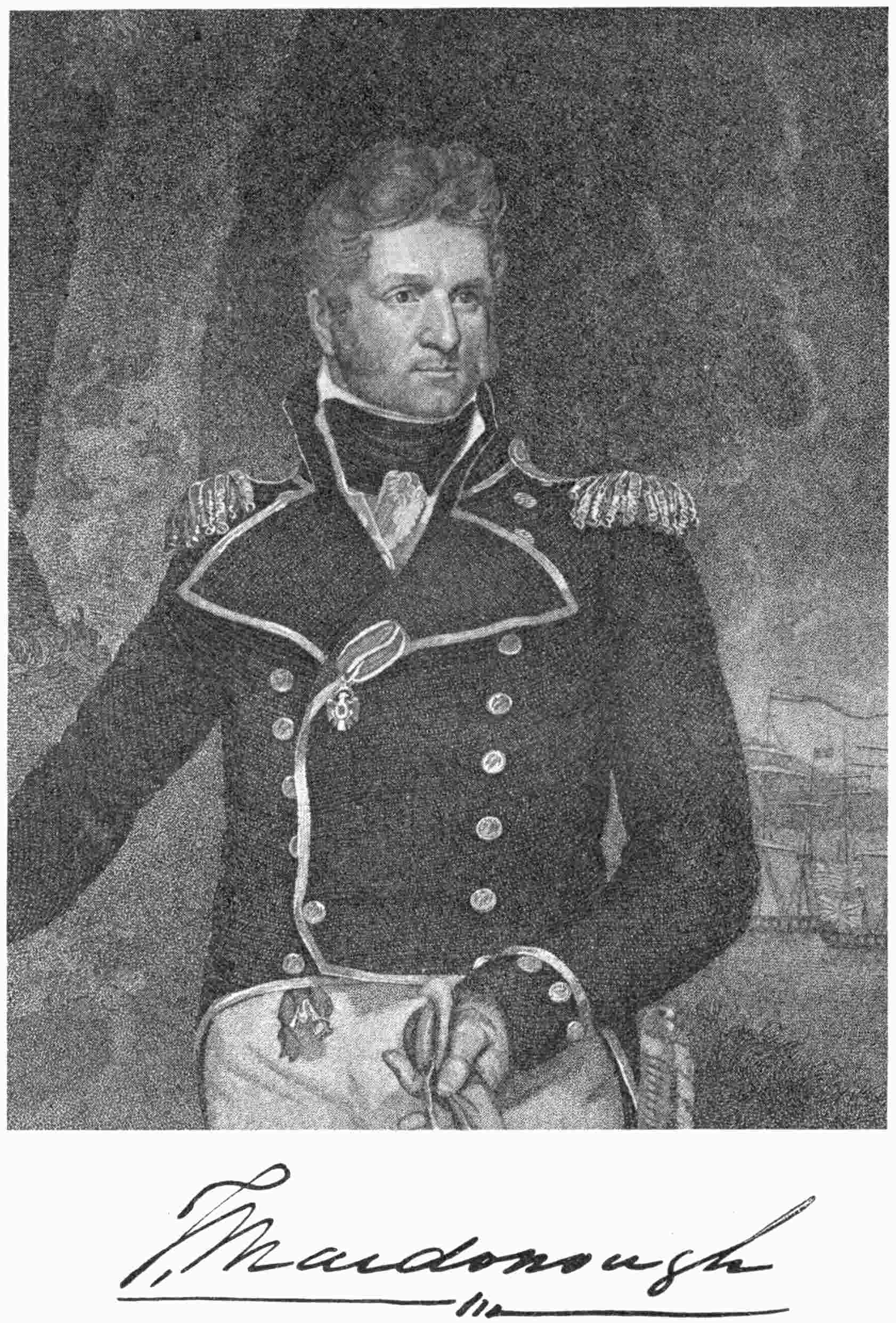
Character of the Red-coated Invaders—“Shamed the Most Ferocious Barbarians of Antiquity”—Work of the Youthful Yankee Lieutenant Macdonough to Stay the Tide on Lake Champlain—Ship-building at Otter Creek—A British Attempt against the New Vessels Repulsed—The British Ship-builders at Isle-Aux-Noix—A Comparison of Forces Before the Battle—Macdonough’s Foresight in Choosing the Battle-ground—Macdonough as a Seaman.
Chapter VII. Macdonough’s Victory on Lake Champlain
Thousands Gathered on the Hill-tops Overlooking the Scene—The British Chose to Make a Long-range Fight—Influence of the First British Broadside on a Sporting Rooster—Macdonough’s First Shot—A Reeling Blow from the Enemy’s Flagship—Fighting against Tremendous Odds—Too Hot for One Yankee Ship—The Saratoga’s Guns Dismounted—The Swarming British Gun-boats—“Winding Ship” when Defeat Impended—The British Failure when Imitating the Movement—The Stubborn Bravery of a British Captain—When the Firing Ceased and the Smoke Drifted down the Gale—A Measure of the Relative Efficiency of the two Forces—Two Yankee Squadron Victories Compared—A Stirring Tale of Macdonough’s Youth—Reward for the Victors—Results of the Victory.
Chapter VIII. Samuel C. Reid of the General Armstrong
Story of the Desperate Defence of America’s Most Famous Privateer—She was Lying in Neutral Water when Four Hundred Picked British Seamen in Boats that were Armed with Cannon came to Take her by Night—Although she had but Ninety Men, and there was Time to Fire but One Round from her Guns, the Attack was Repelled with Frightful Slaughter—Scuttled when a British Ship came to Attack her—The Cunning Omissions and Deliberate Misstatements of the British Historians Examined in Detail—The Honorable Career of Captain Reid in After Life—A Picked Crew of British Seamen After the Neufchâtel—A Three-to-one Fight where the Yankees Won—Other Brave Militiamen of the Sea.
They Completely Mobbed “The Waggon” and so Got her at Last—The First Naval Contest After the Treaty of Peace was Signed—The President, when Running the Blockade at New York, Grounded on the Bar, and, although she Pounded Over, she Fell in with the Squadron—A British Frigate Thoroughly Whipped, but Two more Overtook her—A Point on Naval Architecture—A Treaty that Humiliates the Patriot.
The British Grab at the Valley of the Mississippi—Stopped at Lake Borgne by the Yankee Gun-boats under Lieutenant Thomas Ap Catesby Jones—The British Came Five to One in Numbers and Almost Four to One in Weight of Metal—Defending the Seahorse with Fourteen Men against One Hundred and Seventy-five—The Full British Force Driven upon Two Gun-boats—A Most Heroic Defence that Lasted, in Spite of Overwhelming Odds, more than One Hour—Indomitable Sailing-master George Ulrich—A Fight, the Memory of which still Helps to Preserve the Peace—Work of the Caroline and the Louisiana.
She was a Long Time Idle in Port—A Touching Tale of Sentiment—Away at Last—Captain Stewart’s Presentiment—Found Two of the Enemy as he had Predicted—A Battle where the Yankee Showed Mastery of the Seaman’s Art—Captain Stewart Settled a Dispute—Caught Napping in Porto Praya—Swift Work Getting to Sea—A Most Remarkable Chase—Three British Frigates in Chase of Two Yankee Chose to Follow the Smaller when the Two Split Tacks—Astounding Exhibit of Bad Marksmanship—A Cause of Suicide—The Poem that Saved Old Ironsides.
The Story of a Battle—The Hornet and the Penguin in the Shadows of Tristan d’Acunha—As Fair a Match as is Known to Naval Annals—It Took the Yankees Ten Minutes to Dismantle the Enemy and Five more to Riddle his Hull—The British Captain’s Forceful Description of the Yankee Fire—A Marvellous Escape from a Liner—The Peacock in the Straits of Sunda—When the Lonely Situation of this Sloop is Considered did Warrington Show a Lack of Humanity?—If he Did, What did the British Captain Bartholomew Show?
A Typical Story of the Life of an American Seaman who was Impressed in 1810 and Allowed to Become a Prisoner when War was Declared—Luck in Escaping a Flogging—Letters to his Father Destroyed—British Regard for the Man’s Rights when the American Government Took up the Case—A Narragansett Indian Impressed—To Dartmoor Prison—Mustered Naked Men in the Snows of Winter and Kept them in Rooms where Buckets of Water Froze Solid—Murder of Prisoners Six Weeks After it was Officially Known that the Treaty of Peace had been Ratified—Notable Self-restraint of the Americans—Smoothed Over with a Disavowal.
Traditions of Personal Combats that Illustrate, in a Way, a Part of the Life Led by the Old Time Naval Officers—When an Englishman did not Get “a Yankee for Breakfast”—They were Offended by the Names of the Yankee Ships—Somers was Able to Prove that he was not Devoid of Courage—The Fate of Decatur, the Most Famous of the Navy’s Duellists.
A Breed of Cowardly Cutthroats Legitimately Descended from the Licensed Privateers and Nourished under the Peculiar Conditions of Climate, Geography, and Governmental Anarchy Prevailing Around and in the Caribbean Sea—Commodore Perry Loses his Life Because of them—William Howard Allen Killed—Pirate Caves with the Bones of Dead in them—Porto Rico Treachery—The Unfortunate Foxardo Affair—Making the Coasts of Sumatra and Africa Safe for American Traders.
Supposing the British would Sweep the American Navy from the Seas during the War of 1812, the Dey of Algiers went Cruising for Yankee Ships, and Got One, while Tunis and Tripoli Gave up to the British the Prizes that a Yankee Privateer had Made—The Algerian was Humbled After he had Lost Two War-ships, and the others Made Peace on the Yankees’ Terms without the Firing of a Gun—Bravery of the Pirate Admiral and his Crew.
Work that Naval Men have had to Do in Out-of-the-way Parts of the World in Times of Peace—Chasing Slavers on the African Coast when Slave-owners Ruled the Yankee Nation—The American Flag a Shield for an Infamous Traffic—Capture of the Martha and the Chatsworth—Teaching Malayans to Fear the Flag—Stories of Piratical Assaults on Yankee Traders, and the Navy’s Part in the Matter—A Chinese Assault on the American Flag—“Blood is Thicker than Water”—A Medal Well Earned by a Warlike Display in Time of Peace.
Thomas Ap Catesby Jones, the Hero of Lake Borgne, Struck the First Blow of the War—Operations along the Pacific Coast that Insured the Acquisition of California—Stockton and “Pathfinder” Frémont Operate Together—Wild Horses as Weapons of Offence—The Somers Overturned while Chasing a Blockade Runner—Josiah Tattnall Before Vera Cruz—When Santa Anna Landed—The Yankee Sailors in a Shore Battery—The Hard Fate of One of the Bravest American Officers.
Commodore Matthew C. Perry and the First American Treaty with Japan—An Exhibition of Power and Dignity that Won the Respect of a Nation that had been Justified in its Contempt for Civilized Greed—Services of Naval Officers that are not Well Known and have never been Fully Appreciated by the Nation.
LIST OF ILLUSTRATIONS
PAGE
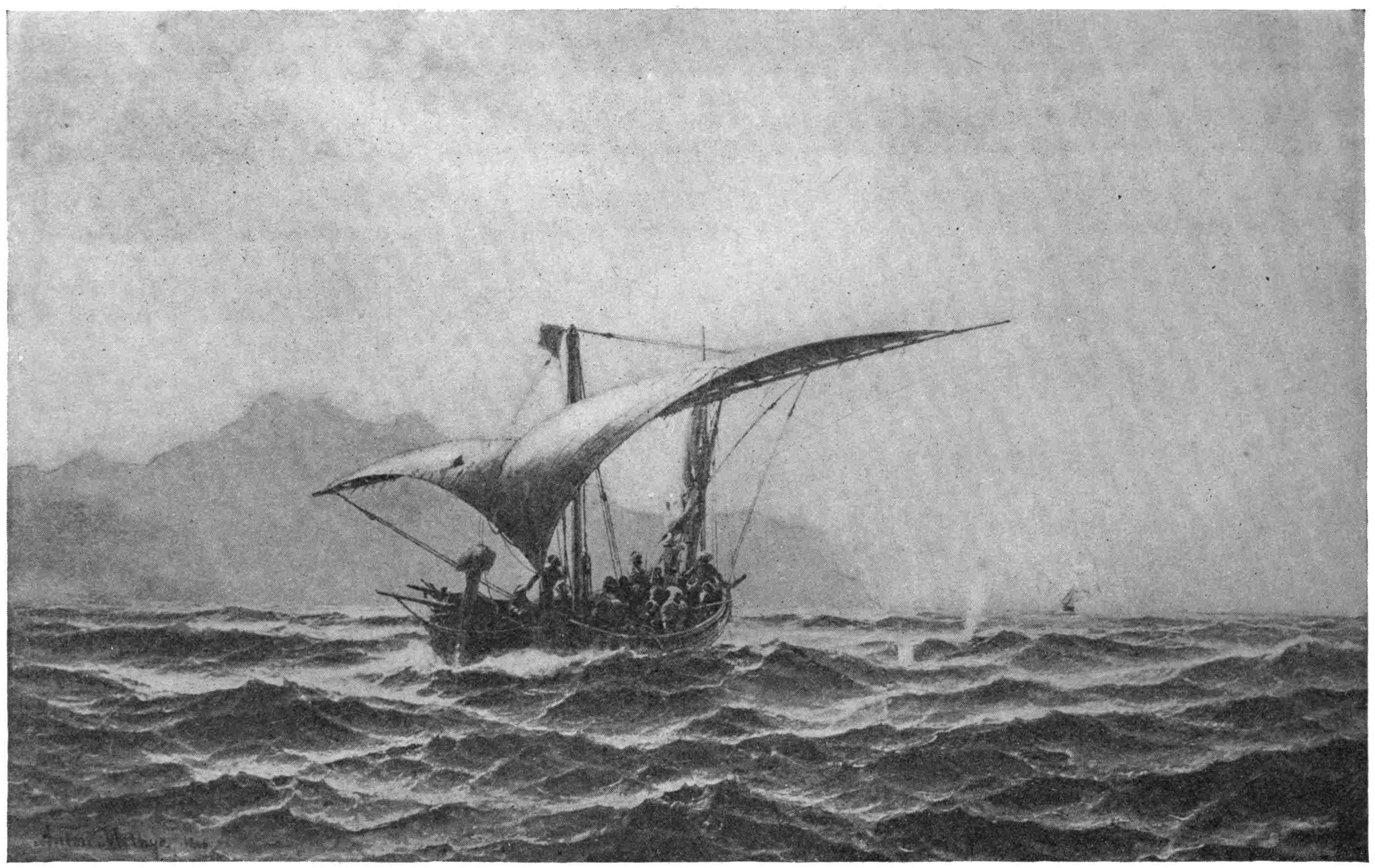
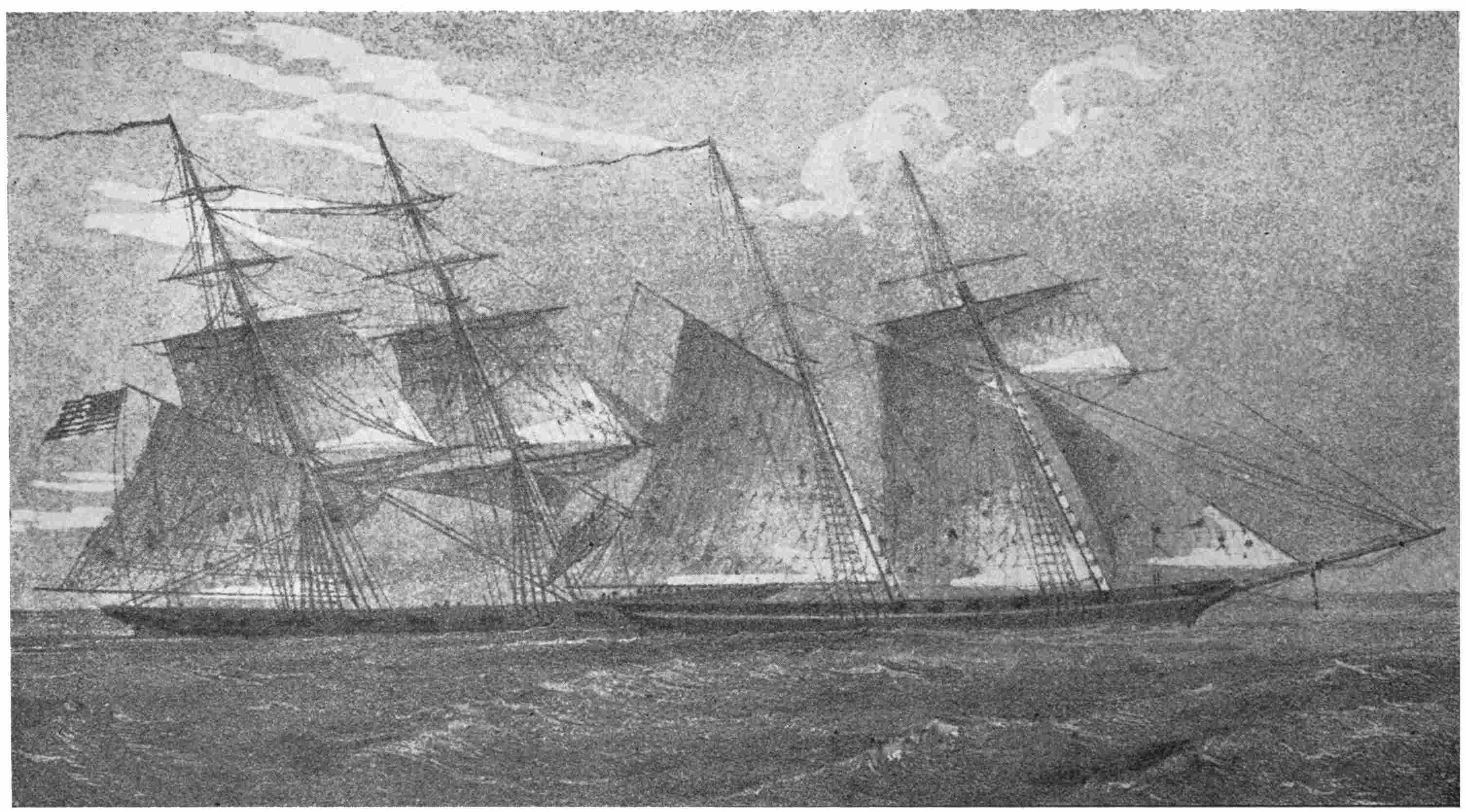
Chasing a Slaver off the African Coast. (From a photograph, in the possession of Mr. Edward Trenchard, of the painting by Melbye),
Frontispiece.
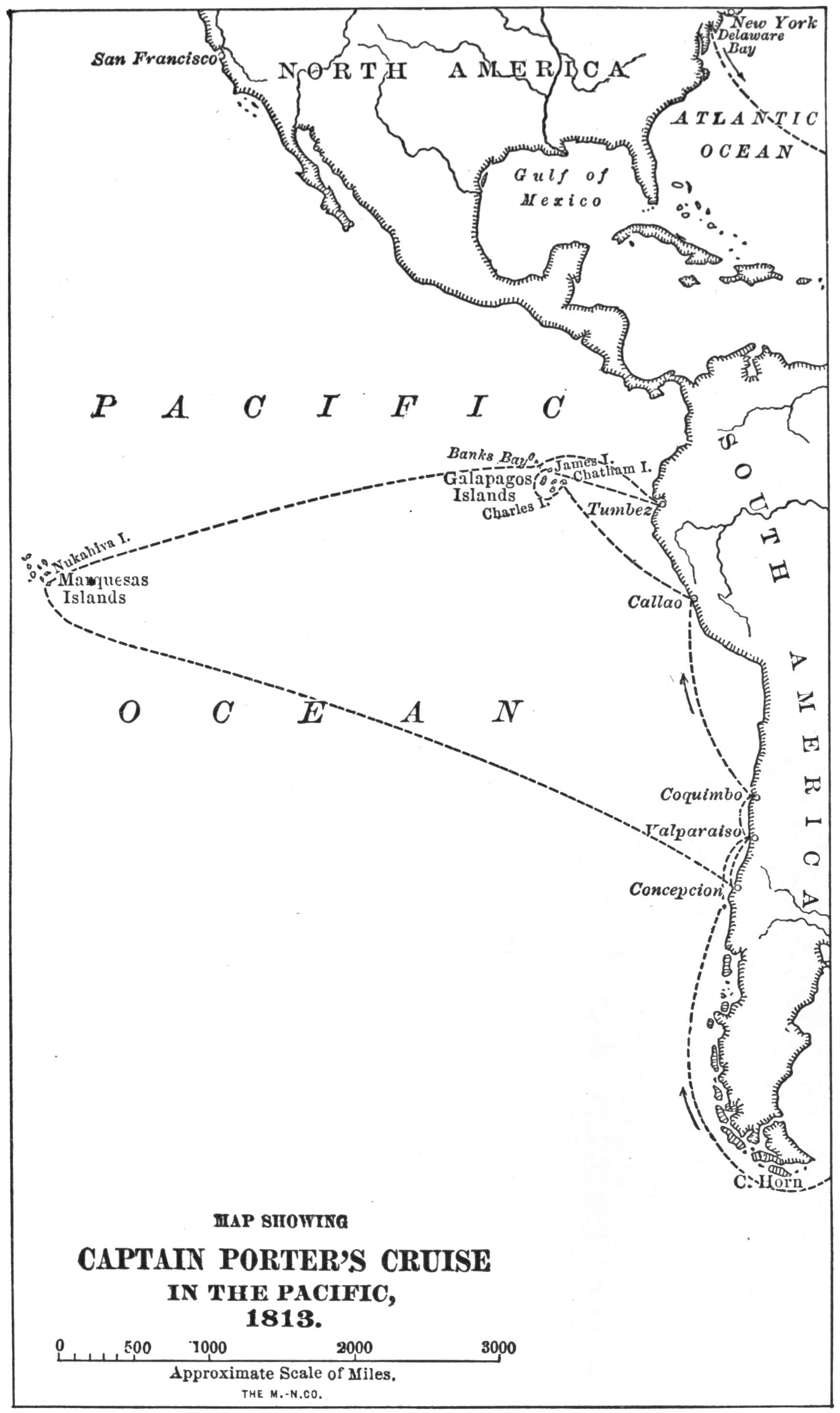
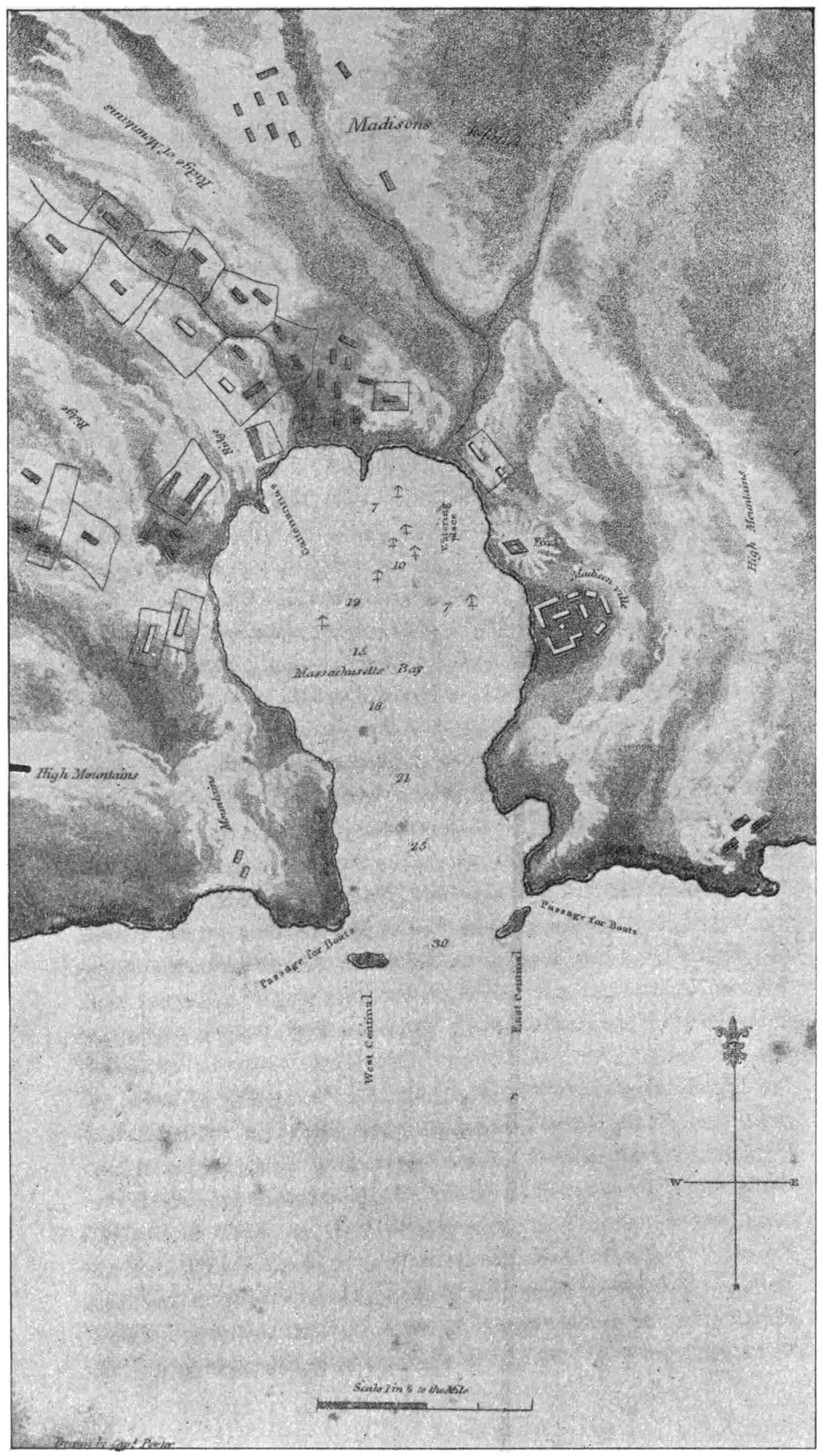
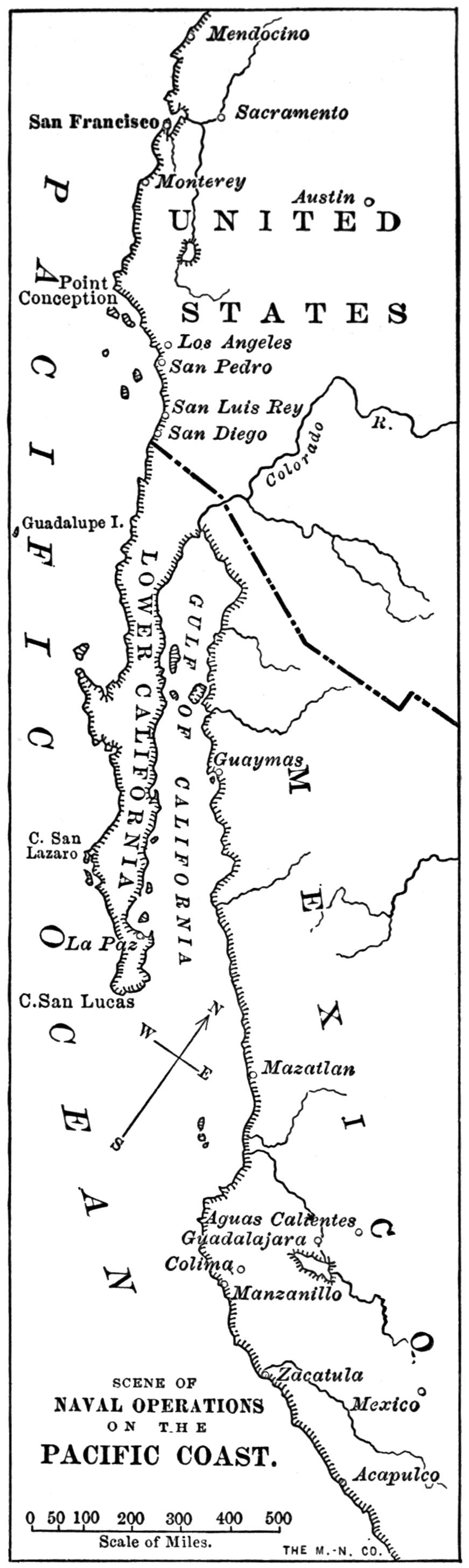
Map Showing Captain Porter’s Cruise in the Pacific, 1813,
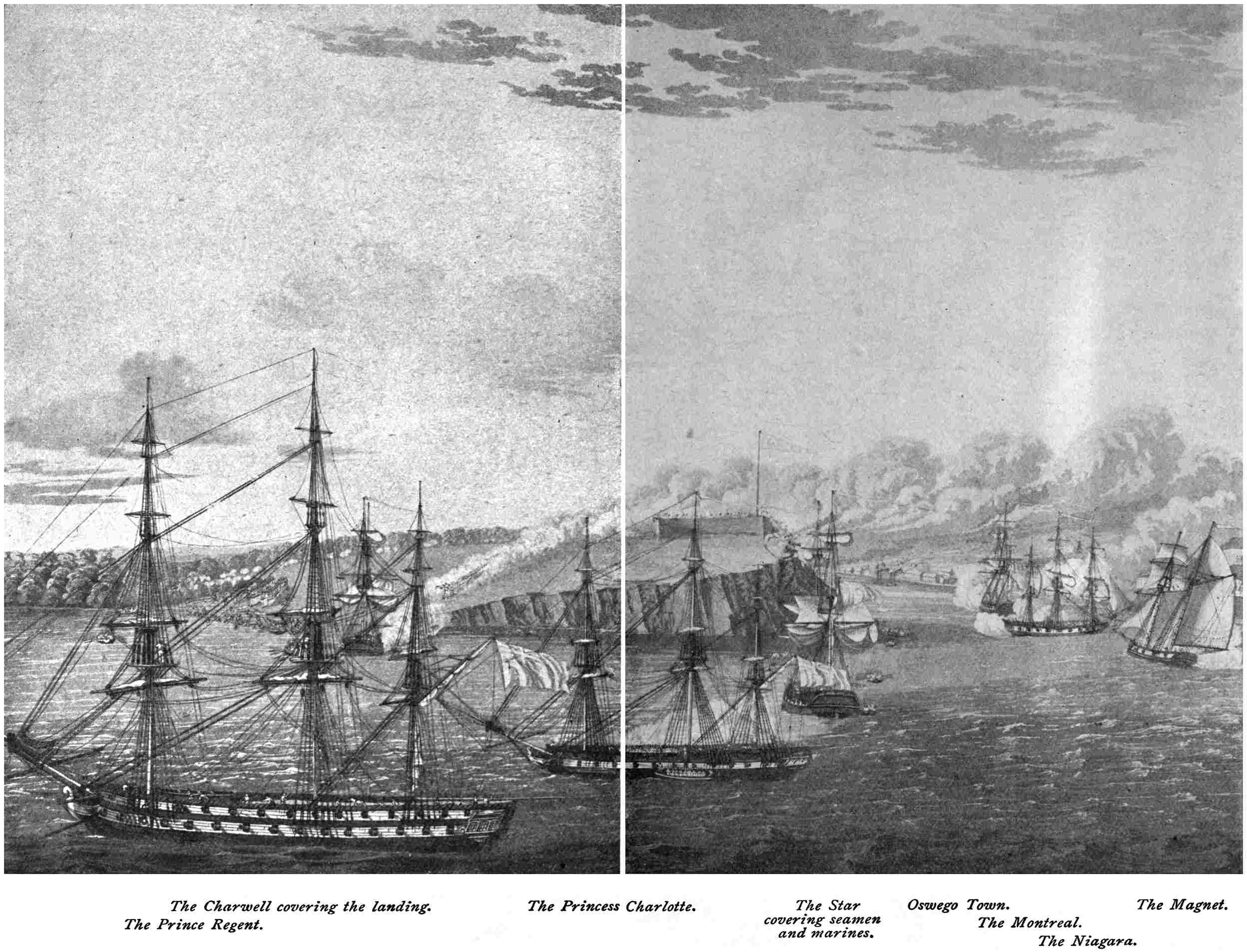
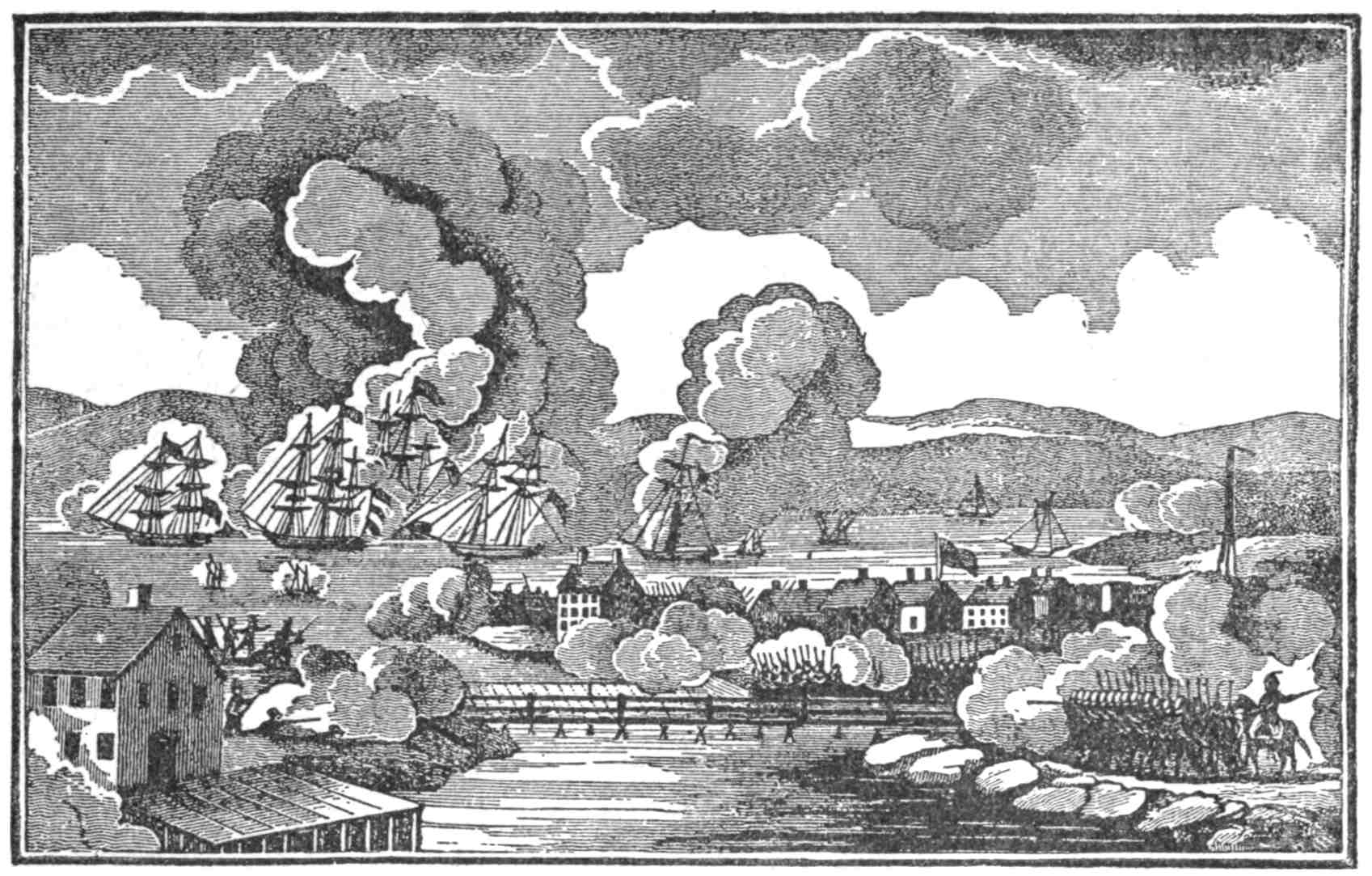
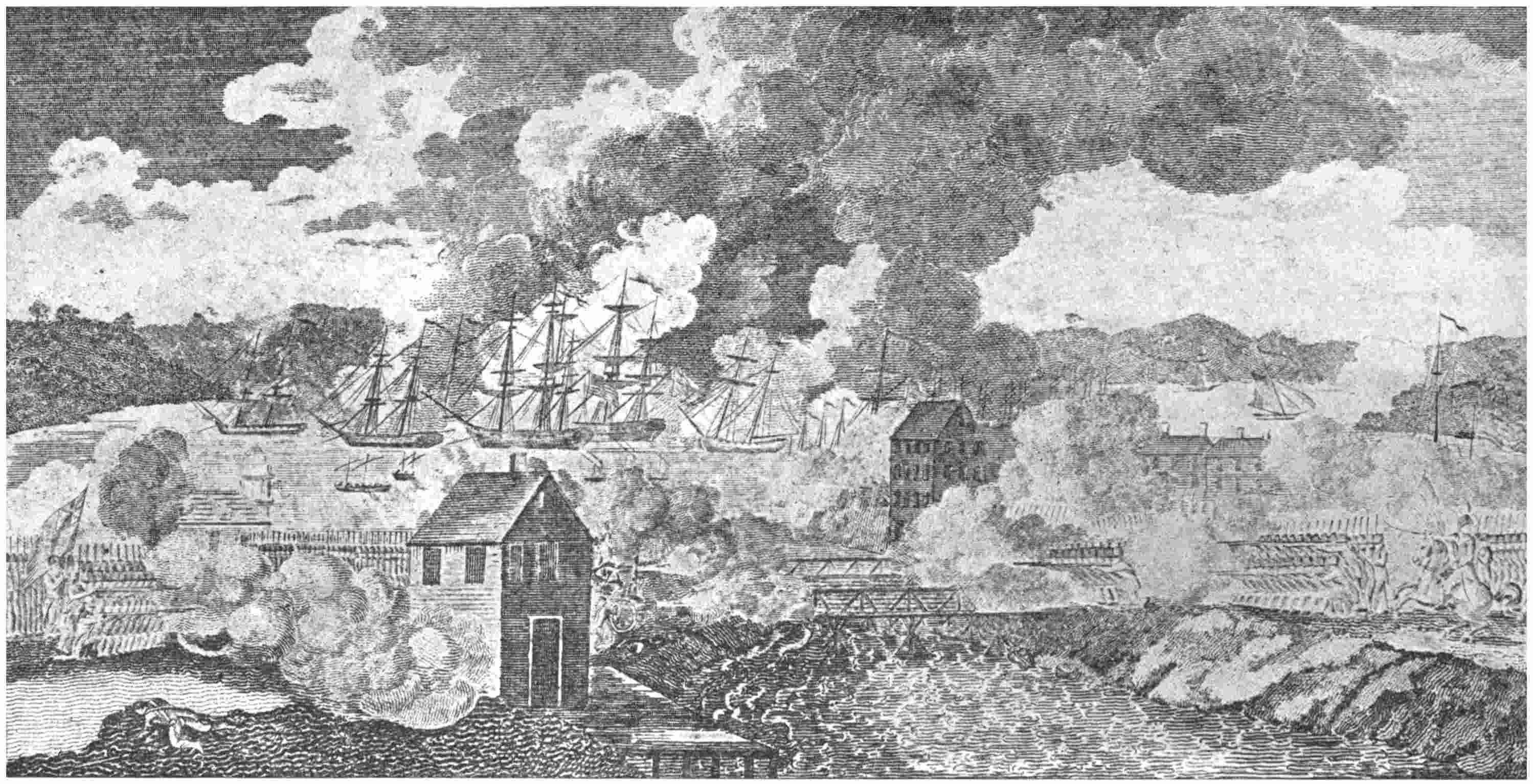
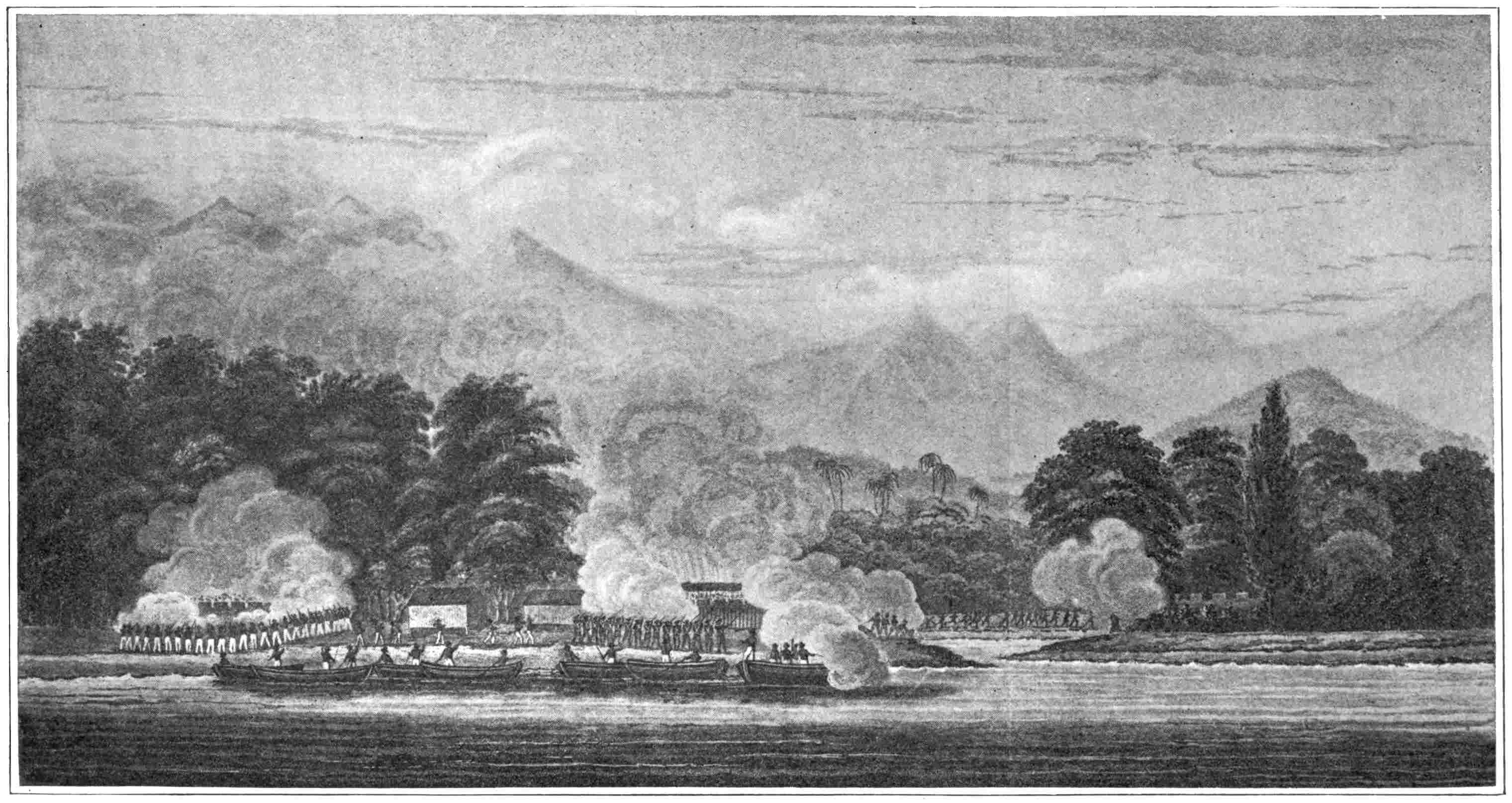
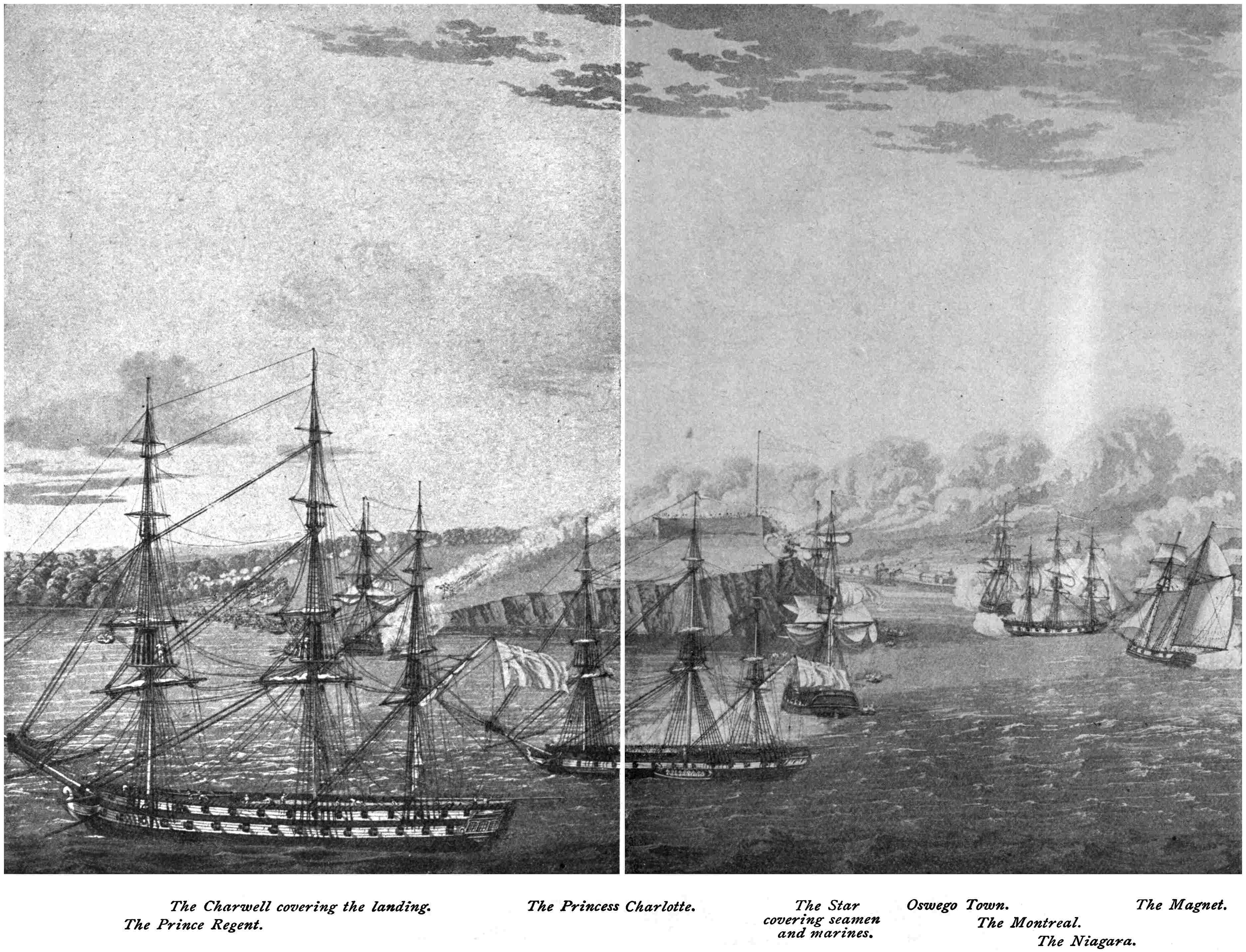
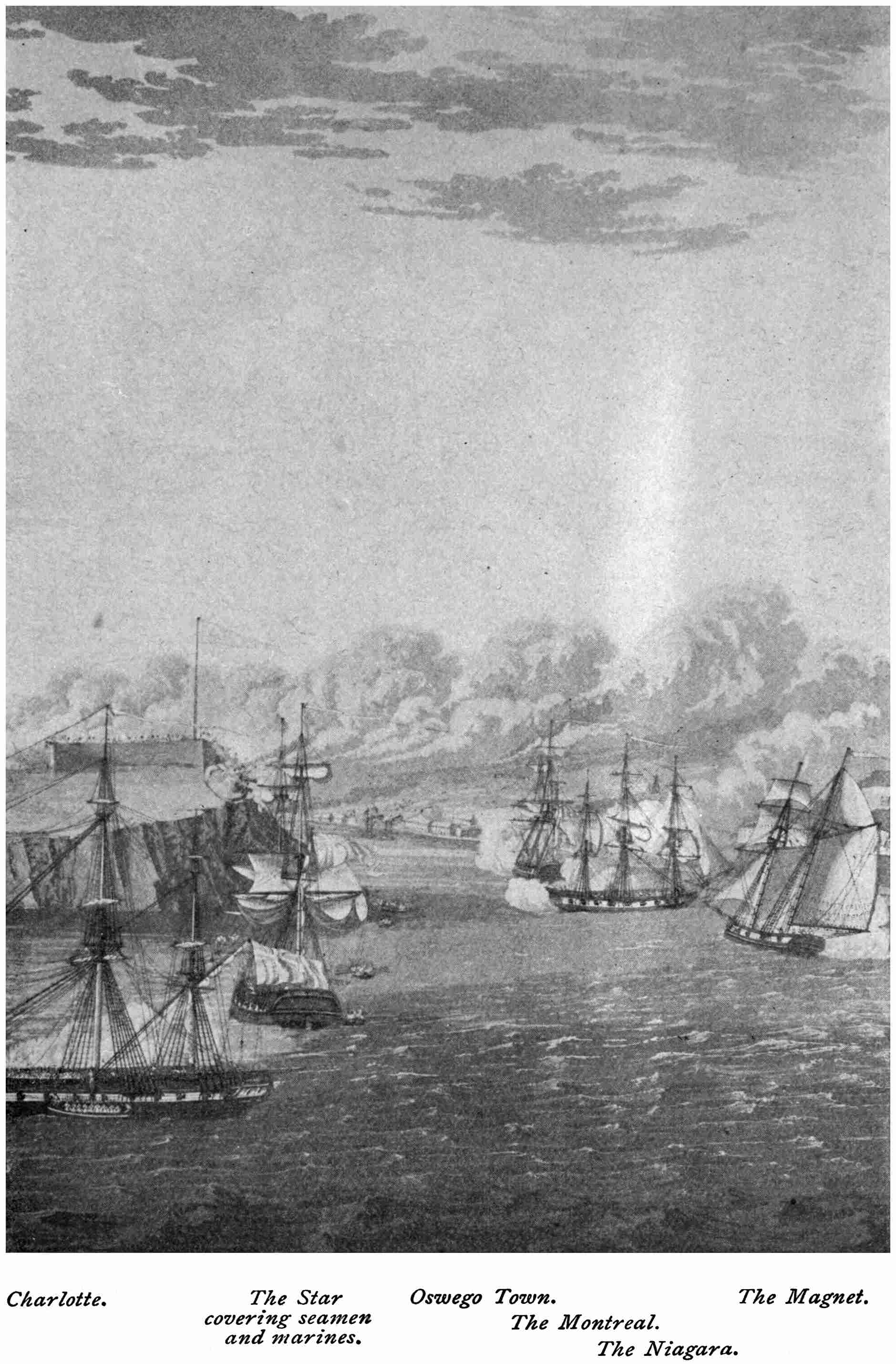
The Attack on Fort Oswego, Lake Ontario, May 6, 1814. (From an engraving, published in 1815, by R. Havel, after a drawing of Lieutenant Hewett, Royal Marines),
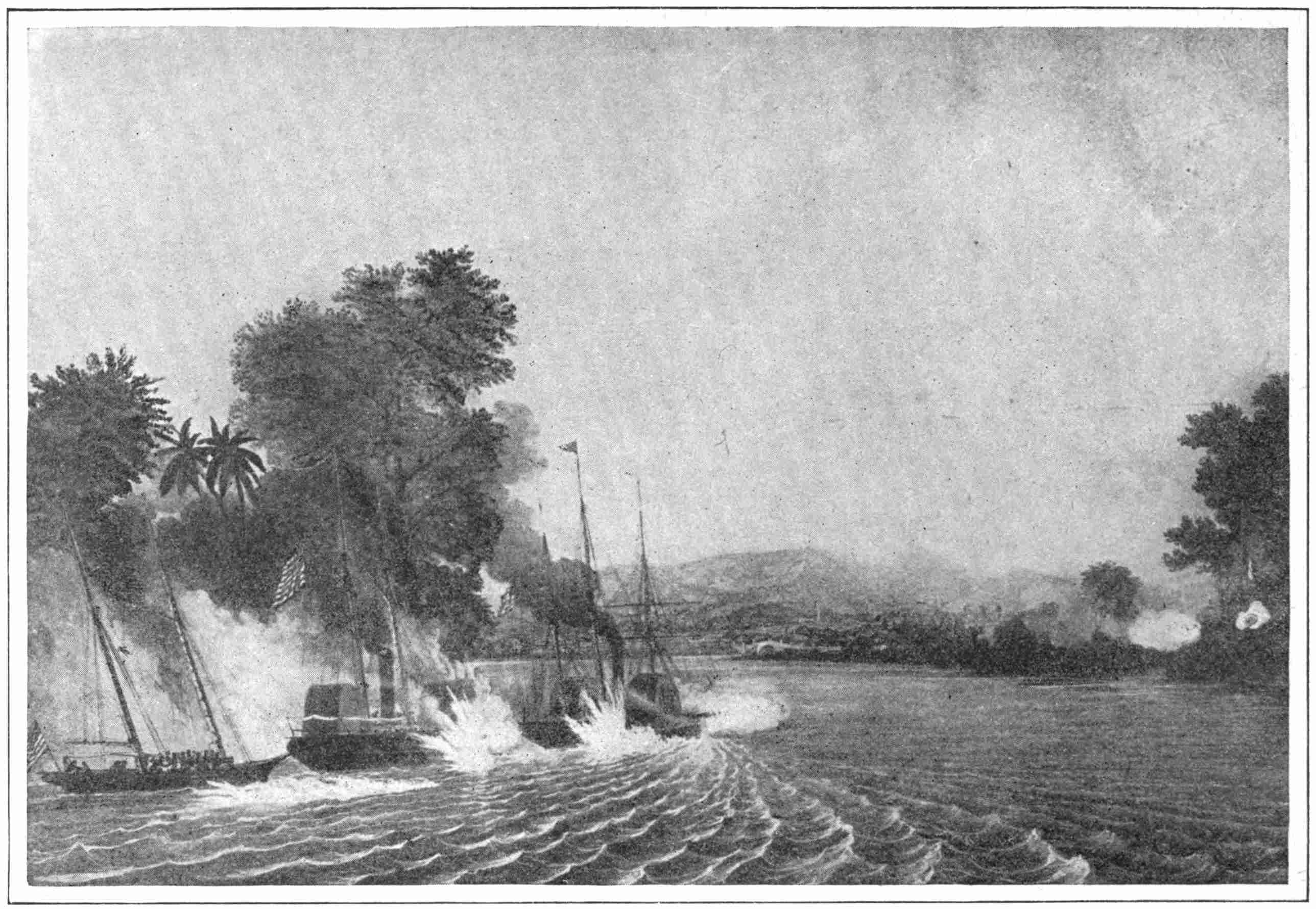
Bombardment of Muckie and Landing of a Force to Burn the Town. (From an engraving by Osborne in “The Flagship,” published, 1840, by D. Appleton & Co.),
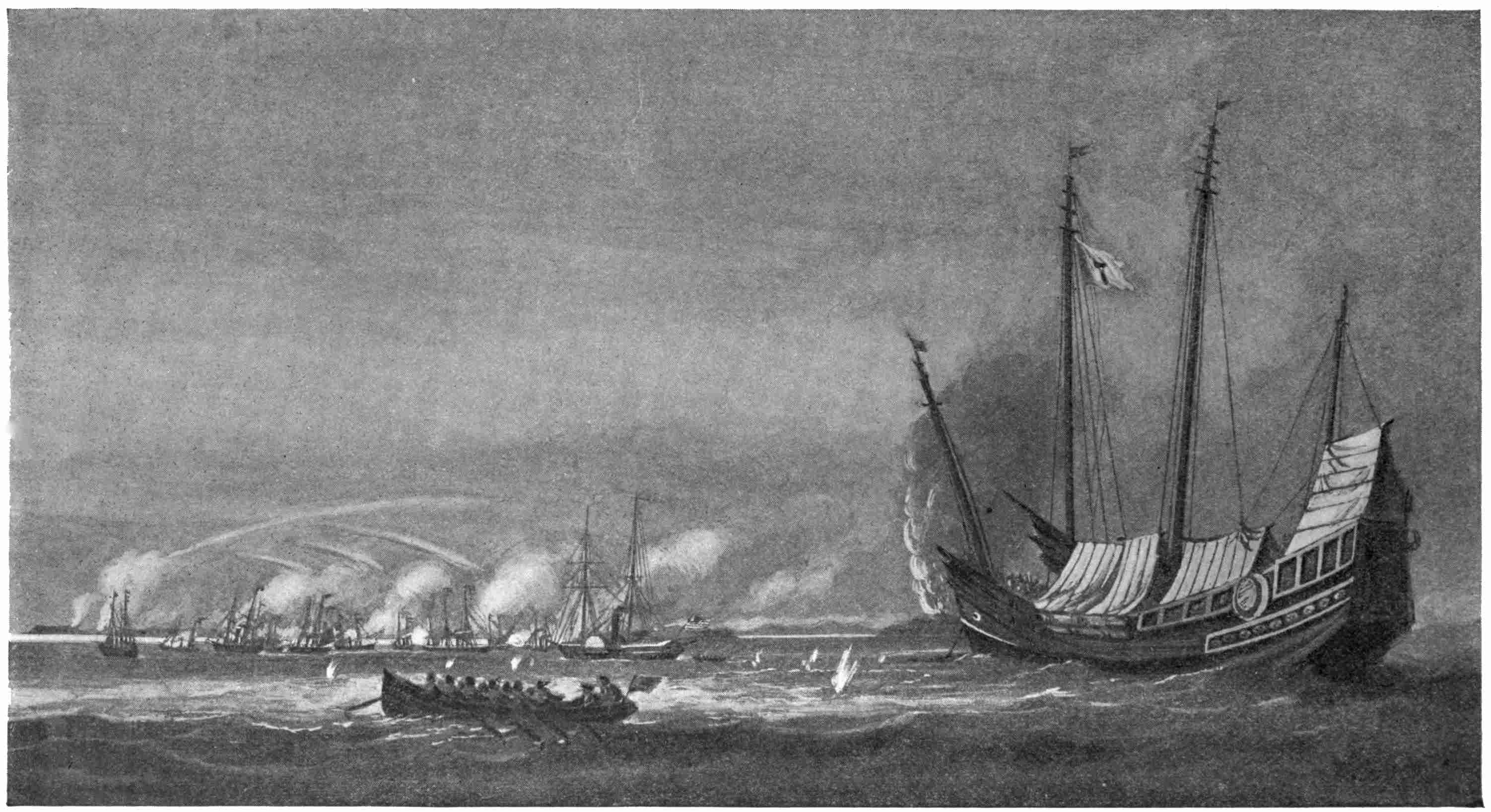
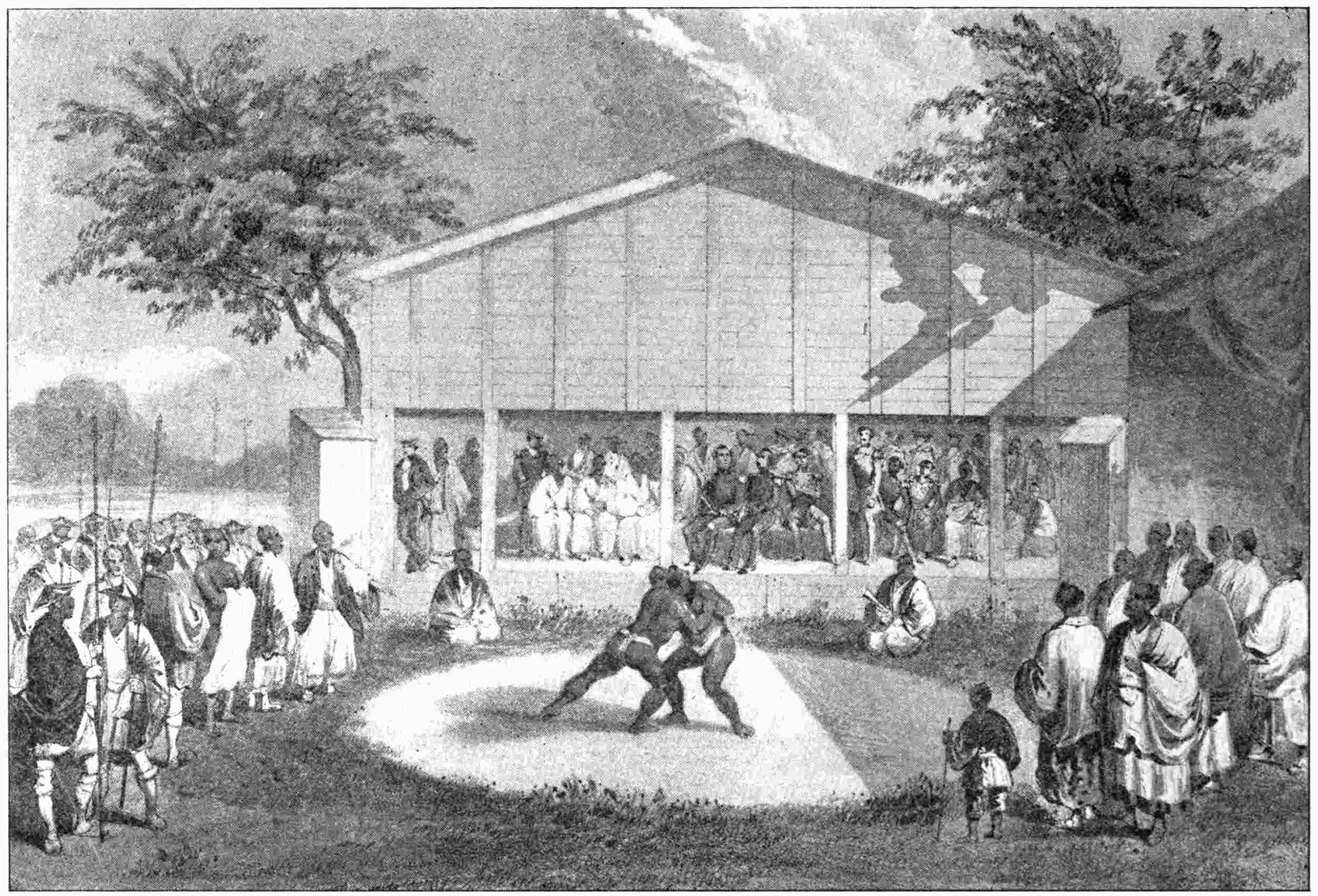
“Blood is Thicker than Water.”—Josiah Tattnall Going to the Assistance of the English Gun-boats at Peiho River. (From a painting, by a Chinese artist, owned by Mr. Edward Trenchard),
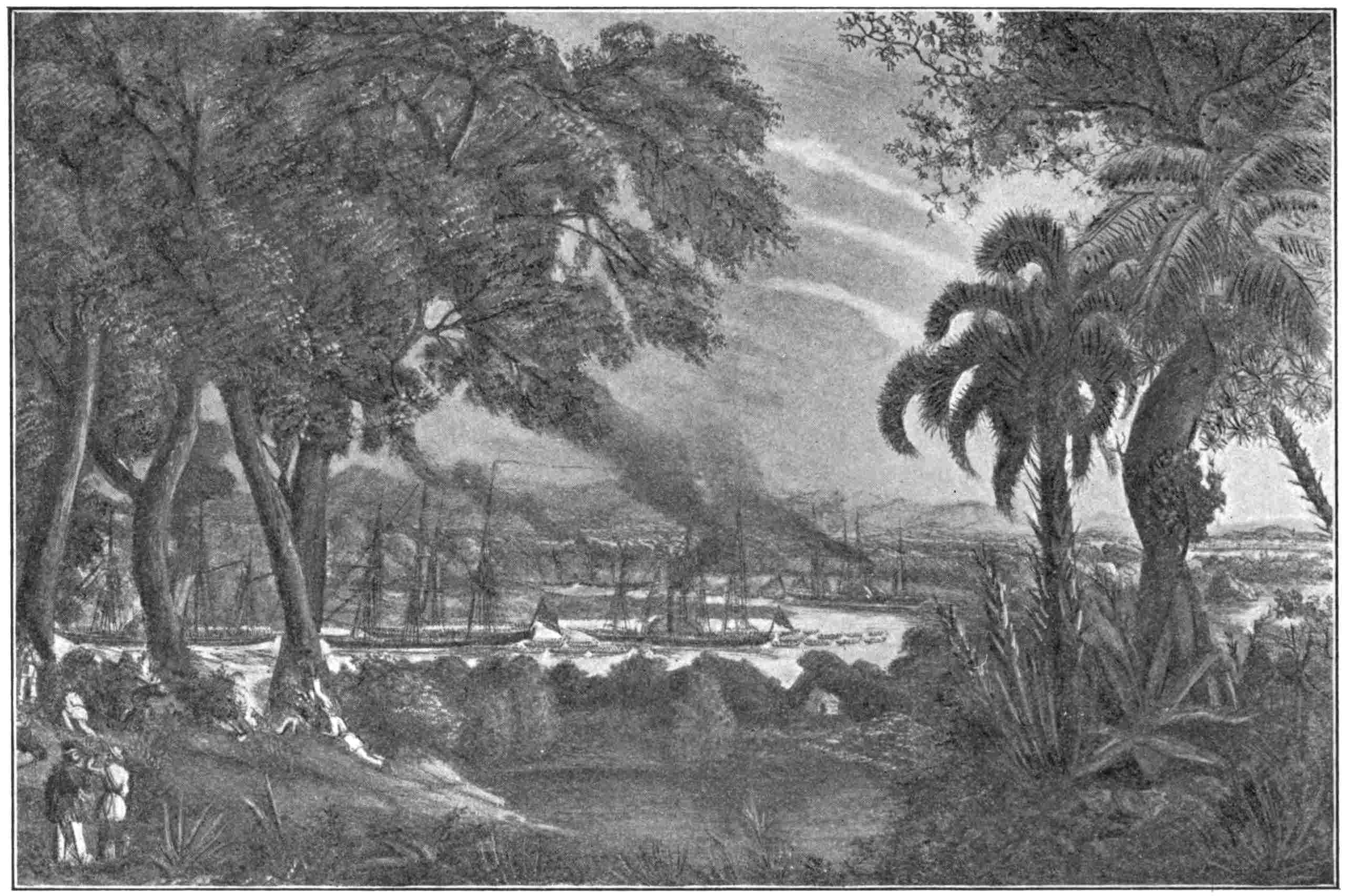
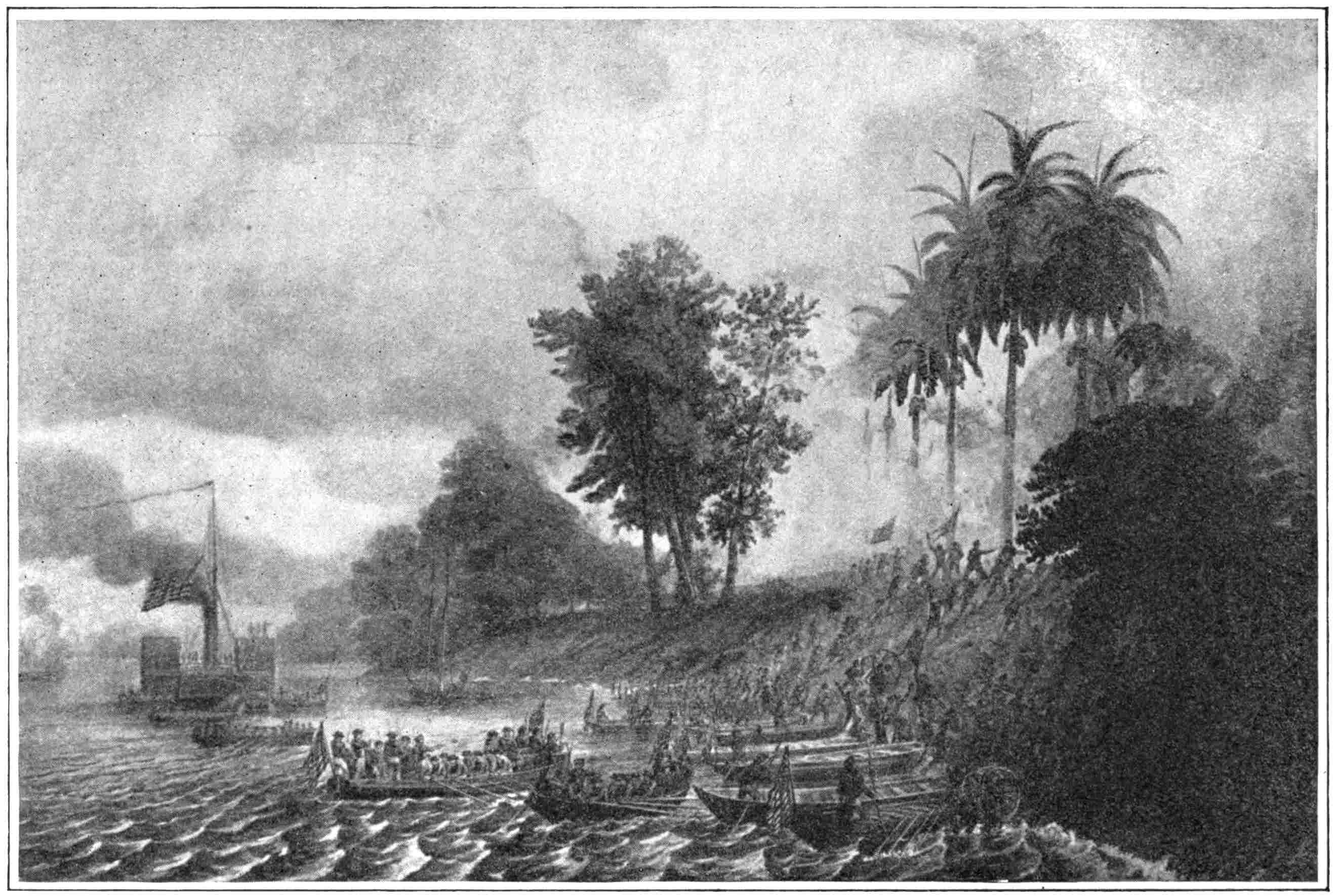
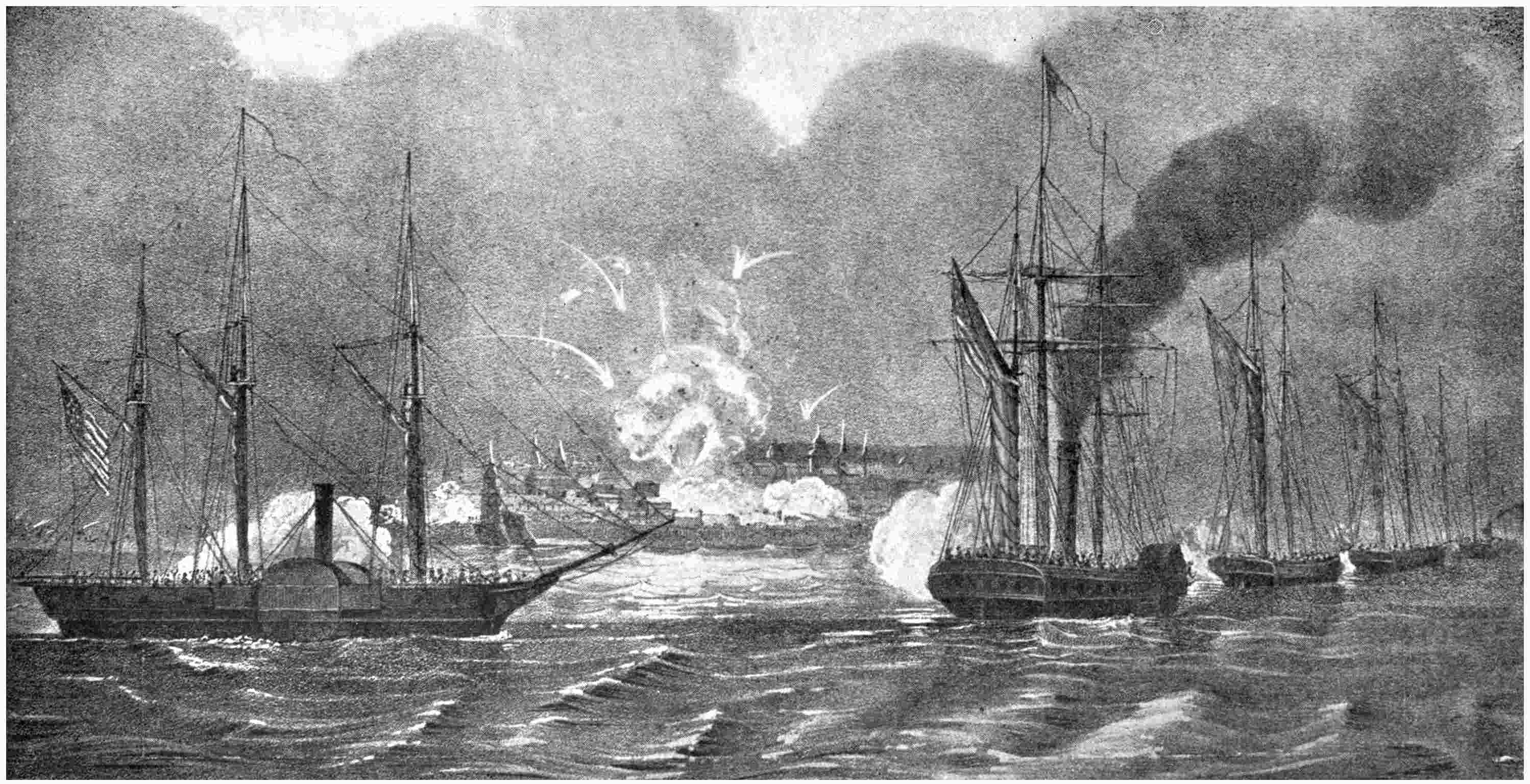
Perry’s Expedition Crossing the Bar at the Mouth of the Tabasco River. (From a lithograph designed and drawn on stone by Lieutenant H. Walke, U. S. N.),
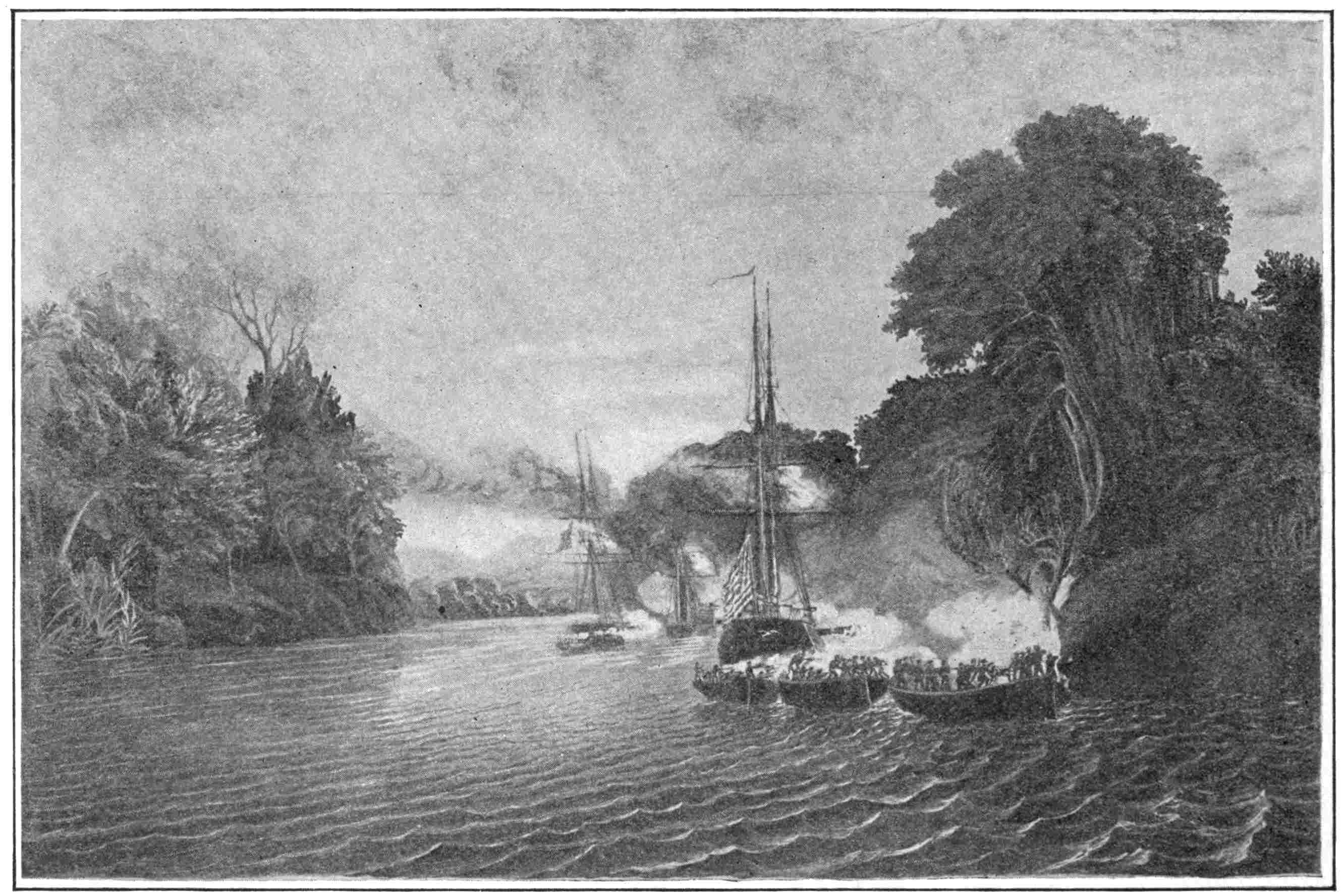
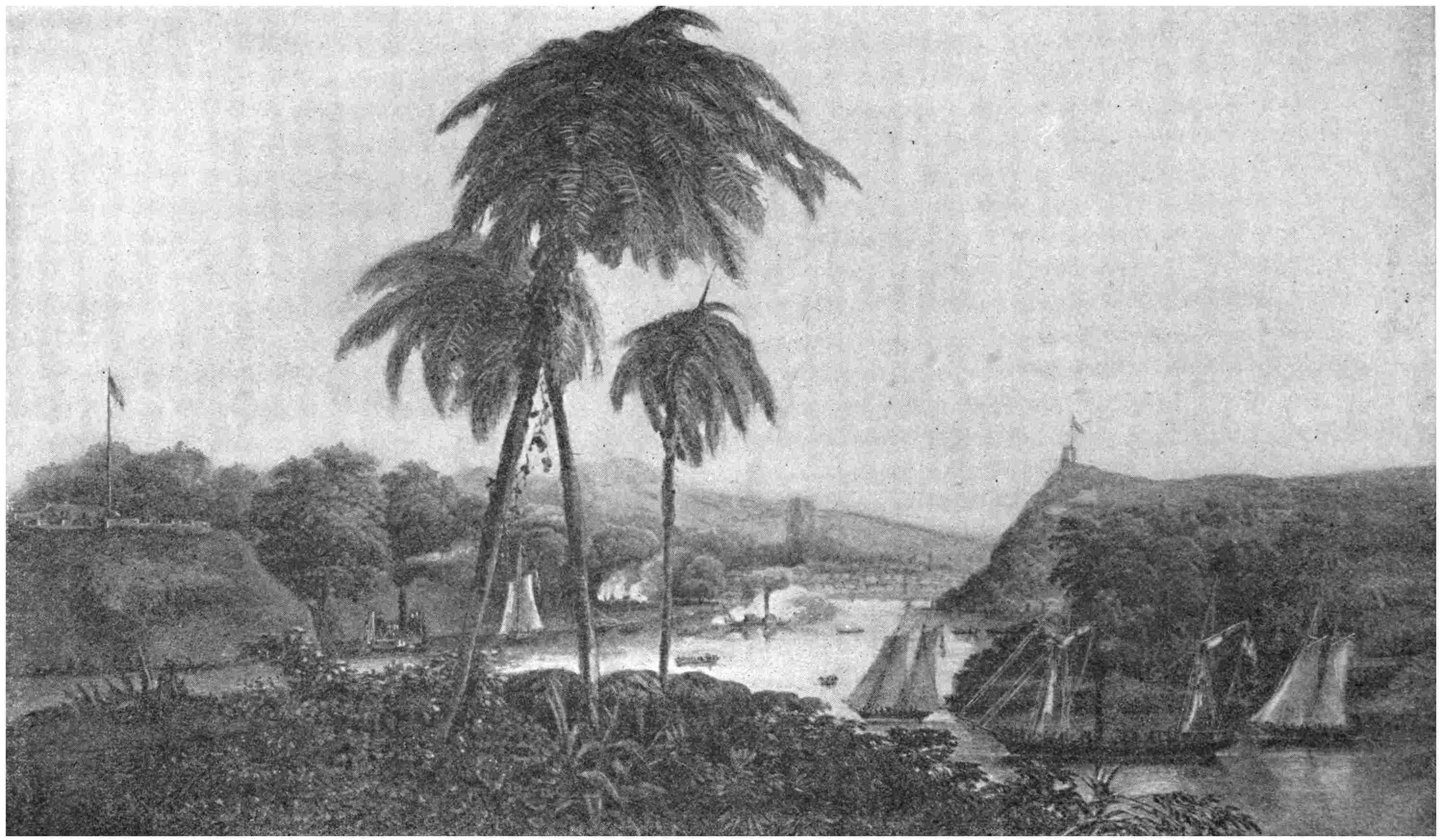
The Naval Expedition Under Commodore Perry Ascending the Tabasco River at the Devil’s Bend. (From a lithograph designed and drawn on stone by Lieutenant H. Walke, U. S. N.),
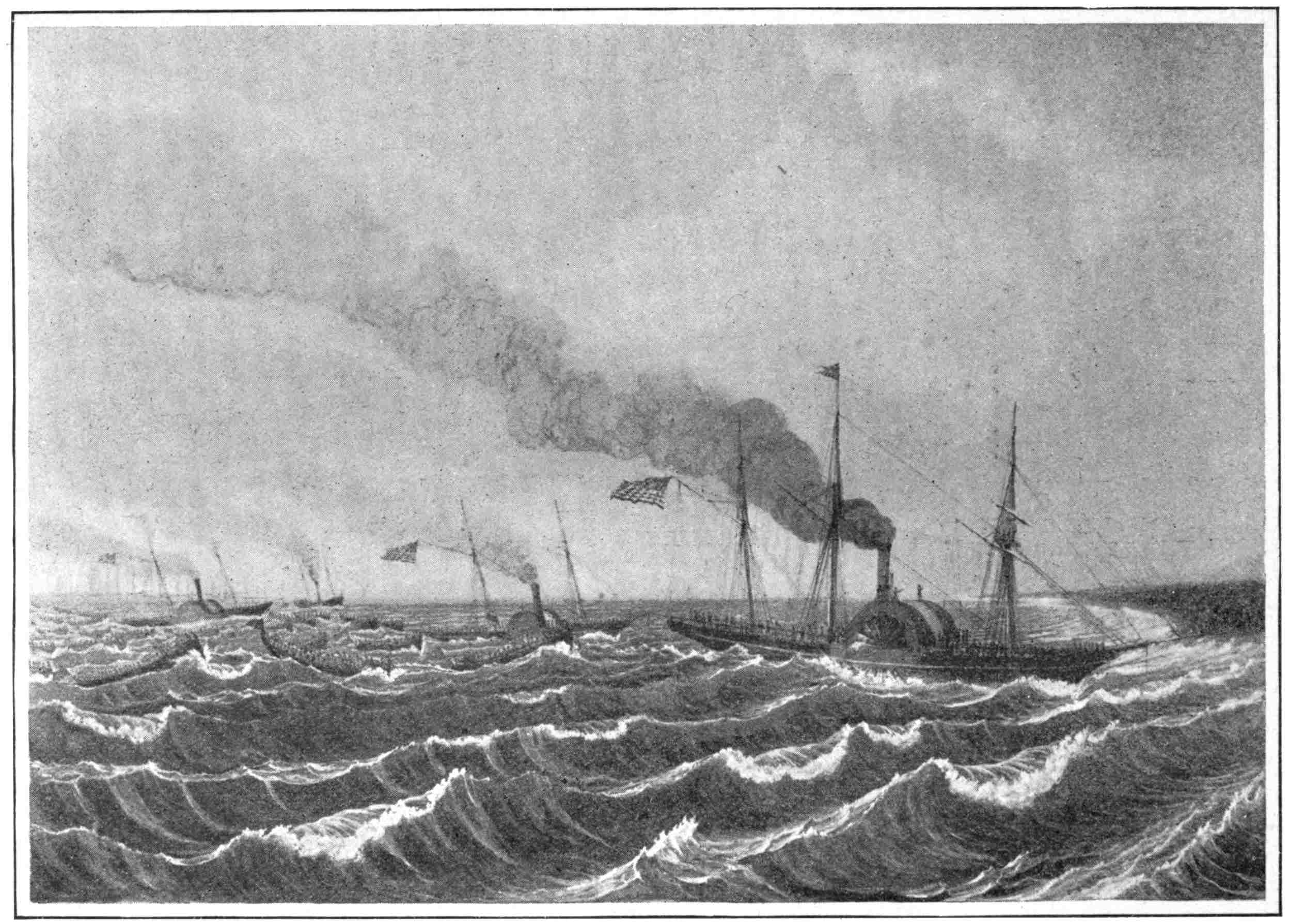
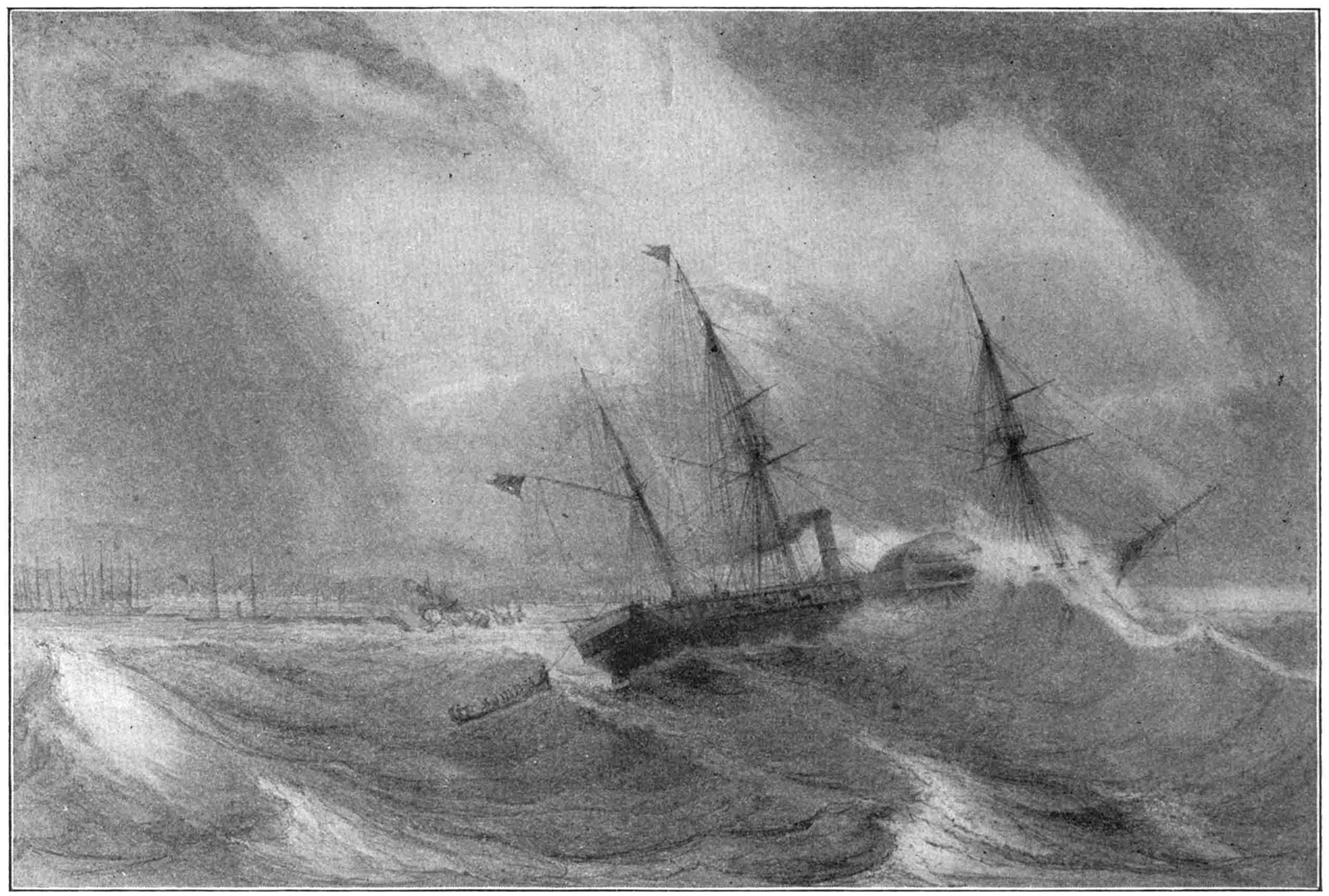
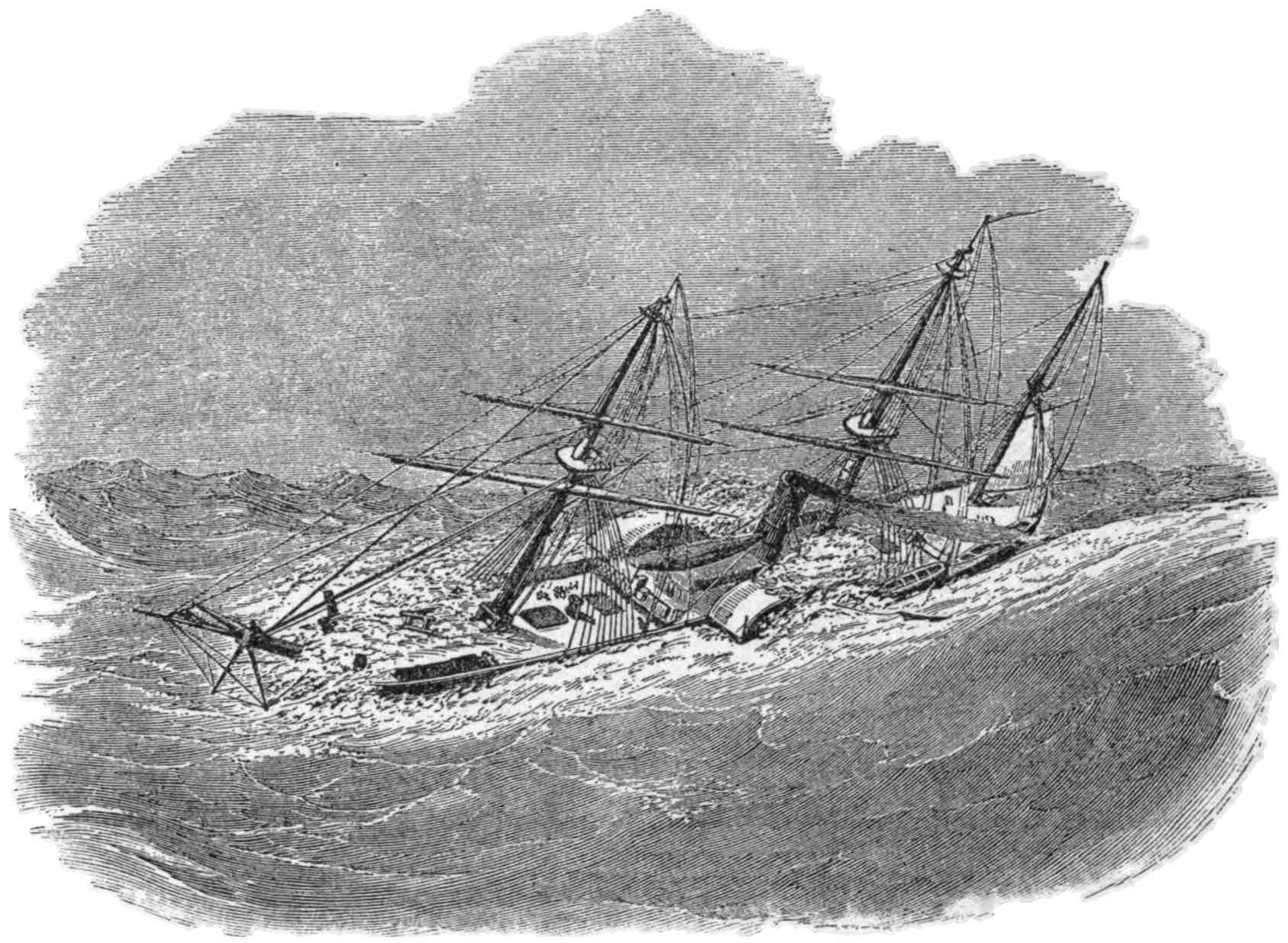
The Mississippi Going to the Relief of the Hunter in a Storm off Vera Cruz. (From a lithograph designed and drawn on stone by Lieutenant H. Walke, U. S. N.),
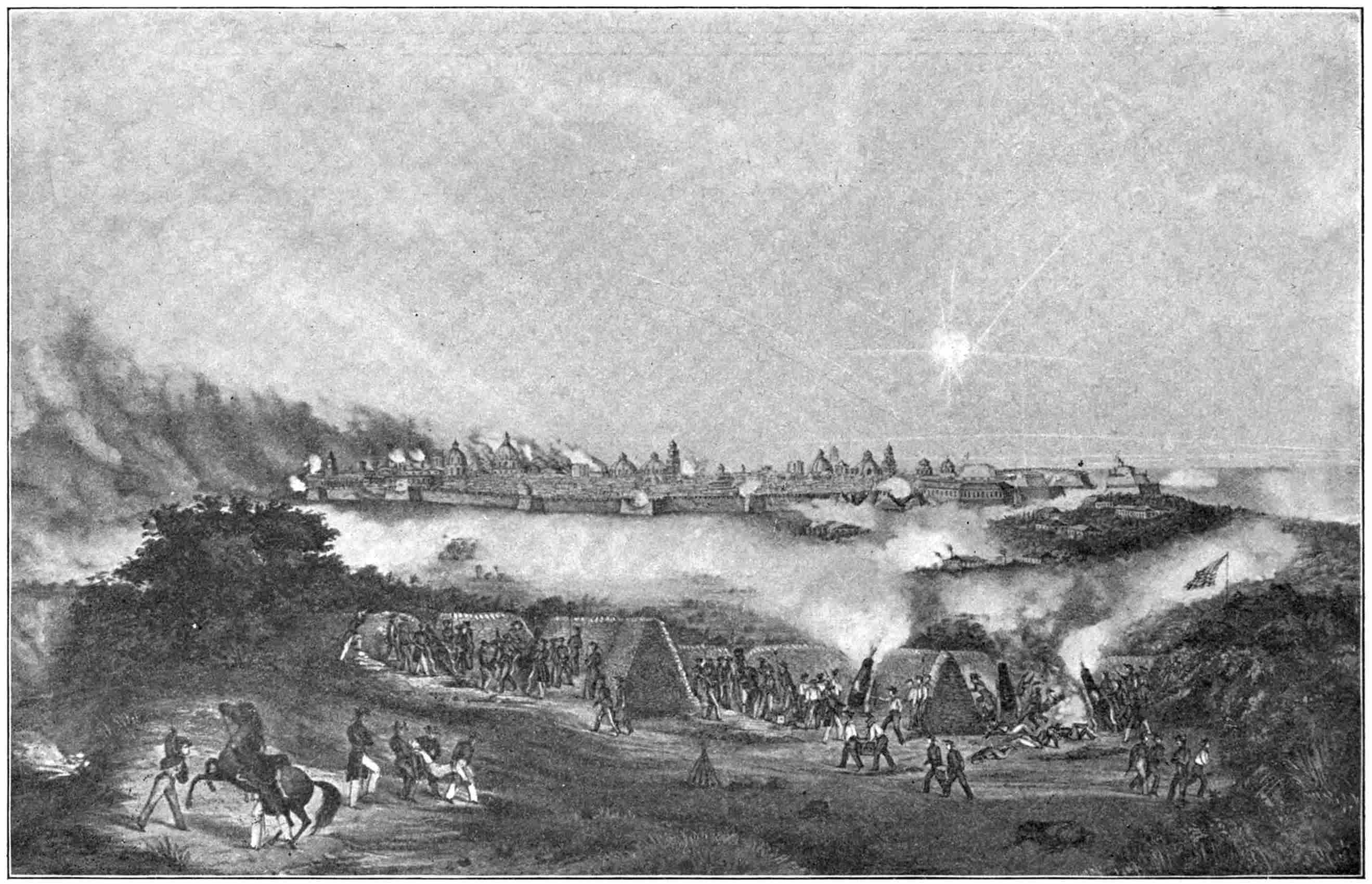
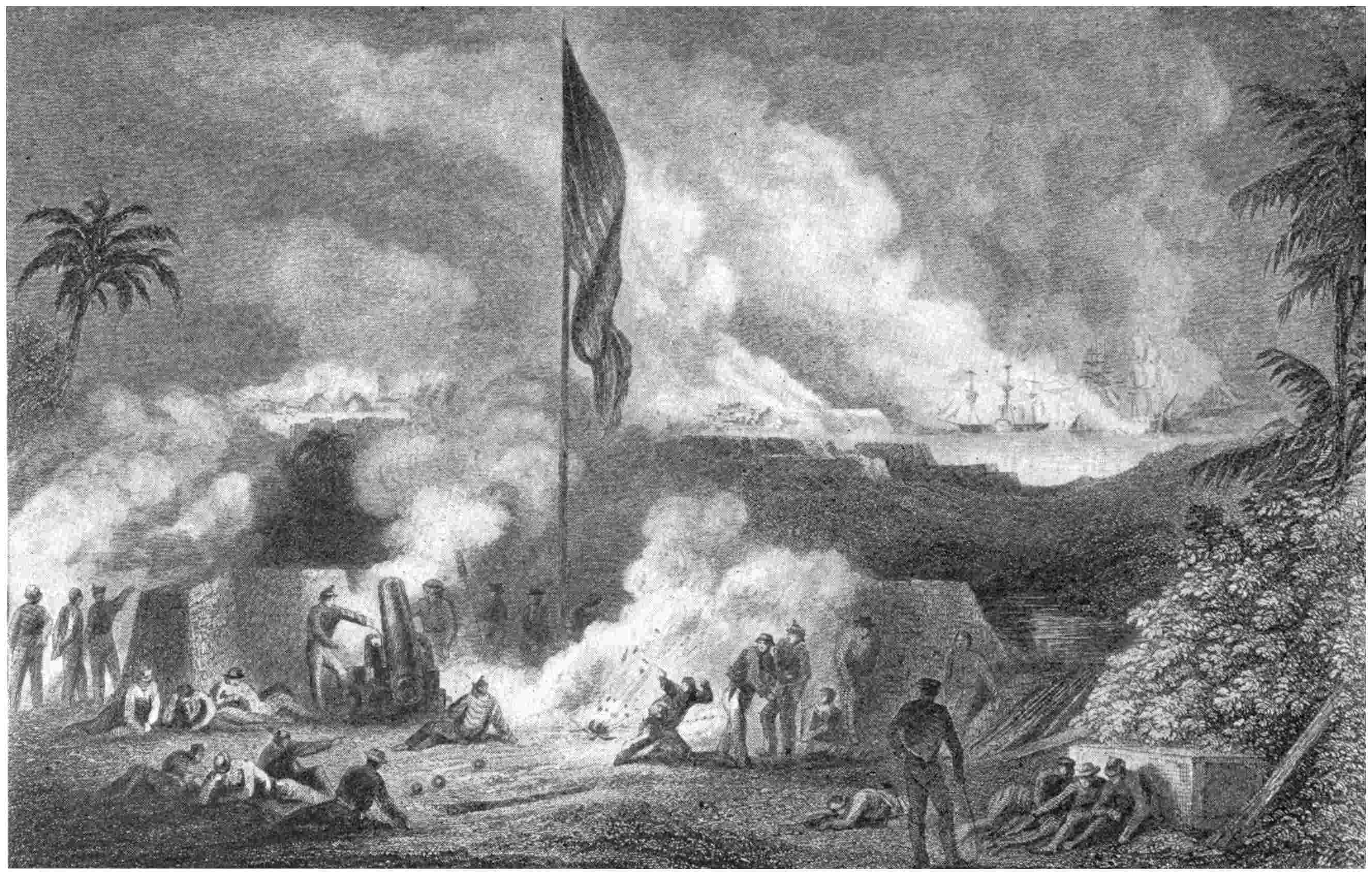
The United States Naval Battery During the Bombardment of Vera Cruz on the 24th and 25th of March, 1847. (From a lithograph designed and drawn on stone by Lieutenant H. Walke, U. S. N.),
THE HISTORY OF OUR NAVY — CHAPTER I WHEN PORTER SWEPT THE PACIFIC
THE STORY OF THE SECOND CRUISE OF THE FAMOUS LITTLE
FRIGATE ESSEX—AROUND CAPE HORN AND ALONE IN THE
BROAD SOUTH SEA—CAPTURE OF A PERUVIAN PICAROON—DISGUISING
THE ESSEX—THE BRITISH WHALING FLEET TAKEN BY
SURPRISE—AN ARMED WHALER TRANSFORMED INTO A YANKEE
CRUISER—THE SAILORMAN’S PARADISE AMONG THE NUKAHIVA
GROUP—WHEN FARRAGUT WAS A MIDSHIPMAN—AN INCIPIENT
MUTINY AMONG THE SAILORS WHO WANTED TO REMAIN AMONG
THE ISLANDS—FARRAGUT AS A CAPTAIN AT TWELVE.
Of great renown in the annals of the American
Navy is the name of Porter, for the deeds
of Captain David Porter with the little frigate
Essex fill a large space in the story of the War
of 1812; while those of David D. Porter, the
son of Captain David Porter, during the Civil
War, of which the story will be told farther on,
raised him to the highest rank.
The second cruise of the Essex began on
October 28, 1812, when she sailed from the
Delaware bound across the ocean to Port Praya,
Cape de Verde, to meet the Constitution and
the Hornet and join in a cruise against British
commerce in the far East. Her luck in winds
having made the passage longer than anticipated,
she arrived after the Constitution and
Hornet had sailed for Brazil. Having replenished
his stores at Port Praya, Captain Porter
stood away toward the coast of Africa from
Port Praya in order to deceive the people as
to his destination, and then ran away toward
the island of Fernando de Noronha, where he
expected once more to meet his consorts. This
passage was without event until December 11,
1812, when at 2 o’clock in the afternoon a sail
was seen to windward. Thereat the British
signals captured from the Alert in the first
cruise were displayed, but they failed to bring
the stranger, which was soon seen to be a large
brig, toward the Essex. So Porter stood up
toward the brig, and by nightfall was near
enough to see that she was flying British colors;
and a little later she displayed night-signals.
When Porter was seen to be unable to answer
these, the crew of the brig crowded on all sail
and manœuvred with skill to escape, but at 9
o’clock at night the Essex was alongside, and
after a volley of musketry from the Yankee,
the brig struck. She proved to be the British
packet, Nocton, of ten guns and thirty-one men.
Her cargo included $55,000 in coin. The coin
was taken out and the brig sent toward home
under a prize-crew of seventeen men, but she
was recaptured by the swift-sailing Belvidera
when near Bermuda.
The Essex reached Fernando de Noronha
on December 14th, and there found a letter from
Commodore Bainbridge. As this port was
frequented by British men-of-war this letter was
signed with the name of the captain of a British
ship, the Acasta—Bainbridge having caused the
Brazilian authorities of the island to believe
that the Constitution and the Hornet were the
Acasta and the Morgiana—and directed Porter
to pose as Sir James Yeo, of the Southampton,
on reaching the island. Because of this diplomacy—because
Porter took a letter which
Bainbridge had written to him under the name
of Sir James Yeo—British writers have said he
was guilty of conduct unbecoming to a gentleman
and officer!
The letter was double; there was one letter
in common ink that meant very little, and on
the back of this was another in lime-juice that
directed Porter to meet the Constitution and
Hornet off Cape Frio.
To Cape Frio, a lofty and most picturesque
point on the Brazilian coast, went Porter, and
there he lay under short sail, filling and backing,
on the day when Bainbridge, with the Constitution,
won the memorable victory over the
British frigate Java. He remained cruising off
the Brazilian coast for several days, capturing
the British schooner Elizabeth meantime, and
eventually put into St. Catharine’s, where he
learned what had happened off Bahia, including
the fact that the British ship-of-the-line Montagu
had driven the Hornet off to the north.
So Porter was left free to choose his own
course. It was characteristic of the man that
he should have decided, in spite of the fact that
the Spaniards, who controlled the west coast
of South America, were practically allies of
Great Britain, that he would round the Horn
and destroy the British shipping in the southern
Pacific. He could not hope for a really
friendly reception in any port there, but he was
confident that he could live off the enemy.
Sailing from St. Catharine’s on January 26,
1813, he found an enemy on board his ship
next day which we, in this era of the medical
science, can scarcely appreciate. A form of
dysentery appeared among the crew that was
apparently contagious, or was, at least, caused
by conditions that threatened the whole crew.
It was especially dangerous from the fact that
he was bound around the Horn, where the
weather would compel the closing of ports,
hatches, and companion-ways, and so prevent
ventilating the ship. But the commonsense
of the captain served where the knowledge of
medicine failed, for he adopted what would
now be called rigorous sanitary measures; he
kept the ship and crew absolutely clean and
so stopped the epidemic and preserved the
health of the crew in a way unheard of, in those
days of scurvy and ship fever.
MAP SHOWING
CAPTAIN PORTER’S CRUISE IN THE PACIFIC,
1813.
The ship made the Horn in February, the
end of the southern summer season—the season
of the fiercest gales in that region. The weather
became frightful. The seas broke over the little
frigate continually, gun-deck ports were broken
in fore and aft, extra spars were swept overboard,
and boats were knocked to pieces at the
davits by the waves. At one time the boatswain
was so terrified by the assaults of the sea
that he shouted:
“The ship’s side is stove in. We are sinking!”
and for a brief time there was a panic
among some of the crew.
“This was the only instance in which I ever
saw a regular good seaman paralyzed by fear
of the perils of the sea,” wrote Midshipman
Farragut.
However, early in March the Essex anchored
at Mocha Island, where an abundance of hogs
and horses were found running wild. The
crew had a good time hunting both, and a large
quantity of the meat of each was salted down
for future use. From here the Essex sailed to
Valparaiso, where it was learned that Chili had
declared herself free of Spain.
Sailing from Valparaiso on March 20, 1813,
Porter fell in with the American whaler Charles,
of Nantucket, and learned that a Spanish ship
of the coast had captured the American whalers
Walker and Barclay off Coquimbo, only two
days before.
At this, Porter headed for the scene of the
trouble, and the next morning (March 26th)
saw a sail.
“Immediately, from her appearance and the
description I had received of her, I knew her
to be one of the picaroons that had been for
a long time harassing our commerce,” wrote
Porter in his journal. So he hoisted British
colors and sailed up beside the stranger and
learned that she was the Peruvian cruiser Nereyda,
of fifteen guns. Her commander being
deceived by the British flag, boasted of having
captured the two Yankee whalers. Then Porter
got from him a list of the British ships in those
waters, with a description of each, so far as the
Peruvian could remember. This done, Porter
disclosed the character of the Essex to the astonished
Peruvian, threw overboard all the
guns and arms of his corsairs, and wrote a letter
to the Viceroy of Peru telling why this was
done, after which the Nereyda was allowed
to go.
Porter’s next work was in “disguising our
ship, which was done by painting in such a
manner as to conceal her real force and exhibit
in its stead the appearance of painted guns, etc.;
also by giving her the appearance of having a
poop, and otherwise so altering her as to make
her look like a Spanish merchant-vessel.”
The sailormen were still at this work when a
sail was seen that, when captured, proved to be
the British whaler Barclay. With this vessel
in company the Essex sailed to the Galapagos
group, where, on April 29th, the British whaler
Montezuma, with 1,400 barrels of whale oil on
board, was taken. On the same day the whalers
Georgiana and Policy were overhauled. The
wind having failed, Porter got out his boats to
attack these two vessels. When the boats drew
near the Georgiana her crew gave three cheers
at the sight of the American flag and one of
them shouted, “We are all Americans.” And
that was very near the truth, for she was a British
whaler, licensed as a letter of marque, and
had a pressed crew of whom the majority were
Americans. The Policy surrendered also without
a fight. As the Georgiana was pierced for
eighteen guns, and was a smart sailer, Porter
transferred the ten guns carried by the Policy
to her, which, with the six she already had on
board, made her quite a respectable cruiser.
She was manned by forty-one men under Lieutenant
Downes. It was estimated that the three
ships taken, with their cargoes, were worth
$500,000; but their real value to Porter was
in the fact that they carried an abundance of
spare canvas, cordage, etc., so that he was able
to fit out the Essex with new sails, running
gear, and standing rigging wherever needed,
and provide liberally for future needs.
On May 28th another sail was seen, but as
night came on she was lost to view. Next
morning, however, she was sighted from the
Montezuma, and after a long chase was taken
by the Essex. This prize was the letter-of-marque
whaler Atlantic, mounting eight eighteen-pounders,
and reputed as the fastest ship in
those waters. She was commanded by a man
named Weir, “who had the pusillanimity to say
that ‘though he was an American-born he was
an ‘Englishman at heart,’” so wrote Midshipman
Farragut.
That same evening another vessel was seen,
and late at night she was captured also. She
proved to be the letter-of-marque whaler Greenwich,
a ship that had sailed from England under
convoy of the ill-fated Java. She was full of
ship-stores and provisions of every kind, and
had on board, moreover, one hundred tons of
water and eight hundred large tortoises, sufficient
to furnish all the ships with fresh provisions
for a month.
“The little squadron now consisted of the
Essex, forty-six guns and two hundred and
forty-five men; the Georgiana, sixteen guns
and forty-two men; the Greenwich, ten guns
and fourteen men; the Atlantic, six guns and
twelve men; the Montezuma, two guns and ten
men; the Policy and the Barclay of ten and
seven men, respectively; in all, seven ships carrying
eighty guns and three hundred and forty
men.” The prisoners numbered eighty. As
the number of prizes as well as prisoners proved
burdensome, Captain Porter sailed on June 8th
for the mainland, and reached Guayaquil Bay
on the 19th. Here some provisions were obtained,
and while lying here the Georgiana, with
her crew of forty men, was sent on a cruise under
Lieutenant Downes. The character of Downes
was well illustrated on this cruise. Near James
Island two British ships were found and secured
without a fight. They were the Catherine,
of eight guns and twenty-nine men, and
the Rose, of eight guns and twenty-one men.
Securing his fifty prisoners on the Georgiana,
Downes sent ten of his men to each craft taken,
and sailed on. That same night another ship
was overhauled, and her captain, instead of surrendering
when called on to do so, ordered his
guns cleared for action.
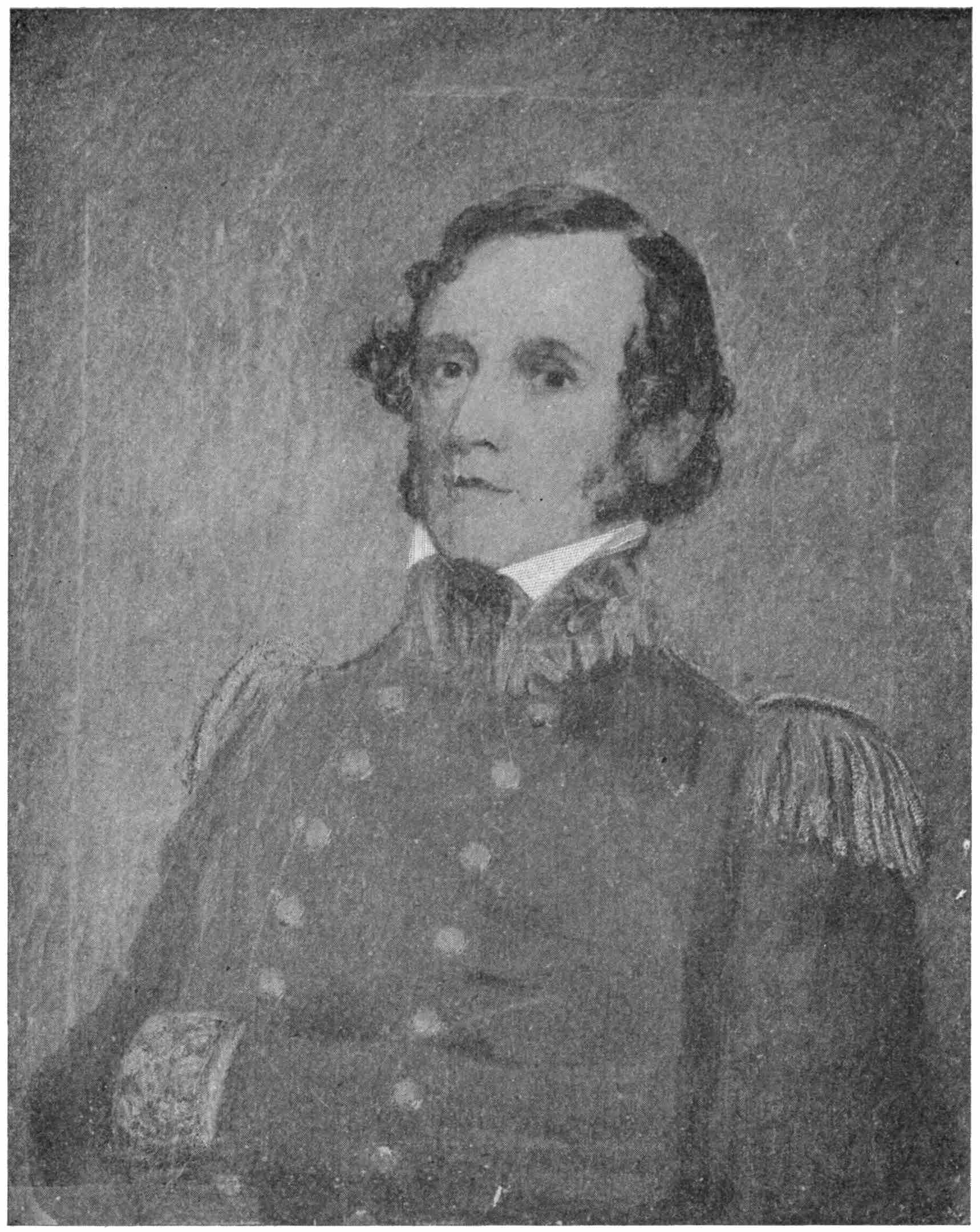
John Downes.
From an oil-painting at the Naval Academy, Annapolis.
Downes had but twenty men with which to
handle his ship, work his guns, and guard his
prisoners, but he promptly opened fire, and after
the fifth broadside the enemy surrendered. She
proved to be the British letter-of-marque Hector,
of eleven guns and twenty-five men. She
had lost in the fight her maintopmast and most
of her standing and running rigging, and two
of her crew were killed and six dangerously
wounded.
On manning the Hector with ten men Downes
had but ten left with which to guard more than
seventy prisoners, care for the wounded, and
work the ship. In this emergency he threw
overboard the guns of the Rose, destroyed most
of her cargo, and made a cartel of her to which
to send the prisoners. Then he returned to
Guayaquil Bay, from which the Rose sailed for
St. Helena.
At Guayaquil a part of the armament and
crew of the Georgiana were transferred to the
larger and swifter Atlantic, which was rechristened
Essex Junior, and the latter was ordered
to convoy a part of the fleet of prizes to Valparaiso.
It is worth telling, because of the fame he
afterward earned, that Midshipman Farragut
was placed on the Barclay as prize-master—was
made the captain of the ship. Her original captain
had agreed to act as navigator, but he was
greatly angered, for some reason, at the order
to go to Valparaiso, and when outside he backed
the maintopsail and refused to fill away and
follow the Essex Junior, declaring “that he
would shoot any man who dared to touch a
rope without his orders.” Then he went below
to get his pistols.
He afterward said he did it merely to scare
the lad, but if that were so he failed, for Farragut
called an able American seaman, and told
him to have the main-sails filled away. This
was done, and then Farragut told the obdurate
captain “not to come on deck unless he wished
to be thrown overboard,” and the captain remained
below until Farragut made a report
of the affair to Lieutenant Downes, of the Essex
Junior, and the Britisher agreed to submit
quietly to Farragut as captain. Farragut was
at this time but twelve years old. Not many
boys of twelve would be fit for such a responsible
position at that age, and fewer still have had
opportunity to show their metal.
The Greenwich was made a store-ship, and
the Essex, with her and the Georgiana as consorts,
sailed on another cruise, leaving Guayaquil
on July 9, 1813. On July 13th, when off
Banks Bay, three ships were seen. They separated
as soon as the Americans were sighted,
whereupon the Essex went in chase, leaving
the Georgiana and Greenwich behind. Seeing
this, one of the strangers came about and stood
for the Greenwich. At that the Greenwich
backed her main-yard, brought a number of
men from the Georgiana on board, and sailed
boldly to meet the stranger.
While these two were approaching each other
the Essex overhauled the vessel she was pursuing,
and found it was the British whaler Charlton
of ten guns and twenty-one men. Her
captain informed Porter that the stranger approaching
the Greenwich was the Seringapatam,
a ship of 357 tons, carrying fourteen guns
and forty men. She not only outweighed the
metal of the Greenwich, but had a larger crew,
and was the most dangerous ship in those
waters. Nevertheless Porter saw serenely the
two ships engage in battle, nor was his confidence
in his officers and men misplaced, for,
after a brief conflict, the Seringapatam hauled
down her flag. A little later, however, she
suddenly made sail and strove to escape. The
Greenwich at once opened fire on her and kept
it up until the British flag was lowered again.
It is likely, however, that the Seringapatam
would have escaped but for the rapid approach
of the Essex, for she could outsail the Greenwich.
Meantime the third ship, the New Zealander,
of eight guns and twenty-three men, was taken
by the Essex. On overhauling the papers of
the Seringapatam it appeared that, although she
had no commission either as privateer or letter
of marque, she had captured one American
whaler, trusting to have the capture legalized
by a commission she was expecting to arrive.
As his act was really one of piracy the captain
was sent to the United States for trial, but he
was not convicted.
The other prisoners were put on the Charlton
and sent under parole to Rio Janeiro. The
guns of the New Zealander were transferred
to the Seringapatam, giving her a battery of
twenty-two, though this was of no great use,
save for one broadside, for the reason that she
had only men enough to work her sails. Then
the Georgiana was loaded with a full cargo of
oil, manned with such of the crew of the Essex
as had served their full time and also wished
to go home (most of those whose time was up
re-shipped in the Essex), and on July 25th she
sailed for the United States.
The Essex with the other three headed for
Albemarle Island, and on July 28th sighted
another British whaler. It was a region and a
season of light airs and calms, but the Essex
rigged a drag that when dropped in the water
from the spritsail-yard was hauled aft by a line
running through a block on the end of an outrigger
aft, and this, although laborious, gave
the ship a speed of two knots per hour. As
the whaler got out boats to tow his ship, Porter
sent a couple of boats of musketeers to drive
them on board again. So she was headed off
and then other boats were sent to board her.
The stranger then hauled down her flag, but
before the boats could get alongside a breeze
came. At that she hoisted her colors, fired on
the Yankee boats and escaped, for the Essex
did not get the wind until too late. Porter
was greatly mortified for the reason that this
was the first ship that had escaped him.
However, on September 15th, while cruising
among the Galapagos Islands, a whaler was seen
cutting in a whale. The Essex was disguised
by sending down the small yards, and succeeded
in getting within four miles of her before she
took alarm, and then by making sail Porter
overhauled her. It was now learned that she
was the Sir Andrew Hammond, of twelve
guns and thirty-one men, and that she was the
ship that had run away on July 28th. Luckily
for the Essex she had ample stores of excellent
beef, pork, bread, wood, and water.
Returning now to Banks Bay, the appointed
rendezvous, the Essex was joined by the Essex
Junior. Lieutenant Downes brought the news
from Valparaiso that several English frigates
had been sent to hunt the Essex. At this Porter
determined to go to the Marquesas Islands,
where he could give the Essex a thorough overhauling
in safety. He had cleared those waters
of the British whalers and letters of marque,
and determined to fit his ship for a battle with
equal force before sailing for home. He reached
Nukahiva with his squadron on October 23d,
built a fort to protect the harbor, and immediately
began taking down the masts of the Essex
in order to make everything aloft—spars and
rigging—as sound as possible. In November
the New Zealander was sent home with a full
cargo of oil, but, unfortunately for the Americans,
both she and the Georgiana, sent previously,
were recaptured when almost in port
by British blockaders. They were very rich
prizes for the British tars.
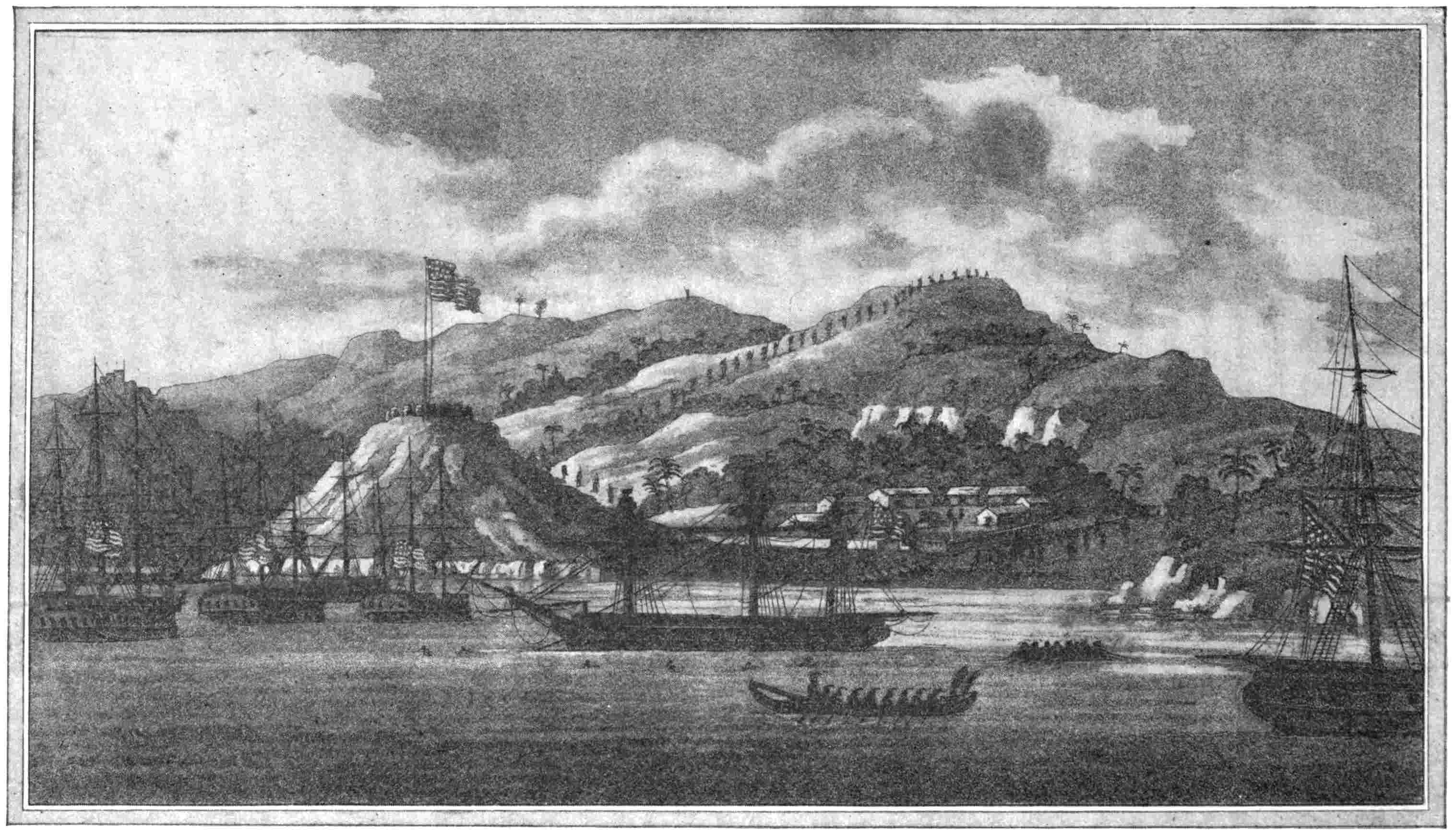
The Essex and her Prizes at Nukahiva in the Marquesas Islands.
From an engraving by Strickland of a drawing by Captain Porter.
Nukahiva lies in the tropical climate of the
South Pacific—a climate where the sea and the
air dance together under an unclouded sun;
where the wanton waves tumble and roll invitingly
on the beeches; where seemingly the
wind-driven light splashes the swaying fronds
of the cocoanut-palms; where the air of night
is soft and sweet and wooing; where nature
asks no labor in return for her bounties; where
the thoughts of the people run only to war and
love. It was to Jack the ideal country—a paradise
on earth.
There were several tribes on Nukahiva. The
sailors made friends with those living close at
hand, and subdued those, from farther away
who came to make trouble. And thereafter
they worked upon the ships by day, and at
night, by turns, frolicked with the friendly natives.
Says Farragut in his journal:
“During our stay at this island the youngsters—I
among the number—were sent on
board the vessel commanded by our chaplain
for the purpose of continuing our studies away
from temptation.”
Map of the Harbor in which the Essex and her Prizes lay.
After a drawing by Captain Porter.
The prisoners, having liberty as well as the
crews, not only went looking for temptation
but they got together and planned to get in
a lot of native canoes and carry the Essex
Junior by assault, when, the Essex being dismantled,
they hoped to capture the entire
Yankee force. A traitor revealed the plot,
however, and the prisoners were thereafter
kept well in hand.
And then came an incipient mutiny. The
sailormen had enjoyed life with their friends,
the Nukahivas, so much that when, in December,
Porter determined to go in search of an
enemy worthy of the ship, they first grumbled,
and then some of them, under the lead of an
Englishman named Robert White, talked of
refusing to go at all.
This talk reached flood-tide when on Sunday,
December 9, 1813, a lot of the men from the
Essex visited the Essex Junior, when White
openly boasted that the crew would refuse to
get the anchor at the word from Captain Porter.
But White was very much mistaken. His
words were reported to Porter, who, next morning,
mustered the men on the port side of the
deck and then, with a drawn sword lying across
the capstan before him, said:
“All of you who are in favor of weighing
the anchor when I give the order, pass over to
the starboard side.”
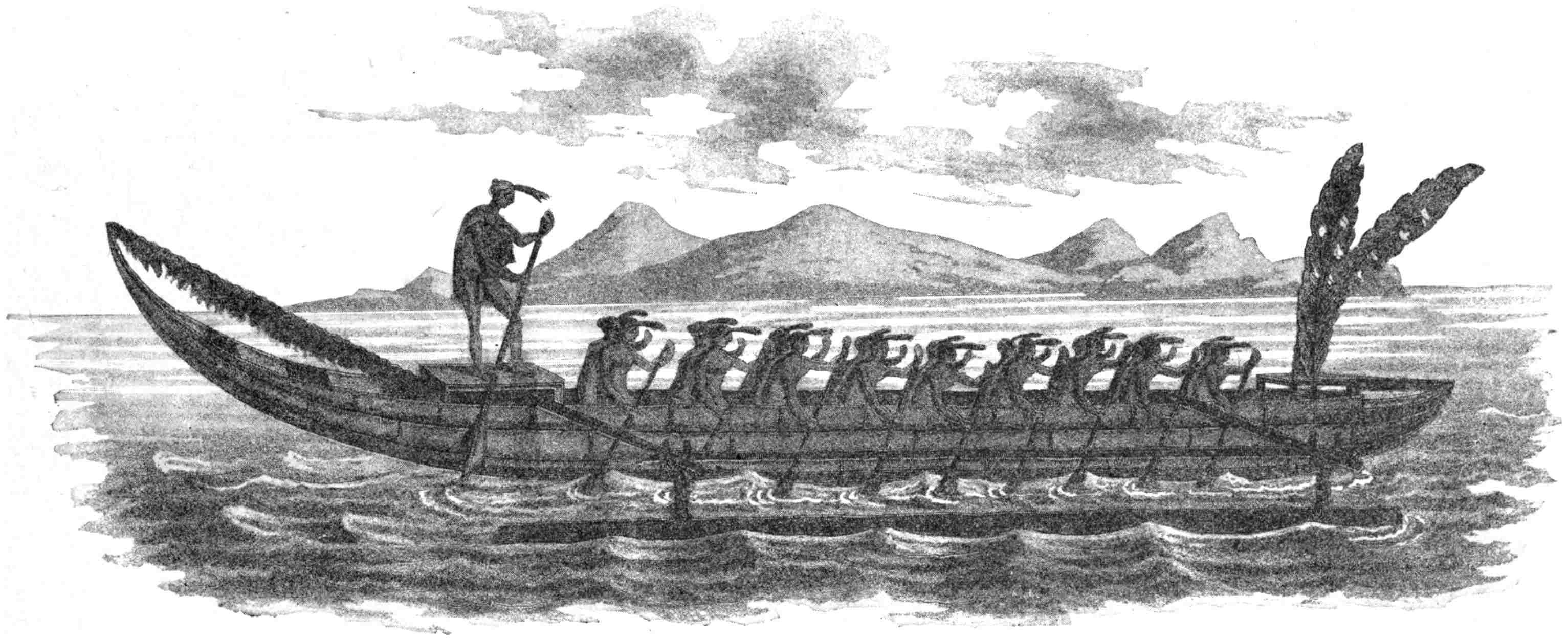
A Marquesan War-canoe.
From an engraving by Strickland of a drawing by Captain Porter.
They all passed across the deck promptly.
Then he called out White, and asked him about
his Sunday boasting. White denied having
made the boast, but a number of the crew testified
to what he had said, and at that Porter
turned on the fellow and said in a burst of anger:
“Run, you scoundrel, for your life.”
“And away the fellow went over the starboard
gangway.” So Farragut tells the story.
He was picked up by one of the ever-present
native canoes and carried ashore.
After all it was a lucky affair for him, for the
cruise of the Essex was drawing to a close, and
had he remained in her he would have been
hanged, very likely, by his countrymen as a
traitor.
Having addressed the men briefly, praising
their good qualities and telling them he “would
blow them all to eternity before they should
succeed in a conspiracy,” he ordered them to
man the capstan, a fiddler began to play “The
Girl I Left Behind Me,” the “anchor fairly
flew to the bows,” the sails were spread, and
the Essex and Essex Junior sailed away, leaving
Lieutenant John Gamble with twenty-one
men, to look after the Seringapatam, the Sir
Andrew Hammond, and the Greenwich until
Porter could return for them.
CHAPTER II PORTER’S GALLANT ACTION AT VALPARAISO
A GENEROUS RECEPTION FOR A PREDATORY BRITISH FRIGATE—HILLYAR’S
LUCKY ESCAPE—HILLYAR’S EXPLICIT ORDERS—WHEN
THE ESSEX HAD LOST HER TOP-MAST THE PHŒBE AND
THE CHERUB ATTACKED THE YANKEE IN NEUTRAL WATER—IT
WAS A TWO-TO-ONE FIGHT AND THE ENEMY HAD LONG GUNS
TO OUR SHORT—THE BRITISH HAD TO GET BEYOND THE RANGE
OF THE ESSEX—MAGNIFICENT BRAVERY OF THE YANKEE CREW
WHEN UNDER THE FIRE OF THE LONG RANGE BRITISH GUNS—THE
ESSEX ON FIRE—FOUGHT TO THE LAST GASP—PORTER’S
INTERRUPTED VOYAGE HOME—THE MEN WHO WERE LEFT
AT NUKAHIVA IN SORRY STRAITS AT LAST.
TheEssex, with her consort, the Essex Junior,
got up anchor at Nukahiva on December
12, 1813. For two days they were in the offing
and then they sailed for the coast of South
America. They sighted the Andes early in
January, and after getting water at San Maria
and calling at Concepcion, went to Valparaiso,
where they arrived on February 3, 1814. There
Porter learned that the British frigate Phœbe,
Captain James Hillyar, had been on the coast
some time looking for the Essex. So Porter
determined to await her at Valparaiso.
To make the time pass pleasantly a grand
reception was given to the officials of the city
and their friends on the night of the 7th, the
Essex Junior, meantime, having been stationed
outside to watch for the enemy. As it happened
the enemy was seen next morning while
yet the men of the Essex were taking down
the bunting with which the ship had been decorated.
But when Captain Porter came to
read the signals on the guard-ship he found
that two ships were in sight instead of the one
looked for. After a time the two appeared and
displayed British colors, and the Essex Junior
was obliged to come into the port. And what
made matters still more uncomfortable was the
fact that half of the crew of the Essex were
on shore enjoying life sailor fashion.
This last fact had not escaped the eye of the
patriotic mate of an English merchantman lying
in the harbor, and jumping into a small boat
he rowed outside to tell his countrymen about
the crew of the Essex. As it appeared very
soon after this, the two British ships outside
were the Phœbe already mentioned and the
eighteen-gun war-ship Cherub, Captain Tucker.
Captain Hillyar, of the Phœbe, very naturally
assumed that the Yankee sailors on shore were
already so full of the excellent native wine of
the country that even if got on board they
would not be able to make a fight. The wind
was in just the right direction to enable him to
take his two ships into port and handle them
there with certainty. It was true that Valparaiso
was a neutral port, but that fact was considered
unimportant. Captain Hillyar had been
sent there expressly to capture the Essex, and
the opportunity to do it comfortably seemed to
have been made as if to order. So he cleared
his ship for action, and, leaving the Cherub outside,
steered boldly for the Essex.
But when the Phœbe swept up beside the
Yankee ship Captain Hillyar experienced a
very great revulsion of feeling. He had approached
the Essex under the quarter, where
not one of her guns could bear on him, and
then slightly shifting his helm he ranged up
alongside and within fifteen feet of her. And
then to his utter discomfiture he found the
Yankee guns fully manned, and every man save
one was fit and eager for fight.
The warlike ardor of the Englishman instantly
evaporated, and he remembered that he
had met Captain Porter some years before on
the Mediterranean station, and that they had
exchanged friendly visits. Instead of ordering
his men to fire he jumped on a gun, where he
could get a better view of the deck of the Essex,
and said, with marked politeness:
“Captain Hillyar’s compliments to Captain
Porter, and hopes he is well.”
And Captain Porter, who had never felt better
in his life than at that moment, replied:
“Very well, I thank you; but I hope you
will not come too near for fear some accident
might take place which would be disagreeable
to you.” And with that he waved his trumpet
toward some of the crew forward who, with
ropes in hand, were awaiting the signal, and
they instantly triced a couple of kedge anchors
out to the weather yard-arms ready for dropping
on the enemy to grapple him fast in reach
of the well-trained Yankee boarders, armed
with sharpened cutlasses and dirks made from
old files.
Indeed the Yankee forecastlemen were so
eager that they swarmed to the rail as the anchors
rose to the yard-arms, while one of them,
a quarter-gunner named Adam Roach, with his
sleeves rolled up and cutlass in hand, climbed
out on the cathead and stood there, in plain
view of the British marines, awaiting the moment
when the ships should come together.
But they did not come together, yard-arm
to yard-arm, either then or afterward. Captain
Hillyar hastily braced his yards aback and
“exclaimed with great agitation:”
“I had no intention of getting on board of
you—I had no intention of coming so near
you; I am sorry I came so near you.”
“Well,” said Porter, “you have no business
where you are. If you touch a rope yarn of
this ship, I shall board instantly.” Then he
hailed the Essex Junior, that was lying handy
by, and ordered Lieutenant Downes to prepare
to repel the enemy.
The Phœbe fell off with her jib-boom over the
American deck, her bows exposed to the broadside
of the American guns, and her stern exposed
to the broadside of the Essex Junior.
At that moment the one member of the crew
who had come on board the Essex drunk, narrowly
escaped precipitating the battle. He was
a big boy and served as powder-monkey. While
standing beside his gun with a slow-burning
match in hand waiting for orders, “he saw,
through the port, someone on the Phœbe grinning
at him.” He was deeply offended at
once.
“My fine fellow, I’ll stop your making faces,”
he said, and leaned over to put his match to the
gun’s priming. The lieutenant in charge saw
the move and knocked the youth to the deck.
Had he fired the gun a fight would have followed
and the Phœbe would have been taken.
As it was she passed free, although some of her
yards overlapped those of the Essex, and a little
later she came to anchor half a mile away.
“We thus lost an opportunity of taking her,
though we had observed the strict neutrality of
the port under very aggravating circumstances.”
So wrote Farragut, but no American at this day
regrets the action of Captain Porter. It was,
indeed, “over-forbearance, under great provocation,”
but it showed the high sense of honor of
a typical American officer, and every American
reads the story of the Essex with unalloyed
pleasure. Such exhibitions as this of the
American spirit have done more than cannon-shot
to promote and to preserve peace between
the nations. Captain Hillyar was so much impressed
by it that he promised Porter that he,
too, would respect the neutrality of the port,
and he would have done so, very likely, only
that he was handicapped by his orders from the
Admiralty, which compelled him to “capture
the Essex with the least possible risk to his vessel
and crew.” Hillyar was a cool and calculating
man of fifty years. As he said to his first
lieutenant, Mr. William Ingram, he had gained
his reputation in single-ship encounters and he
only expected to “retain it by an explicit obedience
to orders.”
That he was going to take “the least possible
risk” appeared a few days later when Porter
asked him to send the Cherub to the lee
side of the harbor and meet the Essex with the
Phœbe alone. The Phœbe and the Cherub had
by that time replenished their stores and taken
a station outside. Hillyar at first agreed to do
so, and made preparations for the fight. Among
other things he had a huge flag painted with a
motto in answer to Porter’s burgee containing
“Free Trade and Sailor’s Rights.” The British
motto read: “God and Country; British
Sailors’ Best Rights; Traitors Offend Both.”
It was a day when such displays were fashionable
among sailors, and Porter at once painted
another which he hoisted to the mizzen, where
it read: “God, our Country and Liberty; Tyrants
Offend them.”
Such things seem rather silly now, but they
were inspiring to Jack in those days. With his
banners flaunting before the Yankee eyes Captain
Hillyar hove his main-yard aback off the
weather-side of the harbor, having previously
sent the Cherub a fair distance to leeward.
Then he fired a gun to invite the Essex out.
Captain Porter accepted the invitation and
stood out of the harbor. He found he could
outsail the Phœbe, and he got near enough to
fire several shots from his long twelves that almost
reached her, but she squared away for the
Cherub, and Porter had to let her go.
Meantime Porter “had received certain information”
that the frigate Tagus and two
others were coming after him, while the sloop-of-war
Raccoon, that had gone to the northwest
coast of North America to destroy the fur-gathering
establishment of John Jacob Astor,
was to be expected at Valparaiso at any time.
So Porter determined to sail out of the harbor,
trusting to the speed of the Essex to carry him
clear of the superior force. Should he succeed
in drawing the enemy clear of the harbor the
Essex Junior was at once to make sail also.
But the day after arriving at this determination
a heavy squall came on from the south, the
port cable of the Essex broke, and she began
dragging the starboard one right out to sea.
Without delay Porter made sail, setting his top-gallant
sails over reefed top-sails, and stood out
of the harbor. As he opened up the sea he saw
that he had a chance for sailing between the
southwest point of the harbor and the enemy—passing
to windward of them, in fact, and so
getting clear without trouble. The top-gallant
sails were at once clewed up and the yards
braced to sail close hauled. The Essex was
making a course that was just what Porter
wanted, and he was just clearing the point when
a sudden squall from around the corner of the
land struck the ship, knocking the maintopmast
over the lee rail into the sea, and the men who
were still aloft furling the top-gallant sail were
lost.
At once both of the enemy’s ships gave chase,
and Porter, after clearing the wreckage, turned
to beat back to his old anchorage. But because
he was crippled, and because of a sudden shift
of wind, he could not make it, and so he “ran
close into a small bay about three-quarters of
a mile to leeward of the battery on the east
side of the harbor,” and there let go his anchor
“within pistol-shot of the shore.”
Here he was as much in neutral waters as he
would have been at the usual anchorage, but the
enemy, with mottoes and banners in abundance
flying, came down to attack the cripple. The
Cherub came cautiously to the wind off the
bow of the Essex, the Phœbe, with equal caution,
off her stern, and at 3.54 P.M., on March
28, 1814, in the presence of the whole population
of Valparaiso, who thronged to the bluffs,
the battle, that was to end the career of the
Essex as an American frigate, began. To fully
appreciate the fight that followed, the reader
should recall the fact that in spite of the protests
of Captain Porter the Essex had been
compelled to sail with a battery of forty short
thirty-twos in place of the long twelves that
he wanted. In addition to these she carried
six long twelves, three of which, when this
fight began, were arranged to fight at the bow
and three at the stern. Her crew numbered
two hundred and fifty-five when she dragged
her anchor, but of these at least four were lost
from the top-gallant yard. The exact number
is not given.
On the other hand the Phœbe, under the circumstances,
was alone in weight of metal superior
to the Essex. On her main deck were thirty
long eighteens, to which were added sixteen
short thirty-twos, one howitzer, and in the tops
six three-pounders. In all she carried fifty-three
guns. She carried more guns than ships of her
class usually did, because she had been fitted
out especially to catch the Essex with as little
risk as possible. Her crew numbered three
hundred and twenty, the usual number having
been added to, when she was taking in supplies,
by gathering sailors from the British ships in
port. The Cherub mounted eighteen short
thirty-twos, eight short twenty-fours, and two
long nines. Her crew, with the additions received
in port, numbered one hundred and
eighty men.
But this was a battle fought at long range.
Captain Hillyar obeyed his instructions to take
as little risk as possible, and he held his ships
beyond the range of Porter’s short thirty-twos.
It was therefore a fight in which five hundred
men were pitted against two hundred and fifty-one,
and the fifteen long guns in the broadside
of the Phœbe and both of the long guns of the
Cherub—in short, seventeen long guns, throwing
two hundred and eighty-eight pounds of
metal, were pitted against six long guns, throwing
by actual weight only sixty-six pounds of
metal. That was the actual preponderance
when the battle began, but even that did not
satisfy the ideas of the British captains in their
desire to obey their orders to take as little risk
as possible, for the Cherub, finding her position
off the bow of the Essex too hot, wore around
and took a station near the Phœbe, where Porter
could bring only three guns, throwing together
but thirty-three pounds of metal, to bear on the
two of them with their seventeen long guns
throwing two hundred and eighty-eight pounds
of metal. Rarely in the history of the world
has a fight been maintained against such odds
as these. The Englishmen did, indeed, draw
in closer at one time of the battle, but it was for
only a brief time. The short guns of the Essex
soon made them withdraw to a safer distance.
When the first gun was fired at 3.54 P.M.,
Porter had not yet been able to get a spring on
his cable and could not bring a gun to bear on
either ship. For five minutes the Essex lay as
an idle target. But as the spring was made fast
and the cable veered, the long twelves began to
bark and it was then that the Cherub made haste
to get clear of the fire from forward, and take
a place near the Phœbe. They both delivered
a raking fire which “continued about ten minutes,
but produced no visible effect,” to quote
Hillyar’s report to Commodore Brown of the
Jamaica station. But if the British fire produced
no “visible effect,” the fire of the guns
of the Essex was so well directed that Hillyar
“increased our distance by wearing,” and he
confesses that “appearances were a little inauspicious.”
In fact, at the end of half an hour
both the British ships sailed out of range to repair
damages alow and aloft. The Phœbe alone
had seven holes at the water-line to plug and
she had lost the use of her mainsail and jib, her
fore, main, and mizzen stays were shot away, and
her jib-boom was badly wounded. This much
the British admit.
But it had been a losing fight on the Essex,
nevertheless. The springs on the cable were
shot away three times and could be renewed
only after delays that prevented working the
guns under full speed, and the heavy shot of
the enemy’s long guns had been cutting down
the crew. And then the enemy returned once
more to the fight. Brave Lieutenant William
Ingram, of the Phœbe, wanted to close in and
carry the Essex by boarding. The two British
ships had at this time more than two men to
the one of the Essex, but Hillyar refused,
quoting the orders he had received from his
superiors as a reason, and saying he had “determined
not to leave anything to chance.”
He would not face Yankee cutlasses wielded
in defence of the Essex. So the safest possible
positions were chosen, and fire was again
opened at 5.35 P.M. It was “a most galling
fire, which we were powerless to return.” Even
the Essex’s “stern guns could not be brought
to bear.”
At this juncture, the wind having shifted,
Captain Porter ordered his crew to slip the
cable and make sail; and it was then found
that the running gear had been so badly cut
that only the flying jib could be spread.
Did the courage and hope of the brave
American falter at this? Not at all. Spreading
that one little triangle of canvas by halyard
and sheet to the wind, he loosed the
square sails, and with their unrestrained and
ragged breadths flapping from the yards, the
Essex wore around, and while the shot of the
enemy filled the air above her deck with splinters,
she bore down upon them until her short
guns began to reach them, and the Cherub was
driven out of range altogether, while Hillyar
made haste to obey his orders about taking as
little risk as possible—made haste to spread
his canvas and sail away to a point where he
would be clear of the deadly aim of the Yankee
gunners. The Phœbe “was enabled by
the better condition of her sails to choose her
own distance, suitable for her long guns, and
kept up a most destructive fire on our helpless
ship.” So says Farragut.
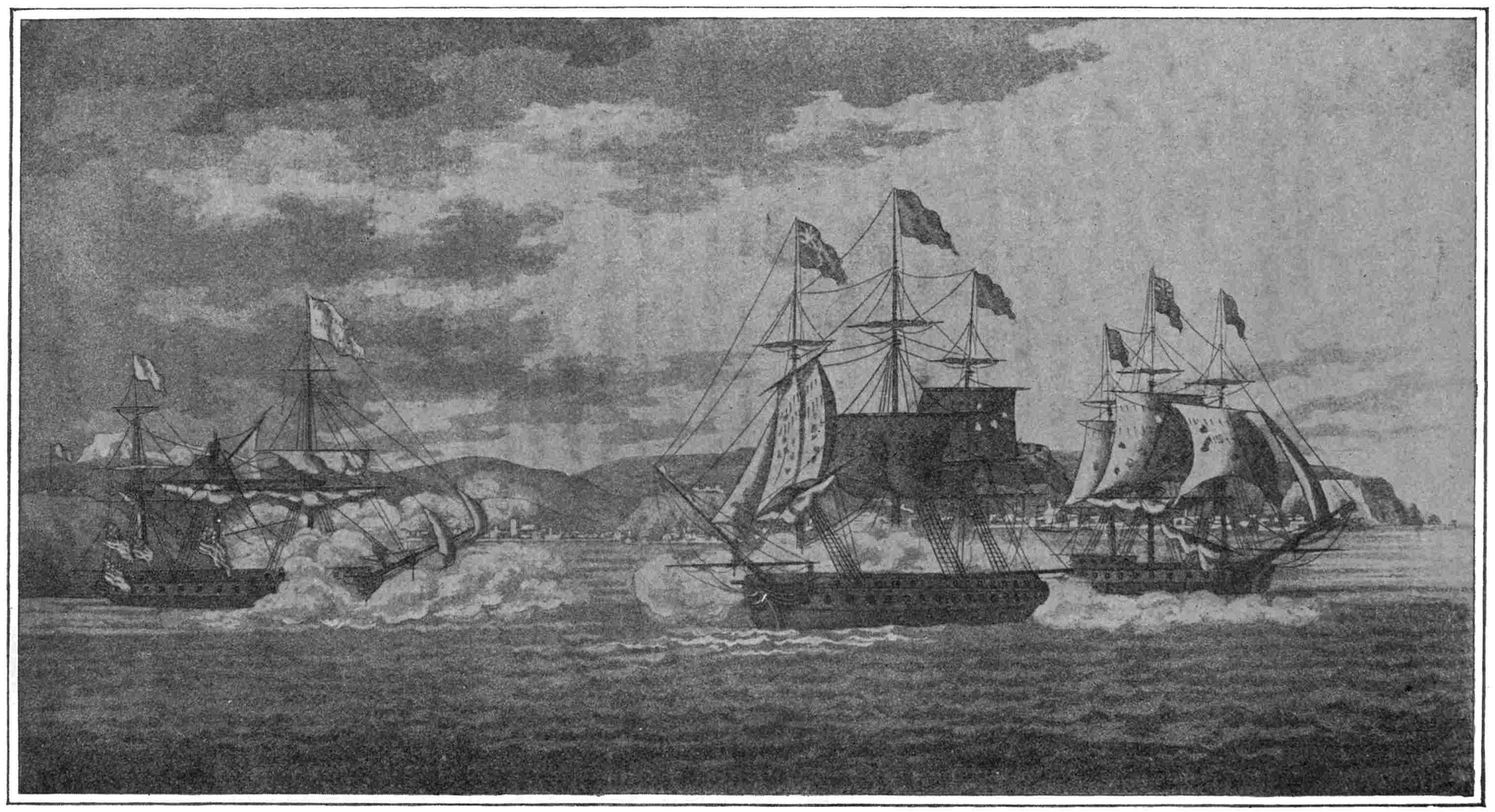
Fight of the Essex with the Phœbe and Cherub.
From an engraving by Strickland of a drawing by Captain Porter.
But fearful as was the scene on the doomed
Essex, the story of the deeds of her heroic
crew stir the blood as few other stories of
battle can do. “Dying men who had hardly
ever attracted notice among the ship’s company,
uttered sentiments worthy of a Washington.
You might have heard in all directions:
‘Don’t give her up, Logan’—a sobriquet for
Porter—‘Hurrah for Liberty!’ and similar
expressions.”
A man named Bissley, a young Scotchman
by birth, on losing a leg, said: “I hope I
have this day proved myself worthy of the
country of my adoption. I am no longer of
any use to you or to her, so good-by!” And
with that he plunged through a port. And
John Ripley, who had suffered in like fashion,
also went overboard deliberately. John Alvinson,
having been struck by an eighteen-pound
shot, cried: “Never mind, shipmates; I die
in defence of free trade and sailors’ ri——”
and so his spirit fled while the last word
quivered on his lips. William Call lost his
leg and was carried down to the berth-deck.
As he lay there weltering in his blood awaiting
his turn with the doctor, he saw Quarter-Gunner
Roach—he who had so bravely headed
the boarders—skulking, and “dragged his shattered
stump all around the bag-house, pistol
in hand, trying to get a shot at him.”
And there was Lieutenant J. G. Cowell.
He had his leg shot off just above the knee
and was carried below. The surgeon on seeing
him at once left a common sailor to attend to
him, but Cowell said:
“No, doctor, none of that; fair play is a
jewel. One man’s life is as dear as another’s;
I would not cheat any poor fellow out of his
turn.” And so he bled to death before his turn
came.
In the record kept by young Farragut we
have a wonderful story of a battle as seen by a
lad of twelve. “I performed the duties of captain’s
aid, quarter-gunner, powder-boy, and in
fact did everything that was required of me,”
he wrote.
“I shall never forget the horrid impression
made upon me at the sight of the first man I
had ever seen killed. He was a boatswain’s
mate, and was fearfully mutilated. It staggered
and sickened me at first, but they soon began
to fall around me so fast that it all appeared
like a dream, and produced no effect on my
nerves. I can remember well, while I was
standing near the captain, just abaft the mainmast,
a shot came through the waterways and
glanced upwards, killing four men who were
standing by the side of the gun, taking the last
one in the head and scattering his brains over
both of us. But this awful sight did not affect
me half as much as the death of the first poor
fellow. I neither thought of nor noticed anything
but the working of the guns.
“On one occasion Midshipman Isaacs came
up to the captain and reported that a quarter-gunner
named Roach had deserted his post.
The only reply of the captain, addressed to me,
was, ‘Do your duty, sir.’ I seized a pistol and
went in pursuit of the fellow, but did not find
him.
“Soon after this, some gun-primers were
wanted, and I was sent after them. In going
below, while I was on the ward-room ladder,
the captain of the gun directly opposite the
hatchway was struck full in the face by an
eighteen-pound shot, and fell back on me. We
tumbled down the hatch together. I struck on
my head, and, fortunately, he fell on my hips.
I say fortunately, for, as he was a man of at
least two hundred pounds’ weight, I would have
been crushed to death if he had fallen directly
across my body. I lay for some moments
stunned by the blow, but soon recovered consciousness
enough to rush up on deck. The
captain, seeing me covered with blood, asked if
I was wounded, to which I replied, ‘I believe
not, sir.’ ‘Then,’ said he, ‘where are the primers?’
This first brought me completely to
my senses, and I ran below again and carried
the primers on deck. When I came up the
second time I saw the captain fall, and in my
turn ran up and asked if he was wounded. He
answered me almost in the same words, ‘I believe
not, my son; but I felt a blow on the top
of my head.’ He must have been knocked
down by the windage of a passing shot, as his
hat was somewhat damaged.”
With such scenes as these on deck Porter
strove to overtake the enemy. The picture of
that American ship, with her unsheeted sails
flapping in the wind as she struggled to get
within range, is among the most heroic known
to history. It was a vain struggle. The wind
veered once more. The shot from the long
guns of the enemy were ripping her hull to
pieces, and, in the language of the British first
lieutenant, murdering her crew. The brave
American commander was baffled but was not
yet conquered. Putting up his helm he turned
once more toward the shore, determined to
beach the ship, broadside on, fight to the last
gasp, and then blow her to pieces.
Firing from his stern guns as he ran, he
reached out for the sands until they were but
half a mile away, and then once more the
treacherous wind shifted, and catching the sails
aback, wrapped their torn folds as a shroud
about the masts. A hawser was bent to the
sheet-anchor, which was then let go. That
brought her head around where the long guns
would bear, but the hawser broke a minute
later, and once more the Essex drifted offshore
a helpless target.
And then came an explosion below. The
ship was on fire, and the men came rushing up
on deck, “many with their clothes burning.”
The men on deck hastened to rip the burning
garments from their shipmates, but some whose
clothes were flaming were ordered to “jump
overboard and quench the flames.” Smoke
was rolling up the hatches, and “many of the
crew, and even some of the officers, hearing the
order to jump overboard, took it for granted
that the fire had reached the magazine, and
that the ship was about to blow up; so they
leaped into the water, and attempted to reach
the shore.”
Hope had at last fled from the doomed ship.
The decks were strewn with the dead and
wounded. There were twenty-one bodies in
one pile on the main deck. The long-range
shot of the enemy were sinking her. The hold
was in flames. The captain called for his lieutenants
to ask their opinion of the condition
of affairs, and found but one, Lieutenant McKnight,
to answer the call. Of the two hundred
and fifty-one men who began the fight
only seventy-five, including officers and boys,
remained on the ship in condition fit for duty.
Further effort was useless, “and at 6.20 P.M.
the painful order was given to haul down the
colors.”
At that, Benjamin Hazen, a Groton seaman
(who, though painfully wounded, had remained
at his post, and at the last had joined in the request
to haul down the flag to save the wounded),
bade adieu in hearty fashion to those around
him, said he had determined never to survive the
surrender of the Essex, and jumped overboard.
He was drowned.
In what has been said regarding the handling
of the Phœbe there was no desire to cast
a slur upon the personal character of Captain
Hillyar. He had proved his bravery in
previous contests. The point to be made
clear is that his superiors had so far learned
to respect Yankee prowess that he was under
definite order to take no unnecessary risks. He
conducted the fight in the only way that insured
certain victory. Every fair-minded American
will grant what Sir Howard Douglas, in
his text-book on gunnery (page 108), claims—that
“this action displayed all that can reflect
honor on the science and admirable conduct
of Captain Hillyar and his crew,” save only so
far as he broke his word of honor pledged to
Captain Porter. And that is to say that it is
admitted that a sneer at the “respectful distance
the Phœbe kept” is “a fair acknowledgment of
the ability with which Captain Hillyar availed
himself of the superiority of his arms.”
The losses of the Essex were fifty-eight
killed and mortally wounded, thirty-nine severely
wounded, twenty-seven slightly wounded, and
thirty-one missing, the most of whom, if not all,
were drowned in trying to swim ashore when
the Essex was on fire. These numbers were
given by the American officers. Hillyar reported
that the Essex lost one hundred and
eleven in killed or wounded. The difference
in these official reports is unquestionably due
to the fact that Hillyar, naturally enough, did
not count as wounded those of his prisoners
who had received minor scratches and contusions,
even though these wounds had temporarily
disabled the men during the battle. Nevertheless,
the favorite British historian James,
although he had read Hillyar’s letter, wrote:
“The Essex, as far as is borne out by proof
(the only safe way where an American is concerned),
had twenty-four men killed and forty-five
wounded. But Captain Porter, thinking
by exaggerating his loss to prop up his fame,
talks of fifty-eight killed and mortally wounded,
thirty-nine severely, twenty-seven slightly.”
And Allen, whose latest edition appeared in
1890, follows the false statement of James.
The British loss was, of course, trifling. They
had five killed and ten wounded. But it is not
unconsoling to reflect that the Phœbe received
in all eight shot at and under the water-line,
and that she and the Cherub were not a little
cut up aloft—in short the damage inflicted by
the Essex was greater than the British Java,
Macedonian, and Guerrière all together inflicted
on the American ships in their battles. Captain
Hillyar had good reason for writing to his
superior that “the defence of the Essex, taking
into consideration our superiority of force and
the very discouraging circumstance of her having
lost her maintopmast and being twice on
fire, did honor to her brave defenders.”
As Roosevelt says, “Porter certainly did
everything a man can do to contend successfully
with the overwhelming force opposed to
him. As an exhibition of dogged
courage it has never been surpassed since the
time when the Dutch Captain Kaesoon, after
fighting two long days, blew up his disabled
ship, devoting himself and all his crew to death,
rather than surrender to the hereditary foes of
his race.”
While no one can justly criticise Captain
Hillyar for his handling of his ship during the
battle, there is something to be said about his
having made an attack on the American ship
under the circumstances. And this cannot be
better said than in the words of Roosevelt,
whose fairness has been acknowledged by the
English in the most emphatic manner. He says:
“When Porter decided to anchor near shore,
in neutral water, he could not anticipate Hillyar’s
deliberate and treacherous breach of faith.
I do not allude to the mere disregard of neutrality.
Whatever international moralists may
say, such disregard is a mere question of expediency.
If the benefits to be gained by attacking
a hostile ship in neutral waters are such
as to counterbalance the risk of incurring the
enmity of the neutral power, why then the attack
ought to be made. Had Hillyar, when he
first made his appearance off Valparaiso, sailed
in with his two ships, the men at quarters and
guns out, and at once attacked Porter, considering
the destruction of the Essex as outweighing
the insult to Chili, why his behavior would
have been perfectly justifiable. In fact, this is
unquestionably what he intended to do; but he
suddenly found himself in such a position that,
in the event of hostilities, his ship would be the
captured one, and he owed his escape purely
to Porter’s over-forbearance, under great provocation.
Then he gave his word to Porter
that he would not infringe on the neutrality;
and he never dared to break it, until he saw
Porter was disabled and almost helpless! This
may seem strong language to use about a
British officer, but it is justly strong. Exactly
as any outsider must consider Warrington’s attack
on the British brig Nautilus in 1815 as
a piece of needless cruelty, so any outsider must
consider Hillyar as having most treacherously
broken faith with Porter.”
Fair as this statement must seem to candid
minds, there is yet a word to be said for Captain
Hillyar. A fair interpretation of his
orders demanded that he break his faith and
attack the ship, and as an officer accustomed
to obey all orders from his superiors, he believed
his obligation to the Admiralty and his
country was greater than his obligation to
keep his word. Captain Hillyar believed that
his country demanded that he break faith with
Porter, and the proof that the British nation
has ever since approved of his treachery toward
an American is found in the fact that “the
naval medal is granted for the capture” of the
Essex (see Allen); that the officer who sailed
her to England was at once promoted, and
that every British writer who has referred to
the action has praised Captain Hillyar in the
highest terms, and refers to Captain Porter as
James did when he said: “Few, even in his
own country, will venture to speak well of
Captain David Porter.”
After the battle the Essex was repaired and
sent to England, where she was added to the
British Navy. It is worth noting that she was
built in 1779 by the people of Salem, Massachusetts,
and the surrounding country, who
were enthusiastic in their desire to revenge the
injuries done by French cruisers to American
commerce. She was the product of the Federalist
party ardor, and Rear-Admiral George
Preble says, “the Federalists considered it a
patriotic duty to cut down the finest sticks of
their wood lots to help build the ‘noble structure’
that was to chastise French insolence and
piracy.” They gave her as a present to the
nation, and as armed at that time she was
probably the most efficient ship of her size
afloat.
The Essex Junior was disarmed and the
American prisoners were put into her, and she
was sent as a cartel to New York. Off the
east coast of Long Island, on July 5, 1814,
she was detained by British cruisers so long
that the Americans were lawfully released
from their parole, when Porter and a boat’s
crew escaped ashore aided by a fog, and that
was the only occasion during that cruise of
this Yankee captain, that weather did aid him.
He landed in Long Island, where he had to
show his commission before the people would
believe his story. He was then carried to
New York by enthusiastic admirers, and was
there received with every mark of honor.
Meantime, the Essex Junior was allowed to
come in also.
A few words will tell the fate of Lieutenant
Gamble and the men left at Nukahiva with
the captured whalers Seringapatam, Greenwich,
and Sir Andrew Hammond. Immediately
after Porter sailed away the natives
began to rob the Americans of everything
they could carry away, and Gamble had “to
land and overpower them.” On February 28,
1814, one man was drowned accidentally. A
week later four men deserted in a whale-boat
to join their native sweethearts. On April
12th Gamble rigged the Seringapatam and
the Hammond for sea, intending to burn the
Greenwich, but the men became mutinous.
So Gamble removed all the arms, as he supposed,
to the Greenwich; but when he boarded
the Seringapatam on May 7th, the men there
attacked him, shot him in the foot with a pistol,
set him adrift in a native canoe, and then
sailed away with the Seringapatam, leaving
Gamble with but eight men.
Two days later the natives came off to
assault the ship. They were repulsed, but
Midshipman William W. Feltus was killed,
and three men wounded. The fight occurred
on the Hammond. The following night the
survivors went to sea. They eventually
reached the Sandwich Islands, where they
were captured by the Cherub, and were detained
on her seven months. They finally
reached New York in August, 1815.
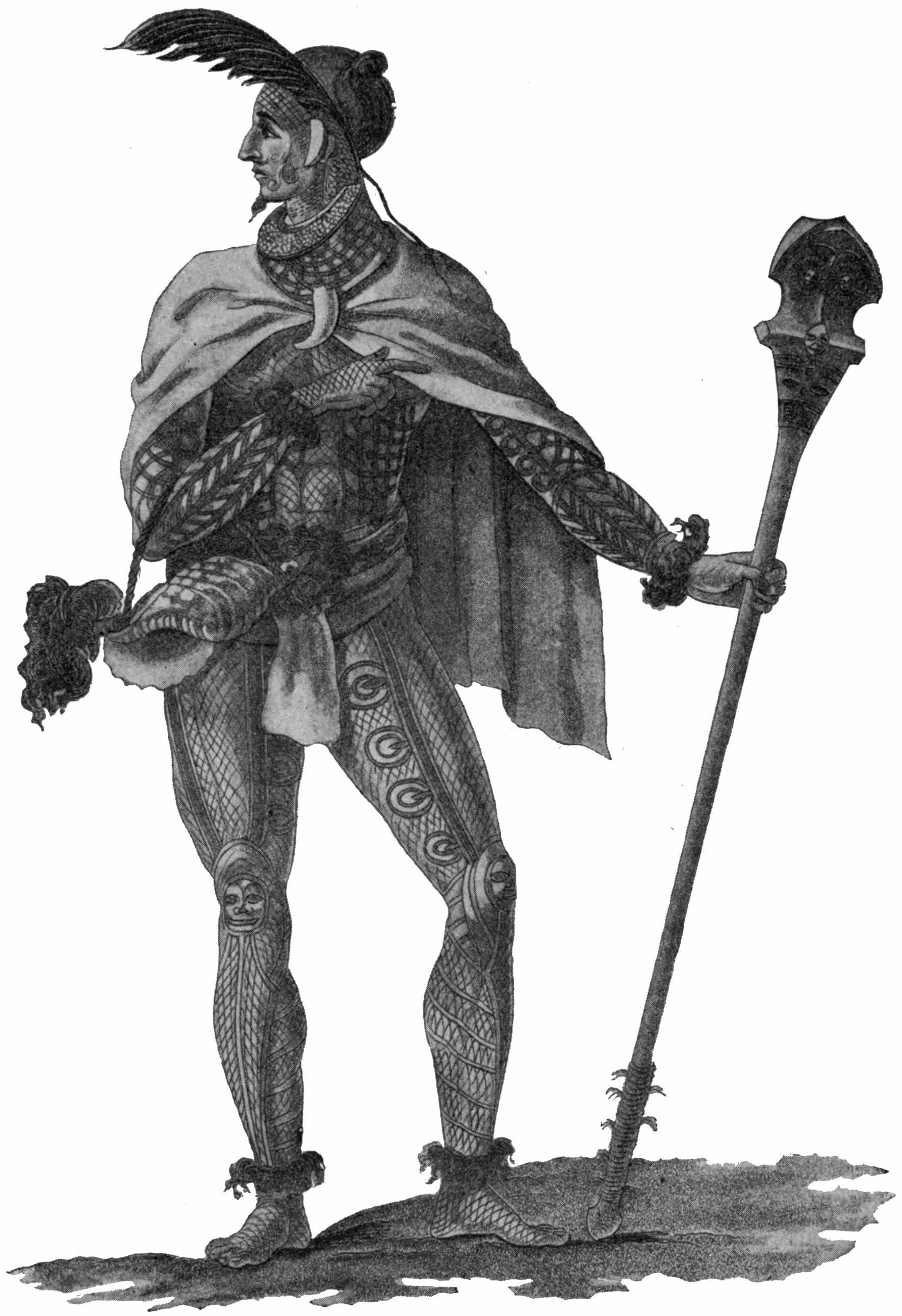
A Marquesan “Chief Warrior.”
From an engraving by Strickland of a drawing by Captain Porter.
The voyage of the Essex ended in disasters
all around, due solely to the misfortune of losing
a top-mast in a squall off the Point of Angels at
Valparaiso. But she had captured twelve British
ships, aggregating 3,369 tons, armed with
one hundred and seven guns and carrying three
hundred and two men. She had maintained herself
for more than a year entirely from supplies
captured from the enemy—she did not cost the
national treasury a cent after her first outfit. A
great fleet of British ships were sent at large expense
to search for her. On the whole her cruise
damaged the enemy millions of dollars—Porter
estimated the damage at $6,000,000—and her
crew, from master to boy, had “afforded an
example of courage in adversity that it would
be difficult to match elsewhere.”
Porter was, indeed, defeated, but the victory
of the enemy was like those obtained at Bunker
Hill and on Lake Champlain during the
war of the Revolution. It was a British victory
but it strengthened the power of the
young republic, and gave renown to the defeated
leaders.
When Grecian bands lent Persia’s legions aid,
On Asia’s shores their banners wide displayed,
Though heaven denied success—their leader’s name
Has still ranked foremost in the rolls of fame;
Hence the Retreat, the theme of every tongue,
Through every age and clime incessant rung;
With Zenophon the bard adorned his lays,
And gave the mighty chief immortal praise.
With him the historian grac’d his proudest page,
And bade his glories live through every age:
Thus thine, O Porter, shall, in lays sublime
Of future poets, live through endless time;
Thy noble daring, though with adverse fate,
The rich historic page shall long relate,
And the glad voice of freemen’s loud acclaim
Teach lisping infancy thy honored name.
Captain Porter aided in the defence of Baltimore
after his return home. After the war he
served as a commissioner on naval affairs, and
in 1826 resigned his commission. He was
afterward American Minister to Turkey, and
died at Constantinople in 1843. His body was
brought to America and was eventually buried
in Woodlawn Cemetery, Philadelphia.
CHAPTER III TALES OF THE YANKEE CORVETTES
A LITTLE LOP-SIDED FRIGATE REBUILT INTO A SUPERIOR SLOOP-OF-WAR—OVERLAND
(ALMOST) TO ESCAPE THE BLOCKADE—HER
LUCK AS A CRUISER—A MARVELLOUS RACE WITH A BRITISH
FRIGATE OVER A COURSE FOUR HUNDRED MILES LONG—SAVED
BY A SQUALL—CORNERED IN THE PENOBSCOT—THE GALLANT
FIGHT OF THE YANKEE CREW AGAINST OVERWHELMING NUMBERS—BUILDING
A NEW NAVY—THE SHORT-LIVED PORTSMOUTH CORVETTE
FROLIC—ONE BROADSIDE WAS ENOUGH—CAPTURED BY
THE ENEMY—SWIFT AND DEADLY WORK OF THE CREW OF THE
YANKEE PEACOCK WHEN THEY MET THE EPERVIER—DISTINCTLY A
LUCKY SHIP—FATE OF THE SIREN AFTER THE COFFIN FLOATED.
Of the seventeen war-ships, big and little, that
were named on the register of the American
Navy when war was declared in 1812, the
Adams, rated as a twenty-eight-gun frigate, lay
at Washington. It had been determined to
alter this ship into what was known as a corvette.
Readers not trained to a life at sea not
infrequently find themselves puzzled by the
terms applied to the old style war-ships, and no
term is quite so annoying as that of corvette,
for the reason that it is used interchangeably
with sloop-of-war. The dictionaries do not
help one very much. In a “Vocabulaire des
Termes de Marine” printed in 1783, a corvette
is said to be “a general name for sloops-of-war
and all vessels under twenty guns,” but it is
manifest, from a consideration of the size and
force of the Adams and other American vessels
called corvettes, that American officers applied
the name only to the largest ships that had one
deck of guns only, with neither a poop nor a
forecastle.
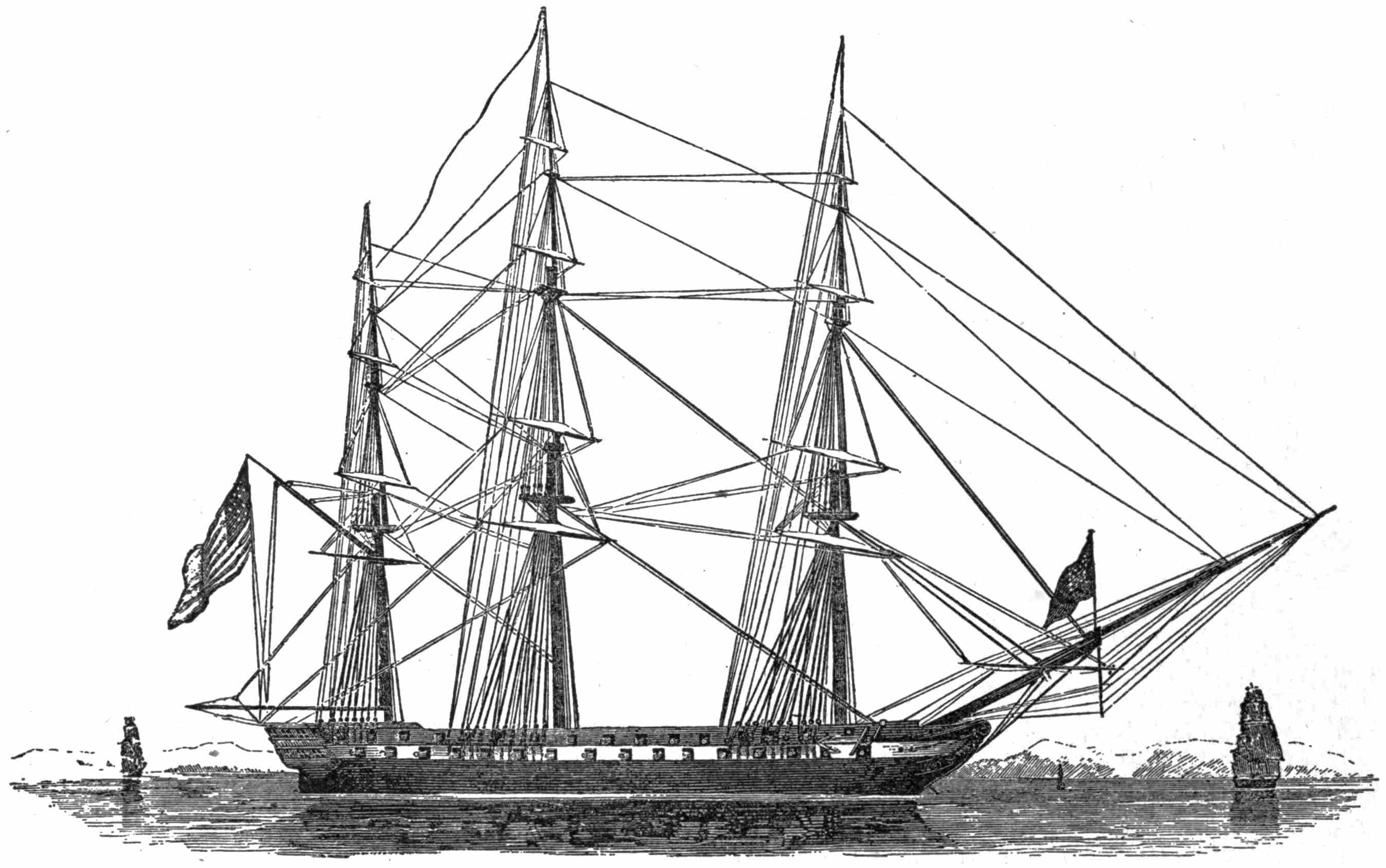
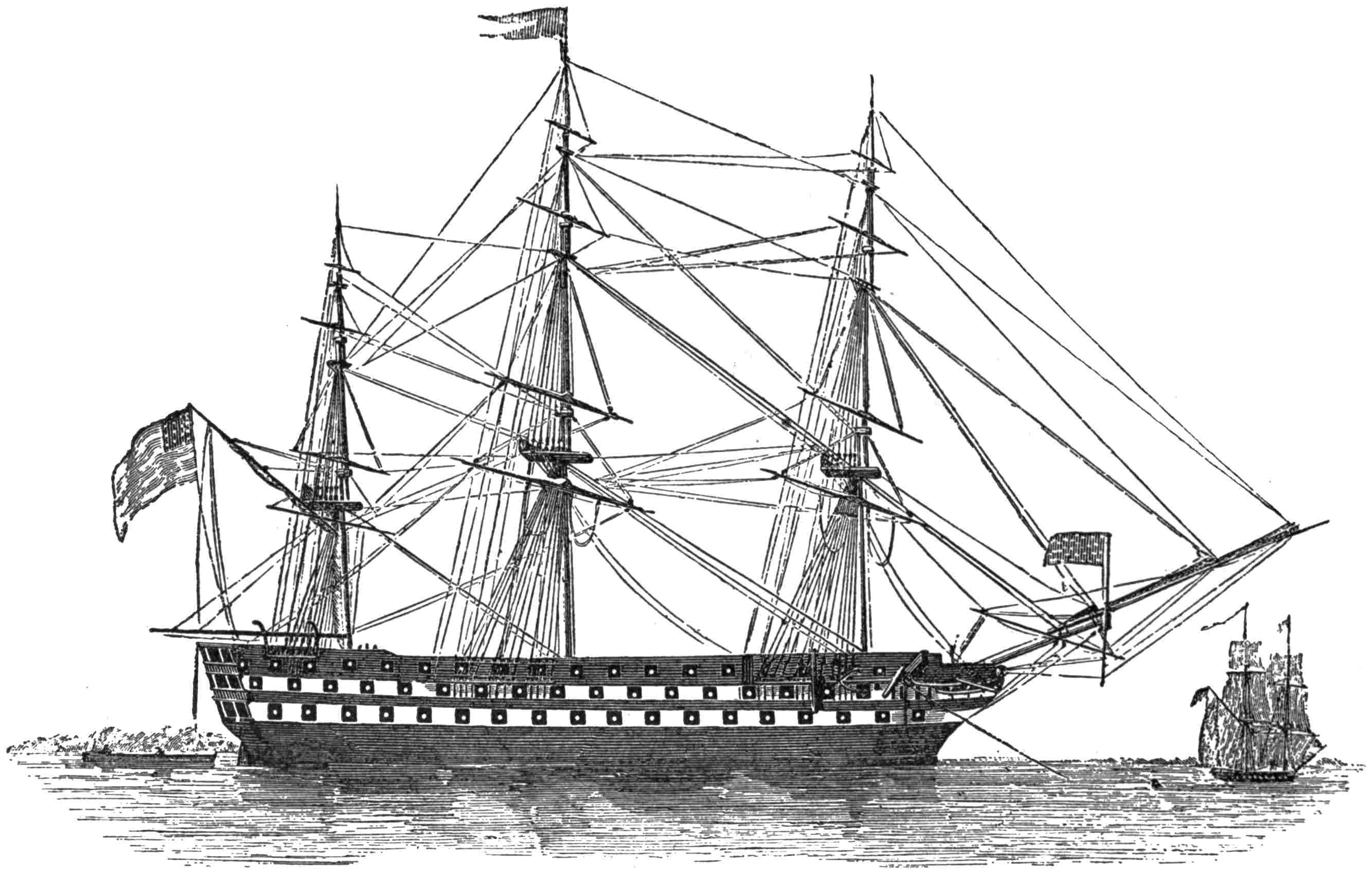
United States Razee* Independence at Anchor.
From the “Kedge Anchor.”
* A Razee is a line-of-battle ship from which the upper deck has been cut, leaving her with two decks of guns.
A most remarkable ship was the Adams, for,
when let to a contractor to build, he sublet one
side of her to another man who had the instincts
of a thief and of a traitor. The sub-contractor,
to increase his profits, scamped his timbers and
his work. The Adams was a creditable ship on
one side and a fraud on the other. It is a pity
that the name of the scoundrel has not been
perpetuated in the accounts of naval matters
that have hitherto appeared. When altered at
Washington it was necessary, of course, to follow
the old lines and she was still lopsided, although
lengthened until she could carry twenty-eight
guns on the one deck. Her armament
in her new fashion included a long twelve for
a bow-chaser and thirteen medium-length eighteen-pounders
(called Columbiads, sometimes)
on each side. It was a pretty good armament
for that day, in fact much superior to the ordinary
sloop-of-war armament that was made up
of two long twelves and twenty of the wretched
short thirty-twos.
Charles Morris.
From a photograph owned by Mr. C. B.
Hall.
Captain Charles Morris, who, as the first
lieutenant of the Constitution, had first gained
fame in her race with
the British fleet, was
placed in command
of the rebuilt Adams,
and Lieutenant
Wadsworth, who
was second on the
Constitution in her
great race, was made
first on the Adams.
There was a strong
blockading squadron
in the Chesapeake,
but on the night of
January 18, 1812,
“which came on
cloudy, boisterous,
and with frequent
snow squalls,” he
headed away for sea. There was a strong northwest
wind blowing, and there was not a beacon-light
in the bay. Worse still, while the ship
was driving along at twelve knots an hour, the
two men who were engaged as pilots became
confused, and at 11 o’clock at night a light was
seen dead ahead which showed that she was flying
straight at the land. Instantly her helm
was shoved down and she came about on the
other tack, but a few minutes later she was
thumping over a bar, no one knew where, the
heavy swells lifting her clear only to drop her
again on the sand. However, over she went,
and when it was found she did not leak, Morris
decided to send her on her way once more,
and at 1 o’clock passed two British ships at
Lynnhaven and got out to sea.
Running across to the coast of Africa the
Adams cruised from Cape Mount to Cape
Palmas, then visited the vicinity of the Canaries
and the Cape de Verde Islands. “A few small
prizes, laden with palm oil and ivory” were
taken. On March 25th the Woodbridge, a
large Indiaman, was overhauled. It was thick
weather at the time, and while Captain Morris
was taking possession the weather suddenly
cleared, when it was seen that a fleet of vessels
were jogging along to windward under convoy
of two big men-of-war. It took Morris a full
day to get clear of the men-of-war.
Returning across the Atlantic the Adams
ran into Savannah on May 1st—the day on
which the British Epervier, prize to the Yankee
Peacock, got in—and remained there till
the 8th, when she sailed for the Gulf Stream
in search of the Jamaica fleet. He found it
with a ship-of-the-line, two frigates, and three
brigs in charge. At the sight of the Adams
the fleet closed in like a flock of ducks, and although
the Yankee dogged them for two days
he got nothing—not even a chase from the
war-ships. So he sailed to the banks of Newfoundland,
where he found only ice and fogs,
and so went on to the coast of Ireland, in sight
of which he arrived on July 3d. A few prizes
were made here, but on July 15th “she stumbled
across the eighteen-pounder thirty-six-gun
frigate Tigris” The Tigris was no mean sailer,
and in the chase that followed the Adams threw
overboard all the guns taken from the ships she
had captured, her heaviest anchors, and finally
some of her own guns. Then the wind died
out entirely, and that was good-luck for the
Adams, for her captain repeated the tactics
employed on the Constitution off the Jersey
beach by towing his ship so far away from the
Tigris that a lucky slant of wind carried her
clear out of sight.
A still more remarkable chase followed this
one. It began on July 19th, when two frigates
found the Adams. The one was fat and slow,
the other as lean and eager as a hound. A half
a gale of wind was blowing. Every thread of
canvas was spread, and for forty hours the frigate
and the sloop stretched away across the
stormy sea with every sail as round and firm as
the breast of a giant runner; with the weather
rigging singing taut; with every man on deck
alert, and with each captain pacing to and fro
without rest, looking at every turn from the sea
to the clouds and from them to his sails and then
away to the enemy; with the cutwater sawing
through the solid blue as she rose to the swell,
and burying itself in smother and foam that
tumbled and roared away for half her length
ahead as she boiled in the trough of the sea,
and the sissing foam swept aft to mingle with
the swirling wake. And that for forty hours
with the frigate just out of gunshot! They
covered four hundred miles with never a loss
or a gain on either side, and then under the
shades of night the gale hardened into a squall
that hid the Adams out of sight, when she
up helm and swung away so far on another
course that when light came the hound had
wholly lost the scent.
On returning westward the crew of the Adams
were attacked by the scurvy. Several died and
a considerable number were made unfit for duty,
so Captain Morris headed for Portland, Maine.
Off the Maine coast, while driving along at ten
knots an hour through a fog at 4 o’clock on
the morning of August 17th, the Adams found
land—rock, to speak accurately. She ran up
on a ledge until her bow was six feet out of
water, and when the sun came to clear the fog
the crew found themselves only one hundred
yards from a cliff near Mount Desert. The
next tide floated the ship and she continued her
course. A little later the British brig Rifleman
was seen and chased, but the strain of the press
of canvas made the Adams leak at the rate of
nine feet of water into her hold per hour, so
Captain Morris gave it up and ran into the
Penobscot.
As it happened, the Rifleman was able to
carry the news of the arrival of the Adams to
a British fleet, “consisting of two line-of-battle
ships, three frigates, three sloops, and ten troop
transports” which were lying in wait to descend
on Machias. Captain Morris moored his ship
at Hampden, twenty-seven miles up the river,
where he intended to heave her down and repair
the leaking bottom. When the British
fleet came after him he made such preparations
as were possible to fight. Of his original crew
of two hundred and twenty, seventy had died
or had been disabled by the scurvy. The
others, including one hundred and thirty seamen
and officers and twenty marines, many of
them sick, were mustered on shore for the fight.
Nine of the lighter guns of the Adams were
set up as a battery on the bluff overlooking the
wharf, and these were put in charge of Lieutenant
Wadsworth. Morris himself took charge
of the wharf. The crew were joined by thirty
(some say forty) experienced soldiers, and by a
force of militia variously estimated at from
three hundred to six hundred men. Whatever
their number, they proved utterly worthless, for
they had never been under fire. Anyway, they
were but half armed, and the guns they had
were the inferior fowling-pieces of that day.
On September 3d came the enemy. There
was a land force of six hundred experienced
troops, eighty marines, and eighty seamen.
There was a force afloat in boats and barges
well-armed that raised the whole command to
1,500 men. The crew of the Adams, stationed
on the wharf, checked the flotilla, in spite of
overwhelming numbers, but the American militia
fled without firing a gun when the British
land forces approached them. Captain Morris
was left with only his crew and the thirty
regulars to face a force eight times as great.
Yet he burned the ship and made a successful
retreat without losing a man save those too ill
with scurvy to march away. The conduct of
the Yankee militia was disgraceful, as it usually
was throughout that war; but what shall be said
of the failure of the 1,500 experienced men in
the British force who were unable to hinder the
retreat of the Yankee crew?
United States Ship-of-war Columbus at Anchor.
From the “Kedge Anchor.”
As has been noted, when the War of 1812
began, the authorities at Washington were determined
to keep their ships in port. That a
Yankee ship could meet a British ship of equal
force or even of somewhat inferior force and
keep her flag afloat seemed impossible. The
idea of building anything except for harbor
defence was too ridiculous for any consideration.
But after the first six months of the war
had demonstrated that the capacity and courage
of the American personnel was unsurpassed,
the ring of broadaxe and hammer, the rasp of
saws, and the easy crunch of augers began to
make melody for patriotic ears in the yards of
the Yankee builders. The frames of ships-of-the-line,
and of frigates and of corvettes, as the
big sloops were called, rose steadily above the
keel-blocks. The names that were given to
these new ships showed that the naval authorities
of the nation were disposed to flaunt red
flags in the face of Johnnie Bull; they were determined
to keep alive the memory of American
victories by perpetuating the names of the
defeated British ships. One frigate was named
Guerrière and another Java, while the new
sloops were named Peacock, Frolic, etc. Not
many of the new ships were destined to see service
against the British, for the reason that the
war ended before they were fully ready. Still,
three of the sloops got away to sea, and this
chapter shall tell of the fate of one of them and
give a part of the brilliant record made by another.
The first that got to sea was the Frolic. She
was built at Portsmouth, New Hampshire, famous
for its fine ships in the days of wood.
Under Master-Commandant Joseph Bainbridge
she sailed from the home port in February and
some time later fell in with a Carthagenian privateer
that was cruising for Yankee merchantmen
off the southern coast. The privateer refused
to surrender, when called on to do so, and
Bainbridge fired one broadside at her, and that
one blast sank her so quickly that nearly one
hundred of her crew were drowned. As the
Frolic carried only ten short thirty-twos in a
broadside, it is certain that every shot struck
the privateer below the water-line as she rolled
to the swell. The fact is especially worth mentioning
for the reason that it shows the great
advantage of training the crew of a war-ship to
shoot accurately.
The career of the Frolic, however, was brief.
On April 20, 1814, when off the extreme
south point of Florida, she fell in with the
British thirty-six-gun frigate Orpheus, Captain
Pigot, and the twelve-gun schooner Shelburne,
Lieutenant Hope. The enemy were to leeward,
but both of them were swifter than the
Frolic. For more than twelve hours she
struggled to windward, cutting away her anchors
and throwing over her guns, but all in
vain, for the Orpheus closed on her. The
Frolic had carried twenty short thirty-twos
and two long twelves, while the Orpheus
carried sixteen short thirty-twos and twenty-eight
long eighteens. Nevertheless, James,
in commenting on the surrender of the Frolic,
says:
“We should not have hesitated to call a
French, or even a British, captain, who had
acted as Master-Commandant Joseph Bainbridge,
of the United States Navy, did in this
instance, a ——.”
Another of the new corvettes with irritating
names was the Peacock. She was built in New
York City, and sailed under Master-Commandant
Lewis Warrington, on March 12, 1814,
bound south. Her cruise was without incident
until April 28th, when, at 7 o’clock in the
morning, a number of vessels were seen to
windward. The Peacock was at this time not
far from Cape Canaveral, Florida. It was
learned later that the fleet sighted included
two merchantmen under convoy of the British
brig sloop Epervier, Captain R. W. Wales,
of eighteen guns. They were bound from
Havana for the Bermudas, and the Epervier
carried $120,000 in coin.
Because of the result of the battle that followed
it is worth mentioning the fact that the
Peacock class of Yankee sloops were designed
with especial reference to the Epervier class
of brigs, just as the Terrible class of cruisers
were designed in Great Britain with a certain
Yankee protected cruiser in mind, in these
last years of the nineteenth century.
Lewis Warrington.
From an engraving by Gimbrede of the painting by Jarvis.
The Peacock having made chase, the wind
suddenly shifted to the southward, when the
merchantmen made all sail to run away and
the Epervier hauled close to the wind on the
port tack, and stood toward the Peacock quite
willing for the fight.
Diagram of the
PEACOCK-EPERVIER
BATTLE.
The Peacock now had the best of the wind,
and when, soon after 10 o’clock, the two
ships were approaching each other end on, and
had arrived within gunshot, she was headed
off wind a bit in order to bring her starboard
battery to bear on the Epervier and rake
her. But Captain Wales, of the Epervier, was
not to be caught by any such move as that.
Putting up his helm, he eased off to meet the
Yankee, and then shoving down his helm, he
rounded to on the Peacock’s bow and delivered
his starboard broadside,
two shots from which
struck the foreyard of
the Peacock, entirely disabling
that very important
spar. The British
captain had clearly outmanœuvred
the Yankee
up to this time, which
was not far from 10.20
A.M.
Captain Warrington
fired his starboard broadside
as he passed the Epervier, and then ordered
his men to load with bar-shot, bundles
of scrap-iron (called langrage), etc., in order
to cripple the British brig aloft, and reduce her
to a sailing capacity as bad as his own. While
the Yankees were doing this the Epervier might
have sailed away and left the crippled Peacock,
but Captain Wales was not that kind of a man.
On the contrary, he tacked about as rapidly as
possible, in spite of the fact that he had to risk
a raking fire from the Americans, and then
bore down with his port battery to the Peacock’s
starboard.
At this the bar-shot and scrap-iron from the
Yankee began to tell on the British head-gear.
Jib after jib was cut away, while the sails of the
foremast were torn to shreds. The pressure on
the after-sails threw her stern down away from
the wind and her bow up into it. Then her sails
caught aback and the Peacock ran across her
stern and fired a few guns to rake her, though
because of the headway of the Peacock only a
few were fired. A moment later the maintopmast
of the British ship fell with a crash, and
her main-boom was cut in two and fell on the
wheel, so that she was for the time helpless.
The Peacock and the Epervier.
From a wood-cut in the “Naval Monument.”
At that Warrington hauled the Peacock close
under the port quarter of the Epervier and
opened a deadly fire of solid shot directed
chiefly at the enemy’s water-line—the favorite
target of the Yankee gunners. One easily pictures
the scene at this time as the Yankee crews,
stripped to the waist, in the warm summer air,
worked like white devils in the sulphurous
smoke over their guns. They waved their arms
and cheered as they saw the shot knock the
splinters low down on the black-painted hull of
the half-obscured enemy that was now adrift,
unable to turn either to port or starboard. But
some of them aimed high enough to dismount
every gun on the port side of the Epervier,
which faced the Yankee.
Meantime, the Epervier had been gathering
stern way and was drifting on board the Peacock.
Allen says Captain Wales thought to
wear the Epervier in order to run on board the
Peacock, but this is absurd, because she was
aback.
On seeing that the Epervier was likely to
fall aboard the Peacock, Captain Wales called
his men aft, intending to make a last brave
effort by boarding. But, as James says, “the
British crew declined a measure so fraught with
danger.” Allen says: “A large proportion of
the crew evinced a great distaste for the measure.”
So Captain Wales hauled down his flag
at 11 o’clock. The action had lasted forty-five
minutes.
Captain Wales showed conspicuous bravery
and ability, and his chief officer, Lieutenant
John Hackett, ably seconded him. In fact,
Hackett had his left arm shattered and was
dangerously wounded in the hip by a splinter,
“but it was with difficulty that this gallant officer
could be persuaded” to leave the deck.
That the crew should have flinched is not a
matter of wonder. The British sailors had been
accustomed to go at the Frenchmen “hammer
and tongs,” and “whoop and hurrah.” It was
a lark to meet a Latin-blood crew. But in 1812
they had a new kind of an enemy to face. It
should be remembered that, after they had “seen
the countenance” of this enemy for a few
months, even the British Admiralty flinched,
for James says, on page 402 of Volume VI.,
that “the Admiralty had issued an order that
no eighteen-pounder frigate was voluntarily to
engage one of the twenty-four-pounder frigates
of America.”
This is a slight digression from the story of
the Peacock-Epervier fight, but it seems worth
the making because it offers an explanation of
the rancor and the deliberate falsehoods of the
British writers when referring to British naval
contests with Yankees. A knowledge of the
whole truth about the prowess of American
naval seamen had had a disturbing influence on
the minds of the British sailors on more than one
occasion, and the records of the sea-fights with
the Yankees were deliberately falsified in order
to preserve the self-confidence of British Jack.
As to the effect of the fire of the two ships,
Allen admits that “the Peacock, in a short time,
unrigged the Epervier, and cut her sails into
ribands. Most of the lower rigging of the
Epervier was shot away, and her foremast was
left so tottering that the calm state of the
weather alone saved it from falling. Her hull
was shot in every direction, and she had five
feet of water in her hold.” In addition to this
she had lost, as already told, her maintopmast
and her main-boom, and her bowsprit was badly
wounded. There were forty-five shot holes in
her hull, of which twenty were within a foot of
the water-line and dipped under at every roll
to let the water spurt in. To realize the significance
of the fact that she had five feet of
water in her, it must be known that she measured
only fourteen feet in depth of hold (the
same depth as the Peacock).
The Peacock and the Epervier.
From an engraving by Strickland of a drawing by Birch.
Allen says that she went into the fight with
“a crew of one hundred and two men and sixteen
boys.” They are especially careful to
specify the number of boys when they are defeated.
James is at the pains to announce that
“two of her men were each seventy years of
age!”
Captain Warrington reported that she had a
crew of one hundred and twenty-eight—his list
of prisoners numbered one hundred and twenty,
including the wounded. It is agreed on both
sides that she lost eight men killed and fifteen
wounded, and that she had enough men at least
to work all of her guns efficiently.
On the other hand, the Peacock did not receive
even one shot in her hull, and the only
damage aloft worth mention was the disabling
of the foreyard. In fifteen minutes from the
time her crew began to repair the damages
every cut rope had been rove anew, and half an
hour later the foreyard was up in place, repaired
fit to stand a gale, and the foresail was
spread to the breeze. The broken foreyard
was actually sent down on deck, fished, hoisted
aloft again, and the sail spread in forty-five
minutes. The injury to the crew was scarcely
worth mentioning, for not one was killed, and
only two were wounded, and they but slightly.
Allen says she carried “a picked crew of one
hundred and eighty-five seamen.” She had, in
fact, including captain and powder-monkeys,
one hundred and sixty-six.
In view of the fact that the British gunners
were unable to hit the broadside of the ship
when half a pistol shot away, a comparison of
the armament of the two ships is as absurd as it
was when the Yankee Hornet shot the British
Peacock under water in fourteen minutes. However,
it ought to be given to complete the record.
The Peacock in this battle had a broadside
of ten guns that threw three hundred and
fifteen pounds actual weight of metal at a round.
The Epervier had one gun less in her broadside
and threw two hundred and seventy-four pounds
of metal from it. The “relative force” of the
two ships was as “twelve to ten;” the damage
done to each was not quite as one hundred
to nothing, because the Peacock did get a bad
cut in the foreyard and the Epervier was not
quite destroyed. Perhaps the reader will find
amusement and even instruction in considering
what the relative damage of the two ships really
was.
After the British flag was hauled down the
Yankee sailors made haste to repair the captured
ship and by nightfall had her sails spread
in a run for Savannah in company with the
Peacock. En route to that port a British frigate
chased the two, but the Peacock drew her
off and then outsailed her. The Epervier was
carried into Savannah on May 1st, and on the
4th, the Peacock arrived. As the reader will
remember the Adams happened to be in port
at this time. The Epervier proved a very rich
prize to the victorious crew, for in addition to
the $120,000 in coin (James would reduce it to
$118,000) the Government bought the prize
for $55,000. The Epervier was built in 1812.
It is worth telling that in breadth and depth
the Peacock and Epervier were exactly alike—32
× 14 feet. The Peacock, however, was 118
feet long, while the Epervier was 107. There
are whole fleets of Yankee schooners in this
day bigger than either—plenty that can carry
more cargo than both put together—which are
nevertheless called small coasters; of such a
character has been the development of modern
ship building.
Medal awarded to Lewis Warrington after the capture of the Epervier by the
Peacock.
The Epervier was brought into port by Lieutenant
John B. Nicholson. Congress voted a
gold medal to Warrington and the usual silver
medals and swords to the other officers. Nicholson
was transferred to the Siren, of which
something will be told presently. The Peacock
sailed on another cruise on June 4th.
Crossing the Banks of Newfoundland she
cruised on the coasts of Ireland for a time and
then sailed to the Bay of Biscay and finally
back via the Barbadoes to New York, where
she arrived on October 29, 1814. In all she
took fourteen merchantmen, most of them on
the Irish coast. They were manned by one
hundred and forty-eight men and they were
valued at $1,493,000. She was distinctly a
lucky ship.
An interesting little story showing somewhat
of sailors’ superstitions is told of Lieutenant
John B. Nicholson, who brought the Epervier
into port. He was transferred to the little
sixteen-gun brig Siren, of which Lieutenant
George Parker was commander, and she was
sent to cruise on the coast of Africa. Off the
Canaries Parker died, and after putting his
body into a coffin it was put overboard with
the usual funeral services. The coffin sank out
of sight, but as soon as the brig filled away on
her course the coffin came to the surface, where
it floated like a cork.
Knowing that this event, though due entirely
to the carpenter’s failure to properly weight the
coffin, was regarded as an ill omen by the seamen,
Lieutenant Nicholson, who was now captain
by right of succession, called the men to the
capstan and let them decide whether to continue
the cruise, or return to port. They decided,
with cheers, to cruise on.
For a time everything seemed to go well.
An English frigate was dodged by hanging out
false lights on a raft of casks. Two English
merchantmen were taken and destroyed, but in
the Senegal River another one escaped after
the brig had given her a broadside, and about
two months after leaving home the Siren fell
in with the British liner Medway. Anchors,
cables, guns, and shot were thrown overboard,
but she was taken after all. It was a disastrous
cruise.
CHAPTER IV MYSTERY OF THE LAST WASP
A TYPICAL NEW ENGLAND YANKEE CREW—YOUTHFUL HAYMAKERS
AND WOOD-CHOPPERS—SEA-SICK FOR A WEEK—FROM FLAILS TO
CUTLASSES, FROM PITCHFORKS TO BOARDING-PIKES, FROM A
NIGHT-WATCH AT A DEER-LICK TO A NIGHT BATTLE WITH THE
BRITISH—AFTER BRITISH COMMERCE IN BRITISH IN-SHORE WATERS—MET
BY THE BRITISH SLOOP-OF-WAR REINDEER—MAGNIFICENT
PLUCK OF THE BRITISH CAPTAIN WITH A CREW THAT WAS
“THE PRIDE OF PLYMOUTH”—SHOT TO PIECES IN EIGHTEEN
MINUTES—A LINER THAT COULD NOT CATCH HER—WONDERFUL
NIGHT BATTLE WITH THE AVON—SHOOTING MEN FROM THE
ENEMY’S TOPS AS RACCOONS ARE SHOT FROM TREE-TOPS—THE
ENEMY’S WATER-LINE LOCATED BY DRIFTING FOAM—NOT CAPTURED
BUT DESTROYED—THE MYSTERY.
Well-manned, but ill-fated at the last, were
all the Yankee Wasps. They were swift of
wing for their day, and the pain of their stings
still rankles. But the first, the little Baltimore
clipper of eight guns, was burned at Philadelphia
to keep her out of the hands of the British
invaders. The second, she that deluged the
decks of the British brig Frolic with blood,
was captured by a British liner, and then with
a British crew sailed from port and never returned.
The story of the third shall now be
told.
She was a beautiful ship, a sloop-of-war called
large and heavy in that day. Like her sister
ships, the Peacock and the Frolic, of whose
deeds something was told in the last chapter,
she was designed to outsail and outweigh, and
so conquer with ease, the sloops-of-war of the
British navy. Her keel was stretched on
blocks beside that of her sister, the Frolic, at
Portsmouth, New Hampshire. On the day the
Epervier, the first prize of her sister, the Peacock,
reached Savannah on May 1, 1814, the
new Wasp winged her way through the British
blockaders that lay off Whaleback Reef,
and headed away to the east, bound for the
coast of England.
Johnston Blakeley.
From an engraving by Gimbrede.
No finer crew by nature than that of the
Wasp ever sailed from any port. She was
commanded by Master-Commandant Johnston
Blakeley, of Wilmington, North Carolina. He
had not in any way especially distinguished
himself thus far in the war, but that no mistake
was made in giving him the command was evident
later on. First Lieutenant James Reilly
and Third Lieutenant Frederick Baury had
served in the Constitution when she captured
both the Guerrière and the Java, while Second
Lieutenant T. G. Tillinghast was the second
lieutenant of the Enterprise when she whipped
the Boxer. Of the younger officers not a man
but was worthy of his place, and as for the crew
they were to a man Americans, and almost all
of them Yankees of the Yankees—the typical
New Englanders whose drawling, nasal style
of speech has for time out of mind served English
writers as an abundant source of amusement.
That they talked about the “keows”
and the “critters” need not be doubted. They
were young haymakers and wood-choppers—very
likely more than one-half of them were
from the farms. As one of her officers wrote
they were men “whose ages average only
twenty-three years. The greatest part (are) so
green, that is, unaccustomed to the sea, that
they were sick for a week.” But that some of
them had looked through the sights of a rifle
at running deer, to the destruction of the deer,
is also certain, as will appear farther on, and
the back that could swing a scythe could lend
vigor to the stroke of a cutlass or the lunge of a
boarding-pike. They were not only good physically
but mentally. They were from the “deestrict”
schools, on one hand, and from “teown
meetin’” on the other—they had common school
educations, and they were independent-minded
voters, while the traditions which their fathers
had told them before the wide fireplaces of
their log-cabin homes were of the deeds done
along shore by British naval officers, beginning
with that of the infamous Mowatt when nearby
Portland (Falmouth) was burned in winter,
and ending, very likely, when John Deguyo
was taken by a press-gang from a Portland
coaster when she was in the waters of New
York Harbor. Unaccustomed to the sea they
certainly were, but under such officers as they
had, the training of a very few weeks served
to fit them to meet “the pride of Plymouth”
with honor to the gridiron flag. By the time
the Wasp was in the mouth of the English
Channel, the crew had forgotten their seasickness;
they had learned that the stroke of the
flail was not quite the best for a cutlass, though
a pitchfork thrust was good enough for a boarding-pike.
The men who had been accustomed
to down the running deer and moose found no
difficulty in hitting a target with either great
gun or musket, even though the deck heaved
and fell beneath their feet or their “roosting
places” in the tops swayed through wide angles.
For a time the uncertainty as to the character
of each ship sighted served to train their nerves,
as the work of boarding the merchant ships,
which were the only ones seen for a time, gave
them experiences of another kind, and then
came the day of trial—their first taste of blood.
It was on June 28, 1814. The early morning
was dark and gloomy, but at 4.15 o’clock
two sails were seen, and the Wasp spread all
her canvas to a light northeast breeze and went
slipping down for a look at them. A little
later a new sail hove in sight on the weather
beam and Captain Blakeley hauled up to look
at her before pursuing the other two farther;
for he was in the mouth of the English Channel
and British war-ships of all sizes haunted all that
region. The stranger was coming down for a
look at the Wasp, and as she was plainly not a
frigate the Wasp held up to meet her. And
then, at 10 o’clock, the stranger hoisted English
colors with private signals that Blakeley could
not answer.
Thereafter the Yankee crew hauled and eased
away and tacked in the hope of getting the
weather gage of the enemy, but all in vain, for
she was a handy brig and her captain was as
able a seaman as was Captain Blakeley. Seeing
this, at last, Captain Blakeley gave it up,
and at 1.50 o’clock fired a gun to windward and
hoisted the American flag. Instantly the stranger
answered the challenge, and easing off her
sheets she bore down upon the Wasp.
It was a gentle breeze that wafted her down
over the greasy, dull-gray seas, but at 3.15 o’clock
she was less than sixty yards away on the port
(weather) quarter of the Wasp, and with a short
twelve-pounder mounted on her forecastle she
opened fire with both solid shot and grape.
For eleven minutes her crew worked this gun
while the Yankees stood at their stations in silence—the
British fired five charges of shot and
grape into the deck of the Wasp while the
New England backwoodsmen under a Tarheel
captain eyed the blasts unflinchingly. The Tarheel
Blakeley had been waiting for the enemy
to draw nearer. At 3.26 o’clock she had done
so to his satisfaction, and shoving down his
helm he luffed up as if to cross her bows and
opened fire as his guns began to bear—the
backwoods gunners had a target more than one
hundred feet long lying less than sixty feet
away. It was their first live sea target. They
were not quite so firm-nerved as they were later—but
for eight minutes they worked their guns
with an energy and skill that were simply stunning,
while the enemy with equal energy replied.
“The concussions of the explosions almost
deadened what little way the vessels had on”—almost
but not quite, and Blakeley hauled up
his mainsail lest he cross the enemy’s bow too
soon. The smoke rose up in huge volumes
above the loftiest sails and rolled away in bulging
clouds on every side, but the men at the
great guns of the Wasp, peering through the
sulphurous fog, hurled their shot with unerring
accuracy, while those that were perched in the
tops used their muskets to pick off the officers
of the enemy, first of all.
It was a desperate struggle, but the weight of
metal, as well as the superiority of marksmanship
was found with the American crew. They
had opened fire at 3.26 P.M., and at 3.34 P.M. the
enemy’s sails had been so damaged that the
Wasp’s mainsail was hauled up lest she drift
clear across the stranger’s bow. And then for
six minutes more the Yankees drove their shot
through the splintering walls of the enemy
“when, in consequence of her unmanageable
state,” she “fell foul of the Wasp.” So says
Allen, and so was the fact. “And in this position
(she) became exposed to a destructive
raking fire.”
The Wasp and Reindeer.
From a wood-cut in the “Naval Monument.”
But though disabled, the enemy was not yet
conquered. Her captain had, early in the fight,
been cut through the calves of both legs by a
musket-ball that made a most painful wound.
Of course, he stood to his post. And then, as
his ship was fouling the Wasp, a grape shot—a
round iron ball more than two inches in diameter—pierced
both thighs. He fell to his knees,
but he struggled up and, sword in hand, cheered
on his men, and then calling away boarders he
ran forward to lead them, and was climbing
into the rigging when two musket-balls, fired
simultaneously from the maintop of the Wasp,
struck him in the top of the head and passed
down through to come out beneath his chin.
“Placing one hand to his forehead and with
the other convulsively brandishing his sword, he
exclaimed ‘Oh God!’ and dropped lifeless on
his own deck.”
The end had come. The British seamen
recoiled, as their leader fell, and Blakeley’s
men who had gathered to repel boarders now
boarded in turn and swept the crew of the shattered
ship into her hold. It was exactly 3.44
P.M. and twenty-nine minutes had passed since
the first gun was fired by the enemy, and but
eighteen since the Wasp returned the fire.
And then the Yankees learned that they had
captured the British brig-sloop Reindeer, commanded
by Captain William Manners. “The
captain’s clerk, the highest officer left, surrendered
the brig.” Her captain and purser were
dead; her first (and only) lieutenant and sailing-master
were wounded. So were one midshipman,
a boatswain and a master’s mate.
Whether she had other midshipmen is not
stated—probably she had none.
In this action between the Wasp and the
Reindeer we have, at last, after describing a
year’s fighting, a British crew of which British
writers speak well. That they do so only because
the Reindeer’s armament and the number
of her crew were much under the Wasp is
not to be doubted. Nevertheless it is a pleasure
to note that James is willing to write
that “the British crew had long served together,
and were called the pride of Plymouth,”
but he states their number as consisting of
“ninety-eight men and twenty boys.” No
crew ever fought more bravely than they did
until Captain Manners fell; and when he was
down they yielded exactly as did the crew of
the Yankee Argus when her captain was shot
down.
Being assured that the Reindeer had the best
of British crews, we can form an estimate of
their skill by considering the damage which
they were able to do to the Wasp during the
twenty-nine minutes they were firing at her—firing
at a range that varied from sixty yards
down to a point where the ships touched each
other—a range which for eighteen minutes was
under sixty feet.
With nine short twenty-fours in their broadside
and one short twelve on a high pivot what
damage does the uninformed reader suppose
that this one of the ablest of British crews—a
crew that could and did load and fire their guns
every two minutes—was able to do? They
hulled the Yankee with six round shot and put
another in the foremast. They fired at least
eighty-six shots at the Yankee—a target that
was one hundred feet long, eight or ten feet
high, and for eighteen minutes less than sixty
feet away—and yet only seven struck home.
With their grape, and their musketry, fired
when the ships were grinding together, they
killed and mortally wounded eleven Yankees
and severely or slightly wounded fifteen more.
Medal Awarded to Johnston Blakeley after the Capture of the Reindeer by the
Wasp.
On the other hand, the Yankees had not
“long served together.” Most of them were
landsmen who were seasick for a week on
leaving port. And yet because of native ability
they had been easily trained; they stood in silence
under fire for five shots, and in this, their
first battle, they aimed their guns so accurately
that “the hull of the Reindeer was literally cut
to pieces and her masts were in a tottering
state.” This quotation is from Allen. The
fact is that she was so badly cut to pieces in
the wake of her gun-ports that it was impossible
to tell how many Yankee shots did strike
her hull. A breeze that sprang up the next
day at once toppled the foremast overboard,
and, in short, she was so badly injured that she
could not be carried into either of the nearby
French ports, and she was accordingly fired and
blown to pieces. The British lost in killed and
mortally wounded thirty-three, and in wounded
thirty-four, “nearly all severely.”
The Wasp measured 509 tons to the Reindeer
477. She fired eleven guns, throwing 315
pounds of metal to a broadside, where the Reindeer
fired ten guns throwing 210 pounds of
metal to a broadside. The Wasp had a crew
of 173, mostly landsmen, who had been together
less than two months; the Reindeer
had 118 who were “the pride of Plymouth.”
While nothing that is written here can add
to the fame of Captain Manners, of the Reindeer,
it may be said that Anglo-Saxon republicans
are proud of his skill, and are thrilled by
the story of his magnificent gallantry just as
the Anglo-Saxon nominal-monarchists are.
Having destroyed the Reindeer, Blakeley
sailed with the Wasp to L’Orient, France, the
port where of old the Yankee cruisers had
refitted after cruising against British commerce
in the English Channel. En route,
three days after the battle, a number of the
wounded prisoners were put on a Portuguese
brig, called the Lisbon Packet, and sent to
Plymouth.
The Wasp was detained at L’Orient until
August 27th, refitting, and then she got away
to continue her work on the high seas. It
was her luck to fall in with another British
brig-sloop, within four days—a sloop like the
Reindeer—and few, if any, more instructive
pages of history can be found than those that
compare the two actions which the Wasp had
with these vessels of the class she was designed
to destroy with ease.
The second brig-sloop to meet her fate under
the guns of the Wasp was the Avon, “commander
the Honourable James Arbuthnot,”
and the battle was fought on September 1,
1814.
That was a most interesting day in the lives
of the Wasp’s crew. To begin the day they
fell in with a fleet of ten merchantmen,
guarded by the big seventy-four-gun British
liner Armada and a bomb ship. The liner
was an average ship of her class, but the lively
Wasp dashed boldly into the fleet and cut out
the brig Mary loaded with cannon captured
from the Spaniards and other military stores.
Having effectually fired the Mary, the
Wasp tried for another, but the Armada
chased her away this time and she went hunting
other game, and found it.
The covey included a fleet of four vessels, of
which, as the event showed, three were British
brig-sloops of the class of the beaten Reindeer,
and a merchantman that had been recaptured
from a Yankee privateer. The vessels were
rather widely separated, one of them, the
Castilian by name, having gone in chase of
the privateer. What another of the brig sloops,
the Tartarus, was doing is not told in any
printed account, while the third, which was
the Avon, Captain Arbuthnot, had started
with the Castilian in chase of the Yankee
privateer, but had not been fast enough to
keep up with the procession. So it happened
that she was right in the way as the Wasp
came along in the first shades of night.
A fresh southeast wind was blowing and
the Avon was bowling along toward the southwest.
As the Wasp came on in chase, the
Avon hoisted signal flags and then signal
lights and fired some rockets. The Wasp,
of course, was unable to answer these, and the
Avon was cleared for action. No effort to
run away having been made by the Avon—on
the contrary she fired a shot from her stern
chaser—the Wasp had arrived close on her
port quarter by 9.20 o’clock when one of the
officers of the Avon shouted:
“What ship is that?” Captain Blakeley
replied by repeating the question. Again the
Avon hailed, when Blakeley replied:
“Heave to and I’ll let you know who I am,”
and then fired the little twelve-pounder he had
taken from the forecastle of the captured
Reindeer. At that the Avon set her foretop-mast
studding sail and began firing her stern
chaser.
The Wasp and Avon.
From a wood-cut in the “Naval Monument.”
Fearing she might escape, Captain Blakeley
put up his helm, ran down under the Avon’s
lee, and as he ranged up under her quarter, gave
her a raking broadside of bar shot and (presumably)
langrage that set her rigging adrift
in every direction. Another broadside of these
projectiles was still more effective, for it brought
down the fore-and-aft mainsail of the Avon,
and it fell over the lee guns abaft the mainmast—the
guns that bore on the Wasp—and for
the time, put them entirely out of action, while
her speed was materially diminished.
It was a moonless night, but the crew of the
Wasp “could see through the smoke and gloom
of the night the black hull of the Avon as she
surged through the waters; and aloft, against
the sky, the sailors could be discerned, clustering
in the tops.”
No backwoods gunner would ask for a better
target than was then afforded by the enemy.
With their rifles the Yankee marksmen began
to pick the British sailors from the Avon’s tops
as they had shot raccoons from the tree crotch,
while those behind the great guns loaded with
ball as the Wasp ran through her lee, and aiming
at the white line which the smoother and
spoon drift drew along the bow and waist of
the Avon’s black hull, they fired with unerring
precision. They had been under fire—they
were veterans now, though but three months
on board ship.
Meantime the crew of the Avon had returned
the fire furiously—after the manner of the British
sailors of that day. Their manner of fighting
was described by Lord Howard Douglas as
“uncircumspect gallantry.” The same author
describes the handling of the Wasp and of her
guns with the words “wary caution.”
As the Yankees with “wary caution” fired
their second or third broadside of round shot,
the mainmast of the Avon fell over the rail,
and her fire gradually died away while the men
of the Wasp with unabated vigor worked their
guns. At 10 o’clock the fire of the Avon ceased
altogether, and Captain Blakeley hailed to ask
her if she had struck. In reply the Avon
opened a feeble fire and for twelve minutes
more the Yankee gunners continued their
deadly work, when the Avon being again silent,
Blakeley once more hailed, and this time had
the satisfaction of learning that the enemy had
struck.
An appalling work had been done, for it was
the work chiefly of men who had in themselves
never suffered visible wrong at the hands of the
British. They had never been enslaved by a
press-gang. They had never felt the lash of
the cat. They struck at the enemy because of
an inherited hatred—rather because of a hatred
that came to them through tradition—and every
blow struck home.
Diagram of the
WASP-AVON
BATTLE.
After the Avon struck, the luck of the
Wasp turned. As the crew of the small boat
were lowering it to the water in order to go
over and take possession of the Avon, a new
enemy appeared. The boat was at once hoisted
in and the drums beat to quarters. Then the
Wasp was sent away before the wind while
the topmen hurried aloft to reeve off new rigging
in place of some that had been shot away.
A few minutes sufficed, but before everything
was quite ready two more ships were seen bearing
down and Blakeley wrote: “I felt myself
compelled to forego the satisfaction of destroying
the prize.”
As a matter of fact he had already destroyed
her, as we learn from the reports of the ships of
the enemy. The first of the vessels to come to
the aid of the Avon was the Castilian. She
bore down on the quarter of the Wasp and
fired one broadside which whistled harmlessly
over the Wasp’s quarter-deck. Then she tacked
around and hastened back to the Avon, for the
Avon was firing guns and making other signals
of distress. The survivors of her crew were
working desperately at the pumps and with
plugs to stop the leaks, and the crew of the
Castilian and those of the Tartarus as well
came to their aid. But neither the strength of
the men at the pumps nor the skill of the carpenters
could avail to undo the work of the
Yankee backwoodsmen done during the few
minutes—perhaps twenty—that the Wasp lay
on the Avon’s lee bow. At 11.55 the work
of transferring the Avon’s crew began and at
1 o’clock the next morning, as the last boat was
leaving her, the Avon’s bow sank down under
water, her stern rose high in air, and down she
went.
As it seems to a student of naval history at
the end of the nineteenth century, it is both interesting
and instructive to compare the Reindeer
battle with the Avon battle. For while
the Yankee crew in the first battle ruined the
Reindeer, she was still able to float. She was
cut to pieces in the wake of her ports and comparatively
few shot struck the water-line or under.
But in this battle with the Avon they had
so far improved in their skill with great guns,
that, although there was now a rolling sea and
it was night, they were, nevertheless, able to
shoot so many holes into her at the water-line
and below it that all the efforts of three crews
could not save her.
The men of the Wasp, though their story
ends in a mystery, yet speak to their countrymen.
For their battles proved that the first
requisite of a sea power is the ability to strike.
As long as the American people can reach out
with good ships carrying good guns manned
by clear-eyed marksmen, they shall have
peace.
The Wasp was struck by four round shot in
the course of the battle, and these killed two
men. A wad from one of her guns that was
aimed too high, hit a third man and hurt him
some.
We have only the account of the favorite
British naval history from which to obtain the
number of the crew of the Avon and her losses.
He puts it at “one hundred and four men and
thirteen boys.” He says she lost ten killed and
thirty-two wounded. It is worth while giving
James’s opinion of the matter. He says:
“The gallantry of the Avon’s officers and
crew cannot for a moment be questioned; but
the gunnery of the latter appears to have been
not one whit better than, to the discredit of
the British navy, had frequently before been
displayed in combats of this kind. Nor, judging
from the specimen given by the Castilian,
is it likely that she would have performed any
better.”
Roosevelt figures that the Wasp used twelve
guns firing 327 pounds of metal to the Avon’s
eleven throwing 280 pounds. The crews are
set down at 160 to 117 and the relative force
at fourteen to eleven in favor of the Yankees,
the loss of men being as forty-two to three.
Then he adds:
“It is self-evident that in the case of this action
the odds, fourteen to eleven, are neither
enough to account for the loss inflicted, being
as fourteen to one, nor for the rapidity with
which, during a night encounter, the Avon was
placed in a sinking condition.”
After the night battle the Wasp ran with a
free sheet and a favoring current away to the
south and west. A merchantman was captured
on the 12th, and another on the 14th. On the
21st she took the Atalanta, of eight guns, that
had been a Baltimore privateer named Siro—“a
beautiful brig of two hundred and fifty-three
tons, coppered to the bends and copper fastened,
and has a very valuable cargo on board,
consisting of brandy, wines, cambrics, etc.” So
wrote one of the Wasp’s officers. The Atalanta
was manned and placed under the command
of Midshipman David Geisinger. All
the crew wrote letters to their friends, and Captain
Blakeley sent in her his official report of
the battle with the Avon. Then the Atalanta
sailed for home, reaching Savannah on November
4, 1814, and the letters she carried were
the last ever received from any member of the
crew of the Wasp.
Yet a brief glimpse of her subsequent career
was found in the log of the Swedish bark
Adonis. As the reader will recall, the gallant
crew of the Essex had for the most part arrived
in New York under parole on the Essex
Junior. There were two, however, Lieutenant
Stephen Decatur McKnight and Master’s-Mate
Lyman, who were landed at Rio Janeiro by
the Phœbe, and these started for home on the
Swedish bark Adonis, but they did not arrive,
and when the time of their absence grew long,
their friends made inquiry. The Adonis had
arrived, though without publicly reporting anything
about her passengers, but when her log
was searched the following entry was found:
“Oct. 9th. In lat 18° 35′ N., long. 30° 10′
W., sea account, at 8 o’clock in the morning,
discovered a strange sail giving chase to us, and
fired several guns; she gaining very fast. At
half-past 10 o’clock hove to, and was boarded
by an officer dressed in an English doctor’s uniform,
the vessel also hoisted an English ensign.
The officer proceeded to examine my ship’s
papers, &c., &c., likewise the letter bags, and
took from one of them a letter to the victualling
office, London. Finding I had two American
officers as passengers, he immediately left the
ship, and went on board the sloop-of-war; he
shortly after returned, took the American gentlemen
with him, and went a second time on
board the sloop. In about half an hour, he
returned again with Messrs. McKnight and
Lyman, and they informed me that the vessel
was the United States sloop-of-war, the Wasp,
commanded by Captain Bleaky, or Blake, last
from France, where she had refitted; had
lately sunk the Reindeer, English sloop of war,
and another vessel which sunk without their
being able to save a single person, or learn
the vessel’s name—that Messrs. McKnight and
Lyman had now determined to leave me, and
go on board the Wasp—paid me their passage
in dollars, at 5s. 9d., and having taken their
luggage on board the Wasp, they made sail to
the southward. Shortly after they had left, I
found that Lieutenant McKnight had left his
writing-desk behind; and I immediately made
signal for the Wasp to return, and stood toward
her; they, observing my signals, stood
back, came alongside, and sent their boat on
board for the writing-desk; after which they
sent me a log line, and some other presents,
and made all sail in a direction for the line;
and I have reason to suppose for the convoy
that passed on Thursday previous.”
The above is quoted by Cooper. It locates
the Wasp say two hundred miles about northwest
of the Cape de Verde Islands. Cooper
adds:
“There is a rumor that an English frigate
went into Cadiz, much crippled and with a very
severe loss of men, about this time, and that
she reported her injuries to have been received
in an engagement with a heavy American
corvette, the latter disappearing so suddenly
in the night, that it was thought she had
sunk.
“There is only one other rumor in reference
to this ship that has any appearance of probability.
There is little doubt that Captain Blakeley
intended to run down toward the Spanish
Main, and to pass through the West Indies, in
order to go into a southern port according to
his orders. It is said that two English frigates
chased an American sloop-of-war, off the southern
coast, about the time the Wasp ought to
have arrived, and that the three ships were struck
with a heavy squall, in which the sloop-of-war
suddenly disappeared. There is nothing surprising
in a vessel of that size being capsized
in a squall, especially when carrying sail hard
to escape enemies.
“She was a good ship, as well manned and
as ably commanded as any vessel in our little
navy; and it may be doubted if there was at
that time any foreign sloop-of-war of her size
and strength that could have stood against her
in fair fight.”
During the last cruise made by the Constitution
in the War of 1812 she was caught in a
hurricane and strained so that she leaked badly,
and at the last the carpenter, after sounding
her well and finding the water gaining rapidly,
went to Lieutenant Shubrick, the officer of the
deck, and said:
“Sir, the ship is sinking.”
“Well, sir,” replied Shubrick, “as everything
in our power is made tight, we must patiently
submit to the fate of sailors, and all of us sink
or swim together.”
The Constitution did not sink, but the words
of the gallant Shubrick show us how the Yankee
crew of the Wasp met their fate.
CHAPTER V ON THE UPPER LAKES IN 1814
AN EXPEDITION INTO LAKE HURON—THE BRITISH HAD THE BEST
OF IT IN THE END—GALLANT ACTION OF A BRITISH COMMANDER
AT THE HEAD OF THE NIAGARA RIVER—CAUTIOUS
CAPTAIN CHAUNCEY AS A KNIGHT OF THE WHIP-SAW, ADZE AND
MAUL—HIS EQUALLY PRUDENT OPPONENT—BRITISH TORPEDOES
THAT FAILED—WHEN A THOUSAND MEN SUPPORTED BY SEVEN
SHIPS ARMED WITH ONE HUNDRED AND TWENTY-ONE CANNON
“WITH GREAT GALLANTRY” ROUTED THREE HUNDRED YANKEES
AT OSWEGO—SUPPLIES THE BRITISH DID NOT GET—A
NAVAL FLOTILLA CAUGHT IN BIG SANDY CREEK—CHAUNCEY
AFLOAT ON THE LAKE—GALLANT YOUNG AMERICAN OFFICERS—LINE
OF BATTLE-SHIPS THAT WERE NEVER LAUNCHED.
The story of the deeds of the American naval
sailors on the fresh-water seas during 1814 may
very well begin with the actions in the extreme
west. The Lake Erie victory of September 10,
1813, had annihilated the British naval power
west of Niagara Falls, and no attempt to build
another British fleet there has been made since
that day. Nevertheless, in 1814, there were
British successes afloat on both Lake Huron and
Lake Erie that showed at once the resourcefulness
and bravery of the British officers and
men—that proved they were still able to damage
the Yankee cause even if without shipping.
As the reader will remember, Perry, when
operating on Lake Erie, was subordinate to,
though fortunately not under the immediate
supervision of, Captain Chauncey, who made
his headquarters at Sackett’s Harbor. It would
have been fortunate for the American cause
had Perry superseded Chauncey, but he was
brought to the Atlantic instead, where circumstances
prevented his accomplishing anything,
while Captain Arthur Sinclair was sent to take
charge of the American fleet west of the Niagara,
and that region was made an independent
station—Sinclair was responsible only to
the Navy Department. Sinclair had first seen
active service as a midshipman in the Constellation
along with Macdonough, under Truxton,
when the French frigate Insurgent was whipped.
He next appeared in history as the captain of
the brig Argus that sailed with the squadron
of Rodgers—a squadron of which the United
States was a member, and that was the cruise
when the Macedonian was captured. The
Argus took five merchantmen and reached
port in safety—it was something to the credit
of an American captain to bring in his ship
when one remembers the overwhelming naval
force the British kept on the western side of
the Atlantic.
Aside from keeping watch over the enemy’s
coast of the great lakes to see that no more
war-ships were built there, Sinclair had but one
thing to do really worth doing, and that was to
recapture the important frontier trading post of
Mackinaw that the British had surprised on the
morning of July 17, 1812, and with an overwhelming
force captured without resistance.
The American garrison had not even heard that
war had been declared! Besides retaking Mackinaw,
the Americans wished to destroy some
union posts occupied by the British, and damage
the British fur trading company as much as possible,
because the company’s officials had been
the active and efficient agents of the British
Government in securing the aid of the western
savages with their scalping-knives for attacks
on the American settlements.
With the Niagara, the Caledonia, the Ariel,
the Scorpion, and the Tigress, Captain Sinclair
sailed into Lake Huron late in July, carrying
along nearly one thousand soldiers including
some militia.
On July 20, 1814, the fleet reached the trading
post of St. Joseph’s, in what may be called
the northwest corner of Lake Huron. Everything
of value there was destroyed, including a
small fort. Then a number of men went on
to Sault Sainte Marie, at the head of the rapids,
at the outlet of Lake Superior. This was the
chief post of the British fur company, and it
was burned. The Perseverance, a small vessel
belonging to the company, was fired by the company’s
agent as he fled. The Americans extinguished
the flames, but lost the vessel on the
rocks as they were bringing her through the
rapids.
SCENE OF
Naval Operations on
LAKE HURON, 1814.
Then the fleet sailed to Mackinaw, only to
find that the guns of the ships could not reach
up to the hill-top fort, and that the number of
American troops was inferior to the garrison
of the island. An assault was made, but the
Americans were repulsed with considerable loss.
Sailing thence, Captain Sinclair went to the
Nautawassaga River, where he destroyed a
blockhouse, and found the fur company’s
schooner Nancy had been burned by the British
lieutenant in charge.
Then Sinclair returned to Detroit, leaving
the schooner Tigress, Captain Champlin, and
the Scorpion, Captain Turner, to blockade the
Nautawassaga, for that was the route by which
supplies were carried to the British force at
Mackinaw. For a time this duty was done efficiently,
and food really became scarce at Mackinaw,
but blockading is dull work, vigilance
was relaxed, and on September 3, 1814, the
British began their work of revenging the assaults
of the squadron. The watchful British
scouts found that the two Yankee schooners
were posted fifteen miles or more apart. So a
force of twenty sailors and seventy-two soldiers
got into four boats and at 9 P.M.—and a very
dark night at that—they made a dash at the
Tigress. They were within fifty yards of her
when first seen. The captain fired his long
twenty-four at them, with no effect, and then
mustered his crew at the rail to repel boarders.
But he had only twenty-eight men to the
enemy’s ninety-two. The Americans fought
bravely, killed three seamen, and wounded a
Lieutenant Bulger, who commanded the enemy,
and seven of his soldiers, besides wounding
several seamen who were not enumerated by
Bulger. Then the Tigress surrendered. The
captured Americans were set on shore, and on
September 5th, the captured Tigress, with her
American colors flying, got within ten yards of
the Scorpion when the concealed British soldiers
jumped up, poured a volley into the unsuspecting
Yankees on the Scorpion, and then
carried her by assault. The British authorities
strove to magnify this victory to the utmost.
They not only conceded that Champlin bravely
defended his vessel—the British Adjutant-General
published a general order announcing
to the world that the vessels “had a crew of
three hundred men each.” The vessels “were
valued by the proper officers at £16,000 sterling.”
So says Allen. It was a lucky affair
for the ninety-two.
Meantime a gallant party of British seamen
had done still better down at the foot of Lake
Erie—rather in the head of Niagara River.
Three little American schooners, the Ohio, the
Somers, and the Porcupine, were lying off Fort
Erie on the Canada side, which was then in the
possession of the Americans. That these vessels
were lying in perfect security their crews
could very well believe, because the British did
not have even a row-boat anywhere in that
vicinity. Nevertheless, when feeling most secure,
two of them were captured and the third
escaped only because the current of the river
swept the enemy down stream so rapidly that
they passed her before ready to attack.
On the night of August 12, 1814, Captain
Alexander Dobbs of the British brig Charwell
and Lieutenant Coplestone Radcliffe of the
British brig Netly, two vessels which were lying
at the head of Lake Ontario, started with
seventy-five seamen and marines to carry the
Charwell’s gig overland to Lake Erie. By relieving
one another the men carried the gig
twenty miles (from Queenstown to Frenchman’s
Creek). There they were joined by a
body of Canadian militia, with the aid of whom
they carried five big flat-bottomed scows, together
with the gig, for eight miles more to the
beach of Lake Erie, where all six boats were
launched and filled with armed men. So expeditiously
was this work done that soon after
11 P.M. this little fleet was within hail of the
Yankee schooner Somers. When the anchor
watch on her deck asked who they were, they
replied:
“Provision boats.”
Provision boats were frequently allowed to
pass at night, and the watch on the Somers
were entirely deceived. A moment later the
British were upon her, a volley of musketry was
fired that wounded two of the watch, her cable
was cut, and away she went fairly in possession
of the enemy.
The Ohio was next in line, and the British
were soon around her, but her crew had come
tumbling on deck at the sound of the muskets.
They made a right good fight, too, considering
the circumstances, for Lieutenant Conkling,
who commanded the Yankee squadron, Sailing-Master
M. Cally, and one seaman were shot
down, and four more were wounded, while the
British lost Lieutenant Radcliffe and one sailor
killed and six wounded. But each of these
little vessels had a crew of only thirty all told,
and the British force coming on in such a
fashion necessarily triumphed.
Certainly this was one of the most gallant
actions of the whole war on the lakes; the enterprise
of the British officers in getting afloat
was most remarkable. But it is nowhere recorded
that they got any such a sum of prize-money
as was given to the men who, with far
less risk and far less enterprise, took the Tigress
and Scorpion. Allen says the Porcupine was
unmolested because the current swept the conquering
host down-stream too rapidly to permit
an attack. This is probably true; that is
to say, before the Ohio’s crew had surrendered
the whole fleet of boats and the two captured
vessels had been swept below the Porcupine,
and it was impossible to return. The number of
militia taking part in the assault is not given.
Although they had nothing worth mention
afloat on the upper lakes, the honors there for
1814 were with the British.
On Lake Ontario the contest during 1814
was made with whip-saw, adze, and maul rather
than with guns, powder, and shot. The British
under the braggart, Sir James Yeo, at Kingston,
and the Americans under the over-cautious
Captain Chauncey, at Sackett’s Harbor, “had
been bending all their energies during the preceding
winter in making preparations for securing
the command of Lake Ontario.” The
side that could get the greater number of guns
afloat was certain, under the circumstances, to
win. “As soon as one, by building, acquired
the superiority, the foe at once retired to port,
where he waited until he had built another vessel
or two, when he came out, and the other
went into port in turn.”
The building at Sackett’s Harbor began in
February; two twenty-two-gun brigs were
laid down under the names of Jefferson and
Jones, and a huge frigate, the Superior, which
was at first designed to carry fifty guns, but
was lengthened to accommodate sixty-two,
when a deserter came in from Kingston and
described the largest ship that Sir James Yeo
was building. “The Jefferson was launched on
April 7th, the Jones on the 10th, and the Superior
on May 2d.” She had been eighty days
only on the stocks, which shows that Mr.
Henry Eckford, the master ship-builder, was a
great man in the craft. He did it, too, in spite
of sickness in camp that “almost assumed the
proportions of a plague.”
Meantime, however, the Canadians over at
Kingston had done better in that they had
an efficient number of ships ready for sea by
the first of May, although it was near the end
of the season before they spread their canvas
on their big line-of-battle ship, which the Superior
was designed to match. By getting his
squadron out on the lake first, Sir James Yeo
obtained an opportunity of which he failed to
take full advantage, as will appear farther on.
But before he sailed he tried to blow some
of the Yankee ships at Sackett’s Harbor out
of water by means of torpedoes, and this is
probably the first effort made by the British to
use this class of weapons against the Americans.
It was on the night of April 25, 1814.
“Lieutenant Dudley, while out with two guard-boats,
discovered there three others in Black
River Bay. Not answering his hail, he fired.
They fled. On searching, six barrels of gunpowder
were found, each containing a fuse.”
They were slung in pairs by ropes and it was
supposed that venturesome sailors intended to
swim into the harbor with them and attach
them to the vessels afloat and, after firing the
fuse, swim away to safety.
To fully understand what a great opportunity
Sir James Yeo had when he got his ships
out on the lake ahead of Chauncey one must
recall the fact that all of the supplies for the
Yankee fleet—sails and rigging, guns and ammunition—had
to be brought from New York
City, and the route included the Hudson and
Mohawk Rivers to where Rome now stands,
where everything was carried overland to the
head of navigation in Wood’s Creek, and thence
down that and the Oswego River to Oswego.
From that port the supplies had to be conveyed
by boats on the lake a distance of sixty
miles to Sackett’s Harbor. By commanding
the lake, Sir James Yeo might shut off the supplies
destined to Sackett’s Harbor. As it happened,
he might have done still more. He
might have captured a very large part of the
supplies that had been forwarded to fit out the
new Yankee ships, for these supplies had
reached the falls of the Oswego, twelve miles
above the lake, when Sir James took Oswego.
They had been forwarded when navigation in
the Mohawk was good or when the snows made
the sledding good on the road alongside the
various streams in this inland-water route.
Sir James sailed with six ships from Kingston
Harbor on May 4, 1814, and early the next
morning he was off Oswego. The port was
defended by a wretched little fort mounting
three guns in good order, besides one that had
lost its trunnions and two that were in the
mud. This was garrisoned by a “battalion of
less than three hundred men.” The Yankee
schooner Growler was in port and had been
loaded with seven of the long cannon sent up
for Chauncey’s fleet at Sackett’s Harbor.
Seeing the enemy in overwhelming force the
naval men sank the schooner and then went to
help the garrison of the fort. The attempt of
the British to land on the day of their arrival
was frustrated by a gale of wind, but on the
6th the fleet was placed to cover the landing
and bombard the fort. The Princess Charlotte,
of forty-two guns—twenty-six long twenty-fours,
two long sixty-eights, and fourteen short
thirty-twos; the Montreal, of seven long
twenty-fours and eighteen long eighteens, and
the Niagara, of two long twelves and twenty
short thirty-twos, were placed to fire on the fort,
which had only two long twenty-fours, one
long twelve, and one long six in place to return
the fire. The Charwell and the Star, mounting
two long twelves and fourteen short thirty-twos,
were ordered to “scour the woods with
grape and clear them of militia.” In addition,
there were a number of gun-boats, but these
amounted to nothing in the attack.
The Charwell covering the landing.
The Princess Charlotte.
The Star covering seamen and marines.
Oswego Town.
The Magnet.
The Prince Regent.
The Montreal.
The Niagara.
The Attack on Fort Oswego, Lake Ontario, May 6, 1814.
From an engraving, published in 1815, by R. Havel,
after a drawing of Lieutenant Hewett, Royal Marines.
When the four ships with their eighty-nine
guns had begun to make the air vibrate around
the fort, and the two brigs with their thirty-two
guns were making the bark and branches fly
from the trees of the forests round about, eight
hundred British soldiers were landed under
Lieutenant-Colonel Fischer, while two hundred
sailors, armed with boarding-pikes, were sent
along, under Captain Mulcaster. Covered by
the fire of the four ships, mounting eighty-nine
guns, and two brigs, mounting thirty-two
guns, “the debarkation of the troops” was
“very cleverly accomplished,” according to one
author; and when this was done “the soldiers
and seamen behaved with great gallantry and
steadiness, their officers leading them, sword in
hand, up a long, steep hill.” In short, by behaving
“with great gallantry” this body of
1,000 men, supported by ships carrying one
hundred and twenty-one guns, were able to
drive Lieutenant-Colonel Mitchell and almost
three hundred soldiers and sailors away from
his four guns!
But in doing so they lost twenty-two killed
and seventy-three wounded, including “the gallant
Captain Mulcaster, dangerously.” These
figures are from the report of the British
Colonel Fischer. The Montreal was “set on
fire three times and much cut up in hull, masts;
and rigging” by the fire of the two long
twenty-fours of the fort, that were worked
steadily in spite of the storm of iron fired
from the British fleet. The Americans lost
six killed, thirty-eight wounded, and twenty-five
missing, both of these last falling into the
enemy’s hands.”
“Mitchell then fell back unmolested to the
falls, where there was a large quantity of
stores. But he was not again attacked.” It
was here that Sir James Yeo missed his opportunity,
for with his superior force he might
easily have driven Mitchell still farther away,
one would suppose, and at the falls were
stored twenty-two long thirty-two pounder
cannon, ten long twenty-fours, three short
forty-twos, ten big anchor cables, and no end
of other material for Chauncey’s squadron, and
all of this was within a month or so conveyed
to Sackett’s Harbor, though not without
some adventure. Sir James made no effort to
take it, but contented himself with raising the
Growler with her valuable cargo, and destroying
the fort and barracks.
After his victory at Oswego, Sir James Yeo
refitted and then sailed to Sackett’s Harbor
and established a blockade that for a time
was not a little annoying to the Americans,
for it prevented their bringing in the war material
from Oswego. However, in spite of the
blockade, Master Commandant M. T. Woolsey
volunteered to bring the supplies around
by water as far as Stony Creek, which was
but three miles from Sackett’s Harbor, whence,
in spite of bad roads, they could be easily
brought in. Accordingly the big guns and
cables were loaded on nineteen barges at
Oswego Falls, and at sunset of May 28, 1814,
this little fleet rowed boldly out into the lake.
The weather was thick, but the water was
smooth, and fair progress was made during the
night. At sunrise, next morning, the boats
were obliged to put into Big Sandy Creek,
which was eight miles from the harbor; that
is, all but one put into this creek. The nineteenth,
loaded with two long twenty-four
pounder cannon and a cable, went astray in the
fog and one of the British cruisers picked it
up.
This seemed on the face of it very hard
fortune, but in the end it proved just the reverse.
Sir James, having learned from the
captured crew all about the rest of the transports,
sent two heavy gun-boats, three cutters,
and a gig, under Captain Popham, of the Montreal,
to capture the whole fleet. The British
boat squadron carried one long thirty-two
pounder, one short sixty-eight, one short
thirty-two, two long twelves, and two brass
sixes. The crews aggregated one hundred
and eighty men.
It was on the evening of May 29, 1814,
that this British flotilla arrived off the mouth
of the Big Sandy. They were seen by a resident,
Mr. James Otis, who hastened to inform
the officers of the American fleet, and in consequence
a very neat ambush was arranged.
Meantime the spreading of the news of
the British invasion brought reinforcements
a-plenty to the Americans—one hundred and
twenty riflemen, under Major Appling; a
battery of two six-pounders, under Captain
George Melvin; a troop of cavalry, under Captain
Harris; sixty Oneida Indians, and “some
infantry.” Under Woolsey’s orders, the one
hundred and twenty riflemen and the sixty
Indians were placed in the bush near the first
bend in the creek reached in coming up-stream
from the lake, while the remainder of the
forces took post near the flotilla of transports,
to make a fight in case the ambush failed.
But the ambush did not fail.
On the morning of the 30th the British rowed
into the creek. “In the door of a fisherman’s
house (yet standing when I visited the spot in
1860) Popham saw a woman, and ordered her
to have breakfast ready for himself and officers
when they should return. She knew how well
Woolsey was prepared to receive his pursuers,
and said, significantly:
“‘You’ll find breakfast ready up the creek.’”
So says Lossing. “The British passed on in
jolly mood up the creek”—they were jolly until
they had arrived within a short distance of
the first bend in the creek. Here the Yankee
transports were first seen, some distance above,
and the British opened fire on the transports
with solid shot, while grape and canister were
fired into the brush on both sides of the creek.
Having by the grape-discharges cleared the
brush, as they supposed, the British landed a
flanking party on each side of the creek, and
these started marching up while the boats continued
firing solid shot at the Yankee transports.
The opportunity of the Americans had now
come, and “so furious and unexpected was the
assault on front, flank, and rear that the British
surrendered within ten minutes.” The British
“force was captured with hardly any resistance.”
This seems the more remarkable when it is
known that the sixty Oneida Indians had been
frightened away by the grape of the British
and the fight was made by Appling’s one hundred
and twenty riflemen only. Captain Popham,
commanding the British forces, reported
eighteen of his men killed and fifty dangerously
wounded; but Appling reported only fourteen
British killed and twenty-eight wounded. This
discrepancy is noteworthy; it is a right lonesome
discrepancy, because rarely have the British
acknowledged a greater loss than that the
Americans credited them with.
The Americans had one man and one Indian
slightly wounded. The number of British captured
was one hundred and thirty-three aside
from the wounded. The advantage of this
victory, of course, far outweighed the loss of
the one transport that led to the invasion.
This blow disheartened Sir James Yeo so
much that on June 6th he raised the blockade
of Sackett’s Harbor.
Thereafter neither the British nor the Yankee
commander did anything in the way of fighting,
though both were very busy superintending
ship-carpenters. Sir James was eager to get a
liner afloat, that was to carry one hundred guns,
while Chauncey was working over his sixty-two-gun
frigate. Sir James had a force afloat that
was stronger than the Yankee force, but once
the Yankee Superior was in commission, the
preponderance would be the other way, and Sir
James (like Chauncey) was not going to take
any chances in battle unless he had the greater
force. For six weeks the two squadrons lay
idly in port.
Meantime, however, Lieutenant F. H. Gregory
of the American navy engaged in “two
very gallant cutting-out expeditions.” On June
16th, with twenty-two men in three row-boats,
he started away across the lake to intercept some
of the enemy’s provision-schooners, and on the
19th fell in with the British gun-boat Blacksnake
armed with a short eighteen-pounder
and carrying eighteen men. Gregory at once
carried the boat by assault without the loss of
a man. He burned the boat and carried the
men into Sackett’s Harbor; and then on July
1st he descended on Presqu’ Isle, where he
“burned a fourteen-gun schooner just ready
for launching” and once more escaped without
loss.
With these two incidents only to mar the
calm, the time passed until July 31st, when
Chauncey got clear of the port. He now had a
fleet of eight vessels, of which the largest (the
Superior) carried a crew of five hundred men,
with thirty long thirty-two pounders, two long
twenty-fours, and twenty-six short forty-twos.
The smallest, a brig, the Oneida, carried one
hundred men and was armed with two long
twelves and fourteen short twenty-fours. As a
whole the squadron measured 5,941 tons, carried
1,870 men, and mounted two hundred and
twenty-eight guns that fired 3,352 pounds of
metal at a broadside. Sir James Yeo had as
many ships as Chauncey, but the best of the
British squadron carried thirty-two long twenty-fours,
four short sixty-eights, and twenty short
thirty-twos—an inferior armament to that of the
Yankee Superior; and the whole Yankee force
is fairly said to be as six to five in comparison
with the British. Sir James conceded this superiority
of force, “which would certainly preclude
Yeo from advancing any claims to superiority
in skill or courage.” So there was no
fight. Perhaps it should be added that Chauncey
was dangerously sick during July and had
to be carried on board ship when he sailed, on
July 31st.
When Chauncey got away from port he sailed
up to the head of the lake. The British brig
Magnet was found in the Niagara River, and
her crew burned her and fled ashore when the
Yankee Sylph, a brig of slightly superior force,
was sent in to attack her. Leaving three brigs
to blockade the Niagara, Chauncey sent the
brig Jones cruising alongshore between Sackett’s
Harbor and Oswego, and with his four
ships went to Kingston and blockaded Sir James
Yeo’s four ships that were in the port. The
American force was “superior by about fifteen
per cent., and Sir James Yeo very properly declined
to fight with the odds against him although
it was a nicer calculation than British
commanders had been accustomed to enter
into.”
But in blockading Kingston Chauncey refused
to co-operate with the American army in
a well-considered plan for invading Canada, and
this refusal was all, as it now appears, that stood
in the way of capturing Kingston and the British
fleet. He wrote, when asked to co-operate
in the invasion of Canada, that he thought the
request was a “sinister attempt to render us
subordinate to, or an appendage of, the army.”
Then, in an attempt to pose as a gallant knight,
he writes that, “to deprive the enemy of an
apology for not meeting me, I have sent ashore
four guns from the Superior, to reduce her armor
in number to an equality with the Prince
Regent’s, yielding the advantage of their sixty-eight
pounders.” He “yielded the advantage”
of the sixty-eights but retained the advantage
of long thirty-twos over long twenty-fours,
something he was dishonest enough to
omit mentioning.
Save for the transportation of 3,000 soldiers
from Sackett’s Harbor to the mouth of the
Genesee River Chauncey did nothing but blockade
Kingston until the liner of one hundred
guns (called the St. Lawrence) was completed
there. Then he retired to Sackett’s Harbor.
The young officers under him were apparently
worthy of an efficient commander—of one
who, like Perry, would say, “To windward or
leeward they shall fight to-day;” for when
Lieutenant Gregory, with Midshipman Hart
and six men, while scouting in Kingston Harbor,
fell in with two barges and thirty men,
the thirty men conquered only after they had
killed Hart and wounded the lieutenant and
four of his six men. And then, just before the
close of navigation Midshipman McGowan
headed an expedition into Kingston to blow up
the new British liner with a torpedo. This expedition
fell in with two of the enemy’s guard-boats,
and captured both of them. It is not
unlikely that they would have succeeded in destroying
the liner but for the fact that she was
not in the harbor.
Sir James Yeo got out of Kingston with his
new liner and the rest of his squadron on October
15th and assisted the British army on the
Niagara frontier, until November 21st, when
the ice ended navigation.
One of the Unlaunched Lake Vessels.
From a photograph.
The Americans in the January following
began the building of two line-of-battle ships
to regain the control of Lake Ontario which
Sir James Yeo had gained with his liner St.
Lawrence. One keel was stretched at Sackett’s
Harbor—a keel that was 183 feet 7½ inches
long. She was to be 214 feet long over all,
56 feet wide and 47 feet deep, with a draught of
27 feet. She was pierced for one hundred and
twenty guns, “eighteens and forty-fours.” The
work was pushed with extraordinary rapidity,
but before she was finished news of the peace
came, so a house was built over her and thereafter
she stood on the keel-blocks as a spectacle
for tourists for about eighty years, when her
rotten condition made it necessary to burn her.
She was called the New Orleans. The other,
called the Chippewa, was laid down farther up
the bay, but very little work was done there.
On the whole, the British ships controlled
Lake Ontario during four months in 1814,
while the Americans held it two and a half.
On the other hand, the British loss in men was
about three hundred to the American loss of
eighty. And the British lost a fourteen-gun
brig, a ten-gun schooner (burned when ready
for launching), three gun-boats, three cutters,
and a gig. The Americans lost the schooner
Growler, loaded with seven guns; a transport
barge loaded with two guns and a hawser, a
gig, and the four cannon destroyed at the Oswego
fight. The story of the war on Lake Ontario
in 1814 is not of the stirring kind, but the
Americans certainly had the best of it.
CHAPTER VI TO DEFEND THE NORTHERN GATEWAY
CHARACTER OF THE RED-COATED INVADERS—“SHAMED THE MOST
FEROCIOUS BARBARIANS OF ANTIQUITY”—WORK OF THE YOUTHFUL
YANKEE LIEUTENANT MACDONOUGH TO STAY THE TIDE
ON LAKE CHAMPLAIN—SHIP-BUILDING AT OTTER CREEK—A
BRITISH ATTEMPT AGAINST THE NEW VESSELS REPULSED—THE
BRITISH SHIP-BUILDERS AT ISLE-AUX-NOIX—A COMPARISON OF
FORCES BEFORE THE BATTLE—MACDONOUGH’S FORESIGHT IN
CHOOSING THE BATTLE-GROUND—MACDONOUGH AS A SEAMAN.
We return once more to the Adirondacks—to
Lake Champlain—to the Northern Gateway
of the Nation as it was found in the war of
1812. Let the reader travel the whole nation
over—travel from Eastport to San Diego and
from Whatcom to Key West, he cannot find a
region that stirs the blood of the patriot more
than does the Adirondacks. Three times since
the Americans first fought for liberty came the
hosts of the enemy with the north wind into
the narrow gulch where lies Lake Champlain—they
came in whelming drifts to the Split Rock,
to Saratoga, and to Plattsburg. And then, like
the snow on the sunny southern slopes in May,
they melted away. Remarkable—even astounding,
as it seems to the tourist of these days—was
the ending of two of these invasions. For
though Champlain is but a narrow water, and
in those days the region round about was in
great part an unexplored wilderness, both invasions
ended in naval battles between squadrons,
and in the later one there was a ship that rated
with the Constellation and the Macedonian—a
frigate fit to sail on any sea.
Near Skenesborough on Lake Champlain.
From an old engraving in the collection of Mr. W. C. Crane.
How the British under Carleton saw “the
face of the enemy” near the Split Rock, and
Carleton abandoned forever his hope of glory,
has already been told, and it now remains to recall
to the memory of the reader how Macdonough
met the British forces behind Cumberland
Head and, in spite of their superior force,
destroyed their power.
Of great moment and far-reaching were the
campaigns planned by the British against the
young American republic in the summer of
1814. Napoleon had fallen. On March 31st
the Duke of Wellington had marched into
Paris, and on May 11th Napoleon abdicated
the throne of France and was sent away to the
island of Elba in the Mediterranean. The
hosts of veterans that had accomplished the defeat
of the French emperor could then be carried
across the Western Ocean to fight the
Yankees.
What the character of the veterans who were
thus sent to the United States was, has been
accurately and in detail told both by the Duke
of Wellington himself and by Napier.
Says the Duke, who commanded but failed
to restrain them, regarding their deeds in a
friendly country:
“It is impossible to describe to you the irregularities
and outrages committed by the
troops. There is not an outrage of
any description that has not been committed
on a people who have uniformly received them
as friends.”
And Napier describes as follows the sacking
of Badajos by these veterans:
“All the dreadful passions of human nature
were displayed. Shameless rapacity, brutal
intemperance, savage lust, cruelty and murder,
shrieks and piteous lamentations, groans,
shouts, imprecations, the hissing of fires bursting
from the houses, the crashing of doors and
windows, and reports of muskets used in violence
resounded for two days and nights in the
streets of Badajos.”
These veterans, who “shamed the most ferocious
barbarians of antiquity,” (Napier), were
sent across the Atlantic to subjugate a people
fighting for freedom from equally brutal press
gangs. Some of them were sent to the South
that they might take New Orleans and so add
the whole watershed of the Mississippi to the
British domains, and the number sent on
that invasion seemed overwhelming. Washington
had been taken meantime, and the public
buildings, including the national library,
burned. The region of the Chesapeake was
overrun. The whole Atlantic coast was blockaded
by the tremendous fleets that the British
were able to send at the end of the European
war. And then came other hosts of “Wellington’s
Invincibles” to the Sorel River, bound,
through the northern gateway, to the head-waters
of the Hudson, that they might cut off
New England from the middle and southern
States.
As the reader will remember, the Americans
had two small sloops (one-masted vessels) on
Lake Champlain during 1813—the Growler and
the Eagle, each mounting eleven guns. These
were sent by Lieutenant Thomas Macdonough
in chase of three British gun-boats, and
so eager were the Yankee crews that the sloops
followed the British into the outlet of the lake
and so far toward the St. Lawrence as to arrive
in sight of Isle-aux-Noix, where the British had
a fort and where three more British gun-boats
were lying. It was now the turn of the British
to force the fighting, and they gathered in great
numbers on both shores of the river, while the
gun-boats, that had, as usual, a long gun each,
turned and opened fire at long range. The indiscreet
zeal of Lieutenant Sydney Smith, who
commanded the American sloops, was fatal, for
both were captured.
To repair the loss thus sustained Macdonough
seized a merchant sloop called the Rising
Sun (built at Essex, in 1810, for E. A. Boynton),
and converted her into a war-vessel by
mounting seven long nine-pounders on her
deck. She was renamed the Preble. But he was
unable to secure a sufficient sea-power to prevent
an invasion by a British force that reached
the Saranac River a little later, though he undoubtedly
hastened the retiring of that force and
prevented any further invasions during 1813.
Then as fall came on he repaired to the village
of Vergennes, on the Otter Creek (seven
miles up from the lake) in Vermont. Vergennes
had a brisk community in those days.
There were an iron foundry and a rolling-mill
and a wire factory there, besides saw-mills and a
lot of other industries, the whole dependent on
the water-power found in the falls of the creek.
Macdonough found there just the workmen
needed, and to insure the control of this gateway
to the American Union during the next
season, he laid, early in the spring, the keel of a
full-rigged ship—a corvette—to which he gave
the significant name of Saratoga. The forests
furnished timber in abundance, the rolling-mills
made the bar iron for fastenings, and the foundry
turned out no less than one hundred and
seventy-seven tons of shot for the great guns.
Then a vessel that had been built as a merchant
steamer was taken for the use of the Government,
and because her machinery got out of
order at every trip it was removed and she was
rigged as a schooner under the name of Ticonderoga.
With the melting of the ice, came the news
that the British intended to come to the Otter
and destroy the new ships. A fort that mounted
seven twelve-pounders on naval carriages had
been erected to command the mouth of Otter
Creek, and Macdonough sent a party of seamen
to reinforce the militia that manned this battery.
It was on May 14, 1814, that the British
appeared. There were eight gun-boats, each
with a long gun (presumably eighteen and
twenty-four pounders) and a bomb-sloop with a
big mortar on her deck. The battery on shore
opened fire as soon as the enemy came within
range, and the enemy replied for an hour,
when they gave it up and retired.
A few days later Macdonough brought his
new ship, the Saratoga, the rebuilt steamer
Ticonderoga, and the sloop Preble out of the
creek, and with his gun-boats added was, for
the time, master of the lake.
Meantime, however, the British Government
had determined, as said, on an invasion like that
of the defeated Burgoyne, in the Revolutionary
war—an invasion that should cut the nation
in two on the line of the Hudson. To
accomplish this it was necessary to gain complete
control of Lake Champlain. The country
had been so far improved that an army could
find a roadway along the lake and away to the
south, where Burgoyne had been obliged to hew
his way through a wilderness; but the control
of the lake was, nevertheless, essential. To
hold the control they supposed they had when
they captured the sloops Growler and Eagle,
they had built the brig Linnet, a vessel of the
exact size of the American schooner Ticonderoga.
But when they found that Macdonough
had brought out a corvette (she measured about
seven hundred and thirty-four tons) they laid
down the keel of a frigate, the exact size of
which is nowhere given, but it rated, later, in
our navy with the frigates of 1,400 tons. The
lowest estimate of her size places it at 1,200
tons. She was built at Isle-aux-Noix in the
Sorel—the outlet of Lake Champlain—and
was launched on August 25, 1814.
Hearing of the work upon her, Macdonough
returned to Vergennes, on the Otter Creek,
and once more made the air resound with the
slash and rasp and click of broadaxe, saw, and
maul. The keel of a brig was laid on July
29th, and on August 16th she slid into the water—she
had been built in nineteen days! And
yet she was about as large as the Lawrence and
the Niagara, with which Perry won the victory
of Lake Erie—she measured well up toward
five hundred tons. She was called the Surprise,
at first, but the name was changed to
Eagle later on.
Thomas Macdonough.
From an engraving by Forrest of the portrait by Jarvis.
The fleet which Macdonough now commanded
was as follows: the Saratoga, manned
by a crew of two hundred and forty and carrying
eight long twenty-fours, six short forty-twos, and
twelve short thirty-twos; the brig Eagle, Captain
Robert Henly, manned by a crew of one
hundred and fifty, and carrying eight long
eighteens and twelve short thirty-twos; the
schooner Ticonderoga, Lieutenant Stephen Cassin,
manned by a crew of one hundred and
twelve, and carrying four long eighteens, eight
long twelves, and five short thirty-twos; the
sloop Preble, with a crew of thirty and an armament
of seven long nines. In addition to these
he had the gun-boats Borer, Centipede, Nettle,
Allen, Viper, and Burrows, mounting each
a long twenty-four and a short eighteen, with
the Wilmer, Ludlow, Aylwin, and Ballard,
each carrying a long twelve. The larger gun-boats
had in all two hundred and forty-six men
and the smaller one hundred and four. On the
whole, the squadron carried crews that aggregated
eight hundred and eighty-two men, and
eighty-six guns that threw at a broadside 1,194
pounds of shot, of which four hundred and
eighty pounds were from long guns and seven
hundred and fourteen from short.
Because so small a weight of shot was thrown
from long guns, and because the American force
has been so grossly misrepresented by the British
historians, it is proper here to remind the reader
of the very great superiority of long over short
guns. The fact that short guns (carronades)
went out of use long ago is sufficient proof of
this, but it is just as well to keep in mind that
the short thirty-twos such as were used in the
battle of Lake Champlain, could bear a charge
of but two and a half pounds of powder, at
most, while a long twenty-four, the shot of
which was four-tenths of an inch less in
diameter, used a charge of not less than five
pounds, and it could stand a pound and even
two pounds more. By the tables of ranges
given by Sir Howard Douglas in his famous
work on gunnery, Macdonough’s short thirty-twos
could carry but two hundred yards with
an elevation of one-half of a degree (at point-blank
the range was less than one hundred
yards) while the long twenty-fours of the British
fleet, at an elevation of one-half of a degree,
carried five hundred yards. This is the range
at which the ball would strike smooth water
when fired from a point five feet four inches
above the water. It would bound along much
farther, of course, but the figures are worth
quoting, to show approximately the difference
in penetrating power of the long gun and the
short gun.
To meet the American squadron came the
British with a frigate, a large brig, two sloops,
and thirteen gun-boats. The frigate Confiance
was manned by a crew of not less than three
hundred and twenty-five men, and she was
armed with thirty-one long twenty-fours (one
on a pivot forward) and in addition carried six
short guns that were probably forty-twos, but
may have been thirty-twos. She could fire
sixteen long twenty-fours in a broadside—her
long-gun broadside was but ninety-six pounds
short of the long-gun broadside of the whole
American fleet. This weight was exactly made
up by the British brig Linnet, that was armed
with sixteen long twelves—fired ninety-six
pounds in a broadside. At the range of this
battle these two vessels alone should have been
equal to the entire American squadron, for not
only was their long gun metal equal to the Americans,
but they had the very great advantage
of concentrating in these two ships the weight
of long metal that was scattered over fourteen
vessels on the American side. The advantage
of concentration of power into few ships is so
well understood in these days of huge battleships
that nothing more need be said on that
subject.
In addition to these powerfully armed vessels
they had the two vessels captured from
the Americans the year before, which had been
rebuilt and now measured one hundred and
twelve and one hundred and ten tons, respectively,
and were armed, the Chubb with one
long six-pounder and ten short eighteens, the
Finch with four long sixes and seven short
eighteens. And then there were the gun-boats.
The Sir James Yeo, the Sir George Prevost,
and the Sir Sidney Beckwith carried a long
twenty-four and a short thirty-two each. The
Broke carried a long eighteen and a short
thirty-two. The Murray carried a long eighteen
and a short eighteen. The Wellington,
the Tecumseh, and another whose name is not
recorded carried a long eighteen each, while the
Drummond, the Simcoe, and three others whose
names were omitted in Macdonough’s report
(from which this list of gun-boats is taken) carried
short thirty-twos. The British threw at
least six hundred and sixty pounds of metal
from long guns where the Americans could
throw but four hundred and eighty. The
American short guns threw seven hundred and
fourteen pounds of metal to five hundred and
sixty-four at least from the British.
When we come to a consideration of the
crews it is worth noting first of all that the
Americans were commanded by Lieutenant
Thomas Macdonough, a man of twenty-eight
years, who was called commodore by courtesy
because he commanded a squadron. The
British were under Captain George Downie,
a man of mature years and wide experience.
The whole number of men on each fleet cannot
now be ascertained beyond dispute, but
the Americans had, as already said, eight hundred
and eighty-two, as near as can be determined.
The British historians place their
force at a smaller figure, and denounce as cowards
the Canadians who manned the British
gun-boats. The highest number of men they
allow to their flagship is three hundred, although
there were more than this number of
dead and prisoners taken out of her after the
battle, and not a few of the dead were thrown
overboard from her during the battle to get
them out of the way. Moreover, there was no
reason why any vessel of their squadron should
be undermanned, for they had a great army on
which to draw for men who could handle cannon
and muskets. The lowest American estimate
in any printed table of the forces is given
by Roosevelt, who says they had nine hundred
and thirty-seven men, and then adds, in a footnote,
“About; there were probably more rather
than less,” nevertheless the reader must keep
in mind that this battle was fought and won at
long range, save for a small part at the tail of
the line, and neither the actual nor the relative
number of men engaged is of any material
consequence. Each side had enough men to
handle the guns and the ships when the fight
began, and that was all either side could
wish for. It was a battle of practical seamanship
and accuracy in aiming long-range guns.
The men that could show the better seamanship
and the greater accuracy were to win, in
spite of odds; and this is the way they did it:
Major-General Alexander Macomb.
From an engraving by Longacre of the portrait by Sully.
To begin at the beginning of the preparations,
Macdonough chose the best place on the
lake for receiving the enemy that was to come
against him. With the chart of the lake in
mind—possibly with the story of Arnold’s battle
behind Valcour Island also in mind—Macdonough
carried his squadron to Plattsburg
Bay. For Sir George Prevost, Governor-General
of Canada, with an army that, at the lowest
estimate, contained 11,000 men, chiefly
“Wellington’s Invincibles,” was coming to
Plattsburg, where General Alexander Macomb
could muster at first only 1,500 effective
men to meet him, although some thousands of
militia, including 2,500 hardy Green Mountain
Boys, came to help before the battle occurred.
But the supporting of Macomb was only one
of the lesser reasons that led the able Yankee
lieutenant to anchor his squadron in Plattsburg
Bay. As was said in describing Arnold’s
battle, the wind comes either from the north
or the south when it blows in the gorge of
Lake Champlain. The British were coming
from the north. Their ships were of shoal
draught. The water was very narrow. The current
runs toward the north. They could come
only when the wind was from the north.
Now Plattsburg Bay opens toward the south.
It is enclosed on the east by a point of land
that, at places, is two hundred feet high, called
Cumberland Head. The British squadron in
coming from the north with a fair wind would
have to round Cumberland Head and then go
up into this bay against the wind that had
brought them before they could reach the Yankee
ships. And reach the Yankee ships they
must—they could not go on to the south leaving
a Yankee squadron behind them any more
than Carleton could go on leaving Arnold behind
him.
So the position in Plattsburg Bay gave Macdonough
the weather gage of the enemy beyond
peradventure. But that was not all of
the advantage. Macdonough anchored his vessels
in a line, nearly north and south, at a distance
of about one hundred yards from each
other, placing the brig Eagle, that was at the
north end of the line, so near to Cumberland
Head that the enemy could not easily pass
around that end of the line and double up on
it. Indeed, since the enemy was sure to have
a head wind in the bay, it was practically impossible
to double around the north end of the
line. Next to the Eagle lay the corvette Saratoga;
astern of her was the Ticonderoga, and,
last of all, was the little sloop Preble. Observe
that the head of the line was the Eagle, the
second best Yankee ship, and next to her lay
the best of the Yankee squadron. The head
of the line concentrated the strength of the
squadron and the tail held the weakest ship.
The tail was therefore strengthened by the gun-boats;
but more than that was provided for,
because in case the weak Preble were attacked
by the British flagship the big Saratoga or the
Eagle could go down-wind to help her.
Still another advantage is found in this position
chosen by Macdonough. The British
were obliged to come in between his line and
Cumberland Head, and so could not take a position
wholly beyond the range of the Yankee
short guns. As a matter of fact, the British
commander anchored as far away as he could,
but he was obliged by the conformation of the
land to come in and take his chances with the
carronades.
Having placed his ships in the best possible
position for receiving the enemy, Macdonough
made one other provision for the battle,
and it was one that really saved the day.
He hung anchors from the sterns as well as
from the bows of his ships. Just how he arranged
the stern anchors is not made clear to a
landsman in Macdonough’s report or in any
documents relating to the fight. If the reader
will keep in mind the fact that a ship when at
anchor always swings with her bow toward the
wind, the matter will appear clearer. As the
Yankee ships swung thus a hawser was carried
from the stern of each ship either to the anchor
or to some point on its cable, and made fast.
These were the springs. So, then, the ship was
held at each end to the anchor and could be
made to swing broadside to the wind. And
that means that while the wind was blowing
out of the bay and the British ships had to
come into the bay against it, the Yankee ships
lay with their broadsides toward the enemy.
But that was not all. Both cable and spring
might be shot away, although both were on the
side of the ship away from the enemy. So an
extra anchor was planted broad off on each
bow. By hauling on hawsers leading to the
various anchors the ship could be turned one
way or another. Further than that, an anchor
was provided at the stern. If this was dropped
and the bow cable cut, the wind would swing
the ship around so that she would lie stern to
it instead of bow to it. And this is called
“winding” a ship. In short, Macdonough,
though but twenty-eight years old, was a thorough
seaman. He prepared and could handle
every device for working his ships in the battle
that was to come. He could, in perfect confidence,
await the onslaught of the enemy.
CHAPTER VII MACDONOUGH’S VICTORY ON LAKE CHAMPLAIN
THOUSANDS GATHERED ON THE HILL-TOPS OVERLOOKING THE SCENE—THE
BRITISH CHOSE TO MAKE A LONG-RANGE FIGHT—INFLUENCE
OF THE FIRST BRITISH BROADSIDE ON A SPORTING ROOSTER—MACDONOUGH’S
FIRST SHOT—A REELING BLOW FROM THE
ENEMY’S FLAGSHIP—FIGHTING AGAINST TREMENDOUS ODDS—TOO
HOT FOR ONE YANKEE SHIP—THE SARATOGA’S GUNS DISMOUNTED—THE
SWARMING BRITISH GUNBOATS—“WINDING
SHIP” WHEN DEFEAT IMPENDED—THE BRITISH FAILURE WHEN
IMITATING THE MOVEMENT—THE STUBBORN BRAVERY OF A
BRITISH CAPTAIN—WHEN THE FIRING CEASED AND THE SMOKE
DRIFTED DOWN THE GALE—A MEASURE OF THE RELATIVE EFFICIENCY
OF THE TWO FORCES—TWO YANKEE SQUADRON VICTORIES
COMPARED—A STIRRING TALE OF MACDONOUGH’S YOUTH—REWARD
FOR THE VICTORS—RESULTS OF THE VICTORY.
Sunday morning, September 11, 1814, was
a most beautiful day in the most delightful season
of the year in the Adirondack region. The
warmth of the sun was tempered by a northerly
breeze that lifted and swayed the forest foliage
which was just beginning to show the gorgeous
hues of autumn. The water of the lake rippled
and danced and sparkled. It was a day
when the people of the countryside would naturally
leave their houses, to wander over the hills,
and without exception, save the sick and their
nurses, every non-combatant in all the region
overlooking Plattsburg Bay, did go out to the
hill-tops on that day. But it was not through
the love of nature that they gathered this time
on the heights. For Sir George Prevost, with
his veterans from Badajos had already camped
in Plattsburg village on the north shore of the
Saranac River, and the northerly breeze was
sure to bring the British squadron to Plattsburg
Bay. Never in the history of the Adirondacks—not
even in the days of Algonquin and
Iroquois and Tory raids—was there a day of
more intense anxiety than this beautiful Sunday
morning. For while the seamen on the ships
thought most of the honor of the gridiron flag
and the glory of hauling down the red cross of
St. George, the militia, crouching behind the
forts and within the walls of the old stone mill
on the bank of Saranac River, were to fight for
home and their wives and daughters. “They
well knew that the men they were to face were
very brave in battle, and very cruel in victory.
They feared not for themselves; but in the
hearts of the bravest and most careless there
lurked a dull terror of what that day might
bring upon those they loved.”
Out on the lake, off the point of Cumberland
Head, lay a ship’s cutter, well manned and in
charge of a Yankee midshipman. As it lay with
its bow pointing into the bay and its crew resting
on their oars, the eyes of the thousands on
the hill-tops turned from it to the British troops
camped on the north side of the Saranac and
then back again, for the boat was a lookout,
watching for the British squadron, and it was
plain that the British troops would not move
till their squadron came.
As the early morning passed and 8 o’clock
drew nigh, the idle seamen in the lookout boat
suddenly bent to their oars and drove the swift
cutter, with signals fluttering in the air, into the
bay. The long roll of the drums beating to
quarters on the Yankee ships followed. The
white new royals of the British frigate, with fluttering
flags and pennants above them, appeared
over the lower stretches of Cumberland Head,
and then, led by the little sloop Chubb, followed
by the brig Linnet, with the huge frigate Confiance
third and the little sloop Finch and the
flock of gun-boats last of all, the whole squadron
of the enemy rounded the point. With “rattle
of block and sheet,” the squadron came up into
the wind and with flapping canvas drifted, while
Captain Downie looked the American squadron
over. And then in the order already named
they filled away, with the wind coming into
their sails over the starboard (right hand) bows,
and headed up toward the north end of the
American line. The wind and the space favored
the British this far, that they could choose
whether they would fight at long range or run
in, yard-arm to yard-arm, where valor and muscle
would determine, and Downie, knowing the
superiority of his long guns, wisely chose to
fight at long range.
As the British sails fell asleep under the influence
of the breeze, and their bows came ploughing
up the bay, “Macdonough, who feared his
foes not at all, and his God a great deal, knelt
for a moment, with his officers, on the quarter-deck.”
And thereafter, in perfect silence the
men of the whole American squadron stood at
their posts and waited for the coming enemy—stood
in silence while the British sailors cheered
again and again in anticipation of victory.
Finally, however, when the British brig Linnet,
that, next to the British sloop Chubb, was
in advance, had arrived within a mile of the
Yankee brig Eagle at the north end of the
Yankee line, the hot blood of her commander
could stand inaction no longer and his long
eighteen began to bark. It was a waste of effort,
for his shot fell short and the firing ceased.
A little later the British brig Linnet, on arriving
abreast of the Yankee Saratoga, opened
fire with her long twelves, but all these shots
too, fell short, save one, and that one was, in a
way, the most notable shot of the whole battle,
for it knocked to pieces a chicken-coop belonging
to a sailor who, being a man of sporting
blood, “had obtained, by hook or by crook,” a
fighting cock of great repute in Plattsburg.
Instead of showing fear at the destruction of
its coop, this cock flew to a commanding place
above the rail, and there, after flapping its
wings vigorously, it crowed loud and long in
the manner of its race; whereat the Yankee
sailors all laughed and whooped and cheered
vociferously.
The Battle of Lake Champlain.
From an old wood-cut.
A moment later, and while yet the men were
grinning at their bird, Macdonough stooped
over a long twenty-four on the quarter-deck of
the Saratoga until he could see the bow of the
coming Confiance through the sights, when he
stepped back and fired the gun. And then his
men cheered again for the shot struck the
Confiance near the port hawse-pipe and raked
her the full length of her gun-deck, killing and
wounding several men and smashing her steering-wheel
at the last.
At that the long guns of the whole American
squadron began to talk. The British sloop
Chubb and the British brig Linnet had now arrived
near the Yankee brig Eagle, and the British
frigate Confiance was soon abreast of the
American Saratoga. The Chubb strove to take
a position for raking the Yankee Eagle, but the
Eagle was swung to give her one broadside and
that was enough. Wholly disabled, she drifted
down wind along the American line. More
than half of her crew were killed and wounded,
and one shot more having been fired into her as
she approached the Saratoga, she hauled down
her flag, when midshipman Charles F. Pratt
boarded her and took her over toward Plattsburg,
clear of the line of battle. But five of her
crew were able to stand up when she arrived.
But before this was done the British Captain
Downie had brought his flagship to anchor
abreast of the Yankee flagship Saratoga at a
distance of three hundred or four hundred
yards. Not a shot had been fired so far from
this ship, but when she had been moored with
a spring to her cable, and her guns had been
carefully aimed the sixteen long twenty-fours,
double shotted, were discharged as one. Every
shot struck the Yankee flagship, and that
was the most frightful blast received by any
Yankee ship in all this war. The Saratoga
reeled and shivered as the iron ploughed through
her planks and timbers. More than one hundred
men were thrown to the deck by the
shock, and forty of them failed to get up, for
they were killed or wounded, First Lieutenant
Peter Gamble being among the slain.
The Battle of Plattsburg.
From an old wood-cut.
This was done not far from 9 o’clock, and
from that time on the Yankee Saratoga and
the Eagle were the targets for the British Confiance
and Linnet that together carried a weight
of long gun metal exactly equal to that of the
whole American squadron. It was a terribly
unequal fight. There were eight long twelves
and sixteen long twenty-fours driving their
solid shot into the two Yankees that could reply
with only four long twenty-fours and four
long eighteens. And the British flagship threw
some red-hot shot.
Because some of the long twenty-fours on
the British Confiance were after the first broadside
turned toward the Yankee Eagle, which
already was in a fierce fight with the British
Linnet, the Eagle was obliged to cut her cable
and run. Passing down wind behind the Saratoga,
she took a new position where her long
eighteens would bear on the British flagship,
and there she opened an effective fire once
more.
But this move had left the British Linnet
free to devote her whole broadside to raking
the Yankee flagship, and although the Eagle
was of some help the chances of victory seemed
at this time very much in favor of the British.
Macdonough’s Victory on Lake Champlain.
From an engraving in the “Naval Monument.”
But in spite of odds, Macdonough, was fighting
his ship desperately and yet with a perfect
mental grasp of the whole situation. Like
Perry on Lake Erie, he set an example to his
men by working a long gun with his own
hands, and every shot he fired told with deadly
effect. But as he bent over his gun at one moment
a British shot cut the spanker-boom of
the Saratoga in two and one of the pieces fell
on him, knocking him senseless, so that the
cry “The Commodore is killed” was passed
along the deck. This cry was not true, for
Macdonough was soon on his feet again, only
to be once more knocked senseless and with a
ghastly missile. The head of a captain of a gun
was shot off and hurled with tremendous force
against Macdonough’s head. But he soon recovered
from this blow also—recovered only to
find that, although he had steadily cut down the
fire of the British flagship, the battle was persistently
going against him.
The raking fire of the British brig Linnet
was so effective that gun after gun was knocked
out of the battle on the Saratoga. The British
gun-boats had swarmed about the little sloop
Preble and driven it away entirely. The Yankee
schooner Ticonderoga had, indeed, at about
the middle of the battle disabled the British
sloop Finch, at the tail of the British line, so
that she drifted ashore on Crab Island; but the
British gun-boats, in spite of the Yankee gun-boats,
were driving with the aid of oars right
under the guns of the Ticonderoga, and she
was compelled to give her whole attention to
them and leave the Saratoga to fight it out
with the British frigate and the British brig
with such aid as the Eagle could render. And
at the last Macdonough found that he had not
one of the guns left on the fighting side of his
ship with which to meet the enemy. Worse
yet the Saratoga had been twice set on fire by
the hot shot of the British frigate, and hot shot
were still coming.
BATTLE OF LAKE CHAMPLAIN, 1814.
American: Eagle, Saratoga, Ticonderoga, Preble.
English: Chubb, Linnet, Confiance, Finch.
Gun-boats and Galleys are represented by short black marks.
Notes To the Diagrams.
1. The British fleet arrived off Cumberland Head, and for a moment
hung in the wind in line, in the position shown, off the head. They
then sailed up abreast the American fleet and opened the battle, but
the sloop Finch (d) was almost instantly driven away by the fire of
the American schooner Ticonderoga (No. 3) and drifted toward Crab
Island.
2. The British sloop Finch (d) having been wrecked, she grounded
on Crab Island. A little later the British sloop Chubb (a), being disabled
by the fire of the Yankee Eagle (No. 1), drifted down between
the lines, hauled down her flag, and was carried to the beach by an
American midshipman. About the same time the British gun-boats
drove the Yankee sloop Preble away, and she sought safety at the
beach.
3. This is about the position of the squadrons when the battle
was going hard against the Americans. The Eagle (No. 1) had been
driven from the head of the line to a place between the Saratoga
(No. 2) and the Ticonderoga. The British brig Linnet (b) was raking
the Saratoga, dismounting the Saratoga’s guns, while the gun-boats
swarmed around the Ticonderoga (No. 3). It was then that Macdonough
winded the ship, brought a fresh battery into play, and
won the victory.
4. The British, when trying to wind the Confiance (c) around, as
Macdonough had done with the Saratoga (No. 2), got her stern toward
the Saratoga, and there she hung, exposed to the raking fire of the
Saratoga’s fresh battery, and flesh and blood could not stand that.
Meantime, the Ticonderoga had driven away the British gun-boats.
When the flag of the Confiance came down, the Saratoga was turned
just enough to bring her broadside to bear on the Linnet (b), and
then the battle ended.
The supreme moment of the battle had now
come. Calling his men from their useless guns,
Macdonough ordered them to drop the anchor
that had been provided at the stern and then
to clap on the spring that led in at the forecastle.
In a moment the ship, impelled by the
breeze and drawn by the spring hawser, began
to swing as if on a pivot. Her stern was soon
pointed at the enemy’s frigate. A raking shot
from the enemy struck the Saratoga’s bulwarks
near Sailing-master Peter Blum as he directed
the winding work, and the splinters literally
tore all his clothes off of him. But he gathered
up enough of the débris to wrap around his
loins and so, dressed like a Cannibal islander,
he continued his work. The British worked
their guns furiously but, because of their fury,
ineffectually, and the guns of the fresh Yankee
battery were soon to come into play.
At that the British seamen on the Confiance
were called from their guns and set to work on
spring and cable to wind her around and bring
a fresh battery to bear also, for while she had
suffered less than the Saratoga had, the Confiance
had lost perhaps two-thirds of her battery
by the accurate shooting of Macdonough’s long
guns.
No sooner did the British try to wind their
ship than the superiority of Yankee forethought
and seamanship became manifest. For while
the Yankee Saratoga swung into position with
scarce a break or stop, the British Confiance
got so far around as to point her stern to the
Yankees, where not one of her guns could bear,
and there she stuck. Wriggle and twist, haul
and curse, as they might (and did) the end was
at hand, with triumph for the gridiron flag.
With a verve that made the side tackles
rattle, the Yankees brought their fresh guns to
bear on the unprotected stern of the British
frigate, and thereafter their shot ripped up her
deck from stern to anchor bits. They filled
the air with splinters. They splashed the guns
and beams with blood. They drove the men
from the guns and left her a wreck.
Their commander, Captain Downie, was
long since dead, killed by a gun that was
knocked over by a Yankee shot to fall on him.
Lieutenant John Robertson, who succeeded,
was both brave and capable, but no one could
stand up in such a fight, and two hours after
firing her first broadside the British frigate
struck her flag to the Yankee corvette.
And then the Yankees once more hauled in
on their hawser until their guns would bear on
the irritating British brig Linnet that had been
bravely battering away at them. The Linnet
was commanded by Captain Pring, of the
Royal Navy, and he was spurred on by the
fact that he had been beaten at the mouth of
Otter Creek and had been reprimanded by Sir
George Prevost. The odds were now as much
against him as they had previously been against
the Yankee Saratoga, but he held on bravely,
hoping that relief would come from the gun-boats,
while he sent a lieutenant in a boat over
to the British flagship to learn the real condition
of affairs. The lieutenant brought back
the news that not only was the British frigate
out of it, and her captain dead, but the Finch
as well as the Chubb had surrendered, and the
British gun-boats had been driven off when they
swarmed at the Ticonderoga.
And then Captain Pring turned to look at
his own vessel only to find that her masts were
shot to pieces, her rigging gone, her sides full
of shot holes and the water in her hold above
the berth deck and rapidly rising. He had
fought his ship to the last gasp. He had
earned the right to haul down his flag with
never a tinge of shame. Two hours and fifteen
minutes after the dreadful broadside of the
Confiance, the last British flag afloat fluttered
to the deck, and the firing died out with two
wide apart shots at the retreating gun-boats.
The Battle of Plattsburg.
From an engraving of the picture by Chappel.
For a few moments the hill-top spectators
gazed in anxious silence while the smoke of
battle drifted from around the ships, revealing
by degrees the spars that were still standing.
And then some patriot, standing with straining
eyes on Cumberland Head, saw that it was the
gridiron flag only that fluttered in the smoke-laden
breeze, and with a voice that swelled on
the air, shouted the news of the Yankee triumph.
A hundred throats about him took up
the cry. It was echoed by a thousand voices
from the hills beyond the bay, and then travelled
away across the lake to other thousands
on the slopes of the Vermont hills. The
troops down in the valley of the Saranac—the
Yankee regulars under Macomb, the New
York militia under Mooers and Wright and
the Green Mountain boys under Strong, took
up the shout with such savage cries as were
not to be misunderstood by the enemy. They
had withstood the onslaught there and now
victory was also assured them. Sir George
Prevost—the weak and worthless titled commander
of the British forces ashore—heard
with “extreme mortification” the “shout
of victory from the American works.” To his
mind the “farther prosecution of the service
was become impracticable;” worse yet, though
his veteran troops outnumbered the Americans,
regulars and militia, by two to one, he grew
fearful of his personal safety, and when night
came down, dark and thick with an Adirondack
storm, he sneaked away, glad to escape.
The pillows of the men from Badajos were
wet that night with the rainfall of a northeast
gale, instead of woman’s tears.
As the last flag came down on the British
fleet, Macdonough ordered his gun-boats to pursue
the British boats that, without an ensign
flying, were pulling away around Cumberland
Head. “Our galleys were about obeying
with alacrity when all the vessels were reported
to me to be in a sinking state; it then became
necessary to annul the signal to the galleys and
order their men to the pumps.” So a number of
British galleys escaped—all in fact, but three
that were sunk; but the American crews were
engaged in the humane work of keeping the
ships afloat to save the wounded on both sides,
and it did not matter.
Macdonough’s Victory on Lake Champlain.
From an engraving by Tanner of the painting by Reinagle.
When we came to count the killed and
wounded we are unable to learn the whole loss
on the British side. James, for instance, assumes
that none was hurt in the British gun-boats,
because none was mentioned in Captain
Pring’s report. Pring, being a prisoner, wrote
his report on the day after the battle in Plattsburg,
and so could have no knowledge of the
losses on the gun-boats that escaped, and no
complete list of those in the captured ships.
He says in his report that no muster of the
British crews was taken. However, the Americans
“took out one hundred and eighty dead and
wounded from the Confiance, fifty from the Linnet,
and forty from the Chubb and Finch.” This
aggregates two hundred and seventy, but does
not include the dead thrown overboard from
the British ships during the action, nor does
it include British gun-boat casualties. When
it is recalled that the gun-boats that gathered
around the Yankee schooner Ticonderoga were
driven off by firing bags of musket-balls at them—musket-balls
that simply dusted the entire
decks of every one in reach—and that these
decks were unprotected by bulwarks while each
carried a crew of not less than twenty-six (one
good authority says an average of fifty each)—when
all this is considered, it is fair to add one
hundred to the two hundred and seventy killed
and wounded of which we are certain. The
British unquestionably lost a third of their
force afloat.
Macdonough’s list of killed and wounded
probably includes only the wounded sent to the
hospital. It is as follows: Saratoga, twenty-eight
killed and twenty-nine wounded; Eagle,
thirteen killed and twenty wounded; Ticonderoga,
six killed and six wounded; Preble, two
killed; Boxer (gun-boat), three killed and one
wounded; Centipede and Wilmer, one wounded
on each. In all fifty-two were killed and fifty-eight
wounded. Roosevelt thinks ninety more
were slightly wounded, but if we go into the
slightly wounded list, we find that almost every
man on both the flagships was thumped or
scratched in some way.
But we can determine the relative efficiency
of the two crews much more readily by an examination
of the hulls of the flagships. Keeping
in mind that the two leading British ships had
as great a weight of metal in long guns as the
whole Yankee squadron, gun-boats and all, and
that these two British ships were relentlessly
firing at the American flagship during almost
the entire time of the battle, a counting of the
round-shot holes in the two flagships gives a
measure of British and American marksmanship,
which, though less to the credit of the
Americans than in some other battles, is unmistakable.
The Saratoga was struck by
fifty-five round shot; the British Confiance by
one hundred and five. And yet it was point-blank
range, for long guns, over water that lay
dead, while the first broadside from the Confiance
was accurate. When the Yankees came
to examine into this matter they learned how
they had escaped. Having set their guns at the
right range for the first broadside the British
did not thereafter trouble themselves to look
after the range. They loaded and fired “with
fury”—with a whoop and a huzza! But each
discharge pinched the wedge-shaped quoin a
trifle from under the breech of their guns—lowered
the breech and elevated the muzzle—so
that very soon their shots were flying high
over the Yankee hull. But the cooler Yankee
gunners kept the quoins in place and the range
good. Worse yet, on examining the British
guns some were found with shot under the
powder instead of on top, and some with wads
at the bottom of the bore and some crammed
to the muzzle—the veritable method of the tenderfoot
on a runway, but not at all what is expected
of an experienced naval tar. And yet
the Confiance was manned by picked seamen.
When the fight was over Macdonough wrote
the following letter to Secretary of the Navy
William Jones:
“The Almighty has been pleased to grant us
a signal victory on Lake Champlain, in the
capture of one frigate, one brig, and two sloops
of war of the enemy.”
This letter and his prayer on the quarter-deck
have been often used in religious discourses—and
very properly so. But for the sake of the
honor of the flag, and with no desire whatever
to lessen the reader’s reverence for sacred matters,
one who has lived with sailors in both
ends of the ship is impelled to declare that, for
the purpose of rousing seamen to do their best
when going into battle, one rooster in the rigging
is worth a dozen prayers on the quarter-deck.
Because the Battle of Lake Champlain and
that on Lake Erie were the only squadron
battles of this war, it is worth while comparing
the disposition of the forces made by the two
youthful commanders who won.
Both Perry and Macdonough were very
young for such responsible posts as they held—Perry
was twenty-seven, and Macdonough
was twenty-eight. Neither had ever had an
independent command in battle before being
called on to handle a squadron against an experienced
enemy.
On Lake Erie Perry had the moral advantage,
such as it was, of making the attack; he
had also the physical advantage of a somewhat
superior force. But these advantages were
more than neutralized by the advantage which
the enemy held in being able to concentrate his
force to receive the attack and by the very light
wind, which was still further deadened by the
concussion of great guns after firing began.
The lack of wind kept a great part of Perry’s
fleet so far in the rear that the flagship near the
head of the line had to stand the brunt of the
battle—the concentrated fire of about all of the
enemy’s squadron. Perry was also handicapped
by the unexplained failure of Elliott to close
in on the enemy. Commander Ward, in his
“Naval Tactics,” written for the instruction of
naval cadets, speaks of Perry’s oblique attack
as “that which gallantry counselled rather than
the more circuitous, perhaps more prudent,
course” which would have taken Perry’s ship
abreast of the British before running within
gunshot. But when through gallantry he had
lost his ship, practically, “and a less determined
officer might have despaired of the day,” he
“quit his own disabled ship for another” and
“with consummate judgment and celerity, reformed
the van of his squadron, composed of
the heaviest ships, and not only retrieved
his loss, but in a few minutes secured
victory.” “This combination was most masterly,”
says Ward, referring to what may be
called Perry’s renewed attack. It was his gallantry
combined with his splendid judgment
and celerity of action that gave Perry enduring
fame. The Battle of Lake Erie appealed to the
sentiment as well as to the cold judgment of
Perry’s countrymen, whether afloat or ashore,
and now that more than eighty years have
passed, his handling of the squadron, taking
the battle as a whole, meets as hearty approval
from naval officers as it did in the fall of
1813.
Quite different were the conditions, under
which Macdonough had to fight. The force
of the enemy was superior, and he rightly chose
to receive rather than make the attack. As
Barclay, the British commander on Lake Erie,
concentrated his power as much as possible, so
did Macdonough when awaiting the enemy.
His choice of positions in Plattsburg Bay far
outweighed the moral advantage which the
British had in making an attack. And the
rare judgment which Macdonough showed in
preparing for the emergencies of battle far outweighed
in the end the superior force—the very
greatly superior force which the British possessed
in the concentration of their long guns
on a frigate and a brig.
Like Perry, Macdonough fought his own
ship, giving no attention during a long period
to the others of his squadron, after the battle
began; with his own hands he worked a gun,
and with perfect skill. His ship, like Perry’s,
received the concentrated fire of the enemy and
bore the greatest part of the loss. The winding
of his ship at the supreme moment of the
battle was a move like, in a way, that of Perry
in going to the Niagara, and it was a move
that, like Perry’s, won the day that had there-to-fore
been disastrous to the Yankee fleet.
In short with a tremendous responsibility
thrust suddenly upon them, these two young
men did so well, each in his own circumstances,
that their actions have ever since been held up
for the admiration as well as instruction of the
officers that have come after them.
The Battles of Lake Erie and Champlain
were fought when the nation’s navy was young
and ambitious, but let not even the most optimistic
patriot abate one jot of his confidence in
the men who now stand erect and uncover their
heads whenever they see the old flag hoisted to
the peak. For in every class that graduates at
Annapolis there are Macdonoughs and Perrys
and Hulls and Bainbridges and Porters and
Nicholas Biddles and John Paul Joneses.
One history of the War of 1812 says that
Macdonough hoisted, just as the British squadron
appeared, a signal reading, “Impressed
seamen call on every man to do his duty.”
Whether this was done or not, the adventure of
Macdonough in protecting an American seaman
from impressment at Gibraltar, in 1806,
must be told to show still further the character
of the man.
Macdonough was first lieutenant (though but
twenty years old) of the Yankee brig Siren.
One day while the Siren’s captain was on
shore, a Yankee merchantman came into the
port and anchored near the Siren. Scarcely
was her anchor down when a boat put off from
a British frigate near by, went directly to
the Yankee merchantman, and in a few minutes
pulled away again, having one more man
in it than when it left the frigate. Macdonough
noted this fact, and sent Lieutenant
Page to the merchantman to see what had
happened. Page returned with the information
that the British had impressed one of the
crew of the Yankee merchantman.
On hearing that Macdonough instantly ordered
the Siren’s gig away, manned with armed
men, and getting into it himself, he pulled after
the frigate’s boat, overtook it right alongside
the frigate, and although the frigate’s boat had
eight oars to Macdonough’s four, he took out
of it by force the impressed seaman and carried
him to the Siren.
A little later the captain of the frigate came
on board the Siren in a great rage. He had
plainly tried to impress the Yankee, not because
one man would be of any consequence
as an addition to his crew, but to show his contempt
for the little Yankee war-ship, and to be
baulked so was a terrible affront. He wanted to
know how Macdonough “dared to take a man
from one of His Majesty’s boats.” Macdonough,
in no way flustrated, invited the captain
into the Siren’s cabin: The Captain refused to
go and “with abundance of threats” repeated
his question. He was determined, he said,
that he would haul his frigate alongside the
Siren and take the man by force. To this
Macdonough replied:
“I suppose your ship can sink the Siren,
but as long as she can swim I shall keep the
man.”
“You are a very young man and a very indiscreet
young man,” said the bully. “Suppose
I had been in the boat—what would you
have done?”
“I would have taken the man or lost my
life,” replied Macdonough.
“What, sir! Would you attempt to stop
me if I were now to try to impress men from
that brig?” thundered the captain.
“I would,” replied the calm Macdonough,
“and to convince yourself that I would, you
have only to make the attempt.”
At that the British captain got into his boat,
rowed away to his frigate and then turned and
rowed toward the Yankee merchantman. Macdonough
at once called away his boat with an
armed crew, and rowed out to protect the brig,
whereat the bold Englishman rowed around the
merchantman without boarding her, and with
his rudder tucked well under his stern, so to
speak, put back to his frigate.
Medal Awarded to Thomas Macdonough after His Victory on Lake Champlain.
The victory on Lake Champlain stirred the
American people so that bonfires and illuminations
were seen everywhere. An undue share
of praise was awarded to the land forces; it was
because there was a fight on land at the time of
the battle afloat that the people as a whole
failed to sing the praises of Macdonough as
loudly as they had sung those of Perry. It
is the work of the historian to show that
Champlain was entirely a naval victory. But
Macdonough did not lack appreciation. The
Legislature of New York, understanding very
well that it was the wooden wall afloat that
prevented the desecration of the homes of
northern New York, gave him 2,000 acres of
land, while that of Vermont, actuated by the
same feelings, bought a farm on Cumberland
Head (two hundred acres) overlooking the
scene of his victory, and gave it to him. The
Congress voted thanks to all the force; gave
gold medals to Macdonough, to Robert Henley,
commanding the Eagle, and to Stephen
Cassin, commanding the Ticonderoga, with silver
medals to all other commissioned officers.
The nearest male relatives of Lieutenant
Peter Gamble and of Lieutenant John Stansbury
each received a silver medal. The captured
vessels were purchased by the Government
for a round sum, which was distributed as
prize-money, while the petty officers and seamen
got three months’ extra pay. Macdonough
was promoted to the rank of post-captain.
Stephen Cassin’s Medal.
It is a curious fact that the captured British
ships were ballasted with cannon and shot instead
of the broken rock commonly used in
those days. They were confident of victory,
and these supplies were for use in the conquest
of northern New York and Vermont. And
when Prevost fled he left immense quantities
of military stores behind him.
The result of the battle was very mortifying
to the enemy, and Sir George Prevost is said to
have died of the chagrin. And in the discussions
over a proposed treaty of peace, then in
progress, the influence of this American victory
was most important. The American commissioners
had demanded that territorial limits remain
as before the war. The British Government
was clutching at the northeast corner of
Maine when, to quote Schouler, the news of
the British disaster at Plattsburg “made it
doubtful whether the rule of uti possidetis might
prove a positive disadvantage to England.”
And that is to say that in an exchange of conquered
territories the Americans might gain
more than they would lose. The Duke of
Wellington wrote to Lord Castlereagh that
“you have gained nothing yet in the American
war which gives you the right to demand on
principle a territorial concession.” So Castlereagh,
with evident chagrin, yielded the point
to the American commissioners. The victory
of Macdonough served materially to bring the
war to a close.
The most popular song in the United States
during the winter of 1814–15 was the following:
Siege of Plattsburg.
Backside of Albany, ’tan Lake Champlain:
One little pond, half full a water—
Plattsburg dare too, close upon de main—
Town small—he grow bigger do, hereafter.
On Lake Champlain,
Unkle Sam set he boat;
And Massa Macdonough he sail ’em—
While Gen’ral M’Comb,
Make Plattsburg he home,
Wid he army, whose courage nebber fail ’em.
Eleventh day of September
In eighteen hundred and fourteen,
Gubbenner Probose, and he British soldier,
Come to Plattsburg, a tea-party courtin’.
An’ he boat come too,
Arter Unkle Sam boat—
Massa Donough do, look sharp out he winder,
Den Gin’ral M’Comb,
Ah! he always home!
Catch fire too, jiss like tinder!
Bow! wow! wow! den de cannon ’gin t’ roar;
In Plattsburg, an’ all ’bout dat quarter—
Gubbenner Probose try he hand ’pun de shore.
While he boat take he luck ’pun de water,
But Massa Macdonough
Kick he boat in de head!
Break he heart, broke he shin, ’tove he calf in—
An’ Gin’ral M’Comb,
Start ole Probose home!
Taught me soul den, I must die a laffin.
Probose scart so, he left all behind—
Powder, ball, cannon, tea-pot an’ kettle—
Some say, he cotch a cold, perish in he mind,
’Bloig’d eat so much raw and cold vittle.
Unkle Sam berry sorry
To be sure for he pain—
Wish he nuss heself up, well an’ hearty—
For Gen’ral M’Comb
An’ Massa Donough home
When he notion for a nudder tea-party.
CHAPTER VIII SAMUEL C. REID OF THE GENERAL ARMSTRONG
STORY OF THE DESPERATE DEFENCE OF AMERICA’S MOST FAMOUS
PRIVATEER—SHE WAS LYING IN NEUTRAL WATER WHEN FOUR
HUNDRED PICKED BRITISH SEAMEN IN BOATS THAT WERE ARMED
WITH CANNON CAME TO TAKE HER BY NIGHT—ALTHOUGH SHE
HAD BUT NINETY MEN, AND THERE WAS TIME TO FIRE BUT ONE
ROUND FROM HER GUNS, THE ATTACK WAS REPELLED WITH
FRIGHTFUL SLAUGHTER—SCUTTLED WHEN A BRITISH SHIP CAME
TO ATTACK HER—THE CUNNING OMISSIONS AND DELIBERATE MISSTATEMENTS
OF THE BRITISH HISTORIANS EXAMINED IN DETAIL—THE
HONORABLE CAREER OF CAPTAIN REID IN AFTER LIFE—A
PICKED CREW OF BRITISH SEAMEN AFTER THE NEUFCHÂTEL—A
THREE-TO-ONE FIGHT WHERE THE YANKEES WON—OTHER
BRAVE MILITIAMEN OF THE SEA.
In the foremost rank of the most desperate
and valorous conflicts recorded in the annals
of the sea stands that made by Captain Samuel
C. Reid, of the privateer schooner General
Armstrong, in the harbor of Fayal, in the
Azore islands, beginning early in the evening
of September 26, 1814, and lasting, with intervals
of peace, all night.
The Armstrong was a New York privateer.
She was owned by Renselaer Havens, Thomas
Formar, and Thomas Jenkins. In the early
part of the war she carried nineteen guns, of
which one was a long twelve-pounder and the
others long nines. Manned by one hundred
and fifty men under Captain Tim Barnard, she
took nineteen prizes. Later twelve of the
long nines were removed for use in a fort and
a forty-two pounder placed amidship for a
“long tom.”
In this style, under Captain Samuel C.
Reid, she sailed from New York Harbor on
September 9, 1814. The letter of instruction
from her owners to her captain suggested that
he cruise near the Madeiras to intercept the
Brazil fleet. To this was added a paragraph
worth quoting. It said, “Be particular in
strictly prohibiting any plunder or depredations.”
With a fair wind and the Gulf Stream to
help him along, Captain Reid arrived at Fayal
Roads on September 26th and anchored there
for the purpose of getting water and such fresh
provisions as the port afforded.
The American consul, Mr. John B. Dabney,
informed him that no British cruisers had been
among the Azores for several weeks, but at
about dusk that afternoon, while the captain,
the consul, and some friends were standing on
the deck of the Armstrong, the British brig
Carnation suddenly came into view under the
northeast head of the harbor within range of
long guns.
Consul Dabney was quite certain that the
British would respect the neutrality of the
port, but as soon as a pilot had arrived alongside
of the Carnation “she hauled close in and
let go her anchor within pistol-shot of us.”
And then as her anchor splashed into the water
the big British liner Plantagenet and the frigate
Rota came in sight.
Thereafter for some time there was a rapid
exchange of signals between the Carnation
and the big ship. All of the boats of the Carnation
were dropped into the water. One boat
was sent off from her to the Plantagenet and
there was, in short, no end of bustle about her
decks.
A full moon was shining that night, and in
the clear air of the Azores every move of the
enemy was distinctly seen from the Armstrong
and from the shore as well. The significance
of the bustle on the Carnation was unmistakable,
and Captain Reid, after clearing for action,
got up his anchor, and with the aid of
long oars began to sweep the Armstrong away
from the enemy and close inshore. There was
only a faint air blowing and no sails were set
on the Armstrong. But as soon as the crew
of the Carnation saw the Yankee leaving them
they cut cable and made sail in pursuit while
four boats were manned with armed men and
sent after her.
It was now about eight o’clock. Seeing the
boats coming Captain Reid dropped his anchor,
got springs on his cable and then triced up a
stout rope net all around the vessel above the
rail—a net that the boarders could not quickly
cut out of the way nor easily climb over.
Then Captain Reid hailed them repeatedly but
they made no reply, unless, indeed, the quickening
of their stroke, which was manifest, was
a reply.
That the four boats were making a dash to
capture the Armstrong was not to be doubted
and is not doubted now by any fair mind. In
defence of his vessel attacked in a neutral harbor
Captain Reid opened fire. The enemy returned
the fire instantly and came on at their
best stroke, but before they had reached the
rail of the schooner they had had enough, and
while some of them begged for quarter, they
all turned about and rowed back to the Carnation.
The loss of the enemy in this preliminary
skirmish was never printed, but the Armstrong
lost one man killed and the First Lieutenant,
Frederick A. Worth, wounded.
When the enemy had retired, the Armstrong
was hauled in until within pistol shot of the
Portuguese Castle on shore, and there she was
moored, head and stern to the beach, after
which the arms were all prepared for action and
the crew, to a man, awaited the next assault
with the hearty good-will characteristic of the
American seamen when resisting insolent aggression.
And meantime the whole population
of the port, roused by the fire in the first
attack, gathered on every height overlooking
the Yankee’s berth to watch the issue. The
Portuguese Governor was among those who
saw it all.
Neither spectator nor sailorman had long to
wait for the first manœuvre. By 9 o’clock the
Carnation was seen drifting in with a large
fleet of boats. Pretty soon the boats left the
Carnation and gathered under shelter of a reef
of rocks at long musket range from the Armstrong.
Here they lay until midnight, when,
after being divided into three divisions, of four
boats each—the number of boats was easily
counted by every spectator of the scene—they
headed for the desperate Yankees.
The General Armstrong at Fayal.
Waiting until within close range Captain
Reid opened on them. “The discharge from
our long tom rather staggered them,” but they
instantly recovered and, returning the fire with
carronades, boat-howitzers, and muskets, they
gave three cheers and bravely dashed in at the
schooner. One round was all that Captain
Reid could give them from his four cannon,
for they were at the schooner’s low rail before
he could reload. There was nothing for it then
but to fight, man to man, man-fashion. With
their sharpened cutlasses the British seamen
strove to cut their way to the schooner’s deck,
while the marines with muskets and bayonets
strove to clear the Yankees away from the
schooner’s rail. But the Yankees with muskets
and pistols for a few rounds and with
pikes and cutlasses and axes stood to their post
and stabbed and slashed and chopped back.
The British came on with fierce cheers and
cries; the Yankees with close-shut mouths and
bared arms split open the British heads down
to the yelling mouths, and cut the throats and
broke in the backs of those that twisted and
turned to find a way on board. The enemy
had come in three divisions; they swarmed at
the stern and the waist and the bow. There
were more than three hundred of them to the
eighty-eight Americans, and for forty minutes
the British fought with a vigor born of hatred,
contempt, and mortified pride. But they were
beating their heads and arms against a granite
rock. Not once did an armed enemy stand for
three seconds on the Armstrong’s deck. Because
Second Lieutenant Alexander O. Williams
was killed on the forecastle, and Third
Lieutenant Robert Johnson was shot through
the knee and unable to stand erect, the defence
on the forecastle almost failed. But Captain
Reid rallied his victorious shipmates from the
quarter-deck and charging forward drove the
last boat from the schooner’s bow.
Two of the enemy’s boats “which belonged
to the Rota” were captured, “literally loaded
with their own dead. Seventeen only had escaped
from them both”—escaped by swimming
ashore. The others, not less than fifty in number,
were killed. Several boats were destroyed.
“In another boat under our quarter, commanded
by one of the lieutenants of the Plantagenet,
all were killed save four. This I have from
the lieutenant himself.” So says Captain Reid.
The British officers admitted to Consul Dabney
“that they have lost in killed, and who
have died since the engagement, upward of one
hundred and twenty of the flower of their officers
and men. The captain of the Rota told
me he lost seventy men from his ship.” So
wrote the consul in his official report. Afterward
“the British, mortified at this signal and
unexpected defeat, endeavored to conceal the
extent of their loss.”
In order to show American readers in what
fashion British historians have handled the
stories of the actions in which British seamen
were badly defeated by the Yankees, the entire
report which Allen wrote of this affair is here
given verbatim:
“On the 26th of September, a squadron, consisting
of the 74-gun ship Plantagenet, Captain
Robert Lloyd; 38-gun frigate Rota, Captain
Philip Somerville; and 18-gun brig Carnation,
Commander George Bentham, cruising off the
Western Islands, discovered at anchor in Fayal
Roads the American schooner privateer General
Armstrong, Captain Camplin, of seven
guns and ninety men. The neutrality of the
port having been violated by the American captain
in firing on a boat from the Plantagenet,
by which two men were killed and two wounded,
Captain Lloyd determined to attempt the
capture of the privateer by the boats of the
squadron. At 8 h. P.M. the Plantagenet and
Rota anchored off Fayal Road, and at 9 h.
seven boats from the two ships, containing one
hundred and eighty men, under the orders of
Lieutenant William Matterface of the Rota,
departed on this service. At midnight, after a
fatiguing pull, the boats arrived within hail,
when they received from the schooner, and
from a battery erected with some of her guns
on a point of land, a heavy fire of cannon and
musketry. Two of the boats were sunk, and
more than half the men that had been sent
away in them killed or wounded. The remainder
returned, and about 2 h. A.M. on the 27th
reached the Rota. The Rota’s first and third
lieutenants (Matterface and Charles R. Norman),
one midshipman, and thirty-one seamen
and marines were killed; and her second lieutenant,
Richard Rawle, Lieutenant of Marines
Thomas Park, —— Bridgeman (acting) purser,
two midshipmen, and eighty-one men wounded.
Soon after daylight the Carnation stood into
the roads to attack the privateer; but the
Americans set fire to and destroyed her.”
A careful examination of this report will be
found most interesting.
First of all let the reader observe that the
American consul in his official report says that
the captain of the Rota admitted a loss of
seventy from that one ship. But Allen says
that the Rota’s loss was thirty-four killed and
eighty-five wounded—in all one hundred and
nineteen.
This is important because it proves that
Consul Dabney in his report of the British
losses understated at least the loss of the Rota;
it proves that he was entirely candid and fair
in his report. He truthfully reported what the
British officers told him. It is therefore reasonable
to suppose that when he says the
British officers admitted to him that they had
lost one hundred and twenty of their best men,
he also tells the truth. It is not unreasonable
to suppose further that these British officers
understated the facts, as did the captain of the
Rota when talking to him.
Let us now consider the number of boats attacking
the little schooner. Dabney says that
twelve large boats “crowded with men” came
at the schooner. Observe that this is a statement
by a spectator whose candor is proved
by the enemy’s historian, and then read Allen’s
report which says that “the Plantagenet and
Rota anchored off Fayal Road, and at 9 h.
seven boats from the two ships, containing one
hundred and eighty men,” were sent. He says
“Captain Lloyd determined to attempt the
capture of the privateer by the boats of the
squadron,” and then he omits saying whether
boats were sent from the Carnation, and leaves
the reader to infer that none was sent from her.
Will a fair-minded student accept Consul
Dabney’s count of twelve boats or will he do
as Allen would have him do—will he believe
that after Lloyd determined to attack with
“the boats of the squadron” only the seven
boats from the two ships and no more were
sent? Is this unfairly accusing Allen of lack
of candor? If anyone thinks it is unfair, let
him note further that Allen gives in detail the
losses among the Rota’s crew and does not say
a word—not one word—about losses on the
boats from the Plantagenet.
There were “seven boats from the two ships.”
The one was a line-of-battle-ship and the other
a frigate. Would not the larger ship send more
boats than the smaller one? But grant that
the larger ship sent three and the smaller one
four, what was the loss on the Plantagenet?
Were the Plantagenet’s men cowards that they
did not fight and get hurt? Certainly the loss
on the Plantagenet was as great in proportion
to the number of men engaged as on the Rota.
Captain Reid of the Armstrong says that he
learned from a lieutenant belonging to the
Plantagenet, that all but four men were killed
in one of the Plantagenet’s boats under the
Armstrong’s quarter. Shall we believe this
explicit statement or must we infer, because
Allen says nothing about any loss on the Plantagenet,
that there really was no loss there?
And in connection with this let the reader note
once more that no boat from the Carnation is
mentioned by Allen and that no loss among
her crew is recorded by him.
And then consider once more that one hundred
and nineteen were killed and wounded on
the Rota’s boats. How many men were there
in each of her boats that she should have lost
that number of killed and wounded in four?
These boats carried carronades. By referring
to the accounts of other battles of the kind
(that at Craney’s Island, for instance, where
James himself admits that there were seven
hundred men in fifteen boats, or forty-six to the
boat) we learn that an ordinary ship’s cutter
would carry at least twenty-five men, and a long-boat
or launch anywhere from forty men up
to sixty or more. Recalling now that the
Americans credit two of the Rota’s boats with
seventeen men escaping ashore by swimming, it
is fair to suppose that part of them were unhurt.
And if she had four boats to the Plantagenet’s
three, part of each of her other two also escaped.
In short, if she lost one hundred and
nineteen it is fair to suppose that twenty-one
escaped unhurt—it is fair to suppose that she
averaged at the very least thirty-five men to
the boat. The candid Dabney says the boats
were crowded with men. We are at liberty,
in view of these facts, to doubt Allen’s statement
that only one hundred and eighty men
were in the seven boats. Because he omits
to tell the loss of the Plantagenet, and because
he deliberately omits to tell how many
men the Carnation had in the fight as well as
how many she lost, we are compelled to believe
that Allen deliberately understated the number
of men in the boats he admits were sent.
In short there is every good reason for supposing
that when Consul Dabney wrote that
“near four hundred men were in the boats
when the attack commenced,” he was not only
entirely sincere but reasonably accurate. If
there were but thirty men to the boat there
were three hundred and sixty in the entire
flotilla of twelve, and that is “near four hundred.”
Let any reader look up the stories of
boat actions and then say whether even thirty-five
is too large an estimate for the average
number of men in a boat’s crew.
Allen says that the “neutrality of the port
having been violated by the American captain
in firing on a boat from the Plantagenet,” an
attack was planned. The consul says Reid
fired only when four boats dashed at the Yankee
schooner. In view of the omissions in the
British account we would be justified in believing
the candid consul rather than Allen, but
here, fortunately, we have the testimony of
the enemy to prove that they were the aggressors,
for not only did the British admit
to the Portuguese that the British ships had
violated the neutrality of Fayal; they made
an ample apology and they paid for damages
done.
To complete the story of the Armstrong it
must be told that after the British were beaten
off the Americans remained on guard. They
had lost but two killed and seven wounded,
and although a few had fled on shore there
were enough left to meet another attack of the
kind repelled. At 3 o’clock in the morning of
the 27th Captain Reid was called ashore by
Consul Dabney, and there he learned that the
Portuguese Governor had sent a note to Captain
Lloyd begging that hostilities cease, but
Lloyd had replied that he was determined to
have the privateer at the risk of knocking down
the whole town.
All hope of saving the Yankee schooner was
gone, and the wounded were sent ashore with
the effects of the entire crew. The British
brig came in at daylight and began to fire
broadsides. The crew of the Yankee schooner
fired back for a time, but eventually scuttled
and abandoned her. Seeing that she was abandoned
the British came on board hastily and
set her on fire. The Yankee crew having escaped
on shore, Captain Lloyd addressed an official
letter to the Governor stating that in the
American crew were two men who had deserted
from his squadron in America, and as they
were guilty of high treason, he required them
to be found and given up. Accordingly the
Portuguese soldiers mustered the entire American
crew and compelled them to submit to an
examination by the British officers. No British
deserters were found. It is to the credit of
the British historian Allen that he did not mention
this act of Lloyd.
It is worth noting here, that Captain Lloyd’s
squadron were bound to the Mississippi River—they
were a part of the force sent on the
land-grabbing expedition which the British
Government planned and tried to execute while
the negotiations for peace were under consideration
at Ghent.
Captain Reid returned home by the way of
Savannah. He was everywhere enthusiastically
received for his heroic defence of the flag.
The State of New York gave him a vote of
thanks and a sword. The merchants of New
York gave him a set of silver plate.
Samuel Chester Reid was a native of Norwich,
Connecticut. He had seen service as a
midshipman under Truxton. He was after
this fight a sailing-master in the American navy,
where his record for honor was as high as that
of any man. There was absolutely no reason
for doubting his report of his fight; in fact, it
was modest and well within the facts as became
a sea hero. Besides, it was fully corroborated
by Consul Dabney and, as shown here, by the
unwilling testimony of the enemy. He was at
one time a port warden at New York and afterward
Collector of the Port. It was he who
originated the present scheme of arranging the
stars and the stripes in the American flag,
whereby the stripes number thirteen and the
stars are of the same number as the States. Resolutions
of thanks to him were passed in both
houses on April 4, 1818, “for having designed
and formed the present flag of the United
States.” He died in New York City on April
28, 1861, and was buried in Greenwood.
When Lieutenant (afterward the famous
Captain) Isaac Hull during the French war cut
the schooner Sandwich out of Puerta Plata, a
neutral port, the American Government returned
the vessel with apologies. An American
reads this with the greater satisfaction when
he recalls the fact that British historians defend
their Government for refusing to undo the
wrong done to the owners of the Armstrong.
Of a character like that of the Armstrong
was the fight made by the crew of one other
New York privateer, the Prince de Neufchâtel,
Captain J. Ordronaux. It was made on October
11, 1814. A famous privateer was this
swift cruiser, and lucky in the extreme. She
was credited with bringing in eighteen prizes
all told, and in the cruise during which she
made the fight, she brought in no less than
$300,000 worth of goods, besides a large quantity
of coin. Moreover she had been chased
by and had escaped from seventeen armed British
vessels, when on October 11th, being off
Nantucket at the time, the British frigate Endymion,
of which something will be told further
on, came in chase of her. She would have
outsailed the Endymion had the wind held, but
a dead flat calm came on and neither ship could
move.
At this the Endymion hoisted out five boats,
large and small, and manned them with one
hundred and eleven men. This was a most
serious menace to the Yankee, for she had sent
in so many prizes that only forty of her crew,
at most (accounts differ—Coggeshall says
thirty-three), including every one, remained.
Nevertheless the Yankees triced up their nettings
and prepared to fight it out. It was at
about 9 o’clock at night that the boats arrived
beside the privateer. They had spread out so
that one came on each bow, one on each beam,
and one astern. But the Yankee crew were
ready, and when the British climbed up they
were beaten back, and at the end of twenty minutes
the British begged for quarter. One of
their large boats, with forty-three men in it, had
sunk. Another that had contained thirty-six
men, surrendered, while the others drifted off
with very few, indeed, to man the oars. Of
the thirty-six originally in the boat that surrendered,
eight had been killed and twenty
wounded—twenty-eight out of thirty-six—say
three-fourths. It is not unlikely that more
than three-fourths of the entire attacking party
were killed and wounded. Allen admits that
the loss was twenty-eight killed and thirty-seven
wounded out of the crews of the boats that returned
to the ship. He makes no statement
regarding the number lost either by wounds or
as prisoners in the launch captured, but admits
the capture. The killed and wounded in the
launch should be added to the numbers given
by Allen, so that the total British loss was at
least thirty-six killed and fifty-seven wounded.
The privateer lost seven killed and fifteen
badly and nine slightly wounded—all but nine
of those on board were hurt. It was a right desperate
fight on both sides. And it shows what
a few men can do when they fight with relentless
determination. “The privateersmen gained
the victory by sheer ability to stand punishment.”
Meantime, when the battle began there were
almost as many prisoners on board the privateers
as there were Americans; when it was over
the unhurt Americans had six times their
number of the enemy to care for, besides nursing
their own wounded. Yet they brought
all safely into port.
The Lottery, Captain Southcombe, of Baltimore,
fought off for an hour nine British barges
containing two hundred and forty well-armed
men before she was taken, and the loss of the
British in killed alone was many more than the
whole crew of the Yankee.
Fight Between the Brig Chasseur and the Schooner St. Lawrence off Havana, February 26, 1815.
From a lithograph in Coggeshall’s “Privateers.”
And a right brave action was that which
Captain Boyle, of the Baltimore clipper Chasseur,
made with the British war-schooner, St.
Lawrence. Boyle ran down on the St. Lawrence
by mistake. He thought her a merchantman.
But when alongside he fought it out,
and in just fifteen minutes from the firing of
the first gun the enemy’s flag came down. This
was extraordinary for two reasons. The enemy
was a regular man-o’-war, and she was also of
superior force. The enemy carried twelve short
twelves and one long nine. Boyle at this time
had six long twelves and eight short nines, but
having no nine-pound shot he used a four-pound
and a six-pound shot together. It was a fight
yard-arm to yard-arm, so that the enemy’s broadside
of eighty-one pounds was better than Boyle’s
of seventy-six, even though Boyle could fire three
long twelves. Accounts differ as to the number
of men engaged. Boyle had eighty all told.
He said he took out of the St. Lawrence eighty-nine
besides passengers. Since no one but
James disputes this there is no reason for doubting
Boyle. James understates the number of
the British crew because they struck when the
privateersmen were boarding. The Yankee lost
five killed and eight wounded; the British six
killed and seventeen wounded.
The fights herein recorded were the most
famous made by the privateers of this war. The
sea militia were on these occasions well led, and
therefore as brave as regular naval seamen. A
careful study of the fights of this kind shows
that in the majority of the cases where a privateer
was attacked by a British man-o’-war crew the
privateer surrendered militia fashion—tamely.
But where the officers were men of sound nerves
the fight was as desperate and about as well conducted
as any naval fight involving the same
forces. The fact that the Yankee privateers in
this war took and destroyed or sent in about
1,600 British ships, including a considerable
number of small war-ships, while the total number
of Yankee ships taken by the British was
only five hundred—this fact is significant. The
total number of Yankee privateers was two hundred
and fifty. Their record on the whole was
so good that the fame of their deeds helped to
preserve the peace of their country long after
their timbers had rotted away; and it still helps.
CHAPTER IX A YANKEE FRIGATE TAKEN BY THE ENEMY
THEY COMPLETELY MOBBED “THE WAGGON” AND SO GOT HER AT
LAST—THE FIRST NAVAL CONTEST AFTER THE TREATY OF PEACE
WAS SIGNED—THE PRESIDENT, WHEN RUNNING THE BLOCKADE
AT NEW YORK, GROUNDED ON THE BAR, AND, ALTHOUGH SHE
POUNDED OVER, SHE FELL IN WITH THE SQUADRON—A BRITISH
FRIGATE THOROUGHLY WHIPPED, BUT TWO MORE OVERTOOK
HER—A POINT ON NAVAL ARCHITECTURE—A TREATY THAT HUMILIATES
THE PATRIOT.
The treaty which the British and American
commissioners negotiated at Ghent and which
they signed on December 24, 1814, is as instructive
as it is humiliating to an American
patriot. There are eleven articles to this treaty.
These provided for a cessation of hostilities;
for a boundary line; for public and private
property and documents captured, or to be
captured before the ratification of the treaty;
for the red Indians of the frontier; for the
negro slaves and the suppression of the black
slave trade on the high seas. It provided for
everything needful but one. The American
Government had been forced to declare war because
of a popular sentiment generated by the
friends of the American seamen who had been
forced into slavery by British press-gangs: the
American naval seamen had fought as no naval
seaman had ever fought before because they
were fighting for “sailors’ rights”; but when
the treaty of peace was written there was not
one word in it about those rights—not one.
The British ministers stubbornly refused to
touch upon or even consider the subject of impressment,
and the American commissioners,
on the plea that the question was now “purely
theoretical,”—that, the war in Europe being
over, there would be no longer any occasion
for impressment—the American commissioners,
be it said, consented to omit the point.
The real cause of the war was ignored in the
treaty of peace.
It is humiliating to a patriot to recall this
fact, but it is equally humiliating to remember
that the motto on the big burgee flaunted by
Yankee cruisers read “Free trade and Sailors’
Rights.” The rights of property were placed
ahead of the rights of man. The sneer of the
British historian Napier, when he referred to
the Americans as “a people who (notwithstanding
the curse of black slavery which clings
to them, adding the most horrible ferocity to
the peculiar baseness of their mercantile spirit,
and rendering their republican vanity ridiculous)
do, in their general government, uphold civil
institutions that have startled the crazy despotisms
of Europe”—this sneer was justified in
its day, by the treaty of Ghent, as by the treatment
accorded the unfortunate colored race.
Nevertheless, because of the qualities displayed
by the American seamen, from the
battle between the Guerrière and the Constitution
to Macdonough’s victory on Lake
Champlain, and in all the naval encounters,
except possibly one that followed the signing
of the treaty—because of the hearty good will
that backed the strong and well-trained arm of
the republican sailor, what was denied in the
promise of peace was granted when peace
came. The British politicians quibbled and
the British historians have garbled and sneered,
but the full significance of the naval battles of
the War of 1812 was and is appreciated by the
real rulers of the British nation. And that significance,
though it brought a treaty—a written
document—that is humiliating, brought a lasting
state of peace that was and is a matter of
pride to all who honor the flag. It did more.
The manifest superiority of the American seamen
was so great that, by degrees, the British
naval authorities were led to abandon their
cruel methods of manning and disciplining
their ships and to adopt the American system
of good pay and good food and just treatment
instead. Treating men as men has worked as
well, these late years, in the British navy, as it
has always worked in the American. Moreover
a day was to come when the British Government
was to say, in a most emphatic Government
document, that the American declaration
of war in 1812 was entirely justified.
As said, the treaty of peace was signed on
December 24, 1814. But it had to be ratified
by both Governments, and the news that peace
had been declared had to be promulgated
throughout the world before hostilities would
cease. There were battles not a few thereafter.
The Yankee sailor was to be heard from on
the sluggish waters of the Mississippi’s swamps;
under the bleak cliffs of Tristan d’Acunha,
on the sunlit seas of India, and elsewhere. He
did not always triumph, but his flag did not
come down save at the behest of greatly superior
numbers; and this chapter shall tell how it
came down in the first naval contest after the
treaty was signed.
Commodore Stephen Decatur.
It was on the unlucky President when she
was commanded by Stephen Decatur. As the
reader will recall, Decatur was blockaded with
the United States, the Macedonian, and the
Hornet at New London by a British squadron,
beginning in June, 1813. There the two frigates
remained until the end of the war. Late
in 1814 Decatur was transferred to the President,
then in New York harbor. Rodgers had
had the ill luck to make four cruises in her
without ever having a battle or even taking
enough merchantmen to pay the expense of
keeping the ship in commission. A very excellent
revision of an old proverb says that “all
things come to him who ‘rustles’ while he
waits.” It is a fact that the active aggressive
men of the navy in that war did not have much
bad luck.
Decatur, when in command of the President,
was ordered to take the little sloop-of-war Hornet,
Captain James Biddle, and the new Yankee
corvette Peacock, Captain Lewis Warrington,
and go on a cruise to the East Indies, as
Captain Bainbridge with the Constitution, the
Essex, and the Hornet had started to do. Accordingly,
having appointed the island of Tristan
d’Acunha as a rendezvous, Decatur sailed
out of New York harbor with a substantial
northerly gale to help him, on the night of
January 14, 1815. The gale had prevailed long
enough to blow the blockading squadron clear
of Sandy Hook, and all went well until the ship
was crossing the bar, when, by a mistake of the
pilots, she struck the sand. There was enough
of a sea rolling to lift and drop the big ship on
the bar and for an hour and a half she lay there
pounding. By that time the tide had raised her
and over she went, though very much “hogged
and twisted.” That is she had literally broken
her back, and her fair shape was warped into an
irregular one.
Because of the wind Decatur was compelled
to go to sea. Skirting the Long Island coast
for about fifty miles he concluded he must be
clear of the British squadron, and so headed
away on his course for Tristan d’Acunha. As
it happened, Captain John Hayes, commanding
the British blockading squadron, had calculated
that any ship leaving New York would try to
get to sea by hugging the Long Island coast,
on the theory that the British would be blown
away down the Jersey beach; so he had kept
his squadron “bucking the gale” off the Long
Island coast, and thus it happened that when
Decatur eased his sheets to run away on his
course, he ran right into the British squadron.
The British squadron included the razee Majestic
(a cut-down liner); the frigate Endymion,
that had been built to meet the big
Yankees and was armed as they were, with long
twenty-fours; the ordinary (eighteen-pounder)
frigate Pomone, and the ordinary frigate Tenedos.
There was also a brig, but it had no part
in the fight.
It was just before daylight when the enemy
were seen. Decatur hauled up to the wind and
headed for the east end of Long Island, but
the President was seen by the British and the
whole squadron went after her. The good
judgment of Captain Hayes was going to win
him a ship. As the President stood away, the
Majestic and the Endymion were directly astern,
with the Pomone on the port and the Tenedos
on the starboard quarter. The wind still held
strong, and the Majestic led the Endymion and
gained on the President enough to warrant an
occasional shot. Then the wind slackened and
the Pomone outsailed all the rest, until Captain
Hayes blundered by supposing the Tenedos was
also a Yankee and sent the Pomone after her,
thus prolonging the chase of the President.
However, in the afternoon the wind became
light and baffling, and this was the weather for
the Endymion. Decatur had done everything
possible to lighten ship except throwing over
his guns. Anchors, boats, spare spars, provisions,
and water had all been thrown overboard,
but in vain, and soon after 4 o’clock the
Endymion was firing her bow chasers and the
President her stern chasers with some effect.
The Endymion, proving the swifter, was able
to reach forward until on the President’s quarter.
There she could shoot the President to
pieces without receiving a shot in return, and
for half an hour she held that position, while
Decatur held on, hoping the Endymion would
range up for a close conflict.
But no such move as that was in the mind
of the Englishman. Captain Hope, who commanded
her, was not guilty of the “uncircumspect
gallantry” of which Sir Howard Douglas
wrote so feelingly. So Decatur determined on
a desperate move. Calling the crew aft, he addressed
them, so it is said, as follows:
“My lads, that ship is coming up with us.
As our ship won’t sail we’ll go on board of
theirs, every man and boy of us, and carry her
into New York. All I ask of you is to follow
me. This is a favorite ship of the country.
If we allow her to be taken we shall be deserted
by our wives and sweethearts. What! let such
a ship as this go for nothing! ’Twould break
the heart of every pretty girl in New York.”
The crew responded with three cheers and
ran to the braces. The President came around
on the other tack. But she did not get on
board the Endymion, for her prudent captain
tacked her as soon as he saw the sails of the
President lift. This is not to say that he was
a coward; he merely was not “uncircumspect.”
He was “wary” enough to hold the advantage
his good ship gave him.
Despatch
Majestic
Endymion
Tenedos
President
Pomone
The President Engaging the Endymion, while Pursued by the British Squadron.
From a wood-cut in the “Naval Monument.”
By dusk, however, Decatur found the Endymion
broad off to starboard, and a fierce cannonade
followed at musket-range. The Americans
fired rigging-cutting shot as well as round,
and one of the chain-shot stripped the entire
foresail from the Endymion. And as for the
round shot, they played such havoc with masts
and guns that the Endymion was well-nigh
wrecked, while her fire was entirely stopped.
She was, in short, whipped. Decatur might now
have exchanged ships with Captain Hope, without
material difficulty, but that would now avail
nothing because she was too badly crippled
to escape the others. So he had to turn once
more to fly.
But this was a hopeless effort, because the
President had been crippled too badly on the
bar to outsail the others. Moreover, he had
lost several of his best officers. First Lieutenant
Fitz-Henry Babbitt was standing near a
hatch when a cannon-ball took off his right leg
and he pitched head-first down the hatch. His
leg was broken anew and his skull was fractured,
yet he lived two hours and dictated messages
to his friends before he died.
Lieutenant Archibald Hamilton (son of the
former Secretary of the Navy)—he who had carried
the Macedonian’s flag to Washington—was
cut in two by another round shot as he stepped
to speak to Second Lieutenant John Temple
Shubrick. And then as the Endymion’s fire
slackened, Lieutenant Edward F. Howell was
killed. He was leaning over the rail looking
away at the dim outline of the Endymion when
he said to Midshipman Emmet:
“Well, we’ve whipped that ship, at any rate.”
Just then a single gun flashed from the frigate
and he continued:
“No, there she is——” But he never finished
the sentence, for a grape-shot crashed
through his brain killing him instantly. And
that was the last gun fired from the Endymion.
In turning to fly, Decatur squared away before
the wind and set studding-sails just as a
heavy mass of clouds obscured the moon. In
doing so he turned the stern of the President
directly toward the Endymion, and he was so
close to her that she might have raked him
terribly. The fact that she did not fire a shot
then proves that she could not. For two hours
Decatur ran without seeing the enemy, but
when the clouds cleared away (it was then 11
o’clock at night) he found both the Pomone
and the Tenedos within point-blank range.
“The Pomone opened her fire on the port bow,
within musket-shot, the other about two cables’
lengths astern, and the rest, with the exception
of the Endymion, within gunshot. Thus situated,
with about one-fifth of my crew killed
and wounded, my ship crippled, and a more
than fourfold force opposed to me, without
a chance of escape, I deemed it my duty to
surrender.” So wrote Decatur. He hauled
down the flag after the first broadside of the
Pomone.
The officers of the Pomone did not see that
the flag was down and fired again, when Decatur
shouted:
“She means to sink us. To your quarters,
my lads, and renew your fire!”
But before they got their guns cast loose
the Tenedos ranged up on the other side and
hailed:
“What ship is that?”
Decatur replied:
“The American frigate President. We have
surrendered.”
The Tenedos sent a boat and took possession,
but Decatur gave his sword to Captain John
Hayes, of the Majestic, that was soon alongside.
Hayes, of course, returned it with the
usual complimentary speech.
Although the facts of the movements in
battle here given appear in the British histories—although
it is admitted that both the Pomone
and the Tenedos were beside the President before
Decatur surrendered—the British historians
treat the battle as a victory won by the Endymion,
and print a table showing the relative
forces of the two ships! And Allen, in his
table, prints the number of the crew of the
Endymion as three hundred and nineteen, although
he says in the body of his story that her
crew numbered “three hundred and nineteen
men and twenty-seven boys.” The number of
officers carried in addition to these is not given.
And the British Government, to perpetuate the
idea that the Endymion captured the President,
gave her captain a gold medal and promoted
her executive officer.
Tenedos.President.Pomone.
Capture of the President by a British Squadron.
From a rare lithograph.
However, Rear-Admiral H. Hotham, in reporting
her capture to Vice-Admiral Cochrane,
said: “I have the honor to acquaint you with the
capture of the United States ship President by
the following force, viz.: the Majestic, Captain
Hayes; the Tenedos, Captain Hyde Parker;
the Endymion, Captain Hope; the Pomone,
Captain Lumley.” Further than that, all these
ships shared in the prize-money. To this may
be added the words of Admiral Cochrane, at a
public dinner, some years later, when some
younger British officers were felicitating themselves
on the victory, as they called it, of the
Endymion.
“The President was completely mobbed,” he
said.
But when all this is said—when it is proved
by the enemy’s reports that a squadron captured
the President—it is perfectly clear to an impartial
mind, as Roosevelt says, that Decatur
“acted rather tamely, certainly not heroically,
in striking to the Pomone.”
Because the American Navy was insignificant
in the number of its ships when compared with
the enemy—because it always will be comparatively
small in numbers—it is the duty of every
American officer to fight as long as he can float
and fire a gun.
Jeremiah O’Brien, with his Machias haymakers
on a merchant-sloop, points his finger at
Stephen Decatur with a well-disciplined crew
on the man-of-war.
As the President did all of her fighting with
the Endymion and surrendered as soon as the
other two frigates were upon her, the losses on
both are interesting. The President lost twenty-four
killed and fifty-five wounded. The Endymion
lost eleven killed and fourteen wounded.
Since the President threw 765 pounds of shot
to the Endymion’s 680, the difference in casualties
seems remarkable until it is noted that the
President fired chiefly at the Endymion’s rigging—it
was a fight to escape on the part of the
President after it was found the Endymion
could not be boarded. Decatur crippled the
Endymion until she was thrown out of the battle
absolutely. He could have chosen his position
and shot her to pieces had she been alone.
He “incidentally killed eleven men.” The
Endymion’s gunners aimed lower, and killed
more. The battle lasted two hours and a half.
The President was carried to the Bermudas.
There a newspaper called the Gazette printed
an article so scandalous that the British officers
compelled the editor to publish a retraction, and
a pugnacious midshipman, R. B. Randolph, of
the President, publicly thrashed him. But the
articles in this newspaper are used by the historian
James in writing the story of the capture.
On the way to the Bermudas a gale came on,
when the President was dismasted. The Endymion
was not only dismasted but had to throw
over all the guns (short thirty-twos) on her forecastle
and quarter-deck. The President was so
badly strained when on the bar at Sandy Hook
that she was never commissioned in the British
Navy. But, although she had been derisively
called “the waggon” while she carried the
American flag, her lines were followed by her
captors in building new ships after she was
taken, and so, too, was her style of armament.
It is interesting, in view of the changes in
British naval ideas which the two American
frigates they captured wrought, to note that in
Peake’s “Rudiments of Naval Architecture,”
a British work, formerly a text-book in all
English-speaking navies, the ideal frigate there
described has a gun-deck length of one hundred
and seventy-six feet, a breadth of fifty-two feet,
and a depth of hold of only seventeen feet—which,
if slang be permitted, is “seeing” the
American model and “going several better.”
The President was one hundred and seventy-five
feet long by forty-five broad and twenty
deep. And as for guns, while the Yankees of
1812 used long twenty-fours for the main-deck
battery, to the infinite amusement as well as the
scorn of the British, Peake’s ideal frigate carried
six long eight-inch guns (sixty-eight-pounders!)
and twenty-two long thirty-twos, besides twenty-two
thirty-twos on the upper deck that were only
a foot shorter-than those below. Thus they
had, with experience, added to the weight of the
broadside they found on the President one
hundred and forty-three pounds, and by the use
of long upper-deck guns they had vastly increased
the effectiveness of a broadside.
CHAPTER X THE NAVY AT THE BATTLE OF NEW ORLEANS
THE BRITISH GRAB AT THE VALLEY OF THE MISSISSIPPI—STOPPED
AT LAKE BORGNE BY THE YANKEE GUNBOATS UNDER LIEUTENANT
THOMAS AP CATESBY JONES—THE BRITISH CAME FIVE TO ONE
IN NUMBERS AND ALMOST FOUR TO ONE IN WEIGHT OF METAL—DEFENDING
THE SEAHORSE WITH FOURTEEN MEN AGAINST ONE
HUNDRED AND SEVENTY-FIVE—THE FULL BRITISH FORCE DRIVEN
UPON TWO GUNBOATS—A MOST HEROIC DEFENCE THAT LASTED,
IN SPITE OF OVERWHELMING ODDS, MORE THAN ONE HOUR—INDOMITABLE
SAILING-MASTER GEORGE ULRICH—A FIGHT, THE
MEMORY OF WHICH STILL HELPS TO PRESERVE THE PEACE—WORK
OF THE CAROLINE AND THE LOUISIANA.
Small space is given in ordinary histories to
the doings of the Navy in connection with the
defence of New Orleans, when it was attacked
by the British at the end of the War of 1812.
As the reader will remember, the expedition
against New Orleans was planned for the purpose
of wresting from the United States the
whole valley of the Mississippi. As France
had endeavored in the eighteenth century to
establish an empire, extending from the Great
Lakes through the Mississippi water-shed to the
Gulf of Mexico, that should hem in the British
colonies on the Atlantic, so now the English
strove to gain possession of what has become
the heart of the American republic. The reader
has only to consider what would have been the
consequences of British possession of the metropolis
of the Louisiana purchase to understand
how the British Government has always
looked ahead when seeking for territorial aggrandizement.
From an American point of view this expedition
against New Orleans was infamous, for
the reason that ministers representing both
nations were negotiating a treaty of peace at
Ghent when the order for the attack was issued.
As one reads of the strength of the force sent
to accomplish this work, it seems invincible.
“A great fleet of war-vessels—ships-of-the-line,
frigates, and sloops—under Admiral Cochrane
was convoying a still larger fleet of troop-ships,
with some ten thousand fighting men, chiefly
the fierce and hardy veterans of the Peninsula
War, who had been trained for seven years in
the stern school of the Iron Duke, and who
were now led by one of the bravest and ablest
of all Wellington’s brave and able lieutenants,
Sir Edward Packenham.”
Sir Edward Michael Packenham.
From an etching by Rosenthal of a print in the collection of Mr. Clarence S.
Bement.
Favored by wind and weather, the leaders of
this fleet—the line-of-battle ships and frigates—reached
the Chandeleur Islands on December
8, 1814, and came to anchor. They reviewed
the ground that lay between them and
the city they intended to take, and they found
that the current of the great river was too
strong for their wind-borne ships. So another,
and apparently an easier, route was chosen—the
route through the inlets and bayous of which the
breadth of water called Lake Borgne was the
most conspicuous feature. It was a landlocked
route with a sufficient depth of water to float
boats and transports, and the sole obstruction
that the Americans could offer to the mighty
host of invaders was a fleet of five gun-boats
and two tiny tenders, one a schooner and one
a sloop, that together could offer a broadside of
fourteen guns, including a number of insignificant
(short) six-pounders, the whole throwing
two hundred and twelve pounds of metal, and
manned by one hundred and ninety-four men,
all told, under the command of Lieutenant
Thomas ap Catesby Jones.
Very quickly the British admiral discovered
these seven boats, and on December 12th sent
a force to destroy them. With the emphatic
assertion of the favorite British historian James
in mind—the assertion that “the British, when
engaged in expeditions of this nature, always
rest their hopes of success upon valor rather
than on numbers”—what does the uninformed
reader suppose was the strength of this expedition?
Whatever the supposition may be, the
fact is that even James admits that it included
no less than forty-two launches, all armed with
carronades, chiefly twenty-four and eighteen-pounders,
but some carrying twelve-pounders—forty-two
launches, carrying guns that threw
not less than seven hundred and fifty-eight
pounds of shot at a single discharge, and
manned by nine hundred and eighty men picked
from among the ships of the squadron.
Lieutenant Jones saw the barge squadron approaching,
and recognized that its force was
overwhelming, but he was in no way dismayed.
He might have run his gun-boats ashore and
burned them without discredit, but he chose to
fight instead. Sending one of his little tenders,
called the Seahorse, that carried one six-pounder
and fourteen men, to destroy some
stores at Bay St. Louis, he tried to carry his
five gun-boats to Les Petites Coquilles, where
they would have the support of a small fort.
He failed to do this because the wind was baffling
and the current strong. So he anchored
his boats in line across Malheureux Island Passage
and there awaited the enemy.
In the meantime the British had seen the
Seahorse moored under the bank at Bay St.
Louis, and they sent seven launches to take
her: She carried, as told, one six-pounder and a
crew of fourteen, commanded by Sailing-master
William Johnson. There were two six-pounders
on shore to help her. On came the British
with their seven launches, armed with guns of
which the least was a twelve-pounder, and
manned by at least one hundred and seventy-five
men. They came on with a dash until
Johnson opened fire and then they stopped and
tried the virtues of their seven cannon. But
“it appears that after sustaining a very destructive
fire for nearly half an hour, the boats
were repulsed.” So says James.
MAP SHOWING MOUTHS OF THE
MISSISSIPPI RIVER.
The Americans, with three six-pounders, had
beaten off nearly two hundred picked British
seamen armed with seven guns, of which the
least was a twelve-pounder!
However, the British did not give it up altogether.
They got reinforcements—the exact
number of boats is not given—and returned,
when Johnson destroyed his boat and the stores
on shore and made a good retreat. Allen does
not even mention this attack on the Seahorse.
At about the same time the Alligator, the
other tender to the main fleet, while trying
to reach the gun-boats, was surrounded by
the British fleet. Sailing-master Sheppard commanded
her, and she carried one gun and a crew
of eight men, all told. Mr. Sheppard surrendered.
As ill-luck would have it, after Lieutenant
Jones had anchored his fleet of gun-boats in line,
the strong current in the channel caused two of
them—Number 156, which Jones himself commanded,
and Number 163, commanded by
Sailing-master George Ulrich—to drag their
anchors until they were about one hundred yards
below the rest of the fleet. This happened at
3 o’clock on the morning of December 14, 1814.
It was a most serious misfortune, because the
two were thus deprived of the efficient support
of the other three. And before the two could
regain their positions in line the full force of
the British fleet came upon them.
Seeing the Americans were vigilant, Captain
Lockyer anchored his squadron, served breakfast,
gave the men time to smoke and rest, and
then ordered the advance. Captain Lockyer
himself led the way, and with two other barges
strove to board Number 156, where Jones commanded.
For the moment it was a force of not
less than seventy-five against the forty-one under
Jones. But not one of them got over the
rail of the gun-boat. Almost every man in
Lockyer’s barge was killed or wounded, Lockyer
himself being severely hurt; and as for the
two other barges, both were sunk.
But a whelming host had come. There were
thirty-nine well-manned boats left to continue
the attack, and this entire host was concentrated
on the two gun-boats that had drifted
down from the original line. They surrounded
the two as a pack of hounds surround a
fox. They rushed in until they felt the teeth
of the bayed; they backed off and barked, and
rushed in again, only to be beaten off once more
by the desperate crew fighting under an indomitable
leader. In a little time that leader
was cut down, but another as heroic—Midshipman
George Parker—took his place, and with
equal gallantry and skill continued the fight.
Almost the entire British force was now directed
at the flag-boat. With their great guns
they hailed grape and canister at short range,
and again and again sought to carry it by
boarding, only to be driven off, until at last
Parker, too, fell wounded and wholly disabled.
The boarding-nets had now been shot away.
The crew was cut to pieces and there was no
longer any officer to direct them. And yet
when the British, seeing the advantage gained,
made a last rush, these sailors stood to their posts
until the sheer weight of numbers—a dozen of
the enemy on one man—bore them down.
Repeating for the sake of emphasis that there
were, for the time, forty-two boats against two,
how long does the uninformed reader suppose
those American heroes held out against the
hosts that swarmed to the rails? To the honor
of the flag be it said that the firing began at
10.50 o’clock and it was not until 12.10 o’clock
that the British were able to carry the deck of
Number 156. For more than one hour the
Americans had held the ship. And Sailing-master
George Ulrich in Number 163, the
smallest of the American fleet, did still better.
For although he had at the beginning but
twenty-one men on his boat, he was still fighting
when the flag-boat was captured, and he
did not surrender until her guns were turned
upon him.
The heart of the Americans was broken when
the flag came down on these two, for the full
force of the now victorious squadron was turned
on the three above. Nevertheless, it was not
until 12.30 o’clock that the last boat surrendered.
It had taken nine hundred and eighty
men with forty-two great guns one hour and
forty minutes to whip the one hundred and
seventy-two men on the five Yankee gun-boats.
There was the usual Court of Inquiry to determine
how it was that these five boats were
lost. The officers and seamen of the little fleet
were examined separately under oath, and when
the evidence was all in, it was declared that “the
action has added another and distinguished
honor to the naval character of our country.”
The Americans lost six men killed and thirty-five
wounded. The British historians admit
that their loss was seventeen killed and seventy-seven
wounded. The American officers estimated
the British loss at nearly three hundred,
and when we recall the deliberation as well as
desperation of the American resistance, and the
length of time that the little force held out, it
is safe to say that the American estimate was
much nearer the truth than the British report.
For it is not possible that so small a loss as
ninety-four in killed and wounded could hold
in check nine hundred and eighty men under
determined officers for more than one hour.
Among the British wounded were one captain,
five lieutenants, three master’s mates, and seven
midshipmen. The killed on the British side
included three midshipmen.
The American gun-boats, though few by count
and insignificant in the number of their men,
when compared with the British hosts, had
nevertheless served not only to check the advance
of the enemy at a time when every day
gained for preparing to defend the city was
precious, but to give the arrogant enemy a
foretaste of the character of the resistance that
was to be met at the city, and it was a foretaste
that remained in the mouth.
Besides the little fleet of gun-boats on the
bayous, the Americans had two war-vessels in
the river. One was the schooner Caroline,
Master-Commandant Daniel T. Patterson, that
mounted six short twelves on each side and
one long twelve on a pivot. After the British
had effected a landing and were encamped at
Villeré’s plantation on the Mississippi below
the city, the Caroline dropped down with the
current until opposite the British camp. It
was on December 23, 1814, and at 7 o’clock at
night that she left the city. The position taken
was so close in to the camp that the British
heard the orders given on her deck distinctly.
They hailed her but got no answer. Then they
fired some muskets at her, but these had no effect
until at 8 o’clock, when they heard a voice
say:
“Give them this for the honor of America.”
A broadside of grape-shot followed that
threw the British camp into confusion. As a
British account says:
“An incessant cannonade was then kept up
which could not be silenced, for our people had
no artillery, and a few rockets that were discharged
deviated so much from their object as
to afford only amusement for the enemy. Under
such circumstances, therefore, all were ordered
to leave their fires and shelter themselves
under the dikes, where they lay each as he
could find room, listening in painful silence to
the iron hail among the boats and to the shrieks
and groans of those that were wounded.”
By the 27th of the month, however, the British
got a heavy battery of five guns located
where it would bear on the schooner, while the
schooner could only reply with the long twelve.
Then they opened on her with red-hot shot.
There was a northerly wind blowing to help
the current. The schooner could not retreat
up river against it, and to go down stream was
to fall in with British ships. After a loss of
seven killed and wounded she was fired and
abandoned.
The other American ship was the Louisiana,
carrying eight long twenty-fours on each side.
She was valuable in annoying the British when
they were advancing on the city, during which
time she is said to have thrown eight hundred
shot among them. And in the battle that followed,
on January 8, 1815, she served as guard
to the American flank.
CHAPTER XI ONCE MORE THE CONSTITUTION
SHE WAS A LONG TIME IDLE IN PORT—A TOUCHING TALE OF
SENTIMENT—AWAY AT LAST—CAPTAIN STEWART’S PRESENTIMENT—FOUND
TWO OF THE ENEMY AS HE HAD PREDICTED—A
BATTLE WHERE THE YANKEE SHOWED MASTERY OF THE
SEAMAN’S ART—CAPTAIN STEWART SETTLED A DISPUTE—CAUGHT
NAPPING IN PORTO PRAYA—SWIFT WORK GETTING TO SEA—A
MOST REMARKABLE CHASE—THREE BRITISH FRIGATES IN
CHASE OF TWO YANKEE CHOSE TO FOLLOW THE SMALLER
WHEN THE TWO SPLIT TACKS—ASTOUNDING EXHIBIT OF BAD
MARKSMANSHIP—A CAUSE OF SUICIDE—THE POEM THAT SAVED
OLD IRONSIDES.
For almost two years, and long and weary
ones they were to the ambitious officers connected
with her, the famous old frigate Constitution
lay idle in the port of Boston, while the
ships of less repute in the Navy were telling the
world of the prowess of Yankee seamen when
fighting for freedom. She had been found in
such a state of decay on her return from her
combat with the British frigate Java, that it
was necessary to haul her out and rebuild her.
More than half of her crew were transferred
to the Great Lakes, and, as has been told, some
of them were on Lake Erie to help Perry win
lasting fame, while some saw Chauncey fill and
back in the presence of Sir James Yeo on Lake
Ontario.
However, in December, 1813, she was ready
for sea, and with a new crew of well-selected
men under Captain Charles Stewart, she sailed
on a little cruise that neither added to nor detracted
from her fame. Leaving Boston on the
30th of the month, she was for seventeen days
at sea without seeing a sail. On February
14th, however, on the coast of Surinam, she
overhauled the British war-schooner Picton,
of sixteen guns, which she captured together
with a letter of marque that was in convoy. It
is perhaps worth noting that the difference between
a letter of marque and a privateer is this:
while both are licensed to prey on the enemy,
the principal business of the letter of marque is
to carry cargo.
Charles Stewart.
From a painting by Sully, at the Naval Academy, Annapolis.
On working her way homeward the Constitution
fell in with the thirty-six-gun British
frigate La Pique, Captain Maitland, off Porto
Rico. Time had been, and that not so long
before, when a British frigate of that size would
have come booming down on the Constitution
eager for a fight. But the results of a few such
boomings had taken the “uncircumspect gallantry”
out of the British Admiralty if not out
of all the British commanders. Captain Maitland
had written orders not to engage a ship of
the weight of the Constitution, and he up-helm
and ran for it. Night coming on, he escaped
through Mona passage. James says that the
crew of La Pique felt so very badly when they
found that they were to run instead of fight, that
they positively refused to take their evening’s
allowance of grog.
The Constitution arrived off Cape Ann on
April 3, 1814, and there found the two big British
frigates Junon and Tenedos in chase of her.
By throwing over provisions and starting her
water the Constitution reached the harbor of
Marblehead. This port was undefended by
forts, and it is asserted by the British that Captain
Parker, of the Tenedos, wanted to go in and
have a fight, but was prevented by Captain
Upton, of the Junon, who was the ranking officer.
In any event, they did not go in nor did
they prevent the Constitution leaving Marblehead
for Salem soon afterward. Then she returned
to Boston once more and there she remained
until December 17, 1814, when she
sailed out of Boston, still under command of
Captain Stewart, while the blockading ships
were temporarily off port. And then came the
cruise in which, as Maclay says, “she achieved
her greatest triumph and performed her most
brilliant service.”
The Constitution’s Escape from the Tenedos and Junon.
From an old wood-cut.
The news that “the Constitution is again
cruising,” was quickly learned on the blockading
squadron on its return to the station, for
the British had spies a-plenty in all American
ports, and especially among the Federalist party
in New England. The dread announcement
was sent by every passing British vessel in all
directions, “and thereafter British ships-of-the-line
maintained a double lookout, and their
smaller frigates sailed in couples, while their
sloops-of-war stood away from every sail that
bore the least resemblance to the Constitution.”
On December 24th, off the Bermudas, the
British merchant-ship Lord Nelson was taken.
She sailed thence by the way of the Madeiras
to the Portuguese coast, and there “for several
days cruised within sight of the Rock of Lisbon.”
Here, on February 18, 1815, Captain
Stewart went in chase of the big liner Elizabeth
without knowing what he was after, but he
left her to follow a smaller sail seen a little
later, and so fell in with a British merchant-ship,
the Susan, which was taken.
Meantime, the British liner arrived at Lisbon,
where he learned that the Constitution was offshore.
And as it happened, the British frigate
Tiber was there and the Tiber was commanded
by the Captain Dacres who had been so handsomely
beaten in the Guerrière by the Constitution
under Hull. Straightway the two started
in chase of the Yankee, but they never had the
satisfaction of overtaking her. For the Constitution,
with equal, if not greater, speed, was returning
once more down-wind toward the Madeiras.
A right curious story of this passage is
told by Richard Watson Gilder in “Hours at
Home.” He says that, on February 19th,
while a group of lieutenants were standing on
the quarter-deck of the Constitution talking
about the fact that they had met no enemy of
equal force during the cruise, and calling it ill-luck,
they were approached by Captain Stewart,
who had overheard their talk. He said:
“I assure you, gentlemen, that before the sun
again rises and sets, you will be engaged in
battle with the enemy, and it will not be with a
single ship.”
Captain Stewart was a man subject to presentiments.
He believed in them, and this one
foreshadowed a combat such as he described
and within the time-limit.
By noon of the next day (February 20, 1815)
the Constitution had arrived within one hundred
and eighty miles of Madeira, which then
bore southwest-by-west. A light easterly breeze
was drifting over the water, and the sky was
cloudy, when at 1 o’clock in the afternoon a sail
was seen a little on the port bow. Hauling
the Constitution up to the point, Captain Stewart
made all sail in chase, and an hour later discovered
a second sail in company with, but beyond,
the first. By this time the first ship’s hull
was above the horizon, and because of false
ports painted on her side she had somewhat of
the look of a fifty-gun ship. When this was suggested
by a lieutenant to Captain Stewart, however,
he replied that she did not look as large
as that, and then added:
“Be this as it may, you know I promised
you a fight before the setting of to-day’s sun,
and if we do not take it now that it is offered,
we can scarcely have another chance. We
must flog them when we catch them, whether
she has one gun-deck or two!”
As it appeared later on, the first of these
sails was the small British frigate Cyane, Captain
Thomas Gordon Falcon, and the second
the ship-rigged sloop-of-war Levant, Captain
the Honorable George Douglas. Both were
standing to the north and east with the wind
coming in over the starboard bow, the smaller
vessel being several miles away astern and in
the lee of the larger one.
As the Constitution, with her studding-sails
bellying aloft, came driving down the wind, the
Cyane began signalling to her consort, and a
little later (it was just after 4 o’clock) she up
with her helm and, wearing around, spread all
her sails to join the Levant.
The very beautiful chase that followed was
prolonged, rather than shortened, by a freshening
breeze, because under the pressure of its
wide-spread canvas the Constitution’s main-royalmast
broke off at the eyes of the top-gallant
rigging, and for maybe fifteen minutes
there was a lively time aloft in getting a new
mast up and the canvas pulling once more.
She had held her own with the Cyane, even
while crippled, and when all sail was once
more spread the Constitution quickly overhauled
the little British frigate and at 5 o’clock
tried a few shots at her with the bow-chasers,
all of which, however, fell short.
So the Cyane arrived unhurt alongside of
her consort, the Levant, where both determined
to fight the Yankee frigate, and stripped down
to fighting canvas. A moment later they
seemed to have thought it advisable to put off
the combat until night should come, in order
to get the advantage of manœuvring in the
dark, and they once more up-helm and made sail.
But they soon saw that the Constitution was
upon them—that no delay was possible—and
coming back to the starboard tack, with sails
rap full, they formed in line, the little frigate
Cyane about two hundred yards astern of the
Levant, and so awaited the Constitution.
DIAGRAM OF THE
BATTLE OF THE
CONSTITUTION WITH
CYANE and
LEVANT.
The Constitution had come ploughing down
with the wind over her port quarter. As she
arrived opposite the two ships she stripped off
her canvas, as a fighter his shirt, and wearing
around she ranged up on the starboard tack
to windward of the two Britishers, and at 6.10
o’clock, with the Cyane two hundred and fifty
yards away on the port quarter, and the Levant
as far away on the port bow, opened fire on
both. The plucky seamen of the British ships
replied instantly, and for fifteen minutes every
gun on all three ships that could be brought to
bear was worked with the fiercest energy. The
huge cloud of smoke that arose from the Yankee
guns completely fogged in the enemy, but
the enemy’s fire had notably slackened away,
and Captain Stewart ordered his men to cease
firing in order that he might see where the
enemy lay.
As the smoke drifted down-wind, the spars
of the sloop Levant were disclosed right
abeam. The Constitution had forged ahead
in the fifteen minutes’ firing, and she had the
Levant directly under her guns. But because
the Constitution had forged ahead, the Cyane
had obtained a little more sea-room, as well as
immunity from the fire of the Constitution, and
she was just beginning to luff up across the
Constitution’s stern when the thinning smoke
revealed her.
An opportunity for a most beautiful display
of Yankee seamanship had come. Firing a
staggering blow from double-shotted guns at
the Levant off his lee beam, Captain Stewart
threw the sails on the Constitution’s main and
mizzen masts flat aback, and then bracing in the
foresails till they just fluttered in the breeze,
he drove her stern on, back across the bow of
the luffing English frigate, and raking her fore
and aft, compelled her to fill away. Then after
partly filling his sails, to keep the Constitution
beside the enemy, he fired such deadly broadsides
into her that the men were driven from
her guns, and her fire almost ceased. As a
right good song says:
Then a lifting rift in the mist showed up
The stout Cyane close-hauled
To swing in our wake and our quarter rake,
And a boasting Briton bawled:
“Starboard or larboard we’ve got him fast
Where his heels won’t take him through;
Let him luff or wear, he’ll find us there—
Ho, Yankee! Which will you do?”
We did not luff and we did not wear,
But braced our top-sails back,
Till the sternway drew in fair and true
Broadsides athwart her track.
Athwart her track and across her bows
We raked her fore and aft,
And out of the fight and into the night
Drifted the beaten craft.
But at 6.35 o’clock a new complication had
arisen. The Levant, lying ahead of her consort,
Cyane, and out of the fire of the Constitution,
began to luff up where she could rake the Yankee.
But the wakeful Captain Stewart had his
eyes on her, and as she sailed up to cross the
Constitution’s bows he rapidly filled the Constitution’s
sails, put his helm up, bluffed the
Cyane down to leeward, and, running forward,
crossed under the stern of the Levant and gave
her two raking broadsides in swift succession.
For the moment the Levant had had enough,
and sheeting home her top-gallant sails, she
sped away from the giant Yankee.
At that the little frigate Cyane began to
wear around before the wind as if to escape
also, but the Yankee wore around after her
with greater speed, and crossing her stern from
starboard to port, raked her much as the Levant
had been raked. At that the Cyane came farther
around and fired her port battery into the
starboard bow of the Constitution, but when,
at exactly 6.50 o’clock, the Constitution ranged
up beside her, she hauled down her flag. It
was just forty minutes since the action at close
range began. Second Lieutenant B. V. Hoffman,
of the Constitution, was at once sent to
take charge of the Cyane.
This much accomplished, the Constitution
stood up-wind in chase of the Levant, that had
made sail to get out of the fight, and soon saw
her coming “very gallantly back to find out
his friend’s condition.” Here, indeed, was the
“uncircumspect gallantry” of which Sir Howard
Douglas speaks. For the Levant met the
Constitution at 8.50 o’clock, just two hours
after the Cyane had surrendered. Captain the
Honorable George Douglas should have known
that the little frigate Cyane could have had no
hope in the fight alone with the giant Yankee—that
he himself would have still less in returning.
It was a foolhardy movement, yet one
that necessarily appeals for sympathy to the
fighting men of both nations. The Levant
luffed to pass to windward of the Constitution,
failed, passed to leeward, and the two exchanged
broadsides. Then the Levant spread everything
to escape, but the Constitution wore
around in chase, and by 9.30 was sending shot
from her bow-chasers into the fleeing Englishman.
At that the Levant also hauled down
her flag.
Levant.
Constitution.
Cyane.
Action of the Constitution with the Cyane and Levant.
From an aquatint by Strickland.
As the Levant’s flag came down, John Lancey,
of Cape Ann, one of the Constitution’s
men, was dying under the surgeon’s hands.
The surgeon had told him that death was near,
and the man replied:
“Yes, sir, I know it. But I only want to hear
that the other ship has struck.”
A moment later the Yankees on deck began
to cheer, and, hearing them, Lancey raised his
head, waved an arm that had been partly shot
away, gave three feeble cheers, and fell back
dead.
Another tale of the battle says that after the
British captains were in the Constitution’s
cabin a midshipman came in to ask Captain
Stewart if the men could have their evening
grog. As the time for serving it had passed
before the battle began, Captain Stewart asked
if they had not had it already, and the midshipman
replied, to the astonishment of the Englishmen:
“No, sir. It was mixed ready for serving
just before the battle began, but the older sailors
of the crew said they didn’t want any
‘Dutch courage’ on board and capsized the
grog-tub in the lee scuppers.”
Later still the two Englishmen, according
to Gilder, got into a heated dispute, each blaming
the other for making manœuvres that lost
the battle, but Stewart stopped the quarrel. He
said:
“Gentlemen, there is no use in getting warm
about it; it would have been all the same whatever
you might have done. If you doubt that,
I will put you all on board again and you can
try it over.”
As to the relative force, Allen says that the
Cyane was of a class known as “donkey frigates,”
and that she carried twenty-two short
thirty-twos on the main deck and eight short
eighteens and two nines on quarter-deck and
forecastle. Lieutenant Hoffman, who took
charge of her, says she had two more short
eighteens. This is no doubt the truth of the
matter. It is agreed that the Levant carried
eighteen short thirty-twos, two long nines, and
a short twelve that could be worked on either
side. The two together carried a crew of three
hundred and twenty, of whom thirty-nine were
boys, according to Allen. The combined crews
could fire a broadside of seven hundred and
fifty-four pounds to the Constitution’s six hundred
and forty-four pounds net weight. Without
mentioning the Constitution’s number of men,
which was at most four hundred and fifty-six,
we can concede what Allen claims, the “immense
superiority” of the Yankee. For not
only were the long twenty-fours of the Constitution
far and away better than the short thirty-twos
of the British ships, just as the long guns
of the Phœbe and Cherub were superior to the
short guns of the Essex at Valparaiso: the crew
of the Constitution had been trained very much
better than any ordinary British crew. More
important still, the force of the Constitution
was concentrated in a single ship under the
command of one able man. The force of the
British was divided between two ships and could
not be so well handled. When the British
Court of Inquiry at Halifax “applauded” the
British officers “for the gallant defence each
had made,” it did something which an American
writer finds pleasure in placing before
American readers. But when, as Allen relates,
“the Court also expressed to the remaining
crew of the Cyane, in the strongest terms, the
sense entertained of their determined loyalty in
resisting the temptations held out by the enemy
to draw them from their allegiance, which they
retained also under circumstances of almost unprecedented
severity exercised toward them
whilst on board the Constitution,” it placed on
its records a falsehood. The charge was false
on its face, for the lowest count of the crew of
the Constitution, after the battle, as printed in
any American work, gives her four hundred
and forty-four men, of whom ten, at most, were
wounded more or less. After manning her
prizes she still had an ample crew to work the
ship and man another prize or two. Because
the Yankee sailors were treated like men, were
well-fed and well-paid, the Yankee frigates in
this war, with the exception of the black-listed
Chesapeake, were fully manned. There was
no occasion for recruiting among the British
prisoners. Moreover, when this falsehood was
first published, the officers of the Constitution
denied under oath the charge, and said further,
that, instead of trying to seduce the British
crews, many of the British seamen volunteered
to ship on board the Constitution but were in
no case permitted to do so, because “the loss
of the Chesapeake had taught us the danger of
having renegades aboard.”
Medal Awarded to Charles Stewart after the Battle of the Constitution with the
Cyane and Levant.
The Constitution lost six killed and nine
more or less wounded. The donkey frigate
Cyane lost twelve killed and twenty-six wounded
out of her crew of one hundred and eighty;
the Levant lost seven killed and sixteen
wounded out of one hundred and forty. The
British gunners did about as poorly as usual in
their Navy of that day. The Yankee gunners
did rather worse than usual. They were at
close range long enough to sink both of the
enemy’s ships had they done as well as the Hornet’s
crew did with the British Peacock, or the
Wasp with the British Avon. The battle was,
and is, famous not for its gunnery, but for the
magnificent manner in which Captain Stewart
handled his ship. Other captains—Hull and
Bainbridge, for instance—had handled her when
a single enemy turned and twisted and fore-reached,
but Stewart backed and filled and
reached and wore to meet the manœuvres of
two ships that, commanded by the ablest of
British seamen, strove to cross and rake him.
And not only did he meet their movements—not
only did he avoid a raking himself, but he
raked each of them repeatedly. No better seamanship
was ever displayed.
By hard work after the battle, the Yankee
seamen got all three ships in sailing order before
2 o’clock next morning, and they sailed to
Porto Praya, in the island of St. Jago, Cape de
Verde, where they arrived on March 10, 1815.
Here a merchant brig was employed as a cartel
to carry the prisoners. The next day came on
with a thick fog lying low over the water while
the air above the top-gallant yards was comparatively
clear. The Americans were busy at
12.05 o’clock (noon) transferring the prisoners,
when a large sail was seen from the deck standing
into the harbor. There was plainly no
lookout aloft, and Captain Stewart was well-nigh
caught napping.
Stewart, however, was cool enough for the
emergency, and had all hands called to their
quarters to go out and meet the new ship, but
when this was done two other huge sails were
seen and it became evident that three large
frigates were coming into the harbor. As was
eventually learned, they were the fifty-gun frigate
Newcastle, Captain Lord George Stewart;
the fifty-gun frigate Leander, Captain Sir Ralph
Collier, K.C.B., and the forty-gun Acasta,
Captain Robert Kerr, ships that should have
been blockading Boston when the Constitution
escaped. Either of the larger ships was an overmatch
for the Constitution. It was a neutral
port, but the British regard for neutrality had
been shown at Valparaiso and Fayal, and there
was nothing to do but to run for liberty.
Signalling to his prizes to follow, Captain
Stewart cut his cable, and so well-trained were
the American officers and men that within ten
minutes from the time the first ship of the enemy
was seen, the Constitution and her two
prizes were standing out of the harbor together.
Though less spectacular than the manœuvres
in the battle, the celerity, skill, and unanimity
with which the Americans executed this movement
show their seamanship quite as plainly.
As the American ships sailed through the fog
the guns in the battery on shore began to roar.
A number of prisoners who had been on shore
on the business of fitting the cartel for sea had
taken possession of the Portuguese forts and
were firing signal-guns to attract the attention
of the British ships. But the British ships were
coming from the south—they were beating up
against a good northeast breeze, and the Yankee
and her prizes hugged the east side of the port
and slipped out very well to windward of the
enemy.
Until clear of the north point of the harbor
the Yankees sailed under nothing higher than
their top-sails; not even their higher yards were
across, and so it happened that they escaped the
eyes of the British lookouts. But when the
point was cleared, top-gallant sail and royal-yards
were crossed and the sails instantly spread
to the breeze, to the astonishment of the lookouts
perched above the fog-bank on the British
ships. To them it was as if the Yankee sails
had grown by magic up into the air and were
sailing unsupported on the top of a cloud.
But if magical to the lookouts, it was sober
business for the commanders below, who, by a
series of “blunders” (James says so), had happened
on the retreat of the ship they had failed
to hold in Boston, and a race began such as
had rarely stirred the souls of those engaged.
Once clear of land the Constitution cut adrift
two boats that were towing astern. She was
only a mile or so to windward of the enemy,
and as the point was cleared, all six of the ships
were on the port tack lying close up to the
wind. The Constitution’s log says that at 12.50
o’clock she was holding her own with the Newcastle
and Leander, on her lee quarter, while
the Acasta, about dead astern, was dropping out
of the race. And the log of the Acasta notes
that the Constitution was gaining on her while
she herself gained on the two prizes.
At 1.10 Captain Stewart ordered the Cyane
to tack, and Lieutenant Hoffman, in command,
obeyed. The Cyane was rapidly dropping into
the clutches of the enemy before that, but now
she sailed away and escaped altogether, the
three British ships holding after the Constitution
and Levant.
Charles Stewart
(and the Battle of the Constitution with the Cyane and Levant).
From a lithograph at the Naval Academy, Annapolis.
Thirty-five minutes after the Cyane had
tacked away, the Newcastle, the leading British
ship, opened fire on the Constitution. The
ships were close enough for the officers, standing
on the hammock-nettings, to see each other,
but the shots all fell short, so firing ceased and
the ships stood along in the close-hauled race
until 3 o’clock, when the Levant had lagged
close enough to the enemy to be in real danger.
So Captain Stewart signalled her to tack, as the
Cyane had done, whereat, to the astonishment
of the Yankees, all three of the British frigates
tacked after her, and the Constitution sailed
away free.
The explanation made by the British writers
regarding this remarkable episode is that the
commanders of both the Newcastle and the
Leander supposed that the little Levant was
either the “President, Congress, or Macedonian.”
It is difficult for an unbiassed mind to
see how this helps them any. Suppose it had
been the big Yankee frigate President instead
of a little low-decked-sloop-of-war? How did it
happen that two frigates, each of which was of
greater force than the Yankee President and
another that was of but little less force, were
needed to capture “the waggon?”
We cannot know what was in the minds of
these British captains, but we do know that the
British Admiralty had warned the captains of
British frigates to take a reef in their “uncircumspect
gallantry,” so to speak. They were,
as the captain of the Phœbe said when after the
Essex, to capture the Yankee frigates with the
least possible danger to themselves. They were
to take no risks. Granting that these two
British captains really made an honest mistake
in supposing a little sloop was a big Yankee
frigate—granting it, although James called
Rodgers a coward for making, as James says
he did, a similar mistake—they abandoned the
ship which they fully believed to be a frigate
to chase a manifestly smaller ship, a ship that
we may grant they imagined was the “Congress
or Macedonian.”
It is very likely presumptuous for a landsman
to tell what lesson is taught by any event
at sea, but if the action of these three big
British frigates shows anything, it shows the
tremendous influence for evil which such orders
as that of the British Admiralty are sure to
have. Nothing more impressive is to be found
in Mahan’s learned work on the influence of the
sea power than what he says about the demoralization
that followed, among the French naval
officers, when a very similar order was issued by
the French Marine Department. For the head
of a navy department to warn the captains of
the naval ships to be prudent—to in any way
mention to them any such word as prudence—is
to give a shield to those who are by nature
cowards, and a blow in the face to those who
are by nature brave and ambitious and enterprising.
The most serious blunder made by
any American in authority during the War of
1812 was made by the Secretary of the Navy
when he sent an order to Boston for the Constitution
to remain in port after her escape from
Broke’s squadron. Had not Captain Hull,
with an enterprise and daring that will never
be sufficiently praised, taken her to sea without
waiting for further orders, these stories of
American victories afloat would never have
been written, and the war would have ended—who
can say how it would have ended?
It remained for the British Admiralty to
make the blunder which our Secretary tried to
make—and so the Constitution escaped from
the British squadron off the Cape de Verde,
and the great British squadron chased the little
Levant back into the neutral port.
There, when the Levant had anchored, they
surrounded her, and assisted by the escaped
prisoners who had captured and manned the
Portuguese battery on shore, they fired broadside
after broadside at her. They were at a range
of their own choosing. They were in the harbor
where the water was a dead-flat level, and
they continued their fire for fifteen minutes
without a single shot striking her hull.
At the end of that time the Yankee lieutenant
(Ballard) who commanded the little
sloop, thinking that they might eventually hit
her and hurt somebody, hauled down his flag.
Sir George Collier, who commanded the
British squadron in this chase, committed suicide
ten years later because his utter failure
was thrown into his face at a public gathering.
The Cyane reached New York on April
10th, and the Constitution returned to Boston
in May, to learn that the war was really
ended when the battle took place. The Congress
awarded a gold medal and a sword to
Captain Stewart, and silver medals to the other
officers under him for “gallantry, good-conduct,
and services in the capture of the British
vessels-of-war, the Cyane and Levant, and a
brave and skilful combat.”
The fighting days of the Constitution—the
Old Ironsides—the most famous ship of the
American Navy—were done. The hastening
decay of idleness eventually seized upon her timbers,
and it was announced that she was to be
broken up. But Oliver Wendell Holmes, of
blessed memory, wrote a poem and she was
spared. Generations of naval cadets have since
learned the art of war and cultivated their natural
love of the flag upon her decks, and now,
although a hundred years have passed since the
flag was first raised above her quarter-deck, her
name still appears upon the naval register, and
there it shall remain so long as one of her timbers
will support another. And this is the
poem that saved her:
Old Ironsides.
Ay, tear her tattered ensign down!
Long has it waved on high,
And many an eye has danced to see
That banner in the sky;
Beneath it rung the battle shout,
And burst the cannon’s roar;
The meteor of the ocean air
Shall sweep the clouds no more!
Her deck, once red with heroes’ blood,
Where knelt the vanquished foe,
When winds were hurrying o’er the flood
And waves were white below,
No more shall feel the victor’s tread,
Or know the conquered knee;
The harpies of the shore shall pluck
The eagle of the sea!
O better that her shattered hulk
Should sink beneath the wave;
Her thunders shook the mighty deep,
And there should be her grave;
Nail to the mast her holy flag,
Set every threadbare sail,
And give her to the god of storms,
The lightning and the gale.
CHAPTER XII IN THE WASTES OF THE SOUTH ATLANTIC
THE STORY OF A BATTLE—THE HORNET AND THE PENGUIN IN
THE SHADOWS OF TRISTAN D’ACUNHA—AS FAIR A MATCH AS
IS KNOWN TO NAVAL ANNALS—IT TOOK THE YANKEES TEN
MINUTES TO DISMANTLE THE ENEMY AND FIVE MORE TO RIDDLE
HIS HULL—THE BRITISH CAPTAIN’S FORCEFUL DESCRIPTION
OF THE YANKEE FIRE—A MARVELLOUS ESCAPE FROM A LINER—THE
PEACOCK IN THE STRAITS OF SUNDA—WHEN THE LONELY
SITUATION OF THIS SLOOP IS CONSIDERED DID WARRINGTON
SHOW A LACK OF HUMANITY?—IF HE DID, WHAT DID THE
BRITISH CAPTAIN BARTHOLOMEW SHOW?
An echo to the prolonged salute which the
ships of Sir George Collier fired, in the harbor
of Porto Praya, to the honor of Yankee pluck
and seamanship, comes from a giant mountain
rising in the lonely wastes of the South Atlantic—from
the island of Tristan d’Acunha.
On a line from the Cape of Good Hope to
Cape Horn, and 1,500 miles west of the Cape
of Good Hope, can be found three rugged
islands, which, though small in diameter, rise at
one point to a height of no less than 8,300 feet
above the rollers that crash against their precipitous
walls. No more lonely and no more
impressive rocks than these are found in all the
world.
But, though far away from civilized habitations,
the group was itself inhabited by sealers
and whalers even as early as 1791, when a Yankee,
one Jonathan Lambert, “by a curious and
singular edict declared himself sovereign proprietor”
of the group. For it was a breeding
resort for seals and sea lions, and it had also
a climate and some soil fit for a comfortable
human habitation, and this enterprising Yankee
had settled there with associates and had
“cleared about fifty acres of land, and planted
various kinds of seed, some of which, as well as
the coffee-tree and sugar-cane, were furnished
by the American Minister at Rio Janeiro.”
At the time of the War of 1812 it was a very
well-known group to Yankee seamen, and seemingly
out of the way as it looked when glancing
at a chart of that sea, it was nevertheless
but a little to one side of what was counted the
best route from New York to the East Indies.
Accordingly, when Decatur was ordered to take
the President, the Hornet, the new Peacock,
and the store-ship Tom Bowline for a voyage
against British commerce in the East Indies, he
appointed the Tristan d’Acunha group as the
rendezvous where all the ships should meet, replenish
their water, stretch the legs of the seamen
in a chase after wild goats and hogs on
shore, and then sail away in search of English
men-of-war to conquer.
As has been told, Decatur, when leaving New
York, took the natural course along the Long
Island coast, instead of the bolder and therefore
safer course down the Jersey beach, and “was
fairly mobbed” by the British fleet. His consorts,
the Hornet, the Peacock, and the Tom
Bowline, sailed a few days later (January 22d),
without having learned that the President was
captured, and having escaped the blockaders,
they sailed away to the meeting-point.
When a few days out, the Hornet separated
from her consorts and thereafter proceeded
without incident worth mention until, on March
23, 1815, she arrived at the group of Tristan
d’Acunha. An action which followed on the
day she arrived was the next to the last one of
the war. Allen, in beginning his description
of the two last, says: “Two actions of a disgraceful
character to the Americans remain to
be recorded.” He then tells that Captain Biddle,
commanding the Hornet, spoke to a neutral
ship on March 20th, when the neutral captain
said he had heard that peace had been declared.
“Information coming in this questionable shape
was not binding,” says Allen, but “it was Captain
Biddle’s duty to have acted cautiously before
setting it at defiance.” He did not act as
cautiously as Allen thinks he should, and so the
action was “of a disgraceful character to the
Americans.” As to the facts, there is no dispute,
save in the minor matters of the number
of each crew and the size of a couple of guns,
so the reader is able to decide for himself how
far the action disgraced the American flag.
Having reached the anchorage off the tiny
settlement on the main island of the group at
about 11 o’clock in the morning of March 23,
1815, the sheets of the head-sails on the Hornet
were let go preparatory to swinging her up into
the wind and dropping her anchor. But no
sooner had the sails begun to flap than the lookout
announced a sail in sight, and hauling aft
the sheets once more the Hornet stood out to
sea for a look at the stranger.
As it happened, the strange vessel was the
British brig sloop Penguin, Captain James
Dickenson, a new vessel on her first cruise.
She had sailed from England to the Cape of
Good Hope. When there, news arrived that a
heavy Yankee privateer called the Young Wasp
had been making prizes of British Indiamen,
using Tristan d’Acunha as a retreat when water
and fresh meat were needed. Accordingly,
Admiral Tyler, commanding the squadron, sent
the Penguin to the lonely group to capture
the venturesome privateer, placing on board
of her twelve marines from his own ship, the
Medway, to make sure that she had enough
men.
The Hornet and Penguin.
From an old wood-cut.
So it happened that when the Penguin
reached the island and saw a sail there, Captain
Dickenson thought he had had the good luck
to alight on the saucy privateer. Being fearful
that the supposed privateer would run away,
the Penguin was handled very carefully. Captain
Dickenson did not want the Yankee to
see how many guns the Penguin carried and so
kept her end on to the Hornet as he came
down wind to capture her—came down wind
because he was fortunate enough to come into
the fight with the wind in his favor.
The Hornet, as the Penguin approached,
kept wearing first one way and then the other
to keep from getting raked until 1.40 P.M.,
when the Penguin had arrived within musket-shot.
At that the Penguin hauled to the wind
with the breeze coming in over her starboard
bow, when she “hoisted her colors and fired
a gun; whereupon the Hornet hauled up on
the starboard tack and discharged a broadside.”
The quotation is from Allen. It is a small
matter, but the first gun of this “action of a disgraceful
character to the Americans” was fired
by the British.
The battle that followed was another remarkable
exhibit of the superiority of the Yankee
gunners. For ten minutes they hurled bar-shot
and other missiles at the rigging of the
ill-fated Penguin. “In a very short time”
these projectiles “had done their work.” And
then the Yankee gunners began to load with
solid shot, loading swiftly as the gunners had
done in the Hornet’s action with the British
Peacock, but aiming with deliberation. And
so, “notwithstanding a heavy swell prevailed,”
every broadside “was taking effect.” The quotations
are from Allen. “Taking effect” expressed
the result of the Yankee fire but mildly.
Captain Dickenson, of the Penguin, described
the work much more forcibly. He said to
First Lieutenant McDonald: “The fellows are
giving it to us like hell.”
They had thought to encounter one of the
sea-militia, but they found a well-trained Yankee
man-of-war crew instead.
The Penguin having the weather-gage, in
spite of her crippled rigging, was steadily drawing
down on the Yankee. It was plain that
the British gunners were no match for the
Yankees, and Captain Dickenson determined
to try boarding. Putting up his helm he sent
his ship straight at the Hornet. Just then a
bullet stretched him dead on the deck, but First
Lieutenant James McDonald took his place
and bravely called on the men to follow him.
The British bow came crashing against the
Hornet’s side just abaft the main rigging. The
Yankees flocked to the quarter-deck to repel
boarders. The blunt cutwater of the British
bow sawed up and down on the black waist of
the Hornet, rasping the thick planks as if to
break them in; but the boarders never came
over to the bow.
“We tried,” said McDonald, afterward, “but
found the men rather backward—and so, you
know, we concluded to give it up.”
The Yankee crew wanted, then, to board the
Penguin but Captain Biddle stopped them, because
it was “evident from the beginning that
our fire was greatly superior both in quickness
and effect.”
The Hornet and Penguin.
From a wood-cut in the “Naval Monument.”
Moreover, there was no need for that movement.
The Hornet forged ahead over the
heavy sea, and the bowsprit of the Penguin
caught her mizzen rigging and carried it away,
and then the boat davits and spanker-boom as
well. The broken boom dropped on a marine
who had already had his leg broken by a musket-ball
and it broke the leg again, yet the eager
fellow wriggled around and strove to point his
musket at the British in the foretop of the Penguin.
The Penguin’s chief officer shouted that
he had surrendered, and Captain Biddle, after
ordering his men to cease firing, climbed up on
the Hornet’s rail. At that two of the British
marines, who, very likely, had not heard their
chief officer surrender, fired at Biddle and at the
man at the Hornet’s wheel. Biddle was severely
wounded, and the two marines were instantly
killed by a return fire from the Americans.
Then the Penguin drifted clear. Her bowsprit
fell into the sea, broken short off above
the figure-head, and her foremast fell over the
lee rail. Her bow came up into the wind, and
with such canvas as was spread on her mainmast
flat aback, she drifted stern on, a helpless
wreck.
The Hornet wore around before the wind
and came back with a fresh broadside ready,
but McDonald hauled down the Penguin’s flag
and once more shouted that she had surrendered.
The first of the two “actions of a disgraceful
character to the Americans” was ended.
It had lasted but twenty minutes from the first
gun.
The comparison between the ships, their armament
and their crews, is exceedingly pleasing
to an American. Rarely have two vessels so
nearly equal met in deadly conflict. Under the
arbitrary rule of measuring ships the Yankee
was three tons larger than the Englishman, but
the Englishman had “a slightly greater breadth
of beam, stouter sides, and higher bulwarks.”
That is to say, the British sailors were protected
better than the Americans were. The Yankee
carried eighteen short thirty-twos and two long
twelves, making an actual-weight broadside of
two hundred and seventy-nine pounds of metal.
The Penguin, according to Captain Biddle,
carried sixteen short thirty-twos, one short
twelve on the forecastle, and two long twelves
arranged so that both could be fired on one side,
but James says she had long sixes instead of
long twelves. It is certain that before this war
the British vessels of the class of the Penguin
did usually carry long sixes for bow-chasers, but
the Penguin, was a new vessel, built after the
effectiveness of the larger guns carried by the
Yankees had been abundantly demonstrated.
The new British frigates carried long twenty-fours
instead of long eighteens, as the older
frigates had carried, so it is entirely reasonable
to believe that Captain Biddle told the truth
when he reported on the size of the Penguin’s
guns. Moreover, Biddle was a careful man.
He put a tape-line on the Penguin’s hull to
get at her dimensions, and no one disputes
the measurements he made there.
However, the later American writers have not
been disposed to insist on this point. They can
afford to be generous. They allow the figures
of James to go into their tables of comparison,
for even with but one long six on the engaged
side, the Penguin threw two hundred and seventy-four
pounds of metal to the Yankee’s two
hundred and seventy-nine.
Medal Awarded to James Biddle for the Capture of the Penguin by the Hornet.
But to a student of history at the end of the
nineteenth century there never was a sea-duel
where the comparison of the weights of metal
in the two broadsides was more ridiculous than
in this one between the Hornet and the Penguin.
For not one solid shot from the Penguin
struck the Yankee—not one; and what is worse
still, not one solid shot struck the Yankee’s spars.
Moreover, the storm of British projectiles was
hurled so high that the injury to the Yankee’s
rigging was worse above the top-sails than below
them. On the other hand, the Yankees, in ten
minutes’ firing, in spite of the heavy swell, had
destroyed the sail-power of the British boat
(by Allen’s own account), and in five minutes
more (not including the time after the ships
drifted apart, when no great guns were fired)
the Yankees had riddled her hull until she was
not worth saving. It is not the weight of
metal carried, nor the weight of metal thrown;
it is the weight of metal driven home into the
enemy that wins the battle.
This, although not the last encounter, was
the last real battle of the War of 1812; like
the first of the war (Constitution-Guerrière),
and like every other in which the Americans
won, and like that between the Shannon and
the Chesapeake, where the British were victorious,
it proved, beyond dispute, that the most
important art known to a naval ship is the art
of aiming guns accurately.
The Hornet lost two killed and nine
wounded; the British lost fourteen killed and
twenty-eight wounded—nearly one-third of her
crew.
The numbers of the crews cannot be stated
beyond dispute. It is admitted that the Penguin
had twelve marines beyond her full complement—she
had more men than she needed
to work her guns. The Yankees admit that
they had enough in spite of the fact that eight
had been sent away on a prize, and that nine
were too sick to leave their beds. By showing
the utmost generosity toward British writers,
we find that the Penguin had one hundred and
thirty-two in her crew, including “seventeen
boys.” The Yankee had at most one hundred
and forty-two on board, of whom nine were
sick in their hammocks. There were one hundred
and thirty-three Yankees at the quarters.
A few days after the battle the Yankee Peacock
and the store-ship Tom Bowline arrived.
The store-ship was sent to Rio Janeiro with the
prisoners, and then, after waiting until April
13th for the President to come, the two sloops
sailed away to continue the war in the East Indies.
On April 27th a sail was seen and both
vessels went in chase, and the next morning the
Peacock drew rapidly ahead of her older consort.
Eventually, when the Peacock was about six
miles ahead, she suddenly hauled her wind and
signalled that the stranger was a line-of-battle
ship. This was at 2 P.M. of April 28, 1815.
So both sloops took to their heels. The
swift Peacock had no trouble in getting out of
the way, but the Hornet was slow, and the
liner chose to follow her. About the time the
liner made the choice (she was the seventy-four
Cornwallis, Admiral Sir George Burleton,
K.C.B.) she lost a man overboard, and stopped
to pick him up, but she soon made up the time
so lost, and at 9 o’clock, seven hours after learning
the character of the enemy, the Hornet’s
crew began to lighten ship. At 2 o’clock on
the morning of the 29th the enemy was forward
of the Hornet’s lee beam and outfooting
the Yankee rapidly, so the Yankee went about.
The enemy followed, and at daylight, though
still to leeward, was within gunshot, and her
bow-chasers gave tongue.
The Hornet’s Escape from the Cornwallis.
From a wood-cut in the “Naval Monument.”
That set the Yankees working for life. The
anchors and cables, the spare spars, the ship’s
launch, and the six cannon and some hundreds
of round shot were tumbled into the sea. The
Hornet drew out of range then, but the wind
hauled to the east, favoring the enemy, and
once more the crew went at the work of lightening
ship. They were sure they would be
captured, but they would not give up. Three
of the enemy’s shot had come on board, but
these had done no injury. All the guns but
one were now dumped into the sea, and so was
everything else that could be spared. “Many
of our men had been impressed and imprisoned
for years in their horrible service, and hated them
and their nation with the most deadly animosity,
while the rest of the crew, horror-struck with
the narration of the sufferings of their shipmates
who had been in the power of the English, and
now equally flushed with rage, joined heartily
in execrating the present authors of our misfortune.”
So wrote one of the Hornet’s officers.
This letter shows not only why the crew
made every endeavor to escape; it shows why
the fire of the Hornet had been more effective
than that of the Penguin. Their work, however,
would have been vain but for another shift
of wind. It came in a freshening gale from the
west, and the Hornet drew ahead. By sunset
of the 29th the enemy was four miles astern.
By sunrise of the 30th, after a squally night,
the liner was twelve miles astern, and at 9.30
she abandoned the chase. The Hornet reached
home on June 9th. She escaped because her
commander was not one of the kind to give up
until he had not a plank that would swim.
The Peacock continued on the original cruise.
Four rich Indiamen, with crews aggregating
two hundred and ninety-one men, were captured,
and then on June 30th she fell in with
the East India Company’s cruiser Nautilus,
Lieutenant Charles Boyce, a brig of less than
half the size of the Peacock, and carrying four
long nines and ten short eighteens. The Nautilus
was at anchor off Fort Anjers, in the
Straits of Sunda. A boat from the Nautilus
took her purser on board the Peacock to announce,
according to Allen, that peace had
been declared. Allen says that the purser
“was instantly sent below, without being suffered
to ask a question.” The Peacock continued
approaching the Nautilus, and the British
captain “hailed and asked if the captain
(of the Peacock) knew that peace had been declared.”
Captain Warrington fully believed this hail
was a ruse to enable the brig to escape to the
protection of the fort, and ordered the brig to
surrender. Captain Boyce refused, and one
or two broadsides (accounts differ) were exchanged,
when the brig, having lost seven men
killed and eight wounded, and having been
badly cut up as well, while the Peacock was not
even scratched, the British flag was lowered.
The gallantry of the British captain was as
praiseworthy as the marksmanship of his gunners
was execrable.
Allen says that Captain Warrington, in firing
on the British brig, after Boyce’s hail, exhibited
a “savage barbarity unworthy of a
Red Indian.”
Roosevelt says: “I regret to say that it is
difficult to believe he (Warrington) acted with
proper humanity.” Cooper says it was an “unfortunate
mistake.” No writer on this subject
seems to have asked himself seriously what he
would have done had he been in command of
a little sloop in the Straits of Sunda, with all
the fleets of the mighty British Empire between
him and a home-port—what he would
have done had he found a legitimate prize just
beyond the guns of a powerful fort of the
enemy. Did a legitimate desire for self-preservation
in that situation warrant the Yankee in
taking every advantage possible of the enemy,
and in doubting what the enemy, apparently
caught at a disadvantage, might say?
But if Warrington, the Yankee, showed “savage
barbarity,” what shall be said of the act of
Captain Bartholomew, of the British ship Erebus,
in firing a broadside at the Yankee gun-boat
Number 168, commanded by Sailing-master
Hurlburt, after learning officially that peace had
been declared? “Peace having been declared
and having been known to exist for over three
weeks,” the gun-boat, en route to deliver despatches
to the British admiral off Tybee Bar,
Georgia, did not heave to when ordered to do
so as he was passing the Erebus. Instead, he
told the British his errand. Captain Bartholomew,
cursing like a pirate, said he would sink
the gun-boat if a boat from her were not sent
on board the Erebus instantly, and when Mr.
Hurlburt began to reply the British marines
opened fire with muskets, and he was ordered
to haul down his flag. He refused and the big
ship fired a broadside. Hurlburt returned the
fire as best he could and then surrendered. He
was soon allowed to proceed.
Perhaps it is worth noting that although the
gun-boat was within easy musket range, the
gunners of the Erebus did not hit her with
even one shot save in the rigging.
CHAPTER XIII IN BRITISH PRISONS
A TYPICAL STORY OF THE LIFE OF AN AMERICAN SEAMAN WHO
WAS IMPRESSED IN 1810 AND ALLOWED TO BECOME A PRISONER
WHEN WAR WAS DECLARED—LUCK IN ESCAPING A FLOGGING—LETTERS
TO HIS FATHER DESTROYED—BRITISH REGARD FOR
THE MAN’S RIGHTS WHEN THE AMERICAN GOVERNMENT TOOK
UP THE CASE—A NARRAGANSETT INDIAN IMPRESSED—TO DARTMOOR
PRISON—MUSTERED NAKED MEN IN THE SNOWS OF WINTER
AND KEPT THEM IN ROOMS WHERE BUCKETS OF WATER
FROZE SOLID—MURDER OF PRISONERS SIX WEEKS AFTER IT
WAS OFFICIALLY KNOWN THAT THE TREATY OF PEACE HAD
BEEN RATIFIED—NOTABLE SELF-RESTRAINT OF THE AMERICANS—SMOOTHED
OVER WITH A DISAVOWAL.
Shall the men who suffered in prison because
of their love of the flag be forgotten in
a story of the deeds of the American naval
heroes? The reader will remember that the
British authorities acknowledged that more
than 2,000 Americans were serving in British
ships through impressment when the war broke
out. In some cases when these Americans
asked to be treated as prisoners of war their request
was granted; not all British commanders
were as brutal as those of the Macedonian and
the Peacock. For a manifestly truthful account
of the treatment these men received from the
British there is nothing surpassing the autobiography
of the Rev. Joseph Bates, printed by the
press association of the Seventh Day Adventists.
Because his experience was rather easier
than the common one; because it included
the crowning outrage at the Dartmoor prison
when the war was over, and because his story
is amply authenticated by other printed accounts,
a brief résumé of it will be given here
to illustrate the life which the unfortunates like
him endured.
Bates, at the age of eighteen, was a full-fledged
sailor, hailing from New Bedford, Massachusetts,
where his father, a soldier of the
Revolution, lived. In the spring of 1810, after
a voyage that terminated at Belfast, Ireland,
Bates went across to Liverpool looking for a
berth on a ship bound to America. While
there awaiting a chance to ship, the boarding-house
was visited by a press-gang that included
an officer and twelve men, who gathered in all
the likely looking seamen. Bates produced his
papers, authenticated by the Collector of Customs
in New York, but was cursed for his pains
and taken to a house kept for the purpose
by the Admiralty, where he went through the
form of an examination by a British lieutenant,
who at once decided that Bates was an Irishman,
and the “protection” papers fraudulent.
So Bates was sent, on April 27, 1810, on board
the ship Princess, where he found sixty of his
countrymen impressed in like fashion.
A few days later, on the occasion of a funeral
which took nearly all the officers ashore, these
Americans knocked the bars from the porthole
of the room where they were confined
and were forming in line to plunge through
it and swim for liberty, when they were detected.
For this they were nearly all frightfully
flogged, a few escaping (including Bates)
because ordered to another ship before their
turn came.
Bates was taken to the Rodney, where he was
exhibited to all the boats’ crews by her commander,
Captain Bolton, who told the crews
that if ever the Yankee was allowed to get into
any one of the boats the entire crew should be
flogged. Thereafter the Rodney was sent to
the Mediterranean, where the life of Bates as
compared with that of the unfortunates sent to
the African and other fever coasts, was bearable.
Bates notes that the ship provided two
books for each ten men of the crew. One was
an abridged life of Nelson, and the other the
prayer-book of the Church of England. Bates
did not approve of the service of that church, but
the boatswain’s mates “were required to carry
a piece of rope with which to start the sailors”
when ordering them to attend church-service
as well as to any work. So he went through
the forms when piped to prayers. And when
the band played “God Save the King,” the
mates were particular to see that the Yankee
took off his hat.
It happened that the officers of the Rodney
were not eager to see blood run on a man’s
back, and Bates, by an active attention to duty,
escaped a flogging. His chief cause of complaint
was that not one of his letters home
was forwarded. After getting transferred to
the Swiftsure he happened to learn this fact
through finding one torn up which he had
given to the first lieutenant to mail for him.
But by sending one ashore in a market-boat it
reached his father, and the father applied to
President Madison to get a release. Governor
Brooks, of Massachusetts, also took an interest
in the matter, and a prominent New Bedford
citizen, Captain C. Delano, took the papers
to the Mediterranean to secure the release of
the young man. Delano was received politely
enough by the British Consul (the ship was at
Port Mahon at the time). The admiral of the
squadron also looked into the matter casually,
but the result of all the efforts in behalf of the
unfortunate was that the British Consul agreed
for a consideration to supply him with money
to buy clothing and some comforts beyond the
usual allowance of a common sailor. It is possible,
too, that these efforts also influenced the
officers somewhat when, some months later (it
was in 1812), Bates learned that war had been
declared and asked to be transferred to the
prison quarter as a prisoner of war. Anyway,
not only Bates but twenty-one other Americans
were confined as prisoners of war. But
they were placed on a short allowance of food,
were treated with contumely when below, and
at frequent intervals were brought on deck,
“where we were harangued and urged to enter
the British Navy.” Perhaps the one feature of
English periodicals printed between the years
1810 and 1815 that is most likely to anger an
American, is the indignation the writers affected
toward the Yankees for “seducing” British
seamen into Yankee ships by the offer of higher
wages than the English rate. These exhibitions
of British wrath in the face of the fact
that British ships held thousands of impressed
Americans, is not unlikely to prove stirring to
an American, even at the end of the nineteenth
century.
Some of the American companions of Bates
yielded to the pressure. Bates was not that
kind of a man, and after eight months’ resistance
to starvation, insult, and importunity,
he was sent to England. There, with seven
hundred others, he was confined near Chatham
dock-yard on the Crown Princess, a big
ship of which the little Danish nation was
robbed.
It is but fair to say that the prisoners here
were not starved by act of Parliament as they
were in Milford prison during the previous war,
but their allowance was scanty, and eventually
an attempt was made by the officers in charge
to cut it still further. At that the whole throng
rebelled, refused to take anything, and made
such a noise in the hold where they were confined,
that the officers, who had their families
on board, were obliged to yield.
It is worth telling, too, that short as was the
allowance of food, the prisoners stinted themselves
on it and sold what they saved in order
to buy an occasional newspaper. As these
papers had with one or two exceptions only
American victories at sea to describe, they
filled the old hulk with rapturous joy—a joy
that the officials resented, of course, in brutal
fashion.
How the prisoners sawed a hole through the
ship’s side with a case-knife and were detected;
how they saw a Narragansett Indian, who
was among the impressed-seamen prisoners on
another ship, make a dash for liberty only to
fail after a heroic effort; how eighteen from
the Crown Princess did escape at last—all this
makes interesting reading. The number of
prisoners increased so rapidly at the last, however,
that all were sent to Dartmoor.
Dartmoor Prison.
From a wood-cut of a contemporary engraving.
“It was in the summer of 1814 that we were
sent in large drafts to Dartmoor. Soon we
numbered, as we were told, six thousand. The
double stone walls, about fourteen feet high,
broad enough for hundreds of soldiers to walk
on guard, formed a half moon, with three
separate yards, containing seven massy stone
buildings, capable of holding from 1,500 to 1,800
men each. The centre one was appropriated
to colored prisoners.
“These buildings were located on the slope
of a hill fronting the east, affording us a prospect
of the rising sun; but it was shut out from
our view long before sunset. On three sides
one of the most dreary wastes, studded with
ledges of rocks and low shrubs, met our view.”
Here the prisoners were reduced to the most
miserable shifts to cover their persons. “A
single bucket only, containing the food, was
allowed to a mess, around which they gathered
with the avidity of starving men, and each, with
his wooden spoon, struggled to eat fastest and
most. Filthy, ragged, covered with vermin, they
strolled around the yard in the daytime, and,
moody and despairing, gradually sank, through
degrading companionship and the demoralization
of want and suffering, lower and lower in
the scale of humanity.” For there were European
soldiers and sailors as well as Americans in
the prison. Many were without hats and shoes
and some became absolutely naked. The winters
were terribly cold. The water in the stream
in the yard and in the prison-rooms froze solid.
Snow lay two feet deep on the hill-side. There
was no fire in the rooms. Yet these naked men
were mustered in the open yards, standing in
the snow and storms, every day for an hour,
that they might be counted.
Dartmoor Prison.
Dartmoor Prison.
From an old broadside, with notes by one of the prisoners.
Eventually, one Beasely was appointed agent
in London for the distribution of a fund supplied
by the American Government. Beasely
remained in London to enjoy himself and sent
a Jew clothier to supply the prisoners with clothing.
Bates was able to get money from home,
and the British Government paid him his wages
earned during the two and a half years he
served in the British Navy. This sum is worth
mention. For all that time he received £14,
2s. 6d. So Bates lived better than most of the
prisoners, for there was a store for the sale of
supplies.
In December, 1814, came the news that the
treaty had been agreed upon. In February
it was learned that the treaty had been ratified.
And yet not only were the Americans
not released, the rigor of their treatment was if
anything increased. So an attempt to dig out
was made, but an informer was among them,
and the plot failed. Appeals to Beasely were
made, but he neglected them or replied in a
manner to exasperate the prisoners. So they
burned him in effigy, and the newspapers printed
a report of the affair. Beasely let the prisoners
know that he was indignant that a lot of
common sailors should take such liberties with
an official occupying his dignified position.
Meantime, Captain Shortland of the British
Navy, who commanded the prison, undertook
compelling the prisoners to eat hard bread instead
of fresh, with a reduced allowance of the
hard bread. The prisoners refused it and were
starved for two days. Then they broke through
the gates and remained in a passageway before
the store-house, in spite of threats to shoot
them, until the officer in command (Captain
Shortland was absent) gave them their bread.
This tiny disturbance occurred on April 4,
1815, about six weeks after the frigate bringing
the ratified treaty had returned to England.
Two days later some of the prisoners were playing
with a ball in No. 7 yard. Several times
the ball was knocked over the wall, and was
always thrown back by the soldiers when kindly
asked so to do. Presently one of the prisoners
said in an authoritative manner, ‘Soldiers, throw
back that ball.’ And because it failed to come,
some of the ball-players said, ‘We will make a
hole in the wall and get it.’
“Two or three of them began pecking out
the mortar with small stones. A sentinel on
the wall ordered them to desist. This they did
not do until spoken to again. Aside from this
trifling affair the prisoners were as orderly and
as obedient as at any time in the past.
“At sunset the turnkeys, as usual, ordered the
prisoners to turn in. To effect this and get to
their respective prisons, the narrow pass-way was
so densely crowded that the folding gateway,
which had not been repaired since the 4th, and
was very slightly fastened, burst open, and
some few were necessarily and without design
crowded into the square.
“It appeared that Governor Shortland with
a regiment of armed soldiers had stationed himself
above the square, watching for a pretext to
come upon us. The bursting open of the folding
gates, though unintentional, seemed sufficient
for his purpose; for he advanced with his soldiers
and ordered them to fire.
“His orders were promptly obeyed, the soldiers
rushing in among the fleeing prisoners,
and firing among them in all directions. One
poor fellow fell wounded, and a number of soldiers
surrounded him. He got on his knees
and begged them to spare his life, but their answer
was:
“‘No mercy here.’
“They then discharged the contents of their
muskets into him and left him a mangled
corpse. Others fleeing for the doors of their
respective prisons, that always before had been
left open at turning-in time, found them shut,
and while endeavoring to gain the opposite
door, found themselves subject to the cross-fire
of the soldiers. This was further proof that
this work was premeditated. After much inquiry
we learned that seven men were killed
and sixty wounded.”
From a copy of a daguerreotype at the Naval Academy, Annapolis.
As it happened, in the rush of prisoners to
escape into their rooms, a British soldier was
wedged into the mass and carried inside. As
soon as he was discovered a Yankee boatswain
piped for order. The doors had now been
locked and the prisoners had the soldier completely
in their power. With their wounded
shipmates before their eyes—some of them
dying—a cry for vengeance arose.
“Hang him! hang him! hang him!” rang
through the building. It was now the soldier’s
turn to beg for the mercy that had been
refused to the wounded one who had knelt and
begged in the passageway. It is with the heartiest
satisfaction that Americans read in this day
that when a vote was taken among the prisoners
as to what should be done with the soldier,
the result was “decidedly in favor of releasing
him.” He had merely obeyed the order of
Captain Shortland.
There was an investigation, of course. Sixty-seven
men, held prisoners because they had refused
to fight against their flag, had been shot
down in a prison where they were under the
most rigorous rules, although the ratified treaty
of peace had been deposited in London more
than six weeks before. They had been shot
down through the spleen of a British post captain.
Mr. Charles King represented the American
Government. “Mr. King had rather, at
any time, smooth over a quarrel, than increase
the exasperation by dealing sternly with its
causes,” says an old-time apologist for his act.
He conceived it to be his duty to smooth over
the wanton murder of which Captain Shortland
was guilty. When “the massacre at Dartmoor
was disavowed by the British Government,” he
was satisfied.
CHAPTER XIV STORIES OF THE DUELLISTS
TRADITIONS OF PERSONAL COMBATS THAT ILLUSTRATE, IN A WAY,
A PART OF THE LIFE LED BY THE OLD TIME NAVAL OFFICERS—WHEN
AN ENGLISHMAN DID NOT GET “A YANKEE FOR BREAKFAST”—THEY
WERE OFFENDED BY THE NAMES OF THE YANKEE
SHIPS—SOMERS WAS ABLE TO PROVE THAT HE WAS NOT
DEVOID OF COURAGE—THE FATE OF DECATUR, THE MOST FAMOUS
OF THE NAVY’S DUELLISTS.
As the student of American naval history
turns the leaves of Cooper’s invaluable work,
nothing found there is likely to impress him
more deeply than the list of names of the officers
retained on the naval register after the
Peace Establishment Act of 1801. For he will
find there at a glance the names of the majority
of the heroes of the early days—the names of
such men as Dale and Bainbridge and Stewart
and Hull and Somers and Decatur and Perry
and Macdonough, to bring to mind the notable
deeds done when the nation was young. These
alone make the tabular pages notable. But
when they are examined more closely, still another
impressive feature is found, for in the column
of the table that tells the ultimate fate of
the majority of the men there named, he will
find the words “killed in a duel” so frequently
as to produce a distinct mental shock. There
were thirty-six lieutenants, of whom two, Stephen
Decatur and Henry Vandyke, were “killed
in a duel.” There were one hundred and fifty-nine
midshipmen, of whom three suffered a
similar fate.
It is a pity that no adequate record was kept
of the duels of American naval officers in other
days, for, shocking as the assertion may seem
to the humanitarian, in these days, it is nevertheless
a fact that some of the duellists of those
days proved their heroic and manly qualities in
personal combats—in combats that did not always
result in death, as well as in some that did.
A few of these duels are mentioned in some detail
in a variety of historical works. There are
others that live by tradition only, while of others
still there is nothing now known, so far as the
writer hereof could learn, although inquiry was
made of many naval officers and all the books
relating to such subjects were searched. But
because some of the duels of which an account
is to be had were creditable under the circumstances
to at least one of the men taking part
in each, and because others illustrate the spirit
of the age, even an inadequate account of them
seems to be better than none at all.
In proof of the assertion that duels were
sometimes creditable, the story of the meeting
of Midshipman Joseph Bainbridge with the
secretary of Sir Alexander Ball, Governor of
the Island of Malta, in 1803, shall be told first
of all. There are several versions of the story,
but all agree as to the most important facts, and
of these there is no doubt.
As the reader will remember, the Americans
had a fleet in the Mediterranean, at that time,
negotiating treaties with the Barbary pirates.
It was in the days when the lucky schooner
Enterprise thrashed the pirate polacre Tripoli,
losing not a man herself, but killing twenty of
the enemy and wounding thirty more; when
Stephen Decatur avenged the treacherous killing
of his brother James in a hand-to-hand fight
with the pirate murderer, and afterward burned
the Philadelphia; when Somers went to his
death in the fire-ship Intrepid.
At the various civilized ports where the
American ships called, the American officers
fell in with the officers of the European navies.
The Yankees had already shown somewhat of
their skill as sea-warriors, but in the mind of
the European officer they were at best mere
plebeians. They were of the people. In short,
in the mind of the European officer, they were
not gentlemen. The English officers were the
chief aggressors in treating the Americans with
contumely. Considering the state of civilization
at that day, what was an American officer
to do?
On a certain night in the month of February,
1803, while the Chesapeake, the New York, the
John Adams, and the Enterprise were lying at
Malta, a number of the officers went ashore to
spend the evening. Eventually they gathered
at the theatre. While a number of them stood
in the lobby there, the secretary of the Governor
came in with some friends. He was of
mature years and a noted duellist of that day—had
killed a number of men, in fact—and his
mission in the theatre was to get a fight with
one of the Yankee officers. He had openly
boasted, it is said, that he would “have a Yankee
for breakfast” the next day.
Looking over the group, he selected one of
the youngest, Midshipman Joseph Bainbridge,
for his victim, and on walking past the group
jostled him. As it happened, Bainbridge was
at that moment speaking to a shipmate and
was taken wholly by surprise. Having no idea
that anyone would wilfully seek a deadly quarrel,
his first impression was that the jostling was
accidental. Nevertheless, when the secretary
walked away with a jaunty air, Bainbridge suspected
that an insult had been intended, and
he was just speaking to his shipmates about it
when Lieutenant Stephen Decatur happened
along. Decatur had had experience in such
matters, and Bainbridge at once stated the case
to him.
“We’ll very soon learn whether it was an
accident or an insult,” said Decatur, and he
was turning away to go in search of the offender
when the fellow came past the group
from behind Decatur. As he arrived beside
young Bainbridge, the duellist said, in a voice
that all could hear:
“Those Yankees will never stand the smell
of gunpowder.” Then he jostled the youngster
again and started on, but before he could take
a second step he received a blow from the
Yankee’s fist that knocked him sprawling.
Of course the duellist challenged as soon as
he could get on his feet. Decatur smiled and
bowed. Turning to Bainbridge, who was, it
should be remembered, a boy of perhaps sixteen,
Decatur said:
“Go aboard ship, sir, and give yourself no
more concern about this matter. I will attend
to everything.”
As soon as Bainbridge left the theatre Decatur
went aside with the Englishmen to arrange
for the inevitable duel. As the challenged
party, the Americans had the right to
make the terms. Said Decatur when the
others were ready to hear him:
“We will go to the beach at sunrise to-morrow
morning. There we will place our men
back to back, and at the word ‘March’ they
shall each march two steps and then whirl and
fire. There shall be only the one word.”
“My God, man,” said the English second,
“that is clear murder.”
“Pardon me,” said Decatur, “your man is
an experienced duellist. He has picked out
for his victim one of our young officers who
has had no experience whatever. By the terms
that I propose they will be placed as nearly
on an equal footing as is possible. However,
sir, if you do not wish to fight in that way, I
will take the place of the midshipman and
meet your man on the usual terms at ten
paces.”
And the Englishman chose to fight the boy
on the terms named rather than face the experienced
Decatur.
So Decatur went on board ship, and taking
Midshipman Bainbridge on deck, placed him
with a cocked but empty pistol in hand, back
to back with a shipmate, and said “March.”
Bainbridge marched two steps, whirled on his
heel in military fashion, and snapped the
empty pistol at his shipmate. Again he was
placed in position, and again he marched and
turned and snapped the pistol. And from
that time on he stood erect and marched
and turned, again and again, the whole night
through—he was drilled in his duty till he did
it as mechanically as, and with the accuracy of,
a clock that strikes the hour.
And as the sun was tingeing the morning sky
he was placed back to back with the professional
duellist. Both marched at the word and
both turned, but because Bainbridge had been
trained by Stephen Decatur he turned more
swiftly than the enemy, and shot him dead.
Let the reader decide for himself whether
that was or was not a fight for the honor of
the flag. Meantime, it is worth telling that the
Governor of Malta, Sir Alexander Ball, was
so wrought up over the death of his secretary,
and made such a stir about it, that Decatur returned
to America as a passenger in the New
York to avoid international complications.
In 1801 the frigate Essex, Captain William
Bainbridge, was lying at Barcelona. One
night as the captain was going off to the Essex,
the commander of a Spanish guard-boat,
in the harbor, hailed him and with vulgar and
abusive language ordered him to bring the gig
alongside the guard-boat. Captain Bainbridge
paid no attention to the words, and the Spaniards
fired several musket-shots at him.
Then Bainbridge pulled alongside the guard-boat,
supposing some mistake had been made.
To his surprise the Spaniard insolently ordered
him to come on board. At that Bainbridge
rowed away, in spite of the Spaniard’s threats
to fire, and, being long-suffering, paid no further
attention to the matter.
The next night, however, Decatur, who was
executive officer of the Essex, was on shore
with some of the other lieutenants, and when
they were going off they were insulted in much
the same fashion.
That was too much for Decatur. Going
over to the guard-boat next morning, he asked
for its captain. Unfortunately, that official
was on shore. Learning this, Decatur said:
“Tell him that Lieutenant Decatur, of the
frigate Essex, pronounces him a cowardly
scoundrel, and that when they meet on shore
he will cut his ears off.”
Then he went back to the Essex. The
guard-boat officers made haste ashore and informed
the Commandante of the Port as well
as their captain, who, it appears, was a man
of influence. Straightway the Commandante
wrote to Bainbridge asking that the lieutenants
of the Essex be kept on board ship in
order to prevent a personal altercation between
Decatur and the guard-boat captain. Of course
Bainbridge refused the insolent request, sending
word that if the Spanish captain did not
know how to treat American officers as gentlemen,
he must take the consequences.
Finding himself unable to wriggle clear of
the trouble, the Spaniard, rather than fight,
made a humble apology. He was censured by
his superior also, and the King, on hearing the
story, issued a special edict ordering all officials
to “treat all officers of the United States with
courtesy, and more particularly those attached
to the United States frigate Essex.”
When the War of 1812 was ended and the
new American ships, that, like the Guerrière,
were named for victories over the British, arrived
at Gibraltar, en route to thrash the African
pirates once more, the feelings of the British
officers on the station were so wrought up
by the presence of the Yankees that a number
of duels were fought. A brief tradition of one
of them shall serve to illustrate the spirit of
them all.
An American lieutenant, on going ashore,
was publicly insulted by six British officers,
who were all challenged by the American, and
it was arranged that he should meet one each
day at sunrise, should he survive long enough,
until he had had satisfaction from them all.
For four mornings the American lieutenant
rode away to the duelling ground, and each day
rode back again leaving the Englishmen to
bring in the dead body of their man. But on
the next morning, as he rode out with the fifth,
there being no one in the party but the principals,
their seconds, and the surgeons, a mob of
British partisans, well-armed and disguised as
highwaymen, came galloping toward them.
As it happened, the Englishman was riding a
thoroughbred animal and the American lieutenant
a worthless scrub.
Seeing the mob coming the Englishman’s
face paled with anger.
“They are coming to kill you,” he said to
the American lieutenant. “You take my horse
and you can escape them, and we will settle
this affair at another time.”
Convinced by both the English principal and
his second that the mob was really bent on
murder, the American accepted the horse, and
by hard riding did escape. But after that he
did not have the heart to kill the one who had
shown himself so much of a man. The Englishman
was willing to apologize, and so was
the remaining one who had been challenged,
and the American, with hearty good-will, accepted
their explanations.
There were personal combats of another kind
growing out of the European dislike for the
American Republic. Decatur was once on shore
at night with Midshipman Macdonough, in
Naples, when a gang of three armed ruffians
attacked them. Decatur promptly cut down
two of them with his sword, when the third,
who had attacked Macdonough especially, fled.
Macdonough pursued him. Running into an
open door, the fellow fled to the roof of the
house with Macdonough close on his heels.
On reaching the roof and finding the Yankee
still after him, he jumped from it, and was
instantly killed by the fall.
Of a very different nature from a moralist’s
point of view at the present time were the
duels the American naval officers fought among
themselves. The story of the first—probably
the only one—fought by the lamented Somers,
who lost his life before Tripoli, will serve better
than any other to show the spirit of the naval
officers of the day.
As related in the “United States Naval
Chronicle,” Somers and Decatur, who were
intimate friends, were one day chaffing one
another in the presence of some other young
officers, and in the course of the remarks Decatur
called Somers a fool. Somers, of course,
paid no attention to the epithet, for it was said
in mere play. But the other youngsters, five
in number, took the matter seriously, and the
next day refused to accept Somers’s invitation
to join him in a bottle of wine.
Somers, very greatly astonished, asked why,
and they explained frankly that they thought
he had failed to show a spirit proper for a
naval officer when he was called a fool.
Immediately Somers went to Decatur and
related the facts. Decatur said at once that
he would give a dinner at which he would
explain the whole matter, and place Somers
right before his fellow-officers, but Somers
said:
“They have allowed themselves to suspect
my courage. I must convince them that they
are mistaken; and my only course is to fight
them all.”
Decatur acted as second for Somers, delivered
the five challenges, and it was arranged
that Somers should meet them in succession
during one hour. So they gathered at a convenient
place and Somers faced his first man.
At the word both fired, and Somers missed,
but got his own right arm pierced with the
bullet of his antagonist.
At this Decatur wanted to take his place,
but Somers refused and stood up and fired at
the second man, using his wounded arm.
Again he missed and again was himself struck,
this time in the hip, the wound bleeding so
profusely that Somers was soon too weak to
stand. Nevertheless he insisted on having the
third man come on.
When the third man took his stand Somers
was unable either to stand erect or to hold
out a pistol steadily. So Decatur sat down on
Somers’s left side, put his right arm around
Somers’s body until he could help support the
weight of Somers’s right arm, and in this position
the word was given. At this shot Somers
managed to wound his antagonist.
The whole five were by this time so much
impressed by the pluck and persistence of the
young fellow that they made ample apology for
having misjudged him.
It is because of the spirit which Somers
showed on this occasion that several writers of
American history have expressed the belief
that, on finding the ketch Intrepid caught
by the Tripolitans when he was taking her
into the harbor, he did deliberately fire her
magazine. He was of the nature that would
rather die than fail. What a pity it was that
he did not live to command a ship in the next
war!
Commodore Perry once stood up to face an
antagonist, a Captain Heath, whom he had offended—but
Perry and his second, Stephen
Decatur, were agreed that Heath had had just
cause of offence, and Perry refused to fire.
The trouble was compromised after Heath had
fired once.
Last of all was the duel that ended Decatur’s
life—unquestionably the most famous duel
known to the annals of the navy, and one that
created almost as much stir in the nation as
that between Hamilton and Burr. Moreover,
it is one that should not fade from memory, for
the one reason, if for no other, that it came as a
direct result of the attack of the British frigate
Leopard upon the American frigate Chesapeake,
in time of peace, for the purpose of
taking three impressed American seamen that
had escaped from their slavery in the British
navy.
Commodore James Barron, as the reader
will remember, was suspended from the navy
because he had gone to sea with his ship unprepared
for action, although the British officers
at Norfolk had been very free in making
threats. In the course of years it became
Decatur’s duty, as one of the Naval Commissioners,
to decide on the advisability of restoring
Barron to active service. Barron had
continually protested that his punishment was
“cruel and unmerited,” and had made many
attempts to get into active service, but Decatur
was unable to approve of all that Barron had
done. Decatur distinctly “disclaimed all personal
enmity toward him,” but said frankly
that “he entertained and did still entertain the
opinion that his conduct, since that affair, had
been such as ought forever to bar his readmission
into the service.” Barron had remained
out of the United States during all the War of
1812, although the term for which he was suspended
was but five years. It was this, added
to Barron’s failure to have the Chesapeake
ready for a fight, that influenced Decatur.
The correspondence between Barron and
Decatur on the subject of Barron’s readmission
began in June, 1819, and ended in February,
1820. Barron’s last letter to Decatur was
dated at Norfolk, January 16, 1820. It said:
Sir: Your letter of the 20th ultimo I have received. In it
you say that you have now to inform me that you shall pay no
further attention to any communications that I may make to
you other than a direct call to the field; in answer to which
I have only to reply that whenever you will consent to meet
me on fair and equal grounds, that is, such as two honorable
men may consider just and proper, you are at liberty to view
this as that call. The whole tenor of your conduct to me justifies
this course of proceeding on my part. As for your charges
and remarks, I regard them not—particularly your sympathy.
You know not such a feeling. I cannot be suspected of making
the attempt to excite it.
I am, sir, yours, etc.,James Barron.
To this Decatur replied on January 24th as
follows:
Sir: I have received your communication of the 16th, and
am at a loss to know what your intention is. If you intend it
as a challenge, I accept it, and refer you to my friend, Commodore
Bainbridge, who is fully authorized to make any arrangement
he pleases as regards weapons, mode or distance.
Your obedient servant,Stephen Decatur.
On March 22, 1820, they met at Bladensburg,
near Washington. Decatur was accompanied
by Commodore Bainbridge and Barron
by Captain Elliott, who, perhaps because his
own conduct in the face of the enemy had been
assailed, was a strong partisan of Barron.
Henry Austin, in an interesting account of
this duel, says that Bladensburg was chosen as
the site of the duel by Decatur because it was
“near the city of Washington,” where Decatur
was then living, and the “inconvenience of a
man lying wounded at a distance from his own
home.” Pistols were the weapons chosen. The
following letter describing the event is by one
who saw the duel:
Washington, Wednesday, March 22, 1820.
This morning, agreeably to his request, I attended Commodore
Bainbridge in a carriage to the Capitol Hill, where I ordered
breakfast at Beale’s Hotel for three persons. At the
moment it was ready, Commodore Decatur, having walked from
his own house, arrived and partook of it with us. As soon as it
was over he proceeded in our carriage toward Bladensburg. At
breakfast he mentioned that he had a paper with him which he
wished to sign (meaning his will) but that it required three witnesses,
and as it would not do to call in any person for that purpose,
he would defer it until we arrived on the ground. He was
quite cheerful and did not appear to have any desire to take the
life of his antagonist; indeed, he declared that he should be very
sorry to do so. On arriving at a valley, half a mile short of
Bladensburg, we halted, and found Captain Elliott standing in
the road on the brow of the hill beyond us. Commodore Bainbridge
and myself walked up and gave him the necessary information,
when he returned to the village. In a short time Commodore
Barron, Captain Elliott, his second, and Mr. Latimer
arrived on the ground, which was measured (eight long strides)
and marked by Commodore Bainbridge nearly north and south,
and the seconds proceeded to load. Commodore Bainbridge
won the choice of stands, and his friend chose that to the north,
being a few inches lower than the other.
On taking their stands, Commodore Bainbridge told them to
observe that he should give the words quick, “Present; one,
two, three;” and that they were not, at their peril, to fire before
the word “one” nor after the word “three” was pronounced.
Commodore Barron asked him if he had any objections to pronouncing
the words as he intended to give them. He said that
he had not, and did so.
Commodore Barron, about this moment, observed to his antagonist
that he hoped, on meeting in another world, they would
be better friends than they had been in this; to which Commodore
Decatur merely replied, “I have never been your enemy,
sir.” Nothing further passed between them previous to firing.
Soon after Commodore Bainbridge cautioned them to be ready,
crossed over to the left of his friend, and gave the words of
command precisely as before; and at the word “two” they both
fired so nearly together that but one report was heard.
They both fell nearly at the same instant. Commodore Decatur
was raised and supported a short distance and sank down
near to where Commodore Barron lay; and both of them appeared
to think themselves mortally wounded. Commodore
Barron declared that everything had been conducted in the most
honorable manner and told Commodore Decatur that he forgave
him from the bottom of his heart. Soon after this, a number
of gentlemen coming up, I went after our carriage and assisted
in getting him into it; when leaving him under the care of several
of his intimate friends, Commodore Bainbridge and myself
left the grounds, and, as before agreed upon, embarked on board
the tender of the Columbus at the Navy Yard.
It is due to Commodore Bainbridge to observe, that he expressed
his determination to lessen the danger to each, by giving
the words quick, with a hope that both might miss and that
then their quarrel might be amicably settled.—Samuel Hambleton.
Austin says that “after being shot, Decatur
stood for a moment erect, but was observed by
Dr. Treditt, as subsequently communicated to
Dr. Washington, the other doctor, to press his
hand to his right side. He then fell, the ball
having passed through his abdomen. He remarked,
‘I am mortally wounded. At least, I
believe so, and wish that I had fallen in defence
of my country.’”
The ball from Barron’s pistol entered Decatur’s
body two inches above the right hip and,
passing through the abdomen, lodged against
the opposite side. It was necessarily a mortal
wound in those days, and there would be but
faint hope of a man surviving it in these days
of skilful surgery.
Decatur’s shot struck the upper part of Barron’s
right hip and turned to the rear—a severe
but not a mortal wound. There is no doubt
that Decatur deliberately inflicted a wound that
would not prove mortal. Decatur had a fight
with the mate of a merchant ship in 1799, in
which he wounded the mate precisely as he
wounded Barron. He was a dead shot when
he chose to be.
Decatur died in the arms of his wife at the
mansion on an estate known as Kalorama, a
mile from Georgetown, on the night of the
duel. He was but forty years old. His body
was deposited in a vault at Kalorama on the
24th in the presence of a tremendous concourse
of people, including nearly all the officials,
American and foreign, of the capital. His pallbearers
were Commodores Tingey, Macdonough,
Rodgers, and Porter, Captains Cassin,
Ballard, and Chauncey, Generals Brown and
Jesup, and Lieutenant McPherson. His body
was removed to Philadelphia in 1844, where
it was deposited in St. Peter’s churchyard. “An
Ionic marble pillar on which an American eagle
stands triumphant,” marks the grave.
Barron’s wound confined him to his boarding-house
in Washington (Norfolk was his home)
for three weeks. He was restored to active
service in 1825; and in 1839 had become the
senior officer of the navy. He was then placed
on waiting orders, when he retired to Norfolk,
where he died on April 21, 1851, aged eighty-two
years. His name had been on the naval
register fifty-three years. Having missed the
opportunity to make a great name for himself
by sinking the Leopard, as he ought to have
done, he never had another one. He was something
of an inventor, but his career in the navy
is worth mentioning only as showing a youthful
officer what not to be.
CHAPTER XV AMONG THE WEST INDIA PIRATES
A BREED OF COWARDLY CUTTHROATS LEGITIMATELY DESCENDED
FROM THE LICENSED PRIVATEERS AND NOURISHED UNDER THE
PECULIAR CONDITIONS OF CLIMATE, GEOGRAPHY, AND GOVERNMENTAL
ANARCHY PREVAILING AROUND AND IN THE CARIBBEAN
SEA—COMMODORE PERRY LOSES HIS LIFE BECAUSE OF
THEM—WILLIAM HOWARD ALLEN KILLED—PIRATE CAVES WITH
THE BONES OF DEAD IN THEM—PORTO RICO TREACHERY—THE
UNFORTUNATE FOXARDO AFFAIR—MAKING THE COASTS OF SUMATRA
AND AFRICA SAFE FOR AMERICAN TRADERS.
A direct and necessary result of the licensing
of privateers, which prevailed throughout
the wars between France and England, and
England and the United States up to the year
1815, was the development of a horde of pirates
in the West Indies. The lust of prize-money
worked on the minds of the baser sort of sailors
who had been members of the crews of
privateers until the distinction between flags
was nothing—even the distinction between a
lawful flag and a black one was of no moment.
From shedding the blood of non-combatants
under license in time of war it was but
a short step to the murder of seamen and
passengers on common cargo-carriers in time
of peace.
Moreover, the condition of governmental affairs
in the West Indies and along the Spanish
main was near that of anarchy. The Spanish
American colonies were in a state of revolt
against the crown, and yet they cannot be said
to have had a stable government anywhere.
There was, indeed, a form of government on
the north coast of South America and another
at Buenos Ayres—mere military dictatorships
at best—but these, instead of serving the
ends of peace and order, really promoted robbery
on the high seas; for they issued licenses
to swift-sailing vessels that went forth ostensibly
to prey lawfully on the commerce of Spain,
but, when once at sea, did not hesitate to take
any well-laden merchantman they found, appropriate
so much of the cargo as was of value,
and then sink her and her crew and passengers
together.
Naturally other ships were fitted out, to prey
on commerce, that had not even the flag of a
country like the South American republics.
It was not difficult to find capitalists to support
such enterprises and merchants who were literally
“fences” for sea robbers. There were
spirits who did not need any capital beyond a
sword, men who would get a ship by taking it
with a crew of their own kind. Nevertheless,
the curse of the criminal was upon them this far,
that they never dared venture so far from their
hiding-places as to attack the packet trade that
crossed the Banks of Newfoundland en route
between Europe and the northern ports of the
United States. And this seems a little curious,
too, for rich prizes might have been had there.
The geographical conditions of the waters
favored them, for the Caribbean Sea was a sea
of a thousand islands and ten thousand inlets
and bays, where the piratical craft might hide
ship and plunder, and fit out for further depredations.
And it was a climate to delight the
lazy, while fruits and wild animals for food
abounded, and the morals of the inhabitants that
were nominally law-biding were of a grade to
suit the pirates.
After the peace was made between the
United States and England the Yankee merchants
hastened to retrieve the losses they had
endured during the prolonged trouble, by engaging
once more in the West India trade. It
was a lucrative trade. A ship that hit the
market just right might clear the cost of her in
a single voyage. But as time went by, the
number that sailed from port and never returned,
although no hurricane had been encountered,
and the number that came in with
tales of races for life with vessels that swarmed
with eager cutthroats, increased until, in the
year 1819, the Government of the United States
undertook the task of clearing the sea of the
vicious horde.
It was not as easy a task as it would seem to
one who in this day reads of the matter. For
the leaders of the states in South America
were striving under the most adverse circumstances
to set up republican forms of
government. They were patriots in principle.
The Monroe doctrine had not yet taken form,
but the people of the Anglo-Saxon republic
looked upon the efforts of the Latin-Americans
with a kindly eye, holding fast to the
doctrine that “the cure for the evils of liberty
is more liberty.” It was necessary to destroy
the pirates and yet at the same time aid rather
than injure the young nations of the continent.
Accordingly Commodore Oliver Hazard
Perry, the hero of Lake Erie (he was commodore
by courtesy only, captain being the
highest rank in the navy), was detailed to the
work. He had the John Adams for a flagship,
and the Constellation, Captain Alexander
Scammel Wadsworth, and the Nonsuch, Captain
Alexander Claxton, for his squadron.
United States Sloop-of-War Albany Under Sail.
From the “Kedge Anchor.”
That was an unfortunate assignment for
Perry. He reached the mouth of the Orinoco
on July 15, 1819, shifted his flag to the Nonsuch,
that alone could cross the bar, and started
up the river to Angostura, then the capital of
the country. It was a river trip of three hundred
miles. His journal tells a pitiful story
of that journey—a story of suffering from the
dead, hot air; of the feverish thirst, of the
fierce onslaught of myriads of winged insects;
of sitting in smudges to escape the insects;
of trying to sleep in the suffocating berths,
“until almost mad with the heat and pain.”
On July 26th Angostura was reached. Perry
wanted a list of the vessels licensed by the republic
and compensation for an American vessel
that had been unlawfully condemned. President
Bolivar was away, but the Vice-president,
Don Antonio Francisco Zea, promised to do all
in his power to make the matters right—“mañana,”
to-morrow. Perry went to live on shore.
The yellow fever prevailed. Two foreigners in
the house with Perry died of it. The crew of
the Nonsuch became infected. The natives
did all they could to annoy the Americans, but
on August 11th a satisfactory official reply was
received from the government. With it came
an invitation to a state banquet to be given in
honor of the Americans on the 14th. Perry
felt obliged to accept.
On the 15th he sailed for the sea and arrived
at the bar on the night of the 17th, but the
fever had clutched him. He awoke at 4 o’clock
on the morning of the 18th in a chill; the fever
rapidly developed, and just as the ship was entering
the Port of Spain, Trinidad Island, he
died.
As it happened, a number of British officers
were stationed here, who had fought against
Perry on Lake Erie. They had learned that
he was to visit the port and had made every
preparation to give him a hearty British welcome,
and when they learned that he was dead,
they showed him every honor at his funeral.
His body was afterward taken to Newport,
Rhode Island.
A Ship-of-War’s Cutter.
From the “Kedge Anchor.”
Until 1821 nothing more of consequence
appears to have been done to suppress the
pirates. In this year the famous sloop-of-war
Hornet, Captain Robert Henley; the famous
brig Enterprise, Captain Lawrence Kearny; the
brig Spark and the schooners Porpoise and
Grampus, with three gun-boats, were sent down.
It was as if eight policemen had been assigned
to enforce the laws and preserve order in the
whole of the Greater New York. However, the
force went to work in earnest, and soon proved
that the pirates were cowards in the face of
naval authorities. On October 16, 1821, four
pirate schooners and a sloop were found
plundering three American merchantmen near
Cape Antonio. Captain Kearny of the Enterprise
sent five row-boats with his men after the
pirates, who fired two of their schooners and
tried to escape in the other three vessels. The
three vessels were taken, however, with forty
of the pirates, who were sent to Charleston.
A month later a pirate resort on shore was destroyed
near the same point, and in December
another schooner was captured, although its
crew escaped ashore. On March 6, 1822, the
Enterprise captured four pirate barges and
three launches with one hundred and sixty men.
The Enterprise was still a lucky ship. Meantime
the Hornet and the Porpoise had done
almost as well.
In 1822 Commodore James Biddle came
down in the Macedonian with a large addition
to the fleet. The Shark, under Captain Matthew
Calbraith Perry, captured five pirate vessels
and helped in the capture of the Bandara
de Sangare, a piratical vessel very well known
in that day, while the Grampus took the Pandrita,
a vessel of superior force to herself, and
as well known as the Sangare.
On October 16th the Grampus captured a
brigantine that was flying Spanish colors, which
proved to be the Porto Rico privateer Palmira.
But the Palmira had recently plundered the
American schooner Coquette. She was one of
the commissioned vessels that plundered indiscriminately.
Nevertheless the Porto Rico
authorities took revenge the next year, as will
appear further on. The Palmira carried a long
eighteen and eight short ones—she was a formidable
craft of her kind.
Lashing up Hammocks.
Front the “Kedge Anchor.”
Lieutenant William Howard Allen, who had
had command of the Argus, after her captain was
killed in the fight with the Pelican, was at this
time in command of the Alligator. On November
8, 1822, he went after a force of pirates
three hundred strong that, with three schooners,
had five merchantmen in their possession, only
forty-five miles east of Matanzas, Cuba. He
found them in shoal water and ordered away
the boats, himself taking the lead. The pirates,
far outnumbering Allen’s force, made something
of a resistance. Allen was struck twice
and mortally wounded, but his men kept on
and routed the pirates, capturing one of their
schooners and freeing the merchantmen. Fourteen
of the pirates were killed and an unknown
number wounded.
In 1823 Captain David Porter, of Essex
fame, took command of the force operating
against the pirates. Farragut came with him,
but not in command of a vessel. He added
five twenty-oar barges to his fleet, and eight
small schooners of three guns each, together
with a small steam ferryboat from New York
called the Sea-gull.
Captain Porter desired first of all to get the
help of the local governments, and sailed to
Porto Rico; and on March 3, 1823, sent the
Greyhound, under Captain John Porter, in with
a letter to the governor. Later the Fox, Captain
W. H. Cocke, was sent in for an answer.
As the Fox entered the port a fort opened fire
on her and Cocke was killed. The port authorities
explained the matter, on inquiry, by saying
that the governor had gone away, leaving
orders to fire on any suspicious craft entering
the harbor, and the Fox looked suspicious in
their eyes; but it was believed that the firing
was intended to sink the Fox in revenge for
the capture of the piratical Palmira.
A Ship-of-War’s Launch.
From the “Kedge Anchor.”
At Cape Cruz a pirate resort was discovered
that fully sustains the most ghastly stories of
the sensational novel writers. It was captured
by crews of the Greyhound and Beagle, under
Captains Lawrence Kearny and J. S. Newton,
after a desperate resistance. The pirate commander
had a wife, who fought by his side with
a fierceness equal to his own, and it was with
great difficulty that she was overcome. When
the fight was over an exploration showed that
a number of caves had been used by the pirates.
Bales of merchandise in some, and quantities of
human bones in others, told a horrible story.
In April of 1823 the twenty-oar barges
Gallinipper, Lieutenant William H. Watson,
and the Mosquito, Lieutenant William Inman,
chased a pirate schooner and a barge into the
bay where Allen had lost his life the year before,
and there the pirates anchored with springs
on their cables, and made a fight. There were
over seventy of the pirates, and the Americans
were short-handed, having only thirty-one, all
told. But they raised the cry of “Remember
Allen!” and made a dash that drove the pirates
overboard helter-skelter. The blood of the
Yankee sailors had grown hot at the cry, and
without stopping to take the pirate vessels they
rowed in among the swimming cutthroats, and
plied right and left with pikes and cutlasses, so
that few if any escaped either death or capture,
and there were but five prisoners. These were
given to the Spanish authorities, and executed.
The schooner had been captured from the
Spanish. The pirate leader was known as Diabolito—a
word that means “little devil.” He
was killed while swimming for the shore.
On the whole, the work of Porter’s fleet was
rapidly clearing the waters of the pirate plague.
Nevertheless, when he compelled a Porto Rico
Alcalde to show a proper respect for an American
officer, the United States Government
drove him from the navy. The trouble began
near the end of 1824. The storehouse of the
American consul at St. Thomas had been
robbed, and Lieutenant Charles T. Platt of the
Beagle learned that the property was concealed
at Foxardo, a port on the east side of Porto
Rico. Going to Foxardo, Platt landed with
Midshipman Robert Ritchie and made known
the Beagle’s errand.
Unquestionably Platt made one mistake. He
went ashore in the clothes of a common citizen
instead of wearing his uniform. If there is
anything that incenses an official of one of the
little American states, it is to have an official
of a big state omit any of the forms and ceremonies
usual to official business. The Foxardo
officials pretended to doubt that Platt was an
American officer, and demanded his commission.
When this was exhibited they declared
it a forgery, and that Platt was a pirate. Then
they imprisoned both Platt and the midshipman,
and treated both with great indignity before
allowing them to return to the Beagle.
When the matter was reported to Porter,
he took the John Adams, the Beagle, and the
Grampus to Foxardo, and sent a letter dated
November 12, 1824, to the Alcalde, demanding
an explanation. While he awaited a reply
he saw the soldiers on shore preparing a battery
to fire on the Americans, and a force was
sent to spike the guns of this and another battery,
a service that was performed without opposition.
Finding that the Americans were in
earnest, the Foxardo authorities apologized and
expressed proper regrets for the treatment of
Platt and the midshipman.
Sailor’s Mess-table.
From the “Kedge Anchor.”
Porter reported the whole matter home, but
instead of approval received an order to return
home and face a court-martial. After trial he
was sentenced to suffer suspension for six
months, when he resigned his commission.
It was a most unfortunate affair. It was a
shameful thing to allow the hero of the Essex to
leave the navy, but what was worse than that was
the fact that a precedent was established that
rules to this day. An American naval officer
protects an American citizen—protects even his
own shipmates—from insult at the hands of a
foreign official at his peril. When an American
naval officer raises his sword between even the
most contemptible of foreign officials and one
who wears the American uniform the shadow
of “the Foxardo affair,” and of a long train of
similar affairs, comes upon him to relax his
grasp.
Captain Lewis Warrington having succeeded
Porter, he found the work almost completed.
Following in Porter’s policy of keeping the
lighter vessels actively employed, a number of
actions similar to those already described occurred,
and thereafter, save for an occasional
gathering of the members of the old coast
brotherhood, there was no outbreak of piratical
doings. The steamer Sea-gull did not, so far
as appears by the record, accomplish anything
of moment; and yet the continued increase in
the use of steam at sea did, after Porter broke
up the pirate nests in 1823 and 1824, make it
impossible for the black flag to float on the sea,
even in sporadic cases.
CHAPTER XVI DECATUR AND THE BARBARY PIRATES
SUPPOSING THE BRITISH WOULD SWEEP THE AMERICAN NAVY FROM
THE SEAS DURING THE WAR OF 1812, THE DEY OF ALGIERS
WENT CRUISING FOR YANKEE SHIPS, AND GOT ONE, WHILE
TUNIS AND TRIPOLI GAVE UP TO THE BRITISH THE PRIZES
THAT A YANKEE PRIVATEER HAD MADE—THE ALGERIAN WAS
HUMBLED AFTER HE HAD LOST TWO WARSHIPS, AND THE OTHERS
MADE PEACE ON THE YANKEES’ TERMS WITHOUT THE FIRING OF
A GUN—BRAVERY OF THE PIRATE ADMIRAL AND HIS CREW.
It is a remarkable fact that before the American
sloop-of-war Peacock reached home from
her cruise to the Straits of Sunda, the United
States had waged and concluded with honor
another war. This was the second war with
the African pirates in the Mediterranean. As
the reader will remember, the treaties concluded
with these powers by the American naval officers
after the war of 1802–1805 were more
favorable to the United States than any treaty
that had ever been concluded with them by any
other power. Nevertheless, there were stipulations
by which the United States still agreed to
pay a blackmail tribute for the sake of peace.
And the reader will further recall the fact
that this condition of affairs was due to the attitude
of the British Government toward the
pirates. England was entirely able to suppress
the pirates, but instead of doing so she encouraged
them, for the reason that in so doing she
obtained almost a monopoly of the Mediterranean
carrying trade for her merchant ships.
She paid a small tribute to the pirates herself,
and thus recognized the right of the pirates to
prey on commerce in general. The tribute
protected her ships, and the pirates were careful
to see, as far as possible, that the ships of no
other nation traded in that sea.
By the treaties at the end of the first war
with the pirates, the United States merchants
obtained the right to trade in these waters, and
with Yankee enterprise they secured a share of
the trade, which was extremely annoying to
the British merchants, to whom the War of
1812 came as a very great relief. Just how
the British Government operated against the
United States through the pirates will appear
farther on.
When war was declared to exist between the
United States and Great Britain, Mr. Tobias
Lear, who had been the private secretary of
Washington, was the United States Consul-general
located at Algiers. No sooner did the Dey
of this nation hear of the new trouble of the
American nation than he called upon Consul
Lear for the sum of $27,000, which he claimed
was due on the annual tribute. The United
States had paid tribute by the Christian calendar,
but the Dey demanded that it be paid by
the Mohammedan, which threw the United
States in arrears. Mr. Lear, in view of the
trouble with England, yielded.
At about this time an old American whaler,
the Alleghany, arrived at Algiers with certain
supplies which the United States had sent by
way of tribute. The Dey promptly declared
these stores were of inferior quality, and said:
“The consul must depart, for I will not have
a consul in my regency who does not cause
everything to come exactly as he has ordered.”
And Mr. Lear had to go in the Alleghany.
The Alleghany sailed to Gibraltar, where she
was taken by the British and her crew imprisoned.
But before Mr. Lear left Algiers he
saw two large British ships come into the port
loaded with powder, shot, and other naval supplies
to the value of $160,000, as a present to
the Dey from the British Government.
Fitting out his fleet, that consisted of five
frigates, three corvettes, and a lot of smaller
vessels, the Dey made haste to go in search of
Yankee merchantmen. Luckily only the brig
Edwin of Salem, with nine men on board, was
found, but in his anxiety to enslave American
citizens, the pirate commander took a citizen
of Virginia, whom he found on a Spanish vessel,
and sold him, although the vessel went free.
A Typical Barbary Corsair.
From an engraving by Newton after a drawing by J. Charnock.
Thereafter, in the course of the war with
England, a daring Yankee privateer, the Abellino,
Captain Wyer, of Boston, sailed into the
Mediterranean and took four prizes, which were
sent into Tripoli and Tunis. The rulers of
these states promptly delivered the prizes to
British cruisers.
The war with England having ended, the
Yankee navy was in prime condition for attending
to these pirates, and just five days after
the ratification of the treaty of peace with
Great Britain, the United States declared war
against them. Two squadrons were fitted out,
one at Boston under Commodore William
Bainbridge, and the other at New York under
Commodore Stephen Decatur. The two were
to unite in the Mediterranean, where Bainbridge
was to assume command, because he was senior
by right of the date of his commission.
Decatur got under way first, sailing on May
20, 1815. He carried with him Mr. William
Shaler as Consul-general to the pirate states;
and Shaler, Bainbridge, and Decatur were fully
empowered to negotiate new treaties.
The squadron under Decatur included the
new frigate Guerrière (rated a forty-four);
the Macedonian (captured from the British),
Captain Jacob Jones; the Constellation, Captain
Charles Gordon; the sloop-of-war Epervier
(captured from the British), Captain John
Downes; the Ontario, Captain Jesse D. Elliott;
the brig Firefly, Captain George W. Rodgers;
the brig Flambeau, Captain John B. Nicholson;
the brig Spark, Captain Thomas Gamble; the
schooner Spitfire, Captain A. J. Dallas; and
the schooner Torch, Captain Wolcott Chauncey—in
all, ten vessels and two hundred and ten
guns.
The squadron at Boston was headed by the
new Yankee seventy-four-gun line-of-battle
ship Independence, and included the frigates
United States and Congress, the sloop Erie,
the brigs Boxer, Chippewa, Saranac, and Enterprise,
and the sloop (one-masted) Lynx.
The Boxer was the vessel captured by the
Yankee brig Enterprise, and the Enterprise
was the old favorite. But these vessels arrived
in the Mediterranean too late to have
any part in negotiating a treaty. Decatur had
already done the work, and this is the more
remarkable when one considers the force of
the Algerian navy. As estimated by Maclay,
the Algerian force afloat was a half stronger
than Decatur’s. It included five frigates armed
with eighteens and twelves, six sloops-of-war
armed with twelves, nines, and sixes, and a
schooner—in all twelve vessels carrying three
hundred and sixty guns. Moreover, these vessels
were fully manned with able seamen, and
their admiral, “Rais Hammida, was the terror
of the Mediterranean.” He “had risen from
the lowest to the highest place in the Algerian
navy” (something that cannot be done
in the navy of the American republic), and
he had proved his prowess and valor over and
again.
Moreover the harbor of Algiers, “formed by
an artificial mole, was defended by double and
triple rows of heavy batteries, so that
over five hundred pieces of ordnance bore
upon the maritime approaches of the place.”
In fact, when England in the year 1816 made
war on the Dey, “five ships of the line, five
frigates, four bomb ketches and five gun-brigs
were deemed by the Lords of the Admiralty
too small a force.”
On June 15, 1815, Decatur’s squadron arrived
off Tangiers at the mouth of the Strait of
Gibraltar, and learned that the pirate admiral,
Rais Hammida, in his forty-six-gun frigate
Mashouda, had sailed up the Mediterranean
two days before, intending to call at Carthagena.
At this the entire American squadron sailed
into the Mediterranean and after a brief call
at Gibraltar came in sight of the Mashouda at
daylight on the morning of June 17. The
enemy when first seen was lying-to under top-sails
off Cape Gata, but heading toward the
African shore. The pirate admiral was wholly
unsuspicious of the character of the approaching
Yankee squadron until the Constellation,
the nearest of the squadron, was but a mile
away. At that time the American flag was
set on the Constellation by a mistake. Decatur
ordered the British flag set on all the
other ships, but Hammida had taken alarm,
and spreading his wings like a flushed partridge—making
sail with a rapidity that excited the
admiration of the Yankees—he headed for Algiers,
not far away.
There was an easterly wind, but the Algerian
soon found that the Constellation was heading
him off, and when the Yankee opened fire on
him he tacked about and headed for a neutral
port on the north shore. At this the squadron
tacked in pursuit, and the flagship Guerrière
soon overhauled the enemy.
Pirate though he was, it is impossible not to
feel some admiration for the Algerian admiral
and his crew in the fight that followed. It
was one ship against a squadron and small
guns against large, but Rais Hammida never
thought of surrender. On the contrary, the
pirates opened with muskets as the brig Guerrière
ranged up. A man was shot from the
Guerrière’s wheel and others were injured,
but Decatur waited until he was yard-arm to
yard-arm and then fired a broadside that made
the enemy shiver. The pirate admiral had
been wounded by a shot from the Constellation
and was unable to stand, but he had bravely
remained on deck, lying on a couch. Now
a forty-two-pounder shot struck him at the
first broadside of the Guerrière, cutting him
entirely in two.
A second broadside from the Guerrière
followed and then she ranged ahead of the
Mashouda’s bow. At that the pirates up
helm and strove to run for it. This brought
the brig Epervier fairly under the pirate’s
bows. Captain Downes commanded the Epervier,
and Downes was a seaman fit to be associated
with Captain Stewart of the Constitution,
for by backing and filling his sails he
was able to give the pirate no less than nine
broadsides in twenty-five minutes, at the end
of which time the Mashouda’s commander
yielded to the inevitable and hauled down his
flag.
Decatur said he had never seen a ship handled
more skilfully than the Epervier was, or a
battery worked better than hers, but of course,
the pirate was “completely mobbed,” and surrendered
to the squadron, not to one ship.
The Macedonian was in at the surrender and
not six hours’ sail away.
The fire of the Yankees seem to have been
ill-directed, when the results are considered, for
only thirty were killed and wounded out of the
four hundred and thirty-six in the pirate crew.
Master Commandant William Lewis and Midshipmen
Howell and Hoffman took charge of
the prize, and she was escorted to Carthagena
by the Macedonian.
On June 19th, near Cape Palos, a brig was
chased ashore by a small vessel of the American
squadron. She proved to be the Estido,
a twenty-two-gun brig of the Algerian navy.
Eighty prisoners were taken from her, and
twenty-three dead were found on her decks.
Her crew had numbered one hundred and
eighty, but many escaped ashore in her boats.
Having been taken within the three-mile limit
she was eventually given up to the Spanish
Government.
Decatur was now ready to treat with the
Dey. Arriving off Algiers on June 28th, he
summoned the Swedish consul, Mr. Norderling,
on board, by means of signals. The Algerian
captain of the port came with Mr.
Norderling, arriving at noon. It was found
that Mr. Norderling could not act for the Algerian
Government, so the demand of the
President of the United States was sent to the
Dey by the hands of the Captain of the Port.
Meantime, Decatur asked the Algerian where
the Algerian Navy could be found.
“By this time it is safe in some neutral
port,” replied the Algerian.
Decatur’s Squadron at Anchor off the City of Algiers, June 30, 1815.
From an engraving by Munger and Jocelin.
“Not all of it,” replied Decatur. “The
frigate Mashouda and a twenty-two-gun brig
are already captured, and your Admiral Hammida
is killed.”
In language not too polite the Algerian expressed
his doubts about this assertion, when
Decatur produced the first lieutenant of the
Mashouda, who confirmed the news. The
Captain of the Port at once changed his bearing
entirely and begged that hostilities might
cease until a treaty could be negotiated on
shore. To this Decatur replied:
“Hostilities will not cease until a treaty is
made; and a treaty will not be made anywhere
but on board the Guerrière.”
Next day the Captain of the Port came out
with full powers to negotiate. The Americans
presented their draft of a treaty. The Algerian
objected to returning the property taken from
the Americans enslaved by the pirates, saying
that it had been distributed among many hands.
Decatur replied:
“As it was unjustly taken, it must be restored
or paid for.”
That settled this point, but when it came to
relinquishing all tribute, the Algerian hesitated.
Nor did he like to pay $10,000 to the owners
of the Salem brig Edwin that had been captured.
He pleaded that the brig was taken
under a previous dynasty, and told what a great
man the present ruler, Omar the Terrible, was.
But Decatur refused to concede a truce of even
three hours, saying:
Decatur and the Algerian.
“Not a minute! If your squadron appears
before the treaty is actually signed by the Dey,
and before the American prisoners are on board,
I shall capture it.”
In fact the only concession that Decatur
would make was to agree to return the Mashouda.
But this was not to appear in the
treaty; it was to be as an act of grace on the
part of the Americans.
The Algerian hastened ashore with the treaty,
after arranging that a white flag should be displayed
in his boat on returning, in case the
treaty was signed and the prisoners on board.
An hour after the Algerian left, an Algerian
man-of-war appeared in the east. The Americans
cleared their ships for action, but before
the squadron got fairly under way the Captain
of the Port was seen coming with a white flag
afloat. Everything had been conceded to the
Americans.
It is said that when the ten liberated captives
arrived on board the Guerrière, some knelt
down as soon as they reached the deck to give
thanks to God, while others hastened to kiss
the American flag that once more waved over
them.
And it is further said that the British consul
stood by in the Dey’s palace while the Dey was
signing the treaty with the United States, and
ordering the money and the prisoners delivered.
When all was done, the Dey’s prime-minister
turned upon the British consul and said:
“You told us that the Americans would be
swept from the seas in six months by your
navy, and now they make war upon us with
some of your own vessels which they have
taken.”
The fate of the liberated captives was sad.
They were placed on the Epervier with the
treaty, and she was sent under Lieutenant John
Templer Shubrick to the United States. They
sailed with happy hearts, after their cruel life
as slaves, but the Epervier never reached port
nor ever was heard from after passing the
Strait of Gibraltar.
With Shubrick “were Captain William
Lewis and Lieutenant B. I. Neale, who had
married sisters on the eve of their departure for
the Mediterranean, and were now returning
after the successful termination of the war with
Algiers. Lieutenant I. I. Yarnell (who had
distinguished himself in the battle of Lake
Erie) and Lieutenant John T. Drury also were
on board. Midshipman Josiah Tattnall, afterward
commander of the celebrated Merrimac,
was in the Epervier just before she sailed, but
exchanged places with a brother officer in the
Constellation.”
Sailing from Algiers to Tunis, where he arrived
on July 25th, Decatur learned from the
American consul, Mordecai M. Noah, that
$46,000 would square the account for the
prizes to the Yankee privateer Abellino which
the Bey had turned over to the British cruiser
Lyra. Mr. Noah took the demand for indemnity
to the Bey. As Maclay tells the story,
the Bey said, musingly:
“I know this admiral; he is the same one
who in the war with Sidi Jusef, of Trablis,
burned the frigate. Hum! Why do they send
wild young men to treat for peace with old
powers? Then you do not speak the truth.
You went to war with England, a nation with
a great fleet, and said you took her frigates in
equal fight. Honest people always speak the
truth.”
Noah pointed out the Guerrière, the Macedonian,
and another vessel as ships taken from the
British, which pretty nearly, if not literally, confirmed
the story of captured frigates, and the
Bey submitted. And when the award was paid,
another British consul listened to a stinging rebuke
from a Tunis official who said:
“You see, sir, what Tunis is obliged to pay
for your insolence. I ask you whether you
think it just, first to violate our neutrality and
then leave us to be destroyed, or pay for your
aggressions?”
Return of Bainbridge’s Squadron from the Mediterranean in 1815.
From an engraving by Leney of a drawing by M. Corné.
Tripoli was reached on August 5th, and the
Bashaw, after some grumbling, paid $25,000
and released two Danes and eight Neapolitans
to square the account for having delivered two
of the Abellino’s prizes to the British, after
which “the Guerrière’s band was landed and
treated the natives to a purely American rendering
of ‘Hail Columbia.’”
In October Decatur took his squadron back
to Gibraltar, where it joined the squadron under
Bainbridge. The gathering of such a powerful
fleet of Yankee war-ships—especially of war-ships
with such significant names as most of
the Yankee ships carried—had an exceedingly
disquieting effect upon the British officials, and
for a time they found themselves unable to
treat the American officers with common civility.
After a number of the British had been
killed in duels, however, the Americans found
themselves able to go ashore without suffering
insult.
Later, the Dey of Algiers succeeded in negotiating
a treaty with the British, represented
by Lord Exmouth, under which the British, in
spite of an immense fleet to back them, agreed
to pay $400,000 for the release of certain captives.
His success in this made the Dey feel
very badly about his treaty with Decatur. Consul
Shaler was compelled to haul down his flag
and leave, but the timely arrival and prompt
action of an American squadron once more inclined
the Dey to peace. The appearance of
the same squadron off Tunis and Tripoli soothed
the rulers there, also, after they had been made
restive by European consuls, and from that
time to this there has been no war between the
United States and the Barbary pirates.
CHAPTER XVII LED A HARD LIFE AND GOT FEW THANKS
WORK THAT NAVAL MEN HAVE HAD TO DO IN OUT-OF-THE-WAY
PARTS OF THE WORLD IN TIMES OF PEACE—CHASING SLAVERS
ON THE AFRICAN COAST WHEN SLAVE-OWNERS RULED THE
YANKEE NATION—THE AMERICAN FLAG A SHIELD FOR AN INFAMOUS
TRAFFIC—CAPTURE OF THE MARTHA AND THE CHATSWORTH—TEACHING
MALAYANS TO FEAR THE FLAG—STORIES OF
PIRATICAL ASSAULTS ON YANKEE TRADERS, AND THE NAVY’S
PART IN THE MATTER—A CHINESE ASSAULT ON THE AMERICAN
FLAG—“BLOOD IS THICKER THAN WATER”—A MEDAL WELL-EARNED
BY A WARLIKE DISPLAY IN TIME OF PEACE.
Of the work done by the Navy between the
War of 1812 and the Civil War, there was no
part that was more disagreeable or quite so
thankless as that of watching the slavers on the
coast of Africa. It is becoming in an American,
whatever his personal beliefs may have
been in the old days, to speak of the slave-trade
with humility. And this is true not alone because
human beings were kept in slavery in the
United States until a frightful civil war well-nigh
destroyed the country, but because Northern
capitalists, men who lived where the self-righteous
gave thanks because their hands did
not hold the slave in bondage—these Northern
capitalists were the most ingenious and persistent
dealers in slaves, and the most devilish in
the treatment of the unfortunates, known to
the transatlantic slave-trade.
In the treaty with England that ended the
War of 1812 it was agreed that the United
States would assist the mother country in putting
down the trade in slaves then carried on
between the African and the American coasts.
There is, perhaps, nothing more humiliating in
the history of the American Republic than the
true story of what followed in carrying out the
American agreement. How could it be otherwise?
For the American nation was ruled by
men who believed that slavery was “a Divine
institution.” However shocking such a belief
must appear to the younger generations of
Americans, there are old heads at the South
who still hold it. The writer hereof has heard
a bishop speak with enthusiasm of the influence
of the old time “patriarchal” slave-owners in
“turning the hearts of the slaves to Christ”—an
influence “alas!” that is now gone! If this
be possible in 1897, one may believe that in
1827—even in 1847 and 1857—the American
slave-owner was not sincere when he professed
a desire to stop the exportation of slaves from
Africa.
Because slave-owners ruled the nation, it is
certain that if there was ever a duty to which
the American naval seaman was assigned that
was weighed down with difficulties and thankless
when performed, it was that of chasing slavers
on the African coast.
It is impossible to give here even a brief
sketch of the work done during the years after
the signing of that treaty, but enough may be
told to well illustrate its character.
As already intimated, Americans were the
most persistent and ingenious promoters of the
trade. This was chiefly due to two causes. The
first was that the American flag was prima
facie evidence that a vessel was an honest
trader and it preserved the ship from search by
any other cruiser than an American man-of-war.
In the next place, the Yankees could build the
swiftest and cheapest ships afloat.
To the honor of the Anglo-Saxon race be it
said that the British Government led in the
attempts to down the damnable traffic, but in
the face of the American flag the British cruiser
was powerless. And the American cruisers
were quite as anxious to see that the American
flag was respected, even when displayed on a
most suspicious craft, as they were to capture
slavers. No one can find fault with this keen
desire to protect the honor of the flag, but if
the American Government had been in the
hands of men who were not slave-owners, a way
would have been found by which the honor of
the flag could have been preserved and yet permit
a British captain to search all suspicious
vessels within certain limits along the African
coast.
The Yankee slavers built their vessels, at the
last, especially for the traffic. In the usual
course, they fitted out the craft as an honest
trader. They took on as passengers certain
Portuguese, Italian, or Brazilian men. They
sailed to the coast of Africa, and there the
American crew went ashore and the passengers
took possession.
It was recorded that the appearance of a
British cruiser stopped such a transaction midway.
The Yankee crew, while en route ashore,
saw the cruiser and hastened back on board
to hoist the Stars and Stripes and resume the
guise of honest traders. To ferret out these
rascals was the task of the American naval
officers.
But in many cases the slavers depended on
eluding the cruisers altogether. The vessels
were built with leaner models than even the
Yankee privateers had boasted, and they were
sparred to carry a tremendous spread of canvas.
In the later years of the traffic the hunt was so
close that a resort was had to smaller craft—vessels
that could even take down both sails
and spars when the royals of a cruiser were
seen, and then, by the use of oars, crawl away
out of the cruiser’s course. The lateen rig of
the Mediterranean usually served these little
slavers. It was easily hidden, and on occasion
would give good speed to a small boat. They
were most picturesque boats, especially when
seen under full chase running from a cruiser.
But other small boats were used, and there was
one case on record where a common long-boat
from an old-fashioned merchant-ship was seen
in mid-Atlantic with a single lug sail set and
thirty slaves on board.
It was in the torrid zone. The coast was
full of malaria. Sleepless vigilance was required.
Boat expeditions into such streams
as the Congo in search of concealed slavers of
the smaller kind were frequently required. In
the language of Lieutenant (afterward Admiral)
Andrew Hull Foote, “the matured villainy
of the world” gathered on the coast of
Africa, and no labor or vigilance could be
spared in pursuing it.
Foote was stationed on the coast two years,
and his experience will serve to illustrate that of
all others. He reached Porto Praya on December
21, 1849, in the brig Perry, and was sent by
the Commodore south along the coast to examine
such slave-stations as Salinas, Benguela,
Loanda, Ambriz, and so on. He reached Benguela
after a passage of forty-one days, and
found there a brig which the British had captured
with eight hundred slaves on board.
The brig had come from Rio Janeiro under
the American flag, and so had easily passed the
British cruiser. But when she tried to get
away, the cruiser found in some way that she
really had slaves on board and took her.
Foote was cordially welcomed by the British
officers, and there is no doubt of his sincere
desire to stop the slave traffic. Certainly no
American did more than he in this work. But
his first task was to look after the rights of an
American brigantine, the Louisa Beaton. She
had been overhauled by the British cruiser
Dolphin and detained, for a time, seventy miles
off land. She had the papers of an honest
trader, and after a prolonged correspondence
Foote secured a disavowal from the British
commander together with an offer of indemnity
to the brigantine. And yet that brigantine
was a slaver, and her adroit captain got away
at last with a full cargo of blacks.
However, Foote made up somewhat for the
failure to capture this vessel flagrante delictu
by taking the Martha. She was overhauled
on June 7, 1850, between Ambriz and Loanda.
She was a big ship, and as the American cruiser
came near, the Martha hoisted the American
flag and hove to. Foote’s first lieutenant put
off to examine her. As he rounded her stern
he saw her name painted there and that her
home port was New York. Nevertheless, as
soon as her crew recognized the uniform of the
lieutenant as of the American Navy, they hauled
down the American flag and raised that of
Brazil. When the lieutenant reached her
deck her captain claimed that she could not
be lawfully searched when under the Brazilian
flag, and denied having papers of any kind.
This gave the lieutenant a hold on the ship,
for he declared that if she had no papers she
must be a pirate.
Meantime, the captain had thrown overboard
his writing-desk, but it failed to sink. It was
picked up and papers were found in it showing
the captain was an American citizen and that
three-fifths of the ship belonged to an American
merchant in Rio.
On seizing and searching her, the lieutenant
found one hundred and seventy-six casks of water
holding one hundred and fifty gallons each,
and one hundred and fifty barrels of farina
for food. A slave-deck was laid. There were
big iron boilers for cooking the farina; there
were irons for securing the slaves; there were
wooden spoons for feeding them. The captain
then admitted that he was after slaves, and said
that but for the arrival of the Perry he would
have got away that night with 1,800 of them.
He was playing for a great stake. The Martha,
with her crew in irons, was sent to New
York and there condemned.
After this, Foote captured the American
brigantine Chatsworth. There was sufficient
evidence to convince Foote of her character
but not enough for a court, and she was let go.
Later she was again overhauled, and this time
it appeared that she had two complete sets of
papers to cover the assorted cargo of an honest
trader, and she was sent home and condemned.
Foote, in writing about this capture to a
friend, under date of September 25, 1850, said:
“Our orders are so stringent that no commander
will capture a slaver unless he assume
great responsibility. I took the Chatsworth
in the face of a protest of $22,000 from her
captain and supercargo; and still she and the
Martha must be condemned.”
Under the law the officers, and even the
crews, of condemned slavers were guilty of
piracy. That they justly merited the penalty
of death will not now be questioned. We are
forgetting the tales of the horrors of the passage
across the Atlantic—the tortures of those
who were “kennelled in a picaroon,” the “slaves
that men threw overboard;” but we remember
enough to know that the slaver crews deserved
the death the law prescribed. But how was a
nation that coddled the slave-owner to hang a
slave-dealer? It could not and it never did
do so.
In short, the American naval officers cruised
to and fro under the tropical sun until the pitch
melted from the deck-seams. They occasionally
met another cruiser, and, on the theory that
misery loves company, they found some relief
in exchanging visits. They saw some strange
scenes on the African shore. They learned
something of tornadoes and other freaks of the
weather. They occasionally found a slaver with
the slaves on board, and, in the face of protests,
they took ships that posed as honest traders but
were really slavers.
On some cruises they took the fever and
died. On the Perry not a man was lost in two
years. Foote was the original prohibitionist of
the Navy. It was he who, as the sailors used
to sing,
Raised our pay
Ten cents a day
And stopped our grog forever.
By caring for the sanitary conditions of the
ship he saved his crew, and it was to this rather
than to the efficiency of his work against slavers,
that he owed the favor with which his cruise
was regarded by the officials of the Navy Department.
Another kind of naval work that is never
pleasant, that always involves danger, and yet
never gives the men a chance to earn fame, is
that of chastising the more or less wild coast
tribes in out-of-the-way parts of the world for
carrying, to an extreme, the greed and aggression
they have observed in white traders. Although
there are always two sides to every affray,
the story of the white trader is the one
that gets printed; what the aborigines might
have said is never learned. No matter—a Yankee
ship is assaulted and some of her crew
killed, so it is necessary to teach the natives
that they must not do such things. No inquiry
is made into the provocation offered by the
Yankee crew, but on the ex parte statement of
the probable aggressor a man-of-war is ordered
to visit the scene of bloodshed and take such
vengeance as is possible on the tribe. And the
man-of-war must go and do as bid, whether the
naval officers like the task or not. So it comes
to pass that all maritime governments when
avenging injuries done to their merchantmen
are not so very different from those tribes of
American red men who, on failing to find the
individual who had killed one of their number,
took revenge by killing the first member of the
aggressor’s race they happened to find.
The story of the trouble with the people of
Sumatra, growing out of an assault on the ship
Friendship, Captain Endicott, of Salem, in
1831; and again for an assault on the American
ship Eclipse, Captain Wilkins, in 1838,
will show what kind of work the navy had to
do in such cases.
The Friendship was at anchor off Quallah
Battoo, on the northwest coast of Sumatra, buying
pepper of the natives, on February 7, 1831.
The pepper was brought off through the surf
in small boats that were moored, when loading,
in a stream that enters the ocean there. Captain
Endicott, Second Mate John Barry, and
four seamen were on shore superintending the
packing of the pepper. When the first boat
was loaded and manned it headed down the
stream, but instead of putting out to sea it
stopped at the beach, and Mr. Endicott noticed
that more men got into her. However, he was
only a little suspicious of trouble, for he supposed
the surf was worse than usual and more
men were needed, so he merely detailed two
seamen to watch the boat, and went on packing
pepper as before.
After a little the seamen on watch saw a
commotion on the ship, men were running to
and fro, and in a moment four sailors were seen
to jump over the rail into the sea. Captain
Endicott was warned, and, jumping into a
second boat he had brought ashore, he and his
men pulled down stream for life.
In their haste they left their arms behind,
and that was unfortunate, for the natives
swarmed to catch them. Worse yet, they were
not accustomed to taking a boat through the
surf, and several native canoes, full of armed
men, gathered outside ready to kill the whites
when their boat should be overturned by the
surf.
At this critical moment a neighboring chief,
known to the whites as Po Adam, came to their
rescue. He not only guided the boat through
the surf, but by brandishing his sabre overawed
the waiting natives in the canoes, and Captain
Endicott got safely out to sea. There he
picked up the four sailors who were swimming
from the Friendship, and then all went
to a settlement some distance away, called
Muckie.
The sailors said that no less than twenty natives
had come off to the ship in the first boat.
At first they had scattered over the deck with
no arms in sight and acting as if full of curiosity.
The mate, who had at first been alarmed
by the numbers, was deceived by their apparent
innocence, and began taking the pepper on
board. At that two or three natives sauntered
carelessly to his side and, as he leaned over the
rail to get hold of a package of pepper, they
drove their daggers into his back. Five of the
ship’s crew ran to aid the mate, but the natives
killed two of these and made prisoners of the
other three, whom they reserved, as alleged,
for torture. The remainder of the crew, four
in number, jumped overboard.
The Action at Quallah Battoo, February 6, 1832.
From an aquatint by Smith of a drawing made on board the “Potomac” in the offing.
At Muckie were three American ships, and
these volunteered to go to Quallah Battoo and
demand the return of the Friendship. The
chief of the settlement told them to “come and
take her,” when the demand was made, and
with the aid of the guns that their ships carried,
they did it. But the ship had been looted, the
natives getting among other things $12,000 in
coin. The total loss to the owners was placed
at $40,000. So runs the story as told by the
white traders.
A year later (February 6, 1832), the American
frigate Potomac, Captain John Downes,
anchored off Quallah Battoo. She was disguised
as a merchantman, but when a boat went toward
the shore taking soundings, the natives assumed
a threatening attitude, in spite of the slovenly
dress of the crew. Accordingly a midnight attack
was planned and carried out. The natives
had forts and cannon, and citadels within the
forts, to which they retired when the outer fort-walls
were carried, and where they fought with
the desperation of men who preferred death to
surrender. By daylight two of the forts were
carried in spite of the fierce resistance. Even
the women fought bravely. The wife of a
chief was particularly mentioned for her courage
and her skill with the sabre. They were
“fighting with that undaunted firmness which
is characteristic of bold and determined spirits,
and displaying such an utter carelessness of life
as would have honored a better cause,” as an
officer of the Potomac wrote, but they could not
stand against the superior tactics of the civilized
race.
From one fort the Americans turned to another,
and from this to three armed schooners,
and from that to the main fort of all. Po
Adam, who had rescued Captain Endicott,
came with a body of his followers to aid the
Americans, and at the last the whole settlement
was overpowered and the chief fort blown up
with its own magazine. The Americans had lost
two killed and eleven wounded, and “of the
Malays over one hundred were killed and two
hundred wounded.”
A number of the natives having rallied after
the Americans went afloat, the Potomac stood
in and opened fire with her long thirty-twos.
Overawed as much by the sound as by the projectiles
(so it is said) the natives sued for peace.
In spite of this display of the vengeful power
of the United States, the American ship Eclipse,
while loading at a settlement called Trabangan,
twelve miles from Muckie, was captured
by the natives. It was on the night of August
26, 1838. Two native canoes came along
with a small quantity of pepper, arriving after
dark. The second mate, who had the watch
on deck, recognized the leader of the party as
an old acquaintance who had helped in loading
the ship in former voyages, and allowed the
natives to come on deck with their pepper.
However, according to the ship’s custom, he
took their weapons and locked them up.
The captain at this time was asleep, but at
about ten o’clock he came on deck. The
work of weighing the pepper began. The
leader of the natives, whose name was Lebbey
Ousso, complained of the second mate’s “distrust
of an old friend,” in taking away the
weapons, and the captain foolishly ordered the
daggers returned. A few minutes later, as
they were pouring pepper into the scales, the
captain cried: “I am stabbed.” He died at
once. An apprentice was killed at the same
moment, while the second mate got a severe
wound in the loins. Part of the crew plunged
overboard and some took to the rigging. The
cook, who was in irons for insubordination,
begged for his life, and as the price of it showed
where a lot of opium and coin to the amount
of $18,000 were concealed. With this plunder
the whole party, with the cook, fled.
As it happened, the American frigate Columbia,
with the corvette John Adams, was making
a tour of the world at that time, under Commodore
George C. Reid. Having heard of this
assault the commodore went to investigate, arriving
off Quallah Battoo on December 20, 1838.
Here Po Adam made haste to board the flagship,
and thereafter served as interpreter. It
was said that the chief of Quallah Battoo had
received $2,000 of the coin stolen from the
Eclipse, and that one of the murderers of Captain
Wilkins lived there. But after some days
of palaver the chief failed to deliver up either
the coin or the criminal, and the town was
bombarded. From Quallah Battoo the squadron
went to Muckie, whose chief had received some
of the coin, as charged by native informers, and
Muckie was first bombarded, and then burned
by a landing party. No attack was made on
Trabangan.
It appears from Taylor’s account of this affair
that one of the informers confessed that he
was anxious to have Quallah Battoo destroyed
in order that he might become chief of the
region, while those who promoted the destruction
of Muckie were sure to benefit by a transfer
of Muckie’s trade to their settlements. For
it was a coast of small settlements ruled by
jealous and quarrelling chiefs who lived by
levying duty on pepper brought from the interior.
Bombardment of Muckie and Landing of a Force to Burn the Town.
From an engraving by Osborne in “The Flagship,” published, 1840, by D. Appleton & Co.
From Muckie the squadron returned to
Quallah Battoo. The chief, known as Po
Chute Abdullah, gave his note for $2,000, the
sum that he confessed had been distributed
among his people, after the assault on the
Eclipse, and so escaped the ravages of a landing
party.
“The women,” said Po Adam, “cry, and the
men, too, when the big ships come again.”
The whole town had been bombarded for
the misdeed of one man. The women and
children had to face the cannon as well as the
men. It was necessary, very likely, to teach
the natives to respect the lives and property
under the American flag. But there was no
guarantee that the wily Yankee skipper would
deal honestly with the natives. And there was
no count of the women and children killed and
mangled when the cannon were used to enforce
the American demand.
Treaties were afterward made with a number
of the chiefs who pledged themselves to protect
Americans from all robbery and assault.
There is little doubt that the naval officers
regarded it as a very sorry piece of duty that
had to be attended to.
Much more stirring were the adventures of
the Yankee seamen in the Chinese waters during
the time that England was compelling
the unfortunate orientals to buy British-India
opium. The Chinese did not make the distinction
between the two English-speaking nations
which circumstances required, and in consequence
they received some severe punishment
from the Americans. The most interesting
event was in 1856. Captain Andrew Hull
Foote of the Portsmouth, who, under Commodore
Armstrong, was engaged in the work
of protecting the Americans in Canton, established
a number of fortified posts in the city,
but beyond this did everything possible to keep
the Americans clear of the “English and
Chinese imbroglio.” But there was fighting a-plenty
all around the Americans, both afloat and
ashore; and it happened, on November 15, 1856,
while Foote was rowing past one of the forts of
the city, that the Chinese fired on him. The
American flag was waved vigorously toward
the fort, and Foote fired his revolver toward it
by way of protest, but the firing continued until
Foote was out of bearing of the guns. Another
fort had still to be passed, and this one
opened with grape-shot at a range of two hundred
yards.
The next day the forts were bombarded by
the Portsmouth. On the 20th the San Jacinto,
the Portsmouth, and the Levant bombarded
the fort that had been first guilty of assault,
and then Foote with four howitzers and a force
of two hundred and eighty-seven men, all told,
landed. Crossing the rice-fields and wading a
creek waist-deep, they attacked the fort in the
rear, when the Chinese fled, although the fort
was a massive stone structure with walls several
feet thick, and contained fifty-three cannon.
The marines killed more than forty of the Celestial
soldiers who fled, and so completed the
rout.
The guns of the captured fort were turned
on the fort that was next in line, and that was
soon silenced. Meantime a Chinese force estimated
at more than 3,000 came from Canton
to whelm the Americans, but a single howitzer
with its sailor crew, aided by the muskets of
the marines, drove them away with great
slaughter. It was not glorious work but it
was absolutely necessary to the preservation of
American citizens and their property.
During the two or three days that followed
other forts were taken, until the American flag
had been planted on four of the forts. Admiral
Belknap, who was then a master, is mentioned
for his gallantry while in charge of one of the
launches. The Americans in the course of the
work lost seven killed and twenty wounded.
The Chinese said they lost five hundred in all,
but Foote estimated their loss at about two
hundred and fifty. At any rate, the Chinese of
Canton have not yet forgotten either the Portsmouth
or her captain.
Three years later an American naval officer
gave the English-speaking nation a catch-phrase
that is likely to live in the literature of
both England and the United States after the
deed of the man who used it is long forgotten.
It was in 1859, when the English and French
were bombarding the Chinese forts in the Peiho
River. On July 25th, while some English gun-boats
were removing obstructions from the
river, the Chinese opened a severe fire on them.
Captain Josiah Tattnall, whose bravery before
Vera Cruz is mentioned elsewhere, was a witness
of the attack in the chartered steamer
Toey-wan. Tattnall could not look on such an
affray without taking part in it, even if he were
of a neutral nation. Turning to a junior officer
he said, “Blood is thicker than water,” and
ordered his boat manned. Getting into it he
rowed to the flagship of the British flotilla.
His boat was struck by a shot that killed the
coxswain and wounded Lieutenant Stephen
Decatur Trenchard, but he boarded the British
gun-boat and with his crew helped to fight the
Chinese. He afterward used the Toey-wan in
towing up the British reserves. It is certain
that no action contrary to the law of nations
ever did more to promote good feeling between
the rival English-speaking nations.
The Steamer Toey-wan.
“Blood is Thicker than Water.”—Josiah Tattnall going to the Assistance of the English Gun-boats at Peiho River.
From a painting, by a Chinese artist, owned by Mr. Edward Trenchard.
What is known as the Koszta incident in the
Mediterranean shall serve to close this chapter
on the fighting work of the American navy, in
time of peace, previous to the civil war. It is
particularly worth the attention of the American
people, for the reason that in these later
days some such an example seems to be needed.
American citizens who now travel in foreign
countries have not infrequently had occasion
to wonder whether their Government had an
arm that was strong enough to protect them
when beyond the borders of the nation.
One Martin Koszta, an Austrian by birth,
after having, in legal form, taken out his first
papers as a citizen of the United States, was
found in Smyrna by the Austrian authorities,
and carried on board the Austrian war-ship
Hussar, because he had, in some way, offended
the Austrian Government. The American
sloop-of-war St. Louis was at that time at anchor
in Smyrna harbor, and an appeal was made
through the American consul to Captain Duncan
Nathaniel Ingraham, commanding her, in
behalf of Koszta. Captain Ingraham applied
to the captain of the Hussar for the man, but
the Austrian, having a heavier ship, declined to
deliver him up. As Ingraham understood his
duty he was compelled by it to get the man
first and attend to the necessary diplomatic
correspondence and consideration of the facts
of the matter afterward. Clearing his ship for
action he laid her alongside the Hussar, and
setting a time-limit, said he would have the
man or a fight. He got the man.
It is admitted that ill-disposed people have
become citizens of the United States in order
to use the American flag as a cover for nefarious
deeds. So the American Government has
a delicate and difficult task to perform whenever
its power is invoked for the protection
of an American citizen who is in trouble with
the authorities of another nation. But because
naturalized Americans have not infrequently
received harsh treatment when in their
native countries, and especially because American
law presumes that every accused person is
innocent of wrong-doing until proven guilty to
the satisfaction of a jury of his peers, it is absolutely
essential to the preservation of American
rights that every American naval officer
hold to Captain Ingraham’s understanding of
duty. First get the man and then let the State
Department settle the diplomatic matters.
The Congress, by a joint resolution on August
4, 1854, requested the President to give
Captain Ingraham a medal in token of the nation’s
appreciation of this defence of American
rights.
CHAPTER XVIII IN THE WAR WITH MEXICO
THOMAS AP CATESBY JONES, THE HERO OF LAKE BORGNE, STRUCK
THE FIRST BLOW OF THE WAR—OPERATIONS ALONG THE
PACIFIC COAST THAT INSURED THE ACQUISITION OF CALIFORNIA—STOCKTON
AND “PATHFINDER” FRÉMONT OPERATE
TOGETHER—WILD HORSES AS WEAPONS OF OFFENCE—THE
SOMERS OVERTURNED WHILE CHASING A BLOCKADE RUNNER—JOSIAH
TATTNALL BEFORE VERA CRUZ—WHEN SANTA ANNA
LANDED—THE YANKEE SAILORS IN A SHORE BATTERY—THE
HARD FATE OF ONE OF THE BRAVEST AMERICAN OFFICERS.
In beginning the story of the Navy’s part in
the war between Mexico and the United States,
it is interesting to note that the first overt act
of aggression on the part of the United States
was made by a naval officer, because of his distrust
of the British Government. It was in the
year 1842, a long time before war was actually
declared to exist. As the reader will remember,
the present State of California was then a
most inviting part of the Mexican domain—so
inviting, indeed, that the long-headed statesmen
of England were puzzling their brains to find
a way of getting control of it without a too
great expense of trouble and money. Just
how far they would have gone in their efforts
can never be known, of course, but no one
now doubts that they were considering the
matter. This is not to say that their wishes
were discreditable; from the point of view of
the American leaders at that time, the British
statesmen were merely enterprising, for the
Americans were looking at California with a
thought quite as covetous as any that ever animated
the mind of an Englishman. Mexico
was but a feeble power. Stirring American
frontiersmen had pushed over into the Mexican
state of Texas and, wresting it from the
Mexican rule, had set up an independent government.
There were other restless Americans
who were making their way into California.
The American statesmen could not quite see
their way to taking possession of the domain
on the Pacific, but this they could do: They
could and they would prevent England’s grasping
it. To this end a strong squadron was
ordered around Cape Horn to the Pacific, and
the command of it was given to the hero of
Lake Borgne, Captain Thomas ap Catesby
Jones,—he who with less than two hundred
brave seamen on open gun-boats withstood for
an hour the shock of a British flotilla, manned
by nine hundred and eighty men, besides the
officers. His fleet included the brave old frigate
United States, the
captured sloop Cyane,
the sloop-of-war Dale,
and the schooner
Shark.
SCENE OF NAVAL OPERATIONS ON THE
PACIFIC COAST.
On reaching Callao
Commodore Jones
“came upon a copy of
Mexico’s somewhat
querulous complaints”
about the neutrality
that the United States
Government showed
in Mexico’s war with
Texas, while a Callao
newspaper published
as authentic news an
article asserting that
Mexico had just ceded
California to England.
This report appeared
on September 6, 1842.
As it happened, the
big British frigate Dublin,
flying a rear-admiral’s
flag, appeared
off Callao that very
evening. Heaving to
for a short time, the
Britisher had a look at
the Yankee squadron and then sailed away to
the north without casting anchor.
That was a right curious action for a British
frigate in those days, and Commodore Jones
could explain it only by connecting it with the
story that California had been ceded to England.
And Jones, with his squadron, had been
sent to the Pacific for the express purpose of
preventing, by force if necessary, the establishment
of a British Hong Kong on the coast of
California. There was but one thing for him
to do, and that was to up anchor and make
all sail for California, and this he did. On
October 19th he arrived in Monterey harbor,
and, although nothing had been seen of the
Dublin, he landed and took possession of the
town.
A day later he learned that Monterey was
still a Mexican town, and that Mexico and the
United States were at peace. So he made such
amends as he could, and surrendered the town
to its lawful authorities.
Commodore Jones had carried out the policy
of his Government, as he understood it, and his
act was unquestionably approved by the Administration
at Washington, but to conciliate
the Mexicans Jones was recalled, though, of
course, in nowise punished.
Of the causes of the war which followed, beginning
by official declaration on May 13, 1846,
it is not the province of this history to treat,
but the writer may be permitted to observe that
no one of those who protest most loudly against
Anglo-Saxon aggressiveness has ever shown
how to stop it; and, what is of more importance,
it is absolutely certain that every territory
that has been taken by Anglo-Saxon aggressiveness
has been greatly benefited by the rule
of the aggressors, whether found in Asia, Africa,
or on the Pacific coast of North America.
Not because of commercial considerations, for
these are commonly detestable, but because
“the only race that possesses a proper conception
of the two pillars that support civilization—Liberty
and Justice”—is the Anglo-Saxon
race, every humanitarian views with satisfaction
the spreading power of the English-speaking
people, even though it be “inevitable that
causes of offence should arise.” That policy
which would confine the United States Government
to its present geographical limits, however
good the motives of its advocates may be,
is short-sighted and wholly devoid of philanthropy.
No one proposes that as an act of justice
either Calcutta or San Francisco shall be returned
to their former rulers. The dominant
race shall rule a willing world.
However false the declaration of the American
Congress, made on May 13, 1846, that “war
exists, and notwithstanding all our efforts to
avoid it, exists by the act of Mexico herself”
(and certainly that statement was absolutely
false), a war was unavoidable. It was absolutely
impossible to prevent the expansion of
the American Republic to the Pacific. The
American Government tried repeatedly to buy
the territory, but
Mexico would not
sell, and where individuals
led the way
their government
was compelled to
follow.
John B. Montgomery.
From a photograph.
When the war at
last began, Captain
John Drake Sloat,
Commodore of the
Pacific Squadron,
was at Mazatlan,
Mexico, in the frigate
Savannah. He
heard the news on
June 8th, and sailed at once for Monterey, California,
where he found the Warren, the Cyane,
and the Levant at anchor. A force of two hundred
and fifty men from the ships took possession
of the town, and Commander John B.
Montgomery of the Portsmouth, took possession
of the settlement on San Francisco Bay the
following week. The capitulation of Sutter’s
Fort, on the Sacramento, and a couple of other
stations followed.
R. F. Stockton.
From an engraving by Hall of a painting on ivory by Newton, 1840.
On July 19th “the Pathfinder,” John C.
Frémont, reached Monterey, and he, with one
hundred and fifty riflemen, was sent in the
Cyane to take possession of San Diego. The
British liner Collingwood, bearing Admiral Sir
George F. Seymour on board, was in port at
this time, but there is no reason to suppose that
the admiral was there in any other capacity
than that of a spectator. Anyway, the Collingwood
soon sailed from the coast. Then, on
July 23d, Sloat gave up the command. He
was in bad health and glad to escape the responsibility
of the situation. The more vigorous
Captain Robert Field Stockton took his
place. Stockton’s first move was against Los
Angeles. He had only three hundred and fifty
men, all told, in the party that he landed at
San Pedro, the port of Los Angeles, and these
were armed with only ninety muskets and a few
carbines, but cutlasses and boarding-pikes were
plentiful. Indeed, when some of the enemy
appeared under a flag of truce, Stockton felt
obliged to resort to a trick (since familiar to
cowboys with cattle for sale) to make his force
seem larger than it was. He marched them
around some buildings in a way to make them
appear as an army several times three hundred
and fifty. He also covered up all the
six-pounders in his artillery but left a thirty-two’s
muzzle peering out as if by an oversight.
The trick, it is said, succeeded well. Anyway,
Stockton, after falling in with Frémont’s men,
en route, entered Los Angeles without opposition
on August 13, 1846. The next day the
Mexican governor, Andres Pico, and General
José Maria Flores, were paroled.
Perry’s Expedition Crossing the Bar at the Mouth of the Tabasco River.
From a lithograph designed and drawn on stone by Lieutenant H. Walke, U. S. N.
After that Stockton organized a state government
with Frémont at the head of it. Frémont
then went to Sacramento to recruit men for
an expedition which Stockton planned against
Acapulco (there were plenty of United States
citizens in the California region), but before the
expedition was ready news came that the Mexicans
had rallied against Los Angeles, under
the lead of ex-Governor Pico and General
Flores, who had broken their parole. The
garrisons at Santa Barbara were also reported
in danger.
Sending the Savannah immediately from
San Francisco to help the forces at the South,
Stockton followed in the Congress on October
12th, having Frémont with “one hundred and
seventy good men” along with him.
Meantime the Mexicans had risen against
the Americans at Monterey. In fact, the Mexicans
in the country far outnumbered the Americans,
and it was only the difference in races
that prevented the Mexicans driving the Yankees
into the sea. However, Stockton landed
fifty men, under Midshipmen Baldwin and
Johnson, at Monterey and hurried on to San
Diego. Here an attack by the Mexicans was
repulsed, and then came Brigadier-general
Stephen W. Kearny over the mountains with
one hundred men from Santa Fé, New Mexico.
Kearny’s men, aided by the sea forces,
attacked the Mexicans at San Bernardino on
the morning of December 6th; but were repulsed
with a loss that was in a way significant,
for eighteen were killed to fifteen wounded, and
Kearny and Captain Gillespie and Lieutenant
Beale of the naval squad were among the
wounded.
Meantime Captain Mervine of the Savannah,
had tried to march to Los Angeles but
had been driven back. The Mexicans were
fighting fiercely for their homes.
However, Stockton was the man for the occasion.
Kearny was reinforced by two hundred
and fifty men, and then he was able to march to
San Diego. Next a force of nearly seven hundred
men was organized for another attack on
Los Angeles. The road thither was one hundred
and forty-five miles long, and it lay across
a desert of sand. The weather was cold, the
men were poorly clothed. The Mexicans were
well mounted and accustomed to the country.
They disputed the advance stubbornly, and on
one occasion, by a plan that proved successful
on the plains of Patagonia once upon a time,
they stampeded a herd of wild horses toward
the American force; but the horses did not take
kindly to the task of trampling down Yankee
sailors.
The Naval Expedition Under Commodore Perry Ascending the Tabasco River at the Devil’s Bend.
From a lithograph designed and drawn on stone by Lieutenant H. Walke, U. S. N.
At the San Gabriel River a decided stand
was made against the Americans, but the sailors
crossed over and carried the enemy’s works by
assault on January 8, 1847. That being the
anniversary of the battle of New Orleans, the
Yankees celebrated their triumph. They had
lost two killed and nine wounded, while the
Mexicans lost seventy killed and one hundred
and fifty wounded. Los Angeles was retaken
on January 15th.
Then Stockton left for the East and Commodore
William Bradford Shubrick came to the
coast with the liner Independence and the brig
Preble.
Commodore Biddle also came to the coast
at that time, and there was some little difficulty
(not personal) over the question of which one
was to have command, but it was settled by
both doing the best they could for the Government
while awaiting word from the Navy
Department. Every Mexican port north of
Acapulco was blockaded, and at Mazatlan
the custom-house was administered by the
Americans and some $300,000 collected on
imports.
S. F. Dupont.
From a photograph.
From a naval man’s point of view the most
interesting deeds on this coast were a few cutting-out
expeditions. The Cyane, under Commander
Dupont, after landing and spiking all
the guns at San Blas, went up the Gulf of California
to Guaymas.
There Dupont found
two Mexican gun-boats
and a brig. On
seeing the Cyane the
Mexicans burned
their gun-boats but
hauled their brig in
close to the beach,
where several hundred
soldiers were
able to cover her
from the houses
along shore. There
were also a number
of cannon to keep
off invaders.
Captain Dupont, however, ordered out his
launch and a cutter under Lieutenant G. W.
Harrison, Lieutenant Higginson, and Midshipman
Lewis. These, under cover of a fire from
the Cyane, rowed in, cut the moorings and began
towing the brig out unmolested. At that
the Cyane stopped firing for a few moments,
but the instant the Cyane stopped the Mexicans
began. Then the Cyane opened again,
when the Mexicans fled; but when the Cyane
had to stop on account of the line of fire endangering
her own men the Mexicans returned
and began again. However, the Cyane finally
drove them away by firing over her own boats,
and the brig was towed out of the Mexican
range and burned.
The Tabasco Expedition Attacked by the Mexicans from the Chapparal.
From a lithograph designed and drawn on stone by Lieutenant H. Walke, U. S. N.
Lieutenant Harrison distinguished himself
while the Cyane was blockading Mazatlan a
little later. Mazatlan was dependent on the
coasting trade for food, and the blockade reduced
the town to a short allowance. Small
schooners, however, managed to slip past in
the shoal water alongshore, and the small boats
of the Cyane had to look after them. On one
occasion the Cyane was so far out from the
beach that the Mexicans launched four big
barges and put out to capture Harrison, who
had three small boats with perhaps a third of
the Mexican force in men. It was clear that
Harrison could easily outrow the heavier boats
of the Mexicans and escape, but instead of doing
so he headed straight for them. The Mexicans
were supported by field-guns on the beach,
but they fled the moment the Yankee fire began
to tell. The American seamen showed a
feeling toward the enemy that was very much
like that the English had showed for the French
sailors in the wars with Napoleon. And it is
certain that the self-confidence was commonly
justified in both wars. On September 30,
1847, Lieutenant Craven of the Dale pulled
up a creek at Mulijé and captured a schooner
that mounted a nine-pounder without opposition,
although more than one hundred soldiers
were in the town. And the next day
he landed with eighty men and drove one
hundred and forty Mexicans three miles inland.
SCENE OF Naval Operations in
GULF OF MEXICO.
However, the fights were in reality skirmishes
between small bands on both sides. The
Mexicans had no navy, and they did not gather
their soldiers in sufficient force at any point
to permanently dislodge the Americans. Commodore
Shubrick eventually had exclusive command
of the American squadron, and he held
the entire coast north of Acapulco. He would
have held it to Salina Cruz or Ocos if he had
had a few more men for garrison duty, but
that was not necessary, for the hand of fate
was against the Latin-Americans, and California
was destined to become, because of the efficiency
of the work of the Navy, a part of the
United States; and it is now one of the most
beautiful as well as one of the richest States of
the American Union.
The work of the Navy in the Gulf of Mexico
began during the battle of Palo Alto, when
Commodore David Conner, who commanded
the American squadron assembled off the
mouth of the Rio Grande, landed about five
hundred of his men to help protect the garrison
which General Taylor had left at Point
Isabel.
Landing of Perry’s Expedition Against Tabasco.
From a lithograph designed and drawn on stone by Lieutenant H. Walke, U. S. N.
Unfortunately the Commodore had only
ships of deep draught—vessels that could not
cross the shoal water over the bars of Mexican
streams. And the number of ships was small,
so that when ordered to blockade the coast he
was not able to do so for several months. As
late as October, 1846, his force was “barely
sufficient to close the ports of Vera Cruz and
Tampico.” By October, however, he had three
schooners and the shoal-draught steamer Vixen,
and this force was subsequently increased to
three light steamers and seven gun-boats, the
whole flotilla carrying seventeen cannon.
Meantime, on August 7th, an attempt was
made on Alvarado, an important port southeast
of Vera Cruz. The ships were unable
to get over the bar. On August 15th, a
force was collected before Tuspan, but the
brig Truxton grounded within reach of the
shore-batteries and was captured, and the attack
failed.
On October 16th a second attack was made
on Alvarado. The steamer Vixen towed in
the schooners Bonita and Reefer and a vigorous
attack was made, but the steamer McLane,
towing the Nonita, the Petrel, and the
Forward, grounded. The steamer Mississippi
had bombarded at long range the enemy’s
works, but it was ineffectual, and this attack
failed. The failures created a deal of dissatisfaction
in the United States, but it is a fact
that Commodore Conner had a wretched outfit
for the work. The small steamers were
especially bad.
Commodore Perry’s Expedition Taking Possession of Tuspan.
From a lithograph of a drawing by Lieutenant H. Walke, U. S. N.
On the day following the Alvarado failure
Commodore Conner sent an expedition under
Captain Matthew Calbraith Perry, then commanding
the Mississippi, against Frontera.
Perry was afterward distinguished for opening
Japan’s ports to American commerce. He had
with the Mississippi in his attack on Frontera
the steamers Vixen and McLane, and the
schooners Bonita, Reefer, Nonita, and Forward,
and he carried two hundred marines,
besides ample crews. Frontera was an important
port, because the river that flows in the
gulf there is the dividing line between the
Yucatan peninsula and Mexico proper. Moreover,
Tabasco was an important city lying
some distance up the river. The Mexicans
had a considerable fleet of merchant vessels in
this river—two river steamers, in fact, besides
five coasting schooners, a brig, a sloop, and a
lot of small barges.
Captain Perry made a dash over the bar with
the Vixen and two schooners, when he reached
the mouth of the river. The Mexican fleet inside
were taken almost unawares—there was,
at any rate, no time to escape, and the fire of
the land-batteries did no damage to the Americans.
After the capture of the shipping the
forts and town surrendered.
Matthew Calbraith Perry.
From an oil painting at the Naval Academy, Annapolis.
Captain Perry at once followed up his success
by ascending the river with the Vixen and
the captured steamer Petrita. A battery of
four good twenty-fours, advantageously located
at a bend in the river, was abandoned by the
Mexicans, and at Tabasco, which lies seventy-two
miles up the river, only three shots were
needed to bring down the enemy’s flag.
The result of cutting the enemy’s territory
in two here, was that Yucatan was thereafter
governed and her resources appropriated by the
Americans until the war ended.
Of course the chief work in hand was the
capture of Vera Cruz. On the night of November
20, 1846, Lieutenant Parker, two midshipmen,
and five sailors, in a small boat from
the brig Somers, entered Vera Cruz harbor and
burned the bark Creole that was lying under
the guns of the forts. This was a right valorous
but a mistaken expedition, for it appears
from the papers of Commodore Conner that
not only did he know nothing of it until the
flames of the ship were seen, but had he known
of it he would have stopped it. The Creole was
supposed to be a blockade runner loaded with
arms, and that she had slipped in. As a matter
of fact, Conner allowed her to go in, and she
was the medium by which communications
were carried on with spies and disaffected Mexicans
who had kept Conner well posted as to
the condition of affairs in Mexico, and as to
the troops, guns, etc., in and around Vera Cruz.
Indeed, it is said that among the more valuable
services of Conner in this war was the gathering
of exact information about the enemy.
Capture of Tabasco by Perry’s Expedition.
From a lithograph designed and drawn on stone by Lieutenant H. Walke, U. S. N.
Another mishap occurred when the Somers,
while chasing a blockade runner on December
8th, carried sail so hard that she capsized and
lost over forty men—half of her crew. She
was commanded at the time by Commander
Raphael Semmes, who gained fame in the
Confederate cruiser Alabama in the Civil War.
But the worst feature of the work on the
coast was facing the tropical fevers. The men
enjoyed meeting an enemy they could see, but
there was no defence against the malarial germs
from the swamps. The yellow fever appeared,
as well as other less malignant fevers, and scurvy
came in the list of terrors.
Nevertheless, the men remained at their posts
uncomplainingly, and in March, 1847, the force
before Vera Cruz numbered seventy ships and
transports, with General Winfield Scott’s army
of 12,600 men on board.
Not a little controversy has grown out of the
work that followed. A number of good authorities
were of the opinion that Vera Cruz
should have been captured by the ships alone,
while the friends of Conner maintain that an
attack by the fleet would have been fatal to it.
The question at issue is as to the strength of
the castle San Juan de Ulloa, lying on Gallega
Reef, just off the city—a reef that really forms
the harbor. The city lies on the mainland with
a fort at each end, and a wall all around it. It
is said, on one hand, that the castle was old
and weak, and on the other that it had been
strengthened as to the mason-work, and with
new and heavy guns, the whole number of efficient
guns being at least two hundred. Commodore
Conner had a fleet of ten vessels, ranging
from the fifty-gun frigate Potomac down to
a twelve-gun brig—in all two hundred and one
guns, “of which number not half were fitted
either by weight or shape to make any serious
impression on the walls of a fortress.” The
quotation is from a pamphlet on the subject by
P. S. P. Conner, a son of the Commodore.
Without trying to decide the matter it may be
said that Farragut was of the opinion that the
fort could have been taken.
Brig-of-War Like the Somers Under Full Sail.
From the “Kedge Anchor.”
However, no naval attack was made, but
every preparation was made for a combined
army and naval attack. Commodore Conner
provided for landing a battery of six heavy
guns from the ships, that were to be manned
by seamen and sheltered by a sand-bag battery.
At sunrise on March 9, 1847, Conner sent the
steamers Spitfire and Vixen with four gun-boats
to clear the beach near the town. Meantime
the troops embarked in huge row-boats,
made for the purpose, and by ten o’clock over
ten thousand men had been landed with arms
and stores. On the next morning the Spitfire
was sent in to draw the enemy’s fire and disclose
the location of the guns along the mainland.
Every gun opened on her and she returned
the fire, sending shells to the heart of
the town, and then, the guns having been located,
she retired.
The Mississippi Going to the Relief of the Hunter in a Storm off Vera Cruz.
From a lithograph designed and drawn on stone by Lieutenant H. Walke, U. S. N.
The bombardment of the city by the land-batteries
began on March 22d, and on the next
day Lieutenant Josiah Tattnall, with the steamers
Spitfire and Vixen and five schooners in
tow, attacked the castle. One schooner was
left off Point Honorios, but the others steamed
up until within grape range of Fort San Juan de
Ulloa. The Mexicans held their fire in ominous
fashion until the American vessels were in position
and then opened with scores and hundreds
of guns, from the city as well as the castle.
The vessels were in an instant almost obscured
by the spray that arose in clouds where the shot
of the enemy struck the water on every side of
them. A more terrific fire has rarely been
seen. It covered the vessels with water as
well as hid them with spray, and the sailors
came out of the fight at the end of an hour
soaking wet and in real danger of taking cold.
But not a man had been hit by a missile.
Only three of the vessels were struck, and those
not seriously. It was a very poor exhibition of
gunnery.
In the meantime, between the 10th and the
20th, the sailors had established their battery
on shore and had arranged to work it as it
would have been worked on a ship. So eager
were the forces afloat to see service in this battery
that the officers for it were chosen by lot.
So effective was its work that the enemy, on
the 25th, concentrated upon it all the guns
that would bear, and the work there became the
warmest any man present had ever experienced.
Seeing this, Commodore Perry, who had relieved
Conner on the 21st, ordered four vessels
into the harbor to divert the attention of the
enemy from the battery. Lieutenant Josiah
Tattnall was fortunate enough to get command
of this little squadron, and with it discretion to
go where he pleased. Accordingly he advanced
to within eighty yards of the castle and then
went still farther in. The fire he drew on his
boats was terrific—so terrific, in fact that Commodore
Perry, to save the vessels, that seemed
doomed to immediate destruction, signalled
Tattnall to return; but Tattnall was too busy to
look for signals and did not see them. So a
small boat had to be sent to bring the intrepid
crews away.
While the navy must share some of the
honor of the capture of Vera Cruz with the
army, it is clear that between the ships and the
naval battery ashore the seamen did the main
part of the work. It was their battery that
made the first and the largest breach in the
forts attacked, and at two o’clock on the afternoon
of the 25th, every gun in reach of this
battery had been silenced. The battery lost
four men killed and eight wounded.
Naval Bombardment of Vera Cruz, March, 1847.
From a lithograph published in 1847 by N. Currier.
Perhaps one of the most signal evidences of
cool bravery shown by the sailors was when
Santa Anna was landed from the American
fleet. As the reader will remember, Santa
Anna had been President of Mexico earlier in
the trouble with the United States, but a revolution
had overthrown him. The American
Government thought to make a new revolution
in Mexico and at the same time get a man in
power there who could be bought into making
a peace, by aiding Santa Anna to return. Negotiations
were opened with him at Havana and
some kind of an arrangement made by which
he went to the American fleet off Vera Cruz,
and it was then proposed to land him with his
suite under a flag of truce.
A more dangerous movement for that brave
Mexican could not be imagined, for he was outlawed,
and any soldier might kill him at sight.
But Lieutenant Josiah Tattnall went ashore
with him, and on landing took his arm, and
then the two, at the head of the general’s suite,
walked up the streets. The throng looked on
in silence until a squad of soldiers recognized
the old hero and saluted. At that everybody
cheered, and Santa Anna was again, practically,
master of Mexican affairs. And what was
of more importance, he was a patriot first of
all, and the Americans soon found they had
made a mistake in sending him home.
The U. S. Naval Battery During the Bombardment of Vera Cruz on the 24th and 25th of March, 1847.
From a lithograph designed and drawn on stone by Lieutenant H. Walke, U. S. N.
A feature of the operations alongshore that
deserves mention, if only to say a good word
for a brave officer, was a third attack on Alvarado.
The Mexicans had collected a lot of
horses there that Scott needed for the advance
on the capital after Vera Cruz was taken. The
steamer Scourge, under Lieutenant Charles G.
Hunter, was sent to blockade the place, while
a larger force was to follow to attack it.
General Quitman was to get in behind and
cut off retreat. Hunter arrived at the port
on March 30th, and immediately captured the
town with his one ship. Quitman had not
yet arrived in the rear, of course, and the
enemy got away with the horses. Because of
Quitman’s delay, Hunter had to suffer. He
had, perhaps, exceeded his orders somewhat in
capturing the place, but his gallantry in taking
it single-handed where a squadron was
thought necessary for the task, deserved a better
fate than it received. He was court-martialled
and dismissed from the service. One cannot
help saying that a great wrong was done, not
so much because one man suffered unjustly, but
because no nation can afford to punish a man
beyond a reprimand for an excess of bravery
and zeal.
At 8 A.M. on March 25th, the firing at Vera
Cruz ceased, at the request of the Mexicans,
and after a talk between the commanding officers
the town surrendered on March 28, 1847,
and the important work of the navy for that
war was done.
It was not a great war. For the American
nation it was not a creditable war. Nevertheless,
the naval men, although lacking opportunity
for engaging in the kind of battles for
which they had been especially trained—although
lacking opportunity to meet an enemy
afloat—showed in their energy and persistent
bravery that they would not lower the standard
of efficiency set for them in the War of 1812.
The Battle of Vera Cruz.—Night Scene.
From an engraving by Thompson of a drawing by Billings.
CHAPTER XIX EXPEDITION IN AID OF COMMERCE
COMMODORE MATTHEW C. PERRY AND THE FIRST AMERICAN TREATY
WITH JAPAN—AN EXHIBITION OF POWER AND DIGNITY THAT
WON THE RESPECT OF A NATION THAT HAD BEEN JUSTIFIED
IN ITS CONTEMPT FOR CIVILIZED GREED—SERVICES OF NAVAL
OFFICERS THAT ARE NOT WELL KNOWN AND HAVE NEVER
BEEN FULLY APPRECIATED BY THE NATION.
Although any historian of the American
Navy must be almost exclusively occupied
with the deeds of men whose chief business it
was to secure and promote the peace of the
nation, one chapter of this work must be devoted
to achievements which, though bloodless
and in no sense spectacular, were of great importance
not only to the American people but
to the whole world.
A most interesting and valuable work might
be written on the doings of the American Navy
in times of peace. It would be especially valuable,
for it would demonstrate beyond question
that the Yankee seamen have at the least earned
what they have cost during the years when
short-sighted legislators have argued that a
navy was on the whole a useless expense, or
at best a school of preparation for a war not
likely to come.
The truth is that only one of the navy’s
achievements in times of peace has ever been
fully appreciated by the American people, and
that was the expedition to Japan, in the early
fifties, under Captain Matthew Calbraith Perry.
This Captain Perry, it is worth noting, was a
younger brother of Oliver H. Perry, the hero
of Lake Erie. He was made a lieutenant in
1813, but, like many others at that time, did
not make a great name simply because he
lacked opportunity. He never had a separate
command where the qualities that give a naval
officer fame might have sway. However, in
the Gulf squadron during the war with Mexico,
he found some work to do, and he had previously
identified himself with the progressive
work of the Navy by services in connection
with the early use of steam, something of which
will be told in the last volume of this work.
After the Mexican war, came the tremendous
developments on the Pacific coast, and
the wide expansion of commerce that gave the
American clipper ship an imperishable fame—an
expansion of commerce that reached out to
every nation of the globe but one. That one
was the rich island-empire of Japan. A most
remarkable and a most interesting people were
the Japanese. In the sixteenth century, a
band of Christian missionaries penetrated the
empire, and found there a civilization really
far higher than that they had left in Europe.
With wondrous zeal and self-sacrifice, and
arrogant confidence in their own superiority,
these missionaries set about converting this
people to the Christian faith and subverting
the government to their own ends. They succeeded
in proselyting and in politics just far
enough to throw the whole empire into a
turmoil that ended at last in much bloodshed
and the total expulsion of all the devotees of
the Christian religion.
A Japanese Portrait of M. C. Perry, with a poem dedicated to him.
From a lithograph presented to the Navy Department by William Elliott
Griffis, Esq.
TRANSLATION OF THE POEM
“When in the Land of the Morning, I came as Ambassador,
aiming to reach the Eastern Capital, many days passed
while the ships lay at anchor in a place called the harbor
of Yokohama. One day, in order to beguile the tedium of
waiting, we gathered on board and feasted. After sunset
the moon rose resplendent, and, in playful mood, I sang
this verse:
On Musashi’s bright sea,
The rising moon,
In California
Makes setting gloom.
“Taira Hiraki [Sakuma Shozan] composed this, putting
himself in the place of the American Envoy.”
Translated by T. Harada and Wm. Elliot Griffis.
So painful had been the experience of the
Japanese that they determined that thereafter
no Christian should ever have a foothold in
their country; and for nearly three hundred
years they were very nearly faithful to this
resolve.
The Dutch did, indeed, manage to establish
something of a trading station at Nagasaki.
The Dutch were from the early days adroit
and enterprising traders, but the conditions to
which they submitted were so humiliating that
the Japanese held them in the heartiest contempt.
In fact, the Japanese during the nineteenth
century had come to believe that the
Christian world had really no thought unconnected
with the greed of material gain; and
when the clear-eyed historian looks over that
world as a whole he cannot escape the feeling
that the Japanese were almost justified in their
faith. A people who worship Beauty and
Art are justified in their contempt for those
who worship the twin gods of Utility and
Profit.
Nevertheless it is certain that with the introduction
of Western civilization wrought by the
American fleet the Japanese standards of Liberty
and Justice have been immeasurably raised.
And that is to say that the Japanese people
have gained in happiness more than greedy
Western traders have gained in material profits,
while the result of spreading the knowledge
of Japanese art over the rest of the civilized
world needs nothing more than mere mention
here. It is with good reason that the American
people recall the work under Commodore
Matthew Calbraith Perry with hearty pride.
It is a matter of interest to note that Perry
was advocating an expedition to peacefully
open the ports of Japan to American commerce,
when so wise a statesman as Webster
viewed the matter with indifference, for that
was not the only occasion in the history of the
country when the people might well have given
a quick ear to the advice of naval officers in
the matter of the nation’s foreign policy. As
a matter of fact, the officers of the Navy, with
their knowledge of the world and their sturdy
patriotism, are the safest and in every way the
best judges of what the foreign policy of the
nation should be.
The Mississippi in a Cyclone on Her Japan Cruise.
From a wood-cut in Perry’s “Narrative” of this trip.
The advance upon Japan was slow. President
Jackson sent a man to the East in 1831
with that project, among others, in view. In
1845 Commodore Biddle was sent with the
big ship-of-the-line Columbus and the Vincennes
to negotiate a treaty, but he was hampered
by orders “not to do anything to excite”
either hostile feelings toward or distrust
of the United States, and nothing was accomplished.
Another expedition planned in 1851
failed even to reach the Japanese coast because
the commander, Captain James Aulick,
of the Susquehanna, was recalled, when
en route, to face a charge based on a false report
regarding his conduct as a gentleman and
an officer.
The Mississippi at Jamestown, St. Helena.
From a lithograph in Perry’s “Narrative.”
Finally, on March 24, 1852, Commodore
Perry having been appointed to the mission,
he sailed from Norfolk in the steamer Mississippi,
and after touching at the Madeiras, St.
Helena, the Cape of Good Hope, and elsewhere
en route he arrived at Hong Kong, on the
southeast corner of China, on April 6, 1853.
The American squadron on the China station
included the steamer Susquehanna and the sailing-ships
Saratoga and the Plymouth. These
were added to the expedition, with the Susquehanna
as flagship, and on July 8th the squadron
was in the Bay of Yeddo and at anchor off
Uraga.
As it happened, there was a fog on the sea
that morning, and no steamship had ever entered
the harbor before that day. This combination
of circumstances—the sudden appearance
of two big ships propelled out of the fog,
with two others in tow, by a power they had
never seen, made a profound impression on the
people. Yet it was not the impression that an
ignorant people would have received, for the
authorities were expecting the fleet, having
heard of it through the Dutch, and they had
read about and had seen pictures of steamships
and steam-cars as well.
But while the fleet was well adapted to excite
the respect as well as the admiration of
the people, they still had but one idea of the
white race, and that was that it was animated
by greed only, and so would submit, as the
Dutch had done, to every indignity to accomplish
their ends. And it was the not unnatural
pleasure of this curious people to inflict indignities
on traders.
It was therefore with astonishment mixed
with rapidly growing respect that they became
acquainted with the envoy of the American
nation. For it was a curious fact (curious to
us) that this representative of a people who believe
all men born free and equal was the first
to insist on the Japanese recognizing distinctions
in rank among Americans. The representative
of a people who believe in observing no
other forms than those that preserve the rights
and comforts of the individual, and despise formalities
exacted for form’s sake, compelled the
Japanese to the observance of the most respectful
formalities in their intercourse with him.
View of Uraga. Yeddo Bay.
From a lithograph in Perry’s “Narrative.”
As the squadron steamed up the bay, boat
after boat bearing official flags put out from
the shore, but they were wholly ignored by the
Yankee commodore. And when the ships had
come to anchor and the little officials from the
shore came alongside, the lines of their boats
were cut as fast as the crews tried to make fast
to the war-ships, and the officials themselves,
who were so bold as to try climbing on board,
were driven back—in some cases knocked
back—into their boats, while an interpreter
informed them that only the very highest official
would be admitted.
Then came one who was manifestly of no
little importance, though not of the highest
rank. By motions he let it be known that he
wanted a gangway lowered. He was ignored
until he showed an order for the ships to leave
the harbor immediately, when the interpreter
informed him that no communication could
be held with such a low-grade fellow as he was.
At that, somewhat humbled, he asked that
someone of a rank corresponding to him might
be delegated to receive him, and after a delay
that was long enough to make him think no one
cared very much for the matter, a lieutenant
was assigned to listen to him and he was permitted
to come on board.
A Japanese Junk.
From a lithograph in Perry’s “Narrative.”
On his reaching the deck of the flagship the
Americans found they were dealing with the
Vice-Governor of the district. He said the
Japanese law provided for communicating with
foreigners at Nagasaki only, where the Dutch
came to trade. The American representative
(Lieutenant John Contee) informed him that
the Americans considered any such proposition
to be in the highest degree disrespectful.
Further, they had come to Japan with a message
from their President to the ruler of Japan,
and that that message should be delivered only
to a prince of the highest rank, who especially
represented the Japanese ruler. Moreover, it
would be delivered only on the shores of the
bay where the squadron was now lying, and at
a point very near the capital.
Then pointing to the armed boats that
swarmed around the Susquehanna, Lieutenant
Contee, in an indignant manner, informed the
official that the presence of those boats was an
insult, and that if the boats did not go away
quickly the insult would be resented with violence—even
with the cannon.
At that the official ordered the boats away,
and the upshot of the visit was that the governor
himself came next day on board to negotiate.
He was received by two captains—Buchanan
and Adams—with Lieutenant Contee,
but he was informed that no third-rank
official like himself could see the American
commodore.
After some little palaver the governor conceded
that the Americans might deliver their
message there, but insisted that the answer of
the Emperor must be sent to Nagasaki. Immediately
the watchful Americans noted, although
they did not understand the language,
that the governor used one term when he spoke
of the Emperor and a different one when he
spoke of the American President. Assuming
that he was less respectful in speaking of the
President, they demanded that he use the same
term for each ruler, and he apologized. Then
they told him that the answer to the message
would be received only where the message was
delivered.
Finding the Americans fully determined, the
governor said he would have to appeal to the
throne for instructions. This seemed reasonable,
but when he said it would take four days
to get his instructions back, although the capital
was but a few hours away, the Americans
said that if the Emperor did not send the
order in three days the ships would steam up
to the capital to learn the cause of the delay,
and in that event the American commodore
would go ashore and himself call for the answer
to the President’s message to the Emperor.
“I will wait until Tuesday, the 12th day of
July, and no longer,” was the emphatic message
which Commodore Perry sent to the governor,
and that brought the governor to the
American terms.
Commodore Perry’s First Landing at Gorahama.
From a lithograph in Perry’s “Narrative.”
It may be worth noting here, as indicating
the character of the Japanese, that when the
Governor of Uraga came on board he was accompanied
by three reporters, who not only
wrote down everything that was said, but asked
many questions, wrote the answers carefully,
and added descriptions of everything they saw
about the ships. Like good reporters everywhere,
they were careful, in matters of importance,
to get everything down in their notebooks,
and then verify their notes. They are
called Metsko Devantigers—i. e., men who look
in all directions.
Commodore Perry Delivering the President’s Letter to the Japanese Representatives.
On Tuesday, July 12th, came word permitting
the message to be delivered in a house to
be erected for the purpose on the shore of the
bay and promising an answer in due time at the
same place. An official of the highest rank
was assigned to receive the message. The
Thursday following was the day set for delivering
the message. So Commodore Perry ordered
out his barge with fourteen others to
carry guards of honor. The boats formed in
line and the advance guard-boat, with an American
captain in command, was accompanied by
two Japanese boats containing, as a mark of
honor, the Governor and Vice-governor of
Uraga. There was a band of music, and to the
blare of brazen instruments was added the roar
of a thirteen-gun salute.
On reaching the shore the American guard,
consisting of four hundred marines and sailors,
lined up to salute the commodore. Then a
procession was formed, with the commodore
in a sedan-chair borne by Chinese members of
the crew, while the letter of the President and
the credentials of the commodore were borne
by two negroes selected for their size and bearing.
These documents, by the way, were written
on vellum of folio size, the big seals were
enclosed in solid gold boxes, and the documents
were enclosed in gold-mounted caskets.
The commodore’s sedan was flanked by two
immense negroes in gorgeous uniform and
armed like pirates.
A Japanese Fish-Present.
(One of the invariable Imperial gifts. The substance protruding at each end is edible sea-weed
on which the fish is laid and covered with paper.)
From a wood-cut in Perry’s “Narrative.”
There was no great ceremony in the house
of reception. The dignitaries took seats, a
box that had been prepared for the occasion
was pointed out as the receptacle of the message,
and into it the message was placed. There
was, of course, plenty of bowing and rising
up in the presence of the great men of both
nations. But after the big ceremony was over
the princes went on board ship and had a sail
around the bay. There was also an exchange
of presents, the Japanese being somewhat surprised
to find the Americans refusing to accept
presents without returning something of equal
value.
The Imperial Barge at Yokohama.
From a wood-cut in Perry’s “Narrative.”
In February the commodore returned for the
Emperor’s reply to the President’s message requiring
a commercial treaty. He came with
the steamers Powhatan, Mississippi, and Susquehanna,
with the Lexington, Vandalia, and
Macedonian in tow. They insisted on anchoring
farther up the bay than before—at Yokohama,
within nine miles of the capital. Here
the commodore continued the practices of the
former visit, and the business of the expedition
was concluded in the signing of a treaty which
granted everything that the Americans could
reasonably demand—a
treaty, it is worth noting,
that has been of
greater benefit to Japan
than to the nation that
insisted on making it.
The Final Page of the First Treaty with Japan.
From a facsimile of the original.
And to the very great
honor of the American
Navy it was made without
bloodshed as well as
without a single humiliating
concession. In
fact, the Japan expedition
emphasizes the assertion that whenever
matters of foreign diplomacy have been left to
the discretion of the officers of the Navy both
the honor of the nation and justice have been
carefully guarded.
Commodore Perry Meeting the Imperial Commissioners at Yokohama.
From a lithograph in Perry’s “Narrative.”
An amusing feature of the history of this expedition
is found in the periodicals of the day,
where it is said that the Japanese idea of entertaining
their guests was a “disgusting exhibition”
of the skill of their wrestlers, while the
American idea of a return entertainment was a
“brilliant” negro minstrel show in which the
seamen of the fleet performed as well as the
professional talent at “Christy’s” on Broadway
might have done.
Japanese Wrestlers at Yokohama.
From a lithograph in Perry’s “Narrative.”
No elaborate résumé of the doings of the
scientific explorers of the Navy can be given
here. The exploring expedition of Lieutenant
Charles Wilkes, with the sloops Vincennes and
Peacock, the brig Porpoise, the store-ship Relief,
and the tenders Sea-gull and Flying Fish,
was the most pretentious. It was authorized
in 1836, and was directed chiefly to the extreme
South, but some work was done among
the islands of the Pacific. A number of thick
quarto volumes give the reports of officers and
specialists, but only people engaged in a scientific
study of nature ever fully appreciated the
great value of the work done. Lieutenant J.
M. Gilliss, assisted by Lieutenant Archibald
MacRea, Acting-Master S. L. Phelps, and
Captain’s Clerk E. R. Smith, were members
of a “United States Astronomical Expedition
to the Southern Hemisphere” in 1849–52.
There was an exploring expedition in the Parana
in the steamer Water Witch, which was
fired on by the Paraguyan dictator, and the
event compelled a show of force, later on, in
order to teach the people there to respect the
flag. An exploration of the Dead Sea was
made by Lieutenant William Francis Lynch,
in 1848. In 1850 Lieutenant Edwin J. De
Haven sailed from New York with the brigs
Rescue and Advance, in search of the remains
of Sir John Franklin, the Arctic explorer. A
proper relation of what was accomplished by
these and other expeditions of the kind would
fill a large and most interesting work. But it
may be said here that only a cursory examination
of the reports of the officers making them
is needed to show not only that the naval officers
were fitted for the work in hand, but that
the work accomplished was in its influence
upon humanity in general, as well as upon the
American nation, well worth its cost.
Commodore’s Pennant, 1812–1860.
From a pennant at the Naval Institute, Annapolis.
The U. S. Brig Porpoise in a Squall.
From a picture drawn and engraved by W. J. Bennett, in 1844.
The U. S. Frigate Hudson Returning from a Cruise, with a Fair Wind.
APPENDIX NAVAL CALLS
From the Station Bills of the U. S. Ship Concord
during her cruise in the Mediterranean, 1830–1832,
Captain M. C. Perry, Commander.
From the original volume at the Naval Academy, Annapolis.
BUGLE CALLS
CALL FOR DRUMS & FIFE
BAND CALLS
CALL 1st CUTTER
CALL ALLIGATOR
CALL SHARK
CALL LAUNCH
BOATS CREW
CALL 1st GIG
CALL ARIEL
MORNING CALL
EVENING CALL
LAST CALL
CALL TO QUARTERS
INDEX
Abby Bradford, merchant-ship, capture of, by the Sumter, iv. 412;
La Pique, British frigate, encounters the Constitution off Porto Rico, iii. 242.
Lardner, Captain J. L., commands the Susquehanna at Port Royal, iv. 163.
Laugharne, Captain Thomas L. P., surrenders to Porter, ii. 42.
Laurens, Henry, American Ambassador to Holland, is removed from the Mercury by the Captain of the British ship Vestal,
and taken to St. Johns, Newfoundland, iv. 153;
taken to England and imprisoned in the Tower of London, 154;
Yucatan, Mexico, governed by the Americans during the Mexican War, iii. 414.
Transcriber’s Notes
Punctuation, hyphenation, and spelling were made
consistent when a predominant preference was found
in the original book; otherwise they were not changed.
Simple typographical errors were corrected; unbalanced
quotation marks were remedied when the change was
obvious, and otherwise left unbalanced.
Illustrations in this eBook have been positioned
between paragraphs and outside quotations. In versions
of this eBook that support hyperlinks, the page
references in the List of Illustrations lead to the
corresponding illustrations.
The illustration between pages 116 and 121 was printed
as a two-page spread.
Several illustrations are not included in the List of Illustrations.
Page 48: The date given for when the Essex
was built (1779) is incorrect.
The Transcriber copied the index from Volume IV. It was not checked
for proper alphabetization or correct page references. Most of the
references are to pages in the other three volumes of this series; all
four volumes are available at no charge at Project Gutenberg:
In the original book, the index entries for "Biddle, Captain Nicholas"
referring to Volume II. actually refer to his nephew, "Biddle, James",
and some of those are in Volume III. In this ebook, those entries have
been corrected, but the index may contain other errors.