The History of Our Navy from its Origin to the Present Day, Volume II (of 4)
Whole book · 25 sections
THE HISTORY OF OUR NAVY
Transcriber’s Note
Larger versions of most illustrations may be seen by right-clicking them
and selecting an option to view them separately, or by double-tapping and/or
stretching them.
New original cover art included with this eBook is granted
to the public domain.
A Fair Estimate of the Number of Americans Enslaved by the Press-Gangs—A Braggart British Captain’s Work at Sandy Hook—A Search for the Guerrière—Attack on the British Ship Little Belt—A Feature of the Battle that was Overlooked—When the Constitution Showed her Teeth the British Ship Brailed its Spanker and Headed for Safer Waters—An Eager Yankee Sailor who Couldn’t Wait for an Order to Fire—War Unavoidable.
Chapter II. The Outlook Was, at First, not Pleasing
The Silly Cry of “On to Canada!”—The Naval Forces of the United States Compared with Those of Great Britain—The Foresight and Quick Work of Captain Rodgers in Getting a Squadron to Sea—But he Missed the Jamaica Fleet he was After, and when he Fell in with a British Frigate, the Results of the Affair were Lamentable.
Captain David Porter’s Ideas about Training Seamen—The Guns of the Essex—Taking a Transport out of a Convoy at Night—A British Frigate Captain who was Called a Coward by his Countrymen—Captain Laugharne’s Mistake—A Fight that began with Cheers and ended in Dismay for which there was Good Cause—Work that was Done by Yankee Gunners in Eight Minutes—When Farragut Saved the Ship—An Attack on a Fifty-gun Ship Planned.
Story of the Constitution’s Escape from a British Squadron off the Jersey Beach—Four Frigates and a Liner were after her—For more than two Days the Brave Old Captain Stood at his Post while the Ship Tacked and Wore and Reached and Ran, and the tireless Sailors Towed and Kedged and Wet the Sails to Catch the Shifting Air—Though once Half-surrounded and once within Range, Old Ironsides Eluded the whole Squadron till a Friendly Squall Came to Wrap her in its Black Folds and Carry her far from Danger.
The British Captain could scarcely Believe that a Yankee would be Bold Enough to Attack him, and was Sure of Victory in Less than an Hour, but when the Yankees had been Firing at the Guerrière for Thirty Minutes she was a Dismantled Hulk, Rapidly Sinking out of Sight—“The Sea never Rolled over a Vessel whose Fate so Startled the World”—Sundry Admissions her Loss Extorted from the Enemy—A Comparison of the Ships.
When the Second Yankee Wasp Fell in with the British Frolic—They Tumbled about in the Cross Sea in a Way that Destroyed the British “Aim,” but the Yankees Watched the Roll of their Ship, and when they were Done they had Killed and Wounded Nine-tenths of the Enemy’s Crew and Wrecked his Vessel—the Frolic was a Larger Ship, carried more Guns, and had all the Men she could Use, “Fine, Able-bodied Seamen,” sure enough!
Story of the Second Frigate Duel of the War of 1812—The Macedonian was a new Ship, and had been Built with a full Knowledge of the Yankee Frigates—Whipped, but not Destroyed—Estimating a Crew’s Skill by the Number of Shots that Hit—Suppose the Armaments of the Ships had been Reversed—Impressed Americans Killed when Forced to Fight against their own Flag—“The Noblest Sight in Natur’”—A First-rate Frigate, as a Prize, Brought Home by Brave Decatur—Enthusiastic Celebrations of the Victory throughout the United States.
The British had Plenty of Pluck, and Lambert was a skilful Seaman; but his Gunners had not Learned to Shoot, while the Yankees were able Marksmen—The Java was Ruined beyond Repair—Proof that the British Published Garbled Reports of Battles with the Americans—Though Twice Wounded, Bainbridge Remained on Deck—Wide Difference in Losses—Story of a Midshipman—When Bainbridge was a Merchant Captain.
The Remarkable Battle between the Yankee Hornet and the British Peacock—The British Ship was so Pretty she was Known as “The Yacht,” but her Gunners could not Hit the Broadside of the Hornet when the Ships were in Contact—As her Flag came Down a Signal of Distress went Up, for she was Sinking—The Efforts of two Crews could not Save her—“A Vessel Moored for the Purpose of Experiment could not have been sunk Sooner”—Infamous Treatment of American Seamen Repaid by the Golden Rule—Captain Greene, of the Bonne Citoyenne, did not dare Meet the Hornet.
The Yankees had Won so Often that they were Underestimating the Enemy and were Over-confident in Themselves—A Mixed Crew, Newly Shipped, Untrained and Mutinous, Ten Per Cent. of them being British—The Result was Natural and Inevitable—Chivalry a Plenty; Common-sense Wanting—The “Shannons” were Trained like Yankees—A Fierce Conflict—Significance of the Joy of the British over the Shannon’s Victory.
Property Afloat as a Pledge of Peace—Foreign Aggression had Taught the Americans how to Build and Sail swift Cruisers—Odd Names—The First Prizes—Commodore Joshua Barney and the Rossie—A Famous Cruise—Some Rich Prizes were Captured, but only a Few of the Privateers made Money—Beat off a War-ship that Threw Six Times her Weight of Metal—A Battle in Sight of La Guayra.
It was a beautiful Region unmarred by the Hand of Man in those Days—The Long Trail to Oswego—The First Yankee War-ship on Fresh Water—The British Get Ahead of us on Lake Ontario—Good Work of “The Old Sow” at Sackett’s Harbor—A Dash into Kingston Harbor—The Story of the Brilliant Work by which Jesse D. Elliott Won a Sword and the Admiration of the Nation.
Building War-ships and Gun-boats in the Wilderness—Lifting the Vessels over a Sand-bar—Fortunately the British Commander was Fond of Public Entertainments—The two Squadrons and their Crews Compared—The Advantage of a Concentrated Force was with the British—On the Way to Meet the Enemy—“To Windward or to Leeward they shall Fight To-day”—The Anglo-Saxon Cheer—The Brunt of the Fight Borne by the Flag-ship—A Frightful Slaughter there in Consequence—When Perry Worked the Guns with his own Hands, and even the Wounded Crawled up the Hatch to Lend a Hand at the Side-tackles—An Able First Lieutenant—Wounded Exposed to the Fire when under the Surgeon’s Care—The Last Gun Disabled—Shifting the Flag to the Niagara—Cheers that were Heard above the Roar of Cannon—When the Wounded of the Lawrence cried “Sink the Ship!”—Driving the Niagara through the British Squadron—The White Handkerchief Fluttering from a Boarding-pike—“We have Met the Enemy, and they are Ours.”
Two of the Enemy’s Vessels that Tried to get Away—A Yankee Sailor’s Reason for Wanting one more Shot—When Perry Returned to the Lawrence—The Dead and Wounded—Effect of the Victory on the People—Honors to the Victors—The Case of Lieutenant Elliott—Ultimate Fate of some of the Ships.
The Capture of York (Toronto) by the Americans—A Victory at the Mouth of the Niagara River—British Account of the Attack on Sackett’s Harbor—Tales of the Prudence of Sir James Yeo and Commodore Chauncey—The Americans did somewhat Better than the British, but Missed a great Opportunity—Small Affairs on Lake Champlain during the Summer of 1813.
She was Captured by the Pelican, a Vessel that was of slightly superior Force—A Clean Victory for the British, but one that in no Way Disheartens the Fiercest of the American Patriots—Ill-luck of “the Waggon.”
There was never a more fortunate Vessel than the Clipper-schooner Enterprise—As originally Designed she was the Swiftest and Best All-around Naval Ship of her Class Afloat—Men she made Famous in the West Indies—A Glorious Career in the War with the Mediterranean Pirates—Even when the Wisdom of the Navy Department Changed her to a Brig and Overloaded her with Guns so that she “Couldn’t Get Out of her own Way,” her Luck did not Fail her—Her Fight with the Boxer—Even a good Frigate could not Catch her.
Even in the worst View of them they are Worth Consideration—The Best of them Described—The Hopes of those who, like Jefferson, Believed in them—Reasons for their General Worthlessness that should have been Manifest before they were Built—Promoted Drunkenness and Debauchery—They Protected Yankee Commerce in Long Island Sound—A Fight with a Squadron in Chesapeake Bay—When the Braggart Captain Pechell Met the Yankees—Sailing-master Sheed’s Brave Defence of “No. 121”—Commodore Barney in the Patuxent River—When Sailing-master Travis of the Surveyor made a good Fight—A Wounded Yankee Midshipman Murdered—Men who made Fame in Shoal Water below Charleston.
LIST OF ILLUSTRATIONS
PAGE
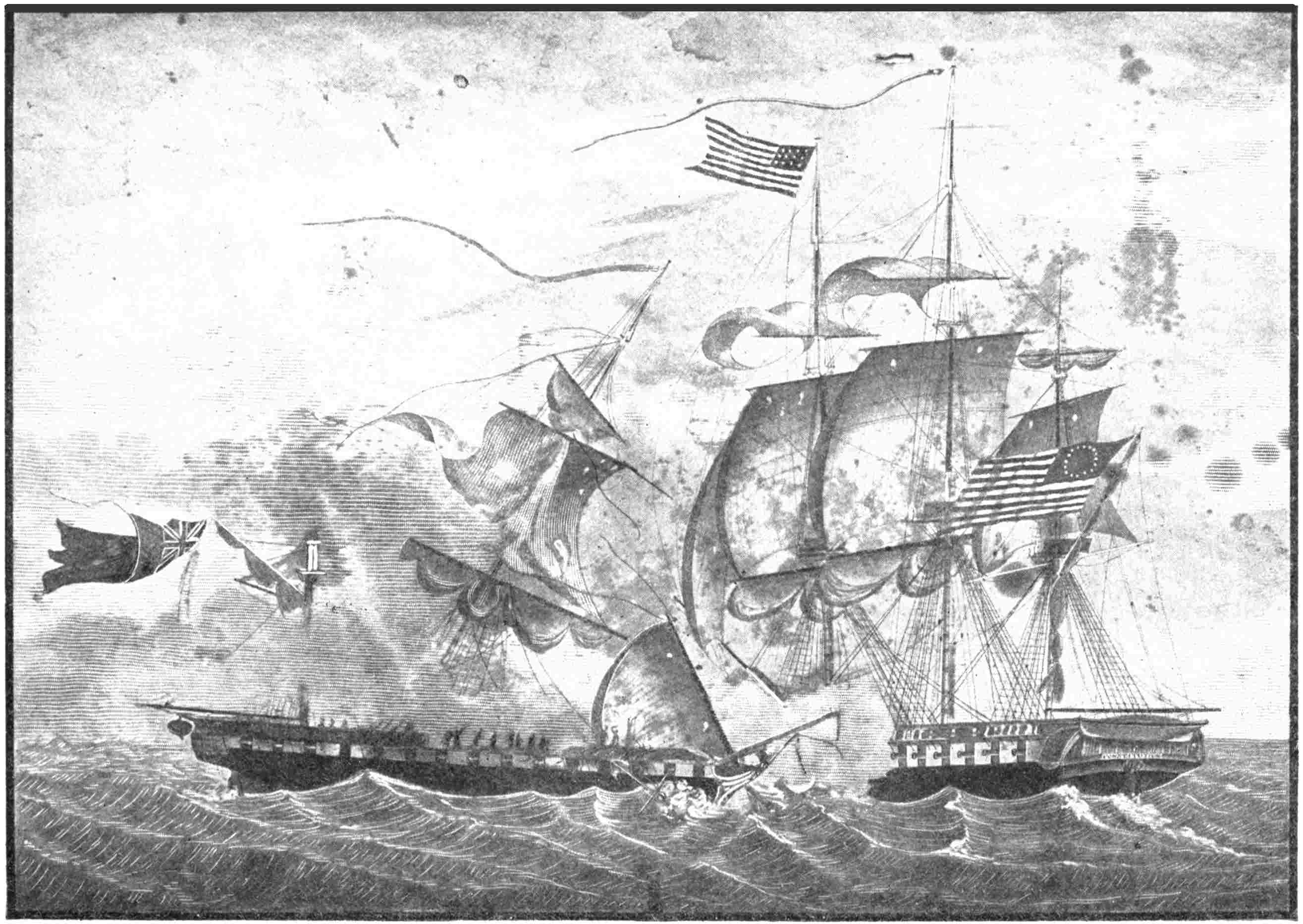
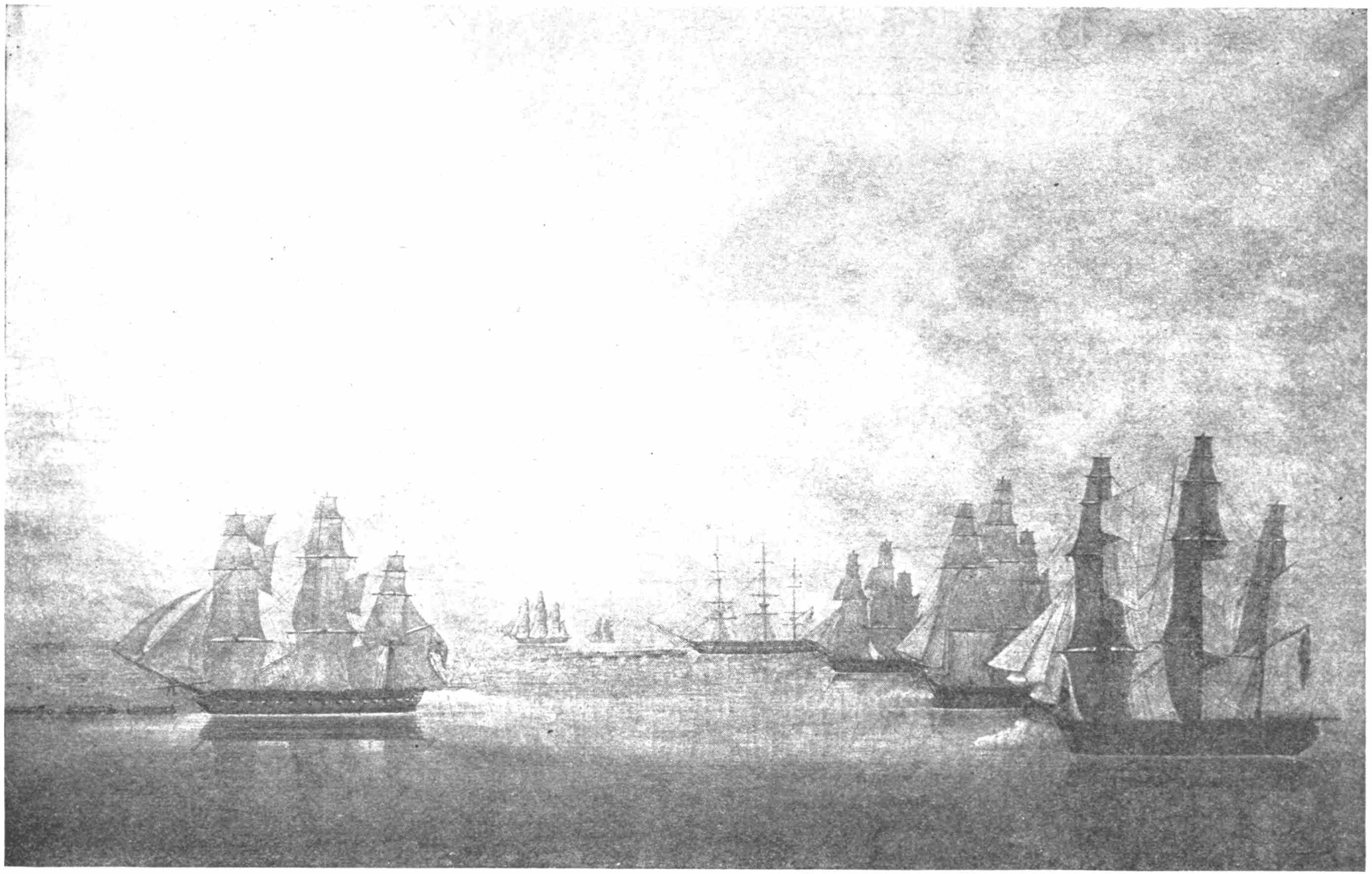
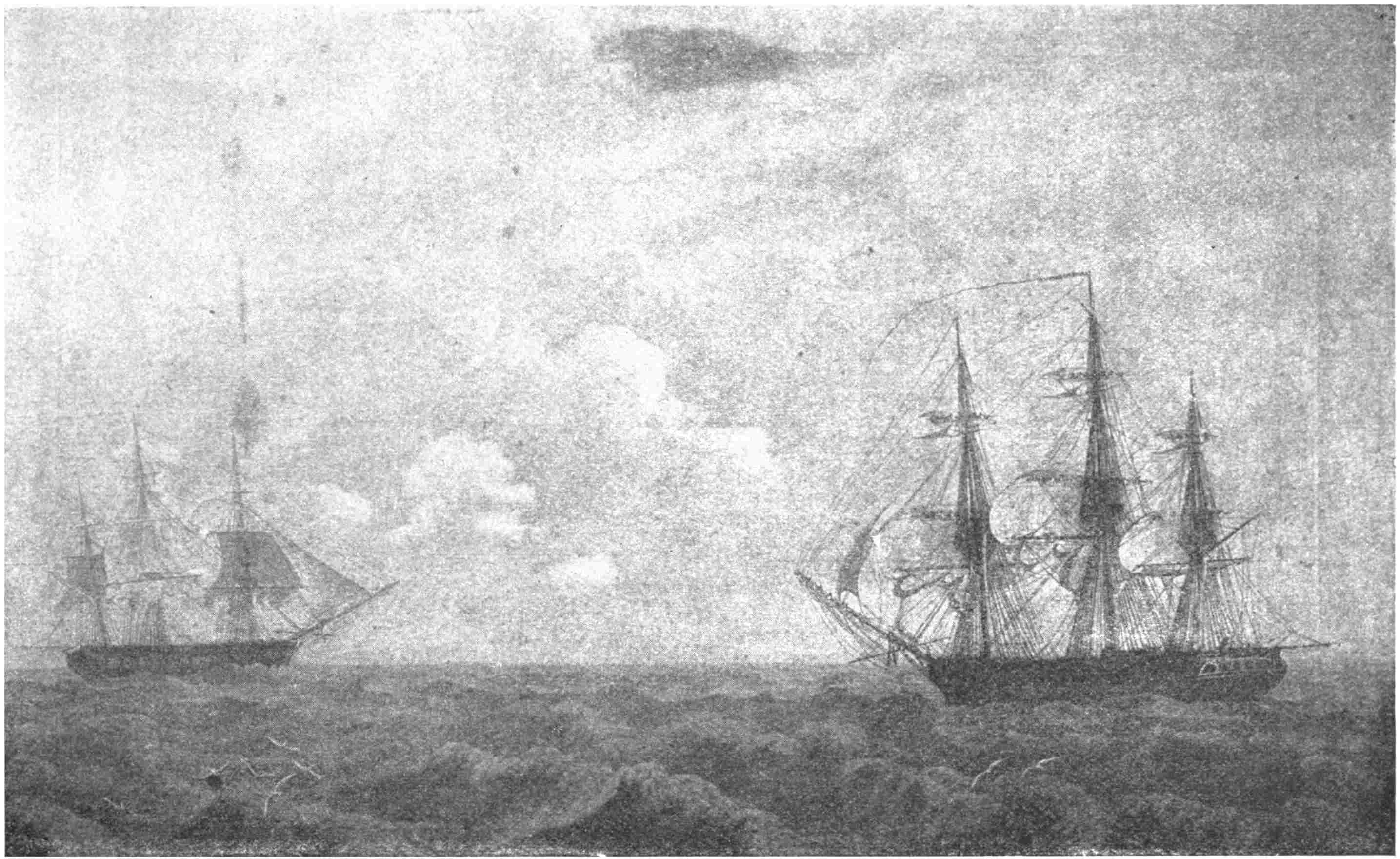
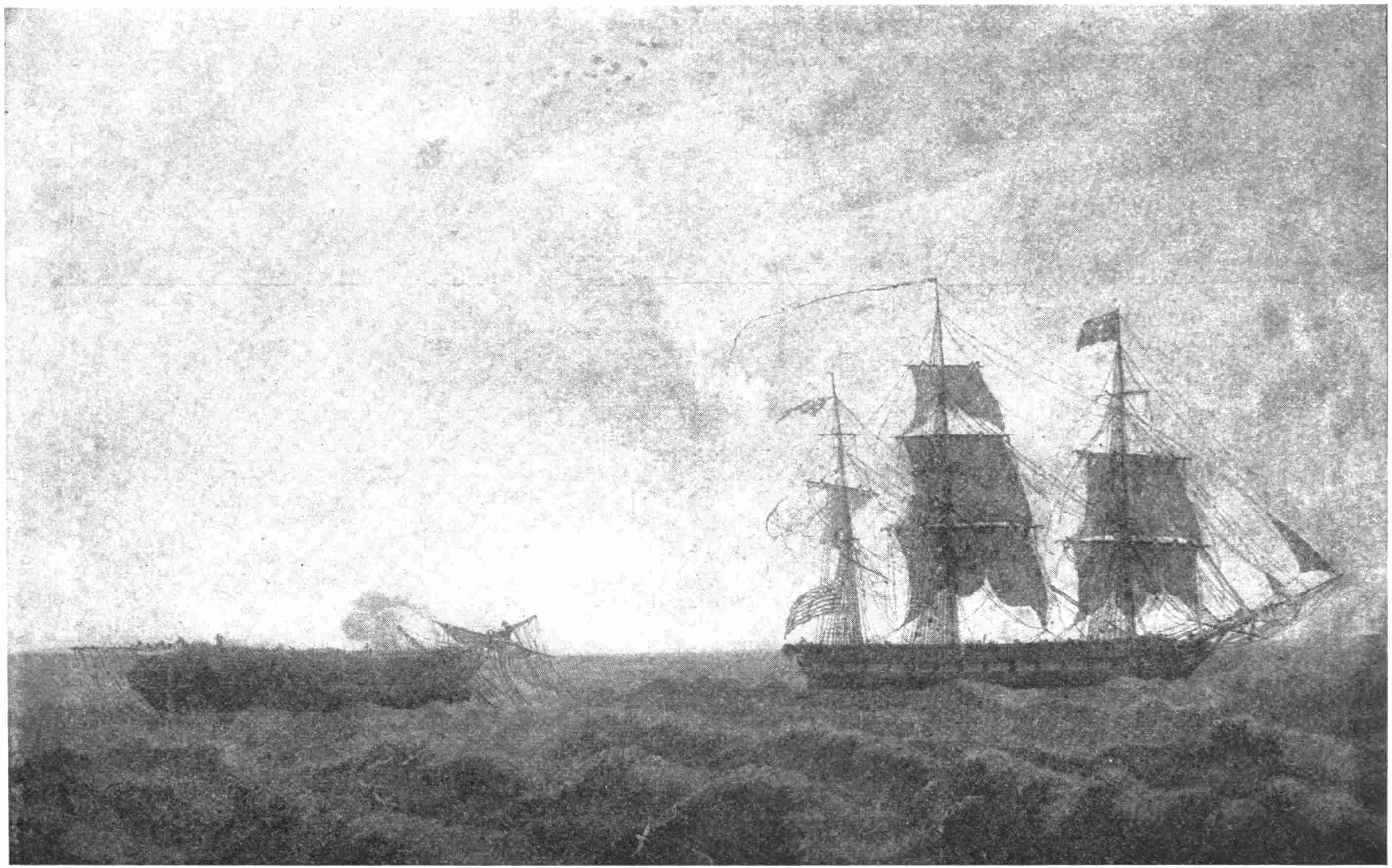
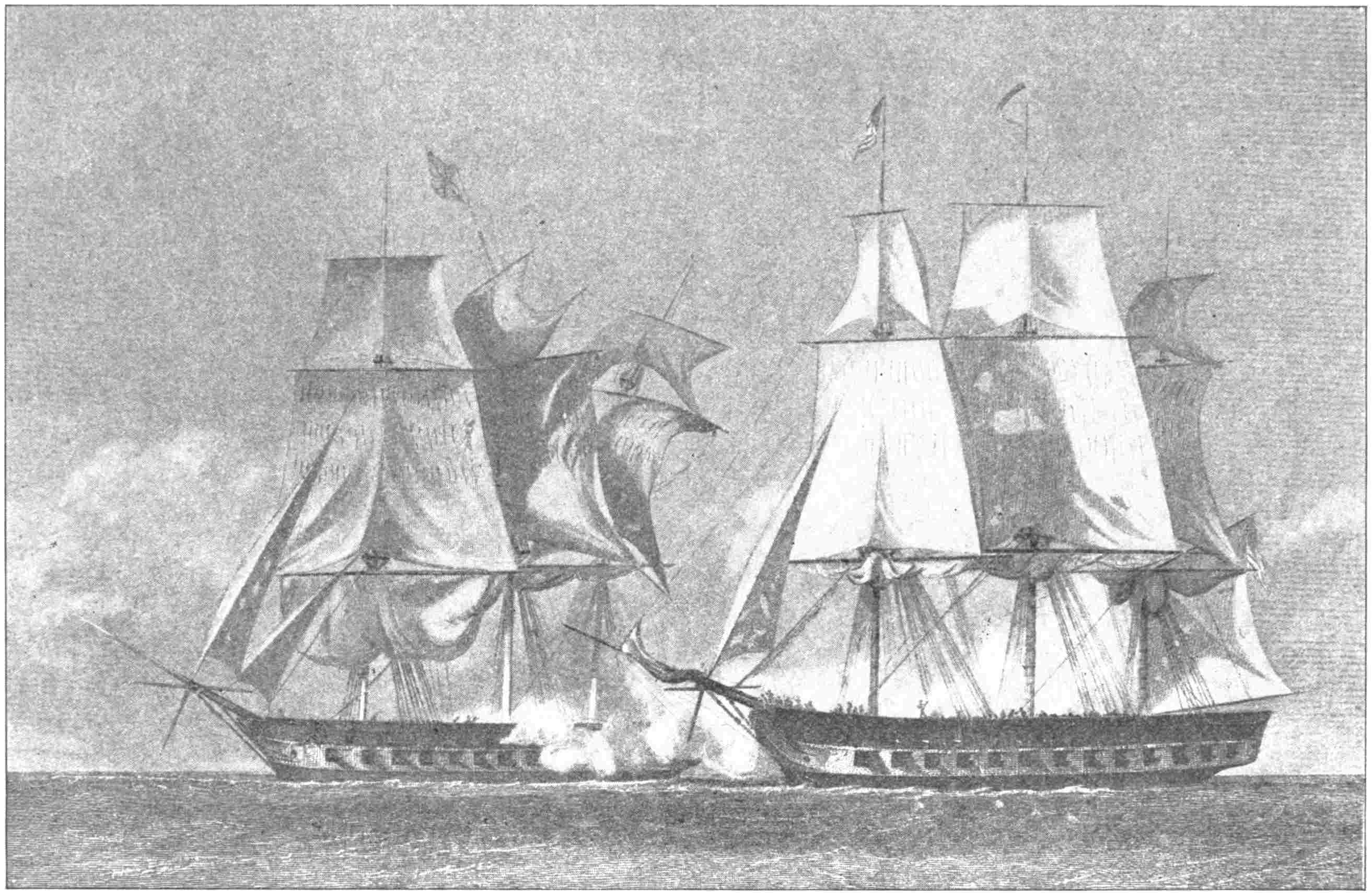
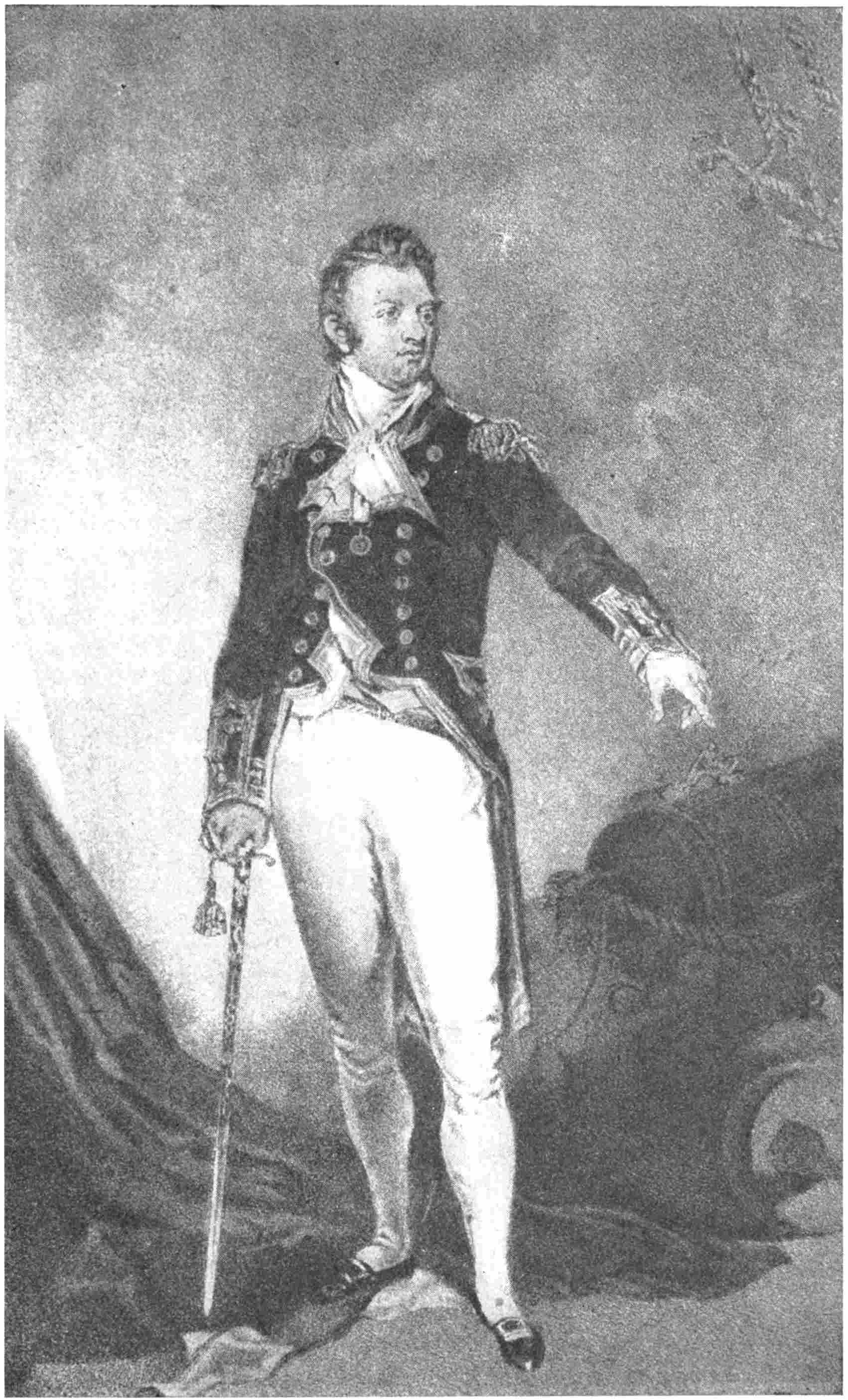
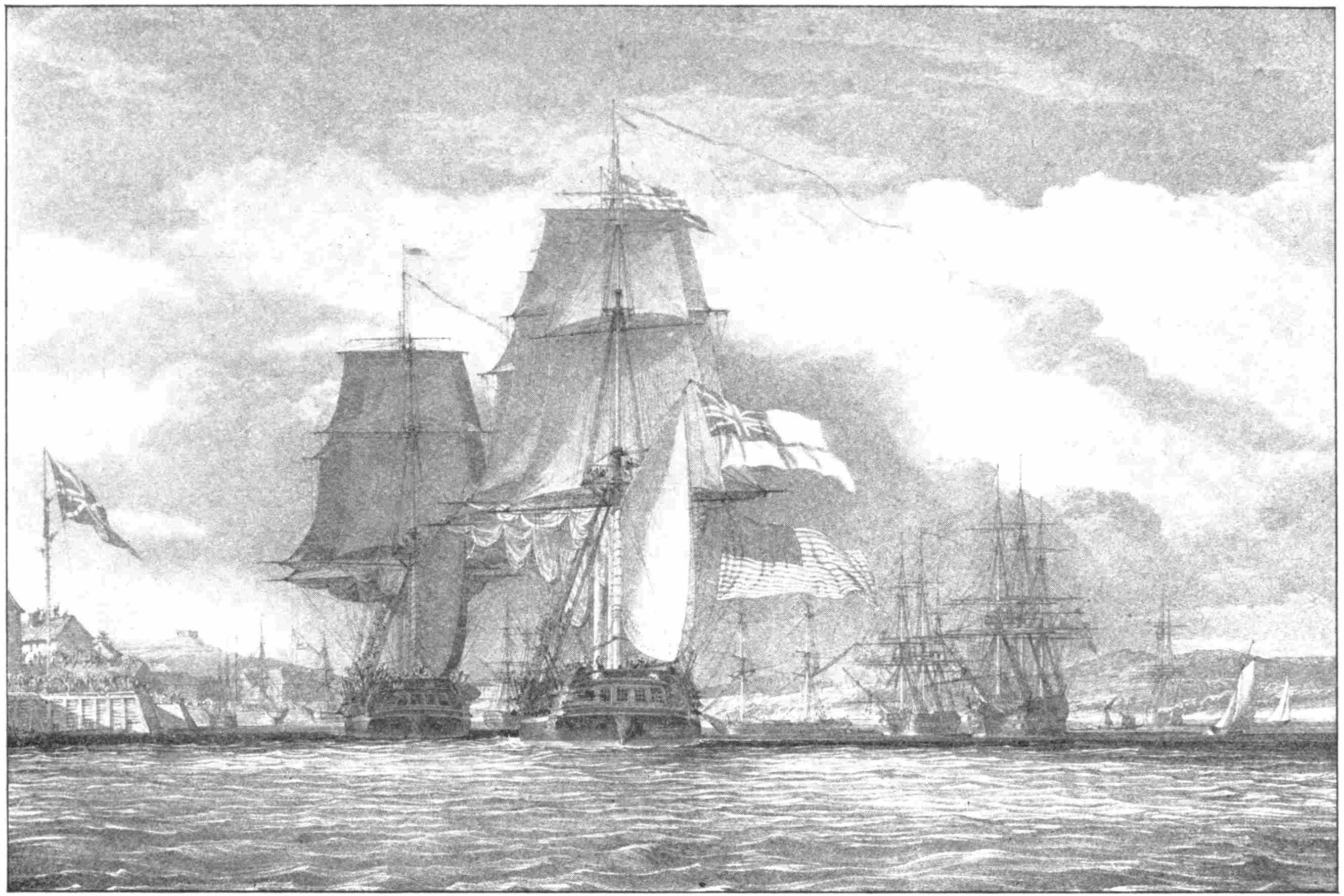
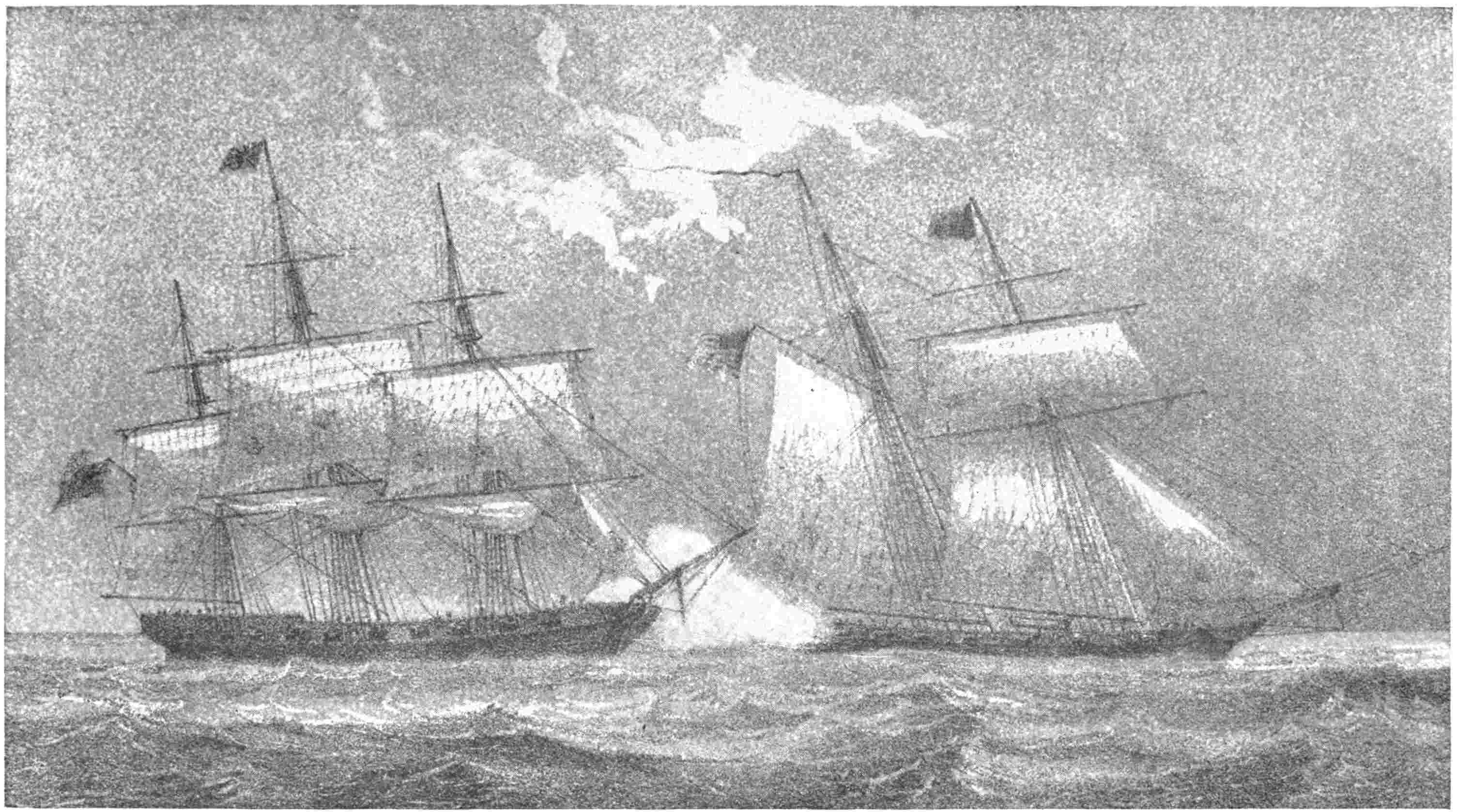
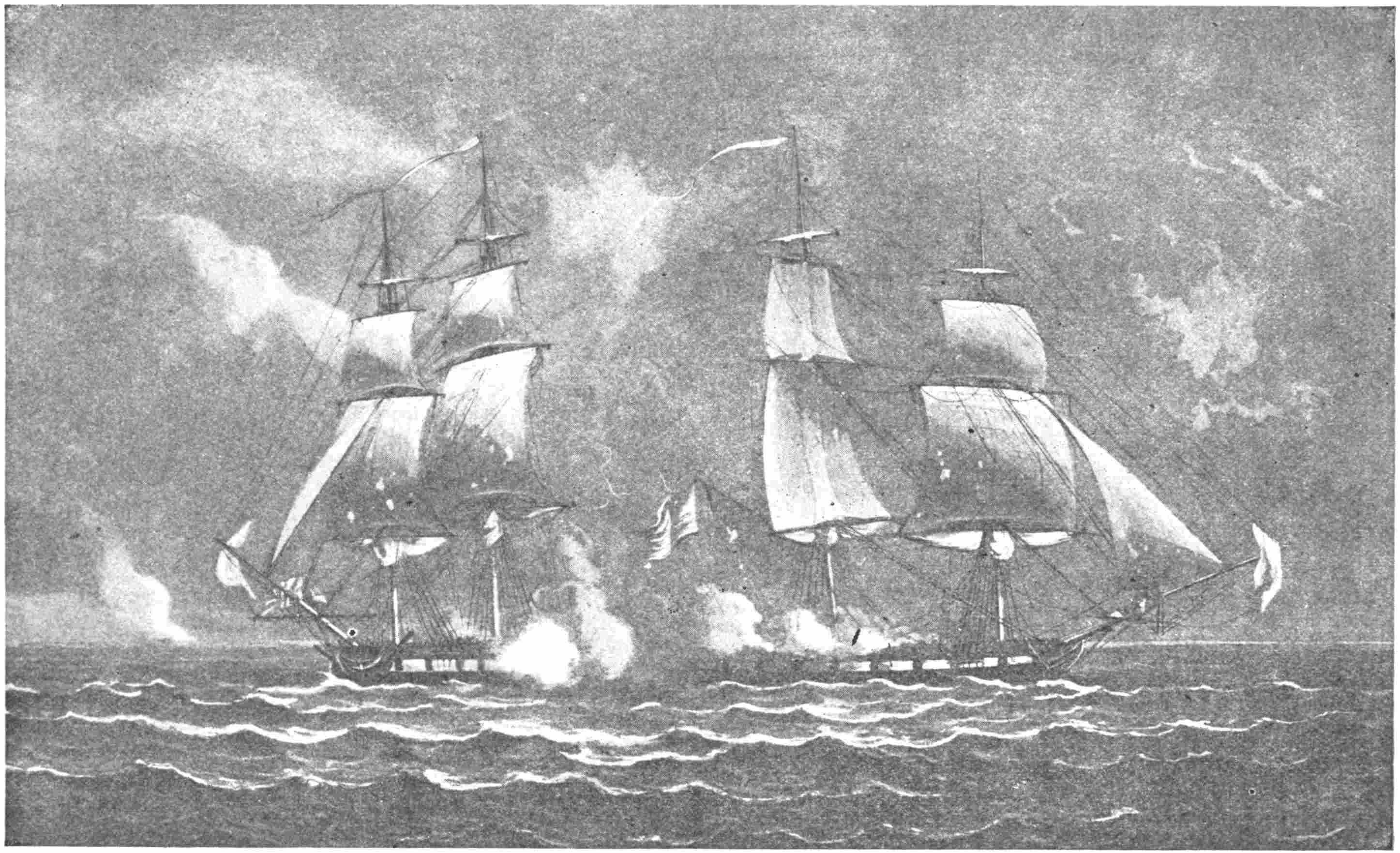
The Constitution and Guerrière. (From a French water-color drawing in the possession of Mr. W. C. Crane),
Frontispiece.
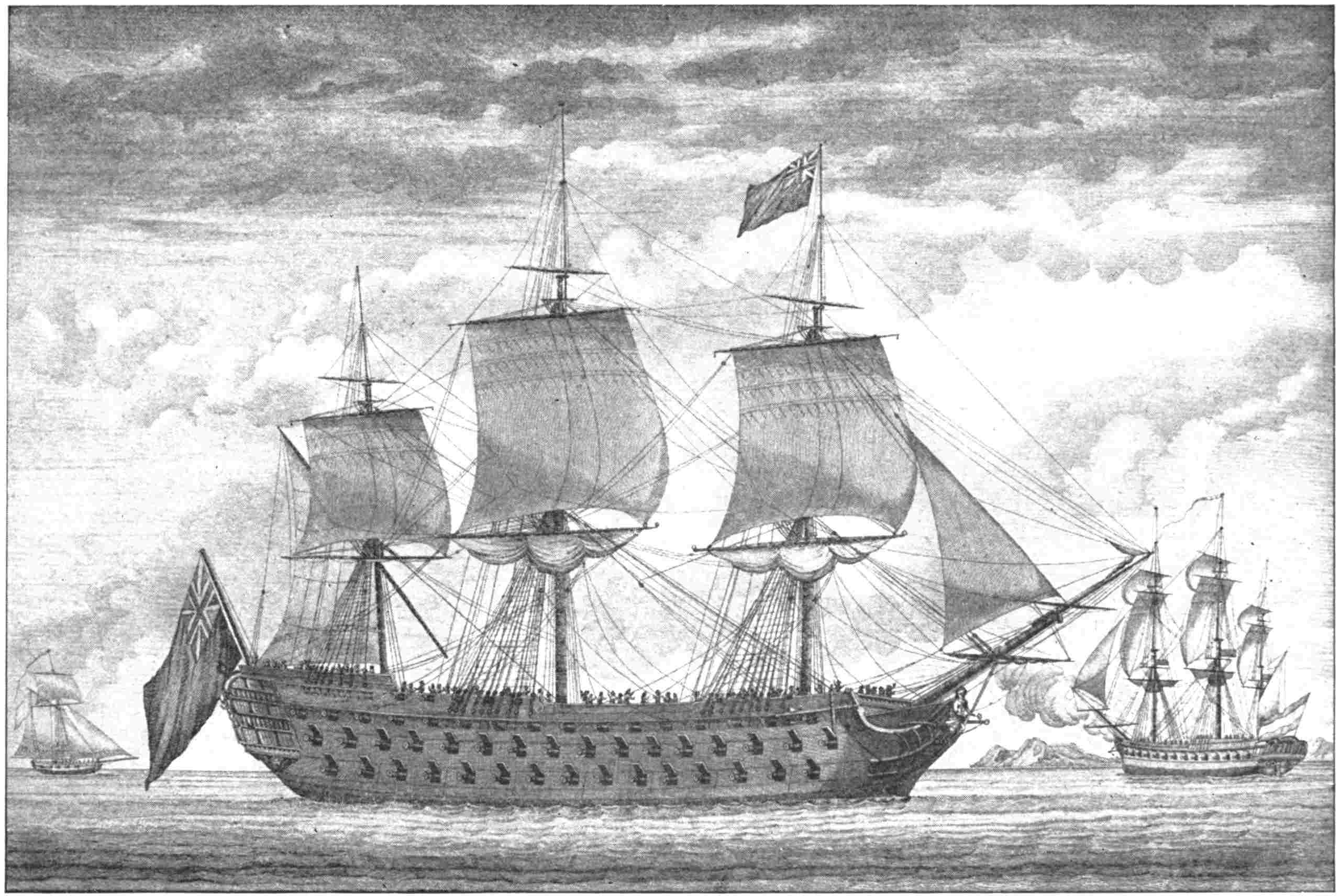
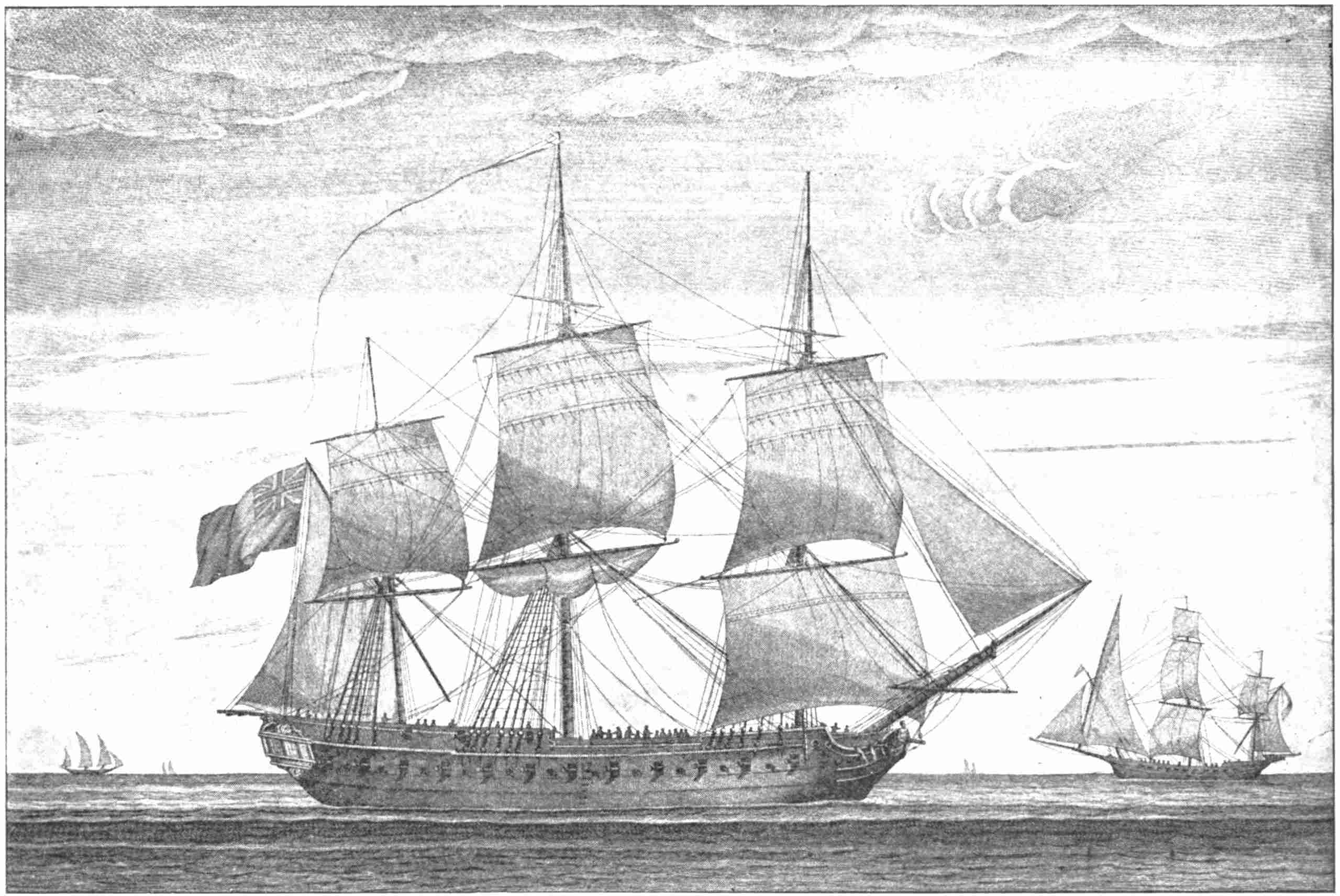
English Vessel of One Hundred Guns. (From an engraving by Verico),
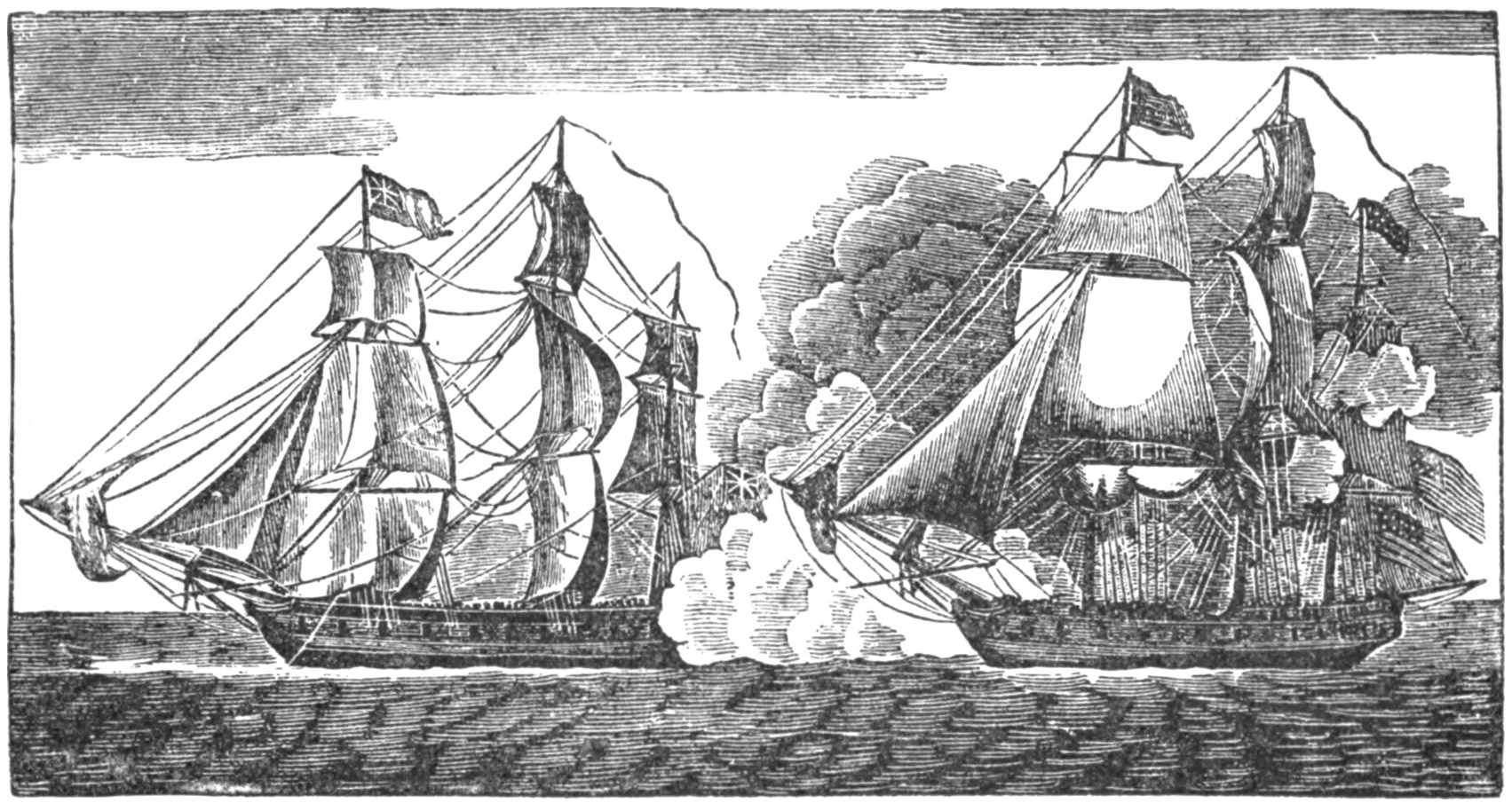
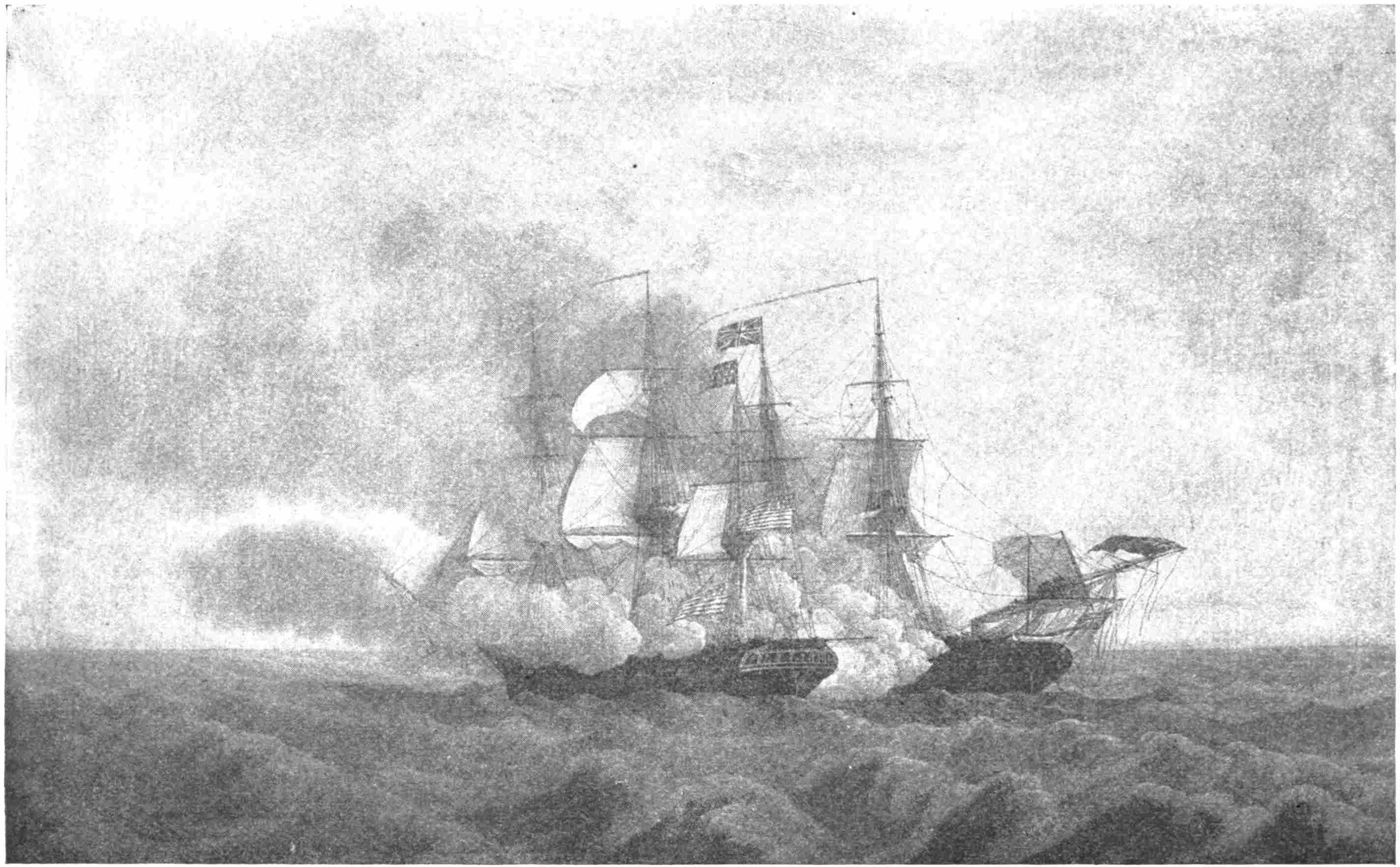
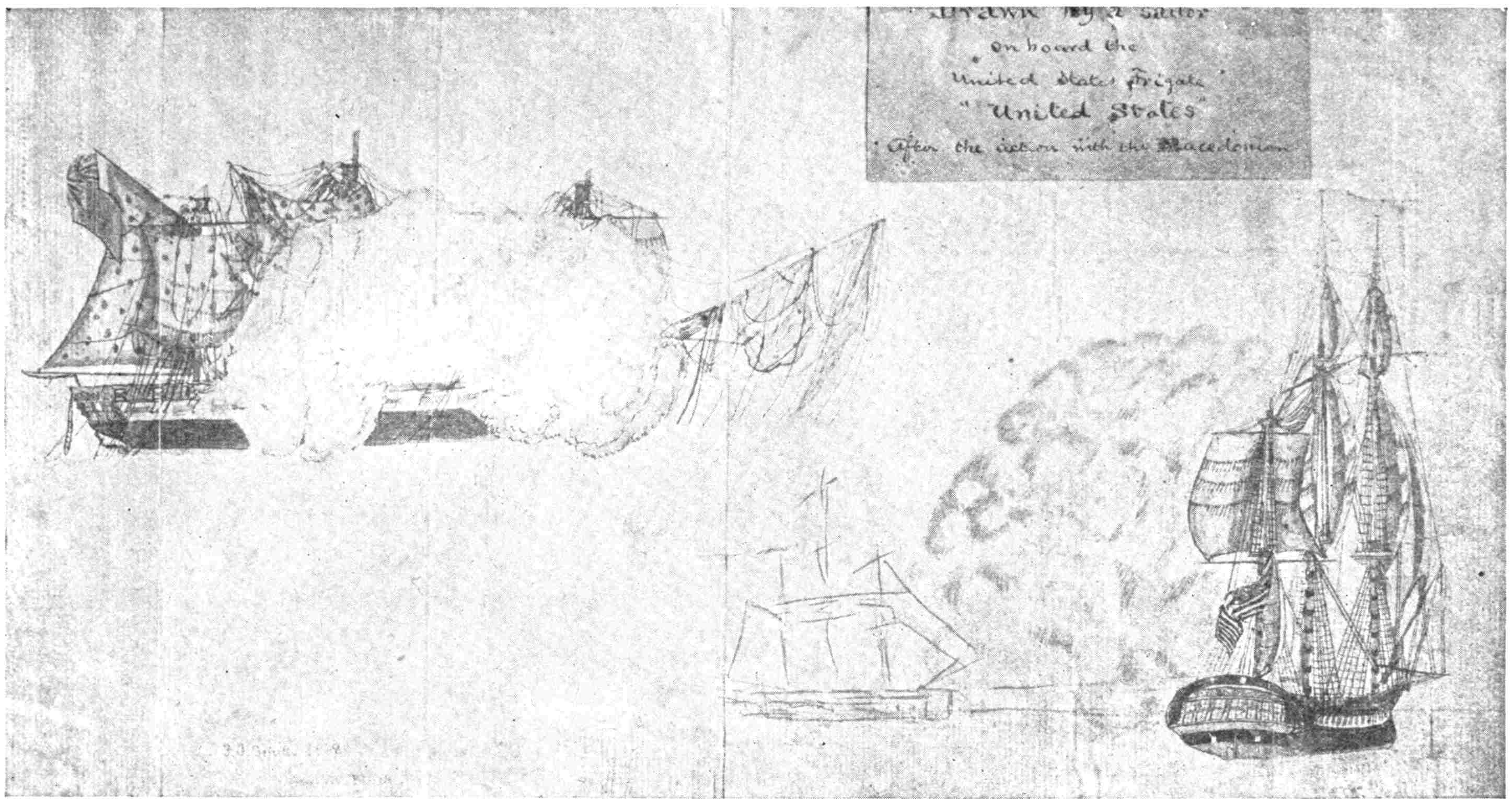
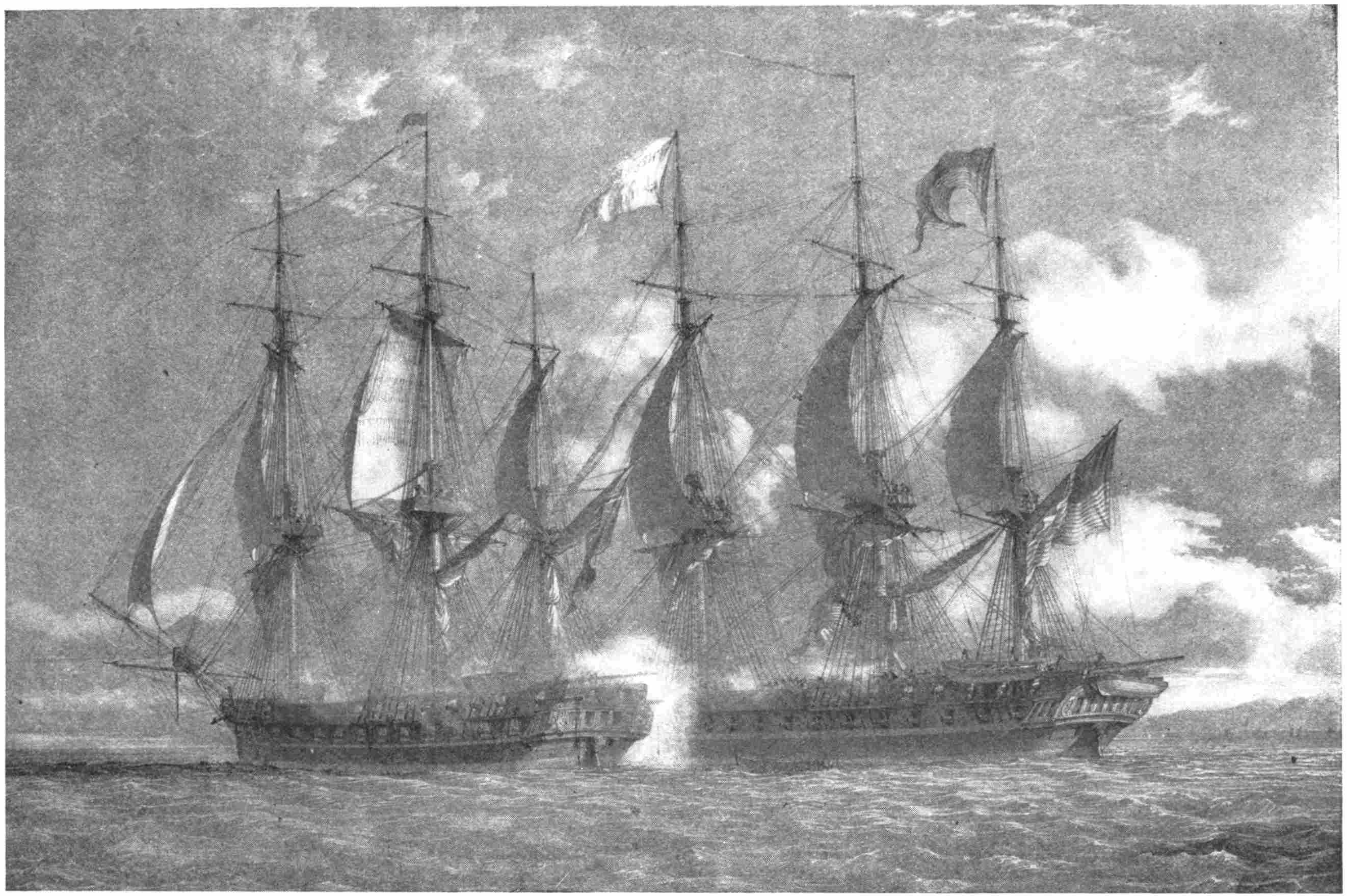
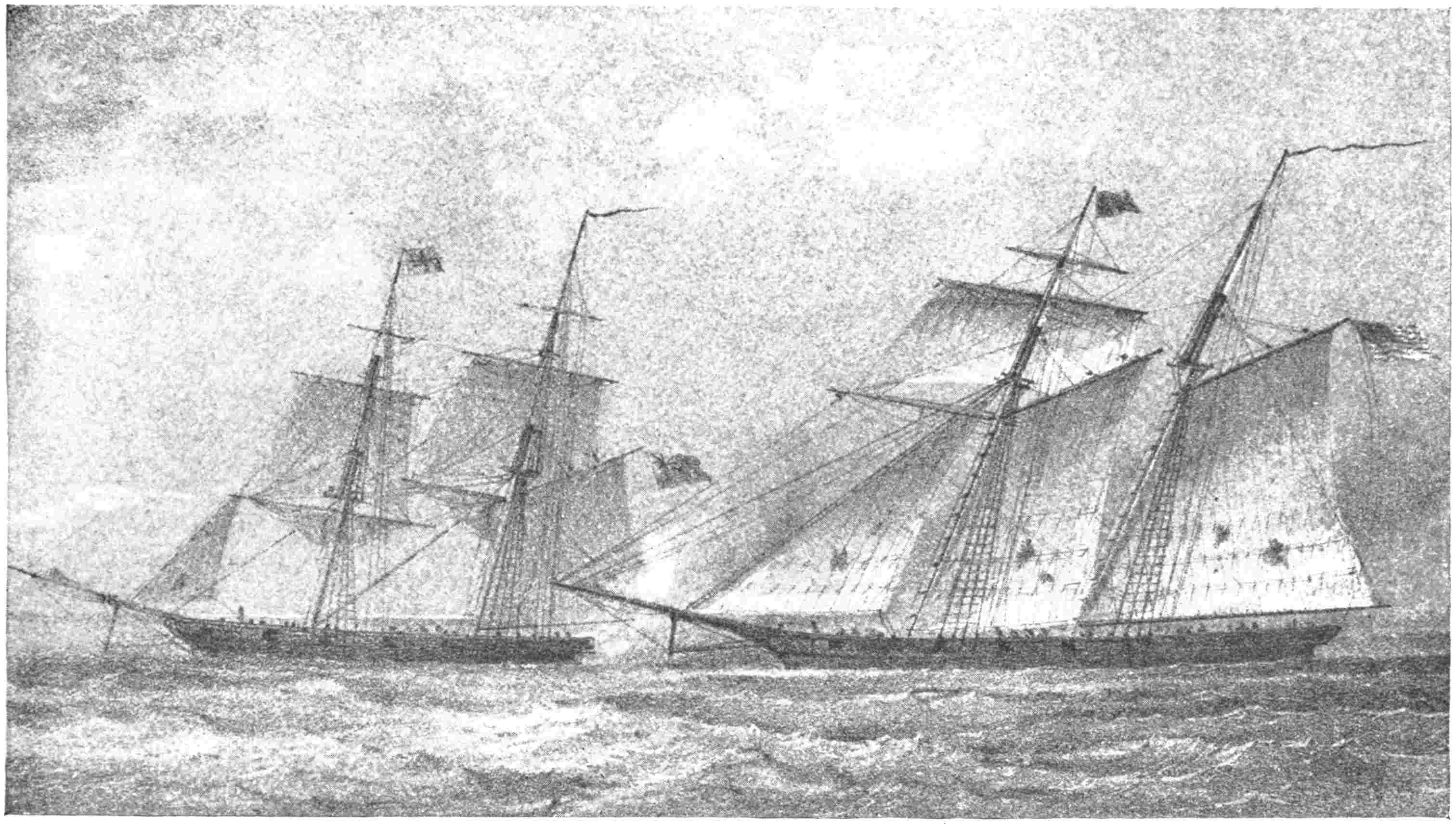
The Battle Between the United States and the Macedonian. (Drawn by a sailor who was on the United States. From the original drawing at the Naval Academy, Annapolis),
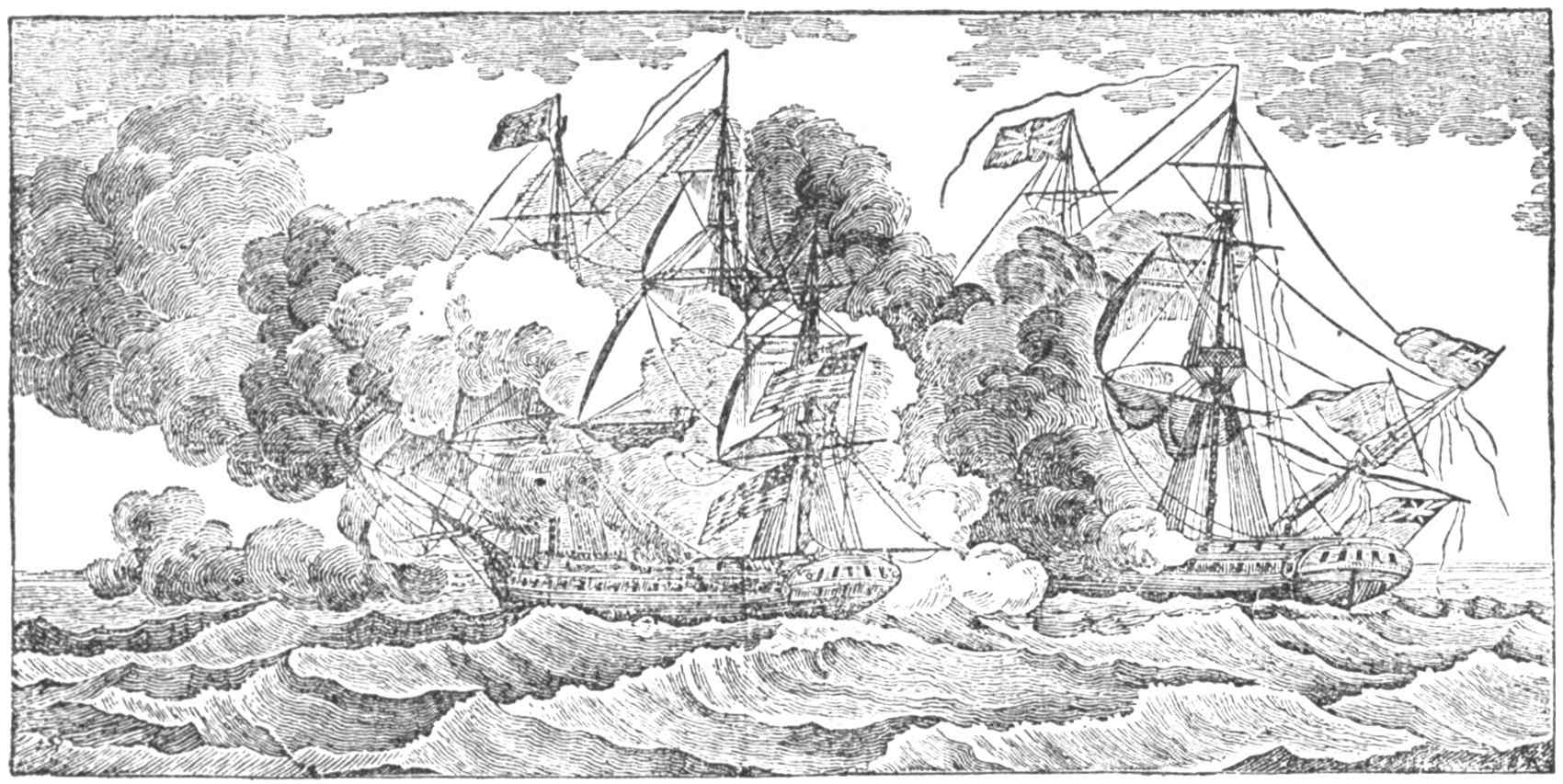
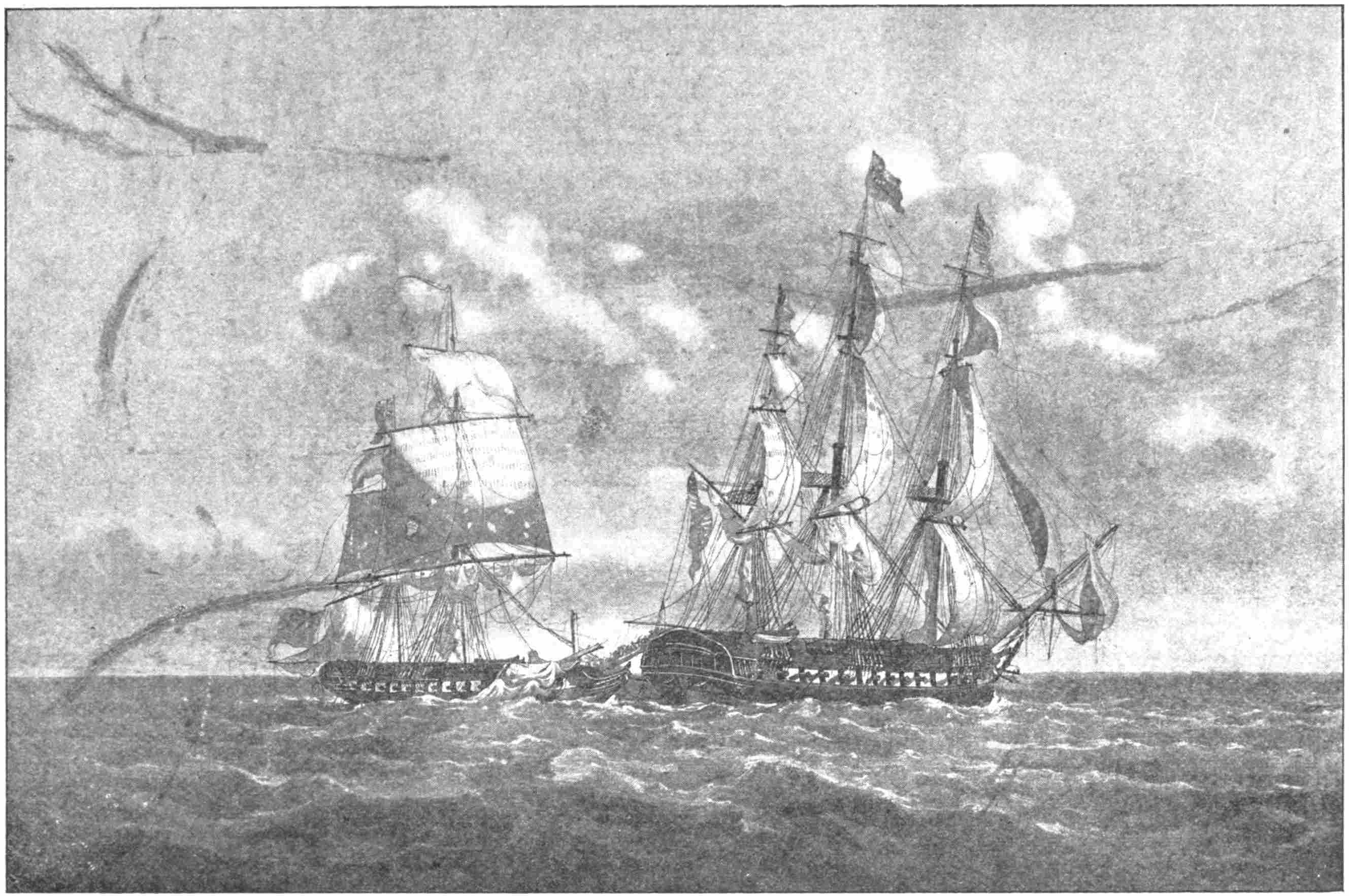
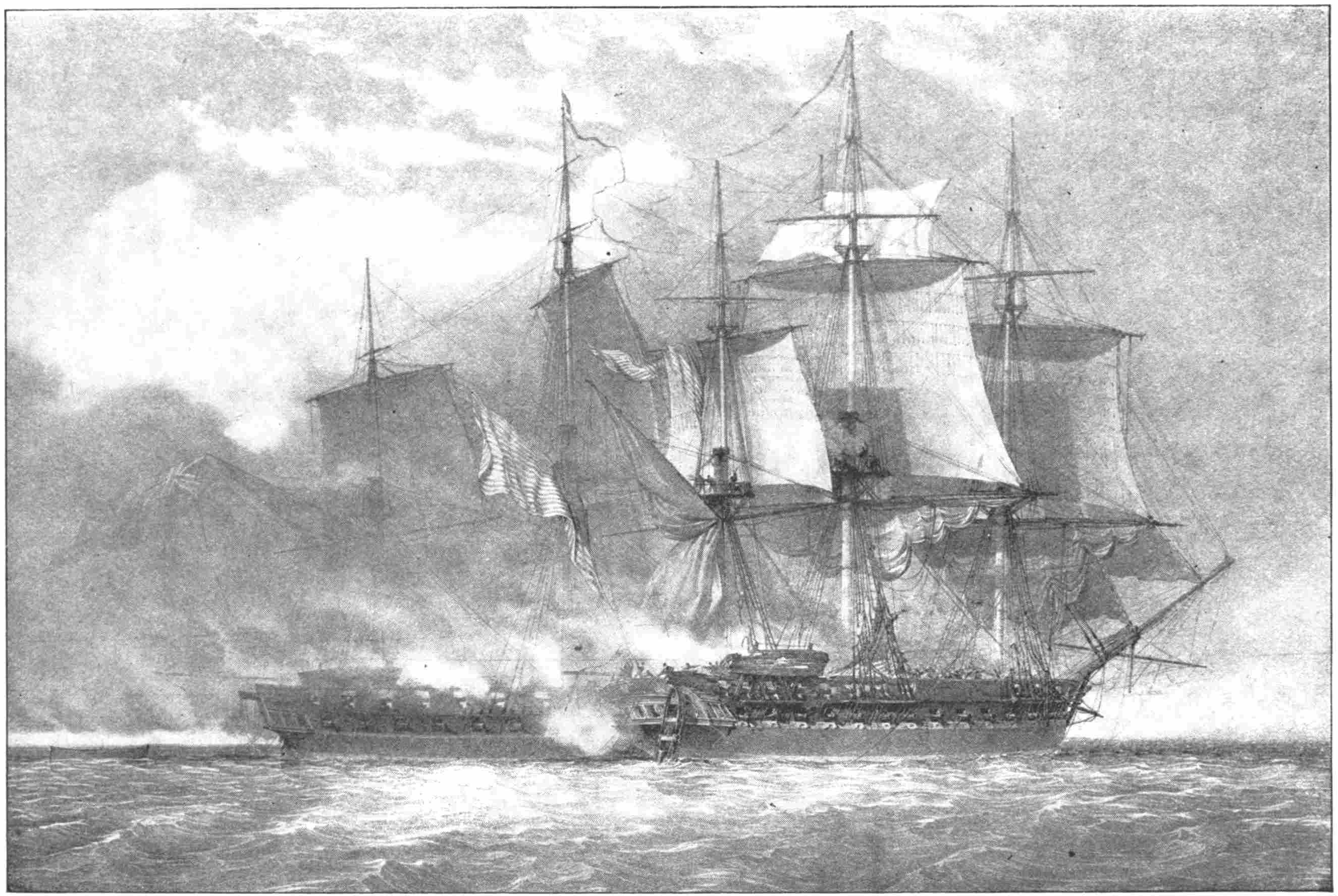
The Battle between the Constitution and the Java.—I. (“At five minutes past three o’clock, as the Java’s foremast fell.” From an engraving by Havel, after a sketch by Lieutenant Buchanan),
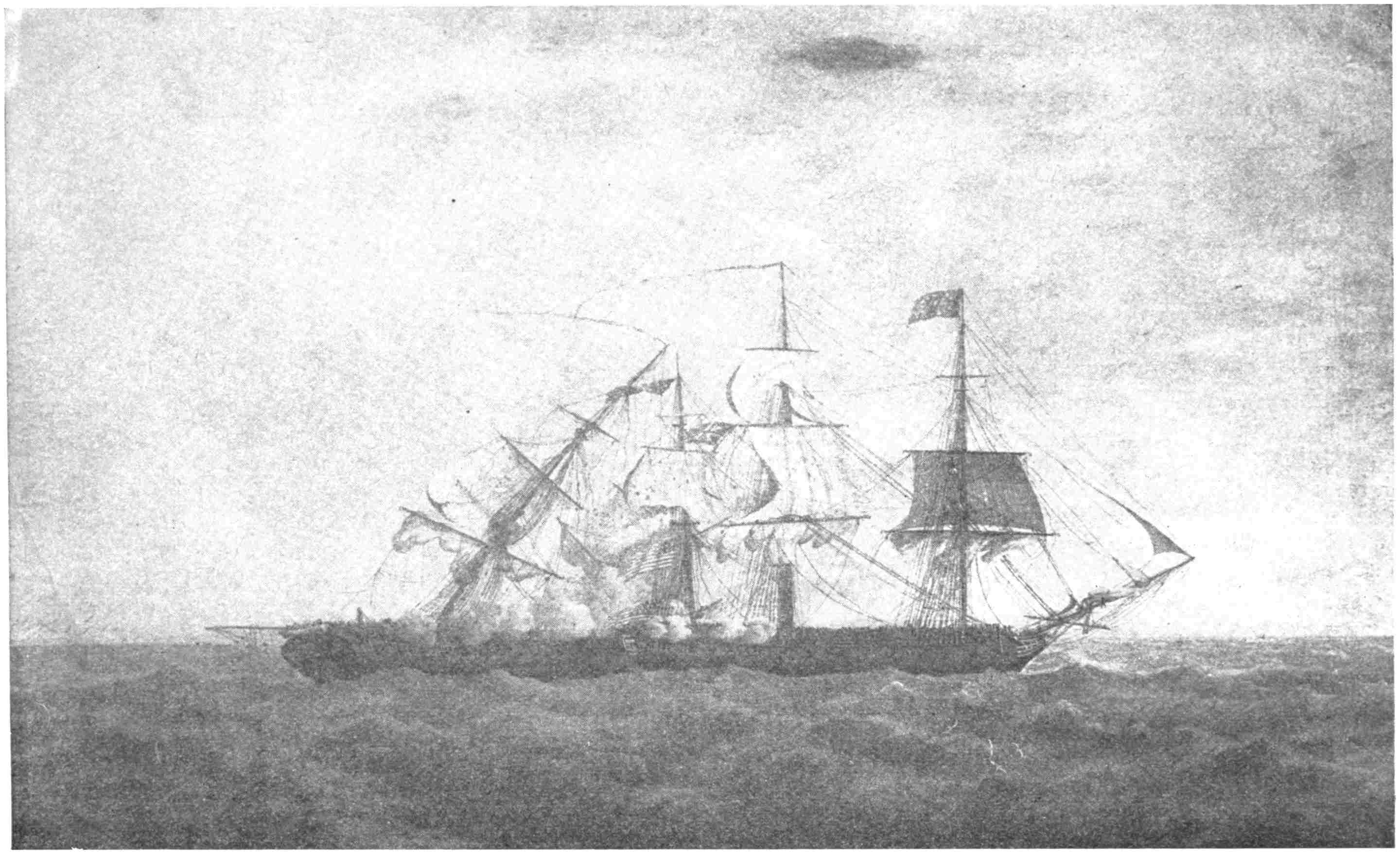
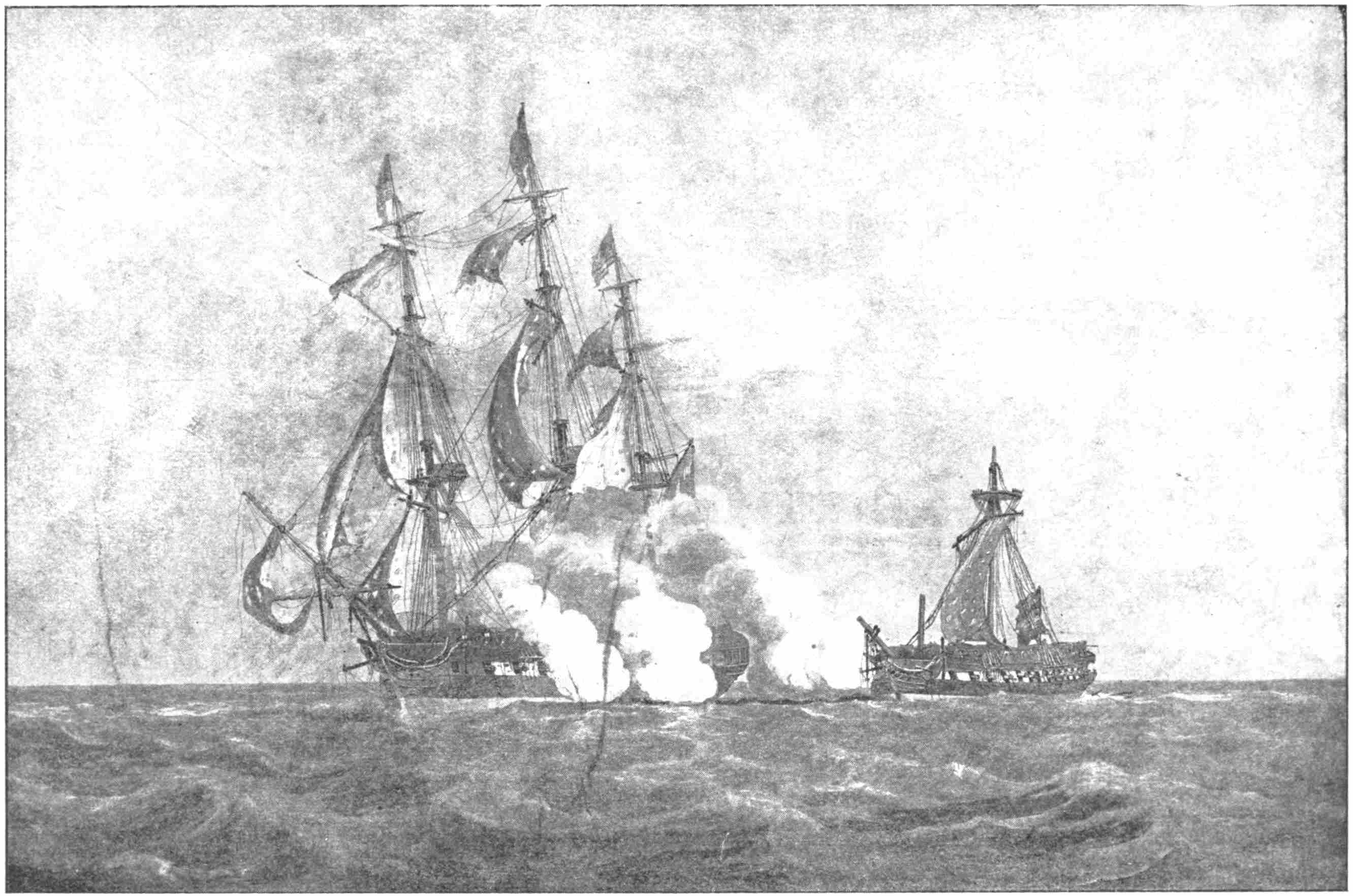
The Battle between the Constitution and the Java.—II. (“At half-past four o’clock, as the Constitution began to make sail.” From an engraving by Havel, after a sketch by Lieutenant Buchanan),
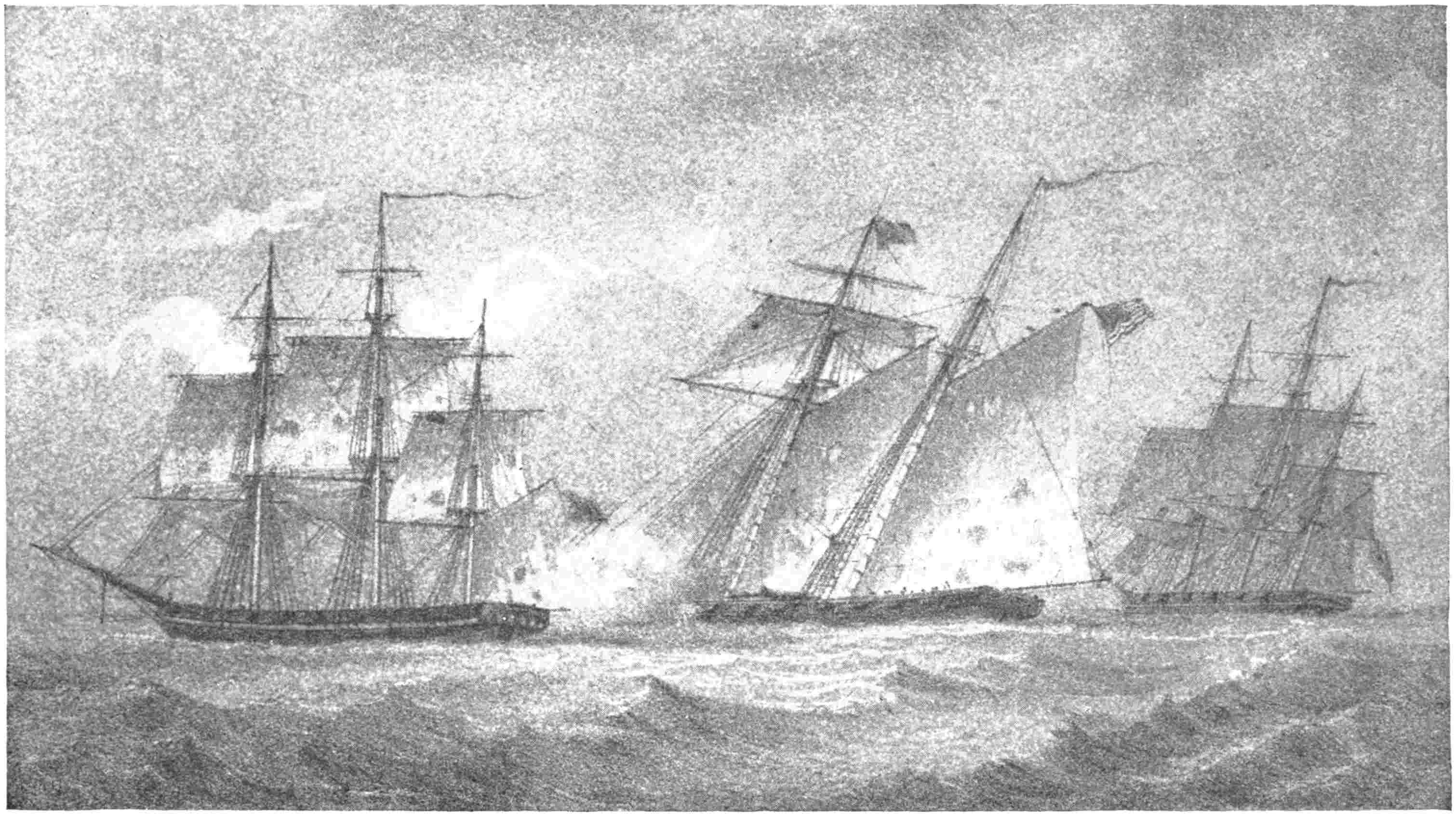
Capture of the British Brigs Detroit and Caledonia, October 12, 1812. (From a wood-cut prepared under the supervision of Lieutenant Jesse D. Elliott himself),
A FAIR ESTIMATE OF THE NUMBER OF AMERICANS ENSLAVED BY
THE PRESS GANGS—A BRAGGART BRITISH CAPTAIN’S WORK AT
SANDY HOOK—A SEARCH FOR THE GUERRIÈRE—ATTACK ON
THE BRITISH SHIP LITTLE BELT—A FEATURE OF THE BATTLE
THAT WAS OVERLOOKED—WHEN THE CONSTITUTION SHOWED
HER TEETH THE BRITISH SHIP BRAILED ITS SPANKER AND
HEADED FOR SAFER WATERS—AN EAGER YANKEE SAILOR WHO
COULDN’T WAIT FOR AN ORDER TO FIRE—WAR UNAVOIDABLE.
By base arts and promises intended to be
broken—by sending, for instance, one George
Rose as a commissioner to Washington, ostensibly
to adjust the whole matter amicably, but
in reality to gain time, the British Prime Minister
(the “impetuous Canning”) succeeded
in getting the Chesapeake affair “put out to
nurse.” The three American seamen were
“reprieved on condition of re-entering the
British service; not, however, without a grave
lecture from Berkeley on the enormity of their
offence, and its tendency to provoke a war.”
Berkeley himself was called home. The British
Minister told the American Government
this was done by way of reproval for Berkeley’s
act in ordering the assault on the Chesapeake.
As a matter of fact, he was at once rewarded
with a more important command than that he
had held—just as the commander of the Leander
was promoted after having shot to death
the man at the tiller of an American coaster.
Not only was the Chesapeake affair “put out
to nurse,” it was actually nursed to sleep. The
people waited for the politicians to adjust it,
but waited in vain, waited and watched while
the brutal press-gangs continued their work.
The results of these press-gang assaults upon
American seamen seem—as seems the patience
of the American people—almost incredible.
But the figures are a matter of undisputed record.
The American Minister in London, during
one period of nine months, presented two
hundred and seventy one petitions, begging the
release of that number of American impressed
seamen.
The British Admiralty at one time reported
2,548 seamen in the service who had refused to
do duty on the ground that they were enslaved
American citizens.
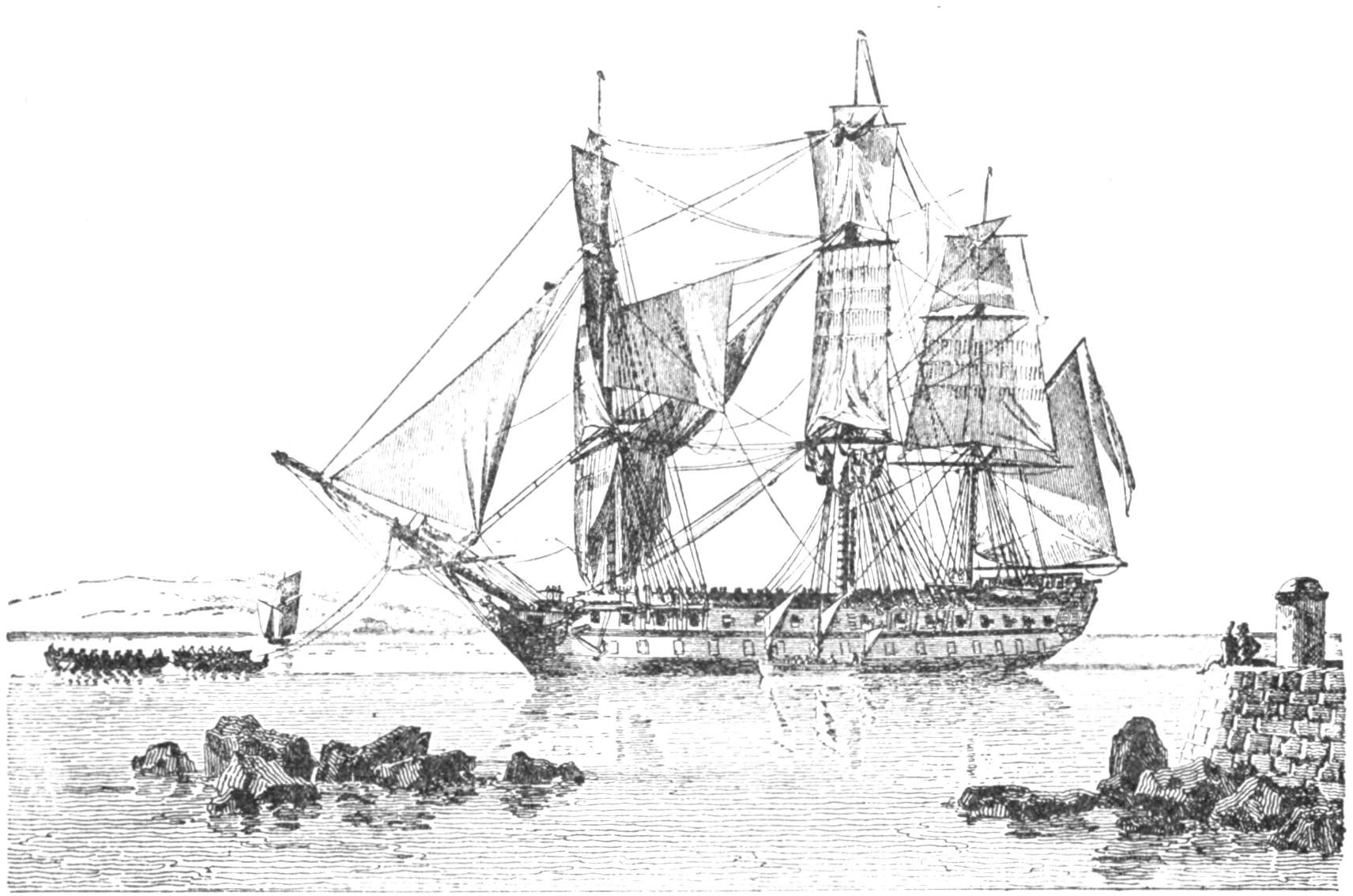
English Vessel of One Hundred Cannons
Lord Castlereagh admitted in a speech before
Parliament on February 18, 1811, that
“out of 145,000 seamen employed in the British
service the whole number of American subjects
amounts to more than 3,300.” And when
the papers of the State Department at Washington
were searched it was found that the friends
of the enormous number of 6,257 different
American citizens, impressed into the British
service, had filed protests there.
That more than two men would be so impressed
without having a protest filed, to every
one for whom such a protest was filed, is a
matter of course. And what is the moderate
conclusion drawn from these facts? It is that
more than twenty thousand free American men
were forced into the service of the British navy
by the press-gangs. Their fate, save in a few
cases, is unrecorded, but we know that some
met the perils of the deep and were lost.
Many were sent to the fever coasts of Africa
and there died. Some were flogged to death
at the order of officers who laughed at their
tortures. And of the rest—the few—we shall
read farther on. For their cries to righteous
heaven for help, and the wails of mothers and
wives and children left helpless by these aggressions,
were to be heard at last.
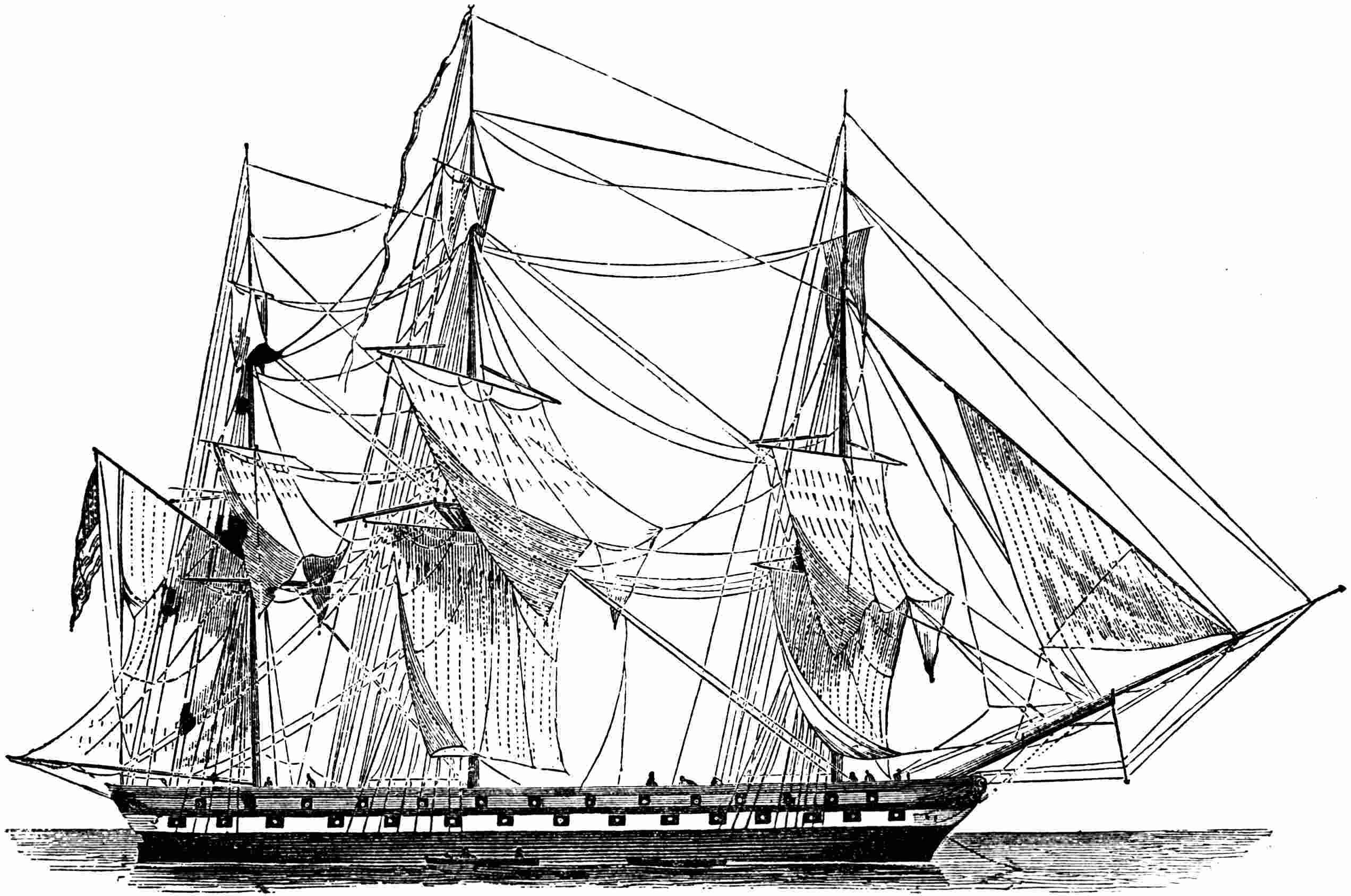
A Frigate with her Sails Loose to Dry.
From a wood-cut in the “Kedge Anchor.”
A body of Massachusetts Tory merchants
strove wickedly and falsely to make the world
believe that Massachusetts homes had not been
invaded by the press-gangs; a member of Congress
stood in his place to say that in spite of
restrictions the nation had “profitably exported”
goods worth forty-five millions of dollars
during one year, and asked if all that trade was
to be sacrificed in order to strike a blow for
mere sentiment; the faint-hearted pointed to
the exhausted condition of the national treasury,
to the utter lack of trained soldiers, and to
the feebleness of the navy when it was compared
with that of the nation whose “naval supremacy
was become a part of the law of nations.”
But all these were at last brushed aside by the
indignant host that arose to strike another blow
for liberty—they were brushed aside so rudely,
that, in one place, at least, a mob violently assaulted
the toady element as represented by a
Tory newspaper.
It happened that actual fighting occurred
before war was declared, and most significant
was one feature of the first battle of the war of
1812. The British frigate Guerrière, of thirty-eight
guns, commanded then by Captain Samuel
John Pechell, was one of the great host of
war-ships that hovered about the American
coast in 1811, picking able-bodied sailors from
American ships, and in other ways annoying
American commerce. Captain Pechell’s contempt
for the young republic and his personal
vanity were so great that he caused the name
of his ship to be painted in huge letters across
his foretopsail. Like a mine-camp bad man,
he wanted every one to know who it was that
tore open the water and split the air off the
American coast. He was looking for trouble
and his ship found enough of it, later on,
although under another commander. Pechell
himself found it, also, but he did not stay long
to face it. In fact he fled from a very inferior
force the moment he smelled the burning
powder.
On May 1, 1811, the American merchant
brig, Spitfire, while en route from Portland
(formerly Falmouth), Maine, to New York,
passed the Guerrière, that was lying-to at Sandy
Hook, and but eighteen miles from New York
City. The Guerrière, finding the brig bound
in, deliberately stopped her there within the
waters of New York and took off John Deguyo,
an American citizen, who was a passenger.
At the time of this outrage the United States
frigate President, of forty-four guns, commanded
by Captain John Rodgers, was lying
off Fort Severn, at Annapolis, Maryland. Captain
Rodgers was at Havre de Grace, her chaplain
and purser were at Washington, and her
sailing-master was at Baltimore. That was in
the days of stage coaches, as the reader will recall,
but in spite of the slowness with which
mails travelled—especially official mails—the
President tripped her anchor at dawn on the
morning of May 12th, and headed away for the
ocean, with her name painted on each of her
three topsails. As a poker-player might say,
Captain Rodgers was holding three of a kind
to Captain Pechell’s ace high. That he had
been sent to sea to look for the Guerrière and
get John Deguyo from her does not admit of
a doubt, although he had not been specifically
ordered to do so. He had been ordered to
cruise up and down the coast to “protect American
commerce,” and the facts of the Guerrière’s
assault upon the liberty of John Deguyo had
been communicated to him. The proper proceedings
in the matter should he fall in with the
Guerrière were left to his discretion. That he
assumed the responsibility gladly may be inferred
from what he said before sailing. He said that
if he fell in with the Guerrière “he hoped he
might prevail upon her commander to release
the impressed young man.”
Four days after leaving Annapolis (on May
16, 1811) the look-out saw a man-of-war approaching,
and the looked-for Guerrière was
supposed to be at hand. But while yet too far
away for her name to be distinguished, the
stranger wore around and headed away south.
Still supposing it was the Guerrière, Captain
Rodgers made sail after her. This was soon
after the noonday meal. The President steadily
gained on the stranger, but the wind
was light, and a stern chase is a long one. As
night came on the stranger hauled to the wind
and tacked, and did various things, manifestly
in the hope of evading the Yankee, but all in
vain, even though night and thick weather came
on to help.
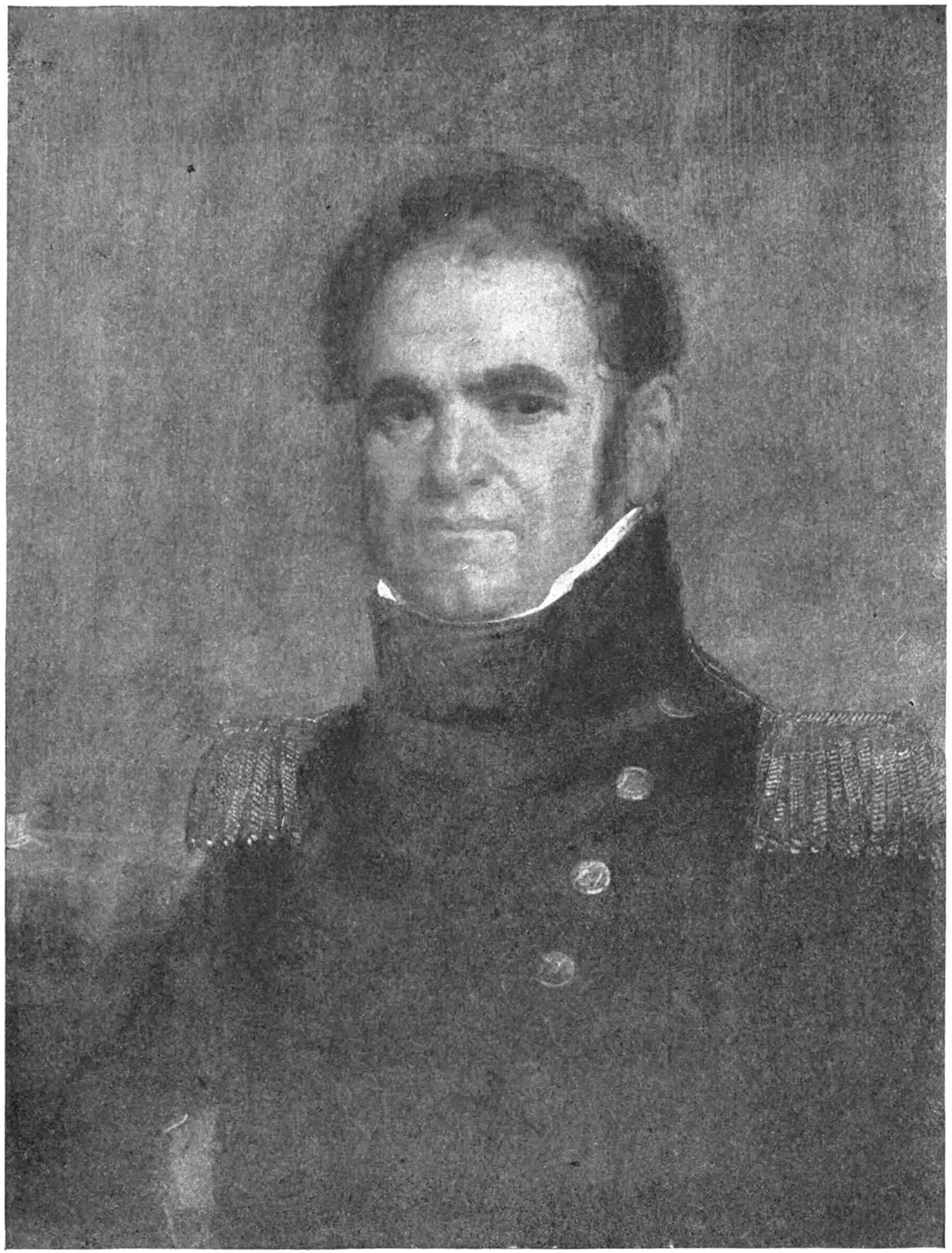
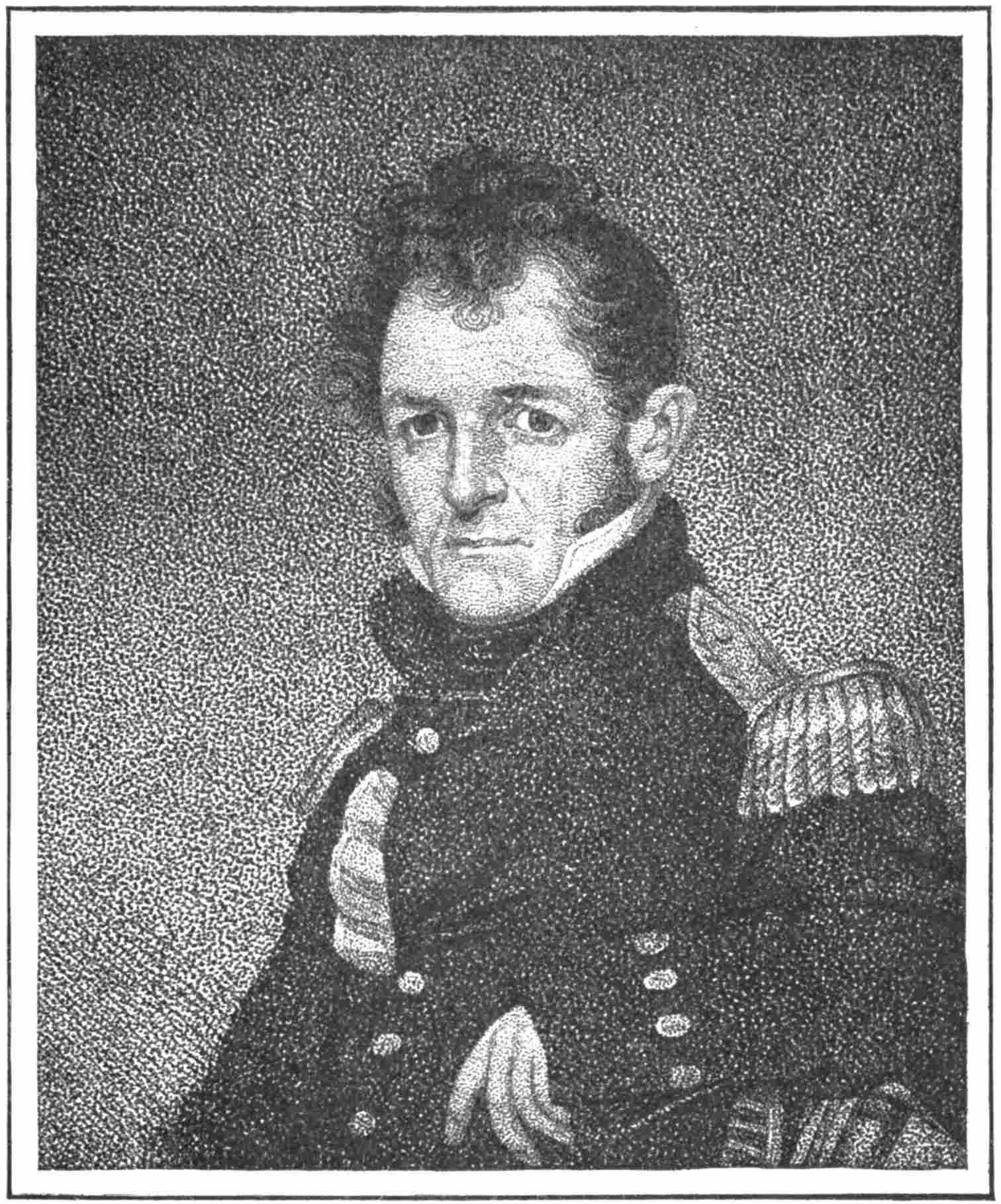
John Rodgers.
From the portrait by Jarvis at the Naval Academy.
Finally, at 8.20 o’clock the President, with
her crew at quarters, drew up close on the
weather bow of the stranger, and Captain
Rodgers hailed from the lee rail:
“What ship is that?”
Instead of an answer, the stranger replied by
hailing in turn:
“What ship is that?”
Captain Rodgers repeated his question, and
to his intense surprise he got for an answer a
shot from the stranger that struck the President’s
mainmast. Like an echo to this shot was
one, fired without orders, from the President.
To this the stranger replied with three shots in
quick succession, and then with a broadside.
At that the impatient gunner who had fired
from the President without orders had opportunity
to try again under orders, and the rest
of the crew joined in. For ten minutes they
loaded the guns with a rapidity well worth noting,
and fired with a deliberation and precision
never to be forgotten. And then the stranger
almost ceased firing. Because she was manifestly
much inferior to the President in armament,
Captain Rodgers ordered his men to
cease firing, but no sooner had this order
been obeyed than the stranger opened once
more, and his fire had to be returned. The
order was obeyed with such increasing good-will
that, in spite of darkness and growing wind
and sea, one broadside knocked the stranger
helpless, so that she wore around stern on,
where another broadside might rake her fore
and aft.
Now when Rodgers once more hailed he received
a reply, but owing to his position to
windward he could not understand it, but it is
recorded that the captain pluckily said “no”
when asked if he had struck. However, Rodgers
ran down under the stranger’s lee and
hove to, where he might be of service in case
she should sink, and there he waited for daylight.
During the night the two vessels drifted
apart, but at 8 o’clock the next morning the
President ranged up and sent Lieutenant
Creighton on board the stranger, to “regret
the necessity which had led to such an unhappy
result,” and offer assistance, if any were needed.
It was then learned that she was the “twenty-gun
corvette Little Belt, Commander Arthur
B. Bingham.” She had carried a crew of one
hundred and twenty-one all told, and of these
no less than eleven were killed, and twenty-one
wounded—a list of casualties amounting
to more than one-fourth of all she carried, although,
even by the British account (see Allen)
the time that elapsed between the first hail and
the last was but half an hour, while the time
passed in actual combat did not exceed fifteen
minutes. On the President one boy was
slightly hurt by a splinter.
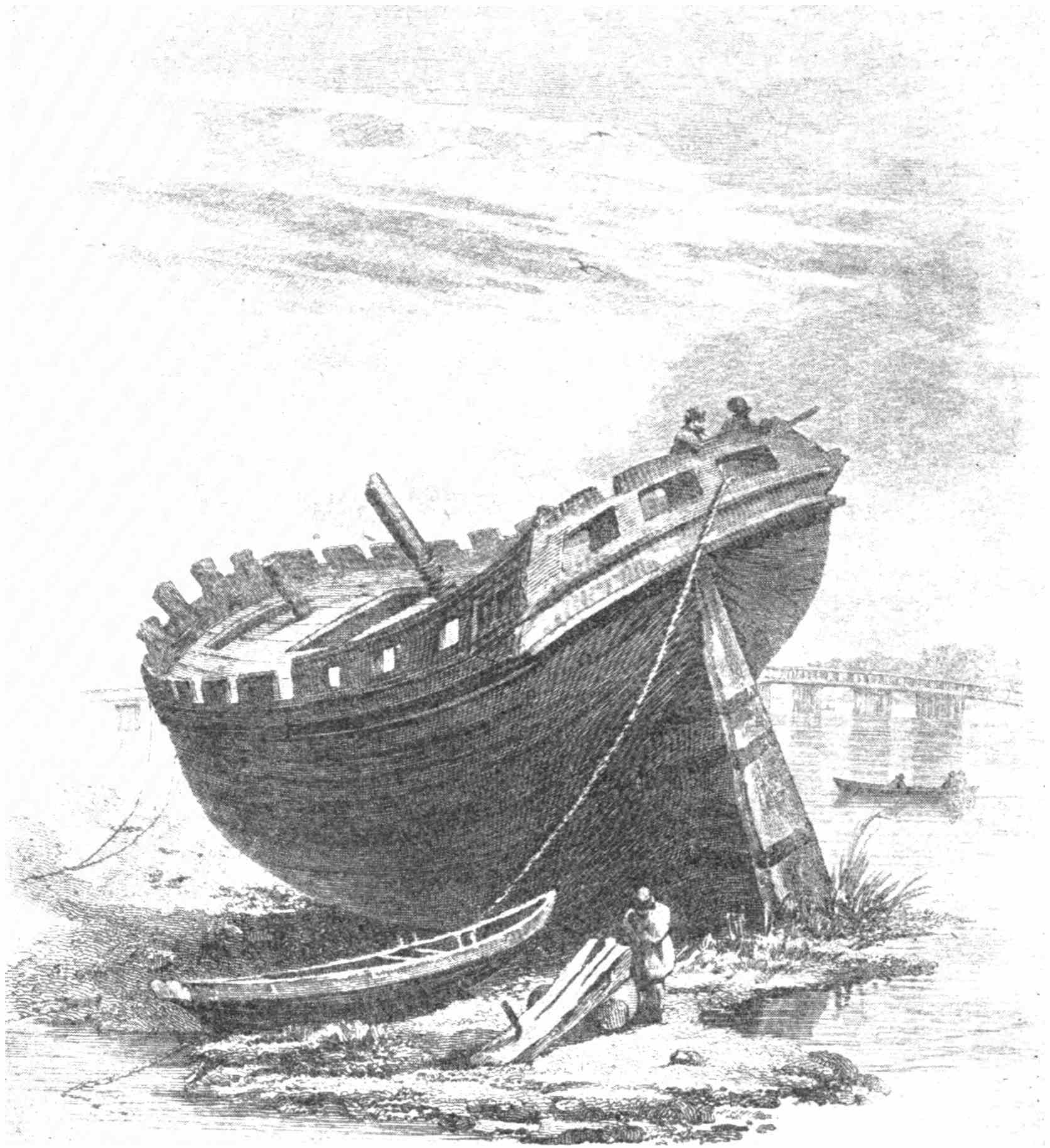
The Little Belt Breaking up at Battersea.
From an engraving by Cooke of a drawing by Francia.
In the controversy that followed this conflict
the significance of the figures—significance of
the deadly fire of the Americans—was wholly
lost to sight. The whole affair was, of course,
carefully investigated by both Governments.
The officers on each ship swore that the other
fired the first gun. The British captain’s statement,
however, was greatly weakened by his
assertion that he had kept up the fight for three-quarters
of an hour and that he had really
beaten off his bigger opponent. So Allen, already
quoted, says that “a gun was fired from
each ship, but whether by accident or design,
or from which ship first, remains involved in
doubt.”
This fight occurred, as the reader remembers,
when the two nations were nominally at
peace, but it was a blow—the first blow struck
at the press-gangs.
Another incident of similar import, though
bloodless, occurred before the end of the year
1811. The Constitution, Captain Isaac Hull,
had gone to Texel to carry specie for the payment
of interest on the American bonds held
there, and when returning had called at Portsmouth
to enable Captain Hull to communicate
with the American legation in London. One
night, while the captain was in London, a British
officer came on board the Constitution to
say that an American deserter was on the British
war-ship Havana, lying near by, and the
Constitution could have him by sending for
him. So the executive officer, Lieutenant
Morris, sent a boat next morning, but it came
back with a notice that an order for the man
must first be obtained from Admiral Sir Roger
Curtis. To this official then went Lieutenant
Morris, when the admiral calmly informed him
that the man claimed to be a British subject,
and therefore he should not be returned.
It was fairly manifest that the British officials
had for some reason been playing with the
temporary commander of the Constitution, but
Lieutenant Morris had his revenge within a
day, for on the next night a British sailor
boarded the Constitution, admitted that he was
a deserter from the Havana, and said, when
asked his nationality, that he was “An American,
sor.”
At that, word was sent the commander of the
Havana that a deserter from his ship was on
the Constitution, but when an officer from the
Havana came after the man, Lieutenant Morris
blandly informed him that the man claimed
to be an American and therefore he could not
be given up.
This threw the British naval people into a
turmoil, and a little later two British frigates
shifted their berths and anchored where it was
probable that the Constitution would, on getting
under way, foul one or the other.
Seeing they were laying a trap for him, Lieutenant
Morris got up anchor, and by the skill
in handling a ship common among American
officers, dropped clear to a new berth.
Hardly was he at anchor again, however, before
the two frigates once more drew near and
again anchored to trap the Yankee frigate.
The three ships were lying so when Captain
Hull returned from London that evening.
That the Englishmen were intending to make
trouble about the sailor with a brogue seemed
plain, but Captain Hull, remembering the trick
played on the Chesapeake, was not to be caught
napping. He cleared the ship for action, and,
with battle-lanterns burning, guns loaded, and
extra ammunition at each gun, he made sail,
got up his anchor, and, slipping clear of the
British frigates, put to sea. There were two
Britishers to the one Yankee, but the Yankee
was ready to fight.
As the Constitution stood away down the
roads the British frigates made sail in chase.
For a time the Constitution carried a press of
canvas, but when it was seen that one of the
enemy was dropping out of sight Captain Hull
backed his main-yard and waited for the other.
“If that fellow wants to fight we won’t disappoint
him,” said the captain.
As the enemy ranged up within hail Lieutenant
Morris walked forward along the gun-deck
to encourage the men, and found that
never did a crew need encouragement less.
Gun-captains were bringing their guns to bear
on the enemy, and their men, stripped to the
waist in many cases, were hauling on the side-tackles
with a vigor that made the carriages
jump.
But they were to be disappointed. The
Englishman came yapping up till he saw the
teeth of the silent Yankee turned upon him,
when he hesitated, turned, brailed in his spanker
as a dog tucks its tail between its legs, and
ran back to his own enclosure.
And then there was the occasion when the
United States, commanded by Captain Stephen
Decatur, of Tripoli fame, fell in with the British
ships Eurydice and Atalanta while cruising
off Sandy Hook. Decatur had his men at
their guns, of course, though he had no reason
for trying either to force or to avoid a fight.
But while he was exchanging hails with one of
the other ships an impatient gunner on the
United States pulled his lanyard and sent a
ball into one of the British ships. It was unquestionably
done by the man to force a fight,
though when he saw that it did not bring a
single return shot he said he did it accidentally,
and the shot was so explained to the British
captains.
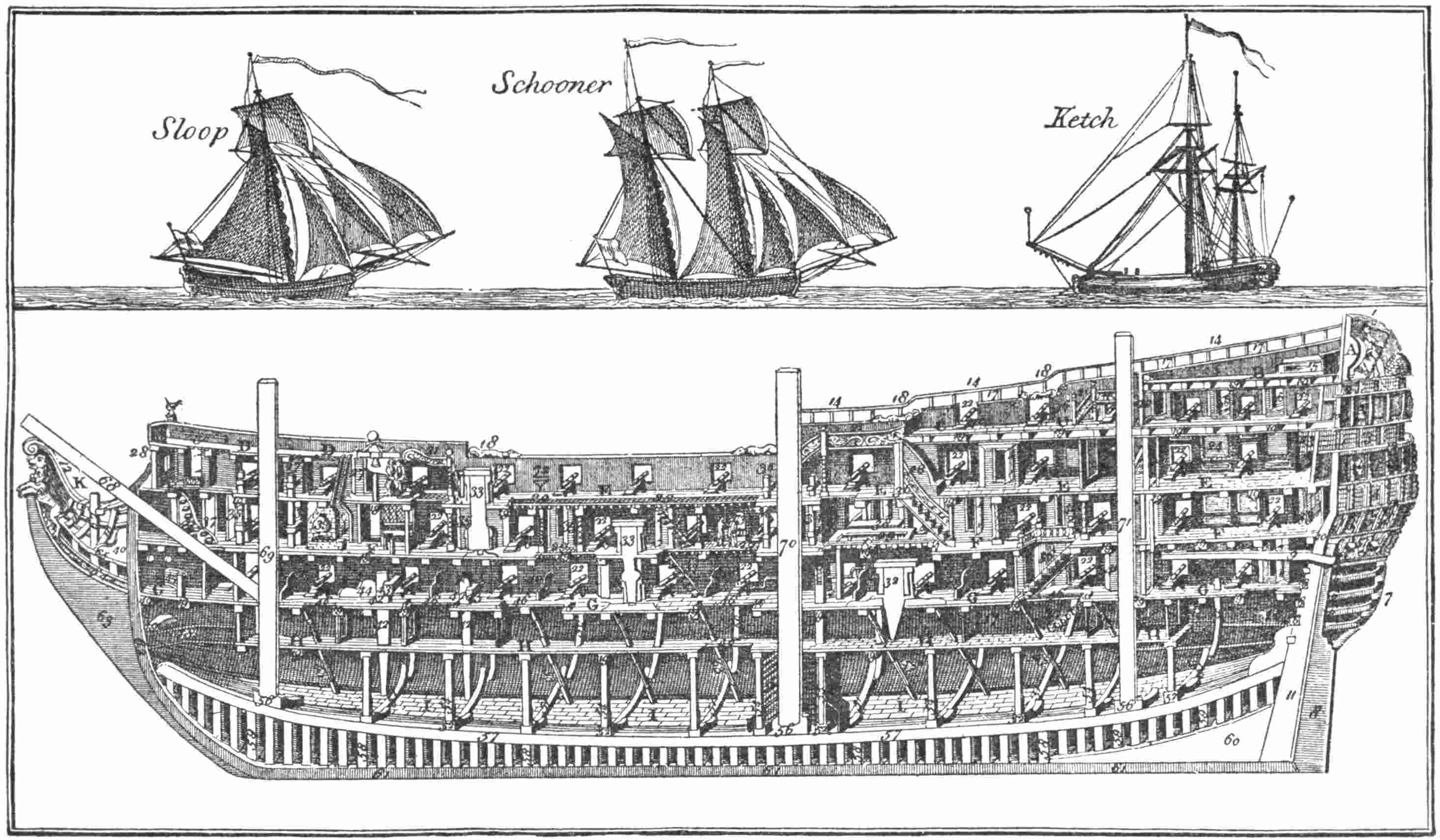
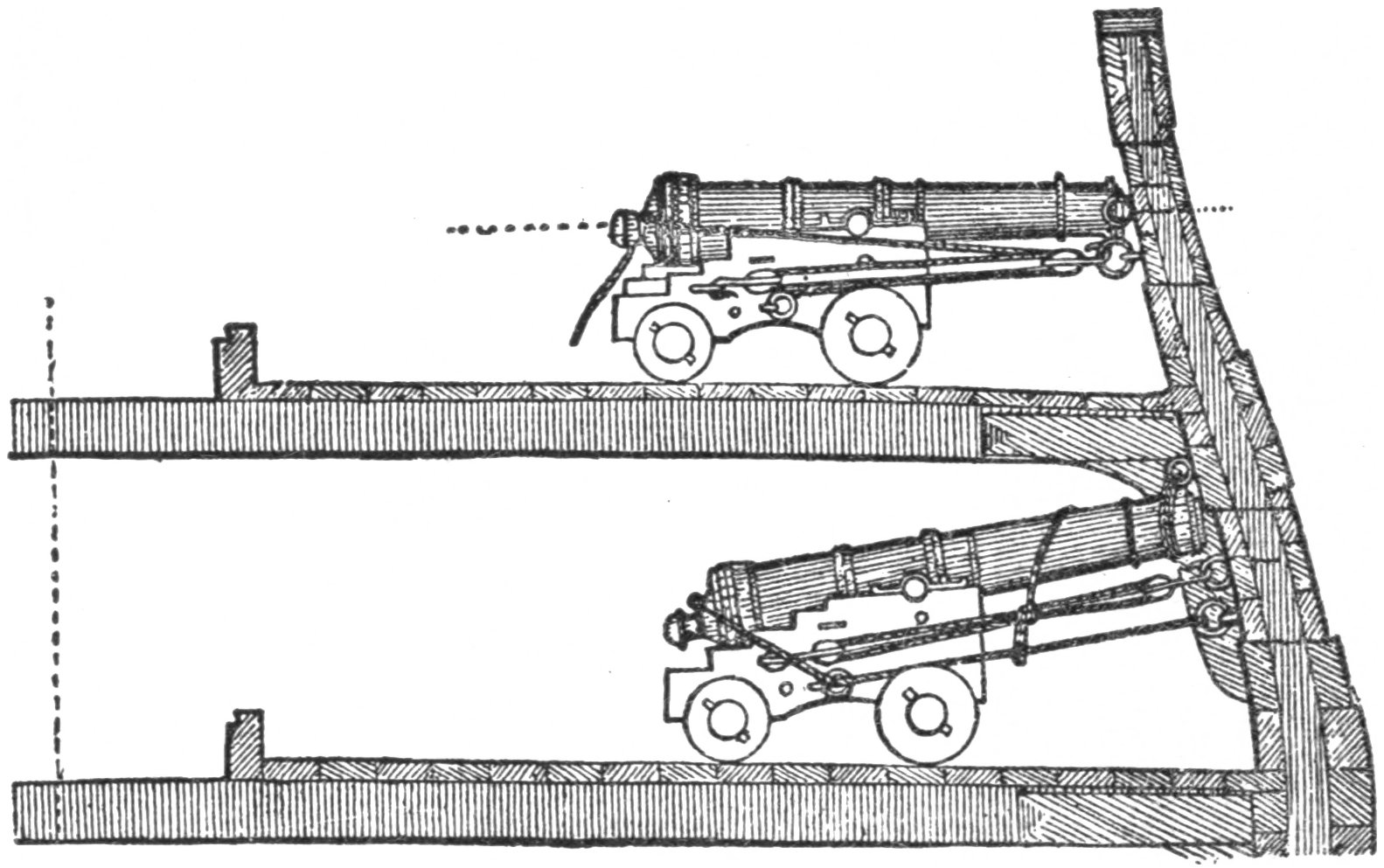
The Section of a First-rate Ship.
Being cut or divided by the middle from the stem to the stern, at one view discovering the decks, guns, cabins, etc.
This incident, like that of the Constitution
at Plymouth, is worth mentioning to show the
feeling of the American seamen regarding the
British theory and practice of impressment.
And this feeling was becoming well known to
all informed and thinking persons in both
countries. It could now no longer be doubted
that the American people would fight to gain
freedom for their countrymen enslaved in
British warships.
It is admitted that the politicians at Washington
still talked as loudly of free trade on the
high seas as ever they had done; it is admitted
that “free trade” stood before “sailors’ rights”
in the motto of the day—but it is declared,
nevertheless, that the sentiment of the people,
which alone can declare a war in this republic,
was roused by the outrages upon man, and not
upon property.
Had the British been animated by any other
feeling than “the spirit of animosity and unconciliating
contempt,” they could have averted
further trouble by definitely abandoning their
hostile attitude toward the young republic.
They had opportunity to do this gracefully,
for, yielding to the sentiment of the humane
element of their nation, the Ministry had decided
to once more disavow the Chesapeake
affair and to return the men to the deck of the
ship from which they had been taken. Two
only remained alive, one having been hanged
and the other having succumbed to the hardships
to which he was subjected, but these
were in fact put on the Chesapeake in Boston
Harbor. Nevertheless, instead of abandoning
the practice which led to the outrage, the right
to continue it was reaffirmed. Indeed, every
proposition made by the portion of the nation
that loved justice more than conquest excited
only derision among the nation’s rulers, and
among the masses, too, for that matter. War
was inevitable, and on June 18, 1812, it was
declared to exist.
CHAPTER II THE OUTLOOK WAS, AT FIRST, NOT PLEASING
THE SILLY CRY OF “ON TO CANADA!”—THE NAVAL FORCES OF
THE UNITED STATES COMPARED WITH THOSE OF GREAT BRITAIN—THE
FORESIGHT AND QUICK WORK OF CAPTAIN RODGERS IN
GETTING A SQUADRON TO SEA—BUT HE MISSED THE JAMAICA
FLEET HE WAS AFTER, AND WHEN HE FELL IN WITH A BRITISH
FRIGATE, THE RESULTS OF THE AFFAIR WERE LAMENTABLE.
Although “vast multitudes” of the American
people had “passionately wished for” a
declaration of war against Great Britain, that
declaration was, indeed, “a solemn and serious
fact” to those who stopped to consider what
odds must be met. What those odds were
will be told further on, but in view of the fact
that the naval supremacy of England is about
as pronounced at the end of the nineteenth
century as it was at the beginning, it is well
worth while giving a glance at the plans of the
Americans in 1812. For the cry was “on to
Canada!” Canada was very likely to welcome
an opportunity to join the republic, but even
if she did not do that she was but feeble, and
the spirited Yankee militia would overrun the
whole region and take revenge for the wrongs
received at the hands of the English by annexing
the whole fair domain. The sea-power of
Great Britain was overwhelming, of course,
but we had coast-defence vessels by the hundred—nearly
three hundred schooners carrying
a big gun each, and these should defend the
principal American forts while the valiant
militia slaughtered the Canadians! The majority
of the American people seriously believed
that the way to defend American citizens
from the aggressions of the only nation
likely to abuse them was by building a navy
for coast defence only and marching to Canada
when ready for offensive operations. But if
that must seem astonishing to every one who
has rightly studied the war of 1812, what can
be said of the fact that this same theory of
protecting the United States from British aggression
is still held by as great a majority as
ever? For it must not be forgotten that the
American assaults on Canada were as futile as
the American militia were worthless. There
was but one fight made by the land forces
alone of which Americans are proud—that at
New Orleans.
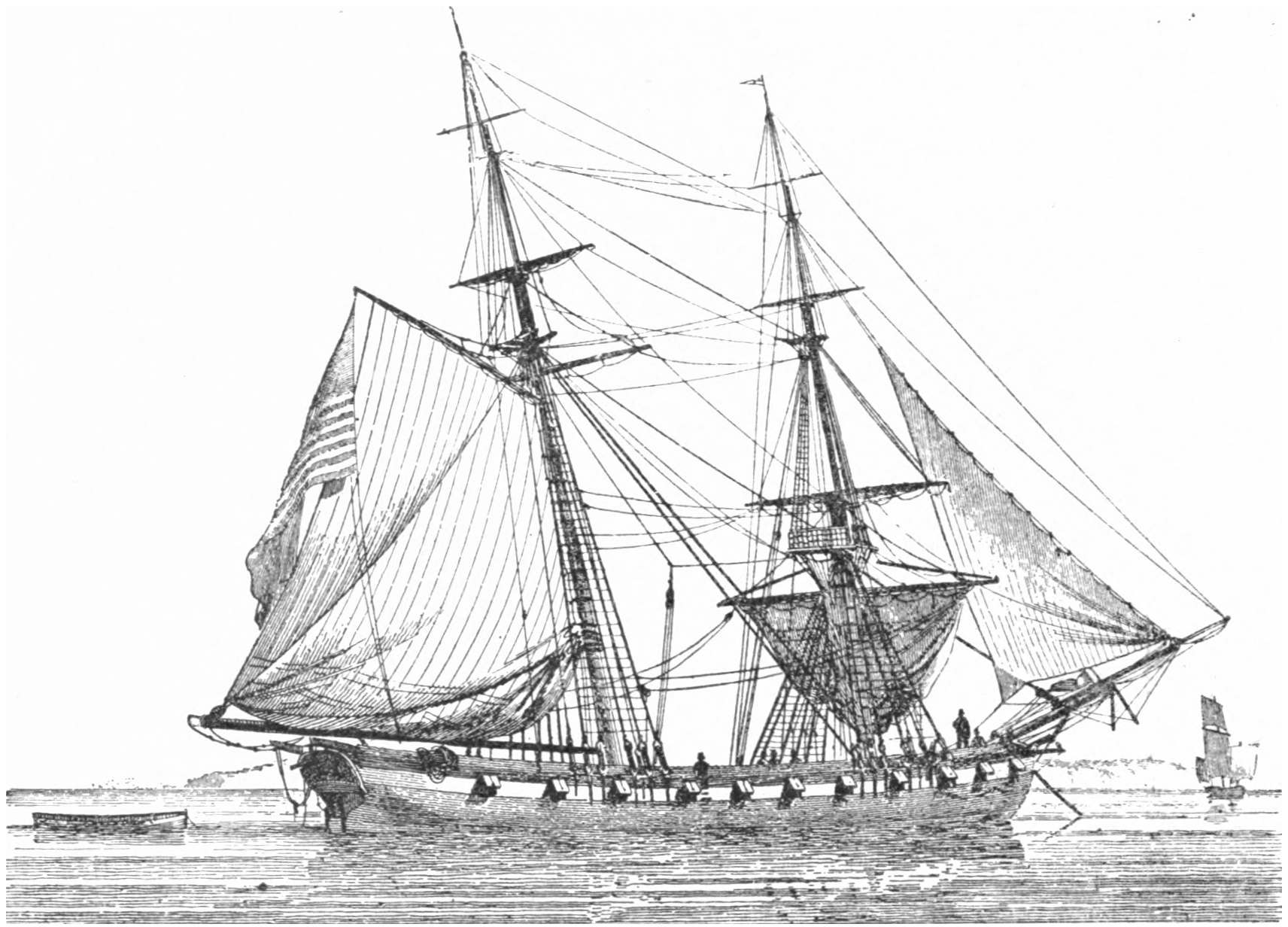
A Brigantine of a Hundred Years Ago at Anchor.
From a picture drawn and engraved by Baugean.
On a casual glance at the American sea-power
in 1812 the lack of confidence in it was
merited. For of sea-going craft we had only
17, carrying all told 442 guns and 5,025 men.
Even of these ships two were condemned
as unfit for service as soon as they were inspected.
And as for the gun-boats, they were
simply brushed aside the moment actual hostilities
began. But Great Britain had 1,048 ships
to our 17; these ships carried 27,800 guns to
our 442 and 151,572 men to our 5,025. Of
course the majority of these ships were employed
elsewhere than on the American coast.
But by the London Times of December 28,
1812, the British had, “from Halifax to the
West Indies, seven times the force of the whole
American navy.” By a pennant sheet taken
from the British schooner Highflyer in 1813
there were on the American coast on March
13th, 107 British ships rated as carrying 3,055
guns, among which were 12 ships of the line
rated as seventy-fours. As a matter of fact
these ships actually carried at least ten per
cent. more guns than their rating indicated.
That this preponderance was increased as time
passed, and that there was good reason for
increasing it, will appear farther on.
The faint-hearted, indeed, were not without
reason when they spoke of the declaration of
war as “the dreaded and alarming intelligence.”
But if the reader wishes for a correct idea of
the quality of the men who in that day stood
erect, facing the quarter-deck, and uncovered
their heads whenever the brawny quartermaster
hoisted the old flag, he will find it in the fact
that they—the men of the American navy—were
the foremost among those who “passionately
wished for” a war with this power—a power
that outnumbered them and out-weighed them
on their own coast as seven to one.
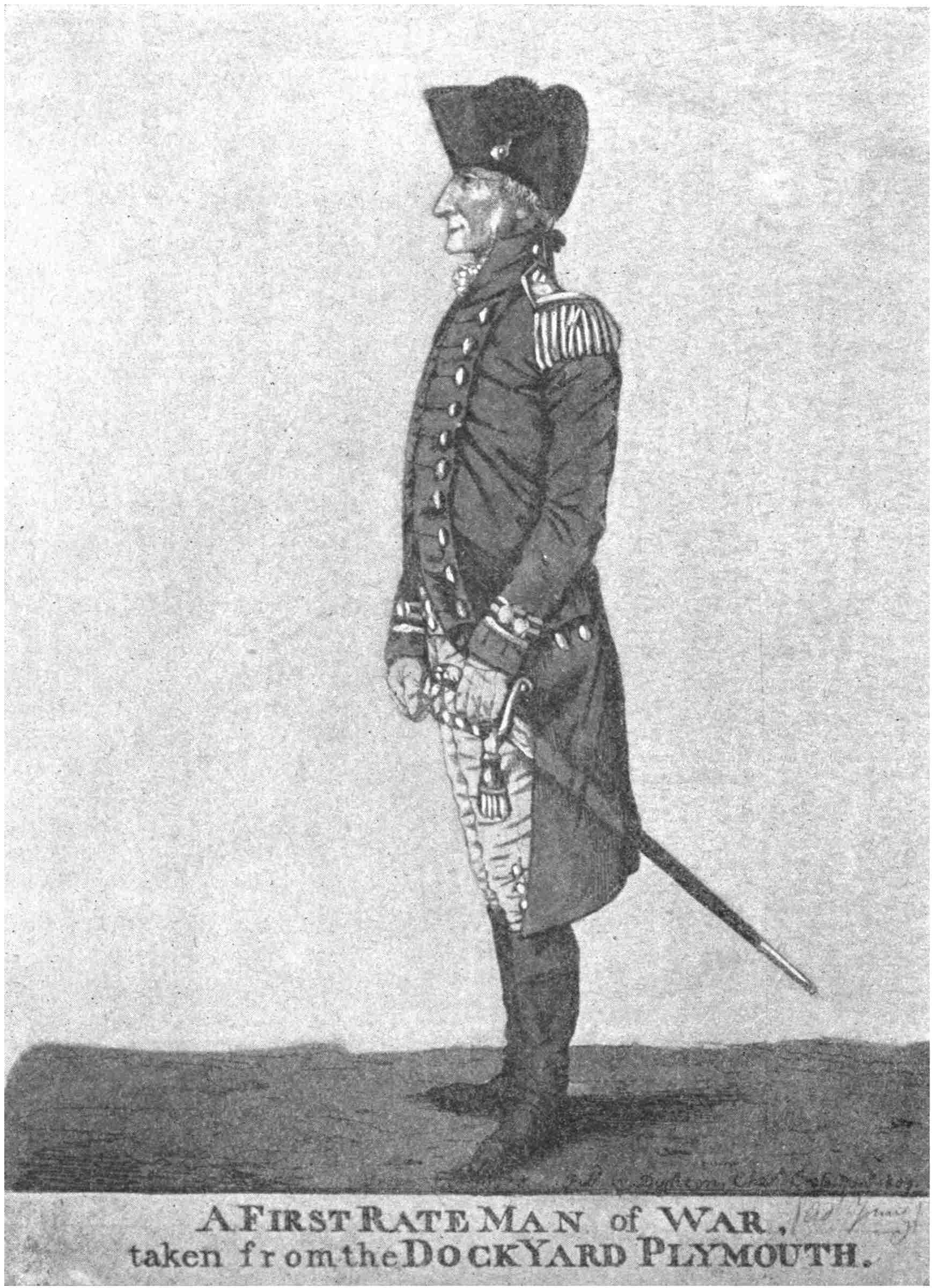
An English Admiral of 1809.
From an engraving at the Navy Department, Washington.
Nor was the power of the British navy found
only in the number and size of her ships and
the number and size of the guns. “Since the
year 1792 each European nation in turn had
learned to feel bitter dread of the weight of
England’s hand. In the Baltic Sir Samuel
Hood had taught the Russians that they must
needs keep in port when the English cruisers
were in the offing. The descendants of the
Vikings had seen their whole navy destroyed
at Copenhagen. No Dutch fleet ever put out
after the day when, off Camperdown, Lord
Duncan took possession of De Winter’s shattered
ships. But a few years before 1812 the
greatest sea-fighter of all time had died in Trafalgar
Bay, and in dying had crumbled to pieces
the navies of France and Spain.” In spite of
the infamous system under which the British
ships were manned, the personnel of the British
navy was—one is tempted to say it was beyond
comparison better than that of any other European
nation. For the others felt “the lack of
habit—may it not even be said without injustice,
of aptitude for the sea.” The officers and
men who gathered to crush the navy of the
young republic came from Aboukir and Copenhagen
and Trafalgar Bay. They were veterans
in naval warfare—men who preferred short
weapons as the Romans did, men who preferred
to fight with yard-arm interlocking yard-arm,
where short carronades were better than long
guns of smaller bore, and where even these
might be made more effective through loading
with double shot. Luckily for us their long experience
had engendered prejudiced conservatism,
their many victories had cultivated an
overweening confidence, and their bull-dog courage
had made them careless of the arts of seamanship.
As to the ability of the American crews who
were to meet these tar-stained, smoke-begrimed,
cicatrice-marked veterans, enough will be told
in the descriptions of their battles, for they astounded
the whole world.
Nevertheless, the war at sea began in a fashion
to discourage the nation and humiliate the
whole navy.
On the day (June 18, 1812) that war was declared,
the effective part of the American navy—the
only American naval ships ready for a
fight—lay in New York Harbor, or else were at
sea where they could not hear the news. The
ships in New York were the flag-ship President,
rated forty-four, Captain Rodgers; the
United States, forty-four, Captain Decatur;
the Congress, thirty-eight, Captain Smith; the
Hornet, eighteen, Captain Lawrence, and the
Argus, sixteen, Lieutenant Sinclair. Nothing
more discreditable to the administration of
President Madison than this fact can be told.
He had seen for months that war was inevitable
and yet he had done nothing to gather
in the ships and prepare them for the fight.
And Monroe was Secretary of State. But
for the earnest remonstrances of Captains
Bainbridge and Stewart, who repeatedly addressed
the Department, every American warship
would have been kept in port for harbor
defence.
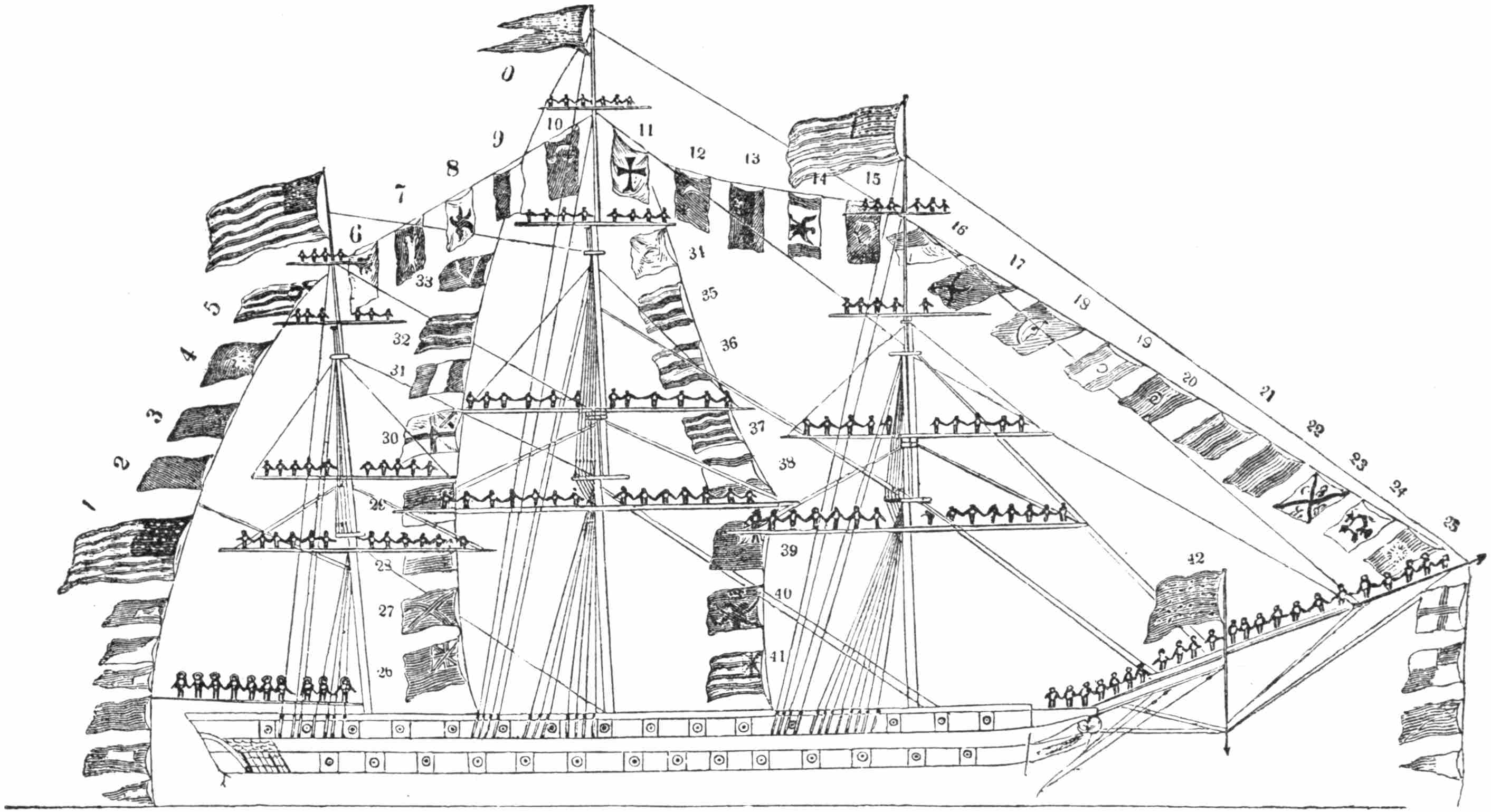
Representation of a Ship-of-war, dressed with flags, and yards manned.
1. American Ensign.
2. Ottoman-Greek
3. Norden.
4. Stralsund.
5. Greek.
6. Brandenburg.
7. Hanover.
8. Prussia.
9. Saxony.
10. Morocco.
11. Maltese.
12. Arabia.
13. Columbia.
14. Mexican.
15. Brazil.
16. Hayti.
17. Japan.
18. Mogul.
19. Buenos Ayres.
20. Spanish.
21. Tunis.
22. St. Domingo.
23. Old Sardinia.
24. Majorca.
25. Peru.
26. English (blue).
27. Venezuela.
28. Chili.
29. Normandy.
30. English (white).
31. French.
32. Tripoli.
33. Salee.
34. Old Portugal.
35. Algiers.
36. Senegal.
37. Oporto.
38. Central America.
39. English (red).
40. E. Russia.
41. Sandwich Islands.
42. American Jack.
o. Commodore’s Broad Pendant.
Note.—Those which have no numbers affixed are the ship’s signals, or, rather, the telegraphic numbers.
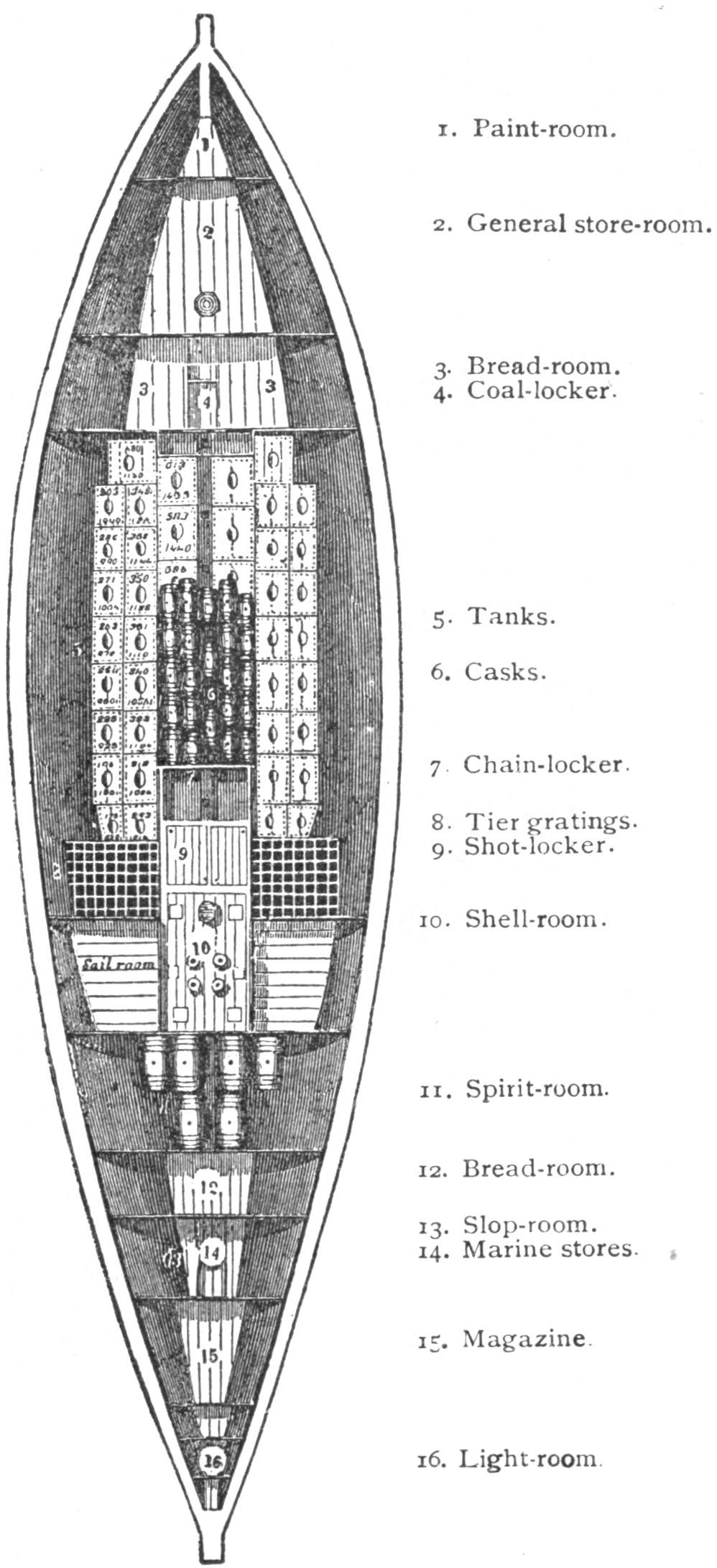
The Internal Arrangements and Stowage of
an American Sloop-of-War.
From the “Kedge Anchor.”
But if the Administration had done nothing,
Captain Rodgers, as
commodore of the
squadron in New
York, had done everything—he
had
done so well that
within one hour
from the time that
a messenger from
Washington arrived
on board the President
with the declaration
of war and instructions
to put to
sea, the whole squadron
except the Essex
was under sail, heading
down New York
Bay toward Sandy
Hook.
This was on June
21, 1812. Commodore
Rodgers was
bound out to intercept
a big fleet of
British merchantmen sailing home from Jamaica,
convoyed only by the thirty-six-gun frigate
Thalia and the eighteen-gun corvette Reindeer.
This fleet had left Jamaica, it was said,
on the 20th, and it was sure to follow the Gulf
Stream under very easy sail. But when Rodgers
was a short way out to sea an American brig
reported the fleet well down the stream (about
due east of Boston and well off shore) on
June 17th. The fleet had sailed some days
earlier than the Americans had supposed. So
the squadron hauled to the northeast in pursuit.
At 6 o’clock on the morning of June 23d,
when the squadron was thirty-five miles southwest
of Nantucket shoals, a sail was seen. It
was the thirty-three-gun frigate Belvidera, Captain
Byron, that was then lying in wait for a
French privateer expected from New London,
Connecticut. At once the Belvidera headed
toward the American squadron to examine
them, but when at 6.30 A.M. she discovered
their character she wore around and headed
away to the northeast with a smacking breeze
over the port quarter and studding-sails set.
At once the Yankees made sail in chase,
with the President, the swiftest of the squadron
when sailing free, well in the lead. By 11
o’clock the President was near enough to warrant
clearing for action, but a shift of wind
helped the Belvidera and she held her own until
2 P.M., when another shift favored the President,
so that at 4.20 P.M. the Britisher with her
colors flying was within range.
Getting behind one of the long bow-chasers
on the forecastle of the President, Commodore
Rodgers carefully sighted it, and pulling the
lanyard, fired the first shot of the war of 1812.
It knocked the splinters out of the stern of the
flying enemy. The second shot was fired from
a bow-chaser on the deck below, and a third
was fired on the forecastle. Each of these
reached its target. One passed through the
rudder-coat, and another, striking the muzzle
of a stern-chaser, broke into pieces, which killed
two men, severely wounded two more, and
slightly wounded three others, including a lieutenant
who was aiming the gun.
Guns Secured for a Gale.
From the “Kedge Anchor.”
Greatly elated at the accuracy of their fire,
the men working the President’s bow-chaser
on the lower deck aimed a fourth shot. A boy
with his leather box full of powder-cartridges
arrived just as the gunner was pulling his lanyard,
and then when the hammer fell the gun
exploded and the flames from the splitting
breech darted into the open box of powder, setting
it off as well.
The explosion knocked the men in all directions,
disabled for the moment every one of the
bow-chasers, and bursting up the deck above, it
threw Commodore Rodgers so violently into
the air that when he fell his leg was broken.
Of the men standing about the gun two were
killed and thirteen wounded.
At that moment the Belvidera opened an
effective fire with her stern-chasers, and one of
her projectiles came crashing into the President’s
bows, and went bounding along the gun-deck,
killing a midshipman and wounding a
number of seamen. For a time there was not
a little confusion on the President, but her
crew soon got to work again and began to
make it warm on the Belvidera once more.
But the mistake of yawing to fire broadsides
was made. That “a whole broadside battery
will be much less likely to ‘disable a flying
enemy’ than the cool and careful use of one
well-served gun,” has been amply proven. The
yawing gave the Belvidera a gain in the race.
That she would have waited for a fight with
the President but for the presence of the other
ships is not doubted, but, as it was, Captain
Byron saw that something desperate must be
done to escape, so he threw over his spare anchors
and boats and fourteen tons of water in
casks. So lightened, he was able to outsail the
Yankee squadron and escape.
The President lost three killed and nineteen
wounded, and was considerably cut up aloft.
The Belvidera lost two killed and twenty-two
wounded, Captain Byron being among the
number. His rigging was also cut up somewhat,
but he made such a good running fight
of it that a painting, by a British artist, was
made of the scene, that, according to Allen’s
history, is preserved to this day.
As for the American squadron, it vainly followed
the Jamaica fleet to within less than a
day’s sail of the English Channel, and returned
home by the way of the Madeiras and Azores,
reaching Boston after a cruise of sixty-nine
days, in which nothing had been accomplished,
save only that seven merchantmen were taken
and an American ship recaptured.
CHAPTER III THE FIRST EXHIBIT OF YANKEE METTLE
CAPTAIN DAVID PORTER’S IDEAS ABOUT TRAINING SEAMEN—THE
GUNS OF THE ESSEX—TAKING A TRANSPORT OUT OF A CONVOY
AT NIGHT—A BRITISH FRIGATE CAPTAIN WHO WAS CALLED A
COWARD BY HIS COUNTRYMEN—CAPTAIN LAUGHARNE’S MISTAKE—A
FIGHT THAT BEGAN WITH CHEERS AND ENDED IN DISMAY
FOR WHICH THERE WAS GOOD CAUSE—WORK THAT WAS DONE
BY YANKEE GUNNERS IN EIGHT MINUTES—WHEN FARRAGUT
SAVED THE SHIP—AN ATTACK ON A FIFTY-GUN SHIP PLANNED.
During the time that Commodore Rodgers
was making what was practically a fruitless
cruise with his squadron, Captain David Porter
was doing somewhat better with the little
frigate Essex. Rarely has a naval man had the
benefit of such experiences as those through
which Captain Porter had passed. At the age
of sixteen (1796), while in the West Indies on
the merchant-schooner Eliza, of which his
father was commander, he had stood at the rail
with the rest of the crew and fought off a British
press-gang in such a determined assault that
several men were killed and wounded on both
sides. A year later he was twice impressed
into the British navy, but escaped both times.
Then he joined the American navy as a midshipman,
and, as already told, showed himself a
hero in helping to hold the prisoners on a captured
French frigate for three days, although
they were in overwhelming numbers, and he
had to watch them during all the time without
a moment’s sleep. In a pilot-boat called the
Amphitrite, that mounted but five one-pounder
swivels and carried fifteen men, he attacked a
French privateer armed with a long twelve-pounder
and a number of swivels, and carrying
forty men. Moreover, the Frenchman was
supported by a barge armed with swivels and
carrying thirty men. Such odds had rarely
been taken, but the impetuous onslaught of the
Yankees carried the privateer after a bloody resistance.
She had lost seven killed and fifteen
wounded, more than half her crew, when she
surrendered. Porter did not lose a man. The
barge escaped, but a merchant-prize they had
captured was retaken. After a variety of exploits
only less daring than this, he was sent to
the Mediterranean Sea, and there continued to
gain knowledge, skill, and reputation until, by
the grounding of the Philadelphia, he became
a prisoner to the Tripolitans.
When war was declared in 1812 he was in the
Essex. She was undergoing repairs in New
York Harbor. It was fortunate for Porter that
she was not ready to sail with Rodgers, for the
delay enabled him to make a cruise alone.
And this cruise, because of what it shows about
the American armament and American seamen,
is worth describing in detail.
David Porter.
From an engraving by Edwin of the portrait by Wood.
The Essex was rated as a thirty-two-gun
frigate, but she carried forty-six carriage-guns
all told. As to her numbers of guns she was
greatly underrated, but as to the effectiveness
of her armament she was the most overrated
ship in the little navy. She had originally
mounted twenty-six long twelve-pounders on
her main deck, while her forecastle and poop
carried sixteen twenty-four-pounder carronades,
“but official wisdom changed all this.” The
Navy Department took out twenty-four of her
main deck long twelves and put thirty-two-pounder
carronades there instead. Then the
poop and forecastle were swept clear of the
twenty-four-pounder carronades and four long
twelves and sixteen thirty-two-pounder carronades
were mounted there. Porter protested
over and again, but in vain.
To fully understand why Porter should have
protested against this armament one must know
the character of the guns. This is a matter
that has been discussed at very great length by
almost every one who has written on the navy
of any nation. But, for the aid of the uninformed
reader, it may be said that an average
long thirty-two-pounder was eight and a half
feet long, and weighed 4,500 pounds, while a
thirty-two-pounder carronade was four feet long
and weighed but 1,700 pounds. Being thick
at the breech and long, the long gun had a
long range. That is, a heavy powder charge
would act on the ball throughout the length of
the long bore and so hurl the ball over a long
range. The short gun being short, and thin at
the breech, could stand only about one-third of
the charge of powder used in the long gun.
Where the long thirty-two burned seven pounds
of powder and had a range, when elevated one
degree, of six hundred and forty yards (not
counting the ricochet leaps), the short thirty-two
burned two and a half pounds of powder
and had a range of three hundred and eighty
yards.
A short range means a small power to penetrate,
not fully expressed by the above figures.
To make a carronade really effective the ship
had to be placed within two hundred yards of
the enemy, and even at twenty yards it was
known that a thirty-two-pounder ball stuck in
a ship’s mast instead of crashing through it,
and the long twelves could do effective work
when entirely beyond the range of the short
thirty-two, for they were made heavier in proportion
to the size of the ball than the long
thirty-two, and had a range quite equal to that
of the larger calibre. But the long gun in
that day was exceedingly heavy. It needed a
big carriage and big tackles, and a big crew.
It was a hard job to load and aim one of these
long guns. The short gun, throwing a ball of
the same size, weighed, as shown, comparatively
little and could, therefore, be loaded and
fired much more rapidly. When within pistol-shot
of the enemy this was an advantage, of
course. Another advantage of the short gun
was in the fact that a battery of them did not
strain a ship as a battery of long guns would
do. But when all was said in favor of a short
gun of big bore, the fact remained that in a
combat, a handy ship having long guns could
remain out of range of the ship having short
guns and shoot it to pieces. The short-gun
ship had to close in on the other or suffer defeat.
Had Porter’s petition for his long
twelves been granted he would have had a
different story to tell when he reached the
Pacific.
But this chapter is to tell of his first cruise
in the Essex. On July 2, 1812, he was off to
sea in search of the British thirty-six-gun
frigate Thetis, which was bound to South
America with specie. The Thetis escaped,
but a few merchantmen were captured, and
then on the night of the 10th a fleet of seven
merchantmen in convoy was discovered. As
it happened the moon was shining, but the sky
was so well overcast with clouds that the alternating
shadows and lights made it easy for
Porter to pose the Essex as a merchant-ship.
Her top-gallant masts were dropped part way
down to conceal their height, the lee braces
and other running rigging were left slack, and
the guns were run in and ports closed. In
this fashion Porter jogged with the fleet, where
in casual conversation he learned that a thousand
soldiers were there en route from Barbadoes
to Quebec, and that the thirty-two-gun
frigate Minerva was the sole guard.
After a time a ship-captain to whom Porter
was talking became suspicious, and started to
signal the presence of a stranger to the Minerva,
but Porter threw open his ports and
compelled the merchantman to follow the
Essex out of the fleet. This manœuvre was
done without alarming any other one in the
fleet. On boarding her, one hundred and
ninety-seven soldiers were found.
The merchantman was captured at 3 o’clock
in the morning. Before another could be
overhauled daylight came. At that, Porter
took in the slack of his loose rigging, set up
his masts and invited the Minerva to come
and try for victory. Captain Richard Hawkins,
who commanded her, thought best to tack
and sail into the midst of his fleet, where, in
case he was attacked, the eight hundred and
odd soldiers who were on the transports could
render him effective service by sweeping the
decks of the Essex with their muskets, and by
firing such cannon as the transports carried.
James, who is the standard naval historian in
the British navy, says of this affair:
“Had Captain Porter really endeavored to
bring the Minerva to action we do not see what
could have prevented the Essex, with her superiority
of sailing, from coming alongside of her.
But no such thought, we are sure, entered into
Captain Porter’s head.”
David G. Farragut, of lasting fame, was a
midshipman on the Essex, and was keeping a
journal. He wrote:
“The captured British officers were very
anxious for us to have a fight with the Minerva,
as they considered her a good match for the
Essex, and Captain Porter replied that he should
gratify them with pleasure if his Majesty’s commander
was of their taste. So we stood toward
the convoy, and when within gunshot hove to,
and awaited the Minerva; but she tacked and
stood in among the convoy, to the utter amazement
of our prisoners, who denounced the commander
as a base coward, and expressed their
determination to report him to the Admiralty.”
But to further explain the difference between
long and short guns, it should be mentioned
that the Minerva carried on her main deck the
long twelves which Porter had wanted, and in a
fight she would have been able to riddle the
Essex while still far beyond the range of the
short thirty-twos with which the American was
armed. At pistol range the Essex was much
more powerful, and she carried, moreover, fifty
men more than the Minerva, though Captain
Hawkins could not know that, and, doubtless,
would have been ashamed to offer that as a reason
for declining to fight.
Fight of the Essex and the Alert.
From an old wood-cut.
Until August 13th the Essex had no adventure.
On that day, while cruising along under reefed
top-sails, a ship was seen to windward that
appeared to be a man-of-war. At this, drags
were put over the stern of the Essex to hold
her back, and then a few men were sent aloft
to shake out the reefs, and the sails were then
spread to the breeze exactly as a merchant-crew
would have done it. The stranger was entirely
deceived by this, and she came bowling
down toward the Essex, which was now flying
the British flag. The stranger having fired a
gun, the Essex hove to until she had passed
under her stern to leeward. Having now the
weather-gage, the Essex suddenly filled away
her main-sails, cut away the drags, hauled down
the British flag, ran up the Stars and Stripes,
and, throwing open her ports, ran out the
muzzles of her guns.
At the sight of these doings the Englishmen
gave three cheers, and, without waiting to get
where their guns would bear effectively, they
blazed away with grape and canister.
The Essex waited for a minute or two until
her guns would bear, and then gave the stranger
a broadside, “tompions and all,” as Midshipman
Farragut wrote at the time. The effect on the
stranger was stunning. Her crew were actually
stunned into inaction, and all of them but three
officers were severely reprimanded at the court-martial
of the captain, and several of the lower
officers were dishonorably dismissed from the
service on a charge of cowardice. They tried
to veer off and run away, but “she was in the
lion’s reach,” to again quote the youngster, and
within eight minutes the Essex was alongside,
when the stranger fired a musket and then
struck her flag.
The American officer who boarded her found
that she was the corvette Alert, Captain Thomas
L. P. Laugharne, carrying eighteen short thirty-twos
and two long twelves, a very inferior
force to that of the Essex. And yet the result
of this brief contest was of the greatest significance.
The British histories say the fight lasted
fifteen minutes. Doubtless this means from
the time the Alert’s crew cheered so vigorously
until they hauled down their flag. Farragut
says that it was eight minutes from the first
broadside of the Essex until the flag came
down, and this is not disputed. In eight minutes
the Essex had shot the Alert so full of
holes that when the American boat’s crew
reached the beaten ship the water was seven
feet deep in her hold in spite of the utmost
efforts of her crew to check the leaks! Not
a man was killed on the Alert, and only three
were wounded. The gunners of the Essex
aimed low—they shot to sink the enemy, and
they wellnigh succeeded. No one was hurt
on the Essex.
For several days after this the Essex, having
repaired the Alert, cruised with her in tow, and
then an incident occurred, the story of which
brings out very clearly another characteristic of
the American crews; that is to say, the care
with which the green crews were trained from
the day they came on board.
The number of prisoners on the Essex very
greatly exceeded her crew after the capture of
the Alert, for the Alert’s crew were added to
the soldiers and men from the transport, while
the Essex had put out two prize crews. Knowing
this, the prisoners formed a plan to take the
ship, the coxswain of the Alert’s gig being the
leader in the conspiracy. Young Farragut
happened to discover the plot on the night it
was to be executed. He was lying in his hammock
and saw the coxswain with a pistol in
hand on the deck where the hammock was
swinging. The coxswain was looking around to
see if all was in order for his men to rise, and
going to Farragut’s hammock, looked earnestly
at the boy, who had the wit to feign sleep.
But the moment the coxswain was gone, Farragut
ran into the cabin and told Captain
Porter, who sprang from his berth, and running
out of his cabin began to shout:
“Fire! Fire!”
A more distressful cry than that is never
heard at sea. To the prisoners it brought utter
confusion. To the crew of the Essex it meant
only that they were to hasten to fire-quarters
for a night-drill—something to which they had
been trained ever since leaving New York.
Captain Porter had even built fires that sent up
volumes of smoke through the hatches in order
to make the crew face what seemed to be a
real fire, and so had steadied their nerves. Now
they promptly but coolly went to their quarters.
It was then a simple matter to turn them on
the mutineers.
An English Thirty-gun Corvette.
From an engraving by Merlo in 1794.
Afterwards the prisoners were sent to St.
John’s, Newfoundland, in the Alert as a cartel.
She was not by the letter of the law a proper
cartel, for she was still at sea and quite likely
to be captured, but it is pleasant to observe
that Admiral Sir John T. Duckworth “generously
sustained the agreement” made by Captain
Laugharne. He wrote:
“It is utterly inconsistent with the laws of
war to recognize the principle upon which
this arrangement has been made. Nevertheless
I am willing to give a proof at once of my respect
for the liberality with which the captain of
the Essex has acted in more than one instance
toward the British subjects who had fallen into
his hands; of the sacred obligation that is
always felt to fulfil the engagements of a British
officer, and of my confidence in the disposition
of his Highness, the Prince Regent, to
allay the violence of war by encouraging a
reciprocation of that courtesy by which its
pressure upon individuals may be so essentially
diminished.”
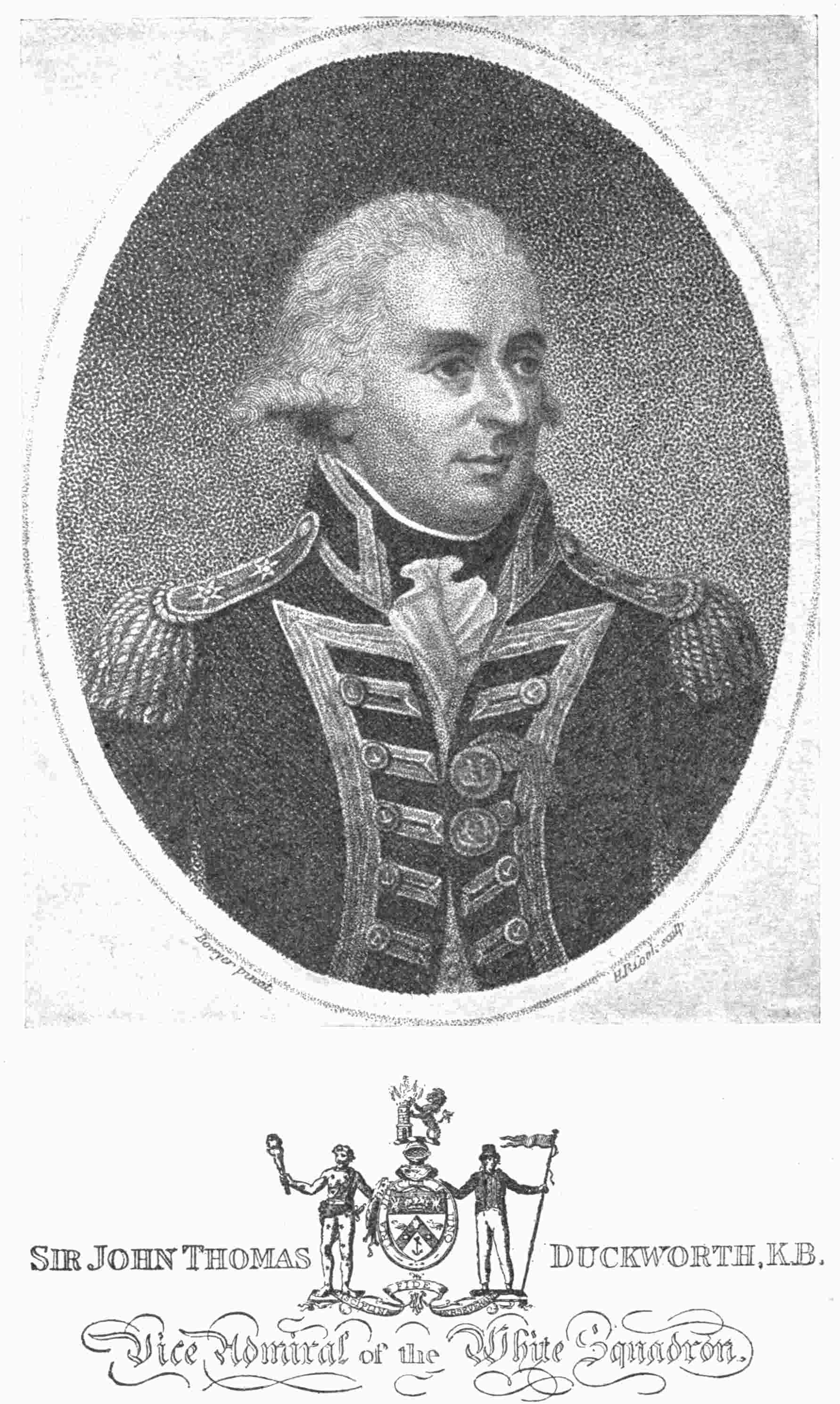
SIR JOHN THOMAS DUCKWORTH, K.B.
Vice Admiral of the White Squadron.
There is still one more incident of this cruise
worth describing. The Essex was chased by
the British frigate Shannon and another ship
when off St. George’s Bank. Captain Porter
supposed that the speedier ship of the two was
the fifty-gun Acasta, a much more powerful
ship than the Shannon, and that a third ship he
had seen with the two was also in chase. As
the largest ship was gaining, and a splendid
breeze for working the ship was blowing, Captain
Porter planned a most daring defence.
Running until night was fully come, he called
his crew together and told them that he was
going to tack ship, run alongside the enemy,
and board her while under full sail. According
to Farragut, Porter believed that the enemy
would be sailing at the rate of eight knots an
hour, at least, while his ship would foul her
while going at not less than four knots. Nevertheless,
the proposition was greeted with enthusiastic
cheers.
The cause of the enthusiasm may be found
readily in Farragut’s account of the crew. He
says:
“Every day the crew were exercised at the
great guns, small-arms, and single-stick. And
I may here mention the fact that I have never
been on a ship where the crew of the old
Essex was represented, but that I found them
to be the best swordsmen on board. They had
been so thoroughly trained as boarders that
every man was prepared for such an emergency,
with his cutlass as sharp as a razor, a dirk made
by the ship’s armorer out of a file, and a pistol.”
They had been drilled until they had confidence
in themselves as well as their leaders, and it
was not an overweening confidence, either.
So a kedge anchor with a cable attached was
hoisted to the end of the main-yard, where it
could be readily dropped on the passing enemy
as the two crashed together and so hold her
fast. At the proper hour the Essex tacked in
search of the enemy, but failed to find her.
At the end of sixty days from the time he
sailed, Porter was back in port. He had captured
nine prizes, with more than five hundred
prisoners, and retaken five American privateers
and merchantmen.
The little American navy was beginning in a
small way to do something for the nation.
CHAPTER IV A RACE FOR THE LIFE OF A NATION
STORY OF THE CONSTITUTION’S ESCAPE FROM A BRITISH SQUADRON
OFF THE JERSEY BEACH—FOUR FRIGATES AND A LINER WERE
AFTER HER—FOR MORE THAN TWO DAYS THE BRAVE OLD
CAPTAIN STOOD AT HIS POST WHILE THE SHIP TACKED AND
WORE AND REACHED AND RAN, AND THE TIRELESS SAILORS
TOWED AND KEDGED AND WET THE SAILS TO CATCH THE SHIFTING
AIR—THOUGH ONCE HALF-SURROUNDED AND ONCE WITHIN
RANGE, OLD IRONSIDES ELUDED THE WHOLE SQUADRON TILL
A FRIENDLY SQUALL CAME TO WRAP HER IN ITS BLACK FOLDS
AND CARRY HER FAR FROM DANGER.
As the story of the first cruise of the Essex
shows how thoroughly the American seamen
were drilled in that day, and, after a fashion,
somewhat of their skill in the use of weapons,
so the story of an adventure of another American
war-ship—an adventure that occurred soon
after the Minerva refused to fight the Essex—shows
in a splendid light their skill and unwearied
strength as seamen. This adventure
was the escape of the Constitution, Captain
Isaac Hull, from a British squadron off the
Jersey coast—somewhat to the south, indeed,
of the modern racing ground between English
and American crack yachts, but near enough
to be worth mentioning.
The Constitution, after the Portsmouth incident,
returned to Chesapeake Bay and was
there cleaned and coppered. Before this work
was done war was declared, but as soon as possible
she was floated and a new crew shipped.
This crew numbered, including officers, etc.,
four hundred and fifty. Of them Captain Hull
wrote, at the time, to the Secretary of the Navy:
“The crew are as yet unacquainted with a
ship-of-war, as many have but lately joined and
have never been on an armed ship before....
We are doing all that we can to make them
acquainted with their duty, and in a few days
we shall have nothing to fear from any single-deck
ship.”
That is to say, the crew contained many green
hands instead of experienced sailors like those
on the British war-ships. But though inexperienced
they were intelligent—they could learn
readily, and they were to a man willing. A
most important fact about the American crews
at that time was that even the landsmen were
willing and able workers. The experienced
members of the crews, of course, fought with a
will in very many cases because of their hatred
of the British press-gang. But that does not
account for all the excellent qualities of the
American crews. The Yankee was willing and
able because he was the best-fed naval seaman
in the world. The humane system of treatment,
made imperative when the fathers of the nation
were careful to provide that canvas for
pudding-bags be served out at proper intervals,
had been continued wherever American warships
were found.
And it is worth noting in connection with
this subject that when American and English
ship-captains met socially during the interval
between the Tripoli war and that of 1812 the
English habitually sneered at the American system
that gave the men plenty of good food and
good pay, and prohibited an officer from striking
a forecastleman, and limited the punishment
by the lash to a dozen strokes, which could only
be inflicted after a court-martial at that.
Leaving the capes of the Chesapeake on July
12, 1812, the Constitution beat her way slowly
through light airs up the coast for five days.
Then on Friday, the 17th, at 2 P.M., “being
in twenty-two fathoms of water off Egg Harbor”
(from twelve to fourteen miles offshore)
“four sail of ships were discovered from the
mast-head, to the northward and inshore—apparently
ships-of-war.” Captain Hull thought
they were the American squadron under Commodore
Rodgers, and so held on his drifting
course. Two hours later the lookout saw another
sail. The others were northwesterly from
the Constitution, but this one was in the northeast,
and she was heading for the Constitution
under full sail. But the fact that she was under
full sail must not be taken as indicating that
she was making any great headway. In fact, at
sundown she was still so far off that her signals
could not be made out.
However, this ship in the northeast was manifestly
alone, and so Captain Hull stood for her.
She might be a friend, but if she and the others
were of the enemy it would be safer to attack
the single one.
At about this time the breeze shifted to the
south, and, wearing around, Captain Hull set
studding-sails to starboard to help him along,
and then as the light was fading in the west he
beat to quarters. And thereafter with the men
at their guns and peering through the ports
for glimpses of the stranger the two ships drew
slowly toward each other.
But they did not get together. At 10
o’clock Captain Hull hoisted his secret night-signal,
by which American ships were to know
each other, and kept it up for an hour. The
stranger being unable to answer, it was plainly
an enemy. Captain Hull had correctly concluded
that the ships inshore were also of the
enemy. So he “hauled off to the southward
and eastward and made all sail.”
Isaac Hull.
From an engraving, at the Navy Department, Washington, of the painting
by Stuart.
As the event proved, the lone ship for which
the Constitution had been heading was the
Guerrière, Captain Dacres, while the squadron
in the northwest included the ship-of-the-line
Africa, the frigates Shannon, Belvidera, and
Eolus, and the United States brig Nautilus
that the squadron had captured a short time
before. The squadron was under Captain
Philip Vere Broke, of the Shannon, and it had
been sent out from Halifax immediately after
the squadron of Commodore Rodgers had vainly
chased the Belvidera.
Now, although Captain Hull headed the
Constitution offshore, he did not by any means
try to avoid the Guerrière. He held a course
enough to the eastward to enable her to draw
near. What he wanted was to draw her clear
of the rest before he fought her. But in this
he was not successful. At 3.30 o’clock the
next morning (July 18th) the Guerrière was
but half a mile from the Constitution, and the
two were nearing each other hopefully, when
the Guerrière saw for the first time the other
ships spread out inshore in chase. At that
Captain Dacres made the private British signal,
but it was not answered because the captains
inshore assumed that Dacres knew who
they were—and that misunderstanding led
these captains to say unpleasant things to each
other afterwards.
Supposing that the failure to answer his signals
was due to the ships inshore being Yankees,
Captain Dacres wore the Guerrière
around and ran away from the Constitution for
some time before he discovered his mistake.
Meantime the ships inshore had had the benefit
of enough wind to bring them within dangerous
distance of the Constitution, so that when
the wind failed the Constitution, as it did at
5.30 in the morning, her condition was desperate.
The Guerrière having once more entered
the chase, there were four frigates and a ship of
the line all spread out in such fashion as would
enable them to take advantage of the slightest
change in the direction of the wind, and three
of them were less than five miles away. It was
then that the most famous race between warships
known to the annals of the American
navy really began, for up to that time Captain
Hull had not tried to avoid the Guerrière.
Seeing now that he must fly from all, Captain
Hull called away all his boats, and running
a line to them, sent them ahead, towing the
Constitution away to southward. Although
some little air was still wafting on the enemy
they very promptly imitated the example of the
Constitution. In fact, they did better, for the
boats of the squadron were concentrated on
two ships, and what with their aid and the faint
zephyr blowing they gained rapidly on the
Constitution. In fact, at 6 o’clock the Shannon,
which was in the lead, opened fire on the
Constitution, her captain being of the opinion
that she was within reach of the long guns.
The shot failed to reach, but the captain
of the Constitution “being determined they
should not get her without resistance on our
part, notwithstanding their force,” ordered one
of the long twenty-four pounders brought from
the gun-deck up to the poop where it would
bear over the stern at the enemy. A long
eighteen was brought from the forecastle to do
similar service, while two long twenty-fours
were run out of the cabin windows below.
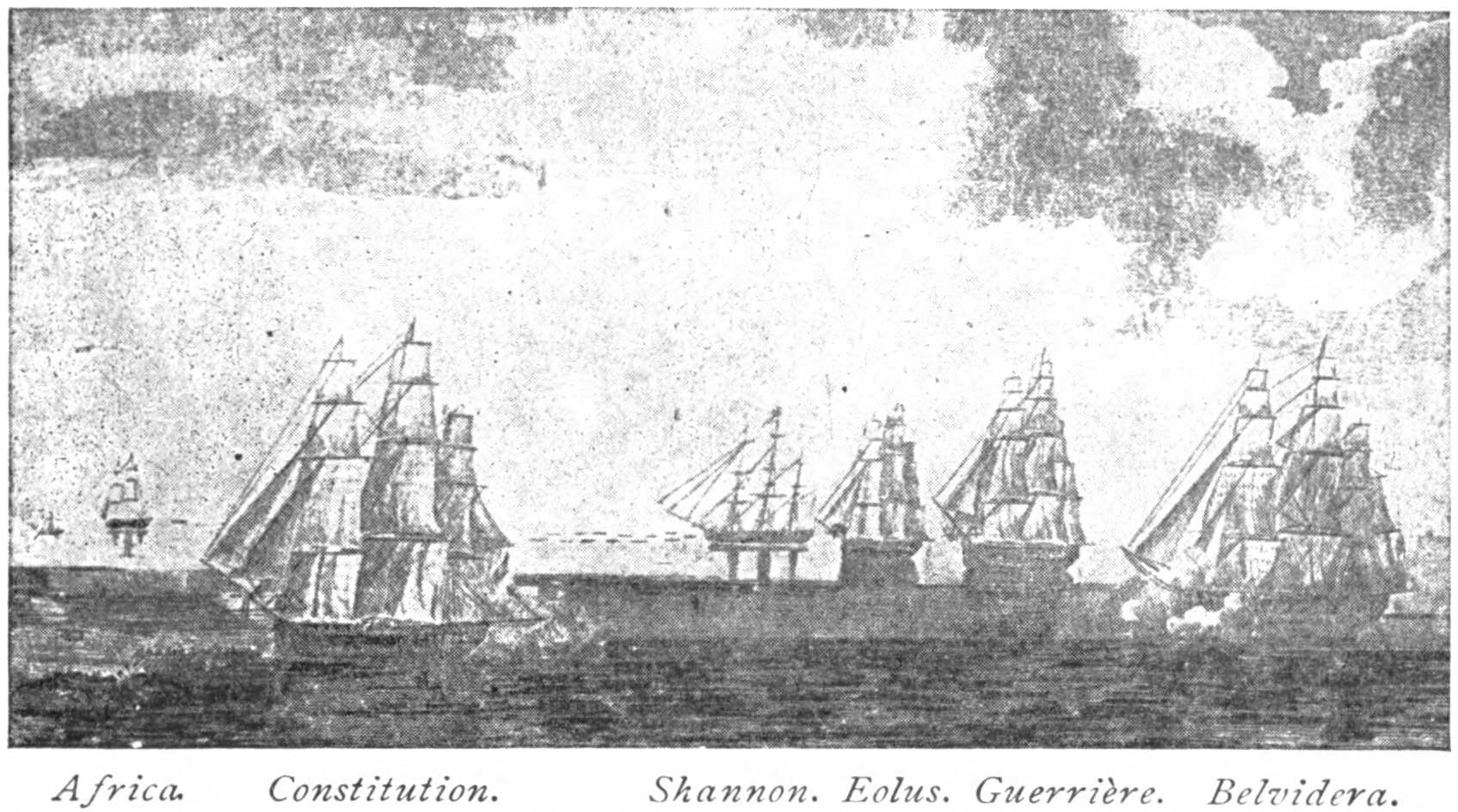
Africa.
Constitution.
Shannon.
Eolus.
Guerrière.
Belvidera.
The Constitution’s Escape from the British Squadron after a Chase of Sixty Hours.
From an engraving by Hoogland of the picture by Corné.
At 7 o’clock one of these long twenty-fours
was tried on the Shannon, but the ball
fell short. It did some good, however, for it
showed the enemy that their boats were in
danger, and so prevented their towing fairly
within gunshot.
But this by no means freed the Constitution.
If they did not dare tow up within range astern,
they could with their superior forces tow their
vessels out on each side of her, and so far surround
her as to absolutely prevent her escape
when a wind did come, and the situation was
apparently more nearly hopeless for the Constitution
than at any time since the chase
began.
In this emergency the wit of the “smart
Yankee” executive officer of the Constitution—Lieutenant
Charles Morris—gave the ship
a new lease of life. Morris had had experience
in towing a ship through crooked channels by
means of a light anchor carried ahead with a
line attached to haul on. This method of towing
is called kedging. Dropping a lead-line
over the rail, Morris found that the water was
but one hundred and fifty-six feet deep, and
suggested at once that they kedge her along.
A few minutes later the Constitution’s largest
boat was rowing away ahead with a small
anchor on board, and stretching out a half mile
of lines and cables knotted together. When
that anchor was dropped to the bottom the
men on the ship began to haul in on the line—to
walk away with it at a smart pace, and the
speed of the Constitution, which at best had
been no more than a mile an hour, was at once
trebled. She was literally clawing her way out
of trouble, clear of the enemy.
Meantime another kedge and a fresh line
were made ready, so that by the time the crew
had tracked the ship to the first anchor a second
one was in the mud a half mile ahead and
ready for them. In this way a substantial gain
was made on the enemy, who lagged under the
slower work of the men towing with small boats.
Towing a Becalmed Frigate.
From a picture drawn and engraved by Baugean.
Finally, at 9.10 A.M., a light air was seen on
the oil-smooth water in the south. The yards
of the Constitution were at once braced sharp
up to meet it, and by the time its breath had
filled the sails the willing crew had the boats
alongside and hoisted out of the water—some
to the davits where they belonged, and some
lifted by spare spars, rigged over the rail, just
clear of the water, where they could be dropped
the instant they were needed.
But if the wind gave the sailors who had
been on deck all night long a brief chance to
rest, it was after all of more advantage to the
enemy than to the Constitution. For she had
had to change her course when the breeze
came, and that change was sending her closer
to the Guerrière, instead of further away.
Worse yet, it seemed to the Yankees that their
sails had no more than rounded full under the
caress of the zephyr than it failed them again,
and once more the canvas rattled and slapped
the creaking spars.
The Guerrière now began firing, and there
was nothing to do but once more to stretch
out the lines with the kedge anchor and begin
anew the tracking the Constitution ahead.
For an hour the weary men stretched out their
tow-line and hauled it in and stretched and
hauled again. Captain Hull had lightened the
ship by starting nine or ten tons of water, and
the Constitution was just beginning to show a
fair gain once more over the enemy when Captain
Byron of the Belvidera saw how it was
that the Yankees were clawing away, and adopted
the same tactics.
Immediately this was done the boats from
the fleet flocked with men to her deck to help
haul in on the line—flocked there with men
who were fresh and strong from the decks of
the other ships, while the men of the Constitution
were worn with the loss of sleep the
night before and the fierce efforts of the morning.
By 2 o’clock in the afternoon these fresh
men had drawn the Belvidera so near that she
opened fire, and, although the shots fell short,
Captain Hull now supposed he would surely be
captured, and so prepared to make a good
fight with the first ship in hope of disabling
her before the rest could come to help. But
the Belvidera, not wishing to risk her anchor-carrying
boats within range of the Constitution’s
guns, was content to claw forward on
the Yankee’s quarter just out of range, while
the Shannon and Eolus strove to help partially
surround the Constitution once more.
The Belvidera began kedging at 10.30
o’clock in the morning. The Constitution had
been at it for an hour already. Steadily the
two crews labored at the heart-breaking task
until 3 o’clock in the afternoon, when once
more a zephyr from the south roughened the
oily waves and then lifted first the royals of
the Constitution and then the top-gallant sails.
The heavy canvas of top-sails and courses would
not swell to its weight, but the kites could pull
her. It was a fitful, varying breath, but it
lasted four hours, and during that time the
Americans actually held the braces by which
the sails were trimmed constantly in hand,
while the brave old captain kept his eyes on
the weather-vane and jockeyed her along as a
racing skipper handles his yacht. It was a
race for a stake such as has never been known
on any coast, for it was a race for the life of
a nation. Had Old Ironsides been captured
while Rodgers was making his fruitless cruise,
and imbeciles were leading worthless militia
in a day-dream scheme of conquest toward
Canada, the result would have been deadly.
As night came on (it was at 7 o’clock)
this breeze failed once more. It then lacked
less than an hour of a full day since the men
had been called to quarters. For twenty-three
hours they had stood at their guns, had made
and taken in and trimmed sail, had lowered
and rowed away and hoisted up boats, had
carried out anchors and hauled on the cables
till they gasped for breath. It had been a day
to wear the life out of any ordinary man, but,
as John Paul Jones said on the deck of the
Bonhomme Richard, these could say now:
“We have not yet begun to fight.” In spite
of weariness, the instant the zephyr failed them
these men once more dropped the boats and
carried out the small anchors with the long
lines and began again to claw their way clear of
the enemy. Until 10.45 P.M. they worked with
steady patience, and then another teasing zephyr
came to fill the sails of the ship, and the boats
except one were all hoisted clear of the water.
During all this time the Guerrière and the
Belvidera had fairly held their own, being
aided by the men from the other ships. The
Shannon had dropped back a deal, but the
Eolus was not by any means far enough away
to be ignored. But when the breeze came, the
Belvidera got enough of the flaws of air to
forge ahead, so that soon after daylight (at 4
o’clock) on the morning of July 19th she was
well forward on the lee beam of the Constitution,
and, tacking about, she stood for the Yankee.
If the Constitution held fast as she was
the Belvidera was sure to pass within easy
gunshot astern and deliver a raking fire that
would play havoc with spars and sails. If the
Constitution tacked also, the Eolus, off on the
Yankee’s weather-quarter, would have a chance
of forging within gunshot. The Constitution
was cornered and a choice had to be made.
Going about at 4.20 A.M. on the other
tack, Captain Hull headed across the bows of
the Eolus. He was now steering out to sea,
and to the joy of the Americans the sails
swelled under a faint improvement in the
breeze. An hour later they were crossing
ahead of the Eolus within range of long guns,
but the Englishman did not open fire and the
Constitution passed free. The Eolus when in
the wake of the Constitution tacked, and then
Captain Hull had the satisfaction of seeing the
enemy once more all astern of him. It was
not that he was out of danger. There were
four frigates—the Belvidera, the Eolus, the
Guerrière, and the Shannon—all after him,
but he had escaped being surrounded. The
line-of-battle-ship and the smaller craft had
been left so far astern as to be out of the race.
For several hours after this the race was
without incident, though so far as the eye could
judge the Constitution gained slightly in the
faint-air race, but at 9 o’clock a strange sail arrived
within plain view to the southward. She
was evidently bound to New York. To decoy
her (for she looked like a Yankee) the Belvidera
hoisted American colors, but Captain
Hull stopped that game by hoisting the British
ensign, whereat the merchantman braced up
and escaped, while the Constitution slipped
along with every thread drawing and the green
water between her and the enemy slowly
widening, until at noon the nearest one was
estimated to be three and a half miles astern.
The wide-beam, shoal-draft ship had the best
of the race in a light air, as others have since
had in races of less importance near the same
ground.
Chase of the Constitution off the Jersey Coast.
From the painting by Inch at the Naval Academy, Annapolis.
The crew were now, for the first time, able
to get some rest. Officers and men alike
stretched out on deck and slept as men may
who for thirty-six hours have worked for life,
but the brave old sailor who commanded the
ship stood to his post. Throughout the afternoon
the lead of the Constitution was slightly
increased, but at 4 o’clock the wind began
to weaken, to the disadvantage of the flying
Yankee, for she ran out of the breeze, and the
enemy held it for a time after she lost it, and
so drew up until within perhaps three miles.
There was nothing to do now but get out all
the boats to a tow-line, for the water was too
deep for kedging.
And then came the last and most stirring
event of the long race. A heavy cloud appeared
away to southward and eastward, the
first sign of one of the black squalls with which
American coasters are over-familiar. A fearsome
spectacle they are to the unaccustomed,
nor do they lack weight of wind at any time,
but to the men of the Constitution this squall
was a Godsend.
Knowing very well what the Englishmen
would think of the looks of the squall, Captain
Hull kept his boats at their towing and sent
the men about deck to the belaying pins, where
sheets and tacks and halyards were made fast,
while others stretched out clew-lines and bunt-lines,
and downhauls. Standing so with everything
in hand, he watched the coming cloud
until the frothing spoondrift was within a mile,
and the first faint breath of it was lifting the
royals, and then to the shrill pipe of the boatswain
called the boats alongside. As they
were hooking on the tackles the blast struck
the ship. Over she heeled as if to go on her
beam ends, lifting the boats to windward clear
of the water, while the men at the halyards
and sheets let go all, and all hands clapped
on to the clew-lines and downhauls and boat-tackles.
In a moment the last sail had been
clewed into a bunt, and the boats to windward
and leeward were snatched to the davits and
spars rigged to receive them.
Turning then, to look at the enemy, he saw
the men climbing aloft and with eager haste
furling everything, while their boats were
left to shift as they might in the foaming
sea. They had supposed from what they saw
of the effect of the squall on the Constitution
that it was even worse than it looked,
and they snugged down their ships accordingly.
And then, as the friendly rain and vapor of
the squall veiled the wily Yankee, he spread his
sails—sails that had not been furled—to the
gale and “went off on an easy bowline at the
rate of eleven knots an hour.”
The race was won. At 7.30 P.M., when the
squall had passed and the enemy once more
came in view, the leading ship, the Belvidera,
was not only a long way astern, but she had
the wind in such fashion as to be unable to
hold up within two points of the course the
Constitution was steering. And yet in their
mad efforts to overhaul the Yankee after they
felt the weight of the squall, the British captains
had cut adrift their small boats, that they
might not be obliged to stop and pick them
up or be encumbered with the weight.
The winds proved light and baffling all night,
but having observed how much better the sails
held the air while they were wet, Captain Hull
started his force-pumps at work to keep the
lower sails wet, and sent men to the highest
yards to draw up water in buckets and keep
everything drenched to the highest thread. It
was a plan that worked admirably. In spite of
the baffling zephyrs, the Yankee gained all
night, so that at daylight only the loftier sails
of the enemy were visible, and at 8.15 on the
morning of Monday, July 20, 1812, the British
squadron gave it up and squared away for Sandy
Hook, leaving the triumphant Constitution to
head away to Boston to obtain another supply
of water in place of that she had started to decrease
her draft. From Friday afternoon until
Monday morning the British frigates, including
the swift Belvidera that had eluded the President,
were in chase of the Yankee clipper.
Certainly they showed “great perseverance,
good seamanship, and ready invitation,” but
“the cool old Yankee” justified the praise
which Lord Nelson gave us when he said, in
the Mediterranean, that “there is in the handling
of those transatlantic ships a nucleus of
trouble for the navy of Great Britain.”
CHAPTER V THE CONSTITUTION AND THE GUERRIÈRE
The Constitution Bearing Down for the Guerrière.
From an old wood-cut.
THE BRITISH CAPTAIN COULD SCARCELY BELIEVE THAT A YANKEE
WOULD BE BOLD ENOUGH TO ATTACK HIM, AND WAS SURE OF
VICTORY IN LESS THAN AN HOUR, BUT WHEN THE YANKEES
HAD BEEN FIRING AT THE GUERRIÈRE FOR THIRTY MINUTES
SHE WAS A DISMANTLED HULK, RAPIDLY SINKING OUT OF SIGHT—“THE
SEA NEVER ROLLED OVER A VESSEL WHOSE FATE SO
STARTLED THE WORLD”—SUNDRY ADMISSIONS HER LOSS EXTORTED
FROM THE ENEMY—A COMPARISON OF THE SHIPS.
Having noted, in the stories of the actions
hitherto described, somewhat of the training,
skill, and good-will of the American seamen in
the use of naval weapons, and their masterful
knowledge of seamanship, the time arrives for
telling how one of these Yankee frigates won
the first signal victory of the war—the victory
of the Constitution over the Guerrière. But
it will add to the pleasure of every American
reader if the opinions which the British captain
expressed about his ship, both before and after
the battle, be told before the battle is described.
At the time the Guerrière went into the fight
she was commanded by Captain James Richard
Dacres. In the course of the cruise during
which the squadron under Broke chased the
Constitution, Captain Dacres dined on board
the Shannon. While pacing the deck of the
Shannon, after dinner, and talking with Broke,
Captain Dacres said emphatically of his ship:
“I say, she looks beautiful; and more, she’d
take an antagonist in half the time the Shannon
could.”
On making full allowance for a captain’s disposition
to boast unduly of the qualities of his
ship, it is still fair to say that Dacres considered
her at any rate equal to the Shannon, although
the Shannon carried more guns.
To strengthen this conclusion it may be
added that Captain Dacres sent a challenge to
Captain Rodgers of the President, which was
a sister ship to the Constitution. Further than
that we have the words of Captain Dacres
when he was court-martialled for losing her:
“I am so well aware that the success of my
opponent was owing to fortune, that it is my
earnest wish, and would be the happiest moment
of my life, to be once more opposed to the
Constitution in a frigate of similar force to the
Guerrière.”
These assertions must appear to every reader
to be a confession of faith in his ship. Nor
was Captain Dacres alone in his belief that she
was a good one.
“The Guerrière is as fine a frigate as we can
boast of,” said the St. Christopher’s Gazette in
the same year, while lamenting her loss.
What the English newspapers thought of
the Constitution before this battle with the
Guerrière is also worth repeating. The opinions
they expressed were, of course, a repetition
of those expressed by British naval officers,
who had visited her at various times, but notably
after she had called at Portsmouth as related
in a preceding chapter. They spoke of
her as “a bunch of pine boards,” and as “a fir-built
ship with a bit of striped bunting at her
mast-head,” and “their opinions gave rise to
various excellent jokes that were uttered in
and out of the British Parliament at the commencement
of the war.”
To these statements must be added the further
fact that the boastful captain of the Guerrière
had taken the trouble to notify the
Americans that his ship “was not the Little
Belt,” referring to the affair in which the Little
Belt was so severely pounded by a Yankee frigate.
The Constitution sailed from Boston on
August 2, 1812. Captain Hull had reported
his escape from the British squadron in a modest
letter to the Navy Department, but he did
not wait for further orders from the Secretary.
He conjectured that his narrow escape would
so frighten the timid officials, who had previously
warned him in his official instructions
not to voluntarily engage any superior force,
that they would keep him lying inactive in
port. In this conjecture he was entirely right,
for a few days after he had sailed, orders to
that effect did arrive. A good naval authority
says that “had the Constitution been captured
on the cruise, Hull would have been hanged
or shot for sailing without orders.” It has often
been a matter of consolation to American naval
officers in these last years of the nineteenth
century to read of the incapacity and cowardice
of department officials in the early years of it.
Having taken the risk, Captain Hull coasted
along to the north as far as the entrance to the
Gulf of St. Lawrence. On August 15th five
vessels were seen in a bunch, and on approaching
them, four scattered away, leaving the fifth,
a brig, on fire. One was chased and found to
be an English merchantman in the hands of an
American prize crew. Before night the American
brig Adeline was overhauled and taken
from the British prize crew found on board of
her. On the night of the 18th a third vessel
was overhauled after a smart race, and this was
an unfortunate affair, for she proved to be the
American privateer Decatur, of fourteen guns,
twelve of which had been thrown overboard in
her mad race with the Constitution.
From the captain of the Decatur Captain
Hull learned that a British frigate had been
seen the day before steering to the southward
under easy sail. On hearing that, Captain Hull
crowded the canvas on the Constitution in
chase of her.
There were light westerly breezes during the
night and early morning following, but as the
day wore on the breeze canted to the northwest
and freshened until the Constitution, with all
plain sail set, was bowling along at little less
than the speed she attained in her spurt away
from the fleet off Barnegat. Until after dinner
nothing was seen, but before the 2-o’clock
bell was struck the lookout astride the fore-royal-yard
stirred the crew with the prolonged
cry of
“Sail-ho!”
It is said that half the men about deck
climbed into the rigging in their eagerness to
see the stranger, and within a few minutes
their curiosity was gratified, when it appeared
plainly that she was a large ship steering to the
southwest. So, with sheets eased, the Constitution
headed away for her, and by half-past 3
o’clock the Yankee crew had not only learned
that she was a British frigate, but that her captain
was ready to fight, for he set his flag and
made no effort to get away.
The first measure of strength between a
British and an American frigate—the battle between
the Guerrière and the Constitution—was
at hand.
Over on the Guerrière, Captain Dacres, when
he first saw the Constitution boldly bearing down
upon him, was doubtful about her character,
and he was good enough to consult in the matter
with an American prisoner whom he had on
board—Captain Orne, of the American brig
Betsey, captured some time before. The American
skipper said it was a Yankee frigate that
was coming. To this Captain Dacres replied
that he thought she came down too boldly for
an American, but added: “The better he behaves
the more honor we shall gain by taking
him.” A little later, when the colors had been
displayed, he called out to the crew:
“There is a Yankee frigate; in forty-five
minutes she is certainly ours. Take her in fifteen
and I promise you four months’ pay.”
This must have been said at about twenty
minutes past 4 o’clock, for it was at that
time that the English officers hoisted flags to
every mast-head and opened fire, “more with a
view to try the distance than for any effectual
attack.”
Action between the Constitution and the Guerrière.—I.
From the painting by Birch, at the Naval Academy, Annapolis.
At that Captain Hull began to shorten sail
on the Constitution. The breeze was steady
and fresh, and the water fairly smooth. It was
just the kind of weather he would have chosen
for such a battle. All the light sails, including
the top-gallant sails, were furled, the courses
were hauled up to the yards, and the royal-yards
were sent down. Then the top-sails were
double-reefed, and as the men came down from
the top-sail-yards the drums beat to quarters.
Not many of the crew had ever been in battle,
but “from the smallest boy in the ship to the
oldest seaman not a look of fear was seen.”
The enemy’s first shots fell short, but the
second round passed over the deck of the Constitution,
though without doing any damage.
A deal of what a yachtsman would call jockeying
for position followed. The enemy squared
away before the wind, and wore around until
her port (left side) battery would bear, and
then, as the Constitution was coming down the
wind and following close after her, she wore
back till her starboard (right side) battery would
bear. As she turned from side to side she fired
on the Constitution. The Constitution replied
with an occasional shot from a bow-gun. The
enemy was twisting about to avoid being raked
by the Constitution, and was firing to cripple
the enemy’s rigging. But all that the twisting
amounted to was to keep the Guerrière at
“long balls”—out of range of the shorter guns
of the Constitution. To end that kind of work
Captain Hull spread his maintopgallant sail
and foresail. Impelled by these, the Constitution
began to forge within close range, and the
projectiles from the Guerrière began to come
on board. One big shot through the forward
bulwarks knocked no end of splinters across
the deck, and some of them pierced several of
a gun’s crew hard by. The men were eager to
return the fire, but Captain Hull paced the
quarter-deck, saying nothing. A rousing cheer
from the British crew came over the water as
they saw that they had hulled the Constitution.
Lieutenant Morris walked aft, and said to Captain
Hull:
“The enemy has opened fire and killed two
of our men. Shall we return it?”
Action between the Constitution and the Guerrière.—II.
From the painting by Birch, at the Naval Academy, Annapolis.
“Not yet, sir,” replied Captain Hull. The
captain was waiting for a shorter range. Twice
more Lieutenant Morris, to ease the minds of
the impatient gunners, walked aft to ask permission
to fire, and each time received the same
answer. The Guerrière had meantime steered
away before the wind; the clipper stem of the
Yankee was overreaching the Englishman’s
quarter only a few yards away from it; our
guns were brought to bear, and then stooping
till “he split his knee-breeches from waistband
to buckle,” Captain Hull straightened up again
to his full height and shouted in a voice heard
all over the ship:
“Now, boys; pour it into them!”
With a yell they obeyed. The broadside was
as a single explosion. The crash of the iron
balls through the splintering timbers of the
Guerrière came back as an echo, and as she
rolled with the swell the blood of the dead and
wounded gushed from her scuppers. The Yankee
gunners had aimed as if feeling still the
claws of the British cat in their backs.
The Constitution in Close Action with the Guerrière.
From an old wood-cut.
It was at 6.05 A.M. that this first broadside
was fired from the American ship. For fifteen
minutes the roar of the cannon and the rattle
of musketry, and the crash of solid shot that
struck home were incessant. The ships were
literally yard-arm to yard-arm, rising and sinking
over the long swells as they drove away before
the wind. The British in mad haste pulled
their lanyards and fired the moment their guns
were primed. The Americans loaded in haste,
but paused each time until their gun-sights
ranged on hull or spar, and then they fired.
At 6.20 A.M. a big round shot from the Constitution
crashed through the mizzen-mast of
the Guerrière, and away it went, over the rail to
starboard. Snatching off his hat, Captain Hull
waved it above his head.
“Hurrah, my boys! we’ve made a brig of
her!” he shouted.
Action between the Constitution and the Guerrière.—III.
From the painting by Birch, at the Naval Academy, Annapolis.
They had done more. The mast was still
held by its rigging, and, dragging in the water,
it brought the Guerrière around partly across
the wind. The Constitution forged ahead,
swung her yards, ported her helm, and ranging
across the enemy’s bows gave her a raking broadside.
The Guerrière’s main-yard came tumbling
down, shot through at the mast. Then, swinging
around before the wind, the Yankee brought
her port battery to bear and gave the Guerrière
a second raking. So close together were the
two ships now that the Guerrière’s bowsprit
came poking over the quarter-deck of the Constitution.
A man on the Constitution reached
out of a cabin port and placed his hand on the
enemy’s figure-head. The Guerrière’s bowsprit
fouled the Constitutions port mizzen rigging
and the bow-chasers of the Guerrière began to
play havoc with the cabin of the Constitution,
which was soon on fire from blazing wads.
Note.—The accounts of the manœuvres differ widely, but it is agreed that the real
fighting began at 6 o’clock with the Constitution on the port quarter of the enemy.
When fairly abeam, the mizzen-mast of the Guerrière fell over to port, according to
Allen, and dragged her nose up to the starboard side of the Constitution; when the
Constitution drove clear the two remaining masts of the Guerrière fell. The Constitution
after repairs to her rigging, returned at 7 o’clock.
As the men on the Constitution ran to extinguish
this fire Captain Dacres on the Guerrière
called away boarders, intending to climb
along his bowsprit to reach the Constitution’s
quarter-deck, but when he
saw the men on the Constitution
ready to receive
him he thought differently
about it. The Yankees
then thought to board,
and brave Lieutenant Bush, of the marines,
jumped on the rail for the honor of leading
the way, and there was shot dead by a British
marine. For a few moments the two ships
hung together, sawing up and down, while
the bulk of each crew was massed for boarding
and the topmen on each ship poured a
galling fire into the other. Lieutenant Morris
was shot through the body and Master Alwyn
was but little less severely wounded. Captain
Hull climbed part way upon the rail, but a
big Yankee seaman dragged him back unceremoniously,
and begged him not to do that unless
he first took “off them swabs”—pointing
to the captain’s gold epaulets. A sailor who
fired a pistol at one of the enemy and missed
him, threw the pistol with better, though not
fatal, aim. He hit the fellow in the breast.
And then the flag at the Constitution’s mizzen-truck
was shot down. The enemy cheered,
but John Hogan shinned up and replaced it,
although a number of British marines fired at
him steadily all the time he was exposed.
At last the larger spread of canvas on the
Constitution pulled her clear, and then, as she
began to swing around into position to open
fire again, both the main and the foremast of
the Guerrière that had been badly cut by the
American shot went over the rail with a crash,
and there she lay a helpless hulk.
It was then exactly 6.23 o’clock, or about two
hours since the firing of the first gun from the
Guerrière. But from the time that the Constitution
fired her first broadside, it was less than
thirty minutes.
Action between the Constitution and the Guerrière.—IV.
From the painting by Birch, at the Naval Academy, Annapolis.
Veering off for a brief interval, the Constitution’s
crew made hasty repairs to the rigging,
and then came back with guns loaded. They
found the Guerrière in the trough of the sea
rolling her main-deck guns under water with
every passing swell.
The Constitution had been at her less than
thirty minutes, but all three of her masts had
been shot away, and were dragging over the
rail by such of the shrouds as had not been cut
by the shot of the Yankees. Her hull was
knocked into a sieve by the Yankee round-shot.
Thirty of these projectiles had penetrated her
more than four feet below the water-line. The
cool Yankee gunner had watched her rolling
her side out of water and then aimed his gun
at the copper below the water-line. Out of a
crew of two hundred and seventy-two, twenty-three
men were dead or mortally hurt, and
fifty-six were more or less severely wounded—more
than one-fourth of her crew had been hit
in that brief time. On the Constitution seven
men had been killed and seven wounded, while
her hull had scarcely been touched below the
bulwarks.
The Constitution was ready for an all-night
battle. The Guerrière was ready only for
the torch. She was “a perfect wreck.” She
could not be carried into port and had to be
burned.
There was no flag flying on the Guerrière
when the Constitution returned to her, and so
Third Lieutenant George Campbell Read was
sent off in a boat to hail her. Pulling under
her lee quarter he found Captain Dacres leaning
over the rail, and asked him if he had surrendered.
According to the careful Maclay
the following conversation took place—when
Captain Dacres replied:
“I don’t know that it would be prudent to
continue the engagement any longer.”
“Do I understand you to say that you have
struck?” asked Lieutenant Read.
“Not precisely,” returned Dacres, “but I
don’t know that it will be worth while to fight
any longer.”
“If you cannot decide, I will return aboard
my ship and we will resume the engagement,”
said the American officer.
To this Captain Dacres called out somewhat
excitedly: “Why, I am pretty much hors de
combat already. I have hardly men enough
left to work a single gun, and my ship is in a
sinking condition.”
“I wish to know, sir,” peremptorily demanded
Lieutenant Read, “whether I am to
consider you a prisoner of war or an enemy. I
have no time for further parley.”
Captain Dacres replied with evident reluctance:
“I believe now there is no alternative.
If I could fight longer I would, with pleasure;
but—I—must—surrender.”
Sir James Richard Dacres.
From an English engraving published in 1811.
Read continued:
“Commodore Hull’s compliments, and wishes
to know whether you need the assistance of a
surgeon or surgeon’s mate?”
“Well, I should suppose you had on board
your own ship business enough for all your
medical officers,” replied Dacres.
“Oh, no,” said Read, blithely, “we had only
seven wounded, and they were dressed half an
hour ago.”
The end of it was that Captain Dacres was
carried on board the Constitution. He had
been wounded, but was able to climb the rope-ladder
to her deck, and there he found Captain
Hull awaiting him. It was a notable meeting
in more ways than one—physically among the
rest. For Hull was short, rotund, and jolly—very
much like our portraits of John Bull—while
Dacres was tall, lank, and serious—not
much different from a typical New Englander.
Hull helped the beaten captain to the deck, saying
heartily: “Dacres, give me your hand, I
know you are hurt.” A moment later Captain
Dacres made a formal offer of his sword, but
Hull refused it.
“No, no,” he said, “I will not take a sword
from one who knows so well how to use it;
but I’ll trouble you for that hat.”
This apparently incongruous remark was due
to the fact that when Dacres had met Hull socially
before the war he had offered to bet a
hat that the Guerrière would whip the Constitution
if they ever met, and Hull accepted
the bet.
It was on the afternoon of August 21, 1812,
that the wreck of the Guerrière was fired and
blown to the four winds of heaven by the
triumphant Yankees, and from that day to this
the naval writers of both England and America
have been trying to tell how it was that
the Guerrière was so badly beaten in so short
a time. A half-dozen different explanations
may be found in the books of any great nation,
and all are very much alike, even though written
by partisans. They give the details of the
battle, how the ships approached each other;
how they veered and wore; how the crews
cheered; how they fired the guns; how the
splinters flew; how the blood flowed from the
scuppers—of one ship; how with great reluctance
the one surrendered. Then with one
accord the writers set to work to examine the
hulk of the Guerrière. Was it sound or rotten?
They counted the guns. How many did each
ship have in a broadside? They measured the
calibres of the guns. They weighed the projectiles.
“Why, blow me, sir! The Constitution
had long twenty-fours to our eighteens!” “All
right, but by gosh, our shot were seven per
cent. under weight!” They considered the
gunpowder chemically to see whether or not
it had deteriorated on the Guerrière. They
counted the crews. They considered every little
detail.
As we look back at a distance of eighty-five
years upon the battle it must seem to a candid
student of naval matters that the excuses and
the explanations were hardly worthy of the
great peoples engaged in making them. Nevertheless,
because it is the conventional thing,
these details shall be given here:
The Constitution measured (Roosevelt’s account)
1,576 tons; the Guerrière, 1,338. The
Constitution could fire 27 guns in a broadside,
throwing 684 pounds of metal (actual weight);
the Guerrière, 25 guns, throwing 556 pounds
of metal. The Constitution carried 456 men;
the Guerrière but 272. The Constitution lost,
as already told, 7 killed and 7 wounded; while
the Guerrière lost 23 killed and 56 wounded—over
one-fourth of her crew. The comparative
force of the ships rated by these standards, was
as 100 to 70; the comparative casualties were
as 18 to 100. To this may be added that the
relative injury to the ships was as 100 to nothing.
Arguing from these figures the British
writers say that the Constitution was “a seventy-four-gun
ship of the line in disguise.”
“Why should not any American feel proud
of that assertion?” For if it be so, the old
Quaker ship-builder of Philadelphia was not
only the greatest ship-builder in America, but
in the whole world. When the British officers
called her so they confessed that when they had
called her “a bunch of pine boards” they were
mistaken. They confessed that they had been
utterly incapable of judging the fighting worth
of the Constitution, although they had gone
over her and examined her carefully.
The British point to the fact that our most
powerful projectiles came from twenty-four
pounders, while theirs were from eighteens.
Here again they confess their own inability to
arm a ship. They had for twenty years been
fighting the navies of Europe. Out of the experience
there gained they had decided that the
long eighteens were the best calibre for the
main-deck battery of a frigate. The last frigates
launched from British ship-yards previous
to this battle were armed with long eighteens.
The British officers who inspected the Constitution
from time to time before the war of
1812 ridiculed the idea of trying to fight with
long twenty-fours. The long twenty-fours
were “too heavy!” But when their best frigates
had been defeated by the Yankees they
began to weigh the projectiles and learned that
their defeat was due to the much ridiculed
twenty-fours.
If the British had carried their investigations
into the size of the shot a trifle further—to the
mechanism of the guns, for instance—they
would have learned something of real significance.
They would have seen that the cannon
of the Constitution were furnished with sights.
The Guerrière lost her masts not by accident,
but because the cool Yankee gunners could aim
their weapons accurately.
But the most important—rather the most
pleasing of all the confessions in the British
explanations after defeat is that relating to the
superior numbers of the American crews. The
count showed 456 individuals on the Constitution,
and 272 on the Guerrière. To contend,
as the British writers do contend, that the “superiority
on the American side “was” in number
of men as—nine to five,” is to admit that
man for man, an American naval seaman, in
spite of his lack of experience, was the equal
of the tar-stained, cicatrice-marked British seaman;
and that was a confession which Americans
in those days (not now) were most anxious
to extort.
But the British writers did not stop at this
confession. They went further and admitted
all the most boastful Yankee could have wished.
They said (vide the British Naval Chronicle),
that “the few on board an American ship-of-war
that are designated as boys are as old and
stout as most men employed in our service.”
And the last of all is the confession of the
same periodical that “had the Guerrière’s men
been half as well skilled in the use of great
guns as the Constitution’s were, the proportion
of killed and wounded would not have been so
great nor one ship made a complete wreck of
while the other suffered no material injury in
hull or rigging.”
Isaac did so maul and rake her
That the decks of Captain Dacre
Were in such a woful pickle
As if Death, with scythe and sickle,
With his sling or with his shaft
Had cut his harvest fore and aft.
Thus, in thirty minutes, ended
Mischiefs that could not be mended;
Masts and yards and ship descended
All to David Jones’s locker——
Such a ship, in such a pucker!
So sang the old-time Yankee rhymester of
the ship that “was not the Little Belt.”
The British Admiralty boards eventually
threw aside their prejudices, and adopted long
twenty-fours with sights on them in place of
unsighted long eighteens. They have done
even more than that, for when in these last
years the swift armored cruiser New York,
with her eight-inch rifles in turrets, was added
to the American navy, giving us the most
powerful cruiser in the world, they at once laid
down four armored cruisers that were larger in
displacement and carried more powerful engines,
thicker turrets, and a more powerful
armament than the New York.
During the night after the battle the boats
were kept busy transferring the prisoners from
the wreck to the Constitution. Ten kidnapped
Americans were found among her crew, but
the humane Dacres had not compelled them to
fight against their own flag. A sail was seen
steering south at twenty minutes past two
o’clock, and the Constitution cleared for action,
but the vessel passed on, and soon disappeared.
At daylight the lieutenant in charge of the
wreck hailed to say she had four feet of water
in her hold and appeared to be in danger of
sinking, but she kept afloat until afternoon,
when she was set on fire, and at 3.15 P.M., on
August 21, 1812, the flames reached her magazine
and she was blown to pieces. “A huge
column of smoke arose and stood for a long
time in the calm atmosphere, and then slowly
crumbled to pieces, revealing only a few shattered
planks to tell where the proud vessel
had sunk. The sea never rolled over a vessel
whose fate so startled the world.”
It is worth noting, perhaps, that the father
of Captain Dacres of the Guerrière was the
Captain James Richard Dacres who commanded
the schooner Carleton on Lake Champlain at
the time of the fight with Arnold’s haymakers,
and that both father and son became admirals
in the service.
As it happened, the Constitution reached
Boston most opportunely. Detroit had been
surrendered to the British without a single
shot having been fired in its defence. Fort
Dearborn, too, that stood where Chicago now
stands, had been taken by the Indian allies of
the British and the garrison massacred. Instead
of triumphantly wresting Canada from the
British Crown, as the foolish politicians in Congress
had proposed to do, the American militia
had been beaten back and the Canadians seemed
in a fair way to annex all the United States
domain lying west of the longitude of Lake
Erie. The people had hoped for nothing from
the navy. The Administration had even sent
orders to Captain Hull to remain in port, but
Hull had sailed before the orders arrived, and
now returned with the crew of the Guerrière—the
British frigate that had sailed up and
down the coast, kidnapping American citizens
and flaunting her identity in the face of all
America by painting her name across her foretopsail.
Medal Awarded to Isaac Hull, after the Capture of the Guerrière by
the Constitution.
The Constitution appeared off Boston Light
on August 30th, dressed in fluttering bunting.
Look-outs along shore saw and understood these
signals, and horsemen, wild with enthusiasm,
galloped into the city. Cannon roared from
every fort as she sailed up the harbor, and flags
were flung to the breeze from every mast-head.
The people in thousands gathered at the long
wharf to welcome her. A banquet was given
to the officers in Faneuil Hall, where the venerable
John Adams, the first advocate of a
national navy in the old Colonial Congress,
presided. Congress voted a gold medal to
Captain Hull and silver medals to the commissioned
officers, and $50,000 to the whole crew.
A piece of plate was given to Lieutenant
Morris by his townsmen. The citizens of Portland,
Maine (Falmouth), gave a sword to their
townsman, Lieutenant Alexander Scammel
Wadsworth. Virginia gave swords to Midshipmen
Morgan and Taylor. The people had
looked upon the navy with doubt; they had
seen with anxious fear the Constitution sail
away. But now the whole nation went wild,
and the song of the exultant poet rang wherever
the people gathered:
Ye tars of Columbia, whose glory imparts
New charms to the blessings your valor secures,
Oh! high be your hopes and undaunted your hearts,
For the wishes and prayers of a nation are yours.
CHAPTER VI FOUGHT IN A HATTERAS GALE
WHEN THE SECOND YANKEE WASP FELL IN WITH THE BRITISH
FROLIC—THEY TUMBLED ABOUT IN THE CROSS SEA IN A WAY
THAT DESTROYED THE BRITISH “AIM,” BUT THE YANKEES
WATCHED THE ROLL OF THEIR SHIP, AND WHEN THEY WERE
DONE THEY HAD KILLED AND WOUNDED NINE-TENTHS OF
THE ENEMY’S CREW AND WRECKED HIS VESSEL—THE FROLIC
WAS A LARGER SHIP, CARRIED MORE GUNS, AND HAD ALL THE
MEN SHE COULD USE, “FINE, ABLE-BODIED SEAMEN,” SURE
ENOUGH!
Of glorious memory was the little Yankee
sloop-of-war Wasp. Though carrying the rig
of a ship—square sails on three masts, she was
of the size of one of the smaller schooners that
in these days cruise along the United States
coast. She measured, that is to say, four hundred
and fifty tons. But being built to a different
model, she stood somewhat higher out of
water than the schooners do. Her guns included
sixteen short thirty-twos and two long
twelves. Her commander in 1812 was Captain
Jacob Jones, a Delaware sailor who had worked
his way up, beginning as a midshipman under
Captain Barry.
Jacob Jones.
From an engraving by Edwin of the portrait by Rembrandt Peale.
On October 13, 1812, the Wasp sailed from
Philadelphia, bound eastward to lie in wait in
the track of British merchantmen in the voyages
from the West Indies. She had on board
one hundred and thirty-seven men, including
marines, but two of her sailors were lost overboard
in a gale of wind on the 15th. They
were at work on the jib at the time. The
Wasp in plunging down a wave buried her
bowsprit under water, and when she rose out
of it the bowsprit was broken off and the men
carried away.
For two days the gale blew hard, making an
ugly sea, and then on the night of the 17th
moderated somewhat, although the wind was
still properly called a gale. That night at half-past
eleven o’clock several lights were seen,
showing that a number of vessels were weathering
the storm together, and Captain Jones
hauled to the wind, where he could keep his
eye on them. When daylight came he found
there were six large merchantmen under the
convoy of a big brig. Although the brig was
plainly as large as the Wasp, and some of the
merchant ships carried guns, Captain Jones
reefed down his topsails to fighting trim, sent
his topgallant-yards down on deck and squared
away for the fleet. As was afterwards learned
the ships were a part of a fleet of fourteen
bound from British Honduras to England, and
the brig was the Frolic, Captain Thomas Whinyates.
The fleet had been separated by the
storm and the Frolic had sprung her main-yard.
She was making repairs when morning
came, but as the Yankee bore down on the
fleet the Frolic, under a fore-and-aft mainsail,
fore-topsail and a jib, bore up to meet her.
So heavy was the gale and so short the canvas
under which the ships had to work, that
it was not until after 11 o’clock that they got
within fighting distance, but when there, the
Englishman hoisted a Spanish flag. This little
trick did not deceive the Yankee, however, for
he held his course, and very soon the two vessels
were within sixty yards of each other and
were steadily drawing nearer, both running almost
before the wind, but not quite, the Yankee
having a little the better of it, being a little
to windward.
For a brief time they ran so in silence, and
then Captain Jones stepped to the rail and
hailed. For an answer the Englishman hauled
down his Spanish flag, hoisted his red cross of
St. George, and as the one came down and the
other fluttered aloft, fired a broadside—fired it
just as a fierce flaw of wind struck his sails to
heel him over.
The Yankees waited till their vessel began
to roll from the crest of a wave toward the
enemy and then fired a broadside in return.
It was a battle off Cape Hatteras in the tail
end of a Hatteras gale. The ships rolled and
pitched over the heavy cross seas, and wallowed
through the hollows. The crews, as they loaded
their guns, saw the long rammers pointed to
the clouds at one roll, and saw them dip in the
spoondrift that rose to the port sills at the next.
The muzzles of the guns were even dipped into
the smother of it at times. The spray from the
wave-crests in great masses splashed over the
bulwarks. The smoke from the guns was
snatched away by the gale, leaving clear targets
for the gunners, who, from the excitement of
it all, swabbed, and rammed, and fired—who
shouted as they hauled out their guns to aim,
and cheered as they fired their iron hail across
the tossing seas. The roar and whizz of the
gale were whelmed in the thunder of the broadsides
and the scream of projectiles.
Diagram of the
WASP-FROLIC
BATTLE.
They swabbed, and rammed, and fired in
frantic haste under the red cross—fired the
moment the muzzles of the guns were hauled
out through the bulwarks. Under the “gridiron
flag” they loaded in haste and then calmly
waited till the roll of the ship was right to
make each projectile do its appointed work.
The Englishman fired three broadsides by
count to two of the Yankees, but scarce a projectile
from the enemy struck the Yankee’s hull.
Nevertheless some damage was done by
British projectiles. Within four minutes after
the first broadside a shot struck the Wasp’s
maintopmast not far above the cap and over
it went like a tree before a hurricane. The
yards fell across the fore braces and “rendered
the head-yards unmanageable.” Ten minutes
later (11.46 A.M.) the mizzen-topgallant-mast
was shot off and “at twenty minutes from
the beginning of the action every brace and
most of the rigging was shot away” on the
Wasp.
But both vessels were driving along before
the wind. The impulse of the gale upon their
rigging was strong enough to give them steerage
way. But the cutting away of the two
masts on the Wasp left her in such plight
that the enemy had only to wear ship and haul
to the wind on the port tack to escape. Some
kinds of sea-fighters would have done that
quickly, but not those of the Anglo-Saxon
blood.
The Englishmen held their course and blazed
away. The Wasp having been squared away
by the falling of the mainmast, drew forward
and somewhat across the bow of the enemy,
and the distance between them lessened until
at last the men who were loading two of the
broadside guns of the Wasp felt their rammers
strike the bluff of the enemy’s bows as they
reached out to swab their guns. A moment
later the ships came together with a crash, and
then as they wallowed together in the trough
of the sea two of the Wasp’s guns pointed
fairly through the bow ports of the enemy and
along her gun-deck. At that instant the order
to fire was given and it was obeyed before
the waves could shift the position. The slaughter
of that raking fire was terrible.
With the send of the next wave the Wasp
forged ahead until the bowsprit of the enemy
fouled in the mizzen rigging of the Wasp and
the two ships were held together in an embrace
that seemed likely to tear both to pieces. The
men of the Wasp had wished to board the instant
the ships collided, but were then held
back to fire a broadside. Now they would be
restrained no longer. Without waiting for
orders one, Jack Lang, a brawny fellow from
New Brunswick, New Jersey, took his cutlass
in his teeth, and grasping the rigging about the
bowsprit of the enemy swung himself upon that
spar. Captain Jones, of the Wasp, who wished
to fire another broadside, bawled to him to
come down but Jack had been impressed in
the British service—he had a score of his own
to settle—and he did not obey. And a dozen
or more of his shipmates were hurrying from
their guns to join him. The enthusiasm of
the men could scarcely be restrained and the
Captain let them have their way, giving the
order to board.
The Wasp Boarding the Frolic.
From an old wood-cut.
Lieutenant Biddle jumped on the bulwarks
to lead the boarders, but because of the surging
of his ship he got his feet caught among the
hammocks. Little Midshipman Baker, who
was entitled to second place, being too small
to jump to the top as Biddle had done, saw
Biddle’s coat-tails flopping in the gale and
grabbed hold of them to help himself up. He
got part way up when another surge of the ship
threw both of them violently back to the deck.
All this time Jack Lang was alone on the
enemy, but Biddle soon regained the top of
the bulwarks, and then, followed by others,
crossed over the enemy’s bowsprit. He found
Jack Lang standing alone on the topgallant
forecastle and looking away aft over the enemy’s
deck.
At the wheel on the quarter deck stood a
grizzled quarter-master, bleeding from a wound,
but firm in staying at his post. Beyond him
in a group at the taffrail stood three officers,
two of whom were wounded. And that was
all. Not another living man could be seen,
though there were dead enough strewn about
the deck, and the water that came in through
the scuppers, deeply reddened by their blood,
swashed to and fro over them and up the
painted bulwarks at every roll.
The flag of the enemy was still flying, but as
Lieutenant Biddle and his men started aft the
three officers at the taffrail threw down their
swords in token of surrender, while one buried
his face in his hands and turned away. So
Lieutenant Biddle himself hauled down the
flag and reported the surrender of the ship to
Captain Jones.
From an original water color, by H. Rich at the Naval Academy, Annapolis.
When the Americans came to examine their
prize they were astonished at the result of their
gunnery. The lower deck was simply covered
over with wounded men. The Frolic had carried
a crew of one hundred and ten all told,
and less than twenty of them remained unwounded.
Captain Whinyates and Lieutenant
Frederick B. Wintle were among the wounded,
and another lieutenant and the master were
among the killed. Whinyates and Wintle were
so badly wounded that they were obliged to
lean on the taffrail for support when the Frolic
was boarded. Only their pluck kept them from
going below. The masts of the Frolic were so
badly cut that the mainmast broke off at the
deck soon after the two vessels drifted apart,
and the foremast twelve feet above the deck.
Her hull was full of holes.
James Biddle.
From an engraving by Gimbrede of the portrait by Wood.
Because of the tremendous destruction
wrought—because nine-tenths of the enemy’s
crew had been counted among the casualties,
the time required for this destruction is the
most interesting fact of the battle. The first
broadside was fired at 11.32 A.M. Lieutenant
Biddle hauled down the enemy’s flag at 12.15.
Just forty-three minutes had elapsed, and the
Frolic was a wreck, with barely enough men
left unhurt to navigate a sound merchantman
of her size into port. And that was done while
both ships were rolling and plunging about in
a cross sea!
It is particularly interesting to compare the
Wasp with the Frolic. The facts are that the
Wasp measured 450 tons and the Frolic 467.
The Wasp could fire nine guns, throwing 250
pounds of metal at a broadside, and the Frolic,
ten guns throwing 274 pounds. This is the
lowest British estimate of her guns. Captain
Jones after looking carefully over his prize
reported officially that she carried twenty-two
guns, throwing 292 pounds of metal. Jones
had no reason for misrepresenting the matter
in his report. Captain Whinyates makes no
mention of guns in his. The Wasp carried
135 men, and Allen, the British historian, says
they were “fine, able-bodied seamen.” It is
quite certain that they were as fine as any afloat.
But to assert that they were all experienced
seamen is to tell a falsehood. They were an
ordinary Yankee crew.
The Frolic carried 110 men and Allen says
they were “worn down by long service in a
tropical climate.” No one need dispute this,
even if they did fire three broadsides to the
Yankee’s two. The Wasp had but five men
killed and five wounded, nearly all of whom
were struck while aloft. They tumbled from
the tops and rigging like squirrels shot from
the limbs of a tree.
To sum it up, the two ships were as nearly
equal in force as any two ships meeting at sea
were likely to be in those days. The British
ship was somewhat the more powerful, for she
had “all the men we could use,” as Captain
Whinyates put it; and she carried more guns
and threw more metal than the American.
The fact is this victory made such a deep impression
upon the minds of the British officials
that they were led to a most extraordinary
proceeding in order to modify the effect it
was likely to have upon the British public as a
whole, and consequently upon the fortunes of
the political party then in power in Parliament.
The report of the fight was garbled before it
was given out to the press. The account given
out said that “the Wasp measured 434 tons
and the Frolic 384,” so “the tonnage of the
Wasp gave her an immense advantage” in the
heavy sea-way. Allen, the British historian,
prints the garbled reports of the battle in the
work already quoted, although the official registers
of ships would have given him the facts.
Allen, however, but follows James in this matter.
Medal Awarded to Jacob Jones, after the Capture of the Frolic by the Wasp.
Having placed a prize crew on the Frolic,
Captain Jones began the work of repairing the
damage done aloft with a view of overhauling
some of the merchantmen that had formed the
convoy. As he began this work a sail was
seen rising above the horizon to windward and
the crew made haste with the work, at first, for
they thought it might be one of the convoy.
But when the sails were fairly in view they
gave over the task, for it appeared that the
ship was a big man-o’-war. A little later still
they learned that it was the Poictiers, a seventy-four,
commanded by Captain John Poer
Beresford. The victory over the Frolic was
to be of no value to the United States save
through its moral influence. Both the Frolic
and the Wasp were carried to Bermuda, and it
was there that the garbled report of the fight
was written.
The Wasp was taken into the British navy
under the same name, but she was lost at sea
without having accomplished anything.
What the first American Wasp did has already
been related in the story of the naval
actions of the Revolution.
Captain Jones and his crew, having soon been
exchanged, returned home, where they were received
with the honors due to “fine, able-bodied
seamen” who had thrashed an enemy in such
thorough fashion. The Congress voted $25,000
to them as a reward, and Captain Jones
was soon placed in command of the frigate
Macedonian, which was captured from the
enemy, as will be told in the next chapter.
CHAPTER VII BROUGHT THE MACEDONIAN INTO PORT
STORY OF THE SECOND FRIGATE DUEL OF THE WAR OF 1812—THE
MACEDONIAN WAS A NEW SHIP, AND HAD BEEN BUILT WITH A
FULL KNOWLEDGE OF THE YANKEE FRIGATES—WHIPPED, BUT
NOT DESTROYED—ESTIMATING A CREW’S SKILL BY THE NUMBER
OF SHOTS THAT HIT—SUPPOSE THE ARMAMENTS OF THE SHIPS
HAD BEEN REVERSED—IMPRESSED AMERICANS KILLED WHEN
FORCED TO FIGHT AGAINST THEIR OWN FLAG—“THE NOBLEST
SIGHT IN NATUR’”—A FIRST-RATE FRIGATE, AS A PRIZE,
BROUGHT HOME BY BRAVE DECATUR—ENTHUSIASTIC CELEBRATIONS
OF THE VICTORY THROUGHOUT THE UNITED STATES.
Of all the battles between American and
British ships there was none so often discussed,
and none so well remembered among American
seamen, previous to and even after the civil
war, as that between the United States, commanded
by Captain Stephen Decatur, and the
Macedonian, commanded by Captain John
Surnam Carden. And the reasons for this
were that it was a well-fought battle, the victory
for the Americans was well won, and the
Macedonian was brought into port, and for
many years she carried the Stars and Stripes
proudly—flaunted the flag in the faces of
British officers in a hundred different parts
of the world, and at the last was sent to the
Naval Academy at Annapolis, where, as a
practice ship for the midshipmen, she not
only strengthened their muscles and increased
their knowledge, but she stirred their patriotic
souls in a way that no other ship could
have done.
On October 8, 1812, Commander Rodgers
sailed from Boston with the President, the
United States, the Congress, and the Argus,
but the squadron separated four days later, the
President and the Congress taking one course,
and the United States and the Argus another.
A little later still the Argus held to an easterly
course, while the United States headed away
for a cruise between the Azores and the Canary
Islands.
Meantime the British frigate Macedonian,
a ship that was built of oak, and had been
afloat less than two years, had sailed from England,
bound south, and in the course of her
voyage put in at Madeira for a supply of the
wine that in those days was as popular among
drinking people as the sparkling French wine
is in this. While there Captain Carden heard
that the American frigate Essex was expected
to cruise between the Madeiras and the Canaries,
to intercept British commerce, and at this
the Macedonian was headed for that ground to
capture the audacious Yankee.
On Sunday morning, October 25, 1812, the
United States was cruising along under easy
sail about half-way between the Azores and
the Canary Islands. It was a beautiful day.
A stiff southeasterly breeze swept through the
rigging. The sunlit sea was flecked over with
racing white-caps and purpled in broad fields
wherever the shadows of the fluffy clouds fell
upon it. It was just the kind of a day when
a good seaman could handle a frigate as a
yachtsman might handle a catboat.
Very early in the day a sail was seen broad
off on the weather beam, and it was not very
long after this that the lookout observed that
she was making sail in chase of the United
States. This stranger was the Macedonian,
and her master was coming down the wind
with the hope that he was to encounter the
Essex of which he had heard. As the Macedonian
made sail in chase, the United States
made sail to meet her. Private signals were
made on the Macedonian, to see whether it
really was an enemy and as these were not
answered, the crew were called to quarters and
the ship cleared for action.
Capture of the Macedonian.
Victory obtained by the U. S. ship United States of 44 guns over his Britannic Majesty’s ship Macedonian of 38 guns.
The action continued 90 minutes, in which the United States had 6 men killed, 7 wounded—the Macedonian had
36 killed, 68 wounded.
As the ships approached each other their
manœuvres became of great interest to seamen,
but a landsman finds them hard to follow.
This much, however, is plain, the Macedonian
came down with the wind. She could choose
her own position. She might have closed with
the United States and brought every gun into
action. Her first lieutenant wanted to do this,
but her captain, either from the belief that he
was fighting the Essex, that had short guns
only, or because he was afraid the Yankee would
luff up to windward of him, or both (the accounts
differ), chose to hold on a course almost
parallel with the United States, and fight at
long range.
Meantime, Captain Decatur had been trying
to get to windward, but found the Macedonian
too swift and handy to permit that. So he
spread his colors from every peak, and prepared
to fight where he must.
Soon after 9 o’clock, Captain Carden ordered
three of his long guns fired at the
United States. The balls skipped over the
long waves and fell into the sea harmless. A
manœuvre to close the interval between the
ships followed. A broadside from the United
States was fired back. Most of these fell short,
but one whistled over the Englishman. Some
minutes of silence followed, during which the
Yankees luffed and the Englishman sagged off
from the wind, and then the range having been
found, the gunners stripped off their shirts,
and bare-headed, or with handkerchiefs tied to
keep their hair from their eyes, they began to
work their long batteries.
For a half hour thereafter that was as hot
a fight as two such frigates ever made. So
swiftly did the Yankees work their guns that,
not only did they envelope their ship in smoke
faster than the smart wind could blow it
away, but they led the Englishmen to believe
that the United States was actually on fire;
and this word was passed along the gun-deck
of the Macedonian to encourage the men.
They cheered at it—all but six or seven did—as
they had cheered at every round of their
guns.
They thought they saw our ship in flame,
Which made them all huzza, sir;
But when the second broadside came
It made them hold their jaws, sir.
If the second broadside didn’t make them
“hold their jaw” others did. Their cheers
were a mockery, and in a rapidly increasing
number of cases were turned to shrieks and
groans. The Yankees, peering through the
sights of their long twenty-fours, were hulling
the Macedonian at every round, in spite of
wind and rocking waves.
Diagram of the BATTLE BETWEEN THE UNITED STATES AND MACEDONIAN.
THE M.-M. CO.
Note.—The Macedonian had
the weather-gauge, and held it until
after losing her mizzen-mast at
about 10.25 A.M., when the United
States forged ahead, tacked about,
and returned to find the Macedonian
with fore and main top-masts
gone, and ready to surrender.
“Our men kept cheering with all their
might,” said Samuel Leech (quoted by Maclay)
who was one of the Macedonian’s crew.
“I cheered with them, though I confess I
scarcely knew what for. Grape-shot and canister
were pouring through our port-holes like
leaden hail; the large shot came against the
ship’s side, shaking her to the very keel, and
passing through her timbers and scattering
terrific splinters, which did more appalling
work than the shot itself.
“The slaughter among
the boys of the Macedonian
was one of the most
painful incidents of the
battle. One of the lads
supplying the sixth and
seventh guns had his leg
taken off by a cannon-shot,
while the other was
struck in the ankle by a
grape-shot, and had to
have the leg amputated.
A Portuguese boy who
was supplying the quarter-deck
guns had nearly all
the flesh on his face burned
off by an accidental explosion
of the cartridge (bag
of powder) he was carrying,
and as the agonized
lad lifted both hands, as if imploring relief, a
cannon shot cut him in two.
“A man named Aldrich had his hand taken
off by a shot, and the next instant another tore
open his bowels in a horrible manner. Two or
three of his ship-mates caught him as he fell, and
threw him overboard while he was yet alive.
“Some of the men were so dreadfully
mangled with splinters that the surgeon pronounced
their cases hopeless, and they were
taken on deck and thrown into the sea, where
their groans, prayers, or imprecations were
quickly hushed by the surging waters.”
Over on the United States, matters were in
no wise gloomy. One of the boys, the son of
a sailor, who had died in the ship, who was so
young that his name had not been put on the
register of the crew, went to Captain Decatur
before the battle began and asked that it be
added to the list, regardless of his age. When
asked why he was so urgent, he said:
“So as I can draw my share of the prize-money,
sir,” he said. The captain laughed at
the lad’s confidence in the ship, and ordered it
done. His name was John Kreamer, and he
eventually reached the rank of lieutenant.
As the battle raged, Captain Decatur walked
about the gun-deck to see for himself how
everyone was working. It is recorded that he
stopped at one gun, and said:
“Aim at that yellow streak along her side.
Her spars and rigging are going fast enough.
She must have a little more hulling.”
Battle Between the United States and the Macedonian.
From an engraving by Duthie of the drawing by Chappel.
A little further on he heard a gunner say to
a crew-mate after the Macedonian’s mizzen-topmast
fell:
“Hey, Bill. We have made a brig of her.”
“Take good aim, my lad, and she will be a
sloop,” said Captain Decatur. And a sloop
she became very soon after, for her main-topmast
followed the mizzen.
The injury done to the British ship was in
proportion to the number of casualties among
her crew. Hardly had the battle opened in
earnest before the mizzen-topmast was cut by
a round shot, and came crashing down before
the wind, to fall with its weight of yards and
rigging into the maintop and so hold fast the
braces of the main yards. But for almost half
an hour Captain Carden kept his ship off at
long range. He has been accused of “timidity
or bad judgment” for doing so. Certainly he
was not timid, and as for his judgment it was
simply that of the British Lords of Admiralty.
He and they really believed the long eighteens
of the Macedonian were superior to the long
twenty-fours of the United States. When this
belief was knocked out of him by the twenty-four-pound
arguments, so to speak, of the
Yankees, he endeavored to close in. This has
been called rash, but that is not a fair word.
The case was desperate. He would surely be
whipped where he was, and there might be
hope at short range. He grasped at this
chance as his duty demanded and the instincts
of a brave man directed. Putting up his helm,
he headed for the United States, end on, and
ordered boarders to be called away. His men
were as brave as he was. They responded with
cheers, and some who were wounded even came
rushing forward. But their courage was all in
vain.
As the Macedonian turned, the Yankees
braced their main-yards aback to hold the
United States in waiting for the enemy and
blazed away with a raking fire. The bow-guns
of the Macedonian were quickly disabled and
she luffed up and fired with her broadside guns
as they were brought to bear. But the Yankee
filled away and luffed when she did, and
eased away again as she eased away, all the time
delivering a fire that was fearfully destructive
to the British crew. Then, once more the
Macedonian was luffed and this time a shot cut
her lee fore-brace and the yard at once swung
around until the sails came aback and threw
the Englishman off to leeward in such a position
and at such close range that the Yankee
gunners fairly swept her decks with their projectiles
from both short and long guns. Her
fore-topmast was cut away at the cap. The
main-topmast followed. The lower masts were
slashed and splintered, and the rigging and sails
were rendered almost wholly useless. Only the
foresail remained serviceable and that was badly
torn. Every gun on the forecastle was disabled,
and all but two on the quarter-deck were in like
condition, while two of the main-deck battery
were destroyed. The Macedonian had become
a wreck, wholly unable to continue the fight,
and at 11 o’clock the United States ceased
firing. She had lost her mizzen-topgallant-mast,
but was otherwise so little hurt that she
had forged up across the bows of the Macedonian
so far that no guns would bear.
At this Captain Decatur eased off to give his
sails a good full, and the British crew, seeing
him do so, cheered. They supposed another
frigate might have appeared and that the United
States was running. But their hopes were vain.
The United States, having made swift repairs
to braces and other rigging, tacked about and
came back to the wrecked Englishman. Captain
Carden called a council of his officers.
The impetuous Lieutenant David Hope urged
that they fight till she sank, but more sensible
councils prevailed, and as the United States
ranged across the stern of the Macedonian the
Englishmen hauled down their flag.
The battle had lasted one hour and a half all
told, but the actual fighting, excluding the earlier
shots fired “more to test the distance than
to do injury,” lasted only an hour.
Seeing the enemy’s flag hauled down, Captain
Decatur sent Lieutenant John B. Nicholson to
take charge of her, and afterward visited her
himself. It was a mournful state of affairs that
they found, even though they were flushed with
victory. The officers and crews were fairly
well acquainted with each other, for the Macedonian
had been in Norfolk before the war
when the United States was there and several
visits had been exchanged. Lieutenant Nicholson
on going into the ward-room found the
surgeon at work there.
“How do you do, Doctor?” he said.
The surgeon looked up quickly at the sound
of a familiar voice, and then, recognizing the
lieutenant, said:
“I have enough to do. You have made
wretched work with us.”
And Captain Decatur, in writing of the scene
when he first boarded her, speaks of the “fragments
of the dead scattered in every direction,
the decks slippery with blood, one continuous
agonizing yell of the wounded. A scene so
horrible of my fellow-creatures, I assure you,
deprived me of very much of the pleasure of
victory.”
The Battle Between the United States and the Macedonian.
(Drawn by a sailor who was on the United States.)
From the original drawing at the Naval Academy, Annapolis.
To add to the horror of the spectacle, some
of the crew, taking advantage of the inevitable
disorder, broke into the spirits-room and quickly
got hilariously drunk. And so, singing and
shouting and screaming, they went reeling about
the decks, falling and smearing themselves with
blood, and rising to sing and shout again in
drunken glee, until enough of the American
crew had come to confine them.
Nor does that tell all that the victors found
to stir their feelings. Among the dead were
two whose story must not be forgotten, for
they were impressed Americans. As the Stars
and Stripes first fluttered from the gaff of the
United States (before the battle began) seven
of the seamen of the Macedonian asked permission
to speak to the captain. The following
is a list of these men as literally copied
from the muster-roll of the Macedonian—copied
after the battle, of course—together with the
name of one other man whose case was of
interest in like fashion:
“Christopher Dodge, American, aged thirty-two,
prest by the Thisbe, late Dedaigneuse,
shipped in the Macedonian July 1, 1810.
“Peter Johnson, American, aged thirty-two,
prest by the Dedalus, entered August 24, 1810.
“John Alexander, of Cape Ann, aged twenty-nine,
prest by the Dedalus, entered August 25,
1810.
“C. Dolphin, of Connecticut, aged twenty-two,
prest by the Namur, late Ceres, entered
August 4, 1810.
“Major Cook, of Baltimore, aged twenty-seven,
prest by the Royal William, late Mercury,
entered September 10, 1810.
“William Thompson, of Boston, aged twenty,
prest at Lisbon, entered January 16, 1811,
drowned at sea in boarding an American.
“John Wallis, American, aged twenty-three,
prest by the Triton, entered February 16, 1811
(killed in action in the Macedonian).
“John Card, American, aged twenty-seven,
prest by the North Star, entered April 13, 1811
(killed in action in the Macedonian).”
John Card, “as brave a seaman as ever trod
a plank,” was spokesman for the seven men,
and on going to the mainmast asked that he
and his countrymen be not compelled to fight
against their flag.
Carden drove them back to their places.
Then he stationed midshipmen with drawn
swords at intervals, and marines with loaded
muskets around every hatch, and these he ordered
to kill every man who attempted to leave
the guns or to pass below without authority.
And so it happened that when the victorious
Americans boarded the Macedonian they found
John Card and John Wallis dead beside the
guns.
James says that Captain Carden allowed the
Americans to go below. If a deliberately
written falsehood is ever creditable to a man
this one is certainly to the credit of James.
After a brief inspection of the Macedonian,
Lieutenant Nicholson carried Captain Carden
over to the United States. Decatur, “wearing
an old straw hat and a plain suit of clothes
which made him look more like a farmer than
a naval hero,” met him at the head of the ladder.
Stepping to the deck Carden offered his
sword to Decatur in the usual form.
“No, sir,” said Decatur; “I cannot receive
the sword of a man who has so bravely defended
his ship. But I will receive your hand,”
he added, and shook hands cordially with the
defeated captain.
Decatur is described as a man “five feet ten
inches high, and had a somewhat slender figure,
a long face, prominent, restless eyes, dark skin,
and black hair.”
When the captors came to reckon the losses,
they found their own were trifling. The United
States carried four hundred and seventy-eight
people all told, out of which number Lieutenant
John Messer Funk and six seamen were
killed, and five only were wounded. The ship
had lost her mizzen topgallant-mast, and some
of her yards were slashed a little. Her rigging
was cut up somewhat, but only three round
shot struck her hull.
On the Macedonian forty-three were killed,
including two lieutenants, while sixty-one were
wounded, of whom one was the undaunted First
Lieutenant David Hope, who was severely hurt.
So more than one-third of her crew were in the
list of casualties, in spite of the long range. As
already told, the ship was practically dismasted
and more than one hundred round shot had
struck her hull, passing through her side below
the water-line—an exhibition of marksmanship
not to be forgotten by any naval seaman.
Inevitably a comparison of the forces of the
two ships must be made. The United States
(according to Roosevelt) fired twenty-seven
guns throwing 786 pounds of metal at a full
broadside; the Macedonian fired twenty-five
guns throwing 547 pounds of metal. The
crew of the United States numbered four hundred
and seventy-eight and that of the Macedonian
three hundred and one. James asserts
that the Macedonian carried an unusual percentage
of boys, and that the United States
carried but one boy who was seventeen years
old. Now, what could have been the state of
mind of the English officers when they reported
at home that all of the dozen and odd twelve-year
and thirteen-year old powder-monkeys on
the United States were seventeen years old or
older?
Because we know just how many of the
shot of the enemy struck the Yankee ship, and
approximately how many of our shot struck the
enemy, it will be of interest to return once
more to the stock argument of the British historians
who continuously assert that their frigates
were whipped by the superior size of the
Yankee guns. They point to the fact that the
United States fired 786 pounds of metal at a
broadside, while the Macedonian fired only
547 pounds. Therefore, they say, the United
States whipped because of this preponderance.
It was by no means, if they are to be believed,
because the Yankees were abler naval seamen.
But an unbiassed student of history is likely to
point to the record of shots striking each ship
as furnishing figures very much more significant
than those relating to the preponderance
in weight of metal thrown. The British hulled
the Yankee but three times. Suppose she had
had twenty-four pounders instead of eighteens.
Those three shots would then have made three
holes (allowing for “windage”) each 5.657
inches in diameter. The aggregate areas of
the holes was 72.66 square inches. Suppose
the United States had carried eighteen-pounders,
she would have made more than 100 holes
in the Macedonian, each 5.141 inches in diameter.
The aggregate area of the 100 holes in
the Macedonian would then have been 2073.39
square inches. So the real damage inflicted,
even had the armament been reversed, would
have been as 2,073 is to 73.
Surely, this computation of the areas of the
holes made is quite as pertinent, to say the
least, as the weighing of the shot. The combined
holes made by the Macedonian equalled
one hole eight inches wide and nine long. The
aggregate of those made by the United States
almost equalled a single hole four feet square.
The truth is, none of the figures of the defeated
ones or of those who strive to explain
away the figures which the defeated bring forward,
are of more than trifling importance. If
any one wants to know of how little importance
was the difference between the long eighteen
and the long twenty-four, let him consider
whether a modern rifle of half the bore of either
would not have been more serviceable, say than
ten of either. It was not the size of a hole
that a gun could make, but the number of
holes that the crew behind it could make with
it in an enemy. The crew of the United States
made more than one hundred holes in the British
hulk and got but three in return. With
this hard fact in mind, what must a candid
student say was the relative efficiency of the
two crews as naval seamen?
To make this matter of the relative efficiency
in that day of the English and American naval
seamen still clearer, it is worth considering the
size of the target at which the Englishmen
fired and missed so often. The United States
stood as high out of water as the second-story
windows of ordinary dwellings in any of the
large American cities. She was as long as the
combined fronts of, say seven houses, standing
in a solid row. Incredible as it may seem, it is
really a fact, that although the Macedonian
was no further away than across the street from
this big target, and fired repeatedly at that
range with the whole broadside, she only
landed three shot in the target. Now what
kind of gunners were they that they couldn’t
hit a two-story house when firing at “half
pistol-shot” range?
It was not for lack of practice either, for
Executive Officer David Hope, under the date
of June 22, 1824, wrote that “in no ship in the
British service could there have been more attention
paid to the practical part of gunnery
than was done to the crew of the Macedonian.
The men were not only well trained, but the
greatest attention was paid to every department
relating to the guns.” That was in 1812. They
do things in different fashion in the British
navy now, and they know how to shoot guns
and how to hit targets as well.
It is interesting at this point to recall a remark
made by Captain Carden of the Macedonian
when dining on board the United States
at Norfolk before the war. He had been pointing
out the superiority of such frigates as the
Macedonian to any others afloat—had told how
much more rapidly and accurately their long
eighteens could be handled than the American’s
long twenty-fours—how much more metal they
would drive into an enemy in a given time and
how much handier in every way the Macedonian
was than the United States, when he
closed by saying:
“Besides, Decatur, though your ship may
be good enough, and you are a clever set of
fellows, what practice have you had in war?
There is the rub!”
The truth is, as was said in telling of the Constitution-Guerrière
fight, the British Lords of
Admiralty knew all about the size of the Constitution,
the United States and all the rest of
the American ships. They knew the number
and size of guns carried. The United States
was launched at Philadelphia on July 10, 1797.
She had been afloat fifteen years when she
whipped the Macedonian, and the Constitution,
her sister-ship, had been afloat but a few weeks
less. The British officers had often inspected
them, and yet through their obstinate faith in
the superiority of their own knowledge they
built the Macedonian in 1810, fully believing
she was a fair match for any frigate afloat!
After the war of 1812 had taught them something
they built their frigates on “exactly the
same plan” of the long-despised model of
Joshua Humphreys, the Philadelphia Quaker.
Stephen Decatur.
From the portrait by Thomas Sully, at the Naval Academy, Annapolis.
It is now proper to defend the British seamen
as a class from a charge made by every
British historian—the charge that in this war
they deserted their flag in such great numbers
to join the American ships as enabled the
American commanders to fill all the important
petty offices, such as that of gunner, or boatswain’s
mate, etc., with experienced British men-o’-warsmen.
They assert repeatedly that from
one-third to one-half of the crack American
crews were British subjects who had deserted
from the British navy. They go further. They
quote from a letter written by Decatur who
therein mentioned the fact that many of his
crew on the United States had served under
Nelson and other famous British officers. This
quotation is made to prove conclusively to their
minds that the efficient members of the American
crews were British subjects.
When the American student comes to examine
the facts in this matter he is sure to be
either indignant or amused, but most likely he
will be amused. For the truth of the matter
shows the most remarkable condition of affairs
known to the history of navies. It is literally
true that in some of the American crews from
one-third to one-half the men had served in
British ships; they were the American citizens
who had been made the victims of the British
press-gangs. What the British writers call deserting
was the escape of the slave to his own
country. The greatest number of British-born
men in any American crew was thirty-two.
That number was in the Chesapeake the day
she was whipped.
But not to prolong this matter, the spirit of
the British writers can best be illustrated by a
quotation from Allen’s “Battles of the British
Navy,” regarding the five impressed Americans
who survived the battle when the Macedonian
was captured. These men were invited to sign
articles on the United States, and they did so.
Not another soul of the captured crew was
asked to do so. But Allen says:
“Every temptation, and even threats were
used to induce the crew to enter the American
service, but the overtures were treated with the
disdain they merited.”
And this in the face of the fact that the
Macedonian had sailed with eight “prest”
American seamen.
As to the prize, she was a long way from her
new home and she was almost a wreck. How
bad her condition was shall be told by quoting
the words of the Yankee-hating James when he
says that “with the profusion of stores of every
sort which was to be found on board the
American frigate, with so many able seamen
that could be spared from her numerous crew,
and with all the advantages that a fortnight’s
calm weather gave, it took the whole of that
time to place the prize in a seaworthy state—a
clear proof how much the Macedonian had
been shattered.”
The picture of the two ships rolling to the
long, low swell of the sunny sea while the Yankee
tars hove up new spars, and set up new
back-stays and shrouds, and rove off new running
gear, and bent on new sails—while they
knotted and spliced, parcelled and served,
hoisted and fitted, and whistled and sang at
their work—that is something to remain long
in the mind of a sailor-man.
When, after two weeks of such work, the
Macedonian was put in charge of First Lieutenant
W. H. Allen (he who with a live coal
snatched from the galley-stove fired the only
gun on the Chesapeake when the Leopard attacked
her) and on December 4, 1812, they
anchored in New London, after which they
proceeded to New York by the Hell Gate
passage.
Then quickly met our nation’s eyes
The noblest sight in natur’—
A first-rate frigate as a prize
Brought home by brave Decatur.
If the American people had heard of the
triumph over the Guerrière with enthusiastic
delight, how shall we tell of their feelings when
Decatur brought a new British frigate into port.
The full story of the welcome extended to the
Yankee crew would fill a decent volume.
Among the midshipmen was a son of Secretary
of the Navy Paul Hamilton. He had “served
with signal bravery” and was sent with the
Macedonian’s flag to Washington. He arrived
in the evening when, as it happened, the
official society people of the capital were attending
a grand ball. Going directly from the stagecoach
to the place where the dancing was going
on, the lad wrapped the captured colors about
his shoulders and marched into the midst of
the brilliant throng. The people went wild at
his coming with the news that he brought, and
the men gathered him up on their shoulders
and cheered till the hall trembled. And then
they put him down on the floor and let him run,
as he had wished to do all the time, to the arms
of his mother, who was there in the room. The
flag was handed to the wife of President Madison,
who had been present at the ball all the
evening.
A ball was given at the “swellest hotel in
New York,” Gibson’s, to Decatur and his officers
on the night of January 2, 1813, and on
the night of the 7th a banquet was given to the
crew. The decorations at the banquet were all
wonderfully nautical, one feature being a model
of the United States floating in a tank of grog.
The men filed in and took their places to the
pipe of the boatswain’s whistle, while the band
played “Yankee Doodle.” The men cheered
the band. An alderman made “a handsome address”
and the men cheered the alderman. The
boatswain replied and they cheered the boatswain.
And then came the event of the night.
As the boatswain sat down, a ship’s sail forty-six
by thirty-six feet large, that had been spread
at one end of the room, was suddenly brailed up,
revealing a huge picture of the three victories
that American ships had so far won. The crew
gave one look, recognized their own ship triumphant
over the Macedonian, and leaping to
their chairs, and even upon the table before
them, “they gave vent to three savage yells of
victory.”
Medal Awarded to Stephen Decatur, after the Capture of the Macedonian by the
United States.
The Congress gave Decatur a gold medal
and each of his officers a silver medal. States
and municipalities hastened to vote swords,
resolutions and receptions. Lieutenant Allen
was promoted. Eventually the United States,
the Macedonian and the Hornet were fitted for
sea and sailed through the Sound, but they met
a British squadron of two seventy-fours and a
frigate, and were obliged to take refuge in New
London. Only the Hornet succeeded in escaping
the blockade thereafter maintained, and
what she did will be told further on.
As for the rest of the American squadron
that sailed under Commodore Rodgers with
the United States, it should be said that Rodgers
in the President, with the Congress as a
consort, chased the British frigate Nymphe on
October 10, 1812, but failed to catch her.
The Yankee frigates, it will be observed, did
not prove faster than all of the British frigates,
as it had been hoped they would do. The two
captured a prize on the Banks of Newfoundland
on October 18th that had $200,000 in coin
on board. Then they chased the frigate Galatea,
and failed to catch her, and eventually, on
December 31st, came into Boston after having
taken nine prizes.
The Argus, next to the United States, won
most glory. After parting from the United
States she cruised eastward and captured six
prizes, one of which she took and manned while
a British squadron was in chase of her. The
enemy arrived so near that they opened fire,
but by cutting away anchors and boats and
starting some water, she escaped, although the
chase lasted during three days and three moonlight
nights. She reached home on January
3d.
CHAPTER VIII WHEN THE CONSTITUTION SANK THE JAVA
THE BRITISH HAD PLENTY OF PLUCK, AND LAMBERT WAS A SKILFUL
SEAMAN; BUT HIS GUNNERS HAD NOT LEARNED TO SHOOT,
WHILE THE YANKEES WERE ABLE MARKSMEN—THE JAVA WAS
RUINED BEYOND REPAIR—PROOF THAT THE BRITISH PUBLISHED
GARBLED REPORTS OF BATTLES WITH THE AMERICANS—THOUGH
TWICE WOUNDED, BAINBRIDGE REMAINED ON DECK—WIDE
DIFFERENCE IN LOSSES—STORY OF A MIDSHIPMAN—WHEN BAINBRIDGE
WAS A MERCHANT CAPTAIN.
On the morning of December 29, 1812, the
Constitution, Commodore William Bainbridge
commanding, was cruising along the coast of
Brazil under short sail, about thirty miles to
the southward and eastward of the old city of
Bahia (then called San Salvador). A gentle
breeze, a swirl, perhaps, of the southeast trades,
was blowing from the north and east, and the
long, low swells of the sea were roughed and
flecked over with the tiny, white-capped waves
that delight the eye of the sailor in tropical
seas. The Constitution had sailed from Boston
some weeks before in company with the
Hornet, bound on a long voyage for the destruction
of the enemy’s commerce, and the
Essex had sailed from the Delaware at about
the same date, intending
to join these two
in the waters where
the Constitution was
now cruising. Of the
doings of the three
ships up to the day
mentioned something
will be told further
on, but at 9 o’clock
on this morning the
look-out on the Constitution
hailed the
deck and announced
two sails to the north
and inshore. As the
event proved, the two
sails were ships, one
the British frigate Java, Captain Henry Lambert,
and the other the American merchant
ship William, that had been captured two
weeks before that time. As the crew of the
Constitution watched the two sails it was observed
that one of them was making sail in
chase, while the other headed away on a different
course, and it was therefore plain that the
coming ship was a man-o’-war looking for a fight.
Billet-Head of the Constitution.
From the original at the Naval
Institute, Annapolis.
An hour later the Java was near enough to
read signals, and she spread to the breeze a
variety of small flags—the private ones by which
the British ships were to recognize each other.
These, of course, could not be answered on the
Constitution, but Commodore Bainbridge a
little later hoisted the American private signal.
When this was not answered, Commodore
Bainbridge eased away his sheets and ran off
to the southeasterly to get further off shore,
where he could have abundant sea-room. This
was done at about 11 o’clock. The Java
at once headed after her, taking a course that
would keep the weather-gauge, and for two
hours that was what a yachtsman would call a
very pretty ladies’-day race, with the honors
(sad to relate, so far as a race is to be considered)
all with the Java. She was much the
swifter vessel.
However, after his men had had their dinner
and a comfortable smoke, Commodore Bainbridge
cleared the ship for action and hoisted
the American ensign to three prominent points,
and his own pennant and the Union Jack as
well. By the time all was ready the enemy
had arrived within long range, and at fifty minutes
past 1 o’clock he squared away to run
across the Constitution’s stern and deliver a
raking fire. At that the Constitution squared
away also. So the Java luffed up once more
on the port tack, followed by the Constitution,
and then, at exactly 2 o’clock, the firing began.
The Java was estimated to be half a mile
away. Whatever the exact distance, it was
almost the limit of range, for when the Constitution
opened fire, first with one gun and then
with a broadside, the shots from her long
twenty-fours fell short. The enemy soon replied,
and with a better estimate of the distance,
for her projectiles landed, and killed and
wounded several of the Constitution’s crew.
A continuous fire followed—a fire that filled
the air with a covering fog of smoke that all
but hid each ship from the eyes of the other
crew.
Meantime the Constitution was luffing up
and the Java running free and forging steadily
ahead. The ships were soon within musket
range. Commodore Bainbridge, a six-foot
man, broad-shouldered and brawny, was pacing
the quarter-deck, watching the enemy. He
was an excellent target for the British marines,
and they improved their opportunity. A musket-ball
struck him in the thigh and stopped
his pacing. But it had missed both bone and
artery, and going to the wheel the commodore
leaned upon the frame and continued to command
his ship.
Reaching forward until off the Constitution’s
port-bow and almost clear of her guns, the
Java squared away to cross the bows of the
Constitution. The Java was admirably handled,
but the Constitution, though not so swift,
was in as able hands, and around she too came
in ample time to prevent a raking.
Both ships were now headed to the westward.
To the eye they were in two cumulous,
lightning-ribbed clouds on the sea, drifting
along before the wind. They were now at a
range where the short guns of both ships could
be used with thorough effect, and it was a hot
fight for a few minutes until the Java again
forged ahead, and then she once more tried as
before to cross the Yankee’s bows and rake
her. Putting up her wheel her stern swung
away from the Constitution while her bow
turned down, bringing her guns to bear diagonally
across the Constitution’s decks. Instantly
her gunners fired a broadside, and one
big round-shot struck the Constitution’s wheel,
knocking it to pieces and, worse yet, driving a
copper bolt deep into the leg of Commodore
Bainbridge.
A brave old sailor-man was Commodore
Bainbridge. The bullet in his thigh was ample
excuse for going below, and now he had
received a still more painful wound. But no
thought of leaving the deck entered his mind.
The bolt was cut from the wound and a bandage
applied, when the commodore was again in
the full swing of battle—indeed he had directed
the movements of his ship while the
surgeon attended the wound.
The Java was heading down across the Constitution’s
bows, but the Constitution was kept
turning as rapidly as needed. Her wheel was
gone, but there was a tiller below decks with
tackles to handle it, and a line of midshipmen
passed the word from the quarter-deck to the
men at the tackles.
Around came the two ships, and now as they
stood to the eastward with their yards braced
on the port tack, their head sails began to
show clear of the towering smoke-clouds.
“The Java kept the weather-gauge tenaciously,
fore-reaching a little.” She could choose
her position. If the Constitution tried to close
the distance she would have to point her bows
well-nigh straight at the broadside of the Java
and so receive a raking, perhaps half a dozen,
before getting yard-arm to yard-arm, but at last
Commodore Bainbridge determined to take
the risk and close, happen what might. Sheeting
home the fore- and main-sails he put down
his helm and stood up at pistol range on the
Java’s lee beam. Had the gunnery of the
Java at this time been at all worthy of the
ship, the Constitution would have suffered
frightfully. But the fact was the Englishmen
blazed away like a “tenderfoot” when he sees
his first deer in the Adirondacks—they blazed
away, not knowing whether their guns were
aimed at high heaven
or the depths of
the earth. On the
other hand, the
American gunners
in this battle were
not a little like a
grizzled Adirondack
guide out for meat.
As the Constitution
ranged up under the
Java’s lee every
shot told.
DIAGRAM OF THE
BATTLE
OF THE
CONSTITUTION
AND
JAVA.
At this Captain
Lambert of the
Java decided to
board the Constitution,
and headed
down toward the
Yankee, who was thus brought well under
the Java’s lee bow, and it was now the
Java’s turn to take a raking. She got it
with frightful effect, for she came end on until
her jib-boom fouled the mizzen rigging of the
Constitution. The Yankee topmen poured
their fire into the gathering boarders on the
Java. The Yankee gunners hurled round-shot,
grape and canister that raked the Java from
stem to stern. The sails of the Constitution
were backed to hold her where she could continue
the fire. The Java’s bowsprit was shot
away. It was the first of her spars to go and
it dropped under her bows at 3 o’clock precisely.
Five minutes later her foremast was
chopped off by the Yankee round-shot, and it
fell over the lee bow. The Constitution forereached
off the Java’s bows, wore around, gave
her broadsides from the fresh battery thus
brought into play, came back to give her a
further broadside, and, as the enemy swung
around head on because of the drag of the
wrecked foremast, the Constitution wore again
and gave her the port broadside. The Java’s
main topmast came crashing down from aloft.
The gaff and boom of the spanker followed,
and last of all, at five minutes before four
o’clock her mizzen-mast was cut down as
the foremast had been, carrying her last flag
with it.
The Battle Between the Constitution and the Java.—I.
(At five minutes past three o’clock as the Java’s foremast fell.)
From an engraving by Havel, after a sketch by Lieutenant Buchanan.
A hearty Yankee “hurrah” rose from the
deck of the Constitution. At the sound of it
John Cheever, a sturdy Marblehead seaman,
who was lying on deck apparently dead from a
wound he had received, opened his eyes and,
calling to a shipmate, asked what the noise was
for, and in reply learned that the enemy had
struck. Springing up on one hand he waved
the other above his head and gave three cheers.
But the last one ended with the death-rattle in
his throat and he fell back dead.
In just sixty-five minutes from the time that
Commodore Bainbridge decided to risk the
Java’s raking fire he had her rolling on the
long seas a complete wreck.
And yet the pluck of the British crew was so
great that their fire was not wholly silenced until
ten minutes later, a fact of which any Anglo-Saxon,
whatever his flag, may well feel proud.
Seeing that the enemy was silenced, and his
flag nowhere in sight, the Constitution stood
up to windward with every spar aloft in place,
“ship-shape and Bristol fashion.” She had received
one shot through the mizzen-mast, and
some other spars had been clipped and grazed
by the Java’s fire; some of her running rigging
and of her shrouds and stays had been
slashed, but for practical purposes she was
“fore and fit.” As the British Naval Chronicle
put it, “the Java sustained unequalled injuries
beyond the Constitution.”
Nevertheless, on returning to the Java the
British flag was found waving from the stump
mizzen-mast, and the Constitution ranged up
to give her another raking broadside. As the
Java was then entirely helpless the British flag
was hauled down.
The Battle Between the Constitution and the Java.—II.
(At half-past four o’clock, as the Constitution began to make sail.)
From an engraving by Havel, after a sketch by Lieutenant Buchanan.
It was not until an actual inspection of the
wreck had been made that the real state of affairs
on the Java could be realized by those
on the Constitution. As Lieutenant Parker
from the Constitution climbed on board he saw
her decks strewn with the dead and wounded,
while the living were busy with the grewsome
task of dropping the dead over the rail. Captain
Lambert, “her able and gallant commander,”
had been mortally wounded soon after
three o’clock. The command had then devolved
on Lieutenant Chads, and to him was due
the credit of the obstinate struggle after the foremast
fell. And he did it, too, in spite of the
fact that he was severely wounded. Like the
fierce Lieutenant David Hope of the Macedonian,
he was anxious to fight even after his ship
was reduced to a helpless hulk. He had striven
with desperate energy to refit his ship with a
jury-rig while the Constitution was making repairs
to her running rigging—had spread a sail
to a part of the main-yard that was left in place
and was working on a jury foremast when the
Constitution returned. But labor was vain.
The cool precision of the Yankee gunners had
literally cut the ship to pieces. Her masts
were down and her hull was a sieve.
The Java Surrendering to the Constitution.
From an old wood-cut.
The conventional comparison of the forces
and losses of the two ships cannot be made in
any way better than by quoting Roosevelt’s
“The Naval War of 1812.” He says:
“Her loss (the Constitution’s) amounted to
8 seamen and 1 marine killed; the fifth lieutenant,
John C. Alwyn, and 2 seamen, mortally;
Commodore Bainbridge and 12 seamen,
severely, and 7 seamen and 2 marines, slightly
wounded; in all 12 killed and mortally wounded,
and 22 wounded severely and slightly....
In this action both crews displayed equal gallantry
and seamanship.... The manœuvering
on both sides was excellent. Captain
Lambert used the advantage which his ship
possessed in her superior speed most skilfully,
always endeavoring to run across his adversary’s
bows and rake him when he had fore-reached,
and it was only owing to the equal
skill which his antagonist displayed that he was
foiled, the length of the combat being due to
the number of evolutions. The great superiority
of the Americans was in their gunnery.
The fire of the Java was both less rapid and
less well directed than that of her antagonist;
the difference of force against her was not
heavy, being about as ten to nine, and was by
no means enough to account for the almost five-fold
greater loss she suffered.... The
comparative force and loss: the Constitution
measured 1,576 tons, threw 654 pounds of
metal, carried 475 men, and lost 34. The Java
measured 1,340 tons, threw 576 pounds of
metal, carried 426 men, and lost 150.
“In hardly another action of the war do
the accounts of the respective forces differ so
widely; the official British letter makes their
total of men at the beginning of the action 377,
of whom Commodore Bainbridge officially reports
that he paroled 378! The British state
their loss in killed and mortally wounded at 24;
Commodore Bainbridge reports that the dead
alone amounted to nearly sixty! Usually I
have taken each commander’s account of his
own force and loss, and I should do so now
if it were not that the British accounts differ
among themselves, and wherever they relate to
the Americans are flatly contradicted by the
affidavits of the latter’s officers. The British
first handicap themselves by the statement that
the surgeon of the Constitution was an Irishman
and lately an assistant surgeon in the British
Navy (“Naval Chronicle,” xxix, 452);
which draws from Surgeon Amos A. Evans a
solemn statement in the Boston Gazette that he
was born in Maryland and was never in the
British Navy in his life. Then Surgeon Jones,
of the Java, in his official report, after giving
his own killed and mortally wounded at twenty-four,
says that the Americans lost in all about
sixty, and that four of their amputations perished
under his own eyes; whereupon Surgeon
Evans makes the statement (“Niles’s Register,”
vi., p. 35), backed up by affidavits of his
brother officers, that in all he had but five amputations,
of whom only one died, and that one
a month after Surgeon Jones had left the ship.
To meet the assertions of Lieutenant Chads
that he began the action with but 377 men, the
Constitution’s officers produced the Java’s
muster-roll, dated November 17th, or five days
after she had sailed, which showed 446 persons,
of whom 20 had been put on board a prize.
The presence of this large number of supernumeraries
on board is explained by the fact that
the Java was carrying out Lieutenant-General
Hislop, the newly appointed Governor of Bombay,
and his suite, together with part of the
crews of the Cornwallis 74, and gun sloops
Chameleon and Icarus, she also contained
stores for those two ships.
“Besides conflicting with the American reports,
the British statements contradict one another.
The official published report gives but
two midshipmen as killed, while one of the volumes
of the “Naval Chronicle” (vol. xxix., p.
452), contains a letter from one of the Java’s
lieutenants, in which he states that there were
five. Finally, Commodore Bainbridge found
on board the Constitution, after the prisoners
had left, a letter from Lieutenant H. D. Cornick,
dated January 1, 1813, and addressed to Lieutenant
Peter V. Wood, Twenty-second Regiment,
foot, in which he states that sixty-five of
their men were killed. James (“Naval Occurrences”)
gets around this by stating that it was
probably a forgery; but, aside from the improbability
of Commodore Bainbridge being a forger,
this could not be so, for nothing would have
been easier than for the British lieutenant to have
denied having written it, which he never did.
“Taking all these facts into consideration,
we find 446 men on board the Java by her
own muster-list; 378 of these were paroled by
Commodore Bainbridge at San Salvador; 24
men were acknowledged by the enemy to be
killed or mortally wounded; 20 were absent in
a prize, leaving 24 unaccounted for, who were
undoubtedly slain.
“The British loss was thus 48 men killed
and mortally wounded, and 102 wounded severely
and slightly.”
Maclay, who was entirely familiar with Roosevelt’s
account, gives good reasons for believing
that Bainbridge’s estimate of the enemy’s loss
was accurate—60 killed and 101 wounded.
In a footnote, Mr. Roosevelt refers to Lord
Dundonald’s “Autobiography of a Seaman”
for “an account of the shameless corruption
then existing in the Naval Administration of
Great Britain.” Losses, according to this British
writer, were often “much greater than were
ever acknowledged.” Brenton, the British naval
historian, also tells how the letters of the commanders
were garbled.
The charge that an American commodore
committed forgery is but a mild exhibit of the
British temper of the early part of the century.
To complete the story of the Constitution
and Java fight, it must be told that all but two
of the small boats in the two ships had been
destroyed—one on each ship remained. Little
account is made in the histories of the work
of removing the wounded in these two small
boats from the Java to the Constitution, and
this is very likely the proper way to treat the
matter. There is enough sorrow in the world
at all times without recalling the sorrows long
past. But one story of the brave wounded
must not be omitted. Among them was Edward
Keele, a British midshipman, mortally
hurt. He was but thirteen years old, and the
Java was his first ship. “He had suffered
amputation of a leg, and after the action was
over inquired anxiously if the ship had struck.
Seeing one of the flags spread over him, he became
very uneasy, but being assured that it
was English, he was satisfied;” and so he died.
Among the mortally hurt on the Constitution
was Lieutenant John C. Alwyn, already
mentioned. He had been wounded in the
shoulder in the Constitution’s fight with the
Guerrière, and had not fully recovered, although
able to attend to his duties. As the Java bore
down to board the Constitution, Alwyn led the
men who were called aft on the Constitution,
and the moment the Java’s jib-boom struck the
Constitution’s mizzen-rigging he jumped up on
the Constitution’s quarter-deck hammock-netting
to repel the enemy. Drawing a pistol, he
aimed it at the crowd on the enemy’s forecastle,
when a musket ball pierced the same
shoulder that had been hurt in the other fight.
The shock knocked him back to the deck.
Seeing him fall, a marine in the Constitution’s
mizzen-top glanced over the crew of the Java
until he distinguished an officer. His eyes fell
upon Captain Lambert, and, raising his musket,
he shot the captain through the left breast.
Then the ships drifted apart, but Alwyn refused
to leave the deck, and continued at his
post as his captain was doing. A few days
later, when a strange sail, plainly a man-o’-war,
was seen and the ship was cleared for action,
Alwyn left his bed and took his post. The
ship proved to be the Constitution’s consort,
the Hornet, but the exertion which Alwyn
made at this time brought on an inflammation
that ended his life.
Captain Lambert was one of the last wounded
brought from the Java. He was delirious at
the time, but eventually recovered consciousness.
On learning this, Commodore Bainbridge
took the sword of the dying captain in
hand, and, supported by two officers (for he
was now unable to walk alone), he hobbled to
Lambert’s bedside, and placing the weapon in
that officer’s hand, told of his pleasure in returning
the sword of one who had so bravely
and efficiently defended his ship.
A curious story of the transfer of the unhurt
is also worth repeating, even though it borders
on the realm of superstitions. It is a matter
of record that a few nights before the battle
Commodore Bainbridge “dreamed that he had
a long encounter with a British vessel and finally
captured her. On board were several officers,
and among them a general. It made such an
impression on him that he entered the facts in
his journal, and spoke of them to his officers.
After the engagement, as he was standing on
deck, surrounded by his officers, waiting to
receive the commander of the Java, he saw
the boat carrying General Hislop approach.
Turning to Lieutenant Parker, he said:
“That is the man I saw in my dream!”
Having transferred all the living from the
Java to the Constitution, a survey of the Java’s
hulk was made. The conclusion was that, considering
the great distance from the United
States (a sailing passage from Bahia to New
York will commonly average sixty days), and
the serious injuries the Java had received, it
was useless to think of carrying her home. So
she was set on fire on the 31st day of December,
1812, and when, at about three o’clock in
the afternoon, the fire reached her magazine,
she was blown to pieces, leaving only her splintered
spars and deck to drift with the scud of
the waves to the evergreen shore.
A Yankee ballad maker celebrated the victory
with a song that was for a long time popular.
The following is a stanza:
Come, lads, draw near, and you shall hear
In truth as chaste as Dian, O!
How Bainbridge true, and his bold crew,
Again have tamed the lion, O!
’Twas off Brazil, he got the pill,
Which made him cry peccavi, O!
But hours two, the Java new,
Maintained the battle bravely, O!
[Spoken.]
But our gallant tars, as soon as they were piped to
quarters, gave three cheers, and boldly swore,
by the blood of the heroes of Tripoli, that,
sooner than strike, they’d go to the bottom,
singing:
[Sung.]
Tid re I, Tid re I, Tid re id re I do.
The Congress of the United States had on
June 18, 1812, enacted “That war be, and the
same is hereby declared to exist between the
United Kingdom of Great Britain and Ireland,
and the dependencies thereof, and the United
States of America and their territories.” The
incapable administration of President Madison
had decided to make the war on land and keep
the few ships of the navy in port. The indomitable
officers of the navy, led by Bainbridge, had
modified this determination, but only after long
argument, so that the ships were permitted to
go out to battle. Hull, magnificent in his courage,
had even sailed without orders, even while
orders to keep him in port were on the way.
And the result of it all was this:
In six months those few long-derided Yankee
frigates had done more than all the navies of
Europe combined together had been able to
do in twenty years. They had, in single-ship
actions, captured five English men-o’-war, destroying
at least three of them beyond repair,
inflicting losses that varied from one-third to
four-fifths of the beaten crews, and the longest
action, from the first to the last gun, was less
than two hours. A tremendous loss—a loss
such as no English ships had inflicted on an
enemy in any single-ship battle, and the extreme
brevity of each contest, were the astounding
features of these actions. Not in all the
twenty years of steady sea-fighting between the
years of 1792 and 1812 had the British navy
suffered five such defeats as those inflicted upon
her by the Yankees during the six months that
ended when the mountainous bluffs of Brazil
echoed to the explosion of the beaten Java.
Medal Awarded to William Bainbridge after the Capture of the Java by the Constitution.
After disposing of the hulk of the Java, Commodore
Bainbridge landed his prisoners, as told,
on parole at San Salvador (now called Bahia).
He had sailed for the East Indies, but having
failed to find the Essex, and having found that
the Constitution was suffering from decay in
some parts as well as from the serious injury to
her mizzen-mast, he decided to return home.
He sailed from Bahia on January 6, 1813 and
reached Boston on February 27th. Scarce need
it be said that the people were wildly enthusiastic
once more in their rejoicing. There
were processions and banquets. The Congress
voted a gold medal to Bainbridge and
silver medals to his lieutenants, and $50,000 to
the crew.
The news of the defeat reached England on
March 19, 1813. The London Times of the
next day said regarding the victory of the
Americans:
“This is an occurrence that calls for serious
reflection—this and the fact stated in our paper
of yesterday, that Lloyd’s List contains notices
of upward of five hundred British vessels captured
in seven months by the Americans. Five
hundred merchantmen and three frigates! Can
these statements be true? And can the English
people hear them unmoved? Any one who
would have predicted such a result of an American
war this time last year would have been
treated as a madman or a traitor. He would
have been told, if his opponents had condescended
to argue with him, that long ere seven
months had elapsed the American flag would
have been swept from the seas, the contemptible
navy of the United States annihilated, and
their marine arsenals rendered a heap of ruins.
Yet down to this moment not a single American
frigate has struck her flag.”
It is worth telling, to illustrate the character
of Bainbridge, that, in 1796, he was returning
from Europe in the merchant-ship Hope, of
which he was the captain. One day the Hope
was overhauled and boarded by a British warship,
and the boarding officers compelled a
muster of the crew. The mate’s name was
McKinsey. He was an American, of course,
but the lieutenant at once decided that he was
a Scotchman. However, at the suggestion of
Bainbridge, McKinsey entered a state-room,
and with pistols successfully defied the lieutenant,
who then carried off a common sailor. As
the lieutenant left, Bainbridge declared that a
man should be taken from the first British
merchantman met, to replace the one taken.
The lieutenant said Bainbridge would not
dare to do so. Five days later the Hope fell
in with a British brig, that had a larger crew
and eight guns to the Hope’s four, and Bainbridge
at once carried out his threat, in spite of
a stout resistance. He was one of the greatest
of American naval heroes.
CHAPTER IX WHIPPED IN FOURTEEN MINUTES
THE REMARKABLE BATTLE BETWEEN THE YANKEE HORNET AND
THE BRITISH PEACOCK—THE BRITISH SHIP WAS SO PRETTY SHE
WAS KNOWN AS “THE YACHT,” BUT HER GUNNERS COULD NOT
HIT THE BROADSIDE OF THE HORNET WHEN THE SHIPS WERE
IN CONTACT—AS HER FLAG CAME DOWN A SIGNAL OF DISTRESS
WENT UP, FOR SHE WAS SINKING—THE EFFORTS OF TWO CREWS
COULD NOT SAVE HER—“A VESSEL MOORED FOR THE PURPOSE
OF EXPERIMENT COULD NOT HAVE BEEN SUNK SOONER”—INFAMOUS
TREATMENT OF AMERICAN SEAMEN REPAID BY THE
GOLDEN RULE—CAPTAIN GREEN, OF THE BONNE CITOYENNE, DID
NOT DARE MEET THE HORNET.
The battle between the Constitution’s consort
Hornet and the British brig Peacock was
the sixth of the war and a most remarkable illustration
not only of the skill of the Yankee
gunners but of their willing—their eager energy
when fighting against the slave-drivers of the
sea. It was fought off the mouth of the Demerara
River, South America, on February 24,
1813.
The Hornet was what was called a sloop of
war. She had been originally rigged as a brig
and was sent to the Mediterranean in that fashion,
but after the trouble with the African pirates
was ended she returned home and together with
the Wasp was changed into a three-masted instead
of two-masted rig. She was armed with
eighteen short thirty-twos and two long twelves.
Under the command of Master Commandant
James Lawrence, she sailed from Boston, as already
told, in company with the Constitution,
bound on a cruise against British commerce in
the East Indies, and the two came down to
the coast of Brazil, where the Essex was expected
to join them. On reaching Bahia (San
Salvador) the British war-ship Bonne Citoyenne,
Captain P. B. Greene, was found at anchor
in the harbor. The Bonne Citoyenne was
a ship of the same size as the Hornet and she
carried exactly the same number of guns, her
broadside guns being short thirty-twos, and her
long guns nines. That is to say, if the Hornet’s
shot were allowed to be of full weight (which to
our disgrace they were not) the Hornet could
throw just three pounds of metal more than the
Bonne Citoyenne at a broadside. It is perhaps
worth noting that the Bonne Citoyenne had
fought for seven hours and captured “a French
frigate of the largest class” in 1809.
Finding her a fair match for the Hornet, Captain
Lawrence sent her a challenge to go outside
and have a fight. Such challenges were
common and popular in those days. Both Lawrence
and Commodore Hull gave their word of
honor that the Constitution would not interfere,
but Captain Greene declined.
It eventually became apparent that he was
really a coward, for the Constitution, after destroying
the Java, sailed from Bahia for home
on January 6, 1813, leaving the Hornet blockading
the Bonne Citoyenne. And the Hornet
maintained the blockade until the 24th, when a
British seventy-four, the Montagu, arrived and
the Hornet had to fly.
The Hornet Blockading the Bonne Citoyenne.
From an old wood-cut.
One gets a curious illustration of the character
of one British historian in James’s account
of this matter. He who constantly called the
Americans cowards denies that the Hornet
blockaded the Bonne Citoyenne single-handed,
and yet tells, on page 277, that the Constitution
sailed for home on January 6, leaving the
Hornet to cruise alone off the harbor for nearly
three weeks.
Meantime, on the day of the Constitution-Java
fight, the American ship William, that
the Java had taken, tried to make port at
Bahia, and fell into the hands of Captain Lawrence
who took out her prize crew and sent her
on her way under her own.
However, having been driven off at last by
a line-of-battle ship sent from Rio Janeiro for
the express purpose of raising the blockade,
the Hornet cruised to the north along the
coast of South America, and having rounded
Cape St. Roque, continued to keep along
shore. Several prizes were made, one being a
brig called the Resolution with $23,000 coin
on board, but no incident of greater note occurred
until off the mouth of Demerara River.
Here on February 24th a British war-brig
called the Espiègle, Captain John Taylor, was
seen at anchor in the mouth of the river. As
that was British territory there was every incentive
to attack her, and as she carried eighteen
thirty-twos she was a fair match. Captain
Lawrence therefore went hunting her, but
while following the channel around Caroband
Bank he “at half past three P.M. discovered
another sail on our weather-quarter edging
down for us. At twenty minutes past four
she hoisted English colors, at which we discovered
her to be a large man-of-war brig—beat
to quarters, cleared ship for action, and
kept close by the wind in order, if possible, to
get the weather-gauge.” So runs the report of
Captain Lawrence.
The enemy was the British man-of-war brig
Peacock, Captain William Peake.
When the British brig was discovered the
Hornet was in less than twenty-four feet of
water, and although she stood off shore somewhat
to weather the enemy, the contest that
followed was over good anchorage ground
from beginning to end. From 4.20 P.M. until
5.10 the two vessels jockeyed for position,
as yachtsmen would say, and then, seeing he
had won the position, Captain Lawrence
brought the Hornet around from the port to
the starboard tack and headed across the bows
of the enemy, who was still on the port tack.
As the sails filled he flung the American ensign
to the breeze.
Silently but swiftly the two ships approached
each other, sailing almost in opposite directions
for fifteen anxious minutes, and then at
5.25 o’clock “within half pistol shot,” both
ships opened fire, not with all their guns in
one thunderous discharge, but gun after gun
in swift succession, as each one could be brought
to bear—gun after gun until ten on each had
boomed.
From the Englishman ten shots flew high
over the Hornet’s deck. One of them killed
a man in the mizzentop and another slightly
wounded two men in the maintop. From the
Yankee ten round shot were driven straight
into the Peacock’s hull.
Diagram of the
HORNET-PEACOCK
BATTLE.
In a moment the two ships had passed each
other. The Peacock at once wore around before
the wind to come to it on the other tack,
while the Hornet squared away across the Peacock’s
stern, and in a jiffy the Yankee’s bow
was against the enemy’s
quarter and the Yankee
gunners were shooting
her literally full of
holes. At this moment
Captain Peake of the
Peacock was killed. The
Yankee gunners worked
so swiftly that the guns
got heated and some of
the men dipped up the
water of the sea in
buckets to pour on the
guns to keep them cool.
The enemy were unable
to face the murderous
blast and hauled down the flag at 5.39 o’clock.
The action had lasted from the first gun-fire
until the flag came down but fourteen minutes.
Captain Lawrence’s report said fifteen minutes.
In explanation of the difference Lawrence
said his clerk got it down as fifteen by
mistake, and the time was so short at most that
it was not worth while making an alteration in
the log. “I thought that was short enough,”
said Lawrence.
Immediately after hauling down their flag
the Peacock’s mainmast fell, and the enemy
hoisted signals of distress. The crew of the
Hornet, under Lieutenant J. T. Shubrick, made
haste to get out all their boats and board the
Peacock. Both ships came to anchor and the
Yankees found the water pouring through the
big holes the shot of the Hornet had made in
the Peacock. The crew were unable to save
her. For a few minutes everybody labored to
plug the holes and work the pumps and even
at bailing with buckets. But the ship was
mortally wounded—the inflowing water was
drowning her—and the men abandoned the
pumps to save the wounded. Four Englishmen
jumped into a boat at the stern and
sneaked ashore in the night that was fast coming
down. The wounded were all saved, but
within a brief time the water rose to the port
sills, flowed gently in across the deck and
down she sank in the smooth sea. “A vessel
moored for the purpose of experiment could
not have been sunk sooner.”
John T. Shubrick.
From an engraving by Gimbrede.
As she sank, four of the men on deck scampered
up the fore-rigging. The big launch
lying on the booms amidships was lifted clear
by the rising water, and into this scrambled the
rest of the men on deck. The ship was sinking
so easily that there was no vortex to draw
them down. She found bottom in thirty-three
feet of water, and the men in the fore-rigging
were saved. But three Americans and nine
Englishmen who were below were lost.
After taking the men from the rigging the
launch was paddled over to the Hornet, and it
was learned then, that three of the Peacock’s
crew were impressed Americans, one of them
being a relative of the wife of Captain Lawrence.
The Hornet Sinking the Peacock.
From an old wood-cut.
One of these men was Richard Thompson,
of New Paltz, Ulster County, New York. He
testified under oath that he was taken from an
American merchant-ship in 1810 by the Peacock’s
press-gang. Thereafter he was not allowed
to write to his friends. When he and
his two American shipmates heard of the War
of 1812, they asked Captain Peake to treat them
as prisoners of war. For this they were put in
irons for twenty-four hours, then taken on deck,
stripped naked, “tied and whipped, each one
dozen and a half lashes, and put to duty.” As
the action with the Hornet came on they again
asked to be excused from fighting against their
flag, but Captain Peake drove them back to the
guns, and ordered the marines to keep an especial
watch on them, and shoot them at the first
sign of flinching. And so one was killed by
the fire of his countrymen.
Hitherto nothing has been said of the treatment
which British prisoners, taken in this war,
received at the hands of the Americans. It
was, and is not necessary, for an American to
speak of the humanity of his countrymen when
dealing with prisoners of war. But because of
the infamous treatment which the three Americans
had received on the Peacock, it must be
told that the crew of the Hornet, out of their
own money, provided every sailor from the
Peacock with two shirts, a blue jacket and a
pair of trousers. They did this because the
Peacock had gone down so suddenly the men
could not save their clothes. Further than this,
the five surviving officers on reaching New
York wrote a letter dated March 27, 1813, to
Lawrence, and had it published in the papers
in which they said:
“We, the surviving officers of his Britannic
Majesty’s brig Peacock, beg leave to return you
our grateful acknowledgments for the kind attention
and hospitality we experienced during
the time we remained on board the United
States sloop Hornet. So much was done to
alleviate the distressing and uncomfortable situation
in which we were placed when received
on board the sloop you command, that we cannot
better express our feelings, than by saying,
we ceased to consider ourselves prisoners, and
everything that friendship could dictate was
adopted by you and the officers of the Hornet,
to remedy the inconveniences we should otherwise
have experienced from the unavoidable
loss of the whole of our property and clothes.”
And while this subject is in hand it may be
worth while to make one more quotation from
England’s naval historian, James. In volume
vi. page 136, he says: “The manner in which
the Java’s men were treated by the American
officers reflects upon the latter the highest disgrace;
the moment the prisoners were brought
on board they were handcuffed. Admitting
that to have been justifiable as a measure of
precaution, what right had the poor fellows to
be pillaged of almost everything they possessed.”
And this was written although James
had seen and read the letters of General Hyslop
testifying to the extreme pains taken by Commodore
Bainbridge to see that no private property
was taken by any of the victors from the
vanquished—indeed, that silver plate that was
lawful prize was left to its original owners.
The number of killed on the Hornet by the
enemy was one man, and but two were wounded.
However, two men were hurt by the accidental
explosion of a cartridge of whom one
died. The Peacock lost eight killed and thirty
wounded—that is to say as a result of the Yankee’s
fire the British lost thirteen times as many
as the Yankees lost from theirs. The most
significant fact of this battle was this, that but
one of the British shot struck the Hornet’s hull,
and that one glanced off the bow, merely indenting
the plank, while the Peacock was, as
told, shot under the water in fourteen minutes.
The English historians lay stress on the fact that
the Hornet had thirty-twos to the Peacock’s
twenty-fours, just as they laid stress on the
twenty-fours of the United States and the
Constitution as against the eighteens carried
by the British frigates they whipped. But the
candid student of history will observe that the
Hornet’s hull was scratched only by a single
shot. The United States received but three
shot in her hull during the fight with the Macedonian.
The hull of the Constitution was
scarcely touched in the fight with the Guerrière,
and so runs the whole record. Suppose
the Peacock had had sixty-four pounders instead
of twenty-fours. Of what avail would
they have been when her gunners could not
hit the broadside of a ship “within half pistol-shot”
range?
The conventional comparison of the ships
shows that the Hornet measured 480 tons,
carried ten guns, throwing 270 pounds of
metal in a broadside, and had a crew of 135,
of whom three were killed and wounded. The
Peacock measured 477 tons, carried ten guns,
throwing 210 pounds of metal at a broadside,
and was worked by 122 men, of whom thirty-eight
were killed and wounded.
Captain Peake was exceedingly proud of
his ship. James says that “the Peacock had
long been the admiration of her numerous
visitors for the tasteful arrangement of her
deck, and had obtained in consequence the
name of ‘the yacht.’ The breechings of the
carronades were covered with white canvas
... and nothing could exceed in brilliancy
the polish upon the traversing bars
and elevating screws.”
In polish the Hornet was not to be compared
with her.
Having sunk the Peacock, and cared for her
crew, Captain Lawrence set to work to fit his
ship for another fight. The Espiègle was in
plain view during the action, being but six
miles away, and it was natural to look for her.
By 9 o’clock the Hornet was ready for her,
but she did not come. The Hornet’s crew
had for some time been on a short allowance
of water. With the prisoners from the Peacock
(112), the prize crew of the American ship
Hunter which the Peacock had captured (11),
the crew of the British brig Resolution (16),
and the Hornet’s own crew (138 including
eight sick in bed), there were 277 men on the
Hornet. These figures are worth quoting for
the reason that the British historians, including
Allen (revised edition printed in 1890) say
that the Hornet had a crew of 163.
Medal Awarded to James Lawrence, after the Capture of the Peacock by the
Hornet.
On the morning of February 25, 1813,
Captain Lawrence put all hands on a half-ration
of water and squared away for home. He
reached Martha’s Vineyard on March 19th,
and sailed thence to New York, through the
Sound. He was received with the enthusiasm
that had been accorded to Hull, Decatur, and
Bainbridge, and later a gold medal was voted
by the Congress to his nearest male relative,
and silver medals to the officers who had fought
under him. Meantime, he was promoted to
the command of the Chesapeake, a most unfortunate
promotion, for it cost him his life.
CHAPTER X LOSS OF LAWRENCE AND THE CHESAPEAKE
THE YANKEES HAD WON SO OFTEN THAT THEY WERE UNDERESTIMATING
THE ENEMY AND WERE OVERCONFIDENT IN THEMSELVES—A
MIXED CREW, NEWLY SHIPPED, UNTRAINED AND
MUTINOUS, TEN PER CENT OF THEM BEING BRITISH—THE RESULT
WAS NATURAL AND INEVITABLE—CHIVALRY A PLENTY;
COMMON-SENSE WANTING—THE “SHANNONS” WERE TRAINED
LIKE YANKEES—A FIERCE CONFLICT—SIGNIFICANCE OF THE
JOY OF THE BRITISH OVER THE SHANNON’S VICTORY.
Now coil up your nonsense ’bout England’s great Navy,
And take in your slack about oak-hearted Tars,
For frigates as stout, and as gallant crews have we,
Or how came her Macedon decked with our Stars?
Yes—how came her Guerrière, her Peacock and Java,
All sent broken-ribb’d to Old Davy of late?
How came it? Why, split me! than Britons we’re braver,
And that they shall feel too whenever we meet.
So sang the Yankee ballad-maker when
filled with the haughty spirit that precedes a
fall. Surely, if ever a young nation had reason
for exultation and even for vainglorious
songs young America had. During eight
months her tiny navy had not only maintained
itself upon the high seas where the enemy
out-numbered it a hundred to one, but, as said,
it had won more victories in that time than all
Europe had been able to do in twenty years.
Not only had the Americans showed the sturdy
and persistent courage of the ancestral stock;
they had shown the ingenuity of invention, the
power of adaptation under unusual circumstances,
and the general progressiveness which
the spirit of that stock always develops when
freed from Tory—that is to say, unreasonably
conservative—restraints. To the natural aptness
for the sea which they had in common
with their cousins over the water, they had
added such characteristics as naturally grow
out of self-government.
Unfortunately, however, along with much
good from the ancestral stock, they had also
inherited not a little of the tendency to arrogant
self-esteem. As the unbroken series of
victories over European navies had made the
British sailors feel themselves invincible, so
the practically unbroken, if short, series of victories
of the Americans over the British tars
in the early months of the War of 1812,
brought them to a state of mind where they
trusted in something else than the unwearied
vigilance and training that had made the crews
of Hull, Decatur, Bainbridge, Jones, and Lawrence,
the wonder—literally the wonder—of
the whole world. Thereafter, defeat impended
whenever an American ship might fall in with
a British ship whose commander had not fallen
into the prevailing slovenly habits of his navy.
James Lawrence.
From an engraving by Edwin of the portrait of Stuart.
As it happened, Lawrence, who had been the
last to earn the applause of his countrymen,
was to be the victim of the growing vanity of
his navy. In the frigate Chesapeake he sailed
out of Boston to meet the Shannon. As the
people of Carrickfergus in the north of Ireland
went out on an excursion fleet to see Captain
Burden of the British ship Drake thrash
the life out of John Paul Jones in the American
ship Ranger, so the people of Boston
flocked to the sea in all sorts of craft and
climbed to heights overlooking the water that
they might see Lawrence bring in the bold
Captain Broke, who was cruising to and fro,
anxious for a combat. That they returned
humiliated was due to the fact that Lawrence
went into the battle in the spirit of Dacres and
Carden, while Broke went into it in the spirit
of Hull and Decatur.
When Lawrence returned from the cruise
on the coast of South America he applied to
the Secretary of the Navy for the command of
the Constitution. After some correspondence
his request was granted, and then the order
was recalled, and he was sent, very much against
his will, to the Chesapeake. His dislike for
the Chesapeake will be very well understood
by any sailor when it is recalled that she was
the unlucky ship of the navy. She had sailed
from Boston under Captain Evans, on December
13, 1812, and had arrived back on April 9,
1813. She had captured five merchantmen,
and had escaped when chased by a British
seventy-four and a frigate, but that was all she
had done. On reaching port there was trouble
in her crew over the payment of the prize
money, and most of them left her, the two
years for which they had shipped being ended.
Evans left her because of trouble with his eyes.
It would have been better for her new commander
if more of the crew had left, for of
those who stayed not a few were foreigners,
and these were under the influence of a Portuguese
boatswain’s mate. That a Portuguese,
of all nationalities, should have been trusted
even with a petty office shows to an American
sailor the character of the crew whom Lawrence
found on board. Among other foreigners,
too, were thirty-two of English birth.
The exact day when Lawrence arrived is not
recorded, but he did not leave the Hornet in
New York until after May 10th, and that was
in the time of stage coaches. It was at about
the middle of May that he took command. A
still further indication of the condition of affairs
on board is found in the fact that Acting-Lieutenant
Pierce was allowed to leave the
ship, as Lawrence explained it, because of
“his being at variance with every officer in his
mess.”
With a ship that, figuratively speaking, carried
the flag of the “Flying Dutchman,” and
with the nucleus of a crew in a mutinous state
of mind over a failure to get the prize money
to which they believed themselves entitled,
Lawrence began fitting out for sea. The wages
in the navy then were fair, and the glory of the
flag undimmed, but getting sailors for the
Chesapeake was the hardest work of the life
of her commander. Nor was it merely that
she was an unlucky ship. It must not be forgotten
that hosts of American seafaring men
were then by force serving in the British navy,
while more than two thousand of them were
then in Dartmoor prison in England, whither
they had been sent by such of the English
captains as were humane enough not to compel
an American to fight against his flag. Of
the few American seamen who remained to
man American ships not many were found to
ship on a man-o’-war. The privateers, of whom
some stirring tales remain to be told, had picked
them off the streets. The crew which Captain
Lawrence obtained was precisely such a crew
as a ship fresh from an English port in those
days would have had naturally—a crew that
was swept up from the streets as a whole, and
yet contained a considerable number of experienced,
capable men. It was what a football
expert would call a scrub team. It was a
crew that in six weeks might have been trained
by Lawrence to fight as one man, but Lawrence
never had the opportunity to train it.
The Chesapeake was fitting for a voyage to
the east, where she could intercept British ships
bound for the St. Lawrence, and thence to the
Greenland whale fishery. The Hornet, under
Master Commandant James Biddle, was to
meet the Chesapeake at Cape Canso.
Meantime a British ship-of-the-line, and the
frigate Shannon, Captain Philip Bowes Vere
Broke (the ship that had chased the Constitution
for three days), had been blockading the
port of Boston, but Broke, who was looking
for laurels in a single-ship fight with an American
frigate, sent the ship-of-the-line away, and
alone maintained the blockade.
Sir Philip Bowes Vere Broke, Bart.
From a lithograph of the portrait by Lane.
Meantime it should be told that Broke was
showing himself one of the ablest captains in
the British navy. He may have hated the
Yankees but he did not despise them so much
that he would not imitate them. He had for
seven years commanded the Shannon, and in
that time, and especially since war was declared
by the United States, he had worked with his
crew as a Hull, or a Decatur, or a Lawrence
would have done. He called them his “Shannons.”
He made them proud of their ship. He
fitted sights to his guns and he offered prizes
to successful marksmen. He tumbled empty
casks into the sea, and then sailed around them
while his gunners fired at them. He trained
his marines and other topmen in the use of
muskets until they could see through the
sights before pulling the trigger. He was as
proud of them as they were of him and of the
ship, and the pride was justified on both sides.
Eventually opportunity offered, and he wrote
a challenge to the Chesapeake to come out and
fight—“ship to ship, to try the fortunes of our
respective flags.” Unfortunately this letter was
a long time in reaching Boston, and Lawrence
never saw it. Had he received it he would
have set a date that would have given him sufficient
time to get his crew in hand. As it was,
the report that a single British frigate was
cruising to and fro off Boston light, plainly
waiting for the Chesapeake, came to town and
stirred the whole community into a patriotic
glow.
What was Lawrence to do under the circumstances?
He had himself in the Hornet cruised
off Bahia, daring the nerveless Captain Greene of
the Bonne Citoyenne to come out “ship to ship,
to try the fortunes of our respective flags.” He
had met the British Peacock and shot her gorgeous
feathers out of sight. He had earned a
glorious reputation for bravery and skill. He
had come to think lightly of the skill, though
not lightly of the valor of the enemy. There
was but one thing that a man like him could
do. He rejoiced at the chance to meet the
enemy once more single-handed. Bainbridge
and others advised him to wait until he had
trained his crew, but he was unable to endure
the thought of having the British deride him
as he had derided Greene of the Bonne Citoyenne.
Barely waiting to complete the number of
his crew, he spread his sails—indeed the last
draft of men came on board and went directly
to sheets, halyards, and the capstan, without
stowing away their clothes and hammocks.
The men did not know the officers even by
sight. They did not know each other. They
did not know their places at either the ropes or
their guns. The Chesapeake was going to sea in
so nearly the same condition as that in which
she met the Leopard, that the unprejudiced
student must see the resemblance. It was the
folly of pride to go to meet any frigate in such
fashion.
It was on the morning of June 1, 1813, that
the Chesapeake sailed. A Nova Scotia negro,
it is said, stood on the long wharf as the last
boatload of the Chesapeake’s crew put off to
board her, and called out to a friend:
“Good-by, Sam. You is gwine to Halifax
befo’ you comes back to Bosting. Gib my lub
to ’quirin’ friends, an’ tell ’em I’s very well.”
He was a wise prophet but a foolish darky.
He told the truth and narrowly escaped death
at the hands of a mob for doing so.
James Lawrence
From an engraving by Edwin.
With such speed as was possible, Captain
Lawrence spread his sails to the breeze, spread
everything from courses to royals and studding
sails, and drove away beyond the light. On his
way out he hoisted a great burgee containing
the words “Free trade and sailors’ rights.”
As the reader will remember,
“free trade”
there had no reference
to tariffs or imports—the
phrase meant that
the Americans were
fighting for the right to
trade on the high seas
unmolested by British
press-gangs and Orders-in-Council.
Then the
crew were called into the gangway, where Captain
Lawrence began to talk to them to infuse
some of his own spirit into their breasts. But
hardly had he begun when he was interrupted
by loud murmurs from the men who had been
on the previous cruise of the Chesapeake. Led
by the “scoundrel Portuguese, who was boatswain’s
mate,” they demanded their prize-money
under penalty of refusing to do duty. Not
only was the crew raw and untrained; it was
to an astounding extent mutinous.
What ought to have been done at this moment—what
a modern naval officer would have
done—may be a matter worth considering, but
Lawrence yielded to the mutineers by calling
them into the cabin and giving them checks
for the prize-money due. Then they went forward
and First Lieutenant Augustus C. Ludlow,
assisted by Second Lieutenant George
Budd (an officer of some experience) and
Midshipmen William Cox and Edward J.
Ballard, acting as third and fourth lieutenants,
strove to get the crew into their places.
The Chesapeake, very brave in her display of
colors, passed the Boston light at about one
o’clock in the afternoon and headed away after
the Shannon, that stood off shore, with a pleasant
breeze until 3.40. Then the Shannon
clewed down and put a reef in her topsails, and
thereafter she filled and backed for an hour
while the Chesapeake was bearing down on her
and preparing for battle. “Lawrence displayed
great skill and tactics when closing,” as the
enemy testified, and at 5.50 P.M. luffed up and
backed his mainyard within fifty yards of the
Shannon’s weather-quarter instead of wearing
down across the stern and raking her as he
might have done.
The Chesapeake and Shannon.—Commencement of the Battle.
From an engraving at the Navy Department, Washington.
That was magnificent for bravery—it was
chivalrous to the highest degree—so high as to
be beyond the realm of common sense.
Up to this moment neither ship had fired a
shot at the other, and both crews stood at their
guns in perfect silence. Lawrence, “colossal in
figure, with muscular power superior to most
men,” paced his quarter-deck “fatally conspicuous
by his full-dress uniform.” Broke, equally
courageous and cool, stood upon his deck watching
the Yankee. He had foreseen the manœuvre
that Lawrence would make and had
ordered William Windham, who commanded
the fourteenth gun, counting from forward on
the weather side of the Shannon, to fire as soon
as he could see into the second of the ports on
the lee-side of the Chesapeake.
At precisely 5.50 P.M. Windham pulled the
lanyard of his gun and the battle was on. The
other guns of the Shannon were fired in quick
succession and the Chesapeake replied with a
full broadside. The Chesapeake forged ahead
slightly and was luffed still more. Her broadsides
told with great effect, but the fire of the
Shannon was more rapid and had such a terrible
effect that “the men in the Shannon’s tops
could hardly see the deck of the American frigate
through the cloud of splinters, hammocks,
and wreck that was flying across it.” As seen
from above “the deck was covered with a mist
of débris as the mist of spoondrift in a pelting
gale.”
Warmed by the heat of battle, Broke was
shouting “Kill the men! Kill the men!” His
well-trained sharp-shooters heard and obeyed.
Three quarter-masters were shot from the Chesapeake’s
wheel in rapid succession, while Lawrence
himself was struck in the leg by a musket-ball.
But Lawrence merely rested his weight
against the companionway and continued to
direct the fight. First Lieutenant Ludlow was
mortally wounded, and was carried below. The
storm of grape and musket-balls was clearing
the whole crew from the upper deck of the
Chesapeake.
Meantime, having luffed up to deaden her
headway, the wind caught the Chesapeake aback,
and she began to drift astern with her lee quarter
exposed to the broadside of the Shannon.
The Shannon’s fire was raking her. The brails
of her spanker were shot away and the wind
caught and spread that sail and so swung her
stern still nearer to the Shannon. A hand-grenade
thrown from the Shannon landed in
the Chesapeake’s lee quarter-deck arm-chest,
where it exploded the ammunition stored there.
The flames spread in a huge flash through the
splinters and dust, clear to the forecastle, filling
the air with a cloud of smoke. The rigging of
the Chesapeake was badly cut. Her boatswain
and sailing-master were dead. There was no
one forward to see the orders of Captain Lawrence
obeyed. The Chesapeake was drifting
stern on into the Shannon, and ten minutes
after the fight began the two ships fouled.
The Chesapeake and Shannon.—After the first two broadsides from the latter.
From an engraving at the Navy Department, Washington.
At that Lawrence called for boarders, but the
bugler, who was a negro landsman, had hidden
himself, frightened half to death. Still a few
men answered the call, but they were to try to
repel boarders rather than to board. A desperate
hand-to-hand conflict followed at the rails
of the two ships. Brawny Boatswain Stevens,
who boasted that he had served under Rodney,
lashed the ships together, though an American
slashed off his left arm with a cutlass as he took
the last turn, and thus inflicted a mortal wound.
Diagram of the
CHESAPEAKE-SHANNON
BATTLE.
But the end was at hand. Lieutenant Law,
of the British marines, recognizing Lawrence,
fired at him, and the ball pierced his abdomen.
A few minutes after he had been carried below
he noticed that the fire had slackened greatly.
He at once “forgot the anguish of his wounds,
and having no other officer near, ordered John
Dip, the surgeon’s mate in attendance on him
on deck to “Tell the men to fire faster, and
not give up the ship; the colors shall wave
while I live.”
But that was an order that could not be
obeyed. Captain Broke had called his men
to the rail to repel boarders, and quickly observed
the confusion following after Lawrence
was carried below. Throwing down his trumpet
and drawing his sword, he shouted to his
men the inspiring order:
“Follow me!” And at 6.02 P.M. he stepped
over the Shannon’s rail to the muzzle of one
of the Chesapeake s quarter-deck guns and
thence leaped to the deck of the Chesapeake.
He was followed by twenty of his men.
A few Americans, led by Parson Samuel
Livermore, the ship’s chaplain, made a “desperate
but disorderly” resistance. The parson
fired a pistol at Broke but missed him, and
before he could recover his extended arm, the
captain with a “backward stroke of his good
and mighty Toledo blade,” sliced it almost
clear of his shoulder, and “felled the patriot
to the deck.” Then the boarders charged along
the platforms (gangways) on each side of the
Chesapeake leading to the forecastle deck.
“Don’t Give Up the Ship!”
Death of Captain Lawrence
From an engraving by Hall of the picture by Chappel.
Forty-four marines had been stationed on
the upper deck under Lieutenant James Brown.
Of these men, fourteen were already dead, including
the lieutenant and a corporal, while
two sergeants and eighteen others were wounded.
There were left nine marines under a corporal
on the forecastle, where some of the
sailors remained also. These met and held
the dashing Broke and his men at bay until
reinforcements came. It was now indeed a
desperate fight for the few Americans. The
Chesapeake’s mizzen-topmen were firing on
the boarders with good aim. A long-nine was
fired from the Shannon at this top and the
charge cleared the top as a charge of bird-shot
destroys a huddled covey of quails. The fore
and maintopmen of the Shannon silenced the
maintopmen of the Chesapeake—silenced them
in death. Then fresh men came to the aid of
Broke, who “was still leading his men with the
same brilliant personal courage he had all along
shown. Attacking the first American who was
armed with a pike, he parried a thrust from it
and cut down the man; attacking another, he
was himself cut down” with a blow that laid
open his skull and exposed his brain. He was
saved by Gunner Windham, who fired the first
shot of the battle. Windham inflicted a mortal
wound on the American. But though this
American was dying, he still fought on. Clutching
a bayonet, he strove to drive it into the
English commander, who in turn was trying
to kill the American with a dagger, but the
American proved the stronger and would soon
have ended Broke when a British marine came
to the rescue. In the excitement the marine
was about to bayonet his own commander, who
was underneath the American, but Broke called
out:
“Pooh! Pooh! you fool! Don’t you know
your captain?” So the American was killed
instead.
So stubborn was the resistance that the
Englishmen would have been repulsed but for
the reinforcements, who when they came gave
no quarter. They killed every American on
the forecastle.
Meantime word was carried below to the
Americans that the British were on the upper
deck. Instantly the Portuguese mutineer took
the gratings from the hatch leading to the
lower hold and climbed down, shouting “So
much for not paying men prize-money.”
The Chesapeake and Shannon.—The Shannon’s men boarding.
From an engraving at the Navy Department, Washington.
He was followed by about all the foreigners.
Lieutenant George Budd and a dozen veteran
American seamen started for the upper deck,
but on reaching it Budd was struck and knocked
down the hatchway. The “novices held back.”
There were not enough veterans to conquer.
The Chesapeake swung around and broke clear
of the Shannon, leaving no more than sixty
of the British on the Chesapeake’s deck, but
they had the deck. Two volleys were fired
down the hatches and the Americans were
entirely demoralized. Going aft, the British
hauled down the American flag at 6.05 o’clock
and the battle was ended. They had captured
the Chesapeake in just fifteen minutes.
On getting the flag down they hoisted it
with a white flag to show their victory, but by
mistake the sailor doing the work got the white
flag under the Stars and Stripes. Seeing this,
the men on the Shannon opened fire again and
killed and wounded a number of their own
men, including Lieutenant Thomas L. Watt.
On the weary road to Halifax Lawrence
gradually lost strength and became delirious.
It is said that then he kept repeating over and
over again his last order on the quarter-deck
of the Chesapeake, “Don’t give up the ship.”
He died before Halifax was reached. Captain
Broke, also wounded almost unto death, also
became delirious, but before he became so he
startled the crews of both ships by ordering a
Scotch piper on the Shannon to play “Yankee
Doodle.” “Yankee Doodle” on a Scotch
bag-pipe would be startling, at least to Americans,
under any circumstances, but this time
it was played at night and in a dense fog. It
is said that many of the people on both ships
supposed at first that one of the Yankee frigates
had “happened along.”
The two ships arrived at Halifax on a Sunday
morning. “There was a great shout
from the people, for they thought our prize
was the 44-gun frigate President, which had
incurred their cordial dislike, but when they
heard that it was the Chesapeake, and that
Lawrence, her commander, was dead, not a
huzza was heard, except, I believe, from a brig
lying at anchor. Captain Lawrence was highly
respected for his humanity to the crew of the
Peacock, and marks of real grief were seen in
the countenances of all the inhabitants, I had
a chance to see.” So wrote a British officer.
The body of Lawrence lay on the quarter-deck
of the Chesapeake, wrapped in an American
flag. It was placed in a coffin and taken
ashore “in a twenty-oared barge, to minute
strokes, followed by a procession of boats at
respectful distances. It was met by a regiment
of British troops and a band that played
the ‘Dead March in Saul.’” The sword of the
American was placed on his coffin, which was
then carried away by six of the oldest naval
officers in the port. The long procession that
followed included many of the wounded of
both ships.
Broke.
The Fight on the Chesapeake’s Forecastle.
From a lithograph in the “Memoir of Admiral Broke.”
Six weeks later George Crowninshield, jr.,
a privateersman, and ten other ship-masters,
went to Halifax in the brig Henry under a
flag of truce, and brought home the bodies of
Captain Lawrence and Lieutenant Ludlow,
and they were interred in Trinity cemetery, in
lower Broadway, New York. The monument
of the two men can be seen by the
curious wayfarer at the southeast corner of
the old brown-stone pile. On the end that
faces Broadway are these words:
Neither the fury of battle, the anguish of a mortal wound,
nor the horrors of approaching death could subdue his gallant
spirit. His dying words were
“Don’t Give up the Ship.”
The report of the capture of the Chesapeake
which was published in London immediately
on the arrival of the news was a forged document.
Broke was lying delirious in his cabin
from the time the Shannon arrived in Halifax
until after the brig that carried the news to
England had sailed. Yet a formal report,
signed with his name, was published in London
immediately after the brig arrived. And
it is this forged document that forms the basis
of the British accounts of the fight.
The conventional comparison of the ships
shows that the Chesapeake carried forty-nine
guns, throwing 540 pounds of metal at a broadside,
to the Shannon’s fifty-two, throwing 547
pounds. Her crew numbered 340 to the
Shannon’s 330. The Chesapeake lost forty-seven
killed, and ninety-nine wounded, while
the Shannon lost only twenty-four killed and
fifty-nine wounded. “Training and discipline
won the victory” over a “scrub” crew; but
it should be kept in mind that this crew was
untrained because there had been no time to
train it. If Captain Lawrence had had the six
weeks which the Java had before meeting
the Constitution, it would not have been a
“scrub” crew. And it is worth noting that
even this crew inflicted far more injury on the
Shannon than either of the British frigates
thus far captured had inflicted on her American
antagonist. The Shannon was struck by
twelve eighteen-pound shot, thirteen thirty-two-pound
shot and fourteen bar shot.
“The Americans were filled with a profound
gloom and an unreasonable loss of confidence
in their navy, while the English gave vent to
extravagant demonstrations of joy, simply
because an English frigate had captured an
American of the same force.” Considering
the course of the naval war up to that time,
however, an unprejudiced student must say
that the British joy was not unreasonable
if the American gloom was. The British
made Broke a baronet and a Knight Commander
of the Bath. London gave him a
sword and the “freedom of the city.” The
Tower guns were fired in honor of the victory.
The joy which this lone victory gave the British
people is the strongest proof of their faith in,
and admiration for, American prowess. Broke
saw no active service after the battle. He died
in 1841.
The Shannon taking the Chesapeake into Halifax Harbor.
From an engraving at the Navy Department, Washington.
A song that was published in the British
Naval Chronicle some months before the
battle contained this stanza:
And as the war they did provoke,
We’ll pay them with our cannon;
The first to do it will be Broke.
In the gallant ship the Shannon.
The British Historians unite in asserting that
this battle proved conclusively that “if the
odds were anything like equal, a British frigate
could always whip an American, and that in a
hand-to-hand conflict such would invariably be
the case.”
A French historian, who is accepted as authority
by all nations, says of this action:
“Captain Broke had commanded the Shannon
for nearly seven years; Captain Lawrence
had commanded the Chesapeake for but a few
days. The Shannon had cruised for eighteen
months on the coast of America; the Chesapeake
was newly out of harbor. The Shannon
had a crew long accustomed to habits of
strict obedience; the Chesapeake was manned
by men who had just been engaged in mutiny.
The Americans were wrong to accuse Fortune
on this occasion. Fortune was not fickle, she
was merely logical. The Shannon captured
the Chesapeake on June 1, 1813, but on September
14, 1806, when he took command of
his frigate, Captain Broke began to prepare
the glorious termination of the bloody affair.”
Ye sons of old Neptune, whose spirits of steel
In tempests were hardened, by peril were tempered,
Whose limbs, whose limbs like the wild winds that sweep the bare keel,
By fetters of tyrants shall never be hamper’d;
’Mid the storm and the flood
Still your honors shall bud,
And bloom with fresh fragrance though nurtured with blood;
For the tars of Columbia are lords of the wave,
And have sworn that the ocean’s their throne or their grave!
The chiefs who our freedom sustain’d on the land
Fame’s far-spreading voice has eterniz’d in story;
By the roar of our cannon now called to the strand
She beholds on the ocean their rivals in glory,
Her sons there she owns,
And her clarion’s bold tones
Tell of Hull and Decatur, of Bainbridge and Jones;
For the tars of Columbia are lords of the wave,
And have sworn that old ocean’s their home or their grave!
She speaks, too, of Lawrence, the merciful brave,
Whose body in death still his flag nobly shielded;
With his blood he serenely encrimsoned the wave,
And surrendered his life but his ship never yielded;
His spirit still soars
Where the sea-battle roars
And proclaims to the nations of earth’s farthest shores,
That the tars of Columbia are lords of the wave,
And have sworn that old ocean’s their home or their grave!
In Memory of Captain James Lawrence.
From an old engraving.
CHAPTER XI THE PRIVATEERS OF 1812
PROPERTY AFLOAT AS A PLEDGE OF PEACE—FOREIGN AGGRESSION
HAD TAUGHT THE AMERICANS HOW TO BUILD AND SAIL SWIFT
CRUISERS—ODD NAMES—THE FIRST PRIZES—COMMODORE JOSHUA
BARNEY AND THE ROSSIE—A FAMOUS CRUISE—SOME RICH PRIZES
WERE CAPTURED, BUT ONLY A FEW OF THE PRIVATEERS MADE
MONEY—BEAT OFF A WAR-SHIP THAT THREW SIX TIMES HER
WEIGHT OF METAL—A BATTLE IN SIGHT OF LA GUIRA.
Among the people of every civilized nation
the possession of property by an individual is,
as has often been noted, a pledge of good citizenship.
His selfish interest in his property,
bluntly speaking, tends to make him behave
himself becomingly. And one does not have to
study the stories of history very long to see that
the same rule applies in a way to nations. The
possession of property liable to be lost through
war is a pledge of peace on the part of the nation
owning it. And of all such property there
is none that makes a stronger pledge of peace
than the over-sea ship with its cargo. In these
last days of the nineteenth century, writers
a-plenty have been found who, forgetting or failing
to see this fact, have urged that the United
States should agree with other nations that in
case of war the private property afloat belonging
to the enemy should be exempted from
capture and destruction. They have urged
that the nations who send ships to sea be exempted
from this pledge of peace. Or, to put
the matter in another way, they have urged the
American people to declare to the aggressive
nations of the earth:
“If you wish to go to war with us we will
promise you, as an inducement to you to do
so, that we will not harm your private property
afloat.”
One has only to state the proposition clearly
to show its absurdity. The doctrines of the
Prince of Peace are never so beautiful as when
they are in accord with one’s business interests—we
are never so horrified by the wickedness
of war as when we consider the destruction it
would bring upon our property! Can we, indeed,
view with complacency the proposition to
sink a ship with five hundred unprepared souls
by means of a torpedo, and yet shrink from the
thought of preserving peace by the threat of
capturing and destroying all of the property of
an enemy that is found afloat after war is declared?
It is interesting to an American to observe
that of all peoples of the earth the British are
the most urgent in their desire that the nations
shall agree to do away with this pledge of
peace—the English, who are dependent upon
over-sea commerce for their bread, who have
greater interests on the high seas than any
other people, and who are the most aggressive
of all people in grasping the territories of the
earth. It is interesting to an American because
this British wish is a tradition growing out of
the damage done by American privateers to
British commerce in the wars for American independence
and recognition as a nation. As
was said of the privateers of the first war, a
full volume would be needed to adequately
describe all of the doings of these “militia of
the sea,” but space must be given here to a
number of actions fought by the privateers, not
only because they were most brilliant, but because
they illustrate the character of the American
sailor of those days.
Ship’s Papers of the William Bayard in 1810, signed by Napoleon.
From the original at the Naval Institute, Annapolis.
No nation was ever as well fitted for a
militia contest afloat as was the American in
June, 1812. For years her merchants had
been harassed by the oppressive legislation of
England and France. The American ship that
went to sea, no matter what her cargo or destination,
was in danger from the cruisers of both
nations at once. Even though her voyage was
one that must meet the approval of the European
courts in Admiralty, the ship was liable to
be seized and carried into port until a judge
could pass upon the charge brought by her
captors that she was violating some law; and
so her voyage would be ruined by delay. But
freight rates were high. To deliver one cargo
was to pay for the ship, and more too, in
profits. The American merchants were enterprising
and willing to take risks. And so
vessels were built for the trade, brigs and
schooners that for that day were marvels of
speed. Their enormous spars spread a cloud
of canvas so great that as one drove along
before a smart gale the long, lean, deep-keeled
hull was all but wholly hidden from view—the
canvass looked like a fog-cloud drifting swiftly
over sea. Better still was their pace when
beating to windward, for with yards sharp
up and sails down flat, only the crack ships of
the enemy could keep them in sight for a day,
and few, indeed, could overhaul them. With
these over-sparred ships the Yankee sailors
were entirely familiar. They carried enormous
crews, and the men were proud of their ships
and of their own ability to make or take in sail.
When war was declared, there were a number
of these in each of the American ports. There
were pilot-boats, also, built to race with each
other, blow high or blow low. The merchants
had seen that war would come. They had
placed orders for more guns with the foundry,
and for more ammunition with the makers.
They had laid in muskets and cutlasses and
provisions and spare sails. There was little if
any need for altering the sides of the ships—for
piercing the bulwarks with ports—for that was
the day of West India pirates, and all ships
carried some guns; but amidships in most of
them additional stanchions were placed to brace
the deck, and there the Long Tom of song and
story was mounted—the long, thick-breeched
gun that would stand a heavy charge of powder
and throw a round ball, weighing sometimes
as high as thirty-two pounds, a mile and more,
with but moderate elevation of the muzzle.
The small pilot-boats carried anything they
could stand under, or get—a long-nine, with a
few swivels and a crew of fifty or sixty men
who carried muskets and knew how to use
them would do. If the men were all seamen
as well as good shots, so much the better, but
if not, no matter. The landsman who could
see through the sights of a musket was by no
means refused. He was welcomed and called a
marine. The haymaker accustomed to a pitchfork
was just the man to handle a boarding-pike.
And so the crews were quickly filled,
and then it was up anchor and away to sea for
revenge, lawful plunder, and glory. Let the
reader make no mistake about the objects in
view when they went to sea. The old sailors
were going to repay the scars of the British cat
and press-gang manacles that many of them
wore; they were going for lawful prizes, and
they were inspired by the thought that they
were to fight for the honor of “the gridiron
flag.” The very bravest fights of the whole
war—fights in which the Americans unquestionably
won through superior pluck—were
the fights made by the crews like that of the
General Armstrong and other American privateers.
That the owners of these privateers had
something in mind besides the gaining of
wealth will appear at a glance over the list of
names of these privateers, of which 250 were
commissioned during the war. There were
three named Revenge, one Retaliation, one
Orders in Council, one Right of Search, one
Rattlesnake, one Poor Sailor, one Patriot, one
Teaser, one Thrasher, one United We Stand,
one Divided We Fall, one Scourge, one Liberty,
one True-Blooded Yankee, one Castigator,
and so on. And there were others with
names significant in still other directions—the
Black Joke, the Frolic, and the Flirt, for instance;
or the Saratoga, the Yorktown, the
John Paul Jones, the Macedonian, and the
Guerrière.
The Congress declared, on June 18, 1812,
that war existed between the United States
and England. How soon thereafter the first
privateer got away to sea is not recorded, but
they were not far behind the squadron of Commodore
Rodgers, which sailed the day the news
of the declaration of war reached New York.
The very first vessel captured in the war was a
ship bound from Jamaica to London, that was
taken south of the capes of the Chesapeake by
a revenue cutter, but the first privateer to bring
in a prize was the schooner Fame, of Salem,
Captain Webb, that arrived home on July 9th,
bringing with her a ship of nearly 300 tons,
laden with square timber, and a brig of 200
tons, laden with tar. The ship was armed with
two four-pounders, but the Fame swept up
alongside and carried her by boarding without
the loss of a man.
On the next day after the arrival of the
Fame, the schooner Dash, of Baltimore, Captain
Carroway, captured the first British vessel
of war taken—the schooner Whiting, Lieutenant
Macey—which was lying in Hampton
Roads, Chesapeake Bay. Macey had not heard
of the war, and the Dash took him unawares,
and so without resistance.
From that time on the work of the privateers
was driven with astonishing vigor. By
July 16th there were sixty-five of these volunteers
on the high sea, and almost every day one
or another was returning with a prize. The
report of a fight with a British man-of-war was
not, naturally, long in reaching port. The
Dolphin, Captain Endicott, and the Polly, Captain
Handy, both of Salem, Massachusetts, were
cruising to the eastward in the region to which
Washington had sent his first cruisers in 1775.
On July 14, 1812, these two fell in with a ship
and a brig, which they supposed to be merchantmen,
and made sail for the ship, because she
was the larger. On arriving almost within gunshot,
however, they saw she was a sloop-of-war,
the Indian, of twenty-two guns. Thereat they
fled, with the Indian, blossoming studding-sails,
in pursuit of the Polly, and firing long
bow-chasers in the vain hope of reaching her.
Eventually the breeze failed so far that the
Indian manned her launch and a number of
smaller boats, with a four-pounder in the launch.
These quickly came within musket shot, and
with three cheers made a brave dash at the
Yankee. To this the Polly replied with muskets
and with several of her broadside guns
loaded with langrage—langrage being a polite
name for scrap-iron. The launch was compelled
to strike her colors, while the other boats made
haste back to the Indian. However, the launch
was not captured, for the Indian had been
drifting slowly within range, and the Polly had
to take to her sweeps to escape. The attacking
party numbered forty.
Battle between the Schooner Atlas and two British Ships, August 5, 1812.
From a lithograph in Coggeshall’s “Privateers.”
Meantime the stanch privateer Madison,
Captain Elwell, of Gloucester, had happened
along where the brig was lying-to, waiting for
the return of the Indian, and the brig was captured.
She proved to be the transport Number
50, a vessel of 290 tons, loaded with army
supplies, including 100 barrels of powder, 880
uniforms for the 104th British Regiment, bales
of fine cloth for officers’ wear, camp equipage,
etc., in all valued at $50,000.
Within a few days the Madison, although
armed with but one long gun, captured a ship
armed with twelve guns, and sent her into port,
and later still, the brig Eliza, of six guns. The
Teaser, of New York, Captain Dobson, had
the luck to fall in with the American ship Margaret,
that had been captured by the British,
She was sent to Portland, where she and her
cargo of “salt, earthenware, and ironmongery”
were valued at $50,000. In short, the privateers
were making light work of the coasters
that flocked between the ports of the British
possessions at the north.
But the most interesting cruise of all that
were made in the early days of the war was that
of Commodore Joshua Barney in the Baltimore
clipper-schooner Rossie, of fourteen guns and
120 men. The reader will remember Barney.
He was made a lieutenant in the American
navy on July 2, 1776, although then but seventeen
years old. He was in the Andrea Doria
when she whipped the Racehorse, and he commanded
the Pennsylvania cruiser Hyder Ali
when she met the General Monk, of vastly
superior force, and whipped her so badly that
the British historians never recover sufficiently
from the shock the story gives them to explain
their conflicting statements about the battle.
When war was declared in June, 1812, Barney
began fitting out the schooner Rossie at
Baltimore; on July 12th he sailed away, and
from the time he cleared the capes of the
Chesapeake he had such lively times as must
have reminded him forcibly of revolutionary
days. On July 22d he captured the American
brig Nymph, that was violating the non-importation
act. The next day he successfully dodged
a British frigate that fired twenty-five shots at
him. On July 30th he escaped another British
frigate by superior sailing. On July 31st he
captured the British ship Princess Royal, and
burned her. Next day the ship Kitty became
his prize, and was found worth sending in. The
day after this, August 2d, he captured four different
vessels—the schooner Squid, the brigs
Fame, Devonshire, and Two Brothers. On the
last of these he placed sixty of his prisoners,
and sent her as a cartel to St. John, New
Brunswick, but while still sailing along in company
with the Two Brothers, on August 3d, he
fell in with and captured the brigs Henry and
William and the schooners Racehorse and
Halifax, and so added forty more prisoners to
those on the Two Brothers. The brig Henry
and the two schooners were sunk as not worth
sending to port, while the William was sent to
port. He had taken eight vessels in two days.
With the cartel Two Brothers, that he sent
to St. John, he despatched a letter to Admiral
Sawyer, commanding the Halifax Station, in
which he asked the admiral “to treat the prisoners
well, and assured him very coolly that
he should soon send him another ship-load of
captives for exchange.”
Six days later (August 9th) he had a brush
with the British ship Jenny, of twelve guns,
but she soon surrendered to his superior force.
Then he captured two more American ships
that were violating the non-importation law,
and after forty-five days from the day he left
Baltimore he anchored at Newport, Rhode
Island. He had captured fourteen vessels, aggregating
2,914 tons in measurement, and one
hundred and sixty-six prisoners, the whole value
of prizes and cargoes being $1,289,000. Five
only of the prizes were sent to port.
After resting in port until September 7th
the Commodore sailed again. On the 9th a
British squadron of three ships vainly tried to
overhaul him, and on the 12th a British frigate
chased him for six hours, and then gave it up.
On the 16th the Rossie fell in with the British
ship Princess Amelia, an armed trader, and for
an hour there was a steady combat. The Rossie
was badly cut up in sails and rigging, but her
hull and spars escaped. She had seven men
hurt—one severely. The Princess was badly
cut alow and aloft, and had her captain, her
sailing-master, and a seaman killed, and seven
wounded before she surrendered.
On this same day the Rossie fell in with three
ships, and a man-of-war brig that was too strong
for her—at least the Commodore hauled off
after getting an eighteen-pound shot through
the Rossie’s quarter. But he hung about the
fleet for three days trying to separate them,
though without success. Later, while cruising
with the privateer Globe, Captain Murphy, of
Baltimore, the British schooner Jubilee was
taken, and the American ship Merrimack was
taken by Barney alone for violating the non-importation
law. He returned to Baltimore
on November 10th, having taken and destroyed
shipping and cargoes to the value of $1,500,000,
with two hundred and seventeen prisoners.
The Rossie and the Princess Amelia.
From a lithograph in Coggeshall’s “Privateers.”
The Globe, while cruising alone before meeting
the Rossie, had a stirring time with the
British letter-of-marque Boyd. It was on July
31st, and there was a gale blowing when the
Globe began the chase. It was three hours
before she got within range. Then she opened
the combat with her Long Tom amidships—a
gun that could throw accurately a nine-pound,
round, cast-iron ball to a distance of, perhaps,
half a mile—a long nine, in short. The Boyd
replied with two long nines, but fired wildly,
and the Globe was able to range up where her
short guns could bear. There were four of
these on a side. The enemy carried two more
guns than the Globe, and worked them vigorously
until the Globe ranged up where muskets
were used. Then the Boyd struck. The kind
of marksmanship exhibited is shown by the
fact that no one was hurt on either vessel. The
Boyd was sent in. On August 14th the Globe
captured a schooner of four guns, loaded with
mahogany, and a few days thereafter brought
to Hampton Roads “a large British ship carrying
twenty-two guns, richly laden, which she
captured not far from the Bermudas.”
Reports that give the values of some of the
“richly laden” ships are by no means lacking.
The privateer Paul Jones, Captain Hazard, of
New York, before August 1st had captured
fourteen British vessels in the West Indies, and
early in August took the Hassan, bound from
Gibraltar to Havana, “with wines and dry-goods,
valued at $200,000.” The Hassan carried
fourteen guns, but only twenty men. She
held out for half an hour. About the same
time Captain Thomas Boyle, of the Baltimore
clipper Comet, captured the Hopewell, from
Surinam for London. She was valued at
$150,000. To this prize Captain Boyle added
“the first-class British ship Henry, four hundred
tons burden, coppered to the bends,
mounting four twelve-pounders, and six six-pounders,
bound from St. Croix for London,”
with seven hundred hogsheads of sugar, and
thirteen pipes of old Madeira wine; this vessel
and cargo produced a clear profit to the captors
of more than $100,000. A little later, the
Saratoga, of New York, Captain Riker, captured
the Quebec, from Jamaica, and she was
valued at $300,000. She was armed with sixteen
guns, and carried a crew of fifty-two.
And then there was the ship Richmond, of fourteen
guns, and twenty-five men before the mast,
“eight hundred tons burden, deeply laden with
West India produce, worth $200,000,” that was
taken by the privateer Thomas, and sent into
Portsmouth.
While the privateers were out for the property
they could capture, their deeds were by no
means untempered with generosity. The Benjamin
Franklin, Captain Ingersoll, of New
York, took the Industry, valued at $2,000, and
brought her in. But on learning that she was
the sole property of a widow, the owner of the
privateer delivered her over to her captain.
It should not be inferred from these facts
that all the privateers prospered, or even that
they generally did so. Privateering was quite
as much of a lottery as speculation in gold
mines. In the first place, a privateer cost a
good deal of money, for that day. The Governor
Tompkins cost $20,000. Under Captain
Joseph Shumer she carried a crew of one hundred
and forty-three men with fourteen guns.
Shumer captured twenty vessels. She was then
sold at auction for $14,500, and under a new
captain tried cruising but never made another
capture. The port of New York boasted of
one hundred and twenty privateers during this
war. The Scourge, of nine guns and one hundred
and ten men, took twenty-seven prizes.
The Saratoga, of sixteen guns and one hundred
and forty men, took twenty-two prizes. The
Prince de Neufchâtel, Captain J. Ordronaux,
with seventeen guns and one hundred and
twenty-seven men, took eighteen prizes. The
Divided We Fall, with but three guns and fifty
men, took sixteen prizes, while her sister ship,
United We Stand, got but one. Of the whole
one hundred and twenty, only forty-one got
any prizes at all, and of the forty-one, seven
got but one prize each, and eleven but two.
When court fees and duties on the goods captured
had been paid there was so little left for
the privateers and their crews that the ships
capturing only two prizes really made nothing
for the owners. Only about one privateer in
five, sailing out of the port of New York, paid
a cent of profit to the owners. Many were lost
altogether—were captured by the enemy, and
these were lost because the militia crews, like
shore militia, became panic-stricken at an inopportune
time.
After recalling the fact that the London
Times said in March, 1813, that the Yankee
privateers had captured five hundred British
ships in seven months, the story of the doings
of these mosquitoes during 1812 may very well
conclude with the accounts of two battles off
the South American coast in the month of December
of that year. The first was that between
the American brig Montgomery, Captain Upton,
of Boston, and the British war-brig Surinam,
mounting guns common to such brigs—eighteen
short thirty-twos and two long nines—a
better armament, in fact, than the Peacock had
when defeated by the Hornet, for the Peacock
had twenty-fours instead of thirty-twos. On
December 6th the Montgomery got alongside
of the Surinam by mistake, and, although
armed with but ten six-pounders and two short
eighteens, she remained there for half an hour,
when the Surinam was glad to let her go. The
Surinam threw 297 pounds of metal at a broadside,
or eighteen pounds more than the Hornet
threw in fighting the Peacock. The Montgomery
threw 48 pounds of metal at a broadside—allowing
that the American shot were of full
weight.
Battle between the Schooner Saratoga and the Brig Rachel.
From a lithograph in Coggeshall’s “Privateers.”
The facts above given are taken from Coggeshall’s
“History of the American Privateers,”
written in 1856. The author, who was himself
a vigorous captain in the privateer service, ends
his account of this fight by quoting a stanza of
what was a favorite song with the British tars
before that war:
Britannia needs no bulwarks,
No towers along the steep;
Her march is o’er the mountain waves,
Her home is on the deep.
The last privateer’s encounter of the year 1812
to be described occurred on December 10th.
The schooner Saratoga, Captain Charles W.
Wooster, after a voyage of twenty-four days, in
which nothing was seen, reached La Guayra,
Venezuela, on December 9th. When she entered
port the Spanish commandante threatened to
open the batteries on her and she was obliged
to leave. However, on beating up to windward
she met a British schooner with $20,000 worth
of dry-goods on board, which compensated for
her ill-treatment ashore, and during the rest of
the day she lay-to in plain sight of the town.
The next morning there was a heavy fog on the
water, but when at 9 o’clock this cleared off,
the Saratoga was seen still in the offing, but preparing
for battle with a brig. The entire population
of the town mounted to the house-tops
to watch the contest, and shortly before noon
had the satisfaction of seeing the Saratoga open
fire with her starboard bow gun. The brig replied
with vigor, and in a very short time both
vessels were buried out of sight in a thunderous
cloud of smoke that was constantly illuminated
by flashes of flame—a cloud like that
in which the Constitution and Java fought.
For a few minutes this cloud swelled up in
cumulous folds, and then the flames and thunder
ceased and the cloud drifted away down the
breeze leaving the two vessels in plain sight
and the “gridiron flag” still flying from the
trucks of the Saratoga.
This was on the 10th. For three days the
people waited and wondered, and then a ship’s
long boat came ashore. She brought the second
mate and twenty-five seamen of the brig—the
Rachel, from Greenock, mounting twelve
long nines, manned by a crew of sixty, and
carrying a cargo invoiced at £15,000—$75,000
in gold.
CHAPTER XII EARLY WORK ON THE GREAT LAKES
IT WAS A BEAUTIFUL REGION UNMARKED BY THE HAND OF MAN
IN THOSE DAYS—THE LONG TRAIL TO OSWEGO—THE FIRST
YANKEE WAR-SHIP ON FRESH WATER—THE BRITISH GET AHEAD
OF US ON LAKE ONTARIO—GOOD WORK OF “THE OLD SOW” AT
SACKETT’S HARBOR—A DASH INTO KINGSTON HARBOR—THE
STORY OF THE BRILLIANT WORK BY WHICH JESSE D. ELLIOTT
WON A SWORD AND THE ADMIRATION OF THE NATION.
The student of American naval history who
with weary toil reads through the proceedings
of the Congress for the year 1813, finds two
paragraphs marked “approved January 29,”
that, because of the matters to which they refer,
stir him as not many other paragraphs of
all the printed proceedings of that legislative
body from its first gathering down to the present
day are able to do. They are brief—the
first contains sixteen printed lines, and the last
only seven. But in the first, gold medals are
awarded to Hull, of the Constitution, Decatur,
of the United States, and Jones, of the Wasp,
for the astounding results they achieved in their
combats with the Guerrière, the Macedonian,
and the Frolic. And in the second the President
of the United States “is requested to present
to Lieutenant Elliott, of the Navy of the
United States, an elegant sword, with suitable
emblems and devices, in testimony of the just
sense entertained by Congress of his gallantry
and good conduct in boarding and capturing
the British brigs Detroit and Caledonia, while
anchored under the protection of Fort Erie.”
From a lithograph at the Navy Department, Washington.
It was no small honor to have one’s name
mentioned in connection with Hull, Decatur,
and Jones, but a few months later (July 13,
1813) Elliott’s name once more appears in an
act of Congress, this time in connection with
that of Lawrence. Lawrence and his men get
$25,000 for the destruction of the Peacock;
Elliott “and his officers and companions” get
$12,000 for the destruction of the Detroit.
The fight in which Lieutenant Jesse D. Elliott
won these honors, if compared gun for gun and
man for man with the battles of the great naval
heroes with whom his name was mentioned, was
but small and unimportant. They fought with
well-manned, fully equipped ships on the high
seas; he in row-boats on a fresh-water lake in the
backwoods, and armed with borrowed weapons.
But when considered in its proper light—when
considered in its influence upon the Americans
and on the enemy, and especially when considered
in its influence as the forerunner of the
great fresh-water battles where Perry and Macdonough
won glory, this was a most important
conflict; for it fired the hearts of the Yankee
frontiersmen at a time when such disasters as
the surrender of Detroit to the British had
made some kind of encouragement most
needful.
But before recounting the stirring events of
the night when this Yankee seaman earned his
first honors, it is important to recount, as briefly
as may be, how it happened that Elliott, a salt-sea
sailor, was found on a fresh-water sea in
the backwoods.
It is a delight to the student who loves nature
to think of the American frontier as it was in
the days of 1812. For in those days the forest
stretched away from Maine along the swift
St. Lawrence and the green waters of the Great
Lakes to end at the prairies of the far West.
It was a country as God made it and almost
unmarred by the bungling hand of man. The
moose and the red deer, the wild turkey and
the partridge, roamed undisturbed at will, and
the settlers who had gathered at widely separated
points must needs provide bounties on
wolf and panther and wild-cat scalps to protect
their cattle and sheep, their ducks and chickens.
To go to the St. Lawrence River the traveller
found it most convenient to go up the Hudson
to the head of navigation, and then, after carrying
his burden overland to Lake George, proceed
by the way of Lake Champlain. To the
east of this there was no highway through the
vast forest. To the west lay the Adirondacks.
To reach the Great Lakes the traveller must
needs leave the Hudson for the Mohawk, and
travel up its winding course in the shoal-draft
scows called batteaux that were pushed along
by poles, just as the Big Sandy and Tug Rivers
in the Kentucky mountains are navigated at
this day. At Little Falls was a portage where
the Indians and the Dutch used to compete for
the privilege of carrying goods around the
broken water, and thereafter the route as far
as where Rome now stands was usually unimpeded.
This place reached, another portage
must be made to Wood Creek, that flowed toward
Lake Ontario, and so at last the traveller
saw from the bluffs of Oswego the wide water
before him. There were, indeed, roads along
these routes—trails, properly speaking, over
which one could drive a wagon in the dry
months of summer and early fall, and a sled after
the snow came in winter. In the wet seasons
these trails were practically impassable.
Nevertheless, when the Congress discussed
schemes for resenting British aggression, the
invasion of Canada was always mentioned first
of all!
Sackett’s Harbor, 1814.
To operate against Canada effectually it was
necessary to have a naval force on the great
fresh-water lakes of Erie and Ontario. When
the British ship Leopard attacked the Chesapeake
in order to impress upon American minds
that once an American citizen was impressed
into the British Navy he must remain there
until the British Government saw fit to release
him, the American Congress was stirred so
far as to order a war-brig built on Lake Ontario.
She was begun at Oswego in 1808, and
launched as the Oneida in 1809, under the
command of Lieutenant Melancthon Woolsey,
U. S. N. During this year also Sackett’s Harbor
was chosen as a naval station, and some
military companies were stationed there. Arsenals
were established by New York State in
Champion Village and at Watertown, both not
far from Sackett’s Harbor. And thereafter the
embargo acts of one kind and another gave sufficient
excuse to the people of that region to
make very lively times, both afloat and ashore,
until, in 1812, the war came.
In fact war began here before it was declared
at Washington. The British merchant-schooner
Lord Nelson was found in American
waters and captured by the Oneida on May
12th. She was condemned for violating the
Embargo Act. In June the British merchant-schooner
Niagara was taken and sold for violating
the revenue laws. These seizures were
revenged after the war began by an energetic
Canadian named Jones, who organized a party
and captured two of a fleet of eight American
merchant-schooners trying to flee from Ogdensburg
to Sackett’s Harbor. The two were
burned.
Meantime, it should be said that while the
American shores were sparsely settled, the Canadian
side of the waters was very well settled,
Kingston being the chief naval and military
post. And while the Americans were building
one slow brig to prepare for the inevitable war,
the British had built and armed a squadron of six
vessels that included the Royal George, of twenty-two
guns, Prince Regent, of sixteen guns, Earl
of Moira, of fourteen guns, and three smaller
ones carrying fourteen, twelve, and four guns—in
all eighty-four guns. These were commanded
by a Commodore Earle. It is worth
noting here that the British historians all speak
of these vessels and their crews as Canadians
as distinguished from the British, and that the
Canadian seamen are everywhere denounced as
cowards, just as the Yankee seamen were.
However, the distinction between “colonists”
and the “British” is made by English writers
to this day.
SCENE OF Naval Operations on LAKE ONTARIO, 1812-’13.
Commodore Earle decided in July to capture
the Oneida, that was lying in Sackett’s Harbor,
and destroy the little fort there. Rumors
of his coming having reached the station, Woolsey,
who still commanded the Oneida, prepared
to fight in spite of the overwhelming odds
against him. A long thirty-two had been sent
up from the coast for the Oneida some time
before, but it had proved too heavy for her, and
it had therefore been allowed to lie half-buried
in the mud on the shore of the bay, where, because
it lay comfortably in the mud, it was
known as “The Old Sow.” This was placed
in the fort on the bluff overlooking the channel
into the harbor, with a couple of sixes and a
couple of nines beside it. Next, the Oneida
was moored outside of Navy Point where she
could rake the channel, and then nothing more
could be done but fight it out as best they might.
On the morning of July 19, 1812, the British
squadron appeared. It was “a lovely Sabbath
morning,” with a head-wind for the British,
who came beating up past Horse Island. By
8 o’clock they were within range and a lake
mariner, Captain William Vaughan, let drive
with “The Old Sow” at the Royal George.
He didn’t have the range that time and the
British laughed and jeered loudly. On their getting
nearer, however, the firing from the shore
began to tell. The Royal George caught one
shot below the water-line and one higher up in
the hull. The Prince Regent and the Earl of
Moira were struck. The shot from the ships
all fell on the beach, save one that landed in
the yard of the old Sacket mansion, where Sergeant
Spies picked it up, and carrying it to
Captain Vaughan, he said:
“I have been playing ball with the red coats
and have caught ’em out. See if the British
can catch back again.”
Captain Vaughan loaded the ball into the old
gun. At that moment the Royal George was
wearing around to fire a broadside and was
stern on to the fort. Taking careful aim Captain
Vaughan fired, and the shot “struck her
stern, raked her completely, sent splinters as
high as her mizzen topsail-yard, killed fourteen
men and wounded eighteen.” So said a deserter.
The British never published an account
of their losses that day, and the story is probably
true, because Commodore Earle hauled off
while a Yankee band played “Yankee Doodle,”
and the first battle of Sackett’s Harbor was
ended. “Nothing animate or inanimate on
shore had been injured in the least.”
The next attack was on the six schooners at
Ogdensburg, that had escaped the valiant Jones,
of Canada. The British sent two vessels, one
of fourteen and one of ten guns, to Prescott,
opposite Ogdensburg. The Americans sent an
Oswego-built schooner called the Julia, armed
with a long thirty-two and two long sixes,
and manned with thirty men, to convoy these
schooners to Sackett’s Harbor. A big, open
boat with some sharpshooters went along.
This squadron of two, mounting three guns,
“encountered and actually beat off, without
losing a man,” the two British ships that
mounted twenty-four guns between them. The
words quoted are from James, the British historian,
and his figures are given as to the armament.
It is therefore altogether probable that
the two beaten Britishers carried at least ten
more guns than the figures given.
Captain Woolsey.
From a painting at the Naval Academy, Annapolis.
Thus Commander Woolsey added five small
schooners to his fleet; later in the autumn he
added four more. Meantime, Commodore
Isaac Chauncey was appointed to command the
forces on the Great Lakes; he brought a gang
of ship-carpenters to Sackett’s Harbor, and one
hundred experienced officers and seamen, besides
guns, etc. The Commodore arrived on
October 6th. On November 26th he launched
a ship built of timber that stood in the forest
when he arrived, and she was able to carry
twenty-four short thirty-twos. And that was
neither the first nor the last time that Yankee
carpenters showed the world how to build a
ship in a hurry.
But while the carpenters worked, the Commodore
went afloat with the Oneida and six
armed schooners on October 8th. And then
there was a fight over at Kingston. Finding
the Royal George out at the False Duck Islands
the Commodore chased her into Kingston
Harbor, and then at 3 o’clock he decided to
run in and see what sort of defences the port
had. Two of his schooners were off chasing
merchantmen, but the remaining four, carrying
a long thirty-two each, went in ahead of the
Oneida. One, the Pert, had the misfortune to
burst her big gun. Her commander, Sailing-master
Arundel, was badly hurt and four others
slightly. Arundel refused to leave the deck,
but by accident fell overboard and was
drowned. The other schooners kept up a brisk
fire on the five batteries about the harbor, while
the Oneida, which carried only sixteen short
twenty-fours, holding her fire, ranged up beside
the Royal George and then gave it to her. In
twenty minutes the British had had enough of it,
and chopping their rope cables they ran their ship
to the shore where the water was so shoal that
the holes in her hull couldn’t sink her and a big
body of troops could defend her. Then finding
the shore batteries too heavy and the wind
rising against his course out of the harbor,
Chauncey retreated. The Royal George had
been well beaten and the schooner Simeo sunk.
And thereafter four schooners sufficed to blockade
the port of Kingston until the ice relieved
them of the task.
The expedition under General Wilkinson that
left Sackett’s Harbor at the beginning of October,
1813, to attack Montreal, is worth a paragraph,
because it shows how utterly futile it
usually was and is to give a sailor’s work to a
landsman. Everything was ready on October
4th, but the order to start was not issued until
the 12th, and the order was not obeyed until
the 17th. When they did finally get away the
huge flotilla of boats was not only overloaded,
but the start was made at night when one of
the long, fierce storms of the region was coming
on. Fifteen large boats were lost that night,
while every soul afloat endured the greatest
hardships from wind and sleet. After waiting
along-shore and among the islands for the storm
to end, the expedition pushed on and reached
Grenadier Island on the 20th. They went on
eventually, beginning on the 29th, but the delays
had given the enemy every opportunity to
gather to oppose the expedition. They passed
Prescott on the night of the 6th, but they came
to grief when on the 11th they met the enemy
at Chrysler’s farm, below Williamsburg. Instead
of capturing Montreal they built winter-quarters
on Salmon River.
Wilkinson’s Flotilla.
From an old wood-cut.
Along with Commodore Chauncey came
Lieutenant Jesse D. Elliott. He had the confidence
of the Commodore and was at once sent
forward to Buffalo, where he was “to purchase
any number of merchant vessels or boats that
might be converted into vessels of war or gun-boats”
and, further, “to take measures for the
construction of two vessels of three hundred
tons each, six boats of considerable size, and
quarters for three hundred men.”
In those days Black Rock was a village
about two miles from Buffalo on the road toward
Niagara Falls, Main Street being then, as
now, the chief thoroughfare of Buffalo, while
Black Rock was a settlement at the head of
Niagara River. It was at Black Rock that
Elliott decided to establish the navy-yard. At
first thought this might seem to have been a
hazardous undertaking, because almost directly
across the river was a strong British post—Fort
Erie, which is now chiefly celebrated for having
a fine beach, where Buffalo people go when
overheated, as New York people go to Coney
Island. However, if the British might be expected
to try crossing to interfere with Elliott’s
ship-building, it was also possible for Elliott
to keep a good watch on British movements;
and this he did.
Detroit in 1815.
So it happened that when two brigs came
down the lake from Detroit and anchored
under the guns of Fort Erie on October 8,
1812, Elliott learned the fact instantly. One of
these brigs was of Yankee build. She was new
and almost ready for service at Detroit, when
that post fell into the hands of the British, and
was at once taken into their service and called
the Detroit to commemorate their taking of
the town. The other brig was called the Caledonia.
She was the property of a British fur-buying
company and had come from the upper
lakes (although the Americans did not know it
at the time) loaded with fine furs to the value
of $200,000. What Elliott did know, when he
saw the two brigs, was that those two vessels
were just what he wanted for use on the lake,
and that it would be very much better for the
American cause to go over and take them than
to buy and build a score. And this he determined
to do.
As good fortune had it, a detachment of
seamen that included an ensign and forty-seven
men and petty officers arrived at Black Rock
on the evening of the day when the brigs
reached Fort Erie. These men were unarmed,
but Elliott was not without resource. At that
time Winfield Scott, of whom every school-boy
has read, was a lieutenant-colonel in command
of troops at Black Rock, and to him
Elliott applied for arms and men with success.
It is not uninteresting to note that when application
was made to the militia for arms for the
expedition across the river the order to obtain
them read: “all the pistols, swords, and sabres,
you can borrow at the risk of the lenders.”
Enough owners of weapons willing to lend
without making a claim on the Government in
case of loss were found, and the arms provided
for the sailors. A company of fifty soldiers
under Captain Towson volunteered to help.
Two big boats were prepared in Shajackuda
Creek, that empties into the Niagara below
Black Rock, and at midnight one hundred and
twenty-four men, all told, embarked.
Let it be kept in mind that the Detroit was
a well-built war-brig, fully armed and manned,
that the Caledonia was well manned by the
hardy lake seamen accustomed to dealing with
the savage Indians of the far West, and that
both vessels were anchored under the guns of a
strong military post, full of experienced men.
There were three batteries of great guns in
place, besides field artillery that could be
brought to bear in a few minutes. To cut out
these two vessels was a task but little less hazardous
than the attack which Decatur made
on the frigate Philadelphia in the harbor of
Tripoli.
One needs to see the mighty sweep of the
Niagara River past Black Rock to appreciate
the task of the seamen under Elliott who had
to row the boats up stream from the creek and
across to the Canadian shores.
1. Buffalo.
2. Fort Erie.
3. Black Rock.
4. British batteries.
5. Sailors’ barracks.
6. Artillery encampment.
7. Squaw Island.
8. Strawberry Island.
9. Detroit aground.
10. Caledonia ashore.
11. Navy-yard.
12. British artillery.
13. Point of embarkation.
Capture of the British Brigs Detroit and Caledonia, October 12, 1812.
From a wood-cut prepared under the supervision of Lieutenant Jesse D. Elliott himself.
They embarked at midnight, and at 1
o’clock found themselves in the current of the
Niagara. For two hours thereafter they pulled
with steady stroke, and then as the anchor-watch
on the Detroit was noting the hour of
3, a pistol-shot from a big boat that suddenly
loomed alongside, roused the crew from
their over-strong feeling of security. A volley
of musketry followed and then over the rail
tumbled fifty men, led by Lieutenant Elliott,
and the Detroit was in American hands.
The surprise of the Detroit was completely
successful. A minute or two later the other
boat, under Sailing-master Watts, was beside
the Caledonia. Her more watchful crew were
up and ready to greet these men with a volley,
but the attack was resistless and “in less than
ten minutes I had the prisoners all seized, the
top-sails sheeted home, and the vessels under
weigh.” So wrote Lieutenant Elliott.
But though under sail the wind was too
light to carry the brigs against the current,
and they could not reach the lake as they
wished to do. The British batteries opened a
hot fire. Elliott replied with the guns of the
Detroit as long as the ammunition lasted, while
striving at the same time to get her across to
the American side. “For ten minutes she
went blindly down the current,” while the
steady flashing of cannon afloat and ashore
illuminated the night, and people ran to and
fro on both sides of the river shouting and
cheering. And then the Detroit grounded on
Squaw Island, opposite what is now the foot
of Albany Street, Buffalo. The Americans
landed their prisoners, forty-six in number,
below the island, but before they could return
some British regulars had crossed over and
captured the Detroit. The Yankees, with a
six-pounder field-piece on Squaw Island, drove
them away, and Winfield Scott and some
troops took possession. But she was still
within reach of the British long guns, and
during the remainder of the night and all the
next day she was under fire. Then the British
brought a war vessel, the Lady Prevost, to
cover them while they were to take her off,
and so the Americans fired and destroyed her.
Meantime Elliott had carried the Caledonia
clear of all, and she was the first member of
the fleet that enabled the gallant Perry to
write, “We have met the enemy and they
are ours.”
As already said, the fight, considered beside
the salt-sea battles, was only a trifling skirmish,
but two British ships were captured, the percentage
of damage done to the British power
afloat on Lake Erie was tremendous, and as
an example of dashing bravery the feat thrilled
the whole American nation. Not less marked
was its effect upon the British, for General Sir
Isaac Brock, who commanded in that department,
wrote:
“The event is particularly unfortunate and
may reduce us to incalculable distress. The
enemy is making every exertion to gain a
naval superiority on both lakes, which, if they
accomplish it, I do not see how we can possibly
retain the country.”
CHAPTER XIII THE BATTLE ON LAKE ERIE
BUILDING WAR-SHIPS AND GUN-BOATS IN THE WILDERNESS—LIFTING
THE VESSELS OVER A SAND-BAR—FORTUNATELY THE BRITISH
COMMANDER WAS FOND OF PUBLIC ENTERTAINMENTS—THE TWO
SQUADRONS AND THEIR CREWS COMPARED—THE ADVANTAGE OF
A CONCENTRATED FORCE WAS WITH THE BRITISH—ON THE WAY
TO MEET THE ENEMY—“TO WINDWARD OR TO LEEWARD THEY
SHALL FIGHT TO-DAY”—THE ANGLO-SAXON CHEER—THE BRUNT
OF THE FIGHT BORNE BY THE FLAG-SHIP—A FRIGHTFUL SLAUGHTER
THERE IN CONSEQUENCE—WHEN PERRY WORKED THE GUNS
WITH HIS OWN HANDS, AND EVEN THE WOUNDED CRAWLED UP
THE HATCH TO LEND A HAND AT THE SIDE-TACKLES—AN ABLE
FIRST LIEUTENANT—WOUNDED EXPOSED TO THE FIRE WHEN
UNDER THE SURGEON’S CARE—THE LAST GUN DISABLED—SHIFTING
THE FLAG TO THE NIAGARA—CHEERS THAT WERE HEARD
ABOVE THE ROAR OF CANNON—WHEN THE WOUNDED OF THE
LAWRENCE CRIED “SINK THE SHIP!”—DRIVING THE NIAGARA
THROUGH THE BRITISH SQUADRON—THE WHITE HANDKERCHIEF
FLUTTERING FROM A BOARDING-PIKE—“WE HAVE MET
THE ENEMY, AND THEY ARE OURS.”
This is the story of Perry’s victory. Oliver
Hazard Perry, “a zealous naval officer, twenty-seven
years of age,” of the rank of master
commandant, was in command of a fleet of
gun-boats at Newport, Rhode Island, during
all the glorious days when Hull, Decatur, and
Bainbridge were winning laurels on the high
seas. It was a most irksome service, at best,
for the sole purpose of the gun-boats was that
of the quills of a porcupine, but when other
men of the navy were abroad showing teeth,
the task assigned to Perry was beyond endurance.
For a time his appeals for a change
were unheeded, but at last, when the operations
on Lake Ontario under Commodore Chauncey,
and at the foot of Lake Erie, under Lieutenant
Elliott, had made an impression on the
Navy Department, Perry was ordered to go
with “all of the best men of his flotilla” to
join Chauncey. It was on February 17, 1813,
that his orders reached him, and before night
fifty of his men were on their way to the west
in sleds. Others followed, and on the 22d
Perry himself, with a brother of thirteen, who
was eager for adventures, started over the long
road—a road so long that, though the sleighing
was good, they did not reach Sackett’s
Harbor until March 3d. For two weeks
Perry remained there, awaiting an expected
attack from the British that did not come, and
then he started on for what was then called
Presqu’ Isle, but is now the city of Erie, Pennsylvania.
O. H. Perry
From an engraving by Forrest of the portrait by Jarvis.
Erie had been chosen as the base of operations
for gaining control of Lake Erie for a variety
of reasons, the chief being that it had a harbor
which was not easy of access by the enemy,
that other parts of the lake could be readily
reached from it, and that supplies could be sent
to it conveniently from Pittsburg by the way
of the Alleghany River, that was navigable, after
a fashion, to Lake Chautauqua, or almost
to within sight of Lake Erie. The construction
of a small squadron of gun-boats and two
brigs had been commenced there under an experienced
fresh-water seaman, named Captain
Daniel Dobbins.
Reaching Black Rock, at the head of the
Niagara River, Perry inspected the navy-yard
that was then in charge of Lieutenant Petigru
(Elliott had returned to Sackett’s Harbor), and
made note of the vessels there that would be of
use in the lake service, and then hastened forward,
travelling in a sleigh on what was then
the usual highway of the along-shore frontiersmen—the
ice on Lake Erie. On the way he
stopped at a tavern, that then, and for many
years afterward, stood just west of Cattaraugus
Creek (a famous smuggling resort in its day).
Here Captain Perry learned from his host, who
had just returned from a trip across the lake,
that the British knew all about the ship-building
at Erie, and that they intended coming
over to clear out the yard there.
Port of Buffalo in 1815.
On reaching Erie, Captain Perry found that
the keels of two twenty-gun brigs had been
laid at the mouth of Cascade Creek; two gun-boats
were nearly planked up at the mouth of
Lee’s Run (“between the present Peach and
Sassafras Streets”), and the keel of a third
was stretched on the blocks. To defend these
there was a company of sixty volunteers, while
Dobbins had also organized the ship-yard hands
into a company. But there were neither arms
nor ammunition for a fight, and so Dobbins was
sent to Buffalo to get them, while Perry hastened
to Pittsburg to hurry on some additional
carpenters coming from Philadelphia, to look
after the casting of cannon-balls, the forwarding
of rope and canvas, and other matters.
On returning to Erie, Perry found that the
work had been pushed by the master shipwright,
Noah Brown, of New York City, and
that Dobbins had brought back a twelve-pounder
gun and some arms. The work on
the ship was of particular interest, for white
and black oak, and chestnut-trees for frames
and planking, and pine for the decks, were
growing handy by. A tree whose branches
swayed to the fierce lake breezes of the morning,
was often an integral part of a war-ship
when the sun went down at night. The gun-boats
were floated early in May, and on the
24th the two brigs were launched.
But Perry did not see these brigs take the
water. He had learned that Commodore
Chauncey’s sailors and the American soldiers
were to attack Fort George, near the mouth of
the Niagara River. Getting into a row-boat
with four men, Captain Perry started for Buffalo
on the night of the 23d. There was a
head-wind all night, but Perry reached Buffalo
the next evening, passing down the river
within musket-shot of the enemy. Perry
reached a village near Grand Island, where he
proposed to go ahead on foot, until his sailors
captured a horse on the public common—“an
old pacing one that could not run away, and
brought him in, rigged a rope from the boat
into a bridle, and borrowed a saddle without
either stirrup, girth, or crupper.” On this Perry
mounted, and holding fast by the horse’s mane,
ambled into the camp at the foot of the river.
In the attack on Fort George, on the morning
of May 27, 1813, Perry was the most active
man in the fleet, rowing hither and yon in directing
the landing parties, and constantly exposing
himself to the fire of the enemy. But
the result of the battle was the complete success
of the Americans, and the British abandoned
the whole Niagara River.
The advantage of this success to Perry was
at once manifest, for the route from Shajackuda
Creek up the Niagara River was opened, and
the vessels lying there, including the Caledonia
captured by the brilliant dash of Elliott, were
released.
Loading this little squadron of five vessels
with all the stores at Black Rock, Perry started
on the morning of June 6, 1813, to “track”
them up the Niagara to Lake Erie. “Tracking”
is a kind of work not unfamiliar even
now to canal and river sailors, and lake sailors
in those days knew all about it. A long line
was stretched out from each vessel along the
shore, and then sailors and soldiers clapped on
and walked away with the rope. There were a
few yoke of oxen to help, but they had a current
of from five to seven miles an hour to
overcome, and they were six days getting their
vessels out of the river. Sailing from Buffalo
on the 13th, they dodged the enemy’s fleet of
five vessels, mounting forty-four guns, that hove
in sight just as Erie was reached, and so made
their port in safety, bringing a cargo that was
indispensable.
Meantime Perry was so overworked that he
was stricken with a bilious remittent fever, but
he did not by any means give way to it. The
newly arrived vessels were anchored in the bay
off Cascade Creek, and thereafter their crews
were drilled under Perry’s personal supervision
“several hours each day” in the work of handling
the guns and ships. And so were all the
men under Perry’s command. But the number
of the men was a matter of the greatest worry.
The two brigs had been launched, and they, with
the three gun-boats, were soon fitted with sails,
rigging, and guns, but crews to man them were
not to be had. To add to the distress of the
young commander the Government at Washington
sent him two orders (received on July
15th and 19th), to co-operate with General
Harrison, who commanded the American land
forces not far from Sandusky. Worse yet,
word came that the British had a new and powerful
vessel, called the Detroit, about completed
at Malden on the Detroit River, and that Captain
Robert H. Barclay, who had served under
Nelson at Trafalgar, had been placed in command
of the British fleet. A little later still
Barclay actually appeared off Erie “to have a
proper look,” as a sailor might say, at what the
Yankees had been doing, and so prepare for
clearing out the harbor.
Perry’s appeal for men became at this time
stirring: “For God’s sake and yours, and mine,
send me men and officers, and I will have them
all in a day or two,” he wrote to Commodore
Chauncey. He got some men—“a motley set,
blacks, soldiers, and boys.” The British historians
with one accord say that Perry’s men
were all “picked men.” An American can well
afford to excuse them for thinking so when
the result of the fight this “motley set” made
is considered; but it was a “scrub” crew.
However, by the end of July, having recruited
among the landsmen of the region a
few men, Perry found that he had about three
hundred “effective officers and men, with which
to man two twenty-gun brigs and eight smaller
vessels.”
Although an utterly inadequate force, Perry
could no longer restrain his anxiety to try the
mettle of the enemy, and on Sunday, August
1, 1813, moved his vessels down to the bar
that lies across the bay. He found but four
feet of water where six had previously existed,
the trend of the wind on this shoal-lake making
such variations of depth common. Perry
had already provided means for lifting his new
brigs over the bar when the water was six feet
deep, for they drew at least eight feet, but now
found the task greater than he had supposed.
However, after getting the smaller vessels over
the bar and posting them where they could
make a good fight should the expected enemy
arrive, he set to work to lift the brigs over.
One of these brigs had been named the Lawrence.
It was on June 1st of this year that
Captain Lawrence sailed out of Boston in the
ill-fated Chesapeake to meet the well-found
Shannon, and was lost. To commemorate the
magnificent bravery of this officer, the Secretary
of the Navy had named one of the brigs
the Lawrence. Perry chose that one as his flagship.
The other was called the Niagara. The
crews of the fleet set to work on the flag-ship
first. Big scows built on a model that would
let them lie close alongside the Lawrence from
stem to stern were filled with water until their
decks were awash. Then they were secured to
the Lawrence in such a way that they could
not rise without lifting her. Meantime the
guns and all heavy weights had been removed
from the Lawrence, and the next task was to
pump the water out of the scows so that they
would lift the man-of-war. When this was done
the Lawrence was hauled forward on the bar
until hard aground, when the scows were once
more filled and lowered and secured to the ship,
and a second lift taken, which fortunately carried
her clean over. The repetition of this
work carried the Niagara over as well, and
Perry at last had his fleet in deep water. It is
easy to tell how the work was done, but it was
a job that kept the crews busy day and night
from Sunday the 1st until Thursday the 5th of
August, 1813.
As good luck would have it, this time passed
without a glimpse of the enemy. The people
of Port Dover, Canada, had felt the great honor
which the presence along-shore of a real British
captain who had fought under Nelson conferred
upon them. Colonial people are stirred
so to this day. To show their appreciation of
the honor, the Doverites must needs give a
banquet. And Captain Barclay was as fond of
festivities as Burgoyne was. Like Burgoyne,
he missed an opportunity by attending to festivities
instead of to duty. While Perry’s men
lifted and hauled and strained to get the Lawrence
across the bar at Erie, Barclay was standing,
gorgeous with gold lace, before the much-honored
people of Dover and saying:
“I expect to find the Yankee brigs hard and
fast on the bar when I return, in which predicament
it will be but a small job to destroy
them.”
He arrived one day too late, however. The
Niagara was over the worst of the bar, and her
crew were at the capstan heaving her afloat
when the bold skipper from Trafalgar and
Dover appeared. The Ariel, a schooner carrying
four twelve-pounders and thirty-six men,
and the Scorpion, a gun-boat that carried
thirty-five men and two guns, a long thirty-two
and a short one, were sent to meet the
squadron and hold it in check until the other
ships could be made ready. But they did not
have a chance to hold anything except the
wind, for Barclay, seeing the Yankees all outside
the bar, squared away for Malden, where
the new Detroit was lying.
For several days Perry cruised to and fro
across the lake looking for the enemy, and then,
on August 10th, came Lieutenant Jesse D.
Elliott with one hundred officers and superior
men. There is no doubt about the quality of
these men, for some of them were from the
Constitution. They had seen the wreck of the
Guerrière rolling its guns under water after
they had finished shooting at her. Elliott was
placed in command of the Niagara, and the
squadron was now in fair condition to offer
fight to the enemy, even though they had
added their new brig Detroit to their forces.
So Perry determined to sail up the lake and
join forces with General Harrison.
In that day Put-in Bay, lying a little north
and west of what is now the city of Sandusky,
Ohio, was counted one of the best harbors of
refuge on the lake. Properly speaking, it was
no bay at all, but it was in summer, as it is
now, a lovely breadth of water surrounded by
a chain of islands, large and small. Here was
a good anchorage in a gale, and the main channel
would admit easily the largest ship then
afloat on the lake. To Put-in Bay came Perry
and his squadron on August 15th. Nothing
was seen of the enemy, but near evening on
the next day a strange sail was seen dodging
around what is now called Kelly’s Island, and
the Scorpion, that was out scouting, gave chase.
A thunder-squall came on about that time, and
the schooner escaped among the islands.
BATTLE OF LAKE ERIE, SEPT. 10, 1813.
The next day after this, August 17th, Perry
took his squadron to the point of the peninsula
that forms Sandusky Bay and fired signal-guns
to apprise General Harrison, who was
camped not far away, of the presence of the
American ships. On the night of the 19th
General Harrison, his staff, and a lot of soldiers
and friendly Indians, came off to visit the
squadron and talk over plans for a descent
upon Malden. Nothing definite was decided
on, however, for Harrison was not quite ready
to move, and so, on the 23d, the Harrison
party having gone away, Perry decided to
have a look for himself at the new British
ship at Malden. But before he could carry
out his purpose he was prostrated by the bilious
fever that had been upon him since he
had brought the five vessels out of Niagara
River. And what was as bad, a very large
proportion of his men were in the same distressing
condition. The fleet surgeon, Dr.
P. Usher Parsons, was himself so ill that he
could not walk, but was carried around on a
cot to visit the sick, and there were continually
more than one hundred of the command prostrated.
This enterprise having been abandoned, the
fleet anchored at Put-in Bay once more on August
27th, and there a reinforcement of thirty-six
soldiers came on board from General Harrison
to act as marines and supply the places
of the sick. But Perry remained sick for a
week, and it was not until September 1st that
the squadron got away to look at Malden.
They got nothing more than a look, for the
reason that Captain Barclay kept his fleet under
the protection of the shore batteries, waiting
for the completion of the Detroit. So
Perry returned once more to Put-in Bay, and
there he remained until September 10, 1813,
the most famous date in the history of the
Great Lakes, for then came the battle known
to every school-boy as “Perry’s Victory.”
Because this was a battle between squadrons,
and the first of that kind in American history,
it is worth while considering in advance of the
story of the action, what each commander had
under him. To begin with the Americans:
Perry had nine vessels—the brigs Lawrence,
Niagara, and Caledonia, the schooners Ariel,
Scorpion, Somers, Porcupine, and Tigress, and
the sloop (single-masted vessel) Trippe. The
big new brigs were one hundred and ten feet
long and twenty-nine feet wide. They could
have carried as merchantmen three hundred
tons say of coal or grain. The schooners could
not have carried more than from sixty to eighty
tons of cargo, and the sloop was the smallest
of all. The big brigs were armed as salt-sea
brigs were—with two long twelves and eighteen
short thirty-twos, and the rest were armed
with a heavy gun each, so that the squadron as
a whole in the battle threw, it is estimated,
eight hundred and ninety-six pounds of metal
from fifty-four guns, of which the long guns
threw two hundred and eighty-eight pounds.
On the day of battle, according to the roll that
drew prize-money, the total number of all the
men and boys who were connected with the
fleet in any way was five hundred and thirty-two.
Of these, four hundred and sixteen (the
highest estimate) were on deck ready for the
fray, and sixteen more (according to Lossing),
though on the sick-list, left their beds and went
to quarters—in all four hundred and thirty-two
men, of whom one-fourth were regular naval
seamen, one-fourth were raw militia, and one-fourth
were lake sailors.
To oppose this fleet Captain Barclay had six
vessels. The Detroit was a new ship (three
square-rigged masts) and was a trifle larger than
the Lawrence. She was armed with one long
eighteen, two long twenty-fours, six long
twelves, eight long nines, a short eighteen,
and a short twenty-four. She was therefore
more than a match, when at long range, for any
three of the American ships so far as weight
of metal was concerned. At short range
the preponderance was against her. With
the Detroit were the ship Queen Charlotte,
a sixth smaller in size than the Lawrence;
the Lady Prevost, a big schooner (230 tons
measurement); the brig Hunter, of the size of
the Caledonia; the little schooner Chippeway,
and the big sloop (90 tons) Little Belt. All
told, this squadron could throw four hundred
and fifty-nine pounds of metal at a broadside
from sixty-four guns, one hundred and ninety-five
pounds being from long guns. The “smart
Yankees,” although Erie was in days’ travel
much farther from a base of supplies than the
British were, had created a fleet under the
eyes of the British, whose superiority “in long-gun
metal was as three to two, and in carronade
metal greater than two to one.” So says
Roosevelt, an American writer. But it must
be observed by every sailorman that this preponderance
in weight of metal thrown was to
a great extent nullified by the distribution of
the American heavy long guns among the
little merchant-schooners which Perry had
been forced to adopt. For the small vessels
formed very unstable platforms, and a discharge
of the big guns set them rolling in a way to
destroy accurate marksmanship. The British
had nothing larger than a long twelve on their
little vessels, and therein was wisdom. As the
British had a tonnage of 1,460 in six vessels to
the American 1,671 in nine vessels, there was
a concentration of power in the British fleet
of which Captain Barclay was able to take advantage.
Nor was that all that may be said
of the superiority of Barclay’s vessels, for four
of the British fleet were built for war-ships.
The difference between a war-ship and an
armed merchantman was in those days as great
as the difference between a protected cruiser
and an armed merchantman in these would
be. The sides of the man-of-war were made of
frames set so close together as to almost touch
each other, and were covered with thick planks.
Doubtless the walls of Barclay’s four large
vessels were more than a foot thick, and so
proof against grape-shot. Five of Perry’s
vessels had planking no more than two and a
half inches thick—they could be set aleak by
a musket-ball. Worse yet, four of Barclay’s
vessels had big thick bulwarks, behind which
the men were protected from grape-shot, while
all of Perry’s except the two brigs were without
bulwarks—their guns and crews were all
in plain view and exposed to the fire of the
enemy.
As to the number of men in the British fleet
it is certain that they had four hundred and
fifty men on deck, “fore and fit,” for this number
is to be counted up from the prisoners
taken with the killed, as admitted by the British
authorities. But there were undoubtedly
more. Captain Barclay, as appears by the
order-books of the British, had in all one hundred
and fifty picked men from the British
Navy, eighty Canadian lake sailors, and two
hundred and forty soldiers from the 41st
Regiment of the line, and the Newfoundland
Rangers—making four hundred and seventy
men, to which sum must be added thirty-two
officers known to have been in the fleet. This
makes five hundred and two. As only four
hundred and fifty can be counted among the
prisoners paroled and taken to Camp Portage,
it is fair to suppose that a few of the British
crews went forward to help their wounded
friends who were taken to Erie, that some escaped
to the woods, and that more were killed
than the British admit.
However it may be figured, the British had
more men in the battle than Perry had, and they
were concentrated on six ships where they
could be of service, instead of scattered among
nine vessels of which the majority were slow
cargo-carriers, and sure to lag behind when the
order to close with the enemy was given. Since
Perry had enough men to work his guns, it
may be conceded that his inferiority of numbers
was a matter of no consequence whatever.
But when the concentration of the enemy’s
power in his large ships is considered—when
it is recalled that the Detroit, for instance,
had seventeen long guns with which to
batter the Lawrence that had only two as she
headed the dash into battle—seventeen long
guns that could and did cut her to pieces before
she could bring anything to bear save one
long twelve—a candid student of history must
say that the British squadron in its power,
either for attack or defence against an attacking
squadron, was, at the least, equal to the
American squadron.
Last of all, and most important of all, comes
a comparison of the commanders. To a certain
extent this comparison has already been
made. As has been told, Barclay, who was
thirty-seven years old, came from Trafalgar.
Perry, who was but twenty-seven, came from
the Newport navy-yard. And that is to say
that in experience Barclay was at least “hull
down to windward” of the American commander.
But experience is only one of the
requisites of a great naval commander. It may
seem presumptuous for a mere civilian to declare
what the qualities of such a commander
are; nevertheless, for the sake of a comparison
of the two commanders in this battle, and for
the sake of having some sort of a lead for
trying the depth of them, it may be said that
the acknowledged heroes of sea-warfare have
shown:
Foresight and unwearied energy in preparing
for battle; a bull-dog courage in the face
of personal danger; a John-Paul-Jones tenacity
of purpose—the good-will to fight while a plank
with a gun floated; a calmness of observation—an
eye uninfluenced by excitement when
viewing the enemy; a judgment swift to take
advantage of every emergency; the ability to
inspire the men with confidence.
To a civilian it seems that after personal or
animal courage the most important characteristic
of a great commander in a squadron battle
is the ability to take swift advantage of
emergencies, for this, of course, implies his tenacity
of purpose and his ability to see clear-eyed.
What Oliver Hazard Perry had done to show
whether he had foresight and unwearied energy
has already been told. Whether he exhibited,
in spite of youth and lack of experience, the
other characteristics of a great naval commander
the reader shall be able to judge from
the story of the battle itself.
It was on September 10, 1813.
September the tenth full well I ween,
In eighteen hundred and thirteen,
The weather mild, the sky serene,
Commanded by bold Perry,
Our saucy fleet at anchor lay
In safety, moor’d at Put-in Bay;
’Twixt sunrise and the break of day,
The British fleet
We chanced to meet;
Our admiral thought he would them greet
With a welcome on Lake Erie.
Goaded by an impending lack of provisions
into trying to open communications with Long
Point, where the British had their supplies both
for the Malden army and the fleet, Captain Barclay
had determined to sail down the lake and
meet Perry if he must. It was for this that
Perry had been hoping, and “’twixt sunrise and
the break of day the lookout at the mast-head
of the Lawrence, peering into the mists at
the north and west, saw the white canvas of
the British fleet and bawled in voice heard
throughout the fleet,”
“Sail ho!”
It was a cry that brought the officers of the
squadron quickly to the decks of their vessels.
A moment later signals were fluttering from
the mast-head of the flag-ship saying “Enemy
in sight,” and then others arose which said literally
“Under way to get.”
The shrill whistle of the boatswains and the
hoarse cry of “All hands up anchor” followed.
At this time a gentle southwest wind was
blowing from over the Ohio wilderness, bringing
a light rain-squall, but the rain quickly
passed away and the breeze shifted to northerly.
And so the little squadron had to resort
to oars as well as sails in beating its way
out of the island-locked harbor. There had
been no need of a conference among the officers
of the squadron this morning, for they had
gathered on the Lawrence the night before for
that purpose and had heard their young leader
end his instructions with the famous words of
Nelson, “If you lay your enemy close alongside
you cannot be out of your place.”
Perry and his Officers on Board the Flag-ship Lawrence, Preparing for the Engagement.
From an old wood-cut.
Reaching the open lake the enemy was seen
five or six miles away—on the horizon line—the
new sails of the Detroit gleaming silver-white
in the morning sun. The wind, although
the day was now beautiful to the eye, was variable—first
from one quarter and then from
another, and not too much of it from any direction.
Heading away toward the British squadron,
Perry strove as a yachtsman might do to
get to windward, but finding that some of the
islands were in the way he determined in order
to end the jockeying and reach the enemy
the sooner that he would square away under
the lee of the islands. As he gave this order
his sailing-master ventured to remonstrate:
“Then you will have to engage the enemy
to leeward, sir,” he said.
“I don’t care,” replied Perry; “to windward
or to leeward, they shall fight to-day.”
PERRYS VICTORY.
The Approach.
Ward’s “Naval Tactics.”
But before the order could be executed the
wind shifted once more and came in a light but
fairly steady breeze from the south shore. The
Americans now had the weather-gage and could
run down with free sheets upon the enemy. At
this the American ships were formed in line of
battle upon the plan decided on the night before,
and all hands cleared ship for action.
This done, the purser brought up from the
cabin a roll of bunting, which he handed to
Captain Perry. Calling the attention of the
men to it as they stood at their guns, Perry
spread it out before their eyes—a field of blue
bunting more than eight feet square, on which
had been sewed in big white muslin letters the
last words of the dying Lawrence:
“Don’t give up the ship.”
“Shall I hoist it?” said Perry to his men,
and with one voice they shouted:
“Aye, Aye, Sir!”
A minute later it was run up fluttering to
the main truck, and there it remained until one
of the most remarkable events known to the
history of naval warfare demanded that it be
lowered.
By the time this flag was set 10 o’clock had
come, and the enemy was still a long way off,
for the wind was very light. So Perry, thoughtful
for the comfort of his men, ordered food
and the usual allowance of grog served to all
hands. This done, the mess kits were cleared
away, and then men drew water in buckets from
over the rail and thoroughly wet down the
decks fore and aft, so that powder scattered in
the haste of battle might be made harmless.
And when these were wet other men went to
and fro sprinkling clean sand, gathered from
the lake shore, thickly over the deck. It was
to give the men at the guns a good foothold,
even when the deck should be flooded with
blood.
Meantime Barclay hove to and was awaiting
the American squadron, with his ships in line
as close together as possible without interfering
with each other. As Perry drew near he saw
that he would have to change the arrangement
of his line in order to place his largest vessels
against the largest of the enemy. Barclay had
stretched his squadron in a line square across
the wind with the big Detroit at the head of it,
save that the little schooner Chippeway was under
the Detroit’s bows. To meet these two
came Perry with the Lawrence, supported by
the little schooners Ariel and Scorpion. Astern
of the Detroit were the Hunter of ten guns
and the Queen Charlotte of seventeen. Perry
sent the little brig Caledonia of three guns
against the Hunter, but she was to be supported
by the Niagara, carrying two long twelves and
eighteen short thirty-twos, that was primarily to
engage the Queen Charlotte. Last of all in
the British line were the fine schooner Lady
Prevost with thirteen guns, and the Little Belt
sloop of three. The four remaining vessels
of Perry’s squadron, the Somers, Porcupine,
igress and Trippe, carrying five heavy guns
between them, were assigned to the task of
whipping these two that carried sixteen smaller
guns.
This disposition made, the American ships
drifted on steadily and in silence toward the
enemy. It was a trying wait, but Perry paced
the full length of his deck, stopping here and
there to speak cheerfully to the men. At one
gun the crew were all from Old Ironsides—the
Constitution. The most of them were stripped
to the waist and had tied long handkerchiefs
around their heads to keep their hair from falling
across their faces. Perry gave them one
look.
“I need not say anything to you,” he said;
“you know how to beat those fellows.”
At another place he recognized men he had
worked with at Newport, and said:
“Ah, here are the Newport boys; they will
do their duty, I warrant.”
Wherever he addressed the men he was
cheered heartily, and that was an omen worth
keeping in mind.
It was at 10.15 A.M. that everything was put
in order for the battle, but because the wind
was light no less than an hour and a half was
passed in reaching the enemy. Indeed, even
when 11.45 A.M. had come, the flag-ships were
still a mile apart, while the little gun-boats at
the tail of the American fleet had lagged far
behind. A mile was a long range for even the
long guns of that day, but the mental strain of
the prolonged wait had proved too much for
British impatience. A bugle rang with the
thrilling signal to begin action, a single long
gun on the Detroit’s deck belched flame and
smoke, and a round black ball came skipping
over the smooth water toward the Yankees.
The battle was on! Hearty cheers came with
the boom of that gun.
The Battle of Lake Erie.
From an old engraving.
One must needs hear the thin quaver of
“Vive le” this and “Vive le” that, of some
Latin race to fully appreciate the power of an
Anglo-Saxon cheer. It is significant of the
power of the dominant race. But this was a
family feud—it was Anglo-Saxon against Anglo-Saxon,
and Perry’s men heard the bold
shout with smiles.
A moment later another ball, better aimed,
crashed through the bulwarks of the Yankee
flagship and some of the landsmen shivered.
But Perry, tall, broad-shouldered, clear-eyed,
faced them from the quarter deck and said
“Steady boys, steady!”
And that was enough. Not a man flinched—not
one man flinched on the deck of the
Lawrence thereafter. Barclay was anxious to
fight at long range, of course, but Perry was
for a contest yard-arm to yard-arm. For ten
minutes he held on his course without replying,
but Stephen Champlin, who commanded the
little Scorpion, was eager, and so let drive the
first gun from the American side. As it happened,
he also fired the last shot of the battle.
At 11.35 A.M. the Lawrence was near enough
to the Detroit to satisfy Perry, who opened fire
with the long twelve on the bow; the Caledonia,
that was astern of him, followed, while the
Niagara, next in line, began to fire the long
twelve also, though it was at very long range.
Meantime the Scorpion and Ariel were doing
their best, of course. The squadrons became
fogged in with smoke—a smoke bank in which
the darting flashes of the guns tore long rifts,
and which the variable breeze swayed hither
and yon as it swelled on the air.
First View of Perry’s Victory.
From an engraving of a drawing by Corné.
In a few minutes the advantage which the
British commander held in his concentration of
power over the scattered weight of the American
metal—the gathering of his long guns on
the large ships as well—became apparent. For
the Lawrence was about as near to the Hunter
and the Queen Charlotte as she was to the
Detroit, and all three of these ships concentrated
their fire upon her, while Perry made
sail to close in on the Detroit. Even the Lady
Prevost was able to reach out with her three
long guns to tear the life out of the Yankee
flagship.
How long could the American commander
and his ship stand such pelting as that? For
more than two hours. At noon his short guns
were still unable to reach the Detroit, and he
passed the word by trumpet down his line
ordering all the vessels to close as rapidly as
possible with the enemies to which they had
been assigned. Every vessel got this order—Elliott
on the Niagara, himself passed it—and
every officer except Elliott obeyed it as
well as the faint wind would permit.
But as the Americans closed in the three
British ships—the Detroit, the Hunter and the
Queen Charlotte—formed a crescent around
one side and the stern of the American flagship,
the Hunter taking a place where she could
fairly rake the Lawrence aft and fore, and the
Lawrence was supported only by the Ariel
and the Scorpion. There were but seven long
guns on the three American vessels actually
engaged, to thirty-two on the British vessels
that were pelting the Yankee flagship. But in
spite of such hopeless odds, Perry drove his
ship into the thick of it until within half a
musket shot of the Detroit, and there worked
his guns, both long and short, for life.
“Perry’s Sieg”—A German View of the Victory on Lake Erie.
From an old engraving.
As he stood on the quarter-deck, cheering
his men, his little brother of thirteen stood beside
him, wholly undismayed. The balls came
crashing through the bulwarks, hurling unfortunates
as mangled corpses across the deck, and
driving the radiating splinters like jagged arrows
into those who stood near by. The blood of
wounded and dead splashed and flowed across
the deck. The men pushed aside the limbs
and dismembered bodies of their shipmates
when working the guns. The surgeon’s assistants
hurried to and fro, carrying the wounded
below, while here and there a wounded man
with bandage on head or shoulder came up to
take again his station. The roar was incessant,
the air a grimy cloud filled with the débris of
splintered bulwarks and spars and shredded
sails and hammocks, and of the down of cat-tails
that the crew had gathered and stowed
with the hammocks in the bulwarks.
Lieutenant Yarnall, the executive officer,
came aft, his face covered with blood and his
nose swelled enormously because a splinter had
been driven through it.
“All the officers in my division are cut
down,” he said. “Can I have others?”
He got others, and went forward. Two
musket balls passed through the hat of the lad
beside Perry, and then a splinter darted through
his clothing, but still the lad did not flinch.
And then, suddenly, he was knocked across the
deck, and for once the face of Perry paled, for
he supposed the boy was killed. As it happened,
only a flying hammock had struck him,
and he was soon on his feet. At this moment
Perry turned once more to greet his first lieutenant.
He had been wounded twice since going
forward. He was fairly drenched in his own
blood now, as well as that of others splashed
over him, and the fuzz of the cat-tails had
gathered over his face in such masses as to
almost conceal his features. He was after
more assistants, but Perry could only say:
“I have no more officers to give you. You
must try to make out by yourself.”
PERRY’S VICTORY.
Positions at Height of Battle.
The ships were probably in about this position when Terry, on finding the Lawrence
wrecked and the Niagara coming up with a fresh breeze on the dotted line, determined to shift
his flag. The whole fleet then drove away to the northwest, and Perry, with the Niagara, ran
through the British line, tangled it up and cut it to pieces. He was aided by the other American
vessels, who doubled up on the British line, the Caledonia, Ariel, and Scorpion gallantly
following the Niagara through the line, while the others came up to windward of it. It was this
movement that Ward pronounces “most masterly.”
Going forward, Yarnall did make out by
himself. He aimed the guns with his own
hands and eyes thereafter. The time had come
when Perry, too, like John Paul Jones of old,
found it necessary to work the guns.
The last of Perry’s assistants, the gallant
Brooks, “remarkable for his personal beauty,”
was struck in the hip by a round shot and
knocked across the deck, where he begged, in
his agony, that Perry would shoot him. But
Perry turned away to fight the guns from which
Brooks had been shot to death.
On the lower deck the scene was soon worse
than on the gun-deck, for more than half the
crew had been carried there. Surgeon Parsons
could not work fast enough. The wounded
were stretched out everywhere awaiting their
turn. And because the ship was of such
shoal draft the cannon balls of the enemy came
crashing in among the wounded. Midshipman
Laub, with a tourniquet on his arm, had
started to go on deck again when a cannon-ball
struck him in the chest and scattered his remains
across the deck and splashing against the
opposite side of the ship. An Indian, Charles
Poughigh, was killed by another ball as he lay
on deck after having had his leg cut off. The
wounded, who were suffering the tortures of
the surgeon’s knife, were tortured anew by
splinters ripped from the ship’s side by the
merciless shot, while a scared dog mingled its
mournful howls with the crash and roar of
battle and the shrieks and groans of the dying.
Second View of Perry’s Victory.
From an engraving of a drawing by Corné.
And there was Perry on the upper deck,
loading, aiming and firing his guns, while his
men dropped around him until at last not
enough remained on the quarter-deck to work
one gun. Coming to the hatchway Perry asked
the surgeon to lend him a man to take a place
at the gun. One went, and then another and
another, and those who went first were cut
down until not one remained below to help the
surgeon. And then came Perry to the hatch
with a last call for help.
“There is not another man left to go,” said
the surgeon.
“Are there none of the wounded, then, who
can pull on a rope?” asked Perry.
And at that appeal three men crawled up the
hatchway ladder on their hands and knees to
grasp the ropes of the gun-tackles. These, aided
by Purser Hambleton and Chaplain Breeze,
rolled the muzzle of the gun out through the
port, where Perry himself aimed and fired it.
And that was the last gun fired from the Lawrence.
The next broadside from the enemy
left her with not a single gun that could be
worked, and it severely wounded Purser Hambleton,
who was beside Perry. At that Perry
turned from the gun to look over the whole
scene of battle. The Lawrence was a wreck.
Her bowsprit and masts were almost wholly
shot away and her hull was riddled. Out of a
crew of more than a hundred men who had
gone into the fight just fourteen remained unhurt.
The remnants of twenty who had been
killed outright were scattered about the deck.
But the great blue burgee with “Don’t give up
the ship” still fluttered aloft in the smoke, and
Perry was the man for the motto.
As the firing ceased on the Lawrence, Elliott,
who had kept the Niagara clear of the battle
during those two long hours, made sail and,
after ordering two of the near-by smaller vessels
to new stations, headed with a happily freshened
breeze for the right of British line. The
eyes of Perry, turning from ship to ship, saw
the Niagara, with full, round sails and quickening
pace, coming. She was headed to pass
more than a quarter of a mile from the disabled
Lawrence, but Perry saw in her the means of
retrieving what had been lost by the concentration
of the enemy’s fire upon his own ship.
Stripping off the blue nankeen jacket he had
worn all day he put on the epauletted coat of
his rank and ordered a boat lowered with four
men in it on the side of the Lawrence that was
in the lee of the iron storm. The lad, Perry’s
brother, entered the boat with the men. At
the same time the broad pennant of the flagship
was hauled down, but the “gridiron flag”
of America was left flying where it had been
throughout the long conflict. Then, turning to
his faithful lieutenant, he said:
“Yarnall, I leave the Lawrence in your
charge with discretionary powers. You may
hold out or surrender as your judgment and
the circumstances shall dictate.”
Perry Transferring his Colors.
After the painting by Powell.
Perry, although half surrounded by the enemy
and within easy musket range, had determined
to shift his flag to the Niagara.
As he turned to go a quarter-master hauled
down the big blue burgee with the Lawrence
words of inspiration upon it and gave it to the
commander. Climbing then over the ship’s
side to the boat, Perry stood erect in the stern
sheets, draped flag and pennant across his
shoulders and, still standing erect, ordered the
men to pull away for the Niagara.
Putting their oars against the ship’s side they
pushed clear, and then, catching the stroke,
rowed out from behind the sheltering hulk. In
a moment the fleet saw through the haze what
Perry was trying to do—the Americans with
aching anxiety for his fate—the British with a
fierce determination to destroy him. A hell of
sulphurous flame and smoke belched from the
side of every British ship. Every gun of every
sort in their squadron that could be brought to
bear was aimed at the tiny craft. The round
shot ploughed—the grape and canister and
musket balls rained about the craft, filling the
air with spray and spoondrift—but Perry, standing
erect that he might inspire his squadron
with his own courage, faced it all—faced it until
his men mutinied to save his life and declared
they would row no further unless he sat
down. And when a round shot crashed, at the
last, through the side of the boat, he pulled off
his coat, plugged the hole with it, and so
reached the side of the Niagara.
The British had yelled as they fired; now the
cheers of the Americans rose triumphantly
above the roar of battle. The shifting of his
flag to the Niagara was the decisive movement
of the battle. Perry saw his opportunity,
was quick to take advantage of it, and victory
was at hand.
“How goes the day?” asked Lieutenant
Elliott as Perry reached the Niagara’s deck.
He had been too far away to see for himself.
“Bad enough,” replied Perry. “Why are
the gun-boats so far astern?”
“I’ll bring them up,” said Elliott.
“Do so,” said Perry, and jumping into the
boat Perry had left, Elliott was rowed away to
the lagging gun-boats. As Elliott shoved clear,
Perry’s pennant and the great blue burgee
fluttered aloft, with signals for closing in on
the enemy. The flags were greeted with cheers
from every American ship but one. Over on
the abandoned Lawrence, Yarnall, having not
one gun that he could fire, hauled down his flag
to save life. A shout arose from the nearby Detroit.
The wounded on the lower deck heard
the ominous sound. They asked the cause,
and when told that the flag was coming down
forgot all else in their patriotism and cried:
“Sink the ship! Sink the ship!”
But no such despair was felt in any other
American ship. On the others the crews, with
dancing muscles, sprang to make sail or knelt
with clear eyes to look through the sights of
the guns they were aiming anew at the British
ships. Putting up his helm, Perry squared away
and drove his ship through the British squadron,
now bunched so that he had the Lady
Prevost and the Chippewa on the left and the
Detroit, the Queen Charlotte, and the Hunter
on his right, and all of them but a few yards
away as he passed. Into these he fired broadsides,
double-shotted, as each came in bearing
of the guns. The crew of the Lady Prevost fled
below, leaving only their captain, Lieutenant
Buchan, standing on the quarter-deck, leaning
his wounded face on his hands, and staring with
insane eyes upon the scene. The effect of the
fire on the others was but little less disastrous.
The Detroit and the Queen Charlotte, in trying
to swing around to meet the Yankee, fouled
each other, and Perry, ranging ahead, rounded
to and raked them both. Every other American
ship had by this time closed in, and, like a
fighter who gets his second wind, they were
pounding the enemy. It was more than flesh
and blood—even the flesh and blood of an
Anglo-Saxon—could stand, and eight minutes
after Perry had dashed through the British line
a man appeared at the rail of the British flagship,
and waved a white handkerchief tied to a
boarding-pike in token of surrender.
That was on September 10, 1813. Until
another war came, the people of Northwestern
Ohio gathered in groups of hundreds and thousands
every year, on the 10th of September, on
the islands of Put-in Bay and wherever lakeside
groves were found. They came dressed in
holiday attire. They brought baskets full of
the best provisions that a bountiful region afforded.
They erected long tables in the shade
and spread their good things thereon. They
built an elevated platform fit for speakers, and
those who had voices to sing stood up on the
platform around one sweet-faced girl dressed as
Columbia, and sang the old songs of Perry’s
victory—sang songs that told how
He pulled off his coat
And he plugged up the boat
And away he went sailing through fire and smoke.
Sang
As lifts the smoke what tongue can fitly tell
The transports which those manly bosoms swell,
When Britain’s ensign down the reeling mast
Sinks to proclaim the desperate struggle past!
Electric cheers along the shattered fleet,
With rapturous hail, her youthful hero greet;
Meek in his triumph, as in danger calm.
With reverent hands he takes the victor’s palm;
His wreath of conquest on Faith’s altar lays,
To his brave comrades yields the meed of praise.
“We have met the Enemy and they are Ours.”
From the “Naval Monument.”
And when they had sung their songs, one
who could talk stood up to tell anew the story
of this, the first battle in which the Americans
had fought with a squadron, and the first battle
in the history of the world when the commander
of a British squadron had been compelled
to haul down his flag. It was a story
that young and old heard with rapt and silent
interest, until at its close they rose and with the
thrill of triumph in their veins, shouted to the
immortal words in which Perry announced his
victory:
“We have met the enemy and they are ours;
two ships, two brigs, one schooner, and one
sloop.”
CHAPTER XIV INCIDENTS OF THE BATTLE ON LAKE ERIE
TWO OF THE ENEMY’S VESSELS THAT TRIED TO GET AWAY—A
YANKEE SAILOR’S REASON FOR WANTING ONE MORE SHOT—WHEN
PERRY RETURNED TO THE LAWRENCE—THE DEAD AND
WOUNDED—EFFECT OF THE VICTORY ON THE PEOPLE—HONORS
TO THE VICTORS—THE CASE OF LIEUTENANT ELLIOTT—ULTIMATE
FATE OF SOME OF THE SHIPS.
Although victory was declared when, at
3 o’clock in the afternoon of September 10,
1813, Captain Barclay of the British squadron
ordered a white flag displayed, the contest was
not wholly ended, nor is the story of it yet
complete. The British schooner Chippewa
and the sloop Little Belt had been shunted off
to the westward by the exigencies of battle, and
their commanders, taking advantage of the veiling
cloud of smoke, made sail in the hope of
escaping back to the Detroit River. Stephen
Champlin, who commanded the Scorpion, and
Thomas Holdup, in command of the Trippe,
went in chase and captured them, although it
was 10 o’clock at night before Champlin got
back with the Little Belt in tow. And thus it
happened that Champlin fired the last shot of
the battle.
Stephen Champlin.
From a painting at the Naval Academy, Annapolis.
One incident, occurring on the Somers, remains
to be told. It was on this vessel that
Elliott came into the battle the second time,
and he says:
“I was directing the forward gun—the
schooner having but two—and after the enemy
had struck ordered to cease firing, but the man
at the after gun having lost his fire by the intervening
rigging, was in the act of firing again.
I struck him with the flat of my sword, saying:
“‘You scoundrel, do you mean to fire at him
after he has struck?’
“‘Just this once more, Captain Elliott,’
said he.
“‘What do you want to fire for?’
“‘I want a little satisfaction just for myself.
I was pressed nine times in their service.’”
Meantime Perry prepared to receive the officers
who were to come, and in the usual form
to offer their swords to him. Standing on the
deck of the Niagara as the news of the surrender
travelled from one American ship to another,
and listening to the cheers with which the
words were greeted, Perry heard, last of all, a
faint response from the few men still remaining
on the battered Lawrence, from which the
fleet had been slowly drifting. Their cry came
to him as an appeal to return to her, and return
he did, after informing the defeated officers
that they would be received there. Bringing
the fleet to anchor, Perry entered a boat and
was carried to her side, and those of her crew
who were able to do so gathered at the gangway
to receive him—gathered with uncovered
heads and in silence.
“It was a time of conflicting emotions when
he stepped upon deck,” wrote Surgeon Parsons.
“The battle was won, and he was safe, but the
deck was slippery with blood, and strewn with
the bodies of twenty officers and men, seven of
whom had sat at a table with us at our last meal,
and the ship resounded everywhere with the
groans of the wounded. Those of us who were
spared and able to walk met him at the gangway
to welcome him on board, but the salutation
was a silent one on both sides; not a word
could find utterance.
“And then came the officers of the British
squadron, one from each vessel. They were
obliged to walk around dismounted guns and
pick their way over the dead to reach the victorious
commander. But they had come from
scenes no less trying on their own decks, for he
who came from the Detroit had seen a pet bear
lapping the blood of those who had but a brief
time before been fondling it. One after another
they presented their swords, while Perry
in a low and kindly voice declined to receive
them, and asked about the dead and wounded
they had left behind. He was particularly solicitous
in his questions about Captain Barclay,
for Barclay had in Europe suffered the loss of
an arm, and had been otherwise mutilated in
fighting the French, and now had been badly
wounded again—so badly that he lost the other
arm.”
Until 9 o’clock at night the Americans were
busy securing the prisoners, burying the dead,
and making repairs on the rigging of the ships,
but at that hour the sails were once more
spread to the breeze, and victor and vanquished
sailed away to anchor in beautiful Put-in Bay
Harbor.
Here on the 12th the officers who had fallen
were buried on South Bass Island, three Americans
and three Englishmen, side by side and
with equal honors, as they had shown equal
manly qualities.
The number of dead among the Americans
was twenty-seven (of whom twenty-two were
killed on the Lawrence), the wounded, ninety-six.
The British reported a loss of forty-one
killed and ninety-four wounded. The Lawrence,
as told, was wellnigh a wreck above the water-line;
the Detroit and the Queen Charlotte
were so much cut up in masts and rigging that,
in a blow two days later, the masts went over
the rails in spite of preventers, although both
were at anchor in Put-in Bay.
On boarding the Detroit the Americans
found two Indians hiding in the hold. They
had been stationed aloft as sharpshooters, but
when the American great guns were brought
to bear they had slid down the rigging in terror.
On being brought to the deck they expressed
astonishment because they were not
tortured.
The unhurt prisoners were all placed on the
Porcupine, and there fed and served with an
allowance of grog as soon as possible. The
wounded were put on the Lawrence and sent
to Erie under the care of Yarnall, save that the
officers were kept with Perry.
Perry’s despatch to General Harrison, it is
worth telling, was written with a pencil on the
back of an old letter. Perry used his cap in
lieu of a table. When written, the despatch was
entrusted to Midshipman Dulany Forest. Forest
had been wounded in a curious fashion. A
grape-shot struck the side of a port, glanced
and struck a mast, and glancing again, struck
down Forest as he stood beside Perry. Perry
stooped and raised him up. He was unconscious
for a moment, but quickly recovered,
and getting on his feet, pulled the projectile
from the inside of his clothing, through which
it had penetrated, and put it in his pocket,
saying:
“I guess this is mine.”
Perry’s letter to the Secretary of the Navy
is worth quoting, for it was written when “a
religious awe seemed to come over him at his
wonderful preservation in the midst of great
and long-continued danger.”
It read:
“It has pleased the Almighty to give to
the arms of the United States a signal victory
over their enemies on this lake. The British
squadron, consisting of two ships, two brigs,
a schooner and a sloop, have this moment surrendered
to the force under my command, after
a sharp conflict.”
It was characteristic of the man to say “surrendered
to the force under my command,”
rather than to say “surrendered to me.” And it
is recorded that when he had given the needed
orders for the care of the prisoners and the
fleet, the reaction that followed the prolonged
excitement was so great that, utterly weary, he
stretched himself among his dead comrades on
the deck of his ship, and with his sword still in
hand, went fast to sleep.
The news of the victory spread over the nation
with marvellous rapidity. The roar of the
guns, conveyed by the water, was heard even
at Erie. People at Cleveland gathered on the
water-front, and when the last guns were fired
cheered the name of Perry, because those last
reports were from the heaviest guns, and they
knew that the heaviest guns were on the American
ships.
But while these men cheered, there were
others who, living in the wild region about the
head of the lake, and seeing for themselves
where victory lay, instead of cheering, gathered
their wives and little ones around them and out
of full hearts gave thanks to Almighty God for
his goodness. And they had good reason for
so doing, for the capture of the enemy’s fleet
meant more to them than the taking of ships.
It meant that the inhuman Proctor, who, at
the head of 5,000 mixed troops and Indians,
was awaiting the news at Malden, would be
barred from his intended incursion into Ohio—Proctor,
who had looked on unmoved while
the Indians, under Tecumseh, slaughtered the
prisoners after the fall of Fort Miami. All the
day of the battle on Lake Erie “women with
terrified children, and decrepit old men, sat listening
with the deepest anxiety, for they knew
not but with the setting sun they would be
compelled to flee to the interior to escape the
fangs of the red blood-hounds who were ready
to be let loose upon helpless innocency by
the approved servants of a government that
boasted of its civilization and Christianity.”
Perry had saved these from the terrors of the
scalping-knife and the stake. His victory “led
to the destruction of the Indian Confederacy
and wiped out the stigma of the surrender at
Detroit, thirteen months before. When Proctor
heard the news he fled for his life, and was
roundly denounced to his face for his cowardice
by the brave and disgusted Tecumseh.”
Little less heartfelt were the rejoicings of the
whole nation over this battle. “Illuminations,
bonfires, salvos of artillery, public dinners, orations,
and songs were the visible indications
of the popular satisfaction, and it will not be
forgotten that the most conspicuous feature of
every illumination was a transparency that read:
“We have met the enemy and they are ours.”
The Medal Awarded to Oliver H. Perry after his Victory on Lake Erie.
The Congress thanked Perry, and his men
through him; voted gold medals to him and
Elliott, silver medals to all other commissioned
officers, swords to midshipmen and sailing-masters,
and three months’ pay all around. Perry
was promoted from the rank of master commandant
to that of captain, his new commission
bearing the date of the battle. State legislatures
and city councils expressed their patriotic
rejoicings in the usual fashion, Pennsylvania
leading the way. There are portraits and
statues a-plenty of the hero, and while the art
of printing preserves the story of his deeds, his
fame will remain untarnished among his patriotic
countrymen.
Medal Awarded to Jesse D. Elliott.
The reader who understands somewhat of the
handling of sailing-ships will observe that the
Niagara did not take the prominent part in the
battle which her size and power warranted until
after she was boarded by Perry. Because of this
Elliott has been accused of acting the part of
the jealous Frenchman who might have helped
instead of hurting John Paul Jones in the Bonhomme
Richard-Serapis fight. The officers
under Perry were furious against him. In the
prolonged controversy that followed, Elliott’s
friends, to defend him, declared that the order
to keep the Niagara half a cable length astern
of the Caledonia was imperative and was not
rescinded; and that Perry had, in his enthusiastic
handling of his own ship, forgotten to
handle the whole squadron. Elliott, they said,
was anxiously awaiting orders from Perry during
all the battle, and meantime worked his long
guns until all the projectiles were exhausted.
Elliott himself says in a pamphlet that he
issued in 1844:
“Great stress has been laid on my not leaving
my station in the line at the battle of Lake
Erie at an earlier moment; and in doing so
why I did not pass between the Lawrence and
the enemy. I’ll tell you. Where two fleets are
about to engage in battle, a knowledge of naval
tactics and evolutions must be resorted to. The
line once formed, no captain has a right to
change without authority or a signal from the
commanding vessel.”
However, that Elliott erred in not obeying
the order that he himself helped to pass, cannot
now be questioned by a sailorman, for the rule
of the sea is to obey the last order. But it is
hard to believe on the face of the facts that
Elliott acted the part of a Landais, and when it
is recalled that Perry gave him hearty praise
even after the other officers began to murmur
aloud, it is reasonably certain that he had at the
very worst earned a silver medal, and no one
should grudge him the gold one he received.
The English comments on this battle declared
that it was a Canadian—a local defeat,
and not a defeat of the “Royal Navy.” They
sneered at the courage, as well as the capacity,
of the Colonists. Allen’s history in the latest
edition declares that Perry had six hundred
picked men. The slur on the Canadians is no
affair of ours, of course, but one who knows
the manly qualities of our neighbors at the
North, cannot let it pass.
It may be of interest to note that the captured
ships were valued at $225,000. Of this,
Perry and Elliott got $7,140 each, while $5,000
was voted by Congress to Perry in addition.
The captains of gun-boats and other officers
got $2,295 each; midshipmen, $811 each; petty
officers, $447, and the men before the mast,
$209 each.
At the end of the open-water season the
ships of the squadron rendezvoused at Erie,
and eventually, after the war, the Lawrence, the
Detroit, and the Queen Charlotte were sunk
in Little Bay in the east end of Presqu’ Isle at
Erie, as worthless. The Niagara followed to the
same Davy-Jones locker. Then the Queen
Charlotte and Detroit were bought and raised,
and used for a time as merchantmen. The end
of the Detroit came at last when some hotel-keepers
at Niagara Falls bought her, put a live
bear and some other animals on her, to make a
show for gaping fools, and sent her over the falls.
The guns from the fleet when last fired
served a historical purpose. When the Erie
Canal was opened they were stretched along its
route at such intervals that the report of one,
if fired, could be heard at the next. And so,
when the first boat was ready to make its triumphant
passage of the great waterway, these
guns were fired one after another to telegraph
the news ahead, and so it happened that in just
two hours from the time when she left Buffalo
it was known in New York that she had started.
Said Washington Irving in writing of Perry’s
victory soon after the event:
“In future times, when the shores of Erie
shall hum with busy population; when towns
and cities shall brighten where now extend the
dark and tangled forests; when ports shall
spread their arms, and lofty barks shall ride
where now the canoe is fastened to the stake;
when the present age shall have grown into venerable
antiquity, and the mists of fable begin
to gather around its history, then will the inhabitants
look back to this battle as one of the romantic
achievements of the days of yore. It
will stand first on the page of their local legends,
and in the marvellous tales of the borders.”
CHAPTER XV THE WAR ON LAKE ONTARIO
THE CAPTURE OF YORK (TORONTO) BY THE AMERICANS—A VICTORY
AT THE MOUTH OF THE NIAGARA RIVER—BRITISH ACCOUNT
OF THE ATTACK ON SACKETT’S HARBOR—TALES OF THE
PRUDENCE OF SIR JAMES YEO AND COMMODORE CHAUNCEY—THE
AMERICANS DID SOMEWHAT BETTER THAN THE BRITISH,
BUT MISSED A GREAT OPPORTUNITY—SMALL AFFAIRS ON LAKE
CHAMPLAIN DURING THE SUMMER OF 1813.
While Perry was laboring at Erie to get
his squadron ready, the Americans on Lake
Ontario, as has been intimated in what was
said about the capture of Fort George, were
by no means idle. Plans were laid for an assault
on Toronto—then called York—to be
followed by the attack on Fort George at the
mouth of Niagara River, and after that, Kingston,
the British naval station across from
Sackett’s Harbor, was to be assaulted. A force
of 8,300 men was collected for this purpose
at Sackett’s Harbor in the spring of 1813, of
whom 1,300 were sailors from the squadron of
Commodore Chauncey. The soldiers were
under General Dearborn, assisted by General
Zebulon M. Pike. On April 22, 1813, 1,700
soldiers were embarked on the fourteen ships
under Chauncey, the flag-ship being the Madison,
commanded by Lieutenant Elliott, who
was afterward to go to aid Perry.
Map of
NIAGARA RIVER
The squadron sailed on the 25th, and after a
stormy, sea-sick passage, appeared off Toronto
on the 27th, and the troops were landed under
command of Pike, Dearborn being too sick to
go ashore. Pike was a famous explorer in his
day, and the famous Peak of Colorado perpetuates
his memory. As the boats were going
ashore he observed that the leaders were hesitating
under fire from the British, and jumping
into a boat, he was quickly at the head of
the procession and effected a landing. The
chief work of the navy here was to bombard
the works within reach, and the woods where
a lot of Indians were in cover, but it is worth
telling that, as the American troops were advancing,
Pike ordered a bugler to sound a
charge, and that the wild notes of this instrument
so terrified the red men that they fled
with a horrified yell in dismay—leaving the
Yankees to advance to the tune of “Yankee
Doodle” unmolested by them. And to this
must be added the fact that a magazine in a
block-house that the enemy despaired of holding
was blown up, and fifty-two Americans
were killed and one hundred and eighty
wounded. As it happened, forty of the British
also lost their lives by the explosion. Pike
was among the mortally wounded, but he had
the satisfaction of dying with the flag of the
enemy under his head. A large quantity of
naval and military stores were taken here, besides
two hundred and ninety prisoners.
The Death of General Pike.
From an old wood-cut.
It is a pleasure to add that in spite of the
antagonisms that grew out of a war which the
Americans were compelled to wage to protect
their seamen on the high seas, there is no city
in the British domain where Yankees are more
cordially received than at Toronto.
The Niagara River and Scenes from the War of 1812.
From an engraving in Hinton’s History of the United States.
From Toronto the American squadron went
to the head of the lake, arriving on May 11th.
Here the attack on Fort George, just inside
the mouth of Niagara River, was planned, and
on the morning of May 27, 1813, the troops
embarked before daylight to make the assault.
It is recorded that a heavy fog prevailed until
after sunrise, when it suddenly cleared away,
revealing the squadron with flat-boats and row-boats,
covered with men, afloat on the dimpling
waters. A fresh breeze enabled the vessels to
take their designated places with ease. Three
were stationed to care for a battery on the
point. Two more were placed to attack a
fort near the landing-place at Two Mile Creek,
and three more were anchored close in at the
landing to cover the troops. The battery at
the landing was bombarded so skilfully that
it was silenced, and then the boats loaded
with troops, under the management of Perry,
quickly reached the shore, when the troops,
led by Winfield Scott, who lived to become
the head of the regular army, made an effectual
landing. But that was only a beginning.
Three times the gallant Scott was repulsed by
the superior numbers of the enemy that met
him as he charged up the slope before him,
but after twenty minutes of hard fighting, during
which the ships raked the enemy with
their great guns, the enemy broke and fled.
Then the Americans dashed at Fort George
itself. The enemy succeeded in blowing up
one of their magazines, but the Americans
extinguished the burning trains leading to two
smaller ones, and Scott, with his own hands,
hauled down the British flag.
Isaac Chauncey.
From an engraving by Edwin of the portrait by Wood.
But while Chauncey was at the head of the
lake, the British at Kingston learned that
Sackett’s Harbor had been left with only a
small force to defend it, and, to quote a British
account of what they did in consequence,
“Sir George Prevost now allowed himself to
be persuaded to embark seven hundred and
fifty troops on board the squadron for the
purpose of making an attack on Sackett’s
Harbor; but to mar the successful issue of the
plan, he resolved to head the troops himself.”
On May 27th, the day when the Americans
were taking Fort George at the head of the
lake, the British squadron with a fair wind
sailed across to Sackett’s Harbor, arriving at
noon, when the fleet hove to and prepared to
send the troops on shore. Then “Sir George
hesitated, looked at the place, mistook trees
for troops and block-houses for batteries, and
ordered the expedition to put back.”
Meantime, however, some Indians had made
a dash ashore with canoes and captured a squad
of American soldiers, whom they carried off to
the British squadron. So Sir George tried
again, and on the 29th made a landing. The
Americans were outnumbered and at first fled.
A new ship called the General Pike, a ship
called the Duke of Gloucester, captured at
Toronto, and a barrack containing all the
stores captured at the same time, were fired.
Then the Americans came back to fight, “the
British retired to their vessels, and the Americans,
as soon as they could credit their senses,
hastened to stop the conflagration.” The
Duke of Gloucester and the stores, however,
were burned. The above quotations are from
“Military Occurrences between Great Britain
and the United States.”
CAPTN. SIR JAMES LUCAS YEO.KNT.
Soon after his victory at Fort George,
Chauncey returned to Sackett’s Harbor. In
the meantime Captain Sir James L. Yeo had
been placed in command of the British naval
forces on Lake Ontario. Yeo, in the frigate
Southampton, had captured the little American
twelve-gun brig Vixen in the West Indies, on
November 22, 1812, but had lost both his ship
and his prize by running ashore on Concepcion
Island in the Bahama group. He had
also sent a challenge to Captain Porter of the
Essex, as follows:
“Sir James Yeo presents his compliments
to Captain Porter, of the American frigate
Essex, and would be glad to have a tête-à-tête,
anywhere between the capes of Delaware and
Havana, where he would have the pleasure to
break his sword over his damned head and
put him down forward in irons.”
It was Sir James who brought Sir George
Prevost to Sackett’s Harbor and carried him
back again. Before Chauncey got back to
Sackett’s Harbor, Sir James was able to add a
new ship, the Wolfe, a twenty-four-gun sloop-of-war,
to his squadron, and this made his
force afloat superior to that of the Americans.
Following the failure at Sackett’s Harbor he
went cruising, captured two American supply-schooners,
and landed at Sodus Point, where he
got six hundred barrels of flour. This was in
June. During that month the Americans
captured a British supply-schooner, and thereafter
nothing was done until near the end of
July.
On July 21st the new American twenty-eight-gun
ship Pike was ready to sail, and a
schooner, the Sylph, had also been added to
the squadron at Sackett’s Harbor. With his
whole force, Commodore Chauncey sailed to
the Niagara River, took on Scott and some
regulars, and made another assault on Toronto,
where they destroyed eleven transports, burned
the barracks and carried off five cannon, a
lot of flour, and some ammunition. Returning
to Niagara, Lieutenant Elliott and a hundred
men were sent to join Perry. This was done
on August 3d. On August 7, 1813, while the
Americans lay at anchor at Niagara, Yeo’s
squadron appeared. The American squadron
at this time numbered thirteen vessels, of which
three were built for men-of-war and had bulwarks
to protect the men at the guns from the
grape-shot and musketry of the enemy. The
rest were schooners without bulwarks—merchant-schooners
that had had guns mounted
on them. The Americans had 965 men on
board, and their guns threw 1,390 pounds of
metal at a broadside, of which long guns threw
800 pounds.
Yeo had only six vessels, but these were all
men-of-war and had high, thick bulwarks. They
were manned by not less than seven hundred
and seventy men, and their guns threw 1,374
pounds of metal, all but one hundred and
eighty being from short guns. Obviously at
long range in fine weather the Americans
would have the advantage of force, while at
short range all but three of the Yankee vessels
would be wellnigh useless; and in rough
weather the Yankee schooners would be
wholly useless.
On the 7th the squadrons jockeyed for place.
At 1 o’clock next morning a squall overturned
the two American schooners Hamilton and
Scourge because their big guns made them
top-heavy. This reduced the American weight
of metal thrown to one hundred and forty-four
pounds less than the British. For two days
more the two commanders jockeyed for place,
and it is obvious that if either had had the
spirit of Perry when he said “To windward or
to leeward they shall fight to-day,” the fight
would have taken place. All the next day
still (August 10, 1813) the two squadrons
filled and backed, but at 7 o’clock at night they
got together, the British to windward in a
single column, the Yankees in the lee in two
columns, the big ships being in the lee line.
Chauncey hoped that Yeo would try to close
on the schooners, and that they could then slip
through between the big ones and beat around
to rake the enemy when engaged with the regular
American men-of-war.
At 11 o’clock the American schooners
opened fire at long range. Fifteen minutes
later the British knight replied and “the action
became general and harmless.”
At 11.30 all the American schooners but
the Growler and Julia squared away and
passed to the lee of the big Americans. The
two tacked up ahead of the British squadron.
But the British did not come down. On the
contrary, Yeo tacked after the two schooners
and got them in spite of a brilliant dash that
they made to run through his line. When too
late, Chauncey tried to beat up to help his two
schooners, but he couldn’t beat fast enough to
overtake Sir James Yeo. The next day the
two squadrons were in sight of each other,
the British knight being to windward, but he
did not go hunting Yankee war-ships down
wind nor did Chauncey crowd sail to beat up.
That night the wind grew so heavy that two
of the schooners had run to shelter and Chauncey
with his seven remaining vessels went
to Sackett’s Harbor, reprovisioned his vessels
and came back again. The British had had
the best of it, but Chauncey was by no means
crushed.
From August 13th until September 10th the
two bold commodores chased the wind, each
very much surprised and disgusted that the
other kept out of the way “though so much
superior in force.”
On the day after Perry’s victory the two
squadrons did have a brush at long range in a
light breeze. It was a good day for the Yankee
schooners, and Sir James, by his own confession,
sailed away after a few shots had been
fired. The Americans lost nothing. The
British lost four killed and seven wounded.
Then on the 28th there was another fight. It
was on a very good day for a battle. The
Americans made the attack and came down
handsomely on the enemy, who received them
warmly. The three leading American vessels
were the new ship Pike and the Tompkins and
Asp, the last being in tow of the Pike. The
Madison and the Sylph had each a little
schooner in tow and so were kept so far astern
that they never got into the battle. The three
leaders fired away bravely, the Pike taking the
Wolfe, Yeo’s flag-ship, as her special target.
The Yankee Tompkins lost her foremast but
the Pike shot away the maintop-mast and
mainyard of the Wolfe and killed so many
men that Sir James squared away and made all
sail to escape from the three Yankee ships,
the remainder of the American fleet never getting
within range. The Americans lost five
in killed and wounded. The British did not
publish the reports of their losses.
Having chased the British into Burlington
Bay, Commodore Chauncey missed the one
great opportunity of his lifetime. Burlington
Bay was undefended. Had he sailed boldly in
after the demoralized British, there was every
hope of a triumph as complete as that of Perry
on Lake Erie. But Chauncey did not sail in.
He said he was afraid it would come on to
blow and he would be caught on a lee shore.
That he was afraid of something is undisputed.
Chauncey, however, did now have command
of the lake and a few days later retook the
Julia and the Growler that Yeo had captured
at the head of the lake, and took also the
British schooners Mary, Drummond, and Lady
Gore. These five were transporting troops
along the lake-shore. Yeo got his warships
into Kingston and Chauncey kept them there.
On the whole, the British had undisputed
control of Lake Ontario during forty-eight days.
There was a sort of a contest for the control
lasting sixty-nine days, and the Americans held
undisputed control for one hundred and seven
days of the open season of 1813. The British
captured the two schooners Growler and
Julia. The Americans retook these, captured
a ten-gun brig at Toronto (the Gloucester), and
burned a twenty-four-gun ship almost completed.
They also destroyed army and navy
supplies and other public property far in excess
of the damage the British inflicted upon
the Americans.
Buffalo, N. Y., Burned by the British, December 30, 1813.
From an old wood-cut.
There was also a small fight on Lake Champlain
during the summer of 1813. The American
naval force there was under Lieutenant
Thomas Macdonough, whose name first appears
in American history in the story of the Tripolitan
war. Macdonough had two small sloops
called the Growler and the Eagle. On June
3d he sent them, under Lieutenant Smith, to the
north end of the lake after three British gun-boats.
The gun-boats fled down the Sorel River,
the outlet of the lake. Smith bravely, but foolishly,
followed them, and so got into a trap, for
a strong British land force came to help the
gun-boats, and pelted the American decks with
musketry. The Americans had only carronades,
while the gun-boats had long twenty-fours.
So the British kept out of range of the Yankee
short guns and kept up a fire from the long
twenty-fours until the Eagle had a plank
knocked off under water, when she sank instantly.
The Growler had her main boom
and forestay shot away, and grounded. The
British captured both and obtained for a time
the mastery of that lake. The Americans in
this fight had one man killed and nineteen
wounded, who, with ninety-two unhurt men,
fell into the British hands.
On July 31st Colonel J. Murray, with 1,000
British troops, aided by the captured sloops
and the three gun-boats, assaulted Plattsburg
and marched thence to Saranac. All the public
stores at both places were burned and then
Murray retreated.
How Lieutenant Thomas Macdonough not
only prevented any further incursions of that
kind, but retrieved all the losses he had sustained
and shifted the account to the other
side—how he fought and whipped a superior
force of the enemy, while a clarion-voiced
rooster flapped its wings and crowed for victory
in the shot-frayed rigging—will be told in
the next volume.
CHAPTER XVI LOSS OF THE LITTLE SLOOP ARGUS
SHE WAS CAPTURED BY THE PELICAN, A VESSEL THAT WAS OF
SLIGHTLY SUPERIOR FORCE—A CLEAN VICTORY FOR THE BRITISH,
BUT ONE THAT IN NO WAY DISHEARTENS THE FIERCEST
OF THE AMERICAN PATRIOTS—ILL-LUCK OF “THE WAGGON.”
The story of the American Navy during the
first eighteen months of the War of 1812 is by
no means completed. There were battles which,
in spite of the fact that only small forces were
involved, were really no less significant in demonstrating
the character of the sea-power of
the new American nation than were the great
victories already described. There was at least
one defeat that was in one way most significant.
And there were other events that were
matters of consideration then and are now.
For instance there was the act of the Congress
on January 2, 1813, when it was ordered
that the Navy be increased by four ships-of-the-line
(rating at seventy-four guns), six frigates
to rate with the Constitution, and six sloops
to rate with the Hornet, that eventually
thrashed the Peacock so effectually. Tremendous,
comparatively speaking, as was this addition
to the naval strength of the nation, the
real significance of the act was found in the
change of spirit in the national administration
and legislature. For it was but five months to
the day since Captain Hull had sailed from
Boston contrary to orders that were en route—had
sailed on the cruise that ended with the
destruction of the boastful Guerrière. It was
on August 2, 1812, that the Constitution sailed,
and at that time the Administration at Washington
fully believed that to allow an American
frigate to go to sea was to insure that she would
be captured and added to the British Navy, and
so, like the pusillanimous French Government
of the day, it preferred seeing the ships rot to
taking the chances of battle. But the magnificent
courage and skill of the American naval
seaman, in spite of the pusillanimity of the
politicians in power—in spite of the fact that
they received but half-hearted support from
the nation as a whole—had, in five months,
shot under water the porcupine policy in naval
affairs and replaced the eagle on the American
coat-of-arms. And there the eagle remains to
this day, albeit he lowers his head with a tinge
of shame when he looks for the gridiron flag
among the merchant fleets of the world.
As the reader will remember, the United
States sailed on the cruise during which she
captured the Macedonian with Commodore
John Rodgers of the President, the Congress
and the Argus being also of the squadron.
The President proved unlucky on that voyage,
for she got nothing. Her hard luck continued
in the cruise that followed. In company with
the Congress, Captain John Smith, the President
sailed from Boston on April 30, 1813.
Two days later the little British sloop-of-war
Curlew, Captain Michael Head, was seen, but
after a protracted chase the Curlew escaped.
A little later the two frigates separated and the
Congress cruised in the South Atlantic all the
summer and part of the fall, and finally returned
to Portsmouth, New Haven, having been
at sea two hundred and nineteen days and taken
four merchant-ships. The President cruised
first on the Grand Banks, then near the Azores,
and from there sailed to the north and around
the Shetland Islands to the port of Bergen,
where she stopped for supplies. Sailing thence
she eventually got back to the Nantucket Shoals
on September 23d. There she fell in with the
British schooner Highflyer, and by posing as
a British frigate and sending a lieutenant
dressed in a British uniform on board of her,
succeeded in getting the book of private signals
and instructions.
Meantime, while off North Cape in company
with the American privateer Scourge, Rodgers
was chased by two British ships. He said in his
journal that the two were “a line-of-battle ship
and a frigate.” The British say that the two
were the thirty-two-gun frigate Alexandria
(she carried long twelves for her main battery)
and the sloop Spitfire, of about twenty guns.
There seems to be no reason for doubting that
Rodgers did make the mistake attributed to
him. Others made mistakes like that, as will
appear farther on.
The book captured from the Highfiyer
proved valuable in a variety of ways, but chiefly
because it gave the numbers and stations of
British war-ships on the American coast, and
so enabled American commanders to avoid the
British squadrons. A private circular from the
British Admiralty ordered the captains of all
British war-ships to make special efforts to
capture the President.
Just why the British Navy should have felt
such great animosity toward this ship is hard to
understand in this day. Certainly she was not
the most formidable of the American ships.
In fact she had been so overloaded with guns
that she proved a poor sailer (witness the escape
of the Belvidera and the Curlew), and
eventually, she was hogged so that she was captured
(as will be told farther on) in a race where
the Constitution would have escaped easily.
Nevertheless, the Admiralty, as said, were especially
anxious to capture her, and the animosity
of the British nation against her was so
great that even thirty years after the war was
over, the “British Naval Chronicle” still spoke
of her as “the waggon”—a term, by the way,
that suggests the naval tar’s contempt for hay-makers,
and recalls the deeds of the Yankee
hay-makers when afloat in the war of the Revolution.
Quite different was the luck of the sloop
Argus, the smallest of the ships that sailed with
Rodgers in that first Yankee squadron cruise
of the War of 1812. When she returned from
that cruise, William H. Allen, who had gained
fame for his part in the capture of the Macedonian,
was placed in command of her. The
reader will remember that it was Allen who
fired on the Leopard when she attacked the
Chesapeake in time of peace to re-impress some
American seamen, carrying a coal from the
galley fire in his naked hand for the purpose
for lack of matches. With this incident in
mind to indicate his character, the uninformed
reader will be prepared for the story of his fate
which follows.
The Argus Burning British Vessels.
From an old wood-cut.
The sailing orders which Allen, who now
had the rank of master-commandant, received,
directed him to carry to France Mr. William
H. Crawford, the newly appointed American
Minister to that nation. The Argus sailed on
this errand from New York on June 18, 1813,
and reached L’Orient twenty-three days later.
Having refitted his ship, Captain Allen emulated
the famous deeds of John Paul Jones and
other Revolutionary heroes by sailing boldly
into the English Channel and thence around
Land’s End into the Irish Sea. It was a short
but a brilliant cruise. The Argus sailed on
July 14, 1813. Ship after ship was taken, some
of them right under the cliffs of the British
coast. Some were sunk and some were burned.
A few of the more valuable were manned and
sent to French ports. Indeed, so many prizes
were taken that the crew became worn out with
the work. The Argus was at sea but one month
and yet twenty ships, valued at $2,500,000,
were taken in that time. Of course all hands
had to be on deck, and at work during every
chase, and while each prize was disposed of.
They were far too successful for their own personal
welfare. As in the days when the Reprisal,
under Captain Lambert Wickes, and the
Surprise, under Captain Gustavus Connyngham,
so now the British ship-merchants were
filled with dismay and the insurance companies
put up the rate on war-risks to a fabulous per
cent. Cruisers were sent hurriedly to sea in
search of the bold Yankee, and the Argus must
needs fight or run very soon. Just one month
from the day she sailed, the hour for a choice
between these two courses had arrived.
At 5 o’clock on August 14, 1813, the
lookout saw a big British brig coming down
the wind under a full press of canvas. It was
the Pelican, Captain John Fordyce Maples.
Maples had put into Cork three days before,
and had learned that a Yankee cruiser, of no
great force, was destroying the British coastwise
trade, and he at once sailed in search of
the bold offender.
He was enabled to find the Argus by what
had seemed to the Americans a continuance of
their good-luck. The Pelican came into view
at 5 o’clock in the morning after the crew of
the Argus had been up about all night chasing
and destroying a vessel loaded with wine from
Oporto, Portugal. They had destroyed her by
setting fire to her, and the light of the flames
had served as a beacon to guide the Pelican to
the scene.
Very soon it became apparent that the
enemy was one of the largest of the British war-brigs
and therefore more than a match in force
for the American sloop. Captain Allen, in consideration
of his position and the condition of
his crew—especially the condition of his crew—would
have been justified in crowding sail
and leaving the slower Englishman. But Allen
was not that kind of a man.
The Argus was promptly cleared for action,
and the men, though in many cases drunk with
the wine of the captured wine-ship, and in all
cases weary from lack of sleep, took their stations.
For an hour the Argus tacked and filled,
trying to get up to windward of the enemy, but
without avail, and so shortened sail and at 6
o’clock wore around before the wind with her
port-guns bearing on the enemy, and at that
moment opened fire at a range of perhaps two
hundred yards.
The Pelican replied with a full broadside and
at 6.04 A.M. a ball struck Captain Allen, hurling
him across the deck and tore off one leg.
It was a mortal wound, but Allen struggled up
till he rested his weight on his elbow and then
continued to direct the battle until, after four
minutes, he fainted from loss of blood and was
carried below. Lieutenant William H. Watson
then took command, but four minutes later
he, too, was cut down. A grape-shot struck
his head and he was carried below unconscious.
Then came William Howard Allen to take
command of the quarter-deck and carry on the
battle.
It had been a losing fight, thus far, and so it
continued for the reason that the British guns
were served better than the American. The
rigging of the Argus was already badly cut up.
Nevertheless, when the Pelican strove to wear
across the stern of the Argus, Lieutenant Allen
luffed up across the bows of the Pelican, where
at short range he was able to deliver a raking
broadside. But the Yankee crew, instead of
cutting the life out of the enemy, merely fired
into the air.
The Argus Captured by the Pelican, August 14, 1813.
From an engraving by Sutherland of the painting by Whitcombe.
Then the after-sails of the unfortunate Argus
became unmanageable because the braces
were all shot away, and she swung around before
the wind so that the Pelican was able
to pass astern of her at 6.18 P.M. and rake her
aft and fore. Holding this position by a skilful
use of her sails, the Pelican fired broadside
after broadside into the helpless Yankee, for
fifteen minutes, cutting the stern, the rudder,
and wheel-ropes to pieces, while the Americans
could scarcely make a reply. Then the Pelican
filled away and, running ahead, took a position
off the starboard bow of the Argus, and there
raked her with a fresh battery for ten minutes
more, while the wind drifted the Argus down
until she fell aboard the Pelican.
At that the British prepared to board, but
the American flag was hauled down and the
fighting ceased.
Looking at the details of the fight from the
present time, the most remarkable fact in connection
with it seems to be that the Argus endured
the raking fire of her antagonist from
6.18 P.M. until 6.45 P.M., although scarcely able
to fire a gun in return. With men who were
either worn out, or drunk, or both, Lieutenant
Allen stubbornly endured the sulphurous and
iron storm. That an American crew would do
this after the loss of the captain, and of the
executive officer as well, was a fact that did
not escape the notice of the enemy at the time.
However much the report of the affair was exaggerated
by the British writers, the British authorities
knew the real facts. It was a defeat,
but the Americans compelled respect even in
this, that was, all things considered, one of the
most unfortunate defeats suffered at sea during
the war.
How it was particularly unfortunate appears
from a consideration first of the losses. The
Argus sailed with one hundred and thirty-seven
men, but had manned enough prizes to reduce
her crew to one hundred and four. The Pelican
carried one hundred and sixteen men, but
since the Argus had enough men to handle
her guns the superiority of numbers on the
Pelican was a matter of no importance. But
the Argus had ten killed and fourteen wounded,
while the Pelican lost but two killed and
five wounded. The Argus was a much smaller
vessel—she measured but two hundred and
sixty-eight tons to the Pelican’s four hundred
and sixty-seven, and she could fight with but
ten guns, throwing two hundred and ten pounds
of metal at a broadside, to the Pelican’s eleven
guns throwing two hundred and eighty pounds
of metal. Nevertheless, the difference in losses
was much greater than the difference in forces.
It has been asserted that the American fire
proved ineffective because the powder used after
the first few rounds was from a lot taken from
a prize that was bound to South America,
loaded with what is known in commercial circles
as “export powder”—a very inferior quality.
If Captain Allen permitted this it shows
he was not well posted in the tricks of the British
export trade of his day. It is not denied
that the Pelican’s sides were full of dents where
the Yankee’s shot struck but did not penetrate.
Still the most reasonable explanation of the
inferiority of the Americans’ fire is in the fact
that they had captured a wine-ship. By the
modern standard of morals it would be disgraceful
to allow a ship’s crew to drink of a
captured cargo of wine. In that day the standard
of morals was different. Then, and for
many years afterward, grog was served to all
hands at least once every day in every naval
ship afloat in the world. The men of the Argus
had been working as never before in their
lives for a month. It was entirely natural that
some extra grog should be allowed them when
the wine was captured, and it was entirely natural
for the men to take too much.
A writer who lived at the time of the battle
said of the result of it:
“We admit that the Argus was taken by
a British sloop-of-war whose force was not
materially greater than hers. It is one of those
rare accidents which sometimes occur in the
course of worldly events, and which, defying
all calculation, and being in direct contradiction,
not only to the usual course of events,
but to the ordinary effects of known and
acknowledged causes, are set down by the
worldly as resulting from chance; by the
orthodox as the effect of a miracle. We will
not stain the memory of gallant but unsuccessful
men by stating in extenuation of defeat
that they were unskilful, negligent and physically
inferior to their opponents.” And that
is a very proper view to take of the whole
matter. Even the British historian Allen says
“no disgrace attached to the vanquished.”
For the consolation of the American patriot,
however, it is worth comparing this fight with
that between the Hornet and the Peacock. In
the Hornet-Peacock fight the American forces
were just about as much superior to the British
as was the Pelican to the Argus, for the
Argus carried short twenty-fours as did the
British Peacock. But the Hornet sank the
Peacock in fourteen minutes, while the Pelican
was not able to subdue the Argus until after
forty-five minutes. Worse yet, although firing
at the closest range, the crew of the Pelican
scarcely hurt the hull of the Argus—although
she drifted practically as an idle target for
almost twice fourteen minutes, the British
gunners made so little impression on her hull
that no writer of the time thought it worth
while to tell just what they really did accomplish
on her hull. And if the victories
which the second American Wasp won over
the Frolic, and the third American Wasp won
over the British Avon, and the American Peacock
won over the British Epervier be considered,
it is found that they, too, outweighed
the victory of the Pelican as did that of the
Hornet.
But if this fails to console the extreme
American patriot—the “jingo” of these days—he
has only to consider the effect of this
victory of the British, together with that over
the Chesapeake, upon the British themselves.
That the announcement of the victory of the
Shannon should have been cheered vociferously
in Parliament; that the guns of London
Tower should have been fired to express the
national jubilation; that Broke should have
been made a baronet; that the victory over
the little Argus should have filled the nation
anew with joy—where can one find as flattering
an acknowledgment of the prowess of the
American Navy as all this? The people whose
“maritime supremacy had become a part of
the law of nations” were not now fighting
either Frenchmen or Spaniards.
The Argus was at once taken by a prize-crew
to Plymouth. Captain Allen had had
his leg amputated by his own surgeon when
carried below. On arrival at Plymouth, he
was taken to the Mill Prison hospital, where
he died on August 18th. He was buried on
August 21st, with the highest military honors,
because in his treatment of both the passengers
and the crews of all the ships he had
captured, he had shown that he was a typical
American gentleman. His name was given
to a street in New York City to remind the
wayfarer of his deeds.
CHAPTER XVII THE LUCK OF A YANKEE CRUISER
THERE WAS NEVER A MORE FORTUNATE VESSEL THAN THE CLIPPER-SCHOONER
ENTERPRISE—AS ORIGINALLY DESIGNED SHE WAS
THE SWIFTEST AND BEST ALL-AROUND NAVAL SHIP OF HER CLASS
AFLOAT—MEN SHE MADE FAMOUS IN THE WEST INDIES—A
GLORIOUS CAREER IN THE WAR WITH THE MEDITERRANEAN
PIRATES—EVEN WHEN THE WISDOM OF THE NAVY DEPARTMENT
CHANGED HER TO A BRIG AND OVERLOADED HER WITH GUNS SO
THAT SHE “COULDN’T GET OUT OF HER OWN WAY,” HER LUCK
DID NOT FAIL HER—HER FIGHT WITH THE BOXER—EVEN A
GOOD FRIGATE COULD NOT CATCH HER.
If the reader would like to learn the story
of the luckiest American naval ship let him
look up the details of the career of the little
cruiser Enterprise, for of all the vessels that
have carried the gridiron flag on the salt seas,
or on any other seas, not one has had the credit
of as many victories as she. Modelled with
the finest lines known in the ship-yards of
her day, she was launched in the year 1800,
rigged as a schooner, armed with twelve six-pounders,
and was then sent under Lieutenant
John Shaw to the West Indies in search of the
French privateers that were preying there on
American commerce. In a brief time she had
taken eight of these privateers. Among them
were included l’Agile, a vessel of practically
the same weight of metal and of almost an
equal crew, whose captain was noted as the
most daring of his kind in that region, and the
Flambeau, a larger vessel mounting twelve
nine-pounders to the Enterprise’s twelve sixes,
and carrying a crew of one hundred and ten
to the Enterprise’s eighty-three. And that
this Frenchman was both brave and persistent
is amply shown by the fact that he did not
surrender until forty out of his one hundred
and ten men had been killed and wounded,
leaving but seventy able to fight. A year
later she was in the Mediterranean under Lieutenant
Andrew Sterrett, and on August 1st she
fell in with the Tripolitan polacre Tripoli, a
vessel of fourteen guns and eighty men. So
stubborn was the resistance of this pirate that
he would not surrender until twenty of his
men had been killed and thirty wounded out
of the crew of eighty. The Enterprise did
not lose a man. It was the Enterprise that
captured the ketch Mastico, rechristened the
Intrepid, with which Decatur entered Tripoli
Harbor and burned the Philadelphia. And
so the story runs.
When the War of 1812 was declared the Enterprise
was still in commission, but “official
wisdom” had changed her so wofully that
only an expert would have recognized in her
the trim, fleet-winged schooner of 1801. Her
tall and raking masts had been taken out and
the squat rig of a brig substituted, while to
make her still more top-heavy her armament
had been changed from twelve sixes to fourteen
short eighteens and two long nines. Her
crew was increased by the addition of forty
men, so she “became too slow to run without
becoming strong enough to fight.” That she
“managed to escape capture” was “owing
chiefly to good-luck” and the fact that “the
British possessed a class of vessels even worse
than our own,” and these were usually the ones
that the Enterprise happened to meet.
At the opening of the war the Enterprise
was placed as a coast-guard between Cape Ann
and the Bay of Fundy to drive off the British
privateers that came hunting Yankee merchant-coasters.
The reader of American history must
keep in mind that to the whelming force of
their regular navy which the British brought
against the Yankees in this war, as well as in
that of 1776, there was a force of English privateers
numbering hundreds and carrying tens
of thousands of armed men. In driving off
privateers the Enterprise was very successful,
for the reason that the British privateers were
rarely armed to fight a war-ship. At first
she was under Master-Commandant Johnston
Blakely, but he was promoted to the command
of one of the new sloops built under the act
of January 2, 1813 (the Wasp), and then Lieutenant
William Burrows took charge of her.
At this time she was making Portsmouth,
New Hampshire, her port of call, and on
September 4, 1813, she sailed for Monhegan,
where a number of privateers had been seen.
The next forenoon, while approaching Penguin
Point, not far from Portland, Maine, a
brig was seen. There were men aloft, loosing
her sails, while others were seen at the capstan
getting up anchor. Only a man-of-war was
likely to carry such a crew as that, and no
American man-of-war was in that region except
the Enterprise, and so Burrows cleared for
action. At this time his crew numbered one
hundred and two men.
Meantime the stranger fired four guns and
set four British ensigns at different points on
her spars, and then she stood out to sea, plainly
eager for a fight with the Enterprise.
The stranger got under way at noon. A
fresh breeze was blowing from the southwest,
and Lieutenant Burrows headed offshore to
get a-plenty of sea-room; and then to be prepared
in case the stranger proved a faster sailer
and should overhaul him, while yet too near
shore for a fair fight, he ordered one of the
stern ports enlarged from the mere window
that it was, to a port, of sufficient size to permit
the use of one of his long guns.
When the crew of the Enterprise heard the
orders for this work passed, a distinct Yankee
growl swept along the deck. Burrows had
been on board but three days and they did not
know him—they thought he meant to run instead
of fight—and a midshipman was requested
by the men on the forecastle to go aft and say
to the captain that the men wanted to fight.
The middie yielded so far as to tell the executive
officer, Lieutenant Edward Rutley McCall,
what the men were growling about, and he,
knowing the men well, promptly quieted them
by explaining why the Enterprise was apparently
running away.
At 3 o’clock the desired offing was obtained,
and then ensigns were set on the Enterprise,
the topmen ran aloft to furl the lighter
sails; came down again; manned the braces,
and, tacking around, headed with free sheets for
the enemy that with her brave show of bunting
was coming on confident of victory. For
twenty minutes thereafter the two ships approached
steadily, each holding her fire until
within half pistol-shot, when both cut loose
almost at the same instant with a broadside.
It was a deadly fire on both sides, for men were
struck on the Enterprise as well as on the enemy,
and as it happened, those cut down on the
Enterprise were working one of the quarter-deck
guns. The men had cheered on both ships
as they fired and on both sides they cheered as
they began to reload their guns, Burrows joining
in with encouraging words. As the short-handed
crew just under his eye grasped the
tackles to haul out the gun for the next round
he ran to their aid, grasped the tackle-fall with
both hands, braced his foot against the port-sill
and threw his weight on the tackle with the
men. And then came a canister-shot from the
enemy through the port, striking the Yankee
commander in the upper part of the leg by
which he was braced, and, glancing along the
bone of the thigh, it buried itself in his abdomen.
The Enterprise and Boxer.
From a wood-cut in the “Naval Monument.”
It was “a fearful wound,” but Burrows, despite
his mortal agony, refused to be carried
below, “crying out that the colors must never
be struck.” However, Lieutenant McCall was
obliged to take command, and this was one of
the few instances in history where a subordinate
who succeeded to the command of a ship
because his superior was shot out of it has done
as well as his chief could have done. The fire
on the Enterprise continued as vigorous and
effective as before. Her sailing proved, bad as
it was, superior to that of the enemy, and on
forging ahead McCall eased her sheets, hauled
down his foresail, ran down across her bows,
raked her with his port battery, and then luffing
up and backing his head-yards, he raked
her again and again with the fresh battery on
the starboard side.
Diagram of the ENTERPRISE-BOXER BATTLE.
The wind was from the southwest.
It is a story quickly told, but the enemy stood
the fire, returning it as best they might with
such guns as would bear, until 3.45 P.M., when
an officer appeared on the top-gallant forecastle
and shouted that they had surrendered, but they
could not haul down the colors because all of
them were nailed fast to the spars.
The next moment another officer, though of
inferior grade, jumped up in sight and, shaking
his fists toward the Enterprise, shouted “no, no,
no!” and added “some pretty strong words of
opprobrium.” However, his superior ordered
him down, while the Americans laughed heartily
at the scene the youngster had made.
Then men went aloft and with considerable
labor ripped the ensigns from the spars and
brought them to the deck. It was now learned
that the beaten vessel was the British brig
Boxer, Captain Samuel Blythe, and that Blythe
had ordered the flags nailed aloft, saying that
they should not be lowered while he lived; nor
were they. At about the time that Burrows
was mortally hurt, Blythe was struck fair in the
chest by an eighteen-pound shot that almost
cut him in two and killed him instantly.
Burrows happily lived until after the formal
surrender. The sword of the British commander
was brought on board the Enterprise
and offered to him. Grasping it with both
hands, he said:
“I am satisfied. I die content.” A few
minutes later he was dead.
The Boxer having been carried into Portsmouth,
she was there inspected by Commodore
Hull, and letters written by him to the
Secretary of the Navy and to Commodore
Bainbridge give, with the official report of
Lieutenant McCall, all the accurate information
we have about the force of the Boxer and the
damage she sustained. As to her guns, there
is no dispute. She carried twelve short eighteens
and two long sixes, to the fourteen long
eighteens and two long nines on the Enterprise.
The Americans, with short-weight shot,
fired one hundred and twenty-five pounds of
metal to the British one hundred and fourteen.
Exactly what her crew numbered is not known.
Commodore Hull wrote to Commodore Bainbridge
as follows on this subject:
“We find it impossible to get at the number
of killed; no papers are found by which we can
ascertain it. I, however, counted upwards of
ninety hammocks, which were in her netting,
with beds in them, besides several beds without
hammocks; and she has excellent accommodations
for all her officers below in staterooms;
so that I have no doubt that she had one hundred
men on board. We know that she has
several of the Rattler’s men on board.”
As everyone familiar with the old-time warship
knows, only the men before the mast and
petty officers slept in hammocks. When Commodore
Hull estimated “that she had one hundred
men on board,” he unquestionably meant
men before the mast and petty officers. In
corroboration of this is the fact that Captain
Blythe was looking for the Enterprise. He
had sailed, only a few days before, from St.
Johns, “where great exertions were made by
the Government officers, as well as the magistrates
of the place,” to man and equip her in a
perfect manner to fight the Enterprise. The
victory of the British frigate Shannon over the
Yankee Chesapeake was then but two months
old, and Blythe was eager for the honors showered
upon Broke. That she sailed from St.
Johns with plenty of men is a matter not to
be disputed. Moreover, a further reason for
supposing that her crew numbered at least one
hundred men is found in the fact that James,
the oft-quoted British historian, says it numbered
“sixty men and six boys.” Recalling
the fact that James said that the Java had but
three hundred and seventy-seven men on board
when her muster-roll showed four hundred and
twenty-six; that he systematically understates
the British force and overstates the American
force in every instance where there was any
motive for doing so, and that Benton, the British
historian, distinctly says that the British
naval authorities deliberately understated British
losses in many reports given to the public
in those days, it is simply fair to add fifty per
cent. to the figures of James in this account.
However, it is asserted by the British that
twelve of their crew were on shore that morning,
and that the four guns fired when their
flags were sent aloft and nailed to the mast
were fired to recall these twelve, who, however,
failed to get on board. This is very likely true.
So from the one hundred and four, which all
the American accounts of that day say the
Boxer had, may be subtracted twelve, leaving
ninety-two as the crew of the Boxer.
All of this space seems to be worth giving
to the subject only because the British writers
without exception twist like a flushed snipe
whenever they are started by a Yankee victory
over the British, and every well-informed
American should have the facts at hand to
bring them down.
Of the Boxer’s crew, the British admit that
four were killed and seventeen wounded.
Lieutenant McCall in his report says that
“from information received from the officers
of that vessel, it appears there were between
twenty and thirty-five killed.” The Enterprise
lost four killed and eight wounded.
As to the damage done to the Boxer, it is
worth while quoting the words of Commodore
Hull’s letter of September 10, 1813 (written
by the way, while Perry was winning glory
on Lake Erie). He says:
“I, yesterday, visited the two brigs, and
was astonished to see the difference of injury
sustained in the action.
“The Enterprise has but one eighteen-pound
shot in her hull, and one in her main-mast, and
one in her foremast; her sails are much cut
by grape-shot, and there are a great number
of grape lodged in her sides, but no injury
done by them. The Boxer has eighteen or
twenty eighteen-pound shot in her hull, most
of them at the water’s edge, and several stands
of eighteen-pound grape stick in her side, and
such a quantity of small grape that I did not
undertake to count them. Her masts, sails,
and spars are literally cut to pieces, several
of her guns dismounted, and unfit for service;
her top-gallant forecastle nearly taken off by
the shot, her boats cut to pieces, and her
quarters injured in proportion.”
The British historian Allen in his account
of this fight says, on page 438, vol. ii.: “The
two vessels were much disproportioned in every
way. The Boxer measured one hundred and
eighty-one, the Enterprise two hundred and
forty-five tons. The one was a fine roomy
vessel, well manned and equipped, the Boxer
a mere gun-brig, unfit for any other purpose
than to protect a convoy of coasters from the
attack of a French lugger. The result, therefore,
cannot cause any surprise.”
As a matter of fact, the Boxer was larger
than the Enterprise by thirty-five tons burden,
and Allen’s comment is worth quoting to show
how a popular British historian misrepresented
the little Yankee brig that was built as a
schooner to carry a dozen six-pounders.
It was as fair a match as one will commonly
find described in history. The Boxer was a
few tons larger in size, and her officers had had
experience in naval battles. The Americans
had more guns and more men, with officers
who had not had the experience of the enemy.
The Enterprise was old and the Boxer new.
But while the number of shot which the Americans
could throw at a broadside were in number
eight to the British seven, the number of
times the British hull was struck was eighteen
to the one shot the American hull received.
The report of the British court that tried
the survivors of the crew for the loss of the
Boxer said that the defeat of the Boxer was
due to “a superiority of force, principally in
the number of men, as well as to a greater degree
of skill in the direction of her fire, and to
the destructive effects of the first broadside.”
To this may be added what the London
Times said, editorially, on October 22, 1813:
“But what we regret to perceive stated is,
that the Boxer was literally cut to pieces in
sails, rigging, spars, and hull; whilst the Enterprise
(her antagonist) was in a situation to commence
a similar action immediately afterward.
The fact seems to be too clearly established
that the Americans have some superior mode
of firing; and we cannot be too anxiously employed
in discerning to what circumstances that
superiority is owing.”
Both Captain Blythe and Captain Burrows
were buried in Portland with the highest honors
known on such occasions. Certainly, the gallant
efforts of the British captain deserved all the
honors that could be paid. A gold medal was
voted by Congress to the nearest male relative
of the dead American captain, and it is very
likely still cherished as an heirloom in some
South Carolina household, for Burrows was a
native of that State. He was the son of Lieutenant-Colonel
Burrows, previously of the
American Marine Corps. He was but twenty-seven
years of age when killed.
Medal Awarded to Edward R. McCall After the Battle Between the Enterprise
and the Boxer.
After the battle, Master-Commandant James
Renshaw was appointed to command the Enterprise.
In company with the brig Rattlesnake
she cruised off the southern coast of the
nation, where she proved so slow that the Rattlesnake,
although not a fast vessel, was often
compelled to sail under top-sails only, while the
Enterprise carried full sail. And yet on several
occasions the Enterprise escaped from
British frigates, and did so once though chased
for seventy hours. If anything had been needed
to confirm the old sailormen in their belief
in the luck of the Enterprise this prolonged
race would have done it. When the frigate
appeared and gave chase the two Yankees separated,
and the frigate chose to follow the Enterprise.
During the three days that the frigate
thereafter followed the ill-sparred American,
the wind proved exceedingly variable and baffling,
but it was without exception baffling in
each change for the British ship. Time and
again she almost overhauled the little Enterprise,
but on each occasion the Yankee was
favored by a shift of wind, or a calm where the
row-boats could tow her, and at the last she got
a breeze that placed her a long way fair to windward
of the enemy, and before the frigate’s
flapping sails were filled with it the Enterprise
beat fairly out of sight and escaped altogether.
It is certain that she was handled with consummate
skill, just as Hull handled the Constitution,
but then the Constitution was lucky, too.
The Rattlesnake was lucky for a time after
separating from the Enterprise on this occasion,
but was captured by the British frigate
Leander later in the war.
The Enterprise, having reached Charleston
in safety, was there employed as harbor guard
until the end of the war.
So it happened that in spite of the risks
taken by the bravest of sea-commanders during
four different wars (she was in the second
Mediterranean war), this the luckiest of ships
known to the American register, perished at
last in an honored old age, worn out in the service
of the nation.
CHAPTER XVIII GUN-BOATS NOT WHOLLY WORTHLESS
EVEN IN THE WORST VIEW OF THEM THEY ARE WORTH CONSIDERATION—THE
BEST OF THEM DESCRIBED—THE HOPES OF
THOSE WHO, LIKE JEFFERSON, BELIEVED IN THEM—REASONS FOR
THEIR GENERAL WORTHLESSNESS THAT SHOULD HAVE BEEN
MANIFEST BEFORE THEY WERE BUILT—PROMOTED DRUNKENNESS
AND DEBAUCHERY—THEY PROTECTED YANKEE COMMERCE
IN LONG ISLAND SOUND—A FIGHT WITH A SQUADRON IN CHESAPEAKE
BAY—WHEN THE BRAGGART CAPTAIN PECHELL MET
THE YANKEES—SAILING-MASTER SHEED’S BRAVE DEFENCE OF
“NO. 121”—COMMODORE BARNEY IN THE PATUXENT RIVER—WHEN
SAILING-MASTER TRAVIS OF THE SURVEYOR MADE A GOOD
FIGHT—A WOUNDED YANKEE MIDSHIPMAN MURDERED—MEN
WHO MADE FAME IN SHOAL WATER BELOW CHARLESTON.
As has been mentioned incidentally a number
of times in the course of this history the
Americans had, when war was declared to exist
in 1812, a very large number of gun-boats—the
quills, so to speak, of the great American heraldic
porcupine (Erethizon Dorsatus dormant).
Because in the days before the War of 1812
gun-boats—harbor-defence vessels—constituted
in the eyes of the majority of American legislators
the ideal navy for the American nation,
it is worth telling at some length just what
these gun-boats were and what they accomplished
in the way of compelling the world to
respect the American flag. They are farther
worth consideration because in these last days
of the nineteenth century a very great number
of people in the nation believe that if an enemy’s
battle-ship should dare to threaten the
American metropolis, the courageous tugboat-men
of the harbor would arm their little vessels
with torpedoes and, swarming down to Sandy
Hook, surround the audacious armor-clad, and
by sheer force of numbers run in and explode
their dynamite where it would fill the enemy
with dismay, and his hull with water. Indeed, a
noted orator has proposed this kind of a defence
before a rapturously applauding audience in the
metropolis, and some millions of his fellow-citizens
read his words in the next morning’s
papers and, in their minds, patted themselves
and him approvingly upon the back as they
did so.
The gun-boat of 1812, when built on the
most approved plans, was fifty feet long, eighteen
feet wide, and four feet deep from deck-beams
to the top of the keel, but of the two
hundred and fifty-seven of these boats found in
the harbors of the United States in June, 1812,
nearly all were but ten instead of eighteen feet
wide. Each boat was provided with two masts
and schooner sails, and with from twenty to
thirty long oars, called sweeps. The crew of
each varied from twenty to fifty, all told, and
each (that is of the best) was armed with a long
thirty-two pounder, the most efficient cannon of
that day, which was mounted on a circle so that
it could be pointed to any part of the horizon.
The majority of the boats, however, were much
smaller and carried smaller guns.
The arguments in favor of these vessels as
stated by the friends of the system were as follows:
Frigates draw so much water and need so
much sea-room for all manœuvres that they are
utterly helpless in the shoal waters of the
American harbors, while the gun-boats are
moveable batteries, capable of going anywhere
in any harbor that has three feet of water in it.
The gun of the gun-boat was as efficient as
any of the best guns of the largest ship afloat,
so forty gun-boats would have among them a
more efficient battery than the Constitution, or
any other frigate afloat.
In a contest between forty gun-boats and a
frigate, the boats would have the broadside of
the ship—say 1,500 to 2,000 square feet of surface—for
a target, but the boats would fight
her end on, and so each would present to her a
target but ten feet wide (at most eighteen feet
wide) and but two feet out of water.
The gun-boats would be scattered around the
frigate and so the gunners would have to aim
at the little targets separately.
The gun on the boat being low down near
the water, had a better chance of hitting the
frigate (and at the water-line) than a high gun
had of hitting a low target.
Old-time Naval Gunnery.
From a wood-cut.
If a shot fired at the hull of a frigate happened
to fly too high it might still seriously injure
the rigging and spars, but if a shot was fired
at the gun-boat and bounded over the hull it
would do no damage because the spars of the
gun-boat were not for use in time of battle.
If a frigate lost her masts or her rudder she
was helpless, but a gun-boat, having many oars,
could surely be managed as long as she floated.
The gun-boats were cheap to build—seventy-five
of them cost no more than one good frigate,
or say $4,000 each.
On the whole the building of gun-boats certainly
was a plausible scheme in the eyes of a
landsman, especially as the first argument—as
to the depth of water and sea-room required
for a frigate—was unanswerable. But when the
men who knew the sea looked upon the plan
it made them sick at heart. The mere idea of
proposing to protect the lives and liberties of
the people of the nation from foreign aggression
by inviting the enemy to come into our
harbors to fight, was enough to make any patriot
sick at heart. But that was only one point
against the system.
Considering the physical qualities of the supposed
combatants, when forty boats attacked a
frigate the ship did, indeed, show a broadside of
2,000 square feet, while the gun-boat was only
ten feet wide and two feet high out of water.
Even at that the aggregate length of water-line
of all the boats when standing precisely end on
to the frigate was four hundred feet. But the
boats could not and never did remain end on.
They had to fire over one bow or the other, so
the target that each presented was much more
than ten feet wide and two high, and, what was
worse, the gunners of the high-decked frigate
could look down on the deck of the gun-boat.
Then the men on the gun-boats had to fight
out on an open deck, as did Perry’s men on
Lake Erie, while those of a frigate fought behind
thick timber bulwarks. And because the
gun-boats were built with thin plank, a single
shot could sink one, as happened to the sloop
in the first fight on Lake Champlain, during
this war, while a frigate could still float, as the
brig Boxer did after it had received many shot
below the water-line in the fight with the
Enterprise.
More important still was the fact that even
the best (widest) gun-boats needed absolutely
still water when making a fight—the swell of
an ordinary windy day in the lower bay of
New York proved enough to destroy their
efficiency, while the narrow boats rolled so
under the recoil of their own guns even in
smooth water that the crews had to wait, after
each discharge, for the rolling to cease before
firing again.
And then as to the cost, while it was perhaps
true that the price of a frigate would have
built seventy-five boats, a frigate required a
crew of but four hundred or four hundred and
fifty men, while a flotilla of the forty boats
needed to match a frigate required, on the whole,
2,000 men, including three commissioned officers
to each boat. Besides, forty gun-boats were
never got together in a fleet to attack a frigate.
To all of this must be added the difficulty
of finding forty gun-boat captains who would
act together in battle, and the trouble in caring
for the wounded when a ship had but four feet
of head-room below its deck, and the wretched
quarters there afforded to the men who had
to man the boats.
And if there was lack of concert among
the captains of the flotillas in battle, there was
a worse lack of discipline on the vessels at all
times. Captain Jacob Lewis, previously of
the privateer Bunker Hill, was made Commodore
of the fleet in New York Harbor. He
was as efficient as any man of his experience
could be, but his boats were manned by river
boatmen; men who, though afraid to go to
sea, were yet anxious to get the bounty and
the good pay offered to naval seamen—waifs
from the streets of the metropolis. “The
temptations to insubordination and vice were
much greater” in the gun-boats than in any
other service. In short, there was every opportunity
for drunkenness and the lowest
forms of debauchery.
Nevertheless, in spite of the disreputable
character of the gun-boat service as a whole,
some few of the boats did actually burn gunpowder
to the honor of the flag, and in some
respects they were valuable, even though they
did not fire their big guns once.
For instance, there were several flotillas of
them along the coast from Newport, where
Perry was in command early in the war,
through Long Island Sound to New York.
These were kept travelling to and fro convoying
the coasting merchantmen, who were thus
protected from British privateers and, at times,
even from frigates, as well as from the attacks
of British naval seamen in the small boats
of the blockading squadrons. Moreover, the
knowledge that a fleet of boats carrying a large
gun each lay within a harbor, naturally kept
the British from bringing their big ships,
which needed plenty of sea-room for manœuvres,
inside.
But the first encounter between gun-boats
and a frigate demonstrated the inefficiency of
the boats. On June 20, 1813, the British frigates
Junon and Barossa, with the sloop Laurestinus,
were becalmed in Hampton Roads.
Seeing them helpless, Captain Tarbell, with a
fleet of gun-boats, rowed out to attack them.
The bay was smooth, and every condition favored
the Yankee boats, but instead of having
forty gun-boats to attack one frigate, as the gun-boat
theory had proposed, Captain Tarbell had
but fifteen. However, on arriving within long
range (he did not dare try short range because
grape-shot would sink a gun-boat), he anchored
his fleet in the form of a crescent around the
Junon. But no sooner did he come to anchor
than the boats swung around with the tide, and
he could not fire a gun at the frigate without
shooting away his own masts; so he up anchor
again, and swinging around almost broadside
on to the frigate with his sweeps, began blazing
away. The first shot made some of his men
wish they hadn’t fired it, and the reason they
wished so can be made plain even to a landsman.
The boats, as told, were perhaps fifteen
feet wide. The cannon each carried was a long
thirty-two pounder. This gun was nine feet
long, weighed five thousand pounds, and was
mounted amidships, with its centre of gravity
directly above the boat’s keel. In that position,
even when it was swung around to fire over
either rail, it did not materially interfere with
the stability of the boat if the water was smooth.
But the instant it was fired it had to recoil and
the whole two and a half tons of iron was
hurled with a tremendous thump toward the
rail of the boat, and over rolled the boat under
the weight and shock of the recoil until “all
hands thought she was done for sure enough.”
However, although the danger was imminent,
no boat did actually turn over in this fight.
But the rolling that was started kept the crew
busy with the sweeps for several minutes before
another shot could be fired.
Feeble as was the attack, Captain Sanders, of
the Junon, made a very hasty and ill-directed
fire in return, and with the first breath of wind
strove to sail clear of the gun-boats. But Captain
Sheriff, of the Barossa, as soon as he had
steerage way, stood for the gun-boats, and by a
well-directed fire soon disabled one and struck
another, when Captain Tarbell thought best to
retreat.
The Americans lost one man killed and two
wounded. No losses were reported on the
British ships, and it is certain that no material
damage was done to them, for the Junon was
in Delaware Bay a few days later taking part
in another fight with gun-boats.
The only American who at all distinguished
himself in this fight was Lieutenant William
Bradford Shubrick, who was in the Hornet
when she sank the Peacock. He commanded
the gun-boat that approached nearest to the
enemy, covered the retreat of the flotilla, and
towed off the disabled boat, so saving it from
capture. But he had had enough of gun-boat
service, and as soon as possible got himself
transferred to the Constitution, where he
had a chance to see fighting of some consequence.
Meantime, however, he participated in a
fight on shore against a landing party of British
seamen, marines, and soldiers that ended
in one of the most brilliant victories for the
Americans known to the war—the victory of
Craney’s Island, near Norfolk. This island
had been fortified with a battery of eighteen-pounders,
but was not ordinarily occupied
by troops. It was merely a battery to be
manned for the defence of Norfolk, whenever
occasion demanded.
The occasion arose when, on June 22, 1813,
three British seventy-four-gun ships-of-the-line,
one sixty-four-gun ship, four frigates, two sloops,
and three transports anchored off the island,
and prepared to take possession. At that time
the American frigate Constellation was blockaded
at Norfolk (where she had been from the
first), and her commander, Captain John Cassin,
sent one hundred and fifty sailors and marines
under Lieutenant H. B. Breckenridge to
defend the fort. Lieutenants Neale, Shubrick,
and Sanders were under Breckenridge. To
whelm this tiny force the British came with
seven hundred (James says seven hundred, so
there were probably more) men in fifteen boats,
the leader of the boats being a launch fifty feet
long, called the Centipede, which was in charge
of Captain Hanchett, of the Diadem, an illegitimate
son of King George IV. The whole
expedition was under the command of Captain
Samuel John Pechell, the braggart who, in the
Guerrière, painted her name on her foretop-sail,
and then cruised up and down the Yankee
coast, and finally took John Deguyo, an American
citizen, from the American brig Spitfire
when she was within the waters of New York
Harbor on May 1, 1811.
From a lithograph at the Navy Department, Washington.
Captain Pechell had asserted his contempt
for the American people when in the Guerrière,
still he was willing that Captain Hanchett
should command the first boat to attempt
the landing at Craney’s Island. And that was
unfortunate, too, for it was Hanchett who got
hurt.
The enemy came on with the customary dash
of British landing parties, but the Americans
held their fire until the boats were within seventy
yards, and then the well-charged battery was
turned loose. At the first blast a round shot
raked the Centipede, cutting off the legs of several
of the men at the oars, severely bruising
the thigh of Captain Hanchett, and sinking the
boat. Two other big boats were sunk at the
same round, and two more a moment later, but
it was so shallow there that the thwarts of three
of them were left above the water when they
struck bottom. The crews leaped overboard,
splashing their way to the other boats, and leaving
behind dozens struggling in the throes of
death and with the agony of lesser wounds.
Seeing the advance checked, a party of the
Americans, under Midshipman Josiah Tattnall,
waded out among the boats, cutlasses in hand.
When he saw Tattnall coming Captain Samuel
John Pechell had had enough. He ordered a
retreat, and led the way to safety. His hosts
followed in disorder, leaving forty prisoners in
the hands of the brave Tattnall, who was also
able to drag three of the boats ashore.
The comment which the British favorite historian
makes on this inglorious retreat of seven
hundred men before one hundred and fifty is
the only one in his work whose meaning is not
entirely clear. He says it was “A defeat as discreditable
to those who caused it as it was honorable
to those who suffered it. Unlike most
other nations, the Americans in particular, the
British, when engaged in expeditions of this
nature, always rest their hopes of success upon
valor rather than on numbers.” What one
would really like to know is whether James was
writing sarcastically about the manifest cowardice
of Pechell, or was he really of the belief
that the Americans in this affair had failed
to show a proper spirit. For, of course, under
an ordinary British officer, not to mention a
Chads or a Hope, the seven hundred British
would have whelmed the one hundred and fifty
Americans, in spite of the slender fortification.
As said, the British frigate Junon got around
to the Delaware not long after her brush with
the gun-boats in the Chesapeake. The sixteen-gun
sloop-of-war Martin was with her, and the
Martin grounded on Crow’s Shoal. At that
the Junon anchored near the Martin, and
then came Lieutenant Samuel Angus with
eight American gun-boats carrying a thirty-two
each and two larger vessels (one-masted) to attack
the Martin. The Americans were able
to accomplish nothing of consequence in their
great gun attack, because their powder was
worthless. The British shot passed over them
when their shot fell short. Still, the truth is, the
gun-boats were so frail that the crews never had
the heart to make a really vigorous attack on a
frigate. But when one of this flotilla happened
to drift clear of the rest and the British sent
their ships’ boats to attack it, the Yankees made
a fight that any nation might be proud of. This
unfortunate gun-boat did not even have a name.
It was “No. 121.” It was commanded by Sailing-master
William W. Sheed, and there was a
crew of twenty-five all told and one long thirty-two.
The British force numbered one hundred
and forty men in seven boats, several of
which carried howitzers, under Lieutenant
Philip Westphal. Sheed anchored his craft,
and as the boats approached opened fire with
his big gun. The first shot broke the carriage
pintle, and the next ruined the carriage; so the
gun became useless. Nevertheless Sheed rallied
his little crew with small arms and fought
the enemy until overpowered by sheer weight
of numbers. But before they were overpowered
they killed seven of the one hundred and
forty British, and wounded thirteen. The
Americans had seven men wounded. Of like
character was the defence which Sailing-master
Paine made with Gun-boat 160 in St. Andrew’s
Sound, near Savannah, when a tender
and ten boats, loaded with men and small cannon,
attacked him. Paine had but sixteen men
to resist nearly two hundred, but he fought them
off for twenty minutes and only surrendered
when the enemy at last thronged his deck.
Paine was promoted for his gallantry.
Captain Joshua Barney, who made himself
famous first by thrashing the British cruiser
General Monk with a very inferior force in the
Pennsylvania State cruiser Hyder Ali, during
the war of the Revolution, and who, in the
early part of the War of 1812, made a two-million
dollar cruise against British commerce in
a Baltimore clipper, took command of a fleet
of gun-boats in Chesapeake Bay in 1813. But
nothing of consequence occurred under his
command until June, 1814. Then on June 1st
he went in chase of two British schooners, and
was fast overhauling them by the aid of long
oars when a stiff breeze came up from the south
and the sea rose so that the gun-boats were useless
and he had to retreat. At that the schooners
turned on him, but he made such a good
fight in spite of the sea, that the schooners
were glad to abandon the fight.
Joshua Barney.
From an engraving of the painting by Chappel.
On June 7th came a sloop-of-war and a razee
to reinforce the enemy. The razee is a style of
ship of particular interest to Americans, because
it became a favorite with the British in the
War of 1812. A razee was a line-of-battle ship
with her upper deck cut off. This reduced the
number of her guns to about sixty, or perhaps
a few less, but the guns left on her were of the
heavy kind—long twenty-fours and thirty-twos.
The razee became a frigate—i.e., a two-deck ship—but
with a thickness of timbers and a weight
of metal far greater than what the Yankee frigates
carried—the “bunches of pine boards” and
“the waggons” whose architecture and weight
of metal had so amused British writers before
the war. Moreover, the razee, having been
lightened by removing the upper deck of guns,
was said to be a very fast ship.
On the arrival of this addition to the British
squadron in the Chesapeake, Captain Barney
had his gun-boats in the Patuxent River, a
branch of the Potomac. On the morning of
June 8, 1814, a British frigate, a brig, two
schooners, and fifteen barges were seen coming
up the river looking for the Yankees. Captain
Barney retreated two miles in order to get into
water where the frigate could not follow, and
then, at the mouth of St. Leonard’s Creek,
anchored his boats in a line across the river.
By 8 o’clock the enemy had arrived at
the head of navigation for his largest vessels,
and having anchored there, the British barges,
fifteen in number, came up to attack Captain
Barney. They had placed their largest barge
at the head of their line and armed her with
iron-headed rockets, which at one time were in
great favor with the British. But when Barney
put his men into thirteen barges and
started down the river, the British thought
best to retreat. A second attempt in the afternoon
was abandoned under like circumstances,
but on the 9th they really burned gunpowder.
“Twenty-one barges, one rocket boat, and
two schooners, each mounting two thirty-two-pounders,
with 800 men, entered the creek with
colors flying, and music sounding its animating
strains, and moved on with the proud confidence
of superiority. Barney’s force consisted
of thirteen barges, and 500 men—his sloop and
two gun-vessels being left at anchor above him,
as unmanageable in the shoal water—but he did
not hesitate a moment to accept the challenge
offered, and gave the signal to meet the enemy,
as soon as they had entered the creek. They
commenced the attack with their schooners and
rockets, and in a few minutes every boat was
engaged; the Commodore in his barge with
twenty men, and his son, Major William B.
Barney—who, in a small boat, acted as his aid
on the occasion—were seen rowing about everywhere
in the most exposed situations, giving
the necessary orders to the flotilla; the action
was kept up for some time with equal vigor
and gallantry, but at length the enemy, struck
with sudden confusion, began to give way, and
turning their prows, exerted all their force to
regain the covering ships. They were pursued
to the mouth of the creek by the flotilla with
all the eagerness of assured victory; but here
lay the schooner of eighteen guns, beyond which
it was impossible to pass without first silencing
her battery, and for this purpose the whole fire
of the flotilla was directed at her. She made
an attempt to get out of the creek, and succeeded
so far as to gain the protection of the
frigate and sloop-of-war, but so cut to pieces,
that, to prevent her sinking, she was run aground
and abandoned. The two larger vessels now
opened a tremendous fire upon our gallant little
flotilla, during which they threw not less
than seven hundred shot, but without doing
much injury. The flying barges of the enemy
having thus succeeded in recovering their safe
position under the heavy batteries of the ships,
the flotilla was drawn off, and returned to its
former station up the creek.
“That the enemy suffered severely in this engagement
was too manifest to be denied, even
if their own subsequent conduct had not clearly
proved the fact. Several of their boats were
entirely cut to pieces, and both schooners were
so damaged as to render them unserviceable
during the remainder of the blockade—they had
a number of men killed, and we have learned
from an eye-witness of the fact, that the hospital
rooms of the flag-ship, were long afterward
crowded with the wounded in this engagement.
On the part of the flotilla, not a man was lost—one
of the barges was sunk by a shot from
the enemy, but she was taken up again on the
very day of the action, and two days afterward
was as ready as ever for service.
“On the first day of these repeated attacks,
an incident occurred which is well worthy of being
recorded. One of the enemy’s rockets fell
on board one of our barges, and, after passing
through one of the men, set the barge on fire—a
barrel of powder, and another of musket cartridges,
caught fire and exploded, by which several
of the men were blown into the water, and
one man very severely burned, his face, hands,
and every uncovered part of his body, being
perfectly crisped. The magazines were both
on fire, and the commander of the boat, with
his officers and crew, believing that she must
inevitably blow up, abandoned her, and sought
safety among the other barges. At this moment
Major Barney, who commanded the cutter
Scorpion, and whose activity and intrepidity
as aid to the Commodore in the last day’s action
we have already noticed, hailed his father
and asked his permission to take charge of the
burning boat. The Commodore had already
ordered an officer upon that duty, but as his
son volunteered to perform it, he recalled his
order and gave him the permission solicited.
Major Barney immediately put himself on
board, and by dint of active labor in bailing
water into the boat and rocking her constantly
from side to side, he very soon succeeded in
putting out the fire and saving the boat.
“After the severe chastisement inflicted upon
them for their last attempt, the enemy made no
farther effort to disturb the tranquillity of the
flotilla, but contented themselves with converting
the siege into a blockade, by mooring in
the mouth of the creek, where they were soon
reinforced by another frigate. Having come
to this resolution, they turned their attention
to the plunder of the surrounding country, in
which frequent experience had given them expertness.
Tobacco, slaves, farm-stock of all
kinds, and household furniture, became the objects
of their daily enterprises, and possession
of them in large quantities was the reward of
their achievements. What they could not conveniently
carry away, they destroyed by burning.
Unarmed, unoffending citizens were taken
from their very beds—sometimes with beds and
all—and carried on board their ships, from
which many of them were not released until
the close of the war.
“In this state of things, the Secretary of the
Navy despatched a hundred marines, under the
command of Captain Samuel Miller, with three
pieces of cannon, to the assistance of Commodore
Barney. The Secretary of War also sent
Colonel Wadsworth, with two pieces of heavy
artillery, and ordered about 600 of the regular
troops to be marched to St. Leonard’s Creek
for the same purpose. The militia of Calvert
County had been already called out, but like
most other troops of that class, they were to be
seen everywhere but just where they were
wanted—whenever the enemy appeared they
disappeared; and their commander was never
able to bring them into action.
“Upon the arrival of Colonel Wadsworth, on
June 24th, a consultation was held between him
and the Commodore, to which Captain Miller
of the Marines was invited; it was decided by
these officers, that a battery and furnace should
be erected on the commanding height near the
mouth of the creek, upon which the colonel’s
two eighteen-pounders should be placed, and
that, on the 26th before daylight, a simultaneous
attack should be made by the flotilla and battery
upon the blockading ships. The Commodore
placed one of his best officers, Mr. Groghegan
(a sailing-master), and twenty picked men,
under the command of Colonel Wadsworth, for
the purpose of working his two guns.
MAP OF CHESAPEAKE BAY, to Illustrate the Taking of
WASHINGTON by the British, August 14, 1814.
“On the evening of the 25th, after dark, the
Commodore moved with his flotilla down the
creek, and at early dawn of the 26th they were
gratified and cheered by the sound of the guns
from the opening battery on the height. The
barges now seemed to fly under the rapid
strokes of the oar, and in a few minutes reached
the mouth of the creek, where they assumed
the line of battle, and opened fire upon the
moored ships. Their position was eminently
critical and hazardous, but this in the view of the
gallant souls on board only rendered it the more
honorable. They were within four hundred
yards of the enemy; and the mouth of the creek
was so narrow as to admit no more than eight
barges abreast. The men were wholly unprotected
by any species of bulwark, and the grape- and
canister-shot of the enemy, which were
poured upon them in ceaseless showers, kept
the water around them in a continual foam.
It was a scene to appall the inexperienced and
the faint-hearted; but there were few of these
among the daring spirits of the flotilla. In
this situation, the firing was kept up on all
sides for nearly an hour. The Commodore was
then surprised and mortified to observe that
not a single shot from the battery fell with assisting
effect, and that the whole fire of the
enemy was directed against his boats. Shortly
afterward the battery, from which so much
had been expected, became silent altogether,
and the barges were hauled off as a matter of
consequent necessity. Three of our barges,
under the respective commands of Sailing-masters
Worthington, Kiddall, and Sellars, suffered
very much in the action, and ten of their
men were killed and wounded.
“A few minutes after the flotilla had retired,
it was perceived that the enemy’s frigates were
in motion, and in a little time the whole blockading
squadron got under way and stood down
the river. One of the frigates, it was observed,
had four pumps constantly at work. This
movement on the part of the enemy spoke pretty
plainly their opinion of “Barney’s flotilla;” it
was very evident that they had seen quite as
much of him as they desired to see. The way
being thus unexpectedly opened to him, the
Commodore immediately left the creek, and
moved up the Patuxent River.
“On the night after the engagement the flotilla
was anchored opposite the town of Benedict,
on the Patuxent. As they were moving up
the river, Captain Miller of the Marines went on
board the Commodore’s boat, and gave him the
first information he had received from the ineffective
battery. It appears that Mr. Groghegan,
on the evening of the 25th, waited upon
Colonel Wadsworth, to receive instructions as
to the place where the two guns were to be
stationed; the colonel replied to his inquiry in
these words: “As you are to command and
fight them, place them where you please!” The
officer immediately set to work with his men,
and began to construct his battery on the summit
of the hill which completely commanded
the ships. He continued at work all night and
had nearly finished his platform when, about
1 A.M., Colonel Wadsworth came upon the
ground, and after examining the work, declared
“that his guns should not be put there—that
they would be too much exposed to the enemy!”
Having given this as his only argument, he ordered
a platform to be made in the rear of the
summit. As there could be no disputing his
orders, he was obeyed, of course, and the consequence
was, that the guns, being placed on
the declivity, must either be fired directly into
the hill, or be elevated, after the manner of
bombs, so high in the air as to preclude the possibility
of all aim, and rendered them utterly
useless. At the very first fire, the guns recoiled
half way down the hill, and in this situation
they continued to be fired in the air, at random,
until the colonel gave orders to have them
spiked and abandoned.”
The Flag of Fort McHenry—After the British Attack in 1814.
From a photograph at the Naval Academy, Annapolis.
The above quotations are from Mary Barney’s
“Memoir of Commodore Barney.” The
British were driven away for the time, but they
returned in August, having determined to attack
the American capital. Under orders from
Washington Captain Barney burned his fleet,
and with his men, some four hundred in number,
joined the army assembled to defend the
capital. They made the best fight of any body
of men there when the final fight came, and
Barney received a wound from which he never
fully recovered, although he lived several years
longer. The new forty-four-gun frigate Columbia
and the sloop-of-war Argus were burned
on the stocks when Washington was taken by
the British, besides the old condemned Boston
and a lot of ship timber and naval stores.
This was, of course, an entirely legitimate destruction.
Had the gun-boats been one-half as
efficient as their advocates supposed they were,
Washington would not have been captured.
The Capture of Washington.
From an old wood-cut.
A small-boat fight well worth a paragraph
occurred on June 12, 1813, in Chesapeake
waters, when all the boats of the British frigate
Narcissus were sent, under Lieutenant Cririe,
to attack the little United States schooner
Surveyor, commanded by Sailing master William
S. Travis, who had but fifteen men and
boys, all told, under him. The Surveyor was
lying in York River at the time. The attack
was made at night, and the guns of the schooner
were useless, because the enemy came at her
from points where broadside guns could not
be made to bear. Nevertheless, Mr. Travis
defended his ship, holding his fire of small-arms
until the British were within a few yards.
The one discharge killed three of the enemy
and wounded seven, a remarkably deadly fire
for night-work—but the British host came on,
and before the American weapons could be
reloaded, the weight of numbers overpowered
the gallant little crew. Lieutenant Cririe was
so impressed by the bearing of the Americans
that he returned the sword of Travis with a
highly complimentary letter.
A very interesting fight was made by the
Mosquito fleet on July 14, 1813. The American
schooners Scorpion and Asp, of the Chesapeake
Bay defence fleet, each armed with three
small guns, were chased by a flotilla of boats
from the British blockading squadron. The
Scorpion was fleet-winged and escaped up the
bay, but the Asp was too slow for that, and
took refuge in Yeocomico River. The British
followed and were beaten off, but they returned
in fire-boats with about one hundred
men, and, enraged at this first failure, gave
no quarter. The Asp was commanded by
Midshipman Sigourney. He was shot through
the body at the first attack, but remained on
deck in a sitting posture to inspire his men
when the enemy returned. And when the
enemy had killed or driven overboard all the
Americans except Sigourney, a British marine
deliberately put his musket to Sigourney’s
head and fired, blowing his brains out. Sigourney
had served under Lawrence in the
Hornet when she sank the Peacock, but it is
unlikely that the Englishman knew this fact.
After setting fire to the Asp, the British went
away, and then the Americans returned on
board and extinguished the fire unmolested.
It is worth noting that on a considerable
number of occasions during this war the Englishmen
gave no quarter—it is worth noting as
showing how greatly they were exasperated by
their numerous defeats afloat. Indeed, after
Barney’s attack on the Loire and Narcissus,
British sailors (who were, it must be remembered,
commanded by Admiral Sir George
Cockburn), in their landing parties, not only
robbed the defenceless citizens, but assaulted
the women who happened to fall into their
hands. And when they captured Washington,
they not only destroyed such property as might
be destroyed legitimately, but they repeated
the universally execrated crime of Alexandria—they
repeated the crime of which the fanatical
priests of Spain were guilty among the
civilized people of Yucatan—they deliberately
burned the national library. The Knighted
Admiral with his own hands took part in this
work of destruction. Allen honors this British
officer with a full-page engraving, in his history
of the British Navy, only fifteen others
being so distinguished in Volume II. of that
work.
This is a chapter of small-boat fights, and it
is of particular interest to Americans because
of the great courage and good fighting ability
usually displayed by the Yankee crews. The
little schooner Alligator was one that made a
good name. Under Sailing-master Bassett,
when lying at Cole’s Island, near Charleston,
she was attacked at night by six boats loaded
with small cannon and seamen. She had but
forty men on board, but after a half hour’s fight
they drove away the enemy. The British did
not report their loss, but one may get an idea
of their disorder when they fled, from the fact
that one of the attacking cutters was found
aground on North Edisto next day, badly cut
up, and with the bodies of an officer and a common
seaman lying dead nearby. The others
had been too much demoralized to care for the
wounded, and these two, after the boat drifted
ashore, had left it, vainly seeking help, and had
died together.
Last of all will be told the story of Sailing-master
Lawrence Kearny’s attack on the men
of the British frigate Hebrus, near Charleston.
The Hebrus had sent a lot of men and boats
ashore for water, and they had landed out of
gunshot from their frigate. So Kearny, with
three barges, went after the water-party. The
Americans were seen afloat from the Hebrus,
and signals were at once set and guns fired to
recall the water-party. Two boats of that party
got outside clear, but a shift of wind enabled
the Americans to get between the frigate and a
large tender that had been of the water-party.
At that the Hebrus opened fire on the American
barges and signalled her two water-boats to
return to the aid of the tender. And when her
water-boats failed to obey these signals she
opened fire on them as well. So near was the
frigate at this time that a shot took off the head
of a man sitting beside Kearny, but he held
fast on his course and captured the tender (a
schooner, armed with a carronade and six brass
swivels), the big launch of the Hebrus and forty
men, all of which were carried off from under
the guns of the enraged Englishman. Nor was
that all, for a few days later Kearny manned
the captured launch with twenty-five men, and
rowing out alongside the tender (a schooner)
of the British ship Severn, he boarded her in
spite of the resistance of her crew of more than
thirty men, and succeeded in taking her and
her crew into port also. “Handsomer exploits
of the sort were not performed in the war.”
And the story of the gun-boats is not completed,
as will appear in the account of the
Navy’s part in the battle of New Orleans.
END OF VOL. II.
APPENDIX TO VOLUME II PRIZE MONEY AND PAY IN 1812.
The act of April 22, 1800, provided for the distribution
of prize money in the sections given below, and it
was under this law that the crews of the American ships
were paid in the War of 1812.
Sec. 6. And be it enacted, That the prize money, belonging
to the officers and men, shall be distributed in
the following manner:
I. To the commanding officers of fleets, squadrons, or
single ships, three twentieths, of which the commanding
officer of the fleet or squadron shall have one twentieth,
if the prize be taken by a ship or vessel acting under
his command, and the commander of single ships, two
twentieths; but where the prize is taken by a ship acting
independently of such superior officer, three twentieths
shall belong to her commander.
II. To sea lieutenants, captains of marines, and sailing
masters, two twentieths; but where there is a captain,
without a lieutenant of marines, these officers shall be
entitled to two twentieths and one third of a twentieth,
which third, in such case, shall be deducted from the
share of the officers mentioned in article No. 3 of this
section.
III. To chaplains, lieutenants of marines, surgeons,
pursers, boatswains, gunners, carpenters, and master’s
mates, two-twentieths.
IV. To midshipmen, surgeon’s mates, captain’s clerks,
schoolmasters, boatswain’s mates, gunner’s mates, carpenter’s
mates, ship’s stewards, sailmakers, masters-at-arms,
armourers, cockswains, and coopers, three twentieths
and an half.
V. To gunner’s yeomen, boatswain’s yeomen, quarter
masters, quarter gunners, sailmaker’s mates, serjeants and
corporals of marines, drummers, fifers, and extra petty
officers, two twentieths and an half.
VI. To seamen, ordinary seamen, marines, and all
other persons doing duty on board, seven twentieths.
VII. Whenever one or more public ships or vessels
are in sight, at the time any one or more ships are taking
a prize or prizes, they shall share equally in the prize or
prizes, according to the number of men and guns on
board each ship in sight.
No commander of a fleet or squadron shall be entitled
to receive any share of prizes taken by vessels not under
his immediate command; nor of such prizes as may have
been taken by ships or vessels intended to be placed
under his command, before they have acted under his
immediate orders; nor shall a commander of a fleet or
squadron, leaving the station where he had the command,
have any share in the prizes taken by ships left
on such station, after he has gone out of the limits of his
command.
Sec. 7. And be it further enacted, That a bounty shall
be paid by the United States, of twenty dollars, for each
person on board any ship of an enemy at the commencement
of an engagement, which shall be sunk or
destroyed by any ship or vessel belonging to the United
States, of equal or inferior force, the same to be divided
among the officers and crew in the same manner as prize
money.
Sec. 8. And be it further enacted, That every officer,
seaman or marine, disabled in the line of his duty, shall
be entitled to receive for life, or during his disability, a
pension from the United States according to the nature
and degree of his disability, not exceeding one half his
monthly pay.
No change in the pay of the officers of the navy having
been made after the year 1799, the annual amount to
which each officer in actual service was entitled during
the War of 1812 was:
A captain commanding a squadron of ships
$1,200
A captain of a ship of 32 guns and upwards
1,200
A captain of a ship under 32 guns
900
A master commandant
720
A lieutenant commanding
600
A lieutenant
480
A surgeon
600
A sailing master, purser, and chaplain, each
480
A surgeon’s mate
360
A boatswain, gunner, sailmaker, or carpenter
240
A midshipman
228
A seaman
144
The following is a statement of the pay in the British
navy during the War of 1812:
In the British navy an admiral of the fleet receives
£6 sterling per diem, and is entitled to twelve servants
at 32s. per month each; an admiral receives £5 sterling
per day, and is entitled to ten servants; a vice-admiral,
£4 sterling per day, and seven servants; a rear-admiral
or commodore with a captain under him, £3 sterling per
day while his flag is flying within the limits of his station;
a captain of the fleet receives £3 sterling per day, and is
entitled to three servants at 32s. per month each. Making
these various allowances, the annual amount of compensation
to officers of the British navy, from the admiral
of the fleet down to the commander of a sloop or bomb,
is:
Admiral of the fleet
$15,624
Admiral
13,831 11
Vice-admiral
11,952 88
Rear-admiral or commodore with a captain under him
10,160
Captain of the fleet
5,122 67
Captain of a 1st rate, 800 to 900 men
3,272 87
Captain of a 2d rate, 650 to 700 men
2,864
Captain of a 3d rate, 600 to 650 men
2,455 11
Captain of a 4th rate, 350 to 450 men
2,045 33
Captain of a 5th rate, 280 to 300 men
1,636 44
Captain of a 6th rate, 125 to 175 men
1,432
Captain of a sloop, 100 men or less
1,227 55
All which is exclusive of indulgences and allowances
not known in our service.
INDEX
Abby Bradford, merchant-ship, capture of, by the Sumter, iv. 412;
La Pique, British frigate, encounters the Constitution off Porto Rico, iii. 242.
Lardner, Captain J. L., commands the Susquehanna at Port Royal, iv. 163.
Laugharne, Captain Thomas L. P., surrenders to Porter, ii. 42.
Laurens, Henry, American Ambassador to Holland, is removed from the Mercury by the Captain of the British ship Vestal,
and taken to St. Johns, Newfoundland, iv. 153;
taken to England and imprisoned in the Tower of London, 154;
Yucatan, Mexico, governed by the Americans during the Mexican War, iii. 414.
Transcriber’s Notes
New original cover art included with this eBook
is granted to the public domain.
Punctuation, hyphenation, and spelling were made
consistent when a predominant preference was found
in the original book; otherwise they were not changed.
Simple typographical errors were corrected; unbalanced
quotation marks were remedied when the change was
obvious, and otherwise left unbalanced.
Illustrations in this eBook have been positioned
between paragraphs and outside quotations. In versions
of this eBook that support hyperlinks, the page
references in the List of Illustrations lead to the
corresponding illustrations.
The illustrations on pages 236-237 and 284-285 were
printed as two-page spreads in the original book, but
shown as wide illustrations in this eBook.
The Transcriber copied the index from Volume IV. It was not checked
for proper alphabetization or correct page references. Most of the
references are to pages in the other three volumes of this series; all
four volumes are available at no charge at Project Gutenberg:
In the original book, the index entries for "Biddle, Captain Nicholas"
referring to Volume II. actually refer to his nephew, "Biddle, James",
and some of those are in Volume III. In this ebook, those entries have
been corrected, but the index may contain other errors.