The History of Our Navy from its Origin to the Present Day, Volume I (of 4)
Whole book · 24 sections
THE HISTORY OF OUR NAVY
Transcriber’s Note
Larger versions of most illustrations may be seen by right-clicking them
and selecting an option to view them separately, or by double-tapping and/or
stretching them.
New original cover art included with this eBook is granted
to the public domain.
AUTHOR OF “THE PORT OF MISSING SHIPS,” “THE GOLD DIGGINGS
OF CAPE HORN,” ETC.
WITH MORE THAN FOUR HUNDRED ILLUSTRATIONS
MAPS AND DIAGRAMS
IN FOUR VOLUMES
VOLUME I.
NEW YORK CHARLES SCRIBNER’S SONS 1897
COPYRIGHT, 1897, by CHARLES SCRIBNER’S SONS
MANHATTAN PRESS
474 W. BROADWAY
NEW YORK
TO ALL WHO WOULD SEEK PEACE
AND PURSUE IT
PREFACE
This work is to tell the story of the American
navy from the time when the fathers of
the nation first conceived the idea of sending
warships to sea “at the expense of the Continent”
down to this year of our Lord 1897.
It seems to me that the memory of what the
naval heroes of the nation have done is worth
preserving if only as a mark of gratitude—gratitude
to the men whose sole incentive
was patriotism and whose only greed was for
honor. It seems worth while to tell anew the
story of these men who had a noble ambition.
It may help to prevent their race becoming
extinct. But if that appeal does not secure
the attention of the reader, let me say that
self-interest demands that he heed the lessons
in the story of the navy.
Because naval officers and their friends are
very properly jealous of their rights in the
matter of titles and rank, it is necessary to
explain that officers have very often held one
rank on the naval list while entitled to a higher
one by courtesy. Farragut was a midshipman
under Porter, and yet, for a time, while in command
of a captured ship, was by courtesy called
captain. Lieutenant Macdonough was entitled
to the title of commodore while in command
on Lake Champlain. I have in nearly all
instances used the title which courtesy demanded,
but, for reasons which I hope will
be apparent, the title of actual rank seemed
proper at times.
To sum it all up, I am bound to say I have
tried to tell the story accurately, interestingly,
and usefully. If there are errors, they are
unpardonable blunders; if the story lacks interest
or usefulness, the fault is entirely with
the writer. Any story of the navy—even this
one—should rouse the enthusiasm of the patriot
because of the stirring character of the
deeds that must be described; and I believe
that when the reader has considered it well,
he will conclude, as I do, that because of the
growth of civilization and the spread of the
pure doctrines of Christianity throughout
the world, and the progress in the arts of
making guns and armor-plate in the United
States, we shall continue to pursue, for many
years, our daily vocations in peace.
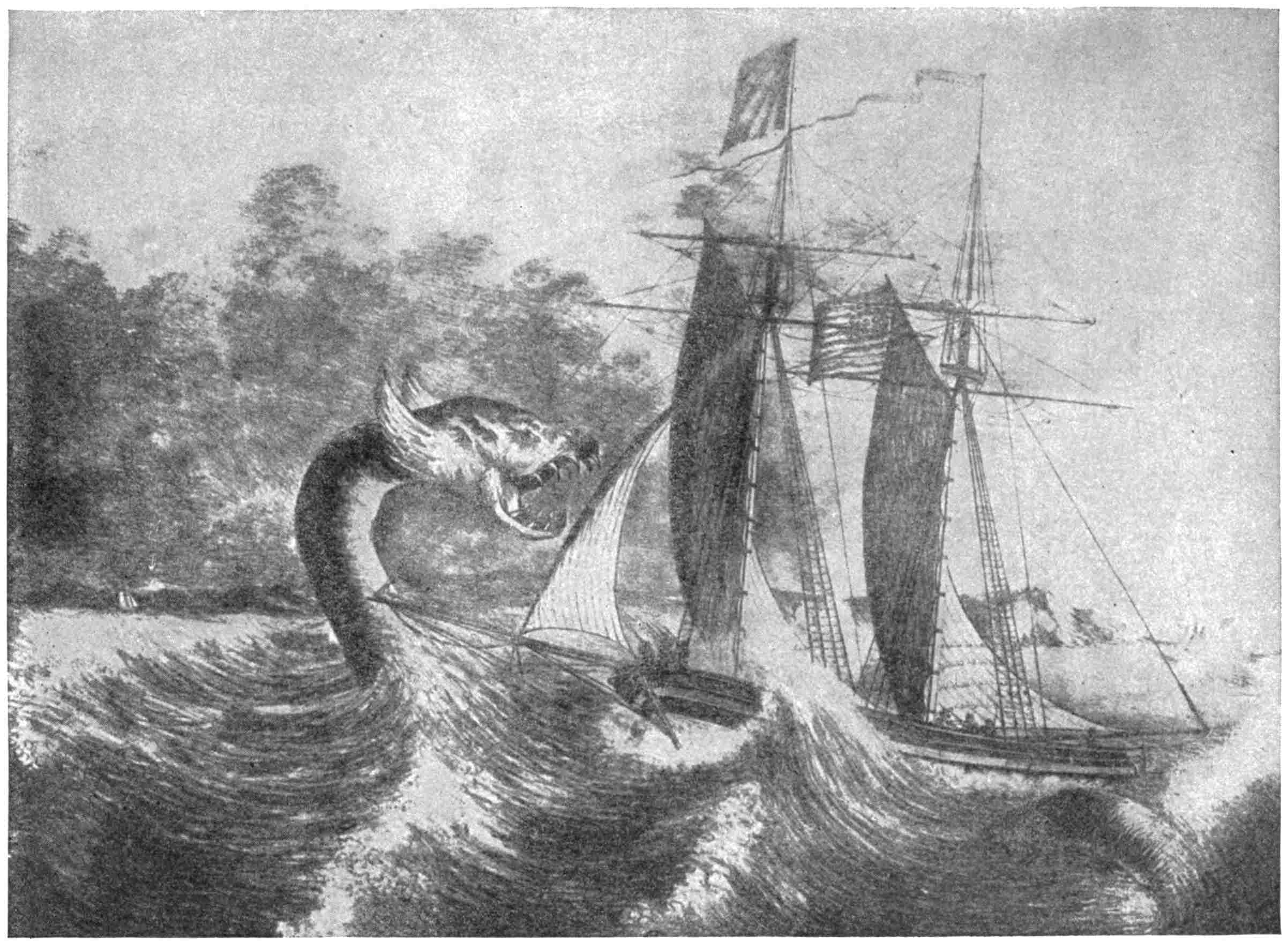
The Curious Chain of Events that Led to the Creation of a National Sea Power—The Gaspé Captured by Men Armed with Paving-stones—Tea Destroyed in Boston—The Battle of Lexington and the Attack of the Machias Haymakers on the Margaretta—British Vengeance on Defenceless Portland and its Effect on the Continental Congress—The “Colonial Navy” Distinguished from the Temporary Cruisers—The First Officers and the First Ships of the American Navy—John Paul Jones and the First Naval Ensign—The Significant “Don’t Tread on me”—Putting the First American Naval Ships in Commission.
A Fairly Successful Raid on New Providence, but they Let a British Sloop-of-war Escape—Character of the First Naval Commander-in-chief and of the Material with which he had to Work—Esek Hopkins, and his Record as Commander of the Fleet—Crews Untrained and Devoid of Esprit de Corps—Good Courage, but a Woeful Lack of other Needed Qualities—Hopkins Dismissed for Disobedience of Orders.
Brilliant Deeds by the First Heroes of the American Navy—Why Nicholas Biddle Entered Port with but Five of the Original Crew of the Andrea Doria—Richard Dale on the sleek Lexington—The Racehorse Captured in an even Fight—Captain Lambert Wickes in the Reprisal Beats off a Large Vessel—John Paul Jones in his Earlier Commands—A Smart Race with the Frigate Solebay—Sixteen Prizes in Forty-seven Days in Cape Breton Region—Poking Fun at the Frigate Milford—The Valuable Mellish—An Able Fighter who Lacked Political Influence.
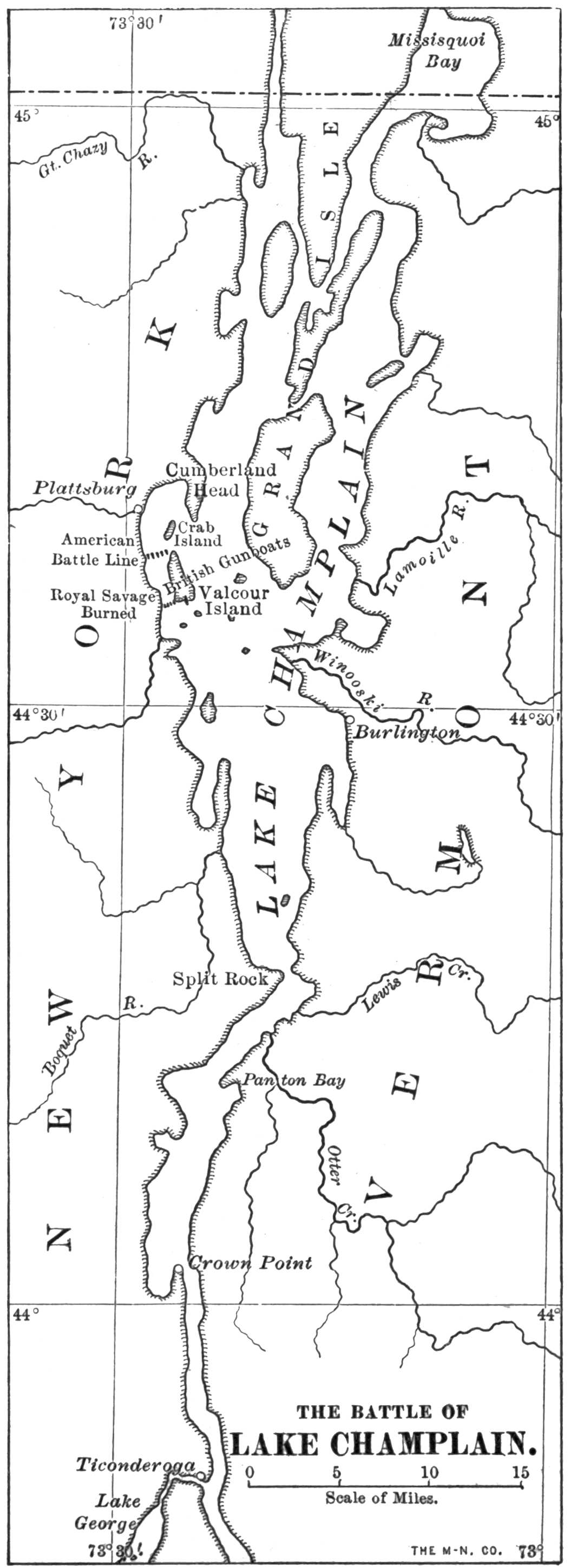
The Story of Arnold’s Extraordinary Fight against Overwhelming Odds on Lake Champlain—A Thousand Sailors, of whom Seven-tenths were Picked Men, Armed with the Heaviest Guns, were Pitted under a Courageous Leader against 700 Yankees, chiefly Haymakers, Poorly Armed and with Insufficient Ammunition—Savages with Scalping Knives Aided the British—A Desperate Struggle at the End—The Best All-around Fighter under Washington.
Chapter V. Under the Crags of the “Tight Little Isle”
The Saucy Yankee Cruisers in British Waters—When Franklin Sailed for France—Wickes in the Reprisal on the Irish Coast—Narrow Escape from a Liner—A Plucky English Lieutenant—Harsh Fate of the Americans in the British Prison—Starved by Act of Parliament—Deeds of the Gallant Connyngham—Well-named Cruisers—A Surprise at a Breakfast Table—Taking Prizes Daily—Why Forty French Ships Loaded in the Thames—Insurance Rates never before Known.
The First Ship that Carried the Stars and Stripes—Dash at a Convoy that Failed—When the Dutch were Browbeaten—The Ranger Sent on a Cruise in English Waters—A Ship Taken off Dublin—The Raid on Whitehaven—When one Brave Man Cowed more than a Thousand—The Whole Truth about Lord Selkirk’s Silverware, with the Noble Lord’s Expression of Gratitude when he Got it Back—How Captain Jones Missed the Drake at First, but Got her Later on in a Fair and Well-fought Battle.
It was Small and Ineffective, but it Contained the Germ of a Mighty Power that is as yet Undeveloped—When Nicholas Biddle Died—He was a Man of the Spirit of an Ideal American Naval Officer—Fought the Ship against Overwhelming Odds till Blown out of the Water—The Loss of the Hancock—An American Captain Dismissed for a Good Reason—Captain Rathburne at New Providence—Loss of the Virginia—Captain Barry’s Notable Exploit—With Twenty-seven Men to Help him, he Captured a Schooner of Ten Guns by Boarding from Small Boats in Broad Daylight, although the Schooner was Manned by 116 Sailors and Soldiers.
A Tale of the American Patriots who Went Afloat outside of the Regular Navy—Their Part in Driving the British from Boston—Remarkable Work of the Lee—Truxton as a Privateer—Daring Capt. John Foster Williams—When Capt. Daniel Waters, with the Thorn of Sixteen Guns, Whipped Two Ships that Carried Thirty-four Guns between them—Great was Joshua Barney—The Story of the most Famous State Cruisers of the Revolution—Won against Greater Odds than were Encountered by any Successful Sea Captain of the War—British Account of the Work of American Privateers—The Horrors of the Jersey Prison Ship.
Chapter IX. John Paul Jones and the Bonhomme Richard
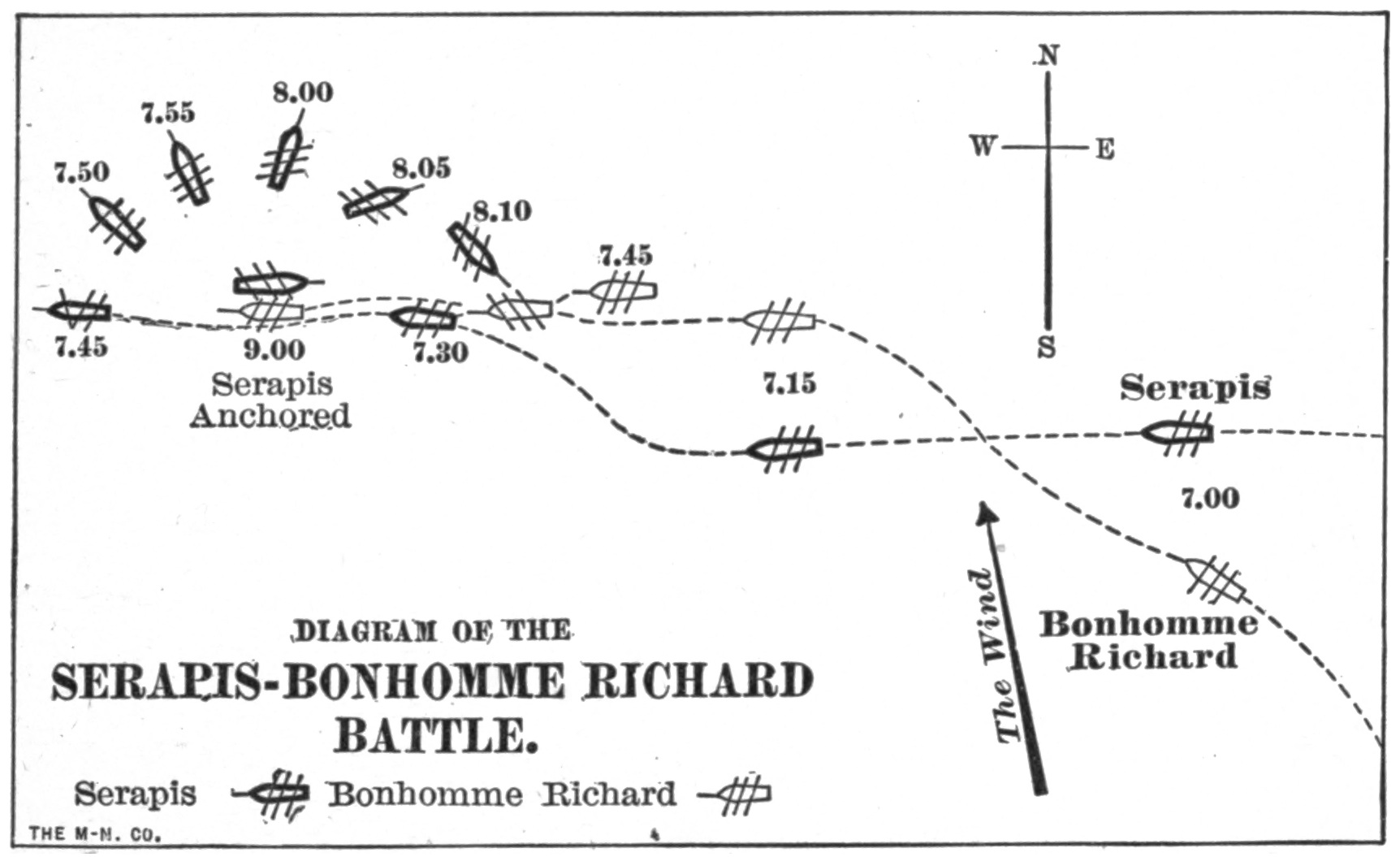
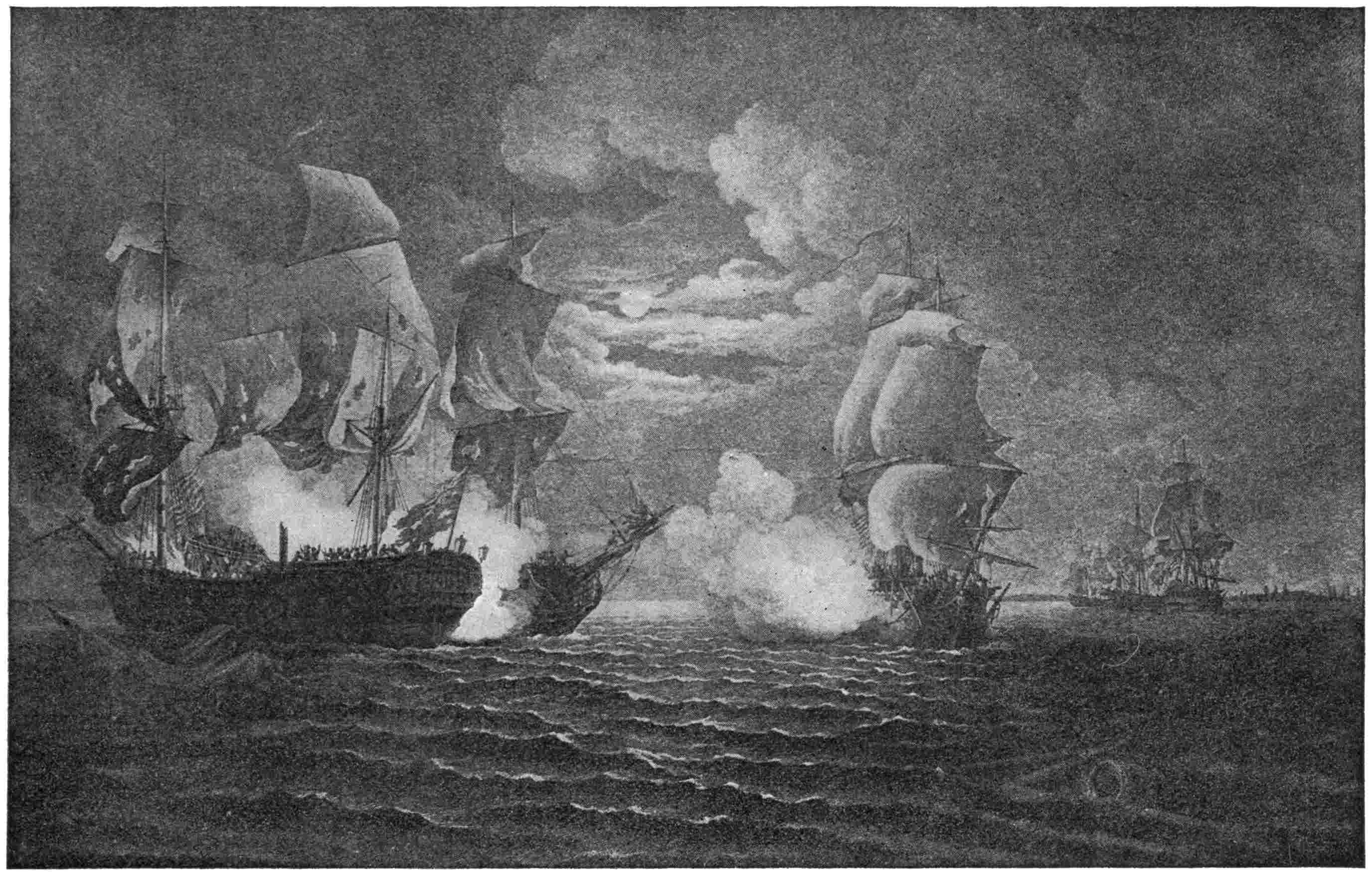
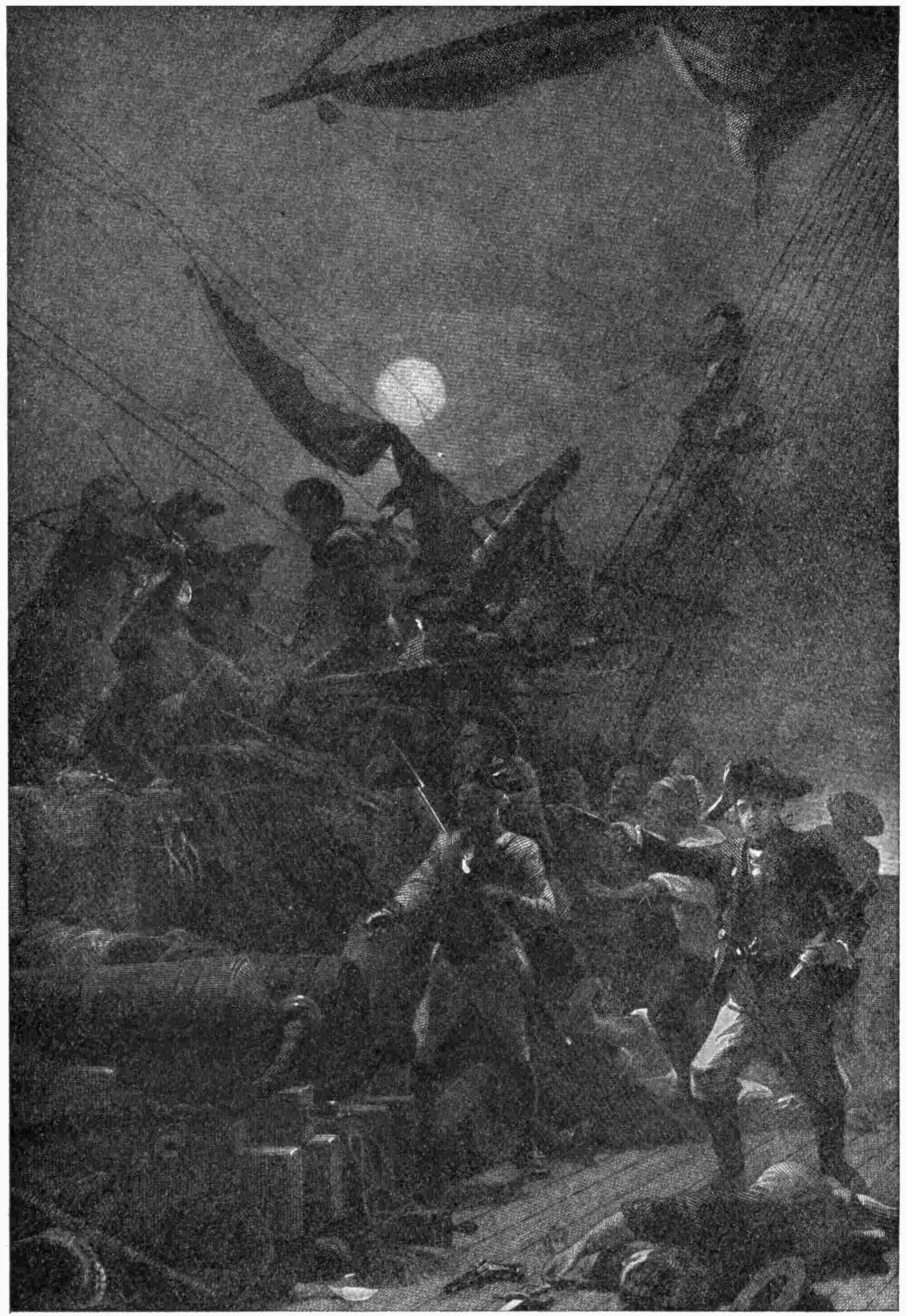
A Condemned Indiaman, Ill-shaped and Rotten, Fitted as a Man-o’-war—A Disheartening Cruise with Incapable and Mutinous Associates—Attempt to Take Leith, and the Scotch Parson’s Prayer—Meeting the Serapis—When John Paul Jones had “not yet Begun to Fight”; when he had “Got her now”; when he would not “Surrender to a Drop of Water”—Ready Wit of Richard Dale—Work of a Bright Marine—A Battle Won by Sheer Pluck and Persistence.
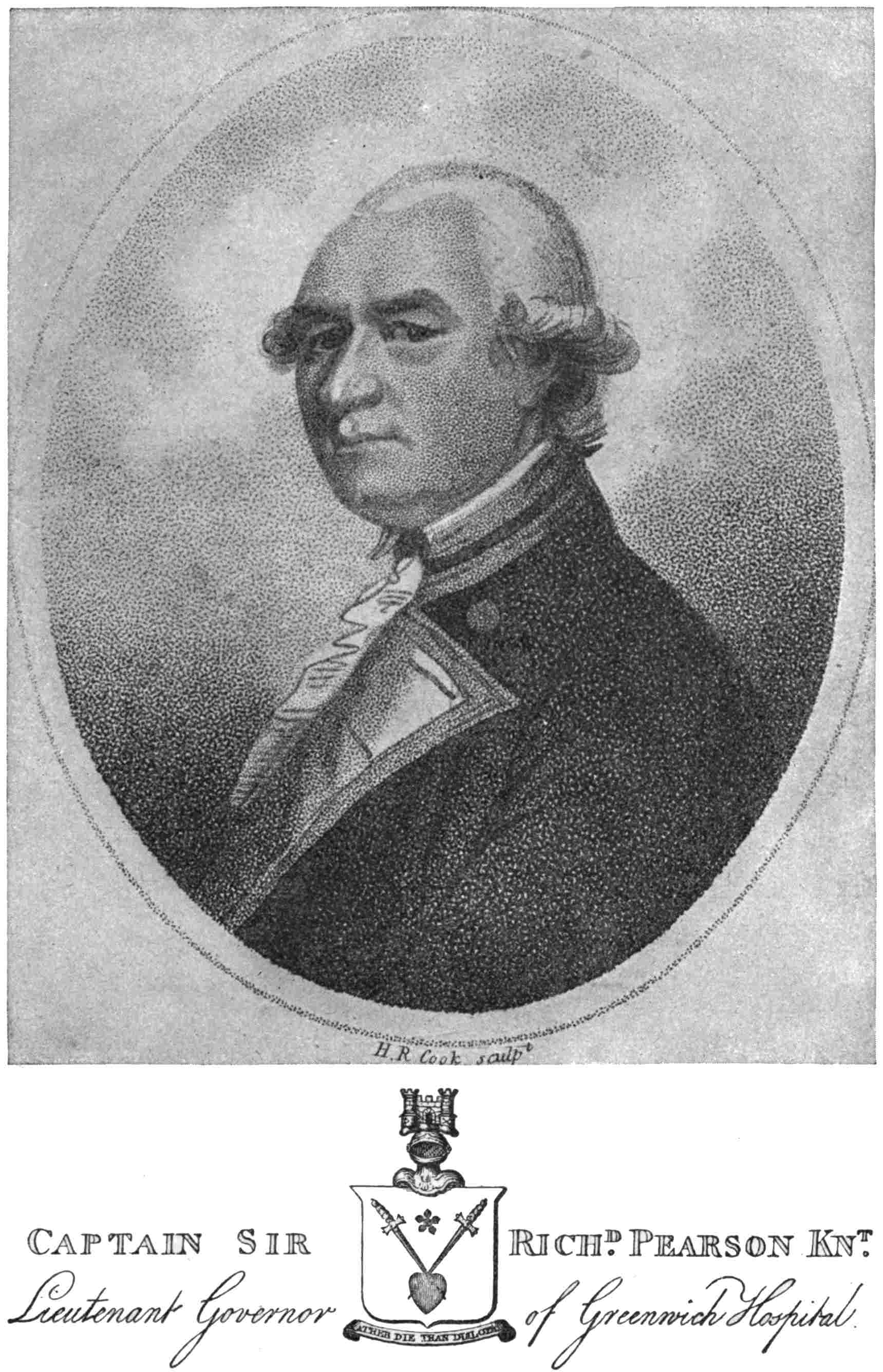
Richard Dale too Bright for the British Lieutenant—A Fair Estimate of Captain Pearson of the Serapis—The Treachery of Landais—Remarkable Escape from Texel—Honors for the Victor—“The Fame of the Brave Outlives him; his Portion is Immortality.”
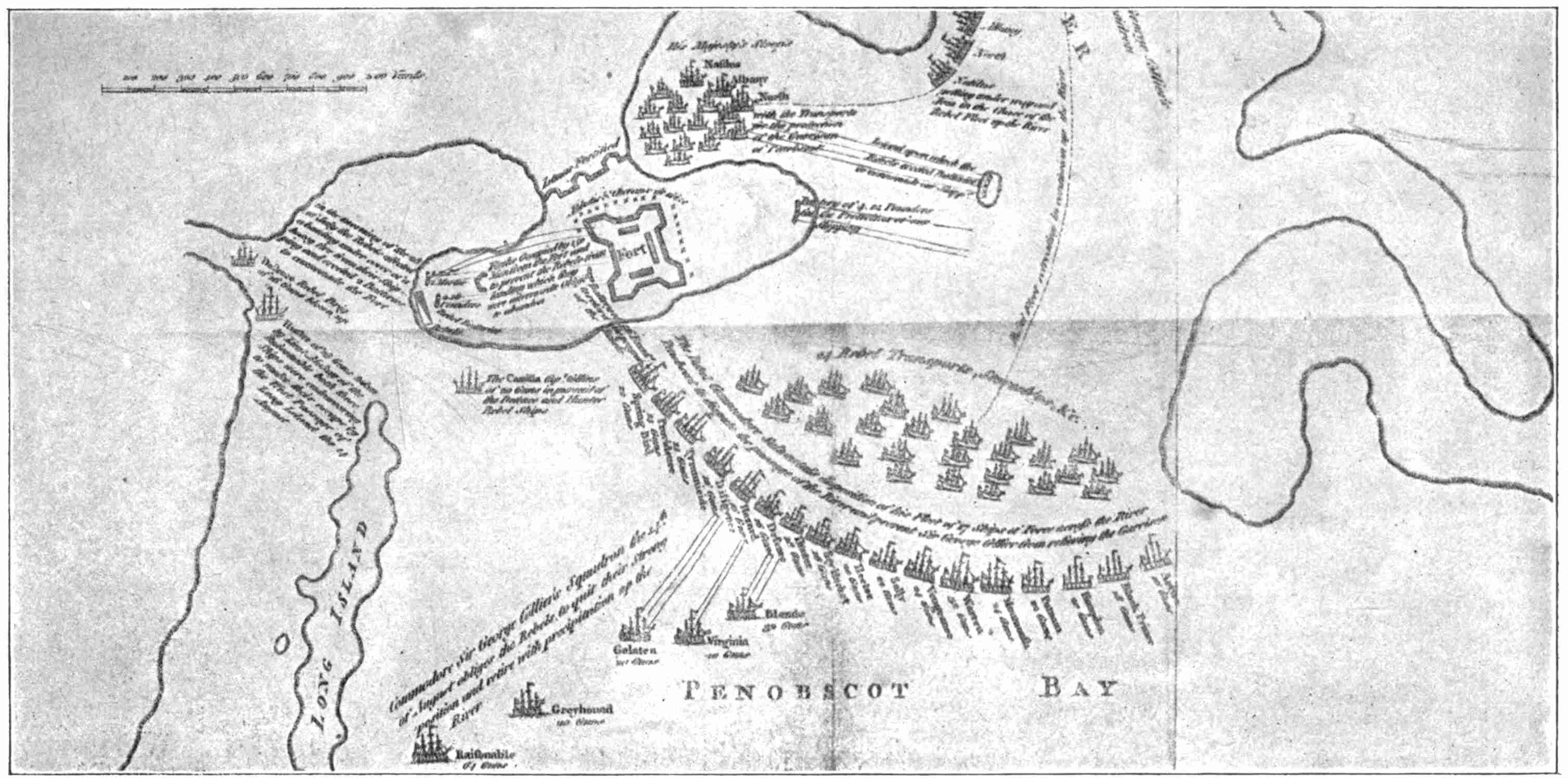
Lucky Raids of British Transports and Merchantmen—Disastrous Expedition to the Penobscot—The Trumbull’s Good Fight with the Watt—The First Yankee Line-of-battle-ship—When Nicholson, with a Wrecked Ship and Fifty Men, Fought for an Hour against Two Frigates, each of which was Superior to the Yankee Ship—Captain Barry’s Exasperating Predicament in a Calm—The Last Naval Battle of the Revolution.
When England, in her Efforts to Wrest Commerce from the Americans, Incited the Pirates of Africa to Activity, she Compelled the Building of the Fleet that was, in the End, to Bring her Humility of which she had never Dreamed—Deeds of the Barbary Corsairs—American Naval Policy as Laid down by Joshua Humphreys—The Wonderful New Frigates—Troubles with the French Cruisers on the American Coasts—Trick of a Yankee Captain to Save a Ship—A Midshipman who Died at his Post—Capture of the Insurgent—A Long Watch over the French Prisoners—Escape of a Twice-beaten Ship—The Valiant Senez—Story of Isaac Hull and the Lucky Enterprise.
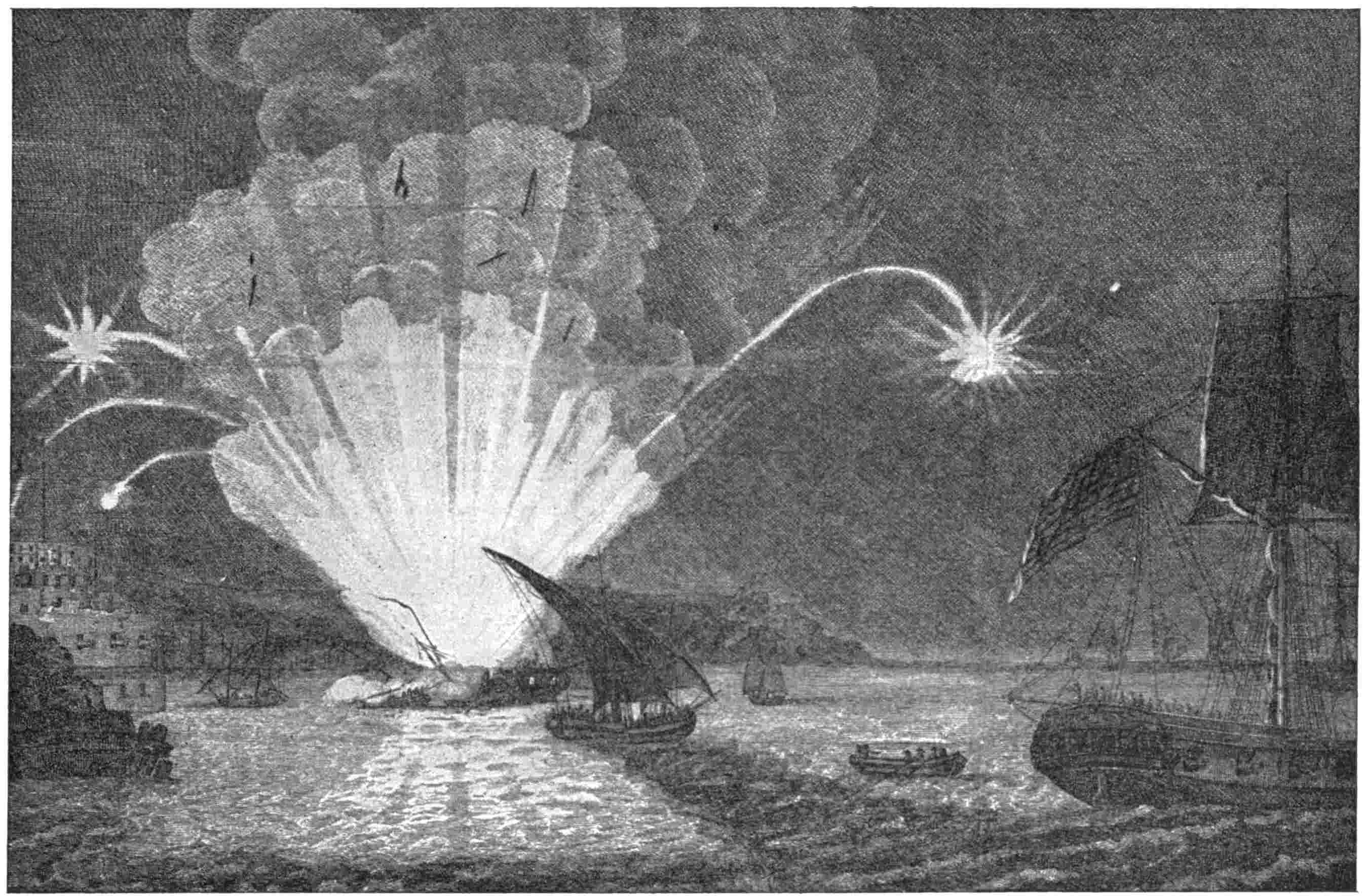
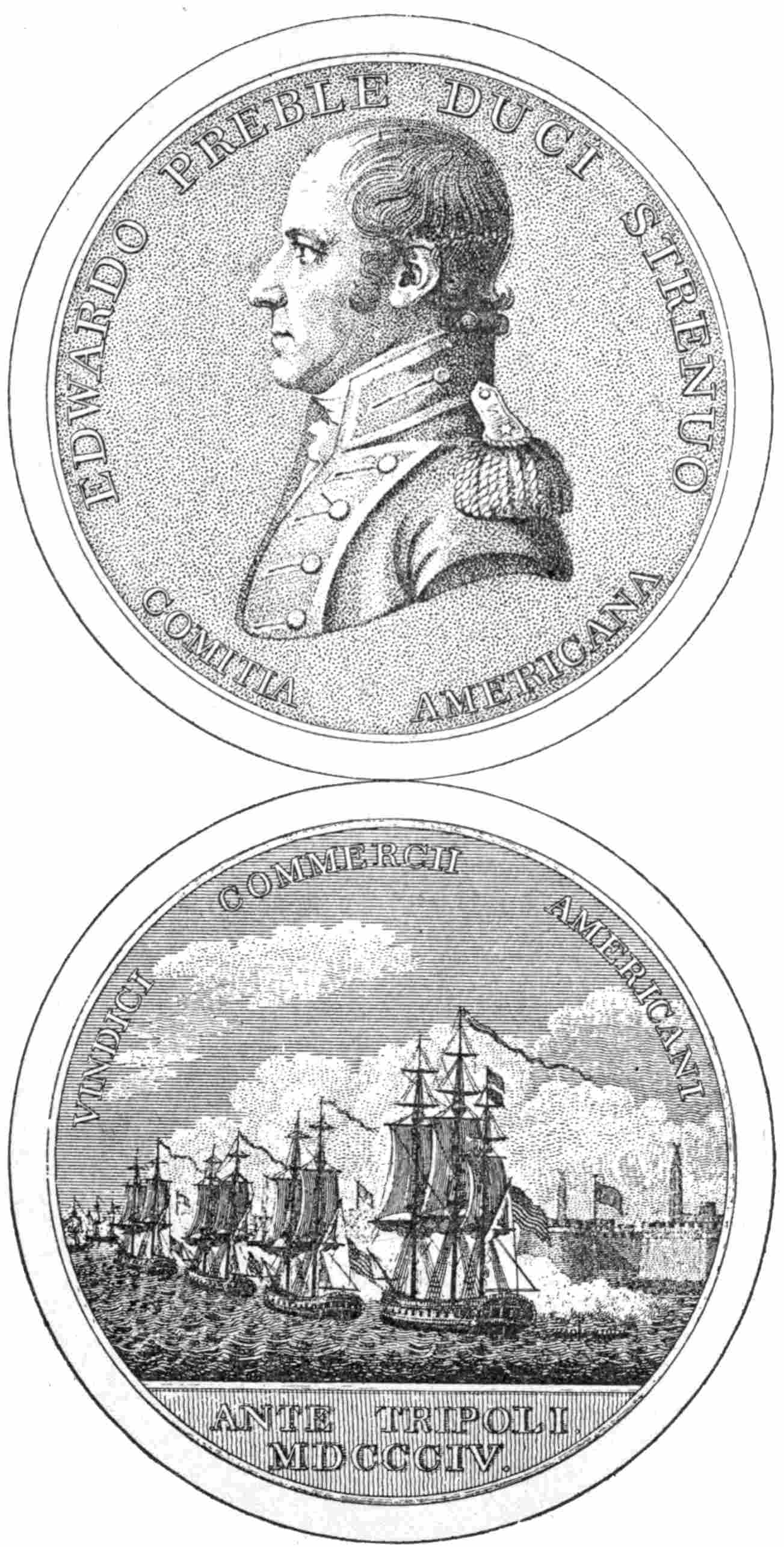
A Squadron under Richard Dale Sent to the Mediterranean—The Dey of Algiers became Friendly, but the Bashaw of Tripoli Showed Fight—Fierce Battle between the Schooner Enterprise and the Treacherous Crew of the Polacre Tripoli—Slaughter of the Pirates—Tripoli Blockaded—Grounding and Loss of the Philadelphia.
Story of the Brave Men who Disguised a Ketch as a Merchantman and Sailed into the Harbor of Tripoli by Night, Drew up alongside the Captured Philadelphia, and then, to the Order “Boarders Away!” Climbed over the Rail and through the Ports, and with Cutlass and Pike Drove the Pirates into the Sea or to a Worse Fate—“The most Bold and Daring Act of the Age.”
A Fight against Odds of Three Gunboats to One—Decatur and Macdonough Leading the Boarders—Cold-blooded Murder and the Vengeance that Followed—When Reuben James Won Fame—Eleven against Forty-three in a Hand-to-hand Struggle, and the Remarkable Result—The Handy Constitution—Fired their Gun as the Boat Sank under them—When Somers and his Mates Went to their Death in a Fireship—End of the War with the Pirates.
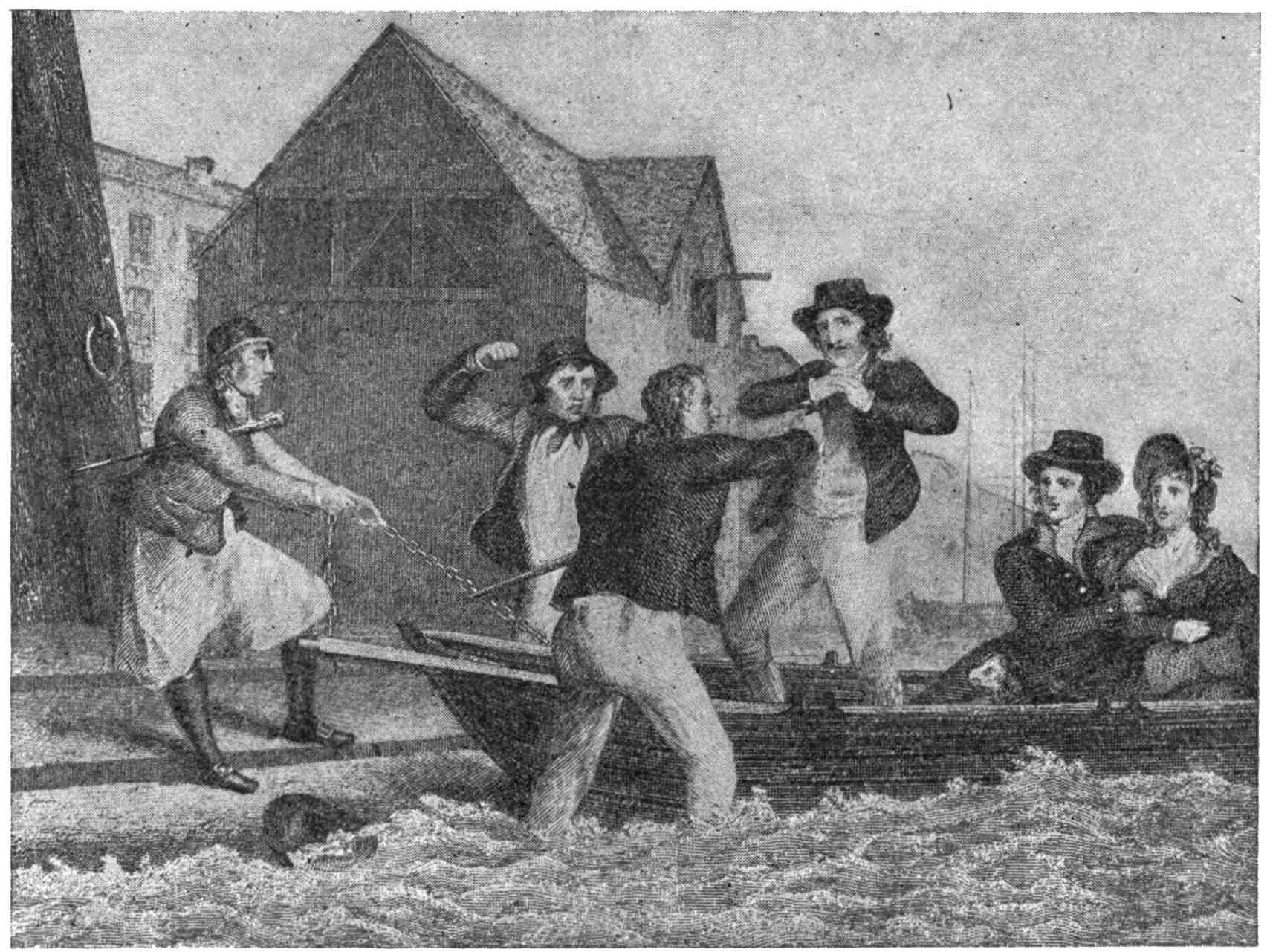
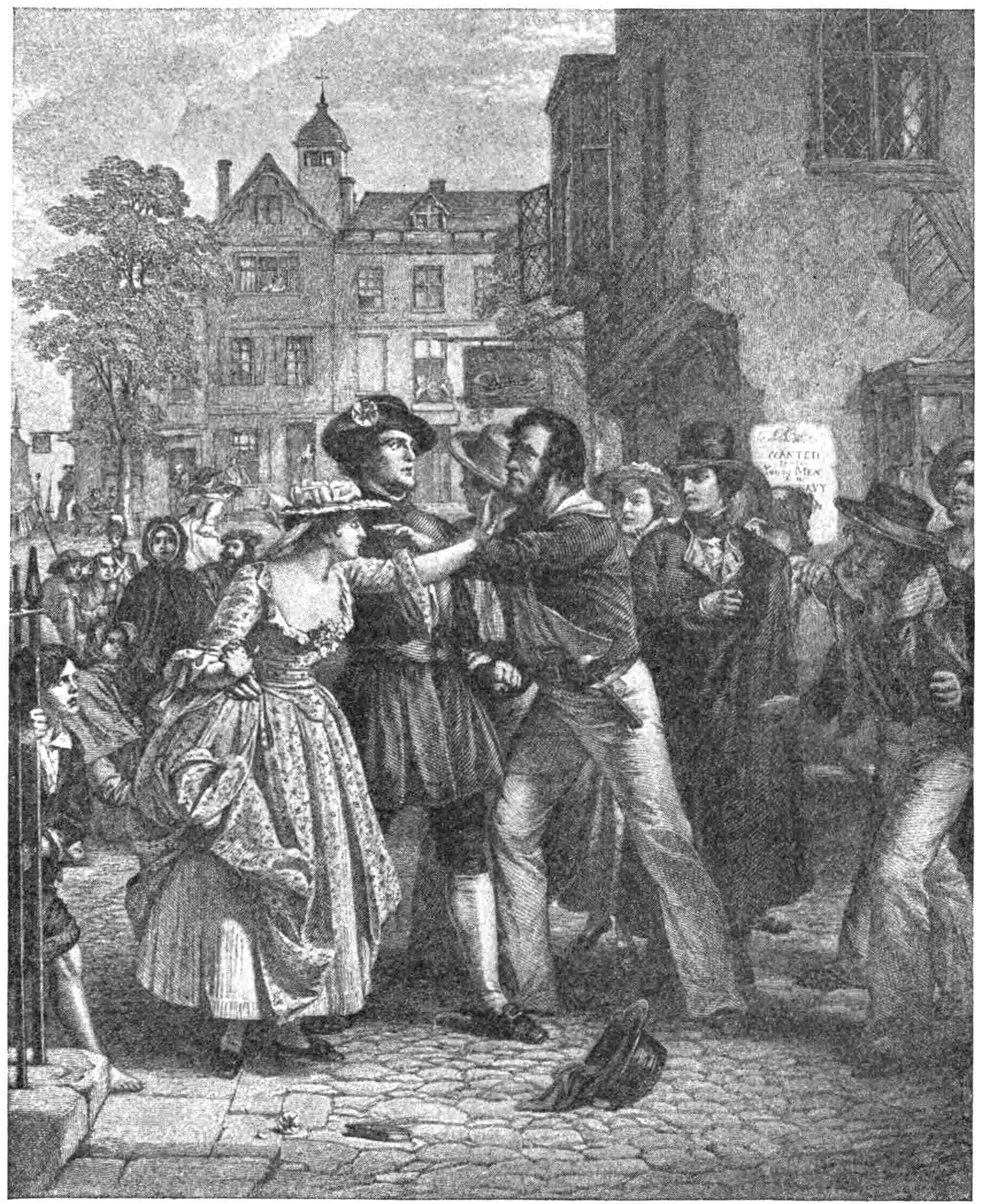
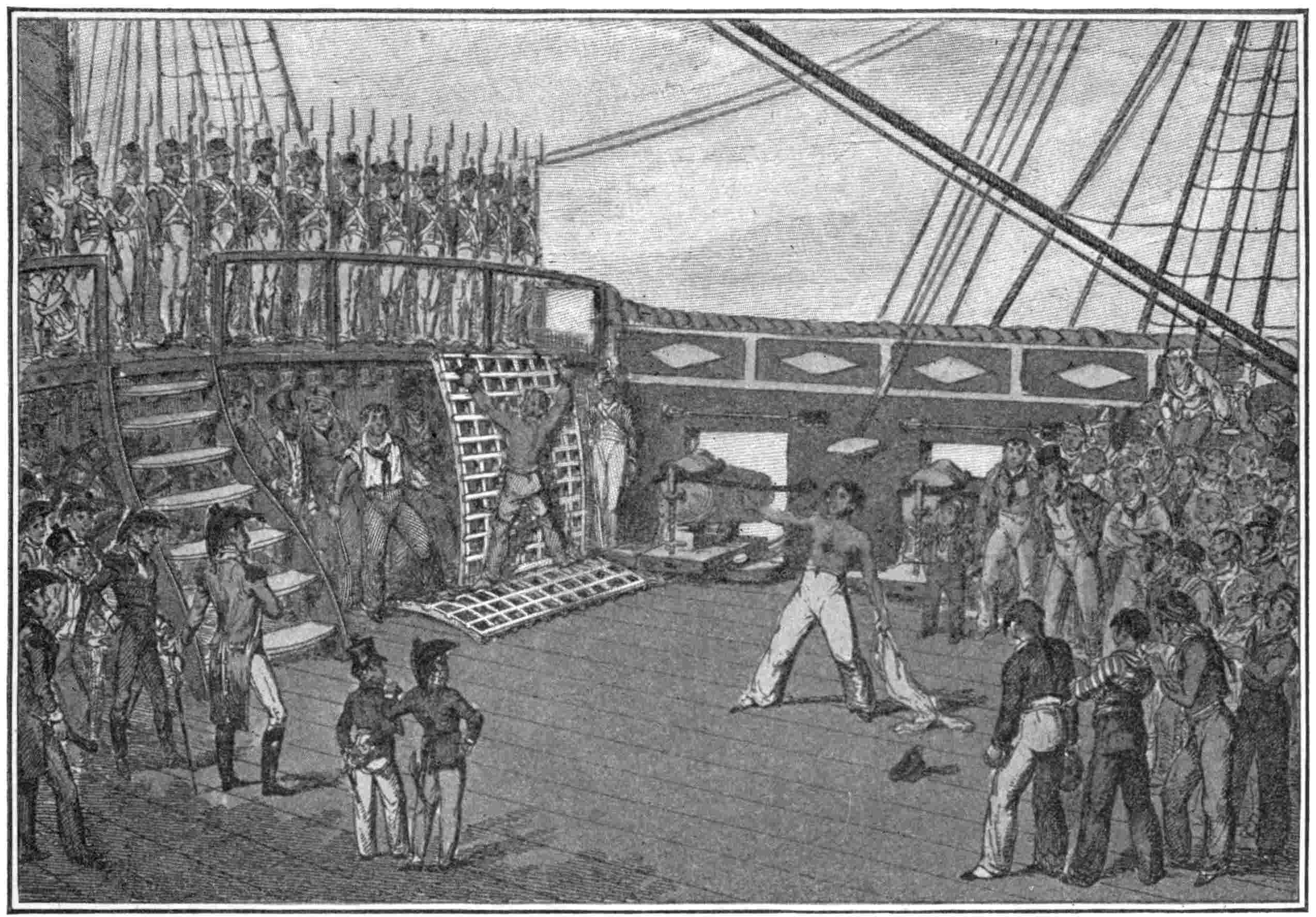
A Stirring Tale of the Outrages Perpetrated on American Citizens by the Press-gangs of the British Navy—Horrors of Life on Ships where the Officers Found Pleasure in the Use of the Cat—Doomed to Slavery for Life—Impressed from the Baltimore—A British Seaman’s Joke and its Ghastly Result—The British Admiralty’s Way of Dealing with Deliberate Murder in American Waters—Assault of the Leopard on the Chesapeake to Compel American Seamen to Return to the Slavery they had Escaped—Building Harbor-defence Boats to Protect American Seamen from Outrage on the High Seas—Other Good Reasons for Going to War.
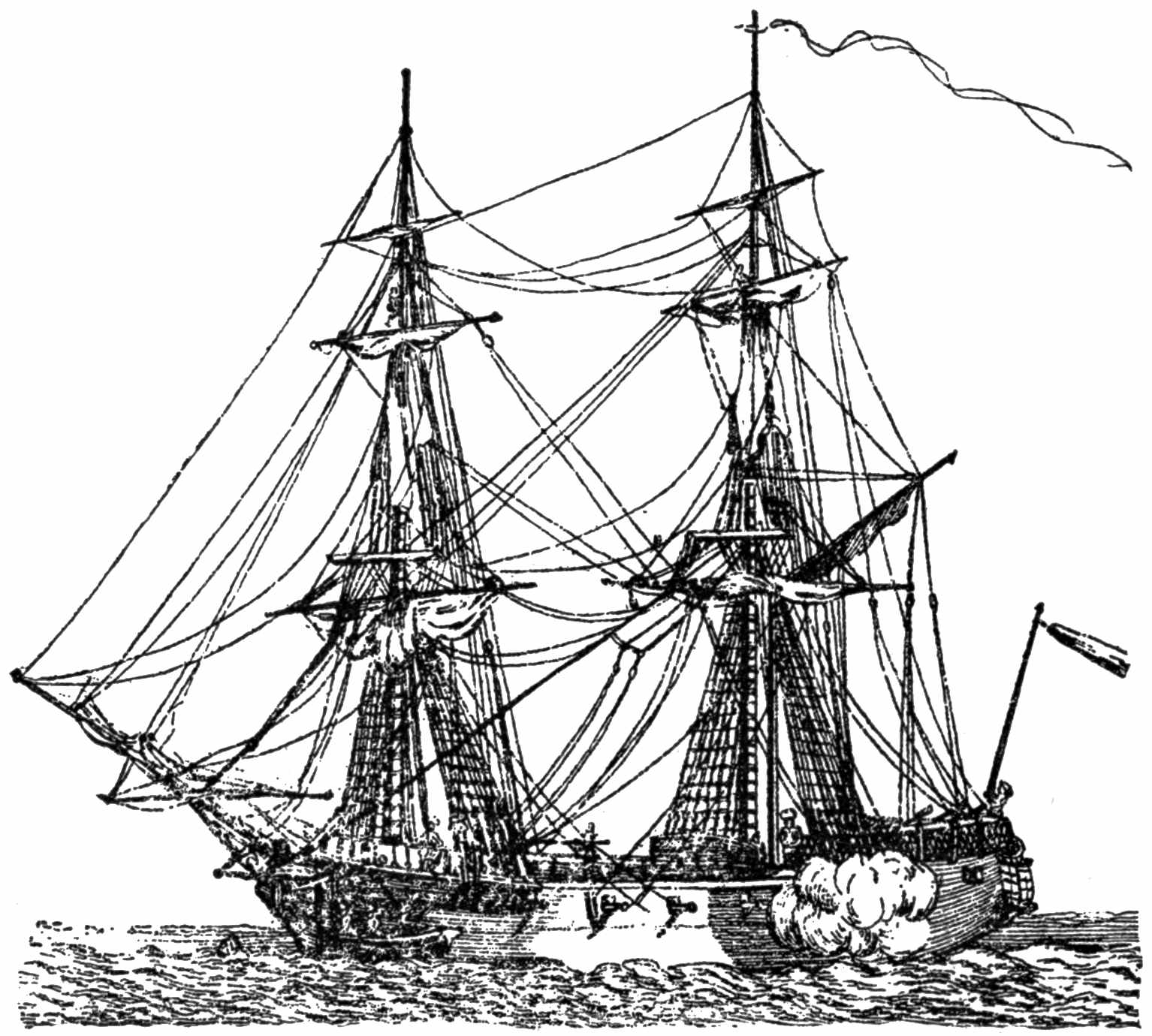
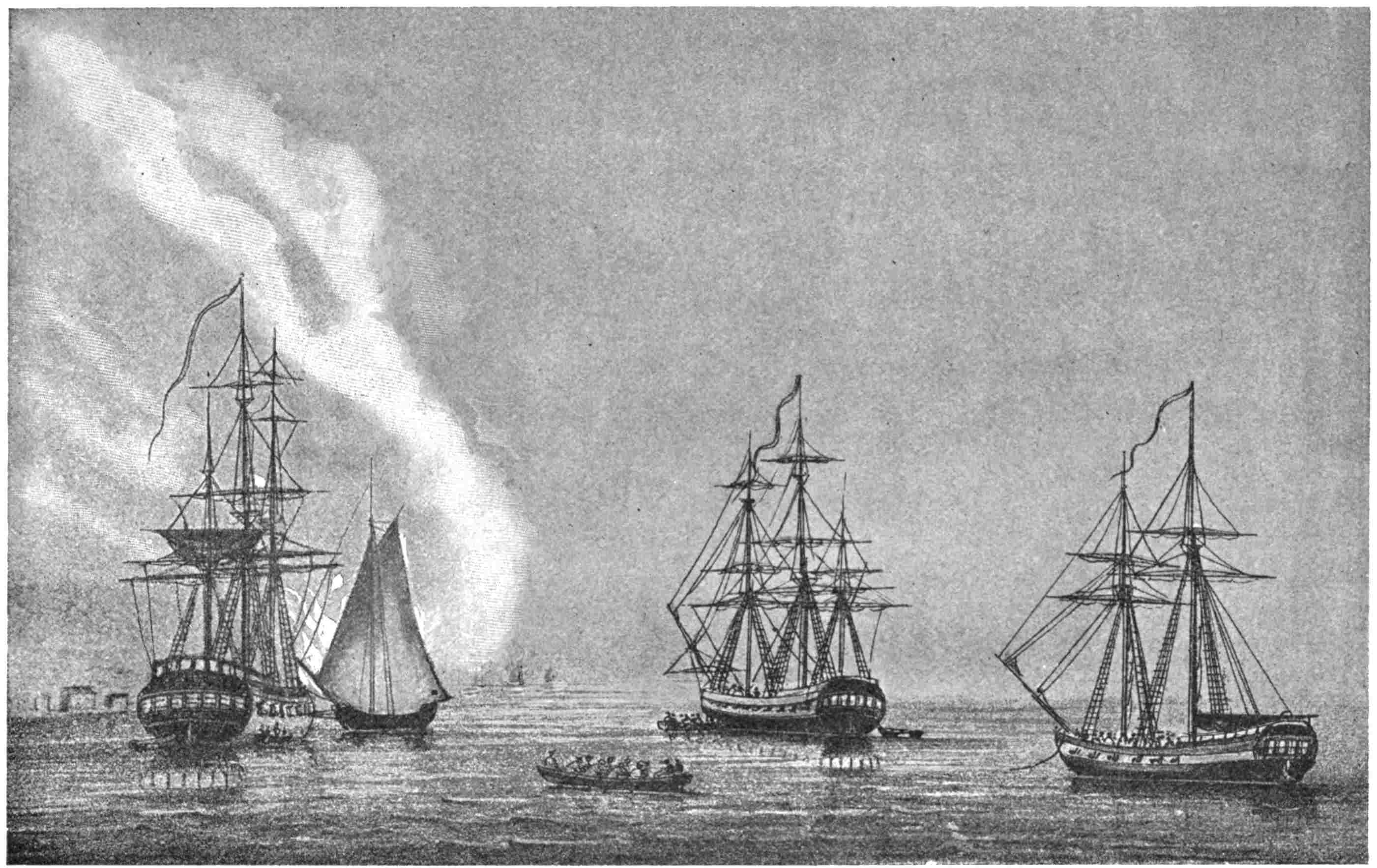
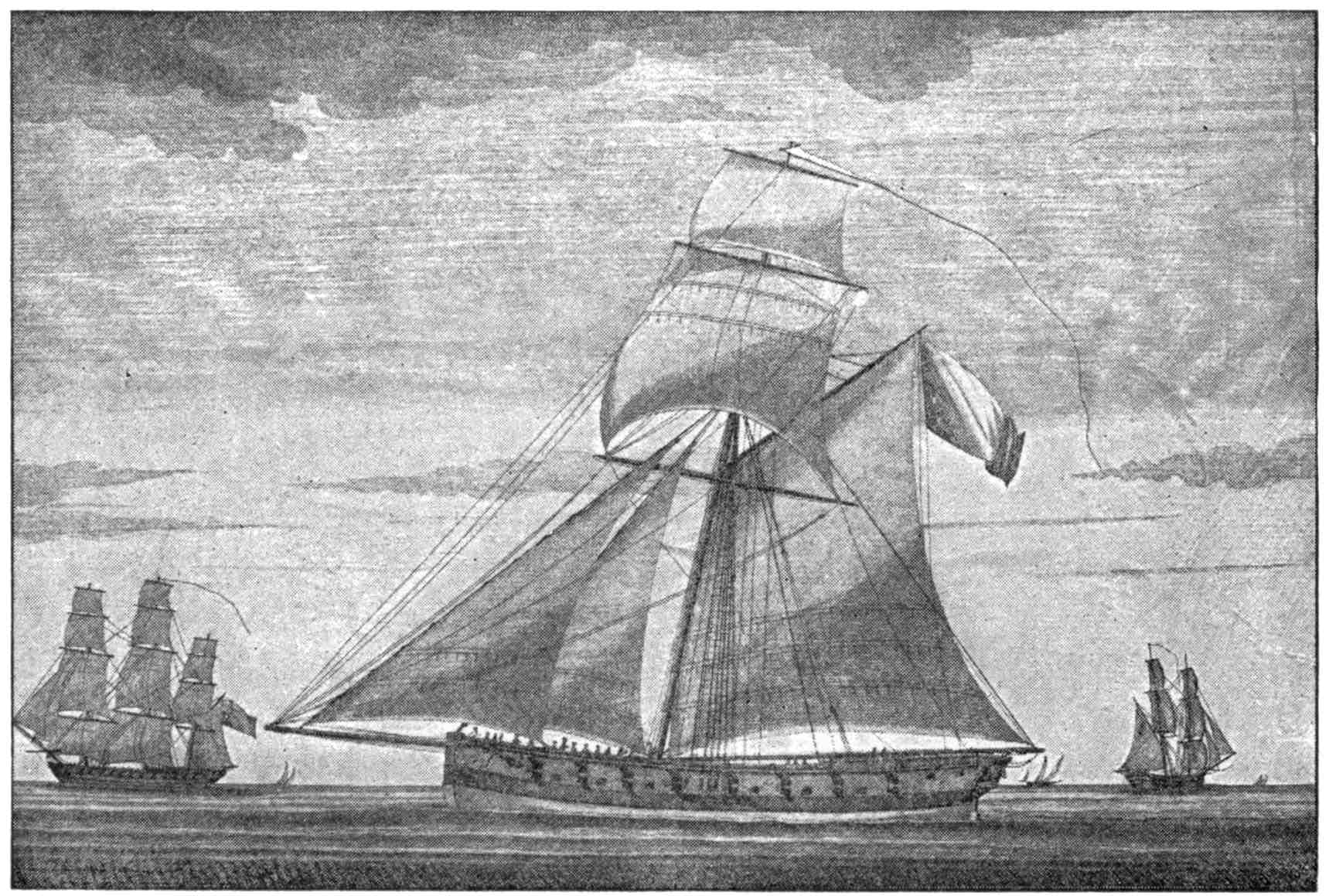
A British Armed Sloop. (From a very rare engraving, showing the first lighthouse erected in the United States—on Little Brewster Island, Boston Harbor),
THE HISTORY OF OUR NAVY — CHAPTER I ORIGIN OF THE AMERICAN NAVY
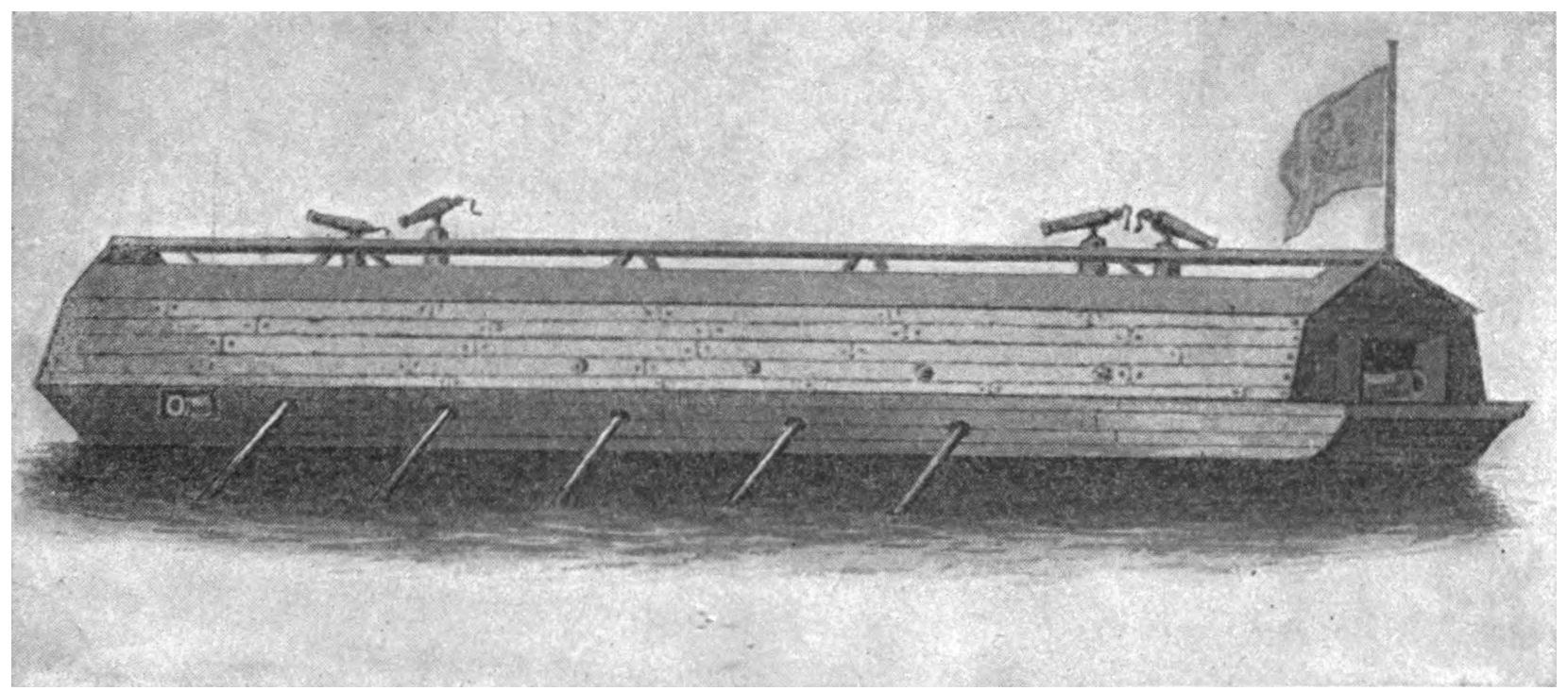
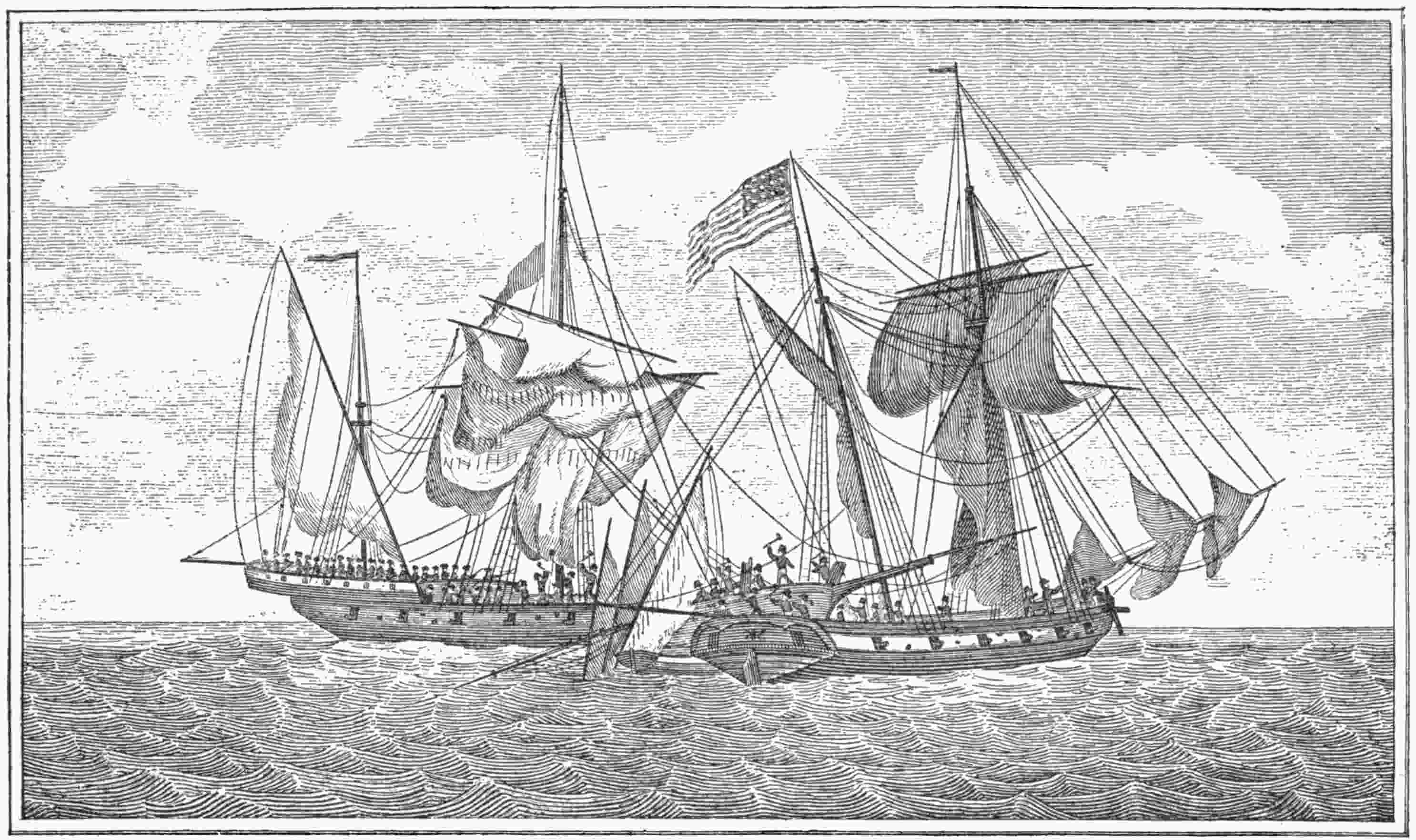
An Early American Floating Battery.
THE CURIOUS CHAIN OF EVENTS THAT LED TO THE CREATION OF A
NATIONAL SEA POWER—THE GASPÉ CAPTURED BY MEN ARMED
WITH PAVING-STONES—TEA DESTROYED IN BOSTON—THE BATTLE
OF LEXINGTON AND THE ATTACK OF THE MACHIAS HAYMAKERS
ON THE MARGARETTA—BRITISH VENGEANCE ON DEFENCELESS
PORTLAND AND ITS EFFECT ON THE CONTINENTAL CONGRESS—THE
“COLONIAL NAVY” DISTINGUISHED FROM THE TEMPORARY
CRUISERS—THE FIRST OFFICERS AND THE FIRST SHIPS OF THE
AMERICAN NAVY—JOHN PAUL JONES AND THE FIRST NAVAL
ENSIGN—THE SIGNIFICANT “DON’T TREAD ON ME”—PUTTING
THE FIRST AMERICAN NAVAL SHIPS IN COMMISSION.
Of all the dates in American history not
yet so commemorated, there is none so well
worthy of recognition as a national holiday as
the 22d of December; for it was on December
22, 1775, that the American navy came into
existence. And there is no part of the story
of the American nation of more thrilling interest
than that including the events which
compelled the establishment of this branch of
the public service, nor is there any part of the
nation’s story as a whole that so stirs the
patriotic pride of the American people as that
which tells of the deeds of the heroes whose
names have been inscribed upon the American
naval registers.
It is a grateful task to recount once more
how it was that an American navy was demanded
for the preservation of American
liberties, and what has been accomplished by
that navy since the day when Commodore
Esek Hopkins received his commission, and
then stood by on the deck of his flagship
while John Paul Jones flung to the breeze the
broad folds of the flag that bore as a symbol
the picture of a rattlesnake coiled to strike,
with the significant and appropriate motto,
“DON’T TREAD ON ME.”
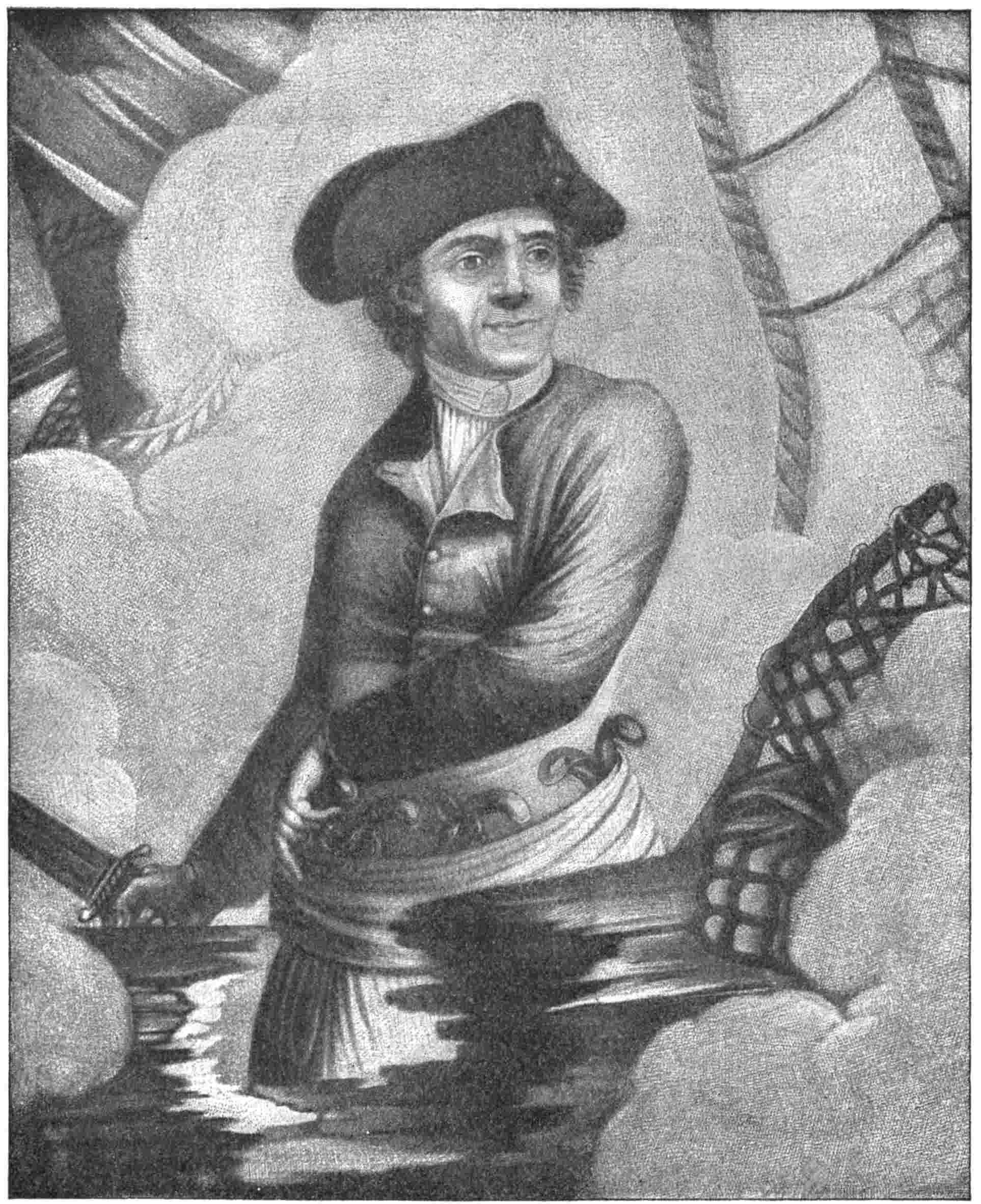
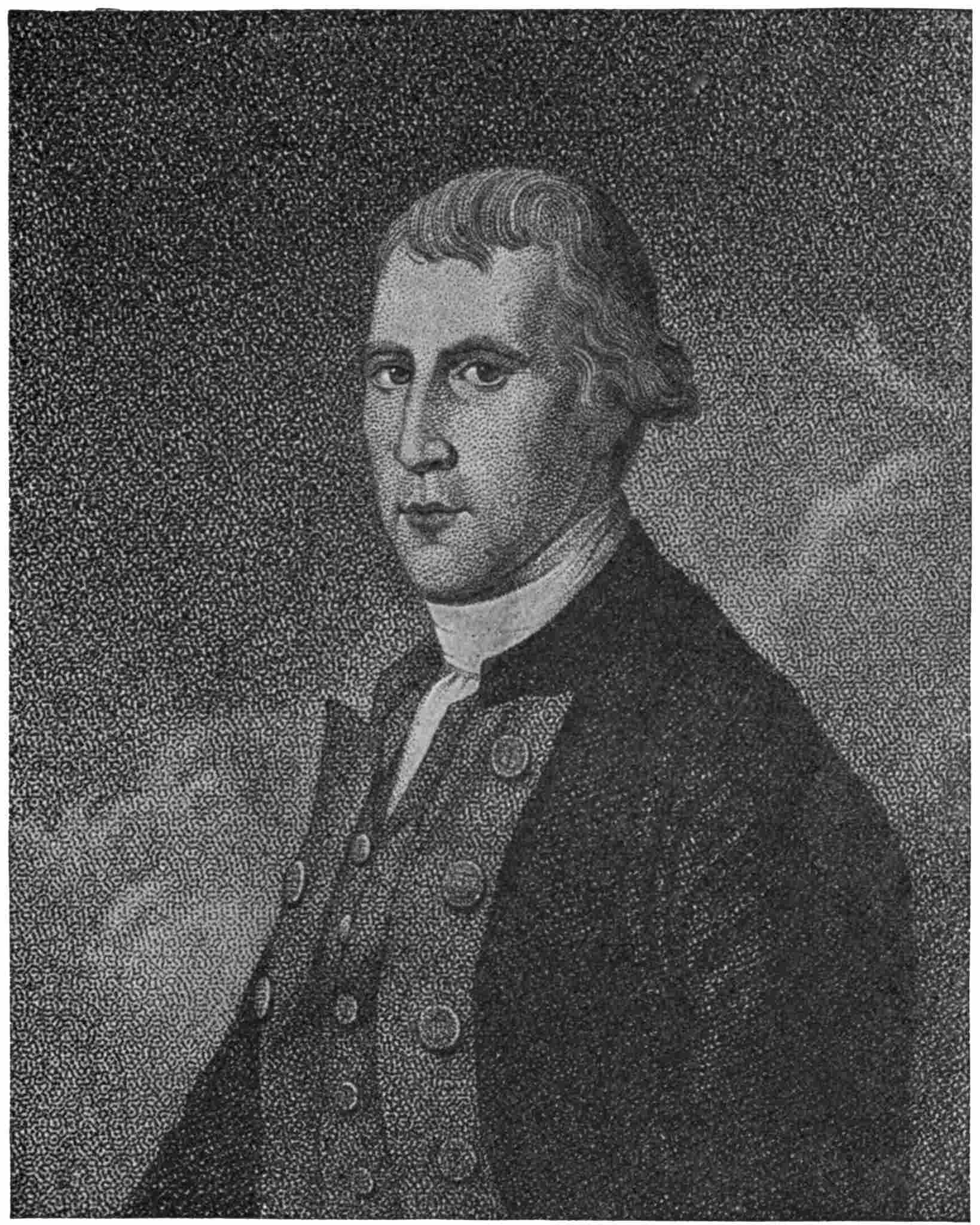
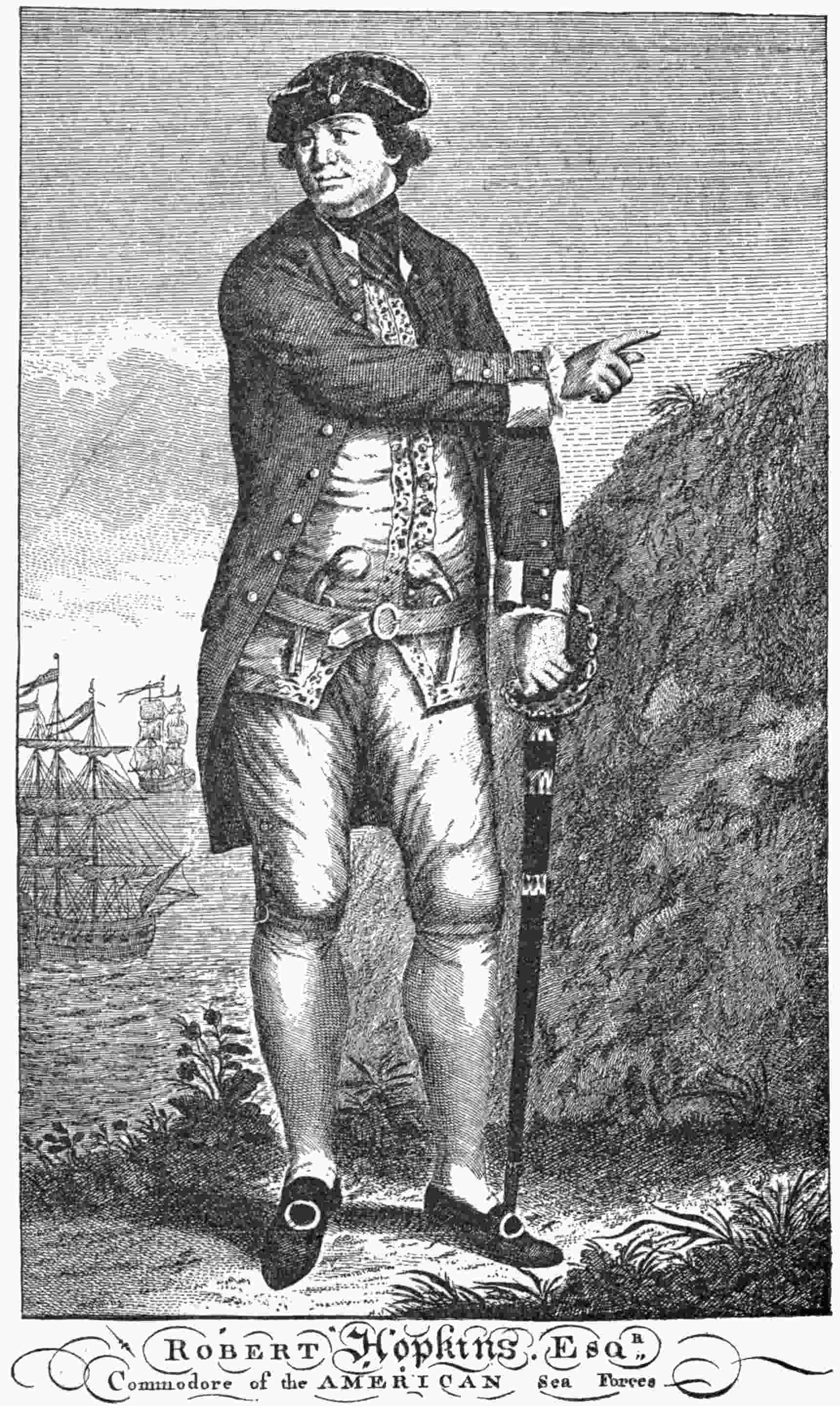
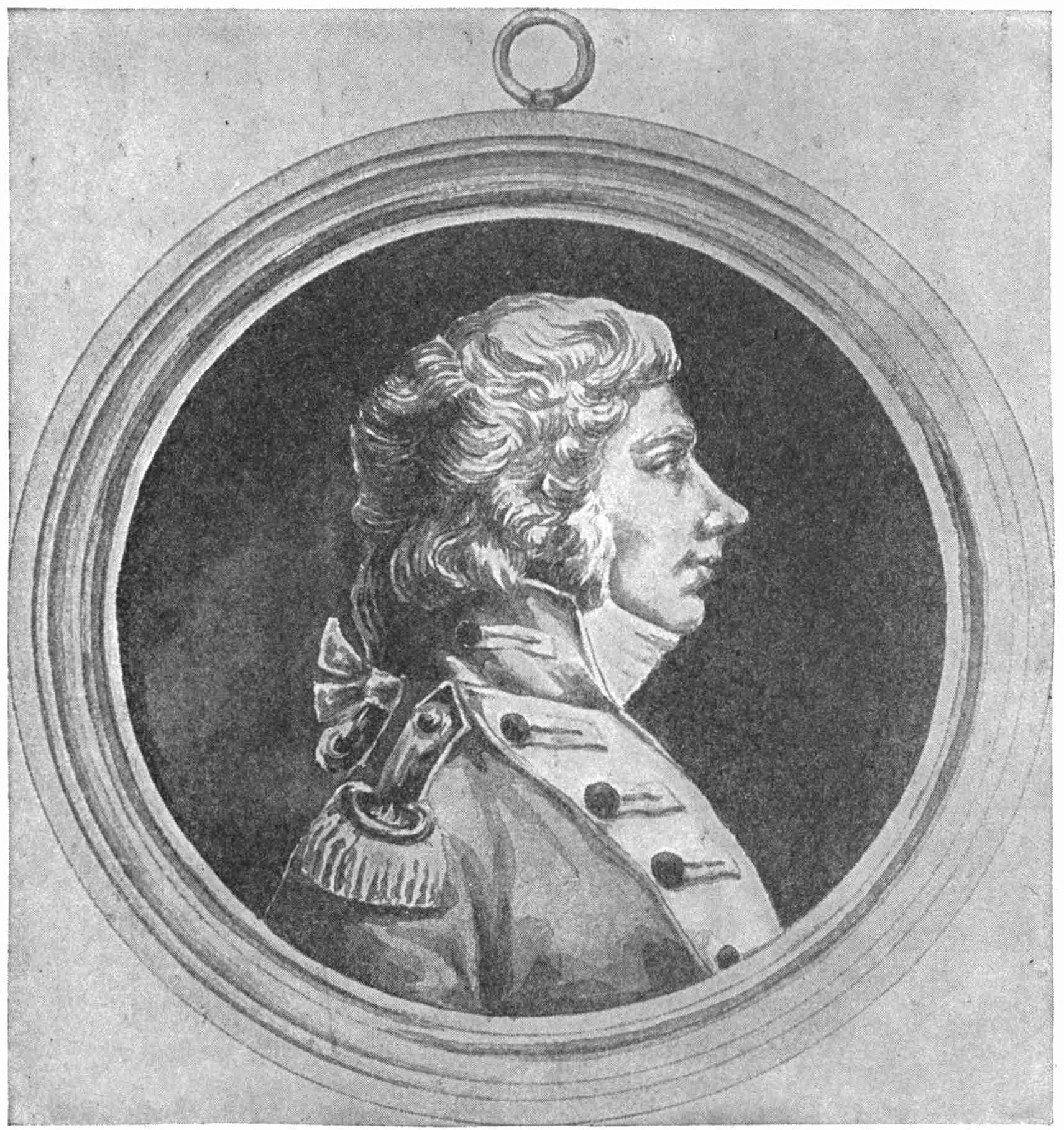
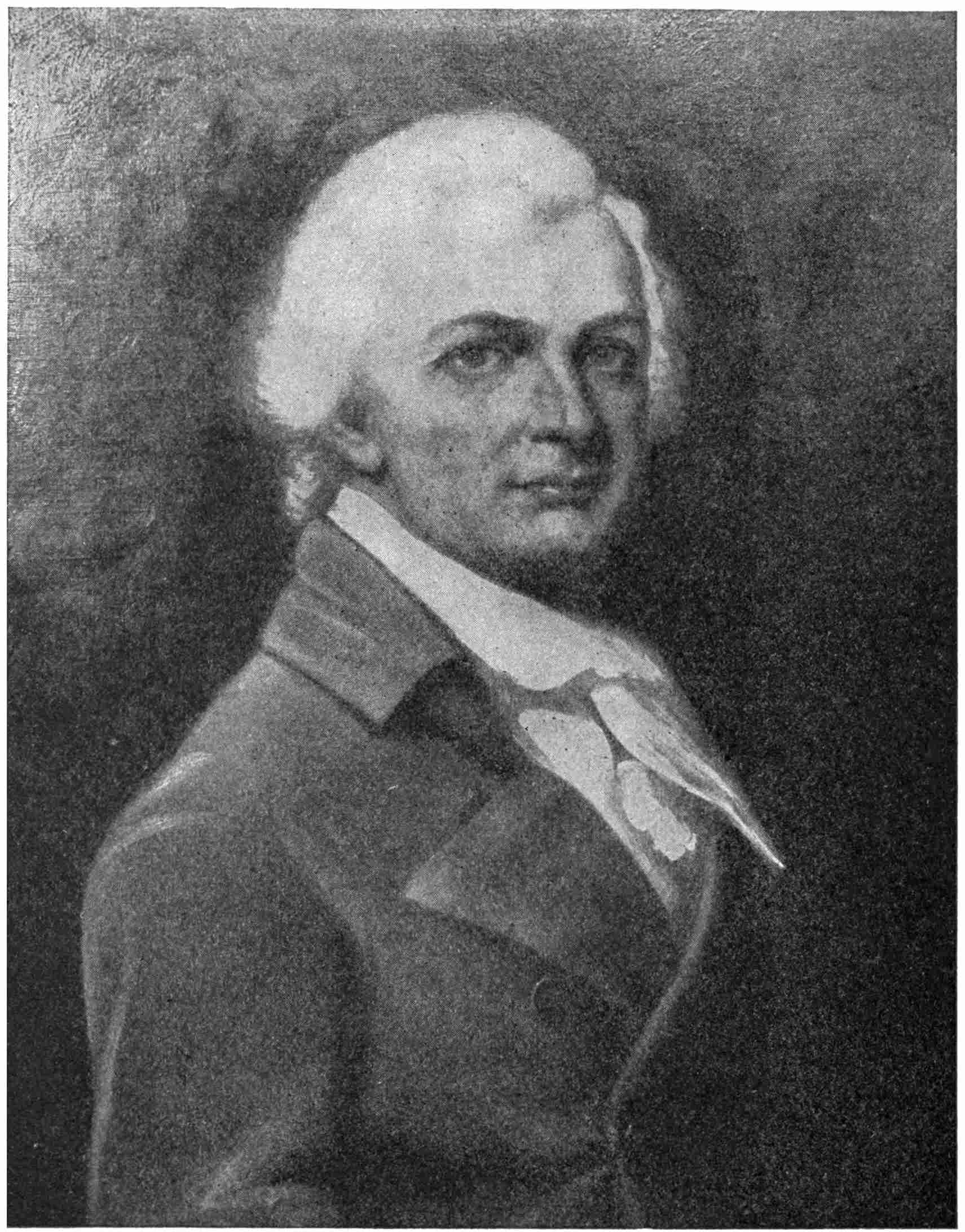
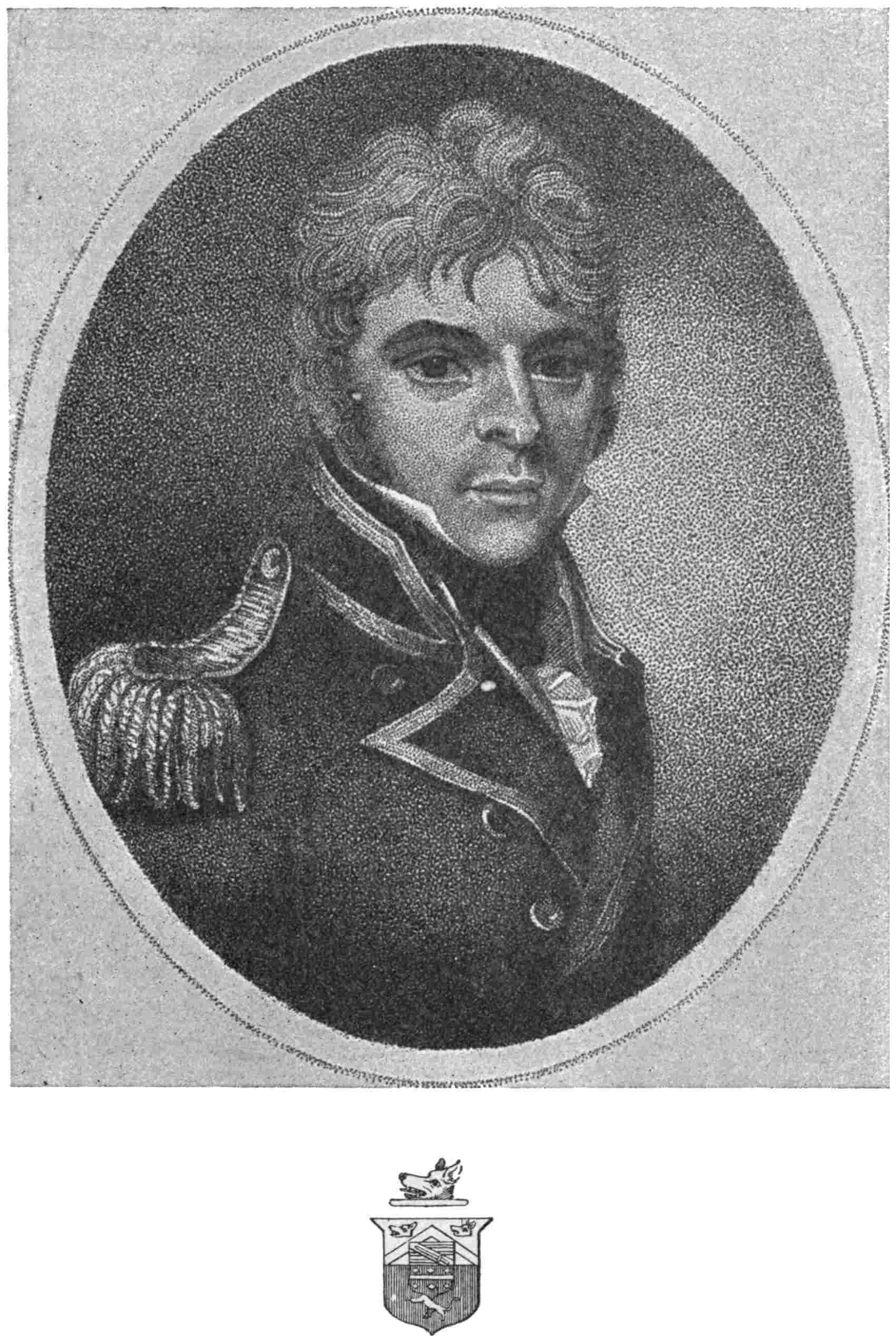
Commodore Esek Hopkins.
From a French engraving of the portrait by Wilkinson.
The salt-water Lexington, that is to say, the
first fight afloat of the Revolutionary war, occurred
on the night of June 17, 1772, in the
waters of Rhode Island, and the fact that it
was in Rhode Island will be recalled later on.
The war of Great Britain against France for
dominion in America, “though crowned with
success, had engendered a progeny of discontents
in her colonies.” “Her policy toward
them from the beginning had been purely
commercial.” And that is to say that the
English, even in their dealings with their own
colonies, were animated solely by greed. The
stamp act; the levying
of taxes on intercolonial
commerce;
the imposition of
duties on glass,
pasteboard, painters’
colors, and tea, “to
be collected on the
arrival of the articles
in the colonies”;
worse yet, the “empowering
of naval officers to enforce the acts
of trade and navigation,” grew out of “the
spirit of trade which always aims to get the
best of the bargain,” regardless of right.
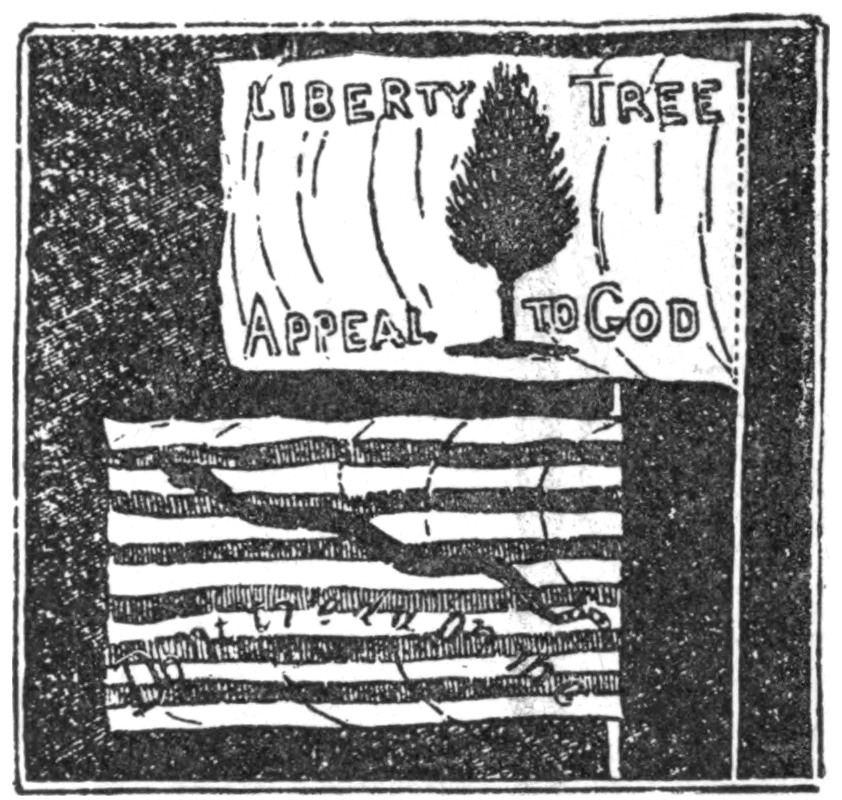
The First Naval Flags.
It was through this empowering of naval
officers to enforce the acts of trade and navigation
that the first sea-fight of the Revolution
occurred. A vessel of war—presumably
a ship—had been stationed in the waters of
Rhode Island, with a schooner of 102 tons burden,
called the Gaspé, armed with six three-pounders,
to serve as a tender. The Gaspé
was under the command of Lieut. William
Duddingstone. Duddingstone was particularly
offensive in his treatment of the coasting
vessels, every one of which was, in his
view, a smuggler. He had a crew of twenty-seven
men.
On June 17, 1772, a Providence packet,
named the Hannah and commanded by Captain
Linzee, came in sight of these two war-vessels
while she was on her regular passage
from New York to Providence. As the Hannah
ranged up near the war-vessels she was
ordered to heave to in order that her papers
might be examined, but Captain Linzee being
favored by a smart southerly wind that was
rapidly carrying him out of range of the man-of-war
guns, held fast on his course.
At this the schooner Gaspé was ordered to
follow and bring back the offending sloop,
and with all sail drawing, she obeyed the order.
For a matter of twenty-five miles that
was as eager and as even a race as any sailorman
would care to see, but when that length
of course had been sailed over, the racers
found themselves close up at the Providence
bar. The Yankee knew his ground as well as
he knew the deck of his sloop, but the captain
of the Gaspé was unfamiliar with it. A few
minutes later the shoal-draft Hannah was
crossing the bar at a point where she could
barely scrape over, and the deeper-draft Gaspé,
in trying to follow at full speed, was grounded
hard and fast.
To make matters still worse for the Gaspé,
the tide had just begun to run ebb; not for
many hours could her crew hope to float
her.
Leaving the stranded schooner to heel with
the falling tide, Captain Linzee drove on with
the wind to Providence, where he landed at the
wharf and spread the story of his trouble with
the coast guard. Had it happened in the days
before the French war, or before the persistent
efforts of the British ministry to levy unjust
taxes on the colonies had roused such
intense opposition in New England, this affair
would have been considered as a good joke
on a revenue cutter, and that would have been
the end of it so far as the people of Providence
were concerned.
Now, however, the matter was taken in a
most serious light. As the sun went down,
the town drummer appeared on the streets,
and with the long roll and tattoo by which
public meetings were called he gathered the
men of the town under a horse-shed that stood
near one of the larger stores overlooking the
water. While yet the people were coming
to the rendezvous, a man disguised as an
Indian appeared on the roof and invited all
“stout hearts” to meet him on the wharf at
nine o’clock, disguised as he was.
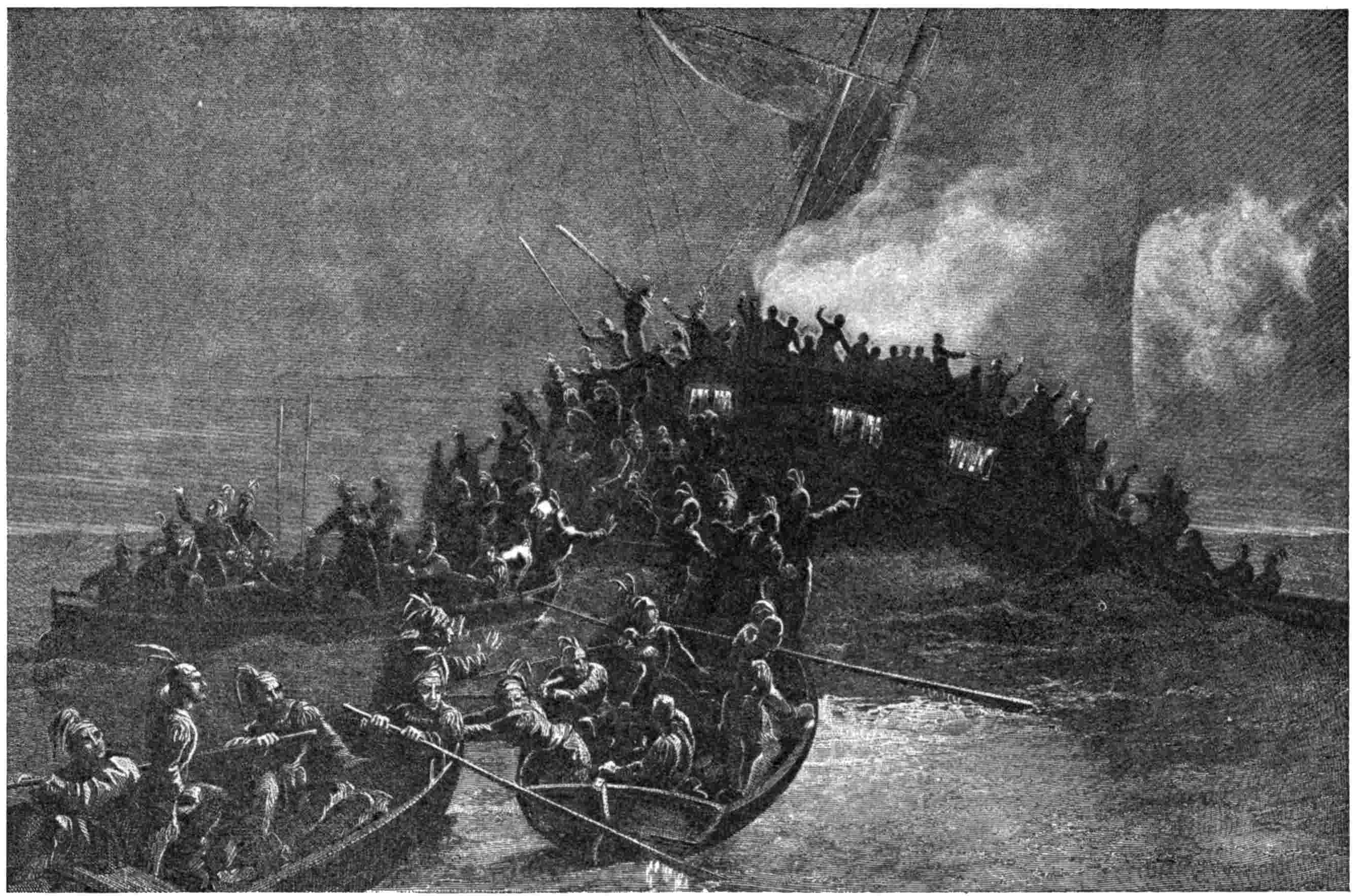
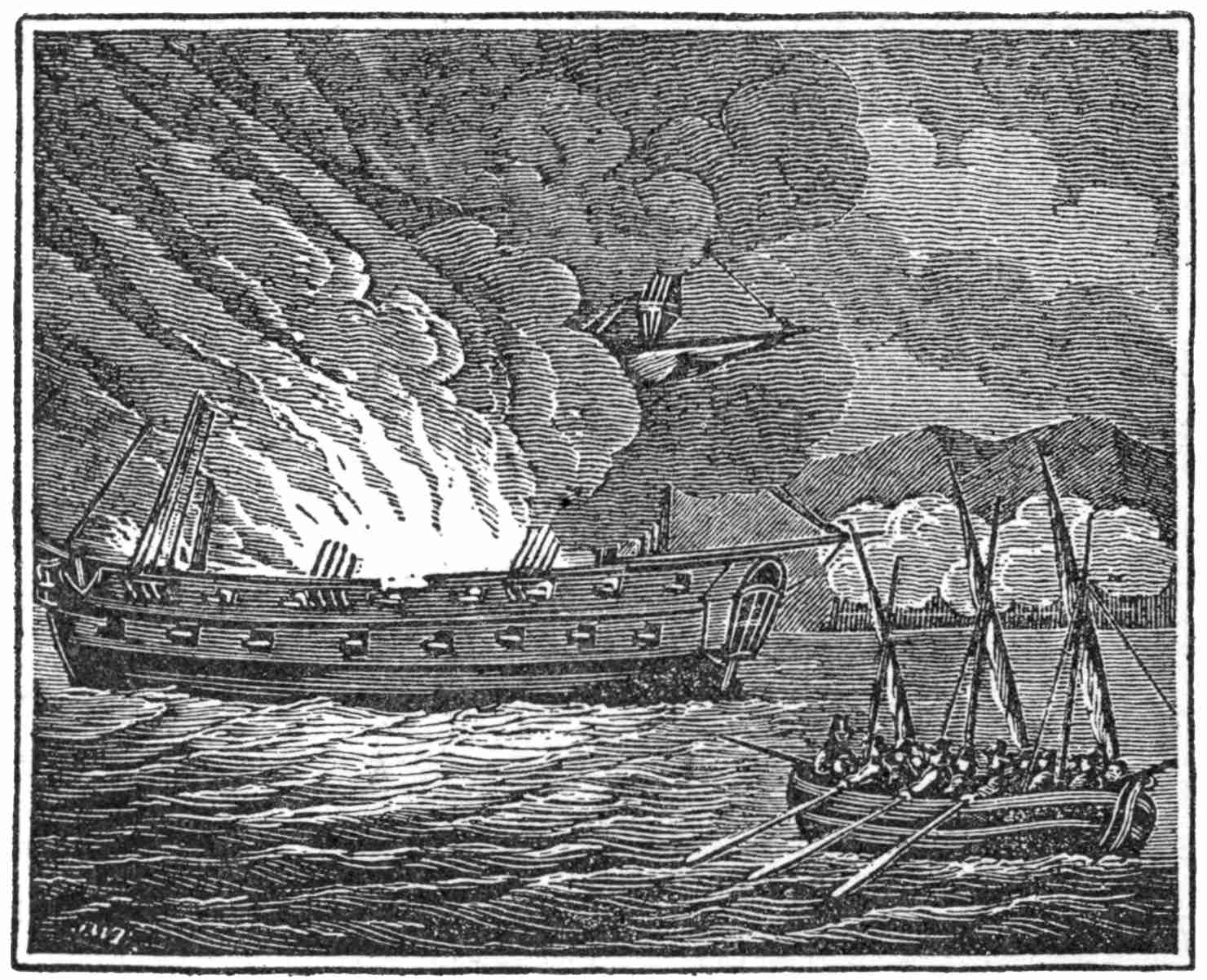
Destruction of the Schooner Gaspé, 1772.
From an engraving by Rogers of the painting by McNevin.
As one may readily believe, nearly every
man of Providence came to the pier at the
appointed hour. From this crowd sixty-four
men were selected. They chose as their commander,
so tradition asserts, Abraham Whipple,
who, later on, became one of the first-made
captains of the American navy, and then all
embarked in eight long-boats gathered from
the different vessels lying at the wharves, and
pulled away for the Gaspé.
That was a most remarkable expedition in
the matter of armament, for, although there
were a few firearms in the boats, the crews
depended for the most part on a liberal supply
of round paving-stones that they carried for
weapons of offense.
It was at two o’clock in the morning when
this galley-fleet arrived in sight of the stranded
Gaspé. The tide had turned by this time, and
the schooner had begun to right herself somewhat.
A sentinel, pacing to and fro with some
difficulty, saw the approaching boats and hailed
them. A shower of paving-stones was the
most effective if not the only reply he received,
and he tumbled down below precipitately.
The rattle and crash of the paving-stones
on the deck routed the crew from their
berths, and, running hastily on deck, the captain
of the Gaspé fired a pistol point-blank at
his assailants.
At that a single musket was fired from the
boats, by whom will never be told, and the
captain dropped with a bullet in his thigh.
Then the boats closed about the stranded vessel
and their crews swarmed over the rails.
The sailors of the Gaspé strove to resist the
onslaught, but they were quickly knocked
down and secured.
As soon as this was done the schooner was
effectually fired, and her captors, with their prisoners,
pulled away; but they remained within
sight until the early dawn appeared, when the
schooner blew up, and the boats were rowed
hastily home with the tide.
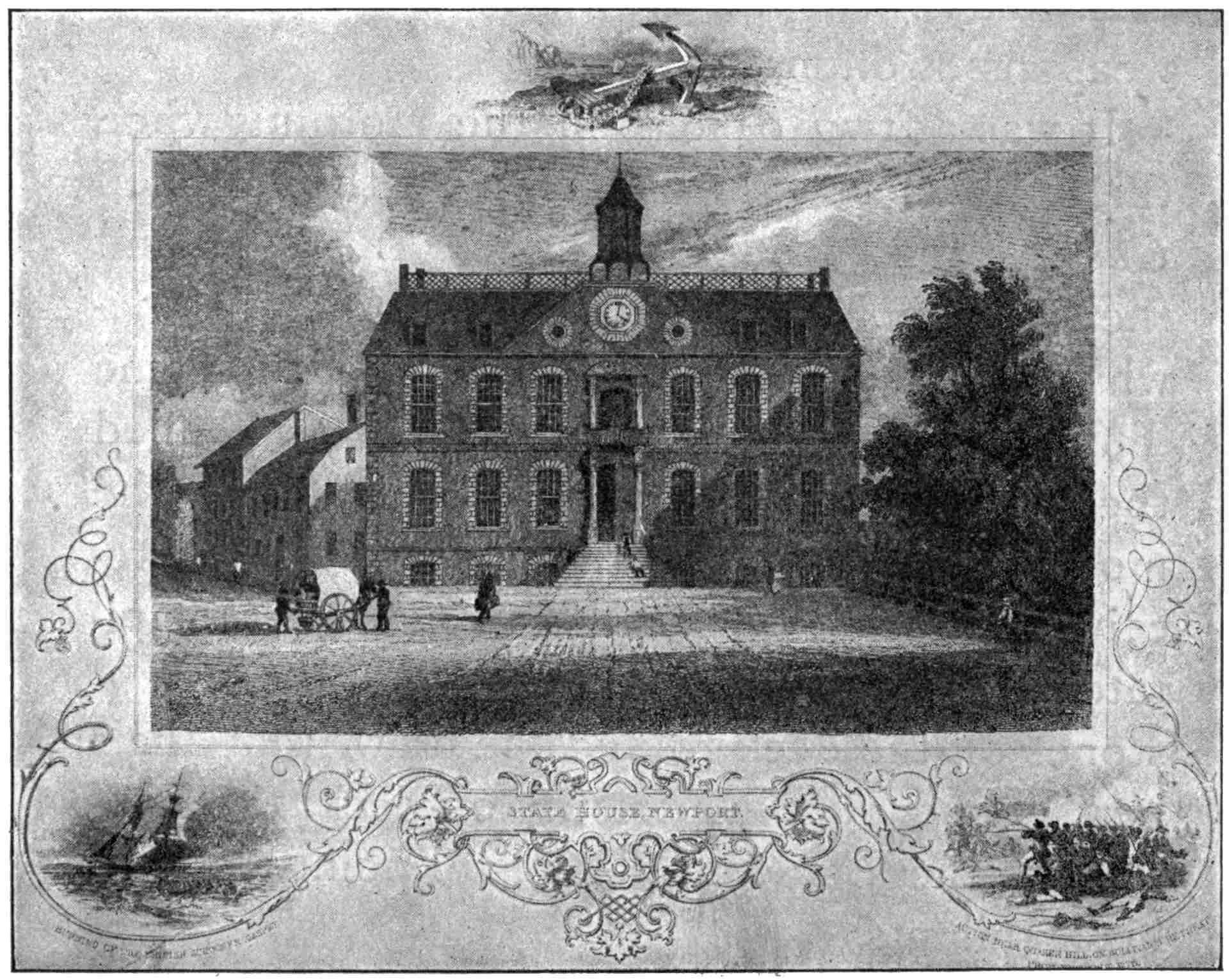
The State House at Newport, Showing the Gaspé Affair.
From an engraving in Hinton’s History of the United States.
The indignation of the British officials over
this assault on a naval vessel was so great that
a reward of £1,000 was offered for the leader
of the expedition, with £500 more and a free
pardon to any one of the offenders who would
turn informer. But, “notwithstanding a Commission
of Inquiry, under the great seal of
England, sat with that object, from January
to June, during the year 1773,” not enough
evidence was obtained to warrant the arrest of
a single man.
Although it was not an affair of the sea,
strictly speaking, it is worth recalling here
that within six months after this Commission
of Inquiry had failed to learn the names of
the men, disguised as Indians, who had burned
the Gaspé, another party of men in another
colony disguised themselves as Indians, and
helped amazingly in making the history of the
times. It was on the night of Friday, the
17th of December, 1773, as the reader will remember.
The ship Dartmouth, laden with
tea, was lying at her wharf in Boston. She
had been lying there since the 28th of the preceding
month, and during all those days the
people of Boston had labored unceasingly to
get her away to sea without discharging her
cargo. It is even recorded that “the urgency
of the business in hand overcame the sabbatarian
scruples of the people,” and that in Boston!
Meetings too great for “the Cradle of
Liberty” (Faneuil Hall) were adjourned to
the Old South Meeting-House. The people
were “determined not to act (in offense) until
the last legal method of relief should have
been tried and found wanting.” But at last,
on the night of this 17th day of December, as
the great throng of more than seven thousand
people waited in and about “the church that
was dimly lighted with candles,” a messenger
arrived from the British Governor to say that
the last legal resource had failed. The Governor
had refused to allow the ship to go.
And “then, amid profound stillness, Samuel
Adams arose and said, quietly but distinctly,
‘this meeting can do nothing more to save
the country.’”
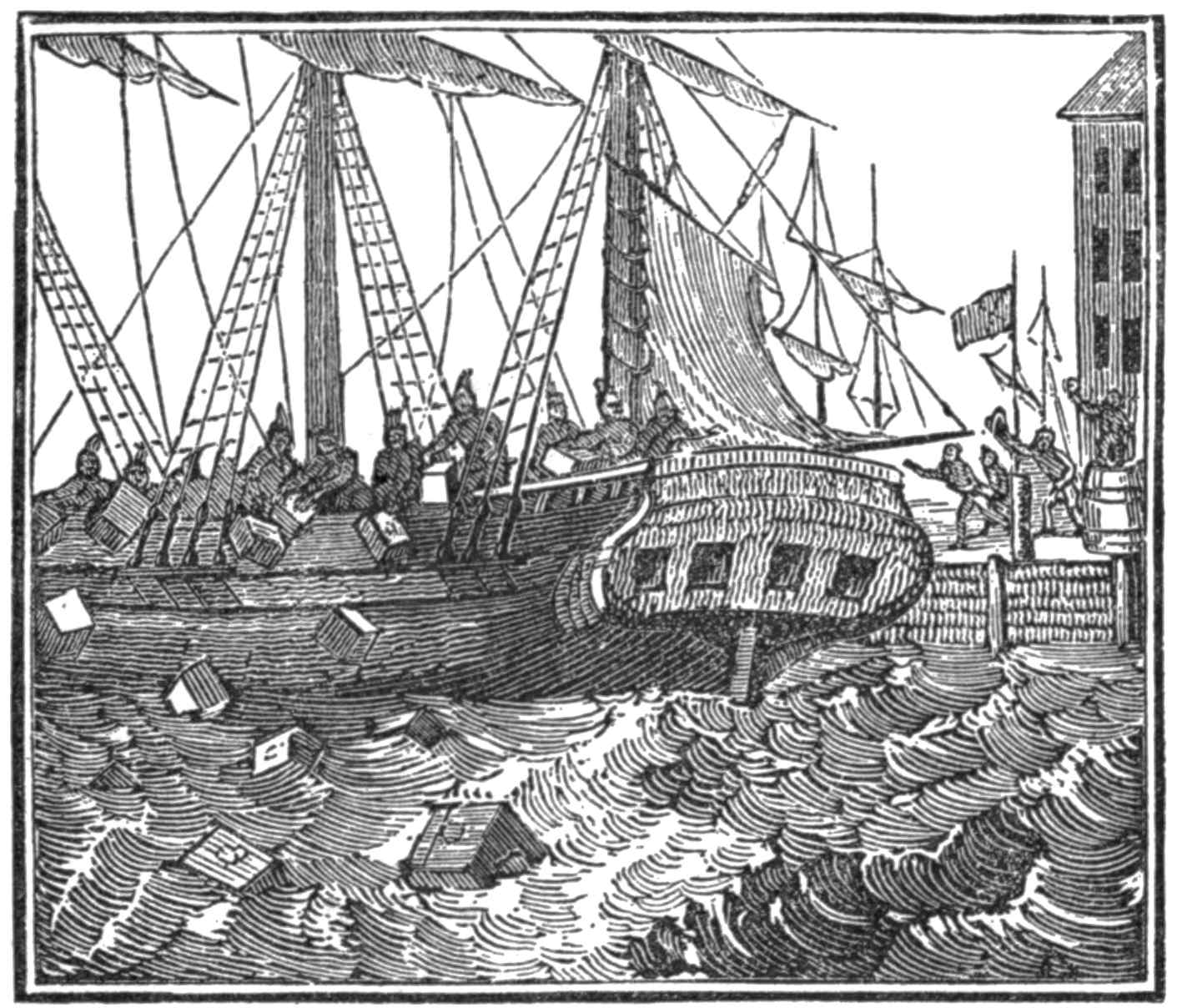
A war-whoop was heard a moment later
without the church, and fifty men, disguised
as Indians, just as Captain Whipple’s men
were when they fired the Gaspé—disguised as
Indians because Captain Whipple’s men had
successfully eluded the British detectives—these
fifty citizens of Boston ran away to the
wharf where the Dartmouth lay.
One John Rowe had asked during the meeting
earlier in the evening, “Who knows how
tea will mingle with salt water?” He had
now his opportunity to learn, for when the
Indians reached the ship they quickly brought
her cargo on deck, and smashing open the
chests with hatchets, tumbled the tea over the
rail, while a vast host stood by in the moonlight
and silently watched the work.
There was a significance in the silence of
the work that might have been, but was not,
heeded by those in authority, for it portrayed
the feelings and the character of the men engaged
in it, and foreshadowed the grim determination
of the people during the conflict that
was fast coming on.
The “Boston Tea-Party.”
From an old engraving.
Then followed, as the reader will remember
very well, the Boston Port Bill closing that
port. Then followed the bill by which any
magistrate, soldier, or revenue officer, accused
of murder in Massachusetts, was to be taken
to England for trial—a bill justly stigmatized
as an act to encourage the soldiery in shooting
down peaceful citizens. Then followed other
acts equally or still more unjust and tyrannous
that need not be mentioned here, the indignation
of the colonists growing deeper as their
distress under the oppression increased, until
war was inevitable. And on the 19th of
April, 1775, when the profane Pitcairn discharged
his “elegant pistol” at the minute-men
of the veteran Capt. John Parker on the village
green in Lexington, war came.
Now, it was because of the stir caused by
the story of this battle at Lexington that the
second sea-fight of the Revolution occurred.
The reader must keep steadily in mind that
not only were churches lighted by candles
in those days, but mails were carried up and
down the country by stage coaches and on
horseback and by the oft-times slower water
route—in sloops and schooners. The fight at
Lexington occurred on April 19th, but the
news of it did not reach Machias, Maine, until
Saturday, the 9th of the following month. On
that day word was brought by sea to Machias,
telling how the British troops had fired on the
minute-men, whose present offense was that
they had refused to obey when Pitcairn had
shouted, “Disperse, ye villains! Damn you,
why don’t you disperse?” How some had
been killed and others wounded by this first
onslaught; how the minute-men had at first
retreated and then gathered anew for the
attack; how the British were first brought to
a stand and then started in a retreat so swift
that when at last they were rescued by fresh
troops from Boston they fell to the ground
with “their tongues hanging out of their
mouths like those of dogs after a chase”—when
all this was related in Machias, Maine,
it stirred the men of the town to do a stroke
against the oppressive ministry on their own
account.
There was at this time in the port of Machias
an armed schooner called the Margaretta,
Captain Moore, in the service of the crown,
with two unarmed sloops in convoy which
were loading with lumber, according to the
American account, for the British in Boston,
but an English account speaks of the schooner
as “a mast ship,” i.e., a vessel loading with
logs suitable for the masts of a warship. As
the reader will remember, the grants of land
from the crown in those days, always retained
for the use of the crown all trees suitable for
masts of ships that might be found on the
land.
On hearing of the fight at Lexington the
bolder spirits of the town, considering that
affair as the beginning of war, determined
to capture the king’s schooner Margaretta.
Their first plan turned on the fact that the
day after the news arrived was Sunday. The
news was kept secret among those who laid
the plan, and Captain Moore came ashore to
attend church on Sundays as usual. Then
these men started to capture him at the church,
but their haste and excitement alarmed Captain
Moore, and he jumped through the church
window and fled to the beach, where he was
protected by his schooner’s guns.
On reaching his schooner, Captain Moore
fired several shots over the town to intimidate
the people; but not liking the looks of
things on shore after the firing, he got up his
anchor and dropped down-stream for a league,
where he came to anchor foolishly under a
high bank. The townspeople who had followed
him, quickly took places on this bank,
and a man named Foster called on him to
surrender, but Captain Moore got his anchor
again and ran out into the bay, apparently
unmolested by those who had summoned him
to surrender.
It looked as if the proposed capture would
not be made. But on Monday morning (May
11, 1775) two of the young men of the town,
Joseph Wheaton and Dennis O’Brien, met on
the wharf, when Wheaton proposed taking possession
of one of the lumber sloops, raising a
crew of volunteers and going after the Margaretta.
Peter Calbreth and a man named
Kraft happened along and agreed to join in,
and the four went on board the sloop and
took possession.
Three rousing cheers were given over the
success of their effort, and that brought a
crowd to the wharf—among the rest, Jeremiah
O’Brien, “an athletic gallant man,” to whom,
as to a village leader, Wheaton explained the
project.
“My boys, we can do it,” said Jeremiah
with enthusiasm, and at that every one in the
throng skurried off for arms.
The equipment which they brought together
for that cruise is worth describing in detail.
They had twenty guns, of which one is described
as a “wall-piece.” It was a musket too
heavy to hold offhand when fired; it needed
a wall, so to speak, to support its weight when
it was aimed. For all these guns they had
but sixty bullets and sixty charges of powder—three
loads for each weapon. In addition
they carried thirteen pitchforks and twelve axes
(a formidable weapon in the hands of a Maine
man). For food they carried a few pieces of
pork, a part of a bag of bread, and a barrel
of water.
Out of a throng of volunteers thirty-five of
the most athletic were selected to go, and, this
done, they hoisted sail and boldly headed away
before a northwest breeze to capture the Margaretta.
It should be noted here that these sloops
were single-masted vessels, as was the one in
the Providence affair. They were in form
and rig very much like the one-masted vessels
employed at the time of this writing
(1897) in carrying brick from the yards on the
Hudson River to New York City, but they
were not nearly as large as the brick-carriers,
though they probably stood as high out of
water, if not higher. A “sloop of war” was
a very different vessel, as will appear further
on.
Captain Moore saw the sloop coming from
afar, and realized that the crowd upon her
deck meant trouble for him. So, being still
anxious to avoid a conflict (just why he was
anxious does not appear), he up anchor and
once more ran away. But luck was against
him—perhaps his frustrated state of mind
brought him ill-luck. At any rate, although
the wind was in the northwest and he was
bound south, he got up his mainsail with the
boom to starboard, and soon found himself
obliged to jibe it over to port. With a fresh
breeze that was a task needing care, and yet,
when he came to swing the boom across, he
let it go on the run, and it brought up against
the backstays with such a shock that it was
broken short off in the wake of the rigging.
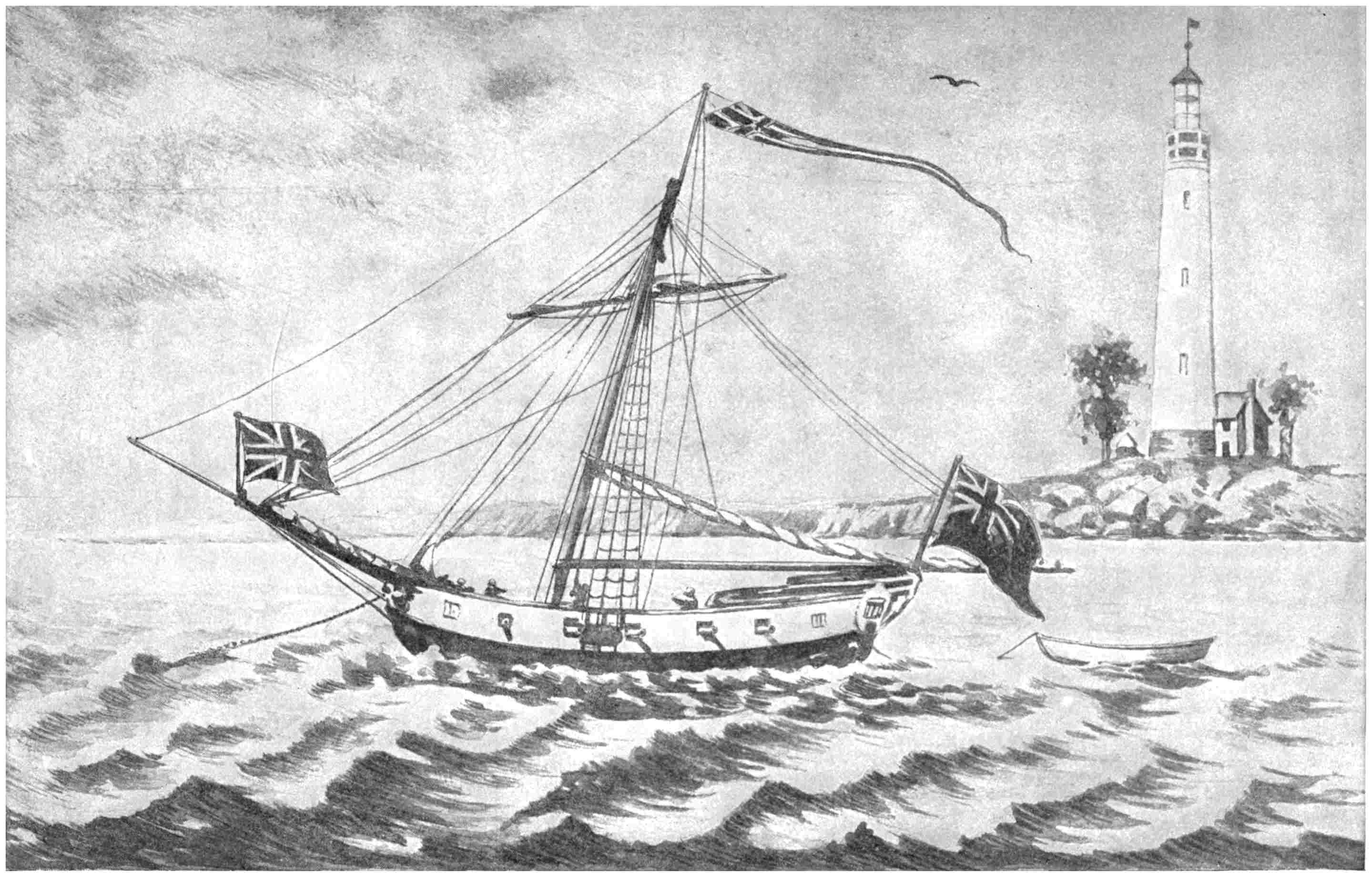
A British Armed Sloop
From a very rare engraving, showing the first lighthouse erected in the United States—on Little Brewster Island, Boston Harbor.
Rendered desperate by this accident, Captain
Moore now turned to a merchant
schooner that he saw at anchor not far
away, and bringing to alongside of her, he
robbed her of her boom to replace his own
and again headed for the open sea, and then,
to still further aid his flight, cut adrift every
one of his boats.
But it was all in vain, for the sloop was
much the swifter vessel, and Captain Moore
was at last compelled to fight.
The Margaretta was armed with four six-pounders
and twenty swivels—short and thick
guns firing a one-pound ball, and mounted on
swivels placed on the vessel’s rail. It was an
armament that should have been more than
sufficient to repel the Machias men armed
with pitchforks and axes. Moreover, the crew
of the Margaretta outnumbered that of the
sloop. But there was a difference in the character
of the two crews—a difference for which
abundant cause will be shown further on—and
the issue of the contest was never for a
moment in doubt after the haymakers had
gone afloat.
The first discharge of guns on the schooner
killed one man on the sloop. A man of the
name of Knight on the sloop returned the
fire, using the wall-piece. He was probably
from the backwoods and a moose hunter, for
he was bright enough and skilful enough to
pick off the man at the schooner’s helm. And
that shot drove everybody off the schooner’s
quarter-deck, so she was left, as a sailor might
say, to take charge of herself.
Then the schooner broached to, the sloop
crashed into her, and the men from Machias,
with swinging axes and poised pitchforks,
climbed over her rail.
It is said for Captain Moore that at this
point he fought gallantly, throwing hand-grenades
“with considerable effect,” but he
was quickly shot to death, and then his crew
surrendered.
In all, twenty men were killed and wounded
in this fight, showing that it was a desperate
conflict when once the two crews got within
range of each other, man to man, for twenty
was more than one-fourth of all engaged in it.
The crew of the Margaretta numbered forty,
all told.
On the Margaretta the captors found two
wall-pieces, forty cutlasses, forty boarding
axes, two boxes of hand-grenades, forty muskets,
and twenty pistols, with an ample supply
of powder and shot.
When one with a full knowledge of the naval
tar’s contempt for “a haymaker’s mate” recalls
the story of this Machias fight, he cannot
help thinking that some of the crew of the
Margaretta must have suffered as much in
mind as they did from their wounds after being
impaled on the two-pronged pikes—the
pitchforks of these Yankee haymakers.
Not only was the fight between the Margaretta’s
crew and the haymakers interesting
in itself; it was followed by consequences of
the most important nature in connection with
the establishment of the American navy.
The commander of the haymakers, elected
in good American fashion after they were
afloat, was Jeremiah O’Brien. Having secured
the Margaretta and his prisoners, Captain
O’Brien shifted the cannon and swivels,
with the ammunition and small arms, from the
captured schooner over to his fleeter sloop,
and set forth in search of more prizes and
glory. Straightway the efforts of the British
naval authorities to punish him for his assault
on the Margaretta gave him the opportunity
to acquire both. Two schooners, the Diligence
and the Tapanagouche, were sent from
Halifax to bring the obstreperous Irish-Yankee
in for trial. But Captain O’Brien was a
sailorman as well as a haymaker. By skilfully
handling his sloop he separated the cruisers,
and then captured them one at a time by
the bold dash that had succeeded in the assault
on the Margaretta. This done, Captain
O’Brien, with his prizes, sailed into Watertown,
Massachusetts, where the provincial
legislature was sitting, and delivered up
everything to the colonial authorities.
Such brave deeds as these did not go unrewarded
in those days. Captain O’Brien received
a commission from the colony, and,
with the three vessels well refitted, he was
sent once more to sea to cruise for vessels
bringing supplies to the British troops.
As said, not only was this an interesting
fight, but it was one with far-reaching consequences.
The deeds of Captain O’Brien, followed
by others of a like nature performed
by men who were stirred by his example, so
exasperated Admiral Graves, the British commander-in-chief
on the coast, that he sent
a squadron of four vessels under Captain
Mowat to take revenge in such a manner as
would fill, as he supposed, the hearts of the
people of the whole coast with terror. Portland
(then called Falmouth), Maine, was the
port selected for destruction.
The British account of what was done after
Captain Mowat’s fleet arrived before the town,
shall be given for a reason that will appear
further on in this history. The “Annual Register”
for 1776 (Dodsley’s, London), in its “Retrospective
view of American affairs in the
year 1775,” says (page 34):
“About 9 o’clock in the morning, a canonade
was begun, and continued with little intermission
through the day. About 3,000 shots
besides bombs and carcases, were thrown into
the town, and the sailors landed to compleat
the destruction, but were repulsed with the
loss of a few men. The principal part of the
town, (which lay next the water) consisting of
about 130 dwelling houses, 278 stores and
warehouses, with a large new church, a new
handsome courthouse, with the public library,
were reduced to ashes; about 100 of the worst
houses being favored by the situation and distance,
escaped destruction, though not without
damage.”
In Allen’s “Battles of the British Navy,” the
“new edition revised and enlarged” and published
by George Bell & Sons, London, in 1893
(note that it was published in 1893), we get a
modern British view of this important assault.
On page 227 it says:
“Lieutenant Mowat’s instructions were
tempered with moderation. He was directed
to confine his operations to certain enumerated
towns which had rendered themselves
conspicuous by open acts of hostility.”
The town was destroyed on the 16th day of
October, and in Maine. Under instructions
that, to an Englishman’s mind, tempered with
moderation, “a thousand unoffending, men
women and children were thus turned out of
doors” just as the fierce Maine winter was
coming down upon them.
It should be told here that among the
children who were thus obliged to seek shelter
in brush and bark huts was a lad of fourteen
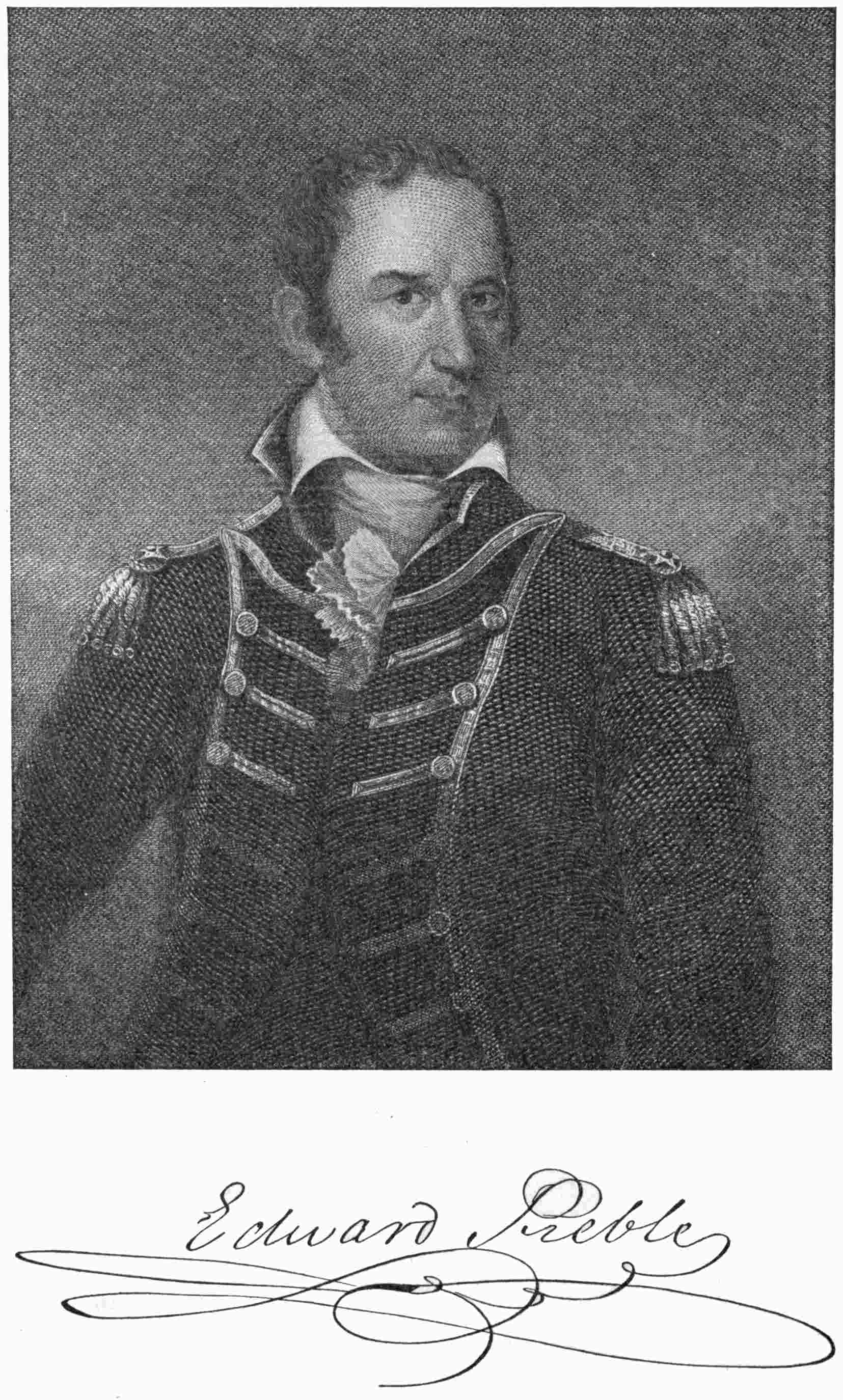
years, named Edward Preble, of whom
something will be told further on.
Meantime the Congress of the thirteen
United Colonies had been in session at Philadelphia,
resolving itself into a committee of
the whole, from day to day, to consider “the
state of trade in the colonies.” Patriots by the
thousand had answered the cries of distress
at Lexington by gathering with their muskets
about Boston. The battle of Bunker Hill, the
most glorious defeat recorded in the annals of
American warfare, had been fought and lost,
because the supplies of gunpowder, brought
by the colonists in the old-fashioned cowhorns,
had failed them. Of missiles there was apparently
no lack—they would have used pebbles
from the beach had no others been available and
powder abundant. But the want of gunpowder
became chronic, and in considering the state of
trade in the colonies the Congress found that
of all branches of that trade the one needing
their most careful attention was the trade in
gunpowder. It was a trade that did not thrive
under the circumstances; but there was one
source of supply that did not escape the attention
of such able-minded as well as able-bodied
citizens as Capt. Jeremiah O’Brien and his
ilk afloat. That source was in the supply
ships that provided for the British forces, and
in the smaller cruisers that waited on the great
ships of the British fleet. The sailormen of
the coast pointed to the supplies afloat, and
the legislators adopted the views of the sailormen.
Massachusetts, Rhode Island, and Connecticut
provided small cruisers on their own
account and sent them out seeking the enemy’s
supply ships, which, because the rebellious
colonies had theretofore no sort of a navy,
came to Boston and other ports in the king’s
possession, unarmed and without convoy. The
far-sighted Washington, who had been placed
in command of the heterogeneous forces about
Boston, took hold of this matter and brought
it to the attention of the Congress. In the
mind of Washington it was an expedient well
worth trying, but apparently he regarded it
only as a temporary expedient. For during
the summer and early fall of 1775, when the
need of gunpowder became and remained most
urgent, the colonies were fighting only for their
rights as British subjects, as the reader remembers,
and not for national independence.
A few long-headed leaders undoubtedly saw
the drift of current events, but with every
address to the throne there was sent a protestation
of loyalty.
The earliest reference to this temporary
expedient for getting gunpowder which is
found in the printed reports of the doings of
the Congress is in the minutes for Thursday,
October 5, 1775. It was then resolved to inform
General Washington that the Congress
had “received certain intelligence of the sailing
of two north country built brigs, of no
force, from England on the 11th of August
last, loaded with arms, powder and other stores
for Quebec without convoy, which it being of
importance to intercept,” Washington was
requested to “apply to the Council of Massachusetts-Bay
for the two armed vessels in their
service,” and send them “at the expense of
the continent” after the brigs. Moreover, he
was informed that “the Rhode Island and
Connecticut vessels of force will be sent directly
to their assistance.” Further still, it
was resolved that “the general be directed to
employ the said vessels and others, if he judge
necessary.” That was a very important set of
resolutions in connection with the history of
the navy. And the same may be said of the
resolutions of Friday, October 13th, when it
was provided that “a swift vessel to carry ten
carriage guns and a proportionable number of
swivels, with eighty men, be fitted out with all
possible despatch for a cruise of three months,”
and, further, “that another vessel be fitted out
for the same purposes.” Deane, Langdon,
and Gadsden were chosen as a committee of
the Congress to look after the fitting out of
the vessels. Further than that, on Monday,
October 30, 1775, it was resolved that the
second vessel previously ordered should “carry
fourteen guns and a proportionate number of
swivels and men,” while two other ships, “one
to carry not exceeding twenty guns and the
other not exceeding thirty-six guns,” were to
be chartered for the same purpose—to cruise
“eastward” to intercept the British store-ships.
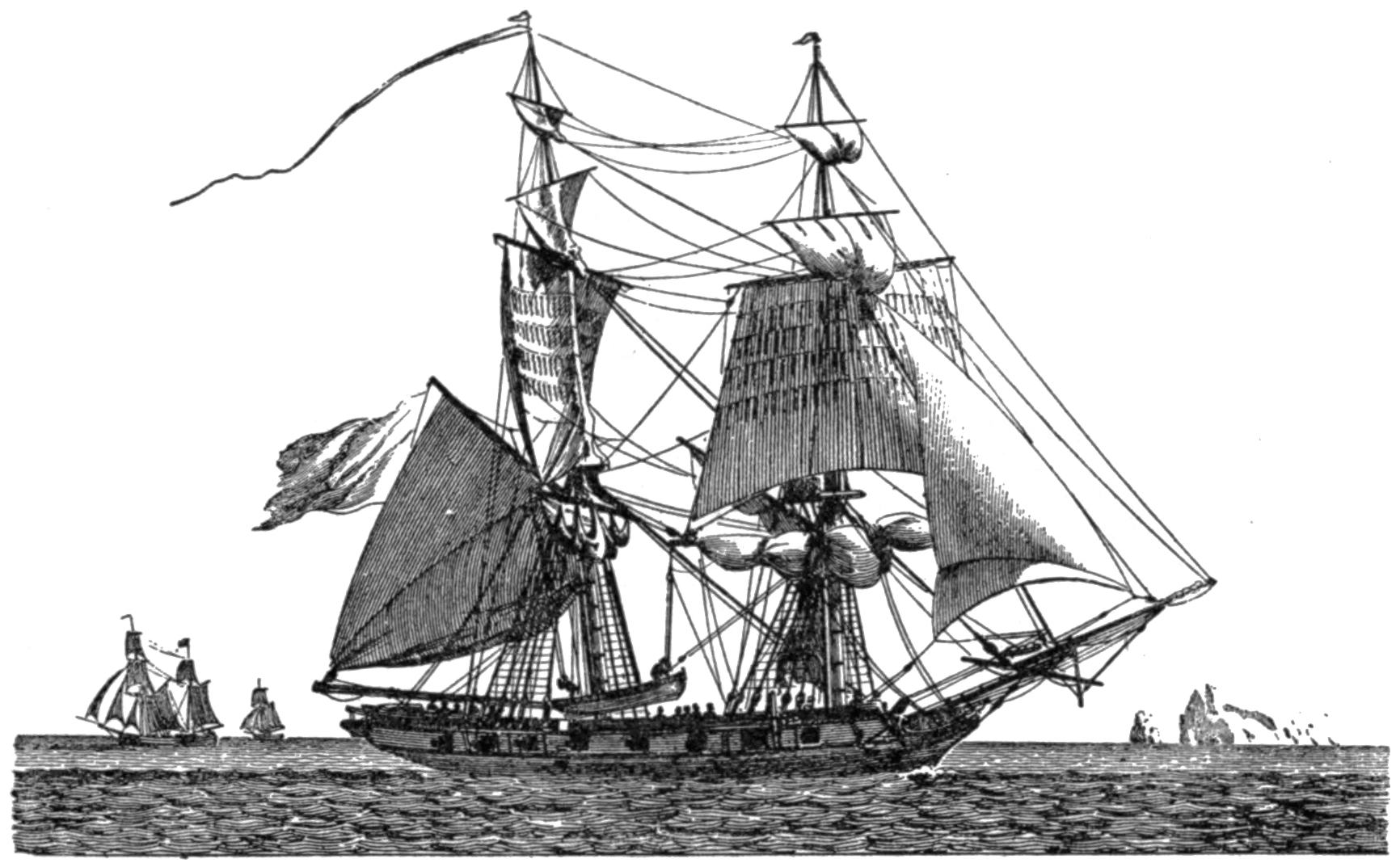
A Brig of War Lowering a Boat.
From a picture drawn and engraved by Baugean.
How under the resolutions of October 5th
Captain Manly of the schooner Lee was sent
“eastward”; how he captured a large brigantine
loaded with munitions of war; how, in
consequence of this capture, “a long, lumbering
train of wagons, laden with ordnance and
military stores, and decorated with flags, came
wheeling into camp”—Washington’s camp—the
next day after a host of Connecticut troops
had deserted the cause, and “it was feared
their example would be contagious”; how
“such universal joy ran through the whole
camp as if each one grasped victory in his own
hands,”—all are parts of a story that may not
be wholly omitted here; but the resolutions of
the Congress did not provide, properly speaking,
for an American navy. They only provided
temporary means for obtaining supplies.
The Congress was not yet ready to take the
important step of establishing a navy as a
branch of the public service.
But the thought of a colonial navy was
abroad—it was even then officially before the
Congress, although it had not been acted
upon. Officially, the subject of establishing a
colonial navy came from Rhode Island, where
Capt. Abraham Whipple and his paving-stones
had conquered the schooner Gaspé.
On August 26, 1775, the two houses of the
Rhode Island legislature concurred in ordering
their representatives in the Congress to
propose the establishment of a navy “at the
expense of the continent.” So cautious were
the members of the Congress in handling the
matter that, when, on October 3d, one of the
Rhode Island delegates—presumably Samuel
Ward, who was their leader—called the attention
of the Congress to the proposal of his
legislature, they did not even mention the
matter definitely in the minutes of the day.
The minutes read: “One of the delegates
for Rhode Island laid before the Congress
a part of the instructions given them,” etc.
“The proposal met great opposition,” and
even the briefest consideration of the matter
had to go over to a later day. “In the Congress
at Philadelphia, so long as there remained
the dimmest hope of favor to its
petition, the lukewarm patriots had the
advantage.”
But a time was coming when they were to
change their feelings in this matter radically
and in a day. They had ordered the forces
afloat and ashore “carefully to refrain from
acts of violence which could be construed as
open rebellion,” but before the end of the year
they had taken such a long step toward the
Declaration of Independence that to turn back
was impossible.
It was on October 31st that the change
of sentiment was wrought. One cannot help
wishing that what a newspaper man in these
days would call “a crackerjack reporter”
might have been present to describe the stir
in the Congress when, on that day, one messenger
arrived to announce that the British
king had succeeded in hiring 20,000 of “the
finest troops in Europe”—Germans—to fight
against the colonists, while a second messenger
followed with the story of the desperate
plight of the people of Falmouth, who had
been driven from their homes to face a
Maine winter by the assault of the infamous
Mowat. But if we lack the picture we have
the record of what was done in consequence
of the news then received.
Though stirred as never before since they
had come together, the members of the Congress
moved with judicial moderation, and it
was not until Saturday, November 25th, that
they resolved to make an aggressive fight at
sea. On this day they adopted a preamble
that eloquently told how “orders have been
issued ... under colour of which said
orders the commanders of his majesty’s said
ships have already burned and destroyed the
flourishing and populous town of Falmouth,
and have fired upon and much injured several
other towns within the United Colonies, and
dispersed at a late season of the year, hundreds
of women and children, with a savage
hope that those may perish under the approaching
rigours of the season who may chance to
escape destruction from fire and sword.” And
then they resolved that all armed British vessels,
and all “transport vessels in the same
service,” “to whomsoever belonging,” with
their cargoes, that might fall into the hands
of the colonists, “shall be confiscated.” Further
than that, commissions not only for the
captains of the colonial cruisers, but for the
commanders of privateers as well, were ordered
to be issued under proper regulations.
The colonies were recommended
to “erect
courts of justice” to
dispose of the prizes
to be so captured, and
a scheme for distributing
prize money to
the crews of both
cruisers and privateers
was approved.
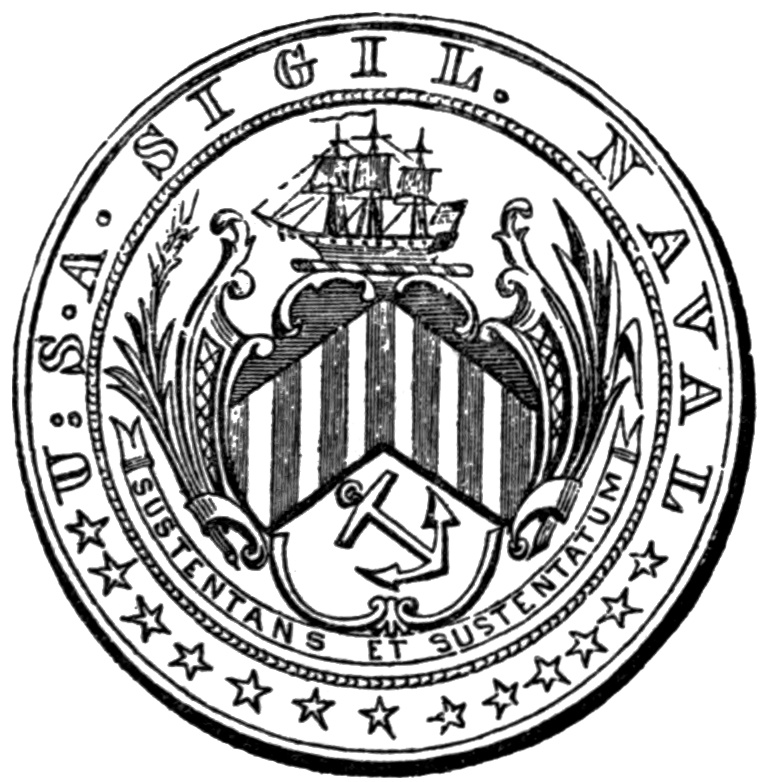
The Admiralty Seal.
Three days later—on
November 28, 1775—the minutes contain
the first adopted “Rules for the Regulation
of the Navy of the United Colonies,” and that
was the first occasion on which the term navy
of the United Colonies appears in the minutes
of the proceedings.
Very curious and well worth the study of
any one interested in history are those first
rules adopted for the American navy—a navy
not yet actually in existence. But for the
present purpose it is necessary to note only
the thoughtfulness of the Congress for the
comfort of the members of the crews—especially
the comfort of the men before the mast.
A remarkably large space in the printed report
of these regulations relates to the feeding of
the men, and if to this space be added that
devoted to the regulations for the care of the
sick and wounded, together with what was
ordered for the preservation of the property
rights of the sailors, then more than one-half
of all that was decided upon was in the interest
of the men in the forecastle. The bearing
of this policy on the future of the American
navy will appear further on, but it may be said
here that it was not for nothing that grave
legislators were concerned to provide that “a
proportion of canvas for pudding-bags, after
the rate of one ell for every sixteen men,”
should be served out at proper intervals.
Thereafter the making of a navy went on
more rapidly. Within a week word came that
Lord Dunmore, with a fleet in the Chesapeake
Bay, was aiding the Tories there to engage in
trade with the West Indies, contrary to the
colonial regulations, and, worse yet, was stirring
up a race war. In consequence of this
the Congress resolved, on December 5th, that
all the vessels engaged in the trade established
by Dunmore, with their cargoes, should be
seized when possible and held “until the further
order of this Congress.” And that is a
matter of importance, because it was the first
warrant of the Congress permitting the capture
of merchant ships of the enemy when
engaged in another traffic than the carrying
of supplies to the enemy’s military or naval
stations.
Next (on December 11th) the Congress ordered
that “a committee be appointed to devise
ways and means for furnishing these colonies
with a naval armament.” The alacrity
with which that committee acted was something
phenomenal, for in two days they
brought in their report, “which being read
and debated,” was adopted. They had determined
to build “five ships of 32 guns, five
of 28 guns, three of 24 guns, making in the
whole thirteen.” These were to be constructed,
one in New Hampshire, two in Massachusetts,
one in Connecticut, two in Rhode Island, two
in New York, four in Pennsylvania, and one
in Maryland. They were expected to go afloat
“by the last of March next,” and the cost was
not to be “more than 66,666⅔ dollars each, on
an average, allowing two complete suits of
sails for each ship.” So far as the committee
could see, there would be but one difficulty in
the way of sending all these ships to sea well
found for the service, and that was in the lack
of canvas and gunpowder. They would need
7,500 pieces of canvas for the sails and 100
tons of powder for the magazines, and there
was not any of either in the market.
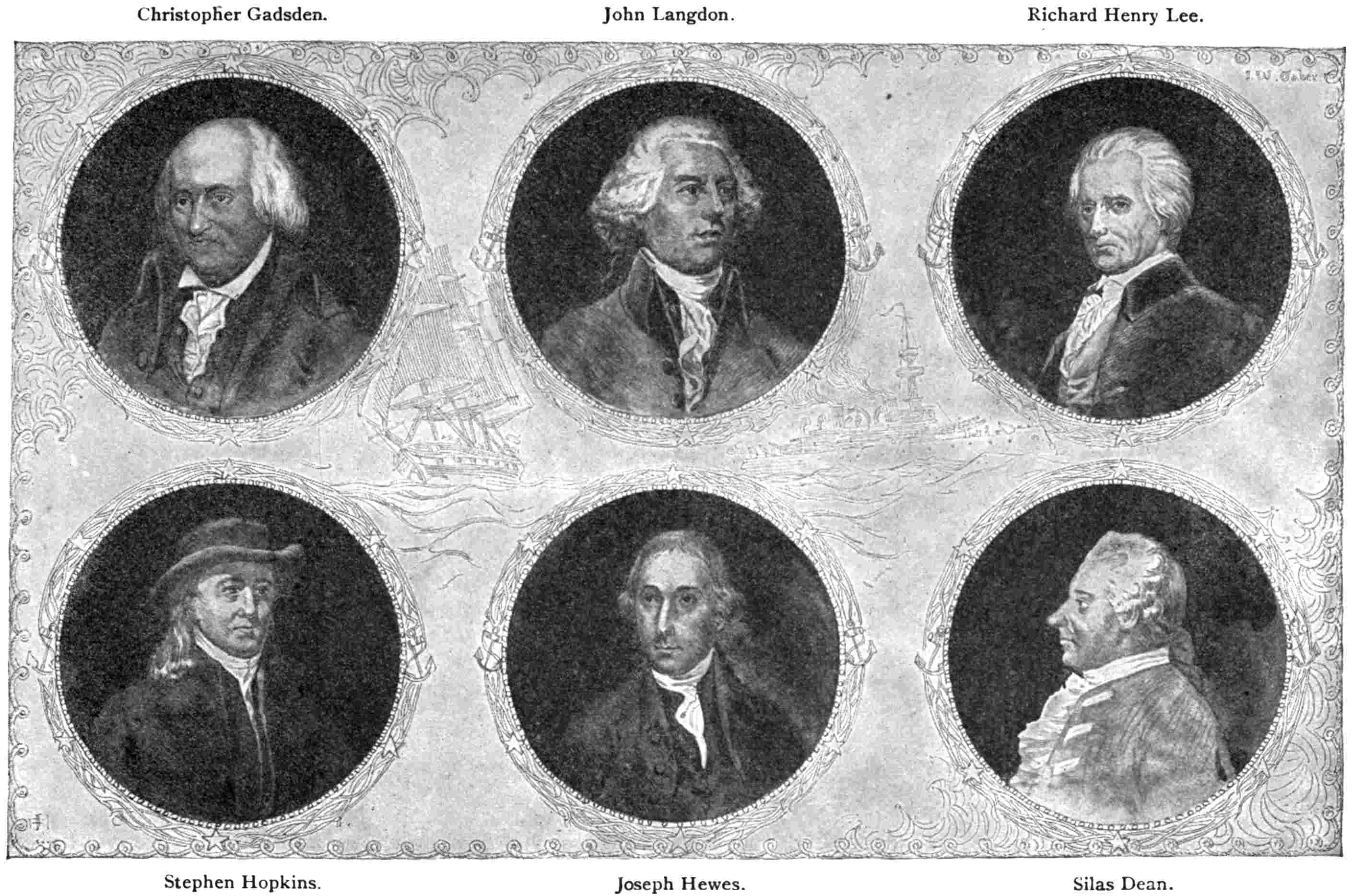
In the meantime the marine committee appointed
under the resolution of October 13th
to fit out two vessels to “cruise eastward” after
the king’s transports, had been increased in
number, and in December consisted of Silas
Deane, Christopher Gadsden, John Langdon,
Stephen Hopkins, Joseph Hewes, and Richard
Henry Lee. John Adams, who was an enthusiastic
supporter of the project to create a
navy from the moment it was discussed, had
been at first a member of this committee, but
because of other duties he left it, and Gadsden
took the place. The names of these men are
well worth remembering, for they were the
originators of the American navy. While the
Congress was preparing to build the navy these
men had labored faithfully, and with success,
to provide one ready made out of the ships
that could be purchased along the coast.
Christopher Gadsden. John Langdon.Richard Henry Lee. Stephen Hopkins.Joseph Hewes.Silas Dean.
The Founders of the American Navy.
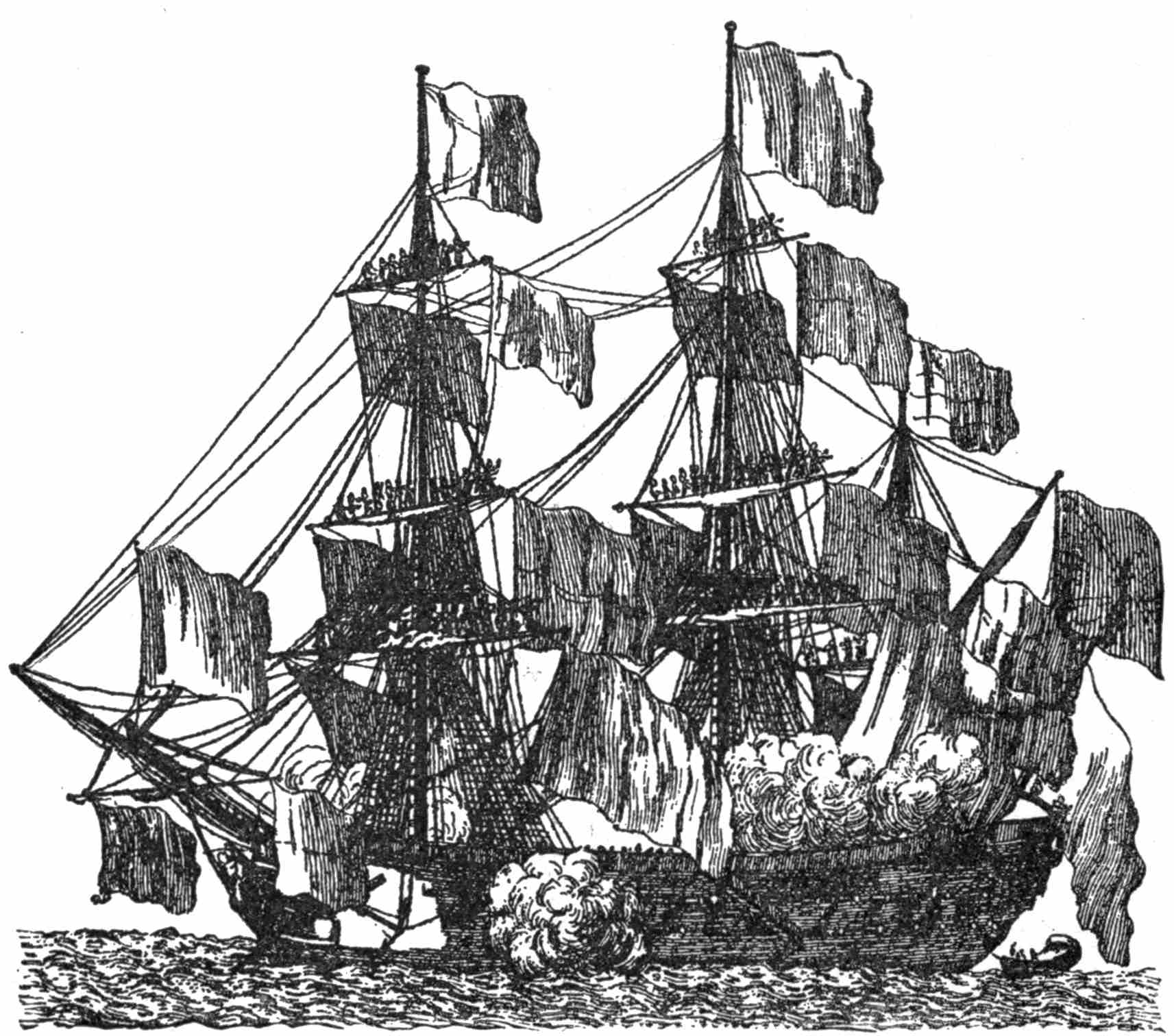
Vessel of War Saluting, with the Yards Manned.
From an old French engraving.
The Congress had, on November 2d, placed
$100,000 at their disposal. With this they
went about buying ships and supplies for them.
A London packet called the Black Prince
came into port under command of that Captain
John Barry who, later on, was a captain in the
American navy. She was of good scantling,
and was considered a vessel worthy of becoming
the flagship of the new fleet. The committee
purchased her, and, after renaming her
the Alfred, after Alfred the Great, they
mounted twenty nine-pounders on deck, with
four (it is said) smaller guns—presumably
four-pounders—on the forecastle and poop.
Another merchant ship, called the Sally, was
purchased and renamed Columbus, for the great
explorer, after which she received eighteen or
twenty (authorities vary) nine-pounders. She
is said to have been crank (top-heavy) and of
small value. Two brigs were purchased and
renamed the Andrea Doria, for the famous
Genoese sailor, and the Cabot, for the early
explorer of North America. These are set
down as carrying fourteen four-pounders each.
A third brig was purchased in Providence and
named for that town, because, according to
John Adams, that town was “the residence of
Governor Hopkins and his brother Esek,
whom we appointed the first Captain.” She
carried twelve guns—sixes or fours. In addition
to these, the committee obtained a sloop
of ten guns, called the Hornet, and an eight-gun
schooner named the Wasp. These were
purchased and equipped in Baltimore, and
then brought around to Philadelphia. The
Fly, an eight-gun schooner, completed the
list.
While the committee were gathering this
fleet at Philadelphia, the Congress showed its
appreciation of the work in hand by voting
that the crews should be engaged to serve
until January 1, 1777—practically for one year.
They further voted $500,000 of the continental
currency to the use of the naval committee.
Then, on Tuesday, December 19th, the Congress
still further showed their appreciation of
the situation of affairs by resolving “that the
Committee of Safety of Pennsylvania be requested
to supply the armed vessels, which are
nearly ready to sail, with four tons of gunpowder
at the continental expense”; and, further,
“that the said committee be requested
to procure and lend the said vessels as many
stands of small arms as they can spare, not
exceeding 400.”
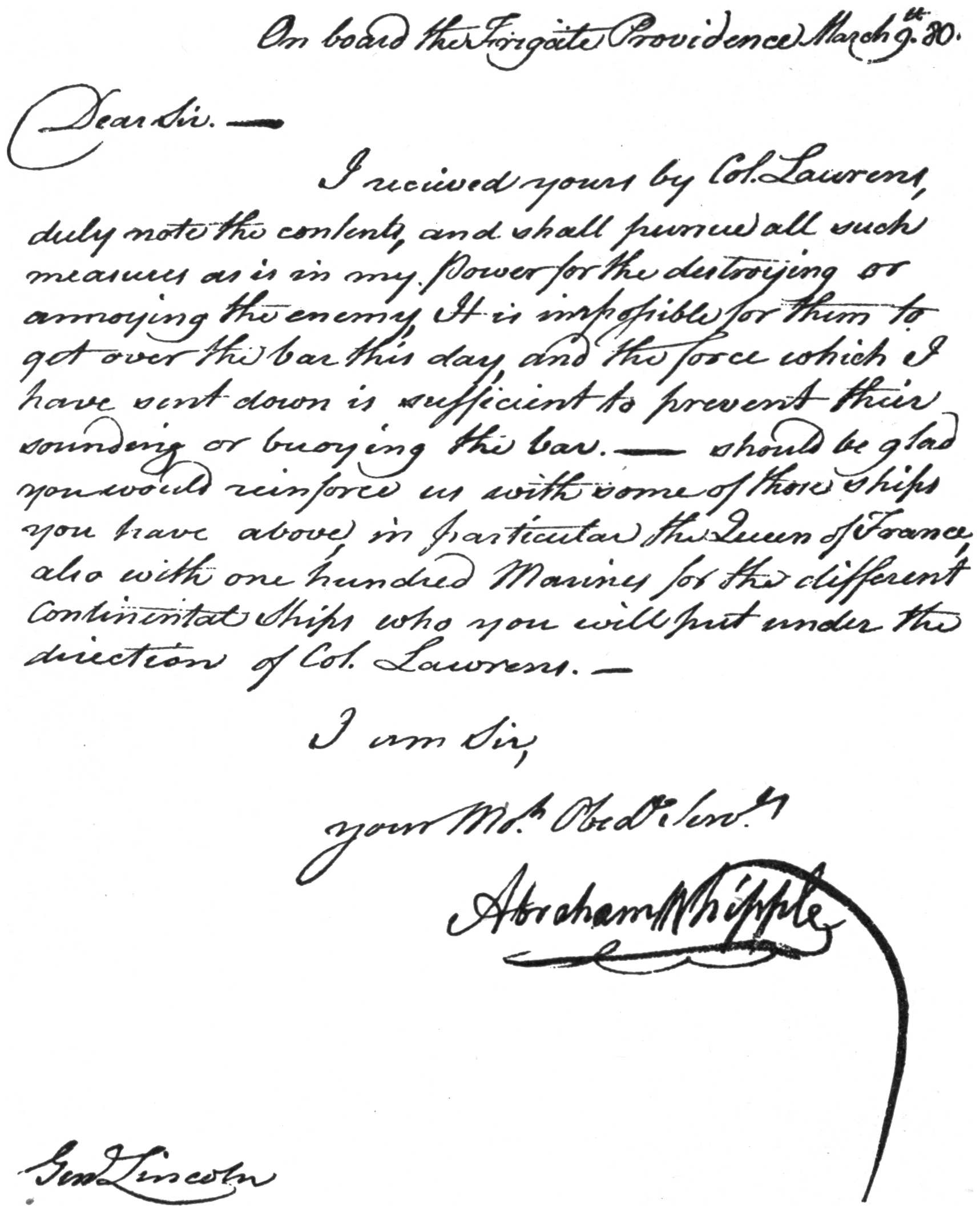
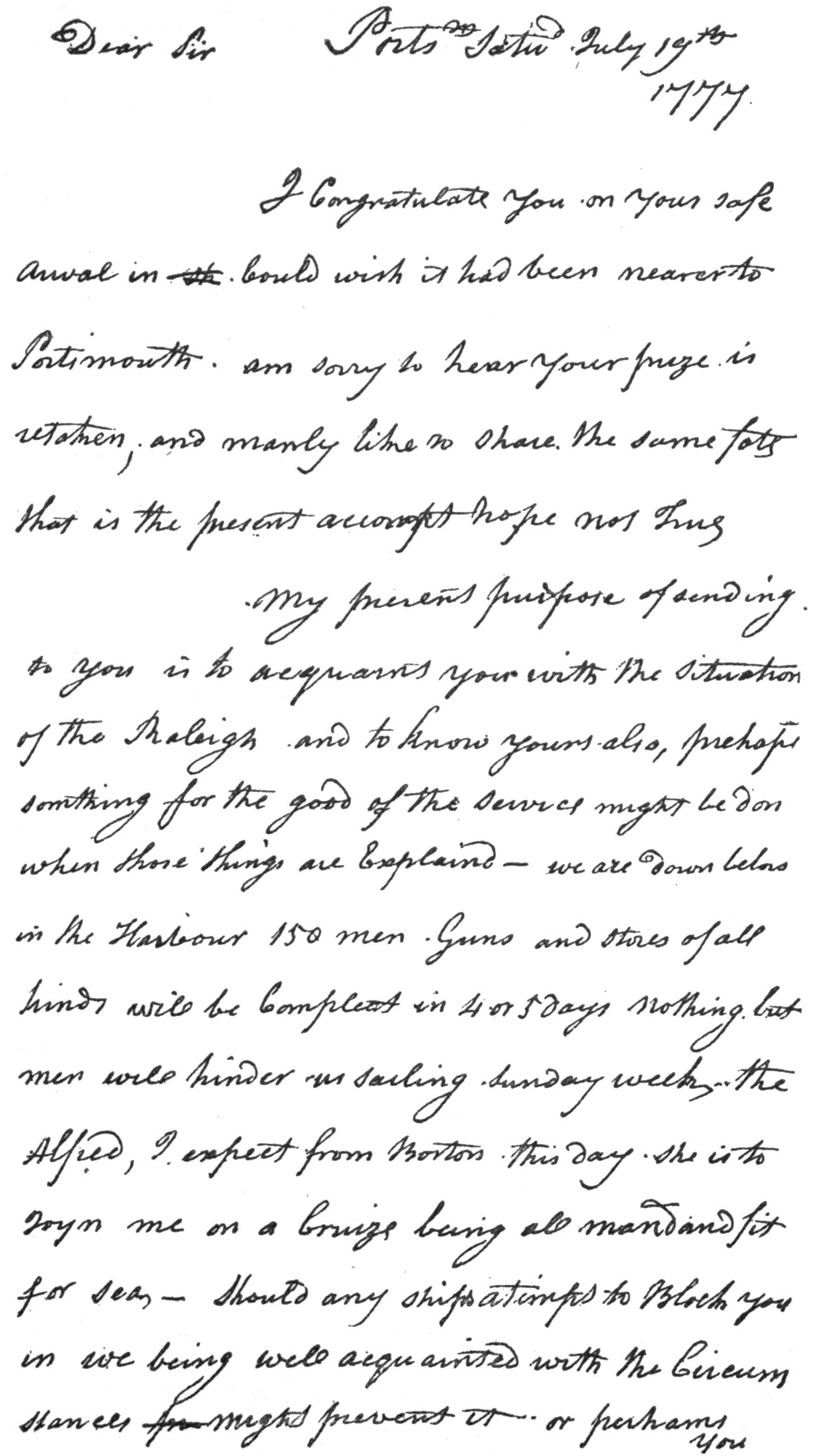
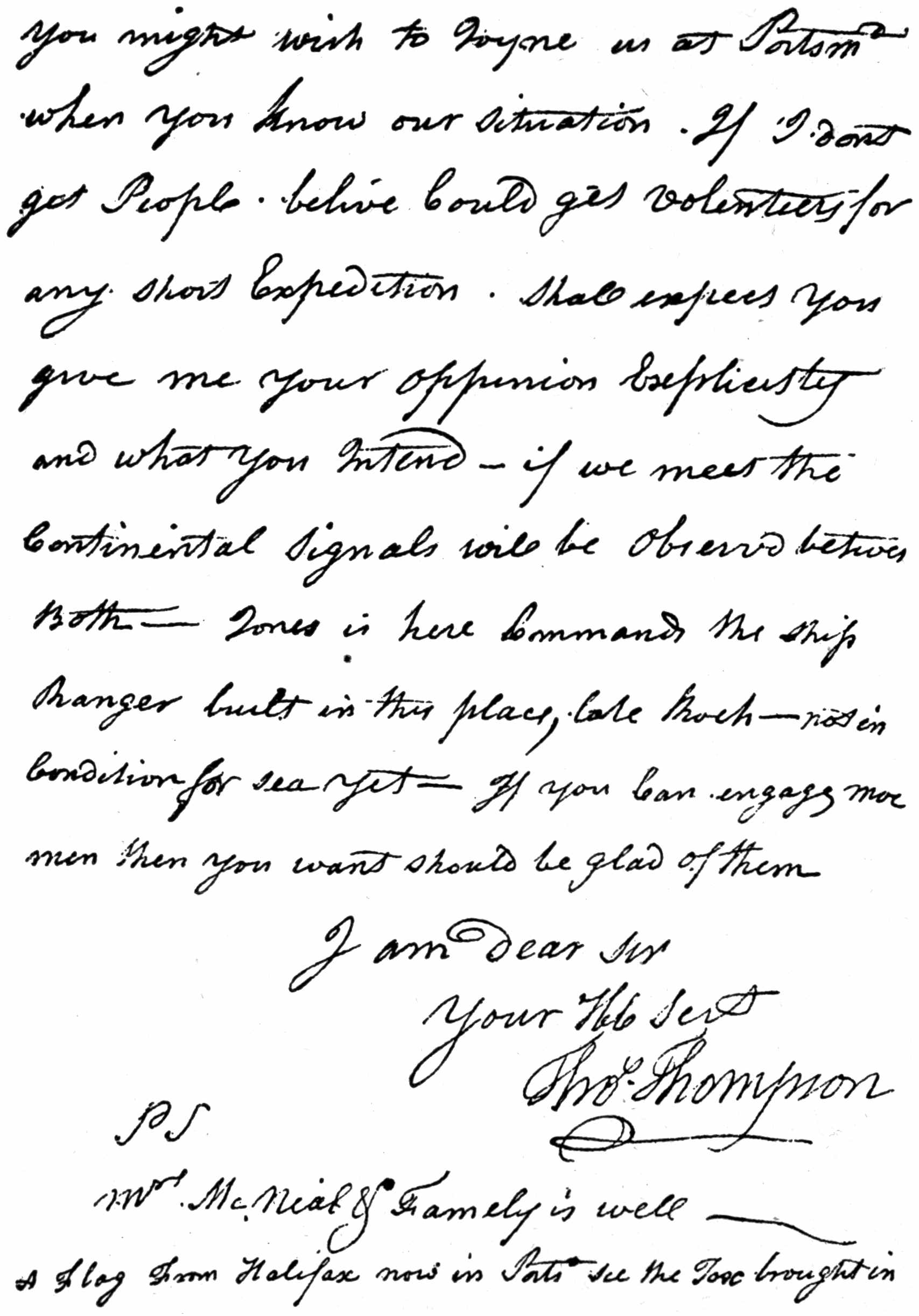
Facsimile of a Letter from Abraham Whipple to General Lincoln during the Siege of
Charleston.
From the original at the Lenox Library.
The Pennsylvania people had already agreed
to furnish these necessaries; the resolutions of
the Congress were only in the nature of vouchers,
and, twenty-four hours later, the first
American fleet was found and fitted for service.
Only the crews for the ships were needed, and
these the committee had provided ready for
the occasion, so all that was then required to
man the ships was for the Congress to confirm
the appointment of the officers. And this was
done on the memorable date, Friday, December
22, 1775. The resolutions of the Congress
shall be given in full, because it was upon this
legal warrant that the American navy was
founded. They were as follows:
“The committee appointed to fit out armed
vessels, laid before congress a list of the officers
by them appointed agreeable to the powers
to them given by Congress, viz:
Esek Hopkins, esq. comander in chief of
the fleet—
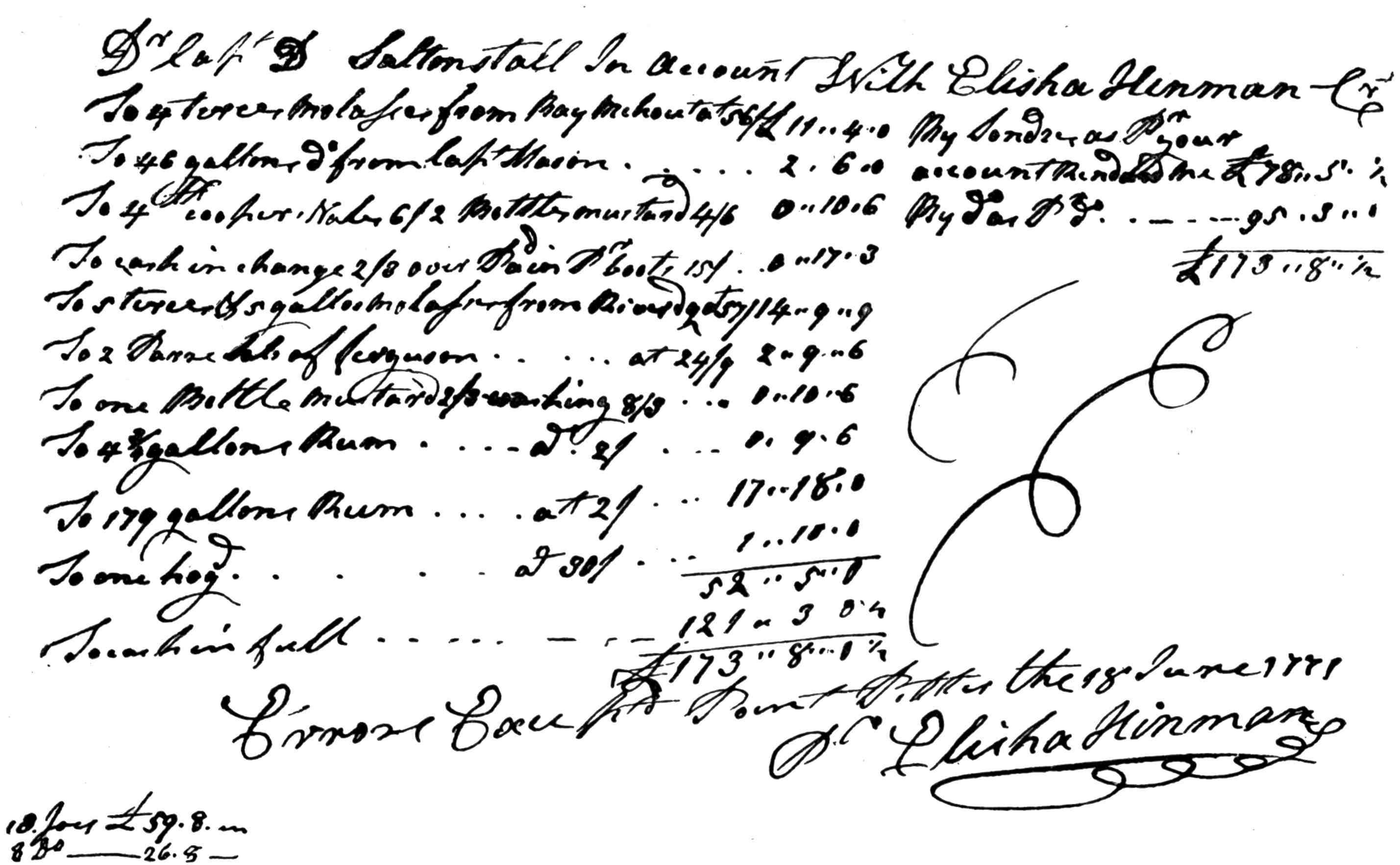
Dudley Saltonstall, Captain of the Alfred.
Abraham Whipple, Captain of the Columbus.
Nicholas Biddle, Captain of the Andrea
Doria.
John Burrow Hopkins, Captain of the
Cabot.
First lieutenants, John Paul Jones, Rhodes
Arnold, —— Stansbury, Hoysted Hacker,
Jonathan Pitcher.
Second Lieutenants, Benjamin Seabury,
Joseph Olney, Elisha Warner, Thomas
Weaver, —— McDougall.
Third Lieutenants, John Fanning, Ezekiel
Burroughs, Daniel Vaughn.
Resolved, That the Pay of the Comander
in-chief of the fleet be 125 dollars per calender
month.
Resolved, That commissions be granted to
the above officers agreeable to their rank in
the above appointment.
Resolved, That the committee for fitting out
armed vessels, issue warrants to all officers
employed in the fleet under the rank of third
lieutenants.
Resolved, That the said committee be directed
(as a secret committee) to give such instructions
to the commander of the fleet, touching
the operations of the ships under his command,
as shall appear to the said committee
most conducive to the defence of the United
Colonies, and to the distress of the enemy’s
naval forces and vessels bringing supplys to
their fleets and armies, and lay such instructions
before the Congress when called for.”
The thirteen United Colonies had at last a
naval fleet, armed, equipped, and manned, and
legally authorized to sail away on the secret
expedition the committee had planned. But
before Commodore Hopkins might up anchor
and spread his canvas to the breeze there was
one ceremony to be performed which, though
not mentioned in any colonial law, was (and it
still is) considered of the utmost importance.
He must “put his ships in commission”—must
“pipe all hands on deck,” and then
“hoist in their appropriate places the national
colors and the pennant of the commanding
officer,” after which he must address the crew
and “read to them the order by virtue of
which he assumes command.”
That is a most impressive ceremony, and it
was now to be performed for the first time in
the American naval fleet.
Important—even thrilling as was the occasion,
there is no known record by which the
date on which this ceremony was performed
may be definitely located. But it is unquestioned
that the naval committee of the Congress
had, on this December 22d, secured the
crews as well as the ships for a fleet, and that
the crews were then on board awaiting the
coming of properly authorized officers. There
is, therefore, no reason to doubt that as soon
as the Congress had passed the resolutions
above quoted, and the commissions therein
mentioned had been signed, the commodore
and his officers immediately went on board to
take formal possession.
Captain Nicholas Biddle.
From an engraving by Edwin.
But whatever the date, it is recorded that it
was on a beautiful winter day when the commodore
and his officers made their way to the
foot of Walnut Street, Philadelphia, where a
ship’s long-boat awaited them. A great throng
of patriots gathered along shore on the arrival
of the officers, and the shipping along the
whole river front was not only decorated with
bunting, but decks and rails and rigging were
occupied by enthusiastic spectators.
Pushing off and rowing away through the
floating ice, Commodore Hopkins reached the
ladder at the side of the Alfred, and, followed
by all his officers, mounted to the deck.
The shrill whistle of the boatswain called the
crew well aft in the waist of the ship. The
officers gathered in a group on the quarterdeck.
A quartermaster made fast to the mizzen
signal halliards a great yellow silk flag
bearing the picture of a pine tree with a coiled
rattlesnake at its roots, and the impressive
motto “Don’t Tread on Me.” This accomplished,
he turned toward the master of the
ship, Capt. Dudley Saltonstall, and saluted.
And then, at a gesture from the captain,
the executive officer of the ship, the immortal
John Paul Jones, eagerly grasped the flag halliards,
and while officers and seamen uncovered
their heads, and the spectators cheered
and cannon roared, he spread to the breeze
the first American naval ensign.
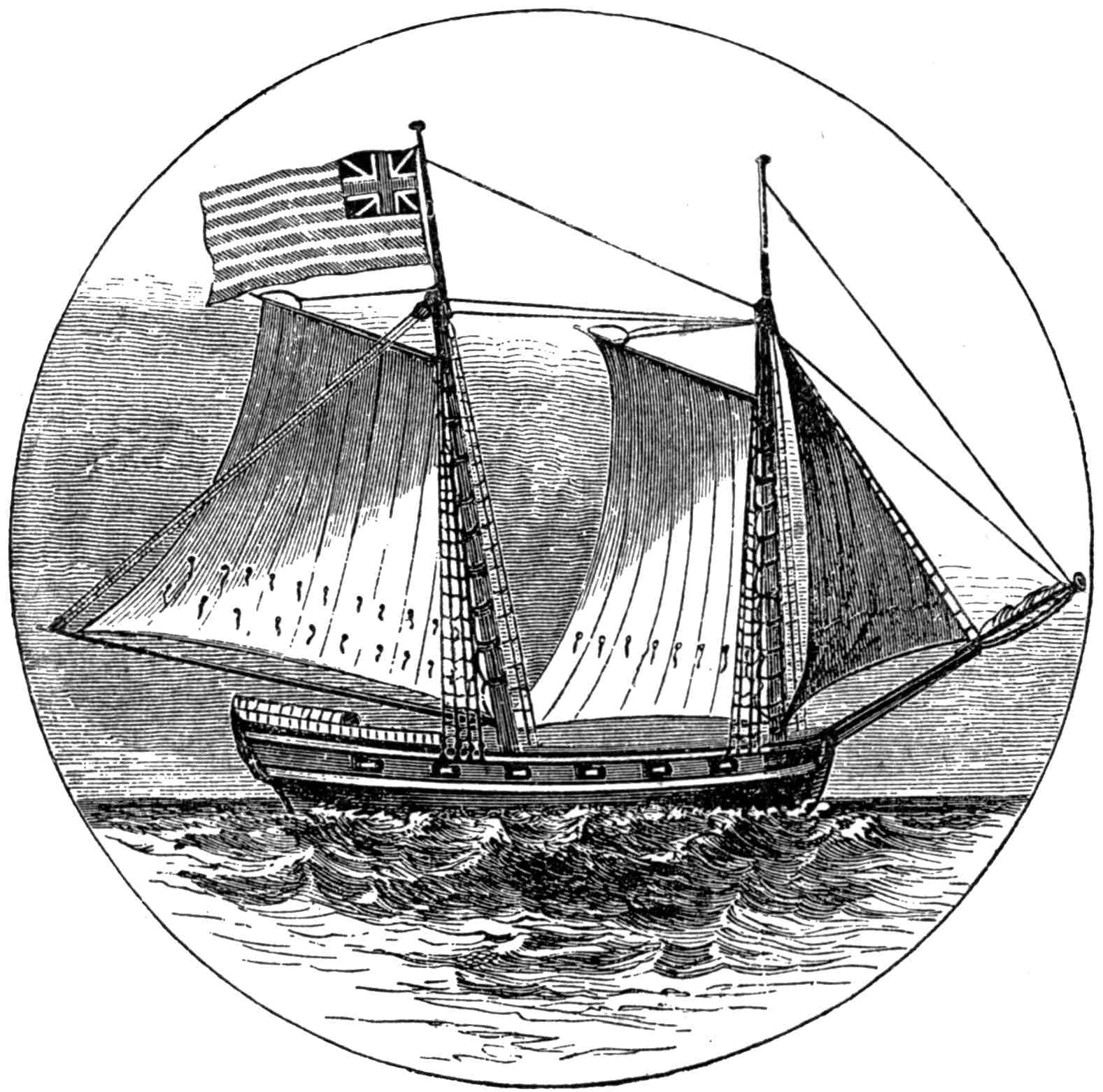
The grand union flag of the colonies, a flag
of thirteen stripes, alternate red and white,
with the British jack in the field, and the pennant
of the commander-in-chief, were then
set, and the resolutions of the Congress read.
The first American naval fleet was in commission.
A Frigate Chasing a Small Boat.
From an old French engraving.
CHAPTER II FIRST CRUISE OF THE YANKEE SQUADRON
A FAIRLY SUCCESSFUL RAID ON NEW PROVIDENCE, BUT THEY LET A
BRITISH SLOOP-OF-WAR ESCAPE—CHARACTER OF THE FIRST NAVAL
COMMANDER-IN-CHIEF AND OF THE MATERIAL WITH WHICH HE
HAD TO WORK—ESEK HOPKINS, A LANDSMAN, SET TO DO A
SAILOR’S WORK—CREWS UNTRAINED AND DEVOID OF “ESPRIT
DE CORPS”—GOOD COURAGE, BUT A WOEFUL LACK OF OTHER
NEEDED QUALITIES—HOPKINS DISMISSED FOR DISOBEDIENCE OF
ORDERS.
The career of Commodore Esek Hopkins
as commander-in-chief of the American navy
lasted for a year and ten days. If it was not
a glorious career it was at least an instructive
one, and the candid student is likely to conclude
that, under the circumstances, it was
creditable to his reputation. He was badly
handicapped from the beginning in a variety
of ways, but in spite of this he accomplished
something.
As already noted, Commodore Hopkins received
his appointment chiefly through the
influence of John Adams, and because he was
the brother of the capable Governor of Rhode
Island. The student of American history
should keep in mind that the colonists were
still monarchists in 1775, and that they followed
the monarchial system of appointing
favorites to office. That is to say, the man
who had the most influence, who had what
politicians call a “pull,” got the appointment,
regardless, usually, of his fitness for the place.
Commodore Hopkins had been a brigadier-general
in the Rhode Island militia by appointment
of his brother. He had served in
various capacities at sea, but it is likely that
training had made him a soldier rather than a
sailor, and no greater mistake can be made by
executive authority than to appoint a soldier
to do a sailorman’s work.
Further than this, the vessels under the command
of Hopkins were all built for carrying
cargoes and not for fighting—they were not
as swift or as handy as fighting ships of the
same size. Worse yet, they were manned by
crews brought together for the first time—men
who were not only unacquainted with
each other, and therefore devoid of esprit de
corps, but who were unaccustomed, for the
most part, to the discipline necessary on a
man-of-war and untrained in the use of great
guns. When compared with the crews of the
British warships they were more inferior in
these two respects than were the raw militia
around Boston when compared with the British
regulars. The raw militia could at least
shoot well.
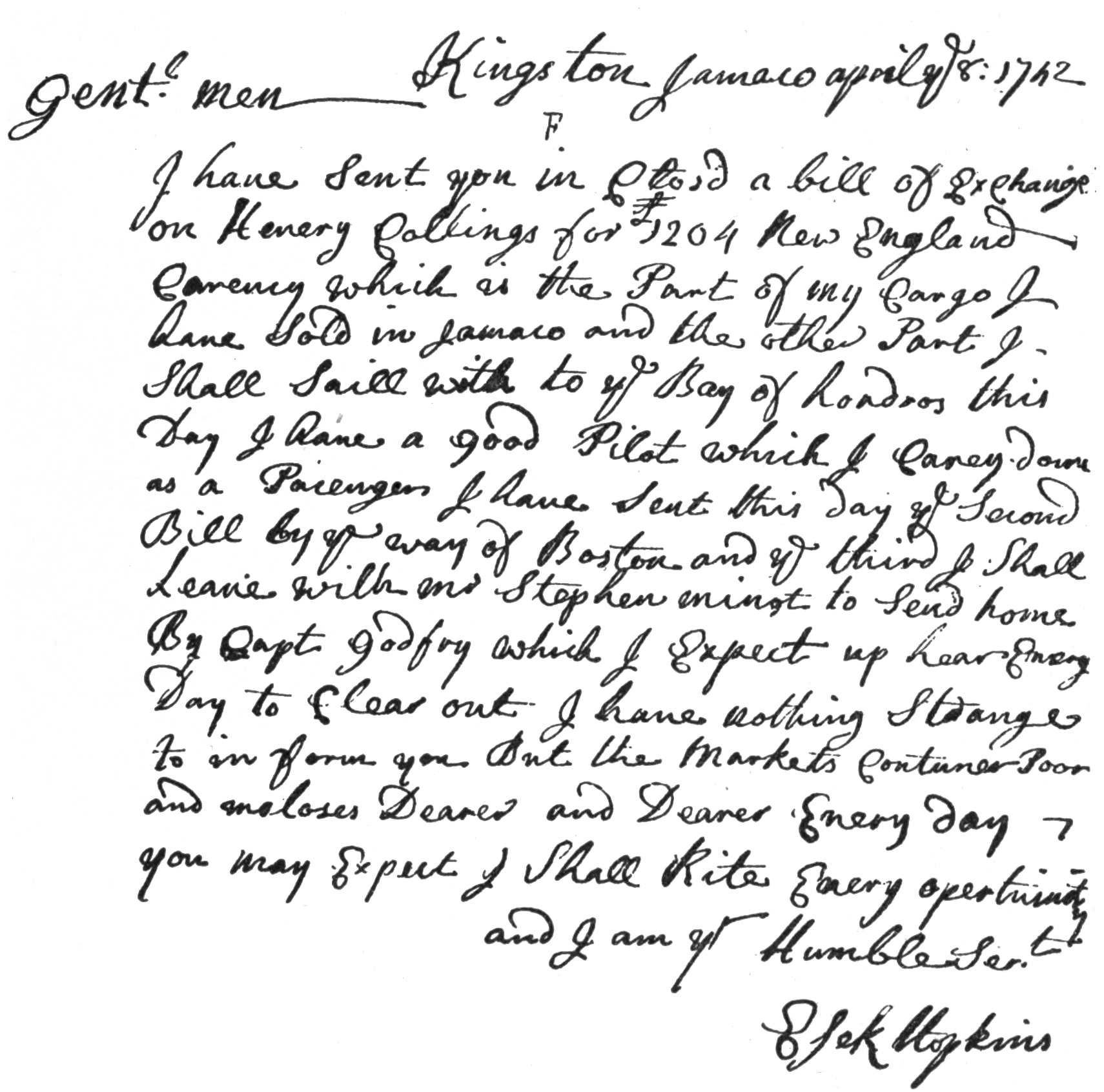
A Letter from Esek Hopkins.
From the original at the Lenox Library.
With these facts in mind it is worth while
comparing the American ships with the British
naval forces on the coast. As said, Commodore
Hopkins had eight vessels, of which two
only were ships, and the others were brigs or
smaller, and all were lubberly merchantmen.
All told, this squadron mounted just 114 guns,
of which the largest was a cannon that could
throw a round cast-iron ball weighing nine
pounds. Even of these there were less than
fifty. And the powder to load them and the
muskets with which the seamen had been
armed were all borrowed from the commonwealth
of Pennsylvania.
Yet this puny squadron, “poor and contemptible,
being for the greater part no better
than whale boats,” as a British authority truly
says, was to go to sea to make war—against
what force does the reader suppose? A navy
of 112 ships, carrying 3,714 guns, of which
force no less than seventy-eight ships, carrying
2,078 guns, were either already on the American
coast or under orders to go there.
A Corvette.
From an old French engraving.
Nor does a comparison of the number of
guns—114 against 2,078—give an idea of the
utter inefficiency of the American sea power;
for, while the best of the American guns was
but a nine-pounder, at least a fourth of the guns
on the British ships—at least 500 of them—were
eighteen-pounders or heavier. For every
nine-pounder in the American ships there were
at least ten of double that size in the British,
not to mention the 1,500 and more guns in the
fleet that included six-pounders, nine-pounders,
and twelve-pounders. “Poor and contemptible”
were just the words for describing the
comparative merits of the American warships.
And in the matter of experience and training
the American crews were but little better than
their ships and guns. As will appear further
on, there were to be fights between British
ships manned by experienced, thoroughly disciplined
crews of full numbers against Yankee
ships that were manned for the greater part
by seasick landsmen, and short-handed at that.
The secret orders that had been given to
Commodore Hopkins commanded him to go
in search of Lord Dunmore, who had been
making so much trouble along the shores of
Chesapeake Bay as to cause Washington to
write that “if this man is not crushed before
spring he will become the most formidable
enemy America has.” The ships were to gather
at Cape Henlopen, and sail thence for the
Chesapeake. But the Delaware River was full
of ice, and it was not until February 17, 1776,
that the squadron finally passed out to sea.
Then, on the night of the 19th, while running
along with a fresh breeze, the Hornet and the
Fly became separated from the others, and did
not again join the squadron.
It appears from the meagre record that
Hopkins did not enter the Chesapeake at all.
Instead of that he sailed away to the Bahama
Islands, because he had learned that a large
quantity of military supplies were stored at
New Providence, with only a few men to guard
them. He was determined to capture the
supplies.
On reaching Abaco, Hopkins divided his
forces by sending 300 men under Capt.
Samuel Nichols, in ten small sloops found at
Abaco, to capture New Providence. Hopkins
supposed the force would surprise the garrison,
but the commander was found ready to repel
an attack, and the Providence and the Wasp
had to be sent over to assist the men in
landing.
It was at this point that a branch of the
American naval personnel, of which too little
notice has been taken by historians, first made
a record for gallantry. Captain Nichols was
the first captain of marines in the American
naval service, the organization of the marine
corps having been ordered by the Congress
on November 10, 1775.
Under cover of the guns of the Providence
and the Wasp, Captain Nichols and his marines
landed on the beach, and then “behaved
with a spirit and steadiness that have distinguished
the corps from that hour down to the
present moment.” They carried the forts by
assault. “A hundred cannon and a large
quantity of stores fell into the hands of the
Americans,” but because the Governor had
been apprised of the coming of the Americans,
he succeeded in sending away in a small
coaster 150 barrels of powder.
It is worth noting that Commodore Hopkins
not only loaded his vessels with these
stores, but that the stores made a heavy cargo
for them, and they were deep in the water
when they turned toward home. It should be
further noted that the Governor of the island
“and several of the more prominent inhabitants”
were carried away for use as hostages
to compel the British authorities to modify
the harsh treatment American prisoners were
receiving.
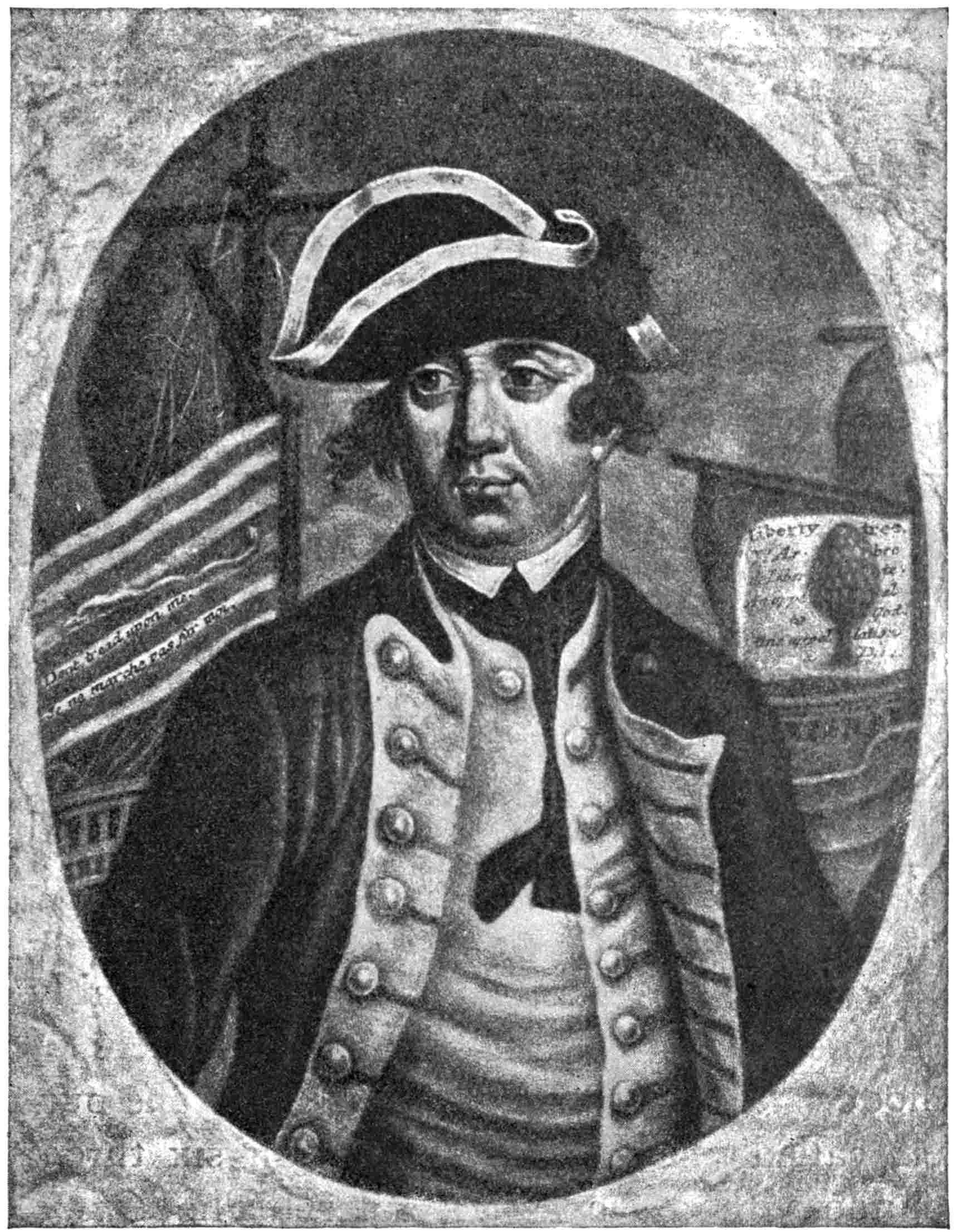
Commodore Esek Hopkins.
From a very rare English engraving.
New Providence was taken in the middle of
March, 1776. Elated by the success of his
expedition, Commodore Hopkins set sail for
the north on the 17th of that month. How
much more elated he and his crews would have
felt could they have known that at four o’clock
on that morning the British were hurriedly,
and in great confusion, leaving Boston through
fear of an assault by the troops of Washington,
may be easily imagined.
Two weeks later the American fleet had arrived
off the east end of Long Island, where,
on April 4th, the tender Hawke, of six guns,
and the bomb-brig Bolton, of twelve guns,
were captured. And then followed a conflict
that well-nigh ruined the reputation of the
first American fleet commander. It began
soon after midnight on the morning of April
6th.
With a gentle breeze, the fleet, well scattered
out—too well, in fact—was washing
along over the smooth sea between Block Island
and the Rhode Island shore. Only those
who have floated and dreamed in the soft light
of a warm night on these waters can fully appreciate
the influences of sea and air over a
sailor on such an occasion, but it was, last of
all, a night for thoughts of bloodshed. Suddenly
a large strange ship appeared in the
midst of the fleet. From the way the narrative
reads one is forced to the conclusion that
the lookouts were all at least half asleep.
The stranger was heading for the flagship
Alfred, but before she could close in, the crew
of the little brig Cabot, Capt. John Burrows
Hopkins, woke up, and, ranging alongside,
they hailed her.
For a reply the stranger fired a broadside,
and so began the first naval battle of the first
American squadron.
The brave captain of the Cabot returned the
fire, in spite of the great superiority of the
stranger, and still bravely stood to his duty,
even after a second broadside from the stranger
had partly disabled his brig, killed a number
of his crew, and wounded himself.
The Alfred, the flagship, soon came ranging
up beside the stranger and opened fire, whereat
the stranger turned his attention to her; and
then came the Providence, Captain Hazard,
who secured a position on the lee quarter (they
were all close hauled) of the enemy, where
she opened an effective fire.
By this time the Cabot was drifting out of
range, but the Andrea Doria came up to take
her place. For an hour thereafter the stranger
maintained the unequal contest, while the fleet
drifted along over the smooth sea. At one
time a shot from the stranger cut away the
tiller ropes of the Yankee flagship, leaving her
to broach to where she could not use her own
guns. At that the stranger raked her fore and
aft with a number of broadsides. But when
repairs had been made the Alfred closed in
once more, and then, at about two o’clock in
the morning, the stranger found it too hot,
and, putting up his helm, he squared away for
Newport and safety.
Commodore Hopkins pursued the stranger
until after daylight. The course lay along the
Rhode Island coast, and the people of the
region, awakened by the roar of the guns,
came hurrying to the cliffs to look away over
the smooth water, where one ship, badly cut
up aloft, was still able to keep ahead of the
fleet that followed, and fired at frequent intervals
upon the pursued.
But the ships of the American fleet were
cargo-carriers deeply loaded with the spoils of
New Providence, and the stranger was a man-o’-war
well formed and fitted for the sea. So
the chase ended when it was found that the
stranger steadily gained, and the distance from
Newport was growing so short as to warrant
the belief that the cannonading would call out
the British fleet then lying there. So the
Yankee fleet “hauled its wind,” captured a
small tender that had been in company with
the stranger, and then made port at New
London.
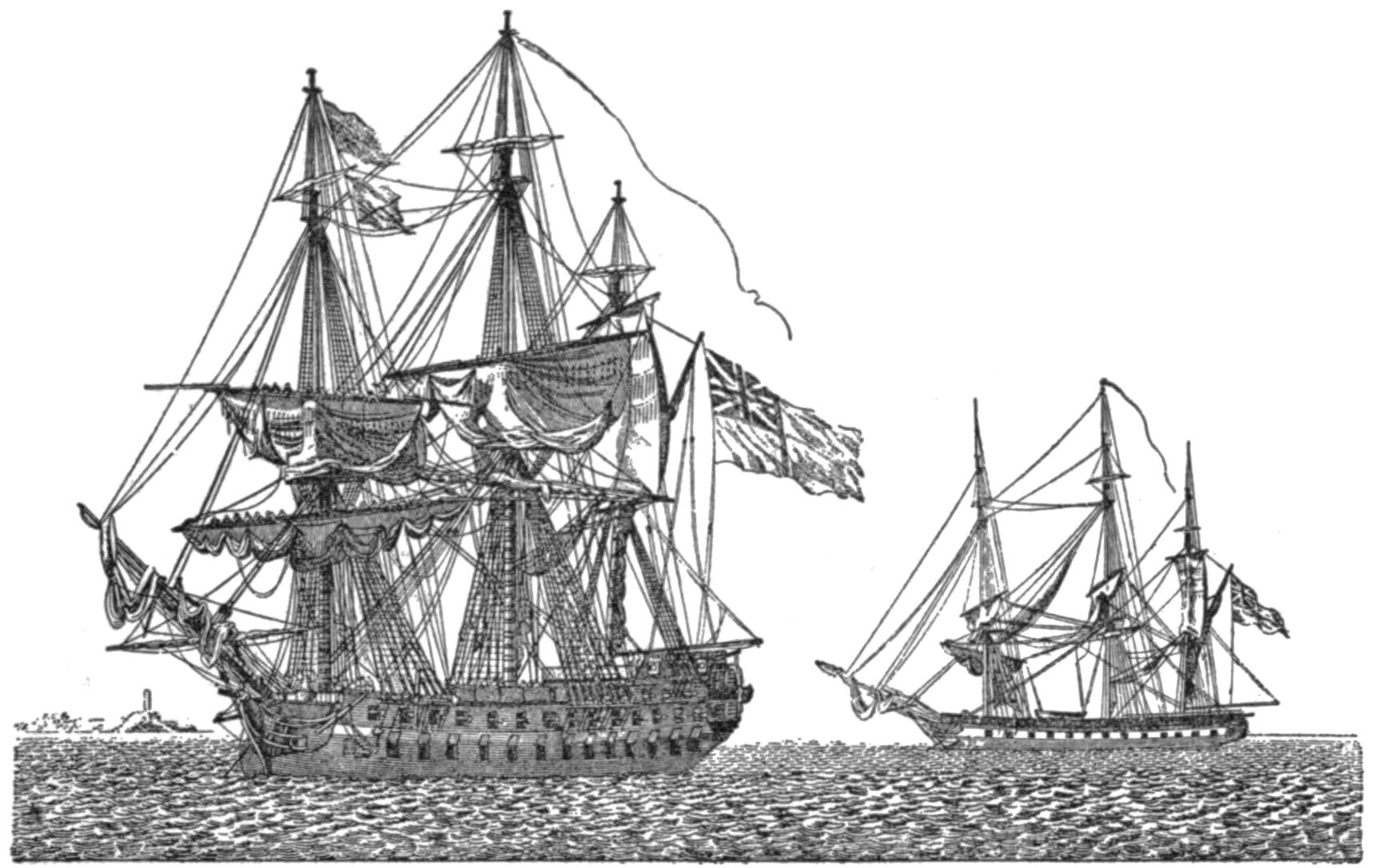
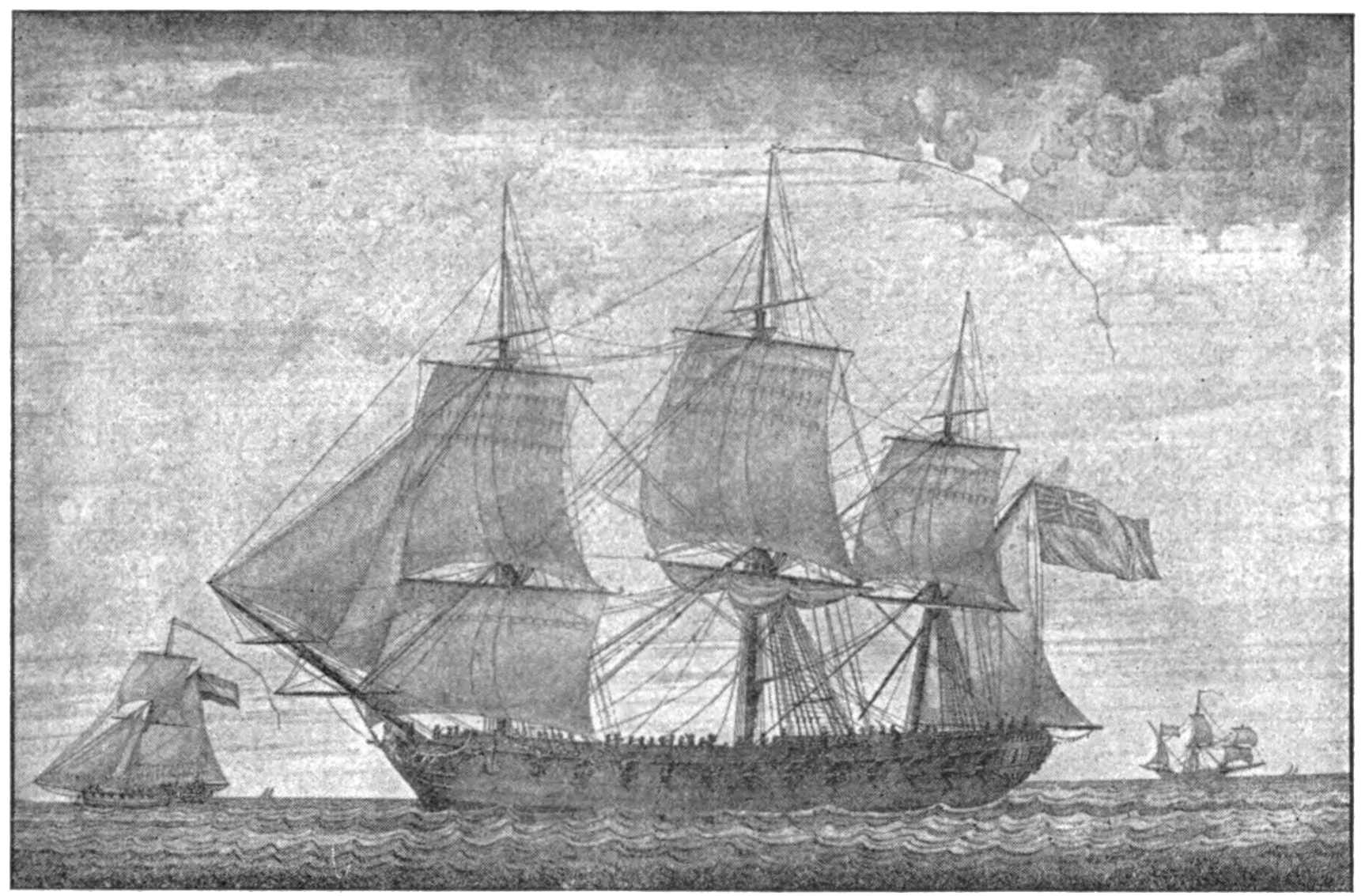
An English “Seventy-Four” and a Frigate Coming to Anchor.
From an old engraving.
When there Commodore Hopkins learned
that the stranger he had encountered was the
British sloop-of-war Glasgow, Capt. Tyringham
Howe, a full-rigged ship (three masts),
carrying twenty guns, and a crew of 150, all
told. She had lost one man killed and three
wounded, while the American loss had been
in all twenty-four killed and wounded, of
whom the little brig Cabot lost four killed and
seven wounded.
Nothing more is needed to show the superiority
of the British naval crews over the
American, at this time, than the above statement
of casualties. How that superiority was
overcome at the last will appear later on; but
if all British warships in the contests that followed
this one had been handled as Captain
Howe handled the Glasgow the story of the
American navy would not have appealed to
patriotic American pride as it now does.
As for the effect of this fight upon the
American people it should be said they were
at first elated because it was told that the
American fleet had driven off an enemy of
superior strength. But when the real facts
became known their elation was turned to
anger that was really as little founded in reason
as their joy had been. Commodore Hopkins
and his men had shown unquestioned
bravery. Considering their lack of knowledge
and experience, they had done well enough.
They had captured and brought into port military
supplies that were badly needed and could
be obtained only by capture from the enemy.
Unfortunately, the Americans overlooked this,
and thought only of the escape of the valiant
Glasgow.
The career of the first American squadron,
as a squadron, practically came to an end when
it arrived at New London, although it did
afterwards sail thence as a squadron around to
Narragansett Bay after the British left Newport.
What remains to be told of the career
of Commodore Hopkins will occupy brief
space. In the month of June the Congress
investigated his case. His good friend John
Adams defended him successfully. It was
decided that he had exceeded his orders in
going east of Long Island, for he had been
directed to “annoy the enemy’s ships upon
the coast of the Southern States,” but he was
merely relieved of his command temporarily.
On October 16th his case was considered
once more, and a vote of censure was carried.
On October 19th he was directed to take
“command of the fleet formerly put under
his care,” but he was very dilatory in getting
ready for sea, and so he was once more
summoned before Congress. This summons
he refused to obey, and on January 2, 1777,
he was dismissed from the service.
According to Lieut. F. S. Bassett, U. S. N.,
Hopkins, after the war of the Revolution,
“resided near Providence, R. I., and was
several times a member of the General Assembly
for that State, and died there on
February 26, 1802, aged eighty-four years.
He was, when made commander-in-chief, fifty-seven
years old, and, Bancroft says, old and incompetent.
His portraits show him to be a
man of vigor, and he was influential in the
political affairs of his own State. His bravery
was never called into question, but he was
doubtless not a good seaman, and was incompetent
to command the navy.”
His title of commander-in-chief was intended
to rank him with Washington, the commander-in-chief
of the army. The title was never
again conferred on an American naval man.
CHAPTER III ALONG SHORE IN 1776
BRILLIANT DEEDS BY THE FIRST HEROES OF THE AMERICAN NAVY—WHY
NICHOLAS BIDDLE ENTERED PORT WITH BUT FIVE OF
THE ORIGINAL CREW OF THE ANDREA DORIA—RICHARD DALE
ON THE SLEEK LEXINGTON—THE RACEHORSE CAPTURED IN AN
EVEN FIGHT—CAPTAIN LAMBERT WICKES IN THE REPRISAL
BEATS OFF A LARGER VESSEL—JOHN PAUL JONES IN HIS
EARLIER COMMANDS—A SMART RACE WITH THE FRIGATE
SOLEBAY—SIXTEEN PRIZES IN FORTY-SEVEN DAYS IN CAPE
BRETON REGION—POKING FUN AT THE FRIGATE MILFORD—THE
VALUABLE MELLISH—AN ABLE FIGHTER WHO LACKED
POLITICAL INFLUENCE.
A more cheerful story of the feats of Yankee
sailormen is found on turning to the
record made by individual vessels during the
period when Commodore Hopkins was at the
head of the navy list. For instance, there was
the brig Lexington (of significant name), under
the command of Capt. John Barry, who had
brought the Alfred, when she was the merchant
ship Black Prince, into Philadelphia and
sold her to the Congress. While Commodore
Hopkins was in New London explaining how
the British ship Glasgow had escaped, Captain
Barry was cruising off the Virginia capes;
and on April 17, 1776, fell in with a tender
called the Edward, armed with six or eight
guns and carrying a crew of thirty-five men
under command of Lieutenant Boucher. The
lack of skill of the Americans at this time and
the bravery of the English are both conclusively
shown by the fact that the Edward held
out for an hour, although the Lexington carried
sixteen guns and twice as many men as
the tender.
May 10, 1776, should be a memorable one
in the history of the navy, for on that day
John Paul Jones first received an independent
command. He was placed in charge of the
Providence and sent to carry troops to New
York. What he subsequently accomplished
with his little twelve-gun brig will be told further
on.
On May 16th the Andrea Doria, Capt.
Nicholas Biddle, was ordered to sea. For
four months she cruised between the capes of
the Delaware and the coast of Maine, and during
that time she captured ten prizes, all but
one of which reached port safely. Two of
these transports had 400 British troops on
board. The British frigate Cerebus recaptured
one of these transports, and the prisoners managed
to retake the other, but they were again
captured and taken in. When Captain Biddle
at last brought his little brig into port he had
but five of his original crew on board. The
others had all been sent away in prizes and
their places supplied by volunteers from the
vessels captured.
John Barry
From an engraving of the portrait by Chappel.
As will appear further on, Nicholas Biddle
was one of the most heroic men known to the
American naval register. He was one who
knew his duty, and no odds of force against
him deterred him in doing it.
The next of the squadron to get to sea was
the brig Cabot, of fourteen guns. She sailed
under Capt. Elisha Hinman the latter part of
May, and was gone until October 5th. She
sent in seven prizes during this time.
Even the crank old Columbus made a successful
cruise. Under the command of Capt.
Abraham Whipple, whose paving-stones had
captured the Gaspé, she took four prizes while
at sea between May and August.
Meantime the schooner Wasp, under Capt.
Charles Alexander, took the British bark
Betsey on May 9th, while in October, under
Lieutenant Baldwin, she captured three more
prizes.
Facsimile of Account between Dudley Saltonstall and Elisha Hinman.
From the original at the Lenox Library.
A notable event of the year was the adventure
of the Lexington under Capt. William
Hallock. She was returning from the West
Indies loaded with powder and other military
stores, when she was captured by the British
frigate Pearl. There was such a high sea
running at the time that the captain of the
Pearl decided, after taking four or five men
out of the Lexington, not to transfer the rest
of her crew to his own ship. So he placed her
in charge of a prize crew, with orders to follow
the Pearl.
As night came on, the gale increased and
the sea became more boisterous. The prize
officers, thinking no danger was to be apprehended
from the prisoners under such circumstances,
slacked up in their vigilance, and
eventually both the prize captain and the
officer of the deck went below for a comforting
toddy. At that the watchful Yankees
knocked the British sailor from the tiller and
the guards to the deck, secured the companionway
against the exit of the officers, and,
putting up the helm, headed away for Baltimore,
where they arrived safely.
A leading spirit in this recapture was Master’s
Mate Richard Dale, who afterwards, as
the executive officer of the Bonhomme Richard,
under John Paul Jones, won lasting
honor.
Another stirring event of this year was the
fight between the Yankee brig Andrea Doria
and the British brig Racehorse. It was the
more stirring for the reason that the Racehorse
had been sent out expressly to capture
the Yankee, and it was a fair and even match,
ship for ship.
The Andrea Doria was under command of
Capt. Isaiah Robinson. Captain Robinson, in
the sloop Sachem, had, on July 6th, two days
after the colonies had declared their independence
of Great Britain, captured a British vessel
of six guns and brought her into port.
For his success in this he was transferred to
the brig Andrea Doria, and sent to the Dutch
port of St. Eustatius to get arms and ammunition
for the American army. It is worth
mentioning, perhaps, that he received a salute
from the governor of the port (the first salute
the flag ever received from a foreign power),
although the governor was afterward removed
from office at the request of the British, for
firing it. Having taken in his cargo, Captain
Robinson steered for home, but off the western
end of Porto Rico fell in with the Racehorse,
and during the next two hours the
sun-lit tropical seas were the scene of what
was probably the first even sea contest of the
Revolution. It ended in the surrender of the
Racehorse after her captain, Lieutenant Jones,
had been mortally wounded. The Andrea
Doria lost four killed and eight wounded.
The loss on the Racehorse was “considerably
greater.”
Captain Robinson brought both vessels
safely into the Delaware, but there the career
of the little Andrea Doria came to an end, for,
before she could get to sea again, she had to
be burned to prevent her falling into the
hands of the enemy, who captured Philadelphia
about that time.
St. Pierre, Martinique.
From an old engraving.
Another West India fight was still more to
the glory of the young American navy, even
though the enemy was not captured. The
American brig Reprisal sailed for Martinique
early in the summer of 1776, and on the way
captured and sent home a number of prizes.
But when just outside of the port to which she
was bound she fell in with the British sloop-of-war
Shark, of sixteen guns. Not only was
the Shark the larger vessel; the Reprisal, because
of the number of prizes sent home, was
short-handed. Nevertheless, when the Shark
ranged up alongside of the Yankee and
opened fire the Yankee fought back. The
firing of the great guns brought the people of
the port by hundreds to the heights overlooking
the sea. And it was a spectacle well
worth their coming, too, for the vigor of the
Yankee defence compelled the Shark to haul
off for repairs.
The Reprisal, during this cruise, was commanded
by Capt. Lambert Wickes. As will
appear further on, it was he who first flaunted
the American flag in British waters and took
British ships within sight of the British
coasts.
The Shark afterward came into port and
demanded of the authorities that the Reprisal
be surrendered as a pirate. Of course the
authorities (they were Frenchmen) refused.
How valuable all the prizes that have been
mentioned were to the struggling colonists
cannot be told here, but the reader will remember
that at this time the American forces
were wholly dependent on foreign sources for
both powder and great guns. The Congress
had, indeed, taken steps to manufacture muskets
of “three-quarters of an inch bore, and of
good substance at the breech, the barrel to be
three feet eight inches long, the bayonet to
be 18 inches in the blade.” But there was
no factory for making these weapons, and
the individual gunsmiths employed could do
very little toward supplying an army. There
was, in short, no sort of military supplies that
was not lacking among the American forces
and no sort that these captures of the Yankee
naval vessels did not to a greater or less
extent supply.
And what was of equal importance to the
American success was the injury done to the
enemy. During the year 1776 the Yankees
captured 342 vessels, all told, “of which forty-two
were recaptured, eighteen released, and
five burned.”
But the story of the fortunes of the navy
during the first year of its existence is not
yet completed. The early adventures of John
Paul Jones are yet to be told.
It is to the credit of Commodore Hopkins
that at the end of the cruise of his fleet he
appreciated and admired the first lieutenant
of the service. As already told, he ordered
Lieutenant Jones to the command of the
twelve-gun brig Providence on May 10, 1776.
Having no blank commissions, Commodore
Hopkins wrote the new commission on the
back of the old one that Jones had received as
a lieutenant from the Congress.
For a time the Providence was used for
carrying troops and convoying merchantmen
along shore, and so successful was her new
captain in eluding the vigilant cruisers of the
enemy that he attracted the notice of Congress,
and was promoted to the rank of captain, of
which act he received notice on August 8,
1776.
With the notice that he had been promoted
came orders to cruise for prizes “between
Boston and the Delaware.” Captain Jones
was now fighting, not for the commercial
privileges of oppressed colonists, but for a new
nation struggling for recognition. There is
no doubt that since July 4, 1776, he had performed
his duty with a better heart than before
that date, because there was greater honor in
helping to establish a nation than in seeking
justice for a colony, and with men of his class
honor is all of life. In his eager search for
the enemy after his promotion, Captain Jones
stretched the territory that had been assigned
to him so that he reached the neighborhood
of the Bermudas.
Here on September 1, 1776, the lookout
discovered a fleet of five ships well to windward.
Jones believed that they were merchantmen,
and began beating up to the largest of the
fleet, but on getting closer she was found to be
a frigate—the Solebay, of twenty-eight guns.
At that Jones put his brig on the other tack,
and for nearly four hours kept beyond range,
though the frigate steadily gained upon him,
and was at the last within less than a hundred
yards, and a little on the brig’s lee quarter.
The frigate had meantime been firing at intervals
with her bow guns, though without effect.
But now the time had come when she could
yaw around, and with a single broadside cut
the little brig to pieces. Any man would
have been justified in surrendering at once
to save life, and only a man of extraordinary
bravery and resources would have thought of
doing otherwise. But Jones was the man for
the occasion.
Fortunately, the weather was precisely to
his liking—the sea was level, and yet there
was a fresh breeze to fill the sails rap-full.
Easing his vessel away from the wind a little
to give her more headway and bring her more
directly under the bows of the frigate, where
she would be in less danger of a broadside,
Captain Jones, in a low voice, passed the word
to stand by to square away before the wind
and set studdingsails high and low on both
sides. Very quickly, but without attracting
attention, the crew led out the weather-braces
and the spanker-brails, and placed the coils of
the lee-braces ready for veering away. The
studdingsails in stops were brought to the
rails, and halliards and sheets made fast. This
done, a man with a lighted match was placed
at each of the cannon on the lee side, while a
quartermaster bent the grand union flag to
the signal halliards.
John Paul Jones.
From an engraving by Longacre of the portrait by C. W. Peale.
The critical moment of the day was come,
and with thrilling nerves the crew leaped to
obey the orders that followed in swift succession.
The helm was put hard up, and as the
spanker was brailed in to the mast, the quartermaster
hoisted the colonies’ flag to the truck.
The little brig turned like a yacht square
down across the frigate’s bows, and the men
at the guns fired what was at once a salute
to their flag and a raking blast to the frigate.
And then, out of the white cloud of smoke
rolling away over her rails, rose the filmy
studding-sails to catch the helpful gale.
So sure had the crew of the Solebay been of
their prize that the sudden dash and attack
from the brig threw them into a confusion
from which they did not recover until the
Providence was beyond the reach of the grapeshot
with which most of their guns were
loaded. Moreover, the Providence now had
the heels of it, and drew steadily away. The
Solebay fired over 100 round shot, all told, but
not one took effect.
Captain Jones now headed his brig off to the
coast of Nova Scotia, where he hove to, one
day, to give his men a change in diet by
catching codfish. While engaged in this very
pleasant occupation the British frigate Milford
came down on him, and the Providence again
had to run. But Jones soon found that he
could easily outsail the Milford, so to play
with the enemy he shortened sail and allowed
her to gain. Like a fat hound on the trail,
she began to bark—to fire when a long way off,
and with no more damage to the Providence
than a dog’s bark would have been.
“He excited my contempt so much by his
continual firing at more than twice the proper
distance that when he rounded to to give a
broadside, I ordered my marine officer to return
the salute with only a single musket,”
said Captain Jones in his report of the affair
to the marine committee of the Congress.
The next day Captain Jones sailed into
Canso Harbor. It should be kept in mind at
this point that the Congress had, on March
23, 1776, resolved “that the inhabitants of
these colonies be permitted to fit out armed
vessels to cruise on the enemies of these United
Colonies”—the restriction that made prizes of
the enemy’s men-of-war and transports only
was entirely removed. The Congress had
been driven to this step, of course, by the
many outrages committed on the colonial
coast by the British cruisers. Acting under
this authority, and remembering these outrages,
Captain Jones found in Canso three English
schooners. He burned one, sunk another,
and loaded a third with the cargoes of the
other two.
Next day he took small boats well armed
and his flagship, and went after nine dismantled
British vessels—ships, brigs, and schooners—lying
at Madame Island, on the east side of
the Bay of Canso. Finding the crews of these
vessels on shore, Captain Jones promised to
leave them enough of their fleet to take them
home if they would help him fit the rest for
sea. They agreed to this, and on September
26, 1776, Captain Jones got away with three
large and deeply laden prizes. The ship Adventure
he burned in the harbor.
After a cruise of forty-seven days, all told,
he was again in Newport Harbor, having meantime
captured sixteen prizes, besides destroying
“many small vessels” and giving the people
of Nova Scotia and Cape Breton a taste
of the fear that had been felt on the Yankee
coast. But he did not destroy the homes of
those people as the homes of Portland, Maine,
had been destroyed.
Meantime Captain Jones had learned, while
on the Cape Breton coast, that a hundred
American prisoners were kept at work as convicts
in the coal mines there, and on reaching
his home port he proposed an expedition to
liberate the prisoners and capture the coal
fleet which was appointed to sail from Cape
Breton to New York (then in the hands of the
British). Commodore Hopkins, who was still
at the head of the navy, approved the plan,
and put Captain Jones in command of the flagship
Alfred, and ordered the Providence, Capt.
Hoysted Hacker, to go with him.
On November 2, 1776, these two vessels got
under way, and on the night of the 3d passed
safely through the British squadron off Block
Island. The cruise was without incident until
off the east coast of Cape Breton, where, on
November 13th, they fell in with, and after a
brisk action captured, two British vessels, of
which one was the brig Mellish, of ten guns
and carrying 150 men. On boarding her she
was found to be loaded down with supplies
for Sir Guy Carleton, who had, during the
summer and early fall, been moving heaven
and earth to build a fleet on Lake Champlain
to sweep away the little American squadron
there and so open the trail that led to Albany,
the head of navigation on the Hudson. Sir
Guy had already been driven back by the surpassing
bravery and ability of Benedict Arnold,
as will be told further on, and because of this
defeat (it was practically a defeat) he was still
more in need of the supplies than he would
have been if successful in his plans.
Among other goods of the greatest value,
the cargo of the Mellish included 10,000 complete
uniforms.
On the same day a large fishing vessel was
captured, from which sufficient provisions were
taken to replenish the American stores, that
were already growing scanty.
The next day, during a violent northwest
gale, the Providence was separated from the
flagship, and she sailed away for Newport;
but Captain Jones held fast to his original
purpose.
Entering Canso once more, he burned an
English transport and a warehouse filled with
oil and whalers’ supplies. Continuing his voyage
along the coast, he fell in with the coal
fleet. It was under the protection of a British
frigate, but the air was “dull,” as the people
of that coast say—it was a foggy day, and Captain
Jones captured three of the largest of the
fleet.
Two days later he fell in with a British privateer
from Liverpool, out for a cruise after
merchant ships belonging to the Americans.
His hope of prize money was soon dispelled by
the guns of Captain Jones, and his ship was
added to the Yankee fleet. As she was pretty
well armed, she was manned with Yankees
under Lieutenant Saunders.
Finding now that the harbors adjacent to
the coal mines were blocked with ice; finding,
moreover, that, with the addition of 150 prisoners
to the number of men on board, he was
short of both food and water, Captain Jones
felt obliged to steer for home instead of trying
to rescue the Americans in the coal mines.
The little fleet kept well together until off
the Georges Bank, when, late in the afternoon,
the British frigate Milford, that had chased the
Providence in the last voyage, was discovered.
Knowing the speed of the Milford, Captain
Jones at once laid his plan for escape. His
own ship, the Alfred, could outsail the frigate,
but the prizes could not. The frigate was
sure to overtake them, though not until after
dark. So the captain of each of the prizes
was instructed to hold fast on the course on
which they were then sailing all night, regardless
of any signals they might see from the
flagship, and then, when day should come, to
make the best course possible to port.
When this order was fully understood Captain
Jones waited calmly for the early nightfall
of the season. The Milford was steadily gaining,
but the Alfred, with shortened sail, remained
with the prizes as if to protect them.
But when night was fully come the Alfred,
with signals aloft for her prizes to follow,
went off on the other tack, and the Milford
promptly followed, while the prizes, except
the privateer under Lieutenant Saunders, kept
on as before.
So, when daylight came, all of the prizes
but the privateer were out of sight. The privateer
was, therefore, retaken. During the afternoon
a snowstorm came up. The Milford
was still in chase of the Alfred, but the Yankee,
“amid clouds and darkness and foaming
surges, made her escape.”
The Alfred arrived safely in Boston on
December 15, 1776, but she had water and
provisions for only two days left. When there
her crew had the satisfaction of learning that
all the other prizes had arrived in safety.
The importance of the Mellish as a prize
was far greater, of course, than her mere
money value, because of the uniforms she carried.
These were at once forwarded to Washington’s
men at Trenton. So great, indeed,
had been the value of this transport, that Captain
Jones had determined to sink her if at any
time he deemed her in great danger of recapture
by the enemy, because her loss would
“distress the enemy more than can be easily
imagined.” The service which John Paul
Jones had rendered the colonies during the
fall of 1776 was greater than that of any other
man who had been afloat.
Nevertheless, on reaching port, instead of
finding rewards and promotions awaiting him,
“he was mortified by degradation and injustice.”
Commodore Hopkins, though about to
be dismissed from the service, was still commander-in-chief
of the navy. Jealous of the
growing fame of John Paul Jones, he placed
Captain Hinman in command of the Alfred
and ordered Jones back to the little brig Providence.
Nor was that the worst of the trouble
that Captain Jones had to face. The politicians
in Congress had kept the distribution of rank
in their own hands—they had, in fact, declared
on April 17, 1776, that rank should not be regulated
by the date of original appointments,
but at the discretion of the Congress. So it
was that the men in the navy who had influence
in Congress could get promotion regardless
of the quality of their services, while men
without influence had to suffer. While John
Paul Jones was on the high seas gathering
supplies for the American army the Congress
made out a new list of naval captains, and
Jones, who had been the first of the lieutenants
after a list of five captains, found himself the
eighteenth in the new list of captains, although
none of those ahead of him had rendered more
distinguished services than he or showed greater
ability as a commander, and but three or four
at most had done as well. And John Paul
Jones always wrote the word rank with a
capital R.
CHAPTER IV HE SAW “THE COUNTENANCE OF THE ENEMY”
THE STORY OF ARNOLD’S EXTRAORDINARY FIGHT AGAINST OVERWHELMING
ODDS ON LAKE CHAMPLAIN—A THOUSAND SAILORS,
OF WHOM SEVEN-TENTHS WERE PICKED MEN, ARMED WITH
THE HEAVIEST GUNS, WERE PITTED UNDER A COURAGEOUS
LEADER AGAINST 700 YANKEES, CHIEFLY HAYMAKERS, POORLY
ARMED AND WITH INSUFFICIENT AMMUNITION—SAVAGES WITH
SCALPING KNIVES AIDED THE BRITISH—A DESPERATE STRUGGLE
AT THE END—THE BEST ALL-AROUND FIGHTER UNDER
WASHINGTON.
If the naval Lexington—the first battle of
the Revolution afloat—was fought on the bar
at Providence, Rhode Island, the naval Bunker
Hill, a battle wherein glory and renown were
gained in defeat, was fought on Lake Champlain.
Not only was the moral effect of this
battle quite as great in the courage it gave
the Americans, and the pause for thought it
gave the enemy; it served to head off a victorious
invading British army bound for Albany
and the subjugation of northern New York.
Burlington Bay on Lake Champlain.
From an old engraving in the collection of Mr. W. C. Crane.
The American troops had invaded Canada,
some under Benedict Arnold going through
the Maine woods, and some under Montgomery
going by way of Lake Champlain. The
two bodies had united under the walls of
Quebec, and there Montgomery had died and
Arnold had bled in vain. The terrors of the
fierce Canadian winter and the distress of disease
had aided the British forces in driving
the Americans back, until at last, in the fall of
1776, Sir Guy Carleton, at the head of the
British, was lodged at St. John’s, at the north
end of Lake Champlain, while Crown Point
was the advance post of the Americans.
It will be remembered that at this time the
waves of this beautiful lake lapped the unbroken
wilderness, no matter what the direction
of the wind might be. St. John’s, Crown
Point, and Ticonderoga were but military
posts, and there was not even a woodsy road
for wagons on either side of the lake north of
Crown Point.
Sir Guy Carleton was confident in the belief
that the revolted colonies would soon be subjugated,
and he was full of ambition to have a
part of the glory that would cover the British
officers in their hour of triumph. His plan
was to pass Lakes Champlain and George
with the ample forces at his command, and
then slash his way through the wilderness to
Albany. Once there, the king’s ships could
come to meet him, the American territory
would be cut in two at the Hudson, and then
the end would come.
There was, indeed, when he arrived at the
north end of Lake Champlain, but one reason
why he did not press on in this victorious
career. He could not pass over the lake for
want of boats. The Americans, in their retreat,
had carried off or destroyed every boat on the
lake.
Sir Guy Carleton.
From an engraving by A. H. Ritchie.
But Sir Guy Carleton was a man of energy
as well as ambition. At his request three ships
were sent over from England in such shape
that they might be taken to pieces on reaching
the outlet of Lake Champlain. This done, the
parts were transported over the wilderness road
to St. John’s, and there set up and launched in
the lake. Meantime a British naval officer had
been busy in superintending the building of a
fleet of smaller vessels at St. John’s—a fleet on
which not only the sailors from the king’s ships
at Montreal worked, but the soldiers of the
army; and even the farmers from the Canadian
settlements were forced to turn to. Carleton
himself was ever present to force on the work.
Fortunately, the task he had set was a long
as well as a hard one. With all the men and
means at his command, he could not get ready
to sail until well on into the month of October.
But when he was ready his was a fleet fit to
terrify as well as astonish the farmers that, for
the most part, composed the American forces,
then under command of General Gates, at
Ticonderoga and Crown Point. The Inflexible,
that carried the flag of the fleet, was a ship
of 300 tons, and carried eighteen twelve-pounders.
There was one schooner called the Maria,
with fourteen guns, and another, the Carleton,
of twelve guns. There was a huge scow very
appropriately call the Thunderer, for she was
armed with six twenty-four-pounders and twelve
six-pounders, besides several brass howitzers.
There was a gondola of seven guns. There
were twenty gunboats with one carriage gun
each, the guns varying in size from nine to
twenty-four-pounders. In all, the British flotilla
included twenty-five vessels, that were
armed with eighty-nine first-class guns of that
day, and abundantly supplied with ammunition.
General Arnold.
Drawn from Life at Philadelphia by Du Simitier.
To Benedict Arnold was given the task of
preparing a flotilla to stop the invasion of Sir
Guy Carleton. Benedict Arnold was an army
officer and in command, under Gates, of militia
who were, as said, for the most part farmers.
But Arnold was a man of infinite resource,
energy, and courage. Some shipwrights and
sailmakers were brought from the American
coast, and with such materials as were at hand
he set to work to build a navy for the defence
of the lake. He had, fortunately, seen service
at sea, and the task was not wholly beyond his
experience.
When the month of October arrived Arnold
was afloat with a fleet of fifteen vessels—the
twelve-gun schooner Royal Savage, the ten-gun
sloop Enterprise, the eight-gun schooner Revenge,
the eight-gun galley Trumbull, the eight-gun
galley Congress, the eight-gun galley
Washington, the six-gun galley Lee, the five-gun
gondola Spitfire, the five-gun gondola
Connecticut, the three-gun gondola New Haven,
the three-gun gondola Providence, the three-gun
gondola Philadelphia, the three-gun gondola
Jersey, the three-gun gondola New York,
and the three-gun gondola Boston.
Two or three of the names of the vessels
built for the impending strife may be worth
noting. The British named one of their medium-sized
vessels the Loyal Convert. Arnold
named the largest of his the Royal Savage.
Carleton named another for himself, but Arnold,
less vain, went to the leaders of the
American army and to the towns of the nation
for the names of his ships.
The Royal Savage.
On the whole, the American fleet mounted
eighty-eight guns to the eighty-nine of the
British fleet, but they were inferior in weight
of metal thrown, the largest being eighteen-pounders
to the British twenty-four-pounders,
while they needed 811 men for a full complement,
but had only 700. And these were,
from a man-o’-warman’s point of view, “a
miserable set; indeed, the men on board the
fleet in general are not equal to half their
number of good men.” It was not that they
lacked good will or bravery; it was that they
were landsmen and untrained in the work
before them.
On the other hand, Sir Guy Carleton’s fleet
was manned by a thousand men, among whom
were “eight officers, nineteen petty officers
and 670 picked seamen” from the British warships
in the St. Lawrence, besides the soldiers
of the expedition. The quotation is from
Schomberg’s “History of the British Navy.”
In addition to the regular crews, the British
fleet was supported by a host of Iroquois
Indians.
Just south of the present site of Plattsburg
lies Valcour Island. The bay on the west side
of which Plattsburg stands is enclosed by a
long cape called Cumberland Head.
At daybreak on the morning of Wednesday,
October 11, 1776, Benedict Arnold’s little fleet
lay at anchor in
a line across the
north end of the
strait between
Valcour Island
and the mainland.
It was a
clear, cold morning.
A strong
northerly wind
was sweeping
through this
narrow valley
between the
Green Mountains
and the
ever-beautiful
Adirondacks.
It was just the
kind of a day
that Sir Guy
Carleton wanted
for his passage
over the lake,
and, soon after
sunrise, his fleet
came snoring
along under full
sail past Cumberland
Head.
THE BATTLE OF
LAKE CHAMPLAIN.
Because Arnold’s little fleet lay well behind
the forest on Valcour Island, Sir Guy and his
fleet drove past without discovering that any
one was there; but when they had opened out
the view from the south between Valcour Island
and the mainland, they saw that they
were exposing their rear to the Americans.
At this it was down helm and haul their tacks
and get out oars
on the smaller vessels,
but the wind
was so strong that
it was not until
after ten o’clock
that the head of
the fleet, which included
the schooner
Carleton and the
gunboats, arrived
within the channel
where the American
fleet lay.
The Action of October 11, 1776.
A. Plan of action. B. Congress galley and five
gondolas.
In the meantime
Arnold had taken the gondola Congress as
his flagship—no doubt because she was furnished
with oars, and, as a double-ender, could
be easily handled—and with two other gondolas
and the schooner Royal Savage, went
down wind to meet the enemy. He reached
them at eleven o’clock, and the battle opened
with a broadside from the British schooner
Carleton.
Fight on Lake Champlain, 1776:
A. American fleet. B. Gunboats. C. Schooner Carleton. D. Ship Inflexible. E. Anchorage
of British fleet during the night. F. Radeau Thunderer. G. Gondola Loyal Convert.
H. Schooner Maria, with Carleton on board.
In a brief time the whole of the British fleet
of gunboats and gondolas got into line, and
Arnold was obliged to beat back to the support
of the remainder of his vessels. In making
this retreat the schooner Royal Savage
was disabled by the shot of the enemy, and
before repairs could be made she grounded
hard and fast on Valcour Island. There she
was fired, and then abandoned by her crew,
who escaped to the woods on the island, where
some of them met a worse fate than death in
the fleet, for Sir Guy Carleton had sent his
Indians into the woods on both sides of the
narrow water where the action was held, and
these, of course, tortured as well as killed such
prisoners as happened to fall into their hands.
Giving little, if any, heed to the abandoned
American schooner, the British squadron
pressed into the narrow sound. The
Inflexible, because she was a square-rigged
vessel, could not be handled there, nor could
the formidable scow, but the swarms of gondolas
and gunboats were as easily managed as
the American vessels.
By the time Arnold, with the Congress, had
formed his line the British were “within
musket shot”—they were but forty or fifty
yards away, and were veering to and fro to
bring, now this broadside and now that to
bear on the American squadron, while the
Americans, meeting turn with turn and manœuvre
with manœuvre, fought back without
yielding a boat’s length. The cannon, huge
for the day and place, belched flame and
smoke. The round shot bounded along the
water to bury themselves in the soft-wood
hulls of the ships or cut away the oars with
which the hulls were managed, or flew wild to
sink at last harmless. The grapeshot drove
through the air in death-dealing squalls. The
roar of the conflict filled the valley and was
echoed back from the mountains. The smoke
clouds drifted into the evergreen forests on
both shores of the little sound. The breath
of hell mingled with the fragrant odors of
balsams and spruce and hemlock. The forest
spit flames and lead back at the Americans.
Cry answered to cry and the yell of defiance
to the war-whoop of the savage. Arnold himself,
on the deck of the Congress, led in the
thickest of the fight, cheering to the men as
they worked at the guns, and at frequent intervals
stooping over a gun to aim and fire it
with his own hands.
The region around the scene of that battle
is in these days the health resort of thousands
in the summer season. We who see
it now can hardly realize that it was the
chosen haunt of Death on that bleak October
day of 1776.
There is a paragraph in a report by Lieutenant
Hadden, of the British forces, that relates
to one branch of the British forces, and
is worth quoting. He says:
“These savages under Major Carleton
moved with the fleet in their canoes which
were very regularly ranged. On the day of
the battle, the rebels having no land force, the
savages took post on the mainland and on
Valcour Island. Thus being upon both flanks
they were able to annoy them in the working
of their guns. This had the effect of now and
then obliging the rebels to turn a gun that
way, which danger the savages avoided by
getting behind trees.”
The Fight on Lake Champlain, October 13, 1776.
1. (On right) Ship Inflexible. 2. Schooner Carleton. 3. Schooner Maria. 4. Congress galley run ashore, with other vessels blowing up. 5. Washington
galley striking. 6. Gunboat coming up.
From an English engraving published December 22, 1776.
And as for the result of the day’s work, the
quaint words of Arnold himself shall tell it:
“At half past 12 the engagement became
general and very warm. Some of the enemy’s
ships and all their gondolas beat and rowed
up within musket shot of us. They continued
a very hot fire with round and grapeshot
until 5 o’clock when they thought proper to
retire to about six or seven hundred yards
distance, and continued the fire till dark.”
The fleet of the enemy, though manned by
picked men—by men known not only for their
bravery, but for their skill in handling the
guns—was obliged to draw off to get beyond
the range of the smaller guns on the American
fleet.
The Congress, Arnold’s flagship, was hulled
by the British round shot no less than twelve
times during the afternoon, and seven of these
projectiles passed through her at the water-line.
But the crew, farmers though they
were, plugged her up and fought on as before.
General Waterbury, who was on the Washington,
fought her until he was the only officer
left on deck—her captain, lieutenant, and
master having all been killed. The Washington,
like the Congress, was full of holes
when the fight ended. The Philadelphia,
Captain Grant, sank within an hour after
firing ceased.
On the whole, the American loss for the
day was reported at “about sixty,” while that
of the British was less than forty. Two of
the British gunboats were sunk and one was
blown up.
The Americans had checked the enemy in
his advance along the lake, and had damaged
him materially, but they had suffered more
than he had, and, what was worse, had used up
nearly all their ammunition. “Being sensible
that with his inferior and crippled force all
resistance would be unavailing” on the morrow
if they remained where they were, Arnold
determined to slip away to the shelter of the
American post either at Crown Point or at
Ticonderoga.
The night came on dark and stormy and
with a northerly gale driving over the lake.
So the fleet up anchor, and “one following a
[shaded] light on the stern of the other,” they
slipped through the enemy’s line that lay
across the south end of the channel, with
Arnold on the Congress bringing up the rear,
because that was the post of danger, and at
daylight on the morning of Thursday, October
12th, they were ten miles away and under the
lee of Schuyler Island.
A View on Lake Champlain Showing the Fight of 1776.
From Hinton’s History of the United States.
At this point the fleet came to anchor and
began to make such repairs as were possible.
Two gondolas were sunk because they were
past remedy, and when the patching of the
rest had been carried far enough to enable
them to float without too much pumping,
the fleet started on. Meantime, however,
the wind shifted to the south, and the progress,
depending on the oars, was necessarily
slow.
But, although the wind retarded the American
fleet, it had retarded the British as much,
if not more. The British had discovered that
the Americans were gone as soon as daylight
came on Thursday morning, but so slow was
the progress of the square-rigged Inflexible
against the head-wind that it was not until
Friday that the British were able to overtake
the Americans.
The Americans were at this time just south
of the narrow water at Split Rock. Arnold,
with the Congress and the Washington and
four smaller (three-gun) boats, was guarding
the rear, and until noon there was an anxious
race to escape to the shelter of Crown Point—anxious
because the choice of the British fleet—the
uninjured Inflexible, with the schooners
Carleton and Maria—were in the van of the
chase, and Arnold’s rowboats were together no
match for the least of these.
But at noon, while yet some leagues from
Crown Point, the tired crews of the flying
boats had to drop their sweeps and take to the
guns, for the British ships were upon them.
The wind had shifted to the north once more,
and the British vessels, of course, got it
first.
No more desperate conflict is recorded in
naval annals than that of Arnold that day.
At the first broadside of the enemy the shattered
Washington was so injured that surrender
was unavoidable. Nevertheless Arnold
ranged up within musket-shot of the big
Inflexible and continued to fight while the
farmer crews of the four gondolas stood to
their guns and faced the storm of shot and
grape from the twelve-gun and fourteen-gun
schooners—faced the storm unflinchingly until
one-third of Arnold’s crew had been killed,
his boat reduced to a wreck, and resistance
could no longer damage the enemy.
But, though beaten, the indomitable Americans
were not conquered. They would never
give up the ships. By Arnold’s order the small
galleys were run ashore in a creek near by and
there fired, Arnold, in the Congress, covering
their retreat until their crews were safe on
shore, when he ran the Congress ashore also,
and then stood guard while his crew fired her,
“remaining on board of her until she was in
flames, lest the enemy should get possession
and strike his flag, which was kept flying to
the last.”
When the Congress was so well on fire that
she could not be saved, Arnold himself leaped
overboard, waded ashore, formed his men in
an orderly line, and marched away over a
woodsy trail. He escaped the savages that
were sent ashore seeking scalps, and safely
reached Crown Point.
The best all-around fighter under George
Washington was Benedict Arnold. As a
leader in actual combat he was simply unequalled.
Words cannot now be found to
adequately express the pity of it when it is
remembered that injustice and disappointment
at the last drove him mad.
Although this fight on Lake Champlain
was ordered on the American side by an army
officer, and the crews were chiefly landsmen,
it was unquestionably an exhibit of the early
sea power of the United States, for the ships
were built at the national expense and the
crews were in the national service.
A Description of the Engagement on LakeChamplain.
Copy of a LETTER from General Sir GUY CARLETON
to Lord GEORGE GERMAIN, Principal Secretary of State for
the American Department.
On board the Maria off Crown-Point, October 14, 1776.
My Lord,
The rebel fleet upon Lake Champlain has been entirely defeated
in two actions; the first on the 11th instant, between
the island of Valcour and the main; and the second on the 13th,
within a few leagues of Crown-Point.
We have taken Mr. Waterburg, the second in command, one
of their brigadier-generals, with two of their vessels, and ten others
have been burnt and destroyed; only three of fifteen sail, a list of
which I transmit, having escaped. For further particulars I refer
your Lordship to Lieutenant Dacres, who will be the bearer of
this letter, and had a share in both actions, particularly the first,
where his gallant behaviour in the Carleton schooner, which he
commanded, distinguished him so much as to merit great commendation:
and I beg to recommend him to your Lordship’s notice
and favour: at the same time I cannot omit taking notice to your
Lordship of the good service done, in the first action, by the spirited
conduit of a number of officers and men of the corps of
artillery, who served the gun-boats, which, together with the
Carleton, sustained for many hours the whole fire of the enemy’s
fleet, the rest of our vessels not being able to work up near enough
to join effectually in the engagement.
The rebels, upon the news reaching them of the defeat of their
naval force, set fire to all the buildings and houses in and near
Crown-Point, and retired to Ticonderoga.
The season is so far advanced, that I cannot yet pretend to
inform your Lordship whether any thing farther can be done this
year.
I am, &c.
GUY CARLETON.
List of the Rebel Vessels on Lake Champlain, before their Defeat.
Schooners
Royal Savage, 8 six-pounders and 4 four-pounders—Went
on shore, was set fire to, and blown up.
Revenge, 4 six-pounders and 4 four-pounders—Escaped.
A sloop, 10 four-pounders——Escaped.
Row-Gallies
Congress, 2 eighteen-pounders in the bow, 2 twelve and
2 two-pounders in stern, and 6 six-pounders in the sides—Blew up.
Washington, same force——Taken.
Trumble, ditto——Escaped.
The Lee, a cutter, 1 nine-pounder in the bow, 1 twelve-pounder
in the stern, and 4 six-pounders in sides——Run into a bay,
and not known whether destroyed.
Gondolas
Boston, 1 eighteen-pounder in the bow, 2 twelve-pounders in sides——Sunk.
Jersey, ditto——Taken.
One, name unknown, same force——Run on shore.
Five ditto, ditto——Blown up.
Other Vessels not in the Action.
A schooner, 8 four-pounders—Sent from their fleet for provisions.
A galley, said to be of greater force than those mentioned above——Fitting
out at Ticonderoga.
G. C.
[Over]
COPY of a LETTER from Captain DOUGLAS, of the Isis,
to Mr. STEPHENS, Secretary to the Admiralty.
Quebec, 21st October, 1776.
Having for the space of six weeks attended the naval equipment
for the important expedition on Lake Champlain, I on
the 4th instant saw, with unspeakable joy, the re-constructed ship,
now called the Inflexible, and commanded by Lieutenant Schank,
her rebuilder, sail from St. John’s, twenty-eight days after her
keel was laid, towards the place of rendezvous; taking in her
18 twelve-pounders beyond the shoal which is on this side the Isle
aux Noix, in her way up.
The prodigies of labour which have been effected since the rebels
were driven out of Canada, in creating, re-creating, and
equipping a fleet of above thirty fighting vessels of different sorts
and sizes, and all carrying cannon, since the beginning of July,
together with the transporting over land, and afterwards dragging
up the two rapids of St. Terese and St. John’s, thirty long-boats,
the flat bottomed boats, a gondola weighing about thirty tons, and
above four hundred batteaus, almost exceed belief. His Excellency
the Commander in Chief of the army, and all the other
generals, are of the opinion, that the sailors of his Majesty’s ships
and transports have (far beyond the usual limits of their duty) exerted
themselves to the utmost on this great and toilsome occasion;
nor has a man of that profession uttered a single word expressive of
discontent, amidst all the hardships they have undergone, so truly
patriotic are the motives by which they are actuated.—To crown
the whole, above two hundred prime seamen of the transports, impelled
by a due sense of their country’s wrongs, did most generously
engage themselves to serve in our armed vessels during the
expedition, and embarked accordingly. Such having then been
our unremitting toils, I am happy beyond expression in hereby acquainting
my Lords Commissioners of the Admiralty, that the destruction
of almost the whole of the rebel fleet, in two several
battles on the eleventh and thirteenth instant, is our reward. I
have recived a letter from Captain Pringle, of the Lord Howe armed
ship, who commands the officers and seamen on the Lake, and who
bestows the highest encomiums on their behaviour in both engagements.
The rebels did by no means believe it possible for us to
get upon Lake Champlain this year; were much surprized at the
first fight of the van of our force; but ran into immediate and
utter confusion the moment a three-masted ship made her appearance,
being a phenomenon, they never so much as dreamt of.
Thus have his Majesty’s faithful subjects here, (contrary to a crude
but prevailing idea) by straining every nerve in their country’s
cause, out-done them in working as much as in fighting. The
ship Inflexible, with the Maria and Carleton schooners, all reconstructions,
did the whole of the second day’s business, the flat-bottomed
radeau called the Thunderer, and the gondola called the
Loyal Convert, with the gun-boats, not having been able to keep
up with them. The said gondola was taken from the rebels the
day the siege of Quebec was raised.—The loss we have sustained,
considering the great superiority of the insurgents, is very small,
consisting of between thirty and forty men killed and wounded,
seamen, soldiers, artillery-men, and all; eight whereof were killed
outright, and six wounded, on board of the Carleton.—As to farther
particulars, I must refer you to Lieutenant Dacres, who, in
justice due to his merit, for the part he bore in destroying the rebel
fleet, I am happy in sending upon this occasion to their Lordships
in the Stag transport, as also in thereby complying with the General’s
desire, who, for the same reason, is pleased to honour him
with the conveyance of his dispatches.
Printed for R. SAYER and J. BENNETT, Map, Chart, aj
Facsimile of a copy of the original broadside at the Lenox Library.
A List of his Majesty’s Naval Force on Lake Champlain.
Twenty gun-boats, each a brass field-piece, some twenty-fours to
nines, some with howitzers.
Four long-boats, with each a carriage-gun, serving as armed
tenders.
Twenty-four long-boats with provisions.
A List of the Seamen detached from his Majesty’s Ships and Vessels in
the River St. Lawrence, to serve on Lake Champlain.
Seamen.
Isis
100
Blonde
70
Triton
60
Garland
30
Canceaux
40
Magdalen
18
Brunswick
18
Gaspee
18
Treasury arm’d Briggs
90
Fell
30
}Province armed Vessels
Lately wreck’d
Charlotte
9
Voluntiers from no ship
9
Do. from the Transports
214
Total
670
Exclusive of 8 officers, and 19 petty officers.
COPY of a LETTER from Captain THOMAS PRINGLE.
On board the Maria, off Crown-Point, the 15th of October, 1776.
It is with the greatest pleasure that I embrace this opportunity
of congratulating their Lordships upon the victory compleated
the 13th of this month, by his Majesty’s fleet under my command,
upon Lake Champlain.
Upon the 11th I came up with the rebel fleet commanded by
Benedict Arnold: they were at anchor under the island of Valicour,
and formed a strong line extending from the island to the
West side of the continent. The wind was so unfavourable, that
for a considerable time nothing could be brought into action with
them but the gun-boats; the Carleton schooner, commanded by
Mr. Dacres, (who brings their Lordships this,) by much perseverance
at last got to their assistance; but as none of the other vessels
of the fleet could then get up, I did not think it by any means adviseable
to continue so partial and unequal a combat; consequently,
with the approbation of his Excellency General Carleton, who did
Print Seller, No. 53, Fleet-Street. Price One Shilling.
me the honor of being on board the Maria, I called off the
Carleton and gun-boats, and brought the whole fleet to anchor in
a line as near as possible to the rebels, that their retreat might be
cut off; which purpose was, however, frustrated by the extreme
obscurity of the night; and in the morning the rebels had got a
considerable distance from us up the Lake.
Upon the 13th I again saw eleven sail of their fleet making
off to Crown-Point, who, after a chace of seven hours, I came up
with in the Maria, having the Carleton and Inflexible a small
distance a-stern; the rest of the fleet almost out of sight. The
action began at twelve o’clock, and lasted two hours; at which
time Arnold, in the Congress galley, and five gondolas, ran on
shore, and were directly abandoned and blown up by the enemy; a
circumstance they were greatly favoured in, by the wind being off
shore, and the narrowness of the Lake. The Washington galley
struck during the action, and the rest made their escape to Ticonderoga.
The killed and wounded in his Majesty’s fleet, including the
artillery in the gun-boats, do not amount to forty; but, from every
information I have yet got, the loss of the enemy must indeed
be very considerable.
Many particulars which their Lordships may wish to know, I
must, at present, take the liberty of referring you to Mr. Dacres
for; but as I am well convinced his modesty will not permit him
to say how great a share he had in this victory, give me leave to
assure you, that during both actions nothing could be more pointedly
good than his conduct. I must also do the justice the officers and
seamen of this fleet merit, by saying that every person under my
command exerted themselves to act up to the character of British
seamen.
A circumstantial and authentic Account of theRoadsandDistancesfromNew-York, toCrown-Point.
Miles.
From
New-York to King’s Bridge
15
King’s Bridge to Conklin’s
22
Conklin’s to Croton’s River
12
Croton’s River to Peekskill
10
Peekskill to Rogers in Highlands
9
Rogers in Highlands to Fishskills
11
Fishskills to Poughkeepsie
14
Poughkeepsie to Staatsborough
11
Staatsborough to Rhynbeck
6
Rhynbeck to Ryer Shermerhorns
10
Ryer Shermerhorns to Rininston’s Manor
14
Rininston’s Manor to Claverack
7
Claverack to Kenderhook
14
Kenderhook to Halfway-house
10
Halfway-house to Albany
10
Albany to Saratoga
36
Saratoga to Fort Edward
20
Fort Edward to Lake George
14
Lake George to Ticonderoga
30
Ticonderoga to Crown Point
15
In all
290
Of the results of the fight a few words must
be written, because their value to the Americans
was well-nigh inestimable under the circumstances.
The American fleet had fought
to the last gasp. It was well-nigh exterminated,
but it had not suffered in vain. It
taught the British that the Americans were
not only willing, but they were able fighters.
In spite of the tremendous odds against them,
at the last they had proved themselves as unyielding
as the rocks that echoed back the roar
of the conflict. Their stubborn wills bade the
ambitious Carleton pause and consider. If,
with a shattered hulk, they had kept the three
best British vessels on the lake at bay until
the gondolas were aground and on fire, and if
they were then still able to make such a murderous
fight as enabled them to fire and burn
the last ship with its flag flying till burned
away, what would they not do in resisting the
British were an attack made on Ticonderoga?
The thought was cooling to the ardor of
even Carleton. Worse yet, should he succeed
in taking Ticonderoga, these unyielding Yankees
would contest every rod of the long wilderness
route with a skill that excelled that of
Carleton’s best men. And that settled the
question that had arisen in Carleton’s mind—the
question of the advisability of continuing
on his course. As a most excellent account of
this fight, which appeared in Dodsley’s (London)
“Annual Register” says, “the strength of
the works, the difficulty of approach, the countenance
of the enemy, and the ignorance of
their number, with other cogent reason, prevented
this design from taking place.”
Having looked upon “the countenance of
the enemy,” Sir Guy Carleton changed his
mind. He decided to return to Canada. The
most glorious defeat in the annals of the
American navy had saved the nation from an
invasion that would have severed it in twain,
and probably whelmed its forces in utter
defeat.
CHAPTER V UNDER THE CRAGS OF THE “TIGHT LITTLE ISLE”
THE SAUCY YANKEE CRUISERS IN BRITISH WATERS—WHEN
FRANKLIN SAILED FOR FRANCE—WICKES IN THE REPRISAL
ON THE IRISH COAST—NARROW ESCAPE FROM A LINER—A
PLUCKY ENGLISH LIEUTENANT—HARSH FATE OF THE AMERICANS
IN THE BRITISH PRISON—STARVED BY ACT OF PARLIAMENT—DEEDS
OF THE GALLANT CONNYNGHAM—WELL-NAMED CRUISERS—A
SURPRISE AT A BREAKFAST TABLE—TAKING PRIZES
DAILY—WHY FORTY FRENCH SHIPS LOADED IN THE THAMES—INSURANCE
RATES NEVER BEFORE KNOWN.
Signal as has been the value of the services
of the little vessels of the infant navy of the
United States in their operations along the
American coast and upon the woodsy waters
of the highway from the north during the year
of the nation’s birth, the American sailors had
really only just begun to fight, and it was not
until they carried the fight into the very harbors
of Great Britain that they taught the
British merchants, who had been supporting
the British ministry in its oppression of the
colonies, a lesson they were slow to learn.
For the British merchants had looked upon
the war in America as a blessing upon their
business interests. It would be somewhat expensive
in the way of taxation, but it would
ruin their competitors, the enterprising colonists.
It is in the spirit of trade and tradesmen
of all classes to view with complacency
the little expenses that ruin competitors. But
some of the British merchants who rubbed
their hands and smiled with satisfaction as
they heard of the retreat of Washington across
New Jersey in 1776, were to wring them in
distress because of wounds in their pockets
before the end of 1777—because of ships that
were snatched away from under the very crags
of what they were pleased to term their “tight
little isle.”
“In the meantime the irruption of the Phœnix
and the Rose into the waters of the Hudson
had roused a belligerent spirit along its
borders.” These were the first British warships
to sail up the Hudson in the Revolutionary
war, and their advent was in July,
1776. The Americans had no ships to send
against them, and they commonly remained at
anchor out of reach of shore batteries. It was
because of their presence that it was proposed
to stretch an iron chain across the river at
Anthony’s Nose. Other obstructions were
prepared, but the only thing done in the way
of going afloat to attack them was when some
rafts were brought down the river chained
between a couple of old sloop hulls, the whole
of which were covered with dry fat, pine, tar,
turpentine, etc. These were fired and let
drift with the tide, but as a substitute for the
modern torpedoes they were not successful.
The war was, indeed, carried across the
stormy Atlantic in the autumn of 1776, though
only a small beginning was made that year.
To Capt. Lambert Wickes was given the
honor of commanding the first American naval
ship to cross the Atlantic. Captain Wickes,
while in command of the sixteen-gun brig
Reprisal, had, as already told, made such a
good fight when attacked by the British sloop-of-war
Shark off Martinique that he beat her
off and escaped. For this he was chosen to
carry Franklin, who had been appointed American
commissioner to France, across to Nantes.
Not only did Wickes carry his passenger
safely into port; he captured two prizes on
the way and sent them into port also. And
then, after refitting in Nantes, he went on a
cruise in the Bay of Biscay, where he captured
two more prizes, of which one was the king’s
mail packet plying between Falmouth and
Lisbon, it being the custom in those days for
the British government to employ swift brigs
of the navy on the regular mail routes.
The Phœnix and the Rose Engaging the
Fireships on the Hudson River.
From a lithograph of the painting by Serres after a sketch by Sir James Wallace.
France and England were at peace at that
time, but by carrying the prizes out to sea,
after they had been successfully brought to
port, they were readily sold to French merchants,
and the money was placed in the hands
of Franklin and the other American commissioner,
Silas Deane.
What with the enthusiasm that arose when
he saw two prizes taken under his own eyes,
and the satisfaction arising from having his
scanty means augmented by the price of the
prizes, Franklin joined heartily with the other
commissioners in urging upon the Congress
the advisability of keeping a naval force on
the European side of the water, with French
ports as a base of action. “We have not the
least doubt but that two or three of the Continental
frigates sent into the German Ocean,
with some less swift-sailing cruisers, might intercept
and seize a great part of the Baltic and
northern trade.” So wrote Franklin.
The Congress had been building some frigates,
but instead of sending one of them the
brig Lexington, armed with sixteen long four-pounders
(a brig of which something was told
in a former chapter), was sent across, under
command of Capt. Henry Johnson. Meantime
the American commissioners purchased
a ten-gun cutter called the Dolphin, which they
placed under the command of Lieut. Samuel
Nicholson, who afterwards died at the head
of the American navy.
The Lexington arrived out in April, 1777.
In June this fleet of two small brigs and one
“single-sticker” sailed out of Nantes, under
command of Captain Wickes, to prey upon
British commerce.
It had been the boast of the British sailor,
and it was still his boast, that
“Not a sail but by permission spreads.”
He sang his boast over his grog; but he was
mistaken. Captain Wickes, after a brief cruise
in the Bay of Biscay, sailed north to intercept
a fleet loaded with linen on the Irish coast.
He missed the linen ships, but he sailed twice
around Ireland, and captured fifteen prizes,
which were sent into port.
On coming back to the French coast the
little fleet fell in with a British ship of the line—a
big three-decker—that at once gave chase.
The three Americans separated, and the Englishman
followed the flagship Reprisal.
That was a close call for the Reprisal. Her
crew at the last felt so hard pressed that they
threw their guns overboard to lighten her, and
“sawed her bulwarks and even cut away some
of her timbers; expedients that were much in
favor among the seamen of the day.” She
arrived safely at the last, but the sawing of
her timbers was a mortal wound, as will appear
further on.
Not in years had the British commerce received
such a blow, although this was only a
trifle to what followed. A storm was raised
in France by the British agents. The two
countries were nominally at peace, and the
French king was not yet ready for war. So
the Reprisal and the Lexington were ordered
to leave France, “while the prizes were ordered
to leave port.”
As to the prizes, they were taken out of port
and sold as others had been sold. The Reprisal
sailed for America, but in a storm off
the banks of Newfoundland she foundered, no
doubt because her frames had been weakened
by the sawing when she was fleeing before the
British ship of the line. One man, the cook,
was picked from the wreckage by a passing
vessel.
Engraved by Ridley from a Miniature by Thos. Langdon.
Iohn Bazely Esqr.Vice Admiral.
of the Red Squadron
The Lexington was captured on September
20, 1777. She had refitted at Morlaix, whither
she had gone when chased by the line-of-battle
ship. When ordered to sail she had not a
full supply of powder on board, but was, nevertheless,
forced to go. She sailed on September
18th, and when two days outside of the port
she fell in with the man-of-war cutter Alert,
commanded by Lieutenant Bazely, and Bazely
was one of the fighters of whom British seamen
have a right to be proud. His cutter was
smaller than the Lexington, and she had but
ten cannon to the Lexington’s sixteen. The
wind was strong and the sea was rough for
such light vessels, but Bazely forced a fight,
and for two hours and a half held his own.
At the end of that time, however, his rigging
had been so badly hurt that he had to stop
fighting and make repairs. Seeing this, the
Lexington, having expended all but a trifle of
her ammunition, made sail for home, and she
would have got away had any one but the
plucky Bazely commanded the Alert. Bazely
made repairs, overhauled the Lexington, and
again opened fire. The Lexington held on
her course for an hour without being able to
reply, and in the hope that the wind would
carry away some of the cutter’s sails. But the
cutter was well found, and the Lexington was
carried into Plymouth. Lieutenant Bazely
lived to become an admiral, and there is no
doubt he earned his promotion.
The fate of the Lexington’s crew, because
like that of every American cruiser of those
days, shall be told somewhat in detail. They
were thrown into jail without trial on a charge
of high treason, and there they were deliberately
starved. On one occasion they were
glad to kill and eat a dog that strayed into
their yard. The conduct of the prison officials
in their bearing toward the prisoners
was insufferably brutal.
Because the assertion that the prisoners
were deliberately starved may seem to some
readers an exaggeration, the proof of the
statement shall be given from an English
source. It may be found on page 152 of the
“Annual Register for the Year 1781,” published
by G. Robinson, Paternoster Row,
London. In reporting the proceedings of
Parliament for June 20th of that year it
says:
“A petition was presented to the house by
Mr. Fox from the American prisoners in Mill
Prison, Plymouth, setting forth that they were
treated with less humanity than the French
and Spaniards; that they had not a sufficient
allowance of bread, and were very scantily
furnished with clothing. A similar petition
was presented to the house of peers by the
Duke of Richmond. It appeared upon inquiry
that the American prisoners were allowed
half a pound of bread less per day than
French or Spanish prisoners. Several motions
were grounded on these petitions, but
those proposed by the lords and gentlemen of
the opposition were determined in the negative,
and others to exculpate the government
in this business were resolved in the affirmative.”
Neither the French nor the Spanish were
fully fed, but by the deliberate vote of Parliament
the Americans received half a pound of
bread less per man each day than did the
French and Spanish.
At one time prisoners escaped by tunnelling
under the prison walls, and in London got on
board a vessel bound for Dunkirk. But a
press-gang found them and dragged them
back to the jail. Among their number was
Master’s Mate Richard Dale. A year after
he was recaptured he procured a British uniform.
How he got it he would never tell, not
even when the war was over, and it is therefore
not unlikely that a woman brought it to
him. With that on, he walked out of the jail
in open day and escaped.
Meantime another American cruiser had
been at work on the British coasts with notable
results. The American commissioners in
France had purchased a fast cutter, which they
equipped as a man-of-war. They named her
the Surprise, and that proved to be a very
appropriate name. Capt. Gustavus Connyngham
was placed in charge of her, his commission
being one of the blank ones which
had been given to the commissioners to fill
out at their own discretion. It was dated
March 1, 1777, and Captain Connyngham got
away to sea on May 1st, but he had a deal of
trouble before he found himself fairly afloat.
To avoid complications with the French government
he was obliged to send ashore all
his cannon and warlike supplies and load his
vessel with merchandise for Norway. In this
way he left port. Then, when well outside,
he met by appointment a vessel that had his
equipment and crew, and effected a transfer.
But the government had suspected that he
was going to do this, and had compelled him
to give bonds not to do it. Two men were
hired to sign the bond, but one of them found
he had made a bad bargain, even though he
had signed it with his eyes open, for when the
first prize made by the Surprise came in he
was haled away to the Bastile, while the prize,
in which he was to have a share, no doubt,
was given up to the English without legal
process. The names of the bondsmen are
recorded simply as “Allen and Hodge.”
Hodge was the chief unfortunate, but he was
released after six weeks.
The prize was the ship Joseph. She was
captured the third day out. Four days later
(May 7th), while cruising off the coast of Holland,
the Surprise fell in with the British
packet brig Prince of Orange, carrying the
mail to the north of Europe, and having a
number of passengers on board.
It is likely that no ship’s company were ever
more completely surprised than were the people
on the Prince of Orange. It was early in the
forenoon when the Surprise came alongside and
carried the packet by boarding. Not a gun
was fired, and so little noise was made that
not a soul below decks knew that anything
out of the usual course was occurring until
the Yankee captain coolly walked down the
companionway and found the captain of the
Prince of Orange and his passengers eating
breakfast very comfortably.
Because of the mails on board this packet
Captain Connyngham decided to carry his
prize into port at once.
It will be remembered that the capture of
this mail packet happened but a few weeks
after the capture of the Lisbon packet. So,
as may be supposed, the arrival of the Surprise,
with the Prince of Orange as a prize,
created a tremendous excitement among the
English. The British ambassador at Paris
demanded that Connyngham and his crew be
surrendered for trial as pirates, and threatened
to leave the country if the demand was not
complied with. As the French government
was not yet ready for war, and the firm attitude
of the English compelled seeming compliance
with the demand, Connyngham was
arrested and his commission taken away from
him. The British ambassador sent for two
sloops-of-war to come over and convoy the
Surprise and the Prince of Orange across to
England. For a time it looked as if the audacious
Americans would really be hanged as
pirates by the infuriated Englishmen.
But in those days much time was required
for completing matters of diplomacy, and the
American commissioners, with their agents,
were working day and night not only to save
Captain Connyngham, but to send him once
more on a cruise against the enemy. Another
swift cutter was procured and secretly armed
with fourteen six-pounders and twenty swivels,
while a crew of 106 men was shipped. The
new man-of-war was very properly named the
Revenge, and before the sloops-of-war had arrived
from England Captain Connyngham
had, “with some address and intrigue,” been
released from prison and supplied with a new
commission and sent away to sea.
It was on July 18, 1777, that the Revenge
left port, and she was the fifth ship of the
American navy to cruise in England’s home
waters. If the Surprise had astonished the
British seafaring folks, the Revenge astounded
them. And it must not be forgotten that the
little fleet of three vessels under Captain
Wickes had already gone to sea on the same
errand.
It is recorded that the Revenge “proved a
remarkably successful vessel, taking prizes
daily,” which were, for the most part, sent to
Spanish ports and sold. The means so obtained
were of the utmost value to the American
commissioners already in Europe and to
those who came after, while the damage inflicted
on the British marine was, as already
intimated, something to make the British merchant
wonder whether, after all, his investments
for the ruin of American rivals were likely to
prove profitable. Nor was the injury felt alone
by those British merchants whose ships happened
to be captured. The insurance rates on
all British ships rose at one period to twenty-five
per cent., and ten per cent. was demanded
for the simple voyage from Dover to Calais.
Worse yet, the fear of the Yankee cruisers became
so great that shipments in British vessels
were so far abandoned that “forty sail of
French ships were loading in the Thames on
freight; an instance never before known.” An
escort was asked for and received for British
ships in the trade with Ireland, “something
that had never been known even in the wars
with France.”
But the best of the story of Captain Connyngham’s
cruise remains to be told. Having
been considerably injured by a gale, the captain
felt obliged to go into port for repairs.
To return to a French port was extremely
dangerous because the whole French coast
was closely watched and because even were
he found safely in port he would be very likely
delivered over to the English, so he sought
safety in audacity and found it. Disguising
his cutter as best he might with the paint and
materials in store, he entered an English port
(the name of which is not recorded), thoroughly
refitted, and sailed away unsuspected. Some
time later he entered an Irish port and got a
full supply of provisions, paying for them with
drafts on his agent in Spain. Later still he
refitted at Ferrol, and then sailed for America.
It is not uncommon for people to speak in
these days of such deeds as Captain Connyngham’s
as if they were something of the past that
might never be repeated. They do not realize
that every class graduated from the Naval
Academy at Annapolis contains men of equal
bravery and resources—men needing only the
opportunity to show their metal.
It must be noted here that the British ministry
chose to make a distinction between the
two ships fitted out wholly in the French ports
(the Surprise and the Revenge) and those that
had come over from America; they made a
distinction in spite of the fact that these two
were fitted out by the American commissioners
of the American government that had maintained
itself for a year. The Surprise and
the Revenge were denounced as pirates, and
Connyngham as a pirate commander.
Unfortunately for Connyngham, he was captured
in a privateer early the following year
after his cruise on the English coast. What
treatment he then received cannot be given in
detail here, but if the British authorities were
willing to starve the prisoners from the Lexington,
which was then conceded to be a lawful
ship of war, one may rest assured that it
would have been kinder to Connyngham to
hang him out of hand. He would, indeed,
have been hanged but for the fear of retributive
justice being meted out to prisoners in
the hands of the Americans. So, to put it
bluntly, they tortured whom they dared not
kill, until the Congress, on July 17, 1778,
passed a resolution formally demanding the
reason why he was “treated in a manner contrary
to all the dictates of humanity and the
practice of civilized nations.” And yet, in
spite of the pitiful sufferings of Connyngham
and the other American seamen in British
prisons, it was not until July 15, 1779, that
Congress resolved to “cause the crews of vessels
captured from the enemy to be confined
on board prison ships and supplied and treated,
in all respects, in the same manner as the
crews of vessels belonging to these United
States, and captured by the enemy, are supplied
and treated.”
The story of the early doings of the American
navy concludes with the loss of the first
American flagship, the Alfred.
It will be remembered that the Congress
had, late in 1775, ordered quite a fleet of small
frigates built at different points along the
coast—thirteen in all. Of the whole number,
six never got to sea, for they were captured
in port by the victorious British. Among
those that finally carried the flag was the
Raleigh, a thirty-two-gun vessel, built at
Portsmouth, and a very fair ship for that time
she proved to be. Toward the end of August,
1777, the Marine Committee ordered
the Raleigh, under the command of Capt.
Thomas Thompson, and the original flagship
Alfred, which was still under the command of
Capt. Elisha Hinman, to sail for France to
procure supplies for the American army.
The two ships had been at sea only a few
days, when, on September 2d, they fell in with
a small English merchantman called the Nancy,
that surrendered without a stroke. From her
captain they learned that she had gone adrift
the day before from a big fleet bound to the
Windward Islands under convoy of one twenty-gun
ship, two fourteen-gun brigs, and one sixteen-gun
sloop.
On learning this Captain Thompson carefully
noted the positions of the different men-of-war
in the squadron, and learned the code
of signals in use in the fleet, the necessary
flags for signalling having been taken from
the Nancy. He then headed away in pursuit.
At noon on the 3d he had overhauled the
fleet, and from that time until daylight of the
4th he was busy trying to cut out some of
the merchantmen without exciting suspicion.
By signalling to the Alfred with the captured
code, he succeeded in concealing his character
effectually; but on the morning of the 4th he
gave up the hope of getting a merchantman,
and sought a fight instead. Leaving the Alfred,
that was too slow for the enterprise,
behind, he steered with closed ports right
through the fleet until in an advantageous
position on the weather side of one of the
brigs, the Druid, when he opened up his
ports, set his flag, and fired a broadside into
the unsuspecting Britisher.
The effect of the broadside upon the other
ships of the fleet was picturesque. Everywhere
the pipe of the boatswain to call all
hands was heard. On every ship the men ran
to and fro to crowd on sail, while every tiller
was thrown up or down as every ship strove
to get as far away from every other ship as
possible. For no one knew what minute another
supposed cargo-carrier would prove to
be a Yankee warship.
Meantime Captain Thompson fired volley
after volley into the Druid, receiving only a
feeble fire in return, until the brig was so well
wrecked that she had to return to England.
Her loss, according to Captain Carteret, who
commanded her, was six killed and twenty-six
wounded, he himself being among the severely
wounded.
But, although badly cut up, the Druid did
not surrender; and when the other two warships,
with several of the best-armed merchantmen
who had recovered from the panic, drew
near, the Raleigh squared away and returned
to the Alfred.
Rightly considered, it was not an exploit to
excite the pride of the American naval officer,
for the Raleigh had more guns than the two
brigs together, and should have been almost
a match for all three of the warships. American
sailors had not yet reached the efficiency
as man-o’-warsmen that afterwards made them
famous.
However, the two American ships reached
France, and loaded their supplies. On returning
they took the southern route, hoping
to meet some British merchant ships. They
met, instead of merchantmen, two British men-of-war—the
Ariadne of twenty guns and the
Ceres of fourteen.
It happened that the two Americans were
at the time (it was on March 9, 1778) far
apart, the Raleigh being hull down to leeward.
The two Britishers came down on the
Alfred, and without making very much of a
fight she surrendered. Seeing this, the Raleigh
up helm and sailed for home, where, on
his arrival, the captain was very properly relieved
from the command of the ship. What
John Paul Jones would have accomplished
had he been in command of the Raleigh that
voyage, instead of Thompson, may be inferred
from what he did when a command was given
him, as will be told in the next chapter.
CHAPTER VI JOHN PAUL JONES AND THE RANGER
THE FIRST SHIP THAT CARRIED THE STARS AND STRIPES—DASH AT A
CONVOY THAT FAILED—WHEN THE DUTCH WERE BROWBEATEN—THE
RANGER SENT ON A CRUISE IN ENGLISH WATERS—A SHIP
TAKEN OFF DUBLIN—THE RAID ON WHITEHAVEN—WHEN ONE
BRAVE MAN COWED MORE THAN A THOUSAND—THE WHOLE
TRUTH ABOUT LORD SELKIRK’S SILVERWARE, WITH THE NOBLE
LORD’S EXPRESSION OF GRATITUDE WHEN HE GOT IT BACK—HOW
CAPTAIN JONES MISSED THE DRAKE AT FIRST, BUT GOT HER
LATER ON IN A FAIR AND WELL-FOUGHT BATTLE.
A most important date in the history of the
United States is June 14, 1777, for on that day
it was in Congress “Resolved, That the flag of
the thirteen United States be thirteen stripes,
alternate red and white; that the union be
thirteen stars, white, in a blue field, representing
a new constellation.” In the annals of the
navy it is also important, from the fact that
on that day Capt. John Paul Jones was appointed
to the eighteen-gun ship Ranger, which
had been built at Portsmouth, New Hampshire.
Repairing at once to his post, Captain Jones,
in placing his ship in commission, hoisted with
his own hand the new-made flag of the Union,
and that was the first occasion on which “old
glory” was spread to the breeze on an American
naval ship. Thereafter every effort was
made to get away to sea, but the difficulties
which the struggling Americans had to overcome
in obtaining supplies were so great that
the Ranger did not sail until November 1st.
The destination of the Ranger was Nantes,
France, and her mission in European waters
was to carry on the work begun in such famous
fashion by the Reprisal, the Lexington, the
Surprise, and the Revenge.
On the way over Captain Jones, when not
far from the Azores, sighted a fleet of ten
well-guarded merchantmen. The warships
were too heavy for the Ranger, and the merchant
ships kept so close to their protectors
that it was impossible to cut one of them out
of the fleet. The Ranger was not swift enough
for such a purpose. The Yankee ship-builder
had not yet learned the art of building men-of-war.
After leaving the convoy nothing happened
save the capture of two small English brigs in
the fruit trade, and on December 2d the Ranger
was at anchor in the harbor of Nantes,
then one of the most flourishing of French
ports.
From the Original in possession of Col. John H. Sherburne, Author of “The Life and Character of John Paul Jones.”
At that time the American commissioners in
France were Benjamin Franklin, Silas Deane,
and Arthur Lee. The commissioners had
been secretly building a fine frigate in Holland—the
finest afloat it was to be—but the
able British minister at Amsterdam discovered
the ownership of the new vessel and made
such a vigorous protest that the Dutch were
obliged to refuse to let the Americans have her.
That was a great disappointment to Captain
Jones, but he cheerfully obeyed the orders of
the commissioners, who decided that “after
equipping the Ranger in the best manner for
the cruise you shall proceed with her in the
manner you shall judge best for distressing
the enemies of the United States, by sea or
otherwise, consistent with the laws of war.”
Accordingly on February 10, 1778, the
Ranger sailed from Nantes, having in convoy
several American merchant ships that were
bound home, and that were to be placed in
charge of a French squadron then lying in
Quiberon Bay (Brest) and bound eventually
for America; for France had by this time acknowledged
the United States as an independent
nation, and had decided to openly aid the
Americans in their fight for liberty.
On reaching Quiberon Bay he had the great
satisfaction of seeing the French admiral salute
the American flag after the Ranger had, under
the custom of such occasions, saluted the
French flag. It was an honor especially gratifying
for the reason that this was the first
occasion on which a foreign power saluted the
Stars and Stripes.
Having overhauled his rigging and taken
on additional supplies, Captain Jones sailed
from Brest on April 10, 1778, and steered
across to the coast of England. Passing between
the Scilly Islands and Cape Clear, he
overhauled a brig loaded with flax bound from
Ireland to Ostend. As she was of small value
he scuttled her, and to save himself the bother
of prisoners, sent her crew ashore in their boat,
for the capture was made in plain view of the
land. This was done on April 14th. Three
days later he was off Dublin, where he seized
the ship Lord Chatham and sent her to Brest.
Thereafter he headed away to Whitehaven,
that is found a short distance south of the
Clyde. It was a port with which Jones was
entirely familiar, for there he had passed his
childhood. It was his intention to burn the
shipping which, as he knew, thronged the
harbor. He arrived off the harbor at ten
o’clock at night of the same day he captured
the Lord Chatham, but a gale of wind prevented
his landing, so he cruised on to the
north. The next day (April 18th) the Ranger
chased a revenue cutter that escaped him, but
on the 19th he sank a coasting schooner loaded
with barley.
Map of the BRITISH ISLES AND THE COAST OF FRANCE.
Showing first and second voyages
of Capt. John Paul Jones, and
the route of the Reprisal.
Thereafter he continued his cruise to the
north. The weather prevented an attack on
a fleet of merchantmen with a man-of-war at
Lochryan, so the Ranger was headed across to
the Bay of Carrickfergus, Ireland, at the head
of which lies the city of Belfast. A fisherman
picked up outside told Captain Jones that the
man-of-war Drake, a ship that mounted twenty
guns and was a larger ship and carried more
men than the Ranger, lay at anchor inside.
All this was learned on April 21st. That
night Captain Jones undertook capturing the
Drake as she lay at anchor. Waiting until
night had fully come, he stood up the bay, in
spite of a freshening gale, until he saw the
Drake lying at anchor and rolling gently to
the swell. At that the Ranger was brought
up into the wind almost beneath the jibboom
of the Drake, and then Captain Jones ordered
his anchor let go.
Had his order been obeyed instantly, the
Ranger would have swung to her cable down
across the cable of the enemy and then yardarm
to yardarm fair alongside.
Knowing nothing of the presence of an
American man-of-war in those waters, the crew
of the Drake would have been found in their
hammocks and the Ranger would have carried
her by boarding, with little if any loss of life.
Unfortunately, the Ranger’s anchor was not
dropped at the word, and when, at last, it did
catch in the mud, Captain Jones found himself
between the Drake and a lee shore and too far
astern for effective firing. The Ranger was,
in fact, in almost as bad a situation as that in
which Jones had intended to place the Drake.
To remain was to invite destruction, so the
Ranger’s cable was cut the instant she brought
a strain upon it, and she was headed out into
the bay for another attempt at the same manœuvre,
leaving the anchor watch of the Drake
to wonder what possessed the crew of what
they supposed was an especially ill-managed
merchantman.
However, the second attempt was not made.
The weather came on fierce and cold, and the
next morning, from his deck in the North
Channel, Captain Jones saw the hills on both
shores white with snow. So he headed away
for another attempt on the shipping at Whitehaven.
Because the attempt on Whitehaven has
been more persistently misrepresented by
British writers than any other act of the Revolutionary
war it is necessary to give not only the
exact facts, but the reasons which influenced
Jones as an American naval officer in making
the descent. To fully appreciate his motives,
it is only necessary to recall but a few incidents
of the British onslaught upon the Americans—to
recall the burning of Portland, Maine, by
Captain Mowatt, who “dispersed at a late
season of the year, hundreds of helpless women
and children, with a savage hope that those
may perish under the approaching rigours of
the season, who may chance to escape destruction
from fire and sword”—to recall that
among the accounts which Sir Guy Carleton
turned in for audit to the British Parliament
was one item of “five gross of scalping knives,”
which he distributed to the savages under his
command for use on the unfortunate Americans
that they might fall upon, and which were
used for scalping women and children as well
as prisoners of war.
John Paul Jones went ashore on the British
coast to burn the British shipping and no more.
He was determined to “put an end, by one
good fire of shipping, to all the burnings in
America.” He was also determined to capture
an earl to hold as a hostage, and compel
a brutal enemy to treat captured Americans
as civilized nations have always treated
prisoners of war. He missed the earl, and his
men took the earl’s silver plate to the value
of £500, which plate Jones purchased afterwards
with his own money, and returned to
the earl with a manly letter.
An English Caricature of John Paul Jones.
(“From an original drawing taken from the Life on board the Serapis.”)
Published in London, October 22, 1779.
In view of the barbarities of which the
English had been guilty in America, and of
the retaliation which self-defence as well as
justice demanded, John Paul Jones, after his
cruise along the coast, might well and righteously
have used the words which a titled
British robber of the helpless used when
brought before Parliament to answer for his
crimes: “By God, at this moment I stand
astonished at my own moderation.”
After one hundred years have passed away
it is safe to say that every American who
reads of the events of the American Revolution
stands astonished at the moderation of
the fathers.
As to the facts of the descent on Whitehaven,
they may be soon told. Lowering two
boats after the Ranger had arrived, Captain
Jones ordered fifteen men, armed with cutlasses
and pistols, into each. Then he placed
Lieutenant Wallingsford in charge of one, and
took the other himself. Unfortunately, one
of the crew, a man named David Freeman,
had shipped with the express purpose of serving
the English whenever opportunity offered.
It is said that 220 vessels, great and small,
lay in Whitehaven harbor, of which 150 were
on the south side, where the town stood, and
the remainder were on the north. Nearly if
not quite all had been left aground by the ebb
tide—the tide that prevented Jones reaching
the shipping until daylight. Wallingsford
was sent to fire the shipping at the north,
while Jones landed at the town.
Whitehaven was guarded at that time by
two forts of fifteen guns each. With his single
boat’s crew Jones ran to the nearest one.
The sentinels, greatly alarmed, fled into the
guard-house, where Jones locked them in.
Then he spiked the guns. At the other fort,
a quarter of a mile away, he was equally
successful.
Turning, then, to see the flames rising from
the ships across the harbor, he found that
nothing had been done to them. Lieutenant
Wallingsford’s failure to obey orders has been
variously accounted for, but whatever his error
may have been, he wiped it out by fighting for
the flag till he died in the battle of two days
later.
Seeing his plan partly frustrated, Captain
Jones hastened back to the water-front, and
with his own hands built a fire on a large vessel
in the midst of the fleet, using a brand
which he had snatched from the breakfast fire
in the kitchen of a nearby house. To increase
the flames, he broke open and spilled a barrel
of tar over the light-wood he was firing.
Meantime the deserter had been alarming
the town. “The inhabitants began to appear
in thousands.” There must have been not less
than 1,200 sailors alone among the 150 ships
lying there. As the flames mounted in air
above the burning ship the men of the town
came down en masse, but Jones stood between
them and the fire, and, with pistol in hand,
“ordered them to retire, which they did with
precipitation.” Men in a crowd numbering
hundreds fell over each other to get out of
range. A more amusing instance of the power
of a resolute man over a mob will rarely be
found in history.
For fifteen minutes John Paul Jones, single-handed,
held at bay more than a thousand
men. Then he entered his boat and rowed
away, leaving the townsmen to fight the fire
and shed tears of gratitude over the deserter
who had saved them from destruction at the
hands of fifteen men armed with cutlasses and
flint-locked, single-barrelled, shoot-if-you-are-lucky
pistols!
When Jones was well out in the bay the
people found a couple of cannon which Jones
had overlooked. These they loaded and fired.
And Jones, recalling the time when a frigate
had chased his brig in the Canadian waters,
fired a pistol in return.
From Whitehaven Jones sailed over to the
Isle of St. Mary, landed with a force of men,
and surrounded the house of the Earl of Selkirk.
It was the avowed object of this landing
to carry away the earl, “and to have
detained him until, through his means, a general
and fair exchange of prisoners, as well in
Europe as in America, had been effected.” It
was to ameliorate the condition of the Americans,
held in jail and deliberately starved, that
Captain Jones landed.
Pub. by A. PARK, 47 Leonard St.
Tabernacle Walk, London.
“Paul Jones the Pirate.”
From an old engraving in the collection of Mr. W. C. Crane.
Finding that the earl was not at home, the
men in the landing party called on their commander
to take the silverware from the castle
as fair plunder and but a just revenge for the
acts of British sailors in America, who had
not only looted the homes of the rich, but had
driven off the one cow and the one pig of the
laborer. Captain Jones permitted them to do
so. The following is the British account of
the affair, taken from Dodsley’s “Annual Register”
(London) for 1778. On page 177 it says:
“Edinburgh, April 27. The following are
the particulars of the plundering of Lord Selkirk’s
house by the crew of the Ranger, American
privateer.
“On the 23d of April, about ten o’clock in
the morning, 30 armed men came in a boat
from a privateer of 20 guns, and pretending
at first to be a press gang, the men surrounded
the house, and the officers entered
and desired to see the heads of the family. As
Lord Selkirk was then at London, Lady Selkirk
made her appearance. They soon made
known to her who they really were; said they
meant to have seized Lord Selkirk’s person
had he been at home, and to have carried him
off, but all they now asked was to have the
plate of the house. As there could be no
thought of resistance, this was at once complied
with; and having taken possession of it
they walked off and reimbarked. They behaved
civily, and only the officers presumed
to enter the house, and happily her ladyship
did not suffer from the alarm.”
With this British account of this affair in
mind, let the reader turn back and read the
British account of the burning of Portland
(then Falmouth), Maine, and so compare the
American deed with that of the British.
The silver taken was of the real value of
£500, but when it was sold for the benefit of
the crew Jones bought it and returned it at his
own expense—at a cost of £1,000, all told—to
the noble Lord. In August, 1789, years after
the plate was returned, the earl was constrained
to write Jones that, “notwithstanding
all the precautions you took for the easy and
uninterrupted conveyance of the plate,” there
were considerable delays; nevertheless, it arrived
safely. “I intended to have put an article
in the newspapers about your having
returned it,” he adds, but his good intentions
miscarried. However, if he did not publicly
acknowledge the honor of the American naval
captain who had spent $5,000 to return the
plate, he privately “mentioned it to many
people of fashion,” so reads his letter. The
British historians deliberately omit mentioning
that Jones returned the silver.
After the descent upon the Isle of St. Mary’s
the Ranger still lingered on that coast. Captain
Jones knew very well that many cruisers
were already under orders to seek him; but
they were still far away, and he must needs try
conclusions with the Drake that he had tried
to take over in the bay near Belfast.
On the morning of April 24, 1778, he hove
to off the bay, and then filled and backed until
well along in the afternoon. The commander
of the Drake, seeing a stranger outside, sent a
young officer in a small boat to see what she
was. Captain Jones handled his ship so skilfully
that her stern was kept toward the coming
boat until she was directly under the
Ranger’s counter. Then the officer was induced
to come on board, and not until he had
climbed up the ladder and reached the deck
did he know that he was on a Yankee cruiser.
Finding his officer did not return, the commander
of the Drake got under way. Meantime
signal fires had been built on every hilltop
along both coasts, and the black columns
of smoke were rising high in air. Moreover, a
fleet of five excursion boats crowded with curious
spectators was seen following the British
man-of-war. But the wind was light and the
tide against him, and it was not until an hour
before sunset that the Drake’s captain was able
to bring his ship within fighting range of the
Yankee. Finally he found himself under the
lee quarter of the Ranger and but a pistol-shot
away. There he hoisted his colors. Captain
Jones at once ran up the Stars and Stripes.
“What ship is that?” said a voice on the
Drake.
“It is the American continental ship Ranger.
We are waiting for you. The sun is but little
more than an hour from setting. It is therefore
time to begin,” replied Captain Jones.
Then turning to the man at the wheel, Captain
Jones ordered the helm hard up. The Ranger
wore slowly around, and the Drake followed
her motion until they were drifting broadside
to broadside and yardarm to yardarm fair before
the wind.
And then Captain Jones opened the battle
with a broadside. The enemy replied in kind,
and as fair a fight as naval annals record was
begun. But after a little the fore and main
topsail-yards of the Drake were cut in two at
the masts and hung useless. The mizzen-gaff
was shot away and dropped. The jib fell and
dragged overboard in the water. The rigging
and sails were in tatters. Worse yet, blood
was trickling from her scuppers because of the
dead and wounded on her deck. Among the
dead at the last was her commander, Captain
Burden, who was killed by a musket-ball
through his brain. Among the wounded was
the first lieutenant, and he was mortally hurt.
The flag first spread on the Drake was shot
away, but they raised another. This, too, was
shot away, and falling overboard, it dragged
in the water. A little later, and just as the
sun was going down behind the Irish hills, a
cry for quarter was raised on the Drake, and
the battle came to an end.
The Ranger in this fight had eighteen guns.
The Drake carried twenty. The Ranger’s
crew numbered 123. The Drake had 151
men on her books, and, in addition to these,
had taken on a number of volunteers from the
shore, who had been anxious to help whip the
Yankees. These raised the number of her
crew to 160 by the lowest account and 190
by the highest. The Ranger lost two killed,
including Lieutenant Wallingsford, and six
wounded. The Drake lost forty-two killed
and wounded. It is fair to say that the British
account of the battle in Allen’s history
says the loss was but twenty-four. But Allen
probably counted only those killed and
wounded among the ship’s regular crew and
ignored the volunteers, while the Americans
counted the corpses and men under the surgeon’s
care.
The odds had been against him, but the
honors remained with John Paul Jones.
After the battle a merchant brig happened
along, and a prize crew was put on board of
her. Then the fishermen who had been captured
when the Ranger first arrived on the
coast were not only released, but enough gold
was given them to pay for all their losses,
together with a sail from the Drake’s outfit as
a notice to the shore people that the Yankee
had won. They went away cheering the generosity
of John Paul Jones.
And while speaking of the generosity of this
American naval captain, it should be told that,
in fitting out the Ranger on the American side,
he advanced to the American government several
thousand dollars (continental currency)
of his own money, and that he bore all the
expense of fitting and refitting her on the
French coasts before her cruise. In all, he
spent some £1,500 sterling of his own money,
and because of the poverty of the American
government he had to wait a long time to get
it back again.
It was very well written of this cruise that
“the news of the brilliant achievements of
Paul Jones electrified France and appalled
England.”
Just how much England was appalled by
the American demonstrations on her coast
may be inferred from a statement of the number
of men “raised” (i.e., gathered in by press
gangs) for her navy. In 1774 she “raised”
345 men. In 1777 she “raised” 37,458, and
in 1778 the number was 41,847.
CHAPTER VII THE FIRST SUBMARINE WARSHIP
IT WAS SMALL AND INEFFECTIVE, BUT IT CONTAINED THE GERM OF A
MIGHTY POWER THAT IS AS YET UNDEVELOPED—WHEN NICHOLAS
BIDDLE DIED—HE WAS A MAN OF THE SPIRIT OF AN IDEAL AMERICAN
NAVAL OFFICER—FOUGHT HIS SHIP AGAINST OVERWHELMING
ODDS TILL BLOWN OUT OF THE WATER—THE LOSS OF THE
HANCOCK—AN AMERICAN CAPTAIN DISMISSED FOR A GOOD REASON—CAPTAIN
RATHBURNE AT NEW PROVIDENCE—LOSS OF THE
VIRGINIA—CAPTAIN BARRY’S NOTABLE EXPLOIT—WITH TWENTY-SEVEN
MEN TO HELP HIM, HE CAPTURED A SCHOONER OF TEN GUNS
BY BOARDING FROM SMALL BOATS IN BROAD DAYLIGHT, ALTHOUGH
THE SCHOONER WAS MANNED BY 116 SAILORS AND SOLDIERS.
One of the most striking features of the
American naval service during the war of the
Revolution was its irregularity. There was
a navy continuously in existence, but the services
rendered by individual men and ships
were extremely irregular. It has already been
told how John Paul Jones, after his successful
cruise to the Cape Breton waters, had to remain
idle for many months. After his famous
cruise in the Ranger he was again idle until
the king of France furnished him a ship. Captain
Gustavus Connyngham, who gained such
a reputation in the Surprise and the Revenge
on the British coasts, was actually obliged to
seek service in a privateer, after his return
to port, for lack of other employment. Jones
had an excellent offer to do this also, but he
refused on the ground that he was not fighting
for money, but for the “Honour of the
American flag.” If men like Jones and Connyngham
were left to shift for themselves, and
without pay at that, it follows that others were
treated in like manner.
The cause of this condition of affairs is
readily found by the student in the method of
caring for the navy adopted by the Congress.
It was a method in keeping with a deal of the
work done then. First, there was a Marine
Committee of the Congress to buy ships and
send them on a single “cruise eastward.”
Later, there was a Marine Board, part congressmen
and part plain citizens, “but no two
of whom shall be from the same State.” There
was a “Continental Naval Board.” There
was a “Board of Admiralty.” There were
naval agents. The powers and duties of all
these were changed so often that no one can
follow them in less space than a large volume,
and a more wearying volume than that would
be is difficult to imagine. There was, in
short, an utter lack of system in naval affairs
throughout the whole Revolution. Worse
yet, the Congress was as lacking in funds as in
system.
The first result of this state of affairs was to
prevent the development of an esprit de corps
among the officers. As already told, Capt.
Thomas Thompson of the Raleigh ran away
and left the Alfred to her fate when the Ariadne
and Ceres overhauled her. When John
Paul Jones was towing the Drake into Brest
he saw a sail, and left the Drake for a time to
examine the stranger. While he was away
the American officer in the Drake tried to
carry her off to another port, hoping to get
her fitted out and sent on a cruise with himself
in command, independent of Captain
Jones. The list of offences of this class—the
clashing of officers where they would in this
day stand shoulder to shoulder—is distressingly
long.
Another very serious result of the mismanagement
was in the effect on the common sailors.
It was very difficult to get men for the
national ships, because the life on the privateers
was more to their liking, and the chances
of getting prize money very much greater.
And all this is worth relating because the
men of the navy won glory and were indispensable
to the ultimate victory of a growing nation,
in spite of it. The record of the naval
men as a whole was as brilliant as the congressional
management was inefficient, and
that is a condition of affairs that has since
been known in the navy.
To return to the American coast and give
an account of the more interesting naval doings
there during the time that the old flag
was winning glory in Europe, it is found that
considerable losses were sustained, though the
story is not by any means wholly depressing.
For instance, there is the story of Capt.
Nicholas Biddle. “Liberty never had a more
intrepid defender” than Nicholas Biddle. It
will be remembered that he was one of the
original captains of the navy, and was appointed
to the brig Andrea Doria, in which
he gained reputation. So, when the first of
the thirty-two-gun frigates, which Congress
ordered in 1775, was completed, Captain Biddle
was placed in command. She was called
the Randolph, and she sailed from Philadelphia
in February, 1777. Off Hatteras she
sprung her masts in a gale, and put into Charleston
for repairs. Then she sailed again, and
within a week brought in six prizes, including
a twenty-gun ship called the True Briton.
Unfortunately, a blockading squadron appeared
off Charleston at this time, and until
March, 1778, he was held there.
MAP OF THE AMERICAN COAST,
Showing Principal Battles
and Forts during the Revolutionary
and French Wars.
Meantime, however, his success had fired
the hearts of the South Carolinians, and while
he was there he had the satisfaction of seeing
them fit out four State cruisers carrying, all
told, sixty-four guns. This work completed,
Captain Biddle, with the State fleet as consorts,
sailed out to look for the blockading
squadron, but it had sailed away.
So Captain Biddle took his little squadron
down along the Caribbean coasts. Here,
east of the Barbadoes, they happened to fall
in with the British ship-of-the-line Yarmouth,
Captain Vincent.
To properly understand what followed, it
must be known that a ship-of-the-line was built
of such heavy timbers that nothing smaller
than a twelve-pounder could seriously damage
its hull. The only guns in Biddle’s squadron
that could hope to penetrate her hull were
Biddle’s own, and his ship had but thirty-two
guns to the Yarmouth’s sixty-four, and they
were smaller at that; so Captain Biddle signalled
the State cruisers to run for it while he,
in spite of the vast superiority of the enemy,
sailed boldly up to her, broadside to broadside.
Better yet, for one full hour he was able to
maintain the contest with his thirty-two small
guns against sixty-four large ones. He was
wounded, but he refused to allow his men to
carry him below, and while he was thus directing
the battle from the quarter-deck, the powder
in the Randolph’s magazine was in some
way fired, and the ship was literally blown out
of the water. Pieces of the wreck, in flames,
fell on the Yarmouth, while an American ensign,
rolled up ready to be sent aloft, in case
the one flying should be shot away, fell, unsinged,
upon her forecastle.
It was at 10 o’clock on the morning of
March 7, 1778, that this disaster occurred.
The Randolph had on board 315 men at
the time. The people of the Yarmouth supposed
that all hands had perished, and made
sail after the rest of the Yankee squadron,
though without success. On March 12th
the Yarmouth happened back over the very
water where the fight had taken place, and
there found a piece of the Randolph floating
about with four seamen upon it, who were,
of course, picked up. Captain Vincent of
the Yarmouth reported five men killed and
twelve wounded.
The little brig Cabot, of fourteen guns, that
made such a brave fight in the first cruise of
the first squadron, came to grief on the coast
of Nova Scotia. She was in command of
Capt. Joseph Olney. The British frigate Milford,
with which John Paul Jones had had so
much fun, happened along, and as the Cabot
was even slower than she, Captain Olney ran
her ashore to keep her from the enemy. The
crew barely had time to get ashore, but they
fired the Cabot before leaving. Once on shore,
they were, of course, afoot and friendless in the
enemy’s country, but Captain Olney and his men
captured a schooner and returned home in her.
This occurred in March, 1777. On April
9th, following, Capt. Dudley Saltonstall, in the
Trumbull of twenty-eight guns, captured two
British transports off New York harbor that
were laden with military stores for the British
army, and so more than retrieved the loss of
the Cabot. The Trumbull lost seven killed
and eight wounded. The only record of the
loss on the transports says that “the enemy
suffered severely.”
The year 1777 was noted for the building
of the first American submarine torpedo boat.
David Bushnell, of Saybrook, Connecticut (he
moved to Peekskill, New York, later), a most
ingenious mechanical engineer, devised a turtle-shaped
cask large enough to hold a man and
carry a torpedo containing 150 pounds of powder,
with mechanism to fasten it to the wooden
bottom of a ship and to fire it when so fastened.
Because this was the first attempt to
use a submarine vessel for the purposes of war,
and because Bushnell’s invention, fearsome as
it was, is not even yet developed to anything
like the degree of which it is capable, the description
which he wrote of the thing is well
worth giving in full, as follows:
“GENERAL PRINCIPLES AND CONSTRUCTION OF A
SUBMARINE VESSEL, COMMUNICATED BY DAVID
BUSHNELL, OF CONNECTICUT, THE INVENTOR,
A LETTER OF OCTOBER, 1787, TO THOMAS JEFFERSON,
THEN MINISTER PLENIPOTENTIARY OF
THE UNITED STATES AT PARIS.
“The external shape of the submarine vessel
bore some resemblance to two upper tortoise
shells of equal size, joined together; the
flue of entrance into the vessel being represented
by the openings made by the swells of
the shells at the head of the animal. The
inside was capable of containing the operator,
and air sufficient to support him thirty minutes,
without receiving fresh air. At the bottom opposite
to the entrance was fixed a quantity
of lead for ballast; at one edge, which was
directly before the operator, who sat upright,
was an oar for rowing forward or backward;
at the other edge was a rudder for steering.
An aperture, at the bottom, with its valve,
was designed to admit water for the purpose
of descending, and two brass forcing-pumps
served to eject the water within, when necessary
for ascending. At the top there was likewise
an oar, for ascending or descending, or
continuing at any particular depth. A water-gauge
or barometer determined the depth of
descent; a compass directed the course, and
a ventilator within supplied the vessel with
fresh air, when on the surface. The entrance
into the vessel was elliptical, and so small as
barely to admit one person. This entrance
was surrounded by a broad elliptical iron band,
the lower edge of which was let into the wood
whereof the body of the vessel was made, in
such a manner as to give its utmost support
to the body of the vessel against the pressure
of the water. Above the upper edge of this
iron band there was a brass crown or cover,
resembling a hat with its crown and brim,
which shut water-tight upon the iron band.
The crown was hung to the iron band with
hinges, so as to turn over sideways when
opened. To make it perfectly secure when
shut, it might be screwed down upon the band
by the operator, or by a person without.
“There were in the brass crown three round
doors, one directly in front and one on each
side, large enough to put the hand through.
When open they admitted fresh air. Their
shutters were ground perfectly tight into their
places with emery, and were hung with hinges
and secured in their places when shut. There
were likewise several glass windows in the
crown for looking through and for admitting
light in the daytime, with covers to secure
them. There were two air-pipes in the crown;
a ventilator which drew fresh air through one
of the air-pipes, and discharged it into the
lower part of the vessel.
“The fresh air introduced by the ventilator
expelled the impure air through the other
pipe. Both air-pipes were so constructed that
they shut themselves, whenever the water rose
near their tops, so that no water could enter
through them. They opened themselves immediately
after they rose above the water.
The vessel was chiefly ballasted with lead
fixed to its bottom. When this was not sufficient,
a quantity was placed within, more or
less, according to the weight of the operator.
Its ballast rendered it so solid that there was
no danger of its oversetting. The vessel, with
all its appendages and the operator, was of
sufficient weight to settle it low in the water.
About two hundred pounds of the lead at the
bottom for ballast, could be let down forty or
fifty feet below the vessel. This enabled the
operator to rise instantly to the surface of the
water in case of accident.
“When the operator desired to descend, he
placed his foot upon the top of a brass valve,
depressing it, by which he opened a large
aperture in the bottom of the vessel, through
which the water entered at his pleasure.
When he had admitted a sufficient quantity,
he descended very gradually. If he admitted
too large a quantity, in order to obtain an
equilibrium, he ejected as much as was necessary
by the two brass forcing-pumps which
were placed at each end. Whenever the vessel
leaked, or he desired to ascend to the surface,
he also made use of these forcing-pumps.
When the skilful operator had obtained an
equilibrium, he could row upward or downward,
or continue at any particular depth,
with an oar placed near the top of the vessel,
formed upon the principle of the screw, the
axis of the oar entering the vessel. By turning
the oar in one direction he raised the
vessel, by turning it the other way he depressed
it. A glass tube, eighteen inches
long and one inch in diameter, standing
upright, its upper end closed, and its lower
end, which was open, screwed into a brass
pipe, through which the external water had
a passage into the glass tube, served as a
water-gauge or barometer.
“There was a piece of cork, with phosphorus
on it, put into the water-gauge, condensing
the air within, and bearing the cork on its
surface. By the light of the phosphorus, the
ascent of the water in the gauge was rendered
visible, and the depth of the vessel ascertained
by a graduated scale.
“An oar formed on the principle of the
screw was fixed in the fore part of the vessel;
its axis entered the vessel, and, being turned
in one direction, rowed the vessel forward;
but being turned in the other, rowed backward.
It was constructed to be turned by the
hand or foot.
“A rudder to the hinder part of the vessel,
which commanded it with the greatest ease,
was made very elastic, and might be used for
rowing forward. The tiller was within the
vessel, at the operator’s right hand, fixed at
a right angle on an iron rod which passed
through the vessel.
“A compass marked with phosphorus directed
the course above and under water.
“The internal shape of the vessel, in every
possible section of it, verged toward an ellipsis,
as near as the design would allow; but
every horizontal section, although elliptical,
was yet as near to a circle as could be admitted.
“The body of the vessel was made exceedingly
strong; a firm piece of wood was framed
parallel to the conjugate diameter, to prevent
the sides from yielding to the great pressure
of the incumbent water in a deep immersion.
This piece of wood was also a seat for the
operator.
“Every opening was well secured. The
pumps had two sets of valves. The aperture
at the bottom for admitting water was
covered with a plate perforated full of holes,
to receive the water and prevent anything
from closing the passage or stopping the valve
from shutting. The brass valve might likewise
be forced into its place with a screw.
The air-pipes had a kind of hollow sphere
fixed round the top of each, to secure the
air-pipe valves from injury. These hollow
spheres were perforated full of holes for the
passage of air through the pipes; within the
air-pipes were shutters to secure them, should
any accident happen to the pipes or the valves
on their tops. All the joints were exactly
made, and were water-tight.
“Particular attention was given to bring
every part necessary to performing the operation,
both within and without the vessel, before
the operator, so that everything might be
found in the dark. Nothing required the operator
to turn to the right hand or the left.
“DESCRIPTION OF A MAGAZINE AND ITS APPENDAGES
DESIGNED TO BE CONVEYED BY THE SUBMARINE
VESSEL TO THE BOTTOM OF A SHIP.
“In the fore part of the brim of the crown
of the vessel was a socket, and an iron tube
passing through the socket; the tube stood
upright, and could slide up and down six
inches. At the top of the tube was a wood-screw,
fixed by means of a rod, which passed
through the tube and screwed the wood-screw
fast upon the top of the tube. By pushing
the wood-screw up against the bottom of a
ship, and turning it at the same time, it would
enter the planks. When the wood-screw was
firmly fixed, it could be cast off by unscrewing
the rod which fastened it upon the top of the
tube.
“Behind the vessel was a place, above the
rudder, for carrying a large powder magazine.
This was made of two pieces of oak timber,
large enough, when hollowed out, to contain
an hundred and fifty pounds of powder, with
the apparatus used in firing it. A rope extended
from the magazine to the wood-screw
above mentioned; when the wood-screw was
fixed, and to be cast off from its tube, the
magazine was to be cast off likewise, leaving
it hanging to the wood-screw. It was lighter
than water, that it might rise up against the
object to which the screw and itself were fastened.
“Within the magazine was a clock, constructed
to run any proposed length of time
under twelve hours; when it had run out its
time, it unpinioned a strong lock, resembling
a gun-lock, which gave fire to the powder.
This apparatus was so pinioned that it could
not possibly move till, by casting off the magazine
from the vessel, it was set in motion.
“The skilful operator could swim so low on
the surface as to approach very near a ship in
the night without fear of being discovered,
and might, if he chose, approach the stem or
stern with very little danger. He could sink
very quickly, keep at any necessary depth,
and row a great distance in any direction he
desired without coming to the surface. When
he rose to the surface he could soon obtain a
fresh supply of air, and, if necessary, he might
then descend again and pursue his course.
“EXPERIMENTS MADE TO PROVE THE NATURE AND
USE OF A SUBMARINE VESSEL.
“The first experiment I made was with
about two ounces of powder, which I exploded
four feet under water, to prove to some of the
first personages in Connecticut that powder
would take fire under water.
“The second experiment was made with two
pounds of powder, enclosed in a wooden bottle,
and fired under a hogshead, with a two-inch
oak plank between the hogshead and the
powder; the hogshead was loaded with stones,
as deep as it could swim. A wooden pipe,
descending through the lower head of the
hogshead and through the plank into the powder
contained in the bottle, was primed with
powder. A match put to the priming exploded
the powder with a great effect, rending
the plank into pieces, demolishing the
hogshead, and casting the stones and ruins
of the hogshead, with a body of water, many
feet into the air, to the astonishment of the
spectators. This experiment was likewise
made for the satisfaction of the gentlemen
above mentioned.
“I afterwards made many experiments of a
similar nature, some with large quantities of
powder.
“In the first essays with the submarine vessel,
I took care to prove its strength to sustain
the great pressure of the incumbent water,
when sunk deep, before I trusted any
person to descend much below the surface;
and I never suffered any person to go under
water without having a strong piece of rigging
made fast to it, until I found him well
acquainted with the operations necessary for
his safety. After that I made him descend
and continue at particular depths without rising
or sinking; row by the compass; approach
a vessel; go under her, and fix the wood-screw
into her bottom, etc., until I thought him
sufficiently expert to put my design into execution.
I found, agreeably to my expectations,
that it required many trials to make a
person of common ingenuity a skilful operator.
The first I employed was very ingenious,
and made himself master of the business, but
was taken sick in the campaign of 1776, at
New York, before he had an opportunity to
make use of his skill, and never recovered his
health sufficiently afterwards.
“After various attempts to find an operator
to my wish, I sent one who appeared more
expert than the rest from New York, to a fifty-gun
ship, lying near Governor’s Island. He
went under the ship and attempted to fasten
the wood-screw into her bottom, but struck,
as he supposes, a bar of iron. Not being well
skilled in the management of the vessel, in
attempting to move to another place, he lost
the ship, and after seeking her in vain for
some time he rowed some distance and rose
to the surface of the water, but found daylight
had advanced so far, that he durst not
renew the attempt. On his return from the
ship to New York, he passed near Governor’s
Island, and thought he was discovered by the
enemy; he cast off the magazine, as he imagined
it retarded him in the swell, which was
very considerable.
“After it had been cast off one hour, the
time the internal apparatus was set to run, it
blew up with great violence.
“Afterwards, there were two attempts made
in Hudson’s River, above the city, but they
effected nothing. Soon after this the enemy
went up the river, and pursued the vessel
which had the submarine boat on board, and
sunk it with their shot. Though I afterwards
recovered the vessel, I found it impossible to
prosecute the design any further. I had been
in a bad state of health from the beginning of
my undertaking, and was now very ill. The
situation of public affairs was such, that I
despaired of obtaining the public attention
and assistance necessary. I therefore gave
over the pursuit for that time and waited for
a more favorable opportunity, which never
arrived.
“In the year 1777, I made an attempt from a
whale-boat against the Cerberus frigate, then
lying at anchor between Connecticut River and
New London, by throwing a machine against
her side by means of a line. The machine
was loaded with powder to be exploded by
a gun-lock, which was to be unpinioned by
an apparatus, to be turned by being brought
alongside of the frigate. This machine fell
in with a schooner at anchor, astern of the
frigate, and concealed from my sight. By
some means or other it was fired, and demolished
the schooner and three men, and
blew the only one left alive overboard, who
was taken up very much hurt.
“After this, I fixed several kegs under
water charged with powder, to explode upon
touching anything as they floated along with
the tide. I set them afloat in the Delaware,
above the English shipping at Philadelphia, in
December, 1777. I was unacquainted with the
river and obliged to depend upon a gentleman
very imperfectly acquainted with that part of
it, as I afterwards found. We went as near
the shipping as we durst venture. I believe
the darkness of the night greatly deceived
him, as it did me. We set them adrift, to fall
with the ebb upon the shipping. Had we
been within sixty rods, I believe they must
have fallen in with them immediately, as I
designed; but as I afterwards found, they
were set adrift much too far distant, and did
not arrive until after being detained some time
by the frost; they advanced in the daytime
in a dispersed situation and under great disadvantages.
“One of them blew up a boat with several
persons in it, who imprudently handled it too
freely, and thus gave the British that alarm
which brought on the ‘Battle of the Kegs.’
The above vessel, magazine, etc., were projected
in the year 1771, but not completed
until the year 1775.
“D. Bushnell.”
The man who handled the submarine boat
in New York harbor was Sergeant Ezra Lee,
and the ship mentioned was the sixty-four-gun
liner Eagle. It is a great pity that a full record
of Bushnell’s experiments and of the experiences
of Sergeant Ezra Lee, who handled the
strange craft, was not made for the benefit of
subsequent inventors, because much useless
labor would have been saved. For instance,
every inventor who has since worked on the
idea has had to learn for himself that it is
utterly impossible to see through the water
after he has been once submerged, while other
matters of little less importance have been
worked out over and again.
The attack on the Cerberus mentioned above
was described by the British captain as follows:
“Wednesday night, being at anchor to the
westward of New London, in Black Point Bay,
the schooner I had taken, at anchor close by
me, astern, about eleven o’clock at night, we
discovered a line towing astern that came from
the bows; we immediately conjectured that it
was somebody that had veered himself away
by it, and began to haul in; we then found
that the schooner had got hold of it (who had
taken it for a fishing line), gathered it near
fifteen fathom, which was buoyed up by little
bits of sticks at stated distances, until he came
to the end, at which was fastened a machine,
which was too heavy for one man to haul up,
being upwards of 100 cwt.; the other people
of the boat turning out, assisted him, got it
upon deck, and were unfortunately examining
it too curiously, when it went off like the
sound of a gun, blew the boat to pieces, and set
her in a flame, killed the three men that were
in the stern; the fourth, who was standing
forward, was blown into the water; I hoisted
out the boat, and picked him up much hurt;
as soon as he could recollect himself, he gave
me the following description, as near as he
could remember. It was two vessels shaped
like a boat, about twenty inches long, and a
foot broad, secured to each other at the distance
of four feet, by two iron bars, one at
each end, and an iron tube or gun-barrel in
the centre, which was loose (as he had himself
turned it round with his hand); they swam
one over the other, the upper one keel upwards;
the lower swam properly, but was so
under water as just to keep the upper one a
few inches above the surface; to the after iron
bar hung a flat board, to which was fixed a
wheel about six inches in diameter, and communicated
itself to one on the upper side of
the boat, of a lesser diameter; opposite to
these was another wheel, on the flat of the
under one or loaded vessel, which had likewise
communication with the wheels of the
upper boat; it was covered with lead, and the
keel heavily loaded in order to keep it down
in the water.
“The fatal curiosity of the seamen (who
unfortunately had been bred in working in
iron) set this wheel agoing, which it did with
great ease backwards and forwards, and during
their looking at it, which was about five minutes
from the time of its being first put in
motion, it burst. Upon examining round the
ship after this accident, we found the other
part of the line on the larboard side buoyed
up in the same manner, which I ordered to be
cut away immediately for fear of hauling up
another machine, which I concluded was fast
at the end, and might burst when near the
ship.
“The mode these villains must have taken
to have swiftered the ship, must have been to
have rowed off in the stream a considerable
distance ahead of the ship, leaving one of their
infernals in shore, and floating the other at the
distance of the line, which, from the quantity
that we have got on board (near 70 fathoms),
and what the man tells me they saved in the
schooner, which was upwards of 150 fathoms
more, must have been near 500 fathom; they
at the length of this line put the other in the
water, and left it for the tide to float down,
which in this place runs very strong.
“As the ingenuity of these people is singular
in their secret modes of mischief, and as I
presume this is their first essay, I have thought
it indispensably my duty to return and give
you the earliest information of the circumstances,
to prevent the like fatal accident happening
to any of the advanced ships that may
possibly be swiftered in the same manner, and
to forbid all seamen from attempting hauling
the line, or bringing the vessel near the ship,
as it is filled with that kind of combustible
that burns though in the water.
“I am, sir, etc.,
“J. Symons.”
David Bushnell was born in Saybrook (now
Westbrook), Connecticut, in the year 1742.
He entered Yale College in 1771, and graduated
in 1775. During his collegiate career
he turned his attention to submarine warfare,
and after leaving college devoted his time and
patrimony entirely to the subject. He was
noted for his studious habits, great inventive
genius, and eccentricity. The unfortunate
issue of his projects rendered him very dejected.
Disappointed by his failures and the
neglect of the government, he went to France
at the close of the war, where he remained for
a number of years, when he returned and settled
in Georgia, under the assumed name of
Dr. Bush, desiring thus to conceal his identity
and connection with the early efforts of his
life. There he was placed at the head of one
of the most respectable schools in the State,
but subsequently engaged in the practice of
medicine, by which he amassed a considerable
fortune. He was much beloved and respected
by all who knew him, and died at the age of
ninety years, in the year 1826. By his will
his proper name became known; his executors
were required to make inquiries in the town of
Saybrook for persons of the blood and family
of Bushnell, and whoever in the opinion of
the executors was found to be most worthy,
on the score of moral worth, should be regarded
as the sole legatee. But should none
of the kindred be found to fulfil the condition
set forth in the will, the estate was to be transferred
to Franklin College, Georgia. Legatees
were found in Connecticut.
Signatures of John Manly and Hector McNeil.
The loss of the American frigate Hancock
of thirty-two
guns
followed
the capture
of the two
valuable
transports
off New
York. It was
in May that the Hancock, under Capt. John
Manly (he who in the Massachusetts schooner
Lee worked such havoc on the British store-ships
off Boston in 1775), sailed from Boston
on a cruise, having in company the Boston of
twenty-four guns under Capt. Hector McNeil.
When four days out they overhauled a strange
sail, and Captain Manly, after a bit of veering
to and fro to determine the enemy’s speed and
power, gave him a broadside. At this the
stranger tried to run for it, and with stern
chasers strove to disable the Hancock’s rigging.
But the Hancock was then one of the swiftest
American ships, and Captain Manly held his
fire until alongside, when he gave him a
broadside.
Although manifestly of inferior strength,
the enemy fought back bravely for an hour,
and then, the Boston having arrived within
range, he struck his colors. It proved to be
the frigate Fox of twenty-eight guns, Captain
Fotheringham. The Hancock lost eight in
killed and wounded, and the Fox thirty-two.
Having placed a prize crew on the Fox, Captain
Manly made the mistake of sailing too
close to Halifax, the principal British naval
station in America. Here, on June 1st, he fell
in with three British ships, the Rainbow of
forty-four guns, commanded by Sir George
Collier; the frigate Flora of thirty-two guns,
and the sloop-of-war Victor of eighteen guns.
[Over]
Facsimile of a Letter from Thomas Jefferson to Captain McNeil.
When the enemy was discovered the Boston
was well out to sea, and having the weather
gauge, she down with her helm and sailed
away. The Hancock and the Fox were close
in shore, and they were soon hard pressed.
Manly, seeing himself deserted, at once began
throwing overboard all unnecessary weights,
and so lightened his ship that he was in a fair
way to escape, when the wind failed him, although
the enemy still held enough to draw
within easy range and in a position to rake.
He was thus under the guns of the Rainbow
of forty-four guns and the Victor of twenty,
and could not turn his ship in any direction.
Of course he surrendered.
Meantime the Flora had recaptured the Fox,
although the prize crew, few as they were in
number, made a good fight.
It was the belief of Captain Manly that had
the Boston come down to engage the Flora
and so pitched the Victor against the Fox, he
would have been able to account for the Rainbow,
and when the affair came before Congress
Captain Manly’s view prevailed, and Captain
McNeil was dismissed from the service for
running away.
On the theory that ships are sent to sea to
fight to the last gasp, the fate of Captain
McNeil was merited, even though one prominent
naval historian tries to justify his conduct.
Had a Biddle or a John Paul Jones had
the Boston, one can well believe that the whole
British squadron would have been carried into
port.
As for Manly, it must be told that, in spite
of the record he had made when he was in the
service of Massachusetts—a record that had
induced Congress to put him third on the list
of captains when it made its first revision of
the list—he was permitted to leave the navy
for the privateer service after he was exchanged
and returned to port.
The naval record for 1778 opens in January,
when, on the 27th, in the Providence,
armed with twelve four-pounders, Capt. John
P. Rathburne descended on New Providence
island in the Bahamas. He landed at 11
o’clock at night with twenty-five men (half of
his crew) and released thirty odd American
prisoners confined on shore. Then he captured
Fort Nassau with its cannon and ammunition
and 300 stand of muskets. At daylight he
captured, without a fight, an armed vessel of
sixteen guns, together with five merchantmen
and another fort. A British sloop-of-war (ship)
having appeared off the port, she was fired on
from the shore, when she made haste to sail
away.
After holding the place two days and getting
all the portable munitions of war on board
and spiking the cannon, Captain Rathburne
burned two of the prizes and carried four home.
The loss of one of the new American frigates
which the Congress had ordered, the Virginia,
of twenty-eight guns, followed. She was coming
down Chesapeake Bay and grounded at
night. In the morning two British warships
were seen near by, and her commander, Capt.
James Nicholson, with his crew, took to the
boats and escaped ashore. The congressional
inquiry that followed cleared Nicholson of
blame. It is said that he went ashore not to
escape a fight, but because of very important
papers he was carrying.
A Typical Nassau Fort—Fort Fincastle.
From a photograph by Rau.
The next exploit of note was that of Capt.
John Barry, who, while in command of the
brig Lexington, had had an honorable career.
It will be remembered that the command of the
Effingham, then building in the Delaware, was
given to him and that the British captured
Philadelphia before the ship could get away
to sea. To keep the ship out of the British
hands she was moved up the river to White
Hill, New Jersey, and by order of Mr. Hopkinson
of the Navy Board was sunk. Barry and
Hopkinson had a very loud dispute over the
sinking of the Effingham, for Barry was confident
that, with the ten guns already on board
and the thirteen guns on the frigate Washington
that was in company with her, a good fight
could be made against any of the force the
British were able to send. Hopkinson became
personal in his remarks, and Barry’s
Irish blood got hot, and some things not quite
courteous were said in return; but Barry, to
his great disgust, had to sink the ship, and
afterwards, on the order of Congress, withdraw
the offensive remarks, although time had
proved him entirely right in the matter of
sinking the ship.
However, while charges were pending
against him in this matter, he led a boat
expedition down the river, carrying four rowboats
manned by twenty-seven men, all told,
past the British ships and soldiers at Philadelphia,
and arrived safely off Port Penn,
which was then in the hands of the Americans.
On the opposite side of the river lay two ships,
the Mermaid and the Kitty, with two others
not named, laden under convoy of the large
schooner Alert armed with ten guns. The
ships were loaded with food supplies for the
British at Philadelphia.
The run past Philadelphia had been made
at night, of course, and so Port Penn was
reached in broad daylight. But in spite of
the fact that the British were already astir and
the Americans in plain view, Barry with his
gallant band made a dash at the schooner, and
before the British could rally for a defence
clambered over the rail, cutlass in hand.
At that the British dropped everything and
fled below, leaving Barry to put on the hatches
and keep them there. In view of the many occasions
on which the British historians charge
the American sailors with cowardice it must
be told here that this “wild Irishman” with
his twenty-seven men beat down under the
hatches one major, two captains, three lieutenants,
ten soldiers, and 100 seamen and
marines—he captured 116 armed men with
just twenty-seven.
When he had secured them he stripped
and burned the transports, and carried the
schooner over to Port Penn. This was on
February 26, 1778.
The British sent a frigate and a sloop-of-war
down the river to recapture the schooner,
and so, finding he could not get her away to
sea, Barry was obliged to destroy the vessel,
which he did by pointing his guns down her
hatch and shooting holes through her bottom.
But he had in the meantime for two months
patrolled the lower Delaware and cut off the
British supplies to such an extent that there
was actual suffering in the British camp. He
gave them a taste, at least, of what Washington’s
brave hosts were suffering that winter at
Valley Forge. He returned to White Hill
by travelling through the forest that then
surrounded Philadelphia.
Having by this effort once more commanded
the attention of the authorities, he was sent to
the Raleigh at Boston, and on September 25,
1778, sailed away with two merchant ships in
convoy. Three days later he was a wanderer
in the unbroken forests of Maine.
The little fleet got to sea early in the morning.
At noon two sails were seen in the south, and
Captain Barry, after signalling the convoy to
steer close-hauled, ran down for a look at the
strangers. Because the wind was light it took
him the whole of the afternoon to learn their
character, but at sundown he found they were
two English frigates. At this Captain Barry
ordered the merchantmen back to port, cleared
his ship for action, and thereafter for forty-eight
hours engaged in a game of hide-and-seek
with the enemy wherein he had, now and
again, the darkness of night, the horizon, and
sundry fog-banks to conceal him.
An English Frigate of Forty Guns.
From an engraving by Verico.
On sending the merchantmen toward port
Barry took that course himself, until the darkness
wholly enveloped the enemy, when he
again resumed his course. At dawn next day
he found himself in a fog, and during the forenoon
nothing could be seen, but at noon the
fog disappeared, and then the enemy were again
seen to the south on a course parallel to Barry’s.
Seeing this, Barry came up close-hauled and
crowded on all sail, while the enemy came on
in like dress until 3 or 4 o’clock, when another
fog shut them from view. Then Barry headed
away eastwardly with a free wind, and ran so
until daylight on the 27th, when he furled the
canvas and let her drift under bare poles until
6 o’clock, while he searched the horizon for
the frigates.
Having seen nothing, Captain Barry made
sail, and held a course to the southeast until
9.30, when he again saw the enemy. At this
he came up to the wind, tacked about, and
heading away to the northwest with “a staggering
breeze,” the Raleigh made “11 knots
and 2 fathoms on a dragged bowline,” per
hour.
That was a pace that the Englishmen could
not hold, and the Raleigh soon dropped them
behind the horizon, but at noon the Raleigh
ran out of the streak of wind, as a sailor might
say, while the enemy were still holding it.
The leader of the frigates rapidly overhauled
the Raleigh after that, and at 4 in the afternoon
the Raleigh tacked to the west to see
what the force of the leader was. Captain
Barry hoped he might make a good fight with
her single-handed before the other could come
up, and at 5 in the afternoon “the Raleigh
edged away, brailing her mizzen and taking in
her staysails.” Crossing the enemy’s bows, the
Raleigh dropped down abreast of him, and set
the American ensign. The frigate, showing
fourteen guns on a side, hoisted the king’s
flag, and then the Raleigh gave her a broadside.
She replied swiftly, and at the second
fire had the good fortune to carry away the
Raleigh’s foretopmast and mizzen-topgallantmast.
She was now able to outsail the Raleigh,
and so shot ahead to get clear of the too hot
fire of the Yankee, and then began to fire at
long range while Captain Barry was clearing
away the wreck aloft. Once the wreckage
was down, however, Barry bore up and strove
to get alongside and board, but with her superior
canvas the frigate avoided this. Meantime
the other ship was coming near, and
Captain Barry, finding he could not, in his
crippled condition, maintain a fight with two,
decided to run his ship ashore on some islands
that were visible, for the fight was made off
the coast of Maine.
And then night came on with a still fading
breeze. The Raleigh, with all sail set, headed
for the coast. The frigates followed, and until
midnight the two ships drifted along with the
red flames spurting from their sides, and the
nearing cliffs echoing to the thunder of the
conflict.
At 12 o’clock the enemy hauled off for a
brief interval, but the other ship having come
up, the two renewed the conflict, and then the
Raleigh grounded.
The enemy now took positions on the
Raleigh’s quarter. Captain Barry kept the
four stern chasers working, but lowered his
boats forward and went ashore with a lot of
his men to fortify the island on which he had
grounded, being determined to fire his ship
and resist capture in any event. But while
he was away a frightened petty officer hauled
down the flag.
The Raleigh was eventually put into the
British navy, but Captain Barry and his men on
the island escaped to the mainland. The ship
that made so good a fight against the Raleigh
was the Unicorn, of twenty-eight guns. Her
consort was the Experiment, of fifty. The
Americans lost twenty-five killed and wounded,
and the Unicorn ten killed and an unknown
number of wounded—probably twenty-five or
thirty.
On the whole, the years 1777 and 1778 were
disastrous, and the record was, in a sense, to
the discredit of the American navy. Two
captains were, indeed, dropped from the naval
list for failing to support the flag, and where
they failed the record was in part only made
good by the heroism of the others. Of the
thirteen frigates which the Congress decided
to build in December, 1775, but four remained.
Some were lost at sea, as already described,
and the rest fell into the hands of the British
through the operations of the land forces.
But if we compare the American forces with
those of the English, the wonder is that the
Americans were able to keep the flag afloat at
all, for the British navy in American waters
in 1778 numbered eighty-nine ships mounting
2,576 guns, while the Americans had fourteen
ships mounting 332 guns. And what is of
more importance, the British ships were at this
time manned by crews that were disciplined,
while, as already noted, the Yankee ships were
to a very great extent manned by landsmen.
A time was to come when, in the matter of
training, the superiority was to be on the other
decks, but in 1778 it was all in favor of the
British.
CHAPTER VIII PRIVATEERS OF THE REVOLUTION
A TALE OF THE AMERICAN PATRIOTS WHO WENT AFLOAT OUTSIDE
OF THE REGULAR NAVY—THEIR PART IN DRIVING THE BRITISH
FROM BOSTON—REMARKABLE WORK OF THE LEE—TRUXTON AS
A PRIVATEER—DARING CAPT. JOHN FOSTER WILLIAMS—WHEN
CAPT. DANIEL WATERS, WITH THE THORN OF SIXTEEN GUNS,
WHIPPED TWO SHIPS THAT CARRIED THIRTY-FOUR GUNS BETWEEN
THEM—GREAT WAS JOSHUA BARNEY—THE STORY OF
THE MOST FAMOUS STATE CRUISERS OF THE REVOLUTION—WON
AGAINST GREATER ODDS THAN WERE ENCOUNTERED BY ANY
SUCCESSFUL SEA CAPTAIN OF THE WAR—BRITISH ACCOUNT OF
THE WORK OF AMERICAN PRIVATEERS—THE HORRORS OF THE
JERSEY PRISON SHIP.
Great as was the influence of the burning
of Falmouth (Portland), Maine, in driving the
Continental Congress into providing a continental
navy, the whole story of the results of
that infamous act has not yet been told. The
“indignation against the commissioned pirates
and licensed robbers” was not felt in the halls
of the Congress alone. “The General Court
of Massachusetts passed an act encouraging
the fitting out of armed vessels,” and one for
“erecting a court to try and condemn all vessels
that should be found infesting” the American
coast. This act was passed on November
10th, and John Adams declared it one of the
most important documents in our history.
Connecticut and Rhode Island immediately
followed the example of Massachusetts, and
on March 23, 1776, the Congress provided for
private armed vessels under the continental
flag.
Of the very early deeds of these privateers
only meagre details are found recorded, but it
appears that Washington, when he found the
troops under his command, in the fall of 1775,
were well-nigh absolutely destitute of powder,
determined to supply them from the transports
that were continually bringing munitions of
war to the British forces in Boston and to the
British ships in the harbor. Accordingly, he
caused several small vessels to be armed and
sent afloat in Massachusetts Bay and along
shore to intercept the transports. He did this
without waiting for authority from the Congress,
and the vessels sailed as Massachusetts
cruisers.
From the copy at the Lenox Library.
Of the number sent, it is said that all but
one proved to be manned by incapable officers
or mutinous crews, which is not quite true,
but the one, the schooner Lee, of eight small
guns, Capt. John Manly, redeemed any failure
of the rest by the capture of the brigantine
Nancy, already noted. “This was an ordnance
ship,” says Dodsley’s “Annual Register,” of
London, for 1776. She “contained, besides
a large mortar upon a new construction, several
pieces of fine brass cannon, a large quantity
of small arms and ammunition, with all
manner of tools, utensils, and machines necessary
for camps and artillery, in the greatest
abundance. The loss of this ship was much
resented in England.” As a matter of fact,
she carried 2,000 muskets, 8,000 fusees, 31
tons of musket bullets, 3,000 solid shot for
twelve-pounders, and two six-pounder cannon,
besides gunpowder, etc. The mortar was of
thirteen-inch calibre, and afterward exploded.
She was brought into Cape Ann Roads on
November 29, 1775. On December 8th the
Lee took three more transports that were less
valuable to the Americans, but the loss hurt
the British rather more. For, insignificant as
were the vessels captured when considered as
a part of the whole fleet employed against the
colonies, one need only glance at the state of
affairs in Boston to understand why the loss
of one ordnance ship was “resented in England,”
and why the taking of three other transports
was a still more serious matter. Boston
was cut off from the back country. All supplies
had to come from over the water. “Toward
the end of the season Government went
to a vast expense in sending out provisions
and necessaries of all sorts,” says the British
authority just quoted. “The want of fresh
provisions had caused much sickness there.
... No less than 5,000 oxen, 14,000 of
the largest and fattest sheep and a vast number
of hogs were purchased and sent out
alive.” They also sent out coal and even
kindling wood, not to mention vegetables.
But the winds were against them. The live
stock died on board before they got away
from the home coasts, “so that the channel
was everywhere strowed with the carcasses of
these animals.” The vegetables “fermented
and perished.” On top of all these losses the
capture of even such small vessels as schooners
of a hundred tons was a serious loss, for
the whole British force in Boston was hungry,
while houses had to be torn down to supply
fuel.
To add to the mortification of the enemy,
some of the captures were made within sight
of British frigates which, through the failure
of the wind or the action of the tide, were
unable to interfere. A British account of one
of these audacious attacks that in the end was
frustrated will illustrate the character of the
Yankee privateer.
“On the 23d of November a small fleet of
transports under convoy of the frigate Tartar
arrived off Boston, and with the exception
of two safely entered the port. The ship
Hunter and a brig, owing to a shift in the
wind, were obliged to anchor outside the
harbor, which being observed by two American
privateers that had been following the
convoy, they in the most daring manner attacked
and boarded them, setting them on
fire. A signal was immediately made for the
Raven to weigh anchor and go in chase, but
Lieutenant John Bourmaster, who had been
appointed to protect Boston Lighthouse, then
under repair, and who was in command of
an armed transport, on observing the privateers
fire upon the Hunter, set sail and
reached the transports in time to save them
from destruction.”
Among the little cruisers that saw the most
service was the Franklin schooner. Under
Capt. John Selman she went with the Lynch
to the St. Lawrence River to intercept the
two transports mentioned in the report of
the doings of the Congress on October 5,
1775, wherein it was resolved that “a letter
be sent to General Washington to inform him
that Congress having received certain intelligence
of the sailing of two north country built
brigs, of no force, from England on the 11th
of August last, loaded with arms, powder
and other stores, for Quebec, without convoy,
which it being of importance to intercept,”
etc., the general was to send two cruisers
after them.
From the copy at the Lenox Library.
Captain Selman failed to find the brigs, but
“missing them, they took ten other vessels
and Governor Wright of St. John’s. All
these vessels were released as we had waged
a ministerial war and not one against our
most gracious sovereign.”
They changed their tactics after their most
gracious sovereign was pleased to send Hessians
to crush them.
The Franklin was thereafter stationed in
and near Massachusetts Bay, and early in the
spring of 1776, under Capt. James Mugford,
captured a transport having 1,500 barrels of
powder in her hold, besides other war supplies.
It is recorded that Capt. Samuel Tucker,
while in command of Massachusetts cruisers,
captured no less than thirty vessels belonging
to the enemy.
The most brilliant achievement of this mosquito
fleet during 1776 was on June 17th.
The Connecticut cruiser Defence, Captain
Harding, heard a cannonading to the north
of Plymouth, and cruising in that direction,
met the schooner Lee, now under Capt.
Daniel Waters, and three other privateers.
They had had a running fight with two big
transports that had gone into Nantasket
Roads. So the Yankees determined to follow
them there. At 11 o’clock at night Captain
Harding ran in between the two transports
and came to anchor. He was but a dozen
yards from each of them. Having everything
ready, he hailed and ordered both of them to
strike.
“Aye, aye—I’ll strike,” said a voice from
one of them, and then a broadside was fired
from it into the Defence. The Defence replied,
but the enemy held out for an hour. When
they surrendered it was found that the two
contained 200 regular soldiers of the Seventy-first
Regiment. Major Menzies, who had been
in command, was the one to answer the hail by
saying he would strike, and then firing. He
was killed with seventeen others during the
battle. The next morning another transport
with 100 more men of the same regiment was
captured.
But if this was counted daring work by the
British authorities, there were other deeds to
come which were unquestionably shocking to
the British merchants, for, following the example
set by the Revenge and the Surprise
of the regular navy, the privateers went seeking
prizes on the coasts and in the very harbors
of Great Britain herself. In daring, these
privateers quite equalled Connyngham and
John Paul Jones. A British account of one
of these descents says:
“An American privateer of twelve guns
came into this road (Guernsey) yesterday
morning, tacked about on firing of the guns
from the Castle, and just off the Island took a
large brig bound for this port which they have
since carried into Cherbourg. She had the
impudence to send her boat in the dusk of the
evening to a little island off here called Jetto
and unluckily carried off the lieutenant of
Worthley’s Independent Company, here, with
the adjutant, who were shooting rabbits for
their diversion. The brig they took is valued
at seven thousand pounds.”
It is unfortunate that the log-books and
diaries kept on most of these cruisers have
disappeared, for many a stirring tale of adventure
has thus been lost. Nevertheless, authentic
details of some of the deeds done are
by no means wanting. For instance, there
was one Thomas Truxton of whom the British
heard to their sorrow in after years. He was
in command of the privateer Independence, of
New York, in 1777. Going to the Azores, he
captured a number of small prizes, and then
had the luck to fall in with the convoy from
the Windward Islands. There were frigates
to protect the fleet, but Truxton cut out three
big ships, of which one was armed and manned
better than the Independence, save only for the
difference in captains.
Returning to port, he fitted out the Mars
with twenty odd guns and made a cruise in
the English Channel. Here his prizes were
numerous, and it is said that those he sent
into Quiberon Bay “in a great measure laid
the foundation of Lord Stormonth’s remonstrance
to the French Court, against the admission
into her ports of our armed vessels
and cruisers”—a remonstrance that was not
heeded, and so the French became involved
in war with England to the great advantage
of the colonies.
Later still, while en route to France in the
St. James of twenty guns, he beat off a ship of
thirty-two guns that had been sent out expressly
to capture him. A good story is told
of this fight. A ball had passed through her
side and lodged in her mainmast. “A fine
forecastle man named Jack Sutton, perceiving
the ball the moment it struck the mast, seized
it, ran with it to a gunner, and said: ‘Here,
gunner, take this shot, write post paid upon it,
and send it back to the rascals.’”
Capt. John Foster Williams was another
daring privateer. In 1778, in the Hazard,
that mounted fourteen four-pounders and two
three-pounders, he captured the brig Active,
that mounted eighteen six-pounders, six smaller
guns, and ten one-pounder swivels. The fight
lasted forty minutes, and the Active lost thirty-three
in killed and wounded to the Hazard’s
eight.
In May, 1779, he was placed in the twenty-gun
ship Protector, belonging to Massachusetts,
and in June he fought the British
privateer Admiral Duff, an equal ship, yardarm
to yardarm, for an hour, when the enemy
took fire and blew up. Only fifty-five of her
crew were picked up. Returning from this
cruise, he fell in with the thirty-two-gun frigate
Thames, and after a running fire compelled
her to haul off.
And then there was Capt. Alexander Murray.
In the Revenge, of eighteen guns, in 1780,
he beat off two ships of the British navy, of
which one mounted eighteen and the other
sixteen guns. This was at the capes of the
Chesapeake. Afterwards he took a cargo of
tobacco from Richmond, Virginia, in a ship
that had only five six-pounders for armament.
At sea he fell in with a privateer of fourteen
guns and 100 men. Murray, having so few
guns, shifted them across the deck as occasion
required, and blazed away. His ship,
owing to the superior number of guns of the
enemy, was eventually so cut up aloft that
only the mainmast and bowsprit remained
standing; nevertheless, Captain Murray beat
off the enemy in spite of four desperate attempts
to carry him by boarding.
Alexander Murray.
From an engraving by Edwin of the painting by Wood.
Greater still was the renown of Capt.
Daniel Waters. Captain Waters was sent to
sea by General Washington in the Lee, as
already mentioned in this chapter. In 1778,
while in command of the privateer Thorn, of
sixteen guns, he amply justified the confidence
the general had manifested in him by his fight
with two English sloops-of-war. One was the
Governor Tryon, of sixteen guns, Captain Stebbins,
and the other the Sir William Erskine,
of eighteen guns, Captain Hamilton. After
two hours of such desperate fighting as was
shown but rarely, the Tryon struck and the
Erskine hauled off. But Captain Waters
would not let the Erskine escape. He set
more sail, overhauled her, and compelled her
to strike. As night came on the Tryon managed
to escape, but Captain Waters manned
the Erskine and sent her in. He had but
sixty men left in the Thorn. Nevertheless,
when he fell in with the Sparlin, of eighteen
guns and ninety-seven men, next day, he gave
battle and captured her also.
If any further proof be wanted of the fact
that it is the heart of the commander and not
the number of his men or the weight of his
metal that wins in a sea-fight, it will be found
in the tale of the American privateer Hyder
Ali and the British ship General Monk.
Capt. Joshua Barney commanded the Hyder
Ali, and he had had a lot of good training
before he became the hero of the story now
to be told. He had had (through accident)
command of a ship when but seventeen years
old, and acquitted himself with honor. He
had sailed in the Hornet in the first American
naval squadron. He had seen exciting service
in the Wasp under Captain Alexander.
He had captured a British privateer while
commanding the little sloop Sachem. He was
in the Andrea Doria when she fought the Racehorse.
He had been captured while bringing
in a prize, and had survived the frightful ill-treatment
the prisoners on the prison ship
Jersey received. He escaped thence, and
while in command of a cargo ship, had beaten
off the Rosebud, Captain Duncan, a ship of
sixteen guns, by firing a crowbar at her, and
so cutting away all her headgear and disabling
her foremast.
From an engraving by Gross after a miniature by Isabey.
And so the 8th of April, 1782, arrived. On
that day he took command of the Hyder Ali,
of the Pennsylvania State service, and started
to convoy a fleet of merchantmen from Philadelphia
out to sea. The Hyder Ali carried
sixteen six-pounders and 110 men. At the
capes the fleet found the British frigate Quebec,
the brig Fair American, of sixteen guns,
and the brig General Monk, Captain Rogers,
carrying “only (sic) sixteen carronades, twelve-pounders,
and two long six-pounders” (so says
Allen). The Quebec could not get around the
shoals, and had no part in the affray. The
Fair American went hunting the convoy,
and the General Monk came after the Hyder
Ali.
As the Englishman approached, Captain
Barney saw his immense superiority in men
and metal, but determined to make a fight.
Calling his officers and men around him, he
said:
“If I direct you to prepare for boarding
you are to understand me as meaning that you
are to remain at your guns, and be ready to
fire the moment the word is given. If on the
contrary I order you to give him a broadside,
you are to consider me as calling for boarders,
and to hold yourselves ready to board as soon
as we gain a proper position.”
A little later the Englishman ranged up
within a dozen yards or less, and in a loud
voice demanded that the Hyder Ali strike her
colors.
“Hard a port your helm—do you want him
to run aboard us?” bawled Captain Barney to
the man at the wheel of the Hyder Ali.
“The ready witted seaman understood his
cue and clapped his helm hard a starboard.
The enemy’s jib boom caught in the fore rigging
of the Hyder Ali and there remained entangled
during the short but glorious action
that ensued. The Hyder Ali thus gained a
raking position of which she availed herself to
its utmost benefit. More than twenty broadsides
were fired in twenty-six minutes and
scarcely a shot missed its effect; entering in
at the starboard bow and making their way
out through the port quarter. In less than
half an hour from the firing of the first broadside
the British flag waved its proud folds no
longer in the breeze.”
Fight of the Hyder Ali with the General Monk, 1782.
From a painting by Crépin at the Naval Academy, Annapolis.
This quotation is from a “Biographical
Memoir” of Barney, made from his private
papers by Mary Barney. Having captured the
Monk, Barney stood up the Delaware, drove
the Fair American ashore, and easily escaped
the frigate. A comparative statement of the
forces of the combatants is worth giving.
The British ship carried a crew of 136 men;
the American, 110. The British ship was
armed with sixteen twelve-pounders and two
long sixes—she could throw 102 pounds of
metal at a broadside; the American carried
sixteen six-pounders—she could throw forty-eight
pounds of metal at a broadside. The
British had more than twice the metal and
they had a much greater number of men—men,
too, who had long been fighting together,
while the American crew had not been on
board a month.
The comparison of losses is equally significant.
The Monk lost twenty men killed and
thirty-three wounded—fifty-three out of 136.
The Hyder Ali lost four killed and eleven
wounded. The first lieutenant, purser, surgeon,
boatswain, and chief gunner were among
the Monk’s killed, and her captain was severely
wounded.
It is said that the General Monk had captured
sixty American vessels in two years.
A Relic of Two Revolutionary Captains: Bill of Lading for John Barry Signed by
Joshua Barney.
From the original at the Lenox Library.
Did space permit, many other brave deeds
of the privateers might be given. Of especial
interest, though of small moment in their
immediate effect upon the war, was the work
done in whaleboats along the coast and
especially upon Long Island Sound. The
adventures of these brave—they were often
even reckless—men lived in the tales told at
the firesides long after the Revolution, and
stirred the hearts that in another war were to
emulate the deeds of this one, and with a
success that astounded the natural enemy of
the struggling young nation.
But if all the tales may not be repeated here,
something may be told of what these Yankee
privateers accomplished. In the following
quotation from Dodsley’s “Annual Register”
for 1778 is found a statement made in Parliament
regarding this work up to the end of
1777. It says:
“The number of vessels belonging to Great
Britain and Ireland, taken by ships of war
and privateers belonging to the said colonies,
amount to 733.—That of that number, it
appears that 47 have been released, and 127
retaken; but that the loss on the latter, for
salvage, interest on the value of the cargo,
and loss of a market, must have been very
considerable.—That the loss of the remaining
559 vessels, which have been carried into port,
appears, from the examination of merchants,
to amount at least to 2,600,000 l.—That of 200
ships anually employed in the African trade,
before the commencement of the present civil
war, whose value, upon an average, was about
9,000 l. each, there are not now forty ships,
employed in that trade, whereby there is a
diminution in this branch of comerce of 160
ships, which at 9,000 l. each, amount to a loss
of 1,440,000 l. per annum.—That the price of
insurance to the West Indies and North
America, is increased from two, and two and
a half, to five per cent with convoy; but without
convoy, and unarmed, the said insurance
has been made at fifteen per cent. But
generally ships in such circumstances cannot
be insured at all.—That the price of a seaman’s
wages is raised from one pound ten
shillings, to three pounds five shillings per
month.—That it appears to this committee, that
the present diminution of the African trade,
the interruption of the American trade to the
West Indies, and the captures made of the
West-India ships, have greatly distressed the
British colonies in the West Indies. That
the numbers of American privateers, of which
authentic accounts have been received, amount
to 173; and that they carried 2,556 guns, and
at least 13,840 seamen, reckoning 80 men in
each ship.—And that, of the above privateers,
34 have been taken, which carried 3,217 men,
which is more than 94 men to each vessel.”
“The Howes Asleep in Philadelphia.”—A Caricature Drawn forth by the Doings of Revolutionary Privateers.
(The cow represents British commerce; while the American cuts off her horns, a Hollander milks her, the Frenchman and
Spaniard help themselves to the milk, the British merchant wrings his hands in despair, and the British Lion sleeps through it all.
In the background are the two Howes asleep, and the Eagle high and dry, the rest of the fleet being nowhere visible.)
To this may be added a statement from the
London “Remembrancer” (vol. v), which says
that “the number of English vessels employed
in the West India trade, captured by American
cruisers, amounted on the 1st February,
1777, to two hundred and fifty sail: value of
their cargoes, about ten millions of dollars.
In the course of one week fourteen English
vessels were carried into Martinique. So overstocked
was the market of this island, by these
privateers, that English silk stockings, which
had usually sold for two or three dollars,
were disposed of for one dollar. Sailors went
from door to door, offering their prize goods
for sale; nor could they dispose of Irish linens
for more than two dollars per piece. Other
goods sold in proportion. Of a fleet of sixty
vessels, from Ireland, for the West Indies,
thirty-five were captured by American privateers!”
Still another British account of the distress
occasioned by the privateers, written from
Grenada, says:
“We are happy if we can get anything for
money by reason of the quantity of vessels
that are taken by American privateers. A
fleet of vessels came from Ireland a few days
ago. From sixty vessels that departed from
Ireland not above twenty-five arrived in this
and neighboring islands, the others, it is
thought, being all taken by the American
privateers. God knows if this American war
continues much longer we shall all die with
hunger. There was a Guineaman that came
from Africa with 450 negroes, some thousand
weight of gold dust and a great many elephant
teeth; the whole cargo being computed
to be worth twenty thousand pounds sterling,
taken by an American privateer, a brig mounting
fourteen cannon, a few days ago.”
The British Prison Ship Jersey.
From an old wood-cut.
A brief reference to the prison ship in which
the privateers were confined when captured by
the enemy on the American coast will serve
very well to close this chapter. The reference
may be brief, because it is so notorious in the
annals of civilized warfare as to be known to
every schoolboy. The special jail of the privateers
was the dismantled man-o’-war hulk
Jersey. As consorts she had four other hulks,
but the Jersey was the receiving ship. If the
unfortunates captured and taken to England
were, by the deliberate and publicly debated
act of Parliament, fed with an allowance of
bread that was half a pound less per day than
was allowed to the hated Frenchmen, one
would naturally expect still worse treatment
for those who were kept by jailers unrestrained
by the sentiments of the humane portion of
their countrymen.
The Jersey was at first anchored near the
city of New York. She leaked constantly,
and her hold, where the prisoners were confined,
was damp and rotten. They had no
means for cleaning themselves or the hold.
The careless were herded with those who
would have been careful. The damnable conditions
there bred the ship-fever and other
diseases. Instead of disinfecting the hulk the
authorities moved it over to Wallabout Bay,
where the Brooklyn Navy Yard is now located.
This was done to keep the contagion from
spreading to the city. Then a regiment of
renegade Americans was quartered in most
comfortable fashion within sight of this prison
ship, and the terrors of the ship were then
deliberately increased. The food of the prisoners
consisted of the bread and meat that
had been ordered for the British forces, but
was condemned as unfit for human beings.
And the quantity was very scant at that.
A Permit to Visit One of the Prison Ships.
From the original at the Lenox Library.
The sick were placed in bunks where the
snow could sift down through hatchways and
in through open seams on to the one blanket
allowed for covering. To the ravages of disease
were added the horrors of frozen limbs,
and living men saw their own feet drop off
because of this treatment.
At night the prisoners were driven to their
bunks with curses and the cry of “Down,
rebels, down!” In the morning they were
turned out with other imprecations and the
words “Rebels, turn out your dead!”
And there were dead a-plenty to turn out
every day in the year. The British jailers
would point to the well-kept renegades and
offer to send any prisoner who would join
them to enjoy the same comforts, but the love
of home and of liberty was so strong in the
hearts of these men that they chose death
instead of such a release from prison—more
than ten thousand Americans chose death by
lingering torture on the British prison ships
in New York rather than dishonor.
David Sproats was the chief keeper of the
prison ships. He boasted that he had killed
more “rebels” than all the king’s armies had
done. To aggravate his offences, he offered
to exchange the sick and dying privateersmen
in his charge for an equal number of British
regulars who could pass inspection as fit for
service, and because Washington refused to
thus aid in recruiting the waning forces of the
enemy the horrors of the prison ships were
increased. And because of this refusal the
English writers say to this day that if any
American died on the prison ship it was his
own fault, or the fault of the American authorities
who refused to make an exchange!
MAP OF THE
WALE BOGT AND ITS VICINTY.
AT THE TIME OF THE REVOLUTIONARY WAR
A Relic of the Prison Ships: Entrance to the Vault of the Martyrs.
From an old wood-cut.
If those Englishmen who wonder why it
is that American schoolboys, when playing
games of “war,” invariably speak of the
“enemy” as “the British”—if those wondering
English wish to learn why this is so, let
them read with candid minds the true story
of the American struggle for life and liberty.
CHAPTER IX JOHN PAUL JONES AND THE BONHOMME RICHARD
A CONDEMNED INDIAMAN, ILL-SHAPED AND ROTTEN, FITTED AS A
MAN-O’-WAR—A DISHEARTENING CRUISE WITH INCAPABLE AND
MUTINOUS ASSOCIATES—ATTEMPT TO TAKE LEITH, AND THE
SCOTCH PARSON’S PRAYER—MEETING THE SERAPIS—WHEN JOHN
PAUL JONES HAD “NOT YET BEGUN TO FIGHT”; WHEN HE
HAD “GOT HER NOW”; WHEN HE WOULD NOT “SURRENDER TO
A DROP OF WATER”—READY WIT OF RICHARD DALE—WORK
OF A BRIGHT MARINE—A BATTLE WON BY SHEER PLUCK AND
PERSISTENCE.
The one sea-fight of the American struggle
for liberty that is of unfailing interest was
that in which John Paul Jones, in the Bonhomme
Richard, whipped the British frigate
Serapis. And the student need not go far to
seek the reason for this interest, because it is
found in the fact that it was the man that
won, and neither the ship nor the crew. It
was won in spite of such obstacles as no other
man has ever been obliged to face at sea. It
was a victory typical of the ultimate success
of the American cause, for it was a victory
that was literally dragged out of the
breakers of destruction.
John Paul Jones reached Brest, France,
after his brilliant cruise in the Ranger, on
May 8, 1778. It was not until February 4,
1779, that he was again ordered in command
of a ship. The delay was due, of course, to
the utter lack of funds to the account of the
American commissioners in France. France,
however, was at war with England, and to the
French court Jones applied, time and again,
but without success until after he happened to
read one of Franklin’s old “Almanacks” containing
“Poor Richard’s Maxims.” Therein
he read that wise saying: “If you wish to
have any business done faithfully and expeditiously,
go and do it yourself.”
This is worth telling, first, because Jones
acted on this advice, and on going to Paris
was so well received that he got a ship. It is
also worth telling because the maxim made
such a deep impression on Jones that, having
been placed in command of a ship, he changed
her name to “Poor Richard,” which, when
translated into French, is Bonhomme Richard.
That the Bonhomme Richard will float in history
so long as a record of sails exists scarce
need be said.
A most remarkable vessel was this that was
transferred to the use of the American commander.
On reaching L’Orient, where she
was lying, he found her a huge, wall-sided
merchantman that had ended her usefulness
as an India trader, and was now to be transferred
to another use, just as worn-out ships in
these days become coal barges in the Atlantic
coasting trade. She had an enormously high
poop and an enormously high forecastle. Her
masts were short, her sails were squat, and her
bows and stern were as blunt as those of an
Erie Canal boat. But, worst of all, she was so
old that the life was out of all of her timbers,
and some of them were wholly rotten.
Nevertheless, this energetic sailorman set
about fitting her for a warship where a man
of ordinary enthusiasm would have hesitated
about trusting himself afloat offshore in her.
What labor fitting her for sea implied may be
inferred from the fact that, after a look at her,
“he hastened to Bordeaux to order the casting
of the cannon.”
As an Indiaman the ship had carried guns
on her main deck. The guns had been removed,
and Jones went to Bordeaux to get
eighteen-pounders to put there, but finding it
would take too long to provide them, he was
forced to content himself with twelve-pounders.
On the forecastle and the quarterdeck
he mounted nine-pounders—four forward and
four aft. Then, as the ship stood high out of
water, he went down on the deck below the
main and had six ports cut through on each
side, and for these he procured six eighteen-pounders,
which were installed, three on each
side, leaving three empty ports on each side—ports
which, though empty, served the purpose
of making the enemy think his ship more powerful
than it really was. As the event showed,
it was not even as powerful as Jones supposed
it was. But, worst of all among the perils of
such a voyage as was proposed (had Jones
been a man to calculate perils), was that found
in the heterogeneous character of his crew
when shipped. American naval ships have
since had as curious mixtures as this one did,
but it is worth noting that, besides Americans,
it contained men from England, Ireland, and
Scotland; from Norway, France, Spain, Portugal,
Malta, and the Portuguese Islands; from
Africa, India, and the Malayan Peninsula.
With such a crew as this, and short-handed
at that, Captain Jones had to go to sea; but, as
will be told further on, he got some recruits
of a stamp worth having. Meantime, while
fitting out the Bonhomme Richard, he was
joined by Master’s Mate Richard Dale, who
had escaped from the terrors of the British
prison. Dale shipped with Jones as master’s
mate, but he was what would be called in the
slang of these days a “hustler,” and before
the ship sailed the discriminating eye of the
master had picked him out for first lieutenant.
Next to Jones, the credit of the great fight
that followed was due to the unwearied zeal
and the undaunted courage of this man.
From an engraving by Dodson after the portrait by Wood.
Meantime arrangements had been making to
give Captain Jones a fleet instead of a single
ship. The Congress had built a frigate of
thirty-two guns—she carried thirty-six, however,
all told—which, because of the recently
formed alliance between France and the
United States, was named the Alliance. As a
further compliment to the French one Pierre
Landais, a French naval lieutenant, was placed
in command of her. It was a pleasant thing
to compliment France, but disastrous to appoint
Landais, for he had a vein of insanity in him
due to brooding over his previous failure to
gain promotion in the service of his own
country. The Alliance was detailed to carry
Lafayette home to France after his service in
America, and this duty she performed, although
she was narrowly saved from capture when a
number of Englishmen in her crew mutinied—a
crime, by the way, for which no penalty was
inflicted, because of the noble generosity of
Lafayette. The Alliance was ordered to sail
under Captain Jones. To these was added a
merchant ship called the Pallas, commanded
by Capt. Denis Nicholas Cottineau. She was
armed with thirty-two guns. Then a brig,
called the Vengeance, Captain Ricot (also a
Frenchman), was secured, and then the squadron
was completed with a man-o’-war cutter
carrying eighteen small guns.
It was at first intended that Lafayette, with
a considerable force of soldiers, should go with
the fleet and make a flying assault upon Liverpool,
but this project was abandoned because
the French meditated a more formidable assault
upon the somewhat “tight little isle.”
Then a general cruise against British commerce
was proposed and carried out.
But before any detail of this cruise is given
a paragraph must be inserted here from a
letter of instructions which Franklin, as the
head of the American commissioners in France,
sent to Captain Jones. When considered in
connection with the act of Parliament by
which American prisoners in England were
starved, it is worth printing in italics:
“As many of your officers and people have
recently escaped from English prisons, you are
to be particularly attentive to their conduct
toward the prisoners which the fortune of war
may throw into your hands, lest the resentment
of the more than barbarous usage by the English
in many places toward the Americans, should
occasion a retaliation and imitation of what
ought rather to be detested and avoided for the
sake of humanity and for the honor of our
country.”
It was on February 4, 1779, that Captain
Jones was ordered to the Bonhomme Richard.
It was not until June 19th that he was able to
sail with his little fleet. He had a right to
suppose that his troubles were now at an end,
but as a matter of fact they were only begun.
Capt. Pierre Landais was, from the start,
mutinous. He had claimed superiority of
rank, and this not being allowed, he was determined
to thwart his chief in every way possible.
On the first night out he ran the
Alliance foul of the Bonhomme Richard by
steering across her bows, carrying away his
own mizzenmast and a lot of the headgear of
the Bonhomme Richard. At this a return to
port became necessary, and it was two months
before the investigation by the authorities and
the repairs were completed.
Unfortunate as this mishap appeared at the
time, it proved in the end a blessing, for while
lying in port 119 Americans came over from
England through an exchange of prisoners, and
more than 100 of them shipped with Captain
Jones. In the fight that was to come not a
man of these could have been spared.
When, on August 14, 1779, the fleet once
more sailed from L’Orient, it had been augmented
by the Monsieur and the Granville,
two very good French privateers. But, although
they added to the number of guns,
they were a source of trouble. When four
days out the Monsieur captured a Holland
ship that was in the hands of a British crew.
The captain of the Monsieur appropriated this
as the private property of his ship instead of
the property of the squadron. When Jones
interfered the two privateers left the squadron.
As they were Frenchmen many of their countrymen
in the fleet sympathized with them,
and discontent was thus spread in the crews.
On August 21st a brigantine was captured
and sent to L’Orient. On the 23d, off Cape
Clear, the Bonhomme Richard, during a calm,
was set toward some rocks by a current.
When some rowboats were lowered with a
line to tow her clear some Englishmen in one
of them cut the tow-line and made a successful
dash for shore. Sailing Master Lunt pursued
them in another boat, was lost in a fog,
and was finally obliged to go ashore. He was,
of course, sent to Mill prison.
On the 24th Captain Landais came on board
the flagship, and in a most insolent manner
accused Captain Jones of losing the men
through incapacity. He declared that “he
was the only American in the squadron and
was determined to follow his own opinion in
chasing when and where he thought proper,
and in every other matter that concerned the
service.”
And he did it, too. Had he done no worse
Captain Jones would have been thankful.
Pierre Landais.
From a copy, at the Lenox Library, of a miniature.
On the 26th the squadron separated in a
gale, only the Vengeance and a captured brigantine
remaining in sight of the flagship, but on
September 1st, while the flagship was chasing
a vessel near the Flannen Islands, the Alliance
was sighted with a prize she had taken. The
prize proved very valuable, for she was well
loaded with all sorts of rigging and stores that
were in route to Quebec for use in fitting out
a fleet on the American lakes.
On September 2d the Pallas was sighted,
and two days later a Shetland pilot was taken,
and Captain Jones called a council of his captains
to consider the news obtained from him.
Captain Landais refused to attend this, even
when a written order to do so was sent him.
However, he continued with the squadron that
then sailed down the east coast of Scotland,
until September 8th, when his vessel disappeared
once more.
The squadron now consisted of but two vessels
beside the flagship—the Vengeance and the
Pallas. The Cerf had disappeared in the gale.
On the 13th the Cheviot Hills were descried,
and on nearing the coast next day a ship and
a brig were captured. From the crews of
these it was learned that there was no land
battery to defend Leith, and that the only
armed vessel in the firth or bay on which it
stands carried but twenty guns.
Captain Jones called the captains of the
other two ships on board and proposed an
attack on Leith. “It is a matter of the utmost
importance to teach the enemy humanity
by some exemplary stroke of retaliation,” he
said. He explained that they could at once
capture some people of note to hold as hostages,
and could so alarm the nation that public
attention would be drawn to the north and
away from the south coast, where the French
were really preparing to invade. The French
captains hesitated and argued half the night
away, until Jones proposed to levy a heavy
contribution on both Leith and Edinburgh
that lay just behind Leith. Then they agreed
with enthusiasm, but they had really lost their
opportunity.
Returning to their ships, the captains made
sail for Leith. The little squadron succeeded
in entering the firth, and got as far as Kirkcaldy.
They had, meantime, been seen from
the coasts roundabout, and especially from the
heights of Edinburgh, so that the country-side
was in a terrible state of alarm. But luck was
against the fleet, and the only result of the
attempt on Leith that is worth mention is a
good story of the parson of the Kirkcaldy
Church.
Leith Pier and Harbor.
From an old engraving.
The tide had run well out as the fleet approached
Kirkcaldy. Some of the women of
the town, at the first alarm of the coming of
“the pirate,” ran to the parson for protection.
In answer to their cries he picked up the armchair
in his study, and with it ran down to the
low-water mark on the beach. He was in a
perspiration when he got there and very much
out of breath, but as his flock gathered around
him he plumped himself down in his chair,
facing the sea, and appealed to Almighty God
as follows:
“Now, Lord, dinna ye think it is a shame
for ye to send this vile pirate to rob our folk
o’ Kirkcaldy? For ye ken they are puir
enough already, and hae naething to spare.
They are all fairly guid, and it wad be a pity
to serve them in sic a wa’. The wa’ the wind
blows, he’ll be here in a jiffy, and wha kens
what he may do? He is nane too guid for
onything. Muckle’s the mischief he has done
already. Ony pocket gear they hae gathered
thegither, he will gang wi’ the whole o’t, and
maybe burn their houses, tak’ their cla’es, and
strip them to their sarks! And wae’s me!
Wha kens but the bluidy villain may tak’ their
lives? The puir women are maist frightened
out o’ their wuts, and the bairns skreeking
after them. I canna tho’t it! I canna tho’t
it! I hae been long a faithfu’ servant to ye,
Lord; but gin ye dinna turn the wind about,
and blow the scoundrel out o’ our gate, I’ll
nae stir a foot, but just sit here until the tide
comes in and drowns me. Sae tak’ your wull
o’t, Lord!”
While the parson prayed came one of the
sudden squalls down from the mountains. The
squalls are common enough at that season,
but the parson’s flock, on seeing the bay
flecked over with the white foam ripped by
a contrary wind from the tiny waves, with one
accord shouted that the parson’s prayer had
been answered. The parson was so proud of
his prayer that he wrote it out for his admirers,
and so it has been preserved for the
amusement of posterity.
As the old parson told the Lord, “the pirate”
would have been upon them all “in a
jiffy”—had he not been delayed by the argument
with his captains, he would have reached
Leith before the wind came out of the west.
It seems singular at the first look that Jones
should have consulted the captains at all, but
it must be told that he was obliged to do so
because the jealous Landais had, before sailing,
succeeded in getting the French minister
to order such consultations when matters of
great importance were in hand. The squadron
was sailing under the American flag, but
it had French orders.
On leaving the Firth of Forth the French
captains became mutinous through fear of the
British fleet sure to be sent from the south
when the tale of the attempt on Leith was
told there. They gave the captain until the
22d to make sail for other waters, and threatened
to leave him if he did not do so. But
they thought better of it afterwards.
The Pallas did, indeed, disappear on the
22d while the squadron was near Flamborough
Head, but on the morning of the 23d
the flagship, with the Vengeance, fell in with
her at daylight and found the Alliance with
her.
It should be told, by the way, that on the
22d, while the Bonhomme Richard was lying
close in shore, she was accosted by a man in a
small boat who said he had been sent by a
member of Parliament living near the coast to
ask for some powder and bullets for defence
against “the pirate Jones,” who was known to
be on the coast. The Bonhomme Richard had
been mistaken for a British warship. Captain
Jones sent a barrel of powder ashore
with a message of regret saying that he had
no projectiles of proper size.
From an engraving by Guttenberg, after a drawing by Notté, in the collection of
Mr. W. C. Crane.
But the day of all days in the career of John
Paul Jones, the 23d of September, 1779, was
now at hand. At noon, as the four vessels of
the squadron were jogging along to the north,
they saw with mingled feeling of consternation
and hope a fleet that numbered forty-two
ships come around Flamborough Head. If
this was a war fleet the fate of the squadron
under the American flag was sealed, and he
who was called in British state papers “the
pirate Jones, a rebel subject and criminal of
the state,” would hang at Execution Dock.
If it was a merchant fleet under an ordinary
convoy the condition of affairs would be different—it
would be a most exhilarating condition
of affairs. There was a light breeze at
the time, and the big fleet was well inshore.
As Captain Jones, after a prolonged examination,
concluded that he had merchantmen in a
convoy of two frigates before him, he saw a
small boat pull hastily off to the larger of the
two frigates and a man mounted from it to her
deck. A moment later three signal flags were
fluttering from the maintruck of the frigate
and a gun was fired to windward—a signal to
the merchantmen to seek safety in flight.
In wild confusion the merchantmen obeyed,
scattering hither and yon; but the frigates, one
of which was the Serapis, Captain Pearson,
of fifty guns, and the other the Countess of
Scarborough, Captain Piercy, of twenty-two
six-pounders, bravely bore down to meet the
enemy, in spite of the fact that the Yankee
fleet numbered four to their two. The captains
of these two English ships were so far
worthy foes of any naval commander that
ever sailed.
Captain Jones now had what appeared an
opportunity to not only capture two good
warships of the enemy without a too severe
fight, but, with good luck, some of the convoy.
But once more the insubordination of Landais
on the Alliance became manifest, and
well-nigh fatally. He not only refused to
obey the signal of the flagship to fall in line,
but he sailed up near the Pallas and said to
her captain:
“If it is a ship of more than fifty guns we
have nothing to do but to run away.”
Fortunately, Captain Cottineau saw that
more glory was to be obtained by fighting the
enemy than in quarrelling with the flag officer,
and he gallantly sailed to meet the smaller
British frigate.
The Alliance was held aloof. The Vengeance
was too far away to take part in the
battle.
In the movements of the fighting ships that
followed, the wind was so light that they
merely drifted over the oil-smooth water. The
sun sank out of sight behind the hills and daylight
faded away into darkness so that even
the lofty towers of canvas were seen only as
the faintest shadows. But each side was hunting
for the other, and eventually, in the profound
silence of a night at sea, the Bonhomme
Richard and the Serapis drew near each other.
When but ten yards away from each other a
voice from the Serapis demanded:
“What ship is that?”
“I can’t hear what you say,” replied Jones,
wishing to get nearer before opening fire. For
a moment the ships drifted on in silence as before,
and then the voice was heard once more
through the night:
“What ship is that? Answer, or I shall be
under the necessity of firing into you.”
Instead of answering the hail, Captain Jones
in a low voice passed the word to fire, and the
next instant the spurting flames from the
American guns were answered, as it were, in
the same breath by those of the British, and
the night battle was begun. It was then exactly
seven o’clock.
At the first fire two of the three eighteen-pounders
in the lower-deck broadside of the
Bonhomme Richard burst. “We could see
that as we sighted for our next broadside,
because we could see how they hove up the
gun-deck above them,” wrote Capt. Francis
Heddart, who was a midshipman on the Serapis
during the fight. And the midshipman
and his men noted with glee that thereafter
none of these, the heaviest guns on the Yankee’s
ship, was fired. The crews of the two
guns that burst were all either killed or seriously
wounded, and the men on that deck were
called up to the main deck to help work the
guns there. And most remarkable results followed
on this move.
The Engagement between the Bonhomme Richard and Serapis.
From an engraving by Hamilton of a drawing by Collier.
The Serapis had entered the fight close-hauled
on the port tack and to leeward. The
Bonhomme Richard, running free, sailed across
the enemy’s bow and then came to the wind,
while the enemy veered off a little, and thereafter
for one hour the two ships drifted side
by side, drawing slowly nearer to each other,
while the men, with desperate energy, worked
their guns. But there was a vast difference in
the guns. “We had ten eighteen-pounders
in each battery below,” wrote an officer of the
Serapis afterward. “I do not see why any shot
should have failed.”
And no shot of that battery did fail during
the first hour, and when they failed later it
was because they had shot the six ports of the
Bonhomme Richard into one huge chasm, not
only on the side of her next to them, but on
the further side as well, so that when they fired
some of the battery the balls passed clear and
fell into the sea beyond. There was not a
splinter of the American ship left in front
of them. They had not only cut away the
walls of the Bonhomme Richard; they had
practically cleared her lower gundeck. There
was no one left there save only a few marines
that guarded the line of boys passing cartridges
from the magazine up to the guns on
the upper deck.
Nor was that the worst effect the English
fire had had upon the Bonhomme Richard.
Taking advantage of the rolling of the vessels
in the long gentle swell, the English had been
able to send a half dozen of their eighteen-pound
shot into the Bonhomme Richard below
the water-line, and she was “leaking like a
basket.”
By this time the Serapis, having the wind of
the Bonhomme Richard, drew ahead, intending
to lie across the latter’s bows and rake her.
But the captain miscalculated his distance, got
too far down in front, yawed off, and then
putting his helm alee, came to the wind fair in
front of the Bonhomme Richard. A minute
later the Bonhomme Richard ran her jibboom
over the stern of the Serapis, and then, because
no great gun would bear on either side, the
fire, save for an occasional musket shot, ceased.
For a moment the two ships hung together
in silence, and then the voice of Captain Pearson
was heard asking if the American ship had
surrendered. And John Paul Jones replied:
“I have not yet begun to fight.”
By the shifting of sails the two ships drifted
apart. Once more the commander of the Serapis
strove to get into position to rake, but
as the Serapis wore around, the Bonhomme
Richard forged ahead. Jones was determined
to keep close to the enemy, and soon the jibboom
of the Serapis fouled the starboard mizzen
rigging of the Bonhomme Richard.
DIAGRAM OF THE SERAPIS-BONHOMME RICHARD BATTLE
Note.—At 7.30 o’clock, when John Paul Jones said, “I have not
yet begun to fight,” the bow of his ship was against the stern of the
Serapis. He then backed his sails and went astern while the enemy,
with full sails, went ahead until, say, 7.45, when the Serapis backed her
foretopsail and wore around, bow from the wind, and came back.
Meantime Jones had filled away, and the two ships got together at,
say, 8.10 o’clock just where they had first touched. They then drifted
westerly until 9 o’clock, when the Serapis anchored.
Turning to Carpenter Stacy, who was near
at hand, Jones ordered a hawser brought.
When it came he helped with his own hands
to lash the jibboom of the Serapis fast to
the mizzenmast of the Bonhomme Richard.
While doing this the hawser fouled in some
way and Stacy began to curse.
“Don’t swear, Mr. Stacy,” said Jones. “In
another moment we all may be in eternity, but
let us do our duty.”
They did their duty, and the ships were held
hard and fast, and John Paul Jones emphasized
his faith in what had been done by saying:
“Well done, my brave lads. We have got
her now.”
And so they had in one way. One anchor
of the Serapis dropped over on the Bonhomme
Richard, and was secured where it would help
to hold her, and more lashings were passed
elsewhere. Even when the Serapis anchored
she could not get away. But in the sense of
capturing the Serapis, never was such a triumphant
cry raised with a less hope of accomplishing
the result.
The ships now lay with their starboard sides
together. During the last half hour or so the
crew of the Serapis had been working their
port battery. When they ran across to work
their starboard guns they were unable to open
their ports amidships because the ships were
touching each other, so they fired through
their own closed ports, blowing the port-lids
off.
On the Bonhomme Richard the men were
no less determined. Their remaining guns
were fought even with cheerful vigor. Lieut.
Richard Dale used to tell how, on going down
on the gundeck, he saw a gun’s crew of his
men racing with a crew over in the Serapis to
see which would get loaded first. The ships
were side to side and the guns were muzzle-loaders.
Each crew, to get its charge set home,
had to poke its long-handled rammer through
the enemy’s port before it could be inserted
into the gun’s bore.
“Fair play, you damned Yankee,” roared an
English gunner, poking his rammer through
the Yankee’s port.
“Mind your eye, Johnny Bull,” replied the
Yankee, following the same movement.
Alas! the “Johnny Bull” had been a trifle
ahead of the “damned Yankee,” and firing his
gun, he dismounted that on the Bonhomme
Richard.
The British were, in fact, soon quite as successful
in their handling of the main-deck battery
as they had been with that on the lower
deck. Every twelve-pounder but one on the
Bonhomme Richard was silenced in one way
and another, and so, too, were the little nine-pounders
on the forecastle. There were then
but two cannon left in service on the Bonhomme
Richard, the two nine-pounders on the
fighting side of the quarter-deck.
The Serapis and the Bonhomme Richard.
From an engraving by Lerpinière after a drawing by Fitler.
John Paul Jones had been working these
two with his own hands, loading one with
double shot to cut down the enemy’s mainmast,
and the other with grape and canister
to sweep away the crew on her deck.
In this desperate strait and when just in
the act of ordering another nine-pounder
brought from the off side that he might use it
on the crew of the Serapis, his chief surgeon
came up from below to announce that the
water was coming in so fast as to float the
wounded, and to ask that the ship be surrendered
before she sank with all hands.
Turning on the surgeon with perfect self-possession,
Captain Jones replied, as if astounded
at the request:
“What, Doctor! Would you have me strike
to a drop of water? Here, help me get this
gun over.”
The doctor ran back to the wounded without
delay, but Jones got the gun over, and he
served it, too.
A squad of twenty marines under Colonel
de Chamilard had fled from the quarter-deck,
where they had been stationed to pick off the
enemy’s gun crews.
The enemy made an attempt to board.
John Paul Jones, with a few men, pikes in
hand, stopped him. The moonlight was now
bright, and seeing this man before them—this
“pirate”—they quailed.
Meantime matters had been going from bad
to worse below decks on the Bonhomme Richard.
Not only was she steadily filling with
water; the blazing wads from the enemy’s guns
had set her afire in several places. These fires
spread rapidly in spite of the efforts of some
men sent below.
And then came the Alliance under Captain
Landais. Sailing across the bow of the Bonhomme
Richard and the stern of the Serapis,
of course, as they lay together, he fired a
broadside. The forecastle of the Bonhomme
Richard received the greater part of the projectiles,
and Midshipman Caswell was killed,
while ten or a dozen seamen were killed
and wounded. Private signals were set, and
a score of voices yelled to the Alliance that
they were firing into the wrong ship; but
coming down on the broadside of the Bonhomme
Richard, she fired again, so that the
cry arose:
“The Alliance has been captured by the
British and is now attacking us.”
It is likely that this was the only moment
when John Paul Jones thought of yielding,
but as the Alliance drew off he continued the
fight not only against the enemy, but against
the fire and water in his own ship.
And more to be feared were the fire and
water. The ship was filling, and when the carpenter
tried the water, he found it five feet
deep in her hold, while the fire was rapidly
approaching the magazine. On coming from
the well, he said disconsolately that the ship
would sink. At that the Master at Arms liberated
the prisoners, two or three hundred in
number, who were confined below, and told
them to save themselves. The struggle and
confusion that followed as these men came
from their quarters were frightful. Here were,
indeed, many more English subjects running
free than all the crew of the Bonhomme Richard
who were below decks. There were almost
as many as the entire crew. Then the
gunner, who had heard the remark about
sinking and had seen the prisoners liberated,
ran to the poop-deck, and in a panic of fear
strove to find the signal halliards that he might
haul down the flag in token of surrender. He
was shouting as he ran:
“Quarter! for God’s sake, quarter! Our
ship is sinking”; but John Paul Jones heard the
words, and turning around, he hurled an empty
pistol at the man’s head, fractured his skull by
the blow, and knocked him headlong down the
hatch.
“Do you call for quarter?” shouted Captain
Pearson, who had heard the cry.
“Never!” replied John Paul Jones.
“Then I’ll give you none,” replied Pearson,
and the fight went on, while Jones sent his
resourceful lieutenant, Richard Dale, below
to see why the cartridges of powder were no
longer coming up, for neither he nor Dale at
this moment knew that the prisoners had been
released.
But when he saw the condition of affairs below,
Dale, instead of quailing, with ready wit
told the prisoners that the Serapis was just
sinking and their only hope of life was in keeping
the Bonhomme Richard afloat. At this the
whole mob of them went to the pumps and
to fighting the fire. They worked in gangs
till they dropped from sheer exhaustion, when
other gangs took their places.
There was one of them—a captain of a captured
ship—who did not believe the story. He
climbed through the ports to the Serapis and
told of the hopeless condition of the American
crew. But his story was discredited because
of an extraordinary occurrence on the
Serapis. As the ships lay together the mainyard
of the Bonhomme Richard stretched fair
over the main hatch of the Serapis. Noticing
this fact, a bright marine in the maintop of
the Bonhomme Richard took advantage of it.
The marines in the tops had been of the utmost
service in clearing the decks of the
enemy already, but this man, with a leather
bucket of hand grenades and a candle, climbed
out on the mainyard until over the hatch of
the Serapis, and then, securing his bucket to
the sheet-block, he began dropping the lighted
grenades into her hold.
The hand grenade is a shell near the weight
of a baseball. The first one he dropped exploded
on a great heap of gun cartridges that
had accumulated along the lower deck behind
the guns. A tremendous explosion followed.
“It was awful! Some twenty of our men
were fairly blown to pieces. There were other
men who were stripped naked, with nothing
on but the collars of their shirts and wristbands.
Farther aft there was not so much
powder, perhaps, and the men were scorched
or burned more than they were wounded. I
do not know how I escaped, but I do know
that there was hardly a man forward of my
guns who did escape.” So wrote Captain
Heddart, already quoted. The explosion also
set the Serapis on fire.
Paul Jones Capturing the Serapis.
From an engraving of the picture by Chappel.
That was the decisive moment of the battle.
While the British had been disabling all but
three or four of the guns on the upper deck
of the Bonhomme Richard, the men in the tops
of the Yankee ship and the murderous fire of
the nine-pounders, which Jones himself had
worked, had gradually driven all the men off
the upper deck of the Serapis. That Captain
Pearson had escaped injury is a marvel, for he
had with undaunted courage directed the battle
from the quarter-deck. But as the smoke
of the great explosion rose through his hatches,
he found himself practically alone, while Jones,
with a cocked pistol in hand, was rallying his
men successfully to increase the fire of his
upper-deck guns.
As the British commander saw the fight, he
was now without men, and the other Yankee
frigate had but a short time before fired a
broadside from which some balls entered the
Serapis. Captain Pearson knew nothing of
the treachery on the Alliance. He knew
nothing (and this was to his discredit) of the
real state of affairs on the lower decks of the
Bonhomme Richard. Going to his flag that
had been nailed to the mast, he tore it down
with his own hands.
A moment later John Paul Jones saw that
the flag was down, and with such feelings of
relief as can scarcely be imagined, gave the
order “cease firing.”
CHAPTER X AFTER THE SERAPIS SURRENDERED
RICHARD DALE TOO BRIGHT FOR THE BRITISH LIEUTENANT—A FAIR
ESTIMATE OF CAPTAIN PEARSON OF THE SERAPIS—THE TREACHERY
OF LANDAIS—REMARKABLE ESCAPE FROM TEXEL—HONORS
FOR THE VICTOR—“THE FAME OF THE BRAVE OUTLIVES HIM;
HIS PORTION IS IMMORTALITY.”
As soon as the flag was dragged down on
the Serapis, John Paul Jones ordered Lieut.
Richard Dale on board of her to take charge,
but before he could do so the mainmast of
the Serapis came crashing down, pulling the
mizzentopmast with it. Then Dale jumped
on the rail of his own ship, grasped the brace
of the yard from which the lucky hand-grenade
had been dropped, and swung himself
down on the deck of the Serapis. A few of
his crew followed him.
“As he made his way aft he saw a solitary
person leaning on the tafferil in a melancholy
posture, his face resting upon his hands. It
was Captain Pearson. He said to Dale,
“‘The ship has struck.’ While hurrying
him on [the Bonhomme Richard] an officer
came from below and observed to Captain
Pearson, that the ship alongside was going
down.
“‘We have got three guns clear, sir, and
they’ll soon send her to the devil.’
“The captain replied,
“‘It’s too late, sir. Call the men off. The
ship has struck.
“‘I’ll go below, sir, and call them off immediately,’
and he was about to descend when
Dale, interfering, said,
“‘No, sir, if you please you’ll come on board
with me.’”
The above is quoted from the “British Journal”
of an old date. Dale was of the opinion
that, once that officer got below, he would
have disregarded the surrender—that he would
have used the three guns to send the Bonhomme
Richard “to the devil,” as he had proposed
to do. That he might have done so is
not doubted.
Captain Sir Richd. Pearson Knt.
Lieutenant Governor of Greenwich Hospital
And then came John Paul Jones to receive
the sword of the defeated Pearson. According
to the older accounts of this fight, Pearson
said, as he handed his sword to his conqueror:
“It is painful to deliver up my sword to a
man who has fought with a halter around his
neck.”
To this, it is said, Jones replied:
“Sir, you have fought like a hero; and I
make no doubt your sovereign will reward you
in the most ample manner.”
John Paul Jones.
After a rare engraving.
In the present era of intense desire for arbitration
instead of war a historian of this battle
has written that “The story that Captain Pearson
said, in giving up his sword, that it added
to his mortification to give up his sword to a
man who fought with a rope around his neck,
is an idle fabrication, and a slur on Captain
Pearson.”
Whether Captain Pearson said it or not
cannot now be definitely determined, but the
reader shall judge for himself, further on,
whether the story is “a slur on” him or not.
The fight occurred so close inshore as to be
plainly visible from the bluff overlooking the
sea, and hundreds of people from the country-side
gathered there to gaze upon the scene.
For a time, of course, there was nothing distinguishable
but the flash of the guns through
the night, but after an hour the moon rose out
of the sea, and then two ships, locked in the
embrace of death, stood out in the midst of a
cloud of smoke. That these spectators looked
on confidently rejoicing in the prospect of a
victory for their own ship, need not be doubted.
How they rejoiced as they thought that their
shores were now to be rid of the “pirates” is
easily imagined; but who shall picture their
consternation when a boatload of their countrymen
escaped ashore and told the direful
facts?
To show the spirit in which English historians
have always written about any matter in
which the American navy had part, it is worth
noting that Allen (“Battles of the British
Navy”), ignoring the presence of tens of thousands
of Hessians in the British forces in
America, tries to throw contempt on the crew
of the Bonhomme Richard by calling them
“hirelings,” and even stigmatizes the established
fact of the treachery of Landais as an
“absurd” charge.
A brief statement of the comparative
strength of the two ships is essential. The
Bonhomme Richard entered the fight with
forty-two guns, which could throw 557 pounds
of projectiles at a discharge; the Serapis carried
fifty, throwing 600 pounds. After the
first broadside the Bonhomme Richard had no
eighteen-pounders in action, while the Serapis
had twenty. The crew of the American ship
had been reduced to 304 by the drafts made
in manning prizes, and of these no more than
one-third were Americans. The Serapis carried
320, chiefly picked men. So effective had
been the work of the crew of the Serapis that
at the end of an hour any ordinary man would
have surrendered the Bonhomme Richard; but
John Paul Jones was of different character
from ordinary men. With a tenacity of purpose
that has never been surpassed, he continued
the fight and won. The number of
killed on each ship was forty-nine. The Serapis
had sixty-eight wounded and the Bonhomme
Richard sixty-seven, among whom were
John Paul Jones himself and Richard Dale.
Jones was hit in the head, and the wound
afterwards seriously affected his eyes, but he
said nothing about it in his report. Dale was
wounded by a splinter during the fight, but did
not even know it until after the fight was over.
While sitting on the binnacle of the Serapis
and giving orders to get her under way, he
found she did not move when her sails were
full. He did not then know she was anchored.
Jumping up to see what was the
matter, he fell at full length on the deck.
His blood had cooled by this time, and the
wound disabled him then.
Signature of Richard Dale.
From a letter at the Lenox Library.
The smaller British ship that was protecting
the convoy, the Countess of Scarborough,
is lost to sight during the remarkable conflict
between the Serapis and the Bonhomme Richard,
but she was forced into battle by the gallant
Captain Piercy of the Pallas, and for two
hours she maintained it. Then she surrendered.
The Pallas was superior to her in
guns and crew, but, on the whole, not to the
extent that British historians would have their
readers believe, for the Pallas was a merchant
ship modelled to carry cargo only, while the
Countess of Scarborough was built as a man-of-war.
Of the treachery of Captain Landais a brief
space will suffice because, as already said, his
disappointments while in the French service
had made him partially insane. That he fired
into the Bonhomme Richard was proved beyond
any doubt by his own men, some of
whom (the Americans) refused to fire the
guns at his order. It was proved by his own
officers (Frenchmen at that) that he said he
would have “thought it no harm if the Bonhomme
Richard had struck, for it would have
given him an opportunity to retake her and to
take the Serapis.” A sane man would have
been executed for such treachery as his, of
course, but he was very properly dismissed only.
He settled down in New York City after the
war, where he lived on an income of $100 a
year, derived from prize money that he had
obtained. It was his habit to take a walk on
lower Broadway every day when the weather
and his health permitted. He was a curious
figure there, for he “never appeared abroad
with his old-fashioned cocked hat in its legitimate
station,” but “carrying it forever in his
hand, as a mark of homage and respect to,
and in commemoration of the cruel death of
his beloved sovereign.”
A Letter from Pierre Landais.
From the original at the Lenox Library.
John Paul Jones.
From a miniature, recently found (1897) in a cellar at the Naval Academy.
To return to the story of what happened
immediately after the conclusion of the battle
between the Bonhomme Richard and the Serapis,
the facts may best be given in the words of
John Paul Jones himself. In his report he says:
“I had yet two Enemies to encounter far
more formidable than the britons, I mean fire
and Water. the Serapis Was attacked only
by the first, but B. h. R. Was assailed by both,
there was five feet Water in the hould, and
tho’ it Was moderate from Explosion of so
much gun powder, yet the three pumps that
remained could with difficulty only keep the
Water from gaining. the fire broke out in
Various parts of the Ship in spite of all the
Water that Could be thrown (immediately) to
quench it, and at length broke out as low as
the powder magazine and within a few inches
of the powder. in that dilema I took out the
powder upon deck ready to be thrown overboard
at the last extremity, and it Was ten
O’clock A.M. the next day the 24 before the fire
Was entirely extinguished. With respect to
the Situation of the B. h. R. the rudder Was
cut Entirely off the stern frame and transoms
Were almost Entire Cut away, the timbers by
the lower Deck especially from the mainmast
to the stern, being greatly decayed With age,
were mangled beyond my power of description,
and a person must have been an Eye
Witness to form a Just idea of the tremendous
scene of carnage, Wreck and Ruin that Every
Where appeared. humanity cannot but Recoil
from the prospect of such finished horror
and Lament that War should produce such
fatal consequences.
“After the Carpinters as well as Captain De
Cottineau and other men of Sense had well
examined and Surveyed the Ship (which was
not finished before five in the Evening) I found
every person to be convinced that it was Impossible
to keep the B. h. R. afloat So as to
reach a port if the Wind should increase it
being then only a very moderate breeze. I
had but little time to remove my Wounded,
which now became unavoidable and which Was
effected in the Course of the night and next
morning. I was determined to keep the B. h. R.
afloat and, if possible, to bring her into
port for that purpose the first Lieutenant of
the Pallas continued on board with a party of
men to attend the pumps with boats in Waiting
ready to take them on board in Case the
water should gain on them too fast the Wind
augmented in the Night and the next day on
the 25, So that it was Impossible to prevent
the good old ship from Sinking. they did not
abandon her till after nine o’clock. the Water
was then up to the Lower deck, and a little
after ten I saw With inexpressible grief the
last glimpse of the B. h. R.”
John Paul Jones.
From a very rare engraving at the Navy Department, Washington.
The Bonhomme Richard had gone into the
fight with a great American ensign, four times
as long as it was broad, floating in the breeze.
It was shot away during the conflict and lay
floating over the stern for a time, but it was
rescued. And when it was seen that the old ship
was past saving, the battle-torn flag was hoisted
to its old place, and with that fluttering in the
brisk air the famous old ship sank out of sight.
John Paul Jones.
From an engraving by Chapman in the collection of Mr. W. C. Crane.
When John Paul Jones arrived at Texel on
October 3d a British squadron was close behind
him. Sending in to the Dutch admiral,
he asked permission to anchor in the harbor.
The Dutch were not then at war with the
English, and their admiral, influenced by the
attitude of the Dutch court, which was not
friendly to the Americans, refused the permission,
but later he grudgingly granted it,
and the Americans arrived in after a narrow
escape.
The conduct of Captain Pearson of the
Serapis on arrival in Texel must be noted because
it helps to portray that of his conqueror.
When the plate, linen, etc., that had been taken
from the Serapis were offered to him by John
Paul Jones, he refused to accept it from Jones,
but said he would take it if offered by Captain
Cottineau of the Pallas. “Paul Jones magnanimously
overlooked this vulgar subterfuge,
and returned it through Cottineau.” In view
of this undisputed fact, is it really a slur on
Captain Pearson to suppose that he said what
he is charged with saying when he surrendered
his sword? The British, through their ambassador,
demanded that the Serapis and her consort
be returned and that the Americans be
delivered up as pirates. The Holland court
did not yield that far, though they compelled
John Paul Jones to go to sea in the face of a
blockading squadron, and because the request
of the British was refused, war was declared
against Holland. And so the victory of the
Bonhomme Richard was far-reaching in its
effects.
To offset the manifest advantages which
accrued to the Americans through this fight,
and especially to counteract the fear and depression
which it occasioned throughout England
and Scotland, the British ministry adroitly
chose to treat Pearson as well as if he had
obtained a victory. He was made a knight,
and some London merchants were induced
to give him silver plate worth £100. Piercy
was promoted, and got silver worth £50.
When John Paul Jones heard of Pearson’s
luck he said:
“He has deserved it; and if I should have
the good fortune to fall in with him again, I
will make him a lord.”
The flight of John Paul Jones from Texel
in the Alliance was characteristic of the man,
for instead of taking the long route around
the north of the British Islands he boldly
headed for the narrow Straits of Dover, leaving
port in a howling gale. He passed so
close to Dover that he counted the warships
in the Downs, and he counted those at
Spithead also. He sailed from Texel on
December 27, 1779, and he reached Corruna
on January 16th. It is worth noting that
throughout this extraordinary passage he
kept the American flag flying.
John Paul Jones’s Medal.
On reaching Paris, John Paul Jones was the
hero of the day. The American commissioners
paid him every honor. The king
(Louis XVI) gave him a gold-hilted sword
appropriately inscribed and the Grand Cross
of the Order of Military Merit. When he appeared
in the queen’s box at the opera the
whole audience rose up to cheer. Later in
the evening a laurel wreath was suspended
above his head, but he left his seat then—“an
instance of modesty which is to this day held
up as a model to French schoolboys.”
In the autumn of 1780 Jones sailed to
America in the Ariel with supplies for the
American army. He was the honored guest
of the greatest men of the nation. The Congress
passed resolutions in his honor three
times. It gave him a gold medal, and it placed
him at the head of the navy, which was an
honor that he had fully earned and which was
to him a greater satisfaction than all other
honors.
John Paul Jones.
From an engraving in the collection of Mr.
W. C. Crane.
Meantime the British government denounced
John Paul Jones as a pirate and
put a price upon his head. It offered ten
thousand guineas for him, dead or alive, and
that sum then was equal to more than $100,000
now.
It is to the glory of this naval captain that
it was so. The English writers to this day deliberately
misrepresent the man. They strive
to distinguish him from all other heroes of the
American Revolution because he was born in
Scotland. They pretend to admire those who
were born in the colonies. But in so distinguishing
Jones they ignore the fact that the
heroic General Montgomery, who perished
before the icy walls of Quebec, was born in Ireland,
as was Commodore John Barry, another
American hero. The truth is that John Paul
Jones entered the American navy in December,
1775, when
every man in the
service was a citizen
of Great Britain.
He became
a citizen of the
United States
when the new nation
was born. At
the end of the war
he could make the
proud boast that
“I have never
borne arms under
any but the
American flag, nor
have I ever borne
or acted under
any commission
but that of the Congress
of America.”
“I have ever looked out for the Honour of
the American flag,” he writes at another time,
and when, at the last, he wrote his will in the
face of death, he described himself, although
he had been loaded with honors, simply as
“John Paul Jones, a citizen of the United
States.”
“The fame of the brave outlives him; his
portion is immortality.”
A Letter from John Paul Jones to Thomas Jefferson.
From the original at the Lenox Library.
CHAPTER XI THE YEAR 1779 IN AMERICAN WATERS
LUCKY RAIDS ON BRITISH TRANSPORTS AND MERCHANTMEN—DISASTROUS
EXPEDITION TO THE PENOBSCOT—THE TRUMBULL’S
GOOD FIGHT WITH THE WATT—THE FIRST YANKEE LINE-OF-BATTLE-SHIP—WHEN
NICHOLSON, WITH A WRECKED SHIP AND
FIFTY MEN, FOUGHT FOR AN HOUR AGAINST TWO FRIGATES,
EACH OF WHICH WAS SUPERIOR TO THE YANKEE SHIP—CAPTAIN
BARRY’S EXASPERATING PREDICAMENT IN A CALM—THE LAST
NAVAL BATTLE OF THE REVOLUTION.
While John Paul Jones was moving heaven
and earth to get away to sea with his famous
Bonhomme Richard, the American naval ships
in home waters were by no means idle, even
though British successes, with combined land
and naval forces, had seriously reduced the
fleet. On March 18, 1779, a squadron consisting
of the frigate Warren, thirty-two guns,
Capt. John Burroughs Hopkins; the Queen
of France, twenty-eight guns, Capt. Joseph
Olney, and the famous old Ranger, of eighteen
guns (she that whipped the Drake), under
Captain Simpson, sailed from Boston. A
few days later a privateer was captured. From
her crew it was learned that a fleet of armed
transports and storeships had sailed with supplies
from New York for the British army in
the South.
How the Yankee squadron crowded on sail
in pursuit of this fleet; how the ships of the
fleet were sighted two days later, jogging
along at the ordinary pace of the slowest;
and how they came to the wind or squared
away or tacked or wore ship in a confused
effort to escape at the sight of the Yankees
would have been something worth seeing by
any one interested in ocean races.
There were nine of the transports, and seven
were taken. These included the Jason, twenty
guns; the Maria, sixteen guns; the Hibernia,
eight guns, and four unarmed transports.
Captain Campbell and twenty other English
army officers were in the fleet en route to join
their regiments, and these were by no means
an unimportant part of the capture when one
recalls the treatment Americans were receiving
from the British when captured.
The Captain Hopkins who had this good
luck was a son of Esek Hopkins, the first
American naval captain. He carried his prizes
into port at once.
Then, in May the frigate Queen of France,
under Capt. John P. Rathbourne; the Ranger,
under Simpson, and the Providence (twenty-eight
guns), under Capt. Abraham Whipple,
went on a cruise. Whipple, it will be remembered,
was the leader of the party disguised as
Indians who, with paving stones as their chief
weapons, captured and destroyed the schooner
Gaspé in the first salt-water conflict of the war
(1772). Captain Rathbourne was he who, in
the little brig Providence, captured New Providence
Island on January 27, 1778, with six vessels
that were in the harbor.
For two months this squadron did nothing,
but early in July they fell in with a great fleet
of merchantmen escorted by a ship-of-the-line
(seventy-four guns) and a number of frigates.
Notwithstanding the efficiency of this guard,
the Yankees cut out eleven of the merchant
ships and carried them into port. It is recorded
that the cargoes of these ships were
worth over a million dollars in gold, and that
this cruise was financially the most profitable
of the war.
Meantime there was a fight between brigs
that shows at once the wonderful courage and
endurance of the Anglo-Saxon seaman, no
matter on which side of the Atlantic his home
is found, and the further fact that in 1779 the
Yankee sailor was becoming somewhat skilled
as a man-o’-war’sman. The American brig
Providence, Capt. Hoysted Hacker, fell in with
the English brig Diligent, Capt. Thomas
Davyson, May 7th. At the end of an hour
the Diligent struck her colors, but she had
lost twenty-seven in killed and wounded out
of her crew of fifty-three before she did so.
The Providence lost only four killed and ten
wounded.
The Diligent was at once taken into the
American service, but disaster overtook the
squadron in which she sailed. The enemy
had established a fort on the Penobscot for
convenience as a base for operating against
Massachusetts. Accordingly 1,500 militia were
sent with a fleet of transports and privateers
to capture it. With this fleet went the frigate
Warren, Capt. Dudley Saltonstall; the brig
Diligent, and the old brig Providence, that had
seen service from the first.
Signature of Hoysted Hacker.
From a letter at the Lenox Library.
The expedition reached the Penobscot on
July 25, 1779, and found not only a fort, but
three warships, aggregating forty-nine guns,
ready for a fight. An attack was made, but
the Americans were repulsed. They then began
the slower process of reducing the works
by siege, but on August 13th a British fleet
of one ship-of-the-line (sixty-four guns), three
frigates of thirty-two guns each, three sloops-of-war
aggregating forty-eight guns, and a brig
of fourteen guns, appeared.
At this the privateers scattered, each captain
seeking safety as he thought best, regardless
of the safety of the others. The American
naval fleet, with the transports, retreated
up the river, where all were destroyed to prevent
the enemy getting them. It was a very
heavy blow to the American naval forces.
Among the English squadron was the frigate
Virginia that had grounded in the Chesapeake
while trying to get to sea for the first time in
1778, when her commander, Captain Nicholson,
abandoned her to the enemy.
From a very rare engraving at the Lenox Library.
While the British were approaching the
Penobscot on this expedition, this Captain
Nicholson, in the thirty-two-gun frigate Deane
(sometimes called the Hague), and Capt.
Samuel Tucker, in the twenty-four-gun Boston,
sailed on a cruise. They captured six prizes,
including a privateer of twenty guns, another
of eighteen, and a merchantman armed with
sixteen guns. The eighteen-gun privateer
was the Thorn. After returning to port,
Captain Tucker took the Boston to Charleston,
and when that place surrendered he was made
prisoner, but was soon after exchanged for the
captain of the Thorn, whom he had captured
earlier in the year. Returning to Boston, he
was ordered to take command of the captured
Thorn, and in the cruise that he then made he
took seven vessels. As he had captured thirty
vessels before he entered the navy, it is likely
that Captain Tucker took more prizes during
the Revolution than any other commander.
When Charleston fell, there were lost with
the Boston, just mentioned, the frigate Providence,
of twenty-eight guns; the Queen of
France, of equal metal, and the Ranger, in which
John Paul Jones captured the Blake. Thereafter,
of all the ships that the Congress had
built or purchased and placed in service, only
six remained in the American navy. These
were the Alliance, of thirty-two guns, in which
Landais had tried to betray John Paul Jones;
the Confederacy and the Deane, of equal metal;
the Trumbull, of twenty-eight guns; the Duc
de Lauzan, of twenty guns, and the Saratoga, of
eighteen. Worse yet, at the end of 1779 both
officers and men were scarce because the
British, knowing that the supply of American
seamen was limited, had refused to exchange
sailor prisoners in order that they might so
keep the American forces reduced. And of
the seamen available for the navy not a small
proportion preferred to sail in privateers because
of the chances of great gains found in
them.
From a contemporary map at the Lenox Library.
Because of this condition of affairs it happened
that when Capt. James Nicholson
sailed in the Trumbull on the last day of May,
1780, for a cruise along the American coast
his crew contained more landsmen—men and
boys who had never been outside of any harbor—than
of seamen. With such a mob as
this in place of a crew, he fell in with a big
British privateer on June 2d.
Signature of Samuel Nicholson.
From a letter at the Lenox Library.
Nicholson had his sails trimmed like a merchantman’s,
and the privateer drew near to inspect,
but soon saw that the Trumbull was a
man-o’-war. At that, although he carried
thirty-four guns to the Yankee’s twenty-eight,
he made sail to escape. But Nicholson was
after him with a swifter ship, and fight he had
to. A right stubborn fight it was, too. It
began at a range of 100 yards, and it was soon
carried on with yardarms interlocked. The
blazing gun-wads of the enemy were several
times blown through the open parts of the
Trumbull, and she was twice set on fire. But
at the end of three hours, and just when the
enemy’s fire had slacked away to the point of
surrendering, the Trumbull’s mainmast went
by the board, dragging the fore topmast and
the mizzen after it, and there she lay helpless.
The privateer might have riddled her then,
but he had had enough, and was glad to get
away.
It was learned afterward that the enemy
was the Watt, a privateer especially designed
and fitted to whip any American frigate. She
lost ninety in killed and wounded. The
Trumbull lost thirty-nine in killed and
wounded.
Perhaps the most curious fact about this
fight was this, that a very large proportion of
the Trumbull’s crew were suffering from the
worst stage of seasickness when she opened
fire. The Trumbull made port, but was unable
to see service again until August of the
next year.
Meantime the Saratoga, under Capt.
James Young, sailed from Philadelphia in
October, 1780, and on the 8th fell in with
three vessels. By hoisting English colors, the
largest, a heavily armed ship, was decoyed
alongside, where she reported herself as a
merchantman called the Charming Molly, from
Jamaica. At this the Saratoga hoisted the
American flag, gave her a broadside, and
crashing alongside, threw grapnels over her
rail and rigging and held her fast.
The first lieutenant of the Saratoga, at
this time, was Joshua Barney, whose exploit in
the Hyder Ali has already been described.
At the head of a party of fifty boarders
Barney climbed over the rail of the merchantman,
and after a sharp fight cleared her deck.
Then it was learned that she carried ninety
men. She was manned by a prize crew under
Barney, and sent in. The Saratoga then made
sail after the other two, who had been fleeing
down the wind to escape. It is not hard for
a sailorman to picture their hopeless race as
the long Yankee, with a cloud of canvas aloft
and the white foam roaring away from her
bows, came a-whooping after them. It was a
hopeless race because they were only brigs,
the one carrying fourteen and the other four
guns. They were taken without resistance,
and manned and sent toward port.
Nevertheless, that was a most disastrous
cruise for the Saratoga. With her prizes she
sailed for the Delaware, but she fell in with
the Intrepid, a ship of seventy-four guns, on
duty there. Ordering her prizes to scatter,
she made all sail, and with success, for she got
away. But she found an enemy more powerful
even than a ship-of-the-line. She found,
doubtless, an October hurricane, for she was
never heard of after she disappeared from
the view of the Intrepid’s lookouts. The
prizes, too, were all recaptured.
So five warships only were left to carry
the American flag. Another was building at
Portsmouth, New Hampshire—the America, a
seventy-four-gun ship-of-the-line. John Paul
Jones was assigned to her, but before she was
launched, the French ship-of-the-line Magnifique
was wrecked in the Massachusetts Bay,
and the Congress, to show its appreciation of
what the French had done to help the United
States, presented the America, while still on
the ways, to the French king.
That act was crushing to John Paul Jones;
but when all was ready for the launching, he
hoisted the flags of both nations, and so sent
her into the water. And that was the last service
he rendered his adopted country. No
other ship fit for the head man of the navy remained
afloat, and the Congress could not
build another like the America. And then
came the end of the war, when Jones entered
the Russian service, subject to a call at any
time from the American Congress, and without
sacrificing his American citizenship, and
there he became a rear admiral. Leaving that
service, he was appointed American consul to
Algiers, a most important post, as will appear
further on; but before the slow mail brought
his commission he died in Paris on July 18,
1792.
To return once more to the frigate Trumbull,
it must be said that if any doubt as to
his courage or persistency was created in the
minds of the American people when he abandoned
the grounded Virginia without firing
a gun in her defence, Captain Nicholson redeemed
himself in his last battle in the Trumbull,
even though he lost her.
The Trumbull sailed in August, 1781, as an
escort for a fleet of twenty-eight merchantmen.
If her crew was inefficient when she
fought the privateer Watt, it was now well-nigh
the worst conceivable for the occasion; for
in numbers she lacked 200 men of a full complement—she
had less than half the number
needed to work and fight the ship—while of
the hundred and odd men she did carry, many
were landsmen, and a lot more were Englishmen,
who, on learning that she was certain
to go to sea short-handed, shipped in her in
the hope of finding opportunity for a mutiny.
This was not an unusual circumstance during
the Revolution, for the British Parliament had
passed an act offering a large bounty to her
“loyal subjects” who, after making oath to
support the American Constitution, should be
able to carry an American ship into a British
port.
When off the capes of the Delaware this
worse than half-manned Trumbull, in a gale
lost her fore topmast and main topgallantmast—a
misfortune unquestionably due to the misconduct
of her English crew. She was then
not only worse than half-manned, but she was
worse than half-found in sails.
While in this condition (and it should be
remembered that the Trumbull carried but
twenty-eight guns) the British frigate Iris
(formerly the American frigate Hancock), of
thirty-two guns, ranged up on one side of her,
and another British ship, name unknown, on
the other.
Instead of surrendering, as he would have
been justified in doing, Captain Nicholson
cleared the ship for action, and the battle
began. And then at the first broadside the
Englishmen to a man, by preconcerted action,
fled to the hold and succeeded in frightening
the landsmen into following them, so that but
fifty men were left to fight the enemy.
After a miniature in the possession of Miss Josephine L. Stevens.
But among those fifty were Richard Dale
from the deck of the Bonhomme Richard, and
one Christopher Raymond Perry, who will be
heard of later, and the summons to surrender
was scorned. Never before had such a fight
as this occurred—a fight wherein fifty men in
a crippled ship of twenty-eight guns struck
back at a thirty-two-gun ship carrying seven
times as many men and helped by another
ship that was itself undoubtedly more than
a match for a cripple. And yet for an hour
James Nicholson, Richard Dale, and Christopher
Raymond Perry kept their men at the
guns. Sixteen men were killed and wounded
out of the valiant fifty. Even then the flag
was still flying. There is no telling how long
the desperate conflict would have continued;
but a third British ship, the General Monk,
came into the fight and in a position to rake
the American at short range. It was a case
then of surrender or sink, and the flag of the
Trumbull was hauled down.
In March of 1781 the Alliance, under Capt.
John Barry, was found in a most exasperating
position off the British coast. She had
sailed from Boston in February, and after
taking a privateer called the Alert, reached
L’Orient safely. There she was joined by a
French privateer of forty guns, called the
Marquis de la Fayette. Sailing on March 31st,
they captured the British privateers Mars, of
twenty-six guns, and the Minerva, of ten, the
two carrying crews aggregating 167 men.
Then the Alliance went on alone, and on
May 28th fell in with two smaller vessels that
boldly attacked her.
It had been a quiet day, but as the two
smaller vessels approached, the Alliance lost
the wind altogether, while the others, with the
aid of big oars, came on, took safe positions at
short range under her quarters, and opened
fire. Captain Barry could bring only three
nine-pounders to bear on each of the enemy,
while they were delivering heavy broadsides
of eight and seven guns, respectively. Captain
Barry was so badly wounded by a grapeshot
that he was carried below; but just when
the surrender of the Alliance seemed inevitable
a breeze filled her sails, and swinging
around, she ran in between the two enemies,
and with broadsides from her eighteen-pounders
quickly brought down their flags. One
was the sixteen-gun brig Atalanta, and the
other the fourteen-gun brig Trepassy. They
lost ten killed and thirty wounded between
them. The Trepassy was sent to England
with prisoners, and the Atalanta to the
United States, but she was recaptured off
Boston. The Alliance reached port safely.
A little later (June 22, 1781) the Confederacy
was captured by the English. She was
employed as a government packet to keep
open communication with France, but while
returning home laden with military supplies a
two-decker and a frigate, the Orpheus and the
Roebuck, overtook her, and her commander,
Capt. Seth Harding, had to strike his colors.
The last naval action (the General Monk was
captured later by a privateer) of the Revolutionary
war was fought by the Alliance, Capt.
John Barry. He had sailed from Havana with
a large quantity of specie for the United
States. This was March 7, 1782. She had
the Duc de Lauzan in company. When not
long out of port three British frigates were
encountered. The Yankees started to run for
it, and the Lauzan, a slow sailer, was ordered
to throw her guns overboard.
However, a French ship of fifty guns hove
in sight on the weather bow, and at that Captain
Barry waited for the leading English frigate,
supposing the Frenchman would join in, of
course. A fight that brought glory to Barry
and credit to the Englishman followed, but at
the end of fifty minutes the Englishman had
out signals of distress. As the Frenchman
held aloof, Captain Barry was compelled to let
the Englishman haul off under cover of his
consorts.
The English ship was the Sybille (sometimes
written Sibyl), of thirty-eight guns—a
heavier ship than the Alliance. She lost
thirty-seven killed and fifty wounded, while
that of the Alliance was three killed and
eleven wounded.
The significant feature of this fight is in
the wide margin between the two lists of
killed and wounded. The Yankees had at last
learned to handle cannon effectively. But
now the end of the war had come.
Four months before this last naval fight
of the American Revolution Lord North, the
British premier, on hearing of the surrender
of Lord Cornwallis at Yorktown, had strode
up and down his room with his arms frantically
waving above his head, while he cried:
“Oh, God! it is all over. It is all over. It
is all over.”
The “most accursed, wicked, barbarous,
cruel, unjust, and diabolical” war known to
the history of the English-speaking people was
over, and during the latter end of March,
1782, “Lord North bowed to the storm and
resigned.”
On July 4, 1776, when the Congress declared
the independence of the colonies, the
American navy consisted of twenty-five vessels,
all sizes counted, mounting 422 guns.
Thereafter other ships were built, and some
were purchased and some were captured from
the enemy and put into service. But because
the enemy at all times had more than five
guns afloat and in service on the American
coast to every one that the Americans mustered
in the naval list, the American ships,
one by one, fell into the hands of the enemy,
or were destroyed to save them from such a
fate, or were lost at sea. When the war ended
but three naval ships, bearing eighty-four guns
between them, remained. The American navy
had almost perished, but, like Arnold’s fleet on
Lake Champlain, it had given the Englishman
an opportunity to see the face of the
enemy. Even as in the fight which the Bonhomme
Richard waged, it won victory even
when it was so shattered as to all but disappear
while yet the smoke of battle hung over
the water. For without the aid of the sea
power the war of the Revolution would have
failed. From that glorious day before Boston
when the hearts of the Continentals were fired
by the long wagon-train, loaded with war material,
captured by an American cruiser from
the enemy, until the last service of the Alliance
in bringing specie from Havana, there
was never a time when the sea power did not
render helpful and glorious service to the
struggling patriots ashore.
An Old Naval Order.
From the original at the Lenox Library.
In the 800 ships that were captured from
the enemy were found the materials that succored
the life of the nation. Not one American
cruiser was captured by English privateers,
while sixteen English cruisers were taken by
American privateers, which were manned in
many cases for the most part by boys and haymakers,
while in many an American victory
the odds in weight of metal and number of
men were greatly in the favor of the British.
By their daring and persistence the Yankee
cruisers made Yankee prowess known throughout
Europe and even to the yeomanry of
England.
CHAPTER XII BUILDING A NEW NAVY
WHEN ENGLAND, IN HER EFFORTS TO WREST COMMERCE FROM
THE AMERICANS, INCITED THE PIRATES OF AFRICA TO ACTIVITY,
SHE COMPELLED THE BUILDING OF THE FLEET THAT WAS, IN
THE END, TO BRING HER HUMILITY OF WHICH SHE HAD NEVER
DREAMED—DEEDS OF THE BARBARY CORSAIRS—AMERICAN NAVAL
POLICY AS LAID DOWN BY JOSHUA HUMPHREYS—THE WONDERFUL
NEW FRIGATES—TROUBLES WITH THE FRENCH CRUISERS
ON THE AMERICAN COASTS—TRICK OF A YANKEE CAPTAIN TO
SAVE A SHIP—A MIDSHIPMAN WHO DIED AT HIS POST—CAPTURE
OF THE INSURGENT—A LONG WATCH OVER THE FRENCH PRISONERS—ESCAPE
OF A TWICE-BEATEN SHIP—THE VALIANT SENEZ—STORY
OF ISAAC HULL AND THE LUCKY ENTERPRISE.
It is with feelings of distress and shame,
not unmingled with indignation, that the
patriotic American of these days reads such
parts of the history of his country as have a
bearing upon the navy during the years that
followed the Revolutionary war.
No sooner was the war over than all the
men that remained in the naval service were
paid off and turned adrift on the beach, while
every ship that remained—even the Alliance,
that had well demonstrated her efficiency—was
sold. The people of the new nation were so
fearful of a monarchial form of government,
and of everything that in the old world pertained
to it, that they went to the remarkable
length of sacrificing the one weapon that could
defend them from old-world encroachment—the
navy—lest scheming politicians use it to
enslave their own people.
But while the politicians wrangled over the
chaotic conglomeration that, at the time, was
called the general government, the business
men made haste to retrieve the losses brought
upon them by the war, and as there had been
but two sources of income worth mention before
the war—the commerce of the seas and
agriculture—it was to them that the energies
of the people were applied. It was an along-shore
nation. The salt air fanned its most
populous cities. So familiar were the people
with the ocean, that every one spoke of the
time when he should be rich as “when my
ship comes home.” So to the sea went hosts
of people seeking fortune. The merchant
with his capital, the land-owner with his timber,
and the mechanic with his skill and muscle,
united to build and man ships for the
ocean-carrying trade, and so well did they
work together that ships the equal of any
other, in some cases the superior of any in the
world, were sent down the ways. Men who
had learned to be aggressive while afloat with
the flag in war-time were placed in command
of these ships, and the contest for supremacy
in trade, which had had so great a part in bringing
on the Revolutionary war, was renewed
with an energy and an independence of action
of which the people as colonists had not
dreamed. Even so small a craft as an Albany
sloop was sailed away from New York for
Canton, China. She had only a page-map
from a school geography for a chart of the
world, but she made her port and made home
again, and she was the first sail to make
the direct passage from New York to China
waters.
The British merchants with dismay saw
their own ships passed by and the Yankees
chosen by shippers of cargoes—chosen because
both safer and swifter. And when the
British merchant complained, he found (as he
has always found) his government ready to
listen and to act in his behalf.
What that government was willing to do to
aid the British merchants was so discreditable
that the story of it well-nigh staggers belief,
although the proofs are, in fact, beyond doubt.
On the Mediterranean coast of Africa were
found a number of small Mohammedan
states ruled by vassals of the Turk. For
time out of mind these petty rulers had levied
a blackmail tribute from every seafaring nation
that traded in the Mediterranean Sea,
and even sailed in their cruisers out upon the
Atlantic to capture ships that were not intending
to enter the enclosed waters. When
one recalls how much superior the power of
England was to that of all these pirates combined,
it seems astounding that even she should
have contributed to the blackmail, but the
reason for her doing so may be found in the
debates of Parliament of that day. Said Lord
Sheffield in 1784:
A Mediterranean Corsair Anchoring.
From a picture drawn and engraved by Baugean.
“It is not probable that the American
States will have a very free trade in the
Mediterranean. It will not be to the interest
of any of the great maritime powers to
protect them from the Barbary States. If
they know their interests, they will not encourage
the Americans to be carriers. That
the Barbary States are advantageous to maritime
powers is certain.”
In short, England deliberately encouraged
these infamous pirates because they harassed
the ships of other nations, and on the payment
of a small tribute, which was kept small
because of her great navy, they left hers
wholly unmolested.
But the mere avowal of this policy in the
hall of Parliament was by no means all that
she did. For some time previous to 1793
Portugal had maintained her rights upon the
sea as against these pirates by keeping a
strong fleet at the Strait of Gibraltar—a fleet
that pounced upon every Barbary corsair that
appeared. It was not for the protection of
her own commerce only that this was done.
By an understanding with the United States
the American flag was protected and American
merchantmen furnished with convoys
when needed.
Under the protection thus afforded, the
American merchantmen swarmed into the
profitable trade on the east side of the Atlantic.
English merchants viewed the increasing
numbers of American ships there with dismay,
and English diplomacy, as said, at once
intervened.
Taking advantage of a general agreement
among the so-called Christian powers, under
which England was to be allowed to act for
all in certain minor matters when negotiating
with the Barbary powers, the British
government instructed the British agent at
Algiers to bargain secretly for a truce between
the Dey and the government of Portugal.
The truce was to last a year, and
in consideration of allowing the Portuguese
ships to trade free of blackmail, the Portuguese
blockade was to be removed from the
Strait of Gibraltar, and it was further provided
that “the Portuguese Government
should not afford protection to any nation
against Algerian cruisers.”
The only nation that had been protected
by Portuguese men-of-war was the American.
This truce, which was arranged by the British
consul-general at Algiers, Mr. Charles Logie,
was deliberately planned to turn the pirates
against American ships. Worse yet, it was
done without even consulting Portugal, and
in secret so that the pirates could get away
before the Americans could possibly be
warned. And once it was made, British influence
at the Portuguese court prevented its
abrogation.
As early as July 25, 1785, the Boston
schooner Maria, Capt. Isaac Stevens, had been
captured by Algerian pirates near Gibraltar,
and on the 30th of the same month the ship
Dauphin, Capt. Richard O’Brien, was also
taken. Thus twenty-one American citizens
were made slaves to the Arabs. Because of
the Portuguese blockade of the strait no other
American ship had been captured, but the
moment British diplomacy had freed the
pirates from that restraint, the Dey sent his
corsairs seeking the American flag. There
is no doubt in reasonable minds that a special
search was made, at the request of the British
agent, for the Stars and Stripes. In one cruise
of the pirate squadron eleven vessels were captured
and 112 American seamen were reduced
to slavery.
Did the American nation declare war at
once? It did not. It could not. There was
not a warship afloat bearing the American flag.
Having no ships of war, Congress was
forced to buy the freedom of these enslaved
Americans. The men captured in 1785 were
ransomed for $59,496 (coin). For the 112 captured
at the instigation of the British agent, a
far greater ransom was paid. The Congress
had refused to build a navy for the protection
of Americans when abroad, but now they were
compelled to buy the release of enslaved
Americans by building the Crescent, “one of
the finest specimens of elegant naval architecture
which was ever borne on the Piscataqua’s
waters.” They had to arm and fit her for sea.
They had to freight her with “twenty-six barrels
of silver dollars and many valuable presents
for the Dey,” and then send her to
Algiers, where ship and cargo were given in
exchange for the enslaved Americans.
“It is worthy of remark, that, as appears by
documents published at the time, the peace
obtained from the Dey of Algiers cost the
Government of the United States near a million
of dollars ($992,463.25), a sum quite sufficient
to have kept the barbarian’s port hermetically
sealed until he should have humbly
sued” for peace, had it been expended in
building suitable warships. And so would have
been saved the noble lives and the property
afterwards lost on the African coast.
But out of the national humiliation sprang
a new navy. The people who had called every
legislator that spoke for the honor of the
flag a blatant demagogue; the people who
had feared naval tyrants, who had feared taxation,
and who had argued that a small navy was
worse than none—the peace-at-any-price men
had been in a great majority. Now the publication
of these facts opened the eyes of enough
to make a majority the other way. Nevertheless,
so little regard had the members of Congress
for the honor of the nation that “the
resolution of the House of Representatives,
that a naval force adequate to the protection
of the commerce of the United States ought
to be provided, passed by a majority of two
votes only.”
However, pass it did, and was approved
on March 27, 1794.
At that time the ablest shipbuilder in the
United States was Joshua Humphreys, a
Quaker, who for thirty years had been laying
down keels at Philadelphia. Going to General
Knox, the Secretary of War, he made
a notable statement. The number of ships
which the United States could support, he
said, would always be less than the number in
any of the large European navies. It was
therefore necessary that such ships as we did
have should be fast-sailing enough to either
fight or run at will, and when they chose to
fight they must be equal, ship for ship, to anything
afloat. To accomplish this they must be
longer and broader than the existing type and
yet not so high out of water. On this model
they would carry, he said, as many guns on
one deck as the others carried on two; could
fight them there to better advantage; and,
what was more, the improved model would
give much more stability—would allow so much
more canvas to be spread aloft that, blow high
or blow low, the Yankee could show her teeth
or her heels, as occasion demanded.
Not only were Humphreys’ theories accepted
then; they have prevailed in the American
navy to this day. However, this is not to say
that the theories of Mr. Humphreys have always
been realized in practice.
Six frigates were ordered laid down on this
model: the Constitution, of forty-four guns;
the President, of forty-four; the United States,
of forty-four—all sister ships—and the Chesapeake,
the Congress, and the Constellation, all
of thirty-six guns each.
The United States was built by Humphreys,
at Philadelphia, and he sent her afloat on July
10, 1797. The Constitution, the famous “Old
Ironsides,” was built by Cloghorne & Hartly,
of Boston, and she floated on October 21,
1797—just 100 years ago. And she is still
afloat to bear the flag. Capt. Samuel Nicholson
had charge of her (Congress had provided
for officers and men), and on the day she
was to be launched he proposed to hoist the
flag with his own hands. But instead of doing
so at once on reaching the yard that morning,
he gave orders that no one else should do it,
and then went away to breakfast. That was
an error fatal to his ambition. When he was
out of sight one Samuel Bentley, a shipwright,
bent the flag to the halliards, and, with
the help of another man, hoisted her to the
mizzen-truck. Captain Nicholson swore like
a pirate, it is said, but the flag was up and
he would not haul it down again.
John Barry’s Commission as Commander of the United States.
From the original at the Naval Academy, Annapolis.
Later a dozen smaller ships were ordered
built or purchased, besides galleys, schooners,
and brigs. And then came a time when it was
absolutely necessary to use them. The Revolution
was on in France, and the European
powers, with England in the lead, were trying
to crush the new republic. In fighting
back, the French cruisers had played havoc
with American ships carrying legitimate goods
to European ports—had captured and condemned
many American merchantmen laden
with American products not contraband of
war, simply because those ships were en route
to ports of nations at war with France. So
retaliation became absolutely necessary, disagreeable
as it might be to fight a former ally.
It should be noted here that the United
States government did not actually declare
war against France, but on July 7, 1798, all
treaties in existence between the governments
were declared abrogated, and meantime, on
May 28, 1798, the American cruisers were
authorized “to capture any French vessel
found near the coast preying upon American
commerce.” It was under the act of May 28,
1798, as strengthened by that of July 7th of
the same year, that the American ships went
hunting the Frenchmen. But while there was
an actual state of war on the ocean, there was
never a time when the American State Department
was not striving to negotiate a permanent
peace with the discordant elements
that, in those days of the French Revolution,
ruled at Paris.
When hostilities began the American navy
had in all twenty-two ships, mounting 456
guns and carrying 3,484 men, ready for battle;
they were made ready before the end of the
year.
As originally organized in the war for freedom,
the American navy had held but a few
puny merchantmen—thin-walled, crank, and
slow. But now, though still comparatively few
in number, the ships of the nation were “fore
and fit,” and, better yet, they were manned by
men who had smelled the sulphurous breath
of an enemy’s guns. Officers and men from
the old cruisers and privateers came forward
to volunteer in such numbers that a ship’s complement
was filled in some cases in half a day.
Meantime some new blood, the sons of the
officers and seamen of the other war, and
others, too, came, eager to take the chances of
war, and some were accepted.
Even before the treaties were abrogated
two ships were sent to sea—the Constellation,
under Capt. Thomas Truxton, who had made
fame as a privateer, and the Delaware, under
Stephen Decatur, Sr., father of the Decatur
who made fame later on. The French ship
Croyable, of fourteen guns, was found off the
Delaware. She had taken several American
ships, so she was sent into Philadelphia, and
not long afterward came out again under the
American flag, and bearing the appropriate
name Retaliation. She was commanded by
William Bainbridge, an able officer. But luck
was not with her.
Early on the morning of November 20,
1798, while cruising with the Montezuma and
the Norfolk, two small fleets were seen. The
Retaliation went looking at one fleet and the
other two at the other. When too near for
comfort the Retaliation found she had two
French frigates before her, and one, the Insurgent,
of thirty-six guns, quickly overhauled
her when she strove to fly.
Captain Bainbridge, after surrendering, was
taken on board the second Frenchman, the
Volontaire. Her captain refused to accept his
sword, and after the proper civilities of the
occasion he was allowed to go to the topgallant
forecastle with the other officers to watch the
Insurgent chasing the Montezuma and Norfolk.
It was a mighty cheering spectacle to
the French, for the Insurgent, with her great
spread of canvas bellying to the wind, was
overhauling the Yankees hand over fist. But
just when the Insurgent was expected to open
fire Captain St. Laurent of the Volontaire
turned to Bainbridge and said:
“Pray, sir, what is the force of those vessels?”
“The ship carries twenty-eight twelve-pounders
and the brig twenty nine-pounders,” replied
Bainbridge in a matter-of-fact way.
That was double their real weight of metal,
and it was a weight that outmatched the Insurgent.
Greatly alarmed, Captain St. Laurent,
who was the senior French officer, ordered the
Insurgent recalled.
When she got back within hail her captain
shouted:
“Sir, if it had not been for your signal I
should have had those vessels in ten minutes
more.”
“Citizen Captain, you do not know, sir, what
vessels you were chasing. Your ship is not
able to contend with a force of twenty-eight
twelve-pounders and twenty nine-pounders,”
said Captain St. Laurent.
At that the Insurgent’s captain chopped the
air violently with his hands and replied:
“Sir, they have nothing heavier than sixes,
and do you suppose that this ship could have
anything to fear from such guns?”
A French Vessel of 118 Guns, a Century Ago.
From an engraving by Canali.
“Did you not say, sir,” demanded St. Laurent,
turning on Bainbridge, “that the ship
carried twenty-eight twelve-pounders and the
brig twenty nine-pounders?”
“Yes, sir,” replied Bainbridge, cheerfully,
“and if I had thought at that moment that I
could have saved the ships, by telling you that
they carried twenty-four-pounders, I would have
done so.”
Three months later the fighting captain of
the Insurgent (his name was Barreaut) had an
opportunity to show his metal, and it is fair to
say that he took advantage of it nobly.
At noon on February 9, 1799, while the
Constellation, Captain Truxton, was cruising
between Nevis and St. Kitts at the northeast
corner of the Caribbean Sea, the lookout discovered
a sail to leeward. There was a fresh
breeze from the northeast, and squaring away
before it, the Constellation spread studding-sails,
and with the white foam roaring away
from the bow and a swirling wake dragging
astern, she went swooping down to reconnoitre.
But no sooner had sail been spread than a
black squall came down with the wind, and all
hands had to turn to, as if for life, to shorten
sail.
There were lively lads aloft on the Yankee
ships of those days, for the crews, down to the
powder monkeys, were inspired by a sense of
honor. They stripped the Constellation in
time to save her spars, but the other ship lost
her main-topmast, and when the squall had
passed, it was seen that she had changed her
course, hoping to reach port at St. Eustatius.
But the Constellation was soon upon her.
She hoisted American colors, but could not
answer a private signal, and a little later sent
up the French flag and fired a gun in defiance.
Later still (it was at 3.15 o’clock), when the
Constellation, with her canvas above the topsails
furled, came bowling down, the enemy
hailed, but no reply was made. Captain Truxton
was not yet ready, but when he had arrived
within ten yards just off the enemy’s weather
quarter and the hail was repeated, Captain
Truxton answered with a full broadside.
The fire was instantly returned, and then the
enemy shoved his helm hard down, intending to
luff up yardarm to yardarm and board the Constellation.
In that move lay his only hope for
victory, for he carried a hundred men more
than the Constellation. But Captain Truxton
was not to be caught. The Constellation being
unhurt aloft, was able not only to steer clear of
the crippled Frenchman, but to pass across his
bows and rake him.
Then the Constellation dropped down on the
starboard side and gave the Frenchman other
broadsides, and following up the advantage of
superior sailing power, she once more crossed
his bows and raked again. Again she passed
alongside, firing as she went, and this was so
effective that every eighteen-pounder in the
main-deck battery of the Frenchman was
dismounted, leaving him nothing but twelve-pounders
for continuing the fight. Nevertheless,
the Frenchman held fast his colors until
the Constellation once more drew ahead in a
position to rake. The fight was then absolutely
hopeless and the Frenchman struck.
DIAGRAM OF THE
INSURGENT-CONSTELLATION
BATTLE.
It was then learned that she was the Insurgent,
Captain Barreaut.
The Constellation carried forty-eight guns,
throwing 848 pounds of metal at one discharge,
while the Insurgent carried forty guns, throwing
791 pounds of metal. The Constellation’s crew
numbered 309, and the Insurgent’s just 100
more. The battle lasted one hour and fourteen
minutes. The French lost twenty-nine killed
and forty-one wounded, the Constellation two
killed and three wounded.
A French Vessel of 120 Guns.
From an engraving by Orio.
One gets a remarkable picture of the discipline
on board the Constellation when reading,
in the report of the battle, that one of the two
men killed was shot dead by Lieut. Andrew
Sterrett for deserting his post at the first fire.
More interesting still is the story of the Insurgent
during the three days after the battle.
Lieut. John Rodgers and Midshipman David
Porter, with eleven men, were sent on board to
take charge, and supervise the transfer of prisoners.
While yet 173 of the French crew remained
in her the two ships were separated by
a West India hurricane. These thirteen Americans
were left to face the gale and 173 of the
enemy. Worse yet, all the hatch gratings, hand-cuffs,
and shackles had been thrown overboard
after striking colors. But Rodgers and Porter
were the men for the occasion. They drove
the prisoners below the hatches and placed
one resolute, well-armed man at each hatchway
with orders to kill any one who strove to get
out. With the others they worked the ship
for three days and two nights. They did not
sleep or rest during that time, but they brought
the ship into St. Kitts, where the Constellation,
with an anxious crew, awaited them.
Still more to the honor of the flag was the
fight between the Constellation and the Vengeance
on Sunday night, February 2, 1800, for
the Frenchman was in every way superior, and
Captain Truxton compelled him to fight.
It was after a long chase that the Constellation
drew up on the weather quarter of the
enemy at a distance of fifty or sixty yards.
The ship had already been cleared for action,
and now the battle lanterns were lighted, the
crew were ordered to preserve perfect silence,
and Captain Truxton stepped to the lee rail and
hailed. For a reply the enemy opened fire
with such guns as he could bring to bear, and
some of the shot struck home. But Truxton
was not yet in a position to suit him, and the
Constellation forged ahead, with her crew standing
in perfect silence at their stations, peering
out at the red flash of the enemy’s guns in the
night, and shrinking back as the shot came
in and here and there knocked a man dead
or struggling across the deck. The wounded
were instantly borne below, while the quarter-masters
sanded the blood, but no man spoke a
word.
As the time passed, the strain upon them
became greater. The Captain noticed that the
men were flinching more and more, and sternly
ordered them to stand to their posts until they
got the word, and then to aim at the hull and
fire deliberately, but to load swiftly. And the
men obeyed that order.
Reaching the vantage point where every gun
would bear, the order to fire was given, and
echoing from the crash of the balls in the
enemy’s hull came such shrieks and cries as
told of the havoc wrought there.
Thereafter until 12.30 o’clock that night the
crew of the Constellation loaded as quickly as
possible and fired as deliberately as if but practising
with the battery at a target. So swift
was their work that the guns got heated, and
men crawled out the ports and dipped up water
with buckets to cool them off. But at midnight
the fire of the enemy, that had been
slacking away, died out entirely. The victory
seemed won—it was, in fact, won over and
again, for the French flag had been lowered
twice during the fight (some historians say
three times), but the Constellation people did
not see it because of the smoke, and, under
the circumstances, the Frenchmen felt compelled
to fight on. But when they could fight no
more and victory was assured for the American
flag, the captain of the Constellation found
that her main standing rigging had been wholly
shot away. He called all hands to send up
preventers, but before the work could be done
the mast fell, carrying Midshipman James Jarvis
and several men overboard, all but one of whom
were lost. Jarvis might have escaped before
the mast went, but chose to remain at his post
and face death.
Medal Awarded to Thomas Truxton.
Having lost her mainmast, the Constellation
was so badly crippled that the enemy slipped
away in the night to Curaçao. She was the
Vengeance, Capt. A. M. Pitot. She carried
fifty-two guns, throwing 1,115 pounds of shot,
while the Constellation at this time carried fifty
guns, throwing 826 pounds of shot. The crew
of the Vengeance numbered 330 to 310 on the
Constellation. She lost fifty killed and 110
wounded, while the Constellation lost fourteen
killed and twenty-five wounded. Her ability
to escape was hard luck for the Yankees, for
she was carrying a very valuable cargo, including
a lot of specie.
If there is any one feature of this battle better
worth remembering than any other it is the
escape of the Vengeance after she was twice
whipped—her escape through continuing the
fight. For it proves, as John Paul Jones
proved in the Bonhomme Richard, that a ship
is never hopelessly defeated until she is sunk
or wholly disabled.
Another interesting battle was that between
the Boston, Capt. John Little, and the Berceau,
Capt. André Senez, who was, during
the American Revolution, a midshipman under
Count D’Estaing in the operations that enabled
Washington to complete the capture of Cornwallis.
The Boston was a larger ship, with
more men and more and heavier guns than the
enemy, but when she ranged up within ten
yards of the Berceau and Captain Little demanded
that she surrender, the valiant Senez
replied “Never!” This was at about 4 o’clock
in the afternoon of October 12, 1800. The
Boston opened fire, and with cries of “Vive la
Republique!” the Frenchmen replied, and so
effective was their fire and so determined was
their commander that the battle raged for
twenty-two hours, save for the intermissions
during which the Boston had to haul off and
repair rigging. But at 2 P.M. of the 13th the
Berceau was practically shot to pieces and she
had to surrender.
The dash of Lieut. Isaac Hull, when he cut
the valuable privateer Sandwich out of Puerto
Plato, was characteristic of the man who distinguished
himself in later years. The privateer
was lying in position to rake anything
entering port, and she was protected by a good
shore battery. But filling the Yankee sloop
Sally with seamen and marines from the Constitution
(Hull was then her first lieutenant),
he entered the harbor at night, sent the marines
ashore, where they spiked the fort guns, while
he with his sailors boarded and carried the
privateer and sailed her out of port and sent
her home. But though a brave, it proved to
have been an illegal capture, and full restitution
was made to the owners.
The adventures of the twelve-gun schooner
Enterprise, Lieutenant Shaw—notably that
when she fought the letter of marque Seine
that would not surrender until twenty-four had
been killed and disabled out of a crew of fifty-four—were
of the most stirring character. In
six months she captured eight Frenchmen and
recaptured four American ships the French
had taken. The Experiment, Lieut. William
Maley, was handled in like fashion. Both vessels
often met and whipped superior forces, but
space is lacking to give the story of their deeds.
This high-seas war with France began on
May 28, 1798. It came to an end when, on
February 3, 1801, a treaty of peace was ratified
by the American Senate. Nearly three years
had passed away. By it peace was assured for
the future, and as for the past, all government
vessels captured on either side were to be
restored. By this provision the Americans
returned the Berceau, the Vengeance, and a
smaller cruiser. The Insurgent was lost at sea.
Seventy-six French ships, in addition, such as
privateers and armed merchantmen, carrying
together 500 guns, had been captured, and
these were retained. No American warship
was captured by the French except the Retaliation,
which was originally taken from them.
“The Sally Attacked by a Sea-Serpent off the Shore of Long Island.”
From a French engraving.
The patriotic American does not care to
dwell on this trouble with a people that had
rendered such great aid when the nation was
struggling for life against the oppressor. The
significant features of such conflicts as took
place were found in the efficiency and good
discipline of the crews of the American ships
and the development of an esprit de corps
unknown during the Revolution. The pride
and dignity of the new nation were stirring the
blood of its naval seamen.
A French Cutter of 16 Guns.
From an engraving by Merlo.
CHAPTER XIII WAR WITH BARBARY PIRATES
A SQUADRON UNDER RICHARD DALE SENT TO THE MEDITERRANEAN—THE
DEY OF ALGIERS BECAME FRIENDLY, BUT THE BASHAW
OF TRIPOLI SHOWED FIGHT—FIERCE BATTLE BETWEEN THE
SCHOONER ENTERPRISE AND THE TREACHEROUS CREW OF THE
POLACRE TRIPOLI—SLAUGHTER OF THE PIRATES—TRIPOLI
BLOCKADED—GROUNDING AND LOSS OF THE PHILADELPHIA.
The story of the first conflict with the pirates
of the Mediterranean Sea follows that of the
small war with France. It was a conflict made
necessary, as already explained, because, in the
supposed interests of her trade, a civilized
nation sicked on the Barbary whelps to tear
the peaceful passer-by. Not only did the British
agent negotiate a treaty by which the pirates
would be turned loose into the Atlantic, especially
to prey on American commerce; a British
subject named Lisle was admiral of the Tripolitan
fleet when the Bashaw of Tripoli, seeing
the success of the Dey of Algiers in levying
blackmail on the United States, declared war
against us.
Benjamin Stoddert.
From a Painting at the Navy Department, Washington.
On May 20, 1801, the Secretary of the Navy
(Congress had established a Navy Department
on April 30, 1798, with Benjamin Stoddert as
Secretary) ordered a “squadron of observation”
to the Mediterranean. Capt. Richard Dale
was placed in command, and it consisted of the
President, Capt. James Barron; the Philadelphia,
Capt. Samuel Barron; the Essex, Capt.
William Bainbridge; and the twelve-gun
schooner Enterprise, that had done such effective
work against the French in the West Indies.
She was now under Lieut. Andrew
Sterrett, the officer who shot a sailor on the
Constellation for leaving a gun in time of battle.
Under Sterrett was David Porter, who
had shown his metal on the captured Insurgent
and elsewhere.
When this fleet appeared off Algiers the
Dey found his wrath, which presents had not
appeased, suddenly changed to effusive friendship
for the Americans, but the Bashaw of
Tripoli was not so easily awed. However, it
was not until August 1st that a fight occurred.
On that day, while cruising off Malta, the Enterprise
fell in with the war polacre Tripoli,
carrying fourteen guns and eighty men. By
no means a cheap enemy at any time, she eventually
proved a most treacherous one. After
the battle had raged for two hours at point-blank
range, the Tripoli’s flag was lowered.
Lieutenant Porter put off in a boat to take
possession, while the crew of the Enterprise in
great part turned to repairing damages to their
rigging. Thereat the corsairs opened a murderous
fire and hoisted the red flag again. The
men of the Enterprise quickly returned to their
guns, and after a fierce conflict the corsairs,
seeing that in fair fight they were worsted,
once more hauled down their flag in order to
catch the Yankees somewhat off guard. The
ruse succeeded again, and Porter was on his
way to take possession, when the corsairs renewed
battle more vigorously than ever.
“Captain Sterrett in the Enterprise, Paying Tribute to Tripoli.”
From an old wood-cut.
“Sink the damned, treacherous creatures to
the bottom!” said Sterrett. Exasperated by the
treachery they had seen, the crew started in to
obey the order with a will, and the corsair captain
saw his fate before him. Not only did he
then haul down his flag, but he brought it to
the gangway, and throwing it into the sea, he
bowed his head to the deck and begged for
quarter. Out of eighty men the corsair had
lost twenty killed and twenty-eight wounded.
The Enterprise did not lose a man. Congress
gave Sterrett a sword and every other member
of the crew a month’s pay because of “the
aforesaid heroic action.” When the commander
of the corsair reached Tripoli he was
paraded through the streets on a donkey and
bastinadoed for surrendering.
A Schooner-of-war, Like the Enterprise.
From a wood-cut in the “Kedge Anchor.”
Following—though, of course, not because of—this
action a good many changes were made
in the American squadron—changes such as
increasing its force and putting in new commanders
two or three times; but eventually it
appeared that, although here was a good squadron
for open-sea fighting, the Americans were
not armed for battering down a city so well
fortified as Tripoli, and the Bashaw refused to
make a treaty. A weary blockade of the port
followed. There were conflicts of small moment
with gunboats that tried to steal away to
sea, and even the land forces were bombarded
at times. A party under Porter once landed
and fired some gunboats that had been hauled
out on the beach, and on this occasion the
Arabs fought by throwing handfuls of sand in
the faces of the Americans, hoping to blind
them.
Scene of Naval Operations
IN THE
MEDITERRANEAN SEA.
Finally, the 31st of October, 1803, came on,
and it was a memorable day in the history of
the American navy. The frigate Philadelphia,
Capt. William Bainbridge, that had been maintaining
the blockade off Tripoli, had been blown
away from her station by a furious gale, and,
while returning during the morning of the
31st, saw a corsair stealing into port. The
Yankee brig Vixen, that had helped hold the
station, was nowhere in sight, and the Philadelphia
made sail in chase. There was a fine
breeze blowing, and the Philadelphia gained
rapidly, but the corsair hugged the coast, and
Captain Bainbridge found he was getting into
shoal water. Had he been provided with accurate
charts he would have seen he was in
worse than shoaling waters, for he was running
among reefs, the channels of which were
well known to the corsairs.
William Bainbridge.
From an engraving by Edwin.
By 11 o’clock, with only her topsails and
courses set, the Philadelphia was bowling along
at eight knots an hour. The bow guns were
already throwing shot at the flying corsair and
almost reaching him, while the walls of the city
rose scarcely three miles away. The three
men who were in the chains heaving the lead
had called eight fathoms of water with drawling
regularity for some time, when one man suddenly
cried out seven fathoms, and fifteen seconds
later another but six and a half.
Instantly the helm was thrown hard over and
the ship came up to the wind, headed for the
open sea, and then with a shock that threw
many of her crew to the deck, she struck the
reef. The bow rose six feet out of the water,
while the cordage and masts creaked and
groaned under the tremendous strain.
For a moment the crew looked about in
silence, and then the voice of the captain was
heard calling for lead-lines over the bow and
stern. It was found that there was but twelve
feet of water forward and seventeen aft. A
boat was lowered and a party sent to sound
around the ship. They found that she had
left the channel when the helm was put down.
Thereat every sail was set aback; anchors and
guns were thrown overboard forward or run
aft to reduce the load at the bow. Even the
foremast was cut away, but all to no purpose.
She was hard and fast ashore.
Meantime the enemy’s gunboats had come
out and opened fire on the grounded frigate.
The Americans replied with such few guns as
could be brought to bear, but eventually the tide
ebbed, and the Philadelphia keeled over until
nothing could be done in her defence. So the
magazine was flooded, the pumps were disabled,
holes were bored through her bottom,
and at 5 o’clock her flag was hauled down.
For some time the Tripolitans held aloof,
fearing the sort of treachery they were accustomed
to among themselves, but as night fell
they boarded and plundered everything and
everybody in sight. Even the clothing was
stripped from many of the crew.
In all, 315 men surrendered. Among
the officers was Lieutenant Porter, already
mentioned; Jacob Jones, James Biddle, and
James Renshaw, who, though now prisoners,
were to help make history in notable fashion
in another war to come.
Two days later a strong wind from the north
piled the water of the Mediterranean high on
the reef. The stern of the Philadelphia floated,
anchors and cables were put out astern, and
having stopped up the holes the Americans
had bored, and having brought a strain on the
cables, the corsairs hauled her off, and she was
towed to an anchorage under the Bashaw’s
castle. And more than that, the Tripolitans
succeeded in getting up and replacing the
guns, anchors, and most of the shot that had
been thrown overboard to lighten her.
That Bainbridge was eventually honorably
acquitted when tried by court-martial for losing
his ship, scarcely need be said.
CHAPTER XIV DECATUR AND THE PHILADELPHIA
STORY OF THE BRAVE MEN WHO DISGUISED A KETCH AS A MERCHANTMAN
AND SAILED INTO THE HARBOR OF TRIPOLI BY
NIGHT, DREW UP ALONGSIDE THE CAPTURED PHILADELPHIA,
AND THEN, TO THE ORDER “BOARDERS AWAY!” CLIMBED OVER
THE RAIL AND THROUGH THE PORTS, AND WITH CUTLASS
AND PIKE DROVE THE PIRATES INTO THE SEA OR TO A WORSE
FATE—“THE MOST BOLD AND DARING ACT OF THE AGE.”
With 315 American prisoners, including
twenty-two officers, to hold for ransom, and
with a swift and most substantial thirty-six-gun
frigate added to his fleet, the Bashaw of Tripoli
had gained a decided advantage over the
Americans. He was so pleased over it that on
a festival day that followed the accident, he
brought the officers before him where his court
was assembled in gala attire and, after a proper
greeting, the Americans were liberally sprinkled
with ottar of roses and other perfumes and
were served with coffee and sherbet. Later,
however, they were confined in filthy dungeons
and otherwise ill treated. But, in spite of dungeons,
through the aid of Mr. N. C. Nissen,
the Danish consul at Tripoli, who was unremitting
in kind attentions to the Americans,
Bainbridge was able to communicate with the
American fleet, and on December 5, 1803, he
sent a letter, written with lime juice (which
becomes legible when heated), in which he proposed
that the Philadelphia be destroyed as
she lay at anchor by the Americans, who might
come into the harbor at night in a schooner,
and, after firing her, get away again. The suggestion
was adopted, and it was carried out
in a fashion that made the name of Decatur
famous in the annals of the American navy.
At this time Stephen Decatur, Jr., was a
lieutenant of the navy and in command of the
famous schooner Enterprise. On December
23, 1803, he fell in with a Tripolitan ketch
named the Mastico, that was carrying a lot of
female slaves to the Sultan of Turkey, and very
quickly captured her. This prize he carried
to Syracuse, where the American fleet, under
Capt. Edward Preble, was at anchor.
It is worth recalling here that Capt. Edward
Preble, who was now in command of the Constitution,
had, as a boy of fourteen years, been
driven from his home at Portland (Falmouth),
Maine, when that town was destroyed by the
infamous Mowat at the beginning of the war
of the Revolution.
Stephen Decatur.
From an engraving by Osborn of the portrait by White.
At Syracuse the project of destroying the
Philadelphia by means of a small vessel well
manned was mentioned to Decatur. He
eagerly asked to be allowed to undertake the
work with his schooner, the Enterprise, but
the matter was not at once decided on. Later
Lieut. Charles Stewart, who commanded the
brig Siren, asked for the place, but Preble had
decided meantime that Decatur should do it
and that the captured ketch Mastico should be
employed because she was of a rig that could
more easily enter the harbor of Tripoli without
attracting attention.
Accordingly, the ketch was taken into the
service as a tender and a picked crew of sixty-two
volunteers put on board, with a faithful
Malta man for pilot. In addition to these,
there were a dozen young officers from the
Enterprise and from the flagship Constitution,
among whom were two midshipmen of whom
the world was to hear later on—James Lawrence
and Thomas Macdonough. Macdonough was
then but twenty years old, while Lawrence was
but sixteen. Decatur himself was only twenty-four.
Having everything in readiness, the Mastico
sailed on February 9, 1804, for Tripoli, with
the brig Siren in company to lie in wait off
the harbor and pick up the crew of the Mastico
should they be obliged to take to the small
boats at any time.
Running across to Tripoli, the expedition
arrived by night, but a furious gale defeated
the hope of success and all but swamped the
Mastico. For six days she rolled to the waves,
her crew in distress for lack of food and of
any sleeping accommodations whatever, and
because of the vermin the slaves had left
behind. But on the 16th of February the
weather moderated to a breeze that would just
serve their purpose, and they stood in for the
harbor, overhauling their combustibles on the
way and finding everything dry and fit.
When night drew on, the men were divided
into five crews, of which three were to fire as
many different parts of the ship, one was to
hold her upper deck, and one to remain in and
guard the ketch. Meantime seven more volunteers
had been taken from the Siren. When
night had fully come the little ketch parted
from the brig, and at 9 o’clock was sailing into
the harbor by the channel in which the Philadelphia
had been lost.
All the crew but six well-disguised men were
hidden below or stretched out on deck in the
shadow of the bulwarks, as soon as the city’s
lights came well in view, and with a failing
wind the ketch thereafter drifted toward the
great hulk of the Philadelphia, which was soon
brought plainly in view in the moonlight. Her
ports were aglow with lights, and her crew were
seen to be at least awake if not alert.
Drawing near at about 10 o’clock, the pilot,
at Decatur’s order, steered the ketch so as to
foul the Philadelphia’s rigging at the bowsprit.
Then a sentinel hailed the ketch. The Malta
pilot replied that the ketch had lost all her anchors
during the gale and wished to make fast
to the cables of the Philadelphia until others
could be procured on shore. Then an officer
asked what brig was off shore, for he had seen
the Siren in spite of precautions. The pilot
replied that it was the English war-brig Transfer,
which had been purchased at Malta for
the Tripolitans and, fortunately, was due to
arrive.
As the pilot talked, many of the Tripolitans
gathered at the Philadelphia’s rail and
ports to peer over at the ketch. So when,
at last, the chains at the Philadelphia’s bow
were almost within grasp the wind failed,
and the next instant a cat’s-paw caught the
ketch aback; she began to drift toward the
broadside of the big ship, where all these Tripolitans
would have a fair view of her deck.
It was a moment of great peril, but without the
least flurry two of the disguised sailors got into
a small boat and carried a line to a ring-bolt on
the man-o’-war’s bow. Then the disguised men
on board the ketch began hauling in, while
those lying in the shadow of the bulwarks,
trusting to the depth of the shadow, lent their
aid by hauling hand over fist as they lay
there.
Meantime the Tripolitans had sent a small
boat with a line by which they intended to
swing the ketch astern of the Philadelphia, but
the Yankees in the small boat, with great presence
of mind, took it from them and carried
it to the ketch, “to save the gentlemen the
trouble,” as they explained in broken Maltese.
During all this time the pilot had been entertaining
the Tripolitan officer with a high-colored
description of the ketch’s cargo—had
really entertained him until the men hauling
on the bow line had brought the ketch within
ten yards of the big ship, when unhappily the
tension on the line from the stern drew the
ketch broadside on to the Philadelphia, where
the eyes of the idle spectators could fall on the
men who were lying on the ketch’s deck eagerly
hauling in on the bow line. One fair look was
enough, and in an instant the ship was resounding
with the cry,
“Americano! Americano!”
The moment for action had come. Springing
to their feet, the Americans ran away with
the line. A Tripolitan climbed over the Philadelphia’s
bows and cut the line loose, but the
momentum already gained was great enough
to land the ketch fair in place, where grapnels
were thrown out, and with that Decatur cried,
“Boarders away!” and sprang for the rail of
the Philadelphia.
By the side of Decatur stood Midshipmen
Morris and Laws. Laws, to be the first at the
enemy, strove to get through a port, but his
pistols caught and held him for a moment,
while Decatur slipped just enough to give
Morris the honor of being first, and then came
Decatur and all the rest with swinging cutlasses
to clear the deck.
Burning of the Frigate Philadelphia by Decatur.
From an old wood cut.
The Tripolitans had been fairly caught napping
and, while never a word was spoken, the
quarter-deck was cleaned in a trice. Then the
Americans formed instantly in a line athwartship
and charged silently forward. Whelmed
by the fierce onslaught, the Tripolitans fled
for life, and the rapid sound of bodies falling
into the water alongside told whither many
were fleeing. Others ran below, where some
met death from the cutlasses and pikes of
sailors who had climbed through the ports,
and others hid to meet a worse fate a brief
time later.
So swift and thorough was the work of the
American boarders that in ten minutes the last
show of resistance was ended. And then a
single rocket drew its line of flame high in air
to tell the anxious friends without the bar that
the Philadelphia was captured.
Even while the rocket mounted, the three
crews that had been assigned to fire the ship
were passing up the combustibles from the
ketch, and never was a work of destruction
more completely done than that which followed.
Midshipman Morris, he who had first reached
the enemy, was in charge of the crew that fired
the cockpit, the lowest attainable point in the
ship. He did his work effectually, but so swiftly
had those worked on the deck above him that
when he followed his men up they barely had
time to escape.
On reaching the upper deck the flames were
found pouring from the portholes on both sides
and flaring up to lap the tar-soaked shrouds
and stays. Decatur was there, waiting for those
from the cockpit. When they came he paused
but a moment to see that the fire was effectually
set, and then over the rail tumbled every
man jack of the expedition, Decatur himself
being the last to leave the burning ship. Indeed,
the ketch was then drifting clear, and he had to
jump to reach her. He had been on board but
twenty-five minutes, all told.
With poles and oars the Americans now
strove to get away, but in some way the ketch
swung around under the stern of the big ship
with boom afoul, her sail flapping against the
ship’s sides, and, at the last, with the flames
pouring through the ship’s cabin windows into
the cabin of the ketch, where all the ammunition
of the expedition was stored, covered over
with sail-cloth only. The peril was imminent,
but it was averted when some one discovered
that the forgotten line from the stern was still
fast.
When that was cleared, and with their big
oars, eight on a side, the crew began to sweep
the ketch away toward the sea, the flames on
the Philadelphia reached her tarred rigging
at the rail. Running thence to the masthead,
they made such giant torches as illuminated
the whole bay and exposed the fleeing
ketch as if in the light of day.
The Tripolitans hastened to their guns. The
ketch was still well within range, for the Philadelphia
lay but a quarter of a mile from the
fort, and in a few moments heavy shot were
bounding and splashing over the smooth water
on every side. But, whether from anger or
mere excitement, the barbarian aim was bad,
and only one shot reached the little vessel, and
that merely passed through a sail.
And then to the roar of the cannon on the
beach was added that of the guns of the Philadelphia,
which, heated by the fierce flames of
deck and frames, began to discharge themselves.
But not all of them were fired so.
Only a few had been noted when the wondering
spectators saw the great hull suddenly burst
open, with huge sheets of flame spurting from
between the parting timbers. The masts with
their flaming rigging shot up a hundred and
fifty feet into the air. All eyes were for a moment
dazzled with the blazing light, and then
came a shock and roar that made the earth and
sea shudder. The fire had reached the well-filled
magazine.
The waves from the explosion came out to
rock the triumphant Americans in their little
ketch, now rapidly reaching their shipmates
and safety.
The Blowing up of the Frigate Philadelphia
The U. S. Frigate Philadelphia while blocking the harbour of Tripoli; strikes upon a rock. In this situation she surrenders. Com.
Decatur obtains leave to attempt to recover or destroy her, & with 70 volunteers sails for the ship. He reaches her & though moored under
the Bashaw’s Batteries & surrounded by his Navy, he with his men rush on board & boldly attack & conquer the crew of near 1000
men. Finding her recovery impossible, they set her on fire, which soon produces a terrible explosion, while Decatur & his crew safely
escape from the harbour, amid a tremendous fire from the enemies batteries & ships.
Not one American lost his life and but one
was wounded. Of the Tripolitans more than
twenty were certainly killed by the boarders,
while many wounded ones jumped overboard,
and many cowards sneaked to hiding places
below, where the flames ended them.
To reward those who had participated in
this feat, which Lord Nelson, it is said, called
“the most bold and daring act of the age,”
Congress made Decatur a captain and gave him
a sword, and to each of the others two months’
pay. And, because of this adventure, the name
of the ketch was changed to Intrepid.
To show his feelings in the matter, the Bashaw
of Tripoli placed the American prisoners
in a cold, damp apartment in the castle, where
their only light was from an iron grating in the
ceiling, and he did not release them from it
until compelled to make peace.
Piece of the Philadelphia’s Stern.
From the original piece at the Naval Institute, Annapolis.
CHAPTER XV HAND-TO-HAND WITH THE PIRATES
A FIGHT AGAINST ODDS OF THREE GUNBOATS TO ONE—DECATUR
AND MACDONOUGH LEADING THE BOARDERS—COLD-BLOODED
MURDER AND THE VENGEANCE THAT FOLLOWED—WHEN REUBEN
JAMES WON FAME—ELEVEN AGAINST FORTY-THREE IN A
HAND-TO-HAND STRUGGLE, AND THE REMARKABLE RESULT—THE
HANDY CONSTITUTION—FIRED THEIR GUN AS THE BOAT
SANK UNDER THEM—WHEN SOMERS AND HIS MATES WENT TO
THEIR DEATH IN A FIRESHIP—END OF THE WAR WITH THE
PIRATES.
After the destruction of the Philadelphia
the war against the Tripolitans was carried on
with increased vigor. A number of gunboats,
carrying one long heavy gun each, and two
barges, carrying a big thirteen-inch brass mortar
each, were “generously loaned us by his Sicilian
majesty.” With these and the force already
in hand a number of attacks were made
on the city of Tripoli by Captain Preble, who
was still in command of the American forces.
The first of these, and the most notable as a
battle, took place on the afternoon of August
3, 1804. Six gunboats, in two divisions, were
sent in to attack the enemy’s fleet. Master
Commandant Richard Somers, of whom a remarkable
story will be told further on, led one
division, and young Stephen Decatur, now a
captain, the other. Of the six gunboats only
three succeeded in weathering the point and
getting at the enemy; but one of these carried
Stephen Decatur, and another Stephen’s
brother, Lieut. James Decatur. The Tripolitan
fleet numbered nine gunboats, each at least
as well manned and armed as any of the American
boats, but the Yankees dashed at the head
of the fleet with hearty cheers. Stephen Decatur’s
boat was the first to open the fire. Its
long gun had been loaded with a thousand
musket-balls in a bag, in lieu of the ordinary
projectiles, and it was fired at point-blank
range. A moment later the Yankee boat was
beside the enemy, and Decatur led the way to
her quarter-deck. The Tripolitans retreated
forward, where a wide, open hatch protected
them, after a fashion, from direct assault; but a
narrow gangway was found on each side of the
hatch—a gangway where men might advance
in single file—and over these narrow paths the
Yankees charged. Decatur was first on one
side and Midshipman Thomas Macdonough
on the other—the Macdonough who was to
win still greater fame on Lake Champlain. It
was a bloody but a brief fight, and the Tripolitans
fled over the rail, save eight who tumbled
down the hatch and were made prisoners.
From an engraving by Kelly of the picture in Faneuil Hall, Boston.
When an examination was made they found
the Tripolitan captain dead, with fourteen bullets
from the great gun through him.
Meantime Lieut. James Decatur had, with
equal ardor, attacked another of the Tripolitans,
and her commander, seeing the great
power of the Americans, determined to try to
do by treachery what he could not hope to do
open-handed. He hauled down his flag after
the first fire had been received, and then waited
the coming of Lieut. James Decatur to take
possession—waited with a loaded pistol at
hand. As Decatur stood at the rail ready to
board and take possession, the Tripolitan shot
him dead, the bullet passing through his head.
As the Tripolitan had hoped, the Americans
were thrown into confusion by the unexpected
attack, and he was able to haul off.
But he did not escape. In some way Stephen
Decatur heard that his brother had been murdered.
He was towing his captured gunboat
to a place of safety, but he cast her off, and,
seconded by his crew, who were thoroughly
aroused by the story, he went after the assassin.
Decatur avenging the murder of his brother.
Com. Decatur whilst bearing a prize from the harbour, hears of the treacherous murder of his brother by a Turk; (the Turk having
surrendered) in a moment changes his course, and with 10 men for his crew seeks his enemy—rushes on board—and after a
desperate struggle, with numbers far superior, kills the Turk—captures his enemy’s boat—& again retreats from the harbour.
A round of grapeshot and musketry was
poured into the fleeing barbarian, and then
Decatur led the boarders, and himself selected
the captain for his own victim. A most desperate
hand-to-hand fight followed, for the Tripolitan
was a more powerful man than the
American. Decatur lunged at him with a
boarding pike. The Mussulman parried the
blow, caught the weapon, and wrenching it
away, lunged at Decatur. Decatur had drawn
his sword, and with this he parried the thrust,
but his sword broke short off at the hilt. The
Tripolitan lunged again, and Decatur, although
he parried the blow, was wounded in the chest
and arm, and a moment later the two were
clasped in a wrestling struggle for life.
At this another Mussulman aimed a blow at
Decatur’s head from behind. It was apparently
all over with the gallant American, for no other
American was within reach save one, a seaman,
Reuben James, and both of his arms were disabled.
But James leaped in, and with his head
caught the blow aimed at Decatur.
And then the Tripolitan threw Decatur
to the deck, and Yankees and Mussulmans
thronged in and piled themselves over the
two leaders.
As it happened, each of the leaders fell, with
one arm free and one pinned by the men on
top. The Tripolitan with his free arm drew
a long knife, Decatur a pocket pistol. For a
moment each felt the other’s ribs to locate the
heart, but Decatur was first by a fraction of a
second, and his pistol-ball did faithful work,
killing the Mussulman instantly.
Reuben James Saving Decatur’s Life.
From an engraving of the picture by Chappel.
Then the Americans cleared the enemy from
over their captain, and when he reached his
feet the victory was won, for the Mussulmans
fled over the rail as usual. It is comforting to
know that the brave Reuben James recovered
from the wounds he had received, and lived to
serve the nation more than forty years. It
was his boast that he was in “ten fights and
as many skrimmedges,” and it was his custom to
celebrate the anniversary of each with enthusiasm.
A jolly old tar was Reuben James.
Of equal bravery were the men on the third
American gunboat. She was commanded by
Sailing Master John Trippe and Midshipman
John D. Henley. Ranging up beside the enemy,
these two officers and nine men got
on board of her, and then the two boats separated,
leaving these eleven men to face the
whole barbarian crew, with no chance of retreat
and small hope of timely assistance.
But Trippe and Henley were just the men
to lead such a forlorn hope. Pikes and swords
in hand, the eleven charged the enemy, Trippe
and Henley singling out the Tripolitan captain,
knowing that victory was assured if they
could cut him down. But he was a magnificent
specimen of humanity, and it is said that he
had sworn on the Koran to win victory or die.
Fighting with the energy born of fanaticism,
he wounded Trippe no less than eleven times,
and at last Trippe went down with one knee
on the deck, but while in this position he caught
the Tripolitan with breast unguarded and
thrust him through with a pike. And that
ended one of the most remarkable fights recorded
in the annals of the navy. For Trippe
and his ten men killed fourteen of the Tripolitans,
and made the remainder, twenty-two in
number, prisoners. The number of the enemy
wounded was only seven. The Americans
struck to kill in that fight. Besides Trippe,
a boatswain’s mate and two marines were
wounded, but none was killed among the
Americans.
John Trippe.
After a French engraving.
Meantime Master
Commandant Somers,
finding he could not sail
his boat inside of the
reef by the route Decatur
had taken, went
down wind to the opposite
end of the reef, and
for a time faced five of
the enemy’s boats. The
other American gunboats
came in later, and the enemy was driven
off. The Constitution (the flagship) and the
smaller vessels of the American fleet sailed
close under the enemy’s batteries, silencing
them over and again, and bombarding the
city. That the batteries were not permanently
silenced was due to the fact that the Tripolitans
had 25,000 soldiers within, and these remanned
the guns of each battery as soon as
the American ships ceased firing at it.
So well did the Americans show their power
here in hand-to-hand fights that thereafter the
Tripolitans would never engage them in that
way. And the manner in which the Constitution
was handled must also be mentioned, for
she was sailed boldly into the harbor, and there
sail was taken in or made as if it were a mere
exhibition of skill in a friendly port, while her
guns were handled with the precision of peaceful
target practice. The admiration of all foreigners
was excited, but the time when American
naval crews were to compel the respect of
all foreign powers had not yet arrived.
In the subsequent attacks on the city, there
were many incidents of interest to American
readers. A heavy shot penetrated the castle
one day where the American prisoners were
confined. It covered Captain Bainbridge with
the débris of the wall and snatched the clothes
off the bed on which he was lying.
While one of the American gunboats was
firing on a shore battery, a hot shot penetrated
her magazine and she was blown up. At the
moment of the explosion Midshipman Robert
T. Spence and a gun’s crew were loading the
big gun on the bow. As it happened, the explosion
did not injure either them or their gun,
although it opened wide the bottom of the
boat. And so it came to pass that, as the smoke
cleared away, spectators saw Spence and his
men still at work loading the gun. And not
only did they complete their work; as the boat
sank under them they gave three cheers for the
flag, and fired their last shot at the enemy, with
the rising water wetting their feet.
The Battle of Tripoli, August 3, 1804.
From the painting by Corné, 1805, at the Naval Academy, Annapolis.
Spence was not able to swim, but he got hold
of a big oar, and so kept afloat with eleven
others until picked up, when he and the others
saved turned to and continued the fight.
The story of the most stirring and the most
unfortunate attack on the city remains to be
told. Captain Preble, “desirous of annoying
the enemy by all means,” decided to send a fireship
among their shipping. The ketch Intrepid,
that had served so well in the attack upon the
captured Philadelphia, was selected for the
sacrifice. A hundred barrels of powder in
bulk and 150 fixed shells and a lot of old iron
were placed in a bin amidships, and from
this a pipe led to a room well aft, where a
huge mass of combustibles was placed. It was
intended to handle the ketch as a blockade
runner and so get her into the midst of the
enemy’s shipping. She was then to be fired
in the after-room, and the blaze there, it was
supposed, would be fierce enough to prevent
the Tripolitans extinguishing it. Meantime a
train regulated to burn fifteen minutes would
be running through the pipe to the magazine.
Two swift rowboats were placed on the ketch,
and in these her crew hoped to escape to the
smaller vessels that would be in waiting to pick
them up.
Map of the HARBOR OF TRIPOLI,
Showing where the Philadelphia grounded
and where burned and where Intrepid
was blown up.
The glory which Decatur and his men had
won in their attacks on the Philadelphia had
inspired the whole force of the fleet, and volunteers
a-plenty were eager to man the ketch.
Of those who offered, Master Commandant
Richard Somers was chosen to command, while
Midshipman Henry Wadsworth was made second,
with ten seamen for a crew. In addition
to these was a stowaway—Midshipman
Joseph Israel. He had pleaded in vain for
permission to go, and so hid on board. He
was discovered, but was then allowed to go.
Every man of the crew knew very well the
great danger of the venture, and Somers and
his officers declared they would not be taken
alive. Somers, before starting, took off a ring
he wore and, breaking it into three pieces, gave
one to Decatur, another to Master Commandant
Charles Stewart, his most intimate friends. He
kept the third himself. The two pieces given
away were to be preserved as mementoes if he
failed to return. The seamen of the crew disposed
of their effects as if facing certain death.
It was on the night of September 4, 1804,
that the attempt was made. A fog lay low over
the water, and a fair wind filled the sails as the
ketch, at 8 o’clock, left the flagship and sailed
away silently into the night.
A little later the Argus, the Vixen, and the
Nautilus, all small cruisers, stood over toward
the channel in order to cover the retreat of the
ketch, for three Tripolitan gunboats had anchored
there during the afternoon and were
likely to make trouble for the ketch’s crew.
The Nautilus led the way for the guarding
fleet, and she held the ketch in view until so
near the channel that there was danger that
she (the Nautilus) would be discovered, when
she hauled her wind to await the event of the
expedition.
Her crew soon saw the ketch fade away in
the night, but so intense was their interest
that many climbed over the rail to get down
with their ears to the water that they might
hear the sooner any sound coming from
her.
In the rigging of the Nautilus, not far above
deck, Midshipman Ridgeley was able, with the
aid of a powerful glass, to follow the ketch
into the channel. He saw her glide as a
shadow between the gunboats there. At this
moment a signal gun was fired from the shore.
It was followed by the rapid firing of every
cannon on that side of the harbor. Immediately
there was a commotion among the three
gunboats in the channel, and at that the light
of a lantern in the hands of one who ran was
seen passing along the deck of the ketch.
The Explosion of the Intrepid.
From an old engraving.
This light paused over the midship hatch to
drop out of sight an instant later, and then a
hell of flame burst up to the sky, where the light
had disappeared.
A shock followed that made the ships beyond
the bar quiver until tiny waves spread away
over the smooth water. And with the shock
came a roar that deafened. And then, as the
echoes of the roar died away among the distant
hills, the patter and splash of shells and
splintered timbers were heard on every side,
while cries as of fear and distress arose from
the city—cries that were followed by absolute
silence.
All night long the Americans cruised to and
fro about the channel, firing guns and rockets
at intervals, hoping against despair to find a
survivor. When morning came to give a fair
view of the harbor, one of the enemy’s gunboats
was missing, and the Tripolitans were
hauling three others, badly shattered, out on
the beach. The ketch and all who sailed in
her—the “men, whose names ought to live in
the recollection and affections of a grateful
country, and whose conduct ought to be regarded
as an example to future generations”—had
been blown to pieces.
Richard Somers, finding that his venture was
discovered, and the crew of a Tripolitan gunboat
coming on board, had deliberately fired
the mine, and, Samson-like, had destroyed
himself with the enemy.
Fragments of the wreck and a number of
bodies of white men were picked up in the
harbor. The bodies were viewed by Captain
Bainbridge, but none was definitely recognized.
Other attacks on the city followed. The
Congress gave Preble a gold medal, each of his
officers and midshipmen a sword, and all others
of the crew a month’s pay because of their good
work there. The force was increased by other
ships until there were five frigates, a brig, three
schooners, a sloop, and a dozen or so gunboats
and bomb barges in the fleet, making the most
powerful squadron that had ever assembled
under the flag. For that day and place it was
an impressive display of the sea power. In the
meantime a formidable uprising had taken
place in the Bashaw’s dominions, and the capital
of his chief province was captured by the
leader of the revolt with the aid of the Americans.
So the Bashaw became alarmed and
eventually offered to deliver up all prisoners
for a ransom of $60,000 and to agree never
again to trouble American commerce. This
offer was accepted, and peace followed. The
fleet then sailed to Tunis, whose ruler, stimulated
by the British consul-general, had expelled
the American agent. To him terms of
peace were dictated under the muzzles of the
guns of the fleet. And that was a matter of
wonder to the nations of Europe, for never had
such a thing been done before. So closes the
story of the American navy’s work during the
period between the Revolution and the War of
1812.
Preble’s Medal.
As it appears in the perspective of a hundred
years, that was in many ways a most important
epoch. It was, first of all, the time in which the
ruling policy of the American navy, as regards
the construction of ships, was formed—the
policy under which it was determined to build
only as many ships as might be necessary to
defend the nation and its commerce from aggressors,
but each ship to be the most powerful
possible for its size. Every device and
model that seemed likely to add to the efficiency
of these vessels was tried, regardless
of expense. The eager enterprise of the
new nation and the ships this enterprise set
afloat excited endless derision from the British
officers of that day. The Constitution was
called “a pine box” by some Englishmen who
inspected her. They had to learn by hard
experience their error.
The foreign commerce of the nation, through
the influence of this new fleet, was not only
freed from the evils which the Mediterranean
pirates had brought upon it, but also from
those for which the French anarchists were responsible.
Indeed, that commerce grew until
the increase of the tariff collected from imports
amounted to several times the cost of the whole
American navy.
But valuable as were these gains, they were,
perhaps, together of less importance than was
the effect of the deeds of the naval heroes
upon the people of the new republic. In the
war of the Revolution we had, indeed, won
liberty, but we still dragged the slave-chains
of colonists. Without having known what it
was to be freemen we had established a government
of and by the people and we found
ourselves in unfamiliar quarters. We had
placed ourselves, so to speak, on the quarterdeck
without having mastered the art of navigation,
and while quartered in the cabin, we
had the manners of the forecastle and smelled
of bilgewater. Our new uniforms did not fit
us well, but there was no form of training that
could so quickly swell the muscles until they
would fill the garments of liberty as a righteous
foreign war. The war with the Barbary
pirates was of all wars most righteous. It
stirred the indignation of the most sluggish
patriot to read of the deeds of these black
hounds of the sea, while the signal valor of
those who fought under the American flag
leavened the spirit of the whole nation. As
the stories of the deeds of those who fought
afloat for liberty had prepared the way for
manning the new fleet which aggression
compelled us to build, so the stories of the
deeds of the heroes of the new navy nerved
the nation for the conflict that was already
at hand. Small as were the numbers of the
crews who carried the flag overseas in this
epoch, it is safe to say that they, and they
alone, strengthened the heart of the people
until it was possible to resist the shock of 1812.
CHAPTER XVI WHY WE FOUGHT IN 1812
A STIRRING TALE OF THE OUTRAGES PERPETRATED ON AMERICAN
CITIZENS BY THE PRESS-GANGS OF THE BRITISH NAVY—HORRORS
OF LIFE ON SHIPS WHERE THE OFFICERS FOUND PLEASURE IN
THE USE OF THE CAT—DOOMED TO SLAVERY FOR LIFE—IMPRESSED
FROM THE BALTIMORE—A BRITISH SEAMAN’S JOKE AND
ITS GHASTLY RESULT—THE BRITISH ADMIRALTY’S WAY OF DEALING
WITH DELIBERATE MURDER IN AMERICAN WATERS—ASSAULT
OF THE LEOPARD ON THE CHESAPEAKE TO COMPEL AMERICAN
SEAMEN TO RETURN TO THE SLAVERY THEY HAD ESCAPED—BUILDING
HARBOR-DEFENCE BOATS TO PROTECT AMERICAN SEAMEN
FROM OUTRAGE ON THE HIGH SEAS—OTHER GOOD REASONS
FOR GOING TO WAR.
There were many causes operating through
weary years to force the American nation to
declare war against the British in 1812, which
the reader will recall readily, of course. Great
Britain retained the frontier posts which she
had agreed to surrender when the war of the
Revolution came to an end. She used these
posts as headquarters for Indian tribes, whose
friendship she cultivated that she might use
them to the injury of the United States. She
even incited them to attack the American
pioneers, and furnished them with guns and
scalping knives when night assaults on peaceful
settlers were to be made. Although all
Europe was submerged in a turmoil of blood,
she turned aside from the great interests there
to foment discord between the States of the
American Union, seeking thereby to disrupt
the nation in the hope that a part—the New
England part, at that—would return to the
colonial relationship. Remembering the prodigious
growth of American shipping and the
consequent complaints of her own shipowners,
she used every means to harass American commerce.
To detail all of the evils she heaped
upon the decks of American ships is unnecessary,
but the reader will remember that a
time came when she ordered that every American
ship carrying cargo to any part of Europe
must call first at a port in England, land the
cargo, pay duty on it, and then carry it away
again, subject to such regulations as seemed
most beneficial to her.
As the Edinburgh Review for November,
1812, said, “the spirit of animosity and unconciliating
contempt pervaded the whole proceedings
of the government” toward the Americans.
And although “they are descended
from our loins—they speak our language—they
have adopted our laws—they retain our
usages and manners—they read our books—they
have copied our freedom—they rival our
courage; yet they are less popular and less
esteemed among us than the base and bigoted Portuguese,
or the ferocious and ignorant Russians.”
That the retention of the frontier posts, the
inciting of the Indians to night attacks on the
frontiersmen, and the interferences with American
oversea trade were separately sufficient
causes of war and, combined, more than sufficient,
will not now be seriously disputed, if the
advocate of peace will stop to consider what
ought to be done were any one of these uncalled-for
aggressions attempted now. And
yet so great was the American antipathy to
another war, so great was the American desire
to hold a neutral position as to the wars of
Europe, that neither the one nor the other
nor all together were sufficient to nerve them
to strike the blow. Still another and a stronger
incentive was needed, if war was to be declared—a
grievance that would appeal to the heart of
the whole people. And not only was this incentive
found; it was continually present and
crying aloud for vengeance.
“The Press-gang impressing a Young Waterman on his Marriage Day.”
From an English engraving, illustrating an old song.
To fully appreciate this, the chief cause of
the War of 1812 between the United States
and England, one must first know well how the
crews of the British naval ships of that day
were recruited and what manner of life these
crews led when in actual service. As to the
manner of recruiting, the facts are, no doubt,
well known to almost every reader. Gangs of
men, under the lead of petty officers, and commonly
piloted by a crimp, were sent ashore in
home ports by the captain who found his ship
short-handed. These gangs went to the resorts
of seamen in the port where the ship happened
to lie, and there took by force every English-speaking
sailor they could find and carried him
on board the warship. Failing to find a resource
in the sailors’ boarding-houses, they
knocked down any able-bodied man encountered
in the street, and he was then carried
instantly to the ship. Failing in getting
enough men in this fashion—as, for instance,
when the ship was in a foreign port or on the
high seas—it was the custom, the every-day
custom, to send the press-gang, on board any
ship where it was supposed that English-speaking
sailors might be found, and there
take and carry off all such sailors.
The life that the crews so recruited led cannot,
of course, be described here in full detail.
The reader will readily imagine that the officers
who snatched a man away from his home
without even the poor privilege of telling his
wife and children of his fate would not show
any great care for the feelings or comfort of
the man when on board the ship. But any
picture of the life there which an American, at
the end of the nineteenth century, might base
on the mere fact that sailors were kidnapped,
would be wholly inadequate, for the reason
that no American of these days, unacquainted
with the facts, could imagine such a degraded
state of slavery. That the crews were ill-fed;
that they were worked to the limit of their
endurance; that the pay was as nothing (it is
on record that one kidnapped man received £14
2s. 6d. for serving two and a half years); that
the kidnapped men were not allowed to go
ashore and were not allowed to write letters
to their families where any effort was likely to
be made for their release—all these conditions
are, or were, a matter of course. It was in the
matter of preserving what the officers called discipline—in
keeping these unfortunate slaves in
subjugation—that the real brutality of the
British naval officers appeared. For the officers,
who depended on clubs and manacles to
recruit their crews, made no appeal to them
save through their fears—used nothing to
enforce an order but the cat-o’-ninetails. One
undenied description of the flogging of a man
on a British man-o’-war—a man-o’-war well
known later on in the annals of the American
navy—shall serve as an illustration of the
ordinary punishments inflicted there.
Another View of the “Young Waterman” and the Press-gang.
From an English engraving.
In the year 1811 the British frigate Macedonian
was commanded by Capt. John S. Carden,
and his executive officer was one David
Hope. “It was a peculiar feature of the
brutal punishment of flogging that officers and
men who at first sickened and fainted at the
sight of it gradually grew indifferent and in
some instances acquired a craving for the
bloody ordeal and took a fiendish delight in
superintending it. David Hope was one of
these. He took the exquisite delight of a
connoisseur in the art of flogging, being especially
fond of seeing the tender flesh of boys
lacerated and torn.” One day a midshipman
on the Macedonian named Gale, “a rascally,
unprincipled fellow,” lost a handkerchief. A
sailor found it on the deck, and as it was unmarked,
kept it. Gale saw it in the sailor’s possession,
and the sailor was court-martialled, convicted
of theft, and sentenced to be flogged
through the fleet—to receive 300 lashes from
the cat—and to serve one year in prison.
On the day appointed the Macedonian’s launch
was put into the water and rigged, under the
supervision of this David Hope, with a frame
on which the bare-backed sailor was lashed. A
surgeon, to keep watch that the man was kept
alive, boarded the launch with the boatswain
and the boat’s crew, and then all hands were
called to man the rail and rigging, where all
could view the torture.
This done, the lash was applied to the man’s
back until “the flesh resembled roasted meat
burned nearly black before a scorching fire.”
Then the launch was sent to another ship
and to another and another, where fresh boatswains
applied the lash anew to the raw back
of the man, the doctor standing by and seeing
that the man remained conscious to suffer the
torment. When 220 blows had been given the
doctor ordered the whipping stopped. The
sailor begged to have the other eighty blows
given that he might be done with it, but this
was refused. He was carried back to the
Macedonian and cared for until he had recovered
his strength, when the remaining eighty
were given to him, and then he was flung into
prison.
A Flogging Scene. (“The Point of Honor”—a Sailor about to be Flogged is Saved by a Comrade’s Confession.
From a drawing by George Cruikshank.
Just before the War of 1812 a deserter from
a British ship slipped on board the United
States frigate Essex. When an officer with a
gang came for him he was, of course, surrendered.
On asking, then, that he be allowed to
go below for his clothes, permission was granted,
but instead of getting his clothing he ran to
the carpenter’s bench, picked up an axe, and
deliberately chopping off his left hand, he carried
it on deck and threw it at the feet of the
British lieutenant, saying he would cut off his
foot also before he would serve again in the
British navy. As he was no longer able to do
duty as a sailor the lieutenant left him.
The United States Frigate Essex.
From a lithograph at the Naval Academy, Annapolis.
Lest these stories seem to the humane reader
to exaggerate the horrors of life on a British
naval ship, the following facts from the London
“Annual Register” for 1781 (page 41 of “Principal
Occurrences”) will be found conclusive:
The total number of men “raised” for the
navy, 1776 to 1780, was 170,928. Of these,
1,243 only were killed by the enemy, while
18,545 “died,” and 42,069 deserted. More than
ten per cent. of all who were “raised” “died,”
while almost one-fourth of them all succeeded
in deserting, in spite of the rigors of the imprisonment
into which they were carried.
It is necessary to give figures relating to the
Revolutionary period instead of the era of the
War of 1812, because British officials have absolutely
refused to publish any such statistics
since 1800.
What bearing all these facts have on the War
of 1812 between the United States and Great
Britain, if not plain already, will very soon appear.
Animated by the belief that “our maritime
supremacy is in fact a part of the law
of nations,” and by the further belief that
“America certainly cannot pretend to wage
war with us; she has no navy to do it with,”
the British naval officers kidnapped English-speaking
sailors wherever they were found,
even when these sailors were confessedly born
citizens of the United States. The British
government did, indeed, rule that where an
American (natural-born) had a certificate from
the American government attesting his nativity—where
he could, by documentary evidence,
prove his nativity—he might be excused by the
British “recruiting” gangs, but the rule was,
in fact, a mere diplomatic subterfuge for use
should policy at any time require a “disavowal.”
In actual practice the only judge of
a man’s citizenship was the recruiting officer
of the short-handed ship, and the lithe-limbed
Yankee sailor was just the kind of a man the
British press-gang was looking for. In fact,
the British periodicals of that day continuously
scoffed at these citizenship papers, and it was
asserted in Parliament, as well as by the press,
that the American naval officers, as well as naval
officials stationed on shore, deliberately issued
false papers at every opportunity—in short,
that the Americans, as a nation, were liars,
perjurers, and forgers.
As early as 1747, when Massachusetts was a
colony in most peaceful relations with the home
government, a press-gang caused a bloody riot
on the streets of Boston, where press-gangs
were “already stigmatized as barbarous by
public opinion.” Indeed, one of the irritations
leading to the hostilities begun in 1775 was
the work of the press-gang. The war of the
Revolution forever settled the question of
the right of the British government to impress
an American, but instead of stopping such violations
of the rights of a free-minded people
it rather increased them. For the hatred and
contempt which the British felt toward the
Americans as a people during that war was
intensified by the result of it. It was the personal
pleasure of the British officer to get
these Yankees where he could make them feel
his power. It is on record (see “Life of Elder
Joseph Bates”) that the British officers were
particular to see that these Americans took off
their hats when the band played “God Save
the King,” and that a common form of address
was “Here, you damned Yankee scoundrel,”
do this or that. That the “damned Yankee
scoundrel” was triced up and flogged on the
slightest provocation by these officers, who confessedly
enjoyed seeing flesh creep under the
lash, scarcely need be said.
No sooner was the war of the Revolution
over and American merchant ships free to sail
to British ports than the outrages began on the
American seamen. It was literally true that
the United States had no navy and could not
wage war with England. We did not have
even one ship-of-war left to carry the flag, and
the party that ruled the nation then was utterly
opposed to building one. It called itself the
party of the people—it was fearful lest something
or somebody enslave the people—but
when the friends of American seamen, shanghaied
into the barbarous slavery of a British
warship, protested, this “liberty-loving” party
pigeon-holed the documents. But let us be
just in this matter. It was the liberty-loving
party that did at last declare war. The opposition
preferred to trust in “the humanity”
and “sense of justice” which the offending
nation was supposed to possess.
So the press-gangs worked on merrily. Not
only was the American walking in the street
of a foreign city in immediate danger; the
American ships on the high seas were stopped
and stripped of their crews. The British ships
even lay to off New York, Boston, and other
American ports to intercept American merchantmen,
from which seamen were taken
until they were so short-handed that they were
lost. The American seamen were left to face
death by shipwreck, as they were disciplined
to death on the decks of British naval warships.
And because they were lithe and quick-witted—because
they more readily devised means for
escape from this slavery than others—they
were transferred to the ships doing duty on
the coasts of Africa and in the East Indies,
just as American prisoners captured during
the war of the Revolution were sent to and
compelled to serve on those stations.
As the Edinburgh Review for November,
1812, admitted, “they were dispersed in the
remotest quarter of the globe, and not only
exposed to the perils of service, but shut out,
by their situation, from all hope of ever being
reclaimed.” They were doomed to slavery
for life.
How the indignation was of slow growth—so
slow, indeed, that it needed the outrages
of the Barbary pirates to stir it even to the
feeblest blaze—has already been told in the
story of the origin of the new navy. But at
last a majority of two was found for a resolution
of the Congress declaring that a seaside
nation ought to have a navy, and so a navy
was built—a navy so small in numbers as to be
absolutely insignificant when compared with
that whose “supremacy is in fact a part of
the law of nations.” It was built of American
oak, manned by American seamen, and sent
afloat with the American flag flying from every
mast. It did good—it did the best kind of
work—but when the Barbary pirates were
cowed it was reduced “to a peace footing.”
There was never an effort made with it to resent
the enslaving of American seamen. So
the aggressions increased continually. And
the politicians talked. They talked about the
illegal confiscation of American ships under
the decrees and orders of the French and
English governments—they were more concerned
about the dollars than the liberties of
the people—and finally when war seemed inevitable,
they seriously discussed the advisability
of abandoning the seacoast to the expected
invaders! The chatter about no European
enemy being able to find a permanent footing
on the broad American soil, where so many
millions of freemen were to be ready with
squirrel rifles and shotguns to repel him, was
quite as common at the beginning of the nineteenth
century as it is at the end of it. The
word “jingo” was not in use in those days.
But the men who asserted that government
existed solely in order that the power of the
whole people should be exerted to protect
every individual in all his rights wherever in
the wide world he might find himself, heard
plenty of equally opprobrious epithets applied
to them. And the utmost that was done for
the sake of national honor was the building of
a lot of boats for “harbor-defence.”
And then came a day when, to the injury
that had been done unceasingly, was added
insult, the memory of which to this day brings
the hot blush of shame as well as the flood-tide
of indignation to the brow of every American
patriot.
It was on the 16th of November, 1798. As
the reader will remember, this nation was then
actually at war with France, although no formal
declaration of war had been made. The
French ship Croyable, of fourteen guns, had
been captured, taken into the American service
under the name of Retaliation, and recaptured
by the French ship Insurgent. Because of
these troubles a fleet of sixty American merchant
ships had gathered at Havana to await
a convoy, and the Constellation, Capt. Thomas
Truxton, and the Baltimore, Capt. Isaac Phillips,
were sent to bring them home.
This service having been performed in satisfactory
manner, the Baltimore was sent alone
to convoy a smaller fleet from Charleston back
to Havana.
On November 16, 1798, while en route on
this passage, the convoy fell in with a British
squadron consisting of two seventy-four-gun
ships-of-the-line, one ninety-eight-gun ship-of-the-line,
and two thirty-two-gun frigates. Because
both Great Britain and the United States
were then at war with France, the two nations
were, of course, allies at this time. Nevertheless,
knowing that the British ships were
sure to be anxious for more sailors, Captain
Phillips signalled his fleet to square away before
the wind, and so get out of reach, while
he bore up to have a talk with the Englishmen.
On arriving near the flagship—the Carnatic,
Captain Loring—Captain Phillips pulled over
to her in his gig. He was received with the
usual civilities, and then was coolly informed
that every man on board the Baltimore who
did not carry the government certificate that
he was an American citizen would be impressed
into the British service.
A ship of the American navy was to be
treated as merchant ships had been treated.
Captain Phillips protested, and said he would
surrender his ship first. Then he returned to
the Baltimore, where he found a British lieutenant
already on deck and mustering the
crew.
No form of protest was of any avail. Everything
said or done excited only the contemptuous
smile of the lieutenant, and in the end,
being overpowered by the great ship-of-the-line
squadron, Captain Phillips had the humiliation
of seeing five of his men impressed in the British
service.
Meantime Captain Loring had taunted Captain
Phillips with the statement that there were
already a number of impressed American citizens
in the Carnatic’s crew.
And all that the American government did
in the matter was to dismiss the unfortunate
Phillips from the service—dismiss him as a
scapegoat for the scurvy sins of those really
responsible for the disgrace that had fallen
upon the navy. For Phillips very well knew
how the administration had pigeon-holed the
complaints of the friends of kidnapped seamen—knew
very well that the Navy Department
could not be depended on to support him in
resenting such aggression.
In one respect Phillips deserved his punishment—he
had sworn to defend the flag, and he
did not fire a gun. Not only should he have
cleared his ship for action; it was his duty to
fight, Nicholas-Biddle fashion, until the last
plank was shot from under his feet.
Humiliated as every patriot was when the
story of this outrage was spread over the
nation, greater and lingering shame was in
store. Not only did the outrages on American
commerce increase as the years passed on;
a still heavier blow was to fall on the face
of American manhood. A British ship was to
shoot an American ship to pieces in order to
recapture four impressed Americans who had
succeeded in escaping from the slavery they
had endured—the British frigate Leopard was
to assault the Chesapeake on the high seas in
time of peace.
But before that attack another was made
that was less aggravating than the one on the
Baltimore, only because it was the second of its
kind—because, being the second, the American
people may be supposed to have been somewhat
accustomed to their humiliation. This
was on June 12, 1805. Lieut. James Lawrence—he
had his revenge afterward in the Hornet-Peacock
fight—was carrying a small gunboat to
the Mediterranean to help in the war with the
pirates. Off Cadiz he had the misfortune to
fall in with the British fleet under Admiral
Collingwood, when three of his men were
taken from him. That the administration at
Washington (it was during Mr. Jefferson’s
second term) rested easily under the outrage
is plain from the fact that only the briefest
mention of it is made in any history. The impressment
of Americans was such a common,
such an every-day, occurrence that the fact of
three taken from a national ship was, to use a
newspaper reporter’s expression, worth only
a three-line jotting.
And another three-line jotting is devoted to
what is called the Leander affair. A British
squadron was cruising off Sandy Hook on what
is, in these years, the favorite American ground
for yacht races. They were lying in wait, as
was their custom, for American ships, from
which they could gather in seamen. When a
little American sloop came along on April 25,
1806, “a shot was recklessly fired from one of
them, the Leander.” It is fair to suppose that
this shot was fired as a joke on the sloop’s crew.
If one recalls the undisputed character of such
men as Lieutenant Hope of the Macedonian,
already described, one may readily believe that
the average British officer of that day would
have thought it a good joke to scare a sloop’s
crew by firing a cannon-ball across her deck.
The gunner on the Leander, to make the joke
as laughable as possible, aimed carefully. His
shot killed the man at the tiller.
When the people of New York learned the
facts through the return of the sloop, the local
excitement was very great. All the vessels
in the harbor hoisted their flags at half-mast
on the day the body was buried, while the
Tammany Society attended the funeral in
a body. So Mr. Jefferson’s government felt
constrained to protest. At that, Captain
Whitby, who commanded the Leander, was
taken through the form of a court-martial,
unanimously acquitted of wrong-doing and
promoted.
The crowning outrage, however, came in the
year 1807. Early in that year a squadron of
British warships had congregated in the mouth
of Chesapeake Bay to blockade some Frenchmen
lying at Annapolis. The American Congress
had granted an appropriation meantime
(though with stingy hand) for enough seamen
to man the frigate Chesapeake, that was to be
sent out under Capt. Charles Gordon to the
Mediterranean, where she was to take the place
of the Constitution. She was to carry Commodore
James Barron with her (his real title
was captain), and he was to command at the
Mediterranean station.
Capt Henry Whitby. R.N.
The Chesapeake was partly fitted out at
Washington, and then she dropped down to
Norfolk to complete her preparations for sea,
and ship enough men to fill her crew. While
she was still lying at Washington seven men
applied at the recruiting station in Norfolk,
who said they were American citizens—who
made oath to that statement, in fact, and
were permitted to sign as members of the crew
of the Chesapeake, and they were sent on to
join the ship then at Washington. Soon after
this it appeared that three of the men had deserted
from the British warship Melampus and
four from the Halifax. Just how the fact that
they were deserters became known is not definitely
stated, but from the details given and
from the manifest ill-temper of the British officers
in the doings that followed, it is reasonable
to suppose that at least one of these seven men
met some of the British officers on shore, and
feeling safe under the American flag, ventured
to reply, in disrespectful manner, to remarks
made by the officers. There is, indeed, no
doubt the officers were defied and, so, deeply
offended.
In those days one Erskine represented the
British government at Washington. He tried
to have the seven deserters returned to the
ships from which they came. Now, in spite
of the fact that the British officers were in
those days diligently engaged in kidnapping
American-born sailors from American ships,
the American Navy Department had issued
strict orders to the recruiting officers “to enlist
no British subjects known to be such.”
And, further, it must be said that there was
no law authorizing an American commander to
deliver up deserters from foreign navies when
found in American ships. Nevertheless, an investigation
was made as to the antecedents
of the seven men, and then it was discovered
that the British officials were wholly unable to
prove that any one of them was a British subject.
More important still, it was proved that
instead of having voluntarily shipped in the
British navy, the three men who had deserted
from the Melampus had been kidnapped from
an American merchant ship in the Bay of Biscay.
Two of them were natives of Maryland,
and one, although born in South America, had
come to Massachusetts when a child and had
there become a lawful citizen of the United
States. The names of the three were William
Ware, Daniel Martin, and John Strachan, and
all were colored. As to the four from the
Halifax, it was not proved where they were
born except as they swore they were of American
birth, but very likely three of them were
of English birth, for they deserted the Chesapeake
and disappeared. The fourth appears in
history both as Jenkin Ratford and as John
Wilson. He was a white man and, unfortunately
for himself, he remained on the ship.
Because the three men were definitely
proved to be American citizens, and because
there was nothing to disprove Ratford’s oath
that he too was one, the Navy Department refused
to surrender the men, and the diplomatic
correspondence was closed. The American
authorities having received no protest after the
decision was rendered, supposed that the matter
was dropped altogether.
And that was a very grave error on the part
of the American authorities. For so great was
the arrogance of the British naval officers, and
so strong was their contempt for the American
government and people, that they determined
to take the men by force from the deck of the
Chesapeake as soon as she had passed out
to sea, and an order was issued by Admiral
Berkeley commanding any British captain who
found the Chesapeake at sea to board her,
whether she would permit it or not, and take
the men.
Naturally that order was kept secret, and
Captains Barron and Gordon (Barron, by the
fact of his rank, was the responsible official)
had no idea that any real ill feeling existed, let
alone that any intention to assault the ship
was meditated. There was, indeed, some
grumbling by British officers at Norfolk, and
the officers of the Chesapeake heard of it,
but there was not enough in it to excite their
suspicions.
And so the 22d day of June, 1807, arrived,
and the Chesapeake was, after a most remarkable
fashion, ready for sea. She set her pennant,
got up her anchor, and with her decks
littered with baggage, chicken coops—what
not—and her rammers, wads, matches, and
powder-horns stowed no one knew where, she
sailed away.
Meantime, while yet the Chesapeake’s anchor
had not been gotten, the crew of the big
British fifty-gun ship Leopard had made sail
and gone to sea slowly—so slowly that she
kept the Chesapeake constantly in sight.
At 3 o’clock in the afternoon the Leopard
brought to near the Chesapeake and hailed her,
saying that the officers and crew wished to
send letters by her to friends in Europe. It
was a common practice for warships as well as
merchantmen to carry letters in that fashion,
and the Chesapeake backed her mainyards and
waited for the boat from the Leopard. When
the boat came, a British lieutenant climbed to
the deck of the Chesapeake, and then, instead of
producing a package of letters, he drew forth a
written demand from his captain for the return
of the sailors alleged to be British subjects.
With this demand he also presented a copy
of the circular issued by his admiral which
ordered any British ship falling in with the
Chesapeake to take the so-called deserters
from her by force if necessary. Captain Barron
was very much surprised, but he refused
to deliver up the men.
Meantime the Leopard had worked into the
most advantageous position for attacking the
Chesapeake, and with her ports open, cannon
out, and matches lighted, she awaited the issue
of the demand.
The lieutenant returned to his ship. Captain
Humphreys of the Leopard mounted the
rail and shouted:
“Commodore Barron must be aware that
the orders of the admiral must be obeyed.”
No reply was made to this, and the words
were repeated. A shot was fired across the
bows of the Chesapeake. Another one was fired
in like manner, and then a whole broadside
was discharged directly at the American ship.
Being wholly unprepared for action, the
Chesapeake could make no reply, and for twelve
minutes (some accounts say fifteen) she lay
there helpless while the British seamen worked
their guns. Her masts, rigging, and sails were
shot to pieces. Three men were killed and
eighteen wounded, Captain Barron being
among the wounded.
CAPTN. SALUSBURY PRYCE HUMPHREYS. R.N.
It was deliberate, cold-blooded murder, done
to compel three American citizens to return to
the slavery on a British ship into which they
had been kidnapped. And it succeeded in its
object.
Being, as said, wholly unprepared, no defence
was made, and when Captain Barron saw
that his crew were being killed uselessly, he
hauled down his flag. Lieut. William H.
Allen, on the Chesapeake, did manage to fire
one gun by means of a coal carried in his bare
hands from the galley fire, and the ball hulled
the Leopard, but the flag was already down to
the rail, and it was done only as a matter of
honor.
So the crew of the Chesapeake were mustered
on deck, the triumphant lieutenant returned,
the four “deserters” were bundled over the
rail into the British boat, and the Chesapeake
was left, with her dead and wounded, to work
her riddled sails in the course back to Norfolk.
The Leopard sailed on. The unfortunate
Jenkin Ratford was hanged at the fore yardarm,
and the three who were acknowledged to
be kidnapped American citizens were sentenced
to receive 500 lashes from the cat.
And what does the uninformed reader suppose
the political leaders of the American republic
did about it? They tore the Eagle from
the American coat-of-arms and substituted the
Porcupine—they asked the British government
to disavow the act of Admiral Berkeley,
and they ordered the building of 188 more
gunboats for harbor defence!
Taking Deserters from the Chesapeake.
APPENDIX TO VOLUME I
PAY OF NAVAL SEAMEN IN THE FIRST YEAR
OF THE NAVY AS A NATIONAL ORGANIZATION.
Commander-in-chief, $125 a month. Officers of a
ship of twenty guns and upward: captain, $60; lieutenant,
$30; master, $30; surgeon, $25; chaplain, $20;
midshipman, $12; gunner, $15; seaman, $8.
Officers of a ship of ten to twenty guns: captain, $48;
lieutenant, $24; master, $24; surgeon, $21.66; midshipman,
$12; gunner, $13; seaman, $8.
The pay of the following was the same in any class of
cruisers: armorer, $15; sailmaker, $12; yeoman, $9;
quartermaster, $9; quarter-gunner, $8; coxswain, $9;
cook, $12.
Commanders were allowed $4 and $5 a week for
rations, and lieutenants, captains of marines, surgeons,
and chaplains, $4.
Prize money coming to the officers and seamen of the
Continental navy was divided in shares: captains, 6; first
lieutenant, 5; second lieutenant, 4; surgeon, 4; master,
3; steward, 2; mate, 1½; gunner, 1½; boatswain, 1½; gunner’s
mate, 1½; sergeant, 1½; privates, 1.
Maclay notes that the first system of uniforms was
adopted for the Continental navy on the 5th of September,
1776, when the Marine Committee decided that the
uniform for the officers of the navy should be as follows:
Captains, a coat of blue cloth with red lapels, slashed cuffs,
a stand-up collar, flat yellow buttons, blue breeches, and a
red waistcoat with yellow lace. The uniform for lieutenants
consisted of a blue coat with red lapels, a round cuff
faced, a stand-up collar, yellow buttons, blue breeches, and
a plain red waistcoat. Masters were to have a blue coat
with lapels, round cuffs, blue breeches, and a red waistcoat;
while midshipmen had a blue coat with lapels, a
round cuff faced with red, a stand-up collar, with red at
the buttons and buttonholes, blue breeches, and a red
waistcoat. The marines were to have a green coat faced
with white, round cuffs, slashed sleeves and pockets, with
buttons around the cuff, a silver epaulet on the right
shoulder, skirts turned back, buttons to suit the facings,
white waistcoat and breeches edged with green, black
gaiters and garters. The men were to have green shirts
“if they can be procured.”
INDEX
Abby Bradford, merchant-ship, capture of, by the Sumter, iv. 412;
La Pique, British frigate, encounters the Constitution off Porto Rico, iii. 242.
Lardner, Captain J. L., commands the Susquehanna at Port Royal, iv. 163.
Laugharne, Captain Thomas L. P., surrenders to Porter, ii. 42.
Laurens, Henry, American Ambassador to Holland, is removed from the Mercury by the Captain of the British ship Vestal,
and taken to St. Johns, Newfoundland, iv. 153;
taken to England and imprisoned in the Tower of London, 154;
Yucatan, Mexico, governed by the Americans during the Mexican War, iii. 414.
Transcriber’s Notes
New original cover art included with this eBook
is granted to the public domain.
Punctuation, hyphenation, and spelling were made
consistent when a predominant preference was found
in the original book; otherwise they were not changed.
Simple typographical errors were corrected; unbalanced
quotation marks were remedied when the change was
obvious, and otherwise left unbalanced.
Possibly archaic spellings in quoted text have
not been changed.
Text uses both “£” and “l.” to indicate the
British pound.
Illustrations in this eBook have been positioned
between paragraphs and outside quotations. In versions
of this eBook that support hyperlinks, the page
references in the List of Illustrations lead to the
corresponding illustrations.
Pages 269–272: John Paul Jones’ quoted report
contains several sentences beginning with
lowercase letters and some mid-sentence phrases
beginning with capital letters.
The Transcriber copied the index from Volume IV. It was not checked
for proper alphabetization or correct page references. Most of the
references are to pages in the other three volumes of this series; all
four volumes are available at no charge at Project Gutenberg:
In the original book, the index entries for "Biddle, Captain Nicholas"
referring to Volume II. actually refer to his nephew, "Biddle, James",
and some of those are in Volume III. In this ebook, those entries have
been corrected, but the index may contain other errors.