The first hostile acts of the Russo-Japanese War were, as
in the Chinese war ten years before, committed before the
war was formally declared by the ruler of either belligerent
nation, and were of even more decisive nature in 1904 than in
1894. No sooner were the diplomatic relations severed than a Russian
force crossed the Korean border and entered the peninsular empire.
The Japanese were even more active. Knowing that the
Russian fleet, though its main squadron of seven battleships and
several cruisers was near Port Arthur, was divided also between
Vladivostok, Chemulpo, and Shanghai, Admiral Tōgō led his entire
fleet of six battleships and ten armored and protected cruisers from
Sasebo directly toward Port Arthur early on February 7, or within
thirty hours after the diplomatic rupture. Having captured a Russian
merchantman off Fusan, the fleet rendezvoused at Mokpo. A
squadron of cruisers under command of Rear Admiral Uryū was dispatched
to Chemulpo to act as convoy of the transports carrying
thousands of Japanese soldiers to be landed at the Korean port,
while the remainder of the fleet proceeded toward Port Arthur. At
Chemulpo there were a French, a British, an American, and an
Italian war vessel, besides the Russian cruiser Korietz and gunboat
Variag, as well as the Japanese cruiser Chiyoda. The last steamed
out of the harbor unnoticed during the night of February 7, and
joined Uryū's squadron, which came in sight of Chemulpo in the
afternoon of the 8th. The Korietz, probably in an attempt to get
to Port Arthur, ventured out, and, meeting Japanese torpedo boats,
fired at them and then returned into the harbor. She was soon followed
by three Japanese cruisers and several transports, which,
within a striking distance of the Russian vessels, anchored in the
harbor until the Japanese troops from the transports were all landed
on the morning of the 9th. A message was then sent to the Korietz
by Uryū, saying that if the Russian ships did not clear the port before
noon his squadron would be obliged to use forcible measures.
The commanders of the neutral vessels in the harbor might have
agreed to protest against the committing of a hostile act in a port
which they regarded as neutral, had not the Russians, as they did,
cheerfully accepted the Japanese challenge and steamed out. In the
exchange of fire which ensued the Variag was seriously injured,
and, protected by the gallant Korietz, returned into the harbor.
There fire was set to the magazine of the Variag, causing a terrific
explosion and immediate sinking of the vessel. The Korietz was
also burned by the Russians and sank, while the transport Sungari
was scuttled. The Japanese squadron sustained no loss and no
injury. By this engagement the mastery of Korea by the military
forces of Japan was practically assured.
The main section of the Japanese fleet continued its voyage
toward Port Arthur, after Uryū's squadron was sent to Chemulpo.
The morning of the 8th found the sea calm and the temperature
unusually mild. Late in the afternoon the fleet headed for Chifu,
while torpedo flotillas were sent to Port Arthur and Dalny. The
Russian fleet, which was still outside the harbor of Port Arthur,
was surprised, toward midnight, by a sudden torpedo attack of the
Japanese, who had stolen to the distance of 600 meters. The fire
returned by the Russians had little effect, while they sustained
serious injuries on the battleships Retvizan and Cesarevich and the
cruiser Pallada. The main squadron of the Japanese, which was
not informed of the success of their torpedo craft until 10 A. M.,
and was not even positive that the Russian vessels had not left for
Chemulpo, started early on the 9th toward Port Arthur for a
general attack. At noon Vice Admiral Tōgō signaled to the fleet
from the flagship Mikasa: "The decision of victory or defeat
depends on this battle; everyone will do his utmost." The battle
lasted nearly an hour in the middle of the day, in which the Russian
fire again proved comparatively ineffective, while the Japanese
shells hit the already damaged Retvizan and injured the battleship
Poltava and the cruisers Diana, Askold, and Novik, all below the
water-line. This was the beginning of the complete mastery of the
Yellow Sea which Japan was soon to gain.
On the following day, the 10th, the emperors of both powers
issued proclamations declaring the existence of warfare between
them. The Russian manifesto read as follows: "We proclaim to
all our faithful subjects that, in our solicitude for the preservation
of that peace so dear to our heart, we have put forth every effort
to assure tranquillity in the Far East. To these pacific ends we
declared our assent to the revision, proposed by the Japanese
Government, of the agreements existing between the two empires
concerning Korean affairs. The negotiations initiated on this subject
were, however, not brought to a conclusion, and Japan, not
even awaiting the arrival of our last reply and the proposals of our
government, informed us of the rupture of the negotiations and of
diplomatic relations with Russia.
"Without previously notifying us that the rupture of such
relations implied the beginning of warlike action, the Japanese
Government ordered its torpedo boats to make a sudden attack on
our squadron in the outer roadstead of the fortress of Port Arthur.
After receiving the report of our viceroy on the subject, we at once
commanded Japan's challenge to be replied to by arms.
"While proclaiming this our resolve, we, in unshakable confidence
in the help of the Almighty, and firmly trusting in the
unanimous readiness of all our faithful subjects to defend the
Fatherland together with ourselves, invoke God's blessing on our
glorious forces of the army and navy."
The rescript of the Japanese emperor was a formal declaration
of war, which may be read in connection with the similar document
issued in 1894 at the beginning of the Chinese war. The rescript
ran as follows: "We, by the grace of Heaven, the Emperor of
Japan, seated on the throne occupied by the same dynasty from time
immemorial, do hereby make proclamation to all our loyal and
brave subjects:
"We hereby declare war against Russia. We command our
army and navy to carry on hostilities against her with all their
strength, and we also command all our officials to make effort, in
pursuance of their duties and in accordance with their powers, to
attain the national aim, with all the means within the limits of the
law of nations.
"We deem it essential to international relations, and make it
our constant aim, to promote the pacific progress of our empire in
civilization, to strengthen our friendly ties with other states, and
thereby to establish a state of things which would maintain enduring
peace in the East, and assure the future security of our empire
without injury to the rights and interests of other powers. Our
officials also perform their duties in obedience to our will, so that
our relations with all powers grow steadily in cordiality.
"It is thus entirely against our wishes that we have unhappily
come to open hostilities against Russia.
"The integrity of Korea has long been a matter of the gravest
concern to our empire, not only because of the traditional relations
between the two countries, but because the separate existence of
Korea is essential to the safety of our empire. Nevertheless, Russia,
despite her explicit treaty pledges to China and her repeated assurance
to other powers, is still in occupation of Manchuria, and
has consolidated and strengthened her hold upon it, and is bent upon
its final absorption. Since the possession of Manchuria by Russia
would render it impossible to maintain the integrity of Korea, and
would, in addition, compel the abandonment of all hope for peace
in the Far East, we expected, in these circumstances, to settle the
question by negotiations and secure thereby a permanent peace.
With this object in view, our officials by our order made proposals
to Russia, and frequent conferences were held during the last half
year. Russia, however, never met such proposals in a spirit of conciliation,
but by her prolonged delays put off the settlement of the
pending question, and, by ostensibly advocating peace on the one
hand, and on the other secretly extending her naval and military
preparations, sought to bring about our acquiescence. It is not possible
in the least to admit that Russia had from the first a sincere
desire for peace. She has rejected the proposals of our empire;
the safety of Korea is in danger; the interests of our empire are
menaced. At this crisis, the guarantees for the future which the
empire has sought to secure by peaceful negotiations can now only
be sought by an appeal to arms.
"It is our earnest wishes that, by the loyalty and valor of our
faithful subjects, peace may soon be permanently restored and the
glory of our empire preserved."
Night attacks by the Japanese destroyers were repeated several
times during the first two months of the war, and succeeded in
inflicting some damages on the Russian destroyers and gunboats.
The Japanese also made three attempts, on the nights of February
23-24, March 21-22, and May 2-3, to force a few old stone-laden
steamers up to the mouth of the harbor, in order to sink them there
and thus block the entrance. The glare of the Russian searchlights
and the fierce fire from the shore batteries and war vessels made it
impossible for these heroic attempts to be completely successful, and
the channel remained partially open to large vessels at high tide.
The indirect attacks and the laying of machine mines by the
Japanese were, however, much more successful. The former proved
so damaging to the Russian warships in the harbor that the lately
arrived Vice Admiral Makarov, whose spirited discipline had already
begun to inspire the squadron with courage and confidence,
often steamed out with a few vessels, and returned fire with fire.
Mines were laid by the Japanese at points where the brave Makarov
always moved about. On the morning of April 13 his squadron
of seven vessels, including the flagship Peteropavlovsk, was tempted
by Japanese blockaders to a distance of fifteen miles from the harbor,
where it was suddenly encountered by another Japanese detachment.
Turning about and pursued by the enemy, the Russian
vessels retreated toward the harbor, when the Peteropavlovsk
struck a mine, at 10.32 A. M., and, after a terrific explosion, turned
turtle and immediately sank. Makarov and 600 men, with the
artist Vereshchagin, went down with the vessel, but the Grand Duke
Cyril was rescued. The Japanese fleet also lost, on May 15, the
cruiser Yoshino by collision, and the battleship Hatsuse by twice
striking Russian mines. Other Japanese vessels sunk during the
entire period of the war by contact with the enemy's mines were:
the battleship Yashima, the cruisers Takasago, Saiyen, and Miyako,
and two destroyers and three gunboats.
After the disaster of April 13 the Russian vessels seldom ventured
out of the harbor in a large force. Realizing, however, that
the Baltic fleet might be unable to reach the eastern waters before
the gradual fall of the land forts at Port Arthur would expose the
vessels to the Japanese fire from the shore, the Russian squadron
made two desperate attempts, on June 23 and August 10, to force
its way through the blockading line and effect a junction with the
Vladivostok squadron. On the former occasion the Vladivostok
vessels had just started on one of their raiding expeditions, and
torpedoed and sank three Japanese transports, carrying 1400 soldiers.
The entire Port Arthur squadron, led by the gallant cruiser
Novik, made a sortie in the morning at high tide, and, toward
the evening, was met by the Japanese fleet. Returning toward
the harbor, and finding that the tide was now too low at the entrance
for their larger vessels, the Russians anchored them bow
out and stern to the shore, and, under the protection of the shore
batteries, stood at bay over night. Admiral Tōgō gave an order
for night attack to his torpedo boats and destroyers, which, he
reported later to his government, "dashed ahead like a swift
wind." Balancing themselves amid the columns of waterspouts
raised by the falling shells from the enemy, the little boats made
charge after charge against the narrow front of the Russian vessels.
It was seen the next morning that the battleship Pereviet had
disappeared and two other vessels were towed into the harbor.
The sortie of August 10 proved even more desperate and far
more disastrous to the Russians. Rear Admiral Witthoeft led
out six battleships and three protected cruisers southward in a
hazy, but calm, sea, and at noon was nearly thirty miles off the
harbor. A little after one o'clock began the first serious battle of
the war, in which modern armored vessels met on nearly equal
terms. The battle was renewed a few hours later, and on each
occasion the Russians suffered from the heavy shells from the
8-inch guns of the Japanese, aided by the latter's superior gunnery
and highly explosive powder. At 6.40 the flagship Cesarevich
lost its steering gear, and the commanding Admiral Witthoeft was
also killed. Then the Russian vessels began utterly to lose unity
of command and action, and, under the withering fire of the Japanese
from three different directions, were completely routed and scattered.
The flagship and two cruisers reached Tsing-tau in battered
condition. One of the latter, the Novik, was later found off
Sakhalin and there sunk by Admiral Kamimura's squadron, and the
other, the Askold, and a gunboat reached Shanghai. The Ryeshitelni
arrived at Chifu. The rest of the squadron hastened back
toward Port Arthur, where they were subjected to a night attack
of the Japanese torpedo craft. Of the vessels which finally retired
into the harbor, not one was uninjured, while the fire from the
advancing land forces of the Japanese was soon to make the position
of these ships insufferable. The Japanese fleet sustained no
heavy injury on any of the vessels, and lost only 170 in killed and
wounded. Of the Russian vessels which found shelter in neutral
ports, the Cesarevich at Tsing-tau was promptly disarmed at the
request of the German governor of Kiao-chow, but those at Shanghai
neither were disarmed nor left the port for more than two
weeks. The Diana reached Saigon, French Indo-China, and was
there dismantled without much delay. The Ryeshitelni at Chifu,
which was said to have sent telegraphic messages to Vladivostok
and St. Petersburg, and was imperfectly disarmed, was finally
forcibly captured by two Japanese cruisers, which action caused
wide criticism.
Four days after the battle of the Yellow Sea, the Vladivostok
squadron, consisting of the splendid cruisers Rurik, Rossia, and
Gromvoi—for the other cruiser, Bogatyr, had run on the rocks
near the harbor—which had more than once eluded Admiral
Kamimura, were finally discovered by him north of the Tsushima
Island. After a lively engagement the Rurik was sunk, and the
other two Russian cruisers narrowly escaped to Vladivostok.
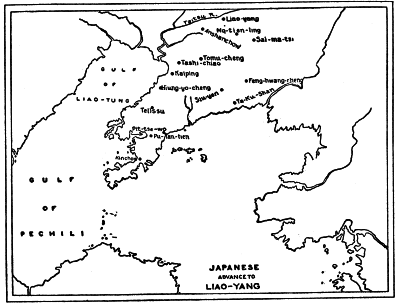 JAPANESE ADVANCE TO LIAO-YANG
During these six months between February and August, the
Japanese army on land in three different corps had been steadily
advancing toward Liao-yang. The first corps, under Lieutenant
General Kuroki, which landed at Korean ports, had encountered
no serious opposition on its march through the peninsula, until
it reached the Yalu River on the frontier. There took place on
the last days of April and May 1 the first important land battle
between the contending armies. The Russian forces under Zassulitch
were overpowered by the superior artillery of the enemy,
and, after a desperate fight and disastrous retreat, fell back to
Feng-hwang-cheng, which again was abandoned on May 6. Then,
taking Sai-ma-tsi on June 7 after several attempts, Kuroki came to
the difficult pass of Mo-tien-ling, which he captured on July 4 after
a hard fight, and which the Russians made a costly, but unsuccessful,
effort to retake on July 17. Chiao-tow fell on July 19, and
Yu-shu-lin-tsu and Yang-tsu-ling on August 1. From the end of
August, Kuroki coöperated with the two other army corps which
had simultaneously been closing upon Liao-yang. Of these, the
second corps, under Lieutenant General Oku, landing on May 5
at Pi-tsu-wo on the northeastern coast of the Liao-tung peninsula,
immediately took Pu-lan-tien, and, after a sixteen-hour battle
of the most desperate character, had driven the enemy toward Port
Arthur from Kin-chow and Nanshan Hills on May 26. These
actions completely cut the forces at Port Arthur from the rest of
the Russian army in Manchuria. General Kuropatkin, commanding
the army, however, now possessed nearly 100,000 men south of
Liao-yang, and, yielding to the impossible request from St. Petersburg
that he should make a supreme effort to relieve Port Arthur,
dispatched General Stakelberg with perhaps 44,000 men on this
difficult mission. He was attacked on June 13 at Telissu by General
Oku's army of a nearly equal size, and, after a savage battle
of artillery fire and bayonet charges, was forced back with heavy
losses. Stakelberg's retreating army offered gallant resistance to
the Japanese at Hiung-yo-cheng on June 21, at Kai-ping from July
6 to 9, at Taping-ling and Tashi-chiao from July 24 to 29, and at
Tomu-cheng between July 31 and August 1. At the later stage
of these engagements Oku's forces coöperated with divisions of
the third army corps, under General Nodzu, which had landed at
Ta-ku-shan on May 19, and had captured Siu-yen on June 8 and
Feng-shui (Wafangao) Pass on June 27. The fall of Anshan-chan
on August 27 to the second corps practically opened the great
battle of Liao-yang, the military center of southern Manchuria, to
which General Kuropatkin had retired.
The battle of Liao-yang while not the greatest, was in some respects the
most desperate, engagement of the war. The Japanese
forces, under the supreme command of Field Marshal Ōyama (who
had arrived at Dalny on July 20), probably numbered 240,000 men,
with 800 guns, and the Russian, under General Kuropatkin, perhaps
200,000 men, with 572 guns. The defenses around and in
the city were most elaborate and extensive. The Japanese attack
was begun a little before its plans had completely matured, and, for
nearly a week, a complex series of fierce and determined fightings
raged in front of the walled city. On August 31 a part of Kuroki's
army crossed the Taitsu River and began its flanking movement,
and, against the determined effort of Kuropatkin to annihilate
this section of the Japanese, Kuroki succeeded after three
days of action in sending his entire forces across the stream. On
September 4 Kuropatkin set the city on fire, and, by a masterly
retreat, extricated the remainder of his army from a threatened
closure by Kuroki's divisions, the entire Russian forces reaching
Mukden September 20. He had lost nearly 25,000 men, and
Ōyama half of that number.
Heavy rains now intervened. Kuropatkin at Mukden proclaimed
that his forces were now for the first time strong enough
to begin a forward movement against the enemy. With nine army
corps he advanced southward on October 5, easily taking the railway
station by the Sha River and also the defenses of Bentsiaputse
to the east. The cavalry outposts also scored a few minor victories.
Ōyama also now decided to take the offensive, and marched
forward with a wide front extending over fifty miles from east
to northwest to the Hun River. Both sides tried flanking movements,
none of which proved decisively successful. In the heavy
fighting which lasted till the 17th, in which the Russian and Japanese
losses probably amounted, respectively, to 69,000 and 13,300,
Kuropatkin was definitely forced back, and his original purpose to
turn the tide of the war failed. This is known as the battle of the
Sha River.
In the meantime, ever since General Nogi landed early in
June and at once began desperate attacks on the outer forts, Port
Arthur had been a scene of prodigious acts of heroism by both the
besiegers and the besieged. Points were taken and retaken, and
hundreds lost their lives at each explosion of mines or terrific
cannonading from the surrounding forts. In the midst of this
series of engagements, however, officers and men of the hostile
armies frequently met together to arrange for the recovery of the
dead bodies, always fraternizing in kindly spirit. The besieging
army steadily closed in, and, in the outer line of forts having been
reduced, the 203-Meter Hill of the western inner forts was at length
captured, on November 29-30. From this point Japanese shells
could sweep over the harbor. This was followed by the fall of
the eastern forts of Sung-shu and Ki-kwan, on December 19,
which were blown up by mines laid by the besiegers in tunnels
dug directly under the feet of the enemy. When ten days later
the Erlung fort was taken, the position of the gallant General
Stoessel's defending army was no longer tenable. He capitulated
on January 1, 1905, with his remaining army of nearly 25,000 men,
and surrendered fifty forts and 546 guns to the Japanese army.
The war vessels in the harbor had, however, been blown up and
sunk by the Russians before the surrender of the forts. Officers,
including Stoessel, who wished to return were allowed to depart
on parole with their side-arms. In their informal meeting, on
January 4, Generals Nogi and Stoessel lauded the high qualities
of each other's army, the latter visibly moved by the news that Nogi
had lost his two sons in the war. Stoessel, with his wife and a
few officers, left Nagasaki on January 17 on their homeward
voyage.
The Japanese veterans at Port Arthur, probably 50,000 or
60,000 in number, were now ready to march northward to join
Ōyama's army. Before their arrival at the front, however, a severe
battle took place in the heart of winter, from January 25 to 31, at
Hokau-tai, on the Hun River, between General Grippenberg's second
Russian army and Ōyama's forces. The result was not a decisive
gain to either side, but the Russians lost twice as many men
as the Japanese, nearly 15,000 of their numbers being killed and
wounded. It was after this battle that Grippenberg openly declared
his disagreement with his chief Kuropatkin, and resigned
his command and was succeeded by General Kaulbars.
With the addition of Nogi's army to the left of Oku's, and of
General Kawamura's to the right of Kuroki's, Ōyama now commanded
five corps in sixteen divisions, numbering at least 400,000
men and occupying a front of nearly a hundred miles. This colossal
army tried conclusions with the at least 350,000 men under
Kuropatkin at Mukden in what was probably the greatest battle
or series of battles in the history of the world. The engagements
began on February 20 and continued till March 16, resulting in
a decisive defeat of the Russians. Until March 7 Kuropatkin's
left was harassed by Kuroki, and his right was defending itself
desperately against the flanking movement of Nogi, while his center,
under Linevitch and Kaulbars, together with Rennenkampf's
Cossacks, took a determined stand against the onslaught of Nodzu
and Oku. The retreat was ordered on the night of this day, for a
further delay would cause Kuropatkin's divisions to be surrounded
and annihilated. The Japanese closely pursued the fleeing enemy,
and gave him no time to rally before crossing the Hun River. The
blinding dust storm and the biting cold of March 9 did not greatly
detract from the rigor of the pursuit. Mukden was entered by
Ōyama early on March 10, and the strong defense and the great
colliery at Fushun to the east were taken the next day. The Russians
now retired to Tie-ling, forty miles to the north, in a complete
rout, Linevitch's army alone making an orderly retreat. Tie-ling
was also taken on the 16th, the Russians receding further
north. Their losses probably aggregated 150,000 men, or more
than forty per cent. of the entire army, while the Japanese lost
about one-third as many in killed and wounded. The tsar at once
convoked a war council, and resolved to dispatch to the East another
Russian army of 450,000 men. The day after the fall of Tie-ling,
he telegraphed Kuropatkin and, without a word of praise,
transferred the latter's command over the Manchurian army to
Linevitch. Kuropatkin retired to Harbin, and then returned to
serve under the new commander-in-chief.
The Baltic fleet of Russia, the departure of which for the East
had been announced several times, at last started from Kronstadt
in the middle of October, 1904, under Vice Admiral Rozhestvenski.
Having been aroused to a state of nervous apprehension by
the unfounded rumor that Japanese torpedo boats were in European
waters, some officers of the Russian fleet fancied that they descried
two of these small war vessels among the British fishing boats
at Dogger Bank in the North Sea, on the night of October 21, and
fired upon them, sinking a trawler, killing two fishermen, and injuring
several others. The fleet then proceeded south at full speed. It
had also attacked, at different times, a Swedish, a Norwegian, a
Danish, and a German ship. When the news of the Dogger Bank
incident reached Hull on the 24th, all England was aflame, and the
more radical people counseled war with Russia. Owing to the
calmness of the British government, however, and also to the assistance
of France, the matter was referred to the investigation
of an international court of naval experts. The latter published
the opinion of its majority, on February 25, 1905, that the firing
was unjustifiable and unduly prolonged, but that it did not impair
the military valor and the humanitarian sentiment of the Russian
admiral and his staff.
Soon after the North Sea incident the Baltic fleet was divided
into two sections, one under Admiral Voelkersam going by way of
the Suez Canal and the other under Rozhestvenski himself rounding
the Cape of Good Hope. The two squadrons reunited in January
in the Indian Ocean, and drilled their raw crews near the French
Island of Madagascar. A third section, under Admiral Nebokatov,
left Libau on February 15, and joined the main squadron before
it entered the Chinese waters. The stay of the fleet near
Saigon and Kamranh Bay, French Indo-China, raised delicate
questions as to the rights of the hostile vessel in a neutral harbor,
but a friction was averted by the tardy, but definite, action taken
by the tsar and the French government in ordering away the Russian
fleet from the French territorial waters. Near the end of
May the entire fleet was headed toward its final destination.
Admiral Tōgō had visited Tōkyō after the fall of Port Arthur,
and by his natural modesty and force of character inspired the
nation with an unbounded confidence in his success in the coming
contest with the Baltic fleet. He avoided popular ovation, saying
he had yet much to do, and came and went like a plain farmer.
Leaving Tōkyō on February 6, 1905, the very day when, a year before,
he led his fleet from Sasebo toward Port Arthur, he made
every preparation to meet Rozhestvenski's ships. A few days before
the latter's arrival Tōgō was convinced that in their attempt
to reach Vladivostok they would make a dash through the Korean
Straits, instead of going by way of the Tsugaru or La Perouse
Straits, and kept his entire fleet at and near Masampo. At five
o'clock in the morning of May 27 Tōgō's scouts reported by wireless
telegraphy that Russian vessels were sighted near Quelpart
Island. Thrilled by the news, all the divisions immediately turned
to their assigned missions. The sea was overcast by a heavy fog
and the waves were high from a sharp southwest wind. Two of
the Japanese cruiser squadrons advanced toward the enemy, and,
between 10 and 11 A. M., led him gradually toward the Japan
side of the straits, and then at 1.30 P. M. joined the main squadron.
The enemy's vessels were now visible in two main columns, the
battleships to the starboard and the cruisers and coast-defenders
to the port, and headed by the Jemchug and the Izumrud, and
followed by a long line of smaller vessels, the entire formation
extending over several miles. The vessels were painted black, with
the funnels whitish yellow and the rims black, so that they were
conspicuous on the sea, while the Japanese ships were light green
and gray, and not so easily discernible as the Russian. Just before
two o'clock Tōgō signaled to the entire fleet: "The destiny
of the empire depends on this one battle; let everyone do his
utmost." The battleship squadron under Tōgō's direct command
and the cruisers under Kamimura pressed the enemy eastward,
and, from a distance of 6000 meters, concentrated their terrific fire
upon the foremost Russian vessels, while other Japanese squadrons
attacked the enemy from the rear. The main issue was decided
within an hour. The Oslabia, the Alexander III., and the flagship
Kniaz Suvarov, caught fire and went out of action, as well as several
smaller vessels in the rear. The columns of smoke wafted by the
wind over the sea concealed the hostile fleets from each other's view,
and the firing was suspended by the main squadrons at 2.45.
Admiral Voelkersam had been killed, and Rozhestvenski himself
wounded and transferred to a destroyer in an unconscious state,
the command being assumed by Nebogatov. From three o'clock
the Russian vessels made a desperate effort to flee northward, but
were so fiercely fired upon that they turned south. Now the battle
raged in several sections till sunset. The Oslabia, the Alexander
III., the Borodino, and the Kniaz Suvarov, all battleships, and two
special service boats, were sunk. At sundown the Japanese torpedo
craft, whose work had thus far been secondary, took the field,
and succeeded in throwing the enemy into a hopeless confusion,
sinking the battleship Navarin and incapacitating the battleship
Sissoi Veliki and the armored cruisers Admiral Nakhimov and
Monomakh. The last three vessels sank the next day.
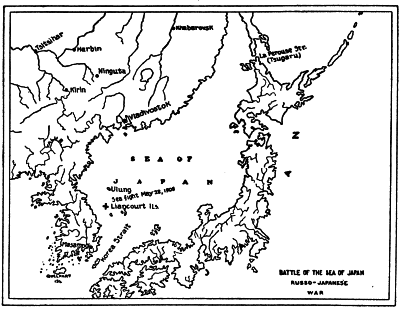
BATTLE OF THE SEA OF JAPAN
RUSSO-JAPANESE
WAR
The fog lifted on May 28, and the main squadrons under
Tōgō and Kamimura were near Ulung Island about 5.30 A. M.,
when a Russian fleet, consisting of two battleships, two coast-defenders,
and two cruisers, were discovered heading northeast. The
different squadrons completely surrounded the enemy near Liancourt
Islands about 10.30, and Admiral Nebogatov soon surrendered,
although the cruiser Izumrud alone escaped. In the afternoon
two Japanese destroyers found and pursued two Russian
destroyers, one of which, Biedovy, carrying the wounded Rozhestvenski,
surrendered, and the other escaped. The cruisers Svetlana
and Dmitri Donskoi, the coast-defender Oushakov, and a destroyer,
were either sunk or driven aground, making the total Russian loss
during the two days six battleships, one coast-defender, five cruisers,
five destroyers, one converted cruiser, and four special service
vessels. Out of the 18,000 Russian sailors, nearly 12,000 must
have gone down with the sinking vessels. The Japanese lost only
three torpedo boats and 116 killed and 538 wounded, but captured
two battleships, two coast-defenders, and a destroyer. Of the Russian
vessels which escaped, the cruiser Almaz and two destroyers
reached Vladivostok, but a destroyer and two special service boats
which got to Shanghai, and the cruisers Aurora, Oleg, and Jemchug,
that went to Manila, were dismantled. Admiral Tōgō reported,
in his characteristic manner, that the "miracle" of his
victory was "entirely owing to the illustrious virtues of the emperor,
and was beyond all human possibility," and that he could
not but believe that "the comparatively small losses were due to
the protection of the spirits of the imperial forefathers."
As soon as the decisive battle of the Sea of Japan was fought,
Theodore Roosevelt, President of the United States, who had once
before failed, in February, to induce Russia to agree to come
treat for peace with Japan, renewed his effort to bring the belligerent
powers together to a discussion of peace terms exclusively
between themselves. In this effort he was supported by the French
government and the German emperor. After preliminary
consultations
with Takahira and Count Cassini, the Japanese and Russian
representatives at Washington, Roosevelt addressed the following
note to the governments of St. Petersburg and Tōkyō:
"The President feels that the time has come when in the interest
of all mankind he must endeavor to see if it is not possible to bring
to an end the terrible and lamentable conflict now being waged.
With both Russia and Japan the United States has inherited ties
of friendship and good-will. It hopes for the prosperity and welfare
of each, and it feels that the progress of the world is set back
by the war between those two great nations.
"The President accordingly urges the Russian and Japanese
Governments, not only for their own sakes, but in the interest of
the whole civilized world, to open direct negotiations for peace
with each other. The President suggests that those peace negotiations
be conducted directly and exclusively between the belligerents,
in other words, that there may be a meeting of Russian and
Japanese plenipotentiaries or delegates without any intermediary,
in order to see if it is not possible for those representatives of the
two powers to agree to terms of peace. The President earnestly
asks that the Russian Government do now agree to such a meeting,
and is asking the Japanese Government likewise to agree.
"While the President does not feel that any intermediary
should be called in in respect to the peace negotiations themselves,
he is entirely willing to do what he properly can, if the two powers
concerned feel that his services will be of aid, in arranging the preliminaries
as to the time and place of meeting. But if even these
preliminaries can be arranged directly between the two powers, or
in any other way, the President will be glad, as his sole purpose
is to bring about a meeting which the whole civilized world will
pray may result in peace."
The Japanese government responded, saying that Japan would
open negotiations directly and exclusively with Russia regarding
terms of peace. The Russian reply, at first given orally and then
made with some reservation, was finally couched in substantially
the same language as the Japanese. Japan appointed as her peace
envoys Baron Komura, minister for foreign affairs, and Kogorō
Takahira, minister at Washington. Russia's choice of her chief
envoy first fell on Nelidov, ambassador at Paris, then on Muraviev,
ambassador at Rome, but later was changed to Count Serge
Witte, president of the committee of ministers. The new Russian
ambassador at Washington, Baron Rosen, was appointed the second
envoy of Russia. As for the place of the conference, neither
Paris, suggested by Russia, nor Chifu, suggested by Japan, being
acceptable to the other party, respectively, the two governments
finally agreed upon Washington. Because of the excessive summer
heat of the American capital, however, it was decided that actual
negotiations should be held at the navy yard near the quiet historic
town of Portsmouth, New Hampshire. The envoys were announced
to arrive by August 1.
In the meantime, before the end of July, the Russian Island
of Sakhalin, the southern half of which had till 1875 been claimed
by Japan, was occupied by the Japanese forces, which also seized
a few points on the coast of southeastern Siberia.
The envoys of the belligerent powers having arrived, they were
introduced to one another by President Roosevelt on the Mayflower
on August 5, and then proceeded to Portsmouth, arriving there on
the 8th. They sojourned at the Hotel Wentworth on the small
Island of New Castle near Portsmouth, whither flocked many curious
summer visitors and more than a hundred newspaper correspondents
from various parts of the world. The first informal meeting
of the envoys was held at the naval stores building at the
navy yard, but the actual business of the peace negotiations began
on the following day. On that day Baron Komura presented, in
writing, the entire list of twelve terms of peace, which are believed
to have covered the following points: 1, Japan's preponderant interest
in Korea, and the principle of the open door therein; 2,
evacuation of Manchuria by the Japanese and Russian armies; 3,
restoration of Chinese administration in Manchuria; 4, China's
territorial integrity and the open door in Manchuria; 5, cession to
Japan of the Island of Sakhalin; 6, surrender to Japan of the lease
of the Kwan-tung district, containing Port Arthur, Dalny, and adjacent
islands; 7, transfer to Japan of the railway between Port
Arthur (and Dalny) and Harbin; 8, retention by Russia of the
main Manchurian railway from Mandchourie to Grotekovo; 9, reimbursement
by Russia of Japan's cost of war; 10, surrender by
Russia of her war vessels interned in neutral ports; 11, limitation
of Russia's naval power in the Pacific; and 12, the rights of the
Japanese subjects to fish in the waters of the Siberian littoral. To
these terms Witte gave a written reply on the 12th, stating his
assent to some points, willingness to discuss some others,
and absolute
dissent from the rest. Then the envoys discussed the terms
one after another, and, within six days, found themselves in agreement,
in substance or in principle, on the first, second, third,
fourth, sixth, seventh, eighth, and twelfth terms. As regarded the
other four points, particularly the cession of Sakhalin and the payment
of the war expenditures, the Russian envoy considered them
as incompatible with the honor and dignity of the tsar's empire.
The conference now seemed to be ending in failure, when on
August 18 occurred the visit of Baron Kaneko to President Roosevelt
at Oyster Bay, followed on the next day by the invitation extended
to Baron Rosen to come on from New Castle. Kaneko again
called on Roosevelt on the 21st, while Meyer, American ambassador
at St. Petersburg, had a long interview with the tsar two days after.
The president was urging the two governments, through these
various channels, to arrive at some compromise of their differences
for the sake of peace. When Meyer had an audience of the tsar,
the Japanese government had already accepted Roosevelt's suggestion
for compromise by intimating its willingness to drop the demands
for the surrender of the interned vessels and for the limitation
of Russia's naval power, and to allow Russia to repurchase
the northern half of Sakhalin, which was in Japan's military occupation,
for 1,200,000 yen. The tsar, however, unequivocally declined
to agree to this compromise, for he considered the proposed
repurchase as an indemnity in disguise, to which he was opposed in
principle. Despite Ambassador Meyer's repeated appeal, Nicholas
II. remained firm, although—whether by his instruction or on
Witte's own initiative is not known—the southern half of Sakhalin
was offered to Japan. In the meantime, President Roosevelt appealed
to Japan, until the deliberations of the privy councilors at
Tōkyō resulted in the emperor's instructions to his envoys at Portsmouth
to waive their demand for money and to accept the southern
half of Sakhalin. This final concession, which at length made
peace possible, was announced by Baron Komura at the morning
session of August 29, and came as a complete surprise to Witte
and to the whole world. The articles of the treaty were then
drafted, and signed by the envoys on September 5.
The concessions of the privy councilors greatly disappointed
the Japanese people, who had been somewhat flushed by their unexpected
victories over the mighty foe. The popular dissatisfaction,
intensified by local conditions, broke out in an open riot on the
streets of Tōkyō on September 5-7. In Russia, also, the treaty was
not received with unmixed joy even by the peace-loving peasants,
for although peace was welcome, the war and consequently the
results of its failure, which were embodied in the terms of the treaty,
were considered by them as unnecessary and ignominious. The
sovereigns of both powers, however, ratified the treaty on October
14. The following is the English version of this memorable
document:
"The Emperor of Japan on one part and the Emperor of All
the Russias on the other part, animated by a desire to restore the
blessings of peace to their countries, have resolved to conclude a
treaty of peace and have for this purpose named their plenipotentiaries,
that is to say, for his Majesty the Emperor of Japan, Baron
Komura Jutarō Jusami, Grand Cordon of the Imperial Order of
the Rising Sun, his minister of foreign affairs, and his Excellency
Takahira Kogorō, Imperial Order of the Sacred Treasure, his
minister to the United States, and, for his Majesty the Emperor of
All the Russias his Excellency Serge Witte, his secretary of state
and president of the committee of ministers of the empire of Russia,
and his excellency Baron Roman Rosen, master of the imperial
court of Russia, his Majesty's ambassador to the United States,
who, after having exchanged their full powers, which were found
to be in good and due form, have concluded the following articles:
"Article One—There shall henceforth be peace and amity
between their majesties the Emperor of Japan and the Emperor
of All the Russias and between their respective States and
subjects.
"Article Two—The Imperial Russian Government, acknowledging
that Japan possesses in Korea paramount political, military
and economical interests, engages neither to obstruct nor interfere
with measures for guidance, protection, and control which the
Imperial Government of Japan may find necessary to take in Korea.
It is understood that Russian subjects in Korea shall be treated
in exactly the same manner as the subjects and citizens of other
foreign powers, that is to say, they shall be placed on the same footing
as the subjects and citizens of the most favored nation. It is
also agreed, in order to avoid causes of misunderstanding, that the
two high contracting parties will abstain on the Russian-Korean
frontier from taking any military measure which may menace the
security of Russian or Korean territory.
"Article Three—Japan and Russia mutually engage:
"First—To evacuate completely and simultaneously Manchuria,
except the territory affected by the lease of the Liao-tung
peninsula, and in conformity with the provisions of the additional Article
One annexed to this treaty, and,
"Second—To restore entirely and completely to the exclusive
administration of China all the portions of Manchuria now in
occupation or under the control of the Japanese or Russian troops,
with the exception of the territory above mentioned.
"The Imperial Government of Russia declare that they have
not in Manchuria any territorial advantages or preferential, or
exclusive concessions in the impairment of Chinese sovereignty, or
inconsistent with the principle of equal opportunity.
"Article Four—Japan and Russia reciprocally engage not to
obstruct any general measures common to all countries which China
may take for the development of the commerce or industry of
Manchuria.
"Article Five—The Imperial Russian Government transfers
and assigns to the Imperial Government of Japan, with the consent
of the Government of China, the lease of Port Arthur, Ta-lien, and
the adjacent territory and territorial waters, and all rights, privileges,
and concessions connected with or forming part of such lease,
and they also transfer and assign to the Imperial Government of
Japan all public works and properties in the territory affected by
the afore mentioned lease. The two contracting parties mutually
engage to obtain the consent of the Chinese Government mentioned
in the foregoing stipulation. The Imperial Government of Japan
on their part undertake that the proprietary rights of Russian subjects
in the territory above referred to shall be perfectly respected.
"Article Six—The Imperial Russian Government engage to
transfer and assign to the Imperial Government of Japan without
compensation and with the consent of the Chinese Government the
railway between Chang-chun-fu and Kuan-chang-tsu and Port
Arthur and all the branches, together with all the rights, privileges,
and properties appertaining thereto in that region, as well as all
the coal mines in said region belonging to or worked for the benefit
of the railway. The two high contracting parties mutually engage
to obtain the consent of the Government of China mentioned in the
foregoing stipulation.
"Article Seven—Japan and Russia engage to exploit their
respective railways in Manchuria exclusively for commercial and
industrial purposes and in nowise for strategic purposes. It is understood
that this restriction does not apply to the railway in the
territory affected by the lease of the Liao-tung peninsula.
"Article Eight—The Imperial Governments of Japan and
Russia, with the view to promote and facilitate intercourse and
traffic, will, as soon as possible, conclude a separate convention for
the regulation of their connecting railway services in Manchuria.
"Article Nine—The Imperial Russian Government cedes to
the Imperial Government of Japan in perpetuity and full sovereignty
the southern portion of the Island of Sakhalin, and all the
islands adjacent thereto, and the public works and properties
thereon. The fiftieth degree of north latitude is adopted as the
northern boundary of the ceded territory. The exact alignment of
such territory shall be determined in accordance with the provisions
of the additional Article Eleven, annexed to this treaty. Japan and
Russia mutually agree not to construct in their respective possessions
on the Island of Sakhalin, or the adjacent islands, any fortifications
or other similar military works. They also respectively
engage not to take any military measures which may impede the
free navigation of the Strait of La Perouse and the Strait of
Tartary.
"Article Ten—It is reserved to Russian subjects, inhabitants
of the territory ceded to Japan, to sell their real property, and retire
to their country, but if they prefer to remain in the ceded territory
they will be maintained and protected in the full exercise of
their industries and rights of property, on condition of submitting
to the Japanese laws and jurisdiction. Japan shall have full liberty
to withdraw the right of residence in, or to deport from such
territory any inhabitants who labor under political or administrative
disability. She engages, however, that the proprietary rights
of such inhabitants shall be fully respected.
"Article Eleven—Russia engages to arrange with Japan for
granting to Japanese subjects rights of fishery along the coasts of
the Russian possessions in the Japan, Okhotsk, and Bering Seas.
It is agreed that the foregoing engagement shall not affect rights
already belonging to Russian or foreign subjects in those regions.
"Article Twelve—The treaty of commerce and navigation between
Japan and Russia having been annulled by the war, the Imperial
Governments of Japan and Russia engage to adopt as a basis
for their commercial relations pending the conclusion of a new
treaty of commerce and navigation, the basis of the treaty which
was in force previous to the present war, the system of reciprocal
treatment on the footing of the most favored nation, in which are
included import and export duties, customs formalities, transit, and
tonnage dues, and the admission and treatment of agents, subjects,
and vessels of one country in the territories of the other.
"Article Thirteen—So soon as possible after the present treaty
comes in force all prisoners of war shall be reciprocally restored.
The Imperial Governments of Japan and Russia shall each appoint
a special commissioner to take charge of the prisoners. All prisoners
in the hands of one government shall be delivered to and received
by the commissioner of the other government or by his duly
authorized representative in such convenient numbers and such convenient
ports of the delivering state as such delivering state shall
notify in advance to the commissioner of the receiving state. The
governments of Japan and Russia shall present each other so soon
as possible after the delivery of the prisoners is completed with
a statement of the direct expenditures respectively incurred by them
for the care and maintenance of the prisoners from the date of
capture or surrender and up to the time of death or delivery.
Russia engages to repay to Japan so soon as possible after the exchange
of statement as above provided the difference between the
actual amount so expended by Japan and the actual amount similarly
disbursed by Russia.
"Article Fourteen—The present treaty shall be ratified by their
Majesties the Emperor of Japan and the Emperor of All the Russias.
Such ratification shall be with as little delay as possible and
in any case no later than fifty days from the date of the signature
of the treaty, to be announced to the Imperial Governments of Japan
and Russia respectively through the French minister at Tōkyō
and the ambassador of the United States at St. Petersburg and
from the date of the later of such announcements this treaty shall
in all its parts come into full force. The formal exchange of ratifications
shall take place at Washington so soon as possible.
"Article Fifteen—The present treaty shall be signed in duplicate
in both the English and French languages. The texts are
in absolute conformity, but in case of a discrepancy in the interpretation,
the French text shall prevail.
"In conformity with the provisions of Articles Three and
Nine of the treaty of peace between Japan and Russia of this date
the undersigned plenipotentiaries have concluded the following additional
articles:
"Sub-Article to Article Three—The Imperial Governments of
Japan and Russia mutually engage to commence the withdrawal
of their military forces from the territory of Manchuria simultaneously
and immediately after the treaty of peace comes into
operation, and within a period of eighteen months after that date
the armies of the two countries shall be completely withdrawn from
Manchuria except from the leased territory of the Liao-tung peninsula.
The forces of the two countries occupying the front positions
shall first be withdrawn.
"The high contracting parties reserve to themselves the right
to maintain guards to protect their respective railway lines in
Manchuria. The number of such guards shall not exceed fifteen
per kilometer, and within that maximum number the commanders
of the Japanese and Russian armies shall by common accord fix the
number of such guards to be employed as small as possible while
having in view the actual requirements.
"The commanders of the Japanese and Russian forces in Manchuria
shall agree upon the details of the evacuation in conformity
with the above principles and shall take by common accord the
measures necessary to carry out the evacuation so soon as possible
and in any case no later than the period of eighteen months.
"Sub-Article to Article Nine—So soon as possible after the
present treaty comes into force, a commission of delimitation composed
of an equal number of members is to be appointed respectively
by the two high contracting parties which shall on the spot mark
in a permanent manner the exact boundary between the Japanese
and Russian possessions on the Island of Sakhalin. The commission
shall be bound so far as topographical considerations permit
to follow the fiftieth parallel of north latitude as the boundary
line, and, in case any deflections from that line at any points are
found to be necessary, compensation will be made by correlative
deflections at other points. It shall also be the duty of said commission
to prepare a list and a description of the adjacent islands
included in the cession, and finally the commission shall prepare and
sign maps showing the boundaries of the ceded territory. The work
of the commission shall be subject to the approval of the high contracting
parties.
"The foregoing additional articles are to be considered ratified
with the ratification of the treaty of peace to which they are annexed.
"Portsmouth, the Fifth Day of the Ninth Month of the Thirty-eight
year of Meiji, corresponding to the Twenty-third of August,
1905. (September 5, 1905.)
"In witness whereof the respective plenipotentiaries have
signed and affixed seals to the present treaty of peace.
"Done at Portsmouth, New Hampshire, this Fifth day of
the Ninth Month of the Thirty-eighth Year of the Meiji, corresponding
to the Twenty-third day of August, One Thousand Nine
Hundred and Five."
No less important than the Russo-Japanese treaty is the renewed
agreement of the Anglo-Japanese alliance concluded between
Lord Lansdowne, the British foreign minister, and Baron Hayashi,
the Japanese minister at London, on August 12 at London, and
published on September 27 simultaneously at London and Tōkyō.
Its text reads as follows:
"The Governments of Great Britain and Japan, being desirous
of replacing the agreement concluded between them January
30, 1902, by fresh stipulations, have agreed upon the following
articles, which have for their object:
"A—The consolidation and the maintenance of general peace
in the regions of Eastern Asia and India.
"B—The preservation of the common interests of all the
powers in China by insuring the independence and integrity of
the Chinese Empire and the principles of equal opportunities for the
commerce and industry of all nations in China.
"C—The maintenance of the territorial rights of the high
contracting parties in the regions of Eastern Asia and of India, and
the defense of their special interests in the said regions.
"Article 1—It is agreed that whenever in the opinion either
of Great Britain or Japan any of the rights and interests referred
to in the preamble to this agreement are in jeopardy, the two governments
will communicate with each other fully and frankly and
will consider in common the measures which should be taken to
safeguard these menaced rights or interests.
"Art. 2—Should either of the high contracting parties be involved
in war in defense of its territorial rights or special interests,
the other party will at once come to the assistance of its ally and
both parties will conduct a war in common and make peace in mutual
agreement with any power or powers involved in such war.
"Art. 3—Japan possessing paramount political, military, and
economic interests in Korea, Great Britain recognizes Japan's right
to take such measures for the guidance, control, and protection of
Korea as she may deem proper and necessary to safeguard and
advance those interests, providing the measures so taken are not
contrary to the principle of equal opportunities for the commerce
and industry of all nations.
"Art. 4—Great Britain having a special interest in all that
concerns the security of the Indian frontier, Japan recognizes her
right to take such measures in the proximity of that frontier as
she may find necessary for safeguarding her Indian possessions.
"Art. 5—The high contracting parties agree that neither will,
without consulting the other, enter into a separate arrangement
with another power to the prejudice of the objects described in
the preamble.
"Art. 6—As regards the present war between Japan and Russia,
Great Britain will continue to maintain strict neutrality, unless
some other power or powers join in hostilities against Japan, in
which case Great Britain will come to the assistance of Japan, will
conduct war in common, and will make peace in mutual agreement
with Japan.
"Art. 7—The conditions under which armed assistance shall
be afforded by either power to the other in the circumstances mentioned
in the present agreement and the means by which such assistance
shall be made available will be arranged by the naval and
military authorities of the contracting parties, who will from time
to time consult one another fully and freely on all questions of
mutual interest.
"Art. 8—The present agreement shall be subject to the provisions
of Art. 6 and come into effect immediately after the date
of signature and remain in force for ten years from that date
in case neither of the parties shall have been notified twelve months
before the expiration of said ten years of an intention of terminating
it. It shall remain binding until the expiration of one year from
the day on which either of the parties shall have denounced it, but
if, when the date for the expiration arrives, either ally is actually
engaged in war the alliance shall be ipso facto and continue until
peace shall be concluded."
The armistice was arranged between the Russian and Japanese
armies on September 13. During the nineteen months of war
between February, 1904, and September, 1905, Russia probably
sent between eight and nine hundred thousand soldiers to the East,
and Japan not less than six hundred thousand. Never before in
the world's history had such large armies been sent to the seat of
war in so brief a period. The Russian losses probably amounted to
more than 350,000, including the killed, the wounded, the sick,
and the captured, and Japan lost, in deaths alone, 72,490. Of the
latter, 15,300 died of sickness, while the rest either fell in battle or
subsequently died from wounds—an unusually low death-rate from
the latter cause. Russia lost the major part of her Pacific and Baltic
fleets, while the Japanese navy was increased in size by the
surrender of the enemy's vessels and by the raising of several of
the sunken ships. The war greatly intensified the otherwise
strong national sentiment of the Japanese people and enhanced their
position among the powers of the world, while the moderate terms
of peace and the catholicity of national character have served as an
efficient check against an undue expansion. On the other hand, the
unexpected exposure of the weakness of Russia's bureaucracy has
sensibly reduced the hitherto overestimated value of her political
power. In Europe, as well as in Asia, her position in international
affairs has already begun to show signs of this change. At the same
time, the Russian people have renewed their conviction of the need
of a true national administration, and the weakened autocracy is
compelled to consider popular demands for reform. Not the least
important result of the war is the fact that it has insured the humane
principles of China's territorial integrity in Manchuria, and
of equal opportunity for the trade and industry of all nations in
that region and Korea. The Treaty of Portsmouth recognized
these principles and the Anglo-Japanese agreement has insured them
by a powerful coalition.
[1]On November 6, 1905, the Order of the Garter was conferred
on the emperor by King Edward VII. of England, and the British
legation in Japan was raised to an embassy. The emperor visited
the shrine of Ise in November and there reported the successful
conclusion of the war to the spirits of his ancestors. The end of
the year was marked by a treaty with China which made Japan's
position in Korea the same as Russia's had been before the war.
In October, 1906, the school board of San Francisco in the
United States issued an order excluding the Japanese children
from the public schools of that city and requiring them to attend a
separate school for Orientals. This action was taken as an affront
by the Japanese government and a protest was sent by the latter
to the United States government on October 15. President Roosevelt
took prompt action on the matter, sending Victor H. Metcalf,
the Secretary of the Interior, to investigate and report. President
Roosevelt also announced that Japan's treaty rights would be
enforced at every hazard. Conferences were held between the State
officials of California and the President, resulting in the
President issuing an order on March 14, 1907, that all Japanese and
Koreans without passports would be excluded from the United
States and the San Francisco Board of Education deciding to
admit Japanese pupils up to the age of sixteen to the schools.
Sensational newspapers both in Japan and in the United States
at this period were filled with rumors of war between the two
countries and at times during the year 1907 they would insist that
war was imminent.
In the meantime the Japanese government under the leadership
of Viscount Hayashi, Minister of Foreign Affairs, took measures
to enforce certain laws on her own statute books concerning
the use of foreign coolies in Japan and to limit Japanese emigration
to the United States. The visit of William Howard Taft, the
American Secretary of War, to Japan on his way to the Philippines
and the friendliness of his reception by the Japanese and his own
words of assurance did much toward allaying whatever feeling of
actual hostility still remained among the Japanese people and the
visit of the American fleet of sixteen battleships in the next year
ended all talk of a war. In 1907 similar friction occurred between
Great Britain and Japan because certain Japanese merchants and
laborers in Vancouver, Canada, were attacked and driven from
their houses. This matter was adjusted peacefully by Viscount
Hayashi and Sir Claude MacDonald, the British Ambassador. As
a proof that Japan intends to keep her promises to regulate immigration
to the United States may be cited some immigration figures
for 1908: during that year there were admitted to the entire United
States only 185 more Japanese of all classes than departed from it,
and a great many more Japanese laborers left the United States
than entered it.
In the fall of 1909 a Commercial Commission, sent by the
merchants of Japan, visited the United States, studying American
business and industrial methods and purchasing a large variety of
manufactured articles which had never found a market in the
Orient and buying the newest machinery used in lumber, mining,
and milling industries, and also devices for food preservation, and
learned many of the labor-saving methods used in banking and
commercial offices.
A Franco-Japanese Agreement was signed on June 10, 1907, providing
that the most-favored-nation treatment should be accorded
the officials and subjects of Japan in French Indo-China for everything
concerning their persons and the protection of their property,
and that the same treatment should be granted the subjects of
French Indo-China in the Empire of Japan and that these provisions
should hold until the expiration of the Treaty of Commerce
and Navigation concluded between France and Japan, August 4,
1896. In regard to the continent of Asia, the two countries agreed
to "respect the independence and integrity of China as well as the
principles of equality of treatment in that country for the commerce
and subjects of all nations, and having a special interest in
seeing that order and a pacific state of affairs guaranteed, particularly
in the regions of the Chinese Empire adjacent to the territories
where they have rights of sovereignty, protection, and
occupation, bind themselves mutually to support one another in
order to assure the peace and security of those regions, with a
view to the maintenance of the respective positions and territorial
rights of the two contracting parties on the Asiatic continent."
During 1907 several Russo-Japanese conventions were signed.
The first, concluded on July 28, was a treaty of commerce and navigation
in accordance with article 12 of the Treaty of Portsmouth;
in the second, concluded two days later, each agreed to respect the
territorial integrity of the other, the agreements then in force between
the contracting parties and China, and the independence
and integrity of China, and to uphold the status quo with all the
peaceable means at their disposal; a third convention related to
the fisheries of the Sea of Japan, the Okhotsk Sea, and the Behring
Sea; the fourth provided for the joining of the Russian railways in
Manchuria at Kwang-cheng-tsze. In August the legations at
Tokio and St. Petersburg were raised to the status of embassies by
their respective governments.
On February 5, 1908, Chinese custom officers seized the Japanese
steamer Tatsu Maru in Portuguese waters off Macao, where it
had landed to discharge arms shipped from a Japanese port to a
Chinese merchant at Macao. The Japanese resented the seizure
and complained to the Chinese authorities demanding an apology
and an indemnity. At first the latter defended their action, but
on the receipt of an ultimatum from the Japanese on March 5,
China apologized and gave assurance that the indemnity would be
paid and the responsible persons punished. Japan in return agreed
to prevent the trade in arms and ammunition between Japanese
and Chinese citizens. Thus a friendly feeling was restored between
the two countries but public opinion had been greatly inflamed
in China and a boycott of Japanese goods had begun. During
the year many Japanese vessels left Chinese ports without the
goods for which they had come. It is estimated that the Japanese
lost some $8,000,000 by this boycott.
China also felt embittered against Japan in this same year
because of the latter's course in Manchuria, where she had retained
the public buildings at Mukden and the Manchurian gold mines,
taken possession of the Manchurian post-offices and telegraph lines,
occupied a portion of the province of Kirin, claiming it as Korean
territory, although it had long been held as part of China, and forbade
the building of a railway to the west of the Liau River, from
Hsenmintun to Fakumen, saying that it would compete with the
Japanese system. These difficulties were adjusted soon. Japan
agreed to the building of the railroad on condition that at no point
should it come within a minimum distance from the Japanese line.
On October 12 and November 7, agreements were signed at Tokio
concerning the telegraph lines. China agreed to place special telegraph
wires between the treaty ports, Kwant-cheng-tsze, Tie-ling,
Mukden, Liau-yang, Niu-chwang, Antung, and the railroad territory
at the exclusive disposal of Japan for a period of fifteen years,
the service on the wires to be worked by Japanese clerks in the employ
of the Japanese government from the Chinese telegraph buildings,
but only to be used for the exchange of telegrams from or to
places under the direct control of the Japanese telegraph system.
Japan undertook to pass over to China all Japanese telegraph lines
in Manchuria outside her railway territory, to construct no telegraph
or telephone lines in Manchuria outside the same territory, and to
construct no telegraph or telephone lines or erect wireless stations
outside her leased territory. She also agreed to pay China a small
annual royalty on all messages sent over the Japanese Manchurian
telegraph lines. On September 4, 1909, an agreement was signed
at Peking regarding the improvement of the Antung-Mukden Railroad
and which gave to Japan the advantages in Manchurian trade.
General elections to the House of Representatives were held
on May 15, 1908, resulting in a sweeping victory for the Seiyu-kai.
For the first time since the formation of the diet, one party had
elected a majority of all the members. On July 12, Marquis
Katsura was given the imperial command to form a ministry. As
this nobleman was connected with the weakest of the political parties,
the Daids Club, his appointment as premier was a great disappointment
to the Seiyu-kai, who had hoped to have one of their
own leaders hold that office.
In July, 1909, twenty-three members of the Imperial Diet were
convicted for complicity in a graft scandal. Five directors of the
Great Japan Sugar Company were at the same time convicted of
bribing the nation's representatives and all twenty-eight received
very severe sentences.
In the meantime Japan's influence in Korea had increased to
such an extent that by the end of 1907, Korea was for all practical
purposes an integral part of the Japanese Empire. Soon after the
outbreak of the Russo-Japanese War, Japan and Korea signed an
agreement, by which Japan undertook to insure the safety of the
imperial household and guaranteed the independence and territorial
integrity of the Korean Empire, in return for which Korea agreed
to accept the advice of Japan as to improvements in administration.
Six months later Korea, in another agreement with Japan,
pledged herself to regulate her finances in accordance with the advice
of the Japanese financial adviser and a foreign diplomatic adviser,
named by Japan, and also to consult the government of
Japan before making treaties or conventions with other powers or
granting them concessions. Following the Treaty of Portsmouth,
another agreement was entered into by Japan and Korea on November
17, 1905, which provided that Japan should control and
direct the external relations in the affairs of Korea through the
Department of Foreign Affairs at Tokio; and that Japan should be
represented at the court of the Emperor of Korea by a Resident-General,
residing at Seoul, and should have the right to station representatives
at the several open ports and at such other places in
Korea as it might deem necessary. In accordance with this agreement,
Mr. Durham White Stevens, an American, experienced in
diplomatic service, was chosen by Japan to be Diplomatic Adviser
at Seoul to the Foreign Office. In spite of these agreements the
Korean Emperor sent to The Hague Peace Conference in 1907, a
delegation consisting of Prince Yi-Ui-Tjyong, Yi-Tjun, a Korean
judge, and Yi-Sang-Sul, former vice-premier of Korea; these
men claimed that Japan had committed acts contrary to the
agreement of 1884, and had forced the Korean Minister of Foreign
Affairs to sign the agreement giving Japan the control of Korea's
foreign affairs. The conference could do nothing for the delegation
as it was understood that the deliberations of the peace commissioners
should not be concerned with relations between nations
that had been settled by treaty. As a result of his sending this
delegation the Emperor of Korea was forced to abdicate on July 19,
1907, in favor of his son, the Crown Prince. The ministry of
Korea opposed this abdication and the Abolitionists broke out into
riots; therefore Japan forced the signing of another treaty on July
25. This (1) placed the administration of all Korean affairs in the
hands of the Japanese Resident-General; (2) provided that the
enactment of all laws and ordinances and the transaction of important
state affairs must receive the approval of the Resident-General;
(3) decided that a definite line of demarcation is to be
drawn between administrative and judicial affairs; (4) stated that
Japanese subjects recommended by the Resident-General are eligible
to office under the Korean government; (5) provided that foreigners
may be employed only with the consent of the Resident-General;
(6) agreed that the clause of the agreement of August 22,
1904, providing for the employment of a financial adviser be annulled.
Following this agreement and in order to enforce it, the Korean
native army was disbanded on August 1, 1907. The new emperor,
Yi-Chök, at the instance of Prince Ito, the Resident-General, ordered
the punishment of The Hague envoys and of men of his
father's court suspected of fostering resistance. Japanese forces
in Korea were increased and the new crown-prince was sent to
Japan to be educated. During 1908 the Japanese colonization of
Korea continued; new regiments were sent to Korea, the number
of Japanese officials were increased, radical reforms were undertaken
in the judiciary, and the imperial assets were transferred to
the national treasury.
All this was not done without opposition on the part of the
Koreans: parties of rebels gathered over the country and there was
a continual guerilla warfare; plots were formed against Japanese
officials, an attempt being made to derail Prince Ito's train in the
latter part of April, 1908; and the native press became so virulent
in its denunciation of the Japanese government that the latter promulgated
and enforced a law forbidding the sale of any paper containing
matter subversive of the public peace under penalty of
fine or imprisonment.
On October 26, 1909, Prince Ito was shot and killed at Harbin,
Manchuria, by a Korean, who confessed to the police that he had
journeyed to Harbin for the express purpose of assassinating the
Prince "to avenge my country," blaming Prince Ito for his countrymen's
loss of political liberty.
The terrible storms which prevailed all over the world during
the latter part of 1909 were especially severe off the coast of Japan,
and two Japanese steamers foundered off Korea and Japan, on November
30, the loss of life being very heavy.
Manchuria is a center of disturbance in all eastern questions,
and Japan registered her protest on January 8, 1910, against the
plan proposed by the United States Secretary of State, Knox, for
neutralizing the railroads of Manchuria, the Japanese statesmen
being utterly opposed to such a measure.
The history of Japan within recent years has been a record
of marvelous expansion in home industries and in foreign
trade. Retrenchments in expenditures for army and navy, a general
betterment of labor conditions and construction of inland
waterways have also materially aided the progress of the nation.
A high protective tariff was enacted in 1910, but provision
was made for the reduction of duties in specific cases with foreign
countries which had made concessions to Japan. Thus Great
Britain's cotton, linen, and steel imports were admitted at reduced
rates in return for free entry of Japanese goods into Great
Britain.
In August, 1910, Japan annexed Korea and made great progress
in the pacification and settlement of the country.
An agreement was signed with Russia to maintain with her
the status quo in Manchuria.
In July, 1911, the alliance between Japan and Great Britain
was renewed for a period of ten years.
The great Emperor Mutsuhito died in July, 1912. His reign
was the most glorious in the history of Japan: it saw the creation
of modern Japan. General Nogi, the conqueror of Port Arthur
and Mukden, committed suicide on the day of the Emperor's
funeral.
The anti-Japanese feeling in the Pacific Coast States of the
United States culminated in May, 1913, in the Legislature of California
passing land laws that barred aliens who were not eligible
for citizenship from acquiring real estate. Japan made decided
protest, claiming that these measures were aimed directly at her,
and that they were contrary to her treaty rights with the United
States.