Mendelssohn, upon his return to Leipzig, was much exhausted after the
severe strain of composing, and the exertion connected with the
production of "Elijah." But, although he led "a vegetable existence,
doing nothing the whole day but eat and sleep and take walks," he very
soon began to work at the revision of his new oratorio. It has been
shown that Mendelssohn had to write against time in order to complete
his oratorio for the Birmingham Festival; and after—if not before, or
during—the first performance he discovered numerous instances in
which the work could be greatly improved. He told Mr. Bartholomew that
he should make many alterations, and he did. In a letter to
Klingemann, dated December 6, 1846, Mendelssohn says:—
"I have again begun to work with all my might at my
'Elijah,' and hope to amend the greater part of what I
thought deficient at the first performance. I have quite
completed one of the most difficult parts (the Widow); and I
am sure you will be satisfied with the alterations which I
may call improvements. 'Elijah' has become far more
impressive and solemn here. I missed that in my first
version and was annoyed by this want; but, unfortunately, I
never find out such things till afterwards, and till I have
improved them. I hope, too, to hit upon the true sense of
other passages that we have discussed together. I shall most
seriously revise all that I did not deem satisfactory; and I
hope to see the whole completely finished within a few
weeks, so as to be able to set to work on something new. The
parts that I have already remodelled prove to me again that
I am right not to rest till such work is as good as it is in
my power to make it; even though very few people care to
hear about such things, or notice them, and even though they
take very much time; yet the impression such passages, if
really better, produce in themselves and on the whole work,
is such a different one, that I feel I cannot leave them as
they now stand."
In a letter to his English publisher, Mr. Buxton (Ewer & Co.),
Mendelssohn calls this habit of constant alteration a "dreadful
disease," from which he suffered chronically and severely. He says: "I
was sorry to see that you will have to make so many alterations in the
choral parts; but I think I told you before, that I was subject to
this dreadful disease of altering as long as I did not feel my
conscience quite at rest, and therefore I could not help it, and you
must bear it patiently." In the same letter (written in English) he
says:—"I did what I could to reconcile myself to the idea of adding a
few bars to the Overture to make it a separate piece, and give it a
conclusion; but, I assure you, it is impossible. I tried hard to do
what you want, in order to show my goodwill—but I could not find an
end, and I am sure there is none to be found."
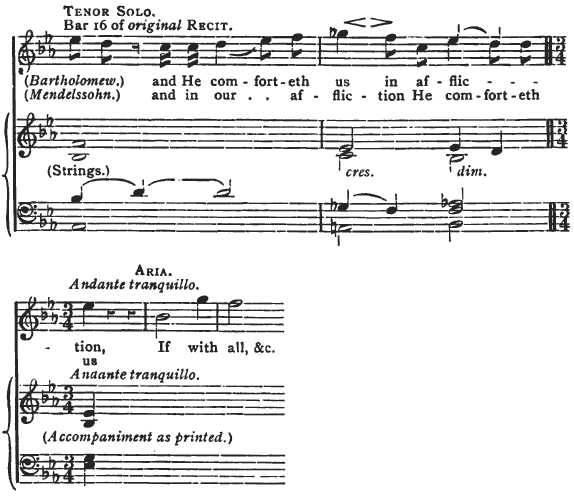
The chief alterations (to quote from Sir George Grove's invaluable
article "Mendelssohn," in his "Dictionary of Music and Musicians,"
II., 289) were:—
"The chorus 'Help, Lord!' (No. 1), much changed: the end of
the double quartett (No. 7), re-written: the scene with the
Widow (No. 8), entirely re-cast and much extended: the
chorus 'Blessed are the men' (No. 9), re-scored: the words
of the quartett 'Cast thy burden' (No. 15), new: the soprano
air 'Hear ye' (No. 21), added to and re-constructed: in the
Jezebel scene a new chorus, 'Woe to him' (No. 24), in place
of a suppressed one, 'Do unto him as he hath done,' and the
recitative 'Man of God' added: the trio 'Lift thine eyes'
(No. 28) was originally a duet, quite different: Obadiah's
recitative and air (No. 25) are new: the chorus 'Go,
return,' and Elijah's answer (No. 36) are also new. The last
chorus (No. 42) is entirely re-written to fresh words, the
text having formerly been 'Unto Him that is abundantly
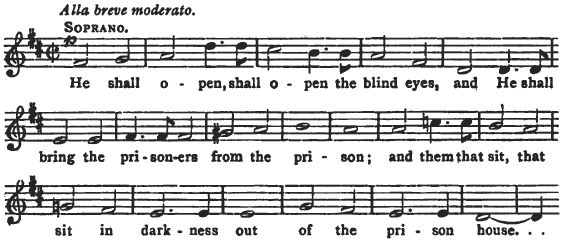
able,' etc. The omissions are chiefly a movement of 95
{86} bars, alla breve, to the words 'He shall open the
eyes of the blind,' which formed the second part of the
chorus 'But thus saith the Lord' (No. 41), and a recitative
for tenor, 'Elijah is come already; and yet they have known
him not; but have done unto him whatsoever they listed,'
with which Part II. of the oratorio originally opened. In
addition to these more prominent alterations, there is
hardly a movement throughout the work which has not been
more or less worked upon."
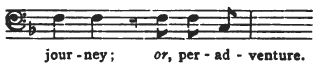
The phrase of four bars (instrumental) at the end of "Man of God" (No.
25), and leading into "It is enough," was an afterthought, and, like
the overture, was due to the English translator. Bartholomew made the
suggestion—a hint, it may be called, but a very interesting one—in
the following words: "Elijah—'Tarry here, my servant, and I will go a
day's journey into the wilderness.' What if an instrumental interlude
(short) gave time for the journey? and then, spent with fatigue, he
might, from very weariness, say, 'It is enough!'"
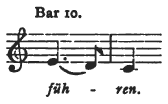
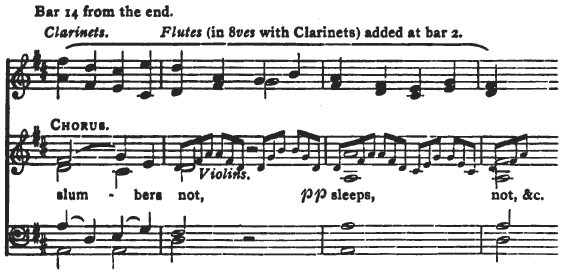
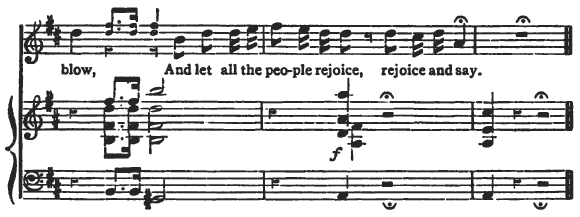
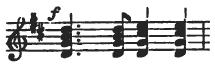
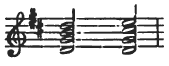
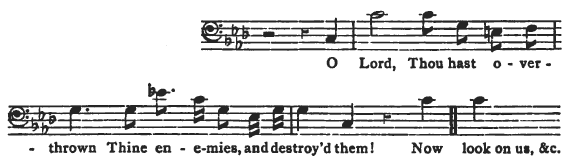
Another interesting instance of Mendelssohn's afterthoughts is that
near the end of the last Baal chorus, where the sustained and piercing
cry of the sopranos and altos was not originally re-echoed by the
tenors and basses:—
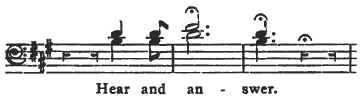
[Listen]
The above impressive response to the entreaty of the female voices is
inserted, in Bartholomew's writing, in a proof copy of the oratorio,
now in my possession. Its appropriateness is unquestionable; yet it
was not in the original version.
The Sacred Harmonic Society, who, in 1837, had enrolled Mendelssohn as
a member, and had presented him with a silver snuff-box,[53] were
very anxious to be the first to perform the revised oratorio. Within a
month of the Birmingham performance, the Secretary addressed to
Mendelssohn a long letter, in which (1) the Society congratulated the
composer upon the success of his new work, (2) asked that they might
have the honour of giving the first performance of the revised version
before a London audience, and (3) that, if possible, Mendelssohn
should himself conduct the said performance. Here is Mendelssohn's
reply:—
To T. Brewer, Esq., Hon. Sec. to the Sacred Harmonic Society,
Exeter Hall, London.
[Written in English.]
"Leipzig, October 7, 1846.
"Dear Sir,—I beg to express my best thanks for the letter
dated September 24, and it gives me much pleasure that the
Sacred Harmonic Society will undertake the first performance
of my 'Elijah' before a London Audience. I beg to thank the
Committee most sincerely for their flattering intention, and
of course should be most happy to conduct the work myself
on such an occasion, if I can come to London in April next.
I hope and trust that I may have that pleasure, and that
nothing may prevent me from doing so. But I am still
doubtful, and cannot give a positive promise as far as
regards my coming over; and as for the parts which you wish
to have as soon as possible, I shall speak to the Editor
[publisher] of them, Mr. Buxton, who, I hear, is expected
shortly in Leipzig, and will ask him to let you have them as
soon as they can be ready.
"With many thanks to yourself and the Society, believe me,
dear Sir, your very obedient servant,
"Felix Mendelssohn-Bartholdy."
Before the receipt of the Sacred Harmonic Society's invitation,
Mendelssohn must have begun the work of revision, as the following
letter to Bartholomew (dated exactly a month after the Birmingham
performance) will show:—
[Written in English, and on a sheet of music-paper.]
"Leipzig, September 26, 1846.
"Dear Mr. Bartholomew,—Many thanks for your new alterations
which you made to meet my wishes. I decidedly prefer the
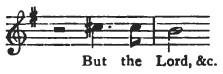
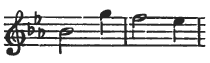
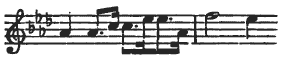
second version of the beginning of No. 41: 'But the Lord
from the north hath raised one!' (this is very good), but
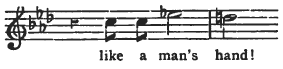
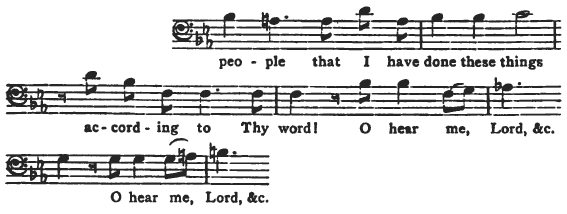
at the last bar before the Andante I cannot approve of—
"Indeed these two long notes are necessary, for the
development of the whole phrase, as I intended it. Now,
could you not say 'call His name,' instead of 'call upon
His name?' Then the chief difficulty would be removed. And
perhaps would it be possible to leave out 'of the sun,' and
only say 'from the rising' (this is done very often, at
least in our German Bible)? Then the second passage would
also stand nearly as with the German words:—

[Listen]
"The rest of the Andante con moto suits my music now very
well in the alteration, as you wrote it out, but I should
prefer there the first, and in the beginning (Andante
sostenuto) the second version. And why not? So the Andante
con moto might begin: 'But the Lord hath upraised one, the
Lord,' etc. But if this is against your conscience, leave
here also the second version. For the beginning is much more
important.
"I prefer:
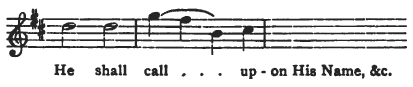
[Listen]
"In No. 38 I should prefer: 'his words appeared like
burning torches'—I am so obstinate about the torches
because they account for the F minor character which I gave
to that beginning more than any other word could possibly
do.[54]
"As for 'the transgressor,' etc., I may possibly send
another piece instead of the one which now stands, and
therefore we will settle the translation hereafter.
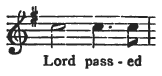
"In No. 34 I prefer:—
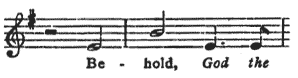
[Listen]
and afterwards—
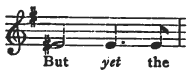
[Listen]
and likewise—
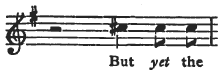
[Listen]
for I should not like to place the word 'God' on so short a
note, and in such a rhythm, while the word yet is just as
light and insignificant as will do on such a note.
"And again many thanks,
"F.M.-B."
The following letters from Mendelssohn to Bartholomew, all written in
English, may now follow on, seriatim; they lead up to the period of
the composer's arrival—for the last time—in England.
"Leipzig, 30 December, 1846.
"My dear Sir,—I send to-day to Mr. Buxton all the pieces
which were still wanting in the first part of my 'Elijah.'
Wherever I could, I took the words from the English Bible
and adapted them as well as I could to the alterations, in
order to save you trouble; but, nevertheless, I must ask you
to look over all I have done, that no wrong accent or other
blunders might remain in it. So, for instance, in the 13
bars which I have added before the chorus 'Blessed are the
men,' and which are taken from Psalm cxvi. {12} and
Deuteron. vi., 15 {5}, I wrote the German words under the
English in case you should prefer the notation as originally
composed, and choose to add a word or a syllable here and
there in the English version, in order to give it the same
rhythm as in German. I should wish this in the passage just
quoted, particularly in the beginning of Elijah's answer,
'Du sollst den,' where the two slurred notes 'Thou♩ shalt' are not equally good. But I
could not find something else, and I also think that
passages like these are best left as in the Bible. In the
following chorus, No. 9, there is a curious specimen of the
different meaning of the German and English version: the
words 'He is gracious,' &c. (or, as you had it, 'they are
gracious'), apply, in your version, to the righteous, while
in ours they apply to God, and the passage is in our
version, 'the light ariseth to the righteous from Him who
is gracious, full of compassion,' &c., &c. Now I certainly
composed it with this last meaning, and the question is
whether you would think it advisable to introduce it, or
not. I proposed 'He is' instead of 'they are,' because I
thought it could then be understood both ways; but most
probably you might hit on something much better still.
Instead of 'who delight in His commands,' I preferred 'they
ever walk in the ways of peace' only, as more expressive,
and I hope you will be of my opinion. I see in the
Birmingham book that you quoted the words of this chorus
Psalm cvi., 3; but I took them from Psalm cxxviii., 1, and
Psalm cxii., 1 and 4, although nearly the same passage
occurs in Psalm cvi., 3.
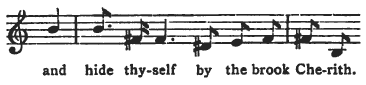
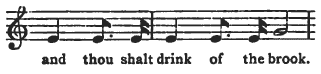
shalt' are not equally good. But I
could not find something else, and I also think that
passages like these are best left as in the Bible. In the
following chorus, No. 9, there is a curious specimen of the
different meaning of the German and English version: the
words 'He is gracious,' &c. (or, as you had it, 'they are
gracious'), apply, in your version, to the righteous, while
in ours they apply to God, and the passage is in our
version, 'the light ariseth to the righteous from Him who
is gracious, full of compassion,' &c., &c. Now I certainly
composed it with this last meaning, and the question is
whether you would think it advisable to introduce it, or
not. I proposed 'He is' instead of 'they are,' because I
thought it could then be understood both ways; but most
probably you might hit on something much better still.
Instead of 'who delight in His commands,' I preferred 'they
ever walk in the ways of peace' only, as more expressive,
and I hope you will be of my opinion. I see in the
Birmingham book that you quoted the words of this chorus
Psalm cvi., 3; but I took them from Psalm cxxviii., 1, and
Psalm cxii., 1 and 4, although nearly the same passage
occurs in Psalm cvi., 3.
"No. 15 is a piece in which I must again require your
friendly assistance. From the time I first sent it away for
the Birmingham performance I felt that it should not remain
as it stood, with its verses and rimes, the only specimen
of a Lutheran Chorale in this old-testamential work.[55] I
wanted to have the colour of a Chorale, and I felt that
I could not do without it, and yet I did not like to have
a Chorale. At last I took those passages from the Psalms
which best apply to the situation, and composed them in
about the same style and colour, and very glad I was when I
found (as I looked into the English Bible) that the
beginning went word by word as in German. But after the
beginning my joy was soon at an end, and there it is that I
must ask you to come to my assistance. The words are taken
from Psalm lv., 23 {22}; Psalm cviii., 5 {4}; and Psalm
xxv., 3.
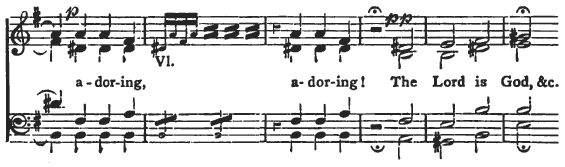
"In the chorus No. 16, I added the German words 'Fallt
nieder auf euer Angesicht,' in pencil, because I thought
that the English translation, 'adoring,' etc., did not
express the meaning entirely, nor did it render the rhythm
of the German, which is still more to be felt by the bar I
have added before the pause. Our 'fallt nieder' means
something still more awful, I think, than to 'bow down' or
'to adore'; but query whether it can or should be given in
English![56]
"You will also find the Allegro of the Soprano song at the
beginning of Part 2 ['Hear ye, Israel'] with the subsequent
chorus. I never thought of omitting the Allegro of the
song, but wanted to find something (in words and music)
better appropriated to make the transition from the slow
movement to the Allegro. The Recit. which I now send is
taken from Isaiah xlix., 7. Here again the English words
went at first perfectly well, but afterwards they would not
do at all, and (which is the most essential) their meaning
differed greatly. The German means that the Lord speaks 'to
the soul that is despised and to the nation that is
abhorred by others, and to His servant who is oppressed by
tyrants,' and all this made me adopt the words for this
Recit., and therefore I wish it to be expressed also in the
English version.
"And besides all this you will find here and there little
deviations from your words, where I have been forced into
them by my alterations; and therefore I beg you will look
over the whole, that nothing might be in it of which you
did not approve.
"I owe you still many thanks for several very, very kind
letters, and indeed would have written long ago had it not
been for a sea of tedious and complicated businesses with
which they overload me here. I could not avail myself of the
whole of the amplification which you proposed for the
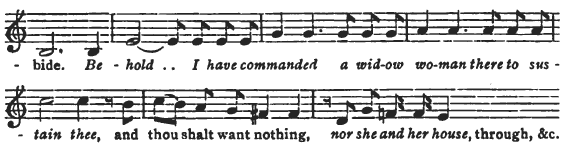
Widow's part, although I adopted several of your quotations
in that passage; but I was not able to give it the extent
you proposed; for although I very often feel the urgent
necessity of altering the details (of which you now see so
many instances), I can but very seldom bring myself to a
deviation from the whole original plan; and I even make
those alterations almost everywhere in order to keep more
faithfully to the object I had first in view. And on that
account I could not make the whole of this passage more
prominent, although I always wish to do as you advise.
"Of course 'commandments' must be left in the soprano song,
instead of 'commands,' if you do not approve of the latter.
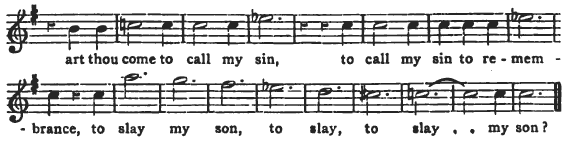
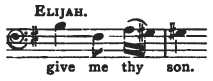
Do you like my way of getting rid of 'to slay, to slay my
son?'[57]
"And many, many thanks for the trouble you have taken with
the 'Sons of Art.' I am afraid the thing is only fit for a
German musical men-festival, and that it is impossible to
give it any effect in another language and at other
occasions; but whatever can be done with it has indeed
been done by you. And so I end as I began with thanks and
thanks.
"Very truly yours,
"Felix Mendelssohn-Bartholdy."
"Leipzig, January 20, 1847.
"My dear Mr. Bartholomew,—A happy new year to you (although
it is rather old already), and many, many thanks for your
kind and precious letter! Indeed, nobody could have written
it but you, and nobody could have taken so much trouble with
my choruses to the 'Athalie' but you, and to nobody could I
feel so sincerely and heartily indebted but to you. Have
many, many thanks, my dear Sir, and be sure that you confer
all these obligations to one who knows how to value them,
and who will always remain thankful to you!...
"The second part of 'Elijah' will in very short time be in
Mr. Buxton's [Ewer & Co.] hands. And now, my dear Sir, let
me repeat to you my heartfelt thanks for all you did again
for me when they performed the 'Athalie' choruses,[58] and
for your interesting report of all the proceedings before
and during that performance, and for all the kindness and
friendship which you always show me.
"Always very truly and sincerely yours,
"Felix Mendelssohn-Bartholdy."
"L[eipzig], February 2nd, 1847.
"P.S.—This letter has been detained till to-day, when I
send a great parcel to Mr. Buxton.
"Now I must add a few things about the second part of
'Elijah,' which I send to-day. In the Recit. No. 33, 'Hear
me speedily, O Lord,' I have altered the beginning of the
words thus:—
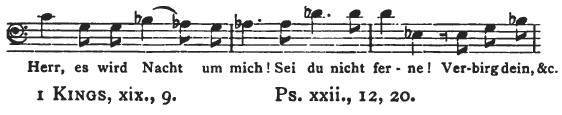
[Listen]
"Pray alter the English words accordingly, and look that the
following alterations are made in the music of that same
Recitative: bar 16 (accompaniment) is to be thus:—
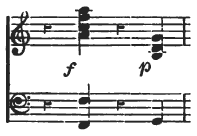
[Listen]
Bar 22 (accompaniment) is to be thus:—
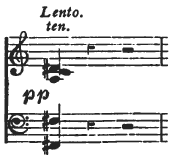
[Listen]
Bar 24 the voice is to be thus:—
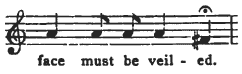
[Listen]
and bar 27 (the last) is to be thus in the voice:—
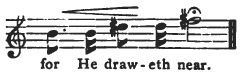
[Listen]
"Pray give your attention to all such passages of the words
which I wrote in pencil in the arrangement. I think they
will all require a new translation, or a modification of the
old one. I always added the quotations. There are also some
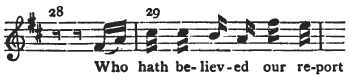
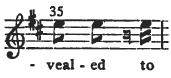
different (and I am sure) better words in No. 21 where I
could not write them in pencil, but you will easily see and
I hope adopt and adapt them. It is in the slow movement, the
passage of Isaiah liii., 1, 'Aber wer glaubt uns'rer
Predigt?' ['Who hath believed our report?'], and in the
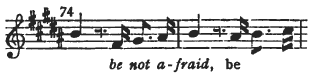
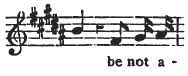
Allegro, instead of 'Wake up, Jerusalem,' etc., the direct
appeal to Elijah, 'Weiche nicht, denn ich bin dein Gott, ich
stärke dich!' ['Be not afraid, for I am thy God, I will
strengthen thee.'], Isaiah xli., 10, from which also the
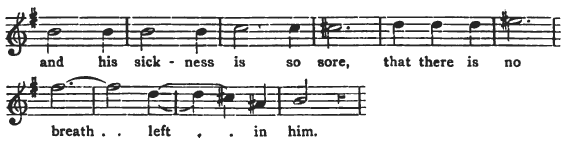
following chorus ['Be not afraid'] is taken.[59]
"I hope the scene with the Queen and people [No. 23] will
now offer less difficulties to you, as the 'Er ist des Todes
schuldig' ['He is worthy to die'] occurs but once; and you
will also see that I took your hint about their seeking
Elijah, &c., &c.
"In the Terzetto, No. 28 ['Lift thine eyes'], without
accompaniment, there might perhaps be an occasion for
altering the words, although they are exactly the same as
they were in the Duet; but I do not think the beginning
would do well with the English words of the Duet.[60]
"And I write over the Chorus 'But, saith the Lord, I have
raised one,' the German word 'Schluss-Gesang'—including
this Chorus, the following Quartett, and the last Chorus.
Could you find an English word which might be applied as
well? It must not be Finale, because that reminds me of an
Opera; and it must not be 'Final Chorus,' because it shall
mean two Choruses and a Quartett; but I should like to have
some word at the head of those three pieces, to show clearly
my idea of their connection, and also as a kind of
'Epilogue' contrasted with the 'Prologue,' or 'Introduction'
before the Overture.
"And excuse and pardon the trouble, and always and ever
believe me,
"Yours very truly and gratefully,
"Felix Mendelssohn-Bartholdy."
"Leipzig, 8th February, 1847.
"Dear Sir,—I receive your letter of the 2nd at the moment
when I send the Orchestra parts of the 1st Part of 'Elijah'
to Simrock, and the last chorus to Mr. Buxton, so I really
answer by return of post.
"Recit. 'Now Cherith's brook,' bar 9. I do not quite like
your two slurs at the end; and as you do not like my
notation, what if we tried a third mode?
viz.:—
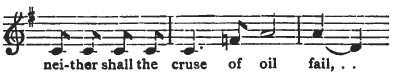
[Listen]
"Now adopt which you like of the three. Bar 13, I prefer
yours.
"I do not speak of bar 26 and bar 38 of No. 8, because Mr.
Buxton will have informed you that I am going to send a new
song for the Widow, and that therefore the whole No. 8 must
be postponed till then. I hope it will follow soon after
this letter, and then I will not teaze you any more about
this 'Elijah.' Bars 83, 95, 114, 123 as you propose. Bar
151, as you like both ways, I should prefer mine; bar 155,
yours. Bar 157, I do not like the two B's and two C's on
the words 'render to the'; could it not be:—
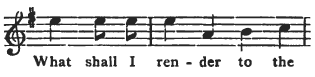
[Listen]
or, if you object to this, it must be at least—

[Listen]
but I confess that I do not like the quavers, if they
can be got rid of. The following bars, and bar 161, &c.,
as you have them.
"No. 9, Chorus, bar 10, I cannot approve of the twice F
[sharp] in the Soprano, although I quite acknowledge the
truth of your observation. But I propose instead:—
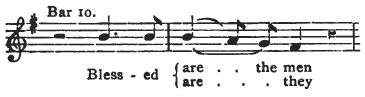
[Listen]
"If you dislike this, pray propose another mode; but the
soprano cannot have the two F [sharps] while the tenor
also has them.
"Bar 14 as you have it. Instead of your and my bar 13, I
propose:—

[Listen]
"Bars 18, 19, 20, &c., as you have. Bar 15 also. And 44,
and 45, also.
"No. 19. Recit. For the end I prefer by far: 'The Lord our
God alone can do these things.' But in reading over these
words I wonder whether the word 'Gentiles' cannot be
objected to? Can one say of Baal that he is an idol of the
'Gentiles'? Indeed, Jeremiah seems to use the word in that
sense, but do we not use it exclusively in another sense? If
not, so much better. Pray answer to this, and excuse the
hasty lines.
"Always very truly yours,
"Felix Mendelssohn-Bartholdy."
"Leipzig, 8th February, 1847.
"My dear Sir,—I send you with these lines the last Chorus
of 'Elijah.' Now I have only the song which is to come in at
the beginning of No. 8 [the Widow scene], and as soon as
that will be finished I will not teaze you any more about
alterations and all that, for you have now the whole work in
hand. But pray do not forget to postpone the engraving of
No. 8 until I send you that song. All the rest may be
forthwith engraved.
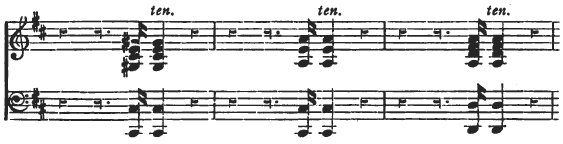
"While I wrote the alterations in the Chorus No. 40 {41} (in
my last letter) I forgot to write that there is also one in
the accompaniment of that passage. So please to correct bars
47, 48, and 49 (they are the last but two of the last page
but one of that Chorus) thus:—
[Listen]
"As for the story of the opera,[61] my friend Klingemann
will tell you all about it, as I have written it at length
to him, and I am so overloaded with Leipzig music, and with
letters, and with all sorts of things, that you must excuse
me if I refer you to him, and cannot repeat again what I
wrote about that story.
"Always very truly yours,
"Felix Mendelssohn-Bartholdy.
"P.S.—I am now almost sure that I shall be able to leave
here on the 6th of April, and to conduct in London my
'Elijah' on the 16th, &c. I shall then leave on the 30th (as
you suggested) and go to Switzerland; and if Mr. Mitchell
must have me and the 'Athalie' in July, I shall come back
in July; if not I will stay at Vevay the whole summer, and
compose away!"
"Leipzig, 17 February, 1847.
"My dear Sir,—I write these lines merely to thank you for
yours dated February 9th, and to tell you that I agree with
all the different remarks you therein make about the wording
of the translation (including 'commandments' instead of
'commands,' &c.). And I hope you will have received the MS.
of Part II. soon after you wrote, for I sent it off on the
2nd, with the exception of the Final Chorus, which I sent a
few days later. I daresay everything will now be safely in
your and Mr. Buxton's hands, and now I may begin to think of
something else, which indeed I have not been able to do all
the time since, with this Oratorio, nearly but not entirely
finished, weighing on my mind.
"Always very truly yours,
"Felix Mendelssohn-Bartholdy."
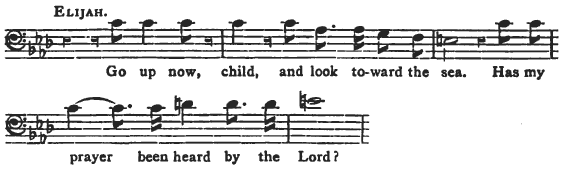
"Leipzig, February 25, 1847.
"My dear Sir,—I prefer[62]—
"It must be—
which will not do for the quickness of the movement.
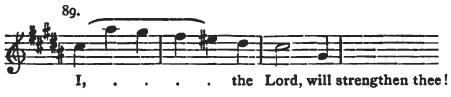
"Bar 89 is impossible as you propose, because on the a♯
and g♯, &c., there must be
no words pronounced; they must be slurred notes, as in
the German wording, and moreover they must be sung on a
good syllable (no "u," or "o," or, &c.). So I should
propose:—[63]
[Listen]
"And at any rate pray let the notes be slurred, because it
is essential to the whole of the song. The same also when
the passage is repeated, bar 140.
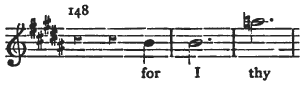
"Bar 148 must be so—
[Listen]
"All those passages I do not mention here are quite
excellent in the way you propose. Add a note for the
served him and worshipped him. You are quite welcome to
it.[64]
"You see that I really answer by return of post, for
yesterday evening your letter came, and this morning this
leaves. But I do not understand why there is such a hurry
about the Pianoforte arrangement being finished, and why
you say there is hardly time to wait my reply. For you know
that it cannot be published a day before Simrock has also
done it, and that will take much time still. However, I make
haste answering, and shall also do so with your next. I do
not think that I shall be able to be in London before the
13th April. But I am sure that is early enough, for I am
sure everything which you take in hand is right.
"Always yours truly,
"Felix Mendelssohn."
"Leipzig, March 3, 1847.
"My dear Sir,—I have just received your letter of the 24th,
and hasten to reply. I like all the passages of the
translation you send me with but two exceptions. In No. 30,
'that Thou would'st please destroy me' sounds so odd to
me—is it scriptural? If it is, I have no objection, but if
not, pray substitute something else. And then in the new No.
8 [the widow scene]—the words from Psalm vi. which you
hesitated to adopt are, of course, out of the question; but
I also object to the second part of the sentence which you
propose to add to the words of Psalm xxxviii. {6}, viz.: 'I
water my couch,' etc. [Psalm vi., 6.]—I do dislike this so
very much, and it is so poetical in the German version. So
if you could substitute something in which no 'watering of
the couch' occurred, but which gave the idea of the tears,
of the night, of all that in its purity. Pray try!
"But what is this? Does Staudigl not come? Mr. Buxton told
me last autumn he was sure to be there. I heard it since
from all sides. And now he does not come? What is to become
of my 'Elijah' then? I cannot write to Staudigl and
persuade him to come, but I really do not know how the
performance could match that of Birmingham without
him—indeed I do not know how it could go. Of course Lockey
would be quite sufficient for all the Tenor solos! But
Staudigl! That word of yours has given me a great deal to
think of.
"Always very sincerely and gratefully yours,
"Felix Mendelssohn-Bartholdy."
"Leipzig, March 10, 1847.
"My dear Sir,—Many thanks for your letter of the 1st. I
really do not know what a synopsis of the oratorio should be
good for—on the other hand, I do not see the harm it could
do—and, therefore, leave it to you to decide this point as
you think best. I shall send you the metronomes in a few
days; the organ part I do not forget.
"But tell me, should the whole series of performances not be
better postponed till autumn? What with your uncertainty
about Staudigl, and with all this uproar in London about the
two opera parties, and with Jenny Lind coming or not coming,
and with the 'Tempest' or not the 'Tempest,' and with the
difficulty you and Mr. Buxton have to make the parts
ready—would not such a delay be beneficial to all of us,
especially to the old prophet himself? Not to me certainly,
who like to shake my English friends by the hand the sooner
the better—but to all others?
"And now many thanks for your friendly advice in the opera
affair. Some time before you wrote your letter to me, I had
already informed Mr. Lumley that I should not be able to
produce an opera of the 'Tempest' in the season 1847; and,
according to the advice my friend Klingemann gave me some
days before your letter came, I have since again written to
Mr. Lumley (about the same words as you suggest), have asked
Klingemann to take care of seeing the letter safely
delivered, and have sent to him a duplicate of it. So that
the whole of your advice, the same which my friend Kl. gave,
has been followed literally, and I should be very glad if
thus the affair would come to an end. Of this I think I may
be sure, that Mr. Lumley will not continue his
advertisements of my opera after he heard that I had taken
the resolution not to write the 'Tempest' for the season
1847....
"And now forgive this dry letter, and believe me, yours very
truly,
"Felix Mendelssohn-Bartholdy."
Reading between the lines of the last-quoted letter, it is easy to see
that Mendelssohn was much annoyed at the public announcements, made by
Mr. Lumley in his opera prospectus of 1847, to the effect that "The
celebrated Dr. Felix Mendelssohn-Bartholdy will likewise visit
England, and produce an Opera expressly composed for Her Majesty's
Theatre, the Libretto, founded on 'The Tempest' of Shakespeare,
written by Scribe." These advertisements were, to say the least, very
premature, as Mendelssohn had not only disapproved of parts of the
libretto, but had not written a note of the music! The suggestion
contained in the above letter that he (Mendelssohn) should postpone
his visit till the autumn, must have caused some consternation amongst
his London friends, especially as all arrangements had been made for
the various performances of the revised oratorio, which were to be
given under his own personal direction. Bartholomew—ever resourceful
and indefatigable—at once wrote the following letter to the
composer:—
"2, Walcot Place, Hackney, March 19, 1847.
"My dear Sir,—Yours of the 10th came to hand last night,
and in reply to it I can tell you twenty reasons why you
should come, and not one why you should not come. Upon
the faith of your letter, which Buxton has been obliged to
quote from in order to prove his warranty to treat for your
coming with the Committee at Exeter Hall, he has made the
engagement for you with them, and they have made
their engagements with others for April 16th and 23rd;
and, I think, the 28th. The Manchester Hargreaves Society
have fixed their date for one of the intervening days and
advertised it.... Everybody is now in town expecting you
and anxious to hail your appearance. Nobody will be in
town in the autumn. (Is that a reason why you should come
then?) If you don't come, 'Elijah' would go—for go it
must—but I mean it won't go well....
"You have no idea how they are inundated with enquiries at
Newgate Street [Ewer & Co.'s] as to when 'Elijah' will be
published.... God bless you, dear Sir!
"W. Bartholomew."
Whatever influence this letter from Bartholomew may have had upon its
recipient, and doubtless others wrote in the same strain, Mendelssohn
duly came to London—alas! for the last time—at the beginning of
April, 1847, the year in which he died.
The first performance of the revised version of "Elijah"—the form in
which we now know the oratorio—took place, under the auspices of the
Sacred Harmonic Society, at Exeter Hall, London, on Friday, April 16,
1847, conducted by the composer. Miss Birch, Miss Dolby (afterwards
Madame Sainton-Dolby), and Mr. Henry Phillips replaced Madame
Caradori-Allan, Miss Hawes, and Herr Staudigl, who had "created" their
respective parts at Birmingham. "Lockey would be quite sufficient
for all the tenor solos," wrote Mendelssohn, and so he proved to be.
Madame Sainton-Dolby records: "After I had sung 'O rest in the Lord,'
Mendelssohn turned to me with tears in his eyes and said, with his
bright frankness of manner, 'Thank you from my heart, Miss Dolby.' I
shall never forget that look of brightness." Mr. W.H. Cummings, then a
chorister of the Temple Church, sang alto in the chorus at the first
London performance. He and some other boys were asked to help, as the
alto part lay rather high for men's voices.[65] Master Cummings, as
he was then, sat in the front row of the altos, and his enthusiastic
singing attracted the notice of Mendelssohn, who asked the Temple
chorister his name, which he wrote on one of his (Mendelssohn's)
visiting cards, and gave to the youthful singer.
The first London performance was not without some humour. The Times
said: "Mr. Perry, the leader, was constantly beating time with his
fiddle-stick in such a manner as to obstruct the views of the
Conductor and confuse the attention of the instrumentalists."[66] A
Frenchman, seated on the orchestra behind the chorus, was so excited
with the performance that, at the close, he effusively embraced
Mendelssohn and tried to kiss him!
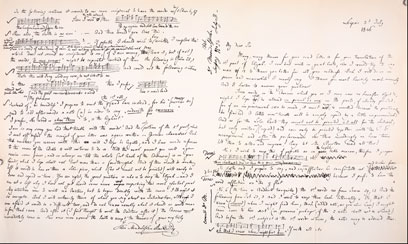
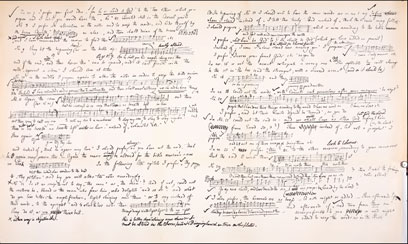
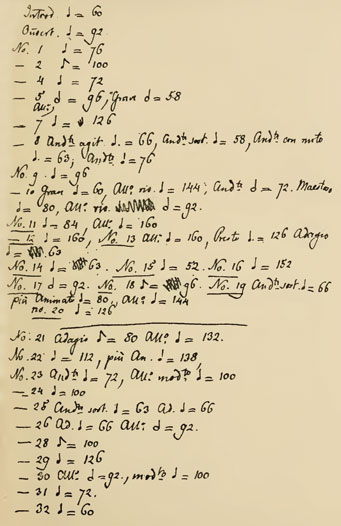
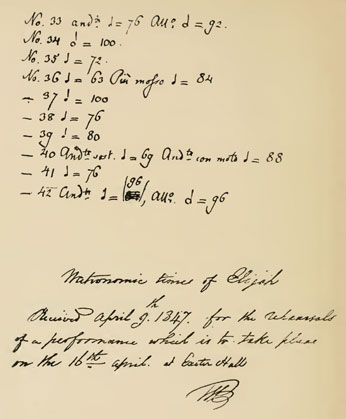
Fac-simile of Metronomic times for “Elijah” in
Mendelssohn’s handwriting. The note, signed “W.B.” is in the
handwriting of William Bartholomew. Slightly reduced from the
original, in the possession of F.G. Edwards.
[Enlarge]
[Enlarge]
Three other performances were given in Exeter Hall, and under the same
auspices, on the 23rd, 28th, and 30th of the same month (April), and
were conducted by Mendelssohn. These four concerts attracted
crowded audiences, and brought into the exchequer of the Sacred
Harmonic Society a clear profit of £356.
The second performance (April 23) was honoured by the presence of the
Queen and the Prince Consort. What the Prince felt on that occasion
found graceful expression in the following tribute to Mendelssohn's
genius, which he wrote in the book of words he had used at the
concert:—
"To the Noble Artist who, surrounded by the Baal-worship of
debased art, has been able, by his genius and science, to
preserve faithfully, like another Elijah, the worship of
true art, and once more to accustom our ear, amid the whirl
of empty, frivolous sounds, to the pure tones of sympathetic
feeling and legitimate harmony: to the Great Master, who
makes us conscious of the unity of his conception, through
the whole maze of his creation, from the soft whispering to
the mighty raging of the elements.
"Inscribed in grateful remembrance by
"Albert.
"Buckingham Palace, April 24, 1847."
The original of this is now in the possession of Frau Wach, of
Leipzig, Mendelssohn's younger daughter. In the few hours which
elapsed between its receipt from the Palace and its presentation to
Mendelssohn, the Sacred Harmonic Society had a fac-simile copy made,
which was carefully sealed up. When the news arrived of Mendelssohn's
premature death, the Prince Consort at once gave permission for this
copy to be lithographed and circulated.
The following extract from the 1847 Report of the Sacred Harmonic
Society records the presentation of the above "compliment" to
Mendelssohn:—
"Both Her Majesty and Prince Albert were graciously pleased
to express their gratification at the Performance, and the
attention paid to them; and the Prince a few days afterwards
condescendingly inscribed in a Book of the Words of the
Oratorio, an elegant compliment to Dr. Mendelssohn, in his
native tongue, which was handed to him on the morning of his
departure from England, by a deputation from your Committee,
and received by him with marked feelings of pleasure and
gratitude.
"It cannot be described how deeply gratified Mendelssohn was
on the presentation to him of this affectionate token of
sympathy. His rapturous exclamations of delight, as over and
over again he read each word of the inscription, his
repeated expression of fears of his inability adequately to
acknowledge this touching mark of appreciation, were again
and again renewed."[67]
Mendelssohn also conducted performances of the revised work at
Manchester (Hargreaves Choral Society) on April 20, and at
Birmingham, April 27—a total of six performances, conducted by the
composer, within a fortnight. At Birmingham, where "Elijah" was given
for Mr. Stimpson's "benefit," Mendelssohn not only refused to take any
fee, but also declined to accept his travelling expenses—thus he
generously showed his appreciation of Stimpson's invaluable services
at the initial performance in 1846.
"Elijah" was published in Germany by Simrock, Bonn; and in England by
Messrs. Ewer & Co., who for some years previously had been
Mendelssohn's sole publishers in this country. The then proprietor of
the firm of Ewer & Co. was Mr. Edward Buxton, whose real business was
that of a wool-broker, and who "had only taken to music publishing for
his attachment to the art." The relations between the composer and his
English publisher were of the most cordial nature. "Whatever you
write, Dr. Mendelssohn," said Mr. Buxton, "I will publish, and pay you
any terms you like to ask." Here was an ideal publisher, from a
composer's point of view. Mr. Buxton had no reason to regret his
words; and that Mendelssohn fully appreciated his publisher's generous
offer, is abundantly shown in the "terms" he mentioned for the English
copyrights of his compositions.[68]
Mendelssohn cannot be accused of being "hard" or "grasping" in
negotiating with his publisher. The following letter shows the spirit
in which he made his proposals for the publication of "Elijah" in
England. It is written (in English) to Buxton, and dated "April 22,
1846":—
"I must beg you to tell me the price which you could give
for the copyright of such a work. I do not fix the price,
because I wish on such an occasion that neither you nor I
should be the loser; you must know the sale of such works,
and may thereby form an opinion. Indeed, I should not be
able to name any sum for myself, and make conditions which
would appear unpleasant to you; but as on the other hand I
have been asked from England by different persons for the
copyright of such a work, I must think that it may also have
value for the publisher there, and you may easily form an
opinion of this: therefore I beg you will let me know your
answer as soon as you can."
Mendelssohn wrote to Moscheles for his advice on the subject of the
"terms" for the English copyright of "Elijah." Here is Moscheles's
reply:—
"I quite feel the responsibility of advising you in the
matter; for if fifty years hence it is said, 'Mendelssohn
received only so many pounds sterling for this grandest of
works, this inexhaustible mine of wealth to the editor
[publisher], and that at the suggestion of Moscheles,' my
ashes will be disturbed in their rest. Well, well, you will
nod your venerable head, and say, 'Never mind; Moscheles
meant well.'
"You do not say what other offers you had, besides that from
Buxton. I think you will find him straightforward in his
dealings, and ready to recognise that the market value of
your productions is constantly increasing. So I should say
you might ask £50 more than you did for the 'Hymn of
Praise.' [Moscheles had probably forgotten the amount, £25,
that Mendelssohn received for the English copyright of his
'Hymn of Praise.'] One point to take into consideration is
whether this work is richer than the other in solos, these
being a better source of income to the publisher than
choruses."[69]
Mendelssohn received 250 guineas for the English copyright of
"Elijah." Shortly after the composer's death, Mr. Buxton voluntarily
sent to Frau Mendelssohn an additional sum of £100 for "Elijah," which
she gracefully acknowledged in the following extract:—
"I hesitated a moment whether I ought to accept the £100
which you sent me; but then I remembered the great pleasure
it had given my husband when Mr. Simrock sent him an
additional sum for his 'St. Paul,' on account of the success
the oratorio had had. Why should I not feel a similar
pleasure in hearing that his last work is being so fully
appreciated in England? I thank you therefore that you think
of us by sending this money as a proof of the success of
'Elijah.'
"Berlin (Spring, 1849)."
The work was published in June, 1847, as Op. 70. The lowest price of
the first English edition—"Pianoforte score, with portrait on steel
of the composer"—was thirty-six shillings! An octavo edition did not
appear till five years later (1852): price ten shillings. A tonic
sol-fa edition, published "by subscription" ("not less than 250
subscribers"), was issued in 1866.
The prosperity of "Elijah" was at once assured. The work bore upon it
the imprint of success. It immediately shot into the front rank of
popularity, a position which it has steadily maintained even unto this
day.
The story has now been told. Six months after the strains of "Elijah"
had died away in Exeter Hall, the genius-brain that had conceived
that noble work was for ever calmed in death.
(Mendelssohn died at Leipzig, November 4, 1847, in his thirty-ninth
year.)
A memorable performance of "Elijah" was given by Jenny Lind in Exeter
Hall, December 15, 1848, in aid of the Mendelssohn Scholarship Fund.
This performance, which Mr. Otto Goldschmidt happily terms the
"corner-stone of the Fund," was a triumphant success.
No more fitting conclusion to this "History" could be found than the
words of Jenny Lind, who, in writing to the composer's widow on her
irreparable loss, said: "His 'Elijah' is sublime! In my opinion he
never wrote anything finer; and assuredly could not have written
anything loftier in the future! With what solemnity we all stood there
(to perform it); and with what love do the people still speak of him!"
To this tribute of reverence from one great artist to the memory of
another, I venture to subscribe a fervent "Amen."
















![and Thy great [or: Thy gracious] mercies do remember, O Lord!](https://openoldbooks.sgp1.digitaloceanspaces.com/books/the-history-of-mendelssohn-s-oratorio-elijah-by-f-g-edwards/images/music061a.png "and Thy great [or: Thy gracious] mercies do remember, O Lord!")