History of Lynn from the
establishment of the Normans in England to the
Reformation.
Observations on the Conquest—account of
the changes then introduced—their effects on the kingdom at
large, and on Lynn and its vicinity in particular.
The conquest of England by the Normans appears to have been no
less complete than those which had been before effected by the
Romans, the Saxons, and the Danes. The English grandees
were generally stript of their possessions, and their lands
divided among the conqueror’s chief favourites and great
captains, who then became the nobles of the realm, and from whom
are descended most of our present great families. This
conquest was obtained much easier than any of those that preceded
it. A single battle now determined the fate of the whole
country, partly, as was before observed, through the defection,
intrigues, and influence of the clergy, most of whom were in the
interest of the invader, as he was supported by their holy
father the Pope, who had distinguished him by such special marks
of his favour as, could not fail of attaching them to his
cause.
William’s army consisted of 60,000 men; not all his own
subjects, (for his duchy could not furnish and maintain such a
force) but made up chiefly of adventurers, or soldiers of
fortune, who had engaged in the expedition, on the promise of
forfeited lands, in proportion to the numbers they brought with
them. Accordingly, some are said to have afterward bestowed
on them no less than 700 manors, others 5, 4, 3, 2, and 100, or
less; insomuch that all the land in England, if we except the
royal demesnes, the church lands, and those annexed to the cities
and boroughs, were in no more than about 700 hands, whose wide
possessions were again distributed among their numerous vassals,
according to the principles of the feudal system, which was now
completely introduced and established in England. [328]
In consequence of this change, it became a fundamental maxim,
and necessary principle of our English tenures, that the king is
the universal lord and original proprietor of all the lands in
his kingdom, and that no man doth or can possess any part of it,
but what has, mediately or immediately, been derived from him, to
be held upon feudal services. This engrafting of the feudal
tenure on almost all the land in the kingdom, is said to have
been the most important alteration which our civil
and military policy then underwent. [329a] The great
lords held their lands of the king, by certain services, as all
their vassals held theirs also of them. Thus the king had
the whole power of the country closely connected with, and
dependent upon himself. This state of things was
calculated, no doubt, to secure the kingdom from external danger,
and may be considered as laying the foundation of that high
military character which England afterwards held among its
neighbours.
A vast demesne was now set apart for the king, amounting to
1422 manors, together with many other lands which had never been
erected or formed into manors. Besides these he had the
profits of all his feudal tenures, his worships, marriages, and
reliefs; the benefit of excheats, either upon failure of heirs,
or forfeiture; the goods of felons and traitors; the profits of
his courts of justice; besides many other casualties, which
amounted to an immense revenue; insomuch that the Conqueror, as
we are informed, had no less than 1060l. 10s. a
day, the annual amount of which, allowing for the comparative
value of moneys &c. was equal to several millions (perhaps
twenty or more) of ours. [329b] So large a
revenue might probably justify the saying of Fortescue, that
originally the King of England was the richest in Europe.
We are told, that William’s military tenants were
obliged, on all occasions, to furnish 60,000 knights, completely
equipped, and ready to serve forty days at their own
expence. Every seaport also, in proportion to its ability,
was obliged to find, in time of danger, one or more ships
properly furnished with men and arms; which, joined with such
other ships as the king hired were generally an overmatch for the
invaders. [330] Thus we see how powerful and
formidable England became after the conquest, in its means of
defence and resistance, under its Norman sovereigns.
Whilst we are noticing the changes now introduced into this
country, it may not be improper to observe, that the feudal
system was a favourite branch of the Norman policy, and which
they appear carefully to have established wherever they could get
a firm footing. They did so, not only in Normandy and
England, but also in Sicily, which they appear to have
subdued much about the time of which we are now speaking, and
which has groaned under the oppression of that System ever since,
even to this day. Of the commencement of that order of
things in that island, and its present aspect and bearings, a
very recent writer gives the following account, which may serve
to cast some light on the state of our country at the period now
under consideration.
“Roger the Norman, conqueror of Sicily, and
contemporary with our William the First, on his accession to the
throne, divided the lands of the kingdom into three
portions—One third of these was called the demesnes of the
Crown, which are administered by the corporation of the royal
towns where they are situated; each town, according to the
revenue of its demesnial lands, pays to the king a certain
income, besides maintaining the police, roads, &c. &c.
and the tribute which each territory pays is called the royal
patrimony.—The next third part of these lands was
distributed by King Roger among his nobles; some of these were
fiefs contained within the territory of the demesnial towns,
while others had a town of their own, of which the estate or
barony formed the territory. Sometimes townships of these
baronial towns have estates belonging to them, which are
administered by their corporations, called giurati.—The
remaining third portion was either distributed among the bishops
and mitred abbots, or served to endow the several Convents, which
in an age fertile in superstition were so generally
established.
“This distribution of property has remained thus ever
since the Norman Conquest; and all the noble fiefs, as they are
held by a grant in military tenure, are supposed to belong to the
crown, and given to a family and their descendants, subject to
military service. This Circumstance supposes an absolutely
strict entail, which prevents the sale of fiefs without the
king’s sanction; (verbo regio;) it supposes also the
indivisibility of the fief—hence the rights of
promogeniture, which has reduced the younger branches of families
to a most miserable state. Thus the lands of the nobles are
entailed in their families. Those of the church are
attached to it, and the demesne lands are equally so to the
corporations, as above-mentioned.” [331]
Of
the orders of Society in Sicily, the same writer says—
“Those princes, dukes, marquisses, and
barons, who hold estates which have a town, or sufficient
population, are called parliamentary barons, and have a right to
sit in the assembly of the nobles: all others are called rustic
fiefs, and give no right of this kind to their landlords, though
they be decorated with a title.—The next order of men are
the clergy, who form a distinct assembly or house of parliament,
and consists of archbishops, bishops, archimandrites, mitred
abbots, &c. The principal of these are younger brothers
of the noble families; so that, in fact, the ecclesiastical house
of parliament is tied to the lords.—The next order of men
consists of a second rank of nobles, who hold fiefs without
burghs, or towns, and who, though they have the same splendid
titles, have no seat in the parliament. The next order are
the burghers of the different towns; these apply to agriculture,
to the church, and to the medical and legal professions: then
come the artisans and peasants. These are the peasants of
the demesne, and those who are the vassals of the parliamentary
lords.”
After noticing the multiplied miseries under which the bulk of
the people is involved by this wretched order of things, which
forms an insuperable obstacle in the way of national happiness
and prosperity, our author informs us, that, according to the
original constitution of Sicily, the three houses of parliaments
have the faculty of granting supplies to the Crown; but the
majority of the two houses (he says) are sufficient; by which
means the house of commons, or demesnial assembly becomes
totally nugatory, and the lords and ecclesiastics, after
generously granting the supplies, throw the whole burden of them
on the commons. Whatever remonstrances are made, the matter
is left to the decision of those who have done the evil, and the
mischief is thus perpetuated: [333] for it seems they
never think of yielding in the least to the remonstrances of the
commons, or complaints of the people.
In Sicily the feudal system exists without its original
energies; and it may be said to exist in its very worst state, so
as to spend all its force in oppressing beyond measure the middle
and lower orders of the community, or great body of the nation,
without contributing to the real benefit of any. The
consequence is that the people, for the most part, groan
hopelessly under their burdens, and seem perfectly indifferent
about the issue of the present contest with France. Yet
some people seem to wonder at their supineness, and their not
rising as one man in defence of their king and country.
They might probably have done so, had their rulers been wise, and
left them what would have been worth contending for, or
defending. When rulers cease to feel for the people, it is
not unnatural or unusual for the people also to cease to feel for
them. This, perhaps, will apply to many of the recent
changes among the European powers.
Beside the feudal system, our Norman conqueror introduced into
this country divers other innovations—One of which was the
separation of the Spiritual courts from the Civil; which was effected
(says Blackstone) in order to ingratiate the new king with the
popish clergy, who for sometime before had been endeavouring all
over Europe to exempt themselves from the secular power; and
whose demands the conqueror, like a politic prince, thought it
prudent to comply with, by reason that their reputed sanctity had
a great influence over the minds of the people; and because all
the little learning of the times was engrossed into their hands,
which made them necessary men, and by all means to be gained over
to his interests. And this was the more easily effected,
because the episcopal sees being then in the breast of the king,
he had taken care to fill them with Italian and Norman
prelates. This innovation produced very grievous
consequences; so that by degrees the rights and privileges of the
English clergy were delivered up into the hands of the Pope, who
taxed them at his pleasure, and in process of time drained the
kingdom of immense treasures: for besides all his other dues,
arising from annates, first fruits, peter-pence, &c. he
extorted large sums of money from the clergy for their
preferments in the church. He advanced foreigners to the
richest bishopricks, who never resided in their dioceses, nor so
much as set foot upon English ground, but sent for all their
profits to a foreign country; nay so covetous was his Holiness,
that before livings became void, he sold them provisionally among
his Italians, insomuch that neither the king nor his clergy had
any thing to dispose of, but every thing was bargained before
hand at Rome. [334]
Another grievous innovation, introduced at the same
period, consisted in the depopulation of whole countries for the
purposes of the king’s royal diversion; and subjecting both
them and all the ancient forests of the kingdom to the
unreasonable severities of forest laws imported from the
continent, whereby the slaughter of a beast was made almost as
penal as the death of a man. In the Saxon times, though no
man was allowed to kill or chase the king’s deer, yet he
might start any game, pursue, or kill it, upon his own
estate. But the rigour of these new constitutions vested
the sole property of all the game in England in the king alone;
and no man was entitled to disturb any fowl of the air, or beast
of the field, of such kinds as were specially reserved for the
royal amusement of the sovereign, without express licence from
the king, by a grant of a chase, or free warren: and those
franchises were granted as much with a view to preserve the breed
of animals as to indulge the subject. From a similar
principle to which, though the forest laws are now mitigated, and
by degrees grown entirely obsolete, yet from this root has sprung
a bastard slip, known by the name of the game law, now
arrived to and wantoning in its highest vigour: both founded upon
the same unreasonable notions of permanent property in wild
creatures; and both productive of the same tyranny to the
commons; but with this difference, that the forest laws
established only one mighty hunter throughout the land, the game
laws have raised a little Nimrod in every manor. [335]
Another innovation produced by the conquest was,
“narrowing the remedial influence of the country-courts,
the great seats of Saxon justice, and extending the original jurisdiction of the king’s justiciaries to all
kinds of causes arising in all parts of the kingdom. To
this end the Aula-regis, with all its multifarious
authority, was erected; and a capital justiciary appointed, with
powers so large and boundless, that he became at length a tyrant
to the people, and formidable to the crown itself. The
constitution of this court, and the judges themselves who
presided there, were fetched from Normandy: and the consequence
naturally was, the ordaining that all proceedings in the
king’s courts should be carried on in the Norman
[or French] instead of the English
language:—a provision the more necessary, because none
of his Norman justiciaries understood English; but as evident a
badge of slavery as ever was imposed upon a conquered
people.” And yet the nation was obliged to submit to
it and bear it, for ages. The former plainness and
simplicity now gave way to the abstruseness, chicanery, and
subtilty, which have ever since so unhappily characterized our
legal proceedings. [338a]
Another of the hateful innovations of the same memorable
period was, the introduction of the trial by combat, for
the decision of all civil and criminal questions of fact in the
last resort. This was the immemorial practice of all the
northern nations, but first reduced to regular and stated forms
among the Burgundi, about the close of the fifth century: and
from them it passed to other nations, particularly the Franks and
the Normans; which last had the honour to establish it here,
though clearly an unchristian, as well as most uncertain method
of trial. But it was a sufficient recommendation of it to
the conqueror and his warlike countrymen, that it was the usage
of their native duchy of Normandy. [338b] This vile
remain of ancient barbarism, and foul disgrace of the legal
polity of our ancestors, has long ceased to exist in our
island.
As the general changes introduced by the conqueror must have
affected the inhabitants of Lynn, in common with the rest of
their countrymen, the above sketch of them became necessary, in
order to give the reader some idea of the state of things here at
and subsequent to the conquest. Before and at that period,
as has been already observed, Lynn and its neighbourhood formed
part of the possessions of Harold, of Stigand archbishop of
Canterbury, and of Ailmar bishop of Elmham. All the
possessions of the former, of course were forfeited by the
conquest. Those of the two others soon followed; for being
both Anglo-Saxons, (or Englishmen,) and deemed inimical to the
Norman succession, they were both expelled, and their sees filled
by foreigners. Ailmar’s power and possessions here
were in right of his see, and of his lordship of Gaywode, which
had been long attached to that see: those of Stigand were in his
own right, or that of his lordship of Rising, and that of the
hundred of Freebridge, which he held, (as well as the lordship of
the hundred of Smithdon, and many other lordships,) as a lay
fee. His possessions in these parts were bestowed by he
conqueror on his half brother Odo, bishop of Bayeux, in Normandy,
whom he created Earl of Kent. On his rebellion afterward
against William Rufus, he was deprived of them, and they were
bestowed on William de Albini, that king’s butler, whose
son, of the same names, was created Earl of Sussex [of this more
may be seen in the account of Castle
Rising.]—Ailmar’s possessions here went to his
successor Arfast or Herfast, who removed the see from Elmham to
Thetford, in whose successors they continued for many
generations.
Most, if not all the great gentry of England, in these parts,
and throughout the whole kingdom, at or within a few years after
the conquest, were deprived of their power, stript of their
possessions, and completely humbled. Great numbers of them
lost their lives under the charge of treason, sedition, or other
crimes. Those who escaped with their lives were reduced to
poverty, and obliged to occupy such humble stations as they
could not one day have thought of without disdain. [340] This memorable revolution, (as
such revolutions mostly do,) chiefly affected the higher
orders. It affected them, indeed, with a vengeance.
The middle classes seem to have felt but little of it, at least
compared with their superiors. The lower orders felt it
still less, or, perhaps, not at all. They were
slaves before, and so they continued for several ages
after, seemingly without any material change. Nor does
their hard condition appear to have been at all ameliorated till
after the civil wars broke out between the rival houses of York
and Lancaster. The fatal effects of those wars in reducing
the numbers of each party, obliged the leaders (as has been
before observed) to turn their attention to the lower orders,
that is to the real slaves, great numbers of whom were
then emancipated, to fill up the thinned and reduced ranks of
their respective armies. And this seems to have been the
only good that attended those bloody and destructive wars.
It certainly proved of great national benefit, although, like the
reformation of Henry VIII, it sprung from no virtuous or
honourable motive. The proverb says, It is an ill wind that
blows no good; and it may be very safely said, that seldom, if
ever, have any calamitous occurrences been known, but what have
been productive of some real benefit. This, doubtless, is
owing to the overruling hand of providence, and ought to be
acknowledged as such.
But
though the manumission of great numbers of English slaves took
place during those bloody and fatal wars, and also in consequence
of the politic and wise measures adopted by Henry VII. Yet
it does not appear to have been fully or universally effected, or
that slavery was then totally eradicated in England. We
find that there were here some slaves in the reign of Henry VIII.
and of Edward VI. and even of Elizabeth: [341a] and it may be doubtful, if they had
entirely ceased to exist here before the reign of Charles I. and
the civil war. They abounded in the parts about Lynn for a
very long period; but whether as late as in some other parts of
the kingdom is rather uncertain. [341b]—In talking
and boasting of our great charter, and of the unwearied and
undaunted exertions of our ancient barons and patriots to obtain
and enforce it, and how careful they were on every occasion to
maintain inviolate the rights and liberties of the people of
England, we are seldom aware that a great part of the nation was
all the while in actual slavery, and not a soul among the whole
host of contemporary patriots and redoubtable zealots for
freedom, ever once thinking of pleading their cause, or
commiserating their sufferings! So also in more recent
times have we been congratulating ourselves on our national
virtue and ardent love of liberty and justice, while we were
every year dragging thousands and tens of thousands of the poor
Africans into west-indian slavery!!
Further remarks on the revolutionary effects
of the conquest throughout the whole kingdom as well as at
Lynn—Catalogue of bishops who formerly bore rule in this
Town.
The mighty change effected in this country by the conquest
must have been felt at Lynn in common with all other places of a
similar description. The great and opulent were doubtless
the people who felt it most. [342] As to the
middle classes, (if such there were that might properly be so
denominated,) it must have affected them much less, and the lower
orders very little, or perhaps, not at all. The latter were
all slaves before, and most unfeelingly treated by their
masters and proprietors; and they could but be slaves still;
nor is it likely that they met with worse treatment from their
new masters. What might not be hoped from the virtue or
justice of the Normans, might yet be expected from their policy;
for in that quality they seem not to have been deficient; and it
may be reasonably supposed that it would induce them to use the
numerous slaves they found here no worse than they had been used
by their former proprietors. Thus a great part of the
nation, and perhaps the greatest part of it, might not be so very
materially affected, or injured, by the Norman conquest, as some
would be apt to imagine—if indeed it did not prove, on the
whole, a benefit rather than detriment to them. [343]
We
must not however imagine or suppose that this revolution bore any
resemblance to that which took place in this country above six
hundred years afterwards, and which has been justly the fond and
proud boast of our countrymen ever since. They were
scarcely in any thing alike, except in the names of their
respective authors. But William of Normandy must not be
compared with William of Nassau; for they were two men of very
different and opposite characters: the former came over to subdue
and enslave the nation, the latter came as the champion and
guardian of its rights and its freedom—one came to rob and
destroy, the other to succour and to save—one merited the
detestation and execration, the other the esteem, the gratitude,
and the benediction of mankind.
Of all the English grandees, who were ruined by the conquest,
none were more completely undone than the three great proprietors
and lords of Lynn. One of them as has been already
observed, was king Harold: of his downfall we need say no
more. The other two were archbishop Stigand, and his
brother, bishop Ailmar. The former seems to have
been the elder brother and head of the family, and was probably
of noble birth, and of Danish extraction, as the bulk of his vast
possessions lay in East Anglia. Carte says, that it appears
from the Domesday book, that he had the best estate of any man in
England, except Harold and Edwin: there can be little doubt
therefore of his being the head of one of the first families in
the kingdom. He was lord of Rising, and of the Hundreds of
Freebridge and Smithdon, and also, of divers other extensive
districts. He is represented as a man of no great learning,
but of eminent natural parts, improved by reflection, exercise,
and experience, and directed by a clear head and solid
judgment. He had the reputation of being endowed with
uncommon capacity for business; and we also hear that he was a
person of very great weight and power in the country, of which no
doubt can be entertained when his immense wealth is considered,
and the vast influence, arising from both his temporal and
spiritual dignities. That such a man should be marked out
as one of the victims of the Norman revolution, was naturally to
be expected: his being an Englishman, and so very opulent and
powerful, were sufficient temptations to sacrifice him. But
he seems to have conducted himself so warily at that critical
juncture, that the Conqueror for sometime appeared at a loss how
to proceed against him. At last some frivolous or pretended
ecclesiastical misdemeanor was found out, for which he was
deprived of his spiritual dignity, under the sanction of the
papal authority, by two popish legates, at a council held at
Winchester in 1070. This appeared a hard and severe
measure: but William, as a politic prince, laid the whole blame
or responsibility of it on the then Pontiff, Alexander II.
Yet he immediately seized on Stigand’s vast estates in East
Anglia and elsewhere, and confined him in prison on a very scanty
allowance, where it is said he died, of want, in the course of
the same year, and so did not long survive his disgrace, or
rather his downfal. His great possessions, in and about
Lynn, the Conqueror bestowed on his half brother Odo, bishop of
Bayeux, in Normandy, whom he created Earl of Kent, and, who then
became one of the new masters and lords of Lynn. [346a]
Stigand’s brother, bishop Ailmar, who had still greater
power in this town, is supposed to have been deprived, at the
same time, and by the same council. It is likely that he
too was then immured in a prison, and never released from it to
his dying day. Such has often been the fate of men who had
attained the highest honours and preferments among their
countrymen.—Ailmar was succeeded in the see of Elmham, and
in his jurisdiction and possessions at Gaywood and Lynn, by
Herfast, one of the conqueror’s chaplains, as Rapin
says.—Here it may not be improper, or unacceptable to the
reader, to subjoin a List of the names of all the bishops that
preceded and succeeded Ailmar, as masters and lords of Lynn, from
Felix the Burgundian, first bishop of the East Angles, to Richard
Nykke, or Nix, 31st. bishop of Norwich, [346b] who surrendered into the hands of
Henry VIII. his authority or dominion over this town, when the name of
it was changed from Bishop’s Lynn to King’s Lynn, which it has retained ever
since.—Those bishops were,
1. Felix the
Burgundian. He was the apostle of the East Angles,
among whom his ministry was attended with eminent success, and
issued in the conversion of the whole nation: schools were
consequently instituted, and numerous places of worship erected
throughout the whole country. He was consecrated their
bishop in 630, and fixed his seat first, it seems, at
Soham in Cambridgeshire, and then at Silthestow,
afterwards called Domnoc, and since Dunwich, in
Suffolk. He has been represented as very learned and
pious. The fame of his uncommon sanctity was so great, that
after his death, which happened in 647, he was canonized as a
saint, and his festival stands on the 8th of March, in the Romish
calendar. (See more of him above at p. 242.)—His
immediate successor was Thomas, who
had been trained up under the famous Paulinus archbishop
of York, to whom he had been appointed deacon. On the
expulsion of that metropolitan from his see, Thomas served the
same office under Felix, till his death. After presiding
five years he died, in 653, and was succeeded by Boniface, who also sometimes goes by other
names. He was a native of Kent, a priest of Canterbury,
whose archbishop consecrated him, in 653; and dying in 669, he
was succeeded by Bisus, or
Bosa, who was consecrated by Theodore, archbishop of
Canterbury. In his time the diocese was divided into two
sees, one of which remained at Dunwich, and the other was fixed at
North Elmham, in Norfolk, among whose possessions the
demesne or lordship of Lynn and Gaywood was included.—The
bishops of Elmham, according to the best account we have met
with, were the following,
I. Bedwinus, or
Baldwinus. He has been spoken highly of as a man of
profound learning and exemplary virtue, and author of numerous
works (now lost) which confirmed many in the christian
faith. 2. Northbertus, or
Northbert, succeeded sometime after 679.—(3) Hedulacus, or Hadulac, filled this
see in 731; when Bede completed his ecclesiastical
History.—(4.) Edelfridus, or
Ethelfrith.—(5.) Lamferthus, or Lameferd.—(6.)
Athelwalfus, or Ethelwolph,
occupied this see in 811.—(7.) Ulfertus, or Alberth: said to attend
at the council of Cloveshoe, in Berks, where King Offa proposed
erecting a new bishopric at Lichfield.—(8.) Sibba, or Sibban: he sat in
816.—(9.) Hunferth, or
Hunferd: was living in 824.—(10.) Humbert, or Humbrit: it was he who
crowned king Edmund, or St. Edmund, in 856, with whom he perished
in 870, or 871, in opposing the Danes. He too was
canonized.—(11.) Wybred,
Wyred, or Wilbred: He was set over the two sees of
Dunwich and Elmham, which occasioned their being then reunited:
the seat was fixed at Elmham.
Bishops of Elmham after the union of the
sees.—(1.) Theodred I.
He is reported to have been an eye witness of St. Edmund’s
corpse being found uncorrupt, 70 or 80 years after his
death.—(2.) Theodred, II.
surnamed the Good: He was first bishop of London, and
then of Elmham; both of which he held till he died, sometime
after 962.—(3.) Athulf, or
Adulf: succeeded in 966; or, as some think,
earlier.—(4.) Alfric or
Alfrid: was one of those who signed and confirmed king
Edgar’s charter to the abbey of Croyland. He died in
975, at the close of Edgar’s reign.—(5.) Athelstan, Edelstane, or
Elstane: He was consecrated the latter part of
975.—(6) St. Algare, or
Algarc: he had been Confessor to St. Dunstan archbishop of
Canterbury, and promoted to this see in 1012. He afterwards
resigned, and retired among the monks of Ely, where he died in
1021.—(7.) Alfwin, or
Elfwin, succeeded the same year. He had been keeper
or guardian of the body or remains of St. Edmund, and afterwards
removed the same from Bury to London. He was also a violent
stickler for the monks, or Regulars, in their furious
squabbles with the Seculars. He resigned in
1032.—(8.) Alfric II. succeeded,
and died in 1038; and was succeeded by—(9.) Alfric III. surnamed the Little, who
is said to die in 1139. [349]—(10.) Stigand; (afterwards archbishop) he had been
chaplain to king Harold Harefoot; but having obtained this see by
simony, which his vast wealth would enable him easily to do, he
was afterwards ejected by king Hardicanute, in 1040.—(11.)
Grinketel: he held it in commendam
with the bishopric of the South-Saxons, during the rest of
Hardicanute’s reign. Under the Confessor, Stigand was
restored to favour, and promoted to Winchester, and last to
Canterbury.—(12.) Egelmar,
Ailmar, of Almar: of whom an account has been given
already, as well as of his brother Stigand.—(13.) Arfast, or Herfast, chaplain to the
Conqueror. He succeeded at Easter, 1070. In
compliance with an order of a council held by Lanfranc,
that all episcopal sees should be removed from villages to the
most eminent cities or towns in the respective dioceses, Herfast
translated the see of Elmham to Thetford. He was by
birth a Norman, in great favour with the Conqueror, and
chancellor of England. He died in 1084; and in 1085 was
succeeded by (14.) William Galsagus,
de Bellafago, or Beaufo. He also was one of
the Conqueror’s favourites, had been his chaplain, and
became chancellor of England. He was, like most of that
monarch’s great favourites, a person of immense wealth;
which at his death, in 1091, was, by his will, divided between
his family and see: and this must have contributed not a little
to augment the large possessions that were formerly attached to
this bishopric. In his time the celebrated survey, called
Domesday, was made, in which, at folio 145, is contained
an enumeration of the estates then belonging to the bishopric;
and at folio 148, is an account of the lands of the said bishop,
either in fee or inheritance. As many of the latter were
bequeathed to the bishopric, the revenues of the see at that
period may nearly be ascertained. All these were alienated
in the exchange made by Henry VIII. [350]—After this
bishop’s death the see was removed from Thetford to
Norwich.
Bishops of Norwich.—1. Herbert Lozinga, who having, through the
favour of Roger Bigod, Earl of Norfolk, obtained, by grant and
purchase, certain lands, called Cowholm, commenced the
execution of his favourite plan of building a magnificent
cathedral, the first stone of which was laid by him in
1096. He erected a palace also for his residence, on the
north side, and a monastery on the south side, which he furnished
with 60 monks, all which doings were sanctioned by Pope Paschal
II. Herbert was also abbot of Ramsey, and lord Chancellor
of England; and moreover a most notorious simoniac, for which the
pope imposed upon him some heavy penances, in the doing of which
he very notably acquitted himself, and gave good proof how well
he was cut out for that kind of business.—Besides the large
edifices he erected at Norwich, he also built the two great
churches at Yarmouth and Lynn; the latter he dedicated to St.
Margaret the Virgin, or, as some say, to St. Mary
Magdalen, St. Margaret, and all the maiden
saints. A priory was also built by him on the south
side of this church. These he is said to have undertaken
at the request of the people of Lynn; and yet it seems as
if those same people were not otherwise very forward in their
encouragements to him; for he was obliged to have recourse to a
very ungraceful expedient in order to induce them to hasten their
contributions:—to all who would subscribe or contribute
towards these erections he offered and granted an indulgence, for
forty days; [351] or, in other words, a Licence
to commit with impunity any species of wickedness, or all manner of
sin and villany, for the space of forty days! It is
supposed that this expedient fully answered the bishop’s
purpose; for the buildings were soon finished, in a style of
superior magnificence. It reflects no credit on the memory
of our townsmen of that day, that in order to do some good, or
contribute liberally towards the erection of religious edifices
in the town, they must be indulged with a licence to commit all
manner of crimes. It shews that they were much more
attached to evil than good, and liked sin far better than
holiness. How much the present population of Lynn excels
them, is a question that will not here be discussed.—Bishop
Herbert died in 1119 and was buried before the high altar of his
new cathedral.
2. Eborard, or
Everard, succeeded Herbert, after a vacancy of almost
three years. In his time the Jews, as we are told,
crucified a boy, named William, who being considered a martyr,
and canonized, brought no small gains to the church, by the
numerous pilgrimages and offerings made annually on this
occasion. Though the truth of this shocking crucifixion
story seems more than doubtful, yet the monks managed to procure
it general belief, and to get the poor boy (real or fictitious)
canonized, under the name of Saint William. Their
main object no doubt was to bring grist to the mill; and as that
end was amply obtained, it may be said that they received their
reward, and did not labour (or rather invent the tale) in
vain. This bishop was the founder of the hospital and
church of St. Paul in Norwich; and a great benefactor to the monastery
which had been endowed by his predecessor. He was deposed,
or resigned about 1146, and died at Fountain’s Abbey
in Yorkshire, in 1149, and was succeeded by
3. William Turbus, or
Turbeville. He was a great stickler for
Becket, whose influence, even while in disgrace and exile,
drove him sometimes to unwarrantable and perilous lengths;
especially when he excommunicated the bishop of London, the Earl
of Norfolk and some other nobles, who were disliked by that proud
prelate. He died in 1174, and was succeeded the next year,
by
4. John of Oxford, who was
very differently affected towards Becket, and took part with the
king against him, by which he greatly ingratiated himself with
his sovereign; who being desirous of having the laws more
strictly executed, and a more impartial administration of justice
enforced, appointed him, together with the bishops of Ely and
Winchester, his three principal justices for the purpose.
He built Trinity Church at Ipswich, repaired the damages his
cathedral had sustained by fire, in the time of his predecessor,
and was a great benefactor to the episcopal convent at
Norwich. He died in June 1200, and was succeeded by
5. John de Grey, who was
promoted to the see by that great and memorable patron of Lynn,
King John, with whom he appears
to have been in very high favour, and from whom he procured the
liberties of Magna Charta for his diocese. He also obtained
from
that monarch a charter to make his town of Lynn a free borough,
which was dated at Lutgershall, Sept. 14, 1204, the 6th year of
that reign. This was the first of the Lynn charters.
These concessions the king was induced to grant, as it is said,
either to obtain favours, or in return for some he had
received. The wealth of this prelate is reported to have
been of great service to the sovereign in his troubles; and for
various loans he had obtained, he pledged to the bishop his
regalia, viz. his great crown, the surcoat, cloak,
sandals, gloves, spurs, &c. This bishop built the
palace of Gaywood, and so seems to have resided pretty much here,
and may be supposed to have acquired among the inhabitants a good
portion of popularity. We are also told that he confirmed
to the monks of Norwich our church of St. Margaret, and
the chapels of St. James and St. Nicholas, and the
church of Mintling, together with the tithes of
Gaywood, &c. This bishop died at Poictou, in
1214: after which the see was vacant seven years; when
6. Pandulphus, an
Italian, was consecrated in 1222. He had been sent
to England as legate by the pope, on account of the deposition of
archbishop Langton by king John. While at Rome, to have his
election to this see confirmed, on his representing that it was
greatly in debt, (whether true or false, we know not,) he
obtained a grant of the whole first fruits of the clergy
in his diocese, for himself and successors; which thenceforth
became attached to those prelates, till the time of Henry VIII,
and must have considerably augmented the episcopal revenues. He
died in Italy, in 1296; but his remains were brought to England
for interment, and buried in his cathedral.
7. Thomas de Blandevill
succeeded him, and died in 1236, when
8. Ralfo succeeded, and died
the next year; of whom as well as the former, nothing remarkable
is known to be recorded. His successor was
9. William de Ralleigh, who
obtained the bishopric after three years contesting his
right. He granted, we are told, an indulgence of twenty
days pardon, to all in his diocese who would contribute towards
the building of St. Paul’s in London. Hence it
appears, as well as from the case of Herbert Lozinga, above
noticed, that bishops, as well as popes, in those
times, assumed the power of giving a licence to sin with
impunity. They must have been rare teachers of morality,
who could pretend to promote good works by allowing the people,
for a limited time, to run into all possible excesses of riot and
evil doing:—and, on the other hand, their intellects must
have been in a most unenviable and degraded state, who could
accede to the preposterous proposals of such instructors, or
patiently listen to such shameless representations. The
doctrine of indulgences was afterwards made good use of by Luther
and his coadjutors, in their successful struggle against the
papal tyranny.—Bishop Raleigh was translated to Winchester,
where he died, soon after his induction. He was succeeded
by
10. Walter de Suthfield, or
Suffield, who was consecrated in 1224. He obtained
for the bishopric a charter of free warren to himself and
successors. So we may presume that he was himself a
sportsman. By the command of Pope Innocent, he drew
up a general and particular valuation of all the ecclesiastical
revenues in the kingdom; which, after receiving the papal
confirmation, was called the Norwich-Inquest; and
subsequently became the ratio of clerical taxation. He
erected and endowed the Hospital of St. Giles, in Norwich, for
poor pilgrims, and died in 1257. He was succeeded the next
year by
11. Simon de Waltone, who
died in 1265; and was succeeded the same year by
12. Roger de Skerning, in
whose time several dreadful affrays happened between the citizens
of Norwich and the monks, in one of which the cathedral was
burnt. This bishop died in 1278; and was succeeded the same
year by
13. William Middleton.
The cathedral being partially repaired, he was enthroned at
Norwich; and he rededicated the church, in presence of the king
and queen and principal nobility, who were assembled on the
occasion. He died in 1288; whose successor was
14. Ralph de Walpole, a
Marshland man, it seems, and ancestor of the present noble family
of the Walpoles. He was translated to Ely, in 1299,
and his successor at Norwich was
15. John Salmon, or
Salomon. Enlarging or rebuilding the palace at
Norwich, and founding the Charnel-house, now the free school, are
among the principal works ascribed to him. He died in 1385,
and his successor was
16. Robert de Baldock, who
resigned shortly after, and was succeeded by
17. William de Ayrminne, who
employed himself in enclosing his palace, cathedral, &c. with
stone walls, and fortifying then with embattled parapets.
He died in 1336; and had for his successor
18. Thomas Hemenhale, who
soon resigned this see, and accepted that of Worcester in lieu of
it. Then succeeded
19. Anthony de Beck, a man of
the most imperious and turbulent temper, who had terrible
quarrels with the monks, by whose instigation, as it was thought,
he was poisoned by his own servants at his seat of Hevingham, in
1343. His successor was
20. William Bateman, dean of
Lincoln. He was a great benefactor to the nunnery of
Flixton in South Elmham, and gave the nuns a body of statutes for
their regulation; and, in 1347 founded Trinity Hall in
Cambridge, for the express purpose of supplying his diocese with
persons properly qualified for the discharge of the duties of
parochial cures. He died in 1354, at Avignon, while on an
embassy to the pope. This prelate was a native of Norwich,
but spent much of his time abroad, and chiefly at Rome, till the
pope promoted him to this bishopric. So great was his
interest with his holiness, that he also obtained for himself and
successors, the first fruits, as we are told, of all vacant
livings within his diocese, which occasioned, it seems, frequent
disputes between him and his clergy. But the clergy were
not likely to gain much by disputing with him, for he is
represented as “a stout defender of his rights, and one who
would not suffer himself to be injured or imposed upon, or his
dignity insulted, by any one.” In proof of which, the
following anecdote has been related of him by some of our
historians:—“Lord Morley, having killed some of the
bishop’s deer, infringed upon his manors, and abused his
servants who opposed him, was obliged to do penance by walking
through the streets of the city with a wax candle of six pounds
weight in his hand, and kneel down before the bishop, in the
cathedral, and ask his pardon, although the king had sent an
express order to the contrary.”—From this anecdote we
may safely infer, that this prelate governed his slaves and
vassals, the inhabitants of Lynn, with despotic sway. It is
said that there was in his time such a dreadful plague in
England, and throughout Europe, as scarcely left a tenth part of
the inhabitants living; and that it appears from the Chronicle of
Norwich, that from the first of January to the first of July
1348–9, 57374 persons, besides ecclesiastics and beggars,
died in Norfolk alone. We cannot learn how many of them
were of the town of Lynn.—A circumstance that seems to
corroborate this extraordinary mortality is, that this bishop
instituted and collated 850 persons to benefices vacant at this
time. [358] His successor was
21. Thomas Percy, youngest
brother of the Earl of Northumberland, though but twenty-two
years of age. After erecting the steeple of the cathedral,
which had been blown down by a violent wind, and repairing the
choir, which had been much damaged, he died, in 1369. The
next year he was succeeded by
22. Henry Spencer, or Le
Spencer, a prebendary of Salisbury. He was
consecrated in March 1370, by the pope in person, which
probably contributed not a little to cherish that self importance
and haughtiness for which he was so remarkable. In an aid
granted through the kingdom to the king’s use, this prelate
certified for his diocese, that it contained, in Norfolk 806
parishes, and in Suffolk 515; and each county was accordingly
rated. He took a most active part, at the commencement of
what is called the grand Schism, in the memorable warfare
between pope Urban and his competitor pope Clement:
for there were then two popes; two infallible heads of the
catholic church! and each reviling and damning the other without
mercy, and most bloodily seeking his destruction!! Bishop
Spencer was on the side of pope Urban, with whom he was in very
high favour. In 1383 that pontiff published a bull, in
which he called upon all who had any regard for religion, to
exert themselves in its defence, by taking up arms for him,
against his rival Clement and his adherents; promising at the
same time, for the encouragement of all who would volunteer in
this meritorious service, the same pardons and
indulgences as had been usually granted to those who had
engaged, or lost their lives, in the great eastern crusades, or
holy wars. [359] This papal bull met with no small success
in England, owing perhaps to France being on the side of pope
Clement, and to Urban’s choosing an English ecclesiastic
for his general. This was our bishop Spencer, “a
young and stout prelate (says Fox) much fitter for the camping
cure than for the peaceable church of Christ.”—A most
dashing and bouncing high priest he certainly was; of which he
gave repeated and abundant proofs, both at home and abroad.
This right reverend warrior, and champion of holy church, (at
least, of Urban’s portion or moiety of it) having obtained
an aid or subsidy, of the English parliament, set out upon his
continental expedition against the Clementines at the head of
50,000 foot and 2,000 horse: but he did not bring back quite so
many. [360] Our general with his furious
crusaders, after they had landed at Calais, to shew their strict
regard for propriety and consistency, turned their arms against
Flanders; a country that was not favourable to Clement, but had
actually declared for Urban. After ravaging the country,
taking divers towns, and defeating the Flemish force which had
attempted to oppose them, an effectual stop was put to their
career, by the French king, Charles VI. at the head of a powerful
army. In short the expedition ended disgracefully,
as it deserved, and not very unlike certain expeditions to
Flanders and Holland in modern times. The great general,
bishop Spencer, at his return, found himself somewhat in
disgrace; in which he proved more ill-fated than our modern Yorks
and Chathams. The king ordered the temporalities of his see
to be seized, and several of his officers to be imprisoned.
In a year or two, however, his temporalities were restored, and
he probably regained the royal favour.—He lived in great
splendor, and had divers sumptuous palaces, among which was that
at Norwich, another at South Helingham, and another, supposed to
be one of the chief of them, at Gaywood by Lynn, the inhabitants
of which town had ample experience of his imperious and turbulent
spirit. Being one time in town with his retinue, he
quarrelled in the street with the mayor (who was supported by the
townsmen) on some point of frivolous etiquette. From words
the parties came to blows, and a very serious battle ensued,
which terminated in the total defeat of the haughty prelate and
his company, who were all furiously driven out of town, many of
them sorely bruised and wounded. This turbulent high priest
afterwards bent his rage against the poor Lollards, and
appeared among the first to proceed against them upon the law
De hæretico Comburendo. He prosecuted
William Sawtre, minister of St. Margaret’s at Lynn,
who at first recanted, and afterwards became minister of St.
Osith in London, where he relapsed, and was the first that
suffered under the above law. This bishop also afterwards
persecuted Sir Thomas Erpingham at Norwich, and
as a penance, for favouring Lollardism, enjoined him to build the
gate, at the entrance of the College precinct, which still
goes by his name. Bishop Spencer died in 1406, and was, it
seems, the first prelate who quartered the episcopal arms with
his own. His successor was
23. Alexander de Totington,
who, though immediately elected, was not admitted to his
spiritualities till the following year. Some of his
manor-houses and palaces having fallen into decay, through the
negligence of his predecessors, he is said to have spent large
sums in repairing and beautifying them, which constituted,
apparently, his most meritorious and memorable deeds. He
died in 1413, and was succeeded by
24. Richard de Courtney,
chancellor of Oxford, who died suddenly, about two years after,
at the siege of Harfleur; from which it would seem that he was a
prelate that delighted in war, or another of our fighting
bishops, who, at the best, are but unamiable characters. He
was succeeded, in 1416, by
25. John de Wakeryng,
archdeacon of Canterbury, who was confirmed by the
archbishop; which unusual circumstance was owing to the
ecclesiastical anarchy still existing, occasioned by the
continuance of the grand schism, which was then at its
height. During that period there always were two
popes, but they were now three, and each prefering a legal
claim to the papal chair, as the lineal descendant of St
Peter! Three contemporary popes exhibited an unusual and
queer spectacle, and would naturally suggest the idea of three heads
of the church: and a church, or any thing else, with three
heads may pretty fairly be deemed a monster.
Even the protestant church of England, however, has had before
now two heads; one in London, and the other at St.
Germans; which ought to deter its members from bearing too hard
on the church of Rome in the above case. Bishop Wakeryng is
said to have made considerable improvements in and about his
cathedral; which seems to have been among his most praiseworthy
performances. It appears that he died in 1425.
Here it may be proper to observe, that in this bishop’s
time, and that of some of his predecessors, as well as of his
immediate successor, the tranquillity of the town of Lynn appears
to have been exceedingly disturbed by the violence of two
contending factions, which kept the town in a continual state of
discord and distraction, it seems, for the space of about thirty
years: as may be gathered from existing documents, or copies of
Letters, of that period, still preserved in a MS. History of
Lynn, in the possession of Mr. Thomas King of this town.
[363] From which we discover that
those two contending factions were headed by two of the Aldermen
of that time; one of whom was Bartholomy Petipas, who was
twice mayor, and the other John de Wentworth, who
served that office three times. The cause and nature
of the difference that arose between these opposing parties is
not easy to develop. That their animosity was bitter and
violent is but too obvious, but its source or ground is involved
in no small obscurity.
This however is not the place to enter minutely upon the
subject, which shall be resumed in another part of the
work. This dire contention seems to have begun in 1403, the
7th of Henry IV. and to have lasted till 1434, the 13th of Henry
VI. The first of those years were the 3rd. of
Wentworth’s mayoralty, between whom and Petipas there
evidently existed some serious competition; but whether it was
merely a contest for power or superiority in the management of
the town, or arose from certain political questions about a
reform of abuses, on which the parties disagreed, does not very
plainly appear. It is however very well known that
questions of a political, as well as theological nature, were
then much agitated in different parts of the country, by the
enlightened and patriotic disciples of Wickliff, who were anxious
to promote every where political as well as ecclesiastical
reformation; but that such was actually the case then at Lynn,
and the ground of the said disagreement cannot perhaps be
positively affirmed. There are indeed some intimations of
insufficient or suspicious persons having for
sometime been chosen or found among the 24 Jurats that were here
annually elected, in a Letter or injunction from Henry VI,
addressed, seemingly, to the mayor and burgesses, and dated
November 23 in his 13th year, which may indicate that politics
had no small share in the said contention, and the
persons alluded to might belong to the advocates of reform, or
democrats of that day. But this subject we will now drop,
[365] and proceed with our episcopal
catalogue. John de Wakeryng dying in 1425 was succeeded the
following year by
26. William Alnwick,
archdeacon of Salisbury, who, having sat ten years, was
translated to Lincoln. The principal entrance of the palace
is said to have been erected at his expence, and by his
arms being united with those of the see, on the west end of the
cathedral, he is supposed to have contributed towards the
erection of that also.
27. Thomas Brown, or
Breus, succeeded him, being translated hither from
Rochester, by Pope Eugenius IV. by bull, dated September 19,
1436. We are told that he left a sum towards the payment of
the city tax, and exhibitions for poor scholars, prosecuting
their studies in the universities, who might be natives of the
diocese: so that he seems one of the better sort of those of his
order. He died at Hoxne, in 1445.—John Stanbery, a carmelite friar, was chosen
to succeed him, but never consecrated, owing to papal
interference, then at its height. The real successor
therefore was
28. Walter Hart, or
Lyhart, master of Oriel College Oxon, who was appointed by
the pope, and consecrated February 27, 1446. Paving the
cathedral; and erecting the elegant carved roof of the nave,
where a hart, or deer couchant, in sculpture, alluding to
his name, is seen in several places, are the works ascribed to
him. He died in May 1472, and was succeeded by
29. James Goldwell, the
Pope’s Prothonotary, who was made bishop by papal
provision, and consecrated at Rome by pope Sixtus IV. October 4,
1472. He appears to have been a thorough-paced
ecclesiastic, and legitimate son of his Holy Father. Before
he left Rome, at the time of his consecration, he is said to have
obtained of the Pope a perpetual indulgence, to repair and
ornament the cathedral; by which he was empowered to grant, to
all persons who frequented it annually, on Trinity Sunday and
Lady-day, twelve years and forty days pardon, in
lieu of offerings made on the occasion: and having received the
sum of 2200 marks, for dilapidation, he finished beautifying the
tower; made the elegant stone-fretted roof of the choir; and
ornamented the chapels on each side of it; especially that
dedicated to the Holy Trinity, in which he was afterwards
interred.—We need not wonder that he could do so much, when
he was empowered to grant such long indulgences, and such
extensive and ample pardons. Wealthy people, who could
believe him really possessed of such a power, might be expected
to furnish him pretty readily with any sums of money he wanted
for his sumptuous buildings and architectural decorations.
To such pious frauds and cunning devices, many of our
ecclesiastical structures, throughout the kingdom, owe much,
perhaps, of their boasted beauty and magnificence. Sad
however must have been the case of this country, when such vile
tricks could take, or succeed, even with the most enlightened
part of its population; and sadder still must be our case, if we
are not yet proof against equally vile and palpable
impositions.—Bishop Goldwell died in 1498, [370] and the see, on the refusal of
Christopher Urswyke, was filled by
30. Thomas Jane, archdeacon
of Essex, and Canon of Windsor, who was consecrated in 1499, and
died the next year: whose successor was
31. Richard Nykke, or
Nix, archdeacon of Exeter, who was elected in 1500.
He must have been a man of an unamiable and hateful
character. Writers unanimously concur to brand his name
with the greatest obloquy. Of his vile persecuting spirit
no further evidence need be adduced than the fact, that by his
sanguinary judgments, Ayers, Bingy, Norrice,
and the amiable Bilney were consigned to the flames, for
only, in a peaceable manner, expressing those sentiments, which,
as they were sanctioned by conscience, they had a right to
suppose were the dictates of truth. He died January 14.
1535. In his time Chorepiscopi were first appointed
by act of parliament; their office answering to that of
suffragan, which, prior to that period, had been chosen at the
discretion of the diocesan. While this bishop bore sway, as
master and lord of Lynn, there was among the aldermen here a very
remarkable person, whose name was Thomas Miller. He
was mayor of the town six or seven years, but not six or seven
times; for the first time he was in the office for four years
successively, viz. 1520 and the three following years. He
was mayor again in 1529, and again in 1546, the last of Henry
VIII. That he was a man of spirit and intrepidity appears
by his contending with his lord, the bishop, about the right of
having the sword carried before him, which his lordship, it
seems, objected to, and claimed as his own proper and exclusive
right and prerogative. Our mayor and the corporation, not
satisfied with this, went boldly to law with their lordly master,
on the occasion, and carried their cause; which determined and
established the point, and the sword has been carried before
their worships, the mayors of Lynn, ever since, without any
further demur or litigation. It appears indeed that it
would have so happened, in no long time after, had the said
law-suit, or legal decision not taken place; for the king, in the
course of a few years, thought proper to require of this same
bishop the relinquishment and surrender of his supremacy, or
dominion over Lynn, for such valuable considerations as his
majesty, in his princely wisdom, saw fit to grant or allow him,
by way of exchange or remuneration. To this his lordship
readily acceded; for he must have known the king too well to
suppose that it would have been any way safe for him to have done
otherwise. But he died soon after, and before the affair was fully
concluded. The actual surrender, therefore, and probably
under some new arrangements, was left to be executed by his
immediate successor, the no less memorable
32. William Rugg, or,
Reppes, fortieth abbot of St. Bennet’s in Holme, and
native of North Repps, in this county, where his father, of both
his names, is said to have resided. He had his education at
Cambridge, and was fellow of Gonvill Hall in that
university. After being abbot of St. Bennet’s about
six years, he was promoted to this see, by way of recompence, as
some seem to think, for the part he had acted among the Cambridge
divines, in obtaining from that university the judgment his
majesty wished, respecting his marriage with queen
Catherine. They might also suppose, that his being a warm
and stanch stickler for the king’s ecclesiastical
supremacy, and influencing those of his convent to subscribe to
the same, in 1534, were additional recommendations that
contributed to his promotion. But when we consider the hard
terms, or humiliating conditions, on which he was to obtain, or
hold his episcopal dignity, (that is, by relinquishing the
greatest part of the revenue and possessions attached to his
see,) it will not be a very easy matter to prove that any favour
was intended by this preferment, and much less a recompence or
reward for former services: this was certainly very different
from Henry’s wonted manner of using his favourites, and
rewarding his approved servants. But this point is too
uninteresting to merit any further discussion.—Abbot Rugg
being promoted to the see of Norwich in 1536, he, by virtue of a
private act of parliament, parted with all the lands of his
bishopric, except the site of his episcopal palace in Norwich, to
the king, by way of exchange for the revenues belonging to the
abbey of Holme and priory of Hickling; which last being soon
after alienated by him, the whole income, since his time,
appertaining to the see of Norwich, has been only the estate of
Holme monastery, which his successors still enjoy, according to
the purport of the said act, which, continuing unrepealed, gave
occasion to bishop Montague, in the time of Charles I. to
subscribe himself, in his leases, “Richard, by
divine permission, lord bishop of Norwich, and Head
Abbot of St. Benedict’s de Hulm.” The
exchange of the lands of the bishopric, for those of the Abbey of
St. Benedict’s and priory of Hickling, is said to have been
made by Abbot Rugg some months before his election to the see of
Norwich, [372] though not before his promotion
thither had been predetermined. We are further informed
that this prelate alienated from his bishopric, not only the
priory of Hickling, but many good manors besides, belonging to
the abbey, some by absolute gift, others upon trifling exchanges,
and gave long leases, so that, at last, he was unable to maintain
the state of the bishopric, and forced to resign, with an annual
pension of 200 marks. He seems to have been a singularly
improvident and thoughtless prelate, and very different from most
of that order, who seldom lose sight of their terrestrial
interests, or temporal concerns, whatever they may do as to those
that are of an eternal nature. After having resigned the
see for the paltry pittance of 200 marks, or, as some say,
200l. per annum, he died in 1550. In allusion to the
straits and difficulties to which his manifest and manifold
indiscretions had reduced him, one of the members or officers of
his household is said to have made the following verses on his
resignation:
Poor Will, thou rugged art and
ragged all:
Thy abbey cannot bless thee in such fame,
To keep a pallace fair and stately hall,
When gone from thence what should maintaine the
same.
First pay thy debts, and hence return to cell,
And pray the blessed saint whom thou dost
serve,
That others may maintaine the pallace well;
For if THOU stayst, we
all are like to starve.
The convent, or abbey of St. Benedict’s, appears to have
been his chief palace, or place of residence, during the whole
time of his sustaining the episcopal character: after which it
soon went into decay, and ceased to be the residence of his
successors; with whom however we have no further concern, as they
were no longer the temporal lords and masters of Lynn. Here
therefore ends this episcopal catalogue; which exhibits a pretty
long list of names, though but few among them appear to have
merited the praise and benediction of their contemporaries, or
the veneration and imitation of posterity.
State of Lynn previously and subsequently to
its becoming a corporate-town, or free borough, with general
remarks on that event, and on the progressive state of society in
the towns and cities of this country, as well as at Lynn, in
those times.
It is difficult to ascertain the exact state of this town, or
the nature of its police, and the social condition of its
inhabitants, not only before and at the Conquest, but also for a
good while after, any further than that its population appears to
have then consisted chiefly, if not entirely, of the
bishop’s slaves or vassals, governed by such agents or
officers as he thought proper to appoint, whose administration as
may be reasonably presumed, would not always be of the mildest,
or most equitable and unexceptionable description. Had
there been now in existence regular and authentic records of the
affairs of the town, in those days, we should probably discover
that its police, at least the spirit of it, bore but too much
resemblance to our present West Indian jurisprudence.
Slaves, in those ages, seem to have constituted the bulk of our
population; and were, in all probability, the offspring of the
lower orders of the original inhabitants, whose lives had been
spared, when the Anglo-Saxons over-run and conquered the country,
on condition of submitting to perpetual servitude. Such
seems to have been the origin of those slaves of different
descriptions which formerly abounded in this country for many
ages. These, in country places, were the cultivators of the
soil, or tillers of the ground; and in the towns, they were the
tradesmen, mechanics, artificers, and labourers. In short,
both in the towns and in country places all useful employments
were occupied by them. As to their masters, the nobility,
gentry, and every description of military men, who constituted
the great or main body of reputed freemen, they were all above
engaging in any such employments. War and the chace were
the only occupations that were deemed worthy of them; and there
lay the whole stock or sum of their knowledge and
acquirements. Literature of every kind they usually set at
nought; scorning to learn so much as to write their own names, as
an attainment that would be too degrading for an English
gentleman. Under such beings, how unenviable, miserable,
and deplorable must have been the condition of the enslaved or
unfree part of the community.
Of the original, low, and servile state of the inhabitants of
our English, and other European towns, and their progress from
thraldom to freedom, no one has perhaps given a juster account
than Dr. Adam Smith, in the second volume of his
celebrated Inquiry into the Nature and Causes of the Wealth of
Nations. He there observes that the inhabitants of cities
and towns, after the fall of the Roman Empire, were not
more favoured than those of the country.
“They consisted, indeed, of a very different
order of people from the first inhabitants of the ancient
republicks of Greece and Italy. These last were composed
chiefly of the proprietors of lands, among whom the public
territory was originally divided, and who found it convenient to
build their houses in the neighbourhood of one another, and to
surround them with a wall, for the sake of common defence.
After the fall of the Roman empire, on the contrary, the
proprietors of land seem generally to have lived in fortified
castles on their own estates, and in the midst of their own
tenants and dependants. The towns were chiefly inhabited by
tradesmen and mechanics, who seemed in those days to have been
servile, or very nearly of servile condition. The
privileges which we find granted by ancient charters to the
inhabitants of some of the principal towns in Europe,
sufficiently shew what they were before these grants. The
people to whom it is granted as a privilege, that they might give
away their own daughters in marriage without the consent of their
lord, that upon their death, their own children, and not their
lord, should succeed to their goods, and that they might dispose
of their own effects by will, must, before those grants, have
been either altogether, or very nearly in the same state of
villanage with the occupiers of land in the country. They
seem, indeed, to have been a very poor, mean set of people, who
used to travel about with their goods from place to place, and
from fair to fair, like the hawkers and pedlers of the present
times. In all the different countries of Europe then, in the same
manner as in several of the Tartar governments of Asia at
present, taxes used to be levied upon the persons and goods of
travellers, when they passed through certain manors, when they
went over certain bridges, when they carried about their goods
from place to place in a fair, when they erected in it a booth or
stall to sell them in. These different taxes were known in
England by the names of passage, pontage, lastage, and
stallage. Sometimes the king, sometimes a great lord, would
grant to particular traders, to such particularly as lived in
their own demesnes, a general exemption from such taxes.
Such traders, though in other respects of servile condition, were
upon this account called Free-traders. They in return
usually paid to their protector a sort of annual poll tax.
In those days protection was seldom granted without a valuable
consideration, and this tax might, perhaps, be considered as
compensation for what their patrons might lose by their exemption
from other taxes. At first, both those poll-taxes and those
exemptions seem to have been altogether personal, and to have
affected only particular individuals, during either their lives,
or the pleasure of their protectors. In the very imperfect
accounts which have been published from Domesday-book, of several
of the towns of England, mention is frequently made, sometimes of
the tax which particular burghers paid, each of them, either to
the king, or to some other great lord, for this sort of
protection; and sometimes of the general amount only of all these
taxes.” [377]
“That part of the king’s revenue which
arose from such poll-taxes in any particular town, used commonly
to be lett in farm, during a term of years for a rent certain,
sometimes to the sheriff of the county, and sometimes to other
persons. The burghers themselves frequently got credit
enough, to be admitted to farm the revenues of this sort which
arose from their own town, they becoming jointly and severally
answerable for the whole rent.”
In return, being allowed to collect it in their own way, and
to pay it into the king’s exchequer by the hands of their
own bailiff, they would be altogether freed from the insolence of
the
king’s officers; a circumstance in those days of no small
importance.
“At first, the farm of the town was lett to
the burghers, in the same manner as it had been to other farmers,
for a term of years only. In process of time, however,
seems to have become the general practice to grant it to them in
fee, that is for ever, reserving a rent certain, never afterwards
to be augmented. The payment having thus become perpetual,
the exemptions, in return for which it was made, naturally became
perpetual too. Those exemptions, therefore, ceased to be
personal, and could not afterwards be considered as belonging to
individuals as individuals, but as burgesses of a particular
burgh, which, upon this account, was called a Free-burgh, for the
same reason that they had been called Free-burghers or
Free-traders. Along with this grant, the important privileges
above mentioned, that they might give away their own daughters in
marriage, that their children should succeed them, and that they
might dispose of their own effects by will, were generally
bestowed upon the burghers of the town to whom it was
given. The principal attributes of villanage find slavery
being thus taken away from them, they now, at least, became
really free in our present sense of the word Freedom.—Nor
was this all. They were generally at the same time erected
into a commonality, or corporation, with the privilege of having
magistrates and a town-council of their own, of making bye-laws
for their own government, of building walls for their own
defence, and of reducing all their inhabitants under a sort of
military discipline, by obliging them to watch and ward; that is,
as antiently understood, to guard and defend those walls against
all attacks and surprises, by night as well as by day. In
England they were generally exempted from suit to the hundred and
country courts; and all such pleas as should arise among them,
the pleas of the crown excepted, were left to the decision of
their own magistrates.” [379]
For the origin of corporate towns, in this country, we are
generally referred to the times of which we are now treating,
that is, the ages subsequent to the Conquest; and yet it seems to
be very evident from the old book called The Mirrour, that
there existed here some towns of that description even as
early as the days of Alfred: [380] but they were
probably few, and disregarded afterward, if not entirely
disannulled; till a good while after the accession and
establishment of the Norman dynasty: nor can we learn scarcely
any thing of the cause and object of their formation, or the
nature and principles of their constitutions. The case is
otherwise as to those corporations formed since the Conquest;
which seems to apply to all those that now exist in this country:
it is not so difficult to find, or make out, how and why they
were formed; and it is with them only that we have here any
concern. Before they sprung up the feudal system was in its
full and utmost vigour; and the power of the country was divided
between the sovereign and the barons, or great lords; and the
latter were sometimes an over match for the former. As a
counter-balance or check to the formidable and enormous power of
the barons, the incorporation of the great towns and cities seems
chiefly to have been resorted to, or adopted. At least this
appears to have been the case as far as any good policy, and not
mere caprice, had any share in the business: for justice and
humanity, or a desire to enlarge the liberty, and promote the
welfare of the people were totally out of the question.
These were motives too sublime and godlike to enter into the
contemplation of the English kings and courtiers of those
days.
But the said measure, whatever might be its cause and object,
or the motive for its adoption, appears to have produced very
salutary effects: for by forming cities and towns into corporations,
and conferring on them the privileges of municipal jurisdiction,
the first check was given to the overwhelming evils of the feudal
system: and under their influence freedom and independence began
to peep forth, from the rigours of slavery, and the miseries of
oppression. To be free of any corporation, however, was not
then, as at present, merely to enjoy some privilege in trade, or
to exercise the right of voting on particular occasions, but it
was to be exempt from the intolerable hardships of feudal
service; to have the right of disposing both of person and
property, and to be governed by laws intended to promote the
general good, and not to gratify the ambition and avarice of
individuals. These laws, however rude and imperfect, tended
to afford security to property, and encourage men to habits of
industry. Thus commerce, with every ornamental and useful
art, began first in corporate bodies to animate society.
But in those dark ages force was necessary to defend the claims
of industry; and such a force the municipal societies possessed;
for their towns were not only defended by walls and gates,
vigilantly guarded by the citizens, but oftimes at the head of
their fellow freemen in arms, the mayor, aldermen and other
officers, marched forth in firm array, to assert their rights,
defend their property, and teach the proudest and most powerful
baron, that the humblest freeman was not to be injured with
impunity. It was thus the commons learned and proved they
were not objects of contempt; nay, that they were beings of the
same species as the greatest lords. [381]
In
this country the king is said to be the fountain of honour; and
such he was to the incorporated towns and cities. From him
they derived their chartered and municipal privileges, and to him
they owed their emancipation from their former bondage, or
manumission from feudal servitude. Though these royal acts
appear to have proceeded from no generous or noble motives, such
as the love of justice, or a regard for liberty, but rather from
a selfish and sordid policy; yet, as they proved of vast benefit
to the inhabitants of those towns and cities, they strongly
attached them to the throne, and greatly added to the power and
resources of the sovereign. The aversion and contempt
manifested by the nobles towards this new body of freemen, tended
to promote still further their attachment and subserviency to the
court. The lords despised the burghers, whom they
considered not only as of a different order, but as a parcel of
emancipated slaves, almost of a different species from
themselves.
“The wealth of the burghers never failed to
provoke their envy and indignation, and they plundered them on
every occasion without mercy or remorse. The burghers
naturally hated and feared the lords. The king hated and
feared them too; but, though perhaps he might despise, he had no
reason either to hate or fear the burghers. Mutual
interest, therefore, disposed them to support the king, and the
king to support them against the lords. They were the
enemies of his enemies, and it was his interest to render them as
secure and independent of those enemies as he could. By
granting them magistrates of their own, the privilege of making
bye-laws for their own government, that of building walls for their own
defence, and that of reducing all their inhabitants under a sort
of military discipline, he gave them all the means of security
and independency of the barons, which it was in his power to
bestow. Without the establishment of some regular
government of this kind, without some authority to compel their
inhabitants to act according to some certain plan or system, no
voluntary league of mutual defence could either have afforded
them, any permanent security, or have enabled them to give the
king any permanent support. By granting the farm of their
town in fee, he took away from those whom he wished to have for
his friends, and, if one may say so, for his allies, all ground
of jealousy and suspicion, that he was ever afterwards to oppress
them, either by raising the farm rent of their town, or by
granting it to some other farmer.” [383]
The armed force, with which the towns now furnished
themselves, must have produced a very material change in the
state of the kingdom. This new order of warriors, or
trained bands of the towns, seem not to have been inferior to
those of the country; and as they could be more readily assembled
on any emergency, they are said to have frequently had the
advantage in their disputes with the neighbouring lords. In
some parts of the continent they became so powerful and
successful as to subdue the nobles in their vicinity, and enable
the cities to which they belonged to form themselves into
independent republicks. But in England, the cities and
burghs had no opportunity to become entirely independent.
They became, however, so considerable, as Dr. Smith observes,
that the sovereign could impose no tax upon them, beside the
stated farm-rent of the town, without their own consent.
They were, therefore, called upon to send deputies to the general
assembly of the states of the kingdom, where they might join with
the clergy and the barons in granting, upon urgent occasions,
some extraordinary aid to the king. Being generally, too,
more favourable to his power, their deputies seem, some times, to
have been employed by him as a counterbalance, in those
assemblies, to the authority of the great lords. [384] Hence, as it seems, the origin
of the representation of burghs in our parliaments.
However useless or objectionable our modern burghs or
corporate towns may be, it must be allowed that they were
originally productive of no inconsiderable national
advantages. In them, as has been observed by the writer
last mentioned, order and good government together with the
liberty and security of individuals, were established at a time
when the occupiers of land in the country were exposed to every
kind of violence. That industry also, which aims at
something more than necessary subsistence was found in them
before it was commonly practised, or did exit among the country
farmers.
“If in the hands of a poor cultivator,
oppressed with the servitude of villanage, some little stock
should accumulate, he would naturally conceal it, with great
care, from his master, to whom it would otherwise have belonged,
and take the first opportunity of running away to a town.
The law was, at that time, so indulgent to the inhabitants of
towns, and so desirous of diminishing the authority of the lords,
over those of the country, that if he could conceal himself
there, from the pursuit of the lord, for a year, he was free for
ever. Whatever stock therefore accumulated in the hands of
the industrious part of the inhabitants of the country, naturally
took refuge in cities, as the only sanctuaries in which it could
be secure to the person that acquired it.” [385]
Thus it appears the cities and towns were then replenished
with inhabitants from the industrious and most valuable part of
the population of the country, and not, as is too often the case
in our time, from the most idle, profligate, and worthless.
From what has been already said of the motive or policy that
seems to have given birth to our burgh-system, it might naturally
be expected that those princes, who lived upon the worst terms
with their barons, would be the most ready and active promoters
of it, and the most liberal in their grants of municipal
immunities. This, at least, appears to have been the case:
and we find our king John, for
example, and we may add, his son, and successor, Henry III. were most munificent benefactors
to those towns; of which Lynn, may be mentioned as one
notable instance. This town owes, to those two sovereigns,
its political redemption, or elevation to the rank of a corporate
town, or free borough. The era of its arriving at this
high, and proud distinction, was the 13th century; whereas it
was, before that period, the miserable abode of a horde of
slaves, the vassals of the lord bishops of the see in which it is
situated.
But though Lynn acquired then the rank and denomination of a
free burgh, it does not appear, that it also became possessed of
equal freedom from baronial domination, and feudal vassalage,
with all the rest of our corporate towns; or, that it actually
arrived at that state or degree of liberty, for a very long while
after, even till the reign of Henry VIII. about 300 years
after it had been first declared a free burgh by king John
and his successor. The time when it acquired the name of
King’s Lynn, seems, therefore, to be the true era of
its actual, and entire liberation from its former feudal
encumbrances. Lynn then is a place where the memory of the
last Henry ought to be held dear, and where he should be
commemorated as one of its best benefactors. These,
however, are circumstances, not generally adverted to; but they
seem to be real matters of fact, and may deserve here some
elucidation.
King John, granting to Lynn its charter of
incorporation at the instance of bishop Grey, who had so
much interest with him, and to whom he had very great
obligations, was not likely to attempt to deprive him of his
baronial rights, or supreme power and jurisdiction, in this town:
nor do we know that the bishop was at all disposed to relinquish
the same. We accordingly find an express clause in the
royal charter, saving to the said bishop and his
successors, the liberties, &c. which had
previously belonged to the bishops of Norwich. That
this was understood as securing to the bishops their former
rights and authority in this town, may be inferred from the
general conduct of the succeeding prelates for many generations,
who seem to have been uniformly striving to retain and perpetuate
the said rights and authority, and keep the inhabitants in their
original state of subjection to them. Nor did the mayor and
corporation appear, at all, disposed to the point with their
lordships, except in very few instances; as in the time of
bishops Spencer, Wakeryng, and Nix, already
noticed. There seems, also to have been some stir, of the
same sort, made in the time of bishop Hart, or
Lyhart, in the year 1446, and the corporation, probably,
complained, or appealed to the king, (Henry VI.) who then visited
this town, and seems to have favoured the cause of the
corporation; for he is said to have ordered the sword to be
carried before the mayor. But the bishop would not long
submit to this royal order, for the very next year he had the
sword carried before himself, as formerly, the mayor following,
as one of his retinue or municipal officers. [387]
On the whole, therefore, it seems pretty evident that though Lynn
became a corporate town, and was declared a free burgh as early
as the beginning of the 13th century, yet it was not entirely
freed from the temporal jurisdiction of the bishop, and the hard
yoke of feudal domination, and so did not attain to equal liberty
and independence with the generality of our English boroughs till
a good part of the 16th century had elapsed. We accordingly
find that the mayor and corporation, in the mean time, or during
most part of it, seemed perfectly ready to approve as well as
profess themselves the lordly prelate’s humble tenants
and devout bedesmen; giving him the most explicit and solemn
assurance, “that he should find in them as lowly tenants
as any that longed to him within his lordships,” and
that their bodies as well as goods were entirely at
his service, &c. agreeably to the tenour of the above
memorable letter to bishop Wakeryng. [388]—We may
therefore venture to affirm that this town was, at most, but
partially liberated from feudal vassalage, till the period above
specified; that is, within these 300 years; before which the
mayors of Lynn appeared, or might justly be considered, as
the bishops’ head-men, chief bailiffs, or slave drivers;
and the aldermen as so many underlings, or petty officers,
implicitly executing his lordship’s paramount orders or
commands.—Though the Charters might sometimes be thought to
entitle his worship and his brethren to greater independence and
a higher character, yet till then it does not seem that they were
enabled to assume their proper dignity and consequence. The bishops
being so powerful here, took care always to manage so as to
thwart and baffle all their attempts. Nor did there seem to
be any prospect of their succeeding in obtaining their proper
station while the bishop continued to retain a paramount sway and
uncontrolled power in the town. This the king, probably
saw: and it might be one, if not the chief reason of his
requiring the bishops, Nix and Rugg, to relinquish
their oppressive jurisdiction here. However that might be,
it is certain that his majesty deserved well of this corporation:
and whatever their ideas or feelings may have been, or may now
be, on this point, it must be said, that they ought to consider
Henry among the very chief of their royal benefactors;
with whom such princes as Charles and James the
second, can, surely, bear no comparison; to whom, nevertheless,
statues have been here erected!! [389]
Further observations on the history of Lynn
during the period under consideration—probable state of the
town, as to its internal police and municipal economy previously
to its being declared a free burgh and receiving its first royal
charter—changes resulting from that event—statement
of subsequent occurrences.
It has been already observed that Lynn was a place of
considerable trade, and of growing importance and opulence, at
and before the Conquest. Afterward its trade kept rapidly
increasing; and in the reign of Richard I. it was become a
place of distinguished eminence, insomuch that it was called by
William of Newburgh, who lived at that time, “a noble city,
or a city of note for its trade and commerce.” [390] Foreign merchants had then a
regular established connection and intercourse with this town,
and their ships and sailors frequented it in great numbers.
A considerable body of Jews also had settled here, and must have
been among the most active and useful part of its population;
which further corroborates the report of its being in those days
a place of no small commercial note and consequence, for those people were
not likely to settle, in any great numbers, except in places of
that description. [391] Indeed it
seems pretty clear and certain that both in the reign of Richard
and that
of his brother and successor John, Lynn ranked very high among
the trading towns of this kingdom, in point of commercial
importance: and it is recorded upon undoubted authority, that in
the sixth year of the last of those two reigns, (the date of our
first royal charter) the tax or tallage of the king at Lynn,
amounted to 651l. whereas that of London at the same time
amounted only to 836l. 12s. 6d. [392] From which we may infer that the
revenue which the crown then derived from the trade of this town,
was more than two thirds of what it derived from that of London;
and consequently that the trade itself of this town did in the
mean time bear the same proportion to that of the metropolis;
which may be presumed to have been the case of very few places,
if any, besides in the kingdom.—Lynn being allowed to have
a mint, or mints for the coining of money, belonging to the king
and the bishop, [393a] has been
deemed another proof of the flourishing state of the town at that
period.
Of the government of Lynn, or its municipal economy in those
times, very little is known, except that it appears to have been
under the management of an officer who bore the name of
provost, who doubtless was nominated by the bishop, and
acted as his bailiff or deputy; but whether he was elected
annually or held his office for a longer or shorter term, or
during the pleasure of his master, seems rather uncertain.
He was, however, the chief magistrate of the town, and had, of
course, other officers assisting and acting under him, like our
chief magistrates of more modern times. It is very provable
that the order of things in this town was not so materially
changed by king John as some
may imagine. The chief alteration apparently was, that the
town now ranked among those incorporated by royal charter, was
consequently declared a free burgh, had its burgesses exempted
from tolls, &c. in all parts of England, but London; and
finally, had its chief magistrate denominated mayor,
instead of provost, [393b] a circumstance,
probably of no mighty consequence, or real benefit to the
community, though highly gratifying, perhaps, to the pride and
vanity of the corporation. The real difference, however,
between a mayor and a provost, seems to be very
little, if any thing, more than that between Tweedledum
and Tweedledee. The former indeed is generally taken
to be the highest and most honourable appellation, and therefore
our corporations naturally prefer it to the other, as the title
of their head man, or chief magistrate. After all, the
inferiority of the provost does not seem always
perceivable; and nobody, perhaps, would deem the lord
Mayor of York as superior in
dignity to the lord Provost of Edinburgh.
The smiles and favours of royalty are always gratifying to
most people: those of king John were so, no doubt, to his Lynn
subjects, and may be supposed to have confirmed them more than
ever in their attachment to him, which appears to have continued
strong and steady afterwards during the remainder of his
reign. Of the worth and merit of that attachment, his
majesty seemed duly sensible: as a proof of which, they received
from him in return, some very flattering and lasting tokens,
beside the immunities and privileges specified in his charters;
especially the silver cup which is still in being, and
shewn to strangers and others as a great curiosity. It is
an elegant double-gilt, embossed, and enamelled cup and cover,
weighing 73 ounces, and of exquisite workmanship, and shews the
uncommon skill and ingenuity of some our silver-smiths of that
period, who were probably of the monkish order, as our best
artists, as well as most renowned scholars, were then chiefly to
be found within the solemn precincts of our monasteries.
The sword, which is usually carried before our mayors,
has been
also considered as another mark or token of king John’s favour to this town; but
this appears a very questionable matter. This weapon, which
has a silver mounting, the king is said to have taken from his
side, and given to the corporation, to be carried before the
major: but it does not appear that there was a sword at all
carried before our mayors as early as the reign of king John, or
even for a long time after. If such a ceremony was really
observed here before the reign of Henry V. or of Henry VI. it
must seemingly have been appropriated solely to the great lords
of the place, the bishops of Norwich, who appear, all along to
have claimed, that honour as their own peculiar, and exclusive
prerogative: the mayors having no share in it, but only as they
followed their masters, the bishops, and formed a part of their
retinue. Bishop Gibson, in his additions to Camden,
observes that the present sword, though said to have been given
by king John, was really the gift of Henry VIII. after the town
came into his possession, and he changed their burgesses
into aldermen. John’s charter does not mention the
sword, but that granted by Henry expressly says, that he granted
them a sword to be carried before their mayor. As to the
inscription on the blade of the present sword, purporting its
being the gift of king John, it proves nothing, being apparently
the unauthorized contrivance of two forward fellows of the town,
a sword cutler and a school-master, as late as the reign of queen
Elizabeth. [395] But, however improbable it may
be that the said sword was ever the property of king John,
and given by him as a present and mark of his royal and special
favour to this corporation, yet there does not seem to be any
just reason for entertaining similar doubts respecting the
cup before-mentioned. The only circumstance relating
to the cup which one would be inclined to deem doubtful, or
rather incredible, is a certain sly insinuation, which has been
sometimes heard, that it was a part of a parcel of stolen goods,
which his majesty, while on a visit at Walsingham, contrived to
pilfer from that celebrated abbey, and coming afterward to Lynn,
made a present of it to the corporation.
Lynn seems to have paid very dearly for the said king’s
favours. Camden, in his account of this town observes, that
it enjoys very large immunities, which its inhabitants
“purchased of king John with the price of their own blood,
spent in the defence of his cause:” alluding, probably, to
the powerful assistance they afforded him in reducing the
disaffected barons of this county, whose subjugation proved an
arduous undertaking, and whom he afterwards severely
chastised. The assistance they rendered to this sovereign
consisted not only in recruits for his army, or a strong and
resolute body of landsmen, but also in sailors and ships for his
naval operations: hence Lynn and Yarmouth are mentioned by Carte
among the principal places that furnished his majesty with a
fleet to oppose that of France on a certain occasion. [396] In short, the good people of
this town appear to have assisted that memorable monarch to the
utmost of their ability, or in all the ways, and by all
the means that were in their power. He, on the other hand,
is said to have been very partial to them, and deemed them so
trustworthy, and their town so secure a place, that he deposited
there, for some time his crown and regalia, and his most valuable
treasures; but took them away at his last visit, and lost them
all, soon after, in crossing the Wash, at an improper place, or
improper time; which he laid so to heart that it hastened his
death, which took place a very short time after at Newark.
There is indeed no small disagreement among our historians in
their accounts of king John after his last departure from
Lynn. Some represent him as crossing the Wash, or
rather the Ouse, then called Wellstream, at the
Cross Keys; others represent him as crossing it at
Wisbeach, and the latter seems to be the truth.
Some, again, ascribe the illness which terminated his life, to
poison, administered by a monk of Swineshead; others
ascribe it to vexation for the loss of his treasures;
while others assure us that it is to be ascribed to neither of
these causes, but that he was ill before that disaster of losing
his treasures befel him. Nay, some have alleged, or
suggested, that his last illness originated at Lynn, and was
occasioned by his intemperate living during his stay here.
In accounts different and contradictory, it is no easy task to
distinguish truth from fiction. It seems however to be
pretty well established that the said king left Lynn on the 11th
of October, 1216, was at Wisbeach on the 12th, at Sleaford on the
15th, and at Newark on the 18th, where he died the very next day:
but the story of the poison seems very doubtful and even
improbable; nor does that concerning the loss of his crown and
treasures seem perfectly clear and indubitable. [398]
Even the fact that Lynn had been the depository of the
king’s treasures, with his crown and regalia, during his
absence from these parts, and till he removed them at his last
departure, becomes very doubtful, or rather quite improbable, if
we believe Rapin’s assertion, from M. Paris, that the
king’s great competitor, the Dauphin, not long before, and
within that same year, had actually reduced Lynn, and made the
whole county, as well as those of Suffolk and Essex tributary to
him. In that case, those treasures, &c. if deposited
here, must inevitably have fallen into the Dauphin’s hands,
and so be entirely lost to the king. We must therefore
either conclude that the alleged fact of Lynn having been the
depository of the said treasures, for any length of time, is
unfounded, or that the said assertion, that Lynn had been that
year taken by the Dauphin, is so. But as these matters are
not very interesting, we will now drop them, and also our account
of king John for the present.
After the death of John, and in the reign of his son and
successor, Henry III. the people of Lynn, at one time, seem to
have sided with the malcontents of that period, and so forfeited
their chartered rights: but their defection was of no long
duration; they returned to their duty with every appearance of
contrition, and soon gave full proof of the ardour, as well as
the unfeignedness of their loyalty. Camden says that they
“purchased their lost liberties of Henry III. not without
blood, when they sided with him against the outlawed barons, and
unluckily engaged them in the Isle of Ely. An account
whereof we have in the book of Ely, and in Matthew Paris.”
[399a] The battle here alluded to was
fought somewhere about Littleport, where the Lynn volunteers of
that day were very roughly handled by their opponents, and lost a
considerable number of their people; of which mention has been
made by several of our historians. In the 8th and 9th years
of that king’s reign, licence was granted to foreign
merchants to come with safety to the fair of Lenn; and in the
11th year a talliage was granted to the king by the bishop.
The oath of the burghers then was, “You shall faithfully
pay your talliage made by the lord (bp.) at his will, of all your
chattels’ of your own property, whatever they are, and of
the chattels of your wife, and all that is your due to
pay.” [399b] Thus payment was made upon
oath; but the tax was granted to the king by the bishop, without
the concurrence of the burghers; and also assessed and levied by
him at his will, without check or control. In such a
case, and under such circumstances, it might be reasonably
supposed there would be some misdoings, and not a few causes of
complaint, and that misunderstanding would arise between his
lordship and his Lynn vassals, which might lead to very serious
results. That it really did so happen appears from
authentic documents.
Sometime after the above taxation, the people or
burgesses of Lynn, dissatisfied, it seems, with the arbitrary and
oppressive proceeding of their lord, the bishop, in that
instance, and questioning his right to tax them at will, or
without their consent, took upon them to tax themselves without
consulting him, as well as to elect a mayor also without his
permission. This his lordship greatly resented, as
absolutely illegal and highly criminal: and he also, very sorely
felt it, no doubt, as deeply affecting his own baronial claims
here, or endangering his feudal dominion. He accordingly
proceeded against them in the ecclesiastical court, and had them
all excommunicated. In that grievous dilemma, and from so
arbitrary and galling a sentence, they appealed to the
king’s justices at Westminster, before whom the affair
underwent a legal investigation: of which, and its result, the
following account is given by Parkin.
“In the 8th. of this king (Henry III.) a
fine was levied, at Westminster in Trinity term, before Robert
Lexington, William de York, Ralph de Norwich, William de Lisle,
Adam Fitz-William, and Ralph de Rokele, the king’s
justices, between the mayor and burgesses, querents, and Thomas
Blundevile, bishop of Norwich, deforcient. The Mayor
&c. complained, that the bishop had impleaded them in a court
christian (ecclesiastical or spiritual court) and had
excommunicated them, because they had created a mayor among
themselves, and had taxed and talliaged themselves, in the said
burgh without his assent; and it was agreed between them in the
said court, that the bishop should grant for himself and successors,
and his church of Norwich, that the said burgesses, for the
future, may chuse and create to themselves a mayor, whomsoever
they pleased of their own body, on this condition, That
immediately after his election, or creation, they should present
him to the bishop and his successors, wherever they should be in
the diocese of Norwich; who on the presentation should be
admitted by the bishop without any contradiction: and for this
fine and concord, the mayor and burgesses grant for themselves,
their heirs and successors, that whosoever shall be so created
and elected mayor by them, shall promise on his good faith and
fealty, by which he is engaged to the bishop, and his successors,
that he will observe all things that belong to his office, as
long as he shall continue therein, and preserve, as much as is in
his power, the liberties of the church of Norwich. This
agreement and fine was made in the presence of the king, who
consented to it. This king, as appears from many instances,
sate frequently in the court of king’s bench at the head of
his justices.” [401]
It does not appear from the above account how the taxation or
assessment business was then settled; but it seems most probable
that it was taken out of the hands both of the bishop and the
burgesses, and committed to the management of certain officers
appointed by the crown. It is likely indeed that that point
had been previously settled, and that the names of the first
officers, or assessors, are still preserved: for we are told that
“in the 17th. of the said reign, (which was the year
preceding that of the above trial) Thomas de Milton, and Warin,
son of Imbert, were named by the king, to assess the talliage,
and all the demeans of the see of Norwich.” [402] This point therefore might not
come under discussion in the above trial at Westminster.
But the case of creating, or choosing a mayor, seems to have been
there very carefully investigated. The result was (as above
stated) that the right of the burgesses, to elect a mayor from
among themselves, was fully established; on the express
condition, however, that, immediately after his election they
should present him to the bishop, wherever he should be within
the diocese; who on his part was to receive him without any
refusal, disapproval, or, contradiction.
From the preceding statement one would be apt to conclude,
that the right of the burgesses to choose a mayor, independently
of the bishop’s will and pleasure, was now fully settled
and that his lordship would no longer presume to interfere,
either directly or indirectly, on that occasion. But it
cannot be affirmed that the event warrants that conclusion.
The lust of power is a strong passion, and not very soon or
easily subdued. The bishops having so long borne
uncontrolled sway in the direction and management of every thing
in this town, it was not to be expected that they would be very
ready to resign or relinquish it. The mayors here from the
first, it seems, were called The bishop’s men, and their
lordships appeared always desirous to perpetuate the appellation,
or, at least, to do all in their power to prevent its becoming
inapplicable. Though the words of charters, the opinions of
judges, and even the declarations of kings, might appear against
them, yet they were scarcely ever at a loss for ways and means to
surmount or evade all such difficulties, and secure their own
beloved power and preponderance. So the case seems to have
been at Lynn for a very long period. Neither the provision
of charters, the verdict of judges, nor the orders of princes,
could effect any material or lasting diminution of the exorbitant
power of the bishop over this town, till the 16th century.
It appeared like an inveterate evil, or incurable malady, until
it felt the royal touch of Henry VIII. when it gave way at once,
and underwent a radical and perfect cure.
As to the above agreement between the contending parties at
Westminster, it does not appear that the bishops thought proper
long, if at all, to act in compliance with it, and so refrain
from any further interference in the election of appointment of a
chief magistrate. This must have sat uneasy on the minds of
the corporation, and they would naturally, and perhaps repeatedly
complain to their sovereign against so oppressive an infringement
of their municipal rights. Even the king himself also would
feel it as an insult offered to him, as he was personally present
when the agreement was made, and had sanctioned it by his own
express approbation. On this ground we may account for that
clause in the charter which he granted to our burgesses in the
52nd year of his reign, in which he not only confirms their
former liberties, but also allows them to choose a mayor of
themselves, without presenting him to the bishop.
This last exemption from a former obligation and customary
observance, seems plainly to indicate that the bishop had taken
some such undue advantage of his power and influence as was
before suggested; of which his majesty now thought proper to
signify his entire disapprobation, by discharging the burghers
from every obligation to pay his lordship any further regard, in
their future choice or appointment of a chief magistrate.
This the bishop must have felt somewhat mortifying. But as
his feudal jurisdiction here still continued unabolished, it was
not likely he would be long at a loss to find means to evade the
force or operation of that humiliating clause, and secure or
reestablish his wonted preeminence. That it actually did so
happen, appears but too evident by all that we know of the
subsequent history of the town. Every attempt to reduce the
bishop’s predominance here, during the period of which we
are now treating, proved unsuccessful. The burgesses never
could effectually shake off his yoke, or cease to be his vassals
and subjects; and even their elections of mayors, in general, if
not always, might be compared to the modern conge d’elire
elections of bishops, by our Deans and Chapters.
During the long reign of which we have been speaking, this
kingdom suffered extremely from civil discord and intestine
commotions, and the inhabitants of Lynn bore their share in those
sufferings. Great numbers of their people perished in a bloody
and unfortunate engagement against the barons, up in the country
somewhere towards Littleport, as has been before noticed; which
must have proved a most distressing calamity to the whole town,
and especially to the wives and children and other relatives of
the vanquished and slaughtered warriors. The enemy, being
so strong and formidable in and about the Isle of Ely, must also
have cut off all communication between Lynn and that district,
and even interrupted its intercourse with all the interior parts
of the country, as he had the entire command of the rivers and
channels of internal navigation. This seems to have
continued a long while, and must have distressed this town in a
very great degree. It appears, however, to have been quite
over, and tranquillity fully restored in the 41st year of that
reign, as we find the mayor and burgesses were that year
commanded by the king to permit the men of Ely to come here to
sell their beer, and exercise merchandise, as they had been used
to do before the disturbance. [405a] In the
50th year the same reign, as we are further informed, the
king’s purveyors bought at Lynn 36 tuns of wine, which the
sheriff of Norfolk was ordered to have conveyed to his majesty,
then at the siege of Kenilworth, or Kennelworth Castle, in
Warwickshire. [405b] This also shews that there were
then no very serious or dangerous commotions in the parts about
the Fens, and westward of Lynn, otherwise it would have been out
of the sheriff’s power to have the said wine conveyed
across that country, and to his majesty’s camp before
Kennelworth. It however alleged by our historians that the
malecontents who seized upon the Isle of Ely were the last that
held out, and that they did not surrender till after the
reduction of Kennelworth Castle. However that was, it is
allowed that the rebellion was now soon quelled, and that the
country afterwards enjoyed peace and tranquillity, for a long
period.
It was in this king’s reign, as was before observed,
that the Ouse and other rivers deserted their ancient and natural
course by Wisbeach, and after inundating the fen country to a
very great extent, from the effect of which it has never yet
recovered, forced their passage into the sea by Lynn. A
neglecting of the old outfall, which occasioned the choking up of
the channel and impeding the course of the waters, in the time of
a great flood, has been assigned as the cause of that memorable
event. But as the malcontents had for sometime occupied the
fens, and made their last stand there, and as the inundation
might conduce materially to their defence, it seems very natural
to suspect that they also had some hand in the business.
Yet as our historians are silent on this head, we cannot affirm it as a
matter of fact. The event proved, no doubt, detrimental to
Wisbeach; and yet not materially advantageous, at least, not
immediately so, to Lynn. Nor does it appear that even our
harbour was at all improved by so large an accession of fresh
water: on the contrary, for aught we know, the approach from the
sea to this town was quite as good before as it has been
since. It may be said however to be an event that somewhat
contributes to preserve the memory of the third Henry, among the
people of these parts. The character of this monarch is
well known, and is no way worthy of respect or imitation.
He was great in nothing but the vileness of his government and
the length of his reign, which extended to the 57th year: the
longest of any English reign, for the last ten centuries.
For the evils of which, and of all the bad and unfortunate reigns
that have occurred ever since that period, many, it is supposed,
will deem the blessed prosperity of the present wise and happy
reign as more than a sufficient counterbalance and
compensation—especially, if it should also last as long, or
still longer than that of Henry III. which seems not at all
improbable: and who is it, within this favoured country, but does
consider this as a consummation most devoutly to be wished?
State of society at Lynn during the period
under consideration—the subject may be elucidated from
documents relative to our ancient Gilds—observations on the
nature of those fraternities—very common in this country
before the reformation—names and number of those of
Lynn.
It is sad enough to think, that during so long an interval as
that between the conquest and the reformation, the good people of
Lynn should never be able entirely to emancipate themselves from
their feudal vassalage. But as that desirable object always
proved to them unattainable, they appear to have submitted to
their hard fate with exemplary patience and forbearance; well
knowing, it seems, to use the words of the old adage, that what
cannot be cured must be endured. It is much to be doubted
if their descendants, or rather their successors of the present
day, would have endured what they did with equal propriety and
long suffering. We are indeed but imperfectly acquainted
with the social complexion, or characteristic features of the
community here in those times; but from what we do know, there is
reason to think favourably of the prevailing disposition of the
inhabitants. Except in the shocking affair of the poor
Jews, and what happened in the time of bishop Spencer and of
bishop Wakeryng, and of the two aldermen Wentworth and Petipas,
already noticed, we perceive no vestige here of tumultuous
risings or factious combinations. Industry and harmony
appear generally to have prevailed at Lynn, and the community
seldom failed in the duty of submission to their superiors, or of
obeying the higher powers.
On the state of society in this town, during the period now
under consideration, nothing perhaps throws so much light as
certain existing documents relating to out ancient Gilds, which
seem to have been more numerous here than any where else in the
kingdom. They were friendly associations formed for the
mutual benefit of their respective members. Some of them
were large trading companies, holding considerable possessions,
in houses, lands, and mercantile property. Others were of a
humbler sort, suited to the convenience and wants of those who
moved in a lower sphere, and constructed on principles, perhaps,
somewhat similar to those of our modern purse clubs, or benefit
societies. All were calculated to help the individuals who
composed them, to pass through life more comfortably, obtain a
more easy and plentiful subsistence, cherish love and goodwill
within their respective circles, and promote the peace and
welfare of the town or community in general.
The Gilds, certainly, form a most prominent feature in the
character of the ancient inhabitants of Lynn. They were
indeed very common in this country before the
reformation, and during the period we are now considering; but
were more numerous in this town than anywhere else we know of,
which is a very remarkable and, perhaps, unaccountable
circumstance. It seems very honourable to the memory of our
forefathers—more so, probably, than any thing else we can
mention; and therefore we shall dwell upon the subject with the
greater pleasure. It shews that there was then among the
inhabitants a prevailing or general disposition to assist one
another, and to give to every honest individual an opportunity to
place himself in such a situation as would not fail of bettering
his condition, and procuring him useful friends and reputable
associates.
These useful institutions, in most other places, only amounted
to one or two, or a few, by which only a small part of the
population could be very materially benefited by them. But
here they were formed on a large scale, and multiplied to
above thirty; some of them varying pretty much from
others, to suit, as we may suppose, the different conditions of
the inhabitants, all, or most of whom might consequently
accommodate themselves, or easily find a fraternity whose
constitution exactly corresponded, with their respective
capacities, wants, or wishes.—Our Gilds had all of them a
strong tincture of religion, or rather of superstition, according
to the prevailing fashion of the times. In that view they
exhibited, no doubt, a large portion of weakness, ignorance, and
absurdity. But they appear to have been very free from that
jealousy, bigotry, and ill will towards each other, which too
often disgrace the religious fraternities of the present day, who
look upon one another with such an evil eye, that they may be too
justly said to hate one another. Trusting in themselves
that they are righteous, they despise others, and are ready to
say to their neighbours, and all who differ from them, stand by
yourselves, come not near to us, for we are holier than
you. While they inveigh against Pharisees, and a
pharisaical spirit, they give impartial and intelligent
bystanders every reason to think, that they are themselves, in
fact, the Pharisees of the present day, and are led by the very
spirit against which they declaim. But we will drop this
subject for the present, and resume that of the Gilds, which we
shall here handle under different heads, or sections.
Observations on the origin of our ancient
Gilds. [411]
The author of a late publication, entitled Caledonia,
gives it as his opinion, that the monks were the earliest Gild
brethren, and had exclusive privileges of trade and of fishery
when boroughs had scarcely an existence. To which the
annual reviewer of that work objects, and affirms that the origin
of Gilds lies hidden in obscurity inaccessible: and against the
idea of their being of monkish origin, he urges, their
being constructed so much on the principles of a purse club, that
they can hardly not have been founded by married men. [412] The truth seems to be, that they
originated among the Anglo-Saxons, long before the Conquest, if
not also before their conversion to Christianity, and the
commencement of English monkery. At first, they may be
supposed to assume a simple and homely appearance, among the
civil institutions of the Anglo-Saxon community; but afterwards
to pass through different changes, and especially after the
conquest, when the general state of society and the whole order
of things experienced so considerable a revolution. They
were then, at first, perhaps, put down or laid aside, and
afterwards revived and resumed: at least, we hear little or
nothing of them under the first Norman kings, or till about the
13th century.
The most common and prevailing opinion seems to be, that the
gilds sprung from the Anglo-Saxons tithings: though it
may, perhaps, be questioned, if the tithings themselves did not
take their rise from them. Jacob, from Camden, informs
us,—
“that the origin of gilds and fraternities
is said to be from the Saxon law, by which neighbours entered
into an association, and became bound for each other, to bring
forth him who committed any crime, or make satisfaction to the
party injured; for which purpose they raised a sum of money among
themselves, and put it into a common stock, whereout a pecuniary
compensation was made according to the quality of
the offence committed. From hence came our fraternities and
gilds: and they were in use in this kingdom long before any
formal licences were granted for them: though at this day [that
is, in Camden’s time] they are a company combined together,
with orders and laws made by themselves, by the prince’s
licence.” [413a]
Chambers, in his Cyclopædia, expresses himself much to
the same purpose.—
“The original of Gilds, says he, is thus
related: it being a law among the Saxons, that every freeman [413b] of fourteen years old should find
sureties to keep the peace, or be committed to prison; certain
neighbours [therefore] entered into an association, [consisting
of ten families,] and became bound for each other, either to
produce him who committed an offence, or to make satisfaction to
the injured party. That they might the better do this, they
raised a sum of money among themselves, which they put into a
common stock; and when one of their pledges had committed an
offence, and was fled, then the other nine made satisfaction out
of this stock, by payment of money according to the
offence. Because this association consisted of ten
families, it was called a decennary: hence came our
fraternities. In observance of the above law, or custom, as
the same writer informs us, the sheriffs at every county court
did from time to time take the oaths of young persons, as they
arrived at the age of fourteen, and see that they belonged to one
decennary or another.” [413c]
Such is the account given by these writers of the
ancient decennaries or tythings, from which the gilds are
supposed to have sprung; but it seems uncertain, after all,
whether the gilds sprung from the decennaries, or the decennaries
from them, or which of the two is the most ancient. They
might be coëval, and grow up together: and the gilds having
survived the decennaries might occasion their being supposed to
have sprung from them.
Turner, the ingenious historian of the Anglo-Saxons, seems
also to ascribe to them the origination of Gilds: and he
observes, that the gilds, or social confederations, in which many
of those people chose to arrange themselves, deserve very
particular attention. Among other things, he says, that
their gilds are sometimes alluded to in the laws. If a man
without paternal relations should fight and kill another, then
his maternal kinsmen were ordered to pay one third of the Were,
his gild a third, and for the other part his gild was to
escape. In London there appears to have been free
gilds. In a charter of Canterbury, the three companies of
the Citizens within the walls, and those without, are
mentioned. Domesday also mentions a Gild of the Clergy in
that city. In short, Gilds appear to have been very common,
and in great request among the Anglo-Saxons. They seem on
the whole, as our author thinks, to be friendly associations,
made for mutual aid and contribution, to meet the pecuniary
exigencies which were perpetually arising, from burials, legal
exactions, penal mulcts, and other payments, or
compensations. That much good fellowship was connected with
them, cannot be doubted. The fines of their own imposition
imply that the materials of conviviality were not
forgotten. In short, he thinks they may be called the
Anglo-Saxon clubs.—Even the more uncommon species of those
confederations, called Gilda Mercatoria, or
Merchant’s Gild, seems to have existed among the same
people. That in mercantile and Seaports, says the same
author, there were also gilds and fraternities of men constituted
for the purpose of carrying on more successful enterprizes in
commerce, even in the Anglo-Saxon times, appears to be a
fact. Domesday, (he adds,) mentions the Gihalla, or
Guildhall of the burghers of Dover. [415]
The Gilds of Lynn, however, cannot be traced to so remote a
period as that of the Anglo-Saxons. There may, indeed, have
been gilds here at that period, and the fact can hardly be
doubted, as they were then so much in vogue, but we have no
traces of them now remaining. All the Lynn Gilds, whose
names and remains have reached our time, seem to have sprung up
long after the conquest. Of them we shall treat in the
ensuing pages.
Names and Number of our ancient Gilds;
with some additional observations.
Of the Lynn Gilds our printed books give but a very imperfect
and wretched account. Their list of names is extremely
defective, and the idea which they give of those
institutions is equally so. For a more correct and ample
information on this subject we are chiefly indebted to Mr.
King’s MS. volume, before mentioned, which was compiled
about a hundred years ago, by some unknown hand, or hands, from
certain ancient and authentic documents, which seem no longer to
exist. Both Mackerell and Parkin appear to have seen this
volume, but they have not availed themselves of it to the extent
they might have done. Even its most curious and interesting
parts they have left unnoticed. In the latter part of this
volume is inserted the following “Catalogue of the Gildes
in the Towne of Lynn”—amounting in all to thirty
one. They stand in the following order: 1. The Gild
of St. George. 2. The Gild of St.
Erasmus. 3. The Gild of St. John Baptist.
4. The Gild of St. Gyles and St. Julian. 5. The Gild
of St. Ethelerede. 6. The Gild of St.
Margarett. 7. The Gild of St. Anne. The
Gild of the 12 Apostles. 9. The Gild of St.
Christopher. 10. The Gild of our Lady. 11.
The Gild of St. Micheal the Archangel. 12. The Gild
of St. Nicholas. 13. The Gild of St.
Awdreys. 14. The Gild of St. Michael and King
Henry. 15. The Gild of St. Cyprian. 16.
The Gild of St. Fabian and St. Sabestian. 17. The
Gild of St. Lawrence. 18. The Gild of St.
Agnes. 19. The Gild of Corpus Christi. 20.
The Gild of the Trinity. 21. The gild of St.
Andrew. 22. The Gild of Holy Rood. 23. The
Gild of St. Lovis. 24. The Gild of St.
Austin. 25. The Gild of St. Barbara. 26.
The Gild of St. Antony. 27. The Gild of St.
Stephen. 28. The Gild of St. Francis. 29.
The Gild of the Shoemakers. 30. The Red
Gild. 31. The Gild of St. William, trading to
North Bern.
Such a large number of these fraternities, in such a place as
Lynn, and at such a period, must appear not a little
extraordinary, and what seems very difficult, if not impossible,
to account for, but on the supposition, that there existed here,
in the mean time, a very respectable degree of public and social
virtue, or in other words a prevailing disposition among the
inhabitants to promote each other’s interest and
happiness. Upon that idea they must be thought very highly
as nothing could well be more creditable or honourable to their
memory. A tribute of respect, which seems to be so fairly
and justly their due, ought not to be here withheld from
them.—Nor should it here pass unnoticed, that Lynn is still
distinguished for a respectable number of similar institutions;
that is to say, for its purse-clubs, or benefit societies, the
gilds of the 18th and 19th centuries. Their number is about
twenty; and their members, altogether, may amount to 700,
or more; but, as most of them have families, the benefit or
advantage of these useful associations may be supposed to extend,
perhaps, to more than three times that number. Of the real
and important utility of these social institutions no doubt can
be entertained. The fact is universally admitted.
They are certainly beneficial, not only to the individuals more
immediately concerned, but even to the community at large, by
keeping a great many honest and industrious people from becoming
burdensome to the parishes to which they belong.—It ought
also to be remarked that the benefits resulting from these
estimable institutions are to be attributed neither to the wisdom
of government, nor yet to the fostering care of the corporation,
but merely to the very commendable thoughtfulness and virtue of
the individuals that compose them. But here is not the
place to enlarge upon this topic: we shall therefore drop it for
this time, and resume the former subject.
Of these thirty one Gilds, above named, several seem to have
been of the higher order of those associations, or of the
mercantile sort, consisting of trading or commercial adventurers,
who enjoyed certain privileges by grants from the crown.
This appears to have been the case with the 1st the 4th, the 19th
the 20th, and 31st in the above catalogue; that is, the Gild of
St. George, that of St. Gyles and St.
Julian, that of Corpus Christi, that of the
Trinity, and that of St. William, trading to north
Bern. There might probably be some few more of the same
description. All the rest, it is supposed, were friendly
associations, formed for the benefit of the lower orders of
freemen, that is, of those who were not in a state of villanage,
for none of the latter appear to have been admitted into those
fraternities. Poor creatures! they were debarred from all
such advantages and comforts! In further considering the
Lynn gilds, we shall take them in the order in which they stand
in the catalogue, though it does not seem to be the most regular
and natural order, that of seniority.
A more particular account of some of the
Lynn Gilds.
1. St. George’s Gild. Of this
fraternity the following account is given by Parkin—
“Henry IV. by his letters patent, gave and
granted licence to John Brandon, Bartholomew Sistern, and John
Snailwell of Lenne Epispopi, that they might make, found, and
establish to the honor of God, and the glorious martyr, St.
George a certain fraternity, brotherhood, and perpetual Guild of
themselves and others, who out of their devotion, were willing to
be of the said fraternity: and that brothers and sisters of the
fraternity and guild for the time being might chuse, make, and
ordain one alderman, and four custodes of the said fraternity and
guild, yearly, for the good and profit of the same, and out of
the brethren of the said fraternity and guild: and that the said
alderman and custodes and their successors, by the names of the
alderman and custodes of the said guild, should have power, and
be able to take, receive, and hold, any lands, tenements, rents,
and possessions whatsoever, or should be by any ways or means
granted to them, and to do in all other respects, &c. and to
act as the rest of his liege subjects, or persons do, and have
power, and are enabled to act.—And further the said king,
out of his abundant grace, granted and gave licence, by his said,
letters parent, for himself and his heirs, to the aforesaid
alderman and custodes and their successors, for the time being,
that they might receive and hold to themselves and their
successors for ever, and purchase of J. March the right that
Richard Waterden had therein of all that tenement, with a kay adjoining,
with all its buildings and appertenances in Lenn aforesaid, which
belonged to Robert Baylly, which tenement is in the street called
Cheker, between the tenement formerly of John de Couteshale and
the heirs of the late William Bytering, now of William
Hundredpound, and the heirs of the late John Wyntworth, on the
south part, the tenement formerly of Nicholas Swerdeston, late of
John Wyghton, wherein Walter Tudenham now dwells, and extends
itself in length from the common way towards the west to the
tenement formerly of Dominick Baude, afterwards of Richard Denne,
lately of John Grene, clerk, then of Thomas Botekesham to the
east. And the aforesaid kay lies opposite to the said
tenement, in breadth, between the kay formerly of the aforesaid
John Couteshale, lately of the aforesaid John Wyntworth, to the
south, and the common lane, (venellam) called cornlane, on the
north, and extends itself from the common way to the east, to the
great bank (ripam) of Lenne, to the west, as well as for the
maintenance of one or two chaplains, as to pray for the good
estate of the king and his most beloved consort Joan, queen of
England, as long as they lived, and for their souls after their
deaths, and for the souls of their most beloved father and
mother, deceased, as also for the good state of all and singular
the brothers and sisters of the fraternity and guild aforesaid,
according to the will and ordinance of the aforesaid alderman,
the custodes, and their successors.” [420]
This
Gild, it is said, received many other grants of lands and
tenements from Henry V. which probably might also be the case
from some of the succeeding princes. But at the reformation
it was dissolved, as were also the rest, at least those that were
of a trading nature: [421a] all whose
possessions, it is supposed, were given to the corporation by
Edward VI.—The premises here described were in Checker
Street, and comprehended the Gild Hall of the fraternity, called
St. George’s Hall, now the Play-house. [421b]
From the above extract the reader may form some idea of our
ancient gild of St. George. But in order to have a more
accurate and perfect conception of it, and of the others, all the
following accounts must be compared together. Of most of
our gilds we have only the names. Of others some further
information is still obtainable, of which the author will
endeavour in these pages to make the best use he can. It
may be here just observed, that the gilds of the higher order
appear to have their respective altars in the different
churches of the town, which shews how much religion was blended
with those institutions, and what a high character for sanctity
the members assumed. They had also their respective chaplains, to act as their proper religious
functionaries, and pray for the souls of their members and
benefactors, dead as well as living.
Of the second and third gild in the above catalogue, that is,
those of St. Erasmus and of St. John Baptist, we
have been able to obtain no further information. They were
probably of the lower description of these fraternities, and
having no large possessions attached to them, they left behind
scarcely any trace or memorial of their existence. They
might, for all that, be very respectable in their day, and their
members be as useful and worthy members of the community as those
who composed the great trading or mercantile gilds.
Of the fourth gild in the catalogue, that of St. Gyles
and St. Julian, we know more than of the two last
mentioned. This, in its day, must have been a notable
gild. It was founded in the 14th century, and in the reign
of Richard II. as appears from the following very curious
document, preserved in Mr. King’s book, and which is here
given in the original orthography—
“In the honour of our Lord Jesus Christ, and
our Ladie Seynt Marie, and of all the holy company of heaven, and
speciallith of the holy corsayntis Seynt Gyles and Seynt Julian,
This Gild is ordeynd and begonnen ye year of the Incarnation of
our Lord 1384.—And this Gild shall be holden at Lenn the
Sunday next after ye ffeast of the apostelis Peter and Paul, that
the alderman and gild bretheren and sisters of this gild shal
gone togeder to ye church of Seynt James of Lenn orderly and
manly two and two togedir, and offer there at ilke messes each
brother and sisters ob. upon payn of a pound of wax.—Also
ordeynd is that the alderman of the gild and also the gild
brothers and sisters shal dyen togedir every general day and each
brother and sister shall pay to ye subsidie and costages of this
gild 8d on the morng. after the general day without any
long abideing, as well those that are absent as those that are
present, except the officers, that is to say, the alderman, 4
skyveyns, clerk, and dean, which shall no subsidie pay for the
time they are in office.—And also it is ordeynd that what
brother or sister of this gylde yt is in the towne of Lynne or in
40 mile and in heela and will not come to his general day and to
his mornspech and does as is aforesaid and make none attone for
him he shall pay for the amendment of the gild as oft sithes as
may be P’nd on him 6s. 8d. without any
forgiveness.—And also ordeynd it is that what man that will
bene a brother of this gilde from this time aforesaid shall not
be received but at the genll. day, or at the mornspech, and that
he have 2 bretheren to withness with him yt he is good man and
able and of good conversation before ye alderman & all ye
gild bretheren, & he shall pay to the profith of this house
6d. that is to say, to ye wax 2d. to the alderman
2d. to the clerke 1d. to the dean
1d.—And also each man yt shll enter into this gild
for to be a brother, he shll pay for his entry to ye increase of
ye chattels of ye gild 13s. 4d. and find a
sufficient [423] to pay it within ye first year after
his coming in upon pain of double or his [424a] for
him.—And also if any brother or sister of this gild be deed
in ye towne of Lenn ye dean shall warn all ye gild bretheren
& sisters yt are in towne to go to ye church with ye cors
& offer each man a ffarthing, & who comandett & is in
towne & in hele on this maner he shll not come nor do as is
aforesaid, he shll pay to the amendment of this gild one pound of
wax, and if the dean fail of comanding ilke brother and sister yt
is in towne & none comand he shall payen 1d.—And
what brother or sister of this gild be deed in ye contre or in
any other place as soon as ye alderman may wit it he shall see
the dean warn all the gild bretheren & sisters yt are in Lenn
& in hele to go with him to ye church of St. James aforesaid
& so sing a messe for him or hir yt is dede as if the body
were there present & offer in ye maner aforesaid upon ye
paine aforesaid & whoso be not in towne nor offer in ye
manner aforesaid nor with the corps where it is buryed he shall
pay at next mornspech after a ffarthing, & yt shall be done
for the soul of him or hir yt is dede by ye ordeynance of ye
alderman and ye officers.—And where yt any of ye bretheren
dye in ye countre & any of his bretheren be near him be 10
miles he shll go to ye place where as he is dede & ordeyne
& see yt his goods be saved & kept & done for his
soul as best is after ye will of him yt is dede upon ye payn of
6s. 8d.—Also it is ordeynd yt no brother or
sister of yis gild shall amerse no emplead either in courte nor
in consistorie nor in non other place for no maner of cause till
he have revealed his greivance to ye alderman or his deputy &
have leive of him upon payn of 2l. [424b] if ye alderman nor his
deputy may not accord hem he shll gife hem leive for to persue ye
same yt way they hope best to spede.—And also what brother
of this gild yt bete upon or mysay other in contre or in any
other place and it may be proved on hym he shall pay to ye
amendment of this gild a stone of wax and make amends to hym that
he trespass to.—An if any brother or sister of this gilde
or other in strange place or in coledge in power or in mischief
through theves or other sudeyne [425a] shall releve him
after yat his state is in—And whose trespass agst ye
alderman or any of ye gilde bretheren in time of mornspech or of
drinke or of any other time unskilfullich he shall pay to ye
amendment of this gild 6d. and make his peace yt he
trespasst.—And while the Gild plener drynketh ye alderman
shll have every night gallon of ale, either skyvans a pottle, ye
clerke a pottle, & ye dean a pottle.—And who is chosen
in office of alderman & he forsake his office he shll pay to
ye amendment of the gild 20s. each skyvan 10s.
& ye Dean 3s. 4d. and ye clerke
6d.—And the clerke shall have for his travail by ye
year 3s. [425b]—And whosoe
discover the counseil of this gilde to any strange man or woman
shall pay to ye amendment of this gilde 10s. without any
forgiveness. [425c]—And whosoe enter in the house
where the ale lithe without leve of the officers he shall pay to
ye amendment of yis gild 4d.—Also ordeynd it is by ye
alderman and gild bretheren that the Skyveyns yat shall have ye
cattel of this Gild in hand each of ym shall find 2 sureties to
bring ye cattel of ye gild every generall mornspech or their
sureties for ym & lay it down with the increase thereof afore
ye alderman & ye gild brotherg each of ym upon paine of the
double yat he have received.—Also it is ordeynd yt ye
bretheren of this gild shall be hooded in . . . [426a] every year and have ye use of his
hood 2 year, & whosoe refuse his hood or give it away within
2 years shll pay to ye amendment of ye gild 3s. 4d.—Also it
is ordeynd yat no brother in time of mornspech shall gone oute of
ye Hall [426b] nor stand no roome time of mornspeck
no of drynke withouten leve of ye alderman in lettyng of ye
officers upon payne of 1lb. of wax.—And also ordeynd is
that if any brother of yis gild use snarlings, false weights or
measures, or any other such thing that may be reputed as vilany
to ye company he shll pay to ye amendment of this gilde
20s. as often sithes as it may be proved on him without
any forgiveness.—Also ordeynd it is yt this company shll
have a Preist to sing for them, & each bro. & sister shll
pay each year to ye costage of ye Preist aforesaid 6d. [426c]—Also it is ordeynd yt after ye
bretheren and sisters have dyned togedir on ye generall day ther
shall no mo meles ben holden afterwd but bread & cheese &
drink.—Also it is ordeynd yat whosoe will bene a brother of
this
Gild he shall not be received by ye alderman & all ye company
at ye generall day, & yt he have 2 sufficient sureties of ye
gild as well as of his entrance as of his good beryng &
honest.—Also it is ordeynd by ye alderman & all ye gild
bretheren yt ye alderman shall call up 4 men, which 4 men shll
call up 8 men to ym to gone on ye election to chosen ye officers
of ye Gild, yt is to say, an alderman, 4 Skyveyns, 1 clerke,
& 1 dean, but they shll no man chuse to none of these offices
of ym yt are of ye election for yt year, & also what brother
rebelleth or letteth ye alderman in ye first 4 calling he shll be
fined to ye use of ye company 20s. so often as he so
doth.—Also ye election have ordeynd at ye geull mornspech
in ye yr of our Lord 1406 yt they yt come in as bretheren shll
there take his charge and find sufficient securities for their
enterance, yt is to say 13s. 4d. which shll belong to Lenn
holy company abateing and also they yt bene as bretheren
but be lawful for ym with yt subsidy to make ym merry there and
if so think to ye company as bene more proffit to ye Gild to send
home ye money of ye entres of ye bretheren yat come in—Also
it is ordeind by ye election ye 1st. day of July year of ye reign
of Henry 5th. they have ordeynd that this company shll none have
[hoods [427]] but at every 2 yrs end.—Also
ordeynd yt no man shll have hooding but be paid therefore as
cometh thereto.—Also it is ordeynd by ye same election yt
wht bro. dye of this company he shll have sung for him 30 messes
for his soul so soon as it is known yt he is dead and yt shll be
done after ye old manner of ye alderman & ye officers yt
shll be for ye time.—It is ordeynd by ye alderman & all
ye bretheren yt what come into ye said Gild shall pay
7s.—Also it is ordeynd by ye election of the company by ye
alderman & all ye bretheren yt ye skyveynts shall find all ye
costs of ye house.”
[Then added by way of conclusion, or memorandum,]—
“These be ye names of ye flounders and
benefactors of ye Gild of St. Gyles and St. Julian holden in St
Jame’s church in Lenn.”
“Edmd. Bellyter, Mercht. Tho. Constantyn, Esq.
& Margaret his daughter, William Inot, Mercht. Founders
of ye Gild of St. Gyles and St. Julian holden, &c.”
[I.e. in St. Jame’s church in Lenne, as
before.—Then are added the names of the principal
subsequent benefactors, as we may suppose.]
“Tho. Hulyett, Mercht. Robt.
Braybroke, Mercht. Walter Coney, Mercht. William
Wallis, Mercht. William Nicholson, Mercht. Robt.
Scryme, & Julian his wife, John Soame, Richd. Evelyn,
Mercht. Wm. Amfles, Mercht. John Taylor, Mercer,
Richd. Amfles, Mercht.—Special benefactors of ye said Gild,
& for all ye bretheren and sisters souls of this said Gild,
& for all xn Souls.”
From some notes, in the same volume, immediately following the
above long extract, it appears that there was an Almshouse
connected with the said Gild, or under its patronage, from the
first: Also that there was a charity company, dwelling in
a Bede house adjoining to that same Almshouse; which
likewise became afterwards connected with the said gild.
The Bedehouse was, probably, the present women’s Hospital,
still sometimes called the Bedehouse; and the Almshouse
might stand where Mr. Bonnett’s dwelling and school now
do. From the same notes it also seems, that the date of the
foundation of the said Gild, as given above, must be wrong, owing
perhaps to the carelessness of the transcriber, and that it had
been founded earlier.—The notes alluded to are the
following; which are here inserted, that the intelligent reader
may have an opportunity to judge for himself.
“1476. This day comond [429] of ye Almeshouse by St. James’s
& it is agreed that Wm. Walter, Robt. Braybroke, Tho.
Constantine, John Bambage, Robt. Bastard, & John Gillom shall
have the oversight of the Almeshouse between this and ye genll
day to the use of the Gild.
“Also Tho. Constantine on of ye bretheren of this gild
as executor to Margarett his daughter, heir to Edmd. Bellyete
hath granted this same day to make a lawful estate of ye said
almeshouse in ffee simple to such persons as shall be named by
the gild.
“1477. As for ye rule and keeping of ye almeshouse
& vestments to be left to ye alderman & 4 of the
bretheren.
“1487. Given by ye gild to ye prior towards
repairing ye church 6s. 8d. the rest towards
repairing ye chappell of St. Julian and ye almeshouse.
“Wheras John Reed, Mercht. has been misguided agst ye
alderman and officers, John Goodwin, Mayor, & John
Bunton, alderman, have ordered he shd pay 6s. 8d. for his broke,
which was pd accordingly, but was returned on condition he shd.
give to ye Almeshouse 2 new pair of sheets, 2s. 4d. the pair.
“1473. Delivered to John Waller a Whystle wt.
12¼ oz. the gift of Robt. Gring to ye fellowship.
“The skyvants to bear ye charge of ye light before St.
Julian.
“The Preist to pray every Sunday for ye bretheren &
sisters of ye gild.
“The Alderman to gather in ye debts of ye gild & to
have 20d. to ye £. which debt is for repairing ye
chappel of ye gild & ye almeshouse.
“Ordered yt ye bretheren shall go about in ye even
praying for ye old benefactors, & ye benefactors to be
written in ye Gild Book, & ye Bellman to have a list of their
names, & yt Thos. Toylet be remembered in ye Bederoll when ye
Bellman goeth about.
“1482. Ordered yt ye sisters be received into ye
gild paying their dutys without delay & ye said sisters shall
go with ye bretheren on ye same daies.
“Such bretheren & sisters as be in poverty & not
able to bury youselves shall have the dean & wax at the cost
of the Gild so they be clear in the Gild. [430]
“The Alderman to lay out 2l. 11s.
1d. in his hands towards repairing the Almeshouse &
beding.
“John Soame, Alderman gave 3l. to ye Gild.
“At one of the Generalls there was a vote in ye
fellowship for hoods, 42 was for hoods, & only 8 [431a] which wd. have none, whereupon it was
agreed they shd. have hooding.
“In the 28th year of the reign of K. Hen. 6th. the
Generall mornspech was kept at Corpus Christa [Christi] Hall [431b] Cyprian Pouleson have taken into ye
same fraternity the charity company with the ornaments pertaining
to the same.
“These be ye implements pertaining to ye altar of St.
Lawrence [431c] in St. James’s Church belonging
to the charity company Anno 1533.
“ffirst 3 altar clothes 3 pillows a vestment of cloth of
Bawdekyn with a cross of cloth of gold in ye midst, a printed
Mass Book, 2 latten candlesticks, one altar cloth before ye altar
stained, 2 stained curtains, 2 Bulls for pardons, 2 curtains of
darnick, a Pall of black wursted, with I. H. S. of gold
embroidered, and a cross of white ffustin in ye midst, a crucifix
of timber with a foot, a blue say for the Herse, 2 great
candlesticks of timber for ye Herse with scallops and 4 iron bars
at ye feet, a Horn harnessed with silver.
“N.B. The above Charity Company dwelt in ye
Bedehouse adjoining the above Almeshouse.”
“1488. The alderman to have for making his dinner
on the
gild even for the officers & minstrells [432a] 3s. 4d. a Botte of good Ale and 4d.
in Bread.” [432b]
[A Bill, as it is called, and some memoranda are annexed to
this last article in the MS. Volume. They were thought
curious, and well worth preserving. The reader will find
them in the note below, and will, of course, judge for himself,
as to the merit or value of them.] Then follows
An Inventory of the
ornaments belonging to the Altar of St. Gyles & St. Julian in
St. James’s Church.
Imprimis. A Cyprus hanging before the
Altar.
Two Pillows, one of portray’d work with the Holy Lamb,
another of needlework with an Hart in the midst, Two curtains of
stained work with angels.
Two Irons for the Curtains.
An altar-cloth stained with our Lady & her child on her
knee.
A stained altar-cloth with the Salutation of our Lady.
Three low candle-sticks lattin.
Two altar clothes of plain cloth with crosses of red silk with
8 . . . a Peice & C on the corners of the same clothes &
one of red silk in ye middle.
2 Chests of Cyprus wood.
Witnesses Sr. Wm. ffinne, Sr. Richd. Houghton, Sr. Tho.
Knights, Priests, with many others.
An Inventory of the
Jewell belonging to the above gilde.
|
oz.
|
dwt.
|
Imprimis. A Chalice of Silver and gilt with
gold Pottant of the same, wt.
|
18.
|
1.
|
A great Maser with a print of St. George.
|
46.
|
0.
|
A Maser with St. Julian and a Hart in the bottom with a
Scepter.
|
18.
|
0.
|
A Maser with I. H. S. in the bottom.
|
13.
|
0.
|
A Maser with Rich. Collyns name.
|
16.
|
0.
|
A Horne harnissed with Silver and gilt with three feet the
same.
|
43.
|
0.
|
A Scepter silver part gilt with a Christall
stone.
3 Table clothes.
[Then
follows an Inventory of furniture in the men’s and
the women’s Almshouse.]
These be the Parcells
belonging to the Almeshouse
FOR THE MEN.
Imprimis. In the first Chamber, called the
Schooler’s Chamber. A Mattriss stuffed with . .
. A Bolster, one pair of Blanketts, one pair of Sheets
& one Coverlid white & black.
In the second Chamber, A Mattriss 2 Pillows 1 pair of
Sheets 1 pair Blanketts & a Coverlett red & yellow.
In the third Chamber. A Mattriss a Bolster one
pair Blanketts one pair Sheets a Coverlett blue & yellow.
In the fourth Chamber. A Mattriss a Bolster one
pair Blanketts one pair Sheets & a Coverlett red &
white.
In the fifth Chamber. A Mattriss a Bolster 1 pair
Sheets 1 pair Blanketts a Coverlett black & yellow.
In the sixth Chamber. A Mattriss a Bolster a pair
Sheets a pair Blanketts & a Coverlett red and yellow.
In the seventh Chamber. A Mattriss a pair Sheets
a pair Blanketts a Coverlett red & yellow.
IN THE WOMEN’S HOUSE.
First Chamber. A Mattriss a Bolter a pair Sheets
& a Coverlett.
In the second Chamber. A Mattriss a pair Sheets a
Coverlett of red & yellow another Coverlet white &
black.
In the third Chamber. A Mattriss a Traunsome a
pair Sheets a pair Blanketts & a Coverlett red &
yellow.
In the fourth Chamber. An old Mattriss a
Daggeswaine & a Coverlett white & green.
In
the fifth Chamber. A Mattriss a Transome a pair of
Blanketts a pair of Sheets a Coverlett red and yellow another red
& green.
In the sixth Chamber. A Mattriss a Bolster a
Blankett Lincy wolley a Coverlett red & black lined with
woodmill.
Implements. A fforme with 2 ffeet, a Rake of
iron, a Joiner’s Table, a Lanthorn to hang in the middle of
the house.
To the Well.—A Buckett hooped with Iron, a Boile
of Iron, a Chain of Iron with 9 lincks with a swivell of
Iron.
Implements belonging to the
Women’s
House.
|
lb.
|
oz.
|
Imprimis. A Brass Pott wt.
|
2.
|
10.
|
An old Brass Pott wt.
|
9.
|
0.
|
An old Brass Pott.
|
1.
|
0.
|
An old Brass Pott.
|
1.
|
10.
|
A little Pott.
|
5.
|
10.
|
A Kettle without a Boile.
|
7.
|
0.
|
3 old Pans.
|
5.
|
0.
|
A Pewter dish.
|
1.
|
10.
|
3 old fformes, 2 old small Joiner’s
stools.
An old little Stoole, an old Table with 4 ffeet, an old
Joiner’s chair.
In the Kitchin. Imprimis. A gridiron, 1
pair Cobbirens, 1 hanging Brandlett, 2 Spitts, a chopping knife,
A hanging Lanthorn with an Iron Chain & three
ffeet.”
[To the above is immediately added the following regulation
relating to the said almshouse.]
“The keeper of the Almeshouse to Ring the Bell
every night from Hallowmass to Candlemas at 6 of Clock at night
& lett in ye poor folks, & lock’d [lock] in ye door
all night: & likewise to Ring the Bell again at 7 of Clock in
ye morn, & then to let them out: & in summer from
Candlemass to Hallowmass to Ring & shutt in ye doors at 8 of
clock at night & open them at 5 of the morning.”
The account of St. Gyles & St. Julian’s Gild is
closed with the following remarkable & curious
“Memorandum. John, bishop of
Ledence, have granted to every brother & sister of the
fraternity or Gild of St. Gyles & St. Julian, holden at St.
James’s Church in Lynn, that at the time or season that any
manner of person or persons do intend to drink in St.
Julian’s Horn [436a] with good
devotion, are granted by the said bishop, as often as they do, 40
days pardon, which grant was confirmed by the same bishop in the
mansion place of John Baxter of Lynn, Grocer, in the presence of
Cyprian Pouleson, alderman, the said John Baxter, Thomas
Brampton, & other men the 5th day of August in ye yr of our
Lord 1532 in the 24th yr of K. H. 8. John Powis, Mayor, & my
Lord of Norwich Richd. Pykk [Nykk] then bishop did visit the same
time.—The said John bishop [of Ledence] was then suffragan
[436b] to my Lord West bishop of
Ely.”
From these Extracts it is very evident that the above fraternity
of St. Gyles and St. Julian must have stood high among our
ancient Gilds. It consisted, it seems, of divers opulent
members, who did honour to their feelings by the attention which
they paid to the wants and sufferings of their indigent
neighbours of both sexes: for we find that there were two
Almeshouses, one for poor men, and another for poor
women, under their patronage, and supported by them, if
not also founded by them. On this account we ought to
respect their memory, papists as they were; for this part of
their conduct was, surely, very commendable and exemplary.
Such a conduct is worthy of respect and commendation wherever it
is seen: among papists as well as protestants; and even among
mahometans or heathens as well as christians. There are
Almeshouses still at Lynn, but we know not that they owe much, if
any thing, to the bounty or liberality of any of our present
opulent families, or to any of their immediate, or even remote
progenitors. They were endowed by wealthy families or
individuals of other times, whose descendants have long
disappeared. Our modern men of wealth are otherwise
disposed: and our Allens, our Bagges, our Bowkers, and our Cases,
have lived and died without exhibiting any symptoms of feelings
like those that appeared in the charitable fraternity of St.
Gyles and St. Julian. If the latter were also in other
matters weak and superstitious, that was perhaps unavoidable by
people in their circumstances. We have our weaknesses and
superstitions too, and those, probably, much less excusable, considering
our superior advantages, than those of the brethren and sisters
of the said Gild. Instead, therefore, of decrying, or
pitying their failings, we ought to blush for our own.
Furthermore, it is observable of the above brotherhood, that
they consisted of good men and able, and of good
conversation. (see p. 423.) So careful were they on
this head, that every member at his admission was obliged to find
two sureties, who were to answer for the due performance
of his engagement to the gild, and also to testify of his good
beryng and honest, or that he was a person of irreproachable
moral character. (see p. 426.) We are not certain that our
modern protestant Gilds, the benefit societies, &c.
are equally careful that those whom they receive among them be
persons of good report, or blameless conversation. It would
certainly be very creditable to them.—The said gild also
appeared anxious to support a respectable religious character,
and promote, what they deemed, the practice of piety among
themselves: hence they had their proper chaplain or religious
functionary, as was before noticed. Indeed they seemed as
if desirous to be thought to excel in this department, as is
pretty plainly indicated, by their assuming the name of the
Lenn holy company, which may be thought to smell a little
pharisaical. However that was, as they possessed so many
good qualities, and deserved well of their neighbours and fellow
citizens, we can do no less than dismiss or take our leave of
them respectfully.
Account of the Gilds continued.
After St. Gyles and St. Julian’s Gild, the next, in the
Catalogue, is that of St. Ethelered, or
Ethelred. Of this Gild we have met with no
particular account; and but little more of the next to it, that
of St. Margaret: Parkin just mentions that it was founded
in the 8th of Henry IV. a patent being granted by that monarch
for that purpose. [439a] Of St.
Anne’s Gild, the 7th in the Catalogue, Parkin only
says, that there was here such a Gild, as appears by the
inquisition taken in the 3rd of Elizabeth. He also queres,
if there was not a chapel dedicated to St. Anne, somewhere near
the Fort which still bears her name? [439b] which seems very reasonable to
suppose. Of the next, the Gild of the 12 Apostles,
we have met with no further account; nor yet of that which
immediately succeeds it, the Gild of St. Christopher.
Of the 10th Gild, that of our Lady, the following
mention is made by Parkin—
“These are the brethren and sisters of the
Guild Tigulat. founded to the honour and purification of
the Blessed Virgin Mary, ao. 3 Edward III.—Thomas de
Langham, and Christian his wife; Charles de Secheford, and Alice
his wife; Robert de Derby, and Margery his wife; William, son of
the said Robert, &c. [The names of the rest are not
given.] Robert seems to be alderman of the
Guild.—These are the four Morwespeches of the said Guild:
the first morwespeche is on the Sunday [le Dymeynge
prochein] after the purification of the Blessed Virgin, the second
on the day of the annunication of our Lady, the third on the day
of the assumption of our Lady, the fourth on the conception of
our Lady.—It is ordained that if any of the brethren be
summoned on any of the four morwespeches, and are in the said
town, and make default, they shall pay 1d. to the honour
of our Lady.” [440a]
This Gild, as the above writer hints, had its Alderman, [440b] and likewise, probably, all the other
kind of officers mentioned in the account of St. Gyles and St.
Julian’s Gild; with laws also somewhat alike those of that
fraternity; but its records relating to those matters having all
perished, nothing more can be said on those heads.—The
chapel of our Lady, which belonged to this Gild, or to which the
gild belonged, was not that by the bridge, to which it
gave name, but that on the mount, which was formerly a
very noted place in this town, both for its curious architecture
and its reputed sanctity—the offerings there sometimes
exceeding those of all our other holy places. But more of
these matters when we come to treat of the religious houses.
Of the five Gilds, mentioned in the Catalogue next after that
of our Lady, namely those of St. Michael the
Archangel, St. Nicholas, St. Audrey, St.
Michael and King Henry, and St. Cyprian, no particular
information has been obtained. We therefore know not how
they were constituted, or what were the particular objects of
their respective confederations. That the members
of all or of any of them were as useful and respectable in their
generation as those of St. Gyles and Julian can neither be
affirmed nor denied. They might be all very good sort of
people, in their way, for aught we know. But we may without
any breach of charity suppose they had their full share of
childish credulity and stupid superstition. These were the
predominant failings of their time, of which, however, even our
own time, and with all its boasted advantages and improvements,
is not yet quite clear. We must therefore suppose, that
they readily and implicity believed all the marvellous monkish
tales which were then propagated; especially those that
particularly related to their respective tutelar or patron
saints. The members of St. Audrey’s Gild, for
instance, would all readily believe the extraordinary and
miraculous virtues ascribed to her wonderful Smock at
Thetford: and those of our Lady’s Gild would
no less readily believe the wonderful accounts of her
appearances to divers persons in the very same town.
Thetford being so nigh to Lynn, and in the same county, the
miracles pretended to have been worked there would soon be
reported and credited here; and those, especially, that were
ascribed to St. Audrey and Our Lady, would be so
among the members of those Lynn Gilds which bore their names. [441]
The
sixteenth Gild in the above Catalogue is that of St.
Fabian and St. Sabestian, or Sebastian, of
which the following account is given by Parkin—
“At a colloquium, or general
meeting (in the reign of Henry VII.) of this Guild, held in St.
George’s Hall, on Sunday next after the feast of St. Fabian
and St. Sebastian, September 2, John Nicholl was chosen alderman;
John Johnson, William Manning, Robert Bachelor, William Whithed,
scabins; clerk of the guild, Thomas Haw,—dean, John
Gyles. The chattels of the guild in the scabins
keeping—It was then ordained, That the skevinths shal bere
all as they have done before tyme;—Also that the said
skevens shall have of every brother, on the general day, as many
as dine there 2d. and the morspect ld.—Also
ordained, that Thomas Rudwell and John Lowyn shall bere the ded
money: and Thomas Rudwell received 9s. the said John Lowyn
received 9s. Also that the said Thomas and John,
shall give for occupying of the ded money, by yere, 11s.
8d.—Also ordained the electioners [444] shall find to the encresse or the
company and in the worchep of God and the seynt, the furst
morspech; the alderman shall find the second with the help of the
feloshep, that he may have to the profits of the
seynt.—Also, that the skevens shall bere the 3 morspechs,
beside the general day, accordyng to the beforeseid.”
The above seems to be taken from some old record relating to
this gild; Parkin then adds—
“I find at this time several men and women
admitted brethren and sisters, the men paying 2s.
admission, and the woman 1s. Among them Domps. Robs.
Metford, monachus, and paid 2s. and prior William
Lobbis, or Cobbis, 2s. It was a mean Guild. At
one Colloquium I find expended in lervis. 9d. in pane
3d. in casu & carn. 3d. Colloq. tent.
in aula Hen. Bretenham, Die Dominic. prox. post fest. see.
Cather. Ao. Hen. VII. 3º.—Colloq. Gen. on
the feast of St. Fabian and St. Sebastian, Ao. 3, Hen. VII.
John Nichol chose alderman, &c. when it was ordered that
there should be kept 2 morspech in the yere, besides the general,
and that the skevens shall have of every brother and sister of
the general day, as many as dine and sup, 2d. and the
morspech-pence.—Colloq. Gen. in St. George’s
Hall on Sunday next after the feast of St. Fabian and St.
Sebastian Henry. VII. 4º. Robert Johnson chose
alderman: ordered that there be bert one morspech in the year,
besides the general day, this morspech to be kept the Sunday
before St. Margaret’s day—ordered that the brethren
and sisters dyne and sup together, and pay every brother and
sister that dine and sup 1d. and the morspech 1d.
when it appeared that they had goods and chattels belonging to
them.—Ordered that the clerk’s wages shall be
12d. and the dean 10d. per annum. [445a] and we will that John Sturmyn shall
bere the perk money for to find the perk lights.—Dna.
Alice Belle, a recluse, entered and paid
1s.—1492. Adam Mylke then alderman—Henry
Bretenham chose alderman, 1492, after Mylke, when I find children
entered brothers and sisters, under age.—Dompn.
Geor. . . . prior of Lyn entered brother
1495.—Mem. that the alderman gave a drinking the
first Sunday in May, and 3s. 4d. was gathered and
delivered to the alderman, to be delivered the next general day
to the brethren again, with his good devotion to God, and to the
good holy seynt, and in encressin of the Gyld.—At a
drinking, on Sunday next after Allhallowsmass, at John Bevies
smith, gathered 2s. 4d. for the perk
money.—Dnus. Nicholas Berdeney, intrat. Ao. 4
Henry. VII. The Morspech held on Relick Sunday 1490.
Robert Johnson, alderman;—In the 7th of Henry VII. Ad.
Mylke alderman; ordered that every brother, on the next morrow
after the general, shall wait on the alderrnan for the time
being, at our Lady of the mount, [445b] at nine of the
clock, and there every brother to offer then, and what brother
come not, without a lawful excuse, shall pay at the next morspech
following after the general, half a pound of wax, without any
grace, and he that come not, to send his offering, and every
brother having a wife, or sister, they to offer betwixt them a
halfpenny.—This general held Sunday 22d of
January.—In 1492, Adam Mylke occurs alderman, chose on
Sunday after St. Fab. and the feast in St. George’s
Hall.—Adam Mylke, alderman, 1493.—In 1493, there
seems to be 38 of this guild, the morspech pence being 8s.
2d.—In 1493 the second paid at their dinner and
supper, by every brother 1d. to the Gild and 1d. to
the scevyns, a brother and his wife 3d.—1d.
to the gyld and 2d. to the schevens.—In the 10th of
Henry VI [VII.] Henry Bretenham chose alderman, on Sunday next
after St. Fabian and St. Sebastian, and occurs 1495.
Ordered that the skyvens on the day of St. Fabian and St.
Sebastian, or one of them, come to the church, and do ring none,
and see that the candles about and afore the awter be light, at
evening and at service, on the day, on pain of dim. lib. of wax,
each of them to the lightward; and I find 4 minstrells belong to
them and brethren.—In the 13 of Henry VII. Bretenham occurs
alderman.—The altar light, perk, &c. kept by the guild,
and that of the bason, and the dead.—In 1500 H. Bretenham,
Mayor; and 1501, H. Bretenham, alderman; and 1502, and
1503.—In the 2d of Henry VIII. Thomas French, late
alderman, died.—In the 4th of Henry VIII. Robert Baker,
chose alderman.”
Such is the account we have of St. Fabian and St.
Sebastian’s Gild. As it had goods and chattels
belonging to it, it was probably dissolved at the reformation,
like all others so circumstanced. Parkin calls it mean
gild: it might perhaps be so, compared with some of the
wealthier ones; but there is reason to believe that it was
superior to some of the others. It had its company
of minstrels, which may be thought to answer to a modern
band of music, and seems to indicate that this society was
not among our meanest or lowest gilds. The number of its
members in the reign of Henry VIII. Parkin reckons to consist of
38, by the amount of the morspech pence; but if the officers were
exempted, from that payment, they might be no less than
45.—However that was, this gild in its days might answer
some very useful purposes.
Of the two Gilds named, in the catalogue, next after that of
St. Fabian and St. Sebastian, namely, those of St. Lawrence
and St. Agnes, nothing is known but the names: all the rest
seems to have gone long ago into irrecoverable oblivion.—Of
the next, the 19th Gild, that of Corpus Christi, something
more is known. Both Parkin and Mackerell have made some
mention of this ancient fraternity. The former speaks of it
as follows—
“Licence was granted that John de Brunham,
and John Waryn, of Lenn, might give one messuage, 75s.
7d. ob. rent. with the appurtenances in Lenn, and
that Richard Dun might give the rent of 12d. and the
profit of one passage-boat beyond the port of the village of
Lenn, with the appurtenances, to Thomas de Couteshale, master of
the said guild, [as I take it] and the aforesaid John and Richard
might give to Thomas de Couteshale, one Shop and solar, with the
appurtenances in the said Village, which Thomas de Couteshale
holds.—John de Brunham, John de Perteneye, and Adam Skert,
burgess of Lynn, grant, &c. to Jeffrey Talboth,
Thomas Botekysham, John de Dockyn, &c. 2s. which they
used to receive of the heirs of John de Syssewell of West Lenne,
for the liberty of a ferry, of a passage-boat over the
water.—Dated at Lenn Bishop on Sunday after the feast of
the purification of the blessed Virgin, in the 3d. of Richard
II.—Jeffrey Talboth then mayor:—Witnesses John de
Tyteleshale, Roger Paxam, &c.” [448]
Hence it appears that this Gild had goods and chattels, was in
possession of a ferry boat, &c. And must have been a
fraternity of some consequence. From Mackerell’s
account it seems to be one of the commercial, or mercantile
gilds; what he says of it is contained in the following
passage—
“Of the Company of Merchants of Corpus Christi, their agreement,
and for what.—This Indenture made witnesseth, that
John Pygot, burgels, merchant of Lynne Byshope, Master of the
company of Corpus Christi in Lynne aforesaid, hath delivered to
William Marche, Wex-Chandeler of Lynne C and vi lb (i.e.
106 lb.) in clene wex vxx and xii lb.
(i.e. 112lb. for the hundred) and in torches half
an c and xxi lb. of wex and in x grete chapterell xvii
lb. and half a lb. of wex and Rosyn, and in smale
chapterell xi lb. Wex and Rosyn: To have the kepyng of the
same weight of Wex duryng the terme of x yeers. The seid
William to fynde every yeer duryng hys seid Terme, as welle all
the lyghtes about the Tabernacle of Corpus Christi, in the
Chirche of Seynt Margaret in Lynne, the lyghtes of all the
torches which the seid Company spendeth or shal spende every yeer
durylnge the seid Terme. And the seid William to
sette up every year the Heerse of the said Company in the chirch
before-said, and take it downe upon his owne costs and expens, as
it has ben doon and used aforne this tyme; and in the ende of the
seid Terme the seid William to deliver ageyn the seid Weyght of
Wex Torches and Chapterell to the Mayster of the said Company for
the tyme beeng, for the which Lyght-making, and fyndyng every
yeer, the seid William shall have of the Maister and Company V
Marks and X shillings of good money of Inglond to be paid to the
seid William every yeer in the utasse of the feste of Corpus
Christi. Into Witnesse hereof, the partyes aforesaid to
these Indentures alternatly have sette their seales.
Written at Lynn foreseid on Wednysday the feste of Seynt Gregory
the Pope, the yeer of the reigne of King Henry the sixth after
the Conquest xxvii.” [449a]
From this last extract it is very evident that the Society of
Corpus Christi made no mean figure among the Lynn gilds.
The Tabernacle of Corpus Chisti, [449b] in the church of St. Margaret,
belonged to this Gild, and must have been attended with
considerable expense, both in its formation, and the subsequent
charges which it occasioned, for the lights that were there kept,
&c. Indeed we are expressly told that they were a
company of merchants, and therefore we need not wonder
that they were, and could afford to be at more expense than most
of the others. In short, we may pretty safely conclude that this
must have been one of our most opulent Gilds. Had we known
more of its history we might be able to record some of its good
deeds, and prove that it deserved an honourable remembrance; but
as that is not the case, our account of it must be here
concluded.
Account of the holy Trinity Company,
of great merchants’ Gild.
Of all the Lynn gilds, that which assumed the name of
Trinity, and is the 20th in the Catalogue, appears to have
been by far the most eminent and opulent. It had very
considerable possessions, in houses, lands, and other sorts of
property; and there is still preserved a more particular and full
account of this gild than of most, or indeed of any of the rest:
of which its large landed property may be one principal reason,
as that could not well be conveyed into other hands without some
mention of its original or former possessors, and such mention
too as would be likely to be long remembered. Most, if not
all the property of this mercantile company, and particularly
what consisted in houses and lands, was, at the reformation, when
the company was dissolved, vested in the corporation, and still
constitutes a great part, or most, of their property of that
description. The best account of this gild, that we know
of, is contained in a MS. volume which once belonged to the late Henry
Partridge Esq. but is now the possession of our venerable
townsman Thomas Day Esq. who has very obligingly favoured the
present writer with the use of it. This account extends
much further than that given in Parkin’s printed History of
Lynn, though it seems to have been originally drawn up by the
same hand, and transcribed from the papers of that eminent
antiquary, with his consent, by the procurement of the late Mr.
Partridge, in 1749.—We learn from the printed account, as
well as from that in manuscript, that though this gild is
said to have been founded by king John, at the request of his great favourite,
bishop De Grey, yet that, in fact, it existed long before
that time, as appears by an answer to a certain writ of enquiry,
in the reign of Richard II. so that what is called
founding it then, seems to mean no more than that
monarch’s giving it his royal sanction, or taking it under
his kingly patronage: and we know not how far that proved of
material benefit to the institution. The interference and
patronage of statesmen have not always proved favourable to
commercial prosperity. But we will now proceed to lay
before the reader the account which we have obtained of this
gild.
“John de Grey bishop of Norwich persuaded [451] king John to found the guild of the holy
Trinity at Lynn: the brethren of which were bound, under the
penalty of a gallon of wine, to have Mass celebrated every
Trinity Sunday, in St. Margaret’s Church, for the souls of
the said king and bishop.—It was called the great
Guild of the holy Trinity in Lynn, in respect to other less
guilds in the same town; the head or chief person of this guild,
or fraternity, was stiled, the Alderman, or Custos, and was chose
by the commonalty of the said town, and continued so on that
choice for life, unless upon account of any great infirmity or
inability, or some other reasonable cause, he was set aside and
removed.
“This Guild was said to have its rise and
begining before the reign of king John, as appears from the
answer of Thomas Botesham, alderman of it, and his brethren, in
the time of Richard II. to a writ of enquiry of that king
relating to its foundation, authority, &c. that its origin
was not known, that king John, considering the great concourse of
merchants to this town, granted the alderman that then was, and
the commonalty and their successors, by Letters patents, bearing
date in his sixth year, that they might have a guild of merchants
in the said town: and Henry III. son to the said king John, by
his Letters patents, granted one of their own body and community
to be mayor of the said town, which said mayor and alderman for
the time being, should always have the rule and government of it;
and which said alderman, in the vacancy of a mayor, or in the
absence of the mayor from the said town, should have the rule and
government of the said community, as the alderman and his
predecessors, the aldermen of the said town, had and enjoyed.
“As to their possessions, &c. they are thus
returned to the aforesaid enquiry, That they had a place called
the Common Staith with its appurtenances, valued at 42l.
6s. 8d. per annum clear, besides all reprises, That
the goods and chattels of the aforesaid Guild amount in the whole
to 260l. 13s. viz. in ready money 60l.
13s. In divers merchandize 200l. and that in
many books, vestments, chalices, and other ornaments for the
chaplains of the said Guild performing Divine service as well in
the parish church as in the chapels [453] annexed to the
said church, and that in wax for lights in the said church and
chapels, in the honour and laud of the holy Trinity, yearly
found, and for torches at the funerals of poor brethren, &c.
of the said Guild, and that out of the profits of the common
Stathe, and out of the goods and chattels aforesaid, together
with diverse goods and chattels bequeathed and left to the said
Guild; the alderman, &c. sustain and find thirteen
chaplains, daily and yearly to pray, as well for the king,
his ancestors, and for the peace and welfare of his kingdom, as
for the souls of all the aldermen, brethren, and benefactors of
the said Guild, also for the souls of all the faithful deceased:
six of which officiated in the church of St. Margaret
aforesaid, four in the chapel of St. Nicholas, and
three in the chapel of St. James in Lenne, who all day, as
they are stated and appointed in the church and chapels
aforesaid, celebrate high mass, by note, and on Sundays and other
festival days, celebrate mass at Mattins, and at Vespers, by
note; and if any of the aforesaid chaplains neglects his duty and
office, or is not of an honest life and conversation, when he has
been admonished by the alderman, and does not amend, he is
removed from the service, and the said alderman appoints another
able and honest one in his place. And further, that out of
the profits of the said Common-Stath, goods and chattels
aforesaid, many almsdeeds and works of charity were yearly given,
which, one year with another, are computed at 30l. viz.
towards the support of the poor brethren of the said guild, to
the blind, lame, and other distressed persons, to poor clerks
keeping school, and poor religious houses, as well of men as
women, to the lepers in and about Lenne, and in repairs &c.
of the parish church and chapels aforesaid, and in the ornaments
of the same, together with the alms given to the four orders of
friers in Lenne, and to the maintaining of several aqueducts for
the use of the said town: all the goods and chattels aforesaid
are in the hands of the said alderman, and of four men of the
said guild, called skivins, [454a] who yearly
distribute the said goods as aforesaid: and further, that the
brethren of the said guild never had nor used any one suit of
livery, either in their vestments or hoods.” [454b]
The following were the Rules and Ordinances of this
Gild.
1. If any stranger is willing to enter into
the fraternity, he ought to pledge into the hands of the alderman
100s. et jus p’ dict. domus;
scil. to the alderman 4d. to the clerk 2d.
to the dean 2d. and afterwards out of the 100s.
pledged with the alderman and his brethren, ad melins. . .
. poterit, and shall immediately give one sextary [455a] of wine, viz. 10d. [455b]
2. If any brother has a son, or sons, legitimate, who
are willing to enter into the said fraternity, each one ought to
pay for his entrance 4s. the aforesaid right being
excepted.
3. Whoever will enter into the said fraternity, ought on
the first day of his admission to wait and serve before the
alderman and the brethren, honourably, in neat clothes, and [455c] . . . of gold or silver.
4. The alderman to have, on the day of Pentecost, one
sextary of wine, and the dean half a sextary, the clerk half, and
each of the skivens [455d] the same day
half a sextary, and every day after as long as the drinking shall
continue, the alderman shall have half a sextary, the dean,
clerk, and each of the Skivins one gallon, and each of the
attendants half a gallon, at evening.
5. If any of the brethren shall disclose to any stranger
the counsels of the said guild, to their detriment, without the assent
of the alderman and his brethren, he shall forfeit the sum of 32
pence.
6. If any of the brethren shall fall into poverty, or
misery, all the brethren are to assist him by common consent out
of the chattels of the house, or fraternity, or of their proper
own.
7. If any brother should be impleaded, either within
Lenne or without, the brethren there present ought to assist him
in their council, if they are called, to stand with him and
counsel him without any costs; and if they do not, they are to
forfeit 32 pence.
8. None of the brethren is to come into the guild before
the alderman and his brethren with his cap or hood on, or
barefoot, or in any rustick manner, if he does he is to be
amerced 4 pence.
9. If any one should sleep at the guild, either at the
general meeting or at their feasts and drinking, he is to forfeit
4 pence.
10. If any one turns him rudely to his brother, or calls
him by any rude name, [he is] to be amerced 4 pence.
11. If any one is called and cited at a prime (or
general meeting) and does not come before the issue of the first
consult, he is to pay 1d. by order of the dean; and if he
refuses and sits down, he is to be amerced 4 pence.
12. If any one should be cited to the prime, and shall
be found in the town, or shall come late to the drinking, and the
dean shall say to him to be there at the next prime, and he does
not come before they begin to take judgments of defaults, he shall
either make some reasonable excuse, or pay 12d. and if he
comes before the defaults are adjudged, and shall depart without
leave, shall pay 12d.
13. If any one of this house shall buy any thing, and a
brother shall come in unexpectedly before the agreement, [457] or at it, he ought to be a partner
with him that buy, and if the buyer refuses it, he is to be
amerced half a mark.
14. If any servant of the brethren comes at the
drinking, or the prime, he is to lay down the cap and cloak, and
give it to the janitor to keep, whilst he enters and speaks to
his master, and then he is to depart forthwith: if it is at the
drinking, let him drink once or twice, provided he does not sit,
and then he is to depart, and if he does not, his master is to be
amerced.
15. If any one refuse to obey the precept of the
alderman, or dean, for the honour and profit of the house, he is
to be amerced 12s.
16. If any poor brother shall dye, the alderman and
brethren shall see that his body be honourably buried, of the
goods, or chattels of the house, or out of alms, if he has not
wherewith to bury himself.
17. If the alderman shall dye, none belonging to him,
neither son, or any other can act in any thing as alderman but the
brethren may choose a new alderman whom they please.
18. If any brother shall dye, the dean is to summons all
the brethren to make their offerings for the soul of the
deceased; and if any one is absent, he is to give one halfpenny
at the next prime following, for the soul of the defunct, and the
dean is to have 4d. of the alms collected for citing the
brethren.
19. If any brother, or alderman shall act contrary to
the ordinances of this house, he is either to forfeit his
brotherhood, or pay half a mark for the good of the house.
20. No one shall intrude himself while the drinking
continues.
21. If any brother shall offend another brother, in word
or deed, he shall make no complaint but to the alderman first,
and the mayor; if he does not, he is to be amerced half a
mark.
22. If the skivins shall merchanize with the chattels of
the house, no brother shall have any part therein, but the whole
profit to go to the use of the guild.
23. The skivins are to swear, when they receive the
chattels of the house, that they will employ the same faithfully
to the good of the guild, and will fully account and answer for
the profit.
The following additional articles are given, in the said MS.
volume, as Usages and Customs of the gild.
[1.] There are four meetings of the alderman
and his brethren (viz.) The first on Friday in the
first week of Lent, to settle and order their alms and other works of
charity. The second on Friday next before the feast
of the holy Trinity, to choose the officers of the said Guild,
(viz.) the skivins, and to settle and take the accounts of them
that are then removed. The third on the vigil and
day of the holy and undivided Trinity, to the laud and honor
thereof at the vespers of the said feast, to have placebo [459a] and dirige [459b] decently and honourably performed,
for the souls of all the ancestors of our lord the king, all the
aldermen and brethren of the said guild, all their benefactors
and faithful deceased: and on the feast of the said festival to
have the solemn masses, as well of the said festival, as the
masses of requiem for the souls aforesaid, and to make their
offerings for the same. The fourth on the Friday
next after the feast of the exaltation of the holy cross, [459c] to look into the state of the said
guild, and to receive the arrears, if any were left in the hands
of the skivins of the foregoing years, and to dispose and order
the goods and chattels of the said guild.
[2.] If any brother of the said guild shall dye in the
said town, another brother of the same, deputed by the alderman
shall appoint 12 torches to be at the funeral of the said
deceased; and further every brother of the guild in town, shall
be warned to make his offering for the deceased, at the mass that
is celebrated on the day of the burial.
[3.] It any of the aforesaid brethren shall dye in the
said town or elsewhere, as soon as knowledge thereof shall come
to the alderman, the said alderman shall order solemn Mass to be
celebrated for him, at which every brother of the said guild,
that is in town, shall make their offering; and further, the
alderman shall make every chaplain of the said guild, immediately
on the death of any brother, to say 30 Masses for the
deceased.
[4.] The alderman and skivins of the said guild are by
duty obliged to visit, four times a year, all the infirm, all
that are in want, need, or poverty, and to minister to, and
relieve all such, out of the alms of the said guild.
[5.] If any brother shall become poor and needy, he
shall be supported in food and cloathing, according to his
exigency, out of the profits of the lands and tenements, goods
and chattels of the said guild.
[6.] If any one has a desire and is willing, for the
honour of the holy Trinity, to be received into the said guild,
that he may be partaker of the alms and benefactions thereof, he
shall give to the said guild a certain sum of money to the
maintenance of the said alms and benefactions according to what
shall be agreed up on by the alderman and brethren thereof.
[7.] If any brother has a son, or sons, after his
entrance into the guild, lawfully born and begotten, especially
if such be of good and honest fame and conversation, they are to
be received every one of them into the said guild, if he so
thinks well, four shillings each.
[8.] No born slave, [461] or one of such
like condition, nor any apprentice can be received, and if any one of
such like condition should be received into the said guild, the
alderman and his brethren not knowing it, when it is truly and
lawfully proved, such a one shall lose the benefit of the said
guild.
[9.] No one until he arrive at the age of 21 years, and
is of honest fame and condition, can be received into the said
guild.
[10.] If any alderman shall happen to dye, or shall be
removed from his office on [for] any just and reasonable cause,
the community of the said town shall immediately choose another
into the said office, which alderman so elected, in the presence
of the said community, shall promise, that he will faithfully
perform and observe all and singular those things which belong to
his office.
[11.] When any one shall be received into the said
guild, he shall promise in the hands of the said alderman on his
faith, that he will be obedient unto the said alderman and his
officers of the guild for the time being, in all lawful and
honest things touching their office, and that he will faithfully
observe, as far as he is able, all the lawful ordinances which,
for the good rule and government of the said guild, and
honourable support of the said chaplains, and the alms and good
works of the said guild, are already made, or shall be made
hereafter.
[12.] It was ordained on Wednesday in the week of
Pentecost in the 7. of Edward [462a] that the
brethren should keep a general Morwespech [462b] three times a year; to wit, on Friday
in Whitsun week, on Friday after the exaltation of the Holy
Cross, and on Friday on the first week of Lent.
[13.] Likewise it was ordained, by common consent, that
the alderman and his brethren should take care that a solemn mass
should be celebrated for the soul of John de Grey, formerly
bishop of Norwich, who first obtained the liberty of the said
guild; viz. on the feast of the holy Trinity, where every one of
the brethren was to make an offering of an halfpenny, and if any
one made default, he was to give one sextary of wine to the alms
of the said house and gild.
[14.] And on Friday on the week of Pentecost in the 44.
Edward III. [1370] Thomas de Bockisham then alderman of, &c.
it was agreed unanimously that all the brethren who were well in
town should meet at Vespers at St. Margaret’s church, and
should hear together Vespers and Placebo for the soul of the
aforesaid king John and John [de] Grey bishop of Norwich, and on
the day following, on the feast of the holy Trinity, they should
all be there present, and hear the mass said of the holy Trinity,
and, immediately after that, the mass for the dead, by note, for
the souls aforesaid.
[15.] On Friday on the week of Pentecost, in the 23 Edward 3.
it was provided by common assent, for ever, that no brother ought
to buy or sell any millstones, or marble stones, brought to Lynn
to be sold, as long as the scabini of this house would buy them
for the profit of the guild and pay for them to the full, and if
any one brother should act contrary hereto, he should for ever be
deprived of the society.
[16.] On Friday the week of Pentecost the 24. Edward 3.
it was provided and agreed that every one of the skivins shall
faithfully and separately give in his account before the alderman
and his brethren to shew to them how many millstones he has
bought or sold, to whom he has sold, and for what price; and what
size every millstone was which he either bought or sold: and all
the ready money (silver) he has he shall bring with him; and if
he does not, as is here provided, he shall give six pound of
silver to the use and profit of the said house, or be discharged
the society.
[17.] If any brother shall be elected to the office of a
skivin and he shall refuse it, he shall pay 40s. to the
good of the house, or be expelled.
[18.] On Friday in Pentecost week, 16. Edward III. it
was provided and ordained unanimously by the alderman and the
fraternity that the skivins for the time being may at any time of
the year distrain and bring their distresses for rents and farms
belonging to the guild, according to the customs, &c. of the
Burgh of Lynn, and that for the time to come the skivins should be
responsible for the full payments of the said rents and firmis
till the time of their accounting shall come, and that the
skivins for the time being, whether they are elected this present
year or have been elected the foregoing year shall every year at
the feast of St. John Baptist account with their tenants, and the
said tenants shall hire again of the said skivins the houses
which they shall hold beyond the term of the said St. John as the
said skivins shall see to be most for the profit of the said
guild: and whatever accident shall happen, either by the
occupation of the said houses, the king’s ministers, or any
other persons whatever, or by any other accident whatever, the
said tenants of the farms aforesaid shall answer for the whole
time to the said skivins in full without any deductions at the
terms aforesaid. [464]
[
19.] On Friday on the week of Pentecost in the 27. of
Edward III. Jeffrey Drew then alderman, it is provided that if
any brother was found guilty and convicted of any notorious and
scandalous falsehood to the loss or disgrace of the guild, he
should be deprived, and never be reconciled, but looked upon as a
convict and perjured person.
[20.] On Friday next after the feast of the exaltation
of the holy Cross, in the 31. of Edward 3. Jeffrey Drew then
alderman, it was unanimously agreed by the alderman and his
brethren, that as by the grant of the king in his charter the
Burgh of Lynn Epi. had this Liberty, that the burgesses of the
same in all fairs through the kingdom of England were free and
enjoyed that freedom; when therefore any one of the said
burgesses or brethren should go to the fair at Stirbridge, or
where any such like fair is held, and has taken his place by the
consent of any of the bailiffs of those places, and marked it out
by stakes or pins, by wood or stone, if any other burgess of
Lynn, or brother, either by presents or favour should deprive of or expel
the aforesaid burgess, or brother, from his place so taken as
aforesaid, he is to be looked upon and esteemed as a transgressor
of the aforesaid Liberty, and to be fined 40s. so that the
person so deprived and expelled may have 20s. of it; and
if the transgressor shall happen to be a brother of the said
gild, he shall be obliged by the alderman to pay 20s. for
the benefit of the said guild; and if the transgressor shall be a
burgess, and not a brother of the guild, he shall be obliged to
pay 20s. by the mayor of the town, for the benefit of the
commonalty of the said town.
[21.] It is provided that none of our brethren shall
come into the guild before the alderman and his brethren capped,
or hooded, or barefooted, or in any other rude or rustick manner,
and if he does he shall pay 4d. for alms. [466a]
[22.] 16. Richard 2. 1393. Licence was granted
that John de Brunham and Thomas de Couteshale, of Lynn, might
give to Henry de Betely, alderman, the rents and profits of five
messuages, one Kay, 11l. 6s. 8d. rent, and
the profit of one passage boat beyond the port of Lynn Epi. with
the appurtenances in Lynn, P. C. P. &c. N. 54. pt. 2.
[466b]
It is
very evident from the above extracts that the fraternity of the
holy Trinity stood very high among the Lynn Gilds; and
there is reason to believe that it far surpassed any of the rest
in power and opulence: of which the number of its
chaplains and the extent of its possessions may be
considered as very good and competent proofs. Of those
possessions we can form but a very imperfect idea from what has
been above said upon that subject. A much more correct and
adequate idea may be obtained from the charter of Edward VI.
after the dissolution of the gilds, in which the said possessions
are by him transferred or granted to the mayor and
burgesses.—This Charter bears date 21. May 1548, the 2nd
year of that reign. The substance of it, as it relates to
this gild, and serves to elucidate the present subject, is as
follows—
“Edward VI. by the grace of God,
&c:—Whereas certain lands and tenements, and other
hereditaments lying in our burgh of Lynn Regis, South Lynn, Hardwick,
Gaywood, Sechehithe, Middleton, Westwinch, Snetsham, Shernborn,
Eaton, Ingoldesthorpe, in the County of Norfolk, and certain
lands and tenements lying in Brandon Ferry in Suffolk, which
amount to the yearly value of 32l. 12s. 11d.
besides all reprises, were formerly given and granted to the
alderman, custodes, or scabins, and the brethren of the
Merchants’ guild of the Holy Trinity, in Lynn Regis
aforesaid, and their successors.—and all and singular
whereof come to us, and are in our keeping, by virtue of an act
of parliament made at Westminster 4. Nov. in the 1st year of our
reign; and whereas the rents and profits of the same were
formerly laid out in defending the breaches of the sea, repairing
of banks, walls, fleets, and water courses, in Lynn aforesaid,
without which the said village could not be kept and preserved
against the violence of the sea. We therefore considering
and having regard to the good state and defence of the said
village, out of our good will, and by the advice, &c. . . .
have given and granted to the Mayor and Burgesses of Lynn
aforesaid, out of the aforesaid lands and tenements, &c. two
messuages, one water-mill, 241 acres and 2 roods of arable land,
6 acres and 1 rood of meadow inclosed, and 46 acres of pasture
inclosed, lying and being in the village and fields of Snetsham,
Ingoldesthorpe, Eaton, and Shernborn, now or late in the tenure
of William Overend; one messuage called the Chequer with 2 acres
of land thereto belonging, and another messuage called Pepers,
with 2 acres thereunto adjoining; 120 acres of arable land, 3
acres of pasture, and the liberty of a fold for 340
sheep, and the rent of 24d. per annum, in Brandon Ferry
aforesaid, in the tenure of John Atmere. Also one tenement
now or late in the tenure of William Bolton, two tenements in the
tenure of John Salter, one tenement now or lately in the tenure
of Thomas Wyer; one tenement now or lately in the tenure of
Thomas Wild, one tenement now or lately in the tenure of John
Standfast, one tenement, &c. in the tenure of John Shoemaker,
one tenement in the tenure of Jas. Mayner, one pasture in the
tenure of John Waters, one messuage, or inn, called the White
Hart, &c. in the tenure of Thomas Mese, one tenement in the
tenure of Edward Baker, one tenement in the tenure of Richard
Norman, one tenement in the tenure of Richard Newgate, one
tenement in the tenure of Beatrice Isloppe, one tenement in the
tenure of Joan Wilson, diverse tenements in the tenure of George
Felton, two tenements in the tenure of James . . . one tenement
in the tenure of Robert Bleisby, one tenement in the tenure of
Edw. Newton, one tenement in the tenure of Edw. Irishman, one
tenement in the tenure of the Mayor and Burgesses, two tenements
in the tenure of Wm. Manderson, one tenement in the tenure of . .
. Jareth, one tenement in the tenure of Alan Newton, one tenement
in the tenure of . . . Coke, one tenement in the tenure of
John Hart, one tenement in the tenure of Nich. Feries, one
tenement in the tenure of Francis Balden, one tenement in the
tenure of John Cragge, one garden in the tenure of John Wrenche,
one tenement in the tenure of Cornelius Adrianson, one messuage,
called Le Guild Hall, in the tenure of the Mayor and Burgesses,
one
tenement in the tenure of . . . Wilson; seven houses, called
warehouses, and six chambers over them on the north side of the
port called Common Stath; nine houses, called warehouses, with
chambers over them, on the south side of the Common Stath; one
tenement in the tenure of Thomas Courte, one tenement in the
tenure of Robt. Smith, one tenement in the tenure of Cuthbert
Atkinson, one tenement in the tenure of Rt. Rowes, two tenements
in the tenure of Wm. Clayborne, one Curtilage in the tenure of
John Wilson, one Cartilage in the tenure of Tho. Lockwood, one
Curtilage in the tenure of Rt. Parke, one Curtilage in the tenure
of Sim. Newell, one tenement in the tenure of John Curson, one
tenement in the tenure of John Eldred, one tenement in the tenure
of John Sharpe, one tenement in the tenure of Thomas Furnes, one
tenement in the tenure of Tho. Archers, one tenement in the
tenure of Andrew Skite, one in the tenure of Tho. Maltward, one
in the tenure of Reginald Taylor, one in the tenure of Robt.
Weyman, one capital messuage, late Brasum, now or lately in the
tenure of the guild of the holy Trinity, one Messuage, called
New-hall, in the tenure of the mayor and burgesses, one garden in
the tenure of Thomas Miller, and one passage over the port of
Lynn, late in the tenure of Oliver Braikett; all and every part
of which are and lie in the Village of Lynn aforesaid. And
also 15 acres of land in Islington, in the tenure of Robert
Balding, 15 acres of land in Sechehithe in the tenure of John
Barvell, 3 acres of land in Westwinch, in the tenure of Malachy
Cogley, 3 acres of land in Seche, in the tenure of Thomas Baker,
one pasture in Gaywood, in the tenure of Barnard Water, and
one messuage, 46 acres of land, an 100 acres of pasture, 45 acres
of meadow and 50 acres of marsh with the appurtenances lying in
South Lynn in the tenure of Henry Bleisby. Also certain
yearly rents issuing out of the tenements called Baretts, and out
of the tenements late Richard Humphreys, and out of the tenements
of William Pipers, and out of the tenements late Wilsons, and out
of the tenements of Thomas Dawson; and out of the tenements late
John Alexander, and out of the tenements of John Parmyter, and
out of the tenements late Robert Amflet, lately belonging to the
mayor and burgessess, and out of a curtilage late John
Baxter’s and William Hall, and out of the tenement of
Robert Gervys, and out of the tenements belonging to the Warden
of the chapel of St James in Lynn, and out of a Pasture called
Paradise in Lynn, and out of the tenements late John Powers, and
out of the tenements of Henry Duplack, called the White Horse, in
Lynn, which were lately parcell of the lands, possessions and
revenues belonging to the Merchants’ Guild of the Holy
Trinity in Lynn aforesaid; together with all the wood, timber,
trees, underwood, &c. liberties of foldage, and all other
lands, tenements, &c. lying in Lynn Regis, Snetsham,
Ingoldesthorpc, Eaton, Sherborne, South Lynn, Hardwick, Gaywood,
Sechehythe, Middleton, Seche, [471] and Westwinch in
Norfolk, and Brandon Ferry in Suffolk, belonging to the guild of
the Holy Trinity, to be held of the king and his heirs, paying
13l. 16s. yearly, at the feast of St. Michael and
the annunciation, by equal portions, the court augmentations. And
we further grant to the said mayor and burgesses all the stock of
millstones, amounting to the value 40l. late parcell of
the goods and chattels of the Guild of the Holy Trinity.
And we further grant to the said mayor and burgesses and their
successors, that they may purchase and acquire to themselves and
successors lands and tenements to the value of 100l. per
annum, or any other sum than 100l. per annum, without any
fine to us or to our use, and that these Letters patents should
be granted them without any fee to be paid or given. Dated
at Wansted, 21 May Aº 2º.” [472]
This document makes it very clear, that our Trinity Gild had
acquired large possessions: nor is it to be concluded that the
above items, or specifications, constituted the whole of them;
their mercantile property and revenue, at least, are still to be
added, which cannot be supposed inconsiderable; and there might
be lands and tenements beside, that belonged to them, which the
king might not choose to include in the above grant.
However that was, it may be reasonably and safely presumed that
the possessions of this fraternity were much larger than those of
any of the rest, and that its weight and influence in the town
were also very considerable, not only exceeding those of any of
the others, but even, perhaps, of the corporation
itself.—Its 13 chaplains may be considered as a proof of
its great opulence, as well as of its assuming a very high
religious character, which was looked upon, it seems, in those
times, as essential to the reputation and prosperity of all
social institutions, those of a civil and commercial, as well as
of an ecclesiastic nature. The case is not exactly so in
the present day. Between our present protestant
corporation, with only two chaplains, and this same gild
with thirteen, one may presume there must be what may be
called a pretty strong and striking contrast. We would fain
hope, however, that the advantage to the community lies very
materially on the protestant side.—Be that as it may, very
different from what it is at present must have been the state of
things at the period of which we are now treating, when the
members of a fraternity which comprehended the first families in
the town, were prohibited, as has been already remarked, to
appear before the alderman, or at the gild meetings,
barefooted; which clearly indicates that it was then
customary, for even the principal families, to go about,
ordinarily, without shoes and stockings. It was the
case, no doubt, with those of both sexes—shoes and
stockings constituting then only a part of the Sunday and holyday
dress, or the full dress, of even the people of the first
fashion in the place, such as the Bagges, the Everards, and the
Hoggs of those days: Nor are we warranted to conclude, that they
were, therefore, less respectable or less happy than their
successors of the present generation. It was the fashion in
those times, and it could affect neither their respectability nor
their happiness.
Account of the remaining Gilds, and
particularly those of St. Francis and St. William.
Next, in the Catalogue, after the gild of the Trinity, are
those of St. Andrew, Holy Rood, St. Lovis, St. Austin, St.
Barbara, St. Antony, and St. Stephen; of none of which have we
been able to obtain any further information.—They were,
probably, fraternities of the lower sort; and having no large or
permanent possessions attached to them, such necessary records as
might exist among them would not be likely to remain to any
distant period. Whatever they were, they seem to have long
ago perished; and so, in all likelihood, had also their very
names, but for the laudable care and industry of the unknown
compiler of Mr. King’s valuable MS. Volume, who, finding
them in some old record which fell in his way, thought proper to
transcribe and insert them among his curious collections and
memoranda.
Of the next gild, the 28th, in the catalogue, that of St.
Francis, the said MS. volume contains a very particular, and
what may also be called a very curious account. It has
preserved a copy, as it seems, of the incorporating instrument,
original agreement, or foundation deed of this gild. This
document is certainly uncouth enough, both as to style and
orthography: but as it may on that account be no less valuable or
interesting, it shall be here inserted, for the entertainment and
information of the curious and intelligent reader.—We find
that the Gild to which it relates was founded by a priest, or
friar, of the name of John Wells, who is called Sir John
Wells, it being customary in those days to prefix the
term, or title of Sir, mostly, if not always, to the name
of an ecclesiastic. He seems to have been also its alderman
in 1467, if he was not so from the time of its foundation, 13
years earlier.—The said Deed, or Instrument, reads as
follows.
“Be yt knowen to all chrysten evydently be
yis present wryghthyng, yat in ye yeer of our Lord M, CCCC,
LIIII. a certen compan [company] of ye towne of Lenn begonne a
gilde in the honour and reverence of all myghty God, & of his
blessyd confessour seynt Ffransseis, for to be holde and kept
perpetually in the convent of the ffryers mynors of Lynn before
seyde. Wherefore the brethryn be comown assent of hem all
ordeynd hir statuys [statutys] wretyn in a forme to be pronownsyd
& redde two tymys in ye yeer among all ye brethryn of ye
gilde, & if it be not so yat be ye negligens of ye aldyrman
yeis statutys be not redde in all ye yeer ye aldyrman shall pay
to ye mendyng of ye company 1lb. wax. Be yt ordeynd
yt every yeer shall be schosyn an aldyrman in yis foorme, first
& foremost ye aldyrman shll chose iiij men, and ye iiij men
shll calle to hem other iiij men, and ye viii sall chose an
aldyrman, to whose precepts & commandments ye hole
ffraternyte sall abeygn, and be hym yei sall be governd in all
thynggs yat be loful & proffytabyl to ye gylde, & also
yei chose iiij skevents in whos handys sall be ye catel of ye
gylde, & yerof to geeve a trewe a counth at dew tyme asynd by
ye aldyrman & yt be ye oths made beforne all ye brethryn, of
ye which iiij ij sall be ffrers of ye same place: Also yei shall
chese a clarke & a dene to whose offyce yt lougyth to somawne
and warne ye brethryn to cwm toged yr whan ye aldyrman send for
yem for to have her mornspicheoz or any other thyng ye which
sulld be to ye hononr & worshyp of ye gylde in peyne of a
lb. of wax, & when ye fforseyd viii men have gevyn ye
verdyt of her electyon and ye aldyrman which is chosyn at ye tyme
refuse to execute ye office he shall paye to ye encres of ye
gylde iiijs. iiijd. & on the same wysse every
skeventh 2s. & ye clarke 12d. & ye dean
12d. It is ordeynd ye clerke for his labour in ye
yeer sall have 10d. and ye dene 12d.
“Also yt [is] ordeynd yt every yere ye new officerys, yt
is to say, ye alderman skyventys clarke and dene, sulld make an
othe or a promesse to ye olde aldyrman aforne all ye brethyrn at
yt time present to make a promise yat yei sall honestly governe
ye fraternyte in her yer folowyng up her power with all her myght
& her understandyng & manfully ye aldyrman sall defendyn
all maner of hevynes & prejudicys fallyng to ye gylde.
“Also yts ordeynd yt ye generall day sall be holden
honestly on ye Sonday after ye feast of sent Francesse in ye
monyth of October, les yan sent Francesse day fall on Sonday, yan
sall yt be holden ye same day, lesse yan any reasonabyl cawes why
yt may be holdyn yan, & yan yt sall befall to ye aldyrman to
sett a day as hym thynkkyth behovely to be sett on in the honowr
& reverens of yat blyssyd conffessour yat he may be good
mediator betwix God & us, [476] for ye which
solempnite non of ye brethyrn sull absent yem in peyne of a
lb. wax, but he have a resonabyl excusacyon: also yt
ys ordeynd yt every yer upon ye day beforne ye generall sall be
seyd a placebo for all our gyld brethyrn & systers, & on
ye next day followyng a messe of requiem be noate at ye awter of
Sent Frawnces for ye sowlys of all ye brethyrn & sisters yat
be paseyd outh of yis ward, at ye which messe every one sall
offer an ob. [477a]
“Also yt ys ordende yat yis gyld sall have iij or iiij
morspytch ys ye yer, ye fyrst to be holdyn on ye general day, ye
othyr morspytchys to be holdyn most behovely at dyverse tymes in
ye yer to ye most proffitt of ye gyld be ye avyse & assent of
ye aldyrman & his officerys convenyently accordyng.
“Also yt ys ordeynd yt every brodyr shall kepe pes love
& charyte with othyr in as myche as he can or may; harm nor
hevynes wyllfully he sall not do but what with worde strenkyth
& mygth as weel with owthyn ye towne as with inne, he sall
socowr & keep hym yt need. [477b]
“Also yt ys ordeynd yt yf any dyscorde or heavynesse
ffall betwix ye brethyrn, thorow ye informatyon of any othyr
wickyd man, yat neydyr of hem sall vexen nor sewyn othyr in
temporal cowrthe nor spyrytual in to ye tyme yt ye aldyrman and
brethyrn competently & wysly make thereof a ffynial ende in
ye payne of 40d. so yat ye cawce be swyche yt lawfully it
may be determynd betwix ye brethyrn.
“Also yt ys ordeynd yat yf any of ye brethyrn or systyrs
be somownd of ye dene in lefull [477c] & lawful
tyme & will not obeygn nor aperyn in honest place as wyr a
synyd be ye alderman & ye skeventys at yer morspychys or for
othyr thyngs whych sulld profyth to ye gylde, or yer cum not at
ye warnyng of ye dene, yei sall pay 1lb. wax, but yf he
have a reasonabyl excusacyon ye whych excuse sall be examynd
wysly a mong ye brethyrn whedyr yt be leful or nowth, & yf ye
dene faile in yer somewnys of any brodyr or systyr yat yan ben
not warnyd thorowhys defawthe ye dene sall pay for every brodyr
& sistyr not warnd thorow hys defawte 1d.
“Also yt ys ordend yt yf any of ye brethyrn or systyrs
dey yt all ye breyeryn [bretheryn] sull cum to ye place of ye
dede berying ye body to chyrche & yer to offyr for ye sowle
& for to have messe of requiem & sythe to be tendannce in
yat holy place tyl ye body be beryde & browth to erde, lesse
yay have leve of the aldyrman for to go hoome, to ye which
statute ye ffryerys ben exempte save a cowpul or too [two] &
ye dene for his labour & lyghtys sall have of ye dede
iiijd.
“Also what brodyr or systyr sall be receyvyd into yis
gylde he sall paye fyrste hys ffees yt ys vd. to ye wax
1d. to ye aldyman ijd. to ye clerke 1d. to
ye dene 1d. & moreover to ye encres of ye gylde aft yt
he sall pay xiid.
“Wher yt was ordeynd syne be ye eleccyon of viii men so
yt yt sulld be consent of ye aldyrman and ye gylde breyeryn,
every brodyr & systyr yt sall be reseyves all pay iis.
& thereto they sall make a promesse upon yer feyth to be trew
brodyr & systyr & to kepyn ye cowncellys of ye gylde
& not to bewray yem & to kepe ye statutys of ye gylde
& yt ye clerke geff hem her charge fforthwyth on ye sam day
whych yf any go undyschargyd thorow ye negligens of ye clerke he
sail for yche of yem 1lb. wax,—Also ye aldyrman sall
have to hys costys on ye general day brede & ale & of
sylvyr xid.”
[To the above in the said MS. volume are subjoined the
following particulars.]
“MEMORANDUM. Sr John Wells has gyffen
to this ffraternite a Maser with a prynte of seynt John’s
hede in ye bothome, with a cover to ye same, wryten with, soft
words swageth ye suffyr and have thi desyre, which maser shall
remayne with the Wardeyn for the time beyng & alway to be
present at every mornspech & general [479]—Also a towelle with a dubbyl w
of dyapyr & a dozen sponys.
“N.B. The above Sr John Wells was ffounder of this
gild.”
“Memorandum. There be xii sponys sylvyr
gevyn be Willm. Lyster ye which weyyth xiii vn. [oz] a quartr.
less.
“Item, A maser with the bond & a prente of
sylvyr gilte yt weyyth xiii vn:
|
s.
|
d.
|
The Charge of a General Day.—In brede
|
iii.
|
iiij.
|
In Ale iij dosey iiij Galons
|
v.
|
|
In xii Gees [3d. ¾ apiece]
|
iij.
|
ix
|
In Moton [Mutton; but we know not how much]
|
iiij
|
ij.
|
In Conynys [Rabbits; we know not how many]
|
ij
|
iiij
|
In Onyonys [Onions.]
|
|
ob [480a]
|
In Mylk
|
|
iiij.
|
In Colys iiij b. [cabbages probably.]
|
|
vi.
|
In Garlek [Garlick]
|
|
ob [480c]
|
In ye Cok [quere, Cooking]
|
|
xii.
|
For ye tornors [quere, turnspits]
|
|
ij.
|
For ye lyth be forn seynt Ffrawseys
|
|
xii.
|
For Swyllers
|
|
i.
|
For half an hondryd woode of belet
|
|
vi.
|
For ye holdyrs of ye torchys
|
|
ij.
|
For Rich. Wylgele
|
|
i.
|
For sponys
|
|
ij.
|
Sum.
|
xxiis.
|
viid.
|
“Memr. The price of 3 sheep
8s. & 3 calves 8s. 10d. [480b]
“At a generall day holden at ye ffryers mynors, als.
Grey ffryers, on St. Lucas day, in ye yere of our Lord God M VC
XII [1512] it was ordaynd yt ye morespech shal be kept on Sonday
after St. ffraunces, & ye ffryers of ye order of St.
ffraunces to have vd. for ever dede broder & systyr yt
ys dede this yer followyng.
“Ordeynd yt John Judd shall finde contenuelly ye wax
lyght before St. ffraunces, & to have for his wax &
labour iis. viiid. & all overplus money to go
towards repairing the north yle of ye Grey ffryers chirch.
“The good wills of those yt have gyven toward ye said
Grey ffryers chirch as follows—
|
s.
|
d.
|
Ffryer Thomas Peke warden
|
iii.
|
iiij.
|
Ffryer Water Martyn Lycster
|
|
xx.
|
Willm. Gerves thelder
|
iii.
|
iiij.
|
John Dowghty smyth
|
iii.
|
iiij.
|
Willm. Barker painter iiij treys lyme
|
|
|
John Judd—iiij treys lyme
|
|
|
Willm. Hall tailor
|
|
xx.
|
Willm. Wiggon iij ml. [3000] lath nayles
|
|
|
Willm. Hall draper iii bunches lath
|
|
|
Robt. Smyth, a smyth ii ml. [2000] lath nayles
|
|
|
“1524 Ordeynd yt ther shall be kept every
sonday next before All Seynts yearly a solemn masse with dirge
for ye sowles ye byfore tyme departyd & ye dene to warne
every broder to offer for ye dede upon ijd. loss to St.
Ffraunces.
“The monastry of ye ffryars minorites als. white
ffryars [it should be alias Greyfriars] of the order of
st. Ffraunces, in which was ye warden & 9 ffryars.
“1508. Ffrater Rich. Flete, Prior of ye ffryars
Augustus.
Ffrater John Wells, Prior of ye ffryars Carmelites.
Ffrater John Lobby, Prior of ye ffryars Preachers.
Ffrater Thomas Peke Gaurdian [Warden] of ye ffryars minos.
It does not appear that the above Gild had a separate hall,
like some of the others, but met, as we have seen, in the abbey,
or monastery, of the Grey friars. It seems a very
remarkable fraternity, being a mixture of friars, or
ecclesiastics, and laics. Its very founder, and, seemingly,
its first alderman, and perhaps all its succeeding aldermen, were
of the monkish order, and therefore it may be supposed that that
description of members bore in it the principal sway, and had the
chief management in the direction of its affairs. However
that was, it might be in its time a very useful institution, and
productive of many valuable and important benefits to its
respective constituents. Like the other gilds it appeared
particularly attentive to what was then deemed sound doctrine in
regard to morality and religion; and, from the character of its
leading members, it may be supposed to have exceeded the others,
rather than fallen short of them, in the strictness of its
attention to those matters, as well as in the rigidness, or
severity of its general discipline.
The above extract, with all its uncouthness of style and
orthography, will yet, it is presumed and hoped, add to the value
of this work, at least, in the estimation of its most curious and
enlightened readers, who will be able to draw from it many useful
inferences, which are here necessarily omitted, in order to avoid
being too tiresome to others whom the author would wish to
gratify, and who probably constitute by far, the most numerous
part of the encouragers of this undertaking.—Dry and
insipid, as many, perhaps, will deem these old documents relating
to our gilds, they seem nevertheless to cast a greater light on
the state of society in this town, during the period now under
consideration, than any other materials that have fallen in the
way of the present writer, or whose existence lie within the
compass of his knowledge.
What now remains, before we dismiss this tedious subject, is
to say a few words respecting the three remaining gilds mentioned
in the catalogue. The next, or 29th in that list, is the
gild of the Shoemakers, which consisted, probably, of persons
of that occupation, or the brethren of the gentle craft,
as it has been sometimes called. They might be pretty
numerous then at Lynn; and yet it would seem rather odd if they
were so, when most of the inhabitants, those of the better sort
as well as others, seem to have been pretty much in the habit of
going about barefooted; unless it might be supposed that
shoes were then made here for exportation, as is now the case in
many places, where a great many more hands are employed, of
course, than is necessary for furnishing the population of those
places with that article. This point, however, must be
left undetermined: all we know is, that, among the numerous Lynn
Gilds, one was called the gild of the Shoemakers, who,
whether very numerous or otherwise, seem to have been then a
thoughtful, provident, and brotherly set of people.
The 30th Gild was called the Red Gild. The reason
for giving it that name we are utterly unable to discover, or
even to conjecture. Nor do we know whether it was rich or
poor—consisted of many, or of but few members—managed
its affairs wisely or unwisely:—We just learn, that it was
called the red gild; and there our knowledge of it begins
and ends.—Some may, perhaps, be apt to suspect, that both
this and the preceding gild were no better than they ought to be,
in point of piety, or what in those days was so denominated, as
they did not assume the name of any saint, or angel, or sacred
object, like the other gilds, but went each of them, by a plain,
simple name, that had nothing in it sanctimonious, venerable, or
prepossessing. As the times went, it cannot be thought that
these two gilds could be in favour with the friars and the other
orders of religious functionaries: nor are we sure that they were
at all solicitous about it, or thought proper to employ a single
chaplain in their service. They might, however, not be the
worse for that, if they were duly attentive to those moral
obligations which they owed to one another, and to the rest of
their fellow-citizens.
The 31st Gild, and the last in the catalogue, had also, like
most of the others, a saint in its belly; and that saint was
the poor lad whom the Jews were said to have crucified at Norwich
in the 12th century, (as was before noted, at page 352,) and whom
the pope sometime after canonized, under the name of saint
William. [485] His patronage, no doubt, was as
effectual a guard to those good folks who chose to put themselves
under his protection as that of any other dead saint would have
been. This gild, as we are told, traded to North Bern,
which plainly implies, that it was another mercantile fraternity,
or gild of merchants. By North Bern is probably
meant North Bergen, or Bergen in Norway, with which country Lynn
appears to have carried on a considerable trade from a very
remote period. The connection between this town and those
parts was then so great that Lynn merchants usually resided
there: and there is to be seen in Mr. Day’s MS. volume, p.
55, the copy of a Latin letter, of the date of 1305, from
Bartholomew, the king of Norway’s chancellor, to the mayor
of Lynn, in behalf of Thurkill and other merchants resident
there. It was also customary for our merchants to have a
consul of their own, or alderman, as they called him, appointed
for Norway: for which purpose or appointment it was necessary, it
seems, to obtain a royal warrant. There is in Mackerell the
copy of such a warrant from Henry V. which runs thus—
“Henry, by the
grace of God, king of England and of France, and lord of Ireland;
to our trusty and well beloved the mayor, aldermen, and other
merchants inhabiting within our town of Lynn, shewed unto us, that by the
old privilege among you, used in exercising the sale of your
merchandizes in the lands and countries of Denmark and Norway, ye
have an ancient custom to have an alderman chosen by election
among you to be ruler and governor of your company in the said
countries, and to see good rule and order kept among you there,
which we woll be content to help and see to be holden for the
increasing and augmentation of the common weal and prosperity of
you and all other our true subjects; we having the same in our
good remembrance, be content and woll, that ye gadre and assemble
toguider, and among you chuse such oon to be your said alderman,
as ye shall think convenient, good, honest, and sufficient for
the premisses; and to use, have, enjoy, and occupy the liberties
and franchises in this cause heretofore accustomed. Yeven
under our Signet at our Manor of Greenwich, the 18th. day of
July, the fifth year of our reign.”
As to our Gild of St. William, that seems to have consisted of
mercantile adventurers who traded only to Bergen, which was
probably at that time the capital of Norway. It was perhaps
an opulent gild, but as none of its records are known now to
remain, we must here close our account of it, and so dismiss the
subject. [486]
Account of the Monasteries and Religious
Houses that were formerly at Lynn.
From the fraternities called gilds the transition is pretty
short and natural to the monasteries and religious houses.
Of these there were here formerly a great many, the account of
some of which is so imperfect and confused, that it is difficult
to fix their exact number, or point out the places where they all
stood. The following were probably the chief of
them—1. A Nunnery, or Convent of Nuns: the site
unknown. 2. A Priory of Benedictins; situated in
Priory Lane. 3. A monastery or Convent of the
Carmelites, or White Friars; situated in South
Lynn. 4. Another of the Grey-friars, Friars
minors, or Franciscans; situated in Fuller’s
Row, now St. James’s Street. 5. Another of the
Black Friars, preaching friars, or
Dominicans; situated in Clough Lane, or rather between
that and Spinner Lane. 6. Another of Austin Friars,
or Hermits of the order of St Augustin; situated in
Hogman’s Lane, alias Hopman’s Way, now St.
Austin’s Street. 7. Another of Friars de
Penitentia Jesu; its site now unknown. 8. A
College; situated near the Town Hall; now inhabited by Mr.
Toosey. 9. St. John’s Hospital; the site not
known. 10. St. Mary Magdalen’s Hospital; its
site where the Gaywood Almshouse now stands. 11. Four
Lazar Houses; sites, it seems, at West Lynn, Cowgate,
Hardwick, and Gaywood.—To these may be added divers other
religious houses and chapels, such as those of St.
James’s, our Lady’s on the Mount, our
Lady’s on the Bridge, St. Anne’s, St.
Catherine’s, &c. the sites of some of which
appear not very easy now to mark out. They seem, all of
them, to have been laid by at the reformation, when the
dissolution of the monasteries and gilds took place: except the
Nunnery first above-mentioned; which had long before been
removed hence to Thetford. Concerning which removal we are
informed, that a certain priory of monks at Thetford being, in
1176, reduced to two, the Abbot of Bury persuaded them to resign;
upon which he placed in their stead a convent of nuns who had
previously resided at Lynn. [488] But it is
not said how long their residence here had been, or for what
reason they were removed hence. Of the other convents,
&c. we propose giving a further account, under the several
following subdivisions or sections.
Account of the House of the Benedictins in
Priory lane, with a sketch of that religious
order.
This House, or Priory, was founded by Herbert Lozinga, first
bishop of Norwich, in the reign of William Rufus. [489a] We are told that this house and
the church of St. Margaret were both built by bishop Herbert at
the request of the men of the town of Lenn; and that he, in order
to facilitate the undertaking, granted an indulgence of 40 days
pardon to all who should contribute towards it: also that he
settled the tithes and ecclesiastical dues of the whole town upon
this church and priory, and had the same confirmed by the
pope. He is also said to have given or settled upon them
all he had or possessed, as far as the church of William the son
of Stanquin, [489b] on the other side of Scwaldsfeld, in
rents, lands, and men, [489c] except Seman and
his land, and the saltwork which the mother of Seman held.
He likewise granted the Saturday mercate, and the Fair on St.
Margaret’s day to this house, or rather to his great house
the priory of the Holy Trinity at Norwich, to which this priory
of Lynn was a cell. The said bishop also gave them the new
mill in Gaywode marsh, with that marsh, the churches of Gaywode
and Mintling, the priest at Mintling, the tithes of his demeans
at Gaywode, with a villain called Edward, and all his land; also
his saltworks in the said town, except two, and that which
Leofric, son of Limburgh held, and the mother of Seman: also the
church of Sedgford with the tithes, and all that Walter the
archdeacon had, as he held it; the church of Thornham, with the
tithes and all belonging to it; his land at Fringes, with 70
acres of land in Sedgeford, free and quit of all service, with
the land of Owen of Lakesle. [490] Thus were
the donations or endowments specified.
This Lynn Priory being accounted only a cell to the Priory of
Norwich, that house appointed a monk of their body to be prior
here at Lynn, who was responsible to the priory of Norwich for
the rents and profits he received, and seems to have been
removable at pleasure. Many other grants were afterwards by
succeeding bishops made to this priory, as may be seen at large
in Blomefield and Parkin.
This house stood on the north side of Priory Lane, which took
its name from it; but it took up a considerable part of the
ground between that lane and the church, and seems to have been a
pretty extensive building. Its prior, though subordinate to
him of Norwich, and removable by him and his monks at their
pleasure, was yet a person of no small consequence among the
monks of Lynn, as well as in the estimation of the
inhabitants. He was, no doubt, looked up to, for many ages,
and esteemed among the principal personages of the place: but he
is no longer remembered; and in a few years the present heads of
the town will be as little thought of. After the
dissolution, the Lynn Priory was partly pulled down, to enlarge
the church yard. What was then left was in time removed,
and scarcely any remains of it now exist, except what may be
discovered in some of the walls of the old dwellings on the north
side of the lane. The monks of this house, at one time,
according to Parkin, were grown so rich, beyond the design of the
founder, as to endanger the bishop’s preponderance in the
place; which occasioned bishop De Grey, who then filled the see,
to take measures for reducing their power and securing his own,
by making an exchange with the priory of Norwich, of lands or
possessions belonging to them here, for other lands belonging to
his see elsewhere. A copy of the bishop’s deed for
this purpose has been preserved by Parkin, [491a] as have been also many particulars
relating to this priory, which, though not altogether
uninteresting, must be here omitted.
The Benedictine order, to which the monks of this house
belonged, is of considerable antiquity. It was instituted,
according to Mosheim [491b] A.D. 529, by Benedict of Nursia, a man of piety
and reputation for the age he lived in. From his
rule of discipline, which is yet extant, we learn that it
was not his intention to impose it upon all the monastic
societies, but to form an order whose discipline should be
milder, their establishment more solid, and their manners more
regular, than those of the other monastic bodies; and whose
members during the course of a holy and peaceful life, were to divide
their time between prayer, reading, the education of youth, and
other pious and learned labours. But in process of time the
followers of this celebrated ecclesiastic degenerated sadly from
the piety of their founder, and lost sight of the duties of their
station and the great end of their establishment.
Having acquired immense riches from the devout liberality of
the opulent, they sunk into luxury, intemporance, and sloth,
abandoned themselves to all sorts of vices, extended their peal
and attention to worldly affairs, insinuated themselves into the
cabinets of princes, took part in political cabals and court
factions, made a vast augmentation of superstitious rites and
ceremonies in their order, to blind the multitude and supply the
place of their expiring virtue; and, among other
meritorious enterprizes, laboured most ardently to swell
the arrogance, by enlarging the power and authority, of the Roman
pontif. The good Benedict never dreamt that the great
purposes of his institution were to be thus perverted, much less
did he give any encouragement or permission to such flagrant
abuses. His rule of discipline was neither favourable to
luxury nor ambition; and it is still celebrated on account of its
excellence, though it has not been observed for many years.
The same writer observes, that this order made a most rapid
progress in these western parts, and in a short time arrived at
the most flourishing state. “In Gaul its
interests were promoted by Maurus; in
Sicily and Sardinia by Placidus; in Italy, &c. by Gregory the Great; in England, by Augustin and Mellitus.” Its sudden and
amazing progress as ascribed by the Benedictins to the wisdom and
sanctity of their discipline, and to the miracles which were
worked by their founder and his followers. But a more
attentive view of things will convince the impartial observer,
that the protection of the Roman pontifs, to the advancement of
whose grandeur and authority the Benedictins were most servilely
devoted, contributed much more to the lustre and influence of
their order, than any other circumstance, nay, than all other
considerations united together. In the ninth century the
credit and power of those of this order became so great and
predominant as actually to absorb all the other religious
societies, and hold unrivalled the reins of monastic
empire. But by that time, and therefore long before their
settlement at Lynn, they had departed from their original
simplicity and were become a degenerate and corrupt order.
Consequently it is not very likely that its establishment here
could be of any very substantial or important advantage to our
ancestors.
Account of the convent of the Carmes,
Carmelites, or White Friars, in South Lynn,
with a sketch of that religious order.
This House stood close to the river Lenn or Nar, in the field
now called the friars. All the remains of it have
long disappeared, except the Gateway or Gate-house, which is
supposed to have been the principal entrance into the place. It is
said to be founded about 1269, by the lord Bardolph of that time;
though others say that the founder was Thomas de Feltsham, but
that the lord Bardolph, the lord Scales, and Sir John Wigenhale
were also considerable benefactors to it. William le Breton
was also among its benefactors in the reign of Henry III. having
endowed it with lands in South Lynn, Burgh Green, Dillingham and
other places, in Norfolk and Cambridgeshire. William lord
Randolph, who died in the 9th of Richard II. was buried
here. In the 12th of the same reign these monks had a
patent for the rent of ten quarters of frumenti, and ten
quarters of barley, to receive them annually of the manor of Stow
Bardolph, granted by John lord Bardolph.—April 13th, 1379,
Sir Hamon Felton, of Litcham willed his body to be buried in the
church of the Carmes, at Lynn. The noble family of Hastings
also appear to have been great benefactors to this
house.—From all these circumstances it may be very plainly
seen, that this convent was a place of considerable note and
reputation, and that, probably, for many ages. But nothing
could save it from that dissolution which all such places
experienced in the memorable reign of Henry VIII.—The site
of it was then purchased by John Eyre Esq. who was one of that
king’s auditors or receivers; and he conveyed it to a
priest, from whom the corporation purchased it, who have been in
possession of it ever since. How long after that it was
suffered to stand does not appear. The Steeple was probably
that part of it which stood the longest, except the Gatehouse
above-mentioned. The said Steeple appears to have stood
near a 100 years after the dissolution: it fell, as we are
told, for want of due repair, on the 9th of April 1631, after
having stood upwards of 360 years. Where this lofty steeple
and the great church and convent of the Carmelites stood for so
many ages, not a stone is now left upon another. A plain
field or pasture is all that is now to be seen; just as if such
an extensive edifice had never existed or stood there. The
case is much the same with the other Lynn monasteries, except
that of the Grey Friars, whose steeple still remains, owing to
more attention being paid to the keeping of it in repair.
The Carmelites, together with the Franciscans, Dominicans, and
Augustinians, constituted the four famous orders of Mendicants:
and it is somewhat remarkable that they all established
themselves at Lynn, and had the whole town, in a manner, divided
among themselves, which seems not to have been unusual with them.
[495]—Of the present order, that of the
Carmes, or Carmelites, the following account will give the
reader, it is presumed a sufficiently correct idea.
“About the middle of this century (the 12th)
a certain Calabrian, whose name was Berthold, set out with
a few companions for mount Carmel, and there, upon the very spot
where the prophet Elias is said to have disappeared, built an
humble cottage with an adjoining chapel, in which he led a life
of solitude, austerity, and labour. This little colony
subsisted, and the places of those that died were more than
filled by new comers; so that it was at length erected into a
monastic community by Albert, patriarch of
Jerusalem. This austere prelate drew up a rule of
discipline for the new monks, which was afterwards confirmed by
the authority of the Roman pontiffs, who modified and altered it
in several respects, and among other corrections mitigated its
excessive rigour and severity. Such was the origin of the
famous Order of Carmelites, or, as they are commonly
called, of the Order of our Lady of mount Carmel, which
was afterwards transplanted from Syria into Europe,
and obtained the principal rank among the mendicant or begging
orders. It is true the Carmelites reject, with the highest
indignation, an origin so recent and obscure, and affirm to this
very day, that the prophet Elias was the founder of their ancient
community. Very few, however, have been engaged to adopt
this fabulous and chimerical account of their establishment,
except the members of the order, and many Roman Catholic writers
have treated their pretensions to such a remote antiquity with
the utmost contempt.”
“Scarcely, indeed, (says Maclaine) can any thing be more
ridiculous than the circumstantial narrations of the occasion,
origin, founder, and revolutions of this famous order, which we
find in several ecclesiastical authors. They tell us, that
Elias was introduced into the state of monachism by the
ministry of angels; that his first disciples were Jonah,
Micah, and also Obadiah, whose wife, in order to
get rid of an importunate crowd of lovers, who fluttered about
her at the court of Achab after the departure of heir
husband, bound herself by a vow of chastity, received the veil by
the hand of father Elias, and
thus became the first abbess of the Carmelite order. They
enter into a vast detail of all the circumstances that relate to
the rules of discipline, which were drawn up for this community,
the habit which distinguished its members, and the various
alterations which were introduced into their rule of discipline
in process of time. They observe, that among other marks
which were used to distinguish the Carmelites from the seculars,
the tonsure was one; that this mark of distinction exposed
them, indeed to the mockeries of a profane multitude; and that
this furnishes the true explication of the term bald-head,
which the children addressed, by way of reproach, to
Elishah, as he was on his way to Carmel. (2 Kings
ii. 23) They tell us, moreover, that even Pythagoras
was a member of this ancient order; that be drew all his wisdom
from mount Carmel, and had several conversations with the
prophet Daniel at Babylon, upon the subject of the
Trinity. Nay they go still further into the region of
fable, and assert, that the Virgin Mary and Jesus
himself assumed the habit and profession of Carmelites; and they
load this fiction with a heap of absurd circumstances, which it
is impossible to read without the highest astonishment.” [498]
The Carmelites came into England in 1240, and appear to have
obtained an establishment at Lynn not a very long while
after. What sort of men they were, the reader can now form
some idea.
Account of the convent of the Grey
Friars, Friars Minors, or Franciscans, in
Fuller’s Row, now St. James’s Street,
with a sketch of that religious order.
This Convent is said to have been founded about 1264; [499a] and the founder’s name,
according to Parkin, was Thomas Feltham, or de Folsham, [499b] the very same person, probably, he
mentions as one of the reputed founders of the Carmelite Convent,
though the name is somewhat differently spelt. Parkin says,
that the Grey Friars settled here about the 52d. of Henry III, (a
date, by the bye, somewhat later than that given above,)
“and built this convent near Synolf’s fleet, on which
the mill formerly called Swagg’s mill, afterwards the
common mill, or town mill, stands.” That mill,
however, has long ago ceased to stand there, though the memory of
it is still preserved in the name of the adjoining lane, which is
yet called mill lane. “In 1287, (as the same
writer informs us) on Monday August 7, in the court at Lenn, Adam
de St. Omer being then mayor, and Richard de Walsingham, steward,
Richard Sefull gave by deed 12d. rent per ann.
which his ancestors used to receive out of a certain area by the
church-yard of Saint James’s to the west, which the said
Adam de St. Omer purchased of Adam Silvester, for the enlarging
of the area, where the Friars Minors now inhabit.” He
also says, that Bernard le Estree, within the same year,
purchased of William de Lindesey, in St. James’s Street, a
certain area, and gave it to enlarge the friars minors’
area. In the 7th of Edward II, as we are further told,
these friars had a patent for bringing the water to their house
from a spring in North Runcton, called Bukenwell. In the
38th of Edward III, they had a patent for two messuages to
enlarge their manse. From the same writer we also learn,
that Richard Peverel, Esq. of Tilney, by will, dated March 15,
1423, bequeath his body to be buried in the church of the friars
minors of Lynn Bishop, appoints Mr. John Spencer, vicar of
Tilney, his executor—proved May 15, 1424.—The said
testator also left a house of 10l. value to the duke of
Exeter, to be supervisor of his will, of whom he held
lands. This is the chief of what Parkin relates of the Lynn
Grey Friars and their convent; except that the house was
surrendered by the Warden and nine brethren Oct. 1, the 1539, the
30th of Henry VIII.—It is some what remarkable that the
steeple or tower of this edifice, or of the church of the Grey
Friars, though apparently but of slight construction, has
survived all the rest, and is still standing: and it may,
possibly, with proper attention, stand yet many years. The
Dominicans, and Augustinians had probably their towers also, as
well as the Carmelites, but they have all long ago
disappeared.
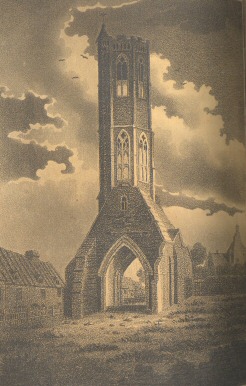
Of this famous order of mendicants it will not be easy,
perhaps, to give the reader a better idea that by laying before
him the following outline of the history and character of its
founder, commonly called saint Francis. This
distinguished personage appeared a short time before his equally
distinguished contemporary St. Dominic. He was born
in 1182, at Assisi, in Umbria. In his youth he is said to
have been of a debauched and dissolute character, but at 25,
after his recovery from a severe fit of illness, occasioned by
his licentious course of life, he became so wholly religious, and
so unfit for any other business, that his father threatened to
disinherit him; to which he was so far from having any objection
that, in
presence of the bishop of Assisi, he solemnly disclaimed all
expectation from him, and declared that from that time he would
acknowledge only his father in heaven. He is said to have
then devoted himself to works of charity of the most humiliating
kind: and being one day at church, hearing mass, he was so
forcibly struck with those words, Matt. x. 9. Provide
neither gold, nor silver, nor brass in your
purses, nor scrip for your journey, neither two
coats, neither shoes, nor yet staves, for
the workman is worthy of his meat; that he cried out
“This is what I seek!” and immediately threw away his
shoes, staff, wallet, and all his money, and kept only one
coat. He also laid aside his girdle, which was of leather,
and made use of a piece of rope in its stead. From this
time, in imitation of the apostles, he began to exhort other
persons to repent; and he did it in a very forcible
manner, and with wonderful success, always beginning his
discourse with saying “God give you
peace.”—When he had got three disciples, they
dispersed, to preach in different places. Some received
them with great humanity, looking with astonishment on their
extraordinary dress and great austerities, while others made a
mock of them and abused them: this however they bore very
patiently.
When he had seven disciples, he exhorted them to go to
different countries, preaching repentance, without regarding any
treatment they might meet with; assuring them that in a short
time many learned and noble would join them, and they would
preach to kings and princes, as well as to the common
people. When he had eleven disciples,
one of whom was a priest, he wrote out a rule for them, taken
wholly out of the Gospels, and presented it to pope Innocent III,
who, after making some objection, approved of it, in
1210.—Having obtained this confirmation of his institute,
Francis went with 12 disciples and established himself in a
church which he had repaired at Pontremoli, and this was the
first house of his order, which, by way of humility, he called
that of the minor brethren, frates minores, in
French feres, in English by corruption friars, as
the Dominicans had at the same time assumed the name of
preaching brothers, or friars.—From this place they
went forth preaching in the neighbouring towns and villages, not
with studied harangues, (but like the methodists of our time) in
a manner that made uncommon impression upon the hearers, as they
had the appearance of men of another world, having their faces
always turned towards those regions whither they were continually
directing their audience.—In 1211 they founded several
convents, the most considerable of which were those of Cottona,
Pisa, and Bologna; and Francis himself, having preached through
all Tuscany, returned to Assisi, in Lent, 1212.
In such veneration was he held at this time, that when he went
into any city, they rung the bells, and the clergy and people
went to meet him, bearing branches of trees, and singing,
thinking themselves happy, who could kiss his hands or
feet. That Lent he preached at his native place, where he
had many converts, and among them St. Claire, a young
woman of a noble family, who by his direction, though only at the
age of eighteen, abandoned the world, and notwithstanding the
remonstrances of her relations, fixed herself in a monastery,
first at St. Ange de Pansa, where she was joined by her sister
Agnes, and then at St. Damien of the order of the
Benedictines, which was the first church St. Francis had
repaired. Here she continued 42 years, many disciples
joining her; and thus was formed the order of poor women,
or that of St. Claire, being the second order of
Franciscans.
About 1216, he gave instructions for his disciples to go in
pairs, as the Apostles had done. Thus they went into Spain,
Provence, and Germany, into which country he sent no less than 60
brothers.—So rapidly did the order now increase, that at a
chapter general held in 1219, when Dominic was present, there
appeared to be not less than 5000 in it; though they had not been
established more than 9 or 10 years.—In June, 1219, pope
Honorious III issued a bull, addressed to all bishops,
recommending the Franciscans as apostolical men.—Many
women, now converted by his preachers, formed themselves into
monasteries, but he refused to take charge of any of them, except
that of St. Claire.
After this he sent his chief disciples into distant countries
with a number of companions, taking for himself and 12 others the
mission of Syria and Egypt. They went forth
in the spirit of confessors and martyrs; for when men expose
themselves to almost certain death, there cannot be a doubt of
their being in earnest. Two going to Africa endeavoured to
go into a mosque; and preaching in the streets, and
putting themselves in the way of the king, he first ordered them
to be confined; but as they continued their importunity, he was
so enraged, that he struck off their heads with his own hands,
while they suffered with great resignation. Francis himself
went to Egypt, during the siege of Damieta, and getting access to
the Sultan, he offered to go into the fire in proof of the truth
of his religion. But the Sultan, who heard him with great
patience, did not choose to put him to the test, but admiring his
courage, dismissed him with much good humour, desiring him to
pray to God, that he would shew him what religion was most
agreeable to him. In 1221, seven went to Ceuta to preach to
the Moors; but they were soon apprehended, and not yielding to
the command of the king to turn Mahometans, they were all
beheaded. [504]
In the Rule of the Franciscans, which was fully confirmed in
1213, by Pope Nicholas III, besides engaging to live in obedience
to their superior, in chastity, and without property, they also
vowed obedience to the pope and his successors. These
orders of mendicants, particularly this and that of St. Dominic,
were of much greater use in support of the papal hierarchy, and
combating heretics than all the orders of monks had ever
been. Such was the number of persons in this period disaffected
to the see of Rome, that it is very doubtful whether without this
seasonable assistance it could have been supported at all.
In this view we cannot contemplate their labours without regret:
but even here they may not have been more blameable than some of
our present religious orders, who, though seemingly well meaning
people, are ever ready to defend, or at least to make excuses for
almost every species of corruption.
St. Francis pretended, or, at least, his adherents did so,
that the particulars of his rule had been dictated to him by God
himself. It is also said of him that retiring to Mount
Alverne on the borders of Tuscany, in 1224, to pass the Easter,
he saw in a vision the appearance of Christ on the cross,
descending from heaven; and when he awoke he found all the marks
of crucifixion on his own body. Such tales were doubtless
invented to magnify his name and promote the credit of the
order. They might answer then, and still in some places;
but they are not here introduced as worthy of belief. The
Franciscans came into England in the reign of Henry III, and in
that same reign established themselves in this town: but their
first establishment in England is said to have been at
Canterbury. Of the probable effects of their making
Lynn one of their head quarters, or places of residence, the
reader must now form his own opinion. [505]
Account of the convent of the Black
Friars, Preaching Friars, or Dominicans, in
Clough Lane, with a Sketch of that famous order.
Of this convent, (once perhaps inferior to none of the rest,
if indeed it did not exceed them all, both in size and
magnificence,) nothing is now to be seen but some old walls,
whose thickness and massy appearance seem to indicate that they
once sustained a large and sumptuous fabric. It was
founded, as Parkin says, by Thomas Gedney, who was then, no
doubt, a great and leading character in these parts. The
above author does not seem to know the exact time when this
convent was built, but it must have been sometime previous to
1272, for he assures us that these friars were then here.
Indeed he says also, that they settled here about the time the
Grey Friars did, as appears from a writ, Ad quod damnum,
for a fountain or spring granted them in Middleton, by William,
lord Bardolph, called Brokewell, and a certain aqueduct coming
from that spring to their convent at Lynn; (for which he refers
to Esch. in Turri Lond. Aº. 21, Edw. I.
Nº. 71.) We may therefore fairly conclude, that this
convent was built almost, if not altogether as early as that of
the Grey Friars.
The following is the chief of what that writer has further
said, relating to this convent.—
“Thomas Thorndon aliened to these friars
preachers a piece of land 18 feet long and 21 broad, in Lenn
Episcopi, in the 3d. of Edw. III. In the same year these
friars had a patent to enlarge their house here.—Simon
Parche, alias Tyler, of Watlyngton, Norfolk, wills, in
1442, to be buried in the chancel of the friars preachers, or black
friars, of Lyn, and gives to the fabrick, de la stalles in the
said chancel, to be new made, 16l. Reg. Doke,
Norw.—The chapel of St. Catherine, in the church of the
friars preachers, mentioned in 1497. Reg. Sayve.
Norw.—The image of our Lady in the body of the
church.” [507]
Of this convent, as well as that of the Carmelites, we are
also told that an anchorage belonged to it: by which we
are probably to understand, a place in the harbour for mooring
ships, or a certain duty, payable by the ships there moored to
the said convents. The ground in all ports and harbours
being considered as the king’s, this anchorage may be
supposed to have been a grant from the crown to those two orders
of friars at Lynn.
The same writer further informs us that this convent of
Dominicans was surrendered by the prior and eleven brethren on
the 30th of Sept. 1539, 30th of Henry VIII. Its site, as we
further learn, was granted, about six years after, to John Eyre
Esq. with land there in the tenure of John Kempe. This John
Ayre, (our author adds) on the dissolution had 37 messuages, 9
gardens, in the tenure of divers persons, given him by the said
king in his 36th year, and messuages and tenements called Bishops
Stath, and an house called the Steward’s Hall, with other
messuages and lands here, belonging to the see of Norwich.
The site of this convent the said John Eyre conveyed to a priest,
from whom it came to Thomas Waters, of —, who had
Edward Waters, and a daughter married to George Baker. The
said Edward’s son in law, Sir John Bolls, of Scampton, in
Lincolnshire, Bt. sold it to one Killingtree, since which time it
seems to have passed through a great many hands. The said
site at present is thought to be partly the property of the
corporation, and partly that of the Carey family. About the
garden of the chief mansion of that family are several scattered
remains of this ancient edifice. We shall next endeavour to
acquaint the reader with the character of that religious order,
or fraternity for whose use this convent was originally erected,
and in whose occupation it ever after continued.
The Dominicans, although their settlement at Lynn was not
anterior to that of the Franciscans, yet they appear to have
found their way to England a good many years before them: for we
are told, that Dominic, just before his death, sent Gilbert de
Fresney, with twelve of the brethren into England, where they
founded their first monastery at Oxford in 1221, and soon after
another at London. In the latter place they became in time
so popular, and so much in favour with the corporation, that, in
1276, the mayor and aldermen, as we are told, gave them two whole
streets by the river Thames, where they erected a very commodious
convent, whence that place is still called Black-Friars,
for so they were called in this country, [508] perhaps from the colour of the
habit. They were also called Friars preachers, or
preaching friars, from preaching being their chief
object, employment, or profession; and Dominicans, from
the name of their memorable founder; an epitome, or outline of
whose history and character we shall here subjoin. It will
enable the reader, it is hoped, or, at least, help him in some
measure, to form a pretty correct estimate of the merits and
demerits of these predicant friars; as it may be very confidently
and safely expected that they resembled their leader, according
to the old adage “Like master like man.”
Dominic, commonly called Saint
Dominic, the father of the Dominicans, was a
Spaniard. He was surnamed de Guzman, being
descended from an ancient and noble family of that name.
Having finished his studies at Palencia, he was made canon, and
afterwards archdeacon of Osma in Castille, and then professor of
Theology at Placentia. But this he quitted to go to preach
after the manner of Francis, which he did in several parts of
Spain, giving proof in the meantime of great charity towards the
poor and afflicted. Coming into France with the bishop of
Osma, he greatly distinguished himself by preaching against the
Albigenses, and there he formed the design of instituting
an order of preachers. Fulk bishop of Thoulouse
brought him to the council of Lateran, in 1215, that he
might be examined by the pope. His holiness approving of
the scheme of Dominic, the latter consulted with his followers,
when they agreed to adopt the rules of St. Austin, but
with several additions. They resolved to have no estate in
lands, but only revenues. They were then sixteen in number,
and the bishop of Thoulouse gave them their first church, that of
St. Romanus in that city; and near it he built cloisters, with
cells over them, where they might study and sleep. Pope
Honorious III. confirmed the order in 1216, exempting them from
paying tithes of their possessions, and ordering that they should
depend upon the diocesan for episcopal functions; and the prior
to be chosen by the free votes of the brethren: so that the
Dominicans, at their first institution, were not beggars,
nor exempt from episcopal jurisdiction, but canons regular.
Next year Dominic sent out his followers in pairs, after
choosing a superior, to whom he gave the tide of abbot;
but all the succeeding ones were called masters, and the
superiors of particular houses priors. He sent four
to Spain, four to France, and two more to study there.
Hearing of the death of that ferocious and bloody crusader, Simon
de Montfort, at the siege of Thoulouse, Dominic went thither to
comfort the brethren. Thence, in 1218, he went into Spain,
and founded two monasteries, one at Madrid, and the other
at Segovia. Thence he went to Paris, where he found
thirty brethren: thence he proceeded to Bologna, where Arnauld,
who joined him at Rome, had been very successful, and had formed
a large society. Going to Parma, he there met St. Francis,
of whom he seemed to entertain a very high opinion, when, after
conferring together, they agreed not to accept of church livings:
which might suggest to Dominic the idea of that profession of
poverty which he afterwards imposed upon those of his order. [511]
In
1220 he made some new and more rigorous regulations respecting
the nuns. In the same year he held the first chapter
general of his order at Bologna, when it was resolved that the
preaching friars should profess perfect poverty, and make
that the fundamental principle of their order. It was now
agreed that these chapters should be held every year, at Paris
and Bologna alternately. At the second chapter general at
Bologna eight provincials were chosen to superintend the
preachers in the eight provinces of Spain, France Lombardy,
Romagna, Provence, Germany, Hungary and England. Presently
after this, August 26, 1221, Dominic died in the 51st year of his
age. [512] Lest his order should be hurt by
the maxims of worldly prudence, he forbad, under the curse of God
and his own, the introduction of temporal possessions into the
order. The second year after his death he was
canonized, and so reached the very summit of
ecclesiastical dignity and fame.
These preaching friars, as we are told, were so zealous at the
first, and considered preaching as so essential to their
institution, that they were not satisfied if they did not exhort
some, at least one person, every day.
Each
of them carried with him a copy of the gospel of Matthew, and of
the seven canonical epistles, according to the express order of
Dominic: but that could redound to the credit of neither him nor
them, while they lived in open violation of the most important
precepts and the very spirit of those sacred writings. Had
they made them, indeed, the ground of their religion, and the
rule or guide of their lives, they would have been a blessing to
the world in their day, and their memory would have been revered
by all good men, to the latest posterity. But they
preferred their own rule to that of the New Testament, and the
persecuting and murderous ferocity of Dominic to the forbearance
and meekness of Christ, and so became the oppressors instead of
the benefactors of their species. In short we know not of
any material benefit which the former inhabitants of this town
derived from the Clough Lane convent, [513] or the incessant labours of its
preaching friars. The reader however, on this point, as
well as all others, must judge for himself.
Account of the Convent of the Austin
Friars, or Hermits of the order of St. Augustin, in
Hogman’s Lane, or Hopman’s Way, now St.
Austin’s Street, with a sketch of that religious
order.
This house must have been once a large, respectable, and stately
edifice, inferior to none, and in some respects superior to most,
and probably to all others in this town; especially in point of
fitness for the accommodation of illustrious personages, or those
of princely dignity, who might happen to come this way. It
accordingly became the abode, or place of residence of the king
and queen, the prince of Wales, the king’s mother, and the
royal retinue, during their visit or stay here in 1498. Had
there been any other house then in the town better adapted for
their reception, it would, no doubt, have been chosen in
preference, or instead of this, on so unusual and important an
occasion. But however commodious, respectable, or stately a
structure, this Augustinian convent then was, it has long ago
disappeared, and not a stone of it has been left upon
another. A gateway, or the arch of a gateway, filled up
with brick, but once, perhaps, the principal entrance into the
hallowed premises, is all that now remains, or is recognised as
having ever belonged to it. Thus our firmest fabrics,
though they may endure for ages, are doomed to perish like the
very mortals by whose hands they were constructed.
Parkin says that the Augustin friars settled herein the
beginning of Edward the First’s reign, as appears by a writ
Ad quod damnum, for a messuage in Lynn, granted by
Margaret de Southmere to them.—Inquis. 22. Ed. I. in turri
Lond. N°. 112. He also adds, that they had a patent
granted them by Edward II. in his 4th year, for purchasing, of
Thomas Lexham, one messuage contiguous and adjoining, for the
enlargement of their manse or house.—Pat. 4th. Ed. II. pt. 2.
m. 14.—He further says, that Licence was granted by Ed.
III. to Thomas Drew, William Bitering, John de Couteshale, and
John Drew of Lenn Bishop, that they might give and assign five
messuages in Lenne, adjoining to the manse of the prior and
brethren of hermits of the order of St. Augustin of Lenn, to the
said prior, &c. for the enlargement of their manse, on
condition that the reverend father, Thomas, bishop of Norwich, of
whom the said messuages are held, will grant his licence to the
said prior, &c. And the said king gave licence to
Robert de Cokesford, Agnes his wife, and to Richard de Houton and
Alice his wife, that they may give one messuage in Lynn, (not
held of us, as appears by the inquisition of Roger de Wolfreton,
escheator of Norfolk) to the bishop and his successors, on the
same condition of granting licence to the prior, &c. of
receiving the said five messuages of Thomas Drew,
&c.—Teste Rege, dated at Westminster, 6 May, 38. Edw.
III.—The bishop’s licence was soon after obtained,
dated 1 July following.
In the 6th of Richard II. these friars had a patent for a
certain aqueduct, to be made by them from Gaywode.—In the
7th Henry IV. they had a patent to enlarge their manses and in
the 1st Henry V. a patent for certain messuages granted to
them. For each of these particulars Parkin refers to his
authorities; the insertion of which here seems needless.—He
also asserts on the authorities of Bale and Holinshed, that in
the last mentioned reign, William Wellys, or Wallys, was a monk
here, a learned man, and general of the order, who wrote many
books, (which he does not name,) and died in 1421.—It seems
therefore that learning was not entirely neglected here among our
Austin friars, and that they had at least one learned man in
their fraternity.
Our author further informs us, “that this house was
surrendered 30th Sept. 1539, 30th of Henry VIII. by the prior and
4 brethren:” if so they must have been then reduced below
their wonted number. But 4 brethren is probably a mistake
for 14, which is the number given by Burnet in his history of the
reformation, and other authorities.—About 6 years after the
above date, this house was granted to John Ayre, who conveyed it
to a priest, who sold it to Shavington, a bastard, who by will
gave it to — Waters, who dying without issue it reverted to
Shavington’s heir; John Ditefield afterwards had it, and
his son John gave it in marriage to Thomasine his sister, married
to Christopher Puchering, brother to the lord keeper of that
name, and they sold it to John Lease, who pulled it down, and
sold the stones and the ground to divers persons: so that it
seems to have stood a good while after the dissolution, and
passed through a great many hands.—Its site is at present
partly the property of Martin Folkes Rishton, Esq. Joseph
Lawrence Esq. and Mr. Thomas Marshall. For the most part it
is now garden ground.
It was to this very order of mendicants, the Austin friars, or
monks, or Augustinian Eremites, as they are sometimes called,
that the famous Martin Luther belonged before he
quitted the church of Rome, and when he began to oppose the papal
corruptions: and it is supposed not to have been then quite so
bad or depraved, as some of the other mendicant orders,
particularly the Dominicans and Franciscans. However that
was, it was, no doubt, bad enough, even in the opinion of Luther
himself, for he soon withdrew from it, as well as from all manner
of connection with the Romish church. It is to be wished it
could also be said, that he and all other descriptions of
protestants took special care when they renounced popery, to
retain none of its enslaving and persecuting spirit. Most
of them, however, quite forgot to do that, and so retained and
cherished in their bosoms the very worst part of the religion
they had renounced.
As to the religious order now under consideration, the
Austin friars, or Hermits of St. Augustin, we are
told that they had for their founder, pope Alexander IV.
who, observing that the Hermits were divided into several
societies, some of which followed the maxims of the famous
William, others the rule of St. Augustin, while
others again were distinguished by different denominations,
formed the project of uniting them all into one religious order,
and subjecting them to the same rule of discipline, even that
which bears the name of St. Augustin. This project,
we are told, was put in execution in 1256: [517] so that this order is somewhat
younger, or of later origin than any of the other orders of
mendicants; though not much later than the two preceding ones, for
all the three sprung up within the same century.—What good
or benefit the former inhabitants of Lynn might derive from the
erection of this convent in their town, or from the exertions of
the Austin Friars among them, is a question which the present
writer is not fully prepared to answer. The reader, as in
the former cases, is left to think and judge for himself, as he
has an undoubted right to do. But whatever good or ill,
advantage or disadvantage, benefit or detriment might accrue to
the inhabitants from the residence of the said four orders of
friars among them, their convents, unquestionably, must have
contributed not a little to give additional grandeur and
respectability to the appearance of the town. Four large
and stately monasteries, with their lofty towers, ranged along
the whole town from south to north, must have given Lynn an
appearance, especially from the country, very different, and far
superior to what it can boast of at present. In short, we
may safely say, that it must have appeared before the
reformation, from the circumstances just alluded to, as a place
of at least double the size and double the consequence that it
has done since that period. After all, it is not meant here
to disparage the reformation, or to suggest that it did not prove
beneficial to Lynn, as well as to the kingdom at large.—It
is only meant to assert, that this town, from the great size and
number of its monasteries and other religious houses, must have
made a very different, and far more splendid appearance before
the reformation, than it has done since. But we will here
drop the subject, and conclude the present section.
Of the Friars de Penitentia, or
brothers of repentance, and their Convent—also the
College of Priests—with the Hospital and Church of St. John
in this town.
It seems remarkable that out of 1148 monasteries and religious
houses, seized upon by the sovereign and suppressed at the
general dissolution, no less than 79 were in Norfolk, and 10 of
them in this town alone; which must be a large proportion of
those of the county, and still larger of those of the whole
kingdom. Norfolk was also distinguished, and is so still,
for its number of parishes, exceeding that of any other county,
even of Yorkshire, though four times its size. This
superabundance of parishes and convents, &c. seems to
indicate that its inhabitants were formerly of an uncommonly
devout and religious, or at least superstitious and sanctimonious
cast: which character may be supposed to have belonged to the
people of Lynn as much as to any of the rest. At present a
very large proportion of the inhabitants of Norfolk, especially
in country places, are exceedingly ignorant, boorish and
heathenish. Nor do the generality of the established clergy
appear to give themselves the least concern about this, or
express any serious desire to promote the conversion and
civilization of their poor neighbours. The dissenters, and
particularly those of them called Methodists, have done already
far more in this way than the whole body of the national or
parochial priesthood: and they are continually enlarging their
scale of operation, and extending their labours, with great
effect, to the most retired and obscure places,
where the divine power of the Gospel and the happy influence of
its moral precepts were hardly ever before felt or
experienced.
Of the ten houses suppressed in this town at the general
dissolution, one is said to belong to the friars de
Penitentia. This religious order appears to have sprang
up in the same century with the proceeding ones; for we are told
that it was instituted in 1221, by the famous St. Anthony of
Padua, who was born at Lisbon, in 1195, and whose original
name was Ferrand. After going through his studies
with reputation, he entered into a monastery of canons regular,
of the order of St. Austin, where he continued two years; when,
for the sake of greater solitude, he retired with the leave of
his superior to Coimbra, where he distinguished himself by his
exposition of the scriptures. At this time St. Francis was
living, and some of his order having suffered martyrdom, in
consequence of undertaking to preach to the Mahometans in Africa,
they were so much celebrated on that account, that it excited in
Ferrand, as well as many others, an ardent desire to follow their
example, though they should share the same fate. With the
leave of his superior, he therefore joined this new society; and
entering one of their monasteries, called that of St.
Anthony, he took their habit and assumed their name.
Presently after this, his zeal actually carried him to Africa;
but he was obliged to return, in consequence of a disease with
which he was seized upon the coast; but was driven
by a tempest to Sicily, where hearing of a general chapter of his
order being to be held at Assisi in Italy, he repaired to
it. Tho’ he was then little known, the provincial of
his order was so much pleased with his appearance, that he took
him with him, and placed him in a convent called the mount of
St. Paul. After some months, his superiors procured him
holy orders, and sent him, together with some other priests, to
Forli, where he distinguished himself by his preaching.
Being greatly concerned at the progress of heresy then in the
northern parts of Italy, in order the better to prepare himself
for encountering the heretics, he went through a course of
theology at Vercelli, under a famous doctor there; but he soon
surpassed him in knowledge, and was thought equal to any
undertaking.
Being sent by his superiors to undertake the office of
guardian to Limiges in France, in order to the conversion of the
heretics in that place, it happened at one time, that his
business as a preacher required him to be in one place, and his
office of guardian in another: and this was the occasion of the
first of the many miracles that his historian ascribes to him,
and it was of a very singular kind: for it is asserted that he
was actually in both places at the same time. After an
earnest prayer for this purpose, he without leaving the pulpit in
which he was preaching on a Good Friday, appeared in the choir,
and sung the lesson which was his part of the service
there. At Montpellier also, he once preached in the dome at
the same time that he was singing hallelujah in the choir of the
church. After this his whole life seems to have consisted
of little more than a series of miracles, and many of them of
quite an original and extraordinary kind; so that it must have
required much ingenuity to devise them. [522]—Some of them may be here
inserted by way of sample, and to enable the reader to judge of
the probable effect or consequence of the settlement of
Anthony’s disciples, the friars de Penitentia, in
this town.
When Anthony was at one time preaching in a temporary
building, constructed of wood, he apprised his audience that the
devil was about to terrify and hurt them, but that no harm would
eventually happen to any of them. Accordingly while he was
preaching, the devil untied the ropes by which the boards were
held together, so that the whole erection came down. But
when it might have been expected that many of the persons
assembled would have been crushed to death, or at least maimed,
not one of them was found to have received the smallest
hurt!—Another time a pious woman, much attached to Anthony,
who had a son of a reprobate character, when she was attending
one of his sermons the devil came in the form of a courier, and
delivering a letter informed her that her son was dead.
This news threw her, and the audience in general, into such
disorder, that the congregation was breaking up; when Anthony
cried out that the news was not true, that it was the devil that
had brought it, and that the young man was alive, as they would
soon be convinced; accordingly, while he was speaking he entered the
place, and the devil absconded.
Something more extraordinary than any of the preceding
miracles, was exhibited at Rome. For being required by the
pope to preach to a congregation, consisting of people of very
different countries, assembled for a crusade, they all heard him
speak in their different languages, though he spoke in Italian
only.—But the astonishing miracle exhibited at Rimini,
contributed more to the fame of Anthony than all his other
miracles. Preaching in that city, which abounded with
heretics, and the people refusing to hear him, he went to the sea
side, followed by a great crowd; when, the sea being remarkably
calm, he addressed himself to the fishes; saying, “Since
men will not hear me, come you and hearken to what God will tell
you by me.” Immediately on this the sea was covered
with the heads of fishes, which with open mouths fixed their eyes
on him; and notwithstanding their hostility to each other, they
mildly and humbly (as it is said) without moving their fins, or
making the least motion in the water, attended to him.
After a discourse of some length, he exhorted them to praise God;
and since they could not do it in words shew some visible signs
of reverence. On this they all bowed their heads, moving
them very gently, and with gestures expressive of humility and
devotion, acknowledged their obligation to God, and signified
their apt probation of what had been addressed to them. The
spectators greatly amazed (and well they might: for who could
avoid it?) looked sometimes on the fishes, and sometimes
on the preacher; and being reproved by him for their infidelity,
thus upbraided by the mute fishes, they fell on their knees,
asking his pardon, and promising to live and die in the catholic
faith. He then pronounced a blessing, both on the men and
the fishes, and they departed with great joy. [524]
Such were some of the numerous miracles which Anthony is said
to have worked in his lifetime, exclusive of others said to have
been wrought afterwards at his grave, and which were perhaps no
fewer. Of those who have heard of these mighty and
wonderful works of Anthony, the far greater part in all ages,
even to the present day, have believed the report, and admitted
the reality of the miracles: which, however, will not establish
the fact, that they were actually performed, any more than the
faith of the mahometans in the alleged miracles of their
pretended prophet will establish that fact, or prove that the
miracles ascribed to him did really take place. In each
case we have a sad specimen of that easy and miserable credulity
by which poor human nature has often most wretchedly disgraced
herself, and unintentionally aided the cause and triumphs of
imposture. Nor will it follow from the abundance of false
miracles that have been heard of, or because the world has been
so often imposed upon by them, that there never have been any
real ones; on the contrary, all counterfeits seem invariably to
imply the existence of what is real and genuine; and that, it is
presumed, may be proved to be the case here. But this is
not a place to enter largely upon this subject.
Anthony had been some years among the Franciscans
before he instituted the order de Penitantia, which was in
1221, when he also fixed at Padua, where he sometimes preached in
the open air to 30,000 persons, who came to hear him from all the
neighbouring towns. His discourses, it is said, had a
wonderful effect in converting prostitutes, delivering prisoners,
reconciling enemies, procuring restitution of usury, remission of
debts, &c. He was indefatigable, and preached every
day. Many persons expressing a desire to embrace the order,
he was unwilling to dissolve so many regular marriages, and
dispeople the country: he therefore gave them a rule, according
to which they might serve God in a similar manner in their
houses, living in some measure like monks, but without
austerity.—This is the substance of what we have learnt
about this order. He died in the year above mentioned at
the age of 36, and was canonized the next year. We are told
that he was ten years among the Franciscans, if indeed it can be
said that he afterwards properly quitted them for the friars
de Penitentia are accounted a 3rd order of Franciscans. [525a] We are told that they settled
at Lynn before the 5th of Edward I. and that their house here was
dissolved by Henry VIII. [525b] but where it
stood cannot now be ascertained. Parkin seemed inclined to
indentify it with the well known convent of the Grey Friars, but
that idea or supposition seems not at all admissible, as our
apparently most accurate accounts of the religious houses
dissolved here represent that of the friars of this order as
quite distinct from the said convent, and this seems corroborated by
Parkin’s own assertion, that “in 1307, Roger Flegg
was vicar general of the order of friars de Penitentia in England
at Lenne.” [526a] From the
peculiar constitution of this order it seems rather probable that
its houses or convents might be neither so large nor yet so
numerous as those of most of the other orders. As that at
Lynn might be but small, there may not be much reason to wonder
that its site is not now discoverable; that being also the case
with some others of our smaller religious houses.—With all
its profound and extravagant reverence for its founder, St.
Anthony, and its unlimited credulity, or faith in his pretended
miracles, this does not appear to be the worst of the popish
orders, but rather one of the better sort of them, as it seemed
earnestly to set its face against many of the prevailing vices of
the times, which must have somewhat checked the progress of
immorality and licentiousness.—These friars might therefore
be of some use here: but if they were so, and did some good, in
partially checking the progress of vice and immorality, is it not
also to be feared, on the other hand, that they did no less, or
rather much more harm, in checking likewise the progress of
virtue and true religion, and promoting to the utmost of their
power an intolerant, persecuting, and antichristian spirit? [526b] That such was really the fact
seems
unquestionable; so that these friars had little room to boast of
their good doings. But we will now quit them, and proceed
to
The College. This
edifice stands near the Town Hall, and is now inhabited by Mr.
Toosey, a respectable merchant. It is by far the
most entire, and best preserved of all the religious houses that
were here dissolved; and were popery again to become predominant
among us, this fabrick might be very easily converted or restored
to its original use.—Parkin gives of it a very odd and
confused account, as if it had been a part of the Priory, though
somewhat detached from it—“The cell, or college of
priests (says he) was near the Guildhall, and the
prior’s house was somewhat remote from it, by St.
Margaret’s Church.” It does not seem, however,
that it had in fact any connection with the said priory: and it
is certainly a place of much later erection; probably by no less
than 3 or 400 years.—Mackerell also takes some slight
notice of it, and says, “Not far from the church was a
certain college, founded by Mr. Thomas Thorisby, as by the
inscription carved upon the door still remain . . .
Magistri Thome Thorisby, Fundatoris hujus
loci.” This Thomas Thorisby, the munificent
founder of this college, was one of the great men of Lynn in the
latter part of the 15th century, and for sometime after, as
appears from our lists of Mayors, among whom his name occurs
three different times; 1st in 1477, again in 1482, and lastly in
1502. That he was a magistrate of a serious and religious
character, seems to admit of no doubt; but how many of his
successors, including those of the present day, have thought the
better of him for that, is a question that appears involved in no
small uncertainty. The College is said to have been founded
about the year 1500, and it was dissolved about 30 years after,
so that it was not long appropriated to the use for which it was
designed by the founder. It does not appear to whom it went
at the dissolution, nor do we know through how many hands, or how
many different families it has passed, from that to the present
time. Latterly, and for many years, it has been the
residence successively of some of our principal mercantile
families, without any material change in its external
appearance. Of its original constitution we have not
obtained any particular information, and the above being the
substance of what we have learnt concerning it, our account of it
must be here closed.
Another House, suppressed here at the general dissolution, was
St. John’s Hospital: of which the information we have been
able to obtain is very imperfect and scanty. Its very site,
like that of the friars de Penitentia, seems no longer
discoverable; and yet it was evidently, in its day, a place of
some note and consequence here, and had a chapel, or church, as
it is usually called, attached to it. Fox, the
martyrologist, mentions St. John’s church, or the church of
the Hospital of St. John, in this town, as one of the places
where the memorable Sir William Sautre, parish priest of
St. Margaret’s, when taken up for heresy in the reign of
Henry IV. was obliged to read his recantation.
Parkin takes very little notice of it, except quoting what
Fox had said: and the same is the case with Mackerell,
with this slight difference, that he in one place hazards a
conjecture, that the site of this church was the same with that
of the old grammar school, which was taken down some years
ago. But if the church stood there, the hospital itself
must also, in all probability, have stood close by, if not
contiguous; and that seems not very likely, in so confined a
situation. We know of no existing record that any way
corroborates this conjecture, unless it be a hint in our tables
of memorable events, “That in the year 1506, St.
Margaret’s church was suspended, and the christenings were
performed in the charnel belonging to St. John’s
chapel:” but it seems too vague and obscure to establish
the point. It is indeed very clear and certain that there
did exist here formerly the Hospital and church of St. John, and
that they were suppressed at the general dissolution, but as we
know no more about them, we must here dismiss the subject.
Account of St. Mary Magdalen’s
Hospital, the Lazar Houses, St. Lawrence’s
Hospital, &c.
The Hospital of St. Mary Magdalen was one of the most ancient
of those religious houses that were suppressed here by Henry
VIII. It is said to have been founded by Petrus Capellanus,
in the reign of King Stephen, in honour of St. Mary
Magdalen. It consisted of a prior and twelve brethren and
sisters; of whom ten, including the prior were sound, and three
unsound, or leprous; some ecclesiastical, and some secular; who
were bound to perform rites and prayers for the souls of certain
men who had departed this life, viz. for the soul of
Petrus Capellanus their founder, the souls of popes, bishops,
abbots, priors, kings, queens, and others, their benefactors; as
appears by their ancient book of obiits and
Orisons, and by the ancient instrument of articles, which
the brethren and sisters were bound to observe: and all, or most
of the lands given to the said hospital were for the
maintaining of prayers for the dead, as appears by divers deeds
and charters, without date, of the first donations of those
lands. [531]
In Mr. Kings MS. Volume there is a larger account of this
ancient hospital than has been given by Mackerell and
Parkin. We have there the ancient instrument of articles,
or the fundamental rules of the fraternity, in Latin, under XVIII
heads: annexed to which is the following account—
“This Instrument of Articles was made in the
year that Petrus Capellanus died [A.D. 1174.] and himself consented, with
the two archbishops, for ordaining the same.”—Then
follows what has been given by Mackerell, that “this
ancient hospital continued in a prosperous state from its first
foundation about 400 years. But after the statute of 1st
Edward VI. was made, for dissolving all colleges, chauntries
fraternities, &c. this, with the lands &c. came to, and
were invested in the crown, by the said statute. The
fraternity, however, was not then broke up or dispersed, and
might, perhaps, have been still continued, but for the breaking
out of what is called Kett’s rebellion. A party of
the rebels were encamped at Rising: and they attacked Lynn, in
hopes of surprising it, but being repulsed and disappointed,
they, on their return, fell upon this hospital, which they
violently entered, and not only robbed the poor people there, and
expelled them out of the house, but took away all their common
stock, and rased their chapel and most part of the buildings
there down to the ground: by means of which barbarous
usage, the said hospital was so impoverished, wasted, and
spoiled, that from thence forward it was quite destitute of
brethren and sisters, and utterly relinquished, saving that the
mayor and burgesses of Lynn maintained some poor people there,
and endeavoured to uphold the said ancient hospital, out of their
charitable disposition, for the purposes aforesaid.” [532]
“Nevertheless (says the author of the MS. account) some
covetous persons, taking advantage of the depressed state of the
said hospital, procured divers letters patents of concealment,
from the crown; some of the site of the same, and some of other
parcels of the lands and possessions belonging to the said
hospital, intending to convert them to their own private
lucre. But the said mayor and burgesses, (still having a
great care that the said lands and possessions should be
preserved for charitable uses) did purchase of some of the
concealers the site of the said hospital, and a great part of the
lands thereunto belonging, and at their great costs and charges
supported and defended the same against all other concealers and
their agents, purposing always to erect anew the said hospital,
and employ the revenues thereof for the sustentation of poor
people.
“But finding both by the advice of the king’s
councill [counsel] and their own, that all the said patents of
concealment were defective and utterly void in law, through many
imperfections therein, and that (notwithstanding the said
patents) the scite of the said hospital and the lands and
possessions thereof still remained in the crown—therefore
they made humble suit to the king’s majesty [James I.] for
a grant thereof, and, of his Highness’ gracious favour and
pious inclination to works of charity, they obtained Letters
Patents of grant unto the mayor and aldermen, as well of the
scite of the said hospital, as also of the lands, &c.
thereunto belonging, who by the same are created governors
thereof, and made a body corporate for the defence and
maintenance of the said hospital new founded by his
majestie.”
[An abridgement of those Letters Patents, transcribed from the
Latin copy, is here subjoined, and is as follows.
“JAMES by the grace of God king of England,
&c. to all to whom these Letters shall come, greeting,
&c.—Whereas a certain ancient Hospital or Almshouse was
founded and erected in Gaywood, called the House or Hospital of
St. Mary Magdalen—And whereas divers lands, tenements, and
hereditaments, were given and granted for the maintenance and
relief of divers poor and needy men and women therein for
ever—And we being informed, that certain evil minded men,
covetously pursuing their own private lucre, have endeavoured
utterly to demolish the state of the said Hospital, pretending
some defect in the foundation thereof, or that the same have been
dissolved—We favouring the sustentation of the poor, and
such like charitable deeds, do of our special grace, for us, our
heirs and successors, grant all that right, title, &c. which
we have or might have in the premises, fully and graciously to be
conferred and extended towards the establishment of the said
Hospital, for poor and infirm men and women to dwell therein: and
for the causes aforesaid the same shall for ever hereafter be
called by the name of The Hospital of St. Mary Magdalen, of the
foundation of king James, consisting of a Master and Warden and
10, 9, 8, 7, 6, or 5 poor needy men and women, who shall likewise
be called, The Brethren and Sisters of the said Hospital, from
henceforth for ever.—And for the more effectual performance
of this our grant on our part, We have chosen nominated and
appointed our well beloved Peter Tudman to be the first and
present warden, or master of the said hospital, and to continue
in the said office for and during his natural life, unless for
some default, trespass, misdemeanor, &c. omitted or committed
by him, contrary to the constitutions or ordinances hereafter to
be made and ordained, he shall be from thence removed.—And
moreover out of our own especial grace, certain knowledge, and
mere motion, We have also chosen, nominated, &c. our well
beloved John Tilney and Avis his wife, Isabel wife of the said
Peter Tudman, John Pillow, Alice Briggs, and William Mason, to be
the first and present brethren and sisters of the said hospital,
there to be relieved and maintained during their natural lives,
unless for some fault or misdemeanor they shall from thence be
removed.
“And that this our pious and charitable intention may
take the better effect, and that the lands, tenements, goods and
chattels, and hereditaments, towards the maintenance of the said
hospital and the warden or master, and the poor brethren and
sisters &c. may the more effectually be given, granted,
enjoyed, possessed and disposed, We will, and by these Letters
Patents for us our heirs and successors of our like special grace
&c. do grant ordain and constitute that the Mayor of our
Burgh of King’s Lynn that now is, or hereafter shall be,
and all the aldermen that now are or hereafter shall be, shall,
from henceforth forever be our Body corporate and politique, in
deed, fact, and name, by the title of The Governors of the lands,
tenements, revenues, possessions, and hereditaments of the
Hospital of St. Mary Magdalen upon the Cawsey between Lynn regis
and Gaywood, of the foundation of James king of England,
&c.—And by the said name of Governors, &c. to be
always hereafter so called, termed, and nominated, for ever: and
by the same to have perpetual succession, and to be both able and
capable in law to obtain, receive, have, and possess the manors,
lands, tenements, meadows, pastures, feedings, rents, reversions,
remainders, and all other hereditaments whatsoever, to them and
their successors for ever, as well from us our heirs, &c. as
from any person or persons whatsoever; as also all goods and
chattels for the maintenance and relief of the said hospital, the
warden or master, and the poor brethren and sisters which shall,
from time to time, live and be sustained therein.—And we do
likewise by these presents for us and our heirs &c. grant
unto them and their successors to have a common seal for all
matters and businesses concerning the said hospital
&c.—And that they by the name aforesaid may answer and
be answered in any of his majesty’s courts or elsewhere
within this kingdom of England.
“And we will that whensoever it shall happen, that the
said master or any of the said 10, 9, 8, 7, 6, or 5 of the
brethren shall die or be removed, it shall and may be lawful for
the said governors (whereof the mayor to be always one) within 20
days after, to choose another in their room—And we will and
grant that the said Warden or Master and his successors shall
take his corporal oath on the evangelists for the due performance
of his office, before the mayor for the time being, in the
Guildhall of the said Burgh—And we will and grant that the
said governors, or the greatest part of them (whereof the mayor
to be always one) and their successors with the assent and
consent of the bishop of Norwich for the time being, may make and
constitute such and so many good and wholesome statutes, laws,
&c. in writing, as well concerning the celebration of divine
service every day in the said hospital to the honour of God, as
for the government, election, expulsion, punishment and direction
of the said master and poor there, and also concerning their
stipends, salaries, liveries, habits, and all other necessaries
whatsoever, as also concerning the ordinary, preservation, and
disposing of all the lands, tenements &c.—And also may
give and grant to the master and poor there, such useful things
as they shall think fit: and may revoke, change, determine,
augment, alter, and make new the same as they think most
convenient; which said statutes, laws, and ordinances, to be made
and constituted as aforesaid we straitly charge and command
to be kept inviolable, from time to time for ever, yet so as the
same be not contrary to the laws and statutes of this kingdom of
England.
“And further for the continual relief and sustentation
of the said hospital we have given and granted, and by these
presents do give and grant to the said governors all the
lordships, manors, messuages, lands, meadows, pastures,
feeding-grounds, liberties, franchises and hereditaments
whatsoever, lying in Gaywood, East Lexham, Dunham, Narford, West
Lexham, Westwinch, and Holkham, in our said county of Norfolk, or
any where elsewhere, which formerly were any part of the
possessions of the said hospital, however before this time called
or reputed, and which had not indeed though not by the law
alienated, bargained and sold by the prior, brethren and sisters
of the said hospital, and of which his Highness from the
beginning of his reign had not taken any yearly profits,
revenues, or rents.—And further we do give and grant unto
the said governors, &c. To have, hold, and enjoy all the
aforesaid premisses, together with court-leet, frank-pledge,
liberties, franchises, goods and chattels waved of felons as well
as felo de se, as of all other felons, fugitives, out-lawries,
and taken in exigent, or in any other lawful way, right or title,
they shall be convicted, condemned, extrahur deodands and all
rights, jurisdiction, franchises, liberties, privileges,
commodities, advantages, possessions, emoluments and
hereditaments whatsoever, as fully, freely, and absolutely as any
prior, brethren and sisters, as well sound as sick, ever had, held, or
enjoyed heretofore, &c.—To have, hold, and enjoy all
the privileges aforesaid to the only use and behoof of them the
said governors, &c., in free, pure, and perpetual alms, for
all rents, services, claims, and demands whatsoever, to be
rendered, paid, or done to us our heirs &c. And we do
likewise give and grant unto them all and singular, issues,
fines, rents, revenues, annual profits whatsoever, of all and
singular the premises aforesaid, whatsoever due before the grant
of these Letters Patent, or within 60 years last past without
giving any account of the same. And further we, our heirs,
&c. will for ever acquit, exonerate, and keep indemnified to
the said governors, &c. all and singular the premises
aforesaid, against us our heirs &c. of and from coridies,
rents, fees, annual pensions, portions and sums of money
whatsoever, &c.
“And we will and straitly charge our Treasurer,
Chancellor, and Barons of our Exchequer, their heirs and
successors, and all other our Receivers, Auditors, Officers and
Ministers whatsoever, upon producing these our Letters Patents,
or the enrollment thereof without any other Breve or Warrant from
us, that they make or cause to be made to the said governors
&c. a full and plenary discharge of all the corodies, fees
&c. whatever, for which these our Letters Patents shall be to
them a sufficient warrant and discharge.—And we will and
grant that these our Letters Patents and the enrollment thereof
shall be in all things as firm, strong and good, sufficient and
effectual in law against us, our heirs &c. in all our courts and
elsewhere within out kingdom of England, without any further
confirmation, licence, or toleration from us or our successors to
be procured or obtained.—Notwithstanding the misnaming,
misreciting, or not reciting the aforesaid premisses by these
Letters Patents, Or the not finding only the office or
inquisition of the premisses or any parcel thereof whereby our
title ought to be found before the making of these our Letters
Patents, Or the misreciting or misnaming, or not reciting or not
naming any demise or grant of the premisses or any part thereof,
on record or not on record, or any way whatsoever before this
grant:—Or the misnaming or not naming any village, hamlet,
parish, race, or county, in which the premisses or any part
thereof be:—Or the full, true, and certain mention of the
names of the tenements, farmers, occupiers of the premisses or
any part thereof:—Or any defect in the certainty, account,
or declaration of the true yearly value of the same as
aforesaid:—or any other defects in not naming aright any
one tenement, farmer, or occupier &c. or the statute made in
parliament in the first year of the late king Edward VI. our
predecessor, or the statute made in parliament in the 18th year
of the late king Henry VIII. our progenitor.
“And further we will, straitly charge and command the
aforesaid governors &c. that they expend, convert, and apply
all and every the premisses aforesaid towards the relief and
maintenance of the master and poor of the said hospital, and for
the repairition and defence of all and singular the premisses
aforesaid, and to no other use and purpose
whatsoever.—Yet so that express mention be made of the true
yearly value, or certainly of the premisses or any part of them,
or any gifts or grants made before this time by us or any of our
predecessors to the governors aforesaid and their successors, or
any statutes, acts, ordinance, provision or restriction to the
contrary before this had made published or ordained in any thing
cause or matter whatsoever notwithstanding.—In Testimony
whereof we have caused these our Letters to be made
Patents. Witness ourself at Westminster this 22d. day of
April in the year of our reign of England, France, and Ireland
the 9th and of Scotland the 44th.
Per Breve de privato
sigillo.
“After the grant aforesaid, the mayor and
aldermen endeavoured by all fair means, to prevail with the
concealers and usurpers of the many lands, &c. to yield and
deliver up the quiet possession thereof to them, the said
governors, without suit in law; but not able to succeed therein,
they thereupon exhibited a bill of complaints into [in] the High
Court of Chancery, against those who withheld the same, and had
likewise gotten into their hands sundry Deeds, Evidences,
Writings, Charters, Copies of Court Rolls, and Muniments,
concerning the said Hospital, for about thirty years before the
king’s majesty’s Letters Patents: whose names are as
follow, viz. Sir Philip Woodhouse; Thomas Thoresbie Esq.; Henry
Bastard, Gent.; Henry Baker, Gent.; Thomas Baxter; Robert
Anderson; Richard Cross; Jefferie Pell; Robert Large; Robert
Trollop; William Simpson, clerk; Robert Say, junr; Robert Spence, Gent.;
Robert Webster; William Collis, als Glover:—Who having
given in their several answers to the said bill, an order was
made by the court, that the complainants should set down in
writing, the particular lands and fold courses by them claimed,
together with the evidences for proof thereof, that the same
belonged to the said hospital, and how much the defendants have
of those lands in their several possessions, &c. which they
did as followeth”—
[The lands, &c. in question, are then particularly
specified and described, being chiefly in East and West Lexham,
and Dunham and Gaywood. They are denominated
“Lands of the Lepers, or Spittle lands, pertaining
to the brethren and sisters of the House, called The Spittle, upon the cawsey between Lynn
and Gaywood”—the whole amounting to 305
acres—The complainants having thus specified their claims,
the suit went on.]
“After divers hearings on both sides, in the
high court of Chancery, for about four years together, the
plaintiffs being prepared to move the lord chancellor with all
speed for a decree, and for their costs and damages, Sir Philip
Woodhouse defendant, (who had most of the lands, &c. in his
hands,) solicited and intreated Sir H. Hobart, knt. and bart.
Lord chief justice of the Common Pleas, to hear and determine the
cause between them, which being consented to by the plaintiffs,
his lordship gave his opinion, that the plaintiffs had right to
all the lands and foldcourses, in the boundary before mentioned,
in such manner as they have been claimed by them,
excepting the messuage Warm, and 5 acres thereunto
adjoining. And therefore to prevent further suit and
expences on both sides, his lordship advised Sir Ph. Woodhouse to
suffer that which he could not contradict, viz. that a decree
should pass of all the lands and foldcourses (except as before
excepted) for the plaintiffs, as in law and equity it ought to
be: but withal mediated and intreated the counsel of the
plaintiffs, in behalf of the said Sir Ph. that in regard so much
of the lands and fold courses as were in the possession of Sir
Philip, did lye so intermixed with his lands, it would be a great
annoyance to him, and little profit to the plaintiffs, if the
same were severed, that therefore it would please the
plaintiff’s counsel to consent that the plaintiffs, after
the decree passed, should make a lease to him of the premises
aforesaid for 99 years, at the yearly rent of 16l. viz.
their foldcourses at East Lexham, being in his possession for
10l. per annum, and all their grounds in West Lexham and
great Dunham, also in his possession at 2s. 6d. for
every acre per annum, and that the said Sir Philip Woodhouse
should be discharged of all the rents, issues, and profits of the
said lands and fold courses, for the time past; whereof the
plaintiff’s counsel agreed, and promised to procure the
same, which conclusion on both sides being made known the next
day to the lord Chancellor, by the plaintiff’s counsel, his
lordship upon their motion, ordered and decreed their possession
of the said lands and foldcourses, unto the plaintiff’s,
not having any relation to the said agreement made before the
Lord chief justice, as aforesaid, saving in the exception before
excepted, and in the omitting of damages and costs, which was
promised in the last order.
“Afterwards, that it, upon the feast day of the
decollation of St. John Baptist, next following, Sir Philip
Woodhouse came to Lynn, and in the presence of John Spence, then
Mayor, Thomas Oxburgh Esq. recorder, the aldermen and the rest of
the Society then assembled in the common council house, the said
Sir Philip did bring the draught of a Lease, (perused by the Lord
Chief Justice Hobart), of the Spittle fold course of East Lexham,
and of the lands which, by the mediation of the said lord chief
justice, were to be demised by the mayor and aldermen to the said
Sir Philip, a copy of which being formally delivered to the said
mayor, &c. they caused the same to be engrossed on a pair of
Indentures to that purpose, bearing date 17 May, 1615, then last
past, (upon which day the last order for the decree was made)
which Indentures were openly read, sealed, and delivered
interchangeably in the said council house the said day of the
decollation, being the election day for the succeeding
mayor. The said Sir Ph. sent a fat buck, and gave his
honourable promise, that he and his heirs should every year
after, during the time of his Lease, give a like fat buck to
every mayor for the time being towards their festival upon the
said day; which was, for sometime, faithfully
performed.—About a year after a Lease was granted by the
mayor, &c. of all those their fold courses, foldage, and
sheep pasture in the town of great Dunham for 250 sheep, to
be goeing, fed, and depastured in and upon all the common, and
common pasture fields and amble grounds there, as well demesnes
as otherwise, anciently accustomed, to Sir Thomas Hogan, Henry
Bastard, Henry Barker, Thomas Baxter, Thomas Burton, for 21
years, from Lady day 1616, for 10l. per annum, free and
clear from all manner of quit rents and charges whatsoever.
Both which sheep walks, with the lands thus demised, were
anciently in Lease to the lords of the manor of East Lexham, from
the old hospital, under the yearly rent of 20s. 4d.
as appears by two ancient rentals, [copies of which are preserved
in Mr. King’s MS. and are here given in the note below. [544]]—The flocks of the lords
of Dunham went and were depastured in and upon the common of
Dunham—as more appeareth by an ancient survey upon oath,
both of the freehold and copyhold tenants, made in the 4th Edward 2.
which is in the hands of Henry Bastard, Gent. now [i.e. about
1724] Lord of the manor of Great Dunham.”
[A true copy of which subjoined: it is in Latin, and too long
to be inserted here, as it fills near four folio pages.]
After some recapitulation, by way of summary, of the above
account, the writer proceeds to treat of the then present state
of the hospital (i.e. now near a 100 years ago) and he observes
again,
“that the house was first granted by the
founder for the society of a prior and 12 men and women, called
brethren and sisters, by which last style and title it was
again newfounded by the aforesaid Letters Patents of K. James I.
as appears by the 6th paragraph thereof. But this mixture
or medley of sexes being not afterwards well and rightly approved
of, it have been since thought necessary to alter and change the
same [546a] and instead thereof to establish a
sisterhood only, consisting of a master and eleven poor
widows, [546b] who have formerly lived well and
creditably in the world; but are not usually admitted under the
age of sixty.” [546c]
The above account was probably taken from the MS. vellum
book, which Parkin mentions, [546d] and is supposed
still to exist among the town archives. It appears to have
been written in 1617, under the sanction of the then mayor,
recorder, and aldermen, and bears date on St. John’s day
that year, when John Wallis was mayor, Richard
Stonham, mayor elect, Thomas Oxburgh, recorder,
and the following made up the remainder of the then magistrates,
or aldermen, viz. Thomas Baker, Thomas Gibson,
John Spence, Matthew Clerk, John Atkyn,
Thomas Soame, John Wormell, Thomas Leighton,
William Doughty, William Atkyn, and Thomas
Gurlyn.—As these seem to be the persons who had been so
active, a few years before, in recovering the lands belonging to
our Magdalen Hospital, and in promoting the reestablishment and
perpetuation of that charity, their names are worthy of being
kept in remembrance; for they certainly deserved well of their
country, and especially of the town of Lynn. The above
law-suit, which they so successfully carried on, appears to have
been one of the most justifiable and commendable of any that this
corporation has ever been engaged or concerned in. Some of
our corporation law-suits in more modern times were, it seems, of
a different character.
For more than thirty years after the date of king James’
Letters Patents, and till sometime after the commencement of the
civil wars, things went on well with our Magdalen Hospital, or
Gaywood Almshouse. Its subsequent history, down to some
part of the last century, is given by Mackerell, as
follows—[547]
In the year 1643 this hospital suffered another
dissolution, being purposely burnt down, when the Earl of
Manchester came with the parliament forces to besiege the town of
Lynn, at that time fortified, and standing out for the king,
whereby it was then become utterly dissolved for some
time.—But in the year 1649 the corporation being obliged to
build it anew, which is very commodiously done, as it now
appears, with two courts, [548] a chapel, and
convenient apartments for the master, brethren, and sisters to
dwell in, it was thought fit to put up the two following
Inscriptions in proper places, to denote the occasion of this
last disaster. The first is over the arch, upon a square
free stone, as you enter into the second court, [and reads
thus.]
THIS
HOSPITAL WAS BURNT DOWN
AT LYNN SIEGE, AND REBUILT
1649, NATH. MAXEY MAYOR, AND
EDW. ROBINSON Alderman and
Treasurer.
[The other] inscription, with the arms of the corporation in a
shield over it, is engraven on a marble stone, which is affixed
over the portal next the road, [and is as follows.]
THOMAS
RIVET, MAYOR,
ANNO 1650. E. R.
Thus after divers revolutions we now see it again erected,
established, and committed to the care and management of two of
the elder aldermen of the corporation, chosen and appointed
annually from among the rest of their brethren, the governors,
for that purpose, who with their joint advice and consent, ordain
rules and orders for the better guidance and direction of the
society; as may be seen fairly written in a Table hanging
constantly up in the chapel, whereby every one of the members is
obliged to be present to hear divine service daily read by the
Master, after the tolling of the bell, and not to neglect their
duty in attending, (unless upon just cause to be given to the
master) under the penalty, or mulct prescribed in the said
order.—The improvement of the lands and revenues of the
hospital have been so far advanced of late [1724] by the
provident and prudent management of the two last worthy
gentlemen, the two deputed governors thereof, that the poor have
now an addition to their former salaries, of twelve pence per
week to the master, and sixpence to each of the women, or
sisters; and it is to be hoped they may in a little time be yet
further advanced. [549]—The parish
church which they are appointed to resort to on Sundays, is that
of Gaywood, in which [parish] this hospital is situated, where
they have a convenient pew, purposely provided for them to sit
in: but they may go to any other church or chapel at Lynn, or
elsewhere, when and as often as they please.—So much shall
suffice to have been spoken of this ancient hospital, being
without the walls and limits of the borough of king’s Lynn,
though wholly depending on the corporation there. [550]
From
the date of the above account (which seems to be brought down to
1737, when Mackerell’s work was published) to the present
time, our information concerning the said hospital is not so
correct, particular, or ample as we could wish.—It appears
however, that divers changes have taken place from time to time
since king James’s grant was obtained: first from a mixed
society of brethren and sisters to that of sisters only:
at first, it seems, these sisters were to be all widows,
but latterly there is said to have been a departure from that
plan, and old maids have been admitted, in some instances,
as well as widows; which seems not at all objectionable.
Changes also, of course, there have been in the weekly allowances
of the respective pensioners; but not (at least during the
present reign) in proportion to the changes in the price of the
necessaries of life. Half a Crown a week, which was the
allowance a hundred years ago, was to the full as good as ten or
twelve shillings a week now: and yet the poor women during any
part of this long jubilee reign (when the shilling has
sunk in value to three-pence, or a groat, at most)
never had above five shillings a week, till the commencement of
the present year: Nor had they been long in the receipt of even
so much as five shillings, or more than four and sixpence
a week, which was their stated allowance for sometime till within
these very few years. They must have been, therefore, till
this present year, and during most part of this long reign of
boasted prosperity and glory, in a very unenviable, miserable,
ragged, and half starving condition, although the acting governor
was
generally a man of fortune: and a late one immensely so; but they
never fared worse than under his inspection, for his humanity or
charity did not appear to be commensurate with his wealth.
In short it is well for these poor pensioners that the acting
government of their house is at present in the hands of a
gentleman that seems determined to do them justice, and promote
their comfort and happiness to the utmost of his power.
As to the four Lazar Houses, or Lepers Hospitals, paid
to have been suppressed here at the general dissolution, it is
likely that one of them was attached to, or connected with our
Magdalen Hospital, for it appears to have been partly
founded for unsound or leprous persons. This therefore may
be supposed to have been one of those four suppressed
houses. Of the other three, one was probably at West
Lynn, one at Cowgate, and the other at
Hardwick. The disease, for the relief of those
afflicted with which these houses were founded, is said to have
been introduced, or brought from the East into this country, and
to Europe, by the madbrained crusaders, who became many ways a
terrible grievance and pest to their respective countries and
nations. It was a proof, certainly, of the humanity of our
countrymen, in those times, that houses were erected and endowed
for the reception and relief of persons afflicted with so
grievous and incurable a disorder. So little do we know
about the order, or economy, or laws of these Lazar Houses, that
we must here necessarily dismiss the subject.
Of
the Hospital of St. Lawrence very little is known, except
that it was one of the four Lazar houses and stood at Hardwick,
or Herdwyk Dam, as Parkin calls it. He says
“that in the 11th of Edward III. Matthew
Herlewine conveyed by fine and trust to Thomas Duraunt, parson of
Clenchwarton; William Duraunt of South Lynn, and John Kervyle of
Wygenhale (along with other possessions) the advowson of the
hospital of St. Lawrence at Herdwyk Dam, together with the rents,
homages, services, &c. of the master of the said hospital, of
the prior of Wirmegey, the prior of Westacre, and of John de
Lenn.”
He also says, that—
“John Duraunt Esq. granted to Robert
Synkclere and Agnes his wife the hospital, or house of lepars,
with the chapel of St. Lawrence situate on the cawsey of
Hardwyke, by Lenne, with the appertenances for their lives, from
the feast of St. Michael in 27 Henry VI. paying to him, his heirs
and assigns, for every brother and sister entering into the said
hospital, and made by the said Robert and Agnes, 20d. and
it shall not be lawful for the said John, his heirs &c. to
put in or out, any brother or sister during the lives of the
aforesaid Robert and Agnes.”
He further informs us, that—
“in 17 Edward, IV. Edmund Bedingfeld, lord
of the manor of Hall Place, (in the hamlet of Seche Parva, in
South Lynn) and in a court held of the said manor, grants to
John Norris, [553a] vicar of South
Lynn, the scite of the Hospital of St. Lawrence (which was then
burnt) till it was rebuilt.” [553b]
Of the Red Mount, and our
Lady’s Chapel there—also her Chapel by the Bridge
which still bears her name—St. Ann’s Chapel,
with those of St. Catherine, St. Laurence,
&c.
From the particular situation of the Red Mount, (on the
out-side of the town-walls, and within the wet foss which
flanked those walls,) there can be little doubt of its being once
a small fortress, or fortified and castellated place; so that it
might without much impropriety be denominated a
castle. What will further corroborate this opinion is a
fact noticed among our remarkable or memorable occurrences, that
in 1469 king Edward IV. came to Lynn with a great retinue, and
was lodged in this place; from which it may be very naturally
inferred and concluded, that it was then well fortified; for the
king in his then situation, (retreating before Warwick,) would
hardly have been lodged without the walls in an unfortified
place. From the same premises it may be likewise fairly
inferred, that it was also a large and sumptuous
structure—Edward’s numerous retinue requiring it to
be of the former description, and his royal dignity of the
latter: had it been small it could not have accommodated
so large a company, and had it been mean, the king
would not have been lodged there—[554] But however strong, large, or
sumptuous the edifice on the Red Mount then was, most of it has long
ago disappeared, and the little that now remains is chiefly the
chapel, which was once of considerable celebrity, but is now in a
dilapidated state. Of this curious piece of antiquity, one
of the most remarkable that Lynn can boast of, the following
description has lately appeared in a popular and respectable
work, which we have often before referred to—
“At the eastern extremity of the town is a
curious ancient building, called The
Lady’s Chapel, or The Red Mount. It has
been erroneously named a castle, but is evidently an
ecclesiastical structure. [555a] It
consists of an octagonal wall of red brick and is constructed on
a very singular plan, of which, perhaps, not a similar example is
to be found in the kingdom. Within the exterior wall is a
handsome cruciform chapel, measuring from east to west seventeen
feet seven inches, by fourteen from north to south, and thirteen
in height. The roof is formed of stone, with numerous
groins, &c. and exactly resembles the much admired ceiling of
King’s College Chapel, Cambridge. This curious
building is in a dilapidated state, and it is much feared will
soon fall a victim to neglect and wantonness. Such a
singular edifice should be carefully preserved, and as the
expence to effect this would be trivial, it is hoped the
corporation, to whom it belongs, will not neglect it, and thereby
entail on themselves the perpetual reproaches of history, and the
lasting censures of antiquarian record.” [555b]
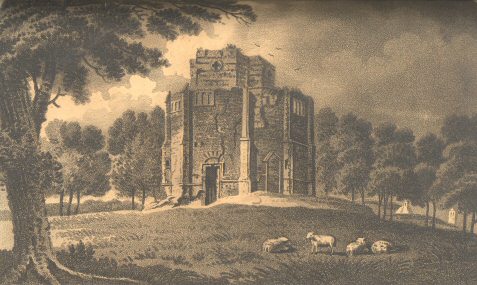
At
what time this notable fabrick was erected, does not appear; but
we may pretty safely conclude that it was at a period subsequent
to the conquest, and perhaps not before the 12th or 13th
century. It appears to have been dissolved, or laid by, at
the reformation, and it was defaced, as Parkin says, before the
3rd of Elizabeth. As there has been little or no attention
bestowed upon it ever since that time, it is no wonder that it
should be now in so ruinous a state. It has been often said
that this place was, in its day, the receptable of the pilgrims,
in their way to, and from Walsingham. If so, it amounts to
a pretty good proof, that it was very capacious, and well
endowed, or furnished with ample revenues; for the pilgrims to
Walsingham, like those to Loretto, swarmed on all the roads that
led thither; but on no road more, or perhaps so much as that
through Lynn, as all the devout people from the northern and
north western parts of the kingdom must have passed this way,
perhaps by hundreds at a time. That house must have been
both large and wealthy, that could lodge and entertain such hosts
of travellers.—Another reason for pilgrims frequenting our
chapel on the Mount might be, because there was there also an
image of the Virgin, which had attained to some celebrity; not
indeed like that at Walsingham, [556] but evidently beyond any
thing of the kind at Lynn. We may therefore be very sure
that the holy travellers to Walsingham would pay a greater regard
to the chapel of our Lady on the Mount than to any other
religions place in this town. It has been observed before,
that the offerings to this image of the Virgin on the Mount
exceeded sometimes the offerings to all our other images and in
all our other religious houses here, numerous as they were.
In short, we may venture to affirm, that in former days no one
place in Lynn was of greater note or celebrity than the Red
Mount, and especially our Lady’s Chapel and Image
there.
Of the Chapel of our Lady on the Bridge, we know much
less than of that on the Mount, though our knowledge of the
latter also is but very imperfect. When the former was
erected, whether before or after the other, or why there should
be two chapels in this town dedicated to the Virgin, are
questions which we are unable to resolve. They were both
probably more ancient than some of our other religious houses:
but they were dissolved, or laid by at the same time with most of
the rest. They were probably demolished not long after, and
this on the bridge much more entirely than the other. Parkin
says, that this chapel was defaced before the reign of Elizabeth,
as appears by an inquisition taken in her third year. Our
Lady’s Gild in Lynn had seemingly some connection with this
chapel, as well as with that on the Mount; but we know too little
of the constitution and circumstances of that ancient fraternity
to pronounce any thing positively on this head. [558] Some small remains of this
chapel, converted into a little dwelling, stood, till very
lately, on the eastern side of the bridge; but when the said
bridge was widened, by order of the paving-act commissioners,
those remains were entirely removed, and there is no longer one
stone upon another of that consecrated and venerated fabrick, or
the least sign or indication, except in the name of the bridge,
that such an edifice ever stood there.—The modern
substitutes for this and the other ancient chapels, here
suppressed and demolished, are four very decent and
commodious dissenting meeting houses; one in New Conduit Street,
one in Clough Lane, and two in Broad Street; all, or most of
them, at present pretty well attended. Of each of which a
particular account shall be given in the course of this work.
Of
St. Ann’s Chapel very little is at present
known. That it stood somewhere near St. Ann’s
Fort, and that the latter took its name from it, can scarcely
be doubted. The stones that are still to be seen in some of
the adjacent walls did once, in all probability, belong to this
ancient consecrated structure. [559] We have,
however, no reason to suppose that it was a very large edifice,
but rather one of our smaller size chapels, like that of our
Lady on the Bridge, and some others. It probably stood
contiguous to other houses, without any yard, or burying-ground
adjoining; which may be one, and, perhaps, the chief reason, why
its site has so entirely disappeared, so as to baffle, or render
fruitless every attempt to discover the exact spot on which it
stood. All that can now be fairly concluded is, that it
must have been somewhere near the Fort.
The site of St. Catherine’s Chapel seems to be
involved in still greater uncertainty than even that of St. Ann.
By something that the present writer has somewhere met with, he
has been led to think, that this chapel stood without the East
Gates, and at no great distance; but as he cannot now recollect
upon what he founded that opinion, he will not take upon him here
to defend it, or assert that the chapel actually stood
there. Parkin owns that he did not know where it stood, but
says that it was defaced before the 3rd of Elizabeth, as appears
by an inquisition then taken. He also says that it is
“mentioned in 1497, and the charity Gyld of the town of
Lenn,” which, as he supposes, may allude to our houses of
lepers. But those houses were probably not under the
direction of any one of the gilds, but rather of a particular
religious order, called the order of St. Lazarus of
Jerusalem; of which, however, we know not enough to give here
a particular account of it. But as to the chapel in
question, Parkin further informs us that “in 5 Richard II.
Henry le Despencer, bishop of Norwich, wrote a letter to Roger
Paxman, mayor, and to the burgesses of Lynn, wherein he desires
that they would, for the love they bore for the bishop, grant
part of the house of St. Catherine to one John Consolif,
late servant to his brother, the lord le Despencer, there to live
a solitary life, upon the alms of the good people; the other part
of the house belonging to the archdeacon of Norwich, being before
granted to the said John Consolyf.” [560] This shews that there was here
formerly a House or Hospital, as well as a Chapel, dedicated to
St. Catherine; to which house or hospital, in all probability,
the said chapel belonged: but whether they pertained to our
Lazarettos, or were founded for some other purposes, it is very
difficult now to determine. Beside this chapel of St.
Catherine, there was here another chapel dedicated to her, in the
church of the friars preachers, or Dominicans: [561a] but this was nothing very remarkable,
as we had here also more than one chapel dedicated to the
Trinity, as well as to the blessed virgin, if not likewise to
some others.
The Chapel of St. Lawrence, (like those of St.
Catherine and St. John) appears to have belonged to the
Hospital of the same name, and therefore must have stood
at Hardwick, contiguous, probably, or very near to the said
hospital. That house being one of our Lazarettos, its use,
or designation is sufficiently obvious. We learn from
Parkin,
“that John Duraunt Esq. in the 27 Henry VI.
granted to Robert Synkclere and Agnes his wife the hospital, or
house of lepars, with the chapel of St. Lawrence situate
on the cawsey of Hardwyke, by Lynn—Also that William
Walton, Esq. and Catherine, his wife, daughter and heiress of the
said John Duraunt Esq. conveyed by fine, in Hillary term, 36th
year of the same reign, to Sir Thomas Tudenham, knight, the
advouson of the chapel of St. Lawrence, with the manor of
Hall Place, and divers other possessions. [561b] This chapel seems therefore to
have been an endowed place, whose advouson was deemed an object
of no trivial consideration. The hospital to which it
belonged, as well as the rest of our Lazar houses, may be supposed
to have been in some sort of subjection to the master of the
order of St. Lazarus, whose chief residence, or station, appears
to have been at Burton Lazars, in Leicestershire. Parkin
mentions a remarkable deed which he had seen, whereby brother
Richard de Sulegrave, knight, master of the whole order of St.
Lazarus of Jerusalem, and all the brethren of the said order,
dwelling at Burton, by common assent and council of the whole
chapter, grant to Alan de Kele, burgess of Lenn, his heirs and
assigns, a certain piece of land, called Lazar Hill, lying by the
common wall of the said village, containing 7 perches and 7 feet
in breadth, on the north side; and 10 perches and 14 feet, on the
south side; 5 perches and half broad, on the east side; 6 perches
broad in the middle, and 7 on the west side, &c. [562] This seems, by the names of the
witnesses, to have been as early as the reign of king John.
“This piece of land,” (our author adds) “I find
afterwards in the hands of Rd. Spany and John de Teryngton, in
the reign of Richard II.”
But the present writer is not able to point out this
remarkable spot, or yet to describe the nature and extent of that
jurisdiction which the master and chapter of the order of St.
Lazarus had over the Lynn Lazarettos.
Most if not all the rest of the smaller chapels were attached
to, or connected with our different churches and convents, of
which several belonged to St. Margaret’s church: we will
therefore give here no separate account of them. Such
little chapels and chauntries were pretty numerous
here, and mark the character of the inhabitants, and particularly
the most devout part of them, in those times. There was
here also in former ages, at least one [563a] hermitage, or retreat of an
anchoret, and that was at the Crouch, or Crutch, as it is
now commonly called. Of this remarkable place, and its
adjacent cross, Parkin gives the following account—
“The mayor and commonalty petition William
(Bateman) bishop of Norwich, begging his favour towards John
Puttock, to admit him as a hermit, who had, in the bishop’s
marsh by Lenn, on the sea shore, in a certain place, called Lenn
Crouch, made a cave there, till he could build himself a proper
mansion; purposing, as he declares, to spend all his time, by
your permission and license, in the service of God there: and the
said John Puttock has there erected a certain remarkable cross,
of great service for all shipping coming that way, of the height
of 110 feet, at his own great cost and charge.” [563b]
This occurred as long ago as 1349. To our thinking the
Crutch must be a most improper and strange place for a hermitage,
where people are continually passing and repassing, and those, at
least many of them, some of the rudest and most lawless of the
whole population. How the hermits did there in popish times
we know not, but we are apt to think that they would not fare
very comfortably there in this protestant age.
Account of St. James’s Chapel
(now the Workhouse) from its first erection, in the
twelfth century, to the present time.
The founder of this chapel, as well as that of St. Nicholas,
according to our best accounts, was William
Turb, or Turbus, alias De Turba Villa, or
Turbeville, the third bishop of Norwich, who was promoted
to that see in 1146, [564a] in the reign of
king Stephen. It was probably built before the end of that
reign, as Parkin refers to a certain charter of that bishop,
which proves that it was in being at the commencement of the next
reign. [564b] Both this of St. James and that
of St. Nicholas were chapels of ease to the church of St.
Margaret. These three churches had in those times abundance
of officiating priests, or chaplains. The great fraternity,
called Trinity Gild, alone, maintained no less than
thirteen; six for St. Margaret’s, four for
St. Nicholas’s, and three for St. James’s. [564c] How many they had besides, does
not appear; but they had, no doubt, several more. This
chapel is said to contain in length five score feet, and in
breadth 24 feet; exclusive of the cross aisle, and a chapel
attached to it, dedicated to the Trinity. The altar of St.
Lawrence stood somewhere in this chapel, and, at the east end of
it, an image of our Saviour, to which devout folks were wont to
bring their offerings. A particular division of the town
appears to have been at one time consigned or appropriated to the
officiating services of the chaplains or clergy of this chapel,
comprehending, probably, all on the sides next to it of Damgate,
Broadstreet, Blackboystreet and Codlin lane. St
Nicholas’s clergy appear also to have had appropriated to
them another division of the town: hence we find, that—
“on Friday before the feast of St. Tiburtius
and Valerian, in the 35th of Edward III. it was ordered by the
commonalty, assembled in the Guild hall, that the clerks of St.
James’s in Lynn, for the future, shall carry the holy
water from the East Gate of Lynn, through all the south part
of Damgate, and through the whole street called Webster’s
row; and that the clergy or clerks of St. Nicholas’ shall
likewise carry from the aforesaid gate through all the north part
of the aforesaid street of Damgate.” [565a]
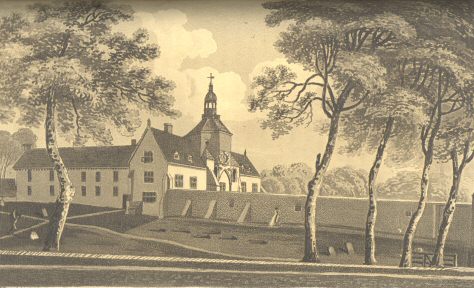
At the general dissolution this chapel was, it seems, laid by,
and shut up, which appears an odd and unaccountable circumstance,
as it had not any connection with the convents, being merely a
parochial place of worship. We are told that it was pulled
down, all but the cross aisle, in 1549, (by order of the mayor
and corporation, it is supposed,) when it had four bells, which
were worth, with the bell of the charnel-house, CCl.
We are further told, “that there did also, in the mean
time, belong to the said chapel and charnel-house, stone, iron,
and glass, to the value of one hundred marks: also timber and
lead to the value of 300l. also plate, jewels, and stock,
to the value of 200l. also certain lands and tenements in
Lynn, to the yearly value of 5l.” [565b] All this property appears to
have come into the hands of the mayor and corporation; not very
fairly and honourably, it seems; for we find that it rather
belonged to the Dean and Chapter of Norwich, who, about
seventeen years after, on what occasion does not appear,
relinquished their right and claim to it, by a formal deed to
that purpose, a copy of which is given below. [566a] This was about the year 1566.
[566b] From that period it lay,
probably, in ruins till 1581, when it was, at the expense of the
corporation, prepared and made a place for the manufacture of bays,
&c.—How long it was occupied for that purpose is not
said; but we learn that the undertaking did not
succeed.—About a century after, in the year 1682, it was
repaired and fitted up, by the liberal benefactions of the
corporation and principal inhabitants, and converted into a
hospital, or workhouse for fitly decayed old men, women, and poor
children; a good endowment and provision being made for their
work, instructions, and maintenance, and for putting the children
out to trades.—On that occasion were made and adopted the
following
“Rules, Ordinances and
Statutes made and established by the mayor and burgesses
of the burgh of King’s Lynn in the county of Norfolk, for
the good government of the Hospital or Workhouse of St. James,
there erected and founded, and of the children’s being, and
to be placed therein.—Imprimis, That the children be
instructed in their duty towards God, and in good
manners.—That the master for the time being shall cause the
children every Lord’s day, both in the forenoon and
afternoon, constantly to repair to the parish church of St.
Margaret, diligently to attend divine service and sermons
there.—That some fit person, to be elected by the mayor and
burgesses, shall daily read the prayers and collects appointed
for that purpose in the chapel of the said house, every morning
by eight of the clock, and every evening by four of the clock
precisely, all the children there attending with becoming
reverence.—That such person, after prayers so read at the
times
aforesaid, shall teach the children to read for the space of one
hour and an half, twice in the day, by calling together four at a
time, and no more, whilst the rest are at work.—That such
person every Sunday, after divine service in the afternoon,
calling all the said children into the chapel, shall instruct
them in the church Catechism appointed for children, for the
space of one hour, concluding with the prayers and collects.
“Item, For their
Recreation and Correction. That the children be kept at
work between our Lady and Michaelmas from Six of
the clock in the morning till Twelve at noon; and between
Michaelmas and our Lady from Eight till twelve, and
in all afternoons from One to Seven: the time for prayers,
reading, and refreshment, excepted. That on festivals and
holy-days observed by the church, and every Thursday after three
in the afternoon, they be allowed reasonable recreation.
That for offences committed, gentle and moderate chastisement be
given; and such as will not thereby be reformed, be sent to the
house of correction, to be there punished.
“Item, For their Diet,
Cloaths, Firing, and necessary
Provisions. That three days in the week they have once
in the day competent allowance of flesh meat hot, and three other
days like allowance of other hot provision, to be ready at twelve
at noon; and on the other day fit provision; as also a reasonable
breakfast and supper every day of the week. That all sorts
of provision, bread, beer, and meat, and all other victuals, be good,
fresh, and wholesome. That once every year, a month before
Christmas, they be allowed new suits of cloaths of the usual
colours, and new shifting, shoes, and stockings, so often as it
shall be necessary and convenient, and washing allowed
them. That out of six chaldron of coals to be allowed to
the master, a convenient fire be kept in the working-room all the
cold season of the year. That such children as shall appear
to be sick, be removed into a room for that purpose; and if any
be infirm, or taken with contagious distempers (such as are
catching) that special care be taken to lodge them apart from the
others.
“Item, For the
Visitation, Overseeing, Defraying necessary
charges, and Regulation of Abuses. That on the
usual day of electing the corporation officers in every year, the
mayor, aldermen, and common-council, or the major part of them,
shall elect and choose three discreet and fitting persons
to be governors of the same Hospital, or Workhouse, for
the year from Michaelmas thence next ensuing, whose care
shall be to inspect and oversee the same, and the children
therein, from time to time; and to order and direct all expences,
charges, payments, and disbursements concerning the same; and to
see and cause all the rules, ordinances, and statutes thereof to
be put in due execution.—That all gifts, benevolences,
contributions, payments, and sums of money whatsoever, now or
hereafter to be made and given to the same Hospital or Workhouse,
or the poor children therein, shall from time to time be paid
into the hands of such governors; and a true account thereof,
and of all expences, charges, payments and disbursements
concerning the same, shall yearly be made and audited on the
usual day appointed for auditing the accompts of the mayor and
burgesses.—That a book be kept, wherein all gifts and
benevolences, that have been or shall hereafter be given to, or
bestowed on the said Hospital or Workhouse, or the poor children
therein, shall be fairly registered, to be kept in the said
chapel.—That one other book be kept, wherein the names or
times of placing or removing of all masters and poor children of
the same Hospital or Workhouse shall be entered and
recorded.—That a sufficient chest or box be provided, with
two locks, for the reposing and safe keeping therein the Deeds
of Foundation, Endowment, and other writings, that do
or shall belong thereunto, as also the common seal of the
said Hospital, or Workhouse; one key whereof to remain with the
mayor of this burgh for the time being, the other with the senior
governor thereof.—That the mayor, aldermen, and
common-councilmen, or so many as shall think fit, by appointment
of the mayor for the time being, shall four times in every year,
or oftener if need require, visit the said hospital or workhouse,
for the better encouragement thereof, and discovering abuses that
may be committed contrary to these rules and ordinances.”
[570]
“The first Collection among the inhabitants towards this
charitable design, and preparing this chapel, amounted to the sum
of 406l. 1s. 6d.—The Corporation also
made an
order among themselves, That every Alderman new elected should
pay at his admittance 10l. and every common-council-man 20
nobles, which, to the year ending at Lady day 1724, amounted to
726l. 13s. 4d. The legacies of persons
deceased (besides other benefactions) given to the same”
[up to the above specified time] “amounted to 90l.
0s. 0d.—In all 1222l. 14s.
10d.—They also endowed it with 20l. per
annum.” [571a]
For some reason, to us unknown, the above order of things did
not long continue. In the course of a few years another
revolution took place: most, if not all the above regulations
were repealed, or laid aside, and the house, by an act of
parliament, was consigned to the superintendence and management
of the Guardians of the Poor. [571b] That act passed in 1701, the
12th of William III. For erecting Hospitals and Workhouses in
King’s Lynn. It contains, as Mackerell observes,
the following clause—
“The Workhouse, founded by the
mayor and burgesses, called St. James’s
Workhouse, and all lands, tenements, rents,
revenues, goods, and chattels, belonging
to the same, are by this act vested and settled in the
guardians of the poor, and their successors.” [571c]
We are further told, that by another clause in this act, it
was to continue in force only so long as the rates did not
exceed what had been paid towards the maintenance of the poor, for any one of the
then three last years. [572] That excess,
no doubt, took place pretty soon, though we have not learnt the
exact year when it so happened: and yet the guardians, it seems,
long after, and even till very lately, acted under that same
obsolete law; a conduct which may be thought not altogether
justifiable or defensible. But as the proverb says, that
“half a loaf is better than no bread,” so they might
judge that an obsolete law was better than no law. However
that was, one would think that they must cease to be guardians,
when the law that constituted them such lost its authority, or
ceased to be in force.
From the period when the superintendence and management of St.
James’s Hospital were committed to the guardians, it
appears to have become the proper poor house of St.
Margaret’s parish, and general workhouse of the
town.—Of the exact state and regular variations of the poor
rates in Lynn during the first sixty years, and more, after the
above act had passed, we have but little knowledge; but for
the last forty years our information is much more extensive
and authentic. During this period our poor-rates, or what
we have raised for the support of the poor, have increased
tenfold, and the number of paupers four or five
fold.—In 1770 these rates amounted to only
976l.—In 1796 they amounted to
7713l.—and in 1809 to about, or near 9000l.
and the whole expenditure, up to the end of January in the
present year, (1810) to the enormous sum of 10,243l.
10s. 3d.—for, after the manner of our
superiors, who sit above at the helm, we manage and contrive
that our outgoings should exceed our income.—The following
statements of our out-door expenditure in two different years,
(the first and the last of the above period,) extracted from Mr.
Grisenthwaite’s Remarks, p. 19 and 20, may throw some
further light upon this subject.
Abstract of Out-door Expenditure in 1770, as published
by order of the Court of Guardians.
No. of families
in each ward.
|
Wards.
|
No. of persons.
|
Cash paid to
each
ward weekly.
|
|
l.
|
s.
|
d.
|
30.
|
1.
|
North End Ward
|
78
|
2.
|
14.
|
0.
|
6.
|
2.
|
Kettlewell ditto
|
9
|
0.
|
7.
|
6.
|
5.
|
3.
|
Trinity Hall ditto
|
16
|
0.
|
9.
|
6.
|
5.
|
4.
|
Jews’ Lane ditto
|
10
|
0.
|
11.
|
6.
|
13.
|
5.
|
Paradise ditto
|
34
|
l.
|
6.
|
0.
|
26.
|
6.
|
Sedgeford Lane ditto
|
41
|
1.
|
18.
|
6.
|
19.
|
7.
|
Stonegate ditto
|
34
|
1.
|
13.
|
0.
|
20.
|
8.
|
Chequer ditto
|
41
|
1.
|
6.
|
6.
|
8.
|
9.
|
New Conduit ditto
|
17
|
0.
|
11.
|
6.
|
|
In St. James’s Workhouse
|
|
0.
|
2.
|
6.
|
131.
|
Total as
establishment account.
|
280.
|
10.
|
19.
|
6. [573]
|
Abstract of Out-door Expenditure in 1809, as published
by order of the Court (or corporation) of Guardians.
No. of families
in each ward
|
Wards.
|
No. of persons.
|
Cash paid to
each
ward weekly.
|
|
l.
|
s.
|
d.
|
85.
|
North End Ward
|
172.
|
9.
|
19.
|
9.
|
44.
|
Kettlewell ditto
|
78.
|
5.
|
16.
|
0.
|
58.
|
Paradise ditto
|
141.
|
8.
|
18.
|
6.
|
36.
|
Jews’ Lane ditto
|
99.
|
5.
|
10.
|
6.
|
44.
|
New Conduit ditto
|
91.
|
6.
|
12.
|
0.
|
58.
|
Chequer ditto
|
120.
|
9.
|
2.
|
6.
|
33.
|
Trinity Hall ditto
|
64.
|
5.
|
2.
|
6.
|
76.
|
Sedgeford Lane ditto
|
158.
|
10.
|
9.
|
6.
|
80.
|
Stonegate ditto
|
150.
|
12.
|
0.
|
0.
|
514.
|
Weekly Allowance
|
1050.
|
75.
|
11.
|
3.
|
|
Sick poor
|
60.
|
8.
|
17.
|
0.
|
|
Illegitimate
|
39.
|
3.
|
13.
|
9.
|
|
Total.
|
1149.
|
88.
|
1.
|
9. [574]
|
The difference between the latter and the former of the above
Statements, in so short a period, comprehending only a part of
the present prosperous reign, and what some seem to deem the most
blessed and glorious part of if, must be exceedingly remarkable
and wonderful. In 1770 the rates of the town were
only 4s. in the pound on the rent, raising an annual
revenue of 976l; of which 579l. were appropriated
for the use of the out door poor, leaving only 397l. for
the maintenance of the Workhouse and all other contingent
expences. Thus the total expenditure of the House was then
only 397l; now it is 3496l. 3s.
5d.—Then the total annual expenditure for both the
in-door and out-door poor was only 976l; now it is above
10,000l. [575a] Of course,
the charge for the maintenance of the poor is now become a very
serious matter, and even a heavy and grievous burden to many of
the inhabitants.
Our poor rates have arrived at their present unexampled height
under the new heaven-born poor-law, which was to be
the prolific parent of so many inestimable blessings to the town;
not one of which, alas! has yet been, or is ever likely to be
realized. This memorable law, and its worthy twin-sister,
the paving law, have been already productive of
incalculable mischief. The vast additional burden which
they have brought upon the inhabitants has lessened the value of
houses 15 or 20 per cent, and multiplied the number of untenanted
dwellings to five or six score, at least. [575b] Nor is it possible at present
to calculate how far the evil will or may extend. For such a
town as this to contain a large and increasing number of empty
houses must certainly have a very dark and unpropitious
appearance, and is utterly repugnant to every idea of our being
at present in a flourishing or prosperous condition. [576a]
When it was made to appear that the poor rates of Lynn
amounted to nearly, if not quite, as much as those of Hull
and Exeter, places three times its population, it was
impossible to avoid suspecting the existence of some sad
mismanagement, if not also of most foul and criminal
misdoings. The same suspicion was not likely to be
lessened, but rather to issue in full conviction, when it was
discovered, that the maintenance of each pauper in this
workhouse, or hospital, costs even more than that of each
pensioner in Greenwich Hospital, [576b] and twice or thrice as much as that
of each pauper in some, if not all, of the most noted and
respectable workhouses, or poorhouses in the kingdom. That
the report of these circumstances, with the increasing pressure
of the rates, should excite a spirit of mistrust, inquiry, and
investigation in the town, was no more than what might naturally
be expected. It accordingly did so happen: and the result
proved that the previous suspicious were not groundless.
In the course of the investigation, Butcher’s
Meat appeared to be here consumed in such unusual quantities
[577a] as are utterly irreconcilable with
any and every idea of economy and good management: and in the
article of Cheese the consumption appeared to be still
more palpably disproportionate, unexampled, and excessive; so as
to set the wisdom and competency of our managers in a very
unfavourable and unseemly point of view.—This the reader
will easily perceive, when he is told, that it costs in this
house, for cheese alone, between 4 and 5l. a week, or that
there is consumed here weekly no less than 1 Cwt. of that
article. That this is out of all proportion to what is
usual in other Poor-houses, will appear from the following
statement, extracted from Mr. Grisenthwaite late publication. [577b]
At the Norwich Poor-houses, among 1343 persons, during
one of the late years of scarcity, the annual expence for
cheese was 135l. 2s. 5d.—At
Shrewsbury, among 274 persons, (in 1801, if we are not mistaken,)
the annual expence for the same article was 56l.
2s. 4d.—At Hull, in 1808, (number of
persons not mentioned, but doubtless, not fewer than those in our
Poor-house,) the annual expence for the said article was
29l. 16s.—At Lynn, the same year,
among 200 persons, for that article, 226l.
8s.—At the same town, among about the same number of
persons, for the last year, (1809,) the annual expence for that
very article amounted to the still more enormous sum of
259l. 15s. 11d. [578a]—If we go on at this rate, we
shall soon have 3 or 400l. a year to pay for cheese
only, for the use of our Workhouse; a sum equal to what the
whole of that establishment cost forty years ago. [578b]
The statement here following will shew the respective and
total amount of the expence of the other articles consumed in
this house within the last year, with the proportion they bore to
the single article above specified.—The Butter used
in this house for the whole year cost 30l. 11s.
ld.—The Milk 33l. 14s.
2d.—Potatoes 37l.
2s.—Oatmeal and Peas 56l.
6s. [Total 157l. 13s.
3d.] That the sum total of the expence for the above
four, or rather five articles, should fall short above
100l. of what it cost for cheese only, must surely be very
strange: and yet it appears not to be more strange than
true. The whole year’s expence for Grocery was
158l. 1s. 7d.—And for Beer,
157l. 7s.—Here also it may be thought not a
little remarkable, that the Grocery and even the Beverage used here should so much fall short of
the Cheese as each of them not to amount to very much
above half the expence of that article. Of the two most
important articles, Flour and Meat, (the only two
which exceeded the expence of cheese!) the former,
including Bread, cost 1001l. 10s. 9d.
[579a]—and the latter, (Meat,)
cost 1110l.—Coals cost 134l.
5s. 10d.—Turf 9l.
3s.—Oil 8l. 4s.—The total
expenditure of the house for the whole year, including sundry
other articles, with repairs, &c. 3496l. 3s.
5d. [579b]—and with the disbursements to
the out-door pensioners, the entire expenditure, up to the end of
last January, as was before observed, appeared to amount to
10,243l. 10s. 3d.: [579c] an enormous sum, surely, for a town
that does not contain 11,000 inhabitants, or any manufacture, or
even any trade now, of much consequence, except the
coal trade. Under these circumstances, such a rapid
and vast increase of poor, and of the poor rates, must amount to
an irrefragable proof, that we are now in a state of actual and
fast declension, whatever some people may insinuate, or pretend
to the contrary. But the more evident this declension is,
the more incumbent it must be on those who have the management of
our affairs to observe the utmost economy, and spare as much as
possible the industrious and lower orders of the community, who
can so
ill bear the burden of additional charges. Whether they
have hitherto ever thought of this, or not, it seems to be now
high time that it should occupy its full share of their
attention. [580a]
It has also been thought, or rather suspected, that our
distributers of parochial relief do not always distribute or
administer that relief with judgment and discrimination, or even
with a scrupulous or due regard to justice and impartiality: and
such statements as the following might be supposed to afford some
colour or countenance to such suspicions—
“Weekly allowances—To a man and
wife and 5 children, 2s. 6d. To a young
woman, aged 24, and one child 2s.—To a man and wife
near 70 years of age, 1s. To a single woman, aged
19, 2s. 6d.—To a widow, aged 76,
2s. To a single woman, aged 31, 2s.
6d.—To a widow, aged 78, 2s. To a
single woman, aged 22, 1s. 6d.—To an aged
woman, 102 years old, 2s. 6d. To a widow,
aged 48, 3s. 6d.—To a widow, aged 38, with 3
children, 3s. To a single woman, aged 36, 2s.
6d.” [580b]
Such a Statement, which may be taken as a sample, or specimen
of our out-door distributions, has something like partiality, or
inconsiderateness, marked on its very
forehead.—“Kisses,” according to the old adage,
“go by favour;” and so, it is to be feared, do our
out-door parochial allowances, in too many instances. But
upon this topic we will not now enlarge, as we may have occasion
hereafter to resume the subject, in the latter part of the work.
[581a]
At this time (July 1810) a revolution, or new arrangement is
said to be actually taking place among our indoor-pensioners, or
in the management of St. James’s Hospital, from which very
important benefits are expected soon to result: and it is much to
be wished that the event may correspond with the present
expectations. The household expences have been already, it
seems much reduced, [581b] without the
least detriment to the poor inmates; and we hear, that the plan
is to be followed up with the strictest attention to sound and
rigid economy. The present state of the town certainly
requires it, and those who have come forward on this occasion
seem to be very much in earnest; but it remains to be seen how
far our present hopes and expectations will be realized, or
whether, after all, we are not destined to be, in this case, as
we have been in many others, the miserable victims of delusion
and disappointment. [581c]
With
very little propriety, especially of late years, has our St.
James’s Hospital been called a Work-house: it might
full as well, and even better, have been called a
play-house; for it is certain that there is more
play than work going on there. Among its 200
pensioners, one half, at least, may be supposed capable of doing
some, and even a great deal of work: and yet all their earnings
during all the last year amounted to no more than 170l.
1s. 5d. which was at the rate of little more
than a penny a day. The work, therefore, done by the
numerous residents in this house is scarcely worth mentioning,
except for the purpose of exhibiting the palpable neglect and
mismanagement of the conductors, and their utter incompetency for
the charge which they have undertaken. As things have stood
hitherto, this house has been little better than a nest of sloth,
or an asylum for idleness; where young and strong paupers are so
treated as if it were actually wished and intended to unfit them,
as much as possible, for any future use or employment in society,
or as if their admission here had been meant for their ruin, and
not for their relief and benefit—Care, certainly, ought to
be taken, that the children, and youth, and hale people, in our
poor-houses, be inured to habits of industry, as well as provided
with food and raiment; otherwise, the succour afforded will be
most materially defective.
The foregoing narration, it is presumed, will enable the
reader to form a pretty accurate and adequate idea, of the
history of this notable house, from its first erection, or
foundation, in the reign of king Stephen, or that of his
successor, to the present time. At first, as has been
shewn, it was a chapel, or place of worship, of no small
consideration in the town, being little inferior to St.
Nicholas’ chapel, or even St. Margaret’s church, and
continued to be so till the reformation, when it was
unaccountably desecrated, and most of it pulled down. After
which, it was appropriated successively to different uses, till
it became the poor-house of St. Margaret’s parish, and the
general work-house of the town, with the annexation, of late
years, of extensive new buildings. This is its state at
present: but how long it may so continue, it is impossible to
say, as we can see but little into futurity. How far the
recent change and expected reform will realize or disappoint our
hopes, must be left at present among the mysteries. Time is
the only revealer of such secrets. We will now take our
leave of St. James’s Chapel and Hospital, and proceed to
other matters, somewhat less connected with the affairs of the
present generation.
Brief biographical notices of the most
remarkable or distinguished personages that appeared among the
inhabitants of Lynn, in the intervening period between the
Conquest and the Reformation.
During the period now under consideration, it is not known
that many eminently distinguished, or very memorable characters
appeared among the inhabitants of this town, full as it was, in
the mean time, of ecclesiastics or priests, and monks or friars
of different orders, among whom was usually confined all the
little knowledge and learning that did then exist in the
nation. But though the population of Lynn, during the said
period, did not abound in characters of the above description,
yet it does not appear to have been altogether destitute of
them. The names of several have been preserved, who seem to
have made in their day no mean figure among their most
enlightened contemporaries; of whom the following were, perhaps,
the most estimable and worthy of remembrance.
1. Nicholas de Lenna,
or Nicholas of Lynn. He was a native of this town,
and flourished in the reign of Edward III. He was educated
at Oxford, where his literary proficiency may be supposed to have
been very considerable, as he afterwards appeared to exceed most
of his fellows, especially in some rare studies and
distinguishing departments. To him is supposed chiefly to
apply that observation of Voltaire, in his Essay on
Universal History, (vol. 3. pp. 182, 183.) “That the
first [in Europe] who certainly made use of the compass
were the English, in the reign of Edward III.” [586a] Hackluyt, in his
Voyages, makes particular and honourable mention of him,
observing, that Nicholas de Lenna, an excellent musician,
mathematician, and astrologer, bred at Oxford, after having
applied his studies chiefly to astronomy, by the help of his
Astrolabe, [586b] made six voyages to the North seas,
of which he published an account, in a book entitled
“Inventio Fortunata (aliter Fortunæ,)
qui liber incipit a gradu 54 usq; ad
polum.” In the first (which seems to have taken
place as early as 1330) he sailed from Lynn to Iceland, with
Company, whom he left on the sea-coast, while he himself
travelled up into the island in search of discoveries. He
presented his charts of the northern seas, at his return, (from
his last voyage, we may suppose) to Edward III, in 1360; and they
were afterwards made use of in the reign of Henry VI, and
probably much later. He died in 1369, and was buried at
Lynn. We are told that he was much esteemed by his
celebrated contemporary Chaucer, who styled him
‘Frere Nicholas Linn, a reverend clerke.’
Like the great Roger Bacon, who lived about half a
century before him, Nicholas belonged to the religious order of
Grey Friars, or Franciscans, otherwise called Cordeliers,
and minor brethren. [587] One is apt
to forget or overlook, in some measure, the extravagances of the
order, in the contemplation of its being capable of producing,
and that it actually did produce such men as these. As
Nicholas is supposed to have spent the most part of his time at
Lynn, among the brethren of his order, it may very naturally and
reasonably be concluded, or supposed, that the Grey
Friars’ tower, which is still standing, was often used
by him, as an observatory, in the course of his
astronomical studies here; which may suggest no despicable reason
for preserving that ancient ruin from the ravages of time, and
keeping it up as long as possible. The repair which it
lately underwent must be creditable to the feelings of those by
whom it was promoted. It may seem somewhat odd and
remarkable that it has stood so long, and still exists, the last
and only remain of our numerous monasteries and conventual
towers; (though, perhaps, from the slightness of its structure,
the most unlikely of any of them to survive;) as if time, or
providence had favoured its preservation, by way of approval of
the useful purposes to which it had been once appropriated, or in
honour of the memory of him who so laudably occupied it, and was
so eminent a benefactor to his country. Much stress,
however, is not meant to be laid on these ideas: yet we cannot
help thinking that this supposed, or presumed and probable
observatory of our ancient astronomer and navigator is entitled
to some real and lasting respect from the enlightened part of our
population.
It has been already observed that our worthy and respectable
townsman, the subject of this brief memoir, died in 1369, and was
buried here, [in the church, or dormitory of the Grey Friars, in
all probability;] but at what age, does not appear: yet if his
first voyage took place in 1330, as it is said, he must have
lived to be pretty far advanced in years; it being not probable
that he was less than thirty when he set out on that
voyage. Between the first and sixth, or last of his voyages
there seem to have been nearly if not quite thirty years. They were
all apparently voyages of discovery and experiment, and for
improvement in the art and knowledge of navigation, and proved,
no doubt, of no small advantage and benefit to his
countrymen. It is much to be wished that a particular
account of them had been preserved, which could not fail of being
very interesting; but as such an account is not known to exist,
our wishing for it must be all vain and useless. Any
records which our worthy voyager might leave behind him have
probably perished long ago; but we have from other sources
sufficient proofs that he must have been in his day an
extraordinary man, greatly distinguished as a mathematician and
astronomer, and especially as a navigator. He and the
person whose name next follows may pretty safely be deemed the
two most eminent characters that appeared among our townsmen,
during the long period of which we are now treating, or, perhaps,
during any other period.
2. William Sawtre, or
Salter, otherwise Sawtry, Chawtrey and
Chatris, and commonly called Sir William Sawtre,
&c. it being usual in those days, and long after, to prefix
that title to the names of a certain description of
ecclesiastics. He is rendered peculiarly memorable as the
English proto-martyr; it being generally agreed that he
was the first Englishman that was burnt for his religion.
We have no authority to say of Sautre, as we did of Nicholas,
that he was born here. The place of his birth, as far as we
know, has been no where mentioned. It appears that he took
up his residence and settled here, as parish priest of St.
Margaret’s, in the time of bishop Spencer, of
fighting, crusading, and persecuting memory; and that he was
afterwards suspected and found to be a Lollard or
Wickliffite, [590] which meant pretty
much the same with what we call being a protestant, but
was then deemed, by the rulers, in church and state, a very
grievous offence, and even a most shocking, pestilent, damnable,
and insufferable heresy. The defection of Sawtre, from the
established or national faith, roused his ecclesiastical
superiors, and he was cited to appear before his haughty and
furious diocesan, at his palace of south Helingham; which
accordingly he did, on the last day of April, and the first of
May 1399. In the mean time he appears to have undergone a
long and strict examination, in the chapel belonging to the said
episcopal palace, before the bishop, the archdeacon of Norwich,
and divers others, consisting of doctors, divines, and
notaries. It also appears that he was then so far from
being ashamed of the opinions he had espoused, or intimidated by
the danger to which they might expose him, that he did not at all
scruple or hesitate to avow and defend them. This we may be
sure, did not please and conciliate his examiners,
or promote and facilitate his acquittal and liberation.
We are not particularly informed how he was disposed of
immediately after this examination: but it seems pretty certain,
that he then became a close prisoner in some place of confinement
within the precincts of the said episcopal palace. A
prison, for reputed heretics and other delinquents, was formerly
considered among the necessary appendages to a prelatical mansion
or residence: and it cannot be supposed, considering the
character of bishop Spencer, but that a very complete one was
then to be found at South Helingham. In a complete
episcopal prison there was usually, it seems, a cell, called
Little-Ease; which was a small hole, so constructed, that
the person there immured could neither stand upright, lie
straight, sit comfortably, or enjoy any degree of ease: in short,
it was designed as a place of torment, where the sufferer was to
be continually tortured, and deprived, as much as possible, of
every thing that could render his situation in any degree
tolerable or supportable. This diabolically ingenious
contrivance could scarcely fail of answering the purpose of its
inventors, as it seems to have been most admirably adapted for
taming, subduing, and breaking the spirits of reputed heretics
and religious free thinkers: few of whom, it is presumed, could
stand such an ordeal, or terrible test, for any length of
time. The romish hierarchy must have been tremendously
formidable, when its prelates had such prisons in their own
houses, and were empowered to confine there any that dissented
from the church, or objected to its tenets and observances. [592]
That there was such a place of incarceration and torture then
attached to the episcopal palace of South Helingham,
seems highly probable; and if there were, there can be no doubt
but that Sawtre was there confined from the first to the
nineteenth day of the month last mentioned.—That he
underwent some very severe treatment, in the meantime, seems
morally certain, as the remarkable change in his conduct, at the
close of that interval, cannot be reasonably or well accounted
for on any other ground or supposition. [593] On the first of May he
resolutely avowed and defended the obnoxious opinions imputed to
him, but on the nineteenth of the same month, the next
time he was brought before his judges, he appeared ready to
relinquish them all, and pronounce his recantation. There
is no reason to think that his opinions had now undergone any
change, or that he had become really convinced of their falsity
or untenableness; for he appeared, almost immediately after, to
be as fully persuaded as ever of their truth and
importance. It was evidently the state of his mind that had
experienced a change: his fears had got the better of his
firmness, and he no longer possessed that fortitude and boldness
which he had at first displayed. Torturing severities have
often made people deny their principles, and deny, or confess,
any thing that their tormentors required. On this ground
(and on no other that we know of) can we account for
Sawtre’s change and subsequent recantation.
It was determined, by the bishop and his coadjutors, that
Sawtre should publicly pronounce his recantation at different
places—in order, perhaps, the more effectually to expose
and humble him, and so prevent his ever daring again to broach
his recanted tenets in these parts. They probably suspected
his sincerity, and were resolved to render their triumph over him
as complete as possible.—The obnoxious things, or
enormities laid to his charge were chiefly and substantially
comprised under the following heads—That the Cross on which
Christ suffered was not a fit object of worship—That it was
more reasonable to worship a temporal prince than that wooden
cross—That the worship of angels is unlawful, even more so
than the worship of holy or truly good men—That going on
pilgrimage is useless, and that vows for that purpose are not
binding, and that the money so expended had better be bestowed in
alms to the poor—That priests are more bound to preach the
word of God than to say their mattins, or observe the canonical
hours—and that, after the sacramental words are pronounced,
the bread remaineth the same as before, and so does not cease to
be bread, or undergo a transubstantiation.—It was a sad
time when people held these opinions at the risk of their
lives!
On the first two days, as has been already observed, Sawtre
openly avowed the said articles, and boldly defended them; but at
his next appearance, after eighteen days of close confinement and
severe sufferings, as we may reasonably presume, he seemed quite
an altered man, ready to retract all he had before affirmed and
maintained: which may be easily accounted for on the ground
before suggested. How many times, or at how many places
the bishop now required and obliged him to publish, or pronounce
his recantation, it is not very easy to discover. We find
it to have been done at South Helingham, and we are assured that
it was also done in the parish churches of Lynn and
Tilney, and in other places.—Fox has
preserved a curious document relating to this affair, being the
bishop’s account of the whole process, drawn up by order of
archbishop Arundel, and transmitted to him, when Sawtre was taken
up the last time, and tried before him and his clergy, assembled
in convocation, at the Chapter House of St. Paul’s, in
February, 1400, as they reckoned, but 1401, according to our
reckoning.—That account, or document is as
follows—
“Memorandum, That upon the last day
of Aprill, in the yeere of our Lord 1399, in the 7. indiction,
and 10 yeere of the papacie of pope Boniface the 2. in a certain
chamber within the manor-house of the said bishop of Norwich at
South Helingham (where the register of the said bishop is kept)
before the 9. houre, in a certain chapell within the said manor
situate, and the first day of May then next and immediately
insuing, in the foresaid chamber Sir W. Chawtris, parish priest
of the church of S. Margaret in the towne of Lin, appeared before
the bishop of Norwich, in the presence of John de Derlington,
archdeacon of Norwich, doctor of the decrees, frier Walter Disse,
and John Rickinghall, professors in divinity, William Carlton,
doctor of both lawes, and William Friseby, with Hugh Bridham,
publike notaries, and there publikely affirmed and held the
conclusions, as before is specified.—All and singular the
premisses the forsaid William affirmeth upon mature
deliberation. And afterwards, to wit, the 19. day of May in
the yeere, indiction, and papacie aforesaid, in the chappell
within the manor-house of the said Henry bishop of Norwich,
situate at South Helingham, the foresaid Sir William revoked and
renounced all and singular the foresaid his conclusions; abjuring
and correcting all such heresies and errors, taking his oath upon
a book before the said Henry, the bishop of Norwich, that from
that time forward he would never preach, affirm, nor hold privily
nor apertly, the foresaid conclusions; and that he would
pronounce, according to the appointment of the said bishop, the
foresaid conclusions to be erroneous and heresies, in the parish
churches of Lin and Tilney, and in other places at the assignment
of the said bishop; and further sware, that he would stand to the
ordinance of the said bishop touching the premisses, in the
presence of the discreet and worshipfull men afore-recited, with
divers other moe.—As concerning the first conclusion, that
he said he would not worship the cross &c. he confessed
himself to have erred, and that the article was erroneous, and
submitted himselfe. And as touching the second article,
that he said, he would rather worship a king, &c. he
confessed himself to have erred, and the article to be erroneous,
and submitted himselfe, and soforth of all the rest.—Then
next after this, upon the 25. day of May, in the yeere of our
Lord aforesaid, in the Church yard of the Chappell of St.
James, within the towne of Lin, the foresaid William, in the
presence of the foresaid bishop and clergy, and the people of the
said towne of Lin standing round about, publikely declared in the
English tongue, the foresaid conclusions to be erroneous and
heresies, as was contained in a certain scrole. [597] And after this, the 26. day of
May, in the yeere above said in the Church of the Hospital of
S. John’s, in the towne of Lin, the said Sir William,
before the said bishop sitting as judge, sware and took his oath
upon the holy Evangelists, that he would never after that time
preach openly and publikely the foresaid conclusions, nor
would heare the confessions of any of his subjects of his
diocesse of Norwich without the speciall license of the said
bishop, &c. In the presence of frier John Smermen, M.
John Rickinghall doctor of divinity, W. Carlton doctor of both
lawes, and Thomas Bulton officer of the liberty of Lin aforesaid,
with divers others.” [598]
Such was the account, or statement of his former process
against Sawtre, which bishop Spencer delivered to his
metropolitan, Arundel. Not the least hint is here given,
how the reputed heretic had been treated, or was disposed of,
during the interval between his first and last examination.
Had his renunciation of his obnoxious tenets been brought about
by mere argument, or rational persuasion, it would, doubtless,
have been mentioned by way of triumph, or boasting: but having
been the effect of extreme severity or cruel treatment (as was
above suggested) it was very natural to pass it over in silence,
for it was not capable of yielding any manner of credit to the
parties concerned, or give them a plausible pretence to make a
merit of it. This silence therefore evidently and strongly
corroborates, if it do not also satisfactorily establish, what
was before advanced or suggested on this head.
After Sawtre had gone quite through this irksome and
humiliating process of recantation, it might be expected that he
would not think of tarrying much longer in these parts: he,
accordingly, appears to have quitted Lynn shortly
after, and obtained the situation of parish-priest, or minister
of St. Osith, in London. [599] This would
seem to indicate, that his character was still deemed
respectable, and had not suffered so much by the late event as
some might expect. He had also, probably, some good and
powerful friends, who now interested themselves very warmly and
effectually in his behalf. However that was, he really did,
as far as we can discover, obtain the said situation without
opposition or difficulty. But he soon appeared to be so far
from having abandoned his former principles, that he was still,
in fact, as much a Lollard and heretic as ever: and his late
miscarriage seems to have operated so as both to confirm him in
those principles and also to arm him with boldness and courage to
maintain them against all gainsayers, and in the face of every
future danger or opposition.
Like that of the rest of his party, (the Lollards,)
Sawtre’s heresy seems to have been of a twofold nature;
partly religious, and partly political; which must have rendered
him doubly odious to the ruling powers: and as he proved a
relapsed, confirmed, and irreclaimable heretic, we need not
wonder that he should be made to feel the whole and overwhelming
weight of their indignation and vengeance. The affairs of
this country were then, as at some subsequent periods, most
wretchedly situated. Every thing, both in church and state,
might be said to be lamentably in the wrong: and Sawtre appears
to have been earnestly desirous of having them thoroughly
reformed and rectified. He may therefore be considered, if
not as the Sir William Jones, [600] the Sir Francis
Burdett, or the Major Cartwright, yet, at least, or
rather, as the Christopher Wyvill of that time. Men
of that sort, though ever so honest, virtuous, enlightened, or
respectable, are always viewed with an evil eye, and deemed to be
dangerous characters by the interested and unprincipled agents
and abettors of ecclesiastical and political corruption. It
is no wonder, therefore, that a most horrible outcry was raised
against this man throughout the whole camp and borders of those
philistines.
Sawtre had formed an important plan for the benefit of his
oppressed country, and intended to lay it immediately before
parliament. The design got wind, and the high priests, in
particular, with archbishop Arundel at their head, were
instantly alarmed, as the project, had it succeeded, would have
deeply affected them: and in order effectually to frustrate the
reformer’s object, they so managed, that the affair should
not go before parliament, but be referred to the
convocation, which was then sitting. From that
assembly no good could be expected to result. Patriots and
reformers were there objects of utter aversion; and any one might
see that poor Sawtre had no longer any chance of bringing his project
to a successful issue, or even of escaping with his life.
He was accordingly brought before that ecclesiastical tribunal,
and the result will be seen by the sequel. This was about
the middle of February 1401, or 1400, according to their
reckoning; for they placed that month near the close of the year,
which, with them, ended on the 25th of March.
The story of Sawtre is thus introduced by Fox—
“The next yeere after followed a parliament
holden at Westminster:” [i.e. in 1400; for he has also,
like his predecessors, assigned February to the preceding year:]
“in which parliament one William Sautre, a good man and a
faithfull priest, inflamed with zeale of true religion, required
he might be heard for the commodity of the whole realme.
But the matter being smelt before by the bishops, they obtained
that the matter should be referred to the convocation; where the
said William Sautre being brought before the bishops and notaries
thereunto appointed, the convocation was deferred to the Saturday
next ensuing. When Saturday was come, that is to say, the
twelfth day of February, Thomas Arundell archbishop of
Canterbury, in the presence of his councell provinciall, being
assembled in the said chapter-house [i.e. that of St.
Paul’s] against one Sir William Sautre, otherwise called
Chatris chaplaine, personally then and there appearing by the
commandment of the aforesaid archbishop of Canterbury, objected;
that the said William before the bishop of Norwich had once
renounced and abjured divers and sundry conclusions hereticall
and erroneous; and that after such abjuration made, he publicly
and privily held, taught, and preached th same conclusions, or
else such like, disagreeing to the catholic faith, and to the
great perill and pernicious example of others. And after
this he caused such like conclusions holden and preached, as is
said, by the said Sir William without renunciation, then and
thereto be read unto the said archbishop, by master Robert Hall,
chancellor unto the said bishop, in a certain scrole written, in
tenor of words as followeth—“Sir William Chatris,
otherwise called Sautre, parish priest of the church of Saint
Scithe [Osith] the virgin in London, publikely and privily doth
hold these conclusions under written—Imprimis, he
saith, that he will not worship the crosse on which Christ
suffered, but only Christ that suffered upon the
crosse—2. Item, That he would sooner worship a
temporall king, than the foresaid woodden crosse—3.
Item, That he would rather worship the bodies of the
saints than the very crosse of Christ on which he hung, if it
were before him.—4. Item, That he would rather
worship a man truly contrite, than the crosse of
Christ.—5. Item, That he is bound rather to
worship a man that is predestinate, than an angell of
God.—6. Item, That if any man would visit the
monuments of Peter and Paul, or go on pilgrimage to the Tombe of
Saint Thomas, or else any whither else, for the obtaining of any
temporall benefit; he a not bound to keep his vow, but he may
distribute the expences of his vow upon the almes of the
poore.—7. Item, That every priest and deacon
is more bound preach the word of God, than to say the canonicall
houres—8. Item, That alter the pronouncing of
the sacramentall words of the body of Christ, the bread remaineth
of the same nature that it was before, neither doth it cease to
be bread.” [603]
These articles or charges being publicly read and exhibited,
the archbishop then called upon Sawtre to answer to them; but he
desired that he might first have a copy of them, and that
sufficient time might be allowed him to prepare his answer and
defence. A Copy was accordingly delivered to him, and the
next Thursday was then fixed upon for him again to appear before
his judges. But on that day, owing, it seems, to the
archbishop’s being then necessarily engaged in the
parliament-house, the business was adjourned till the next
morning at eight o’clock. The convocation, or rather
its upper house, being then assembled, Sawtre appeared again
before them, and produced a written defence, and answer to those
articles, which were then publicly read by Robert Hall, before
mentioned. He no longer thought of retracting, as he had
done near two years before, at Lynn and other places. On
the contrary, he now openly avowed his principles, and appeared
neither afraid nor ashamed to defend them. It is therefore,
not to be wondered that the writing, or answer, which he laid
before them, and which was now publicly read in their hearing,
proved no way satisfactory or conciliating.
After the said Robert Hall had read that paper, or answer,
aloud, in the audience of the Convocation, the archbishop,
being dissatisfied with the contents, proceeded to question
Sawtre on what he deemed the most material points, which chiefly
related to the doctrine of transubstantiation. Among his
questions were the following—[604]
“Whether in the Sacrament of the altar,
after the pronouncing of the Sacramentall words, remaineth very
materiall bread, or not?—Whether in the sacrament after the
sacramentall words, rightly pronounced of the priest, the same
bread remaineth, which did before the words pronounced, or
not?—Whether the same materiall bread before consecration,
by the sacramentall words of the priest rightly pronounced, be
transubstantiated from the nature of bread into the very body of
Christ, or not?”
To none of these interrogatories did the prisoner return an
orthodox or satisfactory answer. His answers being
therefore deemed insufficient, and the day, probably, too far
gone to finish the examination at that time, it was thought
proper to adjourn the business till the next day. Of what
then occurred Fox gives the following account.
“Then the said archbishop assigned unto the
said Sir William time to deliberate, and more fully to make his
answer till the next day; and continued this convocation then and
there till the morrow. Which morrow, to wit, the 19th day
of February, being come, the foresaid archbishop of Canterbury,
in the said chapter house of St. Paul in London, before his
councell provinciall then and there assembled, specially asked
and examined the same Sir W. Sautre, there personally present,
upon the sacrament of the altar, as before. And the same
Sir William again, in like manner as before, answered.
After this amongst other things the said bishop demanded of the
same William, if the same materiall bread being upon the altar,
after the sacramentall words being of the priest rightly
pronounced, is transubstantiated into the very body of Christ, or
not? And the said Sir William said, he understood not what
he meant. Then the said archbishop demanded, whether that
materiall bread being round and white, prepared and disposed for
the sacrament of the body of Christ upon the altar, wanting
nothing that is meet and requisite thereunto, by the virtue of
the sacramentall words being of the priest rightly pronounced, be
altered and changed into the very body of Christ, and ceaseth any
more to be materiall and very bread, or not? Then the said
Sir William, deridingly [605] answering, said he
could not tell.”
“Then consequently the said archbishop demanded,
whether he would stand to the determination of the holy church,
or not, which affirmeth that in the sacrament of the altar, after
the words of consecration being rightly pronounced of the priest,
the same bread, which before in nature was bread, ceaseth any
more to be bread? To this interrogation the said Sir
William said, that he would stand to the determination of the
church, where such determination was not contrary to the will of
God. This done, he demanded of him againe, what his
judgement was concerning the sacrament of the altar: who said and
affirmed, that after the words of consecration, by the priest
duly pronounced, there remained very bread, and the same bread
which was before the words spoken.”—This examination
commenced at eight o’clock in the morning, and lasted about
three hours: and as the prisoner would not now retract, or recede
from his Lollardism, and receive what was called Catholic
information, but chose to persist, at all events, in his own
way of thinking, the archbishop, as we are told, “by the
counsell and assent of his whole covent then and there present,
did promulgate and give sentence by the mouth of Robert Hall,
against the same Sir William, being personally present, and
refusing to revoke his heresies, but constantly defended the
same.” [606]
After
passing the said sentence, an adjournment took place, till the
week after, when the prisoner was again brought before them, two
or three different times. On the Wednesday they read to him
bishop Spencer’s statement of his process against him, near
two years before. The archbishop and divers others now
reproached him for holding opinions which he had before abjured;
as if it were a mighty crime for a man, after having been once so
weak as to renounce or abjure the truth, afterwards to repent and
embrace it—or, after having once been so overseen as to
resign the right of private judgment, ever any more to think of
resuming it! As all the stratagems and means they could use
proved now too feeble to shake him from his integrity, or induce
him to sacrifice his conscience to their unrighteous and infernal
pleasure, they resolved he should be forthwith degraded: and a
sentence of degradation [607] was accordingly
passed upon him that same day. The execution of this
sentence was deferred till the Friday following; and as the
archbishop could not then attend, owing to his detention in
parliament, it was further deferred till the morrow after.
They then proceeded to business in good earnest, and a most
curious process it certainly was—They first deprived him of
his priest’s order, next of his deacon’s
order, next of his subdeacon’s order, then of
his acolyte’s order, then of his exorcist, or
holy-water-clerk’s order, then of his
reader’s order, then of his sexton’s
order, and finally, of his privilege of clergy: in
token of which his tonsure was erased, a layman’s cap put
on his head, and himself so entirely secularized, or reduced to
the state of a lay person, as if he had never been in orders.
All this was certainly absurd enough; [608] but as it was also very curious, we
shall here give it more circumstantially, in the
words of the historian so often referred to in these
pages—
Upon Saturday, being the 26th. of February, the
said archbishop of Canterbury sate in the bishop’s seat of
the foresaid church of St. Paul, in London, and solemnly
apparelled in his pontificall attire, sitting with him as his
assistants these reverend fathers and bishops, of London,
Lincolne, Hereford, Exeter, Menevensis & Roffensis
episcopi, [i.e. the bishops of St. Davids and Rochester]
above mentioned, commanded and caused the said Sir William
Sautre, apparelled in priestly vestments, to be brought and
appeare before him. That done, he declared and expounded in English
to all the clergy and people, there in a great multitude
assembled; that all processe way finished and ended against the
said Sir W. Sautre. Which thing finished, before the
pronouncing of the said sentence of the relapse against the said
Sir William, as is premised, he often then and there recited and
read. And for that he saw the said William in that behalf
nothing abashed; he proceeded to his degradation and
actual deposition in forme as followeth.
In the Name of the Father, and of the Son,
and of the Holy Ghost. [610] We Thomas by
God’s permission archbishop of Canterbury, primate of all
England, and Legate of the apostolike Sea, do denounce thee
William Sautre, otherwise called Chautris, chaplaine
fained, in the habite and apparell of a priest, as an
heretike, and one refallen into heresie, by this our sentence
definitive by councell, assent, and authority to be condemned,
and by conclusion of all our fellow brethren, fellow bishops,
prelates councell provinciall, and of the whole clergy, do
degrade and deprive thee of thy priestly order. And
in sign of degradation and actual deposition from thy priestly
dignity, for thine incorrigibility and want of amendment, we take
from thee the patent and chalice, and doe deprive
thee of all power and authority of celebrating the masse, and
also we pull from thy backe the casule, and take from thee
the vestment, and deprive thee of all manner of priestly
honour.
Also, We Thomas, the aforesaid archbishop, by authority,
counsell, and assent, which upon the foresaid William we
have, being deacon pretensed, in the habit and apparell of
a deacon, having the New Testament in thy hands, being an
heretike, and twice fallen, condemned by sentence as is
aforesaid, do degrade and put thee from the order of a
deacon. And in token of this thy degradation and
actuall deposition, we take from thee the book of the New
Testament, and the stole, and do deprive thee of all
authority in reading of the gospel, and of all and all manner of
dignity of a deacon.
Also, we Thomas archbishop aforesaid, by authority counsell,
and assent, which over thee the foresaid William we have, being a
subdeacon pretensed, in the habit and vestment of a
subdeacon, an heretike, and twice fallen, condemned by sentence,
as is aforesaid, do degrade and put thee from the order of
subdeacon; and in token of this thy degradation and actuall
deposition, we take from thee the albe and maniple,
and do deprive thee of all and all manner of subdiaconicall
dignity.
Also, We Thomas archbishop aforesaid, by counsell, assent and
authority which we have over thee the foresaid William, an
Acolyte pretensed, wearing the habit of an acolyte, and
heretike, twice fallen, by our sentence, as is aforesaid,
condemned, doe degrade and put from thee all order of an acolyte;
and in signe and token of this thy degradation and actuall
deposition, we take from thee the candlestick and
taper, and also the urceolum, and do deprive thee
of all and all manner of dignity of an Acolyte.—Also, We
Thomas archbishop aforesaid, by assent, council, and authority,
which upon thee the foresaid William we have, an Exorcist
pretensed, in the habite of an exorcist or holy
water clerke, being an heretike, twice fallen, and by our
sentence, as is aforesaid, condemned, do degrade and depose
thee from the order of an Exorcist; and in token of this thy
degradation and actual deposition, we take from thee the book
of conjurations, and do deprive thee of all and singular
dignity of an exorcist.
Also, We Thomas archbishop aforesaid, by assent, counsell, and
authority, as is abovesaid, do degrade and depose thee the
foresaid William, reader pretensed, clothed in the habit
of a reader, an herctick, twice fallen, and by our sentence, as
aforesaid, condemned, from the order of a reader: and, in token
of this thy degradation and actual deposition, we take from thee
the book of the divine lections (that is, the book of the
church legend) and do deprive thee of all and singular manner of
dignity of such a reader.—Also, We Thomas archbishop
aforesaid, by authority, counsell, and assent, the which we have,
as is aforesaid, doe degrade, and put thee the foresaid William
Sawtre, Sexton pretensed, in the habit of a sexton, and
wearing a surplice, being an heretike, twice fallen, by our
sentence definitive condemned, as aforesaid, from the order of a
sexton: and, in token of this thy degradation and actual
deposition, for the causes aforesaid, we take from thee the
keyes of the church doore, and thy surplice, and do
deprive thee of all and singular manner of commodities of a
doore-keeper.
Also, by the authority of omnipotent God, the Father, Son, and
Holy Ghost, and by our authority, counsell, and assent of our whole
councel provinciall above written, we do degrade thee, and depose
thee, being here personally present before us, from orders,
benefices, priviledges, and habit in the church; and for thy
pertinacy incorrigible we doe degrade thee before the secular
court of the high constable and marshall of England, being
personally present; and do depose thee from all and singular
clerkely honours and dignities whatsoever, by these
writings. Also in token of thy degradation and deposition,
here actually we have caused thy crowne and ecclesiasticall
tonsure in our presence to be rased away, and utterly to be
abolished, like unto the form of a secular layman; and here we do
put upon the head of thee, the aforesaid William, the cap of a
lay secular person; beseeching the court aforesaid that they will
receive favourably [613] the said William
unto them thus recommitted.
Having thus performed their part of this diabolical work, and
delivered the prisoner into the hands of the civil magistrate,
“the bishops, not yet contented, cease not, (says
our historian) to call upon the king to cause him to be brought
forth to speedy execution. Whereupon the king, ready
enough, and too much, to gratifie the clergy, and to retaine
their favours, directeth out a terrible decree against the said
William Sawtre, and sent it to the maior and sheriffes of London
to be put in execution.” This terrible decree, or
royal warrant for the prisoner’s execution, was obtained,
it seems, on the very day of his degradation, when the
convocation passed their final sentence and gave him up to the
civil power: so that there was here no time lost; and the closing
scene, no doubt, soon ensued. The royal decree, or warrant
was as follows:
“The decree of our sovereigne Lord the
King and his Councell in parliament, against a certain new
sprung up heretick. To the maior and sherifs of
London, &c. Whereas the reverend father, Thomas
archbishop of Canterbury, primate of all England and legat of the
apostolike sea, by the assent, consent, and councill of other
bishops, and his brethren suffragans, and also of all the whole
clergy within his province or dioces, gathered together in his
provinciall councell, the due order of the law being observed in
all points in this behalfe, has pronounced and declared, by his
definitive sentence, William Sawtre sometime chaplaine, fallen
again into his most damnable heresie, the which before time the
said William had abjured, thereupon to be a most manifest
heretick, and therefore hath decreed that he should be degraded,
and hath for the same cause really degraded him from all
prerogative and privilege of the clergy, decreeing to leave
him unto the secular power; and hath really so left him,
according to the laws and canonicall sanctions set forth in his
behalfe, and also that our holy mother the church hath no further
to do in the premisses: We therefore being zealous in religion,
[615a] and reverent lovers of the catholike
faith, willing and minding to maintaine and defend the holy
church, and the lawes and liberties of the same, to root all such
errors and heresies out of our kingdome of England, and with
condigne punishment to correct and punish all heretikes, or such
as be convict; provided always that both according to the law of
God and man, and the canonicall institutions in this behalfe
accustomed, such heretikes convict and condemned in forme
aforesaid ought to be burned with fire: We command you as
straitly as we may, or can, firmely enjoyning you that you cause
the said William, being in your custody, in some publike or open
place within the liberties of your city aforesaid (the cause
aforesaid being published unto the people) to be put into the
fire, and there in the same fire really to be burned, to the
great horrour of his offence, and the manifest example of other
christians. Fail not in the execution hereof upon the
perill that will fall thereupon.” [615b]
This memorable warrant (dated 26th. of February) was, no
doubt, speedily executed: perhaps the very day on which it was
issued. The death which it orders or appoints for the
alleged crime of heresy, or to which it devotes the reputed
offender, is supposed to distinguish it from all other warrants
that had ever been issued before by our English monarchs: at
least, there is not known to have been here, previously to this
reign, any law dooming adjudged heretics to the flames.
Henry IV. therefore, stands preeminent among our sovereigns as a
promoter of the burning of those whom the priests pronounced or
denominated heretics. It is remarkable enough that the poor
lollards found such an enemy in him, who, as well as his father,
had long affected to be their great patron. But it was all,
probably, nothing but policy: neither father nor son can be
supposed ever to have been real lovers of either liberty or
justice. Henry’s accession to the throne (to which he
had no right) disclosed his true character; and he has been known
ever since, as one of the worst of our princes. Arundel and
his brethren helped him to obtain and usurp the crown, in hopes
that he, in return, would help them in such affairs as this of
Sawtre: nor were they disappointed. They favoured his
baseness on that, and he favoured theirs, to the utmost extent of
their wishes, on this and on all similar occasions.
The execution of Sawtre was the first fruit of the new law for
burning heretics; and it was soon followed by an abundant
harvest. The number of those who were burnt for their
religion in England whilst this execrable law was in force, which
was near 300 years, was enormously great. As Sawtre stands
at the head of those memorable confessors, it was thought
requisite to be somewhat particular and circumstantial in our
account of him. The sons of freedom will venerate his
memory, while they detest and execrate that of his crowned and
mitred persecutors. Of our crowned demons none could well exceed
Henry IV. and of our mitred ones scarce any ever did or
could go beyond Arundel and Spencer. For Sawtre to
fall into such hands must truly have been a most sad and pitiable
case. It was like falling among thieves, or into a den of
hungry lions.
It is pretty remarkable that the prisoner’s plan of
reform, or intended application to parliament was not allowed to
come at all under the discussion of the convocation; although
they had pretended to take it under their serious consideration,
instead of its going before parliament. But they knew
better than to have done so, and took a much shorter and surer
course to gain their point and effect the reformer’s ruin,
by proceeding simply on a religious ground, and having him tried
as a relapsed heretic. So well did they know their
business, and how to avail themselves of all the advantages
belonging to their exalted situation.—We shall now take our
leave of them, and also of William Sawtre, whose memory we have
here endeavoured to rescue from oblivion. His being so
distinguished a character among the then inhabitants of Lynn,
and, especially, his being the English porto-martyr, will, it is
presumed, sufficiently justify and apologize for the unusual
length of this article—and as it exhibits religious bigotry
and intolerance in their native deformity and hatefulness, it may
be of use to those individuals among us, of every denomination,
who have not yet made any, or much progress in the christian
virtues of forbearance, candour, and liberality.
3. Alan, Aleyne, or
Allen of Lynn, was, it seems a native of this town, and
contemporary with Sawtre, but a younger man, and long his
survivor, and so represented as flourishing about twenty years
later. He was evidently of a very different cast from him, and
never gave himself the least concern, as far as we know, about
the politics of the time, or the reform of civil or
ecclesiastical abuses. Perfectly regardless of the
oppressions of the rulers and the grievances of the people, he
employed his time in poring over the huge volumes of the Fathers
and Schoolmen, and writing indexes to them. We are told he
made indexes to no less than 33 of those authors, among
which were Augustin, Anselm, and Aquinas. Such an
employment, though of no real use or benefit to the community,
procured him the honour of being classed among the eminent men,
or literati of that age; and his name has been handed to
posterity as one of the distinguished characters which Lynn has
produced. His skill and industry in making those indexes
might, no doubt, deserve commendation, but can hardly be said to
entitle him to any degree of literary celebrity. He may be
said therefore to have acquired more fame than was fairly his
due. But so it has often happened: while the merits of some
have been greatly underrated, those of others, on the contrary,
have been magnified beyond all reason and justice. Alan
received his education at Cambridge, where he obtained the degree
of Doctor in Divinity. He was of the order of Carmelites,
or White Friars, and therefore his residence here must have been
at their great house, or convent in South Lynn. How long he
resided there cannot now be said. We are told that he died
about the year 1428, and was buried at Lynn. The place of
his burial, no doubt, was the dormitory of his own convent,
situated on that spot in South Lynn now called the
Friars.
4. William Wallys. He
was cotemporary with the last, and like him one of our Lynn friars, but
of the augustinian order. He was not, like the former a
mere reader, and maker of indexes, but a real author, and is said
to have written many books; but their titles and contents are no
longer remembered or known. They might be on interesting
subjects, and those subjects might there be handled in a
judicious and masterly manner; or they might not. However
that was, and whatever they were, it seems they have long ago
perished, like innumerable other works, no less valuable and
worthy of preservation; and, perhaps, much more so. But his
name, has been preserved, as one of the eminent Lynn men of
former times. How long he resided here, we are not
informed; but we are told that he died in 1421; and we may
presume that he was buried in the convent or dormitory of the
Austin friars, which stood behind the house now inhabited by Mr.
Rishton. He must have been eminent in his day, especially
among those of his fraternity, for we are told that he became
general of that order.
5. John Baret, of
Barret. He too was a friar, of the same order with
Alan; that of the Carmelites. He was a native of
this town, and educated at Cambridge, “when learning (as
Fuller says) ran low and degrees high in that University;
so that a Scholar could scarcely be seen for Doctors; till the
university, sensible of the mischief thereof, appointed Dr.
Cranmer (afterwards abp. of Canterbury) to be the examiner of all
candidates in Divinity. Amongst others, he stopt Baret, for
his insufficiency, who then went back to Lynn, and applied
himself to learning with such success, that in a short time he
became an admirable scholar; and commencing doctor,
with due applause, lived many years a painful preacher at
Norwich; always making mention of Cranmer as the means of his
happiness.” But we find that he had something of the
Vicar of Bray about him; for it seems he was at first a papist;
afterwards, in the latter part of Henry the eighth’s reign,
and that of Edward, a protestant; again, in that of Mary, a
zealous papist; and lastly, in that of Elizabeth, a staunch
protestant. It seems, however, that he died soon after the
commencement of the latter reign: and one would hope that he died
in the true faith.—As to his veering or changing with the
times, where is the impropriety of that? Ought not the
ministers of a national or state religion to be submissive to, or
directed by the state, from which they derive their creed, their
revenue, their power, and their every thing?
The subjects of the foregoing biographical articles being all
ecclesiastics, and all the ecclesiastics of any note that
distinguished Lynn, as far as we know, during the long period of
which we have been treating, it might be expected that we should
in the next place give a list of the eminent laymen that
sprung up here in the course of the same period. But, alas!
we look and search for them in vain: hardly can one be found
whose name deserves to be recorded, or remembered by
posterity. William de Bittering, John de Wentworth,
Bartholomy Petipas, and Thomas Miller, four of our ancient
aldermen, were perhaps the most memorable, or notable that can
now be discovered. Of two of them somewhat has been said
already, and a sort of promise was made to bring them again under
review; but, upon second thought, they did not appear to deserve so much
further notice as was then intended.—As to
6. William de Bittering, we
learn that he flourished in the reign of Edward III. and was
chosen mayor of the town four or five different times; so that he
must have been here, in his day, a person of no small note and
influence. The first year of his mayoralty, it seems, was
1351. He was again chosen, and served the office the
ensuing year; so that he was then mayor two years
successively. He is said to have been again chosen in 1355,
but begged to be excused, on the plea that it was wearisome to be
so often in office, and, especially, that he was then under a
vow, to go on pilgrimage to a certain saint: from which it would
seem that he was, in his way, a very religious character.
His resignation was accepted, and John de Coultshall, who
had served the year before, was chosen again, and had 20l,
given him by the commonalty to take upon him the office for that
year. Bittering was again chosen and served the office in
1358, and again in 1365. The time of his death does not
appear. He was buried in St. Nicholas’ chapel, where
his grave is known by a flat stone of uncommon dimensions, being
above ten feet long and above six broad, and is supposed to be
the oldest sepulchral monument now existing in this town.
(Mackerell, 134.)
7. 8. John de Wentworth and
Bartholomy Petipas. They are not
here coupled or joined together because they were friends for no
two men could well be further from that, but rather because they
were foes, and the heads of two hostile factions, by which the
town was kept in a state of constant distraction for a great
length of time. It seems impossible now to ascertain the
ground, or cause of that deadly animosity which those two
factions, or these two men entertained against each other.
Lollardism, we know, did then much agitate the kingdom, but we
cannot say that it was the occasion of this discord at
Lynn. Nor can we say that it was a mere political broil,
or, contest between the partizans of the episcopal feudal
prerogatives and their opponents, though this may seem more
probable, as it appears from pages 365 and 559 of this volume, that Petipas was
on good, and Wentworth on bad terms with the bishop.
However this was, it is pretty evident that these two were mighty
men and men of renown here in those days.
9. Thomas Miller, or
Milner. He was the leading man among our ancestors
in the reign of Henry VIII. being governor of the town,
and mayor also one time for four successive years; and he served
that office afterwards twice, if not more; so that he was mayor
of Lynn six or seven times, which is not known to have been the
case with any other. But what made him the most memorable
was his successful contest, or law-suit with the bishop, during
the former part of his mayoralty, about their respective claims
to have the Sword carried before them. This legal
decision established the mayor’s independence upon the
bishop.
Having now paid our tribute of respect to the memory of our
eminent men of those times, we shall here close this chapter,
which brings us down to the era of the reformation.
End of Part III.


