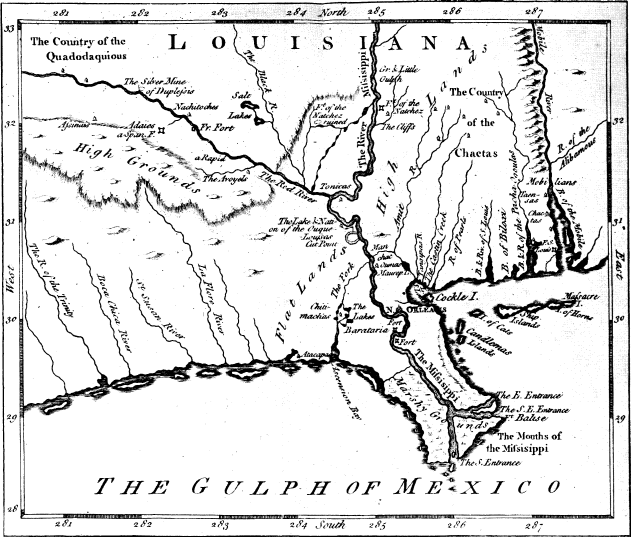
The Transactions of the French in LOUISIANA.
Of the first Discovery and Settlement of LOUISIANA.
After the Spaniards came to have settlements on the Great Antilles, it
was not long before they attempted to make discoveries on the coasts
of the Gulf of Mexico. In 1520, Lucas Vasquez de Aillon landed on the
continent to the north of that Gulf, being favourably received by the
people of that country, who made him presents in gold, pearls, and
plated silver. This favourable reception made him return thither four
years after; but the natives having changed their friendly sentiments
towards him, killed two hundred of his men, and obliged him to retire.
In 1528, Pamphilo Nesunez16 landed also on that
coast, receiving from the first nations he met in his way, presents
made in gold; which, by signs, they made him to understand, came from
the Apalachean mountains, in the country which at this day goes under
the name of Florida: and thither he attempted to go, undertaking a
hazardous journey of twenty-five days. In this march he was so often
attacked by the new people he continually discovered, and lost so many
of his men, as only to think of re-embarking with the few that were
left, happy to have himself escaped the dangers which his
imprudence had exposed him to.
The relation published by the Historian of Dominico17
Soto, who in 1539 landed in the Bay of St. Esprit, is so
romantic, and so constantly contradicted by all who have travelled
that country, that far from giving credit to it, we ought rather to
suppose his enterprize had no success; as no traces of it have
remained, any more than of those that went before. The inutility of
these attempts proved no manner of discouragement to the Spaniards.
After the discovery of Florida, it was with a jealous eye they saw the
French settle there in 1564, under René de Laudonniere, sent thither
by the Admiral de Coligni, where he built Fort Carolin; the ruins of
which are still to be seen above the Fort of Pensacola.18
There the Spaniards some time after attacked them, and forcing them to
capitulate, cruelly murdered them, without any regard had to the
treaty concluded between them. As France was at that time involved in
the calamities of a religious war, this act of barbarity had remained
unresented, had not a single man of Mont Marfan, named Dominique de
Gourges, attempted, in the name of the nation, to take vengeance
thereof. In 1567, having fitted out a vessel, and sailed for Florida,
he took three forts built by the Spaniards; and after killing many of
them in the several attacks he made, hanged the rest: and having
settled there a new post,19 returned to
France. But the disorders of the state having prevented the
maintaining that post, the Spaniards soon after retook possession of
the country, where they remain to this day.
From that time the French seemed to have dropped all thoughts of that
coast, or of attempting any discoveries therein; when the wars in
Canada with the natives afforded them the knowledge of the vast
country they are possessed of at this day. In one of these wars a
Recollet, or Franciscan Friar, name F. Hennepin, was taken and carried
to the Illinois. As he had some skill in surgery, he proved
serviceable to that people, and was also kindly treated by them: and
being at full liberty, he travelled over the country, following for a
considerable time the banks of the river St. Louis, or Missisipi,
without being able to proceed to its mouth. However, he failed not to
take possession of that country, in the name of Louis XIV., calling it
Louisiana. Providence having facilitated his return to Canada, he gave
the most advantageous account of all he had seen; and after his return
to France, drew up a relation thereof, dedicated to M. Colbert.
The account he gave of Louisiana failed not to produce its good
effects. Me de la Salle, equally famous for his misfortunes and his
courage, undertook to traverse these unknown countries quite to the
sea. In Jan. 1679 he set out from Quebec with a large detachment, and
being come among the Illinois, there built the first fort France ever
had in that country, calling it Crevecæur; and there he left a good
garrison under the command of the Chevalier de Tonti. From thence he
went down the river St. Louis, quite to its mouth; which, as has been
said, is in the Gulf of Mexico; and having made observations, and
taken the elevation in the best manner he could, returned by the same
way to Quebec, from whence he passed over to France.
After giving the particulars of his journey to M. Colbert, that great
minister, who knew of what importance it was to the state to make sure
of so fine and extensive a country, scrupled not to allow him a ship and
a small frigate, in order to find out, by the way of the gulf of Mexico,
the mouth of the river St. Louis. He set sail in 1685: but his
observations, doubtless, not having had all the justness requisite,
after arriving in the gulf, he got beyond the river, and running too far
westward, entered the bay of St. Bernard: and some misunderstanding
happening between him and the officers of the vessels, he debarqued with
the men under his command, and having settled a post in that place,
undertook to go by land in quest of the great river. But after a
march of several days, some of his people, irritated on account of the
fatigue he exposed them to, availing themselves of an opportunity, when
separated from the rest of his men, basely assassinated him. The
soldiers, though deprived of their commander, still continued their
route, and, after crossing many rivers, arrived at length at the
Arkansas, where they unexpectedly found a French post lately settled.
The Chevalier de Tonti was gone down from the fort of the Illinois,
quite to the mouth of the river, about the time he judged M. de la Salle
might have arrived by sea; and not finding him, was gone up again, in
order to return to his post. And in his way entering the river of the
Arkansas, quite to the village of that nation, with whom he made an
alliance, some of his people insisted, they might be allowed to settle
there; which was agreed to, he leaving ten of them in that place; and
this small cantonment maintained its ground, not only because from time
to time encreased by some Canadians, who came down this river; but above
all, because those who formed it had the prudent precaution to live in
peace with the natives, and treat as legitimate the children they had by
the daughters of the Arkansas, with whom they matched out of necessity.
The report of the pleasantness of Louisiana spreading through Canada,
many Frenchmen of that country repaired to settle there, dispersing
themselves at pleasure along the river St. Louis, especially towards
its mouth, and even in some islands on the coast, and on the river
Mobile, which lies nearer Canada. The facility of the commerce with
St. Domingo was, undoubtedly, what invited them to the neighbourbood
of the sea, though the interior parts of the country be in all
respects far preferable. However, these scattered settlements,
incapable to maintain their ground of themselves, and too distant to
be able to afford mutual assistance, neither warranted the possession
of this country, nor could they be called a taking of possession.
Louisiana remained in this neglected state, till M. d'Hiberville, Chef
d' Escadre, having discovered, in 1698, the mouths of the river St.
Louis, and being nominated Governor General of that vast country,
carried thither the first colony in 1699. As he was a native of
Canada, the colony almost entirely consisted of Canadians, among whom
M. de Luchereau, uncle of Madam d'Hiberville, particularly
distinguished himself.
The settlement was made on the river Mobile, with all the facility
that could be wished; but its progress proved slow: for these first
inhabitants had no other advantage above the natives, as to the
necessaries of life, but what their own industry, joined to some rude
tools, to give the plainest forms to timbers, afforded them.
The war which Louis IV, had at that time to maintain, and the pressing
necessities of the state, continually engrossed the attention of the
ministry, nor allowed them time to think of Louisiana. What was then
thought most advisable, was to make a grant of it to some rich person;
who, finding it his interest to improve that country, would, at the
same time that he promoted his own interest, promote that of the
state. Louisiana was thus ceded to M. Crozat. And it is to be
presumed, had M. d'Hiberville lived longer, the colony would have made
considerable progress: but that illustrious sea-officer, whose
authority was considerable, dying at the Havannah, in 1701 (after
which this settlement was deserted) a long time must intervene before
a new Governor could arrive from France. The person pitched upon to
fill that post, was M. de la Motte Cadillac, who arrived in that
country in June 1713.
The colony had but a scanty measure of commodities, and money scarcer
yet: it was rather in a state of languor, than of vigorous activity,
in one of the finest countries in the world; because impossible for it
to do the laborious works, and make the first advances, always
requisite in the best lands.
The Spaniards, for a long time, considered Louisiana as a property
justly theirs, because it constitutes the greatest Part of Florida,
which they first discovered. The pains the French were at then to
settle there, roused their jealousy, to form the design of cramping
us, by settling at the Assinaïs, a nation not very distant from the
Nactchitoches, whither some Frenchmen had penetrated. There the
Spaniards met with no small difficulty to form that settlement, and
being at a loss how to accomplish it, one F. Ydalgo, a Franciscan
Friar, took it in his head to write to the French, to beg their
assistance in settling a mission among the Assinaïs. He sent three
different copies of his letter hap-hazard three different ways to our
settlements, hoping one of them at least might fall into the hands of
the French.
Nor was he disappointed in his hope, one of them, from one post to
another, and from hand to hand, falling into the hands of M. de la
Motte. That General, incessantly taken up with the concerns of the
colony, and the means of relieving it, was not apprized of the designs
of the Spaniards in that letter; could only see therein a sure and
short method to remedy the present evils, by favouring the Spaniards,
and making a treaty of commerce with them, which might procure to the
colony what it was in want of, and what the Spaniards abounded with,
namely, horses, cattle, and money: He therefore communicated that
letter to M. de St. Denis, to whom he proposed to undertake a journey
by land to Mexico.
M. de St. Denis, for the fourteen years he was in Louisiana, had made
several excursions up and down the country; and having a general
knowledge of all the languages of the different nations which inhabit
it, gained the love and esteem of these people, so far as to be
acknowledged their Grand Chief.
This gentleman, in other respects a man of courage, prudence, and
resolution, was then the fittest person M. de la Motte could have
pitched upon, to put his design in execution.
How fatiguing soever the enterprize was, M. de St. Denis undertook it
with pleasure, and set out with twenty-five men. This small company
would have made some figure, had it continued entire; but some of them
dropped M. de St. Denis by the way, and many of them remained among
the Nactchitoches, to whose country he was come. He was therefore
obliged to set out from that place, accompanied only by ten men, with
whom he traversed upwards of an hundred and fifty leagues in a country
entirely depopulated, having on his route met with no nation, till he
came to the Presidio, or fortress of St. John Baptist, on the Rio
(river) del Norte, in New Mexico.
The Governor of this fort was Don Diego Raimond, an officer advanced
in years, who favourbly received M. de St. Denis, on acquainting
him, that the motive to his journey was F. Ydalgo's letter, and that
he had orders to repair to Mexico. But as the Spaniards do not readily
allow strangers to travel through the countries of their dominion in
America, for fear the view of these fine countries should inspire
notions, the consequences of which might be greatly prejudicial to
them, D. Diego did not chuse to permit M. de St. Denis to continue his
route, without the previous consent of the Viceroy. It was therefore
necessary to dispatch a courier to Mexico, and to wait his return.
The courier, impatiently longed for, arrived at length, with the
permission granted by the Duke of Linarez, Viceroy of Mexico. Upon
which M. de St. Denis set out directly, and arrived at Mexico, June 5,
1715. The Viceroy had naturally an affection to France; M. de St.
Denis was therefore favourably received, saving some precautions,
which the Duke thought proper to take, not to give any disgust to some
officers of justice who were about him.
The affair was soon dispatched; the Duke of Linarez having promised to
make a treaty of commerce, as soon as the Spaniards should be settled
at the Assinaïs; which M. de St. Denis undertook to do, upon his
return to Louisiana.
The Return of M. de St. Denis: His settling the Spaniards at the
Assinaïs. His Second Journey to Mexico, and Return from thence.
M. De St. Denis soon returned to the fort of St. John Baptist; after
which he resolved to form the caravan, which was to be settled at the
Assinaïs; at whose head M. de St. Denis put himself, and happily
conducted it to the place appointed. And then having, in quality of
Grand Chief, assembled the nation of the Assinaïs, he exhorted them to
receive and use the Spaniards well. The veneration which that people
had for him, made them submit to his will in all things; and thus the
promise he had made to the Duke of Linarez was faithfully fulfilled.
The Assinaïs are fifty leagues distant from the Nactchitoches. The
Spaniards, finding themselves still at too great a distance from us,
availed themselves of that first settlement, in order to form a second
among the Adaies, a nation which is ten leagues from our post of the
Nactchitoches: whereby they confine us on the west within the
neighbourhood of the river St. Louis; and from that time it was not
their fault, that they had not cramped us to the north, as I shall
mention in its place.
To this anecdote of their history I shall, in a word or two, add that
of their settlement at Pensacola, on the coast of Florida, three
months after M. d'Hiberville had carried the first inhabitants to
Louisiana, that country having continued to be inhabited by Europeans,
ever since the garrison left there by Dominique de Gourges; which
either perished, or deserted, for want of being supported.20
To return to M. de la Motte and M. de St. Denis: the former, ever
attentive to the project of having a treaty of commerce concluded with
the Spaniards, and pleased with the success of M. de St. Denis's
journey to Mexico, proposed his return thither again, not doubting but
the Duke of Linarez would be as good as his word, as the French had
already been. M. de St. Denis, ever ready to obey, accepted the
commission of his General. But this second journey was not to be
undertaken as the first; it was proper to carry some goods, in order
to execute that treaty, as soon as it should be concluded, and to
indemnify himself for the expences he was to be at. Though the
store-houses of M. Crozat were full, it was no easy matter to get the
goods. The factors refused to give any on credit; nay, refused M. de
la Motte's security; and there was no money to be had to pay them. The
Governor was therefore obliged to form a company of the most
responsible men of the colony: and to this company only the factors
determined to advance the goods. This expedient was far from being
agreeable to M. de St. Denis, who opened his mind to M. de la Motte on
that head, and told him, that some or all of his partners would
accompany the goods they had engaged to be security for; and that,
although it was absolutely necessary the effects should appear to be
his property alone, they would not fail to discover they
themselves were the proprietors; which would be sufficient to cause
their confiscation, the commerce between the two nations not being
open. M. de la Motte saw the solidity of these reasons; but the
impossibility of acting otherwise constrained him to supersede them:
and, as M. de St. Denis had foreseen, it accordingly happened.
He set out from Mobile, August 13, 1716, escorted, as he all along
apprehended, by some of those concerned; and being come to the
Assinaïs, he there passed the winter. On the 19th of March, the year
following, setting out on his journey, he soon arrived at the Presidio
of St. John Baptist. M. de St. Denis declared these goods to be his
own property, in order to obviate their confiscation, which was
otherwise unavoidable; and wanted to shew some acts of bounty and
generosity, in order to gain the friendship of the Spaniards. But the
untractableness, the avarice, and indiscretion of the parties
concerned, broke through all his measures; and to prevent the entire
disconcerting of them, he hastened his departure for Mexico, where he
arrived May 14, 1717. The Duke of Linarez was yet there, but sick, and
on his death-bed. M. de St. Denis had, however, time to see him, who
knew him again: and that Nobleman took care to have him recommended to
the Viceroy his successor; namely, the Marquis of Balero, a man as
much against the French as the Duke was for them.
M. de St. Denis did not long solicit the Marquis of Balero for
concluding the treaty of commerce; he soon had other business to mind.
F. Olivarez, who, on the representation of P. Ydalgo, as a person of a
jealous, turbulent, and dangerous disposition, had been excluded from
the mission to the Assinaïs, being then at the court of the Viceroy,
saw with an evil eye the Person who had settled F. Ydalgo in that
mission, and resolved to be avenged on him for the vexation caused by
that disappointment. He joined himself to an officer, named Don Martin
de Alaron, a person peculiarly protected by the Marquis of Balero: and
they succeeded so well with that nobleman that in the time M. de St.
Denis least expected, he found himself arrested, and clapt in a
dungeon; from which he was not discharged till December 20 of
this year, by an order of the Sovereign Council of Mexico, to which he
found means to present several petitions. The Viceroy, constrained to
enlarge him, allotted the town for his place of confinement.
The business of the treaty of commerce being now at an end, M. de St.
Denis's attention was only engaged how to make the most of the goods,
of which Don Diego Raymond had sent as large a quantity as he could,
to the town of Mexico; where they were seized by D. Martin de Alaron,
as contraband; he being one of the emissaries of his protector,
appointed to persecute such strangers as did not dearly purchase the
permission to sell their goods. M. de St. Denis could make only enough
of his pillaged and damaged effects just to defray certain expences of
suit, which, in a country that abounds with nothing else but gold and
silver, are enormous.
Our prisoner having nothing further to engross his attention in
Mexico, but the safety of his person, seriously bethought himself how
to secure it; as he had ever just grounds to apprehend some bad
treatment at the bands of his three avowed enemies. Having therefore
planned the means of his flight, on September 25, 1718, as the night
came on, he quitted Mexico, and placing himself in ambush at a certain
distance from the town, waited till his good fortune should afford the
means of travelling otherwise than on foot. About nine at night, a
horseman, well-mounted, cast up. To rush of a sudden upon him,
dismount him, mount his horse, turn the bridle, and set up a gallop,
was the work of a moment only for St. Denis. He rode on at a good pace
till day, then quitted the common road, to repose him: a precaution he
observed all along, till he came near to the Presidio of St. John
Baptist. From thence he continued his journey on foot; and at length,
on April 2, 1719, arrived at the French colony, where he found
considerable alterations.
From the departure of M. de St. Denis from Mexico, to his return
again, almost three years had elapsed. In that long time, the grant of
Louisiana was transferred from M. Crozat to the West India Company; M.
de la Motte Cadillac was dead, and M. de Biainville, brother to M.
d'Hiberville, succeeded as governor general. The capital place of
the colony was no longer at Mobile, nor even at Old Biloxi, whither it
had been removed: New Orleans, now begun to be built, was become the
capital of the country, whither he repaired to give M. de Biainville
an account of his journey; after which he retired to his settlement.
The king afterwards conferred upon him the cross of St. Louis, in
acknowledgement and recompence of his services.
The West India Company, building great hopes of commerce on Louisiana,
made efforts to people that country, sufficient to accomplish their
end. Thither, for the first time, they sent, in 1718, a colony of
eight hundred: men some of which settled at New Orleans, others formed
the settlements of the Natchez. It was with this embarkation I passed
over to Louisiana.
Embarkation of eight hundred Men by the West India Company to
Louisiana. Arrival and Stay at Cape François. Arrival at Isle
Dauphine. Description of that Island.
The embarkation was made at Rochelle on three different vessels, on
one of which I embarked. For the first days of our voyage we had the
wind contrary, but no high sea. On the eighth the wind turned more
favourable. I observed nothing interesting till we came to the Tropick
of Cancer, where the ceremony of baptizing was performed on those who
had never been a voyage: after passing the Tropick, the Commodore
steered too much to the south, our captain observed. In effect, after
several days sailing, we were obliged to bear off to the north: we
afterwards discovered the isle of St. Juan de Porto Rico, which
belongs to the Spaniards. Losing sight of that, we discovered the
island of St. Domingo; and a little after, as we bore on, we saw the
Grange, which is a rock, overtopping the steep coast, which is almost
perpendicular to the edge of the water. This rock, seen at a distance,
seems to have the figure of a grange, or barn. A few hours after we
arrived at Cape François, distant from that rock only twelve
leagues.
We were two months in this passage to Cape François; both on account
of the contrary winds, we had on setting out, and of the calms, which
are frequent in those seas: our vessel, besides, being clumsy and
heavy, had some difficulty to keep up with the others; which, not to
leave us behind, carried only their four greater sails, while we had
out between seventeen and eighteen.
It is in those seas we meet with the Tradewinds; which though weak, a
great deal of way might be made, did they blow constantly, because
their course is from east to west without varying: storms are never
observed in these seas, but the calms often prove a great hindrance;
and then it is necessary to wait some days, till a grain, or squall,
brings back the wind: a grain is a small spot seen in the air, which
spreads very fast, and forms a cloud, that gives a wind, which is
brisk at first, but not lasting, though enough to make way with.
Nothing besides remarkable is here seen, but the chace of the
flying-fish by the Bonitas.
The Bonita is a fish, which is sometimes two feet long; extremely fond
of the flying-fish; which is the reason it always keeps to the places
where these fish are found: its flesh is extremely delicate and of a
good flavour.
The flying-fish is of the length of a herring, but rounder. From its
sides, instead of fins, issue out two wings, each about four inches in
length, by two in breadth at the extremity; they fold together and
open out like a fan, and are round at the end; consisting of a very
fine membrane, pierced with a vast many little holes, which keep the
water, when the fish is out of it: in order to avoid the pursuit of
the Bonita, it darts into the air, spreads out its wings, goes
straight on, without being able to turn to the right or left; which is
the reason, that as soon as the toilets, or little sheets of water,
which fill up the small holes of its wings, are dried up, it falls
down again; and the same Bonita, which pursued it in the water, still
following it with his eye in the air, catches it when fallen into the
water; it sometimes falls on board ships. The Bonita, in his turn,
becomes the prey of the seamen, by means of little puppets, in
the form of flying-fish, which it swallows, and by that means is
taken.
We stayed fifteen days at Cape François, to take in wood and water,
and to refresh. It is situate on the north part of the island of St.
Domingo, which part the French are in possession of, as the Spaniards
are of the other. The fruits and sweet-meats of the country are
excellent, but the meat good for nothing, hard, dry, and tough. This
country being scorched, grass is very scarce, and animals therein
languish and droop. Six weeks before our arrival, fifteen hundred
persons died of an epidemic distemper, called the Siam distemper.
We sailed from Cape François, with the same wind, and the finest
weather imaginable. We then passed between the islands of Tortuga and
St. Domingo, where we espied Port de Paix, which is over-against
Tortuga: we afterwards found ourselves between the extremities of St.
Domingo and Cuba which belongs to the Spaniards: we then steered along
the south coast of this last, leaving to the left Jamaica, and the
great and little Kayemans, which are subject to the English. We at
length quitted Cuba at Cape Anthony, steering for Louisiana a north
west course. We espied land in coming towards it, but so flat, though
distant but a league from us, that we had great difficulty to
distinguish it, though we had then but four fathom water. We put out
the boat to examine the land, which we found to be Candlemas island
(la Chandeleur.) We directly set sail for the island of Massacre,
since called Isle Dauphine, situated three leagues to the south of
that continent, which forms the Gulf of Mexico to the north, at about
27° 35' North latitude, and 288° of longitude. A little after we
discovered the Isle Dauphine, and cast anchor before the harbour, in
the road, because the harbour itself was choaked up. To make this
passage we took three months, and arrived only August 25th. We had a
prosperous voyage all along, and the more so, as no one died, or was
even dangerously ill the whole time, for which we caused Te Deum
solemnly to be sung.
We were then put on shore with all our effects. The company had
undertaken to transport us with our servants and effects, at
their expence, and to lodge, maintain and convey us to our several
concessions, or grants.
This gulf abounds with delicious fish; as the sarde (pilchard) red
fish, cod, sturgeon, ringed thornback, and many other sorts, the best
in their kind. The sarde is a large fish; its flesh is delicate, and
of a fine flavour, the scales grey, and of a moderate size. The red
fish is so called, from its red scales, of the size of a crown piece.
The cod, fished for on this coast, is of the middling sort, and very
delicate. The thornback is the same as in France. Before we quit this
island, it will not, perhaps, be improper to mention some things about
it.
The Isle Massacre was so called by the first Frenchman who landed
there, because on the shore of this island they found a small rising
ground, or eminence, which appeared the more extraordinary in an
island altogether flat, and seemingly formed only by the sand, thrown
in by some high gusts of wind. As the whole coast of the gulf is very
flat, and along the continent lies a chain of such islands, which seem
to be mutually joined by their points, and to form a line parallel
with the continent, this small eminence appeared to them
extraordinary: it was more narrowly examined, and in different parts
thereof they found dead mens bones, just appearing above the little
earth that covered them. Then their curiosity led them to rake off the
earth in several places; but finding nothing underneath, but a heap of
bones, they cried out with horror, Ah! what a Massacre! They
afterwards understood by the natives, who are at no great distance
off, that a nation adjoining to that island, being at war with another
much more powerful, was constrained to quit the continent, which is
only three leagues off, and to remove to this island, there to live in
peace the rest of their days; but that their enemies, justly confiding
in their superiority, pursued them to this their feeble retreat, and
entirely destroyed them; and after raising this inhuman trophy of
their victorious barbarity, retired again. I myself saw this fatal
monument, which made me imagine this unhappy nation must have been
even numerous toward its period, as only the bones of their warriors,
and aged men must have lain there, their custom being to make slaves
of their young people. Such is the origin of the first name of
this island, which, on our arrival, was changed to that of Isle
Dauphine: an act of prudence, it should-seem, to discontinue an
appellation, so odious, of a place that was the cradle of the colony;
as Mobile was its birth-place.
This island is very flat, and all a white sand, as are all the others,
and the coast in like manner. Its length is about seven leagues from
east to west; its breadth a short league from south to north,
especially to the east, where the settlement was made, on account of
the harbour which was at the south end of the island, and choaked up
by a high sea, a little before our arrival: this east end runs to a
point. It is tolerably well stored with pine; but so dry and parched,
on account of its crystal sand, as that no greens or pulse can grow
therein, and beasts are pinched and hard put to it for sustenance.
In the mean time, M. de Biainville, commandant general for the company
in this colony, was gone to mark out the spot on which the capital was
to be built, namely, one of the banks of the river Missisippi, where
at present stands the city of New Orleans, so called in honour of the
duke of Orleans, then regent.
The Author's Departure for his Grant. Description of the Places he
passed through, as far as New Orleans.
The time of my departure, so much wished for, came at length. I set
out with my hired servants, all my effects, and a letter for M.
Paillou, major general at New Orleans, who commanded there in the
absence of M. de Biainville. We coasted along the continent, and came
to lie in the mouth of the river of the Pasca-Ogoulas; so called,
because near its mouth, and to the east of a bay of the same name,
dwells a nation, called Pasca-Ogoulas, which denotes the Nation of
Bread. Here it may be remarked, that in the province of Louisiana, the
appellation of several people terminates in the word Ogoula, which
signifies nation; and that most of the rivers derive their names from
the nations which dwell on their banks. We then passed in view of
Biloxi, where formerly was a petty nation of that name; then in view
of the bay of St. Louis, leaving to the left successively Isle
Dauphine, Isle a Corne, (Horne-island,) Isle aux Vaisseaux,
(Ship-island,) and Isle aux Chats, (Cat-island).
I have already described Isle Dauphine, let us now proceed to the
three following. Horn-island is very flat and tolerably wooded, about
six leagues in length, narrowed to a point to the west side. I know
not whether it was for this reason, or on account of the number of
horned cattle upon it, that it received this name; but it is certain,
that the first Canadians, who settled on Isle Dauphine, had put most
of their cattle, in great numbers, there; whereby they came to grow
rich even when they slept. These cattle not requiring any attendance,
or other care, in this island, came to multiply in such a manner, that
the owners made great profits of them on our arrival in the colony.
Proceeding still westward, we meet Ship-island; so called, because
there is a small harbour, in which vessels at different times have put
in for shelter. But as the island is distant four leagues from the
coast, and that this coast is so flat, that boats cannot approach
nearer than half a league, this harbour comes to be entirely useless.
This island may be about five leagues in length, and a large league in
breadth at the west point. Near that point to the north is the
harbour, facing the continent; towards the east end it may be half a
league in breadth: it is sufficiently wooded, and inhabited only by
rats, which swarm there.
At two leagues distance, going still westward, we meet Cat-island; so
called, because at the time it was discovered, great numbers of cats
were found upon it. This island is very small, not above half a league
in diameter. The forests are over-run with underwood: a circumstance
which, doubtless, determined M. de Biainville to put in some hogs to
breed; which multiplied to such numbers, that, in 1722, going to hunt
them, no other creatures were to be seen; and it was judged, that in
time they must have devoured each other. It was found they had
destroyed the cats.
All these islands are very flat, and have the same bottom of
white sand; the woods, especially of the three first, consist of pine;
they are almost all at the same distance from the continent, the coast
of which is equally sandy.
After passing the bay of St. Louis, of which I have spoken, we enter
the two channels which lead to Lake Pontchartrain, called at present
the Lake St. Louis: of these channels, one is named the Great, the
other the Little; and they are about two leagues in length, and formed
by a chain of islets, or little isles, between the continent and
Cockle-island. The great channel is to the south.
We lay at the end of the channels in Cockle-island; so called, because
almost entirely formed of the shells named Coquilles des Palourdes, in
the sea-ports, without a mixture of any others. This isle lies before
the mouth of the Lake St. Louis to the east, and leaves at its two
extremities two outlets to the lake; the one, by which we entered,
which is the channel just mentioned; the other, by the Lake Borgne.
The lake, moreover, at the other end westward, communicates, by a
channel, with the Lake Maurepas; and may be about ten leagues in
length from east to west, and seven in breadth. Several rivers, in
their course southward, fall into it. To the south of the lake is a
great creek (Bayouc, a stream of dead water, with little or no
observable current) called Bayouc St. Jean; it comes close to New
Orleans, and falls into this lake at Grass Point (Pointe aux Herbes)
which projects a great way into the lake, at two leagues distance from
Cockle-island. We passed near that Point, which is nothing but a
quagmire. From thence we proceeded to the Bayouc Choupic, so
denominated from a fish of that name, and three leagues from the
Pointe aux Herbes. The many rivulets, which discharge themselves into
this lake, make its waters almost fresh, though it communicates with
the sea: and on this account it abounds not only with sea fish but
with fresh water fish, some of which, particularly carp, would appear
to be of a monstrous size in France.
We entered this Creek Choupic: at the entrance of which is a fort at
present. We went up this creek for the space of a league, and landed
at a place where formerly stood the village of the natives, who
are called Cola-Pissas, an appellation corrupted by the French, the
true name of that nation being Aquelou-Pissas, that is, the nation of
men that hear and see. From this place to New Orleans, and the river
Missisippi, on which that capital is built, the distance is only a
league.
The Author put in Possession of his Territory. His Resolution to go
and settle among the Natchez.
Being arrived at the Creek Choupic the Sicur Lavigne, a Canadian, lodged
me in a cabin of the Aquelou-Pissas, whose village he had bought. He
gave others to my workmen for their lodging; and we were all happy to
find, upon our arrival, that we were under shelter, in a place that was
uninhabited. A few days after my arrival I bought an Indian female slave
of one of the inhabitants, in order to have a person who could dress our
victuals, as I perceived the inhabitants did all they could to entice
away our labourers, and to gain them by fair promises. As for my slave
and me, we did not understand one another's language; but I made myself
to be understood by signs, which these natives comprehend very easily:
she was of the nation of the Chitimachas, with whom the French had been
at war for some years.
I went to view a spot on St. John's Creek, about half a league distant
from the place where the capital was to be founded, which was yet only
marked out by a hut, covered with palmetto-leaves, and which the
commandant had caused to be built for his own lodging; and after him
for M. Paillou, whom he left commandant of that post. I had chosen
that place preferably to any others, with a view to dispose more
easily of my goods and provisions, and that I might not have them to
transport to a great distance. I told M. Paillou of my choice, who
came and put me in possession, in the name of the West-India company.
I built a hut upon my settlement, about forty yards from the creek of
St. John, till I could build my house, and lodging for my people.
As my hut was composed of very combustible materials, I caused a fire
to be made at a distance, about half way from the creek, to avoid
accidents: which occasioned an adventure, that put me in mind of the
prejudices they have in Europe, from the relations that are commonly
current. The account I am going to give of it, may have upon those who
think as I did then, the same effect that it had upon me.
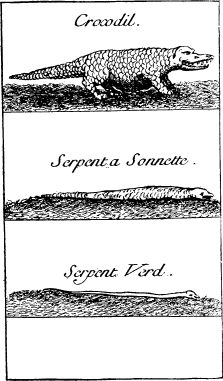
It was almost night, when my slave perceived, within two yards of the
fire, a young alligator, five feet long, which beheld the fire without
moving. I was in the garden hard by, when she made me repeated signs
to come to her; I ran with speed, and upon my arrival she shewed me
the crocodile, without speaking to me; the little time that I examined
it, I could see, its eyes were so fixed on the fire, that all our
motions could not take them off. I ran to my cabin to look for my gun,
as I am a pretty good marksman: but what was my surprize, when I came
out, and saw the girl with a great stick in her hand attacking the
monster! Seeing me arrive, she began to smile, and said many things,
which I did not comprehend. But she made me understand, by signs, that
there was no occasion for a gun to kill such a beast; for the stick
she shewed me was sufficient for the purpose.
The next day the former master of my slave came to ask me for some
salad-plants; for I was the only one who had any garden-stuff, having
taken care to preserve the seeds I had brought over with me. As he
understood the language of the natives, I begged him to ask the girl,
why she had killed the alligator so rashly. He began to laugh, and
told me, that all new comers were afraid of those creatures, although
they have no reason to be so: and that I ought not to be surprized at
what the girl had done, because her nation inhabited the borders of a
lake, which was full of those creatures; that the children, when they
saw the young ones come on land, pursued them, and killed them, by the
assistance of the people of the cabin, who made good cheer of them.
I was pleased with my habitation, and I had good reasons, which I have
already related, to make me prefer it to others; notwithstanding I had
room to believe, that the situation was none of the healthiest,
the country about it being very damp. But this cause of an unwholesome
air does not exist at present, since they have cleared the ground, and
made a bank before the town. The quality of that land is very good,
for what I had sown came up very well. Having found in the spring some
peach-stones which began to sprout, I planted them; and the following
autumn they had made shoots, four feet high, with branches in
proportion.
Notwithstanding these advantages, I took a resolution to quit this
settlement, in order to make another one, about a hundred leagues
higher up; and I shall give the reasons, which, in my opinion, will
appear sufficient to have made me take that step.
My surgeon came to take his leave of me, letting me know, he could be
of no service to me, near such a town as was forming; where there was
a much abler surgeon than himself; and that they had talked to him so
favourably of the post of the Natchez, that he was very desirous to go
there, and the more so, as that place, being unprovided with a
surgeon, might be more to his advantage. To satisfy me of the truth of
what he told me, he went immediately and brought one of the old
inhabitants, of whom I had bought my slave, who confirmed the account
he had given me of the fineness of the country of the Natchez. The
account of the old man, joined to many other advantages, to be found
there, had made him think of abandoning the place where we were, to
settle there; and he reckoned to be abundantly repaid for it in a
little time.
My slave heard the discourse that I have related, and as she began to
understand French, and I the language of the country, she addressed
herself to me thus: "Thou art going, then, to that country; the sky is
much finer there; game is in much greater plenty; and as I have
relations, who retired there in the war which we had with the French,
they will bring us every thing we want: they tell me that country is
very fine, that they live well in it, and to a good old age."
Two days afterwards I told M. Hubert what I had heard of the country
of the Natchez. He made answer, that he was so persuaded of the
goodness of that part of the country, that he was making ready to go
there himself, to take up his grant, and to establish a large
settlement for the company: and, continued he, "I shall be very glad,
if you do the same: we shall be Company to one another, and you will
unquestionably do your business better there than here."
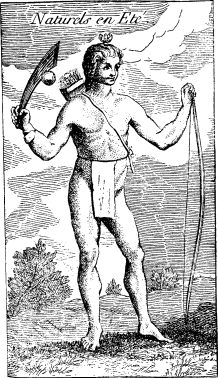
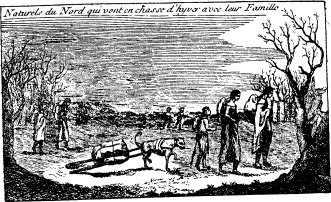
Indian in summer time
This determined me to follow his advice: I quitted my settlement, and
took lodgings in the town, till I should find an opportunity to
depart, and receive some negroes whom I expected in a short time.21
My stay at New Orleans appeared long, before I
heard of the arrival of the negroes. Some days after the news of their
arrival, M. Hubert brought me two good ones, which had fallen to me by
lot. One was a young negro about twenty, with his wife of the same
age; which cost me both together 1320 livres, or 55£. sterling.
Two days after that I set off with them alone in a pettyaugre (a large
canoe,) because I was told we should make much better speed in such a
vessel, than in the boats that went with us; and that I had only to
take powder and ball with me, to provide my whole company with game
sufficient to maintain us; for which purpose it was necessary to make
use of a paddle, instead of oars, which make too much noise for the
game. I had a barrel of powder, with fifteen pounds of shot, which I
thought would be sufficient for the voyage: but I found by experience,
that this was not sufficient for the vast plenty of game that is to be
met with upon that river, without ever going out of your way. I had
not gone above twenty-eight leagues, to the grant of M. Paris du
Vernai, when I was obliged to borrow of him fifteen pounds of shot
more. Upon this I took care of my ammunition, and shot nothing but
what was fit for our provision; such as wild ducks, summer ducks,
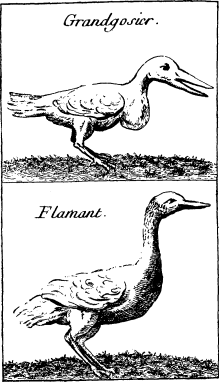
teal, and saw-bills. Among the rest I killed a carancro, wild geese,
cranes, and flamingo's; I likewise often killed young alligators; the
tail of which was a feast for the slaves, as well as for the French
and Canadian rowers.
Among other things I cannot omit to give an account of a monstrous
large alligator I killed with a musquet ball, as it lay upon the bank,
about ten feet above the edge of the water. We measured it, and found
it to be nineteen feet long, its head three feet and a half long,
above two feet nine inches broad, and the other parts in proportion:
at the belly it was two feet two inches thick; and it infected the
whole air with the odor of musk. M. Mehane told me, he had killed one
twenty-two feet long.
After several days navigation, we arrived at Tonicas on Christmas
eve; where we heard mass from M. d' Avion, of the foreign missions,
with whom we passed the rest of the holy days, on account of the good
reception and kind invitation he gave us. I asked him, if his great
zeal for the salvation of the natives was attended with any success;
he answered me, that notwithstanding the profound respect the people
shewed him, it was with the greatest difficulty he could get leave to
baptize a few children at the point of death; that those of an
advanced age excused themselves from embracing our holy religion
because they are too old, say they, to accustom themselves to rules,
that are so difficult to be observed; that the chief, who had killed
the physician, that attended his only son in a distemper of which he
died, had taken a resolution to fast every Friday while he lived, in
remorse for his inhumanity with which he had been so sharply
reproached by him. This grand chief attended both morning and evening
prayers; the women and children likewise assisted regularly at them;
but the men, who did not come very often, took more pleasure in
ringing the bell. In other respects, they did not suffer this zealous
pastor to want for any thing, but furnished him with whatever he
desired.
We were yet twenty-five leagues to the end of our journey to the
Natchez, and we left the Tonicas, where we saw nothing interesting, if
it were not several steep hills, which stand together; among which
there is one that they name the White Hill, because they find in it
several veins of an earth, that is white, greasy, and very fine, with
which I have seen very good potters ware made. On the same hill there
are veins of ochre, of which the Natchez had just taken some to stain
their earthen Ware, which looked well enough; when it was besmeared
with ochre, it became red on burning.
At last we arrived at the Natchez, after a voyage of twenty-four
leagues; and we put on shore at a landing-place, which is at the foot
of a hill two hundred feet high, upon the top of which Fort Rosalie22
is built,
surrounded only with pallisadoes. About the middle of the hill
stands the magazine, nigh to some houses of the inhabitants, who are
settled there, because the ascent is not so steep in that place; and
it is for the same reason that the magazine is built there. When you
are upon the top of this hill, you discover the whole country, which
is an extensive beautiful plain, with several little hills
interspersed here and there, upon which the inhabitants have built and
made their settlements. The prospect of it is charming.
On our arrival at the Natchez I was very well received by M. Loire de
Flaucourt, storekeeper of this post, who regaled us with the game that
abounds in this place; and after two days I hired a house near the
fort, for M. Hubert and his family, on their arrival, till he could
build upon his own plantation. He likewise desired me to choose two
convenient parcels of land, whereon to settle two considerable
plantations, one for the company, and the other for himself. I went to
them in two or three days after my arrival, with an old inhabitant for
my guide, and to shew me the proper places, and at the same time to
choose a spot of ground for myself; this last I pitched upon the first
day, because it is more easy to choose for one's self than for others.
I found upon the main road that leads from the chief village of the
Natchez to the fort, about an hundred paces from this last, a cabin of
the natives upon the road side, surrounded with a spot of cleared
ground, the whole of which I bought by means of an interpreter. I made
this purchase with the more pleasure, as I had upon the spot,
wherewithal to lodge me and my people, with all my effects: the
cleared ground was about six acres, which would form a garden and a
plantation for tobacco, which was then the only commodity
cultivated by the inhabitants. I had water convenient for my house,
and all my land was very good. On one side stood a rising ground with
a gentle declivity, covered with a thick field of canes, which always
grow upon the rich lands; behind that was a great meadow, and on the
other side was a forest of white walnuts (Hiecories) of nigh fifty
acres, covered with grass knee deep. All this piece of ground was in
general good, and contained about four hundred acres of a measure
greater than that of Paris: the soil is black and light.
The other two pieces of land, which M. Hubert had ordered me to look
for, I took up on the border of the little river of the Natchez, each
of them half a league from the great village of that nation, and a
league from the fort; and my plantation stood between these two and
the fort, bounding the two others. After this I took up my lodging
upon my own plantation, in the hut I had bought of the Indian, and put
my people in another, which they built for themselves at the side of
mine; so that I was lodged pretty much like our wood-cutters in
France, when they are at work in the woods.
As soon as I was put in possession of my habitation, I went with an
interpreter to see the other fields, which the Indians had cleared
upon my land, and bought them all, except one, which an Indian would
never sell to me: it was situated very convenient for me, I had a mind
for it, and would have given him a good price; but I could never make
him agree to my proposals. He gave me to understand, that without
selling it, he would give it up to me, as soon as I should clear my
ground to his; and that while he stayed on his own ground near me, I
should always find him ready to serve me, and that he would go
a-hunting and fishing for me. This answer satisfied me, because I must
have had twenty negroes, before I could have been able to have reached
him; they assured me likewise, that he was an honest man; and far from
having any occasion to complain of him as a neighbour, his stay there
was extremely serviceable to me.
I had not been settled at the Natchez six months, when I found a pain
in my thigh, which, however, did not hinder me to go about my
business. I consulted our surgeon about it, who caused me to be
bleeded; on which the humour fell upon the other thigh, and fixed
there with such violence, that I could not walk without extreme pain.
I consulted the physicians and surgeons of New Orleans, who advised me
to use aromatic baths; and if they proved of no service, I must go to
France, to drink the waters, and to bathe in them. This answer
satisfied me so much the less, as I was neither certain of my cure by
that means, nor would my present situation allow me to go to France.
This cruel distemper, I believe, proceeded from the rains, with which
I was wet, during our whole voyage; and might be some effects of the
fatigues I had undergone in war, during several campaigns I had made
in Germany.
As I could not go out of my hut, several neighbours were so good as to
come and see me, and every day we were no less than twelve at table
from the time of our arrival, which was on the fifth of January, 1720.
Among the rest F. de Ville, who waited there, in his journey to the
Illinois, till the ice, which began to come down from the north, was
gone. His conversation afforded me great satisfaction in my
confinement, and allayed the vexation I was under from my two negroes
being run away. In the mean time my distemper did not abate, which
made me resolve to apply to one of the Indian conjurers, who are both
surgeons, divines, and sorcerers; and who told me he would cure me by
sucking the place where I felt my pain. He made several scarifications
upon the part with a sharp flint, each of them about as large as the
prick of a lancet, and in such a form, that he could suck them all at
once, which gave me extreme pain for the space of half an hour. The
next day I found myself a little better, and walked about into my
field, where they advised me to put myself in the hands of some of the
Natchez, who, they said, did surprising cures, of which they told me
many instances, confirmed by creditable people. In such a situation a
man will do any thing for a cure, especially as the remedy, which they
told me of, was very simple: it was only a poultice, which they put
upon the part affected, and in eight days time I was able to walk to
the fort, finding myself perfectly cured, as I have felt no return of
my pain since that time. This was, without doubt, a great
satisfaction to a young man, who found himself otherwise in good
health, but had been confined to the house for four months and a half,
without being able to go out a moment; and gave me as much joy as I
could well have, after the loss of a good negro, who died of a
defluxion on the breast, which he catched by running away into the
woods, where his youth and want of experience made him believe he
might live without the toils of slavery; but being found by the
Tonicas, constant friends of the French, who live about twenty leagues
from the Nàtchez, they carried him to their village, where he and
his wife were given to a Frenchman, for whom they worked, and by that
means got their livelihood; till M. de Montplaisir sent them home to
me.
This M. de Montplaisir, one of the most agreeable gentlemen in the
colony, was sent by the company from Clerac in Gascony, to manage
their plantation at the Natchez, to make tobacco upon it, and to shew
the people the way of cultivating and curing it; the company having
learned, that this place produced excellent tobacco, and that the
people of Clerac were perfectly well acquainted with the culture and
way of managing it.
The Voyage of the Author to Biloxi. Description of that Place.
Settlement of Grants. The Author discovers two Coppermines. His Return
to the Natchez.
The second year after my settling among the Natchez, I went to
New Orleans, as I was desirous to sell my goods and commodities
myself, instead of selling them to the travelling pedlars, who often
require too great a profit for their pains. Another reason that made
me undertake this voyage, was to send my letters to France myself,
which I was certainly informed, were generally intercepted.
Before my departure, I went to the commandant of the fort, and asked
him whether he had any letters for the government. I was not on very
good terms of friendship with this commandant of the Natchez, who
endeavoured to pay his court to the governor, at the expence of
others. I knew he had letters for M. de Biainville, although he told
me he had none, which made me get a certificate from the commissary
general of this refusal to my demand; and at the same time the
commissary begged me to carry down a servant of the company, and gave
me an order to pay for his maintenance. As I made no great haste, but
stopt to see my friends, in my going down the river, the commandant
had time to send his letters, and to write to the governor, that I
refused to take them. As soon as I arrived at Biloxi, this occasioned
M. de Biainville to tell me, with some coldness, that I refused to
charge myself with his letters. Upon this I shewed him the certificate
of the commissary general; to which he could give no other answer,
than by telling me, that at least I could not deny, that I had brought
away by stealth a servant of the company. Upon this I shewed him the
other certificate of the commissary general, by which he desired the
directors to reimburse me the charges of bringing down this servant,
who was of no use to him above; which put the governor in a very bad
humour.
Upon my arrival at New Orleans I was informed, that there were several
grantees arrived at New Biloxi. I thought fit then to go thither, both
to sell my goods, and to get sure conveyance for my letters to France.
Here I was invited to sup with M. d'Artaguette, king's lieutenant, who
usually invited all the grantees, as well as myself. I there found
several of the grantees, who were all my friends; and among us we made
out a sure conveyance for our letters to France, of which we
afterwards made use.
Biloxi is situate opposite to Ship-Island, and four leagues from it.
But I never could guess the reason, why the principal settlement was
made at this place, nor why the capital should be built at it; as
nothing could be more repugnant to good sense; vessels not being able
to come within four leagues of it; but what was worse, nothing could
be brought from them, but by changing the boats three different times,
from a smaller size to another still smaller; after which they had to
go upwards of an hundred paces with small carts through the water to
unload the least boats. But what ought still to have been a
greater discouragement against making a settlement at Biloxi, was,
that the land is the most barren of any to be found thereabouts; being
nothing but a fine sand, as white and shining as snow, on which no
kind of greens can be raised; besides, the being extremely incommoded
with rats, which swarm there in the sand, and at that time ate even
the very stocks of the guns, the famine being there so very great,
that more than five hundred people died of hunger; bread being very
dear, and flesh-meat still more rare. There was nothing in plenty but
fish, with which this place abounds.
This scarcity proceeded from the arrival of several grantees all at
once; so as to have neither provisions, nor boats to transport them to
the places of their destination, as the company had obliged themselves
to do. The great plenty of oysters, found upon the coast, saved the
lives of some of them, although obliged to wade almost up to their
thighs for them, a gun-shot from the shore. If this food nourished
several of them, it threw numbers into sickness; which was still more
heightened by the long time they were obliged to be in the water.
The grants were those of M. Law, who was to have fifteen hundred men,
consisting of Germans, Provençals, &c. to form the settlement.
His land being marked out at the Arkansas, consisted of four leagues
square, and was erected into a duchy, with accoutrements for a company
of dragoons, and merchandize for more than a million of livres. M.
Levans, who was a trustee of it, had his chaise to visit the different
posts of the grant. But M. Law soon after becoming bankrupt, the
company seized on all the effects and merchandise; and but a few of
those who engaged in the service of that grant, remained at the
Arkansas; they were afterwards all dispersed and set at liberty. The
Germans almost to a man settled eight leagues above, and to the west
of the capital. This grant ruined near a thousand persons at L'Orient
before their embarkation, and above two hundred at Biloxi; not to
mention those who came out at the same time with me in 1718. All this
distress, of which I was a witness at Biloxi, determined me to make an
excursion a few leagues on the coast, in order to pass some days
with a friend, who received me with pleasure. We mounted horse to
visit the interior part of the country a few leagues from the sea. I
found the fields pleasant enough, but less fertile than along the
Missisippi; as they have some resemblance of the neighbouring coast,
which has scarce any other plants but pines, that run a great way, and
some red and white cedars.
When we came to the plain, I carefully searched every spot that I
thought worth my attention. In consequence of the search I found two
mines of copper, whose metal plainly appeared above ground. They stood
about half a league asunder. We may justly conclude that they are very
rich, as they thus disclose themselves on the surface of the earth.
When I had made a sufficient excursion, and judged I could find
nothing further to satisfy my curiosity, I returned to Biloxi, where I
found two boats of the company, just preparing to depart for New
Orleans, and a large pettyaugre, which belonged to F. Charlevoix the
jesuit, whose name is well known in the republic of letters: with him
I returned to New Orleans.
Some time after my return from New Orleans to the Natchez, towards the
month of March 1722, a phaenomenon happened, which frightened the
whole province. Every morning, for eight days running, a hollow noise,
somewhat loud, was heard to reach from the sea to the Illinois; which
arose from the west. In the afternoon it was heard to descend from the
east, and that with an incredible quickness; and though the noise
seemed to bear on the water, yet without agitating it, or discovering
any more wind on the river than before. This frightful noise was only
the prelude of a most violent tempest. The hurricane, the most furious
ever felt in the province, lasted three days. As it arose from the
south-west and north-east, it reached all the settlements which were
along the Missisippi; and was felt for some leagues more or less
strong, in proportion to the greater or less distance: but in the
places, where the force or height of the hurricane passed, it
overturned every thing in its way, which was an extent of a large
quarter of a league broad; so that one would take it for an
avenue made on purpose, the place where it passed being entirely laid
flat, whilst every thing stood upright on each side. The largest trees
were torn up by the roots, and their branches broken to pieces and
laid flat to the earth, as were also the reeds of the woods. In the
meadows, the grass itself, which was then but six inches high, and
which is very fine, could not escape, but was trampled, faded, and
laid quite flat to the earth.
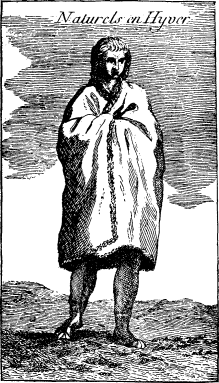
Indian in winter time
The height of the hurricane passed at a league from my
habitation; and yet my hose, which was built on piles, would have been
overturned, had I not speedily propped it with a timber, with the
great end in the earth, and nailed to the house with an iron hook
seven or eight inches long. Several houses of our post were
overturned. But it was happy for us in this colony, that the height of
the hurricane passed not directly oer any post, but obliquely
traversed the Missisippi, over a country intirely uninhabited. As this
hurricane came from the south, it so swelled the sea, that the
Missisippi flowed back against its current, so as to rise upwards of
fifteen feet high.
First War with the Natchez. Cause of the War.
In the same year, towards the end of summer, we had the first war with
the Natchez. The French had settled at the Natchez, without any
opposition from these people; so far from opposing them, they did them
a great deal of service, and gave them very material assistance in
procuring provisions; for those, who were sent by the West India
Comany with the first fleet, had been detained at New Orleans. Had it
not been for the natives, the people must have perished by famine and
distress: for, how excellent soever a new country it may be, it must
be cleared, grubbed up, and sown, and then at least we are to wait the
first harvest, or crop. But during all that time people must live, and
the company was well apprized of this, as they had send, witht he
eight hundred men they had transported to Louisiana, provisions for
three years. The grantees and planters, obliged to treat, or truck for
provisions with the Natchez, in consequence of that saw their funds
wasted, and themselves incapable of forming so considerable a
settlement, without this trucking, as necessary, as it was frequent.
However, some benefit resulted from this; namely that the Natchez,
enticed by the facility of trucking for goods, before unknown to them,
as fusils, gun-powder, lead, brandy, linen, cloths, and other like
things, by means of an exchange of what they abounded with, came to be
more and more attached to the French; and would have continued
very useful friends, had not the little satisfaction which the
commandant of Fort Rosalie had given them, for the misbehavior of one
of his soldiers, alienated their minds. This fort covered the
settlement of the Natchez, and protected that of St. Catharine, which
was on the banks of the rivulet of the Natchez; but botht he defence
and protection it afforded were very inconsiderable; for this fort was
only pallisadoed, open at six breaches, without a ditch, and with a
very weak garrison. On the other hand, the houses of the inhabitants,
though considerably numerous, were of themselves of no strength; and
then the inhabitants, dispersed in the country, each amidst his field,
far from affording mutual assistance, as they would had they been in a
body, stood each of them, upon any accident, in need of the assistance
of others.
A young soldier of Fort Rosalie had given some credit to an old
warrior of a village of the Natchez; which was that of the White
Apple, each village having its peculiar name: the warrior, in return,
was to give him some corn. Towards the beginning of the winter 1723,
this soldier lodging near the fort, the old warrior came to see him;
the soldier insisted on his corn; the native answered calmly, that the
corn was not yet dry enough to shake out the grain; that besides, his
wife had been ill, and that he would pay him as soon as possible. The
young man, little satisfied with this answer, threatened to cudgel the
old man: upon which, this last, who was in the soldier's hut,
affronted at this threat, told him, he should turn out, and try who
was the best man. On this challenge, the soldier, calling out murder,
brings the guard to his assistance. The guard being come, the young
fellow pressed them to fire upon the warrior, who was returning to his
village at his usual pace; a soldier was imprudent enough to fire: the
old man dropt down. The commandant was soon apprized of what happened,
and came to the spot; where the witnesses, both French and Natchez,
informed him of the fact. Both justice and prudence demanded to take
an exemplary punishment of the soldier; but he got off with a
reprimand. After this the natives made a litter, and carried off their
warrior, who died the following night of his wounds, though the
fusil was only charged with great shot.
Revenge is the predominant passion of the people in America: so that
we ought not to be surprised, if the death of this old warrior raised
his whole village against the French. The rest of the nation took no
part at first in the quarrel.
The first effect of the resentment of the Natchez fell upon a
Frenchman named M. Guenot, whom they surprised returning from the fort
to St. Catharine, and upon another inhabitant, whom they killed in his
bed. Soon after they attacked, all in a body, the settlement of St.
Catharine, and the other below Fort Rosalie. It was at this last I had
fixed my abode: I therefore saw myself exposed, like many others, to
pay with my goods, and perhaps my life, for the rashness of a soldier,
and the too great indulgence of his captain. But as I was already
acquainted with the character of the people we had to deal with, I
despaired not to save both. I therefore barricadoed myself in my
house, and having put myself in a posture of defence, when they came
in the night, according to their custom, to surprise me, they durst
not attack me.
This first attempt, which I justly imagined was to be followed by
another, if not by many such, made me resolve, as soon as day came, to
retire under the fort, as all the inhabitants also did, and thither to
carry all the provisions I had at my lodge. I could execute only half
of my scheme. My slaves having begun to remove the best things, I was
scarce arrived under the fort, but the commandant begged I might put
myself at the head of the inhabitants, to go to succour St. Catharine.
He had already sent thither all his garrison, reserving only five men
to guard the fort; but this succour was not sufficient to relieve the
settlement, which the natives in great numbers vigorously straitned.
I departed without delay: we heard the firing at a distance, but the
noise ceased as soon as I was come, and the natives appeared to have
retired: they had, doubtless, discovered me on my march, and the sight
of a reinforcement which I had brought with me, deceived them. The
officer who commanded the detachment of the garrison, and whom I
relieved, returned to the fort with his men; and the command
being thus devolved on me, I caused all the Negroes to be assembled,
and ordered them to cut down all the bushes; which covering the
country, favoured the approach of the enemy, quite to the doors of the
houses of that Grant. This operation was performed without
molestation, if you except a few shot, fired by the natives from the
woods, where they lay concealed on the other side of the rivulet; for
the plain round St. Catharine being entirely cleared of every thing
that could screen them, they durst not shew themselves any more.
However, the commandant of Fort Rosalie sent to treat with the Stung
Serpent; in order to prevail with him to appease that part of his
nation, and procure a peace. As that great warrior was our friend, he
effectually laboured therein, and hostilities ceased. After I had
passed twenty-four hours in St. Catharine, I was relieved by a new
detachment from the inhabitants, whom, in my turn, I relieved next
day. It was on this second guard, which I mounted, that the village we
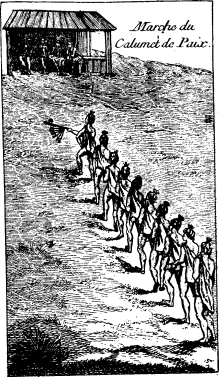
had been at war with sent me, by their deputies, the calumet or pipe
of peace. I at first had some thoughts of refusing it, knowing that
this honour was due to the commandant of the fort; and it appeared to
me a thing so much the more delicate to deprive him of it, as we were
not upon very good terms with each other. However, the evident risk of
giving occasion to protract the war, by refusing it, determined me to
accept of it; after having, however, taken the advice of those about
me; who all judged it proper to treat these people gently, to whom the
commandant was become odious.
I asked the deputies, what they would have? They answered, faultering,
Peace. "Good, said I; but why bring you the Calumet of Peace to me? It
is to the Chief of the Fort you are to carry it, if you wish to have a
Peace." "Our orders" said they, "are to carry it first to you, if you
choose to receive it by only smoking therein: after which we will
carry it to the Chief of the Fort; but if you refuse receiving it, our
orders are to return."
Upon this I told them, that I agreed to smoke in their pipe, on
condition they would carry it to the Chief of the Fort. They then
made me an harangue; to which I answered, that it were best to resume
our former manner of living together, and that the French and the
Red-men should entirely forget what had passed. To conclude, that they
had nothing further to do, but to go and carry the Pipe to the Chief
of the Fort, and then go home and sleep in peace.
This was the issue of the first war we had with the Natchez, which
lasted only three or four days.
The commerce, or truck, was set again on the same footing it had been
before; and those who had suffered any damage, now thought only how
they might best repair it. Some time after, the Major General arrived
from New Orleans, being sent by the Governor of Louisiana to ratify
the peace; which he did, and mutual sincerity was restored, and became
as perfect as if there had never been any rupture between us.
It had been much to be wished, that matters had remained on so good a
footing. As we were placed in one of the best and finest countries of
the world; were in strict connection with the natives, from whom we
derived much knowledge of the nature of the productions of the
country, and of the animals of all sorts, with which it abounds; and
likewise reaped great advantage in our traffic for furs and
provisions; and were aided by them in many laborious works, we wanted
nothing but a profound peace, in order to form solid settlements,
capable of making us lay aside all thoughts of Europe: but Providence
had otherwise ordered.
The winter which succeeded this war was so severe, that a colder was
never remembered. The rain fell in icicles in such quantities as to
astonish the oldest Natchez, to whom this great cold appeared new and
uncommon.
Towards the autumn of this year I saw a phaenomenon which struck the
superstitious with great terror: it was in effect so extraordinary,
that I never remember to have heard of any thing that either
resembled, or even came up to it. I had just supped without doors, in
order to enjoy the cool of the evening; my face was turned to the
west, and I sat before my table to examine some planets which had
already appeared. I perceived a glimmering light, which made me
raise my eyes; and immediately I saw, at the elevation of about 45
degrees above the horizon, a light proceeding from the south, of the
breadth of three inches, which went off to the north, always spreading
itself as it moved, and made itself heard by a whizzing light like
that of the largest sky-rocket. I judged by the eye that this light
could not be above our atmosphere, and the whizzing noise which I
heard confirmed me in that notion. When it came in like manner to
be about 45 degrees to the north above the horizon, it stopped short,
and ceased enlargeing itself: in that place it appeared to be twenty
inches broad; so that in its course, which had been very rapid, it
formed the figure of a trumpet-marine, and left in its passage very
lively sparks, shining brighter than those which fly from under a
smith's hammer; but they were extinguished almost as fast as they were
emitted.
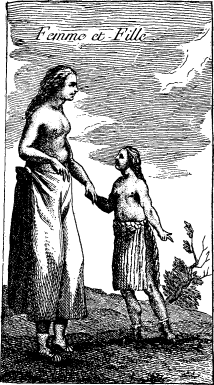
Indian woman and daughter
At the north elevation I just mentioned, there issued out with a great
noise from the middle of the large end, a ball quite round, and all on
fire: this ball was about six inches in diameter; it fell below the
horizon to the north, and emitted, about twenty minutes after, a
hollow, but very loud noise for the space of a minute, which appeared
to come from a great distance. The light began to be weakened to the
south, after emitting the ball, and at length disappeared, before the
noise of the ball was heard.
The Governor surprized the Natchez with seven hundred Men.
Astonishing Cures performed by the Natives. The Author sends upwards of
three hundred Simples to the Company.
M. De Biainville, at the beginning of the winter which followed this
phaenomenonived very privately at our quarter of the Natchez, his
march having been communicated to none but the Commandant of this
Post, who had orders to seize all the Natchez that should come to the
Fort that day, to prevent the news of his arrival being carried to
their country men. He brought with him, in regular troops, inhabitants
and natives, who were our allies, to the number of seven hundred men.
Orders were given that all our settlers at the Natchez should repair
before his door at midnight at the latest: I went thither and mixed
with the crowd, without making myself known.
We arrived two hours before day at the settlement of St. Catharine.
The Commandant having at length found me out, ordered me, in the
King's name, to put myself at the head of the settlers among the
Natchez, and to take the command upon me; and these he ordered to pay
the same obedience to me as to himself. We advanced with great silence
towards the village of the Apple. It may be easily seen that all this
precaution was taken in order to surprise our enemies, who ought so
much the less to expect this act of hostility, as they had fairly made
peace with us, and as M. Paillou, Major General, had come and ratified
this peace in behalf of the Governor. We marched to the enemy and
invested the first hut of the Natchez, which we found separate; the
drums, in concert with the fifes, beat the charge; we fired upon the
hut, in which were only three men and two women.
From thence we afterwards moved on to the village, that is, several
huts that stood together in a row. We halted at three of them that lay
near each other, in which between twelve and fifteen Natchez had
entrenched themselves. By our manner of proceeding one would have
thought that we came only to view the huts. Full of indignation that
none exerted himself to fall upon them, I took upon me with my men to
go round and take the enemy in rear. They took to their heels, and I
pursued; but we had need of the swiftness of deer to be able to come
up with them. I came so near, however, that they threw away their
cloaths, to run with the greater speed.
I rejoined our people, and expected a reprimand for having forced the
enemy without orders; though I had my excuse ready. But here I was
mistaken; for I met with nothing but encomiums.
This war, of which I shall give no further detail, lasted only four
days. M. de Biainville demanded the head of an old mutinous Chief of
this village; and the natives, in order to obtain a peace, delivered
him up.
I happened to live at some distance from the village of the Apple, and
very seldom saw any of the people. Such as lived nearer had more
frequent visits from them; but after this war, and the peace which
followed upon it, I never saw one of them. My neighbours who lived
nearer to them saw but a few of them, even a long time after the
conclusion of the war. The natives of the other villages came but
very seldom among us; and indeed, if we could have done well without
them, I could have wished to have been rid of them for ever. But we
had neither a flesh nor a fish-market; therefore, without them, we
must have taken up with what the poultry-yard and kitchen-garden
furnished; which would have been extremely inconvenient.
I one day stopped the Stung Serpent, who was passing without taking
notice of any one. He was brother to the Great Sun, and Chief of the
Warriors of the Natchez. I accordingly called to him, and said, "We
were formerly friends, are we no longer so?" He answered, Noco; that
is, I cannot tell. I replied, "You used to come to my house; at
present you pass by. Have you forgot the way; or is my house
disagreeable to you? As for me, my heart is always the same, both
towards you and all my friends. I am not capable of changing, why then
are you changed?"
He took some time to answer, and seemed to be embarrassed by what I
said to him. He never went to the fort, but when sent for the
Commandant, who put me upon sounding him; in order to discover whether
his people still retained any grudge.
He at length broke silence, and told me, "he was ashamed to have been
so long without seeing me; but I imagined," said he, "that you were
displeased at our nation; because among all the French who were in the
war, you were the only one that fell upon us." "You are in the wrong,"
said I, "to think so. M. de Biainville being our War-chief, we are
bound to obey him; in like manner as you, though a Sun, are obliged to
kill, or cause to be killed, whomsoever your brother, the Great Sun
orders to be put to death. Many other Frenchmen, besides me, sought an
opportunity to attack your countrymen, in obedience to the orders of
M. de Biainville; and several other Frenchmen fell upon the nearest
hut, one of whom was killed by the first shot which the Natchez
fired."
He then said: "I did not approve, as you know, the war our people made
upon the French to avenge the death of their relation, seeing I
made them carry the pipe of peace to the French. This you well know,
as you first smoked in the pipe yourself. Have the French two hearts, a
good one today, and tomorrow a bad one? As for my brother and me, we
have but one heart and one word. Tell me then, if thou art, as thou
sayest, my true friend, what thou thinketh of all this, and shut thy
mouth to every thing else. We know not what to think of the French, who,
after having begun the war, granted a peace, and offered it of
themselves; and then at the time we were quiet, believing ourselves to
be at peace, people come to kill us, without saying a word."
"Why," continued he, with an air of displeasure, "did the French come
into our country? We did not go to seek them: they asked for land of
us, because their country was too little for all the men that were in
it. We told them they might take land where they pleased, there was
enough for them and for us; that it was good the same sun should
enlighten us both, and that we would walk as friends in the same path;
and that we would give them of our provisions, assist them to build,
and to labour in their fields. We have done so; is not this true? What
occasion then had we for Frenchmen? Before they came, did we not live
better than we do, seeing we deprive ourselves of a part of our corn,
our game, and fish, to give a part to them? In what respect, then, had
we occasion for them? Was it for their guns? The bows and arrows which
we used, were sufficient to make us live well. Was it for their white,
blue, and red blankets? We can do well enough with buffalo skins,
which are warmer; our women wrought feather-blankets for the winter,
and mulberry-mantles for the summer; which indeed were not so
beautiful; but our women were more laborious and less vain than they
are now. In fine, before the arrival of the French, we lived like men
who can be satisfied with what they have; whereas at this day we are
like slaves, who are not suffered to do as they please."
To this unexpected discourse I know not what answer another would have
made; but I frankly own, that if at my first address he seemed to be
confused, I really was so in my turn. "My heart," said I to him,
"better understands thy reasons than my ears, though they are
full of them; and though I have a tongue to answer, my ears have not
heard the reasons of M. de Biainville, to tell them thee: but I know
it was necessary to have the head he demanded, in order to a peace.
When our Chiefs command us, we never require the reasons: I can say
nothing else to thee. But to shew you that I am always your real
friend, I have here a beautiful pipe of peace, which I wanted to carry
to my own country. I know you have ordered all your warriors to kill
some white eagles, in order to make one, because you have occasion for
it. I give it you without any other design than to shew you that I
reckon nothing dear to me, when I want to do you a pleasure."
I went to look for it, and I gave it him, telling him, that it was
without design; that is, according to them, from no interested motive.
The natives put as great a value on a pipe of peace as on a gun. Mine
was adorned with tinsel and silver wire: so that in their estimation
my pipe was worth two guns. He appeared to be extremely well pleased
with it; put it up hastily in his case, squeezed my hand with a smile,
and called me his true friend.
The winter was now drawing to a close, and in a little time the
natives were to bring us bear-oil to truck. I hoped that by his means
I should have of the best preferably to any other; which was the only
compensation I expected for my pipe. But I was agreeably disappointed.
He sent me a deer-skin of bear-oil, so very large that a stout man
could hardly carry it, and the bearer told me, that he sent it to me
as his true friend, without design. This deer-skin contained
thirty-one pots of the measure of the country, or sixty-two pints
Paris measure.
Three days after, the Great Sun, his brother, sent me another
deer-skin of the same oil, to the quantity of forty pints. The
commonest sort sold this year at twenty sols a pint, and I was sure
mine was not of the worst kind.
For some days a fistula lacrymalis had come into my left eye, which
discharged an humour, when pressed, that portended danger. I shewed it
to M. St. Hilaire, an able surgeon, who had practised for about
twelve years in the Hôtel Dieu at Paris.
He told me it was necessary to use the fire for it; and that,
notwithstanding this operation, my sight would remain as good as ever,
only my eye would be blood-shot: and that if I did not speedily set
about the operation, the bone of the nose would become carious.
These reasons gave me much uneasiness, as having both to fear and to
suffer at the same time: however, after I had resolved to undergo the
operation, the Grand Sun and his brother came one morning very early,
with a man loaded with game, as a present for me.
The Great Sun observed I had a swelling in my eye, and asked me what
was the matter with it. I shewed it him, and told him, that in order
to cure it, I must have fire put to it; but that I had some difficulty
to comply, as I dreaded the consequences of such an operation. Without
replying, or in the least apprizing me, he ordered the man who brought
the game to go in quest of his physician, and tell him, he waited for
him at my house. The messenger and physician made such dispatch, that
this last came in an hour after. The Great Sun ordered him to look at
my eye, and endeavour to cure me: after examining it, the physician
said, he would undertake to cure me with simples and common water. I
consented to this with so much the greater pleasure and readiness, as
by this treatment I ran no manner of risque.
That very evening the physician came with his simples, all pounded
together, and making but a single ball, which he put with the water in
a deep bason, he made me bend my head into it, so as the eye affected
stood dipt quite open in the water. I continued to do so for eight or
ten days, morning and evening; after which, without any other
operation, I was perfectly cured, and never after had any return of
the disorder.
It is easy from this relation to understand what dextrous physicians
the natives of Louisiana are. I have seen them perform surprising
cures on Frenchmen; on two especially, who had put themselves under
the hands of a French surgeon settled at this post. Both patients
were about to undergo the grand cure; and after having been under the
hands of the surgeon for some time, their heads swelled to such a
degree, that one of them made his escape, with as much agility as a
criminal would from the hands of justice, when a favourable
opportunity offers. He applied to a Natchez physician, who cured him
in eight days: his comrade continuing still under the French surgeon,
died under his hands three days after the escape of his companion,
whom I saw three years after in a state of perfect health.
In the war which I lately mentioned, the Grand Chief of the Tonicas,
our allies, was wounded with a ball, which went through his cheek,
came out under the jaw, again entered his body at the neck, and
pierced through to the shoulder-blade, lodging at last between the
flesh and the skin: the wound had its direction in this manner;
because when he received it, he happened to be in a stooping posture,
as were all his men, in order to fire. The French surgeon, under whose
care he was, and who dressed him with great precaution, was an able
man, and spared no pains in order to effect a cure. But the physicians
of this Chief, who visited him every day, asked the Frenchman what
time the cure would take? he answered, six weeks at least: they
returned no answer, but went directly and made a litter; spoke to
their Chief, and put him on it, carried him off, and treated him in
their own manner, and in eight days affected a complete cure.
These are facts well known in the colony. The physicians of the
country have performed many other cures, which, if they were to be all
related, would require a whole volume apart; but I have confined
myself to the three above mentioned, in order to shew that disorders
frequently accounted almost incurable, are, without any painful
operation, and in a short time, cured by physicians, natives of
Louisiana.
The West India Company being informed that this province produces a
great many simples, whose virtues, known by the natives, afforded so
easy a cure to all sorts of distempers, ordered M. de la Chaise, who
was sent from France in quality of Director General of this colony, to
cause enquiry to be made into the simples proper for physick and
for dying, by means of some Frenchmen, who might perhaps be masters of
the secrets of the natives. I was pointed out for this purpose to M.
de la Chaise, who was but just arrived, and who wrote to me, desiring
my assistance in this enquiry; which I gave him with pleasure, and in
which I exerted myself to my utmost, because I well knew the Company
continually aimed at what might be for the benefit of the colony.
After I thought I had done in that respect, what might give
satisfaction to the Company, I transplanted in earth, put into cane
baskets, above three hundred simples, with their numbers, and a
memorial, which gave a detail of their virtues, and taught the manner
of using them. I afterwards understood that they were planted in a
botanic garden made for the purpose, by order of the Company.
French Settlements, or Posts. The Post at Mobile. The Mouths of the
Missisippi. The Situation and Description of New Orleans.
The Settlement at Mobile was the first seat of the colony in this
province. It was the residence of the Commandant General, the
Commissary General, the Staff-officers, &c. As vessels could not enter
the river Mobile, and there was a small harbour at Isle Dauphine, a
settlement was made suited to the harbour, with a guardhouse for its
security: so that these two settlements may be said to have made but
one; both on account of their proximity, and necessary connection with
each other. The settlement of Mobile, ten leagues, however, from its
harbour, lies on the banks of the river of that name; and Isle
Dauphine, over against the mouth of that river, is four leagues from
the coast.
Though the settlement of Mobile be the oldest, yet it is far from
being the most considerable. Only some inhabitants remained there, the
greatest part of the first inhabitants having left it, in order to
settle on the river Missisippi, ever since New Orleans became the
capital of the colony. That old post is the ordinary residence of
a King's Lieutenant, a Regulating Commissary, and a Treasurer. The
fort, with four bastions, terraced and palisaded, has a garrison.
This post is a check upon the nation of Choctaws, and cuts off the
communication of the English with them; it protects the neighbouring
nations, and keeps them in our alliance; in fine, it supports our
peltry trade, which is considerable with the Choctaws and other
nations.23
The same reason which pointed out the necessity of this post, with
respect to the Choctaws, also shewed the necessity of building a fort
at Tombecbé, to check the English in their ambitious views on the side
of the Chicasaws. That fort was built only since the war with the
Chicasaws in 1736.
Near the river Mobile stands the small settlement of the
Pasca-Ogoulas; which consists only of a few Canadians, lovers of
tranquillity, which they prefer to all the advantages they could reap
from commerce. They content themselves with a frugal country life, and
never go to New Orleans but for necessaries.
From that settlement quite to New Orleans, by the way of Lake St.
Louis, there is no post at present. Formerly, and just before the
building of the capital, there were the old and new Biloxi:
settlements, which have deserved an oblivion as lasting as their
duration was short.
To proceed with order and perspicuity, we will go up the Missisippi
from its mouth.
Fort Balise is at the entrance of the Missisippi, in 29° degrees North
Latitude, and 286° 30' of Longitude. This fort is built on an isle, at
one of the mouths of the Missisippi. Tho' there are but seventeen feet
water in the channel, I have seen vessels of five hundred ton enter
into it. I know not why this entrance is left so neglected, as we are
not in want of able engineers in France, in the hydraulic branch, a
part of the mathematics to which I have most applyed myself. I know it
is no easy matter so to deepen or hollow the channel of a bar, that it
may never after need clearing, and that the expences run high: but my
zeal for promoting the advantage of this colony having prompted me to
make reflections on those passes, or entrances of the Missisippi, and
being perfectly well acquainted both with the country and the nature
of the soil, I dare flatter myself, I may be able to accomplish it, to
the great benefit of the province, and acquit myself therein with
honour, at a small charge, and in a manner not to need repetition.24
I say, fort Balise is built upon an island; a circumstance, I imagine,
sufficient to make it understood, that this fort is irregular; the
figure and extent of this small island not admitting it to be
otherwise.
In going up the Missisippi, we meet with nothing remarkable before we
come to the Detour aux Anglois, the English Reach: in that part the
river takes a large compass; so that the same wind, which was
before fair, proves contrary in this elbow, or reach. For this reason
it was thought proper to build two forts at that place, one on each
side of the river, to check any attempts of strangers. These forts are
more than sufficient to oppose the passage of an hundred sail; as
ships can go up the river, only one after another, and can neither
cast anchor, nor come on shore to moor.
It will, perhaps, be thought extraordinary that ships cannot anchor in
this place. I imagine the reader will be of my opinion, when I tell
him, the bottom is only a soft mud, or ooze, almost entirely covered
with dead trees, and this for upwards of an hundred leagues. As to
putting on shore, it is equally impossible and needless to attempt it;
because the place where these forts stand, is but a neck of land
between the river and the marshes: now it is impossible for a shallop,
or canoe, to come near to moor a vessel, in sight of a fort well
guarded, or for an enemy to throw up a trench in a neck of land so
soft. Besides, the situation of the two forts is such, that they may in
a short time receive succours, both from the inhabitants, who are on
the interior edge of the crescent, formed by the river, and from New
Orleans, which is very near thereto.
The distance from this place to the capital is reckoned six leagues by
water, and the course nearly circular; the winding, or reach, having
the figure of a C almost close. Both sides of the river are lined with
houses, which afford a beautiful prospect to the eye; however, as this
voyage is tedious by water, it is often performed on horseback by
land.
The great difficulties attending the going up the river under sail,
particularly at the English Reach, for the reasons mentioned, put me
upon devising a very simple and cheap machine, to make vessels go up
with ease quite to New-Orleans. Ships are sometimes a month in the
passage from Balise to the capital; whereas by my method they would
not be eight days, even with a contrary wind; and thus ships would go
four times quicker than by towing, or turning it. This machine might
be deposited at Balise, and delivered to the vessel, in order to go up
the current, and be returned again on its setting sail. It is besides
proper to observe, that this machine would be no detriment to the
forts, as they would always have it in their power to stop the vessels
of enemies, who might happen to use it.
New Orleans, the capital of the colony, is situated to the East, on
the banks of the Missisippi, in 30° of North Latitude. At my first
arrival in Louisiana, it existed only in name; for on my landing I
understood M. de Biainville, commandant general, was only gone to mark
out the spot; whence he returned three days after our arrival at Isle
Dauphine.
He pitched upon this spot in preference to many others, more agreeable
and commodious; but for that time this was a place proper enough:
besides, it is not every man that can see so far as some others. As
the principal settlement was then at Mobile, it was proper to have the
capital fixed at a place from which there could be an easy
communication with this post: and thus a better choice could not have
been made, as the town being on the banks of the Missisippi, vessels,
tho' of a thousand ton, may lay their sides close to the shore even at
low water; or at most, need only lay a small bridge, with two of their
yards, in order to load or unload, to roll barrels and bales, &c.
without fatiguing the ship's crew. This town is only a league from St.
John's creek, where passengers take water for Mobile, in going to
which they pass Lake St. Louis, and from thence all along the coast; a
communication which was necessary at that time.
I should imagine, that if a town was at this day to be built in this
province, a rising ground would be pitched upon, to avoid inundations;
besides, the bottom should be sufficiently firm, for bearing grand
stone edifices.
Such as have been a good way in the country, without seeing stone, or
the least pebble, in upwards of a hundred leagues extent, will doubtless
say, such a proposition is impossible, as they never observed stone
proper for building in the parts they travelled over. I might answer,
and tell them, they have eyes, and see not. I narrowly considered the
nature of this country, and found quarries in it; and if there were any
in the colony I ought to find them, as my condition and profession of
architect should have procured me the knowledge of them. After
giving the situation of the capital, it is proper I describe the order
in which it is built.
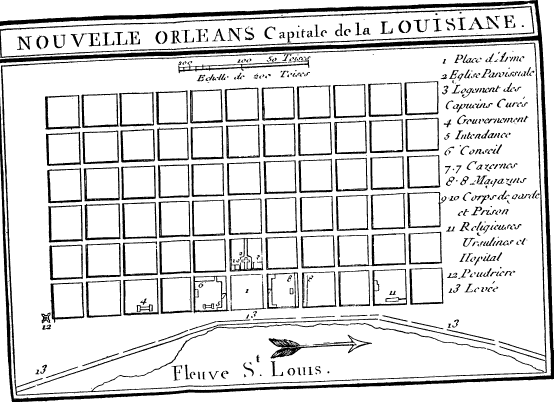
Plan of New Orleans, 1720
The place of arms is in the middle of that part of the town which
faces the river; in the middle of the ground of the place of arms
stands the parish church, called St. Louis, where the Capuchins
officiate, whose house is to the left of the church. To the right
stand the prison, or jail, and the guard-house: both sides of the
place of arms are taken up by two bodies or rows of barracks. This
place stands all open to the river.
All the streets are laid out both in length and breadth by the line,
and intersect and cross each other at right angles. The streets divide
the town into sixty-six isles; eleven along the river lengthwise, or
in front, and six in depth: each of those isles is fifty square
toises, and each again divided into twelve emplacements, or
compartments, for lodging as many families. The Intendant's house
stands behind the barracks on the left; and the magazine, or
warehouse-general behind the barracks on the right, on viewing the
town from the river side. The Governor's house stands in the middle of
that part of the town, from which we go from the place of arms to the
habitation of the Jesuits, which is near the town. The house of the
Ursulin Nuns is quite at the end of the town, to the right; as is also
the hospital of the sick, of which the nuns have the inspection. What
I have just described faces the river.
On the banks of the river runs a causey, or mole, as well on the side
of the town as on the opposite side, from the English Reach quite to
the town, and about ten leagues beyond it; which makes about fifteen
or sixteen leagues on each side the river; and which may be travelled
in a coach or on horseback, on a bottom as smooth as a table.
The greatest part of the houses is of brick; the rest are of timber
and brick.
The length of the causeys, I just mentioned, is sufficient to shew,
that on these two sides of the Missisippi there are many habitations
standing close together; each making a causey to secure his ground
from inundations, which fail not to come every year with the spring:
and at that time, if any ships happen to be in the harbour of New
Orleans, they speedily set sail; because the prodigious quantity of
dead wood, or trees torn up by the roots, which the river brings down,
would lodge before the ship, and break the stoutest cables.
At the end of St. John's Creek, on the banks of the Lake St. Louis,
there is a redoubt, and a guard to defend it.
From this creek to the town, a part of its banks is inhabited by
planters; in like manner as are the long banks of another creek: the
habitations of this last go under the name of Gentilly.
After these habitations, which are upon the Missisippi quite beyond
the Cannes Brulées, Burnt Canes, we meet none till we come to the
Oumas, a petty nation so called. This settlement is inconsiderable,
tho' one of the oldest next to the capital. It lies on the east of the
Missisippi.
The Baton Rogue is also on the east side of the Missisippi, and
distant twenty-six leagues from New Orleans: it was formerly the grant
of M. Artaguette d'Iron: it is there we see the famouse cypress-tree
of which a ship-carpenter offered to make two pettyaugres, one of
sixteen, the other of fourteen tons. Some one of the first
adventurers, who landed in this quarter, happened to say, that tree
would make a fine walking-stick, and as cypress is a red wood, it was
afterwards called le Baton Rouge. Its height could never be measured,
it rises so out of sight.
Two leagues higher up than le Baton Rouge, was the Grant of M. Paris
du Vernai. This settlement is called Bayou-Ogoulas, from a nation of
that name, which formerly dwelt here. It is on the west side of the
Missisippi, and twenty-eight leagues from New Orleans.
At a league on this side of Pointe Coupée, are les Petits Ecores,
(little Cliffs) where was the grant of the Marquis de Mezieres. At
this grant were a director and under-director; but the surgeon found
out the secret of remaining sole master. The place is very beautiful,
especially behind les Petits Ecores, where we go up by a gentle
ascent. Near these cliffs, a rivulet falls into the Missisippi, into
which a spring discharges its waters, which so attract the buffalos,
that they are very often found on its banks. 'Tis a pity this
ground was deserted; there was enough of it to make a very
considerable grant: a good water-mill might be guilt on the brook I
just mentioned.
At forty leagues from New Orleans lies a la Pointe Coupée, so called,
because the Missisippi made there an elbow or winding, and formed the
figure of a circle, open only about an hundred and odd toises, thro'
which it made itself a shorter way, and where all its water runs at
present. This was not the work of nature alone: two travellers, coming
down the Missisippi, were forced to stop short at this place, because
they observed at a distance the surff, or waves, to be very high, the
wind beating against the current, and the river being out, so that they
durst not venture to proceed. Just by them passed a rivulet, caused by
the inundation, which might be a foot deep, by four or five feet broad,
more or less. One of the travellers, seeing himself without any thing to
do, took his fusil and followed the course of this rivulet, in hopes of
killing some game. He had not gone an hundred toises, before he was put
into a very great surprize, on perceiving a great opening, as when one
is just getting out of a thick forest. He continues to advance, sees a
large extent of water, which he takes for a lake; but turning on his
left, he espies les Petits Ecores, just mentioned, and by experience he
knew, he must go ten leagues to get thither: Upon this he knew, these
were the waters of the river. He runs to acquaint his companion: this
last wants to be sure of it: certain as they are both of it, they
resolve, that it was necessary to cut away the roots, which stood in the
passage, and to level the more elevated places. They attempted at length
to pass their pettyaugre through, by pushing it before them. They
succeeded beyond their expectation; the water which came on, aided them
as much by its weight as by its depth, which was increased by the
obstacle it met in its way: and they saw themselves in a short time in
the Missisippi, ten leagues lower down than they were an hour before; or
than they would have been, if they had followed the bed of the river, as
they were formerly constrained to do.
This little labour of our travellers moved the earth; the roots being
cut away in part, proved no longer an obstacle to the course of
the water; the slope or descent in this small passage was equal to
that in the river for the ten leagues of the compass it took; in fine,
nature, though feebly aided, performed the rest. The first time I went
up the river, its entire body of water passed through this part; and
though the channel was only made six years before, the old bed was
almost filled with the ooze, which the river had there deposited; and
I have seen trees growing there of an astonishing size, that one might
wonder how they should come to be so large in so short a time.
In this spot, which is called la Pointe Coupée, the Cut-point, was the
Grant of M. de Meuse, at present one of the most considerable posts of
the colony, with a fort, a garrison, and an officer to command there.
The river is on each side lined with inhabitants, who make a great
deal of tobacco. There an Inspector resides, who examines and receives
it, in order to prevent the merchants being defrauded. The inhabitants
of the west side have high lands behind them, which form a very fine
country, as I have observed above.
Twenty leagues above this Cut-point, and sixty leagues from New
Orleans, we meet with the Red River. In an island formed by that
river, stands a French post, with a fort, a garrison, its commandant
and officers. The first inhabitants who settled there, were some
soldiers of that post, discharged after their time of serving was
expired, who set themselves to make tobacco in the island. But the
fine sand, carried by the wind upon the leaves of the tobacco, made it
of a bad quality, which obliged them to abandon the island and settle
on the continent, where they found a good soil, on which they made
better tobacco. This post is called the Nachitoches, from a nation of
that name, settled in the neighbourhood. At this post M. de St. Denis
commanded.
Several inhabitants of Louisiana, allured thither by the hopes of making
soon great fortunes, because distant only seven leagues from the
Spaniards, imagined the abundant treasures of New Mexico would pour in
upon them. But in this they happened to be mistaken; for the Spanish
post, called the Adaïes less money in it than the poorest village in
Europe: the Spaniards being ill clad, ill fed, and always ready to buy
goods of the French on credit: which may be said in general of all
the Spaniards of New Mexico, amidst all their mines of gold and silver.
This we are well informed of by our merchants, who have dealt with the
Spaniards of this post, and found their habitations and way of living to
be very mean, and more so than those of the French.
From the confluence of this Red River, in going up the Missisippi, as
we have hitherto done, we find, about thirty leagues higher up, the
post of the Natchez.
Let not the reader be displeased at my saying often, nearly, or about
so many leagues: we can ascertain nothing justly as to the distances
in a country where we travel only by water. Those who go up the
Missisippi, having more trouble, and taking more time than those who
go down, reckon the route more or less long, according to the time in
which they make their voyage; besides, when the water is high, it
covers passes, which often shorten the way a great deal.
The Natchez are situate in about 32° odd minutes of north latitude,
and 280° of longitude. The fort at this post stands two hundred feet
perpendicular above low-water mark. From this fort the point of view
extends west of the Missisippi quite to the horizon, that is, on the
side opposite to that where the fort stands, though the west side be
covered with woods, because the foot of the fort stands much higher
than the trees. On the same side with the fort, the country holds at a
pretty equal height, and declines only by a gentle and almost
imperceptible slope, insensibly losing itself from one eminence to
another.
The nation which gave name to this post, inhabited this very place at
a league from the landing-place on the Missisippi, and dwelt on the
banks of a rivulet, which has only a course of four or five leagues to
that river. All travellers who passed and stopped here, went to pay a
visit to the natives, the Natchez. The distance of the league they
went to them is through so fine and good a country, the natives
themselves were so obliging and familiar, and the women so amiable,
that all travellers failed not to make the greatest encomiums both on
the country, and on the native inhabitants.
The just commendations bestowed upon them drew thither
inhabitants in such numbers, as to determine the Company to give
orders for building a fort there, as well to support the French
already settled, and those who should afterwards come thither, as to
be a check on that nation. The garrison consisted only of between
thirty and forty men, a Captain, a Lieutenant, Under Lieutenant, and
two Serjeants.
The Company had there a warehouse for the supply of the inhabitants, who
were daily increasing in spite of all the efforts of one of the
principal Superiors, who put all imaginable obstacles in the way: and
notwithstanding the progress this settlement made, and the encomiums
bestowed upon it, and which it deserved, God in his providence gave it
up to the rage of its enemies, in order to take vengeance of the sins
committed there; for without mentioning those who escaped the general
massacre, there perished of them upwards of five hundred.
Forty leagues higher up than the Natchez, is the river Yasou. The
Grant of M. le Blanc, Minister, or Secretary at War, was settled
there, four leagues from the Missisippi, as you go up this little
river.25
There a fort
stands, with a company of men, commanded by a Captain, a Lieutenant,
Under-Lieutenant, and two Serjeants. This company, together with the
servants, were in the pay of this Minister.
This post was very advantageously situated, as well for the goodness
of the air as the quality of the soil, like to that of the Natchez, as
for the landing-place, which was very commodious, and for the commerce
with the natives, if our people but knew how to gain and preserve
their friendship. But the neighbourhood of the Chicasaws, ever fast
friends of the English, and ever instigated by them to give us
uneasiness, almost cut off any hopes of succeeding. This post was on
these accounts threatened with utter ruin, sooner or later; as
actually happened in 1722, by means of those wretched Chicasaws;
who came in the night and murdered the people in the settlements that
were made by two serjeants out of the fort. But a boy who was scalped
by them was cured, and escaped with life.
Sixty miles higher up than the Yasouz, and at the distance of two
hundred leagues from New Orleans, dwell the Arkansas, to the west of
the Missisippi. At the entrance of the river which goes by the name of
that nation, there is a small fort, which defends that post, which is
the second of the colony in point of time.
It is a great pity so good and fine a country is distant from the sea
upwards of two hundred leagues. I cannot omit mentioning, that wheat
thrives extremely well here, without our being obliged ever to manure
the land; and I am so prepossessed in its favour, that I persuade
myself the beauty of the climate has a great influence on the
character of the inhabitants, who are at the same time very gentle and
very brave. They have ever had an inviolable friendship for the
French, uninfluenced thereto either by fear or views of interest; and
live with the French near them as brethren rather than as neighbours.
In going from the Arkansas to the Illinois, we meet with the river St.
Francis, thirty leagues more to the north, and on the west side of the
Missisippi. There a small fort has been built since my return to
France. To the East of the Missisippi, but more to the north, we also
meet, at about thirty leagues, the river Margot, near the steep banks
of Prud'homme: there a fort was also built, called Assumption, for
undertaking an expedition against the Chicasaws, who are nearly in the
same latitude. These two forts, after that expedition, were entirely
demolished by the French, because they were thought to be no longer
necessary. It is, however, probable enough, that this fort Assumption
would have been a check upon the Chicasaws, who are always roving in
those parts. Besides, the steep banks of Prud'homme contain iron and
pit-coal. On the other hand, the country is very beautiful, and of an
excellent quality, abounding with plains and meadows, which favour the
excursions of the Chicasaws, and which they will ever continue to make
upon us, till we have the address to divert them from their commerce
with the English.
We have no other French settlements to mention in Louisiana, but
that of the Illinois; in which part of the colony we had the first
fort. At present the French settlement here is on the banks of the
Missisippi, near one of the villages of the Illinois.26
That post is commanded by one of the
principal officers; and M. de Bois-Briant, who was lieutenant of the
king, has commanded at it.
Many French inhabitants both from Canada and Europe live there at this
day; but the Canadians make three-fourths at least. The Jesuits have
the Cure there, with a fine habitation and a mill; in digging the
foundation of which last, a quarry of orbicular flat stones was found,
about two inches in diameter, of the shape of a buffoon's cap, with
six sides, whose groove was set with small buttons of the size of the
head of a minikin or small pin. Some of these stones were bigger, some
smaller; between the stones which could not be joined, there was no
earth found.
The Canadians, who are numerous in Louisiana, are most of them at the
Illinois. This climate, doubtless, agrees better with them, because
nearer Canada than any other settlement of the colony. Besides, in
coming from Canada, they always pass through this settlement; which
makes them choose to continue here. They bring their wives with them,
or marry the French or India women. The ladies even venture to make
this long and painful voyage from Canada, in order to end their days in
a country which the Canadians look upon as a terrestrial paradise.27
The Voyages of the French to the Missouris, Canzas, and Padoucas.
The Settlements they in vain attempted to make in those Countries; with
a Description of an extraordinary Phaenomenon.
The Padoucas, who lie west by northwest of the Missouris, happened at
that time to be at war with the neighbouring nations, the Canzas,
Othouez, Aiaouez, Osages, Missouris, and Panimahas, all in amity with
the French. To conciliate a peace between all these nations and the
Padoucas, M. de Bourgmont sent to engage them, as being our allies, to
accompany him on a journey to the Padoucas, in order to bring about a
general pacification, and by that means to facilitate the traffick or
truck between them and us, and conclude an alliance with the Padoucas.
For this purpose M. de Bourgmont set out on the 3d of July, 1724, from
Fort Orleans, which lies near the Missouris, a nation dwelling on the
banks of the river of that name, in order to join that people, and
then to proceed to the Canzas, where the general rendezvous of the
several nations was appointed.
M. de Bourgmont was accompanied by an hundred Missouris, commanded by
their Grand Chief, and eight other Chiefs of war, and by sixty-four
Osages, commanded by four Chiefs of war, besides a few Frenchmen. On
the sixth he joined the Grand Chief, six other Chiefs of war, and
several Warriors of the Canzas, who presented him the Pipe of Peace,
and performed the honours customary on such occasions, to the
Missouris and Osages.
On the 7th they passed through extensive meadows and woods, and
arrived on the banks of the river Missouri, over against the village
of the Canzas.
On the 8th the French crossed the Missouri in a pettyaugre, the
Indians on floats of cane, and the horses were swam over. They landed
within a gun-shot of the Canzas, who flocked to receive them with the
Pipe; their Grand Chief, in the name of the nation, assuring M. de
Bourgmont that all their warriors would accompany him in his journey
to the Padoucas, with protestations of friendship and fidelity,
confirmed by smoking the Pipe. The same assurances were made him by
the other Chiefs, who entertained him in their huts, and28
rubbed him over and his companions.
On the 9th M. de Bourgmont dispatched five Missouris to acquaint the
Othouez with his arrival at the Canzas. They returned on the 10th, and
brought word that the Othouez promised to hunt for him and his
Warriors, and to cause provisions to be dried for the journey; that
their Chief would set out directly, in order to wait on M. de
Bourgmont, and carry him the word of the whole nation.
The Canzas continued to regale the French; brought them also great
quantities of grapes, of which the French made a good wine.
On the 24th of July, at six in the morning, this little army set out,
consisting of three hundred Warriors, including the Chiefs of the
Canzas, three hundred women, about five hundred young people, and at
least three hundred dogs. The women carried considerable loads, to the
astonishment of the French, unaccustomed to such a sight. The young
women also were well loaded for their years; and the dogs were made to
trail a part of the baggage, and that in the following manner: the
back of the dog was covered with a skin, with its pile on, then the
dog was girthed round, and his breast-leather put on; and taking
two poles of the thickness of one's arm, and twelve feet long, they
fastened their two ends half a foot asunder, laying on the dog's
saddle the thong that fastened the two poles; and to the poles they
also fastened, behind the dog, a ring or hoop, lengthwise, on which
they laid the load.
On the 28th and 29th the army crossed several brooks and small rivers,
passed through several meadows and thickets, meeting every where on
their way a great deal of game.
On the 30th M. de Bourgmont, finding himself very ill, was obliged to
have a litter made, in order to be carried back to Fort Orleans till
he should recover. Before his departure he gave orders about two
Padouca slaves whom he had ransomed, and was to send before him to
that nation, in order to ingratiate himself by this act of generosity.
These he caused to be sent by one Gaillard, who was to tell their
nation, that M. de Bourgmont, being fallen ill on his intended journey
to their country, was obliged to return home; but that as soon as he
got well again, he would resume his journey to their country, in order
to procure a general peace between them and the other nations.
On the evening of the same day arrived at the camp the Grand Chief of
the Othouez: who acquainted M. de Bourgmont, that a great part of his
Warriors waited for him on the road to the Padoucas, and that he came
to receive his orders; but was sorry to find him ill.
At length, on the 4th of August, M. de Bourgmont set out from the
Canzas in a pettyaugre, and arrived the 5th at Fort Orleans.
On the 6th of September, M. de Bourgmont, who was still at Fort
Orleans, was informed of the arrival of the two Padouca slaves on the
25th of August at their own nation; and that meeting on the way a body
of Padouca hunters, a day's journey from their village, the Padouca
slaves made the signal of their nation, by throwing their mantles
thrice over their heads: that they spoke much in commendation of the
generosity of M. de Bourgmont, who had ransomed them: told all he had
done in order to a general pacification: in fine, extolled the French
to such a degree, that their discourse, held in presence of the
Grand Chief and of the whole nation, diffused an universal joy that
Gaillard told them, the flag they saw was the symbol of Peace, and the
word of the Sovereign of the French: that in a little time the several
nations would come to be like brethren, and have but one heart.
The Grand Chief of the Padoucas was so well assured that the war was
now at an end, that he dispatched twenty Padoucas with Gaillard to the
Canzas, by whom they were extremely well received. The Padoucas, on
their return home, related their good reception among the Canzas; and
as a plain and real proof of the pacification meditated by the French,
brought with them fifty of the Canzas and three of their women; who,
in their turn, were received by the Padoucas with all possible marks
of friendship.
Though M. de Bourgmont was but just recovering of his illness; he,
however, prepared for his departure, and on the 20th of September
actually set out from Fort Orleans by water, and arrived at the Canzas
on the 27th.
Gaillard arrived on the 2nd of October at the camp of the Canzas, with
three Chiefs of war, and three Warriors of the Padoucas, who were
received by M. de Bourgmont with flag displayed, and other testimonies
of civility, and had presents made them of several goods, proper for
their use.
On the 4th of October arrived at the Canzas the Grand Chief, and seven
other Chiefs of war of the Othouez; and next day, very early, six
Chiefs of war of the Aiaouez.
M. de Bourgmant assembled all the Chiefs present, and setting them
round a large fire made before his tent, rose up, and addressing
himself to them, said, he was come to declare to them, in the name of
his Sovereign, and of the Grand French Chief in the country,29
that it was the will of his Sovereign,
they should all live in peace for the future, like brethren and
friends, if they expected to enjoy his love and protection: and since,
says he, you are here all assembled this day, it is good you conclude
a peace, and all smoke in the same pipe.
The Chiefs of these different nations rose up to a man, and said
with one consent, they were well satisfied to comply with his request;
and instantly gave each other their pipes of peace.
After an entertainment prepared for them, the Padoucas sung the songs,
and danced the dances of peace; a kind of pantomimes, representing the
innocent pleasures of peace.
On the 6th of October, M. de Bourgmont caused three lots of goods to
be made out; one for the Othouez, one for the Aiaouez, and one for the
Panimahas, which last arrived in the mean time; and made them all
smoke in the same pipe of peace.
On the 8th M. de Bourgmont set out from the Canzas with all the
baggage, and the flag displayed, at the head of the French and such
Indians as he had pitched on to accompany him, in all forty persons.
The goods intended for presents were loaded on horses. As they set out
late, they travelled but five leagues, in which they crossed a small
river and two brooks, in a fine country, with little wood.
The same day Gaillard, Quenel, and two Padoucas were dispatched to
acquaint their nation with the march of the French. That day they
travelled ten leagues, crossed one river and two brooks.
The 10th they made eight leagues, crossed two small rivers and three
brooks. To their right and left they had several small hills, on which
one could observe pieces of rock even with the ground. Along the
rivers there is found a slate, and in the meadows, a reddish marble,
standing out of the earth, one, two, and three feet; some pieces of it
upwards of six feet in diameter.
The 11th they passed over several brooks and a small river, and then
the river of the Canzas, which had only three feet water. Further on,
they found several brooks, issuing from the neighbouring little hills.
The river of the Canzas runs directly from west to east, and falls
into the Missouri; is very great in floods, because, according to the
report of the Padoucas, it comes a great way off. The woods, which
border this river, afford a retreat to numbers of buffaloes and other
game. On the left were seen great eminences, with hanging rocks.
The 12th of October, the journey, as the preceding day, was
extremely diversified by the variety of objects. They crossed eight
brooks, beautiful meadows, covered with herds of elks and buffaloes.
To the right the view was unbounded, but to the left small hills were
seen at a distance, which from time to time presented the appearance
of ancient castles.
The 13th, on their march they saw the meadows covered almost entirely
with buffaloes, elks and deer; so that one could scarce distinguish
the different herds, so numerous and so intermixed they were. The same
day they passed through a wood almost two leagues long, and a pretty
rough ascent; a thing which seemed extraordinary, as till then they
only met with little groves, the largest of which scarce contained an
hundred trees, but straight as a cane; groves too small to afford a
retreat to a quarter of the buffaloes and elks seen there.
The 14th the march was retarded by ascents and descents; from which
issued many springs of an extreme pure water, forming several brooks,
whose waters uniting make little rivers that fall into the river of
the Canzas: and doubtless it is this multitude of brooks which
traverse and water these meadows, extending a great way out of sight,
that invite those numerous herds of buffaloes.
The 15th they crossed several brooks and two little rivers. It is
chiefly on the banks of the waters that we find those enchanting
groves, adorned with grass underneath, and so clear of underwood, that
we may there hunt down the stag with ease.
The 16th they continued to pass over a similar landscape, the beauties
of which were never cloying. Besides the larger game, these groves
afforded also a retreat to flocks of turkeys.
The 17th they made very little way, because they wanted to get into
the right road, from which they had strayed the two preceding days,
which they at length recovered; and, at a small distance from their
camp, saw an encampment of the Padoucas, which appeared to have been
quitted only about eight days before. This yielded them so much the
more pleasure, as it shewed the nearness of that nation, which made
them encamp, after having travelled only six leagues, in order to
make signals from that place, by setting fire to the parts of the
meadows which the general fire had spared. In a little time after the
signal was answered in the same manner; and confirmed by the arrival
of two Frenchmen, who had orders given them to make the signals.
On the 18th they met a little river of brackish water; on the banks of
which they found another encampment of the Padoucas, which appeared to
have been abandoned but four days before: at half a league further on,
a great smoke was seen to the west, at no great distance off, which
was answered by setting fire to the parts of the meadows, untouched by
the general fire.
About half an hour after, the Padoucas were observed coming at full
gallop with the flag which Gaillard had left them on his first journey
to their country. M. de Bourgmont instantly ordered the French under
arms, and at the head of his people thrice saluted these strangers
with his flag, which they also returned thrice, by raising their
mantles as many times over their heads.
After this first ceremony, M. de Bourgmont made them all sit down and
smoke in the Pipe of Peace. This action, being the seal of the peace,
diffused a general joy, accompanied with loud acclamations.
The Padoucas, after mounting the French and the Indians who
accompanied them, on their horses, set out for their camp: and after a
journey of three leagues, arrived at their encampment; but left a
distance of a gun-shot between the two camps.
The day after their arrival at the Padoucas, M. de Bourgmont caused
the goods allotted for this nation to be unpacked, and the different
species parcelled out, which he made them all presents of.30
After which M. de Bourgmont sent for the Grand Chief and other Chiefs
of the Padoucas, who came to the camp to the number of two hundred:
and placing himself between them and the goods thus parcelled and
laid out to view, told them, he was sent by his Sovereign to carry
them the word of peace, this flag, and these goods, and to exhort them
to live as brethren with their neighbours the Panimahas, Aiaouez,
Othouez, Canzas, Missouris, Osages, and Illinois, to traffick and
truck freely together, and with the French.
He at the same time gave the flag to the Grand Chief of the Padoucas,
who received it with demonstrations of respect, and told him, I accept
this flag, which you present to me on the part of your Sovereign: we
rejoice at our having peace with all the nations you have mentioned;
and promise in the name of our nation never to make war on any of your
allies; but receive them, when they come among us, as our brethren; as
we shall, in like manner, the French, and conduct them, when they want
to go to the Spaniards, who are but twelve days journey from our
village, and who truck with us in horses, of which they have such
numbers, they know not what to do with them; also in bad hatchets of a
soft iron, and some knives, whose points they break off, lest we
should use them one day against themselves. You may command all my
Warriors; I can furnish you with upwards of two thousand. In my own,
and in the name of my whole nation, I entreat you to send some
Frenchmen to trade with us; we can supply them with horses, which we
truck with the Spaniards for buffalo-mantles, and with great
quantities of furs.
Before I quit the Padoucas, I shall give a summary of their manners;
it may not, perhaps, be disagreeable to know in what respects they
differ from other Indian nations.31
The Padoucas, who live at a distance from the Spaniards, cultivate no
grain, and live only on hunting. But they are not to be considered as
a wandering nation, tho' employed in hunting winter and summer; seeing
they have large villages, consisting of a great number of cabins,
which contain very numerous families: these are their permanent
abodes; from which a hundred hunters set out at a time with their
horses, their bows, and a good stock of arrows. They go thus two or
three days journey from home, where they find herds of buffaloes, the
least of which consists of a hundred head. They load their horses with
their baggage, tents and children, conducted by a man on horseback: by
this means the men, women, and young people travel unencumbered and
light, without being fatigued by the journey. When come to the
hunting-spot, they encamp near a brook, where there is always wood;
the horses they tie by one of their fore-feet with a string to a stake
or bush.
Next morning they each of them mount a horse, and proceed to the first
herd, with the wind at their back, to the end the buffaloes may scent
them, and take to flight, which they never fail to do, because they
have a very quick scent. Then the hunters pursue them close at an easy
gallop, and in a crescent, or half ring, till they hang out the tongue
through fatigue, and can do no more than just walk: the hunters then
dismount, point a dart at the extremity of the shoulder, and kill each
of them one cow, sometimes more: for, as I said above, they never kill
the males. Then they flay them, take out the entrails, and cut the
carcasse in two; the head, feet, and entrails they leave to the wolves
and other carnivorous animals: the skin they lay on the horse, and on
that the flesh, which they carry home. Two days after they go out
again; and then they bring home the meat stript from the bones; the
women and young people dress it in the Indian fashion; while the men
return for some days longer to hunt in the same manner. They carry
home their dry provisions, and let their horses rest for three or four
days: at the end of which, those who remained in the village, set out
with the others to hunt in the like manner; which has made ignorant
travellers affirm this people was a wandering nation.
If they sow little or no maiz, they as little plant any citruis, never
any tobacco; which last the Spaniards bring them in rolls, along with
the horses they truck with them for buffalo-mantles.
The nation of the Padoucas is very numerous, extends almost two
hundred leagues, and they have villages quite close to the
Spaniards of New Mexico. They are acquainted with silver, and made the
French understand they worked at the mines. The inhabitants of the
villages at a distance from the Spaniards, have knives made of
fire-stone, (pierre de feu,) of which they also make hatchets; the
largest to fell middling and little trees with; the less, to flay and
cut up the beasts they kill.
These people are far from being savage, nor would it be a difficult
matter to civilize them; a plain proof they have had long intercourse
with the Spaniards. The few days the French stayed among them, they
were become very familiar, and would fain have M. de Bourgmont leave
some Frenchmen among them; especially they of the village at which the
peace was concluded with the other nations. This village consisted of
an hundred and forty huts, containing about eight hundred warriors,
fifteen hundred women, and at least two thousand children, some
Padoucas having four wives. When they are in want of horses, they
train up great dogs to carry their baggage.
The men for the most part wear breeches and stockings all of a piece,
made of dressed skins, in the manner of the Spaniards: the women also
wear petticoats and bodices all of a piece, adorning their waists with
fringes of dressed skins.
They are almost without any European goods among them, and have but a
faint knowledge of them. They knew nothing of fire-arms before the
arrival of M. de Bourgmont; were much frighted at them; and on hearing
the report, quaked and bowed their heads.
They generally go to war on horseback, and cover their horses with
dressed leather, hanging down quite round, which secures them from
darts. All we have hitherto remarked is peculiar to this people,
besides the other usages they have in common with the nations of
Louisiana.
On the 22nd of October, M. de Bourginont set out from the Padoucas,
and travelled only five leagues that day: the 23d, and the three
following days, he travelled in all forty leagues: the 27th, six
leagues: the 28th, eight leagues: the 29th, six leagues; and the 30th,
as many: the 31st, he travelled only four leagues, and that day
arrived within half a league of the Canzas. From the Padoucas to the
Canzas, proceeding always east, we may now very safely reckon
sixty-five leagues and a half. The river of the Canzas is parallel to
this route.
On the 1st of November they all arrived on the banks of the Missouri.
M. de Bourgmont embarked the 2d on a canoe of skins; and at length, on
the 5th of November, arrived at Fort Orleans.
I shall here subjoin the description of one of these canoes. They
choose for the purpose branches of a white and supple wood, such as
poplar; which are to form the ribs or curves, and are fastened on the
outside with three poles, one at bottom and two on the sides, to form
the keel; to these curves two other stouter poles are afterwards made
fast, to form the gunnels; then they tighten these sides with cords,
the length of which is in proportion to the intended breadth of the
canoe: after which they tie fast the ends. When all the timbers are
thus disposed, they sew on the skins, which they take care previously
to soak a considerable time to render them manageable.
From the account of this journey, extracted and abridged from M. de
Bourgmont's Journal, we cannot fail to observe the care and attention
necessary to be employed in such enterprizes; the prudence and policy
requisite to manage the natives, and to behave with them in an affable
manner.
If we view these nations with an eye to commerce, what advantages
might not be derived from them, as to furs? A commerce not only very
lucrative, but capable of being carried on without any risque;
especially if we would follow the plan I am to lay down under the
article Commerce.
The relation of this journey shews, moreover, that Louisiana maintains
its good qualities throughout; and that the natives of North America
derive their origin from the same country, since at bottom they all
have the same manners and usages, as also the same manner of speaking
and thinking.
I, however, except the Natchez, and the people they call their
brethren, who have preserved festivals and ceremonies, which clearly
shew they have a far nobler origin. Besides, the richness of their
language distinguishes them from all those other people that come from
Tartary; whose language, on the contrary, is very barren: but if
they resemble the others in certain customs, they were constrained
thereto from the ties of a common society with them, as in their wars,
embassies, and in every thing that regards the common interests of
these nations.
Before I put an end to this chapter, I shall relate an extraordinary
phænomenon which appeared in Louisiana.
Towards the end of May 1726, the sun was then concealed for a whole
day by large clouds, but very distinct one from another; they left but
little void space between, to permit the view of the azure sky, and
but in very few places: the whole day was very calm; in the evening
especially these clouds were entirely joined; no sky was to be seen;
but all the different configurations of the clouds were
distinguishable: I observed they stood very high above the earth.
The weather being so disposed, the sun was preparing to set. I saw him
in the instant he touched the horizon, because there was a little
clear space between that and the clouds. A little after, these clouds
turned luminous, or reflected the light: the contour or outlines of
most of them seemed to be bordered with gold, others but with a faint
tincture thereof. It would be a very difficult matter to describe all
the beauties which these different colourings presented to the view:
but the whole together formed the finest prospect I ever beheld of the
kind.
I had my face turned to the east; and in the little time the sun
formed this decoration, he proceeded to hide himself more and more;
when sufficiently low, so that the shadow of the earth could appear on
the convexity of the clouds, there was observed as if a veil,
stretched north to south, had concealed or removed the light from off
that part of the clouds which extended eastwards, and made them dark,
without hindering their being perfectly well distinguished; so that
all on the same line were partly luminous, partly dark.
This very year I had a strong inclination to quit the post at the
Natchez, where I had continued for eight years. I had taken that
resolution, notwithstanding my attachment to that settlement. I
sold off my effects and went down to New Orleans, which I found
greatly altered by being entirely built. I intended to return to
Europe; but M. Perier, the Governor, pressed me so much, that I
accepted the inspection of the plantation of the Company; which, in a
little time after, became the King's.
The War with the Chitimachas. The Conspiracy of the Negroes against
the French. Their Execution.
Before my arrival in Louisiana, we happened to be at war with the
nation of the Chitimachas; owing to one of that people, who being gone
to dwell in a bye-place on the banks of the Missisippi, had
assassinated M. de St. Come, a Missionary of that colony; who, in
going down the river, imagined he might in safety retire into this
man's hut for a night. M. de Biainville charged the whole nation with
this assassination; and in order to save his own people, caused them
to be attacked by several nations in alliance with the French.
Prowess is none of the greatest qualities of the Indians, much less of
the Chitimachas. They were therefore worsted, and the loss of their
bravest warriors constrained them to sue for peace. This the Governor
granted, on condition that they brought him the head of the assassin;
which they accordingly did, and concluded a peace by the ceremony of
the Calumet, hereafter described.
At the time the succours were expected from France, in order to
destroy the Natchez, the negroes formed a design to rid themselves of
all the French at once, and to settle in their room, by making
themselves masters of the capital, and of all the property of the
French. It was discovered in the following manner.
A female negroe receiving a violent blow from a French soldier for
refusing to obey him, said in her passion, that the French should not
long insult negroes. Some Frenchmen overhearing these threats, brought
her before the Governor, who sent her to prison. The Judge
Criminal not being able to draw any thing out of her, I told the
Governor, who seemed to pay no great regard to her threats, that I was
of opinion, that a man in liquor, and a woman in passion, generally
speak truth. It is therefore highly probable, said I that there is
some truth in what she said: and if so, there must be some conspiracy
ready to break out, which cannot be formed without many negroes of the
King's plantation being accomplices therein: and if there are any, I
take upon me, said I, to find them out, and arrest them, if necessary,
without any disorder or tumult.
The Governor and the whole Court approved of my reasons: I went that
very evening to the camp of the negroes, and from hut to hut, till I
saw a light. In this hut I heard them talking together of their
scheme. One of them was my first commander and my confidant, which
surprised me greatly; his name was Samba.
I speedily retired for fear of being discovered; and in two days
after, eight negroes, who were at the head of the conspiracy, were
separately arrested, unknown to each other, and clapt in irons without
the least tumult.
The day after, they were put to the torture of burning matches, which,
though several times repeated, could not bring them to make any
confession. In the mean time I learnt that Samba had in his own
country been at the head of the revolt by which the French lost Fort
Arguin; and when it was recovered again by M. Perier de Salvert, one
of the principal articles of the peace was, that this negro should be
condemned to slavery in America: that Samba, on his passage, had laid
a scheme to murder the crew, in order to become master of the ship;
but that being discovered, he was put in irons, in which he continued
till he landed in Louisiana.
I drew up a memorial of all this; which was read before Samba by the
Judge Criminal; who, threatening him again with torture, told him, he
had ever been a seditious fellow: upon which Samba directly owned all
the circumstances of the conspiracy; and the rest being confronted
with him, confessed also: after which, the eight negroes were
condemned to be broke alive on the wheel, and the woman to be hanged
before their eyes; which was accordingly done, and prevented the
conspiracy from taking effect.
The War of the Natchez. Massacre of the French in 1729. Extirpation
of the Natchez in 1730.
In the beginning of the month of December 1729, we heard at New
Orleans, with the most affecting grief, of the massacre of the French
at the post of the Natchez, occasioned by the imprudent conduct of the
Commandant. I shall trace that whole affair from its rise.
The Sieur de Chopart had been Commandant of the post of the Natchez,
from which he was removed on account of some acts of injustice. M.
Perier, Commandant General, but lately arrived, suffered himself to be
prepossessed in his favour, on his telling him, that he had commanded
that post with applause: and thus he obtained the command from M.
Perier, who was unacquainted with his character.
This new Commandant, on taking possession of his post, projected the
forming one of the most eminent settlements of the whole colony. For
this purpose he examined all the grounds unoccupied by the French, but
could not find any thing that came up to the grandeur of his views.
Nothing but the village of the White Apple, a square league at least
in extent, could give him satisfaction; where he immediately resolved
to settle. This ground was distant from the fort about two leagues.
Conceited with the beauty of his project, the Commandant sent for the
Sun of that village to come to the fort.
The Commandant, upon his arrival at the fort, told him, without
further ceremony, that he must look out for another ground to build
his village on, as he himself resolved, as soon as possible, to build
on the village of the Apple; that he must directly clear the huts, and
retire somewhere else. The better to cover his design, he gave out,
that it was necessary for the French to settle on the banks of
the rivulet, where stood the Great Village, and the abode of the Grand
Sun. The Commandant, doubtless, supposed that he was speaking to a
slave, whom we may command in a tone of absolute authority. But he
knew not that the natives of Louisiana are such enemies to a state of
slavery, that they prefer death itself thereto; above all, the Suns,
accustomed to govern despotically, have still a greater aversion to
it.
The Sun of the Apple thought, that if he was talked to in a reasonable
manner, he might listen to him: in this he had been right, had he to
deal with a reasonable person. He therefore made answer, that his
ancestors had lived in that village for as many years as there were
hairs in his double cue; and therefore it was good they should
continue there still.
Scarce had the interpreter explained this answer to the Commandant,
but he fell into a passion, and threatened the Sun, if he did not quit
his village in a few days, he might repent it. The Sun replied, when
the French came to ask us for lands to settle on, they told us there
was land enough still unoccupied, which they might take; the same sun
would enlighten them all, and all would walk in the same path. He
wanted to proceed, farther in justification of what he alleged; but
the Commandant, who was in a passion, told him, he was resolved to be
obeyed, without any further reply. The Sun, without discovering any
emotion or passion, withdrew; only saying, he was going to assemble
the old men of his village, to hold a council on this affair.
He actually assembled them: and in this council it was resolved to
represent to the Commandant, that the corn of all the people of their
village was already shot a little out of the earth, and that all the
hens were laying their eggs; that if they quitted their village at
present, the chickens and corn would be lost both to the French and to
themselves; as the French were not numerous enough to weed all the
corn they had sown in their fields.
This resolution taken, they sent to propose it to the Commandant, who
rejected it with a menace to chastise them if they did not obey in a
very short time, which he prefixed. The Sun reported this answer
to his council, who debated the question, which was knotty. But the
policy of the old men was, that they should propose to the Commandant,
to be allowed to stay in their village till harvest, and till they had
time to dry their corn, and shake out the grain; on condition each hut
of the village should pay him in so many moons (months,) which they
agreed on, a basket of corn and a fowl; that this Commandant appeared
to be a man highly self-interested; and that this proposition would be
a means of gaining time, till they should take proper measures to
withdraw themselves from the tyrrany of the French.
The Sun returned to the Commandant, and proposed to pay him the
tribute I just mentioned, if he waited till the first colds, (winter;)
and then the corn would be gathered in, and dry enough to shake out
the grain; that thus they would not be exposed to lose their corn, and
die of hunger: that the Commandant himself would find his account in
it; and that as soon as any corn was shaken out, they should bring him
some.
The avidity of the Commandant made him accept the proposition with
joy, and blinded him with regard to the consequences of his tyrrany.
He, however, pretended that he agreed to the offer out of favour, to
do a pleasure to a nation so beloved, and who had ever been good
friends of the French. The Sun appeared highly satisfied to have
obtained a delay sufficient for taking the precautions necessary to
the security of the nation; for he was by no means the dupe of the
feigned benevolence of the Commandant.
The Sun, upon his return, caused the council to be assembled; told the
old men, that the French Commandant had acquiesced in the offers which
he had made him, and granted the term of time they demanded. He then
laid before them, that it was necessary wisely to avail themselves of
this time, in order to withdraw themselves from the proposed payment
and tyrannic domination of the French, who grew dangerous in
proportion as they multiplied. That the Natchez ought to remember the
war made upon them, in violation of the peace concluded between them:
that this war having been made upon their village alone, they ought to
consider of the surest means to take a just and bloody vengeance:
that this enterprise being of the utmost consequence, it called for
much secrecy, for solid measures, and for much policy: that thus it
was proper to cajole the French Chief more than ever: that this affair
required some days to reflect on, before they came to a resolution
therein, and before it should be proposed to the Grand Sun and his
council: that at present they had only to retire; and in a few days he
would assemble them again, that they might then determine the part
they were to act.
In five or six days he brought together the old men, who in that
interval were consulting with each other: which was the reason that
all the suffrages were unanimous in the same and only means of
obtaining the end they proposed to themselves, which was the entire
destruction of the French in this province.
The Sun, seeing them all assembled, said: "You have had time to
reflect on the proposition I made you; and so I imagine you will soon
set forth the best means how to get rid of your bad neighbours without
hazard." The Sun having done speaking, the oldest rose up, saluted his
Chief after his manner, and said to him:
"We have a long time been sensible that the neighbourhood of the
French is a greater prejudice than benefit to us: we, who are old men,
see this; the young see it not. The wares of the French yield pleasure
to the youth; but in effect, to what purpose is all this, but to
debauch the young women, and taint the blood of the nation, and make
them vain and idle? The young men are in the same case; and the
married must work themselves to death to maintain their families, and
please their children. Before the French came amongst us, we were men,
content with what we had, and that was sufficient: we walked with
boldness every road, because we were then our own masters: but now we
go groping, afraid of meeting thorns, we walk like slaves, which we
shall soon be, since the French already treat us as if we were such.
When they are sufficiently strong, they will no longer dissemble. For
the least fault of our young people, they will tie them to a post, and
whip them as they do their black slaves. Have they not already
done so to one of our young men; and is not death preferable to
slavery?"
Here he paused a while, and after taking breath, proceeded thus:
"What wait we for? Shall we suffer the French to multiply, till we are
no longer in a condition to oppose their efforts? What will the other
nations say of us, who pass for the most ingenious of all the Red-men?
They will then say, we have less understanding than other people. Why
then wait we any longer? Let us set ourselves at liberty, and show we
are really men, who can be satisfied with what we have. From this very
day let us begin to set about it, order our women to get provisions
ready, without telling them the reason; go and carry the Pipe of Peace
to all the nations of this country; make them sensible, that the
French being stronger in our neighbourhood than elsewhere, make us,
more than others, feel that they want to enslave us; and when become
sufficiently strong, will in like manner treat all the nations of the
country; that it is their interest to prevent so great a misfortune;
and for this purpose they have only to join us, and cut off the French
to a man, in one day and one hour; and the time to be that on which
the term prefixed and obtained of the French Commandant, to carry him
the contribution agreed on, is expired; the hour to be the quarter of
the day (nine in the morning;) and then several warriors to go and
carry him the corn, as the beginning of their several payments, also
carry with them their arms, as if going out to hunt: and that to every
Frenchman in a French house, there shall be two or three Natchez; to
ask to borrow arms and ammunition for a general hunting-match, on
account of a great feast, and to promise to bring them meat; the
report of the firing at the Commandant's, to be the signal to fall at
once upon, and kill the French: that then we shall be able to prevent
those who may come from the old French village, (New Orleans) by the
great water (Missisippi) ever to settle here."
He added, that after apprising the other nations of the necessity of
taking that violent step, a bundle of rods, in number equal to that
they should reserve for themselves, should be left with each
nation, expressive of the number of days that were to precede that on
which they were to strike the blow at one and the same time. And to
avoid mistakes, and to be exact in pulling out a rod every day, and
breaking and throwing it away, it was necessary to give this in charge
to a person of prudence. Here he ceased and sat down: they all
approved his counsel, and were to a man of his mind.
The project was in like manner approved of by the Sun of the Apple:
the business was to bring over the Grand Sun, with the other petty
Suns, to their opinion; because all the Princes being agreed as to
that point, the nation would all to a man implicitly obey. They
however took the precaution to forbid apprising the women thereof, not
excepting the female Suns, (Princesses) or giving them the least
suspicion of their designs against the French.
The Sun of the Apple was a man of good abilities; by which means he
easily brought over the Grand Sun to favour his scheme, he being a
young man of no experience in the world, and having no great
correspondence with the French: he was the more easily gained over, as
all the Suns were agreed, that the Sun of the Apple was a man of
solidity and penetration; who having repaired to the Sovereign of
nation, apprised him of the necessity of taking that step, as in time
himself would be forced to quit his own village; also of the wisdom of
the measures concerted, such as even ascertained success; and of the
danger to which his youth was exposed with neighbours so enterprising;
above all, with the present French Commandant, of whom the
inhabitants, and even the soldiers complained: that as long as the
Grand Sun, his father, and his uncle, the Stung Serpent, lived, the
Commandant of the fort durst never undertake any thing to their
detriment; because the Grand Chief of the French, who resides at their
great village (New Orleans,) had a love for them: but that he, the
Grand Sun, being unknown to the French, and but a youth, would be
despised. In fine, that the only means to preserve his authority, was
to rid himself of the French, by the method, and with the precautions
projected by the old men.
The result of this conversation was, that on the day following,
when the Suns should in the morning come to salute the Grand Sun, he
was to order them to repair to the Sun of the Apple, without taking
notice of it to any one. This was accordingly executed, and the
seducing abilities of the Sun of the Apple drew all the Suns into his
scheme. In consequences of which they formed a council of Suns and
aged Nobles, who all approved of the design: and then these aged
Nobles were nominated heads of embassies to be sent to the several
nations; had a guard of Warriors to accompany them, and on pain of
death, were discharged from mentioning it to any one whatever. This
resolution taken, they set out severally at the same time, unknown to
the French.
Notwithstanding the profound secrecy observed by the Natchez, the
council held by the Suns and aged Nobles gave the people uneasiness,
unable as they were to penetrate into the matter. The female Suns
(Princesses) had alone in this nation a right to demand why they were
kept in the dark in this affair. The young Grand female Sun was a
Princess scarce eighteen: and none but the Stung Arm, a woman of great
wit, and no less sensible of it, could be offended that nothing was
disclosed to her. In effect, she testified her displeasure at this
reserve with respect to herself, to her son; who replied, that the
several deputations were made, in order to renew their good intelligence
with the other nations, to whom they had not of a long time sent an
embassy, and who might imagine themselves slighted by such a neglect.
This feigned excuse seemed to appease the Princess, but not quite to rid
her of all her uneasiness; which, on the contrary, was heightened, when,
on the return of the embassies, she saw the Suns assemble in secret
council together with the deputies, to learn what reception they met
with; whereas ordinarily they assembled in public.
At this the female Sun was filled with rage, which would have openly
broke out, had not her prudence set bounds to it. Happy it was for the
French, she imagined herself neglected: for I am persuaded the colony
owes its preservation to the vexation of this woman rather than to any
remains of affection she entertained for the French, as she was
now far advanced in years, and her gallant dead some time.
In order to get to the bottom of the secret, she prevailed on her son
to accompany her on a visit to a relation, that lay sick at the
village of the Meal; and leading him the longest way about, and most
retired, took occasion to reproach him with the secrecy he and the
other Suns observed with regard to her, insisting with him on her
right as a mother, and her privilege as a Princess: adding, that
though all the world, and herself too, had told him he was the son of
a Frenchman, yet her own blood was much dearer to her than that of
strangers; that he needed not apprehend she would ever betray him to
the French, against whom, she said, you are plotting.
Her son, stung with these reproaches, told her, it was unusual to
reveal what the old men of the council had once resolved upon;
alledging, he himself, as being Grand Sun, ought to set a good example
in this respect: that the affair was concealed from the Princess his
consort as well as from her; and that though he was the son of a
Frenchman, this gave no mistrust of him to the other Suns. But seeing,
says he, you have guessed the whole affair, I need not inform you
farther; you know as much as I do myself, only hold your tongue.
She was in no pain, she replied, to know against whom he had taken his
precautions: but as it was against the French, this was the very thing
that made her apprehensive he had not taken his measures aright in
order to surprise them; as they were a people of great penetration,
though their Commandant had none: that they were brave, and could
bring over by their presents, all the Warriors of the other nations;
and had resources, which the Red-men were without.
Her son told her she had nothing to apprehend as to the measures
taken: that all the nations had heard and approved their project, and
promised to fall upon the French in their neighbourhood, on the same
day with the Natchez: that the Chactaws took upon them to destroy all
the French lower down and along the Missisippi, up as far as the
Tonicas; to which last people, he said, we did not send, as they and
the Oumas are too much wedded to the French; and that it was
better to involve both these nations in the same general destruction
with the French. He at last told her, the bundle of rods lay in the
temple, on the flat timber.
The Stung Arm being informed of the whole design, pretended to approve
of it, and leaving her son at ease, henceforward was only solicitous
how she might defeat this barbarous design: the time was pressing, and
the term prefixed for the execution was almost expired.
This woman, unable to bear to see the French cut off to a man in one
day by the conspiracy of the natives, sought how to save the greatest
part of them: for this purpose she be thought herself of acquainting
some young women therewith, who loved the French, enjoining them never
to tell from whom they had their information.
She herself desired a soldier she met, to go and tell the Commandant,
that the Natchez had lost their senses, and to desire him to be upon
his guard: that he need only make the smallest repairs possible on the
fort, in presence of some of them, in order to shew his mistrust; when
all their resolutions and bad designs would vanish and fall to the
ground.
The soldier faithfully performed his commission: but the Commandant,
far from giving credit to the information, or availing himself
thereof; or diving into, and informing him self of the grounds of it,
treated the soldier as a coward and a visionary, caused him to be
clapt in irons, and said, he would never take any step towards
repairing the fort, or putting himself on his guard, as the Natchez
would then imagine he was a man of no resolution, and was struck with
a mere panick.
The Stung Arm fearing a discovery, notwithstanding her utmost
precaution, and the secrecy she enjoined, repaired to the temple, and
pulled some rods out of the fatal bundle: her design was to hasten or
forward the term prefixed, to the end that such Frenchmen as escaped
the massacre, might apprize their countrymen, many of whom had
informed the Commandant; who clapt seven of them in irons, treating
them as cowards on that account.
The female Sun, seeing the term approaching, and many of those
punished, whom she had charged to acquaint the Governor, resolved to
speak to the Under-Lieutenant; but to no better purpose, the
Commandant paying no greater regard to him than to the common
soldiers.
Notwithstanding all these informations, the Commandant went out the
night before on a party of pleasure, with some other Frenchmen, to the
grand village of the Natchez, without returning to the fort till break
of day; where he was no sooner come, but he had pressing advice to be
upon his guard.
The Commandant, still flustered with his last night's debauch, added
imprudence to his neglect of these last advices; and ordered his
interpreter instantly to repair to the grand village, and demand of
the Grand Sun, whether he intended, at the head of his Warriors, to
come and kill the French, and to bring him word directly. The Grand
Sun, though but a young man, knew how to dissemble, and spoke in such
a manner to the interpreter, as to give full satisfaction to the
Commandant, who valued himself on his contempt of former advices; he
then repaired to his house, situate below the fort.
The Natchez had too well taken their measures to be disappointed in
the success thereof. The fatal moment was at last come. The Natchez
set out on the Eve of St. Andrew, 1729, taking care to bring with them
one of the lower sort, armed with a wooden hatchet, in order to knock
down the Commandant: they had so high a contempt for him, that no
Warrior would deign to kill him.32
The houses of the French filled with enemies, the fort in
like manner with the natives, who entered in at the gate and breaches,
deprived the soldiers, without officers, or even a serjeant at their
head, of the means of self defence. In the mean time the Grand Sun
arrived, with some Warriors loaded with corn, in appearance as the
first payment of the contribution; when several shot were fired. As
this firing was the signal, several shot were heard at the same
instant. Then at length the Commandant saw, but too late, his folly:
he ran into his garden, whither he was pursued and killed. This
Massacre was executed every where at the same time. Of about seven
hundred persons, but few escaped to carry the dreadful news to the
capital; on receiving which the Governor and Council were sensibly
affected, and orders were dispatched every where to put people on
their guard.
The other Indians were displeased at the conduct of the Natchez,
imagining they had forwarded the term agreed on, in order to make them
ridiculous, and proposed to take vengeance the first opportunity, not
knowing the true cause of the precipitation of the Natchez.
After they had cleared the fort, warehouse, and other houses, the
Natchez set them all on fire, not leaving a single building standing.
The Yazous, who happened to be at that very time on an embassy to the
Natchez, were prevailed on to destroy the post of the Yazous; which
they failed not to effect some days after, making themselves masters
of the fort, under colour of paying a visit, as usual, and knocking
all the garrison on the head.
M. Perier, Governor of Louisiana, was then taking the proper steps to
be avenged: he sent M. le Sueur to the Chactaws, to engage them on our
side against the Natchez; in which he succeeded without any
difficulty. The reason of their readiness to enter into this design
was not then understood, it being unknown that they were concerned in
the plot of the Natchez to destroy all the French, and that it was
only to be avenged of the Natchez, who had taken the start of them,
and not given them a sufficient share of the booty.
M. de Loubois, king's lieutenant, was nominated to be at the head of
this expedition: he went up the river with a small army, and arrived
at the Tonicas. The Chactaws at length in the month of February near
the Natchez, to the number of fifteen or sixteen hundred men, with M.
le Sueur at their head; whither M. de Loubois came the March
following.
The army encamped near the ruins of the old French settlement; and
after resting five days there, they marched to the enemy's fort, which
was a league from thence.
After opening the trenches and firing for several days upon the
fort without any great effect, the French at last made their approach
so near as to frighten the enemy, who sent to offer to release all the
French women and children, on the condition of obtaining a lasting
peace, and of being suffered to live peaceably on their ground,
without being driven from thence, or molested for the future.
M. de Loubois assured them of peace on their own terms, if they also
gave up the French, who were in the fort, and all the negroes they had
taken belonging to the French; and if they agreed to destroy the fort
by fire. The Grand Sun accepted these conditions, provided the French
general should promise, he would neither enter the fort with the
French, nor suffer their auxiliaries to enter; which was accepted by
the general; who sent the allies to receive all the slaves.
The Natchez, highly pleased to have gained time, availed themselves of
the following night, and went out of the fort, with their wives and
children, loaded with their baggage and the French plunder, leaving
nothing but the cannon and ball behind.
M. de Loubois was struck with amazement at this escape, and only
thought of retreating to the landing-place, in order to build a fort
there: but first it was necessary to recover the French out of the
hands of the Chactaws, who insisted on a very high ransom. The matter
was compromised by means of the grand chief of the Tonicas, who
prevailed on them to accept what M. de Loubois was constrained to
offer them, to satisfy their avarice; which they accordingly accepted,
and gave up the French slaves, on promise of being paid as soon as
possible: but they kept as security a young Frenchman and some negro
slaves, whom they would never part with, till payment was made.
M. de Loubois gave orders to build a terrace-fort, far preferable to a
stoccado; there he left M. du Crenet, with an hundred and twenty men
in garrison, with cannon and ammunition; after which he went down the
Missisippi to New Orleans. The Chactaws, Tonicas, and other allies,
returned home.
After the Natchez had abandoned the fort, it was demolished, and
its piles, or stakes, burnt. As the Natchez dreaded both the vengeance
of the French, and the insolence of the Chactaws, that made them take
the resolution of escaping in the night.
A short time after, a considerable party of the Natchez carried the
Pipe of Peace to the Grand Chief of the Tonicas, under pretence of
concluding a peace with him and all the French. The Chief sent to M.
Perier to know his pleasure: but the Natchez in the mean time
assassinated the Tonicas, beginning with their Grand Chief; and few of
them escaped this treachery.
M. Perier, Commandant General, zealous for the service, neglected no
means, whereby to discover in what part the Natchez had taken refuge.
And after many enquiries he was told, they had entirely quitted the
east side of the Missisippi, doubtless to avoid the troublesome and
dangerous visits of the Chactaws; and in order to be more concealed
from the French, had retired to the West of the Missisippi, near the
Silver Creek, about sixty leagues from the mouth of the Red River.
These advices were certain: but the Commandant General not thinking
himself in a condition fit to attack them without succours, had
applied for that purpose to the Court; and succours were accordingly
sent him.
In the mean time the Company, who had been apprized of the misfortune
at the Post of the Natchez, and the losses they had sustained by the
war, gave up that Colony to the King, with the privileges annexed
thereto. The Company at the same time ceded to the King all that
belonged to them in that Colony, as fortresses, artillery, ammunition,
warehouses, and plantations, with the negroes belonging thereto. In
consequence of which, his Majesty sent one of his ships, commanded by
M. de Forant, who brought with him M. de Salmont, Commissary-General
of the Marine, and Inspector of Louisiana, in order to take possession
of that Colony in the King's name.
I was continued in the inspection of this plantation, now become the
King's in 1730, as before.
M. Perier, who till then had been Commandant General of Louisiana
for the West India Company, was now made Governor for the King; and
had the satisfaction to see his brother arrive, in one of the King's
ships, commanded by M. Perier de Salvert, with the succours he
demanded, which were an hundred and fifty soldiers of the marine. This
Officer had the title of Lieutenant General of the Colony conferred
upon him.
The Messrs. Perier set out with their army in very favourable weather;
and arrived at last, without obstruction, near to the retreat of the
Natchez. To get to that place, they went up the Red river, then the
Black River, and from thence up the Silver Creek, which communicates
with a small Lake at no great distance from the fort, which the
Natchez had built, in order to maintain their ground against the
French.
The Natchez, struck with terror at the sight of a vigilant enemy, shut
themselves up in their fort. Despair assumed the place of prudence,
and they were at their wits end, on seeing the trenches gain ground on
the fort: they equip themselves like warriors, and stain their bodies
with different colours, in order to make their last efforts by a
sally, which resembled a transport of rage more than the calmness of
valour, to the terror, at first, of the soldiers.
The reception they met from our men, taught them, however, to keep
themselves shut up in their fort; and though the trench was almost
finished, our Generals were impatient to have the mortars put in a
condition to play on the place. At last they are set in battery; when
the third bomb happened to fall in the middle of the fort, the usual
place of residence of the women and children, they set up a horrible
screaming; and the men, seized with grief at the cries of their wives
and children, made the signal to capitulate.
The Natchez, after demanding to capitulate, started difficulties,
which occasioned messages to and fro till night, which they waited to
avail themselves of, demanding till next day to settle the articles of
capitulation. The night was granted them, but being narrowly watched
on the side next the gate, they could not execute the same project of
escape, as in the war with M. de Loubois. However, they attempted
it, by taking advantage of the obscurity of the night, and of the
apparent stillness of the French: but they were discovered in time,
the greatest part being constrained to retire into the fort. Some of
them only happened to escape, who joined those that were out a
hunting, and all together retired to the Chicasaws. The rest
surrendered at discretion, among whom was the Grand Sun, and the
female Suns, with several warriors, many women, young people, and
children.
The French army re-embarked, and carried the Natchez as slaves to New
Orleans, where they were put in prison; but afterwards, to avoid an
infection, the women and children were disposed of in the King's
plantation, and elsewhere; among these women was the female Sun,
called the Stung Arm, who then told me all she had done, in order to
save the French.
Some time after, these slaves were embarked for St. Domingo, in order
to root out that nation in the Colony; which was the only method of
effecting it, as the few that escaped had not a tenth of the women
necessary to recruit the nation. And thus that nation, the most
conspicuous in the Colony, and most useful to the French, was
destroyed.
The War with the Chicasaws. The first Expedition by the river
Mobile. The second by the Missisippi. The war with the Chactaws
terminated by the prudence of M. de Vaudreuil.
The war with the Chicasaws was owing to their having received and
adopted the Natchez: though in this respect they acted only according
to an inviolable usage and sacred custom, established among all the
nations of North America; that when a nation, weakened by war, retires
for shelter to another, who are willing to adopt them, and is pursued
thither by their enemies, this is in effect to declare war against the
nation adopting.
But M. de Biainville, whether displeased with this act of hospitality,
or losing sight of this unalterable law, constantly prevailing
among those nations, sent word to the Chicasaws, to give up the
Natchez. In answer to his demand they alledged, that the Natchez
having demanded to be incorporated with them, were accordingly
received and adopted; so as now to constitute but one nation, or
people, under the name of Chicasaws, that of Natchez being entirely
abolished. Besides, added they, had Biainville received our enemies,
should we go to demand them? or, if we did, would they be given up?
Notwithstanding this answer, M. de Biainville made warlike
preparations against the Chicasaws, sent off Captain le Blanc, with
six armed boats under his command; one laden with gun-powder, the rest
with goods, the whole allotted for the war against the Chicasaws; the
Captain at the same time carrying orders to M. d'Artaguette,
Commandant of the Post of the Illinois, to prepare to set out at the
head of all the troops, inhabitants and Indians, he could march from
the Illinois, in order to be at the Chicasaws the 10th of May
following, as the Governor himself was to be there at the same time.
The Chicasaws, apprized of the warlike preparations of the French,
resolved to guard the Missisippi, imagining they would be attacked on
that side. In vain they attempted to surprise M. le Blanc's convoy,
which got safe to the Arkansas, where the gun-powder was left, for
reasons no one can surmise.
From thence he had no cross accident to the Illinois, at which place
he delivered the orders the Governor had dispatched for M.
d'Artaguette; who finding a boat laden with gun-powder, designed for
his post, and for the service of the war intended against the
Chicasaws, left at the Arkansas, sent off the same day a boat to fetch
it up; which on its return was taken by a party of Chicasaws; who
killed all but M. du Tiffenet, junior, and one Rosalie, whom they made
slaves.
In the mean time, M. de Biainville went by sea to Fort Mobile, where
the Grand Chief of the Chactaws waited for him, in consequence of his
engaging to join his Warriours with ours, in order to make war upon
the Chicasaws, in consideration of a certain quantity of goods, part
to be paid down directly, the rest at a certain time prefixed. The
Governor, after this, returned to New Orleans, there to wait the
opening of the campaign.
M. de Biainville, on his return, made preparations against his own
departure, and that of the army, consisting of regular troops, some
inhabitants and free negroes, and some slaves, all which set out from
New Orleans for Mobile; where, on the 10th of March, 1736, the army,
together with the Chactaws, was assembled; and where they rested till
the 2d of April, when they began their march, those from New Orleans
taking their route by the river Mobile, in thirty large boats and as
many pettyaugres; the Indians by land, marching along the east bank of
that river; and making but short marches, they arrived at Tombecbec
only the 20th of April, where M. de Biainville caused a fort to be
built: here he gave the Chactaws the rest of the goods due to them,
and did not set out from thence till the 4th of May. All this time was
taken up with a Council of War, held on four soldiers, French and
Swiss, who had laid a scheme to kill the Commandant and garrison, to
carry off M. du Tiffenet and Rosalie, who had happily made their
escape from the Chicasaws, and taken refuge in the fort, and to put
them again into the hands of the enemy, in order to be better received
by them, and to assist, and shew them how to make a proper defence
against the French, and from thence to go over to the English of
Carolina.
From the 4th of May, on which the army set out from Tombeebee, they
took twenty days to come to the landing-place. After landing, they
built a very extensive inclosure of palisadoes, with a shed, as a
cover for the goods and ammuninition, then the army passed the night.
On the 25th powder and ball were given out to the soldiers, and
inhabitants, the sick with some raw soldiers being left to guard this
old sort of fort.
From this place to the fort of the Chicasaws are seven leagues: this
day they marched five leagues and a half in two columns and in file,
across the woods. On the wings marched the Chactaws, to the number of
twelve hundred at least, commanded by their Grand Chief. In the
evening they encamped in a meadow, surrounded with wood.
On the 26th of May they marched to the enemy's fort, across thin
woods; and with water up to the waist, passed over a rivulet, which
traverses a small wood; on coming out of which, they entered a fine
plain: in this plain stood the fort of the Chicasaws, with a village
defended by it. This fort is situated on an eminence, with an easy
ascent; around it stood several huts, and at a greater distance
towards the bottom, other huts, which appeared to have been put in a
state of defence: quite close to the fort ran a little brook, which
watered a part of the plain.
The Chactaws no sooner espied the enemy's fort, than they rent the air
with their death-cries, and instantly flew to the fort: but their
ardour flagged at a carabin-shot from the place. The French marched in
good order, and got beyond a small wood, which they left in their
rear, within cannon-shot of the enemy's fort, where an English flag
was seen flying. At the same time four Englishmen, coming from the
huts, were seen to go up the ascent, and enter the fort, where their
flag was set up.
Upon this, it was imagined, they would be summoned to quit the enemy's
fort, and to surrender, as would in like manner the Chicasaws: but
nothing of this was once proposed. The General gave orders to the
Majors to form large detachments of each of their corps, in order to
go and take the enemy's fort. These orders were in part executed:
three large detachments were made; namely, one of grenadiers, one of
soldiers, and another of militia, or train-bands; who, to the number
of twelve hundred men, advanced with ardour towards the enemy's fort,
crying out aloud several times, Vive le Roi, as if already masters of
the place; which, doubtless, they imagined to carry sword in hand; for
in the whole army there was not a single iron tool to remove the
earth, and form the attacks.
The rest of the army marched in battle-array, ten men deep; mounted
the eminence whereon the fort stood, and being come there, set fire to
some huts, with wild-fire thrown at the ends of darts; but the smoke
stifled the army.
The regular troops marched in front, and the militia, or train-bands,
in rear. According to rule these train-bands made a quarter turn
to right and left, with intent to go and invest the place. But M. de
Jusan, Aid-Major of the troops, stopt short their ardor, and sent them
to their proper post, reserving for his own corps the glory of
carrying the place, which continued to make a brisk defence.
Biainville remained at the quarters of reserve; where he observed what
would be the issue of the attack, than which none could be more
disadvantageous.
Both the regulars and inhabitants, or train-bands, gave instances of the
greatest valour: but what could they do, open and exposed as they were,
against a fort, whose stakes or wooden posts were a fathom in compass,
and their joinings again lined with other posts, almost as big? From
this fort, which was well garrisoned, issued a shower of balls; which
would have mowed down at least half the assailants, if directed by men
who knew how to fire. The enemy were under cover from all the attacks of
the French, and could have defended themselves by their loop-holes.
Besides, they formed a gallery of flat pallisadoes quite round, covered
with earth, which screened it from the effects of grenadoes. In this
manner the troops lavished their ammunition against the wooden posts, or
stakes, of the enemy's fort, without any other effect than having
thirty-two men killed, and almost seventy wounded; which last were
carried to the body of reserve; from whence the General, seeing the bad
success of the attack, ordered to beat the retreat, and sent a large
detachment to favour it. It was now five in the evening, and the attack
had been begun at half an hour after one. The troops rejoined the body
of the army, without being able to carry off their dead, which were left
on the field of battle, exposed to the rage of the enemy.
After taking some refreshment, they directly fortified themselves, by
felling trees, in order to pass the night secure from the insults of
the enemy, by being carefully on their guard. Next day it was observed
the enemy had availed themselves of that night to demolish some huts,
where the French, during the attack, had put themselves under cover,
in order from thence to batter the fort.
On the 27th, the day after the attack, the army began its march,
and lay at a league from the enemy. The day following, at a league
from the landing-place, whither they arrived next day, the French
embarked for Fort Mobile, and from thence for the Capital, from which
each returned to his own home.
A little time after, a serjeant of the garrison of the Illinois
arrived at New Orleans, who reported, that, in consequence of the
General's orders, M. d'Artaguette had taken his measures so well, that
on the 9th of May he arrived with his men near the Chicasaws, sent out
scouts to discover the arrival of the French army; which he continued
to do till the 20th: that the Indians in alliance hearing no accounts
of the French, wanted either to return home, or to attack the
Chicasaws; which last M. d'Artaguette resolved upon, on the 21st, with
pretty good success at first, having forced the enemy to quit their
village and fort: that he then attacked another village with the same
success, but that pursuing the runaways, M. d'Artaguette had received
two wounds, which the Indians finding, resolved to abandon that
Commandant, with forty-six soldiers and two serjeants, who defended
their Commandant all that day, but were at last obliged to surrender;
that they were well used by the enemy, who understanding that the
French were in their country, prevailed on M. d'Artaguette to write to
the General: but that this deputation having had no success, and
learning that the French were retired, and despairing of any ransom
for their slaves, put them to death by a slow fire. The serjeant
added, he had the happiness to fall into the hands of a good master,
who favoured his escape to Mobile.
M. de Biainville, desirous to take vengeance of the Chicasaws, wrote
to France for succours, which the Court sent, ordering also the Colony
of Canada to send succours. In the mean time M. de Biainville sent off
a large detachment for the river St. Francis, in order to build a fort
there, called also St. Francis.
The squadron which brought the succours from France being arrived,
they set out, by going up the Missisippi, for the fort that had been
just built. This army consisted of Marines, of the troops of the
Colony, of several Inhabitants, many Negroes, and some Indians, our
allies; and being assembled in this place, took water again, and still
proceeded up the Missisippi to a little river called Margot, near the
Cliffs called Prud'homme, and there the whole army landed. They
encamped on a fine plain, at the foot of a hill, about fifteen leagues
from the enemy; fortified themselves by way of precaution, and built
in the fort a house for the Commandant, some cazerns, and a warehouse
for the goods. This fort was called Assumption, from the day on which
they landed.
They had waggons and sledges made, and the roads cleared for
transporting cannon, ammunition, and other necessaries for forming a
regular siege. There and then it was the succours from Canada arrived,
consisting of French, Iroquois, Hurons, Episingles, Algonquins, and
other nations: and soon after arrived the new Commandant of the
Illinois, with the garrison, inhabitants, and neighbouring Indians,
all that he could bring together, with a great number of horses.
This formidable army, consisting of so many different nations, the
greatest ever seen, and perhaps that ever will be seen, in those
parts, remained in this camp without undertaking any thing, from the
month of August 1739, to the March following. Provisions, which at
first were in great plenty, came at last to be so scarce, that they
were obliged to eat the horses which were to draw the artillery,
ammunition, and provisions: afterwards sickness raged in the army. M.
de Biainville, who hitherto had attempted nothing against the
Chicasaws, resolved to have recourse to mild methods. He therefore
detached, about the 15th of March, the company of Cadets, with their
Captain, M. de Celoron, their Lieutenant, M. de St. Laurent, and the
Indians, who came with them from Canada, against the Chicasaws, with
orders to offer peace to them in his name, if they sued for it.
What the General had foreseen, failed not to happen. As soon as the
Chicasaws saw the French, followed by the Indians of Canada, they
doubted not in the least, but the rest of that numerous army would
soon follow; and they no sooner saw them approach, but they made
signals of peace, and came out of their fort in the most humble
manner, exposing themselves to all the consequences that might ensue,
in order to obtain peace. They solemnly protested that they actually
were, and would continue to be inviolable friends of the French; that
it was the English, who prevailed upon them to act in this manner; but
that they had fallen out with them on this account, and at that very
time had two of that nation, whom they made slaves; and that the
French might go and see whether they spoke truth.
M. de St. Laurent asked to go, and accordingly went with a young
slave: but he might have had reason to have repented it, had not the
men been more prudent than the women, who demanded the head of the
Frenchman: but the men, after consulting together, were resolved to
save him, in order to obtain peace of the French, on giving up the two
Englishmen. The women risk scarce any thing near so much as the men;
these last are either slain in battle, or put to death by their
enemies; whereas the women at worst are but slaves; and they all
perfectly well know, that the Indian women are far better off when
slaves to the French, than if married at home. M. de St. Laurent,
highly pleased with this discovery, promised them peace in the name of
M. de Biainville, and of all the French: after these assurances, they
went all in a body out of the fort, to present the Pipe to M. de
Celoron, who accepted it, and repeated the same promise.
In a few days after, he set out with a great company of Chicasaws,
deputed to carry the Pipe to the French General, and deliver up the
two Englishmen. When they came before M. de Biainville, they fell
prostrate at his feet, and made him the same protestations of fidelity
and friendship, as they had already made to M. de Celoron; threw the
blame on the English; said they were entirely fallen out with them,
and had taken these two, and put them in his hands, as enemies. They
protested, in the most solemn manner, they would for ever be friends
of the French and of their friends, and enemies of their enemies; in
fine, that they would make war on the English, if it was thought
proper, in order to shew that they renounced them as traitors.
Thus ended the war with the Chicasaws, about the beginning of
April, 1740. M. de Biainville dismissed the auxiliaries, after making
them presents; razed the Fort Assumption, thought to be no longer
necessary, and embarked with his whole army; and in passing down,
caused the Fort St. Francis to be demolished, as it was now become
useless; and he repaired to the Capital, after an absence of more than
ten months.
Some years after, we had disputes with a part of the Chactaws, who
followed the interests of the Red-Shoe, a Prince of that nation, who,
in the first expedition against the Chicasaws, had some disputes with
the French. This Indian, more insolent than any one of his nation,
took a pretext to break out, and commit several hostilities against
the French. M. de Vaudreuil, then Governor of Louisiana, being
apprised of this, and of the occasion thereof, strictly forbad the
French to frequent that nation, and to truck with them any arms or
ammunition, in order to put a stop to that disorder in a short time,
and without drawing the sword.
M. de Vaudreuil, after taking these precautions, sent to demand of the
Grand Chief of the whole nation, whether, like the Red-Shoe, he was
also displeased with the French. He made answer, he was their friend:
but that the Red-Shoe was a young man, without understanding. Having
returned this answer, they sent him a present: but he was greatly
surprised to find neither arms, powder, nor ball in this present, at a
time when they were friends as before. This manner of proceeding,
joined to the prohibition made of trucking with them arms or
ammunition, heightened their surprise, and put them on having an
explication on this head with the Governor; who made answer, That
neither arms nor ammunition would be trucked with them, as long as the
Red-Shoe had no more understanding; that they would not fail, as being
brethren, to share a good part of the ammunition and arms with the
Warriors of the Red-Shoe. This answer put them on remonstrating to the
Village that insulted us; told them, if they did not instantly make
peace with the French, they would themselves make war upon them. This
threatening declaration made them sue for peace with the French, who
were not in a condition to maintain a war against a nation so
numerous. And thus the prudent policy of M. de Vaudreuil put a stop to
this war, without either expence or the loss of a man.
Reflections on what gives Occasions to Wars in Louisiana. The Means
of avoiding Wars in that Province, as also the Manner of coming off with
Advantage and little Expence in them.
The experience I have had in the art of war, from some campaigns I
made in a regiment of dragoons till the peace of 1713, my application
to the study of the wars of the Greeks, Romans, and other ancient
people, and the wars I have seen carried on with the Indians of
Louisiana, during the time I resided in that Province, gave me
occasion to make several reflections on what could give rise to a war
with the Indians, on the means of avoiding such a war, and on such
methods as may be employed, in order either to make or maintain a war
to advantage against them, when constrained thereto.
In the space of sixteen years that I resided in Louisiana, I remarked,
that the war, and even the bare disputes we have had with the Indians
of this Colony, never had any other origin, but our too familiar
intercourse with them.
In order to prove this, let us consider the evils produced by this
familiarity. In the first place, it makes them gradually drop that
respect, which they naturally entertain for our nation.
In the second place, the French traffickers, or traders, are generally
young people without experience, who, in order to gain the good-will
of these people, afford them lights, or instruction, prejudicial to
our interest. These young merchants are not, it is true, sensible of
these consequences: but again, these people never lose sight of what
can be of any utility to them, and the detriment thence accruing is
not less great, nor less real.
In the third place, this familiarity gives occasion to vices, whence
dangerous distempers ensue, and corruption of blood, which is
naturally highly pure in this colony. These persons, who frequently
resort to the Indians, imagined themselves authorized to give a loose
to their vices, from the practice of these last, which is to give
young women to their guests upon their arrival; a practice that
greatly injures their health, and proves a detriment to their
merchandizing.
In the fourth place, this resorting to the Indians puts these last
under a constraint, as being fond of solitude; and this constraint is
still more heightened, if the French settlement is near them; which
procures them too frequent visits, that give them so much more
uneasiness, as they care not on any account that people should see or
know any of their affairs. And what fatal examples have we not of the
dangers the settlements which are too near the Indians incur. Let but
the massacre of the French be recollected, and it will be evident that
this proximity is extremely detrimental to the French.
In the fifth and last place, commerce, which is the principal
allurement that draws us to this new world instead of flourishing, is,
on the contrary, endangered by the too familiar resort to the Indians
of North America. The proof of this is very simple.
All who resort to countries beyond sea, know by experience, that when
there is but one ship in the harbour, the Captain sells his cargo at
what price he pleases: and then we hear it said, such a ship gained
two, three, and sometimes as high as four hundred per cent. Should
another ship happen to arrive in that harbour, the profit abates at
least one half; but should three arrive, or even four successively,
the goods then are, so to speak, thrown at the head of the buyer: so
that in this case a merchant has often great difficulty to recover his
very expenses of fitting out. I should therefore be led to believe,
that it would be for the interest of commerce, if the Indians were
left to come to fetch what merchandize they wanted, who having none
but us in their neighbourhood, would come for it, without the French
running any risk in their commerce, much less in their lives.
For this purpose, let us suppose a nation of Indians on the banks of
some river or rivulet, which is always the case, as all men
whatever have at all times occasion for water. This being supposed, I
look out for a spot proper to build a small terras-fort on, with
fraises or stakes, and pallisadoes. In this fort I would build two
small places for lodgings, of no great height; one to lodge the
officers, the other the soldiers: this fort to have an advanced work,
a half-moon, or the like, according to the importance of the post. The
passage to be through this advanced work to the fort, and no Indian
allowed to enter on any pretence whatever; not even to receive the
Pipe of Peace there, but only in the advanced work; the gate of the
fort to be kept shut day and night against all but the French. At the
gate of the advanced work a sentinel to be posted, and that gate to be
opened and shut on each person appearing before it. By these
precautions we might be sure never to be surprised, either by avowed
enemies, or by treachery. In the advanced work a small building to be
made for the merchants, who should come thither to traffick or truck
with the neighbouring Indians; of which last only three or four to be
admitted at a time, all to have the merchandize at the same price, and
no one to be favoured above another. No soldier or inhabitant to go to
the villages of the neighbouring Indians, under severe penalties. By
this conduct disputes would be avoided, as they only arise from too
great a familiarity with them. These forts to be never nearer the
villages than five leagues, or more distant than seven or eight. The
Indians would make nothing of such a jaunt; it would be only a walk
for them, and their want of goods would easily draw them, and in a
little time they would become habituated to it. The merchants to pay a
salary to an interpreter, who might be some orphan, brought up very
young among these people.
This fort, thus distant a short journey, might be built without
obstruction, or giving any umbrage to the Indians: as they might be
told it was built in order to be at hand to truck their furs, and at
the same time to give them no manner of uneasiness. One advantage
would be, besides that of commerce, which would be carried on there,
that these forts would prevent the English from having any
communication with the Indians, as these last would find a great
facility for their truck, and in forts so near them, every thing they
could want.
The examples of the surprise of the forts of the Natchez, the
Yazoux, and the Missouris, shew but too plainly the fatal consequences
of negligence in the service, and of a misplaced condescension in
favour of the soldiers, by suffering them to build huts near the fort,
and to lie in them. None should be allowed to lie out of the fort, not
even the Officers. The Commandant of the Natchez, and the other
Officers, and even the Serjeants, were killed in their houses without
the fort. I should not be against the soldiers planting little fields
of tobacco, potatoes, and other plants, too low to conceal a man: on
the contrary, these employments would incline them to become settlers;
but I would never allow them houses out of the fort. By this means a
fort becomes impregnable against the most numerous; because they never
will attack, should they have ever so much cause, as long as they see
people on their guard.
Should it be objected that these forts would cost a great deal: I
answer, that though there was to be a fort for each nation, which is
not the case, it would not cost near so much as from time to time it
takes to support wars, which in this country are very expensive, on
account of the long journeys, and of transporting all the implements
of war, hitherto made use of. Besides, we have a great part of these
forts already built, so that we only want the advanced works; and two
new forts more would suffice to compleat this design, and prevent the
fraudulent commerce of the English traders.
As to the manner of carrying on the war in Louisiana, as was hitherto
done, it is very expensive, highly fatiguing, and the risk always great;
because you must first transport the ammunition to the landing-place;
from thence travel for many leagues; then drag the artillery along by
main force, and carry the ammunition on men's shoulders, a thing that
harasses and weakens the troops very much. Moreover, there is a great
deal of risk in making war in this manner: you have the approaches of a
fort to make, which cannot be done without loss of lives: and should you
make a breach, how many brave men are lost, before you can force men who
fight like desperadoes, because they prefer death to slavery.
I say, should you make a breach; because in all the time I
resided in this Province, I never saw nor heard that the cannon which
were brought against the Indian forts, ever made a breach for a single
man to pass: it is therefore quite useless to be at that expence, and
to harass the troops to bring artillery, which can be of no manner of
service.
That cannon can make no breach in Indian forts may appear strange: but
not more strange than true; as will appear, if we consider that the
wooden posts or stakes which surround these forts, are too big for a
bullet of the size of those used in these wars, to cut them down,
though it were even to hit their middle. If the bullet gives more
towards the edge of the tree, it glides off, and strikes the next to
it; should the ball hit exactly between two posts, it opens them, and
meets the post of the lining, which stops it short: another ball may
strike the same tree, at the other joining, then it closes the little
aperture the other had made.
Were I to undertake such a war, I would bring only a few Indian
allies; I could easily manage them; they would not stand me so much in
presents, nor consume so much ammunition and provisions: a great
saving this; and bringing no cannon with me, I should also save
expences. I would have none but portable arms; and thus my troops
would not be harassed. The country every where furnishes wherewithal
to make moveable intrenchments and approaches, without opening the
ground: and I would flatter myself to carry the fort in two days time.
There I stop: the reader has no need of this detail, nor I to make it
public.
Pensacola taken by Surprize by the French. Retaken by the Spaniards.
Again retaken by the French, and demolished.
Before I go any farther, I think it necessary to relate what happened
with respect to the Fort of Pensacola in Virginia.33
This fort belongs to the Spaniards, and
serves for an Entrepot, or harbour for the Spanish galleons to
put into, in their passage from La Vera Cruz to Europe.
Towards the beginning of the year 1719, the Commandant General having
understood by the last ships which arrived, that war was declared
between France and Spain, resolved to take the post of Pensacola from
the Spaniards; which stands on the continent, about fifteen leagues
from Isle Dauphine, is defended by a staccado-fort the entrance of the
road: over against it stands a fortin, or small fort, on the west
point of the Isle St. Rose; which, on that side, defends the entrance
of the road: this fort has only a guard-house to defend it.
The Commandant General, persuaded it would be impossible to besiege
the place in form, wanted to take it by surprise, confiding in the
ardor of the French, and security of the Spaniards, who were as yet
ignorant of our being at war with them in Europe. With that view he
assembled the few troops he had, with several Canadian and French
planters, newly arrived, who went as volunteers. M. de Chateauguier,
the Commandant's brother, and King's Lieutenant, commanded under him;
and next him, M. de Richebourg, Captain. After arming this body of
men, and getting the necessary supplies of ammunition and provisions,
he embarked with his small army, and by the favour of a prosperous
wind, arrived in a short time at his place of destination. The French
anchored near the Fortin, made their descent undiscovered, seized on
the guard-house, and clapt the soldiers in irons; which was done in
less than half an hour. Some French soldiers were ordered to put on
the cloaths of the Spaniards, in order to facilitate the surprising
the enemy. The thing succeeded to their wish. On the morrow at
day-break, they perceived the boat which carried the detachment from
Pensacola, in order to relieve the guard of the fortin; on which the
Spanish march was caused to be beat up; and the French in disguise
receiving them, and clapping them in irons, put on their cloaths; and
stepping into the same boat, surprised the sentinel, the guard-house,
and at last the garrison, to the very Governor himself, who was taken
in bed; so that they all were made prisoners without any bloodshed.
The Commandant General, apprehensive of the scarcity of
provisions, shipped off the prisoners, escorted by some soldiers,
commanded by M. de Richebourg, in order to land them at the Havanna:
he left his brother at Pensacola, to command there, with a garrison of
sixty men. As soon as the French vessel had anchored at the Havanna,
M. de Richebourg went on shore, to acquaint the Spanish Governor with
his commission; who received him with politeness, and as a testimony
of his gratitude, made him and his officers prisoners, put the
soldiers in irons and in prison, where they lay for some time, exposed
to hunger and the insults of the Spaniards, which determined many of
them to enter into the service of Spain, in order to escape the
extreme misery under which they groaned.
Some of the French, newly enlisted in the Spanish troops, informed the
Governor of the Havanna, that the French garrison left at Pensacola
was very weak: he, in his turn, resolved to carry that fort by way of
reprisal. For that purpose he caused a Spanish vessel, with that which
the French had brought to the Havanna, to be armed. The Spanish vessel
stationed itself behind the Isle St. Rose, and the French vessel came
before the fort with French colours. The sentinel enquired, who
commanded the vessel? They answered, M. de Richebourg. This vessel,
after anchoring, took down her French, and hoisted Spanish colours,
firing three guns: at which signal, agreed on by the Spaniards, the
Spanish vessel joined the first; then they summoned the French to
surrender. M. de Chateauguiere rejected the proposition, fired upon
the Spaniards, and they continued cannonading each other till night.
On the following day the cannonading was continued till noon, when the
Spaniards ceased firing, in order to summon the Commandant anew to
surrender the fort: he demanded four days, and was allowed two. During
that time, he sent to ask succours of his brother, who was in no
condition to send him any.
The term being expired, the attack was renewed, the Commandant bravely
defending himself till night; which two thirds of the garrison availed
themselves of, to abandon their Governor, who, having only
twenty men left, saw himself unable to make any longer resistance,
demanded to capitulate, and was allowed all the honours of war; but in
going out of the place, he and all his men were made prisoners. This
infraction of the capitulation was occasioned by the shame the
Spaniards conceived, of being constrained to capitulate in this manner
with twenty men only.
As soon as the Governor of the Havanna was apprised of the surrender
of the fort, vainly imagining he had overthrown half his enemies at
least, he caused great rejoicings to be made in the island, as if he
had gained a decisive victory, or carried a citadel of importance. He
also sent off several vessels to victual and refresh his warriors,
who, according to him, must have been greatly fatigued in such an
action as I have just described.
The new Governor of Pensacola caused the fortifications to be repaired
and even augmented; sent afterwards the vessel, named the Great Devil,
armed with six pieces of cannon, to take Dauphin Island, or at least
to strike terror into it. The vessel St. Philip, which lay in the
road, entered a gut or narrow place, and there mooring across, brought
all her guns to bear on the enemy; and made the Great Devil sensible,
that Saints resist all the efforts of Hell.
This ship, by her position, served for a citadel to the whole island,
which had neither fortifications nor intrenchments, nor any other sort
of defence, excepting a battery of cannon at the east point, with some
inhabitants, who guarded the coast, and prevented a descent. The Great
Devil, finding she made no progress, was constrained, by way of
relaxation, to go and pillage on the continent the habitation of the
Sieur Miragouine, which was abandoned. In the mean time arrived from
Pensacola, a little devil, a pink, to the assistance of the Great
Devil. As soon as they joined, they began afresh to cannonade the
island, which made a vigorous defence.
In the time that these two vessels attempted in vain to take the
island, a squadron of five ships came in sight, four of them with
Spanish colours, and the least carrying French hoisted to the
top of the staff, as if taken by the four others. In this the French
were equally deceived with the Spaniards: the former, however, knew
the small vessel, which was the pink, the Mary, commanded by the brave
M. Iapy. The Spaniards, convinced by these appearances, that succours
were sent them, deputed two officers in a shallop on board the
commodore: but they were no sooner on board, than they were made
prisoners.
They were in effect three French men of war, with two ships of the
Company, commanded by M. Champmelin. These ships brought upwards of
eight hundred men, and thirty officers, as well superior as subaltern,
all of them old and faithful servants of the King, in order to remain
in Louisiana. The Spaniards, finding their error, fled to Pensacola,
to carry the news of this succour being arrived for the French.
The squadron anchored before the island, hoisted French colours, and
fired a salvo, which was answered by the place. The St. Philip was
drawn out and made to join the squadron: a new embarkation of troops
was made, and the Mary left before Isle Dauphine.
On September the 7th, finding the wind favourable, the squadron set
sail for Pensacola: by the way, the troops that were to make the
attack on the continent, were landed near Rio Perdido; after which the
ships, preceded by a boat, which shewed the way, entered the harbour,
and anchored, and laid their broad sides, in spite of several
discharges of cannon from the fort, which is upon the Isle of St.
Rose. The ships had no sooner laid their broad-sides, but the
cannonade began on both sides. Our ships had two forts to batter, and
seven sail of ships that lay in the harbour. But the great land fort
fired only one gun on our army, in which the Spanish Governor, having
observed upwards of three hundred Indians, commanded by M. de St.
Denis, whose bravery was universally acknowledged, was struck with
such a panick, from the fear of falling into their hands, that he
struck, and surrendered the place.
The fight continued for about two hours longer: but the heavy metal of
our Commodore making great execution, the Spaniards cried out several
times on board their ships, to strike; but fear prevented their
executing these orders: none but a French prisoner durst do it for
them. They quitted their ships, leaving matches behind, which would
have soon set them on fire. The French prisoners between decks, no
longer hearing the least noise, surmised a flight, came on deck,
discovered the stratagem of the Spaniards, removed the matches, and
thus hindered the vessels from taking fire, acquainting the Commodore
therewith. The little fort held out but an hour longer, after which it
surrendered for want of gunpowder. The Commandant came himself to put
his sword in the hands of M. Champmelin, who embraced him, returned
him his sword, and told him, he knew how to distinguish between a
brave officer, and one who was not. He made his own ship his place of
confinement, whereas the Commandant of the great fort was made the
laughing-stock of the French.
All the Spaniards on board the ships, and those of the two forts were
made prisoners of war: but the French deserters, to the number of
forty, were made to cast lots; half of them were hanged at the
yard-arms, the rest condemned to be galley-slaves to the Company for
ten years in the country.
M. Champmelin caused the two forts to be demolished, preserving only
three or four houses, with a warehouse. These houses were to lodge the
officer, and the few soldiers that were left there, and one to be a
guard-house. The rest of the planters were transported to Isle
Dauphine, and M. Champmelin set sail for France.34
The history of Pensacola is the more necessary, as it is so near our
settlements, that the Spaniards hear our guns, when we give them
notice by that signal of our design to come and trade with them.
THE HISTORY OF LOUISIANA