It hath bin a received opinion among all that did but know the name
of the Laplanders, that they are People addicted to Magic, wherefore
I thought fit to discourse next of this, as being one of the greatest of their
impieties that yet continues among them. And that this opinion may seem
to be grounded upon some autority, they are described both by ancient
and modern Writers, to have arrived to so great skill in enchantments,
that among several strange effects of their art, they could stop ships when
under full sail. This judgement of the Historians concerning the Laplanders
is no less verified also of the Biarmi their predecessours. So that we may
justly suppose both of them to have descended from the same original: for
the Biarmi were so expert in these arts that they could either by their
looks, words, or some other wicked artifice, so ensnare and bewitch men,
as to deprive them of the use of limbs and reason, and very often bring
them into extreme danger of their lives. But tho in these latter times they
do not so frequently practise this, and dare not profess it so publicly as before,
being severely prohibited by the King of Sweden: yet there are still
many that give themselves wholly unto this study. But if we enquire into
the motives and reasons hereof, this, formerly mention’d, seems the
principal, that every one thinks it the surest way to defend himself from
the injuries and malicious designs of others: for they commonly profess
that their knowledge in these things is absolutely necessary for their own
security. Upon which account they have Teachers and Professors in this
science: and parents in their last will bequeath to their children, as the
greatest part of their estate, those spirits and devils that have bin any waies
serviceable to them in their life time. Sturlesonius writes of Gunilda, a maid,
that was sent by her father Odzor Huide, who dwelt in Halogaland, to
Motle King of Finlapland in Norway, to be instructed in this art. Where
he gives an account also of two other Finlanders, and the great knowledg
they attained to in this profession. But it is very seldom that the parents
themselves are not so learned, as to perform the duty, and save the expences
of a tutor. Thus they become famous in these studies, especially when they
happen to be apt Schollars. For as the Laplanders do not all agree in the
same disposition, so neither do they arrive to the same perfection in this
art. For some are so stupid and dull, that however they may seem qualified
for other emploiments, they prove altogether unfit for this.
As to the bequeathing their familiars to their Children, they suppose it
the only means to raise their family; so that they excell one another in
this art, according to the largeness of the legacies they receive. From
hence it is manifest, that each house hath peculiar spirits, and of different
and quite contrary natures from those of others. And not only each distinct
family, but single persons in them also have their particular spirits, sometimes
one, two, or more, according as they intend to stand on the defensive
part, or are maliciously inclined and design to be upon the offensive: so that
there are a set number of obsequious spirits, beyond which none hath. But
however some of these will not engage themselves without great solicitation,
and earnest entreaties, when others more readily profer themselves to litle
children, when they find them fit for their turn, so that diverse of the Inhabitants
are almost naturally Magicians. For when the devil takes a liking
to any person in his infancy, as a fit instrument for his designs, he presently
seases on him by a disease, in which he haunts them with several
apparitions, from whence according to the capacity of his years and understanding
he learns what belongs to the art. Those which are taken thus
a second time see more visions, and gain greater knowledg. If they are
seased a third time, which is seldom without great torment, or utmost
danger of their life, the devil appears to them in all his shapes, by which
they arrive to the very perfection of this art; and become so knowing, that
without the Drum they can see things at greatest distances, and are so possessed
by the devil, that they see them even against their will. For example,
not long since a certain Lap, who is yet alive, upon my complaint against
him for his Drum, brought it to me; and confest with tears, that tho he
should part with it, and not make him another, he should have the same
visions he had formerly: and he instanc’t in my self, giving me a true and
particuliar relation of whatever had happened to me in my journy to Lapland.
And he farther complained, that he knew not how to make use of his
eies, since things altogether distant were presented to them.
As for the art, it is, according to the diversity of the instruments they
make use of in it, divided into two parts: one comprehends all that to
which their Drum belongs, the other those things to which knots, darts,
spells, conjurations, and the like refer. First concerning the drum, as being
peculiar to the Laplanders; and called by them Kannus, or Quobdas; it is
made out of a hollow piece of wood, and must either be of pine, fir,
or birch tree, which grows in such a particular place, and turns directly
according to the Suns course; which is, when the grain of the wood, running
from the bottom to the top of the tree, winds it self from the right
hand to the left. From this perhaps they believe this tree very acceptable
to the Sun, which under the image of Thor they worship with all imaginable
devotion. The piece of wood they make it of, must be of the root cleft
asunder, and made hollow on one side, upon which they stretch a skin: the
other side, being convex, is the lower part, in which they make two holes,
where they put their fingers to hold it. The shape of the upper side is oval,
in diameter almost half an ell, very often not so much; it is like a kettle
drum, but not altogether so round, nor so hollow; neither is the skin
fastned with little iron screwes, but wooden pegs. I have seen some sowed
with the sinews of Rain-dears. Olaus termed the drum very improperly an
anvil, tho I believe he only meant by this a drum, as will appear hereafter.
This perhaps made the Engraver mistake, who made a Smith’s anvil
for it, placing a Serpent and a frog upon it, with a Smith’s hammer by.
The Laplanders use only a drum, which perhaps because they beat it with
a hammer, was by Olaus called an anvil. They paint upon the skin several
pictures in red, stained with the bark of an Alder tree. They draw near
the middle of the drum several lines quite cross, upon these they place those
Gods, to whom they pay the greatest worship, as Thor the chief God, with
his attendance, and Storjunkar with his: these are drawn on the top of the
line; after this they draw another line parallel to the former, only half
cross the drum, on this stands the image of Christ with some of his Apostles.
Whatever is drawn above these two lines represents birds, Stars, and
the Moon; below these they place the Sun, as middlemost of the Planets,
in the very middle of the drum, upon which they put a bunch of brazen
rings when they beat it. Below the Sun they paint the terrestrial things,
and living creatures; as Bears, Wolves, Rain-dears, Otters, Foxes, Serpents:
as also Marshes, Lakes, Rivers, &c. This is the description of the
drum according to Sam. Rheen, of which this is the picture.
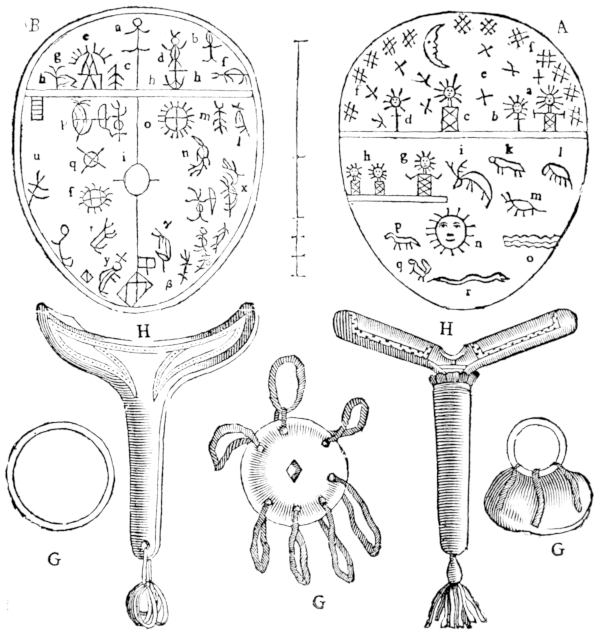
The Explication of the Figures.
In the Drum A. a markes Thor. b Thors Servant. c Storjunkare. d his Servant. e Birds.
f Stars. g Christ. h his Apostles. i a Bear. k a Wolf. l a Rain-deer. m an Ox. n
the Sun. o a Lake. p a Fox. q a Squeril. r a Serpent.
In the Drum B. a denotes God the Father. b Jesus Christ. c the Holy Ghost. d S. John.
e Death. f a Goat. g a Squeril. h Heaven. i the Sun. l a Wolf. m the fish Siik.
n a Cock. o Friendship with the wild Rain-deer. p Anundus Eerici (whose Drum this
was) killing a Wolf. q Gifts. r an Otter. s the friendship of other Lapps. t a Swan. u
a sign to try the condition of others, and whether a disease be incurable. x a Bear. y a
Hog. β a Fish. γ one carrying a Soul to Hell.
I have observed that severall of their drums have not the same pictures
upon them, I have three very different; one, which is here set down,
marked by the letter B. They are described differently by Tornæus, in wch
the figures are distinguished so as to refer to several places, of which there
are chiefly three. In the first stands Norland, and other Countries of Sweden,
which are placed on the South side of the drum, and are separated by a line
from the rest; in this also is contained the next great City, where they
trafic most; as in the drums made at Torne, or Kiemi, there is drawn the
City Torne, with the Temple, Priest, and Governour of the Laplanders,
and many others with whom they have any concerns: as also the highway
that lies betwixt them and Torne, by which they discover when their
Priest, or Governour will come; besides other affairs managed in those
parts. On the North part, Norway is described with all that is contained
in it. In the middle of these two stands Lapland, this takes up the greatest
part of the drum: in it are the several sorts of beasts that are in the Countrey,
here they picture herds of Rain-dears, Bears, Foxes, Wolves, and all
manner of wild beasts, to signifie when, and in what place they may find
them. If a tame Rain-dear be lost, how they may get him againe. Whether
the Rain-deers young ones will live. Whether their net fishing will be successfull.
If sick men will recover, or not. Whether women great with
child shall have a safe delivery. Or such, or such a man will die of such
a distemper, or by what other; and other things of the like nature which
they are desirous to know. I cannot give an account of the reason for this
difference in the drums, unless it is that some of them are made for more
malicious designs, others again for each man’s private purpose. Upon
this account I believe, according to the nature of the business they intend,
they add, and blot out, and sometimes wholly change the figures. But that
you may the better understand the diversity of the drums, here are two
represented to you, both which I had out of the Study of the Chancellour
of the Kingdom.
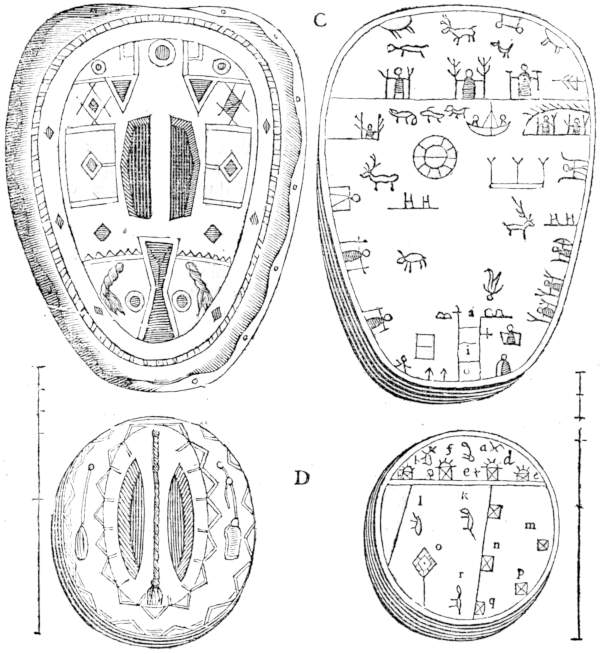
The explication of the Figures.
In the Drum C. a denotes Birds. b black Foxes. c Tinur, a God. d Thor, a God.
e Thors hammer. f Storjunkare. g a wooden Idol. h his Servant. i a Star. k an Ox.
l a Goat. m a Star. n the Moon. o the Sun. p a Star. q another Star. r a Wolf.
The two greater Figures represent, one the upper, the other the lower
side of the Drum, and so do also the two lesser.
Besides these two drums, I had also a third given me by the same
Lord of as great a size as any that can be usually met with.
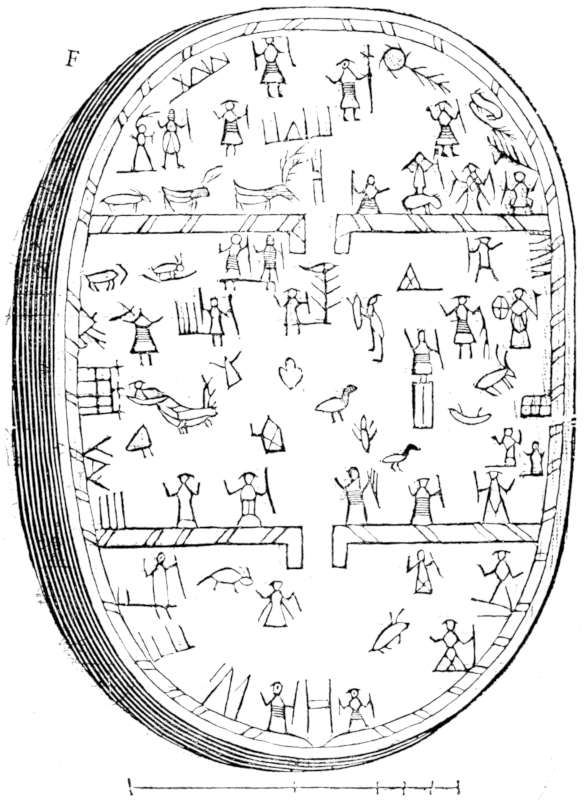
To these I add a fourth, given me by the Illustrious Baron Lieutenant
Henry Flemming, mark’t with the letter F.
Now there are two things required to fit the drum for use, an Index
and a Hammer, that shews among the pictures the thing they enquire after,
with this they beat the drum. The Index is the bunch of brazen rings
mentioned before. They first place one great ring upon the drum, then
they hang severall small ones upon that; the shape of the Index’s is very
different, for of these I have one made of copper, of the bigness of a
Dollar, with a square hole in the middle, several small chains hanging
about it instead of rings. Another hath an Alchymy ring, on which a
small round plate of copper is hung by little chains. I have seen another
also of bone, in the shape of the Greek Δ, with rings about it; and others
of a quite different make. I have described mine under the drums A, and
B, by the mark G; but the common sort of rings are of copper, and those
upon the Chancellors drums are altogether such. Some writers call these
rings serpents, or brazen frogs, and toads, not that they resemble them,
but because by them they signifie these creature, whose pictures they
often use in their conjuring, as supposing them very grateful and acceptable
to the Devil. The Laplanders call the Index Arpa, or Quobdas;
and make it indifferently of any sort of metal. The hammer they use in
raising their familiars, is not the Smith’s; which was the errour of him
that drew it in Olaus Magn. but is an instrument belonging only to the
Laplanders, and called by a peculiar name by them: it is made of a Rain-deers
horn, branching like a fork, this is the head of the hammer, the
other part serves for the handle. The instrument is placed under the two
drums A. B. with the letter H, with the hammer they beat the drum, not
so much to make a noise, as by the drumming to move the ring lying on
the skin, so as to pass over the pictures, and shew what they sought after.
This is the description of the drum, with all its necessaries as it is used
by the Laplanders that are subject to the Swedes; the Finlappers also that
are under the Crown of Danemarke, make use of drums something different
in fashion from the former; yet however the difference is so small,
that I believe their drums are not of a different kind from ours, but made
only for some particular uses. I shall give an account of one of those, described
in Wormius’s Study, who saies that “the Laplanders drum, which
they use in their magic, and by beating which they discover those things
they desired, is made of an oval piece of wood hollowed, in length a foot,
in breadth ten inches; in this they make six holes, and put a handle to
it, that they may hold in the left hand, whilst they beat it with the other;
upon it they stretch over a skin, painted with diverse rude figures, drawn
with blood, or red; upon this lies a piece of brass, in the shape of a Rhomboides,
somewhat convexe, about two inches in diameter, in the middle
of this, and at each corner hangs a small chain. The instrument, with which
they beat the drum, is of bone, six inches long, about the thickness of
a little finger, and made much like the Latine T.”
This instrument the Laplanders use for diverse designs, and are of opinion
that whatever they do it is don by the help of this. For this reason
they have it in great esteem and reverence, taking such care in securing it,
that they wrap it with the Index, and hammer, up in a Lambskin, and
for its greater safety, lay it in some private place. But I think it an
errour, to suppose them to lay it in a Lambskin: for it is written in some
places Loomskin, which signifies the skin of a bird that lives altogether in
the water. They think it so sacred, and holy, that they suffer no maid
that is marriageable to touch it; and if they remove it from place to place,
they carry it the last of all, and this must be don too only by men; or else
they go with it thro some untrod way, that no body may either meet
or follow them. The reason they give for their great care in this particular,
is, because they believe if any one, especially a maid that is marriageable,
should follow the same way, they would in three daies time at least
fall into some desperate disease, and commonly without any hopes of recovery.
This they seem to verifie by many examples, that we may give the
more credit to it; and we have the less reason to doubt the truth of this,
since the devil severely commands his worship to be observed, and suffers
not those rites and customs he hath imposed to be violated, so long as
God is pleased to grant him this liberty. Now because it may happen sometimes
that a woman may out of necessity be constrained to go that way,
by which the drum hath bin carried, the devil is so favorable as to permit
it without any danger, upon condition she first offers a brazen ring to the
drum.
In the next place, because they believe they can effect very strange
things by the drum, we will shew what they are, and the manner used
to perform them. These are three, belonging either to their hunting, their
sacred affairs, or lastly the enquiring into things far distant. I find four
chiefly mentioned by another Writer, the first is, the knowing the state
of affairs in forreign Countries. The second, what success their designs in
hand will meet. With the third, how to cure diseases. The fourth, what
Sacrifices their Gods will be pleased to accept, and what beast each God
desires or dislikes most. As to the way in making enquiries, it is not the
same among all these artists. But the great thing they generally observe,
is, to stretch the skin very stiff, which is don by holding it to the fire.
The next is, that they beat not altogether in the same place, but round
about the Index; then that they beat softly at first, presently quicker, and
continue this till they have effected their intent. The drummer first lifts
up the drum by degrees, then beats softly about the Index, till it begins
to stirr, and when it is removed some distance from its first place to either
side, he strikes harder, till the Index points at something, from whence
he may collect what he sought for. They take care also that as well he that
beats the drum, as those that are present at the ceremony, should be upon
their knees. As to the occasions of their beating thus, the later of those
is already discoursed of. Now we proceed to the rest, the first of which is
concerning their enquiries into things acted in remote parts. Those who
desire to know the condition of their friends, or affairs abroad, whether
distant five hundred, or a thousand miles, go to some Laplander, or Finlander
skilfull in this art, and present him with a linen garment, or piece
of silver, as his reward, for satisfying them in their demands. An example
of this nature is to be seen upon record, at Bergen, a famous Market Town
in Norway, where the effects of the German Merchants are registred; in
this place there was one John Delling, Factor then to a German, to whom
a certain Finlapper of Norway came with James Samaousuend: of him John
Delling enquired about his Master then in Germany; the Finlapper readily
consenting to tell him, like a drunken man presently made a great bawling,
then reeling and dancing about several times in a circle, fell at last upon the
ground, lying there sometime as if he were dead, then starting up on a
suddain, related to him all things concerning his Master, which were afterwards
found to agree to what he reported. There are many more instances
of this kind: the most considerable, is one concerning a Laplander, now
living, who gave Tornæus an account of the Journey he first made to Lapland,
tho he had never seen him before that time; which, altho it was true,
Tornæus dissembled to him, least he might glory too much in his devilish
practises, and rely upon them, as the only means whereby he might attain
to truth. The autority of this man is so considerable, that it may gain credit
enough to the Story. As to the method taken in making discoveries, it
is very different. Olaus Magn. describes it thus, the drummer goes into
some private room, accompanied by one single person, besides his wife,
and by beating the drum moves the Index about, muttering at the same time
several charms, then presently he falls into an extasie, and lies for a short
time as if dead; in the mean while his companion takes great care, that no
gnat, flie, or other living creature touch him; for his Soul is carried by
some ill Genius into a forreign Countrey, from whence it is brought back
with a knife, ring, or some other token, of his knowledg, of what is done
in those parts; after this rising up, he relates all the circumstances belonging
to the business that was enquired after; and that they may seem
certainly so, he shews what he hath brought from thence. Petr. Claud. makes
no mention either of the drum, charms, company, or those things he brings
with him; but saies he casts himself upon the ground, grows black in the
face, lying as if dead for an hour or two; according as the distance of the
place is, of which he makes enquiry;
when he awakes he gives
a full account of all affairs there.
It is clear from what was said
before, that they made use of a
drum; and ’tis observed that for
this sort of conjuring the lower
part of the drum, whereby they
hold it, was commonly shaped
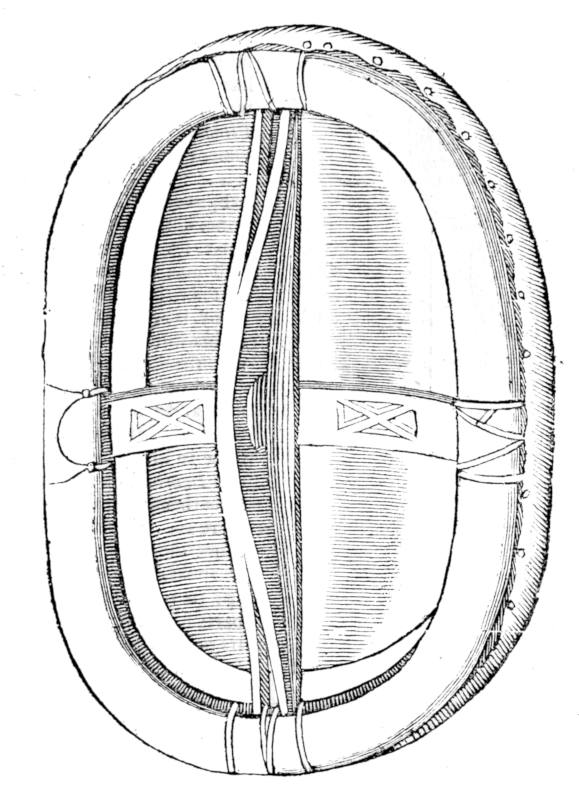
like a cross. One of this make
was given me by the Lord Henry
Flemming, Colonel of a foot Regiment
in Finland, the Figure of
it is in the page foregoing. They
hang about it several claws, and
bones of the creatures they take.
That several persons also, as
well men as women, are permitted
to be present at this ceremony,
is asserted by Sam. Rheen
in his history, where he saies
that the drummer sings a song,
called by them Joiike, and the
men and women that are present
sing likewise, some in higher
some in lower notes, this they
call Duura. Next as to the casting
themselves on the ground,
there are various relations, some
think them not really, but only
in appearance dead; others are
apt to believe that the soul departs
from the body, and after
its travell abroad, returns again.
But without doubt this is false,
for is it impossible, for either
man, or devil, to restore the soul
to the body it hath once left. So
that I believe the devil only
stifles the faculties of the soul for
a time, and hinders their operations. Now after the drummer falls down,
he laies his drum as near as possibly on his head, in this posture.
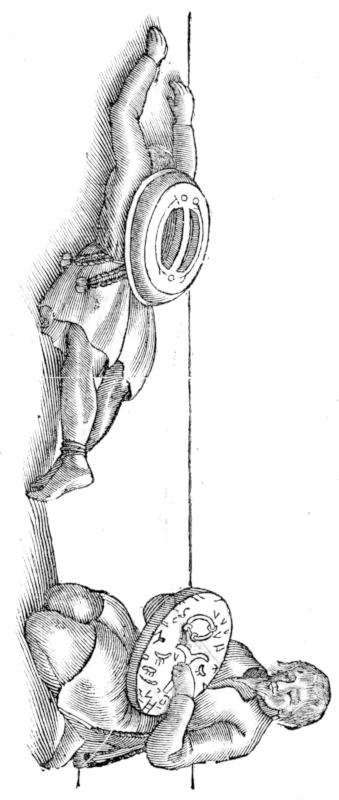
Those in the mean time that are present, leave not off singing all the
time he lies sweating in this agony; which they do not only to put him in
mind, when he awakes, of the business he was to know; but also that he
might recover out of this trance, which he would never do, (as they imagine) if
they either ceased singing, or any one stirred him with their hand or foot.
This perhaps is the reason why they suffer no flie, or any living creature
to touch him; and it is upon this account only that they watch him so diligently,
and not out of any fear they have least the devil should take away his
body; which opinion of Peucers is altogether false. It is uncertain how long
they lye in this manner, but it is commonly according as the place where
they make their discovery, is nearer or farther off; but the time never exceeds
24 houres, let the place be at never so great a distance. After he
awakes he shews them some tokens to confirm their belief in what he tells
them. This is the first and chiefest use they make of the drum.
The next is, how to know the event of their own concerns, and what
success their hunting will have, or any other business which they undertake,
for they seldom venture on any thing, without first consulting that.
In order to the knowing this, they place the bunch of rings on the picture
of the Sun in the drum; then they beat, singing at the same time;
if the rings go round towards the right hand, according to the Suns course
they promise to themselves good health, fortune, and great encrease both
of men and beasts; if contrary, towards the left, they expect sickness and
all the evils attending on ill success. We may easily ground this opinion of
theirs upon the other mentioned above, where they believe the Sun the only
Author of all productions. Wherefore when the Index moves according
to his motion, it portends prosperity by following his course, from whom
they expect all the good they receive. This is the way they take in all
their more weighty affairs, as in a journey, hunting, removing their habitations,
or any such like thing, of which something before, and more
hereafter. Before they hunt they make particular observation which way
the Index turns, whether East, West, North, or South; and collect from
thence where their game lies. Other things for which the drum is serviceable,
are, first, the discovering the nature of diseases, whether they
arise from any disorder in the body, or are caused by magic; this being
known, then to find the remedy for them, which is commonly by sacrifice
to one or other of their angry Gods, but chiefly to Storjunkar, who
bears greatest autority among them, and if not appeased, leaves them small
hopes of recovery. Wherefore the sick person vows a sacrifice, either of a
Rain-deer, Bull, Goat, or Ram, or something of this kind to one of the
Storiunkars, that stands upon the mountains. The sacrifice is not left to
the disposal of the sick man, but must be made according to the directions
of the drummer; for he is supposed to be the only man able to advise them
in this case, he first discovers which of the Gods is displeased, and what
sort of sacrifice is most acceptable to him, for they refuse several, and the
same also at several times. But before the drummer appeases their Gods,
they give him a copper and a silver ring, putting them on his right arm,
then he begins a song, and beats the drum, and all that are present joyn
with him in a Chorus; after this according to the place, to which the Index
points, he directs them. These are the things commonly done by the drum.
The last thing for which they think it necessary, is, the accomplishing their
wicked designs, as impairing mens health, or depriving them of their lives;
which is frequently enough practised among them, tho not altogether so
publicly as heretofore. Some of them account this only unlawful, and exclude
themselves out of the number of those, which use it, thinking the other
uses of the drum to consist chiefly in doing good. But however this mischievous
Art continues still too much among them. Several inhabitants of Kiema in
Lapland were apprehended in the year 1671, with drums, for this purpose
so large, that they could not be removed from thence, but were burnt in
the place. Among those Laplanders there was one four score years of age,
that confessed he was bred up in this art from his childhood, who in 1670
upon some quarrell about a pair of mittens, caused a Boar of Kiema to
be drowned in a Cataract, for which he was condemned to die, and in order
to that was to be carried in chains to the next town in Bothnia, but in the
journy he contrived so by his art, that on a suddain, tho he seemed well,
and lusty, he died on the sledge, which he had often foretold he would
sooner do, then fall into the Executioners hands. As to the ceremonies
used in this particular, either in their words, gesture, or any other thing,
I can give no account, finding none in those writings, from whence I collected
the rest. The reason for this, I suppose, is, because they themselves
keep this secret, as the great mystery in their art; or that no one would
enquire into them, least they should be thought guilty of this damnable sin.
Having treated largely of the drum, we come to the other parts of this
art, to which also belong proper sorts of instruments: the first is a cord
tied with knots for the raising of wind. They, as Zeiglers relates it, tye
three magical knots in this cord; when they untie the first, there blows
a favorable gale of wind; when the second, a brisket; when the third, the
Sea and wind grow mighty stormy, and tempestuous. This, that we have
reported concerning the Laplanders, is by Olaus Magnus, and justly, related
of the Finlanders, who border on the Sea, and sell winds to those
Merchants that trafic with them, when they are at any time detained by a
contrary one. The manner is thus, they deliver a small rope with three
knots upon it, with this caution, that when they loose the first, they
shall have a good wind, if the second, a stronger, if the third, such a
storm will arise, that they can neither see how to direct the ship, and avoid
rocks, or so much as stand upon the decks, or handle the tackling. No other
Writers mention this concerning the Laplanders, and I am apt not to
think it at all probable, since they live in an inland Country, bordering
no where upon the Sea. Wherefore this properly belongs to the Finlappers
in Norway. Now those that are skilled in this art, have command chiefly
over the winds that blew at their birth; so that this wind obeys principally
one man, that another, as if they obtained this power when they first
received their breath; now as this belongs chiefly to the Finlappers and
Finlanders of Norway, so doth the stopping of the course of ships, which
is altogether of the same nature. This is also attributed to the Laplanders,
who according to the different affection they have for Merchants, make
the Sea either calmer, or more tempestuous.
We come now to their magical Darts, which they make of lead, in length
about a finger; by these they execute their revenge upon their enemies,
and according to the greatness of the injury received, they wound them
with cankrous swellings, either in the arms, or legs, which by the extremity
of its pain, kills them in three daies time. They shoot these darts
to what distance they please, and that so right too, that they seldom miss
their aim. Olaus Magnus reports the same in his writings, which I believe
is only a transcript of Zeigler’s, the words being the same, and without
doubt he follows him in this particular as he hath in many others. But I
suppose they are both mistaken, and misrender’d them leaden darts, since
I can find no person in these times that knows of any such; neither is there
any mention made of them in any other writers, or by the common People,
who seldom omit such circumstances as these in their relations. But they
might perhaps be mistaken in supposing them to be made of lead, by misunderstanding
the word Skott, which is commonly used for their explanation.
For when either man or beast is suddainly taken with a disease,
by which their strength fails, and they immediately perish; the common
People call this that takes them so Skott, that is a dart. This might make
Zeigler think to be really some dart, which the inhabitants are wholly
ignorant of, and most among us believe these things to be effected by some
other means. Petrus Claudius calls it a Gan, which they send abroad: he likens
it to a flie, but saies it is some little devil, of which the Finlanders in
Norway that excell most in this art, keep great numbers in a leathern bag,
and dispatch daily some of them abroad. Of these he relates a story, that
happened in his time: an Inhabitant of Helieland, who is still alive, going
towards the mountains in Norway to hunt Bears, came to a cave under the
side of a hill, where he found an image rudely shapen, which was the Idoll
of some Finlander; near this stood a Ganeska, or magical satchel: he opened
this, and found in it several blewish flies crawling about, which they call
Gans, or spirits, and are daily sent out by the Finlanders to execute their
devilish designs. But he seems to intimate no more by this word Gan, then
that very thing which endangers mens health, and lives. For he saies that
these Finlanders cannot live peaceably, except they let out of their Ganeska
or Gankiid, which is the satchel, every day one of the Gans, that is
a fly or devil. But if the Gan can find no man to destroy, after they have
sent him out, which they seldom do upon no account at all, then he roves
about at a venture, and destroies the first thing he meets with; sometimes
they command it out to the mountains, to cleave rocks asunder: however
these conjurers will, for very trivial causes, send out their Gan to ruine
men. This word Gan signifies no more then what Zeigler meant by his
dart, for the term by which they express its going out is de Skiuda deris
Gan, that is, he as it were shoots out his Gan like an arrow, for Skiuda
is only proper to the shooting out of an arrow.
This is the third thing belonging to their magic, which they use as well
against one another as strangers; nay sometimes against those that they
know are their equals in the art. Of this kind there happened a notable
passage betwixt two Finlanders, one of which was called Asbioern Gankonge,
from his great knowledge in the art, the other upon some small
difference concerning their skill, or some such trifle, would have destroyed
Asbioern, but was still prevented by his too powerfull art, till at last finding
an opportunity, as Asbioern lay sleeping under a rock, he immediately
dispatcht away a Gan, that cleft the rock asunder, and tumbled it upon
him. This happened in the time of Petrus Claud. not long before he wrote
his History. Some of the Conjurers are contented only with the power to
expell that Gan out of men, or beasts, which others send. This is remarkable
among them, that they can hurt no man with their Gan, except they
first know his parents name.
Now all that the Finlanders and Finlappers of Norway effect by their
Gan, the Laplanders do by a thing they call Tyre. This Tyre is a round
ball, about the bigness of a wallnut, or small apple, made of the finest
hair of a beast, or else of moss, very smooth, and so light that it seems
hollow, its colour is a mixture of yellow, green, and ash, but so that the
yellow may appear most. I had one of these given me by Mr John Otto
Silverstroem, Warden of the Colledge belonging to the metals, and Master
of the Mines at Saltzburg and Frahlune. This is the figure of it.
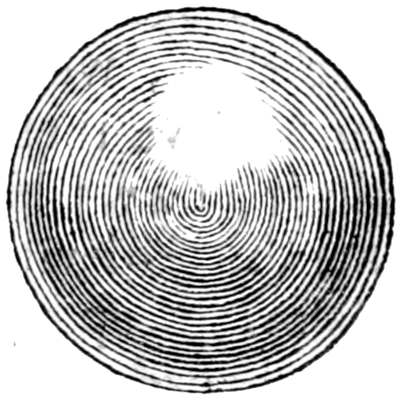
This Tyre they say is quickened and moved by a particular art; it is sold
by the Laplanders, so that he that buies it may hurt whom he pleases
with it. They do perswade themselves, and others, that by the Tyre they
can send, either Serpents, Toads, Mice, or what they please into any
man, to make his torment the greater. It goes like a whirlewind, and as
swift as an arrow, and destroies the first man, or beast, that it lights on,
so that it often mistakes. Of these we have too many instances in this time,
which are too long to insert here: having therefore done with all, or at
least the chiefest matters concerning their sacred, and superstitious rites,
or worship; we proceed to other affairs.


