Illustrations have been moved to avoid falling within a paragraph.
Errors, when reasonably attributable to the printer, have been corrected.
The corrections appear as words underlined with a light gray.
The original text will be shown when the mouse is over the word. Please
see the transcriber’s note at the end of this text for details.
Errors, when reasonably attributable to the printer, have been corrected.
The corrections are hyperlinked to an explanatory entry transcriber’s
note. That note also includes an account of the approach taken
for addressing these issues.
The cover has been fabricated and is placed in the public domain.
The sources from which the following History of Korea
is drawn are almost purely Korean. For ancient and
medieval history the Tong-sa Kang-yo has been mainly
followed. This is an abstract in nine volumes of the four
great ancient histories of the country. The facts here
found were verified by reference to the Tong-guk Tong-gam,
the most complete of all existing ancient histories
of the country. Many other works on history, geography
and biography have been consulted, but in the
main the narrative in the works mentioned above has
been followed.
A number of Chinese works have been consulted,
especially the Mun-hon Tong-go wherein we find the best
description of the wild tribes that occupied the peninsula
about the time of Christ.
It has been far more difficult to obtain material for
compiling the history of the past five centuries. By unwritten
law the history of no dynasty in Korea has ever
been published until after its fall. Official records are
carefully kept in the government archives and when the
dynasty closes these are published by the new dynasty.
There is an official record which is published under the
name of the Kuk-cho Po-gam but it can in no sense be
called a history, for it can contain nothing that is not
complimentary to the ruling house and, moreover, it has
not been brought down even to the opening of the 19th
century. It has been necessary therefore to find private
iimanuscript histories of the dynasty and by uniting and
comparing them secure as accurate a delineation as possible
of the salient features of modern Korean history.
In this I have enjoyed the services of a Korean scholar
who has made the history of this dynasty a special study
for the past twenty-five years and who has had access
to a large number of private manuscripts. I withhold
his name by special request. By special courtesy I have
also been granted access to one of the largest and most
complete private libraries in the capital. Japanese records
have also been consulted in regard to special points
bearing on the relations between Korea and Japan.
A word must be said in regard to the authenticity
and credibility of native Korean historical sources. The
Chinese written character was introduced into Korea as
a permanent factor about the time of Christ, and with it
came the possibility of permanent historical records.
That such records were kept is quite apparent from the
fact that the dates of all solar eclipses have been carefully
preserved from the year 57 B.C. In the next place it is
worth noticing that the history of Korea is particularly
free from those great cataclysms such as result so often
in the destruction of libraries and records. Since the
whole peninsula was consolidated under one flag in the
days of ancient Sil-la no dynastic change has been effected
by force. We have no mention of any catastrophe to the
Sil-la records: and Sil-la merged into Koryŭ and Koryŭ
into Cho-sŭn without the show of arms, and in each
case the historical records were kept intact. To be sure,
there have been three great invasions of Korea, by the
Mongols, Manchus and Japanese respectively, but though
much vandalism was committed by each of these, we
have reason to believe that the records were not tampered
with. The argument is three-fold. In the first place
histories formed the great bulk of the literature in vogue
among the people and it was so widely disseminated that
it could not have been seriously injured without annihilating
the entire population.
In the second place these invasions were made by
peoples who, though not literary themselves, had a somewhat
iiihigh regard for literature, and there could have
been no such reason for destroying histories as might
exist where one dynasty was forcibly ejected by another
hostile one. In the third place the monasteries were the
great literary centers during the centuries preceding the
rise of the present dynasty, and we may well believe that
the Mongols would not seriously molest these sacred repositories.
On the whole then we may conclude that
from the year 57 B.C. Korean histories are fairly accurate.
Whatever comes before that is largely traditional
and therefore more or less apocryphal.
One of the greatest difficulties encountered is the selection
of a system of romanisation which shall steer a middle
course between the Scilla of extreme accuracy and the
Charybdis of extreme simplicity. I have adopted the rule
of spelling all proper names in a purely phonetic way
without reference to the way they are spelled in native
Korean. In this way alone can the reader arrive at anything
like the actual pronunciation as found in Korea.
The simple vowels have their continental sounds: a as in
“father,” i as in “ravine,” o as in “rope” and u as in
“rule.” The vowel e is used only with the grave accent
and is pronounced as in the French “recit.” When a
vowel has the short mark over it, it is to be given the flat
sound: ă as in “fat,” ŏ as in “hot,” ŭ as in “nut.” The
umlaut ö is used but it has a slightly more open sound
thanthan in German. It is the “unrounded o” where the
vowel is pronounced without protruding the lips. The
pure Korean sound represented by oé is a pure diphthong
and is pronounced by letting the lips assume the position
of pronouncing o while the tongue is thrown forward as
if to pronounce the short e in “met.” Eu is nearly the
French eu but with a slightly more open sound. As for
consonants they have their usual sounds, but when the
surds k, p or t in the body of a word are immediately preceded
by an open syllable or a syllable ending with a
sonant, they change to their corresponding sonants: k
to g, p to b and t to d. For instance, in the word Pak-tu,
the t of the tu would be d if the first syllable were open.
No word begins with the sonants g, b or d.
ivIn Korean we have the long and short quantity in
vowels. Han may be pronounced either simply han or
longer haan, but the distinction is not of enough importance
to compensate for encumbering the system with
additional diacritical marks.
In writing proper names I have adopted the plan
most in use by sinologues. The patronymic stands alone
and is followed by the two given names with a hyphen
between them. All geographical names have hyphens
between the syllables. To run the name all together
would often lead to serious difficulty, for who would
know, for instance, whether Songak were pronounced Son-gak
or Song-ak?
In the spelling of some of the names of places there
will be found to be a slight inconsistency because part of
the work was printed before the Korea Branch of the
Royal Asiatic Society had determined upon a system of
romanization, but in the main the system here used corresponds
to that of the Society.
This is the first attempt, so far as I am aware, to
give to the English reading public a history of Korea
based on native records, and I trust that in spite of all
errors and infelicities it may add something to the general
fund of information about the people of Korea.
H.B.H.
Seoul, Korea, 1905.
Introductory Note.
v
Geography is the canvas on which history is painted.
Topography means as much to the historian as to the
general. A word, therefore, about the position of Korea
will not be out of place.
The peninsula of Korea, containing approximately
80,000 square miles, lies between 33° and 43° north
latitude, and between 124° 30′ and 130° 30′ east longitude.
It is about nine hundred miles long from north to
south and has an average width from east to west of
about 240 miles. It is separated from Manchuria on the
northwest by the Yalu or Am-nok River, and from Asiatic
Russia on the northeast by the Tu-man River. BetweenBetween
the sources of these streams rise the lofty peaks of
White Head Mountain, called by the Chinese Ever-white
or Long-white Mountain. From this mountain whorl
emanates a range which passes irregularly southward
through the peninsula until it loses itself in the waters of
the Yellow Sea, thus giving birth to the almost countless
islands of the Korean archipelago. The main watershed
of the country is near the eastern coast and consequently
the streams that flow into the Japan Sea are neither
long nor navigable, while on the western side and in the
extreme south we find considerable streams that are
navigable for small craft a hundred miles or more. While
the eastern coast is almost entirely lacking in good harbors
the western coast is one labyrinth of estuaries, bays
and gulfs which furnish innumerable harbors. It is on
the western watershed of the country that we will find
vimost of the arable land and by far the greater portion of
the population.
We see then that, geographically, Korea’s face is toward
China and her back toward Japan. It may be that
this in part has moulded her history. During all the
centuries her face has been politically, socially and religiously
toward China rather than toward Japan.
The climate of Korea is the same as that of eastern
North America between the same latitudes, the only difference
being that in Korea the month of July brings the
“rainy season” which renders nearly all roads in the interior
impassable. This rainy season, by cutting in two
the warmer portion of the year, has had a powerful influence
on the history of the country; for military operations
were necessarily suspended during this period and
combatants usually withdrew to their own respective
territories upon its approach.
The interior of Korea is fairly well wooded, although
there are no very extensive tracts of timber land. A species
of pine largely predominates but there is also a large
variety of other trees both deciduous and evergreen.
Rice is the staple article of food throughout most of
the country. Among the mountain districts in the north
where rice cannot be grown potatoes and millet are
largely used. An enormous amount of pulse is raised, almost
solely for fodder, and other grains are also grown.
The bamboo grows sparsely and only in the south. Ginseng
is an important product of the country.
The fauna of Korea includes several species of deer,
the tiger, leopard, wild pig, bear, wolf, fox and a large
number of fur bearing animals among which the sable
and sea-otter are the most valuable. The entire peninsula
is thoroughly stocked with cattle, horses, swine
and donkeys, but sheep are practically unknown. The
fisheries off the coast of Korea are especially valuable
and thousands of the people earn a livelihood on the
banks. Pearls of good quality are found. Game birds
of almost infinite variety exist and all the commoner
domestic birds abound.
As to the geology of the country we find that there is
viia back bone of granite formation with frequent outcroppings
of various other forms of mineral life. Gold is extremely
abundant and there are few prefectures in the
country where traces of it are not found. Silver is also
common. Large deposits of coal both anthracite and
bituminous have been discovered, but until recently
little has been done to open up the minerals of the country
in a scientific manner.
Ethnologically we may say that the people are of a
mixed Mongolian and Malay origin, although this question
has as yet hardly been touched upon. The language of
Korea is plainly agglutinative and may, without hesitation,
be placed in the great Turanian or Scythian group.
The population of Korea is variously estimated from
ten to twenty millions. We shall not be far from the
truth if we take a middle course and call the population
thirteen millions. Somewhat more than half of the people
live south of a line drawn east and west through the
capital of the country.
PART I ANCIENT KOREA — Chapter I. — Chapter II. — Chapter III. — Chapter IV. — Chapter V. — Chapter VI. — Chapter VII. — Chapter VIII. — Chapter IX. — Chapter X. — Chapter XI. — Chapter XII. — Chapter XIII.
1
Tan-gun.... his antecedents.... his origin.... he becomes king.... he
teaches the people.... his capital.... he retires.... extent of his
kingdom.... traditions.... monuments.
In the primeval ages, so the story runs, there was a divine
being named Whan-in, or Che-Sŏ: “Creator.” His
son, Whan-ung, being affected by celestial ennui, obtained
permission to descend to earth and found a mundane kingdom.
Armed with this warrant, Whan-ung with three thousand spirit
companions descended upon Ta-băk Mountain, now known
as Myo-hyang San, in the province of P’yŭng-an, Korea. It
was in the twenty-fifth year of the Emperor Yao of China,
which corresponds to 2332 B.C.
He gathered his spirit friends beneath the shade of an
ancient pak-tal tree and there proclaimed himself King of the
Universe. He governed through his three vice-regentsvice-regents, the
“Wind General,” the “Rain Governor,” and the “Cloud
Teacher,” but as he had not yet taken human shape, he
found it difficult to assume control of a purely human kingdom.
Searching for means of incarnation he found it in the
following manner.
At early dawn, a tiger and a bear met upon a mountain
side and held a colloquy.
“Would that we might become men” they said. Whan-ung
overheard them and a voice came from out the void saying,
“Here are twenty garlics and apiece of artemisia for
2each of you. Eat them and retire from the light of the sun
for thrice seven days and you will become men.”
They ate and retired into the recesses of a cave, but the
tiger, by reason of the fierceness of his nature, could not endure
the restraint and came forth before the allotted time;
but the bear, with greater faith and patience, waited the thrice
seven days and then stepped forth, a perfect woman.
The first wish of her heart was maternity, and she cried,
“Give me a son.” Whan-ung, the Spirit King, passing on
the wind, beheld her sitting there beside the stream. He circled
round her, breathed upon her, and her cry was answered.
She cradled her babe in moss beneath that same pak-tal tree
and it was there that in after years the wild people of the
country found him sitting and made him their king.
This was the Tan-gun, “The Lord of the Pak-tal Tree.”
He is also, but less widely, known as Wang-gŭm. At that
time Korea and the territory immediately north was peopled
by the “nine wild tribes” commonly called the Ku-i. Tradition
names them respectively the Kyŭn, Pang, Whang, Făk,
Chŭk, Hyŭn, P‘ung, Yang and U. These, we are told, were
the aborigines, and were fond of drinking, dancing and singing.
They dressed in a fabric of woven grass and their food
was the natural fruits of the earth, such as nuts, roots, fruits
and berries. In summer they lived beneath the trees and in
winter they lived in a rudely covered hole in the ground.
When the Tan-gun became their king he taught them the relation
of king and subject, the rite of marriage, the art of cooking
and the science of house building. He taught them to
bind up the hair by tying a cloth about the head. He taught
them to cut down trees and till fields.
The Tan-gun made P‘yŭng-yang the capital of his kingdom
and there, tradition says, he reigned until the coming of
Ki-ja, 1122 B.C. If any credence can be given this tradition
it will be by supposing that the word Tan-gun refers to a
line of native chieftains who may have antedated the coming
of Ki-ja.
It is said that, upon the arrival of Ki-ja, the Tan-gun
retired to Ku-wŭl San (in pure Korean A-sa-dal) in the
present town of Mun-wha, Whang-hă Province, where he resumed
his spirit form and disappeared forever from the earth.
3His wife was a woman of Pi-sŏ-ap, whose location is unknown.
As to the size of the Tan-gun’s kingdom, it is generally
believed that it extended from the vicinity of the present town
of Mun-gyŭng on the south to the Heuk-yong River on the
north, and from the Japan Sea on the east to Yo-ha (now
Sŭng-gyŭng) on the west.
As to the events of the Tan-gun’s reign even tradition
tells us very little. We learn that in 2265 B.C. the Tan-gun
first offered sacrifice at Hyŭl-gu on the island of Kang-wha.
For this purpose he built an altar on Mari San which remains
to this day. We read that when the great Ha-u-si (The
Great Yü), who drained off the waters which covered the
interior of China, called to his court at To-san all the vassal
kings, the Tan-gun sent his son, Pu-ru, as an envoy. This
was supposed to be in 2187 B.C. Another work affirms that
when Ki-ja came to Korea Pu-ru fled northward and founded
the kingdom of North Pu-yŭ, which at a later date moved
to Ka-yŭp-wŭn, and became Eastern Pu-yŭ. These stories
show such enormous discrepancies in dates that they are
alike incredible, and yet it may be that the latter story has
some basis in fact, at any rate it gives us our only clue to the
founding of the Kingdom of Pu-yŭ.
Late in the Tan-gun dynasty there was a minister named
P‘ăng-o who is said to have had as his special charge the making
of roads and the care of drainage. One authority says that
the Emperor of China ordered P‘ăng-o to cut a road between
Ye-măk, an eastern tribe, and Cho-sŭn. From this we see
that the word Cho-sŭn, according to some authorities, antedates
the coming of Ki-ja.
The remains of the Tan-gun dynasty, while not numerous,
are interesting. On the island of Kang-wha, on the top
of Mari San, is a stone platform or altar known as the “Tan-gun’s
Altar,” and, as before said, it is popularly believed to
have been used by the Tan-gun four thousand years ago. It
is called also the Ch’am-sŭng Altar. On Chŭn-dung San is a
fortress called Sam-nang which is believed to have been built by
the Tan-gun’s three sons. The town of Ch’un-ch’ŭn, fifty
miles east of Seoul, seems to have been an important place
during this period. It was known as U-su-ju, or “Ox-hair
Town,” and there is a curious confirmation of this tradition
4in the fact that in the vicinity there is today a plot of ground
called the U-du-bol, or “Ox-head Plain.” A stone tablet to
P’ang-o isP’ang-o is erected there. At Mun-wha there is a shrine to
the Korean trinity, Whan-in, Whan-ung and Tan-gun.
Though the Tan-gun resumed the spirit form, his grave is
shown in Kang-dong and is 410 feet in circumference.
Ki-ja.... striking character.... origin.... corrupt Chu.... story of Tal-geui.... Shang
dynasty falls.... Ki-ja departs.... route.... destination.... allegience
to China.... condition of Korea.... Ki-ja’s companions.... reforms.... evidences
of genius.... arguments against
Korean theory.... details of history meager.... Cho-sun sides against
China.... delimitation of Cho-sun.... peace with Tsin dynasty.... Wi-man
finds asylum.... betrays Cho-sun.... Ki-jun’s flight.
Without doubt the most striking character in Korean history
is the sage Ki-ja, not only because of his connection with
its early history but because of the striking contrast between
him and his whole environmentenvironment. The singular wisdom which
he displayed is vouched for not in the euphemistic language
of a prejudiced historian but by what we can read between the
lines, of which the historian was unconscious.
The Shang, or Yin, dynasty of China began 1766 B.C.
Its twenty-fifth representative was the Emperor Wu-yi whose
second son, Li, was the father of Ki-ja. His family name
was Cha and his surname Su-yu, but he is also known by the
name Sö-yŭ. The word Ki-ja is a title meaning “Lord of
Ki,” which we may imagine to be the feudal domain of the
family. The Emperor Chu, the “Nero of China” and the
last of the dynasty, was the grandson of Emperor T’ă-jŭng
and a second cousin of Ki-ja, but the latter is usually spoken
of as his uncle. Pi-gan, Mi-ja and Ki-ja formed the advisory
board to this corrupt emperor.
All that Chinese histories have to say by way of censure
against the hideous debaucheries of this emperor is repeated
in the Korean histories; his infatuation with the beautiful
concubine, Tal-geui; his compliance with her every whim; his
5making a pond of wine in which he placed an island of meat
and compelled nude men and women to walk about it, his torture
of innocent men at her request by tying them to heated
brazen pillars. All this is told in the Korean annals, but
they go still deeper into the dark problem of Tal-geui’s character
and profess to solve it. The legend, as given by Korean
traditiontradition, is as follows.
The concubine Tal-geui was wonderfully beautiful, but
surpassingly so when she smiled. At such times the person
upon whom she smiled was fascinated as by a serpent and was
forced to comply with whatever request she made. Pondering
upon this, Pi-gan decided that she must be a fox in human
shape, for it is well known that if an animal tastes of water
that has lain for twenty years in a human skull it will acquire
the power to assume the human shape at will. He set inquiries
on foot and soon discovered that she made a monthly
visit to a certain mountain which she always ascended alone
leaving her train of attendants at the foot. Armed detectives
were put on her track and, following her unperceived, they saw
her enter a cave near the summit of the mountain. She presently
emerged, accompanied by a pack of foxes who leaped
about her and fawned upon her in evident delight. When
she left, the spies entered and put the foxes to the sword,
cutting from each dead body the piece of white fur which is
always found on the breast of the fox. When Tal-geui met
the emperor some days later and saw him dressed in a sumptuous
white fur robe she shuddered but did not as yet guess
the truth. A month later, however, it became plain to her
when she entered the mountain cave and beheld the festering
remains of her kindred.
On her way home she planned her revenge. Adorning
herself in all her finery, she entered the imperial presence and
exerted her power of fascination to the utmost. When the
net had been well woven about the royal dupe, she said,she said,
“I hear that there are seven orifices in the heart of every
good man. I fain would put it to the test.”
“But how can it be done?”
“I would that I might see the heart of Pi-gan;” and as
she said it she smiled upon her lord. His soul revolted from
the act and yet he had no power to refuse. Pi-gan was summoned
6and the executioner stood ready with the knife, but
at the moment when it was plunged into the victim’s breast
he cried,
“You are no woman; you are a fox in disguise, and I
charge you to resume your natural shape.”
Instantly her face began to change; hair sprang forth
upon it, her nails grew long, and, bursting forth from her
garments, she stood revealed in her true character—a white
fox with nine tails. With one parting snarl at the assembled
court, she leaped from the window and made good her escape.
But it was too late to save the dynasty. Pal, the son of
Mun-wang, a feudal baron, at the head of an army, was already
thundering at the gates, and in a few days, a new dynasty assumed
the yellow and Pal, under the title Mu-wang, became
its first emperor.
Pi-gan and Mi-ja had both perished and Ki-ja, the sole
survivor of the great trio of statesmen, had saved his life only
by feigning madness. He was now in prison, but Mu-wang
came to his door and besought him to assume the office of
Prime Minister. Loyalty to the fallen dynasty compelled him
to refuse. He secured the Emperor’s consent to his plan of
emigrating to Cho-sŭn or “Morning Freshness,” but before
setting out he presented the Emperor with that great work,
the Hong-bŭm or “Great-Law,” which had been found inscribed
upon the back of the fabled tortoise which came up
out of the waters of the Nak River in the days of Ha-u-si
over a thousand years before, but which no one had been able
to decipher till Ki-ja took it in hand. Then with his five
thousand followers he passed eastward into the peninsula of
Korea.
Whether he came to Korea by boat or by land cannot be
certainly determined. It is improbable that he brought such
a large company by water and yet one tradition says that he
came first to Su-wŭn, which is somewhat south of Chemulpo.
This would argue an approach by sea. The theory which has
been broached that the Shantung promontory at one time
joined the projection of Whang-hă Province on the Korean
coast cannot be true, for the formation of the Yellow Sea must
have been too far back in the past to help us to solve this
question. It is said that from Su-wŭn he went northward to
7the island Ch’ŭl-do, off Whang-hă Province, where today they
point out a “Ki-ja Well.” From there he went to P‘yŭng-yang.
His going to an island off Whang-hă Province argues
against the theory of the connection between Korea and the
Shantung promontory.
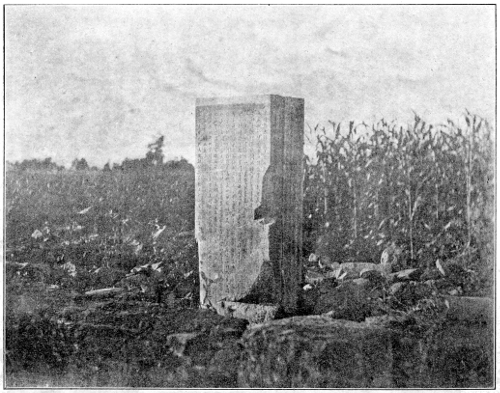
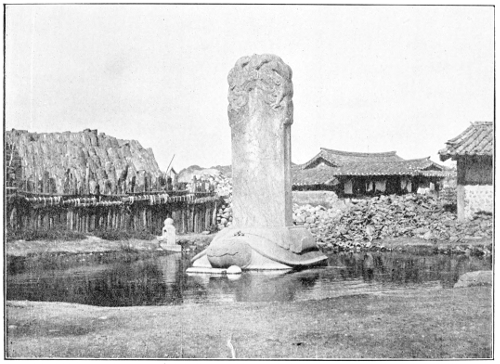
A TABLET TO KI-JA.
In whatever way he came, he finally settled at the town
of P‘yŭng-yang which had already been the capital of the Tan-gun
dynasty. Seven cities claimed the honor of being Homer’s
birth place and about as many claim to be the burial spot of
Ki-ja. The various authorities differ so widely as to the
boundaries of his kingdom, the site of his capital and the place
of his interment that some doubt is cast even upon the existence
of this remarkable man; but the consensus of opinion
points clearly to P‘yŭng-yang as being the scene of his labors.
It should be noticed that from the very first Korea was an
independent kingdom. It was certainly so in the days of the
Tan-gun and it remained so when Ki-ja came, for it is distinctly
stated that though the Emperor Mu-wang made him King
of Cho-sŭn he neither demanded nor received his allegience as
vassal at that time. He even allowed Ki-ja to send envoys to
worship at the tombs of the fallen dynasty. It is said that Ki-ja
himself visited the site of the ancient Shang capital, but when
he found it sown with barley he wept and composed an elegy
on the occasion, after which he went and swore allegience to
the new Emperor. The work entitled Cho-sŏ says that when
Ki-ja saw the site of the former capital sown with barley he
mounted a white cart drawn by a white horse and went to the
new capital and swore allegience to the Emperor; and it adds
that in this he showed his weakness for he had sworn never
to do so.
Ki-ja, we may believe, found Korea in a semi-barbarous
condition. To this the reforms which he instituted give
abundant evidence. He found at least a kingdom possessed
of some degree of homogeneity, probably a uniform language
and certainly ready communication betweenbetween its parts. It is
difficult to believe that the Tan-gun’s influence reached far
beyond the Amnok River, wherever the nominal boundaries
of his kingdom were. We are inclined to limit his actual power
to the territory now included in the two provinces of P‘yŭng-an
and Whang-hă.
8We must now inquire of what material was Ki-ja’s company
of five thousand men made up. We are told that he
brought from China the two great works called the Si-jun and
the So-jun, which by liberal interpretation mean the books on
history and poetry. The books which bear these names were
not written until centuries after Ki-ja’s time, but the Koreans
mean by them the list of aphorisms or principles which later
made up these books. It is probable, therefore, that this
company included men who were able to teach and expound
the principles thus introduced. Ki-ja also brought the sciences
of manners (well named a science), music, medicine, sorcery
and incantation. He brought also men capable of teaching one
hundred of the useful trades, amongst which silk culture and
weaving are the only two specifically named. When, therefore,
we make allowance for a small military escort we find
that five thousand men were few enough to undertake the
carrying out of the greatest individual plan for colonization
which history has ever seen brought to a successful issue.
These careful preparations on the part of the self-exiled
Ki-ja admit of but one conclusion. They were made with
direct reference to the people among whom he had elected to
cast his lot. He was a genuine civilizer. His genius was of
the highest order in that, in an age when the sword was the
only arbiter, he hammered his into a pruning-hook and carved
out with it a kingdom which stood almost a thousand years.
He was the ideal colonizer, for he carried with him all the elements
of successful colonization which, while sufficing for the
reclamation of the semi-barbarous tribes of the peninsula, would
still have left him self-sufficient in the event of their contumacy.
His method was brilliant when compared with even
the best attempts of modern times.
His penal code was short, and clearly indicated the failings
of the people among whom he had cast his lot. Murder
was to be punished with death inflicted in the same manner in
which the crime had been committed. Brawling was punished
by a fine to be paid in grain. Theft was punished by enslaving
the offender, but he could regain his freedom by the payment
of a heavy fine. There were five other laws which are
not mentioned specifically. Many have surmised, and perhaps
rightly, that they were of the nature of the o-hang or
9“five precepts” which inculcate right relations between king
and subject, parent and child, husband and wife, friend and
friend, old and young. It is stated, apocryphally however,
that to prevent quarreling Ki-ja compelled all males to wear
a broad-brimmed hat made of clay pasted on a framework. If
this hat was either doffed or broken the offender was severely
punished. This is said to have effectually kept them at arms
length.
Another evidence of Ki-ja’s genius is his immediate recognition
of the fact that he must govern the Korean people by
means of men selected from their own number. For this purpose
he picked out a large number of men from the various
districts and gave them special training in the duties of government
and he soon had a working corps of officials and
prefects without resorting to the dangerous expedient of filling
all these positions from the company that came with him. He
recognised that in order to gain any lasting influence with the
people of Korea he and his followers must adapt themselves
to the language of their adopted country rather than make
the Koreans conform to their form of speech. We are told that
he reduced the language of the people to writing and through
this medium taught the people the arts and sciences which he
had brought. If this is true, the method by which the writing
was done and the style of the characters have entirely disappeared.
Nothing remains to give evidence of such a written
language. We are told that it took three years to teach it to
the people.
The important matter of revenue received early attention.
A novel method was adopted. All arable land was divided into
squares and each square was subdivided into nine equal parts;
eight squares about a central one. Whoever cultivated the
eight surrounding squares must also cultivate the central one
for the benefit of the government. The latter therefore received
a ninth part of the produce of the land. Prosperity was
seen on every side and the people called the Ta-dong River
the Yellow River of Korea.
As a sign that his kingdom was founded in peace and as
a constant reminder to his people he planted a long line of
willows along the bank of the river opposite the city, so
P‘yung-yang is sometimes called The Willow Capital.
10It is contended by not a few that Ki-ja never came to
Korea at all and they base their belief upon the following
facts. When the Han Emperor Mu-je overcame northern
Korea and divided it into four parts he called the people savages,
which could not be if Ki-ja civilized them. The Chinese histories
of the Tang dynasty affirm that Ki-ja’s kingdom was in
Liao-tung. The histories of the Kin dynasty and the Yuan
or Mongol dynasty say that Ki-ja had his capital at Kwang-nyŭng
in Liao-tung, and there is a Ki-ja well there today and
a shrine to him. There was a picture of him there but it was
burned in the days of Emperor Se-jong of the Ming dynasty.
A Korean work entitled Sok-mun Heun-t’ong-go says that
Ki-ja’s capital was at Ham-pyŭng-no in Liao-tung. The
Chinese work Il-t’ong-ji of the time of the Ming dynasty says
that the scholars of Liao-tung compiled a work called Söng-gyŭng-ji
which treated of this question. That book said that
Cho-sŭn included Sim-yang (Muk-den), Pong-ch’ŭn-bu, Eui-ju
and Kwang-nyŭng; so that half of Liao-tung belonged to
Cho-sun. The work entitled Kang-mok says that his capital
was at P’yŭng-yang and that the kingdom gradually broadened
until the scholar O Si-un said of it that it stretched from
the Liao River to the Han. This last is the commonly accepted
theory and so far as Korean evidence goes there seems
to be little room for doubt.
Ki-ja was fifty-three years old when he came to Korea
and he reigned here forty years. His grave may be seen to-day
at To-san near the city which was the scene of his labors.
Some other places that claim the honor of containing Ki-ja’s
tomb are Mong-hyŭn, Pak-sung and Sang-gu-hyun in northern
China.
It was not till thirty-six generations later that Ki-ja received
the posthumous title of T’ă-jo Mun-sŭng Tă-wang.
The details of the history of K-ja’s dynasty are very meager
and can be given here only in the most condensed form.[A]
A. The following details of the Ki-ja dynasty are taken from a work
recently compiled in P’yung-yang and claiming to be based on private
family records of the descendants of Ki-ja. It is difficult to say whether
any reliance can be placed upon it but as it is the only source of information
obtainable it seems best to give it. The dates are of course all
B.C.
11
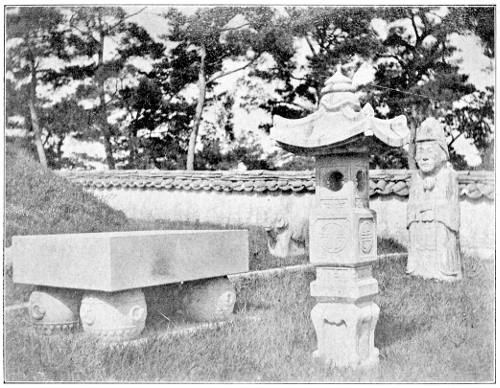
THE TOMB OF KI-JA.
In 1083 Ki-ja died and was succeeded by his son Song.
Of his reign of twenty-five years we know little beyond the
fact that he built an Ancestral Temple. His successor, Sun,
was a man of such filial piety that when his father died he
went mad. The next king, Iăk, adopted for his officials the
court garments of the Sang Kingdom in China. His son,
Ch’un, who ascended the throne in 997 raised fifty-nine
regiments of soldiers containing in all 7300 men. The flag of
the army was blue. In 943 the reigning king, Cho, feeling
the need of cavalry, appointed a special commission to attend
to the breeding of horses, and with such success that in a few
years horses were abundant. In 890 King Săk hung a drum
in the palace gate and ordained that anyone having a grievance
might strike the drum and obtain an audience. In 843 a law was
promulgated by which the government undertook to support
the hopelessly destitute. In 773 King Wŭl forbade the practice
of sorcery and incantation. In 748 naval matters received
attention and a number of war vessels were launched. The
first day of the fifth moon of 722 is memorable as marking the
first solar eclipse that is recorded in Korean history. A great
famine occurred in 710. King Kwŭl selected a number of
men who could speak Chinese and who knew Chinese customs.
These he dressed in Chinese clothes which were white and
sent them across the Yellow Sea with a large fleet of boats
loaded with fish, salt and copper. With these they purchased
rice for the starving Koreans. At this time all official
salaries were reduced one half. In 702 King Whe ordered
the making of fifteen kinds of musical instruments. He also
executed a sorceress of An-ju who claimed to be the daughter
of the Sea King and deceived many of the people. In 670
King Cho sent an envoy and made friends with the King of
Che in China. He also revised the penal code and made the
theft of a hundred million cash from the government or of a
hundred and fifty millions from the people a capital crime.
He ordered the construction of a building of 500 kan for an
asylum for widows, orphans and aged people who were childless.
In 664 one of the wild tribes of the north sent their
chief, Kil-i-do-du, to swear allegiance to Cho-sŭn. In 659
there came to Korea from the Chu Kingdom in China a man
by the name of Pak Il-jŭng, who brought with him a medicine
12called myun-dan-bang which he claimed was the elixir of
youth. By his arts he succeeded in gaining the ear of the
king and for many years was virtually ruler of the country.
At last a king came to the throne who had the wisdom and
nerve to order his execution. At this the whole land rejoiced.
Banished men were recalled and prisoners were liberated. In
593 King Ch’am came to the throne at the age of five. His
uncle acted as regent. But a powerful courtier Kong Son-gang
secured the regent’s assassination and himself became
virtual ruler. He imprisoned the king in a small pavilion and
tried to make him abdicate, but in this was unsuccessful and
himself met the assassin’s steel. In 560 the Ha tribe, inhabiting
the northern Japanese island of I-so, sent their chief,
Wha-ma-gyŭn-hu-ri, to swear allegiance to Cho-sŭn. In 505
the wild tribes to the north became restive and King Yŭ
gathered 3000 troops and invaded their territory, taking 1000
heads and adding a wide strip of country to his realm. He
put teachers in each of the magistracies to teach the people
agriculture and sericulture. In 426, during the reign of King
Cheung, occurred a formidable rebellion. U Yi-ch’ung of
T’ă-an (now Cha-san) arose and said “I am the Heaven
Shaker.” With a powerful force he approached the capital
and besieged it. The king was forced to flee by boat and take
refuge at Hyŭl-gu (probably an island). But not long after
this the loyal troops rallied about the king and the rebel was
chased across the northern border. In 403 the king of YŭnYŭn
sent an envoy to Korea with greetings. This Yŭn kingdom
had its capital at Chik-ye-sŭng where Peking now stands, and
its territory was contiguous to Cho-sŭn on the west. But in
spite of these friendly greetings the king of Yŭn sent an army
in 380 and seized a district in western Cho-sun. They were
soon driven back. Fifteen years later a Yŭn general, Chin-ga,
came with 20,000 troops and delimited the western border of
Cho-sŭn but the Cho-sŭn general Wi Mun-ŭn gathered 30,000
men and lying in ambush among the reeds beside the O-do River
surprised the enemy and put them to flight. In 346 a wild chieftain
of the north came and asked aid against Yŭn. It was
granted to the extent of 10,000 troops. These with 1000 cavalry
of the wild tribe attacked and took the border fortress of Sang-gok.
Soon after, Yun sued for peace and it was granted.
13This ends the apocryphal account of the Ki-ja dynasty.
Its contents are circumstantial enough to seem plausible yet
we cannot but doubt the authenticity of any records which
pretend to go back to such a remote period.
The Chou dynasty in China had long been on the decline
and now, in 305 B.C. had reached a point of extreme weakness.
In view of this the governor of the tributary state of
Liao-tung who had always passed under the title of Hu or
“Marquis” dared to assume the title Wang or “King” and so
to defy the power of China. Cho-sŭn threw herself into the
balance in favor of her great patron and hastened to attack
Liao-tung in the rear. But before this course had become inevitable
a warning voice was raised and one of the councillors,
Ye, who was gifted with more knowledge of the signs of the
times than his fellows pointed out the inevitable overthrow of
the Chou dynasty, and he advised that Cho-sŭn make her
peace with the new “King” of the Yŏn kingdom of Liao-tung,
rather than brave his anger by siding against him. The advice
was followed and Cho-sŭn threw off the light reins of allegiance
to China and ranged herself alongside the new kingdom.
This we learn from the annals of the Wei dynasty of
China. But apparently Cho-sŭn, stretching as it did to and
beyond the Liao River, was too tempting a morsel for the
ambitious king of Yŭn to leave untasted. So he picked a
quarrel with the king of Cho-sŭn and delimited his territory
as far as the Yalu River, a stretch of 2,000 li, even to the
town of Pan-han whose identity is now lost. He followed up
this success by overcoming the wild tribes to the north and
added 1,000 li more to his domains, securing it from attack,
as he supposed, by building a wall from Cho-yang to Yang-p’yŭng.
When Emperor Shih of the Tsin dynasty ascended the
throne of China in 221 B.C. and soon after began that tremendous
work the Great Wall of China, the fortieth descendant
of Ki-ja was swaying the scepter of Cho-sŭn under the
name Ki-bi, posthumous title Chong-t’ong Wang. As soon
as the news of this great undertaking reached the ears of this
monarch he hauled down his colors and surrendered at discretion,
sending an envoy to do obeisance for him.
King Ki-bi died and his son Ki-jun, the last of the dynasty
14reigned in his stead. For some years all was quiet, but
at last the scepter was wrested from the hands of the short-lived
Tsin dynasty by the founder of the illustrious Han, and
across the border from Cho-sŭn all was turmoil and confusion.
Fugitives from the three states of Yun, Che and Cho were
seeking asylum anywhere, and thousands were hurrying across
the Yalu and craving the protection of Ki-jun. The only protection
he could give them from the victorious Han was remoteness
from the latter’s base of operations; so he allowed
them to settle along the valley of the Yalu and its southern
tributaries. This was in the twentieth year of his reign, 200
B.C.
Unfortunately for Cho-sŭn, the Han emperor made No-gwan,
one of his generals, governor of Yŭn. This gentleman
had ideas of his own, and finding such good material for an
army among the half-wild people of his province he decided to
go on an empire hunt on his own account.
The story of his desperate fight and final defeat at the
hands of the Han forces, of his flight northward to the wild
tribe of Hyung-no, is interesting; but we must turn from it
to follow the fortunes of one of his lieutenants, a native of
the Yŭn, named Wi-man. Retreating eastward alone and in
disguise, according to some writers, or according to others
with an escort of 1,000 men, he eluded his pursuers and at
last crossed the P’ă-su (the Yalu of today) and was received
with open arms by his own kin who had already settled there.
In the days of the Han dynasty the word P’ă-su meant the
Yalu River, but in the days of the Tang dynasty it meant the
Ta-dong. Hence much confusion has arisen.
Wi-man threw himself upon the protection of Ki-jun who,
little knowing the nature of the man he was harboring, good-naturedly
consented and accompanied his welcome with the
substantial gift of a hundred li square of land in the north.
Wi-man, on his part, engaged to act as border guard and give
timely warning of the approach of an enemy. He was already
on good terms with the people of the Chin-bŭn tribe, and now
he began to cultivate their friendship more assiduously than
ever. In a short time he found himself at the head of a considerable
following composed partly of Yŭn refugees and partly
of Chin-bŭn adventurers.
15Being thus prepared and weighing all the chances, he
concluded to stake his whole fortune on a single throw. Sending
a swift messenger to the court of Ki-jun at P‘yŭng-yang,
he informed that peace loving monarch that an innumerable
army was advancing from China in four divisions and would
soon be at the doors of Cho-sŭn, and that he, Wi-man, must
hasten to the capital with all his force to act as body-guard of
the King. The ruse was successful and before Ki-jun and
his court had awakened to the situation Wi-man was on them.
An attempt was made to stop his advance when quite too late,
but it held the traitor in check long enough for Ki-jun and
his immediate court to load their treasure on boats; and as
the triumphal army of Wi-man entered the gates of P‘yŭng-yang
the last representative of the dynasty of Ki-ja slipped
quietly down the river, seeking for himself a more congenial
home in the south. This occurred, so far as we can judge
from conflicting documents, in the year 193 B.C.
This was an event of utmost importance in the history of
the peninsula. It opened up to the world the southern portion
of Korea, where there were stored up forces that were
destined to dominate the whole peninsula and impress upon it
a distinctive stamp. But before following Ki-jun southward
we must turn back and watch the outcome of Wi-man’s
treachery.
Wi-man.... establishes his kingdomkingdom.... extent.... power soon waned.... ambitious
designs.... China aroused.... invasion of Korea.... U-gu
tries to make peace.... siege of P‘yŭng-yang.... it falls.... the land
redistributed.... the four provinces.... the two provinces.
Having secured possession of Ki-jun’s kingdom, Wi-man
set to work to establish himself firmly on the throne. He had
had some experience in dealing with the wild tribes and now
he exerted himself to the utmost in the task of securing the
allegiance of as many of them as possible. He was literally
surrounded by them, and this policy of friendliness was an
16absolute necessity. He succeeded so well that ere long he
had won over almost all the adjacent tribes whose chieftains
frequented his court and were there treated with such liberality
that more than once they found themselves accompanying
embassies to the court of China.
It is said that when his kingdom was at its height it extended
far into Liao-tung over all northern and eastern Korea
and even across the Yellow Sea where it included Ch’ŭng-ju,
China. Its southern boundary was the Han River.
So long as Wi-man lived he held the kingdom together
with a strong hand, for he was possessed of that peculiar kind
of power which enabled him to retain the respect and esteem
of the surrounding tribes. He knew when to check them
and when to loosen the reins. But he did not bequeath this
power to his descendants. His grandson, U-gŭ, inherited all
his ambition without any of his tact. He did not realise that
it was the strong hand and quick wit of his grandfather that
had held the kingdom together and he soon began to plan a
still further independence from China. He collected about
him all the refugees and all the malcontents, most of whom
had much to gain and little to lose in any event. He then
cut off all friendly intercourse with the Han court and also
prevented the surrounding tribes from sending their little
embassies across the border. The Emperor could not brook
this insult, and sent an envoy, Sŭp-ha, to expostulate with
the headstrong U-gŭ; but as the latter would not listen, the
envoy went back across the Yalu and tried what he could do
by sending one of the older chiefs to ask what the king meant
by his conduct. U-gŭ was still stubborn and when the chief
returned to Sŭp-ha empty-handed he was put to death. Sŭp-ha
paid the penalty for this rash act, for not many days after
he had been installed governor of Liao-tung the tribe he had
injured fell upon him and killed him.
This was not done at the instigation of U-gŭ, but unfortunately
it was all one to the Emperor. It was the “Eastern Barbarians”
who, all alike, merited punishment. It was in
107 B.C. that the imperial edict went forth commanding all
Chinese refugees in Korea to return at once, as U-gŭ was to
be put down by the stern hand of war.
17In the autumn of that year the two generals, Yang-bok
and Sun-ch’i, invaded Korea at the head of a strong force;
but U-gŭ was ready for them and in the first engagement scattered
the invading army, the remnants of which took refuge
among the mountains. It was ten days before they rallied
enough to make even a good retreat. U-gŭ was frightened by
his own good luck for he knew that this would still further
anger the Emperor; so when an envoy came from China the
king humbled himself, confessed his sins and sent his son to
China as hostage together with a gift of 5,000 horses. Ten
thousand troops accompanied him. As these troops were
armed, the Chinese envoy feared there might be trouble after
the Yalu had been crossed. He therefore asked the Prince to
have them disarmed. The latter thought he detected treachery
and so fled at night and did not stop until he reached
his father’s palace in P‘yŭng-yang. The envoy paid for this
piece of gaucherie with his head.
Meanwhile Generals Yang-bok and Sun-ch’i had been
scouring Liao-tung and had collected a larger army than before.
With this they crossed the Ya-lu and marched on
P‘yŭng-yang. They met with no resistance, for U-gŭ had
collected all his forces at the capital, hoping perhaps that the
severity of the weather would tire out any force that might be
sent against him. The siege continued two months during
which time the two generals quarreled incessantly. When
the Emperor sent Gen. Kong Son-su to see what was the
matter, Gen. Sun-ch’i accused his colleague of treason and
had him sent back to China, where he lost his head. The
siege, continued by Gen. Sun-ch’i, dragged on till the following
summer and it would have continued longer had not a
traitor within the town assassinated the king and fled to the
Chinese camp. Still the people refused to make terms until
another traitor opened the gates to the enemy. Gen. Sun-ch’i’s
first act was to compel Prince Chang, the heir apparent,
to do obeisance. But the people had their revenge upon the
traitor who opened the gate for they fell upon him and tore
him to pieces before he could make good his escape to the
Chinese camp.
Such was the miserable end of Wi-man’s treachery. He
had cheated Ki-jun out of his kingdom which had lasted almost
18a thousand years, while the one founded by himself lasted
only eighty-eight. It fell in the thirty-fourth year of the
Han Emperor Wu-ti, in the year 106 B.C.
Upon the downfall of Wi-man’s kingdom, the country
was divided by the Chinese into four provinces called respectively
Nang-nang, Im-dun, Hyŭn-do and Chin-bŭn. The first
of these, Nang-nang, is supposed to have covered that portion
of Korea now included in the three provinces of P‘yung-an,
Whang-hă and Kyŭng-geui. Im-dun, so far as we can learn,
was located about as the present province of Kang-wŭn, but it
may have exceeded these limits. Hyŭn-do was about coterminous
with the present province of Ham-gyŭng in the northeast.
Chin-bŭn lay beyond the Yalu River but its limits can
hardly be guessed at. It may have stretched to the Liao
River or beyond. It is exceedingly doubtful whether the
conquerors themselves had any definite idea of the shape or
extent of these four provinces. Twenty-five years later, in
the fifth year of Emperor Chao-ti 81 B.C. a change in administration
was made. Chin-bŭn and Hyŭn-do were united
to form a new province called P’yung-ju, while Im-dun and
Nang-nang were thrown together to form Tong-bu. In this
form the country remained until the founding of Ko-gu-ryŭ in
the twelfth year of Emperor Yuan-ti, 36 B.C.
It is here a fitting place to pause and ask what was the
nature of these wild tribes that hung upon the flanks of civilization
and, like the North American Indians, were friendly
one day and on the war-path the next. Very little can be
gleaned from purely Korean sources, but a Chinese work
entitled the Mun-hön T’ong-go deals with them in some detail,
and while there is much that is quite fantastic and absurd the
main points tally so well with the little that Korean records
say, that in their essential features they are probably as nearly
correct as anything we are likely to find in regard to these
aborigines (shall we say) of north-eastern Asia.
The wild tribes.... the “Nine Tribes” apocryphal.... Ye-mak.... position.... history.... customs.... Ye
and Mak perhaps two.... Ok-jo
19.... position.... history.... customs.... North Ok-jo.... Eum-nu.... position.... customs.... the
western tribes.... the Mal-gal group.... position.... customs.... other
border tribes.
As we have already seen, tradition gives us nine original
wild tribes in the north named respectively the Kyŭn, Pang,
Whang, Păk, Chŭk, Hyŭn, P’ung, Yang, and U. These
we are told occupied the peninsula in the very earliest times.
But little credence can be placed in this enumeration, for
when it comes to the narration of events we find that these
tribes are largely ignored and numerous other names are introduced.
The tradition is that they lived in Yang-gok, “The
Place of the Rising Sun.” In the days of Emperor T’ai-k’an
of the Hsia dynasty, 2188 B.C. the wild tribes of the
east revolted. In the days of Emperor Wu-wang, 1122 B.C.
it is said that representatives from several of the wild tribes
came to China bringing rude musical instruments and performing
their queer dances. The Whe-i was another of the
tribes, for we are told that the brothers of Emperor Wu-wang
fled thither but were pursued and killed. Another tribe, the
So-i, proclaimed their independence of China but were utterly
destroyed by this same monarch.
It is probable that all these tribes occupied the territory
north of the Yalu River and the Ever-white Mountains. Certain
it is that these names never occur in the pages of Korean
history proper. Doubtless there was more or less intermixture
and it is more than possible that their blood runs in the
veins of Koreans today, but of this we cannot be certain.
We must call attention to one more purely Chinese notice
of early Korea because it contains perhaps the earliest mention
of the word Cho-sŭn. It is said that in Cho-sŭn three
rivers, the Chŭn-su, Yŭl-su, and San-su, unite to form the
Yŭl-su, which flows by (or through) Nang-nang. This corresponds
somewhat with the description of the Yalu River.
We now come to the wild tribes actually resident in the
peninsula and whose existence can hardly be questioned, whatever
may be said about the details here given.
We begin with the tribe called Ye-măk, about which
there are full notices both in Chinese and Korean records.
The Chinese accounts deal with it as a single tribe but the
Korean accounts, which are more exact, tell us that Ye and
20Mak were two separate “kingdoms.” In all probability they
were of the same stock but separate in government.
Ye-guk (guk meaning kingdom) is called by some Ye-wi-guk.
It is also know as Ch’ŭl. It was situated directly north
of the kingdom of Sil-la, which was practically the present
province of Kyŭng-sang, so its boundary must have been the
same as that of the present Kang-wŭn Province. On the north
was Ok-jŭ, on the east the Great Sea, and on the west Nang-nang.
We may say then that Ye-guk comprised the greater
portion of what is now Kang-wŭn Province. To this day the
ruins of its capital may be seen to the east of the town of
Kang-neung. In the palmy days of Ye-guk its capital was
called Tong-i and later, when overcome by Sil-la, a royal seal
was unearthed there and Hă-wang the king of Sil-la adopted
it as his royal seal. After this town was incorporated into
Sil-la it was known as Myŭng-ju.
In the days of the Emperor Mu-je, 140 B.C., the king of
Ye-guk was Nam-nyŭ. He revolted from Wi-man’s rule and,
taking a great number of his people, estimated, fantastically
of course, at 380,000, removed to Liao-tung, where the Emperor
gave him a site for a settlement at Chang-hă-gun. Some
accounts say that this colony lasted three years. Others
say that after two years it revolted and was destroyed by the
Emperor. There are indications that the remnant joined the
kingdom of Pu-yŭ in the north-east for, according to one
writer, the seal of Pu-yŭ contained the words “Seal of the
King of Ye” and it was reported that the aged men of Pu-yŭPu-yŭ
used to say that in the days of the Han dynasty they were
fugitives. There was also in Pu-yŭ a fortress called the “Ye
Fortress.” From this some argue that Nam-nyŭ was not a
man of the east but of the north. Indeed it is difficult to see
how he could have taken so many people so far especially
across an enemy’s country.
When the Chinese took the whole northern part of Korea,
the Ye country was incorporated into the province of Im-dun
and in the time of the Emperor Kwang-mu the governor
of the province resided at Kang-neung. The Emperor received
an annual tribute of grass-cloth, fruit and horses.
The people of Ye-guk were simple and credulous, and not
naturally inclined to warlike pursuits. They were modest
21and unassuming, nor were they fond of jewels or finery.
Their peaceful disposition made them an easy prey to their
neighbors who frequently harassed them. In later times both
Ko-gu-ryŭ and Sil-la used Ye-guk soldiers in part in effecting
their conquests. People of the same family name did not intermarry.
If a person died of disease his house was deserted
and the family found a new place of abode. We infer from this
that their houses were of a very poor quality and easily built;
probably little more than a rude thatch covering a slight excavation
in a hill-side. The use of hemp was known as was
also that of silk, though this was probably at a much later
date. Cotton was also grown and woven. By observing the
stars they believed they could foretell a famine; from which
we infer that they were mainly an agricultural people. In
the tenth moon they worshipped the heavens, during which
ceremony they drank, sang and danced. They also worshipped
the “Tiger Spirit.” Robbery was punished by fining the
offender a horse or a cow. In fighting they used spears as
long as three men and not infrequently several men wielded
the same spear together. They fought entirely on foot. The
celebrated Nang-nang bows were in reality of Ye-guk make
and were cut out of pak-tal wood. The country was infested
with leopards. The horses were so small that mounted men
could ride under the branches of the fruit trees without difficulty.
They sold colored fish skins to the Chinese, the fish
being taken from the eastern sea.
We are confronted by the singular statement that at the
time of the Wei dynasty in China, 220-294 A.D. Ye-guk
swore allegiance to China and despatched an envoy four times
a year. There was no Ye-mak in Korea at that time and this
must refer to some other Ye tribe in the north. It is said
they purchased exemption from military duty by paying a stipulated
annual sum. This is manifestly said of some tribe
more contiguous to China than the one we are here discussing.
Măk-guk, the other half of Ye-măk, had its seat of government
near the site of the present town of Ch’un-ch’ŭn.
Later, in the time of the Sil-la supremacy, it was known as
U-su-ju. It was called Ch’ŭn-ju in the time of the Ko-ryŭ
rule.
The ancient Chinese work, Su-jun, says that in the days
22of Emperor Mu-song (antedating Ki-ja) the people of Wha-ha
Man-măk came and did obeisance to China. This may
have been the Korean Măk. Mencius also makes mention of
a greater Măk and a lesser Măk. In the time of the Han
dynasty they spoke of Cho-sün, Chin-bŭn and Ye-măk. Mencius’
notice of a greater and lesser Măk is looked upon by
some as an insult to the memory of Ki-ja, as if he had called
Ki-ja’s kingdom a wild country; but the above mention of the
three separately is quoted to show that Mencius had no such
thought.
The annals of Emperor Mu-je state, in a commentary,
that Măk was north of Chin-han and south of Ko-gu-ryŭ and
Ok-jŭ and had the sea to the east, a description which exactly
suits Ye-măk as we know it.
The wild tribe called Ok-jŭ occupied the territory east of
Kă-ma San and lay along the eastern sea-coast. It was narrow
and long, stretching a thousand li along the coast in the
form of a hook. This well describes the contour of the coast
from a point somewhat south of the present Wŭn-san northward
along the shore of Ham-gyŭng Province. On its south
was Ye-măk and on its north were the wild Eum-nu and Pu-yŭ
tribes. It consisted of five thousand houses grouped in separate
communities that were quite distinct from each other
politically, and a sort of patriarchal government prevailed.
The language was much like that of the people of Ko-gu-ryŭ.
When Wi-man took Ki-jun’s kingdom, the Ok-jŭ people
became subject to him, but later, when the Chinese made the
four provinces, Ok-jŭ was incorporated into Hyŭn-do. As
Ok-jŭ was the most remote of all the wild tribes from the
Chinese capital, a special governor was appointed over her,
called a Tong-bu To-wi, and his seat of government was at
Pul-lă fortress. The district was divided into seven parts, all
of which were east of Tan-dan Pass, perhaps the Tă-gwul
Pass of to-day. In the sixth year of the Emperor Kwang-mu,
31 A.D., it is said that the governorship was discontinued
and native magnates were put at the head of affairs in each
of the seven districts under the title Hu or Marquis. Three
of the seven districts were Wha-ye, Ok-jŭ and Pul-lă. It is
said that the people of Ye-guk were called in to build the government
houses in these seven centers.
23When Ko-gu-ryŭ took over all northern Korea, she placed
a single governor over all this territory with the title Tă-in.
Tribute was rendered in the form of grass-cloth, fish, salt and
other sea products. Handsome women were also requisitioned.
The land was fertile. It had a range of mountains at its
back and the sea in front. Cereals grew abundantly. The
people are described as being very vindictive. Spears were
the weapons mostly used in fighting. Horses and cattle were
scarce. The style of dress was the same as that of Ko-gu-ryŭ.
When a girl reached the age of ten she was taken to the
home of her future husband and brought up there. Having
attained a marriageable age she returned home and her fiancé
then obtained her by paying the stipulated price.
Dead bodies were buried in a shallow grave and when
only the bones remained they were exhumed and thrust into
a huge hollowed tree trunk which formed the family “vault.”
Many generations were thus buried in a single tree trunk.
The opening was at the end of the trunk. A wooden image
of the dead was carved and set beside this coffin and with it a
bowl of grain.
The northern part of Ok-jŭ was called Puk Ok-jŭ or
“North Ok-jŭ.” The customs of these people were the same
as those of the south except for some differences caused by
the proximity of the Eum-nu tribe to the north, who were the
Apaches of Korea. Every year these fierce people made a
descent upon the villages of the peaceful Ok-jŭ, sweeping
everything before them. So regular were these incursions
that the Ok-jŭ people used to migrate to the mountains every
summer, where they lived in caves as best they could, returning
to their homes in the late autumn. The cold of winter held
their enemies in check.
We are told that a Chinese envoy once penetrated these
remote regions. He asked “Are there any people living beyond
this sea?” (meaning the Japan Sea.) They replied
“Sometimes when we go out to fish and a tempest strikes us
we are driven ten days toward the east until we reach islands
where men live whose language is strange and whose custom
it is each summer to drown a young girl in the sea.” Another
said “Once some clothes floated here which were like ours
except that the sleeves were as long as the height of a man.”
24Another said “A boat once drifted here containing a man with
a double face, one above the other. We could not understand
his speech and as he refused to eat he soon expired.”
The tribe of Ok-jŭ was finally absorbed in Ko-gu-ryŭ in
the fourth year of King T’ă-jo Wang.
The Eum-nu tribe did not belong to Korea proper but as its
territory was adjacent to Korea a word may not be out of place.
It was originally called Suk-sin. It was north of Ok-jŭ and
stretched from the Tu-man river away north to the vicinity
of the Amur. Its most famous mountain was Pul-ham San,
It is said to have been a thousand li to the north-east of Pu-yŭ.
The country was mountainous and there were no cart
roads. The various cereals were grown, as well as hemp.
The native account of the people of Eum-nu is quite droll
and can hardly be accepted as credible. It tells us that the
people lived in the trees in summer and in holes in the ground
in winter. The higher a man’s rank the deeper he was allowed
to dig. The deepest holes were “nine rafters deep.”
Pigs were much in evidence. The flesh was eaten and the
skins were worn. In winter the people smeared themselves
an inch thick with grease. In summer they wore only a
breach-cloth. They were extremely filthy. In the center of
each of these winter excavations was a common cesspool about
which everything else was clustered. The extraordinary
statement is made that these people picked up pieces of meat
with their toes and ate them. They sat on frozen meat to
thaw it out. There was no king, but a sort of hereditary
chieftainship prevailed. If a man desired to marry he placed
a feather in the hair of the damsel of his choice and if she accepted
him she simply followed him home. Women did not
marry twice, but before marriage the extreme of latitude was
allowed. Young men were more respected than old men.
They buried their dead, placing a number of slaughtered pigs
beside the dead that he might have something to eat in the
land beyond the grave. The people were fierce and cruel,
and even though a parent died they did not weep. Death was
the penalty for small as well as great offences. They had no
form of writing and treaties were made only by word of mouth.
In the days of Emperor Yüan-ti of the Eastern Tsin dynasty,
an envoy from this tribe was seen in the Capital of China.
25We have described the tribes of eastern Korea. A word
now about the western part of the peninsula. All that portion
of Korea lying between the Han and Yalu rivers constituted
what was known as Nang-nang and included the present
provinces of P‘yŭng-an and Whang-hă together with a
portion of Kyŭng-geui. It was originally the name of a single
tribe whose position will probably never be exactly known;
but it was of such importance that when China divided northern
Korea into four provinces she gave this name of Nang-nang
to all that portion lying, as we have said, between the
Han and the Yalu. The only accounts of these people are
given under the head of the Kingdom of Ko-gu-ryŭ which we
shall consider later. But between Nang-nang and the extreme
eastern tribes of Ok-jŭ there was a large tract of country
including the eastern part of the present province of
P’yŭng-anP’yŭng-an and the western part of Ham-gyŭng. This was
called Hyŭn-do, and the Chinese gave this name to the whole
north-eastern part of Korea. No separate accounts of Hyŭn-do
seem to be now available.
Before passing to the account of the founding of the three
great kingdoms of Sil-la, Păk-je and Ko-gu-ryŭ, we must give
a passing glance at one or two of the great border tribes of the
north-west. They were not Koreans but exercised such influence
upon the life of Korea that they deserve passing notice.
In that vast tract of territory now known as Manchuria
there existed, at the time of Christ, a group of wild tribes
known under the common name Mal-gal. The group was composed
of seven separate tribes, named respectively—Songmal,
Păk-tol, An-gŭ-gol, Pul-lal, Ho-sil, Heuk-su (known also as the
Mul-gil)Mul-gil) and the Păk-san. Between these tribes there was probably
some strong affinity, although this is argued only from
the generic name Mal-gal which was usually appended to their
separate names, and the fact that Mal-gal is commonly spoken
of as one. The location of this group of tribes is determined
by the statement (1) that it was north of Ko-gu-ryŭ and (2)
that to the east of it was a tribe anciently called the Suk-sin
(the same as the Eum-nu,) and (3) that it was five thousand li
from Nak-yang the capital of China. We are also told that in
it was the great river Sog-mal which was three li wide referring
it would seem to the Amur River. These tribes, though
26members of one family, were constantly fighting each other
and their neighbors and the ancient records say that of all the
wild tribes of the east the Mal-gal were the most feared by
their neighbors. But of all the Mal-gal tribes the Heuk-su
were the fiercest and most warlike. They lived by hunting
and fishing. The title of their chiefs was Tă-mak-pul-man-lol-guk.
The people honored their chiefs and stood in great
fear of them. It is said that they would not attend to the
duties of nature on a mountain, considering, it would seem,
that there is something sacred about a mountain. They
lived in excavations in the sides of earth banks, covering them
with a rough thatch. The entrance was from above. Horses
were used but there were no other domestic animals except
pigs. Their rude carts were pushed by men and their plows
were dragged by the same. They raised a little millet and
barley, and cultivated nine kinds of vegetables. The water
there, was brackish owing to the presence of a certain kind of
tree the bark of whose roots tinged the water like an infusion.
They made wine by chewing grain and then allowing it to
ferment. This was very intoxicating. For the marriage ceremony
the bride wore a hempen skirt and the groom a pig skin
with a tiger skin over his head. Both bride and groom washed
the face and hands in urine. They were the filthiest of all
the wild tribes. They were expert archers, their bows being
made of horn, and the arrows were twenty-three inches long.
In summer a poison was prepared in which the arrow heads
were dipped. A wound from one of these was almost instantly
fatal. The almost incredible statement is made in the native
accounts that the dead bodies of this people were not interred
but were used in baiting traps for wild animals.
Besides the Mal-gal tribes there were two others of considerable
note, namely the Pal-hă and the Kŭ-ran of which
special mention is not here necessary, though their names will
appear occasionally in the following pages. They lived somewhere
along the northern borders of Korea, within striking
distance. The last border tribe that we shall mention is the
Yŭ-jin whose history is closely interwoven with that of Ko-gu-ryŭ.
They were the direct descendants, or at least close
relatives, of the Eum-nu people. They were said to have
been the very lowest and weakest of all the wild tribes, in fact
27a mongrel tribe, made up of the offscourings of all the others.
They are briefly described by the statement that if they took
up a handful of water it instantly turned black. They were
good archers and were skilful at mimicing the deer for the
purpose of decoying it. They ate deer flesh raw. A favorite
form of amusement was to make tame deer intoxicated with
wine and watch their antics. Pigs, cattle and donkeys abounded.
They used cattle for burden and the hides served for
covering. The houses were roofed with bark. Fine horses
were raised by them. It was in this tribe that the great conquerer
of China, A-gol-t’a, arose, who paved the way for the
founding of the great Kin dynasty a thousand years or more
after the beginning of our era.
Southern Korean.... Ki-jun’s arrival.... differences which he found.... three
groups.... Ma-han.... position.... peculiarities.... characteristics....
worship.... tatooing.... numbers.... Chin-han.... Chinese
immigrationimmigration.... customs.... Pyön-han.... position.... habits.... the
philological argument.... southern origin.... Ki-jun and his descendants.
We must now ask the reader to go with us to the southern
portion of the peninsula where we shall find a people differing
in many essential respects from the people of the north,
and evincing not merely such different but such opposite characteristics
from the people of the north that it is difficult to
believe that they are of the same origin.
When King Ki-jun, the last of the Ki-ja dynasty proper
was driven from P’yŭng-yang by the unscrupulous Wi-man,
he embarked, as we have already seen, upon the Ta-dong
River accompanied by a small retinue of officials and servants.
Faring southward along the coast, always within sight of land
and generally between the islands and mainland, he deemed it
safe at last to effect a landing. This he did at a place anciently
known as Keum-ma-gol or “Place of the Golden Horse,”
now Ik-san. It should be noticed that this rendering is simply
that of the Chinese characters that were used to represent
the word Keum-ma-gol. In all probability it was a mere
28transliteration of the native name of the place by the use of
the Chinese, and the rendering here given was originally unthought
of.
They found the land inhabited, but by a people strange
in almost every particular. The explicitness with which all
native accounts describe the people whom Ki-jun found in the
south is in itself a striking argument in favor of the theory that
a different race of people was there encountered. The southern
part of the peninsula was divided between three groups of
peoples called respectively Ma-han, Chin-han and Pyön-han.
How these names originated can hardly be learned at this date,
but it would seem that they were native words; for the last of
the three, Pyön-han, was also called Pyön-jin, a word entering
into the composition of many of the names of the towns
peopled by the Pyön-han tribes. It is necessary for us now to
take a brief glance at each of these three groups, for in them
we shall find the solution of the most interesting and important
problem that Korea has to offer either to the historian or
ethnologist.
The Ma-han people occupied the south-western part of
the peninsula, comprising the whole of the present province
of Ch’ung-ch’ŭng and the northern part of Chŭl-la. It may
have extended northward nearly to the Han river but of this
we cannot be sure. On its north was the tribe of Nang-nang,
on the south was probably a part of Pyön-han but one authority
says that to the south of Ma-han were the Japanese or
Wă-in. These Japanese are carefully described and much color
is given to this statement by certain coincidences which
will be brought out later. No Korean work mentions these
Japanese and it may be that the Japanese referred to were
those living on the islands between Korea and Japan. But
we can easilyeasily imagine the thrifty islanders making settlements
of the southern coast of Korea.
The first striking peculiarity of the Ma-han people, and
one that differentiates them from the northern neighbors, was
the fact that they were not one tribe but a congeries of small
settlements each entirely independent of the others, each having
its own chief, its own army, its own laws. It is said that
they lived either among the mountains or along the coast,
which would point to the existence of two races, the one inland,
29indigenous, and the other, colonists from some other
country. The Ma-han people were acquainted with agriculture,
sericulture and the use of flax and hemp. Their fowls
had tails ninety-five inches long. Here is one of the interesting
coincidences that uphold the contention that the Japanese
were in the peninsula at that time. These peculiar fowls are
now extinct, but, within the memory of people now living,
such fowls were quite common in Japan and preserved specimens
in the museum at Tokyo show that the above measurements
are by no means unusual in that breed of fowl. It
would seem then that Japan procured them from Korea, or
else the Japanese colonists introduced them into Korea.
Another point which differentiates the south from the
north was the fact that a walled town was a thing unknown in
the south; as the Korean writer puts it “There was no difference
between town and country.” Their houses were
rough thatched huts sunken a little below the surface of the
ground, as is indicated by the statement that the houses were
entered from the top. These people of Ma-han were strong
and fierce and were known by the loudness and vehemence of
their speech. This accords well with the further fact that
they were the virtual governors of all south Korea, for it was
Ma-han who furnished rulers for Chin-han. These people
did not kneel nor bow in salutation. There was no difference
in the treatment of people of different ages or sexes. All were
addressed alike.
Another marked difference between these people and those
of the north was that the Ma-han people held neither gold nor
silver in high repute. We may safely reckon upon the acquisitive
faculty as being the most keen and pervasive of all the
faculties of eastern as well as western peoples, and that the
north should have been acquainted with the uses and values
of these metals while the south was not, can argue nothing less
than a complete ignorance of each other. The southern people
loved beads strung about the head and face, a trait that
naturally points to the south and the tropics. In the summer
they worshipped spirits, at which time they consumed large
quantities of intoxicating beverages while they sang and danced,
several “tens of men” dancing together and keeping time
with their feet. In the autumn, after the harvest, they
30worshipped and feasted again. In each of the little settlements
there was a high priest whose business it was to worship
for the whole community. They had a kind of monastic system,
the devotees of which fastened iron drums to high posts
and beat upon them during their worship.
Another striking statement is that tatooing was common.
This is another powerful argument in favor of the theory of a
southern origin, for it is apparent that tatooing is a form of
dress and is most in vogue where the heat renders the use of
clothing uncomfortable. As might be expected, this habit
has died out in Korea, owing without doubt to the comparative
severity of the climate; but within the memory of living
men it has been practiced on a small scale, and today there is
one remnant of the custom in the drawing of a red colored
thread under the skin of the wrist in making certain kinds ofof
vow or promises.
In the larger towns the ruler was called Sin-ji and in the
smaller ones Eup-ch’a. They had tests of endurance similar
to those used by North American Indians. One of them consisted
in drawing a cord through the skin of the back and being
hauled up and down by it without a murmur.
We are told that in Ma-han there were 100,000 houses,
each district containing, from 1,000 to 10,000 houses. This
would give an approximate population of 500,000. The names
of the fifty-four districts or kingdom included in Ma-han are
given in the appendix together with those of Chin-han and
Pyön-han.
We are told that the aged men of Chin-han held the tradition
that thousands of Chinese fled to Korea in the days of the
Tsin dynasty, 255-209 B.C., and that the people of Ma-han
gave them land in the east and enclosed them in a palisade,
and furnished them with a governor who transmitted the office
to his son. This could refer however only to a small portion
of Chin-han. There was a large and widely scattered
native population occupying approximatelyapproximately the territory covered
by the present Kyŭng-sang Province. It is probable that
these Chinese refugees exercised a great influence over them
and taught them many things. It is not improbable that it
was owing to this civilizing agency that Sil-la eventually became
master of the peninsula. But it should be carefully
31noted that this Chin-han did not derive its name, from the
Chin (Tsin) dynasty of China through these Chinese refugees.
The character used in designating Chin-han is not the same
as that used for the Chin dynasty.
The land was fertile. The mulberry flourished and silk
culture was a common employment. Horses and cattle were
used both under the saddle and as beasts of burden. Marriage
rites were scrupulously observed and the distinction between
the sexes was carefully preserved. When a body was interred
men followed the bier waving feathers in the air to help waft
the soul of the departed on its flight to heaven. The country
contained much mineral wealth. Ye-măk, Ma-han and the
Japanese all obtained metal from Chin-han. Iron was the
medium of exchange. They were fond of music and the dance.
Their music was made by means of a rude harp and an instrument
made by stretching wire back and forth inside a metal
cylinder which, when struck, caused the strings to vibrate.
When a child was born a stone was placed against its head to
flatten it. Tattooing was common in those parts contiguous to
the Japanese, which would imply that the custom was a borrowed
one. When two men met on the road it was considered good
form for each to stop and insist upon the others passing first.
It is hardly necessary to dwell upon the characteristics of
the Pyön-han people, for they were nearly the same as those
of the people of Chin-han. Some say they were within the
territory of Chin-han, others that they were south both of
Ma-han and Chin-han, and nearest to the Japanese. They
tatooed a great deal. Beyond this fact little is known of them
excepting that their punishments were very severe, many offences
being punished with death.
It is difficult to say what was the nature of the bond between
the different districts which made up the whole body of
either Ma-han, Chin-han or Pyön-han. On the one hand we
are told that the districts were entirely separate and yet we
find Ma-han, as a whole, performing acts that imply some sort
of federation at least if not a fixed central government. In fact
one Chinese work states that a town named Cha-ji was the
capital of all three of the Hans. We must conclude therefore
from those and subsequent statements that some sort of central
government prevailed, at least in Ma-han.
32The names of the several kingdoms which composed the
three Hans are preserved to us, mutilated, in all probability,
by reason of Chinese transliteration, but still useful from a
philological and ethnological standpoint. If the reader will
glance but casually at the list of these separate districts as
given in the appendix, he will see that there was good cause
for the division into three Hans. We will point out only the
most striking peculiarities here, as this belongs rather to the
domain of philology than to that of history. In Ma-han we
find seven of the names ending ro. We find two or three of
the same in Pyön-han but none in Chin-hau. In Ma-han we
find fourteen names ending in ri but none in either of the
others. In Pyön-han we find ten names beginning with Pyön-jin
which is wholly unknown to the other two. In this we
also find three with the unique suffix mi-dong. In Chin-han
we find nine ending in kan and five in kaye, which are found
in neither of the others. It is hardly necessary to say that
these cannot be mere coincidences. In each group we find at
least one considerable set of endings entirely lacking in the
others. As our own ending ton, ville, burgh, chester and coln
have an original significance, so these ending ro, ri, mi-dong,
kan and ka-ya have a meaning which should supply us with
important clues to the origin of the people of southern Korea.
The marked polysyllabism of these names makes it impossible
to imagine a Chinese origin for them. It is seldom
that a Manchu or Mongol name of a place exceeds two syllables.
On the other hand we find in Japan and Polynesia
common use of polysyllabic geographical names. A thorough
discussion of the subject here would be out of place, but this
much must be said, that several of these endings, as ro, pin
and kan, find their almost exact counterpart in the Dravidian
languages of southern India, where they mean village, settlement
and kingdom.
The argument in favor of the southern origin of the people
of the three Hans is a cumulative one. The main points
are; the structure and vocabulary of the language, the nonintercourse
with the people of northern Korea, the custom of tattooing,
the diminutive size of the horses found nowhere else,
except in the Malay peninsula, the tradition of the southern
origin of the people of the island of Quelpart, the physiological
33similarity between the people, especially the females, of
Quelpart and Formosa, the seafaring propensities of the people
of the three Hans, their ignorance of the value of gold and silver,
the continuous line of islands stretching along the whole
coast of China together with the powerful ocean current which
sweeps northward along the Asiatic coast, the tradition of the
Telugu origin of the ancient sultans of Anam and the love of
bead ornaments.
Such was the status of southern Korea when Ki-jun arrived
at Keum-ma-gol. By what means he obtained control of the
government is not related but the fact remains that he did so and
founded a new kingdom which was destined to survive nearly
two centuries. Ki-jun died the same year. No details are
given of the events that transpired during the next hundred
years or more excepting that one Chinese work states that during
the reign of Emperor Wu-ti 140-88 B.C. frequent envoys
went from Ma-han to the Chinese court. We are also told that
off the coast of Ma-han among the islands lived a tribe called the
Chu-ho, a people of smaller stature than the people of Ma-han,
and speaking a different language. They cut the hair and wore
skins for clothing but clothed only the upper part of the body.
They came frequently to Ma-han to barter cattle and pigs.
Ki-jun’s seventh descendant was Hun, with the title of
Wŭn-wang. His reign began in 57 B.C. during the reign of
the Han Emperor Hsuan-ti and in the second year the great
kingdom of Sil-la was founded in Chin-han. In his twenty-second
year the great northern kingdom of Ko-gu-ryŭKo-gu-ryŭ was
founded, 35 B.C., and nineteen years later the kingdom of
Ma-han fell before the forces of Păk-je.
The founding of Sil-la, Ko-gu-ryuSil-la, Ko-gu-ryu, and Pak-je.... Sil-la.... legend.... growth.... Tsushima
a vassal.... credibility of accounts.... Japanese
relations.... early vicissitudes.... Ko-gu-ryuKo-gu-ryu.... four Pu-yus.... legend.... location
of Pu-yu.... Chu-mong founds Ko-gu-ryuKo-gu-ryu.... growth
and extent.... products.... customs.... religious rites.... official
grades.... punishments.... growth eastward.... Pak-je.... relations
between Sil-la and Pak-je.... tradition of founding of Pak-je.... opposition
of wide tribes.... the capital moved.... situationsituation of
the peninsula at the time of Christ.
34In the year 57 B.C. the chiefs of the six great Chin-han
states, Yŭn-jun-yang-san, Tol-san-go-hö, Cha-sa-jin-ji, Mu-san-dă-su,
Keum san-ga-ri and Myŭng-whal-san-go-ya held a
great council at Yun-chŭn-yangYun-chŭn-yang and agreed to merge their
separate fiefs into a kingdom. They named the capital of the
new kingdom Sŭ-ya-bŭl, from which the present word Seoul
is probably derived, and it was situated where Kyöng-ju now
stands in Kyüng-sang Province. At first the name applied
both to the capital and to the kingdom.
They placed upon the throne a boy of thirteen years,
named Hyŭk-kŭ-se, with the royal title Kŭ-sŭ-gan. It is said
that his family name was Pak, but this was probably an afterthought
derived from a Chinese source. At any rate he is
generally known as Pak Hyŭk-kŭ-se. The story of his advent
is typically Korean. A company of revellers beheld upon a
mountain side a ball of light on which a horse was seated.
They approached it and as they did so the horse rose straight
in air and disappeared, leaving a great, luminous egg. This
soon opened of itself and disclosed a handsome boy. This
wonder was accompanied by vivid light and the noise of
thunder. Not long after this another wonder was seen. Beside
the Yŭn-yüng Spring a hen raised her wing and from her
side came forth a female child with a mouth like a bird’s bill,
but when they washed her in the spring the bill fell off and
left her like other children. For this reason the well was
named the Pal-ch’ŭn which refers to the falling of the bill.
Another tradition says that she was formed from the rib of a
dragon which inhabited the spring. In the fifth year of his
reign the youthful king espoused this girl and they typify to
all Koreans the perfect marriage.
As this kingdom included only six of the Chin-han states,
it would be difficult to give its exact boundaries. From the
very first it began to absorb the surrounding states, until at
last it was bounded on the east and south by the sea alone,
while it extended north to the vicinity of the Han River and
westward to the borders of Na-han, or to Chi-ri San. It took
her over four hundred years to complete these conquests, many
of which were bloodless while others were effected at the point
of the sword. It was not until the twenty-second generation
that the name Sil-la was adopted as the name of this kingdom.
35It is important to notice that the island of Tsushima,
whether actually conquered by Sil-la or not, became a dependency
of that Kingdom and on account of the sterility of the
soil the people of that island were annually aided by the government.
It was not until the year 500 A.D. or thereabouts
that the Japanese took charge of the island and placed their
magistrate there. From that time on, the island was not a
dependency of any Korean state but the relations between
them were very intimate, and there was a constant interchange
of goods, in a half commercial and half political manner.
There is nothing to show that the daimyos of Tsushima
ever had any control over any portion of the adjacent coast of
Korea.
It gives one a strong sense of the trustworthiness of the
Korean records of these early days to note with what care the
date of every eclipse was recorded. At the beginning of each
reign the list of the dates of solar eclipses is given. For instance,
in the reign of Hyŭk-kŭ-se they occurred, so the recordsthe records
say, in the fourth, twenty-fourth, thirtieth, thirty-second,
forty-third, forty-fifth, fifty-sixth and fifty-ninth years of his
reign. According to the Gregorian calendar this would mean
the years 53, 31, 27, 25, 14, 12 B.C. and 2. A.D. If these annals
were later productions, intended to deceive posterity, they
would scarcely contain lists of solar eclipses. The marvelous
or incredible stories given in these records are given only as
such and often the reader is warned not to put faith in them.
The year 48 B.C. gives us the first definite statement of
a historical fact regarding Japanese relations with Korea. In
that year the Japanese pirates stopped their incursions into
Korea for the time being. From this it would seem that even
at that early date the Japanese had become the vikings of the
East and were carrying fire and sword wherever there was
enough water to float their boats. It would also indicate thatthat
the extreme south of Korea was not settled by Japanese, for
it was here that the Japanese incursions took place.
In 37 B.C. the power of the little kingdomkingdom of Sil-la began
to be felt in surrounding districts and the towns of Pyön-han
joined her standards. It was probably a bloodless conquest,
the people of Pyön-han coming voluntarily into Sil-la. In 37
B.C. the capital of Sil-la, which had received the secondary
36name Keum-sŭng, was surrounded by a wall thirty-five li,
twelve miles, long. The city was 5,075 paces long and 3,018
paces wide. The progress made by Sil-la and the evident tendency
toward centralisation of all power in a monarchy
aroused the suspicion of the king of Ma-han who, we must remember,
had considered Chin-han as in some sense a vassal of
Ma-han. For this reason the king of Sil-la, in 19 B.C., sent
an envoy to the court of Ma-han with rich presents in order
to allay the fears of that monarch. The constant and heavy
influx into Sil-la of the fugitive Chinese element also disturbed
the mind of that same king, for he foresaw that if this went
unchecked it might mean the supremacy of Sil-la instead of
that of Ma-han. This envoy from Sil-la was Ho-gong, said to
have been a native of Japan. He found the king of Ma-han
in an unenviable frame of mind and it required all his tact to
pacify him, and even then he succeeded so ill that had not the
Ma-han officials interfered the king would have had his life.
The following year the king of Ma-han died and a Sil-la embassy
went to attend the obsequies. They were anxious to
find opportunity to seize the helm of state in Ma-han and
bring her into the port of Sil-la, but this they were strictly
forbidden to do by their royal master who generously forebore
to take revenge for the insult of the preceding year.
As this was the year, 37 B.C., whichwhich marks the founding
of the powerful kingdom of Ko-gur-yŭ, we must turn our
eyes northward and examine that important event.
As the founder of Ko-gur-yŭ originated in the kingdom
of Pu-yŭPu-yŭ, it will be necessary for us to examine brieflybriefly the
position and status of that tribe, whose name stands prominently
forth in Korean history and tradition. There were
four Pu-yŭs in all; North Pu-yŭ, East Pu-yŭ, Chŭl-bŭn Pu-yŭ
and South Pu-yŭ. We have already, under the head of
the Tan-gun, seen that tradition gives to Pu-ru his son, the
honor of having having been the founder of North Pu-yŭ, or
Puk Pu-yŭ as it is commonly called. This is quite apocryphal
but gives us at least a precarious starting point. This Puk
Pu-yŭ is said by some to have been far to the north in the
vicinity of the Amur River or on one of its tributaries, a belief
which is sustained to a certain extent by some inferences to
be deduced from the following legend.
37It must have been about fifty years before the beginning
of our era that King Hă-bu-ru sat upon the throne of North
Pu-yŭ. His great sorrow was that Providence had not given
him a son. Riding one day in the forest he reached the bank
of a swift rushing stream and there dismounting he besought
the Great Spirit to grant him a son. Turning to remount he
found the horse standing with bowed head before a great
boulder while tears were rolling down its face. He turned
the boulder over and found beneath it a child of the color of gold
but with a form resembling a toad. Thus was his prayer answered.answered.
He took the curious child home and gave it the name
Keum-wa or “Golden Toad.” Soon after this the kingdom
removed to East Pu-yŭ, or Tong Pu-yŭ, somewhere near the
“White Head Mountain,” known as Păk-tu San.
Arriving at the age of manhood, Keum-wa looked about
for a wife. As he was walking along the shore of U-bal-su
(whether river or sea we do not know) he found a maiden crying.
Her name was Yu-wha, “Willow Catkin.” To his inquiries
she replied that she was daughter of the Sea King,
Ha-băk, but that she had been driven from home because she
had been enticed away and ravished by a spirit called Ha-mo-su.
Keum-wa took her home as his wife but shut her in a
room to which the sun-light had access only by a single minute
aperture. Marvelous to relate a ray of light entered and followed
her to whatever part of the room she went. By it she
conceived and in due time gave birth to an egg, as large as
five “measures.” Keum-wa in anger threw it to the pigs and
dogs but they would not touch it. Cattle and horses breathed
upon it to give it warmth. A stork from heaven settled down
upon it and warmed it beneath her feathers. Keum-wa relented
and allowed Yu-wha to bring it to the palace, where
she wrapped it in silk and cotton. At last it burst and disclosed
a fine boy. This precocious youth at seven years of
age was so expert with the bow that he won the name of Chu-mong,
“Skillful Archer.” He was not a favorite with the
people and they tried to compass his death but the king protected
him and made him keeper of the royal stables. Like
Jacob of Holy Writ he brought his wits to bear upon the
situation. By fattening the poorer horses and making the
good ones lean he succeeded in reserving for his own use the
38fleetest steeds. Thus in the hunt he always led the rout and
secured the lion’s share of the game. For this his seven
brothers hated him and determined upon his death. By night
his mother sought his bed-side and whispered the word of
warning. Chu-mong arose and with three trusty councillors,
O-i, Ma-ri and Hyŭp-pu, fled southward until he found his
path blocked by the Eum-ho River. There was neither boat,
bridge nor ford. Striking the surface of the water with his
bow he called upon the spirit of the river to aid him, for behind
him the plain smoked with the pursuing hoof-beats of his
brothers’ horses. Instantly there came up from the depths of
the river a shoal of fish and tortoises who lay their backs together
and thus bridged the stream.
Fantastic as this story seems, it may have an important
bearing upon the question of the location of Pu-yŭ. Can we
not see in this great shoal of fish a reference to the salmon
which, at certain seasons, run up the Amur and its tributaries
in such numbers that the water is literally crowded with
them? If there is any weight to this argument the kingdom
of Pu-yŭ, from which Chu-mong came, must have been, as
some believe, along the Sungari or some other tributary of the
Amur.
Leaving his brothers baffled on the northern bank, Chu-mong
fared southward till he reached Mo-tun-gok by the Po-sul
River where he met three men, Chă-sa, clothed in grass
cloth, Mu-gol in priestly garb and Muk-hŭ, in seaweed. They
joined his retinue and proceeded with him to Chŭl-bon, the
present town of Song-ch’ŭn, where he founded a kingdom.
He gave it the name of Ko-gu-ryŭ, from Ko, his family name,
and Ku-ryŭ, a mountain in his native Pu-yŭ. Some say the
Ko is from the Chinese Kao, “high,” referring to his origin.
This kingdom is also known by the name Chŭl-bon Pu-yu.
It is said that Pu-ryu River flowed by the capital. These
events occurred, if at all, in the year 37 B.C. This was all
Chinese land, for it was a part of the great province of Tong-bu
which had been erected by the Emperor So-je (Chao-ti) in
81 B.C. Only one authority mentions Chu-mong’s relations
with Tong-bu. This says that when he erected his capital
at Chŭl-bon he seized Tong-bu. China had probably held
these provinces with a very light hand and the founding of a
39vigorous native monarchy would be likely to attract the semi-barbarous
people of northern Korea. Besides, the young Ko-gu-ryŭ
did not seize the whole territory at once but gradually
absorbed it. It is not unlikely that China looked with complacency
upon a native ruler who, while recognising her suzerainty,
could at the same time hold in check the fierce denizens
of the peninsula.
We are told that the soil of Ko-gu-ryŭ was fertile and that
the cereals grew abundantly. The land was famous for its
fine horses and its red jade, its blue squirrel skins and its
pearls. Chu-mong inclosed his capital in a heavy stockade
and built store-houses and a prison. At its best the country
stretched a thousand li beyond the Yalu River and southward
to the banks of the Han. It comprised the Nang-nang tribe
from which Emperor Mu-je named the whole north-western
portion of Korea when he divided northern Korea into four
provinces. On the east was Ok-ju and on its north was Pu-yŭ.
It contained two races of people, one living among the
mountains and the other in the plains. It is said they had a
five-fold origin. There were the So-ro-bu, Chŭl-lo-bu, Sun-no-bu,
Kwan-no-bu and Kye-ro-bu. The kings at first came from
the So-ro-bu line but afterwards from the Kye-ro-bu. This
probablyprobably refers to certain family clans or parties which existed
at the time of Chu-mong’s arrival and which were not discontinued.
Chu-mong is said to have married the daughter of
the king of Chŭl-bon and so he came into the control of affairs
in a peaceful way and the institutions of society were not particularly
disturbed.
Agriculture was not extensively followed. In the matter
of food they were very frugal. Their manners and customs
were somewhat like those of Pu-yŭ but were not derived from
that kingdom. Though licentious they were fond of clean
clothes. At night both sexes gathered in a single apartment
and immorality abounded. Adultery, however, if discovered,
was severely punished. In bowing it was customary for these
people to throw out one leg behind. While travelling, men
more often ran than walked. The worship of spirits was universal.
In the autumn there was a great religious festival.
In the eastern part of the peninsula there was a famous cave
called Su-sin where a great religious gathering occurred each
40autumn. Their religious rites included singing and drinking.
At the same time captives were set free. They worshipped
likewise on the eve of battle, slaughtering a bullock
and examining the body for omens.
Swords, arrows and spears were their common weapons. A
widow usually became the wife of her dead husband’s brother.
When a great man died it was common to bury one or more
men alive with his body. The statement that sometimes as
many as a hundred were killed is probably an exaggeration.
These characteristics were those of the Nang-nang people as
well as of the rest of Ko-gu-ryŭ. The highest official grades
were called Sang-ga-dă, No-p’ă, Ko-ju-dă. Some say their
official grades were called by the names of animals, as the
“horse grade” the “dog grade” the “cow grade.” There were
special court garments of silk embroidered with gold and silver.
The court hat was something like the present kwan or
skull-cap. There were few prisoners. If a man committed a
crime he was summarily tried and executed, and his wife and
children became slaves. Thieves restored twelve-fold. Marriage
always took place at the bride’s house. The dead were
wrapped in silks and interred, and commonly the entire fortune
of the deceased was exhaustedexhausted in the funeral ceremony.
The bodies of criminals were left unburied. The people were
fierce and violent and thieving was common. They rapidly
corrupted the simpler and cleaner people of the Ye-măk and
Ok-jŭ tribes.
No sooner had Chu-mong become firmly established in his
new capital than he began to extend the limits of his kingdom.
In 35 B.C. he began a series of conquests which resulted
in the establishment of a kingdom destined to defy the
power of China for three quarters of a millennium. His first
operations were against the wild people to the east of him.
The first year he took Pu-ryu on the Ya-lu, then in 29 B.C.
he took Hăng-in, a district near the present Myo-hyang San.
In 27 B.C. he took Ok-jŭ, thus extending his kingdom to the
shore of eastern Korea. In 23 B.C. he learned that his mother
had died in far off Pu-yŭ and he sent an embassy thither to do
honor to her.
The year 18 B.C. beheld the founding of the third of the
great kingdoms which held the triple sceptre of Korea, and
41we must therefore turn southward and examine the events
which led up to the founding of the kingdom of Păk-je.
When Chu-mong fled southward from Pu-yŭ he left behind
him a wife and son. The latter was named Yu-ri.
Tradition says that one day while playing with pebbles in the
street he accidentally broke a woman’s water jar. In anger
she exclaimed “You are a child without a father.” The boy
went sadly home and askedasked his mother if it was true. She answered
yes, in order to see what the boy would do. He went
out and found a knife and was on the point of plunging it into
his body when she threw herself upon him saying “Your
father is living and is a great king in the south. Before he
left he hid a token under a tree, which you are to find and take
to him.” The boy searched every where but could not find
the tree. At last, wearied out, he sat down behind the house
in despair, when suddenly he heard a sound as of picking, and
noticing that it came from one of the posts of the house he
said “This is the tree and I shall now find the token.” Digging
beneath the post he unearthed the broken blade of a
sword. With this he started south and when he reached his
father’s palace he showed the token. His father produced the
other half of the broken blade and as the two matched he received
the boy and proclaimed him heir to the throne.
But he had two other sons by a wife whom he had taken
more recently. They were Pi-ryu and On-jo. When Yu-ri
appeared on the scene these two brothers, knowing how proverbially
unsafe the head of a king’s relative is, feared for their
lives and so fled southward. Ascending Sam-gak San, the
mountain immediately behind the present Seoul, they surveyed
the country southward. Pi-ryu the elder chose the country
to the westward along the sea. On-jo chose to go directly
south. So they separated, Pi-ryu going to Mi-ch’u-hol, now
In-ch’ŭn near Chemulpo, where he made a settlement. On-jo
struck southward into what is now Ch’ung-ch’ŭng Province
and settled at a place called Eui-rye-sŭng, now the district of
Chik-san. There he was given a generous tract of land by
the king of Ma-han; and he forthwith set up a little kingdom
which he named South Pu-yŭ. The origin of the name Păk-je
is not definitely known. Some say it was because a hundred
men constituted the whole of On-jo’s party. Others say
42that it was at first called Sip-je and then changed to Păk-je
when their numbers were swelled by the arrival of Pi-ryu and
his party. The latter had found the land sterile and the
climate unhealthy at Mi-ch’u-hol and so was constrained to
join his brother again. On the other hand we find the name
Păk-je in the list of original districts of Ma-han and it is probable
that this new kingdom sprang up in the district called
Păk-je and this name became so connected with it that it has
came down in history as Păk-je, while in truth it was not called
so by its own people. It the same way Cho-sŭn is known
today by the medieval name Korea. Not long after Pi-ryu
rejoined his brother he died of chagrin at his own failure.
It must not be imagined that these three kingdoms of Sil-la,
Ko-gu-ryŭ and Păk-je, which represented so strongly the
centripetal idea in government, were allowed to proceed without
vigorous protests from the less civilized tribes about them.
The Mal-gal tribes in the north, the Suk-sin and North Ok-jŭ
tribe in the north-east and Ye-măk in the east made fierce attacks
upon them as opportunity presented. The Mal-gal
tribes in particular seem to have penetrated southward even
to the borders of Păk-je, probably after skirting the eastern
borders of Ko-gu-ryŭ. Nominally Ko-gu-ryŭ held sway even
to the Japan Sea but practically the wild tribes roamed as yet
at will all through the eastern part of the peninsula. In the
eighth year of On-jo’s reign, 10 B.C., the Mal-gal forces besieged
his capital and it was only after a most desperate fight
that they were driven back. On-jo found it necessary to
build the fortresses of Ma-su-sŭng and Ch’il-chung-sŭng to
guard against such inroads. At the same time the Sŭn-bi were
threatening Ko-gu-ryŭ on the north, but Gen. Pu Bun-no
lured them into an ambush and routed them completely. The
king rewarded him with land, horses and thirty pounds of
gold, but the last he refused.
The next year the wild men pulled down the fortresses
lately erected by King On-jo and the latter decided that he
must find a better site for his capital. So he moved it to the
present site of Nam-han, about twenty miles from the present
Seoul. At the same time he sent and informed the king of
Ma-han that he had found it necessary to move. The following
year he enclosed the town in a wall and set to work teaching
43agriculture to the people throughout the valley of the Han
River which flowed near by.
In the year which saw the birth of Christ the situation of
affairs in Korea was as follows. In the north, Ko-gu-ryŭ, a
vigorous, warlike kingdom, was making herself thoroughly
feared by her neighbors; in the central western portion was
the little kingdom of Păk-je, as yet without any claims to independence
but waiting patiently for the power of Ma-han so
to decline as to make it possible to play the serpent in the
bosom as Wi-man had done to Ki-ja’s kingdom. In the south
was Sil-la, known as a peaceful power, not needing the sword
because her rule was so mild and just that people from far and
near flocked to her borders and craved to become her citizens.
It is one of the compensations of history that Sil-la, the least
martial of them all, in an age when force seemed the only
arbiter, should have finally overcome them all and imposed
upon them her laws and her language.
Change of Ko-gu-ryu capital.... Sil-la raided.... Legend of Suk-ta’l-ba.... fall
of Ma-han.... beginning of Chinese enmity against Ko-gu-ryu....the
three kingdoms differentiated.... King Yu-ri degraded.... extension
of Ko-gu-ryu.... Japanese corsairs... remnant of Ma-han
revolts.... fall of Pu-yu.... origin of in-gum.... siege of Ko-gu-ryu
capital raised.... Sil-la’s peaceful policy.... patronymics.... official
grades.... unoccupied territory.... kingdom of Ka-rak.... legends.... position.... dependencies.
We read that in 2 A.D. the king of Ko-gu-ryŭ was about
to sacrifice a pig to his gods, when the pig escaped and taking
to its heels was chased by the courtier Sŭl-chi into the district
of Kung-nă. He caught the animal near Wi-na Cliff, north
of the Ch’o-san of today. When he returned he described the
place to the king as being rough and consequently suitable for
the site of a capital. Deer, fish and turtles also abounded.
He gave such a glowing account that the king was fain to
move his capital to that place, where it remained for two hundredhundred
and six years.
In 4 A.D. Hyuk-kŭ-se, the wise king of Sil-la died and
seven days later his queen followed him. It is said that they
44were so completely one that neither could live without the
other. Nam-hă his son, with the title of Ch’a-ch’a-ung, reigned
in his stead. A remnant of the Nang-nang tribe, hearing
of the death of King Hyŭk-kŭ-se, thought it a fitting time
to make a raid into Sil-la territory, but they were beaten back.
In the third yearyear of his reign, Nam-hă built a shrine to
his father and then put the management of the government
into the hands of a man named Sŭk-t’al-hă who had become
his son-in-law. This man is one of the noted men of Sil-la
and his origin and rise are among the cherished traditions of
the people.
Somewhere in north-eastern Japan there was a kingdom
known as Ta-p’a-ra and there a woman, pregnant for seven
years, brought forth an egg. The neighbors thought it a bad
omen and were minded to destroy it but the mother, aware of
their intentions, wrapped the egg in silk and cotton and placing
it in a strong chest committed it to the waters of the Japan
Sea. In time it drifted to A-jin Harbor on the coast of
Sil-la where an old fisherwoman drew it ashore and found upon
opening it that it contained a beautiful child. She adopted
him and reared him in her humble home. It was noticed that
wherever the child went the magpies followed him in flocks,
so they gave him the name of Sŭk, the first part of the Chinese
word for magpie. The second part of his name was T’al,
“to put off” referring to his having broken forth from the egg,
and the final syllable of his name was Hă meaning “to open”
for the fishwife opened the chest. This boy developed into a
giant both physically and mentally. His foster-mother saw in
him the making of a great man, and so gave him what educational
advantages she could afford. When he had exhausted
these she sent him to enter the service of the great statesman
Pyo-gong the same that had acted as envoy to Păk-je. Pyo-gong
recognised his merit and introduced him at court where
his rise was so rapid that ere long he married the king’s
daughter and became vicegerent of the realm, the king resigning
into his hands the greater part of the business of state.
The year 9 A.D. beheld the fall of the kingdom of Ma-han.
We remember that Ki-jun became king of Ma-han in
193 B.C. He died the same year and was succeeded by his
son Ki-t’ak with the title Kang-wang, who ruled four years.
45It was in 58 B.C. that Ki-jun’s descendant Ki-hun (Wun-wang)
ascended the throne. It was in the second year of his
reign that Sil-la was founded and in his twenty-second year
that Ko-gu-ryŭ was founded. After twenty-six years of rule
he died and left his son, Ki-jŭng, to hold the scepter. It
was this king who, in his sixteenth year gave On-jo the plot
of land which became the seat of the kingdom of Păk-je.
Twenty-six years had now passed since that act of generosity.
Păk-je had steadily been growing stronger and Ma-han had as
steadily dwindled, holding now only the two important towns
of Wŭn-san and Köm-hyŭn. In fact some authorities say that
Ma-han actually came to an end in 16 B.C. at the age of 177
years but that a remnant still held the towns of Wŭn-san and
Köm-hyŭn. The balance of proof is however with the statement
that Ma-han kept up at least a semblance of a state until
9 A.D.
The first sign of hostile intent on the part of Păk-je against
her host, Ma-han, had appeared some years before,
when Păk-je had thrown up a line of breast-works between
herself and the capital of Ma-han. The latter had no intention
of taking the offensive but Păk-je apparently feared that
Ma-han would divine her hostile intent. Ma-han hastened to
send a message saying “Did I not give you a hundred li of
land? Why do you then suspect me of hostile designs?” In
answer, Păk-je partly from shame and partly because she saw
that Ma-han was wholly unsuspicious of her ulterior designs,
tore down the barriers and things went on as before. But now
that Ma-han was utterly weak, the king of Păk-je decided to
settle the matter by one bold stroke. He organised a great
hunting expedition and under cover of this approached the
Ma-han capital and took it almost without resistance. Thus,
as Wi-man had paid back the kindness of Ki-jun by treachery
so now again On-jo paid back this last descendant of Ki-jun
in the same way.
Up to this time China had looked on with complacency at
the growth of Ko-gu-ryŭ but now Wang-mang the usurper
had seized the throne of the Han dynasty. His title was Hsin
Whang-ti. One of his first acts seems to have been directed
against the powerful little kingdom that had supplanted the
two provinces of Tong-bu and P‘yŭng-ju into which China had
46divided northern Korea. He was probably suspicious of a
rapidly growing and thoroughly warlike power which might
at any time gather to its standards the wild hordes of the north
and sweep down into China.
Here was the beginning of a long struggle which lasted
with occasional intermissions until Ko-gu-ryŭ was finally destroyed
some eight centuries later. Ko-gu-ryŭ was uniformly
China’s foe and Sil-la was as uniformly her friend and ally.
Păk-je was now one and now the other. It may be in place
to say here that the three powers that divided the peninsula
between them were strongly differentiated. Ko-gu-ryŭ in the
north was a strong, energetic, fierce, unscrupulous military
power, the natural product of her constituent elements. Sil-la
was the very opposite; always inclined toward peace and willing
oftentimes to make very large concessions in order to
secure it. Her policy was always to conciliate, and it was
for this mainly that at the last China chose her as the one to
assume control of the whole peninsula. Păk-je differed from
both the others. She was as warlike as Ko-gu-ryŭ but as weak
in military resources as Sil-la. She therefore found her life
one scene of turmoil and strife and she was the first of the
three to succumb.
It was in 12 A.D. that Wang-mang sent an envoy to Yu-ri,
king of Ko-gu-ryŭ, demanding aid in the work of subduing
the wild tribes of the north. This was refused by the headstrong
Yu-ri, but the Emperor compelled him to send certain
troops to accompany the Chinese army. They however took
advantage of every opportunity to desert, and large numbers
of them formed a marauding band that penetrated the Liao-tung
territory and plundered and killed on every hand. For
this cause the Emperor sent against Ko-gu-ryŭ a strong force
under Gen. Om-u, who speedily brought the recalcitrant Yu-ri
to terms, took away his title of royalty and left him only the
lesser title of Hu or “Marquis.” From that day began the
policy of reprisals on Chinese territory which Ko-gu-ryŭ steadily
pursued until it cost her life.
These were stirring days in all three of the kingdoms of
the peninsula. In 14 A.D. Ko-gu-ryŭ extended her territory
northward by the conquest of the Yang-măk tribe and at the
same time she seized a strip of land beyond the Liao River
47This shows that the castigation inflicted by Wang-mang had
not been very severe.
At the same time Sil-la was being harrassed along her
southern sea-board by Japanese corsairs, and while her small
army was busy driving these out the wild people of Nang-nang
attacked her on the north. It is said that one night a
meteor fell in their camp and frightened them back to their
own country and thus Sil-la was saved.
Two years later the king Yu-ri of Ko-gu-ryŭ died and
his son Mu-hyŭl ascended the throne, bestowing on his father
the title Tong-myŭng or “Eastern Brightness.” The same
year saw a remnant of the overthrown kingdom of Ma-han,
under the leadership of Captain Chu-geun, attempt to wrest
the scepter from Păk-je and restore the fallen house, but they
were defeated and together with their wives and children were
put to the sword. About this time an ancient royal seal was
unearthed in northern Sil-la, where Kang-neung now lies.
It became the royal seal of Sil-la.
The next year Ko-gu-ryŭ, ever on the lookout for aggrandisement,
made the conquest of Pu-yŭ, the land from
which Chu-mong had fled. The tradition is as follows. Ta-so
the king of Pu-yŭ, had become possessed of a red crow with
two bodies but only one head. The soothsayers said “Two
countries will be joined under one head”. The king replied
“Then it means that I shall conquer Ko-gu-ryŭ.” So he
sent the bird to the king of Ko-gu-ryŭ as a gage of war, but
that astute monarch replied “Red is the color of the south.
I shall therefore conquer you.” Thereupon he took the initiative
and sent a powerful army northward to make good
his threat. The story says that as the army entered Li-mul
forest the soldiers found swords clashing together but wielded
by invisible hands. These they seized and hastened on.
Soon they were joined by a gigantic warrior with a white face
who joined their party and gave his name as Kwe-yu.
Approaching the capital of Pu-yŭ, they brought up at
night before an extensive marsh. The Pu-yŭ king, thinking
to surprise them by a night attack, attempted to cross the
marsh, but became mired. The giant Kwe-yu dashed into
the swamp and brought to the Ko-gu-ryŭ king his rival’s
head. Upon this the Pu-yŭ forces surrendered; all but the
48brother of the fallen king who fled with a hundred followers
and settled near the Ya-lu River, calling the place Kal-sa.
This Ko-gu-ryŭ winked at.
In 24 A.D. the king of Sil-la died, having nominated as
his successor not his son but Sŭk-t’al-hă his son-in-law.
After the obsequies had been performed Sŭk-t’al-hă insisted
that the prince assume the throne, but he in turn insisted that
the dead king’s orders be followed. As a compromise Sŭk-t’al-hă
proposed that they should find a man with sixteen teeth
in his upper jaw, as this was a sign of unusual wisdom, and
that upon him the throne should be bestowed. When it came
to the test, it was found that the prince himself was the man.
He could no longer refuse and ascended the throne under the
title of Yi-sa-geum, or “Sixteen Teeth.” The present word
In-gum which means “king” was doubtless derived from or
is a corruption of this Sil-la word.
Meanwhile Ko-gu-ryŭ had been pushing her conquests
steadily. Kă-ma and Ku-da, two northern districts or “kingdoms”
were absorbed and other conquests were contemplated.
The Emperor beheld these enlargements of Ko-gu-ryŭ with
some concern and in 27 A.D. sent a strong force to bring
her to terms. At the first encounter the forces of Ko-gu-ryŭ
were routed and fell back toward the capital which, as we have
seen, was then at or near the present town of Eui-ju. The
king hastily summoned a council of war at which it was
decided to man the walls of the capital and try to hold out
until the enemy should be compelled by lack of food or the
severity of the weather to raise the siege. The Chinese knew
that there was little water within the wall and had high hopes
of compelling a speedy surrendersurrender. This was all too true and
there was soon much distress in the city; but a certain courtier
said “If you will give me all the fish in the city I will
undertake to make the enemy raise the siege or I will pay
the penalty with my life.” He was given permission and
soon he had the soldiers along the wall going through the
motions of a bath, using fish scales for water. The scales
glittered in the sun like drops of water and the enemy supposing
that there must therefore be a good store of water in the
city despaired of taking it by siege and so struck their tents
and returned to China.
49The marked difference between Ko-gu-ryŭ and Sil-la
was well illustrated by the events of this year. While Ko-gu-ryŭ
was reaching out covetous hands in every direction and
carrying fire and sword into the hamlets of inoffensive neighbors,
Sil-la was pursuing a course of such good will to all both
without and within her borders that natives of the wild tribes
to the north of her came in large numbers and settled on her
soil, glad to become citizens of so kind and generous a land.
The king himself made frequent tours of the country alleviating
the distress of widows, orphans and cripples. It was in
32 B.C. that he changed the name of the six original families
which united in founding Sil-la. The men of Yang-san, Ko-hŭ,
Tă-su, Ul-jin, Ka-ri, and of Myŭng-whal were named
respectively Yi, Ch’oé, Son, Chöng, Pă and Sŭl. These
names will be recognised at once as among the most common
patronymics in Korea at the present day, which adds confirmatory
evidence that Korea of to-day is essentially the Korea of
the south. When we add to this the fact that the names Pak,
Kim, An, Ko, Sŭk, Yang, So, Sŭ, Kwŭn, Pă, Im, Na, Hyŭn,
Kwak, Ho, Whang, Chang, Sim and Yu originated in southern
Korea the argument becomes well-nigh conclusive. The
only names of importance that did not originate in southern
Korea are Min, Song, Om, Cho, and Han; and many of
these originated in what must have been Ma-han territory.
At the same time the king established seventeen official grades
and called them respectively I-bŭl-son, I-ch’ŭk-son, I-son,
P’a-jin-son, Tă-a-son, A-son, Kil-son, Sa-son, etc.
It must be remembered that as yet neither of the “Three
Kingdoms” had begun to occupy all the territory that nominally
belonged to it or that lay within its “sphere of influence.”
Between them lay large tracts of land as yet unoccupied except
by wild tribes. It is more than probable that at no point did
any of these kingdoms actually touch each other. Ko-gu-ryŭ
was broadening out northwards, Păk-je was at a standstill
and Sil-la was growing rather by immigration than by occupation
of new territory. As yet Sil-la had taken but four districts
outside of the original six, and so we see that a large
part of the south was still in the hands of the original inhabitants
as given in the list of the settlements of the three
Hans. In 41 A.D. the nine districts whose names ended in
50kan, namely A-do-gan, Yö-do-gan, P’i-do-gan, O-do-gan,
Yu-su-gan, Yu-ch’ŭn-gan, Sin-ch’ŭn-gan, Sin-gwi-gan and
O-ch’ŭn-gan, formed a confederacy and called it the “Kingdom
of Ka-rak”. They placed their capital at Ka-rak, the present
town of Kim-hă, and made Keum Su-ro their king. Tradition
says that he obtained his Queen in the following way.
A boat approached the shore bearing a beautiful woman,
Queen Ho, whose ornamental name was Whang-ok or “Yellow
Jade”. She came from the far southern kingdom of A-yu-t’a,
otherwise known as Ch’ŭn-ch’uk. It is said that she lived a
hundred and fifty-seven years and that the king survived her
one year. All that is told us of the history of this rival of
Sil-la is the list of her kings which will be found in the
chronological tables. After an existence of 491 years it came
to an end in the reign of the Sil-la king Pŭp-heung. It is
also affirmed that when Sil-la fell in 935, some worthless
wretches who defiled the grave of Keum Su-ro were mysteriously
killed, one by the falling of a beam, one by an invisible
archer and nine others by a serpent eighteen feet long. The
records say that when the Japanese, at the time of the great
invasion three centuries ago, dug open this king’s grave they
found great store of gold and jade. The skull of the monarch
was of prodigious size, and beside his body lay two women
whose features were well preserved but which dissolved and
melted away when exposed to the air. It is barely possible
that we here have an indication that embalming was practiced,
but if so we have no other intimation of it.
Ka-rak extended eastward as far as Wang-san River, six
miles to the west of the present Yang-san; to the north-east
as far as Ka-ya San, the present Ko-ryŭng; to the south and
south-west as far as the coast and on the west to Chi-ri San.
From this we see that it was little inferior to Sil-la in size.
Ka-rak had five dependencies, namely the districts known
under the common name of Ka-ya. They were So-ga-ya,
Ko-ryŭng-ga-ya, Song-san-ga-ya, Tă-ga-ya and A-ra-ga-ya.
They correspond respectively to the present towns of Ko-sŭng,
Ham-ch’ang, Ham-ch’ang, Sŭng-ju, Ko-ryŭng andHam-ch’ang, Ham-ch’ang, Sŭng-ju, Ko-ryŭng and Ham-an. Tradition
says that one day when the chiefs of the nine tribes of
Ka-rak were banqueting they saw upon the slope of Sung-bong,
called also Ku-yii-bong, a singular cloud. From the sky
51above it came a voice. They hastened up the mountain and
there found a golden box containing six golden eggs. These
opened and disclosed six boys. One of them was Keum Su-rothem was Keum Su-ro
who became king of Ka-rak and the other five were made
chiefs of the five Ka-ya, subject to Ka-rak. Of these Ka-ya
states we know the founder of only one. He was descended
from Kyŏn-mo-ju, the female divinity of Ka-ya Mountain
who wedded a celestial being, Yi-ja-ga. Their off-spring was
Yi-i-a-si, who founded one of the Ka-ya states. The Ka-ya
states fell before Sil-la some five hundred years later in the
reign of King Chin-heung.
Vicissitudes of Ko-gu-ryu.... last Ma-han chief joins Sil-la.... Pak-je
and Sil-la become sworn enemies.... legend of Kye-rim.... Pak-je
worsted.... Ko-gu-ryu’s strength on the increase.... Sil-la’s rapid
growth.... Ka-ya attacks Sil-la.... Ko-gu-ryu make compact with
Ye-mak.... Su-sŭng’s evil reign.... roads in Sil-la.... Japanese raid.... legend.... an
epicurean.... Pak-je’s victory.... origin of government
loans.... Yun-u’s trickery.... capital of Ko-gu-ryu moved.... wild
tribes attack Sil-la.... democratic ideas in Sil-la.... Ko-gu-ryu
breaks with China.... and attacks Sil-la.... China invades Ko-gu-ryu.... the
king retreats.... relieved through treachery.... capital
of Ko-gu-ryu moved to P’yung-yang.... beginning of feud between
Korea and Japan.... reforms in Pak-je.... third century closes.... progress
of Sil-la.... how Eul-bul became king of Ko-gu-ryuKo-gu-ryu.... a
noble lady of Sil-la isis sent to Japan.
Mu-hyŭl, the third king of Ko-gu-ryŭ died in 45, leaving
the kingdom to the tender mercies of his son a worthless
debauchee. Four years later he in turn made way for Hă-u, a
member of a collateral branch of the family. Following the
traditions ofof Ko-gu-ryŭ this ruler professed loyalty to China
on the one hand and seizedseized all the Chinese territory he could
lay hands on, on the other. In 54 he was assassinated by one
Tu-no and the seven year old grandson of king Yu-ri was
placed on the throne, a regent being appointed to carry on the
government until the boy reached his majority. The good
work continued. Ten forts were built in western Liao-tung
to guard against Chinese advances, which shows that she had
regained nearly all the territory she had lost at the hands of
52the parvenu Wang-mang. The following year she took formal
possession of the territory of Ok-jŭ on the eastern coast.
In the year 58 Yu-ri, the third king of Sil-la died. He
must not be confounded with Yu-ri the second king of Ko-gu-ryŭ.
The sound is the same but the character is different.
It was he who had the difference of opinion with Sŭk-t’al-hă
in regard to the succession. As he died without issue the
reins of government naturally passed into the hands of the
aged statesman Sŭk-t’al-hă. He was sixty-two years old when
he assumed the cares of royalty. In his fifth year the one
remaining Ma-han chief, Măng-so, who had escaped the appetite
of Păk-je, went over to Sil-la, as he concluded it was no longer
possible to prolong a hopeless struggle againstagainst Păk-je.
Pok-am fortress thus passed into the hands of Sil-la. Strange
to say Păk-je not only did not resent this but even made
overtures to Sil-la for a friendly meeting of their respective
kings in the following year. Sil-la refused to sanction this,
and the rebuff was too much for the equanimity of Păk-je.
From that day the attitude of Păk-je toward Sil-la was one of
studied hostility, broken only by an occasional spasmodic attempt
at reconciliation. Among the three kingdoms, Sil-la was
the only one that preserved her dignity intact and kept herself
untainted by the charge either of avarice or pusilanimitypusilanimity.
The year 66 brought forth another of those wonders that
embellishembellish the legendary lore of Korea. The king of Sil-la was
wakened one night by the loud cackling of a hen, which seemed
to come from a forest to the south. A messenger was
sent to see what was the cause of the disturbance and he
found a box hanging from the branch of a tree, while on the
ground beneath it there cluttered a white hen. When the
box was placed before the king and he had opened it a handsome
child was found. It received the name Keum Yun-ji.
Some say this Yŭn-ji was merely a part of the name while
others affirm that it is a pure Sil-la word meaning “baby”.
Up to this time the kingdom had been called Sŭ-ra-bŭl but
now the king changed it to Kye-rim, kye meaning “hen”
and rim meaning “woods.” So the kingdom was called
“Hen in the Woods”, not a very dignified name but one,
perhaps, that fitted well the military prowess of the kingdom.
In 68 Păk-je deemed herself strong enough to undertake
53operations against Sil-la. She began by seizing the fortress
of Wa-san. She enjoyed possession of it for nine years but in
the end she paid dear, for it was retaken by Sil-la and the
Păk-je garrison was put to the sword. This year also saw a
continuation of Ko-gu-ryŭ’s forward policy and the little settlement
of Kal-sa which had been make by Pu-yŭ fugitives
was absorbed. She followed this up by the conquest of Chu-ra
farther north. Her military strength seems to have been
on the rapid increase.
In 80 the great Sŭk-t’al-hă died and was succeeded by the
son of King Nam-hă. He must have been of advanced age
and yet not so old as to prevent his becoming the greatest
conqueror that Sil-la ever produced. During the thirty-two
years of his reign he added to the Sil-la crown the districts of
Eum-jip-pŭl, Ap-to, Pi-ji, Ta-bŭl, Ch’o-p’al, and Sil-jik.
These together with U-si and Kŭ-ch’il, which and been added
the year before his accession, formed a considerable increase in
the territory of the kingdom and added not a little to Sil-la’s
reputation as a military power. This king, P’a-sa, was one
of those men who seem to take hold of affairs by the right end
and wring success from seeming failure. He was as great an
administrator as he was mild a conqueror. He attended so
carefully to the needs of the people that it is said that during
most of his reign food was so plentiful that the wayfarer needed
no money to pay for food or lodgings along the road.
The kingdom of Ka-ya, whose origin we noted in the
previous chapter, now assumed the offensive against Sil-la.
The first intimation we have of this is the fact that Sil-la in
88 built two forts named Ka-so and Ma-du, the first of which
was to guard against the encroachments of Păk-je and the
second to guard against those of Ka-ya. It was not till three
years later that Ka-ya actually opened hostilities by inaugurating
an expedition against Sil-la. As the event is not disclosed
by the annalists we may conclude that it was unsuccessful.
Ko-gu-ryŭ now extended the field of her military operations.
She made friends with the people of Ye-măk, to the
east, and together with them began a series of raids into Chinese
territory beyond the northern borders. The sixth king of
Ko-gu-ryŭ, T’ă-jo Wang, had now reached the sixty-ninth
year of his reign so he turned over to his brother, Su-sŭng,
54the administration of affairs. This brother was as ambitious
as the king and continued the league with Ye-măk and the
encroachments upon China. But he was disloyal to his
brother and tried to form a combination against him. In this
he was not successful. The reign of this T’ă-jo Wang was
the longest one on record in Korean annals. He held the
scepter ninety-four years, thereby sorely trying the patience
of his heir apparent. That gentleman came to the throne at
the green old age of seventy-six, in the year 147 A.D. He
showed however that his memory had not yet failed him for
one of his first acts was to arrestto arrest and put to death all the
wise men who had chidden him for attempting to unseat his
brother. Ko Pok-chang a celebrated scholar of that day was so
overwhelmed in view of this barbarous act that he asked to be
destroyed with the rest of the wise men, a wish that was probably
granted. One day this singular monarch having seen a
white fox cross his path, an evil omen, asked a soothsayer
what it might portend. That individual suggested that if the
king should reform even the worst of omens would turn out
happily. The soothsayer lost his head as a result of his candor;
but from that day on, whenever the king wanted to consult
a soothsayer he found that they were all engaged in important
work at some distant point.
King Il-seung of Sil-la whose reign began 134 was the first
to pay attention to the building of good roads throughout the
country. In his fifth year he built a road from his capital to
Chuk-yŭn, now Pung-geui, and another one over Kye-ip Pass.
These became very important thoroughfares. We also find that
his successor continued this good work by opening roads throthro
to the north of the kingdom. These kings were not many
years behind the Romans in recognising the vast importance
of good roads both for administrative and military purposes.
The relations between Sil-la and Japan are graphically
described in the single statement that when someone circulated
in the capital the rumor that a company of Japanese were
coming the people fled precipitately from the city until it was
half depopulated. When the mistake was discovered they
gradually came back.
The interesting legend of Yŭng-o and Se-o belongs to the
year 158, though it scarcely merits the “once upon a time” of
55a nursery tale. Yŭng-o a poor fisherman lived with his wife
Se-o beside the waters of the Japan Sea on the eastern shore
of Sil-la. One day as Yŭng-o was seated on a great boulder
beside the water, fishing, he felt the rock tremble and then
rise straight in air. He was carried, to his great consternation,
eastward across the sea and deposited in a Japanese village.
The Japanese folk took him for a god and made him
their king at once. When his wife found that he did not return
from fishing she went in search of him. Ascending the
same rock that had carried him to Japan she experienced the
same novel extradition that had so surprised her spouse. She
found him metamorphosed into a king and was nothing loath
to become queen. But their departure brought disaster to
Sil-la for the sun and moon were darkened and the land was
shrouded in gloom. The sooth-sayers said it was because
someone had gone to Japan. An envoy was sent post haste to
those islands in search of the fugitives, but found to his dismay
that they had become king and queen of one of the kingdoms
there. He told his story and besought them to return,
but they seemed well satisfied with the change. Se-o however
brought out a roll of silk and gave it to the envoy saying that
if the king of Sil-la would spread it out and sacrifice upon it
the light would return. The event proved the truth of her
statement and when the king uttered the words of invocation
the sunlight burst forth again and all was well. It is an interesting
but melancholy fact that most of the arguments used
to show a Korean origin of things Japanese are based upon
evidence nearly if not quite as credible as this story. The
Japanese work entitled the Kojiki bears the same relation to the
carefully detailed history of Sil-la that the Niebelungenlied
bears to the works of Tacitus.
When the time came for Su-sŭng, the sanguinary king of
Ko-gu-ryŭ to die a young scapegrace by the name of Ch’a-da
came to the throne. His idea of royalty was that it consisted
in one long orgie. He attempted to carry out his ideal but
was cut short within a year by the assassin’s knife. His motto,
in his own words, was “Who does not wish to enjoy life?”
Epicureanism may have existed in Korea before but it had
never had so frank a disciple. Păk-ko a relative of the
murdered king was called from a mountain fastness whither
56he had fled for safety. They had to ask him three times before
they could convince him that it was not a mere decoy.
By the year 168 either Păk-je had grown so strong or Sil-la
so weak that the former deemed it a fit time to make a grand
demonstration all along Sil-la’s western border. It is said she
carried back a thousand captives to grace her triumph. Sil-la,
though filled with rage, was not in condition to return the
compliment in kind. She however sent an urgent letter pointing
out the advantages of peace and asking that the captives be
returned. We may imagine how this was received by the proud
army flushed as it must have been by an unwonted victory.
About this time was begun one of the ancient customs of
Korea that has ever since exerted an important influence upon
the life of the people. While hunting the king met a man
weeping bitterly and upon being asked what was the matter
replied that he had not a grain of food to give his parents.
Thereupon the king gave him an order on the government
granary with the understanding that when autumn came he
should pay it back. Thus originated the whan-sang or custom
of making government loans in the spring to be paid back with
interest in the autumn. When this king died he was succeeded
by the grandson of old Sŭk-t’al-hă. He took in hand the work
of instilling new life into the well-nigh dead bones of Sil-la.
His first action was to establish two military stations at the
capital so that it might not be at the mercy of the first adventurer
that might pass that way. He also ordered the people to
pay less attention to the construction of fine government
buildings and more to agriculture, the back bone of the state.
Nam-mu the tenth king of Ko-gu-ryŭ died at night and
the queen, desiring to gain an extension of her power, slipped
out of the palace and hastened to the house of the king’s oldest
brother Pal-gi. She stated the case and urged him to hasten
to the palace and assume the royal prerogative. He refused
to believe that the king was dead and accused her of immodesty.
She then hurried to the house of the younger brother Yŭn-u
and repeated the story. The young man accompanied her
and when morning broke it was found that he was established
in the palace and ready to meet all comers. Pal-gi raged
and cursed. He stormed the palace with his retainers, but
being unsuccessful, was fain to beat a retreat to Liao-tung.
57The dawn of the third century saw the three states of
Korea in the same relative position as before. Ko-gu-ryŭ
was still the same ambitious military power, Păk-je was still
her own worst enemy though flaunting for the time being in
the gay colors of a temporal triumph, Sil-la was plodding
along quietly paying more attention to internal improvements
and so earning the right which she afterward enjoyed of
holding sway over the whole peninsula. The first twenty-five
years of the century witnessed unusual activity on the
part of the surrounding savages who in view of the constantly
increasing power of the three states beheld their territories
diminishing. The wild people of Kol-p’o, Chil-p’o and Ko-p’o
ravaged the borders of Sil-la but were driven back. On
the south she attacked and burned a settlement of Japanese
corsairs who had apparently gained a foothold on the mainland.
Păk-je was also attacked on the east by the savages
and was obliged to build a wall at Sa-do to keep them back.
This period saw over a thousand Chinese refugees cross the
Yalu and find asylum in Ko-gu-ryŭ. It also saw U-wi-gŭ,
the fruit of a liaison between the eleventh king of Ko-gu-ryŭ
and a farmer girl whom he met while hunting, ascend the
throne of Ko-gu-ryŭ. It witnessed a remarkable exhibition
of democratic feeling in Sil-la when the people rejected Prince
Sa-ba-ni and in his place set up Ko-i-rŭ to be king.
The year 240 was an important one in the history of
Ko-gu-ryŭ. King U-wi-gŭ was a man of boundless ambition
and his temerity was as great as his ambition. Ko-gu-ryŭ
had been at peace with China for eight years when, without
warning, this U-wi-gŭ saw fit to cross the border and invade
the territory of his powerful neighbor. The town of An-p’yŭng-hyŭn
in western Liao-tung fell before the unexpected
assault. This unprovoked insult aroused the slumbering
giant of the Middle Kingdom and the hereditary feud that
had existed for many years between Ko-gu-ryŭ and China
was intensified. At the same time U-wi-gŭ turned his eyes
southward and contemplated the subjugation of Sil-la. To
this end he sent an expedition against her in the following
year. It was met on the Sil-la border by a defensive force
under Gen. Sŭk U-ro who withstood the invaders bravely
but was driven back as far as the “Palisades of Ma-du”
58where he took a firm stand. As he could not be dislodged
the invading army found itself checked. Meanwhile a dark
cloud was rapidly overspreading Ko-gu-ryŭ’s western horizon.
The great Chinese general, Mo Gu-geum, with a force of
10,000 men advanced upon the Ko-gu-ryŭ outposts and
penetrated the country as far as the present Sŭng-ch’ŭn
where he met the Ko-gu-ryŭ army under the direct command
of king U-wi-gŭ. The result was an overwhelming victory
for Ko-gu-ryŭ whose soldiers chased the flying columns of the
enemy to Yang-băk-kok where dreadful carnage ensued.
“Whom the gods would destroy they first make mad” proved
true in this case. U-wi-gŭ was so elated over the victory
that he declared that a handful of Ko-gu-ryŭ troops could
chase an army of Chinese. Taking five hundred picked
cavalry he continued the pursuit; but he had boasted too
soon. Gen. Mo Gu-geum’s reputation was at stake. Rallying
a handful of his braves the latter turned upon his pursuers
and handled them so severely that they turned and fled.
The Chinese followed up the timely victory and threw themselves
upon the army of Ko-gu-ryŭ so fiercely that the tables
were completely turned. It is said that in the engagement
that followed Ko-gu-ryŭ lost 18,000 men. King U-wi-gŭ,
seeing that all was lost, fled back to his capital and awaited
developments. But Gen. Wang-geui, Mo Gu-geum’s associate,
pursued the king across the Yalu and gave him no rest
until he had fled eastward to the territory of Ok-jŭ on the
eastern coast. On his way thither he crossed Chuk-nyŭng
Pass where all his remaining guard forsook him and fled.
One of his officials, Mil-u, said “I will go back and hold the
enemy at bay while you make good your escape”. So with
three or four soldiers he held the narrow pass while the king
found a retreat in a deep valley, where he succeeded in getting
together a little band of soldiers. He offered a reward to
anyone who should go and bring Mil-u safely to him. U Ok-ku
volunteered to go. Finding Mil-u wounded and lying on
the ground he took him in his arms and carried him to the
king. The latter was so delighted to recover his faithful
follower that he nursed him back to life by his own hand. A
few days later the pursuit continued and the king was again
hard pressed. A courtiercourtier, Yu-ryu, offered to go to the enemy’s
59camp and in some way stop the pursuit. Taking some food
he went and boldly announced that the king desired to
surrender and had sent this gift ahead to announce his coming.
His words were believed and the general received the
gift. But Yu-ryu had concealed a short sword beneath the
dishes and when he approached the general he whipped out
the weapon and plungedplunged it into the enemy’s breast. The
next moment he himself was cut down by the attendants.
When the king learned that the pursuers had lost their
general he rallied his little force, threw himself upon them
and put them to flight. The following year U-wi-gŭ, recognising
that his capital was too near the border, decided to
remove the court to P‘yŭng-yang which had been the capital
for so many centuries. Two years later helater he made a treaty
with Sil-la which remained unbroken for a century. He had
been cured of some of his over-ambitiousness. Yŭn-bul was
his successor.
InIn the third year of King Ch’ŭm-hă of Sil-la, 249 A.D.
the first envoy ever received from Japan arrived at the shore
of Sil-la. He was met by Gen. Sŭk U-ro who addressed him
in the following unaccountable manner, “It would be well
if your king and queen should come and be slaves in the
kitchen of the king of Sil-la”. Without a word the envoy
turned about and posted back to Japan. An invasion of
Korea was determined upon and soon a powerful force
landed on the coast of that country. Gen. Sŭk U-ro was
filled with dismay and remorse. He confessed to the king
that he was the cause of this hostile display and begged to be
allowed to go alone and propitiate the advancing enemy. It
was granted and he walked straight into the Japanese camp
and confessed his crime and asked that he alone be punished.
The Japanese took him at his word, burned him alive in their
camp and returned to their own land without striking a blow.
The following year the same envoy came again and was well
received by the king, but the widow of Gen. Sŭk U-ro desiring
to avenge the blood of her husband, obtained permission
to work in the kitchen of the envoy’s place of entertainment.
There she found opportunity to poison his food and thus
accomplish her purpose. This of course put an end to all
hope of amity between the two countries and that event marks
60the beginning of the feud which in spite of occasional periods
of apparent friendship, existed between the people of Japan
and Korea until the year 1868. Hostilities did not however
beginbegin at once.
The latter half of the third century beheld few events of
special interest in the peninsula. During this period Păk-je
seems to have made a spasmodic effort at reform, for we read
that she reorganised her official system and set a heavy penalty
for bribery, namely imprisonment for life. She also patched
up a shallow peace with Sil-la. In Ko-gu-ryŭ a concubine of
King Pong-sang tried to incense him against the queen by
showing him a leathern bag which she claimed the queen had
made to drown her in. The king saw through the trick and
to punish the crafty concubine had her killed in the very way
she had described. A chief of the Sŭn-bi tribe invaded
Ko-gu-ryŭ and desecrated the grave of the king’s father.
The wild men of Suk-sin attempted to overthrow Sil-la but the
king’s brother drove them back and succeeded in attaching
their territory to the crown of Sil-la. It is said that when
Sil-la was hard pressed by a band of savages strange warriors
suddenly appeared and after putting the savages to flight, as
suddenly disappeared. Each of these strange warriors had
ears like the leaves of the bamboo and when it was discovered
next day that the ground around the king’s father’s grave
was covered with bamboo leaves it was believed that he had
come forth from his grave with spirit warriors to aid his son.
With the opening of the fourth century the fifteenth king
of Sil-la, Ki-rim, made an extensive tour of his realm. He
passed northward as far as U-du-ju near the present Ch’un-ch’ŭn.
He also visited a little independent “kingdom” called
Pi-ryul, now An-byŭn, and made many presents, encouraged
agriculture and made himself generally agreeable. Not so
with the king of Ko-gu-ryŭ. He was made of sterner stuff.
He issued a proclamation that every man woman and child
above fifteen years old should lend their aid in building a
palace. Ko-gu-ryŭ had of late years passed through troublous
times and the people were in no mood to undertake
such a work. An influential courtier, Ch’ang Cho-ri, attempted
to dissuade the king but as he was not successful he settled
the question by assassinating the king. Eul-bul, who succeeded
61him, had a chequered career before coming to the
throne. Being the king’s cousin he had to flee for his life.
He first became a common coolie in the house of one Eun-mo
in the town of Sil-la. By day he cut wood on the hill sides
and by night he made tiles or kept the frogs from croaking
while his master slept. Tiring of this he attached himself to
a salt merchant but being wrongfully accused he was dragged
before the magistrate and beaten almost to death. The
official Ch’ang Cho-ri and a few others knew his whereabouts
and, hunting him up, they brought him to the “Pul-yu water”
a hundred and ten li from P’yŭng-yang, and hid him in the
house of one O Măk-nam. When all was ripe for the final
move, Ch’ang Cho-ri inaugurated a great hunting party.
Those who were willing to aid in dethroning the king were
to wear a bunch of grass in the hat as a sign. The king was
seized and imprisoned, and there hanged himself. His sons
also killed themselves and Eul-bul was then elevated to the
perilous pinnacle of royalty.
It was about the beginning of this century also that the
Japanese, during one of those spasmodic periods of seeming
friendship asked the king of Sil-la to send a noble maiden of
Sil-la to be their queen. The king complied and sent the
daughter of one of his highest officials, A-son-geup-ri.
Rise of Yŭn.... rebellion against China.... siege of Keuk Fortress
raised.... Ko-gu-ryŭ surrenders to Yŭn.... Ko-gu-ryŭ disarmed.... Japanese
attack Sil-la.... Păk-je’s victory over Ko-gu-ryŭ.... moves
her capital across the Han.... Păk-je people in Sil-la.... Yŭn is
punished.... Buddhism introduced into Ko-gu-ryŭ.... and into Păk-je.... amnesty
between Ko-gu-ryŭ and Păk-je.... but Ko-gu-ryŭ
continues the war.... Păk-je in danger.... envoy to Japan.... Ch’ŭm-nye
usurps the throne of Păk-je.... and is killed.... Sil-la princes
rescued.... Ko-gu-ryŭ and Păk-je receive investiture from China.... China’s
policy.... Nul-ji’s reign.... Ko-gu-ryŭ and Păk-je transfer
their allegience.... Yŭn extinct.... beginning of triangular war.... diplomatic
relations.... Ko-gu-ryŭ falls from grace.... first war
vessel.... diplomatic complications.... Păk-je humiliated.... her capital
moved.
62We have now come to the events which marked the rise of
the great Yŭn power in Liao-tung. They are so intimately
connected with the history of Ko-gu-ryŭ that we must give
them in detail. For many years there had been a Yŭn tribe
in the north but up to the year 320 it had not come into
prominence. It was a dependency of the Tsin dynasty of
China. Its chiefs were known by the general name Mo Yong.
In 320 Mo Yong-we was the acting chief of the tribe. He
conceived the ambitious design of overcoming China and
founding a new dynasty. The Emperor immediately despatched
an army under Gen. Ch’oe-bi to put down the incipient
rebellion. Ko-gu-ryŭ and the U-mun and Tan tribes were
called upon to render assistance against the rebels. All complied
and soon the recalcitrant chieftain found himself besieged
in Keuk Fortress and was on the point of surrendering
at discretion when an event occurred which, fortunately
for him, broke up the combination and raised the siege. It
was customary before surrendering to send a present of food
to the one who receives the overtures of surrender. Mo
Yong-we, in pursuance of this custom, sent out the present,
but for some reason it found its way only into the camp of
the U-mun forces while the others received none. When
this became known the forces of Ko-gu-ryŭ, believing that
Mo Yong-we had won over the U-mun people to his side,
retired in disgust and the Chinese forces, fearing perhaps a
hostile combination, likewise withdrew. The U-mun chiefs
resented this suspicion of treachery and vowed they would
take Mo Yong-we single-handed. But this they could not do,
for the latter poured out upon them with all his force and
scattered them right and left. From this point dates the
rise of Yŭn. Gen. Ch’oe-bi fearing the wrath of the Emperor
fled to Ko-gu-ryŭ where he found asylum. Here the affair
rested for a time. The kingdom of Yŭn forebore to attack
Ko-gu-ryŭ and she in turn was busy strengthening her own
position in view of future contingencies. Ten years passed
during which no events of importance transpired. In 331
Eul-bul the king of Ko-gu-ryŭ died and his son Soé began his
reign by adopting an active policy of defense. He heightened
the walls of P’yŭng-yang and built a strong fortress in the
north, called Sin-sŭng. He followed this up by strengthening
63his friendly relations with the court of China. These
facts did not escape the notice of the rising Yŭn power. Mo
Yong-whang, who had succeeded Mo Yong-weYong-we, hurled an
expedition against the new Sin-sŭng Fortress and wrested it
from Ko-gu-ryŭ. The king was compelled, much against his
will, to go to Liao-tung and swear fealty to the Yŭn power.
Two years laterlater the capital was moved northward to Wan-do,
in the vicinity of the Eui-ju of today. This was done probably
at the command of Yŭn who desired to have the capital of
Ko-gu-ryŭ within easy reach in case any complications might
arise.
Mo Yong-whang desired to invade China without delay
but one of his relatives, Mo Yong-han, advised him to disarm
Ko-gu-ryŭ and the U-mun tribe so that no possible enemy
should be left in his rear when he marched into China. It
was decided to attack Ko-gu-ryŭ from the north and west,
but the latter route was to be the main one, for Ko-gu-ryŭ
would be expecting the attack from the north. The strategem
worked like a charm. Mo Yong-han and Mo Yong-p’ă led
a powerful army by way of the sea road while General Wang-u
led a decoy force by the northern route. The flower of the
Ko-gu-ryŭ army, 50,000 strong, marched northward under the
king’s brother Mu to meet an imaginary foe while the king
with a few undisciplined troops held the other approach. As
may be supposed, the capital fell speedily into the enemy’s
hands but the king escaped. The Ko-gu-ryŭ forces had been
successful in the north and might return any day, so the Yun
forces were forbidden to go in pursuit of the king. To insure
the good behavior of the king, however, they burned the
palace, looted the treasure, exhumed the body of the king’s
father and took it, together with the queen and her mother,
back to the capital of Yŭn. With such hostages as these
Yŭn was safe from that quarter. The next year the king
offered his humble apologies and made a complete surrender,
in view of which his father’s body and his queen were returned
to him but his mother-in-law was still held. The same
year Ko-gu-ryŭ moved her capital back to P’yŭng-yang. A
few years laterlater by sending his son as substitute he got his
mother-in-law out of pawn.
In 344 new complications grew up betweenbetween Sil-la and
64Japan. The Japanese having already obtained one Sil-la
maiden for a queen made bold to ask for a royal princess to
be sent to wed their king. This was peremptorily refused
and of course war was the result. A Japanese force attacked
the Sil-la coastguard but being driven back they harried the
island of P‘ung-do and finally worked around until they were
able to approach the capital. Finding the gates fast shut
they laid siege to the city. But their provisions were soon
exhausted and they were compelled to retire. Then the Sil-la
forces swarmed out and attacked them in the rear and put
them to an ignominious flight. Some years later the Japanese
made a similar attempt but were outwitted by the Sil-la
soldiers who made manikins of grass to represent soldiers, and
the Japanese, seeing these, supposed that Sil-la had been
reinforced and so retired from the contest.
Ko-gu-ryŭ had been so severely handled by her northern
neighbor that she gave up for the time being her plans of conquest
in that direction. Instead of this she turned her attention
toward her southern neighbor Păk-je whose territory was
a morsel not to be despised. About the year 360 she erected a
fort at Ch’i-yang not far from the Păk-je capital which was
thenthen at Nam-han. Into this she threw a large force consisting
of 20,000 infantry and cavalry. They began a systematic
plundering of Păk-je. The army of the latter, under the
leadership of the Crown Prince, fell suddenly upon this fort
and gained a victory, for, when the Ko-gu-ryŭ forces retired,
they left 5,000 dead upon the field. Păk-je followed up this
victory by throwing up a line of breastworks along the southern
bank of the Han river to insure against a future surprise
on the part of her unscrupulous northern neighbor. But Păk-je’s
victories had shown her the weakness of Ko-gu-ryŭ and
reprisals were therefore in order. She equipped an army of
30,000 men and penetrated the country of the enemy. She
met no resistance until her army stood beneath the walls of
P‘yŭng-yang. An attempt was made to storm the town, during
which the king of Ko-gu-ryŭ was mortally wounded by an
arrowarrow, but the assault failed and the Păk-je army withdrew in
good order. The king of Păk-je, elated over so many evidences
of his growing power, promptly moved his capital across
the Han River into Ko-gu-ryŭ territory. Some say he settled
65at Puk-han the great mountain fortress back of Seoul while
others say he settled at Nam P’yŭng-yang or “South P’yŭng-yang,”
by which is meant the present city of Seoul. Others
still say it was at a point a short distance outside the east
gate of Seoul. But in spite of the apparent successes of Păk-je
it appears that the people were not satisfied. It may be
that military exactions had alienated their good will, or it may
be that they saw in these ambitious advances the sure presage
of speedy punishment at the hands of Ko-gu-ryŭ; but whatever
the cause may have been over a thousand people fled from
Păk-je and found asylum in Sil-la. The king set aside six
villages as their place of residence, and when Păk-je demanded
to have them sent back answer was returned that Sil-la
could not drive from her borders those who had sought asylum
from the ill-treatment of Păk-je.
Three years before this, inin 372, the Chinese had gained
a signal victory over the Yŭn kingdom and its king, Mo Yong-p’ung,
had fled for safety to Ko-gu-ryŭ. It must have been
his last resource, for he was likely to find little sympathy
there. And so it proved for the king immediately seized him
and sent him a captive to China.
The year 372 beheld an event of prime importance in the
history of Ko-gu-ryŭ and of the whole peninsula. It was the
introduction of Buddhism. It is probable that before this
time some knowledge of Buddhism was current in Korea, but
as it is eminently a sacerdotal institution but little more than
indefinite reports could have been circulated previous to the
coming of the monks. We are not told whether this was done
at the request of Ko-gu-ryŭ or whether it was at the advice of
Pu-gyŭn, one of the petty kings who then divided between
them the north of China. Be that as it may, in 372 A.D.
images of Buddha were brought by a monk, Sun-do, and also
a Buddhist book called Pul-gyŭng. For this the king of Ko-gu-ryŭ
returned hearty thanks and forthwith set his son and
heir to learning the new doctrine. At the same time he gave
an impetus to the study of the Confucian code. It is quite
probable that to this new departure is due the fact that the
next year the laws of the country were overhauled and put in
proper shape for use. In 375 two great monasteries were
built in the capital of Ko-gu-ryŭ. They were called Cho-mun
66and I-bul-lan. It should be noticed that the introduction of
Buddhism into Korea was a government affair. There had
been no propagation of the tenets of this cult through emmisariesemmisaries
sent for the purpose, there was no call for it from the
people. In all probability the king and his court were pleased
at the idea of introducing the stately ceremonial of the new
faith. In fact it was a social event rather than a religious
one and from that date to this there has not been a time when
the people of Korea have entered heartily into the spirit of
Buddhism, nor have her most distinguished representatives
understood more than the mere forms and trappings of that
religion which among all pagan cults is the most mystical.
Păk-je was not long in following the example of her
powerful neighbor. In the year 384 a new king ascended the
throne of Păk-je. His name was Ch’im-yu. One of his first
acts was to send an envoy to China asking that a noted monk
named Mararanta be sent to Păk-je to introduce the Buddhist
ritual. We notice that this request was sent to the Emperor
Hyo-mu (Hsia-wu), the proper head of the Eastern Tsin
dynasty, while Ko-gu-ryŭ had received hers at the hands of
one of those petty kings who hung upon the skirts of the
weakening dynasty and waited patiently for its dissolution.
Each of these petty states, as well as the central government
of the Tsin, was on the lookout for promising allies and such
a request as this of Păk-je could scarcely be refused. Mararanta,
whose name smacks of the south and who certainly
cannot have been a Chinaman, was sent to the Păk-je capital.
He was received with open arms. His apartments were in
the palace where he soon erected a Buddhist shrine. Ten
more monks followed him and Buddhism was firmly established
in this second of the three Korean states. The greatest deference
was paid to these monks and they were addressed by the
honorific title To-seung. Sil-la received Buddhism some fifty
years later.
All this time fighting was almost continuous along the
Ko-gu-ryŭ-Păk-je border. The latter stood on the defensive
and found it necessary in 386 to build a line of breastworks
along the border, extending from Ch’ŭng-mok-yŭng northward
to P’al-gon-sung and thence westward to the sea. An
amnesty was brought about through a happy accident. A
67groom who had accidentally broken the leg of a Păk-je prince’s
horse had fled to Ko-gu-ryŭ to escape punishment. Returning
now to Păk-je, he purchased pardon by informing the
king that if, in battle, the Păk-je forces should direct their
whole force against that part of the enemy’s line where they
should see a red flag flying they would surely be successful.
This turned out to be true and Păk-je was once more successful,
but followed up her success only to the extent of securing
a definite cessation of hostilities and the erection of a
boundary stone at Su-gok-sŭng to witness forever against him
who should dispute the point. But when King Ch’im-yu of
Ko-gu-ryŭ died in 392 and his son Tam-dok came into power
all previous obligations were swept away and he proceeded to
reopen the wound. He attacked Păk-je fiercely and took ten of
her towns. Then he turned northward and chastised the Kŭ-ran
tribe. When this was done he came back to the charge
again and seized Kwang-nu Fortress. This was an almost inaccessible
position on a high rock surrounded by the sea, but the
hardy soldiers of Ko-gu-ryŭ after twenty days of siege found
seven paths by which the wall could be reached, and they finally
took the place by a simultaneous assault at these various points.
When the court of Păk-je heard of this well-nigh impossible
feat, all hope of victory in the field was taken away, and they
could only bar the gates of the capital and await the turn of
events. This king, Tam-dok, was as enthusiastically Buddhistic
as his father. He made a decree that all the people of
Ko-gu-ryŭ should adopt the Buddhistic faith and a few years
later built nine more monasteries in P’yŭng-yang.
A year later King A-sin of Păk-je sent his son, Chön-ji,
to Japan as an envoy. It is likely, but not certain, that it
was a last resource of Păk-je to secure help against Ko-gu-ryŭ.
This is the more likely from the fact that he went not only as
an envoy but also as a hostage, or a guarantee of good faith.
If this was the hope of Păk-je it failed, for no Japanese army
was forthcoming. As another means of self-preservation King
A-sin formed a great school of archery, but the people did not
like it; for exercise in it was compulsory, and many of the
people ran away.
In 399 Ko-gu-ryŭ sent an envoy to the Yŭn capital to pay
her respects, but the king of that country charged Ko-gu-ryŭ
68with ambitious designs and sent an army of 30,000 men to
seize the fortresses of Sin-sŭng and Nam-so, thus delimiting
the frontier of Ko-gu-ryŭ to the extent of 700 li. They carried
back with them 5,000 “houses,” which means approximately
25,000 people, as captives. It is difficult to believe this
enumeration unless we conclude that it means that the people
living within the limit of the 700 li were taken to be citizens
of Yŭn.
The fifth century of our era dawned upon a troubled Korea.
The tension between the three rival powers was severe,
and every nerve was strained in the struggle for preeminence.
In 402 Nă-mul, the king of Sil-la, died and Sil-sŭng came to
the throne. He sent out feelers in two directions, one toward
Ko-gu-ryŭ in the shape of a hostage, called by euphemism an
envoy, and another of the same sort to Japan; which would
indicate that Sil-la was still suffering from the depredations of
the Japanese corsairs. The envoy to Ko-gu-ryŭ was the
king’s brother, Pok-ho, and the one to Japan was also his
brother, Mi-sa-heun. We remember that Păk-je already had
an envoy in Japan in the person of the king’s eldest son Chön-ji.
Now in 405 the king of Păk-je died. Chön-ji was the
rightful heir but as he was in Japan the second son should
have assumed the reins of government. As a fact the third
son Chŭng-nye killed his brother and seized the scepter.
Hearing of his father’s death, Chön-ji returned from Japan
with an escort of a hundred Japanese, but learning of his
brother’s murder he feared treachery against himself and so
landed on an island off the coast where he remained until the
people, with a fine sense of justice, drove Ch’ăm-nyeCh’ăm-nye from the
throne and welcomed back the rightful heir.
Meanwhile interesting events were transpiring in Sil-la.
In 403 Sil-sung, King of that land, fearing lest harm overtake
his two brothers whom he had sent the year before to
Ko-gu-ryŭ and Japan, was seeking for some means of getting
them back. This might not be an easy thing to do, for to
ask their return so soon would perhaps arouse the suspicion
of these neighbors, and precipitate a war. Ko-gu-ryŭ had
often taken up arms for a less affront than this. An official,
Pak Che-san, volunteered to undertake this delicate mission
even though it cost him his life. He went first to Ko-gu-ryŭ
69and there proved so skillful a diplomatdiplomat that he soon brought
Prince Pok-ho back to Sil-la. The mission to Japan was a
different matter, but he was equal to the occasion. Before
starting out he said to the king: “I will bring the Prince
back though it cost my life; only, before I go, I must ask you
to imprison my family; otherwise I cannot succeed.” The
king acceded to this strange request and Pak Che-san, starting
immediately as if in flight, without even changing his garments,
fled until he came to the Yul Harbor. Even his wife
he repulsed, exclaiming “I have determined to die.” He apparently
feared that the sight of her might shake his loyal
purpose. He arrived in Japan as a political fugitive, but the
king suspected him until news came that his family had been
imprisoned. This seemed to prove his statement and he was
received graciously. He pretended that he wished to lead a
Japanese force against Sil-la. Mi-sa-heun, the Prince whom
he had come to rescue, was in the secret and heartily seconded
the plan. The king made them joint leaders of an expedition.
The fleet arrived at a certain island and there Pak succeeded
in spiriting Mi-sa-heun away by night in a little boat
while he himself remained behind, to delay the inevitable pursuit.
Mi-sa-heun begged him with tears to accompany him
but he refused to jeopardise Mi-sa-heun’s chances of escape
by so doing. In the morning he pretended to sleep very late
and no one suspected the flight of the Prince until late in the
day when concealment was no longer possible. When the
Japanese found that they had been duped they were in a terrible
rage. They bound Pak and went in pursuit of the run-away.
But a heavy fog settled upon the sea and frustrated
their plan. Then they torturedtortured their remaining victim and
to their inquiries he replied that he was a loyal subject of
Kye-rim (the name of Sil-la at that time) and that he would
rather be a Kye-rim pig than a subject of Japan; that he would
rather be whipped like a school-boy in Kye-rim than receive
office in Japan. By these taunts he escaped a lingering death
byby torture. They burned him alive there on the island of
Mok-do. When the king of Sil-la heard of his brave end he
mourned for him and heaped upon him posthumous honors,
and Mi-sa-heun married his preserver’s daughter. The wife
of the devoted Pak ascended the pass of Ap-sul-yŭng whence
70she could obtain a distant view of the islands of Japan. There
she gave herself up to grief until death put an end to her
misery.
In 413 a new king came to the throne of Ko-gu-ryŭ.
called Kö-ryŭn. As China and Ko-gu-ryŭ had been kept apart
by the intervening Yun, and had acquired some power of
sympathy through mutual fear of that power, we are not surprised
that the new king of Ko-gu-ryŭ condescended to receive
investiture from the Emperor, nornor that the latter condescended
in turn to grant it. It was formally done, and the
act of Ko-gu-ryŭ proclaimed her vassalage to China. From
that time on excepting when war existed between them, the
kings of Ko-gu-ryŭ were invested by the Emperor with the
insignia of royalty. Two years later the Emperor conferred
the same honor upon the king of Păk-je. It was always
China’s policy to keep the kingdoms at peace with each other
so long as they all wore the yoke of vassalage; but so soon as
one or the other cast it off it was her policy to keep them
at war.
In 417 Nul-ji came to the throne of Sil-la and began a
reign that was to last well on toward half a century. He was
a regicide. He had been treated very harshly by the king
and had more than once narrowly escaped with his life. It is
therefore the less surprising, though none the less reprehensible,
that when the opportunity presented of paying off old
scores he succumbed to the temptation. He ascended the
throne not with the title of I-sa-geum, which had been the
royal title for centuries, but with the new title of Ma-rip-kan.
However doubtful may have been his title to the crown his
reign was a strong one. Among the far-reaching effects of
his reign the introduction of carts to be drawn by oxen was
the most important.
The friendly relations of Ko-gu-ryŭ with the Tsin dynasty
were cut short by the extinction of that dynasty in 419 but in
435 Ko-gu-ryŭ made friendly advances toward the Northern
Wei dynasty and, finding sufficient encouragement, she transferred
her allegience to that power. Meantime Păk-je had
transferred hers to the Sung dynasty which arose in 420.
It was in 436 that P’ung-hong, the “Emperor” of Yun,
found himself so weak that he could not withstand the pressure
71from the Chinese side and asked the king of Ko-gu-ryŭ
to grant him asylum. Consent was given and an escort was
sent to conduct him to the Ko-gu-ryŭ capital. He found that
this sort of life had its drawbacks; for, to begin with, the king
did not address him as emperor but simply as king. This was
a great affront to his dignity and, though he was treated very
handsomely, he assumed such a supercillious bearing that the
king had to curtail his retinue and his income. He had been
given quarters in Puk-p’ung and from there the mendicant
emperor applied to the Sung Emperor for asylum. It was
granted, and seven thousand soldiers came to escort him; but
ere they arrived the king of Ko-gu-ryŭ sent two generals,
Son-su and Ko-gu, who killed the imperial refugee and nine
of his attendants. The Sung troops, arriving on the instant,
discovered the crime and caught and executed the two generals
who had perpetrated it.
In 449 a Ko-gu-ryŭ general was out on a hunting expedition
and the chase brought him into Sil-la territory near the
present town of Kang-neung. The prefect of the district, in
an excess of patriotic enthusiasm, seized him and put him to
death. An envoy came in haste to the Sil-la capital demanding
why this outrage had been committed. War would have
been declared on the spot had not Sil-la been profuse in apologies.
She might have spared herself this humiliation for
war was sure to break out soon in any case. When ngng
came to the throne of Păk-je in 455, Ko-gu-ryŭ took advantage
of the confusion, consequent upon the change, to attack
her. Sil-la, who, though ordinarily a peaceful power, had
been perforce drawn into war-like operations and had acquired
some military skill, now sided with Păk-je. Sending a considerable
number of troops she reinforced Păk-je to the extent
of warding off the threatened invasion. But Păk-je, though
glad to find herself extricated from her position of danger,
would allow no feelings of gratitude to stand in the way of
her ancient feud against Sil-la; so this act of friendship not
only did not help toward peace but on the contrary, by showing
Sil-la the fickleness of Păk-je, made peace all the more
impossible. The middle of the fifth century marks the point
when all friendly relations between the three Korean states
were broken off and an actual state of war existed between
72them from this time on, though active military operations
were not constant. This we may call the Triangular War.
The key to this great struggle, which resulted in the
advancement of Sil-la to the control of the whole peninsula,
lay not so much in the relative military strength of the three
rival kingdoms as in the skill which each developed in diplomacy.
Each was trying to gain the active support of China,
knowing very well that if China should once become thoroughly
interested in favor of any one of the three powers the other
two would be doomed.
We will remember that Ko-gu-ryŭ had cultivated friendlyKo-gu-ryŭ had cultivated friendly
relations with the Sung dynasty while Păk-je had made herself
agreeable to the Wei dynasty. In this Păk-je chose the
wiser part for the Wei power was nearer and more powerful.
In 466 Ko-gu-ryŭ lost a splendid opportunity to establish herself
in the good graces of the Wei Emperor, and so insure her
preeminence in the peninsula. The Emperor Hsien-wen made
friendly advances and requested the daughter of the king of
Ko-gu-ryŭ for his wife. With a short-sightedness that is
quite inexplicable this request was put off by the lame excuse
that his daughter was dead. This being easily proved a falsehood,
Ko-gu-ryŭ fell from the good graces of the very power
whose friendship she should have cultivated.
The year 467 witnessed an important innovation in Korea.
Sil-la took the lead in the construction of war vessels. The
one made at that time was doubtless intended for use against
the Japanese corsairs. That Sil-la had been gaining along
military lines is shown by her successful repulse of a Ko-gu-ryŭ
invasion in this year, in which the wild people of some
of the Mal-gal tribes assisted Ko-gu-ryŭ. After the latter
had been driven back, Sil-la built a fortress at Po-eun on her
northern border to guard against a repetition of this invasion.
Ko-gu-ryŭ and Păk-je were now exerting themselves to
the utmost to make capital out of their Chinese alliances.
Ko-gu-ryŭ sent rich presents and richer words to the Sung
capital and so won the confidence of that power. Păk-je, on
the other hand, sent word to the Wei Emperor that Ko-gu-ryŭ
was coquetting with the Sung court and with the wild
Mal-gal tribes, insinuating that this was all detrimental to
the interests of Păk-je’s patron.
73As this was without result, she sent and asked openly that
the Wei Emperor send anan army and chastise Ko-gu-ryŭ. The
Emperor replied that until Ko-gu-ryŭ committed some overt
act of more hostile import than the mere cementing of peaceful
alliances no notice could be taken of her. In other words
the Wei power refused to be the aggressor, much to Păk-je’s
chagrinchagrin. The Wei Emperor sent this answer by way of Ko-gu-ryŭ
and the king of that country was ordered to grant the
messenger a safe conduct through his territory. But Ko-gu-ryŭ,
as though bent on self-destruction, refused to let him pass,
and so the great northern kingdom approached one step nearer
the precipice which was to prove her destruction. Upon
learning the news of this affront the Emperor was highly incensed
and tried to send the messenger by way of a southern
port; but stress of weather rendered this impossible and Păk-je,
receiving no answer to her missive, took offense and would
have nothing more to do with China, for a time. By the
time she had recovered her temper, Ko-gu-ryŭ had in some
way patched up her difficulty with the Wei court and so
scored a point against Păk-je. And for a time she was on
friendly terms with both the Wei and Sung dynasties.
At this point Ko-gu-ryŭ decided upon a bold attempt to
swallow Păk-je bodily. It was to be done partly by strategem
and partly by force. A monk of Ko-gu-ryŭ named To-rim, a
fellow of excellent craft, arrived at the Păk-je capital as if
seeking refuge. The king received him with open arms and,
finding him an excellent chess player, made him his trusty
councilor. This monk told the king that the palaces, walls,
tombs and public buildings ought to be thoroughly repaired,
and so induced him to drain the public treasury in this work,
and also in bringing a huge monolith from Uk-nyi to the
capital. This done the monk fled back to Ko-gu-ryŭ and
announced that the treasury of Păk-je was empty and it was
a good time to attack her. A large army was put in the field,
guided by one Kŭl-lu, a Păk-je fugitive from justice. Almost
before Păk-je was aware, her capital was surrounded. She
had applied to Sil-la for help, but too late. First the suburbs
were laid in ashes, and then access being gained, the palace
was fired. The king fled with ten attendants out the west
gate, but Kŭl-lu the renegade followed and overtook him.
74The king begged for mercy upon his knees but Kŭl-lu spit
thrice in his face, bound him and sent him to the fortress of
A-han where lie was killed. Then the Ko-gu-ryŭ army went
back north carrying with them 8,000 captives, men and
women.
Meanwhile Prince Mun-ju had obtained help from Sil-la
and with 10,000 troops was hastening homewards. He found
the city in ashes, his father dead, the people mourning their
lost, who had been dragged away captive. He promptly
assumed control of affairs, moved the capital southward to
Ung-jin the present Kong-ju, took all the Păk-je people
away from Han-yang (Seoul) and moved them back across
the Han River and abandoned all the territory beyond that
natural barrier to Ko-gu-ryŭ to whom it had originally belonged.
The following year he tried to send a message to the
Sung Emperor by way of Ko-gu-ryŭ but the messenger was
intercepted and the message stopped.
Quelpart.... origin of T’am-na.... new alliances.... advances in Sil-la.... but
not in Păk-je nor Ko-gu-ryŭ.... temporary peace.... Buddhism
in Sil-la.... remnants of barbarism.... influence of Chinese
literature.... important reforms.... Ko-gu-ryŭ’s foreign relations.... conquest
of Dagelet Island.... posthumous titles.... colors in official
grades.... Wei displeased.... the “miracle” of Yi Cha-don.... end of
Ka-rak.... Sil-la rejects Chinese calendar.... confusion in China.... Păk-je
attempts reform.... history of Sil-la.... two alliances.... Păk-je
and Ko-gu-ryŭ envoys to China.... advance of Buddhism in Sil-la.... music
in Sil-la.... war between Păk-je and Sil-la.... retrogression
in Sil-la because of Buddhism.... Ko-gu-ryŭ and the Sui Emperor.... the
Ondali.
Tradition says that in the dawn of history when the
island of Che-ju (Quelpart) was covered only with a tangled
forest three sages arose from a crevice in the ground. This
spot is shown to this day by the people of Che-ju. These
three men were Ko-ŭlla, Yang-ŭlla and Pu-ŭlla. As they
stood upon the shore they saw three stout chests floating
in from the south-east. Drawing them to land and opening
them the three wise men discovered that each chest contained
75a calf, a colt, a dog,a dog, a pig and a woman, together with
sundry seeds, such as beans, wheat, barley, millet and rice.
By the three families thus organised the island was populated.
During the early days of Sil-la a certain court astrologer
announced that the “Friend Star” was visible in the south
and that a distinguished visitor would soon arrive. Soon
after this three men came by boat from Quelpart, landing at
the harbor of T’am-jin, now Kang-jin. They came straight
to the court of Sil-la where they were hospitably entertained.
One of the visitors was Ko-hu, one was Ko-ch’ŭng, but theKo-hu, one was Ko-ch’ŭng, but the
name of the third is lost. The king called the first Sŭng-ju
or “Lord of the Star,” the second Wang-ja or “King’s
Son” and the third To-nă or “The One who has Come.”
He named their country T’am from the name of the port
where they landed, and na, which seems to have meant
“Kingdom”, for we find that the last syllable of Sil-la is this
same na changed by euphonic laws to la. It is the root of the
present Korean word na-ra or “kingdom.” So the kingdom
was called T’am-na. The authorities are at a loss to tell the
date or even the reign during which these events transpired.
In the year 477 the little kingdom of T’am-na sent an envoy
to the court of Păk-je with gifts. This is the first really
authentic mention of the place. If tradition is of any value
it must be confessed that the story of the peopling of Quelpart
points toward a southern origin.
In 479 the aged king of Ko-gu-ryŭ, Kö-ryŭn, now in the
sixty-eighth year of his reign, sought and obtained recognition
from Emperor Ko-je (Kao-ti) the founder of the Ch’i
dynasty in China. That this occurred in the very first year
after the founding of that dynasty shows how sedulously
Ko-gu-ryŭ was cultivating the good-will of the Chinese.
Păk-je was not far behind, for she swore allegiance to the
same Emperor only two years later.
During all these years it is to Sil-la that we must look
for any signs of internal improvement, any of those innovations
which are the mile-stones of progress. We saw above
how she introduced the use of the cart and so raised a great
burden from the shoulders of the people. The wheel is the
great burden bearer of history. And now we find her introducing
further reforms. The first was the horse relay
76system called the yong-ma. It did not bear so directly upon
the condition of the people but it afforded an opportunity for
the rapid transmission of official information and thus indirectly
had an important bearing upon the welfarewelfare of the
masses. In the next place, she organised a general market
where at stated intervals merchants from the various districts
could meet and exchange commodities. These are things
that we look upon as matters of course and we do not realise
their importance till we imagine ourselves deprived of the comforts
that spring from the possibility of rapid communication
and exchange of commodities. That Ko-gu-ryŭ had not
made similar advances in the line of industrial reform is
shown by the fact that when the Emperor of the Wei dynasty
sent to grant investiture to Na-un the twenty-first king of
Ko-gu-ryŭ in 499 he presented him with suits of clothes,
flags, a crown and a cart. This shows that carts were not as
yet in common use in Ko-gu-ryŭ. As for Păk-je, disaster
was following upon disaster. At one time a thousand people
were swept away in a flood. Then famine carried away three
thousand. A few years later ten thousand people passed
over into Sil-la to save themselves from starvation.
The sixth century dawned upon a comparatively peaceful
Korea; for the time being the dogs of war were held in leash
and feuds seem to have been laid on the shelf. The three
kingdoms employed their time in different but characteristic
ways. The king of Păk-je built an enormous pleasure-house
and adorned it with all manner of curious flowers and animals.
To the expostulations of his ministers he turned a deaf ear.
A few years later he was murdered by one of his courtiers.
In truth, peace was nearly as bad for Păk-je as war.
In Sil-la Buddhism had been introduced during the reign
of Nul-ji, 417-458. A monk named Muk Ho-ja had been
well received and was lodged in the palace. But, at the
first, Buddhism did not find congenial soil in Sil-la. Tradition
gives the following account of the first set-back which it
suffered there. In 502 while the king was idling an hour
away in a favorite summer-house outside the city, a raven
appeared bearing in its beak a letter. It laid the missive at
the king’s feet and flew away. The superscription said “If
the king opens and reads this note two people will die; if he
77does not open it one will die”. He determined not to open
it, but one of his attendants said, “The one referred to is
Your Majesty and therefore you should open it even though
two lives are sacrificed”. He broke the seal and read the
strange words “Let the king take his trustiest bow, hasten
to the palace and shoot an arrow through the zither case”.
The king obeyed the mandate, hastened back to the palace by
a private gate, entered the queen’s apartments unannounced
and shot an arrow through a zither case that stood against the
wall. The arrow pierced the zither case and the High
Priest who was hidden behind it. The latter had taken
advantage of the king’s absence to attack his honor. He was
strangled together with the guilty queen.
With all her attempts at progress some evidences of the
grossest barbarity still lingered in Sil-la. It was not, so the
records tell us, until the year 503 that Sil-la discontinued the
horrible custom of burying people alive when a king’s body
was interred. It had been customary to bury five boys and
five girls alive on such occasions, but in 503 the king published
a decree forbidding the continuance of the custom. The
very barbarity of the custom renders its abolition the more
striking and places the name of king Chi-jeung, the twenty-second
of his line, among the names of Korea’s benefactors.
At the same time the custom of plowing with oxen was introduced,
an innovation that had a most far-reaching effect upon
society. It was in the beginning of the sixth century that
Sil-la began to show evidences of the influence of Chinese
literature and thought. In 504 she adopted the Chinese word
Wang as the title of her kings in place of the pure Korean
words I-sa-geum or Ma-rip-kan. She also changed the name
of the kingdom from Kye-rim to Sil-la. We have been speaking
of this kingdom under the name Sil-la but as a matter of
fact it was not so designated until the year 504 A.D. Before
that time it had been variously styled Sŭ-ya-bŭl, Sa-ro, and
Kye-rim. The word Sil-la is said to have been composed of
the Chinese words Sin and ra, which when united become Sil-la
according to Korean laws of euphony. It is more than
probable that it was merely an adaptation of Chinese characters
to pure Korean words, for the last syllable la or na is the
same as that used in other words, centuries before that time,
78in southern Korea. The na of T’am-na is the same character.
To the word Sil-la was added the word Kuk or “kingdom”
which put her in line with the other vassals of China. The
Confucian code must have been making headway too, for in
the following year the custom was adopted of assuming a
mourning garb for three years upon the death of a parent.
It was at this time that the influence of China upon Korea
began to bear its legitimate fruit. Chinese religion, literature,
government and art were beginning to mould the thought and
life of the Korean people. Many Chinese words had been introduced
into Korea before this time but the use of the Chinese
character had not been general.
In the mean time Ko-gu-ryŭ had been paying attention
not so much to internal reforms as to external alliances.
She sent to the Wei Emperor begging him to remit the
revenue in gold and jade, as they were obtained, the one in
Pu-yŭ, which she claimed the Mal-gal savages had seized, and
the other in Sŭp-na which she averred the wicked Păk-je had
feloniously taken. But she added “Of course all that Ko-gu-ryŭ
has is yours”. The Emperor good-naturedly remitted
the revenue but urged his vassal to continue the good work
of subduing the wild tribes of the peninsula. It is said
that in a single year Ko-gu-ryŭ sent three separate embassies
to the Wei court. At the same time she was coquetting,
sub rosa, with the new Liang power which had arisen
in 502. In this Păk-je of course followed suite. We thus
see that the three kingdoms spent their time in different
ways; Sil-la in internal improvement, Păk-je in self-gratification
and Ko-gu-ryŭ in strengthening her foreign relations.
In the year 512 the kingdom of U-san was added to the
crown of Sil-la. This was the little island of Dagelet, off the
eastern coast of Korea, about opposite the prefecture of
Kang-neung. How Sil-la happened to branch out in a policy
of conquest we are not told, but having decided to do so she
did it very neatly. The expedition was led by Gen. Yi Sa-bu.
He ordered the construction of several lions with gaping
mouths and enormous fangs. They were carved from
wood. He placed one of these in the prow of each of the boats
and when the little flotilla approached the shores of the island
79the natives were called upon to lay down their arms and
surrender, or the lions would be set loose among them and
would tear them to pieces. This, it is averred, brought the
trembling islanders to their knees at once and Sil-la won a
bloodless victory. This is among the most cherished traditions
of the Korean people.
With the accession of Wŭn-jong to the throne of Sil-la
in 514 the Chinese custom of conferring a posthumous title
upon a deceased king was introduced for the first time into
Korea. Long before this the custom had prevailed in Ko-gu-ryŭ
of naming a dead king after the place in which he was
buried but to the very last the Ko-gu-ryŭ kings did not
receive posthumous honorific titles. Păk-je however followed
Sil-la’s example ten years later.
King Pŭp-heung of Sil-la in 520 reorganised the official
list and indicated the different grades of rank by different
colors. The grades called t’a-do, kak-kan and ta-a-son wore
lavenderlavender. Those called a-son and keup-son, wore red, and
carried the ivory memo tablets that are common today. The
ta-na-ma and the na-ma wore blue. The ta-sa and sun-jo-ji
wore hats of silk, shaped like the broad-brimmed, round
crowned hats of the chair-coolie of the present day. The pa-jin-son
and the ta-a-son wore red silk hats. The sang-dang,
chuk-wi and ta-sa wore red hat strings. The kaleidoscopic
colors of a royal Korean procession of today indicate what a
prominent role the love of color plays in the oriental temperament.
The Wei power in China was not pleased with the
friendship that was springing up between Ko-gu-ryŭ and the
Liang court. This came to a climax when she stoppedstopped a
Liang envoy who was on his way to Ko-gu-ryŭ to confer
investiture upon the king. It may be that Ko-gu-ryŭ realised
that the Wei dynasty was waning to its close and
that it was well to cultivate the good-will of the young
and rising Liang power; but if so the forecast was false
for the Liang power outlived the Wei only twenty-four
years.
The year 524 gave Sil-la Buddhism a new lease of life.
Its most celebrated representative was a monk named Muk
Ho-ja who lived about the middle of the fifth century. Coming
80from Ko-gu-ryŭ he had settled at the town of Il-sŭng-gun
where a Sil-la citizen had made him a cave dwelling. The
king of Sil-la received a gift of incense from China, but did
not know how to use it till this monk Muk Ho-ja showed him
how. He told the king to burn it and ask anything of the
spirits, and they would grant it. The king’s daughter was
very ill at the time and the king burned the incense and asked
that his daughter be healed. The story says that she
immediately arose from her bed a well woman. This of
course gave Buddhism a long start. Since that time, as we
have seen, Buddhism had suffered a severe drawback in the
person of the wicked monk who was discovered in the act of
abusing his sacerdotal function. It had recovered from that
shock however and had again assumed large proportions in
the state of Sil-la. The king had come so completely under
the influence of the monks that now in 524 the courtiers
feared that their power would be seriously threatened. They
therefore used every means to induce the king to moderate
his views. The king gave his reluctant assent to the execution
of the high priest, Yi Cha-don. Tradition says that when
he was brought to execution he exclaimed “When you slay
me, my blood will flow not red like blood but white as milk
and then you will know that Buddhism is true.” And so it
proved, for when his head was severed from the trunk his
blood flowed white like milk. None could gainsay this
evidence and from that day Buddhism advanced with rapid
steps. The following year the king made a law against the
killing of animals.
The kingdom of Ka-rak had existed side by side with Sil-la
on terms of mutual friendship for four hundred and eighty-two
years, but in 527 her king, Kim Ku-hyŭng, gave up his
sovereign power and merged his kingdom into that of Sil-la.
He was however retained at the head of the Ka-rak state
under appointment by the king of Sil-la. It does not appear
from the scanty records that this was other than a peaceful
change. Ka-rak had long seen the growing power of Sil-la
and doubtless recognised that more was to be gained by
becoming part of that kingdom than by standing aloof and
running the chance of becoming disputed territory between
the rival powers of the peninsula. She had been founded in
8141 A.D. and now she came to an end in 527, so her lease of
life seems to have been four hundred and eighty-six years
rather than four hundred and eighty-two as the records state.
As the dates of her beginning and end are both taken from
the records the discrepancy must be laid at the door of the
recorder.
READY FOR THE ROAD.
About this time Sil-la discovered that it was useless to
cultivate the friendship of the Chinese powers. The Chinese
territory was divided into a number of petty kingdoms and
more were on the eve of being founded. None of them had
strength enough to hold her own against the others, much
less to be of any avail in case of trouble in the peninsula.
Perhaps it was for this reason that in 535 Sil-la rejected the
Chinese calendar and named the year according to a plan of
her own. In China the Liang dynasty, the Northern Wei,
and the Eastern Wei were all in the field, while the Ch’en,
the Northern Ch’i, the Northern Chu and the Sui dynasties
were just about to make their appearance and all to pass away
like summer clouds before the power of the mighty T’ang.
About the year 540 Păk-je moved her capital again; this
time it was to Sa-ja the site of the present prefecture of Pu-yŭ
in the province of Ch’ung-ch’ŭng. She seems to have had
some aspirations after better things, for in 541 she sent to the
Liang court asking that books of poetry, teachers of literature,
Buddhist books, artisans and picture painters be sent to
help in creating a taste for literature and art in that country.
The request was granted.
The year 543 marks an important event in the life of Sil-la.
The history of that country existed as yet only in the
form of notes, but now the king ordered that a congress of
the best scholars of the land set to work compiling a proper
history under the leadership of the great scholar Kim-gŭ
Ch’il-bu. We will notice that this was about two hundred
years before the earliest date that is set for the publication of
the Japanese work entitled the Kojiki. And it should be
noticed likewise that this history of Sil-la was not a collection
of myths and stories only, but a proper history, worked up
from government records which a certain degree of knowledge
of Chinese had rendered the officials capable of making and
transmitting. One needs but to compare the Kojiki with the
82Sam-guk-sa or “History of the Three Kingdoms” founded on
these records to see how immeasurably the latter excels the
former as a source of accurate historical evidence.
It was about this time that the wild tribes of the Mal-gal
and Ye-măk began to realise that the continued progress of
Păk-je and Sil-la meant extinction for themselves. So in 547
they joined Ko-gu-ryŭ in an attack upon Păk-je; but Sil-la
and Ka-ya rendered aid to Păk-je and the northern allies were
driven back. From this time on, during a period of several
years, Ko-gu-ryŭ, Ye-măk and Mal-gal were allies, and Sil-la,
Păk-je and Ka-ya were allies; a sort of dual arrangement,
which preserved a nice equilibrium in the peninsula.
In 549 the king of Păk-je sent an envoy to present his
compliments to the Liang Emperor. When he arrived at the
capital of the Liang power he found the palace in ashes and
the reins of government in the hands of the usurper Hu-gyŭng;
so he took his stand before the Tan-mun (gate) and
wept aloud from morning till night. The passers-by, hearing
his story, stopped and wept with him. This of course did not
please the usurper, and the envoy was seized and thrown
into prison where he stayed until the rebellion was put down
and the Emperor returned. As the Ch’i dynasty arose in 550
we are not surprised to learn that Ko-gu-ryŭ sent an envoy
immediately to do obeisance and get into the good graces of
the new power.
It must be confessed that meantime Buddhism had been
making rapid strides in Sil-la. Monasteries had been erected
and the new cult was winning its way into the hearts of the
people. In 551 the public teaching of the eight laws of
Buddhism against (1) the slaughter of animals, (2) theft.
(3) licentiousness, (4) lying, (5) drunkenness, (6) ambition,
(7) the eating of garlic, (8) levity, was decreed.
It is probable that the art of music was not highly developed
at this time but in 552 the king of Sil-la sent three men
to the Ka-ya country to learn music from a celebrated master
named U Reuk; but that learned man had come to realise
that Ka-ya was doomed and, taking his twelve-stringed instrument
under his arm he went with his disciple Ni Mun to
the court of Sil-la. The three men, Pŭp-ji, Kye-go and Man-dok,
whom the king had appointed to study music, entered
83upon their duties under this mail’s tutelage. One of them
studied singing, another the use of the instrument and a
third dancing. When they had perfected themselves in these
ornamental arts they proposed to alter some of the songs, on
the plea that they were too licentious, but old U Reuk
violently objected to expurgated editions of his works, and so
it was stopped. From that time music became very popular
and in many cases students of this great branch of art went
among the mountains and spent years in practice. The instrument
was called a Ka-ya-geum from Ka-ya where it
originated. It is now called the ka-go and is shaped like a
Korean zither but is smaller. Among the favorite songs that
have come down to the present time are “The Ascent of the
Mountain,” “The Descent of the Mountain,” “The Rustling
Bamboo,” “The Stork Dance,” “The Blowing Wind”
and “The Monastery on the Mountain.” But music was
not the only art that flourished, for we are gravely told that
an artist painted a tree on the wall of “Yellow Dragon
Monastery” with such skill that birds tried to alight on its
branches.
In 555 war broke out between Sil-la and Păk-je. We
are not told its cause but Sil-la was victorious and added to
her territory a large tract of country along the eastern side of
Păk-je, which she erected into a prefecture under the name
of Wan-san-ju (now Chŭn-ju). One authority says that in
this war Păk-je lost one half of her territory to Sil-la. It
seems that Sil-la had by this time developed the taste for
diplomatic intercourse with China. Frequent embassies were
sent on the long and costly journey. Each of the three
powers sent two and three times a year to one or other of the
various Chinese courts. The Emperor of the Ch’i dynasty
sent Sil-la great store of Buddhistic books. It is said that
as many as 1700 volumes were sent at one time.
When Păk-jong ascended the throne of Sil-la in 570 the
Buddhistic tendencies had begun to bear their legitimate
fruits. The king was so given over to it that he became a
monk and the queen became a nun. All thought of progress
seems to have been given up and the revenues were squandered
in sending useless embassies to China. The style of Buddhism
prevalent in Sil-la is illustrated by the fact that in the second
84year of this reign the minister of war took the king severely
to task for spending so much time in the chase, though the
killing of animals is the first prohibition of the Buddhist law.
Tradition says that this faithful minister, Hu-jik, pleadplead in
vain, and finally, when dying, asked to be buried near the
road the king usually took when going to hunt. It was done
and the king when passing the grave heard a noise of warning
proceeding from it. When he was told that it was the
faithful but neglected Hu-jik, the king determined on the
spot that he would reform, and so the faithful minister did
more by his death than by his life.
It was in the year 586 that Ko-gu-ryŭ again moved her
capital northward to the old place near the present Eui-ju.
Soon after this the Tsin dynasty in China fell before the
victorious Sui, and Ko-gu-ryŭ, who had been friendly with
the Tsin but had never cultivated the Sui, was left in an
extremely delicate position. She immediately began preparations
for repelling a Sui invasion. The Emperor however
had no such intentions and sent a swift messenger chiding
the king for his unjust suspicions and opening the way for a
friendly understanding. This seemed a little strained to the
king and he feared treachery; so, while he greatly desired to
send an envoy, he hardly ventured to do so.
One of the famous traditions of Korea centers about this
king. His daughter when of tender years cried so much that
on one occasionoccasion the king impatiently exclaimed “When you
grow up you cannot marry a man of the nobility but we will
marry you to an ondali.” Now an ondali is a very ignorant,
foolish fellow, a boor. When the girl reached a marriageable
age the king who had forgottenforgotten all about his threat was for
marrying her to a high noble but the girl called to his remembrance
the words he had spoken and said she would marry
no one but an ondali. The king bound ten golden hairpins to
her arm and drove thethe away from the palace. She fled to the
hut of an ondali on the outskirts of the town but he was away
in the hills gathering elm bark to eat. His mother, old and
blind, said “You smell of perfume and your hands are soft
and smooth. My boy is only an ignorant ondali and no match
for you.” Without answering, the maiden hastened to the
hills and found the boy, but he thought her a spirit and took
85to his heels and ran home as fast as he could go. She followed
and slept before his door that night. At last the youth
comprehended the situation and accepted the hand of the
princess. With the ten golden hairpins she set him up in the
horse-raising business. He bought the broken-down palace
ponies and by careful treatment made them sound and fleet
again. In the chase he always led the rout and when the
King asked who he might be the answer was “Only an
ondali.” From this the youth advanced until he became a
famous general and had the honor of defeating a Chinese
army in Liao-tung. He was killed during an invasion of Sil-la
but no one was able to lift his dead body till his wife came
and knelt beside it saying “The dead and living are separated.”
Then it was lifted and carried back to Ko-gu-ryŭ.
Ko-gu-ryŭ relations with the Sui court.... Ko-gu-ryŭ suspected.... takes
the offensive.... submits.... the Emperor suspicious.... the great
Chinese invasion.... Chinese allies.... Ko-gu-ryŭ’s allies.... Chinese
cross the Liao.... go into camp.... naval expedition.... defeated at
P‘yŭng-yang.... routes of the Chinese army.... Ko-gu-ryŭ spy.... Ko-gu-ryŭ
lures the Chinese on.... pretense of surrender.... Chinese
retreat.... terrible slaughter.... Păk-je neutral.... second invasion.... siege
of Liao-tung fortress.... Chinese retire.... and give up
the contest.... treaty with the T’ang Emperor.... triangular war
renewed.... China neutral.... guerilla warfare.... first woman sovereign.... Păk-je
retrogrades.... attacks Sil-la.... Păk-je’s terrible
mistake.... Chinese spy.... rise of Hap So-mun.... the tortoise and
the rabbit.... Taoism introduced.... China finally sides with Sil-la.... and
announces her program.... preparations for war.... the
invasion.... siege of Liao-tung Fortress.... siege of An-si Fortress.... Chinese
retire.
We have seen that Ko-gu-ryŭ did not respond freely to
the friendly advances of the Sui power in China. Although
a Sui envoy came and conferred investiture upon the king in
590, yet the relations were not cordial. Something was
lacking. A mutual suspicion existed which kept them both
on the watch for signs of treachery. But two years later the
king did obeisance to the Emperor and was apparently taken
86into his good graces. And now the net began to be drawn
about Ko-gu-ryŭ. Her position had always been precarious.
She was the largest of the peninsular kingdoms and the
nearest to China. She was also nearest to the wild tribes
who periodically joined in an attempt to overthrow the Chinese
ruling dynasty. So Ko-gu-ryŭ was always more or less
suspected of ulterior designs and she seems to have realised
it, for she always sedulously cultivated the good-will of the
Emperors. She knew very well that with Sil-la and Păk-je,
hereditary enemies, at her back, the day when she fell under
the serious suspicion of any strong dynasty in China would
be her day of doom. And so it proved in the end. She had
now thoroughly alienated the good-will and aroused the
suspicions of the Sui Emperor; Sil-la and Păk-je were in his
good graces, and stirring times were at hand. These two
rival powers sent envoys to China urging the Emperor to
unite with them in invading Ko-gu-ryŭ and putting an end to
her once for all. To this the Emperor assented. Ko-gu-ryŭ
knew that the fight was on and, being the warlike power that
she was, she boldly determined to take the offensive. Drawing
on her faithful allies the Mal-gal for 10,000 troops she
despatched these, together with her own army, to western
Liao-tung and across the river Liao, where the town of Yŭng-ju
was attacked and taken. This was her declaration of war.
The Emperor in 598 proclaimed the royal title withdrawn
from the king of Ko-gu-ryŭ and an army of 300,000 men was
put in motion toward the frontier. At the same time a naval
expedition was fitted out. But reverses occurred; storms by
sea and bad management of the commissariat by land rendered
the expedition a failure. It opened the eyes of the Ko-gu-ryŭ
king however and he saw that the Emperor was fully determined
upon his destruction. He saw but one way to make
himself safe and that was by abject submission. He therefore
hastened to tell the Emperor, “I am a base and worthless
subject, vile as ordure,” which was received by the Emperor
with considerable complaisancy, and a show of pardon was
made; but it was probably done only to keep Ko-gu-ryŭ from
active preparations until China could equip a much larger
army and put it in the field. Păk-je, who did not like to see
affairs brought to a halt at this interesting juncture, sent an
87envoy to China offering to act as guide, to lead a Chinese
army against the foe. When Ko-gu-ryŭ learned of this her
anger knew no bounds and she began to make reprisals upon
Păk-je territory.
About this time the Sui Emperor had business in the
north. The Tol-gwŭl tribe needed chastisement. When the
Chinese forces entered the chief town of the humbled tribe
they found a Ko-gu-ryŭ emissary there. This fed the Emperor’s
suspicions for it looked as if Ko-gu-ryŭ were preparing
a league of the wild tribes for the purpose of conquest.
He therefore sent to Ko-gu-ryŭ saying “The king should not
be afraid of me. Let him come himself and do obeisance. If
not, I shall send and destroy him.” We may well imagine
that this pressing invitation was declined by the king.
The last year of the sixth century witnessed the compilation
of the first great history of Ko-gu-ryŭ, in 100 volumes.
It was named the Yu-geui or “Record of Remembrance.”
It took China some years to get ready for the carrying
out of her plan, but at last in 612 began one of the mightiest
military movements in history. China massed upon the
western bank of the Liao River an army of 1,130,000 men.
There were forty regiments of cavalry and eighty of infantry.
The army was divided into twenty-four battalions, marching
with an interval of forty li between each, so that the entire
army stretched for 960 li or 320 miles along the road. Eighty
li in the rear came the Emperor with his body-guard.
When this enormous army reached the banks of the Liao
they beheld on the farther bank the soldiers of Ko-gu-ryŭ.
Nothing can better prove the hardihoodhardihood of the Ko-gu-ryŭ soldiery
than that, when they saw this well-nigh innumerable host
approach, they dared to dispute the crossing of the river.
The Chinese army was composed of Chinese regulars and
of allies from twenty-four of their dependencies whose names
are given as follows. Nu-bang, Chang-jam, Myŭng-hă, Kă-ma,
Kön-an, Nam-so, Yo-dong, Hyŭn-do, Pu-yŭ, Nang-nang,
Ok-jŭ, Chŭm-sŭn, Ham-ja, Hon-mi, Im-dun, Hu-sŭng,
Che-hă, Tap-don, Suk-sin, Kal-sŭk, Tong-i, Tă-bang and
Yang-p’yŭng. One would suppose from this long list that
there could be few left to act as allies to Ko-gu-ryŭ, but when
we remember that the Mal-gal group of tribes was by far the
88most powerful and warlike of all the northern hordes we will
see that Ko-gu-ryŭ was not without allies. In addition to
this, Ko-gu-ryŭ had two important factors in her favor; in
summer the rains made the greater part of Liao-tung impassable
either for advance or retreat, and in winter the severity
of the weather rendered military operations next to impossible.
Only two courses were therefore open to antherefore open to an invading army;
either it must make a quick dash into Ko-gu-ryŭ in the spring
or autumn and retire before the summer rains or winter storms,
or else it must be prepared to go into camp and spend the inclement
season in an enemy’s country, cut off from its base of
supplies. It was in the spring that this invasion took place
and the Emperor was determined to carry it through to a
finish in spite of summer rains or winter storms.
No sooner had the Chinese army reached the Liao River
than the engineers set to work bridging the stream. So energetically
was the work done that in two days a double span
was thrown across. There had been a miscalculation however,
for it fell six feet short of reaching the eastern bank,
and the Ko-gu-ryŭ soldiers were there to give them a warm
welcome. The Chinese troops leaped from the unfinished end
of the bridge and tried to climb up the steep bank, but were
again and again driven back. The eastern bank was not
gained until Gen Măk Chŭl-jang leaped to the shore and mowed
a path for his followers with his sword. At this point the Ko-gu-ryŭ
generals Chön Sa-ung and Măng Keum-ch’a were killed.
When the whole army had effected a crossing the Emperor
sent 1200 troops to occupy the fortified town of Liao-tung
but the Ko-gu-ryŭ general, Eul-ji Mun-dŭk, hastened thither
and drove back this detachment of Chinese in confusion. The
Emperor learned of the retreat and proceeded toward the scene
of action. When he came up with the flying detachments of
his defeated force he severely reprimanded the generals in
charge and chided them for being lazy and afraid of death.
But it was now late in June and the rainy season was at hand,
so the Emperor with his whole army went into camp at Yuk-hap
Fortress a little to the west of the town of Liao-tung, to
await the end of the wet season.
He was unwilling however to let all this time pass without
any active work; so he sent a fleet of boats by sea to sail
89up the Ta-dong River and attack P’yüng-yang. This was
under the leadership of Gen. Nă Ho-a. Landing his force on
the bank of the Ta-dong, sixty li below the city, he enjoyed
there a signal victory over a small force which had been
sent to head him off. This made the general over-confident
and in spite of the protests of his lieutenants he marched on
P‘yŭng-yang without an hour’s delay. With twenty thousand
troops he went straight into the town, the gates being
left wide open for him. This was a ruse on the part of the
Ko-gu-ryŭ forces. A strong body of Ko-gu-ryŭ troops had
hidden in a monastery in Nă-gwak Fort on the heights within
the city. The Chinese found themselves entrapped and
Gen. Nă was forced to beat a hasty retreat with what forces
he had left, and at last got back to Hă-p’o (harbor) in Liao-tung.
What the Emperor said to him is not known but it
could not have been flattering.
The rainy season had now come and gone and the main
plan of the invasion was ready to be worked out. It was
necessary for the Emperor to spread out his force over the
country in order to find forage, and so, in approaching the
borders of Ko-gu-ryŭ, it was decided that they should come
by several different routes. Gen. U Mun-sul led a detachment
by way of Pu-yŭ, Gen. U Chung-mun by way of Nang-nang,
Gen. Hyŭng Wŭn-hang by way of Yo-dong, Gen. Sŭl
Se-ung by way of Ok-jŭ, Gen. Sin Se-ung by way of Hyŭn-do,
Gen. Chang Keun by way of Yang-p’yăng, Gen. Cho Hyo-jă
by way of Kal-sŭk, Gen. Ch’oe Hong-seung by way of Su-sung,
Gen. Wi Mun-seung by way of Cheung-ji. It is said
that they all rendezvoused on the western bank of the Yalu
River, but if so there must have been great changes in the
position of these wild tribes. It is more than probable that
like the North American Indians they had moved further and
further back from their original lands until they were far beyond
the Yalu and Tumen rivers.
In the early autumn of 612 the whole army lay just east
of the Yalu River.
The king of Ko-gu-ryŭ sent Gen. Eul-ji Mun-dŭk to the
Chinese camp to tender the Emperor a pretense of surrender
but in reality to spy out his position and force. When he
appeared the Emperor was minded to kill him on the spot
90but thought better of it and, after listening to what he had to
say, let him go. Not an hour after he had gotten beyond the
Chinese pickets the Emperor changed his mind again and sent
in pursuit of him; but the general had too good a start and
made too good use of his time to allow himself to be retaken.
And now appeared one of the disadvantages of being far
from one’s base of supplies, and in an enemy’s country. Some
weeks before this each Chinese soldier had been given three
bags of rice and told that he must carry them on the march,
besides his other necessary accoutrements. Death was to the
penalty of throwing any of it away. The result was that most
of them buried a large part of the rice in their tents and so
escaped detection. Now they were short of provisions, while
the generals thought their knapsacks were full of rice. The
Ko-gu-ryŭ Gen. Eul-ji, who had been in their camp, however,
knew about it. He entered upon a geurillageurilla warfare with the
object of luring the enemy far into Ko-gu-ryŭ territory and
then cutting them to pieces at leisure. To this end he made
a feigned retreat several times each day, thus giving the enemy
confidence and blinding them to his own strength. It was
decided that a Chinese force of 305,000 men under Gen. U
Chung-mun should proceed straight to P’yŭng-yang. It
seemed wholly unnecessary that the whole army of 1,130,000
men should undergo that long march when only a pusillanimous
enemy barred the way.
On they came toward the capital without meeting anything
but a few skirmishers, until they reached the Sal-su, a
stream only thirty li from P’yŭng-yang. Crossing this the
Chinese went into camp for a few days to recover from the
fatigue of the rapid march before attacking the town.
At this point Gen. Eul-ji began operations. He wrote a
very humble letter sueingsueing for mercy. When the Chinese general
received this, his course of reasoning must have been
something as follows: “My forces are completely exhausted
by this long march; the provisions are almost gone; I shall
find the capital defended by desperate men; it may be that I
shall be handled as roughly as were the forces of Gen. Nă. I
will accept this submission and start back in time to reach the
Yalu before my provisions are entirely gone. I will thus
spare my army and gain the desired end as well.”
91Whether this was his course of reasoning or not, sure it
is that he accepted the submission tendered him and put his
army in motion toward the Yalu. But before his forces had
gone a mile they found themselves attacked on all sides at
once by an unseen foe which seemed to fill the forests on
either side the road. When half the army had gotten across
the Sal-su the other half was fiercely attacked and cut to pieces
or driven like dumb cattle over the face of the country, where
they were butchered at leisure. The retreat became a flight,
the flight a rout, and still the Ko-gu-ryŭ soldiers hung on
their flanks like wolves and dragged them down by scores and
hundreds. It is said that in a single day and night the fugitive
Chinese covered four hundredhundred and fifty li, and when the
remnant of that noble army of 305,000 men that had swept
across the Yalu went back across that historic stream it was
just 2700 strong. Over 300,000 men had perished along the
hill-sides and among the forests of Ko-gu-ryŭ. The Emperor
in anger imprisoned the over-confident Gen. U Chung-mun.
Meanwhile what of Păk-je? She had promised that she
would rise and strike Ko-gu-ryŭ simultaneously with the
Emperor, but when the moment for action came, like the paltroonpaltroon
that she was, she waited to see which side would be
most likely to win in the end. When the Chinese fled back to
the border in panic Păk-je quietly stacked her arms and said
nothing about attacking her neighbor.
Winter was now at hand, or would be before another plan
could be perfected and carried out. The army was without
provisions. There was nothing left but to retreat. The
Chinese army, still a mighty host, moved slowly back across
the Liao River and Ko-gu-ryŭ was left to her own pleasant
musings. All that China gained was that portion of Ko-gu-ryŭ
lying west of the Liao River, which the Emperor erected
into three prefectures.
If Ko-gu-ryŭ flattered herself that her troubles were all
over she was wofully mistaken. With the opening of spring
the Emperor’s determination to humble her was as strong as
ever. All the courtiers urged him to give over the attempt.
They had seen enough of Ko-gu-ryŭ. The Emperor, however,
was firm in his determination, and in the fourth moon
another army was launched against the hardy little kingdom
92to the east. It crossed the Liao without opposition but when
it arrived at Tong-whang Fortress, near the present Eui-ju,
it attempted in vain to take it. The Emperor decided
therefore to make a thorough conquest of all the Liao-tung
territory and delimit the possessions of Ko-gu-ryŭ as far as the
Yalu River, To this end siege was laid to the Fortress of
Liao-tung. After twenty days the town was still intact and
the Chinese seemingly as far from victory as ever. Ladders
were tried but without effect. A bank of earth was thrown
upup as high as the wall of the town, but this too failed. Platforms
of timber were erected and rolled up to the wall on
trucks of eight wheels each. This seemed to promise success
but just as the attempt was to be made fortune favored Ko-gu-ryŭ,
for news came to the Chinese that an insurrection had
arisen in China, headed by Yang Hyŭn-gam. The tents were
hastily struck and the army by forced marches moved rapidly
back towards China. At first the Ko-gu-ryŭ forces thought
this was a mere feint but when the truth was known they
rushed in pursuit and succeeded in putting several thousands
of the Chinese braves hors de combat.
The following year the Emperor wanted to return to the
charge but an envoy came from Ko-gu-ryŭ offering the king’s
humble submission. To this the Emperor replied “Then let
him come in person and present it.” This he would not do.
Four years later the king of Ko-gu-ryŭ died and his
brother Kön-mu assumed control. It was in this same year
618 that the great T’ang dynasty was founded on the ruins of
the Sui and the fear of vengeance was lifted from Ko-gu-ryŭ.
She immediately sent an envoy to the T’ang court offering
her allegiance. Păk-je and Sil-la were only a year behind her
in paying their respects to the new Emperor. As a test of
Ko-gu-ryŭ sincerity, Emperor Kao-tsu demanded that she
send back the captives taken during the late war. As the
price of peace Ko-gu-ryŭ complied and sent back 10,000 men.
The next year the T’ang Emperor conferred the title of royalty
upon all the three kings of the peninsula which, instead of
settling the deadly feud between them, simply opened a new
and final scene of the fratricidal struggle. To Ko-gu-ryŭ the
Emperor sent books on the Shinto faith, of the introduction
of which into Korea we here have the first intimation.
93Now that danger from the west no longer threatened Ko-gu-ryŭ,
she turned to her neighbors and began to exercise her
arms upon them. Păk-je also attacked Sil-la fiercely and soon
a triangular war was being waged in the peninsula which
promised to be a war of extermination unless China should
interfere. Of course each wished the Emperor to interfere in
her behalf and each plied the throne of China with recriminations
of the others and with justifications of herself until the
Emperor was wholly at a loss to decide between them. Perhaps
it was not his policy to put an end to the war but let it
rage until the whole peninsula was exhausted, when it would
become an easy prey to his arms. At any rate he gave encouragement
to none of them but simply told them to stop
fighting. Ko-gu-ryŭ diplomatically added to her supplications
a request for Buddhist, Taoist and Shinto teachers.
The details of this series of hostilities between the three
Korean states form a tangled skein. First one border fort
was taken and then recovered, then the same was repeated at
another point; and so it went all along the line, now one being
victorious and now another. Large forces were not employed
at any one time or place, but it was a skirmish fire all along the
border, burning up brightly first at one spot and then at another.
One remarkable statement in the records, to the effect
that Ko-gu-ryŭ began the building of a wall straight
across the peninsula from Eui-ju to the Japan Sea to keep out
the people of the northern tribes, seems almost incredible. If
true it is another testimony to the great power of Ko-gu-ryŭ.
It is said the work was finished in sixteen years.
In 632, after a reign of fifty years, King Chim-p’yŭng
died without male issue but his daughter Tong-man, a woman
of strong personality, ascended the throne of Sil-la, being the
first of her sex that ever sat on a Korean throne.
Many stories are told of her precocity. Once when she
was a mere child her father had received from the Emperor a
picture of the mok-tan flower together with some seeds of the
same. She immediately remarked that the flowers would
have no perfume. When asked why she thought so she replied
“Because there is no butterfly on them in the picture.”
While not a valid argument, it showed a power of observation
very uncommon in a child. This proved to be true, for when
94the seeds sprouted and grew the blossoms had no fragrance.
The Emperor conferred upon her the title of royalty, the same
as upon a male sovereign.
The first few years of her reign were peaceful ones for
Sil-la, and Păk-je, as usual when relieved of the stress of
war, fell back into her profligate ways again. The king built
gardens and miniature lakes, bringing water from a point
some twenty li away to supply them. Here he spent his time
in sport and debauchery while the country ruled itself.
In the fifth year of her reign Queen Tong-man, while
walking in her palace grounds, passed a pond of water but
suddenly stopped and exclaimed “There is war on our western
border.” When asked her reasons for thinking so she pointed
to the frogs in the pond and said “See how red their eyes
are. It means that there is war on the border.” As if to
bear out her statement, swift messengers came the next day
announcing that Păk-je was again at work along the western
border. So runs the story.
And so the fight went on merrily all along the line, while
at the capitals of the three kingdoms things continued much
as usual. Each of the countries sent Princes to China to be
educated, and the diplomatic relations with China were as intimate
as ever; but in 642 Păk-je made the great mistake of
her life. After an unusually successful military campaign
against Sil-la during which she seized forty of her frontier
posts, she conceived the bright idea of cutting off Sil-la’s
communication with China. The plan was to block the
way of Sil-la envoys on their way to China. Thus she
thought that China’s good will would be withdrawn from her
rival, Sil-la. It was a brilliant plan but it had after effects
which worked ruin for Păk-je. Such a momentous undertaking
could not be kept from the ears of the Emperor nor
could Sil-la’s envoys be thus debarred from going to the
Emperor’s court. When the whole matter was therefore laid
before the Chinese court the Emperor immediately condemned
Păk-je in his own mind.
About this time a Chinese envoy named Chin Ta-t’ok arrived
on the borders of Ko-gu-ryŭ. On his way to the capital
he pretended to enjoy all the views along the way and he
gave costly presents to the prefects and gained from them accurate
95information about every part of the route. By this
means he spied out the land and carried a fund of important
information back to the Emperor. He advised that Ko-gu-ryŭ
be invaded both by land and sea, for she would not be
hard to conquer.
It was in this year 642 that a Ko-gu-ryŭ official named
Hap So-mun assassinated the king and set up the king’s nephew
Chang as king. He himself became of course the court
favorite. He was a man of powerful body and powerful mind.
He was as “sharp as a falcon.” He claimed to have risen
from the water by a miraculous birth. He was hated by the
people because of his cruelty and fierceness. Having by
specious promises so far mollifiedmollified the dislike of the officials as
to have gained a position under the government he became
worse than before and some of the officials had an understanding
with the king that he must be put out of the way. This
came to the ears of Hap So-mun and he gave a great feast,
during the course of which he fell upon and killed all those
who had advised against him. He then killed the
king in the palace, cut the body in two and threw it into a
ditch. Then, as we have seen, he set up Chang as king.
This Hap So-mun is said to have worn five swords on his person
all the time. All bowed their heads when he appeared
and when he rode in state he passed over the prostrate bodies
of men.
When an envoy, soon after this, came from Sil-la he was
thrown into prison as a spy and was told that he would be released
as soon as Sil-la should restore to Ko-gu-ryŭ the two
districts of Ma-hyŭn which had at one time belonged to Ko-gu-ryŭ.
This envoy had a friend among the Ko-gu-ryŭ officials
and to him he applied for help. That gentleman gave him
advice in the form of an allegory. It was as follows.
The daughter of the Sea King being ill, the physicians
said that she could not recover unless she should eat the liver
of a rabbit. This being a terrestrial animal it was of course
almost impossible to obtain, but finally a tortoise volunteered
toto secure a rabbit and bring it to the king. Emerging from the
sea on the coast of Sil-la the tortoise entered a field and found
a rabbit sleeping under a covert. Awakening the animal he
began to tell of an island off the shore where there were neither
96hawks nor hunters—a rabbit’s paradise, and volunteered to
take the rabbit across to it upon his back. When well out at
sea the tortoise bade the rabbit prepare for death, for his liver
was needed by the Sea King. After a moment’s rapid thought
the rabbit exclaimed “You might have had it without all this
ado, for when the Creator made rabbits he made them with
detachable livers so that when they became too warm they
could take them out and wash them in cool water and then
put them back. When you found me I had just washed mine
and laid it on a rock to dry. You can have it if you wish, for
I have no special use for it.” The tortoise in great chagrin
turned about and paddled him back to the shore. Leaping to
the land the rabbit cried “Good day, my friend, my liver is
safe inside of me.”
The imprisoned envoy pondered over this conundrum and
its application and finally solved it. Sending to the king he said
“You cannot get back the two districts by keeping me here.
If you will let me go and will provide me with an escort I will
induce the Sil-la government to restore the territory to you.”to you.”
The king complied, but when the envoy had once gotten across
the border he sent back word that the restoration of territory
was not in his line of business and he must decline to discuss
the question at the court of Sil-la.
In 643 the powerful and much dreaded Hap So-mun sent
to China asking the Emperor to send a teacher of the Shinto
religion; for he said that the three religions, Buddhism,
Taoism and Shintoism were like the three legs of a kettle, all
necessary. The Emperor complied and sent a teacher, Suk-da,
with eight others and with books to be used in the study
of the new cult.
The prowess of this Hap So-mun was well known at the
Chinese court and it kept the Emperor from attempting any
offensive operations. He said it would not do to drain China
of her soldiers at such a critical time, but that the Mal-gal
tribes must first be alienated from their fealty to Ko-gu-ryŭ and
be induced to attack her northern border. Others advised that
Hap So-mun be allowed free rein so that all suspicion of aggression
on the part of China should be removed and Ko-gu-ryŭ
would become careless of her defenses. This would in
time bring a good opportunity to strike the decisive blow. It
97was in pursuance of this policy that the Shinto teachers were
sent and that Hap So-mun’s creature, Chang, was given investiture.
At the same time a Sil-la emmissaryemmissary was on his
way to the Chinese court asking for aid against Ko-gu-ryŭ.
The Emperor could not comply but proposed three plans:
first, that China stir up the Mal-gal tribes to harry the northern
borders of Ko-gu-ryŭ and so relieve the strain on the
south; second, that China give Sil-la a large number of red
flags which she should use in battle. The Păk-je or Ko-gu-ryŭ
forces, seeing these, would think that Sil-la had Chinese
allies and would hasten to make peace; third, that China
should send an expedition against Păk-je, which should unite
with a Sil-la force and thus crush the Păk-je power once for
all and join her territory to that of Sil-la. This would prepare
the way for the subjugation of Ko-gu-ryŭ. But to this
advice the Emperor added that so long as Sil-la had a woman
on the throne she could not expect to undertake any large
operations. She ought to put a man on the throne and then,
after the war was over, restore the woman if she so wished.
The Sil-la envoy pondered these three plans but could come
to no decision. So the Emperor called him a fool and sent
him away. We see behind each of these schemes a fear of
Ko-gu-ryŭ. China was willing to do anything but meet the
hardy soldiers of Ko-gu-ryŭ in the field.
We see that the Emperor had virtually decided in favor
of Sil-la as against Păk-je and Ko-gu-ryŭ. The long expected
event had at last occurred. Tacitly but really China had
cast her vote for Sil-la and the future of the peninsula was
decided for so long as the Tang dynasty should last. That
the decision was a wise one a moment’s consideration will
show. Ko-gu-ryŭ never could be depended upon for six
months in advance and must be constantly watched; Păk-je,
being really a mixture of the northern and southern elements,
had neither the power of the one nornor the peaceful disposition
of the other but was as unstable as a cloud. Sil-la on the
other hand was purely southern, excepting for a strain of
Chinese blood brought in by the refugees from the Tsin
dynasty. Her temperament was even, her instincts peaceful,
her tendencies toward improvement and reform. She was by
all means the best ally China could have in the peninsula.
98And so the die was cast and henceforth the main drift of
Chinese sympathy is to be Sil-la-ward.
The year 644 was a fateful one for Korea. The Emperor
sent an envoy to Ko-gu-ryŭ and Păk-je commanding them to
cease their depredations on Sil-la. Thus was the Chinese
policy announced. Păk-je hastened to comply but Hap So-mun
of Ko-gu-ryŭ replied that this wasthis was an ancient feud with
Sil-la and could not be set aside until Ko-gu-ryŭ recovered 500
li of territory that she had been despoiled of. The Emperor
in anger sent another envoy with the same demand, but Hap
So-mun threw him into prison and defied China. When he
heard however that the Emperor had determined upon an invasion
of Ko-gu-ryŭ he changed his mind and sent a present
of gold to the Chinese court. But he was too late. The gold
was returned and the envoy thrown into prison.
There were many at the Chinese court who could remember
the horrors of that retreat from P’yŭng-yang when China
left 300,000 dead upon the hills of Ko-gu-ryŭ, and the Emperor
was advised to move cautiously. He however felt that unless
Ko-go-ryŭ was chastised she might develop an ambition
towards imperialism and the throne of China itself might be
endangered. He therefore began to collect provisions on the
northern border, storing them at Tă-in Fortress. He called
into his counsels the old general, Chöng Wŭn-do, who had
been an eye-witness of the disasters of the late war with Ko-gu-ryŭ.
This man gave healthful advice, saying that the
subjugation of Ko-gu-ryŭ would be no easy task; first, because
the way was so long; second, because of the difficulty
of provisioning the army; third, because of the stubborn resistance
of Ko-gu-ryŭ’s soldiers. He gave the enemy their
due and did not minimize the difficulties of the situation.
The Emperor listened to and profittedprofitted by this advice, for
during the events to be related his soldiers never suffered from
over-confidence, but in their advances made sure of every step
as they went along.
Active operations began by the sending of an army of
40,000 men in 501 boats to the harbor of Nă-ju where they
were joined by land forces to the number of 60,000, besides
large contingents from the wild tribes of the north. Large
numbers of ladders and other engines of war had been constructed
99and were ready for use. Before crossing the Liao
River the Emperor made proclamation far and wide saying
“Hap So-mun has killed our vassal, King of Ko-gu-ryŭ, and
we go to inquire into the matter. Let none of the prefects
along the way waste their revenues in doing us useless honors.
Let Sil-la, Păk-je and Kŭ-ran help us in this righteous war.”
Crossing the Liao without resistance the Chinese forces
marched toward the fortress of Kön-an which soon fell into
their hands. Some thousands of heads fell here to show the
rest of Ko-gu-ryŭKo-gu-ryŭ what they might expect in case of contumacy.
Then Ham-mo Fortress fell an easy victim. Not
so the renowned fortress of Liao-tung. As the Emperor approached
the place he found his way obstructed by a morass
200 li in length. He built a road through it and then when
all his army had passed he destroyed the road behind him as
Pizarro burnt his ships behind him when he landed on the
shores of America to show his army that there was to be no
retreat. Approaching the town he laid siege to it and after a
hard fight, during which the Chinese soldiers lifted a man on
the end of a long piece of timber until he could reach and set
fire to the defences that surmounted the wall, an entrance
was finally effected and the town taken. In this battle the
Chinese were materially aided by armor which Păk-je had
sent as a gift to the Chinese Emperor.
The Chinese were destined to find still greater difficulty
in storming An-si Fortress which was to Ko-gu-ryŭ what
Metz is to Germany. It was in command of the two generals,
Ko Yŭn-su and Ko Hye-jin who had called to their aid 100,000
warriors of the Mal-gal tribes. At first the Emperor tried
a ruse to draw the garrison out where he could give them
battle. The wise heads among the Ko-gu-ryŭ garrison strongly
opposed the sortie saying that it were better to await an
opportunity to cut off the Chinese from their base of supplies,
and so entrap them; but they were outvoted and the greater
part of the Ko-gu-ryŭ and allied forces marched out to engage
the enemy in the open field. The Emperor ascended an eminence
where he could obtain a view of the enemy and he beheld
the camp of the Mal-gal allies stretching out forty li,
twelve miles. He determined to exercise the utmost caution.
One of his generals, Wang Do-jong begged to be allowed to
100march on P‘yŭng-yang, which he deemed must be nearly
bare of defenses, and so bring the war to a speedy close; but
the Emperor, like Hannibal when begged by his generals to
march straight into Rome, made the mistake of over-caution
and so missed his great opportunity. To the Emperor this
sounded too much like a similar attempt that had once cost
China 300,000 men.
A messenger was sent to the Ko-gu-rŭ camp to say that
China did not want to fight but had only come to inquire into
the cause of the king’s death. As he intended, this put the
Ko-gu-ryŭ forces off their guard and that night he surrounded
the fortress and the forces which had come out to engage
him. This was done in such a way that but few of the surrounding
Chinese army were visible. Seeing these, the Ko-gu-ryŭ
forces made a fierce onslaught anticipating an easy
victory, instead of which they soon found themselves surrounded
by the flower of the Chinese army and their retreat
to the fortress cut off. It is said that in this fight 20,000 Ko-gu-ryŭ
troops were cut down and three thousand of the Mal-gal
allies, besides losing many through flight and capture.
These were all released and sent back to Ko-gu-ryŭ excepting
3,500 noblemen whom the Emperor sent to China as hostages.
This fight occurred outside the An-si Fortress and the Emperor
supposed the gates would now be thrown open; but not so,
for there was still a strong garrison within and plenty of provisions;
so they barred the gates and still defied the Chinese.
Upon hearing of the Chinese victory the neighboring Ko-gu-ryŭ
fortresses Ho-whang and Eui capitulated, not knowing
that An-si still held out against the victors.
Many of the Emperor’s advisers wanted him to ignore
An-si and press on into Ko-gu-ryŭ leaving it in the rear, but
this the wary Emperor would not consent to do, for he feared
lest his retreat should be cut off. So the weary siege was
continued. One day, hearing the lowing of cattle and the
cackling of hens within the walls, the Emperor astutely surmised
that a feast was being prepared preparatory to a sortie
that was about to be made. Extra pickets were thrown out
and the army was held in readiness for the attack. That very
night the garrison came down the wall by means of ropes; but
finding the besiegers ready for them they retired in confusion
101and suffered a severe defeat. The siege went on. The Chinese
spent two months constructing a mound against the wall
but the garrison rushed out and captured it. It is said that
during this siege the Emperor lost an eye by an arrow wound,
but the Chinese histories do not mention it. The cold blasts
of late autumn were now beginning to give warning that
winter was at hand and the Emperor was obliged to consider
the question of withdrawing. He was filled with admiration
of the pluck and bravery of the little garrison of An-si and before
he broke camp he sent a message to the commander praising
his faithfulness to his sovereign and presenting him with
a hundred pieces of silk. Then the long march back to China
began, and the 70,000 soldiers wended their way westward,
foiled a second time by the stubborn hardihood of Ko-gu-ryŭ.
Revolt in Sil-la.... Ko-gu-ryŭ invaded.... Sil-la invades Păk-je.... China
decides to aid Sil-la.... war between Păk-je and Sil-la.... relations
with China.... league against Sil-la.... China diverts Ko-gu-ryŭ’s
attention.... traitors in Păk-je.... Sŭng-ch’ung’s advice.... Chinese
forces sent to Păk-je.... portents of the fall of Păk-je.... conflicting
plans.... Sil-la army enters Păk-je.... Păk-je capital seized.... Păk-je
dismembered.... end of Păk-je.... disturbances in Păk-je territory.... Ko-gu-ryŭ
attacks Sil-la.... final invasion of Ko-gu-ryŭ planned.... Păk-je
malcontents.... combination against Ko-gu-ryŭ.... siege
of P‘yŭng-yang raised.... Pok-sin’s fall.... Păk-je Japanese defeated.... governor
of Ung-jin.... Buddhist reverses in Sil-la.... Sil-la king
takes oath.... Nam-gŭn’s treachery.... the Mal-gal tribes desert Ko-gu-ryŭ.... the
Yalu defended.... Chinese and Sil-la forces march on
P‘yŭng-yang.... omens.... Ko-gu-ryŭ forts surrender.... Ko-gu-ryŭ
falls.
Tong-man, the Queen ruler of Sil-la, died in 645 and was
succeeded by her sister Söng-man. The Emperor confirmed
her in her accession to the throne. It began to look seriously
as if a gynecocracy was being established in Sil-la. Some of
the highest officials decided to effect a change. The malcontents
were led by Pi-un and Yŭm-jong. These men with
a considerable number of troops went into camp near the
capital and prepared to besiege it. For four days the rebels
and the loyal troops faced each other without daring to strike a
102blow. Tradition says a star fell one night among the loyal
forces and caused consternation there and exultation among
the traitors. But the loyal Gen. Yu-sin hastened to the
Queen and promised to reverse the omen. That night he
prepared a great kite and fastened a lantern to its tail. Then
he exhorted the soldiers to be of good cheer, sacrificed a white
horse to the deities of the land and flew the kite. The rebels,
seeing the light rising from the loyal camp, concluded that
Providence had reversed the decree. So when the loyal troops
made their attack the hearts of the rebels turned to water and
they were driven over the face of the country and cut down
with great slaughter. That same year the Emperor again
planned to attack Ko-gu-ryŭ but the baleful light of a comet
made him desist.
At the instigation of Hap So-mun, the king of Ko-gu-ryŭ
sent his son to China, confessed his faults and begged for
mercy, but the Emperor’s face was flint. The next year the
message was again sent, but Ko-gu-ryŭ’s day of grace was
over. China’s answer was an army of 30,000 men and a
mighty fleet of ships. The fortress of Pak-chak in Liao-tung
was besieged but it was so fortified by nature as to be almost
impregnable. The Emperor therefore said “Return to China
and next year we will send 300,000 men instead of 30,000.”
He then ordered the building of a war vessel 100 feet in length.
He also had large store of provisions placed on O-ho Island to
be used by the invading army.
Meanwhile Sil-la had become emboldened by the professed
preferencepreference of China for her and she arose and smote Păk-je,
taking twenty-one of her forts, killing 30,000 of her soldiers
and carrying away 9,000 prisoners. She followed this up by
making a strong appeal to China for help, saying that unless
China should come to her aid she would be unable to continue
her embassies to the Chinese court. The Emperor thereupon
ordered Gen. So Chöng-bang to take 200,000 troops and go to
the aid of Sil-la. He evidently was intending to try a new
way of attacking Ko-gu-ryŭ. As the Sil-la messenger was
hastening homeward with this happy news emissaries of Ko-gu-ryŭ
dogged his footsteps and sought his life. Once he was
so hard pressed that he escaped only by a clever and costly
ruse. One of his suite dressed in his official garments and
103personated him and thus drew the assassins off the scent and
allowed himself to be killed, the real envoy making good his
escape. It was now for the first time that Sil-la adopted the
Chinese costume, having first obtained leave from the Emperor.
It is said that it resembled closely the costume used in
Korea today.
Unfortunately for Sil-la the Emperor died in 649 and Ko-gu-ryŭ
began to breathe freely again. It also emboldened Păk-je
and she invaded Sil-la with a considerable army and seized
seven forts. Sil-la retaliated by seizing 10,000 houses belonging
to Păk-je subjects and killing the leading Păk-je general,
Eum-sang. Sil-la lost not a moment in gaining the good will
of the new Emperor. Envoys with presents were sent frequently.
She adopted the Chinese calendar and other customs
from the suzerain state and so curried favor with the powerful.
The Păk-je envoy was received coldly by the Emperor
and was told to go and give back to Sil-la the land that had
been taken and to cease the hostilities. This Păk-je politely
declined to do. Each emperor of China seems to have declined
the legacy of quarrels handed down by his predecessor. So
bye-gones were bye-gones and Ko-gu-ryŭ was accepted again
on her good behavior.
With the end of Queen Söng-man’s reign affairs in the
peninsula began to focus toward that crisis which Ko-gu-ryŭ
and Păk-je had so long been preparing for themselves. In
655 a new combination was effected and one that would have
made Sil-la’s horizon very dark had she not been sure of Imperial
help. Her two neighbors formed a league against her,
and of course the Mal-gal tribes sided with Ko-gu-ryŭ in this
new venture. Păk-je and Ko-gu-ryŭ were drawn together by
their mutual fear of Sil-la and soon the allied armies were
marching on Sil-la’s borders. At the first onslaught thirty-three
of Sil-la’s border forts passed into the hands of the allies.
It was now China’s last chance to give aid to the most faithful
of her Korean vassals, for otherwise she would surely have
fallen before this combination. A swift messenger was sent
imploring the Emperor for aid and stating that if it was not
granted Sil-la would be swallowed up. The Emperor had no
intention of letting Sil-la be dismembered and without a day’s
delay troops were despatched into Liao-tung under Generals
104Chŭng Myŭng-jin and So Chöng-bang. Many of Ko-gu-ryŭ’s
fortresses beyond the Yalu River were soon in the possession of
China. This was successful in diverting Ko-gu-ryŭ’s attention
from Sil-la, but Păk-je continued the fight with her. The
advantage lay now with one side and now with the other.
The court of Păk-je was utterly corrupt and except for a small
army in the field under almost irresponsible leadership, she
was weak indeed.
Now it happened that a Sil-la man named Cho Mi-gon
had been taken captive and carried to Păk-je where he was
employed in the household of the Prime Minister. One day
he made his escape and found his way across the border into
his native country, but there meeting one of the Sil-la generals
he was induced to go back and see what he could do in the
Păk-je capital towards facilitating an invasion on the part of
his countrymen. He returned and after sounding the Prime
Minister found him ready to sell his country if there was anything
to be made out of it. It is said that here began the
downfall of Păk-je. The king of Păk-je was utterly incompetent
and corrupt. One of his best councillors was thrown
into prison and starved to death for rebuking him ofof
his excesses. But even while this faithful man was dying
he sent a message to the king saying “Do not fail to place a
strong garrison at ‘Charcoal Pass’ and at Păk River.” These
were the two strategic points of Păk-je’s defenses; if they were
guarded well, surprise was impossible. From that time affairs
in Păk-je went from bad to worse. China kept Ko-gu-ryŭ
busy in the north and nothing of consequence was gained by
either side in the south until finally in 659 another Sil-la envoy
made his appearance in the Emperor’s court. At last the great
desire of Sil-la was accomplished. The Emperor ordered Gen.
So Chöng-bang to take 130,000 men by boat to the shores of
Păk-je and there coöperate with a Sil-la army in the utter subjugation
of Păk-je. The Sil-la army went into camp at Nam-ch’ŭn
and received word from the Chinese general to meet him
at the Păk-je capital in the seventh moon.
Tradition says that the doom impending over Păk-je was
shadowed forth in advance by many omens and signs. Frogs,
it is said, grew like leaves on the trees and if anyone killed one
of them he instantly fell dead. Among the mountains black
105clouds met and fought one another. The form of an animal,
half dog and half lion, was seen in the sky approaching the
palace and uttering terrible bellowings and roarings. Dogs
congregated in the streets and howled. Imps of awful shape
came into the palace and cried “Păk-je is fallen, Păk-je is fallen,”
and disappeared in the ground. Digging there the king
found a tortoise on whose back were writtenwritten the words “Păk-je
is at full moon; Sil-la is at half moon.” The diviners were called
upon to interpret this. “It means that Sil-la is in the ascendant
while Păk-je is full and about to wane.” The king ordered
their heads off, and called in another company of diviners.
These said that it meant that Sil-la was half waned while Păk-je
was at her zenith. Somewhat mollifiedmollified by this, the king
called a grand council of war. The advice given was of the
most conflicting nature. Some said the Chinese must be attacked
first; othersfirst; others said the Sil-la forces must be attended to
first. A celebrated general who had been banished was sent
for and his advice was the same as that of the famous statesman
whom the king had starved in prison. “You must guard
the ‘Charcoal Pass’ and the Pak River.” But the majority of
the courtiers said that the Chinese had better be allowed to
land before they were attacked and that the Sil-la army should
be allowed to come in part through the pass before being opposed.
This latter point was decided for them, for when the
Păk-je troops approached the pass they found that the Sil-la
army was already streaming through, and at its head was the
famous Gen. Kim Yu-sin. When the battle was joined the
Păk-je forces held their ground and fought manfully; but victory
perched upon the banners of Sil-la and when the battle
was done nothing lay between the Sil-la forces and the capital
of Păk-je, the place of rendezvous. It is said that Gen. Ke-băk
the leader of the Păk-je forces killed all his family before
starting out on this expedition, fearing lest the thought of
them might make him waver. He fell in the battle.
The capital of Păk-je was situated on the site of the present
town of Sa-ch’ŭn. When the Sil-la warriors approached
it the king fled to the town now known as Kong-ju. He left
all the palace women behind and they, knowing what their
fate would be at the hands of the Sil-la soldiery, went together
to a beetling precipice which overhangs the harbor
106of Tă-wang and cast themselves from its summit into the
water beneath. That precipice is famed in Korean song and
story and is called by the exquisitely poetical name Nak-wha-am
“Precipice of the Falling Flowers.” The victors forced
the gates of the capital and seized the person of the Prince, the
king’s second son, who had been left behind. A few days later
the King and the Crown Prince came back from their place of
hiding and voluntarily gave themselves up.
The allies had now met as they had agreedagreed and Păk-je was
at their mercy. The Chinese general said that the Emperor
had given him full authority to settle the matter and that
China would take half the territory and Sil-la might have the
other half. This was indeed a generous proposal on the part
of China but the Sil-la commander replied that Sil-la wanted
none of the Păk-je territory but only sought revenge for the
wrongs that Păk-je had heaped upon her. At the feast that
night the king of Păk-je was made to pour the wine for the
victors and in this act of abject humiliation Sil-la had her
desire for revenge fully satisfied. When the Chinese generals
went back to China to announce these events they took with
them the unthroned King of Păk-je together with his four sons,
eighty-eight of the highest officials and 12,807 of the people.
It was in 660 that Păk-je fell. She survived for 678 years
and during that time thirty kings had sat upon her throne.
A singular discrepancy occurs here in the records. They affirm
that the whole period of Păk-je rule covered a lapse ofof
678 years; but they also say that Păk-je was founded in
the third year of Emperor Ch’eng-ti of China. That would
have been in 29 B.C. making the whole dynastydynasty 689 years.
The vast burden of proof favors the belief that Păk-je was founded
in 16 B.C. and that her whole lease of life was 678 years.
As Sil-la had declined to share in the dismemberment of
Păk-je, China proceeded to divide it into provinces for administrative
purposes. There were five of these, Ung-jin,
Tong-myŭng, Keum-ryŭn, Tŭk-an. The central government
was at Sa-ja the former capital of Păk-je. The separate provinces
were put under the control of prefects selected from
among the people. The country was of course in a very
unsettled state; disaffectiondisaffection showed itself on every side and
disturbances were frequent. A remnant of the Păk-je army
107took its stand among the mountains, fortified its position and
bid defiance to the new government. These malcontents
found strong sympathisers at the capital and in the country
towns far and wide. The Chinese governor, Yu In-wŭn,
found the task of government no easy one. But still Sil-la
stood ready to aid and soon a Sil-la army crossed the border and
attacked the fortress of I-rye where the rebels were intrenched.
Taking this by assault they advanced toward the mountain
fortress already mentioned, crossed the “Chicken Ford,”
crumpled up the line of rebel intrenchments and lifted a heavy
load from the governor’s shoulders.
Ko-gu-ryŭ soon heard the ominous news and she took it
as a presage of evil for herself. She immediatelyimmediately threw a
powerful army across the Sil-la border and stormed the Ch’il-jung
Fortress. The records naively remark that they filled
the commander as full of arrows as a hedgehog is of quills.
Now that Păk-je had been overcome China took up with
alacrity the plan of subduing Ko-gu-ryŭ. The great final
struggle began, that was destined to close the career of the
proudest, hardiest and bravest kingdom that the peninsula of
Korea ever saw. The Păk-je king who had been carried to
China died there in 661. In that same year Generals Kye-p’il,
So Chŏng-bang and Ha Ryŭk, who had already received
their orders to march on Ko-gu-ryŭ, rendezvoused with their
forces at Ha-nam and the warriors of the Whe-bol together
with many volunteers from other tribes joined the imperial
standards. The plan was to proceed by land and sea. The
Emperor desired to accompany the expedition, but the death
of the empress made it impossible.
Meanwhile matters in Păk-je were becoming complicated
again. A man named Pok Sin revolted against the government,
proclaimed Pu-yŭ P‘ung, the son of a former king,
monarch of the realm and planned a reëstablishment of the
kingdom. This was pleasing to many of the people. So popular
was the movement that the Emperor feared it would be
successful. He therefore sent a summons to Sil-la to send
troops and put it down. Operations began at once. Gen.
Yu In-gwe besieged Ung-jin the stronghold of the pretender
and chased him out, but a remnant of his forces intrenchedintrenched
themselves and made a good fight. They were however routed
108by the combined Sil-la and Chinese forces. But in spite of
this defeat the cause was so popular that the country was
honeycombed with bands of its sympathisers who gained many
lesser victories over the government troops and their Sil-la
allies. The Sil-la general, Kim Yu-sin, was very active, passing
rapidly from one part of the country to another, now
driving back to the mountains some band of Păk-je rebels and
now holding in check some marauding band from Ko-gu-ryŭ.
He was always found where he was most needed and was never
at a loss for expedients. It is said that at this time rice was
so plentiful in Sil-la that it took thirty bags of it to buy a
single bolt of grass cloth.
That same autumn the Chinese engaged the Ko-gu-ryŭ
forces at the Yalu River and gained a decided victory. Then
the fortress at Ma-eup San fell into their hands. This cleared
the road to P‘yŭng-yang, and the Chinese boldly advanced and
laid siege to that ancient stronghold. At the same time the Emperor
ordered Sil-la to send troops to coöperate with the imperial
army. She obeyed, but with great trepidation, for the fame
of Ko-gu-ryŭ’s arms made this seem a matter of life and death.
She was obliged to comply, however, or lose all the vantage
ground she had gained in the Emperor’s favor. There were
still some Ko-gu-ryŭ forces in the north and they were attempting
to check the advance of a large body of Chinese reinforcements.
It was late in the autumn and the Yalu was
frozen. Taking advantage of this the Chinese crossed in the
night and falling suddenly upon the unsuspecting army of Ko-gu-ryŭ
inflicted a crushing defeat. It is said that 30,000 Ko-gu-ryŭ
soldiers were killed in this engagement. The speedy
downfall of Ko-gu-ryŭ seemed now inevitable, but a sudden
timidity seized the Emperor, who feared perhaps to let his
army winter on Korean soil. So he sent orders for an immediate
retreat back to Chinese territory. The generals before
P‘yŭng-yang were deeply chagrined and indeed found it
impossible on account of lack of provisions to obey the command
at once. Soon the Sil-la army arrived before P‘yŭng-yang
with full supply of provisions. These the Chinese took
and the greater part of them reluctantly broke camp and
marched back to China, leaving Sil-la in a frame of mind better
imagined than described.
109While Ko-gu-ryŭ was staggering under the terrible reverses
inflicted by the Chinese, events of interest were taking
place in the south. The kingdom of T‘am-na on the island
of Quelpart had always been a dependency of Păk-je, but now
found it necessary to transfer her allegiance to Sil-la. The
king of T‘am-na at that time was To-dong Eum-yul.
The mischief-maker, Pok-sin, was again in the field. Now
that he was relieved of pressure he came back to the charge
and took Ung-jin from the Chinese. At the earnest request
of the governor the Emperor sent Gen. Son In-sa with a
small army to aid in putting down this dangerous malcontent.
Pok-sin was obliged to retire to Chin-hyŭn where he fortified
himself strongly. Success seems to have turned his head
for he began to carry himself so proudly that his followers
arose and put him to death and then sent a messenger to Ko-gu-ryŭ
and to Japan asking aid against the Chinese. The
latter responded by sending a considerable force to the shores
of Păk-je to coöperate with this hardy band of men who
were honestly fighting for the independence of their country.
In 663 the Emperor conferred upon the king of Sil-la the
title of Tă-do-dok of Kye-rim.
It appears that when the Chinese retired from before
P‘yŭng-yang and left the Sil-la forces in such a delicate position,
some of the Chinese were allowed to remain there on the
plea that if all were removed it would invite an outbreak of
the Păk-je revolutionists. Now as the year 663 opened the
Emperor reinforced them by a powerful army under Gen. Son
In-sa. Sil-la also sent the flower of her army under command
of twenty-eight generals to join the Chinese before P‘yŭng-yang.
But the plan of operations was changed. It was decided
to move southward and complete the subjugation of the
troublesome Păk-je patriots and their Japanese allies. The
combined Chinese and Sil-la armies marched toward Chu-ryu
fortress where the revolutionists were supposed to be intrenched.
On their way they met the Japanese disembarking,
on the banks of the Pak River. They were put to flight and
their boats were burned. The march was continued and the
fortress was duly invested. It fell straightway and the pretender
to the Sil-la throne was captured. This was followed
110by the surrender of all the revolutionists and their Japanese
friends. The last fortress to fall was that of Im-jon, now Tă-heung,
after a desperate struggle.
The war was now at an end. The dead were buried, a
census was taken of the people in the Păk-je capital, aid was
given to the poor, and the people were encouraged to return
at their peaceful avocations. Expressions of satisfaction at
what seemed to be the return of peace were heard on all
sides.
Gen. Yu In-gwe, who had been left in charge of thethe Chinese
troops before P‘yŭng-yang when the Emperor ordered
the retreat, now sent word to the Chinese capital that as his
soldiers had been in the peninsula two years without seeing
home he feared they might mutiny. He received orders to
return to China with his men but he decided to wait till the
grain that his men had sown should ripen. The Emperor
then appointed Pu-yŭ Yung the brother of the last king of
Păk-je to the position of governor of all the territory formerly
embraced in Păk-je. He received the title of Tă-do-dok of
Ung-jin, and was urged by the Emperor to govern well. This
was in 664.
Sil-la took advantage of the timely cessation of hostilities
to send to the Chinese camp in Păk-je and have some of her
men take lessons in music from the musicians there. They
also took copies of the dishes, clothes and customs of the Chinese.
All these were imitated by the king and his court.
Buddhism received a sudden check in Sil-la at this time for
the king took the surest way to crush it out, namely, by forbidding
any one to give the monks either money oror rice.
In 665 Gen. Yu In-wŭn received orders from China to
return to that country but before doing so he performed a
significant act. He made the king of Sil-la and the new Tă-do-dok
of Ung-jin take an oath in the blood of a white horse
that they would fight no more. This was done at the fortress
of Ch‘wi-ri San and the slaughtered animal was buried there
under the oath altar. A written copy of the oath was placed
in the ancestral temple of the kings of Sil-la. After Gen.
Yu’s return to China he was followed by Gen. Yu In-gwe who
took with him envoys from Sil-la, Păk-je, T‘am-na and Japan.
To render the compact of peace more binding still the Emperor
111sacrificed to heaven in the presence of these envoys. It is
said, however, that the new ruler in Păk-je stood in such fear
of Sil-la that he fled back to China soon after this.
SILLA BOUNDARY STONE.
The last act in the tragedy of Ko-gu-ryŭ opens with the
death of her iron chancellor, Hap So-mun. It was his genius
that had kept the armies in the field; it was his faith in her
ultimate victory that had kept the general courage up. When
he was laid in his grave the only thing that Ko-gu-ryŭ had to
fall back upon was the energy of despair. It was her misfortune
that Hap So-mun left two sons each of whom possessed a
full share of his father’s ferocity and impatience of restraint.
Nam-săng, the elder, assumed his father’s position as Prime
Minister, but while he was away in the country attending to
some business, his brother, Nam-gŭn, seized his place. Nam-săng
fled to the Yalu River and putting himself at the head of
the Mal-gal and Kŭ-ran tribes went over with them to the
Emperor’s side. Thus by Nam-gŭn’s treachery to his brother,
Ko-gu-ryŭ was deprived of her one great ally, and gained an implacable
enemy in Nam-săng. The Emperor made the latter
Governor-general of Liao-tung and he began welding the wild
tribes into an instrument for revenge. Then the Chinese
forces appeared and together they went to the feast of death;
and even as they were coming news reached them that the Ko-gu-ryŭ
general, Yŭn Chŭn-t‘o, had surrendered to Sil-la and
turned over to her twelve of Ko-gu-ryŭ’s border forts. It was
not till the next year that the Chinese crossed the Liao and
fell upon the Ko-gu-ryŭ outposts. The Chinese general had
told his men that the strategic point was the fortress Sin-sŭng
and that its capture meant the speedy capitulation of all the
rest. Sin-sŭng was therefore besieged and the strugglestruggle began.
The commandant was loyal and wished to defend it to the death
but hishis men thought otherwise, and they bound him and surrendered.
Then sixteen other forts speedily followed the
example.
Gen. Ko-gan hastened forward and engaged the Ko-gu-ryŭ
forces at Keum-san and won a decided victory, while at the same
time Gen. Sŭl-In gwi was reducing the fortresses of Nam-so,
Mok-jŭ and Ch‘ang-am, after which he was joined by the Mal-gal
forces under the renegade Nam-săng. Another Chinese
general, Wŭn Man-gyŭng, now sent a boastful letter to the
112Ko-gu-ryŭ capital saying “Look out now for the defenses of
that precious Am-nok River of yours.” The answer came
grimly back “We will do so.” And they did it so well that
not a Chinese soldier set foot on the hither side during that
year. The Emperor was enraged at this seeming incompetence
and banished the boastful general to Yong-nam. A
message had already been sent to Sil-la ordering her to throw
her army into Ko-gu-ryŭ and for the Chinese generals Yu In-wŭn
and Kim In-t‘ă to meet them before P‘yŭng-yang. These
two generals were in Păk-je at the time.
In 668 everything beyond the Yalu had fallen into the hands
of the Chinese; even Pu-yŭ Fortress of ancient fame
had been taken by Gen. Sŭl In-gwi. The Emperor sent a
messenger asking “Can you take Ko-gu-ryŭ?” The answer
went back “Yes, we must take her. Prophecy says that after
700 years Ko-gu-ryŭ shall fall and that eighty shall cause her
overthrow. The 700 years have passed and now Gen. Yi Jök
is eighty years old. He shall be the one to fulfill the prophecy.”
Terrible omens had been seen in the Ko-gu-ryŭ capital.
Earthquakes had been felt; foxes had been seen running
through the streets; the people were in a state of panic. The
end of Ko-gu-ryŭ was manifestly near. So tradition says.
Nam-gŭn had sent 50,000 troops to succor Pu-yŭ Fortress
but in the battle which ensued 30,000 of these were killed and
the remainder were scattered. Conformably to China’s demands,
Sil-la in the sixth moon threw her army into Ko-gu-ryŭ.
The great Sil-la general, Kim Yu-sin was ill, and so
Gen. Kim In-mun was in command with twenty-eight generals
under him. While this army was making its way northward
the Chinese under Gen. Yi Jök in the north took Tă-hăng
Fortress and focussed all the troops in his command upon
the defenses of the Yalu. These defenses were broken
through, the river was crossed and the Chinese advanced 210
li toward the capital without opposition. One by one the Ko-gu-ryŭ
forts surrendered and at last Gen. Kye-p‘il Ha-ryŭk
arrived before the historic city of P‘yŭng-yang. Gen. Yi Jök
arrived next and finally Gen. Kim In-mun appeared at the
head of the Sil-la army.
After an uninteresting siege of a month the king sent out
113Gen. Chön Nam-san and ninety other nobles with a flag of
truce and offered to surrender. But the chancellor Nam-gŭn
knew what fate was in store for him, so he made a bold dash
at the besieging army. The attempt failed and the miserable
man put the sword to his own throat and expired. The aged
general, Yi Jök, took the king and his two sons, Pong-nam,
and Tong-nam, a number of the officials, many of Nam-gŭn’s
relatives and a large company of the people of P‘yŭng-yang
and carried them back to China, where he was received with
evidences of the utmost favor by the Emperor. The whole
number of captives in the triumphal return of Gen. Yi Jök is
said to have been 20,000.
Ko-gu-ryŭ’s lease of life had been 705 years, from 37 B.C.
to 668 A.D., during which time she had been governed by
twenty-eighty kings.
Sil-la’s captives.... Ko-gu-ryŭ dismembered.... extent of Sil-la.... she
deceives China.... her encroachments.... rebellion.... the word Il-bon
(Nippon) adopted.... Sil-la opposed China.... but is humbled.... again
opposes.... Sil-la a military power.... her policy.... the Emperor
nominates a rival king.... Sil-la pardoned by China.... again
makes trouble.... the Emperor establishes two kingdoms in the
north.... Sil-la’s northern capital.... cremation.... no mention of
Arabs.... China’s interest in Korea wanes.... redistribution of land.... diacritical
points.... philological interest.... Pal-hă founded.... Chinese
customs introduced.... Pal-hă’s rapid growth.... omens.... Sil-la’s
northern limit.... casting of a bell.... names of provinces
changed.... Sil-la’s weakness.... disorder.... examinations.... BuddhismBuddhism
interdicted.... no evidence of Korean origin of Japanese Buddhism.... Japanese
history before the 10th century.... civil wars.... Ch‘oé
Ch‘i-wŭn.... tradition.... Queen Man’s profligacy.
Immediately upon the fall of Ko-gu-ryŭ the Sil-la forces
retired to their own country carrying 7000 captives with them.
The king gave his generals and the soldiers rich presents of
silks and money.
China divided all Ko-gu-ryŭ into nine provinces in which
there were forty-two large towns and over a hundred lesser
ones of prefectural rank. In P‘yŭng-yang Gen. Sŭl In-gwi
114was stationed with a garrison of 20,000 men. The various
provinces were governed partly by Chinese governors and
partly by native prefects.
The king of Sil-la was now the only king in the peninsula
and the presumption was that in view of his loyalty to the
Chinese his kingdom would extendextend to the Yalu River if not beyond,
but it probably was not extended at the time further
than the middle of Whang-hă Province of to-day. The records
say that in 669 the three kingdoms were all consolidated but
it did not occur immediately. It is affirmed that the Chinese
took 38,000 families from Ko-gu-ryŭ and colonized Kang-whe
in China and that some were also sent to San-nam in western
China. That Sil-la was expecting a large extension of territory
is not explicitly stated but it is implied in the statement
that when a Sil-la envoy went to the Chinese court the Emperor
accused the king of wanting to possess himself of the whole
peninsula, and threw the envoy into prison. At the same time
he ordered Sil-la to send bow-makers to China to make bows
that would shoot 1,000 paces. In due time these arrived but
when the bows were made it was found that they would shoot
but thirty paces. They gave as a reason for this that it was
necessary to obtain the wood from Sil-la to make good bows.
This was done and still the bows would shoot but sixty paces.
The bow-makers declared that they did not know the reason
unless it was because the wood had been hurt by being
brought across the water. This was the beginning of an estrangement
between the Emperor and the king of Sil-la which
resulted in a state of actual war between the two.
Sil-la was determined to obtain possession of a larger portion
of Ko-gu-ryŭ than had as yet fallen to her lot; so she sent
small bodies of troops here and there to take possession of any
districts that they could lay their hands on. It is probable
that this meant only such districts as were under native prefects
and not those under direct Chinese rule. It is probable
that Sil-la had acquired considerable territory in the north for
we are told that the Mal-gal ravaged her northern border and
she sent troops to drive them back.
If China hoped to rule any portion of Korea without
trouble she must have been speedily disillusionised for no
sooner had the new form of government been put in operation
115than a Sil-la gentleman, Köm Mo-jam, raised an insurrection
in one of the larger magistracies, put the Chinese prefect to
death and proclaimed An Seung king. He was a member of
a collateral branch of the royal family. Sil-la seems to have
taken it for granted that the whole territory was under her
supervision for now she sent an envoy and gave consent to
the founding of this small state in the north which she deemed
would act as a barrier to the incursions of the northern barbarians.
The Chinese evidently did not look upon it in this
light and a strong force was sent against the nascent state; and
to such effect that the newly appointed king fled to Sil-la for
safety. The wheel of fortune was turning again and Chinese
sympathies were now rather with Păk-je than with Sil-la.
It was at this time, 671, that the term Il-bün (Nippon)
was first used in Korea in connection with the kingdom of
Japan.
The relations between Sil-la and Păk-je were badly strained.
In the following year the Chinese threw a powerful army
into Păk-je with the evident intention of opposing Sil-la. So
the latter furbished up her arms and went into the fray. In
the great battle which ensued at the fortress of Sŭk-sŭng
5,000 of the Chinese were killed. Sil-la was rather frightened
at her own success and when she was called upon to explain
her hostile attitude toward China she averred that it was all a
mistake and she did not intend to give up her allegience to
China. This smoothed the matter over for the time being, but
when, a little later, the Emperor sent seventy boat loads of
rice for the garrison at P‘yŭng-yang, Sil-la seized the rice and
drowned the crew’s of the boats, thus storing up wrath against
herself. The next year she attacked the fortress of Ko-sŭng
in Păk-je and 30,000 Chinese advanced to the support of the
Păk-je forces. A collision took place between them and the
Sil-la army in which the Chinese were very severely handled.
This made the Emperor seriously consider the question of
subduing Sil-la once for all. He ordered that the Mal-gal
people be summoned to a joint invasion of the insolent Sil-la
and the result was that seven Sil-la generals were driven back
in turn and 2,000 troops made prisoners. In this predicament
there was nothing for the king to do but play the humble suppliant
again. The letter to the Emperor praying for pardon
116was written by the celebrated scholar Im Gang-su. But it
was not successful, for we find that in the following year the
Chinese troops in the north joined with the Mal-gal and Kŭ-ran
tribes in making reprisals on Sil-la territory. This time
however Sil-la was on the alert and drove the enemy back with
great loss. She also sent a hundred war boats up the western
coast to look after her interests in the north. At the same
time she offered amnesty and official positions to Păk-je nobles
who should come over to her side.
We can scarcely escape the conviction that Sil-la had now
become a military power of no mean dimensions. Many
citizens of Ko-gu-ryŭ had come over to her and some of the
Păk-je element that was disaffected toward the Chinese. All,
in fact, who wanted to keep Korea for the Koreans and could
put aside small prejudices and jealousies, gathered under the
Sil-la banners as being the last chance of saving the peninsula
from the octopus grasp of China. Sil-la was willing to be
good friends with China—on her own terms; namely that
China should let her have her own way in the peninsula, and
that it should not be overrun by officious generals who considered
themselves superior to the king of the land and so
brought him into contempt among the people.
At this time there was at the Chinese court a Sil-la envoy
of high rank named Kim In-mun. The Emperor offered him
the throne of Sil-la, but loyalty to his king made him refuse
the honor. In spite of this he was proclaimed King of Sil-la
and was sent with three generals to enforce the claim. That
Sil-la was not without power at this time is shown by the fact
that she proclaimed An-seung King of Păk-je, an act that
would have been impossible had she not possessed a strong
foothold in that country.
The war began again in earnest. The Chinese general,
Yi Gön-hăng, in two fierce encounters, broke the line of Sil-la
defenses and brought the time-serving king to his knees again.
One can but wonder at the patience of the Emperor in listening
to the humble petition of this King Mun-mu who had
made these promises time and again but only to break them
as before. He was, however, forgiven and confirmed again in
his rule. The unfortunateunfortunate Kim In-mun whom the Emperor
had proclaimed King of Sil-la was now in a very delicate position
117and he wisely hastened back to China where he was compensated
for his disappointment by being made a high official.
Sil-la’s actions were most inconsistent, for having just
saved herself from condign punishment by abject submission
she nevertheless kept on absorbing Păk-je territory and reaching
after Ko-gu-ryŭ territory as well. In view of this the
Emperor ordered the Chinese troops in the north to unite with
the Mal-galMal-gal and Kŭ-ran forces and hold themselves in readiness
to move at an hour’s notice. They began operations by attacking
the Chön-sŭng Fortress but there the Sil-la forces were
overwhelmingly successful. It is said that 6,000 heads fell
and that Sil-la captured 30,000 (?) horses. This is hard to
reconcile with the statement of the records that in the following
year a Sil-la envoy was received at the Chinese court and
presented the compliments of the king. It seems sure that
Sil-la had now so grown in the sinews of war that it was not
easy for China to handle her at such long range. It may be
too that the cloud of Empress Wu’s usurpation had begun to
darken the horizon of Chinese politics and that events at home
absorbed all the attention of the court, while the army on the
border was working practically on its own authority.
A new kind of attempt to solve the border question was
made when in 677 the Emperor sent the son of the captive king
of Ko-gu-ryŭ to found a little kingdom on the Yalu River.
This might be called the Latter Ko-gu-ryŭ even as the Păk-je
of that day was called the Latter Păk-je. At the same time a
son of the last Păk-je king was sent to found a little kingdom
at Tă-bang in the north. He lived, however, in fear of the surrounding
tribes and was glad to retire into the little Ko-gu-ryŭ
kingdom that lay lower down the stream. The records
call this the “last” end of Păk-je.
In 678 Sil-la made a northern capital at a place called
Puk-wŭn-ju the capital of Kang-wŭn Province. There a fine
palace was erected. The king enquired of his spiritual adviser
whether he had better change his residence to the new
capital but not receiving sufficient encouragement he desisted.
This monarch died in 681 but before he expired he said
“Do not waste the public money in building me a costly
mausoleum. Cremate my body after the manner of the West.”
This gives us an interesting clue to Sil-la’s knowledge of the
118outside world. If, as some surmise, Arab traders had commercial
intercourse with the people of Sil-la it must have been
about this time or a little earlier for this was the period of the
greatest expansion of Arabian commerce. It is possible that
the idea of cremation may have been received from them although
from first to last there is not the slightest intimation
that Western traders ever visited the coasts of Sil-la. It is
difficult to believe that, had there been any considerable dealings
with the Arabs, it should not have been mentioned in the
records.
The king’s directions were carried out and his son, Chong-myŭng,
burned his body on a great stone by the Eastern Sea
and gave the stone the name “Great King Stone.” That
the Emperor granted investiture to this new king shows
that all the troubles had been smoothed over. But from this
time on Chinese interest in the Korean peninsula seems to
have died out altogether. The little kingdom of Latter Ko-gu-ryŭ,
which the Emperor had established on the border, no
sooner got on a sound basis than it revolted and the Emperor
had to stamp it out and banish its king to a distant Chinese
province. This, according to the records, was the “last” end
of Ko-gu-ryŭ. It occurred in 682 A.D.
Sil-la now held all the land south of the Ta-dong River.
North of that the country was nominally under Chinese control
but more likely was without special government. In 685
Sil-la took in hand the redistribution of the land and the formation
of provinces and prefectures for the purpose of consolidating
her power throughout the peninsula. She divided
the territory into nine provinces, making three of the original
Păk-je and three of that portion of the original Ko-gu-ryŭ
that had fallen into her hands. The three provinces corresponding
to the original Sil-la were (1) Sŭ-bŭl-ju (the first
step in the transformation of the word Sŭ ya-bŭl to Seoul), (2)
Sam-yang-ju, now Yang-san, (3) Ch‘ŭng-ju now Chin-ju.
Those comprising the original Păk-je were (1) Ung-ch‘ŭn-ju
in thethe north, (2) Wan-san-ju in the south-west, (3) Mu-jin-ju
in the south, now Kwang-ju. Of that portion of Ko-gu-ryŭ
which Sil-la had acquired she made the three provinces
(1) Han-san-ju, now Seoul, (2) Mok-yak-ju, now Ch‘un-ch‘ŭn,
(3) Ha-să-ju, now Kang-neung. These nine names
119represent rather the provincial capitals than the provinces
themselves. Besides these important centers there were 450
prefectures. Changes followed each other in quick succession.
Former Ko-gu-ryŭ officials were given places of trust and
honor; the former mode of salarying officials, by giving them
tracts of land from whose produce they obtained their emoluments,
was changed, and each received an allowance of rice according
to his grade; the administration of the state was put
on a solid basis.
One of the most far-reaching and important events of this
reign was the invention of the yi-du, or set of terminations
used in the margin of Chinese texts to aid the reader in Koreanizing
the syntax of the Chinese sentence. We must bear
in mind that in those days reading was as rare an accomplishment
in Sil-la as it was in England in the days of Chaucer.
All writing was done by the a-jun, who was the exact counterpart
of the “clerk” of the Middle Ages. The difficulty of
construing the Chinese sentence and using the right suffixes
was so great that Sŭl-ch‘ong, the son of the king’s favorite
monk, Wŭn-hyo, attempted a solution of the difficulty. Making
a list of the endings in common use in the vernacular of
Sil-la he found Chinese characters to correspond with the
sounds of these endings. The correspondence was of two
kinds; either the name of the Chinese character was the
same as the Sil-la ending or the Sil-la meaning of the character
was the same as the ending. To illustrate this let us take the
case of the ending sal-ji, as in ha-sal-ji, which has since been
shortened to ha-ji. Now, in a Chinese text nothing but the root
idea of the word ha will be given and the reader must supply the
sal-ji which is the ending. If then some arbitrary signs could
be made to represent these endings and could be put in the
margin it would simplify the reading of Chinese in no small
degree. It was done in this way:way: There is a Chinese character
which the Koreans call păk, Chinese pa, meaning
“white.” One of the Sil-la definitions of this character sal-wi-ta.
It was the first syllable of this word that was used to
represent the first syllable of the ending sal-ji. Notice that
it was not the name of the character that was used but the Sil-la
equivalent. For the last syllable of the ending sal-ji, however,
the Chinese character ji is used without reference to its
120Sil-la equivalent. We find then in the yi-du as handed down
from father to son by the a-jun’s of Korea a means for discovering
the connection between the Korean vernacular of to-day
with that of the Sil-la people. It was indeed a clumsy
method, but the genius of Sŭl-ch‘ong lay in his discovery of
the need of such a system and of the possibility of making
one. It was a literary event of the greatest significance. It
was the first outcry against the absurd primitiveness of the
Chinese ideography, a plea for common sense. It was the
first of three great protests which Korea has made against the
use of the Chinese character. The other two will be examined
as they come up. This set of endings which Sŭl-ch‘ong
invented became stereotyped and through all the changes
which the vernacular has passed the yi-du remains to-day what
it was twelve hundred years ago. Its quaint sounds are to
the Korean precisely what the stereotyped clerkly terms of
England are to us, as illustrated in such legal terms as to wit,
escheat and the like. There is an important corollary to this
fact. The invention of the yi-du indicates that the study of
Chinese was progressing in the peninsula and this system was
invented to supply a popular demand. It was in the interests
of general education and as such marks an era in the literary
life of the Korean people. The name of Sŭl-ch‘ong is one of the
most honored in the list of Korean literary men.
The eighth century opened with the beginning of a new
and important reign for Sil-la. Sŭng-dŭk came to the throne
in 702 and was destined to hold the reins of power for thirty-five
years. From the first, his relations with China were
pleasant. He received envoys from Japan and returned the
compliment, and his representatives were everywhere well
received. The twelfth year of his reign beheld the founding
of the kingdom of Pal-hă in the north. This was an event of
great significance to Sil-la. The Song-mal family of the Mal-gal
group of tribes, under the leadership of Kŭl-gŭl Chung-sŭng,
moved southward into the peninsula and settled near
the original Tă-băk Mountain, now Myo-hyang San. There
they gathered together many of the Ko-gu-ryŭ people and
founded a kingdom which they called Chin. It is said this
kingdom was 5,000 li in circumference and that it contained
200,000 houses. The remnants of the Pu-yŭ and Ok-jŭ tribes
121joined them and a formidable kingdom arose under the skillful
management ofmanagement of Kŭl-gŭl Chung-sŭng. He sent his son to
China as a hostage and received imperial recognition and
the title of King of Pal-hă. From that time the word Mal-gal
disappears from Korean history and Pal-hă takes its
place.
During the next few years Sil-la made steady advance in
civilization of the Chinese type. She imported from China
pictures of Confucius and paid increased attention to that cult.
The water clock was introduced, the title Hu was given to the
Queen, the custom of approaching the throne by means of the
sang-so or “memorial” was introduced.
Meanwhile the kingdom of Pal-hă was rapidly spreading
abroad its arms and grasping at everything in sight. China
began to grow uneasy on this account and we find that in 734
a Sil-la general, Kim Yun-jung went to China and joined a
Chinese expedition against the Pal-hă forces. The latter had
not only absorbed much territory in the north but had dared
to throw troops across the Yellow Sea and had gained a foothold
on the Shantung promontory. This attempt to chastise
her failed because the season was so far advanced that the
approach of winter interfered with the progress of the
campaign.
The story of the next century and a half is the story of
Sil-la’s decline and fall. The following is the list of omens
which tradition cites as being prophetic of that event. A
white rainbow pierced the sun; the sea turned to bloodblood; hail
fell of the size of hens’ eggs; a monastery was shaken sixteen
times by an earthquake; a cow brought forth five calves at a
time; two suns arose together; three stars fell and fought together
in the palace; a tract of land subsided fifty feet and
the hollow filled with blue black water; a tiger came into the
palace; a black fog covered the land; famines and plagues
were common; a hurricane blew over two of the palace gates;
a huge boulder rose on end and stood by itself; two pagodas
at a monastery fought with each other; snow fell in September;
at Han-yang (Seoul) a boulder moved a hundred paces
all by itself; stones fought with each other; a shower of
worms fell; apricot trees bloomed twice in a year; a whirlwind
started from the grave of Kim Yu-sin and stopped at the
122grave of Hyŭk Kŭ-se. These omens were scattered through
a series of years but to the Korean they all point toward the
coming catastrophe.
It was in 735 that the Emperor formally invested the king
of Sil-la with the right to rule as far north as the banks ofof the
Ta-dong River which runs by the wall of P‘yŭng-yang. It
was a right he had long exercised but which had never before
been acquiesced in by China. The custom of cremating the
royal remains, which had been begun by King Mun-mu, was
continued by his successors and in each case the ashes were
thrown into the sea.
The first mention of the casting of a bell in Korea was in
the year 754 when a bell one and one third the height of a
man was cast. The records say it weighed 497,581 pounds,
which illustrates the luxuriance of the oriental imagination.
In 757 the names of the nine provinces were changed.
Sŭ-bŭl became Sang-ju, Sam-yang became Yang-ju, Ch’ŭng-ju
became Kang-ju, Han-san became Han-ju, Ha-să became
Myŭng-ju, Ung-chŭn became Ung-ju, Wan-san became Chŭn-ju,
Mu-jin became Mu-ju, and Su-yak (called Mok-yak in the
other list) was changed to Sak-ju. Following hard upon this
came the change of the name of government offices.
As we saw at the first, Sil-la never had in her the making
of a first class power. Circumstances forced her into the field
and helped her win, and for a short time the enthusiasm of
success made her believe that she was a military power; but
it was an illusion. She was one of those states which would
flourish under the fostering wing of some great patron but as
for standing alone and carving out a career for herself, that
was beyond her power. Only a few years had passed since
she had taken possession of well-nigh the whole of the peninsula
and now we see her torn by internal dissentions and so
weak that the first man of power who arose and shook his
sword at her doors made her fall to pieces like a house of cards.
Let us rapidly bring under review the events of the next
century from 780 to 880 and see whether the facts bear out
the statement.
First a conspiracy was aimed at the king and was led by
a courtier named Kim Chi-jong. Another man, Yang Sang,
learned of it and promptly seized him and put him to death.
123A very meritorious act one would say; but he did it in order
to put his foot upon the same ladder, for he immediately turned
about and killed the king and queen and seated himself upon
the throne. His reign of fifteen years contains only two important
events, the repeopling of P‘yŭng-yang with citizens
of Han-yangHan-yang (Seoul), and the institution of written examinations
after the Chinese plan. In 799 Chun-ong came to the
throne and was followed a year later by his adopted son
Ch‘ŭng-myŭng. These two reigns meant nothing to Sil-la except
the reception of a Japanese envoy bearing gifts and an
attempt at the repression of Buddhism. The building of
monasteries and the making of gold and silver Buddhas was
interdicted. It is well to remember that in all these long
centuries no mention is made of a Korean envoy to Japan,
though Japanese envoys came not infrequently to Sil-la.
There is no mention in the records of any request on the part
of the Japanese for Buddhist books or teachers and there seems
to be no evidence from the Korean standpoint to believe that
Japan received her Buddhism from Korea. Geographically it
would seem probable that she might have done so but as a fact
there is little to prove it. It would, geographically speaking,
be probable also that Japan would get her pronunciation of the
Chinese character by way of Korea but as a matter of fact the
two methods of the pronunciation of Chinese ideographs are
at the very antipodes. The probability is that Japan received
her knowledge both of Buddhism and of the Chinese character
direct from China and not mainly by way of Korea.
The condition of Sil-la during this period of decline may
be judged from the events which occurred between the years
836 and 839 inclusive. King Su-jong was on the throne and
had been ruling some eleven years, when, in 835 he died and
his cousin Kyun-jăng succeeded him. Before the year was
out Kim Myŭng a powerful official put him to death and
put Che Yung on the throne. The son of the murdered king,
Yu-jeung, fled to Ch‘ŭng-hă Fortress, whither many loyal
soldiers flocked around him and enabled him to take the field
against the usurper. Kim Myu finding that affairs did not go
to suit him killed the puppet whom he had put on the throne
and elevated himself to that position. After Yu-jeung, the
rightful heir, had received large reinforcements from various
124sources, he attacked the forces of this parvenu at Mu-ju and
gained a victory. The young prince followed up this success
by a sharp attack on the self-made king who fled for his life
but was pursued and captured. Yu-jeung then ascended the
throne. This illustrates the weakness of the kingdom, in that
any adventurer, with only daring and nerve, could seize the
seat of power and hold it even so long as Kim Myŭng did.
The outlying provinces practicallypractically governed themselves. There
was no power of direction, no power to bring swift punishment
upon disloyal adventurers, and the whole attitude of the
kingdom invited insubordination. In this reign there were
two other rebellions which had to be put down.
The year 896 shows a bright spot in a dark picture. The
celebrated scholar Ch‘oé Ch‘i-wŭn appeared upon the scene.
He was born in Sa-ryang. At the age of twelve he went to
China to study; at eighteen he obtained a high literary degree
at the court of China. He travelled widely and at last returned
to his native land where his erudition and statesmanship
found instant recognition. He was elevated to a high position
and a splendid career lay before him; but he was far ahead of
his time; one of those men who seem to have appeared a
century or two before the world was ready for them. The low
state of affairs at the court of Sil-la is proved by the intense
hatred and jealousy which he unwittingly aroused. He soon
found it impossible to remain in office; so he quietly withdrew
to a mountain retreat and spent his time in literary pursuits.
His writings are to be found in the work entitled Ko-un-jip.
He is enshrined in the memory of Koreans as the very acme
of literaryliterary attainment, the brightest flower of Sil-la civilization
and without a superior in the annals of all the kingdoms
of the peninsula.
Tradition asserts that signs began to appear and portents
of the fall of Sil-la. King Chung-gang made a journey
through the southern part of the country and returned by
boat. A dense fog arose which hid the land. Sacrifice was
offered to the genius of the sea, and the fog lifted and a strange
and beautiful apparition of a man appeared who accompanied
the expeditionexpedition back to the capital and sang a song whose burden
was that many wise men would die and that the capital would
be changed. Chung-gang died the next year and was succeeded
125by his brother Chin-sung who lived but a year and
then made way for his sister who became the ruler of the land.
Her name was Man. Under her rule the court morals fell to
about as low a point as was possible. When her criminal intimacy
with a certain courtier, Eui-hong, was terminated by
the death of the latter she took three or four other lovers at
once, raising them to high offices in the state and caring as
little for the real welfare of the country as she did for her own
fair fame. Things reached such a pass that the people lost
patience with her and insulting placards were hung in the
streets of the capital calling attention to the depth of infamy
to which the court had sunk.
It was in 892 that the great bandit Yang-gil arose in the
north. His right hand man was Kung-ye, and as he plays an
important part in the subsequent history of Sil-la we must stop
long enough to give his antecedents. The story of his rise
is the story of the inception of the Kingdom of Ko-ryŭ. It
may be proper to close the ancient history of Korea at this
point and begin the medieval section with the events which
led up to the founding of Koryŭ.
END OF PART I.
126PART II.
MEDIEVAL KOREAN HISTORY.
From 890 to 1392 A.D.
PART II. MEDIEVAL HISTORY. — Chapter I. — Chapter II. — Chapter III. — Chapter IV. — Chapter V. — Chapter VI. — Chapter VII. — Chapter VIII. — Chapter IX. — Chapter X. — Chapter XI. — Chapter XII. — Chapter XIII.
127
Kung-ye.... antecedents.... revolts.... Ch‘oé Ch‘i-wŭn.... retires.... Wang-gön.... origin.... Kung-ye
successful.... advances Wang-gön
himself King.... Wang-gön again promoted.... Sil-la
court corrupt.... Kung-ye proclaims himself a Buddha.... condition
of the peninsula.... Wang-gön accused.... refuses the throne.... forced
to take it.... Kung-ye killed.... prophecy.... Wang-gön doesdoes
justice..... Ko-ryŭ organized..... Buddhist festival..... Song-do.... Ko-ryŭ’s
defenses.... Kyŭn-whŭn becomes Wang-gön’s enemy.... wild
tribes submit.... China upholds Kyŭn-whŭn.... his gift to Wang-gön.... loots
the capital of Sil-la.... Ko-ryŭ troops repulsed.... war.... Wang-gön
visits Sil-la.... improvements.... Kyŭn-whŭn’s last
stand.... imprisoned by his sons.... comes to Song-do.... Sil-la expires.... her
last king comes to Song-do.... Wang-gön’s generosity.
Kung-ye was the son of King Hön-gang by a concubine.
He was born on the least auspicious day of the year, the fifth
of the fifth moon. He had several teeth when he was born
which made his arrival the less welcome. The King ordered
the child to be destroyed; so it was thrown out of the window.
But the nurse rescued it and carried it to a place of safety
where she nursed it and provided for its bringing up. As she
was carrying the child to this place of safety she accidentally
put out one of its eyes. When he reached man’s estate he
became a monk under the name of Sŭn-jong. He was by nature
ill fitted for the monastic life and soon found himself in
the camp of the bandit Ki-whŭn at Chuk-ju. Soon he began
to consider himself ill-treated by his new master and deserted
him, finding his way later to the camp of the bandit Yang-gil
at Puk-wŭn now Wŭn-ju. A considerable number of men accompanied
128him. Here his talents were better appreciated and
he was put in command of a goodly force with which he soon
overcame the districts of Ch‘un-ch‘ŭn, Nă-sŭng, Ul-o and
O-jin. From this time Kung-ye steadily gained in power
until he quite eclipsed his master. Marching into the western
part of Sil-la he took ten districts and went into permanent
camp.
The following year another robber, Kyŭn-whŭn, made
head against Sil-la in the southern part of what is now Kyŭng-sang
Province. He was a Sang-ju man. Having seized the
district of Mu-ju he proclaimed himself King of Southern Sil-la.
His name was originally Yi but when fifteen years of age
he had changed it to Kyŭn. He had been connected with the
Sil-la army and had risen step by step and made himself extremely
useful by his great activity in the field. When, however,
the state of Sil-la became so corrupt as to be a by-word
among all good men, he threw off his allegiance to her, gathered
about him a band of desperate criminals, outlaws and other
disaffected persons and began the conquest of the south and
west. In a month he had a following of 5,000 men. He found
he had gone too far in proclaiming himself King and so modified
his title to that of “Master of Men and Horses.” It is said
of him that once, while still a small child, his father being
busy in the fields and his mother at work behind the house,
a tiger came along and the child sucked milk from its udder.
This accounted for his wild and fierce nature.
At this time the great scholar Ch‘oé Ch‘i-wŭn, whom we
have mentioned, was living at of Pu-sŭng. Recognizing
the abyss of depravity into which the state was falling he
formulated ten rules for the regulation of the government and
sent them to Queen Man. She read and praised them but
took no means to put them in force. Ch‘oé could no longer
serve a Queen who made light of the counsels of her most
worthy subjects and, throwing up his position, retired to
Kwang-ju in Nam-san and became a hermit. After that he
removed to Ping-san in Kang-ju, then to Ch‘ŭng-yang Monastery
in Hyŭp-ju, then to Sang-gye Monastery at Ch‘i-ri San
but finally made his permanent home at Ka-ya San where he
lived with a few other choice spirits. It was here that he
wrote his autobiography in thirteen volumes.
129In 896 Kung-ye began operating in the north on a larger
scale. He took ten districts near Ch‘ŭl-wŭn and put them in
charge of his young lieutenant Wang-gön who was destined to
become the founder of a dynasty. We must now retrace our
steps in order to tell of the origin of this celebrated man.
Wang-yŭng, a large-minded and ambitious man, lived in
the town of Song-ak. To him a son was born in the third
year of King Hön-gang of Sil-la, A.D. 878. The night the
boy was born a luminous cloud stood above the house and
made it as bright as day, so the story runs. The child had a
very high forehead and a square chin, and he developed rapidly.
His birth had long since been prophesied by a monk
named To-sŭn who told Wang-yŭng, as he was building his
house, that within its walls a great man would be born. As
the monk turned to go Wang-yŭng called him back and received
from him a letter which he was ordered to give to the
yet unborn child when he should be old enough to read. The
contents are unknown but when the boy reached his seventeenth
year the same monk reappeared and became his tutor,
instructing him especially in the art of war. He showed him
also how to obtain aid from the heavenly powers, how to sacrifice
to the spirits of mountain and stream so as to propitiate
them. Such is the tradition that surrounds the origin of the
youth who now in the troubled days of Sil-la found a wide
field for the display of his martial skill.
Kung-ye first ravaged the country from Puk-wŭn to A-sil-la,
with 600 followers. He there assumed the title of
“Great General.” Then he reduced all the country about
Nang-ch’ŭn, Han-san, Kwan-nă and Ch‘ŭl-wŭn. By this time
his force had enormously increased and his fame had spread far
and wide. All the wild tribes beyond the Ta-dong River did
obeisance to him. But these successes soon began to turn his
head. He styled himself “Prince” and began to appoint
prefects to various places. He advanced Wang-gön to a high
position and made him governor of Song-do. This he did at
the instigation of Wang-yŭng who sent him the following
enigmatical advice: “If you want to become King of Cho-sŭn,
Suk-sin and Pyön-han you must build a wall about Song-do
and make my son governor.” It was immediately done, and in
this way Wang-gön was provided with a place for his capital.
130In 897 the profligate Queen Man of Sil-la handed the
government over to her adopted son Yo and retired. This
change gave opportunities on every side for the rebels to ply
their trade. Kung-ye forthwith seized thirty more districts
north of the Han River and Kyŭn-whŭn established his headquarters
at Wan-san, now Chŭn-ju and called his kingdom
New Păk-je. Wang-gön, in the name of Kung-ye, seized almost
the whole of the territory included in the present provinces
of Kyŭng-geui and Ch‘ung-ch‘ŭng. Finally in 901
Kung-ye proclaimed himself king and emphasized it by slashing
with a sword the picture of the king of Sil-la which hung
in a monastery. Two years later Wang-gön moved southward
into what is now Chŭl-la Province and soon came in contact
with the forces of Kyŭn-whŭn. In these contests the young
Wang-gön was uniformly successful.
In 905 Kung-ye established his capital at Ch‘ŭl-wŭn in
the present Kang-wŭn province and named his kingdom Ma-jin
and the year was called Mut. Then he distributed the
offices among his followers. By this time all the north and
east had joined the standards of Kung-ye and Wang-gön even
to within 120 miles of the Sil-la capital. The king and court of
Sil-la were in despair. There was no army with which to take
the field and all they could do was to defend the position they
had as best they could and hope that Kyung-ye and Kyŭn-whŭn
might destroy each other. In 909 Kung-ye called Sil-la “The
Kingdom to be Destroyed” and set Wang-gön as military
governor of all the south-west. Here he pursued an active
policy, now fitting out ships with which to subjugate the
neighboring islands and now leading the attack on Kyŭn-whŭn
who always suffered in the event. His army was a
model of military precision and order. Volunteers flocked to
his standard. He was recognised as the great leader of the
day. When, at last, Na-ju fell into the hands of the young
Wang-gön, Kyŭn-whŭn decided on a desperate venture and
suddenly appearing before that town laid siege to it. After
ten days of unsuccessful assault he retired but Wang-gön
followed and forced an engagement at Mok-p‘o, now Yŭng-san-p‘o,
and gave him such a whipping that he was fain to
escape alone and unattended.
Meanwhile Kung-ye’s character was developing. Cruelty
131and capriciousness became more and more his dominant qualities.
Wang-gön never acted more wisely than in keeping as
far as possible from the court of his master. His rising fame
would have instantly roused the jealousy of Kung-ye.
Sil-la had apparently adopted the principle “Let us eat
and be merry for to-morrow we die.” Debauchery ran rife at
the court and sapped what little strength was left. Among
the courtiers was one of the better stamp and when he found
that the king preferred the counsel of his favorite concubine
to his own, he took occasion to use a sharper argument in
the form of a dagger, which at a blow brought her down from
her dizzy eminence.
In 911 Kung-ye changed the name of his kingdom to Tă-bong.
It is probable that this was because of a strong Buddhistic
tendency that had at this time quite absorbed him. He
proclaimed himself a Buddha, called himself Mi-ryŭk-pul,
made both his sons Buddhists, dressed as a high priest and
went nowhere without censers. He pretended to teach the
tenets of Buddhism. He printed a book, and put a monk
to death because he did not accept it as canonical. The
more Kung-ye dabbled in Buddhism the more did all military
matters devolve upon Wang-gön, who from a distance beheld
with amazement and concern the dotage of his master. At
his own request he was always sent to a post far removed from
the court. At last Kung-ye became so infatuated that he
seemed little better than a madman. He heated an iron to
a white heat and thrust it into his wife’s womb because she
continually tried to dissuade him from his Buddhistic notions.
He charged her with being an adultress. He followed this up
by killing both his sons and many other of the people near his
person. He was hated as thoroughly as he was feared.
The year 918 was one of the epochal years of Korean history.
The state of the peninsula was as follows. In the south-east,
the reduced kingdom of Sil-la, prostrated by her own excesses,
without an army, and yet in her very supineness running
to excess of riot, putting off the evil day and trying to
drown regrets in further debauchery. In the central eastern
portion, the little kingdom of Kung-ye who had now become a
tyrant and a madman. He had put his whole army under the
hand of a young, skillful, energetic and popular man who had
132gained the esteem of all classes. In the south-west was another
sporadic state under Kyŭn-whŭn who was a fierce, unscrupulous
bandit, at swords points with the rising Wang-gön.
Suddenly Kung-ye awoke to the reality of his position.
He knew he was hated by all and that Wang-gön was loved
by all, and he knew too that the army was wholly estranged
from himself and that everything depended upon what course
the young general should pursue. Fear, suspicion and jealousy
mastered him and he suddenly ordered the young general
up to the capital. Wang-gön boldly complied, knowing
doubtless by how slender a thread hung his fortunes. When
he entered his master’s presence the latter exclaimed “You
conspired against me yesterday.” The young man calmly
asked how. Kung-ye pretended to know it through the power
of his sacred office as Buddha. He said “Wait, I will again
consult the inner consciousness.” Bowing his head he pretended
to be communing with his inner self. At this moment
one of the clerks purposely dropped his pen, letting it roll
near to the prostrate formform of Wang-gön. As the clerk stooped
to pick it up, he whispered in Wang-gön’s ear “Confess that
you have conspired.” The young man grasped the situation
at once. When the mock Buddha raised hishis head and repeated
the accusation Wang-gön confessed that it was true. The
King was delighted at this, for he deceived himself into believing
that he actually had acquired the faculty of reading
men’s minds. This pleased him so greatly that he readily
forgave the offence and merely warned the young man not to
repeat it. After this he gave Wang-gön rich gifts and had
more confidence in him than ever.
But the officials all besieged the young general with entreaties
to crush the cruel and capricious monarch and assume
the reins of government himself. This he refused to do, for
through it all, he was faithful to his master. But they said
“He has killed his wife and his sons and we will all fall a prey
to his fickle temper unless you come to our aid. He is worse
than the Emperor Chu.” Wang-gön, however, urged that it
was the worst of crimes to usurp a throne. “But” said they
“is it not much worse for us all to perish? If one does not
improve the opportunity that heaven provides it is a sin.”
He was unmoved by this casuistry and stood his ground firmly.
133At last even his wife joined in urging him to lay aside his
foolish scruples and she told the officials to take him by force
and carry him to the palace, whether he would or not. They
did so, and bearing him in their arms they burst through the
palace gate and called upon the wretch Kung-ye to make room
for their chosen king. The terrified creature fled naked but
was caught at Pu-yang, now P‘yŭng-gang, and beheaded.
Tradition says that this was all in fulfillment of a prophecy
which was given in the form of an enigma. A Chinese
merchant bought a mirror of a Sil-la man and in the mirror
could be seen these words: “Between three waters—God
sends his son to Chin and Ma—First seize a hen and then a
duck—in the year Ki-ja two dragons will arise, one in a green
forest and one east of black metal.” The merchant presented
it to Kung-ye who prized it highly and sought everywhere for
the solution of the riddle. At last the scholar Song Han-hong
solved it for him as follows. “The Chin and Ma mean Chin-han
and Ma-han. The hen is Kye-rim (Sil-la). The duck is
the Am-nok (duck-blue) River. The green forest is pine tree
or Song-do (Pine Tree Capital) and black metal is Ch‘ŭl-wŭn
(Ch‘ŭl is metal). So a king in Song-do must arise (Wang-gön)
and a king in Ch‘ŭl-wŭn must fall (Kung-ye).”(Kung-ye).”
Wang-gön began by bringing to summary justice the
creatures of Kung-ye who seconded him in his cruelty; some
of them were killed and some were imprisoned. Everywhere
the people gave themselves up to festivities and rejoicings.
But the ambitious general, Whan Son-gil, took advantage
of the unsettled state of affairs to raise an insurrection.
Entering the palace with a band of desperadoes he suddenly
entered the presence of Wang-gön who was without a guard.
The King rose from his seat, and looking the traitor in the
face said “I am not King by my own desire or request. You
all made me King. It was heaven’s ordinance and you cannot
kill me. Approach and try.” The traitor thought that
the King had a strong guard secreted near by and turning fled
from the palace. He was caught and beheaded.
Wang-gön sent messages to all the bandit chiefs and invited
them to join the new movement, and soon from all sides
they came in and swore allegiance to the young king. Kyŭn-whŭn,
however, held aloof and sought for means to put down
134the new power. Wang-gön set to work to establish his kingdom
on a firm basis. He changed the official system and established
a new set of official grades. He rewarded those who
had been true to him and remitted three years’ revenues. He
altered the revenue laws, requiring the people to pay much
less than heretofore, manumitted over a thousand slaves and
gave them goods out of the royal storehouses with which to
make a start in life. As P‘yŭng-yang was the ancient capital
of the country he sent one of the highest officials there as
governor. And he finished the year with a Buddhist festival,
being himself a Buddhist of a mild type. This great annual
festival is described as follows:—There was an enormous lantern,
hung about with hundreds of others, under a tent made of
a net-work of silk cords. Music was an important element.
There were also representations of dragons, birds, elephants,
horses, carts and boats. Dancing was prominent and there
were in all a hundred forms of entertainment. Each official
wore the long flowing sleeves and each carried the ivory memo
tablet. The king sat upon a high platform and watched the
entertainment.
The next year he transferred his court to Song-do which
became the permanent capital. There he built his palace and
also the large merchants’ houses and shops in the center of
the city. This latter act was in accordance with the ancient
custom of granting a monopolymonopoly of certain kinds of trade and
using the merchants as a source of revenue when a sudden
need for money arose. He divided the city into five wards and
established seven military stations. He also established a
secondary capital at Ch‘ŭl-wŭn, the present Ch‘un-ch‘ŭn, and
called it Tong-ju. The pagodas and Buddhas in both the
capitals were regilded and put in good order. The people
looked with some suspicion upon these Buddhistic tendencies
but he told them that the old customs must not be changed too
rapidly, for the kingdom had need of the help of the spirits in
order to become thoroughly established, and that when that
was accomplished they could abandon the religion as soon as
they pleased. Here was his grand mistake. He riveted upon
the state a baneful influence which was destined to drag it into
the mire and eventually bring it to ruin.
In 920 Sil-la first recognised Koryŭ as a kingdom
135and sent an envoy with presents to the court at Song-do.
THE SOUTH GATE OF NA-JU.
Wang-gön looked out for the interests of the people in the
distant parts of the country as well as for those near the capital.
In order to break the force of the attacks of the wild
people beyond the Tu-man River he built a wall across the
northern border of Ham-gyŭng Province. It is said to have
been 900 li long. But there was a still stronger enemy on the
south. Kyŭn-whŭn had by this time come to see that he had no
hope of overcoming the young kingdom of Koryŭ and so he
bent his energies to the securing of his position against the
danger of interference, especially in his plans against Sil-la.
For this reason he sent a messenger to Song-do with presents
and tried to make friends with his old time enemy. His next
move was to attack Sil-la. Wang-gön took up the cudgels in
support of the king of Sil-la and by so doing secured the lasting
enmity of the bandit who from this time determined upon
war without quarter against his northern enemy. Wang-gön
said to the Sil-la envoys, “Sil-la has three treasures; the nine
storey pagoda, the Buddha six times the height of a man, and
the jade belt. As long as these three remain intact Sil-la will
stand. The first two are in Sil-la. Where is the jade belt?”
The envoy answered that he did not know, whereupon Wang-gön
blamed him sharply and sent him home. When Sil-la
finally fell, the jade belt passed into the hands of Wang-gön.
In 921 the Mal-gal tribe, Heuk-su, made a treaty with
Wang-gön. This bears evidence to the rapidly growing power
of the young king. The Heuk-su Mal-gal were the most
feared of all the semi-savage tribes of the north. The following
year the Kŭ-ran, usually called Kitan in Chinese histories,
followed the example of the Heuk-su people by sending an
envoy with presents. It was not till 923 that Wang-gön
thought fit to send an envoy to China to offer his compliments.
When the last king of Sil-la, but one, ascended the
throne in 924 important events were following thick and fast
upon each other. Sil-la was now so weak that the records say
the king had nothing left but his genealogy. Kyŭn-whŭn
sent a force to begin operations against Koryŭ, but without
success, and in the following year Wang-gön retaliated with
such good success that Kyŭn-whŭn was fain to send his son to
Song-do as a hostage. He thus bound himself to keep the
136peace. Having done this he sent to China desiring to secure
backing against Koryŭ. The Emperor so far complied as to
confer upon him the title of King of Păk-je, thus following
the time-honored policy of pitting one power against
another.
The year 926 saw the first envoy come from the kingdom
of T‘am-na on the island of Quelpart. He arrived at the
capital of Koryŭ, where he was well received. The fame of
Wang-gön was spreading far and wide among the northern
tribes. The Kŭ-ran, or Kitan tribe, having overcome the
Păl-ha tribe, made overtures to Wang-gön relative to annexation.
These advances were cordially responded to but we are
not informed that the union was actually effected.
Kyŭn-whŭn, who was at this time on the island Chŭl-yong-do,
sent a present of horses to Wang-gön but a few days
later he found a book of prophecy which said that in the year
when he should send a gift of horses to Song-do his power
would come to an end. He therefore sent a swift messenger
begging Wang-gön to return the gift. The King laughed
long and loud when he saw this message and good-naturedly
sent back the horses.
The last King of Sil-la, Kyŭng-sun, ascended the throne
in 927. It happened on this wise; Kyŭn-whŭn was keeping
up a double fight, one against Wang-gön and the other, an
offensive one, against Sil-la. He was badly defeated in an
engagement with Koryŭ forces but had good success in his
other venture. He burned and pillaged right up to the gates
of Sil-la’s capital, and, while a Sil-la envoy was posting to
Song-do to ask for aid, entered the city with a picked band
of men. Succor in the shape of 10,000 Koryŭ troops was on
its way but came too late. At the hour when Kyŭn-whŭn entered
the city the king, his son, the queen and many of the
courtiers were feasting at Po-sŭk summer-house. When the
unwelcome news arrived, there was no time for preparation.
The king and queen fled south without attendants. The
palace women were seized and the palace occupied. The king
was soon run to earth and was compelled to commit suicide.
Kyŭn-whŭn ravished the queen and delivered over the palace
women to the soldiery. The palace was looted and the entire
band, sated with excess and debauchery, and loaded down
137with the treasures of the palace, started back on the homeward
road. But not until Kyŭn-whŭn had appointed a relative
of the murdered king to succeed him.
When Wang-gön heard of these atrocities, he hastened
forward his troops and overtook the army of Kyŭn-whŭn in
O-dong forest where a sharp engagement ensued. For some
reason, whether it be because the soldiers of Kyŭn-whŭn
were more familiar with the locality or because the Koryŭ soldiers
were exhausted by their long forced march, the assault
was unsuccessful and the Koryŭ forces withdrew. This was
doubly unfortunate for it not only did not punish the ruffians
for their atrocities at the Sil-la capital but it inspired them
with confidence in their own power. Shortly after this Kyŭn-whŭn
sent a letter to Wang-gön saying “I became Sil-la’s
enemy because she sought aid from you. You have no cause
for warring against me. It is like a dog chasing a rabbit;
both are tired out to no purpose. It is like a king-fisher trying
to catch a clam; when he thrusts his bill into the shell the
clam closes it and he finds himself caught”. To this epistle
Wang-gön replied “Your actions at the Sil-la capital are so
outrageous that I cannot endure the thought of any compromise.
Your present course will lead you to speedy ruin”.
Elated over his successful repulse of Wang-gön’s army,
Kyŭn-whŭn took the field the following year, with a strong
force, and was prepared to assume the offensive. He assaulted
and took two Koryŭ fortresses and even, at one time, surrounded
Wang-gön in Ch’ŭng-ju and caused him no little
anxiety. In the battle which followed Kyŭn-whŭn lost three
hundred men and was pushed back, thus freeing the king
from an embarrassing position; but before the campaign was
over Kyŭn-whŭn scored another victory by capturing the
district of Ok-ch’ŭn. In his next campaign he was still successful,
and Eui Fortress fell into his hands and he killed the
general in charge. Here his successes ended, for Wang-gön
awoke to the necessity of using strong measures against him.
The following year Koryŭ forces inflicted a crushing defeat
upon the southern leader, at An-dong. The fight had lasted
all day and neither side had gained any advantage, but that
night a picked band of Koryŭ men ascended Hog’s Head
Mountain and made a rush downdown upon the unsuspecting
138camp of the enemy, causing a panic and a stampede in
which eight thousand men were killed. Kyŭn-whŭn himself
sought safety in flight. This seemed conclusive and all the
countryside sent in their allegiance to the victors. A hundred
and ten districts in eastern Korea came over to Wang-gön
in a body. Dagelet Island, or Ul-leung as the Koreans
call it, sent presents to Koryŭ.
The next year after these stirring events, namely 931,
Wang-gön made a visit to Sil-la taking with him an escort of
only fifty soldiers. The king of Sil-la came out to meet him
and they feasted there at the meeting-place together. The
king of Sil-la lamented the smallness and weakness of his
kingdom and deplored the ravages of Kyŭn-whŭnKyŭn-whŭn. The evils,
he said, were beyond estimation; and he broke down and
wept. The courtiers did the same and even Wang-gön could
scarce restrain his tears. After this they had a friendly talk
and the king of Koryŭ remained as a guest for some twenty
days. As he left the capital of Sil-la the people vied with
each other in doing him honor. Poor old Sil-la had gone out
of fashion and the minds of all men were turned Koryŭ-ward.
Wang-gön had a strong predilection for P‘yŭng-yang, the
ancient capital of the country. He had already established a
school there with professorships of literature, medicine and
incantation. He now in 932 conceived the project of moving
his capital northward to that place. To this end he erected
barracks there for his troops and was making other preparations
for the change, when he was dissuaded from it by some
evil omens. A great wind blew down some of the houses in
P‘yŭng-yang and, so the story goes, a hen became a cock.
These portents made it impossible to carry out the plan. It
was about this time that he built a guest-house outside the
walls of Song-do to be used as a reception hall for envoys and
messengers from the wild tribes of the north. Suspicion as
to the object of their coming may have made it seem undesirable
to allow them to enter the city proper, or it may have
been simply to impress them with the importance of the place.
Kyŭn-whŭn’s right hand man came and swore allegience
even though, at the time, his two sons and his daughter were
hostages in the hands of his former master. When Kyŭn-whŭn
heard of it he burned the first son alive and would have
139treated the second son and the daughter in like manner had
they not effected their escape to a retreat where they lay in
hiding till his death. This desertion seems to have roused
the old man’s ire, and he longed for the din of battle once
more. He could still command a considerable force; so he
entered upon another campaign and as usual was at first successful.
He seized three districts in the east country and set
fire to a large number of towns. It was not until the next
year that Wang-gön sent an expedition against him. This
was under the command of Gen. Yu Gön-p’il, whom the king
had banished but had pardoned and recalled because of his
lively efforts while in exile to raise a company of soldiers. He
never seemed to know when he was beaten. He routed the
forces of Kyŭn-whŭn and returned in triumph to Song-do,
where he was hailed as the savior of the people. We may
judge from this that Kyŭn-whŭn was still considered formidable.
In another fight Gen. Yu captured seven of Kyŭn-whŭn’s
captains and one of his sons as well.
As things seemed quiet now, the king made a royal progress
through the north and west, helping the poor, inspecting
fortresses, supplanting unpopular prefects; but when he
got back he found his old enemy still active, and at Un-ju he
had his last great fight with him. In this struggle three
thousand of the enemy were killed and thirty-two fortresses
were taken. The year 935 A.D. is another mile-stone in
Korean history. It marks the end of a dynasty which lacked
but eight years of completing a millennium. But we must
relate the events of the year in order. Kyŭn-whŭn had many
concubines and more than ten sons. Of the latter the fourth
named Keum-gang, was the one he loved the best, a boy of
robust body and great intelligence. The old man passed by
his other sons and named this one as his successor. This of
course made trouble at once. The first son, Sin-geum, led a
conspiracy and the old gentleman was seized and imprisoned
in Keum-san monastery, the young Keum-gang was put to
death and Sin-geum ascended the insecure throne of his
father, now doubly insecure, since it had lost the masterly
genius which of late years had been its only support. But old
Kyŭn-whŭn had not played his last card. After three months
imprisonment he succeeded in getting his guards drunk (jolly
140monks those) and escaped to Ka-ju from which point he had
the colossal impudence to send a letter to Wang-gön surrendering
and asking for asylum in Koryŭ against his own
son. It was granted and soon a ship of war arrived with a
high official on board to escort the grey old wolf of the south
to the Koryŭ capital, where he was received as a guest, given
a comfortable house and plenty of servants and the revenues
of Yang-ju prefecture. From that point we may believe that
he waited patiently to see the overthrow of his sons.
But these are small events compared with what followed.
The king of Sil-la determined to abdicate and hand over the
remnant of his kingdom to Wang-gön. When he broached
the matter to his officials no man raised his voice. They
could not assent and they knew there was no use in demurring.
The crown prince urged his father to submit the question
to the people and to abide by their decision, but the king was
determined and so sent a letter to Song-do offering to lay his
scepter at the feet of Wang-gön. The crown prince was in
despair, refused to see his father, retired to a mountain retreat
and ate coarse food as a token of his grief. He died
there of chagrin and sorrow.
Wang-gön answered by sending one of the highest officials
to escort the ex-king to Song-do. The royal procession
was ten miles long, as it slowly wound its way out of the
deserted city amidst the clamorous grief of the people.
Wang-gön met him in person at the gate of Song-do. He did
not want the ex-king to bow to him but the courtiers had
decided that as the country could have but one king this must
be done. So the new arrival did obeisance. Wang-gön gave
him his daughter to wife and made him prime minister, set
aside the revenues of an entire district to his use and conferred
high rank upon the Sil-la courtiers.
And so ended the ancient kingdom of Sil-la which had
existed for 992 years, from 57 B.C. to 935 A.D. Her line of
kings included fifty-six names, which gives an average of
about eighteen years to each reign. From that day the capital
of Sil-la was called simply by the name Kyöng-ju. We
believe that history shows few instances of greater generosity,
forbearance, delicacy and tact than are shadowed forth in the
life of this same Wang-gön. Does history show a nobler act
141than that of providing a comfortable home where his old
enemy Kyŭn-whŭn might spend his last days in comfort
and ease? Does it show more delicacy than was shown by
Wang-gön when he took every means to cover the chagrin of
the retiring king of Sil-la by treating him as a royal guest?
Kyŭn-whŭn’s sons defeated.... Buddhist teachers from China.... The
Emperor recognizes Koryŭ.... Wang-gön refuses to treat with the
Kitans.... makes ten rules.... king marries his sister.... plot detected.... practical
Shogunate.... Buddhism flourishes.... P‘yŭng-yang.... Chinamen
take office in Koryŭ.... slavery.... examinations.... Chinese
favored.... official garments.... incapable king.... retrogression.... reform.... Confucianism.... Kitan
growing.... bureau
of history reorganized.... equilibrium between Confucianism and
Buddhism.... Uk is banished.... quarrel with Kitan.... concession.... dispute.... China
refuses aid.... the provinces.... the “Emperor”
of Kitan gives the king investiture.... first coinage.... reforms.... conspiracy
crushed.
Before leaving the kingdom of Sil-la to be swallowed up
in antiquity we must notice a few corollaries. We will notice
that Sil-la was the first power to gain the control of the whole
peninsula. It was the language of Sil-la that became at least
the official language of the entire country. The yi-t‘u, or
system of diacritical marks, tended to stereotype the agglutinative
endings, so that we find to-day the general characteristics
running through the grammar of Korean are those
which characterized the language of ancient Sil-la. This fact,
clearly grasped, goes a long way toward opening a way for
the solution of the question of the origin of the language.
As the year 936 opens we see king Wang-gön with his
two former rivals, the peaceful one and the warlike one, gathered
under his wing, and the only cloud upon his horizon
the attitude of Kyŭn-whŭn’s sons in the south. This was
soon settled. The king in company with Kyŭn-whŭn, at the
142head of an army of 87,000 men, marched southward and engaged
the pitiable force that was all the malcontents could now
muster. When they saw this tremendous army approaching
and knew that Kyŭn-whŭn was there in person, surrender
was immediate. Wang-gön’s first demand was “where is Sin-geum?”
He was told that he was in a fortress in the mountains
with a small force and was prepared to fight to a finish.
He was there attacked and 3,200 men were taken and 5,700
killed, which shows how desperate the battle was. Sin-geum
and his two brothers were captured. The two other sons of
Kyŭn-whŭn were executed, because they had driven their
father away, but Sin-geum in some way showed that he had not
been a principal actor in that disgraceful scene and so escaped
what we may well believe was merited punishment. There on
the field the old man Kyŭn-whŭn died. It is said that his
death was caused by chagrin that Sin-geum was not killed
with his brothers.
It was in 938 that Wang-gön went outside the walls of
the capital to meet a celebrated monk named Hong-bŭm, who
had come originally from Ch’un-ch’uk monastery in the land
of Sŭ-yŭk.
All this time interesting reforms were in progress. The
names of all the prefectures throughout the country were
changed. This has always been customary in Korea with a
change of dynasty. The next year, 939, the new king
of Koryŭ was formally recognized by the Emperor who sent
and invested him with the insignia of royalty. The crown
prince of T‘am-na, on Quelpart, came and did obeisance at
the court of Koryŭ. A redistribution of the farming lands
throughout the country was effected, by which, the records
say, the worthy received more while others received less. It
would be interesting to know in what way the test of worthiness
was applied.
In 942 the Kitan power in the north tried to make friendly
advances and sent a present of thirty camels. But Wang-gön
remembered the way in which Kitan had feigned friendship
for Pal-hă and then treacherously seized her; and for
this reason he showed his opinion of Kitan now by banishing
the thirty men and tying the thirty camels to Man-bu bridge
and starving them to death.
143King Wang-gön was now sixty-five years old. His life
had been an active one; first as a warrior and then as the
administrator of the kingdom which he had founded. Feeling
that his end was approaching, he set himself to the task of
formulating rules for his successor. As a result he placed in
the hands of his son and heir ten rules which read as follows:
(1) Buddhism is the state religion.
(2) Build no more monasteries.
(3) If the first son is bad let the second or some other
become king.
(4) Do not make friends with Kitan.
(5) Do honor to P‘yŭng-yang, the ancient capital.
(6) Establish an annual Buddhist festival.
(7) Listen to good men and banish bad ones.
(8) As the south is disaffected towards us do not marry
from among the people of that section.
(9) Look after the interests of the army.
(10) Be always ready for emergencies.
After urging his son to lock all these precepts in his heart
the aged king turned to the wall and died. These ten laws
are typical of the man. They inculcated reverence for the best
religion that had come under his notice, but in the same
breath forbade the disproportionate growth of priest-craft, for
he had seen what a seductive influence lay hidden within the
arcana of this most mystical of all heathen cults. He advised
temperance in religion. He forbade the throning of a
man simply because he was the king’s firstborn. By so doing
he really proclaimed that the king was for the people and not
the people for the king. He hated treachery and forbade
making alliances with the forsworn. He believed in doing
honor to the best of the old traditions and ordered that the
ancient city of P‘yŭng-yang be rememberedremembered. He believed in
loving his friends and hating his enemies and forbade descendants
taking a wife from among the people of the south who
had so desperately supported the claims of Kyŭn-whŭn, the
one-time bandit. He was a military man and believed in having
a strong army and in treating it in such a way as to insure
its perfect loyalty. It was in the last injunction, however,
that he struck the key-note of his character. Be always ready
for emergencies. Reading his character in the light of his actions
144we can well imagine one more precept that would have
been characteristic of him; namely, that it is better to make a
friend of an honest enemy than to kill him. And so in the
year 942 the great general, reformer, king and administrator
was laid to his fathers and his son Mu reigned in his stead.
The latter’s posthumous titletitle is Hye-jong.
The reign of this second king of Koryŭ starts with the
statement that the king gave his own sister to his brother for a
wife. It was one of the peculiar institutions of the dynasty
that whenever possible the king married his own sister. In
this instance he gave his sister to his brother, but the king
had probably already married another of his sisters. This
custom, which has prevailed in other countries besides Korea,
notably in ancient Egypt, rests upon the assumption that by
marrying one’s own sister more of royalty is preserved in the
family and the line is kept purer, the royal blood not being
mixed with any of baser quality. We are told that, in order
to make it seem less offensive, the sister, upon marrying her
brother, took her mother’s family name. This shows that the
custom was looked down upon, else this device would not
have been resorted to. We find also that the kings of Koryŭ
were accustomed to have more than one real wife, contrary
to the custom of the present dynasty. We read that this king,
who had none of the elements of his father’s greatness, took as
his sixteenth wife the daughter of one Wang-gyu and by her
had a son. Through her influence Wang-gyu had risen to
the position of prime minister and it was his ambition to see
his daughter’s son ascend the throne. It had been the king’s
plan to give the throne to his brother Yo and the prime minister
began by plotting against the life of this possible successor.
The king learned of this and frustrated it by immediately
abdicating in favor of his brother. Wang-gyu seems to
have possessed considerable power independently of the king
for we learn that he not only was not punished but that he
continued to plot against Yo even after he had assumed the
reins of power. An assassin whom he had hired to kill the
king was himself killed by the king while attempting to carry
out the deed. When the king fell ill he was advised to move
secretly to another palace for safety. He did so and that very
night the myrmidons of Wang-gyu broke into the palace that
145he had left, but found that their bird had flown. In spite of
all this the king did not proceed against his minister but went
about with an armed escort. This signal failure to punish a
traitor is said to have been the reason why, during the whole
dynasty, the officials overruled the king and made a puppet of
him. In fact many times during the dynasty we find the
condition of affairs somewhat like those in Japan where the
emperor himself had little practical power but the government
was carried on by a shogun. But at last this Wang-gyu
met his deserts for he was banished to Kap-whan and
there executed, and with him 300 men who had been in his
pay.
It is interesting to notice how soon after the death of
Wang-gön his ill-considered advice about Buddhism was to
bear its legitimate fruit. The third king of Koryŭ was
thoroughly in the hands of the sacerdotalthoroughly in the hands of the sacerdotal power. He was a
devout worshipper of Buddha and spent large sums of money
upon the priesthood. He favored the monks in every way
and thus added one more blow to the wedge which ultimately
split the land and brought the dynasty to a close.
Following the directions of Wang-gön in regard to the
city of P‘yŭng-yang, he decided to make this town a secondary
capital. In the prosecution of this work many people
were compelled to give their time and labor, and great suffering
was the natural result. Many of the people of Song-do
were compelled to move to the northern capital. This was
very distasteful to them, and, joined with the king’s blind adherence
to Buddhism, made it easy for the people to rejoice
when in 970 he died and his younger brother So became king.
His posthumous title is Kwang-jong. He in turn married
his own sister, and the records intimate that another reason
for marrying in the family was that it kept out undesirable
connections who would naturally expect to receive positions
under the government.
When in 953 the emperor sent an envoy to the court of
Koryŭ approving of the coronation of the new king, he was
accompanied by a great scholar, Sang Geui, who found such
favor in the eyes of the king that he remained and took office
under the government. It is said that this caused a serious
set-back to the fortunes of Buddhism. Well would it have
146been could he have seen that insidious power crushed and
driven from the country. But it had gained too strong a
foothold to be overcome by the teaching or example of a single
man or coterie of men. It is not unlikely that it was at the
suggestion of this man that the king changed the law concerning
slavery. Heretofore slavery had been the punishment for
comparatively venial offences and the country was overrun
with slaves. The king manumitted manymany of these and by so
doing gained the enmity of many who thus lost valuable property.
It also resulted in outbreaks among slaves, incipient
riots, because this humane tendency in the king emboldened
them to claim more than he had intended. It showed that
sometimes the indiscriminate franchisement of slaves may be
a dangerous thing.
The most radical reform instituted at the advice of this
Sang Geui was the establishment of a national competitive
examination similar to those held in China. In Korea it is
called the kwaga. The examination was a six-fold one; (1)
heptameter verse, (2) hexameter verse, (3) commentary, (4)
historic citation, (5) medicine, (6) divination.
Communication with China seems to have become more
frequent and close, for we find that in 960 an envoy went to
China carrying as gifts 50,000 pounds of copper and 4,000
pieces of rock crystal used in making spectacles. This was
likewise a period of Chinese immigration, encouraged without
doubt by the flattering reception given to Sang Geui. The
king gave the visitors a hearty welcome, provided them with
houses, gave them office and even secured them wives. So
far did he go in the way of providing houses that he incurred
the resentment of some of his highest officials, one of whom,
So P‘il, asked the king to take his fine residence from him as
a gift. In surprise the king asked him why he wanted to
give it up. The answer was, “It will be seized anyway
when I die and I would rather give it up now and spend
the rest of my days preparing a little home somewhere for
my children.” This threw the king into a rage; but the
shot told, for he stopped the form of injustice from that
very day.
The following year, 961, a sweeping change was made in
the style and color of official garments. This was also under
147the direction of Sang Geui. For the highest rank purple was
used, and for the second rank red, for the third rank deep red,
and for the fourth rank blue.
How far this king had degenerated from the standard set
by the founder of the kingdom, less than fifty years before, is
apparent from the fact that he was the pliant instrument of
anyone who had access to his ear. He believed anybody and
everybody. Enemies accused each other before him and he
accepted every statement as true. The result was that the
prisons were simply bursting with inmates and the executioner’s
axe was busy night and day. Hundreds of men were
executed whose only crime was that they had been accused
before the king. Added to this was a prodigal waste of treasure
in the building of palaces, the assumption throughout of
Chinese clothes and the entertainment of countless “friends”
who came from across the border, on the principle, no doubt,
that where the carcass is there will the eagles be gathered together.
This state of things continued up to 969, going from
bad to worse. That year the king took to himself two Buddhist
monks as mentors. He suddenly awoke to the fact that
many murders lay at his door and he began to have twinges
of conscience. He thought to make it right by a wholesale
favoring of Buddhism. He put himself entirely into the hands
of the monks and let them manage all the affairs of state to
suit themselves. But this, while it may have eased his conscience,
brought no betterment to the state. He was imposed
upon in the grossest manner and never once guessed it. He
lost the respect of all men of sense and reason. His useless
reign dragged on till 976 when the country was relieved of the
mighty incubus by his death. The prisons were overrun
with innocent men, priestcraft had wound its octopus tentacles
about every branch of the government. Energy and patriotism
had been eradicated; for, the moment a man possessing
these traits appeared, jealousy caused him to be accused
to the credulous king and he was thrown into prison.
But now his son, Chu, came to the throne. His posthumous
title is Kyong-jong. His first act was to open the prison
doors and liberate all who were not condemned felons.
This act of mere justice was greeted by applause from the
people. It was the signal for a general reform in the methods
148of administration. The monks were sent back to their
monasteries. The competitive examinations were renewed
and an impetus was given to the study of the classics. The
king in person examined the papers of the candidates. But
death put an end to his promising career after six short years
and in 982 his younger brother, Ch’i, posthumous title Song-jong,
ascended the throne. Fortunately he was of the same
mind as his deceased brother and the good work went on unchecked.
He first did away with the senseless festivals described
under the reign of Wang-gön, at which all manner of
animals were represented. He changed the names of official
grades to correspond with those of the Tang dynasty in China.
Intercourse with China was revived and frequent envoys
passed back and forth. It was in the second year of his reign,
namely 983, that the time-honored custom was instituted of
the king plowing a piece of land in person each year. This
too was borrowed from China. Confucianism received a great
impetus during these days; an envoy to China brought back
a picture of the emperor’s shrine, of the patron genius of
China, of Confucius’ shrine, and a history of the seventy-two
disciples of the great sage. Financial affairs engaged his
attention too, for we find that in this year 984 the legal rate
of interest on money was set at ten per cent per mensem.
The defenses of the country were not neglected. A fortress
was begun on the banks of the Yalu River but the people of
the Yŭ-jin tribe caused the work to be suspended.
The Kitan tribe were still in the ascendant and so ominous
was the growth of their power that the envoy from
China who came to perform the ceremony of investiture of
the new king, intimated that China would be glad to join the
forces of Koryŭ in an invasion of the Kitan territory. We
are not told what reply was given but nothing seems to have
come of it. Buddhistic encroachments were checked and a
stop was put to the seizure of houses for the purpose of erecting
monasteries. Mourning customs were changed; the three
years’ limit was shortened to one hundred days, the one year
limit to thirty days, the nine months’ limit to twenty days,
the six months’ limit to fifteen days and the three months’
limit to seven days. Special instructions were given to the
governors of the provinces to foster agriculture, and prizes
149were offered for superior excellence in agricultural methods
as proved by their results. The governors were allowed to
take their families with them to the provincial capitals. This
marks a long step in advance, for it would seem that heretofore
the families of provincial governors had been held at the
national capital as a guarantee of good behavior on the part
of the governors while in the country.
The king caused the erection of great store-houses in the
various parts of the country for the storage of rice to be used
in time of famine. The students in the Confucian school
were encouraged by gifts of clothes and food, and several
were sent to China to prosecute their studies. In 987 the
soldiers’ implements of war were beaten into agricultural implements,
especially in the country districts. A second trial
was made of liberating slaves but without satisfactory results.
It made those that were not freed so arrogant that the attempt
was given up. A further invasion was made into the territory
of priest-craft by the discontinuance of certain important
festivals, but the fact that the law against the killing of any
animal in the first, fifth or ninth moons was still in active
force shows that Buddhism was still a powerful factor in the
national life. Kyöng-ju, the ancient capital of Sil-la, was
made the eastern capital of the kingdom, a merely honorary
distinction.
The annals state that this reign beheld the inauguration
of the humane custom of remitting the revenues, in part or
in whole, in times of famine, also the custom of the king
sending medicine to courtiers who might be ill.
The growing power of Kitan in the north was a cause of
uneasiness for we find that in 989 the whole north-east border
was thoroughly garrisoned. The time was approaching when
this half-savage tribe would add another proof that conquest
is usually from the cooler to the warmer climate.
During the commotion incident upon the founding of the
dynasty and the extinction of the kingdom of Sil-la, the
bureau of history had been largely neglected. Now it was
reorganized and the annals of the kingdom were put in proper
shape.
The king was apparently trying to steer a middle course
between Buddhism and Confucianism, for the pen of the annalist
150records that no animals were to be killed on the king’s
birthday, and in the next stroke that wives were to be rewarded
for unusual virtue, and again that the king went out of the
city to meet an envoy bringing the great Buddhistic work,
Tă-jang-gyŭng, from China, and still again that the first ancestral
temple was erected. Well would it have been could
this equilibrium have been maintained.
One of the sons of Wang-gön was still living. His name
was Uk. He was the author of a court scandal which illustrates
the lax morals of the time. He formed a liaison with
the widow of his younger brother. The king learned of it
and visited his anger upon the offender by banishing him.
The woman bore a son and then went forth and hanged herself
on a willow tree. The nurse brought up the child and
taught it the word father. One day the child was brought
into the presence of the king, when it rushed forward, caught
the king by the garments and cried father. The king was
deeply moved and sent the child to its father in banishment.
When Uk died the boy was brought back to the capital and
given office. He eventually became king.
In 993 the cloud in the north began to assume a threatening
aspect. A feeble attempt was made to stem the march of
the now powerful Kitan tribe, but without avail. The Kitan
general, So Son-ryŭng, made this a casus belli, and, mustering a
strong force, pushed down into Koryŭ territory. The king put
Gen. Păk Yang-yu at the head of the Koryŭ forces and himself
went with the army as far as P‘yŭng-yang. At that point
news came that the enemy was going around the flank and
had already taken one important fortress there. The king
hurried back to Song-do. Gen. So Son-ryŭng sent a curt
message saying “Ko-gu-ryŭ once belonged to Kitan. We have
come to claim only our own. It remains therefore only for
you to surrender and become our vassals.” In answer the
king sent Yi Mong-jun to negotiate a peace on the best possible
terms. Arriving at the camp of Gen. So he boldly demanded
why the northern tribe had presumed to break across the
boundary. Gen. So replied that the land was the property
of his master and the sooner the king acknowledged it and
accepted Kitan as his suzerain the better for all parties. The
envoy returned to the capital and a great council of war was
151held. Some advised to surrender, but some said “Offer them
all the territory north of the Tă-dong River as a compromise
measure.” The king chose the latter alternative and began
by having the people there throw into the river all grain that
they could not carry away, so that it might not fall into the
hands of the enemy. The Kitan general was highly pleased
with this concession but his pride had a fall when, a few days
later, he was defeated by the Koryŭ forces under Gen. Yu
Bang. Thereupon he modified his demands to the mere recognition
of the suzerainty of Kitan; but this the king was
unwilling, under the circumstances, to agree to. Gen. So was
not satisfied with the grade of the general sent to negotiate
the treaty and demanded that the prime minister of Koryŭ be
sent to do it. A high official was therefore sent but he refused
to bow before the Kitan general. The latter said, “You
are from Sil-la and we are from Ko-gu-ryŭ. You are trespassing
on our territory. We are your neighbors. Why do you
persist in sending envoys to the court of China? That is the
reason we are now at war with you. Restore our land, become
our vassals and all will go well.” The envoy refused
to agree to this. He said “We are Ko-gu-ryŭ people. How
else could our land be Koryŭ? The capital of Ko-gu-ryŭ was
at P‘yŭng-yang and you formed a small part of that kingdom;
so why do you claim that we have usurped the power? Our
territory extended far beyond the Yalu River, but the Yŭ-jin
people stole it from us. You had better first go and recover
that part of Ko-gu-ryŭ which the Yŭ-jin stole and then we
will gladly bow to you as suzerain.” What there was in this
argument that convinced the hardy warrior of the north we
cannot say, but it served its purpose, for he first spread a great
feast and afterwards broke camp and marched back to his own
country without obtaining the coveted surrender. The king,
in order to maintain the semblance of good faith, adopted the
Kitan calendar. The next step, however, showed the true
bent of his mind, for he sent a swift messenger to the court
of China with an urgent request for aid against the arrogant
people of the north. But the Sung emperor apparently
thought he had his own hands full in watching his own
borders and declined to send the aid requested. This put an
end to the friendship between Koryŭ and the Chinese court,
152and all communication was broken off. The king of Kitan
sent a commissioner to Koryŭ to look after his interests there
and when he returned to the north he took a large number
of women as a gift from the Koryŭ king to his master.
It was now, near the end of the tenth century, that Koryŭ
was first regularly divided into provinces. There were
ten of them. Their names and positions were as follows.
Kwan-nă, the present Kyŭng-geui; Chung-wŭn, now Chung-ju;
Ha-nam, now Kong-ju; Yong-nam, now Sang-ju; Kang-nam,
now Chŭn-ju; San-nam, now Chin-ju; Hă-yang, now
Na-ju; Sak-pang, now Ch‘un-ch‘ŭn, Kang-neung and An-byŭn;
P‘ă-su, now P‘yŭng-yang; and Kă-sŭng, another name
for Song-do. These were rather the provincial centers than
the provinces themselves.
In pursuance of the policy adopted in reference to the
kingdom of Kitan, ten boys were sent northward to that
country to learn its language and marry among its people.
The final act of suzerainty was played when in 996 the
“emperor” of Kitan invested the king of Koryŭ with the
royal insignia. The end of the reign was approaching, but
before it was reached one of the most important events of that
century transpired. It occupies little space on the page of
history. Many a court intrigue or senseless pageant bulks
larger in the annals, but it was one of the most far-reaching
in its effects. It was the first coining of money. It was in
this same year, 996. These coins were of iron but without
the hole which so generally characterizes the “cash” of to-day.
In 998 the king died and his nephew, Song, posthumous
title Mok-jong, ascended the throne. His first act was to
revise the system of taxation, probably by causing a remeasurement
of arable land. Officials received their salaries not
in money nor in rice, but to each one was assigned a certain
tract of land and his salary was the produce from that particular
tract. In the third year of his reign, 1000 A.D., he
received investiture from the Kitan emperor. His fifth year
was signalized by a five days’ eruption of a volcano on the island
of Quelpart. This reign was destined to end in disaster.
The widow of the late king formed a criminal intimacy with
one Kim Ji-yang, whom she raised to a high official position.
The whole kingdom was scandalized. She had the walls of
153her palace decorated with sentiments expressive of the epicurean
dictum “Eat, drink and be merry”; and curiously enough
expressed the belief that after enjoying all this world had to
give they would all become Buddhas in the next. This is
probably a fair sample of the Buddhistic teaching of the times,
at least this was its legitimate fruit. She and her lover soon
began to plot against the young king. The latter was ill at
the time but knew well what was going on. He sent for Sun,
the illegitimate son of Uk, of whom we spoke in the last
chapter, with the intention of nominating him as his successor.
At the same time he sent post-haste to the country and summoned
Gen. Kang Cho, a faithful and upright man. On his way
up to the capital the general was falsely told that it was not
the king who had summoned him but the queen dowager’s
lover. Enraged at being thus played upon, the stern old general
marched into the capital and seized the lecherous traitor
and gave him his quietus. He then turned upon the king
and put him to death as well. He had not looked carefully into
the case, but he deemed that the whole court needed a thorough
cleaning out. He completed the work by driving out the queen
dowager who deserved the block more than any other; and
then he seated the above-mentioned Sun on the throne. His
posthumous title is Hyön-jong. This was in 1010 A.D.
Reforms.... eclipses.... Kitan declares war.... Koryŭ on guard.... Kitan
troops cross the Yalu.... diplomacy.... Gen. Kang Cho taken.... before
the emperor.... P‘yŭng-yang besieged.... the king submits.... siege
of P‘yŭng-yang raised.... king moves south.... Kitan deceived.... Song-do
taken.... a rebel governor.... Koryŭ’s victories.... Kitan
forces retreat across the Yalu.... king returns to Song-do.... Gen.
Ha Kong-jin executed.... reconstruction.... military and
civil factions.... king overthrows the military faction.... Kitan
invasion.... overwhelming defeat.... envoys.... Buddhism versus
Confucianism.... Koryŭ on the increase.... the “Great Wall” of
Koryŭ.... Buddhism flourishes.... primogeniture.... the disputed
bridge.... Japanese envoys.... Buddhism rampant.... new laws.... progress
of Buddhism.
The first act of king Hyön-jong after announcing to Kitan
his accession to the throne was to raze to the ground the
154palace of the queen dowager who had dragged the fair fame
of Koryŭ in the mire. His next move was to build a double
wall about his capital. Evidently coming events were casting
ominous shadows before, and he saw the storm brewing.
We should say at this point that during all these reigns
the annals make careful note of every eclipse. This is brought
prominently to our notice by the statement in the annals that
in the sixteenth year of this reign there should have been an
eclipse but that it did not take place. This throws some light
upon the science of astronomy as practiced in those dark days.
The common people looked upon an eclipse as an omen of evil,
but this would indicate that among the educated people, then
as to-day, they were understood to be mere natural phenomena.
In 1010 the storm, which had already given sharp premonitions
of its coming, broke in all its fury. It must have come
sooner or later in any event, but the immediate pretext for it
was as follows: Two Koryŭ generals, Ha Kong-jin and Yu
Chŭng, who had been placed in charge of the forces in the
north, when Gen. Kang-cho was recalled to the capital, took
matters into their own hands and looked for no orders from
headquarters. The desperate state of things at the capital
partly warranted them in this, but they carried it too far. Of
their own accord they attacked the eastern Yŭ-jin tribe and
though they did not succeed in the attempt they impressed
those people so strongly that an embassy came bringing the
submission of that tribe. The two generals who seem to have
partially lost their balance with the increase of their importance,
wantonly killed every member of this embassy. As soon
as the young king heard of this he promptly stripped them of
their honors and banished them. This, however, did not mend
matters with the outraged Yŭ-jin people, and they hastened to
inform the Kitan emperor of the whole matter. Thereupon
the proclamation went out from the Kitan capital, “Gen.
Kang-cho has killed the king of Koryŭ. We will go and inquire
into it.”
As a preliminary, a messenger was sent to Song-do to
demand why the king had been put to death. The officials
were thrown into a panic and hastened to send and envoy to
Kitan to explain matters. He was held a prisoner by the
emperor. The king sent again and again, ten envoys in all,
155but an ominous silence was the only answer. It appeared that
something serious was about to happen, but just what it was
could not be surmised. In order to be ready for any emergency,
the king sent Generals Kang Cho and Yi Hyŭn-un to
T‘ong-ju (now Sŭn-ch‘ŭn) in the north to guard against a
sudden surprise.
Early in December the spell was broken and the watchers
by the Yalu hurried in with the news that a cloud of Kitan
warriors was already crossing the stream. The invading army
400,000 strong, so say the records, pushed forward and surrounded
the Koryŭ forces at Heung-wha camp. When it was
found, however, that they would stand their ground and fight,
the invaders sent presents of silk and other valuables and advised
them to surrender, and said “We liked the king whom
Kang Cho killed, and we are determined to overthrow the murderer.
You assist us in this. If not we will destroy you root
and branch.” The reply was “We prefer to die rather than
surrender.” Thereupon the enemy sent more costly presents
still but the answer was the same. When it became plain
that there was to be bloodshed before Koryŭ would come to
terms, the Kitan emperor divided his immense army into two
divisions, sending 200,000 men to the vicinity of Eui-ju and
200,000 to T‘ong-ju. Gen. Kang Cho cunningly disposed his
little army between two creeks where he was protected on
either flank. It is said that he had a species of battle chariot
with swords attached to the axles of the wheels so that when
they charged among the ranks of the enemy the latter were
mown down. On this account the little Koryŭ army was at
first successful. Then Gen. Kang Cho was seized by that common
infatuation of fancied security and in the midst of the
fighting he sat down in his pride and began playing a game
of go-bang. A messenger hurried up with the news that the
line of battle had been broken on the west and that the enemy
were pouring in. Gen. Kang Cho laughed and said “Do not
come to me with such an insignificant piece of news. Wait
till they come in numbers worthy of my sword; then come
and tell me.” Soon a messenger came saying that the Kitan
forces were approaching in full column. Thereupon Gen.
Kang arose and prepared for battle. While doing so the annals
say that the spirit of the murdered king appeared before
156him and chided him for scorning the power of Kitan. He
took off his helmet, and, bowing before the apparition, said “I
have committed an offence worthy of death.” The Kitan
soldiery rushed in and seized him. They bound him in a cart
and took him away.
Nothing now lay between the invading army and universal
rapine. The army penetrated far into the territory of
Koryŭ, cut off 30,000 heads and ravaged right and left.
When Gen. Kang Cho and Gen. Yi Hyŭn-un were brought
before the Kitan emperor the bonds of the former were cut
and he was bidden to stand forth. “Will you become my
subject?” “I am a Koryŭ man. How can I be your subject?”
They cut his flesh with knives but he remained firm.
When the same question was put to Gen. Yi Hyŭn-un he replied:he replied:
“As I now look upon the sun and moon, how can I remember
any lesser light?” Such were the words of his apostacy.
Kang Cho cried out upon him as a traitor, and then
bowed his head to the axe.
The Kitan army was now in full march on P‘yŭng-yang,
but the broken remnants of the Koryŭ army united at “Long
Neck Pass” and successfully opposed the progress of the invaders.
A little diplomacy was now made use of by the Kitan
general. He sent a letter to Heung-wha camp, purporting
to be from Kang Cho, ordering them to surrender, but the
commander, Yang Kyu, replied “I listen only to the king.”
Kwak-ju (now Kwak-san) and Suk-ju (now Suk ch‘ŭn)
fell in quick succession and soon the victorious army of Kitan
was thundering at the gates of P‘yŭng-yang. The general in
command was Wŭn Chong-sŭk and his two lieutenants were Chi
Ch‘oa-mun and Ch‘oé Ch‘ang. The commander was willing
to surrender without a fight and went so far as to write out the
surrender, but the other two prevented this by seizing the
paper, tearing it up and putting the Kitan messenger to death.
The camp of these generals was without the city, but the
panic of the people inside increased to such an extent that all
the forces entered the city to insure quiet.
The Kitan general-in-chief now received from the king
an offer of surrender. It caused the greatest satisfaction in
the Kitan camp and orders were given that the soldiers should
cease ravaging the surrounding country. Ma Po-u was sent
157as Kitan commissioner in Song-do and was accompanied by
an escort of a thousand men under the command of Gen. Eul
Neum.
We can see how little connection there was between the
capital and the army in the field by the fact that this submission
on the part of the king did not lead to the surrender of
P‘yŭng-yang nor to a cessation of hostilities by the generals
who commanded the forces there. When a second messenger
was sent into the city to ask why the former one did not return
he too was put to death.
Gen. Eul Neum was ordered to reduce P‘yŭng-yang and
he approached to attack it but was driven back with a loss of
3,000 men. This attempt failing, the conquerorsconquerors decided to
lay siege to the town. When the inmates saw this they knew
that the end was near. A plan was made whereby a part of
the troops should make a sally from the West Gate and another
part from the East Gate and together they hoped to
dislodge the enemy. But one of the generals, instead of following
out the plan, improved the opportunity to make good
his escape. The other party was therefore in a trap and had
to surrender. But still two generals held the city.
Meanwhile a band of 1,000 soldiers under Gen. Yang
Kyu attacked Kwak-ju by night, and put the Kitan garrison
to the sword, and took seven thousand people away to Tong-bu
for safety.
When the Kitan forces found they were likely to have
difficulty in bringing P‘yŭng-yang to terms they gave it up
and marched away eastward. Thereupon the general Chi
Ch‘oa-mun hastened to Song-do and announced that he had
fled from P‘yŭng-yang. The “residency” of Ma Po-u seems
to have been a short-lived one and terminated when it was
found that the submission of the king amounted to little when
the armies would not surrender. Courtiers urged an immediate
surrender but Gen. Kang Kam-ch‘an said “If we could
put them off a while and gain time they would be gradually
worn out. The king should move south out of harm’s way
for a time.” So that very night the king and queen and a
large number of officials together with 5,000 troops moved
southward to Chŭk-sŭng. The king’s southward flight was by
no means an easy one. The very first night out from the
158capital the house where he slept was attacked by a band of
traitors and malcontents. The king escaped to the mountains
where he was attended by the faithful Gen. Chi. From
this retreat he recalled the two generals who had been banished
for attacking Yŭ-jin without orders, and restored them
to their positions. Escorted by Generals Chi, Ch‘o and Chu,
the king slowly retreated toward Wang-ju. All his numerous
escort had left him excepting his two wives, two palace
women and two intimate friends. Gen. Chi kept a sharp
lookout for the bands of robbers who were roaming about the
country. Once when hard pressed by these irresponsible
gentry, Gen. Chi spirited the king away under cover of night
and concealed him in To-bong monastery in Yang-ju a little
to the northeast of the present Seoul, and the robbers were
thrown completely off the scent.
Gen. Ha Kong-jin told the king that the Kitan forces
had invaded Koryŭ for the purpose of punishing Gen. Kang
Bho, and as this had been accomplished all difficulty between
Koryŭ and Kitan could be easily settled by a letter from the
king to his northern suzerain. The letter was written and
sent by the hand of a trusty man. It said that the king had
left Song-do for an expedition into the country to quell certain
disturbances there. When the messenger was asked how
far the king had gone he answered that he had gone several
thousand li. This seemed plausible to the Kitan court and
soon its army was working its way slowly back to the boundary,
the first stop being made at Ch‘ang-wha.
This retreat was more with a view to obtaining a wintering
place than with a desire to favor Koryŭ, for no sooner had
the next season, 1011, come than the Kitan army marched
straight down through the peninsula and entered the capital
and burned the palaces and most of the common houses. The
king was in Kwang-ju but, learning of this disaster, he hurried
still further south with his two wives to Ch‘ŭn-an in the
present Ch‘ung-ch‘ŭng Province. From there he continued
south to Chŭn-ju where he was treated very cavalierly by the
governor who met him in common clothes and without the
ceremony befitting a royal visitor. In fact this governor had
determined to put the king out of the way. To this end he
hired three men to go by night and assassinate him. But
159the door was guarded by Gen. Chi who bolted it firmly and
then mounted the roof and cried loudly to all who were loyal
to the king to rally round him. The next day the governor
was summoned before the king. Some of the generals were
clamorous for his death but Gen. Chi who was as wise as he
was faithful vetoed this, for the king was not in a position to
face the opposition that the execution of the governor would
arouse in the province. It will be remembered that Wang-gön
had left command that as the south was disaffected
none of his descendants should marry among its people.
This shows that the king when he went south found it
unwise to exercise all the prerogatives of royalty. So the
governor was left intact and the king moved further south
to Na-ju.
Meanwhile the Kitan forces were not having it all their
own way in the north. Gen. Kim Suk-heung of Kwi-ju attacked
a powerful force of the enemy and secured a signal
victory. It is said that he put 10,000 men to death. Then
Gen. Yang Kyu made a dash at the enemy at Mu-ro-da near
Eui-ju and killed 2,000 and recovered 3,000 prisoners. Also
at Yi-su there was a battle in which 2,500 Kitan men were
killed and 1,000 captives rescued. At Yo-ri-ch‘ŭn also 1,000
more were killed. These three desperate engagements occurred
on the same day.
Gen. Ha Kong-jin was at this time a hostage in the Kitan
capital, and he managed to send a letter to the King informing
him that the forces of Kitan were slowly retreating.
This made it possible for the king to start on his way back to
the capital. The first stage was to Chŭn-ju.
The retreating forces of Kitan were again engaged at A-jin
but as heavy reinforcements arrived at the moment, the
Koryŭ generals, Yang Kyu and Kim Suk-heng, lost the day
and fell upon the field of battle. This victory, however, did
not stop the retreat of the invading army. There had been
very heavy rains, and many horses had perished and many
soldiers were practically without arms. Gen. Chon Song,
who assumed command after the death of the two generals at
K-jŭn, hung on the flanks of the retreating enemy and when
half of them had crossed the Yalu he fell upon the remainder
and many of them were cut down and many more were
160drowned in mid-stream. When it became known that all the
Kitan forces were across the border it took but a few days
to re-man the fortresses which had been deserted.
The king now hastened northward stopping for a time at
Kong-ju where the governor gave him his three daughters to
wife. By the first he begat two sons both of whom became
kings of Koryŭ, and by the second he begat another who also
became king. He was soon on the road again, and ere long
he reentered the gates of his capital which had undergone
much hardship during his absence. His first act was to give
presents to all the generals and to order that all the bones of
the soldiers who had fallen be interred. He followed this up
by dispatching an envoy to the Kitan thanking them for recalling
their troops. He banished the governor of Chŭn-ju who
had attempted his life. He repaired the wall of the capital
and rebuilt the palace.
Gen. Ha was still in the hands of the Kitan but he was
extremely anxious to return to Koryŭ. He therefore feigned
to be quite satisfied there and gradually gained the entire confidence
of his captors. When he deemed that it was safe he
proposed that he be sent back to Koryŭ to spy out the condition
of the land and report on the number of soldiers. The
emperor consented but changed his mind when he heard that
the king had returned to Song-do. Instead of sending Gen.
Ha back to Koryŭ he sent him to Yun-gyŭng to live and gave
him a woman of high position as his wife. Even then the
general did not give up hope of escaping and was soon busy
on a new plan. He purchased fleet horses and had them
placed at stated intervals along the road toward Koryŭ with
trusty grooms in charge of each. Someone, however, told the
emperor of this and, calling the exile, he questioned him
about it. Gen. Ha confessed that his life in exile was intolerable.
When the emperor had offered him every inducement
to transfer his allegience and all to no avail, he commandedto no avail, he commanded
the executioner to put an end to the interview. When news
reached Song-do that Gen. Ha had preferred death to disloyalty,
the king hastened to give office to the patriot’s son.
A BUDDHIST MONUMENT (EIGHT HUNDRED YEARS OLD).
The work of reconstruction was now commenced, in
1012. Kyöng-ju was no longer called the eastern capital
but was changed back to a mere prefecture. The twelve
161The twelve provinces were reconstructed into five and
there were seventy-five prefectures in all. This plan however
was abandoned two years later. Now that Koryŭ had regained
control of her own territory, the Yŭ-jin tribe thought best
to cultivate her good will and so sent frequent envoys with
gifts of horses and other valuables. But when the Emperor
of Kitan, angry because the King refused on the plea of ill
health to go to Kitan and do obeisance, sent an army and seized
six of the northern districts this side the Yalu, the Yŭ-jin
turned about and ravaged the northeast boundary. The next
year the Yŭ-jin joined Kitan and crossed the Yalu but were
speedily driven back by Gen. Kim Sang-wi.
In 1014 the King came to the conclusion that he had made
a mistake in casting off the friendship of China and sent an
envoy to make explanations; but the Emperor Chin-jong
(Sang dynasty) was angry because he had been so long neglected
and would have nothing to do with the repentant Koryŭ.
In the autumn the Kitan army was again forced back
across the border. The Koryŭ army had now grown to such
proportions that the question of revenue became a very serious
one and the officials found it necessary to suggest a change.
They had been accustomed to “squeeze” a good proportion of
the soldiers’ pay and now that there was danger of further
change which would be only in the officials’ favor, the soldiers
raised a disturbance, forced the palace gates, killed two of the
leading officials and compelled the King to banish others.
They saw to it that the military officials took precedence of
civil officials. From that time on there was great friction between
the military and civil factions, each trying to drive the
other to the wall.
The next year, 1015, the Kitan people bridged the Yalu,
built a wall at each end and successfully defended it from
capture; but when they attempted to harry the adjoining
country they were speedily driven back. The military faction
had now obtained complete control at the capital. Swarms
of incompetent men were foisted into office and things were
going from bad to worse. The King was much dissatisfied at
this condition of affairs and at some-one’s advice decided to
sever the knot which he could not untie. He summoned all
the leaders of the military faction to a great feast, and, when
162he had gotten them all intoxicated, had them cut down by
men who had lain concealed in an adjoining chamber. In this
way nineteen men were put out of the way and the military
faction was driven to the wall.
Year by year the northern people tried to make headway
against Koryŭ. The Sung dynasty was again and again appealed
to but without success. Koryŭ was advised to make
peace with Kitan on the best terms possible. The Kitan
generals, Yu Pyul, Hăng Byŭn and Ya-yul Se-chang made
raid after raid into Koryŭ territory with varying success. In
1016 Kitan scored a decisive victory at Kwak-ju where the
Koryŭ forces were cut to pieces. Winter however sent them
back to their northern haunts. The next year they came
again and in the following year, 1018, Gen. So Son-ryŭng
came with 100,000 men. The Koryŭ army was by this time
in good order again and showed an aggregate of 200,000 men.
They were led by General Kang Kam-ch‘an. When the battle
was fought the latter used a new form of strategem. He caused
a heavy dam to be constructed across a wooded valley and
when a considerable body of water had accumulated behind it
he drew the enemy into the valley below and then had the dam
torn up; the escaping water rushed down the valley and
swept away hundreds of the enemy and threw the rest into
such a panic that they fell an easy prey to the superior numbers
of the Koryŭ army. This was followed by two more victories
for the Koryŭ arms.
The next year, again, the infatuated north-men flung
themselves against the Koryŭ rock. Under Gen. So Son-ryŭng
they advanced upon Song-do. The Koryŭ generals
went out thirty miles and brought into the capital the people
in the suburbs. Gen. So tried a ruse to throw the Koryŭ
generals off their guard. He sent a letter saying that he had
decided not to continue the march but to retire to Kitan; but
he secretly threw out a strong force toward Song-do. They
found every point disputed and were obliged to withdraw to
Yŭng-byŭn. Like most soldiers the Koryŭ forces fought best
when on the offensive and the moment the enemy took this
backward step Gen. Kang Kam-ch‘an was upon them, flank
and rear. The invaders were driven out of Yŭng-byŭn but
made a stand at Kwi-ju. At first the fight was an even one
163but when a south wind sprang up which lent force to the
Koryŭ arrows and drove dust into the eyes of the enemy
the latter turned and fled, with the exulting Koryŭ troops
in full pursuit. Across the Sŭk-ch‘ŭn brook they floundered
and across the fields which they left carpeted with Kitan
dead. All their plunder, arms and camp equipage fell into
Koryŭ hands and Gen. So Son-ryŭng with a few thousand
weary followers finally succeeded in getting across the Yalu.
This was the greatest disaster that Kitan suffered at any time
from her southern neighbor. Gen. So received a cool welcome
from his master, while Gen. Kang, returning in triumph
to Song-do with Kitan heads and limitless plunder, was met
by the King in person and given a flattering ovation. His
Majesty with his own hands presented him with eight golden
flowers. The name of the meeting place was changed to
Heung-eui-yŭk, “Place of Lofty Righteousness.” When
Gen. Kang retired the following year he received six honorary
titles and the revenue from three hundred houses. He was a
man of small stature and ill-favored and did not dress in a
manner befitting his position, but he was called the “Pillar of
Koryŭ.” Many towns in the north had been laid waste during
the war and so the people were moved and given houses
and land. The records say that an envoy came with greetings
from the kingdom of Ch‘ŭl-ri. One also came from Tă-sik in
western China and another from the kingdom of Pul-lă.
Several of the Mal-gal tribes also sent envoys; the kingdom
of T‘am-na was again heard from and the Kol-bu tribe in the
north sent envoys. In 1020 Koryŭ sent an envoy to make
friends again with her old time enemy Kitan and was successful.
The ambition of the then Emperor of Kitan had apparently
sought some new channel. Buddhism, too, came in
for its share of attention. We read that the King sent to
Kyöng-ju, the ancient capital of Sil-la, to procure a bone of
Buddha which was preserved there as a relic. Every important
matter was referred in prayer to the Buddhistic deities.
As yet Confucianism had succeeded in keeping pace with BuddhismBuddhism.
In 1024 the King decreed that the candidates in the
national examinations should come according to population;
three men from a thousand-house town, two from a five hundredhundred-house
town and one each from smaller places. Several
164examinations were held in succession and only those who excelled
in them all received promotion. The great struggle between
Buddhism and Confucianism, which now began, arrayed
the great class of monks on the side of the former and the
whole official class on the side of the latter. The former
worked upon the superstitions of the King and had continual
access to him while the latter could appeal to him only on the
side of general common sense and reason. Moreover Buddhism
had this in its favor that as a rule each man worked for
the system rather than for himself, always presenting a solid
front to the opposition. The other party was itself a conglomerate
of interests, each man working mainly for himself
and joining with others only when his own interests demanded.
This marked division of parties was strikingly illustrated
when, in 1026, in the face of vehement expostulations
on the part of the officials, the King spent a large amount
of treasure in the repairing of monasteries. The kingdom of
Kitan received a heavy blow when in 1029 one of her generals,
Tă Yŭn-im, revolted and formed the sporadic kingdom of
Heung-yo. Having accomplished this he sent to the King
of Koryŭ saying “We have founded a new kingdom and you
must send troops to aid us.” The Koryŭ officials advised
that advantage be taken of this schism in Kitan to recover the
territory beyond the Yalu which originally belonged to Ko-gu-ryŭ
and to which Koryŭ therefore had some remote title.
Neither plan was adopted. It seemed good to keep friendly
with Kitan until such time as her power for taking revenge
should be past, so envoys were sent as usual, but were intercepted
and held by the new King of Heung-yo. This policy
turned out to be a wise one, for soon the news came that Kitan
had destroyed the parvenu.
Now that the fortunes of Koryŭ were manifestly in the
ascendant, many people in the north sent and swore allegiance
to her, thus following the example of a certain Kitan envoy
who at this time transferred his citizenship voluntarily from
Kitan to Koryŭ.
The King died and his son Heum, posthumous title Tŭk-jong,
came to the throne in 1032. He married his own sister.
All friendly relations with Kitan were broken off, because the
bridge across the Yalu was not destroyed. It did not seem
165a friendly act to leave this standing menace to the peace of
Koryŭ. In view of this the King ordered a wall to be built
across the entire peninsula from the Yalu River to the Japan
Sea. It was nearly a thousand li long. This would seem almost
incredible were it not that the facts are given in such
detail. The wall was twenty-five cha high and the same in
breadth and stretched from Ko-gung-nă Fortress, near Eui-ju
on the Yalu, to Yöng-heung near the Japan Sea. The Kitan
people tried to hinder this work but without avail. This
period marks the acme of Koryŭ’s power and wealth. She had
reached her zenith within a century and a quarter of her
birth and now for three centuries she was destined to decline.
The younger brother, Hyöng, of this King Tŭk-jong,
succeeded him in 1035, after a short reign of three years. He
continued the work of making impregnable the defenses of the
north. He built a wall from Song-ryŭng Pass in the west to
the borders of the Yŭ-jin tribe in the north-east. He also
built a Fortress Chă-jŭn, now Ch‘ang-sŭng. His reign beheld
the riveting of Buddhistic chains upon the kingdom. Those
who could read the signs of the times surmised this when, in
1036, the King decreed that, if a man had four sons, one of
them must become a monk. Because of the Buddhistic canon
against the spilling of blood the death penalty was commuted
to banishment. Another Buddhistic anniversary was instituted.
The King also inaugurated the custom of having boys
go about the streets bearing Buddhistic books upon their backs
from which the monks read aloud as they passed along. This
was for the purpose of securing blessings for the people.
In order to counteract the tendency toward luxury, the
King forbade the use of silk and gold and went so far as to
burn up the whole stock of silk held by the merchants. He
made a new law of primogeniture. The first son is to succeed.
If he dies, the son of the first son succeedssucceeds. If there
is no grandson the second son succeeds. If there is no son by
the wife the son by a concubine succeeds. If there is none
then a daughter succeeds. The Yŭ-jin tribe came with rich
gifts and promised faithfully to refrain from raiding the
frontier again. In 1047 the King was succeeded by his
younger brother, Whi, posthumous title Mun-jong, who was
166destined to sit upon the throne for thirty-seven years. After
announcing to his suzerain his accession, he followed the custom
of his house and married his sister.
This monarch at first showed a blending of Buddhistic
and Confucian influences, for the annals state that in his second
year he fed ten thousand monks in the palace and gave
them lodging there, and that shortly after this he built a
Temple to Heaven before the palace. The Yŭ-jin tribe broke
their promise and made a descent upon the border fortresses
but were driven back; and not only so, but the Koryŭ forces
followed them to their haunts and burned their villages to the
ground.
In 1053 the system of taxation was overhauled and a new
schedule of weights was made. The King sent a letter to Kitan
complaining that the bridge across the Yalu still stood,
that a wall had been built to secure it and that a horse relay
system had been established, with this bridge as one of its
termini. It seemed, in the words of the letter, that “Kitan
was the silk-worm and Koryŭ was the mulberry leaf.” The
King was anxious to attempt an embassy to China and for
that purpose suggested that a boat be built on the island of
Quelpart but the officials dissuaded him from the attempt.
The year 1056 was signalised by the arrival of an envoy
from Japan. It is probable that the strong Buddhistic tendency
which had developed in Japan had tempted the Japanese to
send and secure further instruction in that cult and to secure
relics and paraphernalia. The envoy may have asked that
Buddhist teachers be sent, but the records say nothing to this
effect.
Buddhism was making steady advances. A large quantity
of metal intended for the manufacture of arms was taken by
order of the King and made into nails for use in building
monasteries. He took away houses from many wealthy people,
among them some of his own relatives, and gave them to the
monks. The law requiring that of four sons one must become
a monk was now revised so as to read that one of every
three should don the cowl. Nearly every house furnished its
monk. The King said “From the very first our Kings have
encouraged Buddhism and each generation has paid attention
to the building of monasteries. By so doing many blessings
167have been received. Now that I have become King I find
that many evils are oppressing the state because of the neglect
of the important precept. I will now mend this breach in our
conduct and restore to the country her former prosperity.”
So he built monasteries in various places. The officials all used
their influence against this but the monks carried the day.
A Buddhist book called Tal-jang-gyŭng was sent by Kitan as
a gift to Koryŭ.
This period was not without some hopeful signs. A law
was passed that no man should be punished before being tried
before three judges. The government built a fleet of a hundred
and six sailing vessels to carry the government rice from
one port to another. The boats made six trips a year.
But the advances, or rather retrogressions, in a Buddhistic
line were still more marked. In 1065 the King’s son Ku
cut his hair and became a monk. A law was promulgated
that no beast should be killed in the land for three years. A
monastery was being built in Song-do containing 2,800 kan,
each kan being eight feet square. It took twelve years to
complete it. When it became ready for occupancy there was
a magnificent festival at which all monks within a radius of
many miles were present. The feasting lasted five days.
There was an awning of silk, covering a passage-way from the
palace to this monastery. Mountains and trees were represented
by lanterns massed together. The King dressed in the
robes of a high priest. In this monastery was a pagoda on
which 140 pounds of gold and 427 pounds of silver were
lavished.
Revenue.... mathematics.... the bridge removed.... friends with China
again.... Confucianism wanes.... Buddhist book from Japan.... frontier
defence.... prophecy.... Han-yang made a secondary capital.... new
laws.... cash counterfeited.... Yŭ-jin taken.... botany.... beginnings
of the Kin power.... between Kitan and Kin.... kingdom
of Wŭn.... China allies herself with Kitan.... Kin seeks
the good will of Koryŭ.... dancing-girls and Buddhism.... Kin demands
Koryŭ alliance.... refused.... defense of the north.... an ambitious
168official.... Kitan falls.... Sung dynasty falls.... harbor improvement.... Buddhist
trickery.... rebellion quelled.... historical
work, Sam-guk-sa.... an abject king.... Kin immigrants.... a good
governor for Quelpart.... military faction dominant.... criminals,
houses destroyed.... king banished.... a plot foiled.... the emperor
suspicious.... military and monastic factions.... attempted revolution.... monastic
revolt.
It is evident that population and revenue are proportionate.
Not often is the question of population touched upon in
the Korean annals but some light is thrown upon it by the
statement that at this time the revenue from the north, from
the most distant places only, was 49,000 bags of rice. From
this we must infer that the north was fairly well populated.
An interesting point in connection with the mathematical
knowledge of the time is brought out in the statement
that the system of land tax was changed and was collected at
a certain rate per each square of thirty-three paces; but if
the field was large the tax was a certain amount for each
tract forty-seven paces square. The square of thirty-three
is 1089 and the square of forty-seven is 2209, which is the
nearest possible to twice the square of thirty-three. It would
seem then that they had some notion of the properties of geometrical
figures.
It was about this time that Kitan changed its name to
Yo. She at once sent an envoy announcing the fact. These
were the golden days of Koryŭ’s relations. The Yŭ-jin tribe
of To-ryŭng-ko-do-wha came and swore allegiance as also did
the Chang-man and Tu-hul tribes. A few years later a Japanese
ruler named Sal-ma sent gifts to the Koryŭ court as also
did the people of Tsushima.
During the latter years of this reign the Kitan people
were induced to break down the bridge across the Yalu but it
was done only by sending anan abject letter in which the Koryŭ
king said “As all the world is yours and all the people in the
world belong to you, you have no need of a bridge to bind us
to you.”
In 1077 an envoy came from the Emperor of China (Sung
dynasty) asking aid against the Kitan. The king might
well have turned and answered that as the Emperor had remained
deaf to Koryŭ’s entreaties for help so now Koryŭ
would decline to respond. But he did nothing of the kind;
169this opportunity to reëstablish friendly relations with China
was hailed with delight by all classes. The king, though ill,
was carried on his bed outside the city walls to meet this welcome
messenger. The latter was treated royally and was
loaded with so many gifts that he could not take them back
with him. He had no intention, however, of leaving them
entirely, for he sold them and took the money instead. This
sort of thrift was something new to the Koreans and they
showed their disgust by ridiculing him; and when he left
they spat upon the ground in token of their contempt. We
are not told that Koryŭ gave the aid requested. And yet
the friendly relations were continued, as is seen from the fact
that in 1079 the emperor sent physicians and medicines to
Koryŭ. We have here the first definite mention of gold mining
in the statement that the people of Hong-wŭn dug a
hundred ounces of gold and a hundred and fifty ounces of
silver, which they sent to the king. He graciously gave it
back to them.
In 1084 the king died and his adopted son Hun, posthumous
title Sun-jong, came to the throne; but he died almost
immediately and was succeeded the same year by his younger
brother Un, posthumous title Sŭn-jong. When the messenger
announcing this arrived at the gates of the Kitan capital
he was refused entrance, for they said there must be some
underlying cause for the sudden death of king Sun-jong.
Under the new king, Buddhism continued its rapid advance.
In the first year of his reign he instituted a Buddhist
examination to take the place of the ordinary examination
which was at bottom Confucian; and so Buddhism scored a
decided victory over her rival. It was a blow from which
Confucianism recovered only by the extinction of the dynasty.
These examinations the king attended in person, a Buddhist
book being carried before him. He sent the prince to China
to learn more about the tenets of the popular faith and when
he returned the king went out to welcome him home. The
young man brought back 1,000 volumes of Buddhistic books.
Later the king secured 4,000 volumes more from the same
source. The records distinctly state that he sent also to
Japan to secure still other Buddhistic books. This is a strong
indication that Japan did not obtain her Buddhism largely
170from Korea. It proves at least that she had a more direct
channel for the procuring of Buddhist literature than by way
of Korea, otherwise Koryŭ would hardly have applied to her
for books. The king married his own sister. The bridge
across the Yalu had been destroyed but it would seem that it
had been again built, for now in 1088 the records say it was
finally destroyed.
King Sŭn-jong could not do enough for Buddhism. A
vast amount of government rice was turned from its legitimate
uses and found its way into the store-rooms of monasteries.
The king constructed a thirteen-storey pagoda in the
palace. His mother made frequent visits to one of the
monasteries.
The only act of this king which was not with special reference
to Buddhism was the stationing at Eui-ju of a large
number of war chariots to be used in defense of the frontier.
In 1095 the king was succeeded by his son Uk, posthumous
title Hön-jong, who was only eleven years old. His
uncle Ong become regent but proved unfaithful and in the following
year drove the boy from the throne and proclaimed
himself king. His title was Suk-jong. The most important
events of his reign were in connection with the founding of a
second capital as Han-yang, the present Seoul. The monk TosunTosun
who, it will be remembered, had taught the young Wang-gön
the science of war, had also left a prophecy to the effect
that after 160 years it would be well for the kingdom if the
site of the capital be changed. The preliminary arrangements
were made early in this reign but it was not until the
year 1104 that a palace was actually constructed there, nor
was the royal residence changed either at this time or at any
later period, for any considerable length of time. A few important
laws were promulgated; that if relatives intermarried
they could not receive official position; that the nomination
of an heir to the throne should be made only after consultation
with the court of the northern suzerain; that candidates
who failed to pass the government examinations should be
solaced by receiving military rank.
It is said that in 1100 copper cash had begun to circulate
for the first time with freedom among the people. Buddhism
also made material advances during this reign and riveted its
171fetters more firmly upon the body politic. On the whole it
was a very clean reign, when we remember that a usurper
was on the throne.
In 1106 Suk-jong’s son U, posthumous title Ye-jong,
came to the throne. At the very first he was confronted by a
new problem. The people had yet to learn that the coinage
of money is a purely government monopoly. The readiness
with which cash circulated tempted some to attempt to counterfeit
it. The king consequently promulgated a law inflicting
a heavy penalty upon this offense and at the same time
made a law against the adulteration of food.
Having, in his third year, married a near relative he took
as a teacher a monk named Un-jin, another indication of the
steady progress of that cult. The talk about the change of
site for the capital resulted in the building of a palace at
P‘yŭng-yang and several royal progresses to each of the proposed
sites.
The tribe of Yŭ-jin had repeatedly promised to remain
peaceful and had as often broken their word; so now when
they began to grow restless again, the king decided to make
an end of the matter. He sent a strong force into their territory,
killed 4,800 men and took several thousand prisoners.
The territory was divided into four administrative districts.
In 1115 the king developed a fad. He became an enthusiastic
botanist. He ransacked the kingdom for rare and
beautiful plants and sent them to China in exchange for many
kinds that were not indigenous.
We have now arrived at the threshold of events which
were destined to result in the founding of a great dynasty.
In order to explain we must go back a few years. Early in
this dynasty a Koryŭ monk from P‘yŭng-yang, named Keum-jun,
had fled, for some reason not stated, to the town of
A-ji-go among the Yŭ-jin tribe. He had there married a Yŭ-jin
woman and gotten a son whom he named Ko-eul. He in
turn begot Whal-ra, and to him were born many sons, the
eldest of whom was Hyo-ri-bal and the second Yong-ga. The
latter was unusually bright and popular and eventually became
chief; but on his death the son of his brother Hyo-ri-bal,
named O-a-sok, took his place. O-a-sok died and his
younger brother, A-gol-t‘a, became chief. Yŭ-jin was at this
172time a small weak tribe under the sway of the Ki-tan court,
but now the masterly genius of A-gol-t‘a had come to her
help, matters were destined to assume a different complexion.
It was now in 1114 that the little tribe of Yŭ-jin broke
off its allegiance to Kitan and prepared to carve out a career
for herself under her great leader. Soon an envoy came in
haste from the capital of Kitan commanding the king to stand
ready to drive back the Yŭ-jin tribe if they attempted to escape
into his territory, for the emperor of Kitan was about
to chastise his recalcitrant vassal.
The next year A-gol-t‘a with sublime presumption proclaimed
himself emperor and named his kingdom Kin. At
the same time he changed his own name to Min.
The Kitan emperor sent again demanding a contingent
of Koryŭ troops. After anxious consultation it was decided
to keep the soldiers near home and guard the interests of
Koryŭ. In the war between Kitan and Kin the former were
severely handled and again appealed to Koryŭ for help, but
now with no hope of success.
The next year, 1116, a Koryŭ envoy Yun Eun-sun was
sent to the Kitan court but he did not return, so a second
one was dispatched to learn the cause. The fact is, the first
envoy had fallen into the hands of a new power named Wŭn
which had been set up in eastern Kitan by a man named Ko
Yöng-ch‘ang. War was still raging between Kitan and Kin
and the whole country was in a state of turmoil and confusion.
The second envoy from Koryŭ fell into the hands of
the Wŭn people but got out of the difficulty by promptly
stating that he was accredited to them by the king of Koryŭ;
and he forthwith laid out his present. This made the upstart
“emperor” of Wŭn wild with delight and, loading the envoy
with rich presents, he sent him back home. Instead of going
back to the king, however, the envoy returned secretly to his
own home, and it was only by accident that the king learned
of his return. When he did learn of it he sent for the man
and inflicted summary punishment. Of course the Wŭn
people liberated the other envoy and sent him home. Him
also the king punished for having saved his life by seemingly
offering allegiance to Wŭn.
The emperor of China sent an envoy to Koryŭ with gifts
173of musical instruments and took advantage of the occasion to
ask the Koryŭ king about the Kitan people. The king answered,
“Of all the savage tribes they are the worst.” When
this reply reached the Chinese court some of the courtiers
said that the king of Koryŭ was trying to keep China from
knowing Kitan, since there was treasure there which Koryŭ
wanted to secure for herself. The emperor therefore sent
and made an alliance with Kitan, which, as the sequel shows,
cost him dear.
Kitan was being hard pressed by Kin, and Gen. Ya
Ryul-lyŭng wanted to escape and find asylum somewhere, so
the king sent him a verbal invitation to come to Koryŭ. He
replied that he could not do so without a written invitation.
The Koryŭ statesmen feared that this covered some kind of
trickery and the written invitation was not sent.
Koryŭ desired to put out a feeler to see how she stood
with the Kin power so she sent a message saying “The
district of P‘o-ju is rightfully Koryŭ territory and we should
be pleased to have it turned over to us.” The answer was
given without an hour’s delay “Certainly, take it and do
with it as you wish.” Evidently the great Kin leader did
not intend to let a single district stand between him and the
good-will of a power which might cause him serious trouble
while he was prosecuting his designs upon China.
The year ended with a great feast at the capital of Koryŭ
at which dancing girls from all parts of the country congregated.
The records say that they came “in clouds” which
indicates the social status of the country. Buddhism had
her representative in every home, but no severe asceticism
would seem to have characterized the people, if this report is
true.
The year 1117 beheld repeated triumphs of the Kin
leader over the Kitan forces, the flight of the Kitan general
Ya Ryul-lyŭng by boat, the burning of the Kitan fleet and the
cession to Koryŭ of two more districts, thus placing her border
again at the Yalu River. But this concession was of design
for it was followed by a letter from the Kin court which read
as follows: “The elder brother, the Emperor of the Great Kin,
to the younger brother, the king of Koryŭ; we were a small,
weak tribe and were badly treated by the Kitan power but
174now we are about to destroy it. The King of Koryŭ must
now make with us a firm treaty which shall be binding to the
ten thousandth generation.”
This met with an almost universal negative among the
wise-heads of Koryŭ, but one voice was heard saying “They
may be in a position to do us great harm and we should
comply with this demand.” The latter opinion did not
prevail. Three years later another envoy came from the
king of Kin with gifts but the accompanying letter was couched
in low language which was construed into an insult and
was answered in the same tone. The king then hastened to
repair the fortresses in the north and to increase the height
of the wall stretching across the country; but the Kin emperor
sent and forbade it. When he received as answer the
question “What affair is it of yours?” he kept his temper and
did not press the demand for he was anxious just then to be
on good terms with his southern neighbor.
We must not imagine that these years were barren of
events of importance within the bounds of Koryŭ herself.
Splendid monasteries were built, notably the beautiful An-wha
monastery; embassies and gifts were received from China;
the king made trips to P‘yŭng-yang and Han-yang. In
spite of the height to which Buddhism had climbed, we read
in the annals that the king frequented the society of dancing
girls to such an extent that he drew down upon himself the
censure of one of his highest officials, whom he consequently
banished.
In 1123 the king’s son Hă, posthumous title In-jong,
came to the throne. An official, Yi Ja-gyŭm, who had risen
to the highest position under the former king seemed to think
himself in a sense on an equality with the young king now on
the throne, and wanted to have him bow to him, but the other
officials interfered and prevented it. In order to make his position
the more secure, and to strengthen his influence over the
king, Yi Ja-gyŭm bestowed upon him his four daughters
to wife. Naturally he incurred the bitter enmity of the other
officials, who sought means for destroying him, but without
success. As a last resort they sent a band of soldiers to the
palace to kill him. But he escaped to his private house, taking
the king with him. From that place he governed the
175land as he wished. Finding the king an incumbrance he tried
to do away with him by the use of poisoned bread, but someone
warned the king, and instead of eating the bread he threw
it out of the window and the magpies, which soon discovered it,
fell dead on the spot. Thereupon the king sent a secret message
to one of his generals and soon the traitor was travelling
southward into exile and all his connections and followers
were put where they could do no more harm.
It was in the third year of this King, 1124, that the Kin
armies finally overthrew the Kitan power. The false report
came to Koryŭ that China had defeated the Kin forces and
that the leader of the defeated power was coming to find
asylum in Koryŭ. The king was advised by some to take
this opportunity of dealing Kin a staggering blow, but the
more cautious advised delay until the report should be
authenticated. This was fortunate, for the report proved
false.
It was in 1126 that the northern Sung dynasty came to
an end at the hands of the all-conquering Kin. The records
state that Kin leaders carried the last emperor of the Sung
dynasty away and set up one Chang Pang-ch‘ang as king in
his stead, and changed the name of the dynasty to Ch‘o.
When this had been effected the Kin emperor sent Gen.
Ya Ryul Ka-geum to Koryŭ bearing his commands to the
king, but what those commands were the records do not tell.
The influence which priestcraft had exercised in Koryŭ
was well illustrated by a monk Myo-chung of P‘yŭng-yang
who told the King that there was no more “king Spirit” in
the soil of Song-do, but if he should move the capital to
P‘yŭng-yang the Kitan, Kin and Sung would all become subject
to him. The king believed every word of this and ordered
a palace to be built there for his occupancy. A year or
so later, after sending the Kin court his abject submission,
he essayed to move to the northern city by boat, but a fresh
breeze sprang up and he quickly changed his mind and hurried
back to Song-do. The coastwise trade must have been
of considerable importance, for we read that the water on the
bar at Hong-ju harbor, was too shallow for boats of large
burden to cross, so the king put several thousand men
to work to deepen the channel; but to no effect.
176The fight between Confucianism and Buddhism went
steadily on. The king was the puppet of the latter but
could not always carry out his plans. He wanted to take
away the support of Confucian schools and turn over the funds
to the monks, but this called out such a storm of remonstrances
that he hastened to recall the order. He had not forgotten
the flattering words of the monk Myo-chung, and now in
1130 he took occasion to visit the city of P‘yŭng-yang.
The tricky monk had made preparation for his coming.
Hollow loaves of bread were prepared with holes in their sides
after the style of a Jack-o’-lantern. Oil was placed inside
and as the king approached the town at dusk these were
floated down the stream, and the oil on the water, shining in
the light of the setting sun, reflected all the hues of the
rainbow. The monk told the king that this was the dragon’s
breath. This was to convince the king of the truth of
his former statement. But the king’s attendants were sceptical
and sent messengers who returned with the bread floats,
thus unmasking the trickster. They demanded the head of
the monk but the king did not consent.
Foiled in this the ambitious monk laid new plans. In
1135 they were ready to be put in execution. Together with
a fellow traitor, Cho Kwang, he massed soldiers at P‘yŭng-yang
and set up a kingdom of his own which he named
Ta-wi. He called the army the “Celestial Army,” perhaps to
keep them in good humor. The government forces easily
overcame these insurrectionary forces and Cho Kwang, finding
that the end was approaching, tried to buy pardon by
cutting off the head of the monk and bringing it to the
capital. The king forgave him, but no sooner had he re-entered
the gates of P‘yŭng-yang than he raised the standard
of revolt again. The royal forces laid siege to the city,
and having broken down a portion of the wall effected an
entrance. Cho Kwang, seeing that there was no longer any
chance of safety, set fire to his house and perished in the flames.
We find in the records the curious statement that
the law against murder was revised, making that crime
a greater one than the killing of a cow. The following
year there was a Buddhistic festival at which 30,000 monks
were present.
177In the year 1145 occurred an event of great importance.
A century and a quarter had now passed since the kingdom
of Sil-la had fallen and as yet the annals of Sil-la, Ko-gu-ryŭ
and Păk-je had not been worked up into a proper history.
This year it was done and the great work entitled Sam-guk-sa,
or History of the Three Kingdoms, was the result. This work
which, though rare, exists to-day, is the thesaurus of ancient
Korean history, and it is the basis upon which all subsequent
histories of ancient Korea are founded. Its compiler, Kim
Pu-sik, is one of the celebrated literary men of Korea and
may truly be called the father of Korean history.
In-jong was succeeded in 1147 by his son Hyön, posthumous
title Eui-jong. Never before had a king given himself
over so abjectly to the priesthood. The people were
thoroughly discontented with his course, but he would listen
to no remonstrances. It would have been better had he been
a more consistent Buddhist but his drinking, gambling and
licentiousness gave the lie to his religious pretentions and left
the impression that he was in reality only the tool of the
priesthood. It is said that his visits to a certain monastery
were so frequent that an awning had to be erected from the
palace to its gates, and if at any time the king was not to be
found they looked for him in this monastery. He was an
object of ridicule to the whole people. A diviner told him that
if he built a palace at Păk-ju (now Pă-ch‘ŭn) in Whang-hă
Province, in seven years he would overcome both Kitan and
Kin. The king was simple enough to follow his advice. He
wasted the public treasure on the wildest debaucheries, gave
high positions to monks and surrounded himself with a vile
set of men who debauched the palace women.
In 1165 numbers of the Kin people crossed the Yalu and
settled at In-ju and Chŭng-ju. The magistrates raised a force
of soldiers on their own account without royal authority and
drove out the intruders and burned their houses. The Kin
emperor made the king restore them to their places but the
magistrates again drove them out; so the Emperor sent a
body of troops and seized sixteen of the country officials.
The officials desired to stop the king’s frequent visits to
his favorite monastery. One day as he was passing along his
covered passage-way they made his horse rear violently and
178at the same time one of them let fall an arrow before him.
The king was terrified, supposing that someone had shot at
him, so he returned to the palace in haste and barred the
gates. He charged a slave of his brother’s with having shot
the arrow and after wringing a false confession from him by
torture put him to death.
In 1168 Ch’oe Ch’ŭk-kyŭng became prefect of T’am-na
(Quelpart). He was well liked by the people and when he
was removed and another man put in his place they rose
in revolt, drove out the successor and said they would have
no governor but Ch’oe. So the King was obliged to reinstate
him. These people of Quelpart were very unruly. It was
only during the reign of this king’s father that the first
prefect had been sent to that island.
The king sent a commission to Dagelet island off the east
coast to find out whether it was habitable. They brought
back an adverse report.
Besides his partiality to Buddhism the king added another
burden to those which the people already carried.
He made the eunuchs his instruments to exact money from
the people, and to such as supplied him with the most money
from this illegal practice he gave rank and honors. The
king was continually feasting, but none of the military men
enjoyed his favor or shared his hospitality. Matters came to
a crisis when in 1170 one of the military officials was struck
by a civil official of a lower grade in the presence of the king
while at a monastery outside the city. The matter was
hushed up for the moment but when the company separated
some of the generals assembled the palace guards and seized
and killed the two leading civil officials. One, Han Roe,
escaped and hid behind the king’s bed. In spite of this the
generals entered and dragged him away to his death. Then
they began to slaughter the civil officials and eunuchs indiscriminately.
The records say that the dead bodies were piled
“mountains high.” The military officials had a sign by which
they might be distinguished. The right shoulder was left
bare and they wore a head-dress called the pok-tu. Whoever
was found lacking these two signs was cut down. The king
was in mortal fear and tried to propitiate the leading general
by the gift of a beautiful sword. He accepted it but the
179work of death went on. They took the king back to the
capital and, arriving at the palace, cut down ten leading men
at that point. Then they went to the palace of the crown
prince and killed ten more. Proclamation was made in the
main street “Kill any official wearing the garments of the
civil rank”. This was the sign for a general slaughter
and fifty more of the officials were murdered. After this, twenty
eunuchs were beheaded and their heads were set upon pikes.
Though the king was badly frightened he continued his
evil course of life without abatement. The generals wanted
to kill him but were dissuaded. The persecution of the civil
officials continued but there was some discrimination, for two
of them who were better than the rest were spared and
protected. A civil official, returning from China, learned oflearned of
this emeute and, gathering forces in the country, approached
the capital; but at a certain pass an unfavorable
omen was seen in the shape of a tiger sitting in the road.
The omen was true, for the improvised army was defeated by
the insurrectionists. One Chöng Chung-bu was the leading
spirit in this business and he now proceeded to pull down all
the houses of the civil officials, turning a deaf ear to the expostulations
of those who pitied the widows and orphans.
From this time dates the custom of destroying the house
of any official or gentleman who is guilty of any serious crime
against the king.
Gen. Chöng came to the conclusion that the king was a
hopeless case and so he banished him to Kö-je in Island, Kyŭng-sang
Province, and the Crown Prince to the island of Chin-do,
and made way with a large number of the king’s relatives and
hangers-on. He then put the king’s younger brother Ho on
the throne. His posthumous title is Myŭng-jong. This was
in 1171.
Then all the offices were filled by military officials, Gen.
Im Keuk-ch’ung becoming Prime Minister. Mun Keup-kyŭm
was one of the civil officials who were spared, and he
now feigned to be well content with the condition of things
and gave his daughter to the son of one of the generals in
marriage. An envoy was sent to the Kin court saying that
as the king was old and sick his brother had been given the
reins of power.
180One of the generals, Yi Ko, desired to effect a revolution
and, gathering his friends about him, promised them high
honors in case the attempt should succeed. Thereupon he
took with him to a feast a number of his followers with
swords hidden in their sleeves. Gen. Ch’oa Wŭn, however,
suspected something and communicated his suspicions to Gen.
Yi Eui-bang who managed to get Gen. Yi Ko out into the
anteroom and there felled him to the ground with an iron
mace and dispatched him. His followers were also seized and
killed.
The emperor suspected that the deposed king had been
forcibly ejected and so sent a letter severely blaming his successor.
An envoy was dispatched to the Kin court to explain
matters. He talked well but the emperor still suspected
something and refused to answer the king’s letter. The
envoy thereupon sat down and deliberately began to starve
himself to death. This secured the desired answer and the
envoy returned to Song-do. The emperor sent a commission
to enquire into the matter. The commissioner was feasted at
the capital and told that the deposed king was old and sick
and had gone away to a distant part of the country and could
not be produced.
The ill-will between the military and the monks was well
illustrated when the palace caught fire. General Chöng saw
many monks running toward the burning buildings, but rather
than have them enter he locked the gates and let the buildings
burn to the ground.
The remnant of the civil officers were ever on the lookout
for opportunities to get the upper hand again and drive
out the military party. To this end Kim Po-dang sent letters
to prefects far and wide and a time for a rising was agreed
upon. The banished king was put in the van of the army
thus improvised and they advanced as far as Kyöng-ju. But
the plan miscarried and Kim, its originator, was seized by the
people and sent to Song-do where he was put to death. Before
dying he exclaimed “I was in league with all the civil
nobles.” This was probably not true, but it caused a fresh
outbreak of the military party upon the civil nobles, and scores
of them were killed. At last a reaction set in and the military
leaders, feeling that they had gone too far, tried to make
181amends by giving their daughters to the sons of the civil officials
in marriage.
At this point occurred one of the most revolting events
that blot the pages of Korean history. Gen. Chöng, hearing
that the banished king had come as far as Kyöng-ju sent Gen.
Yi Eui-mun to put him out of the way. After the leader and
two hundred members of the ex-king’s guard had been
treacherously killed the ex-king himself was spirited away to
a neighboring monastery. He was taken out to the brink of
a pond behind this monastery and there Gen. Yi, who was a
man of immense stature, seized him in his arms and crushed
his ribs, killing him instantly. The body was wrapped in
blankets, placed in two kettles, which were placed mouth to
mouth, and thrown into the pond. When this monster, Gen.
Yi, returned to Song-do he was loaded with honors. Later a
monk, who was a good swimmer, raised the body and gave it
decent burial.
In spite of the overwhelming power exercised by the
military party, the king was devoted to Buddhism. The
monks were very anxious to kill Gen. Yi, who had taken such
an active part in deposing the late king; so they massed in
front of the palace and set fire to it by first firing the adjoining
houses. Gen. Yi made a sudden sally with a strong guard
and killed a hundred of the monks. He followed this up by
demolishing five monasteries whose sacred vessels and other
utensils he confiscated.
Rebellion quelled.... cannibalism.... anarchy....“faith cure”.... reformation.... Ta-na
well.... the Queen restored.... slaves revolt.... the
Mongols.... envoy killed.... Kin weakens.... Kitan refugees.... civil
strife.... Kitan driven back.... Mongol allies.... Mongols drive
Kitans into Koryŭ.... Mongol savages.... Kitan remnant surrenders.... Mongol
envoy.... jealousy.... Mongol demands.... rebels’ heads
sent to Song-do.... Mongol demands tribute.... brutal envoy.... a
new wall.... Japanese pirates.... Mongol envoy killed.... Mongol
allies.... driven back.... prime minister duped.... pirates again.... a
Korean “Shogun”.... Mongols cross the Yalu.... a Mongol letter.... the
182Mongols reach Song-do.... leave it untaken.... the “Shogun”
flees.... a brave prefect.... Mongol terms.... King surrenders.... Mongol
residency.
Cho Wi-jong was a P‘yŭng-yang man with a towering
ambition, and he now deemed the time ripe to put the wheels
in motion. He therefore drew about him a strong body of
troops. All the districts about P‘yŭng-yang joined him excepting
Yŭn-ju, which remained loyal to the king. The people
of that place were afraid of the rebel but the loyal prefect
Hyŭn Tŭk-su forged a letter purporting to be from the royal
army en route for P‘yŭng-yang. This gave the people courage
to hold out.
Cho and his troops marched toward Song-do and encamped
not far to the west of the town. Gen. Yi Eui-bang, having
first seized and killed all the P‘yŭng-an officials who happened
to be in the capital, marched out against the rebels. At
the first attack the seditious force broke and fled. Gen. Yi
chased them as far as the Ta-dong River. He crossed that
river and lay siege to P‘yŭng-yang; but winter was coming
on and he was obliged to retire to Song-do. Cho then made
two or three attempts to overthrow the loyal town of Yŭn-ju,
but without success.
Gen. Yi was a ruthless man, who had no love of humanity
in him, but would kill his best friend if it served his
purpose. For this reason Gen. Chöng did not dare to associate
with him, but threw up his commission and went into
retirement. His son got a priest to dog the footsteps of Gen.
Yi and wait for a chance to kill him. This he finally accomplished
and Gen. Yi and many of his relatives were killed;
and the queen, who was his daughter, was driven away.
As Cho Wi-jong, the P‘yŭng-yang traitor, was gradually
losing power he desired to get help from the Kin emperor.
For this purpose he sent two envoys, but one of them killed
the other on the way and them fled to Song-do. Cho sent another,
but him the Kin emperor seized and sent a prisoner to
the Koryŭ capital. In the spring the royal forces besieged
Cho in P‘yŭng-yang again and famine within the walls became
so great that men ate each other. Many of the towns-people
came out by stealth and as they were well received by the besieging
force, well-nigh all the civilians in the city came over
183the walls by night. When the city fell, Cho was killed and
his wife and children were sent to Song-do where they were
hung in the center of the city.
The rebel forces were scattered but reunited in various
places and terrorized the whole north, so that envoys to the
Kin court had to go a round-about way to avoid them. The
whole country in fact was in a state of anarchy. In the south
whole sections of the country were disaffected toward the
government and bands of men roamed the country. There
was a rising also in Whang-hă Province. In P‘yŭng-yang
the people rose and drove out the governor. The king was
forced to begin the correction of abuses. He sent all about
gathering information as to how the people were governed and
as a consequence eight hundred officials were cashiered.
But the attempt at renovation came too late. In the west the
bands of robbers looted right and left and could not be apprehended.
The capital itself swarmed with thieves. The ancestral
temple itself was robbed of its utensils. But all this
time the king kept up a round of carousals and debaucheries
at which he himself played the buffoon, and danced for the
delectation of his guests, and that too at a monastery. A sacred
place truly!
In the twelfth year of the reign, 1182, we find an interesting
application of what goes in these days under the name of
“faith cure.” A priest claimed to be able to cure any disease.
Being called before the king he said, “If anyone drinks water
in which I have washed my hands he will be immediately
cured.” He further explained “After drinking the water,
pray earnestly to Buddha. Then rise and say ‘I am cured’,
and if you really believe you are cured, you will be so.”
Crowds of people applied to him for treatment. He seduced
many of the women who came to him.
Gen. Yi Eui-mun was now court favorite and he usurped
all the leading offices and acted as pander-in-general to the
King by seeking out and forcibly carrying to the palace young
and handsome girls. This seemed intolerable to such loyal
men as Gen. Ch‘oe Chung-heun, and he, in company with his
brother, surrounded the palace, killed Yi Eui-mun and many
others of his ilk, chased away many illegitimate sons of the
king, who had become monks, and would not let them enter
184the palace again. This all happened in 1196, and two years
later the reformer continued the good work by deposing the
old and indolent king, banishing the crown prince to Kang-wha
and putting the king’s brother Mun on the throne. His
posthumous title is Sin-jong. The banishing of the crown
prince and his wife was effected in a very heartless manner.
They were ordered out of the palace at a moment’s notice and,
coming forth entirely unprepared for the journey, were mounted
on horses in a cold rain and hurried away to Kang-wha. A
terrible storm raged the day the King was deposed, as if in
sympathy with the throes throughthrough the country was passing.
There was a saying current among the people which
shows at once how superstitioussuperstitious they were and to what an
extent the eunuchs were wont to abuse their power. They
said “If the King uses water from the Ta-nă Wall many eunuchs
will arise and will cause the government to be administered
badly;” so the well was filled up. Another instance
shows what a terrible temptation there was for the people
to abuse their power. This same reformer Ch’oeCh’oe Chung-heun,
though himself a man of perfect uprightness, had a
brother who now took advantage of his position to force
the king to take his daughter as queen. To do this the real
queen had to be banished. As it happened, the king was
deeply attached to her, but he was in no position to refuse to
do the bidding of the powerful courtier. After a tearful parting
she went into exile. This was as yet unknown to the reformer,
but when he learned of it his indignation was deep
and fierce. Cloaking his feelings, he called his brother to a
feast and there reminded him that they were not of a high
enough family to furnish a queen, and he charged him to
give up the attempt. The next day, the villain changed his
mind again. His mother expostulated with him and he felled
her to the floor. Gen. Ch‘oe was told of this and, surrounding
himself with a strong body-guard, he proceeded to the
palace gate. When his niece was brought in her chair and was
about to enter to become queen, the faithful old general disputed
the passage and a fight ensued between his men and his
brother’s. The former were successful and the wretch betook
himself to flight, but was pursued, taken and killed by the
general himself. The rightful queen was restored to her station.
185The six years of this king’s reign were one long scene of
turmoil and strife. In the first place the slaves revolted.
They said “The high men are not made so by the decree of
heaven. Great men are those who do well. Let us fight for
our rights; Gen. Ch‘oe is from as low a grade as ourselves.
Let us become high men too.” They rendezvoused at
Heung-guk monastery and decided as a preliminary measure
to demand from their masters the deeds of themselves (for
slaves as well as houses were deeded property) and to burn
them. They were betrayed to Gen. Ch‘oe who trapped a
hundred of them, tied stones about their necks and drowned
them in the river. The south was overrun by marauding
parties whom the king bought off by gifts of food, clothes and
land. In Chin-ju the governor’s servants locked him in his
private dungeon, gathered a band of men and put to death all
who would not join their standard. It is said that 6,400
men were killed because of refusal to join them. The same
scenes were enacted in various places, notably in Quelpart
and Kong-ju.
In the midst of these scenes the king died and was succeeded
in 1205 by his son Tok, posthumous title Heui-jong.
We have now arrived at the threshold of events which
were destined to make Asia one great battle-field and to cause
the sovereigns of Europe to tremble on their thrones.
The Mongols lived north of Yŭ-jin and were in a sense
connected with them. Their first great chief was Ya-sok-hă
(Yusuka) who first led the revolt which separated the Mongol
power from the Yŭ-jin. He together with Keui-ak-on conquered
forty of the northern tribes in quick succession and
brought them all under his flag. His son’s name was Chŭl-mok-jin,
the great Genghis Khan. It was now in the second
year of Heui-jong, in 1206, that the great Genghis proclaimed
himself emperor and named his empire Mong.
Meanwhile Ch‘oe Chung-heun was not proof against
the seductions of ambition and power, and we next find him
seizing the people’s houses and building himself a magnificent
residence adjoining the palace. People said of him that he
buried a boy or a girl under each corner post.
When the spring of 1212 opened, an envoy was sent to
the Kin court but was intercepted by Mongol videttes who
186had by this time worked their way southward to a point that
commanded the road between Koryŭ and Kin. The Kin
people recovered the body and sent it back to Koryŭ.
Gen. Ch‘oe had acquired so much power that he was in
reality the ruler of the land, holding much the same position
that the Shogun of Japan is said to have occupied. He may
not inappropriately be styled the Shogun of Koryŭ. For this
reason the king desired to get him out of the way. To this
end he put upon his track a number of monks, but as they
began by attacking his servant he quietly slipped into a chest
and they could not find him. His body-guard became aware
of his predicament and forced the palace gates, killing right
left; and they would have killed the king had not the wily old
general stepped out of his hiding place and prevented it. The
latter banished the king to Kang-wha and the crown prince to
Chemulpo and set upon the throne one Chong, whose posthumous
title is Kang-jong.
The only event recorded of this reign is the arrival of an
envoy from the Kin court, who wanted to enter the palace by
the central or royal gate. He insisted upon it until he was
asked the question “If you enter by the royal gate, by what
gate would your master enter should he come here?” This
silenced him.
Kang-jong was succeeded in 1214 by his son Chin, posthumous
title Kang-jang. This was destined to be the longest
and by far the most eventfuleventful reign of the dynasty for it lasted
forty-five years and witnessed the great Mongol invasion.
The Kin power was now trembling under the Mongol
onslaught and envoys came demanding aid from Koryŭ in the
shape of rice and horses. The king ostensibly refused but
allowed the envoys to purchase rice and carry it away with
them.
Again a dark cloud hung over Koryŭ’s northern border.
It was not the Mongols as yet, but the remnant of the Kitan
forces who were unable to withstand the Mongols and so had
fled south into Koryŭ territory. At first the Koryŭ forces
were able to keep them in check but as they came in ever increasing
numbers they broke down all opposition and were
soon ravaging Whang-hă Province, making P‘yŭng-yang
their headquarters. The lack of Koryŭ soldiers was so evident
187that men of all classes, even the monks, became soldiers. It
was of no avail. They were cut down like stubble and
Whang-ju fell into Kitan hands. The enemy was soon only
eighty li from the capital. Consternation reigned in the city
and the people all procured swords or other weapons and
manned the walls.
To this outward danger was added the terror of civil
strife for the priests took this inopportune moment to attack
the old general, Ch‘oe, who still ruled with a high hand. He
turned on them however and cut down three hundred. He
then instituted an inquisition and as a result 800 more were
killed.
Such then was the desperate position of Koryŭ; a powerful
enemy at her door, the south rife with rebellion, and in the
capital itself “mountains of dead and rivers of blood.” Victorious
Kitan came sweeping down on Song-do, but for some
reason, perhaps because they had heard that the town was well
defended, they made a detour, appearing next on the banks of
the Im-jin River half way between Song-do and the present
capital. There they suffered defeat at the hands of the Koryŭ
forces as they did also later at the site of the present capital.
In view of these defeats the Kitan army retired to Tă-băk
San. Now another cause of anxiety appeared in the shape of
the Yŭ-jin allies of the Mongols who crossed the Yalu and
took Eui-ju. But Koryŭ, wide awake to the danger, threw
upon them a well equipped force which destroyed 500 of them,
captured many more and drove the remaining 300 across the
river. The king now built a royal residence at Pă-gak San
to the east of Song-do, for he had been told that by so doing
he would be able to hold the north in check.
Myŭn Ku-ha of east Yŭ-jin, being defeated by the Mongols,
came in his flight towards the Yalu, but the Koryŭ general,
Chŭng Kong-su, caught him and sent him safely to the
Mongol headquarters. This pleased the Mongols hugely and
they said “We must make a treaty of friendship.” We must
remember that the Mongols were at war with Kitan and had
driven her army across into Koryŭ, but at first did not pursue
them. Now, however, an army of 10,000 men under Generals
T‘ap Chin and Ch‘al Cha, were sent to complete the destruction
of the Kitan power. They were joined by Yŭ-jin allies to
188the number of 20,000 men under Gen. Wan-an Cha-yŭn. As
these allies were advancing against the doomed army of Kitan,
the remnant of which, 50,000 strong, was massed at Kang-dong,
a great snowstorm came on and provisions ran low.
Koryŭ was asked to supply the deficiency which she did to
the extent of 1,000 bags of rice. This still more helped her
into the good graces of the Mongols. But the records state
that the Mongols were so little beyond the condition of the
savage that there could be little real friendship between them
and the people of Koryŭ. The latter showed it too plainly
and the Mongols of course resented it.
In this army that was marching to the annihilation of
Kitan there was a contingent of Koryŭ forces under Gen.
Kim Ch‘ui-ryo who is described as being a giant in size with
a beard that reached his knees. He was a favorite with the
Mongol generals and was treated handsomely by them.
The siegesiege of Kang-dong was prosecuted vigorously and
soon the greatest distress prevailed within the walls. The
leader finally gave up hope and hanged himself, and the
50,000 men came out and surrendered. Gen. T‘ap reviewed
them, took off the heads of a hundred of the leaders and released
the remainder. The Mongol leader wished to make a
visit to Song-do to see the king but he could not leave his
army, so he sent an envoy instead. He gave the Koryŭ generals
rich presents and released 700 Koryŭ captives that had
been previously taken. Many Kitan captives were put into
the hands of the Koryŭ generals as a result of the decisive
termination of the war against Kitan and many of the heretofore
inaccessible parts of the north were opened up, and they
were called the “Kitan District.”
Ere long the Mongol envoy approached Song-do and the
king sent out a messenger to meet him, but this did not satisfy
him, for he exclaimed “Why did not the king come out to
meet me?” It took some persuasion to induce him not to
turn back. When he had audience with the king he wore the
heavy fur clothing of his native country with a fur head-dress,
and carried a sword and a bow. Approaching the king he
seized his hand and showed him the letter from the Mongol
emperor, Genghis Khan. The king turned pale and was
exceedingly embarrassed at this familiarity, and the officials
189asked each other how the presence of this barbarian could be
endured. They induced him to retire and assume Koryŭ
garments, after which he reappeared and the king presented
him with gifts of gold, silver, silk and linen.
Gen. Cho Ch‘ung accompanied the retiring Mongol and
Yŭ-jin allies as far as the Yalu where they bade him an
affectionate adieu and declared that he was a man of whom
Koryŭ should be proud. The Mongol general, Hap Chin,
left forty men at Eui-ju to learn the Koryŭ language and told
them to stay there till he returned. Gen. Cho then returned
to P‘yŭng-yang where he was lionized and fêted. The old
man Ch‘oe Chung-heun feared that Gen. Cho would attempt to
throw him down from his high position and thought it would
be better to have him near by, where he could watch him; so
he forged a letter purporting to be from the king, ordering
him to come down to the capital. He obeyed.
It seemed at this time that the relations of Koryŭ and the
Mongols would remain friendly, but if Koryŭ thought this
she was destined to be rudely awakened. The Mongol and
Yŭ-jin allies sent to Myŭng-sŭng and said “Koryŭ must send
an envoy and do obeisance each year.” This was said in so
offensive a way that it seemed to be an attempt to provoke
war. We are not told what answer was given but it sufficed
for the time to secure peace.
The great Ch‘oe Chung-heun who had carried things with
such a high hand now fell ill and died. This caused more
commotion than the death of several kings. He was buried
with royal honors. He left many sons, of whom U and
Hyang were first and second. Hyang was a bold and powerful
man, and before the father died he warned U against him.
U succeeded to his father’s position which, as we have seen,
corresponded closely with that of the Shogun of Japan.
A serious rebellion broke out in the north under two
leaders, Han Sun and Ta Chi, the cause being the illegal exactions
of the prefects. When the king found that it could not
be put down by peaceful means he sent Gen. Kim Ch‘ui-ro to
put it down by force. The east Yŭ-jin leader, Myŭn Ku-ha,
at first sided with the rebels but later changed his mind, invited
Han Sun and Ta Chi to a feast, got them intoxicated, assassinated
them, put their heads in a box and sent it to the
190king, thereby earning the good will of the latter. The king
then reformed the abuses in the rebellious section and peace
was at last secured.
The Mongols were not to be content with an empty friendship,
and in 1221 they sent a demand for revenue, consisting
of 10,000 pounds of cotton, 3,000 rolls of fine silk, 2,000
pieces of gauze, 100,000 sheets of paper of the largest size.
The envoy who brought this extraordinaryextraordinary letter was provided
commodious quarters and excellent food but he expressed
his dissatisfaction at everything by shooting arrows into the
house posts, and by acting in a very boorish manner generally.
The only man who could do anything with him was
Kim Heui-jo who charged him with killing a man in Eui-ji,
and threatened to have him imprisoned. Thus meeting bluster
with bluster he made the brutal northerner listen to reason.
When the envoy was about to go to an audience with
his weapons in hand, this same Kim made him lay them aside.
Other Mongol and Yo-jin messengers came and Kim managed
them all so well that no trouble arose.
It was becoming apparent that the Mongols were likely
at any time to make a descent upon Koryŭ; so, in the following
year, 1222, a wall was built near the Yalu river, extending
from Eui-ju to Wha-ju. It is said that this was completed
in the marvelously short space of forty days, a feat
which shows not only how great a power Koryŭ could exert
when necessary but how important she deemed it that this
wall should be built.
1223 A.D. marks the beginning of that long series of depredations
which Japanese freebooters inflicted upon Koryŭ
betweenbetween 1200 and 1400. In this year they landed on the
coast of Kyŭng-sang Province and ravaged the district of
Keum-ju. With the opening of the next year, a Mongol envoy
came modifying the demand for tribute to sea otter skins
only. The Kin dynasty was now tottering to its fall but was
destined to cling to life for another ten years. This year saw
it nearly fall before the Mongol power. Koryŭ therefore discarded
the Kin calendar. The friendship between the Mongols
and Koryŭ was destined to be rudely broken in the year
1225, and through no fault of the latter except the inability
to keep order in her own territory. The Mongol envoy, returning
191to the north, was set upon by a Koryŭ highwayman
and was robbed of the gifts which he was carrying home.
Thus all friendly relations were ruptured and another step
was taken toward the final catastrophe. This year also witnessed
another Japanese raid in the south.
FERRY ACROSS THE HAN.
The Yŭ-jin who had now assumed the Mongol clothes, and
were in reality an integral part of the Mongol power, made a
descent upon Koryŭ in 1226 in the vicinity of Eui-ju. The
prefect deemed it too pressing a matter to wait till word
could be received from Song-do, so he sent a thousand men
immediately against the raiders and drove them back. The
king forgave the irregularity but refused to reward him.
Ch‘oé U who, as we know, was the prime minister, was
duped by a diviner into believing that he was to become king
some day, and he foolishly divulged the secret to a certain
Kim, and soon it became common property. As punishment
for this, as well as to get himself out of trouble, Ch‘oe U had
both Kim and the diviner drowned.
The depredations of the Japanese were without the cognizance
of the Japanese government and were against its wish.
This appears from the fact that when in 1227 an envoy, Pak
In, was sent to Japan to remonstrate against them, the government
of that country acquiesced and arrested and killed a
number of the corsairs.
Both this year and the next Yŭ-jin bands ravaged the
northern part of Koryŭ, but at the same time asked that a
treaty be concluded. The ink was hardly dry on this before
it was broken by the very ones who advocated it.
Ch‘oe U followed in his father’s steps and having established
himself in the viceroyship began to abuse the people,
stealing houses and lands from them wherewith to build himself
a princely mansion, two hundred paces long. In the
court of it he had mock battles and the soldiers played at ball.
The expense of this was borne by the people, whose faces
were already being ground to furnish the regular revenue.
His younger brother, Hyang, who long since been had banished,
attempted to raise an insurrection in favor of the exiled
king; but Ch‘oe U sent a strong force and chased his brother
until he was run to earth in a cave among the mountains
where he was killed.
192It was now the year 1231, the year which saw the outbreak
which had been threatening ever since Genghis Khan
came to the chieftainship of the Mongol armies. As the
spring opened a powerful Mongol army moved southward across
the Yalu under the leadership of Sal Ye-t‘ap and took the
fortress of Ham-sin near Eui-ju. They followed this up by
storming Ch‘ŭl-ju which ended only after the prefect had set
fire to his house and destroyed his whole family and he and
his associates had cut their own throats.
The king did not intend to submit without a struggle.
He sent Generals Pak Sö and Kim Kyöng-sol at the head of a
large army to operate against the invaders. They rendezvoused
with all their forces at Ku-ju, the four gates of which
were strongly barricaded. The Mongols commenced the attack
at the south gate. The Koryŭ soldiers made five brilliant
sallies and forced the enemy to retire. The honors of
this victory fell to Gen. Kim who pursued the enemy some
distance and then returned to the town in triumph. The
Mongols, who seem to have been independent of any base of
supplies and made the country through which they passed
supply them, now left this town untaken and the Koryŭ army
undefeated in their rear, and marched boldly southward, taking
Kwak-ju and Sŭn-ju. From this point the Mongol general
Sal Ye-t‘ap sent a letter to the king saying “Let us make
peace. We have now taken your country as far as Han-sin
and if you do not come to terms with us we will draw reinforcements
from Yŭ-jin and crush you.” The messenger
who conveyed this very candid letter got only as far as
P‘yŭng-ju where he was seized by the people and imprisoned.
While waiting for an answer, the invaders tried another attack
on Ku-ju but with no better success. Not only so, but
they were badly defeated at Au-puk fortress.
The king now reinforced the army in the north and at
the same time feasted 30,000 monks at the capital in order to
influence the celestial powers to bring about a cessation of
war. But at the same time the Mongol forces were reinforced
by Yŭ-jin troops and with high spirits crossed the Ta-dong
river and swept down to P‘yŭng-ju to wreak their vengeance
on that place where even yet the Mongol messenger with the
letter for the king was languishing in durance vile. By a
193night attack they took the place, burned it to the ground,
killed the prefect and even destroyed every dog and other domestic
animal in the place. Then they advanced toward
Song-do and soon appeared beneath its walls. There the
Mongol generals P‘o-do, Chŭk-kŭ and Tang-go went into
camp. They supplied their army by foraging all through
the surrounding country, in which operation thousands of
people were killed, their houses destroyed and their goods
confiscated, especially all kinds of food. The people in the
capital were in the greatest distress. Ch‘oe U, the viceroy,
stationed all the best troops about his own house and left the
inferior troops to guard the palace.
The Mongol general Sal Ye-t‘ap was now in the north.
The king had already sent one messenger to ask for terms of
peace and had received the following answer; “I am emperor.
If you wish to fight it out then come on and fight. If not
then surrender, and be quick about it, too.” The king now
sent another messenger on a similar errand. He returned
with two Mongol commissioners and three more soon followed.
They were immediately admitted to an audience and a conference
followed, after which the king sent rich presents to Gen.
Sal Ye-t‘ap who seems now to have joined the main army before
Song-do, and also to the other generals. What the result
of the conference was is, for some reason, not stated in
the records, but that it was not entirely satisfactory to the
Mongols, or if satisfactory not sufficiently so to make them
forego the pleasure of plundering, is seen from their next
move, for they left Song-do and went southward to the center
of the peninsula, the rich province of Ch‘ung-ch‘ŭng.
The cowardly prime minister showed his colors by sending
a man to find a retreat for him on the island of Kang-wha,
but the messenger fell into the hands of Mongol foragers.
Gen. Sal Ye-t‘ap had gone north and joined another division
of the Mongol army and again he attacked Ku-ju. He
made engines of war called ta-p‘o-ch‘a, a sort of catapult, with
which to reduce this town, but the magistrate, Pak Sö also
made similar instruments which hurled huge stones, and the
besiegers were compelled to retire to a distance and take refuge
behind various kinds of defenses. The Mongols made
three attempts to deceive the prefect by forged letters purporting
194to be from the king and saying “I have surrendered
and therefore you must submit,” but Pak Sö was not to be
caught by so simple a trick. The besiegers then tried huge
scaling ladders, but these were cut down by the defenders as
fast as they were put in place. An aged Mongol general,
who made a circuit of the town and marked the splendid state
of defense into which the place had been put, declared that
he had never seen a place so well defended.
So the little town stood and the great Mongol general
was forced to seek other fields for the display of his prowess.
He sent a letter to the king finding fault because of the death
of the first Mongol messengermessenger and modestly suggesting that
peace could be secured if he would surrender and give 20,000
horse-loads of clothing, 10,000 pieces of purple silk, 20,000
sea-otter skins, 20,000 horses, 1,000 boys, 1,000 girls and
1,000,000 soldiers, with food, to help conquer Japan. In addition
to this the king must go to the Mongol court and do
obeisance. These were the terms upon which Koryŭ could
secure peace.
With the beginning of the next year, 1232, the king sent
two generals bearing a letter of surrender. With it he sent
seventy pounds of gold, thirteen pounds of silver, 1,000 coats
and a hundred and seventy horses. He moreover stated that
the killing of the Mongol messenger was not the work of the
Koryŭ government but of a band of insurgents and robbers.
The officials had to give their garments in order to make up
the number that was sent. Each prefect along the route was
charged with the duty of seeing that the Mongols were in no
way molested.
But Pak Sö the prefect of Ku-JuKu-Ju was an obstinate man
and would not give up his fortress even when he knew the
king had surrendered. It was only after a great deal of argument
and expostulation that he at last capitulated. The
Koryŭ people wanted to kill him for his obstinacy but the
Mongols said “He is your greatest man and you should prize
him highly.”
So ended the first act of the tragedy, but it was not to
be the last. A Mongol residency was established at Song-do
and Mongol governors were stationed at important centers
throughout the country. The Mongol resident insisted upon
195entering the palace by the middle gate which the king alone
used, but it was shut and barred and he was not able to carry
his point. When the tribute above mentioned reached Gen.
Sal Ye-t‘ap he expressed the greatest dissatisfaction with it because
it fell so far short of what was demanded and he imprisoned
the messenger who brought it. The king sent an
envoy to the Mongol capital saluting the emperor as suzerain
for the first time.
The king moves to Kang-wha.... a slave rebellion.... Mongol anger.... second
invasion.... Mongol charges.... popular insurrections.... palace
building.... the north occupied by Mongols.... Mongols not
good seamen.... suffering and distress.... nature of Mongol occupation.... diplomacy.... temporary
peace.... Gayuk Khan.... Mangu
Khan.... efforts to get the king out of Kang-wha.... great invasion
of 1253.... an urgent letter.... king decides not to remove.... great
fortress falls.... impossible demands.... siege of Ch‘un-ch‘ŭn.... Ya
Gol-dă meets the king.... the king promises to return to the capital.... a
ferocious governor-general.... exchequer depleted.... Cha Ra-dă
before Kang-wha.... a beautiful reply.... a new viceroy.... succession
of disasters.... viceroy overthrown.... Mongol ravages.... the
north defenseless.
That neither the Koryŭ king nor any of the officials believed
that the end of the trouble had come is evident. No
sooner had the tumult of war subsided than the question arose
in the Koryŭ councils as to the moving of the court. Some
objections were made, but Choe U silenced them by killing
off a few of the objectors. As for the king, he could not
make up his mind to go; but the viceroy showed no hesitation.
Seizing the government carts he loaded his household
effects upon them and moved to the island of Kang-wha. He
also urged the people to do likewise, and put up placards
threatening with death anyone who should speak against removing.
Meanwhile the people throughout the country were
rising in revolt against the Mongol governors and were driving
them out. This was sure to call down upon the troubled
land another invasion, and the king at last made up his mind
196to follow the example of his viceroy and move to Kang-wha.
A palace had been prepared for him there and on the appointed
day a start was made from the capital. It happened to be
in the midst of the rainy season when the roads are well-nigh
impassable. The whole cavalcade soon found itself mired,
and torrents of rain added materially to the discomfort. Even
ladies of noble rank were seen wading with bared limbs in
the mud and carrying bundles on their heads. The wailing
and crying of this forlorn multitude was audible for a long
distance. Gen. Kim Chung-gwi was left to guard the capital.
When the king at last arrived on the island he found that the
palace was not ready for occupancy and he was obliged to live
in a common house while the officials shifted for themselves.
Messengers were immediately sent in all directions ordering
the people to leave the mainland and seek refuge on the
islands.
The common people in Song-do were in utter confusion.
Anarchy stared them in the face. A slave by the name of Yi
T‘ong gathered about him a band of slaves and raised an insurrection.
The general who had been placed in charge was
driven out, the monks were summoned to help in the sack of
the town and all the government buildings were soon looted.
It is hardly complimentary to Buddhism that her monks were
invited by this seditious rabble to help in these lawless acts
but it is probably a true picture of the times. When this
came to the ears of the king he sent Gen. Yi Cha-sung to put
down the insurrection. The slaves barricaded the road but
the general dispersed them and at night gained admittance to
the city by feigning to be a deserter. Once within, he caught
the slave leader Yi T‘ong and the rest soon dispersed.
When the news of this exodus from the capital and the
driving out of the Mongol governors reached the Mongol capital
is caused a sensation. The emperor, in a white heat,
sent a messenger post-haste to Song-do and behind him came
a powerful army. The demand was “Why have you changed
the capital? Why have our people been driven out?” The
king replied that the capital was changed because all the
people were running away, but he affirmed that although he
had removed to Kang-wha his friendly feelings toward the
Mongols had not changed. To this the Mongols made the
197only answer that was to be expected from them. They fell
upon the northern towns and put them to indiscriminate
slaughter. Men, women and children fell beneath their
swords. Gen. Sal Ye-t‘ap himself came to attack Cho-im
fortress. In that place there was a notable archer. He shot
with unerring skill and every arrow found its victim. Aided
by this man the garrison offered such a stubborn resistance
that the Mongols at last fell back in disorder. It is said that
Gen. Sal Ye-t‘ap himself was one of the victims of this man’s
superb marksmanship. The king offered him official position
but he would not accept it.
The spring of 1233 found the emperor’s anger somewhat
abated and instead of sending another army he sent another
envoy with four formulated charges. (1) No Koryŭ
envoy had come to do obeisance. (2) Highwaymen had killed
a Mongol envoy. (3) The king had run away from his capital.
(4) The king had given false figures in the census of
Koryŭ. We are not told whether these were answered but
we may infer that they were, and in the humblest tone.
It would be singular indeed if, in such lawless times,
there were not many insurrections in the country. A considerable
insurrection was gotten up in Kyŭng-sang Province
but was put down with a heavy hand, for the records say that
after the battle between the rebels and the loyal troops the
road for six miles was lined with dead. In P‘yŭng-yang likewise
there was a rising led by one Pil Hyŭn-bo. The King
sent Gen. Chöng I alone to settle the difficulty. He had already
been a P‘yŭng-yang prefect and had put down one insurrection.
He was feared throughout the whole section. As
he approached the northern city his servant besought him not
to enter it, but he replied that such were the king’s orders.
So he went to his death, for the insurrectionists, failing to
win him over to their side, gave him his quietus. The viceroy
then sent 3,000 picked troops to the rebellious city. They
took the rebel leader, cut him in two and sent the fragments
of his body to the king. The second in command named
Hong Pok-wŭn, fled to the Mongols, by whom he was warmly
welcomed. He became their guide in many subsequent expeditions.
These renegades were a source of constant trouble
between Koryŭ and the Mongols; so much so that the King
198took pains to show favor to the parents and relatives of those
who had fled to the Mongol flag. This same year a second
wall was built about Kang-wha. The king sent asking the
Mongols to recall the rest of their troops, and it was done.
With the opening of the following year, 1234, great numbers
of people were summoned to help in the building of a
palace on Kang-wha. At this time the utmost favor was
shown to Buddhism. Sacrifices were offered on all the mountains
and beside the streams with the hope of enlisting the
sympathy of the gods. The viceroy also looked out for himself,
for we are told, probably with some exaggeration, that he
built himself a house twenty li in circumference. It was in
this same year that the Kin dynasty became extinct.
With the opening of the next year the real occupation of
the land by the Mongols commenced. The north was systematically
occupied, scores of prefects being seized. The king
ofof Kang-wha meanwhile was trying to secure a cessation of
these hostilities by turning sun-worshipper, for every morning
from seven to twelve the officials spent their time worshipping
that very useful, but hardly divine, luminary. The year
following increased the hopelessness of Koryŭ’s position a
hundred fold, for the Mongols established seventeen permanent
camps in P‘yŭng-an and Whang-hă Provinces. They
came as far south as Han-yang, the present Seoul. They
then proceeded southward to the very extremity of the peninsula,
and camps were established through all that portion of
the land. The only reverse the Mongols met in this triumphal
march was at the hands of Son Mun-ju the prefect of Chuk-ju,
now Chuk-san, who had learned the tactics of the Mongols
while serving in the north. Every day he foretold successfully
at what point the enemy would make the next attack.
People said he was inspired.
It would seem that the Mongols, however, did not remain
long in the south, for we read that when the standard of revolt
was raised the following year at Na-ju, the Koryŭ forces, sent
by the king, speedily overcame them. This would hardly
have been likely had the Mongols been in force in that
vicinity.
We must remember that the Mongols were continental
people and knew nothing of the sea. Even the narrow strip
199of water between Kang-wha and the mainland daunted them.
And so it was that the king from his island retreat defied the
tremendous Mongol power.
By 1238, when the Mongols again flooded the country with
their soldiery, the people had mostly found refuge among the
mountains and on the thousands of islands which lie off the
western coast of Korea. It would be impossible for anyone to
imagine the suffering and distress entailed by these invasions.
The records say that the people simply left their houses
and fields and fled to these places of refuge. What did these
hundreds of thousands of people live on as they fled, and
after they reached their places of retreat? What breaking of
old bonds of friendship and kinship, what rending of family
ties and uprooting of ancient landmarks! It is a marvel that
the land ever recovered from the shock. These Mongols were
fiercer and more ruthless than the Japanese who overran the
country three centuries later and they were far more numerous,
besides. Plunder being their main motive, their marauding
bands covered a much greater territory and mowed a
much wider swath than did the soldiers of the great Hideyoshi,
who kept to comparatively narrownarrow lines of march. Nor did
these Mongols meet the opposition which the Japanese met.
The Mongols made a clean sweep of the country, and never again
do we read of those splendid armies of 200,000 or 300,000
men which Koryŭ was once able to put into the field, even
when groaning under the weight of a corrupt court and a
rampant priesthood. It is from these days that dates that utter
prostration of Koryŭ’s power which left her an easy prey
to every Japanese freebooter who had 100 good swords at his
back.
After ravaging to their hearts’ content the Mongols withdrew
in 1236 to their own territory but sent a messenger ordering
the king to go to Peking and bow before the Mongol
emperor. He refused, but sent instead a relative by the name
of Chŭn with a letter asking the emperor to excuse him from
attempting the difficult journey to the Mongol court. Again
the next year the same demand was made, but this time the
king simply declined to go. The Mongols then modified their
demand and ordered the King to come out from his island retreat
and return to Song-do. This the king had no intention
200of doing; but the next year he sent another relation named
Sun as a hostage to the Mongol court asserting that this was
his son. The emperor believed this and married Sun to one
of his own near relatives.
The Mongol emperor Ogdai died in 1242 and the queen
dowager took charge of affairs during anan interval of four
years, until 1246, when Gayuk became emperor. This
brought peace to troubled Koryŭ for a period of five or six
years. During this time, all that was left of her resources was
used up in sending five or six embassies to the Mongol court
each year. The moment the pressure of war was raised the
king followed once more the bent of his inclinations, and
while the country was in the very lowest depths of distress he
feasted royally in his island retreat, while the viceroy vied
with him in the splendor of his entertainments. It is said that
at one feast 1300 musicians performed. Meantime the people
were slowly returning to their homes.
Gayuk Khan came to the Mongol throne in 1246, and it
was the signal for the renewal of hostilities against Koryŭ. At
first four hundred men came, ostensibly to catch sea-otter but
in reality to spy out the country and learn the mountain passes
of the north. The king was not expecting a renewal of
hostilities, or else was too much taken up with his feasting to
attend to the defenses of the north; so the people fled in panic
before this handful of invaders. Many of them took refuge on
Wi-do Island off P‘yŭng-an Province and there engaged in
agriculture. They built a great dam across an estuary of the
sea and reclaimed a large tract of cultivable land, but they
suffered badly from lack of wells.
In 1249 Gayuk died and the regency again devolved upon
the queen dowager. Peace again reigned for a time, broken
only by a single attempted invasion by the Yŭ-jin people,
which was unsuccessful. The king began the erection of a
new palace at Song-do in order to make it appear that he intended
to obey the standing injunction of his suzerain to go
back to the capital.
The Mongol regency ended in 1251 and Mangu Khan became
emperor. An envoy was immediately despatched to inquire
whether the king had yet obeyed this command, but as
the answer was unsatisfactory the Koryŭ envoy who appeared
201at the emperor’s court the following year was thrown into
prison and a last envoy was sent with instructions toto settle
the question definitely. If the king would come out and
return to his capital the people might remain on Kang-wha,
but if the king refused, the envoy was to return with all
haste to the Emperor and war would be declared at once. A
certain Korean, hearing about these instructions, hastened forward
and informed the king and urged that he go out and
meet the envoy. To this the king did not assent. When the
envoy arrived the king set a great feast for him, in the midst
of which the Mongol arose and, assuming a terrible aspect,
demanded loudly why the king did not leave the island and
return to Song-do. Without waiting for an answer to the
question he strode out of the hall and posted back to the
north. The people were in dismay and said to each other,
“This means war again.”
When the lengthening vernal sun of 1253 had melted the
northern snows this prophetic word was verified. The renegade
Koryŭ general, Hong Pok-wŭn, told the emperor that
the king had triple-walled the island of Kang-wha and would
not move therefrom. War, ever welcome to these first Mongol
emperors, was now afoot. The first detachment of 10,000
troops was led by the Emperor’s brother Song-ju. With
many allies from the Yŭ-jin and other tribes he crossed the
Yalu. Then the Mongol general, A Mo-gan, and the renegade
Hong crossed and advanced as far as the Ta-dong
River. Following these came Gen. Ya Gol-dă with sixteen
chieftains in his train and with a formidable array of troops.
The envoy Sun who, we will remember, had married a
Mongol princess, now wrote an urgent letter to the king saying
“The emperor is angry because you persist in disobeying
him and he is sending seventeen kings against you. But he
says that if you will leave the island and follow out his commands
he will even now recall the army. You have now an
opportunity of giving your country a lasting peace. If you
leave the island, send your son to the emperor and receive
the Mongol envoy well, it will be a blessing to the kingdom of
Koryŭ. If you will not do this, I beg of you to put all my
family to death.”
Beneath this last appeal lay a terrible threat and the king
202realized it. A great council was convened and the universal
voice was in favor of compliance; but a single voice was
raised in opposition. It said “How much treasure have we
squandered on this insatiable barbarian, and how many good
men have gone as envoys and never returned. Let the king go
out now from this place of safety and when we behold him a
corpse our condition will be enviable indeed!” This word
startles the assembly. Cowards that they are, they rise to their
feet and with one voice applaud the stirring words and charge
the king to stay in his island fortress and still defy the savage
of the north.
Gen. Ya Gol-dă now sent a messenger to the King purporting
to be from the Emperor saying “I have begun from
the rising sun and I will conquer to its going down. All people
rejoice but you, who do not listen. I now send Gen. Ya
Gol-dă. If you receive him well, I will leave you in peace; if
not, I will never forgive the offense.” Immediately putting
his troops in motion the redoubtable general approachedapproached the
strongest fortress in Whang-ha Province. It was surrounded
by almost perpendicular precipices. The commandant laughed atlaughed at
the Mongols and defied them, and feasted in their sight.
But the Mongols, directing all their energy at a single point,
soon battered down a portion of the wallwall, set fire to the buildings
with fire arrows, and with scaling ladders effected an entrance.
The commandant hanged himself, and 4,700 of the
garrison were put to the sword. All children above ten years
old were killed and all the women were ravished.
Gen. Ya Gol-dă, being at To-san in Whang-ha Province,
received a plaintive letter from the king asking him to retire
from the country. He told the bearer of this missive “The
Emperor says the king is too old to bow. I am going to find
out whether this is true. I will give him just six daysdays to get
here.” The messenger argued the dangerous condition of the
road and said it could not be done in that time. Then the
Mongol forces turned eastwardeastward and began to destroy the fortresses
and loot the store-houses, at the same time sending to
the king saying “If every prefect in the land will send in a
written surrender I will retire.” This was impossible in the
present state of turmoil, and it probably was a mere pleasantry
on the part of the Mongols.
203The town of Ch‘un-ch‘ŭn was a rather formidable place
and its siege and fall offer some interesting indications of the
method of Mongol warfare. First a double fence or stockade
was built around the town and outside this a bank six feet
high and a ditch correspondingly deep. Ere long the supply
of water in the town gave out and the people killed their cattle
and drank the blood. The distress was terrible. Cho
Hyo-ip, a leading man, seeing that there was no escape, first
burned up his family and then killed himself. The prefect
fought until he was exhausted and then threw himself into a
burning house and perished. A party of the strongest of the
remaining soldiers made a fierce attack upon one portion of
the stockade and succeeded in breaking through, but they could
not force the bank and trench beyond. The enemy entered,
razed the town and burned the grain, and the women were
carried away. During this time the king was using the only
means left for turning the tide of war. He was worshipping
every spirit that he could think of, and before every large
boulder. He raised all his ancestors several rounds in the
ladder of apotheosis; but it all seemed to have little effect upon
the progress of events. Another renegade, Yi Hyŭn, arose in
the north and forced many districts into his following.
In the course of time Gen. Ya Gol-dă arrived before the
town of Ch‘ung-ju in Ch‘ung-ch‘ŭng Province, but being unable
to reduce it without a regular siege, he left his main army
there and came north to the vicinity of Kang-wha. He then
announced, “If the King will come out and meet me here I
will take my forces back across the Yalu.” With this message
he sent ten Mongol generals to the king. The latter complied,
and with a heavy guard came across the straits and met Ya Gol-dă
at Seung-ch‘ŭn-bu. Gen. Mong Go-dă was present with Ya
Gol-dă at the interview which followed. The Mongol general
said “After we crossed the Yalu into Koryŭ, thousands of
your people fell every day. Why should you think only of
your own comfort while your people are dying thus by tens
of thousands? If you had consented to come out sooner,
many lives would have been saved. We now ought to make
a firm treaty.” He added that Mongol prefects must be
placed in each district and that a force of ten thousand in all
must be quartered upon Koryŭ. To this the king replied that
204with such conditions it would be extremely difficult for him
to return to Song-do. In spite of this the Mongol leader
placed one of his men in each of the prefectures. The only
question which was discussed in the royal councils was how
to get rid of the Mongols. One man dared to suggest that the
Crown Prince be sent to intercede with the emperor. The
king flew into a rage at this but soon he was so far mollified as
to consent to sending his second son, Chang, with rich gifts
to the Mongol court, a course of procedure which once more
drained the royal coffers to the last farthing. The king had
promised the Mongols to go back to Song-do “gradually” as
fast as preparations could be made, and also to destroy the
palaces in Kang-wha. The Mongols kept their word and retired
but as they went they plundered and ravaged. When
they had gone the king caught the renegade Yi Hyŭn and killed
him and his son, and banished all his adherents. This was a
dangerous course, for this man had acted as guide to the
Mongols and the latter were more than likely to resent his
death. So it turned out, for an envoy came post from the
Mongol court complaining that only the king alone had come
out from Kang-wha, and that a man who had helped the
Mongols had been slain for it. Whether the king answered
these complaints satisfactorily we do not know, but soon the
emperor developed a new plan. He sent Gen. Cha Ra-dă
with 5,000 troops to become governor-general of Koryŭ. The
emperor little knew what sort of a man he was letting loose
upon Koryŭ. No sooner had this beast in human shape crossed
the frontier than he began a systematic course of extermination.
He killed right and left, every living thing. The king
hastened to remonstrate but he answered “Unless all the people
have their hair cut I shall continue to kill.” The records say
that he carried into captivity the enormous number of 206,800
souls, both men and women, and that of the dead he left behind
no estimate was ever made. When the emperor heard of
this, even his fierce heart was touched, and the next year,
1255, he recalled the monster. The latter obeyed but on his
way north he built fortified camps along the way, for future use.
In spite of the thanks which the Koryŭ king sent to the
emperor for this deliverance, the latter allowed this same
general to come back with a powerful force, and accompanied
205by the same former envoy, Sun, who had married the Mongol
princess. The king had to go out and meet them and waste
his remaining treasure in useless presents. So thoroughly
was his exchequer depleted that his own table was but ill
supplied.
The two countries were now nominally at peace, but as
Gen. Cha seemed bent on fighting, there seemed to be nothing
to do but to fight. Some of his soldiers were roughly
handled at Chung-ju where a thousand were killed. Again
in the east a large detachment of his troops were heavily
defeated.
At last Gen. Cha came, in his sanguinary wanderings,
to the vicinity of Kang-wha and displayed his banners in
sight of that island, to the great uneasiness of its occupants.
Sun, the renegade, was now a Mongol general and was as
bitter against Koryŭ; as any of the northern savages.
The king, in despair, sent Kim Su-gan to the emperor
to make a last appeal to his clemency, but the emperor
replied “I cannot recall my troops, for your king will not
come out from his retreat”. To this the envoy made the
beautiful reply, “The frightened quarry will not come forth
from its hole till the hunter has departed. The flower cannot
spring from the frozen sod”. Upon hearing this the emperor
immediately gave orders for the recall of the ruthless Gen.
Cha.
Ch‘oe Hang the son of Ch‘oe U, had held the position
of viceroy for eight years. His course had been one of utter
selfishness and oppression. Many honorable men had met
their death at his hands. He now died, leaving a son, Ch‘oe
Chung, a young man of considerable power. When the viceroy
died his retainers did not announce the fact until the household
had been put in readiness for any emergency and a
strong armed guard had been stationed at every approach.
We can argue from this fact that the viceroyalty was anything
but pleasing to the king and that in case the viceroy
died the king would be glad of an opportunity to abolish the
office altogether. Subsequent events proved the truth of this
supposition. When everything was in readiness the death
was announced and the young man Ch‘oe Chung was put forward
as viceroy. The king was obliged to confirm him in
206the office. He had no power to refuse. Ch‘oe Jung was a
son by a concubine and from this time the annals contain no
mention of men’s birth on the mother’s side. This was because
Ch‘oe Jung killed everybody who was heard speaking
slightingly of his birth. If anyone had a spite against another
he could always effectually vent it by charging him
with having said that Ch’oe Chung was of common birth.
Disaster and distress followed each other thick and fast
in these days. An insurrection arose in Kang-wŭn Province
under the leadership of one An Yul, but was put down. A
famine wasted the country and the poor were fed out of the
government supplies. The Mongols though nominally at
peace with Koryŭ seemed to consider the territory as their
legitimate foraging ground, and now they came walking
through the land, coming even to the gates of Song-do. The
king sent Gen. Yi Eung and feasted the unwelcome guests
in the hope of inducing them to leave the unhappy country.
It was a vain hope. They turned southward and continued
their thieving across the Han River even to Chik-san. The
king feasted them again and asked them to desist. The
leader replied that he would do so if the king would come
out of Kang-wha and send the Crown Prince to the Mongol
court. As this leader was that same Gen. Cha who had once
been recalled by the emperor for cruelty, we may easily understand
how anxious the king was to be rid of him, at any
cost. He therefore consented to the conditions, and Gen.
Cha retired as far as Yŭn-ju and ordered all the detachments
of his army to desist from plundering. The king kept his
word, in part at least, for he sent not the Crown Prince but
his second son together with Ch’oe Chung.
Ch’oe Chung used his wits for the purpose of personal
emolument and his credulity also led him into all kinds of
difficulties. His grand mistake was in casting off an aged
slave, Kim In-jun, who had served his father and grandfather
faithfully and deserved better treatment at the young
man’s hands. The worm, thus trodden upon, turned and bit
to the bone. It was as follows. The aged servant, gaining
access to the king, told him that the young viceroy was dead
and in a moment secured another man as leader of the soldiers.
Clad with his new power the vengeful old man caught
207and killed some of the most intimate friends of the viceroy
and in the early morning gained access to the viceroy’s house
and hunted him from room to room. He found him hidden
in a disused chimney flue from which he was speedily drawn
forth and dispatched. When the old slave announced this to
the king the latter said “You have done me a great favor”,
and could hardly refrain from tears. The king then destroyed
the picture of Ch’oe Chung-heun who had founded the viceroyalty,
and distributed the ill-gotten wealth of the Ch’oe
family among the people. It is said that even the lowest citizen
received at least three bags of rice or other grain. At
the same time all Ch’oe’s following were banished.
The year 1258 had now come, the last that the aged king
Ko-jang was destined to see. In this year the Mongols came
again as usual. They began by building and garrisoning
a fortress at Eui-ju. Then Gen. Cha Ra-dă with a small
body of a thousand troops came southwards as far as Su-an in
Whang-hă Province. It shows how utterly shorn of power
Koryŭ was, that this general should dare to penetrate so far
into the land with only a thousand men at his back. Hearing
of this the aged king decided to try a little artifice. He
came out of Kang-wha, across the straits to Tong-jin on the
opposite bank, in order to make it appear that he had complied
with the emperor’s command. Gen. Cha demanded
that the crown prince also come out. He made a line of
camps all the way from Song-do to Tong-jin and settled down
as if he intended to stay and see his orders obeyed. The king
had retired to the island again upon the near approach of the
Mongols and now the latter redoubled their demands and
ravaged more remorselessly than ever. They swarmed all
about Kang-wha and nothing but a narrow strip of water lay
between the king and that more than half savage army. The
water proved, however, an effective barrier. All this time another
Mongol force under Gen. San Gil-dă was wasting the
northern and eastern districts, The people of Wha-ju and of
fourteen other towns, led by one Sin Chip-pyŭng sought refuge
on Cho-do island but finding this insecure, moved to another;
but some Koryŭ renegades led Mongol troops there and overthrew
the little colony.
The king now altered his tactics. Sending an envoy to
208China he said “I have desired to obey the emperor but
hitherto I have been prevented by the powerful officials.
Now that the viceroy has been put out of the way I will go
back to Song-do and do as you shall direct. But we are
surrounded by your soldiery and it is hard to move. We are
like mice when the cat is about. Let them be ordered back
home and I will do as you direct.”
Meanwhile two traitors in the north had overpowered
the Koryŭ general and had gone over to the enemy. The
whole north was therefore without a single defence and was
being held by these two traitors under Mongol orders. Such
was the unhappy condition of affairs when the year 1258
came to a close.
The Mongols a fixture.... a royal envoy.... his reception.... palaces on
Kang-wha destroyed.... the regency.... Mongol troops ordered away....
standing complaint.... a singular custom.... pirates.... the
prince finds Kublai Khan.... the prince returns to Korea.... Mongol
policy conciliatory.... again suspicious.... tribute remitted.... king
goes to China.... Sun silenced.... Chinese envoys to Japan.... accompanied
by Korean envoys.... Kublai’s message to Japan....
specified charges against Koryu.... Mongol general murdered....
envoys to Japan shabbily treated.... Kublai orders Koryu to aid in
the invasion of Japan.... Kim Ehun destroyed.... Japanese captives
sent to Peking.... revolution.... the emperor threatens.... king reinstated....
king goes to China.... his requests.... returns.... sedition....
preparations to invade Japan.... officials’ wives restored....
a remarkable commissioner.... Kublai proclaims the Yuan empire....
Japanese envoy.... rebellion on Quelpart.... finances in bad
shape.... Koryu falsely accused.... rebellion stamped out.... Koreans
build boats for the Mongols.... the army of invasion.... the expedition
sets sail.... attack.... driven back by storms.... the king’s
Mongol queen.... Mongol coiffure and dress.... argument for plurality
of wives.... women’s rights.... another envoy to Japan.
The year 1259 opened with the sending of an envoy to
China but he was waylaid, robbed and killed by Koryŭ
ruffians; thus Koryŭ was ever discredited in the eyes of
China. The Mongols now began to make fields about P‘yŭng-yang
with the intention of making that city a permanent
Mongol center. They repaired the walls of the town and
constructed new war boats on the river.
209The king came to the decision that there was no possibility
of ridding himself of this incubus but by sending the
crown prince to China. When Gen. Cha Ra-dă heard of
this he was highly pleased. Of course it would appear that
he had brought about this happy result. This was in the
third moon and Gen. Cha expected the arrival of the prince
the following month. When he heard that he was not to
start till the fourth moon he was angry; the king therefore
hurried the preparations and sent the prince off in the third
moon. The escort consisted of forty men, and there were
three hundred horse-loads of gifts. In good time all arrived at
the court of the Mongol emperor. Gen. Cha however did not
enjoy his triumph, for at this very time he sickened and died.
When the prince arrived at the Chinese court the emperor
was away on a campaigncampaign against the Sung Empire in the
south; so he announced himself to the official in charge at
the capital, Song Kil. The latter asked if the king had as
yet gone back to Song-do, to which the prince replied in the
negative, but added that the king would go as soon as possible
if the emperor demanded it. Song Kil rejoined “How
can we recall the soldiers so long as the king does not leave
Kang-wha?” The Prince replied “Gen. Cha said that if I
came the troops would be recalled. If they are not recalled
the people will have no hope except in flight.” When Song
Kil heard this he countermanded an order which had been
given for additional troops to be sent into the peninsula.
Word was sent, instead, ordering the destruction of the
palaces on Kang-wha. The order was obeyed and it is said
that the fall of the buildings sounded like distant thunder.
But the aged king who had suffered so many vicissitudes of
fortune was not to survive this great shame, and in the summer
of 1259 he passed away.
Koryŭ was now without a king and the crown prince
was far away in China. It was decided to form a regency toto
act until the return of the prince. At first it was conferred
upon the second son of the deceased king but the officials, remembering that
the dying king had said “Put my grandson
in as regent until the prince returns”, made the change, and
the crown prince’s son, Sun, became regent pending his
father’s return.
210As the Mongol troops continued their depredations in
the north an envoy was again dispatched to the emperor’s
court. As the latter was still away campaigning in the south
the envoy made bold to follow him up. He passed Chŭk-san
and finally found the emperor at Hyŭp-ju and delivered his
message. The emperor said “If you profess to be friendly
with me why are you always talking about my troops being
in the way? Yet since the crown prince has come to China
I am willing to show you this favor”. He thereupon sent
an order for the retirement of all Mongol troops from Korea.
Some busybody told the emperor that Koryŭ had no
desire to hold faith with China and in consequence an envoy
came in haste to Song-do demanding why the people who had
fled to the islands did not return to their homes. The reply
was that the detention of the prince in China was a cause of
uneasiness and that even if he returned it would take at
least three years to get the people back to their homes; how
much less could it be done with the prince in China. This
then became the standing complaint of the Mongols, that the
Korean people would not come back to the mainland.
By this time the uncertainty of affairs and the fact that
the central government was weak and the Mongols still
numerous caused great instability in the north. The people
were easily induced to revolt on the slightest provocation.
It became a regular custom for the people, if they did not
like their prefect, to kill him and transfer their allegiance to
the Mongols. The central government did not dare to punish
them, for this would provoke the Mongols, and reprisals
would be in order. At the same time there was trouble in
the south, for pirates from both Japan and the Sung kingdom
of southern China kept ravaging the island of Quelpart. An
official was sent from Song-do to take in hand the defense of
the island but the people found him worse than the pirates
had been.
It was in 1260 that the crown prince followed the emperor
southward, but soon after reaching the emperor’s
camp the latter died in the town of Hap-ju and Gen. A-ri
Pal-ga took the reins of power arbitrarily. The prince knew
that the great general Hol-p‘il-ryŭl (Kublai) would doubtless
become emperor in spite of this seditious movement on the
211part of A-ri Pal-ga; so he secretly effected his escape from
the latter’s camp and struck directly across the country to
Kang-nam where he found Hol-p‘il-ryŭl in charge of an army,
and, informing him of the emperor’s decease, they both
hastened toward Peking. It was not till the crown prince
returned to Peking that he learned of his father’s death and
he hastened to assume the mourner’s garb.
The emperor, Kublai Khan, sent him back to Koryŭ
with great honor, believing that, as he was to become king of
Koryŭ, the vassal power would thus become more closely
united to China. Two Mongol generals came with him as
escort. These were Sok Yi-kă and Kang Wha-sang. On
the way these generals were told by a Koryŭ renegade that
the crown prince would change the capital to Quelpart.
They asked the prince to face this man and deny the charge
but he assumed a royal attitude and exclaimed “I would cut
off my hair and become a slave before I would meet the villain”.
The generals were ashamed to press the matter. As
they approached Kang-wha the prince’s son, the acting king
came with a great retinue to meet them at Che-jung Harbor,
where they all took boat and crossed to the island. As the
Mongol generals strongly urged the king to go back to Song-do,
the latter sent many of the officials back there in order to
make it appear as if he would follow shortly. All Mongol
soldiers were now recalled from Koryŭ and all their prefects
as well. The emperor likewise gave the king a present of
seals, clothing, bows, arrows, silks and other articles of value.
The king so far conceded to the wishes of his suzerain as to
remove from Kang-wha to Tong-jin on the adjacent mainland,
from which, however, it was but half an hour’s sail across to
the island again. In addition to this the king sent the heir
apparent to China with gifts, of which, in view of the depletion
of Koryŭ’s treasury, the officials gave the greater part
out of their private means. The main request preferred at
Kublai’s court was that he would not listen longer to the representations
of Koryŭ renegades whose one object was to
stir up strife and keep the countries at war with each other.
The emperor assented to this.
In 1261 the emperor made a requisition upon Koryŭ for
a large amount of copper and lead. The king did not have
212the copper and yet did not dare to refuse; so he sent to A-t‘o
in China and bought copper and delivered it as ordered, but
told how he had procured it. The emperor charged him with
lying and claimed that he was remiss in her duties as a
vassal. He moreover ordered that the king take a census of
Koryŭ, establish a horse relay system, train soldiers and
prepare provisions for an army. The king was unable to
comply and an estrangement grew up between him and the
emperor which was unfortunate for both. Hong Ta-gu, a
Koryŭ renegade, took advantage of this to charge the Koryŭ
prince, who was then in Peking, with having insulted the
Mongol crown prince. The emperor believed the charge
and cut off the Koryŭ prince’s revenues and treated him with
marked coldness. Hong also poisoned the emperor toward
Koryŭ by intimating that she would soon attempt to throw
off the yoke of China. But by the following year the relations
seem to have become cordial again, for when the king
asked that the tribute be remitted on the ground of the
heavy expense of rebuilding palaces at Song-do, the emperor
not only consented but sent a present of 500 sheep. Koryŭ
was also fortunate in the sending of an envoy to Japan, for
he returned with a large amount of rice and cloth from
Tsushima, which had been stolen by Japanese corsairs.
In 1263 the king was ordered to repair to Peking. A long
discussion followed, some of the courtiers advising one thing
and some another. The monks at this time said, in effect, “I
told you so”, for they had long ago promised the king that if
he would favor them he would not be called to Peking. But
go he did, leaving his son to administer the kingdom in his
absence. Sun, whom we will remember as the Koryŭ gentleman
who had married a Mongol princess and who was thoroughly
Mongolized, told the emperor that there were 38,000
troops in Koryŭ and that someone should go and bring them
to China where they could act as allies for the Mongols in
their conquests. To this Yi Chang-yung, who was in the
king’s retinue, answered. “Formerly we had that number
of soldiers but many have died and few are left. If the
emperor cannot believe this let him send Sun with me to Koryŭ
and we will review all the troops and learn the truth.”
This was a telling blow, for Sun knew that if he once crossed
213into Koryŭ territory his life would not be worth an hour’s
ransom; so he discreetly held his peace. The king came
back to Song-do in December of the same year.
In 1264 the Japanese pirates made another descent upon
the shores of southern Koryŭ but were driven away by the
royal forces under Gen. An Hong.
In 1265 the seed was sown that led to the attempted
invasion of Japan by the Mongols. A Koryŭ citizen, Cho I,
found his way to Peking and there, having gained the ear of
the emperor, told him that the Mongol power ought to
secure the vassalage of Japan. The emperor listened favorable
and determined to make advances in that direction. He
therefore appointed Heuk Chŭk and Eun Hong as envoys to
Japan and ordered them to go by way of Koryŭ and take
with them to Japan a Koryŭ envoy as well. Arriving in
Koryŭ they delivered this message to the king and two
officials, Son Kun-bi and Kim Ch‘an were appointed to accompany
them to Japan. They proceeded by the way of Kö-je
Harbor in Kyŭng-sang Province but were driven back by a
fierce storm and the king sent the Mongol envoys back to
Peking. The Emperor was ill satisfied with the outcome of
the adventure and sent Heuk Chŭk with a letter to the king
ordering him to forward the Mongol envoy to Japan. The
message which he was to deliver to the ruler of Japan said
“The Mongol power is kindly disposed toward you and
desires to open friendly intercourse with you. She does not
desire your submission but if you accept her patronage the
great Mongol empire will cover the earth.” The king forwarded
the message with the envoys to Japan, and informed
the emperor of the fact.
Meanwhile the emperor was being worked upon by
designing men who were seeking to injure Koryŭ. They succeeded
so well in their designs that he sent an envoy bearing
a list of specified charges against the king. (1) You have
enticed Mongol people to Koryŭ. (2) You did not feed our
troops when they were in Koryŭ. (3) You persistently refuse
to come back to the capital. (4) When our envoy went
to Koryŭ you had a spy watch him. (5) Your tribute has not
been at all equal to the demand we made. (6) You brought it
about that the Japanese did not accept our offer. The emperor’s
214suspicions continued to increase until finally he sent a general,
U-ya Son-dal, to demand that Yi Chang-yong and Kim Chun,
two of the most influential officials of Koryŭ, together with the
father and son of the latter, be brought to Peking. Kim Chun,
on learning of this, advised that the envoy be promptly killed
and that the king remain in some island, out of harm’s way.
But the king knew that such a course would be suicidal and
firmly refused. So Kim Chun himself put Gen. U-ya Son-dal
to death and then announced the fact to the court. The king
and court were dumbfounded at his temerity but dared not lay
hands on him, though they all felt sure they would suffer for
his rash act. Fortunately for them, however, other events of
great importance were happening which distracted the attention
of the emperor and secured immunity from punishment.
These events we must now relate.
The Mongol and Koryŭ envoys, upon reaching the Japanese
capital, were treated with marked disrespect. They were
not allowed to enter the gates, but were lodged at a place called
T‘ă-jă-bu, outside the west gate of the city. There they
remained five months, and their entertainment was of the
poorest quality. And at last they were dismissed without receiving
any answer either to the emperor or to the king.
Kublai Khan was not the kind of a man to relish this sort
of treatment and when he heard the story he sent a messenger
straight to Koryŭ telling the king “I have decided to invade
Japan. You must immediately begin the building of one thousand
boats. You must furnish four thousand bags of rice and
a contingent of 40,000 troops.” The king replied that this
was beyond his power, for so many of the people had run away
that workmen could not be secured in sufficient numbers.
The emperor, however, was resolute and soon sent an envoy
to see if his orders were being carried out, and to make a survey
of the straits between Koryŭ and Japan, in the vicinity of
Heuk-san Island. The emperor could scarcely believe that
the Japanese would dare to treat his envoy so disrespectfully
as had been reported and he suspected that it was some sort
of ruse that the king of Koryŭ had been playing on him; so
he decided to send his envoy Heuk Chŭk once more to Japan.
This time also he was accompanied by a Koryŭ envoy, Sim Sa-jŭn.
215Meantime Kim Chun finding that his foul murder of the
Mongol envoy went unpunished, became prouder and more
headstrong. His son stole two boatloads of vegetables intended
for the king’s own table. This roused the ire of the king.
Kim Chun might kill all the Mongol envoys he wished but when
it came to stealing from the king’s table something must be
done. There was only one official, Im Yun, who hated Kim
Chun worse than he feared him and the king selected this man
for the work in hand. Sending away all the other officials to
a neighboring monastery to sacrifice to Buddha for his health,
he summoned Kim Chun and, when he had him at his mercy,
let Im Yun fall upon him with a club and take his life. Kim
Chun’s brother likewise fell the same day and the household of
the offender was broken up. The usual impotence of the king
was illustrated here by the very trick to which he was forced
in order to rid himself of his traitorous subject.
The spring of 1268 opened, and still the envoys had not
returned from Japan. The Koryŭ people managed to capture
some Japanese from Tsushima who had come near the Korean
coast. They were sent to Peking together with an envoy.
The emperor was delighted, showed the captives all over the
palace and reviewed the army before them. After showing
them all the grandeur of the Mongol court, he sent them back
to tell their king about it and to urge him to make friends
with the great Yuan empire. This same year the crown
prince went to the Mongol court.
Im Yun, whom the king had used as an instrument for
the removal of the obnoxious Kim Chun, did not intend to go
without his reward. He began to plan how he might become
a king-maker himself. He desired to depose the king and put
another in his place who would be quite subservient to himself.
To this end he began to banish those who might oppose
him in this scheme, and at last when he had cleared the way
and deemed the time ripe, he surrounded himself with a powerful
guard and called all the officials to a council. He told them
that the king desired to kill him, but rather than die tamely
he was resolved to do something desperate. He asked them
if they agreed, but no man dared to open his mouth. Then
putting on his armor he led the way to the palace and proclaimed
Chang as king. This Chang was a distant relative of
216the king. He also made all the officials bow to him. The records
say that this deed was accompanied by a tremendous
storm of rain in which the deposed king was driven forth on
foot. Im Yun and his lewd followers then proceeded to loot
the palace.
The parvenu Chang, at the instance of Im Yun sent an
envoy to the Mongol court saying that the king had handed
over the reins of government to him. The king’s son, who
had gone but lately to the Chinese court, was now on his way
home. He arrived at night on the farther bank of the Yalu
River and was there met by a secret messenger who had crossed
in the dark to tell him that Chang had usurped the throne
and that soldiers had been stationed at Eui-ju to kill him
when he arrived. So the Prince turned and hastened back to
the emperor and a letter was immediately dispatched demanding
the reinstatement of the rightful sovereign. After two
such appeals had remained unanswered the emperor threatened
to send an army to enforce the demand. The officials thereupon
became afraid and reluctantly put the rightful king back
upon his throne. The emperor then ordered both the king
and the man who had deposed him to go to China in order
that the matter might be investigated. The king went but
Im Yun refused and sent his son instead. The emperor ordered
the king to write out the cause of the trouble but the
latter feared that if he did so it would make trouble for him
when he went back, for Im Yun was a powerful and unscrupulous
man. He therefore told the emperor that he was
troubled with a lame hand that prevented his writing. Later
however, in private, he made the matter bare before the emperor
and as a consequence Im Yun’s son was thrown into
prison. Before returning to Koryŭ the king asked the emperor
to bestow upon his son, the crown prince, the hand of
one of the Mongol princesses, to give him a Mongol escort
back to Koryŭ, to place a Mongol governor at P‘yŭng-yang
and to return to the control of Koryŭ the northern districts of
the peninsula. The emperor consented to all but the last of
these requests. When the king came back to Song-do, Im
Yun attempted to oppose him but was speedily put down and
decapitated.
Arriving at the capital the king went into camp outside
217the walls to await the completion of the palace which was in
course of construction. The troops oppressed the people, and
when the king ordered them to disband they marched out in a
body and went by boat to Chŭl-la Province and began to act
in a rebellious manner. A royal army, sent against them,
chased them into the island of Chin-do where they forced the
people to join their standards. Mongol and Koryŭ troops
were sent against them, but the people hated the Mongols so
heartily that this rather added to the difficulty than otherwise,
and the disaffection, spreading with increased rapidity, began
to assume serious proportions. The emperor learned of this
and, believing that the king was hardly equal to the task of
managing the affairs of the government, sent a commissioner
to assume control at Song-do.
Matters stood thus when in 1270 the emperor determined
to send another envoy to Japan. Cho Yong-p‘il and Hong
Ta-gu were appointed to this important mission and they were
joined in Koryŭ by the representative of that country, by
name Yang Yun-so. This embassy was charged with the
somewhat dangerous task of demanding the submission of Japan.
The emperor did not anticipate success in this, as is
shown by the fact that he had rice fields made in Pong-san,
Koryŭ, to raise rice for an army of invasion which he intended
to launch upon Japan. For this work he ordered the king
to furnish 6000 plows and oxen, as well as seed grain. The
king protested that this was quite beyond his power, but as
the emperor insisted he sent through the country and by force
or persuasion obtained a fraction of the number demanded.
The emperor aided by sending 10,000 pieces of silk. The Koryŭ
army had dwindled to such a point that butchers and slaves
were enrolled in the lists. The rebel army had been driven
out of Chin-do, but a remnant had crossed over to Quelpart
where the kingdom of T‘am-na still flourished. Many of
these rebels had been captured on Chin-do and had been taken
as captives to China. Now at the request of the king they
were sent back to Song-do for punishment. A curious complication
arose in connection with this. These rebels, when
they first went to Kang-wha had stolen the wives of many of
the officials there and had carried them south. These women
accompanied their newly acquired husbands to China; but
218now that they were all returned to Song-do many of them
again met their former husbands. Some were received back
gladly while others were not wanted, owing to new arrangements
which were quite satisfactory. But the king commanded
that all officials who found their former wives should take
them back.
The emperor, influenced by evil-minded men who exaggerated
the wealth of the peninsula, demanded that Koryŭ
send a large amount of timber to China, but the king answered
that he could not accomplish impossibilities. The commissioner
who had been sent was a capable man and was well liked by
the people in spite of his Mongol nationality. The commissioner
fell ill and was fast approaching his end. The king
sent him some medicine but he refused to take it, saying that
if he took it and yet died the emperor might charge the king
with having made away with him by poison. So the disease
ran its course and the commissioner expired amid the lamentations
of the people. Their appreciation of this Mongol’s
kindness shows how badly they were accustomed to being
governed. Their high appreciation of his mild and just government
overcame even their prejudice against his birth.
It was in this same year that Kublai Khan proclaimed the
name of his empire Yuan.
When the Mongol and Koryŭ envoys returned from Japan
they were accompanied by a Japanese envoy. The king hurried
them on to Peking where they were received by the emperor
with great delight, who hoped that he had now gained
his point. But he did not relax his preparations for an invasion,
for he commanded the king to hasten the construction
of boats and the collection of provisions. Everything however
was hindered by the rebels on Quelpart who built there a strong
fortress and made it a center from which to harry the southern
islands and even parts of the mainland. The exchequer was
exhausted and the people could not endure further taxation.
Many of them fled from their homes to escape the exactions
of the government. It is said that one day the king himself
had to get along without any side dishes or condiments.
The land seemed doomed to misfortune. A marauding
party of Japanese landed at Keum-ju and the people, in fear
of their lives, treated them well and gave them whatever they
219asked for. This the renegade Hong Ta-gu told the emperor
with embellishments of his own and averred that Koryŭ was
making friends with Japan with a view to an invasion of
China. The action of the people of Keum-ju made this seem
probable. This fed the emperor’s suspicions of Koryŭ’s bad
faith and added materially to the overwhelming difficulties
under which the land was already staggering.
The matter of the Quelpart rebels came to an issue when
they began ravaging the coast of Chŭl-la Province, burning
at one place between twenty and thirty ships and carrying
away a number of Mongol soldiers as prisoners. The following
spring a strong body of Mongol and Koryŭ troops crossed
to Quelpart, overthrew the stronghold of the rebels and placed
there a garrison of 500 Mongol and 1000 Koryŭ troops.
The eventful year 1273 opened with a vigorous demand
on the part of the emperor that the king prepare 300 vessels,
for which he was to supply not only the labor but the materials
as well. At the same time the vanguard of the army of
invasion, 5000 strong, came to Koryŭ, perhaps to see that the
commands of the emperor were promptly complied with.
They brought 33,000 pieces of silk to use in purchasing supplies
for their maintenance. Silk was the very last thing that
the poverty-stricken people of Koryŭ wanted, but it was forced
upon them and they had to buy whether they wished or not.
The king in attempted obedience to the Emperor’s demands
assembled 3500 carpenters and other artisans necessary to the
building of the boats, and the work was begun.
The Mongol governor who had been placed at P‘yŭng-yang
was a man of dark and fierce aspect and he was universally
feared and hated. He also demanded the society of the
fair sex and seized women right and left. Famine stared
the capital in the face and the emperor was obliged to send
20,000 bags of rice to relieve the distress. In spite of the
inauspiciousness of the times the crown prince who had been
plighted to a Mongol princess was sent to Peking where the
nuptials were celebrated. No sooner had this been done than
the emperor sent to Koryŭ the main body of the army which
was to cross the straits and attack Japan. It consisted of
25,000 men. Thus slightingly did the great conqueror gauge
the prowess of the Island Empire.
220King Wŭn-jong died while the prince was in China and
the emperor hastened to confer upon the latter the insignia
of royalty and send him back to take charge of affairs at
home. This prince’s name was Ko, posthumous title Ch‘ung-ryŭl.
The princess, his wife, did not accompany him to Koryŭ
at first but waited to follow at leisure. When the young
king arrived at Song-do has first act was to send an escort to
bring his Mongol queen to him.
The events above recorded had followed thick and fast
upon each other and now the great and long contemplated invasion
of Japan was about to become an accomplished fact.
The entire army of invasion rendezvoused on the southeastern
coast of Korea, opposite the islands of Japan. It consisted of
25,000 Mongol troops under Generals Hol Ton, Hong Ta-gu
and Yu Pok-hyöng; and 15,000 Koryŭ troops under Gen.
Kim Pang-gyŭng. The flotilla that was to carry this army
across the straits consisted of 900 boats. Sailing from the
shores of Korea the fleet made for the island of Iki near the
mainland of Japan. Entering the harbor of Sam-nang they
found a small garrison stationed there. Generals Kim and
Hong attacked and routed this outpost, returning to the fleet,
it is said, with 1000 heads. From this point they approached
the mainland, landing at several points for the purpose of
making a general advance into the country. The Japanese
however attacked them briskly and checked the advance, but
were themselves checked by a Koryŭ General, Pak, whom the
Mongols praised highly for his valor.
It was a foregone conclusion that the allied Koryŭ and
Mongol forces must retire sooner or later. Forty thousand
men could do nothing on the Japanese mainland. So they
retired slowly back to their boats. Nature aided the Japanese,
for a storm arose which wrecked many of the boats and many
more were scattered, so that the total loss to the allied forces
was something over 13000. The scattered remnants of the
fleet rendezvoused as best they could at the harbor of Hap
and from there made their way back to Koryŭ. So ended the
first attempt to subdue the Land of the Rising Sun.
Meanwhile events were not at a standstill in the peninsula.
The king went as far as P‘yŭng-yang to meet his bride.
Escorting her back to the capital he gave her a palace of her
221own, fitted up according to her fancy. The records say that
she had sheep skins hanging in the doorways. This would
probably be in accord with Mongol ideas. The former Queen
was lowered to the position of second wife or concubine.
The Mongolizing tendency had now gone so far that the king
ordered the officials to adopt the Mongol coiffure. The order
was not obeyed until after long and heated debate, but at last
the conservatives were voted down and all submitted to the new
style. At the same time the Mongol dress was also adopted.
An amusing incident is reported as having occurred
about this time. A courtier named Pa-gyu observed to the
king, “The male population of the country has been decimated
but there are still plenty of women. For this reason it is
that the Mongols take so many of them. There is danger
that the pure Koryŭ stock will become vitiated by the intermixture
of wild blood. The king should let each man take
several wives and should remove the restrictions under which
the sons of concubines labor.” When the news of this came
to the ears of the women they were up in arms, as least the
married portion; and each one read to her spouse such a lecture
that the subject was soon dropped as being too warm to
handle. When the king passed through the streets with
Pa-gyu in his retinue the women would point to the latter
and say “There goes the man who would make concubines of
us all.”
In spite of the failure of the plan of invasion, the emperor
could not believe that Japan was serious in daring to
oppose his will and so sent another envoy demanding that
the Japanese sovereign come to Peking and do obeisance.
We may well imagine with what ridicule this proposition must
have been received in the capital of the hardy islanders.
A Queen huntress.... general tax.... a jealous Queen.... tribute.... a
thrifty Queen.... lack of filial piety.... a termagant.... Mongol
influence at its zenith.... second invasion planned.... corrupt court....
preparations for the invasion.... expedition sets sail.... difficulties
222.... terrible catastrophe.... survivors.... retreat.... new preparations....
the plan given up.... corruption.... famine in China....
northern cannibals.... at last driven back.... a son’s rebuke....
Timur Khan makes changes.... king abdicates.... family difficulties....
an abject king.... new slave law.... king goes to Peking....
Ch‘ung-sŭn ascends the throne.... a disgusted courtier.... a kingless
country.... eunuchs elevated.... reconstruction.... king of Mukden....
pander to the Mongol court.... king’s father banished....
silver coin.
The sporting proclivities of the Mongol queen of Koryŭ
were an object of wonder and disgust to the people, for she
was accustomed to accompany the king in his expeditions and
was as good a horseman as any in the rout. It may well be
imagined that the finances of the country were in bad shape,
and it was found necessary to reconstruct the revenue laws
to meet the constantly recurring deficit. For the first time
in the history a general tax was levied on all the people, high
and low alike. Hitherto taxes had been levied only on the
better class of people. This tax was called the hop‘o which
means “house linen,” for the tax was levied in linen cloth.
This shows that although coin circulated, barter was as yet
the main method of interchange of commodities.
The custom of dressing in white must be a fairly ancient
one for we learn that at this time the government ordered
the use of blue instead of white, as blue is the color that corresponds
to east. The birth of a son to the king’s Mongol
consort was the signal for great rejoicings and festivities.
Everyone offered congratulations, even the discarded queen.
It is said that the king paid some attention to this
former queen and that it aroused the fierce jealousy of the
Mongol queen. She declared that she would write and complain
to the emperor that she was being ill treated. She was
dissuaded from this by the earnest entreaties of the officials.
At the same time a further concession was made to the Mongolizing
tendency by changing the names of official grades to
those in use among the Mongols.
The emperor had not given up his plan of subduing Japan,
and for this purpose he began the preparation of boats
in the south of Korea, calling upon the Koreans to supply all
the requisites. But this was not the only use to which he
put his Koryŭ vassal, for he also demanded women and
223pearls; the former were taken from the men and the latter
from the women; and both were sent to the Mongol court.
The Mongol queen of Koryŭ was a thrifty woman and
let no small scruples stand in the way of the procuring of pin-money.
She took a golden pagoda from one of the monasteries
and melted it down. The bullion found a ready
market. She also went into the ginseng raising business on
her own account, taking people’s fields by force and marketed
the crop of ginseng in Nanking, where it brought a good
price. She thus turned an “honest” penny. But it all went
against the aristocratic tendencies of the king. That the
queen was not without a touch of superstition is shown by
the fact that she desisted from accompanying the king to the
grave of Wang-gön when told that the spirit of the founder
of the dynasty was a strong one and that if she went she might
be attacked by some dangerous disease.
When some one hinted to the queen that the former
queen was plotting against her life she promptly had her
seized and put to the torture, and it would have cost her her
life had not the officials interfered and won the inquisitors
over to clemency. But her oppression of the people went on
unchecked and she sequestered so much of their property that
hundreds of people were driven into actual mendicancy.
Even when news of her mother’s death reached her she stopped
feasting but a short time, to shed a few conventional
tears, and then resumed her revels. This was perhaps her
greatest offence in the eyes of the people of Koryŭ. But her
affection for her husband was very real for we learn that
when he was taken sick and she was told that it was on account
of her lavish use of money, she stopped building, sent
away her falcons and restored a gold pagoda to the monastery
from which she had taken it. She had ideas of her own as to
the proper treatment of women by the sterner sex, for when
the king preceded her in one of the processions she turned
back and refused to go. The king went back to pacify her
but she struck him with a rod and gave him a round scolding.
She was meanwhile doing a stroke of business in sea-otter
skins. She kept a large number of men hunting these valuable
animals, but when she found they were “squeezing” half
the catch she imprisoned the offenders.
224It was not till 1279 that all the officials, high and low,
military and civil, had adopted the Mongol coiffure and
dress. It was now that the Mongol influence was at its
zenith in the peninsula. In this year the whole royal family
made a journey to Peking and it was the signal for a grand
festival at that capital. It put an end once for all to the suspicions
entertained by the emperor relative to the loyalty of
the king of Koryŭ. The busybodies therefore found their
occupation gone. On their return the queen resumed building
operations, seized over 300 of the people’s houses and had
a thousand men at work erecting a palace.
Meanwhile what of the Mongol envoy who had been sent
to Japan with his daring demand that the Japanese sovereign
go to Peking and do obeisance? He had been promptly killed,
as might have been anticipated. When the king sent
word to Peking that the emperor’s envoy had been killed, another
invasion was immediately decided upon; and the king
was charged with the duty of preparing 900 vessels to transport
a great army of invasion across the straits. The king
was hardly prepared for such an undertaking. He was
spending his time in revelry and debauchery. He called to
Song-do all the courtezans, sorceresses and female slaves and
had them join in singing obscene songs for the delectation of
his guests. His manner of life was in no sense worthy of his
position. It is not surprising therefore that famine found its
way to Koryŭ the following year, and the emperor had to
give aid to the extent of 20,000 bags of rice.
The king wanted to lead the army of invasion, and so
the emperor called him to Peking to discuss the matter. But
Hong Ta-gu talked the emperor over and secured the post of
general-in-chief himself. He raised 40,000 regular troops
and another general raised 100,000 more among the vassal
tribes. The king advised that only the men from the dependent
tribes be sent, but that their number be increased. To
this the emperor did not consent, and soon the king came back
to his capital where he went to work preparing the 900 boats,
15,000 sailors and 10,000 bags of rice, together with many
other things that would be needed. The emperor sent Hong
to superintend these preparations and the king, being thrown
completely into the shade, could do nothing but obey orders.
225Hong was so obnoxious to the king that he requested the
emperor to remove him and let Gen. Kim Pang-gyŭng superintend
the work of preparation. To this consent was given.
CARRYING GOLD ORE TO THE MILL.
It was in the next year, 1282, that all the troops rendezvoused
at Hap-p‘o, now Ch‘ang-wŭn, and prepared to embark.
The king went down from the capital to review the whole
array. There were 1000 boats in all. Of Koryŭ soldiers
there were 20,070, of Mongols there were 50,000. The soldiers
from the dependent tribes, of which there were 100,000,
had not yet arrived. It is hard to say just who these 100,000
men were. The records say they were from Kang-nam but
they are also designated by another character in the records
which would imply a different origin.
Then the whole flotilla sailed away to the conquest of
Japan. They made for Tă-myŭng Harbor where the first engagement
with the Japanese took place. At first the invaders
were victorious and 300 Japanese fell, but when the latter
were reinforced the Mongols drew back with great loss. The
allied forces then went into camp where it is said that 3000 of
the Mongols died of fever. Gen. Hong was very anxious
to retreat, but Gen. Kim said, “We started out with three
month’s rations and we have as yet been out but one month.
We cannot go back now. When the 100,000 contingent arrives
we will attack the Japanese again.” Soon the reinforcements
came.
The invading army now pulled itself together and sailed
for the mainland of Japan. As they approached it a storm arose
from the west and all the boats made for the entrance of the
harbor together. As it happened the tide was running in
very strong and the boats were carried along irresistibly in
its grip. As they converged to a focus at the mouth of the
harbor a terrible catastrophe occurred. The boats were jammed
in the offing and the bodies of men and the broken timbers
of the vessels were heaped together in a solid mass, so
that, the records tell us, a person could walk across from one
point of land to the other on the solid mass of wreckage.
The wrecked vessels contained the 100,000 men from the
dependent tribes, and all of them perished thus horribly, excepting
a few who managed to get ashore. These afterwards
told their story as follows: “We fled to the mountains and lay
226hidden there two months, but the Japanese came out and attacked
us. Being in a starving condition, we surrendered,
and those of us who were in fair condition were made slaves
and the rest were butchered.”
In that great catastrophe 8,000 Koryŭ soldiers perished,
but the remaining Koryŭ and Mongol forces, beholding the
miserable end of the main body of the invading army, turned
their prows homeward and furled their sails only when they
entered a KoryŭKoryŭ harbor.
At first the emperor was determined to continue the attempt
to subdue the Japanese, and immediately sent and
ordered the king to prepare more boats and to furnish 3,000
pounds of a substance called in the records tak soé. The
character tak means a kind of wood from whose pulp paper is
made, and the character for soé means metal, especially such
as is used in making money. Some have conjectured that
this refers to paper money, others that it simply meant some
metal.
A Koryŭ citizen, Yu Ju, advised the emperor to use only
Koryŭ troops and the men from Kang-nam in his next invasion
of Japan and to provide in advance 200,000 bags of rice in
the peninsula. The emperor thereupon ordered the king to
lay aside 40,000 bags with this end in view. The king
answered that if all his officials could get but ten thousand
bags, this greater number was surely out of the question.
So he was told to set aside as many as he could.
The following year, 1283, changed the emperor’s purpose.
He had time to hear the whole story of the sufferings
of his army in the last invasion; the impossibility of squeezing
anything more out of Koryŭ and the delicate condition
of home affairs united in causing him to give up the project
of conquering Japan, and he countermanded the order for the
building of boats and the storing of grain.
The record of the next few years is hardly worth writing.
The royal family went to Peking with 1,200 men as escort
and remained there six months. Returning, they spent their
time in trampling down good rice-fields in the pleasures of
the chase and in seeking ways and means of making government
monopolies of various important commodities, especially
salt. On a single hunting expedition 1,500 soldiers accompanied
227the royal party afield. The queen developed a strange
propensity for catching young women and sending them to
her people in Peking. A law was promulgated that before a
young man married he must notify the government. This
was done for the purpose of finding out where marriageable
girls lived so that they could be the more easily seized and
sent to China. One official cut off his daughter’s hair when
he found that she was to be sent to China. The king banished
him for this and beat the girl severely. It is said
that these girls upon arriving in China became wives, not
concubines.
In 1289 a famine in China resulted in a demand for
100,000 bags of rice from Koryŭ. The king was at his wits
end but by great exertion and self-sacrifice on the part of the
officials 60,000 bags were collected. They were sent by boat,
but 6000 were destroyed in a storm and 300 men were lost.
But now in 1290 a new element of danger appeared in
the shape of the wild tribe of T‘ap-dan across the northern
border who began to ravage the outlying Koryŭ towns.
When they had penetrated the country as far as Kil-ju the
king sent an army against them, but more than 20,000 came
swarming down from the north and seized two districts in
Ham-gyŭng Province. They ate the flesh of men and
dried the flesh of women for future consumption. The Koryŭ
troops held them in check at first. The emperor sent 13,000
troops to reinforce the Koryŭ army. In spite of this, however,
the king felt obliged to take refuge in Kang-wha for
fear of surprise. The following year the T‘ap-dan savages
came as far south as Kyŭng-geui Province and all the officials
and many of the people fled before them. It was a literary man
of Wŭn-ju who was destined to be the first to bring them to
a halt. Wŭn Ch‘ung-gap gathered about him all the strong
men of the neighborhood and drove back the van of the invading
force. Then the great body of the savage horde came
and surrounded the town. Wŭn killed the messengers they
sent demanding surrender, and sent back the heads as answer.
A desperate attack was made but the little garrison held firm
till by a lucky chance a rumor of some kind caused a panic
among the attacking forces and in the stampede that followed
every man’s sword was at his neighbor’s throat. While this
228was going on Wŭn and his fellows made a sudden sally and
captured the savage chief To Cha-do, and sixty of his attendants
were cut down. The rabble then took to their heels
and from that day never dared to attack any considerable
town. The spell of terror which had held the people of Koryŭ
was now broken and they found no more difficulty in
keeping these savages at arm’s length. Ten thousand Mongol
troops arrived and began a campaign against these freebooters
and in Ch‘ung-ch‘ŭng Province had a splendid victory over
them, leaving, it is said, a line of thirty li of dead as they
pursued the flying enemy. When the Mongol troops went
back home, their general told the emperor that the war had
destroyed the crops of Koryŭ and that 100,000 bags of rice
must be sent. The emperor consented, but when the rice
arrived the officials and men of influence divided the rice
among themselves, while the people went without.
All this time the crown prince was suffering a lively
feeling of disgust at the sporting propensities of his father,
and now that he was about to return from Peking he wrote
his father a very sarcastic letter saying, “As all the public
money has been used up in hunting tournaments you must
not lay an extra expense upon the treasury by coming out to
meet me.” The king was ashamed and angry but went as
far as P‘yŭng-ju to meet his son and took advantage of the
occasion to hunt along the way.
That Kublai Khan harbored no ill-will against the Japanese
on account of his failure to conquer them is shown by his
sending back to their country several Japanese whom the
Koreans had caught and carried to Peking. Two Koryŭ men
carried them back to Japan; but the Japanese did not return
the courtesy, for the two Koryŭ messengers were never seen
again.
The king and queen were both in China when the emperor
Kublai died and they took part in the funeral rites, although
the Mongol law forbade any outsider to participate in
them. Timur Khan succeeded Kublai. He apparently had
no intention of invading Japan, for of 100,000 bags of rice
which had been stored in Koryŭ for that purpose, he sent
50,000 to the north to relieve a famine-stricken district. He
also gave back to Koryŭ the island of Quelpart which had
229been in Mongol hands since the time when the Mongol and
Koryŭ soldiers had put down the rebellion. From this time
dates the use of the name Ché-ju, which means “District
across the water,” and by which the island has ever since
been known.
The king had now completed his cycle of sixty-one years
and the soothsayers were appealed to to read the future. They
said evils were in store and he was advised to give amnesty
to all but capital criminals, repair the tombs of celebrated
men, give rice to the poor and remit three years’ revenue.
But gray hairs had not brought wisdom to the king. His
time was spent in frivolity and sensuality. The crown
prince looked with unfriendly eye on these unseemly revels
and when, in the following year, 1297, his mother, the Mongol
princess, died, he claimed that her death was due to one
of the favorite concubines, and as a consequence the suspected
woman was killed. The prince had married a Mongol
princess in China and now at her summons he went back to
China. The old man, bereft of both wife and concubine,
wrote the emperor that he wished to surrender the reins of
power into the hands of his son. The emperor consented and
in the following year the prince was invested with the royal
insignia, while his father was honored with the title “High
King.” The new queen was a Mongol and as she came to
the Koryŭ capital a new palace was constructed for her. But
her royal husband saw fit to follow the example of his forebearsforebears
and take to himself a concubine. The queen, by her
frequent exhibitions of jealousy, lost what little love her lord
had ever felt for her. She was not long in letting the state
of affairs be known at Peking and soon an imperial mandate
arrived consigning the concubine and her father to prison.
Then another came remanding both to China. Then a high
monk came to mediate between the king and queen. This
proved ineffectual and the emperor commanded both king
and queen to appear before him in Peking. It was done and
the royal seals were put back into the hands of the aged king.
The prince and his unhappy queen were kept in China ten
years.
The close of the century beheld an old dotard on the
throne of Koryŭ, so incapable of performing the duties of his
230high office that the emperor was obliged to send a man to act
as viceroy while the old man spent his time trifling with
mountebanks and courtesans. The records state that he had
lost all semblance to a king.
The viceroy whom the emperor had sent was named
Whal-yi Gil-sa, and one of his first proposals was to do away
with slavery; but objection was raised that then a slave
might become an official and use his influence to wreak vengeance
upon his former master. So a law was made that
only the eighth generation of a manumitted slave could hold
office.
In 1301 an envoy was sent to Peking to make the audacious
proposal that the crown prince’s wife should be made
the wife of a Korean official named Chong. This was because
the Koryŭ officials believed she had been criminally intimate
with him and they were anxious to get the prince back on
the throne. An official originated the scheme of having this
Chong take the prince’s wife and ascend the throne himself,
but the emperor ordered him thrown into prison. When this
had been done the aged king sent an envoy pleading that the
prince be sent back to him. As this was not granted the
king himself went to Peking where he lodged at first at his
son’s house, but after a quarrel with him moved to the house
of the discarded princess, his daughter-in-lawdaughter-in-law. The emperor
tried to mediate between father and son but without effect.
Then he tried to send the old man back to Koryŭ; but rather
than go back the aged king took medicine to make himself ill
and so incapable of travel. He was fearful that he would be
assassinated on the way by his son’s orders.
The emperor died in 1308 and was succeeded by Guluk
Khan. This young man was the friend of the prince, and as
a consequence the old king was thrown into prison, his nearest
friends killed or banished and the young man was raised
to a high position under the Chinese government and his
friends, to the number of a hundred and eighty, were made
officials. But it was the old man that the emperor finally
sent back to Koryŭ to rule at the same time he making the
prince king of Mukden. Though so far away from the capital
of Koryŭ the prince was the one who really ruled Koryŭ,
so the records say. The father soon died and the prince immediately
231proceeded to Song-do and assumed the throne in
this same year 1308. His posthumous title was Ch‘ung-sŭn.
He had been kept out of his own so long that he now
proceeded to make up for lost time, and vied with his father’s
record in revelry and debauchery. It is said that a courtier
took an axe and went to the palace, where he asked the king
to decapitate him as the sight of these excesses made him
hate life. The king was ashamed, though we are not told that
he mended his ways.
In his second year he revived the government salt monopoly
and put the money into his private purse. Heretofore
it had been divided between certain monasteries and officials.
The Mongol empress made him furnish large quantities of
timber from Păk-tu Mountain, floating it down the Yalu. It
was used in the building of monasteries. The whole expense
was borne by the king. The latter was now spending most
of his time in Peking. The Koryŭ officials earnestly desired
him to come back to Song-do, but he refused. There was a
constant flow of eunuchs and courtesans from Koryŭ to Peking
and it would be difficult to imagine a more desperate
condition of affairs in the king-deserted country. How it
was being governed we do not know. It was probably
governing itself. The rural districts, which had been laid
waste by the Mongol armies and which had been deserted
by their occupants, were probably being gradually occupied
again and the less they heard of Song-do the better they
liked it.
In the third year of his reign the king killed his son because
some busybodies told him that the young man was conspiring
to drive him from the throne. This shows the depths
to which the court had sunk, when kings were not sure but
that their own sons were their worst enemies. Orders kept
coming from Peking to make certain eunuchs Princes. These
orders could not be disregarded. These eunuchs had doubtless
been in Peking and were known to be devoted to Mongol
interests. All this time the king was in Peking where his
presence began to be something of a bore. The mother of
the Emperor urged him to go back to Koryŭ. He promised
to go in the following autumn, but when the time came he
changed his mind and abdicated in favor of his second son.
232The new king, named To, posthumous title Ch‘ung-suk,
came to the throne in 1314. One of his first acts was to take
a thorough census of the people. Unfortunately the result is
not recorded. The revenue laws were also changed and a
new measurement of the fields was ordered with a view to a
more effective collection of the revenue. The king likewise
had ambitions along religious lines, for he sent 150 pounds of
silver to Nanking to purchase books; and 10,800 were secured.
The emperor also gave 4,070 volumes. These were doubtless
Buddhist books and it is more than likely that many of the
books in the Sanscrit or Thibetan character, still found in the
monasteries in Korea, are copies of the works introduced into
Koryŭ during these times.
The king who had abdicated was sent back with his son,
though he had abdicated solely for the purpose of being able
to live permanently in Peking. He spent his time in attending
Buddhist festivals, but when he saw into what ruins the
palaces in Song-do had fallen he said, “If my father had feasted
less I should have had better palaces.” He soon returned toto
China where he devoted himself to letters. The emperor
offered to make him his Prime Minister but he declined the
honor. He mourned over the lack of letters in Koryŭ and
came to realise that it was Buddhism thatthat had proved the
curse of the dynasty. He accepted the post of King of Mukden
and later became Prime Minister to the emperor.
The young king went to Peking in 1317 to marry a
Mongol Princess, and like his father was very loath to come
back. We infer that the position of king in Song-do was so
hedged about by priestcraft that it wasit was much pleasanter for the
king to reside at the Chinese court. Koryŭ must have been
exceedingly poor after the desperate struggles she had been
through and life in Peking with his hand in the imperial exchequer
must have had its attractions.
At the end of a year however the king and his bride came
back to Song-do. The records say that in order to induce him
to come they had to bribe the soothsayers to tell him that if
he did not come he would be involved in war. As soon as he
arrived he began to search for unmarried women to send to
Peking. He had turned pander to the Mongol court. The
men of the upper classes hid their daughters and denied their
233existence for fear they would be seized and sent to Peking.
He himself put in practice the principles he had imbibed at
the Mongol court, and spent his days in hunting and his
nights in high revelry.
The king’s father who had been made king of Mukden,
made a trip into southern China, or at least as far south as
Chŭl-gang and Po-ta San where he engaged in Buddhist worship.
Two years later he asked permission to repeat the visit
and the emperor consented. But he was suddenly called back
to Peking and ordered to go straight to Koryŭ. He refused
and the emperor compelled him to cut his hair and to become
a monk. He was banished to T‘o-bŭn or San-sa-gyŭl in the
extreme north. This was because one of the Peking eunuchs,
who had formerly been a Koryŭ man and hated the king, told
the emperor that the ex-king had on foot a scheme to raise a
revolt in China.
At this time there was silver money in Koryŭ in the form
of little bottle-shaped pieces of silver, but it was much adulterated
by an alloy of copper. The king gave thirty of these
bottles and the officials contributed a number more; and with
them a silver image of Confucius was made, indicating a slight
reaction against Buddhism.
1322 the emperor, being deceived by the lying representations
of the king’s cousin who wished to secure the throne of
Koryŭ, ordered the king to Peking. The latter was glad to
go, but was obliged to get away secretly by night for fear of
being prevented by his officials. When he got to Peking the
emperor took away his royal seal and ordered him to remain
there, which he doubtless was nothing loath to do. The officials
of Koryŭ joined in a letter begging the emperor to send
him back, but without success, till in 1324 the emperor died
and his successor proclaimed a general amnesty, of which the
aged ex-king took advantage to return to Peking from his
place of banishment in the north. The king and Queen
returned to Koryŭ in the following year. No sooner were
they settled in their palace again than they went on a pleasure
trip to the Han River; but the trip ended disastrously for
while away on the journey the Queen was confined and died
in giving birth to a son. This shows to what extremes the
passion for the chase led the court.
234
Horrible excesses.... a royal desperado.... martial implements proscribed.... another
scapegrace.... general suffering.... taxes increased.... emperor
furious.... a general cleaning out.... the kings.... beginning
of the great Japanese depredations.... king supplanted.... a
memorial.... omens of the fall of the dynasty.... Buddhism ascendent.... a
traitor falls.... costly festival.... trouble in China.... the
rising Ming power.... restiveness under the Mongol yoke.... Yi
Whan-jo appears upon the stage.... genealogy.... place of origin.... Mongol
adherents try to make trouble.... Mongol power opposed.... coinage.... a
new capital.... divination.... first mention of founder
of present dynasty.... alarming Japanese raids....“the mighty fallen”.... a
curious spectacle....“Red Head robbers”.... they invade
Koryŭ.... a council.... P‘yŭng-yang taken.... panic at the capital
“Red Heads” beaten.... king favors a Mongol pretender.... the
dreaded Japanese.... king removes to Han-yang.
With the year 1329 begins a series of events that almost
baffles description. The worst excesses of Rome in her
decline could not have shown more horrible scenes than those
which made the Koryŭ dynasty a by-word for succeeding
generations. The king’s cousin, who was king of Mukden,
was always slandering him to the emperor, for he was itching
for the crown of Koryŭ himself. Meanwhile the king was buildingMeanwhile the king was building
“mountains” and pleasure-houses without end and his hunters
were his favorites by day and the courtezans his boon companions
by night. His son was in Peking learning the ways
of the Mongol court and preparing to prove as abandoned a
character as his father. In 1331, at the request of the king,
the Emperor made the young man king. The cares of office
seem to have interfered with his debaucheries. The prince’s
name was Chung, posthumous title Ch‘ung-hyé. He was
sent to Song-do and his father called to Peking. This was
well, for the young man hated his father intensely. No sooner
had he assumed the reins of power then he ran to ten times
the excess of riot that even his father had done. The whole
of his newly acquired power was applied to the gratification of
his depraved appetites and within a year so outrageous were
his excesses that the emperor had to recall him in disgrace to
Peking and send back the father to administer the government.
235This added fuel to the son’s hatred of his father.
The reinstated king continued his old courses and added
to his former record another desperate crime, in that he frequently
stopped a marriage ceremony and forcibly carried
away the bride to become a member of his harem. It was a
marvel that the people did not rise and drive such a villain
from the country. When he made a trip to Peking in 1336
the emperor made him carry his son back to Koryŭ. He was
such a desperate scapegrace that Peking itself was not large
enough to hold him.
The following year the emperor promulgated a singular
order and one whose cause it is difficult to imagine. It was to
the effect that all swords, bows and other martial implements
be put away from all Koryŭ houses and that no one be allowed
to ride a horse; but all must go afoot. This may have
been a precautionary measure to prevent the acquiring of skill
in the use of weapons or in horsemanship, so as to render less
probable the future use of such acquirements in an attack upon
China.
At last, in 1340, the king died and it looked as if the desperate
character who for one short year had played fast and
loose with Koryŭ royalty would become king. A courtier,
Cho Chŭk, surrounded the palace with soldiers with a view to
assassinating the young man who had not yet received investiture
from the emperor, and at the same time a message was
sent to the deceased king’s cousin, the king of Mukden, summoning
him to Song-do. The young Prince, bad as he was,
had a considerable following, and a desperate fight ensued in
which he was wounded in the shoulder. But Cho Chŭk’s forces
were routed and he himself caught and beheaded. The emperor
learning of this through the Prince’s enemies, called him
to Peking and took him to task for killing Cho Chŭk, the friend
of the king of Muk-den; but the facts soon came out, and the
Prince was exhoneratedexhonerated and sent back to Song-do, having
been invested with the royal insignia. Unlike his father and
grand-father, he did not marry a Mongol Princess but took as
his Queen a Koryŭ woman. He likewise took a large number
of concubines. Not content with this he had illicit commerce
with two of his father’s wives. The almost incredible
statement is made in the records that on one occasion, feigning
236drunkennessdrunkenness, he entered the harem of his dead father and
had the women seized and violated them. They tried to escape
to China but he prevented them from securing horses for
the purpose. His profligate life was the curse of the country.
Nothing was too horrible, too unnatural, too beastly for him
to do, if it afforded him amusement. He sent 20,000 pieces
of cloth together with gold and silver to purchase many things
of foreign manufacture, but what these were we are not informed.
One of his amusements was the throwing of wooden
balls at a mark but when this lost piquancy he substituted
men for the target and frequently engaged in this truly
humanehumane pastime. General distress prevailed. Many died of
starvation and many ran away to distant places and many became
monks in order to escape the king’s tyranny. Sons cut
off their hair and sold it in order to secure food for aged
parents. The prisons were full to overflowing. Suicide was
a thing of daily occurenceoccurence.
The king sent to Kang-neung to levy a tax on ginseng,
but as none could be found the messenger levied on the well-to-do
gentlemen of the place and this was so successful that
the king widened the scope of his operations and made it as
hard to live in the country as at the capital. Everything
that could possibly be taxed was put on the roll of his exactions.
No form of industry but was crushed to the ground by his unmitigated
greed. When amusements failed he tried all sorts
of experiments to awaken new sensations. He would go out
and beat the drum, to the sound of which the workmen were
building the palace. This building had iron doors, windows
and roof. If the king’s pander heard of a beautiful slave anywhere
she was seized and brought to this palace which was
also her prison and where she spent her time in weaving in
company with many other women who had been similarly
“honored.” Often by night the king would wander about the
city and enter any man’s house and violate any of its inmates.
When this all came to the ears of the emperor he was furious.
An envoy was sent to Song-do with orders to bring the
wretch bound to Peking. The king came out to meet this
envoy but the Mongol raised his foot and gave the wretch a
kick that sent him sprawlingsprawling on the ground. He was then
bound and locked up and after things had been put in some
237sort of shape in the capital the king was carried away to Peking
to answer to the emperor. Many of the king’s intimates
were killed and many fled for their lives. A hundred and
twenty concubines were liberated and sent to their homes.
When the king was brought before the emperor the latter
exclaimed “So you call yourself a king. You were set over
the Koryŭ people but you tore off all their flesh. If your blood
should become food for all the dogs in the world justice would
still be unsatisfied. But I do not care to kill any man. I
will send you to a place from which you will not soon return.”
So he was placed on a bier, the symbol of humiliation, and sent
away to Ké-yang “twenty thousand li away,” so the records
say. No man went with him save his bearers. They carried
him from village to village like a dead man. He died on the
journey at Ak-yang before reaching his place of exile. When
the people of Koryŭ heard of this there was general rejoicing;
and a proverb was made which runs, Aya mangoji. The Aya
refers to Ak-yang where he died and mangoji, freely translated,
means “damned.”
The heir to the throne of Koryŭ was a lad of eight years.
The emperor asked him, “Will you be like your father or like
your mother?” The lad replied, “Like my mother,” and
thereupon he was proclaimed king of Koryŭ. His posthumous
title is Ch’ung-mok. Orders were sent to Song-do
to discharge all the servants and officials of the late king, and
to put an end to all the evils which had been fastened upon
the people. The iron palace was turned into a school. The
examination laws were changed. Heretofore the examination
had been simply with a view to ascertaining the candidate’s
knowledge of the classics. Now it was made to include
an exegesis of obscure passages and exercises in penmanship.
This was followed by an essay on “What is the most important
question of the time.” The emperor also ordered the
establishment of a new department, to be called the Bureau
of General Oversight.
The empress of China at this time seems to have been
a Koryŭ woman and her relatives, who abounded in the
Koryŭ capital, expected to have their own way in all matters.
This new department, however, arrested and imprisoned
many of them and a number died in consequence. The
238empress therefore sent a swift messenger demanding the reasons
for this. The reasons seem to have been good, for the
matter was dropped. Of course the young king was not
of an age to guide the affairs of state in person. We are left
in ignorance as to what form of regency administered the
government for him.
In 1348 the boy king died and the question as to succession
arose. The king’s younger brother Chi was in Koryŭ at
the time; but Keui, the son of Ch‘ung-suk, the twenty-seventh
monarch of the line, was in China. The Koryŭ
officials asked that Keui be made king, probably because he
was of a proper age to assume the responsibilities of royalty;
but the emperor refused, and the following year, 1349, Chi
was made king at the age of twelve, posthumous title Ch‘ung-jong.
Keui, the unsuccessful candidate, was married to a
Mongol princess, perhaps as a consolation for his disappointment.
With the year 1350 begins a series of Japanese depredations
on the coasts of Koryŭ which were destined to cover a
period of half a century and which, in their wantonness and
brutality, remind us strongly of similar expeditions of the
Norse Vikings on the shores of western Europe. In the
second year of the young king these corsairs came, but were
driven off with a loss of 300 men. Soon, as if in revenge,
over 100 Japanese boats were beached on the shores of
Kyŭng-sang Province; the government rice was seized and
many villages wantonly burned.
That same year a kingdom called Ul-lam sent an envoy
with gifts to the king of Koryŭ.
In 1351 again the Japanese corsairs came and ravaged
the islands off Chul-la Province.
The emperor, for some reason not stated, decided to
make Keui, his son-in-law, king of Koryŭ. He was therefore
proclaimed king at the Mongol court and started for
Song-do. This was the distinct wish of the Koryŭ officials
and of course the boy upon the throne was helpless. He fled
to Kang-wha and the next year was killed by poison, but by
whose hand administered or at whose instigation is neither
known nor recorded. This new king’s posthumous title is
Kong-min.
239The Japanese cared for none of these changes but steadily
pursued their ravages, gradually creeping up the western
coast.
A Koryŭ man, Yi Săk, who had studied profoundly and
had passed the civil examinations in China, now returned to
Koryŭ and memorialised the king in reference to five special
points; to wit, (1) The necessity of having definite boundaries
for the fields. (2) Defense against the Japanese corsairs.
(3) Making of implements of war. (4) The fostering of study
and learning. (5) The evils of Buddhism.
All during this reign, so say the records, there were
signs and omens of the fall of the dynasty. There were
earthquakes, eclipses and comets; worms ate the leaves of the
pine trees in the capital, and as the pine tree was the emblem
of the dynasty this was ominous; red and black ants had war
among themselves; a well in the capital became boiling hot;
there was a shower of blood; for many days a fog like red
fire hung over the land; black spots were seen on the sun;
there was a shower of white horse hair three inches long;
hail fell of the size of a man’s hand; there was a tremendous
avalanche at Puk-san, near the present Seoul. These ex post
facto prophecies show the luxuriance of the oriental imagination.
In spite of the Confucian tendency which had manifested
itself Buddhism had no intention of letting go its hold on the
government, and we find that in his second year the king
took a Buddhist high priest as his teacher, and thus the
direction was given to his reign that tended to hasten it
toward its fall. He also conferred high positions upon
Buddhist monks and so alienated the good will of all the
other officials. This hostile feeling took definite shape when
Cho Il-si surrounded the palace with a band of soldiers, killed
many of the leaders of the party in power together with many
of the relatives of the Mongol empress, and announced himself
prime minister. To screen himself he told the king that
it was not he who had caused the execution, but two other
men; and he even went to the extreme of putting to death
two of his confiding friends in order to give color to this
statement. But Cho Il-si had overestimated his strength and
the king, by secret negotiations, was soon able to decorate
240the end of a pole with his head. Twelve of his accomplices
were also killed.
As the Mongol empress was a Koryŭ woman, the maternal
grandmother of the crown prince of China was of
course a Koryŭ woman. She was living in state in Song-do
when her grandson came from Peking to make her a visit.
It is said that in the festivities which graced this unusual
occasion 5,100 pieces of silk were used in making artificial
flowers. Such a feast had never before been seen at the
capital of Koryŭ, however frequent they may have been at
Peking.
The records state that in 1355 there was a great rebellion
in China. We must remember that between the years 1341
and 1368 affairs were in a chaotic state in China. The last
Mongol emperor, Tohan Timur, came to the throne in 1333
and gave himself up to licentiousness and luxury. No attention
was paid to the filling of offices according to the time-honored
law of literary merit, but the best positions were
given to Mongols by pure favoritism. This caused widespread
dissatisfaction among the Chinese and from that time
the doom of the Mongol dynasty was sealed. In 1355 the
low-born but brilliant leader Chu Yuan-chang, at the head of
the insurrectionary army, crossed the Yang-tse river and
took Nanking. This was the great rebellion spoken of in
the Koryŭ annals and soon an envoy arrived from Peking
demanding aid in the shape of soldiers. Twenty-three thousand
men were sent on this forlorn hope. In 1356 a Mongol envoy
brought incense to be burned in all the Koryŭ monasteries,
doubtless with a view to securing supernatural aid against the
rising Ming power. At the same time great uneasiness was
again caused by raids of the Japanese, which increased in frequency
and extent. One gang of robbers alone carried out
of Kyŭng-sang Province, at one time, 200 boat-loads of rice.
This year also saw the Ming forces pressing on toward
Peking and driving the Mongols back step by step. As the
fortunes of the Mongols waned the loyalty of Koryŭ waned
accordingly. For the mass of the Koryŭ people, the Mongol
yoke had never been less than galling, and they hailed
the signs of the times which pointed toward her overthrow.
241This tendency to restlessness under the Mongol yoke
was shown when the Mongol envoy was carrying the incense
about the country to various monasteries. Everywhere he
treated the people like abject slaves and trampled on their
prejudices and rights. When he came to Chul-la Province
the governor promptly threw him into prison and put his son
to death. The Mongols in Peking were of course too busy
with their own troubles to attempt to chastise Koryŭ for this;
and this very impunity added impetus to the anti-Mongol
feeling.
In this same year, 1356, we see the first rising of the
cloud that was soon to spread over the country and, breaking,
clean the land of the corruption which had so long been
festering at her core. This event was the coming to the capital
of the father of the man who founded the present dynasty, on
the ruins of Koryŭ. This man was Yi Cha-ch‘un whose
posthumous title, given after the founding of this dynasty,
was Whan-jo. As his son founded this dynasty it will be fitting
to inquire briefly into his antecedents. His great-grandfather
was Yi An-sa, a Koryŭ official who died in 1274, and
who was afterwards given the title Mok-jo. His son was Yi
Hăng-yi, born in Tŭk-wun in Ham-gyŭng Province, who was
compelled by the Mongols to take office under them while
they held possession of the north. His posthumous title
is Ik-jo. His son was Yi Ch‘un, born in Ham-heung
in Ham-kyŭng Province, who held rank under Koryŭ between
1340 and 1345. His posthumous title is To-jo. His
son was Yi Cha-ch‘un of whom we are now speaking. He
was born in 1315 and at the time of which we are writing he
was made prefect of his native place, Sang-sŭng, in Ham-gyŭng
Province. This part of Koryŭ had been held by the
Mongols during the whole period of their occupation of Koryŭ
until their loosening grasp let it fall back into the hands
of Koryŭ and the king hastened to reorganise his government
there.
The relatives of the Mongol empress still nursed the
delusion that they could do as they pleased in Koryŭ, secure
in the possession of such powerful friends at Peking. But
they soon discovered their mistake, for their misdeeds met
the same punishment as did those of others. Infuriated at
242this they planned an insurrection. They thought this newly
acquired district of Sang-sŭng would be the most likely to
co-operate with them in this scheme; so they opened negotiations
with its people. The king therefore summoned Yi
Whan-jo to Song-do and warned him against these traitors.
Foiled here, the empress’ relatives appealed to the country to
rise in defense of the Mongol supremacy, which was being
thus rudely flouted. They learned what Koryŭ thought of
Mongol supremacy when they were incontinently seized and
put to death and their property confiscated. The next step
was the sending back to China of the Mongol “resident.”
This was followed by an expedition into trans-Yalu territory
which seized all the land there which formerly belonged
to Koryŭ. Fearing, however, that he was going a little too
fast, the king sent an envoy to Peking to tell the emperor
that the local governor of the north was responsible for these
reprisals and not the central Koryŭ government. Troops
were nevertheless stationed in each of these newly acquired
districts and fields were cultivated to provide for their maintenance.
Not long after this the important question of coinage
came up. We have already seen that the medium in Koryŭ
was little bottle-shaped pieces, but as these were each a
pound in weight they could be used only for large transactions.
Each one of them was worth a hundred pieces of
linen. It was decided to change to a system of regular coinage,
and so the silver was coined into “dollars” each worth
eight pieces of five-strand linen. It is probable that in all
small transactions barter was the common method of exchange
although there may have been a metal medium of exchange
as far back as the days of ancient Chosŭn, a thousand
years before Christ.
The question again came up as to the advisability of
moving the capital to Han-yang, the present Seoul. Enquiry
was made at the ancestral temple but what answer the spirits
made, if any, we are not told. All dishes and implements as
well as tile were made black because the peninsula is nearly
surrounded by water and black is the color that corresponds
to water according to Chinese and Korean notions. Black
was substituted for the prevailing color in dress which was at
243that time blue-green, and men, women and monks all donned
the sable attire.
It was at length decided to change the capital to the
other site and palaces were ordered built there. They were,
so some say, probably outside the present south gate of Seoul.
It is said that in order to decide about the removal of the
capital the king had recourse to that form of divination
which consisted in making scrawls at random with a pen and
then examining them to see what Chinese characters the
marks most resembled. At first they did not favor a change,
but after several trials the favorable response was obtained.
The year 1359 beheld a recurrence of the dreaded Japanese
incursions. At this time the robbers burned 300 Koryŭ
boats at Kak-san. An official, Yi Tal-jung, was sent to
govern the great north-eastern section of the land. He was
a friend of Yi Whan-jo, the prefect of Sang-sŭng. As he
approached that place his friend Yi Whan-jo came out to
meet him, accompanied by his son Yi Song-gye who was to
become the founder of the present dynasty, and whom we
shall designate by his posthumous title T‘ă-jo. When Yi
Whan-jo handed his friend a cup of wine he drank it standing,
but when Yi T‘ă-jo handed him one, so the story runs,
he drank it on his knees. When the father demanded why
this greater deference was shown his son the guest replied,
“This boy is different from us,” and, turning to the young
man, he continued. “When I have passed away you must
always befriend my descendants.”
The Japanese raids had now reached such alarming
proportions that an extra wall was built about Song-do and
all the government granaries along the coast were moved far
inland to be out of the reach of piratical parties, who would
naturally hesitate to go far from their boats.
The breaking up of the Mongol power was foreshadowed
by the act of a certain Mongol district Hă-yang which, with
its garrison of 1,800 men, now came and enrolled itself under
the banner of Koryŭ. How had the mighty fallen! Less
than eighty years before the world had trembled beneath the
hoof-beats of the “Golden Horde.” This was followed by
the submission of a wild tribe in the north called Pang-guk-chin,
and a Mongol rebel sent a messenger with gifts to the
244court of Koryŭ. Meanwhile the Japanese were ravaging
the southern and western coasts without let or hindrance.
It was a curious spectacle, a country eaten up by its own
excesses receiving humble deputations from former masters
and at the same time being ridden over rough-shod by gangs
of half-naked savages from the outlying islands of Japan.
There was one tribe in the north however, called the
Hong-du-jŭk or “Red-Head Robbers,” who threatened to
invade the country, but forces were sent to guard against it.
In the case of the Japanese marauders the difficulty was to
know where they were going to strike next. There was military
power enough left in Koryŭ had it been possible to so
place the forces as to intercept or bring to action the robber
gangs. The Japanese had really begun to threaten Song-do
itself and the king wished to move the capital to Su-an in
Whang-hă Province. He went so far as to send a commissioner
to look over the site and report.
The king was not blessed with an heir, and in 1360 he
took a second wife, which was the cause of constant quarrelling
and bickering.
The “Red-Head Robbers” were led by Kwan Sŭn-sang
and P‘a Tu-ban. They now took the city of Mukden and
entering Liaotung, sent a letter to the king of Koryŭ saying
“We have now consolidated our power and intend to set up
the Sung dynasty again.” The Mongols were thus beset on
both sides and were in desperate straits. Three thousand of
the “Red-Heads” crossed the northern border and carried
fire and sword into the frontier towns. A Mongol general,
deserting the banners of his waning clan, took service with
these people. His name was Mo Ko-gyŭng. He collected
40,000 men and crossed the Yalu. Eui-ju fell forthwith and
the prefect and a thousand men perished. Chöng-ju soon
fell and In-ju was invested, but a stubborn resistance was
here encountered. The prefect, An U, was the only prefect
in the north who was not afraid of the invaders. He made
light of their power and by swift counter-marches and brilliant
manoeuvers succeeded in making them fall back to
Chöng-ju. In the mean time Gen. Yi An was sent north to
P‘yŭng-yang to take charge of the army of defense. The tide
of fortune had turned again and the invaders were in full
245march on P‘yŭng-yang. A council of war was held at which it
appeared that all the generals were about equally frightened.
With a powerful force in hand and an easily defended town
to hold they still considered only how best to make a retreat.
Some were for burning everything behind them and retiring
to some point more easy of defense; but Gen. Yi An thought
they had better leave a large store of provisions in the city,
for the enemy would pause and feed there until everything
was gone, and this would give the Koryŭ army time to gain
needed reinforcements. This course would also appear so
foolish to the enemy that few preparations would be made
to meet the Koryŭ troops later. This plan was adopted and
the army retired into Whang-hă Province and left the gates
of P‘yŭng-yang open to the invaders. This caused the greatest
consternation in the capital, and every citizen was under
arms. The king immediately sent and deprived Gen. Yi An
of the office which he had so grievously betrayed and put the
command into the hands of Gen. Yi Seung-gyŭng.
The invading host was now feasting in P‘yŭng-yang and
the king and queen in Song-do were practicing horse-back
riding with the expectation that they would be obliged to leave
the capital. It was the beginning of winter and the cold was
intense. The Koryŭ soldiers died by hundreds and the people
were being wantonly killed by foraging parties of the “Red
Heads.” The records say that they left “heaps upon heaps”
of dead in their track.
As in duty bound the Koryŭ forces went north and engaged
the invaders at P‘yŭng-yang. At first the latter were
successful and a thousand Koryŭ troops were trampled under
the hoofs of the enemy’s horses; but in the end the “Red
Heads” were defeated and, retreating northwards, were
hotly pursued as far as Ham-jŭng. There they were reinforced
and attempted to make a new stand; but the Koryŭ
troops, drunk with success, attacked them with such abandon
that they were obliged to build a palisade within which they
intrenched themselves. The Koryŭ generals surrounded this
stockade and, by a simultaneous assault of horse and foot, broke
through the barrier and put the occupants, numbering 20,000,
to the sword. The leader, Whang Chi-sŭn was taken alive.
A remnant fled to the Yŭn-ju River where the ice broke beneath
246them and 2,000 perished. The few survivors made a
desperatedesperate stand on a hill but were starved out and compelled
to continue their flight, in which hundreds more were cut
down along the road; and at last, out of 40,000 men who had
come across the Yalu, just three hundred recrossed it and
were safe.
Hardly had this happened when seventy boat-loads of
these same “Red Heads” arrived at P‘yŭng-ju and soon after
a hundred boat-loads more disembarked at An-ak and scoured
the surrounding country. They were, however, soon put to
flight by Gen. Yi Pang-sil whom the king rewarded richly
for his services.
It was at this time that the king first received an envoy
from Chang Sa-sŭng, a pretender to the Mongol throne.
The king made the first move toward breaking away from
the Mongol yoke by sending an envoy in return. The Koryŭ
court evidently was in great doubt as to just how matters
were going to turn out in the struggle that was under way in
China. By favoring these advances on the part of a Mongol,
whether of the imperial family or not, it is probable that the
king lost the good-will of the Mings who, as we shall see,
looked with satisfaction upon the overthrow of Koryŭ and
the founding of the present dynasty.
The alarming increase both in the frequency and the
violence of the Japanese incursions gave scope for the development
of the military genius of Gen. Yi Whan-jo, the father
of the founder of this dynasty. He was appointed general
of the west to guard against the freebooters. The people of
Song-do were in dismay over the proximity of the dreaded
Japanese and over the defeat of all the armies sent to put
them down. Many civil officials took part in the martial preparations
and even took the field in defense of their country.
The Japanese were now penetrating Kyŭng-geui Province.
In this year, 1360, they landed on Kang-wha, killed three
hundred men and stole 40,000 bags of rice. So many men
were in mourning that the king was obliged to curtail the
period of mourning from three years to only a few days.
The palace in Han-yang had now been completed and the
king removed to that place, apparently because it was further
from the sea shore and more difficult of access by the Japanese.
247
An unnecessary warning.... “Smoke-house Soldiers”.... Yi Whan-jo
dies.... Yi T‘ă-jo takes his place.... new invasion by “Red Heads”....
Song-do evacuated.... the enemy revel in the capital.... cannibals....
plans for defense.... the “Red Heads.” badly beaten....
Gen. Yi distinguishes himself.... the monster Kim Yong.... Gen.
Yi brings Nap-t‘ap-chul to terms.... Quelpart revolts.... “tax without
reason”.... the Mongols proclaim a new king for Koryŭ.... a
bold envoy.... a faithful eunuch.... Kim Yong destroyed... Mongol
invasion.... order restored.... Gen. Yi drives back the Mongols....
Japanese advances.... a conscientious official.... the Japanese
creep nearer to Song-do.... king inconsolable.... he meets Sin-don....
who becomes his favorite.... king’s oath to Sin-don.... disgraceful
practices.... an heir to the throne.... Sin-don’s policy.... Japanese
swarm along the coast.... Sin-don the “Tiger”.... he chides
the king.
With the opening of the year 1361 Yi Whan-jo was appointed
general of all the forces in the north and north-east.
This was done against the advice of one of the officials who
told the King that as Gen. Yi was from the north-east it was
dangerous to appoint him general over the forces there, for
untoward events were likely to happen. The king turned a
deaf ear to this warning, which indeed was unnecessary, for
the king had no more loyal subject that Yi Whan-jo. The king,
having feasted the new appointee, sent him on his mission
and himself returned to Song-do.
Ere long came reports of new and terrible ravages by the
Japanese along the southern coast, especially at Nam-hă, Ko-sŭng,
Kö-je and Ul-ju, while at Fusan they stole a large
number of Korean boats. A garrison had been stationed in
the south to be used in just such emergencies, but it had
been used for so many different things that it could not be
concentrated upon any given point; so levies were made on
the common people. These levies went under the name of
Yŭn-ho-gun, or “Smoke-house Soldiers” because from every
house where smoke was seen arising a man was requisitioned.
At the same time the governor of Chŭl-la Province advised
the establishment of a horse relay system, but the suggestion
was not acted upon.
248At this time the king lost the services of Gen. Yi Whan-jo
who died at his post. His son, Yi Sŭng-gye, better known
by his title Yi T‘ă-jo, stepped into his father’s place. At the
very beginning of his martial career an opportunity presented
itself for him to perform a signal service for the king. A
certain Pak Eui deemed that the time was ripe for an insurrection
and he began to take steps in that direction, but
the king sent the young general, Yi T‘ă-jo, against him and
the little blaze was promptly stamped out. As a consequence
the young man was confirmed in the position of military
governor of the north and east, and under his command was
placed a large body of troops.
And now there burst upon the country another storm of
fire and blood. The “Red Heads” had been gaining ground
rapidly and were now ready to take their revenge for the
terrible reverses they had suffered during the previous invasion.
They crossed the Yalu 200,000 strong under the
leadership of generals Pan-sŭng Sa-yu and Kwan Sŭng-săng.
The king promptly sent Gen. Yi Pang-sil against them and
hastened to swell the army to as high a point as possible,
The officials and monks and other people of means brought
horses or provisions, while the walls of Song-do were guarded
with jealous care.
In the very first engagement the Koryŭ army was crumpled
up like paper and one of the leading generals was killed.
The “Red Heads” sent a letter to the king saying “We have
ten million men and there is no escape for you except in
prompt surrender.” It seemed true, for the invading army
swept like a cyclone though the north, and in Song-do panic
reigned. Flight seemed imperative. The women and children
belonging to the royal household were sent away first and
the king was about to follow, when the defeated Gen. Yi
Pang-sil came hurrying in and implored the king not to run
away but to rally the people about him and stand the siege.
The king went to the center of the city, “Big Bell Street,”
and submitted the question to the people, asking whether
they would rally round him. Just two men responded. This
settled the matter and the king and queen, each on horse-back,
rode out the south gate, while behind them came a
weeping crowd of old men, women and children. Such was
249the confusion that parents lost their children and families
were scattered. The king’s escort consisted of only ten men.
When he arrived at the Im-jin river he sent messengers in
all directions summoning all loyal soldiers to rally round him.
The northern savages swept down upon the devoted city,
sat down in its palaces and gave themselves up to every form
of excess. They feasted upon the cattle and horses, hanging
their hides upon the city wall and pouring water over them
and letting it congeal, thus preventing the citizens from
making their escape from the city clandestinely.
The king in his flight carried terror with him, for the
people thought the enemy would be in hot pursuit; so they
scattered in every direction. This displeased the king so
much that when he arrived at the capital of Ch‘ung-ch‘ŭng
Province he imprisoned the governor. From that point he
hurried southward as far as Pak-ju, now An-dong, in Kyŭng-sang
Province.
Day by day the horrible orgies of the savages in Song-do
increased in barbarity. It is said that they cooked and
ate little children and that they cut off the breasts of women
and fed on them.
In the midst of these vicissitudes the king appointed
Chöng Se-un as general-in-chief of all the Koryŭ forces. He
was a wise and loyal man and was ever thinking of ways and
means of checkmating the invaders. He advised the king to
send out a general letter encouraging the people and calling
all the soldiers to rally to the defense of the country. The
officials were also encouraged and made to feel that their
utmost endeavors must be put forth in the good cause. The
generals were all exhorted to do their best and were threatened
with death in case they proved unfaithful. So the
campaign was opened. The savages had looted all the
towns about Song-do and had taken Wŭn-ju and killed its
prefect. They also went north to An-byŭn in Ham-gyŭng
Province where the people pretended to surrender, but, having
gotten their conquerors intoxicated, they fell upon and
killed them. The same tactics were tried in Kang-wha with
equal success.
Gen. Chöng Se-un now appeared before Song-do with
200,000 troops. These figures must surely be an exaggeration
250for we can hardly suppose Koryŭ able at that time to put
that number of men in the field. Snow and rain added to the
difficulties of the situation. A spy returned and said that
the troops of the enemy were massed inside the South Gate
and that if a picked body of men could gain entrance somewhere
and attack them from behind they could be easily overcome.
At the dead of night a picked body of horsemen gained
admittance somewhere in the rear of the city and fell with
fury upon the garrison. At the same time the main body
advanced to attack the South Gate. The savages, not knowing
the size of the attacking force and being surprised from
behind were thrown into confusion and attempted to run
away. Gen. Yi T‘ă-jo distinguished himself by pursuing
and capturing Kwan Sŭn-săng the leader of the hostile force.
In this stampede the routed savages trod on and killed each
other by hundreds. In the center of Song-do the dead were
piled in heaps. It is said, though it must be an exaggeration,
that 100,000 men perished miserably on that night. As
a result of this battle several Mongol seals which the savages
had taken in previous fights with the imperial armies, were
recovered.
Some of the generals advised that a remnant of the
enemy be spared; so the Sung-in and T‘an-hyŭng gates were
thrown open and Pa Tu-ban and his remaining followers
hastened out and made for the Yalu River.
It is related that during the fight on that eventful night
a body of Koryŭ troops collided with a company of the enemy
and a melée ensued near the East Gate, where the soldiers
trod on each other. Gen. Yi T‘ă-jo was there and was
stabbed in the back with a spear. Finding himself in
extremely narrow quarters he drew his sword and, hewing a
path through the enemy, leaped the wall, horse and all, for
he was in the saddle. The spectators thought he was a
spirit. A volume might be filled with the stories of the
wonderful achievements of this man, but most of them are
figments of the imagination, invented at a later period to
add lustre to the name of the founder of the dynasty.
The capable leader Gen. Chöng Se-un, met the fate
which has been the curse of Korean history from the beginning
to the present time. Kim Yong-an, a jealous official,
251forged a royal order for his execution and sent it to Gen. An
U who promptly carried it out. When the king learned of
this he thought it was an incipient revolution but soon the
other generals joined in a letter to His Majesty saying that it
had been done because the murdered man was a traitor. The
king accepted this as true and rewarded the murderers.
The fortress of Sang-sŭng near the Tu-man River had
long been under Mongol control and was governed by a
Koryŭ renegade Cho Whi and afterwards by his descendants
as a hereditary fief. Now when Koryŭ once more assumed
control, Cho So-săng, the then chief of this anomalous settlement,
fled to Mukden where he joined the banners of a wild
tribe under the lead of Nap-t‘ap-chul, and proposed to them
to make a raid into Koryŭ. This they did, crossing the Yalu
and ravaging as far as Puk-ch‘ung and Hong-wŭn. This
promised to become a serious matter, but the difficulty of the
situation for Koryŭ was increased tenfold by a fresh invasion
of the south by Japanese. The king was on his way back to
Song-do when news of these two disasters reached him.
Things looked desperate, but to add to the hopelessness of the
situation the same Kim Yong-an who had murdered Gen.
Chöng now compelled the king to kill Gen. An U on the
ground that it was he who had killed Gen Chöng. The
monster then proceeded to killed his own brother, and induced
the king to put to death generals Yi Pang-sil and Kim
Teuk-pă, two of the best surviving generals. It is a wonder
that Gen. Yi T‘ă-jo was spared. Song-do had been so roughly
handled that the king feared the historical records would be
lost or destroyed; so he now sent men to look them up and
put them in a place of safety.
The wild Nap-t‘ap-chul having been so successful in their
first venture, now once more entered Koryŭ territory and as
the general sent against them was not able to check their advance
Gen. Yi T‘ă-jo was appointed to this place. The enemy
was encamped in Hong-wŭn in Ham-gyŭng Province.
Gen. Yi attacked them there and routed them with a loss of
1,000 men. Near Ham-hung they made a stand and defended
themselves desperately, but he soon had them in full flight
once more. Taking 600 picked cavalrymen he pursued them
to Ch‘a-ryăng Pass and secured another victory. Only one
252of the enemy fought well. This man fought awaysaways in front
of Gen. Yi. The latter feigned flight to draw him on and
then suddenly turning attacked his pursuer and laid him low
with an arrow from his unerring bow. The women who
followed the camp of the invading army came out and taunted
the men saying “You have overcome everyone but these
Koryŭ people; them you cannot conquer. You had better
retreat and make for home.” The enemy called a truce
and told Gen. Yi that they had come not to attack Koryŭ but
the “Red Heads.” This was a mere ruse to save time. Gen.
Yi knew this and drawing an arrow to the head shot one of
the leaders of the enemy through the body. At last he
gave orders to his archers to shoot the horses from under
the enemy. This decided the battle and the Nap-t‘al-chul sued
for peace. In recognition of these services the king appointed
him general of all the forces in the north. The general
then proceeded to annihilate all the colonies and settlements
of the obnoxious Nap-t‘ap-chul throughout the entire north,
and having placed them where they belonged, showed them
that their only hope was in making a lasting treaty with Koryŭ.
This they were quite willing to do.
As the king came slowly north toward the capital the
officials urged that Song-do was too small for the capital and
too near the sea to be well protected from the Japanese
corsairs. They therefore urged him to remain for a time at
Ch‘ŭng-ju, and he gave consent.
And now, strange to relate, Quelpart, at the instigation
and under the leadership of Ho-dok-ko Pul-wha, who had
been stationed there three years before to take charge of the
horse-breeding industry, revolted from the sway of Koryŭ
and became at least nominally a part of the Yuan empire.
In order to reward the soldiers who had done such good
work in the north the king levied a special tax on the people
which they gave with such poor grace that they called it the
“tax without reason.”
In 1362 the emperor of China, led to it by the empress,
whose seditious relatives had forfeited their lives in Koryŭ,
proclaimed one Hye, called Prince Tok-heung, a relative of
the king, as king in his place. But Koryŭ well knew that
253the old time power of the Mongols was gone and so prepared
to resist the order.
Early in 1363 the king at last re-entered his deserted capital.
A strong force was sent north to guard against the pretender
and an envoy was sent to Peking to ask why there
were two kings for Koryŭ. The emperor replied that the
newly appointed one was the right one and that he must be
received in Koryŭ. To this the envoy replied “Though you
kill me and smear my blood upon my clothes I will not accompany
the pretender back to Koryŭ.” The emperor praised
the envoy’s bravery and did not insist upon the demand.
A Koryŭ official named Kim Yong-an, whose evil deeds
we have already related, now desired to kill the king and
bring in the pretender. A eunuch, An To-jok, knew of the
plot and on the appointed night personated the king and was
killed by the assassin’s hand. The plotter was forthwith
seized, drawn and quartered and his limbs were sent throughout
the land as a warning to other malcontents. The emperor
was urged to send the pretender as a prisoner to Koryŭ
but of course he refused. Not only so, but he also ordered
the king to send the royal seals to Peking. The king refused
and began preparations for defense against a possible invasion.
He did not have to wait long, for with the opening of the
year 1364 a Mongol army 10,000 strong crossed the Yalu and
besieged Eui-ju. In the fight at that point the Koryŭ forces
were completely routed, though not till after great valor had
been shown by Gen. An U-gyŭng against overwhelming odds.
The Koryŭ forces retreated in disorder to An-ju. Panic
prevailed among all the people of that section for they
thought the horrors of the former Mongol invasion were
about to be repeated.
The king sent Gen. Ch‘oe Yŭng with a considerable
force to An-ju where he made all his generals swear to stand
by the colors to the last. He executed a number of fugitives
as an example to the rest and soon succeeded in restoring
some semblance of order in the camp. Gen. Yi T‘ă-jo was
ordered with 1,000 soldiers from the northeast province to
An-ju. Also generals Yi Sun, U Che, and Pak Ch‘un were
ordered to the same point, and the army thus consolidated
254assumed large proportions, but the men were miserably dressed
and fed, and the death rate was high. Desertions were of
frequent occurenceoccurence.
Gen. Yi T‘ă-jo’s influence in the northeast is proved by
the commotion that followed when he left. The remnant of
the Yŭ-jin tribe, led by Sam Seun and Sam Ka seized the
whole of this northeast and the people were longing for the
return of Gen. Yi. These two Sams were cousins of Gen. Yi
and they had fled beyond the northern border and joined the
wild Yŭ-jin folk.
The combination of the generals gave great confidence
to the troops and when the battle was joined at Chöng-ju the
Mongol forces were badly defeated. A Mongol general’s
body was taken and sent all about that section to encourage
the people and make them believe their troubles were near an
end. Gen. Yi blamed the other generals for not following
up their advantage and they became angry and said “If you
are so brave, you had better try it yourself.” So the very
next day he led the army out and surrounded the Mongol
forces at Su-ju near the sea, where another glorious victory
was won. That night the remnant of the Mongols fled back
to the Yalu. Gen. Yi gave chase and it is said that only
seventeen of the Mongol army got back in safety across that
Rubicon of Korea. This done, Gen. Yi returned to his
northeast province and drove back to their haunts the wild
tribe who had taken advantage of his absence.
Gen. Yi T’ă-jo was steadily rising in favor although like
Wang-gön he wisely stayed as far as possible from his royal
master. The king now conferred upon him the title of Mil-jik-sa
which means “The Messenger who Restores Confidence
and Firmness.”
The Japanese had not ceased their incursions. Only a
year had passed since 200 boat loads had ravaged the southern
coast and now a like number swept the island of Kal-do
in the south, so that from many a district no revenue rice
was forthcoming. It is to be feared that this was the principal
cause of uneasiness in Song-do—the loss of revenue.
Troops were sent and a fleet of eighty war boats to guard the
coast and to convoyconvoy the revenue junks, but these unexpectedly
fell in with a Japanese fleet and were all lost. This disaster
255caused a panic among the people of Kang-wha and Kyo-dong
Island. The governor of Chŭl-la Province came northward
with troops guarding the revenue but he too met Japanese
and lost all the rice and half his men.
This same year 1364 a Mongol official told the emperor
that the king of Koryŭ ought to be allowed to retain his
position; and the emperor listened to him. The renegade
Ch‘oe Yu was sent back to Koryŭ where he was imprisoned
and executed. The Koryŭ envoy Yi Kong-su also returned
from Peking. A very neat story is told of him. As he was
pursuing his way across a wide plain which seemed to have
no inhabitants he was obliged to feed his animals with the
standing grain. When he was preparing to resume his way
he took a bolt of linen and wrote upon it “The price of
grain,” and left it among the standing barley. His attendants
said, “But the owner of the grain will never get it.
Someone will steal it.” The envoy replied, “That is not
my affair. I will have done my duty.” The king wished
the emperor to send the would-be king to Koryŭ but to
this consent was not given.
The Japanese crept nearer and nearer to Song-do with
every new expedition. They went into the temple to the
dead and carried away a picture of the king. It was with
great difficulty that they were dislodged and driven away.
In 1365 when the queen was confined the king ordered
the monks to worship on every mountain top and at every
monastery to ensure a safe delivery, but all to no avail. She
died in giving birth to the child and the king was inconsolable.
Treasure was poured out like water to make the
funeral the most imposing that had ever been seen in Koryŭ.
For three years following the king ate no meat.
It was in this year that the king had that singular dream
which led to such disastrous results. He dreamed that someone
attempted to stab him, but a monk sprang forward
and by intervening saved his life. The face of this monk
remained stamped on his memory. Soon after this he met a
monk, Sin-don, whose face was the same as that of the monk
who had saved his life in the dream. He was the son of a
slave in Ok-ch‘ŭn Monastery and he was looked down upon
and despised by the other Monks. The king took this Sin-don
256to himself, raised him to high position and lavished
upon him wealth and honors. As a fact this Sin-don was a
most unprincipled, licentious and crafty man, but always
when in the presence of the king he assumed the sedate
demeanor of the philosopher and for many a year completely
hoodwinked his royal master. The other officials expostulated
in vain. In vain did they urge that this monk was
a beast in human shape. The king considered him well-nigh
inspired. He believed that it was jealousy that prompted
their antagonism and rather enjoyed getting an outsider in
and showing them that office and honors did not always go
by inheritance. This new favorite soon began to urge the
banishment of this or that official and the king always
complied. On this account the feeling against him rose to
such a pitch that the king was obliged to send him away for
a time lest he should be killed. He remained in this retreat
until the king had put to death some of his worst enemies.
At last the king sent and recalled him; but the crafty man
answered “I cannot go back. It is not right that I should
hold office.” When the king reiterated his pressing invitation
the monk replied “I am afraid that you will listen to my
enemies.” To this the king made answer “I swear by the sun,
the moon, the stars, heaven and earth that I will listen to no
one but you.” So the wily man came back and from that
day completely dominated the king. He exaggerated the
faults of his enemies and so gradually supplanted them with
his creatures. It is claimed of him that he built a dark vaultlike
room where he indulged in almost incredible excesses.
He gave out that he could cure barrenness, and by his evil
practices brought down upon himself the maledictions of
the whole people. The king alone would believe no ill of
him. He said he was the greatest prodigy in the world.
At this time the Mongol empire was on the verge of its
fall and Koryŭ envoys found it impossible to force their way
through to Peking and so were compelled to desist. It is a
noteworthy fact that though Koryŭ hated the Mongols she
nevertheless held fast to them till the very last moment.
At this time it happened that the king was without an
heir and both he and the court were anxious about the succession.
257The records say that he was so anxious to have a son
that he committed an act almost if not quite unparalleled in
the history of any land, civilized or savage. Having become
prematurely old by his terrible excesses, he introduced a
number of young men into the palace and gave them the
entre into the queen’s apartments, hoping thereby that his
hopes might be realised. In this he was disappointed. One
day while passing an hour in the apartments of his favorite,
Sin-don, he noticed there a new-born babe, the son of one of
Sin-don’s concubines. He seemed pleased with the child
and Sin-don asked him to adopt it as his own. The king
laughed but did not seem averse to the proposition. Returning
to the palace he summoned the officials and told them
that for some time he had been frequenting the apartments of
Sin-don and that he had gotten a son by one of the women
there. He knew well enough that if he proposed to adopt
Sin-don’s son the opposition would be overwhelming, so he
took this means of carrying out the plan. Of course it is
impossible to verify the truth of this statement. It may
have been a fabrication of the historians of the following
dynasty in order to justify the founder of the new dynasty
in overthrowing Koryŭ. The annals of the Ming dynasty
say that it was the king’s son and not Sin-don’s.
In 1366 the opposition to the favorite increased in intensity
and the king was almost buried beneath petitions for his
banishment or death. These the king answered by banishing
or killing the senders and by this means the open opposition
was put an end to. The wily monk knew that he needed
more than the king’s favor in order to maintain his position
of honor, and so he began to take away the fields and other
property of high officials and distribute them among the people
in order to curry favor with them. This brought from the
officials a new and fiercer protest and they told the king that
these acts would make his reign a subject of ridicule to future
generations. While this did not move the king to active
steps against Sin-don it caused a coolness to spring up between
them. The favorite saw that he had been going too
far and he tried to smooth the matter over by returning
the property that had been sequestered. At the same time
he secured the liberation of many slaves. Here, too, he was [...]Here, too, he was [...]
258All this time the Japanese were busy at the work of
pillage and destruction. They took possession of an island
near Kang-wha with the intention of fortifying it and making
of it a permanent rendezvous. They landed wherever
they pleased and committed the most horrible excesses with
impunity. The Koryŭ troops were in bad condition. They
had no uniforms and their arms were of the poorest kind and
mostly out of order. They dared not attack the Japanese
even when there was good hope of success. The generals
showed the king the ways and means of holding the freebooters
in check but he would not follow their advice, probably
on account of the expense. He paid dearly for his economy
in the end.
The mother of the king could not be brought to treat
Sin-donSin-don with respect. When the king expostulated with her
and told her that the favorite was the pillar of the state she
declared that he was a low-born adventurer and that she
would not treat him as her equal. From that time she incurred
the deadly enmity of the favorite who used every
means in his power to influence the king against her. He
became suspicious of everyone who held any high position
and caused many of the highest officials to be put to death.
He was commonly called “The Tiger.” The depth of the
king’s infatuation was shown when in this same year he went
to a monastery to give thanks to Buddha for the cessation of
famine, which he ascribed to his having taken Sin-donSin-don as
counsellor. It is also shown in the impunity with which Sin-don
took the king to task in public for certain things that
displeased him. The favorite was playing with fire. The
people sent to the king repeatedly asking if the rumors of the
favorite’s drunkenness and debaucheries were correct. But
the king’s eyes had not yet been opened to the true state of
affairs and these petitioners were severely punished.
259
Sin-don’s pride.... Mongol Emperor’s plan of escape to Koryŭ.... Mongol
Empire falls.... Japanese envoy snubbed.... an imperial letter
from the Ming court.... ill treatment of Japanese envoy bears fruit....
more trouble in Quelpart.... census and revenue.... Gen. Yi
promoted.... Koryŭ adopts Ming dress and coiffure.... Gen. Yi makes
a campaign across the Yalu.... the Japanese come north of the
capital.... Sin-don is overthrown.... popular belief regarding him....
trouble from three sources at the same time.... a Mongol messenger....
the Japanese burn Han-yang.... a new favorite.... a laughing-stock....
Chöng Mong-ju an envoy to Nanking.... plans for a
navy.... useless army.... Ming Emperor demands horses.... Quelpart
rebels defeated.... king assassinated.... Ming Emperor refuses to
ratify the succession.... Mongols favored at the Koryŭ court....
a supernatural proof.... Japanese repulsed.... Japanese deny their
responsibility for the action of corsairs.
The year 1367 saw no diminution of the symptoms that
proclaimed the deep-seated disease that was eating at the
vitals of Koryŭ. Sin-don even dared to flout the emperor by
scornfully casting aside an imperial missive containing a
notification of his elevation to an honorary position. The
king continued to abase himself by performing menial duties
in Buddhistic ceremonies at his favorite monastery. Sin-don
added to his other claims the power of geomancy and said the
king must move the capital to P‘yŭng-yang. He was sent
to look over the site with a view to a removal thither, but a
storm of hail frightened him out of the project. Returning
to Song-do he refused to see the king for four days, urging as
his excuse the fatigue of the journey. His encroachments
continued to such a point that at last he took no care to appear
before the king in the proper court dress but came in the
ordinary dress of the Koryŭ gentleman, and he ordered the
historians not to mention the fact in the annals.
The Mongol horse-breeders still ruffled it in high style
on the island of Quelpart where they even saw fit to drive
out the prefect sent by the king. For this reason an expedition
was fitted out against them and they were soon brought to
terms. They however appealed to the emperor. As it
260happened the Mongol emperor was at this time in desperate
straits and foresaw the impossibility of long holding Peking
against the Ming forces. He therefore formed the plan of
escaping to the island of Quelpart and there finding asylum.
For this purpose he sent large store of treasure
and of other necessaries to this place. At the same time he
sent an envoy to the court at Song-do relinquishing all claim
to the island. In this way he apparently hoped to gain the
good will of Koryŭ, of which he feared he would soon stand
in need. The king, not knowing the emperor’s design,
feared that this was a device by which to raise trouble and he
hastened to send an envoy declaring that the expeditions to
Quelpart were not in reference to the Mongols there but
in order to dislodge a band of Japanese freebooters. The
former prefects had always treated the people of Quelpart
harshly and had exacted large sums from them on any and
every pretext; but the prefect now sent was determined to
show the people a different kind of rule. He even carried
jars of water from the mainland rather than drink the water
of Quelpart. So at least the records affirm. Naturally the
people idolized him.
The year 1368 opened, the year which beheld the demolition
of the Mongol empire. It had risen less than a century
before and had increased with marvelous rapidity until it
threatened the whole eastern hemisphere. Its decadence had
been as rapid and as terrible as its rise. The Mongols were
peculiarly unfit to resist the seductions of the more refined
civilizations which they encountered. The Ming forces
drove the Mongol court from Peking and the dethroned
emperor betook himself northward into the desert to the
town of Sa-mak.
This year also witnessed the arrival of a friendly embassy
from Japan bearing gifts to the king. Here was Koryŭ’s
great opportunity to secure the coöperation of the Japanese
government in the work of putting down the pirates who
were harrying the shores of the peninsula. Proper treatment
of this envoy and a little diplomacy would have saved Koryŭ
untold suffering, but the low-born but all-powerful favorite,
Sin-don, took advantage of the occasion to make an exhibition
of his own importance and he snubbed the envoy so
261effectually that the latter immediately returned to Japan.
The foolish favorite went so far as to withhold proper food
from him and his suite, and addressed them in low forms
of speech. The same year, at his instigation, the whole
system of national examinations was done away with.
A FORM OF SEPULTURE.
Early in 1369 the first envoy, Sŭl Sa, from the Ming court
arrived in Song-do. He was the bearer of an imperial letter
which read as followsfollows:-
“After the Sung dynasty lost its power, a hundred years
passed by without its recovering from the blow, but heaven
hated the drunkenness and licentiousness of the Mongols and
now after eighteen years of war the fruition of our labors has
been reached. At first we entered the Mongol army and
there beheld the evils of the Mongol reign. Then with
heaven’s help we went to the west, to Han-ju and overcame
its king Chin U-ryang. Then we raised the standard of revolt
against the Mongols. In the east we overcame the rebel
Chang Sa-sŭng and in the south the Min-wŏl kingdom. In
the north the Ho-in fell before us and now all the people of
China call us emperor. The name of our dynasty is Ming
and the name of this auspicious year is Hong-mu. We call
upon you now as in duty bound to render allegiance to
us. In times past you were very intimate with us for
it was your desire to better the condition of your people
thereby.”
Such was the importance of this embassy that the king
went out in person to meet it. Splendid gifts were offered
which, however, the envoy declined.
In accordance with the summons contained in this letter
the king formally put away the Mongol calendar and assumed
that of the Mings instead. An envoy was immediately sent
to the Ming court to offer congratulations and perform the
duties of a vassal. The emperor responded graciously by
sending back to Koryŭ all citizens of that kingdom who had
been held in semi-durance by the Mongols.
The criminal neglect of opportunity in driving away the
friendly Japanese envoy now began to bear its bitter fruit.
Many Japanese had from time to time settled peacefully in
southern Koryŭ and the king had given them a place to live at
Nam-hă in Kyŭng-sang Province. They now broke their oath
262of fealty to the government, rose in open revolt and began
ravaging the country right and left.
As the emperor of the Mongols had fled away north and
his scheme for taking refuge in Quelpart had come to naught
we would suppose the Mongol horse-breeders in that island
would act with considerable circumspection; but on the other
hand they kept up a continual disturbance, revolting and
surrendering again in quick succession much to the annoyance
of the central government.
In the latter part of the year 1369 the government again
took a census of the arable land of the peninsula in order to
make a re-estimate of the revenue to be received. This indicates
that there had been a certain degree of prosperity in
spite of all untoward circumstances and that the margin of
cultivation had moved at least a little way up the hill-sides,
and that waste land had been reclaimed. It is only by inferences
from chance statements like this that we get an
occasional imperfect glimpse of the condition of the common
people. Oriental histories have not been written with reference
to the common people.
The king had now handed over to Sin-don the whole
care of public business and he was virtually the ruler of the
land. Gen. Yi T‘ă-jo had shown his wisdom in staying as
far as possible from the capital and in not crossing the path
of the dangerous favorite. He was now appointed general-in-chief
of all the north-eastern territory and at the same
time Gen. Yi Im-in was appointed to a similar position in the
north-west. There was some fear lest fugitive Mongols
might cross the border and seek refuge in Koryŭ territory.
The chief business of the army there was to guard all the
approaches and see to it that such fugitives were strictly
excluded. In the following year, 1370, Gen. Yi T‘ă-jo even
crossed the Yalu, probably in the vicinity of the present
Sam-su, into what was then Yŭ-jin territory, and took 2000
bullocks and 100 horses, but gave them all to the people to be
used in cultivating the fields.
Now that the Ming dynasty was firmly established the
emperor turned his attention to Korea. He began by investing
the king anew with the insignia of royalty and
presenting him with a complete outfit of clothes of the style
263of the Ming dynasty. He also gave musical instruments and
the Ming calendar. The important law was promulgated that
after a man had passed the civil examinations in Koryŭ he
should go to Nanking and there undergo further examination.
The king received all the emperor’s giftsgifts and commands
with complacency and soon the Ming dress was adopted
throughout by the official class and more gradually by the
common people. It is the style of dress in vogue in Korea
today, whereas the Chinese themselves adopted later the
dress of their Manchu conquerorsconquerors. In this respect the
Koreans today are really more Chinese thanthan the Chinese themselves.
With the opening of 1371 Gen. Yi led an army across
the Yalu and attacked Ol-ja Fortress. The whole territory
between the Yalu and the Great Wall was at this time held
by the Yŭ-jin people or by offshoots of the Mongol power.
The Ming emperor had as yet made no attempt to take it and
therefore this expedition of Koryŭ’s was not looked upon as
an act of bad faith by China. Just before the attack on Ol-ja
began, there came over to the Koryŭ forces a general who,
formerly a Koryŭ citizen, had long been in the Mongol
service. His name was Yi In-bok. Gen. Yi sent him to
Song-do where the king elevated him to a high position. A
bridge had been thrown across the Yalu and the army had
crossed in safety, but a tremendous thunder storm threw
the army into confusion, for they feared it was a warning
voice from a deity who was angered by this invasion of trans-Yalu
territory. With great presence of mind one of the
leaders shouted that it was a good sign for it meant that the
heavenly dragon was shaking things up a bit as a presage of
their victory. Their fears were thus allayed and the attack
upon the fortress was successful. Gen. Yi then led his
forces toward the Liao Fortress but cautiously left all the
camp baggage three days in the rear and advanced, with seven
days rations in hand. The advance guard of 3000 reached the
fortress and began the assault before the main body came up.
When the garrison saw the full army approach they were in
despair but their commander was determined to make a fight.
As he stood on the wall and in person refused Gen. Yi’s
terms it is said that the latter drew his bow and let fly an
264arrow which sped so true that it struck off the commander’s
helmet, whereupon Gen. Yi shouted, “If you do not surrender
I will hit your face next time.” The commander thereupon
surrendered. So Gen. Yi took the place and having
dismantled it and burned all the supplies, started on the return
march. Provisions ran low, and it was found necessary
to kill the beasts of burden. They were in some danger from
the detachments of the enemy who hung upon their rear but
they were kept at a respectful distance by an ingenious strategem
of Gen. Yi’s, for wherever he made a camp he compelled
the soldiers to make elaborate preparations even to the extent of
erecting separate cattle sheds and water closets. The enemy
finding these in the deserted camps deemed that the army
must be in fine condition and so dared not attack them.
Thus the whole army got safely back to An-ju.
As the Japanese pirates, emboldened by the impunity
with which they could ravage Korea, now came even north of
the capital and attacked Hă-ju the capital of Whang-hă
Province, and also burned forty Koryŭ boats, Gen. Yi was
detailed to go and drive them away, which he speedily
did.
The royal favorite was now nearing the catastrophe
toward which his criminally corrupt course inevitably led.
He was well known to all but the king whom he had infatuated.
But now he began to see that the end was not far
off. He knew that soon the king too would discover his
knavery. For this cause he determined to use the little
power he had left in an attempt to overthrow the government.
What the plan was we are not told but it was nipped in the
bud, for the king discovered it and arrested some of his accomplices
and by means of torture learned the whole truth
about the man whom he had before considered too good for
this world. The revulsion of feeling was complete. He
first banished Sin-don to Su-wŭn and then at the urgent
advice of the whole court sent an executioner to make way
with him. The messenger of death bore a letter with him in
which the king said, “I promised never to move against you
but I never anticipated such actions as those of which you
have been guilty. You have (1) rebelled, (2) you have numerous
children, though a monk and unmarried, (3) you have
265built yourself a palace in my capital. These things I did not
agree to.” So Sin-don and his two sons perished.
It is said of Sin-don that he was mortally afraid of hunting-dogs
and that in his feasts he insisted upon having the
flesh of black fowls and white horses to eat. For these reasons
the people said that he was not a man but a fox in disguise;
for Korean lore affirms that if any animal drinks of
water that has lain for twenty years in a human skull it will
have the power to assume at will any form of man or
beast. But the peculiar condition is added that if a hunting-dog
looks such a man in the face he will be compelled to resume
his original shape.
With the opening of 1372 troubles multiplied. Nap
T‘ap-chul, a Mongol chieftain at large, together with Ko-gan,
led a mixed army of Mongol and Yŭ-jin adventurers
across the Yalu and began to harry the northern border.
Gen. Chi Yun was sent to put down the presumptuous robbers.
At the same time the Quelpart horse-breeders again
revolted and when the king, at the command of the emperor,
sent a man to bring horses as tribute to China the insurrectionists
put him to death. But the common people of Quelpart
formed a sort of militia and put down the insurrection
themselves. The Japanese also made trouble, for they now
began again to ravage the eastern coast, and struck as high
north as An-byŭn, and Ham-ju, now Ham-heung. They
also carried on operations at Nam-han near Seoul, but in
both instances were driven off.
It is said that at this time the king was given over to
sodomy and that he had a “school” of boys at the palace to
cater to his unnatural passions. The people were deeply
indignant and talk ran very high, but the person of the king
was sacred, and his acts were not to be accounted for; so he
went his evil way unchecked, each step bringing him nearer
the overthrow of the dynasty which was now not far away.
Late in the year the king sent a present of fifty horses
to the Ming emperor.
No sooner had the spring of 1373 opened than the remnant
of the Mongols in the north sent to the king and said
“We are about to raise a mighty force to overthrow the
Ming empire, and you must cooperate with us in this
266work.” The messenger who brought this unwelcome summons
was promptly clapped into prison, but later at the
advice of the courtiers he was liberated and sent back home.
It would be well-nigh impossible to describe each successive
expedition of the Japanese to the shores of Koryŭ, but
at this time one of unusual importance occurred. The marauders
ascended the Han River in their small boats and
made a swift attack on Han-yang the site of the present
capital of Korea. Before leaving they burned it to the
ground. The slaughter was terrific and the whole country
and especially the capital was thrown into a state of unusual
solicitude. The Japanese, loaded down with booty, made
their way to the island of Kyo-dong just outside the island
of Kang-wha, and proceeded to kill and plunder there.
The boy whom the king had called his son but who was in
reality an illegitimate son of Sin-don, was named Mo-ri-no, but
now as he had gained his majority he was given the name of
U and the rank of Kang-neung-gun, or “Prince who is near
to the king.” As Sin-don was dead the king made Kim
Heung-gyŭng his favorite and pander. Gen. Kŭl Săng was
put in charge of the defensive operations against the Japanese
but as he failed to cashier one of his lieutenants who had
suffered defeat at the hands of the Japanese the testy king
took off his unoffending head. Gen. Ch‘oe Yŭng was then
put in charge and ordered to fit out a fleet to oppose the
marauders. He was at the same time made criminal judge,
but he committed so many ludicrous mistakes and made such
a travesty of justice that he became a general laughing
stock.
As the Ming capital was at Nanking the sending of
envoys was a difficult matter, for they were obliged to go by
boat, and in those days, and with the craft at their command,
anything but coastwise sailing was exceedingly dangerous.
So when the Koryŭ envoy Chöng Mong-ju, one of the few
great men of the Koryŭ dynasty, arrived at the emperor’s
court, the latter ordered that thereafter envoys should come
but once in three years. In reply to this the king said that
if desired the envoy could be sent overland; but this the
emperor forbade because of the danger from the remnants of
the Mongol power.
267The eventful year 1374 now came in. Gen. Yi Hyŭn
told the king that without a navy Koryŭ would never be
able to cope with Japanese pirates. He showed the king a
plan for a navy which he had drawn up. His majesty was
pleased with it and ordered it carried out, but the general
affirmed that a navy never could be made out of landsmen
and that a certain number of islanders should be selected and
taught naval tactics for five years. In order to do this he
urged that a large part of the useless army be disbanded.
To all of this the royal assent was given. The quality of the
army may be judged from the action of the troops sent south
to Kyŭng-sang Province to oppose a band of Japanese. They
ravaged and looted as badly as the Japanese themselves. And
when at last the two forces did meet the Koryŭ troops were
routed with a loss of 5,000 men. Meanwhile the Japanese
were working their will in Whang-hă Province, north and
west of the capital, and as to the details of it even the annals
give up in despair and say the details were so harrowing that
it was impossible to describe them.
The emperor of China was determined to obtain 2,000 of
the celebrated horses bred on the island of Quelpart and after
repeated demands the king sent to that island to procure
them. The Mongol horse-breeders still had the business in
hand and were led by four men who said, “We are Mongols,
why should we furnish the Ming emperor with horses?” So
they gave only 300 animals. The emperor insisted upon
having the full 2,000 and the king reluctantly proceeded to
extremities. A fleet of 300 boats was fitted out and 25,000
men were carried across the straits. On the way a gale of
wind was encountered and many of the boats were swamped,
but the following morning the survivors, still a large number,
arrived at Myŭng-wŭl, or “Bright Moon,” Harbor where
they found 3,000 men drawn up to oppose their landing.
When the battle was joined the enemy was defeated and
chased thirty li but they again rallied in the southern part of
the island at Ho-do where they made a stand. There they
were surrounded and compelled to surrender. The leader,
T‘ap-chi was cut in two at the waist and many others committed
suicide. Several hundreds others who refused to surrender
were cut down. To the credit of the officers who led
268the expedition be it said that wherever they went the people
were protected and lawless acts were strictly forbidden.
The king had now reached the moment of his fate. The
blood of many innocent men was on his hands and he was
destined to a violent death himself. He was stabbed by one
of his most trusted eunuchs while in a drunken sleep. The
king’s mother was the first to discover the crime and with
great presence of mind she concealed the fact and hastily
summoning two of the courtiers consulted with them as to
the best means of discovering the murderer. As it happened
the eunuch was detected by the blood with which his clothes
were stained. Put to the torture he confessed the crime
and indicated his accomplice. The cause of his act was as
follows. One of the king’s concubines was with child. When
the eunuch informed the king the latter was very glad and
asked who the father might be. The eunuch replied that
one Hong Mun, one of the king’s favorites, was the father.
The king said that he would bring about the death of this
Hong so that no one should ever know that the child was not
a genuine prince. The eunuch knew that this meant his
own death too, for he also was privy to the fact. So he
hastened to Hung Mun and they together matured the plan
for the assassination.
U, the supposed son of the king, now ascended the
throne. His posthumous title is Sin-u. An envoy was sent
to Nanking to announce the fact, but the emperor refused to
ratify his accession to the throne. The reason may have
been because he was not satisfied as to the manner of the late
king’s demise, or it may be that someone had intimated to
him that the successor was of doubtful legitimacy; and now
to add to the difficultiesdifficulties of the situation the Ming envoy on
his way home with 200 tribute horses was waylaid by Korean
renegades who stole the horses and escaped to the far north.
When news of this reached Nanking the Korean envoy there
hastened to make good his escape.
A conference was now held at the Koryŭ capital and as
the breach with the Ming power seemed beyond remedy it
was decided to make advances to the Mongols who still
lingered in the north; but at the earnest desire of Chöng
Mong-ju this decision was reversed and an envoy was sent to
269Nanking to explain matters as best he could. The eunuch
and his accomplice who had killed the king were now executed
and notice of the fact was sent to the Chinese court.
There was great dissatisfaction among the Koryŭ officials
for they all knew that the king was a mere usurper and it
was again suggested that approaches be made to the Mongols.
About this time also a Mongol envoy came demanding to
know whose son the present king was. They wanted to put
the king of Mukden on the throne, as he was of course
favorable to the Mongols. A great and acrimonious dispute
now arose between the Mongol and Ming factions in the
Koryŭ court. But the Mongol sympathizers carried the day.
This, however, came to nothing for when news came that
the king of Mukden and many Koryŭ renegades were advancing
in force on the Koryŭ frontier to take by force what the
officials had decided to give unasked, there was a great revulsion
of feeling and troops were sent to hold them in check.
This was in 1376, and while this was in progress the Japanese
were carrying fire and sword throughthrough the south without let or
hindrance.
Pan-ya the real mother of the king came forward and
claimed her position as such, but another of the former king’s
concubines, Han, had always passed as the boy’s mother and
she was now loath to give up the advantages which the
position afforded. For this reason she secured the arrest and
imprisonment of Pan-yu. It was decided that she must die
and she was carried to the water’s edge and was about to be
thrown in when she exclaimed, “When I die one of the
palace gates will fall as a sign of my innocence and the truth
of my claim.” The story runs that when she sank beneath
the water this came true and all knew, too late, that she was
indeed the mother of the king.
The Japanese now made their appearance again in Ch‘ung-Ch‘ŭng
Province and took the town of Kong-ju. The Korean
forces under Gen. Pak In-gye were there routed but not
till their leader had been thrown from his horse and killed.
Then an army under Gen. Ch‘oé Yŭng met them at Hong-san.
The general rushed forward ahead of his men to attack
the marauders and was wounded by an arrow in the mouth
but he did not retire from the fight. The result was a glorious
270victory for the Koryŭ forces. The Japanese were almost
annihilated.
Some time before this the king had sent an envoy Na
Heung-yu to Japan to ask the interference of the Japanese
Government against the pirates, and the reply was now brought
by the hand of a Japanese monk Yang Yu. It said. “The
pirates all live in western Japan in a place called Ku-ju and
they are rebels against us and have been for twenty years.
So we are not at fault because of the harm they have done
you. We are about to send an expedition against them and
if we take Ku-ju we swear that we will put an end to the
piracy.” But the pirates in the meantime ravaged Kang-wha
and large portions of Chŭl-la Province.
A Mongol proposal.... “The Revellers”.... friends with the Mongols....
Gen. Yi takes up arms against the Japanese.... victorious....
envoys to and from Japan.... gun-powder.... defeat turned into victory
by Gen. Yi.... fire arrows.... vacillation.... prophecy.... Japan
helps Koryŭ.... jealousies.... a reckless king.... Gen. Yi’s stratagem....
a triumphal return.... the emperor loses patience.... a coast
guard.... stone fights.... heavy tribute.... the capital moved....
Japanese repelled.... lukewarm Koryŭ.... a disgraceful act.... Gen.
Yi victorious in the north.... the emperor angry.... Japan sends back
Koryŭ captives.... a skillful diplomat.... fine sarcasm.... a grave
error.... victory in the northeast.... untold excesses.... “Old Cat”....
tribute rejected.
Toward the close of 1377 the Mongol chieftain In-puk-wŭn
sent the king a letter saying, “Let us join forces and
attack the Ming power.” At the same time he sent back all
the Koryŭ people who had been taken captive at various
times. The king’s answer was a truly diplomatic one. He
said, “I will do so if you will first send the king of Mukden to
me, bound hand and foot.” We need hardly say that this
request was not granted.
The next attack of the Japanese extended all along the
southern coast. The general who had been placed in the
south to guard against them spent his time feasting with
271courtezans and he and his officers were commonly known as
“The Revellers.” Fighting was not at all in their intentions.
When the king learned of this he banished the
general to a distant island. Affairs at the capital were not
going well. Officials were so numerous that the people again
made use of the term “Smoke House Officials,” for there were
so many that nearly every house in the capital furnished one.
They tampered with the list of appointments and without the
king’s knowledge slipped in the names of their friends. So
the people in contempt called it the “Secret List.”
The coquetting with the Mongols brought forth fruit
when early in 1378 they invested the king of Koryŭ and he
adopted the Mongol name of the year. It is said that this
caused great delight among the Mongols and that they now
thought that with the help of Koryŭ they would be able to
again establish their power in China.
After the Japanese had ravaged to their hearts’ content
in Ch‘ung-ch‘ŭng Province and had killed 1000 men on
Kang-wha and had burned fifty boats, the king did what he
ought to have done long before, namely, appointed Gen. Yi
T‘ă-jo as General-in-chief of the Koryŭ forces. He took
hold of the matter in earnest and summoned a great number
of monks to aid in the making of boats for coast defence.
The pirates now were ravaging the east and south and were
advancing on Song-do. The king wanted to run away but
was dissuaded. The Japanese were strongest in Kyŭng-sang
Province. Gen Yi’s first encounter with them was at Chi-ri
Mountain in Chŭl-la Province and he there secured a great
victory, demonstrating what has always been true, that
under good leadership Koreans make excellent soldiers. When
the Koryŭ troops had advanced within 200 paces of the enemy
a burly Japanese was seen leaping and showing himself
off before his fellows. Gen. Yi took a cross-bow and at the
first shot laid the fellow low. The remainder of the Japanese
fled up the mountain and took their stand in a solid mass
which the records say resembled a hedge-hog; but Gen. Yi
soon found a way to penetrate this phalanx and the pirates
were slaughtered almost to a manto a man. But Gen. Yi could not be
everywhere at once and in the meantime Kang-wha again
suffered. Gen. Yi was next seen fighting in Whang-hă Province
272at Hă-ju, where he burned the Japanese out from behind
wooden defenses and slaughtered them without quarter.
The Japanese Government had not been able as yet to
put down the pirates, but now an envoy, Sin Hong, a monk,
came with gifts declaring that the government was not a
party to the expeditions of the freebooters and that it was
very difficult to overcome them. And so the work went on,
now on one coast of the country and now on another. The
king sent an envoy to the Japanese Shogun, P‘ă-ga-dă, to
ask his interference, but the shogun imprisoned the envoy
and nearly starved him to death and then sent him back.
The king wanted to send another, but the courtiers were all
afraid. They all hated the wise and learned Chöng Mong-ju
and told the king to send him. He was quite willing to go
and, arriving at the palace of the shogun, he spoke out
fearlessly and rehearsed the friendly relations that had existed
between the two countries, and created a very good impression.
He was very popular both with the shogun himself
and with the Japanese courtiers and when he returned
to Koryŭ the shogun sent a general, Chu Mang-in, as escort
and also 200 Koreans who had at some previous time been
taken captive. The shogun also so far complied with the
king’s request as to break up the piratical settlements on the
Sam-do or “Three islands.”
A man named Im Sŭn-mu had learned among the Mongols
the art of making gunpowder and a bureau was now
formed to attend to its manufacture but as yet there were no
firearms.
With the opening of 1379 things looked blacker than
ever. The Japanese were swarming in Ch‘ung-ch‘ŭng Province
and on Kang-wha. The king was in mortal fear and
had the walls of Song-do carefully guarded. Gen. Ch‘oe
Yŭng was sent to hold them in check. The Japanese knew
that no one but he stood between them and Song-do so they
attacked him fiercely and soon put him to flight; but in the
very nick of time Gen. Yi T‘ă-jo came up with his cavalry,
turned the retreating forces about and attacked the enemy so
fiercely that defeat was turned into a splendid victory. A
messenger arrived breathless at the gate of Song-do saying
that Gen. Ch‘oé had been defeated.
273All was instantly in turmoil; the king had all his valuables
packed and was ready to flee at a moment’s warning.
But lo! another messenger followed hard upon the heels of the
first announcing that Gen. Yi had turned the tide of battle
and had wrested victory from the teeth of the enemy.
The good will of the Japanese government was shown
when a prefect in western Japan sent sixty soldiers under
the command of a monk, Sin Hong, to aid in the putting
down of the corsairs. They made some attempts to check
their lawless countrymen but soon found that they had
undertaken more than they had bargained for, and so returned
to Japan. As the pirates were ravaging the west
coast as far north as P‘yŭng-yang, the king sent against
them Generals Na Se and Sim Tŭk-pu who had been successful
before. By the use of fire-arrows they succeeded in
burning several of the enemy’s boats at Chin-p‘o and of
course had the fellows at their mercy, for they had no means
of escape.
It is evident the king did not know his own mind in relation
to Chinese suzerainty. Now he favored the Mongols
and now the Mings. A year or so before this he had adopted
the Mongol name of the year but now he turns about and
adopts the Ming name again. It was this vacillation, this
playing fast and loose with his obligations, that alienated the
good-will of the Ming emperor and made him look with
complacency upon the dissolutiondissolution of the Koryŭ dynasty.
Late in the autumn of 1379 the Japanese were again in
dangerous proximity to the capital and the king wanted to
move to a safer place. The geomancers’ book of prophecies
indicated Puk-so San as “A narrow place and good for a king
to live in,” but the courtiers opposed it, saying that there was
no large river flowing near by, on which the government rice
could be brought by boat to the capital. So it was given up.
There was a Mongol general named Ko-ga-no who had
become independent of the main body of the Mongols and had
set up a separate government on his own responsibility in
Liao-tung. He was wavering between natural ties on the
one hand, which bound him to the Mongols, and the dictates
of common sense on the other, which indicated the rising
fortunes of the Ming. He chose a middle course by coming
274with his 40,000 men and asking the privilege of joining
Koryŭ. The records do not say whether permission
was given or not, but we may easily believe it was.
In 1380 the Japanese government sent 180 soldiers under
the command of Gen. Pak Kŭ-sa to aid in driving the
pirates out of Koryŭ. In the midst of these dangers from
freebooters, jealousy was undermining the government at
Song-do. Gen. Yi T‘ă-jo had a friend named Gen. Yang
Păk-yŭn who now under false charges, enviously made by
officials near the king, was banished and then killed. It was
wonderful that the fame of Gen. Yi did not bring about his
murder.
The Ming emperor thought, and rightly, that the king
was a very fickle individual and sent a letter asking him why
it was that he had no settled policy but did everything as the
impulse of the moment led. The king’s reply is not recorded
but that he did not take to heart the admonitions of the
emperor is quite evident, for he plunged into greater excesses
than ever. His ill-timed hunting expeditions, his drunkenness
and debauchery were the scandal of the country. The
people thought he ought to be hunting Japanese pirates
rather than wild boar and deer. Even while the Japanese
were ravaging Ch‘ung-ch‘ŭng Province the king was
trampling down the people’s rice-fields in the pursuit of
game. He stole the people’s cattle and horses whenever he
needed them and if he chanced to see a good looking girl
anywhere he took means to possess himself of her person by
fair means or foul. He was indeed the son of Sin-don both
by blood and by disposition.
This year the ravages of the freebooters exceeded anything
that had been known before. The southern provinces
were honeycombed by them. Generals Pă Keuk-yŭm and
Chöng Chi were sent against them but without result. At last
the Japanese laughingly asserted that they soon would be in
the city of Song-do. They might have gone there if Gen. Yi
had not been sent in person to direct the campaign against
them. Hastening south he rallied around him all the available
troops and came to Un-bong in Chŭl-la province. He
ascended Chöng San which lay six miles from the camp of the
enemy. From this point he perceived that there were two
275roads leading to this camp; one broad and easy and the
other narrow and rough. With great sagacity he judged that
the Japanese would take the narrow road, hoping to make a
counter march on him. So he sent a considerable force by
the broad road but selected a band of trusty men to form an
ambush on the narrow one. The Japanese acted precisely as
he had foreseen. When they learned that the Koryŭ army
was approaching they hastened away by the narrow road and
so fell into the ambush, where they were severely handled.
Fifty of their number were left dead. The remainder sought
safety in the mountains but were soon brought to bay.
The whole Koryŭ army was called up and the attack upon
the Japanese position was begun. It was necessary to attack
up a steep incline and Gen. Yi had two horses shot out from
under him, and an arrow pierced his leg; but he drew it out
and continued the fight. Among the enemy was a man stronger
and larger than the rest. He stood spear in hand and danced
about, urging on his comrades. He was encased in armor
and on his head was a copper helmet. There was no opening
for an arrow to enter; so Gen. Yi said to his lieutenant, Yi
Tu-ran, “Make ready an arrow and when I strike off his
helmet do you aim at his face.” Gen. Yi took careful aim
and struck off the man’s helmet and swift behind his arrow
flew that of his lieutenant which laid the fellow low. This
demoralized the enemy and they were soon hewn down. It
is said that for days the stream near by ran red with blood.
As the result of this victory 1600 horses were taken and a
large amount of spoil, including implements of war.
When the victorious general returned to Song-do he was
given a triumphal entry and fifty ounces of gold and other
gifts were distributed among the generals who assisted him.
It is said that, from that time on, whenever the news came
that a Japanese band had disembarked on the southern coast
the first word that was spoken was, “Where is Gen. Yi
T‘ă-jo?”
The long-suffering emperor at last tired of the erraticerratic
course of the Koryŭ king and decided to bring a little pressure
to bear upon him in order to bring him to his senses.
He ordered the king to send him each year a thousand horses,
a hundred pounds of gold, five thousand ounces of silver and
276five thousand pieces of cotton cloth. This was beyond the
means of the king, but he succeeded in sending three hundred
ounces of gold, a thousand ounces of silver, four hundred and
fifty horses and four thousand five hundred pieces of cotton.
This large amount of tribute was delivered into the hands of
the governor of Liao-tung to be sent to the imperial court,
but the governor declared that as the tax was a penal one
and not merely for tribute he could not accept less than the
full amount required. So he drove the envoy away.
In 1382 the government adopted a new policy in the
matter of coast defense. In all the larger seaport towns
generals were stationed in charge of considerable bodies of
troops and in the smaller towns garrisons of proportional
strength. The constant coming and going of these troops
was a terrible drain upon the resources of the people but
there was no help for it. The piratical raids of the Japanese
had now become so frequent that no attempt was made to
keep a record of them. It would have been easier for the
people to bear had the king showed any of the characteristics
of manhood, but his feasts and revels saw no abatement.
Frequently he was so intoxicated that he fell from his horse
while hunting. He peopled the palace with dancing-girls
and it may be said of him as it was of Nero that he “fiddled
while Rome was burning.” As the king rode forth to hunt
with falcon on wrist the eunuchs rode behind him singing
ribald Mongol songs. When other pleasures cloyed he invented
a sort of mock battle in which stones were used as
missiles. It is believed by many that this was the beginning
of the popular “stone-fight,” which is such a unique
custom of Korea today. Once he amused himself by pretending
that he was going to bury one of his officials alive behind
the palace, and he hugely enjoyed the poor fellow’s shrieks
and struggles. He made this same official put up his hat as
a target, than which hardly anything could be a greater
disgrace, for the hat in Korea is the badge of citizenship and
is held in such esteem that no one will attend to the duties of
nature without taking off his hat and laying it aside.
Being hard pressed by the emperor in the matter of tribute
it is said that in 1383 he sent to the Ming court a hundred
pounds of gold, ten thousand ounces of silver, ten thousand
277pieces of linen and a thousand horses. The records say the
emperor refused to take it, for it fell short of his demands.
It is probable that this means not that it was sent back but
that the emperor refused to give a receipt in full of all
demands.
In this same year, 1383, the capital was again moved to
Han-yang. The reasons alleged were that so many misfortunes
overtook the dynasty that it seemed as if the site of the
capital must be unpropitious. It was also said that wild
animals entered the city, which was a bad sign. The water
in the wells had boiled, fish fought with each other, and a
number of other fictions were invented, all of which made it
necessary to move the capital. It was effected, however, in
the face of great opposition. Meanwhile the Japanese were
working their will in the south, for Gen. Yi was in the north
repelling an attack by the Yŭ-jin forces.
In spite of the sending of tribute to the Ming court, Koryŭ
was on good terms with the Mongols. In 1384 the
Mongol chief Nap-t‘ap-chul came with gifts to the king and
frequent envoys were exchanged. Koryŭ was neither hot
nor cold but lukewarm and for this reason it was that the
Mings finally spewed her out of their mouth. The capricious
king now moved back to Song-do and the courtiers were put
to no end of trouble and expense. When they returned to
Song-do with the king they burned all their houses in Han-yang
so as to make it impossible to return.
One of the most disgraceful acts of this king was his attempt
to possess himself of his father’s wife, or concubine.
Meeting her one day he commented on her beauty and said
she was more beautiful than any of his wives. He tried to
force his way into her apartments at night but in some way
his plan was frustrated. When one of the courtiers took him
to task for his irregularities he tried to shoot him through
with an arrow.
Gen. Yi T‘ă-joYi T‘ă-jo was having a lively time in the north with
the Yŭ-jin people. Their general was Ho-bal-do. His helmet
was four pounds in weight. He wore a suit of red armor
and he rode a black horse. Riding forth from the ranks he
shouted insulting words to Gen. Yi and dared him to single
combat. The latter accepted the gage and soon the two were
278at work striking blows that no ordinary man could withstand.
Neither could gain the advantage until by a lucky chance the
horse of Gen. Ho stumbled, and before the rider could recover
himself Gen. Yi had an arrow in his neck. But the helmet
saved him from a serious wound. Then Gen. Yi shot his
horse under him. At sight of this Gen. Ho’s soldiers rushed
up, as did also those of Gen. Yi, and the fight became general.
The result was an overwhelming victory for Koryŭ. These
flattering statements about the founder of the present dynasty
are probably, in many cases, the result of hero-worship
but the reader has the privilege of discounting them at
discretion.
The Ming court knew all about Koryŭ’s coquetting with
the Mongols and sent a severe letter warning her that the
consequences of this would be disastrous. The king was
frightened and sent an envoy in haste to the Ming court to
“make it right,” but the emperor cast him into prison and
sent demanding five years’ tribute at once. We may well believe
that this demand was not complied with.
That there were two opinions in Japan as regards Koryŭ
is shown by the fact that immediately after that government
sent back 200 Koryŭ citizens, who had been carried away
captive, a sanguinary expedition lauded on the coast of Kang-wŭn
Province near the town of Kang-neung and ravaged
right away north as far as Nang-ch‘ŭn.
The king, in partial compliance with the emperor’s
demands sent, in the spring of 1385, 2000 horses to China.
It was the faithful Chöng Mong-ju who accompanied this
peace offering, and when he arrived in Nanking the emperor
saw by the date of his commission that he had come in
extreme haste. This mollified his resentment to such an
extent that he gave the envoy a favorable hearing and that
careful and judicious man made such good use of the opportunity
that friendly intercourse was again established between
China and her wayward vassal.
The state of affairs in Koryŭ was now beyond description.
The kwaga, a literary degree of some importance, was
frequently conferred upon infants still in their mothers’
arms. The people, with fine sarcasm, called this the “Pink
Baby-powder Degree.” The king was struggling to pay up
279his arrears of tribute, but he could not secure the requisite
number of horses. In lieu of these he sent large quantities
of silver and cloth. The pendulum had now swung to the
other extreme and a Mongol envoy was denied audience with
the king.
In 1386, the year following the above events, the Ming
emperor formally recognized the king of Koryŭ. This event
was hailed with the greatest delight by the court. But it did
not have the effect of awakening the king to the dignity of
his position for he gave freer rein to his passions than ever.
He seized the daughter of one of his officials and made her his
concubine although she was already affianced to another.
This is a most grave offense in the east, for a girl affianced is
considered already the same as married.
It is a relief to turn from this picture and see what Gen.
Yi was doing to free his country from Japanese pirates. He
was in the northeast when a band of these men landed in his
vicinity, near the mouth of the Tu-man River. When they
found that Gen. Yi was near by they wanted to make their
escape but he forced them into a position where they either
had to fight or surrender. He informed them that immediate
surrender was the only thing that could save them. They
agreed to his terms but when they had thus been thrown off
their guard he fell upon them and the slaughter was so great
that it is said the plain was filled with the dead bodies. The
records make no attempt to conceal or palliate this act of bad
faith on the part of this great general. It was not an age
when nice distinctions were made. The Japanese were not
waging a regular warfare against the Koryŭ government but
were killing helpless women and children and burning their
houses. Their one aim was plunder and this put them outside
the pale of whatever code of military honor prevailed.
The king’s vagaries now took a new turn. Like Haroun
al Raschid he went forth at night and roamed the streets
in disguise accompanied by concubines and eunuchs. Crimes
that cannot be described and which would have brought instant
death upon a common citizen were committed with
impunity. No man’s honor was safe. Not only so, but
other evil-minded people masquerading at night and in disguise
committed like indescribable outrages under the cover
280of the king’s name. In his hunting expeditions the king
rode forth preceededpreceeded by a host of harlots and concubines
dressed in male attire and wherever he went the people lost
their horses and cattle and whatever else the royal escort
took a fancy to.
The continual trouble in Quelpart arising out of the
horse-breeding business grew so annoying that the king finally
sent Gen. Yi Hăng with instructions to bring away every
horse and to do away entirely with the business. This was
done and from that day Quelpart had peace.
Kim Yu the envoy to Nanking was closely questioned by
the emperor as to the cause of the late king’s death and he
told that potentate that it was done by Yi In-im, which indeed
was true; but to the question as to whose son the king might
be he returned an evasive answer. As a result of his frankness
in telling who murdered the former king he was banished,
for Yi In-im was all-powerful at court. The sentence
of banishment meant death for he was sent to a distant place of
banishment as such a break-neck pace that no man could live
through it. He died of fatigue on the way as was intended.
This Yi In-im and his following held the reins of power at
the capital and they sold all offices and took bribes from all
criminals. They thus succeeded in defeating the ends of
justice and the people “gnashed their teeth” at him. He
caused the death of so many good men that he earned the
popular soubriquet of “Old Cat.”
The year 1387 was signalized by a closer union between
Koryŭ and her suzerain. The Ming emperor sent 5000
pieces of silk to purchase horses but when the animals arrived
at his capital they were such a sorry lot that he rejected
them and charged the king with bad faith. The Koryŭ
officials all adopted the dress and the manners of the
Ming court. This they had done before but had dropped
them again when they turned back to the Mongols. From
that time on until the present day the clothes of the Korean
have followed the fashions of the Ming dynasty.
281
King determines to invade Liao-tung.... why unwise.... the emperor’s
letter and the answer.... preparations.... Gen. Yi’s argument....
royal threat.... Gen. Yi marches northward.... the troops appealed
to.... the Rubicon of Korea.... an omen.... advance toward Song-do....
the capital in Gen. Yi’s hands.... popular song.... Gen. Yi’s
demands.... attempted assassination.... king banished.... a new
king.... reforms.... the “Red Grave”.... envoy to China.... Koryŭ
takes the offensive against the Japanese.... the emperor’s offer.... a
real Wang upon the throne.... the banished kings executed.... unsuccessful
plot.... Gen. Yi opposes the Buddhists.... capital moved
to Han-yang.... people desire Gen. Yi to be made king.... he is reluctant....
his son active.... Chöng Mong-ju assassinated.... all enemies
silenced.... the king’s oath.... the king abdicates in favor of
Gen. Yi T‘ă-jo.
Koryŭ was now whirling in the outer circles of the maelstrom
that was destined to engulf her. So long as the king
revelled and hunted only and did not interfere with outside
affairs he was endured as an necessary evil but now in the
opening of the year 1388 he determined upon an invasion of
Liao-tung, a plan so utterly foolhardy as to become the laughing-stock
of reasonable men. It was an insane idea. The
constant inroads of the Japanese demanded the presence of
all the government troops, for the sending of any of them
out of the country would be the signal for the Japanese to
pour in afresh and with impunity. In the second place the
king could not hope to cope with the great Ming power that
had just arisen and was now in the first blush of its power.
The kingdom of Koryŭ was essentially bound to the Mongols
and she pursued her destiny to the bitter end. In the third
place the Ming power had now obtained a firm foothold in
Liao-tung and an invasion there would look much like a plan
to finally attack that empire itself. In the fourth place the
finances of the country were utterly disorganised and the unusual
taxes that would be required to carry out the plan would
take away all popular enthusiasm for it and desertions would
decimate the army. But in spite of all these drawbacks the
stubborn king held to his point and as a preliminary measure
282built a wall about Han-yang where he sent all the women
and children for safety. By this act he acknowledged the
extreme hazard of the venture. It is not unlikely that he
was so tired of all other forms of amusement that he
decided to plunge into war in order to make sport for himself.
The emperor seems to have been aware of the plan for he
now sent an envoy to announce to the Koryŭ court that “All
land north of Ch‘ŭl-lyŭng belongs to the Mongols, and I am
about to erect a palisade fence between you and them.”
When this envoy arrived at Song-do the king feigned illness
and would not see him. A letter was sent in reply saying
“We own beyond the Ch‘ŭl-lyŭng as far as Sang-sŭng, so we
trust it will please you not to erect a barrier there.” He
then called in all the troops from the provinces in preparation
for the invasion. His ostensible reason was a great
hunting expedition in P‘yŭng-an Province for he knew the
people would rise in revolt if they knew the real purpose.
The Japanese were wasting the south, the people were fainting
under new exactions to cover the expense of the repairs
at Han-yang and it is said the very planting of crops was
dispensed with, so disheartened were the people.
Having made Ch‘oe Yŭng general-in-chief of the expedition,
the king accompanied the army north to Pong-ju,
now Pong-san. Gen. Ch‘oe never divulged the fact that this
was an army of invasion but told all the troops that they
must be strong and brave and ready for any work that might
be given them to do. Gen. Yi T‘ă-jo was made lieutenant-general
in connection with Gen. Ch‘oe. He made a powerful
plea against the war and the main points of his argument are
preserved to us. His objections were (1) It is bad for a
small country to attack a powerful one. (2) It is bad to
make a campaign in summer when the heavy rains flood the
country, rendering the transporting of troops almost impossible
and decimating them with disease. (3) It is bad to
drain off all the soldiers from the country when the Japanese
are so constant in their ravages. (4) The heat and
moisture of summer will spoil the bows and make them
break easily. To all these objections the king replied that
having come thus far the plan must be carried out. Gen. Yi
hazarded his neck by demurring; still asserting that it would
283mean the overthrow of the kingdom. The king in rage
exclaimed “The next man that advises against this war will
lose his head.” This was an end of the debate and as the
council of war dispersed the officers saw Gen. Yi weeping,
and to their questions he answered “It means the destruction
of Koryŭ.”
The Yalu was quickly bridged and Gen. Yi in company
with one other general started north from P‘yŭng-yang with
38,600 troops, 21,000 of whom were mounted. At the same
time the king discarded the Ming calendar, dress and coiffure.
The Mongol clothes were again adopted and the hair cut.
The Japanese knowing that the troops had gone north, entered
the open door thus invitingly left ajar and seized forty
districts.
But we must follow the fortunes of the expedition that
was to attack the empire of the Mings. When Gen. Yi arrived
at the Yalu his plans were not laid as to what he should do.
For one thing, he intended to make no invasion of China.
So he crossed over to Wi-ha island, in the mouth of the Yalu,
and there made his camp. Hundreds of his troops deserted
and went back home. Some of these the king seizedseized and
beheaded; but it did not stop the defection. From that
island a general, Hong In-ju, made a dash into Liao-tung
territory and was highly complimented by the king in consequence.
But Gen. Yi remainedremained impassive. He sent a letter
to the king imploring him to listen to reason and recall the
army, urging history, the flooded condition of the country
and the Japanese reasons for it. But the king was stubborn.
Rumor said that Gen. Yi had fled but when another general
was sent to ascertain whether this were true or false he was
found at his post. The two generals wept together over the
hopeless condition of affairs. At last they summoned the
soldiers. “If we stay here we will all be swept away by the
risingrising flood. The king will not listen to reason. What can
we do to prevent the destruction of all the people of Koryŭ?
Shall we go back to P‘yŭng-yang, depose the general-in-chief,
Ch‘oe, who urges on this unholy war against the Mings?”
The soldiers shouted out acclamations of glad assent. Nothing
could please them better.
As Gen. Yi T‘ă-jo mounted his white steed and with his
284red bow and white arrows stood motionless upon a mound of
earth watching his soldiers recross the Yalu to the Koryŭ
side against the mandate of their king and his, we see a new
Caesar watching his army cross the Rubicon, an army as
passionately devoted to their leader as the Roman legions
ever were to Caesar. And Caesar suffers in the comparison,
for he went back not to restore the integrity of the state and
prevent the waste of human life, but rather to carry out to its
tragic end a personal ambition. We have seen how once and
again Yi T‘ă-jo had plead with the king and had risked even
his life to prevent this monumental folly; and we shall see
how he used his power not for personal ends but with loyalty
to his king, until circumstances thrust him upon the throne.
The records say that no sooner had Gen. Yi followed his
army across the stream than a mighty wave, fed by mountain
streams, came rolling down the valley and swept clean
over the island he had just left. The people looked upon this
as an omen and a sign of heaven’s favor, and they made a
song whose refrain runs “The son of wood will become
king.” This refers to the Chinese character for Gen. Yi’s
name. It is the union of the two characters “wood” and
“son.” The whole army then took up its march toward
Song-do. A magistrate in the north sent a hasty message to
the king saying that the army was in full march back toward
the capital. The king was at this time in Song-ch‘ŭn, north
of P‘yŭng-yang. He knew many of the generals were opposed
to the war and thought that they would obey him
better if he were near by, and so had come thus farfar north.
Hearing this startling news he immediately dispatched
Gen. Ch‘oe Yu-gyŭng with whatever force he had, to oppose
the march of the rebelliousrebellious Gen. Yi. The associate of the
latter urged him to push forward with all speed and seize the
person of the king, but he was no traitor, and he replied “If
we hurry forward and encounter our countrymencountrymen many will fall.
If anyone lays a finger on the king I will have no mercy on
him. If a single citizen of Koryŭ is injured in any way I
will never forgive the culprit.” So Gen. Yi came southward
slowly, hunting along the way in order to give the king
time to get back to Song-do in a leisurely manner as becomes
a king. At last the king arrived at his capital and the recalcitrant
285army came following slowly. The people along
the way hailed them as the saviors of the nation and gave
them all manner of provisions and supplies, so that they
lacked for nothing.
When Gen. Yi T‘ă-jo reached the neighborhood of Song-do
he sent a letter to the king saying, “As General-in-chief
Ch‘oe-yŭng does not care for the welfare of the people he
must die. Send him to me for execution.” But Gen. Ch‘oe
did not intend to give up without a struggle, however hopeless
his case might be; so he took what troops were left and
manned the walls of Song-do. It was a desperate move, for
all saw what the end must be. Hundreds of soldiers who had
deserted now flocked again to the standards of Gen. Yi.
When the attack came off, Gen. Yi stormed the South
Gate and Gen. Yu Man-su the West Gate, and soon an
entrance was effected. It is said that after entering the city
the first attack upon the royal forces was made by Gen. Yu
alone and that he was driven back. When this was told Gen.
Yi he seemed not to care but sat on his horse and let it crop
the grass along the path. After a time he partook of some
food and thenthen leisurely arose, drew up his forces and in full
view of them all took a shot at a small pine that stood a
hundred paces away. The arrow cut it sheer off and the
soldiers hailed it as a sign of victory, for was not the pine the
symbol of Koryŭ? So they marched on the palace. The old
men and boys mounted the city walls and cheered the attacking
forces. Gen. Yi did not lead the attack in person and
his lieutenant was beaten back by the royal forces under
Gen. Ch‘oe. Gen. Yi thereupon took in his hand a yellow
flag, crossed the Sön-juk bridge and ascended South Mountain
from which point he obtained a full view of the interior
of the palace. He saw that Gen. Ch‘oe and the king, with a
band of soldiers, had taken refuge in the palace garden.
Descending the mountain he led his troops straight through
every obstacle, entered the palace and surrounded the royal
party. Gen. Ch‘oe was ordered to come out and surrender
but as there was no response the garden gate was burst open
and the king was discovered holding the hand of Gen. Ch‘oe.
As there was no longer hope of rescue the king, weeping,
handed over the loyal general to the soldiers of Gen. Yi.
286He stepped forward and said “I had no intention of proceeding
to these extremes, but to fight the Ming power is out of
the question. It is not only useless but suicidal to attempt
such a thing. I have come back to the capital in this manner
because there was no other way open to me, because it was a
traitorous act to attack our suzerain, and because the people
of Koryŭ were suffering in consequence of the withdrawal of
protection.” Gen. Ch‘oe was then banished to Ko-yang and
Gen. Yi, as he sent him away, wept and said “Go in peace.”
The records say that long before this the evil-minded Yi
In-im had foretold to Gen. Ch‘oe that one day Gen. Yi T‘ă-jo
would become king, but at the time Gen. Ch‘oe laughed at
it. Now he was forced to grant that the prophecy had been a
true one. A popular song was composed at this time, whose
refrain states that
“Outside the wall of P‘yŭng-yang there is a red light,
Outside the wall of An-ju a snake.
Between them comes and goes a soldier, Yi.
May he help us.”
When Gen. Ch‘oe had thus been disposed of, Gen. Yi
turned to the king and said “It was impossible to carry out
the plan of conquest. The only thing left was to come back,
banish the man who gave such bad advice and make a new
start. We must now be firm in our allegience to the Ming
emperor, and we must change back to the Ming costume.”
The emperor, hearing of the threatened invasion, had
sent a powerful army into Liao-tung, but now that the invaders
had retired he recalled the troops.
We can easily imagine how the king, who had never
been balked of his will, hated Gen. Yi. The moment an opportunity
occurred he called about him eighty of his most
trusted eunuchs, armed them with swords and sent them to
kill the obnoxious dictator. But they found him so well
guarded that the attempt proved abortive.
It will be remembered that this king was the son of Sin-don
and was therefore not of the royal stock. So now the
courtier Yun So-jŭng told Gen. Yi that they ought to find
some blood relative of the Wang family, the genuine royal
stock, and put him on the throne. To this the dictator
assented. As a first move all arms were removed from the
287palace. The king was left helpless. He was ordered to send
away one of his concubines who had formerly been a monk’s
slave but he replied “If she goes I go.” The generals went
in a body to the palace and advised the king to leave the
capital and retire into private life in Kang-wha. This was a
polite way of saying that he was banished. He pleadplead to be
allowed to wait till the next day as it was now well along
toward night. And so this evil king took his concubines,
which he had always cherished more than the kingdom, and
passed off the stage of historyhistory. He it was who most of all,
excepting only his father, helped to bring about the fall of
the dynasty.
Gen. Yi now, in 1388, was determined to put upon the
throne a lineal descendant of the Wang family, but Cho Min-su
with whom he had before conferred about the matter
desired to put Chang, the adopted son of the banished king,
on the throne. Gen. Yi demurred, but when he learned that
the celebrated scholar Yi Săk had favored this plan he acquiesced.
The young king wanted to give Gen. Yi high official
position but he was not anxious to receive it and it was only
by strong pressure that he was induced to take it. So the
records say, but we must remember in all this account that
hero worship and desire to show the deeds of the founder of
the new dynasty in the best light have probably colored
many of the facts which occurred at this time.
As this king was never acknowledged by the emperor
nor invested with the royal insignia, his name is dropped
from the list of the kings of Koryŭ. Neither he nor his
foster-father were given the regular posthumous title, but
were known, the father as Sin-u and the son as Sin Chang.
An envoy was dispatched to Nanking telling of the
banishment of the king and the appointment of his successor.
Cho Min-su who had been instrumental in putting this new
king on the throne was not so modest as the records try
to make us believe Gen. Yi was. He now held almost unlimited
power. It spoiled him as it has spoiled many another
good man, and he gave way to luxury and ere long had to be
banished, a victim of his own excesses.
Reform now became the order of the day. First they
changed the unjust and shameful manner of appointing
288officials that had prevailed under the banished king. The
laws respecting the division of fields was changed, making
the people more safe in the possession of their property. The
defenses of the south were also looked to, for Gen. Chöng Chi
went south with a powerful force and scored a signal victory
over the corsairs at Nam-wŭn. Gen. Yi T‘ă-jo was now
general-in-chief of all the royal forces. His first act was to
have the banished king sent further away, to the town of
Yö-heung; and at the same time the banished Gen. Ch‘oe
Yŭng was executed. The old man died without fear, at the
age of seventy. He was not a man who had given himself
over to luxury and he had many good qualities, but he was
unlettered and stubborn and his crime in desiring to attack
China brought him to his death. The records say that when
he died he said “If I am a true man no grass will grow on
my grave,” and the Koreans say that his grave in Ko-yang
is bare to this day and is called in consequence “The Red
Grave.”
The emperor’s suspicions had been again roused by the
new change of face on the part of Koryŭ. The celebrated
scholar Yi Săk stepped forward and offered to go to the emperor’s
court and smooth things over. Gen. Yi praised him highly
for this act of condescension and he was sent as envoy. He
took with him Gen. Yi’s fifth son who is known posthumously
by his title T‘ă-jong. He was destined to become the third
king of the new dynasty. He was taken to China by Yi Săk
because the latter feared that Gen. Yi might usurp the throne
while he was gone and the son would then be a sort of hostage
for good behavior on the part of the father. The two
great men of Koryŭ, when it fell, were Chöng Mong-ju and
this Yi Săk. They were both men of education and experience
and were both warm partizans of the Koryŭ dynasty.
They were loyal to her even through all the disgusting
scenes herein described, but their great mistake was their
adherence to the Mongol power when it had plainly retired
from active participation in the affairs of Asia. Yi Săk now
sought the court of China not so much with a view to helping
Koryŭ as to find means to get Gen. Yi into trouble.
But to his chagrin the emperor never gave him an opportunity
to say what he desired to say about the great dictator.
289The questions the emperor asked gave no opportunity to
mention the topic nearest his heart. His chagrin was so
great that when he got back to Koryŭ he spoke slightingly
of the emperor, to the great displeasure of the court. The
king himself desired to go to Nanking and do obeisance to
the emperor but was forbidden by the latter.
The year 1389 beheld some interesting and important
events. In the first place Gen. Yi decided to take the offensive
against the Japanese; so a hundred boats were fitted out.
The expedition arrived first at Tsushima where three hundred
of the enemy’s boats were burned as well as many
houses; and more than a hundred prisoners were brought
away. Secondly, the emperor, being asked to let the king go
to Nanking and do obeisance, replied, “This having a pretender
on the throne of Koryŭ is all wrong. If you will put a
real descendant of the royal family on the throne you need
not send another envoy to my court for twenty years if you
do not wish.” Gen Yi, to show his good will, sent a messenger
to the banished king and gave him a feast on his
birthday. The king of the Loo Choo Islands sent an envoy
to Song-do with gifts, declaring his allegiance to Koryŭ. At
the same time he sent back some Koryŭ captives who had
fallen into his hands. Gen. Yi came to the conclusion that
if the dynasty was to continue, a lineal descendant of the royal
family must be put at the head of affairs. At this time Gen.
Yi was of course the actuating spirit in the government and
at his desire the young king, who had been on the throne but
a year and who had not been formally recognised by the
emperor, was sent away to Kang-wha and the seventh descendant
of the seventeenth king of the line was elevated to
the seat of royalty. His name was Yo and his posthumous
title Kong-yang. He was forty-five years old. This move
on the part of Gen. Yi was doubtless on account of the
pronounced views of the emperor. A busybody named Kang
Si told the newly appointed king that Gen. Yi did this not because
he cared for the Wang dynasty but because he feared
the Mings. When Gen. Yi learned of this the man’s banishment
was demanded but not insisted upon. One of the first
acts of the new sovereign was to banish Yi Săk and Cho
Min-su who had insisted upon putting the parvenu Chang
290upon the throne. An envoy was also dispatched to China
announcing that at last a genuine Wang was now on the
throne of Koryŭ.
The officials urged that the two banished kings be killed
but when the matter was referred to Gen. Yi he advised a
more lenient policy, saying, “They have been banished and
they can do no more harm. There is no sense in shedding useless
blood.” But the king replied, “They killed many good
men and they deserve to die;” so executioners were sent and
the two men were executed at their places of banishment.
It is said that the wife of the elder of the two took the dead
body of her lord in her arms and said, as she wept, “This is
all my father’s fault, for it was he who advised the invasion
of China.” The records say that for ten days she ate
nothing and slept with the corpse in her arms. She also
begged rice and with it sacrificed before the dead body of the
king.
In 1390 a dangerous conspiracy was gotten up with the
view to assassinating Gen. Yi, but it was discovered in time
and many men were killed in consequence and many more
were put to the torture. Yi Săk and Cho Min-su were in
some way implicated in this attempt though they were in
banishment. It was advised to put them to death but after
torture they were sent back to prison. The emperor in some
way had the impression that Gen. Yi was persecuting these
two men because they had prevented his invasion of China.
Cho was executed but when the executioner approached the
cell of Yi Săk, so the records say, a terrific clap of thunder
was heard and a flood of water swept away part of the town
in which he was imprisoned. For this reason the king dared
not kill him but granted him freedom instead.
Under the supervision of Gen. Yi a war-office was established
and a system of conscription which secured a rotation
of military duty. The king, true to the instincts of his
family, was a strong adherent of Buddhism and now proceeded
to take a monk as his teacher. The whole official class
decided that this must not be, and the monk was forthwith
expelled from the palace. In spite of the suffering it entailed
upon the people the king decided to move the capital again to
Han-yang and it was done, but no sooner was the court transferred
291to that place than the king, with characteristic Wang
fickleness, went back to Song-do. The law was promulgated
that women must not go to visit Buddhist monasteries. This
was without doubt because the looseness of the morals of the
inmates rendered it unsafe for respectable women to go to them.
The people throughout the land looked to Gen. Yi as
their protector and it was the almost universal wish that he
should become king. His friends tried to bring this about
but they were always thwarted by the aged Chöng Mong-ju,
the only great man who now clung to the expiring dynasty.
He was a man of perfect integrity and was held in much
esteem by Gen. Yi himself though they differed in politics.
Chong Mong-ju reallyreally believed it necessary for the preservation
of the state that Gen. Yi be put out of the way and he
was always seeking means for accomplishing this end.
When the crown prince came back from Nanking, whither
he had gone as envoy, Gen. Yi went out to meet him. He
went as far as Whang-ju where he suffered a severe fall from
his horse which for a time quite disabled him. This was
Chöng Mong-ju’s opportunity. He hastened to have many
of Gen. Yi’s friends put out of the way. He had them accused
to the king and six of the strongest partisans of the
general were banished. Gen. Yi was at Hă-ju at the time
and his son T‘ă-jong hastened to him and imparted the startling
news. The old man did not seem to care very much, but
the son whose energy and spirit were equal to anything and
who foresaw that prompt action at this juncture meant life or
death to all the family, had the aged general carried on the
backs of men back to Song-do. When he arrived, attempts
were being made to have the six banished men put to death,
but the coming of the great dictator put a stop to this.
T‘ă-jong urged that something must be done immediately to
save the family name, but the father did not wish to proceed
to extremities. The brunt of the whole business fell upon
T‘ă-jong and he saw that if his father was to become king
someone must push him on to the throne. The first step
must be the removal of Chöng mong-ju. Nothing could be
done until that was accomplished.
Gen. Yi’s nephew turned traitor to him and informed
Chöng Mong-ju that there was danger. About this time Gen.
292Yi gave a dinner to the officials and Chöng Mong-ju was invited.
The latter decided to go and, by watching the face of
his host, determine whether the report was true. When T‘ă-jong
saw Chöng Mong-ju come to the banquet he knew the
time had come to make the master move. Five strong men
were placed in hiding beside Sön-juk bridge which Chöng
had to cross in going home. There they fell upon him and
murdered him with stones, upon the bridge. Today that
bridge is one of the sacred relics of the kingdom and
is enclosed by a railing. On the central stone is seen a
large brown blotch which turns to a dull red when it rains.
This is believed to be the blood of the faithful Chöng Mong-ju
which still remains a mute reproach to his murderers.
This dastardly deed having been committed, T‘ă-jong
conferred with his uncle, Wha, and they sent Gen. Yi’s eldest
living son, who is known by his posthumous title of Chöng-jong,
to the king, to demand the recall of the banished friends
of the general. The king was in no condition to refuse and
the men came back.
Gen. Yi mourned sincerely for the death of Chöng Mong-ju
for he held him to be a loyal and faithful man, but his son
saw to it that the friends of the murdered man were promptly
banished. Even the two sons of the king who had sided
with the enemies of Gen. Yi were banished. Gen. Yi was
asked to put some of the friends of Chöng Mong-ju to death
but he sternly refused and would not even have them beaten.
Yi Săk was again banished to a more distant point, the property
of Chöng Mong-ju was confiscated and so at last all opposition
was effectually silenced.
The energetic T‘ă-jong next proceeded to have the king
make an agreement or treaty of lasting friendship with his
father. The officials opposed it on the ground that it was not
in keeping with the royal office to swear an oath to a subject,
but the king who had doubtless been well schooled by the
young intriguer agreed to it. Gen. Yi was very loath to go
and receive this honor at the king’s hand and it was at last
decided that the king should not attend the function in person
but should do it by deputy. The oath was as follows;—
“If it had not been for you I never could have become
king. Your goodness and faithfulness are never to be
293forgotten. Heaven and earth witness to it from generation
to generation. Let us abjure all harm to each other.
If I ever forget this promise let this oath witness to my
perfidy.”
But soon the king began to see the ludicrousness of
his position. His sons had been banished, himself without a
particle of power and the voice of the people clamoring to
have Gen. Yi made king. The pressure was too great, and
one day the unhappy king handed over the seals of office
to the great dictator Gen. Yi T‘ă-jo and the Wang dynasty
was at an end. The king retired to private life, first to
Wŭn-ju, then to Kan-Sŭng and finally to San-ch‘ŭk where he
died three years after abdicating. The dynasty had lasted
four hundred and seventy-five years in all.
END OF PART II.
294PART III.
MODERN KOREA.
1392-1897.
PART THREE. MODERN KOREA. — Chapter I. — Chapter II. — Chapter III. — Chapter IV. — Chapter V. — Chapter VI. — Chapter VII. — Chapter VIII. — Chapter IX.
295
Beginning of the new kingdom.... name Cho-sŭn adopted.... prophecies.... a
man hunt.... a royal dream.... the wall of Seoul built....
capital moved.... diplomacy in the north.... Buddhism.... three
ports set aside for the Japanese.... plot discovered.... back to Song-do....
king T‘ă-jo retires.... death blow to feudalism.... Chöng-jong
abdicates.... T‘ă-jong’s sweeping reforms.... copper type....
sorcerers’ and geomancers’ books burned.... T‘ă-jong’s claims to
greatness.... Se-jong reigns.... his habits.... literary work.... Japanese
islands attacked.... gradual suppression of Buddhism.... trials
for capital offenses.... numerous reforms.... wild tribe punished....
the far north colonised.... Japanese settlement in the south....
origin of Korean alphabet.... king Mun-jong dies from over-devotion
to Confucian principles.
It was on the sixteenth day of the seventh moon of the
year 1392 that Gen. Yi ascended the throne of Koryŭ, now
no longer Koryŭ. He was an old man, far past the age
when he could hope to superintend in person the vigorous
“house-cleaning” that the condition of things demanded.
He called about him all the officials whom he knew to be
personally loyal to himself and placed them in positions of
trust and authority. Those who had contributed to his rise
were rewarded, and a tablet was erected in the capital telling
of their merits. He liberated many who had been imprisoned
because of their opposition to the Wang kings and recalled
many who had been banished.
It was not long before a message came from the emperor
saying, “A man can become king only by the decree of
Heaven. How is it then that the people of Sam-han have
296made Yi king?” In reply the king hastened to send an
envoy to explain matters and to ask the emperor whether he
would prefer to have the new kingdom called Cho-sŭn,
“Morning Freshness” or Wha-ryŭng, “Peaceful Harmony.”
The emperor probably thought there was a great deal more
morning freshness than peaceful harmony in the peninsula;
at any rate he ordered the former name to be adopted. It
was the doubtful loyalty of the Wang kings to the Chinese
throne that made it easy for king T‘ă-jo to smoothesmoothe over the
displeasure of the emperor. The seals of the Koryŭ kings
were then delivered over to China and new seals received for
the new dynasty.
According to unwritten law, with the beginning of a
new dynasty a new capital must be founded, and king T‘ă-jo
began to look about for a new site. At first he determined
to build his capital at Kye-ryŭng Mountain in Ch‘ung-ch‘ŭng
Province, and he went so far as to begin work on it; but it
was found that in the days of Sil-la a celebrated priest, To-sŭn,
had prophesied that in the days to come Yi would found a
capital at Han-yang, and one of the Koryŭ kings had planted
many plum trees at that place and as fast as they matured
had them mutilated, hoping thus to harm the fortunes of the
Yi family; for the Chinese character for Yi is the same as
that for plum. Tradition also says that the king had a dream
in which a spirit came and told him that Kye-ryŭng San was
reserved for the capital of a future kingdom which should be
founded by a member of the Chöng family. Two commissioners
were thereupon sent to Han-yang to make surveys
for a palace site. It is said that a monk, Mu-hak, met them
at Ha-yang and told them that the palace should face toward
Pă-gak Mountain and Mong-myŭk Mountain (the present
Nam-san,) but they persisted in making it face the south.
“Very well” the monk replied, “If you do not listen to my
advice you will have cause to remember it two hundred years
from now.” His words were unheeded but precisely two
hundred years later, in the year 1592, the Japanese hordes
of Hideyoshi landed on the shores of southern Korea. This
is a fair sample of Korean ex post facto prophecy.
The courtiers urged the king to destroy the remaining
relatives of the last Koryŭ kings that there might be no
297danger of an attempt at revolt. The royal consent was given
and a considerable number of those unfortunates were put in
a boat, taken out to sea and abandoned, their boat being first
scuttled. The king thought better of this, however, before
it had gone far and ordered this man-hunt to be stopped.
As the emperor still seemed to entertain suspicions concerning
the new kingdom the king was fain to send his eldest
son as envoy to the Chinese court where he carefully
explained the whole situation to the satisfaction of his
suzerain.
An interesting prophecy is said to have been current at
the time. The king dreamed that he saw a hen swallow a
silk-worm. No one could explain the meaning of the dream
until at last an official more imaginativeimaginative than discreet averred
that it meant that Kye-ryŭng would swallow Cham-du. Kye
means “hen” and Cham-du means “silk-worm’s head.” But
Kye-ryong was the site of the future capital of the next
kingdom according to prophecy, while “silk-worm’s head”
is the name of one of the spurs of Nam-san in Seoul. So the
interpretation was that the new dynasty would fall before
another founded at Kye-ryong, by Chöng. The poor fellow
paid for this bright forecast with his life.
Cho Chin was charged with the work of building the wall
of the new capital. To this end, in the spring of 1391, 119,000
men were brought from the provinces of P‘yŭng-an and
Whang-hă and they worked steadily for two months. In the
autumn 89,000 men came from Kang-wŭn, Chŭl-la and Kyŭng-sang
Provinces and finished it in a month more. The whole
circuit of the wall was 9,975 double paces. At five feet to
the double pace this would give us about nine and a half miles,
its present length. It was pierced by eight gates, the South
Gate, or Suk-nye-mun, the East Gate or Heung-in-mun,
the West Gate, or Ton-eui-mun, the Little West Gate, or
So-eui-mun, the North-east Gate, or Chang-eui-mun, the
Water Mouth Gate, or Kwang-heui-mun, also called the
Su-gu-mun, and finally the Suk-chang-mun, a private gate
at the north by which the king may pass in time of danger to
the mountain fortress of Puk-han. At the same time a law
was made that dead bodies could be carried out of the city only
by way of the Little West or the Water Mouth Gates. Neither
298of these “dead men’s gates” were roofed at first but were
simply arches.
Immediately upon the completion of the wall the court
was moved from Song-do to the new capital and the new
palace was named the Kyŭng-bok Palace. By this time the
news of the founding of a new dynasty had spread, and
envoys came from Japan, the Liu-kiu Islands and from the
southern kingdom of Sam-na. It will be remembered that
the Mongols had absorbed a portion of the northern territory
of Korea, especially in Ham-gyŭng Province. This had
never come again fully under Ko-ryŭ control, so that now
the new kingdom extended only as far north as Ma-ch’ŭn
Pass. Between that and the Tu-man River lived people of
the Yŭ-jin tribe. The king sent Yi Tu-ran to give them a
friendly introduction to the newly founded kingdom of Cho-sŭn,
and he was so good a diplomat that soon he was able to
form that whole region into 3 semi-independent districtsdistricts and
in course of time it naturally became incorporated into Cho-sŭn.
The Koryŭ dynasty left a heavy legacy of priest-craft
that was not at all to the liking of the new king. The monks
had far more power with the people than seemed consistent
with good government. Monasteries were constantly in process
of erection and their inmates arrogated to themselves
large powers that they did not by right possess. Monks were
not mendicants then as they are today. Each monastery had
its complement of slaves to do all menial work and the law
that declared that the grandson of a slave should be free was a
dead letter. The first of a long list of restrictions upon the
priesthood was a restatement and an enforcement of this
salutary law which made hereditary serfdom impossible.
Before his accession to the throne he had succeeded in
putting down the Japanese pirates, at least for the time. He
now placed high military and naval officials at all the great
southern ports, who offered the people still further protection.
He also set aside the three ports of Ch’e-p’o, Yŭm-p’o and
Pu-san-p’o (Fusan) as places where Japanese envoys and
trading parties might be entertained. At these places he
built houses for the accommodation of such guests.
King T'ă-jo had a numerous family. By his first Queen,
Han, he had six sons, of whom the second and the fifth later
299became Kings of Cho-sŭn, with the posthumous titles of
Chöng-jong and T‘ă-jong respectively. By his second Queen,
Kang, he had two sons, both of whom aspired to the crown
but without hope. They were named Pang-sŭk and Pang-bon.
Their ambition led them astray, for now in the sixth
year of the reign they conspired to kill their two rival half-brothers
and so prepare the way for their own elevation.
They secured the services of two assassins who made the
attempt, but being foiled they lost their heads. It was well
known that the two princes were at the bottom of the plot,
and the king, knowing that even he could not protect them
from justice, advised them to make good their escape. They
fled but were caught just outside the West Gate and put to
death.
The courtiers were all homesick for Song-do and the king
himself probably missed many of the comforts which he
had there enjoyed. Merchants had not as yet come in large
numbers to the new capital and the number of houses was
comparatively small. It must be noticed that with the
change of dynasty it was taken for granted that the citizens
of the old capital were loyal to the fallen dynasty and so
the people of Song-do were not allowed to move to Seoul
in large numbers. That city was reserved as the residence
of the friends of the new regime. Song-do has ever been
considered less loyal than any other city in the country and
the rule has been that no native of that city could hold an
important office under the present government. But at first,
the new capital was hardly as pleasant a place to live as the
old, and so the king gave the word and the whole court
moved back there for a time.
We are told that king T‘ă-jo was heartily tired of the
constant strife among his sons as to who should be the successor
and he decided to resign the office and retire to his
native Ham-heung. His choice of a successor fell upon his
oldest living son, Prince Yong-an, better known by his posthumous
title Chöng-jong Kong-jŭng Tă-wang. The army
and the people all desired that his fifth son, Prince Chöng-an,
who is generally known as T‘ă-jong, who had been so active
in helping his father to the throne and who was as energetic
and enterprising as his brother was slow, should become theirtheir300ruler. When they heard that they could not have their will
there was an angry demonstration at the palace. This led the
retiring king to advise that after Chöng-jong had ruled a
while he had better resign in favor of his brother, the
people’s choice.
King Chöng-jong’s first act was a statesman-like one. He
commanded the disbanding of the feudal retainers of all
the officials. A few who rebelled at this as an encroachment
upon their rights were promptly banished, and the rest
submitted. Thus the death blow was struck at feudalism in
the peninsula. It never gained the foothold here that it had
in Japan, for it was thus nipped in the bud. The weakness
of the fallen dynasty had been that one or more of the officials
had gathered about their persons such large retinues that
they succeeded in overawing the king and making him a
mere puppet. But this was not to be a feature of the new
regime, for King Chöng-jong by this one decree effectually
stamped it out.
The retired king seemed to be determined not to be
disturbed in his well-earned rest, for when his sons sent and
begged him to come back to the capital and aid the government
by his advice, he answered by putting the messenger
to death. Later, however, he relented and returned
to Seoul.
T‘ă-jo’s third son, Prince Pang, was jealous because his
younger brother had been selected to succeed king Chöng-jong,
and so he determined to have him put out of the way. To
this end he conspired with one Pak-po, but the plot was discovered,
Pak Po was killed and the prince banished to T‘o-san
in Whang-hă Province. T‘ă-jong himself, the prospective
king, seems to have chafed at the delay, for we are told
that King Chöng-jong’s Queen noticed his moody looks and
advised her lord to abdicate in his favor without delay, before
harm came of it. So King Chöng-jong called his brother and
handed over to him the seals of office and himself retired to
private life with the title Sang-wang, or “Great king.”
THE WHITE BUDDHA.
It was in the centennial year 1400 that T‘ă-jong, whose
full posthumous title is T‘ă-jong Kong-jŭng T‘ă-wang, entered
upon the royal office. He was a man of indomitable will,
untiring energy and ready resource. It was he who really
301entered upon the work of reform in earnest. T‘ă-jo had been
too old and Chöng-jong had lacked the energy. The year
1401 gave him an opportunity to begin these reforms. The
land was suffering from famine, and the king said, “Why is
so much grain wasted in the making of wine? Let it cease
for the present.” When he found that the people would not
obey he said. “It is because I myself have not desisted from
the use of wine. Let no more wine be served in the palace
for the present.” It is said that this practical appeal was
successful and the people also desisted. From the earliest
times it had been the custom for the monks to congregate
and pray for the cessation of drought, but now by one sweep
of his pen the king added another limitation to the prerogatives
of the monks by forbidding the observance of the custom.
Large tracts of land were also taken from the monasteries and
given back to the people. The king hung a great bell in the
palace gate and made proclamation that anyone who failed to
have a grievance righted by the proper tribunals might appeal
directly to the throne, and whoever struck the drum was
given instant audience. This privilege was seldom abused
for it soon became known that if a man did not have right
clearly on his side his rash appeal to the king brought severe
punishment.
For many a decade letters had languished in the peninsula,
and now with a view to their revival the king ordered the
casting of copper types and provided that, as fast as new
characters were found in the leading Chinese works, they
should be immediately cast and added to the font. The
authenticity of this statement cannot be called in question. It
is attested by all the great historical works both public and
private. The method of use was such that the types were
practically indestructible and large numbers exist and are in
active use to this day. So far as the evidence goes these
were the first metal type ever made, though xylography had
been known since the very earliest time.
In 1406 the emperor sent an envoy asking that a copper
Buddha on the island of Quelpart be brought to Seoul for the
king to do obeisance to it, and that it then be forwarded to
China. The king, however, refused to bow before it. During
this same year the law was promulgated forbidding the imprisonment
302of criminals for long periods of time. It also beheld
the execution of all the brothers of the Queen. We are
not told the reason of this but we may surmise that it was because
they had been implicated in seditious proceedings.
In 1409 the Japanese, Wŭn-do-jin, was sent to the Korean
court to present the respects of the Japanese sovereign.
The kings of Koryŭ had set aside large tracts of land in
Whang-hă Province for hunting purposes. These by order
of king T‘ă-jong were now restored to the people and they
were ordered to cultivate them. In 1413 the land suffered
from a severe drought and the courtiers all advised that the
monks and the female exorcists and fortune-tellers be called
upon to pray for rain; but the king replied, “Buddhism is an
empty religion and the exorcists and fortune-tellers are a
worthless lot. If I were only a better ruler Heaven would
not refuse us rain.” He thereupon ordered all the sorceresses,
fortune-tellers, exorcists and geomancers to deliver up
the books of their craft to the government and a great fire
was made with them in front of the palace.
King T‘ă-jong’s great sorrow was his son the Crown
Prince, Yang-yŭng. This young man was dissolute and
worthless. He would not pursue the studies prescribed by
his tutors but spent his time in hunting, gambling and in less
reputable pursuits. The people cried out against him and
made it known that it was not their will that he should reign
over them. The father saw the justice of the complaint and
the young man was banished to Kwang-ju and the fourth son,
Prince Ch‘ung-nyŭng, was proclaimed heir to the throne.
King T‘ă-jong retired in 1419 in favor of this son
Ch‘ung-nyŭng who is known by the posthumous title Se-jong
Chang-hŭn Tă-wang.
T‘ă-jong had been a radical reformer and worked a revolution
in Korean life similar to that which Cromwell effected
in England. His greatness is exhibited in three ways. (1)
He was the first king who dared to break away utterly from
customs whose only sanction was their antiquity. (2) He was
wise enough not to force all these radical reforms at once, but
spread them over a period of nearly two decades. (3) He recognised
that a king is the servant of the people. It may be
in place here to call attention to a peculiar custom of the east.
303We refer to the custom of surrendering the throne to a successor
before one’s death. The benefits of this custom are
soon cited. The retiring sovereign becomes the tutor of the
incoming one. The young ruler has the benefit of his practical
suggestions and of his immense influence. He thus
does away with much of the danger of revolution or rebellion
which so often accompanies a change or rulers. If the new
king proves inefficient or otherwise unsatisfactory it is possible,
through the father’s influence, to effect a change. In
other words the young ruler is on trial and he undergoes a
probation that is salutary for him and for the people as well.
It also helps greatly in perpetuating a policy, for in such a
case the father, knowing that his son is to assume the reins of
government while he still lives, takes greater pains to initiate
him into the secrets of government and in forming in his
mind settled principles which, while they may not always
perpetuate the same policy, at least ensure an easy gradation
from one policy to another. This perhaps was the crowning
feat of T‘ă-jong’s greatness. He knew enough to stop while
his success was at its height and spend some years in teaching
his successor how to achieve even a greater success. Let us
see how these principles worked in the case of this new king.
The young king began in a modest way by consulting
with his father in regard to all matters of importance. The
retired king had taken up his quarters in the “Lotus Pond
District” where he was at all times accessible to the young
king and where he took cognizance of much of the public
business. The new ruler was characterized by great evenness
of temper, great astuteness and untiring diligence. He
is said to have risen each morning at dawn.
He ordered the making of musical instruments, including
metal drums and triangles. Under his supervision a clypsehydraclypsehydra
was made and a work on astronomy was published. It
is said that with his own hand he prepared works on “The
five rules of conduct,” “The duties of King, Father and
Husband,” “Good Government and Peace,” and a work on
military tactics. The custom of collecting rare flowers and
plants and growing them in the palace enclosure was done
away and it was decreed that no more of the public money
should be squandered in that way. He built a little straw
304thatched cottage beside the palace and compelled the officials
to attend him there in council. He put a stop to the evil
practice of letting concubines and eunuchs meddle with state
affairs, for when one of his concubines asked him to give one
of her relatives official position he promptly banished her from
the palace.
In the second year of his reign, 1420, the king showed
his partiality for literature and literary pursuits by founding
a college to which he invited thirteen of the finest scholars
that the kingdom could furnish, and there they gave themselves
up to the pursuit of letters. In the early summer the
dreaded Japanese again began their ravages on the coasts of
Korea. Landing at Pi-in, Ch‘ung-ch‘ŭng Province, they
easily overcame the local forces and marched northward along
the coast into Whang-hă Province. They there informed the
Korean generals that they did not want to ravage Korea but
that they were seeking a way into China. They lacked
provisions and promised to go immediately if the Koreans
would give them enough rice for their sustenance, until they
should cross the border into China. Forty bags of rice were
given to them, but when the king learned of it he was displeased
and said, “When they return we must destroy them.”
The southern provinces were put into a state of defense and
Gen. Yi Chong-mu was put at the head of a punitive expedition.
It is said that a fleet of 227 war vessels and an army of
107,285 men rendezvoused at Ma-san Harbor. They were
provided with two month’s rations. This powerful flotilla
sailed away and soon reached the island of Tsushima. There
it burned 129 Japanese boats and 1939 houses. Over a
hundred Japanese were killed, twenty-one prisoners were
taken and 131 Chinese and eight Korean captives were liberated.
The fleet then sailed toward Japan and arrived at
Ni-ro harbor. There, the records say, they lost 120 men and
so abandoned the enterprise. This is good evidence that the
numbers of the army are overestimated, for a loss of a
hundred and twenty men from such an immense force would
not have caused an abandonment of the expedition.
The emperor sent a messenger asking for the four jewels
that are supposed to come from the bodies of good monks
when they are incinerated.
305These were said to be kept at Heung-ch‘ŭn monastery
at Song-do. King Se-jong replied that there were no such
jewels in the peninsula. He ordered the discontinuance of
the custom of building monasteries at the graves of kings,
and the people were commanded not to pray to Buddha in behalf
of the king. The great expense incurred in providing
for the huge stone that covered the sarcophagus of a king
made him change the custom and it was decreed that thereafter
four smaller ones should be used instead of the one great one.
One of his most statesmanlike acts was to decree that every
man charged with a capital offense should have three trials
and that detailed accounts of each of these should be furnished
for the royal inspection. Following out the policy of a gradual
suppression of Buddhism, he interdicted the observance of the
festival called the To-ak.
In the fourth year of his reign, his father died. It is said
that at the time of his death there was a severe drought, and
on his deathbed he said, “When I die I will go and ask Heaven
to send rain,” and the story goes that on the very day he died
the welcome rain came. To this day it is said that it is sure
to rain on the tenth day of the fifth moon, and this is called
the “T‘ă-jong rain.” We see that under that father’s tutelage
he had continued the policy of reform, but what he had done
was only the beginning. The law was made that if a prefect
died the prefects along the road should furnish transport for
his body up to the capital. The eunuchs were enjoined not to
interfere in any way with the affairs of state. The term of
office of the country prefects was lengthened, owing to the expense
entailed upon the people by frequent changes. It was
made a crime to delay the interment of a corpse simply because
the geomancers could not find an auspicious spot for the burial,
and all geomancers’ books were ordered burned. Every adult
male was required to carry on his person a wooden tag bearing
his name. This was for the purpose of identification to prevent
the evasion of taxes and of military service. It is but
right to say that this law was never strictly carried out. Korea
has always suffered from the existence of armies on paper.
The king edited a book on agriculture telling in what districts
and in what kinds of soil different species of grains and vegetables
would thrive best. He paid attention to penal laws as
306well. Beating was to be administered on the legs rather than
on the back; no murderers were to be bound in prison who
were under fifteen years or over seventy; no prisoner under
ten or over eighty was to suffer under the rod; even the king’s
relatives, if guilty of crime, were not to be exempt from punishment.
These important reforms occupied the attention of the king
up to the year 1432, the fourteenth of his reign, but now the
border wars in the north claimed his attention. At this time
the wild tribes across the Ya-lu were known under the collective
name of Ya-in. These savages were ravaging back and
forth across the border, now successful and now defeated.
King Se-jong decided that the peace of the north was worth the
outlay of some life and treasure; so, early in the year 1433 an
expedition under Gen. Ch’oé Yun-dok crossed the Ya-lu in six
divisions, each consisting of a thousand men or more. These
had agreed to make a common attack on Ta-ram-no, the stronghold
of the robbers, on the nineteenth of the fourth moon.
This was successfully done with the result that 176 of the
enemy were left dead, and 236 captives and 270 head of cattle
were taken. All of this was at the cost of just four men.
The northern portion of Ham-gyŭng province was as yet
but sparsely settled, and reports came in that the Ming people
were coming in great numbers and settling there; so the king
felt it necessary to do something to assert his rights. A great
scheme for colonization was made and people from the southern
part of the province were sent north to occupy the land.
But there were two powerful Yŭ-jin chiefs across the Tu-man
river who were constantly crossing and harrying the people
along that border line. These were Ol-yang-t’ap and Hol-ja-on.
It was not until the year 1436 that they were really silenced
and then only after repeated and overwhelming victories
on the part of the Korean forces. During these years thousands
of people from the southern provinces were brought
north by the government and given land in this border country.
About this time a Japanese named Chŭng Seung was
Daimyo of Tsushima. He sent fifty boats across to the Korean
shore and the trade relations were revived which we may feel
sure had been sadly interrupted by the long period of piratical
307raids. The government made these people a present of 200
bags of rice and beans. Sixty “houses” of people also came
from that island and asked to be allowed to live in the three
ports, Ch’ep’o, Yŭm-p’o and Pu-san-p’o. The king gave his
assent and from that time until about the present day, with
only temporary intermissions, the Japanese have resided in
one or other of these three places, although Pu-san (Fusan)
has always been the most important of them. In the year
1443 the custom of giving the Daimyo of Tsushima a bonus of
200 bags of grain a year was instituted. The number of trading
boats that could come was strictly limited by the Korean
governmentgovernment to fifty, but in extreme cases where sudden
need arose through piratical raids or other cause the number
could be increased. This custom continued without interruption
until 1510.
The most striking feat that King Se-jong accomplished
and the one that had the most far-reaching and lasting effect
upon the people was the invention of a pure phonetic alphabet.
This alphabet scarcely has its equal in the world for simplicity
and phonetic power. He was not the first one to see the vast
disadvantage under which the people labored in being obliged
to master the Chinese character before being able to read. We
will remember that in the days of Sil-la the scholar Sŭl-chong
had invented a rough way of indicating the grammatical endings
in a Chinese text by inserting certain diacritical marks,
but this had of course been very cumbersome and only the
ajuns or “clerks” were acquainted with it. Another similar
attempt had been made near the end of the Koryŭ dynasty
but it too had proved a failure so far as general use by the
people was concerned. King Se-jong was the first man to dare
to face the difficulty and overcome it by the use not of modifications
of the Chinese characters but by an entirely new and
different system, a phonetic alphabet. It can scarcely be said
that he had the genius of a Cadmus, for he probably knew of
the existence of phonetic alphabets, but when we remember
that the Chinese character is considered in a sense sacred and
that it had been in use in the peninsula exclusively for more
than two thousand years we can place him but little lower
than the great Phoenician.
Korean histories are almost a unit in affirming that the alphabet
308is drawn from the Sanscrit and from the ancient seal
character of China. Where then did King Se-jong have access
to the Sanscrit? Some have argued that his envoys came
in contact with it at the court of the Emperor at Nanking.
This is possible but it is extremely unlikely that they gained
such a knowledge of it in this way to make it of use in evolving
their own alphabet. On the other hand it is well known
that the monasteries of Korea were filled with books written
in the Sanscrit or the Thibetan (which is an offshoot of the
Sanscrit) character. It is believed by some that Buddhism
was entirely crushed in the very first years of the dynasty,
but this is a great blunder. Buddhism had begun to wane,
but long after the end of King Se-jong’s reign it was still the
predominant religion in Korea. Most of the officials, following
the lead of royalty, had given it up, but the masses were
as good Buddhists as ever. The probabilities are therefore
overwhelming that when the histories refer to the Sanscrit
they mean the Sanscrit contained in these Buddhist books and
which had been a common feature of Korean religious life for
centuries.
Comparison reveals the fact that the Korean consonants are
mere simplifications of the Sanscrit consonants. On the other
hand there are no similarities between the Korean and Sanscrit
vowels. King Se-jong’s genius lay in his recognition of
the fact that the vowel lies at the basis of articulate speech, and
in this he was in advance of every other purely Asiatic alphabet.
Each syllable was made up of the “mother and child”
the mother being the vowel and the child being the consonant.
If we examine the ancient seal character of China with a view
to ascertaining the source from which the Koreans drew their
symbols for the vowels we shall find at a glance that they
consist in the simplest strokes of those ideographs. Every
Korean vowel is found among the simpler radicals of
the Chinese. What more need be added to prove that the
statements of the Korean histories are correct?
In this work the king made use of the two distinguished
scholars Sin Suk-ju and Sŭng Sam-mun. Thirteen times the
latter was sent with others to Liao-tung to consult with a celebrated
Chinese scholar Whang Ch’an, who was in banishment
in that place. For the prosecution of this literary plan and
309the work growing out of it the king erected a separate building
in the palace enclosure. There he caused to be compiled
and printed the dictionary of the Korean language in the new
alphabet which was called the ön-mun. This celebrated
dictionary is called the Hun-min Chöng-eum.
King Se-jong died in 1450 and was succeeded by his son
Hyŭn whose posthumous title is Mun-jong Kong-sun Tă-wang.
His brief reign of two years is a good sample of what
Confucianism will do for a man if carried to excess. Upon
his father’s death he refused to be comforted and neglected the
necessary precautions for preserving his health. Long nights
he lay out in the cold thinking that by so doing he was showing
respect for the memory of his father. Such excesses joined
with the lack of a proper diet soon made it clear that his
health was permanently undermined. This was a source of
great anxiety to the officials and to the people, for the heir to
the throne was a young boy, and the king’s brother, Prince
Su-yang, was a powerful and ambitious man. The king
himself entertained grave fears for his son and shortly before
he died he called together the leading officials and made them
solemnly promise to uphold the boy through every vicissitude.
Then he turned to the wall and died.
Tan-jong becomes king.... “The Tiger”.... conspiracy.... king’s uncle
virtual ruler.... sericulture encouraged.... king abdicates....
people mourn.... king banished.... a royal captive’s song.... king
strangled.... the usurper’s dream.... character of the new king....
reforms.... trouble with the emperor.... policy in the north.... more
reformsreforms.... official history of the land.... medicine.... hostility to
Buddhism.... king’s concern for the people.... army cared for....
literary work.... a standing Buddha.... a voluminous work....
dangerous rebellion in the north.... emperor pleased.... king retires....
Great Bell hung.... The Pyo-sin.... a new king.... foreign relations....
Buddhists driven from Seoul.... examinations.... convents
broken up.... war against Buddhism.... a termagant.... a prosperous
land.... law against the marriage of widows.... military operations
in the north.... celebrated history written.... king reproved.... a
foe to Buddhism.... reform in music.
310It was in 1452 that king Mun-jong died and his little son
Hong-wi ascended the throne. The title of the latter is Tan-jong
Kong-eui Tă-wang, and of all the kings of Korea, whether
of this dynasty or of any other, his fate is the most calculated
to excite the pity of the reader.
His uncle, Prince Su-yang, was a bold, unscrupulous
man with whom natural affection did not affect the balance by
a feather weight. He was at the head of a powerful faction
and it was only the jealous vigilance of the Prime Minister,
Kim Chong-so, that the boy ever came to the throne at all.
The people said that “The Tiger” must be killed before the
boy could come to his rights. Prince Su-yang saw that the
people were with the young prince to a man and he knew
that he must brush from his path these powerful friends of
the young king before he ever could come to the throne himself.
To this end he conspired with Kwŭn Nam, Han Myong-whe
and some thirty others. The Prime Minister was the
first object of attack for he was the most strenuous supporter
of the king. Prince Su-yang, in company with one Im Un,
armed with iron bludgeons, went to the house of the Prime
Minister and there the former feigned to have lost one of the
wings from his palace hat and asked the Minister to lend him
one for the day. The Minister could not refuse and sent his
little son to bring one, but ere the lad returned the father was
laid dead by a blow from the bludgeon in the hands of Im Un.
The prince then hastened to the palace and told the boy-king
that the Prime Minister had been conspiring against the
government and so it had been necessary to put him to death.
Boy though he was, King Tan-jong saw straight through this
falsehood and his first words were, “I beg of you to spare my
life.” From that moment all power slipped from the hands of
the king and the Prince Uncle was virtual ruler of the land.
Placing heavy guards at the palace gates, he sent messengers
summoning the king’s best friends, and as soon as they
appeared they were cut down. In this manner Whang Po-in,
Cho Keuk-gwan, Yi Yang, Yun Cho-gong and Min Si were
killed. Besides these many others were banished, so that
soon the court was deprived of almost every supporter of the
king except the aged Sŭng Sam-mun who was such a venerable
man and held in such esteem by the whole nation that
311even this bold prince did not dare to lay hands on him. This
done, Prince Su-yang began to center in himself all the high
offices of the realm and became an autocrat, dispensing offices
and regulating the affairs of the country according to his
own ideas. Yi Cheung-ok, the governor of Ham-gyŭng Province,
was a strong supporter of the king and so, though far
from the scene of this intrigue, emissaries were sent who
murdered him in cold blood.
The only important act of this short and unfortunate
reign was the encouragement given to sericulture. The
young king sent large numbers of silk worms to various
districts and rewarded those who did well with them and
punished those who made a failure of it.
All the time the wily prince had been urging upon the
king the necessity of abdicating in his favor. We know not
what threats and cajolery were used, but true it is that early
in 1456, after all the other uncles of the king had been banished
to distant parts to get them away from the person of
the king, that unhappy boy, as yet but fifteen years old,
bereft of every friend he had ever known, hedged in by the
threats of his unnatural uncle, finally called the officials to a
council and repeated the lesson he had been undoubtedly
taught. “I am too young to govern the realm rightly and I
desire to put the reins of government into the hands of my
uncle, Prince Su-yang.” As in duty bound they all went
through the formality of demurring at this but the king was
firm and ordered the seals to be handed to the prince.
Among these officials there were two who looked with disfavor
upon this. They were Pak P‘ăng-yŭn and Sŭng Sam-mun.
The former stepped forward as if to give the seals to
the prince, but when they were once in his hands he made a
dash for the door and tried to throw himself into a lotus pond.
Sŭng Sam-mun caught him by the garments and whispered
in his ear, “Wait, all this will be righted, but we must live
to see it done.” So the young king Tan-jong stepped down
from the throne. The usurper is known by his posthumous
title Se-jo Hye-jang Tă-wang.
After King Tan-jong had abdicated he was held under
strict surveillance in the palace and was practically a prisoner.
It is said the people congregated at the Great Bell in the center
312of the city and wailed over this fulfillment of their worst
fears.
But the dethroned king was not left entirely without
help. Six of the officials conspired to assassinate the usurper
at a dinner given to a Chinese envoy, but someone betrayed
them to him and they were seized, tortured with red-hot irons,
decapitated and dismembered. These six men were Pak
P‘ăng-yŭn, Sŭng Sam-mun, Yi Gă, Ha Wi-ji, Yu Sŭng-wŭn
and Yu Eung-bu. Their wives, parents and children perished
with them.
Chöng In-ji, one of the new king’s creatures, memorialized
the throne as follows:—“All this difficulty arose about
the ex-king. He should therefore be put to death.” This
was rather more than the king dared to do but the unfortunate
boy was banished to Yong-wŭl in Kang-wŭn Province.
His brother Yu was also banished at the same time. The
banished king lived beside a mountain stream and is said to
have sung this plaintive song to it:
A long, long road, a long good-bye.
I know not which way to turn.
I sit beside the stream and its waters, like me, mourn.
And together we weep without ceasing.
At last when the time seemed ripe, another of Tan-jong’s
uncles memorialized the throne urging that the banished boy
be put to death so that there might be no more cause for conspiracy
on the part of any of the officials. With apparent reluctance
the king gave orders that Gen. Wang Pang-yŭn
be detailed to go and administer poison to the boy. When
that official arrived at the place of banishment his hardihood
failed him and instead of giving the boy the poison he prostrated
himself before him. The ex-king exclaimed, “What
brings you here?” but before answer could be given a man named
Kong Sang came up behind the banished king and
strangled him with a cord. The story runs that as the murderer
turned to leave the room blood burst from his ears, eyes, nose
and mouth and that he fell dead beside the body of his victim.
The few palace women who remained in the suite of the
banished king threw themselves into the stream and perished.
The body of the young king would have remained unburied
had not a man named Om Heung-do taken pity on the
313murdered boy and buried him in Tong-eul-ji. The night the
boy was murdered the usurper dreamed that the dead mother
of his victim came from the grave, and, standing beside his
couch, pronounced the following malediction: “You have
stolen the throne and killed my son. Your’s too shall die.”
It is said that when he awoke he found that the prophecy had
already been fulfilled. He therefore dug up the bones of this
prophetess of evil and scattered them upon the water of the
river.
Tradition says that the next seven magistrates who were
appointed to the district where this foul murder was perpetrated
died on the very night of their arrival. The eighth made
it his first duty to go to the grave of the murdered king and
sacrifice before it and write an elegy upon him. From that
time there was no more trouble.
In spite of the way in which King Se-jo obtained the throne
he is not held in ill repute among the people of Korea. The
unpardonable crime which attended his usurpation of the
throne augured ill for the reign, but the truth is there have
been few kings of the dynasty who have done so much for the
advancement of the interests of the people as this same Se-jo.
Tradition says that when a boy he was looked upon
with wonder because of his skill with the bow, and he used to
climb the mountains blindfold where others dared not follow
with open eyes. One story tells how once, when he went to
China with the embassy, eight elephants that stood before the
palace gate knelt as he approached, thus foretelling his future
greatness. He was a temperate man and hated luxury
and effeminacy. He would not use gold upon his table and
when his little son asked for a silver cup it was refused him.
He took up the policy of reform at the very point where
his father, King Se-jong, had laid it down five years before.
He established pleasant relations with the people of the Liu
Kiu islands and of the wild northern tribes, by treating their
envoys with special attention. Those who were obstinately
unfriendly he crushed with a heavy hand. Among the latter
was an able chieftain, Yi man-su, who had formerly lived in
Seoul and had married a Korean woman but later had fled
back to the Yŭ-in tribes and raised the standard of revolt.
The Korean generals were in some trepidation on this account
314but Gen. Sin Suk-ju marched against him and soon drove
him back to his retreat.
By giving rank to a man of the Keum-ju tribe in Manchuria
without the previous permission of the Emperor the
king came near getting into serious trouble with his suzerain,
but as it was a first offense it was overlooked. The Emperor
sent word however that a repetition of the offense would bring
down upon the king serious trouble.
The power of the central government was but weakly
felt along the northern border and so the king paid special
attention to that portion of the country, founding prefectures
all along the north-eastern border. It was doubtless because
of this active policy that the Yŭ-jin tribe came the following
year and swore allegiance to Cho-sŭn. Among the reforms
which were effected during the early part of this reign the
following suffice to show the energy and wisdom of this king
Se-jo. Fruit trees were planted in the palace enclosure so
that the people might not be burdened with the duty of
providing the king’s table with fruit. Mulberry trees were
planted in all available places in the grounds of the different
government offices, and even in the palace, where the queen
engaged in weaving, together with the palace women. Dress
reform was carried on to the extent of shortening the skirts
of women’s dresses so that they could be more easily distinguished
from men in the street. A school was founded for
the study of the Chinese vernacular. The criminal court was
ordered to present the king each month with a written account
of its proceedings. The king saw in person every official
who came up to Seoul from the country on business. A
hospital was founded for the dispensing of medicine for indigestion.
These were but the beginning of his reforms. He punished
at one time over a hundred prefects who had been oppressing
the people. The palace inclosure was sown with grain
when there was prospect of scarcity. In this reign we find
the first reference to the Kuk-cho Po-gam or the official annals
of the dynasty. The great bell which hangs in the center
of the city of Seoul today was cast in his reign and hung at
first outside the South Gate. A medical government bureau
was founded and medical works were published. The king
315was actively interested in military matters and called together
all the soldiers who could wield a bow of 120 pounds weight.
This was with a view to the invasion of the territory of the
troublesome wild tribes of the north. A census of the people
was taken for the purpose of making army estimates, and during
the whole reign the soldiers were practiced in sham fights
both in the palace enclosure and outside the city walls. His
attitude toward Buddhism was one of distinct hostility. One
of his earliest edicts was that no monk should attend or pray
at a funeral. He invented the use of the split bamboo as a
sign between himself and the general upon the field. He kept
half and the general kept the other half and if it was necessary
to send a messenger he would take the piece of wood, which,
if it fitted the piece in the hands of the receiver of the message,
showed that the messenger was properly accredited. He
seems to have been much concerned for the welfare of the
people for we find that in the fourth year of his reign he caused
the publication of a book on weaving and had it extensively
distributed among the people, together with another on
military matters and another still on women’s manners.
King Se-jo was the first of the descendants of the great
T‘ă-joT‘ă-jo to observe carefully the precept laid down by the
founder of the dynasty—namely, to take good care of the army;
this is evinced by the fact that at one timetime he distributed large
quantities of medicine among the soldiers on the northernnorthern border
and made generous gifts of land to the troops, thus fostering
the military spirit among the people. As a result we see
them successful on every side. The tribe of Ol-yang-hap was
destroyed, the tribes of I-man-ju, Ol-jok-heup and Yan-ba-a-gan
came and swore allegiance.
In his fifth yearyear he codified the laws and published
them. He also extended his medical work and published a
book on veterinary surgery, and he published works on
astronomy, geology, music, writing, the signs of the times,
agriculture, live-stock, foreign relations and arithmetic. In
other words this versatile man was actively interested in
military, political, social, scientific and artistic matters and
caused books to be written about these subjects for the enlightenment
of the people.
It is said that in 1465 he caused the erection of a monastery
316in Seoul but he made the Buddha a standing one rather
than a sitting one. Evidently he had little faith in the inanity
of the sleepy sitting Buddha, who with folded hands let
the years slip by unheeded. He wanted something more
lifelike. So he set the Buddha on his legs. This image was
carried through the streets at periodic intervals accompanied
by a crowd of musicians and monks. A Japanese envoy was
horrified at what he called sacrilege and foretold that it could
not endure. He was right, not because the Buddha had
gotten on its feet but because the people of Korea had begun
to cast off the shackles of Buddhism and, following in the
wake of the court, were learning to take advantage of their
emancipation. This making of a standing Buddha and the
occasional festivals seem to have been more by way of sport
than through any serious intentions on the king and this in
itself accounts for the speedy downfall of the custom. Its
novelty, which was all it had to recommend it, soon wore off.
In 1467 he ordered the two monks Sin Mi and Chuk Hŭn
to cut wooden blocks for a book to be called the Tă-jang-gyŭng.
The love of exaggeration in the Korean temperament
finds play in the statement that this book contained
8,888,900 pages. The historian evidently did not have his
abacus at hand, for he continues by saying that each of the
fifty volumes contained 7,078 pages, while the above figure
would require 167,778 pages to the volume.
The last year of King Se-jo’s reign, 1468, witnessed a
serious disturbance in Ham-gyŭng Province. A man named
Yi Si-ă gathered about him a strong body of soldiers and sent
word to Seoul that it was simply with a view to defending
his district from the incursions of the northern barbarians.
The provincial general went in person to investigate, but he
was murdered by the followers of Yi Si-ă who were aided by a
courtezan who occupied the general’s room with him and who
at dead of night opened the window and gave ingress to the
revolutionists. A messenger, Sŭl Kyŭng-sin was then sent
to Seoul to say that the general had been killed because he
had been conspiring against the king. At the same time the
king was asked to make Yi Si-ă the general of the northeast.
This man told the king that the three Prime Ministers were
implicated in the plot against him. The king was suspicious
317but did not dare to let matters progress without investigation.
He put the Prime Ministers in prison and at the same time
raised a large army to go and oppose the too ambitious Yi.
Generals Yi Chun, Cho Sŭk-mun and Hŭ Chŭng were put in
charge. The last of these three was one of the great soldiers
of Korea. Tradition says that he was of gigantic stature,
that he ate a bag of rice a day and drank wine by the bucketful.
A doughty man indeed, at least by the trencher. But
his feats on the battlefield were commensurate with his gastronomic
prowess for we are told that the sight of his face
struck fear into the stoutest enemy.
This army found the enemy before Ham-heung whose
governor they had killed. The royal forces soon had the
enemy on the run and at last brought them to bay on Man-nyang
Mountain which projects into the sea and is impregnable
from the land side. The royal forces took boat and
stormed it from the sea while part of the force engaged the
enemy from the landward side. The head of Yi Si-ă was
taken and forwarded to Seoul. In this fight it is said that
Gen. Hŭ Chŭng found his sword too small, so throwing it
aside he tore up by the roots a pine tree twelve inches in
girth (?) and swept all before him with this titanic weapon.
Of course the king then set free the three Prime Ministers and
confessed his mistake.
The emperor called upon Korea to help in the castigation
of the Keum-ju tribe beyond the Ya-lu, so the king sent a
large force and accomplished it without the help of Chinese
arms. Having destroyed the tribe the Korean general cut a
broad space on the side of a great pine and there inscribed
the fact of the victory. The emperor was highly pleased and
sent handsome presents to the generals engaged.
This same year the king resigned in favor of his son and
retired to a separate palace to prosecute a line of study in
which he was greatly interested, namely the art of estimating
distances by the eye, a subject of importance to all military
engineers and one in which Napoleon Bonaparte is said to
have been an adept. But before the end of the year he
died.
His successor, Prince Hă-yang, is known by his posthumous
title Ye-jong Yang-do Tă-wang. He was so young at
318the time that his mother acted as regent. During the single
year 1469 that this king reigned the Great Bell was brought
into the city and hung at the central spot called Chong-no or
“Bell Street.” He also made the law that the palace gates
should never be opened at night unless the one so ordering
showed the royal signet or token, called the su-gŭl.
This was a round piece of ivory half an inch thick and three
inches in diameter with the word sun-jun on one side and the
king’s private mark on the other. To it are appended straps
of deer skin and it is used when the king wishes to accredit
a man to a certain work. The mere showing of this is
accepted as the royal command. It is commonly called also
the pyo-sin “The Sign to be Believed.”
This reign saw the division of the city into north, east,
south, west and central districts. It also saw the promulgation
of the Kyŭng-guk Tă-jŭn or “The Great Laws for Governing
the Country.” The system had been inaugurated at
the beginning of the dynasty but now for the first time it was
definitelydefinitely adopted and written out in full for the guidance of
the official classes. It dealt with the minute divisions of
communities, each having an overseer.
This same year 1469 the young king died and his mother
calling the Ministers together, nominated to the throne Prince Cha-sanPrince Cha-san
the cousin of the deceased king. As he was only
thirteen years old the Queen Mother acted as regent during
the first years of his reign. HisHis posthumous title is Sŭng-jong
Kang-jŭng Tă-wang.
Under the regency of the Queen Mother the first act was
the abrogation of the law requiring the people to wear the
ho-pă or wooden identification tag, which King T‘ă-jong had
promulgated. It had become a mere matter of form and was
found quite useless for the purpose intended, namely a
preventative against the evasion of the taxes.
This reign was marked by increased activity in the field
of foreign relations. First an envoy came from Quelpart with
a gift of pearls. Another came from the town of Ku-ju Si-so
in the province of Kwan-sŭ (Japan) and still another, Chöng
Sŭng-hong from the town of Wŭn-jung on the islands of
Tsushima. One embassy from the Liu Kiu Islands came
with a gift of monkeys. The Japanese on the island of Sal-ma
319sent an envoy who presented gifts of red pepper, incense
and white silk. He asked for Buddhist books but was refused.
Envoys came also from the northern tribes swearing
allegiance to Cho-sănCho-săn.
In 1472 all the sorceresses, fortune-tellers and Buddhist
monks were driven from Seoul andand forbidden to enter it
again. In the following year an envoy arrived from Japan
saying “When Se-jo was king I painted his portrait and carried
it to Japan, but at night a great light would stream from
the picture’s face. So I brought it back and have left it at
Che-p‘o in Chŭl-la Province.” The king immediately sent
word to the governor to build an altar and burn the picture
thereon, as it had been defiled by being carried to Japan.
Special attention was given by King Sŭng-jong to the
matter of government examinations. He sent to the provinces
and commanded the governors to hold preliminary examinations
and to send the successful men up to Seoul to
attend the grand examinations held on the third day of the
third moon and the ninth of the ninth moon. Three men
were to be sent up from each of the provinces except Kyŭng-sang,
Chŭl-la and Ch‘ung-ch‘ŭng Provinces from which five
each were allowed to come. This shows that then as today
the largest part of the population of Korea was in the
south.
An important change was effected in the matter of criminal
procedure. The king commanded that all men of scholarly
rank who offended against the laws should be arraigned
not before the common tribunal of justice but before the
college of scholars. Thus another barrier was built up between
the common people and the nobility. King Sŭng-jong
was also a patron of letters, for besides publishing a work
called Che-wang Myŭng-gan or “The King’s clear Mirror,”
and the O-ye-eui or “Five Rules of Conduct,” heConduct,” he also built
a library and collected in it all the different books that could
be found. He was the determined foe of Buddhism and, having
driven out the monks, he now proceeded against the Buddhist
convents in Seoul. He broke them up and made them
remove to the country. There were twenty-three of these
convents in Seoul at the time.
320The Queen Mother retired from the regency in 1477 and
the king, assuming his full authority, continued the work of
demolishing Buddhistic influence. He sequestered a monastery
at Yong-san and made a school of it, after throwing out the
image of Buddha. He seems to have been also a moral reformer,
for he made a law against dancing-girls and commanded
that boys be taught to dance and to take the place of
those unfortunate women. It had been the custom on the
king’s birth-day to have prayers offered in Buddhist temples
for the safety and peace of the kingdom, but now this was
abrogated, for the king said, “What does Buddha know? It
is a worthless custom and must be stopped.” More than this,
he compelled the monks in the country to refund to a man
large sums of money which had been paid for prayers which
were intended to ward off harm from the man’s son. The
boy died and the father sued the monks for breach of contract,
and the king upheld the claim.
In 1478 the queen died and a concubine named Yun
was raised to the position of royal consort. This was destined
to bring dire disaster to the realm. She was a woman
of jealous disposition and violent temper and her hatred of
the other concubines led her into trouble. On one occasion
her passions overcame her and in an angry altercation with
the king she scratched his face severely. The king desired
to treat her offense leniently but he was overruled by the officials
and the woman was driven from the palace. She had
one son who is commonly known by his posthumous title
Prince Yŭn-san. When the disgraced woman was dying she
charged this son to avenge her disgrace, when he should come
to the throne; for he was the heir apparent.
The reign saw many reforms of a social character. It
was decreed that grave-plots must not be allowed to interfere
with the making of fields. This indicates that during the
years of prosperity the population had been rapidly increasing
and that it was found necessary to increase the area of arable
land in like proportion. The people were reaping the reward
of many years of peace and good government. Nothing
could show more plainly the relation between King Sŭng-jong
and the people than the custom he inaugurated of helping
those to marry who were too poor to do so.
321The only books he caused to be published were four;
on marriage, funerals, ancestor worship and “On Reaching
Manhood.” He seems to have been an ardent Confucianist
for among other things he ordered that widows
should not be allowed to re-marry. This striking feature
of Korean life dates from the days of this king. Before
this there had been a certain amount of sentiment against
the practice but it had been common even among ladies
of the higher classes up to this time. His refusal to give
books to the Japanese envoys would also lead us to believe
that he was an active Confucianist.
All these years we hear of no dealings with China on the
part of Cho-sŭn, but at this point we are told that the wild
tribe of Yŭ-jin was harrassingharrassing the people of northern China
and the Emperor sent a message to Korea calling upon her to
combine with China in an attack upon this obnoxious tribe.
The military policy of his predecessors now stood the King in
good stead, for he was able to put a strong army in the field
immediately and the tribe of Yŭ-jin was speedily chastised.
The Emperor was highly pleased and sent the King a present
of silk, gold thread and cotton cloth.
In the latter years of his reign the King had the Kuk-cho
Po-gam written up to date, and he successfully withstood an
invasion of the wild tribes of the north. One of his last acts
was to order that all impurity and obscenity should be dropped
from the songs and poems.
In 1482 the King built two forts on the Ya-lu near the
town of Kang-gye because of threatened outbreaks of tribes
living on the further side. In 1484 he built the Ch‘ang-gyŭng
Palace east of what is now known as the “Old Palace.”
In this same year the great historical work called the Tong-guk
T‘ong-gam or “Complete Mirror of the Eastern Kingdom,”
probably the most celebrated of Korean histories, was
published. It brought the annals of the peninsula down to
the beginning of the present dynasty. Its author was Sŭ Sa-ga,
better known by his pseudonym Sŭ Ko-gan. He was a
thorough master of Korean history.
A little glimpse of this King’s disposition is given in a
memorial addressed to him in 1486 when, after a certain royal
tomb had been struck by lightning he, in terror, asked his
322officials to mention his faults that he might mend them and so
ward off the judgment of Heaven. One official brought four
charges against him. (1) Love of money; (2) The selling
of offices; (3) Cruel beating of criminals; (4) Unwillingness
to be reproved. Two years later he ordered a remeasurement
of the fields in Ham-gyŭng Province as he believed there
was much taxable property there that was yielding no revenue.
The year 1489 was marked by a terrible scourge of cholera
and one of the officials advised that the King pray to Buddha
to stop it. The King promptly banished him. This man
apparently thought that because the King’s mother was an
ardent Buddhist this advice would not meet with punishment.
But in this case even filial duty did not stand in the way of
stern opposition to Buddhism. Soon a still more striking example
was given. The Queen Mother had a Buddha made
and placed in a monastery outside the East Gate, called
Chöng-ok-wŭn. A man named Yi Pyŭk, passing by, asked
what they were doing with the image and when he learned
that the Queen Mother had ordered it set up he struck it and
broke it in pieces. He finished the good work by burning the
fragments. It can be imagined how angry the Queen Mother
was and how she urged the King to destroy the contumacious
subject, but in reply the King said “Instead of death he deserves
a gift”, and there the matter dropped.
In 1490 one Kwŭn Chu memorialized the throne declaring
that the musical instruments in use were those made by the
corrupt Sin-don and that they were destructive of good manners.
At his advice the instruments were destroyed and others
were made. The style of music also was changed and it became
purer and more serious. At this time the instrument of
war called the so-ni, a kind of catapult, was invented.
The years 1491 and 1492 were occupied in border wars in
Ham-gyung province, Gen. Hŭ Chŭng at last succeeding in
clearing the northern borders of the enemy. The King died
in 1494.
Consternation upon the accession of Prince Yŭn-san.... his character....
avenges his mother’s disgrace.... reign of terror.... concubines of
323former King killed.... sporting proclivities.... noble women dishonored....
carnival of crime.... plot against the King.... prisons
opened.... King banished.... royal proclamation.... a sad parting....
abuses corrected.... revolt of Japanese residents in the south....
diplomatic relations with Japan severed.... reforms.... money
for army made from Buddhist image.... literature.... mistake in
a Chinese history.... puritan simplicity.... color of clothes.... military
activity.... Japanese pirates captured.... the first compass....
caste.... a Korean-Chinese dictionary.... an extreme Confucianist....
a dangerous regency.... evil advisers.... good men murdered....
Japanese return to the southern ports ... omens ... a Buddhist
regent.... conscription.... invasions north and south.... signal victory
over the Japanese.... rebellion.
It was in 1494 that Korea had the misfortune to come
under the baneful rule of Prince Yŭn-san. As we have seen,
he was the son of the discarded Queen. He inherited her evil
disposition and he had sworn to her that he would avenge the
stigma that had been cast upon her name. He was twenty
years old when the load of empire was placed upon his unworthy
shoulders.
No sooner had his accession been ratified by the Emperor
than the Prime Minister resigned his position and hastened
away to his country home. When asked his reason for such
precipitation he replied, “Look at the pupil of his eye; with
such a King it is difficult to keep the head on the shoulders.
So I have come to the country.” Many tales are told illustrative
of his character. Some time before the last King’s
death, while he was walking in the palace grounds with his
son, a tame deer had come and rubbed its nose on his arm.
The youth in wanton cruelty had brutally kicked the animal
and was sharply reprimanded for it by his father. Now that
he had become King he sent for the harmless beast and drove
a spear through it with his own hand. Beholding this vindictive
act, and rightly gauging the evil mind that lay behind
it, a high official, Pak Yŏng, immediately left the court and
retired to the country. The next act of this King was to behead
his old tutor, Cho Chi-sŭ, whom he had learned to hate
when a boy, because the faithful instructor had tried to curb
his wild excesses.
The year 1496 began with a demand for more revenue
from Chŭl-la Province, and a consequent remeasurement of
the land under cultivation. It is said that his mother, dying,
324had left a napkin, dyed with her blood, and had said, “When
my son becomes King, give this to him and tell him not to
forget his vow to avenge my death.” In pursuance of this
injunction the young King now gathered together all the men
in any way connected with the banishment and death of his
mother, all those who recorded the facts, all the messengers
who carried the hateful commands. In all there were several
hundred people. These he decapitated and dismembered.
He also dug up the bodies of those who had been implicated
but had died in the interval, broke their bones in pieces and
flung them into the river or ground them to powder and
scattered them to the winds. The King wanted to have his
mother’s picture hung in the ancestral temple and when he
proposed it all the officials assented to it but three, who said.
“She was a criminal and died a felon’s death; her picture cannot
hang in the ancestral hall.” The King in a rage ordered
their instant execution. Their families like wise perished and
their houses were razed to the ground.
We have seen that Kim Chong-jik, the Prime Minister,
had fled to the country. His enemies now accused him to the
King asserting that he had said that, as King Se-jo had killed
King Tan-jong, how could the son of the former become King.
This story was believed and Kim and many of his friends
were seized and beheaded. This was the signal for an exodus
of the better class of the people from the city. The schools
were all closed and a deadly silence reigned for the most part.
No one knew who was to be taken next. As the years passed
the reign of terror did not abate. Debauchery, oppression
and theft were the daily practices of the court and the people
were ground to the very lowest point. So much so, in fact,
that in 1504 the people printed placards in the native character
declaring the baseness of the King, and posted them throughout
the city. “These must be the friends of the people whom
I have banished” said the King. So he brought them back
from exile and beheaded, poisoned or beat them all to death.
The people of the eight provinces besought the King to do
away with the native script which had brought such disaster.
Two concubines of the deceased King were still living
and when they were accused to the King of having brought
about his mother’s death, he sent for them and killed them
325on the spot. For this he was blamed by the widow of the
dead King; so the wretch went into her apartments, ran at
her and butted her with his head, knocking her to the ground.
She said they might kill her if they wished; she did not care.
Having stolen the beautiful wife of Whang Yun-hŭn the King
could not induce her to smile upon him. So he said, “It is
because her husband is still living.” He therefore sent and
had the man killed.
The King placed dancing girls in all the 369 prefectures
of the country and reserved three hundred of the fairest for
the palace. For these he built sumptuous pavilions and a
hospital for their treatment when ill. A special office was
erected for the care of the dogs, falcons, nets and other instruments
of the chase. The royal stables were in Chong-dong
where the United States Legation now stands. Agents
were sent into all the provinces to hunt for fair women and
swift horses. Others were sent to wring from the people special
taxes. The King thought the officials were blaming him
behind his back, so he gave each of them a wooden tag on
which was written, “The mouth is the avenue to misery. The
tongue is a sword which may pierce the body. Watch the
mouth and guard well the tongue; so shalt thou dwell in safety.”
He changed the Confucian temple into a play-house, drove
out all the students from the dormitories and put diviners and
sorceresses in their places. When his grandmother died he
did not assume mourning, but as two of the officials dared to
do so he killed them. He wiped out the three districts of
Ko-yang, P‘a-ju and Yang-ju to make a hunting ground and
forbade anyone to settle there. Those who disobeyed were
killed. This hunting park was then stocked with all manner
of wild beasts. He stole the people’s boats to use in sport on
the palace ponds and restricted the people to the use of a
single ferry-boat on the river. This lessened the traffic to
such an extent that the people of Seoul suffered severely and
many inn-keepers were ruined. An aged eunuch remonstrated,
but the King caught up a bow and shot him through.
He taxed the people of the south a bolt of cotton a head, and
they paid it only by taking the cotton out of their clothes and
weaving it. He invited the wives of the courtiers to a feast
and had each of them wear upon the breast the name of her
326husband. Of these he dishonored whom he would and gave
the husbands official position. His uncle’s wife was enticed
into his net, in consequence of which she committed suicide.
Such were a few of the acts of this depraved monarch.
We need not multiply details of his execrable career. It was
one long carnival of murder, lust and oppression. The people
were simply the instrument by which the spendthrift
King could fill his coffers.
It was in the twelfth year of his reign, 1506, that the
people were brought to the limit of their patience. Three
men. Song Heui-an, Pak Wŭn-jong and Yu Sun-jong, conferred
together and agreed that unless there was a change
the destruction of the kingdom was inevitable. They determined
to drive the corrupt King from the throne and put
in his place Prince Chin-sŭng, the second son of King Song-jong.
One dark night they met at the Hun-yŭn-wŭn, near
the East Gate, with a number of others who had been let into
the dangerous secret. Not a light was to be seen, and they
prepared to act. With a small band of picked soldiers whom
they knew to be faithful they formed a line in front of the
palace. The two Prime Ministers came out and joined them
and soon a crowd of people gathered. Powerful men with
iron bars soon forced an entrance and six of the King’s
favorites were seized and beheaded. As a next move the prisons
were all opened and crowds of innocent people were
liberated. They thirsted for revenge and, finding weapons
as best they could, joined the revolutionists. It soon appeared
that there was to be no resistance for even the King’s friends
were aghast at his enormities. The revolutionists proceeded
to the Kyöng-bok Palace where the King’s step-mother lived,
the one whom he had treated so brutally, and said to her,
“The King is a wild debauchee. The people are scattered.
The ancestral temple has been desecrated. The people desire
to make your son King.” She modestly replied, “How can
my son become King? The King’s son is old enough to
assume the crown.” At this there was a general cry of dissent
and all demanded that she comply and let her son become
King. At last she consented and the youth was brought out.
The assembled multitude bowed before him and swore fealty
to him. They then crowned him and brought him to the
327palace. The deposed King was banished with his son to
Kyo-dong Island. The honorary posthumous title was never
conferred upon him but he is known as Yŭn-san-ju, or “Lord
of Yŭn-san.”
Throughout the country there was universal holiday.
The first proclamation of this new King who is known by his
posthumous title Chung-jong Kong-eui Tă-wang, gave the
keynote of his reign. “The most important thing in any country
is the common people. If the people prosper the country
prospers, if they suffer the country suffers. The late King
was cruel and lawless, and so by the people’s will I have become
King. I have ordered the discontinuance of the evil
customs that have prevailed and I shall do all in my power
for the people. Let everyone rejoice.”
But a sad event marred the happiness of the new King.
His queen’s father had been on intimate terms with the
deposed King and had been killed upon the day of his banishment.
The officials therefore insisted that the Queen be put
away and that another be selected. She was innocent of any
crime, and the King said, “She is the wife of my youth and I
cannotcannot put her away.” But they insisted until finally he was
forced to comply and he tearfully parted from her.
One of his first acts was to do away with the “Dog and
Falcon Bureau” which had in charge the implements of the
chase. He abolished the “Woman Bureau” which looked
after the procuring of concubines for the King. He gave
back to their owners many houses that they had been despoiled
of. He revived the law by which a written report of the
proceedings of the criminal court should be submitted to him
every ten days.
Years before this in the days of King Sŭ-jong Japanese
had been permitted to settle in the three harbors, namely
Ch’e-p’o, Yum-p’oCh’e-p’o, Yum-p’o and Pu-san-p’o. They were now having
a difficult time. The prefects were oppressing them sadly,
forcing them to work without wages and stealing their fish
or game. This they could not endure; so two of their number,
Ko-jo-mo and Ko-su-jang passed over to the islands of
Tsushima and raised an expedition against the oppressive prefects.
Two hundred boat loads of them crossed the straits
and fell upon Fusan, killed its prefect, attacked Ch’èCh’è Harbor
328and took its prefect alive. They carried fire and sword into
all that region. They ravaged the prefectures of Ung-ch’ŭn
and Tong-nă. The King sent a strong force by land and sea
who cut off the retreat of the invaders and then attacked them.
Three thousand were soon put hors de combat and many hundreds
were chased into the sea where they were drowned.
From this time, 1512, until 1572 diplomatic relations with
Japan were practically suspended, though an occasional envoy
came. A small number of Japanese boats were however allowed
to come to the three harbors for the purpose of trade.
Access to the court was strictly denied them.
King Chung-jong was as active in matters of reform as
had been his father or grandfather. He put an end to the
cruel custom of houghing robbers. He limited the number
of blows that could be administered in the cross-examination
of criminals. He published 2940 volumes of the Sam-gang-hăng-sil
and circulated them among the people as well as another
work on filial piety. He made a foundling asylum, or
at least made provision for the support of abandoned children.
The custom of punishing by striking the legs with short,
thick clubs was done away, for this process was almost sure
to shatter the bone.
In the seventh year of his reign, 1512, he turned his attention
to the army and sent out an edict that arms should
all be put in good order and should be ready for use at an instant’s
warning. We are not told whether this was because
of any expedition that he was contemplating or any hostile
invasion that he feared. Whichever it was it was unrealized,
for the army under his rule engaged in no offensive or defensive
warfare. It was probably with a view simply of carrying out
the policy so wisely begun by his ancestors of keeping the
army in good order. He sent down to the town of Kyöng-ju
in the province of Kyŭng-sang, which had once been the site
of the capital of Sil-la, and brought up a great copper Buddha
and broke it up in order to use the metal in making new
arms for the soldiers. It was the common belief that if anyone
prayed to this image barrenness might be cured. The
people cried out against its being broken up, but the King
said “Do not fear. I will take the blame.” Nothing could
show us more clearly the position that Buddhism held at this
329time. It had reached its low water mark in Korea, and
while it can scarcely be said to have strengthened its position
up to the present time, it is very doubtful whether an emergency
could arise so great as to induce a King of Korea in
these days to break up an image of Buddha.
The reign of this king was marked by severe disturbances
at different times. In his thirteenth year, 1518, there were
severe earthquake shocks extending over a period of four
days and causing much loss of life and property.
During his reign literature was on the increase. He
ordered the publication of various books and established a
headquarters for books at Seoul, a sort of central depot or
depository. The only relations that he had with outside
countries was the reception of a Japanese envoy who brought
a gift of mirrors. They were considered very valuable.
In 1518 a historical work came from China in which it
was asserted that king T’ă-jo was not the son of Whang-jo
but of Yi Im-in, a traitor, and that he had founded the new
kingdom as a result of treachery. The king sent an envoy
immediately to the court of China asking that the mistake be
corrected. The Emperor replied that it would be done in the
next edition.
The king’s teacher, Cho Kwang-jo, called “The Confucius
of Korea,” told his master that Buddhism and sorcery
were alike useless and urged him to do away with the headquarters
of the diviners and sorcerers. It was done and the
teacher was given the title of “Guardian of Public Morals.”
We are told that this reign was the golden age of Korean
morals. The people revolting from the excesses of the
deposed king took on a puritan simplicity. Men and women
walked on opposite sides of the street. If any article was
dropped in the road no one would touch it, but would leave
it for the owner to recover. No one had to lock his doors at
night. When the wild Ya-in of the north ravaged the border
and one advised that a force be sent disguised as laborers to
chastise them, the king decided that it was beneath his
dignity to have recourse to trickery, and so sent the troops
openly. The important decennial examination called the
Hyŭn-yang-gwa was now established.
At this time white clothes were not largely worn. That
330custom did not come in till about 1800. Blue, red and black
predominated. The king now established the custom of
wearing very light blue at the time of ancestral worship.
This reign saw some notable advances along certain lines.
Bows were made which were shot by putting the feet against
the bow and drawing the string with both hands. They
were to be used by women in defending walls while the men
might be away. A small powerful bow was made which shot
metal arrows called “needle arrows.” They carried four
times as far as the ordinary bow, and an arrow from one of
them would penetrate three men. A kind of bomb was also
invented. It was probably projected from a catapult of some
kind. A spring trap was made whose arrow weighed aa
hundred and twenty pounds.
In 1521 a Japanese So I-jön sent an envoy named Song-gong
Pu-su-choa with a curious gift of three stones that resembled
mirrors. The king, however, declined to accept them.
The following year a Japanese named Teung Wŭn-jung went
to the Chinese district of Yŭng-p’a and ravaged, and on his
way home landed with his booty on the coast of Whang-hă
Province in Korea. He was there captured by a Korean and
his whole company were sent to China much to the delight
of the Emperor.
In 1524 P‘yŭng-yang was decimated by the cholera. It
is said that there were 7700 deaths. The following year the
envoy to Nanking, Yi Sun, brought back with him the first
compass ever seen in Korea. In 1532 a royal concubine
desired to have her son become king instead of the Crown
Prince. In order to accomplish the destruction of the latter
she took a dead rat, wrote his name on its belly and put it
under the Prince’s room. This is a common way of attempting
to do an enemy to death by witchery. She was discovered
in the act and she and her son were put to death. Some
three years later a great mock naval battle was fought on the
river and the king went out and witnessed it.
The year 1536 beheld an important event in the bringing
of the official history of the dynasty up to date. In the next
year an important law was made, the one which commanded
that the people of the upper class should be distinguished from
the lower class by a difference in the clothes. Heretofore
331the style had been the same for both classes, but from this
time on the lower class was not allowed to wear the long
flowing sleeves which until recent years have distinguished
the Korean gentleman.
In 1541 Chu Se-bung a noted scholar of Kyŭng-sang
Province founded a school at P‘ung-geui in honor of a noted
sage An Yu who had lived there during the Koryŭ dynasty.
In digging the foundations he had found a bar of copper of
three hundred pounds weight. With the profits of the sale he
bought books for the school library.
The last recorded act of this monarch casts into the shade
all his other work and tells us more by implication about the
condition of the people than any other words could do. That
act was the making of the Ok-pyŭn or Korean-Chinese dictionary,
arranged in the order of the Chinese radicals. This
important publication shows first a great advance all along
the line of literature. The demand for such a work argues
a constant pressure along literary lines that finally made
it an absolute necessity. In the second place it showed that
the native character, whatever may be said to the contrary,
had taken a firm hold upon the people and had begun to
bring forth substantial fruit. A standard for transliterating
Chinese characters was demanded and the demand could have
sprung from nothing less than a large and constant use of
the native character. The publication of this work marks an
era in the literary life of the peninsula. It fixed the native
character firmly upon the people and made it a factor that
can neither be ignored nor evaded. The Chinese character
is still a favorite in Korea but it will go out before the native
phonetic character as surely as the Latin tongue went out
from England before the English.
It was in 1544 that King Chung-jong closed his long
and eventful career. Forty years upon the throne had seen
the country lifted out of the mire into which it had been
trodden by his predecessor, and brought to the highest point
of morals, of literature and of general culture that it has ever
reached. He was succeeded by his son Yi-ho who is known by
his posthumousposthumous title In-jong Yŭng-jŭng Tă-wang.
The career of this monarch affords another illustration of
what Confucianism in its extremer moods can do. When his
332father died he fasted six days and became so weak that he
could hardly stand even with the aid of a staff. He continued
to refuse sufficient food and mourned continually for
his father. He would sit on the bare ground all night long
even in winter, asking Heaven to kill him or else give him
back his father. He refused medicine saying that his trouble
was one that drugs could not reach. Seeing that his end was
approaching he asked that his half brother Prince Kyön-wŭn
be made king after him. When he died the whole land resounded
with wailing. It is said that in a single day the
news travelled by the sound of wailing caught up from
village to village, even to the limits of the kingdom. The
new king is called Myŭng-jong Kong-hön Tă-wang.
This king at his accession was a lad twelve years old
and consequently the regency devolved upon his mother.
This was most unfortunate for she was a wholly unscrupulous
woman and ere the king was old enough to assume the duties
of his high office inflicted serious injuries upon the state.
She had a brother, Yun Wŭn-hyŭng, who was her equal in
daring and intrigue. Yun Im the uncle of the deceased king
In-jong was holding office at this time. He was a faithful
and honest man. Being the brother of the late king’s mother
he formed a natural as well as moral antithesis to the brother
of the new king’s mother. Yun Wŭn-hyŭng had a younger
brother Yun Wŭn-no who was his equal in chicanery. They
could not but be enemies and so the elder banished the
younger to Hă-nam in the south.
From the time when King Chung-jong died the two rival
leaders Yun Wŭn-hyŭng and Yun Im, the trickster and the
statesman, had been wooing fortune for the premiership.
The people called Yun Im the “Big Yun” and Yun Wŭn-hyŭng
the “Little Yun.” The people are not seldom the
best judges of their rulers. During the short reign of King
In-jong the friends of Yun Im had been in power and they
had sedulously kept all evil-minded men, including Yun
Wŭn-hyŭng, out of office. For this reason it was that when
the latter came into power he found himself at the head of a
crowd of malcontents who thirsted first for the sweets of
office and secondly for the sweets of revenge. Before King
In-jong died “Little Yun” had poisoned the mind of the incoming
333king’s mother against “Big Yun” by asserting that
he and his friends were conspiring to prevent the accession
of her son. The Queen Mother, as soon as she came to the
regency sent word to “Little Yun” to put “Big Yun” and
his associates to death. He called the Chief of Police
and gave orders to that effect but that careful individual said
that the men he was ordered to kill were honest men and that
he would have nothing to do with it. “Little Yun” then
sought audience with the boy king and urged the matter, the
Queen Mother adding her voice to his arguments. The
courtiers said that it was mere hearsayhearsay and so long as the
new king had ascended the throne without any attempt at
sedition the matter ought to be dropped; whereupon the
Queen Mother flew into a passion and screamed, “Do you
want my son to sit here and be murdered? I will have those
men killed like snakes in the fire.” She then ordered the
courtiers to retire, and the bowl of poison was sent to “Big
Yun” and his friends. A relative of the king, whom the
Regent believed they intended to make king instead of her
son, fled to Sŭ-gwang Monastery and hid in a cave behind it,
but he was tracked down and seized. They brought him to
Seoul and killed him by searing his body all over with red
hot irons. “Little Yun” was now the royal favorite, or at
least the Regent’s favorite, and the men who had opposed
the appointment of himself and his friends to official position
were banished right and left or else killed.
We will remember that the Japanese settlers had been
driven from the three southern ports during the reign of
King Chung-jong. An envoy now came saying that the Japanese
settlers were not to blame for that uprising but that it
was done by a band of ruffians from the islands, and they
asked to be allowed to resume the old friendly relations.
Consent was given but on condition that twice a year tribute
should be brought to Fusan from Tsushima. The Japanese
who headed this embassy was called So-i Jön-sa. This occurred
in the year 1548. The same year saw the famous
books Kang-mok Chŭn-p‘yŭng and Sok-kang-mok, dealing
with Chinese history, and the military works Pal-myŭng
Kang-eui, and Mu-gyŭng Ch‘ong-yo copied in Korea and disseminated
throughout the country. These are among the
334best known works in Korea today. The common people
execrated the favorite Yun Wŭn-kyŭng and chafed under
the regency of the Queen Mother. They went so far as to
put out posters stating that “We are ruled by a woman, and
her creatures are fattening off the revenues of the land. It
means the destruction of the kingdom.” So far from learning
a lesson from this, the Regent said, “It is because we did
not make thorough work with the followers of ‘Big Yun’.”
She therefore seized and killed above seventy more of them,
all good and honest men.
It is generally believed that the hardships endured by
the people during this reign, because of famines, pestilences
and other calamities, were a forerunner of the terrible
cataclysm that swept over the land during the following
reign, in the great Japanese invasion. These calamities had
begun in the very first year of the reign when a pestilence
swept the province of Ham-gyŭng. The same year an
enormous mass of rock became detached from the side of Sam-gak
mountain back of Seoul and fell with such a tremendous
crash that it was heard and felt in all the adjoiningadjoining prefectures.
This was followed by disastrous floods in various parts
of the country whereby thousands of people perished and vast
amounts of property were destroyed. In the city of P‘yŭng-yang
alone 720 houses fell and 209 lives were lost.
It was in 1550 that an astronomical instrumentan astronomical instrument was
made, called the Sŭn-gi-ok-hyŭng or “Heaven Measure.”
We are not told the exact nature of the instrument, but it
implies a considerable degree of intellectual activity and an
inclination toward scientific pursuits that is rare in Korea.
The Queen Mother, as seems to have been common with
women of high degree in Korea, became a confirmed Buddhist.
This tendency became so strong that in 1552 she had a law
made requiring government sanction for a man to enter the
priesthood, and special examinations were also required. A
monk named Po U, an unscrupulous but capable man, exercised
immense influence at the palace. The courtiers besought
the king to drive him away but as yet the Regent was too strong.
The following year the custom of filling the ranks of the
army by conscription was inaugurated. All men over fifteen
years of age were supposed to give two or three years’ service.
335But it was not a success. The military spirit has never been
really strong in Korea since the downfall of ancient Ko-kuryŭ.
The profession of arms has always been looked down upon as
an inferior calling and so long as a living could be gained
some other way the army has been shunned. The law of conscription
was soon modified so that the payment of a modest
sum, three hundred and fifty cash a year, bought exemption
from service. Later the sum was raised to 10,000 cash and
even to 20,000 in some cases, but this included a large “squeeze”
on the part of the officials.
The Queen Mother’s power came to an end in 1554 when
the king reached his twenty-first year. From that point
matters began to mend. The ex-Regent and her minions
lost a large part of their power, but other difficulties came up
which took the place of those which were thus overcome.
The wild tribe of Kol-gan-bul crossed the northern border
and harried the border towns. When sixty of them had been
caught and beheaded the remainder retired. A Japanese
marauding band, returning from the coast of China laden
with booty, landed on the Korean coast and were there captured
and sent to Nanking. The next year seventy boat-loads
of Japanese landed on the Chul-la coast and killed several
prefects but the governor called about him a band of soldiers
and routed the invaders. A hundred and twenty Japanese
were killed and all their arms were captured.
One of the most signal victories the Koreans ever scored
over the pirates occurred in 1556. A thousand or more of
these unwelcome neighbors landed at Tal-yang in Chŭl-la
Province and besieged the town. Government troops were
sent against them but were driven back with great loss. The
O-ran, Ma-do and Ka-ri harbor forts were besieged and taken
and the towns of Chang-heung and Kang-jin were swept by
the remorseless foe. Kim Pin the admiral of Chul-la Province,
and the prefect of Kwang-ju were both badly defeated
in their attempts to check this hostile advance.
Yi Yun-gyŭng, the prefect of Chŭn-ju raised a force of
2000 men and marched toward the seat of war. An experienced
general warned him that he could do nothing but
he replied “Then let my head pay the price.” He gave a
written promise that if any of his men deserted he would forfeit
336his life, so great was his confidence in the quality of his
soldiers. Pushing rapidly forward he first encountered the
Japanese at Hyang-gyo where he threw up breastworks. He
was to have been reinforced by his brother but the latter sent,
warning him that it was a hopeless case and urging him to
retreat. He replied by decapitating the messenger and attacking
the enemy single-handed. He warned his men that the
first one to retreat would lose his head.
The leader of the Japanese rode a powerful white horse
and bore in his hand a yellow flag, and he kept beating his
sword against the flagstaff with terrible clamor. Gen. Yi
began the attack not by shooting at the Japanese themselves
but by shooting fire arrows into their camp and among their
baggage. When this was seen to be well ablaze he ordered a
charge and singling out the conspicuous Japanese leader soon
laid him low with one of the famous “needle arrows.” The
enemy was soon in full retreat but their progress was stopped
by a high ledge of rocks and there they were brought to
bay. It is said that 1800 Japanese perished at this point.
This is but another sample of what Korean soldiery can do
when properly led. The brilliant young leader was made
governor of the province. The Japanese who escaped made
their way across the straits into the island of Quelpart,
where they demanded arms of the prefect, for they had cast away
theirs in their precipitate flight. Instead of complying the
prefect attacked them, brandishing an enormous battle-club.
The victory was complete and the plain was strewed with the
dead bodies of the foe.
When the king heard of these victories he praised the
troops and remitted all the revenue from the prefectures
where the Japanese had created the disturbance.
A serious rebellion occupied public attention in the year
1563. A butcher of Yang-ju named Im Ko-jung gathered
about him a band of desperate highwaymen and began to plunder
and burn in that and the neighboring prefectures. Government
troops chased them into Ku-wŭl Mountains where they were
tracked with difficulty owing to the fact that they wore their
shoes reversed in order to deceive their pursuers. But the army
surrounded the whole mountain and, gradually working their
way up, at last brought the offenders to bay and cut them down.
337In 1566 the Queen Mother died, and no sooner was it announced
than the monk who had been such a favorite with
her was banished to Quelpart and there beaten to death.
This done, the officials demanded the death of Yun Wŭn-hyŭng.
The King refused to kill his uncle but deprived him
of all official position and drove him away from the capital.
King Sŭn-Jo takes the throne.... a memorable reign.... reforms.... northern
invasion.... a prophecy.... mourning costume.... rise of
the political parties.... party strife.... literature.... border war.... condition
of affairs in Korea.... charge of effeminacy untrue.... condition
of Japan.... Japanese envoy.... Hideyoshi.... his demands refused.... second
envoy.... delay.... Korea’s condition acceded to.... renegades
executed.... conspiracy.... a coward envoy.... Hideyoshi’s
ultimatum.... Korea refuses.... Tairano.... the King’s answer
to Hideyoshi.... the King informs the Emperor.... preparations
for war.... generals commissioned.... the army of invasion.... lands
on Korean soil.... Japanese firearms.... the cowardly provincial general.... the
fall of Tong-nă.... a faithful defender.... cowardly officers.... the
Japanese move northward.... a martinet.
In 1568, as King Myŭng-jong lay dying, his Queen summoned
the officials to consult about the succession but ere they
arrived the King expired. They asked her to nominate a
successor and she named Prince Hă-sŭng a youth of seventeen,
second cousin to the deceased King. He is known by
his posthumous title Sŭn-jo So-gyŭng Tă-wang. The Queen
who nominated him acted as regent until he should reach his
majority.
This reign is perhaps the most memorable of any in this
dynasty, for in it occurred the great Japanese invasion which
brought the land to the verge of destruction and which has
ever since colored the Korean conception of the Japanese.
The first years of the reign were spent in correcting the
abuses brought about by “Little Yun” and in removing from
office all those who had been connected in any way with him.
The whole kingdom was canvassed for wise and scholarly men
to put in the places of those who had been removed. Books
338intended for the instruction and elevation of the people were
published and distributed far and wide.
The wild Ya-in across the Ya-lu were crossing that river
and taking possession of fields in Korea proper, near the town
of Kang-gye. The King sent a force under Gen. Kim Tong-yung
to dislodge them. The intruders were chased across
the river and into a narrow defile where they turned on their
pursuers. Taken thus by surprise the Korean forces were
thrown into confusion and were put to flight, but not till after
their general had fallen. A second expedition chased the
intruders to their villages, and burned them out.
In the following year the Prime Minister Yi Chun-gyŭng
died, but before he expired he gave voice to a prophecy
which has become historic. He said:—“Since I have begun
to examine men’s minds I find that opposing factions will
arise and that in their train great evils will follow. The
king should studiously avoid showing favoritism to either of
these factions. The first symptom of the rise of such factions
should be met with stern resistance.”
In the year 1572, the relations with the Japanese were as
follows:—Since the seventh year of King Chöng-jong, when
the Japanese in the three ports revolted, there had been little
communication between the two countries, but a few Japanese
had been allowed to live in the three settlements by sufferance.
But now the Japanese sent a friendly message asking that
the old relations be resumed. The prefect of Fusan added
his influence in favour of granting the request, and the
Japanese were allowed to resume operations at Fusan alone,
three li below the prefecture, which means about half way
down the bay from the present village of Fusan. From that
time the former relations seem to have been renewed, but no
envoys went from Korea to Japan. It was decreed by the
Korean government that should a Japanese land anywhere
upon the coast except at Fusan he should be dealt with as a
pirate. Officials were set to watch the Japanese and see to
it that they did not overstep the strict regulations.
It had not been customary for the people to assume
mourning on the death of a royal personage, but when the
Queen Regent died in 1575 the custom was begun, and each
citizen wore a white hat, belt, and shoes.
339This year, 1575, was signalized by another event of far-reaching
importance and one which exerted a powerful influence
over all subsequent Korean history. It was the
formation of the great political parties. At first there were
only two, but soon they split into four, which are known as
the No-ron, So-ron, Nam-in, and Puk-in. These mean “The
Old Men’s Party,” “The Young Men’s PartyParty,” “The Southerners,”
and “The Northerners.” These terms are not at
all descriptive of the composition of the various parties but
arose from trivial circumstances. These parties have never
represented any principles whatever. They have never had
any “platforms,” but have been, and are, simply political
clans each bent upon securing the royal favour and the offices
and emoluments that go therewith. The story of their rise
shows how frivolous were the causes which called them
into being, and the remainder of these annals will show how
they have cursed the country.
During the palmy days of the odious “Little Yun” of the
preceding reign, a man by the name of Sim Eni-gyŭm happening
to see a blanket in the reception room of the universally
hated favorite, asked to whom it belonged. When he was
told that it belonged to one Kim Hyo-wŭn, he exclaimed “He
is called a good man, but if so how can he sleep in the house
of such a man as Little Yun.” So he opposed this Kim
with all his might and was opposed by him in like manner.
The matter grew into a family feud and kept on increasing
until at the time of which we are writing two hostile clans
had arisen, the one called Sŭ-in or “Westerners,” because
their leader lived in the western part of Seoul. The other was
at first called Tong-in or “Easterners,” perhaps because their
leader lived in the eastern part of the city. The two men
through whom the quarrel first arose had now left the field of
active politics and the Sŭ-in and Tong-in parties were led respectively
by Pak Sun and Hŭ Yŭp. It is said that from
this time impartiality in the distribution of offices was a thing
unknown in Korea. A Sŭ-in would help a Sŭ-in and a Tong-in
would help a Tong-in, right or wrong.
The long fight was immediately begun. A slave in
Whang-hă province was accused of murder and was held in
prison waiting the decision of Pak Sun, the leader of the party
340in power. He did not believe the man guilty and delay followed.
Hŭ Yŭp, the leader of the opposition, took advantage of this
and accused his rival of neglect of duty. Then followed a
running fire of charge and counter-charge between the leaders
and between their partisans. The Tong-in, or So-ron as it
soon came to be called, won in this first encounter and two
of the opposing faction were banished. The Prime Minister
urged that this fight was utterly useless and would cause
endless trouble. The king agreed and determined to stamp
out the cause of the disturbance; so he banished the two men
Kim and Sim who had originated the factions. This had no
effect however upon the now thoroughly organized parties and
affairs kept going from bad to worse.
In 1579 Păk In-gŭl said to the king, “All the people have
taken sides in this senseless war and even though a man be a
criminal there are plenty who will defend him. This means
the ultimate destruction of the kingdom, and the King should
act as a peacemaker between the factions.” Others urged the
same point before the king, but they were unaware that it
was beyond the power of any king to lay the evil spirit of
factional strife. In the fifteenth year of his reign the king
threw himself into the cause of literature. He believed that
neglect of the classics was the cause of the factional strife in
his kingdom. He ordered the publication of the “Religion
in the Mind,” “Picture of the Good and Evil Will,” and
“The Legacy of Kim Si-seup.” He called together a large
congress of scholars, and in company with them threw himself
into the study of the classics.
The year 1583 beheld a fierce invasion on the part of the
northern savages under Pon-ho. The prefecture of Kyöng-wŭn,
in Ham-gyŭng Province, was taken by them, but Sil-Yip,
the prefect of On-sŭng, went to its succour, and after
a desperate fight before the town, broke the back of the invasion,
drove the marauders back across the Tu-man and burned
their villages.
THE HAN RIVER.
A novel method was adopted for raising recruits for the
army on the borderborder. A law was made that sons of concubines,
who had always been excluded from official position, might
again become eligible by giving a certain amount of rice or by
going themselves and giving three years’ time to border guard
341duty along the Ya-lu or Tu-man. Two chieftains, Yul Po-ri
and Yi T’ang-ga, advanced by separate roads upon Kyöng-sŭng
with 10,000 mounted followers, but the little garrison of
100 men fought so stubbornly that the siege was raised and
the two chieftains marched on to attack Pang-wŭn. Fortunately
government troops arrived just in time to drive the invaders
back.
The Minister of War was working faithfully forwarding
troops as fast as they could be gotten ready, but the opposition
made charges against him on the ground of the neglect of
some trifling technicality and he forthwith laid down his
portfolio and retired in disgust. When the king asked the
Prime Minister about it, that careful individual, fearing to
compromise himself, would give no definite answer and the
king consequently said, “If my Prime Minister will not tell
me the facts in the case it is time he retired,” so he too lost
footing and fell from royal favor.
Having reached now the threshold of the great Japanese
invasion of Korea it will be necessary for us to pause and
examine the state of affairs in Japan and institute a comparison
between that country and Korea in order to discover
if possible the causes of Japan’s early success and subsequent
defeat.
Korea and Japan may be said to have been at two opposite
poles. Beginning with Korea, we notice, first, that
her relations with the Ming dynasty were eminently peaceful.
Unlike the Mongols of an earlier date and the Manchus of a
later date the Mings did not have their origin in the north,
and therefore were brought less into contact with Korea
along her northern border. They belonged to central China
and were not a horde of brutal pillagers as were the Mongols
and Manchus. Hence it was that so long as Korea was
friendly and held her own way quietly the Ming emperors
concerned themselves very little about her. To this day
Korea looks back to the Ming dynasty as her true patron
and realizes that the Manchu supremacy is an alien one.
Korea had been strongly unified by the statesmanship of the
first kings of the Cho-sŭn dynasty, the present one, and had
been ruled so well as a general thing that there was no sense
of insecurity and no particular fear from the outside except
342such as arose from the occasional irruption of a northern tribe
or a piratical raid of a few boatloads of Japanese. The only
need of a standing army was to guard herself from such attacks.
The arts of peace flourished, the country was peaceful,
there is little reason to believe that she was sunken, as
many have averred, into a state of shameful effeminacy.
In fact there is much to indicate the opposite, for almost up
to the very year in which the invasion occurred the policy of
reform instituted by king Se-jong was adhered to and the
rulers, however unwarlike they may have been, surely did
much for the sake of literature, art and public morals. You
will scarcely find in the annals of history that the kings who
ruled during times of great public degeneracy, when luxury
sapped the vital power of the nation, spent their time in giving
to the people treatises on moral, scientific, social and
literary topics as these kings unquestionably did even up to
the day when the Japanese cataclysm swept the country. It
had not been a hundred years since an unworthy king had
been driven from the throne by his disgusted people and been
refused the posthumous title. That king was succeeded by
one who made the land even puritanic in the severity of its
morals, who fostered the arts and sciences as hardly any
other had done and who crowned his work by publishing the
Ok-pyŭn, which marked an era in the literary life of the
people. He had been followed in turn by a king who
continued the work of progress and among other things
caused the construction of a complicated astronomical instrument.
The following reign was the one in which the
invasion occurred. No candid reader can believe that the
country was steeped in such absolute degeneracy as the
Japanese annalists would have us believe, and which other
writers who had not access to the Korean annals have described.
But some may say that the good work of Korean
kings does not necessarily argue a good people. This again
is a mistake, for there could scarcely be found a people that
has taken their cue more directly from the court than have
the Korean people. When the kings have been lax the
people have followed the example and when the kings have
been true men the people have been brought back to honest
living. The refutation of this calumny then needs but a
343careful perusal of the Korean annals; not those which have
been written under government sanction and are therefore
unreliable but those which, like these, have been drawn from
the private and popular histories of the dynasty and are
presumably reliable. For centuries Korea had been at peace,
except for insignificant uprisings on the border, and the arts
of peace had gradually taken the place of martial prowess.
A man is not an object of contempt simply because he is not
a warrior. If he is, then let us go back to the peat-smoke of
our ancestral hovels.
Having shown this reason for Korea’s inability to
hold thethe Japanese in check to have been a false one it
will be necessary to account for it in some other way. This
can easily be done. The reason was three-fold. In the first
place the Korean people, having no use for a large standing
army, had not been trained in large numbers to military life.
Secondly the Japanese were armed with firearms while the
Koreans had absolutely none. The first firearm that was
ever seen in Korea was given the king by a Japanese envoy
just at the outbreak of the invasion, as we shall see. This
alone would account for Korea’s inability to cope with the
islanders. In the third place the rise of the political parties
had brought in a spirit of jealousy which made it impossible
for any man to reach celebrity without calling down upon
himself the hatred of the opposing party and his consequent
ruin. This we deem the main cause of Korea’s weakness.
The following pages will show whether this view is upheld
by facts or not. It was the mutual jealousies of opposing parties
that proved the bane of the land and not the supineness
and effeminacy of the people.
We must now glance at Japan and see of what stuff the
invaders were made. Unlike the Korean people, the Japanese
had never been welded into a homogeneous mass. Feudalism
was the most marked feature of Japanese life. It has
been but thirty years since Japan became a unit. It was
feudalism and its consequent spirit of liberty (for feudalism
is liberty in embryo) that made possible Japan’s phenomenal
development during the past three decades. Her feudalism
is therefore not to be decried, but one of its necessary evils
was a state of almost continual civil war. For two centuries
344preceding the invasion of Korea Japan had been one great
battlefield. War was the great occupation of the people.
While Korea had been busy producing Japan had been busy
destroying and when at last Hideyoshi, the great Shogun,
found himself the virtual ruler of a temporarily quiet kingdom
he had on hand an enormous army which must either be
given occupation or must be disbanded. The latter he dared
not do and the former he could not do without finding a fielda field
of operation abroad. But we are anticipating.
It is well known that the governmentgovernment of Japan was not
administered by the emperor in person but by an official called
the Taiko, or Kwan-băk as the Koreans say. For about two
centuries this office had been in the hands of a family named
Wŭn. Hideyoshi had been a retainer in the family of the
Taiko. Being a bold and successful fighter he won his way
to a generalship and from this pointpoint of vantage killed the
Taiko and assumed that title himself. It had been the dream
of his life to strike at China. He had tried it once unsuccessfully
by boat, attacking her at Chŭl-gang. He now changed
his plan and decided to make Korea a stepping stone to the
conquest of the Ming empire. His initial move was based
on his statement “Year after year our envoys have gone to
Korea but they never send one in return.”
In pursuance of this policy a Japanese envoy named
Yasuhiro appeared at the Korean court in 1587 bearing a
harshly worded and insulting letter demanding that the king
send an envoy to Japan. The only noticean envoy to Japan. The only notice taken of this
demand was a polite note in which the king stated that as the
journey by sea was a long one and the Koreans were not good
sailors he would have to be excused from complying with the
demand. WhenWhen Yasuhiro placed this missive in the hands of
his master he was promptly ordered into the hands of the
executioner.
The opening of the year 1588 found Korea still suffering
from outbreaks of the far northernnorthern border and Gen. Yi Il took
a small force of men, crossed the Tu-man River on the ice
and attacked the Chin-do tribe. Being successful in this hehe
took 2000 men, crossed the same river at four different points
simultaneouslysimultaneously and attacked the Si-jun tribe by night, burning
200 houses and killing 300 people.
345In the spring of this year there arrived from Japan a second
envoy, or rather three envoys, Yoshitoshi, Tairano
Tsuginobu and a monk Gensho. Of these Yoshitoshi was
the chief. He is described by the Koreans as being a young
man, but coarse and violent and of such a fierce nature that
the other members of his suite dared come into his presence
only on their knees. They dared not look him in the face.
Yoshitoshi and his suite were comfortably quartered at the
Tong-p‘ŭng-gwan near the present Japanese settlement in
Seoul, and having renewed the demand that Korea send an
envoy to Japan, he waited month after month hoping that
the king would accede to the demand and fearing to go back
without success lest he should meet the same fate that
Yasuhiro the former envoy had suffered.
At last the king announced that he would send an envoy
to Japan on one condition, namely that the Japanese government
seize and send back to Korea a number of Korean renegades
who, under the leadership of one Sa Wha-dong, had
run away to Japan and had since led marauding bands of
Japanese against the southern seaboard of Korea. To this
condition the Japanese envoy gladly consented and Tairano
was despatched to Japan to carry it out. But it was not till
the seventh moon of the following year, 1589, that the pirate
Sa Wha-dong and three Japanese freebooters together with
certain other Koreans were brought back from Japan and
delivered up to justice. With them came a letter from the
Japanese government saying “We are not responsible for the
evil deeds of these men. The Korean Sa Wha-dong is the
cause of this trouble; so we send them all to you and you
must mete out to them such punishment as you see fit.” The
culprits were immediately decapitated outside the West Gate.
This seems to have thawed somewhat the reserve of the king
and Yoshitoshi was called to the palace for the first time,
where he was presented by the king with a handsome steed
while he in turn gave the king a peacock and some firearms,
the first that had ever been seen in Korea.
Late in the year a dangerous conspiracy was discovered,
the prime mover being Chöng Yo-rip of Chŭl-la Province.
He had arranged a plan by which he and several friends of
his in Whang-hă Province should rise simultaneously and
346overthrow the government. A certain monk in Ku wŭl
mountain in Whang-hă Province discovered that a certain
man, Cho Ku, was working diligently among the people,
taking names, sending numerous letters and in other ways
acting in a suspicious manner. He believed the man was a
traitor and told the prefect of An-ak to be on the lookout.
The latter arrested the man and examined him. It was then
elicited that a widespread rebellion was being gotten up.
When the news was told the king secretly he called together his
officials and asked “What sort of a man is this Chöng Yo-rip?”
Some said they did not know but the Prime Minister said
that he was a good scholar and an exemplaryexemplary man. The
king thenthen threw upon the floor the letter telling about the
plot and exclaimed “Read that and see what sort of a man
he is.”
The traitor Chöng had gotten wind of the discovery and
had fled with his son to Chi-nan Mountain in Chŭl-la Province
but he was pursued and surrounded. Rather than be
taken he cut his own throat and expired. His son and his
nephew were taken back to Seoul and executed. The nephew
under torture affirmed that the Prime Minister and a large
number of other officials were privy to the plot. This was the
more easily believed because the Prime Minister had insisted
that Chöng was a good man. So he and two others were
banished. It is affirmed on good authority that the Prime
Minister and the other who suffered were innocent of the
charge, and that it was simply one of the deplorable results
of party jealousy and strife. We here have a striking instance
of the cause of Korea’s weakness.
All momentous events in Korea are believed to be foretold
in some way. It is said that in this year 1589 a good
man named Cho Hön went to the monastery at Kom-san and
when rice was set before him said “Whoever eats with me
will die next year, for the Japanese are coming with 200,000
men. Those here who do not eat with me will live.” Three
only are said to have taken up the challenge and eaten
with him.
In the third moon of the following year 1590 the king
redeemed his promise by sending to Japan three envoys,
Whang Yun-gil, Kim Sŭng-il and Ho Sŭng. They were accompanied
347by the Japanese envoy who had waited a year for
them. Whang Yun-gilYun-gil was chief of the Korean embassy,
but he was a weak, timid man who hardly dared speak when
a Japanese addressed him. The other members of the embassy
realizing howhow such action would bring Korea into
contempt at the Japanese court, tried to stir him up and
make him speak out fearlessly, but to no avail. After wasting
a year at the Japanese court the embassy returned, accompanied
by Tairano who was charged with an important mission
to the king but the minute this embassy landed at Tong-ăn
Whang Yun-gil the cowardly envoy sent a letter post haste
to Seoul saying that war with Japan was certain. When they
all arrived at Seoul the king called them into audience and
questioned them about their experiences in Japan. His first
question was “Did you see Hideyoshi? How did he look?”
Whang replied “His eyes flashed fire. He is a fearsome man.”
but Kim Sŭng il said “There is nothing fearsome about him.
His eyes are like rats’ eyes.”
The important letter of which Tairano was the bearer
was now handed to the King and it lay bare the mind of Hideyoshi.
It read as follows:—
“Our country consists of sixty-six kingdoms. They all
revolted from the Emperor but for four years I fought them
and succeeded in bringing them all to their knees until even
the remote islands lay mastered in my hand. When my
mother conceived me it was by a beam of sunlight that entered
her bosom in a dream. After my birth a fortune teller
said that all the land the sun shone on would be mine when I
became a man, and that my fame would spread beyond the four
seas. I have never fought without conquering and when I
strike I always win. Man cannot outlive his hundred years,
so why should I sit chafing on this island? I will make a
leap and land in China and lay my laws upon her. I shall go
by way of Korea and if your soldiers will join me in this invasion
you will have shown your neighborly spirit. I am determined
that my name shall pervade the three kingdoms.”
At a feast given in honor of the Japanese embassy, Hyŭn
So, the Japanese monk who seems to have accompanied
Tairano to the Korean court, whispered to Whang Yun-gil
and said, “The reason why Hideyoshi wants to attack China
348is because the Emperor refuses to receive a Japanese envoy.
If Korea leaves us but a clear road to China we will ask nothing
else. No troops need be given.” To this Whang replied.
“That can never be. China is our Mother Country and
we cannot so desert her as to give a road to an invading
army.” The monk returned to the attack but this time from
another standpoint. “Long ago the Mongol hordes desired
to invade Japan and you gave them a road through Korea for
that purpose. Now when we seek revenge you should do the
same by us.” This was considered too preposterous a thing
to be even discussed and the matter suddenly dropped and the
Japanese envoys started straight back to their own country.
It was this envoy Tairano who while on his way up from
Fusan insulted the aged governor of Tă-gu by saying, “For
ten years I have followed war and thus my beard is gray; why
should you grow old?” Also calling for a Korean spear he
said, “Your spears are too long,” meaning that only cowards
use long spears. He it was also who threw the basket of
oranges to the dancing girls and, when they scrambled for them,
uttered his ironical criticism. “Your nation is doomed. You
have no manners.”
When this embassy went back to Japan he carried an
answer to Hideyoshi’s letter, in which the King said:—
“Two letters have already passed between us and the
matter has been sufficiently discussed. What talk is this of
our joining you against China? From the earliest times we
have followed law and right. From within and from without
all lands are subject to China. If you have desired to send
your envoys to China how much more should we. When
we have been fortunate China has rejoiced and when we have
been unfortunate she has helped us. The relations which
subsist between us are those of parent and child. This you
well know. Can we desert both emperor and parent and join
with you? You doubtlessdoubtless will be angry at this and it is because
you have not been admitted to the court of China.
Why is it that you are not willing to admit the suzerainty of
the emperor instead of harboring such hostile intents against
him? This truly passes our comprehension.”
The emperor hearing a rumor of a Korean Japanese
alliance sent and enquired about it but the king replied
349through an envoy telling the facts of the case exactly as
they had occurred. It was well understood in Korea that
an invasion was all but inevitable and active preparations
were going on all the year in view of this contingency.
Three able men were sent as the governors of Kyŭng-sang,
Chŭl-la and Ch‘ung-chŭng Provinces respectively, namely
Kim Su, Yi Kwang, and Yun Sŭng-gak. They were so energetic
in repairing fortresses and accumulating arms that the
people complained loudly. Someone told the king that Yi
Sun-sin, a man as yet unknown, had in him the making of
the greatest general in the world, and for this reason the
king made him admiral of all the naval forces of the kingdom.
The army of invasion.... lands on Korean soil.... Japanese fire-arms.... fall
of Fusan.... a cowardly provincial governor.... the fall of
Tong-nă.... a faithful defender.... cowardly officers.... the Japanese
move northward.... a martinet.... braver soldiers than leaders.... the
news reaches Seoul.... the three roads guarded.... a comical
predicament.... a good shot.... Cho-ryŭng (Pass) left undefended.... an
army disbands for lack of leaders.... Gen. Yi Il’s
fiasco.... Gen. Sil Yip wants to fight in the plain.... reconnoitering.... the
Korean army in a trap.... overwhelming defeat.
We have now arrived at the year 1592 A.D. the two
hundredth anniversary of the founding of the dynasty, the
year that was destined to see the country swept by the Japanese
hordes. The Koreans call it the Im-jim year and the
mere pronunciation of that word today brings up in the Korean’s
mind the tales of horror and suffering which his mother
told him when a boy, and which have determined the whole
attitude of the Korean mind toward Japan.
Before spring opened the king took an inventory of all
the arms that were available, and appointedappointed Gen. Sil Yip to
the command of the forces in Kang-Wŭn and Ham-gyŭng
Provinces, and Gen. Yi Il to the command of those in the
south. In the third moon the officials worshiped at the tomb
of King T‘ă-jo the founder of the dynasty. Korean tradition
350says that wailings were heard proceeding from this tomb for
three or four days preceding the landing of the Japanese.
Hideyoshi had gotten together an enormous force from
all parts of the kingdom and the expedition rendezvoused at
the islands of Iki. They were led by thirty-six generals, the
general-in-chief being Hideyi.
As to the numbers in the invading army the Korean account
agrees so well with the Japanese that there can be little
doubt of its correctness. The Korean accounts say that the
regular army consistedconsisted of 160,000 men, that there was a
“body-guard” of 80,000 men, perhaps meaning the personal
body-guard of Hideyoshi, and that there were 1500 heavy
armed cavalry. This says nothing about a reserve force of
60,000 men which is mentioned by some authorities, and from
this we conclude that these did not come with the main army
but waited and came later as reinforcements. The best Japanese
accounts make the total 250,000 while the Korean records
say 241,500. Either of these numbers is approximately correct,
but the Japanese accounts divide the estimate differently,
saying that the main army was 150,000 while Hideyoshi’s
personal command was 100,000. But this discrepancy is of
course unessential.
As to armament we find that this army was provided
with 5000 battle axes, 100,000 long swords, 100,000 spears,
100,000 short swords, 500,000 daggers, 300,000 firearms large
and small, and that there were in the whole army 50,000
horses.
The flotilla which brought this immense army to the
shores of Korea consisted of between three and four thousand
boats. This gives us an intimation as to the capacity of the
boats used in those days. According to this enumeration
each boat carried sixty men. They were probably undecked,
or at most but partially decked, boats of about forty or fifty
feet in length by ten in breadth.
We learn from Japanese sources that the whole fleet did
not weigh anchor from Iki at the same time. Kato, who
was in command of one division of the army, managed
to give the rest of the fleet the slip and was away with his
command by night, while his rival Konishi was compelled to
wait several days longer at anchor because of adverse winds.
351These two men, Kato and Konishi figure so prominently in
the first years of the war that a word of description is necessary.
Kato was an old warrior who had fought for many
years beside the great commander. He was an ardent Buddhist
and a firm believer in the old regime. Konishi on
the other hand was a young and brilliant general who had
gained his place not so much by long and faithful service
as by his uncommon skill in military affairs. He was a convert
to Roman Catholicism, having been baptized by the PortugesePortugese
missionaries in 1584. He seems to have been a personal
favorite with the great Taiko. It is in the Korean accounts
that we find the statement that Hideyi was made the
General-in-chief of all the army of invasion. From the Japanese
accounts which naturally would be supposed to be more reliable
in this matter it would seem that Kato and Konishi
divided between them the honor of supreme command. But we
must remember that Hideyoshi was an old soldier and well
acquainted with the natural jealousies that spring up between
officers in an army, and it is almost inconceivable that he
should have put this army in joint command of two men
whom he must have known to be bitter enemies and who
would doubtless work at cross purposes in the peninsula.
We incline therefore to the opinion that the Koreans were
right and that there was a nominal head in the person of
Hideyi, but it is quite true that the brunt of the work fell
upon the two rivals, Kato and Konishi.
When day broke on the morning of the thirteenth of the
fourth moon of 1592 a dense fog rested on the sea and hid
from the eyes of the Koreans the vast fleet that was working
across the straits. Curiously enough, the commander of the
Korean forces in Fusan happened to be hunting that day on
Deer Island at the entrance to the harbor. He was the first
to descry the invading host. Hastening back to the fortifications
he prepared for the worst. Before many hours had
passed the Japanese host had landed, surrounded the fort and
poured in upon its doomed defenders such a destructive fire that
it is said the bullets fell like rain. The garrison fought till their
arrows were gone and then fell at their post, not one escaping.
It would be difficult to overestimate the immense advantage
which the Japanese enjoyed in the possession of firearms,
352a weapon with which the Koreans were not acquainted and
to whose natural destructiveness as a machine of war must be
added the terror which it naturally inspired. It was Cortez
and the Mexican over again, only in somewhat lesser degree.
What seemed to the Japanese and what has passed down in
history as cowardice can scarcely be called by so strong a term
when we consider that bows and arrows were pitted against
muskets and men who were trained in their use.
Without delay the invaders marched around the bay to
the ancient city of Tong-nă, the remains of whose ancient
fortress still greet the eye and interest the imagination of the
traveller. Its prefect, Song Sang-hyŭn, hurriedly gathered
all the town-people and what soldiers he could find. Gen. Yi
Kak, the commander of all the forces in the province, was approaching
from the north; but, hearing of the fate of the
garrison of Fusan, he halted abruptly and said “As commander
of all the provincial forces I must not risk my life in actual
battle but must stand outside where I can direct affairs.”
So he turned about and put six miles between his precious
person and the beleagueredbeleaguered town of Tong-nă, encamping at So-san.
The next day the Japanese completed the investment
of the town and prepared to storm the fortress. The brave
prefect took up his position in the upper storey of the great
gate of the fortress where, in accordance with the Korean
custom, he beat upon a great drum and urged on his soldiers
in the fight. For eight hours the gallant defenders fought
before the enemy effected an entrance over their dead bodies.
Seeing that all was lost, the prefect called for his official robes
and seated himself in state in the upper gateway. The ruthless
Japanese rushed in and seized him by his garments and attempted
to make him bow before them, but the first one received
such a kick in the stomach that he rolled over on the
floor. An instant laterlater the prefect was struck down by their
swords. Just before the enemy entered he had bitten his
finger till the blood came and with it he wrote on his fan
“The duty of a subject to his King comes before that of a son
to his father, so here I die without seeing you again.” This
he delivered to a trusty servant to give to his father. To his
trusty friend, Sin Yŭ-go, he said, “There is no need of your
staying here to die, make good your escape while you can.”
353But Sin replied, “I have enjoyed pleasures with you
and now I prefer to suffer with you.” So the two died together.
The Japanese general in command was so impressed
with the bravery of this prefect Song Sang-hyŭn that he had
his body decently buried and erected over his grave a wooden
monument on which he wrote “A Loyal Subject,” an epitaph
than which none could be more grateful to a true Korean gentleman.
Tradition, which delights to embellishembellish such accounts,
avers that for two years a red light could be seen glimmering
at night above the gate where this man met his end.
When Gen. Yi Kak, the cautious, and Gen. Pak Hong
who was with him, heard of the fall of Tong-nă, they took to
their heels and consequently their forces did likewise. And
here it should be noted that cowardice evinced itself almost
exclusively in the generals and other officers. We shall find
that in almost every instance the soldiers stood by their officers
to the last man.
As the forces of the Japanese moved northward the prefects
fled to right and left. The governor of the province,
Kim Su, hearing of the battle at Tong-nă, advanced toward
that place with all the forces at his command, but his determination
seems to have wavered, perhaps on account of the
growing rumors of the prowess of the Japanese; for before he
came in sight of the invading army he turned to the west and
south, alarming all the prefects as he went; and so it is said
that this whole portion of the province was practically depopulated.
When the Japanese arrived at Yŭng-san they found it
empty. They swarmed over Chak-wŭn Pass like ants and
filled the plain beyond. Pak Chin the prefect of Mi-ryang
burned all the provisions and arms and fled to the mountains.
Not so with Sŏ Yi-wŭn the prefect of Kim-hă. He stayed inside
his fortressfortress and defied the invaders. The latter could not
effect an entrance until they went and cut down a large field
of barley in the neighborhood, which they tied in bundles
and heaped against the wall till they were able to scale it.
Having done his best and failed the prefect made good his
escape. U Pok-yong, prefect of Yong-gung, as in duty
bound, called in his retainers and started to join the banner
of his chief, Yi Kak, whose whereabouts at that time was
354rather uncertain as we have already seen. During a halt for
dinner two hundred soldiers from the town of Ha-yang passed
them on their way to join the forces of the governor. U
Pok-yong seems to have had so large an opinion of himself
that he was enraged because these soldiers did not dismount
when they passed him. They were of course ignorant of his
rank, but he had them all seized and executed and sent a note
to the governor saying that he had destroyed a band of two
hundred robbers. For this meritorious service he was elevated
to the rank of district-general.
Meanwhile Gen. Yi Kak, the provincial general, was flying
from place to place in momentary fear of encountering
the enemy. His troops were disgusted at this, for they had
made some rude guns that would throw pebbles and they
thought if they could have a fair chance at the Japanese they
could give them a whipping.
On the seventeenth, four days after the landing of the
Japanese, the startling news reached Seoul. The city was
thrown into a sort of panic. The ministers hastened to the
palace to consult about ways and means for defense. Yi Il
was the highest actual field officer in the country. He was
of the third military rank but the two above him were simply
the minister and vice-minister of war and always stayed with
the king. Gen. Yi Il may then be said to have been the General-in-chief
of all the armies of Korea at the time.
There were three main roads leading up from the south
to the capital, any one of which might be chosen by the Japanese.
The most direct of these was the central one leading over
the mountain chain at the celebrated Cho-ryŭng (Pass). Another
to the east crossed the mountains at Chuk-nyŭng (Pass)
and a third to the west led through the center of Ch’ung-ch’ŭng
province. To guard these three approaches the king
ordered Gen. Yi Il to go south by the middle road and station
a garrison at Cho-ryŭng, the most important strategic
point in the Japanese line of march. Gen. Pyŭn Keui was
to be stationed in charge of this garrison. The eastern road
was to be guarded by Gen. Yu Keuk-nyang and Pyŭn Eung-sŏng
was made prefect of the important southern town of
Kyŏng-ju. All these men were ordered to start for their respective
posts immediately. At a late hour of that same day
355came the news of thethe fall of Fusan, for someone from the
summit of a neighboring hill had seen the red banners of the
Japanese swarming over the walls into the doomed town.
These generals who had been ordered to start in such hot
haste were practically without forces. When the military
rolls were lookedlooked up it was found that the army was mostly on
paper and that a large majority of the men were either “sick”
or were “in mourning.” So the whole force that Gen. Yi Il
could muster amounted to just three hundred men. Even
these could not be mustered at an hour’s notice, and so in
order to obey the king’s command, the unfortunate general
had to start off alone, trusting that this pitiful handful of
men wouldwould follow him. The sight of the General-in-chief of
the armies of Korea starting out alone to meet the mighty
army of invasion would be comical were it not so pathetic.
Of course the intention was to gather troops as he went, and we
shall see that he did succeed in getting together at least the
semblance of an army.
The Prime Minister Yu Sŭng-nyong was made Minister
of War and charged with the duty of gathering a competent
force to cope with the dreaded Japanese. Sil Yip was also
appointed Vice-minister of War. He seems to have been
specially trusted by the king for the latter gave him a splendid
sword and sent him south with the injunction to kill anyone
who should prove unfaithful, even though it be Gen. Yi Il himself.
Here we see another grievous mistake, in thus giving a
man an independent command over the head of the General-in-chief.
It well illustrates a defect that has brought disaster to
many an army—namely the confusing of authority. As Sil
Yip came out from this audience with the king he slipped on
the stone steps and his court hat fell from his head. The attendants
looked upon this with dismay for it was considered an
omen of ill-success. The general went south only eighty li
and stopped at Yong-in.
Kim Sŭng-il whom we will remember as the man who accompanied
the cowardly envoy Whang Yun-gil to Japan and
who had so severely censured him for his craven conduct,
was now made commander of all the forces in the western part
of Kyŭng-sang Province. He started for his post immediately
and in a few days arrived at the important town of Chin-ju,
356just as the Japanese were approaching. His escort had become
somewhat scattered, but he was not going to take a
backward step even to save his life. Dismounting he seated
himself in the official chair having with him only a corporal
and a dozen soldiers. It was a common custom for the Japanese
to wear hideous masks for the purpose of terrifying the
Koreans. On this occasion, when the van of the Japanese
army entered the town it was led by a burly fellow wearing
an extremely large and extremely ugly mask. The corporal
strung his bow and let fly a shaft which pierced the mask
and laid its wearer low. His followers beat a hasty retreat
supposing that no one would be shooting arrows about like
that unless there was a considerable force of soldiers in the
immediate vicinity. We are not told as to the fate of the bold
general. In this part of the province the prefects seem to
have been made of better stuff than those further south, for
they sent to each other urging the necessity of standing at
their posts and offering whatever resistance they could to the
advance of the enemy.
By this time Gen. Yi Il had collected a considerable force,
had crossed the great Cho-ryŭng (Pass) and was stationed at
Sŭng-ju, in the very path of the invading army. It did not
take long to measure his calibre, for no sooner did the rumor
of the approach of the Japanese reach him than he turned
and fled up the pass. This was bad enough, but his next act
was little less than traitorous; he made no attempt to block
the pass, even though a mere handful of men could have
held it against thousands. It was his one great opportunity
to distinguish himself and that he did not improve it speaks
as poorly for his generalship as it does for his patriotismpatriotism.
Meanwhile an equally reprehensible event was happening
in the south. Governor Kim Su, who had turned aside
from meeting the enemy had sent letters to all the prefects
ordering them to have soldiers from all the districts rendezvous
at Tă-gu and await in camp the arrival of generals from
Seoul. The order was obeyed and a large force was congregated
at the appointed place; but day after day passed
and no generals came. The Japanese were sweeping northward
and would soon be upon them. Under the circumstances
it should cause little surprise that the camp broke up,
357each man returning to his own district. This is but one of
many cases which go to show that in almost every instance
the blame rested not on the soldiers but on the generals and
other officers. The soldiers were always willing to go where
the generals would lead them.
When Gen. Yi Il fled in panic over Cho-ryŭng and left
it undefended his followers naturally objected to remaining
under the command of a man who was not only no commander
but was a coward to boot. So at last the doughty
general found himself stranded in the town of Sang-ju without
a soldier at his back. He had hoped to find some troops
there under the command of the prefect, Kwŭn Chong-gil.
When he found that there were none he flew into a rage and
was about to decapitate the prefect, but let him off on condition
that he find some troops immediately. This the poor
fellow tried to do, but as the whole population was a farming
one not a man could be found who had ever borne arms or
who knew anything about fighting. Nevertheless, to save
his head, he got together some nine hundred raw recruits.
At this juncture a messenger came post haste from Ka-ryŭng
saying that the Japanese were coming and were already near.
Gen. Yi replied: “You lie, this is only a scheme to get me
to leave, so that I will not levy any more troops here. Off
with his head.” So off it came. That very night the JapaneseJapanese
encamped at Chang-ch‘ŭn-li a few miles away, but Gen. Yi
knew nothing about it, as he had no pickets out. The next
morning Japanese scouts were seen on the opposite bank of
the river reconnoitering. The Koreans saw these scouts but
as one man had been beheaded for telling of the approach of
the Japanese no one dared to tell the general, and it was not
till he heard the firing of guns that he became aware of the
proximity of the foe. Then he rushed out and formed up
his little garrison as best he could behind the fortifications.
Ere long his attention was called to several columns of smoke
arising from the town. He sent some of his aides to discover
the cause but they fell into the hands of the Japanese and
were immediately cut down. When Gen. Yi learned of this
he was genuinely alarmed, and his anxiety was added to by
seeing two long files of Japanese deploying to right and left
and rapidly inclosing him and his forces. There was only
358one thing to do. Mounting his steed he fled by the only
way that was not already blocked. Being hotly pursued he
abandoned his horse and the greater part of his clothing and
fled into the mountains where he managed to elude his pursuers.
In a day or so he appeared at the town of Mun-gyŭng where
he wrote a letter telling of his defeat and sent it to Seoul.
Hearing that Gen. Sil Yip was at Ch‘ung-ju he hastened to
that point and joined him.
Gen. Sil Yip had some time since arrived at his post in
Ch‘ung-ju and had prosecuted his work of collecting soldiers
with such zeal that he had mustered a force of some eight
thousand men. It was his intention to push straight for Cho-ryŭng,
the key to the whole situation, but when he heard of
the flight and defeat of Gen. Yi Il he fell back to his strong
position in Ch‘ung-ju. One of his lieutenants, Kim Yŭ-mul,
expostulated with him and said, “We cannot cope with them
except in such a place as Cho-ryŭng where the roughness of
the land will be of material aid to us,” but the general replied,
“No, they are infantry and we are cavalry. If we can once
get them into the plain we can use our battle-flails on them
with deadly effect.” One of hishis captains told him that the
Japanese had already crossed the Cho-ryŭng, and that night
he left the camp secretly and went on a long tour of inspection
in order to ascertain whether this was true. When he
came back he ordered the instant execution of the captain.
This midnight expedition speaks well for his courage and
his loyalty.
A few days after the fugitive general, Yi Il, joined the
forces of Gen. Sil Yip, the Japanese forces approached. In
order to carry out his pet scheme of fighting the Japanese in
an open plain where his soldiers could make good use of their
battle-flails, Gen. Sil selected a spot that seemed to him most
suitable. It was a great amphitheater made by high mountains.
Along the other side, like the chord of an arc, flowed the
river T‘an-geum da. The only approaches to this plain were
two narrow passages at either end where the mountains came
down to the river bank. In this death trap, then, Gen. Sil
drew up his entire command and awaited the coming of the
invaders. It is easy to imagine the glee with which the Japanese
saw this arrangement, for it meant the extermination
359of the only army that lay between them and Seoul. Strong
detachments were sent to block the passage at the ends of the
plain while the main body scaled the mountains and came
down upon the doomed army as if from the sky. The spears
and swords of the descending legions flashed like fire while
the roar of the musketry made the very earth to tremble.
The result was an almost instantaneous stampede. The Koreans
made for the two narrow exits but found them heavily
guarded by the Japanese. They were now literally between
“the devil and the deep blue sea,” for they had the appalling
spectacle of the hideously masked Japanese on the one hand
and the deep waters of the river on the other. The whole
army was driven into the river or mercilessly cut down by
the swords of the Japanese. Gen. Sil Yip himself made a
brave stand and killed with his own hand seventeen of the
enemy before he fell. Out of the whole army only a handful
escaped, and among them we are almost sorry to say was the
coward Yi Il who managed to get across the river.
News of defeat reaches Seoul.... panic.... divided councils.... lack of
troops.... general exodus.... indescribable confusion.... straw shoes
at a premium.... Princes sent away.... the king leaves Seoul....
Yi Hang-bok attends the Queen.... riotous citizens.... slaves burn
the deeds.... palaces in flames.... royal party dwindles.... drenching
rain.... the king goes without dinner.... welcome relief.... Japanese
approach Seoul.... the race between Kato and Konishi.... no
resistance.... the Han left undefended.... an empty victory....
Hideyi’s quarters.... the Japanese in Seoul.... the king orders the
Im-jin River guarded.... the king enters P‘yŭng-yang.... a coward....
the Im-jin guarded.... the Japanese impetus checked.
Meanwhile the city of Seoul was waiting breathless for
news of a victory by Gen. Sil Yip. The terrors of the horde of
half-savage soldiers from the islands of Japan had passed from
mouth to mouth and all, from the king to the humblest coolie,
knew that Gen. Sil Yip alone stood between them and that
dreaded host. One morning a naked soldier was seen approaching
the South Gate on a run. He bore the marks of
360battle and as he passed under the great arch of the gate a
hundred hands were stretchedstretched out to greet him and a hundred
voices demanded news of the battle. He cried, “I am one of the
followers of Sil Yip and I come to tell the city that yesterday
he fell at the hand of the Japanese. I have escaped with my
life and I am come to tell you that flight is your only hope.”
The people were fearfully agitated. The evil news spread
from mouth to mouth and a great wailing arose from the
multitude that thronged the streets.
It was the last day of the fourth moon and that night the
king, not knowing at what moment the enemy might be
thundering at his gates, took up his quarters in a secluded
part of the palace, “The Old Palace” as it is now called, and
gathered about him all his courtiers and officers and held a
great council. The only question was, “Where shall wewe go?”
Yi San-ha the Minister of War said “The Court should
remove to P‘yŭng-yang,” but Yi Hang-bok, an official who
was destined to figure prominently in the war, said, “It will
not be enough to go to P‘yŭng-yang. We must send and ask
aid of China.” On the other hand Kim Kwi-yŭng and a
host of other officials said, “No, the king should stay right
here and defend his capital.” The king himself, after listening
to all that had to be said, agreed with the majority that it
would be best to stay and defend the city. He said, “The ancestral
temple with all the tablets of my illustrious ancestors is
here. How can I go and leave them? Let the Minister of War
immediately detail troops to man the walls.” But it was just
here that difficulty arose and it showed clearly why the
Minister of War had counselled flight. The city wall has
thirty thousand battlements and each battlement has three
embrasures, but in the whole city there were only seven
thousand troops. This was not a tenth part the number that
would be required to man the walls. This lack of soldiers
was due to the fact that in the long centuries of peace it had
become customary for the governmentbecome customary for the government to receive a money
equivalent in place of military service. As a result only the
very poorest of the poor were enrolled in the army, and the
service consequently suffered. This bad custom, while it
argues corrupt practices among the officials, does not prove
the absence of courage or faithfulness among the people, and
361we shall find that the people were as a rule true to their duty
when they were properly led.
To add to the difficulty of the situation, on that very
night there was an overwhelming exodus of the people.
High and low, rich and poor, young and old, thronged out of
the city by every gate and made for some place of fancied
safety in the country. The very warders of the gates fled
and left them wide open. The great bell at Chong-no remained
silent that night for lack of someone to ring it. Very
many took refuge in the palace enclosure and men and women,
horses and cattle and goods of all kinds were mixed together
in indescribable confusion. Wailing and shouting
and crying on all sides added to the confusion. The king
could do nothing to quiet the disturbance, so he sat down in
his private apartments attended by two eunuchs. Meanwhile
the lawless element among the people was trying to make
capital out of the confusion, and all night long the palace
was being looted by these vicious characters, while palace
women fled half naked and screaming with terror from room
to room.
The king’s relatives all gathered at his doors and begged
with tears and imprecations that he would not go and leave
them. An order went forth from the palace that all the
straw shoes and sandals that could be found should be
brought in. When the officials saw these they said to the
king “This great pile of straw shoes looks as if flight was
being prepared for. We had better take them and burn
them all and then shut the city gates so that the people
cannot escape and leave the place undefended.” This advice
was probably not followed, for by this time the king himself
began to see that flight would be the only possible plan,
and it was probably at his order that the shoes had been
prepared.
Minister Yu Sŭng-nyŭng said, “Let us send the two
Princes to the provinces where they will be safe and let the
different governors be instructed to collect troops and send
them on as fast as possible.” This seemed sound advice and
the king’s oldest son, by a concubine, for the Queen had
borne no sons, was sent to the province of Ham-gyŭng, and
Prince Sun-wha went into Kang-wŭn Province.
362When night came the king, who saw that it was useless
to attempt to hold the city, sent to the keeper of the Ancestral
Temple and ordered him to send the ancestral tablets on
toward P‘yŭng-yang. All night long the preparations for
departure were pushed and just at day break the king called
for his horse and, mounting, rode out the New Gate attended
by his personal following, a host of the officials and a crowd
of terrified citizens who well knew that his going meant
perfect anarchy. The Queen was aided in making her escape
by Yi Hang-bok who under cover of the darkness led her by
the light of a torch to the palace gate. She asked his name
and being told she said, “I have to thank you, and I am sorry
to have put you to this trouble.” It is said that he had all
along felt sure the Japanese would enter Seoul and that he
had sat for days in his house refusing food and drink. At the
end of that time he roused himself and called for food. Having
eaten he prepared for a long journey and then went to
the palace. One of his favorite concubines followed him and
asked what they were to do at home, but he did not answer.
She plucked him by the sleeve but he drew his sword and cut
the sleeve off leaving it in her hands. He felt that his first
duty was at the palace. We have seen that he did good work
there in looking after the welfare of the Queen. He secured
her a chair at the palace gate and they joined the royal cavalcade
on its way northward.
As the king and his escort passed through “Peking Pass”
day was breaking in the east and a last look at the city showed
it to be on fire in many places. The populace had thrown
off all restraint and had looted the treasure houses and the
store houses. In one of the latter were kept all the deeds of
the government slaves. Each slave was deeded property,
the same as real estate, and the deeds of the government slaves
were deposited in the Chang-yé-wŭn. At that time there was
nominally no lower middle class at all. Society was composed
of the upper class and their retainers. Almost every man in
the lower stratum of society was nominally the slave of some
nobleman though in many places it was a nominal serfdom
only. At the same time the master had the right to sell them
at will and they were in duty bound to assume mourning at his
death. It was this class of people, then, that arose and burned
363the store-house which contained the deeds and thereby secured
liberty. Another building contained deeds of all private
slaves. This too was made an objective point the moment
the restraint of government was taken off. They also saw
the royal granary in flames where the rice, cloth and money
were stored. The king’s private treasure house inside the
palace grounds was also burning. The Kyŭng-bok Palace, the
Chang-dŭk Palace and the Chang-gyŭng Palace were all in
flames. It must have been a depressing sight to the king and
his court but there was no time to waste in mourning over
the desolation in Seoul. No one knew at what moment the
enemy might appear over the southern hills; and so the royal
party pressed on toward the north. When they arrived at
Sŭk-ta-ri in the district of Ko-yang it was raining furiously
and by the time they arrived at Pyŭk-je-yŭk the entire party
were dripping wet.
Up to this point the cavalcade had kept together very
well but there were many among them who had not intended
to keep on with the royal party and there were probably many
more whose good intentions were so dampened by the elements
that they gave it up. From this point on the royal escort
was much reduced. The king here dismounted, entered a
hostelry and sat down and began to beat upon the ground
with his whip and to weep. As the Ministers gathered
around him he said, “What shall we do in this terrible haste?”
Yi Hang-bok answered, “When we get to Eui-ju, if we find
it impossible to stop there we must push on into China and
seek aid from the Emperor.” The king was pleased with this
and said, “That is just what I want to do.” But Yu Sŭng-nyŭng
said, “Not so, for if the king leaves Korean soil the
dynasty will be at an end and Korea will be lost. The
soldiers of Ham-gyŭng Province are still to be heard from and
those from Kang-wŭn Province as well; so there is no call for
such talk as this about leaving Korean soil.” He likewise
administered a sharp reproof to Yi Hang-bok who confessed
himself to have been too hasty.
After a short rest they took the road again, ever goaded
on by the dread of pursuit, and as they passed He-eum-nyŭng
the rain came down again in torrents. The palace women
were riding horses that were small and weak and they could
364go but slowly. The riders went along with their hands over
their faces, weeping and wailing loudly. By the time they
reached the Im-jin River it was dark, and a more wretched
company can hardly be imagined. The horses were up to
their knees in mud and were well-nighknees in mud and were well-nigh exhausted. All were
nearly famished. It was pitchy dark and the party had become
scattered. The case looked about as hopeless as it well
could; but Yi Hang-bok was a man of tremendous energy,
and he realised the gravity of the situation. So halting the
cavalcade he dismounted and managed after great exertions
to collect the entire party once more. It was so dark that it
was impossible to think of crossing the river by ferry, until
someone thought of the happy plan of setting fire to some of
the buildings on the bluff beside the stream. By this baleful
light the sorry and bedraggled multitude somehow effected a
crossing and from that point on the fear of pursuit was greatly
lessened. By this time food and rest had become imperative
both for man and beast. Those who had been accustomed
to no greater hardship than lolling on divans in palaces found
a ride of thirty miles in the mud and rain, without rest or
nourishment, a severe test. When the cavalcade came at
midnight to the hostlery of Tong-pa-yŭk in the prefecture of
P’a-ju they found that the prefect Hŭ-jin and the prefect of
Chang-dan, Ku Hyo-yŭn, had provided an excellent supper
for the king and the Ministers, but before these worthies
could get settled in the apartments provided for them, the
grooms and coolies and others, rendered desperate by hunger,
rushed into the kitchen to find what had been provided for
them, and finding that they had been forgottenforgotten they began to
help themselves to the food that had been prepared for the
royal table. An attempt was made to stop them but they were
in no mood to be stopped. The result was that the king and
his Ministers went hungry. His Majesty asked for a cup of
wine but none could be found. He asked for a cup of tea but
that too had disappeared. One of the servants of the party
happened to have a cake of Chinese sugar tucked under his
head-band. This he drew out and it was dissolved in some
warm water and formed the repast of the king that night.
In the morning when it became time to resume the
journey it was found to the dismay of all that the coolies had
365decamped and left the royal party high and dry. But even
while they were discussing this sorry plight the governor of
Whang-hă province and the prefect of Sö-heung appeared on
the scene with two hundred soldiers and fifty or sixty horses.
They had come expressly to escort the king northward, and
truly they came in the very nick of time. They had with
them a few measures of barley and this was doled out to the
hungry people. As soon as possible a start was made and at
noon they arrived at Cho-hyŭn-ch’an forty li from Sŭng-do
where they found plenty of food, as the governor had ordered
it to be prepared. This was the second day of the fifth
moon. That night they entered the welcome gates of Song-do,
which, almost exactly two centuries before, had witnessed the
overthrow of the Koryŭ dynasty. This was the first time the
royal party could really breathe freely, for they could be easily
warned of the approach of the enemy, now that soldiers
were on the lookout. So it was decided that they should rest
a day at this place.
The king came out and seated himself in the upper story
of the South Gate and all the people gathered before him. He
said to them “Now that this war is upon us, if there is anything
that you would say, say on.” Without hesitation they
replied, “This war has been caused by Yi San-han (one of the
Ministers), and by Kim Kong-yang,” (the father of a favorite
concubine). The people were very angry with them. They
also said, “You should recall the Minister Chöng.” This
man had been banished because of factional rivalry. To the
latter proposition the king readily assented, glad probably to
find some way to please the populace.
It was on this day, the third of the fifth moon, that the
Japanese entered Seoul.
It will be necessary for us to pause here and note the
method of the Japanese approach to the capital. A glance at
the map of Korea shows that there are three great highways
leading up from Fusan to Seoul. One is the main or middle
road leading by Yang-san, Mi-ryang, Ch’ŭng-do, Tă-gu and
soon up the valley of the Nak-tong River, over the great Cho-ryŭng
(Pass). The division led by Konishi came up the peninsula
at double-quick by this road. It was before this division
that Gen. Yi Il had fled. A second road is to the east of
366this, proceeding by way of Choa-p‘yŭng, Ul-san, Kyöng-ju,
Yong-jin, Sil-yăng, Kun-wi, Pi-on and Mun-gyŭng. Kato
led the division which took this road, but his forces joined
those of Konishi below Cho-ryŭng and the two crossed it together.
The forces of both Kato and Konishi were in the
battle which witnessed the massacre of Sil Yip’s forces in the
cul de sac which we have described. After this battle the two
rival leaders again separated and hastened toward Seoul by
different routes. Konishi kept on by the main road by way
of Chuk-san, Yong-in, crossing the Han River just below
Han-gang and entering the city by the South Gate. Kato
took a more easterly road and came via Yŭ-ju and Yang-geun
crossing the Han seventy li above, at Yang-jin. But a
third division under Kuroda and other generals had branched
off to the west at the very start. They proceeded by way of
Kim-hă and U-do and then, leaving Kyung-sang Province
they crossed over to Chi-re and Kim-san in Chŭl-la Province.
Then crossing the Ch’u-p’ung Pass they entered Ch’ung-ch’ŭng
Province and then made for Seoul by way of Yong-dong,
Ch’ung-ju and so up by the main road.
The reason for the different divisions taking different
routes may have been because of the necessity of obtaining
forage, but it was also in part due to the jealousy which existed
between Kato and Konishi, for each of these men was
desirousdesirous of getting to Seoul before the other.
This great tripletriple army met with no real resistance on its
way to Seoul. The country was utterly unprepared for war,
the principal lack being in competent leaders rather than in
number of troops. It was the first quick, sharp stroke on the
part of the Japanese which seems to have paralysed the Koreans.
The banners of the great host of the invaders spread out over a
thousand li and at intervals of twenty or thirty li they built
fortifications from which they signalled to each other at night.
The only aggressive move on the part of the Koreans up to this
time was the effort of Captain Wŭn Ho to prevent or at least
delay the passage of the Han by Kato’s forces, at Yang-jin, by
destroying all the boats. But the Japanese were not delayed
long by this, for the neighboring hill-sides furnished them with
logs for rafts on which they soon crossed and hastened on to
anticipate the troops of Konishi in the occupation of Seoul.
367It was on the fourth day of the fifth moon that the eager
forces of Konishi swept down to the banks of the Han River
opposite the town of Han-gaug. This river is a real barrier
to an army unprepared with pontoon or other boats and the
Japanese troops might have been held in check for some considerable
time. But the whole make-up of the Japanese
warrior was calculated to inspire terror, and no sooner did
this countless horde show itself on the opposite shore than
Gen. Kim Myŭng-wŭn, who had been put in charge of the
river defenses, came to the conclusion that he would have
more than a mere river between himself and that gruesome
array. He therefore threw all his engines of defense into the
Han and fled with all his following to the Im-jin river, the
next natural barrier between the Japanese and the king. At
first thought this flight of Gen. Kim would seem to be an act
of pure cowardice, but when we remember that he had only a
few hundred men under him while on the opposite bank a
hundred thousand men were clamoring for a passage across,
we cannot wonder that he found it necessary to retreat. He
did it in proper style by first destroying his military engines
lest they should fall into the hands of the enemy.
The king before leaving Seoul placed Gen. Yi Yang-wŭn
in charge of the city and its defenses, but when he learned
of the flight of Gen. Kim from the river he rightly judged
that the city could not bebe held by any such force as was at
his command; so he in turn beat a retreat and went north to
the town of Yang-ju. The result was that when the Japanese
succeeded in crossing the river and pushed on to the gates of
Seoul they found only an undefended and half depopulated
city of which to take inglorious possession. It is said that
only a few hours elapsed after the entry of Konishi’s forces
beforebefore those of Kato hastened in from the east, disappointed
and chagrined to find that they had been beaten in the race;
but they were probably consoled by the fact that long before
the goal had been reached the prize had taken wing.
Hideyi, the General-in-chief of the Japanese forces, took
up his quarters in the Ancestral Temple from which the
tablets of the royal line had been removed. This was looked
upon by the Koreans as an act of sacrilege and queer tales are
told of how during that first night, while the burning of the
368city was going on, a Japanese soldier would drop dead every few
minutes without visible cause. It is for this reason, as some
say, that Hideyi removed to the Nam-pyul-gung, known as
the place where Chinese embassies have been lodged, and now
the site of the Imperial Altar.
Before many days had elapsed the people found out that
the coming of the Japanese did not mean universal slaughter
as they had supposed, and gradually they returned to their
homes in the city. They reopened their shops and so long as
they attended to their own affairs they were unmolested by
the Japanese. Indeed they adapted themselves readily to the
new order of things and drove a lucrative trade with the invaders.
The latter were strict in the watch of the city and no
one could go out or come in without showing a passport. When
the Japanese had exhausted the supplies in Seoul they pushed
out into the country and laid the surrounding villages under
contribution. Koreans were even found who would tell them
where they could go with the hope of finding booty, and acted
as guides to them. Among the more loyal citizens a plot was
gotten up to assassinate the guard, but it was betrayed to the
enemy and the plotters were seized and burned to death after
indescribable tortures. ItIt is said so many perished in that
holocaust that their collected bones made a huge mound.
When Gen. Kim Myŭng-wŭn fled from the defenses of
the Han and came to the Im-jin he immediately sent a letter
to the king at Song-do telling him of the arrival of the Japanese,
his own retreat and the entry of the Japanese into Seoul.
The king did not censure him, for retreat was the only way
open to him; so a messenger was dispatched ordering him to
make haste and get together as many soldiers of Kyŭng-geui
and Whang-hă Provinces as possible and make a firm stand
at the Im-jin River. Gen. Sin Kil was sent to aid in this
work. No sooner were these orders given than the royal
party resumed their journey northward in haste, and at night
they reached the village of Keum-gyo in Keum-ch’ŭn district.
Here the escort of the king bivouacked in the open air.
It was discovered with dismay that the ancestral tablets had
been overlooked in the haste attendant upon the departure
from Song-do. So one of the king’s relatives started back
after them and succeeded in bringing the precious relics on.
369On the seventh of the moon the royal party crossed the
Tă-dong River and entered the gates of P’yŭng-yang. Here
there was food and drink in plenty and all the other luxuries
of life. For the first time since the flight began the king enjoyed
a season of real rest. The royal cortège was escorted
into the city by the governor, Song Wŭn-siu, who came out
with three thousand troops and met him on the way.
Two days later a messenger was seen approaching at a
rapid pace. He was swiftly ferried across the river and hurried
into the king’s presence where he said, “Yi Yang-wŭn,
the defender of Seoul has fled, and the city is in the possession
of the enemy.” The king exclaimed, “This is bad news
indeed, we must appoint someone whose work it shall be to
continually attempt to retake the capital.” He thereupon
appointed Gen. Yu Hong to that arduous and dangerous position.
He was to go with three thousand men and do what he
could to stop the progress of the Japanese and if possible regain
control of the capital. Gen. Yu received the appointment
with the worst possible grace. After the headlong
flight with all its hardships and privations, to be told that he
must go back with three thousand men and meet what he
supposed was a blood-thirsty horde of savages was too much
for his patriotism; so he stayed in his rooms and sulked.
Two days passed and still he did not start. The king called
him up and said, “How is it that you let the time slip by like
this when you ought to be on the way to Seoul with troops?”
The mighty warrior replied, “I fear Your Majesty will have
to excuse me from this duty as I am suffering from a boil on
my leg.” One of the courtiers, Yi Han-guk took him to task
saying, “How is it that after receiving such favors at the hand
of the king you shrink from this duty? You are a coward
and are afraid to go. You are like a sulky dancing-girl who
refuses either to dance or sing. You are not only not brave
but you are not even clever. Do you suppose you can impose
on His Majesty with any such story as this about a boil on your
leg?” The king was immensely pleased with this well merited
rebuke and laughed long and loud at the discomfitted general,
but finally said, “Well, then, since our doughty Gen. Yu
cannot go let Gen. Han Eung-in go instead.” The next
day Gen. Han started south with 5000 troops picked from
370the northern borderborder guard, and in good time he arrived at
the banks of the Im-jin River, midway between Song-do and
Seoul. This was the great strategic position that must be
held at any cost. It was the key to the north, the gate-way
to Whang-hă Province and to P‘yŭng-an Province
beyond.
Now that the king and the court were in comparative
safety, an attempt was made to bring together the loose ends
of things and make some sort of headway against the Japanese.
Gen. Yi Hang-bok who had so gallantly escorted the
Queen from the palace, the night of the exodus from Seoul
was made Minister of War. A council was called to discuss
the demands made by the people of Song-do in reference to
the punishment of certain officials whom they had accused.
The result was that Yi San-ha was banished to P‘yŭng-ha but
the king refused to punish the father of his favorite concubine.
We notice that the military prowess of the Japanese,
their thorough equipment and their martial spirit took Korea
by surprise. It caused a universal panic, and for the first few
weeks it was impossible to get the soldiers to stand up and
fight the enemy, to say nothing of the generals. The troops
and the generals were mutuallymutually suspicious of each other and
neither seemed to have any faith in the courage or loyalty of
the other. But now the time had come when the impetuous
sweep of the Japanese was stopped, for the time being, by their
occupation of Seoul. The fall of the capital was looked upon
by the king and the people as a great calamity, but in reality
it was the very thing that saved the king from the necessity
of crossing the border and perhaps it saved Peking itself. If
the Japanese had kept up that impetuous, overwhelming rush
with which they came up from Fusan to Seoul, and, instead
of stopping at the capital, had pushed straight for the Yalu
River they would have swept everything before them and
would have been knocking at the gates of NankingNanking before the
sleepy celestials knew that Hideyoshi dreamed of paying back
in kind the haughty summons of Kublai Khan four hundred
years before. The stop at Seoul gave the Korean forces a
breathing space and an opportunity to get into shape to do
better work than they had done. The people came to see that
371instead of painted devils, as they had at first appeared, the
Japanese were flesh and blood like themselves and the terror
which their fierce aspect at first inspired gradually wore off
and in-so-far lessened the discrepancy between the two combatants.
On the side of the Japanese there was only one
favorable factor, their tremendous fighting power in battle.
There they had it all their own way. But on the other hand
they were in a thickly populated and hostile country, practically
cut off from their base of supplies and dependent entirely
upon forage for their sustenance. Under these circumstances
their position was sure to become worse rather than
better and the real strength of the Koreans was sure to show
itself. If a Korean regiment was swept off in battle there
were millions from which to recruit, while every Japanese
who fell caused just so much irreparable injury to the invading
army. We shall see that it was the abandonment of the
“double quick” that eventually drove the Japanese back
across the straits.
Mutual jealousies.... first Korean victory.... successful general executed.... people
disgusted.... another general executed.... operations in
the south.... troops mass in Kong-ju.... unfortunate engagement.... troops
scattered.... naval engagement in the south under Admiral
Yi Sun-sin.... a great Japanese defeat.... Japanese army cut
off from reinforcements.... the tortoise boat.... another naval victory.... and
another.... naval campaign closes.... Admiral Yi is
decorated.... the fall of Yŭng-wŭn Fortress.... Japanese checked at
the Im-jin River.... they seemingly prepare to retreat.... jealousies
among the Koreans.... divided counsels.... Koreans cross and attack.... defeated.... Korean
army retreats.... the Japanese cross.... Japanese
jealousies.... they separate.... the news of defeat
reaches the king.... a trifling Korean victory.... a great council.... the
king decides to go to Ham-heung.
The wretched party strife among the Koreans was the
cause of their weakness. No sooner did a capable man arise
than he became the target for the hatred and jealousy of a
hundred rivals, and no trickery or subterfuge was left untried
whereby to have him degraded and disgraced. A particular
372incident will illustrate this. Gen. Sin Kak had been associated
with Gen. Kim Myŭng-wŭn in the defenses of the Han
River, but when Gen. Kim fled after throwing into the river
the engines of defense, there was nothing to do but fall back.
Gen. Sin retreated to a place of safety but immediately began
collecting troops from Kyŭng-geui Province, and he was also
joined by a contingent from Ham-gyŭng Province. While
the Japanese held Seoul, large bands of them scoured the surrounding
country for booty. One of these bands was trying
to make its way across the hills to Ka-p’yŭng and Ch‘un-ch‘un,
and had gotten as far as the Kye Pass in the town of
Yang-ju when they found themselves face to face with the
troops of Gen. Sin Kak. A fierce fight took place, in which
the Japanese, who were probably largely outnumbered, were
severely defeated, leaving sixty heads in the hands of the
Koreans. This promised to be the beginning of a series of
such little engagements in which the Japanese army would be
gradually weakened without being able to draw the Koreans
into a large general engagement; the more so because the
Japanese were dependent upon forage for their supplies.
But note the sequel. While all Kyŭng-geui was ringing
with the praises of the successful general and the people were
beginning to see that all was not yet lost, a swift messenger
was on his way southward from P‘yŭng-yang bearing a sword
and a letter ordering the instant execution of the traitor Sin
Kak. The alleged reason for this was as follows: When Gen.
Kim fled from the defenses of the Han, in order to cover his
infamy, he wrote a letter to the king accusing Gen. Sin Kak
of having deserted him in his hour of need. Gen. Yu Hong
also recognised Gen. Sin as a powerful rival and so added his
prayers to those of Gen. Kim that the traitor Sin be killed.
The king knew no better than to comply with this request,
preferred as it was by two of his leading generals, and the
message of death was sent. But before the day was done came
the news of the defeat of the Japanese by the forces under
this same Sin Kak. The condemned “traitor” had stood up
before a Japanese force and had taken sixty heads. The king
was filled with remorse and a swift messenger was sent to stay
the hand of the executioner. He took the road an hour after
the death messenger and arrived at the camp of Gen. Sin
373Kak an hour after that loyal man had bowed his head to the
axe of his royal master. Who knows but the feet of the
second messenger had been made heavy by the gold of Sin
Kak’s rivals? History is silent as to this but the suspicion is
inevitable. This wanton act was looked upon by the people
with horror and detestation, who saw their first successful
champion cut down in the very hour of his success.
But another sword, this time of pure justice, was also
prepared for Gen. Yi Kak who had fled from before the Japanese
at Tong-nă. He made his appearance at the Im-jin
River, doubtless thinking himself safe from criticism, but in
this he was mistaken, for as he was the one who first set the
example of cowardice, he was arrested and put to death.
And now as the Japanese are revelling in Seoul and the
king is resting in P‘yŭng-yang and the Korean generals are
busy massing troops at the Im-jin to dispute the passage of
the Japanese, let us turn southward and witness some of the
events that are transpiring there, for we must not think that
the provinces of Chŭl-la and Ch‘ung-ch’ŭng are at peace all
this time.
When the Japanese army separated soon after leaving
Tong-nă one army division under Kuroda swept like a whirlwind
westward across the north-western corner of Chul-la
Province and through the entire length of Ch‘ung-chŭng
Province on its way to Seoul. Yi Kwang the governor of
Chŭl-la got together some 8000 men and hastened north to
Kong-ju the capital of Ch‘ung-chŭng Province. Finding
there that the king had fled from Seoul, he gave up all hope
of effecting anything and, turning about, made for the south
again. But on the way he was met by Păk Kwang-ön who
upbraided him severely, urging that if the king had fled
northward all the more need of keeping on and offering him
whatever support was possible. The governor humbly confessed
that he had been hasty in his action, and turned about
and went back to Kong-ju where he joined the forces of the
governors of Ch‘ung-ch‘ŭngCh‘ung-ch‘ŭng and Kyŭng-sang Provinces who
had arrived at that place. There were also Gen. Yi Ok, the
military governor of Ch‘ung-ch’ŭng, and Gen. Kwak Yŭng,
the military governor of Chŭl-la. Each of the provinces had
both a civil and a military governor. These three civil and
374two military governors met, then, in Kong-ju and joined
forces. It is commonly reported that they had between them
100,000 men, but probably about half that figure would be
nearer the truth. They formed a gallant array with their
flaunting banners, and the people of the adjoining districts
caught up arms and came and joined what seemed to them an
invincible host. A Japanese force was found to be intrenched
on Puk-du-mun Mountain and Governor Yi Kwang was for
making an immediate attack, but one of his aides said, “We
are now so near Seoul there is no use in turning aside to attack
so small a force. We had better push on to the defense
of the Im-jin River.” Păk Kwang-ön who had upbraided
the governor for retiring also said, “The road is very narrow
which leads up to this position of the Japanese and the woods
are very dense. We had better be cautious.” Being opposed
thus the second time was more than his temper could
endure, so the governor ordered Păk bound and whipped.
The latter thinking that it was an imputation on his bravery,
after receiving a severe beating, seized his weapons and rushed
headlongheadlong up the slope and attacked the Japanese. Many
followed and the engagement became general. From morning
till noon it continued but the Japanese could not be driven
out of their strong position in the woods. The Koreans began
to lose in the battle and finally the Japanese, creeping
down toward the Koreans in the underbrush and grass, suddenly
rushed out upon them and cut them down by scores.
Păk and several other notable men fell in the fight, but
the main body of the Korean troops under Governor Yi
Kwang moved on to Kwang-gyo Mountain near the town
of Su-wŭn, only eighty li from Seoul. Expecting that the
day would be a busy one, Governor Yi had his soldiers fed
very early in the morning and when day broke, sure enough,
there was the Japanese force ready to engage him, and every
few moments one or other of the Japanese braves would rush
out from the lines, brandish his weapons and challenge the
Koreans to come out and fight. So Gen. Sin Ik of the province
of Ch‘ung-ch‘ŭng advanced with his force and engaged
the enemy. In a few moments the superiority of the Japanese
arms became evident. The panic-stricken Koreans fled
before them like sheep before wolves. After an hour’s time
375this considerable army which was to have succored the king
was thoroughly scattered, but it is probable that many of the
soldiers figured later in the defense of the Im-jin River.
At the same time events were happening further south
which were far more creditable to the Korean arms and
which were the forerunner of the final expulsion of the
Japanese from the peninsula.
A fleet of Japanese boats, bringing as is supposed the reserve
of 60,000 men, arrived off the island of Ka-dok on the
coast of Kyŭng-sang Province. At that time Admiral Wŭn
Kyun had charge of all matters along the coast of that province.
When he saw this vast fleet of ships his heart sank and
without more ado he prepared to scuttle his ships and flee by
land, but fortunately there was good advice at hand, for one
of his staff said, “Do not abandon all hope at once but send
and ask Yi Sun-sin the Admiral of Chŭl-la to come and aid
you.” A swift messenger was sent and the missive was
placed in the hands of Admiral Yi. One of his staff said
“No, let him guard his own coast and we will look after
ours. Why should we go and help him?” But Admiral Yi
said, “Is not Kyŭng-sang Province as much the country of
our king as Chŭl-la? How can we refuse to go to his aid?”
So eighty boats were gotten ready in haste and sailed away
co the island of Han-san where the two admirals met and joined
forces. The whole fleet sailed out of harbor together and
made for the island of Ok-po where the hostile fleet was moored.
As soon as the enemy hove in sight Admiral Yi Sun-sin made
directly for them and soon was grappling them. The Koreans
had the advantage of the wind at their backs for they
shot fire arrows among the boats of the Japanese and soon had
twenty-six of them in flames. It is said the sea was covered
with the wreckage and with struggling human forms. So
the remaining ships of the enemy turned about and crowded
on all sail in flight, but Admiral Yi gave chase and cut down
many more and scattered the rest so that the expedition was
an entire failure. This was the first of this great admiral’s
successes and it illustrates the fact that the Korean warrior
was not a coward when well led. The Japanese armies in Korea
were thus cut off from their source of supply and reinforcement
and thus a tremendous blow was dealt them. This
376victory may be said to have been the decisive point in the war.
It is probable that the soldiers in the Japanese army had
been accustomed to short though sanguinary campaigns and
had spent the intervals of leisure at home. But now this
vast army was quite cut off from their home and were among
strange scenes. It cannot be wondered at therefore that
after time discontent arose in spite of all successes, a discontent
which, combined with other causes, finally drove
them back to Japan.
Tradition says that about this time Admiral Yi had a
dream in which a robed man appeared and cried, “The Japanese
are coming.” He arose, assembled his fleet and sailed
forth as far as the town of No-ryang where he found a large
fleet of the enemy. He used the same tactics as before, burning
twelve of them and chasing the rest away. The main
reason for his unparalleled successes on the sea was the possession
of a peculiar war vessel of his own invention and construction.
It was called the Kwi-sŭn or “Tortoise Boat,”
from its resemblance to that animal. There is no doubt that
the tortoise furnished the model for the boat. Its greatest
peculiarity was a curved deck of iron plates like the back of
a tortoise, which completely sheltered the fighters and rowers
beneath. In front was a hideous crested head, erect, with
wide open mouth through which arrows and other missiles
could be discharged. There was another opening in the rear
and six on either side for the same purpose. On top of the
curved deck there was a narrow walk from stem to stern and
another across the middle from side to side, but every other
part of the back bristled with iron pikes so that an enemy
who should endeavor to board her would find himself immediately
impaled upon a score of spear-heads. This deck,
being of iron, rendered the ship impervious to fire arrows
and so the occupants could go into action with as much
security as one of our modern battle ships could go into
engagement with the wooden war vessels of a century ago.
In addition to this, she was built for speed and could easily
overtake anything afloat. This made her doubly formidable,
for even flight could net avail the enemy. She usually did
more execution after the flight commenced than before, for
she could overtake and ram them one by one, probably better
377than she could handle them when drawn up in line of battle.
It is said that the ribs of this remarkable ship lie in the
sand today in the village of Ko-sŭng on the coast of Kyŭng-sang
Province. They are believed to have been seen there by
Lieut. Geo. C. Foulk, U. S. N., in 1884. The people of the
town have an annual festival, when they launch a fleet of boats
and sail about the harbor in honor of the great Yi Sun-sin
and his “Tortoise Boat.”
THE TOMB OF ADMIRAL YI SUN-SIN.
In the engagement last described the Japanese in their
flight were so terrified by this craft, which pursued them
and sank them one by one, that they stamped their feet
and cried out that it was more than of human workmanship.
And indeed it was almost more than the human
of that century, for it anticipated by nearly three hundred
years the iron-clad war ship. In this battle Admiral Yi
was wounded in the shoulder but made no sign. He urged
on his men to the very last and finally when they drew off,
weary of slaughter, he bared his shoulder and ordered the
bullet to be cut out.
Having thus brilliantly begun, and perhaps fearing lest,
if he should delay, some jealous rival might induce the king
to take off his head, he pushed straight on to Tang-hang
Harbor where he encountered another fleet, among which
was an immense three-decked ship, on which sat the admiral
of the fleet, clad in silk and wearing a golden head-piece.
The intrepid Yi made straight for this craft with his tortoise
boat and when near it called to one of his best marksmen
to let fly a shaft at the man in silks. The arrow flew
straight to its mark and pierced the man’s throat. Seeing the
fall of their chief, the whole fleet showed their rudders and
made off as fast as they could go, but with the usual result.
The next day saw Admiral Yi in Pyŭk-hang Harbor where
he lay at anchor while he sent out ships to reconnoitre and
find out the position of the enemy. If anything was seen of
the foe, guns were to be fired as a signal. Ere long the signal
shot was heard far out at sea. The fleet put out in two long
divergent lines “like a fish-trap,” as the Koreans say, and
soon on the horizon twenty-six hulls appeared rising and
sinking on the swell. As they neared they entered the two
lines of the Korean fleet and were surrounded. As the result
378of this fight every one of the Japanese boats was burned
and two hundred heads were taken as trophies. This remarkable
naval campaign closed with the destruction of a few remaining
Japanese boats that were overtaken near Yong-deung
Harbor.
The reputation of Admiral Yi Sun-sin spread over the
whole south and his praises were on everyon every lip. His followers
would go anywhere with him and scarcely seemed to know
what fear was. Soon the report of these splendid victories
came to the ears of the king, and though Admiral Yi was
not without detractors at court the king conferred upon him
a lofty title.
In the fifth moon the Japanese resumed active operations
in the north and east. A powerful force were sent to the province
of Kang-wŭn which was straightway overrun. The
governor, Kim Che-gap, hastily collected all the soldiers that
could be found, together with arms and ammunition, and went
to the almost impregnable fortress of Yŭng-wŭn. The natural
defenses of this place were unexcelled by any in Korea.
On three sides the approach was almost precipitous and a
handful of men could hold an army at bay. Here the governor
collected provisions in abundance and dug a well. Stones
were piled on the top of the wall to be thrown down upon
anyone who should attempt to scale the height. The Japanese
recognised the strength of the position and tried to get
the governor to surrender without a struggle. A letter was
sent up the steep slope and handed over the wall. It said
“You are doomed. Even if you hold out for two months you
will then be taken. You must come out and surrender at
once.” The only answer was the headless trunk of the Japanese
messenger, rolled down the precipice before the eyes of
the invading army. The next day the assault began. The
besiegers swarmed up the sides of the slope, so that, to
use the Korean figure, the mountain-side was clothed with
them. The garrison though only 5000 strong found no difficulty
in driving them back. That night the Koreans,
wearied by the labors of the day and deeming it impossible
that the Japanese should try to attack at night up those steep
slopes, failed to set a guard; and in the early morning, before
light, a little band of the enemy worked its way up the face
379of the precipice until they reached the base of the wall. A
few stones were displaced until a small aperture was made
and the little band effected an entrance. They rushed into
the camp with a terrific yell cutting down the half-awakened
and wholly terrified garrison. The gates were thrown open
and in an hour the victory was complete. Gov. Kim Che-gap
refused to do obeisance and was cut down.
And now all eyes were turned toward the Im-jin River
where the king and the people fondly hoped to be able to stop
the invading host. Troops had been coming continually and
massing on the northern bank of the stream at the point
where the main road from Seoul to P‘yŭng-yang crosses it by
ferry. Its great strategic importance was due to the fact
that it was the only good place for a large force to cross. The
troops massed here were nominally under the command of
Gen. Kim Myŭng-wŭn who had so promptly deserted the
defenses of the Han, upon the arrival of the Japanese. The
Koreans had everything in their favor. The southern bank
where the Japanese must embark is a high bluff pierced only
by a narrow gully which would allow of only a few hundred
approaching the immediate brink of the water at once and
consequently the army would have to cross little by little.
The opposite bank, on the other hand, is a long flat stretch of
sand, an ideal place for drawing up a defensive force, and
every boat-load of the enemy would be the mark for a thousand
arrows.
The Korean forces were numerous enough, they were
brave enough and their leaders were individually capable
enough; but note the sequel. All the boats had been brought
over to the Korean side and so, when the Japanese arrived
on the southern bank and looked down the high bluff upon
the assembled hosts of the Koreans and marked the difficulty
of embarkation, the swiftness of the current and the utter
absence of boats or craft of any kind, they found themselves
for the first time completely checked. An hour’s resistance
was all they had ever met before, but here was evidently a
serious obstacle.
For ten long days these great armies sat facing each
other across the waters of the Im-jin. They were ten days
of exultation for the Koreans and every day that passed
380raised the courage, or rather the self-confidence, of the Koreans,
who forgot that it was nature and not they who held the
foe in check. They did not dream for an instant that the
Japanese were about to make them the instruments of their
own destruction. When the eleventh morning broke something
was seen to be going on among the Japanese, a great
running about and the carrying of bundles from place to
place. In a short time the reason became apparent. The
Japanese had given up further advance and were preparing
to retreat toward Seoul. Smoke and flame showed that they
were burning their camp and soon the whole force was seen
to be on the move back toward the south. To imagine the
revulsion of feeling in the minds of the Koreans we should
have to realize the deep humiliation to which they had been
subjected, the heaps of slain they had seen, the losses in property,
in homes, in relatives, in friends which they had sustained
at the hands of the ruthless invaders. Instead of being
pursued they were to pursue. They would dog the footsteps
of the retreating army, cut off the stragglers, worry the
life out of the “dwarfs,” as they called the Japanese, and
finally give them a farewell kick as they left the port of
Fusan on their ignominious homeward flight. Such must
have been the common thought and purpose of the Koreans,
and the thirst for revenge was simply unbearable. And here
again comes to the front the fatal weakness of the Koreans.
We have before remarked that the rise of the political parties
lay at the bottom of the failure of the Korean arms against
the Japanese. It has already been illustrated in the case of
Gen. Sin Kak who was executed through jealousy on the
very day of his great victory. Here again it is to become apparent.
While Gen. Kim Myŭng-sŭn was nominally in
charge of the defenses of the Im-jin he was far from being in
full command of the troops massed there. A number of
other generals were there and each held his own troops in
hand and each wished to distinguish himself and so step over
the heads of the rest into the good graces of the king. This
would mean preferment and wealth. There was absolutely
no supreme command, there was no common plan, there was
nothing but mutual jealousy and suspicion. A young general,
Sin Kil-i, who knew nothing of war, was sure that the
381enemy had decamped, and he wanted to cross immediately in
pursuit. But this was so manifestly absurd that even the
common soldiers cried out, “You had better examine carefully
and see whether the enemy has actually gone.” For answer
the young general had a few heads struck off, which shows
he was something of a disciplinarian if nothing more. Then
Gen. Yu Keuk-yang expostulated with the young man, warning
him that it was surely a trick to lure them across, but the
young fellow drew his sword and made a lunge at the old
general and charged him with cowardice. This no one could
endure, so the aged general said, “Coward, am I? Well I
speak only for the good of my king; but I will be the first to
cross and fall into this trap, and when you see me fall you will
know that my advice was sound.” So calling his soldiers he
ordered them into the boats and, throwing all caution to
the winds and forgetting the best interests of his king for a
petty vindication of his own bravery, he dashed across the
river and up the heights. The young Sin Kil-i could do no
less than follow, and when he had gained the heights beyond
he found the words of the aged general true. A short
distance away a half dozen naked Japanese were dancing on
the border of a wood, but when the Koreans rushed at them
a countless multitude of Japanese who had lain concealed in
the wood poured out, and in an instant the Koreans were surrounded.
The aged general having thus proved his claim to
bravery, or rather foolhardiness, sat down and said, “Now
has come the time for me to die.” And die he did. It was
only of himself that he thought, and it was this all-pervading
selfishness, bred of party strife, that neutralised every good
quality in the Korean army. It was not because they were
not brave nor because luxury had sapped the vitality of the
noble classes but it was because no one would work with anyone
else. It was because they saw in war nothing but the
chance of personal advancement. And so each one deplored
the successes and rejoiced in the failures of every other.
When the old general fell, the Koreans found themselves
again, as in the battle in which Gen. Sin Yip fell, between
the Japanese and the river. Back they rushed only to find
that some of the boats had drifted away and others, being
overcrowded, had sunk. Hundreds were driven into the
382water while others, preferring a soldier’s death, presented
their necks to the swords of the Japanese.
But even yet all was not lost. A little wisdom and care
might still have left the day unwon by the Japanese. They
had a few boats, to be sure, but not enough to be of any use in
the face of the still large Korean force on the opposite bank.
But here occurred the greatest mistake of all. The generals
on the northern bank, witnessing the terrible slaughter of
their confreres, and not stopping to reckon the chances still remaining
of successful defense, mounted their horses and gave
themselves to flight. This was not only cowardice. It was
thoughtlessness, carelessness in large part, and if there had
been one man in command of the whole defensive force
who could witness the loss of a large fraction of his force
without losing his head, the Japanese would still have been
as far from the northern bank as ever. The moment the
soldiers saw the flight of their generals they raised a derisive
shout, “The generals are running away,” and forthwith
they followed the example, as they had a perfect right
to do.
The Japanese leaders seeing the defenses of the river
broken up by their successful strategem, immediately crossed
with their entire force which Korean accounts reckon at
about a quarter of a million. The Korean accounts tell us but
little about the rivalry of the two Japanese leaders, Kato and
Konishi, but among the Japanese it was notorious. It was
impossible for them to march together for any length of time.
It was this rivalry which had made them take different roads
to Seoul and it was now necessary for them to part again.
This jealousy was another of the potent causes of the final
failure of the Japanese. Had these two men worked together
they could have marched straight on to the walls of Nanking
without meeting an enemy worthy of their steel. As it
was they separated and scattered over the country, dissipating
their power and thus frustrating the design of
Hideyoshi—the conquest of China. They cast lots as to their
routes and fortune favored the younger man, Konishi, who
drew as his lot the straight path north where glory lay if
anywhere. Kato had to be content with a dash into the
province of Ham-gyŭng in the northeast. Another general,
383Kuroda, led a force into the western part of Whang-hă Province.
All this took place in the fifth moon.
The king was resting secure in P‘yŭng-yang, trusting
in the defense of the Im-jin River, when a messenger rushed
in breathless, announcing that the Im-jin had been deserted
and that the invaders were coming north by leaps and bounds.
The town was thrown into a panic of fright and, as the Koreans
truly put it, “No man had any color in his face.” Gen.
Yi Il came hurrying in from the seat of war disguised as a
coolie and wearing rough straw shoes. The king put him in
command of the forces guarding the fords of the Ta-dong
River which flows by the walls of P‘yŭng-yang.
We must note in passing a trifling success on the part of
Captain Wŭn-ho who had been in charge of the ferry across
the Han at Yö-ju. He had been called away into Kang-wŭn
Province but returned just in time to form an ambush at Yö-ju
and spring out upon a company of Japanese whom he
routed, securing some fifty heads. The Koreans say that
from that time the Japanese avoided the Yö-ju ferry.
A great council.... the king decides to move to Ham-heung.... the
news in China.... the king finds difficulty in leaving P‘yŭng-yang....
a parley in the channel of the Ta-dong.... the king leaves the
city.... the Koreans reveal the position of the ford.... the Japanese
enter P‘yŭng-yang.... the Crown Prince goes to Kang-wŭn Province....
the king pushes north.... Koreans in despair.... the indefatigable
Yu Sŭng-nyong.... Song Ta-ŭp brings the queen to the king....
Kato pushes into Ham-gyŭng Province.... fight at the granaries....
Korean reverses.... a Korean betrays the two Princes.... a traitor
punished.... brave defenders of Yŭn-an.... the king goes to Eui-ju....
conclave in the south.... “General of the Red Robe”.... his
prowess.... he retires.... disaster at Köm-san.... a long chase....
Japanese defeated at Keum-nyŭng.
On the second day of the sixth moon the king called a
great council to discuss the advisability of his staying longer
in P‘yŭng-yang or of moving further north. One said, “If
someone is left to guard this city it will be well for the king
384to move north,” but another said, “P‘yŭng-yangP‘yŭng-yang is a natural
fortress. We have 10,000 soldiers and plenty of provisions.
If the king goes a step from here it will mean the destruction
of the dynasty.” Another voice urged a different course;
“We have now lost half the kingdom. Only this province
and that of Ham-gyŭng remain to us. In the latter there are
soldiers and provisions in abundance and the king had better
find there a retreat.” All applauded this advice excepting
Yun Tu-su who said, “No, this will not do. The Japanese
will surely visit that province too. Ham-heung is not nearly
so easy of defense as P‘yŭng-yang. If the king is to leave
this place there are just three courses open to him. First,
he can retire to Yung-byŭn in this province and call about
him the border guard. If he cannot hold that place he can
go to Eui-ju on the border and ask speedy help from China.
If necessary he can go up the Yalu to Kang-gye, still on Korean
soil. And if worse comes to worst he can cross into
Chinese territory and find asylum at Kwan-jun-bo although
it is sure that he could hold out for a few months at Kang-gye
before this would be necessary. I know all about Ham-heung.
Its walls are of great extent but they are not high
and it is open to attack from every side. Besides if he retreats
northward from that place he will find nothing but
savage tribes. Here he must stay.” But all cried out as
with one voice that the king must go to Ham-heung. Gen.
Yi Hang-bok insisted upon the necessitynecessity of going north to
the Yalu and imploring aid from China even if it became
necessary for the king to find asylum on Chinese soil. But
in spite of all this advice the king on the sixth of the month
sent the queen on toward Ham-heung and gave orders to
Yun To-su to hold P‘yŭng-yang against the Japanese. His
Majesty came out and seated himself in the Ta-dong summerhouse
and addressed the people saying, “I am about to start
for Ham-heung but I shall leave the Crown Prince here and
you must all aid him loyally.” At this the people raised a
great outcry. It looked as if they would all follow the king
from the city. They did not want the Prince to stay, they
wanted the king.
By this time the rumors of these things had gone ahead
into Liao-tung.
385The form which the news assumed across the border
was that the king had fled north to P‘yŭng-yang, but that it was
only a blind, as the Japanese and Koreans had formed
an agreement to invade China together and the king had
made a pretense of flight so as to keep the Chinese unsuspecting
until the Japanese should reach the Yalu. This
report caused a great deal of anxiety in the Chinese capital
and the Emperor sent Gen. In Se-dŭk, who was stationed in
Liao-tung, to investigate. He immediately set out for P‘yŭng-yang,
and on his arrival sought an audience with the king.
It was granted, and the general, having learned the exact
state of affairs, started post haste back toward Nanking to
report to the Emperor.
On the eighth day of the sixth moon the van of the
Japanese army arrived on the southern bank of the Ta-dong
River opposite P‘yŭng-yang, but there were no boats and no
way of crossing; so they went into camp to await the arrival
of the main body of the army. No Chik was ordered by the
king to take the Ancestral tablets and start north. The people
were enraged at this, for they thought it would mean the
immediate pillage of the city by the Japanese, and consequent
hardships and dangers for themselves. So the crowd armed
itself with clubs and stones and as the tablets were being carried
out of the gate they struck the bearers down and loudly insulted
No Chik, who was in charge. They cried “In times
of peace you are ready enough to steal the government
revenues, and it is for this reason that all these troubles have
arisen. You call upon us to protect the city and then you run
away yourself when danger approaches.” Lashing themselves
into a fury by their own words, they threw off their clothes
and prepared to strike down every man who should try to
escape from the city. Meanwhile the old people and children
besieged the palace with their prayers, saying, “We are all
here to protect the city, and if the king leaves it will be the
same as handing us over to slaughter.” In the eagerness of
their importunity they even pressed into the outer court
yard and were stopped only by the statement that the king
was not about to leave. Yu Sŭng-nyong came out and sat
before the crowd and addressing an old man said, “You say
that you desire to protect the city and the king’s person
386and you say well, but how is it that you so far forget your
duty as to come in this bold manner into the king’s apartments
and raise this disturbance?” The people, partly because
it seemed evident the king was not about to leave, returned
to their homes.
That night the Japanese caught a Korean and sent him
across the river with a letter to the king, in which they said
“We wish to meet Yi Tŭk-hyŭng and have a parley with
him.” This seemed to be a proper thing to do, so Yi entered
a small boat and was sculled out to the middle of the river where
he met Konishi. Without wasting any words in mere formalities
the latter said, “The cause of all this trouble is that
Korea would not give a safe conduct to our envoys to Nanking,
but if you will now give us an open road into China all
the trouble for you will be at an end.” To this Yi replied,
“If you will send this army back to Japan we can confer
about the matter, but we will listen to nothing so long as you
are on Korean soil.” Konishi continued, “We have no desire
to harm you. We have wished such a conference as this before,
but have not had a single opportunity until today.”
But the only answer the Korean made was, “Turn about and
take your troops back to Japan.” The Japanese general
thereupon lost his temper and cried, “Our soldiers always go
ahead, and they know nothing about going backwards.”
And so the conference waswas broken up, each returning to
his own side of the stream.
The next day the king succeeded in getting away from
the city and made his way towards Yŭng-byŭn, generals Yun
Tu-su, Kim Myŭng-wŭn and Yi Wŭn-ik being left to guard
the city and oppose the passage of the enemy. The Japanese
camped beside the Ta-dong and waited, as they had waited
beside the Im-jin, “for something to turn up.” They did
not have to wait as long as they did beside the Im-jin. The
Korean generals, Kim Myŭng-wŭn and Yun Tu-su were not
without courage and skill, and they conceived the scheme of
crossing the river at night at the fords of Neung-na-do a
little above the city and falling upon the enemy with a picked
body of troops. It would be difficult to disprove that in the
face of such odds and such a vast disparity in equipment this
plan showed the highest courage not only in the generals but
387in the common soldiers. The fact that the attempt failed
and failed disastrously may reflect upon the judgment of the
leaders but it can never impeach their bravery. The fording
of the river, always a difficult and slow operation at night,
consumed more time than had been anticipated and by
the time the devoted men reached the Japanese outposts
it was already dawn. They were now in a desperate
situation. There was nothing to do but to retreat, but the
retreat was itself a cause of disaster, for it revealed to the foe
the position of the fords; and thus it happened that a miscalculation
as to time made the Koreans the instrument of their
own destruction, even as they had been at the Im-jin.
The Japanese now knew that they had everything their
own way. After a hearty breakfast they shouldered their
arms and made for the ford. They swarmed across in such
crowds that the defenders were driven back before they had
shot a dozen arrows. The two Korean generals, making a
virtue of necessity, opened the Ta-dong Gate on the river
side of the town and told the people to escape for their lives.
The soldiers threw all their heavier arms into the pond called
P‘ung-wŭl-su and fled by way of the Po-dong Gate. The
Japanese did not pursue, but took quiet possession of the town
and settled down. Here again they made a grand mistake.
Their only hope lay in pushing on at full speed into China,
for even now the force that was to crush them was being
collected, and every day of delay was lessening their chances
of success.
The king was at Pak-ch‘ŭn when the news of the fall of
P‘yŭng-yang reached him, and he was in feverish haste to get
on to Eui-ju, saying that if worst came to worst he would
cross into Chinese territory. But he added, “As I am told
that by leaving Korean soil I shall abdicate my royal right
I wish the Crown Prince, in care of Gen. Ch‘oe Heung-wŭn,
to go to Yi-ch‘ŭn in Kang-wŭn Province and there gather
about him an army and hold the fortress as long as he can.”
This order was immediately carried out and the Prince started
for Kang-wŭn Province, while the king pushed on northward
to Ka-san. He arrived at that place in the middle of the
night. It was pitchy dark and there were no lights and the
rain was falling in torrents. The royal escort had dwindled
388to less than twenty men. Here the report was received that
a Chinese force was to cross the Ya-lu, and so the king stopped
at Ka-san waiting their approach. Yu Sŭng-nyong was
hurrying from town to town trying to get together provisions
for the Chinese army that was coming to Korea’s aid, but as
fast as he got them together the people rose in revolt and stole
them all. Some days passed and still the expected army did not
appear, so Yi Tŭk-hyŭng was despatched as envoy to China
to solicit aid from the Emperor, and His Majesty called
together his little court and said, “If necessary I shall
cross the Ya-lu and find asylum on Chinese soil. If so,
which of you will go with me?” For some moments there
was a dead silence and then Yi Hang-bok, the same who had
aided the Queen in her flight from the palace, spoke up and
said, “I will go with you.” The truth of the matter is that
when the king left P‘yŭng-yang the courtiers all gave up
the kingdom for lost and were ready to desert the king the
moment there was a more favorable opening.
With tremendous toil Yu Sŭng-nyong succeeded in getting
some provisions together and transported them all to
Chöng-ju, but when he arrived at that place he found a crowd
of people assembled in front of the royal granary armed with
clubs. He charged the mob and scattered it, caught eight of
the leaders and beheaded them on the spot. He then went to
Kwak-san and secured further supplies, and also at Kwi sŭng,
and held them in readiness for the Chinese army when it should
appear.
We will remember that the king had fully determined to
go across into Ham-gyŭng Province, but at the last moment
he had been dissuaded because of the difficulties that might
arise if he were compelled to retreat further still. Being
now urged to go on to Eui-ju he replied, “Yes, I must do so,
but what about the queen whom I sent forward into Ham-gyŭng
Province?” The brave Prefect of Un-san made
answer, “I will go and bring her to Your Majesty.” So he set
out across the country to find the queen, and all the records
tell us is that he brought her faithfully to him at Pak-ch‘ŭn.
This short mention does this brave man scant justice,
for even in these days a journey across the northern part of
the peninsula is an arduous undertaking especially in summer.
389But not only so; he was to find a queen, beset perhaps by
enemies, and bring her safely across that wilderness to the
king, who by that time might be far across the Chinese border,
while the country behind him swarmed with a half-savage
enemy. This prefect, whose name is Song Ta-ŭp, must have
been a brave, energetic, tactful man whose will was as strong
as his patriotism was deep.
The Japanese were now settled in P‘yŭng-yang and
as they were destined to remain there some time it may
be well for us to leave them there and follow the fortunes of
Kato, who, as we will remember, had branched off eastward
into Ham-gyŭng Province after casting lots. He pushed
on rapidly across the country toward Wŭn-sin, but as he
was not on one of the main thoroughfares of the country he
found it difficult to keep to the road; so he captured a Korean
and forced him to act as guide. Arriving at the town
of Kok-san in the eastern part of Whang-hă Province they
crossed the mountains by the No-ri-hyŭn Pass and pushed on
until they struck the Seoul-Wünsan road not far from the
latter place.
Gen. Han Keuk-sŭng was in charge of the government
forcesforces in Ham-gyŭng Province. He advanced immediately
to engage the Japanese, and a fierce fight took place at the
government storehouses at Ha-jong. At first the Japanese had
decidedly the worst of it but at last they retired to the shelter
of the granaries and barricaded themselves behind bags of rice
from which position they poured a destructive fire upon the
Korean troops who were drawn up four deep, and who therefore
suffered the more severely. Not being able to dislodge the
enemy the Koreans decided to withdraw and fortify the passes
both in front and behind the Japanese, supposing that in
this way they would be entrapped. The Japanese learned of
this and when night came they knew they must make a bold
strike for liberty. So they scaled the mountains in the darkness
and succeeded in completely surrounding the defenders
of one of the passes. When morning came there was a heavy
fog and the Koreans were utterly unsuspicious of danger.
Suddenly the surrounding party of Japanese opened fire on
them and it took but a few moments to have them on the
run. It came on to rain and the roads were heavy with mud.
390The Koreans who were entirely unused to such a prolonged
strain, fell exhausted along the way and were butchered by
the pursuing enemy. Gen. Han made his escape to Kyŭng-săng
but was there captured by the Japanese. The governor
of the province, to the disgust of the people, fled and hid
among the hills, but the populace arose and dragged him out
and forced him to resume his duties. Gen. Yi Hon also fled
northward toward Kap-san, and the people consequently
seized him and took off his head. It was hard work for
generals in that province, for they had the Japanese on the
one hand and the people on the other. The people of the north
are made of sterner stuff than those of the south and the
punishment they meted out to these cravens is a good indication
of their quality.
While these events were happening the two princes who
had taken refuge in this province fled northward and stopped
not till they reached the border town of Whe-ryŭng on the
Tu-man River. As it proved, this was the worst thing they
could have done, for the ajun or constable of that district was
either in the pay of the Japanese or was so terrified by their
approach that he was willing to go to any extreme to gain
their favor. So he seized the two young princes and carried
them to the Japanese camp. The latter received them gladly,
unbound them, placed them in their midst and carried them
wherever they went. They were a prize worth watching.
To the traitor, Kuk Kyŭng-in, who had betrayed the two
princes, they gave a position equivalent to the governorship
of the province, and he was formally installed in that office.
But justice soon overtook him. A loyal general, Chöng Mun-bu,
in the northern part of the province, arranged a plan to
effect the capture of the traitor. But in some way the news
got out and the pseudo-governor sent and seized Gen. Chöng,
intending to take his head off the next morning; but during
the night another loyal man named Sin Se-jun, gathered a
band of men, armed them as best he could and addressed them
thus: “Our district has become disloyal through the treachery
of this villain. If we do not hasten to make it right we will
all have to suffer for it in the end. If you do not agree with
me, take your swords and strike me down.” They answered
as one man, “We will listen to you and obey you.” They
391immediately sallied out, broke into the governor’s house and
beat him to death. The Japanese knew that it was Gen.
Chöng who had originated the plot and they searched for him
everywhere, but he hid in private houses in different places
and so they failed to apprehend him.
Chi Tal-wŭn of Kyŭng-sang gathered a band of men and
tried to make head against the Japanese but not being a
soldier he could make but little impression; so Gen. Chöng
was hunted up and put in command. There were only two
hundred soldiers in all, but soon they were joined by the
prefects of Chöng-sŭng and Kyŭng-wŭn and their contingents,
and the little army made its headquarters at Kyŭng-sŭng.
As the Japanese were overrunning the country, many
events of interest happened, many episodes that history will
probably never record, scenes of cruelty and rapine that are
perhaps better left undiscovered; but a few of the more important
of these events are necessary to a correct understanding
of the way in which the Koreans met their fate at the
hands of the invaders.
When the Koreans fled from Seoul a high official by the
name of Yi Chong-ŭm fled to the walled town ofof Yŭn-an in
Whang-hă Province. Its prefect had fled, and when a Japanese
force of 3000 men under Nagamasa approached, the people
besought this Yi to take charge of the defense of the town.
He consented and made proclamation, “The Japanese are all
about us and we are in jeopardyjeopardy of our lives. All that wish
to live must now run away and the rest of us will remain and
die together.” To this they replied with one voice, “How
can we let our leader die alone?” The next day the Japanese
arrived and invested the town, but on attempting to storm
it they were met by buckets of boiling water thrown downdown.
on their heads. They drew off, but renewed the attack at
night. This time they were met by piles of burning straw
which again drove them back. Again they came on, this
time with broad planks over their heads to protect them from
the novel weapons of the Koreans, but these were not proof
against the huge stones which the defenders threw down
upon them. The fight lasted three days and finally theupon them. The fight lasted three days and finally the
Japanese withdrew after burning their dead.
392In the seventh moon the king moved northward to Eui-ju.
But we must turn again to the south to witness another
loyal attempt to stem the tide of invasion. In the province
of Chŭl-la there were men who longed to take up arms in
defense of their homes, but all the regular troops had been
drafted away northward and nothing could be done on regular
lines. So Ko Kyöng-myŭng and Kim Ch’ŭn-il of that province
and Kwak Chă-u and Chöng In-hong of Kyŭng-sang Province
held a conference to devise ways and means for prosecuting
a geurillageurilla campaign. These men had all been connected
with the army at some previous time and were not utterly
lacking in knowledge of military affairs. Kwak Chă-u
was in the prime of life and was appointed leader. Gathering
the people of the countryside to a great conclave, he addressed
them thus, “The whole country is being overrun by
the Japanese and soon we will become their prey. Among
our young men there must be many hundreds who are able
to bear arms. If we take our stand at Chöng-jin on the
river we shall be able to prevent the Japanese from crossing
and they will thus be held in check.” This brave leader
then turned his whole patrimony into ready money and spent
it in equipping his little army, which amounted to 5000 men.
A Japanese general attempted to enter this portion of the
province but was met all along the line of the river by a
determined soldiery, and was not able to affect a crossing.
The Korean leader Kwak has become famous in Korean
story for his valiant deeds. He is said to have worn a fiery
red cloak and he was dubbed Hong-eui Tă-jang or “General
of the Red Robe.” His particular skill lay in rapid changes of
base and he appeared now at one point and now at another
with such bewildering rapidity that he earned the reputation
of being able to transport himself by magic to incredible
distances in a moment of time. These reports he did not
contradict. The Japanese came to dread his approach and
the report that he was near, or a glimpse of the flaring red robe
was enough to send them scurrying off. From his central
camp he sent out spies in all directions who kept him informed
of every move of the enemy, and whenever the Japanese
encamped the Koreans gathered on the surrounding hills
at night, each carrying a framework that supported five
393torches, and so the Japanese supposed they were surrounded
by great numbers of Koreans, and anxiety kept them always
awake. The best of the Korean soldiers were detailed to
watch mountain passes and look for opportunities to cut off
small bodies of the enemy’s forces. Traps of various kinds
were set, into which they occasionally fell, and they were so
harrassedharrassed and worried that at last they were compelled to
withdraw entirely from the three districts of Eui-ryŭng,
Sam-ga and Hyŭp-chăn, and quiet was restored.
But this useful man’s career was cut short in a manner
similar to that in which Gen. Yi Kak’s had been. We will
remember, after the Japanese had taken Tong-nă and were
sweeping northward, that Kim Su, the governor of Kyŭng-sang
Province, not daring to meet them, turned to the west
and fled from their path. It was just about this time that
the “General of the Red Robe” was having his victories
over the Japanese that had pressed westward after the fall of
Tong-nă. When this successful leader heard of the craven
flight of Gov. Kim Su he was filled with scorn and with
righteous indignation. He considered the cowardly governor
to be worse than the Japanese themselves. He sent the
governor a message naming seven valid reasons why he
deserved execution. Kim Su replied, “As for you, you are a
robber yourself,” and he also sent a letter to the king charging
Gen. Kwak with disloyalty. At the same time Gen. Kwak
sent a letter to the king saying, “Gov. Kim ran away from
his post of duty, and when I upbraided him for it he called me
a robber. I have killed many of the ‘rats’ but as I have been
called a robber I herewith lay down my arms and retire.”
Despatching this letter to the king, Gen. Kwak dismissed all
his followers and retired to a hermitage of Pi-p‘a Mountain
in Kyŭng-sang Province and “lived upon pine leaves for
food.” So the records say. Thereafter, though offered the
governorship of Ham-gyŭng or Chŭl-la province he refused
to come out of his retreat. He changed his name to Mang
U-dang or, “House of Lost Passions,” and he thus acquired
great sanctity. Here is another instance in which the king
lost an able leader through mere wanton caprice. Wounded
pride made the famous leader forget country, king, kindred,
honor—all.
394Another attempt was made by Ko Kyŭng-myŭng, a
native of Chang-heung in Chul-la Province. Hearing that
the king had fled to P‘yŭng-yang he, together with Yu
P‘ang-no, gathered a large force at Tam-yang. Sending
letters all over the province he succeeded in getting together
6000 men, and made the central camp at Yŭn-san. The king,
bring informed of this, sent a gracious letter giving his
sanction and urging the faithful men to do all in their power
for the people and the country. Gen. Kwak Nyŭng was also
sent from the north to coöperate with this army in their loyal
attempts.
Hearing that the Japanese had arrived at Köm-san, the
Korean forces advanced against them, but, for some reason
not stated, when they appeared before the town their number
had dwindled to eight hundred. Whether the rest had run
away or whether a small detachment was deemed sufficient is
not known, but at any rate a blunder had been committed,
and when the Japanese saw the smallness of the attacking
party they sallied out and soon scattered the Korean forces
under Gen. Kwak Nyŭng. The other troops, seeing this,
also took to their heels, but Gen. Ko would not run away,
though urged to do so by his lieutenants. He told them to
make good their escape, but that he would remain and meet
his fate. So they all stood and fought it out to the bitter end
and fell side by side. Gen. Ko’s son, learning of his father’s
death burned for revenge and so he collected a band of soldiers
in the south, which he named “The Band that Seeks
Revenge.”
A more successful attempt was made by Chöng In-hong
of Hyŭn-p‘ung in Kyŭng-sang Province. He was joined by
Kim Myön, Pak Song, Kwak Chun, Kwak Il and Son In-gap.
These men organized a force and drove the Japanese out of
Mu-gye and burned their supplies. Hearing that the enemy
had fled toward Cho-gye and knowing that a river intervened,
they gave chase. The Japanese came to the river but could
find no boats to cross. They spent so much time looking
for a ford that when at last they found one and were starting
to cross, the pursuers came up. The ford was a bad one,
the bottom being composed of soft sand, something like
quick-sand. Soon the horses and men were floundering
395about in mid-stream. Chöng and his men, who knew the ford,
rushed in upon them, while so entangled, and cut them
down by hundreds. Those that escaped fled towards Song-ju,
but one of Chöng’s lieutenants took a thousand men and
gave chase. Pressed beyond endurance the Japanese turned
and came on to fight. One huge fellow on a magnificent
charger came dashing out ahead of the rest, brandishing his
sword and yelling at the top of his voice. A hideous gilt
mask added to the picturesqueness of his appearance, but it
did not frighten the pursuers. Their leader aimed at the
horse’s legs and soon he came crashing to the ground, where
he was speedily despatched. The other Japanese thereupon
turned and resumed their flight. Japanese troops who were
in force in Song-ju and Ko-ryŭng came out to intercept the
pursuers, but Chöng and his men formed an ambush and
springing suddenly upon the Japanese threw them into confusion
and chased them as far as Pyŭl Pass. In this flight
the Japanese threw away their baggage, weapons and all
superfluous clothing. Chöng and his men chased them six
miles and then turned back.
The last adventure of this nature which we shall mention
is that of Kim Ch‘ŭn-il a man of Na-ju in Chŭl-la Province.
Hearing of the king’s flight he sat down and wept, but suddenly
springing up he exclaimed, “I might far better be
trying to aid my sovereign than sit here bewailing his misfortune.”
In company with his friends Song Che-min and Yang
San-do, he got together a goodly band of men whose avowed
purpose was the succor of the king. Before commencing operations
the leader slaughtered horses and oxen and made each
man taste the blood and take an oath of allegiance to the
cause in which they were embarked. Kim addressed them
in these words, “Of course this means death to us all. We
cannot expect to come out of it alive. We can only go forward.
There must be no retreat. If any one of you desires
life more than the accomplishment of the work in which we
are engaged let him turn back now.” They fortified Tok-san
in Ch‘ung-ch‘ŭng Province. Koreans who had sold
themselves to the Japanese as spies came to this camp to gain
information, but were apprehended and put to death. The
Japanese camp was at Keum-nyŭng not far away. One
396moonless night Kim, by a forced march came and surrounded
this camp, and at a given signal his forces descended like an
avalanche upon the unsuspecting enemy. Those that escaped
the edge of the sword found safety in flight. In the seventh
moon this force, consisting of several thousand men, crossed
the Han River below Yang-wha-do intending to go and join the
king, but instead of doing so they entered the island of Kang-wha
and fortified it. When the king heard of these deeds of
Kim Ch‘ŭn-il, he was highly pleased and gave him the title
of “Defender against Invaders.”
These incidents of Korean success against the Japanese
cannot be taken as typical cases for, as a rule, the Japanese
went where they wished and did what they wished, but they
are inserted here rather to show that it was no craven submission
on the part of the Koreans; that there were strong,
brave and faithful men who were willing to cast their fortunes
and lives into the scales and strike as hard blows as
they knew how for their homes and for their king. It was
of course a geurillageurilla warfare and it was only small detachments
of the main army of the Japanese that they could successfully
withstand, but the utter pusilanimitypusilanimity of the Koreans, as sometimes
depicted, is not a true picture of them. Their worst
fault was that they were unprepared for war. This together
with the strife of parties was the reason why the Japanese for
a time worked their will upon the peninsula.
Attempts to secure aid from China.... divided counsels in Nanking.... an
army sent.... a desperate envoy.... Gen. Suk Sŭng’s love for
Korea.... the Emperor gives orders for the king’s entertainment.... great
Korean victory in the south.... Japanese army of reinforcement
defeated and destroyed by Admiral Yi Sun-sin.... Gen.
Yi honored.... the back of the invasion broken.... a vainglorious
Chinese general.... severely beaten.... the monks begin a Holy
War.... a sharp answer.... various Korean forces.... a night adventure.... Japanese
reverses in the south.... China awakens.... a grand
conference.... a truce.... the time expires.... a celebrated soldier
tracked down.... attempt to retake Seoul.... brave defense of Chin-Ju
397... the first mortar and bomb ... various Korean attempts ... Korean
victory in Ham-gyŭng Province ... another in the south ... Japanese
confined almost entirely to P‘yŭng-yang.
The efforts that Korea put forth before she obtained aid
from China make an entertaining story, and they show that
China delayed it as long as possible and then complied, not so
much because she wished to help Korea as because she desired
to check the Japanese before they crossed the Ya-lu and
began ravaging the fruitful plains of the Liao-tung peninsula.
Before the Japanese ever landed in Korea the king had sent
an envoy to Nanking telling the Emperor that an invasion
was next to certain; and that envoy was still in Nanking.
After the king’s flight to the north he sent Min Mong-nyŭng
and Yi Tŭk-hyŭng as special envoys to ask aid again. On the
arrival of these men with their urgent request there was a
great council of war in Nanking. Some of the leading
generals said, “There is no need for China to help those wild
people. Let them fight it out themselves.” It would appear
that the policy by which China disclaimed responsibility for
Korea, when such responsibility involved sacrifice, is several
centuries old. Other generals said, “No, that will not do.
We must send troops and at least guard our own territory
from invasion.” But the Chinese General-in-chief, Sŭk
Sŭng, said, “We must, without fail, render Korea the assistance
for which she asks. We must immediately despatch
2000 troops, and the Emperor must appropriate 2,000,000
cash for their maintenance.” The upshot of it all was that
Gen. Nak Sang-ji took a small body of troops and marched
eastward to the banks of the Ya-lu where he went into camp
without attempting to render the Koreans any assistance.
In the seventh moon the king sent another envoy to
Nanking on the same errand but with the same lack of success.
Then the king called to him one of his most trusted
officials and appointed him envoy to Nanking and said, “The
salvation of the kingdom lies in your hands. Go to Nanking
and leave no efforts untried whereby the Emperor may be induced
to help us.” Charged with this important mission,
this envoy Chöng Kon-su hastened to Nanking and, entering
the enclosure of the war office, sat in the courtyard for seven
398days weeping; but the officials all turned a deaf ear to his
entreaties, excepting the General-in-chief Sŭk Sŭng. Indignant
at the apathy of his colleagues and in spite of the
fact that his duty as general-in-chief demanded his presence
in Nanking, he arose and said, “If none of you gentlemen
will go to the aid of Korea I will go myself.” There were
special and personal reasons for this man’s interest in Korea.
In years gone by a Korean merchant, while in Nanking, had
met in an inn a beautiful slave girl and upon inquiry had
discovered that she was of noble family but had sold herself
into slavery to obtain money wherewith to deliver her father
from prison. The merchant was so touched by the sacrifice
which she had made—for it meant the sacrifice of honor itself—that
he gave all his patrimony and bought her and set her
free. In after years she became the wife of this same Gen.
Sŭk Sŭng, and thus it was that he was an ardent admirer of
Korea and was determined to see that Korea received aid in
her present extremity.
At this point the king sent a message to the prefect of
Liao-tung saying, “The Japanese have come as far north as
P‘yŭng-yang and I fear I shall have to cross the Ya-lu and
take refuge in your district.” This the prefect immediately
reported to the Emperor, who answered, “If the king of
Korea enters your district, provide him with a fine house,
give him food out of the imperial stores, each day four ounces
of silver, a pig, a sheep, vermicelli and rice. Give him also
an escort of a hundred men and let twenty women be detailed
to wait upon him.”
We have now arrived at the threshold of the Chinese
counter-invasion which was destined to be one of the main
causes of the Japanese retreat, but before entering upon this
narrative we must turn again to the south and witness some
events which did far more to effect the withdrawal of the
Japanese than did the coming of the Chinese armies.
The first of these was the utter defeat of a large body of
Japanese who were scouring the province of Chŭl-la. Entering
the town of I-ch‘i they were met by such a fierce attack on
the part of Whang-jin the prefect of Tong-bok that they
turned back and, crossing the Ung-ch‘i Mountain entered
the prefecture of Chŭn-ju. Yö Pong-nam, the prefect of Na-ju,
399and Whang Pŭk, a volunteer general, lay in ambush with a
large body of volunteer troops, and succeeded in driving the
Japanese back, but the next day the invading host came
fiercely to the attack and the Koreans had to give way. The
Japanese in their exultation now thought they could go back
to I-ch‘i and avenge themselves for their defeat there. Gen.
Kwŭn Yŭl and the prefect of Whang-jin heard of this in
time to fortify one of the mountain passes. The Japanese
attacked in a desperate manner, creeping up the steep mountain
sides on their hands and knees, shooting as they advanced.
All day long the fight continued and the Japanese
were utterly defeated. Their bodies were piled in heaps
where they fell and the records say that the ground was
covered with one crimson matting of leaves. This was one
of the greatest land victories which the Koreans scored
against the Japanese. Retreating to the valley with their
dead the Japanese made two great heaps of bodies and buried
them in trenches, marking the spot with rough monuments of
wood. This was probably one of the bodies of troops for
which the Japanese in P‘yŭng-yang were waiting, before
attempting the invasion of China.
But meanwhile events of far greater importance were
occurring farther south, where Admiral Yi Sun-sin with his
wonderful “tortoise boat” was watching for Japanese fleets.
It was in the eighth moon that his watchfulness was
rewarded and he beheld on the eastern horizon a vast fleet of
Japanese boats bringing a hundred thousand men to reinforce
the army of invasion and enable it to push on into China.
Admiral Yi and his lieutenant Yi Ok-keui met this powerful
fleet in a place called Kyön-nă-ryang among the islands off
the southern coast of Chŭl-la Province. The evident intention
of the Japanese was to round the southwestern corner of the
peninsula and sail up the west coast to P‘yŭng-yang. At
first the wily admiral made as if he would betake himself to
flight and the Japanese, by giving chase, threw their own line
into disorder. When opposite Han-san Island, Admiral Yi
suddenly turned his iron-clad about and rammed the nearest
of his pursuers, and then engaged the others either singly or
by the score, for his craft was impervious to their weapons.
His attending fleet followed and completed the work, after he
400had disabled the enemy’s boats. Seventy-one of the Japanese
boats were sunk that day and it is said the very sea was
red. But soon a reinforcing fleet came up from An-gol
Harbor near Han-san and the Admiral found that his day’s
work was not yet done. The attack straightway began and
soon the Japanese were in the same plight in which their
comrades had been put. Many, seeing how impossible it was
to make headway against this iron ship, beached their boats
and fled by land; so on that same day forty-eight ships more
were burned. The few that escaped during the fight sped
eastward toward home. So ended, we may well believe, one of
the great naval battles of the world. It may truly be called
the Salamis of Korea. It signed the death-warrant of the invasion.
It frustrated the great motive of the invasion, the
humbling of China; and thenceforth, although the war dragged
through many a long year, it was carried on solely with
a view to mitigating the disappointment of Hideyoshi—a disappointment
that must have been as keen as his thirst for conquest
was unquenchable.
When the king heard of these splendid achievements he
heaped upon Admiral Yi all the honors in his gift, and even
those who hated him for his successes were compelled to join
in his praise. Konishi had heard that an army was coming
to reinforce him and he wrote an exultant letter to the king
saying, “A hundred thousand men are coming to reinforce
me. Where will you flee to then?” But before this letter
reached its destination there came the news of the crushing
defeat in the south. The whole success of the invasion
depended upon forming a junction between the army in
P‘yŭng-yang and this army of reinforcement, but Admiral Yi
shattered the fleet, and the last hope of the invaders perished.
And now at last China bestirred herself and sent Gen.
Cho Seung-hun with 5000 troops across the Ya-lu into Korea.
This was a man whose vanity was as great as his ignorance of
the Japanese. He loudly boasted “Now that I have come,
no Japanese will be able to stand before me.” Penetrating
as far south as Ka-san he enquired whether the Japanese had
fled from P‘yŭng-yang, and being answered in the negative he
exclaimed “Heaven is indeed good to keep them there for
me.”
401Two of the Korean generals ventured to offer him some
advice, saying that it was now the rainy season and the roads
were very bad, and that it might be well to wait until his
army could move with greater ease and with better hopes of
success. But he laughed and said, “I once took 3000 men
and put to flight 100,000 Mongols. I care no more for these
Japanese than I do for mosquitoes or ants.” And so his troops
floundered on through the mud until they stood before
P‘yŭng-yang on the nineteenth of the eighth moon. And lo!
the gates were wide open. The Chinese troops marched
straight up through the town to the governor’s residence,
firing their guns and calling on the enemy to appear. But not
a Japanese was to be seen. When the whole of the Chinese
force had entered the city and the streets were full, the Japanese,
who lay hidden in every house, poured a sudden and
destructive fire into their ranks. The Chinese, huddled together
in small companies, were shot down like rabbits.
Gen. Sa Yu, the second in command of the Chinese, was
killed and the boastful Gen. Cho Seung-hun mounted his
horse and fled the city, followed by as many of his soldiers as
could extricate themselves. Rain began to fall and the roads
were deep with mud. The Japanese followed the fugitives,
and the valley was strewed with the bodies of the slain. Out
of 5000 men who entered the city only two thousand escaped.
Gen. Cho fled two hundred li to An-ju before he stopped.
He there gave out that as there had been much rain and the
roads were heavy he was at a disadvantage in attacking, and
when his second, Gen. Sa Yu, fell he saw that nothing could
be done, and so had ordered a retreat. But the Koreans only
smiled, for they knew that a sixty mile ride over those
roads by a Chinese general meant more than an ordinary retreat.
And so he returned to Liaotung, this valiant man, and
fearing punishment, averred that “We whipped the Japanese
but the Koreans turned against us and we had to fall back.”
The Chinese general Yang Sa-heun was sent to investigate this
charge but the king denied it and the truth was soon discovered.
And now a new element in this seething caldron of war
rose to the surface. It was an independent movement on the
part of the Buddhist monks throughout the country. Hyu
Chŭng, known throughout the eight provinces as “The great
402teacher of So-san,” was a man of great natural ability as well
as of great learning. His pupils were numbered by the
thousands and were found in every province. He called together
two thousand of them and appeared before the king at
Eui-ju and said, “We are of the common people but we are
all the king’s servants and two thousand of us have come to
die for Your Majesty.” The king was much pleased by this
demonstration of loyalty and made Hyu Chŭng a Priest General,
and told him to go into camp at Pŭp-heung Monastery.
He did so. and from that point sent out a call to all the monasteries
in the land. In Chŭl-la Province was a warrior
monk Ch’oe Yŭng, and at Diamond Mountain another named
Yu Chŭng. These came with over a thousand followers and
went into camp a few miles to the east of P’yŭng-yang.
They had no intention of engaging in actual battle but they
acted as spies, took charge of the commissariat and made themselves
generally useful. During battle they stood behind the
troops and shouted encouragement. Yu Chŭng, trusting to his
priestly garb, went into P’yŭng-yang to see the Japanese generals.
Being ushered into the presence of Kato, who had now
joined the main army after his detour into Ham-gyŭng Province,
the monk found himself surrounded by flashing weapons.
But he was not in the least daunted, and looked about him
with a smiling face. Kato addressed him good-naturedly
and asked, “What do you consider the greatest treasure in
your land?” Without a moment’s hesitation the monk answered
“Your head,” which piece of subtle flattery made the
Japanese general laugh long and loud.
Besides these there were other movements of a loyal
nature throughout the country. At Wha-sun in Chŭl-la
Province there was a little band of men under Ch‘oe
Kyŭng-whe whose banner represented a falcon in flight.
Also in Ch‘ung-ch‘ŭng Province a celebrated scholar Cho
Hön collected a large band of men, but his efforts were
frustrated by the cowardice and jealousy of the governor of
the province who imprisoned the parents of many of his followers
and so compelled them to desert.
Yi Wŭn-ik, the governor of P‘yŭng-an Province and Yi
Pin, one of the provincial generals, made a fortified camp at
Sun-an, sixty li to the west of P‘yŭng-yang. At the same
403time generals Kim Eung-Sŭ and Pak Myung-hyŭn, with a
force of 10,000 men, made a line of fortified camps along the
west side of the town of P‘yŭng-yang. Kim Ok-ch‘u with a
naval force guarded the ford of the Ta-dong. These forces
advanced simultaneously and attacked the Japanese, cutting
off all stragglers. Suddenly the Japanese army made a sally
from the city and the Koreans were dispersed. When they
again rendezvoused at their respective camps it was found
that Gen. Kim Eung-sŭ and his troops were nowhere to be
found. As it happened he was very near the wall of the
town when the sortie occurred and he was cut off from retreat.
But in the dusk of approaching night he was not
discovered by the Japanese. A story is told of a curious
adventure which he had that night. One of the Japanese
generals in the town had found a beautiful dancing girl and
had compelled her to share his quarters. On this eventful
evening she asked him to let her go to the wall and see if she
could find some one who would carry a message to her brother.
Permission was given and she hastened to the wall and there
called softly, “Where is my brother?” Gen. Kim, as we have
seen was immediately beneath the wall and he answered,
“Who is it that calls?” “Will you not help me escape from
the Japanese,” she pleaded. He immediately consented to
help her and, taking his life in his hands, he speedily scaled
the wall and accompanied her toward the Japanese general’s
quarters. Her captor was a terrible creature, so the story
goes, who always slept sitting bolt upright at a table with his
eyes wide open and holding a long sword in each hand. His
face was fiery red. Gen. Kim, conducted by the dancing girl,
came upon him unawares and smote off his head at a stroke,
but even after the head fell the terrible figure rose and hurled
one of the swords with such tremendous force that it struck
through one of the house-posts. The Korean general concealed
the head beneath his garments and fled, with the girl
at his heels. But now for the first time he seemed to become
aware of the extreme hazard of his position and fearing that
he would not be able to get by the guard, if accompanied by
the girl, his gallantry suddenly forsook him and he turned
and smote off her head as well. Thus unencumbered he
succeeded in making his escape.
404We must here digress again to describe the final conflict
that put an end to Japanese advances in the province of Chŭl-la.
A general. Cho Hön, in company with a monk warrior,
Yung Kyu, advanced on the important town of Ch‘ung-ju,
then occupied by a strong Japanese garrison. They approached
the west gate and stormed it with stones and arrows. In a
short time the Japanese were compelled to retire and the Koreans
began to swarm into the town, vowing to make a complete
slaughter of the hated enemy, but at that moment a severe
thunder shower arose and the darkness was intense. So
Gen. Cho recalled his troops and encamped outside the gate.
That night the Japanese burned their dead and fled out the
north gate, and when Gen. Cho led his troops into the city the
next day he scored only an empty triumph. He desired to
push forward to the place were the king had found refuge, and
to that end he advanced as far north as On-yang in Ch‘ung-ch‘ŭng
Province: but learning there that a strong body of
Japanese had congregated at Yö-san in Chŭl-la Province, he
turned back to attack them. He made an arrangement by
letter with Kwŭn Yŭl, the provincial general of Chŭl-la, to
make a simultaneous attack upon the Japanese position from
different sides. But when Gen. Cho arrived before the Japanese
camp with his little band of 700 men Gen. Kwŭn was
nowhere to be found. The Japanese laughed when they saw
this little array and came on to the attack, but were each time
driven back. But at last the Koreans had spent all their arrows,
it was late in the day and they were fatigued and half
famished. Gen. Cho, however, had no thought of retreat and
kept urging on his men. If he had at this crisis withdrawn
his remaining soldiers, the victory would virtually have been
his for the Japanese had lost many more men than he; but
he was too stubborn to give an inch. The Japanese came on
to a last grand charge. Gen. Cho’s aides advised him to
withdraw but he peremptorily refused. At last every weapon
was gone and the men fought with their bare fists, falling
where they stood. The slain of the Japanese outnumbered
those of the Koreans and although they were victorious their
victory crippled them. It took the survivors four days to burn
their dead and when it was done they broke camp and went
southward. The Japanese never regained the ground lost by
405this retreat andand it was a sample of what must occur
throughout the peninsula, since Admiral Yi had rendered
reinforcement from Japan impossible.
We return now to the north, the real scene of war. In
the ninth moon the Chinese general, Sim Yu-gyŭng, whose
name will figure largely in these annals from this point on,
was sent from China to investigate the condition of affairs in
Korea with a view to the sending of a large Chinese force, for
by this time China had become alive to the interests at stake,
namely her own interests. This general crossed the Ya-lu
and came southward by An-ju as far as Sun-an. From that
point he sent a communication to the Japanese in P‘yŭng-yang
saying, “I have come by order of the Emperor of China to inquire
what Korea has done to merit such treatment as this at
your hands. You are trampling Korea under foot and we
would know why.” The Japanese general, Konishi, answered
this by requesting that the Chinese general meet
him at Kang-bok Mountain ten li north of P‘yŭng-yang, and
have a conference with him. To this Gen. Sim agreed and,
taking with him three followers, he repaired to the appointed
place. Konishi accompanied by Kuroda and Gensho came
to the rendezvous with a great array of soldiers and weapons,
Gen. Sim walked into their midst alone, having left his horse
outside the enclosure. He immediately addressed them as
follows; “I brought with me a million soldiers and left them in
camp beyond the Ya-lu. You, Gensho, are a monk. Why do
you come to kill and destroy?” Gensho answered, “For
many a year Japan has had no dealings with China. We asked
from Korea a safe conduct for our envoy to Nanking but
it was refused and we were compelled to come and take it by
force. What cause have you to blame us for this?” To this
Gen. Sim replied, “If you wish to go to China to pay your respects
to the Emperor there will be no difficulty at all. I can
arrange it without the least trouble,” Konishi said nothing,
but handed his sword to Gen. Sim in token of amity and after
they had conferred together for some time it was arranged
that Gen. Sim go to Nanking and represent that Japan wished
to become a vassal of China. Fifty days was agreed upon
for the general to make the trip to Nanking and return with
the answer, and a truce was called for that time. A line was
406drawn round P‘yŭng-yang ten li from the wall and the Japanese
agreed to stay within that limit while the Koreans promised
not to cross that line. Gen. Sim was sent upon his way
with every mark of esteem on the part of the Japanese who
accompanied him a short distance on the road.
The Japanese lived up to the terms of the truce, never
crossing the line once, but the fifty days expired and still
Gen. Sim did not appear. They then informed the Koreans
that in the twelfth moon their “horses would drink the water
of the Ya-lu.”
During these fifty days of truce what was going on in
other parts of the peninsula? Cho Ung a soldier of Ch‘ung-ch‘ŭng
Province was a man of marvelous skill. With a band
of 500 men he succeeded so well in cutting off small foraging
bands of Japanese that they were at their wits end to get him
put out of the way. One foggy day when the mist was so
thick that one could not see his hand before his face the Japanese
learned that this dreaded man was on the road. They
followed him swiftly and silently and at last got an opportunity
to shoot him in the back. He fell from his horse but rose
and fled on foot. But they soon overtook him and, having
first cut his hands off, they despatched him.
The governor of Kyŭng-geui Province was Sim Tă. He
had found asylum in the town of Sang-nyŭng, two hundred li
north of Seoul. Having gotten together a considerable body
of soldiers he formed the daring plan of wresting Seoul from
the hands of the Japanese. For this purposepurpose it was necessary
that he should have accomplices in that city who should
rise at the appointed time and join in the attack. Through
treachery or otherwise the Japanese became aware of the plot
and sending a strong body of troops to Sang-nyŭng they seized
the governor and put him to death.
Gen. Kim Si-min had charge of the defense of the walled
town of Chin-ju in Kyŭng-sang Province. The Japanese invested
the town with a very large force. Within, the garrison
amounted to only three thousand men. These were placed on
the walls in the most advantageous manner by Gen. Kim who
was specially skilled in the defense of a walled town. All the
soldiers were strictly commanded not to fire a single shot until
the Japanese were close up to the wall. The Japanese advanced
407in three divisions, 10,000 strong. A thousand of these
were musketeers. The roar of the musketry was deafening
but the walls were as silent as if deserted. Not a man was to
be seen. On the following day the assault began in earnest.
The Japanese discarded the muskets and used fire arrows.
Soon all the houses outside the wall were in ashes. Gen. Kim
went up into the south gate and there sat and listened to some
flute playing with a view to making the Japanese think the
defending force was so large as to make solicitude unnecessary.
This made the Japanese very careful. They made
elaborate preparations for the assault. Cutting down bamboos
and pine trees they made ladders about eight feet wide and as
high as the wall. They also prepared straw mats to protect their
heads from missiles from above. But the defenders had also
made careful preparations. They had bundles of straw with
little packages of powder fastened in them, to cast down on the
attacking party. Piles of stones and kettles of hot water were
also in readiness. As the assault might take place at night,
planks bristling with nails were thrown over the wall. This
proved a wise precaution for in fact the attack was made that
very night. It raged fiercely for a time, but so many of the
Japanese were lamed by the spikes in the planks and so many
were burned by the bundles of straw, that at last they had to
withdraw, leaving heaps of dead behind. More than half the
attacking force were killed and the rest beat a hasty retreat.
In the ninth moon Gen. Pak Chin of Kyŭng-sang Province
took 10,000 soldiers and went to attack the walled town of
Kyöng-ju which was held by the Japanese. It is said that he
made use of a species of missile called “The Flying Thunderbolt.”
It was projected from a kind of mortar made of bell
metal and having a bore of some twelve or fourteen inches.
The mortar was about eight feet long. The records say that
this thing could project itself through the air for a distance of
forty paces. It doubtless means that a projectile of some
kind could be cast that distance from this mortar. The records
go on to say that the “Flying Thunder-bolt” was thrown
over the wall of the town and, when the Japanese flocked
around it to see what it might be, it exploded with a terrific
noise, instantly killing twenty men or more. This struck
the Japanese dumb with terror and so worked upon their superstitious
408natures that they decamped in haste and evacuated
the city. The inventor of this weapon was Yi Yang-son, and
it is said that the secret of its construction died with him. It
appears that we have here the inventor of the mortar and
bomb. The length of the gun compared with its calibre, the
distance the projectile was carried with the poor powder then
in use and the explosion of the shell all point to this as being
the first veritable mortar in use in the east if not in the world.
It is said that one of these mortars lies today in a storehouse
in the fortress of Nam-han.
All through the country the people were rising and arming
against the invaders. A list of their leaders will show
how widespread was the movement. In the province of Chŭl-la
were Generals Kim Ch’ŭn-il, Ko Kyung-myŭng and Ch’oé
Kyăng-whe: in Kyŭng sang Province Generals Kwak Chă-o,
Kwŭn Eung-su, Kim Myön. Chöng In-hong, Kim Hă, Nyu
Wan-gă, Yi Tă-geui and Chang Sa-jin; in Ch’ung-ch’ŭng
Province Generals Cho Heun, Yŭng Kyu (monk), Kim Hong-min,
Yi San-gyŭm, Cho Tún-gong, Cho Ung and Yi Pong;
in Kyŭng-geui Province Generals U Sung-jun, Chăng Suk-ha,
Ch’oé Heul, Yi No, Yi San-whi, Nam On-gyŭng, Kim
T’ak, Yu Ta-jin, Yi Chil, Hong Kye-nam and Wang Ok; in
Ham-gyŭng Province Generals Chöng Nam-bu, and Ko
Kyŭng-min; in P’yŭng-an Province Generals Cho Ho-ik and
the monk Yu Chŭng. The country was filled with little bands
of fifty or a hundred men each, and all were fighting separately.
Perhaps it was better so, for it may have prevented
jealousies and personal enmities that otherwise would have
ruined the whole scheme.
Chöng Mun-bu was the “Military inspector of the north”
and it was his business to investigate annually the condition
of things in the province of Ham-gyŭng and to superintend
the annual fair on the border at Whe-ryŭng in the tenth moon
of each year. He was caught by the Japanese on the road
and was held captive, but made his escape by night and found
a place of hiding in the house of a certain sorceress or fortune-teller
in Yong-sŭng. After five days of flight he reached the
town of Kyöng-sung where he found the leaders Ch’oé Pa-ch’ŭn
and Chi Tal-wŭn at the house of a wealthy patriot Yi
Pung-su who had given large sums of money to raise and
409equip soldiers. The common people entered heartily into the
plan and a force of 10,000 men, indifferently armed and drilled,
was put into the field. This force surrounded the town of
Kil-ju where the Japanese were encamped, and after a desperate
fight the Japanese were totally defeated, leaving 600
heads in the hands of the victors. A few days later a similar
engagement took place with a like result, sixty more heads
being taken.
And so it was throughout the country. The Japanese
were being worn away by constant attrition; here a dozen,
there a score and yonder a hundred, until the army in P‘yŭng-yang,
by no means a large one, was practically all that was left
of the Japanese in the peninsula.
Kwŭn Yŭl, the governor of Chŭl-la Province, said to the
provincial general, “If you will remain in Yi-hyŭn and guard
the province I will take 20,000 men and move northward to
the capital.” He advanced as far as Su-wŭn. The Japanese
tried to draw him into a general engagement but he avoided
it and kept up a geurillageurilla warfare, cutting off large numbers of
stragglers from the Japanese camp. By this means he accomplished
the important work of opening up a way to the
north, which had been closed; so that from now on messengers
passed freely from the southern provinces to the king.
Transcriber’s Note
The use of digital editions is greatly enhanced through the use of
text search features. That usefulness can be stymied by variations,
intentional or not, in spelling. The decision was taken here to attempt
to regularize spelling where printer or editorial errors were made,
and to a great extent where there seemed to be gratuitous variations.
For errors in the English text, corrections were made where they could
be reasonably attributed to the printer or editor, or where the same
English word appears as expected elsewhere.
On the other hand, the romanization of Korean words was changing even
as this text was being written in the early 20th century. The author
notes (p. iv) that a system of his own was adopted during the
preparation of this text, but a more official system issued by the
Royal Asiatic Society was employed later. The result, as he says, is
that there are inconsistencies in the spelling of proper names. Since
it is impossible to distinquish between printer lapses and this
variability, Korean names are given here as they appeared in the text.
Exceptions are made where common names (e.g., ‘Ko-gu-ryŭ’) very occasionally
appear without a diacritical mark. These are corrected without further comment.
Where the quality of the source text is suspect, the most common version
of a given name is used. The system in use seems to solely employ the breve ‘ŭ’,
except for the occasional ‘oé’ or ‘ö’. The chapter summaries tend to not use
the diacritical marks found in the text.
Another exception is made for the (presumable) misprinting of proper
names, which, according to the author’s Preface, have no hyphen between
the patronymic and the following given names, which are hyphenated. Where this
rule is violated (e.g., Keum Su-ro on p. 51), the hyphen is removed.
Where a hyphen occurs at the end of a line, it is retained or removed depending
on the preponderance of other instances of the same word.
There is no mention by the author regarding the use of the special characters
ʻ and ʼ within Korean names. More modern romanization schemes utilize the
apostrophe (ʼ) to indicate aspirated consonants (pʼ, tʼ, kʼ, and Chʼ).
In this text, however, though the place-name ‘Pʻyŭng-yang’ can be found much more
frequently than ‘Pʼyŭng-yang’, there seems to be no rhyme nor reason
to the variations. The former appears most frequently in the first hundred
pages, which may imply that it is related to the scheme employed. But both
will occasionally appear in different words on the same page. Just the same,
every attempt was made to follow the text, using ʻ and ʼ.
The author consistently uses the word ‘geurilla’, where modern usage would
have us using ‘guerrilla’ or 'guerilla', and that has been honored here. The
author uses ‘allegience’ and ‘allegiance’ interchangeably, and both are
retained. ‘Buddhism’ appears twice (pp. 113 & 163) as ‘Budhism’, and has been
corrected in both places. The word ‘strategem’ appears as ‘stratagem’ only once, in the
description of Chapter XII. The word ‘emissary’ or ‘emissaries’ is misspelled
twice, as ‘emmisaries’ and again as ‘emmisary’. Both are noted and retained.
The transition from p. 257 to 258 is corrupted. At the top of p. 258, a passage
from mid-paragraph on p. 257 (‘these acts ... coolness to spring up between
them.’) is repeated. This has been removed. The final phrase on p. 257
(‘Here, too, he was....’) is not taken up on the following page, which is
indicated here with a bracketed ellipsis.
Corrections made to the text appear underlined. The original text can be
viewed using a mouseover, as corrected text.
Corrections made to the text appear as links to the table below, or, for
punctuation corrections, as a thin underline, e.g. corrected.
Substantive changes are summarized below. It is a lengthy list, so punctuation
errors, such as missing full stops or comma/full stop errors, have been corrected
with no further notice, except for the underlining just mentioned. The page numbers
serve as links back to the correction.