Astle speaks very impressively and
justly on this point; and we contribute to
this part of our subject by calling attention
to facts almost daily occurring or brought
to notice in this country, especially in the
older cities and states, where town-records,
parish-registers, and other documents of
ancient date, and of high importance in
40history, chronology, and genealogy, (as
well as in regard to the title and inheritance
of estates,) are found obscured and
obliterated, causing losses, public and private,
that need but to be mentioned to be
properly estimated.
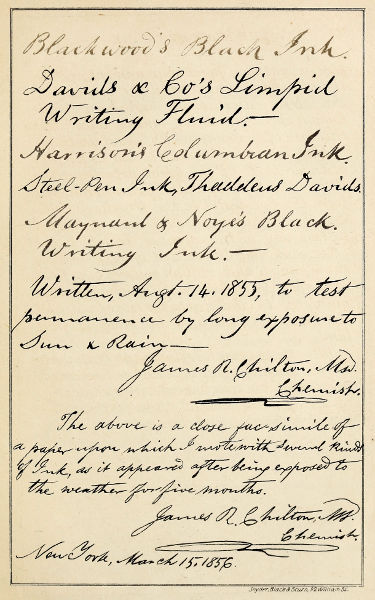
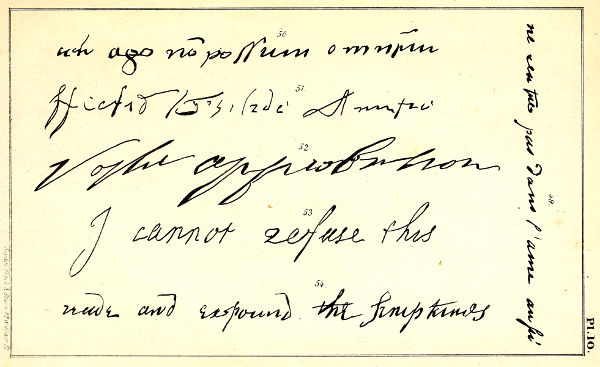
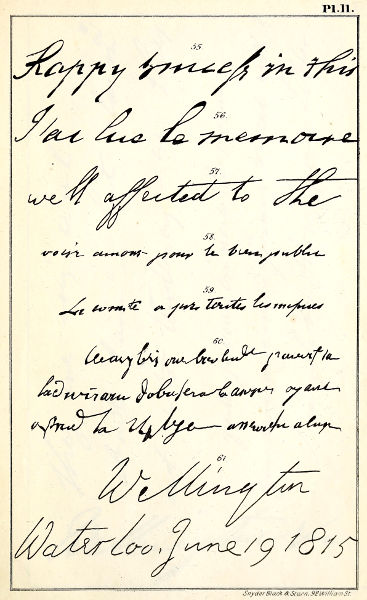
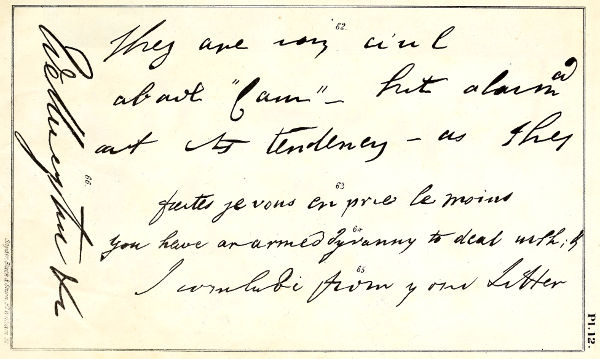
In the appendix will be found a fac-simile
of a sheet upon which various specimens
of ink were thoroughly and fairly
tested, which is a brief but emphatic demonstration
of a difference of qualities by
difference of results.
To show what can be done in the preservation
of writing on material even
frailer than such paper as we employ, we
need but produce the specimen of Egyptian
writing on papyrus, pronounced by Champollion
to have been executed more than
sixteen hundred (1600) years before the
birth of Christ, yet still in preservation
and legible, as may be seen by the representation
we give of it.
This is undoubtedly as old as any specimen
of phonetic characters or written
letters (representing sounds, not ideas or
objects,) extant, made by marking with a
fluid upon any substance. There are inscriptions
of letters upon stone, for which
an earlier date of 4000 years B.C., is
claimed with truth. But this is INK-writing,
absolutely 3500 years old!
41The Chinese assert that they had the
art of writing at a period 2950 years
before Christ; but they have no records or
monuments of that date; and their characters
even to the present time, are entire
words, representing objects, ideas or things,
not sounds. In the art of printing, they
pretend to have preceded the European
nations about 2400 years, dating their
invention of it from the tenth century
before Christ. But they have never advanced
beyond the first form of the art—letters
engraved on solid wooden blocks—the
very method in use by Koster, and his
associates, until the invention of moveable
types by John Gansfleisch, otherwise
named John Gutenberg or Guttemberg,
in 1435. In both arts, writing and
printing alike, the Chinese have remained
stiff, solid and immovable at the first step,
with the characteristic unchangeability of
the yellow races of Eastern Asia, so opposite
to the indefinitely progressive and self-improving
energy of the nations whose
progenitors proceeded west from the original
source and centre of the earth’s population.
The same ink serves the Chinese
both for writing and printing, as does
the same kind of paper. This ink they
invented about the end of the first century
of the Christian era; before which time
42they wrote on boards or bamboos. Having
next proceeded to the use of silken cloth
for these purposes, the preparation of
paper from that material naturally followed.
Their ink, being carbonaceous and
oleaginous, is, of course, (like that of the
Egyptians and all the other ancients,)
unfading, and unalterable by chemical
agencies, though capable of being effaced
or obscured by watery applications or
exposure.
As to their claim of having invented the
art of printing, we shall have something
to say hereafter.
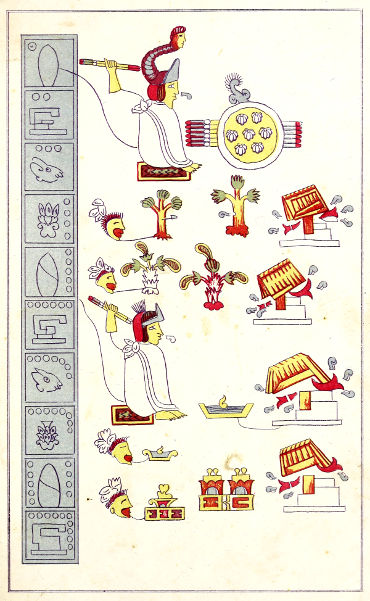
The Aztecs (in Mexico, before the
Spanish discovery and conquest,) extensively
employed a picture-writing, as a
means of recording events, during a period
not exceeding two centuries before that
epoch. They had the art of manufacturing
materials as a basis of such writing,
from the Agave or American aloe, and
from cotton, in the form of a very fine
cloth. They also used prepared skins for
the same purpose, the best specimens of
which are pronounced to be more beautiful
than the finest vellum. Their manuscripts
were sometimes done up in rolls or scrolls,
and frequently on tablets, in the form of a
folding-screen. Their inks appear to have
been coloring matters in watery solutions.
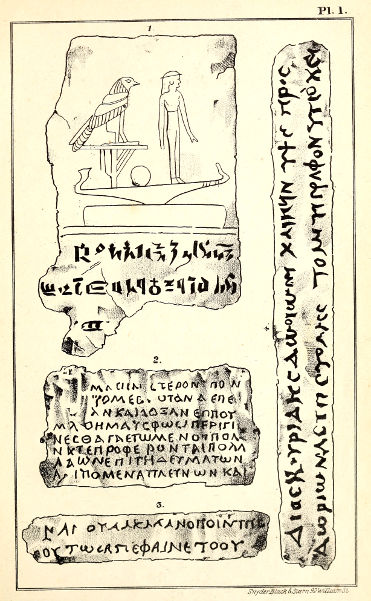
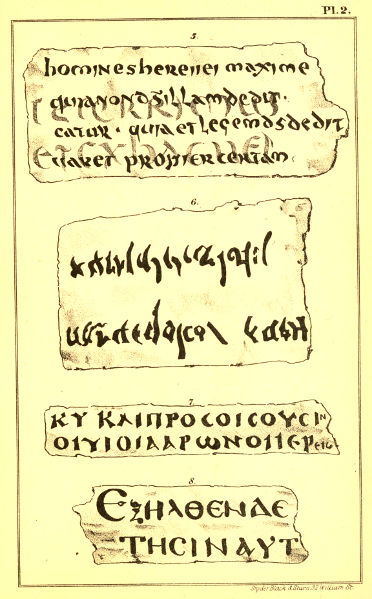
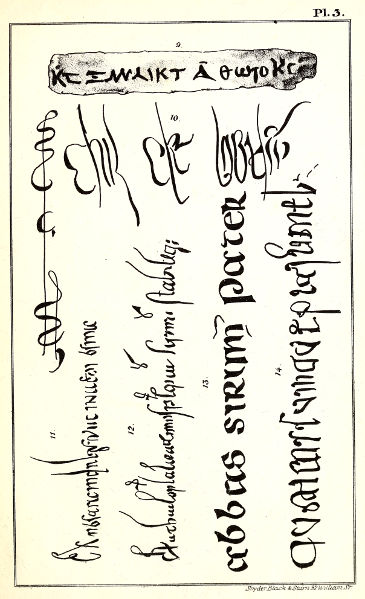
43The oldest Phoenician ink-writing of
which any specimen has been preserved,
dates no later than the second century
before Christ, and may be much older.
A fac-simile of a portion of it will be
found among our illustrations, explained
by notes referring to each by its number.
Greek manuscripts in ink (on papyrus),
of the third century before Christ, are in
existence. We give specimens of the oldest
known,—one written in Egypt, 260
B.C., being an order from Dioscorides, an
officer of the government of Ptolemy Philadelphus,
to another named Dorion. The
translation of the words is “Dioscorides
to Dorion, greeting. Of the letter to Dorion
the copy is subjoined.” * * * We add
other specimens, of the same and later
periods.
Of Latin writing with ink, the earliest
we can find is the palimpsest of Cicero’s
book, “De Republica,” which had been
partly effaced to make room for a copy of
Augustin’s commentary on the Psalms.
It is believed by the learned that the original
manuscript was executed at least as
early as the second or third century of the
Christian era. The restoration of this
manuscript, and the discovery of this long-lost
and earnestly sought classic gem, were
the work of Cardinal Mai, as before mentioned.
44The original words are TETERRIMUS
ET EX HAC VEL——, and are written in two
columns on the page, while the later writing
runs completely across the page.
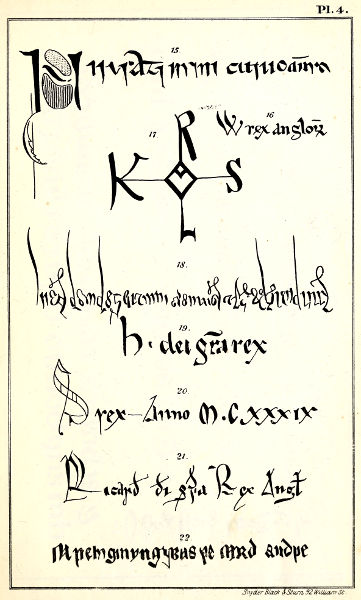
Of the earliest writing executed in
France, after that country received its
name from those who conquered it, we give
a specimen from the beginning of a charter
of King Dagobert I, executed A.D. 628.
The words are—“QUOTIESCUMQUE PETITIONIBUS”—“However
many times to petitions,”
&c. It is a confirmation of a partition
of property between two heirs. The monogrammatic
autograph of the Great Karl,
(in modern times called Charlemagne,) we
present also as an object of interest. A.D.
800.
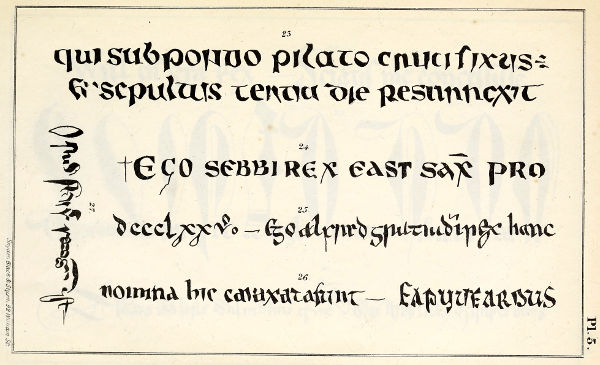
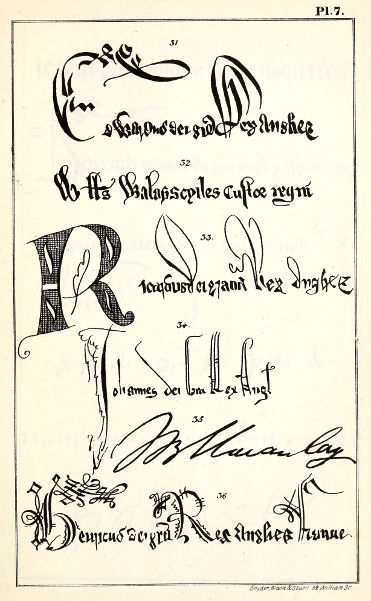
The oldest specimen of writing in Great
Britain which has been preserved to the
nineteenth century, was a book believed to
be not later than the year 600 of the
Christian era. Astle has preserved an engraved
specimen of it; but the priceless
original has since been destroyed by fire in
the British Museum. It was said to be
a book of Augustin. A specimen still in
existence, dates between the years 664 and
670. It is a charter of Sebbi, King of
the East Saxons, and is easily read:—“I,
Sebbi, King,” &c. We subjoin a few
words from the commencement of a charter
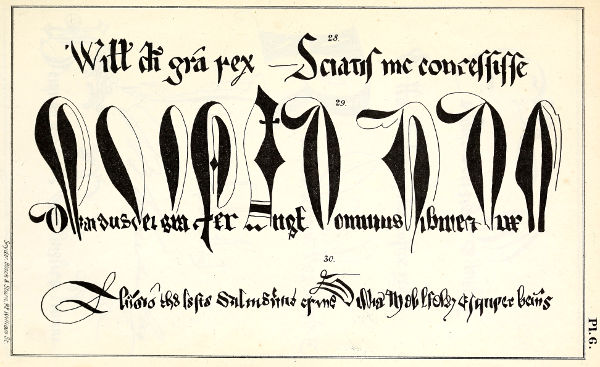
45of William the Conqueror, whose reign commenced
in England, A.D. 1066:—Will:
dei gratia rex, &c., Sciatis me concessisse—“William,
by the grace of God, King
&c.: Know ye that I have granted—”
Isaac D’Israeli, in his Curiosities of
Literature, (vol. 2, page 180, of the Boston
edition,) gives a treatise on the “Origin
of the Materials of Writing.” He commences
it with these remarkable words:
“It is curious to observe the various substitutes
for paper before its discovery.”
Now, of all “curiosities of literature,”
this little sentence is, in many respects, the
most curious. He talks of substitutes for
a thing not in existence, and not even a
subject of imagination, conjecture, or conception.
The name of D’Israeli does not
indicate an Irish origin, but there is a
strong affinity between this and those curiosities
of literature commonly called “Irish
bulls.” As for instance, it reminds us of
the couplet composed by an Irish officer
of a garrison in the Scottish Highlands, in
commemoration of the “good works” of
General Wade, who had caused excellent
military roads to be made through some of
the previously almost impassable morasses
of that region.
“Had you seen these roads before they were made,
You’d have lifted your hands and blessed General Wade.”
46Now, by way of comment on D’Israeli,
we will say that “it is very curious,” and
moreover very strange, if not ridiculous,
that he and Astle, (from whom he copies
without a full and fair acknowledgment,)
while “deeply complaining of the inferiority
of our inks to those of antiquity,”
have utterly failed to ascertain the cause
or even to notice the occasion of it. They,
as well as other writers on the subject,
observe the excellence of the ink employed
in manuscripts of earlier ages, down to the
twelfth century, and the inferiority of the
ink used from that period down to the close
of the seventeenth century, without turning
attention to the great historical fact that
the FIRST PAPER-MILL in Europe was established
in that same twelfth century.
A peculiar CACHEXY (a variety of the
disease known to psycho-nosologists as the
cacoëthes scribendi,) seems to be hereditary in
the D’Israeli family. Benjamin D’Israeli,
(the son of Isaac,) late Chancellor of the
Exchequer, &c., when he rose in his place,
as the Head or Representative of Her
Majesty’s government in the House of
Commons, to pronounce a eulogy on the
recently deceased Duke of Wellington, had
the impudence to repeat, word for word, a
very bald translation of the éloge delivered
by Lamartine a few years previous, on occasion
47of the death of one of the third-rate
marshals of Napoleon I.
The D’Israeli family are evidently
“some” of the children of Israel, who, (as
we are told on good authority,) when they
left Egypt borrowed everything they could
get, and never, so far as the record shows,
either returned the articles so obtained, or
made proper acknowledgments therefor.
The Chinese did manufacture paper
from the bark of the small branches of a
tree of the mulberry genus, (Morus Multicaulis?)
and also from old rags, silk,
hemp, and cotton, as early as the second
century of the Christian era; and it is
supposed that from them the Arabs
derived their knowledge of paper-making,
an art which they introduced into Europe
in the former half of the twelfth century,
when the first paper-mill was put
in operation in Spain, then under the
Moorish dominion; and, in 1150, this
article, as manufactured by them, had
become famous throughout Christendom.
[We use the words Arab and Moor indiscriminately
here. The former is the
name of the race; the latter is limited to
that portion found in Northern Africa.
The Moor is the Arab of the West, (Al
Mogreb, El Gharb,) in the Arabic, denominated
Mogrebyn,—a word which in Roman
48and European mouths has smoothed and
softened itself into a form suggestive of
the origin of Maurus and Mauritania.]
Now, without coming to a positive conclusion
on this subject, we feel authorized
to pronounce what appears to be a reasonable
opinion, derived from all the facts
which we have just placed before the
reader,—that the introduction of writing-paper
among Europeans, was the occasion
and cause of the invention and general
employment of modern writing-ink by
them.
The fact that the vegetable astringents
form a deep or bluish black color, when
combined with a salt of iron, had been
known from time immemorial. Among
the Romans, the atramentum sutorium,—“shoemaker’s
ink,”—was applied to a solution
of sulphate of iron employed by
them, as it is even to this day, by workers
in leather, to blacken the surface of that
material. This it does by uniting chemically
with the tannin and gallic acid, by
which the hide was converted into leather,
whose blackened particles are therefore
essentially identical with modern ink. The
“copperas-water” is to be found in every
shoemaker’s shop, where it is used to color
the cut edges of the heels and the rest of
the soles.
49As soon as the difficulty of writing
with convenience and rapidity on paper,
with the ancient carbonaceous ink, became
manifest, the resort to the atramentum sutorium
as a substitute for the atramentum
scriptorium, was a matter of course, and was
but a simple adaptation of a familiar substance
to a new purpose, requiring no great
ingenuity, and no invention whatever.
For a time, perhaps through a period of
several centuries, a mixture of the two
kinds of ink was employed by the Romans;
and this was undoubtedly the best
composition that was ever invented for the
purpose of deliberate, careful, elegant
writing, designed and required to be permanent
and unchangeable under constant
exposure and handling,—as in the case of
manuscript books before the art of printing
was known. Even as early as the first
century of the Christian era, in the time of
Pliny the Younger, and probably long
before that, a solution of sulphate of iron
was commonly or frequently added to the
carbonaceous and oleaginous mixture which
we have described as the original writing-ink.
In short, the atramentum sutorium
was added, in moderate quantity, to the
atramentum scriptorium, thus constituting it
a CHEMICAL as well as a MECHANICAL ink.
So, modern ink may be improved in blackness,
50durability and beauty, and rendered
unchangeable in color under the action of
the chlorides, acids, &c., by the intermixture
of a small quantity of the very finest
carbon, in the form of an impalpable powder.
But, the great difficulty is—that the
carbon clogs the pen, and renders the ink
too thick to flow easily, so that it can
never be used for rapid or ordinary writing.
We can not give, in our own words, a
better account of this matter than we find
in the language of a very learned author
in the Edinburgh Review, (volume 48,
Dec. 1828).
The article here cited is entitled “The
Recovery of Lost Writings,” and is
nominally a review of [1]Gaii Institutionum
Commentarii: [2]Institutes de Gaius, recemment
decouvertes dans un Palimpseste
de la Bibliotheque de Chapitre de Verone.
[3]Jurisconsulti Ante-Justinianei reliquiae
ineditae, ex codice rescripto Bibliothecae Vaticanae,
curante Angelo Maio, Bibliothecae
ejusdem Praefecti. The article begins on
page 348 of this volume of the Review.
We quote from page 366;—“The ink
which the ancients generally used, was
composed of lamp-black mixed with gum,
as we are informed by Dioscorides and
others, who give the receipt [recipe?] for
making it. Ink of this kind may be
51called carbonic: it possesses the advantages
of extreme blackness and durability, the
writing remaining fresh so long as the substance
on which it is written exists; but as
it does not sink into the paper, it is liable
to the great inconvenience of being easily
and entirely removed; for, if a wet sponge
be applied to it, the writing may be washed
away, and no traces of the characters will
remain. The facility with which documents
might be thus obliterated, gave occasion
to fraud, as an artful forger was able
to remove such portions of the original
writing as he might desire to get rid of,
and thus profit by the absence of material
words, or insert in the blanks which he had
made, such interpolations as might serve
his turn. Many common accidents, by
which books and writings were exposed to
wet, or even to damp, were also fatal, or at
least highly injurious, to compositions and
muniments of great value. Various expedients
were therefore attempted to remedy
an imperfection from which many must
have suffered severely. Pliny informs us
that it was usual, in his time, to mix vinegar
with the ink, to make it strike into the
paper or parchment, and that it, in some
degree, answered the purpose. It should
seem that vitriolic ink, such as we use at
present, was also adopted soon afterwards,
52which possesses, in perfection, the quality
that was desired of sinking instantly into
the paper, so as to make it far more difficult
to discharge it without destroying the
texture on which it is written, and of being
perfectly secure against water, by which
Indian and other carbonic Inks are so
easily effaced. It is not, however, EQUALLY
SECURE AGAINST THE EFFECTS OF TIME; for
vitriolic ink gradually fades away, becomes
paler by degrees, turns brown and yellow,
and is scarcely legible; and sometimes, as
the parchment grows yellow and brown with
age, it disappears altogether. A compound
kind of ink came next into use, which
united the advantages and avoided the defects
of the two simple sorts. Such a mixed
ink was generally used for several centuries;
and with this, the manuscripts that are now
most fresh and legible appear to have been
written. It is evident that the ink with
which the original works contained in the
Palimpsest manuscripts that have been
deciphered were written, was at least in
part vitriolic: for the letters which had
been rubbed out were rendered legible by the
application of the infusion of galls. In order
to remove the original writing, the parchments
on which the mixed ink had been
used were, probably, first washed to take
off the carbon, and thus partially to efface
53the characters, and were afterwards scraped
or rubbed with pumice, or some other suitable
substance, to complete the process
of destruction, by taking away mechanically
the color that the vitriolic portion
of the ink still preserved. It is
but too probable that many manuscripts,
the characters of which were entirely
formed of the more ancient carbonic ink,
have been entirely destroyed, the letters
having been washed off completely, and by
the same simple means as the writing of
a school-boy on a slate; whilst the parchment
still remains in our libraries, and is
covered with more modern compositions
which have sacrilegiously and too successfully
usurped the place of more ancient
and more valuable matter. The tirades
of Cyril or of Jerome, or the tawdry eloquence
of Chrysostom, are perhaps firmly
established in quarters from whence [?] the
Margites of Homer, or the comedies of
Menander, were miserably dislodged.
“A manuscript is called Palimpsest,
from the adjective παλιμψαιστος or παλιμψηστος,
signifying twice rubbed; NOT as the glossary
of Du Cange (membrana iterum abrasa—charta
deletilis) would seem to denote, because
the parchment had twice undergone
abrasure, or the writing been twice obliterated,
but because it had been twice prepared
54for writing, which was principally effected
by rubbing it with pumice, first in the
course of manufacture, after the original
skin had been cured, and again by the
same process, after the original writing had
been taken away by washing, or in any
other manner. The strict and precise
sense of Palimpsest is therefore ‘twice
prepared for writing;’ the repetition of
such preparation being the prevailing idea
in the etymology, and not erasure, as some
have erroneously supposed. It is said to
be easy to remove from modern parchment,
especially if what is written be of some
standing, all traces of writing, by rubbing
it with pumice, or similar substances; and
if the surface be afterwards polished, no
one, by merely looking on it, will ever suppose
that it had ever been written upon;
but, if it be washed by an infusion of galls,
the letters will be so far restored, particularly
if it be suffered to remain some time
in the light, that it may be copied by a
patient and practiced person, who is gifted
with good eyes:—so deeply had the iron
entered into the soul of the parchment!
If the erased letters were written in a bold
large hand, the task of deciphering them
will of course be less troublesome, and the
results more sure. And such are the characters
of the more ancient manuscripts;
55for, the older the manuscript, the better
and more legible is the writing, as approaching
more nearly to the ages of
civility and refinement. The method of
writing in old times is also favorable, it is
said, to the restoration of works apparently
obliterated. The scribe did not use
a flowing ink, nor a finely pointed pen, as
modern writers are wont; nor was a small
quantity applied so lightly and sparingly
as to dry almost as fast as it touches the
paper. The ancient ink was thick with
gum, and was supplied copiously by a pen
with a broad point, usually made of a reed;
and the characters were painted rather than
written, the ink rather resembling paint or
varnish than our thin liquor. As they
rarely wrote in books, it was not necessary
that the page should dry speedily, or be
dried by means of sand and blotting-paper,
in order to prevent the loss of time, and
that the penman might turn over the leaf
immediately; the loose sheets or leaves, on
the contrary, which were only to be bound
up when the whole was completed, were
left to dry slowly, so that the pools of ink
which formed the letters, stood long on the
surface of the parchment; and that part
of the fluid which was of a penetrating
nature was gradually absorbed, and sunk
deeply into the substance of the skin, so as
56to preserve to us—if we be not wanting to
ourselves in diligence—many precious relics
of ancient lore. The restoration of
the original writing in a palimpsest manuscript
will be best explained by referring to
one of the many kinds of sympathetic ink,
which is in truth, making common ink ex
post facto, or uniting the ingredients of
which it is composed, after the fact of
writing. If we write with water in which
copperas has been dissolved, the letters will
be invisible; but when the paper has been
washed over with an infusion of galls, they
will appear gradually, and will in time
become tolerably legible; the ink being thus
formed upon the paper, although much less
perfectly, than in the ordinary maceration.”
Little or nothing can be added to the
full and elaborate history of ancient and
modern inks which is contained in this
extract,—so thorough and complete in its
analysis of the subject, and so clear in its
distinct statements of the results of investigations
in which some of the most acute
minds of Europe have long been successfully
employed, that we will not linger
upon it with mere verbal criticism.
We can not present a more striking
illustration of the change in the composition
of inks about the time of the invention
57of the art of printing, than is furnished
by the annexed fac-simile of a page in the
Biblia Pauperum, (“Bible for poor folks,”)
the oldest printed book in the world. This
extraordinary book is of uncertain date.
(No printed book has a date prior to
1457.) There are, as we believe, only
two copies of it in America, one in the
possession of James Lenox, of New-York,—the
other in the Astor Library.
The maker of this book was the unconscious
inventor of the art of printing.
Wood-engraving was in use for ages
before it occurred to the mind of man that
a letter might be as easily reproduced in
that way as a picture or figure. To convey
scriptural history to the minds of the
common people, the wood-engravers (whose
art was invented to multiply and cheapen
the production of PLAYING-CARDS) made little
pictures representing scenes described,
and events narrated, in the Bible. For
the benefit of the few who could read, it
was customary to write on the margin, or
at the foot, of the page on which the woodcut
was printed, a few words descriptive
of the subject or object delineated. This
was always done with a pen, by a regular
scribe, until, one day, it occurred to the
wood-engraver employed on the Biblia Pauperum,
that these words might be as easily
58engraved as the figures to which they
referred, and of which they were the explanation.
He put that idea in practice: and
in an instant the sublime ART OF PRINTING
was an “accomplished fact.”
The advocates of the claims of Koster,
Gansefleisch, (or Gutenberg,) Faust (or
Fust,) and Schoeffer, to this invention,
have wasted much labor in bringing forth
conflicting testimony about them. The
long-forgotten and now wholly unknown
wood-engraver of the Biblia Pauperum had
preceded them by half of a generation.
Such books were in existence before A.D.
1420; and the earliest date which the
Haarlaem Dutchmen set up for the first
printing of their fellow-townsman, Lawrence
Koster, is 1428. And his pretensions
are after all very dubious. Indeed
they have been generally condemned as
utterly fabulous by bibliographical critics
and typographical historians.
We introduce it here to show the color
and the (thereby indicated) composition of
the INK employed. It was writing-ink.
It contained sulphate of iron (copperas),
in combination with vegetable astringent
matter, and with very little carbon. The
vegetable substance, imperfectly united to
the mineral ingredient, has (in obedience to
the laws of organic matter) been decomposed
59and “resolved into its original elements.”
It has disappeared; but the
IRON remains with its yellow stain, an
imperishable memorial of that humble,
nameless workman, more enduring than
that which the plaintive man of Uz desired;
for if those words had been “graven
with an IRON PEN and lead in the rock forever,”
that anticipated eternity might have
faded of realization by the action of the
rain, the frost, the dust, and innumerable
imaginable atmospheric vicissitudes, or,
(what is worse,) “the wrath of man.”—Some
Cambyses might have demolished
the rock itself, and left no more of the
inscription than can now be read of those
once carved on the cliffs of Edom, the God-created
walls of Petra in the valley of
El Ghor.
This pale rusty WORD-STAMPING on the
fragile and easily combustible paper, has
outlasted the inscriptions once visible in
gigantic characters on the four sides of the
Memphitic pyramids; and it is only an
incidental result of the intelligence diffused
and the learning promoted by the invention
thus begun, that we can now read the long-buried
records of Nineveh, the epitaphs
of the Thebaic kings, and the gravings on
the precipitous fronts of the mountains
which surround the ruins of Persepolis.
60All writers upon this subject have
strangely overlooked the fact that the art of
impressing or printing letters with a metallic
stamp or type on parchment, as a substitute
for pen-work, is about a thousand
years older than the period above specified
as the date of the invention of the modern
art of printing. The Codex Argenteus,
(the oldest translation of the entire Bible
into any European language,) is a famous
book, in the Library of the University of
Upsala in Sweden.
(We give the particulars of its history
in our Appendix.)
This “antique” is on purple vellum,
(which is parchment made of calf-skin,) and
all the letters are SILVER, (whence the name
Codex Argenteus, the “silver book,”)
manifestly impressed on the page by a
metallic stamp or type, each letter evidently
being on a separate stock or handle,
and applied by manual pressure. We
give a specimen of this style of work. It
may be called printing, but can not be
denominated manuscript, for that is (literally)
“hand-writing,” which this certainly
is not.
In our Appendix may be found still
earlier instances of this art as practiced by
the ancient Romans on a small scale, in
signatures, trade-marks, &c.
61The Edinburgh review refers to Pliny
and Dioscorides, as furnishing directions
for the manufacture of ink. The Edinburgh
reviewer says “receipts,”—not recognizing
the broad distinction between a
receipt and a recipe. The former of these
two words was originally intended to convey
the idea that the person who signs the
paper has got something: the latter word,
or its representative initial (℞) means simply,
“take.”
The directions of Pliny are in the following
words:—
C. Plinii Secundi Historia Naturalis.
Lib. XXXV, §25.
ATRAMENTUM.
Atramentum quoque inter factitios erit, quanquam
est et terra geminæ originis. Aut enim salsuginis
modo emanat, aut terra ipsa sulphurei coloris ad hoc
probatur. Inventi sunt pictores, qui e sepulcris carbones
infectos effoderent. Importuna haec omnia, et
novitia. Fit enim e fuligine pluribus modis, resina
vel pice exustis. Propter quod, officinas etiam aedificavere,
fumum eum non emittentes. Laudatissimum
eodem modo fit e tedis. Adulteratur fornacum balnearumque
fuligine, quo ad volumina scribenda utuntur.
Sunt qui et vini faecem exsiccatam excoquant; adfirmantque,
si ex bono vino faex fuerit, Indici speciem id
atramentum praebere. Polygnotus et Micon celeberrimi
pictores Athenis, e vinaceis facere: tryginon appellant.
Apelles commentus est ex ebore combusto facere,
quod elephantinum vocavit. Adportatur et Indicum,
inexploratae adhuc inventionis mihi. Fit etiam apud
62infectores ex flore nigro, qui adhaerescit aheneis cortinis.
Fit et e tedis ligno combusto, tritisque in mortario carbonibus.
Mira in hoc sepiarum natura: sed ex his
non fit. Omne autem atramentum sole perficitur, librarium
gummi, tectorum glutino admixto. Quod
autem aceto liquefactum est, aegre eluitur.
“Ink (or literally) Blacking.—Ink also
may be set down among the artificial (or
compound) drugs, although it is a mineral
derived from two sources. For, it is sometimes
developed in the form of a saline
efflorescence,—or is a real mineral of sulphureous
color—chosen for this purpose.
There have been painters who dug up from
graves colored coals (CARBON). But all
these are useless and new-fangled notions.
For it is made from soot in various forms,
as (for instance) of burnt rosin or pitch.
For this purpose, they have built manufactories
not emitting that smoke. The
ink of the very best quality is made from
the smoke of torches. An inferior article
is made from the soot of furnaces and
bath-house chimneys. There are some
(manufacturers) also, who employ the dried
lees of wine; and they DO say that if the
lees so employed were from good wine, the
quality of the ink is thereby much improved.
Polygnotus and Micon, celebrated
painters at Athens, made their black paint
from burnt grape-vines; they gave it the
63name of TRYGYNON. Apelles, we are told,
made HIS from burnt ivory, and called it
elephantina “ivory-black.” Indigo has
been recently imported,—a substance whose
composition I have not yet investigated.
The dyers make theirs from the dark crust
that gradually accumulates on brass-kettles.
Ink is made also from torches (pine-knots),
and from charcoal pounded fine in
mortars. “The cuttle-fish” has a remarkable
quality in this respect; but the coloring-matter
which it produces is not used
in the manufacture of ink. All ink is
improved by exposure to the sun’s rays.
Book-writers’ ink has gum mixed with it,—weaver’s
ink is made up with glue. Ink
whose materials have been liquified by the
agency of an acid is erased with great
difficulty.”
This sounds very much like nonsense:
but it is exactly what the “Great Naturalist,”
Pliny, meant when he wrote all that
he knew, and probably all that was then
known on the subject of ink, black paints
and dyes, and very dark-colored fluids
generally, which were then employed by
painters, dyers, weavers, writers and physicians.
To make his chapter on this subject
fully intelligible to us, we must bear in
mind the fact, that the great science of Chemistry
64had no existence till many centuries
after Pliny wrote. And thus, it never
occurred to him that there was but one
substance, (now known to be elementary,)
CARBON, which gave the quality of blackness
to all the materials which he names,
with the exception of one salt of copper,
and probably one of iron, (the sulphate,)
and Indigo, a purely vegetable substance,
the dried coloring matter of a plant in
India, (Indicofera anil,) and named by the
Romans from the country that produced
it, and first made it known to them.
Pedanius Dioscorides, born in Anazarbus,
(a city of Cilicia, about fifty miles
from Tarsus, the birth-place of the Apostle
Paul,) wrote a book on the Materia Medica,
or the qualities of drugs, a little after
the time when Pliny composed his Natural
History. Neither of them seems to have
been acquainted with the writings of the
other. Apparently, they lived, wrote and
died nearly or actually cotemporary, in the
same empire, utterly ignorant of each
other’s existence,—though they are now
universally recognized as the two most
eminent writers of all antiquity on the
subjects of Natural History and the Materia
Medica. They both lived in the
reign of Nero, and the date of the active
or middle part of both their lives may be
65reasonably placed at or about the year
100 of the Christian Era.
From Dioscorides to Linnæus, (in the
last century,) the Materia Medica made
no actual progress and received no scientific
improvement; yet, eminent as is Dioscorides,
he was so little known to his own
generation or that next following, that it
is now impossible to ascertain the exact
date of his birth or of his death, or any
facts in his life, but that he wrote two
books, of which that here quoted is the
best known, and has made him known
1700 years after his birth.
(We may mention that this Dioscorides
was, in no traceable degree, related to the
person of the same name, whose manuscript
we have copied in our illustrations
as the oldest extant specimen of Greek
ink-writing.)
We give a translation of his brief but
complete description of the ink used in his
time, and the Latin version, that those
who wish may satisfy themselves of the
correctness of our rendering. It will be
seen that it occurs at the close of the great
work of Dioscorides:—
Atramentum, quo scribimus, e fuligine taedarum
collecta conficitur. In singulas gummi uncias ternae
fuliginis unciae adjiciuntur. Fit etiam e resinae fuligine
et pictoria illa modo dicta. Hujus fuliginis autem
66sumi oportet minam unam, gummi sesquilibram,
taurini glutinis et chalcanthi singulorum sesquiunciam.
Idoneum est ad septica; et confert ambustis ex
aqua paullo crassius inunctum et tamdiu dimissum,
donec cicatrix obducatur, sanatis nimirum ulceribus
sponte sua excidit.
Atque jam, carissime Aree, tum pro operis modo,
quem proposueramus, tum pro materiae auxiliorumque
copia, quam colligere licuit, hucusque dicta sufficiant.
Libri quinti et ultimi de Materia Medica finis.
Pedanii Dioscoridis Anazarbei De Materia Medica.
[The] “Ink with which we write is
composed of the soot of torches, collected.
“To each ounce of gum, add three of
soot.
“It is also made of the soot of resin
and of that lately called ‘painters’ black.’
Of this soot, however,—take one MINA,—of
gum, half a pound,—of ox-glue and of
copperas, each, half an ounce.
“It is a good application in cases of
gangrene, and is useful in scalds, if a little
thickened and employed as a salve, and
permitted to remain until a new cuticle is
formed, when it will spontaneously fall off
from the healed sore.
“And now, my very dear Areas, in due
proportion to the work which we had undertaken,
and the quantity of the materials
and contributions which we could gather,
what we have thus far said must suffice.
67“End of the fifth and last book on The
Materia Medica.
“[The book] of Pedanius Dioscorides on
the Materia Medica.”
We have followed the text of Karl Gotleib
Kuhn. Medicorum Graecorum, opera quae
extant. Leipzig, 1829.
Among the fantastic trifles with which
Dean Swift was accustomed to amuse his
leisure, is a little string of verses on this
subject which are appended, not as being
of any poetic merit, but as a “curiosity of
literature”—not out of place here:—
I am jet black, as you may see,
The son of pitch and gloomy night;
Yet all who know me will agree
I’m dead, except I live in light.
Sometimes in panegyric high,
Like lofty Pindar, I can soar,
And raise a virgin to the sky,
Or her to a * * * * *
My blood this day is very sweet,
To-morrow of a bitter juice;
Like milk, ’tis cried about the street
And so applied to different use.
Most wondrous is my magic power:
For with one color I can paint.
I’ll make the devil a saint this hour,
Next make a devil of a saint.
Through distant regions I can fly,
Provide me with but paper wings,
fairly show a reason why
There should be quarrels among kings.
68And, after all, you’ll think it odd,
When learned doctors will dispute,
That I should point the word of God,
And show where they can best confute.
Let lawyers bawl and strain their throats,
’Tis I that must the lands convey,
And strip their clients to their coats,—
Nay, give their very souls away.
We find also in Pope’s epistle of Heloise
to Abeillard an allusion to the power of
letters, as conveying ideas, which seems
appropriate in this connexion as illustrating
the uses of ink.
Heaven first taught letters for some wretch’s aid,
Some banished lover, or some captive maid:
They live, they speak, they breathe what love inspires,
Warm from the soul, and faithful to its fires;
The virgin’s wish without her fears impart,
Excuse the blush, and pour out all the heart,
Speed the soft intercourse from soul to soul,
And waft a sigh from Indus to the pole.
The genius of Byron (in a playful flash)
has illuminated our subject with one of his
most brilliant passages:—
But words are things: and a small drop of INK,
Falling like dew upon a thought, produces
That which makes thousands (perhaps millions) think.
A less distinguished poet has, in expressive,
and though in quainter, humbler,
yet in noble strain, said what is equally
appropriate in this place:—
Books are a part of man’s prerogative:
In formal INK, they thought and voices hold,
That we to them our solitude may give,
And make time present travel as of old.
69Celsus, who lived in this world, about
the commencement of the Christian era,
has left a little memorandum on this subject
which is worth quoting.
We give his words entire:—
There are two kinds of bald spots
occurring on the human head,—one of them
a baldness which creeps over the scalp like
a serpent,—the other showing itself in the
form of round spaces uncovered by hair.
Some recommend the use of acrid irritant
articles, combined with oils, &c. But
there is nothing better for you than to have
the bald place shaved every day with a
[very dull] razor, and, after having done
that, you needn’t do anything else but rub
on the place thus shaved a little atramentum
sutorium—(“shoemakers’ ink,” “copperas-water,”)—[solution
of the Di-proto
sulphate of the (per) sesquoxyd of iron].
The editor of the printed copy of the
edition of the works of Aulus Cornelius
Celsus which was printed in Padua, made
a material error on this point.
The word “sutorium” (being unintelligible
to the ignorant monk who superintended
the printing) was changed to “scriptorium,”—that
is, “writing-ink,” instead
of “shoemakers’-ink.” It is well-known
that a solution of copperas properly made,
will remedy or prevent premature baldness;
70but we assert that no quantity of lamp-black
and gum, or grease, will be found
effectual for that purpose.
In the time of Celsus, the sulphate of
iron (copperas) had not yet become an
essential ingredient of writing-ink; and
even after that its combination with carbonaceous
and oleaginous matters entirely
neutralized the power which renders it
applicable and useful in such cases.

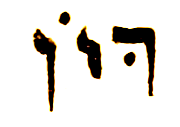
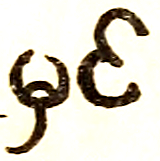
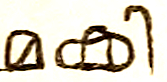
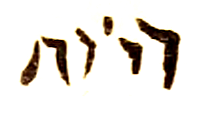 DȲŌ
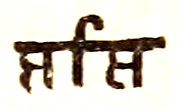
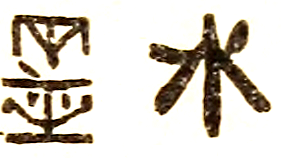 MĬH SHWUY (liquid Ink)
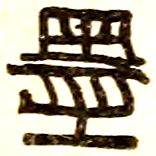
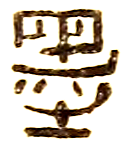 MĬH (Chinese Ink)
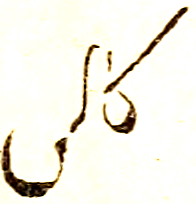 KALI
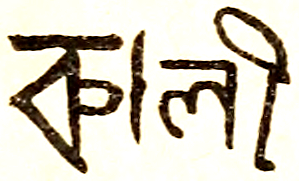 KALI
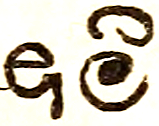
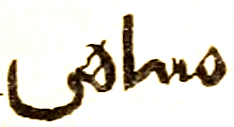 SIYAHI
 MUREKKEB
 DAWĀT
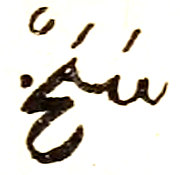 SIMEKH
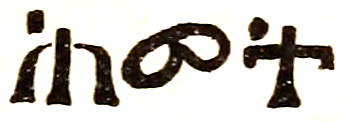
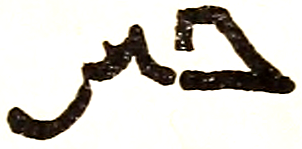 HBR, HIBR, HIBAR.
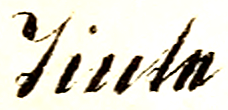 (Tinte.) {Flamande } INK
 {Lettish__BLAKKA
 DUBH