WITH the opening of the year 1870, the revolutionists had in the field
forty thousand well disciplined, and for the time being at least well
armed troops, who were under the command of efficient officers, and a
competent military organization. The movements of the troops were, so
far as possible, directed according to a concerted plan, and their
distribution through the island was governed in the same manner.
Spain had also increased her regular army, and her navy had been greatly
augmented, for she now had in Cuban waters, in addition to the
men-of-war which had at the beginning of the war been stationed there,
the following:
| 2 | iron-clad vessels | 48 | guns |
| 2 | 1st class wooden steamers | 85 | guns |
| 6 | 2nd class wooden steamers | 69 | guns |
| 1 | 3rd class wooden steamer | 2 | guns |
| 4 | steam schooners | 11 | guns |
| 6 | gunboats | 6 | guns |
| 13 | armed merchantmen | 41 | guns |
| 2 | sailing gunboats | 2 | guns |
| 1 | transport | 4 | guns |
| 1 | schoolship | 6 | guns |
About the middle of April, 1870, an occurrence happened of which the
Spanish made great capital, spreading the tidings throughout the world.
Connected with it is one of the illustrious names in Cuban history—a
name which has been borne by some of the most famous Cuban patriots.
However, it has been said that there is no family which has not its
black sheep.
Augustin Arango gave his life for his country, when he was murdered by
the Spaniards, while on the way to the conference at Puerto Principe,
under safe conduct from the Spanish leaders. Two other members of the
Arango family were prominent in the support of the revolution. It
remained for Napoleon Arango to disgrace his family. He had taken an
active part in the revolution upon its inception, but had not been
accorded a high place in the revolutionary government, or the rank which
his ambition craved in the army, because his loyalty had been suspected.
Angry and disgruntled, he made an attempt to betray his friends to the
Spanish troops. His action was, however, discovered in time, and he was
arrested, tried, found guilty and sentenced to death. The high standing
of the Arango family, and the fact that his brother had given his life
for the cause of liberty, were urged as reasons for commuting his
sentence, and he was finally taken from confinement, and driven outside
the Cuban lines, with orders never to return under penalty of having the
death sentence executed. He quickly made his way to the Spanish army.
All this happened in 1869, and for almost a year Arango had been living
under Spanish protection. Suddenly, in April, 1870, the Spanish
authorities caused the report to be circulated that Arango had
surrendered himself to them, bringing with him a large force of Cubans,
who had declared their allegiance to Spain, and the Spanish Government
in Cuba cited this as an indication of the weakness of the patriots, and
as an augury of their approaching dissolution and of the ultimate
triumph of Spain. As a matter of fact, Arango had always been a trouble
maker and a potential traitor; he had been characterized by one Cuban
officer as a "poor, despised, worthless creature," and it is needless to
say that the whole story was false from beginning to end. However,
Arango issued a grandiloquent statement, in which he explained his
supposed action, and urged the Cuban revolutionists to lay down their
arms and follow his example. His open letter to Cuban patriots is to be
recalled as one of the curiosities of treason. It ran as follows:
"Cubans!"
"When Carlos Manuel de Cespedes thought of raising the cry of
Independence and expected the other cities of the Island to second him,
he received as a reply, from the jurisdiction of Holguin and Puerto
Principe, that they would not support him; and the Cinco Villas and
other towns maintained an attitude of expectancy. Notwithstanding this,
Cespedes said that he had no need of the reminder and that he would
pronounce on the 14th of October as he did in fact but somewhat in
advance of that date. Having so many reasons, as I have, to know the
country as well as the character and tendencies of its inhabitants; and
also what Spain would do and what was to be expected of the people on
the Island; knowing moreover the policy of the United States and the
effects as well as the consequences that must follow a revolution
especially when it was an extemporaneous outburst; and being convinced
besides that owing to the heterogeneous nature of our population and to
the little enlightenment of the masses, nothing but extermination
could be expected for Cuba, I took part in framing the reply given to
Cespedes by Puerto Principe, stating that since he took pains to carry
out so wicked an idea, he should not be seconded by us; and we made
him responsible before posterity for the evils which he was about to
bring on Cuba.
"Cespedes and his inexperienced fellow-believers proclaimed Independence
at Yara without any supply of arms or munitions of war, without
provisions, clothing, etc., etc., with which to support their movement.
Ignorant of what revolution is, they bunched forth just like children
who heedlessly play with a wild beast, in entire ignorance of its
nature. The first movement of enthusiasm on the part of the people, and
of surprise on the part of the Government gave them the victory at
Bayamo; and they at once thought that the Independence of Cuba was
already secured. This was a fatal error, a sad illusion, which blunted
the common sense and gave loose rein to their passions. It was the
fatal error of those men who had not sufficient strength of will to be
able to wait. Ah! how fatal it is not to know when to wait!
"The Camagueyans were aroused at the enthusiastic shout for liberty, and
they wished to help their brethren of Bayamo, driven on by a sentiment
of fraternity and by their yet stronger love of liberty;—that noble
aspiration which God has imbued in the hearts of all men. I shared not
in these desires, although I did really in their sentiments, but I was
restrained by experience and by my knowledge of the situation. Anxious
to be of service to my country, I offered to go to Bayamo as a
representative from Puerto Principe, which I did.
"From my first steps into the Eastern Department, I was convinced of
the error into which the people had fallen, and the impossibility of
keeping up so unequal a contest. Moreover after studying the revolution
and sounding the feelings of the people, I discovered that they did not
desire the movement but had been dragged into it; without noticing in
the beginning, owing to their blind precipitation, that they were not
prepared to receive a successful issue.
"In some private circles I spoke of the propriety of changing the cry
for Independence into an acceptation of the Cadiz programme;—an idea
which was well received and seemed so to change the course of affairs,
that I saw a great risk, being threatened by the few who persisted in
their original intention. I spoke to Cespedes and made known to him the
untimeliness of the revolution; that if he really desired the welfare of
Cuba, this latter consisted in withdrawing from a war that must be
ruinous and unsuccessful in the end; that the liberties offered in the
Cadiz programme were perhaps even more than would suit Cuba, etc.,
etc. Cespedes, convinced by my reasoning agreed to my proposals; and
if he then failed to follow my advice it was, to use his own words,
because he feared that he would not be obeyed by those who had already
proclaimed for Independence. They did not understand the true policy
that should be followed in the guidance of returns. They began badly and
will end worse.
"On my return to Puerto Principe I found the country in insurrection,
dragged on by two or three men who were led wrong by their
ill-digested ideas of liberty or by their own private interest, and
whose only wish was revolution in whatever way it could be brought
about. I grieved at this mistake, but without losing heart, and always
firm in advancing the prosperity of Cuba, I called a meeting which was
held at Clavellinas. There I made known the result of my observations
during my trip to Bayamo; and after some discussions, the force of my
arguments prevailed. With one exception all agreed that we should
adhere to the Cadiz programme. I was afterwards appointed
General-in-Chief with especial charge (thus it was set forth in the
record) that I should have an interview with General Valmaseda for the
purpose noted above.
"In a conversation with that gentleman he manifested the best of
intentions in favor of a pacification, but stated that he was not
empowered by his government to make any concession. He offered
nevertheless to grant effectual ones, so soon as he could obtain the
power. He called my attention to this; that whatever the liberties which
should be granted to Cuba, the rights of the Cubans would have to be
regarded as attacked if they did not send representatives to have a
hand in everything that might be done in regard to this country.
"I knew too well the reasons of General Valmaseda, but fearing that my
fellow countrymen might not seize the force of his reasoning, we agreed
upon a truce for four days which I requested in order to call another
meeting more numerous and one which should decide the matter. This
meeting took place at Las Minas; and there as well as at
Clavellinas, the majority was not for a continuation of the war but
for accepting the Cadiz programme. Had a vote been taken, it is
certain that this choice would have carried; but I refrained from
calling a vote in order to be consistent with the Caunao district which
had made known through its delegate, Don Carlos L. Mola, Junior, that it
wished to have no voting; because in case thereof they would be bound to
its result; and that district was only in favor of accepting whatever
the government chose to grant them.
"An immense majority was in favor of the programme, and,
nevertheless, the war was kept up because those bent upon it spared no
means nor suggestion to entice away those in favor of the Cadiz
programme. That is to say that, taking advantage of family ties, of
friendships, and of an ill comprehended association, etc., etc., they
dragged along with them the unwary and the inexperienced, who were
reluctant enough and who now know their error, as I never wished to
force upon anyone (not even on my own brothers) my own ideas, nor to
make use of any other means than persuasion, in accordance with reason.
I confined myself to simply resigning the rank that had been conferred
on me and withdrew to my plantation. From that time forward, I busied
myself merely with enlightening the people, showing them the mistakes
into which they were led by those who were interested in the continuance
of the war.
"I have not sought to impose my notions upon anyone, but I do not any
the more accept those of others when my reason and my conscience reject
them. And I believe there is no right, nor law, nor reason to support
those who willingly, or through force, wish to force upon others their
own ideas however good or holy these may be.
"Those who are at the head of the Cuban government and guide the
revolution believe their triumph possible; they think their ideas are
correct and their way a good one. Very well; but not believing as they
do, I move aside from that government, whose pressure and
arbitrariness are such, that it will not even admit neutrality in
others. I will not wage war against you; I will not take up arms against
you except in personal defence; but I separate from men who wish to
impose their own notions on others through force. You are free to
think and act as you like, and I reserve to myself the same right and
act in accordance therewith.
"But there is more. In the position where, unfortunately and much
against my will, events have placed me, I occupy a place as a public
man, as a politician in Cuban politics; and I should not remain inactive
while I behold the destruction of Cuba and look out merely for my
personal safety under the protection of the Spanish government. No,
Gentlemen, I would then be a bad patriot, and I love my country before
liberty or rather I do not understand the former principle as divorced
from the latter. Both are intimately bound together; and in order that
the first be worthy, honorable and beneficial to humanity it cannot be
separated from the second.
"I am a Cuban, the same as yourselves, and I have consequently the same
right to busy myself with the welfare of my country. Let everyone have
his method; you pretend that you obey the popular will; that you are at
the head of government, because the will of the people and popular
choice; that you act in uniformity with ideas and sentiments of the
Cubans; and finally that you are provoking the welfare and prosperity of
Cuba. I shall prove entirely the contrary.
"The favorable reception with which my ideas were met at Bayamo, the
meeting at Clavellinas, that at Las Minas, and the desire—almost
unanimous—to accept the concessions offered by General Dulce, prove
sufficiently that the country wanted peace, nevertheless you maintain
war. Hence, popular suffrage in the country is but a chimera.
"Let us see how the actual government was formed. On the one side,
Carlos Manuel de Cespedes who, for himself and in his own name set
himself up as the dictator of Cuba, appointed a certain number of
deputies for the cast, at the famous meeting in Guaimaro. That is a fine
representation of popular will and an admirable republic, when the
deputies are not elected by the people! On the other hand, the assembly
at Puerto Principe was illegally constituted and entirely
unauthorized; and, finally, some deputies from the Cinco Villas—the
only ones which perhaps held a legitimate representation—met together
and formed the actual government, which they should have called the
Venetian rather than a Cuban Republic. They formed the government by
sharing with each other the offices, and they propose thus to shape
the destiny of Cuba. A handful of men thus representing over a million
souls, who have had no share in their nomination, does not assuredly
constitute popular election.
"The Cubans want the liberty of assemblage, freedom of speech, respect
of property, personal security, the liberty to leave the territory of
the Republic,—which is a right secured in all nations of the world to
every individual, they want, in fine, to be governed as the majority
choose, and not according to the will of a few. But nothing of all this
is done. Whoever puts forth ideas contrary to those of the government
or any of its functionaries, is threatened with four shots,
property is a prey to the first comer, who, with arms in hand can take
possession of what suits him; the lives of men are sported with,
just as children sport with flies; and in fine whoever attempts to
abandon the government, even without intruding to wage war on it, is
persecuted to death. Hence the conduct of said government is not in
conformity with the ideas and sentiments of the country.
"If to all this be added the arsons and the complete destruction of
Cuban wealth, the demolition of towns and—what must follow in the
end, can there be one sensible man who will maintain that all this
constitutes the prosperity and well-being of Cuba? Assuredly not.
"You employ force, deceit, terror to drag the masses on and carry
out whatever you judge beneficial for the cause of Cuba; I use only
reason, truth and the irrepressible logic of facts and of experience,
not the material argument of arms.
"Well, then, knowing as I do that the country does not want war, and
that it continues therein under the pressure of the Cuban government
in the one hand and on the others out of fear of the punishment which
the Spanish government might inflict, knowing as I do that nothing is to
be expected from the United States as it was attempted to make the
people believe; knowing that since the beginning of the Insurrection,
40,000 men have come from Spain, and that many more will come—a fact
generally unknown in this country; aware, as I am, that over 100,000 men
are under arms; that the coasts are well watched, and that the New York
Junta lacks resources to send material aid to the Insurrection; aware
moreover that the Cuba, the Lillian, the expedition of Goicouria and
others are lost resources; that the Insurrection is almost stifled in
the East and in the Cinco Villas; that in the Vuelta-Abajo far from
there being any secessionists, it is the country people themselves who
pursue the insurgents, as has taken place in Guines; knowing as I do
that the families to be met with in the fields are anxious to return to
the towns; and aware of the importance attached to my conduct, both in
the Island and abroad, I have made a new sacrifice for my country. I
have come forward with my family to prove by my example that I do not
believe in the triumph of the Insurrection, nor do I fear the Spanish
government; which animated as it is with the best of wishes is ready to
draw a veil over the past, provided the country can be pacified and many
tears, much blood and loss of property be spared.
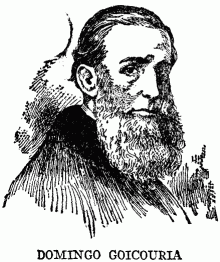
DOMINGO GOICOURIA
General Domingo Goicouria, one of the pioneers of Cuban
independence was born in 1804, and was an active participant in the
Lopez expeditions and other uprisings. He was one of the leaders in
the beginning of the Ten Years' War, but was captured by the
Spaniards, at Cayo Guajaba, and was put to death at Havana on May
14, 1870.
"It is a sacrifice indeed, Gentlemen, for I expose my name to the
evil-tongued and make it the butt of false interpretations.
"I believe firmly that the happiness of Cuba and the welfare of humanity
consists in the pacification of this beautiful country, and maintain
this in the presence of the whole universe with my hand on my conscience
and head erect as becomes a man of honor.
"There is no man who is infallible, and perhaps my opinions and
determination may be wrong; but I can at least affirm that I am acting
in good faith, having for sole object in view the welfare of my country
and of humanity and making total abstraction of my own personality, as
well as of my own interests.
"I am not a time server but a man of fixed principles; I am convinced of
my opinions and feel the energy of my convictions. I now maintain what I
have maintained since the beginning of the revolution, even previous
thereto. My actual conduct is not therefore an apostasy but the
energetic continuance in my opinions and principles. These I do not mean
to impose on any one; merely make them known, inviting all to examine
them in every detail, and I am sure that they will follow my example.
But if blind to reason and unmindful of the events which for a year and
a half have supported my predictions, they persist in a struggle which I
believe hopeless, let them keep on, but without extending the horrors
of war to families. Let the women and children whom government wishes
to foster and daily supports with rations of bread, rice, butter,
etc., come to the city; and let you keep on, if unfortunately you refuse
to listen to the voice of reason and patriotism, in that senseless
contest, which you must later repent having ever begun.
"Reflect a moment; examine thoroughly, and not merely the appearances of
the situation, and you will see that the existing strife is an
unqualifiable mistake, and its continuation an unparalleled
blindness.... What has become of the intelligence of Cubans? Where are
the energy and the influence of men of intelligence and character?
" ...Cubans! You have seen that I have always been a protector to the
people; that I have tried to enlighten them, that they might have a
participation in everything and know what they were doing, so as to
follow their own ideas and not be carried off by others; but what has
been the result? I was treacherously and illegally arrested, at the
request of those who wish to rule the masses; I was sentenced to death,
and over twenty times they have tried to put an end to my life....
Natural sense shows clearly that when an attempt is made to annihilate
him who speaks the truth, who enlightens and never deceives; who
instead of speculating on his fellow countrymen and growing rich on the
revolution makes use of his own means to succor the masses (let all
Yaguajey speak); who never makes use of any pressure to enforce his
ideas, who allows himself to be ruined from the neglect of his own
interests, in order to give himself up solely to the welfare of his
country; does it not show clearly, I say, that the attempt is made only
because his adversaries have different pretensions and a different line
of conduct from his? Now what is this difference? It consists in
violence, deceit, the use of force, spoliation of the neighbor for
his own benefit; it is despotism, based on the ignorance in which the
people are kept. I have sought to have the country governed as it is its
wish to be governed, in accordance with universal suffrage; your
government, on the contrary, pretend to rule it as they see fit. They
state that they want liberty for the people whilst the most cruel
despotism weighs upon you....
"The people are told that from the United States will come reinforcement
and resources; that there are elements to spare for the continuation of
the war; that the Spanish soldier carries a cartridge-box and wears
shoes of rawhide and is short of provisions; that there are no troops
nor will any come from Spain; that the taxes are ruining the
country, etc., etc. Well, I ... tell you all this is illusion, deceit,
and a fatal chimera.
"The government of the United States does not busy itself nor can it
with the Cuban Insurrection. Look at Article 16 of the Treaty of 1797
and you will learn that they cannot favor the Cubans in the least
efficacious way without failing in national dignity and exposing
themselves to a coalition against themselves. That government is too
polished and financially shrewd to compromise itself in a war that would
entail serious mischief upon its commerce; and moreover there are other
motives that would be too lengthy to detail....
"I have just read a manifesto of Manuel Quesada, published in New York
under date of the 8th inst., in which he sets astray entirely the
opinion that should be formed of the state of insurrection. I shall tear
off the bandage. He states that the Cuban army numbers 61,000; that
there are here five powder factories; that firearms are manufactured
here as well as swords and bayonets; that there are thirteen public
schools and thirteen churches; that three thousand shoes are made every
week and four thousand hides tanned every month; that the soldier
receives for daily ration, beef, sugar, coffee, vegetables and rice at
his discretion, tobacco, etc.; that there are many sugar mills grinding
for the state; that several warehouses are filled with tobacco, sugar,
hides, etc., to the value of many millions of dollars, that the
territory which is occupied by the Cubans in insurrection is in a
cultivated and producing condition, such as has never before been
witnessed, even during years of the greatest abundance; that thousands
of percussion caps are daily made; that he (Quesada) left here under
commission of importance after having temporarily put Jordan in command
under instructions, as well as the other leaders, etc., etc., to an
endless length. I address you, fellow countrymen, who are there on the
ground of this insurrection, whence I have lately come. You all, as well
as myself, know that all these things are false, entirely false.
"Quesada states that he has gone to seek means and bring arms, with
which to end the insurrection, but for what does he need them if he has
61,000 men? Is it possible that it should not occur to the inhabitants
of New York to ask him what need he has of more means when he has so
many thousand men? When he has over 20,000 arms and can make more as
well as powder and caps? Why has not that soldier of fourteen years'
campaigning taken possession with that army of one single town at
least wherein to locate the government of the republic? Why has he not
captured one single port through which to get aid, export the
productions of the country to the value of millions, and thus acquire a
right to recognition as belligerents? Where are schools? Where are
those churches? Have those at Guaimaro and Sibarncu, which were
burned by that renowned general been perchance rebuilt? Why are the
soldiers unshod or wearing strips of raw hide if there are three
thousand shoes made weekly and four thousand hides tanned per month?
Where is the abundance for the soldier? Where has he got coffee,
rice, tobacco, etc.? Where are those sugaring mills in regular running
order?... Then as to the commission of Manuel Quesada and his separation
from command, do you know as well as I do that he was ignominiously
deposed by the Chamber, and that during his stay in Cuba, from his
first arrival his conduct has been blameworthy under all aspects?
"Well, then, Cubans, this is the plan followed from the beginning of the
revolution. They are deceiving you and our brethren in New York as well
as the whole world. For these reasons I say that the edifice is raised
on insecure and imaginary foundations. For these reasons have I always
tried to undeceive the country and let them see clearly, so as to
prevent Cuba from sinking into the abyss wherein she is intended to be
cast. Withal I have not been understood. There has been no lack of
someone who, out of exaltation and under pressure of some sad aberration
has qualified my conduct as treasonable. Ah! Whoever stated that knows
not even the meaning of his words! When did I ever recognize this
government? Never; but rather have I always been in opposition thereto.
For as I wish my country's welfare I could not second an illegal,
arbitrary, despotic government that is annihilating our land.
"They recognize their error, but they have not loyalty enough to confess
it, they are aware that they are neither statesmen nor lovers of
liberty, nor patriots and their consciences sting them; they know that I
have always seen farther than they could, and more clearly, that all my
predictions have been fulfilled; that I have been alone in maintaining
energetically my principles; bearing up against all kinds of privation
and danger; and they do not forgive me for these advantages over them;
they know that my past and my present career have been free from all
stain; and they do not forgive me for that.
"Well, if to have thus behaved, to have made entire abstraction of self
and my interests, to look after the welfare of Cuba, to have done harm
to no one, but much good; far from having taken life, to have saved the
lives of many, without distinction of nationality; to have respected
always the property of others, and never have let my hand touch the
incendiary torch, to forward pacification, when I know that the country
needs it; and that by it alone can tears, blood, and destruction be
prevented;—if to have done all this constitute treason, ah! then I am a
traitor; yes, Gentlemen, I am one and feel proud of it.
"Your government claims to favor liberty for the country; why then does
it not consent to freedom of one's principles? Why does it not admit
of neutrality? Why does it force people to take up arms without
distinction of persons? Why has it always been opposed to speaking
out in public? Why did it oppose the country's acceptance, when so
close, of General Dulce's concessions? Why does it persecute to
death whoever tries to separate himself from said government without
having any intention of waging war against it? Why? I will tell you.
Because then there would remain in the camp of the insurrection only a
dozen men; the only ones interested in the continuance of this war
between brethren; this war of desolation and extermination.
"I agree that there was reason for the Cuban people to complain and be
resentful against the government that ruled them; but all this has
changed, not only with regard to the institution but as to the manner of
being as well. I am myself an example of what I state. I presented
myself to the Captain-General who received me in such a way as to prove
by his manner alone, his good wishes; even if these were not confirmed
by the conduct which he followed in the Villas and wherever he has been
able to make the impress of his own feelings felt. In his proclamation
he offers a pardon to all who will present themselves; but as every
medal has its reverse, so whoever fails to do so must suffer the cold
and inexorable rigor of the law.
"Fellow-countrymen, my brethren, let us throw a veil over the past. Let
us look to the future of our families and to the prosperity of our
nation.
"You know well how many persecutions, privations and even vexations I
have suffered. I forget it all and forgive from my heart all who have
sought my death and wanted my blood. I forgive all who, directly or
indirectly have offended me, of whatever nation or condition they may
be. I sacrifice all, all, on the altar of my country, and for the
welfare of humanity. Why do you not follow my example?
"Brethren! let there be no more tears, no more blood, no more ruins!
Return to your presides and let a fraternal embrace unite forever both
Spaniards and Cubans and let us all together make of this beautiful
Island—the Pearl of the Antilles—the Pearl also of the world. Cubans,
I await you, and the undeserved consideration shown to me by the first
authority of Cuba which fortunately is held by Señor Don Antonio
Caballero de Rodas I offer to use in your behalf. For myself I seek only
the satisfaction of having always forwarded the welfare of Cuba.
"Napoleon Arango.
"March 28th, 1870."
The italics are Arango's and his alone also the extraordinary sentiments
expressed in this remarkable document.
In this same year, the question of slavery came up for attention. While
the United States government had abandoned its attempt to mediate
between Spain and Cuba it had, of course, by its own action during the
Civil War, definitely arrayed itself against slavery wherever it
existed, and it now, through its Minister to Spain, Daniel E. Sickles,
entered into negotiations with the Spanish government, looking to the
actual freeing of the slaves in Cuba.
Of course news of these happenings did not fail to penetrate Cuba and to
reach the ears of the Captain-General. Indeed he seemed to have a
premonition of them, even before the United States government had
definitely taken up the matter with Spain. He was nothing if not an
opportunist, and he, therefore, on his own account, on February 24,
1870, issued a decree which had the effect of freeing two thousand
colored prisoners of war, and which read as follows:
"Superior Political Government of the Province of Cuba:
"Decree:
"By virtue of the faculties with which I am invested, and in
keeping with the royal decree of the 27th of October, 1865, I think
fit to extend by decree of the 21st of September, ultimo, declaring
exemption from dependency on the government the expeditions
entitled Puerto Escondido, Cabanas 10, Cabanas 85, Cabanas San
Diego de Minez and Trinidad.
"In consequence thereof the employers who have in their service
emancipated slaves of the referred-to expeditions, will present
them in the Secretary's office of this superior government within
the period of one month, in order that, after the usual
formalities, they may receive their letters of exemption.
"At the same time, the governors and lieutenant-governors will
publish this direction in the periodicals of their respective
jurisdictions, so that it may come to the notice of the holders of
these emancipados and they cannot allege ignorance of it.
"Caballero de Rodas.
"Havana, February 24, 1870."
Rodas was crafty, and he now thought of a device which under the guise
of mercy would hamper the Cuban army. On May 26th he promulgated a
second decree freeing all slaves who had acted or would act as guides to
the Spanish army, or render any like valuable service to the government,
an effort, of course, to induce the former servants of patriots to
betray their masters and the Cuban army into the hands of the Spaniards.
To disguise the baldness of this attempt at corruption, he also included
a provision, freeing all slaves belonging to the insurgents or who had
escaped to foreign countries. This provision was for all practical
purposes meaningless and without any value, because the Cubans
themselves who were fighting for freedom from Spain had already
emancipated their slaves.
Meanwhile negotiations between Sickles and the Spanish government
resulted in the promulgation of a decree, which was known as the Moret
law, acquiring its name from the Spanish Minister of Colonies, whose
signature was one of many signed to the document, and who is reported to
have had a hand in its composition. It bore date, July 4, 1870, and was
promulgated by the Captain-General nearly two months later, as follows:
"Superior Political Government of the Province of Cuba:
"His Excellency the Regent of the kingdom communicates to me, under
date of July 4th ultimo, the following law, which has been
promulgated or sanctioned by the Congressional Cortes:
"Don Francisco Serrano of Dominguez, Regent of the kingdom, by the
will of the sovereign Cortes, to all to whom these presents shall
come, greeting:
"Know ye that the Congressional Cortes of the Spanish nation does
hereby decree and sanction the following:
"Article 1. All children of slave mothers, born after the
publication of this law, are declared free.
"Article 2. All slaves born between the 18th of September, 1868,
and the time of the publication of this law, are acquired by the
state by the payment to the owners of the sum of twenty five
dollars.
"Article 3. All slaves who have served under the Spanish flag or
who have in any way aided the troops during the present
insurrection in Cuba are declared free. All those are equally
recognized as free as shall have been so declared by the superior
government of Cuba, by virtue of its jurisdiction. The state shall
pay their value to their masters, if the latter have remained
faithful to the Spanish cause; if belonging to insurgents, they
shall receive no indemnity.
"Article 4. Slaves, who, at the time of the publication of this
law, shall have attained the age of sixty years are declared free,
without any indemnification to their owners. The same benefit shall
be enjoyed by those who shall hereafter reach this age.
"Article 5. All slaves belonging to the state, either as
emancipated, or who for any other cause are at present under the
control of the state, shall at once enter upon the full exercise of
their civil rights.
"Article 6. Those persons freed by this law who are mentioned in
articles 1 and 2, shall remain under the control of the owners of
the mother, after the payment of the indemnity prescribed in
Article 2.
"Article 7. The control referred to in the foregoing article
imposes upon the person exercising it the obligation to maintain
his wards, to clothe them, care for them in sickness, giving them
primary instruction, and the education necessary to carry on an art
or trade. The person exercising the aforesaid control acquired all
the rights of a guardian, and may, moreover, enjoy the benefit of
the labor of the freedman, without making any compensation, until
said freedman has reached the age of eighteen years.
"Article 8. When the freedman has reached the age of eighteen
years, he shall receive half the wages of a freedman. Of these
wages, one half shall be paid to him at once, and the other half
shall be reserved in order to form a capital for him, in the manner
to be determined by subsequent regulations.
"Article 9. On attaining the age of twenty-two years, the freedman
shall acquire the full control of his civil rights and his capital
shall be paid to him.
"Article 10. The control will also be annulled: first, by the
marriage of the freedman, when the same is entered into by females
over fourteen years and males over eighteen years old; second, by a
proved bad treatment on the part of the guardian or his
noncompliance with his duty, as stipulated in Article 7; third,
should the guardian prostitute or favor the prostitution of the
freedwoman.
"Article 11. The above mentioned control is transmissible by all
means known in law, and is also resignable when just motives exist.
Legitimate or illegitimate parents who are free shall be permitted
to assume the control of their children by the payment to the
guardian of the same of any expense he may have incurred for
account of the freedman. Subsequent regulations will settle the
basis of this indemnification.
"Article 12. The Superior civil government shall form, in the space
of one month from the publication of this law, lists of the slaves
comprised in articles 3 and 5.
"Article 13. The freed persons mentioned in the foregoing article
remain under the control of the state. This control is confined to
protecting them, defending them and furnishing them the means of
gaining a livelihood, without limiting their liberty in the
slightest degree. Those who prefer to return to Africa shall be
conveyed thither.
"Article 14. The slaves referred to in article 4 may remain with
their owners, who shall thus acquire control over them. When they
shall have preferred to continue with their former masters it shall
be optional with the latter to give them compensation or not, but,
in all cases, as well as in that of the freed persons being unable
to maintain themselves by reason of physical disability, it shall
be the duty of the said former masters to feed them, clothe them,
and care for them in sickness. This duty shall be a concomitant of
the right to employ them in labors suitable to their condition.
Should the freedman object to the compliance with his obligation to
labor, or should he create disturbances at the house of his
guardian, the authorities will decide the questions arising
therefrom, after having first heard the freedman.
"Article 15. If the freedman of his own free will shall leave the
control of his former master, the latter shall no longer be under
the obligations mentioned in the foregoing article.
"Article 16. The Government shall provide the means necessary for
the indemnifications made necessary by the present law, by means of
a tax upon those who shall remain in slavery, ranging from eleven
to sixty years of age.
"Article 17. Any act of cruelty, duly justified as having been
indicted by the tribunals of justice, will bring with it as a
consequence the freedom of the slave suffering such excess of
chastisement.
"Article 18. Any concealment impeding the application of the
benefits of this law shall be punished according to title 13 of the
penal code.
"Article 19. All those shall be considered free who do not appear
enrolled in the census drawn up in the Island of Porto Rico the
31st of December, 1869, and in that which will have been drawn up
in the Island of Cuba on the 31st of December of the present year,
1870.
"Article 20. The Government shall make a special regulation for the
execution of this law.
"Article 21. The Government will report to the Cortes when the
Cuban deputies shall have been admitted, a bill for the compensated
emancipation of those who remain in slavery after the establishment
of this law. Meantime this emancipation is carried into effect; the
penalty of the whip, authorized by chapter 13 of the regulations
for Porto Rico and Cuba, shall be abolished; neither can there be
sold separately from their mothers children younger than fourteen
years, nor slaves who are united in matrimony.
"By a resolution of the Congressional Cortes the foregoing is
reported to the Regent of the Kingdom for its promulgation as a
law.
"Manuel Ruiz Zorilla, President.
"Manuel de Lianos y Persi, Deputy Secretary.
"Julian Sanchez Ruano, Deputy Secretary.
"Francisco Xavier Carratala, Deputy Secretary.
"Mariano Ruiz, Deputy Secretary.
"Palace of the Cortes, June 23, 1870.
"Therefore I order all tribunals, justices, officers, governors and
other authorities of whatsoever class or position, to obey the same
and cause it to be obeyed, complied with and executed in all its
parts.
"Francisco Serrano, Minister of Ultramar.
"Sigismondo Moret y Prendergast.
"San Ildefonso, July 4, 1870.
"And, having opportunely omitted the publication of the same for
the want of the regulation referred to in Article 20, and having
received the sense in which said document is to be drawn up, I have
ordered the exact compliance of said law, in virtue of which it is
inserted in the Official Gazette for future guidance.
"Caballero de Rodas."
"Havana, Sept. 28, 1870."
If these decrees were intended to fill the insurgents with gratitude,
and to have the effect of halting the revolution, they fell far short of
their mark. In the first place, the Spanish Government had too often
tricked her Cuban subjects, and they had little cause to have faith in
either her good will or her good intentions, and much more cause to
believe that her action was intended as a sop to the Government at
Washington, an attempt to "pull the wool over the eyes" of American
sympathizers, and even a very cursory glance at the provisions of the
Moret law would convince even a layman with no knowledge of
jurisprudence that there was small chance of their ever being enforced.
It is true that this law provided for the freedom of all slaves born
after a certain date, but it left them in the care of their mothers, and
under the control of their former masters, condemned to serve without
pay and virtually free only in name. It also proclaimed the freedom of
slaves who had reached the age of sixty years and who very likely had
endured years of such hard treatment that they were infirm and in no
condition to support themselves. If they were reluctant to start life
alone and either by timidity or by coercion remained with their masters,
the latter were at liberty to pay them or not, and when a Spanish
planter had the option of obtaining labor free rather than paying for
it, there was not much room for doubt as to what course he would pursue.
The whipping post was abolished, but the Cubans were too busy with other
matters to patrol the country in search of violations of this
regulation, and the masters were pretty safe to conduct themselves as
they chose. This law, which contained such fair words that it met with
the approval of the American minister, was almost ludicrous in its
paradoxical terms, and instead of impressing the patriots with the
softened hearts of their tyrannical masters, it must have filled the
intelligent ones with mirth.
Besides this, since upon the declaration of the independence of Cuba the
revolutionary government had declared the freedom of all men on the
Island, Spain's action so long afterward was like opera bouffe, or
rather a grimly amusing anti-climax. As a matter of fact the Moret law
remained a dead letter, unenforced, overlooked, violated, almost
forgotten, and the subject of slavery again fell into the background,
while the war took the front of the stage.
Spain was having constantly to reinforce her army, and she was unable to
do this in sufficient numbers to make up deficits properly. The climate
of Cuba was very hard on the new recruits who had not become accustomed
to it, and Spain lost almost as many by disease as she did in battle.
She renewed her cruelties against the unprotected Cuban planters, and
not only burned and pillaged, but subjected all captives to the most
revolting and sickening cruelties, gouging out eyes, cutting out
tongues, crucifying and hanging men by their hands. Probably the
atrocities practiced by the Spaniards in this war were never equalled,
unless we recall the barbarities which they practiced later in 1895,
until the Huns of Prussia invaded Belgium and France in the great war of
1914-18, and showed what inefficient novices in deviltry the Spanish had
been when compared with the disciples of "Kultur."
The year 1871 opened brightly for the patriots. That seasoned warrior
General Jordan led a company to victory, at Najassa, against a force of
Spaniards under General Puello. The Spanish losses were especially
gratifying, if that term may be employed, since they included thirty-six
officers.
Meanwhile Rodas, in spite of his methods, which must have been most
gratifying to them, fell into disfavor with the Volunteers, and they
exerted their power against him, finally effecting his resignation and
the elevation of Count Valmaseda in his place, in a temporary capacity,
until another Captain-General could be sent from Spain.
NICOLAS AZCARATE
Nicolas Azcarate was the founder of the New Lyceum of Havana which
for years was the centre of the intellectual life of that city, and
his home was the resort of the literary and artistic world. Papers
read at his receptions by eminent men were published in two volumes
under the title of "Literary Nights." He was born in 1826 and died
in 1894, leaving a literary influence which is still gratefully
perceptible.
Spain once more made overtures to the United States Government, asking
it to use its offices in eliciting from the revolutionary government
some statement of terms which would be satisfactory to them as a basis
of peace. Since former efforts to bring the belligerents together had
been so productive of failure, Washington demurred from officially
undertaking the matter; whereupon Don Nicolas Azcarate went to
Washington from Spain with authorization to offer to the insurgents an
amnesty, and disarmament of the Volunteers, provided the Cubans laid
down their arms. They were further to be granted the immediate and
unconditional emancipation of slaves, irrespective of age and condition
of servitude. All confiscations made by either side were to be annulled,
and the property thus seized was to be restored to the original owners.
Religious freedom, free speech, and free assembly, were to be granted
the Cubans, while Cuba was to have representation in the Spanish Cortes,
and to be governed by colonial autonomy, similar to that which Great
Britain maintained in her American provinces. Last of all, and by no
means least, all officials who were offensive to the Cubans were to be
removed from office. Of course, these instructions were confidential,
because of the offense which they would have given the powerful
Volunteers. The United States, however, did not undertake to transmit
the proposed terms to the insurgents, and finally Azcarate undertook to
do so on his own initiative. He had little faith in the fate which his
proposal might meet, should it be transmitted through Spanish sources in
Cuba and its terms be divulged to the Volunteers. He doubted whether it
would ever reach President Cespedes. He therefore decided to transmit it
by special messenger, for this purpose choosing Juan Clemente Zenea, a
man in whose discretion and resourcefulness he had the greatest faith.
To make the journey safe for his envoy, he obtained from the Spanish
minister at Washington a safe conduct for Zenea, ordering the military
and naval authorities of Cuba, as well as the Volunteers, to afford safe
passage to Don Juan Clemente Zenea "into and out of any port on the
Island of Cuba." Zenea reached President Cespedes without accident and
laid the proposition before him, which was promptly refused. The
Volunteers, meanwhile, had learned of Zenea's coming, and of the nature
of his errand. Even the greatest of secrecy could not have kept the
knowledge from them, for their spies were everywhere active, not only in
the Island, but in the United States and at the Spanish court as well.
When Zenea left the Cuban lines, he was immediately seized by the
Volunteers and imprisoned at Havana, under heavy guard. The news of this
occurrence reached Spain and immediately the Duke de la Torre, then
President of King Amadeus's Council of Ministers, protested to the
authorities at Havana, and insisted that Zenea be released and be given
safe conduct from the Island. But the will of the Volunteers was more
powerful in Cuba than were the wishes of those high in authority in
Spain, or than the common tenets of decency, right and justice. Zenea
was not released and he was not given safe conduct. After many months'
imprisonment under the most revolting conditions, he was condemned to
death without trial, and on August 15 was taken out and shot in the
back.
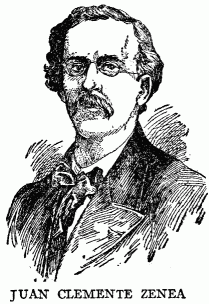
JUAN CLEMENTE ZENEA
Poet, patriot and martyr, Juan Clemente Zenea was born at Bayamo in
1831, and in boyhood settled in Havana. He was a teacher in La
Luz's school, El Salvador, and wrote some exquisite poems. But
politics and Cuban independence claimed his chief attention. From
his seventeenth year he was incessantly engaged in revolutionary
conspiracies, in Havana and in New Orleans and New York. In 1868,
he went to New York where he was an active member of the Junta. In
1870, he was sent on a mission to President Cespedes, which he
accomplished but soon afterward was captured by the Spaniards,
imprisoned in Cabanas, and then shot.
This action would hardly have been conducive to good feeling between the
opposing leaders, even had the Cubans had faith in Spanish promises. In
too hard a school had they learned that it was useless to expect the
Spanish authorities on the Island to keep their word to the Cubans,
either in the small matter of a safe conduct for an innocent messenger,
or the larger one of proposed concessions to an oppressed people. The
Cuban government was not to be thus easily lured from their attempts to
secure the one thing which was to them paramount, the real object for
which they had made so many sacrifices, the absolute independence of the
Island. Moreover, even were the promise made under the guarantee of the
United States Government, the Cubans could not be convinced of the good
faith of Spain, or that when once they had abandoned their struggle,
laid down their arms, and given Spain the advantage, she would act
otherwise than she had during her entire occupation of the Island. They
felt sure that if her advances were graciously met, she would, when she
again had the balance of power, simply impose upon the Island new
indignities, and cover her treachery with fair words and vague promises
whenever the United States might enter a protest.
Spain expressed indignation at the shortsighted policy of the Cuban
leaders, and then gave demonstration of how she intended to punish Cuba.
She renewed her persecution of individual Cubans, and her cruelty toward
Cuban sympathizers who while nursing their cordial feelings for the
revolution had not yet taken up arms against Spain. It was only
necessary that such persons should be suspected, and that suspicion
might be of the slightest variety. They were immediately seized and
thrown into dungeons and tortured to extract their confessions; the
right of trial was at this time almost entirely dispensed with, and
victims of Spanish wrath were put to death without an opportunity to
defend themselves, and executed in ways which are usually associated
with the most barbarous savageness. So glaring did these outrages become
that General Cespedes undertook to write a letter to the Spanish
Government at Madrid concerning them, although why, knowing the
character of his opponents as he did, he should have entertained the
idea that this mild intervention on his part would have the slightest
effect, or should have imagined that Spain was not cognizant of the
actions of her legionaries in Cuba, and that such actions were performed
without her fullest sanction, is not revealed. Cespedes certainly
displayed a childlike faith in the ultimate spark of good in depraved
human nature, when he took up his pen for such a communication. But be
that as it may, he addressed the following epistle to the "Supreme
Government of Spain."
"The respect inspired by the laws of nations, which, under the influence
of modern civilization has, as far as possible, deprived war of its
savage character, imposes on us the obligation of addressing the Spanish
Government an energetic remonstrance, in consequence of several
offensive acts, which could not be known without causing offense to the
civilized world. From the time when the standard of Independence was
raised in Cuba, unworthy motives have been attributed to our contest. We
shall not explain the justice of the Cuban Revolution, for such an
explanation would be unpleasant to that Government, and besides it is
not now necessary; but we may say, in general, a colony is justified in
severing the knot which binds it to the mother-country, if it possesses
sufficient elements to live independently.
"Colonial life is restricting, it can never entirely satisfy the
aspirations of an intelligent people, and, therefore, it cannot be
justly imposed upon them when they are in a position to maintain their
political existence.
"A vicious rule, which was dissipated in Spain by the popular rising of
September, made worse, we might say intolerable, the colonial existence
of the Cubans.
"The Cubans have decided to conquer with the sword, as they can obtain
in no other manner the exercise of their most important rights. Weighty
motives prevent their government from being more explicit in so delicate
a matter, but it is certain that only taking into consideration the
results of the war, no other relations are now possible between Cuba and
Spain, than those of a friendly spirit based on the condition of perfect
independence.
"In addition to what we have already stated, a political party armed
from commencement of the struggle, under the denomination of Spanish
Volunteers, and known by their intolerance and retrograding tendencies,
have converted a question of ideas into a question of petty personal
interest; wresting the authority from those delegates of that
government, and imposing their caprices like laws; giving an indecorous
character to official manifestations relating to the revolution; and in
entire forgetfulness of the rights of man, have perpetrated incredible
crimes, which cast a blot on the history of Spain in America.
"To relate all in detail would be very painful to us, and to the
government whom we are addressing.
"It is sufficient to say that the troops charged with preserving the
Spanish dominion occupy themselves, in preference, in persecuting the
families who reside in the territories of the Republic, by depriving
them of all they possess, burning their habitations, and have even gone
several times so far as to make use of their arms against women,
children and old people. At the very moment whilst we are writing this
remonstrance, an awful example has occurred.
"On the 6th of January of the present year, a Spanish column, commanded
by Colonel Acosta y Alvear, while marching from Camaguey to Ciego de
Avila, assassinated in its march these citizens of Juana, Mora de Mola
and Mercedes Mora de Mola; the children, Adrina Mola, aged twelve,
Agnela Mola, aged eight, and Mercedes Mola, aged two years. The horror
which is produced by crimes of such enormity, above all in the minds of
those who are far from the theatre of the events, is such as to make
them appear hardly credible, if we did not take into consideration the
demoralization of an army accustomed to pillage and violence, which
generally has no limits.
"Such excesses doubtless are not with the consent of the Supreme
Government of a nation, in which the spirit of modern times has made
very eloquent manifestations.
"If Spain will not grant to us the happy establishment of their acquired
liberties, recognizing the right of the Cubans to the separation, we
hope she will at least be disposed to guarantee the observation of human
principles in the prosecution of the struggle; and as some chiefs of the
liberating forces have on several occasions demanded in vain from the
opposing chiefs a proper method of conducting the war, we now ask the
Supreme Government of the Spanish nation to enter into arrangements to
protect the lives of the prisoners, and secure the inviolability of the
individuals who, on account of their sex, age and other personal
considerations may be exempt from liabilities protesting that we shall
not be responsible, if such Spanish chiefs will not regard what we now
offer, for the terrible consequences which will certainly follow this
barbarous system of warfare.
"We give publicity to the present dispatch, that it may come to the
knowledge of foreign governments.
"Headquarters of the Government.
"Carlos Manuel de Cespedes.
President of the Cuban Republic.
"January 24, 1871."
The foregoing did have the effect of acquainting the world with Spanish
atrocities, but its influence in restraining the further perpetration of
outrages, or in producing any official action by Spain looking toward
that desirable end, was absolutely nil.
It possibly did impress the United States Government, confirmed as it
was by constant complaints from citizens of the United States, resident
in Cuba. At any rate, the United States issued a rebuke to Spain for the
indignities inflicted on American citizens in Cuba, and backed up this
communication with an order to her navy to stand by and protect the
lives and property of Americans in Cuba, and to maintain the dignity of
the flag of the United States.
The Cuban forces were at this time suffering from grave disorder.
Attacks by the enemy were not so menacing to the success of the struggle
as internal disruptions and dissention among the leaders of the
Republican army. They grew so serious that an actual break occurred, and
on January 19, General Cornelio Porro proved disloyal to the cause of
freedom, and in company with some other supposed patriots, entered
Puerto Principe and surrendered to the Spanish Government, while at the
end of the month, Eduardo Machado, the Secretary of the Cuban House of
Representatives, wrote to the Captain-General, Count Valmaseda, stating
that the Cuban House of Representatives had dissolved and beseeching
clemency for the former members of that body. He added that Señor Miguel
G. Gutierrez was a fugitive, wandering about with his little son.
It naturally was a severe blow to loyal patriots to find such treachery
within their own ranks, although they may have comforted themselves with
the truism that such has always been the case in rebellions against a
powerful ruler. The weak, the fearful, and the selfish have abandoned
the cause, when its fate seemed wavering. They may also have justly
argued that, if these men were traitors, loyal supporters of the cause
of freedom were well rid of them; that the strength of an organization
is like that of the proverbial chain, and that it becomes shorter but
immeasurably stronger by the removal of the weak links. Whether they
were sustained by any such comforting philosophy or not, the defection
of Porro and Machado did not for a moment cause the loyal Cuban leaders
to falter from their purpose to secure freedom for Cuba. To strengthen
the courage of loyal Cubans, President Cespedes and Ignacio Agramonte
issued proclamations in which they expressed the greatest faith in the
Cuban cause, and its ultimate victory, and urged all loyal hearts to
maintain their support of the battle for liberty.
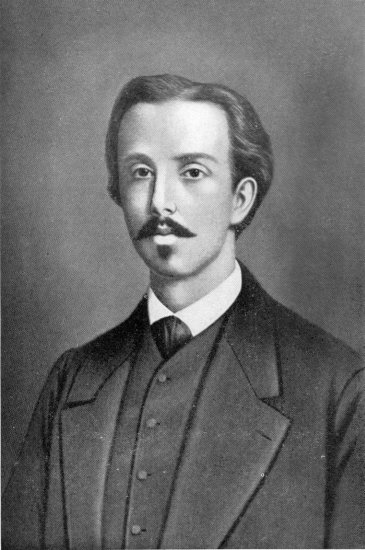
IGNACIO AGRAMONTE
One of the foremost heroes of the Ten Years' War was Ignacio
Agramonte y Loinaz, a member of one of the most distinguished
families in Cuban history. He was born in Camaguey in 1841, was
educated for the bar, and became an eminent advocate, writer and
orator, with intense devotion to the cause of Cuban independence.
Immediately upon the outbreak of the revolution at Yara in 1868 he
took the field and showed himself a born leader of men. He was made
Secretary of the Revolutionary government, signed the Emancipation
act and the Cuban Constitution, and then returned to active work in
the field. As Major General he participated in many battles,
including the capture of a part of Camaguey on July 20, 1869.
President Cespedes made him Chief of the Department of Camaguey,
and for a time he succeeded Quesada as commander in chief of the
Revolutionary Army. He fell in the battle of Jimaguayu on July 1,
1873.


