The Natural System of the Vegetable Kingdom.—Division of the Vegetable
Kingdom into Six Branches and Eighteen Classes.—The
Flowerless Plants (Cryptogamia).—Sub-kingdom of the Thallus
Plants.—The Tangles, or Algæ (Primary Algæ, Green Algæ, Brown
Algæ, Red Algæ.)—The Thread-plants, or Inophytes (Lichens and
Fungi.)—Sub-kingdom of the Prothallus Plants.—The Mosses, or
Muscinæ (Water-mosses, Liverworts, Leaf-mosses, Bog-mosses).—The
Ferns, or Filicinæ (Leaf-ferns, Bamboo-ferns, Water-ferns, Scale-ferns).—Sub-kingdom
of Flowering Plants (Phanerogamia).—The
Gymnosperms, or Plants with Naked Seeds (Palm-ferns = Cycadeæ;
Pines = Coniferæ.)—The Angiosperms, or Plants with Enclosed Seeds.—Monocotylæ.—Dicotylæ.—Cup-blossoms
(Apetalæ).—Star-blossoms
(Diapetalæ).—Bell-blossoms (Gamopetalæ).
Every attempt that we make to gain a knowledge of the
pedigree of any small or large group of organisms related
by blood must, in the first instance, start with the evidence
afforded by the existing “natural system” of this
group. For although the natural system of animals and
plants will never become finally settled, but will always
represent a merely approximate knowledge of true blood
relationship, still it will always possess great importance
as a hypothetical pedigree. It is true, by a “natural
system” most zoologists and botanists only endeavour to
express in a concise way the subjective conceptions which
each has formed of the objective “form-relationships” of
organisms. These form-relationships, however, as the reader
has seen, are in reality the necessary result of true blood
relationship. Consequently, every morphologist in promoting
our knowledge of the natural system, at the same time
promotes our knowledge of the pedigree, whether he wishes
it or not. The more the natural system deserves its name,
and the more firmly it is established upon the concordance
of results obtained from the study of comparative anatomy,
ontogeny, and palæontology, the more surely may we consider
it as the approximate expression of the true pedigree
of the organic world.
In entering upon the task contemplated in this chapter,
the genealogy of the vegetable kingdom, we shall have,
according to this principle, first to glance at the natural
system of the vegetable kingdom as it is at present (with
more or less important modifications) adopted by most
botanists. According to the system generally in vogue, the
whole series of vegetable forms is divided into two main
groups. These main divisions, or sub-kingdoms, are the same
as were distinguished more than a century ago by Charles
Linnæus, the founder of systematic natural history, and
which he called Cryptogamia, or secretly-blossoming plants,
and Phanerogamia, or openly-flowering plants. The latter,
Linnæus, in his artificial system of plants, divided, according
to the different number, formation, and combination of the
anthers, and also according to the distribution of the sexual
organs, into twenty-three different classes, and then added
the Cryptogamia to these as the twenty-fourth and last
class.
The Cryptogamia, the secretly-blossoming or flowerless
plants, which were formerly but little observed, have in consequence
of the careful investigations of recent times been
proved to present such a great variety of forms, and such a
marked difference in their coarser and finer structure, that
we must distinguish no less than fourteen different classes
of them; whereas the number of classes of flowering plants,
or Phanerogamia, may be limited to four. However, these
eighteen classes of the vegetable kingdom can again be
naturally grouped in such a manner that we are able to distinguish
in all six main divisions or branches of the vegetable
kingdom. Two of these six branches belong to the
flowering, and four to the flowerless plants. The table on
page 82 shows how the eighteen classes are distributed
among the six branches, and how these again fall under the
sub-kingdoms of the vegetable kingdom.
The one sub-kingdom of the Cryptogamia may now be
naturally divided into two divisions, or sub-kingdoms, differing
very essentially in their internal structure and in their
external form, namely, the Thallus plants and the Prothallus
plants. The group of Thallus plants comprises the two
large branches of Tangles, or Algæ, which live in water, and
the Thread-plants, or Inophytes (Lichens and Fungi), which
grow on land, upon stones, bark of trees, upon decaying
bodies, etc. The group of Prothallus plants, on the other
hand, comprises the two branches of Mosses and Ferns,
containing a great variety of forms.
All Thallus plants, or Thallophytes, can be directly recognized
from the fact that the two morphological fundamental
organs of all other plants, stem and leaves, cannot be distinguished
in their structure. The complete body of all
Algæ and of all Thread-plants is a mass composed of simple
cells, which is called a lobe, or thallus. This thallus is as
yet not differentiated into axial-organs (stem and root) and
leaf-organs. On this account, as well as through many
other peculiarities, the Thallophytes contrast strongly with
all remaining plants—those comprised under the two sub-kingdoms
of Prothallus plants and Flowering plants—and
for this reason the two latter sub-kingdoms are frequently
classed together under the name of Stemmed plants, or
Cormophytes. The following table will explain the relation
of these three sub-kingdoms to one another according to the
two different views:—
I. Flowerless Plants.
(Cryptogamia) |
|
A. Thallus Plants
(Thallophyta) |
|
I. Thallus Plants
(Thallophyta) |
B. Prothallus Plants
(Prothallophyta) |
|
II. Stemmed Plants
(Cormophyta) |
II. Flowering Plants
(Phanerogamia) |
|
C. Flowering Plants
(Phanerogamia) |
The stemmed plants, or Cormophytes, in the organization
of which the difference of axial-organs (stem and root) and
leaf-organs is already developed, form at present, and have,
indeed, for a very long period formed, the principal portion
of the vegetable world. However, this was not always the
case. In fact, stemmed plants, not only of the flowering
group, but even of the prothallus group, did not exist at all
during that immeasurably long space of time which forms
the beginning of the first great division of the organic
history of the earth, under the name of the archilithic, or
primordial period. The reader will recollect that during this
period the Laurentian, Cambrian, and Silurian systems of
strata were deposited, the thickness of which, taken as a whole,
amounts to about 70,000 feet. Now, as the thickness of all
the more recent superincumbent strata, from the Devonian
to the deposits of the present time, taken together, amounts
to only about 60,000 feet, we were enabled from this fact
alone to draw the conclusion—which is probable also for
other reasons—that the archilithic, or primordial, period was
of longer duration than the whole succeeding period down
to the present time. During the whole of this immeasurable
space of time, which probably comprises many millions
of centuries, vegetable life on our earth seems to have been
represented exclusively by the sub-kingdom of Thallus
plants, and, moreover, only by the class of marine Thallus
plants, that is to say, the Algæ. At least all the petrified
remains which are positively known to be of the primordial
period belong exclusively to this class. As all the animal
remains of this immense period also belong exclusively to
animals that lived in water, we come to the conclusion that
at that time organisms adapted to a life on land did not
exist at all.
| SYSTEMATIC VIEW |
| Of the Six Branches and Eighteen Classes of the Vegetable Kingdom |
Primary Groups
or Sub-Kingdoms
of the
Vegetable Kingdom. |
Branches or Clades
of the
Vegetable Kingdom. |
Classes
of the
Vegetable Kingdom. |
Systematic Name
of the
Classes. |
A.
Thallus Plants
Thallophyta |
|
I.
Tangles
Algæ |
|
1. Primæval algæ |
1. Archephyceæ
(Protophyta) |
| 2. Green algæ |
2. Chlorophyceæ
(Chloroalgæ) |
| 3. Brown algæ |
3. Phæophyceæ
(Fucoideæ) |
| 4. Red algæ |
4. Rhodophyceæ
(Florideæ) |
II.
Thread-plants
Inophyta |
|
5. Lichens |
5. Lichenes |
| 6. Fungi |
6. Fungi |
B.
Prothallus
Plants
Prothallophyta |
|
III.
Mosses
Muscinæ |
|
7. Tangle-mosses |
7. Charobrya
(Characeæ) |
| 8. Liverworts |
8. Thallobrya
(Hepaticæ) |
| 9. Frondose-mosses |
9. Phyllobrya
(Frondosæ) |
| 10. Turf-mosses |
10. Sphagnobrya
(Sphagnaceæ) |
IV.
Ferns
Felicinæ |
|
11. Shaft-ferns |
11. Calamariæ
(Calamophyta) |
| 12. Frondose-ferns |
12. Filices
(Pterideæ) |
| 13. Aquatic ferns |
13. Rhizocarpeæ
(Hydropterides) |
| 14. Scale-ferns |
14. Selagineæ
(Lepidophyta) |
C.
Flowering Plants
Phanerogamia |
|
V.
Plants with
Naked Seeds
Gymnosperma |
|
15. Palm-ferns |
15. Cycadeæ |
| 16. Pines |
16. Coniferæ |
VI.
Plants with
Enclosed Seeds
Angiosperma |
|
17. Plants with one
seed lobe |
17. Monocotylæ |
18. Plants with two
seed lobes |
18. Dicotylæ |
| PEDIGREE OF VEGETABLE KINGDOM. |
| |
Gamopetalæ
(Flowers with corolla) |
|
| |
│
|
|
| |
Dialypetalæ
(Star-shaped flowers) |
|
| |
│
|
|
| |
Monochlamydeæ
(Flowers with calyx) |
Monocotyledonæ
(One seed-lobed plants) |
|
| |
│
|
│
|
|
| |
Dicotyledonæ
(Two seed-lobed plants) |
│
│
│
|
|
| |
│
|
│
|
|
| |
|
|
Cycadeæ
(Palm-ferns) |
Coniferæ
(Pines) |
Gnetaceæ |
Angiospermæ
(Plants with enclosed seeds) |
|
│
|
│
|
│
|
│
|
|
|
|
Gymnospermæ
(Plants with naked seeds) |
|
Selagineæ
(Scaled-ferns) |
Rhizocarpeæ
(Water-ferns) |
│
│
│
|
Phanerogamæ
Flowering plants |
Pterideæ
(Frondose-ferns) |
Calamariæ
(Shaft-ferns) |
│
|
│
|
│
|
│
|
│
|
│
|
|
| |
Filicinæ
(Ferns) |
Frondosæ
(Leaf-mosses) |
Sphagnaceæ
(Turf-mosses) |
│
│
│
|
|
│
|
│
|
│
|
|
|
Characeæ
(Tangle-mosses) |
|
Hepaticæ
(Liverworts) |
│
│
|
|
│
|
│
|
|
|
Muscinæ
(Mosses) |
| |
Florideæ
(Red Algæ) |
Fucoideæ
(Brown Algæ) |
Chlorophyceæ
(Green Algæ) |
Lichenes
(Lichens) |
|
| |
│
|
│
|
│
|
│
|
|
| |
|
│
|
|
| |
Algæ
(Tangles) |
Fungi Inophyta
(Thread-plants) |
|
| |
│
|
│
|
|
| |
|
|
| |
Protophyta (Primæval Plants) |
|
| |
│
|
|
| |
Vegetable Monera |
|
For these reasons the first and most imperfect of the great
provinces or branches of the vegetable kingdom, the division
of the Algæ, or Tangles, must be of special interest to us.
But, in addition, there is the interest which this group
offers when viewed by itself. In spite of the exceedingly
simple composition of their constituent cells, which are but
little differentiated, the Algæ show an extraordinary variety
of different forms. To them belong the simplest and most
imperfect of all forms, as well as very highly developed and
peculiar forms. The different groups of Algæ are distinguished
as much by size of body as by the perfection and
variety of their outer form. At the lowest stage we find
such species as the minute Protococcus, several hundred
thousands of which occupy a space no larger than a pin’s
head. At the highest stage we marvel at the gigantic
Macrocysts, which attain a length of from 300 to 400 feet, the
longest of all forms in the vegetable kingdom. It is possible
that a large portion of the coal has been formed out of Algæ.
If not for these reasons, yet the Algæ must excite our
special attention from the fact that they form the beginning
of vegetable life, and contain the original forms of all other
groups of plants, supposing that our monophyletic hypothesis
of a common origin for all groups of plants is correct.
(Compare p. 83.)
Most people living inland can form but a very imperfect
idea of this exceedingly interesting branch of the vegetable
kingdom, because they know only its proportionately
small and simple representatives living in fresh water. The
slimy green aquatic filaments and flakes of our pools and
ditches and springs, the light green slimy coverings of all
kinds of wood which have for any length of time been in
contact with water, the yellowish green, frothy, and oozy
growths of our village ponds, the green filaments resembling
tufts of hair which occur everywhere in fresh water, stagnant
and flowing, are for the most part composed of different
species of Algæ. Only those who have visited
the sea-shore, and wondered at the immense masses of
cast-up seaweed, and who, from the rocky coast of the
Mediterranean, have seen through the clear blue waters the
beautifully-formed and highly-coloured vegetation of Algæ
at the bottom, know how to estimate the importance of the
class of Algæ. And yet, even these marine Algæ-forests
of European shores, so rich in forms, give only a faint idea
of the colossal forests of Sargasso in the Atlantic ocean, those
immense banks of Algæ, covering a space of about 40,000
square miles—the same which made Columbus, on his voyage
of discovery, believe that a continent was near. Similar but
far more extensive forests of Algæ grew in the primæval
ocean, probably in dense masses, and what countless generations
of these archilithic Algæ have died out one after
another is attested, among other facts, by the vast thickness
of Silurian alum schists in Sweden, the peculiar composition
of which proceeds from those masses of submarine Algæ.
According to the recently expressed opinion of Frederick
Mohr, a geologist of Bonn, even the greater part of our coal
seams have arisen out of the accumulated dead bodies of the
Algæ forests of the ocean.
Within the branch of the Algæ we distinguish four
different classes, each of which is again divided into several
orders and families. These again contain a large number of
different genera and species. We designate these four
classes as Primæval Algæ, or Archephyceæ, Green Algæ, or
Chlorophyceæ, Brown Algæ, or Phæophyceæ, and Red Algæ,
or Rhodophyceæ.
The first class of Algæ, the Primæval Algæ (Archephyceæ),
might also be called primæval plants, because they contain
the simplest and most imperfect of all plants, and, among
them, those most ancient of all vegetable organisms out of
which all other plants have originated. To them therefore
belong those most ancient of all vegetable Monera which
arose by spontaneous generation in the beginning of the
Laurentian period. Further, we have to reckon among them
all those vegetable forms of the simplest organization which
first developed out of the Monera in the Laurentian period,
and which possessed the form of a single plastid. At
first the entire body of one of these small primary plants
consisted only of a most simple cytod (a plastid without
kernel), and afterwards attained the higher form of a
simple cell, by the separation of a kernel in the plasma.
(Compare above, vol. i. p. 345.) Even at the present day there
exist various most simple forms of Algæ which have deviated
but little from the original primary plants. Among
them are the Algæ of the families Codiolaceæ, Protococcaceæ,
Desmidiaceæ, Palmellaceæ, Hydrodictyeæ, and
several others. The remarkable group of Phycochromaceæ
(Chroococcaceæ and Oscillarineæ) might also be comprised
among them, unless we prefer to consider them as an independent
tribe of the kingdom Protista.
The monoplastic Protophyta—that is, those primary Algæ
formed by a single plastid—are of the greatest interest,
because the vegetable organism in this case completes its
whole course of life as a perfectly simple “individual of the
first order,” either as a cytod without kernel, or as a cell
containing a kernel.
Among the primary plants consisting of a single cytod are
the exceedingly remarkable Siphoneæ, which are of considerable
size, and strangely “mimic” the forms of higher
plants. Many of the Siphoneæ attain a size of several
feet, and resemble an elegant moss (Bryopsis), or in
some cases a perfect flowering plant with stalks, roots,
and leaves (Caulerpa) (Fig. 17). Yet the whole of this
large body, externally so variously differentiated, consists
internally of an entirely simple sack, possessing the negative
characters of a simple cytod.
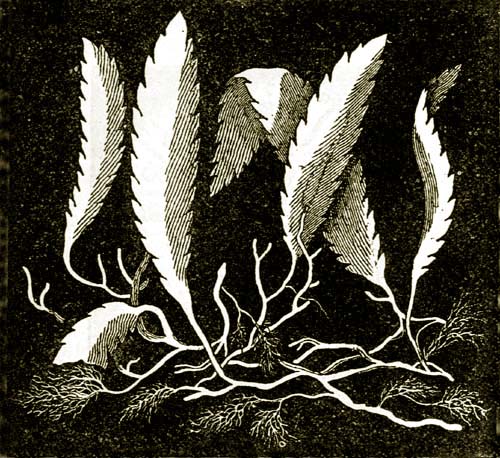
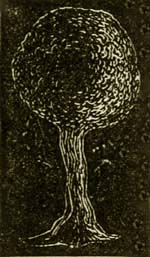
Fig. 17.—Caulerpa denticulata, a monoplastic Siphonean of the natural
size. The entire branching primary plant, which appears to consist of a
creeping stalk with fibrous roots and indented leaves, is in reality only a
single plastid, and moreover a cytod (without a kernel), not even attaining
the grade of a cell with nucleus.
These curious Siphoneæ, Vaucheriæ, and Caulerpæ show
us to how great a degree of elaboration a single cytod,
although a most simple individual of the first order, can
develop by continuous adaptation to the relations of the
outer world. Even the single-celled primary plants—which
are distinguished from the monocytods by possessing a
kernel—develop into a great variety of exquisite forms by
adaptation; this is the case especially with the beautiful
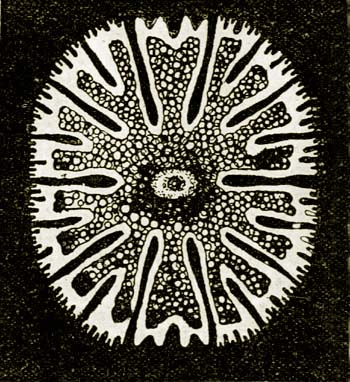
Desmidiaceæ, of which a species of Euastrum is represented
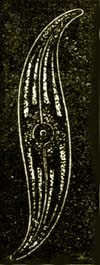
in Fig. 18 as a specimen.
Fig. 18.—Euastrum rota, a single-celled Desmid, much enlarged. The
whole of the star-shaped body of this primæval plant has the formal value
of a simple cell. In its centre lies the kernel, and within this the kernel
corpuscle, or speck.
It is very probable that similar primæval plants, the
soft body of which, however, was not capable of being
preserved in a fossil state, at one time peopled the Laurentian
primæval sea in great masses and varieties, and in
a great abundance of forms, without, however, going beyond
the stage of individuality of a simple plastid.
The group of Green Tangles (Chlorophyceæ), or Green
Algæ (Cloroalgæ), are the second class, and the most closely
allied to the primæval group. Like the majority of the
Archephyceæ, all the Chlorophyceæ are coloured green, and
by the same colouring matter—the substance called leaf-green,
or chlorophyll—which colours the leaves of all the
higher plants.
To this class belong, besides a great number of low
marine Algæ, most of the Algæ of fresh water, the
common water hair-weeds, or Confervæ, the green slime-balls,
or Glœosphæræ, the bright green water-lettuce, or
Ulva, which resembles a very thin and long lettuce leaf,
and also numerous small microscopic algæ, dense masses of
which form a light green shiny covering to all sorts of
objects lying in water—wood, stones, etc.
These forms, however, rise above the simple primary Algæ
in the composition and differentiation of their body. As
the green Algæ, like the primæval Algæ, mostly possess a
very soft body, they are but rarely capable of being petrified.
However, it can scarcely be doubted that this class of Algæ—which
was the first to develop out of the preceding
one—most extensively and variously peopled the fresh and
salt waters of the earth in early times.
In the third class, that of the Brown Tangles (Phæophyceæ),
or Black Algæ (Fucoideæ), the branch of the Algæ
attains its highest stage of development, at least in regard
to size and body. The characteristic colour of the Fucoid
is more or less dark brown, sometimes tending more to
an olive green or yellowish green, sometimes more to a
brownish red or black colour.
Among these are the largest of all Algæ, which are at
the same time the longest of all plants, namely, the
colossal giant Algæ, amongst which the Macrocystis
pyrifera, on the coast of California, attains a length of
400 feet. Also, among our indigenous Algæ, the largest
forms belong to this group. Especially I may mention
here the stately sugar-tangle (Laminaria), whose slimy, olive
green thallus-body, resembling gigantic leaves of from 10
to 15 feet in length, and from a half to one foot in breadth,
are thrown up in great masses on the coasts of the North
and Baltic seas.
To this class belongs also the bladder-wrack (Fucus
vesiculosus) common in our seas, whose fork-shaped,
deeply-cut leaves are kept floating on the water by
numerous air bladders (as is the case, too, with many
other brown Algæ). The freely floating Sargasso Alga
(Sargasso bacciferum), which forms the meadows or forests
of the Sargasso Sea, also belongs to this class.
Although each individual of these large alga-trees is
composed of many millions of cells, yet at the beginning
of its existence it consists, like all higher plants, of a single
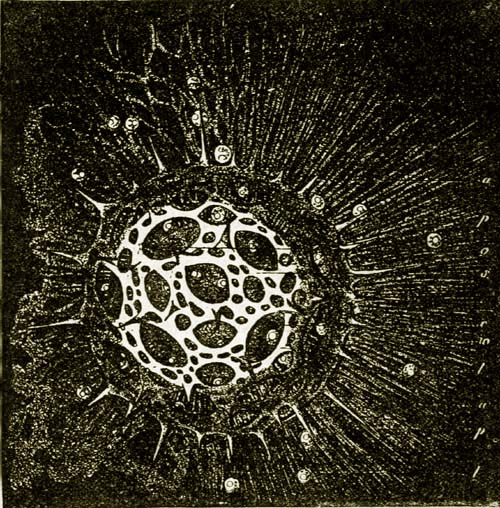
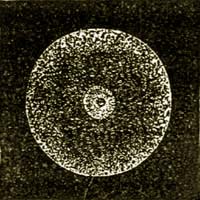
cell—a simple egg. This egg—for example, in the case of
our common bladder-wrack—is a naked, uncovered cell, and
as such is so like the naked egg-cells of lower marine
animals—for example, those of the Medusæ—that they
might easily be mistaken one for another (Fig. 19).
Fig. 19.—The egg of the common bladder-wrack
(Fucus vesiculosus), a simple naked
cell, much enlarged. In the centre of the
naked globule of protoplasm the bright kernel
is visible.
It was probably the Fucoideæ, or
Brown Algæ, which during the primordial
period, to a great extent
constituted the characteristic alga-forests of that immense
space of time. Their petrified remains, especially those of
the Silurian period, which have been preserved, can, it is
true, give us but a faint idea of them, because the material
of these Algæ, like that of most others, is ill-suited for preservation
in a fossil state. As has already been remarked,
a large portion of coal is perhaps composed of them.
Less important is the fourth class of Algæ, that of the
Rose-coloured Algæ (Rhodophyceæ), or Red Sea-weeds (Florideæ).
This class, it is true, presents a great number
of different forms; but most of them are of much smaller
size than the Brown Algæ. Although they are inferior to
the latter in perfection and differentiation, they far surpass
them in some other respects. To them belong the most beautiful
and elegant of all Algæ, which on account of the fine
plumose division of their leaf-like bodies, and also on account
of their pure and delicate red colour, are among the most
charming of plants. The characteristic red colour sometimes
appears as a deep purple, sometimes as a glowing
scarlet, sometimes as a delicate rose tint, and may verge
into violet and bluish purple, or on the other hand into
brown and green tints of marvellous splendour. Whoever
has visited one of our sea-coast watering places, must have
admired the lovely forms of the Florideæ, which are frequently
dried on white paper and offered for sale.
Most of the Red Algæ are so delicate, that they are quite
incapable of being petrified; this is the case with the splendid
Ptilotes, Plocamia, Delesseria, etc. However, there are individual
forms, like the Chondria and Sphærococca, which
possess a harder thallus, often almost as hard as cartilage,
and of these fossil remains have been preserved—principally
in the Silurian, Devonian, and Carboniferous strata, and
later in the oolites. It is probable that this class also had
an important share in the composition of the archilithic
Algæ flora.
If we now again take into consideration the flora of the
primordial period, which was exclusively formed by the
group of Algæ, we can see that it is not improbable that
its four subordinate classes had a share in the composition
of those submarine forests of the primæval oceans, similar
to that which the four types of vegetation—trees with
trunks, flowering shrubs, grass, and tender leaf-ferns and
mosses—at present take in the composition of our recent
land forests.
We may suppose that the submarine tree forests of the
primordial period were formed by the huge Brown Algæ,
or Fucoideæ. The many-coloured flowers at the foot of
these gigantic trees were represented by the gay Red
Algæ, or Florideæ. The green grass between was formed
by the hair-like bunches of Green Algæ, or Chloroalgæ.
Finally, the tender foliage of ferns and mosses, which at
present cover the ground of our forests, fill the crevices left by
other plants, and even settle on the trunks of the trees, at
that time probably had representatives in the moss and fern-like
Siphoneæ, in the Caulerpa and Bryopsis, from among
the class of the primary Algæ, Protophyta, or Archephyceæ.
With regard to the relationships of the different classes of
Algæ to one another and to other plants, it is exceedingly
probable that the Primary Algæ, or Archephyceæ, as already
remarked, form the common root of the pedigree, not merely
for the different classes of Algæ, but for the whole vegetable
kingdom. On this account they may with justice be
designated as primæval plants, or Protophyta.
Out of the naked vegetable Monera, in the beginning of the
Laurentian period, enclosed cytods were probably the first to
arise (vol. i. p. 345), by the naked, structureless, albuminous
substance of the Monera becoming condensed in the form of
a pellicle on the surface, or by secreting a membrane. At a
later period, out of these enclosed cytods genuine vegetable
cells probably arose, as a kernel or nucleus separated itself
in the interior from the surrounding cell-substance or
plasma.
The three classes of Green Algæ, Brown Algæ, and Red
Algæ, are perhaps three distinct classes, which have arisen independently
of one another out of the common radical group
of Primæval Algæ, and then developed themselves further
(each according to its kind), and have variously branched
off into orders and families. The Brown and Red Algæ
possess no close blood relationship to the other classes of the
vegetable kingdom. These latter have most probably arisen
out of the Primæval Algæ, either directly or by the intermediate
step of the Green Algæ.
It is probable that Mosses (out of which, at a later time,
Ferns developed) proceeded from a group of Green Algæ,
and that Fungi and Lichens proceeded from a group of
Primæval Algæ. The Phanerogamia developed at a much
later period out of Ferns.
As a second class of the Vegetable Kingdom we have
above mentioned the Thread-plants (Inophyta). We understood
by this term the two closely related classes of Lichens
and Fungi. It is possible that these Thallus plants have
not arisen out of the Primæval Algæ, but out of one or
more Monera, which, independently of the latter, arose by
spontaneous generation. It appears conceivable that many
of the lowest Fungi, as for example, many ferment-causing
fungi (forms of Micrococcus, etc.), owe their origin to a
number of different archigonic Monera (that is, Monera
originating by spontaneous generation).
In any case the Thread-plants cannot be considered as
the progenitors of any of the higher vegetable classes.
Lichens, as well as fungi, are distinct from the higher
plants in the composition of their soft bodies, consisting
as it does of a dense felt-work of very long, variously
interwoven, and peculiar threads or chains of cells—the
so-called hyphæ, on which account we distinguish them
as a province under the name Thread-plants. From
their peculiar nature they could not leave any important
fossil remains, and consequently we can form only a very
vague guess at their palæontological development.
The first class of Thread-plants, the Fungi, exhibit a
very close relationship to the lowest Algæ; the Algo-fungi,
or Phycomycetes (the Saprolegniæ and Peronosporæ) in
reality only differ from the bladder-wracks and Siphoneæ
(the Vaucheria and Caulerpa) mentioned previously by the
want of leaf-green, or chlorophyll. But, on the other hand,
all genuine Fungi have so many peculiarities, and deviate so
much from other plants, especially in their mode of taking
food, that they might be considered as an entirely distinct
province of the vegetable kingdom.
Other plants live mostly upon inorganic food, upon simple
combinations which they render more complicated. They
produce protoplasm by the combination of water, carbonic
acid, and ammonia. They take in carbonic acid and give
out oxygen. But the Fungi, like animals, live upon
organic food, consisting of complicated combinations of
carbon, which they receive from other organisms and
assimilate. They inhale oxygen and give out carbonic
acid like animals. They also never form leaf-green, or
chlorophyll, which is so characteristic of most other plants.
In like manner they never produce starch. Hence many
eminent botanists have repeatedly proposed to remove the
Fungi completely out of the vegetable kingdom, and to
regard them as a special and third kingdom, between that
of animals and plants. By this means our kingdom of Protista
would be considerably increased. The Fungi in this
case would, in the first place, be allied to the so-called
“slime moulds,” or Myxomycetes (which, however, never
form any hyphæ). But as many Fungi propagate in a sexual
manner, and as most botanists, according to the prevalent
opinion, look upon Fungi as genuine plants, we shall here
leave them in the vegetable kingdom, and connect them with
lichens, to which they are at all events most nearly related.
The phyletic origin of Fungi will probably long remain
obscure. The close relationship already hinted at between
the Phycomycetes and Siphoneæ (especially between the
Saprolegniæ and Vaucheriæ) suggests to us that they are
derived from the latter. Fungi would then have to be considered
as Algæ, which by adaptation to a parasitical life
have become very peculiarly transformed. Many facts,
however, support the supposition that the lowest fungi
have originated independently from archigonic Monera.
The second class of Inophyta, the Lichens (Lichenes), are
very remarkable in relation to phylogeny; for the surprising
discoveries of late years have taught us that every Lichen
is really composed of two distinct plants—of a low form of
Alga (Nostochaceæ, Chroococcaceæ), and of a parasitic form
of Fungus (Ascomycetes), which lives as a parasite upon
the former, and upon the nutritive substances prepared by it.
The green cells, containing chlorophyll (gonidia), which are
found in every lichen, belong to the Alga. But the colourless
threads (hyphæ) which, densely interwoven, form the principal
mass of the body of Lichens, belong to the parasitic
Fungus. But in all cases the two forms of plants—Fungus
and Alga—which are always considered as members of two
quite distinct provinces of the vegetable kingdom, are so
firmly united, and so thoroughly interwoven, that nearly
every one looks upon a Lichen as a single organism.
Most Lichens form small, more or less formless or irregularly
indented, crust-like coverings to stones, bark of trees,
etc. Their colour varies through all possible tints, from the
purest white to yellow, red, green, brown, and the deepest
black.
Many lichens are important in the economy of nature from
the fact that they can settle in the driest and most barren
localities, especially on naked rocks upon which no other
plant can live. The hard black lava, which covers many
square miles of ground in volcanic regions, and which
for centuries frequently presents the most determined
opposition to the life of every kind of vegetation, is always
first occupied by Lichens. It is the white or grey Lichens
(Stereocaulon) which, in the most desolate and barren fields
of lava, always begin to prepare the naked rocky ground
for cultivation, and conquer it for subsequent higher
vegetation. Their decaying bodies form the first mould in
which mosses, ferns, and flowering plants can afterwards
take firm root. Hardy Lichens are also less affected by
the severity of climate than any other plants. Hence the
naked rocks, even in the highest mountains—for the most
part covered by eternal snow, on which no plant could
thrive—are encrusted by the dry bodies of Lichens.
Leaving now the Fungi, Lichens, and Algæ, which are
comprised under the name of Thallus plants, we enter upon
the second sub-kingdom of the vegetable kingdom, that of
the Prothallus plants (Prothallophyta), which by some
botanists are called phyllogonic Cryptogamia (in contradistinction
to the Thallus plants, or thallogonic Cryptogamia).
This sub-kingdom comprises the two provinces of Mosses
and Ferns.
Here we meet with (except in a few of the lowest
forms) the separation of the vegetable body into two
different fundamental organs, axial-organs (stem and root)
and leaves (or lateral organs). In this the Prothallus plants
resemble the Flowering plants, and hence the two groups
have recently often been classed together as stemmed plants,
or Cormophytes.
But, on the other hand, Mosses and Ferns resemble the
Thallus plants, in the absence of the development of
flowers and seeds, and even Linnæus classed them with
these, as Cryptogamia, in contradistinction to the plants
forming seeds; that is, flowering plants (Anthophyta or
Phanerogamia).
Under the name of “Prothallus plants” we combine the
closely-related Mosses and Ferns, because both exhibit a
peculiar and characteristic “alternation of generation” in the
course of their individual development. For every species
exhibits two different generations, of which the one is
usually called the Prothallium, or Fore-growth, the other is
spoken of as the Cormus, or actual Stem of the moss or fern.
The first and original generation, the Fore-growth, or Prothallus,
also called Protonema, still remains in that lower
stage of elaboration manifested throughout life by all Thallus
plants; that is to say, stem and leaf-organs have as yet not
differentiated, and the entire cell-mass of the Fore-growth
corresponds to a simple thallus. The second and more
perfect generation of mosses and ferns—the Stem, or Cormus—develops
a much more highly elaborate body, which has
differentiated into stalk and leaf (as in the case of flowering
plants), except in the lowest mosses, where this generation
also remains in the lower stage of the thallus.
With the exception of these latter forms the first generation
of Mosses and Ferns (the thallus-shaped Fore-growth) always
produces a second generation with stem and leaves; the
latter in its turn produces the thallus of the first generation,
and so on. Thus, in this case, as in the ordinary cases of
alternation of generation in animals, the first generation is
like the third, fifth, etc., the second like the fourth, sixth,
etc. (Compare vol. i. p. 206).
Of the two main classes of Prothallus plants, the Mosses
in general are at a much lower stage of development than
the Ferns, and their lowest forms (especially in an anatomical
respect) form the transition from the Thallus plants through
the Algæ to Ferns. The genealogical connection of Mosses
and Ferns which is indicated by this fact can, however, be
inferred only from the case of the most imperfect forms of
the two classes; for the more perfect and higher groups of
mosses and ferns do not stand in any close relation to one
another, and develop in completely opposite directions. In
any case Mosses have arisen directly out of Thallus plants,
and probably out of Green Algæ.
Ferns, on the other hand, are probably derived from
extinct unknown Mosses, which were very nearly related
to the lowest liverworts of the present day. In the
history of creation, Ferns are of greater importance than
Mosses.
The branch of Mosses (Muscinæ, also called Musci, or
Bryophyta) contains the lower and more imperfect plants of
the group of Prothallophytes, which as yet do not possess
vessels. Their bodies are mostly so tender and perishable
that they are very ill-suited for being preserved in a recognizable
state as fossils. Hence the fossil remains of all
classes of Mosses are rare and insignificant. It is probable
that Mosses developed in very early times out of the Thallus
plants, or, to be more precise, out of the Green Algæ. It is
probable that in the primordial period there existed aquatic
forms of transition from the latter to Mosses, and in the
primary period to those living on land. The Mosses of the
present day—out of the gradually differentiating development
of which comparative anatomy may draw some inferences
as to their genealogy—are divided into two different
classes, namely: (1) Liverworts; (2) Leafy Mosses.
The first and oldest class of Mosses, which is directly
allied to the Green Algæ, or Confervæ, is formed by the Liverworts
(Hepaticæ, or Thallobrya). The mosses belonging to
them are, for the most part, small and insignificant in form,
and are little known. Their lowest forms still possess,
in both generations, a simple thallus like the Thallus plants;
as for example, the Ricciæ and Marchantiaceæ. But the
more highly developed liverworts, the Jungermanniaceæ
and those akin to them, gradually commence to differentiate
stem and leaf, and their most highly-developed forms are
closely allied to leaf-mosses. By this transitional series
the liverworts show their direct derivation from the
Thallophytes, and more especially from the Green Algæ.
The Mosses, which are generally the only ones known
to the uninitiated—and which, in fact, form the principal
portion of the whole branch—belong to the second class,
or Leafy Mosses (Musci frondosi, called Musci in a narrow
sense, also Phyllobrya). Among them are most of those
pretty little plants which, united in dense groups, form
the bright glossy carpet of moss in our woods, or which,
in company with liverworts and lichens, cover the bark
of trees. As reservoirs, carefully storing up moisture, they
are of the greatest importance in the economy of nature.
Wherever man mercilessly cuts down and destroys forests,
there, as a consequence, disappear the leafy mosses which
covered the bark of the trees, or, protected by their
shade, clothed the ground, and filled the spaces between
the larger plants. Together with the leafy mosses disappear
the useful reservoirs which stored up rain and
dew for times of drought. Thus arises a disastrous dryness
of the ground, which prevents the growth of any rich
vegetation. In the greater part of Southern Europe—in
Greece, Italy, Sicily, and Spain—mosses have been destroyed
by the inconsiderate extirpation of forests, and the ground
has thereby been robbed of its most useful stores of
moisture; once flourishing and rich tracts of land
have been changed into dry and barren wastes. Unfortunately
in Germany, also, this rude barbarism is
beginning to prevail more and more. It is probable that
the small frondose mosses have played this exceedingly
important part in nature for a very long time, possibly
from the beginning of the primary period. But as their
tender bodies are as little suited as those of all other
mosses for being preserved in a fossil state, palæontology
can give us no information about this.
We learn from the science of petrifactions much more
than we do in the case of Mosses of the importance which
the second branch of Prothallus plants—that is, Ferns—have
had in the history of the vegetable world. Ferns, or
more strictly speaking, the “plants of the fern tribe”
(Filicineæ, or Pterideæ, also called Pteridophyta, or Vascular
Cryptogams), formed during an extremely long period,
namely, during the whole primary or palæolithic period, the
principal portion of the vegetable world, so that we may
without hesitation call it the era of Fern Forests. From the
beginning of the Devonian period, in which organisms
living on land appeared for the first time, namely, during
the deposits of the Devonian, Carboniferous, and Permian
strata, plants like Ferns predominated so much over all
others, that we are justified in giving this name to that
period. In the stratifications just mentioned, but above all,
in the immense layers of coal of the Carboniferous or coal
period, we find such numerous and occasionally well preserved
remains of Ferns, that we can form a tolerable vivid
picture of the very peculiar land flora of the palæolithic
period. In the year 1855 the total number of the then
known palæolithic species of plants amounted to about a
thousand, and among these there were no less than 872 Ferns.
Among the remaining 128 species were 77 Gymnosperms
(pines and palm-ferns), 40 Thallus plants (mostly Algæ), and
about 20 not accurately definable Cormophyta (stem-plants).
As already remarked, Ferns probably developed out of the
lower liverworts in the beginning of the primary period.
In their organization Ferns rise considerably above Mosses,
and in their more highly developed forms even approach the
flowering plants. In Mosses, as in Thallus plants, the entire
body is composed of almost equi-formal cells, little if at all
differentiated; but in the tissues of Ferns we find those
peculiarly differentiated strings of cells which are called the
vessels of plants, and which are universally met with in
flowering plants. Hence Ferns are sometimes united as
“vascular Cryptogams” with Phanerogams, and the group
so formed is contrasted as that of the “vascular plants”
with “cellular plants,”—that is, with “cellular cryptogams”
(Mosses and Thallus plants). This very important process
in the organization of plants—the formation of vessels—first
occurred, therefore, in the Devonian period, consequently
in the beginning of the second and smaller half
of the organic history of the earth.
The branch of Ferns, or Filicinæ, is divided into five
distinct classes: (1) Frondose Ferns, or Pteridæ; (2) Reed
Ferns, or Calamariæ; (3) Aquatic Ferns, or Rhizocarpeæ;
(4) Snakes Tongues, or Ophioglossæ; and (5) Scale Ferns,
or Lepidophyta. By far the most important of these five
classes, and also the richest in forms, were first the Frondose
Ferns, and then the Scale-ferns, which formed the principal
portion of the palæolithic forests. The Reed Ferns, on
the other hand, had at that time already somewhat
diminished in number; and of the Aquatic Ferns, we do not
even know with certainty whether they then existed. It is
difficult for us to form any idea of the very peculiar
character of those gloomy palæolithic fern forests, in which
the whole of the gay abundance of flowers of our present
flora was entirely wanting, and which were not enlivened
by any birds. Of the flowering plants there then existed
only the two lowest classes, the pines and palm ferns,
with naked seeds, whose simple and insignificant blossoms
scarcely deserve the name of flowers.
The phylogeny of Ferns, and of the Gymnosperms which
have developed out of them, has been made especially clear
by the excellent investigations which Edward Strasburger
published in 1872, on “The Coniferæ and Gnetaceæ,” as
also “On Azolla.” This thoughtful naturalist and Charles
Martins, of Montpellier, are among the few botanists who
have thoroughly understood the fundamental value of the
Theory of Descent, and the mechanical-causal connection
between ontogeny and phylogeny. The majority of
botanists do not even yet know the important difference
between homology and analogy, between the morphological
and physiological comparison of parts—which has long
since been recognized in zoology—but Strasburger has
employed this distinction and the principle of evolution in
his “Comparative Anatomy of the Gymnosperms,” in order
to sketch the outlines of the blood relationship of this
important group of plants.
The class among Ferns which has developed most directly
out of the Liverworts is the class of real Ferns, in the
narrow sense of the word, the Frondose Ferns (Filices, or
Phyllopterides, also called Pteridæ). In the present flora of
the temperate zones this class forms only a subordinate
part, for it is in most cases represented only by low forms
without trunks. But in the torrid zones, especially in the
moist, steaming forests of tropical regions, this class presents
us with the lofty palm-like fern trees. These beautiful tree-ferns
of the present day, which form the chief ornament of
our hot-houses, can however give us but a faint idea of
the stately and splendid frondose ferns of the primary
period, whose mighty trunks, densely crowded together,
then formed entire forests. These trunks, accumulated in
super-incumbent masses, are found in the coal seams of the
Carboniferous period, and between them, in an excellent
state of preservation, are found the impressions of the
elegant fan-shaped leaves, crowning the top of the trunk in
an umbrella-like bush. The varied outlines and the feather-like
forms of these fronds, the elegant shape of the
branching veins or bunches of vessels in their tender foliage,
can still be as distinctly recognized in the impressions of the
palæolithic fronds as in the fronds of ferns of the present
day. In many cases even the clusters of fruit, which are
distributed on the lower surface of the fronds, are distinctly
preserved. After the Carboniferous period, the predominance
of frondose ferns diminished, and towards the end of the
secondary period they played almost as subordinate a part
as they do at the present time.
The Calamariæ, Ophioglossæ, and Rhizocarpeæ seem to
have developed as three diverging branches out of the
Frondose Ferns, or Pteridæ. The Calamariæ, or Calamophyta,
have remained at the lowest level among these three classes.
The Calamariæ comprise three different orders, of which
only one now exists, namely, the Horse-tails (Equisetaceæ).
The two other orders, the Giant Reeds (Calamiteæ), and the
Star-leaf Reeds (Asterophylliteæ), are long since extinct.
All Calamariæ are characterized by a hollow and jointed
stalk, stem, or trunk, upon which the branches and leaves
(in cases where they exist) are set so as to encircle the
jointed stem in whorls. The hollow joints of the stalk are
separated from one another by partition walls. In Horse-tails
and Calamiteæ the surface is traversed by longitudinal
ribs running parallel, as in the case of a fluted column, and
the outer skin contains so much silicious earth in the living
forms, that it is used for cleansing and polishing. In
the Asterophylliteæ, the star-shaped whorls of leaves were
more strongly developed than in the two other orders.
There exist, at present, of the Calamariæ only the insignificant
Horse-tails (Equisetum), which grow in marshes
and on moors; but during the whole of the primary
and secondary periods they were represented by great trees
of the genus Equisetites. There existed, at the same time,
the closely related order of the Giant Reeds (Calamites),
whose strong trunks grew to a height of about fifty feet.
The order of the Asterophyllites, on the other hand, contained
smaller and prettier plants, of a very peculiar form,
and belongs exclusively to the primary period.
Among all Ferns, the history of the third class, that of
the Root, or Aquatic Ferns (Rhizocarpeæ, or Hydropteridæ),
is least known to us. In their structure these ferns, which
live in fresh water, are on the one hand allied to the frond
ferns, and on the other to the scaly ferns, but they are more
closely related to the latter. Among them are the but
little known moss ferns (Salvinia), clover ferns (Marsilea),
and pill ferns (Pilularia) of our fresh waters; further, the
large Azolla which floats in tropical ponds. Most of the
aquatic ferns are of a delicate nature, and hence ill-suited
for being petrified. This is probably the reason of their
fossil remains being so scarce, and of the oldest of those
known to us having been found in the Jura system. It is
probable, however, that the class is much older, and that it
was already developed during the palæolithic period out of
other ferns by adaptation to an aquatic life.
The fourth class of ferns is formed by the Tongue Ferns
(Ophioglossæ, or Glossopterides). These ferns, to which
belongs the Botrychium, as well as the Ophioglossum
(adder’s-tongue) of our native genera, were formerly considered
as forming but a small subdivision of the frondose
ferns. But they deserve to form a special class, because
they represent important transitional forms from the
Pterideæ and Lepidophytes towards higher plants, and
must be regarded as among the direct progenitors of the
flowering plants.
The fifth and last class is formed by the Scale Ferns
(Lepidophytes, or Selagines). In the same way as the
Ophioglossæ arose out of the frondose forms, the scale ferns
arose out of the Ophioglossæ. They were more highly
developed than all other ferns, and form the transition to
flowering plants, which must have developed out of them.
Next to the frondose ferns they took the largest part in the
composition of the palæolithic fern forests. This class also
contains, as does the class of reed ferns, three nearly related
but still very different orders, of which only one now exists,
the two others having become extinct towards the end of
the Carboniferous period. The scaled ferns still existing
belong to the order of the club-mosses (Lycopodiaceæ).
They are mostly small, pretty moss-like plants, whose
tender, many-branched stalk creeps in curves on the ground
like a snake, and is densely encompassed and covered by
small scaly leaves. The pretty creeping Lycopodium of
our woods, which mountain tourists twine round their
hats, is known to all, as also the still more delicate
Selaginella, which under the name of creeping moss is used
to adorn the soil of our hot-houses in the form of a thick
carpet. The largest club-mosses of the present day are found
in the Sunda Islands, where their stalks rise to the height
of twenty-five feet, and attain half a foot in thickness.
But in the primary and secondary periods even larger trees
of this kind were widely distributed, the most ancient of
which probably were the progenitors of the pines
(Lycopodites). The most important dimensions were, however,
attained by the class of scale trees (Lepidodendreæ),
and by the seal trees (Sigillarieæ). These two orders, with
a few species, appear in the Devonian period, but do not
attain their immense and astonishing development until the
Carboniferous period, and become extinct towards the end
of it, or in the Permian period directly following upon it.
The scale trees, or Lepidodendreæ, were probably more
closely related to club-mosses than to Sigillarieæ. They
grew into splendid, straight, unbranching trunks which
divided at the top into numerous forked branches. They
bore a large crown of scaly leaves, and like the trunk were
marked in elegant spiral lines by the scars left at the base
of the leaf stalks which had fallen off. We know of scale-marked
trees from forty to sixty feet in length, and from
twelve to fifteen feet in diameter at the root. Some trunks
are said to be even more than a hundred feet in length. In
the coal are found still larger accumulations of the no less
highly developed but more slender trunks of the remarkable
seal trees, Sigillarieæ, which in many places form the principal
part of coal seams. Their roots were formerly described
as quite a distinct vegetable form (under the name of
Stigmaria). The Sigillarieæ are in many respects very like
the scale-trees, but differ from them and from ferns in
general in many ways. They were possibly closely related
to the extinct Devonian Lycopterideæ, combining characteristic
peculiarities of the club-mosses and the frondose ferns,
which Strasburger considers as the hypothetical primary
form of flowering plants.
In leaving the dense forests of the primary period, which
were principally composed of frond ferns (Lepidodendreæ
and Sigillarieæ), we pass onwards to the no less characteristic
pine forests of the secondary period. Thus we leave
the domain of the Cryptogamia, the plants forming neither
flowers nor seeds, and enter the second main division of the
vegetable kingdom, namely, the sub-kingdom of the Phanerogamia,
flowering plants forming seeds. This division, so rich
in forms, containing the principal portion of the present
vegetable world, and especially the majority of plants living
on land, is certainly of a much more recent date than the
division of Cryptogamia. For it can have developed out
of the latter only in the course of the palæolithic period.
We can with full assurance maintain that, during the whole
archilithic period, hence during the first and longer half of
the organic history of the earth, no flowering plants as yet
existed, and that they first developed during the primary
period out of Cryptogamia of the fern kind. The anatomical
and embryological relation of Phanerogamia to the latter
is so close, that from it we can with certainty infer their
genealogical connection, that is, their true blood relationship.
Flowering plants cannot have directly arisen out of
thallus plants, nor out of mosses; but only out of ferns, or
Filicines. Most probably the scaled ferns, or Lepidophyta,
and more especially amongst these the Lycopodiaceæ, forms
closely related to the Selaginella of the present day, have
been the direct progenitors of the Phanerogamia.
On account of its anatomical structure and its embryological
development, the sub-kingdom of the Phanerogamia
has for a long time been divided into two large branches,
into the Gymnosperms, or plants with naked seeds, and the
Angiosperms, or plants with enclosed seeds. The latter are
in every respect more perfect and more highly organized
than the former, and developed out of them only at a late
date during the secondary period. The Gymnosperms, both
anatomically and embryologically, form the transition group
from Ferns to Angiosperms.
The lower, more imperfect, and the older of the two main
classes of flowering plants, that of the Archispermeæ, or
Gymnosperms (with naked seeds), attained its most varied
development and widest distribution during the mesolithic
or secondary epoch. It was no less characteristic of this
period, than was the fern group of the preceding primary,
and the Angiosperms of the succeeding tertiary, epoch.
Hence we might call the secondary epoch that of Gymnosperms,
or after its most important representatives, the era
of Pine Forests. The Gymnosperms are divided into three
classes: the Coniferæ, Cycadeæ, and Gnetaceæ. We find
fossil remains of the pines, or Conifers, and of the Cycads,
even in coal, and must infer from this that the transition
from scaled ferns to Gymnosperms took place during the
Coal, or possibly even in the Devonian period. However,
the Gymnosperms play but a very subordinate part during
the whole of the primary epoch, and do not predominate
over Ferns until the beginning of the secondary epoch.
Of the two classes of Gymnosperms just mentioned, that
of the Palm Ferns (Zamiæ, or Cycadeæ) stands at the lowest
stage, and is directly allied to ferns, as the name implies,
so that some botanists have actually included them
in the fern group. In their external form they resemble
palms, as well as tree ferns (or tree-like frond ferns), and
are adorned by a crown of feathery leaves, which is placed
either on a thick, short trunk, or on a slender, simple
trunk like a pillar. At the present day this class, once so
rich in forms, is but scantily represented by a few forms
living in the torrid zones, namely, by the coniferous
ferns (Zamia), the thick-trunked bread-tree (Encephalartos),
and the slender-trunked Caffir bread-tree (Cycas). They
may frequently be seen in hot-houses, and are generally
mistaken for palms. A much greater variety of forms than
occurs among the still existing palm ferns (Cycadeæ) is presented
by the extinct and fossil Cycads, which occurred in
great numbers more towards the middle of the secondary
period, during the Jura, and which at that time principally
determined the character of the forests.
The class of Pines, or coniferous trees (Coniferæ), has preserved
down to our day a greater variety of forms than have
the palm ferns. Even at the present time the trees belonging
to it—cypresses, juniper trees, and trees of life (Thuja), the
box and ginko trees (Salisburya), the araucaria and cedars,
but above all the genus Pinus, which is so rich in forms,
with its numerous and important species, spruces, pines, firs,
larches, etc.—still play a very important part in the most
different parts of the earth, and almost of themselves constitute
extensive forests. Yet this development of pines seems
but weak in comparison with the predominance which the
class had attained over other plants during the early
secondary period, that of the Trias. At that time mighty
coniferous trees—with but proportionately few genera and
species, but standing together in immense masses of individuals—formed
the principal part of the mesolithic forests.
This fact justifies us in calling the secondary period the
“era of the pine forests,” although the remains of Cycadeæ
predominate over those of coniferous trees in the Jura
period.2
From the pine forests of the mesolithic, or secondary
period, we pass on into the leafy forests of the cænolithic, or
tertiary period, and we arrive thus at the consideration of
the sixth and last class of the vegetable kingdom, that of
the Metaspermæ, Angiospermæ, or plants with enclosed
seeds. The first certain and undoubted fossils of plants
with enclosed seeds are found in the strata of the chalk
system, and indeed we here find, side by side, remains of the
two classes into which the main class of Angiosperms is
generally divided, namely, the one seed-lobed plants, or
monocotylæ, and the two seed-lobed plants, or dicotylæ.
However, the whole group probably originated at an earlier
period during the Trias. For we know of a number of
doubtful and not accurately definable fossil remains of
plants from the Oolitic and Trias (sic) periods, which some
botanists consider to be Monocotylæ, whilst others consider
them as Gymnosperms. In regard to the two classes of
plants with enclosed seeds, the Monocotylæ and Dicotylæ,
it is exceedingly probable that the Dicotyledons developed
out of the Gnetaceæ, but that the Monocotyledons developed
later out of a branch of the dicotyledons.
The class of one seed-lobed plants (Monocotylæ, or
Monocotyledons, also called Endogenæ) comprises those
flowering plants whose seeds possess but one germ leaf or
seed lobe (cotyledon). Each whorl of its flower contains
in most cases three leaves, and it is very probable that the
mother plants of all Monocotyledons possessed a regular
triple blossom. The leaves are mostly simple, and traversed
by simple, straight bunches of vessels or “nerves.” To this
class belong the extensive families of the rushes, grasses,
lilies, irids, and orchids, further a number of indigenous
aquatic plants, the water-onions, sea grasses, etc., and
finally the splendid and highly developed families of the
Aroideæ and Pandaneæ, the bananas and palms. On the
whole, the class of Monocotyledons—in spite of the great
variety of forms which it developed, both in the tertiary
and the present period—is much more simply organized
than the class of the Dicotyledons, and its history of
development also offers much less of interest. As their
fossil remains are for the most part difficult to recognize,
it still remains at present an open question in which
of the three great secondary periods—the Trias, Jura,
or chalk period—the Monocotyledons originated. At all
events they existed in the chalk period as surely as did the
Dicotyledons.
| Haeckel-History of Creation |
Pl. V. |
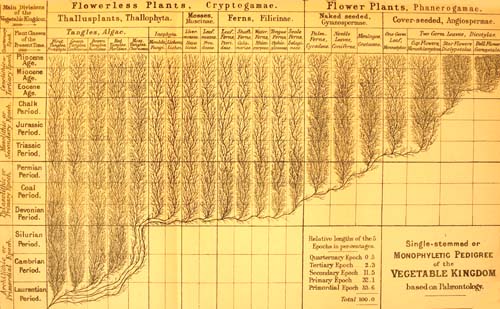 Single-Stemmed,or Monophyletic, Pedigree of the Vegetable Kingdom.
The second class of plants with enclosed seeds, the two
seed-lobed (Dicotylæ, or Dicotyledons, also called Exogenæ)
presents much greater historical and anatomical interest in
the development of its subordinate groups. The flowering
plants of this class generally possess, as their name indicates,
two seed lobes or germ leaves (cotyledons). The number of
leaves composing its blossom is generally not three, as in
most Monocotyledons, but four, five, or a multiple of those
numbers. Their leaves, moreover, are generally more highly
differentiated and more composite than those of the Monocotyledons;
they are traversed by crooked, branching
bunches of vessels or “veins.” To this class belong most of
the leafed trees, and as they predominate in the tertiary
period as well as, at present, over the Gymnosperms and
Ferns, we may call the cænolithic period that of leafed
forests.
Although the majority of Dicotyledons belong to the most
highly developed and most perfect plants, still the lowest
division of them is directly allied to the Gymnosperms, and
particularly to the Gnetaceæ. In the lower Dicotyledons, as
in the case of the Monocotyledons, calyx and corolla are as
yet not differentiated. Hence they are called Apetalous
(Monochlamydeæ, or Apetalæ). This sub-class must therefore
doubtless be looked upon as the original group of the
Angiosperms, and existed probably even during the Trias
and Jura periods. Among them are most of the leafed trees
bearing catkins—birches and alders, willows and poplars,
beeches and oaks; further, the plants of the nettle kind—nettles,
hemp, and hops, figs, mulberries, and elms; finally,
plants like the spurges, laurels, and amaranth.
It was not until the chalk period that the second and
more perfect class of the Dicotyledons appeared, namely,
the group with corollas (Dichlamydeæ, or Corollifloræ).
These arose out of the Apetalæ from the simple cover of the
blossoms of the latter becoming differentiated into calyx and
corolla. The sub-class of the Corollifloræ is again divided
into two large main divisions or legions, each of which
contains a large number of different orders, families, genera,
and species. The first legion bears the name of star-flowers, or
Diapetalæ, the second that of the bell-flowers, or Gamopetalæ.
The lower and less perfect of the two legions of the
Corollifloræ are the star-flowers (also called Diapetalæ or
Dialypetalæ). To them belong the extensive families of the
Umbelliferæ, or umbrella-worts (wild carrot, etc.), the Cruciferæ,
or cruciform blossoms (cabbage, etc.); further, the
Ranunculaceæ (buttercups) and Crassulaceæ, the Mallows
and Geraniums, and, besides many others, the large group of
Roses (which comprise, besides roses, most of our fruit trees),
and the Pea-blossoms (containing, among others, beans, clover,
genista, acacia, and mimosa). In all these Diapetalæ the
blossom-leaves remain separate, and never grow together,
as is the case in the Gamopetalæ. These latter developed
first in the tertiary period out of the Diapetalæ, whereas the
Diapetalæ appeared in the chalk period together with the
Apetalæ.
The highest and most perfect group of the vegetable
kingdom is formed by the second division of the Corollifloræ,
namely, the legion of bell-flowers (Gamopetalæ, also called
Monopetalæ or Sympetalæ). In this group the blossom-leaves,
which in other plants generally remain separate,
grow regularly together into a more or less bell-like, funnel-shaped,
or tubular flower. To them belong, among others,
the Bell-flowers and Convolvulus, Primroses and Heaths,
Gentian and Honeysuckle, further the family of the Olives
(olive trees, privet, elder, and ash), and finally, besides many
other families, the extensive division of the Lip-blossoms
(Labiatæ) and the Composites. In these last the differentiation
and perfection of the Phanerogamic blossoms attain
their highest stage of development, and we must therefore
place them at the head of the vegetable kingdom, as the
most perfect of all plants. In accordance with this, the
legion of the Gamopetalæ appear in the organic history of
the earth later than all the main groups of the vegetable
kingdom—in fact, not until the cænolithic or tertiary epoch.
In the earliest tertiary period the legion is still very rare,
but it gradually increases in the mid-tertiary, and attains its
full development only in the latest tertiary and the quaternary
period.
Now if, having reached our own time, we look back upon
the whole history of the development of the vegetable
kingdom, we cannot but perceive in it a grand confirmation
of the Theory of Descent. The two great principles of organic
development which have been pointed out as the necessary
results of natural selection in the Struggle for Life, namely,
the laws of differentiation and perfecting, manifest themselves
everywhere in the development of the larger and
smaller groups of the natural system of plants. In each
larger or smaller period of the organic history of the earth,
the vegetable kingdom increases both in variety and perfection,
as a glance at Plate IV. will clearly show. During
the whole of the long primordial period there existed only
the lowest and most imperfect group, that of the Algæ. To
these are added, in the primary period, the higher and more
perfect Cryptogamia, especially the main-class of Ferns.
During the coal period the Phanerogamia begin to develop
out of the latter; at first, however, they are represented only
by the lower main-class, that of Gymnosperms. It was not
until the secondary period that the higher main-class, that of
Angiosperms, arose out of them. Of these also there existed
at first only the lower groups without distinct corollas, the
Monocotyledons and the Apetalæ. It was not until the
chalk period that the higher Corollifloræ developed out of
the latter. But even this most highly developed group is
represented, in the chalk period, only by the lower stage of
Star-flowers, or Diapetalæ, and only at quite a late date,
in the tertiary period, did the more highly developed Bell-blossoms,
Gamopetalæ, arise out of them, which at the same
time are the most perfect of all flowering plants. Thus, in
each succeeding later division of the organic history of the
earth the vegetable kingdom gradually rose to a higher
degree of perfection and variety.