Laws of the Development of Mankind: Differentiation and Perfecting.—Mechanical
Cause of these two Fundamental Laws.—Progress without
Differentiation, and Differentiation without Progress.—Origin of
Rudimentary Organs by Non-use and Discontinuance of Habit.—Ontogenesis,
or Individual Development of Organisms.—Its General
Importance.—Ontogeny, or the Individual History of Development of
Vertebrate Animals, including Man.—The Fructification of the Egg.—Formation
of the three Germ Layers.—History of the Development of
the Central Nervous System, of the Extremities, of the Branchial
Arches, and of the Tail of Vertebrate Animals.—Causal Connection and
Parallelism of Ontogenesis and Phylogenesis, that is of the Development
of Individuals and Tribes.—Causal Connection of the Parallelism of
Phylogenesis and of Systematic Development.—Parallelism of the three
Organic Series of Development.
If man wishes to understand his position in nature, and
to comprehend as natural facts his relations to the
phenomena of the world cognisable by him, it is absolutely
necessary that he should compare human with extra-human
phenomena, and, above all, with animal phenomena.
We have already seen that the exceedingly important
physiological laws of Inheritance and Adaptation apply to
the human organism in the same manner as to the animal
and vegetable kingdoms, and in both cases interact with
one another. Consequently, natural selection in the struggle
for life acts so as to transform human society, just as
it modifies animals and plants, and in both cases constantly
produces new forms. The comparison of the phenomena
of human and animal transformation is especially
interesting in connection with the laws of divergence and
progress, the two fundamental laws which, at the end of the
last chapter, we proved to be direct and necessary consequences
of natural selection in the struggle for life.
A comparative survey of the history of nations, or what
is called “universal history,” will readily yield to us, as the
first and most general result, evidence of a continually increasing
variety of human activities, both in the life of individuals
and in that of families and states. This differentiation
or separation, this constantly increasing divergence of
human character and the form of human life, is caused by
the ever advancing and more complete division of labour
among individuals. While the most ancient and lowest
stages of human civilization show us throughout the same
rude and simple conditions, we see in every succeeding
period of history, among different nations, a greater variety
of customs, practices, and institutions. The increasing division
of labour necessitates an increasing variety of forms
corresponding to it. This is expressed even in the formation
of the human face. Among the lowest tribes of
nations, most of the individuals resemble one another so
much that European travellers often cannot distinguish
them at all. With increasing civilization the physiognomy
of individuals becomes differentiated, and finally, among the
most highly civilized nations, the English and Germans,
the divergence in the characters of the face is so great that
we very rarely mistake one face for another.
The second great fundamental law which is obvious in the
history of nations is the great law of progress or perfecting.
Taken as a whole, the history of man is the history of his
progressive development. It is true that everywhere and at
all times we may notice individual retrogressions, or observe
that crooked roads towards progress have been taken, which
lead only towards one-sided and external perfecting, and
thus deviate more and more from the higher goal of internal
and enduring perfecting. However, on the whole, the
movement of development of all mankind is and remains a
progressive one, inasmuch as man continually removes himself
further from his ape-like ancestors, and continually
approaches nearer to his own ideal.
Now, if we wish to know what causes actually determine
these two great laws of development in man, namely, the
law of divergence and the law of progress, we must compare
them with the corresponding laws of development in
animals, and on a close examination we shall inevitably come
to the conclusion that the phenomena, as well as their causes,
are exactly the same in the two cases. The course of
development in man, just as in that of animals, being
directed by the two fundamental laws of differentiation
and perfecting, is determined solely by purely mechanical
causes, and is solely the necessary consequence of natural
selection in the struggle for life.
Perhaps in the preceding discussion the question has presented
itself to some—“Are not these two laws identical?
Is not progress in all cases necessarily connected with divergence?”
This question has often been answered in the
affirmative, and Carl Ernst Bär, for example, one of the
greatest investigators in the domain of the history of development,
has set forth the following proposition as one of
the principal laws in the ontogenesis of the animal body:—“The
degree of development (or perfecting) depends on
the stage of separation (or differentiation) of the parts.”(20)
Correct as this proposition may be on the whole, yet it is not
universally true. In many individual cases it can be proved
that divergence and progress by no means always coincide.
Every progress is not a differentiation, and every differentiation
is not a progress.
Naturalists, guided by purely anatomical considerations,
had already set forth the law relating to progress in organization,
that the perfecting of an organism certainly depends,
for the most part, upon the division of labour among
the individual organs and parts of the body, but that there
are also other organic transformations which determine a
progress in organization. One, in particular, which has
been generally recognized, is the numerical diminution of
identical parts. If, for example, we compare the lower
articulated animals of the crustacean group, which possess
numerous pairs of legs, with spiders which never have more
than four pairs of legs, and with insects which always
possess only three pairs of legs, we find this law, for
which a great number of examples could be adduced, confirmed.
The numerical diminution of pairs of legs is a
progress in the organization of articulated animals. In
like manner the numerical diminution of corresponding
vertebral joints in the trunk of vertebrate animals is a
progress in their organization. Fishes and amphibious
animals with a very large number of identical vertebral
joints are, for this very reason, less perfect and lower than
birds and mammals, in which the vertebral joints, as a
whole, are not only very much more differentiated, but in
which the number of corresponding vertebræ is also much
smaller. Further, according to the same law of numerical
diminution, flowers with numerous stamens are more
imperfect than the flowers of kindred plants with a smaller
number of stamens, etc. If therefore originally a great
number of homogeneous parts exist in an organic body, and
if, in the course of very many generations, this number be
gradually decreased, this transformation will be an example
of perfecting.
Another law of progress, which is quite independent of
differentiation, nay, even appears to a certain extent opposed
to it, is the law of centralization. In general the whole
organism is the more perfect the more it is organized as a
unit, the more the parts are subordinate to the whole, and
the more the functions and their organs are centralized. Thus,
for example, the system of blood-vessels is most perfect
where a centralized heart exists. In like manner, the dense
mass of marrow which forms the spinal cord of vertebrate
animals, and the ventral cord of the higher articulated
animals, is more perfect than the decentralized chain of
ganglia of the lower articulated animals, and the scattered
system of ganglia in the molluscs. Considering the difficulty
of explaining these complicated laws of progress in detail, I
cannot here enter upon a closer discussion of them, and
must refer to Bronn’s excellent “Morphologischen Studien,”
and to my “General Morphology” (Gen. Morph. i. 370, 550;
ii. 257-266).
Just as we have become acquainted with phenomena of
progress, quite independent of divergence, so we shall, on
the other hand, very often meet with divergencies which
are not perfecting, but which are rather the contrary, that
is retrogressions or degenerations. It is easy to see that the
changes which every species of animal and plant experiences
cannot always be improvements. But rather many
phenomena of differentiation, which are of direct advantage
to the organism itself, are yet, in a wider sense, detrimental,
inasmuch as they lessen its general capabilities. Frequently
a relapse to simpler conditions of life takes place, and by
adaptation to them a divergence in a retrograde direction.
If, for instance, organisms which have hitherto lived independently
accustom themselves to a parasitical life, they
thereby degenerate or retrograde. Such animals, which
hitherto had possessed a well-developed nervous system and
quick organs of sense, as well as the power of moving freely,
lose these when they accustom themselves to a parasitical
mode of life; they consequently retrograde more or less.
There the differentiation viewed by itself is a degeneration,
although it is advantageous to the parasitical organism. In
the struggle for life such an animal, which has accustomed
itself to live at the expense of others, by retaining its eyes
and apparatus of motion, which are of no more use to it,
would only expend so much material uselessly; and when
it loses these organs, then a great quantity of nourishment
which was employed for the maintenance of these parts,
benefits other parts. In the struggle for life between the
different parasites, therefore, those which make least pretensions
will have advantage over the others, and this favours
their degeneration.
Just as this is found to be the case with the whole
organism, so it is also with the parts of the body of an
individual organism. A differentiation of parts, which
leads to a partial degeneration, and finally even to the loss
of individual organs, is, when looked at by itself, a degeneration,
but yet may be advantageous to the organism in the
struggle for life. It is easier to fight when useless baggage
is thrown aside. Hence we meet everywhere, in the more
highly-developed animal and vegetable bodies, processes of
divergence, the essence of which is that they cause the
degeneration, and finally the loss, of particular parts. And
at this point the most important and instructive of all the
series of phenomena bearing upon the history of organisms
presents itself to us, namely, that of rudimentary or
degenerate organs.
It will be remembered that even in my first chapter I
considered this exceedingly remarkable series of phenomena,
from a theoretical point of view, as one of the
most important and most striking proofs of the truth
of the doctrine of descent. We designated as rudimentary
organs those parts of the body which are arranged for a
definite purpose and yet are without function. Let me
remind the reader of the eyes of those animals which
live in the dark in caves and underground, and which consequently
never can use them. In these animals we find
real eyes hidden under the skin, frequently developed
exactly as are the eyes of animals which really see;
and yet these eyes never perform any function, indeed
cannot, simply for the reason that they are covered by
an opaque membrane, and consequently no ray of light
falls upon them (compare above, p. 13). In the ancestors
of these animals, which lived in open daylight, the eyes
were well developed, covered by a transparent horny
capsule (cornea), and actually served the purpose of
seeing. But as the animals gradually accustomed themselves
to an underground mode of life, and withdrew from
the daylight and no longer used their eyes, these became
degenerated.
Very clear examples of rudimentary organs, moreover, are
the wings of animals which cannot fly; for example, the
wings of the running birds, like the ostrich, emeu, cassowary,
etc., the legs of which have become exceedingly
developed. These birds having lost the habit of flying, have
consequently lost the use of their wings; however, the
wings are still there, although in a crippled form. We very
frequently find such crippled wings in the class of insects,
most members of which can fly.
From reasons derived from comparative anatomy and
other circumstances, we can with certainty draw the
inference that all insects now living (all dragon-flies, grasshoppers,
beetles, bees, bugs, flies, butterflies, etc.) have
originated from a single common parental form, from a
primary insect which possessed two well-developed pairs
of wings, and three pairs of legs. Yet there are very many
insects in which either one or both pairs of wings have
become more or less degenerated, and many in which they
have even completely disappeared. For example, in the whole
order of flies, or Diptera, the hinder pair of wings—in the
bee-parasites, or Strepsiptera, on the other hand, the fore pair
of wings—have become degenerated or entirely disappeared.
Moreover, in every order of insects we find individual
genera, or species, in which the wings have more or less
degenerated or disappeared. The latter is the case especially
in parasites. The females have frequently no wings,
whereas the males have; for instance, in the case of glow-worms
(Lampyris), Strepsiptera, etc. This partial or complete
degeneration of the wings of insects has evidently
arisen from natural selection in the struggle for life. For
we find insects without wings living under circumstances
where flying would be useless, or even decidedly injurious
to them. If, for example, insects living on islands fly about
much, it may easily happen that when flying they are blown
into the sea by the wind, and if (as is always the case)
the power of flying is differently developed in different
individuals, then those which fly badly have an advantage
over those which fly well; they are less easily blown into
the sea, and remain longer in life than the individuals of the
same species which fly well. In the course of many
generations, by the action of natural selection, this circumstance
must necessarily lead to a complete suppression
of the wings. If this conclusion had been arrived at on
purely theoretical grounds, we might be pleased to find its
truth established by facts. For upon isolated islands the
proportion of wingless insects to those possessing wings is
surprisingly large, much larger than among the insects
inhabiting continents. Thus, for example, according to
Wollaston, of the 550 species of beetles which inhabit the
island of Madeira, 220 are wingless, or possess such imperfect
wings that they can no longer fly; and of the 29 genera
which belong to that island exclusively, no less than 23 contain
such species only. It is evident that this remarkable
circumstance does not need to be explained by the special
wisdom of the Creator, but is sufficiently accounted for by
natural selection, because in this case the hereditary disuse
of the wings, the discontinuance of flying in the presence
of dangerous winds, has been very advantageous in the
struggle for life. In other wingless insects the want of
wings has been advantageous for other reasons. Viewed
by itself, the loss of wings is a degeneration, but in these
special conditions of life it is advantageous to the organism
in the struggle for life.
Among other rudimentary organs I may here, by way of
example, further mention the lungs of serpents and serpent-like
lizards. All vertebrate animals possessing lungs, such
as amphibious animals, reptiles, birds, and mammals, have a
pair of lungs, a right and a left one. But in cases where the
body is exceedingly thin and elongated, as in serpents and
serpent-like lizards, there is no room for the one lung by the
side of the other, and it is an evident advantage to the
mechanism of respiration if only one lung is developed. A
single large lung here accomplishes more than two small ones
side by side would do; and consequently, in these animals, we
invariably find only the right or only the left lung fully
developed. The other is completely aborted, although existing
as a useless rudiment. In like manner, in all birds the right
ovary is aborted and without function; only the left one is
developed, and yields all the eggs.
I mentioned in the first chapter that man also possesses
such useless and superfluous rudimentary organs, and I
specified as such the muscles which move the ears. Another
of them is the rudiment of the tail which man possesses in
his 3—5 tail vertebræ, and which, in the human embryo,
stands out prominently during the first two months of its
development (compare Plates II. and III.). It afterwards
becomes completely hidden. The rudimentary little tail of
man is an irrefutable proof of the fact that he is descended
from tailed ancestors. In woman the tail is generally
by one vertebra longer than in man. There still exist
rudimentary muscles in the human tail which formerly
moved it.
Another case of human rudimentary organs, only belonging
to the male, and which obtains in like manner in all male
mammals, is furnished by the mammary glands on the
breast, which, as a rule, are active only in the female sex.
However, cases of different mammals are known, especially
of men, sheep, and goats, in which the mammary glands
were fully developed in the male sex, and yielded milk as
food for their offspring. I have already mentioned before
(p. 12) that the rudimentary auricular muscles in man can
still be employed to move their ears, by some persons who
have persevering]y practised them. In fact, rudimentary
organs are frequently very differently developed in different
individuals of the same species; in some they are tolerably
large, in others very small. This circumstance is very important
for their explanation, as is also the other circumstance
that generally in embryos, or in a very early period
of life, they are much larger and stronger in proportion to
the rest of the body than they are in fully developed and
fully grown organisms. This can, in particular, be easily
pointed out in the rudimentary sexual organs of plants
(stamens and pistil), which I have already mentioned. They
are proportionately much larger in the young flower-bud
than in the mature flower.
I have remarked (p. 15) that rudimentary or suppressed
organs were the strongest supports of the monistic or
mechanical conception of the universe. If its opponents, the
dualists and teleologists, understood the immense significance
of rudimentary organs, it would put them into a state
of despair. Their ludicrous attempts to explain that rudimentary
organs were given to organisms by the Creator “for
the sake of symmetry,” or “as a formal provision,” or “in
consideration of his general plan of creation,” sufficiently
prove the utter impotence of their perverse conception of
the universe. I must here repeat that, even if we knew
absolutely nothing of the other phenomena of development,
we should be obliged to believe in the truth of the Theory of
Descent, solely on the ground of the existence of rudimentary
organs. Not one of its opponents has been able to throw
even a feeble glimmer of an acceptable explanation upon
these exceedingly remarkable and important phenomena.
There is scarcely any highly developed animal or vegetable
form which has not some rudimentary organs, and in most
cases it can be shown that they are the products of natural
selection, and that they have become suppressed by disuse.
It is the reverse of the process of formation in which new
organs arise from adaptation to certain conditions of life, and
by the use of parts as yet incompletely developed. It is true
our opponents usually maintain that the origin of altogether
new parts is completely inexplicable by the Theory of
Descent. However, I distinctly assert that to those who
possess a knowledge of comparative anatomy and physiology
this matter does not present the slightest difficulty. Every
one who is familiar with comparative anatomy and the
history of development will find as little difficulty about
the origin of completely new organs as about the utter disappearance
of rudimentary organs. The disappearance of the
latter, viewed by itself, is the converse of the origin of the
former. Both processes are particular phenomena of differentiation,
which, like all others, can be explained quite
simply and mechanically by the action of natural selection
in the struggle for life.
The infinitely important study of rudimentary organs and
their origin, the comparison of their palæontological and
embryological development, now naturally leads us to the
consideration of one of the most important and instructive
of all biological phenomena, namely, the parallelism which
the phenomena of progress and divergence present to us in
three different series. When, in the last chapter, we spoke
of perfecting and division of labour, we understood by
those words progress and separation, and those changes
effected by them, which in the long and slow course of the
earth’s history have led to a continual variation of the
flora and fauna, to the origin of new and to the disappearance
of ancient species of animals and plants. Now,
if we follow the origin, the development, and the life
of every single organic individual, we meet with exactly
the same phenomena of progress and differentiation. The
individual development, or the ontogenesis of every single
organism, from the egg to the complete form is nothing
but a growth attended by a series of diverging and progressive
changes. This applies equally to animals, plants,
and protista. If, for example, we consider the ontogeny
of any mammal, of man, of an ape, or of a pouched
animal, or if we follow the individual development of any
other vertebrate animal of another class, we everywhere
find essentially the same phenomena. Every one of
these animals develops itself originally out of a single cell,
the egg. This cell increases by self-division, and forms a
number of cells, and by the growth of this accumulation of
cells, by the divergent development of originally identical
cells, by the division of labour among them, and by their
perfecting, there arises the perfect organism, the complicated
composition of which excites our admiration.
It seems to me here indispensable to draw attention
more closely to those infinitely important and interesting
processes which accompany ontogenesis, or the individual
development of organisms, and especially to that of vertebrate
animals, man included. I wish especially to recommend
these exceedingly remarkable and instructive phenomena
to the reader’s most careful consideration, first,
because they are among the strongest supports of the Theory
of Descent, and secondly, because, considering their immense
general importance, they have hitherto been properly considered
only by a few privileged persons.
We cannot indeed but be astonished when we consider
the deep ignorance which still prevails, in the widest circles,
about the facts of the individual development of man and
organisms in general. These facts, the universal importance
of which cannot be estimated too highly, were established,
in their most important outlines, even more than a hundred
years ago, in 1759, by the great German naturalist Caspar
Friedriech Wolff, in his classical “Theoria Generationis.”
But, just as Lamarck’s Theory of Descent, founded in 1809,
lay dormant for half a century, and was only awakened to
new and imperishable life in 1859, by Darwin, in like
manner Wolff’s Theory of Epigenesis remained unknown for
nearly half a century; and it was only after Oken, in 1806
had published his history of the development of the intestinal
tube, and after Meckel, in 1812, had translated
Wolff’s work (written in Latin) on the same subject into
German, that Wolff’s theory of epigenesis became more generally
known, and formed the foundation of all subsequent
investigations of the history of individual development.
The study of ontogenesis now received a great stimulus, and
soon there appeared the classical investigations of the two
friends, Christian Pander (1817) and Carl Ernst Bär (1819).
Bär, in his remarkable “Entwickelungsgeschichte der
Thiere,”(20) worked out the ontogeny of vertebrate animals
in all its important facts. He carried out a series of
such excellent observations, and illustrated them by such
profound philosophical reflections, that his work became
the foundation for a thorough understanding of this important
group of animals, to which, of course, man also
belongs. The facts of embryology alone would be sufficient
to solve the question of man’s position in nature, which
is the highest of all problems. Look attentively at and
compare the eight figures which are represented on the adjoining
Plates II. and III., and it will be seen that the
philosophical importance of embryology cannot be too
highly estimated.
We may well ask, What do our so-called “educated”
circles, who think so much of the high civilization of the
19th century, know of these most important biological facts,
of these indispensable foundations for understanding their
own organism? How much do our speculative philosophers
and theologians know about them, who fancy they can arrive
at an understanding of the human organism by mere guesswork
or divine inspiration? What indeed do the majority of
naturalists, not excepting the majority of the so-called “zoologists”
(including the entomologists!), know about them?
The answer to this question tells much to the shame of
the persons above indicated, and we must confess, willingly
or unwillingly, that these invaluable facts of human ontogeny
are, even at the present day, utterly unknown to most
people, or are in no way valued as they deserve to be. It is
in the face of such a condition of things as this that we see
clearly upon what a wrong and one-sided road the much
vaunted culture of the 19th century still moves. Ignorance
and superstition are the foundations upon which most men
construct their conception of their own organism and its relation
to the totality of things; and these palpable facts of
the history of development, which might throw the light
of truth upon them, are ignored. It is true these facts are
not calculated to excite approval among those who assume a
thorough difference between man and the rest of nature, and
who will not acknowledge the animal origin of the human
race. That origin must be a very unpleasant truth to
members of the ruling and privileged castes in those nations
among which there exists an hereditary division of social
classes, in consequence of false ideas about the laws of inheritance.
It is well known that, even in our day, in many
civilized countries the idea of hereditary grades of rank
goes so far, that, for example, the aristocracy imagine themselves
to be of a nature totally different from that of ordinary
citizens, and nobles who commit a disgraceful
offence are punished by being expelled from the caste of
nobles, and thrust down among the pariahs of “vulgar
citizens.” What are these nobles to think of the noble blood
which flows in their privileged veins, when they learn that
all human embryos, those of nobles as well as commoners,
during the first two months of development, are scarcely
distinguishable from the tailed embryos of dogs and other
mammals?
As the object of these pages is solely to further the
general knowledge of natural truths, and to spread, in wider
circles, a natural conception of the relations of man to the
rest of nature, I shall be justified if I do not pay any
regard to the widely-spread prejudice in favour of an exceptional
and privileged position for man in creation, and
simply give here the embryological facts from which the
reader will be able to draw conclusions affirming the
groundlessness of those prejudices. I wish all the more
to entreat him to reflect carefully upon these facts of ontogeny,
as it is my firm conviction that a general knowledge
of them can only promote the intellectual advance, and
thereby the mental perfecting, of the human race.
Amidst all the infinitely rich and interesting material
which lies before us in the ontogeny of vertebrate animals,
that is, in the history of their individual development, I shall
here confine myself to showing some of those facts which
are of the greatest importance to the Theory of Descent in
general, as well as in its special application to man. Man
is at the beginning of his individual existence a simple egg,
a single little cell, just the same as every animal organism
which originates by sexual generation. The human egg is
essentially the same as that of all other mammals, and cannot
be distinguished from the egg of the higher mammals.
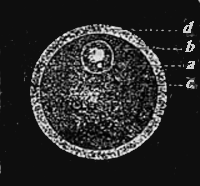
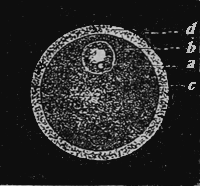
The egg represented in Fig. 5 might be that of a man or an
ape as well as of a dog, a horse, or any other mammal. Not
only the form and structure, but even the size of the egg in
most mammals is the same as in man, namely, about the
120th part of an inch in diameter, so that the egg under
favorable circumstances, with the naked eye, can just be
perceived as a small speck. The differences which really
exist between the eggs of different mammals and that of
man do not consist in the form, but in the chemical mixture,
in the molecular composition of the albuminous combination
of carbon, of which the egg essentially consists. These
minute individual differences of all eggs, which depend upon
indirect or potential adaptation (and especially upon the
law of individual adaptation), are indeed not directly perceptible
to the exceedingly imperfect senses of man, but are
cognisable through indirect means, as the primary causes of
the difference of all individuals.
| |
|
|
|
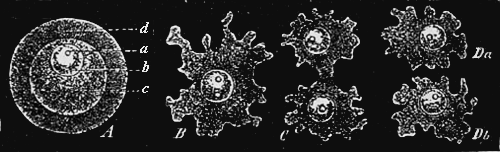
Fig. 5.—The human egg a hundred times enlarged.
a. The kernel speck, or nucleolus (the
so-called germinal spot of the egg). b. Kernel,
or nucleus (the so-called germinal vesicle of the
egg). c. Cell-substance, or protoplasm (so-called
yolk of the egg). d. Cell-membrane (the yolk-membrane
of the egg; in mammals, on account
of its transparency, called zona pellucida). The
eggs of other mammals are of the same form. |
The human egg is, like that of all other mammals, a
small globular bladder, which contains all the constituent
parts of a simple organic cell (Fig. 5). The most essential
parts of it are the mucous cell-substance, or the protoplasma
(c), which in an egg is called the “yolk,” and the cell-kernel,
or nucleus (b), surrounded by it, which is here called by the
special name of the “germinal vesicle.” The latter is a delicate,
clear, glassy globule of albumen, of about 1-600th part of
an inch in diameter, and surrounds, a still smaller, sharply-marked,
rounded granule (a), the kernel-speck, or the nucleolus
of the cell (in the egg it is called the “germinal spot”).
The outside of the globular egg-cell of a mammal is surrounded
by a thick pellucid membrane, the cell-membrane
or yolk-membrane, which here bears the special name of
zona pellucida (d). The eggs of many lower animals
(for example of many Medusæ) differ from this in being
naked cells, as the outer covering, or cell-membrane, is
wanting.
As soon as the egg (ovulum) of the mammal has attained
its full maturity, it leaves the ovary of the female, in which
it originates, and passes into the oviduct, and through this
narrow passage into the wider pouch or womb (uterus). If,
meanwhile, the egg is fructified by the male seed (sperm), it
develops itself in this pouch into an embryo, and does not
leave it until perfectly developed and capable of coming
into the world at birth as a young mammal.
The variations of form and transformations which the
fructified egg must go through within the uterus before it
assumes the form of the mammal are exceedingly remarkable,
and proceed from the beginning in man, in precisely
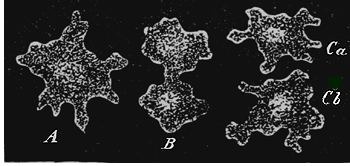
the same way as in the other mammals. At first the fructified
egg of the mammal acts as a single-celled organism,
which is about to propagate independently and increase
itself; for example, an Amœba (compare Fig. 2, p. 188).
In point of fact the simple egg-cell becomes two, by the
process of cell-division which I have previously described.
There arise from the single germinal spot (the small kernel-speck
of the original simple egg-cell) two new kernel-specks,
and then in like manner, out of the germinal vesicle (the
nucleus), two new cell-kernels. Then, and not until then,
does the globular protoplasma first separate itself by an
equatorial furrow into two halves, in such a manner that
each half encloses one of the two kernels, together with
its kernel-speck. Thus the simple egg-cell, within the
original cellular membrane, has become two naked cells,
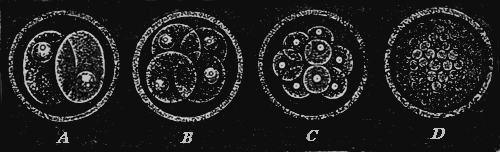
each possessing its own kernel (Fig. 6).
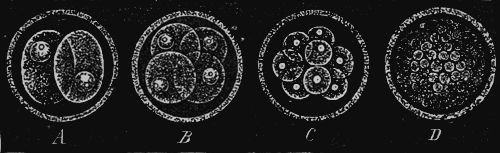
Fig. 6.—First commencement of the development of a mammal’s egg, the
so-called “yolk-cleavage” (propagation of the egg-cell by repeated self-division).
A. The egg, by the formation of the first furrow, falls into two
cells. B. These by division fall into four cells. C. These latter have fallen
into eight cells. D. By continued division a globular mass of numerous cells
has arisen.
The same process of cell-division now repeats itself
several times in succession. In this way, from two cells
(Fig. 6 A) there arise four (Fig. 6 B); from four, eight
(Fig. 6 C); from eight, sixteen; from these, thirty-two, etc.
Each time the division of the kernel-speck precedes that of
the kernel; this, again, precedes that of the cell-substance, or
protoplasma. As the division of the latter always commences
with the formation of a superficial annular furrow,
or cleft, the whole process is usually called the furrowing of
the egg, or yolk-cleavage, and the products of it, that is, the
cells arising from the continued halving, are called the
cleavage spheres. However, the whole process is nothing
more than a simple, oft-repeated division of cells, and the
products of it are actual, naked cells. Finally, through the
continued division or “furrowing” of the mammal’s egg
there arises a mulberry-shaped ball, which is composed of a
great number of small spheres, naked cells, containing
kernels (Fig. 6 D). These cells are the materials out of
which the body of the young mammal is constructed.
Every one of us has once been such a simple mulberry-shaped
ball, composed only of small equi-formal cells.
The further development of the globular lump of cells,
which now represents the young body of the mammal, consists
first in its changing into a globular bladder, as fluid
accumulates within it. This bladder is called the germ-bladder
(vesicula blastodermica). Its wall is at first composed
of merely equi-formal cells. But soon, at one point on
the wall, arises a disc-shaped thickening, as the cells here
increase rapidly, and this thickening is now the foundation
of the actual body of the germ or embryo, while the other
parts of the germ-bladder serve only for its nutrition. The
thickened disc, or foundation of the embryo, soon assumes an
oblong, and then a fiddle-shaped form, in consequence of its
right and left walls becoming convex (Fig. 7, p. 304). At
this stage of development in the first form of their germ or
embryo, not only all mammals, including man, but even all
vertebrate animals in general—birds, reptiles, amphibious
animals, and fishes—can either not be distinguished from
one another at all, or only by very unessential differences,
such as the arrangement of the egg-coverings. In all the
whole body consists of nothing but a quite simple, oblong,
oval, or violin-shaped thin disc, which is composed of three
closely connected membranes or plates, lying one above
another. Each of the three plates or layers of the germ
consists simply of cells all exactly like one another; but
each layer has a different function in the building up of the
vertebrate animal body. Out of the upper or outer germ-layer
arises solely the outer skin (epidermis), together
with the central parts of the nervous system (spinal marrow
and brain); out of the lower or inner layer arises only
the inner delicate skin (epithelium) which lines the whole
intestinal tube from the mouth to the anus, together with
all the glands connected with it (lung, liver, salivary
glands, etc.); out of the middle germ-layer lying between
the two others arise all the other organs, muscles, bones,
blood-vessels. Now, the processes by which the various and
exceedingly complicated parts of the fully-formed body of
vertebrate animals arise out of such simple material—out of
the three germ-layers composed only of cells—are, in the
first place, the repeated division, and consequently the
increase of cells; in the second place, the division of labour
or differentiation of these cells; and thirdly, the union of
the variously developed or differentiated cells, for the
formation of the different organs. Thus arises the gradual
progress or perfecting which can be traced step by step
in the development of the embryonic body. The simple
embryonic cells, which are to constitute the body of the
vertebrate animal, stand in the same relation to each other
as citizens who wish to found a state. Some take to one
occupation, others to another, and work together for the
good of the whole. By this division of labour, or differentiation,
and the perfecting (the organic progress) which is
connected with it, it becomes possible for the whole state to
accomplish undertakings which would have been impossible
to the single individual. The whole body of the vertebrate
animal, like every other many-celled organism, is a republican
state of cells, and consequently it can accomplish organic
functions which the individual cell, as a solitary individual
(for example, an Amœba, or a single-celled plant), could
never perform.
No sensible person supposes that carefully devised institutions,
which have been established for the good of the
whole, as well as for the individual, in every human state,
are the results of the action of a personal and supernatural
Creator, acting for a definite purpose. On the contrary,
every one knows that these useful institutions of organization
in the state are the consequences of the co-operation of
the individual citizens and their common government, as
well as of adaptation to the conditions of existence of the
outer world. Just in the same way we must judge of the
many-celled organism. In it also all the useful arrangements
are solely the natural and necessary result of the co-operation,
differentiation, and perfecting of the individual citizens—the
cells—and by no means the artificial arrangements of a
Creator acting for a definite purpose. If we rightly consider
this comparison, and pursue it further, we can distinctly
see the perversity of that dualistic conception of nature
which discovers the action of a creative plan of construction
in the various adaptations of the organization of living
things.
Let us pursue the individual development of the vertebrate
animal body a few stages further, and see what is next
done by the citizens of this embryonic organism. In the
central line of the violin-shaped disc, which is composed of
the three cellular germ-layers, there arises a straight delicate
furrow, the so-called “primitive streak,” by which the
violin-shaped body is divided into two equal lateral halves—a
right and a left part or “antimer.” On both sides of that
streak or furrow, the upper or external germ-layer rises in
the form of a longitudinal fold, and both folds then grow
together over the furrow in the central line, and thus form
a cylindrical tube. This tube is called the marrow-tube, or
medullary canal, because it is the foundation of the central
nervous system, the spinal marrow (medulla spinalis). At
first it is pointed both in front and behind, and it remains so
for life in the lowest vertebrate animal, the brainless, skull-less
Lancelet (Amphioxus). But in all other vertebrate
animals, which we distinguish from the latter as skulled
animals, or Craniota, a difference between the fore and
hinder end of the marrow tube soon becomes visible, the
fore end becoming dilated, and changing into a roundish
bladder, the foundation of the brain.
In all Craniota, that is, in all vertebrate animals possessing
skull and brain, the brain, which is at first only the
bladder-shaped dilatation of the anterior end of the spinal
marrow, divides into five bladders lying one behind the
other, four superficial, transverse in-nippings being formed.
These five brain-bladders, out of which afterwards arise all
the different parts of the intricately constructed brain, can
be seen in their original condition in the embryo represented
in Fig. 7. It is just the same whether we examine the embryo
of a dog, a fowl, a lizard, or any other higher vertebrate
animal. For the embryos of the different skulled animals
(at least the three higher classes of them, the reptiles, birds
and mammals) cannot be in any way distinguished at the
stage represented in Fig. 7. The whole form of the body is
as yet exceedingly simple, being merely a thin, leaf-like disc.
Face, legs, intestines, etc., are as yet completely wanting.
But the five bladders are already quite distinct from one
another.
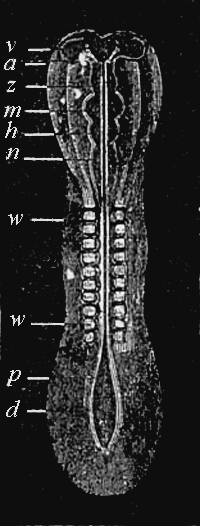 Fig. 7.—Embryo of a mammal or bird, in
which the five brain-bladders have just commenced
to develop. v. Fore brain. z. Twixt brain.
m. Mid brain. h. Hind brain. n. After brain.
p. Spinal-marrow. a. Eye-bladders. w. Primitive
vertebræ. d. Spinal-axis or notochord.
Fig. 7.—Embryo of a mammal or bird, in
which the five brain-bladders have just commenced
to develop. v. Fore brain. z. Twixt brain.
m. Mid brain. h. Hind brain. n. After brain.
p. Spinal-marrow. a. Eye-bladders. w. Primitive
vertebræ. d. Spinal-axis or notochord.
The first bladder, the fore brain (a),
is in so far the most important that
it principally forms the hemispheres of
the so-called larger brain (cerebrum),
that part which is the seat of the
higher mental activities. The more
these activities are developed in the
series of vertebrate animals, the more
do the two lateral halves of the fore
brain, or the hemispheres, grow at the
expense of the other bladders, and
overlap them in front and from above. In man, where they
are most strongly developed, agreeing with his higher mental
activity, they eventually almost entirely cover the other
parts from above (compare Plates II. and III.) The second
bladder, the twixt brain (z), forms that portion of the
brain which is called the centre of sight, and stands in
the closest relation to the eyes (a), which grow right and
left out of the fore brain in the shape of two bladders, and
later lie at the bottom of the twixt brain. The third bladder,
the mid brain (m), for the most part vanishes in the
formation of the so-called four bulbs, a bossy portion of
the brain, which is strongly developed in reptiles and
birds (Fig. E, F, Plate II.), whereas in mammals it recedes
much more (Fig. G, H, Plate III.). The fourth bladder, the
hind brain (h), forms the so-called little hemispheres, together
with the middle part of the small brain (cerebellum),
a part of the brain as to the function of which the most contradictory
conjectures are entertained, but which seems principally
to regulate the co-ordination of movements. Lastly,
the fifth bladder, the after brain (n), develops into that
very important part of the central nervous system which
is called the prolonged marrow (medulla oblongata). It
is the central organ of the respiratory movements, and of
other important functions, and an injury to it immediately
causes death, whereas the large hemispheres of the fore brain
(or the organ of the “soul,” in a restricted sense) can be removed
bit by bit, and even completely destroyed, without
causing the death of the vertebrate animal—only its higher
mental activities disappearing in consequence.
These five brain bladders, in all vertebrate animals which
possess a brain at all, are originally arranged in the same
manner and develop gradually in the different groups so
differently, that it is afterwards very difficult to recognize
the corresponding parts in the fully-developed brains. In
the early stage of development which is represented in
Fig. 7, it seems as yet quite impossible to distinguish the
embryos of the different mammals, birds, and reptiles, from
one another. But if we compare the much more developed
embryos on Plates II. and III. with one another, we can
clearly see an inequality in their development, and especially
it will be perceived that the brain of the two mammals
(G and H) already strongly differ from that of birds (F) and of
reptiles (E). In the two latter the mid brain predominates,
but in the former the fore brain. Even at this stage the
brain of the bird (F) is scarcely distinguishable from that of
the tortoise (E), and in like manner the brain of the dog (G)
is as yet almost the same as that of man (H). If, on the
other hand, we compare the brains of these four vertebrate
animals in a fully developed condition, we find them so
very different in all anatomical particulars, that we cannot
doubt for a moment as to which animal each brain belongs.
I have here explained the original equality, the gradual
commencement, and the ever increasing separation or
differentiation of the embryos in the different vertebrate
animals, taking the brain as a special example, just because
this organ of the soul’s activity is of special interest. But I
might as well have discussed in its stead the heart, or the
liver, or the limbs, in short, any other part of the body, since
the same wonder of creation is here ever repeated, namely,
this, that all parts are originally the same in the different
vertebrate animals, and that the variations by which the
different classes, orders, families, genera, etc., differ and
deviate from one another, are only gradually developed.
There are certainly few parts of the body which are so
differently constructed as the limbs or extremities of the
vertebrate animals. Now, I wish the reader to compare in
Fig. A-H on Plates II. and III., the four extremities (bv) of
the embryos with one another, and he will scarcely be able
to perceive any important differences between the human
arm (H bv), the wing of a bird (F bv), the slim foreleg of a
dog (G bv), and the plump foreleg of the tortoise (E bv). In
comparing the hinder extremities (bh) in these figures he
will find it equally difficult to distinguish the leg of a man
(H bh), of a bird (F bh), the hind-leg of a dog (G bh), and
that of a tortoise (E bh). The fore as well as the hinder
extremities are as yet short, broad lumps, at the ends of
which the foundations of the five toes are placed, connected
as yet by a membrane. At a still earlier stage (Fig. A-D)
the five toes are not marked out at all, and it is quite impossible
to distinguish even the fore and hinder extremities
from one another. The latter, as well as the former, are
nothing but simple roundish processes, which have grown
out of the side of the trunk. At the very early stage
represented in Fig. 7 they are completely wanting, and the
whole embryo is a simple trunk without a trace of limbs.
Pl. II.
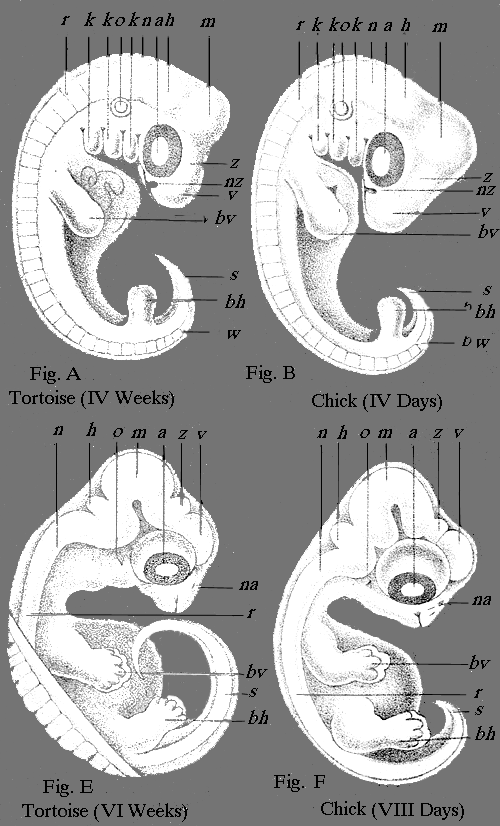
v. Fore-brain. z. Twixt-brain. m. Mid-brain. h. Hind-brain.
n. After-brain. w. Spine. r. Spinal-cord.
Pl. III.
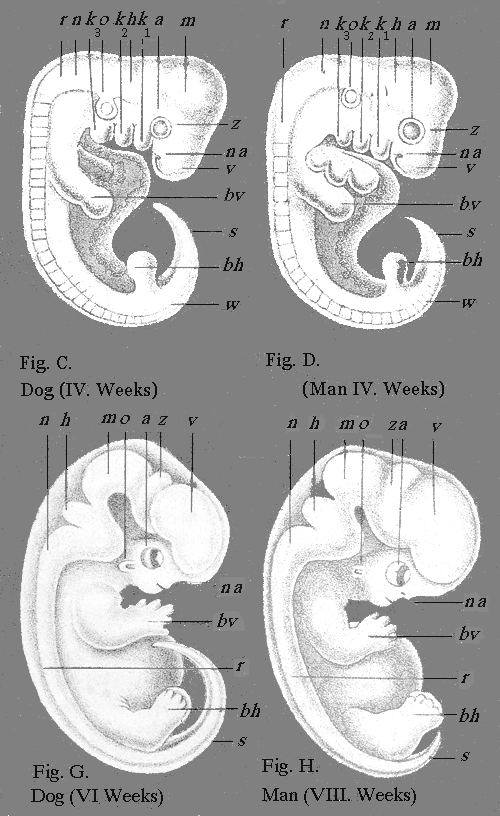
na. Nose. a. Eyes. o. Ear. k1 k2 k3. Gill-arches. s. Tail.
bv. Fore-leg. bh. Hind-leg.
I wish especially to draw attention in Plates II. and
III., which represents embryos in early stages of development
(Fig. A-D)—and in which we are not able to recognize
a trace of the full-grown animal—to an exceedingly
important formation, which originally is common to all
vertebrate animals, but which at a later period is transformed
into the most different organs. Every one surely
knows the gill-arches of fish, those arched bones which
lie behind one another, to the number of three or four,
on each side of the neck, and which support the gills,
the respiratory organs of the fish (double rows of red leaves,
which are popularly called “fishes’ ears.”) Now, these gill-arches
originally exist exactly the same in man (D), in dogs
(C), in fowls (B), and in tortoises (A), as well as in all other
vertebrate animals. (In Fig. A-D the three gill-arches of
the right side of the neck are marked k1 k2 k3). Now, it
is only in fishes that these remain in their original form, and
develop into respiratory organs. In the other vertebrate
animals they are partly employed in the formation of the
face (especially the jaw apparatus), and partly in the formation
of the organ of hearing.
Finally, when comparing the embryos on Plates II. and III.,
we must not fail to give attention again to the human
tail (s), an organ which, in the original condition, man
shares with all other vertebrate animals. The discovery of
tailed men was long anxiously expected by many monistic
philosophers, in order to establish a closer relationship
between man and the other mammals. And in like manner
their dualistic opponents often maintained with pride that
the complete want of a tail formed one of the most important
bodily distinctions between men and animals, though they
did not bear in mind the many tailless animals which really
exist. Now, man in the first months of development possesses
a real tail as well as his nearest kindred, the tailless
apes (orang-outang, chimpanzee, gorilla), and vertebrate
animals in general. But whereas, in most of them—for
example, the dog (C, G)—in the course of development it
always grows longer, in man (Fig. D, H) and in tailless
mammals, at a certain period of development, it degenerates
and finally completely disappears. However, even in fully
developed men, the remnant of the tail is seen in the three,
four, or five tail vertebræ (vertebræ coccygeæ) as an
aborted or rudimentary organ, which forms the hinder or
lower end of the vertebral column (p. 289).
Most persons even now refuse to acknowledge the most
important deduction of the Theory of Descent, that is, the
palæontological development of man from ape-like, and
through them from still lower, mammals, and consider such
a transformation of organic form as impossible. But, I
ask, are the phenomena of the individual development of
man, the fundamental features of which I have here given,
in any way less wonderful? Is it not in the highest
degree remarkable that all vertebrate animals of the most
different classes—fishes, amphibious animals, reptiles, birds,
and mammals—in the first periods of their embryonic
development cannot be distinguished at all, and even much
later, at a time when reptiles and birds are already distinctly
different from mammals, that the dog and the man are
almost identical? Verily, if we compare those two series of
development with one another, and ask ourselves which of
the two is the more wonderful, it must be confessed that
ontogeny, or the short and quick history of development of
the individual, is much more mysterious than phylogeny, or
the long and slow history of development of the tribe. For
one and the same grand change of form is accomplished by
the latter in the course of many thousands of years, and by
the former in the course of a few months. Evidently this
most rapid and astonishing transformation of the individual
in ontogenesis, which we can actually point out at any
moment by direct observation, is in itself much more
wonderful and astonishing than the corresponding, but
much slower and gradual transformation which the long
chain of ancestors of the same individual has gone through
in phylogenesis.
The two series of organic development, the ontogenesis of
the individual and the phylogenesis of the tribe to which
it belongs, stand in the closest causal connection with each
other. I have endeavoured, in the second volume of the
“General Morphology,”(4) to establish this theory in detail,
as I consider it exceedingly important. As I have there
shown, ontogenesis, or the development of the individual, is a
short and quick repetition (recapitulation) of phylogenesis,
or the development of the tribe to which it belongs, determined
by the laws of inheritance and adaptation; by tribe I
mean the ancestors which form the chain of progenitors of
the individual concerned. (Gen. Morph. ii. 110-147, 371.)
In this intimate connection of ontogeny and phylogeny, I
see one of the most important and irrefutable proofs of the
Theory of Descent. No one can explain these phenomena
unless he has recourse to the laws of Inheritance and
Adaptation; by these alone are they explicable. These
laws, which we have previously explained, are the laws of
abbreviated, of homochronic, and of homotopic inheritance,
and here deserve renewed consideration. As so high and
complicated an organism as that of man, or the organism of
every other mammal, rises upwards from a simple cellular
state, and as it progresses in its differentiation and perfecting
it passes through the same series of transformations
which its animal progenitors have passed through,
during immense spaces of time, inconceivable ages ago. I
have already pointed out this extremely important parallelism
of the development of individuals and tribes (p. 10).
Certain very early and low stages in the development of
man, and the other vertebrate animals in general, correspond
completely in many points of structure with conditions
which last for life in the lower fishes. The next phase
which follows upon this presents us with a change of the
fish-like being into a kind of amphibious animal. At a later
period the mammal, with its special characteristics, develops
out of the amphibian, and we can clearly see, in the
successive stages of its later development, a series of steps of
progressive transformation which evidently correspond with
the differences of different mammalian orders and families.
Now, it is precisely in the same succession that we also see
the ancestors of man, and of the higher mammals, appear
one after the other in the earth’s history; first fishes, then
amphibians, later the lower, and at last the higher mammals.
Here, therefore, the embryonic development of
the individual is completely parallel to the palæontological
development of the whole tribe to which it belongs, and this
exceedingly interesting and important phenomenon can be
explained only by the interaction of the laws of Inheritance
and Adaptation.
The example last mentioned, of the parallelism of the
palæontological and of the individual developmental series,
now directs our attention to a third developmental series,
which stands in the closest relations to these two, and which
likewise runs, on the whole, parallel to them. I mean that
series of development of forms which constitutes the object
of investigation in comparative anatomy, and which I will
briefly call the systematic developmental series of species.
By this we understand the chain of the different, but related
and connected forms, which exist side by side at any
one period of the earth’s history; as for example, at the
present moment. While comparative anatomy compares the
different forms of fully-developed organisms with one
another, it endeavours to discover the common prototypes
which underlie, as it were, the manifold forms of kindred
genera, classes, etc., and which are more or less concealed by
their particular differentiation. It endeavours to make out
the series of progressive steps which are indicated in the
different degrees of perfection of the divergent branches of
the tribe. To make use again of the same particular instance,
comparative anatomy shows us how the individual
organs and systems of organs in the tribe of vertebrate
animals—in the different classes, families, and species of it—have
unequally developed, differentiated, and perfected
themselves. It shows us how far the succession of classes
of vertebrate animals, from the Fishes upwards, through the
Amphibia to the Mammals, and here again, from the
lower to the higher orders of Mammals, forms a progressive
series or ladder. This attempt to establish a connected
anatomical developmental series we may discover in the
works of the great comparative anatomists of all ages—in
the works of Goethe, Meckel, Cuvier, Johannes Müller,
Gegenbaur, and Huxley.
The developmental series of mature forms, which comparative
anatomy points out in the different diverging and
ascending steps of the organic system, and which we call
the systematic developmental series, is parallel to the
palæontological developmental series, because it deals with
the result of palæontological development, and it is parallel
to the individual developmental series, because this is
parallel to the palæontological series. If two parallels are
parallel to a third, they must be parallel to one another.
The varied differentiation, and the unequal degree of perfecting
which comparative anatomy points out in the
developmental series of the System, is chiefly determined
by the ever increasing variety of conditions of existence to
which the different groups adapt themselves in the struggle
for life, and by the different degrees of rapidity and completeness
with which this adaptation has been effected.
Conservative groups which have retained their inherited
peculiarities most tenaciously remain, in consequence, at the
lowest and rudest stage of development. Those groups progressing
most rapidly and variously, and which have adapted
themselves to changed conditions of existence most readily
have attained the highest degree of perfection. The
further the organic world developed in the course of the
earth’s history, the greater must the gap between the lower
conservative and the higher progressive groups have become,
as in fact may be seen too in the history of nations.
In this way also is explained the historical fact, that the
most perfect animal and vegetable groups have developed
themselves in a comparatively short time to a considerable
height, while the lowest or most conservative groups have
remained stationary throughout all ages in their original
simple stage, or have progressed, but very slowly and
gradually. The series of man’s progenitors clearly shows
this state of things. The sharks of the present day are still
very like the primary fish, which are among the most
ancient vertebrate progenitors of man, and the lowest
amphibians of the present day (the gilled salamanders and
salamanders) are very like the amphibians which first developed
themselves out of fishes. So, too, the later ancestors
of man, the Monotremata and Marsupials, the most
ancient mammals, are at the same time the most imperfect
animals of the class which still exist.
The laws of inheritance and adaptation known to us are
completely sufficient to explain this exceedingly important
and interesting phenomenon, which may be briefly designated
as the parallelism of individual, of palæontological,
and of systematic development. No opponent of the Theory
of Descent has been able to give an explanation of this extremely
wonderful fact, whereas it is perfectly explained,
according to the Theory of Descent, by the laws of Inheritance
and Adaptation.
If we examine this parallelism of the three organic
series of development more accurately, we have to add
the following special qualifications. Ontogeny, or the
history of the individual development of every organism
(embryology and metamorphology), presents us with a
simple unbranching or graduated chain of forms; and so it
is with that portion of phylogeny which comprises the
palæontological history of development of the direct ancestors
only of an individual organism. But the whole of phylogeny—which
meets us in the natural system of every organic
tribe or phylum, and which is concerned with the investigation
of the palæontological development of all the
branches of this tribe—forms a branching or tree-shaped
developmental series, a veritable pedigree. If we examine
and compare the branches of this pedigree, and place them
together according to the degree of their differentiation and
perfection, we obtain the tree-shaped, branching, systematic
developmental series of comparative anatomy. Strictly
speaking, therefore, the latter is parallel to the whole of
phylogeny, and consequently is only partially parallel to
ontogeny; for ontogeny itself is parallel only to a portion
of phylogeny.
All the phenomena of organic development above discussed,
especially the threefold genealogical parallelism,
and the laws of differentiation and progress, which are
evident in each of these three series of organic development,
and, further, the whole history of rudimentary organs, are
exceedingly important proofs of the truth of the Theory of
Descent. For by it alone can they be explained, whereas
its opponents cannot even offer a shadow of an explanation
of them. Without the Doctrine of Filiation, the fact of
organic development in general cannot be understood. We
should therefore, for this reason alone, be forced to accept
Lamarck’s Theory of Descent, even if we did not possess
Darwin’s Theory of Selection.