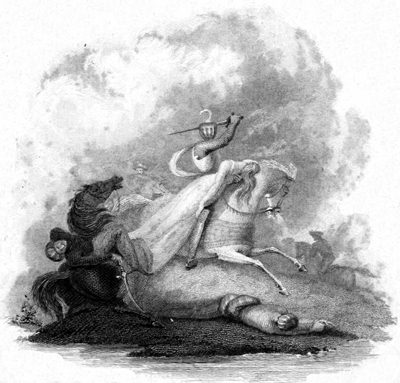
ON THE MERITS AND EFFECTS OF CHIVALRY.
We are now arrived at that part of our subject where we may say with the
poet,
“The knights are dust,
And their good swords are rust:
Their souls are with the saints, we trust.”
With Italy the historical tracing ceases of that system of principles
which for so many centuries formed or influenced the character of Europe.
Its rude beginnings may be marked in the patriarchal manners which
preceded every known frame of artificial life, and have been shaped and
modified by the legislator and the moralist. The ties of fraternity or
companionship in arms, respect to elders, devotion to women, military
education and military investiture, were the few and simple elements of
chivalry, and in other times would have formed the foundation of other
systems of manners. But a new and mighty spirit was now influencing the
world, and bending to its purposes every principle and affection.
Christianity, with its sanctities and humanities, gave a form and
character to chivalry. He who was invested with the military belt was no
longer the mere soldier of ambition and rapine, but he was taught to couch
his lance for objects of defence and protection, rather than for those of
hostility. He was the friend of the distressed, of widows and orphans, and
of all who suffered from tyranny and oppression. The doctrine of Christian
benevolence, that all who name the name of Christ are brothers, gave
beauty and grace to the principles of fraternity, which were the Gothic
inheritance of knights, and therefore the wars of the middle ages were
distinguished for their humanities. A cavalier was kind and courteous to
his prisoner, because he saw in him a brother; and while the system of
ancient manners would have limited this feeling to people of one nation, a
knight did not bound his humanity by country or soil, for Christian
chivalry was spread over most parts of Europe, and formed mankind into one
band, one order of men. From the same principle all the courtesies of
private life were communicated to strangers; and gentleness of manners,
and readiness of service, expanded from a private distinction into an
universal character. Since, by the Christian religion, woman was restored
to the rank in the moral world which nature had originally assigned her,
the feelings of respect for the sex, which were entertained in the early
and unsophisticated state of Europe, were heightened by the new sanctions
of piety. It was a principle, as well as a feeling and a love, to guard
and cherish woman; and many of the amenities of chivalry proceeded from
her mild influence and example.
The patriarchal system of manners, shaped and sanctioned by Christianity,
formed the fabric of chivalry; and romance, with its many-coloured hues,
gave it light and beauty. The early ages of Europe gaily moved in all the
wildness and vigour of youth; imagination freshened and heightened every
pleasure; the world was a vision, and life a dream. The common and
palpable value of an object was never looked at, but every thing was
viewed in its connection with fancy and sentiment. Prudence and
calculation were not suffered to check noble aspirations: army after army
traversed countries, and crossed the sea to the Holy Land, reckless of
pain or danger: duties were not cautiously regarded with a view to limit
the performance of them; for every principle was not only practised with
zeal, but the same fervid wish to do well lent it new obligations. From
these feelings proceeded all the graceful refinements, all the romance of
chivalry: knighthood itself became a pledge for virtue; and as into the
proud and lofty imagination of a true cavalier nothing base could enter,
he did not hesitate to confide in the word of his brother of chivalry, on
his pledging his honour to the performance of any particular action. There
was no legal or other positive punishment consequent on the violation of
his word; and, therefore, the matter being left to imagination and
feeling, the contempt of his fellow-knights could be the only result of
recreancy. The knight looked to fame as one of the guerdons of his toils:
this value of the opinions of others taught him to dread shame and
disgrace; and thus that fine sense of morality, that voluntary submission
to its maxims which we call honour, became a part of knighthood.
The genius of chivalry was personal, inasmuch as each knight, when not
following the banner of his sovereign, was in himself an independent
being, acting from his own sense of virtue, and not deriving counsel from,
or sharing opprobrium with, others. This independence of action exalted
his character; and, nourished by that pride and energy of soul which
belong to man in an early state of society, all the higher and sterner
qualities of the mind,—dignity, uncompromising fidelity to obligations,
self-denial, and generousness, both of sentiment and conduct,—became the
virtues of chivalry.
All the religious devotion of a cavalier to woman existed in his mind,
independently of, or superadded to, his oath of knighthood. She was not
merely the object of his protection, but of his respect and idolatry. His
love was the noble homage of strength to beauty. Something supernaturally
powerful had been ascribed to her by the fathers of modern Europe; and
this appeal to the imagination was not lost. In some ages and countries it
reigned in all its religious force; in others it was refined into
gentleness and courtesy: but every where, and at every time, the firmest
confidence in woman’s truth accompanied it, or supplied its stead; and the
opinion of her virtue, which this feeling implied, had a corresponding
influence on his own manners.
The triumph of chivalry over all preceding systems of opinions was
complete, when imagination refined the fierceness of passion into generous
and gentle affection,—a refinement so perfect and beautiful, that
subsequent times, with all their vaunted improvements in letters and
civilisation, are obliged to revert their eyes to the by-gone days of the
shield and the lance for the most pleasing and graceful pictures of
lady-love.
From these elements, and by means of these principles, sprang the fair and
goodly system of chivalry, which extended itself, as we have seen, over
most of the states of Europe, blending with the strongest passions and
dearest affections of the heart, influencing the manners of private life,
and often determining the character of political events. In England and
France its power was most marked and decided; in Spain it was curiously
blended with Oriental feelings; Germany was not much softened by its
impressions; and in Italy the bitterness of private war admitted but few
of its graces. It is difficult to define the precise period of its
duration, for it rose in the mists and gloom of barbarism; and the moment
of its setting was not regarded, for other lights were then playing on the
moral horizon, and fixing the attention of the world. In the part,
entirely historical, of the present work, the reader must have remarked,
that sometimes the decay of chivalry was gradual, and not apparently
occasioned by external means; while in other countries its extinction was
manifestly hastened by causes which sprang not from any seeds of weakness
in itself. But, viewing the subject in its great and leading bearings, it
may be observed, that chivalry was coeval with the middle ages of Europe,
and that its power ceased when new systems of warfare were matured, when
the revival of letters was complete and general, and the reformation of
religion gave a new subject for the passions and imagination.
This attempt to describe a history of chivalry has proved, at least, that
chivalry was no dream of poets and romancers, and that the feudal system
was not the only form of real life during the middle ages. Sismondi, in
his work on the Literature of the South, contends that chivalry was an
ideal world. He then admits, that sometimes the virtues of chivalry were
not entirely poetical fictions, but that they existed in the minds of the
people, without, however, producing any effect on their lives. His reasons
for his opinions are, that it is impossible to distinguish the countries
where chivalry prevailed; that it is represented to us as remote both in
time and place; and while one class of authors give accounts of the
general corruption of their age, writers of after times refer to those
very days, and adorn them with every virtue and grace.
Now, much of this reasoning is erroneous. That past ages should be praised
at the expence of the present is no uncommon a circumstance, whether in
morals or poetry. We have proved that the countries where chivalry
prevailed are clearly distinguishable, and the degree of its influence
can likewise be marked. M. Sismondi does not argue as if he had been aware
that there ever had existed such a writer as Froissart; who does not refer
to old times for his pictures of arms and amours, but describes the
chivalric character of his own age.
Notwithstanding the light and beauty which chivalry cast over the world,
the system has been more frequently condemned than praised. The objectors
have rested their opinion on a sentence, said to be witty, of an old
English author, that errant knights were arrant knaves, or on a few
passages of reprehension which are scattered through the works of
middle-age literature. Sainte Palaye has founded his condemnation of
chivalry upon the remark of Pierre de Blois, a writer of the twelfth
century, that the horses of knights groan under the burden, not of
weapons, but of wine; not with lances, but cheeses; not with swords, but
with bottles; not with spears, but with spits.[241] Not many years
afterwards, John of Salisbury also says, that some knights appear to think
that martial glory consists in shining in elegant dress, and attaching
their silken garments so tightly to their body, that they may seem part of
their flesh. When they ride on their ambling palfreys they think
themselves so many Apollos. If they should unite for a martial chevisance,
their camp will resemble that of Thais, rather than that of Hannibal.
Every one is most courageous in the banqueting hall, but in the battle he
desires to be last. They would rather shoot their arrows at an enemy than
meet him hand to hand. If they return home unwounded, they sing
triumphantly of their battles, and declare that a thousand deaths hovered
over them. The first places at supper are awarded to them. Their feasts
are splendid, and engrossed by self-indulgence: they avoid labour and
exercise like a dog or a snake. All the dangers and difficulties of
chivalry they resign to those who serve them, and in the mean time they so
richly gild their shields, and adorn their camps, that every one of them
looks not a scholar but a chieftain of war.[242]
All this splenetic declamation involves charges of coxcombry, luxury, and
cowardice. That knights were often guilty of the first offence is probable
enough, for all their minute attention to the form and fashion of armour
could not but attach their minds too strongly to the effect of their
personal appearance. Graced also with the scarf of his sovereign-mistress,
the knight well might caracole his gallant steed with an air of
self-complacency: but a censure on such matters comes with little
propriety from monks, who, according to Chaucer, were wont to tie their
beads under their chin with a true lover’s knot.
The personal indulgence of the knights was not the luxury of the
cloister,—idle, gross, and selfish,—but it was the high and rich
joviality of gay and ardent souls. They were boon or good companions in
the hall, as well as in the battle-field. If their potations were deep,
they surely were not dull; for the wine-cup was crowned and quaffed to the
honour of beauty; and minstrelsy, with its sweetest melodies, threw an air
of sentiment over the scene. How long their repasts lasted history has not
related: but we have seen, in the life of that great and mighty English
knight, Sir Walter Manny, that when the trumpet sounded to horse,
cavaliers overthrew, in gay disorder, every festival-appliance, in their
impatience to don their harness, and mount their war-steeds; and we also
saw that a cup of rich Gascon wine softened the pride and anger of Sir
John Chandos, and, awakening in him the feelings of chivalric generosity,
impelled him to succour the Earl of Pembroke. In sooth, at the festivals
of cavaliers all the noble feelings of chivalry were displayed. In those
hours of dilatation of the heart, no appeal was made in vain to the
principles of knighthood.
Even so late as the year 1462, when the sun of chivalry was nearly set, at
a high festival which the Duke of Burgundy gave, at Brussels, to the lords
and ladies of the country, two heralds entered the hall, introducing a
stranger, who declared that he brought with him letters of credence from
the noble lady his mistress. The letters were then delivered by him to the
officer of the Duke, who read them aloud. Their purport was, that the lady
complained of a certain powerful neighbour, who had threatened to
dispossess her of her lands, unless she could find some knight that,
within a year, would successfully defend her against him in single combat.
The stranger then demanded a boon of the Duke; and His Grace, like a true
son of chivalry, accorded it, without previously requiring its nature. The
request was, that he should procure for the lady three knights, to be
immediately trained to arms; that out of these three the lady should be
permitted to choose her champion. Then, and not before, she would disclose
her name. As soon as the stranger concluded, a burst of joyful approval
rang through the hall. Three knights (and the famous Bastard of Burgundy
was of the number) immediately declared themselves candidates for the
honour of defending the unknown fair. Their prowess was acknowledged by
all the cavaliers present, and they affixed their seals to the
articles.[243]
Except the knights were actually engaged in foreign countries, on martial
chevisance, all the festivals, particularly those which succeeded the
graceful pastime of the tournament, were frequented by dames and damsels,
whose presence calling on the knights to discharge the offices of high
courtesy, chased away the god of wine. The games of chess and tables, or
the dance, succeeded; while the worthy monks, Pierre of Blois, and John of
Salisbury, having no such rich delights in their refectory, were compelled
to continue their carousals.
How gay and imaginative were the scenes of life when chivalry threw over
them her magic robe! At a ball in Naples, Signor Galeazzo of Mantua was
honoured with the hand of the Queen Joanna. The dance being concluded, and
the Queen reseated on her throne, the gallant knight knelt before her,
and, confessing his inability with language adequately to thank her for
the honour she had done him, he vowed that he would wander through the
world, and perform chivalric duties, till he had conquered two cavaliers,
whom he would conduct into her presence, and leave at her disposal. The
Queen was pleased and flattered by this mark of homage, and assured him
that she wished him joy in accomplishing a vow which was so agreeable to
the customs of knighthood. The knight travelled, the knight conquered;
and, at the end of a year, he presented to the Queen two cavaliers. The
Queen received them; but, instead of exercising the power of a conqueror,
she graciously gave them their liberty, recommending them, before their
departure, to view the curiosities of the rich city of Naples. They did
so; and when they appeared before the Queen to thank her for her kindness,
she made them many noble presents, and they then departed, seeking
adventures, and publishing the munificence and courtesy of Joanna.[244]
But the charge of cowardice which the monks brought against the knights is
the most vain and foolish of all their accusations, and throws a strong
shade of contempt and suspicion on the rest. If they had said that
chivalric daring often ran wild into rashness, we could readily enough
credit the possibility of the fact; but nothing could be more absurd than
to charge with cowardice men who, from the dauntlessness of their minds,
and the hardy firmness of their bodies, had been invested with the
military belt.
The reason of all this vituperative declamation against chivalry may be
gathered from a very curious passage in a writer during the reign of
Stephen. “The bishops, the bishops themselves, I blush to affirm it, yet
not all, but many, (and he particularises the bishops of Winchester,
Lincoln, and Chester,) bound in iron, and completely furnished with arms,
were accustomed to mount war-horses with the perverters of their country,
to participate in their prey; to expose to bonds and torture the knights
whom they took in the chance of war, or whom they met full of money; and
while they themselves were the head and cause of so much wickedness and
enormity, they ascribed it to their knights.”[245] Hence, then, it appears
that many of the bishops were robbers, and that they charged their own
offences on the heads of the chivalry. The remark of the writer on the
cruelty of the bishops to their prisoners is extremely curious,
considering it in opposition to the general demeanour of knights to those
whom the fortune of war threw into their hands. But these wars and
jealousies between the knighthood and the priesthood, while they account
for all the accusations which one class were perpetually making against
the other, compel us to despise their mutual criminations.
Nothing more, perhaps, need be said to deface the pictures of the knightly
character as drawn by Pierre de Blois and John of Salisbury; and they
should not have met with so much attention from me if they had not always
formed the van of every attack upon chivalry. But there is one passage in
Dr. Henry’s History of England so closely applicable to the present part
of my subject, that I cannot forbear from inserting it. “It would not be
safe,” observes that judicious historian, “to form our notions of the
national character of the people of England from the pictures which are
drawn of it by some of the monkish historians. The monk of Malmsbury, in
particular, who wrote the life of Edward II., paints his countrymen and
contemporaries in the blackest colours. ‘What advantage,’ says he, ‘do we
reap from all our modern pride and insolence? In our days the lowest,
poorest wretch, who is not worth a halfpenny, despises his superiors, and
is not afraid to return them curse for curse. But this, you say, is owing
to their rusticity. Let us see, then, the behaviour of those who think
themselves polite and learned. Where do you meet with more abuse and
insolence than at court? There, every one swelling with pride and rancour,
scorns to cast a look on his inferiors, disdains his equals, and proudly
rivals his superiors. The squire endeavours to outshine the knight, the
knight the baron, the baron the earl, the earl the king, in dress and
magnificence. Their estates being insufficient to support this
extravagance, they have recourse to the most oppressive acts, plundering
their neighbours and stripping their dependents almost naked, without
sparing even the priests of God. I may be censured for my too great
boldness, if I give an ill character of my own countrymen and kindred; but
if I may be permitted to speak the truth, the English exceed all other
nations in the three vices of pride, perjury, and dishonesty. You will
find great numbers of this nation in all the countries washed by the Greek
sea; and it is commonly reported that they are infamous over all these
countries for their deceitful callings.’ But, we must remember, (as Dr.
Henry comments on this passage,) that this picture was drawn by a peevish
monk, in very unhappy times, when faction raged with the greatest fury,
both in the court and country.”
It would not alter the nature of chivalry, or detract any thing from its
merits, if many instances were to be adduced of the recreancy of knights,
of their want of liberality, courtesy, or any other chivalric qualities;
for nothing is more unjust than to condemn any system for actions which
are hostile to its very spirit and principles. One fair way of judging it,
is to examine its natural tendencies. A character of mildness must have
been formed wherever the principles of chivalry were acknowledged. A great
object of the order was protection; and therefore a kind and gentle regard
to the afflictions and misfortunes of others tempered the fierceness of
the warrior. In many points chivalry was only a copy of the Christian
religion; and as that religion is divine, and admirably adapted to improve
and perfect our moral nature, so the same merit cannot in fairness be
denied to any of its forms and modifications. Chivalry embraced much of
the beautiful morality of Christianity,—its spirit of kindness and
gentleness; and men were called upon to practise the laws of mercy and
humanity by all the ties which can bind the heart and conscience; by the
sanctions of religion, the love of fame, by a powerful and lofty sense of
honour. On the other hand, the Christianity of the time was not the pure
light of the Gospel, for it breathed war and homicide; and hence the page
of history, faithful to its trust, has sometimes painted the knights
amidst the gloomy horrors of the crusades ruthlessly trampling on the
enemies of the cross, and at other times generously sparing their
prostrate Christian foes, and gaily caracoling about the lists of the
tournament.
But these are not the only means of showing the general beneficial nature
of the institutions of chivalry. The character of modern Europe is the
result of the slow and silent growth of ages informed with various and
opposite elements. The impress of the Romans is not entirely effaced; and
two thousand years have not destroyed all the superstitions of our Pagan
ancestors. We must refer to past ages for the origin of many of those
features of modern society which distinguish the character of Europe from
that of the ancient world, and of the most polished states of Asia. We
boast our generousness in battle, the bold display of our animosity, and
our hatred of treachery and the secret meditations of revenge. To what
cause can these qualities be assigned? Not to any opinions which for the
last few hundred years have been infused into our character, for there is
no resemblance between those qualities and any such opinions; but they can
be traced back to those days of ancient Europe when the knight was quick
to strike, and generous to forgive; and when he would present harness and
arms to his foe rather than that the battle should be unfairly and
unequally fought. This spirit, though not the form, of the chivalric times
has survived to ours, and forms one of our graces and distinctions. The
middle ages, as we have shown, were not entirely ages of feudal power; for
the consequence of the personal nobility of chivalry was felt and
acknowledged. The qualities of knighthood tempered and softened all
classes of society, and worth was the passport to distinction. Thus
chivalry effected more than letters could accomplish in the ancient world;
for it gave rise to the personal merit which in the knight, and in his
successor, the gentleman of the present day, checks the pride of birth and
the presumption of wealth.
But it is in the polish of modern society that the graces of chivalry are
most pleasingly displayed. The knight was charmed into courtesy by the
gentle influence of woman, and the air of mildness which she diffused has
never died away. While such things exist, can we altogether assent to the
opinion of a celebrated author, that “the age of chivalry is gone?” Many
of its forms and modes have disappeared; fixed governments and wise laws
have removed the necessity for, and quenched the spirit of,
knight-errantry and romance; and, happily for the world, the torch of
religious persecution has long since sunk into the ashes. But chivalric
imagination still waves its magic wand over us. We love to link our names
with the heroic times of Europe; and our armorial shields and crests
confess the pleasing illusions of chivalry. The modern orders of military
merit (palpable copies of some of the forms of middle-age distinctions)
constitute the cheap defence of nations, and keep alive the personal
nobility of knighthood. We wage our wars not with the cruelty of Romans,
but with the gallantry of cavaliers; for the same principle is in
influence now which of old inspired courage while it mitigated ferocity.
Courtesy of manners, that elegant drapery of chivalry, still robes our
social life; and liberality of sentiment distinguishes the gentleman, as
in days of yore it was wont to distinguish the knight.
INDEX.
Accolade, meaning of the, I. 53. note.
Adelais, tale of her imprisonment, rescue by an adventurous knight, and subsequent marriage, II. 322.
Albigenses, romance of, I. 48. note.
Alcantara, order of, its principles, and its comparative rank with other Spanish orders, I. 353.
Alfonso, story of his chivalric bearing, II. 258.
Allegories, fantastic, made on knights and their armour, I. 108. 110.
Amys and Amylion, Romance of, I. 121.
Anglo-Saxons, state of chivalry among, I. 6. 9. 11. 383.
Antharis, a Lombard king, story of his romantic gallantry, II. 321.
Arabian horses, their repute in chivalric times, I. 111.
Arabic, Spanish historians, account of, II. 242. note.
Archers, excellence of English, II. 12.
Fine passage from Halidon Hill expressive of, II. 13. note.
An English archer in the days of Edward III., 14.
Importance of at battles of Cressy and Poictiers, 15.
Argonautes, order of, purpose of its institution, I. 358.
Aristotle, lay of, I. 215.
Armorial bearings, historical and philosophical sketch of the principles of, I. 86, 87. 89.
Armour, beauty of ancient, I. 65.
Value of enquiries into the minutiæ of, I. 94.
Uncertainty of the subject, I. 95.
Its general features, I. 99, &c.
Golden armour, 102.
Array, general nature of chivalric, I. 118.
Arthur, his knightly honour, I. 132. note.
Discovery of his remains at Glastonbury, account of, I. 375.
His court the school of chivalric virtue, 376.
His generosity to his knights, 376. note.
See Round Table.
Athenæus, his singular testimony to a state of chivalry, I. 6.
Auberoch, beleagured by the French, and chivalrously relieved by the English, II. 31.
Audley, Sir James, interesting story of his heroic achievements and of his generosity, II. 43.
Axe, the battle, I. 67.
Description of King Richard’s, 68. note.
B.
Bachelor, various meanings of the word, I. 19. 45.
Bacinet, I. 91.
Baked meats, fondness of people for them in the olden time, I. 191. and note.
Ball, the, after a tournament, I. 284.
Band, Spanish order of the, objects of the order, I. 367.
Interesting, as descriptive of the state of Spanish manners, ib.
Its fine chivalry to woman, I. 369.
Banneret, qualification of a knight, I. 16.
His privileges, 17.
See Chandos.
Bannockburn, battle of, I. 407.
Barriers, description of, I. 124. note.
Singular battles at the, I. 124. 127.
Bath, order of, ceremonies used at the ancient creation of knights of, II. 150. 91, &c.
Modern ceremonies, I. 364.
Absurdity of our heralds’ dogmatic positiveness regarding the æra of the order’s foundation, II. 91. note.
Batre, Claude de, a French knight. His joust with Maximilian I. of Germany, II. 315.
Bauldrick, description of the, I. 73.
Bayard, the chivalric, his early years, II. 217.
Enters the service of the kings of France, 218.
His valiancy, ib.
His humanity, 219.
His gallantry, ib.
Holds a tournament in honour of the ladies, 220.
His death, 222.
Beauty, knights fought to assert the superiority of their mistress’s beauty, I. 209.
The practice apparently absurd, but reason why it should not be too severely censured, II. 211.
Black Prince, his conduct at Limoges, I. 132.
His courtesy, II. 11. 16.
His liberality, II. 45.
His deportment to Peter the Cruel, II. 185.
Not a favorite with the nobility in the English possessions in France, II. 191.
His cruelty to Du Guesclin, ib.
Blois, Charles of, his contention with Jane de Mountfort for the duchy of Brittany, I. 239.
Blue, the colour of constancy in days of chivalry, I. 275. note.
See Stocking.
Bonaparte, his generousness to a descendant of Du Guesclin, II. 203.
Bonnelance, Sir John, his remarkable courtesy to the ladies, I. 199.
Boucmell, John, his joust with an English squire, I. 294.
Bourbon, singular mode by which a Duke of, gained a fortress, I. 59.
——, order of, account of, I. 371.
Boucicant, Marshal, his outrageous reverence for women, I. 223. note.
His joust at St. Ingelbertes, near Calais, 303, &c.
Bovines, importance of squires at the battle of, I. 47.
Break-across, to, meaning of the phrase, I. 278, 279. note.
Britomart, the perfection of chivalric heroines, I. 253.
Brittany, revered for its chivalric fame, II. 174.
Bruce, Robert, his chivalric humanity, II. 69.
Burgundy, Bastard of, his joust with Lord Scales, I. 314.
His skill in other jousts, II. 214.
——, court of, splendour of its tournaments, II. 213.
The most chivalric country in Europe during middle of fifteenth century, ib.
Chivalric circumstance at the court of, II. 351.
C.
Calais, stories regarding, II. 17-21.
Calatrava, order of, its origin and history, I. 349.
Calaynos, the Moor, praised by the Spaniards, II. 234.
Carlisle, Sir Anthony Harclay, Earl of, ceremonies of his degradation from knighthood, I. 62-64.
Carpet-knights, meaning of the term, II. 156.
Carpio, Bernardo del, account of, II. 243.
Cavalry, the principal arm of military power during the middle ages, I. 2.
Caxton, his lamentation over the decline of chivalry, II. 99.
His exaggeration of the evil, 102.
Celts, humility of Celtic youths, I. 6.
Cervantes, curious error made by, I. 20.
Censures the chivalric custom of making vows, 129. note.
Satirises chivalric contempt of bodily pain, 368. note.
Ridicules the vigil of arms, I. 49. note.
and the pride of knights, I. 393. note.
Accuracy of his pictures, II. 297.
Cesena, noble defence of, by Marzia degl’ Ubaldini, I. 249.
Chandos, Sir John, story with the Earl of Oxenford, I. 38.
History of his heroism, II. 46.
Gallantry, 47.
Tenacious of his armorial bearings, ib.
Exploits at Auray, 49.
Tries to dissuade the Black Prince from the Spanish war, 50.
Ceremonies on his becoming a knight-banneret, ib.
His remarkable generousness, 52.
His death before the bridge of Lusac, 60, &c.
General grief thereat, 63.
Character, bluntness of the old English, shown at the creation of knights of the Bath, II. 165.
Charity, a great chivalric virtue, instance of, I. 161.
Charter-house, the, founded by Sir Walter Manny, II. 42. and note.
Charlemagne, state of chivalry in his time, I. 10.
His expedition into Spain, II. 244.
Chargny, Lord of, a famous jouster, II. 298.
His passage of arms near Dijon, I. 328.
Cherbury, Edward Herbert, Lord of, memoir of him, II. 138.
Chivalric fame of his family, ib.
His vanity, 140-145.
Made a knight of the Bath, 141.
His curious adventures in France, 142.
The disgusting vanity of his infidelity, 147.
His general character, 148.
His inferiority to the heroes of the reign of Edward III., 149.
Chess, the high favour of this game in days of chivalry, I. 163.
A story of a knight’s love of chess, 164.
Chivalry, general oath of, I. 50.
Form used in Scotland, II. 70.
Exhortations to perform chivalric obligations, I. 51, 52.
Beauty of chivalric costume, I. 65.
First ages of, interesting to the reason, but not pleasing to the fancy, I. 1.
Difference between feudal and moral chivalry, I. 3.
Origin of, ib.
Nature of, 2.
Modified by Christianity, 9, 13.
Early ceremonies of inauguration, 4. 11, 12.
Personal nobility of, not to be confounded with feudal territorial nobility, 16.
Morals of chivalric times unjustly censured, 229.
Real state of them, ib. &c.
Peculiar fineness of chivalric feeling, 277. note.
Declined in France before the common use of gunpowder, II. 213.
Recapitulation of the circumstances which gave birth to, 341.
Its general nature, 342.
Exact time of its influence difficult to mark, 346.
Its merits, 348.
Its effects, 358.
Application of chivalric honours to men in civil stations, 155.
Connected with feudalism, I. 384.
A compulsory honour in England, 386.
Christianity, its improvements on Gothic chivalry, I. 10.
Cid, the, his birth, II. 246.
His early ferocious heroism, ib.
His singular marriage, 247.
Enters the service of King Ferdinand, 249.
His chivalric gallantry, ib.
Ceremony of his being knighted, 251.
Death of the King ib.
Becomes the knight of Sancho, King of Castile, and his campeador, 252.
Mixture of evil and good in his character, ib.
Supports the King in his injustice, 253.
His romantic heroism, ib.
His virtuous boldness, 256.
His second marriage, 260.
Is banished from the court of Alfonso, the brother of Sancho, 261.;
but recalled ib.
Is banished again, 263.
Story of his unchivalric meanness, ib.
His history in exile, 264.
His nobleness and generosity, 267.
Is recalled, 269.
Captures Toledo, 270.;
and Valentia, 271.
Unjust conduct to the Moors, 274.
Marriage of his daughters, 276.
His death, 284.;
and character, 285.
Claremont, the Lord of, his dispute with Sir John Chandos regarding armorial cognisances, II. 47.
Clary, the Lord of, singular story of the censure on him by the court of France for want of courtesy to Sir Peter Courtenay, I. 154-157.
Clergy, the weapons they used in battle, I. 68.
A gallant fighting priest promoted to an archdeaconry, II. 80.
Often turned knights, I. 350.
Clermont, council of, sanctions chivalry, I. 12.
Clifford, Nicholas, his joust with John Boucmell, I. 294, &c.
Cloth of gold, chivalric circumstances at the field of, II. 111.
Cochetel, battle of, II. 178.
Cognisances, I. 87.
Coliseum, Moorish and chivalric sports in, II. 329.
Inferiority of the old Roman games in, to those of chivalry, I. 260.
Colombe, Ernalton of Sainte, bravery of him and his esquire, I. 46.
Companions in arms, nature of such an union, I. 118-123.
Conde, D. José Antonio, value of his searches into Arabic Spanish historians, II. 242. note.
Constancy, a greater virtue in chivalric times than in the present day, I. 206.
Spenser’s exhortation to, 207.
Constantine, fabulous order of, I. 374.
Conversation of knights, its subjects, I. 175.
Courage of the knight, I. 124-130.
Courtenay, Sir Peter, his adventures in France, I. 154, &c.
Courtesy, a knightly virtue, I. 160.
Courtesy of a dragon, 161. note.
At tournaments, 268.
Cousines, dame des belle, her reproof of a young page for his not being in love, I. 32.
Crawford, Sir David de Lindsay, Earl of, his joust with Lord Wells, I. 290.
Cross, every military order had its, I. 362.
Wretched taste in concealing the cross of the order of the Bath by a star, ib.
Cyclas, I. 85.
Cyneheard, his story, I. 5.
D.
Dagger of mercy, description of it, I. 92.
Story of its use, 93.
Dambreticourt, Lord Eustace, his chivalry inspired by the lady Isabella, I. 204.
His valour at the battle of Poictiers, II. 44.
Dames and Damsels. See Lady.
Degradation, ceremonies of, I. 60.
Derby, Earl of, the sort of death he desired, I. 147.
Devices, what they were, I. 78.
Worn in tournaments, 272-275.
Discipline, chivalric array not inconsistent with feudal discipline, I. 145.
Douglas, story of the perilous castle of, I. 205.
Generousness of the good Lord James of, I. 206, 402.
His character, ib. note.
The Douglas of the sixteenth century, II. 67.
Wins the pennon of Hotspur, 77.
His heroism and noble death, 80.
Archibald, at Shrewsbury, ib.
Dress of ladies in chivalric times, I. 185.
Importance of modesty of, 186.
Dub, meaning of the word, I. 53. note.
Dynadan, Sir, a merry knight of the Round Table, his pretended dislike of women, I. 196. note.
E.
Edward I., his chivalric character, I. 395.
A chivalric anecdote of, I. 142.
Edward II., state of chivalry in his reign, I. 402. 409.
Edward III., state of armour in his time, I. 97. 100.
Chivalry in his reign, II. 4, &c.
Eloisa, the Lady, a heroine of chivalry, I. 235.
England, antiquity of the sarcasm of its not being the country of original invention, II. 48. note.
The melancholy of its mirth curiously noticed, ib.
Errantry, facts relating to the knight-errantry of the middle ages, I. 140. 145.
English knights-errant, 225.
General facts and usages, 226, &c.
F.
Falconry. See Hawking.
Falcons, placed on perches above knights at chivalric entertainments, I. 281.
Father in chivalry, the respect which a knight bore to the cavalier that knighted him, I. 54.
Festivals, description of chivalric, I. 176. 379.
At tournaments, 281.
Fidelity to obligations, a great virtue in knights, I. 151.
Flodden, chivalric circumstances at battle of, II. 121.
Flowers, Romance of, remarks on, I. 315. note.
Forget-me-not, romantic story of this flower: joust concerning it, I. 315.
France, state of, after the death of Du Guesclin, II. 203.
Chivalry in baronial castles, II. 169.
Knighthood given to improper persons, 211.
Extinction of chivalry in, 226.
Ridiculous imitation of chivalry by the profligate soldiers of a profligate king, 228.
Francis I., his chivalric qualities, II. 223.
Circumstances which disgraced his chivalry, 224.
Knighted by Bayard, 225.
Fraternity, origin and history of the spirit of, I. 4.
Encouraged by the institutions of Arthur, 379.
Froissart, character of his history, Preface.
Frojaz, Don Rodrigo, a Spanish knight, chivalric mode of his death, I. 71.
Furs, fondness of people in the middle ages for them, I. 49. 85. note.
G.
Gallantry, its origin, I. 7-9.
Absurdity of antiquarians respecting, 175. note.
Garter, order of the, objects of, I. 360.
Its resemblance to a religious order, 361.
Reasons of its being established, 360.; II. 4.
Commonly ascribed origin a vulgar fable, 6.
Meaning of the motto, 7.
The collar, 8.
Gawain, Sir, a knight of Arthur’s Round Table, character of, I. 378.
Generousness of knights, high estimation of this quality, I. 153.
Instances, 153-157.
Gennet, order of the, I. 374.
George, Saint, the person that was understood by this name, II. 9.
Germans, superior virtue of German women owned by Tacitus, I. 7.
Instances of this virtue, 7, 8.
Political chivalry had no influence in Germany, II. 303.
German knights quailed before undisciplined troops, 304.
When and where tournaments were held, I. 262.
Heraldic pride of the, 263. note.
Singular matter regarding the, 265. note.
Inferiority of to Italian condottieri, 305.
Intolerance and cruelty of German knights, 306.
Their education, 307.
Cruelty to their squires, 308.
Their avarice, 310.
Little influence of German chivalry, 311.
Singular exception, 312.
Destruction of chivalry, 317.
Gonfanon, what it was, I. 67.
Gonsalez, Count Fernan de, a fabulous hero of Spanish chivalry, II. 245.
Gordon, Adam, his chivalry, I. 56.
Graville, Sir William, loses a fortress out of his love for chess-playing, I. 165.
Green-field, knights of the Fair Lady in the, story of their chevisance, I. 223.
Gueldres, Duke of, story of his regard for knightly honour, I. 138.
Guesclin, Bertrand du, his birth, II. 174.
Became a cavalier in opposition to paternal wishes, 175.
His knightly conduct at Rennes, ib.
Amusing interview with the Duke of Lancaster, 177.
His gallant bearing at Cochetel, and the consequent recovery of the fame of the French arms, 178.
Taken prisoner at Aurai, 180.
Redeemed, 182.
His chivalry in Spain, 184, &c.
Taken prisoner again, 189.
Treated with cruelty by the Black Prince, 191.
Ransomed, 209.
Made Constable of France, 194.
Recovers the power of the French monarchy, ib.
His companionship in arms with Olivier de Clisson, 195.
His death before Randan, 199.
Character, 201.
H.
Harald, the valiant, account of, I. 9.
Hawking, a knowledge of, a necessary part of a knight’s education, I. 29.
A great chivalric amusement, 161.
Hawkwood, Sir John, story of his origin, and allusions to his battles, I. 23.
Helmets, I. 88.
Various sorts of, I. 89.
Hennebon, noble defence of, by the Countess of Mountfort, I. 242-246.
Henry I. and II., state of chivalry in their respective reigns, 387. 389. 395.
Henry II., of France, killed in a tournament, account of the circumstances, II. 226. and note.
Henry, Prince, son of James I., his love of chivalric exercises, II. 137.
Henry IV., chivalric parley between him and the Duke of Orleans, II. 83.
His unchivalric deportment at Shrewsbury, 88.
Henry V., his love of chivalry, II. 85. 96.
His chivalric modesty, 98.
Henry VIII., account of his tournaments, II. 104, &c.
Heroines, nature of female heroism in days of chivalry, and stories of, I. 234, &c.
Hita, Genez Perez de, nature of his volume on the fall of Grenada, II. 288. note.
Homildon Hill, interesting knightly story regarding battle at, I. 55.
Honour, curious story of knightly, I. 138.
The knights’ pursuit of, I. 144.
See, too, 277. note.
Horn, King, romance of, I. 27.
Horse of the knight, I. 111.
What horses were preferred, 112.
The famous horse of the Cid, ib. II. 287.
Armour of the horse, I. 114.
Always very splendidly adorned, 115.
Horsemanship, care with which knights were trained to, I. 44.
Hotspur fights with the Douglas, II. 77.
His gallant deportment at Otterbourn, 79.
And at Shrewsbury, 87.
Humanities of chivalric war, I. 129. 135.
Humility, a knightly virtue, I. 158.
Hunting, young squires instructed in the art of, I. 29.
A part of the amusements of chivalry, 161.
Huntingdon, Sir John Holland, Earl of, his skill in jousting, I. 307.
I.
Inauguration, ceremony of, into knighthood, when and where performed, I. 50.
Its circumstances, 50-54.
Ingelbertes, Saint, joust at, I. 302-314.
Ipomydon, romance of, I. 28.
Isabella, the Lady, a heroine of chivalry, I. 235.
Italian armour, excellence of, I. 105.;
II. 293. note, 330.
Italy, but little martial chivalry in, II. 324.
Chivalric education, 321.
Changes of the military art in, 325.
Chivalry in the north of, 329.
Esteem in which the word of knighthood was held, ib.
Chivalry in the south of, 331.
Mode of creating knights in, 334.
Religious and military orders in, 335.
Political use of knighthood, 336.
Folly of an Italian mob regarding knighthood, ib.
School of Italian Generals, 328.
Chivalric sports in, 338.
Ivanhoe, errors of the author of, regarding Anglo-Saxon and Norman chivalry, I. 383. note;
and concerning the Knights Templars, 387. note;
and also concerning the nature and names of chivalric sports, 327.
J.
James, Saint, his popularity in Spain, I. 345. note; II. 230.
Order of, I. 344.
James II., of Arragon, gallantry of one of his decrees, II. 289.
James IV., of Scotland, chivalric and romantic circumstances of his life, II. 118-124.
Jealousy, no part of chivalric love, I. 207.
Joanna of Naples, a chivalric anecdote regarding, II. 352.
Joust, nature of the, to the utterance, I. 289.
For love of ladies, 291.
Various, à l’outrance, 289-297.
A plaisance, 297, &c.
Romance of, 324.; II. 215.
Use of jousts, I. 330.
K.
Knights, their privileges, I. 17.
Expensive equipment of, necessary to the dignity, 16.
Preparations for knighthood, 48.
His war-cry and escutcheon, 18.
Qualifications, 19.
Gentle birth not regarded when valour conspicuous, 22.
By whom created, ib.
(For his education, see Squire and Page.)
Often turned priests, I. 14.
Associations of, in defence of the ladies, 223-225.
Stipendiary knights in England, 385.
No resemblance between and the equites of Rome, 14.
Made in the battle-field, and in mines, 56-59.
Knight of honour, description of, 267.
English wore golden collars, II. 8.
Anxiety to receive the order from great characters, 55. and note.
No knights made on compulsion, after the days of Charles I., 158.
Degradation of, in the reign of James I., 157.
Knot, order of the, I. 358.
Knowles, Sir Robert, remarkable story of the heroism of one of his knights, I. 124.
L.
Lady in chivalry, character of, I. 182. 256.
Her courtesy, ib.
Education, 183.
Amusements, 190.
Deportment, 185.
What ladies could create knights, 252.
Singular blending of the heroic and the tender feelings in her character, 253.
Not made prisoner in war, 227.
Judge in the tournament, 267. 283.
Her favours worn by her knights, 272. 275. and note.
Lahire, the singular prayer of this knight, I. 147.
Lance, the chief weapon of the knight, I. 66.
The staff made from the ash-tree, ib.
Langurant, Lord of, bravery of, and of his squire, I. 46. and note.
Another story, 93.
Largess, distributed at ceremonial of inauguration, I. 54.
At tournaments, 284.
Launcelot, generous modesty of this knight, I. 159.
Singular proof of his high reputation, 55. note.
Beautiful lamentation over his dead body, 377.
Lee, Sir Henry, his gallantry, II. 132.
Legnano, battle of, II. 304.
Liberality, a great virtue in chivalry, I. 157.
Liegois, their battle with the French chivalry, II. 204.
Lists, description of the, I. 266.
London, citizens of, their taste for chivalric amusements, II. 11.
Lords, House of, errors of its committees, I. 15. note.
Lorrys, Sir Launcelet de, a gallant knight, killed in a joust for love of his lady, I. 292.
Love, peculiarities of chivalric, I. 212. 217-222. 194, &c.
Perfection and purity of chivalric, II. 345.
Quick-sightedness of courtly matrons regarding signs of, II. 322.
Louis, Saint, his barbarous intolerance, I. 148.
Loyes, Sir, of Spain, his cruelty, I. 151.
M.
Mail-armour, various descriptions of, I. 78-81.
Mail and plate, 82.
Mail worn in all ages of chivalry, 84.
Manny, Sir Walter, succours the Countess of Mountfort, I. 245.
His bravery at Calais, II. 18.
An amorous knight, 27.
His kindness to two brother-knights, 29.
His joyous adventurousness, 30.
Other feats, 31, &c.
His filial piety, 34.
Gentleness of his disposition, 38.
His high rank in England, 39.
His sageness, 40.
His liberality, 41.
Founds the Charter-house, 42.
March, Countess of, story of her chivalric heroism in defending the castle of Dunbar, I. 237.
Marche, Thomas de la, his duel with John de Visconti, II.
Martel, nature of that weapon, I. 68.
Marzia, degl’ Ubaldini, story of her heroic deportment at Cesena, I. 249.
Maule, its qualities, I. 68.
Not a perfectly chivalric weapon, 72.
Maximilian the only Emperor of Germany of a chivalric character, II. 315.
His joust with a French knight, ib.
Medicine, knowlege of, possessed by dames and damsels, I. 186.
Faith of knights in medicines administered by women, 187.
Medici, Lorenzo de, won a prize at a tournament, I. 267.
Men-at-arms, manner of their fighting, and description of their armour, I. 107.
Mercenaries, their use in the French army, II. 209.
Mercy, order of our Lady of, reason of the establishing of the, I. 354.
Merlo, Sir John, a Spanish knight, account of his jousting in Burgundy, II. 297-300.
Meyrick, Dr., character of his critical inquiry into ancient armour, I. 79. note, 101. note, 114. note.
Michael of the Wing, purposes of the establishing of this order, I. 356.
Milan, Sir Galeas, Duke of, his courtesy to the Earl of Derby, II. 330.
Milanese armour, excellence of. See Italian armour.
Missals, the merits of, decided by battle, II. 288.
Minstrels, description of them and their art in connection with chivalry, I. 166, &c.
Their chivalric importance in Italy, II. 327.
Molai, Jacques de, appoints a successor to his authority over the Templars, I. 140.
Montferrand, Regnaud de, the romantic excess of his love for chivalric honours, I. 59.
Montglaive, Guerin de, I. 30.
Montpensier, Henry de Bourbon, his death in a tournament, II. 226.
Mountfort, Jane de, tale of her heroism, I. 239.
Music, ladies in chivalry were taught, I. 183, 184.
N.
Naples, chivalry at, II. 331.
Ceremonies of chivalric inauguration in, 332.
Navaret, battle of, II. 189.
Nobility, education of English, in the sixteenth century, II. 115.
Normans, nature of their chivalry, I. 383.
Plant chivalry in Italy, II. 331.
O.
Oak, in Navarre, order of, I. 374.
Obedience, dignity of, I. 6.
Olympic games, their inferiority to the games of chivalry, I. 259.
Orbigo, account of a singular passage of arms at, II. 292-296.
Orders, the religious, their general principles, I. 333.
Qualifications for them, 336.
Use of the religious, 337.
Military orders, ib.
Dormant orders, 366.
Singular titles of, 371.
Ordonnance, companies of, established by Charles VII., their unchivalric nature, II. 209.
Orleans, Duke of, his satire on the heaviness of English armour, I. 91.
Orris, Michael de, the romantic and chivalric nature of his love, I. 322.
Ostrich feathers, whether originally a crest or a device of the Black Prince, I. 101, &c.
Otterbourn, description of that chivalric battle, II. 76, &c.
Oxenford, Earl of, amusing story of his absurd pride, I. 36.
Oxford, Edward Vere, Earl of, his coxcombry and romantic gallantry, II. 150.
P.
Page, the first gradation in chivalry, I. 30.
At what age a boy became one, ib.
His duties, 31.
Personal service, ib.
Taught love, religion, and war, 32.
His martial exercises, 35.
(See Saintré.)
Combats of pages, II. 208.
State of English pages during the sixteenth century, 149.
Palaye, Sainte, character of his Memoirs of ancient Chivalry, Preface.
Paleaz, Martin, a Spanish knight, his story, II. 271.
Passage of arms, what it was, I. 327.
Error of the author of Ivanhoe concerning, ib. note.
Description of one in Burgundy, 328.;
and at Orbigo, in Spain, II. 292.
Patriotism, not necessarily a knightly virtue, I. 139.
But encouraged by the religious and military orders, 335, 336.
Peacock, festival and vow of the, I. 177.
Mode of dressing the, 178. note.
Pelayo, his history, II. 242.
Pembroke, Earl, stories of, II. 33. 52-58.
Penitents of love, a singular set of fanatics in France, I. 211.
Pennon, the streamer at end of a lance, I. 66.
Perceval, Mr. George, excellence of his history of Italy, Preface.
Cited, I. 102. note. II. 218. 325. note. 326-328.
Percy. See Hotspur.
Perfumes, fondness of people in the middle ages for, I. 194. note.
Philippa, Queen, her heroism, I. 236.
Plate-armour, description of, I. 83.
Its inconveniences I. 84. 102. note.
Peter the Cruel, his history, II. 181, &c.
Politeness of knights in battle, I. 135.
Pride of knights ridiculed by Cervantes, I. 393.
Prisoners, when made by knights, delivered to the squires, I. 41.
Curious pride of knights concerning, 138.
Ladies were never made prisoners, 227.
Pursuivant of love, the favourite title of a knight, I. 202.
Pye, Lord Saint, his skill in jousting, I. 309, &c.
Q.
Quinones, Sueno de, account of his holding a passage of arms at Orbigo, in Spain, II. 292.
Quintain, nature of that amusement, I. 44.
R.
Ramsey, William de, the chivalric nature of his death, I. 147.
Ransoming, the general principles of, in chivalric times, I. 136.
Rapier, an Italian weapon, II. 135.
Fighting with it supersedes the sword and buckler, ib.
Religion, nature of the knight’s, I. 146. 150.
Brevity of his devotions, ib.
Curious instance of it, 147.
The chivalric glory of a man being shriven in his helmet, ib.
Intolerance of the knight, 148.
His ferocity against Pagans and Saracens, ib.
His idle impiety at a tournament, 266.
Maintained opinions by the sword, 349.
Rienzi, Cola di, instance of his coxcombry, II. 335. note.
Richard I., description of his battle-axe, I. 69.
His chivalric character, 391.
Rivers, mystery of, meaning of the phrase, I. 29.
Romance of chivalry displayed in the tournament, I. 266.
Great estimation of romances in chivalric times, I. 174.
Beneficial effects of, on chivalry, II. 170.
Their popularity in England during the sixteenth century, 100.
Effects on Italy, 337.
Roncesvalles, chivalric march through the valley of, by the soldiers of the Black Prince, II. 189.
Question regarding battles in, at the time of Charlemagne, 244.
Round Table, when and where held in England, II. 3.
Number of knights attached to the fabulous, I. 376. note.
Roy, Raynolde du, a good jouster, chivalric reason for it, I. 312.
Rybamount, courtesy of Edward III. to Lord Eustace of, II. 19.
S.
Sageness, meaning of this old word, I. 129.
Saintré, Jean de, curious account of the education in love of this knight, I. 32.
Scales, Anthony Woodville, Lord, his joust with the Bastard of Burgundy, I. 314.
Scarf, ladies’, on the knight, I. 85. 89. 101.
Scotland, form of chivalric oath in, II. 70.
Chivalric circumstances, 71.
Frenchmen’s opinions of Scotsmen’s chivalry, 73.
Reasons for Englishmen’s dislike of wars in, 75.
Courtesies between English and Scottish knights, 75.
See James IV.
Shield, sentiments of honour connected with the, I. 77.
Its various shapes, 78.
Sidney, Sir Philip, his chivalric character, II. 126.
His Arcadia, 127.
Circumstances of his life, 128.
Remarkable grief at his death, 129.
Uncommon kindness of the Sidney family, ib., and note.
His description of the nature of chivalric courage, I. 130. note.
His apology for ladies studying surgery, I. 188.
Sir, its title in chivalry, I. 31.
Skottowe, Mr., excellence of his work on Shakspeare, I. 209. note.
Smithfield, anciently the principal tilting ground in London, I. 269.
Used for other purposes, note, ib.
Its state in the sixteenth century evidence of the degeneracy of chivalry, II. 136. note.
Spain, religious orders in, account of, I. 344.
General nature of Spanish chivalry, II. 230.
Religion and heroism, ib.
Gallantry, 231. 289.
Curious blending of Spanish and Oriental manners, 232.
Beneficial effects from the union of Moors and Spaniards, 233.
Religious toleration in Spain, 235.
Loves and friendships of Moors and Christians, ib.
Peculiarities of Spanish chivalry, 236.
Forms of knighthood, 237.
Various classes of knights, 238.
Spanish knights travel to distant countries, asserting the beauty of Spanish maidens, 296.
Extinction of Spanish chivalry, 301.
The knight’s idolatry of women outlives this extinction, 302.
Spanish poetry, 241.
Story of Spanish manners 271. 277.
State of Spanish chivalry after the death of the Cid, II. 287.
Spenser, his Fairy Queen supports chivalry, II. 126.
Object of the poem, ib.
Poem cited, passim.
Spices, fondness of knights for them, I. 169. note. 282.
Spurs, buckling them on, a part of chivalric inauguration ceremonies, I. 53.
Suspended in churches as memorials of victory and honour, II. 305. note.
Squire, his personal and chivalric duties, I. 35, 36. 39.
Never sat at the same table with knights, 36.
Story of a high-spirited squire, 37.
His dress, 39.
Various sorts of squires, 40.
Spenser’s picture of one, ib.
His duties in battle, 41.
Carried the pennon of a knight, ib.
His gallantry, 41. 45.
His martial exercises, 43.
Undertook military expeditions, 45.
His services in the battle-field, 41. 46.
Nature of his armour, 107.
Story of the boldness of a, I. 128.
English squires wore silver collars, II. 8.
See Bovines.
Squirehood, the third class of the general order of chivalry, I. 23.
Of whom it was formed, 24.
Stephen, his courtesy to Matilda, I. 153.
Important effects of chivalry in his reign, I. 389.
Stocking, order of the, I. 379.
Origin of the phrase Blue Stocking, 380.
This contemptuous expression no longer applicable to Englishwomen, 381.
Stothard, Mrs. Charles, her Tour in Normandy cited, I. 241. note.
Surcoats, their materials and purposes, I. 85.
Of the military orders, 86.
Surgery, knowledge of, possessed by ladies in chivalric times, I. 188.
Surry, Earl of, incorrectness of the common tale regarding, II. 114.
Swinton, Sir John, his fine heroism, I. 56.
Another story of the heroism of a, 128.
Sword, girding of it on the knight a part of the chivalric inauguration ceremonies, I. 11. 63.
The favourite weapon of the knight, I. 70.
Swords had names and mottoes; the cross hilt; the handle contained the knight’s seal; Spanish swords, 70-77.
Story of the Cid’s favourite swords, II. 279.
T.
Tabard, description of, I. 85.
Templars, Knights, extravagance of their ascetism, I. 324. note.
Errors of the author of Waverley regarding, 337. note.
The valiancy of the, 338.
Succession of Grand Masters from the persecution to the present time, 340, &c.
Present state of, 342.
Their importance in Spain, 241.
Thistle, order of the, I. 363.
Its absurd pretensions to antiquity, ib.
Thomson, Anthony Todd, value of his botanical lectures, I. 315. note.
Tournaments, superiority of, to Grecian games, I. 259.
Origin of, 260.
Objects, 261., and notes.
Qualifications for tourneying, 263. 265. 272.
Who tourneyed, 264.
Ceremonies of the, ib.
Procession to the, 268.
Nature of tourneying weapons, 270.
The preparation, 273.
The encounter, 274.
English regulations concerning, 279. note.
Opposed by the Popes, 286. note.
Their frequency in the reign of Edward III., II. 2.
Time of their death in England, 137.
Female tournament in Germany, 314.
Tristrem, Romance of, I. 26.
V.
Valet, the common title of the page, I. 35.
Vargas, Garcia Perez de, a splendid exemplar of Spanish chivalry. Story of his romantic gallantry, II. 289.
Vigil of arms a necessary preliminary to knighthood, I. 49.
Vilain, Sir John, anecdote of his remarkable prowess, I. 69.
Virtue, degree of, expected in a knight, I. 149.
Visconti, John de, his duel with Thomas de la Marche, II. 22.
Vows, knightly, courage incited by, I. 127.
Fantastic, ib., &c. 322.
W.
Wallop, Sir John, his men break lances for ladies’ love, II. 117.
Warwick, an earl of, a famous jouster, I. 301.
Wells, Lord, his joust with Sir David de Lindsay, first Earl of Crawford, I. 290.
Werner, fiendlike ferocity and impiety of, II. 328.
William Rufus, authors wrong, in calling him a chivalric king, I. 391.
But he promoted the growth of chivalry in England, I. 387.
Wines, dislike entertained by the Englishmen of old for the wines of Spain, I. 143.
Wines drank in chivalric times, 193. and note.
Wines and spices, 169. note.
Woods, mystery of, I. 29.
Worcester, John, Earl of, Constable. His regulations regarding tournaments in England, I. 279. note.
Wordsworth, his beautiful description of the occupations and life of a minstrel, I. 171.
X.
Ximena, a Spanish maiden, story of her voluntary marriage with her father’s murderer, II. 247.
Z.
Zamora, story of that town and the Cid of Spain, II. 254.
THE END.
London:
Printed by A. & R. Spottiswoode,
New-Street-Square.
Footnotes:
[1] Warton (History of English Poetry, vol. i. p. 118. note, 8vo.) notices
a passage in Piers Plowman, which shows how the reigning passion for
chivalry infected the ideas and expressions of the writers of this period.
The poet is describing the crucifixion, and speaking of the person who
pierced our Saviour’s side with a spear. This person our author calls a
knight, and says, that he came forth with his spear in hand and justed
with Jesus. Afterwards, for doing so base an act as that of wounding a
dead body, he is pronounced a disgrace to knighthood, and our champion
chevaler chyese knight is ordered to yield himself recreant. fol. 88. b.
So, too, in the Morte d’Arthur, Joseph of Arimathea is called the gentle
knight that took down Jesus from the cross.
[2] Warton, vol. ii. p. 86.
[3] Barnes’s Edward III., p. 564.
[4] Leland, Collect. vol. ii. p. 476.
[5] Arthur went to his mete with many other kings. And there were all the
knights of the Round Table except those that were prisoners, or slain at a
recounter, thenne at the high feast evermore they should be fulfilled the
hole nombre of an hundred and fifty, for then was the Round Table fully
accomplished. Morte d’Arthur. The tale of Sir Gauth of Orkeney, c. 1. And
see Vol. I. of this work, page 376.
[6] Walsingham, sub anno 1344. Ashmole on the Order of the Garter, cap. v.
s. 2.
[7] Preface to the Black Book of the Order of the Garter.
[8] Walsingham, p. 164. Froissart, c. 100.
[9] Supplement to the Encyclopædia Britannica, vol. iii. part 1. p. 139.
As the story of Lady Salisbury’s garter is fabulous, we must resort to
some other conjectures for an explanation of the famous motto of the
order, and the one cited in the text is extremely ingenious and plausible.
With much less appearance of truth, Ashmole fancies that Edward by this
motto retorted shame and defiance upon him that should dare to think ill
of so just an enterprise as he had undertaken for the recovery of his
lawful right to the French crown (whose arms he had lately assumed); and
that the magnanimity of those knights whom he had chosen into this order
was such as would enable him to maintain that quarrel against all who
durst think ill of it. Ashmole’s Order of the Garter, p. 184. There never
was a knight more fond of impresses, mottoes, and devices, than King
Edward III. He not only stamped them upon his own armour and that of his
horse, but on his apparel, beds, and household furniture. “It is as it
is,” was one of these mottoes. Another was:—
“Ha! ha! the white swan,
By God’s soul I am thy man.”
[10] Gibbon is the chief supporter of the last hypothesis, In his text
(vol. iv. c. 23.) he states positively, that “the infamous George of
Cappadocia has been transformed into the renowned St. George of England,
the patron of arms, of chivalry, and the Garter.” In a note, however, he
observes that this transformation is not given as absolutely certain, but
as extremely probable. Few people read this note, and, perhaps, Gibbon did
not intend they should. He wished to strike their attention by the
sentence in his text, and he satisfied his conscience for literary honesty
by writing the modification at the bottom of the page.
[11] Froissart, c. 213.
[12] Barnes, p. 444.
[13] Knyghton. Chron. col. 2615.
[14] Stow’s Chronicle.
[15]
——“these gallant yeomen,
England’s peculiar and appropriate sons,
Known in no other land. Each boasts his hearth
And field as free as the best lord his barony,
Owing subjection to no human vassalage,
Save to their king and law. Hence are they resolute,
Leading the van on every day of battle,
As men who know the blessings they defend.
Hence are they frank and generous in peace,
As men who have their portion in its plenty.
No other kingdom shows such worth and happiness
Veil’d in such low estate.”—
Halidon Hill, act ii. sc. 2.
[16] This national characteristic is alluded to in Latimer’s sermons,
folio 69:—a work not of very good promise for such matters.
[17] Hair cut short.
[18] Chaucer, Prologue to the Canterbury Tales, line 101, &c. &c.
[19] Froissart, c. 131.
[20] Froissart, c. 163.
[21] Ibid. cc. 168. 174.
[22] Froissart, cc. 150. 152. “Messire Eustace vous estes le chevalier au
monde, que veisse oncques plus vaillamment assailer ses ennemis, ne son
corps deffendre: ny ne me trouvay oncques en bataille ou je veisse, qui
taint me donnast affaire, corps à corps, que vous avez huy fait. Si vous
en donne le pris, et aussi sur tous les chevaliers de ma cour, par droit
sentence. Adonc print le roy son chappelet, qu’il portoit sur son chef
(qui estoit bon et riche) et le meit sur le chef de Monseigneur Eustace;
et dit Monseigneur Eustace, je vous donne ce chappelet pour le mieux
combattant de la jouence, de ceux de dedans et de dehors: et vous pui que
vous le portez ceste année pour l’amour de moi. Je say bien que vous estes
gai et amoureux, et que volontiers vous vous trouvez entre dames et
damoiselles. Si dites, par tout la ou vous irez, que je le vous ay donné.
Si vous quitte vostre prison, et vous en pouvez partir demain, s’il vous
plaist.”
[23] Froissart, cc. 133. 146.
[24] Barnes’s History of Edward III. p. 452, &c.
[25] There was a Lord of Manny, as well as Sir Walter, at Edward’s court.
The lord was a distinguished person, for he was among the bishops, earls,
and barons, who accompanied Edward to France, upon his doing homage for
the duchy of Guienne. St. Palaye has confounded the lord and the knight,
and made but one of them. He overlooked the hundred and second chapter of
Froissart, wherein the baron and the knight are separately and distinctly
mentioned. There was also another Manny, called the courageous Manny. He
was knighted by Sir Eustace Dambreticourt before a battle, and after
fighting most valiantly he was left for dead in the field. Froissart shall
tell the remainder of the story. “After this discomfiture, and that all
the Frenchmen were departed, the courageous Manny being sore hurt and near
dead, lift up his head a little, and saw nothing about him but dead men
lying on the ground round about him. Then he rose as well as he might, and
sat down, and saw well how he was not far from the fortress of Nogent,
which was English; then he did so much, sometimes creeping, sometimes
resting, that he came to the foot of the tower of Nogent; then he made
tokens to them within, showing how he was one of their companions; then
certain came down the tower to him, and bare him into the fortress, and
dressed his wounds, and there he governed himself so well that he was
healed.” Froissart, c. 199.
[26] Froissart, c. 19.
[27] Froissart, cc. 24. 26.
[28] Appendix, No. xxiv., to Anstis’s History of the Knighthood of the
Bath.
[29] “Mais il dit à aucuns de ses plus privés, qu’il avoit promis en
Angleterre devant les dames et seigneurs, qu’il seroit le premier qui
entreroit en France, et prendroit chastle ou forte ville, et y feroit
aucunes appertises d’armes,” c. 36.
[30] Froissart, c. 36.
[31] Quand Messire Gautier veit ce, il dit, j’amais ne soye salué de
madame et chere amie, se je réntre en chastel n’en forteresse, jusques à
tant que j’aye l’un de ces venans verse. Froissart, c. 82.
[32] Froissart, c. 82.
[33] See Vol. I. p. 151.
[34] Froissart, c. 87.
[35] Vol. i. p. 246. ante.
[36] Froissart, c. 103. Le Comte D’Erby dit, Qui merci prie merci doit
avoir. This sentence, I suppose has escaped the notice of writers who have
represented the sole amusement of knights to have consisted in cutting the
throats of common people.
[37] Froissart, c. 107.
[38] This is Lord Berners’ rendering of the passage. The phrase “par un
sien clerc” had crept into some editions of Froissart; and Mr. Johnes’s
translation is, “Sir Walter caused the inscription to be read to him by a
clerk.” This, perhaps, was necessary, as the inscription was in Latin, for
heroes have not been famous for their clerkship. But the inference which
some writers have drawn, that he could not read at all, is perfectly
unwarrantable.
[39] Froissart, c. 110.
[40] Froissart, c. 135
[41] Froissart, c. 146.
[42] She was the Lady Margaret, daughter and heiress of Thomas
Plantagenet, surnamed of Brotherton, Earl of Norfolk, and uncle to Edward
III.
[43] Dugdale.
[44] The reader may, reasonably enough, enquire who could have been the
vendor? I cannot tell him: I can only copy Stow in these matters.
[45] Stow’s London, book 4. c. 3. Maitland’s History of London, p. 661.
This was the state of the Charter House till the suppression of the
monasteries, in the reign of Henry VIII. Its annual value was 642l. It
was given to Sir Thomas Audley, speaker of the House of Commons, with
whose only daughter it went, by marriage, to Thomas, Duke of Norfolk, and
from him, by descent, to Thomas, Earl of Suffolk. In the time of James I.
it was purchased by that “right phœnix of charity,” Thomas Sutton,
citizen and girdler, for the large sum of 13,000l.; and he converted the
buildings and gardens into an hospital for the relief of aged men,
education of youth, and maintaining the service of God.
[46] Froissart, 286.
[47] See vol. i. p. 204.
[48] Ashmole’s History of the Garter, c. 26. s. 3. Froissart, cc. 142.
147.
[49] Dugdale, Baronage, i. 503.
[50] Authorities in Ashmole, p. 702.
[51] Froissart, c. 125. See the first volume of this work, page 228.
[52] Froissart, c. 161. Monseigneur Jehan de Clermont dit, Chandos, ce
sont bien les parolles de vos Anglois, qui ne savent adviser riens de
nouvel; mais quant, qu’ils voyent, leur est bel. This is a very curious
proof of the antiquity of the common remark that Englishmen are a
borrowing and improving people, and not famous for originality of
invention. It might be contended, but not in this place, that we are both.
And here I will transcribe another sentence of Froissart, more
characteristic and true. “Les Anglois, selon leur coutume se divertirent
moult tristement.”
[53] Froissart, c. 226.
[54] Froissart, c. 237.
[55] Froissart, cc. 265, 266.
[56] Froissart, c. 270.
[57] Froissart, liv. ii. c. 82.
[58] 4 Plac. Parl. iii. 5.
[59] Thomas of Elmham, p. 72. His general expression, tapestries
representing the ancient victories of England, I presume chiefly meant
those of Edward III.
[60] The tales of chivalry had for their prologue some lines expressive of
war and love; but in a grander strain the poetical biographer of the Bruce
sings:—
“Ah! freedome is a noble thing;
Freedome makes men to have liking;
Freedome all solace to men gives;
He lives at ease, that freely lives.
A noble heart may have none ease,
Nor ellys[A] nought that may him please,
If freedome fail: for free liking
Is yearned[B] o’er all other thing.
Na he that aye has lived free
May not know well the property,
The anger, na the wretched doom
That is coupled to foul thraldom.
But, if he had essayed it,
Then all perquer[C] he should it wit,
And should think freedom more to prize
Than all the gold in world that is.
Thus contrary things ever more
Discoverings of the tother are.”
The Bruce, line 225, &c.
[A] nor else.
[B] eagerly desired.
[C] perfectly.
[61] haste.
[62] laundress.
[63] child-bed.
[64] stop.
[65] pity.
[66] pitched.
[67] moved.
[68] laundress.
[69] Selden’s Titles of Honour, and Pinkerton’s History of Scotland, on
the authority of a book which I have not been able to meet with, called
“Certain Matters composed together.” Edinb. 1597. 4to.
[70] Henry’s History of England, vol. iii. p. 80. 4to.
[71] Border History of England and Scotland, p. 91.
[72] Border History, p. 143.
[73] Nisbet’s Heraldry, i. 7.
[74] Knyghton, col. 2580.
[75] This amusing opinion of the French knights should be given in the
original language. “Adonc eurent plusieurs chevaliers et escuyers de
France passage: et retournerent en Flandres, ou là ou ils pouvoyent
arriver, tous affamés, sans monture, et sans armeures: et Escoce
maudissoyent, et le heure qu’ils y avoyent entré: et disoyent qu’oncques
si duc voyage ne fut: et qu’ils voudroyent que le roi de France
s’accordast aux Anglois, un an ou deux, et puis allast en Escoce, pour
tout destruire, car oncques si mauvaises gens ne verint: n’y ne trouverent
si faux et se traistres, ne de si petite congnuissance.” Vol. ii. c. 174.
[76] The Scotch knights procured horse-shoes and harness ready made from
Flanders. Froissart, vol. ii. c. 3. Lord Berners’ translation.
[77] Froissart, vol. ii. c. 142.
[78] “Henry Percy,” says Holingshed, “was surnamed, for his often
pricking, Henry Hotspur, as one that seldom times rested, if there were
any service to be done abroad.” History of Scotland, p. 240.
[79] The gallantry of this fighting priest was afterwards rewarded by the
gift of the archdeaconry of Aberdeen.
[80] He was afterwards ransomed; and, according to Camden, Pounouny
castle, in Scotland, was built out of the ransom money.
[81] Walsingham, (p. 366.) says, that the Earl of Dunbar came in and
turned the scale in favor of the Scots. Nothing of this is mentioned by
Froissart, who had his account of the battle from the Douglas family, at
whose castle he resided some time. If it be said that their account was
probably a prejudiced one, the same objection may be raised against that
of Walsingham. The Douglas’ always spoke of their victory with true
chivalric modesty; for they declared that it was the consequence of the
exhausted state of the English after the march from Newcastle.
[82] Froissart, vol. ii. c. 146. Buchanan, lib. 9. p. 173, &c.
[83] Monstrelet, vol. i. c. 9, &c. Rymer, Fœdera, vol. viii. p. 310,
311.
[84] This Archibald Douglas, Earl of Galloway, called the Grim, was an
illegitimate son of a good Sir James Douglas, and the successor in the
earldom of Douglas to the Earl James who fell at Otterbourn. Archibald had
been taken prisoner by Hotspur at the battle of Holmedon Hill; and Percy
agreed, that if he would fight with him as valiantly against Henry IV. as
he had fought during that battle, he would give him his liberty free of
ransom-money. Douglas, as a soldier and an enemy of the English king, had
no objection to these terms, and therefore he fought at the battle of
Shrewsbury. Buchanan, book 10.
[85] Well, indeed, might the Scottish knight say,
“Another king! they grow like Hydras’ heads:
I am the Douglas, fatal to all those
That wear these colours on them.”
Shakspeare, Henry IV, Part I. act v. scene 4.
[86] Otterbourne, p. 239. 244. Walsingham, p. 410, &c. Hall, folio 22. I
mean not to say, however, that his conduct was without precedent, for at
the great battle of Poictiers nineteen French knights were arrayed like
King John.
[87] Camden has marked the commencement of this custom in the reign of
Henry IV., and he has been followed by all our writers on heraldry and
titles of honor, except Anstis, who endeavours to trace it to the reign of
Edward I. Anstis mistook the matter entirely. Undoubtedly many instances
may be met with in earlier times when knights were created with the full
ceremonies of oblation of the sword at the altar, of bathing, &c.; and in
strictness all knights should have been created in that manner. Whenever
Anstis met with a knight inaugurated in that way, he called him a knight
of the Bath. Now the question is, at what time was the first royal
marriage, royal christening, or other festivity, when knights were
made?—made, not exactly for military objects, not in consequence of
feudal tenure, but in honour of the event which they were celebrating.
Knights of the Bath were knights of peace, knights of compliment and
courtesy. Camden’s opinion was founded on the following passage in
Froissart: “The vigil before the coronation (of Henry IV.) was on the
evening of Saturday; on that occasion, and at that time, there watched all
the esquires who were the next morning to be created knights, to the
number of forty-six. Each of them had his esquire attending him, a
separate chamber, and a separate bath, where the rites of bathing were
that night performed. On the day following, the Duke of Lancaster (Henry
IV.), at the time of celebrating mass, created them knights, giving them
long green coats, the sleeves whereof were cut straight, and furred with
minever, and with great hoods or chaperons furred in the same manner, and
after the fashion used by prelates. And every one of these knights, on his
left shoulder, had a double cordon or string of white silk, to which white
tassels were pendent.” Now there is nothing in this passage which can lead
the mind to think that the coronation of Henry IV. was the first occasion
when knights of the Bath were created; and, therefore, our writers on
heraldry and titles of honor are not justified in the positiveness with
which they always head their dissertations on knighthood of the Bath with
the year 1399.
[88] That the shoulder-knot of the knights of the Bath was worn only for a
time, and on the principle of chivalry which induced men to place chains
round their legs until they had performed some deeds of arms, I learn from
Upton, a writer of great reputation in heraldic matters, who lived in the
days of Henry VI. See his treatise De Re Militari, p. 10., quoted in the
Appendix to Anstis’s History of the Knighthood of the Bath.
[89] Thus Chaucer:
“A custom is unto these nobles all,
A bride shall not eaten in the hall,
Till days four, other three at the least
Ypassed be, then let her go to feast.”
[90] MS. Norfolc. in Off. Arm. n. 15. See Anstis’s Appendix to his History
of the Knighthood of the Bath, p. 24.
[91]
“For to obeie without variaunce
My lordes byddyng fully and plesaunce
Whiche hath desire, sothly for to seyn
Of verray knyghthood, to remember agayn
The worthyness, gif I shall not lye,
And the prowesse of olde chivalries.”
Lydgate, War of Troy.
[92] Henry V. Act ii. Chorus.
[93] He was kind and courteous to them immediately after the battle, and
indeed as long as their deportment merited his friendship. The Duke of
Orleans and four other Princes of the blood royal were taken prisoners at
the battle of Agincourt, and for a while lived on their parole. But when
they forfeited the titles of knights and gentlemen, by endeavouring to
deceive and betray Henry while he was negotiating with the parties that
distracted France, he then removed them to close confinement in Pontefract
castle; nor did they obtain their liberty for many years. A great outcry
has been raised against Henry for his conduct in this instance,—for his
not showing a chivalric deportment to men who had forfeited their honour.
[94] Thus the Chorus in Shakspeare’s Henry V. addresses the audience:
“So let him land,
And solemnly, see him set on to London.
So swift a pace hath thought, that even now
You may imagine him upon Blackheath.
When that his lords desire him, to have borne
His bruised helmet and his bended sword,
Before him through the city: he forbids it,
Being free from vainness and self-glorious pride;
Giving full trophy, signal, and ostent,
Quite from himself, to God.”
[95] Caxton, of the Order of Chivalry or Knyghthood.
[96] Ibid.
[97] Comines, vol. i. p. 31.
[98] Sir Tristrem, Scott’s edition, Fytte first. st. 2.
[99] Rymer’s Fœdera.
[100] Warton pleasantly observes, that had Henry never murdered his wives,
his politeness to the fair sex would remain unimpeached.
[101] Holingshed, p. 805, 806, &c. Henry’s passion for disguising himself
was singular, and carried him beyond the bounds of chivalric decorum.
“Once on a time the King in person, accompanied by the Earls of Essex,
Wiltshire, and other noblemen, to the number of twelve, came suddenly in
the morning into the Queen’s chamber, all apparelled in short coats of
Kentish kendall, with hoods on their heads, and hose of the same, every
one of them carrying his bow and arrow, and a sword and a buckler, like
outlaws, or Robin Hood’s men. Whereat the Queen, the ladies, and all other
there were abashed, as well for the strange sight, as also for their
sudden coming,—and after certain dances and pastimes made, they
departed.” Holingshed p. 805.
[102] Holingshed, p. 815.
[103] Holingshed, p. 807, 808.
[104] Holingshed, p. 85, &c.
[105] Shakspeare, Henry VIII. Act i. scene 1.
[106] Dr. Nott, in his life of Lord Surrey, prefixed to the works of His
Lordship and Sir Thomas Wyatt, has by the evidence of facts completely
overthrown this pleasing tale.
[107] These curious particulars are to be gathered, as Dr. Nott remarks,
from the following passage in Hardynge’s Chronicle.
“And as lords’ sons been set, at four year age,
At school to learn the doctrine of letture;
And after six to have them in language
And sit at meet, seemly in all nurture:
At ten and twelve to revel is their cure,
To dance and sing, and speak of gentleness:
At fourteen year they shall to field I sure,
At hunt the deer, and catch at hardiness.
“For deer to hunt and slay, and see them bleed
An hardiment giveth to his courage.
And also in his wit he giveth heed,
Imagining to take them at advantage.
At sixteen year to warry and to wage,
To joust and ride and castles to assail,
To skirmish als, and make sicker scurage,
And set his watch for peril nocturnal.
“And every day his armour to essay,
In feats of arms with some of his meynie;
His might to prove, and what that he do may
If that he were in such a jeopardy
Of war befall, that by necessity
He might algates with weapons him defend.
Thus should he learn in his priority
His weapons all, in armes to dispend.”
See to the same effect, the Paston letters, vol. iii. 34, 35, &c.
[108] This curious circumstance is mentioned in a journal of Sir John
Wallop’s expedition, which Dr. Nott dug out of the State-Paper Office. The
whole passage is amusing.
“July 31. Wallop advances to Bettune. Passing by Terouenne, he attempts to
draw out the garrison of that place, but fails. The French defeated in a
skirmish. Wallop says, that he sent a letter to the commandant of
Terouenne, an old acquaintance, that if he had any gentlemen under his
charge, who would break a staff for their ladies’ sake, he would appoint
six gentlemen to meet them. The challenge is accepted, and the conditions
are fixed. Mr. Howard, Peter Carew, Markham, Shelly of Calais, with his
own two men, Cawverly and Hall, are the English appellants. They all
acquit themselves gallantly at the jousts. Hall, at his first course, did
break his staff galliardly, in the midst of the Frenchman’s cuirass.
Markham stroke another on his head-piece, and had like to have overthrown
him. Peter Carew stroke his very well, and had one broken on him. Cawverly
was reported to have made the fairest course; but by the evil running of
the Frenchman’s horse, which fled out of the course, he was struck under
the arm, and run through the body into the back, and taken into the town
where he was well treated. I wish to God, said Wallop, the next kinsman I
had, not being my brother, had excused him.”
[109] Pinkerton’s History of Scotland, vol. ii. p. 85, &c.
[110] Drummond, 140, &c. Buchanan, xiii. 25.
“For the fair Queen of France
Sent him a turquois ring and glove,
And charged him, as her knight and love,
For her to break a lance;
And strike three strokes with Scottish brand,
And march three miles on Southron land,
And bid the banners of his band
In English breezes dance.
And thus, for France’s Queen he drest
His manly limbs in mailed vest.”
Marmion, canto v.
[111] He was afterwards Duke of Norfolk, and great grandfather of the Earl
of Surrey, who was mentioned by me in p. 114. ante.
[112] It has been generally thought that James, forgetting both his own
wife and the Queen of France, lost much time at Ford, in making love to a
Lady Heron, while his natural son, the Archbishop of St. Andrew’s, was the
paramour of Miss Heron the daughter. Dr. Lingard (History of England, vol.
vi. p. 31. n.) seems inclined to doubt this tale, because James had only
six days to take three castles and a fair lady’s heart. What time was
absolutely necessary for these sieges and assaults, the learned Doctor has
not stated. However, to speak seriously, the story has no foundation in
truth; and it only arose from the beauty of Lady Heron, and the reputed
gallantry of the Scottish King.
[113] Henry’s History of Great Britain, book vi. ch. 1. part ii. s. 1.
[114] Pitscottie, p. 116, &c.
[115] Pinkerton, book xii.
[116] So reported in the conversation of Ben Jonson and Drummond of
Hawthornden.
[117] Thomson’s Seasons. Summer, l. 1511.
[118] The Arcadia was popular so late as the days of Charles I., as may be
learned from a passage in the work of a snarling satirist, who wanted to
make women mere square-elbowed family drudges. “Let them learn plain works
of all kind, so they take heed of too open seaming. Instead of songs and
musick, let them learn cookerie and laundrie; and instead of reading Sir
Philip Sydney’s Arcadia, let them read the Grounds of Good Huswifery. I
like not a female poetess at any hand.” Powell’s Tom of all Trades, p. 47.
[119] This was the honourable distinction of the Sidney family in general,
as we learn from Ben Jonson’s lines on Penshurst.
“Whose liberal board doth flow
With all that hospitality doth know!
Where comes no guest but is allow’d to eat,
Without his fear, and of thy Lord’s own meat.
Where the same beer and bread, and self-same wine,
That is His Lordship’s, shall be also mine.”
Gifford’s Ben Jonson, vol. viii. p. 254.
The practice of making a distinction at the table by means of a
salt-cellar was very proper in early times, when the servants as well as
the master of a family with his wife and children dined at one long table.
It became odious, however, when a baron made this mark of servility
separate his gentle from his noble friends. This was feudal pride, whereas
chivalric courtesy would rather have placed the guests in generous
equality about a round table.
[120] Spenser, Colin Clout’s come Home again.
[121] Nicholls’s Progresses of Queen Elizabeth, vol. iii. p. 41, &c.
[122] Puttenham, Arte of English Poesie, book ii. c. 9. & 19.
[123] Burton, Anatomy of Melancholy, p. 271. This passage brings to mind a
corresponding one in Wilson’s Arte of Rhetoricke, printed in 1553. “If
there be any old tale or strange history, well and wittily applied to some
man living, all men love to hear it. As if one were called Arthur, some
good fellow that were well acquainted with King Arthur’s book, and the
knights of his Round Table, would want no matter to make good sport, and
for a need would dub him knight of the Round Table, or else prove him to
be one of his kin, or else (which were much) prove him to be Arthur
himself.”
[124] “The Two angry Women of Abingdon.” The sword and buckler fighting
was the degeneracy of the ancient chivalry; and Smithfield, which had
shone as the chief tilting ground of London, was in the sixteenth century,
according to Stow, “called Ruffians’ Hall,” by reason it was the usual
place of frays and common fighting, during the time that sword and
bucklers were in use. “When every serving-man, from the base to the
best, carried a buckler at his back, which hung by the hilt or pommel of
his sword.” Alas, for the honor of chivalry!
[125] Wilson’s Life of James, p. 52.
[126] Ben Jonson, Masque of Prince Henry’s Barriers.
[127] G. Wither. Prince Henry’s Obsequies. El. 31.
[128] Life of Edward Lord Herbert, written by himself, p. 16.
[129] Life, p. 46.
[130] Life, &c. p. 63. Sir Edward was very much annoyed at Paris by a
Monsieur Balagny, who enjoyed more attention of the ladies than he did.
They used one after another to invite him to sit near them, and when one
lady had his company awhile, another would say, “You have enjoyed him long
enough, I must have him now.” The reason of all this favour was, that he
had killed eight or nine men in single fight, p. 70. This was the
degeneracy of chivalry with a vengeance.
[131] Life, p. 60.
[132] Act i. scene 1. of the play whose title I shall transcribe: “The New
Inn: or, the Light Heart; a Comedy. As it was never acted, but most
negligently played by some, the King’s Servants; and more squeamishly
beheld and censured by others, the King’s Subjects, 1629. Now at last set
at liberty to the Readers, His Majesty’s Servants and Subjects, to be
judg’d of, 1631.”
[133] Dugdale, Origines Juridiciales. c. 39. Serjeants at law were not
knighted till the reign of Henry VIII. c. 51.
[134] Ferne’s Blazon of Gentry, p. 100. See too Camden’s Britannia “on the
degrees in England,” p. 234.
[135] Thus Lord Bacon says, “There be now for martial encouragement some
degrees and orders of chivalry, which nevertheless are conferred
promiscuously on soldiers, and no soldiers,” &c. Essays on the true
Greatness of Kingdoms.
[136] Fletcher, Fair Maid of the Inn, act i. scene 1.
[137] Rymer’s Fœdera, vol. xv. p. 497.
[138] British Museum, Cottonian MSS. Nero. c. ix. folio 168. The
assumption of dignity by the squire-governors, in order to get greater
largesses, is amusing enough: but no knights of other lands were present
to chastise them for their insolence.
[139] Du Cange, Gloss. ad Script. Med. Œvi. in verb. Milites Regis.
[140] Du Chesne. Hist. Franc. Script. vol. ii. p. 148. The assertion,
however, is not strictly correct; for so early as the fourth century
Armorica had been colonised from Wales. Argentré, Hist. de la Bretagne, p.
2. A connection ever since subsisted between Armorica and this island; and
when the Britons were oppressed, they repaired to the Continent for
refuge.
[141] Velly, Hist. de la France, vol. v. p. 132-136.
[142] Velly, Hist. de la France, vol. v. p. 313, &c.
[143] D’Argentré, Histoire de Bretagne, livre vii. c. 15. Paris, 1618.
[144] Froissart, c. 230.
[145] Mémoires de Du Guesclin, vol. iv. c. 16. The mode by which the Queen
came by her death was never certainly known. One common story was, that
she had been murdered by a party of Jews employed by the King, and hence
he was considered a patron of Judaism itself.
[146] This is Froissart’s story, c. 231., and far more natural than the
account in the Mémoires de Du Guesclin (which Mr. Turner has placed in the
text of his History of England). The memoir-writer gives a long
melo-dramatic story of Peter’s application to the Prince—of his tears and
sobs, and other expressions of grief. The tale goes on to relate, that
when the Prince was won to espouse his cause, his Princess, who was at her
toilette, was much displeased, that he should have been imposed upon by a
man so criminal as the Spanish King. Edward, fancying his martial
prerogative infringed, exclaimed, “I see that she wants me to be always at
her side. But a Prince who wishes to immortalize his name must seek
occasions to signalise himself in war, and must by his victories obtain
reward among posterity. By St. George, I will restore Spain to its right
inheritor.” Mr. Turner says, “That although this account is given by an
enemy, yet as the circumstances correspond with the known character of
Edward, they seem entitled to our belief.” History of England, vol. ii. p.
178. Now, for my part, I do not believe one word of the pretty stories of
the tears and the toilette. The Mémoires of Du Guesclin are a good
authority for the life of their hero; but Froissart is the historian of
the other side of the question, and the hero of his tale (if sometimes he
loses historic dignity in the partiality of biography) is Edward.
Froissart was acquainted with every circumstance that happened in the
English army, and his account of the matter is far more rational than that
of Du Guesclin’s historian. It is expressive of the character of Edward
and his times. Here we see the gentle knight yielding the place of honour
to his friend, and the lady of the knight treating the guests sweetly and
graciously. The toilette-scene is altogether omitted; and even if it had
been inserted in the Chronicle I should, reject it as false, for it was
not characteristic of Edward’s noble mindedness to speak to his Princess
with petulance and ill humour.
[147] Froissart, liv. i. c. 231, 232.
[148] Froissart, c. 232.
[149] The Memoirs of Du Guesclin and Froissart, and a few passages in
Mariana, have furnished this account of the Spanish war. In the general
outline I have been anticipated by the popular historians of England; but
I have introduced a great many circumstances essential to my subject, and,
which did not come within the scope of their design.
[150] Froissart, book i. c. 233.
[151] Memoires de Du Guesclin, p. 255, &c.
[152] D’Argentré, Histoire de Bretagne, liv. vii. c. 15.
[153] Labineau, Hist. de Bretagne, vol. ii. p. 538. The treaty itself is
so curious, that a life of Du Guesclin would be imperfect without it. “A
tous ceux que ces lettres verront, Bertrand du Guesclin, Duc de Mouline,
Connestable de France, et Olivier, Seigneur de Clisson, salut. Sçavoir
faisons que pour nourrir bonne paix et amour perpetuellement entre nous et
nos hoirs, nous avons promises, jurées et accordées entre nous les choses
qui s’ensuivint. C’est à savoir que nous Bertrand du Guesclin voulons
estre alliez, et nous allions à toujours à vous Messire Olivier, Seigneur
de Clisson contre tous ceulx qui pevent vivre et mourir, exceptez le Roy
de France, ses freres, le Vicomte de Rohan, et nos autres seigneurs de qui
nous tenons terre: et vous promettons aidier et conforter de tout nostre
pouvoir toutesfois que mestier en aurez, et vous nous en requerrez. Item,
que ou cas que nul autre seigneur de quelque estat ou condition qu’il
soit, à qui vous seriez tenu de foy et hommage, excepte le Roy de France,
vous voudroit desheriter par puissance, et vous faire guerre en corps, en
honneur, et en biens, nous vous promettons aidier, defendre, et secourir
de tout nostre pooir, se vous nous en requerrez. Item, voulons et
consentons que de tous et quelconques proufitz et droitz, qui nous
pourront venir, et echoir dorenavant, tant de prisonniers pris de guerre
par nous ou nos gens, dont le proufitz nous pourroit appartenir, comme de
pais raençonné vous aiez la moitié entierement. Item, au cas que nous
sçaurions aucune chose qui vous peust porter aucune dommage ou blasme,
nous vous le ferons sçavoir et vous en accointerons le plutost que nous
pourrons. Item, garderons vostre corps à nostre pooir, comme nostre frere.
Et nous Olivier, Seigneur de Clisson, voulons estre alliez, et nous
allions à toujours à vous Messire Bertrand du Guesclin dessus nommé,
contre tous ceulx qui pevent vivre et mourir exceptez le Roy de France,
ses freres, le Vicomte de Rohan, et nos autres seigneurs de qui nous
tenons terre, et vous promettons aidier et conforter de tout nostre pooir
toutefois que mestier en aurez et vous nous en requerrez. Item, que au cas
que nul autre seigneur de quel que estat ou condition qu’il soit, à qui
vous seriez tenu de foi, ou hommage, excepté le Roy de France, vous
voudroit desheriter par puissance, et vous faire guerre en corps, en
honneur ou en biens, nous vous promettons aidier, defendre, et secourir de
tout nostre pooir, si vous nous en requerrez. Item, voulons et consentons
que de tous ou quelconques proufitz et droitz qui nous pourront venir et
echoir dorenavant, tant de prisonniers pris de guerre par nous, ou nos
gens, dont le proufit nous pourroit appartenir, comme de pais raençonne,
vous aiez la moitié entierement. Item, au cas que nous sçaurions aucune
chose qui vous peust porter dommage aucun ou blasme, nous vous la ferons
sçavoir, et vous en accointerons le plutost que nous pourrons. Item,
garderons vostre corps à nostre pooir comme nostre frere. Toutes
lesquelles choses dessusdites, et chacune d’icelles, nous Bertrand et
Olivier dessus nommée avons promises, accordées et jurées, promettons
accordons et jurons sur les saintz evangiles de Dieu corporellement
touchiez par nous, et chascun de nous, et par les foys et sermens de nos
corps bailliez l’un à l’autre tenir, garder, enteriner et accomplir l’un à
l’autre, sans faire, ne venir en contre par nous, ne les nostres, ou de
l’un de nous, et les tenir fermes et agreables à tous jours. En temoing
desquelles choses nous avons fait mettre nos seaulz à ces presentes
lettres, lesquelles nous avons fait doubler. Donné à Pontoison, le 24 jour
d’Octobre l’an de grace mille trois cens soixante et dix.”
[154] Argentré, viii. 3, 4.
[155] Voltaire says, that Bertrand du Guesclin was the first person over
whom a funeral oration was delivered, and who was interred in the church
destined for the tombs of the kings of France. He adds, “Son corps fut
porté avec les mêmes cérémonies que ceux des souverains; quatre princes du
sang le suivaient; ses chevaux selon la coutume du temps, furent
présentées dans l’église à l’évèque que officiait, et qui les bénit en
leur imposant les mains. Les détails sont peu importants; ils font
connoitre l’esprit de chevalerie. L’attention que s’attiraient les grands
chevaliers célèbres par leurs faits d’armes s’étendait sur les chevaux qui
avoient combattre sans eux.” Essai sur les Mœurs, c. 78.
[156] Anselme in his Palais de l’Honneur, gives an amusing account of the
chivalric rules for sepulchral monuments. They were better observed in
France than in any other country, and even there they were not very
scrupulously attended to. “They are,” however, as Gough remarks,
(Sepulchral Antiquities, vol. i. p. cxvii.) “a curious specimen of
monumental punctilio. Knights and gentlemen might not be represented by
their coats of arms, unless they had lost their lives in some battle,
single combat, or rencontre with the prince himself, or in his service,
unless they died and were buried within their own manors or lordships; and
then to show that they died a natural death in their beds, they were
represented with their coat of armour ungirded, without a helmet,
bareheaded, their eyes closed, their feet resting against the back of a
greyhound, and without any sword. Those who died on the day of battle, or
in any mortal rencontre, on the victorious side, were to be represented
with a drawn sword in their right hand, and a shield in their left, their
helmet on, which some think ought to be closed, and the visor let down, in
token that they fell fighting against their enemies, having their coat of
arms girded over their arms, and at their feet a lion. Those who died in
prison, or before they had paid their ransom, were represented on their
tombs without spurs or helmet, without coat of arms or swords, only the
scabbard girded to, and hanging at their sides. Those who fell in battle
or rencontre on the side of the conquered were to be represented without
coats of arms, the sword at the side and in the scabbard, the visor raised
and open, their hands joined on their breasts, and their feet resting
against the back of a dead and overthrown lion. The child of a governor,
or commander in chief, if born in a besieged city, or in the army, however
young he died, was represented on his tomb, armed at all points, his head
on his helmet, and clad in a coat of mail of his size at the time of his
death. The military man, who at the close of his life took on him a
religious habit and died in it, was represented completely armed, his
sword by his side on the lower part; and on the upper the habit of the
order he had assumed, and under his feet the shield of his arms. The
gentleman who has been conquered and slain in the lists, in a combat of
honour, ought to be placed on his tomb, armed at all points, his
battle-axe lying by him, his left arm crossed over the right. The
gentleman victorious in the lists was exhibited on his tomb, armed at all
points, his battle-axe in his arms, his right arm crossed over the left.”
[157] Argentré, Hist. de Bretagne, liv. viii. Velly in an. and Memoires de
Du Guesclin, ad fin.
[158]
“Jamais, disoit il, je ne serai aimé ne conveis (bienvenu)
Ainçois serai des dames très toujours éconduits,
Car biensçais que je suis bien laid et malfettis,
Mais puis que je suis laid, être veux bien hardis.”
Vie du Connetable du Guesclin.
[159] Chastelet, Hist. de Du Guesclin, p. 33. There were no children of
either of these marriages. Du Guesclin, however, left a son, par amours.
The last male heir of this family died in the year 1783, an officer in the
French army. In the time of Napoleon, a Madame de Gîvres asserted and
proved her descent from the Constable, and Bonaparte granted her a pension
of 6000 franks a year.
[160] Monstrelet, vol. ii. c. 3. The battle between the Burgundians and
Dauphinois, in August, 1421, was fought with similar cruelty. Vol. v. c.
62.
[161] All these curious particulars of ancient manners are contained in
the Histoire de Jeanne d’Arc, of M. Le Brun des Charmettes.
[162] Daniel, Histoire de la Milice Francaise, liv. iv. c. 1. Monstrelet,
vol. viii. c. 46. Velly, tome v. p. 394.
[163] Boutillier, La Somme rurale, compillée par lui, p. 671. Abbeville,
1486.
[164] Memoires d’Olivier de la Marche, vol. ix. c. 2. of the Collection
des Memoires relatifs à l’Histoire de la France.
[165] Perceval’s History of Italy, vol. ii. c. 8.
[166] The old French, in which this dialogue was held, is exceedingly
interesting and expressive. “Monseigneur de Bayard, mon amy, voicy la
premiere maison ou avez esté nourry, ce vous seroit grand honte si ne vous
y faisiez congnoistre, aussi bien qu’avez fait ailleurs. Le bon chevalier
respondit, Madame, vous savez, bien que des ma jeunesse vous ay aymée,
prisée et honorée, et si vous tiens à si saige et bien enseigné, que ne
voulez mal à personne, et encores a moy moings que à un autre. Dites moy,
s’il vous plaist que voulez vous que je face pour donner plaiser à Madame
ma bonne maistresse, à vous sur toutes, et au reste de la bonne et belle
compaignée qui est ceans. La dame de Fleuxas lui dit alors. Il me
semble, Monseigneur de Bayard, mais que je ne vous ennuye point, que ferez
foit bien de faire quelque tournoy en ceste ville, pour l’honneur de
Madame qui vous en scaura très bon gré. Vous avez ici alentour force de
vos compaignons gentils-hommes François et autres gentils-hommes de ces
pays, lesquels s’y trouveront de bon cœur, et j’en suis asseurée.
Vrayment, dit le bon chevalier, puis que le voulez il sera faist. Vous
estes la dame en ce monde qui a premierement acquis mon cœur à son
service, par le moyen de vostre bonne grace. Je suis asseuré que je n’en
auray jamais que la bouche et les mains, car de vous requirir d’autre
chose je perdrois ma peine, aussi sur mon ame j’aymerois mieulx mourir que
vous presser de deshonneur. Bien vous prie que me veuillez donner un de
vos manchons. Car j’en ay à besongner. La dame qui ne savoit qu’il en
vouloit faire le lui bailla, et il le meit en la manche de son pourpoint,
sans faire autre bruit.” Memoires, vol. xiv. p. 397.
[167] The Memoires of Bayard, by one of his secretaries, have furnished me
with the chief facts in this account of Bayard. A very excellent English
translation of them has been lately published in two vols. post 8vo. The
Memoires Du Bellay (Paris, 1573,) have supplied some deficiencies in the
narration of the loyal serviteur.
[168] Memoires de Bayard, in the great collection of French Memoires, vol.
xv. p. 458. “Et puis après par maniere de jeu, cria haultement l’espée en
la main dextre: tu es bien heureuse d’avoir aujourdhui à un si vertueux et
puissant roy donné l’ordre de chevalerie. Certes ma bonne espée, vous
serez moult bien reliques gardée et sur toutes autres honorée. Et ne vous
porteray jamais, si ce n’est contre Turcs, Sarrasins, ou Maures, et puis
feit deux faults, et après remeit au fourreau son espée.” This sword has
been lost.
[169] This mode of receiving knighthood had, however, been stealing into a
custom for some time. The earliest instance I have ever met with was in
the case of an infant son of Charles VI. (A. D. 1371,) who was knighted by
Du Guesclin, a cavalier who, one would think, was sufficiently jealous of
the honour of chivalry. After the ceremonies of baptism, Du Guesclin drew
his sword, and putting it naked into the hand of the naked child, (nudo
tradidit ensem nudum,) said to him, “Sire, I give you this sword, and put
it into your hand; and pray God that he will give you such a noble heart
that you may prove as true a knight as any of your illustrious ancestors.”
So, too, Monstrelet, in his account of the events in the year 1433, says,
that the Duchess of Burgundy was delivered of a son at Dijon, who was
knighted at the font. Vol. vii. p. 147.
[170] Part of Segar’s account of this tournament is too interesting to be
omitted. “At the fourth course, by marvellous misadventure, the King
became hurt with a splinter of the adversary’s lance, which pierced his
eye so deep, as thereby his brain was much bruised. Thus was the nuptial
feast disturbed, and joy converted to sorrow. Such is the state of worldly
things: gladness is ever followed by sadness, and pleasure accompanied by
pain. The rest of the troop who were ready to run were with that accident
marvellously amazed, and not knowing what to do, every man let fall his
lance, and cursed such triumphs. Some pressed to carry his person home,
and others (as touched to the heart) shut their eyes from seeing a
spectacle so miserable. The ladies likewise and gentlewomen of the court
turned their faces from beholding, and closed their eyes with tears. To
conclude, the whole number of courtiers were stricken with sorrow not
explicable. The citizens, also, and, generally, all the subjects of that
kingdom, were perplexed to see the tragical event of that disastrous
triumph, which was intended to congratulate a new peace and an honourable
alliance. The form and face of the city were thus converted from exceeding
joy to unspeakable sorrow: some held up their hands to heaven, others made
haste to the churches, and every one, with abundance of sighs and sobs,
cried out, beseeching God to grant the King recovery; as if every man’s
well doing had thereon depended. Then the physicians and surgeons, not
only of France but of the Low Countries, came thither to show their skill,
using all art and endeavour that might be; but the splinters of the lance
had pierced the King’s eye so deeply, as the tenderness of the place could
not suffer it to be taken out nor seen (the brain also being pierced), no
means there were to cure the wound. The King, therefore, tormented with
extreme pain, fell into a burning fever, whereof at the end of eleven days
he died. In all which time he did never weep, nor speak any word that
might be imputed to pusillanimity; but most magnanimously took leave of
life. Only this he said, that seeing he was destined to die in arms, he
would have been much better contented to have lost his life in the field
than in those domestic pastimes.” Segar, of Honour, lib. iii. c. 40.
[171] Warton justly observes that this apotheosis of chivalry, in the
person of their own apostle, must have ever afterwards contributed to
exaggerate the characteristical romantic heroism of the Spaniards, by
which it was occasioned, and to propagate through succeeding ages a
stronger veneration for that species of military enthusiasm to which they
were naturally devoted. Warton, Diss. on the Gesta Romanorum.
[172] Painters are as good witnesses for manners as romance writers; and
in Murphy’s Arabian Antiquities of Spain there is an engraving from a
picture in the Alhamrā, representing a martial game, wherein both Moors
and Christians contended.
[173] Froissart, vol. ii. c. 44.
[174] Calaynos, however, went out of fashion, not for want of merit in the
hero, but by reason of the form of the verse in which he was celebrated.
Thus the phrase, Este no vale las coplas de Calainos, passed into a
proverb. Sarmiento, Memorias para la Historias de la Poesia, y Poetas
Espanoles, p. 228.
[175]
Caballeros Granadinos
Aunque Moros, hijos d’algo.
[176] For proofs of this circumstance, I must again refer the reader to
the engravings in Murphy’s Arabian Antiquities of Spain.
[177] Pur su ley, pur su Sennor natural, pur su terra. Partidas, cited by
Selden, Titles of Honour, part ii. cap. 4.
[178] Partidas, l. ii. tit. 21. lib. 36. tit. 2, &c.
[179] Selden, Titles of Honour, part ii. c. 4.
[180] Tomich, Conquestas de los Reyes de Aragon e los Comtes de Barcelona,
1534, folio 23.
[181] Our English translators of ancient Spanish poetry need not think, as
they are inclined to do, that they are worshiping a shade in Pelayo. The
Arabian History of Spain by Ahmadu-bn Muhammadi-bn Mūsa Abū Bakr
Arrāzy, a writer of the fourth century of the Hegira, attests his
existence in the manner stated in the text. This author, whose name I will
not again attempt to transcribe, is one of the authorities of Mr.
Shakspeare, whose able dissertation on the History of the Arabs in Spain
accompanies Murphy’s splendid work on the architecture of that country.
Great expectations have always been entertained of the illustrations of
Arabic-Spanish history which the Escurial manuscripts could furnish. The
work of Casiri encouraged the most ardent hopes of a successful result of
more patient enquiry; and nothing could promise better than the
circumstance that his very learned and intelligent successor in the
librarianship, D. José Antonio Conde, was engaged in the work. The results
of his labours were published at Madrid in 1820 and 1821. I have not been
able to meet with a copy of his work in the original Spanish, but I have
found it mixed up with other matter in a French book, entitled “Histoire
de la Domination des Arabes et des Maures en Espagne, et en Portugal,
depuis l’Invasion de ces Peuples jusqu’a leur Expulsion définitive;
redigée sur l’Histoire traduite de l’Arabe en Espagnol de M. J. Conde. Par
M. de Marlés.” 3 vols. 8vo. Paris. 1825. From the preface of M. de Marlés
it appears that D. Conde’s book is entirely the tale of the Arabic
historians, and not the judicious result of a critical comparison between
these writers and the Spanish chroniclers. M. de Marlés has endeavoured to
supply the deficiency, and to write a history of Spain from Mariana and
others on the one hand, and D. Conde’s Arabians on the other. He has
entirely failed; for a more feeble work was never written. Much of the
fault rests with his authorities; for his history is only another proof,
of what we possessed a thousand instances before, that sufficient
materials do not exist for the compilation of a good and complete Spanish
history. The insufficiency of D. Conde’s book to all real historical
purposes appears in every page. Something, indeed, has been gained on the
subject of the Moorish civil wars and dissentions, but such details are
without interest. Little or nothing has been added to our stores on the
subject of Pelayo, Charlemagne’s invasion, the Cid, or the conclusion of
the Moorish history; all points whereon information is so much wanted.
These remarks apply only to Conde’s researches into the political and
civil history of Spain while under the dominion of the Moors, and not to
his enquiries into the literary history of the Arabs.
[182] Chronicle, i. 20.
[183] Chronicle, i. 1.
[184] The circumstances about this marriage are so contradictory to modern
usages, that the whole story has been regarded as a fable. Abundant
evidence, however, of the marriage exists; and as that competent judge of
Spanish manners, Mr. Southey, observes, “The circumstances of the marriage
are not to be disbelieved for their singularity: had such circumstances
appeared incredible or repugnant to common feeling, they would not have
been invented;—whether they be true or false, they are equally
characteristic of the state of manners.”
[185] Chronicle, i. 13.
[186] Chronicle, ii. 1.
[187] Chronicle, ii. 17.
[188] These last few words are judiciously placed in the Chronicle of the
Cid by Mr. Southey. They are not contained in the ancient chronicles and
ballads, but they are referred to by some, and implied in all.
[189] Chronicle, iii. 10, 11.
[190] Chronicle, iii. 13-16.
[191] Chronicle, iii. 17-22. Müller, in his Dissertation on the Cid,
speaks as positively that the money was repaid, as if the receipt in full
for all demands, authenticated by the city of Burgos, were lying on his
table. There is no evidence of the repayment in the ancient writers; and
when we consider that the Jews were always treated in Spain far worse than
the Musulmans, we cannot conclude that the Cid would consider men whom he
had cheated as entitled to justice.
[192] I borrow from Mr. Frere’s translation of part of the Cid.
[193] Chronicle, iv. 1-11.
[194] Chronicle, iv. 14-17.
[195] Chronicle, v. 17-20.
[196] Chronicle, vi. 29. The old Spanish writers observe that the Cid knew
how to make a good knight, as a good groom knows how to make a good horse.
[197] Chronicle, vii. 19. Ximena was like the famous Oriana in Amadis of
Gaul, who was always affrayed at military preparations.
[198] He had let it grow out of respect to Alfonso; and he intended it
should be a matter of admiration both with Moors and Christians. Poema del
Cid, v. 1230, &c.
[199] Chronicle, books 9 and 10. Every reader of Spanish history knows how
fiercely the story of the Infantes has been discussed. I shall not burden
my pages with a statement of the arguments, but I think that the balance
is very much in favour of the truth of the story. Mr. Southey’s remark is
judicious. “The conduct of the Infantes of Carrion is certainly
improbable. There are instances enough of such cruelty, but none of such
folly. Yet nothing can be so improbable as that such a story should be
invented and related so soon after their death; of persons who had really
existed, and were of such rank: and that it should be accredited and
repeated by all the historians who lived nearest the time.”
[200] Hallam’s Middle Ages, iii. 482. 2d edit.
[201] The world has generally been acquainted with the fall of Grenada by
the work of Genez Perez de Hita, which was translated into French, and
acquired popularity when Florian made it the foundation of his Gonsalvo de
Cordova. There is very little historical truth in the volume, and the
value of the pictures of manners it contains has been much overrated:
those pictures, moreover, are Moorish rather than chivalric, and therefore
not of service to the present work.
[202] Warton on the Gesta Romanorum, in the first volume of his History of
English Poetry.
[203] De Marca, Marca Hispanica, p. 1428.
[204] Con razon (dize) nos quitais las armas del linage, pues las ponemos
à tan graves peligros, y traucos: vos las mereceis mejor, que como mas
recatado, les teneis mejor guardados.
Mariana, Hist. de Espana, xiii. 7.
[205] Mariana, xiii. 7. This last story of Garcia Perez de Vargas is the
subject of a beautiful ballad, which Mr. Lockhart has translated. The
stanzas regarding the scarf are particularly pleasing.
“He look’d around, and saw the scarf, for still the Moors were near,
And they had pick’d it from the sward, and loop’d it on a spear.
‘These Moors,’ quoth Garci Perez, ‘uncourteous Moors they be—
Now, by my soul, the scarf they stole, yet durst not question me!
“‘Now reach once more my helmet.’ The esquire said him nay,
‘For a silken string why should you fling, perchance, your life away?’
—‘I had it from my lady,’ quoth Garci, ‘long ago,
And never Moor that scarf, be sure, in proud Seville shall show.’—
“But when the Moslems saw him, they stood in firm array:
—He rode among their armed throng, he rode right furiously.
—‘Stand, stand, ye thieves and robbers, lay down my lady’s pledge,’
He cried, and ever as he cried, they felt his faulchion’s edge.
“That day when the lord of Vargas came to the camp alone,
The scarf, his lady’s largess, around his breast was thrown:
Bare was his head, his sword was red, and from his pommel strung
Seven turbans green, sore hack’d I ween, before Garci Perez hung.”
Lockhart’s Ancient Spanish Ballads, p. 75.
[206] This is another and singular proof of the generally acknowledged
excellence of Italian armour.
[207] Libro del paso honroso, defendido por el excelente caballero Sueno
de Quinones, copilado de un libro antiquo de mano, por Juan de Pineda.
1588. Reprinted, Madrid, 1783.
[208] Paston, Letters, vol. i. p. 6.
[209] Monstrelet, vol. vii. c. 82.
[210] Sismondi. Hist. des Rep. Ital. vii. 439. The Germans were more
observant of the forms than of the spirit of chivalry. The reader
remembers that the spur, the golden spur, was the great mark of
knighthood; and every ancient church in this country, or a copy of its
antique monumental effigies, will inform him of the custom of placing a
spur over or upon a knight’s tomb. This was also a custom among the
Germans, who, besides, reposited spurs in churches, when age, infirmity,
or other causes, unnerved the arm of the knight: moreover, they reposited
spurs in churches as memorials of victory. In the fourteenth century five
hundred pair of them, which had been taken in a victory over the French,
were hung round the walls of the church at Gröningen. Ritterzeit und
Ritterwesen, p. 212.
[211] Olaus. Hist. Septent. lib. xiv. c. 7.
[212] Illustrations of Northern Antiquities, from the Teutonic and
Scandinavian Romances, p. 76.
[213] Ritterzeit und Ritterwesen, vol. i. p. 59.
[214] Ritterzeit und Ritterwesen, vol. i. p. 60.
[215] Ibid. p. 71.
[216] Froissart, vol. i. c. 433.
[217] Froissart, liv. ii. c. 125.
[218] Schmidt, iv. 492.
[219] Ritterzeit und Ritterwesen, p. 108.
[220] Ibid. vol. i. p. 7.
[221] Ritterzeit und Ritterwesen, vol. ii. p. 61.
[222] Ibid. vol. ii. p. 272.
[223] Ottokar v. Hornek, c. 268, &c. in his Annals of Austria.
[224] Ritterzeit und Ritterwesen, vol. ii. last chapter.
[225] Muratori, Dissert. 29.
[226] Ibid. 23.
[227] Giannone, lib. i.
[228] Muratori, Annali d’Italia, vol. v. part 2. p. 171, &c. Even the
Modenese librarian throws aside his dust and parchments, and warms himself
into a humanised being at this story; while Sismondi passes it over with
frigid indifference.
[229] Muratori, Dissert. 49.
[230] See in the twenty-seventh Dissertation of Muratori (Della Milizia de
secoli rozzi in Italia) for a minute account of the armour of these
different classes. I observe that Mr. Perceval, in his History of Italy,
vol. i. p. 197., holds a different opinion from that which I have
expressed in the text. Instead of thinking that the change in the military
art formed one of the causes which hastened the overthrow of the Lombard
liberties, he contends that, perhaps, it might be more correctly numbered
among the circumstances which, after that overthrow had been accomplished,
perpetuated the work of slavery.
[231] Perceval’s History of Italy, vol. i. chap. 5. part 1.
[232] Monstrelet, vol. xi. p. 328.
[233] Muratori, Dissert. 23. Muratori describes from a contemporary
chronicle the entrance of Charles. The carriage of the Queen seems to have
excited great astonishment, as carriages were in those days seldom used by
ladies, and seldomer by men.
[234] Giannone, Istoria Civile di Napoli, lib. xx. c. 3. s. 1.
[235] When that political coxcomb, Cola de Rienzi, thought fit to be
knighted, he would not bathe in the ordinary way, but made use of the vase
wherein, according to tradition, Constantine had been baptised. Vita di
Cola Rienzi, c. 25.
[236] Muratori, Dissert. 29. 53.
[237] Sacchetti, Novelle, c. 153.
[238] Muratori, Dissert. 53. Thus, when Hildebrand Guatasca, in 1260, was
made a knight at the expence of the city of Arezzo, he swore fidelity to
his lord, or, as grammarians would have it, his lady, the good city that
had knighted him.
[239] Muratori, Dissert. vol. ii. c. 29. p. 16.
[240] Muratori, Scriptores Rerum Italicarum, vol. xii. p. 535.
[241] Non ferro sed vino; non lanceis sed caseis; non ensibus sed utribus;
non hastibus sed verubus onerantur.
[242] Polycraticus, p. 181.
[243] Lansdowne Manuscripts, British Museum, No. 285. Article 41. The
manuscript breaks off here; but the result of the joust is of no
importance to my argument.
[244] Brantome, Œuvres, les Vies des Dames illustres, vol. i. p. 410,
&c. Brantome relates this story on the authority of an old-Italian book on
Duels, written by one Paris de Puteo.
[245] Gesta Stephan. p. 962., cited in Turner’s England, vol. i. p. 461.
8vo.