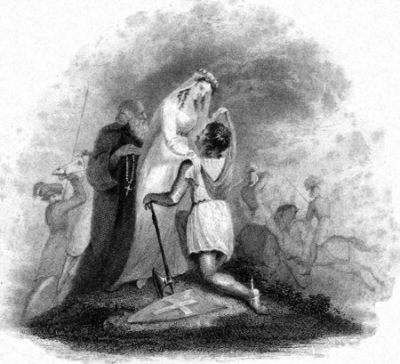
PROGRESS OF CHIVALRY IN ENGLAND, FROM THE NORMAN CONQUEST TO THE CLOSE OF THE REIGN OF EDWARD II.
Chivalry connected with Feudalism ... Stipendiary Knights ...
Knighthood a compulsory Honour ... Fine Instance of Chivalry in the Reign of Edward I ... Effect of Chivalry in Stephen’s Reign ...
Troubadours and Romance Writers in the Reign of Henry II ... Chivalric Manners of the Time ... Cœur de Lion the first Chivalric King ...
His Knightly Bearing ... John and Henry III ... Edward I ... His Gallantry at a Tournament ... His unchivalric Cruelties ... He
possessed no knightly Courtesy ... Picture of ancient Manners ... Edward II ... Chivalric Circumstance in the Battle of Bannockburn ...
Singular Effect of Chivalry in the Reign of Edward II.
In the first chapter we traced, by the help of the few lights which yet
remain, the rise of chivalry in Europe. We may now mark its progress, and,
in order to avoid the inconvenience of frequent transitions, it will be
better to follow the historical train in each chivalric country, than to
attempt to form one general collection of knightly events. And first, of
its influence in England.
Many chivalric principles and customs were known to the Anglo-Saxons[378],
and affected, in some degree, the character of the nation.[379] Many of
the elements of chivalry were brought into England by the Normans, and, in
the course of time, they were framed, by the energy which was involved in
them, into a fair and noble system. The adventurousness of knighthood
comported well with a people who, quitting the inhospitable shores of
Scandinavia, had impressed their conquests on France, Italy, and even
Greece. The Norman nation was one vast brotherhood, and therefore it was
natural for them to nourish the principles of chivalric fraternity.[380]
It is recorded of them that they brought from the north a love of
splendor, and having learnt courtesy of manner from the French, they were
fitted to admire the shows and the gallantry of knighthood.[381] They
affected, indeed, to despise the religious parts of the Saxon ceremonies
of initiation into knighthood, but they soon adopted them; for we find
that William Rufus himself was knighted by Archbishop Lanfrank.[382]
Chivalry connected with feudalism.
Stipendiary knights.
Chivalry became established as part of the national constitution when
William the Conqueror divided the country into about sixty thousand
knights’ fees, with the tenure of military service. The clergy, as well as
the laity, were compelled to furnish armed knights, on horseback, as the
price of their possessions, when the king went abroad against his enemies;
and, consequently, knights became attached to every ecclesiastical
foundation. These servants of the church were generally younger members of
baronial families; and as there was constant occasion for them, chivalry
became a military profession. In England, as in every country, the feudal
array was found insufficient for foreign wars, and wide-spread domestic
rebellions; for few contests could be finished in forty days,—and that
was the brief space which, in the earliest simplicity of feudal times, had
been fixed for the duration of military service. As petty states swelled
into kingdoms, and their public operations became extensive, many a
martial enterprise was broken up before achievement, because the time of
service had expired. So frequent were the calls on the holders of knights’
fees, that they were glad to compromise for attendance by pecuniary
penalties. The sovereigns were exorbitant in their exactions, in order to
be able to pay the stipendiary substitutes; but one of the most important
provisions of Magna Charta gave to parliament alone the power of imposing
this escuage or military tax.[383] When the custom of escuage arose is a
matter which no antiquarian researches have settled. The clause in Magna
Charta shows not only its existence, but its being used as an instrument
of tyranny; and under this aspect of chivalric history, the reign of John
is important. Most of these stipendiary subsidiaries were knights, with
their equipments of men-at-arms and archers; and the sovereign was
accustomed to contract with his barons for their attendance upon him in
his foreign expeditions. Chivalry and feudal tenure were, therefore, no
longer convertible terms; yet the spirit of knighthood long survived the
decay of the forms of feudal obligation; for the practice of escuage was
fully established in the days of Edward III.; and that was the brightest
era of English chivalry.
Knighthood a compulsory honor.
In England, knighthood was always regarded as the necessary distinction of
people of some substance and estate.[384] In the reigns of our three first
Edwards the qualification for knighthood varied from land of the yearly
value of forty to that of fifty pounds. The King was the sovereign and
supreme judge of chivalry, and he might confer knighthood on whomsoever he
chose. He could compel men of worth to be knights, for knighthood was
honourable to the kingdom. Like the performance of every other duty in all
states of society, that of knighthood could be commuted for by money; and
the royal invitation to honour was so extensive as to be inconvenient; for
a statute was passed in the reign of Edward II. whereby the King respited
for some time the payment of the fines of such persons whose station in
the world made knighthood a necessary part of their consequence. Besides
all these ways of forming the knighthood of England, must be added the
custom of elevating to chivalric dignities men who had gained renown by
martial exploits. This was indeed a mode more pure in principle, and,
therefore, more honourable than any we have mentioned.
The military necessities of many of our sovereigns favoured the growth of
chivalry. William Rufus invited to his court the prowest cavaliers from
every country[385]; for as his father had effected the subjugation of
Harold not merely by the feudal force of Normandy, but by hired soldiers,
it was the natural policy of the kings of the Norman line to attach to
their person valiant men who were not connected by ties of nature with the
people.
Fine instance of chivalry in reign of Henry I.
The principles and feelings of chivalry were firmly established in England
in the reign of Henry I., and gave the tone and character to our foreign
military warfare. This state of things is proved in an interesting manner
by a circumstance that occurred during the war of Henry with Louis the
French king. The reader remembers that the latter had espoused the cause
of William the son of Robert, Henry’s elder brother, who was kept by his
uncle from his rightful inheritance of Normandy. The chivalric anecdote is
this: The two armies were approaching each other near Audelay, when,
instead of rushing to the conflict with their whole masses, five hundred
knights on the English side and four hundred on the French prepared for an
encounter, a joust to the utterance. About eighty Normans, friends of the
French king, charged the centre of Henry’s line with true chivalric fire.
The English monarch was severely wounded in the head, but the Normans
could not pierce the firm line of the English, and they were all taken
prisoners. The three hundred remaining knights of Louis made a fine
attempt to redeem their companions in arms. Again the English line was
impenetrable, and the recoil of the shock scattered the French. Henry’s
soldiers now were assailants; and so fiercely did they press their
advantage, that even the French king scarcely escaped with life.[386]
Effect of chivalry in Stephen’s reign.
The knightly character had an important effect on England during the
troublous reign of Stephen. As he was deserted by his barons, he called
in foreign cavaliers to assist him in his resistance to the Empress Maud.
Their valour was rewarded by the grant of estates; and thus a new order of
nobility arose to shake the arrogance of the old; and new opinions,
feelings, and manners, became blended with English habits.
Troubadours and romance writers,—reign of Henry II.
Chivalric manners of the time.
The arms of chivalry grew rusty in the long and unwarlike reign of Henry
II.; but many of the milder graces of knighthood were cultivated in
consequence of the love of letters entertained by the sovereign and his
queen. The Troubadours found royal and, from the force of example, noble,
patronage in England; and, however offensive to a classic ear their
conceits and bombast may sound, yet, since they treated love as an affair
of the fancy rather than as an appetite, they contributed to purify the
manners of the age. By another channel literature promoted the cause of
arms. Romance with her bold fictions and splendid colouring inspired the
tamest hearts with the love of adventure. Such of the traditions and
fables regarding Arthur and the knights of the Round Table as dwelt in the
memory of the people of Britanny (that ancient colony of England) were
collected by an Archdeacon Walter, of Oxford, and formed part of a Latin
history of Great Britain that was written in the time of Henry I. by
Jeffry of Monmouth. Wace, the translator-general of the age, turned it
into Anglo-Norman verse, mingling with it all the stories of his hero that
were floating in the English mind. The subject was fitted to the martial
taste of the time; and as the book was now rendered into the language of
the upper classes of life, it found its way into the baronial hall and the
lady’s bower. This was the earliest of the French metrical romances; and
before the close of the twelfth century nothing was read by the nobility
but romances of Arthur and his knights. And the sports and exercises of
the time nourished the chivalric spirit. A writer of those days has given
us a graphic description of them. “Every Sunday in Lent, immediately after
dinner, crowds of noble and sprightly youths, mounted on war-horses,
admirably trained to perform all their turnings and evolutions, ride into
the fields in distinct bands, armed with lances and shields, and exhibit
representations of battles, and go through all their martial exercises.
Many of the young nobility, who have not yet received the honour of
knighthood, issue from the king’s court, and from the houses of bishops,
earls, and barons, to make trial of their courage, strength, and skill in
arms. The hope of victory rouses the spirits of these noble youths; their
fiery horses neigh and prance, and champ their foaming bits. At length
the signal is given, and the sports begin. The youths, divided into
opposite bands, encounter one another. In one place some fly, and others
pursue, without being able to overtake them. In another place, one of the
bands overtakes and overturns the other.”[387]
Cœur de Lion, the first chivalric king.
Martial daring, thus fostered and promoted, broke out with fresh vigour in
the reign of Richard Cœur de Lion; and England, which hitherto had but
partially and occasionally engaged in the crusades, now took up those
sacred and perilous enterprises with the ardour of the French. Richard was
the first king of England of knightly character; for I cannot, with some
writers, place William Rufus among our chivalric sovereigns. I cannot with
them see any thing magnanimous in his receiving under his banners an
enemy’s soldier who had unhorsed him, and who had foreborne to slay him
because he declared himself king of England. The conduct of the soldier
merited reward; and William acted only with common selfishness in taking
so good a soldier into his service. Rufus had mere brutal courage, but
that quality was not the character of chivalry. His bravery was not
directed either by religion or the love of fame, nor was it tempered into
virtue by the charities of life. When with Robert he besieged his brother
Henry in his castle, Rufus was guilty of one of the most unchivalric acts
on record. Henry’s supply of water was exhausted, and he solicited some
from his brothers on the true knightly principle that valour should decide
a triumph, and that it was unworthy of a soldier’s pride to gain a victory
merely by the circumstance of his antagonists being in want of the common
necessaries of life. Robert, with fine chivalric generosity, supplied his
brother, much to the regret of William, who ridiculed and was angry at his
simplicity.[388]
His knightly bearing.
But in Richard the whole knightly character appeared in all its martial
dignity and splendor. His courage was not the mere savage confidence in
superior strength, but the fine display of chivalric exercises. Such was
the might of his arm, and such the fierceness of his spirit, that he could
sweep from the field whole squadrons of knights. When we see his javelin
transfixing a Turk on the walls of Acre[389], the exploits of Grecian
heroes appear to be no longer poetical fictions; and when he appears on
the plains of Palestine, grasping his lance and riding from wing to wing
of the Saracenian host without meeting an enemy who dared to encounter his
career, the stories of Arthur and the Round Table seem the calm relations
of truth.
No one was more attentive than Richard to the regulations of chivalry. In
the course of his crusade he was assailed by some rustics, against whom it
was unlawful for a knight to use his sword. He beat them with the flat
part of it till it broke, and he then took up stones, and drove them
away.[390] Richard’s mind was framed in the finest spirit of chivalric
liberality. His largesses, both to his own soldiers and those of his ally,
Philip Augustus, while in Sicily during their voyage to Palestine, were
so magnificent, that it was acknowledged he had given more treasure in a
month than his predecessors in a year.[391]
Like the knights of romance, he revelled in gorgeousness and splendour,
and his court resounded with the minstrel’s lay. One of the Provençal
poets followed him into Palestine: nor did he entirely want the minds of
others to soften into grace his martial spirit; for often his own fancy
played with poetical images. In the history of chivalric amusements,
Richard is an important character. All his predecessors in sovereignty had
forbidden jousts and tournaments; and their absurd regulations had only
been violated in the time of Stephen. When Richard was in the Holy Land,
he observed the inferiority of the English chivalry to that of the French:
his own knights were rude soldiers, with none of the dexterity and skill
of their crusading brethren, which could only be acquired in tournaments,
the schools of war. Richard broke through the jealousy of adopting foreign
customs, and, like a politic monarch, he allowed and encouraged his
soldiers to practise martial exercises.[392]
These circumstances and the various other events of his chivalric life,
which I have described at length in another work complete the authentic
character of our lion-hearted King, for I dare not invest the severe
simplicity of history with those golden fictions, which romance has
delighted to throw over the story of his Eastern atchievements.
John and Henry III.
There was nothing chivalric in the character and conduct of his brother
and successor King John, or he would not have suffered the foreign
possessions of England’s crown to be wrested from it. In the reign of
Henry III. the flame of chivalry was kept alive by some English knights,
who assisted the Emperor in his Milanese wars, and whose prowess was the
most distinguished of the day. The crusades to the Holy Land were not
altogether forgotten; but the page of our history is marked with the
peculiar disgrace that English knights assisted the French in their
inhuman war on the Albigenses.
Edward I.
His gallantry at a tournament.
There was much of the chivalric character in Edward I. He was a diligent
reader of the ancient romances; and, as soon as he was invested with
knighthood, he went to foreign courts, in order that he might display his
prowess.[393] For the sake of acquiring military fame, he exposed his
person in the Holy Land, and, during his journey homeward, though ill and
forespent with travel, he displayed remarkable heroism at a tournament in
Savoy.[394] The challenger was the Count of Chalons; but if pontifical
authority could have destroyed chivalry, the knights never would have met.
The pope feared that some hostility was menaced, and earnestly dissuaded
Edward from the tournament. He warned him of his danger: he exhorted him,
as a son of the church, to decline these encounters, which the church had
forbidden; and he added, that as Edward now was king, he might decline the
challenge, as kings were not wont to risk their persons in these perilous
shocks. But most of these reasons were so many stimulants of his courage:
the more danger, the greater share of honour, and it was beneath the
gallantry of his bearing to have thrown his rank as a shield before his
knighthood. Followed by a thousand men-at-arms, and archers on horseback
and on foot, Edward pressed his bounding steed upon the chosen plain, and
the Count of Chalons met him with equal spirit, and nearly twice the
number of companions. The English king soon found that no lofty courtesy,
no love of chivalric exercises, had influenced the French lord. The
graceful tournament soon became a deadly fray. The cause of honour
triumphed, and the knights of Chalons were either slain or driven from the
field. After many cavaliers on each side had been disabled, the lords of
either host encountered. Their lances met and shivered; and if Chalons had
been a courteous knight, he would have passed to the other end of the
plain, and seized a new lance to continue his emprise; but, maddened at
his weapon failing, he threw himself upon Edward, endeavouring to crush
him by his prodigious weight. At that moment Edward’s horse started
forwards, and the Count was thrown on the ground. His companions raised
him; but he was so much bruised by the fall that he cried for mercy. His
conduct had put him without the pale of chivalry, and Edward, therefore,
treated him like a base-born churl. He beat him with the flat part of his
sword; and, refusing to take him as his prisoner, he compelled him to
surrender himself to a man of mean condition.[395]
His unchivalric cruelties.
He possessed no knightly courtesy.
Edward’s love of chivalric exercises was imitated by his nobility.
Tournaments and jousts were held in various parts of the country; and
Kenilworth is particularly marked as famous for its Round Table, to which
knights from every nation flocked.[396] In his Scotch wars, therefore,
his armies were not deficient in chivalric bravery. At the battle of
Falkirk the strength of the Scots was foot, as that of the English was
horse; and the repeated charges of Edward’s chivalry decided the fate of
that memorable day. In his Welsh wars he had sullied his reputation for
knightly generosity by making a public exhibition of the head of his
worsted foe, Llewelyn ap Gryffyth, the last sovereign of Wales[397]; and
his well-known conduct to Wallace betrayed such an absence of all
nobleness of mind, that he forfeited his claims to knightly consideration.
The beautiful parts, the embellishments of chivalry, were subservient to
his ambition. Before his second war in Scotland he vowed, in Wesminster
Abbey, by God, and also by two swans which were introduced into the
assembly with great pomp and splendour, that he would punish the Scottish
nation for their breach of faith, and for the death of Comyn. Nor did any
of the courtesies of chivalry grace Edward: the queen of Bruce and her
ladies fell into his power, and in defiance of all chivalric gallantry,
he treated them as prisoners. There was something peculiarly ferocious in
his treatment of the Countess of Buchan, who was also his captive. Her
offence was, that she had crowned Bruce. Edward exclaimed, with the
deliberation of malignity, “As she has not used the sword, she shall not
perish by the sword; but for her lawless conspiracy, she shall be shut up
in a stone and iron chamber, circular as the crown she gave; and at
Berwick she shall be suspended in the open air, a spectacle to travellers,
and for her everlasting infamy.”[398] And the English Tamerlane did not
relent.[399]
Picture of ancient manners.
The close of the reign of Edward I. is remarkable for a very splendid
scene illustrative of the ancient mode of creating knights, and of the
chivalric manners of our forefathers. Before his last and fatal journey
to Scotland, Edward caused proclamation to be made throughout England,
that all persons who were entitled to the honour of knighthood by custom
of hereditary succession, or who had estates sufficient to support the
dignity, should, at the next feast of Pentecost, repair to Westminster,
and that to every one would be delivered out of the King’s wardrobe, at
the King’s expence, the festive and inauguratory dress of a knight.
Accordingly, at the time and place appointed, there was a fair and gallant
show of three hundred young gentlemen, sons of earls, barons, and knights,
and among these aspirants to chivalry were distributed in ample measure,
according to their different ranks, purple, fine linen, furs, and mantles
embroidered with gold. The royal palace, though magnificently spacious,
could not accommodate all these young esquires with their retinue of
yeomen and pages. Many of them repaired to the New Temple, where, cutting
down the trees and levelling the walls of the garden, they set up their
tents and pavilions in brave emulation of actual war. They performed their
vigils in the Temple church, while the Prince of Wales, by command of the
King his father, passed the night in prayer in Westminster Abbey.
On the following day, the King invested his son with the military belt,
and assigned to him the duchy of Aquitaine. The Prince, being knighted,
went to the Abbey that he might confer the like military honor on his
companions. So close was the press of spectators round the high altar,
that two knights were stifled, and several fainted, though each was
supported by three knights of experienced prowess. The Prince, accompanied
by his father and the chief nobility, at length reached the altar, and his
guards made a passage for his friends to receive knighthood at his hands.
After he had dubbed and embraced them all, his attendants introduced two
swans covered with golden nets, which were adorned and embossed with studs
of gold. This was the most joyous part of the ceremony in the eyes of the
people, and their rude and joyous shouts drowned the clangor of the
trumpets. The King, as before stated, vowed by heaven and the swans that
he would go to Scotland; and even if he should die in the enterprise, he
would avenge the death of Comyn and the violated faith of the Scots. He
then adjured the Prince and the nobles, and his band of knights by their
fealty and chivalry, that if he should die in his journey to Scotland,
they would carry his body forwards, and never bury it till his son had
established his dominion. Every heart assented to this high resolve, and
the ceremony closed. The knights were feasted that day at the royal
palace; and while they were quaffing muscadel in honour of chivalry and
the ladies, the minstrels in their songs reminded them of their duty to
pledge themselves before the swans to perform some rare feats of arms. The
Prince vowed that he would never rest two nights in one place until he had
performed his father’s high behests; and the other knights made various
fantastic vows for the promotion of the same object.[400]
Edward II.
Chivalric circumstances in the battle of Bannockburn.
The defeat of the English chivalry at the battle of Bannockburn, (24th
June, 1315,) was the most remarkable circumstance in the reign of Edward
II. On the preceding day, Douglas[401] and Sir Robert Keith, marshal of
Scotland, were dispatched by Robert Bruce from the main body of his army
to descry whether the enemy was approaching.
“And soon the great host have they seen,
Where shields shining were so sheen,
And basinets burnished bright,
That gave against the sun great light.
They saw so fele[402] brawdyne[403] baners,
Standards, and pennons, and spears,
And so fele[402] knights upon steeds,
All flaming in their weeds.
And so fele[404] bataills[405], and so broad,
And too so great room as they rode
That the maist host, and the stoutest
Of Christendom, and the greatest
Should be abaysit[406], for to see
Their foes into such quantity.”
The Bruce, vol. ii. p. 111.
The English vanguard, commanded by the Earls of Gloucester and Hereford,
soon came in general sight. The appearance of Edward’s army is described
by Barbour in a rich chivalric style.
“The sun was bright, and shined clear,
And armouris that burnished were,
So blomyt[407], with the sun’s beam,
That all the land was in a leme[408],
Banners right fairly flawinand[409],
And pensels to the wind wawand.”[410]
Barbour, xi. 188-193.
Bruce was riding on a palfrey and marshalling his men, when Sir Henry de
Bohun started from the opposite host, and careered his horse against him.
Sir Henry was a fierce rather than a gallant knight, or he would not have
pressed his war-steed upon a foe who was riding on a
palfrey.[411] But his want of chivalric gallantry was justly punished.
“And when Glosyter and Hertfurd were,
With their battle approaching near,
Before them all there come riding,
With helm on head and spear in hand,
Sir Henry Boune, the worthy,
That was a wight knight, and a hardy;
And to the Earl of Hertfurd cousin;
Armed in arms good and fine;
Come on a steed, a bow-shot nere,
Before all other that there were.
And knew the King, for that he saw
Him so range his men in row;
And by the crown, that was set
Also upon his bacinet,
And towards him he went on haste.
And the King so apertly
Saw him come, forth all his feres[412]
In hy[413] to him the horse he steers.
And when Sir Henry saw the King
Come on forouting abaysing,[414]
To him he rode in full great hy[415]
He thought that he should well lightly
Win him and have him at his will,
Since he him horsed saw so ill.
Sprent[416] they came unto a ling,[417]
Sir Henry missed the noble king.
And he, that in his stirrups stood,
With the axe, that was hard and good,
With so great mayn[418] reached him a dint,
That neither hat nor helm might stynt,
The hewy dusche[419] that he him gave,
That near the head to the harness clave.
The hand-axe shaft fruschyt[420] in tow;
And he down to the yird gan go
All flatlyngs[421], for him failed might.
This was the first stroke of the fight.”
Barbour, vol. ii. p. 122.
The fine generousness of chivalry was very nobly displayed in another
circumstance which preceded the great battle. It was a main object with
the English to throw succours into the castle of Stirling; and Edward,
therefore, commanded Sir Robert Clifford and eight hundred horsemen to
make a circuit by the low grounds to the east, and approach the castle.
Bruce, in anticipation of the Englishmen’s purpose, had charged Randolph
who commanded his left wing to prevent Stirling from being relieved; and
when he saw the English troops holding on their gallant course unchecked,
he cried, “A rose has fallen from thy chaplet, Randolph,”[422] and
bitterly reproached him for his want of vigilance. Nothing but the utmost
desperateness of valour could efface this shame; and gathering round him a
few hundred bold spirits, the Scottish General advanced against the
English. Clifford, in his pride of chivalry, thought that he could soon
disperse a band of lightly armed troops of foot-soldiers, who were now
being marshalled into a circle with their spears resting on the ground,
the points protruded on every side. The English charged, but the
resistance was more gallant than what they had foreseen. Still, however,
the Scots seemed gradually sinking under the force of numbers; and
Douglas, who saw the peril, requested the King’s permission to go and join
him. “You shall not move from your ground,” cried the King: “let Randolph
extricate himself as he best may. I will not alter my order of battle, and
lose the advantage of my position.” But Douglas reiterated his request,
and wrung leave from the King. He flew to the assistance of his friend.
But before he reached him he saw that the English were falling into
disorder, and that the perseverance of Randolph had prevailed over their
impetuous courage. “Halt,” cried Douglas, like a generous knight, “these
brave men have repulsed the enemy; let us not diminish their glory by
sharing it.”
Of the battle of Bannockburn itself little need be said by me, because
there was not much chivalric character about it. Some historians describe
the defeat of the English as having been principally occasioned by the
Scottish cavalry throwing the rear of their archers into confusion. Others
affirm that Bruce, seeing the inadequacy of his own cavalry to cope with
that of the English, formed the battles or divisions of his army entirely
of foot-soldiers, and dug trenches before his line, slightly covering them
with turf and hurdles. The gallant knights of England, with the sun
streaming on their burnished helms and gilt shields, advanced to charge
the bristled front of the Scots: but the turf sunk beneath the pressure of
their horses’ feet, and men and their steeds lay at the mercy of their
enemy. One or other of these circumstances turned the event of the battle,
and the Scotch reserve being judiciously brought up, completed the
victory. In every way the generalship of Bruce was admirable: but the fate
of the battle reflects nothing on the personal character of the English
chivalry; for they were not worsted in an encounter of lance to lance, and
horse to horse. The bravery of one English knight must not pass
unrecorded. Sir Giles D’Argentyn, upon seeing some of his friends around
him pause in alarm, cried that he was not used to fly, and spurring his
war-steed into the thickest of the press, gallantly perished. Nor was this
a solitary instance of courage; and even Edward seemed for a moment to be
inspired with the fire of the Plantagenets. He dashed into the enemy’s
lines, and was by force drawn away by the Earl of Pembroke, when courage
was evidently unavailing.[423]
Singular effect of chivalry in his reign.
Though the chivalric character was only for one moment of his life
sustained by Edward II., yet it was too deeply fixed in the national mind
to die on account of its neglect by any particular monarch. There is a
singular circumstance on record illustrative of the power of this feeling.
During his war with the barons, which his system of unprincipled
favouritism had provoked, one of the lords refused the Queen the
hospitality of his castle. This act of individual insult had general
consequences. Disgusted with a cause which was blended with so much
uncourtesy, barons and knights immediately flocked round the standard of
the King; his arms completely triumphed, and the Spencers were
recalled.[424]
END OF THE FIRST VOLUME.
London:
Printed by A. & R. Spottiswoode.
New-Street-Square.
INDEX.
Accolade, meaning of the, I. 53. note.
Adelais, tale of her imprisonment, rescue by an adventurous knight, and subsequent marriage, II. 322.
Albigenses, romance of, I. 48. note.
Alcantara, order of, its principles, and its comparative rank with other Spanish orders, I. 353.
Alfonso, story of his chivalric bearing, II. 258.
Allegories, fantastic, made on knights and their armour, I. 108. 110.
Amys and Amylion, Romance of, I. 121.
Anglo-Saxons, state of chivalry among, I. 6. 9. 11. 383.
Antharis, a Lombard king, story of his romantic gallantry, II. 321.
Arabian horses, their repute in chivalric times, I. 111.
Arabic, Spanish historians, account of, II. 242. note.
Archers, excellence of English, II. 12.
Fine passage from Halidon Hill expressive of, II. 13. note.
An English archer in the days of Edward III., 14.
Importance of at battles of Cressy and Poictiers, 15.
Argonautes, order of, purpose of its institution, I. 358.
Aristotle, lay of, I. 215.
Armorial bearings, historical and philosophical sketch of the principles of, I. 86, 87. 89.
Armour, beauty of ancient, I. 65.
Value of enquiries into the minutiæ of, I. 94.
Uncertainty of the subject, I. 95.
Its general features, I. 99, &c.
Golden armour, 102.
Array, general nature of chivalric, I. 118.
Arthur, his knightly honour, I. 132. note.
Discovery of his remains at Glastonbury, account of, I. 375.
His court the school of chivalric virtue, 376.
His generosity to his knights, 376. note.
See Round Table.
Athenæus, his singular testimony to a state of chivalry, I. 6.
Auberoch, beleagured by the French, and chivalrously relieved by the English, II. 31.
Audley, Sir James, interesting story of his heroic achievements and of his generosity, II. 43.
Axe, the battle, I. 67.
Description of King Richard’s, 68. note.
B.
Bachelor, various meanings of the word, I. 19. 45.
Bacinet, I. 91.
Baked meats, fondness of people for them in the olden time, I. 191. and note.
Ball, the, after a tournament, I. 284.
Band, Spanish order of the, objects of the order, I. 367.
Interesting, as descriptive of the state of Spanish manners, ib.
Its fine chivalry to woman, I. 369.
Banneret, qualification of a knight, I. 16.
His privileges, 17.
See Chandos.
Bannockburn, battle of, I. 407.
Barriers, description of, I. 124. note.
Singular battles at the, I. 124. 127.
Bath, order of, ceremonies used at the ancient creation of knights of, II. 150. 91, &c.
Modern ceremonies, I. 364.
Absurdity of our heralds’ dogmatic positiveness regarding the æra of the order’s foundation, II. 91. note.
Batre, Claude de, a French knight. His joust with Maximilian I. of Germany, II. 315.
Bauldrick, description of the, I. 73.
Bayard, the chivalric, his early years, II. 217.
Enters the service of the kings of France, 218.
His valiancy, ib.
His humanity, 219.
His gallantry, ib.
Holds a tournament in honour of the ladies, 220.
His death, 222.
Beauty, knights fought to assert the superiority of their mistress’s beauty, I. 209.
The practice apparently absurd, but reason why it should not be too severely censured, II. 211.
Black Prince, his conduct at Limoges, I. 132.
His courtesy, II. 11. 16.
His liberality, II. 45.
His deportment to Peter the Cruel, II. 185.
Not a favorite with the nobility in the English possessions in France, II. 191.
His cruelty to Du Guesclin, ib.
Blois, Charles of, his contention with Jane de Mountfort for the duchy of Brittany, I. 239.
Blue, the colour of constancy in days of chivalry, I. 275. note.
See Stocking.
Bonaparte, his generousness to a descendant of Du Guesclin, II. 203.
Bonnelance, Sir John, his remarkable courtesy to the ladies, I. 199.
Boucmell, John, his joust with an English squire, I. 294.
Bourbon, singular mode by which a Duke of, gained a fortress, I. 59.
——, order of, account of, I. 371.
Boucicant, Marshal, his outrageous reverence for women, I. 223. note.
His joust at St. Ingelbertes, near Calais, 303, &c.
Bovines, importance of squires at the battle of, I. 47.
Break-across, to, meaning of the phrase, I. 278, 279. note.
Britomart, the perfection of chivalric heroines, I. 253.
Brittany, revered for its chivalric fame, II. 174.
Bruce, Robert, his chivalric humanity, II. 69.
Burgundy, Bastard of, his joust with Lord Scales, I. 314.
His skill in other jousts, II. 214.
——, court of, splendour of its tournaments, II. 213.
The most chivalric country in Europe during middle of fifteenth century, ib.
Chivalric circumstance at the court of, II. 351.
C.
Calais, stories regarding, II. 17-21.
Calatrava, order of, its origin and history, I. 349.
Calaynos, the Moor, praised by the Spaniards, II. 234.
Carlisle, Sir Anthony Harclay, Earl of, ceremonies of his degradation from knighthood, I. 62-64.
Carpet-knights, meaning of the term, II. 156.
Carpio, Bernardo del, account of, II. 243.
Cavalry, the principal arm of military power during the middle ages, I. 2.
Caxton, his lamentation over the decline of chivalry, II. 99.
His exaggeration of the evil, 102.
Celts, humility of Celtic youths, I. 6.
Cervantes, curious error made by, I. 20.
Censures the chivalric custom of making vows, 129. note.
Satirises chivalric contempt of bodily pain, 368. note.
Ridicules the vigil of arms, I. 49. note.
and the pride of knights, I. 393. note.
Accuracy of his pictures, II. 297.
Cesena, noble defence of, by Marzia degl’ Ubaldini, I. 249.
Chandos, Sir John, story with the Earl of Oxenford, I. 38.
History of his heroism, II. 46.
Gallantry, 47.
Tenacious of his armorial bearings, ib.
Exploits at Auray, 49.
Tries to dissuade the Black Prince from the Spanish war, 50.
Ceremonies on his becoming a knight-banneret, ib.
His remarkable generousness, 52.
His death before the bridge of Lusac, 60, &c.
General grief thereat, 63.
Character, bluntness of the old English, shown at the creation of knights of the Bath, II. 165.
Charity, a great chivalric virtue, instance of, I. 161.
Charter-house, the, founded by Sir Walter Manny, II. 42. and note.
Charlemagne, state of chivalry in his time, I. 10.
His expedition into Spain, II. 244.
Chargny, Lord of, a famous jouster, II. 298.
His passage of arms near Dijon, I. 328.
Cherbury, Edward Herbert, Lord of, memoir of him, II. 138.
Chivalric fame of his family, ib.
His vanity, 140-145.
Made a knight of the Bath, 141.
His curious adventures in France, 142.
The disgusting vanity of his infidelity, 147.
His general character, 148.
His inferiority to the heroes of the reign of Edward III., 149.
Chess, the high favour of this game in days of chivalry, I. 163.
A story of a knight’s love of chess, 164.
Chivalry, general oath of, I. 50.
Form used in Scotland, II. 70.
Exhortations to perform chivalric obligations, I. 51, 52.
Beauty of chivalric costume, I. 65.
First ages of, interesting to the reason, but not pleasing to the fancy, I. 1.
Difference between feudal and moral chivalry, I. 3.
Origin of, ib.
Nature of, 2.
Modified by Christianity, 9, 13.
Early ceremonies of inauguration, 4. 11, 12.
Personal nobility of, not to be confounded with feudal territorial nobility, 16.
Morals of chivalric times unjustly censured, 229.
Real state of them, ib. &c.
Peculiar fineness of chivalric feeling, 277. note.
Declined in France before the common use of gunpowder, II. 213.
Recapitulation of the circumstances which gave birth to, 341.
Its general nature, 342.
Exact time of its influence difficult to mark, 346.
Its merits, 348.
Its effects, 358.
Application of chivalric honours to men in civil stations, 155.
Connected with feudalism, I. 384.
A compulsory honour in England, 386.
Christianity, its improvements on Gothic chivalry, I. 10.
Cid, the, his birth, II. 246.
His early ferocious heroism, ib.
His singular marriage, 247.
Enters the service of King Ferdinand, 249.
His chivalric gallantry, ib.
Ceremony of his being knighted, 251.
Death of the King ib.
Becomes the knight of Sancho, King of Castile, and his campeador, 252.
Mixture of evil and good in his character, ib.
Supports the King in his injustice, 253.
His romantic heroism, ib.
His virtuous boldness, 256.
His second marriage, 260.
Is banished from the court of Alfonso, the brother of Sancho, 261.;
but recalled ib.
Is banished again, 263.
Story of his unchivalric meanness, ib.
His history in exile, 264.
His nobleness and generosity, 267.
Is recalled, 269.
Captures Toledo, 270.;
and Valentia, 271.
Unjust conduct to the Moors, 274.
Marriage of his daughters, 276.
His death, 284.;
and character, 285.
Claremont, the Lord of, his dispute with Sir John Chandos regarding armorial cognisances, II. 47.
Clary, the Lord of, singular story of the censure on him by the court of France for want of courtesy to Sir Peter Courtenay, I. 154-157.
Clergy, the weapons they used in battle, I. 68.
A gallant fighting priest promoted to an archdeaconry, II. 80.
Often turned knights, I. 350.
Clermont, council of, sanctions chivalry, I. 12.
Clifford, Nicholas, his joust with John Boucmell, I. 294, &c.
Cloth of gold, chivalric circumstances at the field of, II. 111.
Cochetel, battle of, II. 178.
Cognisances, I. 87.
Coliseum, Moorish and chivalric sports in, II. 329.
Inferiority of the old Roman games in, to those of chivalry, I. 260.
Colombe, Ernalton of Sainte, bravery of him and his esquire, I. 46.
Companions in arms, nature of such an union, I. 118-123.
Conde, D. José Antonio, value of his searches into Arabic Spanish historians, II. 242. note.
Constancy, a greater virtue in chivalric times than in the present day, I. 206.
Spenser’s exhortation to, 207.
Constantine, fabulous order of, I. 374.
Conversation of knights, its subjects, I. 175.
Courage of the knight, I. 124-130.
Courtenay, Sir Peter, his adventures in France, I. 154, &c.
Courtesy, a knightly virtue, I. 160.
Courtesy of a dragon, 161. note.
At tournaments, 268.
Cousines, dame des belle, her reproof of a young page for his not being in love, I. 32.
Crawford, Sir David de Lindsay, Earl of, his joust with Lord Wells, I. 290.
Cross, every military order had its, I. 362.
Wretched taste in concealing the cross of the order of the Bath by a star, ib.
Cyclas, I. 85.
Cyneheard, his story, I. 5.
D.
Dagger of mercy, description of it, I. 92.
Story of its use, 93.
Dambreticourt, Lord Eustace, his chivalry inspired by the lady Isabella, I. 204.
His valour at the battle of Poictiers, II. 44.
Dames and Damsels. See Lady.
Degradation, ceremonies of, I. 60.
Derby, Earl of, the sort of death he desired, I. 147.
Devices, what they were, I. 78.
Worn in tournaments, 272-275.
Discipline, chivalric array not inconsistent with feudal discipline, I. 145.
Douglas, story of the perilous castle of, I. 205.
Generousness of the good Lord James of, I. 206, 402.
His character, ib. note.
The Douglas of the sixteenth century, II. 67.
Wins the pennon of Hotspur, 77.
His heroism and noble death, 80.
Archibald, at Shrewsbury, ib.
Dress of ladies in chivalric times, I. 185.
Importance of modesty of, 186.
Dub, meaning of the word, I. 53. note.
Dynadan, Sir, a merry knight of the Round Table, his pretended dislike of women, I. 196. note.
E.
Edward I., his chivalric character, I. 395.
A chivalric anecdote of, I. 142.
Edward II., state of chivalry in his reign, I. 402. 409.
Edward III., state of armour in his time, I. 97. 100.
Chivalry in his reign, II. 4, &c.
Eloisa, the Lady, a heroine of chivalry, I. 235.
England, antiquity of the sarcasm of its not being the country of original invention, II. 48. note.
The melancholy of its mirth curiously noticed, ib.
Errantry, facts relating to the knight-errantry of the middle ages, I. 140. 145.
English knights-errant, 225.
General facts and usages, 226, &c.
F.
Falconry. See Hawking.
Falcons, placed on perches above knights at chivalric entertainments, I. 281.
Father in chivalry, the respect which a knight bore to the cavalier that knighted him, I. 54.
Festivals, description of chivalric, I. 176. 379.
At tournaments, 281.
Fidelity to obligations, a great virtue in knights, I. 151.
Flodden, chivalric circumstances at battle of, II. 121.
Flowers, Romance of, remarks on, I. 315. note.
Forget-me-not, romantic story of this flower: joust concerning it, I. 315.
France, state of, after the death of Du Guesclin, II. 203.
Chivalry in baronial castles, II. 169.
Knighthood given to improper persons, 211.
Extinction of chivalry in, 226.
Ridiculous imitation of chivalry by the profligate soldiers of a profligate king, 228.
Francis I., his chivalric qualities, II. 223.
Circumstances which disgraced his chivalry, 224.
Knighted by Bayard, 225.
Fraternity, origin and history of the spirit of, I. 4.
Encouraged by the institutions of Arthur, 379.
Froissart, character of his history, Preface.
Frojaz, Don Rodrigo, a Spanish knight, chivalric mode of his death, I. 71.
Furs, fondness of people in the middle ages for them, I. 49. 85. note.
G.
Gallantry, its origin, I. 7-9.
Absurdity of antiquarians respecting, 175. note.
Garter, order of the, objects of, I. 360.
Its resemblance to a religious order, 361.
Reasons of its being established, 360.; II. 4.
Commonly ascribed origin a vulgar fable, 6.
Meaning of the motto, 7.
The collar, 8.
Gawain, Sir, a knight of Arthur’s Round Table, character of, I. 378.
Generousness of knights, high estimation of this quality, I. 153.
Instances, 153-157.
Gennet, order of the, I. 374.
George, Saint, the person that was understood by this name, II. 9.
Germans, superior virtue of German women owned by Tacitus, I. 7.
Instances of this virtue, 7, 8.
Political chivalry had no influence in Germany, II. 303.
German knights quailed before undisciplined troops, 304.
When and where tournaments were held, I. 262.
Heraldic pride of the, 263. note.
Singular matter regarding the, 265. note.
Inferiority of to Italian condottieri, 305.
Intolerance and cruelty of German knights, 306.
Their education, 307.
Cruelty to their squires, 308.
Their avarice, 310.
Little influence of German chivalry, 311.
Singular exception, 312.
Destruction of chivalry, 317.
Gonfanon, what it was, I. 67.
Gonsalez, Count Fernan de, a fabulous hero of Spanish chivalry, II. 245.
Gordon, Adam, his chivalry, I. 56.
Graville, Sir William, loses a fortress out of his love for chess-playing, I. 165.
Green-field, knights of the Fair Lady in the, story of their chevisance, I. 223.
Gueldres, Duke of, story of his regard for knightly honour, I. 138.
Guesclin, Bertrand du, his birth, II. 174.
Became a cavalier in opposition to paternal wishes, 175.
His knightly conduct at Rennes, ib.
Amusing interview with the Duke of Lancaster, 177.
His gallant bearing at Cochetel, and the consequent recovery of the fame of the French arms, 178.
Taken prisoner at Aurai, 180.
Redeemed, 182.
His chivalry in Spain, 184, &c.
Taken prisoner again, 189.
Treated with cruelty by the Black Prince, 191.
Ransomed, 209.
Made Constable of France, 194.
Recovers the power of the French monarchy, ib.
His companionship in arms with Olivier de Clisson, 195.
His death before Randan, 199.
Character, 201.
H.
Harald, the valiant, account of, I. 9.
Hawking, a knowledge of, a necessary part of a knight’s education, I. 29.
A great chivalric amusement, 161.
Hawkwood, Sir John, story of his origin, and allusions to his battles, I. 23.
Helmets, I. 88.
Various sorts of, I. 89.
Hennebon, noble defence of, by the Countess of Mountfort, I. 242-246.
Henry I. and II., state of chivalry in their respective reigns, 387. 389. 395.
Henry II., of France, killed in a tournament, account of the circumstances, II. 226. and note.
Henry, Prince, son of James I., his love of chivalric exercises, II. 137.
Henry IV., chivalric parley between him and the Duke of Orleans, II. 83.
His unchivalric deportment at Shrewsbury, 88.
Henry V., his love of chivalry, II. 85. 96.
His chivalric modesty, 98.
Henry VIII., account of his tournaments, II. 104, &c.
Heroines, nature of female heroism in days of chivalry, and stories of, I. 234, &c.
Hita, Genez Perez de, nature of his volume on the fall of Grenada, II. 288. note.
Homildon Hill, interesting knightly story regarding battle at, I. 55.
Honour, curious story of knightly, I. 138.
The knights’ pursuit of, I. 144.
See, too, 277. note.
Horn, King, romance of, I. 27.
Horse of the knight, I. 111.
What horses were preferred, 112.
The famous horse of the Cid, ib. II. 287.
Armour of the horse, I. 114.
Always very splendidly adorned, 115.
Horsemanship, care with which knights were trained to, I. 44.
Hotspur fights with the Douglas, II. 77.
His gallant deportment at Otterbourn, 79.
And at Shrewsbury, 87.
Humanities of chivalric war, I. 129. 135.
Humility, a knightly virtue, I. 158.
Hunting, young squires instructed in the art of, I. 29.
A part of the amusements of chivalry, 161.
Huntingdon, Sir John Holland, Earl of, his skill in jousting, I. 307.
I.
Inauguration, ceremony of, into knighthood, when and where performed, I. 50.
Its circumstances, 50-54.
Ingelbertes, Saint, joust at, I. 302-314.
Ipomydon, romance of, I. 28.
Isabella, the Lady, a heroine of chivalry, I. 235.
Italian armour, excellence of, I. 105.;
II. 293. note, 330.
Italy, but little martial chivalry in, II. 324.
Chivalric education, 321.
Changes of the military art in, 325.
Chivalry in the north of, 329.
Esteem in which the word of knighthood was held, ib.
Chivalry in the south of, 331.
Mode of creating knights in, 334.
Religious and military orders in, 335.
Political use of knighthood, 336.
Folly of an Italian mob regarding knighthood, ib.
School of Italian Generals, 328.
Chivalric sports in, 338.
Ivanhoe, errors of the author of, regarding Anglo-Saxon and Norman chivalry, I. 383. note;
and concerning the Knights Templars, 387. note;
and also concerning the nature and names of chivalric sports, 327.
J.
James, Saint, his popularity in Spain, I. 345. note; II. 230.
Order of, I. 344.
James II., of Arragon, gallantry of one of his decrees, II. 289.
James IV., of Scotland, chivalric and romantic circumstances of his life, II. 118-124.
Jealousy, no part of chivalric love, I. 207.
Joanna of Naples, a chivalric anecdote regarding, II. 352.
Joust, nature of the, to the utterance, I. 289.
For love of ladies, 291.
Various, à l’outrance, 289-297.
A plaisance, 297, &c.
Romance of, 324.; II. 215.
Use of jousts, I. 330.
K.
Knights, their privileges, I. 17.
Expensive equipment of, necessary to the dignity, 16.
Preparations for knighthood, 48.
His war-cry and escutcheon, 18.
Qualifications, 19.
Gentle birth not regarded when valour conspicuous, 22.
By whom created, ib.
(For his education, see Squire and Page.)
Often turned priests, I. 14.
Associations of, in defence of the ladies, 223-225.
Stipendiary knights in England, 385.
No resemblance between and the equites of Rome, 14.
Made in the battle-field, and in mines, 56-59.
Knight of honour, description of, 267.
English wore golden collars, II. 8.
Anxiety to receive the order from great characters, 55. and note.
No knights made on compulsion, after the days of Charles I., 158.
Degradation of, in the reign of James I., 157.
Knot, order of the, I. 358.
Knowles, Sir Robert, remarkable story of the heroism of one of his knights, I. 124.
L.
Lady in chivalry, character of, I. 182. 256.
Her courtesy, ib.
Education, 183.
Amusements, 190.
Deportment, 185.
What ladies could create knights, 252.
Singular blending of the heroic and the tender feelings in her character, 253.
Not made prisoner in war, 227.
Judge in the tournament, 267. 283.
Her favours worn by her knights, 272. 275. and note.
Lahire, the singular prayer of this knight, I. 147.
Lance, the chief weapon of the knight, I. 66.
The staff made from the ash-tree, ib.
Langurant, Lord of, bravery of, and of his squire, I. 46. and note.
Another story, 93.
Largess, distributed at ceremonial of inauguration, I. 54.
At tournaments, 284.
Launcelot, generous modesty of this knight, I. 159.
Singular proof of his high reputation, 55. note.
Beautiful lamentation over his dead body, 377.
Lee, Sir Henry, his gallantry, II. 132.
Legnano, battle of, II. 304.
Liberality, a great virtue in chivalry, I. 157.
Liegois, their battle with the French chivalry, II. 204.
Lists, description of the, I. 266.
London, citizens of, their taste for chivalric amusements, II. 11.
Lords, House of, errors of its committees, I. 15. note.
Lorrys, Sir Launcelet de, a gallant knight, killed in a joust for love of his lady, I. 292.
Love, peculiarities of chivalric, I. 212. 217-222. 194, &c.
Perfection and purity of chivalric, II. 345.
Quick-sightedness of courtly matrons regarding signs of, II. 322.
Louis, Saint, his barbarous intolerance, I. 148.
Loyes, Sir, of Spain, his cruelty, I. 151.
M.
Mail-armour, various descriptions of, I. 78-81.
Mail and plate, 82.
Mail worn in all ages of chivalry, 84.
Manny, Sir Walter, succours the Countess of Mountfort, I. 245.
His bravery at Calais, II. 18.
An amorous knight, 27.
His kindness to two brother-knights, 29.
His joyous adventurousness, 30.
Other feats, 31, &c.
His filial piety, 34.
Gentleness of his disposition, 38.
His high rank in England, 39.
His sageness, 40.
His liberality, 41.
Founds the Charter-house, 42.
March, Countess of, story of her chivalric heroism in defending the castle of Dunbar, I. 237.
Marche, Thomas de la, his duel with John de Visconti, II.
Martel, nature of that weapon, I. 68.
Marzia, degl’ Ubaldini, story of her heroic deportment at Cesena, I. 249.
Maule, its qualities, I. 68.
Not a perfectly chivalric weapon, 72.
Maximilian the only Emperor of Germany of a chivalric character, II. 315.
His joust with a French knight, ib.
Medicine, knowlege of, possessed by dames and damsels, I. 186.
Faith of knights in medicines administered by women, 187.
Medici, Lorenzo de, won a prize at a tournament, I. 267.
Men-at-arms, manner of their fighting, and description of their armour, I. 107.
Mercenaries, their use in the French army, II. 209.
Mercy, order of our Lady of, reason of the establishing of the, I. 354.
Merlo, Sir John, a Spanish knight, account of his jousting in Burgundy, II. 297-300.
Meyrick, Dr., character of his critical inquiry into ancient armour, I. 79. note, 101. note, 114. note.
Michael of the Wing, purposes of the establishing of this order, I. 356.
Milan, Sir Galeas, Duke of, his courtesy to the Earl of Derby, II. 330.
Milanese armour, excellence of. See Italian armour.
Missals, the merits of, decided by battle, II. 288.
Minstrels, description of them and their art in connection with chivalry, I. 166, &c.
Their chivalric importance in Italy, II. 327.
Molai, Jacques de, appoints a successor to his authority over the Templars, I. 140.
Montferrand, Regnaud de, the romantic excess of his love for chivalric honours, I. 59.
Montglaive, Guerin de, I. 30.
Montpensier, Henry de Bourbon, his death in a tournament, II. 226.
Mountfort, Jane de, tale of her heroism, I. 239.
Music, ladies in chivalry were taught, I. 183, 184.
N.
Naples, chivalry at, II. 331.
Ceremonies of chivalric inauguration in, 332.
Navaret, battle of, II. 189.
Nobility, education of English, in the sixteenth century, II. 115.
Normans, nature of their chivalry, I. 383.
Plant chivalry in Italy, II. 331.
O.
Oak, in Navarre, order of, I. 374.
Obedience, dignity of, I. 6.
Olympic games, their inferiority to the games of chivalry, I. 259.
Orbigo, account of a singular passage of arms at, II. 292-296.
Orders, the religious, their general principles, I. 333.
Qualifications for them, 336.
Use of the religious, 337.
Military orders, ib.
Dormant orders, 366.
Singular titles of, 371.
Ordonnance, companies of, established by Charles VII., their unchivalric nature, II. 209.
Orleans, Duke of, his satire on the heaviness of English armour, I. 91.
Orris, Michael de, the romantic and chivalric nature of his love, I. 322.
Ostrich feathers, whether originally a crest or a device of the Black Prince, I. 101, &c.
Otterbourn, description of that chivalric battle, II. 76, &c.
Oxenford, Earl of, amusing story of his absurd pride, I. 36.
Oxford, Edward Vere, Earl of, his coxcombry and romantic gallantry, II. 150.
P.
Page, the first gradation in chivalry, I. 30.
At what age a boy became one, ib.
His duties, 31.
Personal service, ib.
Taught love, religion, and war, 32.
His martial exercises, 35.
(See Saintré.)
Combats of pages, II. 208.
State of English pages during the sixteenth century, 149.
Palaye, Sainte, character of his Memoirs of ancient Chivalry, Preface.
Paleaz, Martin, a Spanish knight, his story, II. 271.
Passage of arms, what it was, I. 327.
Error of the author of Ivanhoe concerning, ib. note.
Description of one in Burgundy, 328.;
and at Orbigo, in Spain, II. 292.
Patriotism, not necessarily a knightly virtue, I. 139.
But encouraged by the religious and military orders, 335, 336.
Peacock, festival and vow of the, I. 177.
Mode of dressing the, 178. note.
Pelayo, his history, II. 242.
Pembroke, Earl, stories of, II. 33. 52-58.
Penitents of love, a singular set of fanatics in France, I. 211.
Pennon, the streamer at end of a lance, I. 66.
Perceval, Mr. George, excellence of his history of Italy, Preface.
Cited, I. 102. note. II. 218. 325. note. 326-328.
Percy. See Hotspur.
Perfumes, fondness of people in the middle ages for, I. 194. note.
Philippa, Queen, her heroism, I. 236.
Plate-armour, description of, I. 83.
Its inconveniences I. 84. 102. note.
Peter the Cruel, his history, II. 181, &c.
Politeness of knights in battle, I. 135.
Pride of knights ridiculed by Cervantes, I. 393.
Prisoners, when made by knights, delivered to the squires, I. 41.
Curious pride of knights concerning, 138.
Ladies were never made prisoners, 227.
Pursuivant of love, the favourite title of a knight, I. 202.
Pye, Lord Saint, his skill in jousting, I. 309, &c.
Q.
Quinones, Sueno de, account of his holding a passage of arms at Orbigo, in Spain, II. 292.
Quintain, nature of that amusement, I. 44.
R.
Ramsey, William de, the chivalric nature of his death, I. 147.
Ransoming, the general principles of, in chivalric times, I. 136.
Rapier, an Italian weapon, II. 135.
Fighting with it supersedes the sword and buckler, ib.
Religion, nature of the knight’s, I. 146. 150.
Brevity of his devotions, ib.
Curious instance of it, 147.
The chivalric glory of a man being shriven in his helmet, ib.
Intolerance of the knight, 148.
His ferocity against Pagans and Saracens, ib.
His idle impiety at a tournament, 266.
Maintained opinions by the sword, 349.
Rienzi, Cola di, instance of his coxcombry, II. 335. note.
Richard I., description of his battle-axe, I. 69.
His chivalric character, 391.
Rivers, mystery of, meaning of the phrase, I. 29.
Romance of chivalry displayed in the tournament, I. 266.
Great estimation of romances in chivalric times, I. 174.
Beneficial effects of, on chivalry, II. 170.
Their popularity in England during the sixteenth century, 100.
Effects on Italy, 337.
Roncesvalles, chivalric march through the valley of, by the soldiers of the Black Prince, II. 189.
Question regarding battles in, at the time of Charlemagne, 244.
Round Table, when and where held in England, II. 3.
Number of knights attached to the fabulous, I. 376. note.
Roy, Raynolde du, a good jouster, chivalric reason for it, I. 312.
Rybamount, courtesy of Edward III. to Lord Eustace of, II. 19.
S.
Sageness, meaning of this old word, I. 129.
Saintré, Jean de, curious account of the education in love of this knight, I. 32.
Scales, Anthony Woodville, Lord, his joust with the Bastard of Burgundy, I. 314.
Scarf, ladies’, on the knight, I. 85. 89. 101.
Scotland, form of chivalric oath in, II. 70.
Chivalric circumstances, 71.
Frenchmen’s opinions of Scotsmen’s chivalry, 73.
Reasons for Englishmen’s dislike of wars in, 75.
Courtesies between English and Scottish knights, 75.
See James IV.
Shield, sentiments of honour connected with the, I. 77.
Its various shapes, 78.
Sidney, Sir Philip, his chivalric character, II. 126.
His Arcadia, 127.
Circumstances of his life, 128.
Remarkable grief at his death, 129.
Uncommon kindness of the Sidney family, ib., and note.
His description of the nature of chivalric courage, I. 130. note.
His apology for ladies studying surgery, I. 188.
Sir, its title in chivalry, I. 31.
Skottowe, Mr., excellence of his work on Shakspeare, I. 209. note.
Smithfield, anciently the principal tilting ground in London, I. 269.
Used for other purposes, note, ib.
Its state in the sixteenth century evidence of the degeneracy of chivalry, II. 136. note.
Spain, religious orders in, account of, I. 344.
General nature of Spanish chivalry, II. 230.
Religion and heroism, ib.
Gallantry, 231. 289.
Curious blending of Spanish and Oriental manners, 232.
Beneficial effects from the union of Moors and Spaniards, 233.
Religious toleration in Spain, 235.
Loves and friendships of Moors and Christians, ib.
Peculiarities of Spanish chivalry, 236.
Forms of knighthood, 237.
Various classes of knights, 238.
Spanish knights travel to distant countries, asserting the beauty of Spanish maidens, 296.
Extinction of Spanish chivalry, 301.
The knight’s idolatry of women outlives this extinction, 302.
Spanish poetry, 241.
Story of Spanish manners 271. 277.
State of Spanish chivalry after the death of the Cid, II. 287.
Spenser, his Fairy Queen supports chivalry, II. 126.
Object of the poem, ib.
Poem cited, passim.
Spices, fondness of knights for them, I. 169. note. 282.
Spurs, buckling them on, a part of chivalric inauguration ceremonies, I. 53.
Suspended in churches as memorials of victory and honour, II. 305. note.
Squire, his personal and chivalric duties, I. 35, 36. 39.
Never sat at the same table with knights, 36.
Story of a high-spirited squire, 37.
His dress, 39.
Various sorts of squires, 40.
Spenser’s picture of one, ib.
His duties in battle, 41.
Carried the pennon of a knight, ib.
His gallantry, 41. 45.
His martial exercises, 43.
Undertook military expeditions, 45.
His services in the battle-field, 41. 46.
Nature of his armour, 107.
Story of the boldness of a, I. 128.
English squires wore silver collars, II. 8.
See Bovines.
Squirehood, the third class of the general order of chivalry, I. 23.
Of whom it was formed, 24.
Stephen, his courtesy to Matilda, I. 153.
Important effects of chivalry in his reign, I. 389.
Stocking, order of the, I. 379.
Origin of the phrase Blue Stocking, 380.
This contemptuous expression no longer applicable to Englishwomen, 381.
Stothard, Mrs. Charles, her Tour in Normandy cited, I. 241. note.
Surcoats, their materials and purposes, I. 85.
Of the military orders, 86.
Surgery, knowledge of, possessed by ladies in chivalric times, I. 188.
Surry, Earl of, incorrectness of the common tale regarding, II. 114.
Swinton, Sir John, his fine heroism, I. 56.
Another story of the heroism of a, 128.
Sword, girding of it on the knight a part of the chivalric inauguration ceremonies, I. 11. 63.
The favourite weapon of the knight, I. 70.
Swords had names and mottoes; the cross hilt; the handle contained the knight’s seal; Spanish swords, 70-77.
Story of the Cid’s favourite swords, II. 279.
T.
Tabard, description of, I. 85.
Templars, Knights, extravagance of their ascetism, I. 324. note.
Errors of the author of Waverley regarding, 337. note.
The valiancy of the, 338.
Succession of Grand Masters from the persecution to the present time, 340, &c.
Present state of, 342.
Their importance in Spain, 241.
Thistle, order of the, I. 363.
Its absurd pretensions to antiquity, ib.
Thomson, Anthony Todd, value of his botanical lectures, I. 315. note.
Tournaments, superiority of, to Grecian games, I. 259.
Origin of, 260.
Objects, 261., and notes.
Qualifications for tourneying, 263. 265. 272.
Who tourneyed, 264.
Ceremonies of the, ib.
Procession to the, 268.
Nature of tourneying weapons, 270.
The preparation, 273.
The encounter, 274.
English regulations concerning, 279. note.
Opposed by the Popes, 286. note.
Their frequency in the reign of Edward III., II. 2.
Time of their death in England, 137.
Female tournament in Germany, 314.
Tristrem, Romance of, I. 26.
V.
Valet, the common title of the page, I. 35.
Vargas, Garcia Perez de, a splendid exemplar of Spanish chivalry. Story of his romantic gallantry, II. 289.
Vigil of arms a necessary preliminary to knighthood, I. 49.
Vilain, Sir John, anecdote of his remarkable prowess, I. 69.
Virtue, degree of, expected in a knight, I. 149.
Visconti, John de, his duel with Thomas de la Marche, II. 22.
Vows, knightly, courage incited by, I. 127.
Fantastic, ib., &c. 322.
W.
Wallop, Sir John, his men break lances for ladies’ love, II. 117.
Warwick, an earl of, a famous jouster, I. 301.
Wells, Lord, his joust with Sir David de Lindsay, first Earl of Crawford, I. 290.
Werner, fiendlike ferocity and impiety of, II. 328.
William Rufus, authors wrong, in calling him a chivalric king, I. 391.
But he promoted the growth of chivalry in England, I. 387.
Wines, dislike entertained by the Englishmen of old for the wines of Spain, I. 143.
Wines drank in chivalric times, 193. and note.
Wines and spices, 169. note.
Woods, mystery of, I. 29.
Worcester, John, Earl of, Constable. His regulations regarding tournaments in England, I. 279. note.
Wordsworth, his beautiful description of the occupations and life of a minstrel, I. 171.
X.
Ximena, a Spanish maiden, story of her voluntary marriage with her father’s murderer, II. 247.
Z.
Zamora, story of that town and the Cid of Spain, II. 254.
Footnotes:
[1] The History of Italy, from the Fall of the Western Empire to the
Commencement of the Wars of the French Revolution. By George Perceval,
Esq. 2 vols. 8vo. 1825.
[2] A third volume was added in the year 1781, which also bears the title
“Mémoires sur l’ancienne Chevalerie;” though more than half of the volume
relates to the sport of hunting, which is a baronial or feudal rather than
a chivalric subject.
[3] The Troubadour, &c. By L. E. L., author of The Improvisatrice. 12mo.
[4] Jean Froissart, called Sir Jean Froissart, (the title, Sir, being in
the middle ages common to all who were either in the holy orders of the
church or in the holy order of knighthood,) was born at Valenciennes in
the year 1337, and died in 1397.
[5] The Prologue of Froissart—Lord Berners’ translation.
[6] I subjoin Schultens’ Latin version of the Arabic passage in Bohadin,
vita et res gestæ Saladini, c. 127. p. 209. “Cupere Anglum ut Almalichus
Aladilus sororem ipsius in matrimonium duceret (eam e Sicilia cujus functo
domino nupta fuerat, secum avexerat frater, quum insulam illam
trajiceret).”
[7] Reiske’s Latin version of Abulfeda is this:—“Illuc commeabant
Francorum pacis causa legati, eam offerentes conditionem, ut
Malec-al-Adel, frater Sultani sororem Regis Angliæ in matrimonium, et
Hierosolymas in regnum acciperet.” Abulfeda, vol. iv. p. 111.
[8] Tacitus Germania, sec. 6. Cæsar de Bello Gallico, lib. i. s. 48.
[9] Tacitus Germania, s. 13. Mallet’s Northern Antiquities, vol. i. p.
197.
[10] Tacitus Germania. Cæsar, lib. 6. s. 14.
[11] Ammianus Marcellinus, lib. 16. c. 13.
[12] Chron. Saxon, 57, &c. Florence, ad an. 784. William of Malmsbury, 7.
[13] Athenæus, lib. iv. c. 36.
[14] Treatise on the Virtue of the Female Sex.
[15] Tacitus Germania, s. 18. c. 19.
[16] Ibid.
[17] Strabo, lib. iv. Tacitus Historia, lib. iv. c. 61. 65. Pomponius
Mela, lib. iii. c. 6.
[18] Tacitus, Hist. lib. iv. c. 18. Life of Agricola, s. 32. Germania, s.
7.
[19] Barthol. p. 54. as cited by Warton, Dissert. I. Of the Origin of
Romantic Fiction in Europe, in the first volume of the late admirable
edition of his History of English Poetry.
[20] It is also curious that this blow was said to have been
customary.—“Dato eisdem, sicut consuetudinis est, manu colapho.”
[21] Not exactly according to the form, for by this time a belt with a
sword inserted was girded round the military candidate, instead of
delivering a javelin to him. See the preceding page.
[22] William of Malmsbury, lib. ii. c. 6.
[23] Ingulph, p. 512.
[24] Caxton, Fayts of Arms and Chivalry, chapter entitled “Of the Honor
that ought to be done to a Knight.”
[25] Spencer’s Fairy Queen, book v. canto 5. st. 37. The romance of the
Morte D’Arthur says, that in early times there were no hermits, but who
had been men of worship and prowess; “and the hermits held great
household, and refreshed people that were in distress.” Lib. 18. c. 10.
[26] The reader will find in Johnson’s Dictionary the etymology of sir.
When this word, acknowledging power and superiority, was first used as the
title of chivalry, I do not know. Instances exist as high as the reign of
Henry II.
[27] Coke, Instit. 4. In the Reports of the Lords’ Committees respecting
the Peerage, (printed 2d July 1821), doubts are often expressed regarding
the meaning of the word Banneret. A little attention to the difference
between the personal nobility of chivalry, and the nobility which arose as
a franchise appurtenant to land, would have prevented the entertaining of
such doubts, and the conclusion might have been drawn from principles,
instead of being guessed from precedent, that the title of banneret had no
relation to the dignity of Lord of Parliament. The Lords’ Committees seem
surprised that barons should sometimes have had the addition of knights,
and at other times of bannerets but in truth chevalier was the title which
comprehended all others, and, like the word ‘Lord,’ was used in a general
sense.
[28] See Du Cange, Dissertation 9. on Joinville. This learned commentator
seems inclined to confound knights-banneret with barons, chivalry with
nobility; and a herd of subsequent writers, refining on his error, have
gravely placed knights-banneret as an order or class of society mediate
between Nobility and Knighthood.
[29] Some fortune was, however, always thought necessary for the support
of the dignity of knight-banneret. In the 28th of Edward III. John de
Cobham was made a banneret, and had a grant of an annuity of 100 marks,
out of the issues of the county of Norfolk, expressly for the better
support of that dignity. Dugdale’s Baronage, vol. ii. p. 66. Many similar
instances are mentioned in the Parliamentary Rolls.
[30] A note of Waterhouse on Fortescue will illustrate this. “The title of
franklein is ‘good man;’ and yet they have oft knights’ estates. Many are
called by courtesy ‘masters,’ and even ‘gentlemen;’ and their sons are
educated in the inns of court, and adopted into the orders of knights and
squires.”
[31] Illegitimacy seems not to have been a matter of the slightest
consequence. Froissart. ii. 26.
[32] Favyn. i. 6.
[33] When Don Quixote was dubbed a knight, the landlord asked him whether
he had any money. “Not a cross,” replied the knight; “for I never read in
any history of chivalry, that any knight-errant ever carried money about
him.”—“Respondio Don Quixote que no traia blanca, porque él nunca habia
leido en las historias de los caballeros andantes, que ninguno los hubiese
traido.” This was a very singular error in Cervantes, for in Amadis de
Gaul, which he characterizes as the best work of its class, and which is
evidently one of his textbooks, we read that the queen gave Adrian the
Dwarf enough money to last Amadis de Gaul his master for a whole year.
Book III. c. 6.
[34] Froissart, i. c. 448.
[35] Froissart, ii. c. 49.
[36] Thus, as Bracton observes, if a villain be made a knight, he is
thereby immediately enfranchised, and consequently accounted a gentleman,
l. iv. f. 198. b.
[37] Froissart, i. 384.
[38] Du Cange says, the third order of Chivalry consisted of the Esquires;
but he evidently thinks they were the personal attendants of knights, for
he calls them infancons or damoiseaux. He does not seem to have thought
that a grave old squire ever existed.
[39] ——“Mais le dit escuyer s’excusa; et dit qu’il ne pouvoit trouver
son bacinet.”—Froissart, i. 211.
[40] favour.
[41] soon.
[42] diligently.
[43] attempted.
[44] against.
[45] rule.
[46] the minstrelsy art.
[47] went.
[48] knew.
[49] Geste of Kyng Horn, v. 233.
[50] Mr Rose’s note on the Romance of Partenopex of Blois, p. 51.
[51] Caxton, Fayt of Armes and of Chyvalrye, c. 9., Mémoires du bon
Messire Jean le Maingre, dit Boucicaut, Maréchal de France, c. 5, 9. in
the sixth volume of the large collection of French Memoirs.
[52] L’Histoire de Guerin de Montglaive.
[53] L’Histoire et plaisante Cronicque du petit Jehan de Saintré, vol. 1.
c. 3-6. I have the authority of Sir Walter Scott and other able writers on
chivalry, to cite this romance as good evidence for the laws and manners
of knighthood. It was written in 1459; the first edition was printed in
Gothic characters in 1523, and it was reprinted in three volumes, 12mo. in
1724.
[54] Caxton, Fayt of Armes and Chevalrye, c. 9.
[55] Damoisel et Eescuyer sont arrivés à Novandel demandant chivalarie,
lequel layant reçu n’est plus appellé de tels tiltres, ains seulement des
tiltre de chevalier.—Amadis de Gaul, liv. 3. c. 3.
[56] Fauchet de l’Origine des Chevaliers, liv. 1. ch. 1. Monstrelet, vol.
1. c. 138. L’histoire de Bertrand du Guesclin, c. 1.
[57] Paulus Warnefridus, lib. 1. c. 23.
[58] Eximinus Petri Salonava Justitia Arragonum. Lib. de privilegiis
baronum et riccorum hominum.
[59] Froissart, vol. 2. c. 31.
[60] Froissart, vol. 2. c. 92. The Earl of Oxenford had reason to repent
of his arrogance. Sir John Chandos, observes Froissart, marked well all
the matter between his squire and the earl, and remained quiet till the
prince was gone from them, and then coming to the earl, he said, “Sir
Thomas, are you displeased that I drank before you? I am constable of this
country; I may well drink before you, since my lord the prince, and other
lords here, are content therewith. It is of truth that you were at the
battle of Poictiers; but all who were there do not know so well as I what
you did. I shall declare it. When my lord the prince had made his voyage
in Languedock and Carcassone to Narbonne, and was returned hither to his
town of Bourdeaux, you chose to go to England. What the king said to you
on your arrival I know right well, though I was not present. He demanded
of you whether you had finished your voyage, and what you had done with
his son the prince. You answered, that you had left him in good health at
Bourdeaux. Then the king said, ‘How durst you be so bold as to return
without him? I commanded you and all others when ye departed, that you
should not return without him, and you thus presume to come again to
England. I straitly command you, that within four days you avoid my realm
and return again to him, and if I find you within this my realm on the
fifth day, you shall lose your life, and all your heritage for ever.’ And
you feared the king’s words, as it was reason, and left the realm, and so
your fortune was good, for truly you were with my lord the prince four
days before the battle of Poictiers. On the day of the battle you had
forty spears under your charge, and I had fourscore. Now you may see
whether I ought to drink before you or not, since I am constable of
Acquitain.” The Earl of Oxenford was ashamed, and would gladly have been
thence at the time; but he was obliged to remain and hear this reproof
from that right noble knight, Sir John Chandos.
[61] Fairy Queen, book 1. canto 10. st. 7.
[62] Froissart, 1. c. 269. M. Paris, 873.
[63]
“Les prisons firent arreter,
Et en lieu seur tourner,
A leurs escuyers les liverent
Et à garder les commandement.”
[64] Ulrich von Lichtenstein, p. 70. Ulrich was a German knight, who lived
in the fourteenth century, and wrote his own memoirs. They often give us
curious glimpses into ancient chivalry.
[65] Chaucer, in drawing his squire, had certainly in mind a passage from
his favourite poem, “The Romaunt of the Rose:”—
“Si avoient bien a Bachalier,
Que il sache de vieler,
De fleuter et de danser.”
I do not notice this circumstance on account of the literary coincidence,
but to shew that the squire of France and the squire of England were in
Chaucer’s view the same character.
[66] Du Cange, Dissert. 7. au Joinville, and Menage, Dict. Et. in verb.
[67] Fairy Queen, book 2. canto 3. st. 46.
“So to his steed he got, and ’gan to ride,
As one unfit therefore, that all might see
He had not trained been in chivalry;
Which well that valiant courser did discern;
For he despised to tread in dew degree,
But chaf’d and foam’d with courage fierce and stern,
And to be eas’d of that base burthen still did erne.”
In the old poem called the Siege of Karvalerock, a knight is praised for
not appearing on horseback like a man asleep.
“Ki kant seroit sur le cheval,
Ne sembloit home ki someille.”
[68] Chaucer, Prologue to the Canterbury Tales. Selden, Titles of Honour,
part 2. c. 3, 6.
[69] Froissart, vol. 1. c. 321. ‘The lord Langurant did that day marvels
in arms, so that his own men and also strangers had marvels of his deeds.
He advanced himself so much forward that he put his life in great
jeopardy, for they within the town (against whose walls he was standing on
a ladder,) by clean force raised his helm from his head, and so had been
dead without remedy, if a squire of his had not been there, who followed
him so near that he covered him with his target, and the lord and he
together descended down the ladder by little and little, and in their
descending they, received on their target many a great stroke. They were
greatly praised by all that saw them.’—Berner’s Froissart.
[70] Froissart, liv. 2. c. 24.
[71] Rigordus in Du Chesne, vol. 5. p. 59. Mr. Maturin, in that powerful
and magnificent romance, the Albigenses, has made a very fine use of the
instance related above of the squirehood of Philip Augustus.
[72] This strange practice prevailed, says Mr. Ellis, (Specimens of early
English Poetry, vol. i. p. 325.) at a time when the day-dress of both
sexes was much warmer than at present, it being generally bordered, and
often lined with furs; insomuch that numberless warrens were established
in the neighbourhood of London for the purpose of supplying its
inhabitants with rabbit skins. “Perhaps,” continues Mr. Ellis, in his
usual style of pleasantry, “it was this warmth of clothing that enabled
our ancestors, in defiance of a northern climate, to serenade their
mistresses with as much perseverance as if they had lived under the torrid
zone.”
[73] This circumstance was satirised, as the reader must remember, by
Cervantes, who did not always spare chivalry itself in his good humoured
satire of the romances of chivalry.
[74] Du Cange, articles Barbani radere, and Capilli. The complete shaving
of the head was not often submitted to by knights. It was generally
thought sufficient if a lock of hair was cut off.
[75] In the Fabliau of the order of knighthood the exhortation is somewhat
different, and necessarily so, for the candidate was a Saracen. It was not
to be expected that he would vow to destroy his erring brethren. The
exhortation deserves to be extracted, for it contains some particulars not
noticed in the one which I have inserted in the text. Whether specially
mentioned or not, attendance at church and serving the ladies were always
regarded as essentials of a knight’s duty.
“Still to the truth direct thy strong desire,
And flee the very air where dwells a liar:
Fail not the mass, there still with reverend feet
Each morn be found, nor scant thy offering meet:
Each week’s sixth day with fast subdue thy mind,
For ’twas the day of PASSION for mankind:
Else let some pious work, some deed of grace,
With substituted worth fulfil the place:
Haste thee, in fine, where dames complain of wrong,
Maintain their right, and in their cause be strong.
For not a wight there lives, if right I deem,
Who holds fair hope of well-deserv’d esteem,
But to the dames by strong devotion bound,
Their cause sustains, nor faints for toil or wound.”
Way’s Fabliaux, vol. i. p. 94.
The expressive conciseness of the exhortation to the duties of knighthood
in the romance of Ysaie le Triste is admirable. “Chevalier soies cruel a
tes ennemys, debonnaire a tes amys, humble a non puissans, et aidez
toujours le droit a soustenir, et confons celluy qui tort a vefves dames,
poures pucelles et orphelins, et poures gens aymes toujours a ton pouvir,
et avec ce aime toujours Saincte Eglise.”
[76] The more distinguished the rank of the aspirant, the more
distinguished were those who put themselves forward to arm him. The
romances often state that the shield was given to a knight by a king of
Spain, the sword by a king of England, the helmet from a French sovereign,
&c.
[77] The word dub is of pure Saxon origin. The French word adouber is
similar to the Latin adoptare, not adaptare, for knights were not made by
adapting the habiliments of chivalry to them, but by receiving them, or
being adopted into the order. Many writers have imagined that the accolade
was the last blow which the soldier might receive with impunity: but this
interpretation is not correct, for the squire was as jealous of his honour
as the knight. The origin of the accolade it is impossible to trace, but
it was clearly considered symbolical of the religious and moral duties of
knighthood, and was the only ceremony used when knights were made in
places (the field of battle, for instance,) where time and circumstances
did not allow of many ceremonies.
[78] Caxton, Fayt of Armes and Chivalry, c. 49. Favyn Theatre of Honour,
liv. i. c. 6. Daniel, Hist. de la Milice Francaise, liv. i. c. 4.
[79] Froissart, vol. i. c. 364. The romance writers made strange work of
this disposition of candidates for chivalry to receive the wished for
honours from the hands of redoubted heroes. In one of them a man wanted to
be knighted by the famous Sir Lancelot of the Lake. He however happened to
be dead, but that circumstance was of no consequence, for a sword was
placed in the right hand of the skeleton, and made to drop upon the neck
of the kneeling squire, who immediately rose a knight.
[80] Pinkerton’s History of Scotland, vol. i. p. 71.
[81] Favyn, liv. iii. c. 12. Monstrelet, vol. vi. p. 82. Honoré,
Dissertations Historiques et Critiques sur la Chevaliere. 4to. Paris.
1718. p. 55.
[82] Selden likens the degradation of a knight to the degradation of a
clergyman by the canon law, previously to his being delivered over to the
secular magistrate for punishment. The order of the clergy and the order
of knighthood were supposed to be saved from disgrace by this expulsion of
an unworthy member. Selden, Titles of Honour, p. 787.
[83] Segar, Of Honour, lib. ii. c. 5.
[84] Stow’s Chronicle.
[85] The iron of Poictou was particularly famous for making admirable
lance-heads; nor was it disliked as a shield. Thus an old French poet
says,—
“Et fu armé sor le cheval de pris,
D’Aubere, et d’iaume, d’escu Poitevin.”
Du Cange, art. Ferrum Pictavense.
The iron of Bourdeaux is frequently mentioned by Froissart as of excellent
use in armour. liv. 2. c. 117. 4. 6. And the old chronicle of Bertrand du
Guesclin says,—
“Un escuier y vint qui au comte lanca
D’une espée de Bourdeaux, qui moult chier li cousta.”
[86] Menage, Diction. Etym. in verb.
[87] It is not worth while to say much about mere words. I shall only add
that the banner was sometimes called the Gonfanon.
“Li Barons aurent gonfanons
Li chevaliers aurent penons.”
[88] This battle-axe is very amusingly described in the metrical romance
of Richard Cœur de Lion:—
“King Richard I understond,
Or he went out of Englond,
Let him make an axe for the nones,
To break therewith the Sarasyns bones.
The head was wrought right wele,
Therein was twenty pounds of steel,
And when he came into Cyprus land,
The ax he took in his hand.
All that he hit he all to-frapped,
The Griffons away fast rapped
Natheless many he cleaved,
And their unthanks there by lived,
And the prison when he came to,
With his ax he smot right thro,
Dores, barres, and iron-chains,
And delivered his men out of pains.”
Line 2197, &c.
[89] Monstrelet. Johnes’ edit. vol. 5. p. 294.
[90] Thus Pandaro the giant in Palmerin of England carried a huge
mallet:—but I need not multiply instances.
[91] En loyal amour tout mon cœur, was a favourite motto on the shank
of a spur.
[92] Ritterzeit und Ritterwesen, vol. 1. p. 193.
[93] Chronicle of the Cid. p. 46.
[94] Ritterzeit und Ritterwesen, vol. 1. p. 201.
[95] Hoveden.
[96] Pellicer’s note on Don Quixote, edit. Madrid, 1798. Dillon’s Travels
in Spain, p. 143.
[97] Robert of Brune.
[98] Wormius, Lit. Run. p. 110. Hickes Thes. vol. 1. p. 193.
[99] The notion of applying the word jocosé to a sword is thus pleasantly
dilated on by St. Palaye. “Ils ont continuellement repandu sur toutes les
images de la guerre un air d’enjouement, qui leur est propre: ils n’ont
jamais parlé que comme d’une fête, d’un jeu, et d’un passe-temps. Jouer
leur jeu, ont-ils dit, les arbalétriers qui faisoient pleuvoir une grêle
de traits. Jouer gros jeu, pour donner battaile. Jouer des mains, et
une infinité d’autres façons de parler semblables se recontrent souvent
dans la lecture de recits militaires nos écrivains.”
[100] Ellis’ Metrical Romances. 2. 362.
[101] The shield therefore was fitted by its shape to bear a wounded
knight from the field, and to that use it was frequently applied. Another
purpose is alluded to in the spirited opening to the Lay of the Gentle
Bachelor.
“What gentle Bachelor is he
Sword-begot in fighting field,
Rock’d and cradled in a shield,
Whose infant food a helm did yield.”
[102] Malmsbury, p. 170.
[103] Dr. Meyrick, in his huge work on armour, divides the sorts of this
early mail into the rustred, the scaled, the trellissed, the purpointed,
and the tegulated. The grave precision of this enumeration will amuse the
curious enquirer into the infinite divisibility of matter.
[104] In a masterly dissertation upon Ancient Armour, in the sixtieth
number of the Quarterly Review, it is said, that “though chain-mail was
impervious to a sword-cut, yet it afforded no defence against the bruising
stroke of the ponderous battle-axe and martel; it did not always resist
the shaft of the long or cross bow, and still less could it repel the
thrust of the lance or the long-pointed sword.”—There is a slight mistake
here. All good coats of mail were formed of duplicated rings, and their
impenetrability to a lance thrust was an essential quality. “Induitur
lorica incomparabili, quæ maculis duplicibus intexta, nullius lanceæ
ictibus transforabilis haberetur.” Mon. l. 1. ann. 1127.
[105] Froissart describes Sir John Chandos as dressed in a long robe,
which fell to the ground, blazoned with his arms on white sarcenet, argent
a field gules, one on his breast, and another on his back.
[106] Du Cange, Dissert. the first on Joinville. The extravagance of
people in the middle ages on the subject of furs is the theme of perpetual
complaint with contemporary authors. By two statutes of the English
parliament, holden at London in 1334 and 1363, all persons who could not
expend one hundred pounds a-year were forbidden to wear furs.
[107] Du Cange, ubi supra.
[108] Montfaucon, Pl. 2. xiv. 7. and Gough i. 137.
[109] Fairy Queen, Book i. canto vii. st. 31, 32.
[110] Shakspeare, Henry V. Act iii. sc. 7.
[111] Fairy Queen, Book i. c. 7. st. 29.
[112] Lay of the Knight and the Sword.
[113] Froissart, livre i. c. 342.
[114] Ellis’s Specimens of Metrical Romances, i. 328. 366.
[115] Monstrelet, Johnes’s edition, vol. v. p. 121. 126., et prestement un
nommé Olivier Layet à l’ayde de Pierre Frotier lui bouta une espée par
dessoules son haulbergeon tout dedans le ventre, &c.—En apres le
dessusdit duc mis à mort, comme dit est fut tantost par les gens du
Daulphin desuestu de sa robbe, de son haulbergeon, &c. Monstrelet, vol. i.
c. 212, 213.
[116] Books of military costume may illustrate the truth, how important
every man’s occupation is in his own eyes. The old French writer, Fauchet,
has devoted some pages to a description of the regular process of
dressing, and his example has been followed by some of our English
antiquarians.
[117] In Dr. Meyrick’s three ponderous quartos on Armour there is one
interesting point: he shews that the celebrated title of the Black Prince,
which the Prince of Wales gained for his achievements at the battle of
Cressy, did not arise, as is generally supposed, from his wearing black
armour on that day, nor does it appear that he ever wore black armour at
all. Plain steel armour was his usual wear, and the surcoat was emblazoned
with the arms of England labelled. When he attended tournaments in France
or England he appeared in a surcoat with a shield, and his horse in a
caparison all black with the white feathers on them; so that the colour of
the covering of the armour, and not of the armour itself, gave him his
title. Dr. Meyrick thinks the common story an erroneous one, that the
ostrich feathers in the crest of our princes of Wales arose from young
Edward’s taking that ornament from the helmet of the King of Bohemia, who
was slain by him at the battle of Cressy. He contends that the feathers
formed a device on the banner of the monarch, and were not worn on the
helmet, because plumes of feathers were not used as crests till the
fifteenth century. That Dr. Meyrick has not been able to find any instance
of their being thus worn goes but very little way to prove the negative.
On the other hand, we know that the swan’s neck, the feathers of favourite
birds, such as the peacock and pheasant, were devices on shields, and also
at the same time continually surmounted the helmet, and the ostrich
feathers, which ever since the crusades the western world had been
familiar with, might in all probability have been used in this twofold
manner. How the King of Bohemia wore his we do not know with historic
certainty, but it is very difficult to believe that he, or our chivalric
ancestors, with their love of splendid ornament, would have been contented
with placing the ostrich feathers as a mere device on a shield, and not
have also fixed it where they set every thing peculiarly graceful, on the
summit of the helm.
[118] A very singular instance of the inconvenience of heavy armour
occurred in the year 1427, during a war between the Milanese and the
Venetians. Carmagnola, the Venetian General, had skilfully posted his army
behind a morass, the surface of which, from the dryness of the season, was
capable of bearing the weight of infantry. He irritated the enemy (the
Milanese) to attack him, by capturing the village of Macalo before their
eyes, but their heavy cavalry had no sooner charged along the causeway
intersecting the marshy ground, which he purposely left unguarded, than
his infantry assailed them with missiles on both flanks. In attempting to
repulse them the Milanese cuirassiers sank into the morass: their column
was crowded on the narrow passage, and thrown into confusion, and the
infantry of Carmagnola then venturing among them on the causeway, and
stabbing their horses, made prisoners of the dismounted cuirassiers to the
number of eight thousand, as they lay helpless under the enormous weight
of their own impervious armour. Perceval’s History of Italy, vol. ii. p.
77.
[119] Quarterly Review, No. lx. p. 351.
[120] In marking the progress of chivalry through Italy I shall again have
occasion to notice the excellence of the Milanese armour.
[121] Note 8. on Marmion, canto 5.
[122] Grose, ii. 246.
[123] Caxton, Fayt of Armes and of Chyvalrye, c. 62, &c. If the reader be
curious for information on the subject of the allegories which were formed
from the armour and dress of the Knights of the Garter and the Bath, he
will find it in Anstis’s Register of the Garter, p. 119, 120, and his
History of the Knighthood of the Bath, p. 77-80.
[124]
Asturco dextrarius est, Astur caput ejus
Nam prius Astur equum dextrandi repperit usum.
Ebrardus Betuniensis in Græcismo, c. 7.
[125] An Arabian horse.
[126] Weak.
[127] Lockhart’s Spanish Ballads, p. 66.
[128] William of Newbridge, c. 11. lib. ii. Brunetus in Thesauro, MS. part
1. c. 155, says “Il y a chevaus de plusieurs manieres, à ce que li un sont
déstreir quant pour li combat, li auter sont palefroy pour chevaucher à
l’aise de son cors pour li autres son roueis pour sommes porter,” &c. and
the continuator of Nangis says, “Et apres venoient les grans chevaux et
palefrois du roy tres rechement ensellez, et les valets les menaient en
dextre sur autres roussins.”
[129] History of the Crusades, vol. i. p. 357. note.
[130] Lest the reader’s mind should wander in conjecture regarding the
purpose of barding a horse, I will transcribe, for his instruction and
illumination, a few lines from Dr. Meyrick’s Chronological Inquiry into
Ancient Armour, vol. ii. p. 126. “The principal reason for arming the
horse in plate as well as his rider was to preserve his life, on which
depended the life or liberty of the man-at-arms himself; for when he was
unhorsed, the weight of his own armour prevented him from speedily
recovering himself or getting out of the way, when under the animal.
Besides this, by thus preserving the horse, the expence of another was
saved.” Wonderful!
[131] Statutes of the Templars, c. 37.
[132] Vincent de Beauvais, Hist. lib. 30. c. 85.
[133] From the Loka Lenna, or Strife of Loc, cited in the notes on Sir
Tristrem, p. 350.; St. Palaye, “Memoires sur l’ancienne Chevaliere,”
partie 3.; Du Cange, Twenty-first Dissertation on Joinville; Glossary,
Arma Mutare, Companionship in weal and woe sanctioned by religious
solemnities, still exists among the Albanians and other people of the
eastern shore of the Adriatic. The custom is wrought into a very
interesting story in the tale of Anastasius, vol. i. c. 7.
[134] Juv. des Ursins anno 1411. Vraye fraternité et compagnie d’armes, is
the frequent expression in old writers for this chivalric union.
[135] Kennet’s Parochial Antiquities, p. 57. cited in Henry’s History of
England, vol. iii. p. 360. 4to.
[136] The romance of Amys and Amylion. It is abridged by Mr. Ellis in the
third volume of his Specimens of early English Metrical Romances, and
inserted at length by Mr. Weber in the second volume of his collection.
The reader may be amused to learn that the mother of the children was so
complaisant to her husband as to approve of his having cut their little
throats.
“O lef lief! she said tho,
God may send us children mo!
Of them have thou no care.
And if it were at my heart’s root,
For to bring thy brother boot,
My life I would not spare.
There shall no man our children sene,
For to morrow they shall buried ben,
As they fairly dead were.
Thus that lady, fair and bright,
Comforted her lord with her might,
As ye may understand
Sin[A] they went both right
To Sir Amylion, that gentle knight,
That ever was fre to fonde[B]
When Sir Amylion awaked tho,
All his foulehead away was go
Through grace of God’s Son.
Then was he as fair a man
As ever he was ere than
Since he was been in londe.”
The conclusion of the story shows the belief of the writer that heaven
approved of such sacrifices to friendship.
“Then were they all blithe,
Their joy could no man kithe,
They thanked God that day.
As ye may at me liste and lythe.[C]
Into the chamber they went swythe.[D]
Ther as the children lay.
Without wern[E], without wound,
All whole the children there they found,
And lay together in play.
For joy they went there, they stood
And thanked God with mild mode
Their care was all away.”
[A] After.
[B] That ever could be met with.
[C] Now you must listen to me.
[D] Quickly.
[E] Scar.
[137] It may be as well to notice that the barriers of a town, or its
outer fortification, are described by Froissart as being grated
pallisades, the grates being about half a foot wide.
[138] The remainder of this knight’s story should be told, although it
does not relate to the matter of the text. “In the suburbs he had a sore
encounter, for, as he passed on the pavement, he found before him a
bocher, a big man, who had well seen this knight pass by, and he held in
his hands a sharp heavy axe, with a long point; and as the knight
returned, and took no heed, this bocher came on his side and gave him such
a stroke between the neck and shoulders, that he fell upon his horse, and
yet he recovered; and then the bocher struck him again, so that the axe
entered into his body, so that, for pain, the knight fell to the earth,
and his horse ran away, and came to the squire who abode for his master at
the streets; and so the squire took the horse, and had great marvel what
was become of his master, for he had seen him ride to the barriers, and
strike thereat with his glaive, and return again. Then he rode a little
forth thitherward, and anon he saw his master laying upon the earth
between four men, who were striking him as they would strike an anvil. And
then the squire was so affrighted he durst not go farther, for he saw he
could not help his master. Therefore he returned as fast as he might; so
there the said knight was slain. And the knights that were at the gate
caused him to be buried in holy ground.” Lord Berners’s Froissart, c. 281.
[139] Froissart, vol. i. c. 278.
[140] Froissart, c. 281.; Gray’s Descent of Odin.; Herbert’s Icelandic
Translations, p. 39; Scott’s Minstrelsy, vol. 1. p. 45.
[141] Froissart c. 384.
[142] Froissart, c. 28. “Et si avoit entre eux plusieurs jeunes
bacheliers, qui avoient chacun un œil couvert de drap, à fin qu’ils
n’en puissent veoir; et disoit on que ceux là avoient voué, entre dames de
leur pais, que jamais ne verroient que d’un œil jusques à ce qu’ils
auroient fait aucunes prouesses de leur corps en royaume de France.” The
disposition of knights to make vows was an excellent subject for
Cervantes’ raillery. “Tell her,” continued I, (Don Quixote) “when she
least expects it, she will come to hear how I made an oath, as the Marquis
of Mantua did, when he found his nephew Baldwin ready to expire on the
mountains, never to eat upon a table-cloth, and several other particulars,
which he swore to observe, till he had revenged his death. So in the like
solemn manner will I swear, never to desist from traversing the habitable
globe, and ranging through all the seven parts of the world, more
indefatigably than ever was done by Prince Pedro of Portugal, till I have
freed her from her enchantment.” Don Quixote, part 2. c. 23.
[143] Every true knight said like him in the Morte d’Arthur, “Though the
knight be never so false, I will never slay him sleeping; for I will never
destroy the high order of knighthood.” And again, “Well, I can deem that I
shall give him a fall. For it is no mastery, for my horse and I be both
fresh, and so are not his horse and he, and weet ye well that he will take
it for great unkindness, for every one good is loth to take another at
disadvantage.”
[144] The true son of chivalry was like Banquo, of whom Macbeth says,
“’Tis much he dares;
And, to that dauntless temper of his mind,
He hath a wisdom that doth guide his valour
To act in safety.”
Sir Philip Sidney excellently well describes the nature of chivalric
courage. “Their courage was guided with skill, and their skill was armed
with courage; neither did their hardiness darken their wit, nor their wit
cool their hardiness: both valiant as men despising death, and both
confident as unwonted to be overcome. Their feet steady, their hands
diligent, their eyes watchful, and their hearts resolute.” Arcadia, p. 28.
Edit. 1590.
[145] Morte d’Arthur. 1. 7.
[146] Argentré, Histoire de la Bretagne, p. 391.
[147] Limoges had revolted on account of a tax which had been imposed on
the English dominions in France, to pay the expences of the war, which had
had for its object the restoration of Peter the Cruel.
[148] Froissart, liv. 1. c. 283. “Then the Prince, the Duke of Lancaster,
the Earl of Cambridge, the Earl of Pembroke, Sir Guiscard Dangle, and all
the others, with their companies, entered into the city, and all other
footmen ready apparelled, to do evil, and to pillage and rob the city, and
to slay men, women, and children; for so it was commanded them to do. It
was great pity to see the men, women and children that kneeled down on
their knees to the Prince for mercy, but he was so inflamed with ire, that
he took no heed to them, so that none was heard; but all put to death as
they were met withal, and such as were nothing culpable. There was no pity
taken of the poor people who wrought never no manner of treason; yet they
bought it dearer than the great personages, such as had done the evil and
trespass. There was not so hard a heart within the city of Limoges, and if
he had any remembrance of God, but that wept piteously for the great
mischief that they saw before their eyes: for more than three thousand
men, women and children were slain that day. God have mercy on their
souls, for I trow they were martyrs.” Lord Berners’ Translation.
[149] Romance of Guy of Warwick.
[150] Romance of Sir Otuel. And in the Morte d’Arthur it is said, “and
thus by assent of them both, they granted either other to rest, and so
they set them down upon two mole hills there beside the fighting place,
and either of them unlaced his helmet, and took the cold wind, for either
of their pages was fast by them to come when they called to lace their
harness, and to set them on again at their commandment.” Morte d’Arthur.
lib. 8. c. 17.
[151] Romance of Sir Ferumbras.
[152] Froissart, liv. 2. c. 24. This story of Froissart reminds one of
Mortimer,
“When on the gentle Severn’s sedgy bank,
In single opposition, hand to hand,
He did confound the best part of an hour
In changing hardiment with great Glendower:
Three times they breath’d, and three times did they drink,
Upon agreement, of swift Severn’s flood;
Who then, affrighted with their bloody looks,
Ran fearfully among the trembling reeds,
And hid his crisp head in the hollow bank,
Blood-stain’d with these valiant combatants.”
Henry IV. Part 1. Act 1. Sc. iii.
[153] Froissart liv. 1. c. 107.
[154] Froissart, liv. 2. c. 145.
[155] Froissart, liv. 2. c. 146.
[156] Froissart, liv. 1. c. 149. 233.
[157] Froissart, liv. 1. c. 235. 371. liv. 2. c. 152.
[158] Thus Don Quixote pleasantly says in his enumeration of chivalric
qualities, “whoever possesses the science of knight errantry ought to be
learned in the laws, and understand distributive and commutative justice,
in order to right all mankind.”
[159] Fairy Queen, book iii. canto 1. st. 3.; and Tasso, with equal
attention to truth, thus describes the duty of a knight.
Premer gli alteri, e sollevar gli imbelli,
Defender gli innocenti, e punir gli empi,
Fian l’arti lor.
La Ger. lib. 10. 76.
[160] Piers Ploughman, first vision.
[161] M. Paris. 45.
[162] Matthew of Westminster, p. 353.
[163] Froissart, 1. c. 361. 2. 124. 202. 203.
[164] Froissart, 1. 46.
[165] Fairy Queen, book ii. canto c. st. 41.
[166] Even so judicious a writer as Mr. Dunlop says, (Hist. of Fiction,
vol. ii. p. 144.) that vigor of discipline was broken by want of unity of
command. St. Palaye, in whom want of acquaintance with the subject is less
excusable, says, “Si le pouvoir absolu, si l’unité du commandement est le
seul moyen d’entretenir la vigueur de la discipline, jamais elle ne dut
être moins solidement établie, et plus souvent ébranlée que du temps de
nos chevaliers. Quelle confusion, en effet, ne devoient point apporter
tant d’especes de chefs, dont les principes, les motifs et les interêts
n’etoient pas toujours d’accord, et qui ne tiroient point d’une même
source le droit de se faire obeir?” Memoires sur l’Ancienne Chevalerie,
partie 5.
[167] Froissart, vol. ii. c. 26.
[168]
“Then said the gud Erl of Derby,
Lo! here a fair sight sykkyrly.
A fairer sight how may man see,
Than knight or squire which ever he be,
In-til his helm him thus got schryive?
When I shall pass out of this life,
I would God of his grace would send
To me a like manner to end.”
Wyntown’s Cronykil of Scotland, book viii. c. 35.
[169] Caxton, Fayt of Armes and Chevalrie, fol. 40.
[170] Ibid. c. 48.
[171] Malmsbury, p. 186.
[172] Lai of Aucassin and Nicolette.
[173] Froissart, livre 1. c. 87. The romances of chivalry are full of
tales expressive of this feature of the knightly character. As amusing a
story as any is to be found in the Morte d’Arthur. “There came into the
court a lady that hight the lady of the lake. And she came on horseback,
richly bysene, and saluted King Arthur, and asked him a gift that he
promised her when she gave him the sword. ‘That is sooth,’ said Arthur, ‘a
gift I promised you. Ask what ye will, and ye shall have it, an it be in
my power to give it.’—‘Well,’ saith the lady, ‘I ask the head of the
knight that hath wore the sword, or the damsel’s head that brought it. I
take no force though I have both their heads, for he slew my brother, a
good knight and a true, and that gentlewoman was causer of my father’s
death.’—‘Truly,’ said King Arthur, ‘I may not grant either of their heads
with my worship, therefore ask what ye will else, and I shall fulfill your
desire.’—‘I will ask none other thing,’ said the lady. When Balyn was
ready to depart, he saw the lady of the lake, that by her means had slain
Balyn’s mother, and he had sought her three years; and when it was told
him that she asked his head of King Arthur, he went to her streyte, and
said, ‘Evil be you found, you would have my head, and therefore shall lose
yours,’ and with his sword lightly he smote off her head before King
Arthur. ‘Alas! for shame,’ said Arthur, ‘why have you done so? you have
shamed me and all my court; for this was a lady that I was beholden to,
and hither she came under my safe-conduct. I shall never forgive you that
trespass.’—‘Sir,’ said Balyn, ‘me forthinketh of your displeasure; for
this same lady was the untruest lady living, and by enchantment and
sorcery she hath been the destroyer of many good knights, and she was
causer that my mother was burnt through her falsehood and
treachery.’—‘What cause soever ye had,’ said Arthur, ‘you should have
forborne her in my presence; therefore, think not the contrary, you shall
repent it, for such another despite had I never in my court, therefore
withdraw you out of my court in all haste that you may.’” Morte d’Arthur,
lib. ii. c. 3.
[174] Malmsbury, p. 184. Quem cuilibet, quamvis infestissimo inimico
negare, laudabilium militum mos non est.
[175] Froissart, vol. ii. c. 162.
[176] Froissart, ii. 26.
[177] This was part of the exhortation of a king of Portugal, on knighting
his son, according to a Portuguese historian, cited in Lord Lyttleton’s
History of Henry II., vol. ii. p. 233. 4to.
[178] Morte d’Arthur; first book of Sir Tristram, c. 34.
[179] Caxton, c. 66.
[180] The necessity of courtesy of manner was so important in the minds of
the old poets that they ascribed it not only to every favourite hero, but
even to animals, whether real or imaginary. Our moral poet Gower thus
gravely sets forth the politeness of a dragon.
“With all the cheer that he may,
Toward the bed there as she lay,
Till he came to her the beddes side,
And she lay still and nothing cried;
For he did all his things fair,
And was courteous and debonair.”
Confessio Amantis, lib. 6. fol. 138.
[181] Extrait de l’Histoire de Du Gueslin, par P. H. Du Chastelet, p. 39,
&c.
[182] Froissart, vol. ii. c. 47. It is difficult to fancy the extravagant
degree of estimation in which hawks were held during the chivalric ages.
As Mr. Rose says in one of his notes to the Romance of Partenopex of
Blois, they were considered as symbols of high estate, and as such were
constantly carried about by the nobility of both sexes. Barclay, in his
translation from Brandt, complains of the indecent usage of bringing them
into places appropriated to public worship; a practice which, in the case
of some individuals, appears to have been recognized as a right. The
treasurer of the church of Auxerre enjoyed the distinction of assisting at
divine service on solemn days, with a falcon on his fist; and the Lord of
Sassai held the privilege of perching his upon the altar. Nothing was
thought more dishonorable to a man of rank, than to give up his hawks, and
if he were taken prisoner, he would not resign them even as the price of
liberty.
[183] Romance of Ipomydon.
[184] Froissart, vol. i. c. 177; and Sir Walter Scott’s note to the
Romance of Sir Tristrem, p. 274.
[185] This statement of the objects of the minstrelsy art, is taken from a
manuscript cited by Tyrwhitt, Chaucer ii. 483. It is the railing of a sour
fanatic, who wished to destroy all the harmless pleasures of life. But we
may profit by his communication, while we despise his gloom.
I shall add another description of the various subjects of minstrelsy from
the Lay le Fraine.
“Some beth of war and some of woe,
And some of joy and mirth also;
And some of treachery and of guile,
Of old adventures that fell while;
And some of jests and ribaudy;
And many there beth of fairy;
Of all things that men see,
Most of love, forsooth, there be.”
[186] Sir Orpheo.
[187] Froissart, vol. ii. c. 26. 52. 163. In Dr. Henderson’s History of
Wines, p. 283, it is stated that our ancestors mixed honey and spices with
their wine, in order to correct its harshness and acidity, and to give it
an agreeable flavour. True, but it should also have been remarked that the
spices were not always mixed with the wine, but that they were served up
on a plate by themselves. This custom is proved from an amusing passage in
Froissart, which involves also another point of manners. Describing a
dinner at the castle of Tholouse, at which the king of France was present,
our chronicler says, “This was a great dinner and well stuffed of all
things; and after dinner and grace said, they took other pastimes in a
great chamber, and hearing of instruments, wherein the Earl of Foix
greatly delighted. Then wine and spices were brought, the Earl of Harcourt
served the king of his spice plate, and Sir Gerrard de la Pyen served the
Duke of Bourbon, and Sir Monnaut of Nouailles served the Earl of Foix.”
Vol. ii. c. 264. Another passage is equally expressive: “The king alighted
at his palace, which was ready apparelled for him. There the king drank
and took spices, and his uncles also; and other prelates, lords, and
knights.” Thus too, at a celebration of the order of the Golden Fleece, at
Ghent, in 1445, Olivier de la Marche, describing the dinner, says,
“Longuement dura le disner et le service. Là jouerent et sonnerent
menestries et trompettes; et herauts eurent grans dons, et crierent
largesse; et tables levées furent les espices aportées, et furent les
princes et les chevaliers servis d’espices et de vins, &c.” Memoires,
d’Olivier de la Marche, in the vol. ix. c. 15. of the great collection of
French Memoirs: and in the Morte d’Arthur it is said they went unto Sir
Persauntes pavilion, and drank the wine and ate the spices.
[188] He was a great personage, if wealth could confer dignity. The
hospital and priory of St. Bartholomew in Smithfield, London, were founded
by Royer or Raherus, the king’s minstrel, in the third year of the reign
of Henry I. A. D. 1102. Percy, Essay on the Ancient Minstrels, p. 32. The
Serjeant of the minstrels was another title for the head of the royal
minstrelsy. A circumstance that occurred in the reign of Edward IV. shews
the confidential character of this officer, and his facility of access to
the king at all hours and on all occasions. “And as he (king Edward IV.)
was in the north country in the month of September, as he lay in his bed,
one, named Alexander Carlisle, that was serjeant of the minstrels, came
to him in great haste, and bade him arise, for he had enemies coming.”
This fact is mentioned by Warton, on the authority of an historical
fragment. ad calc. Sportti Chron. ed. Hearne, Oxon, 1729.
[189] Wordsworth’s Excursion, book ii.
[190] Wood, Hist. Antiq. Un. Oxon. 1. 67. sub anno 1224; and Percy, Notes
on his Essay on the Ancient Minstrels, p. 64.
[191] Froissart, vol. ii. c. 31. Writers on chivalry have too often
affirmed, that the minstrels besides singing, reciting, and playing on
musical instruments, added the entertainments of vaulting over ropes,
playing with the pendent sword, and practising various other feats of
juggling and buffoonery. That this was sometimes the case during all the
ages of the minstrelsy art, is probable enough, for the inferior minstrels
were in a dreadful state of indigence. But the disgraceful union of poetry
and juggling was not common in the best ages of chivalry. Chaucer
expressly separates the minstrel from the juggler.
“There mightest thou karols seen,
And folk dance, and merry ben,
And made many a fair tourning
Upon the green grass springing.
There mightest thou see these flouters.
Minstrallis and eke jugelours.”
Romaunt of the Rose, l. 759, &c.
Other passages to the same effect are collected in Anstis Order of the
Garter, vol. i. p. 304; and Warton, History of English poetry, vol. ii. p.
55. As chivalry declined, minstrelsy was discountenanced, and its
professors, fallen in public esteem, were obliged to cultivate other arts
besides those of poetry and music.
[192] Dunlop, History of Fiction, vol. i. p. 142.
[193] Wace, a canon of Bayeux, and one of the most prolific rhimers that
ever practised the art of poetry, continually reminded the great of the
benefits which accrued to themselves from patronising poets.
“Bien entend conuis e sai
Que tuit morrunt, e clerc, e lai;
E que mult ad curte decrée,
En pres la mort lur renumee;
Si per clerc ne est mis en livre,
Ne poet par el dureement vivre.
****
Suvent aveient des barruns,
E des nobles dames beaus duns,
Pur mettre lur nuns en estroire,
Que tuz tens mais fust de eus memoire.”
MS. Bib. Reg. iv. c. 11. cited by Mr. Turner, History of England, vol. i.
p. 442. 4to.
[194] This description (Spenser’s) of chivalric manners, has sadly puzzled
his commentators. They are quite agreed, however, on one point, namely,
that to kiss the hand of a fair lady (which the word basciomani signified)
was not a custom indigenous to England, but that it was imported hither
from Italy or Spain. A preux chevalier of the olden time would have been
indignant at this insult to the originality of his gallantry.
[195] Froissart, vol. ii. c. 26.
[196] The Life of Ipomydon, Fytte, 1.
[197] Thus in the Romance of Perceforest (cited by Ellis, Notes to Way’s
Fabliaux, vol. i. p. 220) it is said, “There were eight hundred knights
all seated at table, and yet there was not one who had not a dame or
damsel at his plate!”
In the tale of the Mule without a Bridle, it is said,
“Fill’d with these views the attendant dwarf she sends:
Before the knight the dwarf respectful bends;
Kind greetings bears as to his lady’s guest,
And prays his presence to adorn her feast.
The knight delays not; on a bed design’d
With gay magnificence the fair reclin’d
High o’er her head, on silver columns rais’d,
With broidering gems her proud pavilion blaz’d.
Herself, a paragon in every part,
Seem’d sovereign beauty deck’d with comeliest art.
With a sweet smile of condescending pride
She seats the courteous Gawaine by her side,
Scans with assiduous glance each rising wish,
Feeds from her food the partner of her dish!”
[198] M. le Grand, in his valuable Histoire de la Vie Privée des Français,
has given us some very curious information regarding the mode of dressing
this distinguished bird. “It was generally,” he says, “served up roasted.
Instead of plucking the bird (observes the Complete Housekeeper of former
times) skin it carefully so as not to damage the feathers; then cut off
the feet, stuff the body with spices and sweet herbs; roll a cloth round
the head, and then spit your bird. Sprinkle the cloth, all the time it is
roasting, to preserve its crest. When it is roasted enough, tie the feet
on again; remove the cloth; set up the crest; replace the skin; spread out
the tail, and so serve it up. Some people, instead of serving up the bird
in the feathers, carry their magnificence so far as to cover their peacock
with leaf gold: others have a very pleasant way of regaling their guests.
Just before they serve up, they cram the beak of their peacock with wool,
rubbed with camphor: then, when the dish is placed upon the table, they
set fire to the wool, and the bird instantly vomits out flames like a
little volcano.”
[199] Du Chesne, House of Montmorencí, liv. i. p. 29, &c. M. de Couci, (c.
7.) 664, &c. Olivier de la Marche, p. 412. Hist. de Boucicaut, ed. de
Godefroi.
[200] Like Sir Guiscard Dangle, Earl of Huntingdon, who, according to
Froissart, possessed all the noble virtues that a knight ought to have,
for “he was merry, true, amourous, sage, sweet, liberal, preux, hardy,
adventurous, and chivalrous,” vol. i. c. 384.
[201] See the verses of Des Escas, a Troubadour at the court of the King
of Arragon.
[202] Knight of the Tower, chap. “How goodly women ought to maintain
themselves courteously.”
[203] Sir Tristram, Fytte second, st. 13. and Scott’s note.
[204] Squire of Low Degree.
[205] Sir Degore.
[206] Romance of Guy of Warwick.
[207] Knight of the Tower, chap. “How young maidens ought not lightly to
turn their heads here and there.”
[208] Knight of the Tower, chap. intitled, “Of them that will not wear
their good clothes on high feasts and holy-days,” and, “How the daughter
of a knight lost her marriage.” Memoires de Louis de la Tremouille, cap.
xii. p. 169, &c. in the 14th vol. of the great collection of French
Memoires.
[209] Fairy Queen, book ii. canto 11. st. 49.
[210] The manners of his times might, perhaps, have been the origin of
this picture, for even so late as the reign of Elizabeth, it is mentioned
among the accomplishments of the ladies of her court, that the eldest of
them are skilful surgeons. Harrison’s Description of England, prefixed to
Holinshed.
[211] Fairy Queen, book iii. canto 5. st. 31. 33.
[212] Before the year 1680, when coaches were first used in England, as
Percy observes, ladies rode chiefly on horseback, either single on their
palfreys, or double behind some person on a pillion. Not but in case of
sickness, or bad weather, they had horse-litters, and even vehicles called
chairs, and carrs or charres. Note on the Northumberland Household Book.
[213] It is evident that the good King of Hungary was a boon companion,
and we will fancy that it was from a very common and natural feeling, that
he supposed his daughter’s inclinations similar to his own. Of the
formidable list of wines which he gives, some names declare their growths
very clearly; of the rest, I believe, that Rumney wine means the wine from
La Romanée, a vineyard of Burgundy. Dr. Henderson, however, suggests that
it was an Andalusian growth. Malmesyne was a Greek wine, from Malvagia in
the Morea, the original seat of the Malmsey grape. Vernage was perhaps a
Tuscan wine. Osey was Alsatian wine. Respice, (vin rapé) was the produce
of unbruised grapes, and Bastard was a sweet Spanish wine.
[214] Baked meats were the usual food of our ancestors. Thus Chaucer says
of his Frankelein (the modern country squire),
“Withoutin bake-mete never was his house.”
[215] Station.
[216] Two species of hawks.
[217] Sewed or quilted.
[218] Rennes in Brittany was highly famous for its manufacture of linen.
[219] Inlaid with jewels.
[220] A modern princess, as Mr. Ellis says (Specimens of the early English
Poets, vol. i. p. 344), might possibly object to breathe the smoke of
pepper, cloves, and frankincense during her sleep; but the fondness of our
ancestors for those, and indeed for perfumes of all kinds was excessive.
Mr. Ellis adds, that in the foregoing description of diversions, the good
King of Hungary has forgotten one, which seems to have been as great a
favorite with the English and French as ever it was with the Turkish
ladies; this is the bath. It was considered, and with great reason, as the
best of all cosmetics; and Mr. Strutt has extracted from an old MS. of
prognostications, written in the time of Richard II., a medical caution to
the women, against “going to the bath for beauty” during the months of
March and November. Women also often bathed together for purposes of
conversation. The reader knows that the public baths were not always used
for such healthful and innocent purposes.
[221]
“Vos, modo venando, modo rus geniale colendo
Ponitis in varia tempora longa mora.
Aut fora vos retinent, aut unctæ dona palæstræ;
Flectitis aut fræno colla sequaris equi.
Nunc volucrem laqueo, nunc piscem ducitis hamo.
Diluitur posito serior hora mero.
His mihi submotæ, vel si minus acriter utar,
Quod faciam, superest, præter amare, nihil.
Quod superest, facio; teque, o mi sola voluptas,
Plus quoque, quam reddi quod mihi possit, amo.”
Ovid. Ep. Hero Leandro.
[222] Don Quixote affirmed, that no history ever made mention of any
knight errant that was not a lover; for were any knight free from the
impulses of that generous passion, he would not be allowed to be a lawful
knight, but a misborn intruder, and one who was not admitted within the
pale of knighthood at the door, but leaped the fence, and stole in like a
thief and a robber. Vivaldo, who was talking with the Don, asserted in
opposition to this opinion and statement, that Don Galaor, the brother of
Amadis de Gaul, never had any mistress in particular to recommend himself
to, and yet for all that he was not the less esteemed. Don Quixote, after
borrowing one of Sancho’s proverbs, that one swallow never makes a summer,
replied that he knew Don Galaor was privately very much in love; and as
for his paying his addresses wherever he met with beauty, this was an
effect of his natural inclination, which he could not easily restrain. It
was an undeniable truth, concluded the Don, that Galaor had a favourite
lady whom he had crowned empress of his will; and to her he frequently
recommended himself in private, for he did not a little value himself upon
his discretion and secrecy in love. This defence of Galaor is very
amusing, and Vivaldo submitted to it. But he ought to have adduced the
opinions of that mad knight and merry talker of the Round Table, Sir
Dynadan, who marvelled what could ail Sir Tristram and many others of his
companions, that they were always sighing after women. “Why,” said la
belle Isaud, “are you a knight and no lover? you cannot be called a good
knight, except you make a quarrel for a lady.” “God defend me!” replied
Dynadan, “for the joy of love is so short, and the sorrow thereof and what
cometh thereof endureth so long.”
Morte d’Arthur, lib. i. c. 56.
[223] Fairy Queen, book iv. canto 9. st. 21.
[224] Gower’s Confessio Amantis, book iv. p. 103, &c.
[225] Froissart, vol. ii. c. 117 and 118.
[226] Essais Histor. sur Paris, by St. Foix, vol. iii. p. 263, cited by
Strutt. Sports and Pastimes, &c. “As it happened, Sir Palomydis looked up
towards her (la belle Isaud) where she lay in the window, and he espied
how she laughed, and therewith he took such a rejoicing that he smote down
what with his spear and with his sword all that ever he met, for through
the sight of her he was so enamoured of her love, that he seemed at that
time, that had Sir Tristrem and Sir Launcelot been both against him, they
would have won no worship of him.” Morte d’Arthur, book x. c. 70.
[227] Lovelier.
[228] Lived.
[229] Romance of Ywaine and Gawin.
[230] Froissart, c. 249. “Le duc de Lancastre avoit de son heritage en
Champaigne: c’estassavoir un chastel entre Troye et Chalons, qui
s’appelait Beaufort, et duquel un escuyer Anglais (qui se nommoit le
poursuivant d’amour) estait capitaine.”
[231] Froissart, liv. i. c. 7.
[232] Barbour’s Bruce, book vi. Hume’s (of Godscroft) History of the House
of Douglas, p. 29, &c.
The description of the good Lord James of Douglas, in Barbour’s Bruce, is
not uninteresting.
“In visage was he some deal gray,
And had black hair, as I heard say,
But then he was of limbs well made,
With bones great and shoulders braid.
His body well made and lenzie,
As they that saw him said to me.
When he was blyth he was lovely
And meek and sweet in company.
But who in battle might him see
Another countenance had he.
And in his speech he lispt some deal,
But that set him right wonder well.”
The Bruce, p. 13.
[233] Spenser’s Fairy Queen, book i. canto 4. st. 1.
[234]
“E se la us fa gelos
E us en dona razo,
E us ditz c’ancre no fo
De so que dels huelhs vis,
Diguatz Don. En suy fiz
Que vos disetz vertat,
Mas yeu vay simiat.”
The name of the gentleman who thus consented to distrust the evidence of
his senses was Amanieu des Escas, a favourite troubadour in Spain during
the thirteenth century. One of the “statutes” in the Court of Love is,
according to Chaucer’s report of it, pretty much in the same strain:
“But think that she, so bounteous and fair,
Could not be false, imagine this algate,
And think that tongues wicked would her appair,
Slandering her name, and worshipful estate,
And lovers true to settin at debate,
And though thou seest a fault, right at thine eye,
Excuse it blith, and gloss it prettily.”
Chaucer, Urry’s edit. fol. 563.
[235] Mr. Skottowe, in his Essays on Shakspeare (essays which have done
more for the right understanding of the great dramatist than all the works
of his commentators from Theobald to Malone), observes that, in the play
of Troilus and Cressida, a courtly knight of chivalry is often seen under
the name of a Trojan hero. The following challenge of Hector is conceived
and executed in the true chivalric spirit.
“Kings, princes, lords,
If there be one, among the fair’st of Greece,
That holds his honour higher than his ease;
That seeks his praise more than he fears his peril;
That knows his valour, and knows not his fear;
That loves his mistress more than in confession,
(With truant vows to her own lips he loves,)
And dare avow her beauty and her worth,
In other arms than hers,—to him this challenge.
Hector, in view of Trojans and of Greeks,
Shall make it good, or do his best to do it.
He hath a lady, wiser, fairer, truer,
Than ever Greek did compass in his arms;
And will to-morrow with his trumpet call,
Midway between yon tents and walls of Troy,
To rouse a Grecian that is true in love:
If any come, Hector shall honour him;
If none, he’ll say in Troy, when he retires,
The Grecian dames are sun-burn’d, and not worth
The splinter of a lance.”
Troilus and Cressida, act i. sc. 3.
[236] Cronique de Saintré, vol. iii. c. 65.
[237] This society of the Penitents of Love is mentioned by the Chevalier
of the Tower, whose book I have so often quoted in illustration of the
chivalric character.
[238] The Lai of Sir Gruélan.
[239] Way’s Fabliaux, vol. ii. p. 170. The moral of the Lay of Aristotle
brings to mind Voltaire’s two celebrated lines under a statue of Cupid:—
“Qui que tu sois, tu vois ton maitre,
Il l’est, le fut, ou le doit être.”
[240] Illustrations of Northern Antiquities, p. 8, &c.
[241] Ibid. p. 41.
[242] Lai of the Canonesses and the Gray Nuns.
[243] L’Histoire et plaisante Cronicque du petit Jehan de Saintré, vol. i.
c. 7.
[244] Lai of the Countess of Vergy.
[245] Romance of Guy of Warwick.
[246] Illustrations of Northern Antiquities, p. 104.
[247] Romance of Sir Bevis. In Ariosto, the heroine Bradamante wishes
Rugiero to be baptized; and he replies, with great gallantry, that he
would put his head not only into water, but into fire, for the sake of her
love.
Non che nell’ acqua, disse, ma nel foco
Per tuo amor porre il capo mi fia poco.
Orlando Furioso, canto xxii. st. 36.
[248] Don Quixote himself was not a greater idolater of the ladies, than
was the valiant Marshal Boucicaut, who, however, carried his fear of
impertinent intrusion to a more romantic pitch than perhaps the ladies
liked, for he would not even permit the knights of his banner to look a
second time at a window where a handsome woman was seated. Mémoires,
partie 3. c. 7.
[249] Boucicaut, Mémoires, partie i. c. 38, 39. The commencement of the
letters of those knights of the lady in the green field is worthy of
insertion on account of its chivalric tone. “A toutes haultes et nobles
dames and damoiselles, et à tous seigneurs, chevaliers, et escuyers, apres
tous recommendations, font á sçavoir les treize chevaliers compagnons,
portans en leur devise l’escu verd à la dame blanche. Premièrement pour ce
que tout chevalier est tenu de droict de vouloir garder et deffendre
l’honneur, l’estat, les biens, la renommée, et la louange de toutes dames
et damoiselles de noble lignée, et que iceulx entre les autres sont tres
desirans de le vouloir faire, les prient et requierent que il leur plaise
que si aulcune ou aulcunes est ou sont par oultraige, ou force, contre
raison diminuées ou amoindries des choses dessus dictes, que celle ou
celles à qui le tort ou force en sera faicte veuille ou veuillent venir ou
envoyer requerir l’un des dicts chevaliers, tous ou partie d’iceulx, selon
ce que le cas le requerra, et le requis de par la dicte dame ou
damoiselle, soit un, tous ou partie, sont et veulent estre tenus de mettre
leurs corps pour leur droict garder et deffendre encontre tout autre
seigneur, chevalier, ou escuyer, en tout ce que chevalier se peut et doibt
employer au mestier d’armes, de tout leur pouvoir, de personne à personne,
jusques au nombre dessus dicts et au dessoutes, tant pour tant. Et en
breifs jours après la requeste à l’un, tous ou partie d’iceulx, faicte de
par les dictes dames ou damoiselles, ils veulent presentement eulx mettre
en tout debovir d’accomplir les choses dessus dictes, et si brief que
faire se pourra. Et s’il advenoit, que Dieu ne veuille que celuy au ceulx
qui par les dictes dames ou damoiselles seroient requis, eussent essoine
raisonnable; a fin que leur service et besongne ne se puisse en rien
retarder qu’il ne prist conclusion, le requis ou les requis seront tenus
de bailler prestement de leurs compaignons, par qui le dict faict seroit
et pouvoit estre mené à chef et accomply.”
[250] The Knight’s Tale, l. 2108, &c. The following is Dryden’s version of
the above lines. The spirit of the last two lines of Chaucer is entirely
lost.
“Beside the champions, all of high degree,
Who knighthood lov’d and deeds of chivalry,
Throng’d to the lists, and envy’d to behold
The names of others, not their own, enroll’d.
Nor seems it strange, for every noble knight
Who loves the fair, and is endu’d with might,
In such a quarrel would be proud to fight.”
[251] Monstrelet, vol. vi. p. 167. Boucicaut, Memoirs, c. 382.
[252] Froissart, liv. i. c. 389.
[253] Froissart, liv. ii. c. 6.; liv. i. c. 124, 125. “Puis passerent
oultre destruisans le pais d’entour et vindrent ainsi jusques au chastel
de Poys: ou il y avoit bonne ville, et deux beaux chasteaux: mais nul des
seigneurs n’y estait, fors deux belles damoiselles, filles au Seigneur de
Poys: qui tost eussent esté violees, si n’eussent esté deux chevaliers
d’Angleterre; messire Jehan Chandos, et le sire de Basset: qui les
deffendirent: et pour les garder les menerent au roy: qui pour honneur
leur fit bonne chere, et leur demanda ou elles voudroyent estre, si disent
à Corbie. Là les fit le roi conduire sans pareil.”
[254] I have taken this story from Gibbon, (Antiquities of the House of
Brunswick, Miscellaneous Works, vol. iii. p. 530,) who says it is told (if
he is not mistaken) by the Spectator, and may certainly be supported by
ancient evidence.
[255] Fairy Queen, book iii. canto 1. st. 49.
[256] Ibid. book iii. canto 7. st. 60.
[257] Another writer says,
“Ah! well was he that he forebore to blame;
Misfortune be his lot and worldly shame,
Nor, dying, let him taste of heavenly bliss
Whoe’er of dame or damsel speaks amiss;
And sure no gentle clerk did ever vex
With foul discourtesy the gentle sex,
But churl or villain, of degenerate mind,
Brutal and base, the scandal of his kind.”
S. Rose’s Partenopex of Blois, canto ii.
And in a similar strain of courtesy is the beginning of the Fabliau of
Constant du Hamel, as translated by M. Le Grand. “Je ne pardonne pas qu’on
se moque des dames. On doit toute sa vie les honorer et les servir et ne
leur parler jamais que pour leur dire choses courtoises. Qui agit
autrement est un vilain.”
[258] As the romance of the Rose says,
“Les chevaliers mieux en valoient,
Les dames meilleures etoient
Et plus chastement en vivoient.”
[259] Caxton’s Chevalier of the Tower, cap. “How every good woman ought to
keep her renommèe.”
[260] Ord. Vit. p. 687, &c.
[261] Harleian MS. No. 166. 2087. p. 23. cited in Retrospective Review.
No. 19. p. 95.
[262] Froissart, liv. i. c. 138. Lord Hailes is not pleased that the queen
should have shared in the honour of the battle, and wishes to doubt her
presence, because Froissart is the only writer who states it. Upon which
Mr. Turner (History of England, vol. 2. p. 204, 8vo.) very judiciously
observes, that, if we disbelieve all the facts of this reign, for which we
have only Froissart’s authority, our scepticism must take a large sweep.
[263] Wyntown’s Cronykil of Scotland, book viii. c. 32. Lord Hailes, vol.
2. p. 218, 221. Border Antiquities, vol. ii. p. 170.
[264] Avesbury, p. 97. Froissart, liv. i. c. 69.
[265] La Comtesse de Montfort avoit courage d’homme et cœur de lion.
Elle estoit en la cité de Rénes, quand elle entendit que son seigneur fut
prins; et, combien qu’elle eust grand dueil au cœur, elle reconfortoit
tous ses amis vaillamment, et tous ses soudoyers: et leur monstroit un
petit fils (qu’elle avoit appelé Jehan, comme son pere) et leur disoit,
Haa, seigneurs, ne vous ébahissez mie de monseigneur, que nous avons
perdu. Ce n’estoit qu’un homme. Veez cy mon petit enfant, qui sera (si
Dieu plaist) son restorier, et vous sera des biens assez et j’ai de savoir
à planté; si vous en donneraz assez, et vous pourchaceray tel capitaine,
parquoy vous serez tous reconfortes. Froissart, liv. i. c. 73.
[266] Mrs. Charles Stothard, in her interesting Tour through Normandy and
Brittany, observes (p. 231.) that the massive walls which once surrounded
the town of Hennebon, remain in many places entire, and must have been
impregnable in their strength and construction.
[267] Froissart, c. 82. Lors descendit la Comtesse du Chastel, à joyeuse
chere, et vint baiser messiu Gautier de Manny et ses compaignons, les uns
apres les autre, deux fois ou trois, comme vaillante Dame.
[268] Spenser, Vision of the World’s Vanity, st. 9.
[269] Like Gonzalo in the Tempest. “Now would I give a thousand furlongs
of sea for an acre of barren ground, long heath, brown furze, any thing.
The wills above be done; but I would fain die a dry death.” Act i. sc. 1.
[270] The principal facts in the heroic life of the Countess of Mountfort
are recorded by Froissart, c. 68, 72, 80, 91, &c. Lobineau, Histoire de
Bretagne, vol. i. p. 320, &c. Argentré, Histoire de Bretagne, liv. vii. c.
9, 10.
[271] Hist. Gen. de la France, l. 452.
[272] See the chronicle of M. Villani in the 14th vol. of Muratori, Rerum
Scrip. Ital.; and Sismondi, Histoire des Rep. Ital. tom. vi. c. 45. Italy
has not many romantic associations, and there are now no remains of Cesena
to awaken the admiration of the traveller to the heroism of Marzia.
Forsyth, Remarks on Italy, vol. ii. p. 266.
[273] Fairy Queen, book iii. canto 4, st. 1.
[274] Ibid, book iii. canto ii. st. 27.
[275]
“The lady’s heart was on him cast,
And she beheld him wonder fast;
Ever on him she cast her eye,
Ipomydon full well it seye[F];
Anon it gave him in his thought,
To loke again let would be not.
Nor no more coward thought he to be
Of his looking than was she.
The lady perceived it full well,
Of all his looking every dell,
And therewith began to shame,
For she might lightly fall in blame,
If men perceived it any thing,
Betwixt them two such looking,
Then would they say all bydene[G],
That some love were them between;
Then should she fall in slander,
And lose much of her honour.
She thought to warn him privily,
By her cousin that set him by.
‘Jason,’ she said, ‘thou art to blame,
And therewith the ought to shame,
To behold my maid in vain;
Every man to other will sayne,
That betwixt you is some sin,
Of thy looking, I rede[H], thou blynne[I].’
Ipomydon him bethought anon,
Then that she blamed Jason,
Without deserving every dell:
But the encheson[J] he perceived well.
Down he looked and thought great shame,
That Jason bore for him the blame.
Still he sat, and said no more,
He thought to dwell no longer there.”
Romance of Sir Ipomydon.
[276] Full of frowardness, each mis-saying or reviling, as Ellis renders
the passage.
[277] Lai le Fraine.
[278] Du Cange gravely quotes Saint Isidore for this truth; and it is
credible even upon less solemn authority.
[279] Thus Holingshed, speaking of a royal joust and martial tournament,
held at Smithfield in 1389, says, “And so many a noble course and other
martial feats were achieved in those four days, to the great contentation
and pleasure of many a young bachelor desirous to win fame.” P. 474. edit.
1587.
[280] The objects and tendencies of tournaments are extremely well
expressed by Jeffry of Monmouth:—“Many knights famous for feats of
chivalry were present, with apparel and arms of the same colour and
fashion. They formed a species of diversion, in imitation of a fight on
horseback; and the ladies being placed on the walls of the castles, darted
amorous glances on the combatants. None of these ladies esteemed any
knight worthy of her love but such as had given proof of his gallantry in
three several encounters. Thus the valour of the men encouraged chastity
in the women, and the attention of the women proved an incentive to the
soldier’s bravery.” Lib. ix. c. 12.
[281] Holingshed, vol. ii. p. 252. reprint.
[282] Froissart, vol. ii. c. 175.
[283] Ritterzeit und Ritterwesen, vol. i. p. 311. 323.
[284] The German nation, as it may be easily supposed, were more strict
than other people regarding the nature of the birth-right which authorised
a man to tourney. If any person be curious enough to enquire into the
fantastic subtleties of German heraldry about this matter, I refer him to
the Ritterzeit und Ritterwesen, vol. i. p. 293. 300.
[285] M. Westm. p. 300.
[286] Segar of Honor, lib. ii. c. 26. Ritterzeit und Ritterwesen, vol. i.
p. 302. There was a singular law in Germany, prohibiting from the
tournament those who had been the cause of imposing taxes or duties, or
had used their endeavours to get them imposed. Ritterzeit und Ritterwesen,
vol. i. p. 304.
[287] Croneca del Conde D. Pero Nino, p. 203., cited in the notes to the
preface to the reprint of the Morte d’Arthur, p. 61.
[288] Monstrelet, vol. vi. p. 333.
[289] Ritterzeit und Ritterwesen, vol. i. p. 323.
[290] Chaucer, Knight’s Tale, l. 2493, &c. So Froissart says, “On the next
day you might have seen in divers places of the city of London squires and
varlettes going about with harness, and doing other business of their
masters.” Vol. ii. p. 273.
[291] Froissart, vol. ii. c. 173.
[292] Smithfield was famous many years earlier, both as the place of
sports and the horse-market of London. Fitzstephen, who wrote in the time
of Henry II., says, “Without one of the gates is a certain field[K], plain
(or smooth) both in name and situation. Every Friday, except some greater
festival come in the way, there is a brave sight of gallant horses to be
sold: many come out of the city to buy or look on, to wit, earls, barons,
knights, citizens, all resorting thither.”
[K] Smethfield, as it were Smoothfield.
[293] Du Cange, Dissertation 6. on Joinville.
[294] Memoires d’Olivier de la Marche, liv. i. c. 14.
[295] This feeling is exceedingly well expressed in a challenge given by
some foreign knights in England to the English chivalry. “Ever in courts
of great kings are wont to come knights of divers nations, and more to
this court of England, where are maintained knighthood and feats of arms
valiantly for the service of ladies in higher degrees and estates than in
any realm of the world: it beseemeth well to Don Francisco de Mendoza, and
Carflast De la Vega, that here, better than in any place, they may shew
their great desire that they have to serve their ladies.” Antiquarian
Repertory, vol. i. p. 148.
[296] elegant.
[297] embroidery.
[298] head-pieces.
[299] ornamented dresses.
[300] rubbing.
[301] straps.
[302] brazen drums.
[303] Chaucer, The Knight’s Tale, line 2498, &c. Chaucer must have had in
his imagination one of the splendid tournaments of the days of Edward III.
when he wrote these spirited lines; for there is much more circumstance in
his description than could have belonged to a simple joust between the two
knights, Palamon and Arcite.
[304] Du Cange (Diss. 6. on Joinville) on the authority of an ancient MS.
regarding tournaments; and Ritterzeit und Ritterwesen, vol. i. p. 325.
[305] Harleian MSS. No. 69.
[306] Hist. de Charles VI. vol. ii. p. 120. fol. 1663. As every thing
regarding the ladies of chivalric as well as of other times is
interesting, no apology will be required for my hazarding a conjecture,
that the colour of the ribbon mentioned in the text was blue, the emblem
of constancy.
“Lo, yonder folk, quoth she, that kneel in blue!
They wear the colour ay and ever shall,
In sign they were and ever will be true,
Withouten change.”
Chaucer’s Court of Love, l. 248, &c.
The author of the Romance of Perceforest has made a strange exaggeration
of the custom of ladies sending favours to knights during the heat of a
tournament. He says, that at the end of one of those martial games, “Les
dames étoient si dénues de leur atours, que la plus grande partie étoit en
pur chef (mie tête) car elles s’en alloient les cheveux sur leurs epaules
gisans, plus jaunes que fin or, en plus leurs cottes sans manches, car
tous avoient donné aux chevaliers pour eux parer et guimples et chaperons,
manteaux et camises, manches et habits: mais quand elles se virent à tel
point, elles en furent ainsi comme toutes honteuses; mais sitost qu’elles
veirent que chacune étoit en tel point, elles se prirent toutes a rire de
leur adventure, car elles avoient donné leurs joyaux et leurs habits de si
grand cœur aux chevaliers, qu’elles ne s’appercevoient de leur
dénuement et devestemens.”
[307] The reader may wonder at this form of expression; but it proceeded
from the very noble principle of teaching young knights to emulate the
glories of their ancestors, and from the peculiar refinement and delicacy
of chivalry which argued that there was no knight so perfect, but who
might commit a fault, and so great a one as to efface the merit of all his
former good deeds. Heralds, therefore, observes Monstrelet, do not at
jousts and battles cry out, “Honour to the brave!” but they exclaim,
“Honour to the sons of the brave!” No knight can be deemed perfect, until
death has removed the possibility of his committing an offence against his
knighthood. “Il n’est nul si bon chevalier au monde qu’il ne puisse bien
faire une faute, voire si grande que tous les biens qu’il aura faits
devant seront adnihillez; et pour ce on ne crie aux joustes ne aux
batailles, aux preux, mais on crie bien aux fils des preux après la mort
de leur pere car nul chevalier ne peut estre jugé preux se ce n’est après
le trépassement.” Monstrelet, vol. i. p. 29.
[308] “To break across,” the phrase for bad chivalry, did not die with the
lance. It was used by the writers of the Elizabethan age to express any
failure of wit or argument. To the same purpose, Celia, in “As You Like
it,” says of Orlando, tauntingly, “O that’s a brave man. He writes brave
verses, speaks brave words, swears brave oaths, and breaks them bravely,
quite traverse, athwart the heart of his lover, as a puny tilter, that
spurs his horse but on one side, breaks his staff like a noble goose.”
[309] The old English ordinances, fortunately, have been preserved, and
are exceedingly curious.
The ordinances, statutes, and rules, made and enacted by John Earl of
Worcester, constable of England, by the kinge’s commandement, at Windsor,
the 14th day of May, in the seventh year of his noble reign (Edward IV.),
to be observed and kept in all manner of justes of peace royal, within
this realm of England, before his highness or lieutenant, by his
commandment or licence, had from this time forth, reserving always to the
queen’s highness and to the ladies there present, the attribution and gift
of the price, after the manner and form accustomed, the merits and
demerits attribute according to the articles following:—
First, whoso breaketh most spears, as they ought to be broken, shall have
the price.
Item, whoso hitteth three times in the helm shall have the price.
Item, whoso meteth two times coronel to coronel, shall have the price.
Item, whoso beareth a man down with stroke of spear shall have the price.
How the Price should be lost.
First, whoso striketh a horse shall have no price.
Item, whoso striketh a man, his back turned, or disarmed of his spear,
shall have no price.
Item, whoso hitteth the toil or tilt thrice shall have no price.
Item, whoso unhelms himself twice shall have no price without his horse
fail him.
How Spears broken shall be allowed.
First, whoso breaketh a spear between the saddle and the charnel of the
helm shall be allowed for one.
Item, whoso breaketh a spear from the charnel upwards shall be allowed for
two.
Item, whoso breaketh a spear so as he strike him down or put him out of
his saddle, or disarm him in such wise as he may not run the next course,
shall be allowed for three spears broken.
How Spears broken shall be disallowed.
First, whoso breaketh on the saddle shall be disallowed for a spear
breaking.
Item, whoso hits the toil or tilt over shall be disallowed for two.
Item, whoso hitteth the toil twice, for the second time shall be abased
three.
Item, whoso breaketh a spear within a foot of the coronall, shall be
judged as no spear broken, but a good attempt.
For the Price.
First, whoso beareth a man down out of the saddle, or putteth him to the
earth, horse and man, shall have the price before him that striketh
coronall to coronall two times.
Item, he that striketh coronall to coronall two times shall have the price
before him that striketh the sight three times.
Item, he that striketh the sight three times shall have the price before
him that breaketh the most spears.
Item, if there be any man that fortunately in this wise shall be deemed he
bode longest in the field helmed, and ran the fairest course, and gave the
greatest strokes, helping himself best with his spear.
Antiquarian Repertory, l. 145, &c.
[310] Olivier de la Marche, a hero of Burgundy in the fifteenth century,
thus describes a warder:—“Et tenoit le Duc de Bourgogne un petit blanc
baton en sa main pour jetter et faire séparer les champions, leurs armes
achivees, comme il est de coustume en tel cas.” Memoires, p. 71.
[311] Walsingham, p. 8. In early times, in England, those tournament
festivals were held about a round table, and therefore the tournaments
themselves were often called round tables. Walter Hemingford, vol. i. p.
7. ed. Hearne.
[312] This was the address of the heralds after a tournament in the days
of Edward IV.:—
“Oyez, oyez, oyez, we let to understand to all princes and princesses,
lords, ladies, and gentlewomen of this noble court, and to all others to
whom it appertaineth, that the nobles that this day have exercised the
feats of arms at the tilt, tourney, and barriers, have every one behaved
themselves most valiantly, in shewing their prowess and valour worthy of
great praise.
“And to begin, as touching the brave entry of the Lord ——, made by him
very gallantly, the King’s Majesty more brave than he, and above all, the
Earl ——, unto whom the price of a very rich ring is given by the Queen’s
Majesty, by the advice of other princesses, ladies, and gentlewomen of
this noble court.
“And as touching the valiantness of the piques, the Duke of M. hath very
valiantly behaved himself, the Earl of P. better than he, and above all
others, the Earl of D., unto whom the price of a ring of gold with a ruby
is given, by the most high and mighty Princess the Queen of England, by
the advice aforesaid.
“And as touching the valiantness of the sword, —— knight hath very well
behaved himself, the Earl of N. better than he, and Sir J. P., knight,
above all the rest, unto whom is given the price of a ring of gold with a
diamond, by the Queen’s most excellent Majesty, by the advice of other
princesses, ladies, and gentlewomen.
“And as touching the valiantness of the sword at the foil, Sir. W. R.,
knight, hath very valiantly behaved himself, the Marquis of C. better than
he, and above all others, the King’s Majesty, unto whom was given the
price of a ring of gold with a diamond, by the Queen’s Majesty, by the
advice of other princesses, ladies, and gentlewomen.
“Finally, touching the valiancy of the pique, the point abated, Thomas P.
hath well and valiantly behaved himself, Charles C. better than he, and
above all others, Z. S., unto whom was given by the Queen’s Majesty a ring
of gold, by the advice of other princesses, ladies, and gentlewomen.”
[313] Knights are always mentioned as good or unskilful tilters, according
to the judgment of the ladies. Froissart, vol. ii. c. 234. Monstrelet,
vol. i. c. 10.; and see the last note.
[314] The account of every tournament in our grave old chronicles warrants
the sentence in the Romance of Perceforest, “Pris ne doit ne peult estre
donne sans les dames; car pour elles sont toutes les prouesses fautes.”
[315] This form of thanks prevailed also at the joust, as we learn from an
account of one in the days of Edward IV. See Lansdowne MSS., British
Museum, No. 285. art. 7.
[316] Ritterzeit und Ritterwesen, vol. i. p. 346.
[317] A tournament of this three-fold description took place at St. Denys,
in the year 1389.
[318] The love of our ancestors for tournaments is evident in a curious
passage of an ancient satirical poem, which Strutt has thus rendered:
“If wealth, Sir Knight, perchance be thine,
In tournaments you’re bound to shine;
Refuse—and all the world will swear,
You die not worth a rotten pear.”
[319] Mr. Sharon Turner (History of England, vol. i. p. 144. 4to. edit.)
says, that nothing could break the custom (of holding tournaments) but the
increased civilisation of the age. This is a mistake, for tournaments
increased in number as the world became more civilised. There were more
tournaments in the fourteenth century than in the thirteenth, and even so
late as the reign of Henry VIII. the whole of England seems to have been
parcelled out into tilting grounds.
[320] “De his vero qui in torneamentis cadunt, nulla quæstio est, quin
vadant ad inferos, si non fuerint adjuti beneficio contritionis.” Du Cange
on Joinville, Dissert. 6.
[321] Still more absurd is the story of Matthew Paris, that Roger de
Toeny, a valiant knight, appeared after death to his brother Raoul, and
thus addressed him: “Jam et pænas vidi malorum, et gaudio beatorum; nec
non supplicia magna, quibus miser deputatus sum, oculis meis conspexi. Væ,
væ mihi, quare unquam torneamenta exercui, et ea tanto studio dilexi?”
[322] Thus Lambert d’Ardres writes: “Cum omnino tunc temporis propter
Dominici sepulchri peregrinationem in toto orbe, interdicta fuissent
torneamenta.” Du Cange, Diss. 6. on Joinville.
[323] Du Cange calls any combat between two knights preliminary to a
general battle, a joust to the utterance. He might as well have called the
battle itself a joust.
[324] The agreement was made in legal form, as we learn from Wyntown. Sir
David de Lindsay had a safe-conduct for his purpose, and came to London
with a retinue of twenty-eight persons,—
“Where he and all his company
Was well arrayed, and daintily,
And all purveyed at device.
There was his purpose to win prize:
With the Lord of the Wellis he
Thought til have done there a journée (day’s battle),
For both they were by certane taillé
Obliged to do there that deed, sauf faillie (without fail).”
Macpherson says, that challenges of this sort were called taillés
indentures, because they were bonds of which duplicates were made having
indentures taillés answering to each other.
[325] Holingshed, History of Scotland, p. 252. ed. 1587. Wyntown’s
Cronykil of Scotland, book ix. c. 11. The Sir David de Lindsay, mentioned
above is the knight of whom Sir Walter Scott tells an amusing story in his
notes to Marmion, canto i. note 8.
[326] “Or verra l’on s’il y a nul d’entre vous Anglois, qui soit
amoureux.” Froissart, vol. ii. c. 55. Lyons’s edit.
[327] Froissart, i. 345.
[328] Berners’ Froissart, vol. i. c. 374.
[329] Froissart, vol. ii. c. 78.
[330] Some writers, confounding the joust with the duel, have said that
bearded darts, poisoned needles, razors, and similar weapons, were lawful
in the jousts. The instance to support this assertion is the challenge of
the Duke of Orleans to Henry IV. of England, recorded by Monstrelet, vol.
i. c. 9., where the Duke declined to use them. But Orleans challenged
Lancaster to a duel, and not to a chivalric joust.
[331] Segar, of Honor, lib. iii. c. 13.
[332] I do not know when exactly this truly chivalric circumstance
occurred. The story is told in a manuscript, in the Lansdowne Collection,
British Museum, No. 285. It is described as the challenge of an ancestor
of the Earl of Warwick, and the MS. bears date in the days of Edward IV.
[333] Vous savez, et bien l’avez oui dire et recorder plusieurs fois, que
les ebatemens des dames et damoiselles encouragent voulontiers les
cœurs des jeunes gentils-hommes, et les elevent, en requerant et
desirant tous honneur. Froissart, vol. iv. c. 6. ed. Lyons, 1560.
[334] “Ye may know well that Charles the French King was sore desirous to
be at those jousts: he was young and light of spirit, and glad to see new
things. It was shewed me that from the beginning to the ending he was
there present, disguised as unknown, so that none knew him but the Lord of
Garansyers, who came also with him as unknown, and every day returned to
Marquise.” Froissart, vol. i. c. 168.
[335] As the weather was bright, according to Froissart, I wonder he did
not, in his fondness for detail, mention the number of barrels of water
that were every evening poured on the dusty plain. On one occasion he
says, “The knights complained of the dust, so that some of them said they
lost their deeds by reason thereof. The King made provision for it: he
ordained more than two hundred barrels of water that watered the place,
whereby the ground was well amended, and yet the next day they had dust
enough, and too much.” vol. ii. p. 157.
[336] Du Cange (Dissertation 7. on Joinville) is incorrect in saying that
a joust seldom terminated without some knights being slain, or very
grievously wounded. The jousts at St. Ingilberte were on the most
extensive scale, and nothing worse than a flesh-wound or a bruise from
falling was felt, even by the most unskilful or unlucky knight. Froissart
perpetually describes jousts of three courses with lances, three strokes
with axes, three encounters both with swords and daggers; and generally
concludes with saying, “And when all was done, there was none of them
hurt.” “You should have jousted more courteously,” was the reproach of the
spectators to a knight, when his lance had pierced the shoulder of the
other jouster. Froissart, vol. ii. c. 161. Du Cange preserved no clear
idea in his mind of the difference between the joust à la plaisance and
the joust à l’outrance, and most subsequent writers have only blindly
followed him. I shall notice in this place another popular error on the
subject of jousts. Mr. Strutt, (Sports and Pastimes of the People of
England, book iii. c. 1.) and an hundred writers after him, assert that
the authority of the ladies was more extensive in the joust than in the
tournament. Mr. Strutt says, that “in the days of chivalry jousts were
made in honor of the ladies, who presided as judges paramount over the
sports.” Now there are many jousts mentioned in Froissart and other
chivalric historians that were held only in the presence of knights. But I
can find no instance of a tournament being held without ladies. The joust
was a martial exercise; but the tournament was connected with all the
circumstances of domestic life.
[337] “Et si aimoit, par amour, jeune dame: dont en tous estats son
affaire en valoit grandement mieux.” Froissart, vol. iii. c. 12. edit.
Lyons, 1560.
[338] Froissart, vol. ii. c. 160. 162. 168. Memoires du Mareschal de
Boucicaut, partie i. c. 17. The writer of those memoirs, a contemporary of
Boucicaut’s, in his zeal for his hero, gives all the honor to the French
knights. Juvenal des Ursins (p. 83, &c.) is more modest, and he makes
certain judges of the court compliment many of the knights for their
valiancy.
[339] Most of these circumstances are unnoticed by our historians. I can
pardon their unacquaintance with the Lansdowne manuscripts, for those are
but recently acquired national treasures: but every scholar is supposed to
know the Biographia Britannica,—and in the article Caxton, some of the
chivalric features of the joust in question are mentioned.
[340] A very amusing little volume might be made on the romance of
flowers, on the tales which poetry and fancy have invented to associate
the affections and the mind with plants, thus adding the pleasures of the
feelings and the imagination to those of the eye. The reader remembers the
Love in Idleness, in Shakspeare’s Midsummer Night’s Dream. The Floure of
Souvenance, the Forget-me-not, is an equally pleasing instance. The
application of this name to the Myosotis Scorpioidis of botanists is of
considerable antiquity: the story in the text proves that the plant with
its romantic associations was known in England as early as the days of our
Edward IV. The following tale of the origin of the fanciful name has been
communicated to me by my friend Anthony Todd Thomson, whose Lectures on
the Elements of Botany, at once scientific and popular, profound and
elegant, take a high place in the class of our most valuable works.
“Two lovers were loitering on the margin of a lake, on a fine summer’s
evening, when the maiden espied some of the flowers of Myosotis growing on
the water, close to the bank of an island, at some distance from the
shore. She expressed a desire to possess them, when her knight, in the
true spirit of chivalry, plunged into the water, and, swimming to the
spot, cropped the wished-for plant, but his strength was unable to fulfil
the object of his achievement, and feeling that he could not regain the
shore, although very near it, he threw the flowers upon the bank, and
casting a last affectionate look upon his lady-love, he cried,
‘Forget-me-not,’ and was buried in the waters.”
“There are three varieties of the plant,” Mr. Thomson adds; “the one to
which the tradition of the name is attached is perennial, and grows in
marshes and on the margins of lakes.”
[341] The Lord Scales was a right good knight of worship, in spite of the
reflections on his courage which Edward IV. once threw out against him.
“The kyng hathe sayd of hym that even wyr he hathe most to do, then the
Lord Scalys wyll soonest axe leve to depart, and the kyng weenyth that it
is mist because of kowardyese.” Paston Letters, vol. iv. p. 116.
[342] Rymer, Fœdera, tom. ii. p. 573.
[343] Besides Holingshed, Stow, and other chroniclers, I have consulted
for this very interesting joust a curious collection of contemporary
documents, among the Lansdowne manuscripts (No. 285.) in the British
Museum. The Chevalier de la Marche accompanied the Bastard of Burgundy to
England, and his Memoirs furnish a few particulars not noticed by English
writers. His account of the joust itself differs from that of our
chroniclers, (whom I have followed,) for he makes all the advantage lie
with his own knight. It is neither possible nor important to discover the
truth. The spirit of the age which gave birth to the challenge and the
general interest excited by the joust are the points that deserve to be
marked. There is also much confusion regarding the dates of most of the
circumstances, and I hold my readers in too much respect to enter into any
arguments touching such trifling matters. Such few dates as are undoubted
I have mentioned. Let me add Hawkins’s conjecture (Origin of the English
Drama, vol. iii. p. 91.), that the word Burgullian or Burgonian meaning
a bully, a braggadochio, was derived from this joust. This is by no means
unlikely, observes Mr. Gifford, (note on Every Man in his Humour, act iv.
sc. 2.) for our ancestors, who were not over delicate, nor, generally
speaking, much overburdened with respect for the feelings of foreigners,
had a number of vituperative appellations derived from their real or
supposed ill qualities, of many of which the precise import cannot now be
ascertained.
[344] Prendergast mistook Orris for a French knight. Orris afterwards
refused the honor intended him, expressing, however, very high compliments
to the chivalry of France, and merely stating his Arragonese descent, on
the ground, that no honest man ought to deny his country.
[345] “Si prie au dieu d’amour qu’ainsi comme vous desirez l’amour de ma
dame la vostre, il ne vous l’ait de vostre dicte venue.” Monstrelet, vol.
i. p. 3. ed. 1573.
[346] Lest it should be thought that I am drawing from a romance, I
subjoin part of the original letter from the grave old chronicler
Monstrelet. “Je ne scay se le dieu d’amours qui vous enhorta et meit en
couraige de vosdictes, lettres quand les envoyes, ait en aucune chose esté
si despleu: parquoy il ait changé ses conditions anciennes, qui souloient
estre telles que pour esbaudir armes et à cognoistre chevalerie. Il tenoit
les nobles de sa court en si royalle gouvernance, que pour accroissement
de leur honneur, apres ce qu’ils avoient fait leur dicte emprise, jusques
à tant que fin en fut faicte: ne aussi ne faisoient leurs compagnons
frayer, travailler, ne despendre leurs biens en vain. Non pourtant que n’y
voudroye pas qu’il trouvast celle deffaute en moy, si qu’il eut cause de
moy bannir de sa court. Je vueil encores demourer par deça jusques au
huictiesme jour de ce present mois de May preste a l’ayde de Dieu, de St.
George, et de St. Anthoine à vous deliverir, ainsi que ma dame et la
vostre le puissent scavoir que pour reverence d’icelles j’ai voulenté de
vous aiser de vostre griefue: qui par long temps vous a desaisié comme
vosdictes lettres contiennent: pourquoy aussi vous avez cause de desirer
vostre allegeance. Apres le quel temps se venir ne voulez, je pense au
plaisir de Dieu de m’enretourner en Angleterre par devers nos dames:
ausquelles j’ai espai en Dieu que sera tesgmoigné par chevaliers et
escuyers que je n’ai en riens mesprins envers le dit dieu d’amours: le
quel vueille avoir lesdits madame et la vostre pour recommandées, sans
avoir desplaisir envers elles pour quelque course qui soit advenue.”
[347] Monstrelet, vol. i. c. 1.
[348] The phrase, the passage of arms, is used in the romance of Ivanhoe
as a general expression for chivalric games. But this is incorrect; for
the defence of a particular spot was the essential and distinguishing
quality of the exercise in question. Now there was no such circumstance in
the affair near Ashby-de-la-Zouche. Five knights challengers undertook to
answer all comers, but it was not expected that those comers should
attempt to pass any particular place. The encounters which were the
consequences of the challenges were simple jousts, and constituted the
first day’s sport, on the second day there was a general tourney or mélée
of knights, and as in chivalric times the tournament was always regarded
as the chief military exercise, the amusements at Ashby-de-la-Zouch were a
tournament, and by that name, indeed, the author of Ivanhoe has sometimes
called them.
[349] The challenge of the Lord of Chargny is contained in Monstrelet,
vol. viii. c. 60, 61. The description of the passage of arms is given by
Olivier de la Marche in his Mémoires, c. 9. There are many other passages
of arms recorded in the histories of the middle ages, but there is only
one of them of interest, and it will find a place in my description of the
progress of chivalry in Spain.
[350] Nicetas, Hist. Byzant. 1. iii. c. 3. Johannes Cantacuzenus, 1. i. c.
42.
[351] Wordsworth.
[352] I may observe, however, that the ancient Templars were so dreadfully
afraid of their virtue, that they forbad themselves the pleasure of
looking in a fair woman’s face; at least the statutes attempted to put
down this instinct of nature. No brother of the Temple was permitted to
kiss maid, wife, or widow, his sister, mother, or any relation whatever.
The statute gravely adds, that it behoves the knights of Jesus Christ to
avoid the kisses of women, in order that they may always walk with a pure
conscience before the Lord. I shall transcribe the statute in the original
Latin, and I hope that it will not be perused with that levity which an
allusion to it during Rebecca’s trial at Temple-stowe excited in the
younger members of the valiant and venerable order of the Temple. The
title is sufficiently ascetic,—Ut omnium mulierum oscula fugiantur. It
proceeds thus:—“Periculosum esse credimus omni religioni, vultum mulierum
nimis attendere, et ideo nec viduam, nec virginem, nec matrem, nec
sororem, nec amitam, nec ullam aliam fœminam aliquis frater osculari
præsumat. Fugiat ergo fœminea oscula Christi Militia, per quæ solent
homines sæpe periclitari, ut pura conscientia, et secura vita, in
conspectu Domini perenniter valeat conversare.” Cap. 72.
[353] Statutes, c. 51. 55.
[354] “I was a Scotsman ere I was a Templar,” is the assertion of Vipont
in the dramatic sketch of Halidon Hill,—a sentiment confessedly borrowed
from the story of the Venetian General, who, observing that his soldiers
testified some unwillingness to fight against those of the Pope whom they
regarded as father of the church, addressed them in terms of similar
encouragement:—“Fight on—we were Venetians before we were Christians.”
[355] The Templars find no favour in the eyes of the author of Ivanhoe,
and Tales of the Crusaders. He has imbibed all the vulgar prejudices
against the order; and when he wants a villain to form the shadow of his
scene, he as regularly and unscrupulously resorts to the fraternity of the
Temple, as other novelists refer to the church, or to Italy, for a similar
purpose.
[356] The Pope (Clement V.) committed the glaring absurdity of making a
provisional decree to be executed in perpetuity. The bull which he issued
at the council of Vienne, without asking the judgment of the assembled
bishops and others, declares, that although he cannot of right,
consistently with the Inquisition and proceedings, pronounce a definitive
sentence, yet by way of apostolical provision and regulation, he
perpetually prohibited people from entering into the order and calling
themselves Templars. The penalty of the greater excommunication was held
out as a punishment for offending.
[357] I add a complete list of the grand masters of the Temple, from the
time of Jacques de Molai to these days. (Manuel des Chevaliers de l’Order
du Temple. Paris. 1817.)
| | A.D. |
| Johannes Marcus Larmenius, Hierosolymetanus | |
1314 |
| Thomas Theobaldus, Alexandrinus | |
1324 |
| Arnaldus de Braque | |
1340 |
| Johannes Claromontanus | |
1349 |
| Bertrandus Du Guesclin | |
1357 |
| Johannes Arminiacus | |
1381 |
| Bernardus Arminiacus | |
1392 |
| Johannes Arminiacus | |
1419 |
| Johannes Croyus | |
1451 |
| Bernardus Imbaultius, Vic. Mag. Afric. (Regens.) | |
1472 |
| Robertus Lenoncurtius | |
1478 |
| Galeatius de Salazar | |
1497 |
| Philippus Chabotius | |
1516 |
| Gaspardus de Salceaco, Tavannensis | |
1544 |
| Henricus de Montmorenciaco | |
1574 |
| Carolus Valesius | |
1615 |
| Jacobus Ruxellius de Granceio | |
1651 |
| Jacobus Henricus de Duroforti, Dux de Duras | |
1681 |
| Philippus, Dux de Aurelianensis | |
1705 |
| Ludovicus-Augustus Borbonius, Dux de Maine | |
1724 |
| Ludovicus-Henricus Borbonius, Condæus | |
1737 |
| Ludovicus-Franciscus Borbonius, Conty | |
1741 |
| Ludovicus-Henricus Timoleo de Cossé Brissac | |
1776 |
| Claudius Mathæus Radix de Chevillon, Vic. Mag. Europ. (Regens.) | |
1792 |
| Bernardus-Raymundus Fabré Palaprat | |
1804 |
[358] “I would fain know,” quoth Sancho, “why the Spaniards call upon that
same St. James, the destroyer of the Moors: just when they are going to
give battle, they cry, St. Jago and close Spain. Pray is Spain open, that
it wants to be closed up? What do you make of that ceremony?”—“Thou art a
very simple fellow, Sancho,” answered Don Quixote. “Thou must know, that
heaven gave to Spain this mighty champion of the Red Cross, for its patron
and protector, especially in the desperate engagements which the Spaniards
had with the Moors; and therefore they invoke him, in all their martial
encounters, as their protector; and many times he has been personally seen
cutting and slaying, overthrowing, trampling, and destroying the Moorish
squadrons; of which I could give thee many examples deduced from authentic
Spanish histories.” Don Quixote, part ii. c. 58.
[359] The words are these:—Y asi mesmo hago voto, detener, voto defender,
y guardar en publico, y en secreto, que la Vergen Maria Madre de Dios, y
senora nuestra, fue concebida sin mancha de peccato original.
[360] Favyne. Theat. d’Honneur, l. 6. c. 5. Carode Torres, Hist. de las
Ordines Militares, l. 1. Mariana, l. 7. c. 10.
[361] Mennenius, Delic. Equest. p. 99, &c. Marquez Tesoro Milit. de
Cavale., p. 286. Favyn, Theat. de l’Honneur, lib. 6.
[362] Mennen. Delic. Equest. p. 102, &c. Miræus, and Fr. Caro de Torres,
in locis.
[363] Without rule.
[364] Chaucer’s Prologue to the Canterbury Tales.
[365] Reman, Hist. Gen. de la Ordere de la Mercie, passim. Mennen. Del.
Eq. p. 107.
[366] Marquez, Tesoro Milit. 35, &c.
[367] Caligula. D. 6. in Bib. Cott. (cited in Anstis, Register of the Most
Noble Order of the Garter, vol. i. p. 66.) “Que le Roy ne povoit avec son
honneur bailler aide et assistence a icelluy son bon frere et cousin a
l’encontre du Roy de Naples, qui estoit son confrere et allye, veu et
considere qu’il avoit prins et receu l’ordre de la Jarretiere. Et si le
roi autrement faisoit ce seroit contrevenir au serment, qu’il a fait par
les statuz du dit ordre,” &c.
[368] This assertion may be supported by some lines in a poem which
Chaucer addressed to the Lords and Knights of the Garter. He says to them,
“Do forth, do forth, continue your succour,
Hold up Christ’s banner, let it not fall.”
And again:
“Ye Lordis eke, shining in noble fame,
To which appropred is the maintenance
Of Christ ’is cause; in honour of his name,
Shove on, and put his foes to utterance.”
[369] Ashmole on the Garter, c. iv. s. 5.
[370] This rule did not escape Cervantes. “If I do not complain of the
pain,” says Don Quixote, after the disastrous chance of the windmills, “it
is because a knight-errant must never complain of his wounds, though his
bowels were dropping out through them.”—“Then I have no more to say,”
quoth Sancho; “and yet, heaven knows my heart, I should be glad to hear
your worship hone a little now and then when something ails you; for my
part, I shall not fail to bemoan myself when I suffer the smallest pain,
unless, indeed, it can be proved, that the rule of not complaining extends
to the squires as well as knights.” Don Quixote, part i. book 1. c. 8.
[371] Favyn, lib. vi. Mariana, lib. xvi. c. 2.
[372] Favyn, lib. iii. c. 12.
[373] Giraldus says, that the leg-bone of Arthur was three fingers longer
than that of the tallest man present at the opening. Selden, in his
Illustrations of Drayton, gives a very interesting account of the
discovery of Great Arthur’s tomb. “Henry II., in his expedition towards
Ireland, was entertained by the way, in Wales, with bardish songs, wherein
he heard it affirmed, that in Glastonbury (made almost an isle by the
river’s embracements) Arthur was buried betwixt two pillars; he gave
commandment to Henry of Blois, then abbot, to make search for the corpse;
which was found in a wooden coffin some sixteen foote deepe; but, after
they had digged nine foot, they found a stone, on whose lower side was
fixt a leaden cross with his name inscribed, and the letter-side of it
turned to the stone. He was then honored with a sumptuous monument; and,
afterwards, the skulls of him and his wife Guinever were taken out (to
remain as separate reliques and spectacles) by Edward Longshanks and
Eleanor. The bards sang, that, after the battle of Camlan, in Cornwall,
where traitorous Mordred was slain, and Arthur wounded, Morgan le Fay
conveyed the body hither to cure it; which done, Arthur is to return (yet
expected) to the rule of his country.”
[374] At the high feast, evermore, there should be fulfilled the hole
number of an hundred and fifty, for then was the Round Table fully
accomplished. Morte d’Arthur, lib. vii. c. 1.
[375] The general objects of the knights of the Round Table are
exceedingly well stated in the following fine passage of genuine,
expressive old English:—“Then King Arthur stablished all his knights, and
to them that were of lands not rich he gave them lands, and charged them
never to do outrageouste, nor murder, and always to flee treason. Also by
no means to be cruel, but to give mercy unto him that asketh mercy, upon
pain of forfeiture of their worship and lordships to King Arthur, for
evermore; and always to do ladies, damsels, and gentlewomen, succour, upon
pain of death. Also, that no man take no battles in a wrongful quarrel for
no law, nor for no world’s goods. Unto this were all the knights sworn of
the table round, both old and young. And every year were they sworn at the
high feast of Pentecost.” Morte d’Arthur, lib. iv. c. last.
[376] Morte d’Arthur, lib. ult. cap. ult.
[377] Ashmole, p. 105.
[378] Pp. 5. 9. 11. ante.
[379] The exact degree of this influence it is impossible to ascertain
now. The author of the romance of Ivanhoe appears to deny it altogether;
and while he represents the Normans as perfectly chivalric, he describes,
for the sake of contrast, the Anglo-Saxons as totally unadorned with the
graces of knighthood. This is a sacrifice of historic truth to dramatic
effect, and materially detracts from the merit of Ivanhoe as a faithful
picture of ancient manners.
[380] Glaber Rod. c. 5.
[381] Snorre. Malmsbury, p. 174.
[382] Ingulf, p. 512. Order. Vit. p. 460. 463, &c. Malmsbury, passim.
Dudo, p. 82.
[383] Magna Charta, cl. xiv.
[384] Lord Lyttleton gives no higher date to this compulsory knighthood
than the reign of Henry III. But it surely must have existed earlier, as
it seems the natural consequence of the change of constitution, effected
by William I., by his uniting chivalry to feudalism.
[385] Wace tells us that William Rufus never could hear a knight of
prowess spoken of without endeavouring to engage his services.
“Li reis ros fu de grant noblesce
Proz, et de mult grant largesce.
N’oist de chevalier parler,
Qui de proesse oist loer,
Qui en son breif escrit ne fust,
Et qui par an del soen n’eust.”
[386] H. Huntingdon, p. 381. Order. Vit. 854, &c.
[387] Stephan. Descrip. Lond. p. 7.
[388] Malmsbury, p. 121.
[389] Vinesauf, p. 338.
[390] Hoveden, p. 673. This principle of chivalric pride did not escape
the good-humoured ridicule of Cervantes. “As for myself,” answered the
bruised Don Quixote, after his battle with the Yanguesian carriers, “I
must own I cannot set a term to the days of our recovery; but it is I who
am the fatal cause of all this mischief; for I ought not to have drawn my
sword upon a company of fellows, upon whom the honor of knighthood was
never conferred; and I do not doubt, but that the Lord of Hosts suffered
this punishment to befall me for thus transgressing the laws of chivalry.
Therefore, friend Sancho, observe what I am going to tell thee, for it is
a thing that highly concerns the welfare of us both: it is, that, for the
future, whenever thou perceivest us to be any ways abused by such inferior
fellows, thou art not to expect I should offer to draw my sword against
them, for I will not do it in the least; no, do thou then draw, and
chastise them as thou thinkest fit; but if any knights come to take their
parts, then will I be sure to step between thee and danger, and assault
them with the utmost vigour and intrepidity.” Don Quixote, part i. book 3.
c. 1.
[391] Hoveden, p. 687.
[392] William of Newbridge, lib. v. c. 4.
[393] M. of Westminster, p. 300.
[394] Walsingham, p. 13.
[395] Matthew of Westminster, p. 402. Hemingford, p. 592.
[396] Walsingham, p. 8. Leland’s Collectanea, p. 177.
[397] He sent the head up to London, adorned in derision with a silver
crown, that it might be exhibited to the populace in Cheapside, and fixed
upon the Tower. Knyghton, p. 2465. Mr. Sharon Turner (History of England,
vol. ii. p. 44.) judiciously contrasts the conduct of Edward with the
reprimand of William the Conqueror, to the knight who had wounded the dead
body of Harold.
[398] Matthew of Westminster, p. 460.
[399] The chamberlain of Scotland was directed by Edward I., A. D. 1306,
to fit up one of the turrets of the castle of Berwick-upon-Tweed, and
therein to build a strong cage of lattice-work, constructed with stout
posts and bars, and well strengthened with iron. The Countess was
prohibited from speaking with any person, Scotch or English, except the
keeper of the castle and a woman or two of the town of Berwick, appointed
by him to deliver her food. The sister of Robert Bruce was prisoner at the
same time, and treated in the same manner. Lord Hailes’s observation on
this passage is amusing. “To those who have no notion of any cage but one
for a parrot or a squirrel, hung out at a window, I despair of rendering
this mandate intelligible.”
[400] Matthew of Westminster, p. 457, &c. Trevet, p. 343.
[401] This was the good Lord James of Douglas, of whom see p. 205 ante.
[402] many.
[403] displayed.
[404] many.
[405] battalions.
[406] alarmed.
[407] gleamed.
[408] flame of fire.
[409] flowing.
[410] waving.
[411] Sir Walter Scott has made King Edward the author of this unknightly
conduct
“‘Knows’t thou,’ he said, ‘De Argentine,
Yon knight who marshals thus their line?’—
‘The tokens on his helmet tell
The Bruce my liege: I know him well.’—
‘And shall the audacious traitor brave
The presence where our banners wave?’—
‘So please my liege,’ said Argentine,
‘Were he but hors’d on steed like mine,
To give him fair and knightly chance,
I would adventure forth my lance.’—
‘In battle-day,’ the King replied,
‘Nice tourney rules are set aside.
—Still must the rebel dare our wrath?
Set on—sweep him from our path.’
And at King Edward’s signal, soon
Dash’d from the ranks Sir Henry Boune.”
The Lord of the Isles, canto vi. st. 14.
[412] companions.
[413] haste.
[414] without shrinking.
[415] haste.
[416] spurred.
[417] line.
[418] moan.
[419] heavy clash.
[420] broken.
[421] flat.
[422]
“For the king had said him rudely,
That a rose off his chaplet
Has fallen; for quhar[L] he was set
To kep the way these men were past.”
Barbour, vol. ii p. 545-548.
[423] Mon. Malms., p. 149, &c. Moor, p. 594. Fordun, vol. xii. p. 20.
Scala Chronica, p. 547. Dalrymple, vol. ii. p. 45, &c.
[424] Trokelowe in Hearne, p. 52. Moor in Camden, Angl. Norm. p. 595.