Notwithstanding the assertions of Olaus Borrichius,
and various other writers who followed him on
the same side, nothing is more certain than that the
ancients have left no chemical writings behind them,
and that no evidence whatever exists to prove that the
science of chemistry was known to them. Scientific
chemistry, on the contrary, took its origin from the collection
and comparison of the chemical facts, made
known by the practice and improvement of those
branches of manufactures which can only be conducted
by chemical processes. Thus the smelting of ores, and
the reduction of the metals which they contain, is a
chemical process; because it requires, for its success,
the separation of certain bodies which exist in the ore
chemically combined with the metals; and it cannot be
done, except by the application or mixture of a new
substance, having an affinity for these substances, and
capable, in consequence, of separating them from the
metal, and thus reducing the metal to a state of
purity. The manufacture of glass, of soap, of leather,
are all chemical, because they consist of processes, by
means of which bodies, having an affinity for each
other, are made to unite in chemical combination.
Now I shall in this chapter point out the principal
chemical manufactures that were known to the ancients,
that we may see how much they contributed towards
laying the foundation of the science. The chief sources
of our information on this subject are the writings of
the Greeks and Romans. Unfortunately the arts and
manufactures stood in a very different degree of estimation
among the ancients from what they do among
the moderns. Their artists and manufacturers were
chiefly slaves. The citizens of Greece and Rome devoted
themselves to politics or war. Such of them
as turned their attention to learning confined themselves
to oratory, which was the most fashionable
and the most important study, or to history, or poetry.
The only scientific pursuits which ever engaged their
attention, were politics, ethics, and mathematics. For,
unless Archimedes is to be considered as an exception,
scarcely any of the numerous branches of physics and
mechanical philosophy, which constitute so great a
portion of modern science, even attracted the attention
of the ancients.
In consequence of the contemptible light in which
all mechanical employments were viewed by the ancients,
we look in vain in any of their writings for
accurate details respecting the processes which they
followed. The only exception to this general neglect
and contempt for all the arts and trades, is Pliny the
Elder, whose object, in his natural history, was to
collect into one focus, every thing that was known at
the period when he lived. His work displays prodigious
reading, and a vast fund of erudition. It is to
him that we are chiefly indebted for the knowledge of
the chemical arts which were practised by the ancients.
But the low estimation in which these arts were held,
appears evident from the wonderful want of information
which Pliny so frequently displays, and the
erroneous statements which he has recorded respecting
these processes. Still a great deal may be drawn from
the information which has been collected and transmitted
to us by this indefatigable natural historian.
I.—The ancients were acquainted with SEVEN
METALS; namely, gold, silver, mercury, copper, iron,
tin, and lead. They knew and employed various preparations
of zinc, and antimony, and arsenic; though
we have no evidence that these bodies were known to
them in the metallic state.
1. Gold is spoken of in the second chapter of Genesis
as existing and familiarly known before the flood.
“The name of the first is Pison; that is it which
encompasseth the whole land of Havilah, where there
is gold. And the gold of that land is good: there is
bdellium and the onyx-stone.” The Hebrew word for
gold, בהז (zahav) signifies to be clear, to shine; alluding,
doubtless, to the brilliancy of that metal. The term
gold occurs frequently in the writings of Moses, and
the metal must have been in common use among the
Egyptians, when that legislator led the children of
Israel out of Egypt.28 Gold is found in the earth almost
always in a native state. There can be no doubt that
it was much more abundant on the surface of the earth,
and in the beds of rivers in the early periods of society,
than it is at present: indeed this is obvious,
from the account which Pliny gives of the numerous
places in Asia and Greece, and other European countries,
where gold was found in his time.
Gold, therefore, could hardly fail to attract the attention
of the very first inhabitants of the globe; its
beauty, its malleability, its indestructibility, would
give it value: accident would soon discover the possibility
of melting it by heat, and thus of reducing the
grains or small pieces of it found on the surface of the
earth into one large mass. It would be speedily made
into ornaments and utensils of various kinds, and
thus gradually would come into common use. This
we find to have occurred in America, when it was discovered
by Columbus. The inhabitants of the tropical
parts of that vast continent were familiarly acquainted
with gold; and in Mexico and Peru it existed in great
abundance; indeed the natives of these countries
seem to have been acquainted with no other metal, or
at least no other metal was brought into such general
use, except silver, which in Peru was, it is true, still
more common than gold.
Gold, then, was probably the first metal with which
man became acquainted; and that knowledge must
have preceded the commencement of history, since it
is mentioned as a common and familiar substance in
the Book of Genesis, the oldest book in existence, of
the authenticity of which we possess sufficient evidence.
The period of leading the children of Israel out of
Egypt by Moses, is generally fixed to have been one
thousand six hundred and forty-eight years before
the commencement of the Christian era. So early,
then, we are certain, that not only gold, but the
other six malleable metals known to the ancients, were
familiar to the inhabitants of Egypt. The Greeks
ascribe the discovery of gold to the earliest of their
heroes. According to Pliny, it was discovered on
Mount Pangæus by Cadmus, the Phœnician: but
Cadmus’s voyage into Greece was nearly coeval with
the exit of the Israelites out of Egypt, at which time
we learn from Moses that gold was in common use
in Egypt. All that can be meant, then, is, that Cadmus
first discovered gold in Greece; not that he made
mankind first acquainted with it. Others say that
Thoas and Eaclis, or Sol, the son of Oceanus, first
found gold in Panchaia. Thoas was a contemporary
of the heroes of the Trojan war, or at least was posterior
to the Argonautic expedition, and consequently long
posterior to Moses and the departure of the children
of Israel from Egypt.
2. Silver also was not only familiarly known to the
Egyptians in the time of Moses, but, as we learn from
Genesis, was coined into money before Joseph was set
over the land of Egypt by Pharaoh, which happened one
thousand eight hundred and seventy-two years before
the commencement of the Christian era, and consequently
two hundred and twenty-four years before the
departure of the children of Israel out of Egypt.
“And Joseph gathered up all the money that was
found in the land of Egypt, and in the land of Canaan,
for the corn which they bought; and Joseph brought
the money into Pharaoh’s house.”29 The Hebrew word
ףםכ (keseph), translated money, signifies silver, and
was so called from its pale colour. Silver occurs in
many other passages of the writings of Moses.30 The
Greeks inform us, that Erichthonius the Athenian, or
Ceacus, were the discoverers of silver; but both of
these individuals were long posterior to the time of
Joseph.
Silver, like gold, occurs very frequently in the
metallic state. This, no doubt, was a still more frequent
occurrence in the early ages of the world; it would
therefore attract the attention of mankind as early as
gold, and for the same reason. It is very ductile,
very beautiful, and much more easily fused than
gold: it would be therefore more easily reduced into
masses, and formed into different utensils and ornaments
than even gold itself. The ores of it which occur
in the earth are heavy, and would therefore draw the
attention of even rude men to them: they have, most
of them at least, the appearance of being metallic, and
the most common of them may be reduced to the state
of metallic silver, simply by keeping them a sufficient
time in fusion. Accordingly we find that the Peruvians,
before they were overrun by the Spaniards, had
made themselves acquainted with the mode of digging
out and smelting the ores of silver which occur in
their country, and that many of their most common
utensils were made of that metal.
Silver and gold approached each other nearer in
value among the ancients than at present: an ounce
of fine gold was worth from ten to twelve ounces of fine
silver, the variation depending upon the accidental
relation of the supply of both metals. But after the
discovery of America, the quantity of silver found in
that continent, especially in Mexico, was so great,
compared with that of the gold found, that silver
became considerably cheaper; so that an ounce of
fine gold came to be equivalent to about fourteen
ounces and a half of fine silver. Of course these
relative values have fluctuated a little according to
the abundance of the supply of silver. Though the
revolution in the Spanish American colonies has considerably
diminished the supply of silver from the
mines, that deficiency seems to have been supplied by
other ways, and thus the relative proportion between
the value of gold and silver has continued nearly unaltered.
3. That copper must have been known in the earliest
ages of society, is sufficiently evident. It occurs frequently
native, and could not fail to attract the attention
of mankind, from its colour, weight, and malleability.
It would not be difficult to fuse it even in the
rudest ages: and when melted into masses, as it is
malleable and ductile, it would not require much skill
to convert it into useful and ornamental utensils. The
Hebrew word תשחנ (nechooshat) translated brass, obviously
means copper. We have the authority of the
Book of Genesis to satisfy us that copper was known
before the flood, and probably as early as either silver
or gold.
“And Zillah, she also bore Tubal-cain, an instructor
of every artificer in brass (copper) and iron.”31
The word copper occurs in many other passages of
the writings of Moses.32 That the Hebrew word translated
brass must have meant copper is obvious, from
the following passage: “Out of whose hills thou
mayest dig brass.”33 Brass does not exist in the earth,
nor any ore of it, it is always made artificially; it
must therefore have been copper, or an ore of copper,
that was alluded to by Moses.
Copper must have been discovered and brought into
common use long before iron or steel; for Homer represents
his heroes of the Trojan war as armed with
swords, &c. of copper. Copper itself is too soft to be
made into cutting instruments; but the addition of a
little tin gives it the requisite hardness. Now we learn
from the analyses of Klaproth, that the copper swords
of the ancients were actually hardened by the addition
of tin.34
Copper was the metal in common use in the early
part of the Roman commonwealth. Romulus coined
copper money alone. Numa established a college of
workers in copper (ærariorum fabrum).35
The Latin word æs sometimes signifies copper, and
sometimes brass. It is plain from what Pliny says on
the subject, that he did not know the difference between
copper and brass; he says, that an ore of æs occurs
in Cyprus, called chalcitis, where æs was first discovered.
Here æs obviously means copper. In another
place he says, that æs is obtained from a mineral called
cadmia. Now from the account of cadmia by Pliny
and Dioscorides, there cannot be a doubt that it is the
ore to which the moderns have given the name of
calamine, by means of which brass is made. It is
sometimes a silicate and sometimes a carbonate of
zinc; for both of these ores are confounded together
under the name of cadmia, and both are employed in
the manufacture of brass.
Solinus says, that æs was first made at Chalcis, a
town in Eubœa. Hence the Greek name, χαλκος
(chalkos), by which copper was distinguished.
The proper name for brass, by which is meant an
alloy of copper and zinc, was aurichalcum, or golden,
or yellow copper. Pliny says, that long before his
time, the ore of aurichalcum was exhausted, so that
no more of that beautiful alloy was made. Are we to
conclude from this, that there once existed an ore consisting
of calamine and ore of copper, mixed or
united together? After the exhaustion of the aurichalcum
mine, the salustianum became the most famous;
but it soon gave place to the livianum, a copper-mine
in Gaul, named after Livia, the wife of
Augustus. Both these mines were exhausted in the
time of Pliny. The æs marianum, or copper of Cordova,
was the most celebrated in his time. This last
æs, he says, absorbs most cadmia, and acquires the
greatest resemblance to aurichalcum. We see from
this, that in Pliny’s time brass was made artificially,
and by a process similar to that still followed by the
moderns.
The most celebrated alloy of copper among the
ancients, was the æs corinthium, or Corinthian copper,
formed accidentally, as Pliny informs us, during
the burning of Corinth by Mummius in the year 608,
after the building of Rome, or one hundred and forty-five
years before the commencement of the Christian
era. There were four kinds of it, of which Pliny gives
the following description; not, however, very intelligible:
1. White. It resembled silver much in its lustre,
and contained an excess of that metal.
2. Red. In this kind there is an excess of gold.
3. In the third kind, gold, silver, and copper are
mixed in equal proportions.
4. The fourth kind is called hepatizon, from its
having a liver colour. It is this colour which gives it
its value.36
Copper was put by the ancients to almost all the
uses to which it is put by the moderns. One of the
great sources of consumption was bronze statues,
which were first introduced into Rome after the conquest
of Asia Minor. Before that time, the statues of
the Romans were made of wood or stoneware. Pliny
gives various formulas for making bronze for statues.
Of these it may be worth while to put down the most
material.
1. To new copper add a third part of old copper. To
every hundred pounds of this mixture, twelve pounds
and a half of tin37 are added, and the whole melted
together.
2. Another kind of bronze for statues was formed,
by melting together
100lbs.
copper,
10lbs.
lead,
5lbs.
tin.
3. Their copper-pots for boiling consisted of 100lbs.
of copper, melted with three or four pounds of tin.
The four celebrated statues of horses which, during
the reign of Theodosius II. were transported from
Chio to Constantinople; and, when Constantinople
was taken and plundered by the Crusaders and Venetians
in 1204, were sent by Martin Zeno and set up
by the doge, Peter Ziani, in the portal of St. Mark;
were in 1798, transported by the French to Paris; and
finally, after the overthrow of Buonaparte, and the
restoration of the Bourbons in 1815, returned to
Venice and placed upon their ancient pedestals. The
metal of which these horses had been made was examined
by Klaproth, and found by him composed of
Copper,
993
Tin,
7
1000
38
Klaproth also analyzed an ancient bronze statue in
one of the German cabinets, and found it composed of
Copper,
916
Tin,
75
Lead,
97
1000
39
Several other old brass and bronze pieces of metal,
very ancient, but found in Germany, were also analyzed
by Klaproth. The result of his analyses was as
follows:
The metal of which the altar of Krodo was made
consisted of
Copper,
69
Zinc,
18
Lead,
13
100
40
The emperor’s chair, which had in the eleventh century
been transported from Harzburg to Goslar, where
it still remains, was found to be composed of
Copper,
92·5
Tin,
5·0
Lead,
2·5
100
41
Another piece of metal, which enclosed the high altar
in a church in Germany, was composed of
Copper,
75·0
Tin,
12·5
Lead,
12·5
100
42
These analyses, though none of them corresponds
exactly with the proportions given by Pliny, confirms
sufficiently his general statement, that the bronze of
the ancients employed for statues was copper, alloyed
with lead and tin.
Some of the bronze statues cast by the ancients were
of enormous dimensions, and show decisively the great
progress which had been made by them in the art of
working and casting metals. The addition of the lead
and tin would not only add greatly to the hardness of
the alloy, but would at the same time render it more
easily fusible. The bronze statue of Apollo, placed in
the capitol at the time of Pliny, was forty-five feet
high, and cost 500 talents, equivalent to about £50,000
of our money. It was brought from Apollonia, in
Pontus, by Lucullus. The famous statue of the sun
at Rhodes was the work of Chares, a disciple of Lysippus;
it was ninety feet high, was twelve years in
making, and cost 300 talents (about £30,000). It
was made out of the engines of war left by Demetrius
when he raised the siege of Rhodes. After standing
fifty-six years, it was overthrown by an earthquake.
It lay on the ground 900 years, and was sold by
Mauvia, king of the Saracens, to a merchant, who
loaded 900 camels with the fragments of it.
Copper was introduced into medicine at rather an
early period of society, and various medicinal preparations
of it are described by Dioscorides and Pliny.
It remains for us to notice the most remarkable of
these. Pliny mentions an institution, to which he
gives the name of Seplasia; the object of which was,
to prepare medicines for the use of medical men. It
seems, therefore, to have been similar to our apothecaries’
shops of the present day. Pliny reprobates the
conduct of the persons who had the charge of these
Seplasiæ in his time. They were in the habit of adulterating
medicines to such a degree, that nothing good
or genuine could be procured from them.43
Both the oxides of copper were known to the ancients,
though they were not very accurately distinguished
from each other: they were known by the
names flos æris and scoria æris, or squama æris.
They were obtained by heating bars of copper red-hot
and letting them cool, exposed to the air. What fell
off during the cooling was the flos, what was driven
off by blows of a hammer was the squama or scoria
æris. It is obvious, that all these substances were
nearly of the same nature, and that they were in
reality mixtures of the black and red oxides of copper.
Stomoma seems also to have been an oxide of copper,
which was gradually formed upon the surface of
the metal, when it was kept in a state of fusion.
These oxides of copper were used as external applications
in cases of polypi of the nose, diseases of
the anus, ear, mouth, &c., seemingly as escharotics.
Ærugo, verdigris, was a subacetate of copper,
doubtless often mixed with subacetate of zinc, as not
only copper but brass also was used for preparing it.
The mode of preparing this substance was similar to
the process still followed. Whether verdigris was
employed as a paint by the ancients does not appear;
for Pliny takes no notice of any such use of it.
Chalcantum, called also atramentum sutorium,
was probably a mixture of sulphate of copper and
sulphate of iron. Pliny’s account of the mode of procuring
it is too imperfect to enable us to form precise
ideas concerning it; but it was crystallized on strings,
which were extended for the purpose in the solution:
its colour was blue, and it was transparent like glass.
This description might apply to sulphate of copper;
but as the substance was used for blackening leather,
and on that account was called atramentum sutorium,
it is obvious that it must have contained also sulphate
of iron.
Chalcitis was the name for an ore of copper. The
account given of it by Pliny agrees best with copper
pyrites, which is now known to be a sulphur salt,
composed of one atom of sulphide of copper (the
acid) united to one atom of sulphide of iron (the
base). Pliny informs us, that it is a mixture of copper,
misy, and sory: its colour is that of honey. By
age, he says, it changes into sory. I think it most
probable that native sory, of which Pliny speaks, was
sulphuret of copper, and artificial sory sulphate of
copper. The native sory is said to constitute black
veins in chalcitis. Pliny’s description of misy (μισυ)
best agrees with copper pyrites. Dioscorides describes
it as hard, as having the colour of gold, and as shining
like a star.44 All this agrees pretty well with copper
pyrites.
Scoleca (so called because it assumed the shape of
a worm) was formed by triturating alumen, carbonate of
soda, and white vinegar, till the matter became green.
It was probably a mixture of sulphate of soda, acetate
of soda, acetate of alumina, and acetate of copper,
probably with more or less oxide of copper, &c., depending
upon the proportions of the respective constituents
employed.
Such are the preparations of copper, employed by
the ancients. They were only used as external applications,
partly as escharotics, and partly to induce
ulcers to put on a healthy appearance. It does not
appear that copper was ever used by the ancients as
an internal remedy.
4. Though zinc in the metallic state was unknown
to the ancients, yet as they knew some of its ores,
and employed preparations of it in medicine, and
were in the habit of alloying copper with it, and converting
it into brass, it will be proper to state here
what was known to them concerning it.
Pliny nowhere makes us acquainted with the process
by which copper was converted into brass, nor
does he seem to have been acquainted with it; but
from several facts incidentally mentioned by him, it
is obvious that their process was similar to that which
is followed at present by modern brass-makers. The
copper in grains is mixed with a certain quantity of
calamine (cadmia) and charcoal, and exposed for some
time to a moderate heat in a covered crucible. The
calamine is reduced to the metallic state, and imbibed
by the copper grains. When the copper is thus converted
into brass, the temperature is raised sufficiently
high to melt the whole: it is then poured out and cast
into a slab or ingot.
The cadmia employed by the ancients in medicine
was not calamine, but oxide of zinc, which sublimed
during the fusion of brass in an open vessel. It was
distinguished by a variety of names, according to the
state in which it was obtained: the lighter portion was
called capnitis. Botryitis was the name of the portion
in the interior of the chimney: the name was derived
from some resemblance which it was supposed
to have to a bunch of grapes. It had two colours,
ash and red. The red variety was reckoned best. This
red colour it might derive from some copper mixed
with it, but more probably from iron; for a small
quantity of oxide of iron is sufficient to give oxide of
zinc a rather beautiful red colour. The portion collected
on the sides of the furnace was called placitis:
it constituted a crust, and was distinguished by different
names, according to its colour; onychitis when
it was blue externally, but spotted internally: ostracitis,
when it was black and dirty-looking. This last
variety was considered as an excellent application to
wounds. The best cadmia in Pliny’s time was furnished
by the furnaces of the Isle of Cyprus: it was
used as an external application in ulcers, inflammations,
eruptions, &c., so that its use in medicine was
pretty much the same as at present. Sulphate and
acetate of zinc were unknown to the ancients. No attempt
seems to have been made by them to introduce
any preparations of zinc as internal medicines.
Pompholyx was the name given to oxide of zinc,
sublimed by the combustion of the zinc which exists in
brass. Spodos seems to have been a mixture of oxides
of zinc and copper. There were different varieties of
it distinguished by various names.45
5. Iron exists very rarely in the earth in a metallic
state, but most commonly in the state of an oxide;
and the processes necessary to extract metallic iron
from these ores are much more complicated, and require
much greater skill, than the reduction of gold,
silver, or copper from their respective ores. This
would lead us to expect that iron would have been
much longer in being discovered than the three metals
whose names have been just given. But we learn from
the Book of Genesis that iron, like copper and gold,
was known before the flood, Tubal-cain being represented
as an artificer in copper and iron.46 The Hebrew
word for iron, לזרב (barzel), is said to be derived
from רב (bar), bright, לזנ (nazal), to melt;
and would lead one to the suspicion, that it referred
to cast iron rather than malleable iron. It is possible
that in these early times native iron may have existed
as well as native gold, silver, and copper; and in this
way Tubal-cain may have become acquainted with the
existence and properties of this metal. In the time
of Moses, who was learned in all the wisdom of the
Egyptians, iron must have been in common use in
Egypt: for he mentions furnaces for working iron;47
ores from which it was extracted;48 and tells us that
swords,49 knives,50 axes,51 and tools for cutting stones,52
were then made of that metal. Now iron in its pure
metallic state is too soft to be applied to these uses:
it is obvious, therefore, that in Moses’s time, not
only iron but steel also must have been in common
use in Egypt. From this we see how much further
advanced the Egyptians were than the Greeks in the
knowledge of the manufacture of this most important
metal: for during the Trojan war, which was several
centuries after the time of Moses, Homer represents
his heroes as armed with swords of copper, hardened
by tin, and as never using any weapons of iron whatever.
Nay, in such estimation was it held, that
Achilles, when he celebrated games in honour of Patrocles,
proposes a ball of iron as one of his most valuable
prizes.53
“Then hurl’d the hero, thundering on the ground,
A mass of iron (an enormous round),
Whose weight and size the circling Greeks admire,
Rude from the furnace and but shaped by fire.
This mighty quoit Ætion wont to rear,
And from his whirling arm dismiss’d in air;
The giant by Achilles slain, he stow’d
Among his spoils this memorable load.
For this he bids those nervous artists vie
That teach the disk to sound along the sky.
Let him whose might can hurl this bowl, arise;
Who farthest hurls it, takes it as his prize:
If he be one enrich’d with large domain
Of downs for flocks and arable for grain,
Small stock of iron needs that man provide,
His hinds and swains whole years shall be supplied
From hence: nor ask the neighbouring city’s aid
For ploughshares, wheels, and all the rural trade.”
The mass of iron was large enough to supply a
shepherd or a ploughman with iron for five years.
This circumstance is a sufficient proof of the high estimation
in which iron was held during the time of
Homer. Were a modern poet to represent his hero
as holding out a large lump of iron as a prize, and
were he to represent this prize as eagerly contended
for by kings and princes, it would appear to us perfectly
ridiculous.
Hesiod informs us, that the knowledge of iron was
brought over from Phrygia to Greece by the Dactyli,
who settled in Crete during the reign of Minos I.,
about 1431 years before the commencement of the
Christian era, and consequently about sixty years
before the departure of the children of Israel from
Egypt: and it does not appear, that in Homer’s
time, which was about five hundred years later, the art
of smelting iron had been so much improved, as to
enable men to apply it to the common purposes of
life, as had long before been done by the Egyptians.
The general opinion of the ancients was, that the method
of smelting iron ore had been brought to perfection
by the Chalybes, a small nation situated near the
Black Sea,54 and that the name chalybs, occasionally
used for steel, was derived from that people.
Pliny informs us, that the ores of iron are scattered
very profusely almost every where: that they exist in
Elba; that there was a mountain in Cantabria composed
entirely of iron ore; and that the earth in Cappadocia,
when watered from a certain river, is converted
into iron.55 He gives no account of the mode of
smelting iron ores; nor does he appear to have been
acquainted with the processes; for he says that iron
is reduced from its ore precisely in the same way as
copper is. Now we know, that the processes for
smelting copper and iron are quite different, and
founded upon different principles. He says, that in
his time many different kinds of iron existed, and
they were stricturæ, in Latin a stringenda acie.
That steel was well known and in common use when
Pliny wrote is obvious from many considerations; but
he seems to have had no notion of what constituted
the difference between iron and steel, or of the method
employed to convert iron into steel. In his opinion
it depended upon the nature of the water, and
consisted in heating iron red-hot, and plunging it,
while in that state, into certain waters. The waters
at Bilbilis and Turiasso, in Spain, and at Comum,
in Italy, possessed this extraordinary virtue. The
best steel in Pliny’s time came from China; the next
best, in point of quality, was manufactured in
Parthia.
It would appear, that at Noricum steel was manufactured
directly from the ore of iron. This process
was perfectly practicable, and it is said still to be practised
in certain cases.
The ancients were acquainted with the method of
rendering iron, or rather steel, magnetic; as appears
from a passage in the fourteenth chapter of the thirty-fourth
book of Pliny. Magnetic iron was distinguished
by the name of ferrum vivum.
When iron is dabbed over with alumen and vinegar
it becomes like copper, according to Pliny. Cerussa,
gypsum, and liquid pitch, keep it from rusting. Pliny
was of opinion that a method of preventing iron from
rusting had been once known, but had been lost before
his time. The iron chains of an old bridge over
the Euphrates had not rusted in Pliny’s time; but a
few new links, which had been added to supply the
place of some that had decayed, were become rusty.
It would appear from Pliny, that the ancients made
use of something very like tractors; for he says that
pain in the side is relieved by holding near it the
point of a dagger that has wounded a man. Water
in which red-hot iron had been plunged was recommended
as a cure for the dysentery; and the actual
cautery with red-hot iron, Pliny informs us, prevents
hydrophobia, when a person has been bitten by a mad
dog.
Rust of iron and scales of iron were used by the
ancients as astringent medicines.
6. Tin, also, must have been in common use in the
time of Moses; for it is mentioned without any observation
as one of the common metals.56 And from
the way in which it is spoken of by Isaiah and Ezekiel,
it is obvious that it was considered as of far inferior
value to silver and gold. Now tin, though the
ores of it where it does occur are usually abundant,
is rather a scarce metal: that is to say, there are but
few spots on the face of the earth where it is known
to exist. Cornwall, Spain, in the mountains of Gallicia,
and the mountains which separate Saxony and
Bohemia, are the only countries in Europe where tin
occurs abundantly. The last of these localities has
not been known for five centuries. It was from Spain
and from Britain that the ancients were supplied with
tin; for no mines of tin exist, or have ever been
known to exist, in Africa or Asia, except in the East
Indies. The Phœnicians were the first nation which
carried on a great trade by sea. There is evidence
that at a very early period they traded with Spain
and with Britain, and that from these countries they
drew their supplies of tin. It was doubtless the Phœnicians
that supplied the Egyptians with this metal.
They had imbibed strongly a spirit of monopoly; and
to secure the whole trade of tin they carefully concealed
the source from which they drew that metal.
Hence, doubtless, the reason why the Grecian geographers,
who derived their information from the Phœnicians,
represented the Insulæ Cassiterides, or tin
islands, as a set of islands lying off the north coast
of Spain. We know that in fact the Scilly islands,
in these early ages, yielded tin, though doubtless the
great supply was drawn from the neighbouring province
of Cornwall. It was probably from these islands
that the Greek name for tin was derived (κασσιτερος).
Even Pliny informs us, that in his time tin was obtained
from the Cassiterides, and from Lusitania
and Gallicia. It occurs, he says, in grains in alluvial
soil, from which it is obtained by washing. It is in
black grains, the metallic nature of which is only recognisable
by the great weight. This is a pretty accurate
description of stream tin, which we know formerly
constituted the only ore of that metal wrought
in Cornwall. He says that the ore occurs also along
with grains of gold; that it is separated from the soil
by washing along with the grains of gold, and afterwards
smelted separately.
Pliny gives no particulars about the mode of reducing
the ore of tin to the metallic state; nor is it at
all likely that he was acquainted with the process.
The Latin term for tin was plumbum album. Stannum
is also used by Pliny; but it is impossible to
understand the account which he gives of it. There
is, he says, an ore consisting of lead, united to silver.
When this ore is smelted, the first metal that flows
out is stannum. What flows next is silver. What
remains in the furnace is galena. This being smelted,
yields lead.
Were we to admit the existence of an ore composed
of lead and silver, it is obvious that no such products
could be obtained by simply smelting it.
Cassiteros, or tin, is mentioned by Homer; and,
from the way in which the metal is said by him to
have been used, it is obvious that in his time it bore a
much higher price, and, consequently, was more valued
than at present. In his description of the breastplate
of Agamemnon, he says that it contained ten bands
of steel, twelve of gold, and twenty of tin (κασσιτεροιο).57
And in the twenty-third book of the Iliad (line 561),
Achilles describes a copper breastplate surrounded
with shining tin (φαεινου κασσιτεροιο). Pliny informs
us, that in his time tin was adulterated by adding to
it about one-third of white copper. A pound of tin,
when Pliny lived, cost ten denarii. Now, if we reckon
a denarius at 7¾d., with Dr. Arbuthnot, this would make
a Roman pound of tin to cost 6s. 5½d. But, as the
Roman pound was only equal to three-fourths of our
avoirdupois pound, it is plain that in the time of Pliny
an avoirdupois pound of tin was worth 8s. 7¼d., which
is almost seven times the price of tin in the present
day.
Tin, in the time of Pliny, was used for covering the
inside of copper vessels, as it is at this day. And, no
doubt, the process still followed is of the same nature
as the process used by the ancients for tinning copper.
Pliny remarks, with surprise, that copper thus tinned
does not increase in weight. Now Bayen ascertained
that a copper pan, nine inches in diameter, and three
inches three lines in depth, when tinned, only acquired
an additional weight of twenty-one grains.
These measures and weights are French. When we
convert them into English, we have a copper pan 9·59
inches in diameter, and 3·46 inches deep, which, when
tinned, increased in weight 17·23 troy grains. Now
the surface of the copper pan, thus tinned, was 176·468
square inches. Hence it follows, that a square inch
of copper, when tinned, increases in weight only 0·097
grains. This increase is so small, that we may excuse
Pliny, who probably had never seen the increase of
weight determined, except by means of a rude Roman
statera, for concluding that there was no increase of
weight whatever.
Tin was employed by the ancients for mirrors: but
mirrors of silver were gradually substituted; and these
in Pliny’s time had become so common, that they were
even employed by female servants or slaves.
That Pliny’s knowledge of the properties of tin
was very limited, and far from accurate, is obvious
from his assertion that tin is less fusible than
silver.58 It is true that the ancients had no measure
to determine the different degrees of heat; but as
tin melts at a heat under redness, while silver requires
a bright red heat to bring it into fusion, a single
comparative trial would have shown him which was
most fusible. This trial, it is obvious, had never been
made by him.
The ancients seem to have been ignorant of the
method of tinning iron. At least, no reference to
tin plate is made by Pliny, or by any other ancient
author, that I have had an opportunity of consulting.
It would appear from Pliny, that both copper and
brass were tinned by the Gauls at an early period.
Tinned brass was called æra coctilia, and was so beautiful
that it almost passed for silver. Plating (or
covering the metal with plates of silver), was gradually
substituted for tinning; and finally gilding took the
place of plating. The trappings of horses, chariots,
&c., were thus ornamented. Pliny nowhere gives a
description of the process of plating; but there can
be little doubt that it was similar to that at present
practised. Gilding was accomplished by laying an
amalgam of gold on the copper or brass, as at present.
7. Lead appears also to have been in common use
among the Egyptians, at the time of Moses.59 It was
distinguished among the Romans by the name of plumbum
nigrum. In Pliny’s time the lead-mines existed
chiefly in Spain and Britain. In Britain lead was so
abundant, that it was prohibited to extract above a
certain quantity in a year. The mines lay on the
surface of the earth. Derbyshire was the county in
which lead ores were chiefly wrought by the Romans.
The rich mines in the north of England seem to have
been unknown to them.
Pliny was of opinion that if a lead-mine, after being
exhausted, be shut up for some time, the ore will be
again renewed.
In the time of Pliny leaden pipes were commonly used
for conveying water. The vulgar notion that the ancients
did not know that water will always rise in pipes
as high as the source from which it proceeds, and that
it was this ignorance which led to the formation of
aqueducts, is quite unfounded. Nobody can read
Pliny without seeing that this important fact was well
known in his time.
Sheet lead was also used in the time of Pliny, and
applied to the same purposes as at present. But lead
was much higher priced among the ancients than it is
at present. Pliny informs us that its price was to
that of tin as 7 to 10. Hence it must have sold at
the rate of 6s. 0¼d. per pound. The present price of
lead does not much exceed three halfpence the pound.
It is therefore only 1-48th part of the price which it
bore in the time of Pliny. This difference must be
chiefly owing to the improvements made by the moderns
in working the mines and smelting the ores of
lead.
Tin, in Pliny’s time, was used as a solder for lead.
For this purpose it is well adapted, as it is so much
easier smelted than lead. But when he says that lead
is used also as a solder for tin, his meaning is not so
clear. Probably he means an alloy of lead and tin,
which, fusing at a lower point than tin, may be used
to solder that metal. The addition of some bismuth
reduces the fusing point materially; but that metal
was unknown to the ancients.
Argentarium is an alloy of equal parts of lead and
tin. Tertiarium, of two parts lead and one part tin.
It was used as a solder.
Some preparations of lead were used by the ancients
in medicine, as we know from the description of them
given us by Dioscorides and Pliny. These preparations
consisted chiefly of protoxide of lead and lead reduced
to powder, and partially oxidized by triturating it
with water in a mortar. They were applied to ulcers,
and employed externally as astringents.
Molybdena was also employed in medicine. Pliny
says it was the same as galena. From his description
it is obvious that it was litharge; for it was in scales,
and was more valued the nearer its colour approached
to that of gold. It was employed, as it still is, for
making plasters. Pliny gives us the process for
making the plaster employed by the Roman surgeons.
It was made by heating together
3
lbs. molybdena or litharge,
1
lb. wax,
3
heminæ, or 1½ pint, of olive oil.
This process is very nearly the same as the one at present
followed by apothecaries for making adhesive
plaster.
Psimmythium, or cerussa, was the same as our white
lead. It was made by exposing lead in sheets to the
fumes of vinegar. It would seem probable from Pliny’s
account, though it is confused and inaccurate, that
the ancients were in the habit of dissolving cerussa in
vinegar, and thus making an impure acetate of lead.
Cerussa was used in medicine. It constituted also
a common white paint. At one time, Pliny says, it
was found native; but in his time all that was used
was prepared artificially.
Cerussa usta seems to have been nearly the same as
our red lead. It was formed accidentally from cerussa
during the burning of the Pyræus. The colour was
purple. It was imitated at Rome by burning silis
marmarosus, which was probably a variety of some of
our ochres.
8. Besides the metals above enumerated, the ancients
were also acquainted with quicksilver. Nothing
is known about the first discovery of this metal; though
it obviously precedes the commencement of history.
I am not aware that the term occurs in the writings of
Moses. We have therefore no evidence that it was
known to the Egyptians at that early period; nor do
I find any allusion to it in the works of Herodotus.
But this is not surprising, as that author confines himself
chiefly to subjects connected with history. Dioscorides
and Pliny both mention it as common in their
time. Dioscorides gives a method of obtaining it by
sublimation from cinnabar. It is remarkable, because
it constitutes the first example of a process which ultimately
led to distillation.60
Cinnabar is also described by Theophrastus. The
term minium was applied to it also, till in consequence
of the adulteration of cinnabar with red lead, the
term minium came at last to be restricted to that preparation
of lead. Theophrastus describes an artificial
cinnabar, which came from the country above Ephesus.
It was a shining red-coloured sand, which was collected
and reduced to a fine powder by pounding it in
vessels of stone. We do not know what it was. The
native cinnabar was found in Spain, and was used
chiefly as a paint. Dioscorides employs minium as
the name for what we at present call cinnabar, or bisulphuret
of mercury. His cinnabar was a red paint
from Africa, produced in such small quantity that
painters could scarcely procure enough of it to answer
their purposes.
Mercury is described by Pliny as existing native in
the mines of Spain, and Dioscorides gives the process
for extracting it from cinnabar. It was employed in
gilding precisely as it is by the moderns. Pliny was
aware of its great specific gravity, and of the readiness
with which it dissolves gold. The amalgam was squeezed
through leather, which separated most of the quicksilver.
When the solid amalgam remaining was heated, the
mercury was driven off and pure gold remained.
It is obvious from what Dioscorides says, that the
properties of mercury were very imperfectly known to
him. He says that it may be kept in vessels of glass,
or of lead, or of tin, or of silver.61 Now it is well
known that it dissolves lead, tin, and silver with so
much rapidity, that vessels of these metals, were mercury
put into them, would be speedily destroyed.
Pliny’s account of quicksilver is rather obscure. It
seems doubtful whether he was aware that native argentum
vivum and the hydrargyrum extracted from
cinnabar were the same.
Cinnabar was occasionally used as an external
medicine; but Pliny disapproves of it, assuring his
readers that quicksilver and all its preparations are
virulent poisons. No other mercurial preparations
except cinnabar and the amalgam of mercury seem
to have been known to the ancients.62
9. The ancients were unacquainted with the metal
to which we at present give the name of antimony;
but several of the ores of that metal, and of the products
of these ores were not altogether unknown to
them. From the account of stimmi and stibium, by
Dioscorides63 and Pliny,64 there can be little doubt that
these names were applied to the mineral now called
sulphuret of antimony or crude antimony. It is found
most commonly, Pliny says, among the ores of silver,
and consists of two kinds, the male and the female;
the latter of which is most valued.
This pigment was known at a very early period,
and employed by the Asiatic ladies in painting their
eyelashes, or rather the insides of their eyelashes,
black. Thus it is said of Jezebel, that when Jehu
came to Jezreel she painted her face. The original
is, she put her eyes in sulphuret of antimony.65 A
similar expression occurs in Ezekiel, “For whom
thou didst wash thyself, paintedst thy eyes”—literally,
put thy eyes in sulphuret of antimony.66 This custom
of painting the eyes black with antimony was transferred
from Asia to Greece, and while the Moors occupied
Spain it was employed by the Spanish ladies
also. It is curious that the term alcohol, at present
confined to spirit of wine, was originally applied to
the powder of sulphuret of antimony.67 The ancients
were in the habit of roasting sulphuret of antimony,
and thus converting it into an impure oxide. This
preparation was also called stimmi and stibium. It was
employed in medicine as an external application, and
was conceived to act chiefly as an astringent; Dioscorides
describes the method of preparing it. We
see, from Pliny’s account of stibium, that he did not
distinguish between sulphuret of antimony and oxide
of antimony.68
9. Some of the compounds of arsenic were also
known to the ancients; though they were neither acquainted
with this substance in the metallic state, nor
with its oxide; the nature of which is so
violent that had it been known to them it could not
have been omitted by Dioscorides and Pliny.
The word σανδαραχη (sandarache) occurs in Aristotle,
and the term αρῥενιχον (arrhenichon) in Theophrastus.69
Dioscorides uses likewise the same name with Aristotle.
It was applied to a scarlet-coloured mineral, which occurs
native, and is now known by the name of realgar.
It is a compound of arsenic and sulphur. It was employed
in medicine both externally and internally, and
is recommended by Dioscorides, as an excellent remedy
for an inveterate cough.
Auripigmentum and arsenicum were names given to
the native yellow sulphuret of arsenic. It was used
in the same way, and considered by Dioscorides and
Pliny as of the same nature with realgar. But there
is no reason for supposing that the ancients were acquainted
with the compositions of either of these
bodies; far less that they had any suspicion of the
existence of the metal to which we at present give the
name of arsenic.
Such is a sketch of the facts known to the ancients
respecting metals. They knew the six malleable
metals which are still in common use, and applied
them to most of the purposes to which the moderns
apply them. Scarcely any information has been left us
of the methods employed by them to reduce these
metals from their ores. But unless the ores were
of a much simpler nature than the modern ores of
these metals, of which we have no evidence, the
smelting processes with which the ancients were familiar,
could scarcely have been contrived without a
knowledge of the substances united with the different
metals in their ores, and of the means by which these
foreign bodies could be separated, and the metals isolated
from all impurities. This doubtless implied a
certain quantity of chemical knowledge, which having
been handed down to the moderns, served as a foundation
upon which the modern science of chemistry was
gradually reared: at the same time it will be admitted
that this foundation was very slender, and would of
itself have led to little. Most of the oxides, sulphurets,
&c., and almost all the salts into which these
metallic bodies enter, were unknown to the ancients.
Besides the working in metals there were some other
branches of industry practised by the ancients, so intimately
connected with chemical science, that it
would be improper to pass them over in silence. The
most important of these are the following:
It is well known that the ancient Grecian artists
carried the art of painting to the highest degree of
perfection, and that their paintings were admired and
sought after by the most eminent and accomplished
men of antiquity; and Pliny gives us a catalogue of
a great number of first-rate pictures, and a historical
account of a vast many celebrated painters of antiquity.
In his own time, he says, the art of painting had
lost its importance, statues and tablets having
came in place of pictures.
Two kinds of colours were employed by the ancients;
namely, the florid and the austere. The florid
colours, as enumerated by Pliny, were minium, armenium,
cinnaberis, chrysocolla, purpurissum, and indicum
purpurissum.
The word minium as used by Pliny means red
lead; though Dioscorides employs it for bisulphuret
of mercury or cinnabar.
Armenium was obviously an ochre, probably of a
yellow or orange colour.
Cinnaberis was bisulphuret of mercury, which is
known to have a scarlet colour. Dioscorides employs
it to denote a vegetable red colour, probably similar to
the resin at present called dragon’s blood.
Chrysocolla was a green-coloured paint, and from
Pliny’s description of it, could have been nothing else
than carbonate of copper or malachite.
Purpurissum was a lake, as is obvious from the
account of its formation given by Pliny. The colouring
matter is not specified, but from the term used
there can be little doubt that it was the liquor from the
shellfish that yielded the celebrated purple dye of
the Tyrians.
Indicum purpurissum was probably indigo. This
might be implied from the account of it given by
Pliny.
The austere colours used by the ancient painters
were of two kinds, native and artificial. The native
were sinopis, rubrica, parætonium, melinum, eretria,
auripigmentum. The artificial were, ochra, cerussa
usta, sandaracha, sandyx, syricum, atramentum.
Sinopis is the red substance now known by the
name of reddle, and used for marking. On that account
it is sometimes called red chalk. It was found
in Pontus, in the Balearian islands, and in Egypt.
The price was three denarii, or 1s. 11¼d. the pound
weight. The most famous variety of sinopis was
from the isle of Lemnos; it was sold sealed and
stamped: hence it was called sphragis. It was employed
to adulterate minium. In medicine it was
used to appease inflammation, and as an antidote to
poison.
Ochre is merely sinopis heated in a covered vessel.
The higher the temperature to which it has been exposed
the better it is.
Leucophorum is a compound of
6 lbs. sinopis of Pontus,
10 lbs. siris,
2 lbs. melinum,
triturated together for thirty days. It was used to
make gold adhere to wood.
Rubrica from the name, was probably a red ochre.
Parætonium was a white colour, so called from a
place in Egypt, where it was found. It was obtained
also in the island of Crete, and in Cyrene. It was
said to be a combination of the froth of the sea consolidated
with mud. It consisted probably of carbonate
of lime. Six pounds of it cost only one
denarius.
Melinum was also a white-coloured powder found
in Melos and Samos in veins. It was most probably
a carbonate of lime.
Eretria was named from the place where it was
found. Pliny gives its medical properties, but does
not inform us of its colour. It is impossible to say
what it was.
Auripigmentum was yellow sulphuret of arsenic.
It was probably but little used as a pigment by the
ancient painters.
Cerussa usta was red lead.
Sandaracha was red sulphuret of arsenic. The
pound of sandaracha cost 5 as.: it was imitated by
red lead. Both it and ochra were found in the island
Topazos in the Red Sea.
Sandyx was made by torrefying equal parts of true
sandaracha and sinopis. It cost half the price of sandaracha.
Virgil mistook this pigment for a plant, as is
obvious from the following line:
Sponte sua sandix, pascentes vestiet agnos.70
Siricum is made by mixing sinopis and sandyx.
Atramentum was obviously from Pliny’s account of
it lamp-black. He mentions ivory-black as an invention
of Apelles: it was called elephantinum.
There was a native atramentum, which had the colour
of sulphur, and got a black colour artificially. It is
not unlikely that it contained sulphate of iron, and
that it got its black colour from the admixture of some
astringent substance.
The ink of the ancients was lamp-black mixed with
water, containing gum or glue dissolved in it. Atramentum
indicum was the same as our China ink.
The purpurissum was a high-priced pigment. It
was made by putting creta argentaria (a species of
white clay) into the caldrons containing the ingredients
for dying purple. The creta imbibed the purple
colour and became purpurissum. The first portion of
creta put in constituted the finest and highest-priced
pigment. The portions put in afterwards became
successively worse, and were, of consequence lower
priced. We see, from this description, that it was a
lake similar to our modern cochineal lakes.71
That the purpurissum indicum was indigo is obvious
from the statement of Pliny, that when thrown
upon hot coals it gives out a beautiful purple flame.
This constitutes the character of indigo. Its price in
Pliny’s time was ten denarii, or six shillings and five-pence
halfpenny the Roman pound; which is equivalent
to 8s. 7⅓d. the avoirdupois.
Though few or none of the ancient pictures have
been preserved, yet several specimens of the colours
used by them still remain in Rome and in the ruins of
Herculaneum. Among others the fresco paintings,
in the baths of Titus, still remain; and as these were
made for a Roman emperor, we might expect to find
the most beautiful and costly colours employed in
them. These paints, and some others, were examined
by Sir Humphrey Davy, in 1813, while he was in
Rome. From his researches we derive some pretty
accurate information respecting the colours employed
by the painters of Greece and Rome.
1. Red paints. Three different kinds of red were
found in a chamber opened in 1811, in the baths of
Titus, namely, a bright orange red, a dull red, and a
brown red. The bright orange red was minium, or
red lead; the other two were merely two varieties of
iron ochres. Another still brighter red was observed
on the walls; it proved, on examination, to be vermilion
or cinnabar.
2. Yellow paints. All the yellows examined by
Davy proved to be iron ochres, sometimes mixed with
a little red lead. Orpiment was undoubtedly employed,
as is obvious from what Pliny says on the
subject: but Davy found no traces of it among the
yellow colours which he examined. A very deep
yellow, approaching orange, which covered a piece of
stucco in the ruins near the monument of Caius Cestius,
proved to be protoxide of lead, or massicot,
mixed with some red lead. The yellows in the Aldobrandini
pictures were all ochres, and so were those
in the pictures on the walls of the houses at Pompeii.
3. Blue paints. Different shades of blues are used
in the different apartments of the baths of Titus, which
are darker or lighter, as they contain more or less
carbonate of lime with which the blue pigment had been
mixed by the painter. This blue pigment turned out,
on examination, to be a frit composed of alkali and
silica, fused together with a certain quantity of oxide of
copper. This was the colour called χυανος (kyanos)
by the Greeks, and cæruleum by the Romans. Vitruvius
gives the method of preparing it by heating
strongly together sand, carbonate of soda, and filings
of copper. Davy found that fifteen parts by weight
of anhydrous carbonate of soda, twenty parts of powdered
opaque flints, and three parts of copper filings,
strongly heated together for two hours, gave a substance
exactly similar to the blue pigment of the
ancients, and which, when powdered, produced a fine
deep blue colour. This cæruleum has the advantage
of remaining unaltered even when the painting is
exposed to the actions of the air and sun.
There is reason to suspect, from what Vitruvius and
Pliny say, that glass rendered blue by means of cobalt
constituted the basis of some of the blue pigments
of the ancients; but all those examined by Davy consisted
of glass tinged blue by copper, without any
trace of cobalt whatever.
4. Green paints. All the green paints examined by
Davy proved to be carbonates of copper, more or less
mixed with carbonate of lime. I have already mentioned
that verdigris was known to the ancients. It
was no doubt employed by them as a pigment, though
it is not probable that the acetic acid would be able
to withstand the action of the atmosphere for a couple
of thousand years.
5. Purple paints. Davy ascertained that the colouring
matter of the ancient purple was combustible. It
did not give out the smell of ammonia, at least perceptibly.
There is little doubt that it was the purpurissum
of the ancients, or a clay coloured by means
of the purple of the buccinum employed by the Syrians
in the celebrated purple dye.
6. Black and brown paints. The black paints were
lamp-black: the browns were some of them ochres and
some of them oxides of manganese.
7. White paints. All the ancient white paints examined
by Davy were carbonates of lime.72 We know
from Pliny that white lead was employed by the
ancients as a pigment; but it might probably become
altered in its nature by long-continued exposure to
the weather.
It is admitted by some that the word which in our
English Bible is translated crystal, means glass, in
the following passage of Job: “The gold and the
crystal cannot equal it.”73 Now although the exact
time when Job was written is not known, it is admitted
on all hands to be one of the oldest of the books contained
in the Old Testament. There are strong reasons
for believing that it existed before the time of
Moses; and some go so far as to affirm that there are
several allusions to it in the writings of Moses. If
therefore glass were known when the Book of Job was
written, it is obvious that the discovery of it preceded
the commencement of history. But even though the
word used in Job should not refer to glass, there can
be no doubt that it was known at a very early period;
for glass beads are frequently found on the Egyptian
mummies, and they are known to have been embalmed
at a very remote period. The first Greek author who uses
the word glass (ὑαλος, hyalos) is Aristophanes. In his
comedy of The Clouds, act ii. scene 1, in the ridiculous
dialogue between Socrates and Strepsiades, the
latter announces a method which had occurred to him
to pay his debts. “You know,” says he, “the beautiful
transparent stone used for kindling fire.” “Do you
mean glass (τον ὕαλον, ton hyalon)?” replied Socrates. “I
do,” was the answer. He then describes how he would
destroy the writings by means of it, and thus defraud
his creditors. Now this comedy was acted about four
hundred and twenty-three years before the beginning
of the Christian era. The story related by Pliny, respecting
the discovery of this beautiful and important
substance, is well known. Some Phœnician merchants,
in a ship loaded with carbonate of soda from Egypt,
stopped, and went ashore on the banks of the river
Belus: having nothing to support their kettles while
they were dressing their food, they employed lumps of
carbonate of soda for that purpose. The fire was
strong enough to fuse some of this soda, and to unite
it with the fine sand of the river Belus: the consequence
of this was the formation of glass.74 Whether
this story be entitled to credit or not, it is clear that
the discovery must have originated in some such accident.
Pliny’s account of the manufacture of glass, like
his account of every other manufacture, is very imperfect:
but we see from it that in his time they were in
the habit of making coloured glasses; that colourless
glasses were most highly prized, and that glass was
rendered colourless then as it is at present, by the
addition of a certain quantity of oxide of manganese.
Colourless glass was very high priced in Pliny’s time.
He relates, that for two moderate-sized colourless
drinking-glasses the Emperor Nero paid 6000 sistertii,
which is equivalent to 25l. of our money.
Pliny relates the story of the man who brought a
vessel of malleable glass to the Emperor Tiberius, and
who, after dimpling it by dashing it against the floor,
restored it to its original shape and beauty by means
of a hammer; Tiberius, as a reward for this important
discovery, ordered the artist to be executed, in order,
as he alleged, to prevent gold and silver from becoming
useless. But though Pliny relates this story, it is
evident that he does not give credit to it; nor does it
deserve credit. We can assign no reason why malleable
substances may not be transparent; but all of
them hitherto known are opaque. Chloride of silver,
chloride of lead and iron constitute no exception, for
they are not malleable, though by peculiar contrivances
they may be extended; and their transparency is very
imperfect.
Many specimens of the coloured glasses made by
the ancients still remain, particularly the beads employed
as ornaments to the Egyptian mummies. Of
these ancient glasses several have been examined chemically
by Klaproth, Hatchett, and some other individuals,
in order to ascertain the substances employed
to give colour to the glass. The following are the
facts that have been ascertained:
1. Red glass. This glass was opaque, and of a
lively copper-red colour. It was probably the kind of
red glass to which Pliny gave the name of hæmatinon.
Klaproth analyzed it, and obtained from 100 grains
of it the following constituents:
Silica
71·0
Oxide of lead
10·0
Oxide of copper
7·5
Oxide of iron
1·0
Alumina
2·5
Lime
1·5
93·5
75
No doubt the deficiency was owing to the presence of
an alkali. From this analysis we see that the colouring
matter of this glass was red oxide of copper.
2. Green glass. The colour was light verdigris-green,
and the glass, like the preceding, was opaque.
The constituents from 100 grains were,
Silica
65·0
Black oxide of copper
10·0
Oxide of lead
7·5
Oxide of iron
3·5
Lime
6·5
Alumina
5·5
98·0
76
Thus it appears that both the red and green glass are
composed of the same ingredients, though in different
proportions. Both owe their colour to copper. The
red glass is coloured by the red oxide of that metal;
the green by the black oxide, which forms green-coloured
compounds, with various acids, particularly
with carbonic acid and with silica.
3. Blue glass. The variety analyzed by Klaproth
had a sapphire-blue colour, and was only translucent
on the edges. The constituents from 100 grains of it
were,
Silica
81·50
Oxide of iron
9·50
Alumina
1·50
Oxide of copper
0·50
Lime
0·25
93·25
77
From this analysis it appears that the colouring matter
of this glass was oxide of iron: it was therefore analogous
to the lapis lazuli, or ultramarine, in its nature.
Davy, as has been formerly noticed, found another
blue glass, or frit, coloured by means of copper; and
he showed that the blue paint of the ancients was
often made from this glass, simply by grinding it to
powder.
Klaproth could find no cobalt in the blue glass
which he examined; but Davy found the transparent
blue glass vessels, which are along with the vases, in
the tombs of Magna Græcia, tinged with cobalt; and
he found cobalt in all the transparent ancient blue
glasses with which Mr. Millingen supplied him. The
mere fusion of these glasses with alkali, and subsequent
digestion of the product with muriatic acid, was
sufficient to produce a sympathetic ink from them.78
The transparent blue beads which occasionally adorn
the Egyptian mummies have also been examined, and
found coloured by cobalt. The opaque glass beads
are all tinged by means of oxide of copper. It is
probable from this that all the transparent blue glasses
of the ancients were coloured by cobalt; yet we find
no allusion to cobalt in any of the ancient authors.
Theophrastus says that copper (χαλκος, chalcos) was used
to give glass a fine colour. Is it not likely that the impure
oxide of cobalt, in the state in which they used
it, was confounded by them with χαλκος (chalcos)?
The Romans obtained from the east, and particularly
from Egypt, a set of vessels which they distinguished
by the name of vasa murrhina, and which
were held by them in very high estimation. They
were never larger than to be capable of containing
from about thirty-six to forty cubic inches. One of
the largest size cost, in the time of Pliny, about 7000l.
Nero actually gave for one 3000l. They began to be
known in Rome about the latter days of the republic.
The first six ever seen in Rome were sent by Pompey
from the treasures of Mithridates. They were deposited
in the temple of Jupiter in the capitol. Augustus,
after the battle of Actium, brought one of these
vessels from Egypt, and dedicated it also to the gods.
In Nero’s time they began to be used by private persons;
and were so much coveted that Petronius, the
favourite of that tyrant, being ordered for execution,
and conceiving that his death was owing to a wish of
Nero to get possession of a vessel of this kind which
he had, broke the vessel in pieces in order to prevent
Nero from gaining his object.
There appear to have been two kinds of these vasa
murrhina; those that came from Asia, and those that
were made in Egypt. The latter were much more
common, and much lower priced than the former, as
appears from various passages in Martial and Propertius.
Many attempts have been made, and much learning
displayed by the moderns to determine the nature of
these celebrated vessels; but in general these attempts
were made by individuals too little acquainted with
chemistry and with natural history in general to qualify
them for researches of so difficult a nature. Some
will have it that they consisted of a kind of gum;
others that they were made of glass; others, of a particular
kind of shell. Cardan and Scaliger assure us
that they were porcelain vessels; and this opinion was
adopted likewise by Whitaker, who supported it with
his usual violence and arrogance. Many conceive
them to have been made of some precious stone, some
that they were of obsidian; Count de Veltheim thinks
that they were made of the Chinese agalmatolite, or
figure stone; and Dr. Hager conceives that they were
made from the Chinese stone yu. Bruckmann was of
opinion that these vessels were made of sardonyx, and
the Abbé Winckelmann joins him in the same conclusion.
Pliny informs us that these vasa murrhina were
formed from a species of stone dug out of the earth in
Parthia, and especially in Carimania, and also in other
places but little known.79 They must have been very
abundant at Rome in the time of Nero; for Pliny
informs us that a man of consular rank, famous for
his collection of vasa murrhina, having died, Nero
forcibly deprived his children of these vessels, and they
were so numerous that they filled the whole inside of
a theatre, which Nero hoped to have seen filled with
Romans when he came to it to sing in public.
It is clear that the value of these vessels depended
on their size. Small vessels bore but a small price, while
that of large vessels was very high; this shows us that
it must have been difficult to procure a block of the
stone out of which they were cut, of a size sufficiently
great to make a large vessel.
These vessels were so soft that an impression might
be made upon them with the teeth; for Pliny relates
the story of a man of consular rank, who drank out of
one, and was so enamoured with it that he bit pieces
out of the lip of the cup: “Potavit ex eo ante hos
annos consularis, ob amorem abraso ejus margine.”
And what is singular, the value of the cup, so far from
being injured by this abrasure, was augmented: “ut
tamen injuria ilia pretium augeret; neque est hodie
murrhini alterius præstantior indicatura.”80 It is clear
from this that the matter of these vessels was neither
rock crystal, agate, nor any precious stone whatever, all
of which are too hard to admit of an impression from
the teeth of a man.
The lustre was vitreous to such a degree that the
name vitrum murrhinum was given to the artificial
fabric, in Egypt.
The splendour was not very great, for Pliny observes,
“Splendor his sine viribus nitorque verius
quam splendor.”
The colours, from their depth and richness, were what
gave these vessels their value and excited admiration.
The principal colours were purple and white, disposed
in undulating bands, and usually separated by a third
band, in which the two colours being mixed, assumed
the tint of flame: “Sed in pretio varietas colorum,
subinde circumagentibus se maculis in purpuram candoremque,
et tertium ex utroque ignescentem, velut
per transitum coloris, purpura rubescente, aut lacte
candescente.”
Perfect transparency was considered as a defect,
they were merely translucent; this we learn not merely
from Pliny, but from the following epigram of Martial:
Nos bibimus vitro, tu murra, Pontice: quare?
Prodat perspicuus ne duo vina calix.
Some specimens, and they were the most valued, exhibited
a play of colour like the rainbow: Pliny says
they were very commonly spotted with “sales, verrucæque
non eminentes, sed ut in corpore etiam plerumque
sessiles.” This, no doubt, refers to foreign bodies,
such as grains of pyrites, antimony, galena, &c.,
which were often scattered through the substances
of which the vessels were made.
Such are all the facts respecting the vasa murrhina
to be found in the writings of the ancients; they all
apply to fluor spar, and to nothing else; but to it
they apply so accurately as to leave little doubt that
they were in reality vessels of fluor spar, similar to
those at present made in Derbyshire.81
The artificial vasa murrhina made at Thebes, in
Egypt, were doubtless of glass, coloured to imitate
fluor spar as much as possible, and having the
semi-transparency which distinguishes that mineral.
The imitations being imperfect, these factitious vessels
were not much prized nor sought after by the Romans,
they were rather distributed among the Arabians and
Ethiopians, who were supplied with glass from Egypt.
Rock crystal is compared by Pliny with the stone
from which the vasa murrhina were made; the former,
in his opinion, had been coagulated by cold, the latter
by heat. Though the ancients, as we have seen, were
acquainted with the method of colouring glass, yet
they prized colourless glass highest on account of its
resemblance to rock crystal; cups of it, in Pliny’s
time, had supplanted those of silver and gold; Nero
gave for a crystal cup 150,000 sistertii, or 625l.
Very little has been handed down by the ancients
respecting the processes of dyeing. It is evident, from
Pliny, that they were acquainted with madder, and
that preparations of iron were used in the black dyes.
The most celebrated dye of all, the purple, was discovered
by the Tyrians about fifteen centuries before
the Christian era. This colour was given by various
kinds of shellfish which inhabit the Mediterranean.
Pliny divides them into two genera; the first, comprehending
the smaller species, he called buccinum, from
their resemblance to a hunting-horn; the second, included
those called purpura: Fabius Columna thinks
that these were distinguished also by the name of
murex.
These shellfish yielded liquor of different shades of
colour; they were often mixed in various proportions
to produce particular shades of colour. One, or at
most two drops of this liquor were obtained from each
fish, by extracting and opening a little reservoir placed
in the throat. To avoid this trouble, the smaller species
were generally bruised whole, in a mortar; this
was also frequently done with the large, though the
other liquids of the fish must have in some degree injured
the colour. The liquor, when extracted, was
mixed with a considerable quantity of salt to keep it
from putrifying; it was then diluted with five or six
times as much water, and kept moderately hot in
leaden or tin vessels, for eight or ten days, during
which the liquor was often skimmed to separate all
the impurities. After this, the wool to be dyed,
being first well washed, was immersed and kept therein
for five hours; then taken out, cooled, and again immersed,
and continued in the liquor till all the colour
was exhausted.82
To produce particular shades of colour, carbonate
of soda, urine, and a marine plant called fucus, were
occasionally added: one of these colours was a very
dark reddish violet—“Nigrantis rosæ colore sublucens.”83
But the most esteemed, and that in which
the Tyrians particularly excelled, resembled coagulated
blood—“laus ei summa in colore sanguinis concreti,
nigricans aspectu, idemque suspectu refulgens.”84
Pliny says that the Tyrians first dyed their wool in
the liquor of the purpura, and afterwards in that of
the buccinum; and it is obvious from Moses that this
purple was known to the Egyptians in his time.85 Wool
which had received this double Tyrian dye (dia bapha)
was so very costly that, in the reign of Augustus, it
sold for about 36l. the pound. But lest this should
not be sufficient to exclude all from the use of it but
those invested with the very highest dignities of the
state, laws were made inflicting severe penalties, and
even death, upon all who should presume to wear it
under the dignity of an emperor. The art of dyeing
this colour came at length to be practised by a few individuals
only, appointed by the emperors, and having
been interrupted about the beginning of the twelfth
century all knowledge of it died away, and during several
ages this celebrated dye was considered and lamented
as an irrecoverable loss.86 How it was afterwards
recovered and made known by Mr. Cole, of Bristol,
M. Jussieu, M. Reaumur, and M. Duhamel, would
lead us too far from our present object, were we to
relate it: those who are interested in the subject will
find an historical detail in Bancroft’s work on Permanent
Colours, just referred to.
There is reason to suspect that the Hebrew word translated
fine linen in the Old Testament, and so celebrated
as a production of Egypt, was in reality cotton, and not
linen. From a curious passage in Pliny, there is
reason to believe that the Egyptians in his time, and
probably long before, were acquainted with the method
of calico-printing, such as is still practised in India
and the east. The following is a literal translation of
the passage in question:
“There exists in Egypt a wonderful method of dyeing.
The white cloth is stained in various places, not with
dye stuffs, but with substances which have the property
of absorbing (fixing) colours, these applications
are not visible upon the cloth; but when they are dipped
into a hot caldron of the dye they are drawn out an
instant after dyed. The remarkable circumstance is,
that though there be only one dye in the vat, yet different
colours appear upon the cloth; nor can the
colour be afterwards removed.”87
It is evident enough that these substances applied
were different mordants which served to fix the dye
upon the cloth; the nature of these mordants cannot
be discovered, as nothing specific seems to have been
known to Pliny. The modern mordants are solutions
of alumina; of the oxide of tin, oxide of iron, oxide of
lead, &c.: and doubtless these, or something equivalent
to these, were the substances employed by the
ancients. The purple dye required no mordant, it fixed
itself to the cloth in consequence of the chemical
affinity which existed between them. Whether indigo
was used by the ancients as a dye does not appear,
but there can be no doubt, at least, that its use
was known to the Indians at a very remote period.
From these facts, few as they are, there can be little
doubt that dyeing, and even calico-printing, had made
considerable progress among the ancients; and this
could not have taken place without a considerable
knowledge of colouring matters, and of the mordants
by which these colouring matters were fixed. These
facts, however, were probably but imperfectly understood,
and could not be the means of furnishing the
ancients with any accurate chemical knowledge.
Soap, which constitutes so important and indispensable
an article in the domestic economy of the
moderns, was quite unknown to the ancient inhabitants
of Asia, and even of Greece. No allusion to it occurs
in the Old Testament. In Homer, we find Nausicaa,
the daughter of the King of the Phæacians, using
nothing but water to wash her nuptial garments:
They seek the cisterns where Phæacian dames
Wash their fair garments in the limped streams;
Where gathering into depth from falling rills,
The lucid wave a spacious bason fills.
The mules unharness’d range beside the main,
Or crop the verdant herbage of the plain.
Then emulous the royal robes they lave,
And plunge the vestures in the cleansing wave.
Odyssey, vi. 1. 99.
We find, in some of the comic poets, that the Greeks
were in the habit of adding wood-ashes to water to
make it a better detergent. Wood-ashes contain a
certain portion of carbonate of potash, which of course
would answer as a detergent; though, from its caustic
qualities, it would be injurious to the hands of the
washerwomen. There is no evidence that carbonate
of soda, the nitrum of the ancients, was ever used as
a detergent; this is the more surprising, because we
know from Pliny that it was employed in dyeing, and
one cannot see how a solution of it could be employed
by the dyers in their processes without discovering that
it acted powerfully as a detergent.
The word soap (sapo) occurs first in Pliny. He informs
us that it was an invention of the Gauls, who
employed it to render their hair shining; that it was
a compound of wood-ashes and tallow, that there were
two kinds of it, hard and soft (spissus et liquidus);
and that the best kind was made of the ashes of the
beech and the fat of goats. Among the Germans
it was more employed by the men than the women.88
It is curious that no allusion whatever is made by
Pliny to the use of soap as a detergent; shall we conclude
from this that the most important of all the uses
of soap was unknown to the ancients?
It was employed by the ancients as a pomatum;
and, during the early part of the government of the
emperors, it was imported into Rome from Germany,
as a pomatum for the young Roman beaus. Beckmann
is of opinion that the Latin word sapo is derived
from the old German word sepe, a word still
employed by the common people of Scotland.89
It is well known that the state of soap depends upon
the alkali employed in making it. Soda constitutes a
hard soap, and potash a soft soap. The ancients being
ignorant of the difference between the two alkalies,
and using wood-ashes in the preparation of it,
doubtless formed soft soap. The addition of some
common salt, during the boiling of the soap, would
convert the soft into hard soap. As Pliny informs us
that the ancients were acquainted both with hard and
soft soap, it is clear that they must have followed some
such process.
The manufacture of starch was known to the ancients.
Pliny informs us that it was made from wheat
and from siligo, which was probably a variety or sub-species
of wheat. The invention of starch is ascribed
by Pliny to the inhabitants of the island of Chio, where
in his time the best starch was still made. Pliny’s description
of the method employed by the ancients of
making starch is tolerably exact. Next to the China
starch that of Crete was most celebrated; and next
to it was the Egyptian. The qualities of starch were
judged of by the weight; the lightest being always
reckoned the best.
That the ancients were acquainted with wine is
universally known. This knowledge must have been
nearly coeval with the origin of society; for we are
informed in Genesis that Noah, after the flood,
planted a vineyard, and made wine, and got intoxicated
by drinking the liquid which he had manufactured.90
Beer also is a very old manufacture. It
was in common use among the Egyptians in the time
of Herodotus, who informs us that they made use of a
kind of wine made from barley, because no vines
grew in their country.91 Tacitus informs us, that in
his time it was the drink of the Germans.92 Pliny informs
us that it was made by the Gauls, and by other
nations. He gives it the name of cerevisia or cervisia;
the name obviously alluding to the grain from which
it was made.
But though the ancients seem acquainted with both
wine and beer, there is no evidence of their having
ever subjected these liquids to distillation, and of
having collected the products. This would have furnished
them with ardent spirits or alcohol, of which
there is every reason to believe they were entirely ignorant.
Indeed, the method employed by Dioscorides
to obtain mercury from cinnabar, is a sufficient proof
that the true process of distillation was unknown to
them. He mixed cinnabar with iron filings, put the
mixture into a pot, to the top of which a cover of stoneware
was luted. Heat was applied to the pot, and
when the process was at an end, the mercury was
found adhering to the inside of the cover. Had they
been aware of the method of distilling the quicksilver
ore into a receiver, this imperfect mode of collecting
only a small portion of the quicksilver, separated from
the cinnabar, would never have been practised. Besides,
there is not the smallest allusion to ardent spirits,
either in the writings of the poets, historians, naturalists,
or medical men of ancient Greece; a circumstance
not to be accounted for had ardent spirits
been known, and applied even to one-tenth of the
uses to which they are put by the moderns.
The manufacture of stoneware vessels was known at
a very early period of society. Frequent allusions to
the potter’s wheel occur in the Old Testament, showing
that the manufacture must have been familiar to the
Jewish nation. The porcelain of the Chinese boasts
of a very high antiquity indeed. We cannot doubt
that the processes of the ancients were similar to those of
the moderns, though I am not aware of any tolerably accurate
account of them in any ancient author whatever.
Moulds of plaster of Paris were used by the ancients
to take casts precisely as at present.93
The sand of Puzzoli was used by the Romans, as
it is by the moderns, to form a mortar capable of
hardening under water.
Pliny gives us some idea of the Roman bricks, which
are known to have been of an excellent quality. There
were three sizes of bricks used by the Romans.
1. Lydian, which were 1½ foot long and 1 foot
broad.
2. Tetradoron, which was a square of 16 inches
each side.
3. Pentadoron, which was a square, each side of
which was 20 inches long.
Doron signifies the palm of the hand: of course it
was equivalent to 4 inches.
Pliny has given a pretty detailed description of the
precious stones of the ancients; but it is not very easy
to determine the specific minerals to which he alludes.
1. The description of the diamond is tolerably precise.
It was found in Ethiopia, India, Arabia, and
Macedonia. But the Macedonian diamond, as well
as the adamas cyprius and siderites, were obviously
not diamonds, but soft stones.
2. The emerald of the ancients (smaragdus) must
have varied in its nature. It was a green, transparent,
hard stone; and, as colour was the criterion by which
the ancients distinguished minerals and divided them
into species, it is obvious that very different minerals
must have been confounded together, under the name
of emerald. Sapphire, beryl, doubtless fluor spar when
green, and probably even serpentine, nephrite, and
some ores of copper, seem to have occasionally got the
same name. There is no reason to believe that the
emerald of the moderns was known before the discovery
of America. At least it has been only found in
modern times in America. Some of the emeralds described
by Pliny as losing their colour by exposure to
the sun, must have been fluor spars. There is a remarkably
deep and beautiful green fluor spar, met
with some years ago in the county of Durham, in one
of the Weredale mines that possesses this property.
The emeralds of the ancients were of such a size (13½
feet, large enough to be cut into a pillar), that we can
consider them in no other light than as a species of
rock.
3. Topaz of the ancients had a green colour, which is
never the case with the modern topaz. It was found in
the island Topazios, in the Red Sea.94 It is generally
supposed to have been the chrysolite of the moderns.
But Pliny mentions a statue of it six feet long. Now
chrysolite never occurs in such large masses. Bruce
mentions a green substance in an emerald island in the
Red Sea, not harder than glass. Might not this be
the emerald of the ancients?
4. Calais, from the locality and colour was probably
the Persian turquoise, as it is generally supposed
to be.
5. Whether the prasius and chrysoprasius of Pliny
were the modern stones to which these names are given,
we have no means of determining. It is generally
supposed that they are, and we have no evidence to
the contrary.
6. The chrysolite of Pliny is supposed to be our
topaz: but we have no other evidence of this than
the opinion of M. Du Tems.
7. Asteria of Pliny is supposed by Saussure to be
our sapphire. The lustre described by Pliny agrees
with this opinion. The stone is said to have been very
hard and colourless.
8. Opalus seems to have been our opal. It is called,
Pliny says, pæderos by many, on account of its beauty.
The Indians called it sangenon.
9. Obsidian was the same as the mineral to which
we give that name. It was so called because a Roman
named Obsidianus first brought it from Egypt. I have
a piece of obsidian, which the late Mr. Salt brought
from the locality specified by Pliny, and which possesses
all the characters of that mineral in its purest state.
10. Sarda was the name of carnelian, so called because
it was first found near Sardis. The sardonyx
was also another name for carnelian.
11. Onyx was a name sometimes given to a rock,
gypsum; sometimes it was a light-coloured chalcedony.
The Latin name for chalcedony was carchedonius, so
called because Carthage was the place where this
mineral was exposed to sale. The Greek name for
Carthage was Καρχηδων (carchedon).
12. Carbunculus was the garnet; and anthrax was
a name for another variety of the same mineral.
13. The oriental amethyst of Pliny was probably a
sapphire. The fourth species of amethyst described by
Pliny, seems to have been our amethyst. Pliny derives
the name from α (a) and μυθη (mythe), wine, because it
has not quite the colour of wine. But the common
derivation is from α and μυθυω, to intoxicate, because
it was used as an amulet to prevent intoxication.
14. The sapphire is described by Pliny as always
opaque, and as unfit for engraving on. We do not
know what it was.
15. The hyacinth of Pliny is equally unknown.
From its name it was obviously of a blue colour. Our
hyacinth has a reddish-brown colour, and a great deal
of hardness and lustre.
16. The cyanus of Pliny may have been our cyanite.
17. Astrios agrees very well, as far as the description
of Pliny goes, with the variety of felspar called adularia.
18. Belioculus seems to have been our catseye.
19. Lychnites was a violet-coloured stone, which
became electric by heat. Unless it was a blue tourmalin,
I do not know what it could be.
20. The jasper of the ancients was probably the
same as ours.
21. Molochites may have been our malachite. The
name comes from the Greek word μολοχη, mallow, or
marshmallow.
22. Pliny considers amber as the juice of a tree
concreted into a solid form. The largest piece of it
that he had ever seen weighed 13 lbs. Roman weight,
which is nearly equivalent to 9¾ lbs. avoirdupois. Indian
amber, of which he speaks, was probably copal,
or some transparent resin. It may be dyed, he says,
by means of anchusa and the fat of kids.
23. Lapis specularis was foliated sulphate of lime,
or selenite.
24. Pyrites had the same meaning among the ancients
that it has among the moderns; at least as far
as iron pyrites or bisulphuret of iron is concerned.
Pliny describes two kind of pyrites; namely, the
white (arsenical pyrites), and the yellow (iron pyrites).
It was used for striking fire with steel, in order
to kindle tinder. Hence the name pyrites or firestone.
25. Gagates, from the account given of it by
Pliny, was obviously pit-coal or jet.
26. Marble had the same meaning among the ancients
that it has among the moderns. It was sawed
by the ancients into slabs, and the action of the saw
was facilitated by a sand brought for the purpose from
Ethiopia and the isle of Naxos. It is obvious that
this sand was powdered corundum, or emery.
27. Creta was a name applied by the ancients not
only to chalk, but to white clay.
28. Melinum was an oxide of iron. Pliny gives a
list of one hundred and fifty-one species of stones in
the order of the alphabet. Very few of the minerals
contained in this list can be made out. He gives
also a list of fifty-two species of stones, whose names
are derived from a fancied resemblance which the
stones are supposed to bear to certain parts of animals.
Of these, also, very few can be made out.
The ancients seem to have been ignorant of the nature
and properties of air, and of all gaseous bodies.
Pliny’s account of air consists of a single sentence:
“Aër densatur nubibus; furit procellis.” “Air is
condensed in clouds, it rages in storms.” Nor is his
description of water much more complete, since it consists
only of the following phrases: “Aquæ subeunt
in imbres, rigescunt in grandines, tumescunt in fluctus,
præcipitantur in torrentes.”95 “Water falls in
showers, congeals in hail, swells in waves, and rushes
down in torrents.” In the thirty-eighth chapter of the
second book, indeed, he professes to treat of air; but
the chapter contains merely an enumeration of meteorological
phenomena, without once touching upon
the nature and properties of air.
Pliny, with all the philosophers of antiquity, admitted
the existence of the four elements, fire, air, water,
and earth; but though he enumerates these in the fifth
chapter of his first book, he never attempts to explain
their nature or properties. Earth, among the ancients,
had two meanings, namely, the planet on which we
live, and the soil upon which vegetables grow. These
two meanings still exist in common language. The
meaning afterwards given to the term, earth, by the
chemists, did not exist in the days of Pliny, or, at
least, was unknown to him; a sufficient proof that
chemistry, in his time, had made no progress as a
science; for some notions respecting the properties and
constituents of those supposed four elements must have
constituted the very foundation of scientific chemistry.
The ancients were acquainted with none of the acids
which at present constitute so numerous a tribe, except
vinegar, or acetic acid; and even this acid was
not known to them in a state of purity. They knew
none of the saline bases, except lime, soda, and potash,
and these very imperfectly. Of course the whole
tribe of salts was unknown to them, except a very few,
which they found ready formed in the earth, or which
they succeeded in forming by the action of vinegar on
lead and copper. Hence all that extensive and most
important branch of chemistry, consisting of the combinations
of the acids and bases, on which scientific
chemistry mainly depends, must have been unknown
to them.
Sulphur occurring native in large quantities, and
being remarkable for its easy combustibility, and its
disagreeable smell when burning, was known in the
very earliest ages. Pliny describes four kinds of sulphur,
differing from each other, probably, merely in
their purity. These were
1. Sulphur vivum, or apyron. It was dug out of the
earth solid, and was doubtless pure, or nearly so.
It alone was used in medicine.
2. Gleba—used only by fullers.
3. Egula—used also by fullers.
Pliny says, it renders woollen stuffs white and soft.
It is obvious from this, that the ancients knew the
method of bleaching flannel by the fumes of sulphur,
as practised by the moderns.
4. The fourth kind was used only for sulphuring
matches.
Sulphur, in Pliny’s time, was found native in the
Æolian islands, and in Campania. It is curious that
he never mentions Sicily, whence the great supply is
drawn for modern manufacture.
In medicine, it seems to have been only used externally
by the ancients. It was considered as excellent
for removing eruptions. It was used also for fumigating.
The word alumen, which we translate alum, occurs
often in Pliny; and is the same substance which the
Greeks distinguished by the name of στυπτηρια (stypteria).
It is described pretty minutely by Dioscorides, and also
by Pliny. It was obviously a natural production, dug
out of the earth, and consequently quite different from
our alum, with which the ancients were unacquainted.
Dioscorides says that it was found abundantly in
Egypt; that it was of various kinds, but that the slaty
variety was the best. He mentions also many other
localities. He says that, for medical purposes, the
most valued of all the varieties of alumen were the
slaty, the round, and the liquid. The slaty alumen
is very white, has an exceedingly astringent taste, a
strong smell, is free from stony concretions, and
gradually cracks and emits long capillary crystals from
these rifts; on which account it is sometimes called
trichites. This description obviously applies to a kind
of slate-clay, which probably contained pyrites mixed
with it of the decomposing kind. The capillary crystals
were probably similar to those crystals at present
called hair-salt by mineralogists, which exude pretty
abundantly from the shale of the coal-beds, when it
has been long exposed to the air. Hair-salt differs
very much in its nature. Klaproth ascertained by
analysis, that the hair-salt from the quicksilver-mines
in Idria is sulphate of magnesia, mixed with a small
quantity of sulphate of iron.96 The hair-salt from the
abandoned coal-pits in the neighbourhood of Glasgow
is a double salt, composed of sulphate of alumina, and
sulphate of iron, in definite proportions; the composition
being
1
atom protosulphate of iron,
1½
atom sulphate of alumina,
15
atoms water.
I suspect strongly that the capillary crystals from
the schistose alumen of Dioscorides were nearly of the
same nature.
From Pliny’s account of the uses to which alumen
was applied, it is quite obvious that it must have
varied very much in its nature. Alumen nigrum was
used to strike a black colour, and must therefore have
contained iron. It was doubtless an impure native
sulphate of iron, similar to many native productions of
the same nature still met with in various parts of the
world, but not employed; their use having been superseded
by various artificial salts, more definite in
their nature, and consequently more certain in their
application, and at the same time cheaper and more
abundant than the native.
The alumen employed as a mordant by the dyers,
must have been a sulphate of alumina more or less
pure; at least it must have been free from all sulphate
of iron, which would have affected the colour of the
cloth, and prevented the dyer from accomplishing his
object.97
What the alumen rotundum was, is not easily conjectured.
Dioscorides says, that it was sometimes
made artificially; but that the artificial alumen rotundum
was not much valued. The best, he says, was
full of air-bubbles, nearly white, and of a very astringent
taste. It had a slaty appearance, and was found
in Egypt or the Island of Melos.
The liquid alumen was limpid, milky, of an equal
colour, free from hard concretions, and having a fiery
shade of colour.98 In its nature, it was similar to the
alumen candidum; it must therefore have consisted
chiefly, at least, of sulphate of alumina.
Bitumen and naphtha were known to the ancients,
and used by them to give light instead of oil; they
were employed also as external applications in cases
of disease, and were considered as having the same
virtues as sulphur. It is said, that the word translated
salt in the New Testament—“Ye are the salt of
the earth: but if the salt have lost his savour, wherewith
shall it be salted? It is henceforth good for nothing,
but to be cast out, and to be trodden under foot
of men”99—it is said, that the word salt in this passage
refers to asphalt, or bitumen, which was used by the
Jews in their sacrifices, and called salt by them. But
I have not been able to find satisfactory evidence of
the truth of this opinion. It is obvious from the context,
that the word translated salt could not have had
that meaning among the Jews; because salt never can
be supposed to lose its savour. Bitumen, while liquid,
has a strong taste and smell, which it loses gradually
by exposure to the air, as it approaches more and more
to a solid form.
Asphalt was one of the great constituents of the
Greek fire. A great bed of it still existing in Albania,
supplied the Greeks with this substance. Concerning
the nature of the Greek fire, it is clear that many exaggerated
and even fabulous statements have been
published. The obvious intention of the Greeks being,
probably, to make their invention as much dreaded
as possible by their enemies. Nitre was undoubtedly
one of the most important of its constituents;
though no allusion whatever is ever made. We do
not know when nitrate of potash, the nitre of the
moderns, became known in Europe. It was discovered
in the east; and was undoubtedly known in China and
India before the commencement of the Christian era.
The property of nitre, as a supporter of combustion,
could not have remained long unknown after the discovery
of the salt. The first person who threw a piece
of it upon a red-hot coal would observe it. Accordingly
we find that its use in fireworks was known very
early in China and India; though its prodigious expansive
power, by which it propels bullets with so
great and destructive velocity, is a European invention,
posterior to the time of Roger Bacon.
The word nitre (רתנ) had been applied by the ancients
to carbonate of soda, a production of Egypt,
where it is still formed from sea-water, by some unknown
process of nature in the marshes near Alexandria.
This is evident, not merely from the account
given of it by Dioscorides and Pliny; for the following
passage, from the Old Testament, shows that it had
the same meaning among the Jews: “As he that
taketh away a garment in cold weather, is as vinegar
upon nitre: so is he that singeth songs to a heavy
heart.”100 Vinegar poured upon saltpetre produces no
sensible effect whatever, but when poured upon carbonate
of soda, it occasions an effervescence. When
saltpetre came to be imported to Europe, it was natural
to give it the same name as that applied to carbonate
of soda, to which both in taste and appearance
it bore some faint resemblance. Saltpetre possessing
much more striking properties than carbonate of soda
much more attention was drawn to it, and it gradually
fixed upon itself the term nitre, at first applied to a
different salt. When this change of nomenclature
took place does not appear; but it was completed
before the time of Roger Bacon, who always applies
the term nitrum to our nitrate of potash and never to
carbonate of soda.
In the preceding history of the chemical facts known
to the ancients, I have taken no notice of a well-known
story related of Cleopatra. This magnificent
and profligate queen boasted to Antony that she
would herself consume a million of sistertii at a supper.
Antony smiled at the proposal, and doubted
the possibility of her performing it. Next evening
a magnificent entertainment was provided, at which
Antony, as usual, was present, and expressed his opinion
that the cost of the feast, magnificent as it was,
fell far short of the sum specified by the queen. She
requested him to defer computing till the dessert was
finished. A vessel filled with vinegar was placed before
her, in which she threw two pearls, the finest in
the world, and which were valued at ten millions of
sistertii; these pearls were dissolved by the vinegar,101
and the liquid was immediately drunk by the queen.
Thus she made good her boast, and destroyed the two
finest pearls in the world.102 This story, supposing it
true, shows that Cleopatra was aware that vinegar has
the property of dissolving pearls. But not that she
knew the nature of these beautiful productions of
nature. We now know that pearls consist essentially
of carbonate of lime, and that the beauty is owing to
the thin concentric laminæ, of which they are composed.
Nor have I taken any notice of lime with which the
ancients were well acquainted, and which they applied
to most of the uses to which the moderns put it. Thus
it constituted the base of the Roman mortar, which
is known to have been excellent. They employed it
also as a manure for the fields, as the moderns do. It
was known to have a corrosive nature when taken internally;
but was much employed by the ancients externally,
and in various ways as an application to
ulcers. Whether they knew its solubility in water
does not appear; though, from the circumstance of its
being used for making mortar, this fact could hardly
escape them. These facts, though of great importance,
could scarcely be applied to the rearing of a chemical
structure, as the ancients could have no notion of the
action of acids upon lime, or of the numerous salts
which it is capable of forming. Phenomena which
must have remained unknown till the discovery of the
acids enabled experimenters to try their effects upon
limestone and quicklime. Not even a conjecture appears
in any ancient writer that I have looked into,
about the difference between quicklime and limestone.
This difference is so great that it must have
been remarked by them, yet nobody seems ever to
have thought of attempting to account for it. Even
the method of burning or calcining lime is not described
by Pliny; though there can be no doubt that
the ancients were acquainted with it.
Nor have I taken any notice of leather or the method
of tanning it. There are so many allusions to
leather and its uses by the ancient poets and historians,
that the acquaintance of the ancients with it is
put out of doubt. But so far as I know, there is no
description of the process of tanning in any ancient
author whatever.
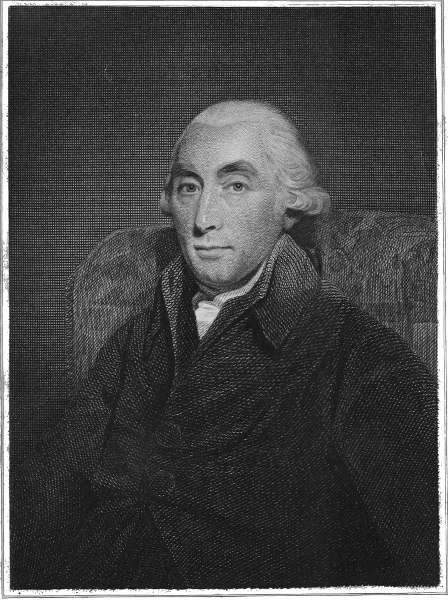 Raeburn. pinxt.
Dean, sculpt.
JOSEPH BLACK, M.D. F.R.S.E.