Civil War.
Increasing demands of the Commons.
THE way in which the king came at last
to a final rupture with Parliament was
this. The victory which the Commons gained
in the case of Strafford had greatly increased
their confidence and their power, and the king
found, for some months afterward, that instead
of being satisfied with the concessions he had
made, they were continually demanding more.
The more he yielded, the more they encroached.
They grew, in a word, bolder and bolder, in
proportion to their success. They considered
themselves doing the state a great and good
service by disarming tyranny of its power.
The king, on the other hand, considered them
as undermining all the foundations of good
government, and as depriving him of personal
rights, the most sacred and solemn that could
vest in any human being.
The king gradually loses his power.
It will be recollected that on former occasions,
when the king had got into contention
with a Parliament, he had dissolved it, and
either attempted to govern without one, or else
had called for a new election, hoping that the
new members would be more compliant. But
he could not dissolve the Parliament now.
They had provided against this danger. At
the time of the trial of Strafford, they brought
in a bill into the Commons providing that
thenceforth the Houses could not be prorogued
or dissolved without their own consent. The
Commons, of course, passed the bill very readily.
The Peers were more reluctant, but they
did not dare to reject it. The king was extremely
unwilling to sign the bill; but, amid
the terrible excitements and dangers of that
trial, he was overborne by the influences of danger
and intimidation which surrounded him.
He signed the bill. Of course the Commons
were, thereafter, their own masters. However
dangerous or destructive the king might consider
their course of conduct to be, he could now
no longer arrest it, as heretofore, by a dissolution.
He went on, therefore, till the close of 1641,
yielding slowly and reluctantly, and with many
struggles, but still all the time yielding, to the
resistless current which bore him along. At
last he resolved to yield no longer. After retreating
so long, he determined suddenly and
desperately to face about and attack his enemies.
The whole world looked on with astonishment
at such a sudden change of his policy.
The king determines to change his policy.
The measure which he resorted to was this.
He determined to select a number of the most
efficient and prominent men in Parliament,
who had been leaders in the proceedings against
him, and demand their arrest, imprisonment,
and trial, on a charge of high treason. The
king was influenced to do this partly by the advice
of the queen, and of the ladies of the court,
and other persons who did not understand how
deep and strong the torrent was which they
thus urged him to attempt to stem. They
thought that if he would show a little courage
and energy in facing these men, they would
yield in their turn, and that their boldness and
success was owing, in a great measure, to the
king's want of spirit in resisting them. "Strike
boldly at them," said they; "seize the leaders;
have them tried, and condemned, and executed.
Threaten the rest with the same fate; and follow
up these measures with energetic and decisive
action, and you will soon make a change
in the aspect of affairs."
1642.
The king sends his officers to the House.
The king adopted this policy, and he did
make a change in the aspect of affairs, but not
such a change as his advisers had anticipated.
The Commons were thrown suddenly into a
state of astonishment one day by the appearance
of a king's officer in the House, who rose
and read articles of a charge of treason against
five of the most influential and popular members.
The officer asked that a committee
should be appointed to hear the evidence
against them which the king was preparing.
The Commons, on hearing this, immediately
voted, that if any person should attempt even
to seize the papers of the persons accused, it
should be lawful for them to resist such an attempt
by every means in their power.
The next day another officer appeared at the
bar of the House of Commons, and spoke as follows.
"I am commanded by the king's majesty,
my master, upon my allegiance, that I
should come to the House of Commons, and require
of Mr. Speaker five gentlemen, members
of the House of Commons; and those gentlemen
being delivered, I am commanded to arrest
them in his majesty's name, on a charge
of high treason." The Commons, on hearing
this demand, voted that they would take it into
consideration!
The king goes to the House himself.
The king's speech in the House.
The king's friends and advisers urged him to
follow the matter up vigorously. Every thing
depended, they said, on firmness and decision.
The next day, accordingly, the king determined
to go himself to the House, and make the demand
in person. A lady of the court, who was
made acquainted with this plan, sent notice of
it to the House. In going, the king took his
guard with him, and several personal attendants.
The number of soldiers was said to be
five hundred. He left this great retinue at the
door, and he himself entered the House. The
Commons, when they heard that he was coming,
had ordered the five members who were
accused to withdraw. They went out just before
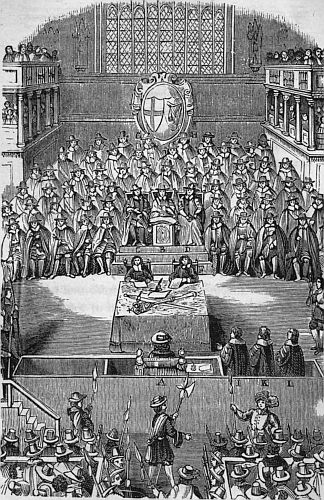
the king came in. The king advanced to
the speaker's chair, took his seat, and made the
following address.
"Gentlemen,—I am sorry for this occasion
of coming unto you. Yesterday I sent a Sergeant-at-Arms
upon a very important occasion
to apprehend some that by my Command were
accused of High Treason; whereunto I did expect
Obedience and not a message. And I
must declare unto you here, that albeit no king
that ever was in England shall be more careful
of your Privileges, to maintain them to the uttermost
of his Power, than I shall be; yet you
must know that in cases of Treason no Person
hath a Privilege; and therefore I am come to
know if any of those Persons that were accused
are here. For I must tell you, Gentlemen,
that so long as these Persons that I have accused
(for no slight Crime, but for Treason) are
here, I can not expect that this House will be
in the right way that I do heartily wish it.
Therefore I am come to tell you that I must
have them wherever I find them."
After looking around, and finding that the
members in question were not in the hall, he
continued:
"Well! since I see the Birds are flown, I
do expect from you that you shall send them
unto me as soon as they return hither. But I
assure you, on the Word of a King, I never did
intend any Force, but shall proceed against
them in a legal and fair way, for I never meant
any other.
"I will trouble you no more, but tell you I
do expect, as soon as they come to the House,
you will send them to me, otherwise I must
take my own course to find them."
Great excitement in the House.
The speaker's reply.
The king's coming thus into the House of
Commons, and demanding in person that they
should act according to his instructions, was a
very extraordinary circumstance—perhaps unparalleled
in English history. It produced the
greatest excitement. When he had finished
his address, he turned to the speaker and asked
him where those men were. He had his guard
ready at the door to seize them. It is difficult
for us, in this country, to understand fully to
how severe a test this sudden question put the
presence of mind and courage of the speaker;
for we can not realize the profound and awful
deference which was felt in those days for the
command of a king. The speaker gained great
applause for the manner in which he stood the
trial. He fell upon his knees before the great
potentate who had addressed him, and said, "I
have, sir, neither eyes to see, nor tongue to
speak, in this place, but as the House is pleased
to direct me, whose servant I am. And I
humbly ask pardon that I can not give any
other answer to what your majesty is pleased
to demand of me."
Results of the king's rashness.
The House was immediately in a state of
great excitement and confusion. They called
out "Privilege! privilege!" meaning that
their privileges were violated. They immediately
adjourned. News of the affair spread
every where with the greatest rapidity, and
produced universal and intense excitement.
The king's friends were astonished at such an
act of rashness and folly, which, it is said, only
one of the king's advisers knew any thing about,
and he immediately fled. The five members
accused went that night into the city of London,
and called on the government and people
of London to protect them. The people armed
themselves. In a word, the king found at
night that he had raised a very threatening and
terrible storm.
Committee of the Commons.
The Commons met the next morning, but
did not attempt to transact business. They
simply voted that it was useless for them to
proceed with their deliberations, while exposed
to such violations of their rights. They appointed
a committee of twenty-four to inquire
into and report the circumstances of the king's
intrusion into their councils, and to consider
how this breach of their privileges could be repaired.
They ordered this committee to sit in
the city of London, where they might hope to
be safe from such interruptions, and then the
House adjourned for a week, to await the result
of the committee's deliberations.
The committee went to London. In the
mean time, news went all over the kingdom
that the House of Commons had been compelled
to suspend its sittings on account of an illegal
and unwarrantable interference with their
proceedings on the part of the king. The king
was alarmed; but those who had advised him
to adopt this measure told him that he must
not falter now. He must persevere and carry
his point, or all would be lost.
The king goes to London.
Cries of the people.
He accordingly did persevere. He brought
troops and arms to his palace at Whitehall, to
be ready to defend it in case of attack. He
sent in to London, and ordered the lord mayor
to assemble the city authorities at the Guildhall,
which is the great city hall of London;
and then, with a retinue of noblemen, he went
in to meet them. The people shouted, "Privileges
of Parliament! privileges of Parliament!"
as he passed along. Some called out,
"To your tents, O Israel!" which was the ancient
Hebrew cry of rebellion. The king, however,
persevered. When he reached the Guildhall,
he addressed the city authorities thus:
"Gentlemen,—I am come to demand such
Persons as I have already accused of High
Treason, and do believe are shrouded in the
City. I hope no good Man will keep them from
Me. Their Offenses are Treason and Misdemeanors
of a high Nature. I desire your Assistance,
that they may be brought to a legal
Trial." Three days after this the king issued
a proclamation, addressed to all magistrates and
officers of justice every where, to arrest the accused
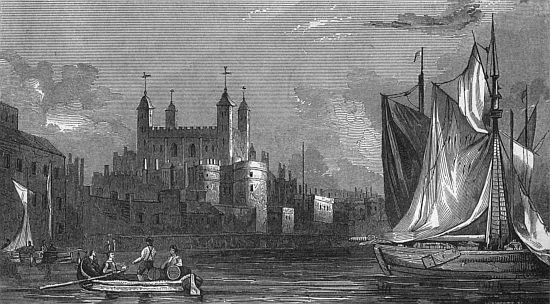
members and carry them to the Tower.
Preparations to escort the committee to Westminster.
In the mean time, the committee of twenty-four
continued their session in London, examining
witnesses and preparing their report.
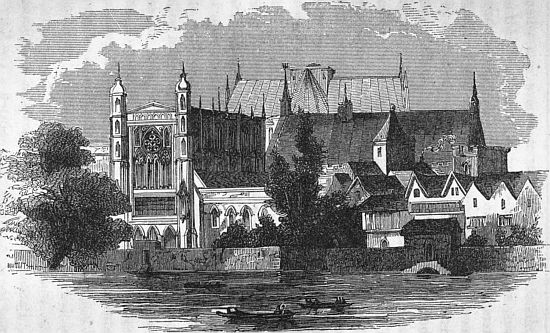
When the time arrived for the House of Commons
to meet again, which was on the 11th of
January, the city made preparations to have
the committee escorted in an imposing manner
from the Guildhall to Westminster. A vast
amount of the intercommunication and traffic
between different portions of the city then, as
now, took place upon the river, though in those
days it was managed by watermen, who rowed
small wherries to and fro. Innumerable steamboats
take the place of the wherries at the
present day, and stokers and engineers have
superseded the watermen. The watermen
were then, however, a large and formidable
body, banded together, like the other trades of
London, in one great organization. This great
company turned out on this occasion, and attended
the committee in barges on the river,
while the military companies of the city marched
along the streets upon the land. The committee
themselves went in barges on the water,
and all London flocked to see the spectacle.
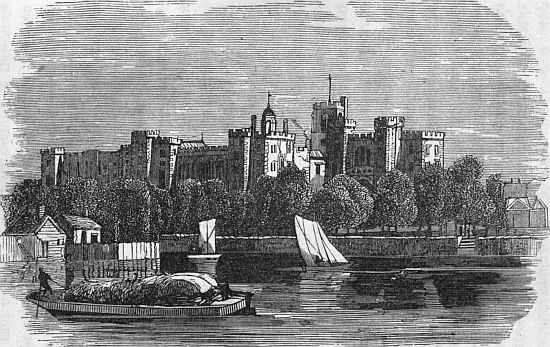
The king, hearing of these arrangements, was
alarmed for his personal safety, and left his
palace at Whitehall to go to Hampton Court,
which was a little way out of town.
Report of the committee.
The committee, after entering the House,
reported that the transactions which they had
been considering constituted a high breach of
the privileges of the House, and was a seditious
act, tending to a subversion of the peace of the
kingdom; and that the privileges of Parliament,
so violated and broken, could not be sufficiently
vindicated, unless his majesty would be
pleased to inform them who advised him to do
such a deed.
Alarm of the king.
The king yields.
The king was more and more seriously
alarmed. He found that the storm of public
odium and indignation was too great for him to
withstand. He began to fear for his own safety
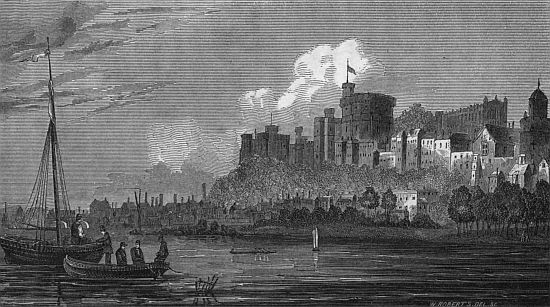
more than ever. He removed from Hampton
Court to Windsor Castle, a stronger place,
and more remote from London than Hampton
Court; and he now determined to give up the
contest. He sent a message, therefore, to the
House, saying that, on further reflection, since
so many persons had doubts whether his proceedings
against the five members were consistent
with the privileges of Parliament, he
would waive them, and the whole subject might
rest until the minds of men were more composed,
and then, if he proceeded against the accused
members at all, he would do so in a manner
to which no exception could be taken. He
said, also, he would henceforth be as careful of
their privileges as he should be of his own life
or crown.
Increasing excitement.
Thus he acknowledged himself vanquished
in the struggle, but the acknowledgment came
too late to save him. The excitement increased,
and spread in every direction. The party of
the king and that of the Parliament disputed
for a few months about these occurrences, and
others growing out of them, and then each began
to maneuver and struggle to get possession
of the military power of the kingdom. The
king, finding himself not safe in the vicinity of
London, retreated to York, and began to assemble
and organize his followers. Parliament
sent him a declaration that if he did not disband
the forces which he was assembling, they
should be compelled to provide measures for securing
the peace of the kingdom. The king
replied by proclamations calling upon his subjects
to join his standard. In a word, before
midsummer, the country was plunged in the
horrors of civil war.
Civil war.
Its nature.
A civil war, that is, a war between two
parties in the same country, is generally far
more savage and sanguinary than any other.
The hatred and the animosities which it creates,
ramify throughout the country, and produce
universal conflict and misery. If there
were a war between France and England,
there might be one, or perhaps two invading
armies of Frenchmen attempting to penetrate
into the interior. All England would be united
against them. Husbands and wives, parents
and children, neighbors and friends, would
be drawn together more closely than ever;
while the awful scenes of war and bloodshed,
the excitement, the passion, the terror, would
be confined to a few detached spots, or to a few
lines of march which the invading armies had
occupied.
Cruelties and miseries of civil war.
In a civil war, however, it is very different.
Every distinct portion of the country, every
village and hamlet, and sometimes almost every
family, is divided against itself. The hostility
and hatred, too, between the combatants, is always
far more intense and bitter than that
which is felt against a foreign foe. We might
at first be surprised at this. We might imagine
that where men are contending with their
neighbors and fellow-townsmen, the recollection
of past friendships and good-will, and various
lingering ties of regard, would moderate
the fierceness of their anger, and make them
more considerate and forbearing. But this is
not found to be the case. Each party considers
the other as not only enemies, but traitors,
and accordingly they hate and abhor each other
with a double intensity. If an Englishman
has a Frenchman to combat, he meets him
with a murderous impetuosity, it is true, but
without any special bitterness of animosity.
He expects the Frenchman to be his enemy.
He even thinks he has a sort of natural right
to be so. He will kill him if he can; but then,
if he takes him prisoner, there is nothing in his
feelings toward him to prevent his treating him
with generosity, and even with kindness. He
hates him, but there is a sort of good-nature in
his hatred, after all. On the other hand, when
he fights against his countrymen in a civil war,
he abhors and hates with unmingled bitterness
the traitorous ingratitude which he thinks his
neighbors and friends evince in turning enemies
to their country. He can see no honesty, no
truth, no courage in any thing they do. They
are infinitely worse, in his estimation, than the
most ferocious of foreign foes. Civil war is,
consequently, always the means of far wider
and more terrible mischief than any other human
calamity.
Taking sides between the king and Parliament.
In the contention between Charles and the
Parliament, the various elements of the social
state adhered to one side or the other, according
to their natural predilections. The Episcopalians
generally joined the king, the Presbyterians
the Parliament. The gentry and the nobility
favored the king; the mechanics, artisans,
merchants, and common people the Parliament.
The rural districts of country, which
were under the control of the great landlords,
the king; the cities and towns, the Parliament.
The gay, and fashionable, and worldly, the
king; the serious-minded and austere, the Parliament.
Thus every thing was divided. The
quarrel ramified to every hamlet and to every
fireside, and the peace and happiness of the
realm were effectually destroyed.
Preparations for war.
Fruitless negotiations.
Both sides began to raise armies and to prepare
for war. Before commencing hostilities,
however, the king was persuaded by his counselors
to send a messenger to London and propose
some terms of accommodation. He accordingly
sent the Earl of Southampton to the
House of Peers, and two other persons to the
House of Commons. He had no expectation,
probably, of making peace, but he wanted to
gain time to get his army together, and also to
strengthen his cause among the people by showing
a disposition to do all in his power to avoid
open war. The messengers of the king went
to London, and made their appearance in the
two houses of Parliament.
The House of Lords ordered the Earl of
Southampton to withdraw, and to send his communication
in in writing, and in the mean time
to retire out of London, and wait for their answer.
The House of Commons, in the same
spirit of hostility and defiance, ordered the messengers
which had been sent to them to come
to the bar, like humble petitioners or criminals,
and make their communication there.
The propositions of the king to the houses
of Parliament were, that they should appoint a
certain number of commissioners, and he also
the same number, to meet and confer together,
in hope of agreeing upon some conditions of
peace. The houses passed a vote in reply, declaring
that they had been doing all in their
power to preserve the peace of the kingdom,
while the king had been interrupting and disturbing
it by his military gatherings, and by
proclamations, in which they were called traitors;
and that they could enter into no treaty
with him until he disbanded the armies which
he had collected, and recalled his proclamations.
Messages between the king and Parliament.
To this the king replied that he had never
intended to call them traitors; and that when
they would recall their declarations and votes
stigmatizing those who adhered to him as traitors,
he would recall his proclamations. Thus
messages passed back and forth two or three
times, each party criminating the other, and
neither willing to make the concessions which
the other required. At last all hope of an accommodation
was abandoned, and both sides
prepared for war.
1643.
Ravages of the war.
The nobility and gentry flocked to the king's
standard. They brought their plate, their jewels,
and their money to provide funds. Some
of them brought their servants. There were
two companies in the king's guard, one of which
consisted of gentlemen, and the other of their
servants. These two companies were always
kept together. There was the greatest zeal
and enthusiasm among the upper classes to
serve the king, and equal zeal and enthusiasm
among the common people to serve the Parliament.
The war continued for four years.
During all this time the armies marched and
countermarched all over the kingdom, carrying
ruin and destruction wherever they went, and
plunging the whole country in misery.
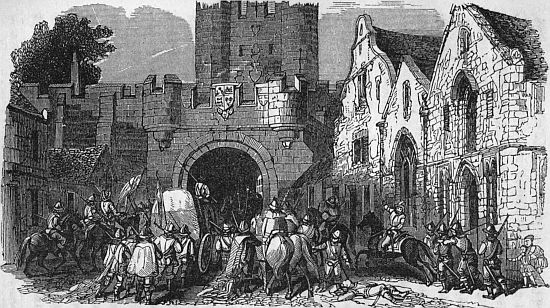
The King's Adherents Entering York.
Death of Hampden.
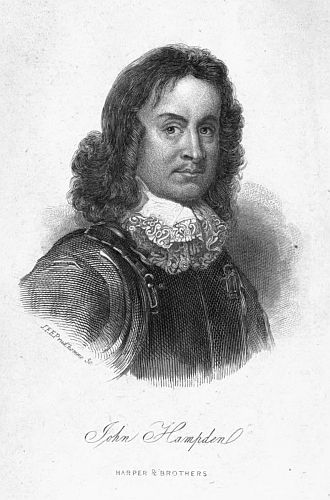
At one of the battles which was fought, the
celebrated John Hampden, the man who would
not pay his ship money, was slain. He had
been a very energetic and efficient officer on
the Parliamentary side, and was much dreaded
by the forces of the king. At one of the battles
between Prince Rupert, Charles's nephew, and
the army of the Parliament, the prince brought
to the king's camp a large number of prisoners
which he had taken. One of the prisoners said
he was confident that Hampden was hurt, for
he saw him riding off the field before the battle
was over, with his head hanging down, and his
hands clasping the neck of his horse. They
heard the next day that he had been wounded
in the shoulder. Inflammation and fever ensued,
and he died a few days afterward in great
agony.
Prince Rupert. His knowledge and ingenuity.
This Prince Rupert was a very famous character
in all these wars. He was young and ardent,
and full of courage and enthusiasm. He
was always foremost and ready to embark in
the most daring undertakings. He was the
son of the king's sister Elizabeth, who married
the Elector Palatine, as narrated in a preceding
chapter. He was famous not only for his military
skill and attainments, but for his knowledge
of science, and for his ingenuity in many
philosophical arts. There is a mode of engraving
called mezzotinto, which is somewhat easier
of execution than the common mode, and produces
a peculiar effect. Prince Rupert is said
to have been the inventor of it, though, as is
the case with almost all other inventions, there
is a dispute about it. He discovered a mode
of dropping melted glass into water so as to
form little pear-shaped globules, with a long
slender tail. These globules have this remarkable
property, that if the tip of the tail is broken
off ever so gently, the whole flies into
atoms with an explosion. These drops of glass
are often exhibited at the present day, and are
called Prince Rupert's drops. The prince also
discovered a very tenacious composition of metals
for casting cannon. As artillery is necessarily
very heavy, and very difficult to be transported
on marches and upon the field of battle,
it becomes very important to discover such metallic
compounds as have the greatest strength
and tenacity in resisting the force of an explosion.
Prince Rupert invented such a compound,
which is called by his name.
Progress of the war.
Difficulty of making peace.
The women clamor for peace.
There were not only a great many battles
and fierce encounters between the two great
parties in this civil war, but there were also,
at times, temporary cessations of the hostilities,
and negotiations for peace. But it is very
hard to make peace between two powers engaged
in civil war. Each considers the other
as acting the part of rebels and traitors, and
there is a difficulty, almost insuperable, in the
way of even opening negotiations between them.
Still the people became tired of the war. At
one time, when the king had made some propositions
which the Parliament would not accept,
an immense assemblage of women collected together,
with white ribbons in their hats, to go
to the House of Commons with a petition for
peace. When they reached the door of the hall
their number was five thousand. They called
out, "Peace! peace! Give us those traitors
that are against peace, that we may tear them
to pieces." The guards who were stationed at
the door were ordered to fire at this crowd,
loading their guns, however, only with powder.
This, it was thought, would frighten them
away; but the women only laughed at the
volley, and returned it with stones and brickbats,
and drove the guards away. Other troops
were then sent for, who charged upon the women
with their swords, and cut them in their
faces and hands, and thus at length dispersed
them.
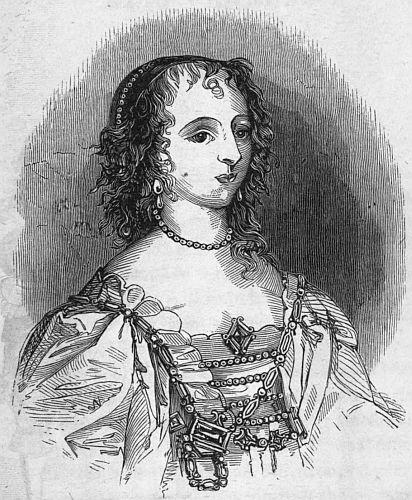
Queen Henrietta's arrival in England.
During the progress of the war, the queen returned
from the Continent and joined the king.
She had some difficulty, however, and encountered
some personal danger, in her efforts to return
to her husband. The vice-admiral, who
had command of the English ships off the coast,
received orders to intercept her. He watched
for her. She contrived, however, to elude his
vigilance, though there were four ships in her
convoy. She landed at a town called Burlington,
or Bridlington, in Yorkshire. This town
stands in a very picturesque situation, a little
south of a famous promontory called Flamborough
Head, of which there is a beautiful
view from the pier of the town.
The vice-admiral cannonades the queen.
The queen succeeded in landing here. On
her arrival at the town, she found herself
worn down with the anxiety and fatigue of the
voyage, and she wanted to stop a few days to
rest. She took up her residence in a house
which was on the quay, and, of course, near
the water. The quay, as it is called, in these
towns, is a street on the margin of the water,
with a wall, but no houses next the sea. The
vice-admiral arrived at the town the second
night after the queen had landed. He was
vexed that his expected prize had escaped him.
He brought his ships up near to the town, and
began to fire toward the house in which the
queen was lodging.
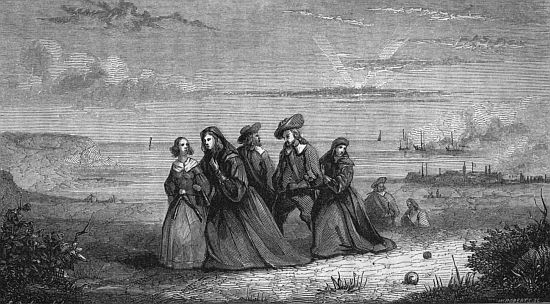
The Landing of the Queen.
This was at five o'clock in the morning.
The queen and her attendants were in their
beds, asleep. The reports of the cannon from
the ships, the terrific whistling of the balls
through the air, and the crash of the houses
which the balls struck, aroused the whole village
from their slumbers, and threw them into
consternation. The people soon came to the
house where the queen was lodging, and begged
her to fly. They said that the neighboring
houses were blown to pieces, and that her own
would soon be destroyed, and she herself would
be killed. They may, however, have been influenced
more by a regard to their own safety
than to hers in these injunctions, as it must
have been a great object with the villagers to
effect the immediate removal of a visitor who
was the means of bringing upon them so terrible
a danger.
The queen's danger.
These urgent entreaties of the villagers were
soon enforced by two cannon-balls, which fell,
one after another, upon the roof of the house,
and, crashing their way through the roof and
the floors, went down, without seeming to regard
the resistance, from the top to the bottom.
The queen hastily put on her clothes, and went
forth with her attendants on foot, the balls
from the ships whistling after them all the way.
She seeks shelter in a trench.
One of her servants was killed. The rest of
the fugitives, finding their exposure so great,
stopped at a sort of trench which they came
to, at the end of a field, such as is dug commonly,
in England, on one side of the hedge,
to make the barrier more impassable to the animals
which it is intended to confine. This
trench, with the embankment formed by the
earth thrown out of it, on which the hedge is
usually planted, afforded them protection. They
sought shelter in it, and remained there for two
hours, like besiegers in the approaches to a
town, the balls passing over their heads harmlessly,
though sometimes covering them with
the earth which they threw up as they bounded
by. At length the tide began to ebb, and
the vice-admiral was in danger of being left
aground. He weighed his anchors and withdrew,
and the queen and her party were relieved.
Such a cannonading of a helpless and
defenseless woman is a barbarity which could
hardly take place except in a civil war.
The queen joins her husband.
Her influence.
The queen rejoined her husband, and she
rendered him essential service in many ways.
She had personal influence enough to raise both
money and men for his armies, and so contributed
very essentially to the strength of his
party. At last she returned to the Continent
again, and went to Paris, where she was still
actively employed in promoting his cause. At
one of the battles in which the king was defeated,
the Parliamentary army seized his baggage,
and found among his papers his correspondence
with the queen. They very ungenerously
ordered it to be published, as the letters
seemed to show a vigorous determination
on the part of the king not to yield in the contest
without obtaining from the Parliament
and their adherents full and ample concessions
to his claims.
1646.
The royal cause declines.
The Prince of Wales.
As time rolled on, the strength of the royal
party gradually wasted away, while that of
Parliament seemed to increase, until it became
evident that the latter would, in the end, obtain
the victory. The king retreated from
place to place, followed by his foes, and growing
weaker and more discouraged after every
conflict. His son, the Prince of Wales, was
then about fifteen years of age. He sent him
to the western part of the island, with directions
that, if affairs should still go against him,
the boy should be taken in time out of the
country, and join his mother in Paris. The
danger grew more and more imminent, and
they who had charge of the young prince sent
him first to Scilly, and then to Jersey—islands
in the Channel—whence he made his escape to
Paris, and joined his mother. Fifteen years
afterward he returned to London with great
pomp and parade, and was placed upon the
throne by universal acclamation.
Hopeless condition of the king.
At last the king himself, after being driven
from one place of refuge to another, retreated
to Oxford and intrenched himself there. Here
he spent the winter of 1646 in extreme depression
and distress. His friends deserted him;
his resources were expended; his hopes were
extinguished. He sent proposals of peace to
the Parliament, and offered, himself, to come
to London, if they would grant him a safe-conduct.
In reply, they forbade him to come.
They would listen to no propositions, and would
make no terms. The case, they saw, was in
their own hands, and they determined on unconditional
submission. They hemmed the
king in on all sides at his retreat in Oxford,
and reduced him to despair.
Invasion by the Scots.
The king surrenders to the Scots.
End of the civil war.
In the mean time, the Scots, a year or two
before this, had raised an army and crossed the
northern frontier, and entered England. They
were against monarchy and Episcopacy, but
they were, in some respects, a separate enemy
from those against whom the king had been
contending so long; and he began to think
that he had perhaps better fall into their hands
than into those of his English foes, if he must
submit to one or to the other. He hesitated
for some time what course to take; but at last,
after receiving representations of the favorable
feeling which prevailed in regard to him in the
Scottish army, he concluded to make his escape
from Oxford and surrender himself to
them. He accordingly did so, and the civil
war was ended.