The query now naturally arises, what is the origin of
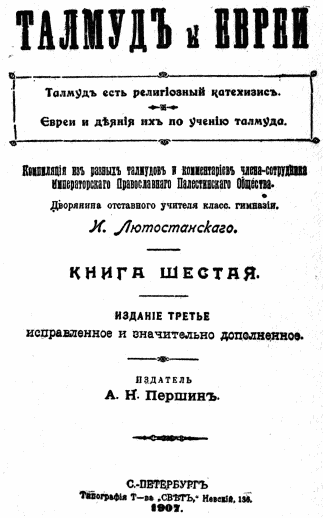
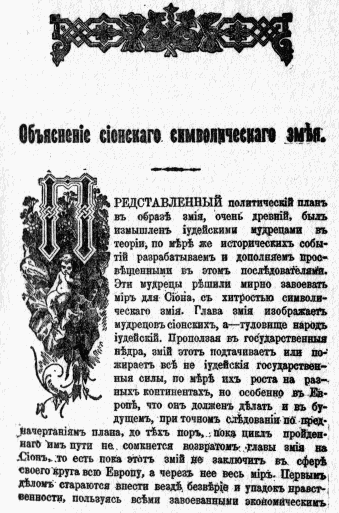
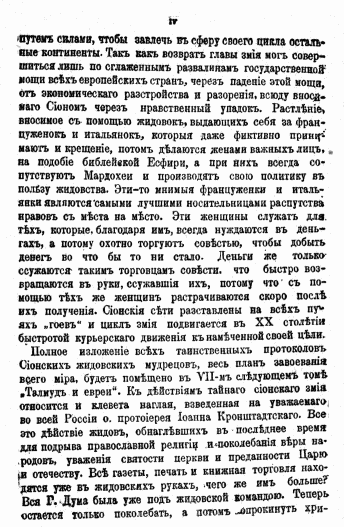
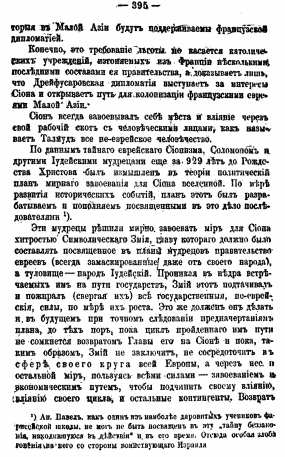
these much heralded “Protocols” which were published
in Russia by Sergius Nilus in 1905, and a copy of which,
it is triumphantly announced, is now in the British
Museum?
The anti-Jewish propagandists everywhere content
themselves with the “history” of the origin of the “Protocols”
as given by the “Russian mystic” Sergius Nilus.
But fortunately “murder will out,” and the criminals who
perpetrated the stupendous forgery for the purpose of
slandering the Jews have left behind clues that enable
one to visualize the very process that they pursued in
the perpetration of their crime.
In 1866-1870 there appeared in Berlin a series of novels
entitled “Biarritz—Rome” purporting to have been written
by “Sir John Retcliffe,” the pseudonym of Herman
Goedsche, a German novelist with an unsavory past. To
conceal his identity and to convey the impression that
the antisemitism with which his writings abounded
emanated from English sources, he selected “Sir John
Retcliffe” as his pen-name.
The chapter of the Goedsche-Retcliffe novel which on
even a cursory reading will be found to contain the very
essence of the Nilus Protocols was published as a separate
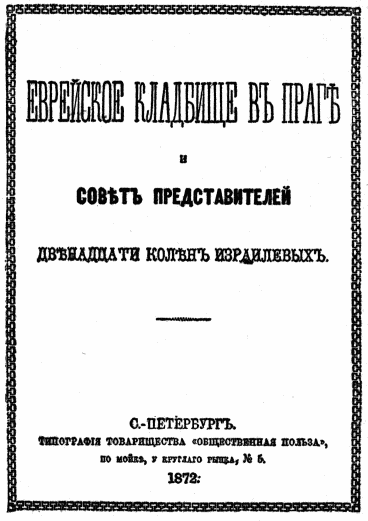
booklet in a Russian translation in 1872, avowedly
as a work of fiction. I have found a copy of this little
volume in the Russian Department of the Library of
Congress, Washington, D. C.
An examination of this chapter, entitled “The Jewish
Cemetery in Prague and the Council of Representatives
of the Twelve Tribes of Israel,” will disclose the fact
that every substantive statement contained in the Protocols
and elaborated in them is to be found in the Goedsche-Retcliffe
novelette.
We are thus supplied with an early draft of the so-called
Protocols, which have now been given worldwide
publicity by anti-Jewish propagandists, and which were
first introduced to the world in the form of a clumsy
piece of blood-curdling fiction of the dime-novel variety.
In substantiation of this statement I now present a
translation of this chapter of the Russian version of this
novel found in the Library of Congress in Washington,
published in St. Petersburg nearly fifty years ago.
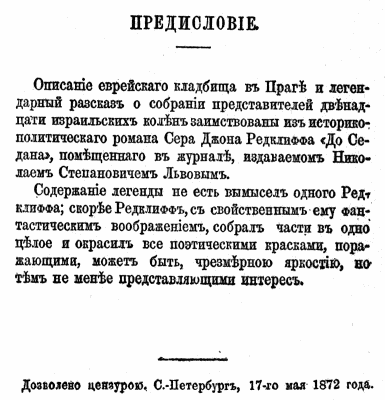
“The description of the Jewish cemetery in Prague and
the legendary story of the meeting of the representatives
of the twelve tribes of Israel are borrowed from the
historico-political novel by Sir John Radcliff, ‘To Sedan,’
published in the magazine edited by Nicholas Stepanovitch
Lvoff.
“The contents of the legend are not the invention of
Radcliff himself; rather Radcliff, with his characteristic
fantastic imagination, collected various parts into one
whole and painted all with poetic colors, which strike one
perhaps by their excessive gaudiness, but which are nevertheless
interesting.”
Passed by the Censor, St. Petersburg, May 17, 1872
This product of “Radcliff’s fantastic imagination,” the
work of one experienced in the perpetration of forgeries,
will now be permitted to tell its own story. It requires
no commentary. It clearly foreshadows the protocols,
with all its accompaniment of melodrama, not even omitting
the Devil, himself.
THE JEWISH CEMETERY IN PRAGUE
and
The Council of Representatives of the Twelve Tribes of Israel
“The Jewish quarter of Prague represents a remarkable
labyrinth of crooked and narrow streets; it is situated in the
outskirts of Prague which witnessed numerous bloody episodes
of Bohemian and German history. The dwellers of the dirty
and dilapidated houses of this quarter are engaged in petty
trading and profiteering in their own as well as in other parts
of the city. Prague is the only city in Germany where the
Jews live entirely isolated from the nation whose name they
have taken in order to avail themselves of the privileges of the
city population and to exploit it for their own purposes. The
Jewish quarter in Prague is the same as the rag-fair in Vienna
and the Temple in Paris. In these places deals amounting to
thousands are transacted daily.
“If you take a few steps along this dirty, foul market-place,
you will suddenly come upon an old, high, decayed wall which
surrounds a space of from two to three acres. Elder-trees and
other wild shrubbery wind around this wall. Old Jewish houses
are crowded all along near this wall, threatened with destruction
at any moment. The strange circle formed by this wall
has an unwelcome, puzzling appearance.
“This is the city of the dead—the renowned Prague cemetery.
“In this abode of rest may be seen the spirit of the nation,
whose bones found shelter here after long wandering,—here is
stamped all its history, full of sufferings, struggles and resistance.
“It seems as though at any moment these tombs, overgrown
with shrubbery, are ready to open, these stones growing for
thousands of years are ready to raise themselves, and to let out
into the world the restless wanderer with a pack upon his
shoulder, with a staff in his hand, in order to go again to
strange peoples,—to cheat and combat them and to seek a new
Canaan—his dominion! The Jewish cemetery in Prague is the
very oldest cemetery known. It was closed by order of the
government a hundred years ago. For foreigners it is a
historical landmark; for the Jews it is a sacred place. The
impression of this deserted spot is intensified by its surroundings.
Amidst the closely crowded tombs and monuments, overgrown
with moss, only a narrow passage remains which is almost
entirely covered with shrubbery of thorn-bushes and mat-weed.
“During the inspection, the watchman will tell the visitor the
history of the death of Rabbi Ben Manasseh, the great conqueror
of death, and Rabbi Loewe, the most learned Rabbi of the 17th
century; he will speak of Simon the Just and of the Polish
princess Anna Shmiless. He will then lead the visitor to the
monument of Anna Kohn on which can be read the mysterious
figure 606, which shows that the Jews, more than twelve hundred
years ago, had buried their dead here, in the legendary times of
Lyubush and her daughters.
“If we are not to believe this figure, we must nevertheless
agree with the opinion of the Jews that this is the oldest settlement
and the first Jewish community in Europe.
“Silently the Jewish guide and the curious foreigner go by
one place where under an old lilac bush a heap of stone stands
out, and when the foreigner asks, ‘What is this?’ the guide
gives an evasive answer——
“‘Beth Chaim—the house of life.’ Thus is the cemetery
called. Yes, indeed, this place of rest is a house of life, for
from here is given the mysterious impulse which makes the
exiles masters of the earth and tyrants of nations,—the impulse
which directs the golden calf to the chosen tribe.
“The Jewish town has assumed a holiday aspect. The stands
of the petty retailers have disappeared; Jewish boys and girls
were strolling about in their holiday attire. The houses and
windows were adorned with green branches. On the old benches
sat men, talking seriously; in the alleys youths were chatting.
From time to time men and women in their best Sabbath clothes
were going to the synagogue, carrying prayer books in their
hands; while poor Christian women whom need had forced
to work in this quarter were running with keys and dishes in
order to prepare for the feast.
“It was the last day of the Feast of Booths, the day of
Assembly, and dusk was gathering over the narrow streets,
while the Christian part of the city was still brightly illumined
by the last rays of the setting sun. Two men (the older wore
a black silk mantle, with long earlocks, which showed that he
was a Polish Jew; the other was middle aged, in modern clothes,
with diamond studs in his shirt and a heavy golden chain on
his vest) walked along the narrow streets, without paying any
attention to the crowd.
“The younger seemed to be the guide. Having come with his
companion to the little house where the watchman of the cemetery
lived, he knocked at the closed door, through a crevice of
which the bright light of wax candles was seen, showing the
watchman’s holiday mood. It was a good summer—a large
number of foreigners had visited the cemetery and were generous
in their gifts.
“In the doorway appeared the thin face of the watchman,
whose short-sighted eyes began to look fixedly into the darkness.
“‘Come out into the street, Joel, somebody wants to talk to
you!’
“‘O, God of Justice,’ said the watchman with amazement, as
he came out of the door,—‘One of the trustees! What is your
pleasure to command me?’
“‘This Rabbi desires to make a brief prayer in the cemetery;
he is leaving to-morrow morning by train.’
“‘In the cemetery? This evening? But you know yourself,
Mr. Banker, that I am forbidden to open the gates after sunset,
and to-night is also the holy Sabbath.’
“‘First of all, there is no need for you to shout here about my
calling,’ replied the banker, displeased. ‘Every Jewish rag-picker
will know that banker Rosenberg was here to see you. As for
the permit to open the gates, I myself, as a trustee, authorize
you to do it. I will wait here until he has completed his prayer.
The company in your house must not know what we are doing
here. Arrange it so that the curious crowd will not rush in
there.’
“The watchman disappeared in the house, but soon returned
with a bunch of keys and opened the gates of the cemetery.
He took a lantern along and was about to light it.
“‘Don’t!’ said the Rabbi in a low voice. ‘I don’t need any
light. Lock the gates from the inside!’
“‘But, Mr. von Rosenberg——’
“‘Lock it, I say!’
“The watchman obeyed.
“‘Now lead me to the grave of the holy Rabbi Simeon-ben-Yehudah!’
“‘Hold on to my coat, esteemed sir,’ said the watchman. ‘It
is dark and you may stumble over the old graves.’
“‘I can see better at night than in the daytime, my son!’
answered the learned Polish Jew.
“‘Here is the grave!’
“The old Rabbi reverently leaned over the tombstone. The
watchman heard him pronounce a prayer in Jewish. He used
so many words of ancient Hebrew, or some other words of a
language he did not understand, that he knew only a few separate
expressions, although he himself had been in the past a
teacher at the Bohemian community.
“Having completed his prayer, the stranger turned to the
watchman of the cemetery:
“‘When you accepted the position from your predecessor, did
he not give you certain instructions?’
“‘Me?’
“‘Yes, you! It was so from the day the first person was buried
in this place.’
“‘Well, and what if he did give such instructions,—how
does that concern you? This the first time I am asked about
this matter since I am employed here.’
“‘Because this happens once in a hundred years, and human
life rarely lasts as long as that.’
“‘I see that you know about it, Rabbi,’ said the frightened
watchman. ‘But I can obey you only if you mention the word
which was given to me by my predecessor, because I took a
sacred oath on the Bible.’
“The Polish Jew bent down and slowly pronounced a word of
seven syllables.
“The watchman bowed respectfully.
“‘You are the Rabbi!’ he said. ‘All will be done as you command!’
“‘You will send away the friends who are feasting in your
house before the clock strikes eleven. At the first stroke you
will open the gates of the cemetery, and at the last stroke you
will get into your house, lock the doors and windows, lie down
in your bed and turn into a corpse together with the members
of your household,—into a corpse that sees and hears nothing.’
“‘I will neither look nor listen.’
“‘The angel of death will leave your soul in your body and
will force you to wander about among the graves to the end
of time if you do not carry out my orders correctly. Now go,
and remember that by virtue of your position you are the
servant of the great Jerusalem synagogue. I need not tell you
that you should not say anything to that vain, worldly man who
brought me here.’
“Both returned to the gates, near which the banker was still
on guard.
“‘Well,’ he said, ‘your desire is fulfilled, Rabbi, and you may
inform my friend in Warsaw that Rosenberg and Son are
always ready to do a favor to a guest recommended by such a
personage. Now let us go home; my wife is waiting for us.’
“‘Let us go, my son,’ replied the Rabbi. ‘But relieve me of
worldly pleasures. I shall spend the night in prayer!’
“The banker shrugged his shoulders and gave the watchman
a gold coin.
“‘Joel,’ he said in a low voice, ‘the other trustees of the community
must not know about this violation of the rule.’
“The watchman nodded, and the companion again disappeared
in the dark streets, which had already become deserted, while
in the houses people talked merrily and the sounds of holiday
festivities were heard.
“How poor, dirty and dark these little houses looked from
outside! But it was quite different within! In the rear rooms
of many of these houses the bright light of numerous wax candles
was reflected in the splendid high mirrors, in expensive dishes
and precious rugs. Girls and women, who in the morning perhaps
walked with trays in their hands, now were seated at the
tables in heavy silk gowns with golden chains and bracelets;
their jewels and diamonds were glittering.
“The clock in the town-hall tower struck ten. In the chapel,
near the statue of St. Nepomucenus, upon a stone bench, sat a
large-sized man, with the pale serious face of Germanic type.
Every physiognomist, looking at him, would have said that this
man had devoted his youth to serious scientific work and that he
had spent many sleepless nights over books.
“The clock had just struck ten when upon the bridge appeared
a man in a light summer coat, of about the same age as the
young scientist. His face was pale, of waxen color, without the
slightest natural red in his cheeks; his particularly prominent
nose indicated his Jewish extraction; his forehead was high and
large, his head was strongly developed. He walked straight
over to the man who was waiting and who quickly arose.
“‘Good evening. I see you have received my letter. Have
you it with you?’
“‘Yes, I know it by heart, I have read it so many times. “My
friend,” it is written there, “I have promised to give you the
key to the Caballah, if I ever find the opportunity to do so.
Although I am not always in the habit of fulfilling my vows, I
am ready to fulfil this one, if you will wait for me in the
evening of October 8, in Prague, on the old Moldau bridge,
under the statue of Nepomucenus.” Then follows your name.’
“‘Yes, that is correct. Have you not yet given up your desire?’
“‘Less than ever before! You would render science an invaluable
service.’
“‘Listen, doctor, bend down a little over the rail; that of
which we speak must not be heard even by the waves of the
Moldau, if we wish to remain alive.’
“The young scientist looked in astonishment at his comrade,
but did as he desired.
“‘Three years ago, in Rome, when I promised to acquaint
you with the mysteries of the Caballah, I did it more for the
sake of boasting of a power and authority which, in reality, I
did not possess. Although I had studied for some time the
traditions of my nation, rather out of curiosity than because of
the love of knowledge, I knew very well that I could hardly
penetrate the corridor of those mysteries which I am still regarding
as the sophistry and roguishness of exalted minds, invented
for the purpose of holding fools in fear and subordination.
But several accidental discoveries, made by me since
then, have changed my views and have aroused in me a sense
of curiosity.
“‘You know, notwithstanding our brief acquaintance, that I
am not the type of man who would abandon a clue or a conceived
plan. What has caused me to make you my companion
in satisfying my curiosity—that does not concern you. It is
enough that now we have an opportunity to satisfy our mutual
desire, and all depends on whether you will agree to accept
the conditions upon which I can make you a partner in my
investigation.’
“‘If these are not against honor and conscience.’
“‘In this respect you have nothing to risk, you are rather
risking something else—your life. Do you feel that you are
capable of facing a serious danger?’
“‘For the sake of science, yes!’
“‘Very well, in that case I must tell you that I will lead you
to a place which we will not leave alive, if our presence is
discovered. The slightest suspicion that we were uninvited
witnesses of the secret will bring upon us persecution which will
kill us sooner or later.’
“‘You are whetting my curiosity, signor!’
“‘That is all I wanted to tell you. The other thing—you
know that I am a Jew by birth. Although the Jews have driven
me from their midst and cursed me according to their custom
and traditions because I adopted Christianity,—still I have my
own reasons for stipulating a condition—your word of honor
that you will be silent about all you will see and hear, until I
authorize you to speak.’
“‘I swear by my honor.’
“‘Very well. You will recall in your investigations of the
Caballah that in the mysterious books mention is made of a
meeting of the heads or chosen ones of the nation,—a meeting
which takes place from time to time?’
“‘Yes, in the Yezire it is said very definitely, and if I understood
correctly, such meetings take place every hundred years.’
“‘Yes. The last meeting took place in 1760 and you recall
that shortly afterward the movement of Judaism started. It is
now 1787 years since the destruction of Jerusalem and this year is
designated for a meeting of the Cabalistic Sanhedrin. This is
the day of the meeting; the place is this city. I want to be
present at this meeting in spite of the danger and am ready to
take you along with me.’
“‘But will it not be dishonest to listen, will it not be an unlawful
interference with other people’s secrets?’
“‘Per Bacco! as we Italians say; with such hesitations you
must abandon once for all the idea of fulfilling your desire. Or
do you think that the people who guard the secret of the
Caballah will bring it to you on a tray? As far as I am concerned,
I shall discover the secret, at any cost!’
“After reflecting a few minutes, the scientist came to a decision.
“‘I shall go with you, come what may!’
“‘Very well. Now we have agreed. Let us go,—there is no
time to lose.’”
“The tower clock of the town-hall struck eleven. At the first
stroke a key clicked in the lock of the cemetery gates. Then
followed profound silence which indicated that the cemetery
was open. The lights in the Jewish houses were gradually
dying out, and at the same time the sounds of the merry feasting
also subsided.
“Mysterious silence reigned in that terrible place.
“The gates creaked softly; the rustling of long coats was
heard, touching the stones and shrubbery; finally a vague white
figure appeared and slipped by like a shadow along the pathways.
“This figure knelt before one of the tombstones; three times
it touched the stone with its forehead and softly whispered a
prayer.
“Along the path leading from the gates came an old man,
bent, limping, sighing and coughing. He came over to the
ancient tombstone, and lowered himself on his knees near the
white figure that had entered before him, and he, too, whispered
a prayer.
“Then heavy footsteps were heard, and a tall, impressive figure
appeared on the road, clad in a white mantle, and he, too,
fell down on his knees, as though unwillingly, in front of the
tombstone.
“Thirteen times this was repeated. Thirteen old men came
over to the tombstone. The doctor counted them, but he could
not understand whether they were alive or dead. A shiver
crept down his back, his heart began to beat faster from fright.
He involuntarily recalled the terrible legend of the Day of
Atonement in the tenth month, Tishri, in the synagogue of
Posen when, during the prayer of Kol Nidrei, the congregation
kept growing larger and larger; unknown people, pushing one
another, wrapped in prayer shawls, came in, one hundred after
another, until the terrified Rabbi lifted his hand as if
to curse and exclaimed: ‘He who has flesh in his cheeks,
let him throw off the prayer shawl!’ Hundreds remained covered,
and when the prayer shawls were torn away from them,
all saw the skulls of the dead who had come out of the graves
to celebrate the Day of Atonement with the rest of the congregation.
“As there, it seemed to him that the prayer shawls had fallen
off the heads of the praying old men, and a row of dead skulls
appeared. At that moment the clock struck twelve. A sharp
metallic sound rang out on the grave, after which a blue flame
appeared and illumined the thirteen kneeling figures.
“‘I greet you, Roshe beth Aboth (heads) of the twelve tribes
of Israel,’ announced a dull voice.
“‘We greet you, son of the accursed.’
“‘A hundred years have already passed. Where have the
Nesiyim (princes of the tribes) come from?’
“‘From the lands where the nation of Adonai has been scattered
by the orders of our forefathers.’
“‘Are you ready to fulfil the promise during the coming century?’
“‘We are ready!’
“‘Then say, whose representatives are you, and where do you
come from? Tribe of Judah?’
“‘From Amsterdam,’ replied a strong, loud voice.
“‘Tribe of Benjamin?’
“‘Toledo!’ came the dull answer.
“‘Tribe of Levi?’
“‘Worms!’
“‘Tribe of Manasseh?’
“‘Budapest!’
“‘Tribe of Gad?’
“‘Cracow!’
“‘Tribe of Simeon?’
“‘Rome!’
“‘Tribe of Zebulun?’
“‘Paris!’
“‘Tribe of Dan?’
“‘Constantinople!’
“‘Tribe of Asher?’
“‘London!’
“‘Tribe of Issachar?’
“The answer came in a faint voice and could not be heard distinctly.
“‘Tribe of Naphtali?’
“‘Prague!’
“‘And I am the representative of the unfortunate and exiles,’
said the man who asked the questions in a dull voice. ‘I am myself
wandering about all over the world in order that I may unite
you for the sake of the cause of redemption which has been
promised to the seed of Abraham and which was taken from
them by the sons of him who was crucified! Who is here of
the house of Aaron, let him rise, scrutinize the heads of the
tribes and gather the council.’
“The man who was the first to arrive rose and then seated
himself upon the tombstone. One by one the others came over
to him and whispered in his ear a seven-syllabled word, and
each time he nodded in approval. After that all returned to
their former places. ‘Brethren,’ said the Levite, ‘our fathers
formed a union which compels all those chosen as representatives
of the tribes to gather every hundred years at the grave of the
great teacher of Caballah whose doctrines give the chosen ones
power on earth and supremacy over all the descendants of
Ishmael. Eighteen hundred years the struggle has been conducted
by the nation of Israel for supremacy which was promised
to Abraham and which was taken away from us by the
Cross. Trampled under foot by our enemies, under the terror
of death and all kinds of humiliation and violence, the nation
of Israel, nevertheless, has not abandoned this struggle, and as
they are scattered all over the earth, the whole earth must belong
to them! Our learned men are conducting this struggle for
hundreds of years; the nation is gradually rising from its fall;
its power is growing and spreading. To us belongs the earthly
god, which was made for us with such sorrow by Aaron in the
desert ... the Golden Calf which the backsliders are worshipping!’
“‘We hear!’ they whispered on all sides.
“‘When all the gold on earth will be ours, the power will go
over to us. Then will be fulfilled the promise made to Abraham.
Gold is the ruler of the earth. Gold is power, reward, pleasure
... all that human beings fear and desire. This is the mystery
of the Caballa ... the teachings concerning the spirit
which rules the world, and about the future! Eighteen centuries
we have belonged to our enemies. The future belongs to us. For
the fifth time in the course of the thousand-year-old struggle to
which we have consecrated ourselves, those who know of the existence
of the secret union have gathered here to take counsel
as to the means which are afforded us by the sins of our
enemies, and each time, for five hundreds years, a new Sanhedrim,
ordered the fiercest struggle. But, excepting Russia, not a
single century has been crowned with such success as this one.
Therefore we may think that the time for which we are striving
is near, and we may say, “The Future is ours!”’
“‘Yes, if persecutions against the Jews will not take place in
the meantime!’ pointed out one of the men with a bitter smile.
“‘The dark days of such a danger are passed. The success
of so-called civilization among the Christian nations may serve
as the best protection for our endeavors. Before listening to the
individual opinions, let us examine the material means, the pure
capital possessed by the nation of Israel....’
“‘But against the three and a half million Jews with their
money there are 265 million enemies in Europe, or rather 500
million fists,’ remarked one of these present.
“‘The head will protect us against the fists, as in the past.
Labor is the slave of speculation, and violence is the slave of
wisdom. Who will deny that cunning is the distinctive trait
of our nation?
“‘Our nation is ostentatious and greedy, arrogant and pleasure-loving.
“‘Where there is light there is also shadow. It is not in vain
that Adonai our God gave his chosen people the tenacity of a
snake, the cunning of a fox, the look of a falcon, the memory
of a dog, the diligence of an ant, and the sociability of a beaver.
We were in captivity on the rivers of Babylon, and have become
powerful! Our temple was destroyed, but we have built a
thousand new temples! For eighteen hundreds years we were
slaves; now we have grown head and shoulders above all other
nations.’
“All the twelve pronounced the concluding words—
“‘Brethren,’ said the Levite, ‘the time has come when, in accordance
with the laws of the founder of our union, we must
determine ways and means by which the Jews shall attain their
goal as soon as possible; our experience of a hundred years will
help us in this. We who know must direct and guide the masses
which are blind. We, the builders, will combine the dead stones
into a pillar which must reach the sky.’
“‘The Tower of Babel was destroyed by the hand of Him
whose name I dare not pronounce,’ said the sceptic.
“‘Our structure rests upon the foundation of the promise
made to Abraham. It is your turn to speak, representative of
the tribe of Reuben! By what means will the Jewish nation
achieve power and supremacy over all other nations on earth?’
“A shrill, unpleasant voice then spoke:
“‘All the princes and the lands of Europe are at present in
debt. The stock exchange regulates these debts. But such things
are done only by movable capital; therefore all the movable
capital must go over to the hands of the Jews. The foundation
for this is already laid, judging from what we have heard here.
If we will be supreme in the stock exchange, we will attain the
same supremacy in the governments. Therefore it is necessary
to facilitate loans in order to get them into our hands all the
more. Wherever possible, we must take in exchange for capital,
mortgages on railroads, taxes, mines, regalia and domains. Furthermore,
the stock exchange is a means for the transfer of the
belongings of the small people to the hands of the capitalists,
by drawing them into stock gambling. Transactions in securities
are a splendid invention of our nation. Although the stock exchange
members cheat one another sometimes, it is the outsider
who always pays in the end.’
“The voice which resounded on the Paris Bourse became
silent.
“‘Do the zekenim agree with the opinion of our brother?’
asked the Levite.
“A whisper of approbation was the answer to this question.
“‘Representative of the tribe of Simeon, it is your turn now!’
“A serious, dull voice resounded after this order. Each word
was pronounced slowly and thoughtfully:
“‘Ownership of land is always the iron-clad, everlasting possession
of every country. This in itself gives power, respect and
influence. Therefore, the Jews should secure the possibility of
acquiring real estate. It will not be hard to accomplish this,
if we acquire movable capital. Therefore it is necessary to
facilitate loans on land. Under the fear of scandal we will
destroy land wealth and minimize its importance. Ownership
of land should be mobilized, if lands are sold as other commodities.
The more we help in the breaking up of estates,
the more easily will they fall into our hands. Under the pretext
of relieving the poor classes, it is necessary to levy all taxes of
states and communities on the land owners. When the land is in
our hands, the labor of the Christian workers and farmers will
give us a tenfold income.’
“He who did not belong to any tribe laughed sneeringly.
“‘This advice is good, but not new. Ask in Paris and in
Vienna, who owns the houses there?’
“A whisper of approbation was heard again.
“‘Tribe of Judah, your turn!’
“The voice that resounded was marked with conviction and
reminded one of the sound of the Thaller.
“‘Industry, the power of the burgher, which hinders the Jewish
nation, must be paralyzed even as agriculture. The manufacturer
should be no better than an ordinary worker. The means
to accomplish this may be the unlimited freedom of trade. The
manufacturer will take the place of the artisan as he does not
have to work, only to speculate. The children of Israel can adapt
themselves to all branches of work. Their capital and dexterity
will be the substitute for right. Transforming the artisans into
our factory workers, we will be in a position to direct the masses
for our political purposes. Whoever resists this system will be
destroyed by competition. The senseless and ungrateful masses
will not support the artisans in this struggle, if commodities
are reduced in price to a certain extent.
“A noisy approbation of the new Sanhedrin showed that the
soundness of this advice had long been appreciated and even applied
in practice.
“‘Now it is my turn,’ said the representative of Levi—‘I speak
in the name of the tribe of Aaron. The natural enemy of the
Jews is the Christian church. Therefore we must try to humiliate
it, we must instill into it free-thinking, scepticism, and
conflicts. Therefore we will, first of all, start a war on the clergy,
we will try to arouse suspicion against it and ridicule it. The
main pillar of the church is the school. Therefore we must
gain influence over the young. Under the guise of progress and
the equal rights of all religions, we will destroy the study of
religion in Christian schools. Then the Jews may become
teachers in all schools; then religion will be taught at home.
And as there is little time left for that, the spirit of religion
will gradually decline, and eventually it will be destroyed altogether.
Agitation for the appropriation of property belonging
to the churches and schools, the transfer of church property to
the state, or (what is the same) into the hands of the Jews,
will be our reward!’
“Again approbation followed the words of the man who had
spoken. Nobody contradicted him and he announced:
“‘Representative of the tribe of Isaachar, it is your turn!’
“Now an old, trembling voice spoke:
“‘Let our brethren strive for the abolition of armed force.
The coarse military art is not for the sons of Israel. Not everyone
can be a Gideon! The army is for the defense of the throne
and the school of narrow patriotism. Not the sword, but reason
and money must rule. Therefore at every opportune instance,
it is necessary to help the downfall of the military class, to arouse
suspicion in the masses against it, and to incite animosity against
one another. It is enough for the soldiers to do police duty and
to protect the wealthy from those who have nothing.’
“‘The Lion of Judah has spoken,’ said the stranger angrily.
‘David conquered Goliath. The nations will soon wear long
coats instead of military armour. A slap on the bourse will
be equivalent to a lost battle.’
“It looked as though a storm was rising against this arrogant
sarcasm, but one word from the eldest restored them all to calm.
“‘This is the son of Baal! He may say whatever he pleases.
But he will do whatever is decided by the council of the
tribes.’
“‘The tribe of Zebulun may speak!’
“A dull voice, like a storm in the distance, said as follows:
“‘Our nation is conservative to its very root, and clings fast
to what is old. But our interest demands that we participate, or,
rather, direct the movements of nations. It is indisputable that
ours is a time of many reforms, whose main purpose is the
amelioration of the material condition of the needy classes. But
for this the propertied classes must sacrifice their capitals. Capital
is in the hands of the Jews. Therefore they must outwardly
take part in the movement and try to divert it from social and
political reforms. The masses themselves are blind and foolish,
and permit the shouters to rule over them. Who shouts more
loudly and more shrewdly than the Jews? Therefore our nation
has been the first on the platform, in the press, and in all Christian
communities! The more communities and meetings, the more
dissatisfaction and idleness. From this it follows inevitably that
the people grow poorer, that they become subjected to those
who have money, leading to the enrichment of the latter. Besides,
every movement makes us richer, for the smaller people
are ruined and are contracting debts. The unstability of the
foundation increases our power and our influence. Therefore
the support of every kind of dissatisfaction, every revolution,
increases our capital and brings us nearer to our goal.’
“This terrible speech was followed by prolonged silence. Every
member of this secret Sanhedrim seemed to be thinking of its
terrible meaning. The son of Baal again laughed hoarsely.
“‘Are you afraid of blood? It isn’t yours.’
“Then one member of the gathering expressed his approval,
and all others followed his example.
“‘Son of the tribe of Dan, your turn!’
“The answer bore the stamp of a Jew of the lower order:
“‘Every business in which there is speculation and profit must
be in our hands. That is our natural right. First of all, we
must get control of the traffic in liquor, butter, wool, and bread.
Then we shall have in our hands agriculture, farming. We can
prepare bread everywhere, and if dissatisfaction and want should
arise, we can easily throw the blame on the government. Petty
wares, which give a great deal of trouble and yield very little
profit, we can leave in the hands of the Christians. Let them
work hard and suffer as the chosen people suffered for several
centuries.’
“This speech scarcely needed approval. The Levite called
on the next one.
“‘Tribe of Naphtali?’
“The following words rang out shrilly and with assurance:
“‘All governmental positions should be open to us. Once
this principle is established, the cunning and flattery of
the Jewish employees will help them to penetrate even there,
and they will have real influence. I am speaking only of the
posts which bring honor, power, and pre-eminence. Positions
which require work and knowledge may remain for the Christians.
Therefore the Jews may neglect positions of secondary
importance. Justice is very important for us, the law is a
great step forward. This occupation is suited to the cunning
and skill of our people and gives us influence and power against
our natural enemies. Why can’t a Jew be Minister of Education
as he has already been more than once Minister of Finance?’
“‘Remember the scaffold of Haman, the fate of Shushan and
Leopold!’ said a warning voice.
“‘Why does the raven croak about the past which is so distant
and almost forgotten? More than one of our people has been a
Minister in France and respected by the King himself.’
“Approval was expressed in a tone of satisfied pride; then
the orator continued:
“‘Our people must be among the legislators of the governments.
The laws of the goyim against the children of Israel
must be abolished. We will maintain the laws of our Fathers.
We need no longer any laws that would protect us. No. We
must concern ourselves about laws that will give us privileges.
A mild law respecting bankruptcy, promulgated in the interests of
humanity, would be a golden mountain in our hands. First of
all we must see to it that the law regarding usury is abolished
in all countries under the pretext that money would thereby become
cheaper. Money is just such a commodity as others, and
the law should give us the right to regulate its price according
to our desire.’
“‘Now is the turn for the tribe of Benjamin.’
“‘What can I add to the counsel of such wise men? The
Jew should also make use of honors, and should be at the head
of all organizations that may give him honor without risks, and
he should engage in science and the arts which are more adapted
to the character of our people and which we can master more
easily. We can become good actors and philosophers, because
there is room for speculation in these domains. In the arts our
people will look after the reception and will burn incense to
ourselves. In science we will take up medicine and philosophy.
These afford opportunities for theories and speculation. A
physician penetrates the secrets of families and holds their lives
in his hands.’
“‘Tribe of Asher, your turn!’
“‘We must demand free marriage between Jews and Christians.
Israel will only be the gainer, even though there be
an admixture of impure blood to a certain degree. Our sons
and daughters will marry into renowned and powerful Christian
families. We give money and thus have influence. The Christian
relationship cannot have a bad influence on us, while we can
exert a strong influence over them. That is one thing. Another
thing is that we respect the Jewish woman and we enjoy
the forbidden pleasure with the women of our enemies. We have
money, and for money we can get everything. A Jew must
never make a daughter of his own race his mistress. If he
should desire to sin against the Seventh Commandment he
should content himself with Christian girls.’
“‘What is the use of employing the beautiful girls of the
goyim in our stores if not for this?’ angrily interposed the representative
of the evil spirit. ‘Whoever will not want to satisfy
our desire will get no work, consequently no bread. Go to the
large cities and you will see that they are not waiting for your
wise men’s orders. Substitute a contract for sacrament in the
marriage of Christians and their wives and daughters will come
to you still more readily.’
“The terrible cynicism of these words, touching such a delicate
subject, must have produced a profound impression, especially
since the views of the ancient doctrines were so strict on
the topic of moral purity.
“‘What does the law say?’ asked one of the twelve.
“‘For adultery with a woman of our own people—death; for
seducing a girl—a fine, if she was not betrothed; if she was
betrothed—death. But the law is not so rigorous with regard
to one who lives with a slave—her body belongs to her master.’
“‘Are the goyim better than our slaves?’
“This explanation was followed by a whisper of approval.
“‘The tribe of Manasseh may speak now!’
“The last of the orators lifted his hand and during his speech
he raised and lowered it, as if desiring thus to make a stronger
impression by his words. His voice was hoarse and unpleasant,
but he spoke skilfully and with assurance.
“‘If gold is the first power in the world, the press is the
second. Of what value are all the opinions and advice given here
without the aid of the press? We will attain our aim only when
the press is in our hands. Our people must direct the daily
publications. We are cunning, shrewd, and we possess money
which we know how to utilize for our purposes. We need great
political newspapers which mold public opinion—criticism, the
literature of the streets and the stage. In this way we will crowd
out the Christians step by step, and will dictate to the world
what it should believe in, what it should respect, and what it
should curse. We will repeat the sorrowful cry of Israel and
the complaints against the persecutions which are directed against
us. Then, even though each individual may be against us, the
masses, in their stupidity, will always be for us. With the press
in our hands, we can turn wrong into right, dishonesty into honesty.
We can shake all foundations, and separate families. We
can destroy faith in all that our enemies, until now, have believed.
We can ruin credits and arouse passions. We can declare war;
we can award fame or disgrace. We can uplift or ruin talent.
“‘When Israel shall have gold and the press in his hands,
we will be able to ask: “On what day will it please you to put
on Atarah (crown) which belongs to us by right, to erect
Shisse (?) and extend the Shebet (sceptre) over the nations of
the earth?”’
“A noisy greeting followed these words and the agitated men
who listened hardly understood for some time what was being
said at the meeting. At last the voice of the Levite called upon
all to be silent.
“‘The Roshe-Bate-Aboth of the twelve tribes have uttered
words of wisdom. These words will be as pillars for the times
to come, if the son of him “who has not rest” will write these
words upon his memory and spread the seeds among the nation
of Israel in order that it may grow to be a mighty tree. They
will be the sword with which Israel will strike down his enemies.
Our posterity must share among themselves happiness, wealth
and power as it shared misfortune and dangers. They must
help one another. Wherever one of them places his foot, he
must drag another—his brother—along with him. If one
of them is unfortunate, others must help him, if he but lives
according to the law of our nation.
“‘He who was in prison for ten years, may become a rich
man to whom princes will bow, if only our people will not forsake
him. Where everybody is against us, all will be for us.
After forty years of wandering in the desert, the hand of Jehovah
brought us to power in the land of Canaan; the same hand will
lead us after forty-five times forty years from our misfortune
and miseries to rule over lands which are forty-five times vaster
than Canaan. If Israel shall obey the decision here adopted by
the Sanhedrin of the Caballah, our grandchildren, coming a
hundred years hence to the grave of the founder of our union,
will announce to him that they have indeed become the princes
of the world and that the promise made to the nation of Israel
has been fulfilled. Other nations will become his slaves! Renew
our oath, sons of the golden calf, and go to all lands of the
world.’
“The blue flame flared up brightly upon the grave of the
Rabbi; each of the thirteen threw upon the tomb a stone which
each carried under his cloak.
“It seemed to the doctor that on the top of the tombstone,
in the bluish flame, there appeared a monstrous golden figure
of an animal.
“Then he heard the same metallic sound that he had heard
when the light first appeared. Then impenetrable darkness covered
the cemetery.
“The white figures again slipped by among the tombstones.
The gates creaked softly.
“The clock in the tower struck two past midnight. The last of
the mysterious visitors knocked at the window and a hoarse
voice said (as though the speaker knew that the watchman was
not asleep):
“‘Close the house of life, watchman of those who are awaiting
the resurrection, and may your lips be sealed with the seal of
Solomon for a hundred years.’
“The scholar still lay motionless; he was afraid to stir; all
he had heard had made upon him such a dreadful impression.
“A noise near him indicated that his companion was rising.
“‘To concentrate in their hands all the capital of the nations
of all lands; to secure possession of all the land, railroads, mines,
houses; to be at the head of all organizations, to occupy the
highest governmental posts, to paralyze commerce and industry
everywhere, to seize the press, to direct legislation, public opinion
and national movements—and all for the purpose of subjugating
all nations on earth to their power! No! I shall
struggle against the golden calf and shall smash it to pieces as
Moses smashed it in the desert.’
“‘What we heard is a threat against all society. Here is
my hand, I will be your comrade in this struggle against the
power of gold.’
“The Italian shook his head, but accepted the extended hand.
‘No,’ he said, ‘I want to act alone. There is a force which, if
properly directed, is not weaker than gold. That force is poverty
and her companion, labor. I shall call them out and lead
them into battle. Proud Israel! Beware! I shall put against
you the Artel (union) and Labor.’
“‘And I,’ said the scholar, with animation, ‘all that is lofty
and noble,—science, idealism, faith—I shall lead these against
this materialism.’
“His comrade laughed:
“‘Your ideals will crumble as clay striking against metal.
Only the forces of poverty and hunger can be the fighters that
will defeat the golden calf. Our ways part here; you will go
one way, and I another. My promise is fulfilled; but remember
your vow—be silent as to all that you have heard and seen
here!’”
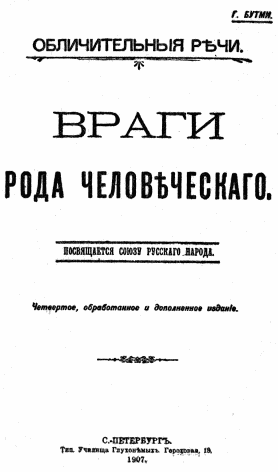
Dr. Herman L. Strack, professor of theology at the
University of Berlin, one of the foremost Christian
authorities on theological and religious literature, commenting
on this Goedsche-Retcliffe concoction, says that
this tale of the ghostly convocation in the Jewish cemetery
at Prague, discloses no real knowledge of Judaism,
that the reference to mixed marriages indicates gross
ignorance of actual Jewish thought, and that the Hebrew
words supposed to have been employed by the spokesmen
for the various tribes appear to have been borrowed from
a dictionary. He also points to Goedsche-Retcliffe’s story
and the “Rabbi’s Speech” about to be mentioned as the
sources of the Protocols.