PRISONS AND PUNISHMENTS
Prisons, usually, a part of the building occupied by court—Better
than civil prisons—Torture inflicted—No new
methods invented—Description of various kinds—Two
Lutheran congregations broken up—Description of some
famous autos da fé—Famous victims—Englishmen punished—Archbishop
Carranza's trial.
The prisons of the Inquisition fall under two
great heads, the "secret prisons" in which those
awaiting trial were confined, and the "penitential
prisons" where sentences were served. Generally
there were also cárceles de familiares where officers
of the institution charged with wrong-doing were
confined. In some tribunals there were others variously
called cárceles medias, cárceles comunes, and
cárceles públicas, where offenders not charged with
heresy might be confined.
The secret prisons, however, have most fired the
imagination. A man might disappear from his accustomed
haunts, and for years his family and
friends be ignorant of his condition, or even of his
very existence, until one day he might appear at an
auto da fé. What went on within the walls was a
mystery. Seldom did any hint of the proceedings
leak out. Everyone was sworn to secrecy, and the
arm of the Inquisition was long, if the luckless witness
or attendant failed to heed his instructions.
These prisons were almost invariably a part of
the building occupied by the tribunal. In Valencia,
it was the archbishop's palace; in Saragossa, the
royal castle; in Seville, the Triana; in Cordova, the
Alcázar, and so on. In some, there were cells and
dungeons already prepared, in others, they were constructed.
There was no common standard of convenience
or sanitation. In many cases, generally,
perhaps, they were superior to the common jails in
which ordinary prisoners were confined. Yet we
know that some were entirely dark and very damp.
Others were so small that a cramped position was
necessary, and were hardly ventilated at all. Sometimes
they were poorly cared for, and loathsome filth
and vermin made them unendurable. Many places
were used for prisons during the three hundred
years of the Inquisition, and no statement is broad
enough to cover them all. The mortality was high,
yet not so high as in the prisons generally. Since
many were unsuitable and often unsafe, the wearing
of fetters was common. Prisoners often, incidentally,
speak of their chains.
Occasionally more than one prisoner occupied the
same room, and much evidence was secured in this
way, as each hoped to lighten his own punishment
by inculpating others. Writing materials were permitted,
though every sheet of paper must be accounted
for and delivered into an official's hands.
Lights were not permitted however.
Yet entire secrecy was not always secured. Attendants
were sometimes bribed, and by various
ingenious methods, communications occasionally
found their way in or out. Again in cases of severe
sickness, the prisoner might be transferred to a hospital,
which however must account for him if he
recovered. Cardinal Adrian, the inquisitor-general,
reminded the tribunals that the prison was for detention,
not for punishment, that prisoners must not
be defrauded of their food, and that the cells must
be carefully inspected.
These and similar instructions issued at intervals
were not always obeyed, for inquisitors were often
negligent. According to Lea, "no general judgment
can be formed as to the condition of so many
prisons during three centuries, except that their
average standard was considerably higher than that
in other jurisdictions, and that, if there were abodes
of horror, such as have been described by imaginative
writers they were wholly exceptional."[5] Again
the same author quotes instances where prisoners
speak of improved health, due to better food in
prison than they were accustomed to at home, and
in summing up declares that the general management
was more humane than could be found elsewhere,
either in or out of Spain.
We may briefly recapitulate the various processes
of the Inquisition in order, as they obtained. First
came the denunciation, followed by seizure and the
commencement of an inquiry. The several offences
imputed were next submitted to those logical experts
named "qualifiers" who decided, so to speak,
"whether there was a true bill," in which case the
procurator fiscal committed the accused to durance.
Three audiences were given him, and the time was
fully taken up with cautions and monitions. The
charges were next formulated but with much prolixity
and reduplication. They were not reduced to
writing and delivered to the accused for slow perusal
and reply, but were only read over to him,
hurriedly. On arraignment he was called upon to
reply, then and there, to each article, to state at once
whether it was true or false. The charges were
usually originated by an informer and resort was
had, if necessary, to "inquiry," the hunting up of
suspicious or damaging facts on which evidence was
sought, in any quarter and from any one good or
bad. If the accused persisted in denial he was allowed
counsel, but later the counsel became an official
of the Inquisition and naturally made only a
perfunctory defence. An appeal to torture was had
if the prisoner persisted in denying his guilt, in the
face of plausible testimony, or if he confessed only
partially to the charges against him, or if he refused
to name his accomplices. A witness who had retracted
his testimony or had contradicted himself,
might be tortured in order that the truth might be
made known.
It was admitted, however, that torture was by no
means an infallible method for bringing out the
truth. "Weak-hearted men, impatient of the first
pain, will confess crimes they never committed and
criminate others at the same time. Bold and strong
ones will bear the most severe torments. Those
who have been already on the rack are likely to bear
it with greater courage, for they know how to adapt
their limbs to it and can resist more powerfully."
It may be admitted that the system was so far
humane that the torture was not applied until every
other effort had been tried and had failed. The
instruments of torture were first exhibited with
threats, but when once in use, it might be repeated
day after day, "in continuation," as it was called,
and if any "irregularity" occurred, such as the
death of a victim, the inquisitors were empowered
to absolve one another. Nobles were supposedly
exempted from torture, and it was not permissible
by the civil laws in Aragon, but the Holy Office was
nevertheless authorised to torture without restriction
all persons of all classes.
Torture was not inflicted as a punishment by the
Inquisition, nor was it peculiar to its trials. Until
a comparatively recent date it was a recognised
method of securing testimony, accepted in nearly all
courts of Europe as a matter of course. The Inquisition
seems to have invented no new methods, and
seldom used the extreme forms commonly practised.
In fact in nearly every case, torture was inflicted by
the regular public executioner who was called in for
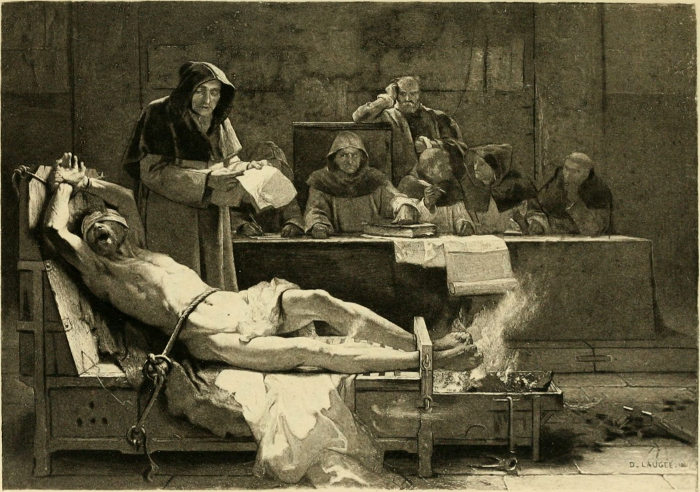
the purpose and sworn to secrecy. The list of tortures
practised on civil prisoners was long, and they
seem to us now fiendish in their ingenuity. A complete
course would require many hours, and included
apparently the infliction of pain to every organ or
limb and to almost every separate muscle and nerve.
The records of the Inquisition show almost invariably
the infliction of a few well known sorts.
Some sorts were abandoned because of the danger
of permanent harm, and others less violent, but
probably no less painful, were substituted. Often
the record states that the prisoner "overcame the
torture," i. e. was not moved to confess. Evidently,
though the whole idea is abhorrent to us to-day,
torture as inflicted was less awful than some writers
would have us believe.[6]
A curious memento of the methods employed by
the Holy Office has been preserved in an ancient
"Manual of the Inquisition of Seville," a thin
quarto volume bound in vellum, with pages partly
printed, partly in manuscript. It bears the date
1628, and purports to be compiled from ancient and
modern instructions for the order of procedure. It
was found in the Palace of the Inquisition at Seville,
when it was sacked in the year 1820. One part of
this manual details the steps to be taken, "when
torture has to be performed." The criminal having
been brought into the audience, was warned that
he had not told the entire truth, and as he was believed
to have kept back and hidden many things,
he was about to be "tormented" to compel him to
speak out. Formal sentence to the torture chamber
was then passed, after "invoking the name of
Christ." It was announced that the "question"
would be administered. The method of infliction
was detailed whether by pulleys or by water or
cords, or by all, to be continued for "as long a time
as may appear well," with the proviso that if in the
said torment, "he (or she) should die or be
wounded, or if there be any effusion of blood or
mutilation of member, the blame should be his (or
hers) not ours."
Here follows in manuscript the description of the
torments applied to one unfortunate female whose
name is not given.
"On this she was ordered to be taken to the
chamber of Torment whither went the Lords Inquisitors,
and when they were there she was admonished
to tell the truth and not to let herself be
brought into such great trouble.
"Her answer is not recorded.
"Carlos Felipe, the executor of Justice, was
called and his oath taken that he would do his business
well and faithfully and that he would keep the
secret. All of which he promised.
"She was told to tell the truth or orders would
be given to strip her. She was commanded to be
stripped naked.
"She was told to tell the truth or orders would
be given to cut off her hair. It was taken off and
she was examined by the doctor and surgeon who
certified that there was no reason why she should
not be put to the torture.
"She was commanded to mount the rack and to
tell the truth or her body should be bound; and she
was bound. She was commanded to tell the truth,
or they would order her right foot to be made fast
to the trampazo."[7]
After the trampazo of the right foot that of the
left followed. Then came the binding and stretching
of the right arm, then that of the left. After
that the garrote or the compression of the fleshy
parts of the arms and thighs with fine cords, a plan
used to revive any person who had fainted under the
torture. Last of all the mancuerda was inflicted,
a simultaneous tension of all the cords on all the
limbs and parts.
The water torture was used to extort confession.
The patient was tightly bound to the potro, or ladder,
the rungs of which were sharp-edged. The
head was immovably fastened lower than the body,
and the mouth was held open by an iron prong. A
strip of linen slowly conducted water into the mouth,
causing the victim to strangle and choke. Sometimes
six or eight jars, each holding about a quart,
were necessary to bring the desired result. This
is the "water-cure" found in the Philippines by
American soldiers when the islands were captured.
If these persuasions still failed of effect, or if the
hour was late, or "for other considerations" the
torment might be suspended with the explanation
that it had been insufficiently tried and the victim
was taken back to his prison to be brought out again
after a respite. If, on the other hand, a confession
was secured, it was written down word for word
and submitted to the victim for ratification after at
least twenty-four hours had elapsed. If he revoked
the confession, he might be tortured again.
When a number of cases had been decided, the
Suprema appointed a day, usually a Sunday or a
feast day, for pronouncing sentence. This was an
auto da fé, literally an "act of faith." The greater
festivals, Easter day, Christmas day, or Sundays in
Advent or Lent were excepted because these holy
days had their own special musical or dramatic entertainments
in the churches. The day fixed was announced
from all the pulpits in the city (Seville or
Madrid or Cordova as the case might be) and notice
given that a representative of the Inquisition would
deliver a "sermon of the faith" and that no other
preacher might raise his voice. The civil authorities
were warned to be ready to receive their victims.
At the same time officials unfurled a banner and
made public proclamation to the effect that "no
person whatever his station or quality from that
hour until the completion of the auto should carry
arms offensive or defensive, under pain of the
greater excommunication and the forfeiture of such
arms; nor during the same period should any one
ride in coach, or sedan chair, or on horseback,
through the streets in the route of the procession,
nor enter the enclosure in which the place of execution
(quemadero) was erected," which was usually
beyond the walls.
On the eve of the great day a gorgeous procession
was organised, for which all the communities of
friars in the city and neighbourhood assembled at
the Holy House of the Inquisition, together with the
commissaries and familiars of the Holy Office.
They sallied forth in triumphal array, followed by
the "qualifiers" and experts, all carrying large
white tapers, lighted. In their midst a bier was
borne covered with a black pall, and, bringing up
the rear, was a band, instrumental and vocal, performing
hymns. In this order the procession
reached the public square, when the pall was removed
from the bier and a green cross disclosed
which was carried to the altar on the platform, and
there erected surrounded by a dozen candles. The
white cross was carried to the burning place. Now
a strong body of horse and a number of Dominican
friars took post to watch through the night and the
rest of the actors dispersed. At the same time those
who were to suffer were prepared for the fatal event.
All were shaved close, both head and beard, so that
they might present an appearance of nakedness and
humiliation suitable to their forlorn condition. At
sunrise on their last day they were arrayed in the
prescribed garb and brought from their cells into
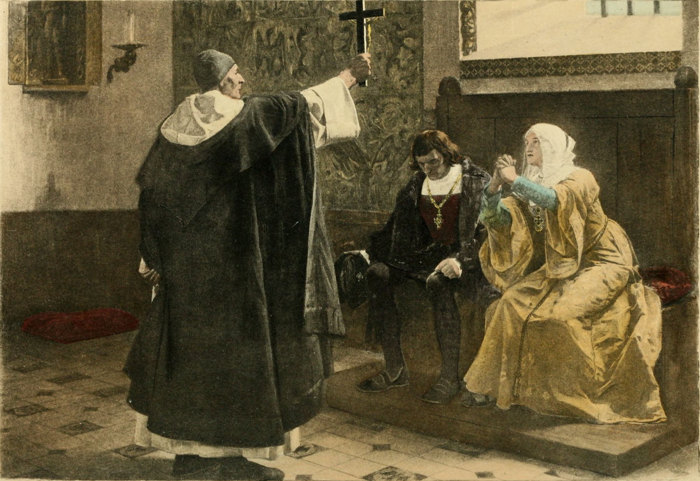
the chapel or great hall. The least heinous offenders
were in coarse black blouses and pantaloons, and
were bare-footed and bare-headed. The worst culprits
were in the sanbenito or penitential sack of
yellow canvas, adorned with a St. Andrew's cross
in bright red paint, and they often carried a halter
round their necks as a badge of ignominy. Those
to die at the stake were distinguished by black
sanbenitos with painted flames and wore on their
heads a conical paper headdress in the shape of a
bishop's mitre, but also resembling somewhat a
fool's cap. This was called the coroza, a contemptuous
form of corona or crown. To make the clothing
more hideous, it was decorated by coarse pictures
of devils in flames. The condemned as they
passed on their way were assailed to the last with
importunate exhortations to repent, and a promise
was held out to them that if they yielded they would
be rewarded by a less painful death, and would be
strangled before the flames reached them. All the
penitents were obliged to sit upon the ground in
profound silence and without so much as moving
a limb, while the slow hours dragged themselves
along. In the morning a sumptuous meal was set
before them, and they were suffered to eat their fill.
All the officials and visitors were also regaled before
the day's business began.
After the sermon, the secretary read to all the
people the oath pledging them to support the Inquisition.
Then sentences were pronounced, beginning
with the lesser offenders and proceeding to the
graver. The punishments ranged from a reprimand,
through abjuration, fines, exile, for a longer
or shorter period, destruction of residence, penance,
scourging, the galleys, imprisonment, wearing the
sanbenito or penitential garment, up to "relaxation
to the secular arm;" i. e. death by fire. These penalties
carried with them civil disability, and tainted the
blood of the descendants of the condemned as well.
Penance might be inflicted in various forms. The
condemned, perhaps, might be required to fast one
day in every week, to recite a specified number of
prayers on appointed days, or to appear at the
church door with a halter around his neck on successive
Sundays. When scourging was inflicted, the
penitent, naked to the waist, was placed astride an
ass, and paraded through the principal streets preceded
by the town crier. Meanwhile the executioner,
accompanied by a clerk to keep tally, plied
the penca or leather strap, but was charged most
solemnly not to draw blood. Usually two hundred
lashes was the limit.
Theoretically a heretic who escaped the stake by
confession was sentenced to perpetual imprisonment.
This penalty might be served in a prison, a monastery,
or in a private house. As a matter of fact,
comparatively few were kept in prisons as the expense
of maintenance was a heavy burden, and the
sentences were usually changed to deportation to
the colonies, or assignment to the galleys, or else
the sentence was shortened.
The trial and sentence of the bodies of the dead
was common, but it was not peculiar to the Inquisition.
As late as 1600, in Scotland, the bodies of
the Earl of Gowrie and his brother were brought
into court, and sentenced to be hanged, quartered
and gibbeted. Logan of Restalrig, in 1609, three
years after his death, was tried on the charge of
being concerned in the same conspiracy, was found
guilty and his property was confiscated.
In recounting the punishments imposed by the
Inquisition, we must not forget that it assumed
jurisdiction over many crimes which to-day are tried
by the civil courts. Bigamy was punished as, by
a second marriage, the criminal denied the authority
of the Church which makes marriage a sacrament.
Certain forms of blasphemy also were brought before
it, and perjury as well. Personation of the
priesthood, or of officials of the Inquisition, was
punished, and later it gained jurisdiction over unnatural
crimes. Sorcery and witchcraft, which in
other states, including the American colonies, were
considered subjects for the secular courts, were
within the jurisdiction of the Spanish Inquisition.
Strange as it may appear at first thought, the attitude
of the Inquisition toward the witchcraft delusion
was one of skepticism almost from the beginning.
Individual inquisitors, influenced by the well
nigh universal belief, were occasionally active, but
the Suprema moderated their zeal. In 1610 an auto
was held at Logroño, which was the centre of wild
excitement. Twenty-nine witches were punished,
six of whom were burned, and the bones of five
others who had died in prison were also consumed.
The eighteen remaining were "reconciled." In
1614, however, the Suprema drew up an elaborate
code of instructions to the tribunals. While not
denying the existence of witchcraft, these instructions
treated it as a delusion and practically made
proof impossible. As a result of this policy the
victims of the craze in Spain can be counted almost
by the score, while in almost every other country
of Europe, they are numbered by the thousand. In
Great Britain the best estimate fixes the number of
victims at thirty thousand, and as late as 1775 the
great legal author, Sir William Blackstone, says that
to deny "the actual existence of witchcraft and
sorcery is at once flatly to contradict the revealed
word of God."[8]
Heresy, of course, according to the views not only
of Catholics but of Protestants, deserved death as
a form of treason. Tolerance is a modern idea.
Calvin burned Servetus at Geneva and was applauded
for it. Protestants in England persecuted
other Protestants as well as Catholics. The impenitent
heretic in Spain was burned alive. That one,
who after conviction, expressed his repentance, and
his desire to die in the Church was usually strangled
before the flames touched him. Before going on to
describe some famous autos da fé and the subsequent
infliction of the death penalty, a word of explanation
is in order.
Protestant doctrines were introduced into Spain
either by foreigners or by natives who travelled or
studied in foreign lands, but made slow headway.
In 1557 a secret organisation, comprising about one
hundred and twenty members, was discovered in
Seville. The next year another little band of about
sixty was found in Valladolid.
The almost simultaneous exposure of these two
heretical organisations, both of which included some
prominent people, created great commotion. Charles
V, then living at San Yuste, whither he had retired
after his abdication, wrote to his daughter Juana,
who was acting as regent in the absence of Philip II,
urging the most stringent measures and advocating
that the heretics be pursued mercilessly. Little
stimulation of the Inquisition was necessary, and the
two little congregations were destroyed.
A part of those condemned at Valladolid were
sentenced at a great auto da fé held on Trinity Sunday,
May 21st, 1559, in Valladolid, not before
Philip II, who was abroad, but his sister, Princess
Juana, presided and with her was the unhappy
Prince, Don Carlos. It was a brilliant gathering, a
great number of grandees of Spain, titled noblemen
and gentlemen untitled, ladies of high rank in gorgeous
apparel, all seated in great state to watch the
arrival of the penitential procession. Fourteen heretics
were to die, sixteen more to be "reconciled"
but to be branded with infamy and suffer lesser
punishments. Among the sufferers were many persons
of rank and consideration such as the two
brothers Cazalla and their sister, children of the
king's comptroller, one of them a canon of the
Church, the other a presbyter, and all three members
of the little Lutheran congregation. Their mother
had died in heresy and on this occasion her effigy,
clad in her widow's weeds and wearing a mitre with
flames, was paraded through the streets and then
burned publicly. Her house, where Lutherans had
met for prayer, was razed to the ground and a pillar
erected with an inscription setting forth her offence
and sentence. Another victim was the licentiate,
Antonio Herrezuelo, an impenitent Lutheran, the
only one who went to the stake unmoved, singing
psalms by the way, and reciting passages of scripture.
They gagged him at last and a soldier in his
zeal stabbed him with his halberd, but the wound
was not mortal and bleeding and burning, he
slowly expired.
The sixteen who survived the horrors of the day
were haled back to the prison of the Inquisition to
spend one more night in the cells. Next morning
they were again taken before the inquisitors who
exhorted them afresh, and their sentences were
finally read to them. Some destined to the galleys
were transferred first to the civil prison to await removal,
after they had been flogged through the
streets and market places. Others clad in the sanbenito
and carrying ropes were exposed to the hoots
and indignities of the ribald crowd. All who passed
through the hands of the Holy Office were sworn
to seal up in everlasting silence whatever they had
seen, heard or suffered, on peril of a renewed prosecution.
Philip II was present at the second great auto in
Valladolid in October of the same year, when the
remainder of the Protestants were sentenced. His
wife, Queen Mary of England, was dead, and he
returned to Spain by way of the Netherlands, embarking
at Flushing for Laredo. Rough weather
and bad seamanship all but wrecked his fleet in sight
of port, and Philip vowed if he were permitted to set
foot on shore, to prosecute the heretics of Spain
unceasingly. He was saved from drowning and
went at once to Valladolid to carry out his
vow.
The ceremony was organised with unprecedented
pomp and splendour. The king came in state,
rejoicing that several notable heretics had been
reserved to die in torments, for his especial delectation.
His heir, Don Carlos, Prince of Asturias, was
also present but under compulsion; he was, at that
time, no more than fourteen years of age and had
writhed with agony at the sight of the suffering at
the former auto. Moreover, when called upon to
swear fidelity to the Inquisition, he had taken the
oath with great reluctance. Not so King Philip,
who when called upon to take the same oath at the
second auto da fé, rose in his place, drew his sword
and brandished it as he swore to show every favour
to the Holy Office and support its ministers against
whomsoever might directly or indirectly impede its
efforts or affairs. "Asi lo juro," he said with deep
feeling. "Thus I swear."
The victims at this great auto da fé were many
and illustrious. One was Don Carlos de Seso, an
Italian of noble family, the son of a bishop, a
scholar who had long been in the service of the
Emperor Charles V, and was chief magistrate of
Toro. He had married a Spanish lady and resided
at Logroño, where he became an object of suspicion
as a professor of Lutheranism, and was arrested.
They took him to the prison of Valladolid, where
he was charged, tortured and condemned to die.
When called upon to make confession, he wrote two
full sheets denouncing the Catholic teaching, claiming
that it was at variance with the true faith of
the gospel. The priests argued with him in vain,
and he was brought into church next morning,
gagged, and so taken to the burning place, "lest
he should speak heresy in the hearing of the people."
At the stake the gag was removed and he was
again exhorted to recant but he stoutly refused and
bade them light up the fire speedily so that he might
die in his belief.
Much grief was felt by the Dominicans at the
lapse of one of their order, Fray Domingo de Rojas,
who was undoubtedly a Lutheran. On his way to
the stake he strove to appeal to the king who drove
him away and ordered him to be gagged. More
than a hundred monks of his order followed him
close entreating him to recant, but he persisted in
a determined although inarticulate refusal until in
sight of the flames. He then recanted and was
strangled before being burned. One Juan Sanchez,
a native of Valladolid, had fled to Flanders, but was
pursued, captured and brought back to Spain to die
on this day. When the cords which had bound him
snapped in the fire, he bounded into the air with his
agony but still repelled the priests and called for
more fire. Nine more were burned in the presence
of the king, who was no merely passive spectator,
but visited the various stakes and ordered his personal
guard to assist in piling up the fuel.
The congregation at Seville were sentenced at
autos held in 1559 and 1560. On December 22d of
the latter year, there were fourteen burned in the
flesh and three in effigy. The last were notable
people. One was Doctor Egidio, who had been a
leading canon of Seville Cathedral, and who had
been tried and forced to recant his heresies in 1552.
After release he renewed his connection with the
Lutherans, but soon died and was buried at Seville.
His corpse was exhumed, brought to trial, and
burnt with his effigy; all his property was confiscated
and his memory declared infamous. Another
was Doctor Ponce de la Fuente, a man of deep
learning and extraordinary eloquence who had been
chaplain and preacher to the emperor. He followed
the Imperial Court into Germany, then returned to
charm vast congregations in Seville, but his sermons
were reported by spies to be tainted with the
Reformed doctrines. He was seized by the Inquisition
and many incriminating papers were also
taken. When cast into a secret dungeon and confronted
with these proofs of his heresy, he would
make no confession, nor would he betray any of his
friends. He was transferred to a subterranean cell,
damp and pestiferous, so narrow he could barely
move himself, and was deprived of the commonest
necessaries of life. Existence became impossible
under such conditions, and he died, proclaiming
with his last breath that neither Scythians nor
cannibals could be more cruel and inhuman than the
barbarians of the Holy Office. The third effigy
consumed was that of Doctor Juan Pérez de Pineda,
then a fugitive in Geneva.
Chief among the living victims was Julian Hernandez,
commonly called el Chico, "the little," from
his diminutive stature. Yet his heart was of the
largest and his courage extraordinary. He was a
deacon in the Reformed Church and dared to penetrate
the interior of Spain, disguised as a muleteer,
carrying merchandise in which Lutheran literature
was concealed. Being exceedingly shrewd and daring
he travelled far and wide, beyond Castile into
Andalusia, distributing his books among persons of
rank and education in all the chief cities. His learning,
skill in argument, and piety, were not less remarkable
than the diligence and activity by which
he baffled all efforts to lay hold of him. At last he
was caught and imprisoned. Relays of priests were
told off to controvert his opinions, and he was repeatedly
tortured to extract the names of those who
had aided him in his long and dangerous pilgrimage
through the Peninsula, but he was staunch and silent
to the last.
A citizen of London, one Nicholas Burton, was
a shipmaster who traded to Cadiz in his own vessel.
He was arrested on the information of a "familiar"
of the Inquisition, charged with having spoken in
slighting terms of the religion of the country. No
reason was given him, and when he protested indignantly,
he was thrown into the common gaol and
detained there for a fortnight, during which he was
moved to administer comfort and preach the gospel
to his fellow-prisoners. This gave a handle to his
persecutors and he was removed on a further charge
of heresy to Seville, where he was imprisoned,
heavily ironed in the secret gaol of the Inquisition
in the Triana. At the end he was condemned as a
contumacious Lutheran, and was brought out, clad
in the sanbenito and exposed in the great hall of
the Holy Office with his tongue forced out of his
mouth. Last of all, being obdurate in his heresy,
he was burned and his ship with its cargo was taken
possession of by his persecutors.
The story does not end here. Another Englishman,
John Frampton, an attorney of Bristol, was
sent to Cadiz by a part-owner to demand restoration
of the ship. He became involved in a tedious law
suit and was at last obliged to return to England
for enlarged powers. Bye and bye he went out a
second time to Spain, and on landing at Cadiz was
seized by the servants of the Inquisition and carried
to Seville. He travelled on mule back "tied by a
chain that came three times under its belly and the
end whereof was fastened in an iron padlock made
fast to the saddle bow." Two armed familiars rode
beside him, and thus escorted and secured, he was
conveyed to the old prison and lodged in a noisome
dungeon. The usual interrogatories were put to
him and it was proved to the satisfaction of the Holy
Office that he was an English heretic. The same
evidence sufficed to place him on the rack, and after
fourteen months, he was taken to be present as a
penitent at the same auto da fé which saw Burton,
the ship's captain, done to death. Frampton went
back to prison for another year and was forbidden
to leave Spain. He managed to escape and returned
to England to make full revelation of his wrongs,
but the ship was never surrendered and no indemnity
was obtained.
Other Englishmen fell from time to time into the
hands of the Inquisition. Hakluyt preserved the
simple narratives of two English sailors, who were
brought by their Spanish captors from the Indies
as a sacrifice to the "Holy House" of Seville,
though the authenticity of the statement has been
attacked. One, a happy-go-lucky fellow, Miles
Phillips, who had been too well acquainted in Mexico
with the dungeons of the Inquisition, slipped
over the ship's side at San Lucar, near Cadiz, made
his way to shore, and boldly went to Seville, where
he lived a hidden life as a silk-weaver, until he
found his chance to steal away and board a Devon
merchantman. The other, Job Hortop, added to his
two years of Mexican imprisonment, two more years
in Seville. Then "they brought us out in procession,"
as he tells us, "every one of us having a
candle in his hand and the coat with S. Andrew's
cross on our backs; they brought us up on an high
scaffold, that was set up in the place of S. Francis,
which is in the chief street in Seville; there they
set us down upon benches, every one in his degree
and against us on another scaffold sate all the
Judges and the Clergy on their benches. The people
wondered and gazed on us, some pitying our case,
others said, 'Burn those heretics.' When we had
sat there two hours, we had a sermon made to us,
after which one called Bresina, secretary to the Inquisition,
went up into the pulpit with the process
and called on Robert Barret, shipmaster, and John
Gilbert, whom two familiars of the Inquisition
brought from the scaffold in front of the Judges,
and the secretary read the sentence, which was that
they should be burnt, and so they returned to the
scaffold and were burnt.
"Then, I, Job Hortop and John Bone, were
called and brought to the same place, as the others
and likewise heard our sentence, which was, that
we should go to the galleys there to row at the
oar's end ten years and then to be brought back
to the Inquisition House, to have the coat with St.
Andrew's cross put on our backs and from thence
to go to the everlasting prison remediless.
"I, with the rest were sent to the Galleys, where
we were chained four and four together....
Hunger, thirst, cold and stripes we lacked none, till
our several times expired; and after the time of
twelve years, for I served two years above my sentence,
I was sent back to the Inquisition House in
Seville and there having put on the above mentioned
coat with St. Andrew's cross, I was sent to the everlasting
prison remediless, where I wore the coat
four years and then, upon great suit, I had it taken
off for fifty duckets, which Hernandez de Soria,
treasurer of the king's mint, lent me, whom I was
to serve for it as a drudge seven years." This victim,
too, escaped in a fly-boat at last and reached
England.
The records of the Inquisition of this period contain
the name of an eminent Spanish ecclesiastic
who offended the Holy Office and felt the weight of
its arm. This was Bartolome de Carranza, Archbishop
of Toledo, Primate of Spain, a Dominican,—whose
rise had been rapid and who was charged
with leanings toward Lutheranism. In early life
he had passed through the hands of the Inquisition
and was censured for expressing approval of the
writings of Erasmus, but no other action was taken.
His profound theological knowledge indeed commended
him to the Councils of the Church, for
which he often acted as examiner of suspected
books.
Carranza's connection with English history is interesting.
At the time of Queen Mary's marriage
with Philip II, he came to London to arrange, in
conjunction with Cardinal Pole, for the reconciliation
of England to Rome. He laboured incessantly
to win over British Protestants, "preached continually,
convinced and converted heretics without number,
... guided the Queen and Councils and assisted
in framing rules for the governance of the
English Universities." He was particularly anxious
for the persecution of obstinate heretics, and
was in a measure responsible for the burning of
Thomas Cranmer, Archbishop of Canterbury. His
zeal and his great merits marked him down as the
natural successor to the archbishopric of Toledo,
when it became vacant, and he was esteemed as a
chief pillar of the Catholic Church, destined in due
course to the very highest preferment. He might
indeed become cardinal and even supreme pontiff
before he died.
Yet when nearing the topmost pinnacle he was on
the verge of falling to the lowest depths. He had
many enemies. His stern views on Church discipline,
enunciated before the Council of Trent, alienated
many of the bishops, who planned his ruin and
secretly watched his discourses and writings for
symptoms of unsoundness. Valdés, the chief inquisitor,
was a leading opponent and industriously
collected a mass of evidence tending to inculpate
Carranza. He had used "perilous language" when
preaching in England, especially in the hearing of
heretics, and one witness deposed that some of his
sermons might have been delivered by Melancthon
himself. He had affirmed that mercy might be
shown to Lutherans who abjured their errors, and
had frequently manifested scandalous indulgence to
heretics. Valdés easily framed a case against Carranza,
strong enough to back up an application to
the pope to authorise the Inquisition to arrest and
imprison the primate of Spain. Paul IV, the new
pope, permitted the arrest. Great circumspection
was shown in making it because of the prisoner's
rank. Carranza was invited to come to Valladolid
to have an interview with the king, and, with some
misgivings, the archbishop set out. A considerable
force of men was gathered together by the way—all
loyal to the Inquisition—and at the town of
Torrelaguna, the arrest was made with great formality
and respect.
On reaching Valladolid the prisoner begged he
might be lodged in the house of a friend. The Holy
Office consented but hired the building. The trial
presented many serious difficulties. Here was no
ordinary prisoner; Carranza was widely popular,
and the Supreme Council of the Kingdom was divided
as to the evidences of his guilt. Nearly a
hundred witnesses were examined, but proof was
not easily to be secured. Besides, Carranza had appealed
to the Supreme Pontiff. Year after year was
spent in tiresome litigation and a fierce contest ensued
between Rome and the Spanish court which
backed up the Inquisition. At length, after eight
years' confinement, the primate was sent to Cartagena
to take ship for Rome, accompanied by several
inquisitors and the Duke of Alva, that most notorious
nobleman, the scourge and oppressor of the
Netherlands. All landed at Civita Vecchia and the
party proceeded to the Holy City, when Carranza
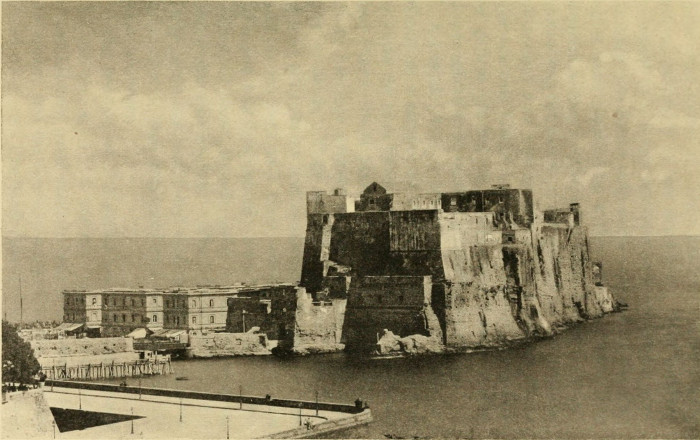
was at once lodged in the Castle of St. Angelo, the
well known State prison. He was detained there
nine years, until released by Pope Gregory XIII. He
was censured for his errors, and required to abjure
the Lutheran principles found in his writings, and
was relieved from his functions as archbishop, to
which, however, his strength, impaired by age and
suffering, was no longer equal. While visiting the
seven churches as a penance, he was taken ill, April
23d, 1576, and soon died. Before his death, however,
the pope gave him full indulgence.
Those who saw him in his last days record that
he bore his trials with dignity and patience. But
this learned priest who had been called to the highest
rank of the ecclesiastical hierarchy, only to be himself
assailed and thrown down, was the same who
had sat in cruel judgment upon Thomas Cranmer
and compassed his martyrdom.