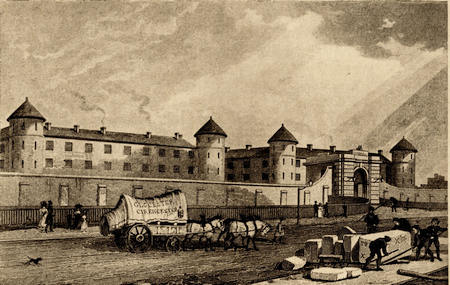
Millbank as a depot for convicts sentenced to transportation—Identified
with a large proportion of the criminals of the
day—Notorious robbers who spent some period of their
sentence there—Burglars—Jewel robberies—The receivers
of stolen goods—Thieves at the Custom House—Great
Gold Dust robbery—“Money Moses”—Fraudulent
shipwreckers—Forgeries to obtain stock—Gentlemen convicts—Gigantic
commercial fraud—A modern Bluebeard—A
racing parson—“Men of the world”—Striking the
Queen—Bank of England robbed—Cauty, “father of the
robbers”—A famous receiver—The Police Officers’ gang—Some
female thieves—Alice Grey or “Brazil”—Emily
Laurence—Daring thefts.
For some time past Millbank had doubled its
uses; a penitentiary for reformation and a depot for
those awaiting transportation quickly beyond the
seas. It had ceased to receive only selected prisoners
and worked under the general system of secondary
punishment; and many of the most notorious
criminals of the day made it a temporary resting-place.
We have seen in previous chapters how
persistently turbulent were the inmates of the prison
and we shall better understand this by a survey of
the most prominent offenders of the time, and the
misdeeds for which they were in durance en route
to penal exile. Criminal methods for the most part
remained unchanged or the same crimes flourished
under different names.
Although highway robbery was now nearly extinct,
and felonious outrages in the streets were rare,
thieves or depredators were by no means idle or unsuccessful.
Bigger “jobs” than ever were planned
and attempted, as in the burglary at Lambeth Palace,
when the thieves were fortunately disappointed, the
archbishop having, before he left town, sent his
plate-chests, eight in number, to the silversmith’s for
greater security. The jewellers were always a favourite
prey of the London thieves. Shops were
broken into, as when that of Grimaldi and Johnson,
in the Strand, was robbed of watches to the value
of £6,000. Where robbery with violence was intended,
the perpetrators had now to adopt various
shifts and contrivances to secure their victim. No
more curious instance of this ever occurred than the
assault made by one Howard upon a Mr. Mullay,
with intent to rob him. The latter had advertised,
offering a sum of £1,000 to any one who would
introduce him to some mercantile employment.
Howard replied, desiring Mr. Mullay to call upon
him in a house in Red Lion Square. Mr. Mullay
went, and a second interview was agreed upon, when
a third person, Mr. Owen, through whose interest
an appointment under Government was to be obtained
for Mullay, would be present. Mr. Mullay
called again, taking with him £500 in cash. Howard
discovered this, and his manner was very suspicious;
there were weapons in the room—a long knife, a
heavy trap-ball bat, and a poker. Mr. Mullay became
alarmed, and as Mr. Owen did not appear,
withdrew; Howard, strange to say, making no attempt
to detain him; probably because Mullay promised
to return a few days later, and to bring more
money. On this renewed visit Mr. Owen was still
absent, and Mr. Mullay agreed to write him a note
from a copy Howard gave him. While thus engaged,
Howard thrust the poker into the fire. Mullay
protested, and then Howard, under the influence
of ungovernable rage, as it seemed, jumped up,
locked the door, and attacked Mullay violently with
the trap-ball bat and knife. Mullay defended himself,
and managed to break the knife, but not before
he had cut himself severely. A life and death struggle
ensued. Mullay cried “Murder!” Howard
swore he would finish him, but proved the weaker
of the two, and Mullay got him down on the floor.
By this time the neighbours were aroused, and several
people came to the scene of the affray. Howard
was secured, given into custody, and committed for
trial. The defence he set up was, that Mullay had
used epithets towards him while they were negotiating
a business matter, and that, being of an irritable
temper, he had struck Mullay, after which a violent
scuffle took place. It was, however, proved that
Howard was in needy circumstances, and that his
proposals to Mr. Mullay could only have originated
in a desire to rob him. He was found guilty of an
assault with intent, and sentenced to transportation
for fourteen years.
At no period could thieves in London or elsewhere
have prospered had they been unable to dispose of
their ill-gotten goods. The trade of fence, or receiver,
therefore, is very nearly as old as the crimes
which it so obviously fostered. One of the most notorious,
and for a time most successful practitioners
in this illicit trade, passed through Newgate into
Millbank and beyond. The name of Ikey Solomons
was long remembered by thief and thief-taker. He
began as an itinerant street vendor at eight years of
age, at ten he passed bad money, at fourteen he was
a pickpocket and a “duffer,” or a seller of sham
goods. He early saw the profits in purchasing stolen
goods, but could not embark in it at first for want of
capital. He was taken up when still in his teens for
stealing a pocket-book, and was sentenced to transportation,
but did not get beyond the hulks at Chatham.
On his release an uncle, a slopseller in Chatham,
gave him a situation as “barker,” or salesman,
at which he realized £150 within a couple of years.
With this capital he returned to London and set up
as a fence. He had such great aptitude for business,
and such a thorough knowledge of the real value of
goods, that he was soon admitted to be one of the
best judges known of all kinds of property, from a
glass bottle to a five hundred guinea chronometer.
But he never paid more than a fixed price for all
articles of the same class, whatever their intrinsic
value. Thus, a watch was paid for as a watch,
whether it was of gold or silver; a piece of linen
as such, whether the stuff was coarse or fine. This
rule in dealing with stolen goods continues to this
day, and has made the fortune of many since Ikey.
Solomons also established a system of provincial
agency, by which stolen goods were passed on from
London to the seaports, and so abroad. Jewels were
re-set, diamonds re-faced; all marks by which other
articles might be identified, the selvages of linen, the
stamps on shoes, the number and names on watches,
were carefully removed or obliterated after the
goods passed out of his hands. On one occasion the
whole of the proceeds of a robbery from a boot shop
was traced to Solomons’; the owner came with the
police, and was morally convinced that it was his
property, but could not positively identify it, and
Ikey defied them to remove a single shoe. In the end
the injured bootmaker agreed to buy back his stolen
stock at the price Solomons had paid for it, and it
cost him about a hundred pounds to re-stock his shop
with his own goods.
As a general rule Ikey Solomons confined his purchases
to small articles, mostly of jewelry and plate,
which he kept concealed in a hiding-place with a
trap-door just under his bed. He lived in Rosemary
Lane, and sometimes he had as much as £20,000
worth of goods secreted on the premises. When his
trade was busiest he set up a second establishment, at
the head of which, although he was married, he put
another lady, with whom he was on intimate terms.
The second house was in Lower Queen Street,
Islington, and he used it for some time as a depot for
valuables. But it was eventually discovered by Mrs.
Solomons, a very jealous wife, and this, with the
danger arising from an extensive robbery of watches
in Cheapside, in which Ikey was implicated as a receiver,
led him to think seriously of trying his fortunes
in another land. He was about to emigrate
to New South Wales, when he was arrested at
Islington and committed to Newgate on a charge
of receiving stolen goods. While thus incarcerated
he managed to escape from custody, but not actually
from gaol, by an ingenious contrivance which is
worth mentioning. He claimed to be admitted to
bail, and was taken from Newgate on a writ of
habeas before one of the judges sitting at Westminster.
He was conveyed in a coach driven by a
confederate, and under the escort of a couple of
turnkeys. Solomons, while waiting to appear in
court, persuaded the turnkeys to take him to a public-house,
where all might “refresh.” While there
he was joined by his wife and other friends. After
a short carouse the prisoner went into Westminster,
his case was heard, bail refused, and he was ordered
back to Newgate. But he once more persuaded the
turnkeys to pause at the public, where more liquor
was consumed. When the journey was resumed,
Mrs. Solomons accompanied her husband in the
coach. Half-way to Newgate she was taken with
a fit. One turnkey was stupidly drunk, and Ikey
persuaded the other, who was not much better, to let
the coach change and pass Petticoat Lane en route
to the gaol, where the suffering woman might be
handed over to her friends. On stopping at a door
in this low street, Ikey jumped out, ran into the
house, slamming the door behind him. He passed
through and out at the back, and was soon beyond
pursuit. By and by the turnkeys, sobered by their
loss, returned to Newgate alone, and pleaded in
excuse that they had been drugged.
Ikey left no traces, and the police could hear
nothing of him. He had in fact gone out of the
country, to Copenhagen, whence he passed on to
New York. There he devoted himself to the circulation
of forged notes. He was also anxious to
do business in watches, and begged his wife to send
him over a consignment of cheap “righteous”
watches, or such as had been honestly obtained, and
not “on the cross.” But Mrs. Solomons could not
resist the temptation to dabble in stolen goods, and
she was found shipping watches of the wrong category
to New York. For this she received a sentence
of fourteen years’ transportation, and was sent to
Van Diemen’s Land. Ikey joined her at Hobart
Town, where they set up a general shop, and soon
began to prosper. He was, however, recognized,
and ere long an order came out from home for his
arrest and transfer to England, which presently followed,
and he again found himself an inmate of
Newgate, waiting trial as a receiver and a prison-breaker.
He was indicted on eight charges, two
only of which were substantiated, but on each of
them he received a sentence of seven years’ transportation.
At his own request he was reconveyed
to Hobart Town, where his son had been carrying
on the business. Whether Ikey was “assigned” to
his own family is not recorded, but no doubt he succeeded
to his own property when the term of servitude
had expired.
No doubt, on the removal of Ikey Solomons from
the scene, his mantle fell upon worthy successors.
There was an increase rather than an abatement in
jewel and bullion robberies in the years immediately
following, and the thieves seem to have had no difficulty
in disposing of their spoil. One of the largest
robberies of its class was that effected upon the Custom
House in the winter of 1834. A large amount
of specie was nearly always retained here in the department
of the receiver of fines. This was known
to some clerks in the office, who began to consider
how they might lay hands on a lot of cash. Being
inexperienced, they decided to call in the services of
a couple of professional housebreakers, Jordan and
Sullivan, who at once set to work in a business-like
way to obtain impressions of the keys of the strong
room and chest. But before committing themselves
to an attempt on the latter, it was of importance to
ascertain how much it usually contained. For this
purpose Jordan waited on the receiver to make a
small payment, for which he tendered a fifty-pound
note. The chest was opened to give change, and a
heavy tray lifted out which plainly held some £4,000
in cash. Some difficulty then arose as to gaining
admission to the strong room, and it was arranged
that a man, May, another Custom House clerk,
should be introduced into the building, and secreted
there during the night to accomplish the robbery.
May was smuggled in through a window on the
esplanade behind an opened umbrella. When the
place was quite deserted he broke open the chest and
stole £4,700 in notes, with a quantity of gold and
some silver. He went out next morning with the
booty when the doors were re-opened, and attracted
no attention. The spoil was fairly divided; part of
the notes were disposed of to a travelling “receiver,”
who passed over to the Continent and there cashed
them easily.
This occurred in November 1834. The Custom
House officials were in a state of consternation, and
the police were unable at first to get on the track of
the thieves. While the excitement was still fresh, a
new robbery of diamonds was committed at a bonded
warehouse in the immediate neighbourhood, on Custom
House Quay. The jewels had belonged to a
Spanish countess recently deceased, who had sent
them to England for greater security on the outbreak
of the first Carlist war. At her death the
diamonds were divided between her four daughters,
but only half had been claimed, and at the time of
the robbery there were still £6,000 worth in the
warehouse. These were deposited in an iron chest
of great strength on the second floor. The thieves,
it was supposed, had secreted themselves in the warehouse
during business hours, and waited till night
to carry out their plans. Some ham sandwiches,
several cigar-ends, and two empty champagne bottles
were found on the premises next day, showing
how they had passed their time. They had had
serious work to get at the diamonds. It was necessary
to force one heavy door from its hinges, and
to cut through the thick panels of another. The lock
and fastenings of the chest were forced by means of
a “jack,” an instrument known to housebreakers,
which, if introduced into a keyhole, and worked like
a bit and brace, will soon destroy the strongest lock.
The thieves were satisfied with the diamonds; they
broke open other cases containing gold watches and
plate, but abstracted nothing.
The police were of opinion that these robberies
were both the work of the same hand. But it was
not until the autumn that they traced some of the
notes stolen from the Custom House to Jordan and
Sullivan. About this time also suspicion fell upon
Huey, one of the clerks, who was arrested soon
afterwards, and made a clean breast of the whole
affair. There was a hunt for the two well-known
housebreakers, who were eventually heard of at a
lodging in Kennington. But they at once made
tracks, and took up their residence under assumed
names in a tavern in Bloomsbury. The police lost
all trace of them for some days, but at length Sullivan’s
brother was followed from the house in Kennington
to the above-mentioned tavern. Both the
thieves were now apprehended, but only a small portion
of the lost property was recovered, notwithstanding
a minute search through the room they had
occupied. After their arrest, Jordan’s wife and Sullivan’s
brother came to the inn, and begged to be
allowed to visit this room; but their request, in spite
of their earnest entreaties, was refused, at the instigation
of the police. A few days later a frequent
guest at the tavern arrived, and had this same room
allotted to him. A fire was lit in it, and the maid in
doing so threw a lot of rubbish, as it seemed, which
had accumulated under the grate, on top of the burning
coals. By and by the occupant of the room noticed
something glittering in the centre of the fire,
which, to inspect more closely, he took out with the
tongs. It was a large gold brooch set in pearls, but
a portion of the mounting had melted with the heat.
The fire was raked out, and in the ashes were found
seven large and four dozen small brilliants, also
seven emeralds, one of them of considerable size.
A part of the “swag” stolen from the bonded warehouse
was thus recovered, but it was supposed that
a number of the stolen notes had perished in the fire.
The condign punishment meted out to these Custom
House robbers had no deterrent effect seemingly.
Within three months, three new and most
mysterious burglaries were committed at the West
End, all in houses adjoining each other. One was
occupied by the Portuguese ambassador, who lost a
quantity of jewelry from an escritoire, and his
neighbours lost plate and cash. Not the slightest
clue to these large affairs was ever obtained, but it
is probable that they were “put up” jobs, or managed
with the complicity of servants. The next year
twelve thousand sovereigns were cleverly stolen in
the Mile End Road.
The gold-dust robbery of 1839, the first of its
kind, was cleverly and carefully planned with the
assistance of a dishonest employee. A young man
named Caspar, clerk to a steamship company,
learned through the firm’s correspondence that a
quantity of gold-dust brought in a man-of-war from
Brazil had been transhipped at Falmouth for conveyance
to London. The letter informed him of the
marks and sizes of the cases containing the precious
metal, and he with his father arranged that a messenger
should call for the stuff with forged credentials,
thus anticipating the rightful owner. The
fraudulent messenger, by the help of young Caspar,
established his claim to the boxes, paid the wharfage
dues, and carried off the gold-dust. Presently the
proper person arrived from the consignees, but
found the gold-dust gone. The police were at once
employed, and after infinite pains they discovered
the person, one Moss, who had acted as the messenger.
Moss was known to be intimate with the elder
Caspar, father of the clerk to the steamship company,
and these facts were deemed sufficient to justify
the arrest of all three. They also ascertained
that a gold-refiner, Solomons, had sold bar gold to
the value of £1,200 to certain bullion dealers. Solomons
was not straightforward in his replies as to
where he got the gold, and he was soon placed in
the dock with the Caspars and Moss. Moss presently
turned approver, and implicated “Money
Moses,” another Jew, for the whole affair had been
planned and executed by members of the Hebrew
persuasion. “Money Moses” had received the
stolen gold-dust from Moss’ father-in-law, Davis,
or Isaacs, who was never arrested, and passed it on
to Solomons by his daughter, a widow named Abrahams.
Solomons was now also admitted as a witness,
and his evidence, with that of Moss, secured
the transportation of the principal actors in the theft.
In the course of the trial it came out that almost
every one concerned except the Caspars had endeavoured
to defraud his accomplices. Moss peached
because he declared he had been done out of the
proper price of the gold-dust; but it was clear that
he had tried to appropriate the whole of the stuff,
instead of handing it or the price of it back to the
Caspars. “Money Moses” and Mrs. Abrahams
imposed upon Moss as to the price paid by Solomons;
Mrs. Abrahams imposed upon her father by
abstracting a portion of the dust and selling it on
her own account; Solomons cheated the whole lot
by retaining half the gold in his possession, and only
giving an I. O. U. for it, which he refused to redeem
on account of the row about the robbery.
Moses, it may be added, was a direct descendant
of the Ikey Solomons already mentioned. He was
ostensibly a publican, and kept the Black Lion in
Vinegar Yard, Drury Lane, where secretly he did
business as one of the most daring and successful
fencers ever known in the metropolis. His arrest
and conviction cast dismay over the whole gang of
receivers, and for a time seriously checked the nefarious
traffic. It may be added that prison life did
not agree with “Money Moses;” a striking change
came over his appearance while in prison. Before
his confinement he had been a sleek round person,
addicted obviously to the pleasures of the table. He
did not thrive on prison fare, now more strictly
meagre, thanks to the inspectors and the more
stringent discipline, and before he embarked for
Australia to undergo his fourteen years, he was
reported to have fallen away to a shadow.
As the century advanced crimes of fraud increased.
They were not only more numerous, but
on a wider scale. The most extensive and systematic
robberies were planned so ingeniously and carried
out so cleverly that they long escaped detection.
Among the earliest of the big operators in fraudulent
finance was Edward Beaumont Smith who
uttered false exchequer bills to an almost fabulous
amount. Another fraud greatly developed was the
wilful shipwreck and casting away of a ship which
with her cargo, real or imaginary, had been heavily
insured. The Dryad was a brig owned principally
by two persons named Wallace, one a seaman,
the other a merchant. She was freighted by the
firm of Zulueta and Co. for a voyage to Santa Cruz.
Her owners insured her for a full sum of £2,000,
after which the Wallaces insured her privily with
other underwriters for a second sum of £2,000.
After this, on the faith of forged bills of lading, the
captain, Loose by name, being a party to the intended
fraud, they obtained further insurances on
goods never shipped. It was fully proved in evidence
that when the Dryad sailed she carried
nothing but the cargo belonging to Zulueta and Co.
Yet the Wallaces pretended to have put on board
quantities of flannels, cloths, cotton prints, beef,
pork, butter, and earthenwares, on all of which they
effected insurances. Loose had his instructions to
cast away the ship on the first possible opportunity,
and from the time of his leaving Liverpool he acted
in a manner which excited the suspicions of the
crew. The larboard pump was suffered to remain
choked up, and the long-boat was fitted with tackles
and held ready for use at a moment’s notice. The
ship, however, met with exasperatingly fine weather,
and it was not until the captain reached the West
India Islands that he got a chance of accomplishing
his crime. At a place called the Silver Keys he ran
the ship on the reef. But another ship, concluding
that he was acting in ignorance, rendered him assistance.
The Dryad was got off, repaired, and
her voyage renewed to Santa Cruz. He crept along
the coast close in shore, looking for a quiet spot to
cast away the ship, and at last, when within fifteen
miles of port, with wind and weather perfectly fair,
he ran her on to the rocks. Even then she might
have been saved, but the captain would not suffer
the crew to act. Nearly the whole of the cargo was
lost as well as the ship. The captain and crew, however,
got safely to Jamaica, and so to England, the
captain dying on the voyage home.
The crime soon became public. Mate, carpenter,
and crew were eager to disavow complicity, and
voluntarily gave information. The Wallaces were
arrested, committed to Newgate, and tried at the
Old Bailey. The case was clearly proved against
them, and both were sentenced to transportation for
life. While lying in Newgate, awaiting removal to
the convict ship, both prisoners made full confessions.
According to their own statements the loss
of the Dryad was only one of six intentional
shipwrecks with which they had been concerned.
The crime of fraudulent insurance they declared was
very common, and the underwriters must have lost
great sums in this way. The merchant Wallace
said he had been led into the crime by the advice
and example of a city friend who had gone largely
into this nefarious business; this Wallace added
that his friend had made several voyages with the
distinct intention of superintending the predetermined
shipwrecks. The other Wallace, the sailor,
also traced his lapse into crime to evil counsel. He
was an honest sea-captain, he said, trading from
Liverpool, where once he had the misfortune to be
introduced to a man of wealth, the foundations of
which had been laid by buying old ships on purpose
to cast them away. This person made much of Wallace,
encouraged his attentions to his daughter, and
tempted him to take to fraudulent insurance as a
certain method of achieving fortune. Wallace’s relations
warned him against his Liverpool friend,
but he would not take their advice, and developing
his transactions, ended as we have seen.
A clergyman nearly a century later followed in
the steps of Dr. Dodd, but under more humane
laws did not lose his life. The Rev. W. Bailey,
LL. D., was convicted at the Central Criminal
Court, in February, 1843, of forgery. A notorious
miser, Robert Smith, had recently died in Seven
Dials, where he had amassed a considerable fortune.
But among the charges on the estate he left was a
promissory note for £2,875, produced by Dr. Bailey,
and purporting to be signed by Smith. The executors
to the estate disputed the validity of this document.
Miss Bailey, the doctor’s sister, in whose
favour the note was said to have been given, then
brought an action against the administrators, and at
the trial Dr. Bailey swore that the note had been
given him by Smith. The jury did not believe him,
and the verdict was for the defendants. Subsequently
Bailey was arrested on a charge of forgery,
and after a long trial found guilty. His sentence
was transportation for life.
A gigantic conspiracy to defraud was discovered
in the following year, when a solicitor named William
Henry Barber, Joshua Fletcher, a surgeon, and
three others were charged with forging wills for
the purpose of obtaining unclaimed stock in the
funds. There were two separate affairs. In the
first a maiden lady, Miss Slack, who was the possessor
of two separate sums in consols, neglected
through strange carelessness on her own part and
that of her friends to draw the dividends on more
than one sum. The other, remaining unclaimed for
ten years, was transferred at the end of that time
to the commissioners for the reduction of the National
Debt. Barber, it was said, became aware of
this, and he gained access to Miss Slack on pretence
of conveying to her some funded property left her
by an aunt. By this means her signature was obtained;
a forged will was prepared bequeathing the
unclaimed stock to Miss Slack; a note purporting
to be from Miss Slack was addressed to the governor
of the Bank of England, begging that the
said stock might be handed over to her, and a person
calling herself Miss Slack duly attended at the
bank, where the money was handed over to her in
proper form. A second will, also forged, was propounded
at Doctors’ Commons as that of a Mrs.
Hunt of Bristol. Mrs. Hunt had left money in the
funds which remained unclaimed, and had been
transferred, as in Miss Slack’s case. Here again the
money, with ten years’ interest, was handed over to
Barber and another calling himself Thomas Hunt,
an executor of the will. It was shown that the will
must be a forgery, as its signature was dated 1829,
whereas Mrs. Hunt actually died in 1806. A third
similar fraud to the amount of £2,000 was also
brought to light. Fletcher was the moving spirit of
the whole business. It was he who had introduced
Barber to Miss Slack, and held all the threads of
these intricate and nefarious transactions. Barber
and Fletcher were both transported for life, although
Fletcher declared that Barber was innocent,
and had no guilty knowledge of what was being
done. Barber was subsequently pardoned, but was
not replaced on the rolls as an attorney till 1855,
when Lord Campbell delivered judgment on Barber’s
petition, to the effect that “the evidence to
establish his (Barber’s) connivance in the frauds
was too doubtful for us to continue his exclusion
any longer.”
Foremost on the Millbank calendar stand those
of the upper classes, who were afterwards styled in
Australia, “specials,” or “gentlemen convicts.” It
was said that of these there were at one and the
same time in Millbank two captains, a baronet, four
clergymen, a solicitor, and one or two doctors of
medicine. The tradition is ben trovato, if not exactly
true. Of course in such a prison there would
be representatives of every class, and although the
percentage of gentlemen who commit crimes is in
the long run far below that of the middle or lower
classes, there is no special natural law by which the
blue blood is exempted from the ordinary weakness
and imperfections of humanity. Most of these genteel
people who found themselves in Millbank owed
their fate to forgery or fraud. There was the old
gentleman of seventy years of age, who had been a
mayor in a north-country manufacturing town, and
who had forged and defrauded his nieces out of
some £360,000. The officers spoke of him as “a
fine old fellow,” who took to his new task of tailoring
like a man, and who could soon turn out a
soldier’s great-coat as well as any one in the prison.
Another convict of this stamp was Mr. T., a Liverpool
merchant in a prosperous business, who was
a forger on quite a colossal scale. It was proved at
his trial that he had forged thirty bills of exchange,
amounting to a total of £32,811, and that he had a
guilty knowledge of one hundred and fifteen other
bills, which were valued in all at £133,000. In his
defence it was urged that he had taken up many
bills before they were due, and would undoubtedly
have taken up all had not the discovery of one forgery
exposed his frauds and put an end suddenly
to his business. Still, said his counsel, his estate
could have paid from twelve to fifteen shillings in
the pound, and it could hardly be maintained against
him that he had any moral intention of defrauding.
Judge Talfourd appears to have commented
strongly, in summing up, upon such an idea of
morality as this; and then and there sentenced Mr.
T. to transportation for life. Unfortunately for the
criminal himself, his sentence came a little too late:
had he gone out to New South Wales twenty years
earlier, with his commercial aptitude and generally
unscrupulous plan of action, he would have run well
to the front in the race for wealth amidst his felon
competitors.
More contemptible, but not less atrocious, was
the conduct of Mr. B., who had taken his diploma
as surgeon, and practised as such in many parts of
the country. His offence was bigamy on a large
scale: he was guilty of a series of heartless deceptions,
so that it was said the scene in court when
this Blue Beard was finally arraigned, and all his
victims appeared against him, was painful in the
extreme. He was brought to book by the friend of
a young lady to whom he was trying to pay his
attentions. This gentleman, being somewhat suspicious,
made inquiries, and discovered enough to
have him arrested. Four different certificates of
marriage were put in evidence. It seemed that,
although already married in Cornwall, he moved
thence and took a practice in another county, where
he became acquainted with a lady residing in the
neighbourhood, who had a little money of her own.
He made her an offer, married her, and then found
that by marriage she forfeited the annuity she previously
enjoyed. After a short time he deserted
her, having first obtained possession of all her
clothes, furniture, trinkets, and so forth, which he
sold. His next affair was on board an East Indiaman
bound to Calcutta, in which he sailed as surgeon—wishing
doubtless to keep out of the way
for a while. Among the passengers was a Miss B.,
only fifteen years of age, who was going out to the
East with her mother and sisters. He succeeded in
gaining her affections, and obtained the mother’s
consent to the marriage on arrival at Calcutta. He
made out, by means of fraudulent documents prepared
on purpose, that he had inherited £5,000 from
his father, and offered to settle £3,000 on his bride.
The marriage came off in due course at Calcutta,
and then the happy pair returned to England. Soon
after their arrival, Mr. B. deserted his new wife in
a hotel in Liverpool, and after that he began the
affair which led to his detection.
Mr. B. is remembered in Millbank as a man of
considerable attainments. He was well educated,
and spoke several languages. One of his favourite
feats was to write the Lord’s Prayer on a scrap of
paper not larger than a sixpence, in five different
languages. In his appearance there was nothing to
justify his success with the female sex. If anything
he was plain, thereby supporting Wilkes, who asserted
that he was only five minutes behind the best
looking man in a room. In complexion Mr. B. was
dark, almost swarthy; in figure, stout. He could
not be called even gentlemanlike in his bearing. But
he had a good address; spoke well and readily; and
he was extremely shrewd and clever. As a prisoner
his conduct was all that could be desired. He passed
on like the rest eventually to Australia, where he
again married.
The clergymen whose crimes brought them to
Millbank were rather commonplace characters;
weak men, mostly, who could not resist their evil
propensities. Of course they were not always what
they pretended to be. One of the most noteworthy
was the Honourable and Reverend Mr.——, who
was really an ordained minister of the Church of
England, and had held a good living in Ireland,
worth £1,400 a year. But he was passionately addicted
to the turf, and attended every meeting. His
luck varied considerably—sometimes up and sometimes
down. He came at length to lose every shilling
he had in the world at Manchester races. The
inveterate spirit of gambling was so strong within
him that he was determined to try his luck again.
He had been staying at a friend’s house—a careless
man, of good means, who left his cheque-book
too accessible to others. The Honourable and
Reverend Mr.—— went straight from the course
to his friend’s study, filled in a cheque, forged the
signature, cashed the same en route to the races, and
recommenced operations forthwith. Meanwhile his
friend went also, quite by accident, to the bank for
cash. They told him a large cheque had only just
been paid to his order.
“I drew no cheque!” he exclaimed.
“Why, here it is?”
“But that is not my signature.”
Whereupon the honourable and reverend gentleman
was incontinently arrested in the middle of the
grand stand. His sentence was transportation for
life, and from Millbank he passed on in due course
to the antipodes. He was a poor creature at the
best times, and under prison discipline became almost
imbecile and useless. After a long interval he
gained a ticket-of-leave, and was last heard of performing
divine worship at an out-station at the rate
of a shilling a service.
Of a very different kidney was the Rev. A. B., a
man of parts, clever and dexterous, who succeeded
in everything he tried. He spoke seven languages,
all well; and when in prison learned with ease to
tailor with the best.
Somewhat similar to him in character was the
Rev. Dr. B., a doctor of divinity, according to his
own statement, whose career of villainy was of long
duration. This man had served several long sentences,
which in no wise prevented his return to
crime. He also was a man of superior education,
who could read Hebrew, so the warders said, as
easily as the chaplain gave the morning prayers.
Dr. B. was discovered one day writing in Hebrew
characters in his copy-book at school time, just when
a party of distinguished visitors were inspecting the
prison. One of them, surprised, said, “What! do
you know Hebrew?”
“Yes,” was the impudent reply, “I expect a great
deal better than you do.”
A better story still is told of this man later, when
set at large on ticket-of-leave. Through barefaced
misrepresentation he had been permitted to take the
duty of a beneficed clergyman during his absence
from the parish. In due course came an invitation
to dine with the local magnate, whose place was
some distance from the rectory. Our ex-convict
clergyman ordered a carriage and pair from the
neighbouring town, and drove to the hall in state.
As he alighted from the carriage, his footman, hired
also for the occasion, recognized his face in the blaze
of light from the open door. “Blow me, if that
ain’t Slimy B., the chaplain’s man, who did his ‘bit’
along with us at the ‘Steel,’” he exclaimed. Both
coachman and lacquey were ex-convicts too, and
after that the secret soon leaked out. The reverend
doctor found his country parish rather too hot to
hold him. Some of his later misdeeds consisted in
decoying and plundering governesses in search of
situations; he also established himself in various
neighbourhoods as a schoolmaster, and more than
once succeeded in obtaining church duty.
Of the military men, the most prominent was a
certain Captain C., who belonged to an excellent
family, but who had fallen very low, going by degrees
from bad to worse. He was long known as
a notorious gambler and loose liver. At length,
unable to earn enough money to gratify his vices
by fair means, he sought to obtain it by foul, and
became allied to a mob of ruffians who styled themselves
“Men of the World.” In other words, he
took to obtaining goods under false pretences. Captain
C. was principally useful as a respectable reference
to whom his accomplices could apply when they
entered a strange shop and ordered goods. “Apply
to my friend Captain So-and-so, of such-and-such
a square; he has known me for years.” Reference
is made to a house gorgeously furnished, an establishment
in every way bien monté, the master
thereof a perfect gentleman. “Do I know Mr. ——?
Oh, dear, yes; I have known him for a
long time. He is one of my most intimate friends.
You may trust him to any amount.” Unhappily
the pitcher goes often to the well, but it is broken
at last. And at this game of fraud the circle of
operations grows naturally ever narrower. At
length the whole conspiracy became known to the
police, and Captain C. found himself ere long in
Millbank. He seems to have been treated there
rather too well for an idle, good-for-nothing rascal,
who would do no work, and who expected—so
said the officers—to be always waited upon. Undoubtedly
he was pampered, had his books from the
deputy-governor’s own library, and extra food.
More than this, his wife—a lady once, also of
good family, but fallen with her husband to an
abyss of infamy and depravity which made her
notorious for wickedness even in this wicked city—was
frequently admitted to visit him, coming always
in silks and satins and flaunting attire, which was
sadly out of keeping with her husband’s temporary
abode.
Another ex-military officer was Mr. P., whose
offence at the time created wide-spread and righteous
indignation. This was the gentleman who for
some occult reason of his own, committed the
atrocity of striking our young Queen in the face
just as she was leaving the palace. The weapon he
used was a thin cane, but the blow fell lightly, as
the lady-in-waiting interposed. No explanation was
offered, except that the culprit was out of his mind.
This was the defence set up by his friends, and several
curious facts were adduced in proof of insanity.
One on which great stress was laid, was that he was
in the habit of chartering a hansom to Wimbledon
Common daily, where he amused himself by getting
out and walking as fast as he could through the
furze. But this line of defence broke down, and
the jury found the prisoner guilty. He himself,
when he came to Millbank, declared that he had
been actuated only by a desire to bring disgrace on
his family and belongings. In some way or other
he had seriously disagreed with his father, and he
took this curious means to obtain revenge. The
wantonness of the outrage called for severe punishment,
and Mr. P. was sentenced to seven years’
transportation; but the special punishment of whipping
was omitted, on the ground of the prisoner’s
position in life. Whether it was that the mere
passing of this sentence was considered sufficient,
or that the Queen herself interposed with gracious
clemency, this Mr. P. at Millbank was treated with
exceptional leniency and consideration. By order
of the Secretary of State he was exempted from
most of the restrictions by which other prisoners
were ruled. He was not lodged in a cell, but in two
rooms adjoining the infirmary, which he used as sitting
and bedroom respectively; he did not wear the
prison dress, and he had, practically, what food he
liked. He seems to have awakened a sort of sympathy
on the part of the warders who attended him;
probably because he was a fine, tall fellow, of handsome
presence and engaging manners, and because
also they thought his offence was one of hot-headed
rashness rather than premeditated wickedness.
Eventually Mr. P. went to Australia.
These are a few of the most prominent of the
criminals who belonged to the upper or professional
classes. Others there were, and will be, always;
but as a rule such cases are not numerous. Speaking
in general terms of the “gentleman convict,” as
viewed from the gaoler’s side, he is an ill-conditioned,
ill-conducted prisoner. When a man of energy
and determination, he wields a baleful influence
around and among other prisoners if proper precautions
are not taken against inter-communications.
His comrades look up to him, especially if he is disposed
to take the place of a ringleader and to put
himself forward as the champion of insolence and
insubordination. They render him too, a sort of
homage in their way, scrupulously retaining the
titles which have been really forfeited, if indeed they
were ever earned. Mr. So-and-so, Major This and
Captain That, are the forms of address used by Bill
Sykes when speaking of or to a gentleman convict.
For the rest, if not openly mutinous, these “superior”
felons are chiefly remarkable for their indifference
to prison rules, especially those which insist
on cleanliness and neatness in their cells. Naturally,
by habits and early education they are unskilled in
sweeping and washing, and keeping bright their
brass-work and their pewter utensils. In these respects
the London thief or hardened habitual criminal,
who knows the interior of half the prisons in
the country, has quite the best of it.
Somewhat lower in the social scale, but superior
also to the common burglar or thief, are those who
occupy positions of trust in banks or city offices, and
for whom the temptation of an open till or slack
administration are too strong to be resisted. A
good instance of this class was Mr. B., who was
employed as a clerk in the Bank of England. With
the assistance of a confederate who personated a
Mr. Oxenford—there was no special reason for
selecting this gentleman, in preference to any other
Smith, Brown or Jones—he made over to himself
stock to the amount of £8,000 standing in Mr.
Oxenford’s name. His accomplice was a horse jobber.
The stock in question was paid by a cheque on
Lubbock’s for the whole sum, whither they proceeded,
asking to have it cashed—all in gold.
There were not eight thousand sovereigns available
at the moment, but they received instead eight Bank
of England notes for £1,000 each, which they
promptly changed at the bank for specie, taking with
them a carpet-bag to hold the money. The bag
when filled was found to be too heavy to lift, but
with the assistance of the bank porters it was got
into a cab. They now drove to Ben Caunt’s public
in St. Martin’s Lane, and there secured a room for
the night; the money was transferred to their portmanteaus,
several in number, and next morning
they took an early train to Liverpool en route for
New York. The steamer Britannia, in which they
took passage, started almost immediately, and they
soon got clear out of the country. But the detectives
were on their track: within a day or two, officers
followed them across the Atlantic, and landing at
Halifax found the fugitives had gone on to Boston
and New York. They were followed thither, and
on, also, to Buffalo and to Canada. Thence back
again to Boston. Here the culprits had taken up
their residence—one on a farm, the other in a
public-house, both of which had been purchased
with the proceeds of the fraud; £7,000 had been
lodged also in the bank to their credit. One of them
was immediately arrested, and hanged himself. The
other escaped in a boat, and lay hid in the neighbouring
marshes; but the reward that was offered
led to his capture, and he was brought home to England,
where he was tried, found guilty, and sentenced
to transportation for life.
There were many other criminals who came in
these days to Millbank who belonged to the aristocracy
of crime, if not to the great world of
fashion. Some of them, to use their own language,
were quite top sawyers in the trade. None in this
way was more remarkable than old Cauty, who was
called the “father of all the robbers.” Few men
were better known in his time and in his own line
than Cauty. He was to be seen on every race
course, and he was on friendly terms with all the
swells on the turf. He had a large acquaintance
also among such of the “best” people in town as
were addicted to gambling on a large scale. He
was in early life a croupier or marker at several
west-end hells; but as he advanced in years he
extended his operations beyond the Atlantic, and
often made voyages by the West Indian packets.
He liked to meet Mexicans and rich Americans;
they were always ready to gamble, and as Cauty
travelled with confederates, whose expenses he paid,
he seldom lost money on the cards.
These, however, were his open avocations. “Under
the rose” for many years he devoted all his
abilities and his experience to planning extensive
bank robberies, which were devised generally with
so much ingenuity, and carried out with so much
daring, that a long time elapsed before the culprits
could be brought to justice. He had many dexterous
associates. Their commonest plan of action
was to hang about a bank till they saw some one
enter whom they thought likely to answer their
purpose. They followed and waited till the victim,
having opened his pocket-book, or produced his
cheque, was paid his money over the counter. At
that moment a button dropped, or a slight push,
which was followed by immediate apology, took off
attention, and in that one instant the money or a
part of it was gone—passed from hand to hand,
and removed at once from the building.
Cauty came to grief at last. Of course he was
known to the police, but the difficulty was to take
him red-handed. The opportunity arrived when,
with an accomplice, he made an attempt to rob the
cashier of the London and Westminster Bank of
his box. They were both watched in and out of
the bank in St. James’s Square day after day. The
police kept them constantly in sight, and the cashier
himself was put on his guard. The latter admitted
that the cash-box was at times left unavoidably
within the reach of dishonest people, and that it
contained property sometimes worth £100,000 or
more. But if the police were patient in the watch
they set, the thieves were equally patient in waiting
for a chance. Once at the moment of fruition
they were just “sold” by the appearance of a police-sergeant,
who came in to change a cheque. But at
length, almost as a conjuror does a trick, they accomplished
their purpose. Cauty went into the
bank first, carrying a rather suspicious-looking
black bag. Three minutes afterwards he came out
without it, and raised his hat three times, which
was the signal “all right” to his accomplice. The
latter, Tyler, a returned convict, thereupon entered
the bank in his turn, and almost immediately
brought away the bag. The two worthies were allowed
to go without let or hindrance as far as the
Haymarket, and then secured. The black bag was
opened—inside was the cash-box.
This brought Cauty’s career to an end. He got
twenty years, and then it came out how extensive
was the business he had done. Through his hands
had passed not a little of the “swag” in all the
principal robberies of the day—all the gold from
the gold-dust robberies, all the notes and bills stolen
from big banking houses. It was said that in this
way he had touched about half-a-million of money.
Some years afterwards another leader and prince
in the world of crime was unearthed in the person
of a Jew—Moses Moses—whose headquarters
were in Gravel Lane, Houndsditch, and who was
discovered to be a gigantic receiver of stolen goods.
He was only detected by accident. A quantity of
wool was traced to his premises, and these were
thereupon rigorously examined. In lofts and in
many other hiding-places, were found vast heaps of
missing property. Much was identified as the
product of recent burglaries. There was leather in
large quantities, plush also, cloth and jewelry. A
wagon-load of goods was, it was said, taken away,
and in it pieces of scarlet damask, black and crimson
cloth, doeskin, silver articles, shawls, and upwards
of fifty rings. An attempt was made to
prove that Moses was new to the business, and had
been led astray by the wicked advice and example
of another man. But the Recorder would not believe
that operations of this kind could be carried
on by a novice or a dupe, and he sentenced Mr.
Moses to transportation for fourteen years.
For unblushing effrontery and insolence, so to
speak, in criminal daring, the case of King the
police-officer and detective, is almost without parallel.
Although supposed to be a thief-taker by profession,
he was really an instigator and supporter
of crime. He formed by degrees a small gang of
pickpockets, and employed them to steal for him,
giving them full instruction and ample advice. He
took them to the best hunting-grounds, and not only
covered them while at work, but gave them timely
warning in case of danger, or if the neighbourhood
became too hot to hold them. His pupils were few
in number, but they were industrious and seemingly
highly successful. One boy stated his earnings at
from £90 to £100 a week. King was a kind and
liberal master to his boys. They lived on the fat
of the land. Reeves, who gave information of the
system pursued by King, said he had a pony to ride
in the park, and that they all went to theatres and
places of amusement whenever they pleased. The
rascally ingenuity of King in turning to his own
advantage his opportunities as an officer of the law
savours somewhat of Vidocq and the escrocs of
Paris. King got fourteen years.
But the most notorious prisoners in Millbank
were not always to be found on the “male side.”
Equally famous in their own way were some of the
female convicts—women like Alice Grey, whose
career of imposture at the time attracted great attention,
and was deservedly closed by committal to
Millbank on a long sentence of transportation.
Alice Grey was a young lady of artless appearance
and engaging manners. Her favourite form of
misconduct was to bring false charges against unfortunate
people who had never seen her in their
lives. Thus, she accused two boys of snatching a
purse from her hand in the street, and when a number
were paraded for her inspection she readily
picked out the offenders. “Her evidence was so
ingenuous,” says the report, “that her story was
implicitly believed, and the boys were remanded for
trial.” As a sort of compensation to Miss Grey
(her real name was “Brazil,” but she had several—among
others, Anastasia Haggard, Felicia
Macarthy, Jane Tureau, Agnes Hemans, etc.) she
was given a good round sum from the poor-box.
But she was not always so successful. She was
sentenced to three months in Dublin for making a
false charge, and eighteen months soon afterwards
at Greenock. At Stafford she accused a poor working
man of stealing her trunk, value £8; when put
into the box she was taxed with former mistakes of
this kind, whereupon she showed herself at once
in her true colours and reviled every one present
in a long tirade of abuse. Her cleverness was, however,
sufficient to have made her fortune if she had
turned her talents to honest account.
There was more dash about women like Louisa
M. or Emily L. The former drove up to Hunt and
Roskell’s in her own carriage to look at some bracelets.
They were for Lady Campbell, and she was
Miss Constance Browne. Her bankers were Messrs.
Cocks and Biddulph. Finally she selected bracelets
and head ornaments to the value of £2,500, which
were to be brought to her house that evening by
two assistants from the shop, who accordingly
called at the hour named. The door was opened by
a page. “Pray walk upstairs.” Miss Browne
walks in. “The bracelets? Ah, I will take them
up to Lady Campbell, who is confined to her room.”
The head assistant demurred a little, but Miss
Browne said, “Surely you know my bankers? I
mentioned them to-day. Messrs. Hunt and Roskell
have surely satisfied themselves?” With that the
jewels were taken upstairs. Half an hour passes.
One assistant looks at the other. Another half hour.
What does it mean? One rings the bell. No answer.
The other tries the door. It is locked.
Then, all at once discovering the trap, they both
throw up the window and call in the police. They
are released, but the house is empty. Pursuit, however,
is set on foot, and Miss Constance Browne is
captured the same night in a second class carriage
upon the Great Western Railway, and when
searched she was found to have on her a quantity
of diamonds, a £100 note, rings and jewelry of all
sorts, including the missing bracelets. She had
laid her plans well. The house—which was Lady
Campbell’s—she had hired furnished, that day,
paying down the first instalment of rent. The page
she had engaged and fitted with livery also that very
day, and the moment he had shown up the jeweller’s
men she had sent him to the Strand with a note.
Here was cleverness superior to that of Alice Grey.
Probably Emily L. carried off the palm from
both. As an adroit and daring thief she has had
few equals. She is described as a most affable, ladylike,
fascinating woman, well educated, handsome,
and of pleasing address. She could win almost any
one over. The shopmen fell at her feet, so to speak,
when she alighted from her brougham and condescended
to enter and give her orders. She generally
assumed the title of Countess L., but her chief associate
and ally was a certain James P., who was a
lapidary by trade, an excellent judge of jewels, and
a good looking respectable young fellow—to all
appearance—besides. They were long engaged in
a series of jewel robberies on a large scale, but escaped
detection. Fate overtook them at last, and
they were both arrested at the same time. One
charge was for stealing a diamond locket, value
£2,000, from Mr. Emanuel, and a diamond bracelet
worth £600 from Hunt and Roskell. At the same
moment there cropped up another charge of stealing
loose diamonds in Paris to the tune of £10,000.
Emily was sentenced to four years, and from the
moment she entered prison she resolved to give all
the trouble she could. Her conduct at Millbank and
at the prison to which she passed, was atrocious;
had the discipline been less severe she would probably
have rivalled some of the ill-conducted women
to whom I referred in the last volume. But at the
expiration of her sentence she returned to her evil
ways outside. Brighton was the scene of her next
misfortune. She there entered a jeweller’s shop,
and having put him quite off his guard by her insinuating
manners, stole £1,000 worth from under
his nose, and while he was actually in conversation
with her. The theft was not discovered till she was
just leaving Brighton. Apprehended at the station,
she indignantly denied the charge, asserting that
she was a lady of high rank, and offering bail to
any amount. But she was detained, and a London
detective having been called in, she was at once
identified. For this she got seven years, and was
sent to Millbank once more. This extraordinary
woman, notwithstanding the vigorous examination
to which all incoming prisoners were subjected, succeeded
in bringing in with her a number of valuable
diamonds. But they were subsequently discovered
in spite of the strange steps she took to secrete them.