Growth of Venetian Republic—The famous Council of Ten—Its methods
of administration—The Pozzi or “Wells,” under the Grand Ducal
Palace—The prison of the Piombi or “Leads” of the Ducal
Palace—Casanova describes his life there—His arrest and
imprisonment—Plans for making his escape—He is suddenly removed
to another cell—Fresh plans for escape—Tool passed on to one
Father Balbi by a most ingenious method—They gain the roof and
effect an entry into the Ducal Palace—They escape and take a
gondola to Mestri—Casanova goes to Munich and Paris—Becomes
director of the national lottery—A life of intrigue and adventure
ends in the castle of Dux in Bohemia.
The student of history is familiar with the story of the growth of the
great Venetian republic from small beginnings to a position of
commanding importance in the world. This was the work of its oligarchic
institutions and the despotic power wielded by its government, nominally
republican, but vested in the irresponsible hands of a certain section
of the people. Supreme executive functions were exercised by the famous
Council of Ten, which had consolidated its authority after many
struggles within and without and maintained it by the usual methods at
the disposal of the strong hand. All who dared to conspire against
existing authority, or threatened the peace and safety and continued
prosperity of the people, became liable to penalties and punishments
designed to warn them and, if necessary, to coerce and repress them. The
measures adopted were the same as those in force elsewhere; pecuniary
fines were imposed, joined often with personal chastisement and
banishment with the knowledge that return to Venice would mean the
forfeiture of life by mutilation and death, publicly or privately
inflicted, consignment to the galleys, or imprisonment varying in term
from short to long periods.
Capital punishment was variously inflicted; Sometimes in public, as when
a murderer was beheaded on the scene of the crime and then hung from one
of the windows of the Doge’s palace or between the two columns of the
Piazetta. Sometimes the culprit, if the offence was great, was paraded
the whole length of the Grand Canal, frustrato e arrotato. Executions
were frequently carried out in private with the purpose of sparing some
offender of high rank from the ignominy of being exposed to the public
gaze. It was claimed for the Council of Ten and the inquisitors that
although the laws were harsh and severe to the last degree, justice was
administered legally and regularly and profound secrecy shrouded all
their actions. On the whole, the government was better than its
reputation.
The earliest prisons in Venice were established in the very centre of
government in the Grand Ducal Palace, where the doge, or chief
magistrate, resided and ruled, supported by the Council of Ten, whose
chief assistants were the Inquisitors of State, especially appointed to
protect its interests by enforcing that policy of secretiveness and
mystery so dear to Venetian administration. A decree dated 1321 records
the order to construct certain prisons beneath the palace, and another,
five years later, orders them enlarged. The old historians are much
concerned in denying that these first prisons were underground, although
the fact that they were called pozzi or “wells” must be taken as clear
proof that they were below ground. This description is borne out by the
evidence of one who spoke from personal knowledge. Casanova was not
himself an inmate of these lower dungeons, but he tells us that he knew
them to be like damp tombs; further, he says that they were always two
feet deep in the salt water which had penetrated from the canal outside.
The occupant was perforce obliged to remain constantly upon a bench or
platform raised above the level of the water and on which his bed was
laid. He spent both day and night there and consumed his frugal
allowance of thin soup and black ammunition bread with all possible
speed to save it from the voracious water rats, great numbers of which
infested the place. There was little hope for those who were thrown into
the pozzi, and yet Casanova assures us that some reached a green old
age in
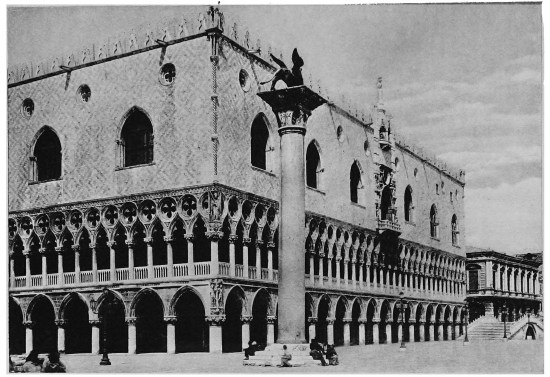
Grand Ducal Palace, Venice
The great entrance, the allegorical sculptures, and the Giant’s
Staircase of the Palace of the Doges in Venice, are hardly more
remarkable than the prison under the eaves or so-called “leads” of the
palace or the Prison of the Piombi. Here many noted prisoners have been
confined and from the “leads” Casanova made his famous escape after six
years’ imprisonment decreed by the Council of Ten.
these horrible habitations. One criminal who died there when Casanova
was in the Piombi had spent thirty-seven years in one of the wells. He
was forty-four years old when first imprisoned. This was a Frenchman
named Beguelin, who had been a captain in the service of the Venetian
republic and had been employed as a spy in the war against the Turks in
1716. During the siege of Corfu he had sold information to both sides,
and when caught by the Venetians he was sentenced to death, but it was
commuted to life imprisonment.
The prison of the Piombi or the “Leads” was of quite a different
character and was so called because it lay on the topmost story of the
ducal palace immediately under the leaden roof. It consisted, as indeed
may still be seen, of a series of small chambers with a roof so low that
a man of six feet could not stand erect under the ceiling. They were not
abundantly provided with light or air. Many were darkened by the
overhanging eaves and massive projections in the architectural façade,
and only a scant supply of air entered through the small windows in the
neighbouring passages. Their worst feature was the extraordinary
variations of temperature. In the summer, when the dog-day sun beat down
pitilessly upon the leads, the heat was almost insupportable; in the
winter, being unprovided with fireplaces and having no provision for
artificial warmth, they were almost glacial. The disciplinary régime was
a mixture of barbarous severity and extreme neglect. Prisoners were
only visited once daily by a gaoler who attended half a dozen cells,
brought in food and, if necessary, arranged for a doctor’s visit many
hours after occasion arose. This single visit was made soon after
sunrise, when the secretary to the inquisitor, who held all the keys,
suffered them to go out of his own keeping for the brief space of an
hour. At first, no books were issued except those of a dreary devotional
description. All writing materials, pens, ink or paper were scrupulously
forbidden. Imprisonment might be quite solitary till the loneliness long
protracted grew all but maddening; the alternative was uncongenial
companionship with some offensive and personally unclean creature from
whom there was no escape day or night, a far greater hardship than
unbroken solitude. What life really meant in the Piombi has been
graphically recorded at first hand by one who endured it for a year or
more, but, goaded to despair, dared all to escape from its intolerable
evils.
The escape of Giovanni Casanova from under the Leads of the Grand Ducal
Palace in 1756, as described by himself, exhibits a remarkable
combination of patient ingenuity and the most determined courage. The
incident deserves to be inserted here in some detail, and will serve to
bring home to the reader some of the curious conditions of the inmates
of gaols in the latter half of the eighteenth century. The story is to
be found in his autobiography, a book of memoirs, the authenticity of
which has been seriously questioned, but his prison experiences bear
the distinct impress of truth; he writes with a precision and
particularity that must be wanting from any purely imaginative fiction.
He must surely have acted personally in the events he describes; the
difficulties he surmounted were real; the perils and adventures through
which he passed successfully could never have been invented; all the
incidents and episodes were solid, sober facts. In other respects these
memoirs may appear shadowy and untrustworthy. Much of the matter seems
too highly coloured and full of exaggeration. This prince of vauriens
was no doubt a great liar. We can easily believe that he was constantly
in luck’s way, long able to keep his purse full by his winnings at the
gaming table; but when he tells us how he rubbed elbows with the best in
society, appeared at European courts, talked familiarly with crowned
heads and received civilities and high consideration from princes and
great personages, we are disposed to question his veracity. He was
unquestionably a real personage and the hero of many stirring and
surprising adventures, and in none does he show to so much advantage as
in his escape from the prison of the Piombi. It is certain that at an
early stage of his profligate and depraved career, he came under the
grave displeasure of the authorities of his native Venice and was
committed, arbitrarily, no doubt, but not altogether wrongly, to the
tender mercies of the legal custodians of the Grand Ducal Prison. His
arrest put a summary check upon his vicious and dissolute proceedings,
but it was not on account of his immorality that they laid hands upon
him; his chief offence was that he was supposed to deal in magic and was
in possession of certain forbidden books on the Black Art, containing
the formulas and incantations to be used in raising evil spirits and
communing with the devil.
Early one morning the chief agent of the Inquisitors of State, who was
known as “Messier Grande,” came to his lodgings with an escort of thirty
soldiers and arrested him while he was in bed. While the police secured
his papers and his compromising books, Casanova dressed himself
leisurely; he shaved and combed his locks and put on his best clothes, a
shirt of finest lace and a long coat of the best taffety, “just as if he
was going to a wedding party,” he explains. Then Messier Grande carried
him off in a gondola to a place of security where he was locked up until
the afternoon, when an order arrived to take him to prison. The police
gondola followed a devious track through the smaller canals and at last
reached the Grand Canal where it ran alongside the palace stairs. Here
they landed and the prisoner was ushered into the presence of an
official wearing a patrician’s robe, who scanned him from head to foot
and said briefly, “Take him and lock him up.” This was the secretary of
the inquisitors, who talked in Tuscan as if ashamed to use the Venetian
dialect.
Casanova next gives us a glimpse of the interior of the prison: “Messier
Grande now handed me over to the warder of the Piombi, who, with an
enormous bunch of keys in his hand, led me up two small staircases into
a gallery, to a locked door, through it into a second gallery, at the
end of which we entered a dirty garret, badly lighted by a circular
window high up. I thought this was my prison chamber, but I was
mistaken, for at the end was another door double-lined with iron,
perforated by a circular hole, and I was ordered to enter. For the
moment I was otherwise engaged, curiously examining a strange machine
strongly attached to the wall. It was an iron horseshoe an inch thick
and five inches across the opening. ‘Oh that,’ explained the gaoler,
‘you would like to know what that is? When their excellencies, the
inquisitors, desire that any one should be strangled, he takes his seat
on the stool below, and this machine is put round his neck, half of
which it encircles. A silken cord, attached to a wheel, is placed round
the other half and by turning a handle the silk is tightened until death
ensues and the sufferer gives up his soul to God—for you will
understand the priest is close at hand and never leaves him until all is
over.’ ‘Ah,’ I replied, ‘and I presume it is your business to tighten
the cord.’ He would not condescend to answer but led me into my cell and
left me asking whether I would like to order any food. ‘I haven’t
thought of it yet,’ I said lightly, and he went away. I paid the
penalty of thus showing temper, for he did not return till next day and
I was left for twenty-four hours wholly without food.”
The prisoner, after recovering a little from his despondency and
despair, proceeded to examine his cage. He walked round it with bent
head, for it was barely five and a half feet high, and Casanova was a
tall man, of quite six feet. He found that the room was some twelve feet
square, with an alcove on the fourth side for a bed which was absent,
and there was no other furniture whatever. The one small window was
closed with six iron bars and gave but little light for a solid block of
stone—part of the architecture—lay more than half across, but there
was enough light to show him numbers of rats running to and fro. He fell
into a state of semi-coma, and passed several hours absorbed in gloomy
reflections. Then suddenly he roused himself and displayed ungovernable
fury. No one had come near him, he was suffering from intolerable
thirst, and the slow hours dragged along without a sign of relief. He
raged and stormed and uttered the most piercing cries but to no purpose,
as they were not heard beyond his cell walls, and after an hour or more
of vain appeals he threw himself exhausted and despairing on the floor,
believing that the inhuman inquisitors meant to leave him there to die.
What had he done? He taxed his brain seeking the reason for this
abominable ill-usage and could find none. He was willing to confess
himself a libertine, a gambler, an overbold talker, with no thought but
to enjoy life; but in all this there was nothing criminal, no offence
against the state. At last nature came to his aid. Worn out by his
fierce passion and the want of food and drink, utterly broken and
exhausted, he fell into a sound sleep. His awakening was the more
terrible. The great clock above his head, and so near that it seemed in
his very room, clanged out midnight, and as he turned his hands touched
another, icy cold and motionless. Feeling sure it must be that of some
corpse, he again shouted aloud in uncontrollable terror. But it was his
own hand; he had lain upon it in his heavy sleep and all feeling had
left it. Gradually he recovered himself as the dawn broke gray and
imperfect, and about eight o’clock came the welcome sound in the
distance of jangling keys and bolts run back, and his gaoler appeared,
who asked in brutal derision, “Have you had time to think of food yet?
Hungry, eh?” Casanova disdained to complain and quietly called for a
full meal. “All right, give me the money. Anything else? Don’t you want
a bed, a table, chair and so forth? If you fancy you are only here for
one night, you are very much mistaken.” The prisoner made out a list
including papers and books, but was plainly told they were forbidden.
Then the gaoler, whose name was Laurent, left him and presently returned
with soup, a little meat and other necessaries.
Casanova’s condition now was pitiable. He had no appetite and he spent
the day in horrible discomfort; the sun as it rose to the meridian beat
down fiercely on the leaden roof till the room was like an oven, and
although he stripped naked the perspiration poured off him in a perfect
stream. His sufferings from the heat abated as the evening drew on, but
the night had its own terrors: the incessant striking of the clock, the
hideous noise from the rats as they ranged to and fro was horrifying,
and worse than all, he became the prey of innumerable fleas who fastened
on him with inappeasable fury till their incessant attacks caused him
painful spasms and poisoned all his blood. Not strangely, the
confinement, with the mental and physical tortures endured, soon told
upon the prisoner’s health and he was attacked with a dangerous illness
which presently yielded to medical treatment, for the authorities
provided an excellent doctor, and thus Casanova’s chief woes were those
of weariness, heat and fleas. As the days went on and September passed,
he was buoyed up with the hope of coming release, for on the first of
October new inquisitors would enter upon office, and he felt sure they
would set him free. He lay awake throughout the last night of September,
counting the moments till daylight should bring his gaoler with the
welcome intelligence on which he counted and which never arrived. Many
weeks passed before he could bear up against this bitter disappointment,
but his fortitude returned with a firm resolve to escape from durance
even at the peril of his life.
The forces of nature seemed likely to intervene on his behalf. One
morning the shock of an earthquake shook the ducal palace, an off-shoot,
really, of that seismic disturbance which at this time destroyed Lisbon.
Casanova was looking out from his garret window when he saw the massive
stone architrave under the roof outside oscillate to and fro, and he
realised then what had happened. Warders and soldiers rushed in
terrified, but Casanova took a savage joy in the cataclysm in the vague
hope that the solid building would totter to the ground and he would be
cast out upon the Piazza of St. Mark a free man, or perish under the
ruins. To the dismay of his keepers he raised his voice in impious
prayer, “Another stroke, Great God, another and a stronger!” at which
the others, believing he had gone mad, crossed themselves and fled.
Casanova philosophically tells us that the man possessed of one fixed
aspiration will generally compass his end, however highly placed; he
will achieve rank and fortune and a great position, if he keeps his mind
steadily to his one idea. With him this idea was to escape, and he
pondered over it incessantly, puzzling over the means by which he could
attempt it. Certainly they did not lie ready to his hand. He saw a way,
feasible enough, of getting out of his cell, but could not imagine how
to procure the necessary tools. He was securely lodged, alone and
apart, absolutely cut off from outside and his fellow creatures, save
his warder, who could only help him by braving terrible penalties. Armed
sentries were posted in the corridors and at his door, whose vigilance
he could hardly hope to elude and who would easily have overpowered him
if he attacked them.
Yet the way of escape was possible through the floor of his chamber
which, being perfectly familiar with the geography of the palace, he
knew to be just above the hall of the inquisitors where they met for
business in the evening after the Council of the Ten, of which they were
members, had concluded their proceedings. If he could but break through
the floor and lower himself into the great hall below when it was
unoccupied, he might walk off by the grand staircase, that of the
“Giants,” which visitors to Venice may still admire. There was no
difficulty about the exit, but how was he to reach it? We shall see
presently how the pressure of his needs stimulated his active brain and
sharpened his ingenious wits.
His mind was still labouring to find some solution of the problem when
his ill-luck interposed and any action was postponed by the decision of
the authorities to give him a cell-companion. The new secretary of the
inquisitors had a special grudge against a prisoner just taken, and
desired to confine him in the worst quarters possible. Casanova’s cell
enjoyed this evil reputation, and Laurent brought him in with the air
of one who is conferring a favour, although Casanova would have
infinitely preferred to remain alone. The newcomer was in the depths of
distress; he was a groom who had dared to fall in love with his master’s
daughter, and was miserably unhappy. This wretched creature, who wept
unceasingly, shared Casanova’s cell for nearly a month and was then
removed to another prison, the Quatri, used by the inquisitors for
commonplace offenders, whence after five years’ incarceration, he was
exiled to Cherigo for another ten years. Laurent explained that it was a
privilege to be detained in the Piombi, which was reserved for prisoners
of distinction, while the Quatri received ordinary criminals. After this
experience, Casanova’s privacy was again disturbed by the arrival of
another companion. This second prisoner was a prosperous money lender
who posed as a pauper and would not yield to the exactions attempted by
the inquisitors. He was, no doubt, a dishonest person, overreaching and
greedy of gain, extraordinarily mean and avaricious; but not unwilling,
when forced to it, to purchase his freedom.
Now Casanova’s condition and circumstance were slightly improved. On New
Year’s Day, 1756, he was permitted to receive a present from his friend
and patron, a noble patrician, by name Bragadino, whose life he had once
saved and who in his gratitude treated him as an adopted son. The
present was a fine silk dressing gown warmly lined with fox skin and a
bag made out of bear hide into which he could put his feet. These were
welcome gifts, for the temperature had gone down below freezing point
and it was as cold now in the Piombi in winter time as it had been
insufferably hot in the past summer. A money allowance was also made him
over and above the sum spent on his subsistence, and this further grant
might be applied to the purchase of books. Another boon was conceded;
that of permission to leave the cell and take exercise in the adjoining
corridor, a privilege which led to important consequences. For now at
last he laid his hands upon certain “unconsidered trifles” which were to
prove of invaluable use in furthering his escape.
This corridor in which he took regular exercise was the receptacle for
much old rubbish; several pieces of rickety furniture had been thrown
here, a couple of cassoni, or great chests, and a quantity of ancient
documents, the records of long forgotten criminal trials. From time to
time he turned over this heap of nondescript articles, among which were
a warming pan, fire-irons and a pair of old candlesticks, the discarded
possessions, no doubt, of some distinguished predecessor to whose
comfort and convenience they probably ministered. One other bit of
treasure he also found and pounced upon eagerly for future use as a
weapon of offence and defence, and yet more as a workman’s tool. This
was a straight piece of iron, a foot and a half in length and as thick
as a man’s thumb, no doubt a bolt or bar that had been in the lock of a
door. Pursuing his investigations, he came upon another article of
possible value to him; a piece of black marble six inches long, three
inches wide and one inch thick. He promptly took possession of both the
bolt and the stone without precisely realising the purpose they would
serve, and carried them cautiously to his cell where he hid them
carefully away. On subsequent examination he saw plainly that the marble
would serve as a whetstone, and that by rubbing it assiduously upon the
crowbar, he could manufacture an eight-sided, sharp-edged instrument
admirably adapted to help him in breaking prison.
Spurred on by his eagerness to provide himself with a weapon so
formidable and so unexpectedly put within his reach, Casanova applied
himself with unflagging diligence to his task. His difficulties were
enormous; he worked in semi-darkness; he could only hold the whetstone
in his left hand; he had no oil to assist the trituration; he could only
use his own saliva, which left his throat as dry and rough as sandpaper.
“I can hardly describe,” he tells us, “the fatigue that possessed me and
the acute pain I suffered in completing my laborious undertaking. It was
worse torture than any contrived by the most cruel tyrants who have
oppressed mankind. My right arm became so stiff that I could barely move
it; the palm of my left hand, which held the stone, was one large sore
from the blisters that formed and burst as I continued to work on
unflinchingly. But I was rewarded after a week of incessant toil by
producing an octangular stylet, each side one and one-half inches in
length, and the whole tapering into a fine sharp point.” The weapon once
manufactured, it was of paramount importance to conceal it, but after
long consideration it was lodged safely, and as it proved, successfully,
in his armchair underneath the seat.
All was now ready for the momentous operation, but it must be approached
with extreme caution. It was possible, certain indeed, that by long and
patient labour a practicable hole might be made in the floor, but how to
guard against the discovery of the work while in progress? It would
probably occupy a couple of months at least, and how were the soldiers
who waited upon the prisoners to be prevented from sweeping the floor
during this long period of time? Casanova at once invented a fictitious
throat complaint and pretended that dust greatly irritated and
aggravated the ill. Laurent, the warder, insisting upon cleanliness,
suggested that the floor should still be swept but not until after it
had been watered. Again Casanova objected, dreading some other disorder
and justifying his complaint by spitting blood copiously which he had
surreptitiously obtained from a pricked finger. The doctor was called in
and took the prisoner’s part, and the result was a peremptory order that
the floor should not be touched again. Casanova had now a fair field,
but it was winter time and daylight hours were too few to allow of
lengthened labour; indeed, the cell was dark for nineteen hours out of
the twenty-four.
Again his marvellous ingenuity stood him in good stead. He set himself
to contrive a lamp and made it out of the most unpromising materials. He
appropriated a saucer in which they served him fried eggs, and he made a
wick out of his cotton shirt. To strike a light, flint and steel were
required; the first Laurent brought him in the shape of a stone to be
steeped in vinegar and applied as a sovereign remedy for a raging
toothache; the second he found in the steel buckle of his small clothes.
For sulphur he had recourse to the friendly doctor who gave him some in
a prescription, and last of all he found the tinder in the wadding which
his tailor always sewed in under the arm-pits of his coat. Fresh and
exasperating delay was caused by the arrival of another unwelcome
companion, another Jew, a most irritating and disagreeable person, who
made Casanova desperate, not only by checking the work which it would
have been unsafe to prosecute before him, but by constantly interfering
with his fellow prisoner’s comfort in everything he did. Extremely fat
and lazy, he spent three parts of the day in bed and was consequently
unable to sleep at night. Once he ventured to rouse Casanova to talk to
him and pass the time. Casanova was furiously angry. “Hateful villain,”
he cried, “Sleep is the sole boon a prisoner can enjoy because it brings
him forgetfulness. If ever you wake me again, I swear I will strangle
you.” It was well that the work at the floor had not been commenced
before the Jew came in, for he would assuredly have betrayed Casanova,
and as it was he absolutely refused to agree to the arrangement of not
sweeping the floor. Fortunately, and to Casanova’s immense relief, a
fortnight after Easter this unaccommodating person was removed to the
Quatri prison, where he spent a couple of years.
Casanova was at last free to commence work in earnest. The bed removed
and the lamp lighted, the prisoner lay flat on the floor, crowbar in
hand, and furnished with a napkin alongside in which to collect the
fragments as they were chipped out. All these he flung next day behind
the heap of rubbish in the outer gallery. Inch by inch Casanova cut
through the massive planks and at the end of three weeks he had pierced
a triple flooring. But now a serious obstacle interposed in the form of
a layer of the little pieces of marble known in Venice as terrazzo
marmorino—the ordinary pavement of rich men’s houses—and the
sharpened bolt would not make any impression on this material. This
difficulty he overcame, however, by attacking the cement which joined
the fragments together. Four days sufficed to tear up the pavement and
reach another plank below, probably the last of its series. Meanwhile,
time passed; a midsummer sun again poured down its scorching rays upon
the leads during the day, and by night the would-be prison breaker,
half-choked with the accumulated heat, lay at work, his cherished lamp
by his side, slowly gnawing through his cage with the busy crowbar. One
day he had a terrible fright. In the middle of the afternoon he heard
the grating of the bolt in the passage outside—an unusual sound at that
hour of the day. He was taken by surprise, for he was at work under his
bed with his lamp alight. Hastily throwing his crowbar into the hole in
the floor, he blew out the lamp, crawled out and threw himself just as
he was, naked, upon his bed only a second or two before Laurent
appeared, ushering in a stranger who recoiled on the threshold, overcome
by the heat of the room and the loathsome smell of the half-extinguished
lamp. “Into what devilish place have you brought me?” he cried to his
escort, “and who is this loathsome creature?” Laurent tried to reassure
him, and took him out again, begging Casanova to put on some clothes.
The newcomer, who promptly recognised him, proved to be a fresh
cell-companion, a Venetian of rank, Count Fenarolo, who had offended
against the strict etiquette that governed all dealings with foreign
ambassadors and found himself committed to the Piombi. He was a
gentleman and was pleased to find himself with Casanova, whom he knew
personally and to whom he brought all the latest news from outside,
particularly the gossip current as to the causes of Casanova’s
imprisonment. One story was that he had invented a new religion;
another that he had induced a young patrician to turn atheist; a third
that he had created a disturbance in the theatre by hissing the plays of
a writer who had many powerful friends.
The count was very much in the way, but he behaved with great
friendliness and generosity. He freely shared with his companion the
rich and liberal fare sent in to him, and when he discovered the hole in
the floor, promised to keep the secret inviolable; more, to assist the
fugitive in making his escape by lowering him through the hole when
completed and afterward pulling up the rope.
Eight days later the count was set at liberty, and by that time the last
plank was perforated so that Casanova, on applying his eye to the first
small hole made, saw plainly that his conjecture had been right and that
he was looking down into the hall of the Council of Ten. But he found
the passage was blocked by an intervening beam of the ceiling below, and
he was obliged to enlarge the aperture to get beyond it. Everything at
last was ready, it only remained to fix the day and hour of departure.
He settled for the 27th of August, the eve of the Feast of St. Augustin,
when there would be no council meeting and no one about. Carefully
closing the aperture lest its existence might be betrayed, Casanova
patiently awaited the supreme moment, but, unhappily, on the 25th he was
overwhelmed by a crushing blow.
Laurent came to him at midday and bade him prepare for good news. “You
are to come with me,” he said. “Let me dress properly,” cried Casanova,
overjoyed, taking for granted that he was to be set free. “There is no
need for that,” replied the gaoler, “you are not going far, only to
another chamber better and brighter than this, with two windows from
which you can see half Venice, and in which you can stand upright.”
The poor prisoner, astounded, sank fainting into a chair. “Give me
vinegar to smell,” he whispered almost inarticulately, “and beg the
secretary to leave me where I am.” At which Laurent laughed in scorn.
“Have you gone mad? What! You refuse to move out of hell into paradise?
Come, come,—orders must be obeyed. Get up, and I will help you with
your books and belongings.”
So the fruit of months of labour must be lost irretrievably and, worse
than all, the hole in the floor must be discovered. Yet in the midst of
all this misery and disappointment, one crumb of consolation
remained—the crowbar, concealed in the armchair, went with him into his
new quarters. There was a terrible uproar when the hole was laid bare,
and much seeking and poking among mattresses and cushions, but the
precious weapon escaped notice. Nevertheless, nothing could be done with
it. The new cell which was deliciously cool and fresh, had clean walls
which would show the slightest scratch on the surface. Escape seemed
farther off than ever.
One day Casanova asked the gaoler to buy him the works of Maffei; but as
that worthy profited by any surplus of the daily allowance that might be
in hand at the end of the month, Laurent was terribly averse to
extraordinary expenses, and suggested that other people in the prison
had books and that they might advantageously lend them to each other. A
system of regular exchange now began, and a correspondence was started
by means of the hollow backs of the vellum-bound books, which lay flat
when the books were closed, but formed a kind of pocket when opened.
Letters passed back and forth between the tenants of neighbouring cells.
Casanova found that overhead were two occupants, one Father Balbi, a
monk of noble Venetian family, and the other an aged man, Count Aschino
of Udine. Casanova’s pen was the long nail of his little finger trimmed
to a point and dipped into mulberry juice; the fly leaves of the books
themselves supplied the paper. The subject discussed was eternally the
same,—that of their escape; but the mind of the reverend Father Balbi
was more critical than inventive, and Casanova felt that they could not
work again for awhile. Nevertheless, he informed the monk of the
existence of his precious crowbar, and offered to convey it to him if he
would consent to use it in making an opening through the ceiling of his
own cell into the garret above and then cutting his way through the
floor to reach Casanova, who would answer for the rest of the operation.
Certainly he had formed no high opinion of the discretion and skill of
his new ally, but realised that he must work with such tools as he had
at hand. Balbi’s first step was to provide himself with a large number
of pictures of saints to cover up and conceal the damaged ceiling and
floor. The next difficulty was to pass the working tool safely from one
cell to the other. The fur-lined dressing gown was first thought of as a
vehicle, but was abandoned. At last, after severe cogitation, an astute
plan was devised. Casanova begged the gaoler to buy him a new folio
edition of the Vulgate, just published, and the volume was procured in
the hopes that the crowbar might be concealed in the back of the
binding. But it was two inches too long and the ends protruded!
Something else must be tried to remedy this obvious objection, and the
fertile brain of the resolute adventurer was equal to the task. St.
Michael’s day was at hand, and Casanova proposed to celebrate it by
offering a feast of macaroni and cheese to his fellow prisoners. Laurent
brought a message to the effect that these neighbours were anxious for a
sight of the great Bible. “Good,” said Casanova, “I will send it to them
with the macaroni; but bring me the biggest dish you have, for I like to
do things well.” The crowbar was then wrapped in paper and stowed in the
back of the book, care being taken that it should project only an inch
on either side. One anxiety remained,—would the macaroni dish be big
enough to hide the book on which it was to be placed? By great good
fortune the dish was of enormous size. Casanova himself prepared the
mess, seasoned it and filled the dish almost to overflowing with melted
butter. Laurent grumbled at the brimming dish, but carried it—book,
crowbar, macaroni and all—safely to Balbi.
The monk got to work at once and within a week broke a hole in the
ceiling, groaning all the time at the severity of the labour; but,
encouraged by his correspondent and partner, he took more kindly to his
business as he went on. At last, at 10 A.M. on the 16th of October, a
slight tapping overhead assured Casanova that the job was accomplished
so far. He had now no doubt that with the help of his companion he could
in three or four hours bore a hole in the roof of the ducal palace and
obtain access to the leads. All was ready for the attempt when once more
it was interrupted by the unwelcome appearance of a fresh
cell-companion, the most offensive and unmanageable of any as yet
inflicted upon him. He heard the bolts shot back outside in the early
afternoon, and had barely time to warn Balbi above to desist from work
and regain his own cell, before Laurent arrived with the new prisoner
and began to apologise for the annoyance he must give Casanova in
bringing such a creature into close association with him.
The newcomer was not of prepossessing appearance; a man of villainous
looks, forty or fifty years of age, short and thin, badly dressed and
wearing a round black wig; a low blackguard evidently, and the gaoler
called him that to his face without making any visible impression. When
the lock was turned on him, after expressing fulsome thanks for the
promise made him that he should share Casanova’s food, he took out a
rosary and looked round for some sacred image before which he could tell
his beads. “I was brought up a Christian and am always attentive to my
religious duties,” he whined, as he went through his prayers and was
greatly relieved to find that his fellow prisoner was not a Jew. After
devouring greedily all the food put before him, he explained that his
calling was that of a barber and spy, and that he had discovered a
conspiracy against the Republic, but his revelations were deemed
insufficient and he had therefore been arrested. His name was Soradaci;
he had a wife, the daughter of an ex-secretary to the Council, and he
expected, as did all who came into the Piombi, to be released within a
few days.
Casanova thoroughly despised and distrusted this wretch, but to try him
entrusted him with a couple of letters he was to deliver when free, and
he worded them carefully, drawing a fancy picture of his contentment and
gratitude to the inquisitors who had taught him such a salutary lesson,
for he knew that Soradaci would hand them the letters at the first
opportunity. Three days later Soradaci was taken before the tribunal and
sought to curry favour with the inquisitors by at once betraying his
comrade. It served him little for he was forthwith remanded to his cell,
where he made a lying confession, and when searched the letters were
found on his person and the discovery nearly cost him his life. Casanova
feigned to be terribly upset, for he had sworn Soradaci to secrecy with
the most frightful oaths and said that it was impossible to trust him.
But the traitor was still there to be a witness to the approaching
flight and he must be taken in another way, by playing on his gross
superstition and abject cowardice. After solemnly declaring that by his
treachery and the broken oath he had drawn down on himself the vengeance
of the Holy Virgin, and that he must surely die in three days’ time,
Casanova pretended to have made intercession on his behalf and that
pardon had been promised in a dream. The Virgin had appeared to him and
said, “Soradaci is a devout worshipper of mine, and to reward you for
your kindness to him I shall send an angel down to your prison during
the next few days to reach you through the ceiling and take you out.”
The appointment was fixed with Balbi to make his appearance at a certain
hour, various rites were performed, ablutions with prayer and the
sprinkling of the cell with holy water; the vigil was kept religiously,
but it was clear that Soradaci, utterly incredulous, thought the whole
business the merest farce.
Suddenly, at the first stroke of the clock, Casanova cried, awestruck,
“Kneel down, throw yourself on your face. Here comes the angel,” as the
monk Balbi, bearded and terrible, appeared at the opening in the wall.
Soradaci fell forthwith into a paroxysm of terror; he wept and tore his
hair and made humble obeisance. Balbi brought with him the crowbar and a
pair of scissors with which Soradaci immediately trimmed the angel’s
overgrown beard and next used his skill as a barber upon Casanova. The
preparations were nearly completed now, but the most important part was
still to be performed,—the actual attempt to execute the escape.
Like a prudent general, Casanova proceeded to reconnoitre the whole of
his ground, so as to judge for himself how far Balbi had done his work.
Leaving the monk in charge of Soradaci, he passed through the hall and
paid a first visit to the corpulent count in the adjoining cell. Their
meeting was cordial and they discussed future plans pleasantly. Casanova
proposed to climb up and pass through the roof above, to traverse the
leads, and then find some way of descent. “I cannot go with you,” sighed
the count. “I am too heavy; I will remain here and pray for your
success. Even you would be better off if you had wings.” Casanova by no
means despaired; he felt sure of being able to penetrate the roof, and
returned to his cell to provide himself with other essential appliances.
Four long hours were consumed in cutting up his bedclothes into strips
and manufacturing a rope one hundred feet long, taking immense care with
the knots, minutely examining each, for a man’s life might hang by any
one of them. By nightfall the hole in the roof was made. The woodwork
had been split and splintered away, but the lifting of the riveted sheet
of lead was a more serious affair. However, using their combined
strength, Balbi and Casanova together managed to insert the crowbar
between the gutter and the sheet above it, and putting their shoulders
to it, rolled back and doubled up the sheet of lead till a sufficient
opening was made.
Now a halt became necessary; it was a magnificent night, lighted by a
resplendent crescent moon. Every one was certain to be abroad on the
square of St. Mark and the shadows thrown on the roof by escaping
prisoners could not fail to be observed. Nothing could be done till the
moon sank below the horizon, after which there would be seven hours of
darkness. The hours of waiting were spent in conversation and the count
vainly endeavoured to dissuade his friends from their rash adventure. He
harped upon the steep angle of the roof, the chances of being shot by
the sentinels, the perilous descent with the agreeable prospect of being
dashed to pieces. Although inwardly cursing the cowardice of his
companions, Casanova concealed his wrath and bent all his energies to
extracting a loan from the count, whom he persuaded to part with two
gold pieces—the whole capital of the forthcoming enterprise. About this
time Soradaci fell on his knees and piteously begged to be left behind,
the very thing that Casanova most earnestly desired.
At last the moon disappeared and it was possible to make a start.
Casanova went first and quickly passed out on to the roof followed by
the monk, while Soradaci closed the opening after him. The leaden sheets
which covered the roof were slippery with dew and afforded no foothold
on the terrible slope. Casanova knew that the slightest mistake would
precipitate him into the canal and he knew also that the water was so
shallow that he must certainly be dashed to pieces in the fall. Yet with
undaunted courage he led the way in making the painful and dangerous
ascent until at length both, with their packs on their backs, attained
the summit of the ducal palace and sitting astride upon it looked
around. The prospect was not encouraging; there seemed to be nothing for
it but to drop into the canal; but suddenly quick-eyed Casanova espied a
skylight. This skylight, as he cleverly reasoned, opened into some
garret of the ducal palace whence a descent into the deserted official
chambers of the republican government would be easy. The descent of the
slippery roof towards the skylight was far more dangerous than the
ascent; a single slip and Casanova must miss his mark and would be
powerless to save himself against the increasing force of gravity,
ending in a terrible fall. A moment’s hesitation and his mind was made
up. It was now or never; do or die. Sliding down the slippery leads he
brought up against the skylight safely in a space of time short enough,
but which seemed an interminable age of acute agony. Balbi he had left
on the ridge of the roof. To penetrate this skylight was no easy matter.
It was securely barred over a window of small panes let into leaded
squares. The crowbar was of no avail in removing the bars. What was to
be done? Suddenly the happy idea came to Casanova to dislodge the whole
skylight bodily, and with a very little labour he broke it away, giving
ready access to the garret below.
Balbi must now be fetched, and Casanova crept back to him to be received
with fierce reproaches at his supposed desertion. “I made sure you had
fallen over,” said the ill-conditioned monk, “and was wondering what
would become of me. I meant to go back to the prison as soon as it was
quite light. What have you been doing all this time?” Casanova told him
to follow and he would see. When arrived at the skylight, Balbi begged
to be lowered into the room first, leaving Casanova to get down as best
he could, caring nothing whether or not he broke a limb. To descend
unaided seemed impossible, but casting about Casanova found a small
cupola under repair and near it a ladder to which he attached his rope
and prepared to descend; but in mortal terror that the ladder when
released would fall into the canal and make a splash, he climbed down to
the gutter, and at imminent risk of his life, forced up one end of the
ladder under the skylight till it stuck fast for a moment and ultimately
dropped into the garret where its end was received by Balbi.
Casanova now found himself with his companion in a garret-loft some
thirty paces long by twenty broad. After a hurried inspection of the
premises and running up against a couple of closed doors, further
descent seemed hopeless, and now a sense of overpowering fatigue took
possession of Casanova. He could not move hand or foot, but threw
himself down on the floor with one of his bundles under his head and
succumbed to sleep. The surrender was perfectly irresistible; had death
been the penalty of giving way, he could not have kept awake, and the
feeling of going off was delicious. He slept for three hours and a half,
at the end of which Balbi indignantly shook him again into life to find
his brain perfectly clear and his vigour completely restored. It was now
about five o’clock in the morning. A glance around showed that this loft
formed no part of the prison. There must be some way out. By forcing the
lock of the door, they found their way into another chamber and passed
through a gallery, that of the archives, down a little stone staircase,
and entered a great hall which Casanova recognised as that of the
grandducal chancery. It was not easy to get out of this chancery; the
locks would not yield, so an attack had to be made on one of the panels
of the door. This occupied half an hour, and Casanova, after pushing his
friend to the far side, forced his own way through, despite the jagged
edges of the broken wooden panel, which punished him cruelly. With
clothes torn to rags and blood streaming from numerous wounds on his
hips and sides, he hurried on to find a fresh obstacle in a massive door
which nothing less than artillery could beat down. Casanova was in
despair and ready to throw up the sponge. “I’ve done my share. I leave
the rest to Providence,” he said resignedly. “We must wait till help
comes.” Meanwhile he bound up his wounds, staunched the blood and
changed his clothes. He put on the famous taffety coat with silver lace,
adjusted his hose over his bandaged legs, put on three shirts, all
gorgeously trimmed with point lace, and then laughed heartily at the
figure he cut in a summer ball dress on the morning of the 1st of
November. The grand silk mantle he threw over Balbi’s shoulders, telling
him that he looked as if he had stolen it. Last of all, with his
gold-laced hat on his head, he looked out of the window, an imprudence
which might have spoiled all, but really helped them to get out. One or
two early idlers observed the apparition and fetched the porter, under
the impression that somebody had been locked into the ducal palace by
mistake over night.
Casanova heard the rattle of keys and looking through a crack in the
door saw a man alone, the porter, mounting the steps of the famous
“Staircase of the Giants,” so-called from the two splendid statues at
the top. He heard, too, a key inserted in the lock, and stood with ready
weapon, the crowbar, awaiting his deliverer. But there was no occasion
for violence. The door opened widely; the sleepy fellow also opened his
eyes and mouth in utter surprise, little guessing that he had narrowly
escaped with his life, and the fugitives rushed past him, not appearing
in too great a hurry, but moving quickly down the staircase. They passed
out of the grand entrance of the palace, crossed the little square and
stepped into a gondola. “I want to go to Fucino, call another oar,”
cried Casanova; and away they started. The custom house was soon left
behind and the gondoliers with vigorous strokes neared the canal of the
Giudecca. Half way along this canal, Casanova casually enquired:—
“Shall we be soon at Mestri?”
“But, signor, you told me to go to Fucino.”
“You are mad. I told you Mestri.”
The second rower also insisted upon Fucino, and, to the rage of
Casanova, Balbi sided with the men. Casanova, feeling as if he would
like to massacre his companion, burst into a fit of laughter, admitted
that perhaps he did say Fucino, but he meant Mestri all the same. The
gondoliers, nothing loath, agreed, and offered to take them to England
if they wished. Enjoying the morning air with a zest he had never
hitherto experienced, Casanova soon reached Mestri, landed and was faced
with a new trouble. Balbi wandered off on his own devices and much time
was wasted in hunting him up; then Casanova met a native of Mestri, one
Tomasi, and was immediately recognised. “What, you here— Have you
escaped? How did you manage it?” asked Tomasi. “No, I have just been
released,” replied Casanova with a sinking heart. “That is quite
impossible,” Tomasi said. “Last night I was at your friend Grimani’s
house. I should certainly have heard of it.”
Casanova shuddered. This Tomasi would certainly give the alarm, the
place was full of sbirri, and arrest was imminent. Only determined
measures would serve. “Come with me,” he said, seizing him by the collar
and truculently exposing the crowbar. Tomasi, affrighted, shook himself
free, took a flying leap across a ditch and ran for his life. But when
at a safe distance, he turned and kissed his hand as though he wished
Casanova well.
It was of vital importance to get forward. A post chaise took the
fugitives as far as Treviso, but was then dismissed as it was too
expensive a way of travelling, and they went on afoot. After four hours’
walking Casanova was in a deplorable condition; his boots torn to bits,
his ankles swollen; and he lay down, utterly exhausted, to hold
discourse with his companion.
“We must separate here,” he said to the monk. “Our point is Valstagna
beyond the frontier, but we must reach it by different ways. You shall
go by the easiest; take all the cash and go by the woods, and I will
take the mountain road. You will reach there to-morrow evening; I shall
be twenty-four hours later. Wait for me in the first tavern on the left
hand side of the road. Go. To-night I mean to have a good night’s rest
in a bed, and I could not sleep soundly if you were anywhere within
reach.”
Balbi’s reply was a flat refusal. He reminded his companion that he had
promised never to separate from him. Whereupon Casanova with his crowbar
proceeded to dig a hole by the roadside.
“It is your grave,” he said quietly. “I mean to bury you here dead or
alive. I’ve done with you. But you may run away if you like, I shall not
follow you.” Speech and manner were convincing. The monk thought it best
to accept the proposal and took himself off.
Casanova, overjoyed at being alone, trudged on into the next village,
Valdobbiadene by name, and here he made cautious inquiries as to the
names of residents and the houses they occupied. One of the most
important pointed out to him was that of the chief of police of the
district, and to this with rare effrontery he at once proceeded. Some
secret voice told him that he would run no danger, and on knocking at
the door he heard that the man he had so much reason to dread was
absent for some days. “He is helping in the search for two notorious
prisoners,” said the wife who answered. “They have just escaped from the
Piombi; one is called Casanova.” “Dear me, I am sorry not to find him, I
am his old friend and comrade. I have come a long distance from hunting
in the mountains (in silk stockings and a coat of taffety!); will you
give me shelter for the night?” The warmest welcome was accorded him; he
was given a good supper, his sore feet were dressed, and he slept all
round the clock in a luxurious bed, and waking refreshed and restored,
went on his way rejoicing. This was not the only good luck of the sort
that fell to him by the way. He found food and lodging in another
hospitable house, the master of which was absent, and ran into one or
two people who knew him but did not interfere with him.
One last escapade must be told exhibiting his bold and desperate temper.
Reaching the house of a friend of his, he entered and claimed
assistance, offering to give him a draft on Signor Bragadino as security
for a loan of sixty sequins. The recreant friend refused, fearing to
offend the Council of Ten, and declined to give him even a glass of
water. The man was under great obligations to Casanova, who fiercely
resented this cruel treatment and at once adopted a menacing tone,
crowbar in hand. The coward threw his keys on the table and bade
Casanova help himself from a drawer.
“I will take six sequins,” he said. “It is true I asked for sixty, but
that was as a loan from a friend. Now let me go in peace, or I will come
back and burn your house over your head.”
The rest of the journey to the frontier, which he reached safely, was
made without contretemps. Sometimes Casanova walked, sometimes he rode a
donkey; the last stage he travelled in a cart with a couple of horses.
At Valstagna he found Balbi in the place indicated, and the monk frankly
told him he never expected to see him again. Casanova would indeed have
gladly separated from him there and then, for Balbi proved a drag on him
for some time to come. In the end he was recommitted to prison, was
released from his vows and died in Venice a pauper, debauched and
dissolute to the last.
Casanova, having received a sum of money from his friends in Venice,
passed on to Munich, where he obtained permission to reside until he
went to Paris in the winter of 1757, where good luck befriended him and
he became one of the directors of the national lottery; he made a large
income and for a time was on the top of the wave. It is beyond the scope
of this volume to follow him in his varied and adventurous career in
which he so nearly secured a substantial fortune but constantly missed
it from the want of the more sterling qualities of steadiness and
honesty. He was always a frank Bohemian, a reckless gambler and
unprincipled roué and charlatan, imposing on the credulity of foolish
ladies who believed him to be possessed of supernatural gifts and the
secret of the “philosopher’s stone.” Bankers and great financiers
befriended him and helped him to make large sums; but he wasted his
capital in a foolish attempt at manufacturing printed silk at Lyons,
which failed, and he was brought to the verge of ruin. He next wandered
through Europe as a professional gambler, cutting a great figure in the
best society at times, in which, however, he was laughed at and
despised. He led a life of intrigue, fought duels, won much money, not
always by fair means, and by degrees gained an evil reputation and the
attentions of the police, who constantly warned him to “move on” from
the capitals and great cities. Nothing prospered with him and in these
days of decadence he made fresh acquaintance with the interior of
prisons. When in London he was locked up in Newgate as the penalty of
being engaged in a street brawl. In Madrid he was lodged in the prison
of the Buen Petiro, and was afterward for a time in the citadel of
Barcelona. When his fortunes were at the lowest ebb he obtained
permission to return to Venice and lived in obscurity for a time in his
native city; but again he visited Paris, where he made friends with
Count Waldstein who offered him the hospitality of his castle at Dux in
Bohemia. Here he was appointed librarian on a modest pittance and spent
the last fourteen years of his life, a broken miserable man, subjected,
as he thought, to constant indignities and enduring all the pangs of
exile from his native Venice, with no one to console him in his last
hours.