Two barons Von der Trenck—Friedrich a cornet of the
Gardes du Corps—Favoured by the Princess Amelia—Incurs
the displeasure of Frederick the Great—Sent to
the fortress of Glatz—Escaped to Bohemia and passed
into Russia—Re-arrested at Danzig and sent to Magdeburg—Plans
for escape—The grenadier Gefhardt a
faithful friend—Communication established with friends
outside—Funds obtained—Plot discovered—Removed
to the Star Fort and loaded with irons—Terrible suffering—Attempt
to cut through the doors discovered—His
prison is strengthened but his courage is unbroken—Fresh
plans made—A new tunnel begun—Plot discovered—The
sympathy of the Empress-Queen of Austria aroused—Released
on Christmas Eve, 1763—Married and settled
in Aix-la-Chapelle—His death on the scaffold during
the French Revolution.
There were two barons Von der Trenck, Franz
and Friedrich, in the middle of the 18th century,
both intimately associated with the prisons of their
respective countries, for although cousins, Franz
was an Austrian, and the other, Friedrich, a Prussian.
Both were military officers. Franz was a
wild Pandour, a reckless leader of irregular cavalry,
who for his sins was shut up for life in the Spielberg,
the famous prison fortress near Brünn, where
he committed suicide. Friedrich, after enjoying the
favour of Frederick the Great and winning the
rank of cadet in the Gardes du Corps, was eventually
disgraced and imprisoned in the fortress of
Magdeburg, where he was detained for ten years
and treated with implacable severity. Friedrich von
der Trenck was richly endowed by nature; he was
a gallant young soldier with good mental gifts and
a handsome person which enabled him to shine in
court society and achieve many successes. He was
fortunate enough to gain the good graces of the
king’s sister, the Princess Amelia of Prussia, who
greatly resembled her celebrated brother both physically
and mentally. She possessed the same sparkling
wit, the same gracious vivacity and, like Friedrich,
was a distinguished musician. She was a
warm votary of art, science and literature and was
always surrounded and courted by the most cultured
German princes. All her contemporaries describe
her beauty with enthusiasm. So far, she had
declined the many proposals of marriage, which, as
a matter of course, she had received. Her heart
belonged to the cornet of the Gardes du Corps, and
a secret understanding existed between them. The
lovers were at first cautious, but soon became
bolder, and the king’s suspicions were aroused. At
first he tried fatherly remonstrances, but in vain.
The extraordinary liaison became the talk of the
hour. A lieutenant of the Prussian Foot Guards
taunted the favoured lover about his relations with
the princess, they quarrelled, and a duel followed.
The king was furious, and a catastrophe was imminent,
but was avoided by the outbreak of war.
Then this gay and reckless courtier allowed himself
to be drawn into a correspondence with his cousin
in Vienna, the notorious colonel of the Pandours,
and the measure of the king’s wrath overflowed.
Trenck was cashiered and sent to the fortress of
Glatz. The king wrote with his own hand to the
commandant of the fortress on the 28th June, 1745,
“Watch this rogue well; he wished to become a
Pandour under his cousin.” Undoubtedly Frederick
intended to keep Trenck imprisoned for a short
time only, but he was detained for a whole year,
during which time he made more than one attempt
to escape.
The following account is in his own words:
“At last, after I had spent about five months in
confinement (at Glatz) peace had been proclaimed,
the king had returned to Berlin and my place in the
gardes had been filled. A certain lieutenant Piaschky
of the Fouquet regiment and the ensign Reitz, who
was often on sentinel duty outside my cell, offered
to make preparations to enable me to escape and
take them with me. Everything was settled and
agreed upon. At that time there was in the cell
next to mine a certain Captain von Manget, a native
of Switzerland. He had been cashiered, was condemned
to ten years’ imprisonment and had only
four rix dollars to spend. I had shown this man
much kindness out of pity, and I wished to save
him as well as myself, and this was discussed and
proposed to him. We were betrayed by this rascal
on the first opportunity, he in consequence earning
his pardon and liberty. Piaschky had wind that
Reitz was already a prisoner, and saved himself by
deserting. I denied everything, was confronted
with Manget, and because I could bribe the judge
with a hundred ducats, Reitz escaped with castigation
and a year’s imprisonment. I, on the contrary,
was now considered as a corrupter of the officers
and was locked up in a narrow cell and strictly confined.
Left to myself, I still meditated flight, as
the seclusion in a small cell was too irksome to my
fiery temperament. The garrison was always on
my side, therefore it was impossible to deprive me
of friends and assistance. I was known to have
money, so that all was possible to me. The first
plan was as follows. My window was above the
ramparts, about ninety feet from the ground, and
looked towards the town. I could not therefore
get out of the citadel and must find a place of safety
in the town. This was assured to me through an
officer, in the house of an honest soap-boiler. I
then cut with a pen knife that had been made
jagged at the end, right through three iron bars of
enormous thickness, but as this took up too much
time, as eight bars must be sawn through before
I could get out of the window, an officer provided
me with a file, with which I had to work very carefully
so as not to be heard by the sentries. As soon
as this was accomplished, I cut my leather knapsack
into strips, sewed them together with the thread
from an unravelled stocking, brought my sheet likewise
into requisition, and let myself down from this
astounding height in safety. It was raining, the
night was dark and everything went off well. I
had, however, to wade through the public drain and
this I had not foreseen. I only sank into it just
above the knees, but was not able to work my way
out of it. I did all I could, but stuck so fast that
at last I lost all my strength and called to the sentry
on the rampart, ‘Tell the commandant that Trenck
is sticking in the mire!’
“Now to augment my misfortune, it happened
that General Fouquet was at that time commandant
in Glatz. He was a well known misanthrope, had
fought a duel with my father and been wounded by
him, and the Austrian Trenck had taken his baggage
from him in 1744. He was therefore a great
enemy to the Trenck name, and consequently made
me remain in the filth for some hours as a public
spectacle to the garrison, then had me pulled out
and confined in my cell, allowing no water to be
taken to me for cleaning purposes. No one can
imagine how I looked; my long hair had got into
the mud, and my condition was really pitiable until
some prisoners were permitted to wash and cleanse
me.”
When he finally escaped from Glatz, he went to
Bohemia, to Nürnberg and to Vienna, whence he
passed into Russia and entered the service of the
czar for a time. Then he again travelled through
northern Europe and returned to Vienna, where he
was coldly received, and he started once more for
Russia, but was intercepted at Danzig and again
arrested in 1753, after which he suffered a more
severe imprisonment for nearly ten years, characterised
with such inhuman treatment that it must ever
tarnish the reputation of the monarch who posed as
a poet and a philosopher, the friend of Voltaire.
Frederick the Great would hardly have earned his
ambitious epithet had it depended upon the measure
he meted out to his turbulent subject, Friedrich
von der Trenck. He hated him cordially and
persecuted him cruelly, behaving with a pitiless
severity, and exhibiting such a contemptible spirit
of revenge that he has been hopelessly disgraced
by the enlightened verdict of history.
Von der Trenck has told his own story in one
of the most remarkable books published in the eighteenth
century, as the following excerpts will show.
He was taken into custody at Danzig, despoiled of
all his cash and valuables, and carried in a closed
coach under escort to Lauenberg, and thence via
Spandau to Magdeburg, where he was lodged in
the destined prison. “It was a casemate,” according
to his own account of the cell, “the forepart
of which was six feet wide and ten feet long, and
divided by a separation wall in which were double
doors with a third at the entrance of the casemate.
The outer wall was seven feet thick, with one window
giving upon the top of the magazine, sufficient
for light, but I could see neither the heaven nor the
earth. It was barred inside and outside, and there
was a narrow grating in the middle, through which
nothing could be seen. Six feet beyond my wall
stood a row of palisades which prevented the sentry
or any one from coming near enough to pass anything
in. I had a bed with a mattress, the bedstead
clamped down to the floor so that I might not drag
it to the window and climb upon it to look out. A
small stove and night table were fixed in like manner
near the door.
“I was not ironed, and my daily ration was one
pound and a half of ammunition bread and a jar
of water. I had an excellent appetite, but the bread
was mouldy and I could barely touch it. Through
the avarice of the town major, the supplies were
almost uneatable and for many months following
I suffered torture from raging hunger.... I
begged for an increase, but prayers and entreaties
were of no avail. ‘It is the king’s order,’ I was
told; ‘we dare not give you more.’ The commandant,
General Borck, cruelly reminded me that
I had long enough eaten patties out of the king’s
silver service, I must learn now to be satisfied with
ammunition bread.”
Von der Trenck turned his thoughts at once to
the possibilities of escape. He soon found that he
was left very much to himself; his food was
brought every day and passed in to him through
a slit in the door; but his cell was actually opened
only once a week for the visit and inspection of the
major of the fortress. He might work, therefore,
for seven days without fear of interruption, and he
proceeded forthwith to execute a plan he had formed
of breaking through the wall of his cell into an
adjoining casemate, which he learned from a
friendly sentry was unoccupied and unlocked. This
sentry and another spoke to him through the window,
despite strict orders to the contrary. They
gave him a good idea of the interior arrangements
of the fortress, and told him that the Elbe was
within easy reach. He might cross it by swimming
or by a boat, and so gain the Saxon frontier.
Thus encouraged, he devoted himself with unremitting
energy to his gigantic task of making a
practicable hole in the wall. He found bricks in
the first outward layers, and then came upon large
quarry stones. His first difficulty was to dispose
of the debris and material produced by the excavation;
after reserving a part to replace and so conceal
the aperture formed, the rest he gradually distributed
when ground down into dust. The quarry
stones gave infinite trouble, but he tackled them
with the irons extracted from his bedstead, and he
got other tools from his sentries,—an old ramrod
and a soldier’s clasp knife. The labour of piercing
this wall of seven feet in thickness was incredible.
It was an ancient building, the mortar was very
hard, and it was necessary to grind the stones into
dust. It lasted over six months, and at length the
outer layer of bricks on the side of the adjoining
casemate was reached.
Fortune now favoured Von der Trenck in the discovery
of a veteran grenadier among his guards,
named Gefhardt, who proved to be of inestimable
service then and afterwards, and a devoted ally.
Through the sentries’ good offices, Trenck was
enabled to communicate with his friends outside,
and through Gefhardt he made the acquaintance
across the palisades of a Jewish girl of Dessau,
Esther Heymannin, whose father was serving a
sentence of ten years’ imprisonment in Magdeburg.
With splinters cut from his bed board, the prisoner
manufactured a long staff which reached from his
window beyond the palisades, and by means of it
obtained writing materials, a knife and a file. This
was effected by Esther with the assistance of two
friendly sentries. Trenck wrote to his sister, who
resided at Hammer, a village fourteen miles from
Berlin, begging her to hand over a sum in cash to
the girl when she called; he wrote another letter to
the Austrian ambassador in Berlin, enclosing a bill
on his agent in Vienna, for Trenck, although in the
Prussian service, was of Austrian extraction and
owned estates in that country. The girl succeeded
in her mission to Hammer and took the money to
Berlin, where the Austrian minister’s secretary,
Weingarten, assured her that a larger sum was on
its way from Vienna, and that if she would return
to Berlin after carrying her first good news to
Magdeburg, it would be handed over to her. But
on approaching the prison, the wife of one of the
sentries met her with the sad news that both men
had been arrested and lay in irons awaiting sentence,
and Esther, rightly judging that all was discovered,
hurriedly fled to Dessau. It may be added
that the thousand florins to come from Vienna were
retained by the Austrian secretary, and although
Trenck years later, after his release, made constant
applications to both Count Puebla and Weingarten,
he never recovered the money. Weingarten had
acted the traitor throughout and it was on his information,
extracted from the Jewish girl, that the
plot to escape became known. The consequences
were far reaching, and entailed cruel reprisals upon
Von der Trenck’s friends. The two sentries, as has
been said, were arrested, tried and condemned, one
to be hanged and the other to be flogged up and
down the streets of Magdeburg on three successive
days. Trenck’s sister was cruelly persecuted; she
was fined heavily and plundered of her fortune, a
portion of which was ingloriously applied to the
construction of an entirely new prison in the Star
Fort of the Magdeburg fortress, for the special
confinement of her brother.
Von der Trenck, as his measures for evasion had
become ripe, was on the point of breaking prison
when a more terrible blow fell upon him. The new
prison in the Star Fort had been finished most expeditiously,
and orders were suddenly issued for his
removal after nightfall. The major and a party of
officers, carrying lanterns, entered his cell. He was
roused and directed to put on his clothes, and manacles
were slipped on his hands and feet, but not
before he had managed to conceal the knife on his
person; he was blindfolded, lifted under the arms
and conveyed to a coach, which drove through the
citadel and down toward the Star Fort, where it
had been rumoured he was to be beheaded. He
was thrown into his new place of durance, and
forthwith subjected to the pain and ignominy of
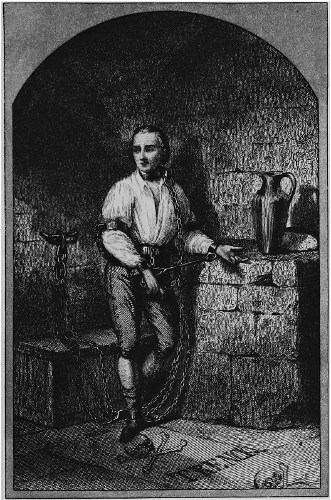
being loaded with fetters; his feet were attached to
a ring in the wall about three feet high by a ponderous
chain, allowing movement of about two feet
to the right and left; an iron belt as broad as the
palm of a hand was riveted around his naked body,
a thick iron bar was fixed to the belt, and his hands
were fastened to the bar two feet apart. “Here,”
says Trenck, “was I left to my own melancholy
reflections, without comfort or aid, and sitting in
gloomy darkness upon the wet floor. My fetters
seemed to me insupportable, until I became accustomed
to them; and I thanked God that my knife
had not been discovered, with which I was about
to end my sufferings forthwith. This is a true
consolation for the unfortunate man, who is elevated
above the prejudices of the vulgar, and with this
a man may bid defiance to fate and monarchs....
In these thoughts I passed the night; the day appeared,
but not its brightness to me; however, I
could, by its glimmerings, observe my prison. The
breadth was eight feet, the length ten; four bricks
were raised from the ground and built in the corner,
upon which I could sit and lean my head against
the wall. Opposite to the ring to which I was
chained was a window, in the form of a semicircle,
one foot high and two feet in diameter. This aperture
was built upwards as far as the centre of the
wall which was six feet thick, and at this point there
was a narrow grating, secured both without and
within with strong close iron bars from which, outward,
the aperture sloped downward and its extremity
was again secured with strong iron bars. My
prison was built in the great ditch, close to the rampart,
which was about eight feet broad on the inside;
but the window reached almost to the second wall, so
that I could receive no direct light from above and
had only its reflection through a narrow hole.
However, in the course of time my organs became
so accustomed to this dimness that I could perceive
a mouse run, but in winter, when the sun seldom or
never shone in the ditch, it was eternal night with
me. On the inside, before the grating, was a glass
window, the middle pane of which might be opened
to let in the air. In the wall my name, ‘Trenck,’
might be read, built with red bricks; and at my
feet was a gravestone, with a death’s head and my
name inscribed upon it, beneath which I was to
have been interred. My gaol had double doors
made of oak; in front of them was a sort of antechamber,
with a window, and this was likewise
fastened with two doors. As the king had given
positive orders that all connection and opportunities
of speaking with sentries should be debarred me,
that I might not have it in my power to seduce
them, my den was built so as not to be penetrated;
and the ditch in which the prison stood was crossed
on each side by palisades twelve feet high, the key
being kept by the officer of the guards. I had no
other exercise than leaping up and down on the
spot where I was chained, or shaking the upper part
of my body till I grew warm. In time I could move
about four feet from side to side, but my shin bones
suffered by this increase of territory.
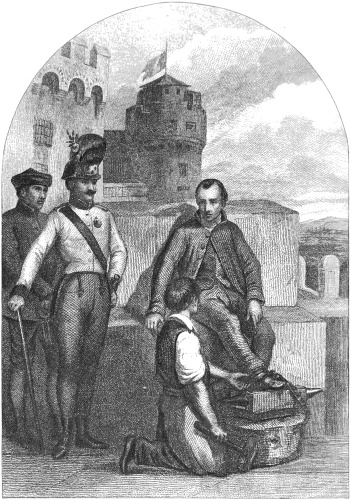
Baron Friedrich von der Trenck
After the painting by Marckl
A love affair with the Princess Amelia was the cause of
the long imprisonment of Von der Trenck by Frederick the
Great, first in Glatz, from which he escaped, and afterward
in the Star Fort of the Fortress of Magdeburg. He endured
almost untold hardships, and his numerous attempts to escape
showed marvellous persistence and almost superhuman endurance.
His life was romantic and stormy. He went to Paris
during the French Revolution and was finally guillotined by
Robespierre.
“In this prison I sat for six months, constantly
in water, which was perpetually dropping down
upon me from the roof of the arch. I can assure
my reader that my body was never dry during the
first three months and yet I continued in health. As
often as I was visited, which was every day at
twelve o’clock after guard mounting, the doors were
obliged to be left open some minutes, or the stifled
vapour and dampness would have extinguished the
candles of the lantern. In this condition I remained,
abandoned by friends, without help or comfort;
where reflection was my only employment and
where, during the first days, until my constancy
became confirmed and my heart more obdurate,
nothing but the most frightful images of grief and
woe were perpetually presenting themselves to my
diseased imagination. The situation could not have
been more calculated for despair, nor can I describe
the cause which restrained my arm from suicide,
for I was far above all narrow prejudices and never
felt the least fear for occurrences beyond the grave.
My design was to challenge fortune and obtain my
victory in spite of every impediment. The ambition
to accomplish this victory was perhaps the strongest
inducement to my resolve, which at length rose to
such a degree of heroism and perseverance, that
Socrates, in his old days, could not boast of more.
He was old, ceased to feel, and drank the poison
with indifference. I, on the contrary, was in the
fire of my youth, and the aim to which I aspired
seemed to be on all sides far distant. The present
situation of my body and the tortures of my soul
were of such a nature as gave me but little reason
to expect that my frame could support them for any
length of time.
“With these thoughts I struggled till midday,
when my cage was for the first time opened. Sorrow
and compassion were painted on the countenances
of my guards; not one spoke a word, not so
much as a good-morrow, and terrible was their arrival,
for not being used to the monstrous bolts and
locks, they rattled nearly half an hour at the doors
before the last could be opened. A wooden bedstead
with a mattress and a woollen cover were brought
in, likewise an ammunition loaf of six pounds;
upon which the town-major said: ‘That you may
no longer complain of hunger, you shall have as
much bread as you can eat.’ A water jar, containing
about two quarts, was placed beside me, the
doors were again shut and I was left to myself.
How shall I describe the luxurious delight I felt
in the moment I had an opportunity, for the first
time, of satiating the raging hunger which had been
eleven months gnawing at me! No joy seemed to
be more perfect than this, and no mill could grind
the hard corn with more expedition than my teeth
devoured my ammunition loaf; no fiery lover,
after a long and tedious languishing, could fall
with more eagerness into the arms of his yielding
bride, nor any tiger be more ravenous on his prey,
than I on my humble repast. I ate, I rested, ate
again, shed tears; took one piece after another, and
before night all was devoured. My first transports
did not last long and I soon learned that enjoyment
without moderation creates disgust. My stomach
was enfeebled by long abstinence, and digestion was
impeded; my whole body swelled, my water jar was
empty; cramps, colics and at last thirst, with incredible
pains, tortured me continually until the
next day. I already cursed those whom a short
time before I had blessed for giving me enough to
eat. Without a bed that night, I should certainly
have despaired. I was not accustomed to my cruel
chains, nor had I learned the art of lying extended
in them, which afterward time and habitude taught
me; however, I could sit on my dry mattress. That
night was one of the most severe I ever endured.
The following day, when my prison was opened,
I was found in the most wretched condition. The
officers were amazed at my appetite and offered me
a loaf. I refused it, believing that I should have
no occasion for more. However, they brought me
one, gave me water, shrugged their shoulders and
wished me happiness, for to every appearance I
could not suffer long; and the door was shut again
without my being asked if I wanted any further assistance....
During the first three days of my
melancholy incarceration my condition appeared to
me quite insupportable and deliverance impossible.
I found a thousand reasons which convinced me
that it was now time to put an end to my sufferings.”
Yet we read that this man’s indomitable pluck
survived and once more his thoughts turned to escape.
He was encouraged at finding that the doors
of his cell were only of wood, and he conceived the
idea that he might cut out the locks with the knife
he had so fortunately brought with him from the
fortress. “I immediately made an attempt to rid
myself of my irons, and luckily forced the fetter
from my right hand though the blood trickled from
my nails. I could not for a long time remove the
other; but with some pieces of the brick from my
seat I hammered so fortunately against the rivet,
which was but negligently fastened, that I finally
effected this also, and thus freed both my arms. To
the belt round my body there was only one hasp
fastened to the chain or arm bar. I set my foot
against the wall and found I could bend it; there
now remained only the principal chain between the
wall and my feet. Nature had given me great
strength; I twisted it across, sprang with force
back from the wall, and two links instantly gave
way. Free from chains and fancying myself already
happy, I hastened to the door, groped in the dark
for the points of the nails by which the lock was
fastened, and found that I had not a great deal of
wood to cut out. I immediately cut a small hole
through the oak door with my knife and discovered
that the boards were only one inch thick, and that
there was a possibility of opening all the four doors
in the space of one day. Full of hope, I returned
to put on my irons; but what difficulties had I here
to surmount!
“The broken link I found, after a long search,
and threw into my sink. Fortunately for me, nobody
had examined my cell because they suspected
nothing. With a piece of my hair ribbon I bound
the chain together, but when I tried to put the irons
on my hands, they were so swollen that every attempt
was in vain. I worked the whole night to
no purpose. Twelve o’clock, the visiting hour, approached.
Necessity and danger urged me on;
fresh attempts were made with incredible torture,
and when my keepers entered everything was in
proper order.”
After this Trenck concentrated all his efforts upon
cutting out the locks of his doors. The first yielded
within an hour, but the second was a far more difficult
task, as it was also closed by a bar and the
lock was opened on the outside. The work was
carried on in darkness and his self-inflicted wounds
bled profusely. But when the second door had been
cut through, he came out into half daylight, which
enabled him to cut out the third lock as readily as
the first. The fourth, however, was placed like the
second and involved equal labour. He was attacking
it bravely when his knife broke in his hand and
the blade fell to the ground.
Despair then seized him, and picking up his
knife blade he opened the veins of his left arm and
foot, meaning to bleed to death. When almost insensible,
a voice crying, “Baron Trenck!” roused
him, and on asking who called, he learned that it
was his staunch friend and ally, the grenadier Gefhardt,
who had come to the rampart to comfort him.
He told Gefhardt that he was lying in his blood
and at the point of death, but the stout old soldier
consoled him with the assurance that it would be
much easier to escape here, as there were no sentries
over him and only two in the whole fort.
Trenck listened with revived hope and determined
on a new plan of action. The seat in his prison
was built of brickwork, still green, and he quickly
tore it down to provide himself with missiles, which
he laid out ready for use against his gaolers at their
next visit. They came at midday and were horrified
to find the three inner doors opened, the last
of them barred by a terrific figure, wounded and
bleeding, and in a posture of desperate defiance. In
one hand he held a brick and with the other he
brandished his knife blade, crying fiercely, “Let no
one enter; I will kill all who attempt it. You may
shoot me down, but I will not live here in chains.
Stand back. I am armed.”
The commandant had inadvertently stepped
forward but retired at these threats, and ordered
his grenadiers to storm the cell. The narrow opening
allowed only one to enter at a time and a combined
attack was impossible. All halted irresolute
under the menace of the missiles, and in the pause
the major and chaplain tried to reason with Von der
Trenck. The former implored him to yield and
surrender the knife blade, as the major was responsible
for his possession of it and would no doubt
lose his place. These entreaties prevailed, and
Trenck gave in, being promised milder treatment.
His condition cried aloud for pity; he lay there
suffering and exhausted. A surgeon was called in
to apply restoratives and dress his wounds, and for
four days he was relieved of his irons and was well
fed with meat soup. Meanwhile the cell doors were
repaired and bound with iron bands. The fetters
were reimposed, but that which chained the prisoner
to the wall and which he had broken was strengthened.
No amelioration of his state was possible,
for the king was implacable and still ferociously
angry. Von der Trenck remained in extreme discomfort.
As his arms were constantly fastened to
the iron cross bar and his feet to the wall, he could
put on neither his shirt nor his breeches; the former,
a soldier’s shirt, was tied together at the seams and
renewed every fortnight; the breeches were opened
and buttoned up at the sides; on his body he wore
a blue frock of coarse common blue cloth, and on
his feet were rough ammunition stockings and slippers.
“It is certain,” says Trenck, “that nothing but
pride and self-love, or rather a consciousness of my
innocence, together with a special confidence in my
resolutions, kept me afterward alive. The hard
exercise of my body and my mind, always busy in
projects to obtain my freedom, preserved at the
same time my health. But who would believe that
a daily exercise could be taken in my chains? I
shook the upper part of my body and leaped up and
down till the sweat poured from my brows, and by
this means I grew fatigued and slept soundly.
“By degrees I accustomed myself to my chains.
I learned to comb my hair and at length even to
tie it with one hand. My beard, which had not yet
been shaved, gave me a frightful appearance. This
I plucked out; the pain was considerable, more especially
about the lips; however, I became accustomed
to this also and performed the operation during
the following years, once every six weeks or
two months, for the hairs being pulled out by the
roots required that length of time to grow again
long enough to lay hold of them with my nails.
Vermin never tormented me; the great dampness
of the walls was not favourable to them; neither
did my limbs swell, because I took the exercise
already mentioned; the constant darkness alone
was the greatest hardship. However, I had read,
learned and already seen and experienced much in
the world; therefore I always found matter to
banish melancholy from my thoughts, and in spite
of every obstacle, could connect my ideas as well as
if I had read them, or written them on paper. Habit
made me so perfect in this mental exercise that I
composed whole speeches, fables, poems and satires,
and repeated them aloud to myself. At the same
time they were impressed so forcibly on my memory
that after I obtained my freedom I could have written
a couple of volumes of such works.
“I employed myself in projecting new plans.
That I might be more nearly observed, a sentry was
posted at my door who was always chosen from
what were called the trusty men, or the married
men and natives. These, as will be related in the
course of my memoirs, were easier and safer to
bring over to my relief than strangers; for the
Pomeranian is honest and blunt, and consequently
easy to move and be persuaded into anything you
please. About three weeks after the last attempt,
my honest Gefhardt was posted sentry over me.
As soon as he came upon his post we had a free
opportunity of conversing with each other, for when
I stood with one foot on my bedstead my head
reached as high as the air-hole of the window. He
described the situation of my gaol to me, and the
first project we formed was to break under the
foundation, which he had seen built and assured me
was only two feet deep. I wanted money above all
things, and this I contrived to get in the following
manner: After Gefhardt was first relieved, he returned
with a wire round which a sheet of paper
was rolled, and also a piece of small wax candle
which luckily he could pass through the grating;
I got likewise some sulphur, a piece of burning tinder
and a pen; I now had a light, pricked my finger,
and my blood served for ink. I wrote to my
worthy friend, Captain Ruckhardt, at Vienna, described
to him my situation in a few words, gave
him a draft for three thousand florins upon my
revenues and settled the affair in the following
manner: He was to keep one thousand florins for
the expenses of his journey and to arrive without
fail on the 15th of August in Gummern, a small
Saxon town, only two miles from Magdeburg;
there he was to appear at twelve o’clock with a letter
in his hand, which with the two thousand florins
he should give to a man whom he would see there
carrying a roll of tobacco. Gefhardt had these instructions,
received my letter through the window
in the same manner as he had given me the paper,
sent his wife with it to Gummern and there put it
safely into the post office.
“At length the 15th of August arrived,—but
some days passed before Gefhardt was posted as
sentry over me. How did my heart leap with happiness
when he suddenly called out to me:—‘All
is well—we have succeeded.’ In the evening it was
agreed in what manner the money was to be conveyed
to me; as my hands were fettered, I could
not reach to the grate of the window, and as the air-hole
was too small, we resolved that he should do
the work of cleaning my cell and should convey the
money to me by putting it into my water jar when
he filled it. This was fortunately effected, but
judge of my astonishment when I found the whole
sum of two thousand florins, of which I had promised
and desired him to take the half. Only five
pistoles were wanting, and he absolutely refused
any more. Generous Pomeranian, how rare is thy
example!
“I now had money to put my designs into execution.
The first plan was to undermine the foundation
of my prison, and to do this it was necessary
that I should be free from chains. Gefhardt conveyed
to me a pair of fine files. The cap or staple
of the foot-ring was made so wide that I could draw
it forward a quarter of an inch; therefore I filed
the inside of the iron which passed through it. The
more I cut out, the further I could draw the staple,
till at last the whole inside iron through which the
chain passed was entirely cut through, the cap remaining
on the outside entire. Thus my feet were
free from the wall and it was impossible, with the
most careful examination, to find the cut, as only
the outside could be searched. By squeezing my
hands every day, I made them more pliant and at
last got them through the irons. I then filed round
the hinge, made myself a screw-driver with a
twelve-inch nail drawn from the floor, and turned
the screws as I pleased, so that no marks could be
seen when I was visited. The belt round my body
did not at all hinder me. I filed a piece out of a
link of the chain which fastened the bar to my arms,
and the link next to it I filed so small as to be able
to get it through the opening. I then rubbed some
wet ammunition bread upon the iron to give it the
proper colour, stopped the open link with dough,
and let it dry over night by the heat of my warm
body, then put spittle upon it, to give it the burnish
of iron; by this invention, I was sure that without
striking upon each with a hammer it would be impossible
to find out that which was broken.
“It was now in my power to get loose when I
chose. The window never was examined; I took
out the hooks with which it was fastened in the
wall, but I put them properly in again every morning
and made all as it should be with some lime.
I procured wire from my friend and endeavoured
to make a new grating. This I likewise completed;
therefore I took the old one from the window and
fixed mine in its place; this opened a free communication
with the outside, and by this means I
obtained light and fire materials. That my light
might not be seen, I hung my bed cover before the
window, and thus I could work as it was convenient.”
Trenck now proceeded to penetrate the floor,
which was of oaken planks in three layers, altogether
nine inches thick. He used the bar which
had fastened his arms and was now removable, and
which he had ground on the gravestone till it
formed an excellent chisel to serve in digging into
the boards. These he patiently cut through and
pulled up, reaching the fine sand below the foundation
on which the Star Fort was built. The wood
splinters were hidden, the sand run over in long
narrow linen bags provided by Gefhardt, which
could be dragged through the window. By the
same friendly help he obtained a number of useful
implements; a knife, a bayonet, a brace of pocket
pistols, and even powder and shot, all of which
he concealed under the floor.
He ascertained now that the foundation was
four feet thick and that a very deep hole must be
dug to get a passage underneath the outer wall,
a long, wearisome operation demanding time, labour
and caution, and especially difficult of execution,
with his figure twisted into an awkward
shape so that his hands might extract the sand.
There was no stove in the cell and it was bitterly
cold, but he was warmed by his joyous anticipations
of escape. Gefhardt kept him well supplied
with provisions, sausages and hung beef, brought
in paper for writing and supplies for light, so that
the time did not hang heavily.
A sudden catastrophe nearly ruined everything.
In replacing the window sash, it slipped out of his
hands and fell, breaking three panes of glass. Detection
was now imminent, as fresh panes must be
inserted before the sash was refixed. Trenck was
in despair, and as a last resource appealed to the
sentry of the night, a stranger, whom he offered
thirty pistoles to seek new panes. The man was
happily agreeable, and by good fortune the gate of
the palisades in the ditch had been left unlocked,
so he prevailed on a comrade to relieve him for a
short time and ran down into the town, taking with
him the dimensions of the glass, secured the panes,
and returned with them in time to allow Trenck
to complete his task as glazier. But for this lucky
ending, Gefhardt’s complicity would have been discovered
and he would certainly have been hanged.
Misfortunes never come singly. Trenck wanted
more money and wrote to his friend in Vienna,
enclosing a draft which he was to cash and asking
him to bring the effects to the Saxon village of
Gummern, a few miles from Magdeburg, and there
await Trenck’s messenger. This letter was to be
despatched by Gefhardt’s wife from Gummern
across the frontier. The foolish woman told the
Saxon postmaster that the letter was of the utmost
importance, affecting a law suit of Gefhardt’s in
Vienna, and she was so anxious for its safe transmission
that she handed it over with a large fee,
ten rix dollars. The postmaster’s suspicions were
aroused; he opened the letter, read it, and thinking
to curry favour, brought it to Magdeburg, where
it fell into the hands of the governor, Prince Ferdinand
of Brunswick. All the fat was then in the
fire.
The first intimation Trenck received was from
the prince who came in person to his cell, followed
by a large staff of officials. The governor called
upon the prisoner to confess who had carried his
letter to Gummern. Trenck denied that he had sent
any letter, and his cell was searched forthwith.
Smiths, carpenters and masons entered, but after
an hour’s work failed to discover more than the
false grating in the window. The prince upbraided,
argued, threatened; but Trenck obstinately refused
to speak. The governor had scarcely been gone an
hour when some one came in saying that one of
his accomplices had already hanged himself, and,
fearing that it was his good friend, he was on the
point of betraying Gefhardt, when he heard by
accident that the suicide was some one else. He
took fresh courage from the fact that his diggings
had not been exposed, and that he had five hundred
florins in gold safely concealed, with a good supply
of candles and all his implements. After this collapse,
there was a change in Trenck’s condition.
The regiment in the garrison went off to the Seven
Years’ War which had just broken out, and was
relieved by a party of militia, and a new commandant
took charge, General Borck, who was informed
by the king that he must answer for Trenck with
his head. Borck was timorous and mistrustful, a
stupid bully, who acted to his prisoner “as an executioner
to a criminal.” He increased Trenck’s
irons, and had a broad neck ring added with a chain
that hung down and joined the anklet; he removed
the prisoner’s bedding, did not even give him straw,
and constantly abused him with “a thousand insulting
expressions.” “However,” says Trenck,
“I did not remain a single word in his debt and
vexed him almost to madness.”
The object of the governor was to cut Trenck
off from all communication with mankind. To assure
complete isolation, the four keys of his four
doors were kept by four different persons; the
commandant held one, the town-major another, the
third was kept by the officer of the day and the
fourth by the lieutenant of the guard. The prisoner
had no opportunity for speaking to any of
them singly, until the rule slackened. The commandant
rarely appeared; Magdeburg became so
filled with prisoners of war that the town-major
gave up his key to the officer of the day; and the
other officers, when they dined with General Walrabe,
who was also confined in the Star Fort, passed
their keys to the lieutenant of the guard. So in
this way Trenck sometimes had a word with each
of them alone, and in due course secured the friendship
of two of them.
At this period his situation was truly deplorable.
“The enormous iron round my neck,” he says,
“pained me and impeded motion, and I dared not
attempt to disengage myself from the pendent
chains till I had for some months carefully observed
the method of examination and learned
which parts they supposed were perfectly secure.
The cruelty of depriving me of my bed was still
greater; I was obliged to sit upon the bare ground
and lean with my head against the damp wall. The
chains that descended from the neck collar I was
obliged to support, first with one hand and then
with the other, for, if thrown behind, they would
have strangled me, and if hanging forward occasioned
excessive headaches. The bar between my
hands held me down, while, leaning on one elbow, I
supported my chains with the other, and this so
benumbed the muscles and prevented circulation
that I could perceive my arms sensibly waste away.
The little sleep I could have in such a situation may
easily be supposed, and at length body and mind
sank under this accumulation of miserable suffering,
and I fell ill of a burning fever. The tyrant
Borck was inexorable; he wished to expedite my
death and rid himself of his troubles and his terrors.
Here did I experience the condition of a sick
prisoner, without bed, refreshment, or aid from a
human being. Reason, fortitude, heroism, all the
noble qualities of the mind, decay when the bodily
faculties are diseased, and the remembrance of my
sufferings at this dreadful moment still agitates,
still inflames my blood so as almost to prevent an
attempt to describe what they were. Yet hope did
not totally forsake me. Deliverance seemed possible,
especially should peace ensue; and I sustained,
perhaps, such suffering as mortal man never bore,
being, as I was, provided with pistols or any such
immediate mode of despatch. I continued ill about
two months, and was so reduced at last that I had
scarcely strength to lift the water jug to my mouth.
What must be the sufferings of that man who sits
two months on the bare ground in a dungeon so
damp, so dark, so horrible, without bed or straw,
his limbs loaded as mine were, with no refreshment
but dry ammunition bread; without so much as a
drop of broth, without physic, without a consoling
friend, and who under all these afflictions must
trust for his recovery to the efforts of nature
alone!”
The officers on guard all commiserated him, and
one of them, Lieutenant Sonntag, often came and
sat with him when he could get all the keys. This
officer was poor and in debt and did not refuse the
money liberally offered by Trenck. A fresh plan
of escape was soon conceived. As before, the essential
preliminary was to obtain more cash to be
employed in further bribery. The lieutenant, Sonntag,
provided false handcuffs so wide that Trenck
could easily draw his hands out, and he was soon
able to disencumber himself at pleasure of all his
other chains except the neck-iron. It was no longer
possible to get out by the hole first constructed, as
the sentinels had been doubled, and Trenck began
driving a new subterranean passage thirty-seven
feet long to the gallery in the principal rampart,
through which, if gained, a free exit was assured.
Another superhuman task was begun, which
lasted for nearly a year. A deep hole was sunk,
and on reaching the sand below the foundation, a
transverse passage was driven through it, entailing
such severe fatigue that at the end of one day’s
work Trenck was obliged to rest for the three following
days. It was necessary to work naked, as
the dirtiness on his shirt would have been observed;
at the depth of four feet the sand became wet and
a stratum of gravel was reached. “The labour
toward the conclusion,” Trenck tells us, “became
so intolerable as to incite despondency. I frequently
sat contemplating the heaps of sand during
a momentary respite from work, and thinking it
impossible I could have strength or time to replace
all things as they were. I thought sometimes of
abandoning my enterprise and leaving everything
in its present disorder. Recollecting, however, the
prodigious efforts and all the progress I had made,
hope would again revive and exhausted strength
return; again would I begin my labours to preserve
my secret and my expectations. When my work
was within six or seven feet of being accomplished,
a new misfortune happened that at once frustrated
all further attempts. I worked, as I have said,
under the foundations of the rampart near where
the sentinels stood. I could disencumber myself
of my fetters, except my neck-collar and its pendent
chain. This, although it had been fastened, got
loose as I worked, and the clanking was heard by
one of the sentinels about fifteen feet from my
dungeon. The officer was called; they laid their
ears to the ground, and heard me as I went backward
and forward to bring my earth bags. This
was reported the next day, and the major, who
was my best friend, with the town-major, a smith
and a mason entered my prison. I was terrified.
The lieutenant, by a sign, gave me to understand
I was discovered. An examination was begun, but
the officers would not see, and the smith and mason
found everything, as they thought, safe. Had they
examined my bed they would have seen the ticking
and sheets were gone.”
A few days later the same sentinel, who had been
called a blockhead for raising a false alarm, again
heard Trenck burrowing, and called his comrades.
The major came also to hear the noise, and it was
now realised that Trenck was working under the
foundation toward the gallery. The officials entered
the gallery at the other end with lanterns, and
Trenck as he crawled along saw the light and their
heads. He knew the worst, and hurrying back to
his cell, had still the presence of mind to conceal
his pistols, candles, paper and money in various
holes and hiding places, where they were never
found. This was barely accomplished before his
guards arrived, headed by the brutal and stupid
major, Bruckhausen by name. The hole in the
floor was at once filled up and the planking reinstated;
his foot-chains, instead of being merely
fastened as before, were screwed down and riveted.
The worst trial for the moment was the loss of his
bed, which he had cut up to make into bags for the
removal of the sand.
At this time General Borck was ill with an ailment
that soon ended in mental derangement. Another
general, Krusemarck, replaced him and proceeded
to visit Trenck. They had been old friends
and brother officers, but the general showed him
no compassion; on the contrary, he abused him
roundly, promising him even more severe treatment.
It was then that the inhuman order was
issued to the night guards to waken Trenck every
quarter of an hour,—a devilish form of cruelty
unsurpassed in prison punishments. Kindly nature,
however, came to the rescue, and Trenck
learned to answer automatically in his sleep; yet
this cruel device was continued for four years and
until within a few months of his final release.
The precautions taken effectually debarred the
prisoner from any fresh attempt at evasion. A new
governor had replaced the madman Borck, Lieutenant-Colonel
Reichmann, a humane and mild-mannered
officer. About this time, several members
Of the royal family, including Princess Amelia,
came to reside at Magdeburg and showed a kindly
interest in Trenck’s grievous lot; his cell doors
were presently opened each day to admit daylight
and fresh air. He found employment, too, for his
restless energies and was permitted to carve verses
and figures upon the pewter cup provided as part
of his cell furniture. The first rude attempt was
much admired, the cup was impounded, and a new
one served out; several, indeed, were provided in
succession, so that Trenck became quite expert in
this artistic employment and laboured at it continuously
until the day of his release. By means of
these cups he opened up communication with the
outside world. Hitherto all correspondence had
been forbidden; no one under pain of death might
converse with him or supply him with pen, ink or
paper. Strange to say, he was allowed to engrave
what he pleased upon the pewter, and the cups
were in great demand and passed into many hands.
One reached the empress-queen of Austria and
stimulated her to plead for Trenck’s pardon
through her minister accredited to the court of
Frederick. The engraving that touched her feelings
was that of a bird in a cage held by a Turk,
with the inscription, “The bird sings even in the
storm: open his cage and break his fetters, ye
friends of virtue, and his songs shall be the delight
of your abodes.” The demand for these cups was
so keen that Trenck worked at them by candle light
for eighteen hours a day, and the reflected lustre
from the pewter seriously injured his eyesight. It
is a pathetic picture,—that of the active-minded,
undefeated captive, labouring incessantly although
weighed down by chains and the terrible encumbrance
of a huge collar which pressed on the arteries
at the back of his neck and occasioned intolerable
headache.
Although repeatedly foiled in his assiduous attempts
to break prison, the indomitable Trenck
never abated his unshaken desire to compass freedom.
At length opportunity offered for a larger
and more dangerous project: the seizure of the
Star Fort and the capture of Magdeburg. At that
time the war was in full progress and the garrison
of the fortress consisted of only nine hundred discontented
men of the militia. Trenck had already
won over two majors and two lieutenants to his
interest. The guard of the Star Fort was limited
to one hundred and fifteen men. The town gate
immediately opposite was held by no more than
twelve men under a sergeant; just within it was a
barrack filled with seven thousand Croat prisoners
of war, several of whose officers were willing to
join in an uprising. It was arranged that a whole
company of Prussians should turn out at a moment’s
notice with muskets loaded and bayonets fixed, to
head the attack as soon as Trenck had overpowered
the two sentinels who stood over him, secured them
and locked them into his cell. It was an ambitious
plan and was well worth the attempt. Magdeburg
was the great national storehouse, holding all the
sinews of war, treasure and munitions, and Trenck
in possession, backed with sixteen thousand Croats,
might have dictated his own terms. The plot failed
through the treachery of an agent despatched to
Vienna with a letter, seeking cooperation; it was
given into the wrong hands and was sent back to
Magdeburg, where the governor, then the landgrave
of Hesse-Cassel, read it and took prompt precautions
to secure the fortress. An investigation was
ordered, and Trenck was formally arraigned as a
traitor to his country, but he sturdily denied the
authorship of the incriminating letter, and the
charge was not brought home to him. The landgrave
was more merciful than former governors
and showed great kindness to Trenck, relieved him
of his intolerable iron collar, sent his own private
physician to attend him in his illness and revoked
the cruel order that prescribed his incessant awakening
during the night.
A fresh attempt to undermine the wall was soon
undertaken by the captive, but he was presently
discovered at work and the hole in the floor walled
up. The humane landgrave did not punish him
further, and in the period of calm that followed,
Trenck’s hopes were revived with the prospect of
approaching peace, for he was now at liberty to
read the newspapers. But when the landgrave succeeded
to his throne and left Magdeburg, Trenck
in despair turned his thoughts once more to a
means of escape, and decided on the same method
of driving a tunnel underground. A dreadful accident
befell him in this particular attempt. While
mining under the foundation, he struck his foot
against a loose stone which dropped into the passage
and completely closed the opening. Death by
suffocation stared him in the face and paralyzed
his powers. For eight full hours he could not stir
a finger to release himself, but at last he managed
to turn his body into a ball and excavate a hole
under the stone till it sank and left him sufficient
space to crawl over it and get out.
All was in a fair way to final evasion when
Trenck had another narrow escape from discovery.
It occurred through a pet mouse he had tamed and
trained to come at his call, to play round him and
eat from his hand. One night Trenck had encouraged
it to dance and caper on a plate, and the noise
made attracted the attention of the sentries, who
gave the alarm. An anxious visitation was made
at daybreak; smiths and masons closely scrutinised
walls and floors and minutely searched the prisoner.
Trenck was asked to explain the disturbance,
and whistled to his mouse which came out and
jumped upon his shoulder. The alarm forthwith
subsided, and yet he found what the searchers had
missed,—that his mouse had nibbled away the
chewed bread with which he had filled the interstices
between the planks of the floor which he had
cut to penetrate below.
Trenck’s efforts did not flag till the very last
hour of his imprisonment, nor did his gaolers relax
their determination to hold him. One of their last
devices was to reconstruct and strengthen his
prison cell by paving the floor with huge flagstones.
His courage was beginning to fail, but the darkest
hour was before the dawn. Quite unexpectedly
on Christmas Eve, 1763, the governor appeared at
his cell door, accompanied by the blacksmith.
“Rejoice,” he cried, “the king has been graciously
pleased to relieve you of your irons;” and again,—“The
king wills that you shall have a better
apartment;” and last of all,—“The king wills that
you shall go free.”
It has been said that the empress-queen of Austria
had been moved to compassion for Trenck by
the engraving on the pewter cup that came into
her hands. His beloved Princess Amelia had also
been active in trying to obtain his release. She
employed a clever business man in Vienna, who
at her bidding and for a sum of two thousand
ducats won over a confidential servant of Maria
Theresa, and caused him to intercede for the
wretched prisoner at Magdeburg, who after all was
still an Austrian officer. The kind-hearted Hapsburg
sovereign wrote a personal letter to Frederick,
her great antagonist, and the king of Prussia at
last pardoned the miserable man who had dwelt
for ten years in a living tomb. Like all political
prisoners, he was obliged to bind himself by oath
to the following conditions, which were not exactly
performed by him:—that he would take no revenge
on anyone; that he would not cross the
Saxon or the Prussian frontiers to re-enter those
states; that he would neither speak nor write of
what had happened to him; that he would not, so
long as the king lived, serve in any army either in
a civil or military capacity.
After his liberation, he first lived in Vienna,
where he came into personal contact with Maria
Theresa and the emperors Francis and Joseph II.
Later he settled at Aix-la-Chapelle, where he married
the daughter of Burgomaster de Broe, and
conducted a flourishing wine business. He undertook
long journeys, and published his poems and
autobiography, which had an immense success and
were translated into almost every European language;
he was also the editor of a newspaper and
another periodical entitled The Friend of Men, and
he amassed a handsome fortune.
After the death of Frederick, Trenck was allowed
to return to Berlin and his confiscated goods
were restored to him. His first visit was to his
liberator and earliest love, the Princess Amelia;
the interview was most affecting and heartrending.
They were both greatly changed in appearance and
more like the ghosts of their former brilliant selves.
She inquired for his numerous children, for whom
she assured him she would do all in her power, and
he parted from her full of gratitude and greatly
moved. It is a creditable trait in Trenck’s character
that in spite of all his sufferings he did not
hate the Prussian king, Frederick the Great.
One would think this aged adventurer would
now seek rest, but far from it. He was attracted
to Paris by the outbreak of the French Revolution,
and he felt the necessity for playing an active part.
He finally fell into the hands of Robespierre, and
was tried and guillotined at the age of sixty-nine.
On the scaffold his great stature, for he was much
above the average height, towered over his fellow-sufferers.
He looked quietly at the crowd and
said, “Why do you stare? This is but a comedy
à la Robespierre!”
The day before his tragic death he gave to a
fellow-prisoner, Count B——, the last memento
he possessed of the lady who had been the first
innocent cause of his sufferings, a tortoise-shell
box with the portrait of the Princess Amelia. The
9th Thermidor saved the count, and the box was
long preserved in his family.